EP3745762B1 - Virtualization of ran functions based on load of the base stations - Google Patents
Virtualization of ran functions based on load of the base stations Download PDFInfo
- Publication number
- EP3745762B1 EP3745762B1 EP20175935.4A EP20175935A EP3745762B1 EP 3745762 B1 EP3745762 B1 EP 3745762B1 EP 20175935 A EP20175935 A EP 20175935A EP 3745762 B1 EP3745762 B1 EP 3745762B1
- Authority
- EP
- European Patent Office
- Prior art keywords
- traffic
- vran
- service
- package
- server
- Prior art date
- Legal status (The legal status is an assumption and is not a legal conclusion. Google has not performed a legal analysis and makes no representation as to the accuracy of the status listed.)
- Active
Links
Images












Classifications
-
- H—ELECTRICITY
- H04—ELECTRIC COMMUNICATION TECHNIQUE
- H04L—TRANSMISSION OF DIGITAL INFORMATION, e.g. TELEGRAPHIC COMMUNICATION
- H04L41/00—Arrangements for maintenance, administration or management of data switching networks, e.g. of packet switching networks
- H04L41/08—Configuration management of networks or network elements
- H04L41/0896—Bandwidth or capacity management, i.e. automatically increasing or decreasing capacities
- H04L41/0897—Bandwidth or capacity management, i.e. automatically increasing or decreasing capacities by horizontal or vertical scaling of resources, or by migrating entities, e.g. virtual resources or entities
-
- H—ELECTRICITY
- H04—ELECTRIC COMMUNICATION TECHNIQUE
- H04W—WIRELESS COMMUNICATION NETWORKS
- H04W28/00—Network traffic management; Network resource management
- H04W28/02—Traffic management, e.g. flow control or congestion control
- H04W28/10—Flow control between communication endpoints
-
- G—PHYSICS
- G06—COMPUTING OR CALCULATING; COUNTING
- G06F—ELECTRIC DIGITAL DATA PROCESSING
- G06F9/00—Arrangements for program control, e.g. control units
- G06F9/06—Arrangements for program control, e.g. control units using stored programs, i.e. using an internal store of processing equipment to receive or retain programs
- G06F9/44—Arrangements for executing specific programs
- G06F9/455—Emulation; Interpretation; Software simulation, e.g. virtualisation or emulation of application or operating system execution engines
- G06F9/45533—Hypervisors; Virtual machine monitors
- G06F9/45558—Hypervisor-specific management and integration aspects
-
- H—ELECTRICITY
- H04—ELECTRIC COMMUNICATION TECHNIQUE
- H04W—WIRELESS COMMUNICATION NETWORKS
- H04W24/00—Supervisory, monitoring or testing arrangements
- H04W24/02—Arrangements for optimising operational condition
-
- H—ELECTRICITY
- H04—ELECTRIC COMMUNICATION TECHNIQUE
- H04W—WIRELESS COMMUNICATION NETWORKS
- H04W28/00—Network traffic management; Network resource management
- H04W28/16—Central resource management; Negotiation of resources or communication parameters, e.g. negotiating bandwidth or QoS [Quality of Service]
-
- H—ELECTRICITY
- H04—ELECTRIC COMMUNICATION TECHNIQUE
- H04W—WIRELESS COMMUNICATION NETWORKS
- H04W72/00—Local resource management
- H04W72/50—Allocation or scheduling criteria for wireless resources
- H04W72/54—Allocation or scheduling criteria for wireless resources based on quality criteria
-
- G—PHYSICS
- G06—COMPUTING OR CALCULATING; COUNTING
- G06F—ELECTRIC DIGITAL DATA PROCESSING
- G06F9/00—Arrangements for program control, e.g. control units
- G06F9/06—Arrangements for program control, e.g. control units using stored programs, i.e. using an internal store of processing equipment to receive or retain programs
- G06F9/44—Arrangements for executing specific programs
- G06F9/455—Emulation; Interpretation; Software simulation, e.g. virtualisation or emulation of application or operating system execution engines
- G06F9/45533—Hypervisors; Virtual machine monitors
- G06F9/45558—Hypervisor-specific management and integration aspects
- G06F2009/4557—Distribution of virtual machine instances; Migration and load balancing
-
- G—PHYSICS
- G06—COMPUTING OR CALCULATING; COUNTING
- G06F—ELECTRIC DIGITAL DATA PROCESSING
- G06F9/00—Arrangements for program control, e.g. control units
- G06F9/06—Arrangements for program control, e.g. control units using stored programs, i.e. using an internal store of processing equipment to receive or retain programs
- G06F9/44—Arrangements for executing specific programs
- G06F9/455—Emulation; Interpretation; Software simulation, e.g. virtualisation or emulation of application or operating system execution engines
- G06F9/45533—Hypervisors; Virtual machine monitors
- G06F9/45558—Hypervisor-specific management and integration aspects
- G06F2009/45595—Network integration; Enabling network access in virtual machine instances
-
- G—PHYSICS
- G06—COMPUTING OR CALCULATING; COUNTING
- G06F—ELECTRIC DIGITAL DATA PROCESSING
- G06F9/00—Arrangements for program control, e.g. control units
- G06F9/06—Arrangements for program control, e.g. control units using stored programs, i.e. using an internal store of processing equipment to receive or retain programs
- G06F9/46—Multiprogramming arrangements
- G06F9/50—Allocation of resources, e.g. of the central processing unit [CPU]
- G06F9/5005—Allocation of resources, e.g. of the central processing unit [CPU] to service a request
- G06F9/5027—Allocation of resources, e.g. of the central processing unit [CPU] to service a request the resource being a machine, e.g. CPUs, Servers, Terminals
- G06F9/505—Allocation of resources, e.g. of the central processing unit [CPU] to service a request the resource being a machine, e.g. CPUs, Servers, Terminals considering the load
-
- H—ELECTRICITY
- H04—ELECTRIC COMMUNICATION TECHNIQUE
- H04L—TRANSMISSION OF DIGITAL INFORMATION, e.g. TELEGRAPHIC COMMUNICATION
- H04L41/00—Arrangements for maintenance, administration or management of data switching networks, e.g. of packet switching networks
- H04L41/08—Configuration management of networks or network elements
- H04L41/0893—Assignment of logical groups to network elements
-
- H—ELECTRICITY
- H04—ELECTRIC COMMUNICATION TECHNIQUE
- H04L—TRANSMISSION OF DIGITAL INFORMATION, e.g. TELEGRAPHIC COMMUNICATION
- H04L41/00—Arrangements for maintenance, administration or management of data switching networks, e.g. of packet switching networks
- H04L41/08—Configuration management of networks or network elements
- H04L41/0896—Bandwidth or capacity management, i.e. automatically increasing or decreasing capacities
-
- H—ELECTRICITY
- H04—ELECTRIC COMMUNICATION TECHNIQUE
- H04W—WIRELESS COMMUNICATION NETWORKS
- H04W24/00—Supervisory, monitoring or testing arrangements
- H04W24/08—Testing, supervising or monitoring using real traffic
-
- H—ELECTRICITY
- H04—ELECTRIC COMMUNICATION TECHNIQUE
- H04W—WIRELESS COMMUNICATION NETWORKS
- H04W88/00—Devices specially adapted for wireless communication networks, e.g. terminals, base stations or access point devices
- H04W88/08—Access point devices
- H04W88/085—Access point devices with remote components
Definitions
- the disclosure relates to a method and apparatus for performing a radio access network (RAN) function.
- RAN radio access network
- 5G or pre-5G communication systems are called 'beyond 4G network' communication systems or 'post long term evolution (post-LTE)' systems.
- Cloud-RAN cloud radio access networks
- D2D device-to-device communication
- wireless backhaul moving networks
- CoMP coordinated multi-points
- the Internet has evolved from a human-based connection network, where humans create and consume information, to the Internet of things (IoT), where distributed elements such as objects exchange information with each other to process the information.
- Internet of everything (IoE) technology has emerged, in which the IoT technology is combined with, for example, technology for processing big data through connection with a cloud server.
- intelligent Internet technology (IT) services may be provided to collect and analyze data obtained from connected objects to create new value in human life.
- IT information technology
- the IoT may be applied to various fields such as smart homes, smart buildings, smart cities, smart cars or connected cars, smart grids, health care, smart home appliances, and advanced medical services.
- 5G communication systems such as sensor networks, machine-to-machine (M2M) communication, machine-type communication (MTC), or the like are implemented by using techniques including beamforming, multiple-input and multiple-output (MIMO), array antennas, or the like.
- MIMO multiple-input and multiple-output
- Application of cloud radio access network (Cloud-RAN) as the above-described big data processing technology may be an example of convergence of 5G communication technology and IoT technology.
- components and “units” may be combined into fewer components and “units” or may be further separated into additional components and “units”. Further, the components and “units” may be implemented to operate one or more central processing units (CPUs) in a device or a secure multimedia card. Also, a “unit” may include one or more processors in an embodiment of the disclosure.
- CPUs central processing units
- a “unit” may include one or more processors in an embodiment of the disclosure.
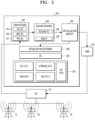
- FIG. 2 is a diagram for describing a RAN virtualization method, according to an embodiment of the disclosure.
- the scaling SC 254 may deliver a scaling command based on the determination to a virtualization master 260.
- the virtualization master 260 indicates a system that controls the vRAN package 240.
- the virtualization master 260 may be positioned in the server 200, and according to another embodiment of the disclosure, the virtualization master 260 may be positioned in a device other than the server 200, such as in another processor and/or another server.
- the virtualization master 260 may deliver the scaling command to the virtualization software 230, and may update and store vRAN package information changed in response to the scaling command.
- the virtualization master 260 may deliver the updated vRAN package information to an operation and maintenance (O&M) 270.
- the O&M 270 is a device for controlling a traffic congestion level on a user plane of a UE.
- the O&M 270 is located in the outside of the sever 200, but this is merely an example, and thus according to another embodiment of the disclosure, the O&M 270 may be positioned in the server 200.
- the O&M 270 may command the EIU 50 to allocate traffic to each of vRAN packages, the traffic occurring in the plurality of BSs 10, 20, and 30. Accordingly, traffic received from at least one of the plurality of BSs 10, 20, and 30 may be newly allocated to the adjusted vRAN package.
- FIG. 3 is a diagram for describing a RAN virtualization method, according to another embodiment of the disclosure.
- the hypervisor 330 may help the vRAN VM 340 to execute and manage the guest OS 341. That is, unlike the container-based virtualization method, in the hypervisor-based virtualization method, a plurality of OSs may be executed. Also, the hypervisor 330 may distribute a resource (e.g., the RAM 313, the CPU 311, or the like) of the hardware 310 to VMs.
- a resource e.g., the RAM 313, the CPU 311, or the like
- the scaling VM 350 may deliver a command therefor to the hypervisor 330. Also, the scaling VM 350 may deliver updated vRAN package information to an O&M 360.
- An OS 420 may manage hardware (e.g., the hardware 412) and software (e.g., virtualization software 430) executed in the server 400.
- hardware e.g., the hardware 412
- software e.g., virtualization software 430
- 10 cores from among all cores, 50 GB of RAM, and 500 GB of storage may be allocated to the vRAN package 440, according to initial setting.
- 4 cores of the 10 cores may be allocated to a RLC SC 445
- 3 cores may be allocated to a MAC SC 443, and 3 cores may be allocated to a PHY SC 441.
- 20 GB of 50 GB of RAM may be allocated to the RLC SC 445
- 15 GB may be allocated to the MAC SC 443, and 15 GB may be allocated to the PHY SC 441.
- 200 GB of 500 GB of storage may be allocated to the RLC SC 445
- 150 GB may be allocated to the MAC SC 443, and 150 GB may be allocated to the PHY SC 441.
- the scaling SC 454 may determine to increase a resource to be allocated to the vRAN package 440, or to additionally generate a vRAN package. For example, when a size of a resource that is additionally required is smaller than a preset threshold value, the scaling SC 454 may determine to perform scale up to increase the resource to be allocated to the vRAN package 440. In this case, the scaling SC 454 may request a virtualization master 460 for scale up of the vRAN package 440. Because the scale up request is received from the scaling SC 454, the virtualization master 460 may deliver a scale up command to the virtualization software 430. In response to the scale up command, the virtualization software 430 may increase the resource to be allocated to the vRAN package 440.
- the scaling SC 454 may determine to perform scale out to additionally generate the vRAN package 440. In this case, the scaling SC 454 may request the virtualization master 460 for scale out of the vRAN package 440. Because the scale out request is received from the scaling SC 454, the virtualization master 460 may deliver a scale out command to the virtualization software 430.
- the virtualization software 430 may additionally generate the vRAN package 440, and may allocate a resource to the additionally generated vRAN package 440.
- the virtualization software 430 may perform resource pinning of configuring a dedicated resource for each vRAN package.
- the resource pinning according to the disclosure indicates a resource allocation method of allocating a dedicated resource to each system for performing a particular process.
- the resource pinning may include CPU pinning, or the like.
- the plurality of items of hardware 412 and 414 may have a Non-Uniform Memory Access (NUMA) structure in which an independent memory is allocated to each CPU.
- NUMA Non-Uniform Memory Access
- first to tenth cores may be allocated to the vRAN package 440, and a memory grouped with the first to tenth cores may be allocated thereto.
- a CPU core and a memory grouped with the CPU core may be described as a NUMA node.
- the virtualization software 430 may allocate a core other than the first to tenth cores to the vRAN package that is additionally generated.
- the vRAN package 440 may process traffic by using the CPU core and the memory grouped as the NUMA node, thereby increasing a traffic processing speed.
- the virtualization software 430 may allocate the CPU core and the memory grouped as the NUMA node to the additionally generated vRAN package, thereby increasing a traffic processing speed.
- the traffic processing speed may be decreased.
- the virtualization software 430 may allocate at least some portions of a resource to the additionally generated vRAN package, the resource having been allocated to the vRAN package 440, and may allocate another resource to the vRAN package 440.
- the virtualization master 460 may notify an O&M 470 of the additional generation of the vRAN package. Based on the additionally generated vRAN package, the O&M 470 may command the EIU 50 to allocate traffic occurring in the plurality of BSs 10, 20, and 30. Accordingly, traffic received from at least one of the plurality of BSs 10, 20, and 30 may be allocated to the additionally generated vRAN package.
- FIG. 4B is a diagram for describing a method of performing CPU pinning during resource allocation for traffic processing by a vRAN, according to an embodiment of the disclosure.
- the first hardware 412 may include the storage, the GPU, and the NIC, in addition to the CPU and the RAM, but for convenience of description, elements other than the CPU and the RAM are not illustrated. In addition, descriptions about elements of FIG. 4B which correspond to those of FIG. 4A are not provided.
- the virtualization software 430 may perform resource pinning of allocating a dedicated resource to performing of a particular RAN function.
- the virtualization software 430 may perform CPU pinning of allocating at least some cores and a RAM connected to the at least some cores to perform a RAN function, the at least some cores being from among cores included in the CPU.
- the CPU may have a NUMA structure in which an independent memory is allocated to the cores included in the CPU.
- a first core 482 and a second core 484 and RAM areas e.g., RAM 1 and RAM 2) grouped with the first and second cores 482 and 484 may be allocated to the PHY SC 441 included in the vRAN package 440.
- a third core 486 and a RAM grouped with the third core 486 may be allocated to the MAC SC 443 included in the vRAN package 440.
- a fourth core 488 and a RAM grouped with the fourth core 488 may be allocated to the RLC SC 445 included in the vRAN package 440.
- Each of the PHY SC 441, the MAC SC 443, and the RLC SC 445 may process traffic by using a dedicated CPU core and a memory that are grouped as a NUMA node, thereby increasing a traffic processing speed.
- the virtualization software 430 may allocate, to an additionally generated vRAN package, a CPU core and a memory that are grouped as a NUMA node, thereby increasing a traffic processing speed.
- FIG. 5 is a diagram for describing a RAN function that may be performed in a server 520, according to an example embodiment of the disclosure.
- a SC configured to perform at least some functions among RAN functions used to be performed by an integrated BS according to the related art may be executed in the server 520.
- the RAN functions may include a PHY layer function, a MAC layer function, a RLC layer function, a PDCP layer function, or the like, and in particular, the PHY layer function may be further divided into a low PHY layer function and a high PHY layer function.
- this is merely an example, and other layer functions may also be further divided.
- a dividing time point of the RAN functions may be determined based on an amount of traffic processable by the server 520, a capability of a fronthaul connecting a BS 511 (also referred to as the first BS 511) to the server 520, a capability of a backhaul connecting the server 520 to a core network device 530, or the like.
- a delay or loss may occur due to congestion on the fronthaul while traffic is delivered to the server 520.
- the PHY layer function may be divided, and thus, the low PHY layer function may be executed in the first BS 511 of the cell site.
- a vRAN package 1 522 including a high PHY SC performing the high PHY layer function, a MAC SC performing the MAC layer function, a RLC SC performing the RLC layer function, and a PDCP SC performing the PDCP layer function may be executed in the server 520.
- the server 520 may include at least one processor, including circuitry, for such execution.
- a vRAN package 2 524 including a PHY SC performing the PHY layer function, a MAC SC performing the MAC layer function, a RLC SC performing the RLC layer function, and a PDCP SC performing the PDCP layer function may be executed in the server 520.
- a RF entity may be included in a second BS 513 of the cell site.
- a vRAN package 3 526 including a RLC SC performing the RLC layer function and a PDCP SC performing the PDCP layer function may be executed in the server 520.
- a RF entity, an entity for performing the PHY layer function, and an entity for performing the MAC layer function may be included in a third BS 515 of the cell site, and in this present embodiment of the disclosure, relatively many RAN functions are performed in the third BS 515 of the cell site, and thus, the load of the fronthaul may be decreased.
- scaling operations according to an embodiment of the disclosure described with reference to FIGS. 2 to 4 may be applied. Also, at least one of hardware elements or software elements of FIGS. 2 to 4 which are necessary to perform the scaling operations may be equally applied to the various vRAN package structures according to the present embodiment of the disclosure.
- FIG. 6 is a diagram for describing a method, performed by a server (e.g., see the servers in Figs. 2-5 ), of adjusting the number of SCs (e.g., see the SCs in Figs. 2-5 ) when traffic information indicating an increase (e.g., actual or predicted increase) in traffic of a particular service is received, according to an embodiment of the disclosure.
- a server e.g., see the servers in Figs. 2-5
- traffic information indicating an increase e.g., actual or predicted increase
- the vRAN package 1010 may determine the target capability information about traffic of the V2X service to be latency of 1 ms.
- an eMBB attribute is applied, and thus, the vRAN package 1010 may determine the target capability information, based on a data rate.
- a location of a UE e.g., the UE 31
- a handover operation may be frequently performed.
- a process of detecting a next BS (e.g., the BS 20) to which connection is switched from a currently-connected BS (e.g., the BS 10), and exchanging information between the currently-connected BS (e.g., the BS 10) and the next BS (e.g., the BS 20) has to be performed such that computations by the MAC SC 1014 may be increased.
- the scaling SC 1034 may predict a time in which the number of UEs using the V2X service is increased by at least a first threshold value, based on the number of UEs using the V2X service in each time zone on each day of a week with respect to each of the BSs 10 and 20. For example, the scaling SC 1034 may predict that a time in which the number of UEs accessing the second BS 20 from among the BSs 10 and 20 is increased by at least the first threshold value will be a t1-t2 time period on Saturday. Also, the scaling SC 1034 may identify an amount of a resource used to process traffic occurred in the second BS 20 in the t1-t2 time period on Saturday.
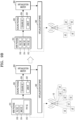
- FIG. 10B is a diagram for describing a method of adjusting, by a server, the number of resources to be allocated to an SC when traffic of the V2X service is decreased, according to an embodiment of the disclosure.
- the server may drive software for performing a vRAN function through hardware included in the server.
- the software may include a plurality of vRAN packages 1010 and 1020 (also referred to as the first and second vRAN packages 1010 and 1020), a scaling package 1030, a virtualization master 1040, and virtualization software 1050.
- the plurality of vRAN packages 1010 and 1020, the scaling package 1030, the virtualization master 1040, and the virtualization software 1050 in FIG. 10B may correspond to a plurality of vRAN packages, a scaling package, a virtualization master, and virtualization software that are described above with reference to FIG. 10A .
- a scaling SC 1034 may predict traffic according to each of service types to occur in the BSs 10 and 20, based on pre-configured service type information and traffic information.
- the pre-configured service type information may be an identifier provided to distinguish between services and may be provided as code, but this is merely an example, and thus the pre-configured service type information is not limited to the aforementioned example.
- the scaling SC 1034 may identify which service causes traffic occurred after an initial access procedure, based on service type information delivered in the initial access procedure between UEs 31, 32, 33, 34, 35, and 36 and the BSs 10 and 20. In this regard, the scaling SC 1034 may identify which service corresponds to the delivered service type information, by using the pre-configured service type information.
- an amount of traffic is decreased by the second threshold value or less in the t3-t4 time period every day, and only 2 CPU cores and 20 GB of a RAM memory are requested by a MAC SC 1024 to process the traffic, such that the scaling SC 1034 may predict that 1 CPU core and 10 GB of a RAM memory will be decreased from a currently-allocated resource.
- the scaling SC 1034 may deliver, before a t3 time point or at the t3 time point, a scale-down command to the virtualization master 1040 so as to decrease a resource to be allocated to the MAC SC 1024 of the second vRAN package 1020.
- the virtualization master 1040 may deliver the scale-down command to the virtualization software 1050, and may update and store information about the MAC SC 1024 of the second vRAN package 1020, the information being changed in response to the scale-down command.
- the virtualization software 1050 may decrease the resource to be allocated to the MAC SC 1024 of the second vRAN package 1020.
- the virtualization software 1050 may decrease a CPU core and a RAM memory allocated to the MAC SC 1024 of the second vRAN package 1020.
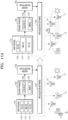
- FIG. 11A is a diagram for describing a method of adjusting, by a server, a resource to be allocated to an SC, when traffic of a remote surgery service occurs, according to an embodiment of the disclosure.
- the server may drive software for performing a vRAN function through hardware included in the server.
- an OS may be driven in the hardware, and may manage the hardware and virtualization software 1140 that is executed in the server. Because descriptions of the hardware, the OS, and the virtualization software are the same as those provided with reference to FIG. 2 (see also Figs. 3-7 ), further descriptions are not provided here.
- each software may be performed in a manner that a CPU in the server executes instructions stored in a RAM, a storage, or the like.
- a PHY SC 1112, a MAC SC 1114, and a RLC SC 1116 included in a vRAN package 1110 may respectively perform, through execution of the instructions, a PHY layer function, a MAC layer function, and a RLC layer function on traffic delivered from each of a plurality of BSs 11, 13, 15, and 17.
- Each of the BSs 11, 13, 15, and 17 may identify a service type a UE 50 attempts to use, based on service type information included in an RRC connection configuration message transmitted by the UE 50 in an initial access procedure.
- this is merely an example, and a method by which the BSs 11, 13, 15, and 17 identify a service type is not limited to the aforementioned example.
- each of the BSs 11, 13, 15, and 17 may identify a service type by determining whether a resource domain where traffic occurred corresponds to a resource domain that was pre-configured for the particular service.
- the UE 50 may access each of the BSs 11, 13, 15, and 17 and may be provided a remote surgery service.
- the vRAN package 1110 may identify, based on the service type information, which service caused traffic received from each of the BSs 11, 13, 15, and 17, the service type information being identified in the initial access procedure between the UE 50 and each of the BSs 11, 13, 15, and 17.
- the vRAN package 1110 may determine target capability information for processing the traffic, according to the identified service type. For example, the vRAN package 1110 may determine the target capability information about traffic of the remote surgery service to be a data rate of 10 Gbps and latency of 0.1 ms.
- an eMBB attribute is applied to a function of transmitting high-resolution surgery images, the function being from among various functions provided via the remote surgery service, a high data transmission rate may be desired. Accordingly, computations by the PHY SC 1112 that supports an operation such as beamforming that is a technology for increasing a data transmission rate may be increased. Also, when an unexpected incident occurs during a remote surgery, the unexpected incident has to be rapidly noticed to a hospital. That is, an URLLC attribute is applied to a function of noticing an unexpected incident, and thus the UE 50 may urgently deliver a message in the middle of transmission of the surgery images. In this case, a message has to be transmitted by using a portion of a time-frequency resource domain allocated to transmission of the surgery images, such that an operation of re-allocating time-frequency resources is desired and thus computations by the MAC SC 1114 may be increased.
- a scaling package 1120 may predict occurrence of traffic due to the remote surgery service and thus may adjust a resource to be allocated to the PHY SC 1112 and the MAC SC 1114.
- the scaling package 1120 may include a vRAN IF 1122 and a scaling SC 1124.
- the vRAN IF 1122 may receive, from the vRAN package 1110, traffic information about traffic of the BSs 11, 13, 15, and 17 and information about a resource allocated to the vRAN package 1110, the resource being used to process the traffic. Also, the vRAN IF 1122 may receive, from an external apparatus, event information informing occurrence of a remote surgery service.
- the scaling SC 1124 may predict traffic to occur in the BSs 11, 13, 15, and 17 due to occurrence of the remote surgery service, based on pre-configured service type information and the traffic information. For example, the scaling SC 1124 may identify an amount of traffic and a resource used to process the traffic occurred in the BSs 11, 13, 15, and 17 located on a path from a region A to a region B when a remote surgery service previously occurred on the path from the region A to the region B. When a remote surgery service newly occurs on the path from the region A to the region B, the scaling SC 1124 may predict traffic to occur in the BSs 11, 13, 15, and 17 located on the path from the region A to the region B, based on the amount of the pre-occurred traffic and the resource used to process the traffic.
- the scaling SC 1124 may deliver, before the remote surgery service is to be provided, a scale-up command to a virtualization master 1130 so as to increase a resource to be allocated to the PHY SC 1112 and the MAC SC 1114.
- the virtualization master 1130 may deliver the scale-up command to virtualization software 1140, and may update and store information about the PHY SC 1112 and the MAC SC 1114 of the vRAN package 1110, the information being changed in response to the scale-up command.
- the virtualization software 1140 may increase the resource to be allocated to the PHY SC 1112 and the MAC SC 1114 of the vRAN package 1110. For example, the virtualization software 1140 may increase a CPU core and a RAM memory allocated to the PHY SC 1112 and the MAC SC 1114 of the vRAN package 1110.
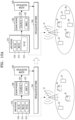
- FIG. 11B is a diagram for describing a method of adjusting, by a server, a resource to be allocated to an SC, when traffic of a remote surgery service occurs, according to another embodiment of the disclosure.
- the server may drive software for performing a vRAN function through hardware included in the server.
- the software may include a vRAN package 1110, a scaling package 1120, a virtualization master 1130, and virtualization software 1140.
- the vRAN package 1110, the scaling package 1120, the virtualization master 1130, and the virtualization software 1140 in FIG. 11B may correspond to a vRAN package, a scaling package, a virtualization master, and virtualization software that are described above with reference to FIG. 11A .
- FIG. 11B which correspond to those of FIG. 11A are not provided.
- the scaling package 1120 may predict a time when a remote surgery service is to end and then may adjust a resource to be allocated to a PHY SC 1112 and a MAC SC 1114.
- the scaling package 1120 may include a vRAN IF 1122 and a scaling SC 1124.
- the vRAN IF 1122 may receive, from the vRAN package 1110, traffic information about traffic of a BSs 11, 13, 15, and 17 and information about a resource allocated to the vRAN package 1110, the resource being used to process the traffic. Also, the vRAN IF 1122 may receive, from an external apparatus, event information informing occurrence of a remote surgery service.
- the scaling SC 1124 may identify a start time and an end time of the remote surgery service at each of the BSs 11, 13, 15, and 17 located on a path from a region A to a region B when the remote surgery service previously occurred on the path from the region A to the region B. For example, a time when the remote surgery service started is t0, traffic due to the remote surgery service may occur in a first BS at a time between a t0+td1 time period and a t0+td2 time period, and traffic due to the remote surgery service may occur in a second BS at a time between a t0+td3 time period and a t0+td4 time period.
- the first BS may predict that occurrence of traffic will end after td2 after a start time of the remote surgery service.
- the scaling SC 1124 may previously predict the end of the traffic with respect to the first BS before a time when the traffic of the first BS ends and thus may rapidly control a resource to be applied to the PHY SC 1112 and the MAC SC 1114.
- the scaling SC 1124 may deliver a scale-down command to the virtualization master 1130 so as to decrease a resource to be allocated to the PHY SC 1112 and the MAC SC 1114 of the vRAN package 1110.
- the virtualization master 1130 may deliver the scale-down command to the virtualization software 1140, and may update and store information about the PHY SC 1112 and the MAC SC 1114 of the vRAN package 1110, the information being changed in response to the scale-down command.
- the virtualization software 1140 may decrease the resource to be allocated to the PHY SC 1112 and the MAC SC 1114 of the vRAN package 1110.
- the virtualization software 1140 may decrease a CPU core and a RAM memory allocated to the PHY SC 1112 and the MAC SC 1114 of the vRAN package 1110.
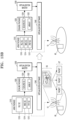
- the server may drive software for performing a vRAN function through hardware included in the server.
- an OS may be driven in the hardware, and may manage the hardware and virtualization software 1240 that is executed in the server. Because descriptions of the hardware, the OS, and the virtualization software are the same as those provided with reference to FIG. 2 (see also Figs. 3-7 ), further descriptions are not provided here.
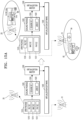
- the BS 10 may identify a service type a UE (e.g., a UE 22) attempts to use, based on service type information included in an RRC connection configuration message transmitted by the UE 22 in an initial access procedure.
- a UE e.g., a UE 22
- the virtualization software 1340 may increase the resource to be allocated to the RLC SC 1316 of the vRAN package 1310.
- the virtualization software 1340 may increase a CPU core and a RAM memory allocated to the RLC SC 1316 of the vRAN package 1310.
Landscapes
- Engineering & Computer Science (AREA)
- Computer Networks & Wireless Communication (AREA)
- Signal Processing (AREA)
- Software Systems (AREA)
- Quality & Reliability (AREA)
- Theoretical Computer Science (AREA)
- Physics & Mathematics (AREA)
- General Engineering & Computer Science (AREA)
- General Physics & Mathematics (AREA)
- Mobile Radio Communication Systems (AREA)
Description
- The disclosure relates to a method and apparatus for performing a radio access network (RAN) function.
- To meet increasing demand with respect to wireless data traffic after the commercialization of 4th generation (4G) communication systems, efforts have been made to develop 5th generation (5G) or pre-5G communication systems. For this reason, 5G or pre-5G communication systems are called 'beyond 4G network' communication systems or 'post long term evolution (post-LTE)' systems.
- To improve system networks for 5G communication systems, various technologies such as evolved small cells, advanced small cells, cloud radio access networks (Cloud-RAN), ultra-dense networks, device-to-device communication (D2D), wireless backhaul, moving networks, cooperative communication, coordinated multi-points (CoMP), and interference cancellation have been developed.
- The Internet has evolved from a human-based connection network, where humans create and consume information, to the Internet of things (IoT), where distributed elements such as objects exchange information with each other to process the information. Internet of everything (IoE) technology has emerged, in which the IoT technology is combined with, for example, technology for processing big data through connection with a cloud server. In the IoT environment, intelligent Internet technology (IT) services may be provided to collect and analyze data obtained from connected objects to create new value in human life. As existing information technology (IT) and various industries converge and combine with each other, the IoT may be applied to various fields such as smart homes, smart buildings, smart cities, smart cars or connected cars, smart grids, health care, smart home appliances, and advanced medical services.
- Various attempts are being made to apply 5G communication systems to the IoT network. For example, 5G communication systems such as sensor networks, machine-to-machine (M2M) communication, machine-type communication (MTC), or the like are implemented by using techniques including beamforming, multiple-input and multiple-output (MIMO), array antennas, or the like. Application of cloud radio access network (Cloud-RAN) as the above-described big data processing technology may be an example of convergence of 5G communication technology and IoT technology.
- Because various technologies can be applied due to the aforementioned technical features and the development of wireless communication systems, methods for efficiently managing a RAN by using such various technologies are desired.
- Document "Base Station Popularity-Based Dynamic Resource Allocation for VNF" by Sun Sanshan et al, 2019 2nd International Conference on Communication Engineering and Technology, IEEE, discloses a wireless communication system to achieve resource sharing though abstracting standardized network equipment into different types of virtual network functions to be placed in various network slices for diverse requirements.
- Embodiments of the invention are set out in the appended claims.
- Embodiments of the disclosure provide a method, according to
claim 1, and apparatus, according toclaim 6, for performing a radio access network (RAN) function in a wireless communication system. - Additional aspects will be set forth in part in the description which follows and, in part, will be apparent from the description.
- The above and other aspects, features, and advantages of certain embodiments of the present disclosure will be more apparent from the following detailed description, taken in conjunction with the accompanying drawings, in which:
-
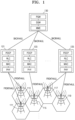
FIG. 1 is a diagram illustrating an example structure of a centralized/cloud radio access network (cRAN); -
FIG. 2 is a diagram illustrating an example RAN virtualization method, according to an embodiment of the disclosure; -
FIG. 3 is a diagram illustrating an example RAN virtualization method, according to another embodiment of the disclosure; -
FIG. 4A is a diagram illustrating example resource allocation for traffic processing by a virtualized RAN (vRAN), according to an embodiment of the disclosure; -
FIG. 4B is a diagram illustrating an example method of performing central processing unit (CPU) pinning during resource allocation for traffic processing by a vRAN, according to an embodiment of the disclosure; -
FIG. 5 is a diagram illustrating an example RAN function that may be performed in a server, according to an embodiment of the disclosure; -
FIG. 6 is a diagram illustrating an example method, performed by a server, of adjusting the number of software components (SCs) when traffic information indicating an increase in traffic of a particular service is received, according to an embodiment of the disclosure; -
FIG. 7 is a diagram illustrating an example method of adjusting, by a server, the number of SCs when traffic information indicating a decrease in traffic of a particular service is received, according to an embodiment of the disclosure; -
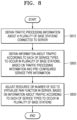
FIG. 8 is a flowchart illustrating an example method of adjusting, by a server, a SC based on information about traffic according to each of service types to occur in a plurality of base stations (BSs), according to an embodiment of the disclosure; -
FIG. 9A is a diagram illustrating an example method of adjusting, by a server, the number of resources to be allocated to an SC when traffic of an enhanced Mobile BroadBand (eMBB) service is increased, according to an embodiment of the disclosure; -
FIG. 9B is a diagram illustrating an example method of adjusting, by a server, the number of resources to be allocated to an SC when traffic of the eMBB service is decreased, according to an embodiment of the disclosure; -
FIG. 10A is a diagram illustrating an example method of adjusting, by a server, the number of resources to be allocated to an SC when traffic of a vehicle-to-everything (V2X) service is increased, according to an embodiment of the disclosure; -
FIG. 10B is a diagram illustrating an example method of adjusting, by a server, the number of resources to be allocated to an SC when traffic of the V2X service is decreased, according to an embodiment of the disclosure; -
FIG. 11A is a diagram illustrating an example method of adjusting, by a server, a resource to be allocated to an SC, when traffic of a remote surgery service occurs, according to an embodiment of the disclosure; -
FIG. 11B is a diagram illustrating an example method of adjusting, by a server, a resource to be allocated to an SC, when traffic of a remote surgery service occurs, according to another embodiment of the disclosure; -
FIG. 12A is a diagram illustrating an example method of adjusting, by a server, a resource to be allocated to an SC, when different types of services coexist, according to an embodiment of the disclosure; -
FIG. 12B is a diagram illustrating an example method of adjusting, by a server, a resource to be allocated to an SC, when different types of services coexist, according to another embodiment of the disclosure; -
FIG. 13A is a diagram illustrating an example method of adjusting, by a server, a resource to be allocated to an SC, when traffic of a streaming-based mobile game service occurs, according to an embodiment of the disclosure; -
FIG. 13B is a diagram illustrating an example method of adjusting, by a server, a resource to be allocated to an SC, when traffic of a streaming-based mobile game service occurs, according to another embodiment of the disclosure; -
FIG. 14A is a diagram illustrating an example method of adjusting, by a server, a resource to be allocated to an SC, when traffic of an augmented reality (AR) telepresence service occurs, according to an embodiment of the disclosure; -
FIG. 14B is a diagram illustrating an example method of adjusting, by a server, a resource to be allocated to an SC, when traffic of an AR telepresence service occurs, according to another embodiment of the disclosure; -
FIG. 15A is a diagram illustrating an example method of adjusting, by a server, a resource to be allocated to an SC, when traffic of an interactive streaming service occurs, according to an embodiment of the disclosure; -
FIG. 15B is a diagram illustrating an example method of adjusting, by a server, a resource to be allocated to an SC, when traffic of an interactive streaming service occurs, according to another embodiment of the disclosure; -
FIG. 16 is a diagram illustrating an example method of adjusting, by a server, a resource to be allocated to an SC, when traffic of a private new radio (NR) service and a public NR service occurs, according to an embodiment of the disclosure; and -
FIG. 17 is a flowchart illustrating example operations of a server for processing traffic between a plurality of user equipments (UEs) and a BS by adjusting a SC, according to an embodiment of the disclosure. - Example embodiments of the disclosure will now be described in greater detail with reference to the accompanying drawings. In the following description, descriptions of techniques that are well known in the art and not directly related to the disclosure may be omitted to clearly convey the gist of the disclosure.
- Some elements in the drawings may be exaggerated, omitted, or schematically illustrated. The size of each element does not entirely reflect the actual size. In the drawings, the same or corresponding elements are denoted by the same reference numerals.
- The advantages and features of the disclosure and methods of achieving them will become apparent with reference to embodiments of the disclosure described in detail below with reference to the accompanying drawings. The disclosure may, however, be embodied in many different forms and should not be construed as being limited to embodiments set forth herein. In the disclosure, the same elements are denoted by the same reference numerals.
- Throughout the disclosure, the expression "at least one of a, b or c" indicates only a, only b, only c, both a and b, both a and c, both b and c, all of a, b, and c, or variations thereof. Throughout the disclosure, the expression a "or" b may mean both a and b, either one of a and b, or variations thereof.
- Examples of a terminal may include, for example, a user equipment (UE), a mobile station (MS), a cellular phone, a smartphone, a computer, a multimedia system capable of performing a communication function, or the like.
- In the disclosure, a controller may also be referred to as a processor.
- Throughout the disclosure, a layer (or a layer apparatus) may also be referred to as an entity.
- It will be understood that each block of flowchart illustrations, and combinations of blocks in the flowchart illustrations, may be implemented by computer program instructions. The computer program instructions may be provided to a processor of a general-purpose computer, special purpose computer, or other programmable data processing apparatus, such that the instructions, which are executed via the processor of the computer or other programmable data processing apparatus, generate means for performing functions specified in the flowchart block or blocks. The computer program instructions may also be stored in a computer usable or computer-readable memory that may direct the computer or other programmable data processing apparatus to function in a particular manner, such that the instructions stored in the computer usable or computer-readable memory produce an article of manufacture including instruction means that perform the functions specified in the flowchart block or blocks. The computer program instructions may also be loaded onto the computer or other programmable data processing apparatus to cause a series of operational steps to be performed on the computer or other programmable apparatus to produce a computer implemented process such that the instructions that are executed on the computer or other programmable apparatus provide steps for implementing the functions specified in the flowchart block or blocks.
- In addition, each block of the flowchart illustrations may represent a module, segment, or portion of code, which includes one or more executable instructions for performing specified logical function(s). It should also be noted that in some alternative implementations, the functions noted in the blocks may occur out of the order. For example, two blocks shown in succession may in fact be executed substantially concurrently or the blocks may sometimes be executed in the reverse order, depending upon the functionality involved.
- The term "~ unit", as used in the disclosure may refer, for example, to a software or hardware component, such as field-programmable gate array (FPGA) or application-specific integrated circuit (ASIC), which performs certain tasks. However, the term "unit" is not limited to software or hardware. A "unit" may be configured to be in an addressable storage medium or configured to operate one or more processors. Thus, a "unit" may include, by way of example, components, such as software components, object-oriented software components, class components, and task components, processes, functions, attributes, procedures, subroutines, segments of program code, drivers, firmware, microcode, circuitry, data, databases, data structures, tables, arrays, and variables. The functionality provided in the components and "units" may be combined into fewer components and "units" or may be further separated into additional components and "units". Further, the components and "units" may be implemented to operate one or more central processing units (CPUs) in a device or a secure multimedia card. Also, a "unit" may include one or more processors in an embodiment of the disclosure.
- Wireless communication systems have been developed from wireless communication systems providing voice centered services in the early stage toward broadband wireless communication systems providing high-speed, high-quality packet data services, like communication standards of high speed packet access (HSPA), long term evolution (LTE or evolved universal terrestrial radio access (E-UTRA)), LTE-A, and LTE-Pro of the 3GPP, high rate packet data (HRPD) and ultra mobile broadband (UMB) of 3GPP2, 802.16e of the Institute of Electrical and Electronic Engineers (IEEE), or the like. As a next generation wireless communication system, 5th generation (5G) or new radio (NR) wireless communication systems are being established.
- In the next generation wireless communication system, at least one of services including enhanced Mobile BroadBand (eMBB), massive Machine Type Communications (mMTC), and Ultra-Reliable and Low-Latency Communications (URLLC) may be provided to the UE. The forementioned services may be classified according to at least one capability from among a data transmission rate, latency, and a maximum connection density that are requested for each of services. The services may be provided to a same UE or different UEs during a same time period. The eMBB service may be for high-speed transmission of high-volume data, the mMTC service may be for minimization of power of the terminal and accesses by multiple terminals, and the URLLC service may be for high reliability and low latency, but the disclosure is not limited thereto. The services may be primary services in a wireless communication system such as an LTE system or a 5G or new radio/next radio (NR) system after the LTE system.
- For convenience of description, in the disclosure, terms and names or modifications of the terms and names defined in the 3rd Generation Partnership Project Long Term Evolution (3GPP LTE) standard are used therein. However, the disclosure is not limited to these terms and names, and may be equally applied to wireless communication systems conforming to other standards. For example, although 5G (or NR) systems are mentioned as examples in the following description, embodiments of the disclosure may also be applied to other wireless communication systems having similar technical backgrounds or channel types. As another example, embodiments of the disclosure may be applied to a LTE or LTE-A system which is a wireless communication system before the NR system, and furthermore, embodiments of the disclosure may be applied to a wireless communication system to be developed after the NR system.
- Hereinafter, terms identifying an access node, terms indicating network entities, terms indicating messages, terms indicating an interface between network entities, and terms indicating various pieces of identification information, as used in the following description, are used for convenience of explanation. Accordingly, the disclosure is not limited to terms to be described below, and other terms indicating objects having equal technical meanings may be used.
- In the disclosure, a base station (BS) is an entity that allocates resources to a terminal, and may be at least one of a gNode B, an eNode B, a Node B, a base station (BS), a radio access unit, a BS controller, or a node on a network
In the disclosure, a terminal may include, for example, and without limitation, a UE, a MS, a cellular phone, a smartphone, a computer, a multimedia system capable of performing a communication function, or the like. - In the disclosure, a cell may refer, for example, to an area covered by one BS in wireless communication. The cell may be classified into a mega cell, a macro cell, a micro cell, or a pico cell, based on a size of the cell, but this is merely an example and types of the cell are not limited thereto.
- In the disclosure, a downlink (DL) may refer, for example, to a wireless transmission path of a signal transmitted from a BS to a UE, and an uplink (UL) is a wireless transmission path of a signal transmitted from a UE to a BS. For example, as a representative example of the broadband wireless communication system, the LTE system has adopted an orthogonal frequency division multiplexing (OFDM) scheme in a DL and has adopted a single carrier frequency division multiple access (SC-FDMA) scheme in an UL. The UL refers to a radio link through which a UE (also referred to as a terminal) or an MS transmits data or a control signal to a BS (e.g., eNB), and the DL refers to a radio link through which a BS transmits data or a control signal to a UE.
-
FIG. 1 illustrates a diagram for describing a structure of a centralized/cloud radio access network (cRAN). - Referring to
FIG. 1 , in the cRAN, a radio transceiver (also referred to as a radio unit (RU)) and a data processor (also referred to as a data unit (DU)) used to be included in a BS according to the related art are now separate, and thus the radio transceiver is positioned in aBS 111 of a cell site, and the data processor (e.g., a data processor 121) may be positioned in a central server. A cell corresponds to an area covered by a BS in a wireless communication system, and at least one cell may exist for each BS. Unlike an integrated BS where both a radio transceiver and a data processor exist in a cell site, in the cRAN, radio transceivers may be positioned inBSs data processors data processors - The
BSs BSs - A data processor (e.g., the data processor 121) may process a signal received from a BS (e.g., the BS 111) of the cell site, and may deliver the processed signal to a
core network device 130 through a backhaul. Thecore network device 130 may include devices that connect an end-to-end system consisting of a BS and a UE. For example, thecore network device 130 may include a packet data network gateway (P-GW), a serving gateway (S-GW), a mobile management entity (MME), or the like. The P-GW may connect an internal node of a core network with external internet, may configure an Internet Protocol (IP) address to a UE, and may perform IP packet filtering. The S-GW may buffer a DL packet received from external internet, when radio resource control (RRC) connection is not configured in the UE. The MME may process a control signal related to location registration, authentication, and calls of the UE. However, this is a merely an example, and a configuration of thecore network device 130 is not limited to the aforementioned example. - A backhaul indicates a network portion that connects a data processor (e.g., the data processor 121) to the
core network device 130 and may be implemented as a wired interface such as an optical fiber, but this is merely an example, and the backhaul may be implemented as a wireless network. - A data processor (e.g., the data processor 121) may perform various RAN functions for processing signals. The RAN functions may include a packet data convergence protocol (PDCP) layer function, a radio link control (RLC) layer function, a medium access control (MAC) layer function, and a physical (PHY) layer function, but this is merely an example and thus, the RAN functions are not limited thereto. Hereinafter, the PDCP layer function, the RLC layer function, the MAC layer function, and the PHY layer function will now be described.
- The PDCP layer function may include at least some functions among functions below.
- Header compression and decompression: robust header compression (ROHC) only
- Transfer of user data
- In-sequence delivery of upper layer protocol data units (PDUs)
- PDCP PDU reordering
- Duplicate detection of lower layer service data units (SDUs))
- Retransmission of PDCP SDUs
- Ciphering and deciphering
- Timer-based SDU discard in UL.
- The reordering function of the PDCP layer may include at least one of a function of reordering PDCP PDUs received from a lower layer, on a PDCP sequence number (SN) basis, a function of delivering the reordered data to an upper layer in order, a function of recording missing PDCP PDUs by reordering the received PDCP PDUs, a function of reporting status information about the missing PDCP PDUs to a transmitter, or a function of requesting to retransmit the missing PDCP PDUs.
- The RLC layer function may include at least some functions among functions below.
- Transfer of upper layer PDUs
- In-sequence delivery of upper layer PDUs
- Out-of-sequence delivery of upper layer PDUs
- Error Correction through automatic repeat request (ARQ)
- Concatenation, segmentation and reassembly of RLC SDUs
- Re-segmentation of RLC data
- Reordering of RLC data
- Duplicate detection
- Protocol error detection
- RLC SDU discard
- RLC re-establishment
- The in-sequence delivery function of the RLC layer may include a function of delivering RLC SDUs received from a lower layer, to an upper layer in order, and a function of reassembling the RLC SDUs and delivering the reassembled RLC SDU when a plurality of RLC SDUs segmented from one RLC SDU are received. The in-sequence delivery function may also include a function of reordering received RLC PDUs on a RLC SN or PDCP SN basis, a function of recording missing RLC PDUs by reordering the received RLC PDUs, and a function of reporting status information about the missing RLC PDUs to a transmitter. The in-sequence delivery function may also include a function of requesting to retransmit the missing RLC PDUs, and a function of delivering only RLC SDUs prior to a missing RLC SDU, to an upper layer in order when the missing RLC SDU exists. The in-sequence delivery function may also include a function of delivering all RLC SDUs received before a timer starts, to an upper layer in order although a missing RLC SDU exists when a certain timer expires, or a function of delivering all RLC SDUs received so far, to an upper layer in order although a missing RLC SDU exists when a certain timer expires.
- The RLC layer may process RLC PDUs in order of reception, regardless of SNs, and may deliver the RLC PDUs to the PDCP layer. When a segment is received, the RLC layer may reassemble the segment with other segments stored in a buffer or subsequently received, into a whole RLC PDU and may deliver the RLC PDU to the PDCP layer. In a NR system, the RLC layer may not have a concatenation function, and the concatenation function may be performed by the MAC layer or may be replaced with a multiplexing function of the MAC layer.
- The MAC layer function may include at least some functions among functions below.
- Mapping between logical channels and transport channels
- Multiplexing/demultiplexing of MAC SDUs
- Scheduling information reporting
- Error correction through HARQ
- Priority handling between logical channels of one UE
- Priority handling between UEs by means of dynamic scheduling
- MBMS service identification
- Transport format selection
- Padding
- The PHY layer may perform at least some functions among functions below.
- Transmission and reception of data by using an electrical signal
- Channel coding/decoding function
- Modulation/demodulation function
- Power control
- Cell search
- The PHY layer may perform channel coding and modulation on data of an upper layer, may generate an OFDM symbol thereof, and may transmit the OFDM symbol through a wireless channel. Also, the PHY layer may perform demodulation and channel decoding on an OFDM symbol received through a wireless channel, and may deliver data obtained therefrom to an upper layer.
- A BS (e.g., the BS 111) of the cell site may be described by using terms such as a RU, a remote radio head (RRH), or the like, and a data processor (e.g., the data processor 121) may be described by using terms such as a DU, a base band unit (BBU), or the like.
- To gather and manage the
data processors data processors FIGS. 2 and3 , examples of a virtualized RAN (vRAN) according to the disclosure will now be described. -
FIG. 2 is a diagram for describing a RAN virtualization method, according to an embodiment of the disclosure. - Referring to
FIG. 2 , aserver 200 may includehardware 210 capable of driving software for performing a vRAN function. Thehardware 210 may include a central processing unit (CPU) 211, a random access memory (RAM) 213, astorage 215, a graphics processing unit (GPU) 217, and a network interface controller (NIC) 219, but this is merely an example, and elements of thehardware 210 are not limited thereto. Thestorage 215 may include a hard disk drive (HDD), a solid-state drive (SDD), or the like. - One operating system (OS) 220 may operate in the
hardware 210. TheOS 220 may manage software (e.g., virtualization software 230) that is executed in thehardware 210 and theserver 200. - The
virtualization software 230 may logically divide a resource managed by theOS 220, and may allow a plurality of software components (SCs) to share the logically divided resource. The resource is an item used for avRAN package 240 to process traffic. For example, the resource may include one or more of theCPU 211, theRAM 213, thestorage 215, theGPU 217, or the like, but this is merely an example, and examples of the resource are not limited thereto. The logical division of the resource may be performed by distributing, through a switch, a physical communication line connecting the resource to the plurality of SCs. A SC indicates a component to be used as a separate server by gathering libraries or applications that are used to perform a particular function, and may be generated or removed in a unit of a package. The package is a minimum unit that shares one IP and may include one or more SCs. An example of thevirtualization software 230 may include Kubernetes, and the SC may correspond to a container of the Kubernetes. Each of 240, 241, 243, 245, 250, 252, 254, 260, and 270 may be included in or may be implemented by at least one processor (e.g., see 311) and/or corresponding memory, including circuitry. - According to an embodiment of the disclosure, the SC may be used to perform a network function of the vRAN. Hereinafter, operations of the
server 200 to implement the vRAN will now be described in detail. - The
server 200 may be connected ("connected" may refer to, for example, one or more of operatively connected, electrically connected, and/or communicatively connected) to a plurality ofBSs Fig. 1 ) of respective cell sites via an Ethernet interface unit (EIU) 50. The server may include at least one processor. TheEIU 50 is a portion of a path connecting theserver 200 to the plurality ofBSs vRAN package 240 via theEIU 50. Also, as another example, information about thevRAN package 240 to which the plurality ofBSs EIU 50. - According to an embodiment of the disclosure, the
server 200 may perform at least some functions among RAN functions used to be performed by a data processor of an integrated BS. Here, the data processor may correspond to the data processor described above with reference toFIG. 1 . Accordingly, a radio transceiver including a RF device may exist in each of the plurality ofBSs BSs server 200. For example, aPHY SC 241, aMAC SC 243, and aRLC SC 245 may be generated in theserver 200, and thePHY SC 241, theMAC SC 243, and theRLC SC 245 may respectively perform the PHY layer function, the MAC layer function, and the RLC layer function. However, this is merely an example, and RAN functions performed by theserver 200 are not limited thereto. Other examples will be described below with reference toFIG. 5 . - According to an embodiment of the disclosure, the
PHY SC 241, theMAC SC 243, and theRLC SC 245 may be included in onevRAN package 240, or multiple vRAN packages. ThevRAN package 240 is a minimum unit that may include one or more SCs, each performing a RAN function. ThevRAN package 240 may be configured so as to include instructions for allowing RAN functions to be virtualized and then performed, the RAN functions being used to be performed by a hardware device according to the related art, and an SC may be removed or generated in a unit of thevRAN package 240. - The
vRAN package 240 may obtain traffic processing information about traffic which has occurred in the plurality ofBSs - The traffic processing information may be received by the
vRAN package 240 via theEIU 50 from the plurality ofBSs OS 220 in theserver 200 or another external device. For example, the traffic information in the traffic processing information may be received from the plurality ofBSs OS 220 in theserver 200. However, this is merely an example, and a method, performed by thevRAN package 240, of receiving the traffic processing information is not limited thereto. As another example, the traffic processing information may be obtained as a result of applying, by thevRAN package 240, a statistics method (e.g., an average, variance, or the like) to pre-obtained traffic processing information. ThevRAN package 240 may deliver the obtained traffic processing information to ascaling package 250. - The
scaling package 250 may comprise a group of instructions for controlling the number of SCs (e.g., aSC 241 and a resource allocated to the SCs (e.g., the SC 241) included in thevRAN package 240. Thescaling package 250 may include a vRAN interface (vRAN IF) 252 and ascaling SC 254. The vRAN IF 252 may receive the traffic processing information from thevRAN package 240. As another example, thevRAN IF 252 may obtain, from an external device, information about an event predicted to cause a change in the traffic. For example, thevRAN IF 252 may obtain the information about the event via a core network device. The event corresponds to a reason that causes the change in the traffic with respect to a plurality of BSs. - The scaling
SC 254 may obtain, based on the traffic processing information, information about traffic to occur in the plurality ofBSs BSs BSs BSs BSs - A method by which the
scaling SC 254 predicts, based on the traffic processing information, traffic to occur in the plurality ofBSs FIG. 8 . Also, the scalingSC 254 may determine whether to adjust at least one of the number of SCs or a resource of the SC, based on the information about traffic to occur in the plurality ofBSs - When the scaling
SC 254 determines to adjust at least one of the number of the SCs or the resource to be allocated to each SC, the scalingSC 254 may deliver a scaling command based on the determination to avirtualization master 260. Thevirtualization master 260 indicates a system that controls thevRAN package 240. Thevirtualization master 260 may be positioned in theserver 200, and according to another embodiment of the disclosure, thevirtualization master 260 may be positioned in a device other than theserver 200, such as in another processor and/or another server. Thevirtualization master 260 may deliver the scaling command to thevirtualization software 230, and may update and store vRAN package information changed in response to the scaling command. Also, thevirtualization master 260 may deliver the updated vRAN package information to an operation and maintenance (O&M) 270. TheO&M 270 is a device for controlling a traffic congestion level on a user plane of a UE. In a present embodiment of the disclosure, it is illustrated that theO&M 270 is located in the outside of thesever 200, but this is merely an example, and thus according to another embodiment of the disclosure, theO&M 270 may be positioned in theserver 200. - In consideration of an adjusted vRAN package, the
O&M 270 may command theEIU 50 to allocate traffic to each of vRAN packages, the traffic occurring in the plurality ofBSs BSs - The aforementioned RAN virtualization method may be merely an example of implementing a vRAN in the disclosure, and thus another virtualization method may be used. For example, a hypervisor-based virtualization method may be used to implement a vRAN, and this method will now be described with reference to
FIG. 3 . -
FIG. 3 is a diagram for describing a RAN virtualization method, according to another embodiment of the disclosure. - Referring to
FIG. 3 , aserver 300 may includehardware 310 capable of driving software for performing a vRAN function. Thehardware 310 may include aCPU 311, aRAM 313, astorage 315, aGPU 317, and aNIC 319, but this is merely an example, and elements of thehardware 310 are not limited thereto. Thestorage 315 may include a HDD, a SDD, or the like. Hereinafter, descriptions about elements ofFIG. 3 which correspond to those ofFIG. 2 are not provided. - In the hypervisor-based virtualization method, a
host OS 320 and at least oneguest OS 341 may be driven. Thehost OS 320 is an OS that manages software (e.g., a hypervisor 330) that is executed in thehardware 310 and theserver 300. Theguest OS 341 is an OS that is positioned in a vRAN virtual machine (vRAN VM) 340. Thehypervisor 330 is software that divides an OS of the server 300 (e.g., the host OS 320) from thehardware 310. However, according to another embodiment of the disclosure, thehypervisor 330 may be embodied as a physical device. Also, thehypervisor 330 may drive a VM in thehardware 310. For example, thehypervisor 330 may help thevRAN VM 340 to execute and manage theguest OS 341. That is, unlike the container-based virtualization method, in the hypervisor-based virtualization method, a plurality of OSs may be executed. Also, thehypervisor 330 may distribute a resource (e.g., theRAM 313, theCPU 311, or the like) of thehardware 310 to VMs. - According to an embodiment of the disclosure, a method of performing a RAN function may involve implementing a vRAN by generating VMs respectively performing the aforementioned RAN functions.
According to an embodiment of the disclosure, thevRAN VM 340 may include theguest OS 341, aPHY SC 343, aMAC SC 345, and anRLC SC 347, and operations of thevRAN VM 340 may correspond to operations of thevRAN package 240 described above with reference toFIG. 2 . Each of 340, 341, 343, 345, 347, 350, 351, 353, 355, and 370 may be included in or may be implemented by at least one processor and/or corresponding memory, including circuitry (e.g., see 310). - A SC may be used to have a same meaning as a VM process in the hypervisor-based virtualization method. According to an embodiment of the disclosure, a scaling
VM 350 may include aguest OS 351, avRAN IF 353, and ascaling SC 355. Theguest OS 351 of the scalingVM 350 may be the same type as theguest OS 341 of thevRAN VM 340, but this is merely an example, and a different OS type may be used. Operations of the scalingVM 350 may correspond to operations of thescaling package 250 described above with reference toFIG. 2 . However, when the scalingVM 350 determines to adjust at least one of the number of a plurality of thevRAN VMs 340 or a resource allocated to thevRAN VM 340, the scalingVM 350 may deliver a command therefor to thehypervisor 330. Also, the scalingVM 350 may deliver updated vRAN package information to anO&M 360. -
FIG. 4A is a diagram for describing resource allocation for traffic processing by a vRAN, according to an embodiment of the disclosure. - Referring to
FIG. 4A , aserver 400 may include a plurality of items ofhardware hardware - An
OS 420 may manage hardware (e.g., the hardware 412) and software (e.g., virtualization software 430) executed in theserver 400. - The
virtualization software 430 may integrate and manage the plurality of items ofhardware virtualization software 430 may be stored in hardware (e.g., the hardware 412) in which avRAN package 440 is stored, or may be stored in hardware (e.g., the hardware 414) in which thevRAN package 440 is not stored. - Hereinafter, a method of allocating resources of the plurality of items of
hardware vRAN package 440 so as to process traffic of the plurality ofBSs hardware - According to an embodiment of the disclosure, 10 cores from among all cores, 50 GB of RAM, and 500 GB of storage may be allocated to the
vRAN package 440, according to initial setting. For example, 4 cores of the 10 cores may be allocated to aRLC SC MAC SC PHY SC 441. 20 GB of 50 GB of RAM may be allocated to theRLC SC MAC SC PHY SC 441. Also, 200 GB of 500 GB of storage may be allocated to theRLC SC 445, 150 GB may be allocated to theMAC SC 443, and 150 GB may be allocated to thePHY SC 441. - The
vRAN package 440 may process traffic occurred in the plurality ofBSs vRAN package 440 may deliver traffic processing information to avRAN IF 452. - The vRAN IF 452 may deliver the traffic processing information to a
scaling SC 454. The scalingSC 454 may obtain, based on the traffic processing information, information about traffic to occur in the plurality ofBSs SC 454 may obtain information about traffic to occur in a target prediction time, based on information about traffic previously occurred in a situation similar to the target prediction time and information about a resource used to process the occurred traffic. For example, when the target prediction time is an office-going hour, the scalingSC 454 may confirm that traffic previously occurred in the plurality ofBSs - Because 10 CPU cores and 200 GB of RAM which are current resources allocated to the
vRAN package 440 may be insufficient for resources needed for processing the traffic, the scalingSC 454 may determine to increase a resource to be allocated to thevRAN package 440, or to additionally generate a vRAN package. For example, when a size of a resource that is additionally required is smaller than a preset threshold value, the scalingSC 454 may determine to perform scale up to increase the resource to be allocated to thevRAN package 440. In this case, the scalingSC 454 may request avirtualization master 460 for scale up of thevRAN package 440. Because the scale up request is received from the scalingSC 454, thevirtualization master 460 may deliver a scale up command to thevirtualization software 430. In response to the scale up command, thevirtualization software 430 may increase the resource to be allocated to thevRAN package 440. - As another example, when the size of the resource that is additionally required is equal to or greater than the preset threshold value, the scaling
SC 454 may determine to perform scale out to additionally generate thevRAN package 440. In this case, the scalingSC 454 may request thevirtualization master 460 for scale out of thevRAN package 440. Because the scale out request is received from the scalingSC 454, thevirtualization master 460 may deliver a scale out command to thevirtualization software 430. - In response to the scale out command, the
virtualization software 430 may additionally generate thevRAN package 440, and may allocate a resource to the additionally generatedvRAN package 440. According to an embodiment of the disclosure, thevirtualization software 430 may perform resource pinning of configuring a dedicated resource for each vRAN package. The resource pinning according to the disclosure indicates a resource allocation method of allocating a dedicated resource to each system for performing a particular process. The resource pinning may include CPU pinning, or the like. - When the CPU pinning is applied, the plurality of items of
hardware vRAN package 440, and a memory grouped with the first to tenth cores may be allocated thereto. In this regard, a CPU core and a memory grouped with the CPU core may be described as a NUMA node. When the first to tenth cores are allocated to thevRAN package 440, and then a vRAN package is additionally generated, thevirtualization software 430 may allocate a core other than the first to tenth cores to the vRAN package that is additionally generated ThevRAN package 440 may process traffic by using the CPU core and the memory grouped as the NUMA node, thereby increasing a traffic processing speed. Also, thevirtualization software 430 may allocate the CPU core and the memory grouped as the NUMA node to the additionally generated vRAN package, thereby increasing a traffic processing speed. When the CPU core processes the traffic by accessing a memory grouped with another NUMA node, the traffic processing speed may be decreased. However, this is merely an example, and a method by which thevirtualization software 430 allocates a resource to thevRAN package 440 is not limited thereto. In another embodiment of the disclosure, when a vRAN package is additionally generated, thevirtualization software 430 may allocate at least some portions of a resource to the additionally generated vRAN package, the resource having been allocated to thevRAN package 440, and may allocate another resource to thevRAN package 440. - Also, the
virtualization master 460 may notify anO&M 470 of the additional generation of the vRAN package. Based on the additionally generated vRAN package, theO&M 470 may command theEIU 50 to allocate traffic occurring in the plurality ofBSs BSs -
FIG. 4B is a diagram for describing a method of performing CPU pinning during resource allocation for traffic processing by a vRAN, according to an embodiment of the disclosure. - Referring to
FIG. 4B , according to an embodiment of the disclosure, a detailed structure 412-1 of the CPU and the RAM of thehardware 412 from among the plurality of items ofhardware server 400 described above with reference toFIG. 4A is illustrated. Thefirst hardware 412 may include the storage, the GPU, and the NIC, in addition to the CPU and the RAM, but for convenience of description, elements other than the CPU and the RAM are not illustrated. In addition, descriptions about elements ofFIG. 4B which correspond to those ofFIG. 4A are not provided. - The
virtualization software 430 according to an embodiment of the disclosure may perform resource pinning of allocating a dedicated resource to performing of a particular RAN function. For example, thevirtualization software 430 may perform CPU pinning of allocating at least some cores and a RAM connected to the at least some cores to perform a RAN function, the at least some cores being from among cores included in the CPU. - When CPU pinning is applied, the CPU may have a NUMA structure in which an independent memory is allocated to the cores included in the CPU. For example, when CPU pinning is applied, a
first core 482 and asecond core 484 and RAM areas e.g.,RAM 1 and RAM 2) grouped with the first andsecond cores PHY SC 441 included in thevRAN package 440. Also, athird core 486 and a RAM grouped with thethird core 486 may be allocated to theMAC SC 443 included in thevRAN package 440. Also, afourth core 488 and a RAM grouped with thefourth core 488 may be allocated to theRLC SC 445 included in thevRAN package 440. - Each of the
PHY SC 441, theMAC SC 443, and theRLC SC 445 may process traffic by using a dedicated CPU core and a memory that are grouped as a NUMA node, thereby increasing a traffic processing speed. Also, thevirtualization software 430 may allocate, to an additionally generated vRAN package, a CPU core and a memory that are grouped as a NUMA node, thereby increasing a traffic processing speed. -
FIG. 5 is a diagram for describing a RAN function that may be performed in aserver 520, according to an example embodiment of the disclosure. - Referring to
FIG. 5 , a SC configured to perform at least some functions among RAN functions used to be performed by an integrated BS according to the related art may be executed in theserver 520. In this regard, the RAN functions may include a PHY layer function, a MAC layer function, a RLC layer function, a PDCP layer function, or the like, and in particular, the PHY layer function may be further divided into a low PHY layer function and a high PHY layer function. However, this is merely an example, and other layer functions may also be further divided. - A dividing time point of the RAN functions may be determined based on an amount of traffic processable by the
server 520, a capability of a fronthaul connecting a BS 511 (also referred to as the first BS 511) to theserver 520, a capability of a backhaul connecting theserver 520 to acore network device 530, or the like. - In a vRAN according to an embodiment of the disclosure, when an amount of traffic occurring in a base station (e.g., the base station 511) of a cell site is greater than a traffic capacity of the fronthaul connecting the base station (e.g., the base station 511) of the cell site to the
server 520, a delay or loss may occur due to congestion on the fronthaul while traffic is delivered to theserver 520. In this case, unlike to the embodiment of the disclosure described above with reference toFIG. 2 , to decrease a load of the fronthaul, the PHY layer function may be divided, and thus, the low PHY layer function may be executed in thefirst BS 511 of the cell site. Accordingly, avRAN package 1 522 including a high PHY SC performing the high PHY layer function, a MAC SC performing the MAC layer function, a RLC SC performing the RLC layer function, and a PDCP SC performing the PDCP layer function may be executed in theserver 520. Theserver 520 may include at least one processor, including circuitry, for such execution. - According to another example embodiment of the disclosure, in the vRAN, when the traffic capacity of the fronthaul is greater than an amount of traffic actually occurring in the
BS 511, and traffic processing capability of theserver 520 is equal to or greater than a certain level, avRAN package 2 524 including a PHY SC performing the PHY layer function, a MAC SC performing the MAC layer function, a RLC SC performing the RLC layer function, and a PDCP SC performing the PDCP layer function may be executed in theserver 520. In this case, a RF entity may be included in asecond BS 513 of the cell site. - According to another embodiment of the disclosure, when the traffic capacity of the fronthaul is very low in the vRAN, a
vRAN package 3 526 including a RLC SC performing the RLC layer function and a PDCP SC performing the PDCP layer function may be executed in theserver 520. In this case, a RF entity, an entity for performing the PHY layer function, and an entity for performing the MAC layer function may be included in athird BS 515 of the cell site, and in this present embodiment of the disclosure, relatively many RAN functions are performed in thethird BS 515 of the cell site, and thus, the load of the fronthaul may be decreased. - With respect to various vRAN package structures described with reference to
FIG. 5 , scaling operations according to an embodiment of the disclosure described with reference toFIGS. 2 to 4 may be applied. Also, at least one of hardware elements or software elements ofFIGS. 2 to 4 which are necessary to perform the scaling operations may be equally applied to the various vRAN package structures according to the present embodiment of the disclosure. -
FIG. 6 is a diagram for describing a method, performed by a server (e.g., see the servers inFigs. 2-5 ), of adjusting the number of SCs (e.g., see the SCs inFigs. 2-5 ) when traffic information indicating an increase (e.g., actual or predicted increase) in traffic of a particular service is received, according to an embodiment of the disclosure. - Referring to
FIG. 6 , the server according to an embodiment of the disclosure may drive software for performing a vRAN function through hardware included in the server. In particular, an OS may be driven in the hardware, and may manage the hardware andvirtualization software 640 that is executed in the server. Because descriptions of the hardware, the OS, and the virtualization software are the same as those provided with reference toFIG. 2 , further descriptions are not provided here. - Hereinafter, to describe a method of increasing, by the server, a vRAN package when an increase in traffic is predicted, an operation of each of a plurality of items of software described with reference to
FIG. 2 will now be described in detail. In addition, an operation in each software may be performed in a manner that a CPU in the server executes at least one instruction stored in a RAM, a storage, or the like. - Traffic occurred in a plurality of
BSs vRAN package 610. TheBSs PHY SC 612, aMAC SC 614, and aRLC SC 616 included in thevRAN package 610 may respectively perform a PHY layer function, a MAC layer function, and a RLC layer function on the delivered traffic. - According to an embodiment of the disclosure, a
scaling package 620 may include a vRAN IF 622 and ascaling SC 624. The vRAN IF 622 may receive traffic information about the traffic of the plurality ofBSs vRAN package 610. Also, thevRAN IF 622 may receive information about a resource allocated to thevRAN package 610 so as to process the delivered traffic. - The scaling
SC 624 may obtain information about traffic to occur in the plurality ofBSs vRAN IF 622. For example, the scalingSC 624 may identify a traffic pattern according to each of service types occurred in the plurality ofBSs BSs BSs - Also, the scaling
SC 624 may identify resource information from the traffic processing information, the resource information being used in processing pre-occurred traffic. For example, the scalingSC 624 may identify that 5 CPU cores and 50 GB of a RAM memory were used to process traffic A Gbps that previously occurred. Based on the information, when an amount of traffic increases in the t1-t2 period by at least the first threshold value, the scalingSC 624 may identify an amount of a resource that is additionally requested to process the traffic. For example, because the amount of the traffic increases in the t1-t2 period by at least the first threshold value, the scalingSC 624 may identify that 10 CPU cores and 100 GB of the RAM memory are requested to process the traffic. - When traffic increases, a time taken to process the traffic may increase due to an increase in a CPU capacity and a memory capacity of the
vRAN package 610 which were previously configured, and such increase in the time may cause a decrease in throughput of thevRAN package 610. According to an embodiment of the disclosure, to prevent or reduce the decrease in throughput, the scalingSC 624 may deliver a scale-out command to avirtualization master 630 so as to increase the number of vRAN packages (and/or SCs) for the t1-t2 period in which traffic is predicted to increase. Thevirtualization master 630 may deliver the scale-out command to thevirtualization software 640, and may update and store vRAN package information that is changed in response to the scale-out command. In response to the scale-out command, thevirtualization software 640 may generate anew vRAN package 650 and may allocate a resource(s) to thenew vRAN package 650. - The
virtualization master 630 may deliver information about thenew vRAN package 650 to O&M (not shown). In consideration of thenew vRAN package 650, the O&M may determine a vRAN package to process the traffic to occur in the plurality ofBSs first BS 10 may be determined to be processed by the existingvRAN package 610, and traffic of thesecond BS 20 may be determined to be processed by thenew vRAN package 650. According to the determination, the O&M may command an EIU (not shown) to allocate the traffic to occur in the plurality ofBSs vRAN package 610 and thenew vRAN package 650 process the traffic, such that the decrease in throughput may be prevented/reduced. -
FIG. 7 is a diagram for describing a method of adjusting, by a server, the number of SCs when traffic information indicating a decrease (e.g., actual or predicted decrease) in traffic of a particular service is received, according to an embodiment of the disclosure. - Referring to
FIG. 7 , the server according to an embodiment of the disclosure may drive software for performing a vRAN function through hardware included in the server. In particular, an OS may be driven in the hardware, and may manage the hardware and virtualization software that is executed in the server. Because descriptions of the hardware, the OS, and the virtualization software are the same as those provided with reference toFIG. 2 , further descriptions are not provided here. - Hereinafter, to describe a method of decreasing, by the server, a vRAN package when a decrease in traffic is predicted, an operation of each of a plurality of items of software described with reference to
FIG. 2 will now be described in detail. In addition, an operation in each software may be performed in a manner that a CPU in the server executes at least one instruction stored in a RAM, a storage, or the like. - Traffic occurred in the plurality of
BSs first vRAN package 710 may receive traffic occurred in thefirst BS 10, and thesecond vRAN package 740 may receive traffic occurred in thesecond BS 20.PHY SCs MAC SCs 714 and 744, andRLC SCs - According to an embodiment of the disclosure, a
scaling package 720 may include a vRAN IF 722 and ascaling SC 724. The vRAN IF 722 may receive traffic information about the traffic of the plurality ofBSs vRAN IF 722 may receive information about a resource allocated to the plurality of vRAN packages 710 and 740 so as to process the delivered traffic. - The scaling
SC 724 may obtain information about traffic to occur in the plurality ofBSs vRAN IF 722. - For example, the scaling
SC 724 may identify the traffic occurred in the plurality ofBSs BSs BSs - When traffic decreases, traffic processing may be available without deterioration in preset capabilities of the
first vRAN package 710 and thesecond vRAN package 740, but, because traffic that is processable by one vRAN package is processed by the plurality of vRAN packages 710 and 740, a resource such as a CPU, a memory, a GPU, or the like allocated to a vRAN package may be wasted. Accordingly, when the scalingSC 724 determines that traffic processing may be available in the t3-t4 period by one vRAN package without capability deterioration, the scalingSC 724 may deliver a scale-in command to avirtualization master 730 so as to control one of thefirst vRAN package 710 and thesecond vRAN package 740 to be removed at a t3 time or within a certain time from the t3 time. Thevirtualization master 730 may deliver the scale-in command tovirtualization software 750, and may update and store vRAN package information that is changed in response to the scale-in command. In response to the scale-in command, thevirtualization software 750 may remove thesecond vRAN package 740 from among the plurality of vRAN packages 710 and 740. - The
virtualization master 730 may deliver information about the removedsecond vRAN package 740 to O&M (not shown). In consideration of the removedsecond vRAN package 740, the O&M may determine a vRAN package to process the traffic to occur in the plurality ofBSs BSs first vRAN package 710. According to the determination, the O&M may command an EIU (not shown) to allocate the traffic to occur in the plurality ofBSs scaling package 720 may decrease the number of vRAN packages in a traffic decrease period and thus may prevent/reduce a resource of the server from being unnecessarily wasted. -
FIG. 8 is a flowchart for describing a method of adjusting, by a server, a SC based on information about traffic according to each of service types to occur in a plurality of BSs, according to an embodiment of the disclosure. - In operation S810, the server may obtain traffic processing information about the plurality of BSs which may be connected to the server. According to an embodiment of the disclosure, traffic refers to a data flow passing through a communication network between the plurality of BSs and UEs that respectively access the plurality of BSs. For example, the traffic may be indicated as a data transmission rate per unit time. As described above with reference to
FIG. 2 (see alsoFigs. 3-7 ), the traffic processing information indicates information about a procedure of processing traffic, based on a RAN function. The traffic processing information may include traffic information about traffic occurred in the plurality of BSs, and resource information about a resource used in processing the traffic occurred in the plurality of BSs. The traffic processing information may include information about a type of service causing traffic, and traffic information about each of service types. - The server according to an embodiment of the disclosure may identify, from the traffic processing information, information of an amount of traffic occurred according to each of at least one time period. For example, the server may identify an amount of traffic occurred one week ago or an amount of traffic occurred 10 minutes ago, or the like. When the traffic processing information includes the information about the service type causing traffic, the server may identify, based on the information, the service type causing traffic according to each of at least one time period. As another example, the server may identify a service type causing traffic, based on information about a time-frequency resource domain where the traffic occurred. For example, the server may identify that the traffic occurred a week ago due to a first-type service. The first-type service may be one of a vehicle-to-everything (V2X) service, a remote surgery service, a streaming-based mobile game service, an augmented reality (AR) telepresence service, an interactive streaming service, a private NR service, and a public NR service, but these are merely examples and thus the service type is not limited to the examples. Each of the services transmits and receives data by using a communication scheme based on at least one attribute among eMBB, mMTC, and URLLC. At least one attribute among eMBB, mMTC, and URLLC may be applied to the aforementioned services, according to functions providable by the services. For example, in a case where the V2X service provides a function of receiving image information about a nearby vehicle, it is desired to high-speed transmit high-volume data to a plurality of vehicles and thus, an eMBB attribute may be applied to the V2X service, and in a case where the V2X service provides a function of providing a notice of accident information, it is desired to fragment data in a small time unit such as 1 ms and fast transmit the data and thus, an URLLC attribute may be applied to the V2X service.
- As another example, the server may identify, from the traffic processing information, an amount of traffic occurred in the plurality of BSs, according to each of wireless communication systems, and as another example, the server may identify an amount of traffic occurred in the plurality of BSs, according to each of time-frequency resource domains.
- However, this is merely an example, and as another example, the server may identify, from the traffic processing information, a resource used in processing traffic. For example, the server may identify a RAM capacity, the number of CPU cores, or the like which are used to process traffic caused by a particular service.
- The server according to an embodiment of the disclosure may request the plurality of BSs for traffic processing information so as to receive the traffic processing information. As another example, the server may periodically receive traffic processing information from the plurality of BSs, without a request for the traffic processing information. The server according to another embodiment of the disclosure may receive traffic processing information from a core network device. The server according to another embodiment of the disclosure may generate traffic processing information, based on information collected when traffic is previously processed in a vRAN package. However, this is merely an example, and a method by which the server obtains traffic processing information is not limited thereto. As another example, the server may directly receive an input of traffic processing information from a user.
- In operation S820, the server may obtain information about traffic according to each of the service types to occur in the plurality of BSs, based on the traffic processing information and pre-configured service type information.
- The server according to an embodiment of the disclosure may identify a pattern of the traffic which has occurred in the plurality of BSs, based on the received traffic processing information. The traffic pattern indicates types of a change in an amount of the traffic according to locations and time. The server may identify a pattern of an amount of traffic occurred in each of time-frequency resource domains, based on the traffic processing information. For example, the traffic pattern may include an average value, a maximum value, and a minimum value of the amount of the traffic, according to each preset time unit or each location. Also, the traffic pattern may indicate a change in the number of accesses and an access time of a UE, according to locations and time. Table 1 below shows average values of an amount of traffic, according to each preset time unit and each location.
[Table 1] Average values (Gbps) of amount of traffic, according to each location and each time unit Location/Ti me 6-9 9-12 12-15 15-18 18-21 21-24 BS A 10,343 10,285 7,564 8,129 27,486 25, 316 BS B 7,287 2,614 375 572 24,259 22,810 BS C 140 30,112 28,311 40,488 14,792 914 BD D 384 601 1460 2349 3714 2,377 - As another example, the traffic pattern may indicate a change in an amount of traffic, according to occurrence of an event. The server may identify a change in the amount of traffic at a time point of occurrence of an event. For example, when a football match is scheduled, the server may identify that traffic increases by three times one hour before a start time of the football match.
- As another example, the server may identify a traffic pattern according to each of frequency resource domains and each of service types. The frequency resource domains may be classified, according to types of a wireless communication system. For example, the frequency resource domains may be classified to a frequency resource domain for LTE and a frequency resource domain for NR. Also, the service types may be classified, according to target capabilities aimed by services. For example, the service types may be classified to URLLC, MMTC, eMBB, or the like, according to requested capabilities including a data transfer rate, transmit latency, a maximum connection number, or the like. However, this is merely an example, and the frequency resource domains and the service types are not limited thereto.
- The server may identify the traffic pattern by using a pre-generated artificial intelligence (AI) model. The pre-generated AI model may be configured of at least one layer, and a parameter of each of nodes included in the at least one layer may be configured through training based on the traffic processing information, event information, or the like.
- The server according to an embodiment of the disclosure may obtain the information about the traffic according to each of the service types to occur in the plurality of BSs, based on the identified traffic pattern. The server may predict an amount of traffic to increase or decrease by at least a threshold value at a particular time, the traffic being caused by a first-type service. For example, the server may predict, based on the identified traffic pattern, an amount of traffic due to the eMBB service to increase by at least a threshold value in an office-going hour. Also, the server may obtain the information about the traffic to occur in the plurality of BSs, by combining amounts of traffic occurred according to respective time periods. For example, the server may determine a traffic flow indicating that traffic increases by two times, based on information of an amount of traffic occurred a week ago, and may obtain traffic information indicating that an amount of traffic to occur in the plurality of BSs to be 2A, based on A that is an amount of traffic occurred 10 minutes ago.
- According to another embodiment of the disclosure, the server may obtain traffic information about a case in which a particular event occurs, based on the identified traffic pattern. For example, the server may obtain traffic information indicating that an amount of the traffic caused by the first-type service is to increase by at least a threshold value when a football match is scheduled.
- As another example, the server may predict, based on the identified traffic pattern, an amount of traffic to increase or decrease by at least a threshold value at a particular time according to each frequency resource domain.
- In operation S830, the server may adjust at least one of a resource or the number of SCs to virtualize at least one RAN function in the server, based on the information about the traffic according to each of the service types to occur in the plurality of BSs.
- An operation of virtualizing the RAN function indicates an operation of virtualizing the RAN function as software, the RAN function being used to be performed by an existing dedicated hardware device. In this regard, the RAN function may correspond to the descriptions provided with reference to above figures.
- According to an embodiment of the disclosure, the server may determine that traffic is to increase by at least a threshold value in a t11-t12 period, based on a result of the prediction, and thus may increase the number of the SCs before a t11 time. An operation of increasing the number of the SCs may be performed in a unit of the aforementioned vRAN package, but this is merely an example, and the operation of increasing the number of the SCs may not be performed in the unit of the vRAN package. For example, one or more of a PHY SC, a MAC SC, a RLC SC, a PDCP SC, or the like may each be generated or removed.
- In the disclosure, the operation of increasing the number of the SCs may be described as scale-out. When the server determines, based on the result of the prediction, that the traffic is to decrease by at least a threshold value after a t12 time, the server may decrease the number of the SCs after the t12 time. An operation of decreasing the number of the SCs may also be performed in the unit of the aforementioned vRAN package, but this is merely an example, and the operation of decreasing the number of the SCs may not be performed in the unit of the vRAN package. The operation of decreasing the number of the SCs may be described as scale-in.
- A layer function to which a load is added to process traffic may vary, the traffic having occurred according to each service type or each frequency domain. For example, when traffic of URLLC is increased, a resource scheduling period is short, and thus it may be predicted that a load of a SC to perform a MAC layer function is to be large. As another example, when traffic increases in an NR frequency domain, it may be predicted that a load of a SC to perform a PHY layer function is to be large. In this case, the server may increase a resource of a SC to perform a particular layer function. For example, the resource may include a CPU, a GPU, a RAM, and a storage, but this is merely an example, and examples of the resource are not limited thereto. The server may adjust the resource by increasing or decreasing an amount of the resource allocated to the SC. In the disclosure, an operation of increasing the resource allocated to the SC may be described as scale-up.
- The server may decrease a resource of a SC to perform a particular layer function. In the disclosure, an operation of decreasing the resource allocated to the SC may be described as scale-down.
- According to an embodiment of the disclosure, the server may predict a change in traffic. Based on the prediction, the server may adjust, before the change in the traffic, the number or a resource of a SC to correspond to the traffic to be changed, the SC performing a RAN function, such that it is possible to efficiently use resources of the server. However, this is merely an example, and the server may adjust both the number and the resource of the SC.
-
FIG. 9A is a diagram for describing a method of adjusting, by a server, the number of resources to be allocated to an SC when traffic of the eMBB service is increased, according to an embodiment of the disclosure. - Referring to
FIG. 9A , the server may drive software for performing a vRAN function through hardware included in the server. In particular, an OS may be driven in the hardware, and may manage the hardware andvirtualization software 940 that is executed in the server. Because descriptions of the hardware, the OS, and the virtualization software are the same as those provided with reference toFIG. 2 (see alsoFigs. 3-7 ), further descriptions are not provided here. - Hereinafter, to describe a method of adjusting, by the server, the number of resources to be allocated to an SC of a vRAN package because it is predicted that traffic of the eMBB service is to occur, an operation of each of a plurality of items of software described with reference to
FIG. 2 will now be described in detail. In addition, an operation in each software may be performed in a manner that a CPU in the server executes instructions stored in a RAM, a storage, or the like. For example, aPHY SC 912, aMAC SC 914, and aRLC SC 916 included in avRAN package 910 may respectively perform, through execution of the instructions, a PHY layer function, a MAC layer function, and a RLC layer function on traffic delivered from theBS 10. - The
BS 10 according to an embodiment of the disclosure may identify a service type a UE attempts to use, based on service type information included in an RRC connection configuration message transmitted by the UE in an initial access procedure. However, this is merely an example, and a method by which theBS 10 identifies a service type is not limited to the aforementioned example. As another example, when theBS 10 is pre-configured to provide a particular service to a particular time-frequency resource domain, theBS 10 may identify a service type by determining whether a resource domain where traffic occurred corresponds to a resource domain that was pre-configured for the particular service. - In a present embodiment of the disclosure, the BS may be provided an eMBB service by which UEs connecting the
BS 10 transmit and receive high-volume data at a transfer rate of a certain level or above. Examples of the eMBB service may include a virtual reality (VR) service, an AR service, a multimedia streaming service, and the like. The UEs according to an embodiment of the disclosure may be provided one of the examples of the eMBB service. - The
vRAN package 910 may identify, based on the service type information, which service caused traffic received from theBS 10, the service type information being identified in the initial access procedure between the UE and theBS 10. ThevRAN package 910 may determine target capability information for processing the traffic, according to the identified service type. The target capability information may indicate a capability requirement or target to be satisfied when thevRAN package 910 processes the traffic, and may include a target data rate, target latency, or the like. For example, thevRAN package 910 may determine the target capability information about the traffic of the eMBB service to be a data rate of 20 Gbps. - To provide the eMBB service, a beamforming technology may be used to high-speed transmit high-volume data to a plurality of UEs. The beamforming technology denotes a technology by which an emission pattern of an antenna array differs according to UEs and then a signal is transmitted and received, and to implement the beamforming technology, a beam vector has to be calculated by considering channel information of each antenna such that computations by the
PHY SC 912 may be increased. Accordingly, when the traffic due to the eMBB service is increased, a load of thePHY SC 912 may be increased. - A
scaling package 920 according to an embodiment of the disclosure may predict an increase in the traffic of the eMBB service and thus may adjust a resource to be allocated to thePHY SC 912. Thescaling package 920 may include a vRAN IF 922 and ascaling SC 924. The vRAN IF 922 may receive traffic information about the traffic of theBS 10 from thevRAN package 910. Also, thevRAN IF 922 may receive information about a resource allocated to thevRAN package 910 so as to process the traffic. - The scaling
SC 924 may predict traffic to occur according to each of the service types in theBS 10, based on pre-configured service type information and the traffic information. The pre-configured service type information may be an identifier provided to distinguish between services and may be provided as code, but this is merely an example, and thus the pre-configured service type information is not limited to the aforementioned example. For example, the scalingSC 924 may identify which service causes traffic occurred after the initial access procedure, based on the service type information delivered in the initial access procedure between the UE and theBS 10. In this regard, the scalingSC 924 may identify which service corresponds to the delivered service type information, by using the pre-configured service type information. - The scaling
SC 924 may predict that the number of UEs using the eMBB service will be increased by at least a first threshold value in a t1-t2 time period every day, based on the number of UEs using the eMBB service in each time zone on each day of a week. Also, the scalingSC 924 may identify an amount of a resource used to process traffic occurred in the t1-t2 time period every day. Based on a result of the identifying, the scalingSC 924 may predict that 2 CPU cores and 10 GB of a RAM memory have to be additionally allocated to thePHY SC 912 because the number of UEs using the eMBB service is increased by at least the first threshold value in the t1-t2 time period every day. - According to an embodiment of the disclosure, because it is predicted that the number of UEs using the eMBB service will be increased by at least the first threshold value in the t1-t2 time period every day, the scaling
SC 924 may deliver, before a t1 time point, a scale-up command to avirtualization master 930 so as to increase a resource to be allocated to thePHY SC 912 of thevRAN package 910. Thevirtualization master 930 may deliver the scale-up command to thevirtualization software 940, and may update and store information about thePHY SC 912 of thevRAN package 910, the information being changed in response to the scale-up command. In response to the scale-up command, thevirtualization software 940 may increase the resource to be allocated to thePHY SC 912 of thevRAN package 910. For example, thevirtualization software 940 may increase a CPU core and a RAM memory allocated to thePHY SC 912 of thevRAN package 910. -
FIG. 9B is a diagram for describing a method of adjusting, by a server, the number of resources to be allocated to an SC when traffic of the eMBB service is decreased, according to an embodiment of the disclosure. - Referring to
FIG. 9B , the server may drive software for performing a vRAN function through hardware included in the server. For example, the software may include avRAN package 910, ascaling package 920, avirtualization master 930, andvirtualization software 940. ThevRAN package 910, thescaling package 920, thevirtualization master 930, and thevirtualization software 940 inFIG. 9B may correspond to a vRAN package, a scaling package, a virtualization master, and virtualization software that are described above with reference toFIG. 9A . - Hereinafter, in a present embodiment of the disclosure, descriptions of
FIG. 9B which correspond to those ofFIG. 9A are not provided. - A scaling
SC 924 may predict traffic according to each of service types to occur in theBS 10, based on pre-configured service type information and traffic information. The pre-configured service type information may be an identifier provided to distinguish between services and may be provided as code, but this is merely an example, and thus the pre-configured service type information is not limited to the aforementioned example. For example, the scalingSC 924 may identify which service causes traffic occurred after the initial access procedure, based on the service type information delivered in the initial access procedure between the UE and theBS 10. In this regard, the scalingSC 924 may identify which service corresponds to the delivered service type information, by using the pre-configured service type information. - The scaling
SC 924 may predict that the number of UEs using the eMBB service will be decreased by a second threshold value or less in a t3-t4 time period every day, based on the number of UEs using the eMBB service in each time zone on each day of a week. Also, the scalingSC 924 may identify an amount of a resource used to process traffic occurred in the t3-t4 time period every day. Based on a result of the identifying, an amount of traffic is decreased by the second threshold value or less in the t3-t4 time period every day, and only 4 CPU cores and 40 GB of a RAM memory are requested by aPHY SC 912 to process the traffic, such that the scalingSC 924 may predict that 2 CPU cores and 10 GB of a RAM memory will be decreased from a currently-allocated resource. - According to an embodiment of the disclosure, because it is predicted that the number of UEs using the eMBB service will be decreased by the second threshold value or less in the t3-t4 time period every day, the scaling
SC 924 may deliver, before a t3 time point or at the t3 time point, a scale-down command to thevirtualization master 930 so as to decrease a resource to be allocated to thePHY SC 912 of thevRAN package 910. Thevirtualization master 930 may deliver the scale-down command to thevirtualization software 940, and may update and store information about thePHY SC 912 of thevRAN package 910, the information being changed in response to the scale-down command. In response to the scale-down command, thevirtualization software 940 may decrease the resource to be allocated to thePHY SC 912 of thevRAN package 910. For example, thevirtualization software 940 may decrease a CPU core and a RAM memory allocated to thePHY SC 912. -
FIG. 10A is a diagram for describing a method of adjusting, by a server, the number of resources to be allocated to an SC when traffic of the V2X service is increased, according to an embodiment of the disclosure. - Referring to
FIG. 10A , the server may drive software for performing a vRAN function through hardware included in the server. In particular, an OS may be driven in the hardware, and may manage the hardware andvirtualization software 1040 that is executed in the server. Because descriptions of the hardware, the OS, and the virtualization software are the same as those provided with reference toFIG. 2 (see alsoFigs. 3-7 ), further descriptions are not provided here. - Hereinafter, to describe the method of adjusting, by the server, the number of resources to be allocated to an SC of a vRAN package, the method being performed when it is predicted that traffic of the V2X service is to occur, an operation of each of a plurality of items of software described with reference to
FIG. 2 will now be described in detail. In addition, an operation in each software may be performed in a manner that a CPU in the server executes instructions stored in a RAM, a storage, or the like. For example, aPHY SC 1012, aMAC SC 1014, and aRLC SC 1016 included in avRAN package 1010 may respectively perform, through execution of the instructions, a PHY layer function, a MAC layer function, and a RLC layer function on traffic delivered from theBS 10. - Each of the
BSs UE 31 attempts to use (see also UEs 32-36), based on service type information included in an RRC connection configuration message transmitted by theUE 31 in an initial access procedure. However, this is merely an example, and a method by which a BS (e.g., the BS 10) identifies a service type is not limited to the aforementioned example. As another example, when a BS (e.g., theBS 10 is pre-configured to provide a particular service to a particular time-frequency resource domain, theBS 10 may identify a service type by determining whether a resource domain where traffic occurred corresponds to a resource domain that was pre-configured for the particular service. - The
vRAN package 1010 may identify, based on the service type information, which service caused traffic received from a BS (e.g., the BS 10), the service type information being identified in the initial access procedure between theUE 31 and theBS 10. ThevRAN package 1010 may determine target capability information for processing the traffic, according to the identified service type. Descriptions about the target capability information are the same as those provided with reference toFIG. 9A . For example, in a case where a function of providing an alarm such as a warning message about an accidence-occurred area, the functions being from among various functions providable by the V2X service, is executed, an URLLC attribute is applied and thus thevRAN package 1010 may determine the target capability information about traffic of the V2X service to be latency of 1 ms. However, this is merely an example, and according to another embodiment of the disclosure, when high-volume data such as image information about a nearby vehicle is transmitted via the V2X service, an eMBB attribute is applied, and thus, thevRAN package 1010 may determine the target capability information, based on a data rate. - In the V2X service, a location of a UE (e.g., the UE 31) is often changed due to movement of the
UE 31, and thus a handover operation may be frequently performed. In the handover operation, a process of detecting a next BS (e.g., the BS 20) to which connection is switched from a currently-connected BS (e.g., the BS 10), and exchanging information between the currently-connected BS (e.g., the BS 10) and the next BS (e.g., the BS 20) has to be performed such that computations by theMAC SC 1014 may be increased. - According to an embodiment of the disclosure, a
scaling package 1030 may predict an increase in traffic of the V2X service and thus may adjust a resource to be allocated toMAC SCs vRAN packages 1010 and 1020 (also referred to as the first and second vRAN packages 1010 and 1020, respectively). Thescaling package 1030 may include a vRAN IF 1032 and a scalingSC 1034. The vRAN IF 1032 may receive traffic information about traffic of the plurality ofBSs - The scaling
SC 1034 may predict traffic according to each of service types to occur in the plurality ofBSs SC 1034 may identify which service causes traffic occurred after the initial access procedure, based on service type information delivered in the initial access procedure betweenUEs SC 1034 may identify which service corresponds to the delivered service type information, by using the pre-configured service type information. - The scaling
SC 1034 may predict a time in which the number of UEs using the V2X service is increased by at least a first threshold value, based on the number of UEs using the V2X service in each time zone on each day of a week with respect to each of theBSs SC 1034 may predict that a time in which the number of UEs accessing thesecond BS 20 from among theBSs SC 1034 may identify an amount of a resource used to process traffic occurred in thesecond BS 20 in the t1-t2 time period on Saturday. Based on a result of the identifying, the scalingSC 1034 may predict that 4 CPU cores and 20 GB of a RAM memory have to be additionally allocated to thesecond vRAN package 1020 to process traffic of thesecond BS 20 in the t1-t2 time period on Saturday. - According to an embodiment of the disclosure, the scaling
SC 1034 may deliver, before the t1-t2 time period on Saturday, a scale-up command to avirtualization master 1040 so as to increase a resource to be allocated to theMAC SC 1024 of thesecond vRAN package 1020 to process traffic of thesecond BS 20. Thevirtualization master 1040 may deliver the scale-up command tovirtualization software 1050, and may update and store information about theMAC SC 1024 of thesecond vRAN package 1020, the information being changed in response to the scale-up command. In response to the scale-up command, thevirtualization software 1050 may increase the resource to be allocated to theMAC SC 1024 of thesecond vRAN package 1020. For example, thevirtualization software 1050 may increase a CPU core and a RAM memory allocated to theMAC SC 1024 of thesecond vRAN package 1020. -
FIG. 10B is a diagram for describing a method of adjusting, by a server, the number of resources to be allocated to an SC when traffic of the V2X service is decreased, according to an embodiment of the disclosure. - Referring to
FIG. 10B , the server may drive software for performing a vRAN function through hardware included in the server. For example, the software may include a plurality ofvRAN packages 1010 and 1020 (also referred to as the first and second vRAN packages 1010 and 1020), ascaling package 1030, avirtualization master 1040, andvirtualization software 1050. The plurality ofvRAN packages scaling package 1030, thevirtualization master 1040, and thevirtualization software 1050 inFIG. 10B may correspond to a plurality of vRAN packages, a scaling package, a virtualization master, and virtualization software that are described above with reference toFIG. 10A . - Hereinafter, in a present embodiment of the disclosure, descriptions of
FIG. 10B which correspond to those ofFIG. 10A are not provided. - A scaling
SC 1034 may predict traffic according to each of service types to occur in theBSs SC 1034 may identify which service causes traffic occurred after an initial access procedure, based on service type information delivered in the initial access procedure betweenUEs SC 1034 may identify which service corresponds to the delivered service type information, by using the pre-configured service type information. - Based on the number of UEs using the V2X service in each time zone on each day of a week, the scaling
SC 1034 may predict that the number of UEs accessing thesecond BS 20 and using the V2X service will be decreased by a second threshold value or less in a t3-t4 time period on Monday. Also, the scalingSC 1034 may identify an amount of a resource used to process traffic occurred in the t3-t4 time period every day. Based on a result of the identifying, an amount of traffic is decreased by the second threshold value or less in the t3-t4 time period every day, and only 2 CPU cores and 20 GB of a RAM memory are requested by aMAC SC 1024 to process the traffic, such that the scalingSC 1034 may predict that 1 CPU core and 10 GB of a RAM memory will be decreased from a currently-allocated resource. - According to an embodiment of the disclosure, because it is predicted that the number of UEs using the V2X service will be decreased by the second threshold value or less in the t3-t4 time period every day, the scaling
SC 1034 may deliver, before a t3 time point or at the t3 time point, a scale-down command to thevirtualization master 1040 so as to decrease a resource to be allocated to theMAC SC 1024 of thesecond vRAN package 1020. Thevirtualization master 1040 may deliver the scale-down command to thevirtualization software 1050, and may update and store information about theMAC SC 1024 of thesecond vRAN package 1020, the information being changed in response to the scale-down command. In response to the scale-down command, thevirtualization software 1050 may decrease the resource to be allocated to theMAC SC 1024 of thesecond vRAN package 1020. For example, thevirtualization software 1050 may decrease a CPU core and a RAM memory allocated to theMAC SC 1024 of thesecond vRAN package 1020. -
FIG. 11A is a diagram for describing a method of adjusting, by a server, a resource to be allocated to an SC, when traffic of a remote surgery service occurs, according to an embodiment of the disclosure. - Referring to
FIG. 11A , the server may drive software for performing a vRAN function through hardware included in the server. In particular, an OS may be driven in the hardware, and may manage the hardware andvirtualization software 1140 that is executed in the server. Because descriptions of the hardware, the OS, and the virtualization software are the same as those provided with reference toFIG. 2 (see alsoFigs. 3-7 ), further descriptions are not provided here. - Hereinafter, to describe the method of adjusting, by the server, a resource to be allocated to an SC, the method being performed when it is predicted that traffic of the remote surgery service is to occur, an operation of each of a plurality of items of software described with reference to
FIG. 2 will now be described in detail. In addition, an operation in each software may be performed in a manner that a CPU in the server executes instructions stored in a RAM, a storage, or the like. For example, aPHY SC 1112, aMAC SC 1114, and aRLC SC 1116 included in avRAN package 1110 may respectively perform, through execution of the instructions, a PHY layer function, a MAC layer function, and a RLC layer function on traffic delivered from each of a plurality ofBSs - Each of the
BSs UE 50 attempts to use, based on service type information included in an RRC connection configuration message transmitted by theUE 50 in an initial access procedure. However, this is merely an example, and a method by which theBSs BSs BSs - In a present embodiment of the disclosure, the
UE 50 may access each of theBSs vRAN package 1110 may identify, based on the service type information, which service caused traffic received from each of theBSs UE 50 and each of theBSs vRAN package 1110 may determine target capability information for processing the traffic, according to the identified service type. For example, thevRAN package 1110 may determine the target capability information about traffic of the remote surgery service to be a data rate of 10 Gbps and latency of 0.1 ms. Because an eMBB attribute is applied to a function of transmitting high-resolution surgery images, the function being from among various functions provided via the remote surgery service, a high data transmission rate may be desired. Accordingly, computations by thePHY SC 1112 that supports an operation such as beamforming that is a technology for increasing a data transmission rate may be increased. Also, when an unexpected incident occurs during a remote surgery, the unexpected incident has to be rapidly noticed to a hospital. That is, an URLLC attribute is applied to a function of noticing an unexpected incident, and thus theUE 50 may urgently deliver a message in the middle of transmission of the surgery images. In this case, a message has to be transmitted by using a portion of a time-frequency resource domain allocated to transmission of the surgery images, such that an operation of re-allocating time-frequency resources is desired and thus computations by theMAC SC 1114 may be increased. - According to an embodiment of the disclosure, a
scaling package 1120 may predict occurrence of traffic due to the remote surgery service and thus may adjust a resource to be allocated to thePHY SC 1112 and theMAC SC 1114. Thescaling package 1120 may include a vRAN IF 1122 and a scalingSC 1124. The vRAN IF 1122 may receive, from thevRAN package 1110, traffic information about traffic of theBSs vRAN package 1110, the resource being used to process the traffic. Also, the vRAN IF 1122 may receive, from an external apparatus, event information informing occurrence of a remote surgery service. - The scaling
SC 1124 may predict traffic to occur in theBSs SC 1124 may identify an amount of traffic and a resource used to process the traffic occurred in theBSs SC 1124 may predict traffic to occur in theBSs - According to an embodiment of the disclosure, because it is predicted that traffic will occur in the
BSs SC 1124 may deliver, before the remote surgery service is to be provided, a scale-up command to avirtualization master 1130 so as to increase a resource to be allocated to thePHY SC 1112 and theMAC SC 1114. Thevirtualization master 1130 may deliver the scale-up command tovirtualization software 1140, and may update and store information about thePHY SC 1112 and theMAC SC 1114 of thevRAN package 1110, the information being changed in response to the scale-up command. In response to the scale-up command, thevirtualization software 1140 may increase the resource to be allocated to thePHY SC 1112 and theMAC SC 1114 of thevRAN package 1110. For example, thevirtualization software 1140 may increase a CPU core and a RAM memory allocated to thePHY SC 1112 and theMAC SC 1114 of thevRAN package 1110. -
FIG. 11B is a diagram for describing a method of adjusting, by a server, a resource to be allocated to an SC, when traffic of a remote surgery service occurs, according to another embodiment of the disclosure. - Referring to
FIG. 11B , the server may drive software for performing a vRAN function through hardware included in the server. For example, the software may include avRAN package 1110, ascaling package 1120, avirtualization master 1130, andvirtualization software 1140. ThevRAN package 1110, thescaling package 1120, thevirtualization master 1130, and thevirtualization software 1140 inFIG. 11B may correspond to a vRAN package, a scaling package, a virtualization master, and virtualization software that are described above with reference toFIG. 11A . - Hereinafter, in a present embodiment of the disclosure, descriptions of
FIG. 11B which correspond to those ofFIG. 11A are not provided. - According to an embodiment of the disclosure, the
scaling package 1120 may predict a time when a remote surgery service is to end and then may adjust a resource to be allocated to aPHY SC 1112 and aMAC SC 1114. Thescaling package 1120 may include a vRAN IF 1122 and a scalingSC 1124. The vRAN IF 1122 may receive, from thevRAN package 1110, traffic information about traffic of aBSs vRAN package 1110, the resource being used to process the traffic. Also, the vRAN IF 1122 may receive, from an external apparatus, event information informing occurrence of a remote surgery service. - The scaling
SC 1124 may identify a start time and an end time of the remote surgery service at each of theBSs SC 1124 newly provides a remote surgery service, the first BS may predict that occurrence of traffic will end after td2 after a start time of the remote surgery service. The scalingSC 1124 may previously predict the end of the traffic with respect to the first BS before a time when the traffic of the first BS ends and thus may rapidly control a resource to be applied to thePHY SC 1112 and theMAC SC 1114. In detail, the scalingSC 1124 may deliver a scale-down command to thevirtualization master 1130 so as to decrease a resource to be allocated to thePHY SC 1112 and theMAC SC 1114 of thevRAN package 1110. Thevirtualization master 1130 may deliver the scale-down command to thevirtualization software 1140, and may update and store information about thePHY SC 1112 and theMAC SC 1114 of thevRAN package 1110, the information being changed in response to the scale-down command. In response to the scale-down command, thevirtualization software 1140 may decrease the resource to be allocated to thePHY SC 1112 and theMAC SC 1114 of thevRAN package 1110. For example, thevirtualization software 1140 may decrease a CPU core and a RAM memory allocated to thePHY SC 1112 and theMAC SC 1114 of thevRAN package 1110. -
FIG. 12A is a diagram for describing a method of adjusting, by a server, a resource to be allocated to an SC, when different types of services coexist, according to an embodiment of the disclosure. - Referring to
FIG. 12A , the server may drive software for performing a vRAN function through hardware included in the server. In particular, an OS may be driven in the hardware, and may manage the hardware andvirtualization software 1240 that is executed in the server. Because descriptions of the hardware, the OS, and the virtualization software are the same as those provided with reference toFIG. 2 (see alsoFigs. 3-7 ), further descriptions are not provided here. - Hereinafter, to describe the method of adjusting, by the server, a resource to be allocated to an SC of a vRAN package, the method being performed when a V2X service and a media streaming service coexist, an operation of each of a plurality of items of software described with reference to
FIG. 2 will now be described in detail. In addition, an operation in each software may be performed in a manner that a CPU in the server executes instructions stored in a RAM, a storage, or the like. For example, aPHY SC 1212, aMAC SC 1214, and aRLC SC 1216 included in avRAN package 1210 may respectively perform, through execution of the instructions, a PHY layer function, a MAC layer function, and a RLC layer function on traffic delivered from theBS 10. - The
BS 10 according to an embodiment of the disclosure may identify a service type a UE (e.g., a UE 22) attempts to use, based on service type information included in an RRC connection configuration message transmitted by theUE 22 in an initial access procedure. - The
vRAN package 1210 may identify, based on the service type information, which service caused traffic received from theBS 10, the service type information being identified in the initial access procedure between a plurality ofUEs BS 10. ThevRAN package 1210 may determine target capability information for processing the traffic, according to the identified service type. For example, thevRAN package 1210 may determine target latency of the V2X service to be 0.1 ms, and may determine a target data rate of the media streaming service to be 10 Gbps. - According to an embodiment of the disclosure, a
scaling package 1220 may predict an increase in traffic of the media streaming service and thus may adjust a resource to be allocated to thePHY SC 1212. In the media streaming service, a beamforming technology is used to high-speed transmit high-volume data, such that a load of thePHY SC 1212 may be increased, as described above with reference toFIG. 9A . Thescaling package 1220 may include a vRAN IF 1222 and a scalingSC 1224. The vRAN IF 1222 may receive traffic information about the traffic of theBS 10 from thevRAN package 1210. Also, the vRAN IF 1222 may receive information about a resource allocated to thevRAN package 1210 so as to process the traffic. - The scaling
SC 1224 may predict traffic according to each of the service types to occur in theBS 10, based on pre-configured service type information and the traffic information. For example, the scalingSC 1224 may identify which service causes traffic occurred after the initial access procedure, based on the service type information delivered in the initial access procedure between the UE and theBS 10. - The scaling
SC 1224 may predict that the number of UEs using the media streaming service will be increased by at least a first threshold value in a t1-t2 time period every day, based on the number of UEs using the media streaming service in each time zone on each day of a week. Also, the scalingSC 1224 may identify an amount of a resource used to process traffic occurred in the t1-t2 time period every day. Based on a result of the identifying, the scalingSC 1224 may predict that 2 CPU cores and 10 GB of a RAM memory have to be additionally allocated to thePHY SC 1212 because the number of UEs using the media streaming service is increased by at least the first threshold value in the t1-t2 time period every day. - According to an embodiment of the disclosure, because it is predicted that the number of UEs using the media streaming service will be increased by at least the first threshold value in the t1-t2 time period every day, the scaling
SC 1224 may deliver, before a t1 time point, a scale-up command to avirtualization master 1230 so as to increase a resource to be allocated to thePHY SC 1212 of thevRAN package 1210. Thevirtualization master 1230 may deliver the scale-up command to thevirtualization software 1240, and may update and store information about thePHY SC 1212 of thevRAN package 1210, the information being changed in response to the scale-up command. In response to the scale-up command, thevirtualization software 1240 may increase the resource to be allocated to thePHY SC 1212 of thevRAN package 1210. For example, thevirtualization software 1240 may increase a CPU core and a RAM memory allocated to thePHY SC 1212 of thevRAN package 1210. -
FIG. 12B is a diagram for describing a method of adjusting, by a server, a resource to be allocated to an SC, when different types of services coexist, according to another embodiment of the disclosure. - Referring to
FIG. 12B , the server may drive software for performing a vRAN function through hardware included in the server. For example, the software may include avRAN package 1210, ascaling package 1220, avirtualization master 1230, andvirtualization software 1240. ThevRAN package 1210, thescaling package 1220, thevirtualization master 1230, and thevirtualization software 1240 inFIG. 12B may correspond to a vRAN package, a scaling package, a virtualization master, and virtualization software that are described above with reference toFIG. 12A . - Hereinafter, in a present embodiment of the disclosure, descriptions of
FIG. 12B which correspond to those ofFIG. 12A are not provided. - The scaling
SC 1224 may predict that the number of UEs using a V2X service will be increased by at least a second threshold value in a t3-t4 time period every day, based on the number of UEs using the media streaming service in each time zone on each day of a week. When traffic of the V2X service is increased, a load of aMAC SC 1214 may be increased due to handover, as described above with reference toFIG. 10A . Also, the scalingSC 1224 may identify an amount of a resource used to process traffic occurred in the t3-t4 time period every day. Based on a result of the identifying, the scalingSC 1224 may predict that 4 CPU cores and 20 GB of a RAM memory have to be additionally allocated to theMAC SC 1214 because the number of UEs using the V2X service is increased by at least the second threshold value in the t3-t4 time period every day. - According to an embodiment of the disclosure, because it is predicted that the number of UEs using the V2X service will be increased by at least the second threshold value in the t3-t4 time period every day, the scaling
SC 1224 may deliver, before a t3 time point, a scale-up command to thevirtualization master 1230 so as to increase a resource to be allocated to theMAC SC 1214 of thevRAN package 1210. Thevirtualization master 1230 may deliver the scale-up command to thevirtualization software 1240, and may update and store information about theMAC SC 1214 of thevRAN package 1210, the information being changed in response to the scale-up command. - In response to the scale-up command, the
virtualization software 1240 may increase the resource to be allocated to theMAC SC 1214 of thevRAN package 1210. For example, thevirtualization software 1240 may increase a CPU core and a RAM memory allocated to theMAC SC 1214 of thevRAN package 1210. -
FIG. 13A is a diagram for describing a method of adjusting, by a server, a resource to be allocated to an SC, when traffic of a streaming-based mobile game service occurs, according to an embodiment of the disclosure. - Referring to
FIG. 13A , the server may drive software for performing a vRAN function through hardware included in the server. In particular, an OS may be driven in the hardware, and may manage the hardware andvirtualization software 1340 that is executed in the server. Because descriptions of the hardware, the OS, and the virtualization software are the same as those provided with reference toFIG. 2 (see alsoFigs. 3-7 ), further descriptions are not provided here. - Hereinafter, to describe the method of adjusting, by the server, a resource to be allocated to an SC of a vRAN package, the method being performed when traffic of a streaming-based mobile game service occurs, an operation of each of a plurality of items of software described with reference to
FIG. 2 will now be described in detail. In addition, an operation in each software may be performed in a manner that a CPU in the server executes instructions stored in a RAM, a storage, or the like. For example, aPHY SC 1312, aMAC SC 1314, and aRLC SC 1316 included in avRAN package 1310 may respectively perform, through execution of the instructions, a PHY layer function, a MAC layer function, and a RLC layer function on traffic delivered from theBS 10. - The
BS 10 according to an embodiment of the disclosure may identify a service type aUE 60 attempts to use, based on service type information included in an RRC connection configuration message transmitted by theUE 60 in an initial access procedure. - The
vRAN package 1310 may identify, based on the service type information, which service caused traffic received from theBS 10, the service type information being identified in the initial access procedure between theUE 60 and theBS 10. ThevRAN package 1310 may determine target capability information for processing the traffic, according to the identified service type. For example, thevRAN package 1310 may determine target latency of the streaming-based mobile game service to be 0.01 s, and a target data rate thereof to be 10 Gbps. However, this is merely an example, and according to types of a mobile game service, for a game service in which real-time control is more important than an image quality, a URLLC attribute is further important, and in this case, thevRAN package 1310 may determine target latency of the game service to be 0.001s, and a target data rate thereof to be 1 Gbps. - According to an embodiment of the disclosure, a
scaling package 1320 may predict an increase in traffic of the streaming-based mobile game service and thus may adjust a resource to be allocated to theRLC SC 1316. In the streaming-based mobile game service, a game may be executed in a cloud server (not shown) and a screen image due to execution of the game may be captured in a fast and periodic manner and then may be transmitted to a UE. In this regard, when a size of capturedscreen images 65 is great and thus it is difficult to transmit them at one time, it is desired to divide the capturedscreen images 65 into a plurality ofpackets 67. An operation of dividing the capturedscreen images 65 into the plurality ofpackets 67 may be performed by a RLC layer. Accordingly, when a number of the UE accessing the base station for using the streaming-based mobile game service is increased, computations by theRLC SC 1316 may be increased. - The
scaling package 1320 may include a vRAN IF 1322 and a scalingSC 1324. The vRAN IF 1322 may receive traffic information about traffic of theBS 10 from thevRAN package 1310. Also, the vRAN IF 1322 may receive information about a resource allocated to thevRAN package 1310 so as to process the traffic. - The scaling
SC 1324 may predict traffic according to each of the service types to occur in theBS 10, based on pre-configured service type information and the traffic information. For example, the scalingSC 1324 may identify which service causes traffic occurred after the initial access procedure, based on the service type information delivered in the initial access procedure between theUE 60 and theBS 10. - The scaling
SC 1324 may predict that traffic of the streaming-based mobile game service will occur in a t5-t6 time period on Friday, based on the number of UEs using the streaming-based mobile game service in each time zone on each day of a week. Also, the scalingSC 1324 may identify an amount of a resource used to process traffic occurred in the t5-t6 time period on Friday. Based on a result of the identifying, the scalingSC 1324 may predict that 4 CPU cores and 30 GB of a RAM memory have to be additionally allocated to theRLC SC 1316 because the number of UEs using the streaming-based mobile game service is increased by at least a third threshold value in the t5-t6 time period on Friday. - According to an embodiment of the disclosure, because it is predicted that the number of UEs using the streaming-based mobile game service will be increased by at least the third threshold value in the t5-t6 time period on Friday, the scaling
SC 1324 may deliver, before a t5 time point, a scale-up command to avirtualization master 1330 so as to increase a resource to be allocated to theRLC SC 1316 of thevRAN package 1310. Thevirtualization master 1330 may deliver the scale-up command to thevirtualization software 1340, and may update and store information about theRLC SC 1316 of thevRAN package 1310, the information being changed in response to the scale-up command. In response to the scale-up command, thevirtualization software 1340 may increase the resource to be allocated to theRLC SC 1316 of thevRAN package 1310. For example, thevirtualization software 1340 may increase a CPU core and a RAM memory allocated to theRLC SC 1316 of thevRAN package 1310. -
FIG. 13B is a diagram for describing a method of adjusting, by a server, a resource to be allocated to an SC, when traffic of a streaming-based mobile game service occurs, according to another embodiment of the disclosure. - Referring to
FIG. 13B , the server may drive software for performing a vRAN function through hardware included in the server. For example, the software may include avRAN package 1310, ascaling package 1320, avirtualization master 1330, andvirtualization software 1340. ThevRAN package 1310, thescaling package 1320, thevirtualization master 1330, and thevirtualization software 1340 inFIG. 13B may correspond to a vRAN package, a scaling package, a virtualization master, and virtualization software that are described above with reference toFIG. 13A . - Hereinafter, in a present embodiment of the disclosure, descriptions of
FIG. 13B which correspond to those ofFIG. 13A are not provided. - According to an embodiment of the disclosure, the
scaling package 1320 may predict a time when the streaming-based mobile game service ends and thus may adjust a resource to be allocated to aRLC SC 1316. Thescaling package 1320 may include a vRAN IF 1322 and a scalingSC 1324. The vRAN IF 1322 may receive traffic information about traffic of aUE 60 from thevRAN package 1310 and information about a resource allocated to thevRAN package 1310 so as to process the traffic. - For example, the scaling
SC 1324 may predict that the streaming-based mobile game service will end after a t6 time point on Friday. The scalingSC 1324 may previously predict the end of the traffic of the streaming-based mobile game service with respect to theBS 10 before a time when the traffic ends and thus may rapidly control a resource to be applied to theRLC SC 1316. In detail, the scalingSC 1324 may deliver a scale-down command to thevirtualization master 1330 so as to decrease a resource to be allocated to theRLC SC 1316 of thevRAN package 1310. Thevirtualization master 1330 may deliver the scale-down command to thevirtualization software 1340, and may update and store information about theRLC SC 1316 of thevRAN package 1310, the information being changed in response to the scale-down command. In response to the scale-down command, thevirtualization software 1340 may decrease the resource to be allocated to theRLC SC 1316 of thevRAN package 1310. For example, thevirtualization software 1340 may decrease a CPU core and a RAM memory allocated to theRLC SC 1316 of thevRAN package 1310. -
FIG. 14A is a diagram for describing a method of adjusting, by a server, a resource to be allocated to an SC, when traffic of an AR telepresence service occurs, according to an embodiment of the disclosure. - Referring to
FIG. 14A , the server may drive software for performing a vRAN function through hardware included in the server. In particular, an OS may be driven in the hardware, and may manage the hardware andvirtualization software 1440 that is executed in the server. Because descriptions of the hardware, the OS, and the virtualization software are the same as those provided with reference toFIG. 2 (see alsoFigs. 3-7 ), further descriptions are not provided here. - Hereinafter, to describe the method of adjusting, by the server, a resource to be allocated to an SC of a vRAN package, the method being performed when it is predicted that traffic of an AR telepresence service will occur, an operation of each of a plurality of items of software described with reference to
FIG. 2 will now be described in detail. In addition, an operation in each software may be performed in a manner that a CPU in the server executes instructions stored in a RAM, a storage, or the like. - Traffic occurred in the
BSs vRAN package 1410. APHY SC 1412, aMAC SC 1414, and aRLC SC 1416 included in thevRAN package 1410 may respectively perform a PHY layer function, a MAC layer function, and a RLC layer function on the delivered traffic. - Each of the
BSs BSs BSs BSs BSs - The
vRAN package 1410 may receive, from theBSs vRAN package 1410 may determine a processing capability with respect to traffic to occur between the UE and a BS (e.g., the BS 10). For example, thevRAN package 1410 may obtain, from theBSs UEs webcam terminals AR glasses AR glasses PHY SC 1412, theMAC SC 1414, and theRLC SC 1416 included in thevRAN package 1410 may process traffic so as to /reduce latency from being greater than 1 ms, the traffic being received from theUEs PHY SC 1412, theMAC SC 1414, and theRLC SC 1416 included in thevRAN package 1410 may process traffic so as to make a data rate maintain at least a certain level or above. - In the AR telepresence service, a high-resolution image is divided into a plurality of packets and the packets are transmitted in real time, such that a load of the
RLC SC 1416 from among thePHY SC 1412, theMAC SC 1414, and theRLC SC 1416 may be relatively large, compared to processing of traffic due to different service types. Accordingly, to process traffic due to the AR telepresence service, it is desired to increase a resource to be allocated to theRLC SC 1416. - According to an embodiment of the disclosure, the
scaling package 1420 may output a command for adjusting resources allocated to thePHY SC 1412, theMAC SC 1414, and theRLC SC 1416. To further describe thescaling package 1420, thescaling package 1420 may include a vRAN IF 1422 and a scalingSC 1424. The vRAN IF 1422 may receive traffic information about traffic of theBSs vRAN package 1410. The vRAN IF 1422 may receive information about a resource used by thevRAN package 1410 so as to process traffic. However, this is merely an example, and the information about a resource used by thevRAN package 1410 so as to process traffic may be obtained by the scalingSC 1424 via hardware monitoring. - According to an embodiment of the disclosure, the scaling
SC 1424 may determine traffic of the AR telepresence service which is to occur in theBSs vRAN package 1410. For example, as a result of classifying, based on service types, traffic information about traffics processed by thevRAN package 1410 for a week, the scalingSC 1424 may identify that traffic of the AR telepresence service occurs in a t1-t2 time period on every Tuesday. Accordingly, to process traffic of the AR telepresence service, the scalingSC 1424 may deliver, before a t1 time point on Tuesday, a scale-up command to avirtualization master 1430 so as to increase a CPU and a memory allocated to theRLC SC 1416. - The
virtualization master 1430 may deliver the scale-up command to thevirtualization software 1440, and may update and store information about theRLC SC 1416 for which a resource to be allocated thereto is changed in response to the scale-up command. In response to the scale-up command, thevirtualization software 1440 may increase the resource to be allocated to theRLC SC 1416 of thevRAN package 1410. For example, thevirtualization software 1440 may increase a CPU core and a RAM memory allocated to theRLC SC 1416 of thevRAN package 1410. -
FIG. 14B is a diagram for describing a method of adjusting, by a server, a resource to be allocated to an SC, when traffic of an AR telepresence service occurs, according to another embodiment of the disclosure. - Referring to
FIG. 14B , the server may drive software for performing a vRAN function through hardware included in the server. For example, the software may include avRAN package 1410, ascaling package 1420, avirtualization master 1430, andvirtualization software 1440. ThevRAN package 1410, thescaling package 1420, thevirtualization master 1430, and thevirtualization software 1440 inFIG. 14B may correspond to a vRAN package, a scaling package, a virtualization master, and virtualization software that are described above with reference toFIG. 14A . - Hereinafter, in a present embodiment of the disclosure, descriptions of
FIG. 14B which correspond to those ofFIG. 14A are not provided. - According to an embodiment of the disclosure, the
scaling package 1420 may predict a time when the AR telepresence service ends and thus may adjust a resource to be allocated to aRLC SC 1416. Thescaling package 1420 may include a vRAN IF 1422 and a scalingSC 1424. The vRAN IF 1422 may receive traffic information about traffic ofUEs vRAN package 1410 and information about a resource allocated to thevRAN package 1410 so as to process the traffic. - For example, the scaling
SC 1424 may predict that the AR telepresence service will end after a t6 time point on Tuesday. The scalingSC 1424 may previously predict the end of the traffic of the AR telepresence service with respect to a BS (e.g., the BS 10) before a time when the traffic ends and thus may rapidly control a resource to be applied to theRLC SC 1416. In detail, the scalingSC 1424 may deliver a scale-down command to thevirtualization master 1430 so as to decrease a resource to be allocated to theRLC SC 1416 of thevRAN package 1410. Thevirtualization master 1430 may deliver the scale-down command to thevirtualization software 1440, and may update and store information about theRLC SC 1416 of thevRAN package 1410, the information being changed in response to the scale-down command. In response to the scale-down command, thevirtualization software 1440 may decrease the resource to be allocated to theRLC SC 1416 of thevRAN package 1410. For example, thevirtualization software 1440 may decrease a CPU core and a RAM memory allocated to theRLC SC 1416 of thevRAN package 1410. -
FIG. 15A is a diagram for describing a method of adjusting, by a server, a resource to be allocated to an SC, when traffic of an interactive streaming service occurs, according to an embodiment of the disclosure. - Referring to
FIG. 15A , the server may drive software for performing a vRAN function through hardware included in the server. In particular, an OS may be driven in the hardware, and may manage the hardware andvirtualization software 1540 that is executed in the server. Because descriptions of the hardware, the OS, and the virtualization software are the same as those provided with reference toFIG. 2 (see alsoFigs. 3-7 ), further descriptions are not provided here. - Hereinafter, to describe the method of adjusting, by the server, a resource to be allocated to an SC of a vRAN package, the method being performed when it is predicted that traffic of an interactive streaming service will occur, an operation of each of a plurality of items of software described with reference to
FIG. 2 will now be described in detail. In addition, an operation in each software may be performed in a manner that a CPU in the server executes instructions stored in a RAM, a storage, or the like. - Traffic occurred in the
BSs vRAN package 1510. APHY SC 1512, aMAC SC 1514, and aRLC SC 1516 included in thevRAN package 1510 may respectively perform a PHY layer function, a MAC layer function, and a RLC layer function on the delivered traffic. - Each of the
BSs BSs BSs BSs BSs - The
vRAN package 1510 may receive, from theBSs vRAN package 1510 may determine a processing capability with respect to traffic to occur between the UE and a BS (e.g., the BS 10). For example, thevRAN package 1510 may obtain, from theBS 10, information indicating that a service type connectedUEs part 86 of high-resolution images stored in a cloud server, in response to a control signal of a terminal 84 of a user, and delivering thepart 86 to adisplay device 82 of the user. In the interactive streaming service, because the control signal of the terminal 84 of the user has to be rapidly transmitted to the cloud server, a low latency capability may be requested, and because a high-resolution image has to be cropped and then delivered to thedisplay device 82 of the user, a high data rate capability may be requested. Accordingly, eMBB and URLLC attributes are important, such that thePHY SC 1512, theMAC SC 1514, and theRLC SC 1516 included in thevRAN package 1510 may be configured to process traffic in a manner that latency does not exceed 5 ms and a data rate is equal to or less than 20 Gbps. However, this is merely an example, and target capability information may be differently configured according to types of content provided by the interactive streaming service. - In the interactive streaming service, a range of an image to be cropped in response to a user input has to be configured in real time, and a high-volume image has to be transmitted, such that a load of the
PHY SC 1512 and theMAC SC 1514 may be relatively large, compared to processing of traffic due to different service types. Accordingly, to process traffic due to the interactive streaming service, it is desired to increase a resource to be allocated to thePHY SC 1512 and theMAC SC 1514. - According to an embodiment of the disclosure, the
scaling package 1520 may output a command for adjusting resources allocated to thePHY SC 1512, theMAC SC 1514, and theRLC SC 1516. To further describe thescaling package 1520, thescaling package 1520 may include a vRAN IF 1522 and a scalingSC 1524. The vRAN IF 1522 may receive traffic information about traffic of theBSs vRAN package 1510. The vRAN IF 1522 may receive information about a resource used by thevRAN package 1510 so as to process traffic. However, this is merely an example, and the information about a resource used by thevRAN package 1510 so as to process traffic may be obtained by the scalingSC 1524 via hardware monitoring. - According to an embodiment of the disclosure, the scaling
SC 1524 may determine traffic of the interactive streaming service which is to occur in theBSs vRAN package 1510. - For example, as a result of classifying, based on service types, traffic information about traffics processed by the
vRAN package 1510 for a week, the scalingSC 1524 may identify that traffic of the interactive streaming service occurs in a t3-t4 time period of every evening. Accordingly, to process traffic of the AR telepresence service, the scalingSC 1524 may deliver, before a t3 time point, a scale-up command to avirtualization master 1530 so as to increase a CPU and a memory allocated to thePHY SC 1512 and theMAC SC 1514. - The
virtualization master 1530 may deliver the scale-up command to thevirtualization software 1540, and may update and store information about thePHY SC 1512 and theMAC SC 1514 for which a resource to be allocated thereto is changed in response to the scale-up command. In response to the scale-up command, thevirtualization software 1540 may increase the resource to be allocated to thePHY SC 1512 and theMAC SC 1514 of thevRAN package 1510. For example, thevirtualization software 1540 may increase a CPU core and a RAM memory allocated to thePHY SC 1512 and theMAC SC 1514 of thevRAN package 1510. -
FIG. 15B is a diagram for describing a method of adjusting, by a server, a resource to be allocated to an SC, when traffic of an interactive streaming service occurs, according to another embodiment of the disclosure. - Referring to
FIG. 15B , the server may drive software for performing a vRAN function through hardware included in the server. For example, the software may include avRAN package 1510, ascaling package 1520, avirtualization master 1530, andvirtualization software 1540. ThevRAN package 1510, thescaling package 1520, thevirtualization master 1530, and thevirtualization software 1540 inFIG. 15B may correspond to a vRAN package, a scaling package, a virtualization master, and virtualization software that are described above with reference toFIG. 15A . - Hereinafter, in a present embodiment of the disclosure, descriptions of
FIG. 15B which correspond to those ofFIG. 15A are not provided. - According to an embodiment of the disclosure, the
scaling package 1520 may predict a time when the interactive streaming service ends and thus may adjust a resource to be allocated to aPHY SC 1512 and aMAC SC 1514. Thescaling package 1520 may include a vRAN IF 1522 and a scalingSC 1524. The vRAN IF 1522 may receive traffic information about traffic ofUEs vRAN package 1510 and information about a resource allocated to thevRAN package 1510 so as to process the traffic. - For example, the scaling
SC 1524 may predict that the interactive streaming service will end after a t4 time point in every evening. The scalingSC 1524 may previously predict the end of the traffic of the interactive streaming service with respect to theBS 10 before a time when the traffic ends and thus may rapidly control a resource to be applied to thePHY SC 1512 and theMAC SC 1514. In detail, the scalingSC 1524 may deliver a scale-down command to thevirtualization master 1530 so as to decrease a resource to be allocated to thePHY SC 1512 and theMAC SC 1514 of thevRAN package 1510. Thevirtualization master 1530 may deliver the scale-down command to thevirtualization software 1540, and may update and store information about thePHY SC 1512 and theMAC SC 1514 of thevRAN package 1510, the information being changed in response to the scale-down command. In response to the scale-down command, thevirtualization software 1540 may decrease the resource to be allocated to thePHY SC 1512 and theMAC SC 1514 of thevRAN package 1510. For example, thevirtualization software 1540 may decrease a CPU core and a RAM memory allocated to thePHY SC 1512 and theMAC SC 1514 of thevRAN package 1510. -
FIG. 16 is a diagram for describing a method of adjusting, by a server, a resource to be allocated to an SC, when traffic of a private NR service and a public NR service occurs, according to an embodiment of the disclosure. - Referring to
FIG. 16 , the server may drive software for performing a vRAN function through hardware included in the server. In particular, an OS may be driven in the hardware, and may manage the hardware and virtualization software (not shown) that is executed in the server. Because descriptions of the hardware, the OS, and the virtualization software are the same as those provided with reference toFIG. 2 (see alsoFigs. 3-7 ), further descriptions are not provided here. - Hereinafter, to describe the method of adjusting, by the server, a resource to be allocated to an SC of a vRAN package, the method being performed when it is predicted that traffic of the private NR service and the public NR service will occur, an operation of each of a plurality of items of software described with reference to
FIG. 2 will now be described in detail. In addition, an operation in each software may be performed in a manner that a CPU in the server executes instructions stored in a RAM, a storage, or the like. - The private NR service is used to provide a communication service to
devices core network apparatus 70 that is separately arranged. Also, the public NR service is used to provide a common-use communication service to UEs 52, 54 and 56, and traffic due to the public NR service may be delivered to a publiccore network apparatus 80. - A
private vRAN package 1610 may receive traffic occurred in theBS 10 due to the private NR service. APHY SC 1612, aMAC SC 1614, and aRLC SC 1616 included in theprivate vRAN package 1610 may respectively perform a PHY layer function, a MAC layer function, and a RLC layer function on the delivered traffic. Apublic vRAN package 1620 may receive traffic occurred in theBS 10 due to the public NR service. APHY SC 1622, aMAC SC 1624, and aRLC SC 1626 included in thepublic vRAN package 1620 may respectively perform a PHY layer function, a MAC layer function, and a RLC layer function on the delivered traffic. - The
private vRAN package 1610 may deliver processed traffic to the privatecore network apparatus 70, and thepublic vRAN package 1620 may deliver processed traffic to the publiccore network apparatus 80. - According to an embodiment of the disclosure, a
scaling package 1630 may output a command for adjusting resources allocated to theSCs private vRAN package 1610 and thepublic vRAN package 1620. Thescaling package 1630 may include a vRAN IF 1632 and a scalingSC 1634. The vRAN IF 1632 may receive traffic information about traffic of theBS 10, the traffic being processed by theprivate vRAN package 1610 and thepublic vRAN package 1620. The vRAN IF 1632 may receive information about a resource used by theprivate vRAN package 1610 and thepublic vRAN package 1620 so as to process traffic. However, this is merely an example, and the information about a resource used by theprivate vRAN package 1610 and thepublic vRAN package 1620 so as to process traffic may be obtained by the scalingSC 1634 via hardware monitoring. - According to an embodiment of the disclosure, the scaling
SC 1634 may determine traffic to occur in theBS 10, based on traffic information about traffic being previously processed by each of theprivate vRAN package 1610 and thepublic vRAN package 1620. For example, the scalingSC 1634 may identify that traffic processed by thepublic vRAN package 1620 is equal to or greater than at least first threshold value in a t1-t2 time period every day but is decreased by a second threshold value or less after a t3 time point. Accordingly, the scalingSC 1634 may deliver, before a t1 time point, a scale-up command to avirtualization master 1640 so as to increase a CPU and a memory allocated to thePHY SC 1622, theMAC SC 1624, and theRLC SC 1626 included in thepublic vRAN package 1620. - The
virtualization master 1640 may deliver the scale-up command to the virtualization software, and may update and store information about thePHY SC 1622, theMAC SC 1624, and theRLC SC 1626 for which a resource to be allocated thereto is changed in response to the scale-up command. - Also, the scaling
SC 1634 may deliver, before a t3 time point, a scale-down command to thevirtualization master 1640 so as to decrease a CPU and a memory to be allocated to thePHY SC 1622, theMAC SC 1624, and theRLC SC 1626 included in thepublic vRAN package 1620. - The
virtualization master 1640 may deliver the scale-down command to the virtualization software, and may update and store information about thePHY SC 1622, theMAC SC 1624, and theRLC SC 1626 for which a resource to be allocated thereto is changed in response to the scale-down command. -
FIG. 17 is a flowchart for describing operations of a server for processing traffic between a plurality ofUEs 1710 and aBS 1720 by adjusting at least one SC, according to an embodiment of the disclosure. - In operation S1752, traffic may occur between the plurality of
UEs 1710 and theBS 1720. As described above with reference toFIGs. 2-7 , the traffic refers to a data flow passing through a communication network in a predefined time, and a present embodiment of the disclosure, the traffic may occur between the plurality ofUEs 1710 and theBS 1720 so as to exchange information for achieving a particular purpose (e.g., usage of a particular service). - In operation S1754, the
BS 1720 may deliver the traffic to anEIU 1730. TheEIU 1730 is a portion of a path connecting aserver 1740 to a plurality of BSs (including the BS 1720) of a cell site(s). - In operation S1756, the
EIU 1730 may deliver the traffic to a SC of a preset vRAN package of theserver 1740. Information about BSs respectively allocated to at least one vRAN package generated in theserver 1740 may be pre-configured in theEIU 1730. - In operation S1758, the
server 1740 may obtain traffic processing information. The traffic processing information may include information about traffic occurred in the plurality of BSs, and information about a resource used in processing the traffic. Theserver 1740 may obtain the information about the traffic by monitoring the traffic delivered from each of the plurality of BSs (including the BS 1720) to the vRAN package via theEIU 1730. Also, theserver 1740 may obtain information about a resource allocated to each vRAN package so as to process the delivered traffic. - Operation S1758 corresponds to operation S810 described above with reference to
FIG. 8 , and thus descriptions overlapping with those of operation S810 are not provided here. - In operation S1760, the
server 1740 may obtain information about traffic according to each of service types to occur in the plurality of BSs, based on the traffic processing information and pre-configured service type information. - Operation S1760 corresponds to operation S820 described above with reference to
FIG. 8 , and thus descriptions overlapping with those of operation S820 are not provided here. - In operation S1762, the
server 1740 may adjust a resource or the number of the SCs, based on the information about the traffic according to each of the service types to occur in the plurality of BSs. - Operation S1762 corresponds to operation S830 described above with reference to
FIG. 8 , and thus descriptions overlapping with those of operation S830 are not provided here. - In operation S1764, the
server 1740 may command theEIU 1730 to allocate the traffic to occur in theBS 1720, based on the adjusted SC. For example, when a BS to be allocated to each vRAN package is changed because a vRAN package is newly generated or a vRAN package is removed in operation S1762, theserver 1740 may deliver BS allocation information according to each of changed vRAN packages to theEIU 1730. Also, when a resource to be allocated to the SC is changed in operation S1762, theserver 1740 may deliver information about the changed SC to theEIU 1730. However, this is merely an example, and thus, when the resource to be allocated to the SC is changed, theserver 1740 may not deliver the information thereof to theEIU 1730. - In operation S1766, traffic may occur between the plurality of
UEs 1710 and theBS 1720. In a present embodiment of the disclosure, for convenience of description, occurrence of the traffic is illustrated to indicate the traffic occurred after the SC of theserver 1740 is adjusted, but this is merely an example, and the present embodiment of the disclosure is not limited to a case in which the occurrence of the traffic is performed after the SC is adjusted. - In operation S1768, the
BS 1720 may deliver the traffic to theEIU 1730. - In operation S1770, the
EIU 1730 may deliver the traffic to the adjusted SC, in response to a command received in operation S1764. For example, in a case where a resource allocated to at least one SC included in a first vRAN package from among a plurality of vRAN packages stored in theserver 1740 is changed, and thus, a command for allocating theBS 1720 to the first vRAN package is received, theEIU 1730 may deliver the traffic to the at least one SC of the first vRAN package. Elements in a block diagram may be combined, an element may be added thereto, or at least one of the elements may be omitted according to actual specifications of an apparatus. That is, at least two elements may be combined to one element, or one element may be divided into two elements when necessary. Also, functions performed by each element are for describing the embodiments of the disclosure, and detailed operations or devices do not limit the scope of the disclosure. - The methods according to the embodiments of the disclosure as described herein or in the following claims may be implemented as hardware, software, or a combination of hardware and software.
- When implemented as software, a computer-readable storage medium storing one or more programs (e.g., software modules) may be provided. The one or more programs stored in the computer-readable storage medium are configured for execution by one or more processors in an electronic device. The one or more programs include instructions directing the electronic device to execute the methods according to the embodiments of the disclosure as described herein or in the following claims.
- The programs (e.g., software modules or software) may be stored in nonvolatile memory including random access memory (RAM) or flash memory, read only memory (ROM), electrically erasable programmable read only memory (EEPROM), a magnetic disc storage device, a compact disc (CD)-ROM, a digital versatile disc (DVD), another optical storage device, or a magnetic cassette. Alternatively, the programs may be stored in memory including a combination of some or all of the above-mentioned storage media. A plurality of such memories may be included.
- In addition, the programs may be stored in an attachable storage device accessible through any or a combination of communication networks such as Internet, an intranet, a local area network (LAN), a wide LAN (WLAN), a storage area network (SAN), or the like. Such a storage device may access, via an external port, a device performing the embodiments of the disclosure. Furthermore, a separate storage device on the communication network may access the electronic device performing the embodiments of the disclosure.
- In the afore-described embodiments of the disclosure, an element or elements included in the disclosure are expressed in a singular or plural form depending on the described embodiments of the disclosure. However, the singular or plural form is selected appropriately for a situation assumed for convenience of description, the disclosure is not limited to the singular or plural form, and an element expressed in a singular form may include a plurality of elements and elements expressed in a plural form may include a single element.
- It should be understood that the embodiments of the disclosure in the specification and drawings should be considered in a descriptive sense only and not for purposes of limitation. That is, it will be understood by one of ordinary skill in the art that various changes in form and details may be made based on the technical concept of the disclosure. Also, the embodiments of the disclosure may be combined to be implemented, when required. For example, the BS and the UE may be operated in a manner that portions of an embodiment of the disclosure are combined with portions of another embodiment of the disclosure. Also, modifications based on the technical scope of the embodiments of the disclosure may be applied to various systems such as a Frequency Division Duplex (FDD) LTE system, a Time Division Duplex (TDD) LTE system, a 5G or NR system, or the like.
Claims (11)
- A method of performing, by a server, a radio access network, RAN, function, the method comprising:obtaining traffic processing information which indicates a procedure of processing traffic, wherein the traffic processing information includes a first information indicating an amount and a characteristic of the traffic occurred in a plurality of base stations, BS, and a second information about a plurality of service types causing the traffic, the plurality of service types being classified according to at least one capability from among data transmission rate, latency, or maximum connection density and the traffic processing information including information relating to at least one physical resource used for processing the traffic at software components, SCs, included in the server virtualizing the RAN function;identifying an amount of traffic that occurred in the RAN function for a service among a plurality of services, based on the traffic processing information;obtaining information relating to an amount of traffic predicted to occur in the RAN function of the service, based on the identified amount of the traffic occurred in the RAN function; andadjusting the at least one physical resource for the SCs and a number of the SCs allocated to the RAN function, based on the obtained information relating to the amount of the traffic predicted to occur in the RAN function for the service.
- The method of claim 1, wherein the adjusting comprises:increasing the number of the SCs when the amount of the traffic predicted to occur is to increase, anddecreasing the number of the SCs when the amount of the traffic predicted to occur is to decrease.
- The method of claim 1, wherein the adjusting comprises adjusting the number of the SCs in a unit of a package comprising a plurality of SCs.
- The method of claim 1, wherein obtaining information relating to an amount of traffic predicted to occur comprises:identifying a pattern of an amount of traffic in the each RAN function for the service, based on the traffic processing information; andobtaining information relating to traffic predicted to occur, based on the pattern of the amount of the traffic.
- The method of claim 1, wherein the adjusting comprises:when an amount of traffic predicted to occur in a particular service is increased, increasing a physical resource of a SC to perform a RAN function corresponding to the particular service, andwhen an amount of traffic predicted to occur in the particular service is decreased, decreasing the physical resource of the SC to perform the RAN function corresponding to the particular service.
- A server for performing a radio access network, RAN, function, the server comprising:a transceiver;a memory storing one or more instructions; andat least one processor configured to execute the one or more instructions stored in the memory to:obtain traffic processing information which indicates a procedure of processing traffic, wherein the traffic processing information includes a first information indicating an amount and a characteristic of the traffic occurred in a plurality of base stations, BS, and a second information about a plurality of service types causing the traffic, the plurality of service types being classified according to at least one capability from among data transmission rate, latency, or maximum connection density and the traffic processing information including information relating to at least one physical resource used for processing the traffic at software components, SCs, included in the server virtualizing the RAN function,identify an amount of traffic that occurred in the RAN function for a service among the plurality of services, based on the traffic processing information,obtaining information relating to an amount of traffic predicted to occur in the RAN function for the service based on the obtained information relating to the amount of the traffic predicted to occur in the RAN function for the service, andadjusting the at least one physical resource for the SCs and a number of the SCs allocated to the RAN function, based on the obtained information relating to the amount of the traffic predicted to occur in the RAN function for the service.
- The server of claim 6, wherein the at least one processor is further configured to execute the one or more instructions to receive the traffic processing information from the plurality of base stations or an external device connected to the server.
- The server of claim 6, wherein the at least one processor is further configured to execute the one or more instructions to:increase the number of the SC when the amount of the traffic predicted to occur is to increase, anddecrease the number of the SC when the amount of the traffic predicted to occur is to decrease.
- The server of claim 6, wherein the at least one processor is further configured to execute the one or more instructions to adjust the number of the SC in a unit of a package comprising a plurality of SCs.
- The server of claim 6, wherein the at least one processor is further configured to execute the one or more instructions to:identify a pattern of an amount of traffic in the each RAN function for the service, based on the traffic processing information; andobtain information relating to traffic predicted to occur, based on the pattern of the amount of the traffic.
- The server of claim 6, wherein the at least one processor is further configured to execute the one or more instructions to:when an amount of traffic predicted to occur in a particular service is increased, increase a physical resource of a SC to perform a RAN function corresponding to the particular service, andwhen an amount of traffic predicted to occur in the particular service is decreased, decrease the physical resource of the SC to perform the RAN function corresponding to the particular service.
Applications Claiming Priority (3)
| Application Number | Priority Date | Filing Date | Title |
|---|---|---|---|
| KR20190062789 | 2019-05-28 | ||
| KR20190093433 | 2019-07-31 | ||
| KR1020190119826A KR102796678B1 (en) | 2019-05-28 | 2019-09-27 | Method and apparatus for execiting function of radio access network |
Publications (3)
| Publication Number | Publication Date |
|---|---|
| EP3745762A1 EP3745762A1 (en) | 2020-12-02 |
| EP3745762B1 true EP3745762B1 (en) | 2025-07-02 |
| EP3745762C0 EP3745762C0 (en) | 2025-07-02 |
Family
ID=70738466
Family Applications (1)
| Application Number | Title | Priority Date | Filing Date |
|---|---|---|---|
| EP20175935.4A Active EP3745762B1 (en) | 2019-05-28 | 2020-05-21 | Virtualization of ran functions based on load of the base stations |
Country Status (5)
| Country | Link |
|---|---|
| US (1) | US11219032B2 (en) |
| EP (1) | EP3745762B1 (en) |
| CN (1) | CN112020101B (en) |
| AU (1) | AU2020282922B2 (en) |
| WO (1) | WO2020242191A1 (en) |
Families Citing this family (4)
| Publication number | Priority date | Publication date | Assignee | Title |
|---|---|---|---|---|
| EP4187879A4 (en) | 2020-09-24 | 2023-11-22 | Samsung Electronics Co., Ltd. | Method and device for offloading hardware to software package |
| US12613744B2 (en) * | 2021-03-12 | 2026-04-28 | Tejas Networks Limited | Optimizing RAN compute resources in a vertically scaled vRAN deployment |
| WO2023244257A1 (en) * | 2022-06-14 | 2023-12-21 | Rakuten Mobile, Inc. | Method and system for auto-commissioning virtualized radio access networks |
| US12395208B2 (en) * | 2023-06-13 | 2025-08-19 | Microsoft Technology Licensing, Llc | Real-time radio intelligent controller |
Family Cites Families (24)
| Publication number | Priority date | Publication date | Assignee | Title |
|---|---|---|---|---|
| JP2006129439A (en) | 2004-09-28 | 2006-05-18 | Kyocera Corp | Communication system, base station apparatus, server apparatus, mobile station apparatus, and transmission data amount determination method |
| US7477902B2 (en) | 2005-09-29 | 2009-01-13 | Alcatel-Lucent Usa Inc. | Capacity allocation in a wireless communication system |
| KR20070052019A (en) * | 2005-11-16 | 2007-05-21 | 삼성전자주식회사 | Resource management method and apparatus of service flow in broadband wireless access communication system |
| JP2007159005A (en) | 2005-12-08 | 2007-06-21 | Fujitsu Ltd | Wireless network system, communication traffic switching method in the same system, traffic processing device, line multiplexing device and host device used in the system |
| EP2299753B1 (en) | 2009-09-18 | 2015-08-26 | Alcatel Lucent | Adaptive traffic and interference aware radio resource management |
| US20160050104A1 (en) * | 2013-03-15 | 2016-02-18 | Hewlett-Packard Development Company, L.P. | Network device architecture adjustments |
| US10039107B2 (en) * | 2013-12-19 | 2018-07-31 | Intel IP Corporation | Apparatus, system and method of dynamic allocation of radio resources to wireless communication links of a plurality of types |
| GB2523773A (en) | 2014-03-04 | 2015-09-09 | Nec Corp | Communication system |
| US9877259B2 (en) | 2014-03-31 | 2018-01-23 | Huawei Technologies Co., Ltd. | Dynamic energy-efficient transmit point (TP) muting for virtual radio access network (V-RAN) |
| EP2955631B1 (en) * | 2014-06-09 | 2019-05-01 | Nokia Solutions and Networks Oy | Controlling of virtualized network functions for usage in communication network |
| CN107079413B (en) | 2014-08-19 | 2020-09-18 | 瑞典爱立信有限公司 | Dynamic resource allocation through base stations providing both broadcast and unicast services |
| WO2016038857A1 (en) * | 2014-09-09 | 2016-03-17 | 日本電気株式会社 | Number-of-scales estimation apparatus, number-of-scales management system, number-of-scales estimation method, number-of-scales management method, and storage medium |
| US9652277B2 (en) | 2014-10-03 | 2017-05-16 | At&T Intellectual Property I, L.P. | Scalable network function virtualization |
| EP3013095A1 (en) | 2014-10-20 | 2016-04-27 | Fujitsu Limited | Resource management in a cloud-based radio access network |
| US9729396B2 (en) | 2014-11-04 | 2017-08-08 | Cisco Technology, Inc. | System and method for providing dynamic radio access network orchestration |
| WO2016089435A1 (en) * | 2014-12-03 | 2016-06-09 | Hewlett Packard Enterprise Development Lp | Updating a virtual network topology based on monitored application data |
| KR102016683B1 (en) | 2015-02-26 | 2019-08-30 | 한국전자통신연구원 | Apparatus and method for autonomic scaling of monitoring function resource in software defined network |
| US20160353367A1 (en) | 2015-06-01 | 2016-12-01 | Huawei Technologies Co., Ltd. | System and Method for Virtualized Functions in Control and Data Planes |
| WO2017074486A1 (en) | 2015-10-28 | 2017-05-04 | Intel IP Corporation | Slice-based operation in wireless networks with end-to-end network slicing |
| US10454771B2 (en) * | 2016-04-06 | 2019-10-22 | Alcatel Lucent | Virtual infrastructure |
| EP3282359A1 (en) * | 2016-08-09 | 2018-02-14 | Alcatel Lucent | Method for managing a virtual radio access network and method for calibrating a software component |
| KR20180108940A (en) | 2017-03-23 | 2018-10-05 | 주식회사 케이티 | Apparatus and method of DL control information monitoring for NR UEs |
| KR20180125739A (en) | 2017-05-16 | 2018-11-26 | 한국전자통신연구원 | Apparatus and method for scaling for virtual network functions |
| US11550606B2 (en) * | 2018-09-13 | 2023-01-10 | Intel Corporation | Technologies for deploying virtual machines in a virtual network function infrastructure |
-
2020
- 2020-05-21 US US16/880,183 patent/US11219032B2/en active Active
- 2020-05-21 EP EP20175935.4A patent/EP3745762B1/en active Active
- 2020-05-27 WO PCT/KR2020/006842 patent/WO2020242191A1/en not_active Ceased
- 2020-05-27 AU AU2020282922A patent/AU2020282922B2/en active Active
- 2020-05-28 CN CN202010465497.XA patent/CN112020101B/en active Active
Also Published As
| Publication number | Publication date |
|---|---|
| AU2020282922A1 (en) | 2022-01-27 |
| EP3745762C0 (en) | 2025-07-02 |
| EP3745762A1 (en) | 2020-12-02 |
| CN112020101A (en) | 2020-12-01 |
| US11219032B2 (en) | 2022-01-04 |
| CN112020101B (en) | 2024-04-12 |
| AU2020282922B2 (en) | 2023-04-20 |
| WO2020242191A1 (en) | 2020-12-03 |
| US20200383115A1 (en) | 2020-12-03 |
Similar Documents
| Publication | Publication Date | Title |
|---|---|---|
| US11140564B2 (en) | Method and apparatus for performing radio access network function | |
| US11689968B2 (en) | Method and apparatus for executing virtualized network function | |
| US12028878B2 (en) | Method and apparatus for allocating GPU to software package | |
| US11695626B2 (en) | Method and apparatus for offloading hardware to software package | |
| US11219032B2 (en) | Method and apparatus for performing function of radio access network | |
| US20250351040A1 (en) | Configuring Inter-DU L1/L2 Mobility Candidates | |
| JP7848331B2 (en) | Terminal identification for communications using relay terminal devices | |
| WO2024099921A1 (en) | Method of transmitting uplink control information and a communication device | |
| KR102796678B1 (en) | Method and apparatus for execiting function of radio access network | |
| JP2025529655A (en) | Implementing L1/L2 inter-cell mobility | |
| EP4476950A1 (en) | Per data radio bearer (drb) delay threshold configuration | |
| KR20220079191A (en) | Method and apparatus for execiting function of radio access network | |
| US12075450B2 (en) | Method and apparatus for performing radio access network function | |
| US20250024319A1 (en) | Systems and methods for user equipment assisted buffer size in multi- connectivity | |
| WO2024096811A1 (en) | Rvqoe measurement and reporting for dual connectivity | |
| WO2026028152A1 (en) | Solution for ul congestion indication | |
| EP4666759A1 (en) | Systems and methods for signaling paging differentiation parameters |
Legal Events
| Date | Code | Title | Description |
|---|---|---|---|
| PUAI | Public reference made under article 153(3) epc to a published international application that has entered the european phase |
Free format text: ORIGINAL CODE: 0009012 |
|
| STAA | Information on the status of an ep patent application or granted ep patent |
Free format text: STATUS: THE APPLICATION HAS BEEN PUBLISHED |
|
| AK | Designated contracting states |
Kind code of ref document: A1 Designated state(s): AL AT BE BG CH CY CZ DE DK EE ES FI FR GB GR HR HU IE IS IT LI LT LU LV MC MK MT NL NO PL PT RO RS SE SI SK SM TR |
|
| AX | Request for extension of the european patent |
Extension state: BA ME |
|
| STAA | Information on the status of an ep patent application or granted ep patent |
Free format text: STATUS: REQUEST FOR EXAMINATION WAS MADE |
|
| 17P | Request for examination filed |
Effective date: 20210108 |
|
| RBV | Designated contracting states (corrected) |
Designated state(s): AL AT BE BG CH CY CZ DE DK EE ES FI FR GB GR HR HU IE IS IT LI LT LU LV MC MK MT NL NO PL PT RO RS SE SI SK SM TR |
|
| STAA | Information on the status of an ep patent application or granted ep patent |
Free format text: STATUS: EXAMINATION IS IN PROGRESS |
|
| 17Q | First examination report despatched |
Effective date: 20210602 |
|
| GRAP | Despatch of communication of intention to grant a patent |
Free format text: ORIGINAL CODE: EPIDOSNIGR1 |
|
| STAA | Information on the status of an ep patent application or granted ep patent |
Free format text: STATUS: GRANT OF PATENT IS INTENDED |
|
| RIC1 | Information provided on ipc code assigned before grant |
Ipc: H04W 88/08 20090101ALN20250306BHEP Ipc: H04W 24/08 20090101ALN20250306BHEP Ipc: H04L 41/0897 20220101ALI20250306BHEP Ipc: H04W 24/02 20090101AFI20250306BHEP |
|
| RIC1 | Information provided on ipc code assigned before grant |
Ipc: H04W 88/08 20090101ALN20250314BHEP Ipc: H04W 24/08 20090101ALN20250314BHEP Ipc: H04L 41/0897 20220101ALI20250314BHEP Ipc: H04W 24/02 20090101AFI20250314BHEP |
|
| INTG | Intention to grant announced |
Effective date: 20250328 |
|
| GRAS | Grant fee paid |
Free format text: ORIGINAL CODE: EPIDOSNIGR3 |
|
| GRAA | (expected) grant |
Free format text: ORIGINAL CODE: 0009210 |
|
| STAA | Information on the status of an ep patent application or granted ep patent |
Free format text: STATUS: THE PATENT HAS BEEN GRANTED |
|
| AK | Designated contracting states |
Kind code of ref document: B1 Designated state(s): AL AT BE BG CH CY CZ DE DK EE ES FI FR GB GR HR HU IE IS IT LI LT LU LV MC MK MT NL NO PL PT RO RS SE SI SK SM TR |
|
| REG | Reference to a national code |
Ref country code: GB Ref legal event code: FG4D |
|
| REG | Reference to a national code |
Ref country code: CH Ref legal event code: EP |
|
| REG | Reference to a national code |
Ref country code: DE Ref legal event code: R096 Ref document number: 602020053662 Country of ref document: DE |
|
| REG | Reference to a national code |
Ref country code: IE Ref legal event code: FG4D |
|
| U01 | Request for unitary effect filed |
Effective date: 20250708 |
|
| U07 | Unitary effect registered |
Designated state(s): AT BE BG DE DK EE FI FR IT LT LU LV MT NL PT RO SE SI Effective date: 20250714 |
|
| PG25 | Lapsed in a contracting state [announced via postgrant information from national office to epo] |
Ref country code: IS Free format text: LAPSE BECAUSE OF FAILURE TO SUBMIT A TRANSLATION OF THE DESCRIPTION OR TO PAY THE FEE WITHIN THE PRESCRIBED TIME-LIMIT Effective date: 20251102 |
|
| PG25 | Lapsed in a contracting state [announced via postgrant information from national office to epo] |
Ref country code: NO Free format text: LAPSE BECAUSE OF FAILURE TO SUBMIT A TRANSLATION OF THE DESCRIPTION OR TO PAY THE FEE WITHIN THE PRESCRIBED TIME-LIMIT Effective date: 20251002 |
|
| PG25 | Lapsed in a contracting state [announced via postgrant information from national office to epo] |
Ref country code: HR Free format text: LAPSE BECAUSE OF FAILURE TO SUBMIT A TRANSLATION OF THE DESCRIPTION OR TO PAY THE FEE WITHIN THE PRESCRIBED TIME-LIMIT Effective date: 20250702 |
|
| PG25 | Lapsed in a contracting state [announced via postgrant information from national office to epo] |
Ref country code: GR Free format text: LAPSE BECAUSE OF FAILURE TO SUBMIT A TRANSLATION OF THE DESCRIPTION OR TO PAY THE FEE WITHIN THE PRESCRIBED TIME-LIMIT Effective date: 20251003 |
|
| PG25 | Lapsed in a contracting state [announced via postgrant information from national office to epo] |
Ref country code: CZ Free format text: LAPSE BECAUSE OF FAILURE TO SUBMIT A TRANSLATION OF THE DESCRIPTION OR TO PAY THE FEE WITHIN THE PRESCRIBED TIME-LIMIT Effective date: 20250702 |
|
| PG25 | Lapsed in a contracting state [announced via postgrant information from national office to epo] |
Ref country code: PL Free format text: LAPSE BECAUSE OF FAILURE TO SUBMIT A TRANSLATION OF THE DESCRIPTION OR TO PAY THE FEE WITHIN THE PRESCRIBED TIME-LIMIT Effective date: 20250702 |
|
| PG25 | Lapsed in a contracting state [announced via postgrant information from national office to epo] |
Ref country code: RS Free format text: LAPSE BECAUSE OF FAILURE TO SUBMIT A TRANSLATION OF THE DESCRIPTION OR TO PAY THE FEE WITHIN THE PRESCRIBED TIME-LIMIT Effective date: 20251002 |
|
| PG25 | Lapsed in a contracting state [announced via postgrant information from national office to epo] |
Ref country code: ES Free format text: LAPSE BECAUSE OF FAILURE TO SUBMIT A TRANSLATION OF THE DESCRIPTION OR TO PAY THE FEE WITHIN THE PRESCRIBED TIME-LIMIT Effective date: 20250702 |
|
| PG25 | Lapsed in a contracting state [announced via postgrant information from national office to epo] |
Ref country code: SM Free format text: LAPSE BECAUSE OF FAILURE TO SUBMIT A TRANSLATION OF THE DESCRIPTION OR TO PAY THE FEE WITHIN THE PRESCRIBED TIME-LIMIT Effective date: 20250702 |
|
| PGFP | Annual fee paid to national office [announced via postgrant information from national office to epo] |
Ref country code: GB Payment date: 20260324 Year of fee payment: 7 |
|
| PG25 | Lapsed in a contracting state [announced via postgrant information from national office to epo] |
Ref country code: SK Free format text: LAPSE BECAUSE OF FAILURE TO SUBMIT A TRANSLATION OF THE DESCRIPTION OR TO PAY THE FEE WITHIN THE PRESCRIBED TIME-LIMIT Effective date: 20250702 |
|
| PLBE | No opposition filed within time limit |
Free format text: ORIGINAL CODE: 0009261 |
|
| STAA | Information on the status of an ep patent application or granted ep patent |
Free format text: STATUS: NO OPPOSITION FILED WITHIN TIME LIMIT |