EP3745378B1 - Automatic driving safety assessment method, device and system - Google Patents
Automatic driving safety assessment method, device and system Download PDFInfo
- Publication number
- EP3745378B1 EP3745378B1 EP19768393.1A EP19768393A EP3745378B1 EP 3745378 B1 EP3745378 B1 EP 3745378B1 EP 19768393 A EP19768393 A EP 19768393A EP 3745378 B1 EP3745378 B1 EP 3745378B1
- Authority
- EP
- European Patent Office
- Prior art keywords
- vehicle
- risk
- self
- driving
- driving mode
- Prior art date
- Legal status (The legal status is an assumption and is not a legal conclusion. Google has not performed a legal analysis and makes no representation as to the accuracy of the status listed.)
- Active
Links
Images









Classifications
-
- B—PERFORMING OPERATIONS; TRANSPORTING
- B60—VEHICLES IN GENERAL
- B60W—CONJOINT CONTROL OF VEHICLE SUB-UNITS OF DIFFERENT TYPE OR DIFFERENT FUNCTION; CONTROL SYSTEMS SPECIALLY ADAPTED FOR HYBRID VEHICLES; ROAD VEHICLE DRIVE CONTROL SYSTEMS FOR PURPOSES NOT RELATED TO THE CONTROL OF A PARTICULAR SUB-UNIT
- B60W50/00—Details of control systems for road vehicle drive control not related to the control of a particular sub-unit, e.g. process diagnostic or vehicle driver interfaces
- B60W50/04—Monitoring the functioning of the control system
- B60W50/045—Monitoring control system parameters
-
- B—PERFORMING OPERATIONS; TRANSPORTING
- B60—VEHICLES IN GENERAL
- B60W—CONJOINT CONTROL OF VEHICLE SUB-UNITS OF DIFFERENT TYPE OR DIFFERENT FUNCTION; CONTROL SYSTEMS SPECIALLY ADAPTED FOR HYBRID VEHICLES; ROAD VEHICLE DRIVE CONTROL SYSTEMS FOR PURPOSES NOT RELATED TO THE CONTROL OF A PARTICULAR SUB-UNIT
- B60W30/00—Purposes of road vehicle drive control systems not related to the control of a particular sub-unit, e.g. of systems using conjoint control of vehicle sub-units
- B60W30/08—Active safety systems predicting or avoiding probable or impending collision or attempting to minimise its consequences
-
- B—PERFORMING OPERATIONS; TRANSPORTING
- B60—VEHICLES IN GENERAL
- B60W—CONJOINT CONTROL OF VEHICLE SUB-UNITS OF DIFFERENT TYPE OR DIFFERENT FUNCTION; CONTROL SYSTEMS SPECIALLY ADAPTED FOR HYBRID VEHICLES; ROAD VEHICLE DRIVE CONTROL SYSTEMS FOR PURPOSES NOT RELATED TO THE CONTROL OF A PARTICULAR SUB-UNIT
- B60W30/00—Purposes of road vehicle drive control systems not related to the control of a particular sub-unit, e.g. of systems using conjoint control of vehicle sub-units
- B60W30/08—Active safety systems predicting or avoiding probable or impending collision or attempting to minimise its consequences
- B60W30/095—Predicting travel path or likelihood of collision
-
- B—PERFORMING OPERATIONS; TRANSPORTING
- B60—VEHICLES IN GENERAL
- B60W—CONJOINT CONTROL OF VEHICLE SUB-UNITS OF DIFFERENT TYPE OR DIFFERENT FUNCTION; CONTROL SYSTEMS SPECIALLY ADAPTED FOR HYBRID VEHICLES; ROAD VEHICLE DRIVE CONTROL SYSTEMS FOR PURPOSES NOT RELATED TO THE CONTROL OF A PARTICULAR SUB-UNIT
- B60W30/00—Purposes of road vehicle drive control systems not related to the control of a particular sub-unit, e.g. of systems using conjoint control of vehicle sub-units
- B60W30/18—Propelling the vehicle
-
- B—PERFORMING OPERATIONS; TRANSPORTING
- B60—VEHICLES IN GENERAL
- B60W—CONJOINT CONTROL OF VEHICLE SUB-UNITS OF DIFFERENT TYPE OR DIFFERENT FUNCTION; CONTROL SYSTEMS SPECIALLY ADAPTED FOR HYBRID VEHICLES; ROAD VEHICLE DRIVE CONTROL SYSTEMS FOR PURPOSES NOT RELATED TO THE CONTROL OF A PARTICULAR SUB-UNIT
- B60W30/00—Purposes of road vehicle drive control systems not related to the control of a particular sub-unit, e.g. of systems using conjoint control of vehicle sub-units
- B60W30/18—Propelling the vehicle
- B60W30/18009—Propelling the vehicle related to particular drive situations
-
- B—PERFORMING OPERATIONS; TRANSPORTING
- B60—VEHICLES IN GENERAL
- B60W—CONJOINT CONTROL OF VEHICLE SUB-UNITS OF DIFFERENT TYPE OR DIFFERENT FUNCTION; CONTROL SYSTEMS SPECIALLY ADAPTED FOR HYBRID VEHICLES; ROAD VEHICLE DRIVE CONTROL SYSTEMS FOR PURPOSES NOT RELATED TO THE CONTROL OF A PARTICULAR SUB-UNIT
- B60W30/00—Purposes of road vehicle drive control systems not related to the control of a particular sub-unit, e.g. of systems using conjoint control of vehicle sub-units
- B60W30/18—Propelling the vehicle
- B60W30/18009—Propelling the vehicle related to particular drive situations
- B60W30/18145—Cornering
-
- B—PERFORMING OPERATIONS; TRANSPORTING
- B60—VEHICLES IN GENERAL
- B60W—CONJOINT CONTROL OF VEHICLE SUB-UNITS OF DIFFERENT TYPE OR DIFFERENT FUNCTION; CONTROL SYSTEMS SPECIALLY ADAPTED FOR HYBRID VEHICLES; ROAD VEHICLE DRIVE CONTROL SYSTEMS FOR PURPOSES NOT RELATED TO THE CONTROL OF A PARTICULAR SUB-UNIT
- B60W30/00—Purposes of road vehicle drive control systems not related to the control of a particular sub-unit, e.g. of systems using conjoint control of vehicle sub-units
- B60W30/18—Propelling the vehicle
- B60W30/18009—Propelling the vehicle related to particular drive situations
- B60W30/18159—Traversing an intersection
-
- B—PERFORMING OPERATIONS; TRANSPORTING
- B60—VEHICLES IN GENERAL
- B60W—CONJOINT CONTROL OF VEHICLE SUB-UNITS OF DIFFERENT TYPE OR DIFFERENT FUNCTION; CONTROL SYSTEMS SPECIALLY ADAPTED FOR HYBRID VEHICLES; ROAD VEHICLE DRIVE CONTROL SYSTEMS FOR PURPOSES NOT RELATED TO THE CONTROL OF A PARTICULAR SUB-UNIT
- B60W30/00—Purposes of road vehicle drive control systems not related to the control of a particular sub-unit, e.g. of systems using conjoint control of vehicle sub-units
- B60W30/18—Propelling the vehicle
- B60W30/18009—Propelling the vehicle related to particular drive situations
- B60W30/18163—Lane change; Overtaking manoeuvres
-
- B—PERFORMING OPERATIONS; TRANSPORTING
- B60—VEHICLES IN GENERAL
- B60W—CONJOINT CONTROL OF VEHICLE SUB-UNITS OF DIFFERENT TYPE OR DIFFERENT FUNCTION; CONTROL SYSTEMS SPECIALLY ADAPTED FOR HYBRID VEHICLES; ROAD VEHICLE DRIVE CONTROL SYSTEMS FOR PURPOSES NOT RELATED TO THE CONTROL OF A PARTICULAR SUB-UNIT
- B60W30/00—Purposes of road vehicle drive control systems not related to the control of a particular sub-unit, e.g. of systems using conjoint control of vehicle sub-units
- B60W30/18—Propelling the vehicle
- B60W30/182—Selecting between different operative modes, e.g. comfort and performance modes
-
- B—PERFORMING OPERATIONS; TRANSPORTING
- B60—VEHICLES IN GENERAL
- B60W—CONJOINT CONTROL OF VEHICLE SUB-UNITS OF DIFFERENT TYPE OR DIFFERENT FUNCTION; CONTROL SYSTEMS SPECIALLY ADAPTED FOR HYBRID VEHICLES; ROAD VEHICLE DRIVE CONTROL SYSTEMS FOR PURPOSES NOT RELATED TO THE CONTROL OF A PARTICULAR SUB-UNIT
- B60W50/00—Details of control systems for road vehicle drive control not related to the control of a particular sub-unit, e.g. process diagnostic or vehicle driver interfaces
- B60W50/08—Interaction between the driver and the control system
- B60W50/082—Selecting or switching between different modes of propelling
-
- B—PERFORMING OPERATIONS; TRANSPORTING
- B60—VEHICLES IN GENERAL
- B60W—CONJOINT CONTROL OF VEHICLE SUB-UNITS OF DIFFERENT TYPE OR DIFFERENT FUNCTION; CONTROL SYSTEMS SPECIALLY ADAPTED FOR HYBRID VEHICLES; ROAD VEHICLE DRIVE CONTROL SYSTEMS FOR PURPOSES NOT RELATED TO THE CONTROL OF A PARTICULAR SUB-UNIT
- B60W50/00—Details of control systems for road vehicle drive control not related to the control of a particular sub-unit, e.g. process diagnostic or vehicle driver interfaces
- B60W50/08—Interaction between the driver and the control system
- B60W50/10—Interpretation of driver requests or demands
-
- B—PERFORMING OPERATIONS; TRANSPORTING
- B60—VEHICLES IN GENERAL
- B60W—CONJOINT CONTROL OF VEHICLE SUB-UNITS OF DIFFERENT TYPE OR DIFFERENT FUNCTION; CONTROL SYSTEMS SPECIALLY ADAPTED FOR HYBRID VEHICLES; ROAD VEHICLE DRIVE CONTROL SYSTEMS FOR PURPOSES NOT RELATED TO THE CONTROL OF A PARTICULAR SUB-UNIT
- B60W60/00—Drive control systems specially adapted for autonomous road vehicles
- B60W60/001—Planning or execution of driving tasks
- B60W60/0011—Planning or execution of driving tasks involving control alternatives for a single driving scenario, e.g. planning several paths to avoid obstacles
-
- B—PERFORMING OPERATIONS; TRANSPORTING
- B60—VEHICLES IN GENERAL
- B60W—CONJOINT CONTROL OF VEHICLE SUB-UNITS OF DIFFERENT TYPE OR DIFFERENT FUNCTION; CONTROL SYSTEMS SPECIALLY ADAPTED FOR HYBRID VEHICLES; ROAD VEHICLE DRIVE CONTROL SYSTEMS FOR PURPOSES NOT RELATED TO THE CONTROL OF A PARTICULAR SUB-UNIT
- B60W60/00—Drive control systems specially adapted for autonomous road vehicles
- B60W60/005—Handover processes
- B60W60/0059—Estimation of the risk associated with autonomous or manual driving, e.g. situation too complex, sensor failure or driver incapacity
-
- G—PHYSICS
- G06—COMPUTING OR CALCULATING; COUNTING
- G06F—ELECTRIC DIGITAL DATA PROCESSING
- G06F11/00—Error detection; Error correction; Monitoring
- G06F11/30—Monitoring
- G06F11/3003—Monitoring arrangements specially adapted to the computing system or computing system component being monitored
- G06F11/3013—Monitoring arrangements specially adapted to the computing system or computing system component being monitored where the computing system is an embedded system, i.e. a combination of hardware and software dedicated to perform a certain function in mobile devices, printers, automotive or aircraft systems
-
- G—PHYSICS
- G06—COMPUTING OR CALCULATING; COUNTING
- G06Q—INFORMATION AND COMMUNICATION TECHNOLOGY [ICT] SPECIALLY ADAPTED FOR ADMINISTRATIVE, COMMERCIAL, FINANCIAL, MANAGERIAL OR SUPERVISORY PURPOSES; SYSTEMS OR METHODS SPECIALLY ADAPTED FOR ADMINISTRATIVE, COMMERCIAL, FINANCIAL, MANAGERIAL OR SUPERVISORY PURPOSES, NOT OTHERWISE PROVIDED FOR
- G06Q10/00—Administration; Management
- G06Q10/04—Forecasting or optimisation specially adapted for administrative or management purposes, e.g. linear programming or "cutting stock problem"
-
- G—PHYSICS
- G06—COMPUTING OR CALCULATING; COUNTING
- G06Q—INFORMATION AND COMMUNICATION TECHNOLOGY [ICT] SPECIALLY ADAPTED FOR ADMINISTRATIVE, COMMERCIAL, FINANCIAL, MANAGERIAL OR SUPERVISORY PURPOSES; SYSTEMS OR METHODS SPECIALLY ADAPTED FOR ADMINISTRATIVE, COMMERCIAL, FINANCIAL, MANAGERIAL OR SUPERVISORY PURPOSES, NOT OTHERWISE PROVIDED FOR
- G06Q10/00—Administration; Management
- G06Q10/04—Forecasting or optimisation specially adapted for administrative or management purposes, e.g. linear programming or "cutting stock problem"
- G06Q10/047—Optimisation of routes or paths, e.g. travelling salesman problem
-
- G—PHYSICS
- G06—COMPUTING OR CALCULATING; COUNTING
- G06Q—INFORMATION AND COMMUNICATION TECHNOLOGY [ICT] SPECIALLY ADAPTED FOR ADMINISTRATIVE, COMMERCIAL, FINANCIAL, MANAGERIAL OR SUPERVISORY PURPOSES; SYSTEMS OR METHODS SPECIALLY ADAPTED FOR ADMINISTRATIVE, COMMERCIAL, FINANCIAL, MANAGERIAL OR SUPERVISORY PURPOSES, NOT OTHERWISE PROVIDED FOR
- G06Q10/00—Administration; Management
- G06Q10/06—Resources, workflows, human or project management; Enterprise or organisation planning; Enterprise or organisation modelling
-
- G—PHYSICS
- G06—COMPUTING OR CALCULATING; COUNTING
- G06Q—INFORMATION AND COMMUNICATION TECHNOLOGY [ICT] SPECIALLY ADAPTED FOR ADMINISTRATIVE, COMMERCIAL, FINANCIAL, MANAGERIAL OR SUPERVISORY PURPOSES; SYSTEMS OR METHODS SPECIALLY ADAPTED FOR ADMINISTRATIVE, COMMERCIAL, FINANCIAL, MANAGERIAL OR SUPERVISORY PURPOSES, NOT OTHERWISE PROVIDED FOR
- G06Q10/00—Administration; Management
- G06Q10/06—Resources, workflows, human or project management; Enterprise or organisation planning; Enterprise or organisation modelling
- G06Q10/063—Operations research, analysis or management
- G06Q10/0635—Risk analysis of enterprise or organisation activities
-
- G—PHYSICS
- G06—COMPUTING OR CALCULATING; COUNTING
- G06Q—INFORMATION AND COMMUNICATION TECHNOLOGY [ICT] SPECIALLY ADAPTED FOR ADMINISTRATIVE, COMMERCIAL, FINANCIAL, MANAGERIAL OR SUPERVISORY PURPOSES; SYSTEMS OR METHODS SPECIALLY ADAPTED FOR ADMINISTRATIVE, COMMERCIAL, FINANCIAL, MANAGERIAL OR SUPERVISORY PURPOSES, NOT OTHERWISE PROVIDED FOR
- G06Q50/00—Information and communication technology [ICT] specially adapted for implementation of business processes of specific business sectors, e.g. utilities or tourism
- G06Q50/10—Services
- G06Q50/26—Government or public services
-
- G—PHYSICS
- G06—COMPUTING OR CALCULATING; COUNTING
- G06Q—INFORMATION AND COMMUNICATION TECHNOLOGY [ICT] SPECIALLY ADAPTED FOR ADMINISTRATIVE, COMMERCIAL, FINANCIAL, MANAGERIAL OR SUPERVISORY PURPOSES; SYSTEMS OR METHODS SPECIALLY ADAPTED FOR ADMINISTRATIVE, COMMERCIAL, FINANCIAL, MANAGERIAL OR SUPERVISORY PURPOSES, NOT OTHERWISE PROVIDED FOR
- G06Q50/00—Information and communication technology [ICT] specially adapted for implementation of business processes of specific business sectors, e.g. utilities or tourism
- G06Q50/10—Services
- G06Q50/26—Government or public services
- G06Q50/265—Personal security, identity or safety
-
- G—PHYSICS
- G06—COMPUTING OR CALCULATING; COUNTING
- G06Q—INFORMATION AND COMMUNICATION TECHNOLOGY [ICT] SPECIALLY ADAPTED FOR ADMINISTRATIVE, COMMERCIAL, FINANCIAL, MANAGERIAL OR SUPERVISORY PURPOSES; SYSTEMS OR METHODS SPECIALLY ADAPTED FOR ADMINISTRATIVE, COMMERCIAL, FINANCIAL, MANAGERIAL OR SUPERVISORY PURPOSES, NOT OTHERWISE PROVIDED FOR
- G06Q50/00—Information and communication technology [ICT] specially adapted for implementation of business processes of specific business sectors, e.g. utilities or tourism
- G06Q50/40—Business processes related to the transportation industry
-
- G—PHYSICS
- G08—SIGNALLING
- G08G—TRAFFIC CONTROL SYSTEMS
- G08G1/00—Traffic control systems for road vehicles
- G08G1/16—Anti-collision systems
-
- G—PHYSICS
- G08—SIGNALLING
- G08G—TRAFFIC CONTROL SYSTEMS
- G08G1/00—Traffic control systems for road vehicles
- G08G1/16—Anti-collision systems
- G08G1/166—Anti-collision systems for active traffic, e.g. moving vehicles, pedestrians, bikes
-
- B—PERFORMING OPERATIONS; TRANSPORTING
- B60—VEHICLES IN GENERAL
- B60W—CONJOINT CONTROL OF VEHICLE SUB-UNITS OF DIFFERENT TYPE OR DIFFERENT FUNCTION; CONTROL SYSTEMS SPECIALLY ADAPTED FOR HYBRID VEHICLES; ROAD VEHICLE DRIVE CONTROL SYSTEMS FOR PURPOSES NOT RELATED TO THE CONTROL OF A PARTICULAR SUB-UNIT
- B60W2520/00—Input parameters relating to overall vehicle dynamics
- B60W2520/10—Longitudinal speed
-
- B—PERFORMING OPERATIONS; TRANSPORTING
- B60—VEHICLES IN GENERAL
- B60W—CONJOINT CONTROL OF VEHICLE SUB-UNITS OF DIFFERENT TYPE OR DIFFERENT FUNCTION; CONTROL SYSTEMS SPECIALLY ADAPTED FOR HYBRID VEHICLES; ROAD VEHICLE DRIVE CONTROL SYSTEMS FOR PURPOSES NOT RELATED TO THE CONTROL OF A PARTICULAR SUB-UNIT
- B60W2520/00—Input parameters relating to overall vehicle dynamics
- B60W2520/10—Longitudinal speed
- B60W2520/105—Longitudinal acceleration
-
- B—PERFORMING OPERATIONS; TRANSPORTING
- B60—VEHICLES IN GENERAL
- B60W—CONJOINT CONTROL OF VEHICLE SUB-UNITS OF DIFFERENT TYPE OR DIFFERENT FUNCTION; CONTROL SYSTEMS SPECIALLY ADAPTED FOR HYBRID VEHICLES; ROAD VEHICLE DRIVE CONTROL SYSTEMS FOR PURPOSES NOT RELATED TO THE CONTROL OF A PARTICULAR SUB-UNIT
- B60W2520/00—Input parameters relating to overall vehicle dynamics
- B60W2520/12—Lateral speed
-
- B—PERFORMING OPERATIONS; TRANSPORTING
- B60—VEHICLES IN GENERAL
- B60W—CONJOINT CONTROL OF VEHICLE SUB-UNITS OF DIFFERENT TYPE OR DIFFERENT FUNCTION; CONTROL SYSTEMS SPECIALLY ADAPTED FOR HYBRID VEHICLES; ROAD VEHICLE DRIVE CONTROL SYSTEMS FOR PURPOSES NOT RELATED TO THE CONTROL OF A PARTICULAR SUB-UNIT
- B60W2520/00—Input parameters relating to overall vehicle dynamics
- B60W2520/12—Lateral speed
- B60W2520/125—Lateral acceleration
-
- B—PERFORMING OPERATIONS; TRANSPORTING
- B60—VEHICLES IN GENERAL
- B60W—CONJOINT CONTROL OF VEHICLE SUB-UNITS OF DIFFERENT TYPE OR DIFFERENT FUNCTION; CONTROL SYSTEMS SPECIALLY ADAPTED FOR HYBRID VEHICLES; ROAD VEHICLE DRIVE CONTROL SYSTEMS FOR PURPOSES NOT RELATED TO THE CONTROL OF A PARTICULAR SUB-UNIT
- B60W2552/00—Input parameters relating to infrastructure
- B60W2552/05—Type of road, e.g. motorways, local streets, paved or unpaved roads
-
- B—PERFORMING OPERATIONS; TRANSPORTING
- B60—VEHICLES IN GENERAL
- B60W—CONJOINT CONTROL OF VEHICLE SUB-UNITS OF DIFFERENT TYPE OR DIFFERENT FUNCTION; CONTROL SYSTEMS SPECIALLY ADAPTED FOR HYBRID VEHICLES; ROAD VEHICLE DRIVE CONTROL SYSTEMS FOR PURPOSES NOT RELATED TO THE CONTROL OF A PARTICULAR SUB-UNIT
- B60W2552/00—Input parameters relating to infrastructure
- B60W2552/30—Road curve radius
-
- B—PERFORMING OPERATIONS; TRANSPORTING
- B60—VEHICLES IN GENERAL
- B60W—CONJOINT CONTROL OF VEHICLE SUB-UNITS OF DIFFERENT TYPE OR DIFFERENT FUNCTION; CONTROL SYSTEMS SPECIALLY ADAPTED FOR HYBRID VEHICLES; ROAD VEHICLE DRIVE CONTROL SYSTEMS FOR PURPOSES NOT RELATED TO THE CONTROL OF A PARTICULAR SUB-UNIT
- B60W2554/00—Input parameters relating to objects
- B60W2554/40—Dynamic objects, e.g. animals, windblown objects
-
- B—PERFORMING OPERATIONS; TRANSPORTING
- B60—VEHICLES IN GENERAL
- B60W—CONJOINT CONTROL OF VEHICLE SUB-UNITS OF DIFFERENT TYPE OR DIFFERENT FUNCTION; CONTROL SYSTEMS SPECIALLY ADAPTED FOR HYBRID VEHICLES; ROAD VEHICLE DRIVE CONTROL SYSTEMS FOR PURPOSES NOT RELATED TO THE CONTROL OF A PARTICULAR SUB-UNIT
- B60W2554/00—Input parameters relating to objects
- B60W2554/40—Dynamic objects, e.g. animals, windblown objects
- B60W2554/402—Type
-
- B—PERFORMING OPERATIONS; TRANSPORTING
- B60—VEHICLES IN GENERAL
- B60W—CONJOINT CONTROL OF VEHICLE SUB-UNITS OF DIFFERENT TYPE OR DIFFERENT FUNCTION; CONTROL SYSTEMS SPECIALLY ADAPTED FOR HYBRID VEHICLES; ROAD VEHICLE DRIVE CONTROL SYSTEMS FOR PURPOSES NOT RELATED TO THE CONTROL OF A PARTICULAR SUB-UNIT
- B60W2554/00—Input parameters relating to objects
- B60W2554/80—Spatial relation or speed relative to objects
-
- B—PERFORMING OPERATIONS; TRANSPORTING
- B60—VEHICLES IN GENERAL
- B60W—CONJOINT CONTROL OF VEHICLE SUB-UNITS OF DIFFERENT TYPE OR DIFFERENT FUNCTION; CONTROL SYSTEMS SPECIALLY ADAPTED FOR HYBRID VEHICLES; ROAD VEHICLE DRIVE CONTROL SYSTEMS FOR PURPOSES NOT RELATED TO THE CONTROL OF A PARTICULAR SUB-UNIT
- B60W2554/00—Input parameters relating to objects
- B60W2554/80—Spatial relation or speed relative to objects
- B60W2554/802—Longitudinal distance
-
- B—PERFORMING OPERATIONS; TRANSPORTING
- B60—VEHICLES IN GENERAL
- B60W—CONJOINT CONTROL OF VEHICLE SUB-UNITS OF DIFFERENT TYPE OR DIFFERENT FUNCTION; CONTROL SYSTEMS SPECIALLY ADAPTED FOR HYBRID VEHICLES; ROAD VEHICLE DRIVE CONTROL SYSTEMS FOR PURPOSES NOT RELATED TO THE CONTROL OF A PARTICULAR SUB-UNIT
- B60W2554/00—Input parameters relating to objects
- B60W2554/80—Spatial relation or speed relative to objects
- B60W2554/803—Relative lateral speed
-
- B—PERFORMING OPERATIONS; TRANSPORTING
- B60—VEHICLES IN GENERAL
- B60W—CONJOINT CONTROL OF VEHICLE SUB-UNITS OF DIFFERENT TYPE OR DIFFERENT FUNCTION; CONTROL SYSTEMS SPECIALLY ADAPTED FOR HYBRID VEHICLES; ROAD VEHICLE DRIVE CONTROL SYSTEMS FOR PURPOSES NOT RELATED TO THE CONTROL OF A PARTICULAR SUB-UNIT
- B60W2554/00—Input parameters relating to objects
- B60W2554/80—Spatial relation or speed relative to objects
- B60W2554/804—Relative longitudinal speed
-
- B—PERFORMING OPERATIONS; TRANSPORTING
- B60—VEHICLES IN GENERAL
- B60W—CONJOINT CONTROL OF VEHICLE SUB-UNITS OF DIFFERENT TYPE OR DIFFERENT FUNCTION; CONTROL SYSTEMS SPECIALLY ADAPTED FOR HYBRID VEHICLES; ROAD VEHICLE DRIVE CONTROL SYSTEMS FOR PURPOSES NOT RELATED TO THE CONTROL OF A PARTICULAR SUB-UNIT
- B60W2555/00—Input parameters relating to exterior conditions, not covered by groups B60W2552/00, B60W2554/00
- B60W2555/20—Ambient conditions, e.g. wind or rain
-
- B—PERFORMING OPERATIONS; TRANSPORTING
- B60—VEHICLES IN GENERAL
- B60W—CONJOINT CONTROL OF VEHICLE SUB-UNITS OF DIFFERENT TYPE OR DIFFERENT FUNCTION; CONTROL SYSTEMS SPECIALLY ADAPTED FOR HYBRID VEHICLES; ROAD VEHICLE DRIVE CONTROL SYSTEMS FOR PURPOSES NOT RELATED TO THE CONTROL OF A PARTICULAR SUB-UNIT
- B60W2555/00—Input parameters relating to exterior conditions, not covered by groups B60W2552/00, B60W2554/00
- B60W2555/60—Traffic rules, e.g. speed limits or right of way
-
- B—PERFORMING OPERATIONS; TRANSPORTING
- B60—VEHICLES IN GENERAL
- B60W—CONJOINT CONTROL OF VEHICLE SUB-UNITS OF DIFFERENT TYPE OR DIFFERENT FUNCTION; CONTROL SYSTEMS SPECIALLY ADAPTED FOR HYBRID VEHICLES; ROAD VEHICLE DRIVE CONTROL SYSTEMS FOR PURPOSES NOT RELATED TO THE CONTROL OF A PARTICULAR SUB-UNIT
- B60W2556/00—Input parameters relating to data
-
- B—PERFORMING OPERATIONS; TRANSPORTING
- B60—VEHICLES IN GENERAL
- B60W—CONJOINT CONTROL OF VEHICLE SUB-UNITS OF DIFFERENT TYPE OR DIFFERENT FUNCTION; CONTROL SYSTEMS SPECIALLY ADAPTED FOR HYBRID VEHICLES; ROAD VEHICLE DRIVE CONTROL SYSTEMS FOR PURPOSES NOT RELATED TO THE CONTROL OF A PARTICULAR SUB-UNIT
- B60W2556/00—Input parameters relating to data
- B60W2556/10—Historical data
-
- B—PERFORMING OPERATIONS; TRANSPORTING
- B60—VEHICLES IN GENERAL
- B60W—CONJOINT CONTROL OF VEHICLE SUB-UNITS OF DIFFERENT TYPE OR DIFFERENT FUNCTION; CONTROL SYSTEMS SPECIALLY ADAPTED FOR HYBRID VEHICLES; ROAD VEHICLE DRIVE CONTROL SYSTEMS FOR PURPOSES NOT RELATED TO THE CONTROL OF A PARTICULAR SUB-UNIT
- B60W2556/00—Input parameters relating to data
- B60W2556/45—External transmission of data to or from the vehicle
-
- B—PERFORMING OPERATIONS; TRANSPORTING
- B60—VEHICLES IN GENERAL
- B60W—CONJOINT CONTROL OF VEHICLE SUB-UNITS OF DIFFERENT TYPE OR DIFFERENT FUNCTION; CONTROL SYSTEMS SPECIALLY ADAPTED FOR HYBRID VEHICLES; ROAD VEHICLE DRIVE CONTROL SYSTEMS FOR PURPOSES NOT RELATED TO THE CONTROL OF A PARTICULAR SUB-UNIT
- B60W50/00—Details of control systems for road vehicle drive control not related to the control of a particular sub-unit, e.g. process diagnostic or vehicle driver interfaces
- B60W50/08—Interaction between the driver and the control system
-
- G—PHYSICS
- G06—COMPUTING OR CALCULATING; COUNTING
- G06F—ELECTRIC DIGITAL DATA PROCESSING
- G06F11/00—Error detection; Error correction; Monitoring
- G06F11/07—Responding to the occurrence of a fault, e.g. fault tolerance
- G06F11/0703—Error or fault processing not based on redundancy, i.e. by taking additional measures to deal with the error or fault not making use of redundancy in operation, in hardware, or in data representation
- G06F11/0706—Error or fault processing not based on redundancy, i.e. by taking additional measures to deal with the error or fault not making use of redundancy in operation, in hardware, or in data representation the processing taking place on a specific hardware platform or in a specific software environment
- G06F11/0736—Error or fault processing not based on redundancy, i.e. by taking additional measures to deal with the error or fault not making use of redundancy in operation, in hardware, or in data representation the processing taking place on a specific hardware platform or in a specific software environment in functional embedded systems, i.e. in a data processing system designed as a combination of hardware and software dedicated to performing a certain function
- G06F11/0739—Error or fault processing not based on redundancy, i.e. by taking additional measures to deal with the error or fault not making use of redundancy in operation, in hardware, or in data representation the processing taking place on a specific hardware platform or in a specific software environment in functional embedded systems, i.e. in a data processing system designed as a combination of hardware and software dedicated to performing a certain function in a data processing system embedded in automotive or aircraft systems
-
- G—PHYSICS
- G06—COMPUTING OR CALCULATING; COUNTING
- G06F—ELECTRIC DIGITAL DATA PROCESSING
- G06F11/00—Error detection; Error correction; Monitoring
- G06F11/07—Responding to the occurrence of a fault, e.g. fault tolerance
- G06F11/0703—Error or fault processing not based on redundancy, i.e. by taking additional measures to deal with the error or fault not making use of redundancy in operation, in hardware, or in data representation
- G06F11/0751—Error or fault detection not based on redundancy
- G06F11/0754—Error or fault detection not based on redundancy by exceeding limits
-
- G—PHYSICS
- G06—COMPUTING OR CALCULATING; COUNTING
- G06F—ELECTRIC DIGITAL DATA PROCESSING
- G06F11/00—Error detection; Error correction; Monitoring
- G06F11/36—Prevention of errors by analysis, debugging or testing of software
- G06F11/3668—Testing of software
- G06F11/3672—Test management
- G06F11/3692—Test management for test results analysis
-
- G—PHYSICS
- G06—COMPUTING OR CALCULATING; COUNTING
- G06F—ELECTRIC DIGITAL DATA PROCESSING
- G06F2201/00—Indexing scheme relating to error detection, to error correction, and to monitoring
- G06F2201/81—Threshold
Definitions
- This application relates to the field of self-driving, and in particular, to a self-driving safety evaluation method, apparatus, and system.
- a self-driving automobile is also referred to as an unmanned driving automobile, and can obtain environment information by using a sensor such as a radar, and control travelling of the vehicle based on the environment information, thereby reducing a time of vehicle control performed by a driver.
- the self-driving automobile has an advantage such as reducing traffic violation.
- a time of vehicle control performed by a driver in a self-driving mode is less than a time of vehicle control performed by the driver in a conventional manual driving mode. Therefore, there are still many uncertainties for the self-driving automobile.
- safety of the self-driving automobile needs to be strictly evaluated before the self-driving automobile is sold.
- An existing self-driving safety evaluation method is to enter a manual driving route into a simulated self-driving system, separately calculate safety-related factors in the manual driving mode and the self-driving mode, and obtain quantified values in the manual driving mode and the self-driving mode.
- safety of the self-driving mode can be evaluated by using data in the manual driving mode, thereby reducing a cost cycle for mass production of the self-driving automobile.
- a real scenario in which vehicle control is performed by a driver cannot be restored by performing safety evaluation based on the simulated self-driving system. Consequently, there is a relatively large deviation between a safety evaluation result obtained based on the simulated self-driving system and real self-driving safety.
- US2017/364080A discloses a method for the utilization of vehicle control systems to cause a vehicle to take preventative action responsive to the detection of a near short term adverse driving scenario.
- a vehicle control system may receive information corresponding to vehicle operator data and ancillary data. Based on the received vehicle operator data and the received ancillary data, a multi-dimension risk score module may calculate risk scores associated with the received vehicle operator data and the received ancillary data. Subsequently, the vehicle control systems may cause the vehicle to perform at least one of a close call detection action and a close call detection alert to lessen the risk associated with the received vehicle operator data and the received ancillary data.
- US2017/108865A discloses a method for generating a signal for transferring a partly or highly automated vehicle into a safe system state at a target site.
- a need to transfer the vehicle into a safe system state is ascertained.
- a vehicle state is then determined, the vehicle state encompassing the current vehicle position.
- At least one target site is ascertained.
- Travel trajectories are ascertained from the current vehicle position to the at least one target site. The travel trajectories are related. One of the travel trajectories is selected based on the rating that has been carried out.
- a signal is generated on the basis of the selected travel trajectory.
- This application provides a self-driving safety evaluation method and apparatus, to reduce a deviation between a safety evaluation result and real self-driving safety. Aspects of the present invention are defined in the independent claims. Further embodiments are defined by the dependent claims.
- a self-driving safety evaluation method includes: obtaining r b and r c , where r b is a risk value of a vehicle in a shadow driving mode in a first measurement unit, r c is a risk value of the vehicle in a self-driving mode based on a preset route in the first measurement unit, the shadow driving mode is a self-driving mode of the vehicle that is based on a real-time route, the real-time route is a route predicted based on a location and a movement parameter of the vehicle in a manual driving mode, and the first measurement unit is a time period or a distance; determining R B based on r b , where R B is a risk value of the vehicle in the shadow driving mode in a plurality of measurement units, and the plurality of measurement units include the first measurement unit; and determining R C based on r c , where R C is a risk value of the vehicle in the self-driv
- r b and r c reflect a probability that a risk develops into an accident.
- risk data generated in the self-driving mode based on the real-time route is further collected.
- the real-time route is the route predicted based on the location and the movement parameter of the vehicle in the manual driving mode.
- the in-vehicle safety evaluation apparatus can re-plan the self-driving route based on the route of vehicle control performed by the driver, and determine safety of self-driving based on the re-planned self-driving route, thereby more truly evaluating the safety of self-driving.
- the method further includes: calculating a sum of R B and R C ; and when the sum of R B and R C is less than or equal to a self-driving risk threshold, determining that safety of the vehicle in the self-driving mode meets a requirement.
- the foregoing embodiment may be implemented by an apparatus for determining R B and R C , without a need of sending R B and R C to another device and evaluating, by the another device, safety of the vehicle in the self-driving mode, thereby improving real-time performance of safety evaluation of the self-driving mode.
- the self-driving risk threshold is ⁇ (R A + R' A ), where a is a risk tolerance coefficient, R A is a risk value of the vehicle in the manual driving mode in the plurality of measurement units, a road section through which the vehicle passes in the plurality of measurement units is a first road section, and R' A is a risk value of the vehicle passing through the first road section outside the plurality of measurement units based on the manual driving mode.
- a risk value of self-driving may be compared with a risk value of manual driving, and a tolerance coefficient that the risk value of the self-driving can be accepted may be set, to determine whether safety of the self-driving satisfies a requirement.
- s event reflects severity degrees of accidents in different risk scenarios.
- a severity degree of colliding with a person is far higher than a severity degree of colliding with another object. Therefore, the severity degree of colliding with the person may be set to 1, and the severity degree of colliding with the another object may be selected, for example, from 0.1 to 0.9 based on a property of the object.
- r i reflects a probability that a risk develops into an accident
- ⁇ reflects an accumulation of risks in the plurality of measurement units
- R i reflects an average probability that risks develop into accidents in the measurement units.
- the foregoing formula can objectively reflect a self-driving risk.
- the obtaining r b and r c includes: when the risk scenario is the collision scenario, determining r b and r c based on at least one of the following parameters: a speed ⁇ v of the vehicle relative to a collision object, a time to collision (time to collision, TTC) between the vehicle and the collision object that is estimated based on a movement track of the collision object, a time to headway (time to headway, THW) of the vehicle that is estimated based on a distance between the vehicle and the collision object, and the distance between the vehicle and the collision object, where ⁇ v is positively correlated to r b or r c , the TTC is negatively correlated to r b or r c , the THW is negatively correlated to r b or r c , and the distance between the vehicle and the collision object is negatively correlated to r b or r c .
- TTC time to collision
- THW time to headway
- a higher relative movement speed indicates a higher probability that a risk develops into an accident, that is, ⁇ v is positively correlated to r b or r c ;
- a longer time to collision indicates a higher possibility of adjusting a travelling route by the vehicle to avoid a collision and a lower probability of occurrence of a collision, and therefore TTC is negatively correlated to r b or r c ;
- a longer available time to headway indicates a smaller probability of occurrence of a collision, and therefore THW is negatively correlated to r b or r c ;
- a longer distance between the vehicle and the collision object indicates a higher possibility of adjusting the travelling route by the vehicle to avoid a collision and a lower probability of occurrence of a collision, and therefore the distance between the vehicle and the collision object is negatively correlated to r b or r c .
- the obtaining r b and r c includes: when the risk scenario is a traffic signal light scenario, determining r b and r c based on a speed of the vehicle and a distance from the vehicle to a traffic signal light, where the speed of the vehicle is positively correlated to r b or r c , and the distance from the vehicle to the traffic signal light is negatively correlated to r b or r c .
- a higher speed of the vehicle indicates a higher probability of violating a traffic signal light rule (for example, running a red light), and therefore the speed of the vehicle is positively correlated to r b or r c ; and a longer distance from the vehicle to the traffic signal light indicates a longer time for the vehicle to change a travelling status and a lower probability of running the traffic signal light, and therefore the distance from the vehicle to the traffic signal light is negatively correlated to r b or r c .
- a traffic signal light rule for example, running a red light
- the obtaining r b and r c includes: when the risk scenario is a scenario in which the vehicle rushes out of a road boundary, determining r b and r c based on an estimated time taken by the vehicle to rush out of a lane, where the estimated time taken by the vehicle to rush out of the lane is negatively correlated to r b or r c .
- a longer estimated time taken by the vehicle to rush out of the lane indicates a longer time for the vehicle to adjust the travelling status and a lower probability of rushing out of the road by the vehicle. Therefore, the estimated time taken by the vehicle to rush out of the lane is negatively correlated to r b or r c .
- the obtaining r b and r c includes: when the risk scenario is a non-conventional travelling scenario, determining r b and r c based on at least one of the following parameters: a longitudinal acceleration of the vehicle, a lateral acceleration of the vehicle, and a speed of the vehicle, where the longitudinal acceleration of the vehicle is positively correlated to r b or r c , the lateral acceleration of the vehicle is positively correlated to r b or r c , and the speed of the vehicle is positively correlated to r b or r c .
- the non-conventional travelling scenario may be, for example, a travelling scenario in which the vehicle has a lateral acceleration.
- a larger longitudinal acceleration indicates a higher probability of overspeed of the vehicle or an abrupt brake of the vehicle.
- the longitudinal acceleration of the vehicle is positively correlated to r b or r c .
- a larger lateral acceleration indicates a higher probability of abrupt turning of the vehicle. Therefore, the lateral acceleration of the vehicle is positively correlated to r b or r c .
- a higher speed of the vehicle indicates a higher probability of occurrence of non-conventional travelling such as overspeed. Therefore, the speed of the vehicle is positively correlated to r b or r c .
- the obtaining r b and r c includes: determining a driving mode and a risk scenario of the vehicle in a time period, where a start point of the time period is a first moment, an end point of the time period is a second moment, and the driving mode includes a self-driving mode and/or a manual driving mode; and determining a risk value in the driving mode in the time period based on a risk identification manner corresponding to the risk scenario at a current moment, where the current moment is after the first moment, and the current moment is before the second moment.
- the time period may be a measurement unit, and the risk value in the driving mode in the time period is, for example, r b or r c .
- the vehicle selects a time period from a plurality of time periods required for travelling a distance, and determines, at a moment (that is, the current moment) in the time period, a risk value in a corresponding driving mode in the time period by using known travelling information and predicted travelling information. For example, the determined time period is one second, and the current moment is a moment of 0.4 seconds. If an overspeed travelling status occurs in the past 0.4 seconds, the vehicle may determine that a risk value of non-conventional driving in the driving mode in the time period is 1, to be specific, a probability of occurrence of overspeed is 100%.
- the vehicle may determine that a risk value of non-conventional driving in the time period is a value less than 1, to be specific, a probability of occurrence of overspeed is less than 100%.
- a time period required for travelling a distance is divided into the plurality of time periods, and a risk value in a driving mode in each time period is determined based on a traffic context in the time period, so that a risk can be more objectively identified.
- the method before the determining, at a current moment, a risk value in the driving mode in the time period based on a risk identification manner corresponding to the risk scenario, the method further includes: determining a location and a movement parameter of the vehicle at the first moment, where the vehicle travels at the first moment based on the manual driving mode; predicting a location of the vehicle at a third moment based on the location and the movement parameter of the vehicle at the first moment, where the third moment is later than the first moment; and predicting a shadow driving mode of the vehicle from the location at the first moment to the location at the third moment based on the location at the first moment and the location at the third moment, where the shadow driving mode is a self-driving mode of the vehicle that is predicted based on the location and the movement parameter of the vehicle in the manual driving mode.
- the determining, at a current moment, a risk value in the driving mode in the time period based on a risk identification manner corresponding to the risk scenario includes: determining, at the current moment, r a , r b , and r c based on the risk identification manner corresponding to the risk scenario, where r a is a risk value in the manual driving mode in the time period, r b is a risk value in the shadow driving mode in the time period, and r c is a risk value in the self-driving mode based on the preset route in the time period.
- the vehicle may predict a location of the vehicle after a future time period based on the location and the movement parameter of the vehicle at the first moment, that is, predict a location of the vehicle at the third moment.
- the vehicle is in a manual driving status at the first moment, and subsequently, the vehicle predicts the shadow driving mode of the vehicle from the location at the first moment to the location at the third moment.
- a route of self-driving is continuously modified based on the location and the movement parameter in the manual driving mode, to enable a route in the self-driving mode to be closer to a route in the manual driving mode. Therefore, more objective self-driving risk data can be obtained.
- a self-driving safety evaluation apparatus implements functions in the method in the first aspect.
- the functions may be implemented by hardware, or may be implemented by executing corresponding software by hardware.
- the hardware or software includes units or modules that correspond to one or more of the functions.
- the apparatus includes a processor and a transceiver.
- the processor is configured to support the apparatus in performing the functions in the method in the first aspect.
- the transceiver is configured to support communication between the apparatus and another apparatus.
- the apparatus may further include a memory.
- the memory is configured to couple to the processor, and the memory stores a program instruction and data that are necessary for the apparatus.
- a computer readable storage medium stores computer program code.
- the computer program code is executed by a processing unit or a processor, a self-driving safety evaluation apparatus is enabled to perform the method in the first aspect.
- a self-driving safety evaluation system includes a risk control module, a risk policy module, and a safety evaluation module.
- the risk control module is configured to perform the method in any optional implementation of the first aspect, to determine a risk in a self-driving mode.
- the risk policy module is configured to determine a risk control policy based on the risk in the self-driving mode that is determined by the risk control module, where the risk control policy is used to reduce or eliminate the risk in the self-driving mode.
- the safety evaluation policy module is used to evaluate safety in the self-driving mode based on the risk in the self-driving mode that is determined by the risk control module.
- FIG. 1 is a conventional automobile product release procedure.
- the procedure includes: product planning, development, verification, release, whether a defect is exposed, and end (that is, end of manufacturing).
- a safety level requirement of a self-driving system is similar to that in a conventional automobile electronics field.
- to implement the conventional release procedure shown in FIG. 1 is difficult for the self-driving system due to an unknown potential risk introduced by self-driving and an accumulated drive test mileage (million-kilometer class) requirement introduced by driving scenario complexity.
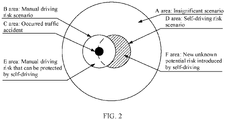
- FIG. 2 shows unknown potential risks introduced by self-driving.
- An outermost layer of circle indicates all driving scenarios, and insignificant scenarios (A area) occupy a majority of the driving scenarios.
- C area traffic accident
- B area risk scenario
- E area risk scenario
- F area new unknown potential risks
- Route 1 Automobiles on which a self-driving system is installed are produced in small batches. Safety of the self-driving system is evaluated by using a safety evaluation method, to attempt to verify the safety of the self-driving system. When safety performance of the self-driving system can meet a requirement, it is determined that a phase in which production is performed in large batches can be entered.
- Route 2 Automobiles on which an advanced auxiliary driving system is installed are produced in mass production, and safety of the advanced auxiliary driving system is evaluated by using a safety evaluation method. When a function of an advanced auxiliary driving system reaches a reliable safety level, an automobile on which the advanced auxiliary driving system is installed may be upgraded to a self-driving automobile.
- Route 1 and Route 2 respectively represent two routes for mass production of self-driving automobiles.
- the vehicle identifies, by using a risk identification method, a risk caused by a self-driving system defect, updates a risk control policy in a timely manner, and takes risk control measures before the risk develops into an accident, to reduce an accident occurrence probability.
- a self-driving safety evaluation method, apparatus, and system provided in this application.
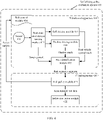
- FIG. 4 shows a self-driving safety evaluation system 400 according to this application.
- the system 400 includes a vehicle-end apparatus 410 and a cloud apparatus 420.
- the vehicle-end apparatus 410 includes a sensor 411, a real-time environment sensing module 412, a self-driving module 413, a shadow driving module 414, a risk identification module 415, and a risk control module 416.
- the cloud apparatus 420 includes a risk policy module 421 and a safety evaluation module 422.
- the sensor 411 is configured to collect environment information.
- the sensor 411 may be, for example, a camera or a radar.
- the real-time environment sensing module 412 is configured to process the environment information collected by the sensor 411 for subsequent use of a module. For example, the camera detects that there is an obstacle in front of the vehicle, and the radar also detects that there is an obstacle in front of the vehicle. Actually, obstacles detected by the camera and the radar may be a same obstacle. The real-time environment sensing module 412 needs to determine, based on information collected by the camera and the radar, how many obstacles there are in front actually.
- the self-driving module 413 is configured to control the vehicle to travel based on data (that is, a sensing result) output by the real-time environment sensing module 412, and output a vehicle control track of self-driving.
- the shadow driving module 414 is configured to: when an automobile is manually driven, simulate self-driving based on the data output by the real-time environment sensing module 412, and generate a shadow track. The following describes in detail a working process of the shadow driving module 414.
- the risk identification module 415 is configured to identify risk scenarios of manual driving, self-driving, and shadow driving, to generate risk data.
- the risk identification module 415 identifies a manual driving risk based on the sensing result output by the real-time environment sensing module 412, identifies a self-driving risk based on the vehicle control track of self-driving that is output by the self-driving module 413, and identifies a shadow driving risk based on the shadow track output by the shadow driving module 414.
- the risk policy module 421 is configured to formulate a risk control policy for the already identified potential risks of a self-driving system.
- the risk control module 416 is configured to take measures based on the risk control policy issued by the cloud to reduce or eliminate the risks.
- the safety evaluation module 422 is configured to evaluate safety of the self-driving system by using accumulated risk data.
- FIG. 4 is an example description of the system 400 from a perspective of function division.
- Functions of various modules may be implemented in a form of software, or may be implemented in a form of hardware, or may be implemented in a form of a combination of software and hardware.
- For a specific form in which the functions of the modules in the system 400 are implemented may be determined based on an actual case. This is not limited in this application.
- FIG. 4 divides the system 400 into the vehicle-end apparatus and the cloud apparatus, but an architecture of the system 400 is not limited thereto.
- the risk identification module 415 may be deployed in the cloud apparatus 420, and the vehicle-end apparatus 410 does not need to perform risk identification processing. In this way, load of a processor of the vehicle-end apparatus 410 may be reduced.
- the risk policy module and the safety evaluation module may be deployed in the vehicle-end apparatus 410. In this way, even if the vehicle-end apparatus 410 is in an offline state, the vehicle-end apparatus 410 may also formulate a risk policy based on the already identified risks caused by the self-driving system, and evaluate safety of the self-driving system.
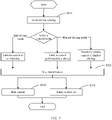
- FIG. 5 is a schematic flowchart of a self-driving safety evaluation method 500 according to this application.
- S501 may be performed by the sensor 411.
- the sensor 411 collects real-time information, and reconstructs static and dynamic environment data, and track data of a vehicle (which may also be referred to as an "ego vehicle") in which the sensor 411 is located.
- S502 may be performed by the risk identification module 415, to identify risks in different vehicle control modes. If the ego vehicle is in a self-driving mode, the risk identification module 415 calculates a risk feature of self-driving based on a vehicle control track of self-driving. If the vehicle is in a manual driving mode, the risk identification module 415 calculates a risk feature of manual driving based on a track of vehicle control performed by a driver, and calculates a risk feature of shadow driving based on a shadow track.
- S503 may be performed by the risk control module 416.
- the risk control module 416 identifies a potential defect of a self-driving system based on the risk feature in the self-driving mode and the risk feature in the shadow driving mode that are obtained through calculation by the risk identification module 415, and updates the risk control policy.
- S504 may be performed by the safety evaluation module 422.
- the safety evaluation module 422 evaluates safety in the self-driving mode based on accumulated risk features in various driving modes, where an evaluation result is used as a basis for safety verification and mass production and release.
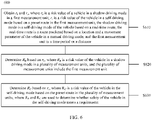
- FIG. 6 shows a self-driving safety evaluation method 600 according to this application.
- the method 600 includes the following steps.
- the method 600 may be performed by the cloud apparatus 420, or may be performed by a vehicle-end apparatus in which a safety evaluation module is configured.
- r b and r c reflect a probability that a risk develops into an accident, and may be a value of a probability that a risk develops into an accident, or may be another type of value that can be used to quantify a self-driving risk.
- Measurement units of r b and r c may be time periods, or may be distances.
- a risk behavior may be defined as an explicit or implicit driving behavior (including manual driving, self-driving, and shadow driving) that violates a safety goal. "Explicit” indicates that a driving behavior has developed into an accident, and “implicit” indicates that a driving behavior may develop into an accident. Therefore, identification of the risk behavior includes the following:
- the safety goal includes but is not limited to the following definitions:
- a risk value may be defined as 1; when no risk occurs, a risk value may be defined as 0; and a risk value of an implicit risk is a value greater than 0 and less than 1.
- the first measurement unit is any measurement unit.
- the self-driving mode based on the preset route is the self-driving mode shown in FIG. 5 .
- the mode is a driving mode in which the self-driving module 413 controls a vehicle. After obtaining a start point and an end point of a distance (that is, the preset route), the self-driving module 413 controls the vehicle to travel the distance, and a driver does not participate in driving.
- the driving mode based on the real-time route is a self-driving mode simulated by the shadow driving module 414 in a process in which the driver controls the vehicle to travel.
- the shadow driving module 414 continuously corrects a shadow track based on a location and a movement parameter of the vehicle that exist when vehicle control is performed by the driver, to avoid a case in which a route of self-driving passes through a B street while a route of vehicle control performed by the driver passes through an A street, so that safety evaluation on self-driving is more objective.
- R B may be, for example, an average value obtained by dividing a sum of r b of the plurality of measurement units by the plurality of measurement units, or may be an average value obtained by dividing a sum of products of r b of all measurement units and a weighting coefficient by the plurality of measurement units.
- R C may be, for example, an average value obtained by dividing a sum of r c of the plurality of measurement units by the plurality of measurement units, or may be an average value obtained by dividing a sum of products of r c of all measurement units and a weighting coefficient by the plurality of measurement units.
- R B and R C may alternatively be values obtained through calculation by using another method, and a method for calculating R B and R C is not limited in this application.
- the risk data generated by the self-driving mode based on the real-time route is further collected.
- the real-time route is the self-driving route (that is, the shadow track) predicted based on the location and the movement parameter of the vehicle in the manual driving mode.
- the shadow driving module 414 may re-plan the self-driving route based on the route of vehicle control performed by the driver, and determine safety of self-driving based on the re-planned self-driving route, thereby more truly evaluating the safety of self-driving.
- the method 600 further includes the following steps.
- the foregoing embodiment may be implemented by an apparatus for determining R B and R C , without a need of sending R B and R C to another device and evaluating, by the another device, safety of the vehicle in the self-driving mode, thereby improving real-time performance of safety evaluation on the self-driving mode.
- the self-driving risk threshold is a threshold of a risk value in the self-driving mode in each measurement unit.
- the self-driving risk threshold may be a value that is set based on a statistical result, for example, a maximum value of average self-driving risk values per kilometer in a mileage of one million kilometers travelled by the vehicle.
- R B + R C If the value of R B + R C is less than or equal to the maximum value after the vehicle travels the one million kilometers, a self-driving function of the vehicle meets the safety requirement, and mass production can be implemented. If the value of R B + R C is greater than the maximum value after the vehicle travels the one million kilometers, the self-driving function of the vehicle cannot meet the safety requirement, mass production cannot be implemented, and improvement needs to be made.
- Mileages respectively corresponding to R B and R C in R B + R C may be set for every million kilometers.
- the mileage corresponding to R C in R B + R C may be set to be no less than one hundred thousand kilometers for every million kilometers, so that the safety of self-driving can be more objectively and truly evaluated.
- the self-driving risk threshold is a ( R A + R ' A ) , where a is a risk tolerance coefficient, R A is, for example, an average value of risk values of the vehicle in the manual driving mode in the plurality of measurement units, a road section through which the vehicle passes in the plurality of measurement units is a first road section, and R' A is, for example, an average value of risk values of the vehicle passing through the first road section outside the plurality of measurement units based on the manual driving mode.
- a risk value of self-driving may be compared with a risk value of manual driving, and a tolerance coefficient that the risk value of the self-driving can be accepted may be set, to determine whether safety of self-driving satisfies a requirement.
- R A is a risk value obtained after the vehicle travels five hundred thousand kilometers in the manual driving mode, a road section through which the vehicle travels the five hundred thousand kilometers is a first road section, and R' A is a risk value obtained after the vehicle passes through the first road section again in the manual driving mode.
- R B + R C is a risk value obtained after the vehicle travels one million kilometers in the self-driving mode.
- a indicates that when travelled distances have a same length, the risk value of self-driving needs to be less than a product of the risk value of manual driving and a , and only in this case, it can be determined that the safety in the self-driving mode meets the requirement, and a is usually a constant greater than 0 and less than 1.
- the determining R B based on r b and the determining R C based on r c include the following step.
- s event reflects severity degrees of accidents in different risk scenarios
- r i reflects a probability that a risk develops into an accident
- ⁇ reflects an accumulation of risks of the plurality of measurement units.
- a severity degree of colliding with a person is far higher than a severity degree of colliding with another object. Therefore, s evet in a case of colliding with a person may be set to 1, and s event in a case of colliding with another object may be selected from 0.1 to 0.9 based on a property of the object.
- s event may be defined based on accident statistics data.
- corresponding s event is equal to 0.01.
- X may be a mileage travelled by the vehicle or a time for which the vehicle travels, where the mileage or the time corresponds to R i , and R i reflects an average probability that a risk develops into an accident in each measurement unit (for example, per kilometer or per hour).
- R i reflects an average probability that a risk develops into an accident in each measurement unit (for example, per kilometer or per hour).
- the foregoing formula can objectively reflect a self-driving risk.
- the obtaining r b and r c includes the following steps. S611.
- determine r b and r c based on at least one of the following parameters: a speed ⁇ v of the vehicle relative to a collision object, a time to collision TTC between the vehicle and the collision object that is estimated based on a movement track of the collision object, a time to headway THW of the vehicle that is estimated based on a distance between the vehicle and the collision object, and the distance between the vehicle and the collision object, where ⁇ v is positively correlated to r b or r c , the TTC is negatively correlated to r b or r c , the THW is negatively correlated to r b or r c , and the distance between the vehicle and the collision object is negatively correlated to r b or r c .
- a higher relative movement speed indicates a higher probability that a risk develops into an accident, that is, ⁇ v is positively correlated to r b or r c ;
- a longer time to collision indicates a higher possibility of adjusting a travelling route by the vehicle to avoid a collision and a lower probability of occurrence of a collision, and therefore TTC is negatively correlated to r b or r c ;
- a longer available time to headway indicates a smaller probability of occurrence of a collision, and therefore THW is negatively correlated to r b or r c ;
- a longer distance between the vehicle and the collision object indicates a higher possibility of adjusting the travelling route by the vehicle to avoid a collision and a lower probability of occurrence of a collision, and therefore the distance between the vehicle and the collision object is positively correlated to r b or r c .
- FIG. 7 is a schematic diagram of a risk in a collision scenario according to this application.
- a track of an ego vehicle is a line segment from a state (t2, s2, v2, a2) to a state (t0, s0, v0, a0)
- a track of another vehicle is a line segment from a state (t1, s1, v1, a1) to a state (t'0, s'0, v'0, a'0).
- the two vehicles travel toward each other, and collide at a cross point of the two lines shown in the figure.
- Both the foregoing two tracks are tracks predicted by the ego vehicle.
- the ego vehicle identifies, based on a sensing result of a sensor, an object that has an intersection with the track of the ego vehicle in a future time period (for example, five seconds).
- a maximum value of risk values of collision between the ego vehicle and the foregoing object is used as a collision risk value in the future time period.
- h ( t event ,obj) represents that a collision risk event ( obj ) causes a potential collision event in a time period ( t event )
- h ( t event ,obj ) represents that occurrence of a collision risk event ( obj) causes an increase in a probability of occurrence of a collision in a time period ( t event )
- Each normalized parameter is used to indicate a weight of each parameter. For example, each normalized parameter may be a value greater than or equal to 0 and less than or equal to 1.
- a relative speed of the two vehicles is greater than 40 km/h
- a collision occurs, there is an extremely high probability of personal casualty.
- an expected collision time (that is, TTC) of the two vehicles is less than 1s
- THW is less than 1s
- a collision occurrence moment may be predicted, and a time period ( t event ) near the predicted collision occurrence moment may be selected to calculate a collision risk value (a collision occurrence probability) in the time period.
- a maximum value that is, f ( t ) max ) of a plurality of collision risk values in the time period is used as the collision risk value in the time period.
- the obtaining r b and r c includes the following steps. S612.
- the risk scenario is a traffic signal light scenario
- a higher speed of the vehicle indicates a higher probability of violating a traffic signal light rule (for example, running a red light), and therefore the speed of the vehicle is positively correlated to r b or r c ; and a longer distance from the vehicle to the traffic signal light indicates a longer time used by the vehicle to change a travelling status and a lower probability of running the traffic signal light, and therefore the distance from the vehicle to the traffic signal light is negatively correlated to r b or r c .
- a traffic signal light rule for example, running a red light
- FIG. 8 is a schematic diagram of a risk in a traffic signal light scenario according to this application.
- a risk in the traffic signal light scenario is mainly violation of a rule indicated by a traffic signal light, and a corresponding risk value may be obtained based on a speed of an ego vehicle.
- a distance of 50 m between the ego vehicle and the traffic signal light, a distance s from the vehicle to a stop line at an intersection, a speed v of the ego vehicle, and an acceleration a of the vehicle constitute an ego vehicle status.
- the right diagram shows a distance-speed curve of the ego vehicle.
- the traffic signal light shows a no-passing signal
- the ego vehicle needs to decelerate, and reduce the speed to 0 before the stop line.
- Different accelerations constitute different speed-distance curves.
- the common acceleration is an acceleration whose absolute value is less than an absolute value of a preset acceleration.
- a value of the preset acceleration is 0.4 g, and the ego vehicle can stop before the stop line if using an acceleration of -0.3 g.
- r b or r c of the ego vehicle is equal to 0.
- h ( t event ,Light ) represents that a probability of occurrence of violating a traffic signal light rule increases in a time period ( t event ) due to occurrence of a traffic signal light risk event ( Light )
- a risk event usually lasts for a time period from occurrence to disappearance.
- the vehicle-end apparatus 410 or the cloud apparatus 420 may select a time period t event near a moment at which the risk event is identified, to calculate a risk value in the time period.
- the time period includes the moment at which the risk event is identified.
- the normalized parameter is used to represent a weight of a parameter.
- each normalized parameter may be a value greater than or equal to 0 and less than or equal to 1.
- a traffic signal light at the intersection displays a no-passing signal
- a speed of the vehicle is 100 km/h
- there is an extremely high probability of occurrence of a risk of running the traffic signal light for example, running a red light
- the foregoing "the vehicle is 50 m away from the intersection, a traffic signal light at the intersection displays a no-passing signal, and a speed of the vehicle is 100 km/h” are traffic signal light risk events ( Light ).
- a moment at which a red light is run may be predicted, and a time period ( t event ) near the predicted moment at which the red light is run may be selected to calculate a red light running risk value (that is, a probability of occurrence of running the red light) in the time period.
- a red light running risk value that is, a probability of occurrence of running the red light
- a maximum value that is, f ( t ) max ) of a plurality of red light running risk values in the time period is selected as a red light running risk value in the time period.
- the obtaining r b and r c includes the following steps. S613.
- the risk scenario is a scenario in which the vehicle rushes out of a road boundary
- the estimated time taken by the vehicle to rush out of the lane is negatively correlated to r b or r c .
- the obtaining r b and r c includes the following steps. S614.
- the risk scenario is a non-conventional travelling scenario (for example, a travelling scenario in which the vehicle currently has a lateral acceleration)
- determine r b and r c based on at least one of the following parameters: a longitudinal acceleration of the vehicle, a lateral acceleration of the vehicle, and a speed of the vehicle, where the longitudinal acceleration of the vehicle is positively correlated to r b or r c , the lateral acceleration of the vehicle is positively correlated to r b or r c , and the speed of the vehicle is positively correlated to r b or r c .
- the longitudinal acceleration is an acceleration whose acceleration direction is the same as or opposite to a speed direction (for example, an acceleration obtained by stepping on an accelerator or stepping on a brake during straight travelling).
- the lateral acceleration is an acceleration whose acceleration direction has a non-zero angle with a speed direction (for example, an acceleration that causes a drift of the vehicle when the vehicle is turning).
- a larger longitudinal acceleration indicates a higher probability of overspeed of the vehicle or an abrupt brake of the vehicle. Therefore, the longitudinal acceleration of the vehicle is positively correlated to r b or r c .
- a larger lateral acceleration indicates a higher probability of abrupt turning of the vehicle. Therefore, the lateral acceleration of the vehicle is positively correlated to r b or r c .
- a higher speed of the vehicle indicates a higher probability of occurrence of non-conventional travelling such as overspeed.
- the speed of the vehicle is positively correlated to r b or r c .
- ⁇ threshold 2 represents a threshold of the lateral acceleration in a safe driving status, for example, may be 0.5 g, ⁇ threshold 2 represents a threshold of the longitudinal acceleration in the safe driving status, for example, may be 0.7 g, v represents the speed of the vehicle, v safe represents a speed threshold in the safe driving status, and may be determined by referring to a road speed
- the cloud apparatus 420 does not need to perform S611 to S614. If information received by the cloud apparatus 420 from the vehicle-end apparatus 410 is data sensed by the sensor, the cloud apparatus 420 further needs to perform S611 to S614 to obtain r b and r c .
- an important factor affecting a technical effect of the self-driving safety evaluation method is whether a risk value can reflect an actual risk level.
- the following describes in detail a method for determining a driving risk of a vehicle provided in this application.
- FIG. 9 shows a method 900 for determining a driving risk of a vehicle according to this application.
- the method 900 is applied to a vehicle having a self-driving mode and a manual driving mode, and the method 900 includes the following steps.
- S910 Determine a driving mode and a risk scenario of the vehicle in a time period, where a start point of the time period is a first moment, an end point of the time period is a second moment, and the driving mode includes the self-driving mode and/or the manual driving mode.
- S920 Determine a risk value in the driving mode in the time period based on a risk identification manner corresponding to the risk scenario at a current moment, where the current moment is after the first moment, and the current moment is before the second moment.
- the method 900 may be performed, for example, by the vehicle-end apparatus 410.
- the vehicle-end apparatus 410 selects a time period from a plurality of time periods required for the vehicle to travel a distance, and determines, at a moment (that is, the current moment) in the time period, a risk value in a corresponding driving mode in the time period by using known travelling information and predicted travelling information. For example, the determined time period is one second, and the current moment is a moment of 0.4 seconds. If an overspeed travelling status occurs in the past 0.4 seconds, the vehicle may determine that the risk value of non-conventional driving in the driving mode in the time period is 1, that is, a probability of occurrence of overspeed is 100%.
- the vehicle may determine that the risk value of non-conventional driving in the time period is a value less than 1, that is, the probability of occurrence of overspeed is less than 100%.
- a time period required for travelling a distance is divided into the plurality of time periods, and a risk value in a driving mode in each time period is determined based on a traffic context (that is, information related to a traffic environment before a current moment and after the current moment) in the time period, so that the risk can be more objectively identified.
- the vehicle-end apparatus 410 may alternatively determine a time period by using another method, for example, determine, based on a distance and a speed, a time period required for travelling the distance.
- the time period is the "time period" described in S910.
- the first moment and the second moment are determined at the current moment, so that the "time period" described in S910 is determined.
- the risk value in the self-driving mode and/or the manual driving mode can be determined.
- the self-driving mode includes the shadow driving mode, and evaluating the safety of the self-driving system based on the risk value in the shadow driving mode is an important factor that enables the self-driving safety evaluation method provided in this application to achieve a better technical effect compared with that in the prior art.
- a purpose of the shadow driving mode is to generate a simulated vehicle control track of self-driving by using software and hardware that are run in a system background in the manual driving mode, to identify a potential risk of the self-driving system, and accumulate data required by safety evaluation.
- a main difficulty is that when the vehicle is in the manual driving mode, a self-driving module cannot really control the vehicle, and how a shadow track approaches an actual risk level of the self-driving system.
- the vehicle control track of self-driving directly generated based on sensed data of a sensor cannot represent the real risk level of the self-driving system. Consequently, distortion of a self-driving safety evaluation result is caused.
- FIG. 10 is a schematic diagram of a vehicle control track of self-driving.
- a dashed-line arrow represents an actual track of an ego vehicle in a manual driving mode.
- a solidline arrow represents a self-driving track simulated based on sensed data of a sensor. Because the sensed data indicates that there is another vehicle 1 on a left lane, the self-driving system simulates a track used by the ego vehicle to continue to travel along an original lane. Actually, the ego vehicle does not travel along the original lane but changes a lane.
- the self-driving track simulated based on the sensed data of the sensor cannot reflect a real driving status, causing distortion of a result of self-driving safety evaluation that is based on the track.
- the method 900 further includes the following steps.
- S901. Determine a location and a movement parameter of the vehicle at a first moment, where the vehicle travels at the first moment based on the manual driving mode.
- S902. Predict a location of the vehicle at a third moment based on the location and the movement parameter of the vehicle at the first moment, where the third moment is later than the first moment.
- S920 includes the following step.
- the vehicle may predict a location of the vehicle after a future time period based on the location and the movement parameter of the vehicle at the first moment, that is, predict a location of the vehicle at the third moment.
- the vehicle is in a manual driving status at the first moment, and subsequently, the vehicle predicts the shadow driving mode of the vehicle from the location at the first moment to the location at the third moment.
- a route of self-driving is continuously modified based on the location and the movement parameter in the manual driving mode, to enable the route in the self-driving mode to be closer to a route in the manual driving mode. Therefore, more objective self-driving risk data can be obtained.
- the third moment may be the current moment described in S920, or may be the second moment, or may be a moment after the second moment.
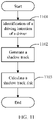
- FIG. 11 is a flowchart of a shadow driving mode according to this application.
- the shadow driving module 414 identifies, at a first moment, a driving intention of the driver based on a movement parameter (for example, a speed and an acceleration) of the vehicle, that is, the content described in S901 to S903, and then uses the identified driving intention of the driver as input information of the shadow driving module 414, to generate a shadow track, thereby improving a degree of overlap between the shadow track and a track of vehicle control performed by the driver.
- a movement parameter for example, a speed and an acceleration
- the driving intention of the driver includes but is not limited to: at least one of travelling along a current lane, turning, and changing a lane.
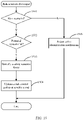
- FIG. 12 is a flowchart of a method for identifying an intention of a driver according to this application.
- a yaw rate (Yaw Rate) is continuously greater than a yaw rate threshold in a time period before the moment T and adjacent to the moment T, it is determined that the driving intention of the driver is turning.
- the information at the future moment is predicted by using the current information, and the current driving intention of the driver is determined by using the predicted information at the future moment, thereby eliminating a deviation caused by determining the intention of the driver based on sensed data of a sensor.
- FIG. 13 is a schematic diagram of predicting a shadow track based on a shadow driving mode according to this application.
- the shadow track shown in FIG. 13 is approximately the same as a track of vehicle control performed by a driver, but has a slight difference. Different risk values are respectively obtained based on the track of vehicle control performed by the driver and the shadow track, and which of a manual driving mode and a self-driving mode is safer may be estimated based on a difference between the risk values.
- the shadow driving module 414 when a driving intention of the driver is a risk intention (for example, aggressive cutting in), if correctly identifying a risk in this case, the shadow driving module 414 generates no shadow track conforming to the driving intention of the driver, but generates a shadow track by selecting a safer decision (for example, keeping travelling in a right direction in a lane).
- a safer decision for example, keeping travelling in a right direction in a lane.
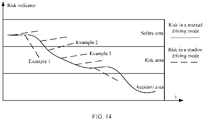
- FIG. 14 is a schematic diagram of the risk value of the shadow track that is calculated in the step of calculating the risk value of the shadow track shown in FIG. 11 .
- a solid line represents the risk value obtained based on the track of vehicle controlled by the driver that is calculated in S611 to S614, and a dashed line is a risk value calculated based on a shadow track corresponding to each time period (for example, a time period from the first moment to the third moment) in S611 to S614.
- the track of vehicle control performed by the driver continuously falls into the risk area, and the shadow track returns from the risk area to the safe area. This indicates that a travelling risk is reduced through simulated controlling of the vehicle performed by the system, and the data may be used as an evidence that safety performance of the self-driving system is higher than that of vehicle control performed by the driver.
- both the track of vehicle control performed by the driver and the shadow track continuously fall into the risk area, but the risk value of the shadow track is less than that of the track of vehicle control performed by the driver.
- a shadow track generation method is consistent with an algorithm of vehicle control of self-driving
- a method for calculating a risk of the shadow track is consistent with a method for calculating a risk of a self-driving/driver driving track, so that it can be ensured that a shadow track risk represents a self-driving system risk.
- the method 900 further includes: S930. Send r a , r b , and r c to a safety center, where r a , r b , and r c are used to evaluate safety in the manual driving mode and the shadow driving mode.
- the vehicle may send the foregoing risk data to the safety center after obtaining r a , r b , or r c , so that the safety center evaluates the safety in the manual driving mode and the shadow driving mode, thereby reducing an operating load of an in-vehicle processor.
- the security center is, for example, the cloud apparatus 420.
- Evaluating safety of the self-driving automobile in a self-driving mode is a long-term process. Even if evaluation of the safety in the self-driving mode is passed, it does not mean that the self-driving mode is 100% safe. Therefore, it is necessary to design a solution for immediate control of a risk, that is, to reduce or eliminate the risk through the risk control module 416.
- FIG. 15 is a schematic flowchart of a risk control method according to this application.
- risk scenario data includes but is not limited to at least one of sensing data obtained by the sensor 411, a track generated by the self-driving module 413, or a track generated by the shadow driving module 414.
- the risk identification module 415 determines, based on the risk scenario data, whether a current scenario is a risk scenario. If the risk identification module 415 determines that the current scenario is a non-risk scenario, but it is found that the current scenario is actually a risk scenario afterwards, a risk identification mechanism may be adjusted, for example, a risk identification threshold parameter may be adjusted and a risk identification algorithm may be modified.
- the risk identification module 415 confirms that the current scenario is a risk scenario and determines that the risk scenario is caused by a potential risk of a self-driving system, the risk identification module 415 reports the risk scenario to the risk policy module 421.
- the risk policy module 421 sends policy update information to the risk control module 416, updates the risk control policy of the vehicle-end apparatus 410, and excludes the risk scenario from the safe scenario fence.
- the method 900 further includes the following steps. S940. Receive safety scenario information sent by the safety center, where the safety scenario information is used to indicate a safe driving traffic scenario set in a self-driving mode.
- the vehicle plays and/or displays prompt information prompting the driver to perform manual driving, and/or the vehicle performs safe stopping processing.
- the safety center may identify a risk scenario based on the risk data reported by the vehicle, and update a risk identification mechanism and a risk control policy of the vehicle by sending the safety scenario information to the vehicle. For example, if a risk is caused by a potential risk of the self-driving system, the safety scenario information may instruct the vehicle to exclude the risk scenario from the safe driving traffic scenario set.
- the vehicle updates the safe driving traffic scenario set after receiving the safety scenario information. If the current traffic scenario does not belong to the updated safe driving traffic scenario set, the vehicle takes safety measures, for example, plays and/or displays prompt information prompting the driver to perform manual driving, and/or performs safe stopping processing.
- the safe driving traffic scenario set may also be referred to as a safe driving scenario fence, and includes an environment, a static scenario, a dynamic scenario, and a behavior of an ego vehicle.
- a definition of the scenario fence is shown in FIG. 16 .
- content in round brackets is content included in a safe driving scenario fence of a self-driving system.
- the cloud apparatus 420 transmits safety scenario information based on an identified potential risk of the self-driving system in a timely manner, to update content in the safe driving scenario fence.
- the risk control module 416 obtains an identified result of each element of the scenario fence based on map input and a real-time sensing result, and updates content in the safe driving scenario fence based on the safety scenario information sent by the cloud apparatus 420.
- the self-driving module 413 In a process of controlling, by the self-driving module 413, a vehicle to travel, if the risk control module 416 determines that a current scenario exceeds a safe driving scenario fence range, the self-driving module 413 prompts a driver to take over the vehicle, or controls the vehicle to stop in a safe zone.
- a risk event is that a potential risk is caused due to that the system cannot accurately identify a type of a red and green light because of an intersection width greater than 20 m.
- the intersection width is less than 20 m.
- a risk event is that a potential risk is caused due to that the self-driving system cannot measure a speed of a low-speed vehicle in time.
- an applicable vehicle flow speed in a dynamic scenario is from 10 to 50 kilometers per hour (kph).
- the self-driving system prompts the driver to take over the vehicle, or gently pulls over the vehicle.
- a driver in-the-loop policy may alternatively be adjusted, for example, an alerting interval may be adjusted.
- the vehicle-end apparatus and the cloud apparatus include corresponding hardware structures and/or software modules for performing the functions.
- a person of ordinary skill in the art should be easily aware that, in combination with the examples described in the embodiments disclosed in this specification, units and algorithms steps may be implemented by hardware or a combination of hardware and computer software in this application. Whether a function is performed by hardware or hardware driven by computer software depends on particular applications and design constraints of the technical solutions. A person skilled in the art may use different methods to implement the described functions for each particular application, but it should not be considered that the implementation goes beyond the scope of this application.
- function unit division may be performed on the vehicle-end apparatus and the cloud apparatus based on the foregoing method examples.
- each function unit may be obtained through division based on a corresponding function, or two or more functions may be integrated into one processing unit.
- the integrated unit may be implemented in a form of hardware, or may be implemented in a form of a software function unit.
- unit division is an example, and is merely a logical function division. In actual implementation, another division manner may be used.
- FIG. 17 is a possible schematic structural diagram of the vehicle-end apparatus 1700 in the foregoing embodiments.
- the vehicle-end apparatus 1700 includes: a processing unit 1702 and a communications unit 1703.
- the processing unit 1702 is configured to control and manage an action of the vehicle-end apparatus 1700.
- the processing unit 1702 is configured to support the vehicle-end apparatus 1700 in performing S620 and/or another process used for the technology described in this specification.
- the communications unit 1703 is configured to support communication between the vehicle-end apparatus 1700 and a cloud apparatus.
- the vehicle-end apparatus 1700 may further include a storage unit 1701, configured to store program code and data of the vehicle-end apparatus 1700.
- the processing unit 1702 is configured to perform S610 to S630.
- the processing unit 1702 may also be referred to as an obtaining unit 1702.
- the storage unit 1701 needs to store intermediate data generated in a process in which the processing unit 1702 performs the foregoing steps.
- the intermediate data is r b and r c , so that the processing unit 1702 determines, based on a risk value in a shadow driving mode in a plurality of measurement units and a risk value in a self-driving mode based on a preset route, whether safety of a vehicle in the self-driving mode meets a requirement.
- the processing unit 1702 is configured to perform S610, and control the communications unit 1703 to send r b and r c to the cloud apparatus, so that the cloud apparatus performs S620 and S630.
- the processing unit 1702 is configured to control the communications unit 1703 to send, to a cloud apparatus, original data (for example, sensor data) used for calculating r b and r c , so that the cloud apparatus performs S610 to S630.
- original data for example, sensor data
- the processing unit 1702 is configured to perform S910 and S920.
- the processing unit 1702 is configured to control the communications unit 1703 to perform S930.
- the processing unit 1702 may be a processor or a controller, for example, may be a central processing unit (central processing unit, CPU), a general-purpose processor, a digital signal processor (digital signal processor, DSP), an application-specific integrated circuit (application-specific integrated circuit, ASIC), a field programmable gate array (field programmable gate array, FPGA), or another programmable logical device, a transistor logical device, a hardware component, or a combination thereof.
- the processor may implement or execute various example logical blocks, modules, and circuits described with reference to content disclosed in this application. Alternatively, the processor may be a combination for implementing a computing function, for example, a combination of one or more microprocessors, or a combination of the DSP and a microprocessor.
- the communications unit 1703 may be a transceiver or the like.
- the storage unit 1701 may be a memory.
- the vehicle-end apparatus in this application may be a vehicle-end apparatus 1800 shown in FIG. 18 .
- the vehicle-end apparatus 1800 includes: a processor 1802, a transceiver 1803, and a memory 1801.
- the transceiver 1803, the processor 1802, and the memory 1801 may communicate with each other through an internal connection path, and transmit a control signal and/or a data signal.
- FIG. 19 is a possible schematic structural diagram of the cloud apparatus 1900 described in the foregoing embodiments.
- the cloud apparatus 1900 includes: a processing unit 1902 and a communications unit 1903.
- the processing unit 1902 is configured to control and manage an action of the cloud apparatus 1900.
- the processing unit 1902 is configured to support the cloud apparatus 1900 in performing S620 and/or another process used for the technology described in this specification.
- the communications unit 1903 is configured to support communication between the cloud apparatus 1900 and a vehicle-end apparatus.
- the cloud apparatus 1900 may further include a storage unit 1901, configured to store program code and data of the cloud apparatus 1900.
- the processing unit 1902 is configured to control the communications unit 1903 to perform S610, that is, receive r b and r c from the vehicle-end apparatus.
- the communications unit 1903 may also be referred to as an obtaining unit 1903, and the processing unit 1902 is further configured to perform S620 to S641.
- the storage unit 1901 needs to store intermediate data generated in a process in which the processing unit 1902 performs the foregoing steps.
- the intermediate data is r b and r c , so that the processing unit 1902 determines, based on a risk value in a shadow driving mode in a plurality of measurement units and a risk value in a self-driving mode based on a preset route, whether safety of a vehicle in the self-driving mode meets a requirement.
- the processing unit 1902 is configured to control the communications unit 1903 to receive, from the vehicle-end apparatus, original data (for example, sensor data) used for calculating r b and r c .
- the processing unit 1902 is further configured to obtain r b and r c based on the original data received by the communications unit 1903.
- the processing unit 1902 may also be referred to as an obtaining unit 1902.
- the processing unit 1902 is further configured to perform S620 to S641.
- the storage unit 1901 needs to store intermediate data generated in a process in which the processing unit 1902 performs the foregoing steps.
- the intermediate data is r b and r c , so that the processing unit 1902 determines, based on a risk value in a shadow driving mode in a plurality of measurement units and a risk value in a self-driving mode based on a preset route, whether safety of a vehicle in the self-driving mode meets a requirement.
- the processing unit 1902 is configured to perform S910 and S920.
- the processing unit 1902 is configured to control the communications unit 1903 to perform S930.
- the processing unit 1902 may be a processor or a controller, for example, may be a CPU, a general-purpose processor, a DSP, an ASIC, an FPGA, or another programmable logic device, a transistor logic device, a hardware component, or any combination thereof.
- the processor may implement or execute various example logical blocks, modules, and circuits described with reference to content disclosed in this application.
- the processor may be a combination for implementing a computing function, for example, a combination of one or more microprocessors, or a combination of the DSP and a microprocessor.
- the communications unit 1903 may be a transceiver or the like.
- the storage unit 1901 may be a memory.
- the cloud apparatus in this application may be a cloud apparatus 2000 shown in FIG. 20 .
- the cloud apparatus 2000 includes: a processor 2002, a transceiver 2003, and a memory 2001.
- the transceiver 2003, the processor 2002, and the memory 2001 may communicate with each other through an internal connection path, and transmit a control signal and/or a data signal.
- This application further provides a self-driving safety evaluation system, including the foregoing one or more vehicle-end apparatuses and one or more cloud apparatuses.
- the processor in this embodiment of this application may be an integrated circuit chip, and has a signal processing capability.
- steps in the foregoing method embodiments can be implemented by using a hardware integrated logical circuit in the processor, or by using instructions in a form of software.
- the foregoing processor may be a general-purpose processor, a digital signal processor (digital signal processor, DSP), an application-specific integrated circuit (application-specific integrated circuit, ASIC), a field programmable gate array (field programmable gate array, FPGA) or another programmable logical device, a discrete gate or transistor logic device, or a discrete hardware component.
- DSP digital signal processor
- ASIC application-specific integrated circuit
- FPGA field programmable gate array
- the processor may implement or perform the methods, the steps, and logical block diagrams that are disclosed in the embodiments of this application.
- the general-purpose processor may be a microprocessor, or the processor may be any conventional processor or the like. Steps in the methods disclosed with reference to the embodiments of this application may be directly executed and accomplished by using a hardware decoding processor, or may be executed and accomplished by using a combination of hardware and software modules in the decoding processor.
- the software module may be located in a mature storage medium in the art, such as a random access memory, a flash memory, a read-only memory, a programmable read-only memory, an electrically erasable programmable memory, or a register.
- the storage medium is located in the memory, and the processor reads information in the memory and completes the steps in the foregoing methods in combination with hardware of the processor.
- the memory in this embodiment of this application may be a volatile memory or a nonvolatile memory, or may include a volatile memory and a nonvolatile memory.
- the nonvolatile memory may be a read-only memory (read-only memory, ROM), a programmable read-only memory (programmable ROM, PROM), an erasable programmable read-only memory (erasable PROM, EPROM), an electrically erasable programmable read-only memory (electrically EPROM, EEPROM), or a flash memory.
- the volatile memory may be a random access memory (random access memory, RAM), used as an external cache.
- RAMs may be used, for example, a static random access memory (static RAM, SRAM), a dynamic random access memory (dynamic RAM, DRAM), a synchronous dynamic random access memory (synchronous DRAM, SDRAM), a double data rate synchronous dynamic random access memory (double data rate SDRAM, DDR SDRAM), an enhanced synchronous dynamic random access memory (enhanced SDRAM, ESDRAM), a synchronous link dynamic random access memory (synchlink DRAM, SLDRAM), and a direct rambus random access memory (direct rambus RAM, DR RAM).
- static random access memory static random access memory
- DRAM dynamic random access memory
- DRAM dynamic random access memory
- SDRAM synchronous dynamic random access memory
- double data rate SDRAM double data rate SDRAM
- DDR SDRAM double data rate SDRAM
- ESDRAM enhanced synchronous dynamic random access memory
- SLDRAM synchronous link dynamic random access memory
- direct rambus RAM direct rambus RAM
- This application further provides a computer readable medium.
- the computer readable medium stores a computer program. When being executed by a computer, the computer program implements the function of any one of the foregoing method embodiments.
- This application further provides a computer program product.
- the computer program product When being executed by a computer, the computer program product implements the function of any one of the foregoing method embodiments.
- All or some of the foregoing embodiments may be implemented by using software, hardware, firmware, or any combination thereof.
- the embodiments may be implemented completely or partially in a form of a computer program product.
- the computer program product includes one or more computer instructions.
- the computer may be a general-purpose computer, a dedicated computer, a computer network, or other programmable apparatuses.
- the computer instructions may be stored in a computer-readable storage medium or may be transmitted from a computer-readable storage medium to another computer-readable storage medium.
- the computer instructions may be transmitted from a website, computer, server, or data center to another website, computer, server, or data center in a wired (for example, a coaxial cable, an optical fiber, or a digital subscriber line (digital subscriber line, DSL)) or wireless (for example, infrared, radio, or microwave) manner.
- the computer-readable storage medium may be any usable medium accessible by the computer, or a data storage device, such as a server or a data center, integrating one or more usable media.
- the usable medium may be a magnetic medium (for example, a floppy disk, a hard disk, or a magnetic tape), an optical medium (for example, a high density digital versatile disc (digital versatile disc, DVD), a semiconductor medium (for example, a solid-state drive (solid-state disk, SSD)), or the like.
- a magnetic medium for example, a floppy disk, a hard disk, or a magnetic tape
- an optical medium for example, a high density digital versatile disc (digital versatile disc, DVD)
- a semiconductor medium for example, a solid-state drive (solid-state disk, SSD)
- This application further provides a processing apparatus, including a processor and an interface.
- the processor is configured to perform the steps described in any one of the foregoing method embodiments.
- the processing apparatus may be a chip, and the processor may be implemented by hardware, or may be implemented by software.
- the processor When implemented by hardware, the processor may be a logic circuit, an integrated circuit, or the like.
- the processor When implemented by software, the processor may be a general-purpose processor, and is implemented by reading software code stored in a memory.
- the memory may be integrated in the processor, or may exist independently outside the processor.
- system and “network” may be used interchangeably in this specification.
- network may be used interchangeably in this specification.
- the term “and/or” in this specification describes only an association relationship for describing associated objects and represents that three relationships may exist. For example, A and/or B may represent the following three cases: Only A exists, both A and B exist, and only B exists.
- the character “/” in this specification generally indicates an “or” relationship between the associated objects.
- B corresponding to A indicates that B is associated with A, and B may be determined according to A.
- determining B according to A does not mean that B is determined only according to A; that is, B may also be determined according to A and/or other information.
- the disclosed system, apparatus, and method may be implemented in other manners.
- the described apparatus embodiment is merely an example.
- the unit division is merely logical function division and may be other division in actual implementation.
- a plurality of units or components may be combined or integrated into another system, or some features may be ignored or not performed.
- the displayed or discussed mutual couplings or direct couplings or communication connections may be implemented through some interfaces, indirect couplings or communication connections between the apparatuses or units, or electrical connections, mechanical connections, or connections in other forms.
- the units described as separate parts may or may not be physically separate, and parts displayed as units may or may not be physical units, may be located in one position, or may be distributed on a plurality of network units. Some or all of the units may be selected according to actual requirements to achieve the objectives of the solutions of the embodiments in this application.
- function units in the embodiments of this application may be integrated into one processing unit, or each of the units may exist alone physically, or two or more units are integrated into one unit.
- the integrated unit may be implemented in a form of hardware, or may be implemented in a form of a software function unit.
- the computer-readable medium includes a computer storage medium and a communications medium, where the communications medium includes any medium that enables a computer program to be transmitted from one place to another.
- the storage medium may be any available medium accessible to a computer. The following provides an example but does not impose a limitation.
- the computer-readable medium may include a RAM, a ROM, an EEPROM, a CD-ROM or another optical disc storage, a disk storage medium or another magnetic storage device, or any other medium that can carry or store expected program code in a form of an instruction or a data structure and can be accessed by a computer.
- any connection may be appropriately defined as a computer-readable medium.
- a disk (Disk) and disc (disc) used by this application include a compact disc (CD), a laser disc, an optical disc, a digital versatile disc (DVD), a floppy disk, and a Blu-ray disc, where the disk generally copies data magnetically, and the disc copies data optically by using laser.
- CD compact disc
- DVD digital versatile disc
- floppy disk a compact disc
- Blu-ray disc where the disk generally copies data magnetically, and the disc copies data optically by using laser.
Landscapes
- Engineering & Computer Science (AREA)
- Business, Economics & Management (AREA)
- Automation & Control Theory (AREA)
- Mechanical Engineering (AREA)
- Transportation (AREA)
- Human Resources & Organizations (AREA)
- Physics & Mathematics (AREA)
- Economics (AREA)
- Strategic Management (AREA)
- General Physics & Mathematics (AREA)
- Theoretical Computer Science (AREA)
- Tourism & Hospitality (AREA)
- Marketing (AREA)
- General Business, Economics & Management (AREA)
- Human Computer Interaction (AREA)
- Development Economics (AREA)
- Entrepreneurship & Innovation (AREA)
- Quality & Reliability (AREA)
- Operations Research (AREA)
- Game Theory and Decision Science (AREA)
- Educational Administration (AREA)
- Primary Health Care (AREA)
- Health & Medical Sciences (AREA)
- General Health & Medical Sciences (AREA)
- Computing Systems (AREA)
- Computer Security & Cryptography (AREA)
- General Engineering & Computer Science (AREA)
- Mathematical Physics (AREA)
- Traffic Control Systems (AREA)
- Control Of Driving Devices And Active Controlling Of Vehicle (AREA)
Description
- This application relates to the field of self-driving, and in particular, to a self-driving safety evaluation method, apparatus, and system.
- A self-driving automobile is also referred to as an unmanned driving automobile, and can obtain environment information by using a sensor such as a radar, and control travelling of the vehicle based on the environment information, thereby reducing a time of vehicle control performed by a driver. The self-driving automobile has an advantage such as reducing traffic violation. However, a time of vehicle control performed by a driver in a self-driving mode is less than a time of vehicle control performed by the driver in a conventional manual driving mode. Therefore, there are still many uncertainties for the self-driving automobile. To reduce a risk of using a self-driving automobile by a passenger, safety of the self-driving automobile needs to be strictly evaluated before the self-driving automobile is sold.
- To evaluate safety of the self-driving automobile, a large amount of travelling data of the self-driving automobile needs to be collected, for example, data generated by the self-driving automobile travelling 5 million to 6 million kilometers. This causes very high costs for automobile manufacturers.
- An existing self-driving safety evaluation method is to enter a manual driving route into a simulated self-driving system, separately calculate safety-related factors in the manual driving mode and the self-driving mode, and obtain quantified values in the manual driving mode and the self-driving mode. According to the foregoing method, safety of the self-driving mode can be evaluated by using data in the manual driving mode, thereby reducing a cost cycle for mass production of the self-driving automobile. However, a real scenario in which vehicle control is performed by a driver cannot be restored by performing safety evaluation based on the simulated self-driving system. Consequently, there is a relatively large deviation between a safety evaluation result obtained based on the simulated self-driving system and real self-driving safety.
US2017/364080A discloses a method for the utilization of vehicle control systems to cause a vehicle to take preventative action responsive to the detection of a near short term adverse driving scenario. A vehicle control system may receive information corresponding to vehicle operator data and ancillary data. Based on the received vehicle operator data and the received ancillary data, a multi-dimension risk score module may calculate risk scores associated with the received vehicle operator data and the received ancillary data. Subsequently, the vehicle control systems may cause the vehicle to perform at least one of a close call detection action and a close call detection alert to lessen the risk associated with the received vehicle operator data and the received ancillary data. -
US2017/108865A discloses a method for generating a signal for transferring a partly or highly automated vehicle into a safe system state at a target site. First, a need to transfer the vehicle into a safe system state is ascertained. A vehicle state is then determined, the vehicle state encompassing the current vehicle position. At least one target site is ascertained. Travel trajectories are ascertained from the current vehicle position to the at least one target site. The travel trajectories are related. One of the travel trajectories is selected based on the rating that has been carried out. A signal is generated on the basis of the selected travel trajectory. - This application provides a self-driving safety evaluation method and apparatus, to reduce a deviation between a safety evaluation result and real self-driving safety. Aspects of the present invention are defined in the independent claims. Further embodiments are defined by the dependent claims.
- According to a first aspect, a self-driving safety evaluation method is provided. The method includes: obtaining rb and rc , where rb is a risk value of a vehicle in a shadow driving mode in a first measurement unit, rc is a risk value of the vehicle in a self-driving mode based on a preset route in the first measurement unit, the shadow driving mode is a self-driving mode of the vehicle that is based on a real-time route, the real-time route is a route predicted based on a location and a movement parameter of the vehicle in a manual driving mode, and the first measurement unit is a time period or a distance; determining RB based on rb , where RB is a risk value of the vehicle in the shadow driving mode in a plurality of measurement units, and the plurality of measurement units include the first measurement unit; and determining RC based on rc , where RC is a risk value of the vehicle in the self-driving mode based on the preset route in the plurality of measurement units, where RB and RC are used to determine whether safety of the vehicle in the self-driving mode meets a requirement. rb and rc reflect a probability that a risk develops into an accident. In the self-driving safety evaluation method provided in this application, in addition to collection of risk data generated in the self-driving mode based on the preset route, risk data generated in the self-driving mode based on the real-time route is further collected. The real-time route is the route predicted based on the location and the movement parameter of the vehicle in the manual driving mode. For example, when the driver controls the vehicle and changes the preset route, the in-vehicle safety evaluation apparatus can re-plan the self-driving route based on the route of vehicle control performed by the driver, and determine safety of self-driving based on the re-planned self-driving route, thereby more truly evaluating the safety of self-driving.
- In an optional implementation, the method further includes: calculating a sum of RB and RC ; and when the sum of RB and RC is less than or equal to a self-driving risk threshold, determining that safety of the vehicle in the self-driving mode meets a requirement.
- The foregoing embodiment may be implemented by an apparatus for determining RB and RC , without a need of sending RB and RC to another device and evaluating, by the another device, safety of the vehicle in the self-driving mode, thereby improving real-time performance of safety evaluation of the self-driving mode.
- In an optional implementation, the self-driving risk threshold is α(RA +R'A ), where a is a risk tolerance coefficient, RA is a risk value of the vehicle in the manual driving mode in the plurality of measurement units, a road section through which the vehicle passes in the plurality of measurement units is a first road section, and R'A is a risk value of the vehicle passing through the first road section outside the plurality of measurement units based on the manual driving mode.
- A risk value of self-driving may be compared with a risk value of manual driving, and a tolerance coefficient that the risk value of the self-driving can be accepted may be set, to determine whether safety of the self-driving satisfies a requirement.
- In an optional implementation, the determining RB based on rb and the determining RC based on rc includes: determining RB or RC based on

- sevent reflects severity degrees of accidents in different risk scenarios. For example, in a collision scenario, a severity degree of colliding with a person is far higher than a severity degree of colliding with another object. Therefore, the severity degree of colliding with the person may be set to 1, and the severity degree of colliding with the another object may be selected, for example, from 0.1 to 0.9 based on a property of the object. ri reflects a probability that a risk develops into an accident, Σ reflects an accumulation of risks in the plurality of measurement units, and Ri reflects an average probability that risks develop into accidents in the measurement units. The foregoing formula can objectively reflect a self-driving risk.
- In an optional implementation, the obtaining rb and rc includes: when the risk scenario is the collision scenario, determining rb and rc based on at least one of the following parameters: a speed Δv of the vehicle relative to a collision object, a time to collision (time to collision, TTC) between the vehicle and the collision object that is estimated based on a movement track of the collision object, a time to headway (time to headway, THW) of the vehicle that is estimated based on a distance between the vehicle and the collision object, and the distance between the vehicle and the collision object, where Δv is positively correlated to rb or rc , the TTC is negatively correlated to rb or rc , the THW is negatively correlated to rb or rc , and the distance between the vehicle and the collision object is negatively correlated to rb or rc.
- In the collision scenario, a higher relative movement speed indicates a higher probability that a risk develops into an accident, that is, Δv is positively correlated to rb or rc ; a longer time to collision indicates a higher possibility of adjusting a travelling route by the vehicle to avoid a collision and a lower probability of occurrence of a collision, and therefore TTC is negatively correlated to rb or rc ; a longer available time to headway indicates a smaller probability of occurrence of a collision, and therefore THW is negatively correlated to rb or rc ; and a longer distance between the vehicle and the collision object indicates a higher possibility of adjusting the travelling route by the vehicle to avoid a collision and a lower probability of occurrence of a collision, and therefore the distance between the vehicle and the collision object is negatively correlated to rb or rc .
- In an optional implementation, the determining rb and rc based on at least one of the following parameters: a speed Δv of the vehicle relative to a collision object, a time to collision TTC between the vehicle and the collision object that is estimated based on a movement track of the collision object, a time to headway THW of the vehicle that is estimated based on a distance between the vehicle and the collision object, and the distance between the vehicle and the collision object includes: determining rb and rc based on r SC1 = f (t) max, where r SG1 is rb or rc in the collision scenario, t∈{tevent,h(tevent,obj)=1}, f(t)=Δv(t)∗exp (-min{r 0 TTC(t), r 1 THW(t),r2s}), {tevent h(tevent,obj)=1} represents a time period in which a collision risk occurs, TTC (t) represents a TTC at a t moment, THW(t) represents a THW at the t moment,


- In an optional implementation, the obtaining rb and rc includes: when the risk scenario is a traffic signal light scenario, determining rb and rc based on a speed of the vehicle and a distance from the vehicle to a traffic signal light, where the speed of the vehicle is positively correlated to rb or rc , and the distance from the vehicle to the traffic signal light is negatively correlated to rb or rc .
- In the traffic signal light scenario, a higher speed of the vehicle indicates a higher probability of violating a traffic signal light rule (for example, running a red light), and therefore the speed of the vehicle is positively correlated to rb or rc ; and a longer distance from the vehicle to the traffic signal light indicates a longer time for the vehicle to change a travelling status and a lower probability of running the traffic signal light, and therefore the distance from the vehicle to the traffic signal light is negatively correlated to rb or r c.
- In an optional implementation, the determining rb and rc based on a speed of the vehicle and a distance from the vehicle to a traffic signal light includes: determining rb and rc based on r SG2= f (t) max , where r SG2 is rb or rc in the traffic signal light scenario, t ∈ {tevent,htevent,Light)=1}

- In an optional implementation, the obtaining rb and rc includes: when the risk scenario is a scenario in which the vehicle rushes out of a road boundary, determining rb and rc based on an estimated time taken by the vehicle to rush out of a lane, where the estimated time taken by the vehicle to rush out of the lane is negatively correlated to rb or rc .
- In the scenario in which the vehicle rushes out of a road boundary, a longer estimated time taken by the vehicle to rush out of the lane indicates a longer time for the vehicle to adjust the travelling status and a lower probability of rushing out of the road by the vehicle. Therefore, the estimated time taken by the vehicle to rush out of the lane is negatively correlated to rb or rc .
- In an optional implementation, the determining rb and rc based on an estimated time taken by the vehicle to rush out of a lane includes: determining rb and rc based on


- In an optional implementation, the obtaining rb and rc includes: when the risk scenario is a non-conventional travelling scenario, determining rb and rc based on at least one of the following parameters: a longitudinal acceleration of the vehicle, a lateral acceleration of the vehicle, and a speed of the vehicle, where the longitudinal acceleration of the vehicle is positively correlated to rb or rc , the lateral acceleration of the vehicle is positively correlated to rb or rc , and the speed of the vehicle is positively correlated to rb or rc .
- The non-conventional travelling scenario may be, for example, a travelling scenario in which the vehicle has a lateral acceleration. A larger longitudinal acceleration indicates a higher probability of overspeed of the vehicle or an abrupt brake of the vehicle.
- Therefore, the longitudinal acceleration of the vehicle is positively correlated to rb or rc . A larger lateral acceleration indicates a higher probability of abrupt turning of the vehicle. Therefore, the lateral acceleration of the vehicle is positively correlated to rb or rc . A higher speed of the vehicle indicates a higher probability of occurrence of non-conventional travelling such as overspeed. Therefore, the speed of the vehicle is positively correlated to rb or rc .
- In an optional implementation, the determining rb and rc based on at least one of the following parameters: a longitudinal acceleration of the vehicle, a lateral acceleration of the vehicle, and a speed of the vehicle includes: determining rb and rc based on r SG4 = r 5, where r SG4 is rb or rc in a non-conventional travelling scenario, (|along |>a treshold1)||(|alat |>atreshold2 )||(v≥vsafe ), along represents the longitudinal acceleration of the vehicle, αlat represents the lateral acceleration of the vehicle, α treshold1represents a threshold of the lateral acceleration in a safe travelling status, α threshold2 represents a threshold of the longitudinal acceleration in the safe travelling status, v represents the speed of the vehicle, vsafe represents a speed threshold in the safe travelling status, and r 5 is a normalized parameter.
- In an optional implementation, the obtaining rb and rc includes: determining a driving mode and a risk scenario of the vehicle in a time period, where a start point of the time period is a first moment, an end point of the time period is a second moment, and the driving mode includes a self-driving mode and/or a manual driving mode; and determining a risk value in the driving mode in the time period based on a risk identification manner corresponding to the risk scenario at a current moment, where the current moment is after the first moment, and the current moment is before the second moment.
- The time period may be a measurement unit, and the risk value in the driving mode in the time period is, for example, rb or rc . The vehicle selects a time period from a plurality of time periods required for travelling a distance, and determines, at a moment (that is, the current moment) in the time period, a risk value in a corresponding driving mode in the time period by using known travelling information and predicted travelling information. For example, the determined time period is one second, and the current moment is a moment of 0.4 seconds. If an overspeed travelling status occurs in the past 0.4 seconds, the vehicle may determine that a risk value of non-conventional driving in the driving mode in the time period is 1, to be specific, a probability of occurrence of overspeed is 100%. If no overspeed travelling status occurs in the past 0.4 seconds, and the vehicle determines, based on a current speed and acceleration of the vehicle, that a vehicle speed in future 0.6 seconds is to remain in a legal travelling speed, the vehicle may determine that a risk value of non-conventional driving in the time period is a value less than 1, to be specific, a probability of occurrence of overspeed is less than 100%. In this embodiment, a time period required for travelling a distance is divided into the plurality of time periods, and a risk value in a driving mode in each time period is determined based on a traffic context in the time period, so that a risk can be more objectively identified.
- In an optional implementation, before the determining, at a current moment, a risk value in the driving mode in the time period based on a risk identification manner corresponding to the risk scenario, the method further includes: determining a location and a movement parameter of the vehicle at the first moment, where the vehicle travels at the first moment based on the manual driving mode; predicting a location of the vehicle at a third moment based on the location and the movement parameter of the vehicle at the first moment, where the third moment is later than the first moment; and predicting a shadow driving mode of the vehicle from the location at the first moment to the location at the third moment based on the location at the first moment and the location at the third moment, where the shadow driving mode is a self-driving mode of the vehicle that is predicted based on the location and the movement parameter of the vehicle in the manual driving mode. The determining, at a current moment, a risk value in the driving mode in the time period based on a risk identification manner corresponding to the risk scenario includes: determining, at the current moment, ra , rb , and rc based on the risk identification manner corresponding to the risk scenario, where ra is a risk value in the manual driving mode in the time period, rb is a risk value in the shadow driving mode in the time period, and rc is a risk value in the self-driving mode based on the preset route in the time period.
- The vehicle may predict a location of the vehicle after a future time period based on the location and the movement parameter of the vehicle at the first moment, that is, predict a location of the vehicle at the third moment. The vehicle is in a manual driving status at the first moment, and subsequently, the vehicle predicts the shadow driving mode of the vehicle from the location at the first moment to the location at the third moment. In the foregoing embodiment, a route of self-driving is continuously modified based on the location and the movement parameter in the manual driving mode, to enable a route in the self-driving mode to be closer to a route in the manual driving mode. Therefore, more objective self-driving risk data can be obtained.
- According to a second aspect, a self-driving safety evaluation apparatus is provided. The apparatus implements functions in the method in the first aspect. The functions may be implemented by hardware, or may be implemented by executing corresponding software by hardware. The hardware or software includes units or modules that correspond to one or more of the functions.
- In a possible design, the apparatus includes a processor and a transceiver. The processor is configured to support the apparatus in performing the functions in the method in the first aspect. The transceiver is configured to support communication between the apparatus and another apparatus. The apparatus may further include a memory. The memory is configured to couple to the processor, and the memory stores a program instruction and data that are necessary for the apparatus.
- According to a third aspect, a computer readable storage medium is provided. The computer readable storage medium stores computer program code. When the computer program code is executed by a processing unit or a processor, a self-driving safety evaluation apparatus is enabled to perform the method in the first aspect.
- According to a fourth aspect, a self-driving safety evaluation system is provided. The system includes a risk control module, a risk policy module, and a safety evaluation module. The risk control module is configured to perform the method in any optional implementation of the first aspect, to determine a risk in a self-driving mode. The risk policy module is configured to determine a risk control policy based on the risk in the self-driving mode that is determined by the risk control module, where the risk control policy is used to reduce or eliminate the risk in the self-driving mode. The safety evaluation policy module is used to evaluate safety in the self-driving mode based on the risk in the self-driving mode that is determined by the risk control module.
-
-
FIG. 1 is a flowchart of conventional automobile product release; -
FIG. 2 is a schematic diagram of various risks of manual driving and various risks of self-driving; -
FIG. 3 is a schematic diagram of routes of performing mass production of self-driving automobiles; -
FIG. 4 is a schematic diagram of a self-driving safety evaluation system according to this application; -
FIG. 5 is a schematic flowchart of a self-driving safety evaluation method according to this application; -
FIG. 6 is a schematic diagram of a self-driving safety evaluation method according to this application; -
FIG. 7 is a schematic diagram of a risk in a collision scenario according to this application; -
FIG. 8 is a schematic diagram of a risk in a traffic signal light scenario according to this application; -
FIG. 9 is a schematic diagram of a method for determining a driving risk of a vehicle according to this application; -
FIG. 10 is a schematic diagram of a vehicle control track of self-driving according to this application; -
FIG. 11 is a schematic flowchart of a shadow driving mode according to this application; -
FIG. 12 is a schematic flowchart of a method for identifying a driving intention of a driver according to this application; -
FIG. 13 is a schematic diagram of predicting a shadow track based on a shadow driving mode according to this application; -
FIG. 14 is a schematic diagram of a comparison between a risk in a shadow driving mode and a risk in a manual driving mode according to this application; -
FIG. 15 is a schematic flowchart of a risk control method according to this application; -
FIG. 16 is a schematic diagram of a safe driving scenario fence according to this application; -
FIG. 17 is a schematic diagram of a vehicle-end apparatus according to this application; -
FIG. 18 is a schematic diagram of another vehicle-end apparatus according to this application; -
FIG. 19 is a schematic diagram of a cloud apparatus according to this application; and -
FIG. 20 is a schematic diagram of another cloud apparatus according to this application. - The following describes technical solutions of this application with reference to the accompanying drawings.
-
FIG. 1 is a conventional automobile product release procedure. The procedure includes: product planning, development, verification, release, whether a defect is exposed, and end (that is, end of manufacturing). A safety level requirement of a self-driving system is similar to that in a conventional automobile electronics field. However, to implement the conventional release procedure shown inFIG. 1 is difficult for the self-driving system due to an unknown potential risk introduced by self-driving and an accumulated drive test mileage (million-kilometer class) requirement introduced by driving scenario complexity. -
FIG. 2 shows unknown potential risks introduced by self-driving. An outermost layer of circle indicates all driving scenarios, and insignificant scenarios (A area) occupy a majority of the driving scenarios. In existing knowledge, only an analysis of an already occurred traffic accident (C area) can be used to identify a risk scenario (B area) of manual driving and a risk (E area) of manual driving that can be prevented by self-driving. However, sufficient knowledge of new unknown potential risks (F area) introduced by self-driving has not been accumulated. Therefore, before the self-driving system is really put into use, to perform objective safety evaluation on the self-driving system is difficult. - To facilitate mass production of self-driving automobiles as early as possible and development of a self-driving automobile industry, some organizations propose a self-driving automobile batch-type production route map. As shown in
FIG. 3 , there are two self-driving automobile mass production routes. - Route 1: Automobiles on which a self-driving system is installed are produced in small batches. Safety of the self-driving system is evaluated by using a safety evaluation method, to attempt to verify the safety of the self-driving system. When safety performance of the self-driving system can meet a requirement, it is determined that a phase in which production is performed in large batches can be entered.
- Route 2: Automobiles on which an advanced auxiliary driving system is installed are produced in mass production, and safety of the advanced auxiliary driving system is evaluated by using a safety evaluation method. When a function of an advanced auxiliary driving system reaches a reliable safety level, an automobile on which the advanced auxiliary driving system is installed may be upgraded to a self-driving automobile.
-
Route 1 andRoute 2 respectively represent two routes for mass production of self-driving automobiles. In a process in which a self-driving automobile travels, the vehicle identifies, by using a risk identification method, a risk caused by a self-driving system defect, updates a risk control policy in a timely manner, and takes risk control measures before the risk develops into an accident, to reduce an accident occurrence probability. The following describes a self-driving safety evaluation method, apparatus, and system provided in this application. -
FIG. 4 shows a self-drivingsafety evaluation system 400 according to this application. Thesystem 400 includes a vehicle-end apparatus 410 and a cloud apparatus 420. - The vehicle-end apparatus 410 includes a
sensor 411, a real-timeenvironment sensing module 412, a self-drivingmodule 413, ashadow driving module 414, arisk identification module 415, and a risk control module 416. - The cloud apparatus 420 includes a
risk policy module 421 and asafety evaluation module 422. - The
sensor 411 is configured to collect environment information. Thesensor 411 may be, for example, a camera or a radar. - The real-time
environment sensing module 412 is configured to process the environment information collected by thesensor 411 for subsequent use of a module. For example, the camera detects that there is an obstacle in front of the vehicle, and the radar also detects that there is an obstacle in front of the vehicle. Actually, obstacles detected by the camera and the radar may be a same obstacle. The real-timeenvironment sensing module 412 needs to determine, based on information collected by the camera and the radar, how many obstacles there are in front actually. - The self-driving
module 413 is configured to control the vehicle to travel based on data (that is, a sensing result) output by the real-timeenvironment sensing module 412, and output a vehicle control track of self-driving. - The
shadow driving module 414 is configured to: when an automobile is manually driven, simulate self-driving based on the data output by the real-timeenvironment sensing module 412, and generate a shadow track. The following describes in detail a working process of theshadow driving module 414. - The
risk identification module 415 is configured to identify risk scenarios of manual driving, self-driving, and shadow driving, to generate risk data. Therisk identification module 415 identifies a manual driving risk based on the sensing result output by the real-timeenvironment sensing module 412, identifies a self-driving risk based on the vehicle control track of self-driving that is output by the self-drivingmodule 413, and identifies a shadow driving risk based on the shadow track output by theshadow driving module 414. - The
risk policy module 421 is configured to formulate a risk control policy for the already identified potential risks of a self-driving system. The risk control module 416 is configured to take measures based on the risk control policy issued by the cloud to reduce or eliminate the risks. - The
safety evaluation module 422 is configured to evaluate safety of the self-driving system by using accumulated risk data. -
FIG. 4 is an example description of thesystem 400 from a perspective of function division. Functions of various modules may be implemented in a form of software, or may be implemented in a form of hardware, or may be implemented in a form of a combination of software and hardware. For a specific form in which the functions of the modules in thesystem 400 are implemented may be determined based on an actual case. This is not limited in this application. - Without loss of generality,
FIG. 4 divides thesystem 400 into the vehicle-end apparatus and the cloud apparatus, but an architecture of thesystem 400 is not limited thereto. For example, therisk identification module 415 may be deployed in the cloud apparatus 420, and the vehicle-end apparatus 410 does not need to perform risk identification processing. In this way, load of a processor of the vehicle-end apparatus 410 may be reduced. For another example, the risk policy module and the safety evaluation module may be deployed in the vehicle-end apparatus 410. In this way, even if the vehicle-end apparatus 410 is in an offline state, the vehicle-end apparatus 410 may also formulate a risk policy based on the already identified risks caused by the self-driving system, and evaluate safety of the self-driving system. - Based on the
system 400,FIG. 5 is a schematic flowchart of a self-driving safety evaluation method 500 according to this application. - In the method 500, S501 may be performed by the
sensor 411. Thesensor 411 collects real-time information, and reconstructs static and dynamic environment data, and track data of a vehicle (which may also be referred to as an "ego vehicle") in which thesensor 411 is located. - S502 may be performed by the
risk identification module 415, to identify risks in different vehicle control modes. If the ego vehicle is in a self-driving mode, therisk identification module 415 calculates a risk feature of self-driving based on a vehicle control track of self-driving. If the vehicle is in a manual driving mode, therisk identification module 415 calculates a risk feature of manual driving based on a track of vehicle control performed by a driver, and calculates a risk feature of shadow driving based on a shadow track. - S503 may be performed by the risk control module 416. The risk control module 416 identifies a potential defect of a self-driving system based on the risk feature in the self-driving mode and the risk feature in the shadow driving mode that are obtained through calculation by the
risk identification module 415, and updates the risk control policy. S504 may be performed by thesafety evaluation module 422. Thesafety evaluation module 422 evaluates safety in the self-driving mode based on accumulated risk features in various driving modes, where an evaluation result is used as a basis for safety verification and mass production and release. - The following further describes in detail a self-driving safety evaluation solution provided in this application based on a procedure of the method 500.
-
FIG. 6 shows a self-drivingsafety evaluation method 600 according to this application. Themethod 600 includes the following steps. - S610. Obtain rb and rc , where rb is a risk value of a vehicle in a shadow driving mode in a first measurement unit, rc is a risk value of the vehicle in a self-driving mode based on a preset route in the first measurement unit, the shadow driving mode is a self-driving mode of the vehicle that is based on a real-time route, the real-time route is a route predicted based on a location and a movement parameter of the vehicle in a manual driving mode, and the first measurement unit is a time period or a distance. S620. Determine RB based on rb , where RB is a risk value of the vehicle in the shadow driving mode in a plurality of measurement units, and the plurality of measurement units include the first measurement unit.
- S630. Determine RC based on rc , where RC is a risk value of the vehicle in the self-driving mode based on the preset route in the plurality of measurement units, and RB and RC are used to determine whether safety in the self-driving mode of the vehicle meets a requirement.
- The
method 600 may be performed by the cloud apparatus 420, or may be performed by a vehicle-end apparatus in which a safety evaluation module is configured. - In S610, rb and rc reflect a probability that a risk develops into an accident, and may be a value of a probability that a risk develops into an accident, or may be another type of value that can be used to quantify a self-driving risk. Measurement units of rb and rc may be time periods, or may be distances.
- A risk behavior may be defined as an explicit or implicit driving behavior (including manual driving, self-driving, and shadow driving) that violates a safety goal. "Explicit" indicates that a driving behavior has developed into an accident, and "implicit" indicates that a driving behavior may develop into an accident. Therefore, identification of the risk behavior includes the following:
- Identification of an explicit risk, for example, a collision or violating a red and green light rule.
- Identification of an implicit risk, for example, not reserving a sufficient safe distance from a front vehicle, still continuously accelerating when a maximum value of a safe travelling speed is reached, or not decelerating in a timely manner at a crossroad. The implicit risk further includes abnormal driving behaviors. These driving behaviors may cause a failure of timely reaction by another vehicle, resulting in a passive accident, for example, an abnormal acceleration or deceleration and not travelling in a road direction. Automatic identification of a risk scenario can be achieved by defining and calculating features of these risk behaviors in corresponding scenarios.
- The safety goal (safety goal, SG) includes but is not limited to the following definitions:
- SG 1: Avoid colliding with a person or another object.
- SG 2: Comply with a traffic signal light rule.
- SG 3: Avoid rushing out of a road boundary.
- SG 4: Avoid non-conventional travelling (including overspeed, abnormal acceleration or deceleration, and turning).
- For each safety goal, when an explicit risk occurs, a risk value may be defined as 1; when no risk occurs, a risk value may be defined as 0; and a risk value of an implicit risk is a value greater than 0 and less than 1. The following describes in detail a method for calculating a risk value in each scenario.
- The first measurement unit is any measurement unit. The self-driving mode based on the preset route is the self-driving mode shown in
FIG. 5 . The mode is a driving mode in which the self-drivingmodule 413 controls a vehicle. After obtaining a start point and an end point of a distance (that is, the preset route), the self-drivingmodule 413 controls the vehicle to travel the distance, and a driver does not participate in driving. The driving mode based on the real-time route is a self-driving mode simulated by theshadow driving module 414 in a process in which the driver controls the vehicle to travel. Theshadow driving module 414 continuously corrects a shadow track based on a location and a movement parameter of the vehicle that exist when vehicle control is performed by the driver, to avoid a case in which a route of self-driving passes through a B street while a route of vehicle control performed by the driver passes through an A street, so that safety evaluation on self-driving is more objective. - In S620 and S630, RB may be, for example, an average value obtained by dividing a sum of rb of the plurality of measurement units by the plurality of measurement units, or may be an average value obtained by dividing a sum of products of rb of all measurement units and a weighting coefficient by the plurality of measurement units.
- Similarly, RC may be, for example, an average value obtained by dividing a sum of rc of the plurality of measurement units by the plurality of measurement units, or may be an average value obtained by dividing a sum of products of rc of all measurement units and a weighting coefficient by the plurality of measurement units. RB and RC may alternatively be values obtained through calculation by using another method, and a method for calculating RB and RC is not limited in this application.
- In conclusion, in the self-driving safety evaluation method provided in this application, in addition to collection of risk data generated in the self-driving mode based on the preset route, the risk data generated by the self-driving mode based on the real-time route is further collected. The real-time route is the self-driving route (that is, the shadow track) predicted based on the location and the movement parameter of the vehicle in the manual driving mode. For example, when the driver controls the vehicle and changes the route, the
shadow driving module 414 may re-plan the self-driving route based on the route of vehicle control performed by the driver, and determine safety of self-driving based on the re-planned self-driving route, thereby more truly evaluating the safety of self-driving. - Optionally, the
method 600 further includes the following steps. - S640. Calculate a sum of RB and RC .
- S641. When the sum of RB and RC is less than or equal to a self-driving risk threshold, determine that safety of the vehicle in the self-driving mode meets a requirement.
- The foregoing embodiment may be implemented by an apparatus for determining RB and RC, without a need of sending RB and RC to another device and evaluating, by the another device, safety of the vehicle in the self-driving mode, thereby improving real-time performance of safety evaluation on the self-driving mode.
- In S641, the self-driving risk threshold is a threshold of a risk value in the self-driving mode in each measurement unit. The self-driving risk threshold may be a value that is set based on a statistical result, for example, a maximum value of average self-driving risk values per kilometer in a mileage of one million kilometers travelled by the vehicle.
- If the value of RB +RC is less than or equal to the maximum value after the vehicle travels the one million kilometers, a self-driving function of the vehicle meets the safety requirement, and mass production can be implemented. If the value of RB +RC is greater than the maximum value after the vehicle travels the one million kilometers, the self-driving function of the vehicle cannot meet the safety requirement, mass production cannot be implemented, and improvement needs to be made.
- Mileages respectively corresponding to RB and RC in RB +RC may be set for every million kilometers. For example, the mileage corresponding to RC in RB +RC may be set to be no less than one hundred thousand kilometers for every million kilometers, so that the safety of self-driving can be more objectively and truly evaluated.
- In an optional implementation, the self-driving risk threshold is a(RA +R' A ), where a is a risk tolerance coefficient, RA is, for example, an average value of risk values of the vehicle in the manual driving mode in the plurality of measurement units, a road section through which the vehicle passes in the plurality of measurement units is a first road section, and R'A is, for example, an average value of risk values of the vehicle passing through the first road section outside the plurality of measurement units based on the manual driving mode.
- A risk value of self-driving may be compared with a risk value of manual driving, and a tolerance coefficient that the risk value of the self-driving can be accepted may be set, to determine whether safety of self-driving satisfies a requirement.
- For example, RA is a risk value obtained after the vehicle travels five hundred thousand kilometers in the manual driving mode, a road section through which the vehicle travels the five hundred thousand kilometers is a first road section, and R'A is a risk value obtained after the vehicle passes through the first road section again in the manual driving mode. RB +RC is a risk value obtained after the vehicle travels one million kilometers in the self-driving mode. a indicates that when travelled distances have a same length, the risk value of self-driving needs to be less than a product of the risk value of manual driving and a, and only in this case, it can be determined that the safety in the self-driving mode meets the requirement, and a is usually a constant greater than 0 and less than 1.
- In an optional implementation, the determining RB based on rb and the determining RC based on rc include the following step.
- S650. Determine RB or RC based on event

- sevent reflects severity degrees of accidents in different risk scenarios, ri reflects a probability that a risk develops into an accident, and Σ reflects an accumulation of risks of the plurality of measurement units.
- For example, in a collision scenario, a severity degree of colliding with a person is far higher than a severity degree of colliding with another object. Therefore, sevet in a case of colliding with a person may be set to 1, and sevent in a case of colliding with another object may be selected from 0.1 to 0.9 based on a property of the object.
- For another example, behaviors such as violation of a traffic rule, deviation from a road range or a direction in travelling, overspeed, and violation of a conventional driving rule are several main factors that constitute an accident. Therefore, in a solution, sevent may be defined based on accident statistics data. When any one of the foregoing behaviors occurs on a vehicle, corresponding sevent is equal to 0.01.
- X may be a mileage travelled by the vehicle or a time for which the vehicle travels, where the mileage or the time corresponds to Ri , and Ri reflects an average probability that a risk develops into an accident in each measurement unit (for example, per kilometer or per hour). The foregoing formula can objectively reflect a self-driving risk.
- In an optional implementation, the obtaining rb and rc includes the following steps. S611. When the risk scenario is the collision scenario, determine rb and rc based on at least one of the following parameters: a speed Δv of the vehicle relative to a collision object, a time to collision TTC between the vehicle and the collision object that is estimated based on a movement track of the collision object, a time to headway THW of the vehicle that is estimated based on a distance between the vehicle and the collision object, and the distance between the vehicle and the collision object, where Δv is positively correlated to rb or rc , the TTC is negatively correlated to rb or rc , the THW is negatively correlated to rb or rc , and the distance between the vehicle and the collision object is negatively correlated to rb or rc .
- In the collision scenario, a higher relative movement speed indicates a higher probability that a risk develops into an accident, that is, Δv is positively correlated to rb or rc ; a longer time to collision indicates a higher possibility of adjusting a travelling route by the vehicle to avoid a collision and a lower probability of occurrence of a collision, and therefore TTC is negatively correlated to rb or rc ; a longer available time to headway indicates a smaller probability of occurrence of a collision, and therefore THW is negatively correlated to rb or rc ; and a longer distance between the vehicle and the collision object indicates a higher possibility of adjusting the travelling route by the vehicle to avoid a collision and a lower probability of occurrence of a collision, and therefore the distance between the vehicle and the collision object is positively correlated to rb or rc.
-
FIG. 7 is a schematic diagram of a risk in a collision scenario according to this application. InFIG. 7 , a track of an ego vehicle is a line segment from a state (t2, s2, v2, a2) to a state (t0, s0, v0, a0), and a track of another vehicle is a line segment from a state (t1, s1, v1, a1) to a state (t'0, s'0, v'0, a'0). The two vehicles travel toward each other, and collide at a cross point of the two lines shown in the figure. - Both the foregoing two tracks are tracks predicted by the ego vehicle. The ego vehicle identifies, based on a sensing result of a sensor, an object that has an intersection with the track of the ego vehicle in a future time period (for example, five seconds). A maximum value of risk values of collision between the ego vehicle and the foregoing object is used as a collision risk value in the future time period.
- For example, rb and rc may be determined based on r SG1=(t) max, where r SG1 is rb or rc in the collision scenario, t∈{tevent,h(tevent,obj)=1}, f(t) = Δv(t)∗exp (- min {r0TTC(t), r 1 THW(t),r 2 s}), {tevent,h(tevent,obj)=1} represents a time period in which a collision risk occurs, TTC(t) represents a TTC at a t moment, THW(t) represents a THW at the t moment,
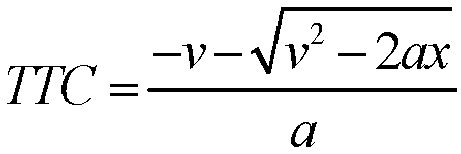

- In the foregoing formula, t∈{tevent,h(tevent,obj)=1} represents an identified time period in which a collision risk occurs, h(tevent,obj) represents that a collision risk event (obj) causes a potential collision event in a time period (tevent ), or it may be understood as that h(tevent,obj) represents that occurrence of a collision risk event (obj) causes an increase in a probability of occurrence of a collision in a time period (tevent ),h(tevent,obj)=1 represents that the collision risk event (obj) occurs, and h(tevent ,obj)=0 represents that no collision risk event occurs. A risk event usually lasts for a time period from occurrence to disappearance. Therefore, when identifying that a collision risk event (that is, h(tevent,obj)=1) occurs, the vehicle-end apparatus 410 or cloud apparatus 420 may select a time period tevent near a moment at which the risk event is identified, to calculate a risk value in the time period. The time period includes the moment at which the collision risk event is identified. Each normalized parameter is used to indicate a weight of each parameter. For example, each normalized parameter may be a value greater than or equal to 0 and less than or equal to 1.
- For example, when a relative speed of the two vehicles is greater than 40 km/h, if a collision occurs, there is an extremely high probability of personal casualty. If an expected collision time (that is, TTC) of the two vehicles is less than 1s, there is an extremely high probability that a collision between the two vehicles cannot be avoided. When THW is less than 1s, if the another vehicle is braking, there is an extremely high probability that the ego vehicle cannot avoid a collision between the two vehicles. The foregoing "a relative speed is greater than 40 km/h", "TTC is less than Is", and "THW is less than 1s" are all collision risk events (obj). A collision occurrence moment may be predicted, and a time period (tevent ) near the predicted collision occurrence moment may be selected to calculate a collision risk value (a collision occurrence probability) in the time period. A maximum value (that is, f(t) max ) of a plurality of collision risk values in the time period is used as the collision risk value in the time period.
- In an optional implementation, the obtaining rb and rc includes the following steps. S612. When the risk scenario is a traffic signal light scenario, determine rb and rc based on a speed of the vehicle and a distance from the vehicle to a traffic signal light, where the speed of the vehicle is positively correlated to rb or rc , and the distance from the vehicle to the traffic signal light is negatively correlated to rb or rc .
- In the traffic signal light scenario, a higher speed of the vehicle indicates a higher probability of violating a traffic signal light rule (for example, running a red light), and therefore the speed of the vehicle is positively correlated to rb or rc ; and a longer distance from the vehicle to the traffic signal light indicates a longer time used by the vehicle to change a travelling status and a lower probability of running the traffic signal light, and therefore the distance from the vehicle to the traffic signal light is negatively correlated to rb or rc .
-
FIG. 8 is a schematic diagram of a risk in a traffic signal light scenario according to this application. - A risk in the traffic signal light scenario is mainly violation of a rule indicated by a traffic signal light, and a corresponding risk value may be obtained based on a speed of an ego vehicle. As shown in
FIG. 8 , a distance of 50 m between the ego vehicle and the traffic signal light, a distance s from the vehicle to a stop line at an intersection, a speed v of the ego vehicle, and an acceleration a of the vehicle constitute an ego vehicle status. The right diagram shows a distance-speed curve of the ego vehicle. When the traffic signal light shows a no-passing signal, the ego vehicle needs to decelerate, and reduce the speed to 0 before the stop line. Different accelerations constitute different speed-distance curves. - When it is predicted that the ego vehicle can stop before the stop line when a common acceleration is used, it is determined that the ego vehicle in the current status has no risk of running the traffic signal light. The common acceleration is an acceleration whose absolute value is less than an absolute value of a preset acceleration. For example, a value of the preset acceleration is 0.4 g, and the ego vehicle can stop before the stop line if using an acceleration of -0.3 g. In this case, rb or rc of the ego vehicle is equal to 0.
- When it is predicted that the ego vehicle cannot stop before the stop line even if a maximum acceleration is used, it is determined that the ego vehicle in the current status inevitably causes an accident of running the traffic signal light, that is, a risk in this case is an explicit risk, and rb or rc is equal to 1.
- When a speed-distance curve of the ego vehicle is located between
curve 1 andcurve 2 shown inFIG. 8 , the ego vehicle has an implicit risk of running the traffic signal light. In this case, a larger absolute value of an acceleration required for the ego vehicle to reduce the speed to 0 before the stop line indicates a larger value of rb or rc . For example, rb and rc may be determined based on r SG2= f(t) max, where r SG2 is rb or rc in the traffic signal light scenario, t∈{tevent,h(tevent,Light)=1},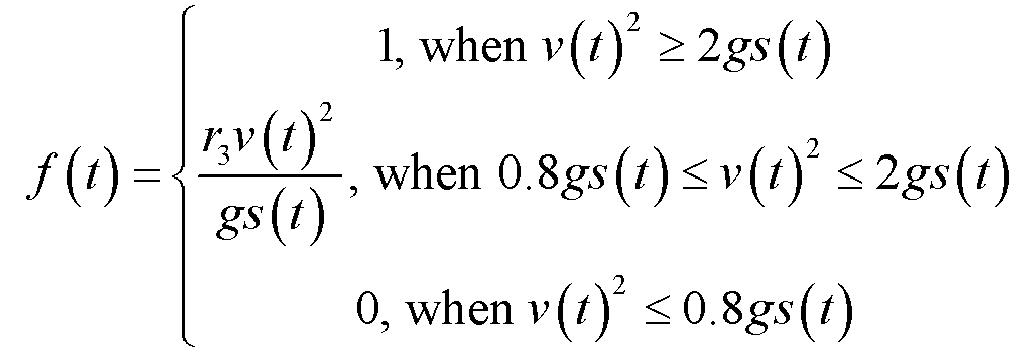
- In the foregoing formula, t∈{tevent,h(tevent,Light)=1} represents an identified time period in which a traffic signal light scenario risk occurs, h(tevent,Light) represents that a probability of occurrence of violating a traffic signal light rule increases in a time period (tevent ) due to occurrence of a traffic signal light risk event (Light) h(tevent,Light)=1 represents that a traffic signal light risk event (Light) occurs, and h(tevent,Light)=0 represents that no traffic signal light risk event occurs. A risk event usually lasts for a time period from occurrence to disappearance. Therefore, when identifying that a risk event occurs (that is, h(tevent,Light)=1) in the traffic signal light scenario, the vehicle-end apparatus 410 or the cloud apparatus 420 may select a time period tevent near a moment at which the risk event is identified, to calculate a risk value in the time period. The time period includes the moment at which the risk event is identified. The normalized parameter is used to represent a weight of a parameter. For example, each normalized parameter may be a value greater than or equal to 0 and less than or equal to 1.
- For example, if the vehicle is 50 m away from the intersection, a traffic signal light at the intersection displays a no-passing signal, and a speed of the vehicle is 100 km/h, there is an extremely high probability of occurrence of a risk of running the traffic signal light (for example, running a red light). The foregoing "the vehicle is 50 m away from the intersection, a traffic signal light at the intersection displays a no-passing signal, and a speed of the vehicle is 100 km/h" are traffic signal light risk events (Light). A moment at which a red light is run may be predicted, and a time period (tevent ) near the predicted moment at which the red light is run may be selected to calculate a red light running risk value (that is, a probability of occurrence of running the red light) in the time period. A maximum value (that is, f(t) max ) of a plurality of red light running risk values in the time period is selected as a red light running risk value in the time period.
- In an optional implementation, the obtaining rb and rc includes the following steps. S613. When the risk scenario is a scenario in which the vehicle rushes out of a road boundary, determine rb and rc based on an estimated time taken by the vehicle to rush out of a lane, where the estimated time taken by the vehicle to rush out of the lane is negatively correlated to rb or rc .
- In the scenario in which the vehicle rushes out of a road boundary, a longer estimated time taken by the vehicle to rush out of the lane indicates a longer time for the vehicle to adjust the travelling status, and a lower probability of rushing out of the road by the vehicle. Therefore, the estimated time taken by the vehicle to rush out of the lane is negatively correlated to rb or rc .
- For example, rb and rc may be determined based on


- In an optional implementation, the obtaining rb and rc includes the following steps. S614. When the risk scenario is a non-conventional travelling scenario (for example, a travelling scenario in which the vehicle currently has a lateral acceleration), determine rb and rc based on at least one of the following parameters: a longitudinal acceleration of the vehicle, a lateral acceleration of the vehicle, and a speed of the vehicle, where the longitudinal acceleration of the vehicle is positively correlated to rb or rc , the lateral acceleration of the vehicle is positively correlated to rb or rc , and the speed of the vehicle is positively correlated to rb or rc . The longitudinal acceleration is an acceleration whose acceleration direction is the same as or opposite to a speed direction (for example, an acceleration obtained by stepping on an accelerator or stepping on a brake during straight travelling). The lateral acceleration is an acceleration whose acceleration direction has a non-zero angle with a speed direction (for example, an acceleration that causes a drift of the vehicle when the vehicle is turning).
- A larger longitudinal acceleration indicates a higher probability of overspeed of the vehicle or an abrupt brake of the vehicle. Therefore, the longitudinal acceleration of the vehicle is positively correlated to rb or rc . A larger lateral acceleration indicates a higher probability of abrupt turning of the vehicle. Therefore, the lateral acceleration of the vehicle is positively correlated to rb or rc . A higher speed of the vehicle indicates a higher probability of occurrence of non-conventional travelling such as overspeed.
- Therefore, the speed of the vehicle is positively correlated to rb or rc . For example, rb and rc may be determined based on r SG4 =r 5, where r SG4 is rb or rc in a non-conventional travelling scenario, (|along |>a threshold1)||(|alat |>a threshorld2)||(v≥vsafe ), |along | represents an absolute value of the longitudinal acceleration of the vehicle, |alat | represents an absolute value of the lateral acceleration of the vehicle, α threshold2 represents a threshold of the lateral acceleration in a safe driving status, for example, may be 0.5 g, α threshold2 represents a threshold of the longitudinal acceleration in the safe driving status, for example, may be 0.7 g, v represents the speed of the vehicle, vsafe represents a speed threshold in the safe driving status, and may be determined by referring to a road speed limit, and r 5 is a normalized parameter.
- In the foregoing formula, (|along |>a threshold1)||(|alat |>a threshorld2)||(v≥vsafe ) represents that at least one of the lateral acceleration, the longitudinal acceleration, and the speed of the vehicle exceeds a corresponding threshold.
- The foregoing describes in detail the self-driving safety evaluation method provided in this application. If information received by the cloud apparatus 420 from the vehicle-end apparatus 410 is rb or rc , the cloud apparatus 420 does not need to perform S611 to S614. If information received by the cloud apparatus 420 from the vehicle-end apparatus 410 is data sensed by the sensor, the cloud apparatus 420 further needs to perform S611 to S614 to obtain rb and rc.
- It should be understood that the foregoing embodiment describes only the solution for generating rb or rc , and S611 to S614 are also applicable to calculating a risk value ra of manual driving.
- It can be learned from the
method 600 that an important factor affecting a technical effect of the self-driving safety evaluation method is whether a risk value can reflect an actual risk level. The following describes in detail a method for determining a driving risk of a vehicle provided in this application. -
FIG. 9 shows amethod 900 for determining a driving risk of a vehicle according to this application. Themethod 900 is applied to a vehicle having a self-driving mode and a manual driving mode, and themethod 900 includes the following steps. - S910. Determine a driving mode and a risk scenario of the vehicle in a time period, where a start point of the time period is a first moment, an end point of the time period is a second moment, and the driving mode includes the self-driving mode and/or the manual driving mode.
- S920. Determine a risk value in the driving mode in the time period based on a risk identification manner corresponding to the risk scenario at a current moment, where the current moment is after the first moment, and the current moment is before the second moment.
- The
method 900 may be performed, for example, by the vehicle-end apparatus 410. The vehicle-end apparatus 410 selects a time period from a plurality of time periods required for the vehicle to travel a distance, and determines, at a moment (that is, the current moment) in the time period, a risk value in a corresponding driving mode in the time period by using known travelling information and predicted travelling information. For example, the determined time period is one second, and the current moment is a moment of 0.4 seconds. If an overspeed travelling status occurs in the past 0.4 seconds, the vehicle may determine that the risk value of non-conventional driving in the driving mode in the time period is 1, that is, a probability of occurrence of overspeed is 100%. If no overspeed travelling status occurs in the past 0.4 seconds, and the vehicle determines, based on a current speed and acceleration of the vehicle, that a vehicle speed in future 0.6 seconds is to remain in a legal travelling speed, the vehicle may determine that the risk value of non-conventional driving in the time period is a value less than 1, that is, the probability of occurrence of overspeed is less than 100%. In this embodiment, a time period required for travelling a distance is divided into the plurality of time periods, and a risk value in a driving mode in each time period is determined based on a traffic context (that is, information related to a traffic environment before a current moment and after the current moment) in the time period, so that the risk can be more objectively identified. - The foregoing manner of determining a time period is merely an example for description. The vehicle-end apparatus 410 may alternatively determine a time period by using another method, for example, determine, based on a distance and a speed, a time period required for travelling the distance. The time period is the "time period" described in S910. For another example, the first moment and the second moment are determined at the current moment, so that the "time period" described in S910 is determined.
- In the foregoing embodiment, the risk value in the self-driving mode and/or the manual driving mode can be determined. The self-driving mode includes the shadow driving mode, and evaluating the safety of the self-driving system based on the risk value in the shadow driving mode is an important factor that enables the self-driving safety evaluation method provided in this application to achieve a better technical effect compared with that in the prior art.
- A purpose of the shadow driving mode is to generate a simulated vehicle control track of self-driving by using software and hardware that are run in a system background in the manual driving mode, to identify a potential risk of the self-driving system, and accumulate data required by safety evaluation.
- To achieve the foregoing objective, a main difficulty is that when the vehicle is in the manual driving mode, a self-driving module cannot really control the vehicle, and how a shadow track approaches an actual risk level of the self-driving system.
- The vehicle control track of self-driving directly generated based on sensed data of a sensor cannot represent the real risk level of the self-driving system. Consequently, distortion of a self-driving safety evaluation result is caused.
-
FIG. 10 is a schematic diagram of a vehicle control track of self-driving. A dashed-line arrow represents an actual track of an ego vehicle in a manual driving mode. A solidline arrow represents a self-driving track simulated based on sensed data of a sensor. Because the sensed data indicates that there is anothervehicle 1 on a left lane, the self-driving system simulates a track used by the ego vehicle to continue to travel along an original lane. Actually, the ego vehicle does not travel along the original lane but changes a lane. The self-driving track simulated based on the sensed data of the sensor cannot reflect a real driving status, causing distortion of a result of self-driving safety evaluation that is based on the track. - The following describes in detail how the shadow driving mode provided in this application resolves the foregoing problem of distortion of the result.
- In an optional implementation, before S920, the
method 900 further includes the following steps. - S901. Determine a location and a movement parameter of the vehicle at a first moment, where the vehicle travels at the first moment based on the manual driving mode. S902. Predict a location of the vehicle at a third moment based on the location and the movement parameter of the vehicle at the first moment, where the third moment is later than the first moment.
- S903. Predict the shadow driving mode of the vehicle from the location at the first moment to the location at the third moment based on the location at the first moment and the location at the third moment, where the shadow driving mode is a self-driving mode of the vehicle that is predicted based on the location and the movement parameter of the vehicle in the manual driving mode.
- S920 includes the following step.
- S921. Determine, at the current moment, ra , rb , and rc based on the risk identification manner corresponding to the risk scenario, where ra is a risk in the manual driving mode in the time period, rb is a risk in the shadow driving mode in the time period, and rc is a risk in a self-driving mode based on a preset route in the time period.
- The vehicle may predict a location of the vehicle after a future time period based on the location and the movement parameter of the vehicle at the first moment, that is, predict a location of the vehicle at the third moment. The vehicle is in a manual driving status at the first moment, and subsequently, the vehicle predicts the shadow driving mode of the vehicle from the location at the first moment to the location at the third moment. In the foregoing embodiment, a route of self-driving is continuously modified based on the location and the movement parameter in the manual driving mode, to enable the route in the self-driving mode to be closer to a route in the manual driving mode. Therefore, more objective self-driving risk data can be obtained.
- The third moment may be the current moment described in S920, or may be the second moment, or may be a moment after the second moment.
-
FIG. 11 is a flowchart of a shadow driving mode according to this application. - When a driver drives an automobile, the
shadow driving module 414 identifies, at a first moment, a driving intention of the driver based on a movement parameter (for example, a speed and an acceleration) of the vehicle, that is, the content described in S901 to S903, and then uses the identified driving intention of the driver as input information of theshadow driving module 414, to generate a shadow track, thereby improving a degree of overlap between the shadow track and a track of vehicle control performed by the driver. - The driving intention of the driver includes but is not limited to: at least one of travelling along a current lane, turning, and changing a lane.
-
FIG. 12 is a flowchart of a method for identifying an intention of a driver according to this application. - Starting from a moment T (equivalent to a first moment) to a moment T+1 (equivalent to a third moment), if a track of an ego vehicle completely crosses a lane line, it is determined that the driving intention of the driver is to change a lane.
- Starting from the moment T to the moment T+1, if the track of the ego vehicle is a track of completing turning by turning left or turning right in the lane; or if a yaw rate (Yaw Rate) is continuously greater than a yaw rate threshold in a time period before the moment T and adjacent to the moment T, it is determined that the driving intention of the driver is turning.
- Starting from the moment T to the moment T+1, if the track of the ego vehicle does not completely cross the current lane, it is determined that the driving intention of the driver is travelling along the current lane, where behaviors such as obstacle avoidance in the lane, enabling a front vehicle to travel first, and following a front vehicle all belong to travelling in the current lane.
- In the foregoing embodiment, the information at the future moment is predicted by using the current information, and the current driving intention of the driver is determined by using the predicted information at the future moment, thereby eliminating a deviation caused by determining the intention of the driver based on sensed data of a sensor.
-
FIG. 13 is a schematic diagram of predicting a shadow track based on a shadow driving mode according to this application. - The shadow track shown in
FIG. 13 is approximately the same as a track of vehicle control performed by a driver, but has a slight difference. Different risk values are respectively obtained based on the track of vehicle control performed by the driver and the shadow track, and which of a manual driving mode and a self-driving mode is safer may be estimated based on a difference between the risk values. - For example, when a driving intention of the driver is a risk intention (for example, aggressive cutting in), if correctly identifying a risk in this case, the
shadow driving module 414 generates no shadow track conforming to the driving intention of the driver, but generates a shadow track by selecting a safer decision (for example, keeping travelling in a right direction in a lane). The risk of the shadow track and the risk of an actual vehicle control result are identified, so that a scenario of a dangerous intention of the driver can be obtained, and a safer decision (or the contrary) made for the shadow track in this case can be obtained. - In a relatively short time period, for example, in 3s, a track of driving performed by the driver is approximately the same as the shadow track, and may be approximately closed-loop control in a self-driving system. In this case, a risk scenario caused by the shadow track is similar to a risk scenario that may be caused when the driver controls a vehicle.
FIG. 14 is a schematic diagram of the risk value of the shadow track that is calculated in the step of calculating the risk value of the shadow track shown inFIG. 11 . - In
FIG. 14 , a solid line represents the risk value obtained based on the track of vehicle controlled by the driver that is calculated in S611 to S614, and a dashed line is a risk value calculated based on a shadow track corresponding to each time period (for example, a time period from the first moment to the third moment) in S611 to S614. - In example 1, for the track of vehicle control performed by the driver, a risk (ra is equal to 0) is not generated, and for the shadow track, a new risk (rb is greater than 0) is generated. Consequently, a risk indicator falls from a safe area (r=0) to a risk area (0<r<1). Therefore, a potential risk of a self-driving system that causes a risk may be identified, to be specific, an "unknown potential risk" (a diagonal part) shown in an F area in
FIG. 2 is identified. - In example 2, the track of vehicle control performed by the driver continuously falls into the risk area, and the shadow track returns from the risk area to the safe area. This indicates that a travelling risk is reduced through simulated controlling of the vehicle performed by the system, and the data may be used as an evidence that safety performance of the self-driving system is higher than that of vehicle control performed by the driver.
- In example 3, both the track of vehicle control performed by the driver and the shadow track continuously fall into the risk area, but the risk value of the shadow track is less than that of the track of vehicle control performed by the driver. This indicates that the driving risk is reduced through simulated controlling of the vehicle performed by the self-driving system, and the data may be used as an evidence that safety performance of the self-driving system is higher than that of vehicle control performed by the driver. All data in the foregoing three examples may be used as data used to perform self-driving safety evaluation in the
method 600. - It can be learned from content shown in
FIG. 12 to FIG. 14 that, because a shadow track generation method is consistent with an algorithm of vehicle control of self-driving, and a method for calculating a risk of the shadow track is consistent with a method for calculating a risk of a self-driving/driver driving track, so that it can be ensured that a shadow track risk represents a self-driving system risk. - When the safety of the self-driving system is evaluated, in an optional implementation, the
method 900 further includes:
S930. Send ra, rb, and rc to a safety center, where ra, rb, and rc are used to evaluate safety in the manual driving mode and the shadow driving mode. - The vehicle may send the foregoing risk data to the safety center after obtaining ra , rb , or rc , so that the safety center evaluates the safety in the manual driving mode and the shadow driving mode, thereby reducing an operating load of an in-vehicle processor. The security center is, for example, the cloud apparatus 420.
- Evaluating safety of the self-driving automobile in a self-driving mode is a long-term process. Even if evaluation of the safety in the self-driving mode is passed, it does not mean that the self-driving mode is 100% safe. Therefore, it is necessary to design a solution for immediate control of a risk, that is, to reduce or eliminate the risk through the risk control module 416.
-
FIG. 15 is a schematic flowchart of a risk control method according to this application. As shown inFIG. 15 , risk scenario data includes but is not limited to at least one of sensing data obtained by thesensor 411, a track generated by the self-drivingmodule 413, or a track generated by theshadow driving module 414. Therisk identification module 415 determines, based on the risk scenario data, whether a current scenario is a risk scenario. If therisk identification module 415 determines that the current scenario is a non-risk scenario, but it is found that the current scenario is actually a risk scenario afterwards, a risk identification mechanism may be adjusted, for example, a risk identification threshold parameter may be adjusted and a risk identification algorithm may be modified. If therisk identification module 415 confirms that the current scenario is a risk scenario and determines that the risk scenario is caused by a potential risk of a self-driving system, therisk identification module 415 reports the risk scenario to therisk policy module 421. Therisk policy module 421 sends policy update information to the risk control module 416, updates the risk control policy of the vehicle-end apparatus 410, and excludes the risk scenario from the safe scenario fence. - In an optional embodiment, the
method 900 further includes the following steps. S940. Receive safety scenario information sent by the safety center, where the safety scenario information is used to indicate a safe driving traffic scenario set in a self-driving mode. - S950. Determine the safe driving traffic scenario set in the self-driving mode based on the safety scenario information.
- S960. If the current traffic scenario does not belong to the safe driving traffic scenario set, the vehicle plays and/or displays prompt information prompting the driver to perform manual driving, and/or the vehicle performs safe stopping processing.
- The safety center may identify a risk scenario based on the risk data reported by the vehicle, and update a risk identification mechanism and a risk control policy of the vehicle by sending the safety scenario information to the vehicle. For example, if a risk is caused by a potential risk of the self-driving system, the safety scenario information may instruct the vehicle to exclude the risk scenario from the safe driving traffic scenario set. The vehicle updates the safe driving traffic scenario set after receiving the safety scenario information. If the current traffic scenario does not belong to the updated safe driving traffic scenario set, the vehicle takes safety measures, for example, plays and/or displays prompt information prompting the driver to perform manual driving, and/or performs safe stopping processing.
- The safe driving traffic scenario set may also be referred to as a safe driving scenario fence, and includes an environment, a static scenario, a dynamic scenario, and a behavior of an ego vehicle. In a technical solution, a definition of the scenario fence is shown in
FIG. 16 . - In
FIG. 16 , content in round brackets is content included in a safe driving scenario fence of a self-driving system. The cloud apparatus 420 transmits safety scenario information based on an identified potential risk of the self-driving system in a timely manner, to update content in the safe driving scenario fence. In the vehicle-end apparatus 410, the risk control module 416 obtains an identified result of each element of the scenario fence based on map input and a real-time sensing result, and updates content in the safe driving scenario fence based on the safety scenario information sent by the cloud apparatus 420. In a process of controlling, by the self-drivingmodule 413, a vehicle to travel, if the risk control module 416 determines that a current scenario exceeds a safe driving scenario fence range, the self-drivingmodule 413 prompts a driver to take over the vehicle, or controls the vehicle to stop in a safe zone. - In an example (content in square brackets) shown in
FIG. 16 , a risk event is that a potential risk is caused due to that the system cannot accurately identify a type of a red and green light because of an intersection width greater than 20 m. In this case, in an updated safe driving scenario fence, the intersection width is less than 20 m. When the vehicle travels again to an intersection with a width greater than or equal to 20 m, the self-driving system takes a conservative control policy (for example, prompts the driver or pulls over the vehicle). - In another example (content in square brackets) shown in
FIG. 16 , a risk event is that a potential risk is caused due to that the self-driving system cannot measure a speed of a low-speed vehicle in time. In this case, in an updated safe driving scenario fence, an applicable vehicle flow speed in a dynamic scenario is from 10 to 50 kilometers per hour (kph). When detecting that the ego vehicle flow speed is less than 10 kph, the self-driving system prompts the driver to take over the vehicle, or gently pulls over the vehicle. - In addition, a driver in-the-loop policy may alternatively be adjusted, for example, an alerting interval may be adjusted.
- The foregoing describes in detail examples of the method for evaluating self-driving safety and the method for determining the driving risk of a vehicle that are provided in this application. It may be understood that, to implement the foregoing functions, the vehicle-end apparatus and the cloud apparatus include corresponding hardware structures and/or software modules for performing the functions. A person of ordinary skill in the art should be easily aware that, in combination with the examples described in the embodiments disclosed in this specification, units and algorithms steps may be implemented by hardware or a combination of hardware and computer software in this application. Whether a function is performed by hardware or hardware driven by computer software depends on particular applications and design constraints of the technical solutions. A person skilled in the art may use different methods to implement the described functions for each particular application, but it should not be considered that the implementation goes beyond the scope of this application.
- In this application, function unit division may be performed on the vehicle-end apparatus and the cloud apparatus based on the foregoing method examples. For example, each function unit may be obtained through division based on a corresponding function, or two or more functions may be integrated into one processing unit. The integrated unit may be implemented in a form of hardware, or may be implemented in a form of a software function unit. It should be noted that, in this application, unit division is an example, and is merely a logical function division. In actual implementation, another division manner may be used.
- If an integrated unit is used,
FIG. 17 is a possible schematic structural diagram of the vehicle-end apparatus 1700 in the foregoing embodiments. The vehicle-end apparatus 1700 includes: aprocessing unit 1702 and acommunications unit 1703. Theprocessing unit 1702 is configured to control and manage an action of the vehicle-end apparatus 1700. For example, theprocessing unit 1702 is configured to support the vehicle-end apparatus 1700 in performing S620 and/or another process used for the technology described in this specification. Thecommunications unit 1703 is configured to support communication between the vehicle-end apparatus 1700 and a cloud apparatus. The vehicle-end apparatus 1700 may further include astorage unit 1701, configured to store program code and data of the vehicle-end apparatus 1700. - In an optional embodiment, the
processing unit 1702 is configured to perform S610 to S630. When theprocessing unit 1702 performs S610, theprocessing unit 1702 may also be referred to as an obtainingunit 1702. Thestorage unit 1701 needs to store intermediate data generated in a process in which theprocessing unit 1702 performs the foregoing steps. For example, the intermediate data is rb and rc , so that theprocessing unit 1702 determines, based on a risk value in a shadow driving mode in a plurality of measurement units and a risk value in a self-driving mode based on a preset route, whether safety of a vehicle in the self-driving mode meets a requirement. - In another optional embodiment, the
processing unit 1702 is configured to perform S610, and control thecommunications unit 1703 to send rb and rc to the cloud apparatus, so that the cloud apparatus performs S620 and S630. - In a third optional embodiment, the
processing unit 1702 is configured to control thecommunications unit 1703 to send, to a cloud apparatus, original data (for example, sensor data) used for calculating rb and rc , so that the cloud apparatus performs S610 to S630. - In a fourth optional embodiment, the
processing unit 1702 is configured to perform S910 and S920. Optionally, theprocessing unit 1702 is configured to control thecommunications unit 1703 to perform S930. - The
processing unit 1702 may be a processor or a controller, for example, may be a central processing unit (central processing unit, CPU), a general-purpose processor, a digital signal processor (digital signal processor, DSP), an application-specific integrated circuit (application-specific integrated circuit, ASIC), a field programmable gate array (field programmable gate array, FPGA), or another programmable logical device, a transistor logical device, a hardware component, or a combination thereof. The processor may implement or execute various example logical blocks, modules, and circuits described with reference to content disclosed in this application. Alternatively, the processor may be a combination for implementing a computing function, for example, a combination of one or more microprocessors, or a combination of the DSP and a microprocessor. Thecommunications unit 1703 may be a transceiver or the like. Thestorage unit 1701 may be a memory. - When the
processing unit 1702 is a processor, thecommunications unit 1703 is a transceiver, and thestorage unit 1701 is a memory, the vehicle-end apparatus in this application may be a vehicle-end apparatus 1800 shown inFIG. 18 . - As shown in
FIG. 18 , the vehicle-end apparatus 1800 includes: aprocessor 1802, atransceiver 1803, and amemory 1801. Thetransceiver 1803, theprocessor 1802, and thememory 1801 may communicate with each other through an internal connection path, and transmit a control signal and/or a data signal. - It may be clearly understood by a person skilled in the art that, for ease and brief description, for a detailed working process of the foregoing apparatus and units, refer to a corresponding process in the foregoing method embodiments, and details are not described herein again.
- In a case that an integrated unit is used,
FIG. 19 is a possible schematic structural diagram of thecloud apparatus 1900 described in the foregoing embodiments. Thecloud apparatus 1900 includes: aprocessing unit 1902 and acommunications unit 1903. Theprocessing unit 1902 is configured to control and manage an action of thecloud apparatus 1900. For example, theprocessing unit 1902 is configured to support thecloud apparatus 1900 in performing S620 and/or another process used for the technology described in this specification. Thecommunications unit 1903 is configured to support communication between thecloud apparatus 1900 and a vehicle-end apparatus. Thecloud apparatus 1900 may further include astorage unit 1901, configured to store program code and data of thecloud apparatus 1900. - In an optional embodiment, the
processing unit 1902 is configured to control thecommunications unit 1903 to perform S610, that is, receive rb and rc from the vehicle-end apparatus. In this case, thecommunications unit 1903 may also be referred to as an obtainingunit 1903, and theprocessing unit 1902 is further configured to perform S620 to S641. Thestorage unit 1901 needs to store intermediate data generated in a process in which theprocessing unit 1902 performs the foregoing steps. For example, the intermediate data is rb and rc , so that theprocessing unit 1902 determines, based on a risk value in a shadow driving mode in a plurality of measurement units and a risk value in a self-driving mode based on a preset route, whether safety of a vehicle in the self-driving mode meets a requirement. - In another optional embodiment, the
processing unit 1902 is configured to control thecommunications unit 1903 to receive, from the vehicle-end apparatus, original data (for example, sensor data) used for calculating rb and rc . Theprocessing unit 1902 is further configured to obtain rb and rc based on the original data received by thecommunications unit 1903. In this case, theprocessing unit 1902 may also be referred to as an obtainingunit 1902. Theprocessing unit 1902 is further configured to perform S620 to S641. Thestorage unit 1901 needs to store intermediate data generated in a process in which theprocessing unit 1902 performs the foregoing steps. For example, the intermediate data is rb and rc , so that theprocessing unit 1902 determines, based on a risk value in a shadow driving mode in a plurality of measurement units and a risk value in a self-driving mode based on a preset route, whether safety of a vehicle in the self-driving mode meets a requirement. - In the third optional embodiment, the
processing unit 1902 is configured to perform S910 and S920. Optionally, theprocessing unit 1902 is configured to control thecommunications unit 1903 to perform S930. - The
processing unit 1902 may be a processor or a controller, for example, may be a CPU, a general-purpose processor, a DSP, an ASIC, an FPGA, or another programmable logic device, a transistor logic device, a hardware component, or any combination thereof. The processor may implement or execute various example logical blocks, modules, and circuits described with reference to content disclosed in this application. Alternatively, the processor may be a combination for implementing a computing function, for example, a combination of one or more microprocessors, or a combination of the DSP and a microprocessor. Thecommunications unit 1903 may be a transceiver or the like. Thestorage unit 1901 may be a memory. - When the
processing unit 1902 is a processor, thecommunications unit 1903 is a transceiver, and thestorage unit 1901 is a memory, the cloud apparatus in this application may be acloud apparatus 2000 shown inFIG. 20 . - As shown in
FIG. 20 , thecloud apparatus 2000 includes: aprocessor 2002, atransceiver 2003, and amemory 2001. Thetransceiver 2003, theprocessor 2002, and thememory 2001 may communicate with each other through an internal connection path, and transmit a control signal and/or a data signal. - It may be clearly understood by a person skilled in the art that, for ease and brief description, for a detailed working process of the foregoing apparatus and units, refer to a corresponding process in the foregoing method embodiments, and details are not described herein again.
- This application further provides a self-driving safety evaluation system, including the foregoing one or more vehicle-end apparatuses and one or more cloud apparatuses.
- It should be understood that the processor in this embodiment of this application may be an integrated circuit chip, and has a signal processing capability. In an implementation process, steps in the foregoing method embodiments can be implemented by using a hardware integrated logical circuit in the processor, or by using instructions in a form of software. The foregoing processor may be a general-purpose processor, a digital signal processor (digital signal processor, DSP), an application-specific integrated circuit (application-specific integrated circuit, ASIC), a field programmable gate array (field programmable gate array, FPGA) or another programmable logical device, a discrete gate or transistor logic device, or a discrete hardware component. The processor may implement or perform the methods, the steps, and logical block diagrams that are disclosed in the embodiments of this application. The general-purpose processor may be a microprocessor, or the processor may be any conventional processor or the like. Steps in the methods disclosed with reference to the embodiments of this application may be directly executed and accomplished by using a hardware decoding processor, or may be executed and accomplished by using a combination of hardware and software modules in the decoding processor. The software module may be located in a mature storage medium in the art, such as a random access memory, a flash memory, a read-only memory, a programmable read-only memory, an electrically erasable programmable memory, or a register. The storage medium is located in the memory, and the processor reads information in the memory and completes the steps in the foregoing methods in combination with hardware of the processor.
- It may be understood that the memory in this embodiment of this application may be a volatile memory or a nonvolatile memory, or may include a volatile memory and a nonvolatile memory. The nonvolatile memory may be a read-only memory (read-only memory, ROM), a programmable read-only memory (programmable ROM, PROM), an erasable programmable read-only memory (erasable PROM, EPROM), an electrically erasable programmable read-only memory (electrically EPROM, EEPROM), or a flash memory. The volatile memory may be a random access memory (random access memory, RAM), used as an external cache. Through example but not limitative description, many forms of RAMs may be used, for example, a static random access memory (static RAM, SRAM), a dynamic random access memory (dynamic RAM, DRAM), a synchronous dynamic random access memory (synchronous DRAM, SDRAM), a double data rate synchronous dynamic random access memory (double data rate SDRAM, DDR SDRAM), an enhanced synchronous dynamic random access memory (enhanced SDRAM, ESDRAM), a synchronous link dynamic random access memory (synchlink DRAM, SLDRAM), and a direct rambus random access memory (direct rambus RAM, DR RAM). It should be noted that the memory of the systems and methods described in this specification is intended to include but is not limited to these and any memory of another appropriate type.
- This application further provides a computer readable medium. The computer readable medium stores a computer program. When being executed by a computer, the computer program implements the function of any one of the foregoing method embodiments.
- This application further provides a computer program product. When being executed by a computer, the computer program product implements the function of any one of the foregoing method embodiments.
- All or some of the foregoing embodiments may be implemented by using software, hardware, firmware, or any combination thereof. When software is used to implement the embodiments, the embodiments may be implemented completely or partially in a form of a computer program product. The computer program product includes one or more computer instructions. When the computer instructions are loaded and executed on the computer, the procedure or functions according to the embodiments of this application are all or partially generated. The computer may be a general-purpose computer, a dedicated computer, a computer network, or other programmable apparatuses. The computer instructions may be stored in a computer-readable storage medium or may be transmitted from a computer-readable storage medium to another computer-readable storage medium. For example, the computer instructions may be transmitted from a website, computer, server, or data center to another website, computer, server, or data center in a wired (for example, a coaxial cable, an optical fiber, or a digital subscriber line (digital subscriber line, DSL)) or wireless (for example, infrared, radio, or microwave) manner. The computer-readable storage medium may be any usable medium accessible by the computer, or a data storage device, such as a server or a data center, integrating one or more usable media. The usable medium may be a magnetic medium (for example, a floppy disk, a hard disk, or a magnetic tape), an optical medium (for example, a high density digital versatile disc (digital versatile disc, DVD), a semiconductor medium (for example, a solid-state drive (solid-state disk, SSD)), or the like.
- This application further provides a processing apparatus, including a processor and an interface. The processor is configured to perform the steps described in any one of the foregoing method embodiments.
- It should be understood that the processing apparatus may be a chip, and the processor may be implemented by hardware, or may be implemented by software. When implemented by hardware, the processor may be a logic circuit, an integrated circuit, or the like. When implemented by software, the processor may be a general-purpose processor, and is implemented by reading software code stored in a memory. The memory may be integrated in the processor, or may exist independently outside the processor.
- It should be understood that "embodiment" mentioned in the entire specification means that particular characteristics, structures, or features related to the embodiments are included in at least one embodiment of this application. Therefore, the embodiments in the entire specification do not necessarily refer to a same embodiment. In addition, these particular characteristics, structures, or features may be combined in one or more embodiments by using any appropriate manner. It should be understood that sequence numbers of the foregoing processes do not mean execution sequences in various embodiments of this application. The execution sequences of the processes should be determined based on functions and internal logic of the processes, and should not be construed as any limitation on the implementation processes of the embodiments of this application.
- In addition, the terms "system" and "network" may be used interchangeably in this specification. The term "and/or" in this specification describes only an association relationship for describing associated objects and represents that three relationships may exist. For example, A and/or B may represent the following three cases: Only A exists, both A and B exist, and only B exists. In addition, the character "/" in this specification generally indicates an "or" relationship between the associated objects.
- It should be understood that in the embodiments of this application, "B corresponding to A" indicates that B is associated with A, and B may be determined according to A. However, it should further be understood that determining B according to A does not mean that B is determined only according to A; that is, B may also be determined according to A and/or other information.
- A person of ordinary skill in the art may be aware that, in combination with the examples described in the embodiments disclosed in this specification, units and algorithm steps may be implemented by electronic hardware, computer software, or a combination thereof. To clearly describe the interchangeability between the hardware and the software, the foregoing has generally described compositions and steps of each example according to functions. Whether the functions are performed by hardware or software depends on particular applications and design constraints of the technical solutions. A person skilled in the art may use different methods to implement the described functions for each particular application, but it should not be considered that the implementation goes beyond the scope of this application.
- It may be clearly understood by a person skilled in the art that, for convenient and brief description, for a detailed working process of the foregoing system, apparatus, and unit, refer to a corresponding process in the foregoing method embodiments, and details are not described herein again.
- In the several embodiments provided in this application, it should be understood that the disclosed system, apparatus, and method may be implemented in other manners. For example, the described apparatus embodiment is merely an example. For example, the unit division is merely logical function division and may be other division in actual implementation. For example, a plurality of units or components may be combined or integrated into another system, or some features may be ignored or not performed. In addition, the displayed or discussed mutual couplings or direct couplings or communication connections may be implemented through some interfaces, indirect couplings or communication connections between the apparatuses or units, or electrical connections, mechanical connections, or connections in other forms.
- The units described as separate parts may or may not be physically separate, and parts displayed as units may or may not be physical units, may be located in one position, or may be distributed on a plurality of network units. Some or all of the units may be selected according to actual requirements to achieve the objectives of the solutions of the embodiments in this application.
- In addition, function units in the embodiments of this application may be integrated into one processing unit, or each of the units may exist alone physically, or two or more units are integrated into one unit. The integrated unit may be implemented in a form of hardware, or may be implemented in a form of a software function unit.
- With descriptions of the foregoing implementations, a person skilled in the art may clearly understand that this application may be implemented by hardware, firmware, or a combination thereof. When this application is implemented by software, the foregoing functions may be stored in a computer-readable medium or transmitted as one or more instructions or code in the computer-readable medium. The computer-readable medium includes a computer storage medium and a communications medium, where the communications medium includes any medium that enables a computer program to be transmitted from one place to another. The storage medium may be any available medium accessible to a computer. The following provides an example but does not impose a limitation. The computer-readable medium may include a RAM, a ROM, an EEPROM, a CD-ROM or another optical disc storage, a disk storage medium or another magnetic storage device, or any other medium that can carry or store expected program code in a form of an instruction or a data structure and can be accessed by a computer. In addition, any connection may be appropriately defined as a computer-readable medium. For example, if software is transmitted from a website, a server or another remote source by using a coaxial cable, an optical fiber/cable, a twisted pair, a digital subscriber line (DSL), or wireless technologies such as infrared ray, radio, and microwave, the coaxial cable, optical fiber/cable, twisted pair, DSL, or wireless technologies such as infrared ray, radio, and microwave are included in fixation of a medium to which they belong. A disk (Disk) and disc (disc) used by this application include a compact disc (CD), a laser disc, an optical disc, a digital versatile disc (DVD), a floppy disk, and a Blu-ray disc, where the disk generally copies data magnetically, and the disc copies data optically by using laser. The foregoing combination should also be included in the protection scope of the computer-readable medium.
- In conclusion, what is described above is merely embodiments of the technical solutions of this application, but is not intended to limit the protection scope of this application. The scope of protection is defined by the claims.
Claims (14)
- A self-driving safety evaluation method (600), comprising:obtaining (S610) rb and rc , wherein rb is a risk value of a vehicle in a shadow driving mode in a first measurement unit, rc is a risk value of the vehicle in a self-driving mode based on a preset route in the first measurement unit, the shadow driving mode is a self-driving mode of the vehicle that is based on a real-time route, the real-time route is a route predicted based on a location and a movement parameter of the vehicle in a manual driving mode, and the first measurement unit is a time period or a distance;determining (S620) RB based on rb , wherein RB is a risk value of the vehicle in the shadow driving mode in a plurality of measurement units, and the plurality of measurement units comprise the first measurement unit; anddetermining (S630) RC based on rc , wherein RC is a risk value of the vehicle in the self-driving mode based on the preset route in the plurality of measurement units, whereinRB and RC are used to determine whether safety of the vehicle in the self-driving mode meets a requirement.
- The method according to claim 1, wherein the method further comprises:calculating a sum of RB and RC ; andwhen the sum of RB and RC is less than or equal to a self-driving risk threshold, determining that the safety of the vehicle in the self-driving mode meets the requirement.
- The method according to claim 1 or 2, wherein the obtaining rb and rc comprises:
when the risk scenario is a collision scenario, determining rb and rc based on at least one of the following parameters: a speed Δv of the vehicle relative to a collision object, a time to collision TTC between the vehicle and the collision object that is estimated based on a movement track of the collision object, a time to headway THW of the vehicle that is estimated based on a distance between the vehicle and the collision object, and the distance between the vehicle and the collision object, wherein Δv is positively correlated to rb or rc, the TTC is negatively correlated to rb or rc, the THW is negatively correlated to rb or rc , and the distance between the vehicle and the collision object is negatively correlated to rb or rc . - The method according to claim 1 or 2, wherein the obtaining rb and rc comprises:
when the risk scenario is a traffic signal light scenario, determining rb and rc based on a speed of the vehicle and a distance from the vehicle to a traffic signal light, wherein the speed of the vehicle is positively correlated to rb or rc, and the distance from the vehicle to the traffic signal light is negatively correlated to rb or rc. - The method according to claim 1 or 2, wherein the obtaining rb and rc comprises:
when the risk scenario is a scenario in which the vehicle rushes out of a road boundary, determining rb and rc based on an estimated time taken by the vehicle to rush out of a lane, wherein the estimated time taken by the vehicle to rush out of the lane is negatively correlated to rb or rc . - The method according to claim 1 or 2, wherein the obtaining rb and rc comprises:
when the risk scenario is a scenario in which the vehicle travels with a lateral acceleration, determining rb and rc based on at least one of the following parameters: a longitudinal acceleration of the vehicle, a lateral acceleration of the vehicle, and a speed of the vehicle, wherein the longitudinal acceleration of the vehicle is positively correlated to rb or rc, the lateral acceleration of the vehicle is positively correlated to rb or rc, and the speed of the vehicle is positively correlated to rb or rc . - A self-driving safety evaluation apparatus, comprising a processing unit and an obtaining unit, whereinthe obtaining unit is configured to obtain rb and rc , wherein rb is a risk value of a vehicle in a shadow driving mode in a first measurement unit, rc is a risk value of the vehicle in a self-driving mode based on a preset route in the first measurement unit, the shadow driving mode is a self-driving mode of the vehicle that is based on a real-time route, the real-time route is a route predicted based on a location and a movement parameter of the vehicle in a manual driving mode, and the first measurement unit is a time period or a distance; andthe processing unit is configured to determine RB based on rb obtained by the obtaining unit, wherein RB is a risk value of the vehicle in the shadow driving mode in a plurality of measurement units, and the plurality of measurement units comprise the first measurement unit, whereinthe processing unit is further configured to determine RC based on rc obtained by the obtaining unit, wherein RC is a risk value of the vehicle in the self-driving mode based on the preset route in the plurality of measurement units, whereinRB and RC are used to determine whether safety of the vehicle in the self-driving mode meets a requirement.
- The apparatus according to claim 7, wherein the processing unit is further configured to:calculate a sum of RB and RC ; andwhen the sum of RB and RC is less than or equal to a self-driving risk threshold, determine that the safety of the vehicle in the self-driving mode meets the requirement.
- The apparatus according to claim 7 or 8, wherein the obtaining unit is specifically configured to:
when the risk scenario is a collision scenario, determine rb and rc based on at least one of the following parameters: a speed Δv of the vehicle relative to a collision object, a time to collision TTC between the vehicle and the collision object that is estimated based on a movement track of the collision object, a time to headway THW of the vehicle that is estimated based on a distance between the vehicle and the collision object, and the distance between the vehicle and the collision object, wherein Δv is positively correlated to rb or rc , the TTC is negatively correlated to rb or rc , the THW is negatively correlated to rb or rc , and the distance between the vehicle and the collision object is negatively correlated to rb or rc . - The apparatus according to claim 7 or 8, wherein the obtaining unit is specifically configured to:
when the risk scenario is a traffic signal light scenario, determine rb and rc based on a speed of the vehicle and a distance from the vehicle to a traffic signal light, wherein the speed of the vehicle is positively correlated to rb or rc , and the distance from the vehicle to the traffic signal light is negatively correlated to rb or rc . - The apparatus according to claim 7 or 8, wherein the obtaining unit is specifically configured to:
when the risk scenario is a scenario in which the vehicle rushes out of a road boundary, determine rb and rc based on an estimated time taken by the vehicle to rush out of a lane, wherein the estimated time taken by the vehicle to rush out of the lane is negatively correlated to rb or rc. - The apparatus according to claim 7 or 8, wherein the obtaining unit is specifically configured to:
when the risk scenario is a scenario in which the vehicle travels with a lateral acceleration, determine rb and rc based on at least one of the following parameters: a longitudinal acceleration of the vehicle, a lateral acceleration of the vehicle, and a speed of the vehicle, wherein the longitudinal acceleration of the vehicle is positively correlated to rb or rc , the lateral acceleration of the vehicle is positively correlated to rb or rc , and the speed of the vehicle is positively correlated to rb or rc . - A self-driving safety evaluation system, comprising a risk control module, a risk policy module, and a safety evaluation module, whereinthe risk control module is configured to perform the method according to any one of claims 1 to 6, to determine a risk in a self-driving mode;the risk policy module is configured to determine a risk control policy based on the risk in the self-driving mode that is determined by the risk control module, wherein the risk control policy is used to reduce or eliminate the risk in the self-driving mode; andthe safety evaluation policy module is used to evaluate safety in the self-driving mode based on the risk in the self-driving mode that is determined by the risk control module.
- A computer readable storage medium, comprising a program or an instruction, wherein when the program or the instruction is run on a computer, the method according to any one of claims 1 to 6 is performed.
Applications Claiming Priority (2)
| Application Number | Priority Date | Filing Date | Title |
|---|---|---|---|
| CN201810220891.XA CN110276985B (en) | 2018-03-16 | 2018-03-16 | Automated driving safety assessment method, device and system |
| PCT/CN2019/072074 WO2019174397A1 (en) | 2018-03-16 | 2019-01-17 | Automatic driving safety assessment method, device and system |
Publications (3)
| Publication Number | Publication Date |
|---|---|
| EP3745378A1 EP3745378A1 (en) | 2020-12-02 |
| EP3745378A4 EP3745378A4 (en) | 2021-03-24 |
| EP3745378B1 true EP3745378B1 (en) | 2022-06-01 |
Family
ID=67908627
Family Applications (1)
| Application Number | Title | Priority Date | Filing Date |
|---|---|---|---|
| EP19768393.1A Active EP3745378B1 (en) | 2018-03-16 | 2019-01-17 | Automatic driving safety assessment method, device and system |
Country Status (6)
| Country | Link |
|---|---|
| US (1) | US11872999B2 (en) |
| EP (1) | EP3745378B1 (en) |
| JP (1) | JP7227267B2 (en) |
| KR (1) | KR102574105B1 (en) |
| CN (1) | CN110276985B (en) |
| WO (1) | WO2019174397A1 (en) |
Families Citing this family (88)
| Publication number | Priority date | Publication date | Assignee | Title |
|---|---|---|---|---|
| JP2019191893A (en) * | 2018-04-24 | 2019-10-31 | 本田技研工業株式会社 | Vehicle control device and program |
| JP7174303B2 (en) * | 2019-07-03 | 2022-11-17 | 日本電信電話株式会社 | Topology estimation system, traffic generator, and traffic generation method |
| CN115079095A (en) | 2019-08-19 | 2022-09-20 | 华为技术有限公司 | Signal transmission method and device, signal processing method and device and radar system |
| CN110781578B (en) * | 2019-09-23 | 2024-03-29 | 同济大学 | Intelligent network coupling algorithm testing and evaluating method based on accident scene |
| CN112556700A (en) * | 2019-09-25 | 2021-03-26 | 华为技术有限公司 | Map level indicating method, map level obtaining method and related products |
| FR3101838B1 (en) * | 2019-10-15 | 2021-10-29 | Bluebus | Vehicle equipped with an autonomous and manual driving mode control unit. |
| CN110751825B (en) * | 2019-10-29 | 2021-09-14 | 北京百度网讯科技有限公司 | Method, device, equipment and computer readable storage medium for avoiding formation driving |
| CN110782706B (en) * | 2019-11-06 | 2022-05-06 | 腾讯科技(深圳)有限公司 | Early warning method and device for driving risk of intelligent vehicle |
| EP3822141B1 (en) * | 2019-11-18 | 2023-07-12 | Zenuity AB | Operational design domain validation coverage for adjacent lane relative velocity |
| CN110853389B (en) * | 2019-11-21 | 2022-03-18 | 白犀牛智达(北京)科技有限公司 | Drive test monitoring system suitable for unmanned commodity circulation car |
| CN112834234A (en) * | 2019-11-25 | 2021-05-25 | 武汉理工大学 | A method and system for determining the collision of a target fake car |
| US11385656B2 (en) | 2020-01-22 | 2022-07-12 | Huawei Technologies Co., Ltd. | System, device and method of identifying and updating the operational design domain of an autonomous vehicle |
| CN111710187B (en) * | 2020-05-19 | 2024-10-01 | 腾讯科技(深圳)有限公司 | Method, device, medium and electronic equipment for determining driving risk of vehicle |
| CN111611709B (en) * | 2020-05-20 | 2023-09-15 | 阿波罗智能技术(北京)有限公司 | Method, device, electronic device and storage medium for controlling simulated vehicle |
| CN111717221B (en) * | 2020-05-29 | 2022-11-11 | 重庆大学 | Automatic driving takeover risk assessment and man-machine friendly early warning method and early warning system |
| CN113752827B (en) * | 2020-06-05 | 2024-03-01 | 北京京东乾石科技有限公司 | An unmanned vehicle speed control method, device, unmanned vehicle and storage medium |
| CN111783226B (en) * | 2020-06-29 | 2024-03-19 | 北京百度网讯科技有限公司 | Method, device, electronic device and storage medium for generating autonomous driving scene measurement parameters |
| CN111814904B (en) * | 2020-07-22 | 2021-05-28 | 同济大学 | A method and system for discriminating driving mode for automatic driving road test |
| CN112100030B (en) * | 2020-09-15 | 2023-07-28 | 北京百度网讯科技有限公司 | Method, device, computer system and storage medium for evaluating automatic driving technology |
| FR3114788B1 (en) * | 2020-10-07 | 2022-08-19 | Psa Automobiles Sa | Method and device for determining an indicator of dangerous lateral behavior of an autonomous vehicle traveling on a traffic lane |
| CN112232581B (en) * | 2020-10-26 | 2024-04-12 | 腾讯科技(深圳)有限公司 | Driving risk prediction method and device, electronic equipment and storage medium |
| CN112525550B (en) * | 2020-12-03 | 2024-07-19 | 苏州测迅智能汽车科技有限公司 | On-loop test platform for miniaturized intelligent vehicle sensing system |
| CN112729862B (en) * | 2020-12-11 | 2023-07-25 | 国汽(北京)智能网联汽车研究院有限公司 | Unmanned driving behavior safety assessment method and device and electronic equipment |
| CN114661574A (en) * | 2020-12-23 | 2022-06-24 | 北京百度网讯科技有限公司 | Method and device for acquiring sample deviation data and electronic equipment |
| CN112816226B (en) * | 2021-01-06 | 2023-03-14 | 北京智能车联产业创新中心有限公司 | Automatic driving test system and method based on controllable traffic flow |
| US12091051B2 (en) * | 2021-02-23 | 2024-09-17 | Siemens Industry Software Nv | Generating unknown-unsafe scenarios, improving automated vehicles, and computer system |
| CN115130713A (en) * | 2021-03-29 | 2022-09-30 | 淘宝(中国)软件有限公司 | Risk data identification, object detection and model optimization method, device and system |
| CN113158560B (en) * | 2021-04-09 | 2024-02-09 | 中国科学院合肥物质科学研究院 | Intelligent driving vehicle autonomous capability test method based on scene opposition |
| WO2022246853A1 (en) * | 2021-05-28 | 2022-12-01 | 深圳市大疆创新科技有限公司 | Safety test method for vehicle system and test vehicle |
| CN113419233A (en) * | 2021-06-18 | 2021-09-21 | 阿波罗智能技术(北京)有限公司 | Method, device and equipment for testing perception effect |
| CN113200054B (en) * | 2021-06-21 | 2022-06-28 | 清华大学 | A path planning method and system for autonomous driving takeover |
| CN115587463A (en) * | 2021-07-06 | 2023-01-10 | 上海国际汽车城(集团)有限公司 | Automatic driving test scene design method based on scene classification |
| CN113460087A (en) * | 2021-07-20 | 2021-10-01 | 厦门理工学院 | Automatic driving graded takeover interaction method and device and readable storage medium |
| CN113658451B (en) * | 2021-07-30 | 2022-11-22 | 三一专用汽车有限责任公司 | Vehicle collision early warning control method and device, vehicle and readable storage medium |
| CN113642108B (en) * | 2021-08-11 | 2023-11-10 | 北京航空航天大学 | A method for generating key test cases for autonomous vehicle intersection traffic scenarios |
| CN113479201B (en) * | 2021-08-20 | 2022-08-12 | 燕山大学 | Dynamic evaluation method of vehicle risk in lane changing scene considering driver's reaction ability |
| US20230067822A1 (en) * | 2021-09-01 | 2023-03-02 | Baidu Usa Llc | E2e learning-based evaluator for an autonomous driving vehicle |
| JP7734025B2 (en) * | 2021-09-07 | 2025-09-04 | Astemo株式会社 | Vehicle control system and vehicle control method |
| CN114372708B (en) * | 2022-01-11 | 2024-09-24 | 北京航空航天大学 | A method for constructing a driving safety field model for unmanned vehicles |
| CN114627640B (en) * | 2022-01-21 | 2023-07-28 | 中国科学院深圳先进技术研究院 | Dynamic evolution method of intelligent network-connected automobile driving strategy |
| KR102434475B1 (en) * | 2022-01-21 | 2022-08-19 | 주식회사 모라이 | Method and system for algorithm performance evaluation of autonomous driving |
| CN114613131B (en) * | 2022-03-01 | 2023-03-28 | 北京航空航天大学 | Safety margin-based personalized forward collision early warning method |
| CN114724366B (en) * | 2022-03-29 | 2023-06-20 | 北京万集科技股份有限公司 | Driving assistance method, device, equipment and storage medium |
| JP7467521B2 (en) * | 2022-03-30 | 2024-04-15 | 本田技研工業株式会社 | Control device |
| CN114454876B (en) * | 2022-04-13 | 2022-07-26 | 所托(杭州)汽车智能设备有限公司 | Vehicle collision determination method, detection device, and storage medium |
| US12221096B2 (en) * | 2022-04-29 | 2025-02-11 | Gm Cruise Holdings Llc | Baselining autonomous vehicle safety using driving data of human autonomous vehicle operators |
| CN114820216B (en) * | 2022-05-09 | 2025-07-01 | 吉林大学 | A driving risk quantification method, classification method and prediction method |
| CN114973669B (en) * | 2022-05-23 | 2023-09-26 | 江苏智行未来汽车研究院有限公司 | Highway hazardous environment early warning methods, devices and media based on vehicle-road collaboration |
| CN117163045A (en) * | 2022-05-24 | 2023-12-05 | 香港城市大学深圳研究院 | Evaluation methods, devices and equipment for the impact of object detection models on autonomous driving safety |
| CN115167346B (en) * | 2022-06-28 | 2024-11-26 | 重庆长安汽车股份有限公司 | Functional safety verification method and readable storage medium for autonomous driving domain controller |
| CN114822042B (en) * | 2022-06-28 | 2022-09-02 | 深圳市华耀商品检验有限公司 | Information security test management system and method for vehicle-mounted terminal detection |
| CN115107757B (en) * | 2022-06-29 | 2025-04-18 | 重庆长安汽车股份有限公司 | Method, device, vehicle and storage medium for autonomous driving vehicle to pass through intersection |
| CN115056800B (en) * | 2022-06-30 | 2025-11-28 | 小米汽车科技有限公司 | Vehicle control method and device, vehicle and storage medium |
| CN115146539B (en) * | 2022-07-12 | 2023-09-22 | 小米汽车科技有限公司 | Vehicle safety evaluation parameter determination method, device and vehicle |
| CN115140029B (en) * | 2022-07-12 | 2025-06-27 | 清华大学 | A method and device for detecting safety capability of an autonomous driving vehicle |
| CN115345452A (en) * | 2022-07-28 | 2022-11-15 | 联通智网科技股份有限公司 | Vehicle risk early warning method and device, RSU and storage medium |
| CN115290353B (en) * | 2022-08-03 | 2025-11-25 | 北京主线科技有限公司 | Methods, devices and equipment, and storage media for estimating vehicle driving risk |
| JP2024021870A (en) * | 2022-08-04 | 2024-02-16 | 株式会社Subaru | Vehicle travel control device |
| CN115140099B (en) * | 2022-08-11 | 2025-10-10 | 清华大学 | Motion planning method and device for realizing emergency pull-over parking |
| CN115158362B (en) * | 2022-08-11 | 2025-12-23 | 东软睿驰汽车技术(上海)有限公司 | Automatic driving safety determination method and device |
| CN115465288B (en) * | 2022-08-12 | 2024-09-20 | 重庆长安汽车股份有限公司 | Control method, device, vehicle and storage medium for autonomous driving vehicle |
| CN115150194B (en) * | 2022-08-12 | 2024-11-26 | 国汽智控(北京)科技有限公司 | Method, device, equipment and storage medium for determining defense strategy |
| US20240059282A1 (en) * | 2022-08-18 | 2024-02-22 | Magna Electronics Inc. | Vehicular driving assist system with cross traffic detection using cameras and radars |
| US20240101121A1 (en) * | 2022-09-22 | 2024-03-28 | Tusimple, Inc. | Controlling driving modes and operations for vehicles |
| CN115689330B (en) * | 2022-09-23 | 2026-04-21 | 上汽大众汽车有限公司 | An evaluation method and system for autonomous driving trajectory planning modules |
| CN115447616B (en) * | 2022-10-26 | 2024-05-17 | 重庆长安汽车股份有限公司 | Method and device for generating objective index of vehicle driving |
| CN115511222B (en) * | 2022-11-08 | 2025-08-01 | 深向科技股份有限公司 | Vehicle state prediction method and device, electronic equipment and storage medium |
| CN115936308B (en) * | 2022-11-23 | 2026-04-24 | 同济大学 | A Safety Assessment and Optimization Method for Mountain Roads |
| CN116050882A (en) * | 2022-12-05 | 2023-05-02 | 广州文远知行科技有限公司 | Driving safety evaluation method, device, storage medium and computer equipment |
| CN115795686A (en) * | 2022-12-09 | 2023-03-14 | 中汽研(天津)汽车工程研究院有限公司 | Steering system S and C automatic rating device and method based on functional safety |
| CN116052471B (en) * | 2023-01-09 | 2024-03-19 | 内蒙古大学 | A risk assessment method and system for vehicles colliding with roadside guardrails when cornering |
| CN116215518B (en) * | 2023-03-13 | 2026-04-07 | 踏歌智行科技股份有限公司 | A Method for Predicting and Quantifying Collision Risks of Unmanned Mining Trucks |
| CN116424324B (en) * | 2023-03-27 | 2025-12-02 | 重庆长安汽车股份有限公司 | Lane change risk assessment methods, devices, equipment and storage media |
| CN117093811B (en) * | 2023-07-17 | 2024-05-10 | 上海智能汽车融合创新中心有限公司 | Automatic driving safety capability evaluation method, device and equipment |
| CN117079455B (en) * | 2023-07-31 | 2025-01-17 | 同济大学 | High-risk driving scene identification method for global acceleration optimization search |
| CN117152714B (en) * | 2023-08-22 | 2025-08-22 | 易控智驾科技股份有限公司 | Processing method and device for target detection program of unmanned vehicle |
| KR102582497B1 (en) | 2023-08-22 | 2023-09-26 | 주식회사 셀플러스코리아 | Driving performance verification apparatus and driving performance verification method using the same |
| JP7740313B2 (en) * | 2023-10-11 | 2025-09-17 | いすゞ自動車株式会社 | Data Extraction Device |
| CN117315938B (en) * | 2023-10-19 | 2024-08-20 | 广州市城市规划勘测设计研究院有限公司 | Expressway vehicle lane change risk estimation method, medium and equipment |
| CN117601903B (en) * | 2024-01-19 | 2024-04-26 | 福思(杭州)智能科技有限公司 | Method and device for generating vehicle driving scene, storage medium and electronic equipment |
| CN117894180B (en) * | 2024-01-25 | 2025-09-19 | 北京航空航天大学 | Real-time assessment method for vehicle running risk based on risk field |
| CN118529037A (en) * | 2024-04-25 | 2024-08-23 | 岚图汽车科技有限公司 | Vehicle risk avoidance method, device, equipment and storage medium |
| CN118227510B (en) * | 2024-05-22 | 2024-11-15 | 中国汽车技术研究中心有限公司 | Automatic navigation assisted driving system evaluation method, device and storage medium |
| CN118733457A (en) * | 2024-06-21 | 2024-10-01 | 中国第一汽车股份有限公司 | Risk assessment method, device and electronic equipment for vehicle functional scenarios |
| CN119176094B (en) * | 2024-11-21 | 2025-03-18 | 南京易信同控制设备科技有限公司 | A method and system for rapid disaster recovery management of vehicle-mounted controller |
| CN119984839B (en) * | 2024-12-19 | 2026-02-27 | 上海交通大学 | Online multidimensional comprehensive test evaluation method for automatic driving test |
| CN119975349B (en) * | 2025-04-16 | 2025-07-22 | 中汽研汽车检验中心(天津)有限公司 | A high-risk scene recognition and passive safety coordination method based on critical risk avoidance state |
| CN120735800B (en) * | 2025-08-29 | 2025-11-04 | 吉林大学 | A trajectory safety assessment method, device and terminal equipment |
Family Cites Families (30)
| Publication number | Priority date | Publication date | Assignee | Title |
|---|---|---|---|---|
| JP2009274594A (en) * | 2008-05-15 | 2009-11-26 | Hitachi Ltd | Lane change support device |
| US8401736B2 (en) | 2008-06-20 | 2013-03-19 | Toyota Jidosha Kabushiki Kaisha | Driving assistance apparatus and driving assistance method |
| DE102009052590A1 (en) * | 2009-11-10 | 2011-05-12 | Valeo Schalter Und Sensoren Gmbh | Device for reducing risk of accidents as automatic or semi-automatic driving operation of host vehicle, is provided with man-machine interface, which warns other road users by appropriate unit |
| JP2011134103A (en) * | 2009-12-24 | 2011-07-07 | Aisin Aw Co Ltd | Guidance apparatus, guidance method and guidance program |
| US20110190972A1 (en) * | 2010-02-02 | 2011-08-04 | Gm Global Technology Operations, Inc. | Grid unlock |
| JP2012160128A (en) * | 2011-02-02 | 2012-08-23 | Toyota Motor Corp | Route generating device |
| CN103917432B (en) * | 2011-11-08 | 2016-06-15 | 丰田自动车株式会社 | Vehicle track control device |
| US9173100B2 (en) * | 2011-11-16 | 2015-10-27 | Autoconnect Holdings Llc | On board vehicle network security |
| DE102012215064A1 (en) * | 2012-08-24 | 2014-02-27 | Robert Bosch Gmbh | Method and device for determining a source of danger of a route |
| US9633564B2 (en) | 2012-09-27 | 2017-04-25 | Google Inc. | Determining changes in a driving environment based on vehicle behavior |
| JP2014193691A (en) * | 2013-03-29 | 2014-10-09 | Hitachi Automotive Systems Ltd | Vehicle motion controller |
| DE102013211607A1 (en) * | 2013-06-20 | 2014-12-24 | Robert Bosch Gmbh | Method and device for operating a vehicle |
| CN104670222B (en) | 2013-11-29 | 2017-07-25 | 财团法人车辆研究测试中心 | Sliding mode driving path voting strategy module and driving control system and method |
| US9650051B2 (en) | 2013-12-22 | 2017-05-16 | Lytx, Inc. | Autonomous driving comparison and evaluation |
| JP6204865B2 (en) * | 2014-03-31 | 2017-09-27 | 日立オートモティブシステムズ株式会社 | Vehicle motion control system, vehicle, and program |
| DE112014006561T5 (en) * | 2014-04-10 | 2017-02-16 | Mitsubishi Electric Corporation | Routenvorausberechunungseinrichtung |
| CN104002808A (en) * | 2014-06-05 | 2014-08-27 | 大连理工大学 | Automobile active anti-collision automatic braking control system and working method |
| JP6470039B2 (en) * | 2014-12-26 | 2019-02-13 | 日立オートモティブシステムズ株式会社 | Vehicle control system |
| CN107207010B (en) | 2015-03-31 | 2019-10-18 | 日立汽车系统株式会社 | Autopilot Controls |
| JP6803657B2 (en) | 2015-08-31 | 2020-12-23 | 日立オートモティブシステムズ株式会社 | Vehicle control device and vehicle control system |
| DE102015220360A1 (en) * | 2015-10-20 | 2017-04-20 | Robert Bosch Gmbh | Method for selecting an optimized trajectory |
| KR20170053799A (en) * | 2015-11-06 | 2017-05-17 | 고려대학교 산학협력단 | Apparatus and method for providing the safety of autonomous driving vehicle |
| CN105573323A (en) * | 2016-01-12 | 2016-05-11 | 福州华鹰重工机械有限公司 | automatic driving track generation method and apparatus |
| EP3239686B1 (en) * | 2016-04-26 | 2024-09-18 | Walter Steven Rosenbaum | Method for determining driving characteristics of a vehicle |
| CN105956268B (en) * | 2016-04-29 | 2018-01-02 | 百度在线网络技术(北京)有限公司 | Test scene construction method and device applied to pilotless automobile |
| US10019009B2 (en) * | 2016-06-15 | 2018-07-10 | Allstate Insurance Company | Vehicle control systems |
| US10007854B2 (en) * | 2016-07-07 | 2018-06-26 | Ants Technology (Hk) Limited | Computer vision based driver assistance devices, systems, methods and associated computer executable code |
| CN106218639B (en) * | 2016-07-20 | 2019-01-11 | 百度在线网络技术(北京)有限公司 | Automatic driving vehicle, the method and apparatus for controlling automatic driving vehicle |
| WO2018053175A1 (en) * | 2016-09-14 | 2018-03-22 | Nauto Global Limited | Systems and methods for near-crash determination |
| CN106347359B (en) | 2016-09-14 | 2019-03-12 | 北京百度网讯科技有限公司 | Method and apparatus for operating an autonomous vehicle |
-
2018
- 2018-03-16 CN CN201810220891.XA patent/CN110276985B/en active Active
-
2019
- 2019-01-17 JP JP2020549588A patent/JP7227267B2/en active Active
- 2019-01-17 WO PCT/CN2019/072074 patent/WO2019174397A1/en not_active Ceased
- 2019-01-17 KR KR1020207026721A patent/KR102574105B1/en active Active
- 2019-01-17 EP EP19768393.1A patent/EP3745378B1/en active Active
-
2020
- 2020-09-11 US US17/018,505 patent/US11872999B2/en active Active
Also Published As
| Publication number | Publication date |
|---|---|
| EP3745378A4 (en) | 2021-03-24 |
| US11872999B2 (en) | 2024-01-16 |
| JP2021516816A (en) | 2021-07-08 |
| US20200406911A1 (en) | 2020-12-31 |
| BR112020017519A2 (en) | 2020-12-22 |
| KR102574105B1 (en) | 2023-09-06 |
| EP3745378A1 (en) | 2020-12-02 |
| KR20200118882A (en) | 2020-10-16 |
| WO2019174397A1 (en) | 2019-09-19 |
| CN110276985A (en) | 2019-09-24 |
| JP7227267B2 (en) | 2023-02-21 |
| CN110276985B (en) | 2020-12-15 |
Similar Documents
| Publication | Publication Date | Title |
|---|---|---|
| EP3745378B1 (en) | Automatic driving safety assessment method, device and system | |
| JP6375221B2 (en) | Method and system for predicting the movement behavior of a target traffic object | |
| US11940790B2 (en) | Safe hand-off between human driver and autonomous driving system | |
| EP4083871B1 (en) | Method for automated development of a path planning module for an automated driving system | |
| JP5580852B2 (en) | Method, system, program, and vehicle for predicting movement of traffic participant | |
| EP2172919B1 (en) | Vehicle travel track estimator | |
| JP6045846B2 (en) | Traffic accident occurrence prediction device, method and program | |
| Mitsch et al. | Towards formal verification of freeway traffic control | |
| KR101061059B1 (en) | Intelligent Traffic Information System and Warning Information Provision Method | |
| JP2016212872A (en) | Method for improving performance of method for computationally predicting future state of target object, driver assistance system, vehicle including such driver assistance system and corresponding program storage medium and program | |
| CN107300916A (en) | Method and apparatus for the performance of the emerging system that monitors and adjust autonomous vehicle | |
| Choi et al. | Proactive strategy for variable speed limit operations on freeways under foggy weather conditions | |
| CN113849971B (en) | Driving system evaluation method and device, computer equipment and storage medium | |
| Park et al. | A vehicle speed harmonization strategy for minimizing inter-vehicle crash risks | |
| Chatterjee et al. | Analysis of rear-end events on congested freeways by using video-recorded shock waves | |
| KR20170070580A (en) | Ecu, autonomous vehicle including the ecu, and method of controlling lane change for the same | |
| US20200026299A1 (en) | Method for Operating a Highly Automated or Fully Automated Vehicle | |
| CN116157311A (en) | Other vehicle behavior prediction and diagnosis devices and other vehicle behavior prediction and diagnosis methods | |
| Tomar et al. | Collision avoidance warning for safe lane change | |
| Wu et al. | Conflict Identification Using Speed Distance Profile on Basic Safety Messages | |
| Yang et al. | Anomaly Management: Reducing the Impact of Anomalous Drivers with Connected Vehicles | |
| BR112020017519B1 (en) | METHOD, APPARATUS, AND SYSTEM FOR EVALUATING THE SAFETY OF AUTONOMOUS DRIVING AND DRIVING RISK, AND COMPUTER-READABLE MEANS | |
| WO2025033116A1 (en) | Improvement system, improvement method, and driving system | |
| CN120048117A (en) | Dynamic mode identification method and system based on deep learning | |
| CN117657124A (en) | An effective verification and evaluation method for vehicle collision warning algorithm |
Legal Events
| Date | Code | Title | Description |
|---|---|---|---|
| STAA | Information on the status of an ep patent application or granted ep patent |
Free format text: STATUS: THE INTERNATIONAL PUBLICATION HAS BEEN MADE |
|
| PUAI | Public reference made under article 153(3) epc to a published international application that has entered the european phase |
Free format text: ORIGINAL CODE: 0009012 |
|
| STAA | Information on the status of an ep patent application or granted ep patent |
Free format text: STATUS: REQUEST FOR EXAMINATION WAS MADE |
|
| 17P | Request for examination filed |
Effective date: 20200827 |
|
| AK | Designated contracting states |
Kind code of ref document: A1 Designated state(s): AL AT BE BG CH CY CZ DE DK EE ES FI FR GB GR HR HU IE IS IT LI LT LU LV MC MK MT NL NO PL PT RO RS SE SI SK SM TR |
|
| AX | Request for extension of the european patent |
Extension state: BA ME |
|
| A4 | Supplementary search report drawn up and despatched |
Effective date: 20210222 |
|
| RIC1 | Information provided on ipc code assigned before grant |
Ipc: G08G 1/16 20060101AFI20210216BHEP Ipc: G06F 11/07 20060101ALI20210216BHEP Ipc: B60W 50/10 20120101ALI20210216BHEP Ipc: G06F 11/30 20060101ALI20210216BHEP Ipc: B60W 30/18 20120101ALI20210216BHEP Ipc: B60W 30/095 20120101ALI20210216BHEP Ipc: B60W 60/00 20200101ALI20210216BHEP |
|
| DAV | Request for validation of the european patent (deleted) | ||
| DAX | Request for extension of the european patent (deleted) | ||
| RIC1 | Information provided on ipc code assigned before grant |
Ipc: B60W 50/10 20120101ALI20211102BHEP Ipc: B60W 30/095 20120101ALI20211102BHEP Ipc: B60W 30/18 20120101ALI20211102BHEP Ipc: B60W 60/00 20200101ALI20211102BHEP Ipc: G06F 11/30 20060101ALI20211102BHEP Ipc: G06F 11/07 20060101ALI20211102BHEP Ipc: G08G 1/16 20060101AFI20211102BHEP |
|
| GRAP | Despatch of communication of intention to grant a patent |
Free format text: ORIGINAL CODE: EPIDOSNIGR1 |
|
| STAA | Information on the status of an ep patent application or granted ep patent |
Free format text: STATUS: GRANT OF PATENT IS INTENDED |
|
| INTG | Intention to grant announced |
Effective date: 20220104 |
|
| GRAS | Grant fee paid |
Free format text: ORIGINAL CODE: EPIDOSNIGR3 |
|
| GRAA | (expected) grant |
Free format text: ORIGINAL CODE: 0009210 |
|
| STAA | Information on the status of an ep patent application or granted ep patent |
Free format text: STATUS: THE PATENT HAS BEEN GRANTED |
|
| AK | Designated contracting states |
Kind code of ref document: B1 Designated state(s): AL AT BE BG CH CY CZ DE DK EE ES FI FR GB GR HR HU IE IS IT LI LT LU LV MC MK MT NL NO PL PT RO RS SE SI SK SM TR |
|
| REG | Reference to a national code |
Ref country code: GB Ref legal event code: FG4D |
|
| REG | Reference to a national code |
Ref country code: AT Ref legal event code: REF Ref document number: 1495928 Country of ref document: AT Kind code of ref document: T Effective date: 20220615 Ref country code: CH Ref legal event code: EP |
|
| REG | Reference to a national code |
Ref country code: IE Ref legal event code: FG4D |
|
| REG | Reference to a national code |
Ref country code: DE Ref legal event code: R096 Ref document number: 602019015469 Country of ref document: DE |
|
| REG | Reference to a national code |
Ref country code: LT Ref legal event code: MG9D |
|
| REG | Reference to a national code |
Ref country code: NL Ref legal event code: MP Effective date: 20220601 |
|
| PG25 | Lapsed in a contracting state [announced via postgrant information from national office to epo] |
Ref country code: SE Free format text: LAPSE BECAUSE OF FAILURE TO SUBMIT A TRANSLATION OF THE DESCRIPTION OR TO PAY THE FEE WITHIN THE PRESCRIBED TIME-LIMIT Effective date: 20220601 Ref country code: NO Free format text: LAPSE BECAUSE OF FAILURE TO SUBMIT A TRANSLATION OF THE DESCRIPTION OR TO PAY THE FEE WITHIN THE PRESCRIBED TIME-LIMIT Effective date: 20220901 Ref country code: LT Free format text: LAPSE BECAUSE OF FAILURE TO SUBMIT A TRANSLATION OF THE DESCRIPTION OR TO PAY THE FEE WITHIN THE PRESCRIBED TIME-LIMIT Effective date: 20220601 Ref country code: HR Free format text: LAPSE BECAUSE OF FAILURE TO SUBMIT A TRANSLATION OF THE DESCRIPTION OR TO PAY THE FEE WITHIN THE PRESCRIBED TIME-LIMIT Effective date: 20220601 Ref country code: GR Free format text: LAPSE BECAUSE OF FAILURE TO SUBMIT A TRANSLATION OF THE DESCRIPTION OR TO PAY THE FEE WITHIN THE PRESCRIBED TIME-LIMIT Effective date: 20220902 Ref country code: FI Free format text: LAPSE BECAUSE OF FAILURE TO SUBMIT A TRANSLATION OF THE DESCRIPTION OR TO PAY THE FEE WITHIN THE PRESCRIBED TIME-LIMIT Effective date: 20220601 Ref country code: BG Free format text: LAPSE BECAUSE OF FAILURE TO SUBMIT A TRANSLATION OF THE DESCRIPTION OR TO PAY THE FEE WITHIN THE PRESCRIBED TIME-LIMIT Effective date: 20220901 |
|
| REG | Reference to a national code |
Ref country code: AT Ref legal event code: MK05 Ref document number: 1495928 Country of ref document: AT Kind code of ref document: T Effective date: 20220601 |
|
| PG25 | Lapsed in a contracting state [announced via postgrant information from national office to epo] |
Ref country code: RS Free format text: LAPSE BECAUSE OF FAILURE TO SUBMIT A TRANSLATION OF THE DESCRIPTION OR TO PAY THE FEE WITHIN THE PRESCRIBED TIME-LIMIT Effective date: 20220601 Ref country code: PL Free format text: LAPSE BECAUSE OF FAILURE TO SUBMIT A TRANSLATION OF THE DESCRIPTION OR TO PAY THE FEE WITHIN THE PRESCRIBED TIME-LIMIT Effective date: 20220601 Ref country code: LV Free format text: LAPSE BECAUSE OF FAILURE TO SUBMIT A TRANSLATION OF THE DESCRIPTION OR TO PAY THE FEE WITHIN THE PRESCRIBED TIME-LIMIT Effective date: 20220601 |
|
| PG25 | Lapsed in a contracting state [announced via postgrant information from national office to epo] |
Ref country code: NL Free format text: LAPSE BECAUSE OF FAILURE TO SUBMIT A TRANSLATION OF THE DESCRIPTION OR TO PAY THE FEE WITHIN THE PRESCRIBED TIME-LIMIT Effective date: 20220601 |
|
| PG25 | Lapsed in a contracting state [announced via postgrant information from national office to epo] |
Ref country code: SM Free format text: LAPSE BECAUSE OF FAILURE TO SUBMIT A TRANSLATION OF THE DESCRIPTION OR TO PAY THE FEE WITHIN THE PRESCRIBED TIME-LIMIT Effective date: 20220601 Ref country code: SK Free format text: LAPSE BECAUSE OF FAILURE TO SUBMIT A TRANSLATION OF THE DESCRIPTION OR TO PAY THE FEE WITHIN THE PRESCRIBED TIME-LIMIT Effective date: 20220601 Ref country code: RO Free format text: LAPSE BECAUSE OF FAILURE TO SUBMIT A TRANSLATION OF THE DESCRIPTION OR TO PAY THE FEE WITHIN THE PRESCRIBED TIME-LIMIT Effective date: 20220601 Ref country code: PT Free format text: LAPSE BECAUSE OF FAILURE TO SUBMIT A TRANSLATION OF THE DESCRIPTION OR TO PAY THE FEE WITHIN THE PRESCRIBED TIME-LIMIT Effective date: 20221003 Ref country code: ES Free format text: LAPSE BECAUSE OF FAILURE TO SUBMIT A TRANSLATION OF THE DESCRIPTION OR TO PAY THE FEE WITHIN THE PRESCRIBED TIME-LIMIT Effective date: 20220601 Ref country code: EE Free format text: LAPSE BECAUSE OF FAILURE TO SUBMIT A TRANSLATION OF THE DESCRIPTION OR TO PAY THE FEE WITHIN THE PRESCRIBED TIME-LIMIT Effective date: 20220601 Ref country code: CZ Free format text: LAPSE BECAUSE OF FAILURE TO SUBMIT A TRANSLATION OF THE DESCRIPTION OR TO PAY THE FEE WITHIN THE PRESCRIBED TIME-LIMIT Effective date: 20220601 Ref country code: AT Free format text: LAPSE BECAUSE OF FAILURE TO SUBMIT A TRANSLATION OF THE DESCRIPTION OR TO PAY THE FEE WITHIN THE PRESCRIBED TIME-LIMIT Effective date: 20220601 |
|
| PG25 | Lapsed in a contracting state [announced via postgrant information from national office to epo] |
Ref country code: IS Free format text: LAPSE BECAUSE OF FAILURE TO SUBMIT A TRANSLATION OF THE DESCRIPTION OR TO PAY THE FEE WITHIN THE PRESCRIBED TIME-LIMIT Effective date: 20221001 |
|
| REG | Reference to a national code |
Ref country code: DE Ref legal event code: R097 Ref document number: 602019015469 Country of ref document: DE |
|
| PG25 | Lapsed in a contracting state [announced via postgrant information from national office to epo] |
Ref country code: AL Free format text: LAPSE BECAUSE OF FAILURE TO SUBMIT A TRANSLATION OF THE DESCRIPTION OR TO PAY THE FEE WITHIN THE PRESCRIBED TIME-LIMIT Effective date: 20220601 |
|
| PLBE | No opposition filed within time limit |
Free format text: ORIGINAL CODE: 0009261 |
|
| STAA | Information on the status of an ep patent application or granted ep patent |
Free format text: STATUS: NO OPPOSITION FILED WITHIN TIME LIMIT |
|
| PG25 | Lapsed in a contracting state [announced via postgrant information from national office to epo] |
Ref country code: DK Free format text: LAPSE BECAUSE OF FAILURE TO SUBMIT A TRANSLATION OF THE DESCRIPTION OR TO PAY THE FEE WITHIN THE PRESCRIBED TIME-LIMIT Effective date: 20220601 |
|
| 26N | No opposition filed |
Effective date: 20230302 |
|
| PG25 | Lapsed in a contracting state [announced via postgrant information from national office to epo] |
Ref country code: SI Free format text: LAPSE BECAUSE OF FAILURE TO SUBMIT A TRANSLATION OF THE DESCRIPTION OR TO PAY THE FEE WITHIN THE PRESCRIBED TIME-LIMIT Effective date: 20220601 |
|
| REG | Reference to a national code |
Ref country code: CH Ref legal event code: PL |
|
| GBPC | Gb: european patent ceased through non-payment of renewal fee |
Effective date: 20230117 |
|
| PG25 | Lapsed in a contracting state [announced via postgrant information from national office to epo] |
Ref country code: LU Free format text: LAPSE BECAUSE OF NON-PAYMENT OF DUE FEES Effective date: 20230117 |
|
| REG | Reference to a national code |
Ref country code: BE Ref legal event code: MM Effective date: 20230131 |
|
| PG25 | Lapsed in a contracting state [announced via postgrant information from national office to epo] |
Ref country code: LI Free format text: LAPSE BECAUSE OF NON-PAYMENT OF DUE FEES Effective date: 20230131 Ref country code: GB Free format text: LAPSE BECAUSE OF NON-PAYMENT OF DUE FEES Effective date: 20230117 Ref country code: CH Free format text: LAPSE BECAUSE OF NON-PAYMENT OF DUE FEES Effective date: 20230131 |
|
| PG25 | Lapsed in a contracting state [announced via postgrant information from national office to epo] |
Ref country code: FR Free format text: LAPSE BECAUSE OF NON-PAYMENT OF DUE FEES Effective date: 20230131 Ref country code: BE Free format text: LAPSE BECAUSE OF NON-PAYMENT OF DUE FEES Effective date: 20230131 |
|
| PG25 | Lapsed in a contracting state [announced via postgrant information from national office to epo] |
Ref country code: IT Free format text: LAPSE BECAUSE OF FAILURE TO SUBMIT A TRANSLATION OF THE DESCRIPTION OR TO PAY THE FEE WITHIN THE PRESCRIBED TIME-LIMIT Effective date: 20220601 Ref country code: IE Free format text: LAPSE BECAUSE OF NON-PAYMENT OF DUE FEES Effective date: 20230117 |
|
| PG25 | Lapsed in a contracting state [announced via postgrant information from national office to epo] |
Ref country code: MC Free format text: LAPSE BECAUSE OF FAILURE TO SUBMIT A TRANSLATION OF THE DESCRIPTION OR TO PAY THE FEE WITHIN THE PRESCRIBED TIME-LIMIT Effective date: 20220601 |
|
| PG25 | Lapsed in a contracting state [announced via postgrant information from national office to epo] |
Ref country code: MC Free format text: LAPSE BECAUSE OF FAILURE TO SUBMIT A TRANSLATION OF THE DESCRIPTION OR TO PAY THE FEE WITHIN THE PRESCRIBED TIME-LIMIT Effective date: 20220601 |
|
| P01 | Opt-out of the competence of the unified patent court (upc) registered |
Free format text: CASE NUMBER: UPC_APP_326668/2023 Effective date: 20230524 |
|
| PG25 | Lapsed in a contracting state [announced via postgrant information from national office to epo] |
Ref country code: BG Free format text: LAPSE BECAUSE OF FAILURE TO SUBMIT A TRANSLATION OF THE DESCRIPTION OR TO PAY THE FEE WITHIN THE PRESCRIBED TIME-LIMIT Effective date: 20220601 |
|
| PG25 | Lapsed in a contracting state [announced via postgrant information from national office to epo] |
Ref country code: BG Free format text: LAPSE BECAUSE OF FAILURE TO SUBMIT A TRANSLATION OF THE DESCRIPTION OR TO PAY THE FEE WITHIN THE PRESCRIBED TIME-LIMIT Effective date: 20220601 |
|
| REG | Reference to a national code |
Ref country code: DE Ref legal event code: R081 Ref document number: 602019015469 Country of ref document: DE Owner name: SHENZHEN YINWANG INTELLIGENT TECHNOLOGIES CO.,, CN Free format text: FORMER OWNER: HUAWEI TECHNOLOGIES CO., LTD., SHENZHEN, GUANGDONG, CN |
|
| PG25 | Lapsed in a contracting state [announced via postgrant information from national office to epo] |
Ref country code: CY Free format text: LAPSE BECAUSE OF FAILURE TO SUBMIT A TRANSLATION OF THE DESCRIPTION OR TO PAY THE FEE WITHIN THE PRESCRIBED TIME-LIMIT; INVALID AB INITIO Effective date: 20190117 |
|
| PG25 | Lapsed in a contracting state [announced via postgrant information from national office to epo] |
Ref country code: HU Free format text: LAPSE BECAUSE OF FAILURE TO SUBMIT A TRANSLATION OF THE DESCRIPTION OR TO PAY THE FEE WITHIN THE PRESCRIBED TIME-LIMIT; INVALID AB INITIO Effective date: 20190117 |
|
| PG25 | Lapsed in a contracting state [announced via postgrant information from national office to epo] |
Ref country code: TR Free format text: LAPSE BECAUSE OF FAILURE TO SUBMIT A TRANSLATION OF THE DESCRIPTION OR TO PAY THE FEE WITHIN THE PRESCRIBED TIME-LIMIT Effective date: 20220601 |
|
| PGFP | Annual fee paid to national office [announced via postgrant information from national office to epo] |
Ref country code: DE Payment date: 20251203 Year of fee payment: 8 |