EP3745341A1 - Engagement relevance model offline evaluation metric - Google Patents
Engagement relevance model offline evaluation metric Download PDFInfo
- Publication number
- EP3745341A1 EP3745341A1 EP20174735.9A EP20174735A EP3745341A1 EP 3745341 A1 EP3745341 A1 EP 3745341A1 EP 20174735 A EP20174735 A EP 20174735A EP 3745341 A1 EP3745341 A1 EP 3745341A1
- Authority
- EP
- European Patent Office
- Prior art keywords
- model
- user
- sum
- pae
- weighted
- Prior art date
- Legal status (The legal status is an assumption and is not a legal conclusion. Google has not performed a legal analysis and makes no representation as to the accuracy of the status listed.)
- Withdrawn
Links
Images





Classifications
-
- G—PHYSICS
- G06—COMPUTING OR CALCULATING; COUNTING
- G06Q—INFORMATION AND COMMUNICATION TECHNOLOGY [ICT] SPECIALLY ADAPTED FOR ADMINISTRATIVE, COMMERCIAL, FINANCIAL, MANAGERIAL OR SUPERVISORY PURPOSES; SYSTEMS OR METHODS SPECIALLY ADAPTED FOR ADMINISTRATIVE, COMMERCIAL, FINANCIAL, MANAGERIAL OR SUPERVISORY PURPOSES, NOT OTHERWISE PROVIDED FOR
- G06Q30/00—Commerce
- G06Q30/02—Marketing; Price estimation or determination; Fundraising
- G06Q30/0201—Market modelling; Market analysis; Collecting market data
- G06Q30/0202—Market predictions or forecasting for commercial activities
-
- G—PHYSICS
- G06—COMPUTING OR CALCULATING; COUNTING
- G06F—ELECTRIC DIGITAL DATA PROCESSING
- G06F17/00—Digital computing or data processing equipment or methods, specially adapted for specific functions
- G06F17/10—Complex mathematical operations
- G06F17/16—Matrix or vector computation, e.g. matrix-matrix or matrix-vector multiplication, matrix factorization
-
- G—PHYSICS
- G06—COMPUTING OR CALCULATING; COUNTING
- G06Q—INFORMATION AND COMMUNICATION TECHNOLOGY [ICT] SPECIALLY ADAPTED FOR ADMINISTRATIVE, COMMERCIAL, FINANCIAL, MANAGERIAL OR SUPERVISORY PURPOSES; SYSTEMS OR METHODS SPECIALLY ADAPTED FOR ADMINISTRATIVE, COMMERCIAL, FINANCIAL, MANAGERIAL OR SUPERVISORY PURPOSES, NOT OTHERWISE PROVIDED FOR
- G06Q30/00—Commerce
- G06Q30/02—Marketing; Price estimation or determination; Fundraising
- G06Q30/0201—Market modelling; Market analysis; Collecting market data
Definitions
- the application relates to evaluating engagement relevance models.
- Relevance models are used to predict various e-commerce metrics including what products a particular user is likely to buy, how long a particular user is likely to remain on a particular web page, and how a user is likely to rank multiple items.
- An accurate relevance model plainly is important in modern commerce to personalize customer experiences based on such factors as how customers purchase the products, how customers interact with news feeds, how customers interact with media contents, and so on. In order to provide these experiences, organizations need to build relevance models that would provide scores of how users are related to various type of items.
- existing methods for evaluating the effectiveness of relevance models do not adequately account for multiple types of ground truth, such as binary types (e.g., whether a user purchased an item or not), multivariate types (e.g., ranks of the similarity of items to an anchor item), and numeric types (e.g., dwell time on a web page).
- binary types e.g., whether a user purchased an item or not
- multivariate types e.g., ranks of the similarity of items to an anchor item
- numeric types e.g., dwell time on a web page.
- existing methods for evaluating the effectiveness of relevance models are inflexible in terms of having one relevance metric accounting for not only classification problems, ranking problems, but also estimation problems.
- existing methods for evaluating the effectiveness of relevance models are inflexible in handling special cases, for example, encouraging variety in recommended products, and applying position-based ranking at the same time.
- a device includes at least one computer storage that is not a transitory signal and that in turn includes instructions executable by at least one processor to, for a first model, determine, for each of plural sets of a user and an item, an absolute difference between a first value representing a model prediction of a user interaction with the item, and a second value representing an actual user interaction with the item.
- the instructions are executable to, for each of a number of users, across all items, normalize the first value such that the values sum to unity. Similar normalization instructions are applied to the second value.
- the instructions are executable to, for each of a number of users, sum the absolute differences determined for plural items to render a user sum, sum the user sums to render a total, and divide the total by the number of users to render a probability absolute error (PAE).
- a PAE is similarly determined for at least a second model.
- the first model is output as being a better model based on the first model having a lower PAE than the second model, otherwise the second model is output as the better model, and the better model is used for providing e-commerce, including computer simulations.
- the instructions can be executable to, prior to summing the user sums, multiply at least some user sums by a sum of weighted second values representing the actual user interactions with the item to render weighted user sums.
- the instructions may be further executable to, for each target user, for each item that the model predicted this target will be non-negative (e.g., the user will purchase/read/click/dwell on this item), calculate the value of weight w_I * predicted probability p_u,I, sum over all items for each target user, and sum the sum over all users to render a weighted PAE (WPAE).
- the instructions can be executable to output the first model is being a better model based on the first model having a lower WPAE than the second model, and otherwise output the second model as the better model for use of the better model in providing e-commerce.
- a computer-implemented method includes receiving plural engagement relevance models useful for e-commerce and computer simulation purposes.
- the method includes evaluating predictions of the plural models offline against ground truth to determine which is the better model at predicting at least one metric.
- the evaluating includes normalizing to unity the ground truth and model predictions for each of multiple users, summing absolute errors between ground truth and model predictions for each of multiple users, sum the user sums to render a total, and divide the total by the number of users to render a probability absolute error (PAE).
- PEE probability absolute error
- an apparatus in another aspect, includes at least one processor and at least one computer storage accessible to the processor and including instructions executable by the processor to determine, for a first model, a first probability absolute error (PAE) having a value of between zero and two, inclusive.
- the instructions are executable to determine, for a second model, a second PAE having a value of between zero and two, inclusive, and responsive to the first PAE being less than the second PAE, use the first model to predict user interactions in e-commerce.
- the instructions are executable to, responsive to the first PAE being greater than the second PAE, use the second model to predict user interactions in e-commerce.
- a system herein may include server and client components, connected over a network such that data may be exchanged between the client and server components.
- the client components may include one or more computing devices including game consoles such as Sony PlayStation® or a game console made by Microsoft or Nintendo or other manufacturer virtual reality (VR) headsets, augmented reality (AR) headsets, portable televisions (e.g. smart TVs, Internet-enabled TVs), portable computers such as laptops and tablet computers, and other mobile devices including smart phones and additional examples discussed below.
- game consoles such as Sony PlayStation® or a game console made by Microsoft or Nintendo or other manufacturer virtual reality (VR) headsets, augmented reality (AR) headsets, portable televisions (e.g. smart TVs, Internet-enabled TVs), portable computers such as laptops and tablet computers, and other mobile devices including smart phones and additional examples discussed below.
- VR virtual reality
- AR augmented reality
- portable televisions e.g. smart TVs, Internet-enabled TVs
- portable computers such as laptops and tablet computers, and other mobile
- client computers may employ, as examples, Linux operating systems, operating systems from Microsoft, or a Unix operating system, or operating systems produced by Apple Computer or Google.
- These operating environments may be used to execute one or more browsing programs, such as a browser made by Microsoft or Google or Mozilla or other browser program that can access websites hosted by the Internet servers discussed below.
- an operating environment according to present principles may be used to execute one or more computer game programs.
- Servers and/or gateways may include one or more processors executing instructions that configure the servers to receive and transmit data over a network such as the Internet.
- a client and server can be connected over a local intranet or a virtual private network.
- a server or controller may be instantiated by a game console such as a Sony PlayStation®, a personal computer, etc.
- servers and/or clients can include firewalls, load balancers, temporary storages, and proxies, and other network infrastructure for reliability and security.
- servers may form an apparatus that implement methods of providing a secure community such as an online social website to network members.
- instructions refer to computer-implemented steps for processing information in the system. Instructions can be implemented in software, firmware or hardware and include any type of programmed step undertaken by components of the system.
- a processor may be any conventional general-purpose single- or multi-chip processor that can execute logic by means of various lines such as address lines, data lines, and control lines and registers and shift registers.
- Software modules described by way of the flow charts and user interfaces herein can include various sub-routines, procedures, etc. Without limiting the disclosure, logic stated to be executed by a particular module can be redistributed to other software modules and/or combined together in a single module and/ or made available in a shareable library.
- connection may establish a computer-readable medium.
- Such connections can include, as examples, hard-wired cables including fiber optics and coaxial wires and digital subscriber line (DSL) and twisted pair wires.
- Such connections may include wireless communication connections including infrared and radio.
- a system having at least one of A, B, and C includes systems that have A alone, B alone, C alone, A and B together, A and C together, B and C together, and/or A, B, and C together, etc.
- the first of the example devices included in the system 10 is a consumer electronics (CE) device such as an audio video device (AVD) 12 such as but not limited to an Internet-enabled TV with a TV tuner (equivalently, set top box controlling a TV).
- AVD 12 alternatively may be an appliance or household item, e.g. computerized Internet enabled refrigerator, washer, or dryer.
- the AVD 12 alternatively may also be a computerized Internet enabled (“smart") telephone, a tablet computer, a notebook computer, a wearable computerized device such as e.g.
- AVD 12 is configured to undertake present principles (e.g. communicate with other CE devices to undertake present principles, execute the logic described herein, and perform any other functions and/or operations described herein).
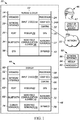
- the AVD 12 can be established by some or all of the components shown in Figure 1 .
- the AVD 12 can include one or more displays 14 that may be implemented by a high definition or ultra-high definition "4K" or higher flat screen and that may be touch-enabled for receiving user input signals via touches on the display.
- the AVD 12 may include one or more speakers 16 for outputting audio in accordance with present principles, and at least one additional input device 18 such as e.g. an audio receiver/microphone for e.g. entering audible commands to the AVD 12 to control the AVD 12.
- the example AVD 12 may also include one or more network interfaces 20 for communication over at least one network 22 such as the Internet, an WAN, an LAN, etc.
- the interface 20 may be, without limitation, a Wi-Fi transceiver, which is an example of a wireless computer network interface, such as but not limited to a mesh network transceiver. It is to be understood that the processor 24 controls the AVD 12 to undertake present principles, including the other elements of the AVD 12 described herein such as e.g. controlling the display 14 to present images thereon and receiving input therefrom.
- the network interface 20 may be, e.g., a wired or wireless modem or router, or other appropriate interface such as, e.g., a wireless telephony transceiver, or Wi-Fi transceiver as mentioned above, etc.
- the AVD 12 may also include one or more input ports 26 such as, e.g., a high definition multimedia interface (HDMI) port or a USB port to physically connect (e.g. using a wired connection) to another CE device and/or a headphone port to connect headphones to the AVD 12 for presentation of audio from the AVD 12 to a user through the headphones.
- the input port 26 may be connected via wire or wirelessly to a cable or satellite source 26a of audio video content.
- the source 26a may be, e.g., a separate or integrated set top box, or a satellite receiver.
- the source 26a may be a game console or disk player containing content such as computer game software and databases.
- the source 26a when implemented as a game console may include some or all of the components described below in relation to the CE device 44.
- the AVD 12 may further include one or more computer memories 28 such as disk-based or solid-state storage that are not transitory signals, in some cases embodied in the chassis of the AVD as standalone devices or as a personal video recording device (PVR) or video disk player either internal or external to the chassis of the AVD for playing back AV programs or as removable memory media.
- the AVD 12 can include a position or location receiver such as but not limited to a cellphone receiver, GPS receiver and/or altimeter 30 that is configured to e.g. receive geographic position information from at least one satellite or cellphone tower and provide the information to the processor 24 and/or determine an altitude at which the AVD 12 is disposed in conjunction with the processor 24.
- a position or location receiver such as but not limited to a cellphone receiver, GPS receiver and/or altimeter 30 that is configured to e.g. receive geographic position information from at least one satellite or cellphone tower and provide the information to the processor 24 and/or determine an altitude at which the AVD 12 is disposed in conjunction with
- the AVD 12 may include one or more cameras 32 that may be, e.g., a thermal imaging camera, a digital camera such as a webcam, and/or a camera integrated into the AVD 12 and controllable by the processor 24 to gather pictures/images and/or video in accordance with present principles. Any of the cameras described herein may employ the high spectrum camera example or multiple examples described further below.
- a Bluetooth transceiver 34 and other Near Field Communication (NFC) element 36 for communication with other devices using Bluetooth and/or NFC technology, respectively.
- NFC element can be a radio frequency identification (RFID) element. Zigbee also may be used.
- the AVD 12 may include one or more auxiliary sensors 37 (e.g., a motion sensor such as an accelerometer, gyroscope, cyclometer, or a magnetic sensor, an infrared (IR) sensor, an optical sensor, a speed and/or cadence sensor, a gesture sensor (e.g. for sensing gesture command), etc.) providing input to the processor 24.
- the AVD 12 may include an over-the-air TV broadcast port 38 for receiving OTA TV broadcasts providing input to the processor 24.
- the AVD 12 may also include an infrared (IR) transmitter and/or IR receiver and/or IR transceiver 42 such as an IR data association (IRDA) device.
- IRDA IR data association
- a battery (not shown) may be provided for powering the AVD 12.
- the system 10 may include one or more other CE device types.
- a first CE device 44 may be used to send computer game audio and video to the AVD 12 via commands sent directly to the AVD 12 and/or through the below-described server while a second CE device 46 may include similar components as the first CE device 44.
- the second CE device 46 may be configured as a VR headset worn by a player 47 as shown, or a hand-held game controller manipulated by the player 47.
- only two CE devices 44, 46 are shown, it being understood that fewer or greater devices may be used.
- the example non-limiting first CE device 44 may be established by any one of the above-mentioned devices, for example, a portable wireless laptop computer or notebook computer or game controller (also referred to as "console"), and accordingly may have one or more of the components described below.
- the first CE device 44 may be a remote control (RC) for, e.g., issuing AV play and pause commands to the AVD 12, or it may be a more sophisticated device such as a tablet computer, a game controller communicating via wired or wireless link with the AVD 12, a personal computer, a wireless telephone, etc.
- RC remote control
- the first CE device 44 may include one or more displays 50 that may be touch-enabled for receiving user input signals via touches on the display.
- the first CE device 44 may include one or more speakers 52 for outputting audio in accordance with present principles, and at least one additional input device 54 such as e.g. an audio receiver/microphone for e.g. entering audible commands to the first CE device 44 to control the device 44.
- the example first CE device 44 may also include one or more network interfaces 56 for communication over the network 22 under control of one or more CE device processors 58.
- a graphics processor 58A may also be included.
- the interface 56 may be, without limitation, a Wi-Fi transceiver, which is an example of a wireless computer network interface, including mesh network interfaces.
- the processor 58 controls the first CE device 44 to undertake present principles, including the other elements of the first CE device 44 described herein such as e.g. controlling the display 50 to present images thereon and receiving input therefrom.
- the network interface 56 may be, e.g., a wired or wireless modem or router, or other appropriate interface such as, e.g., a wireless telephony transceiver, or Wi-Fi transceiver as mentioned above, etc.
- the first CE device 44 may also include one or more input ports 60 such as, e.g., a HDMI port or a USB port to physically connect (e.g. using a wired connection) to another CE device and/or a headphone port to connect headphones to the first CE device 44 for presentation of audio from the first CE device 44 to a user through the headphones.
- the first CE device 44 may further include one or more tangible computer readable storage medium 62 such as disk-based or solid-state storage.
- the first CE device 44 can include a position or location receiver such as but not limited to a cellphone and/or GPS receiver and/or altimeter 64 that is configured to e.g.
- the CE device processor 58 receive geographic position information from at least one satellite and/or cell tower, using triangulation, and provide the information to the CE device processor 58 and/or determine an altitude at which the first CE device 44 is disposed in conjunction with the CE device processor 58.
- another suitable position receiver other than a cellphone and/or GPS receiver and/or altimeter may be used in accordance with present principles to e.g. determine the location of the first CE device 44 in e.g. all three dimensions.
- the first CE device 44 may include one or more cameras 66 that may be, e.g., a thermal imaging camera, a digital camera such as a webcam, and/or a camera integrated into the first CE device 44 and controllable by the CE device processor 58 to gather pictures/images and/or video in accordance with present principles.
- a Bluetooth transceiver 68 and other Near Field Communication (NFC) element 70 for communication with other devices using Bluetooth and/or NFC technology, respectively.
- NFC element can be a radio frequency identification (RFID) element.
- the first CE device 44 may include one or more auxiliary sensors 72 (e.g., a motion sensor such as an accelerometer, gyroscope, cyclometer, or a magnetic sensor, an infrared (IR) sensor, an optical sensor, a speed and/or cadence sensor, a gesture sensor (e.g. for sensing gesture command), etc.) providing input to the CE device processor 58.
- the first CE device 44 may include still other sensors such as e.g. one or more climate sensors 74 (e.g. barometers, humidity sensors, wind sensors, light sensors, temperature sensors, etc.) and/or one or more biometric sensors 76 providing input to the CE device processor 58.
- climate sensors 74 e.g. barometers, humidity sensors, wind sensors, light sensors, temperature sensors, etc.
- biometric sensors 76 providing input to the CE device processor 58.
- the first CE device 44 may also include an infrared (IR) transmitter and/or IR receiver and/or IR transceiver 78 such as an IR data association (IRDA) device.
- IR infrared
- IRDA IR data association
- a battery (not shown) may be provided for powering the first CE device 44.
- the CE device 44 may communicate with the AVD 12 through any of the above-described communication modes and related components.
- the second CE device 46 may include some or all of the components shown for the CE device 44. Either one or both CE devices may be powered by one or more batteries.
- At least one server 80 includes at least one server processor 82, at least one tangible computer readable storage medium 84 such as disk-based or solid-state storage, and at least one network interface 86 that, under control of the server processor 82, allows for communication with the other devices of Figure 1 over the network 22, and indeed may facilitate communication between servers and client devices in accordance with present principles.
- the network interface 86 may be, e.g., a wired or wireless modem or router, Wi-Fi transceiver, or other appropriate interface such as, e.g., a wireless telephony transceiver.
- the server 80 may be an Internet server or an entire server “farm” and may include and perform "cloud” functions such that the devices of the system 10 may access a "cloud" environment via the server 80 in example embodiments for, e.g., network gaming applications.
- the server 80 may be implemented by one or more game consoles or other computers in the same room as the other devices shown in Figure 1 or nearby.
- logical blocks, modules, and circuits described below can be implemented or performed with a general-purpose processor, a digital signal processor (DSP), a field programmable gate array (FPGA) or other programmable logic device such as an application specific integrated circuit (ASIC), discrete gate or transistor logic, discrete hardware components, or any combination thereof designed to perform the functions described herein.
- a processor can be implemented by a controller or state machine or a combination of computing devices.
- the methods herein may be implemented as software instructions executed by a processor, suitably configured application specific integrated circuits (ASIC) or field programmable gate array (FPGA) modules, or any other convenient manner as would be appreciated by those skilled in those art.
- the software instructions may be embodied in a non-transitory device such as a hard disk drive, CD ROM or Flash drive.
- the software code instructions may also be downloaded over the Internet.
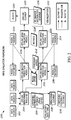
- FIG. 2 illustrates an example architecture 200 consistent with present principles, including hardware storage devices and software modules that are executed by appropriate processors.
- Multiple data sources 202 feed an offline benchmark building module 204 that accumulates real world customer interactions, sometimes referred to herein as "ground truth", such as actual product purchases, time dwelling on web pages, product rankings, etc.
- the data sources may include computer-based sales databases of various enterprises. This "ground truth" data may be stored in computer storage 206.
- Model features 208 for each of plural prediction models are supplied to respective offline batch prediction modules 210 with associated storages 212.
- the model features are the instructions that the prediction models are based on using respective model training process 214, and the offline batch prediction modules 210 are the model execution models that output the predictions of the models based on the features 208 of the models.
- Predicted model values from the modules 210 along with corresponding ground truth data are provided to respective offline probability absolute error (PAE) evaluation module 216, which may be implemented using weights as also discussed below to render weighted PAE (WPAE) that evaluate the efficacy of the models taking in account variety or position-based rankings, and output to metrics 218.
- the outputs of the PAEs 216 are used to identify the "best" from among the plural models 210 using an offline cleanup utility 220, which may provide visualization 222 of the results as well as alerts as the nature and availability of the results through various storages 226.
- a benchmark cleanup utility 228 with associated storage 230 also may be provided to groom the ground truth data for the PAE evaluation modules 216.
- the storages herein described may be distributed.
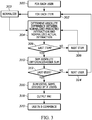
- Figures 3 and 4 illustrate example logic for determining probability absolute errors (PAE) among multiple prediction models and weighted PAE (WPAE), respectively.
- PAE probability absolute errors
- WPAE weighted PAE
- Examples of “items” can include computer simulations such as computer games, downloadable content (DLC) such as desktop themes, avatars, Add-Ons, and virtual currency, bundles, demonstration videos or other demonstration content, stories from a "what's new” news feed, friends, people, communities, and user-generated content (UGC) such as UGC videos, UGC broadcasts, and UCG images.
- DLC downloadable content
- UGC user-generated content
- PAE 1 U ⁇ u ⁇ U ⁇ i ⁇ I u p u , ⁇ ⁇ ⁇ p u , i
- U is the set of users, and
- u represents a single arbitrary user
- i represents a single arbitrary item.
- I u contains the actual positive items i that user u has interacted with, i.e., ground truth as recorded from actual user interactions with the item.
- p u , ⁇ ⁇ is the predicted score of the model under test for user u and item i.
- the logic moves to block 302 to execute the following steps for each item the user is predicted to interact with (or not).
- a normalization process is executed to ensure the predicted interaction and the actual interaction numbers follow the normalization constraint described above.
- the absolute difference is determined between the normalized predicted interaction and the normalized actual interaction of the user with the item under test. If it is determined that the item under test is not the last item at decision diamond 306, the logic flows to block 308 to retrieve the next item, i.e., the predicted and actual interactions for the next item for the user under test, returning to block 304 to proceed as described.
- the logic moves to block 310 to sum the absolute differences determined at block 304 for that user.
- the logic determines at state 312 whether the user under test is the last user to be processed, and if not, the logic moves to block 314 to retrieve the data associated with the next user, returning to block 302 to execute as described above.
- the logic moves to block 316 to sum the user sums from the iterations at block 310.
- the sum of the user sums is divided by the total number of users to render the PAE for the model under test, which is output at block 318.
- the process is repeated for all prediction models sought to be evaluated, with the model having the lowest PAE being indicated as the "best model" for use in e-commerce or other applications at block 320.
- PAE can be any value between zero (0), which is a perfect model, sometimes referred to herein as an "oracle", and two (2), which is a misguided model that predicts nothing correctly.
- the "best" model may be used to predict what product a particular user might purchase, so that advertising of that product can be targeted to that user.
- the "best” model may be used to predict how a user will rank a list of products, so that advertising of products higher on the list can be targeted to that user and products lower on the list not advertised to that user.
- the "best” model may be used to predict how long a user might dwell on a particular web page, so that targeted ads can be presented on web pages the model predicts the user will dwell a relatively long time on.
- present principles recognize that in some special cases when applying PAE, it may be biased towards certain hugely popular items if the actual data distribution is represented in such way.
- Present principles seek a metric that rewards variety in the sense that it is desired to reward in higher proportions the cases of predicting lesser popular items correctly. In other words, correct predictions on more popular items will be discounted according to a monotonic transformation.
- Other example special cases include position-based ranking where correct predictions that are ranked higher will be rewarded according to a position-based transformation.
- WPAE weighted PAW
- I u ⁇ contains the predictions and I u contains the actual positive items i that user u has interacted with
- w i is the discounted weight associated with such item i, calculated from the ground truth, which can be 1 if no discount is enforced, or can be any monotonic transformation, for example, discounts related to item frequency, square root of frequency divided by frequency freq / freq or log( freq )/ freq.
- FIG. 4 illustrates further.
- individual user sums are obtained in the same manner as shown in states 304-310 in Figure 3 .
- each predicted interaction is weighted to produce a weighted predicted interaction and the weighted prediction interactions are summed to produce a weighted item sum.
- each user sum is multiplied by the weighted item sum to produce a user sum product, with the user sum products for all users being summed at block 406.
- the sum at block 406 is processed at block 408 as follows to establish the WPAE for the model under test: for each item that the model predicted this target will be non-negative (e.g., the user will purchase/read/click/dwell on this item), calculate the value of weight w_I * predicted probability p_u,I. Finally, sum over all items for each target user, and sum then sum over all users.
- a naive model predicting all item1 will predict correctly 7 times and incorrectly 3 times. Among the 7 times, for each user the individual error between predicted and ground truth is 0; among the 3 times, for each user the individual error is 2.
- This example deals with cases in which a user purchases more than one item. Similar to the previous example, suppose we have two items. We differ from the previous example in that users 1 to 6 are assumed to have purchased item1, users 7 to 9 purchased item2, and user 10 purchased both items equally likely. There are 11 purchases now, with item1 being purchased 7 times and item2 being purchased 4 times. This distinction is important as shown below when the discount factor is calculated.
- a naive model predicting all item1 will be correct 6 times and partially correct 1 time.
- the individual error between predicted and actual is 0; among the 3 times, for each user the individual error is 2; among the 1 time, for each user the individual error is
- 1.
- the WPAE is
- 1, since this model predicted item1 for user10.
- a complete miss model predicts item1 correctly 0 out of 6 times, predicts item2 correctly 0 out of 3 times and predicts for user 10 incorrectly neither time (for convenience of illustration, we can assume that a complete miss model predicts another item, say item3 for user10.)
- model1 and model2 have exactly the same overall PAE.
- the discounting gives a small reward for predicting item2 (i2) correctly.
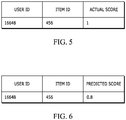
- Figure 5 illustrates a data structure correlating a user to a ground truth interaction (or item) and a score of the interaction, in the example shown, "1", meaning that the user interacted (as opposed to not interacting) with the item.
- Figure 6 illustrates a data structure for a model prediction of the user interaction, in the example shown, 0.8.
- each user will be associated with multiple interactions (items) and corresponding ground truth and predicted scores, and each model will be associated with multiple users.
- Figures 5 and 6 essentially illustrate the input values in the equations above for PAE and WPAE.
- a perfectly random model 704 predicts the same probability for all items.
- normalization is indicated in the figures, in which the sum of all values for all items equals unity (1), it being understood that the values shown are indicated as summing to unity for clarity despite the ellipsis 706 which is used only to indicate that more items than shown typically are analyzed.
- Figure 9 indicates inside the oval 900 an average model with a PAE of 1.
- Figures 10-13 respectively illustrate, for multiple positive items, a perfect model 1000 ( Figure 10 ), a good model 1100 ( Figure 11 ), consistent models 1200 ( Figure 12 ), and a misguided model 1300 ( Figure 13 ).
- Figures 14 and 15 illustrate differences in measures between PAE and WPAE for certain models while figure 16 illustrates that for a perfectly misguided model, PAE and WPAE both so indicate.
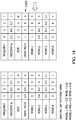
- two models 1 and 2 yield the same PAE for the conditions shown, but different WPAEs, owing to a more unbalanced ground truth statistic for user 2 compared to user 1 as shown in row 1400, with the remaining statistics being identical across both users for all four items.
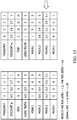
- Figure 15 illustrates the same statistics for a less accurate model (model 3) with concomitant differences in PAE and WPAE.
- Figure 16 shows that for a perfectly misguided model (model 4), both measures (PAE and WPAE) are the same, indicating a complete miss.
- PAE provides a consistent, flexible metric that advantageously abstracts away domain details and focuses on evaluation only.
- Evaluated models can incorporate domain knowledge or model specific information into the normalization (e.g., using top 20 or 30, confidence in scores).
- Ground truth can be normalized with business knowledge in mind (e.g., dealing with numeric values like play time, number of purchases, revenue gained; how to deal with negative values like refunds, negative reviews).
- the fixed range of [0, 2], with 0 as a perfect match and 2 as a complete miss makes PAE easily understandable, with lower scores meaning better models.
- PAE rewards models with high ranking power and normalizes probability as a proxy for ranking. Models predicting higher probability for a positive sample will score higher.
- WPAE WPAE
- WPAE WPAE
- WPAE is provided that is consistent and flexible because it is applicable to a wide range of scores and is flexible in incorporating domain knowledge into data and model normalization. WPAE also is flexible in balancing between enforcing data natural distribution and encouraging variety, and like PAE is easy to communicate and understand.
Landscapes
- Engineering & Computer Science (AREA)
- Business, Economics & Management (AREA)
- Accounting & Taxation (AREA)
- Development Economics (AREA)
- Finance (AREA)
- Strategic Management (AREA)
- Entrepreneurship & Innovation (AREA)
- Physics & Mathematics (AREA)
- General Physics & Mathematics (AREA)
- Data Mining & Analysis (AREA)
- Theoretical Computer Science (AREA)
- General Business, Economics & Management (AREA)
- Marketing (AREA)
- Economics (AREA)
- Game Theory and Decision Science (AREA)
- Mathematical Physics (AREA)
- Mathematical Optimization (AREA)
- Mathematical Analysis (AREA)
- Computational Mathematics (AREA)
- Pure & Applied Mathematics (AREA)
- Computing Systems (AREA)
- Algebra (AREA)
- Databases & Information Systems (AREA)
- Software Systems (AREA)
- General Engineering & Computer Science (AREA)
- Management, Administration, Business Operations System, And Electronic Commerce (AREA)
Abstract
Description
- The application relates to evaluating engagement relevance models.
- Relevance models are used to predict various e-commerce metrics including what products a particular user is likely to buy, how long a particular user is likely to remain on a particular web page, and how a user is likely to rank multiple items. An accurate relevance model plainly is important in modern commerce to personalize customer experiences based on such factors as how customers purchase the products, how customers interact with news feeds, how customers interact with media contents, and so on. In order to provide these experiences, organizations need to build relevance models that would provide scores of how users are related to various type of items.
- As recognized herein, existing methods for evaluating the effectiveness of relevance models do not adequately account for multiple types of ground truth, such as binary types (e.g., whether a user purchased an item or not), multivariate types (e.g., ranks of the similarity of items to an anchor item), and numeric types (e.g., dwell time on a web page). Moreover, existing methods for evaluating the effectiveness of relevance models are inflexible in terms of having one relevance metric accounting for not only classification problems, ranking problems, but also estimation problems. Moreover, existing methods for evaluating the effectiveness of relevance models are inflexible in handling special cases, for example, encouraging variety in recommended products, and applying position-based ranking at the same time. Moreover, existing methods for evaluating the effectiveness of relevance models do not handle the three requirements at the same time: i) accounting for differences in the proportional importance of items, which can skew the results; ii) adequately penalizing incorrect predictions; iii) adequately distinguish models in the face of equally good results. Additionally, the metric for evaluating the effectiveness of relevance models need to communicate results of the evaluation easily and in a quantifiable manner (for example, with a metric constrained between in the fixed range, unlike RMSE and MAE, two existing metrics for regression models).
- Accordingly, a device includes at least one computer storage that is not a transitory signal and that in turn includes instructions executable by at least one processor to, for a first model, determine, for each of plural sets of a user and an item, an absolute difference between a first value representing a model prediction of a user interaction with the item, and a second value representing an actual user interaction with the item. The instructions are executable to, for each of a number of users, across all items, normalize the first value such that the values sum to unity. Similar normalization instructions are applied to the second value. The instructions are executable to, for each of a number of users, sum the absolute differences determined for plural items to render a user sum, sum the user sums to render a total, and divide the total by the number of users to render a probability absolute error (PAE). A PAE is similarly determined for at least a second model. The first model is output as being a better model based on the first model having a lower PAE than the second model, otherwise the second model is output as the better model, and the better model is used for providing e-commerce, including computer simulations.
- In some implementations, to account for special cases, for example, evaluation skew due to disproportionately popular test interactions, the instructions can be executable to, prior to summing the user sums, multiply at least some user sums by a sum of weighted second values representing the actual user interactions with the item to render weighted user sums. The instructions may be further executable to, for each target user, for each item that the model predicted this target will be non-negative (e.g., the user will purchase/read/click/dwell on this item), calculate the value of weight w_I * predicted probability p_u,I, sum over all items for each target user, and sum the sum over all users to render a weighted PAE (WPAE). In this embodiment, the instructions can be executable to output the first model is being a better model based on the first model having a lower WPAE than the second model, and otherwise output the second model as the better model for use of the better model in providing e-commerce.
- In another aspect, a computer-implemented method includes receiving plural engagement relevance models useful for e-commerce and computer simulation purposes. The method includes evaluating predictions of the plural models offline against ground truth to determine which is the better model at predicting at least one metric. The evaluating includes normalizing to unity the ground truth and model predictions for each of multiple users, summing absolute errors between ground truth and model predictions for each of multiple users, sum the user sums to render a total, and divide the total by the number of users to render a probability absolute error (PAE).
- In another aspect, an apparatus includes at least one processor and at least one computer storage accessible to the processor and including instructions executable by the processor to determine, for a first model, a first probability absolute error (PAE) having a value of between zero and two, inclusive. The instructions are executable to determine, for a second model, a second PAE having a value of between zero and two, inclusive, and responsive to the first PAE being less than the second PAE, use the first model to predict user interactions in e-commerce. The instructions are executable to, responsive to the first PAE being greater than the second PAE, use the second model to predict user interactions in e-commerce.
- The details of the present application, both as to its structure and operation, can best be understood in reference to the accompanying drawings, in which like reference numerals refer to like parts, and in which:
-
-
Figure 1 is a block diagram of an example system including an example in accordance with present principles; -
Figure 2 is a block diagram of an example architecture according to present principles; -
Figure 3 is a flow chart of example logic consistent with present principles for determining PAE; -
Figure 4 is a flow chart of example logic consistent with present principles for determining WPAE; -
Figures 5 and 6 illustrate data structures showing inputs to the evaluation; -
Figures 7 and8 respectively indicate, for single positive item scenarios, a perfect ("oracle") model, and a completely misguided model; -
Figure 9 indicates an average model; -
Figures 10-13 respectively illustrate, for multiple positive items, a perfect model, a good model, consistent models, and a misguided model; and -
Figures 14-16 respectively illustrate comparisons of PAE to WPAE for example models. - This disclosure relates generally to computer ecosystems including aspects of consumer electronics (CE) device networks such as but not limited to computer simulation networks such as computer game networks. A system herein may include server and client components, connected over a network such that data may be exchanged between the client and server components. The client components may include one or more computing devices including game consoles such as Sony PlayStation® or a game console made by Microsoft or Nintendo or other manufacturer virtual reality (VR) headsets, augmented reality (AR) headsets, portable televisions (e.g. smart TVs, Internet-enabled TVs), portable computers such as laptops and tablet computers, and other mobile devices including smart phones and additional examples discussed below. These client devices may operate with a variety of operating environments. For example, some of the client computers may employ, as examples, Linux operating systems, operating systems from Microsoft, or a Unix operating system, or operating systems produced by Apple Computer or Google. These operating environments may be used to execute one or more browsing programs, such as a browser made by Microsoft or Google or Mozilla or other browser program that can access websites hosted by the Internet servers discussed below. Also, an operating environment according to present principles may be used to execute one or more computer game programs.
- Servers and/or gateways may include one or more processors executing instructions that configure the servers to receive and transmit data over a network such as the Internet. Or, a client and server can be connected over a local intranet or a virtual private network. A server or controller may be instantiated by a game console such as a Sony PlayStation®, a personal computer, etc.
- Information may be exchanged over a network between the clients and servers. To this end and for security, servers and/or clients can include firewalls, load balancers, temporary storages, and proxies, and other network infrastructure for reliability and security. One or more servers may form an apparatus that implement methods of providing a secure community such as an online social website to network members.
- As used herein, instructions refer to computer-implemented steps for processing information in the system. Instructions can be implemented in software, firmware or hardware and include any type of programmed step undertaken by components of the system.
- A processor may be any conventional general-purpose single- or multi-chip processor that can execute logic by means of various lines such as address lines, data lines, and control lines and registers and shift registers.
- Software modules described by way of the flow charts and user interfaces herein can include various sub-routines, procedures, etc. Without limiting the disclosure, logic stated to be executed by a particular module can be redistributed to other software modules and/or combined together in a single module and/ or made available in a shareable library.
- Present principles described herein can be implemented as hardware, software, firmware, or combinations thereof; hence, illustrative components, blocks, modules, circuits, and steps are set forth in terms of their functionality.
- The functions and methods described below, when implemented in software, can be written in an appropriate language such as but not limited to Java, C# or C++, and can be stored on or transmitted through a computer-readable storage medium such as a random access memory (RAM), read-only memory (ROM), electrically erasable programmable read-only memory (EEPROM), compact disk read-only memory (CD-ROM) or other optical disk storage such as digital versatile disc (DVD), magnetic disk storage or other magnetic storage devices including removable thumb drives, etc. A connection may establish a computer-readable medium. Such connections can include, as examples, hard-wired cables including fiber optics and coaxial wires and digital subscriber line (DSL) and twisted pair wires. Such connections may include wireless communication connections including infrared and radio.
- Components included in one embodiment can be used in other embodiments in any appropriate combination. For example, any of the various components described herein and/or depicted in the Figures may be combined, interchanged or excluded from other embodiments.
- "A system having at least one of A, B, and C" (likewise "a system having at least one of A, B, or C" and "a system having at least one of A, B, C") includes systems that have A alone, B alone, C alone, A and B together, A and C together, B and C together, and/or A, B, and C together, etc.
- Now specifically referring to
Figure 1 , anexample system 10 is shown, which may include one or more of the example devices mentioned above and described further below in accordance with present principles. The first of the example devices included in thesystem 10 is a consumer electronics (CE) device such as an audio video device (AVD) 12 such as but not limited to an Internet-enabled TV with a TV tuner (equivalently, set top box controlling a TV). However, theAVD 12 alternatively may be an appliance or household item, e.g. computerized Internet enabled refrigerator, washer, or dryer. TheAVD 12 alternatively may also be a computerized Internet enabled ("smart") telephone, a tablet computer, a notebook computer, a wearable computerized device such as e.g. computerized Internet-enabled watch, a computerized Internet-enabled bracelet, other computerized Internet-enabled devices, a computerized Internet-enabled music player, computerized Internet-enabled head phones, a computerized Internet-enabled implantable device such as an implantable skin device, etc. Regardless, it is to be understood that theAVD 12 is configured to undertake present principles (e.g. communicate with other CE devices to undertake present principles, execute the logic described herein, and perform any other functions and/or operations described herein). - Accordingly, to undertake such principles the
AVD 12 can be established by some or all of the components shown inFigure 1 . For example, theAVD 12 can include one ormore displays 14 that may be implemented by a high definition or ultra-high definition "4K" or higher flat screen and that may be touch-enabled for receiving user input signals via touches on the display. TheAVD 12 may include one ormore speakers 16 for outputting audio in accordance with present principles, and at least one additional input device 18 such as e.g. an audio receiver/microphone for e.g. entering audible commands to theAVD 12 to control theAVD 12. Theexample AVD 12 may also include one or more network interfaces 20 for communication over at least onenetwork 22 such as the Internet, an WAN, an LAN, etc. under control of one ormore processors 24. Agraphics processor 24A may also be included. Thus, theinterface 20 may be, without limitation, a Wi-Fi transceiver, which is an example of a wireless computer network interface, such as but not limited to a mesh network transceiver. It is to be understood that theprocessor 24 controls theAVD 12 to undertake present principles, including the other elements of theAVD 12 described herein such as e.g. controlling thedisplay 14 to present images thereon and receiving input therefrom. Furthermore, note thenetwork interface 20 may be, e.g., a wired or wireless modem or router, or other appropriate interface such as, e.g., a wireless telephony transceiver, or Wi-Fi transceiver as mentioned above, etc. - In addition to the foregoing, the
AVD 12 may also include one ormore input ports 26 such as, e.g., a high definition multimedia interface (HDMI) port or a USB port to physically connect (e.g. using a wired connection) to another CE device and/or a headphone port to connect headphones to theAVD 12 for presentation of audio from theAVD 12 to a user through the headphones. For example, theinput port 26 may be connected via wire or wirelessly to a cable orsatellite source 26a of audio video content. Thus, thesource 26a may be, e.g., a separate or integrated set top box, or a satellite receiver. Or, thesource 26a may be a game console or disk player containing content such as computer game software and databases. Thesource 26a when implemented as a game console may include some or all of the components described below in relation to theCE device 44. - The
AVD 12 may further include one ormore computer memories 28 such as disk-based or solid-state storage that are not transitory signals, in some cases embodied in the chassis of the AVD as standalone devices or as a personal video recording device (PVR) or video disk player either internal or external to the chassis of the AVD for playing back AV programs or as removable memory media. Also in some embodiments, theAVD 12 can include a position or location receiver such as but not limited to a cellphone receiver, GPS receiver and/oraltimeter 30 that is configured to e.g. receive geographic position information from at least one satellite or cellphone tower and provide the information to theprocessor 24 and/or determine an altitude at which theAVD 12 is disposed in conjunction with theprocessor 24. However, it is to be understood that another suitable position receiver other than a cellphone receiver, GPS receiver and/or altimeter may be used in accordance with present principles to e.g. determine the location of theAVD 12 in e.g. all three dimensions. - Continuing the description of the
AVD 12, in some embodiments theAVD 12 may include one ormore cameras 32 that may be, e.g., a thermal imaging camera, a digital camera such as a webcam, and/or a camera integrated into theAVD 12 and controllable by theprocessor 24 to gather pictures/images and/or video in accordance with present principles. Any of the cameras described herein may employ the high spectrum camera example or multiple examples described further below. - Also included on the
AVD 12 may be aBluetooth transceiver 34 and other Near Field Communication (NFC) element 36 for communication with other devices using Bluetooth and/or NFC technology, respectively. An example NFC element can be a radio frequency identification (RFID) element. Zigbee also may be used. - Further still, the
AVD 12 may include one or more auxiliary sensors 37 (e.g., a motion sensor such as an accelerometer, gyroscope, cyclometer, or a magnetic sensor, an infrared (IR) sensor, an optical sensor, a speed and/or cadence sensor, a gesture sensor (e.g. for sensing gesture command), etc.) providing input to theprocessor 24. TheAVD 12 may include an over-the-airTV broadcast port 38 for receiving OTA TV broadcasts providing input to theprocessor 24. In addition to the foregoing, it is noted that theAVD 12 may also include an infrared (IR) transmitter and/or IR receiver and/orIR transceiver 42 such as an IR data association (IRDA) device. A battery (not shown) may be provided for powering theAVD 12. - Still referring to
Figure 1 , in addition to theAVD 12, thesystem 10 may include one or more other CE device types. In one example, afirst CE device 44 may be used to send computer game audio and video to theAVD 12 via commands sent directly to theAVD 12 and/or through the below-described server while asecond CE device 46 may include similar components as thefirst CE device 44. In the example shown, thesecond CE device 46 may be configured as a VR headset worn by aplayer 47 as shown, or a hand-held game controller manipulated by theplayer 47. In the example shown, only twoCE devices - In the example shown, to illustrate present principles all three
devices lines 48, unless explicitly claimed otherwise. - The example non-limiting
first CE device 44 may be established by any one of the above-mentioned devices, for example, a portable wireless laptop computer or notebook computer or game controller (also referred to as "console"), and accordingly may have one or more of the components described below. Thefirst CE device 44 may be a remote control (RC) for, e.g., issuing AV play and pause commands to theAVD 12, or it may be a more sophisticated device such as a tablet computer, a game controller communicating via wired or wireless link with theAVD 12, a personal computer, a wireless telephone, etc. - Accordingly, the
first CE device 44 may include one ormore displays 50 that may be touch-enabled for receiving user input signals via touches on the display. Thefirst CE device 44 may include one ormore speakers 52 for outputting audio in accordance with present principles, and at least one additional input device 54 such as e.g. an audio receiver/microphone for e.g. entering audible commands to thefirst CE device 44 to control thedevice 44. The examplefirst CE device 44 may also include one or more network interfaces 56 for communication over thenetwork 22 under control of one or moreCE device processors 58. Agraphics processor 58A may also be included. Thus, theinterface 56 may be, without limitation, a Wi-Fi transceiver, which is an example of a wireless computer network interface, including mesh network interfaces. It is to be understood that theprocessor 58 controls thefirst CE device 44 to undertake present principles, including the other elements of thefirst CE device 44 described herein such as e.g. controlling thedisplay 50 to present images thereon and receiving input therefrom. Furthermore, note thenetwork interface 56 may be, e.g., a wired or wireless modem or router, or other appropriate interface such as, e.g., a wireless telephony transceiver, or Wi-Fi transceiver as mentioned above, etc. - In addition to the foregoing, the
first CE device 44 may also include one ormore input ports 60 such as, e.g., a HDMI port or a USB port to physically connect (e.g. using a wired connection) to another CE device and/or a headphone port to connect headphones to thefirst CE device 44 for presentation of audio from thefirst CE device 44 to a user through the headphones. Thefirst CE device 44 may further include one or more tangible computerreadable storage medium 62 such as disk-based or solid-state storage. Also in some embodiments, thefirst CE device 44 can include a position or location receiver such as but not limited to a cellphone and/or GPS receiver and/oraltimeter 64 that is configured to e.g. receive geographic position information from at least one satellite and/or cell tower, using triangulation, and provide the information to theCE device processor 58 and/or determine an altitude at which thefirst CE device 44 is disposed in conjunction with theCE device processor 58. However, it is to be understood that another suitable position receiver other than a cellphone and/or GPS receiver and/or altimeter may be used in accordance with present principles to e.g. determine the location of thefirst CE device 44 in e.g. all three dimensions. - Continuing the description of the
first CE device 44, in some embodiments thefirst CE device 44 may include one ormore cameras 66 that may be, e.g., a thermal imaging camera, a digital camera such as a webcam, and/or a camera integrated into thefirst CE device 44 and controllable by theCE device processor 58 to gather pictures/images and/or video in accordance with present principles. Also included on thefirst CE device 44 may be aBluetooth transceiver 68 and other Near Field Communication (NFC) element 70 for communication with other devices using Bluetooth and/or NFC technology, respectively. An example NFC element can be a radio frequency identification (RFID) element. - Further still, the
first CE device 44 may include one or more auxiliary sensors 72 (e.g., a motion sensor such as an accelerometer, gyroscope, cyclometer, or a magnetic sensor, an infrared (IR) sensor, an optical sensor, a speed and/or cadence sensor, a gesture sensor (e.g. for sensing gesture command), etc.) providing input to theCE device processor 58. Thefirst CE device 44 may include still other sensors such as e.g. one or more climate sensors 74 (e.g. barometers, humidity sensors, wind sensors, light sensors, temperature sensors, etc.) and/or one or morebiometric sensors 76 providing input to theCE device processor 58. In addition to the foregoing, it is noted that in some embodiments thefirst CE device 44 may also include an infrared (IR) transmitter and/or IR receiver and/orIR transceiver 78 such as an IR data association (IRDA) device. A battery (not shown) may be provided for powering thefirst CE device 44. TheCE device 44 may communicate with theAVD 12 through any of the above-described communication modes and related components. - The
second CE device 46 may include some or all of the components shown for theCE device 44. Either one or both CE devices may be powered by one or more batteries. - Now in reference to the afore-mentioned at least one
server 80, it includes at least oneserver processor 82, at least one tangible computerreadable storage medium 84 such as disk-based or solid-state storage, and at least onenetwork interface 86 that, under control of theserver processor 82, allows for communication with the other devices ofFigure 1 over thenetwork 22, and indeed may facilitate communication between servers and client devices in accordance with present principles. Note that thenetwork interface 86 may be, e.g., a wired or wireless modem or router, Wi-Fi transceiver, or other appropriate interface such as, e.g., a wireless telephony transceiver. - Accordingly, in some embodiments the
server 80 may be an Internet server or an entire server "farm" and may include and perform "cloud" functions such that the devices of thesystem 10 may access a "cloud" environment via theserver 80 in example embodiments for, e.g., network gaming applications. Or, theserver 80 may be implemented by one or more game consoles or other computers in the same room as the other devices shown inFigure 1 or nearby. - Further to what has been alluded to above, logical blocks, modules, and circuits described below can be implemented or performed with a general-purpose processor, a digital signal processor (DSP), a field programmable gate array (FPGA) or other programmable logic device such as an application specific integrated circuit (ASIC), discrete gate or transistor logic, discrete hardware components, or any combination thereof designed to perform the functions described herein. A processor can be implemented by a controller or state machine or a combination of computing devices. Thus, the methods herein may be implemented as software instructions executed by a processor, suitably configured application specific integrated circuits (ASIC) or field programmable gate array (FPGA) modules, or any other convenient manner as would be appreciated by those skilled in those art. Where employed, the software instructions may be embodied in a non-transitory device such as a hard disk drive, CD ROM or Flash drive. The software code instructions may also be downloaded over the Internet.
-
Figure 2 illustrates anexample architecture 200 consistent with present principles, including hardware storage devices and software modules that are executed by appropriate processors.Multiple data sources 202 feed an offlinebenchmark building module 204 that accumulates real world customer interactions, sometimes referred to herein as "ground truth", such as actual product purchases, time dwelling on web pages, product rankings, etc. The data sources may include computer-based sales databases of various enterprises. This "ground truth" data may be stored incomputer storage 206. - Model features 208 for each of plural prediction models are supplied to respective offline
batch prediction modules 210 with associatedstorages 212. The model features are the instructions that the prediction models are based on using respectivemodel training process 214, and the offlinebatch prediction modules 210 are the model execution models that output the predictions of the models based on the features 208 of the models. - Predicted model values from the
modules 210 along with corresponding ground truth data are provided to respective offline probability absolute error (PAE)evaluation module 216, which may be implemented using weights as also discussed below to render weighted PAE (WPAE) that evaluate the efficacy of the models taking in account variety or position-based rankings, and output tometrics 218. The outputs of the PAEs 216 (metrics 218) are used to identify the "best" from among theplural models 210 using anoffline cleanup utility 220, which may providevisualization 222 of the results as well as alerts as the nature and availability of the results throughvarious storages 226. In the example shown, abenchmark cleanup utility 228 with associatedstorage 230 also may be provided to groom the ground truth data for thePAE evaluation modules 216. The storages herein described may be distributed. -
Figures 3 and4 illustrate example logic for determining probability absolute errors (PAE) among multiple prediction models and weighted PAE (WPAE), respectively. In general, assume that a user-item relevance model aims to model a relevance function p(u,i) → s, so that, for each user u and item i, there is a relevance score "s" to measure how the item is related to the user. - Examples of "items" can include computer simulations such as computer games, downloadable content (DLC) such as desktop themes, avatars, Add-Ons, and virtual currency, bundles, demonstration videos or other demonstration content, stories from a "what's new" news feed, friends, people, communities, and user-generated content (UGC) such as UGC videos, UGC broadcasts, and UCG images.
- With the above in mind, PAE is introduced as follows:

- Where U is the set of users, and |U| is the total number of users, u represents a single arbitrary user, and i represents a single arbitrary item. I u contains the actual positive items i that user u has interacted with, i.e., ground truth as recorded from actual user interactions with the item. pu,i represents the actual normalized interaction score of user u to item i, for example, 1 or 0 if this is an purchase event (1= purchase, 0 = no purchase); 1 or 9 for time spent on a page (which will then be normalized to numbers 0.1 and 0.9), etc. Similarly,


- Commencing at
block 300, for each user in the data set, the logic moves to block 302 to execute the following steps for each item the user is predicted to interact with (or not). Moving to block 303, a normalization process is executed to ensure the predicted interaction and the actual interaction numbers follow the normalization constraint described above. Atblock 304, as indicated in the equation above the absolute difference is determined between the normalized predicted interaction and the normalized actual interaction of the user with the item under test. If it is determined that the item under test is not the last item atdecision diamond 306, the logic flows to block 308 to retrieve the next item, i.e., the predicted and actual interactions for the next item for the user under test, returning to block 304 to proceed as described. - On the other hand, responsive to determining at
state 306 that the last item has been processed for the user under test, the logic moves to block 310 to sum the absolute differences determined atblock 304 for that user. The logic then determines atstate 312 whether the user under test is the last user to be processed, and if not, the logic moves to block 314 to retrieve the data associated with the next user, returning to block 302 to execute as described above. - In contrast, responsive to determining at
state 312 that interaction information for the last user has been processed, the logic moves to block 316 to sum the user sums from the iterations atblock 310. The sum of the user sums is divided by the total number of users to render the PAE for the model under test, which is output atblock 318. The process is repeated for all prediction models sought to be evaluated, with the model having the lowest PAE being indicated as the "best model" for use in e-commerce or other applications atblock 320. - Note that owing to the normalization discussed above, PAE can be any value between zero (0), which is a perfect model, sometimes referred to herein as an "oracle", and two (2), which is a misguided model that predicts nothing correctly.
- By way of non-limiting example, the "best" model may be used to predict what product a particular user might purchase, so that advertising of that product can be targeted to that user. Or, the "best" model may be used to predict how a user will rank a list of products, so that advertising of products higher on the list can be targeted to that user and products lower on the list not advertised to that user. Or, the "best" model may be used to predict how long a user might dwell on a particular web page, so that targeted ads can be presented on web pages the model predicts the user will dwell a relatively long time on.
- To introduce
Figure 4 , present principles recognize that in some special cases when applying PAE, it may be biased towards certain hugely popular items if the actual data distribution is represented in such way. Present principles seek a metric that rewards variety in the sense that it is desired to reward in higher proportions the cases of predicting lesser popular items correctly. In other words, correct predictions on more popular items will be discounted according to a monotonic transformation. Other example special cases include position-based ranking where correct predictions that are ranked higher will be rewarded according to a position-based transformation. - With the above in mind, a weighted PAW (WPAE) is introduced as follows:

- Here


For an "oracle" (i.e., a perfect model that knows the exact ground truth), it will still have WPAE = 0. For a model that totally misses the truth, it will still have WPAE = 2.Figure 4 illustrates further. Commencing atblock 400, individual user sums are obtained in the same manner as shown in states 304-310 inFigure 3 . Moving to block 402, for each user sum, each predicted interaction is weighted to produce a weighted predicted interaction and the weighted prediction interactions are summed to produce a weighted item sum. Moving to block 404, each user sum is multiplied by the weighted item sum to produce a user sum product, with the user sum products for all users being summed at block 406. The sum at block 406 is processed atblock 408 as follows to establish the WPAE for the model under test: for each item that the model predicted this target will be non-negative (e.g., the user will purchase/read/click/dwell on this item), calculate the value of weight w_I * predicted probability p_u,I. Finally, sum over all items for each target user, and sum then sum over all users. - As an example, suppose we have two items, item1 with frequency 70%, and item2 with
frequency 30%.Users 1 to 7 purchased item1, and users 8 to 10 purchased item2. - A naive model predicting all item1 will predict correctly 7 times and incorrectly 3 times. Among the 7 times, for each user the individual error between predicted and ground truth is 0; among the 3 times, for each user the individual error is 2.
- Without a discount, w1 = 1, w2 = 1. Recall that each user only purchased one item so the predicted interaction = for all u, i, u ∈ 1, 2, i ∈ 1...10. Then the WPAE equals 1/((1x7) + (1x3)) x (1x7x0+1x3x2) = 0.60 (no weights applied).
- Now, if


- Another model predicting item1 correctly 6 out of 7 times and predicting item2 correctly 1 out of 3 times will get:


- Yet another model predicting item1 correctly 4 out of 7 times and predicting item2 correctly 3 out of 3 times will get:


- A complete miss model predicting item1 correctly 0 out of 7 times and predicting item2 correctly 0 out of 3 times will get:


- This example deals with cases in which a user purchases more than one item. Similar to the previous example, suppose we have two items. We differ from the previous example in that
users 1 to 6 are assumed to have purchased item1, users 7 to 9 purchased item2, anduser 10 purchased both items equally likely. There are 11 purchases now, with item1 being purchased 7 times and item2 being purchased 4 times. This distinction is important as shown below when the discount factor is calculated. - A naive model predicting all item1 will be correct 6 times and partially correct 1 time. Among the 6 times, for each user the individual error between predicted and actual is 0; among the 3 times, for each user the individual error is 2; among the 1 time, for each user the individual error is |0.5 - 1|+|0.5 - 0| = 1.

- Now, with a weighted discount, the discounted weights must be known. w1 for item1 is


- A complete miss model predicts item1 correctly 0 out of 6 times, predicts item2 correctly 0 out of 3 times and predicts for
user 10 incorrectly neither time (for convenience of illustration, we can assume that a complete miss model predicts another item, say item3 for user10.)
- And its weighted WPAE remains 2, the highest score possible:

- Now assume four items and only two users. The item frequencies for four items are 4,3,2,1. Using a discount transformation of square root of freq/freq the discount factors are shown in the tables. The following tables shows the ground truth and four models with different predictions.
-
Frequency 4 3 2 1 discount wi 0.5 0.6 0.7 1 item i1 i2 i3 i4 user1 truth 0.5 0.5 0 0 model 10 0 0 0 model 20.6 0.4 0 0 model 30.2 0.2 0.5 0.1 model 40 0 0 1 -
Frequency 4 3 2 1 discount wi 0.5 0.6 0.7 1 item i1 i2 i3 i4 user2 truth 1 0 0 0 model 11 0 0 0 model 20.6 0.4 0 0 model 30.2 0.2 0.5 0.1 model 40 0 0 1 - For all models, user1 has the sum of items times weighted ground truth = .5∗.5+.6∗.5 = .55 and
user 2 has .5∗1 +.5 = 1, PAE for user2 is 1-1+0 = 0 and
- For model2, PAE for user1 is 0.6 - 0.5 + 0.5 - 0.4 = 0.2, PAE for user2 is 1 - 0.6 + 0.4 = 0.8

- Note that without adding the discount factor, model1 and model2 have exactly the same overall PAE. Here the discounting gives a small reward for predicting item2 (i2) correctly.
- For model3, PAE for user1 is 0.5-0.2+0.5-0.2+0.5+0.1 = 0.3+0.3+(1- 0.4) = 1.2. PAE for user2 is 1 - 0.2 + 0.2 + 0.5 + 0.1 = 1 - 0.2 +(1 - 0.2) = 1.6

- For model4, PAE for user1 is 0.5 + 0.5 + 1 = 2, PAE for user2 is 1 - 0 + 1 - 0 = 2

-
Figure 5 illustrates a data structure correlating a user to a ground truth interaction (or item) and a score of the interaction, in the example shown, "1", meaning that the user interacted (as opposed to not interacting) with the item.Figure 6 illustrates a data structure for a model prediction of the user interaction, in the example shown, 0.8. Typically, each user will be associated with multiple interactions (items) and corresponding ground truth and predicted scores, and each model will be associated with multiple users.Figures 5 and 6 essentially illustrate the input values in the equations above for PAE and WPAE. -
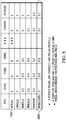
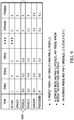
Figures 7 and8 respectively indicate, for single positive item scenarios, a perfect ("oracle") model indicated by the oval 700 inFigure 7 , which perfectly predicts actual or ground truth results 702 across all items (PAE=0), and a completely misguided model indicated by the oval 800 inFigure 8 , which predicts zero actual or ground truth results 702 across all items (PAE= 2). Note that a perfectlyrandom model 704 predicts the same probability for all items. Note further that normalization is indicated in the figures, in which the sum of all values for all items equals unity (1), it being understood that the values shown are indicated as summing to unity for clarity despite theellipsis 706 which is used only to indicate that more items than shown typically are analyzed.Figure 9 indicates inside the oval 900 an average model with a PAE of 1. -
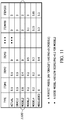
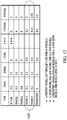
Figures 10-13 respectively illustrate, for multiple positive items, a perfect model 1000 (Figure 10 ), a good model 1100 (Figure 11 ), consistent models 1200 (Figure 12 ), and a misguided model 1300 (Figure 13 ). -
Figures 14 and15 illustrate differences in measures between PAE and WPAE for certain models whilefigure 16 illustrates that for a perfectly misguided model, PAE and WPAE both so indicate. InFigure 14 twomodels user 2 compared touser 1 as shown inrow 1400, with the remaining statistics being identical across both users for all four items.Figure 15 illustrates the same statistics for a less accurate model (model 3) with concomitant differences in PAE and WPAE.Figure 16 shows that for a perfectly misguided model (model 4), both measures (PAE and WPAE) are the same, indicating a complete miss. - In addition to or amplification of the advantages noted elsewhere herein with using present principles, PAE provides a consistent, flexible metric that advantageously abstracts away domain details and focuses on evaluation only. Evaluated models can incorporate domain knowledge or model specific information into the normalization (e.g., using top 20 or 30, confidence in scores). Ground truth can be normalized with business knowledge in mind (e.g., dealing with numeric values like play time, number of purchases, revenue gained; how to deal with negative values like refunds, negative reviews). The fixed range of [0, 2], with 0 as a perfect match and 2 as a complete miss makes PAE easily understandable, with lower scores meaning better models. PAE rewards models with high ranking power and normalizes probability as a proxy for ranking. Models predicting higher probability for a positive sample will score higher.
- With respect to WPAE, it is noted that when actual data is skewed, evaluation may naturally reward models who take advantage of the skewness. For example, when one game (among 500 games) accounts for 17% of total purchases, simply predicting this one game will lead to a relatively low PAE. To reward models that are good at predicting the "long-tail" to award variety and coverage, WPAE is provided that is consistent and flexible because it is applicable to a wide range of scores and is flexible in incorporating domain knowledge into data and model normalization. WPAE also is flexible in balancing between enforcing data natural distribution and encouraging variety, and like PAE is easy to communicate and understand.
- It will be appreciated that whilst present principals have been described with reference to some example embodiments, these are not intended to be limiting, and that various alternative arrangements may be used to implement the subject matter claimed herein.
Claims (15)
- A device comprising:
at least one computer storage that is not a transitory signal and that comprises instructions executable by at least one processor to:
for a first model:determine, for each of plural sets of a user and an item, an absolute difference between a first value representing a model prediction of a user interaction with the item, and a second value representing an actual user interaction with the item, wherein the first values for each user are normalized such that the first values sum to unity, and the second values for each user are normalized such that the second values sum to unity;for each of a number of users, sum the absolute differences determined for plural items to render a user sum;sum the user sums to render a total;divide the total by the number of users to render a probability absolute error (PAE);determine a PAE for at least a second model;output the first model is being a better model based on the first model having a lower PAE than the second model, otherwise outputting the second model as the better model, wherein at least the second values for each user are normalized such that the second values sum to unity; anduse the better model in providing e-commerce. - The device of Claim 1, comprising the at least one processor.
- The device of Claim 1, wherein the instructions are executable to:prior to summing the user sums, multiply at least some user sums by a sum of weighted second values representing the actual user interactions with the item to render weighted user sums; andsum the weighted user sums to render a weighted users sum.
- The device of Claim 3, wherein the instructions are executable to:
divide the weighted users sum by the sum of weighted second values over all users to render a weighted PAE (WPAE). - The device of Claim 4, wherein the instructions are executable to:output the first model is being a better model based on the first model having a lower WPAE than the second model, otherwise outputting the second model as the better model; anduse the better model in providing e-commerce.
- A computer-implemented method comprising:receiving plural engagement relevance models useful for e-commerce and computer simulation purposes;evaluating predictions of the plural models offline against ground truth to determine which is the better model at predicting at least one metric;the evaluating comprising:summing absolute errors between ground truth and model predictions for each of multiple users, andnormalizing the sum of all prediction statistics to unity.
- The method of Claim 6, comprising:
applying weights to reduce skew in evaluation by accounting for biases toward disproportionately popular items. - The method of Claim 6, wherein the metric comprises one or more selected from the list consisting of:i. at least one product likely to be purchased;ii. at least one period a user remains on a web page;iii. at least one ranking of products; andiv. at least one ranking of services.
- An apparatus comprising:at least one processor;at least one computer storage accessible to the processor and comprising instructions executable by the processor to:determine, for a first model, a first probability absolute error (PAE) having a value of between zero and two, inclusive;determine, for a second model, a second PAE having a value of between zero and two, inclusive;responsive to the first PAE being less than the second PAE, use the first model to predict user interactions in e-commerce; andresponsive to the first PAE being greater than the second PAE, use the second model to predict user interactions in e-commerce.
- The apparatus of Claim 9, wherein the first PAE is determined as follows:

- The apparatus of Claim 9, wherein the instructions are executable to:determine, for each of plural sets of a user and an item, an absolute difference between a first value representing a model prediction of a user interaction with the item, and a second value representing an actual user interaction with the item, wherein the first values for each user are normalized such that the first values sum to unity, and the second values for each user are normalized such that the second values sum to unity;for each of a number of users, sum the absolute differences determined for plural items to render a user sum;sum the user sums to render a total; anddivide the total by the number of users to render the first PAE, wherein at least the first values are normalized to unity.
- The apparatus of Claim 11, wherein the instructions are executable to:prior to summing the user sums, multiply at least some user sums by a sum of weighted second values representing the actual user interactions with the item to render weighted user sums; andsum the weighted user sums to render a weighted users sum.
- The apparatus of Claim12, wherein the instructions are executable to:
divide the weighted users sum by the sum of weighted second values over all users to render a weighted PAE (WPAE). - The apparatus of Claim 14, wherein the instructions are executable to:output the first model is being a better model based on the first model having a lower WPAE than the second model, otherwise outputting the second model as the better model; anduse the better model in providing e-commerce.
- The apparatus of Claim 13, wherein the instructions are executable to determine WPAE using:

Applications Claiming Priority (1)
| Application Number | Priority Date | Filing Date | Title |
|---|---|---|---|
| US16/424,193 US20200380536A1 (en) | 2019-05-28 | 2019-05-28 | Engagement relevance model offline evaluation metric |
Publications (1)
| Publication Number | Publication Date |
|---|---|
| EP3745341A1 true EP3745341A1 (en) | 2020-12-02 |
Family
ID=70736759
Family Applications (1)
| Application Number | Title | Priority Date | Filing Date |
|---|---|---|---|
| EP20174735.9A Withdrawn EP3745341A1 (en) | 2019-05-28 | 2020-05-14 | Engagement relevance model offline evaluation metric |
Country Status (4)
| Country | Link |
|---|---|
| US (1) | US20200380536A1 (en) |
| EP (1) | EP3745341A1 (en) |
| JP (1) | JP6963653B2 (en) |
| CN (1) | CN112016952A (en) |
Citations (2)
| Publication number | Priority date | Publication date | Assignee | Title |
|---|---|---|---|---|
| US20180060738A1 (en) * | 2014-05-23 | 2018-03-01 | DataRobot, Inc. | Systems and techniques for determining the predictive value of a feature |
| US20180096250A1 (en) * | 2016-09-30 | 2018-04-05 | Salesforce.Com, Inc. | Predicting aggregate value of objects representing potential transactions |
Family Cites Families (12)
| Publication number | Priority date | Publication date | Assignee | Title |
|---|---|---|---|---|
| JP4911996B2 (en) * | 2006-03-08 | 2012-04-04 | 株式会社 日立東日本ソリューションズ | Demand prediction support system, demand prediction support method, and demand prediction support program |
| US10872322B2 (en) * | 2008-03-21 | 2020-12-22 | Dressbot, Inc. | System and method for collaborative shopping, business and entertainment |
| CA2712569C (en) * | 2009-08-31 | 2016-04-26 | Accenture Global Services Gmbh | Adaptive analytics multidimensional processing system |
| US10127573B2 (en) * | 2015-11-13 | 2018-11-13 | Facebook, Inc. | Framework for evaluating targeting models |
| WO2017163371A1 (en) * | 2016-03-24 | 2017-09-28 | 楽天株式会社 | Information processing system, information processing method, and information processing program |
| US10810638B2 (en) * | 2016-06-24 | 2020-10-20 | Benjamin Yeung | Network based platform structure for collecting user activity data and capitalizing user activities |
| US11163783B2 (en) * | 2017-05-15 | 2021-11-02 | OpenGov, Inc. | Auto-selection of hierarchically-related near-term forecasting models |
| US10915945B2 (en) * | 2017-08-30 | 2021-02-09 | Sony Interactive Entertainment LLC | Method and apparatuses for intelligent TV startup based on consumer behavior and real time content availability |
| US11351453B2 (en) * | 2017-09-12 | 2022-06-07 | Sony Interactive Entertainment LLC | Attention-based AI determination of player choices |
| US10264315B2 (en) * | 2017-09-13 | 2019-04-16 | Bby Solutions, Inc. | Streaming events modeling for information ranking |
| WO2019065610A1 (en) * | 2017-09-29 | 2019-04-04 | 日本電気株式会社 | Information processing device, control method and program |
| US20190143221A1 (en) * | 2017-11-15 | 2019-05-16 | Sony Interactive Entertainment America Llc | Generation and customization of personalized avatars |
-
2019
- 2019-05-28 US US16/424,193 patent/US20200380536A1/en not_active Abandoned
-
2020
- 2020-05-14 EP EP20174735.9A patent/EP3745341A1/en not_active Withdrawn
- 2020-05-28 CN CN202010465960.0A patent/CN112016952A/en active Pending
- 2020-05-28 JP JP2020093258A patent/JP6963653B2/en not_active Expired - Fee Related
Patent Citations (2)
| Publication number | Priority date | Publication date | Assignee | Title |
|---|---|---|---|---|
| US20180060738A1 (en) * | 2014-05-23 | 2018-03-01 | DataRobot, Inc. | Systems and techniques for determining the predictive value of a feature |
| US20180096250A1 (en) * | 2016-09-30 | 2018-04-05 | Salesforce.Com, Inc. | Predicting aggregate value of objects representing potential transactions |
Also Published As
| Publication number | Publication date |
|---|---|
| CN112016952A (en) | 2020-12-01 |
| JP2020194545A (en) | 2020-12-03 |
| JP6963653B2 (en) | 2021-11-10 |
| US20200380536A1 (en) | 2020-12-03 |
Similar Documents
| Publication | Publication Date | Title |
|---|---|---|
| US11250322B2 (en) | Self-healing machine learning system for transformed data | |
| US8868689B1 (en) | Device configuration based content selection | |
| US10630794B2 (en) | Multi computing device network based conversion determination based on computer network traffic | |
| CN113473187B (en) | Cross-screen optimization of advertisement delivery | |
| US20190034975A1 (en) | Systems and methods for providing non-disruptive in-game advertising and identifying target knowledge | |
| TWI672598B (en) | Method and system for evaluating user satisfaction with respect to a user session | |
| US20140025688A1 (en) | Determining, distinguishing and visualizing users' engagement with resources on a social network | |
| US20170301001A1 (en) | Systems and methods for providing content-based product recommendations | |
| US8527526B1 (en) | Selecting a list of network user identifiers based on long-term and short-term history data | |
| US20150066630A1 (en) | Content selection with precision controls | |
| WO2013078640A1 (en) | Estimating user demographics | |
| US20170301000A1 (en) | Systems and methods that provide customers with access to rendered retail environments | |
| KR20160075228A (en) | Electronic apparatus, cloud server, game service providing system and game service providing method thereof | |
| US20170301008A1 (en) | Virtual-Reality Apparatus | |
| CN107832409A (en) | Access location-based content | |
| US20220358522A1 (en) | Artificial-intelligence-based orchestration | |
| US20130031093A1 (en) | Information processing system, information processing method, program, and non-transitory information storage medium | |
| US20140108290A1 (en) | Merchant influence scoring | |
| CN113781084A (en) | Method and device for displaying questionnaires | |
| US20180341710A1 (en) | Heterogeneous social networking | |
| US20200380536A1 (en) | Engagement relevance model offline evaluation metric | |
| US20150081397A1 (en) | Determining the performance of a content network | |
| KR102757639B1 (en) | Method for processing user's data for game on computing devices and computing devices | |
| KR102960684B1 (en) | Method and system for providing recommendation information through a conversational interface based on acquaintance purchase history | |
| KR102960681B1 (en) | Method and system for product recommendation using social network-based acquaintance trust scores |
Legal Events
| Date | Code | Title | Description |
|---|---|---|---|
| PUAI | Public reference made under article 153(3) epc to a published international application that has entered the european phase |
Free format text: ORIGINAL CODE: 0009012 |
|
| STAA | Information on the status of an ep patent application or granted ep patent |
Free format text: STATUS: REQUEST FOR EXAMINATION WAS MADE |
|
| 17P | Request for examination filed |
Effective date: 20200531 |
|
| AK | Designated contracting states |
Kind code of ref document: A1 Designated state(s): AL AT BE BG CH CY CZ DE DK EE ES FI FR GB GR HR HU IE IS IT LI LT LU LV MC MK MT NL NO PL PT RO RS SE SI SK SM TR |
|
| AX | Request for extension of the european patent |
Extension state: BA ME |
|
| STAA | Information on the status of an ep patent application or granted ep patent |
Free format text: STATUS: EXAMINATION IS IN PROGRESS |
|
| 17Q | First examination report despatched |
Effective date: 20220208 |
|
| STAA | Information on the status of an ep patent application or granted ep patent |
Free format text: STATUS: THE APPLICATION IS DEEMED TO BE WITHDRAWN |
|
| 18D | Application deemed to be withdrawn |
Effective date: 20220621 |