EP3745310B1 - Method for calibrating a multi-sensor system using an artificial neural network - Google Patents
Method for calibrating a multi-sensor system using an artificial neural network Download PDFInfo
- Publication number
- EP3745310B1 EP3745310B1 EP19176913.2A EP19176913A EP3745310B1 EP 3745310 B1 EP3745310 B1 EP 3745310B1 EP 19176913 A EP19176913 A EP 19176913A EP 3745310 B1 EP3745310 B1 EP 3745310B1
- Authority
- EP
- European Patent Office
- Prior art keywords
- sensor
- encoder
- decoder
- trajectory
- function
- Prior art date
- Legal status (The legal status is an assumption and is not a legal conclusion. Google has not performed a legal analysis and makes no representation as to the accuracy of the status listed.)
- Active
Links
Images
Classifications
-
- G—PHYSICS
- G01—MEASURING; TESTING
- G01D—MEASURING NOT SPECIALLY ADAPTED FOR A SPECIFIC VARIABLE; ARRANGEMENTS FOR MEASURING TWO OR MORE VARIABLES NOT COVERED IN A SINGLE OTHER SUBCLASS; TARIFF METERING APPARATUS; MEASURING OR TESTING NOT OTHERWISE PROVIDED FOR
- G01D18/00—Testing or calibrating apparatus or arrangements provided for in groups G01D1/00 - G01D15/00
-
- G—PHYSICS
- G01—MEASURING; TESTING
- G01C—MEASURING DISTANCES, LEVELS OR BEARINGS; SURVEYING; NAVIGATION; GYROSCOPIC INSTRUMENTS; PHOTOGRAMMETRY OR VIDEOGRAMMETRY
- G01C25/00—Manufacturing, calibrating, cleaning, or repairing instruments or devices referred to in the other groups of this subclass
- G01C25/005—Manufacturing, calibrating, cleaning, or repairing instruments or devices referred to in the other groups of this subclass initial alignment, calibration or starting-up of inertial devices
-
- G—PHYSICS
- G01—MEASURING; TESTING
- G01C—MEASURING DISTANCES, LEVELS OR BEARINGS; SURVEYING; NAVIGATION; GYROSCOPIC INSTRUMENTS; PHOTOGRAMMETRY OR VIDEOGRAMMETRY
- G01C25/00—Manufacturing, calibrating, cleaning, or repairing instruments or devices referred to in the other groups of this subclass
-
- G—PHYSICS
- G06—COMPUTING OR CALCULATING; COUNTING
- G06N—COMPUTING ARRANGEMENTS BASED ON SPECIFIC COMPUTATIONAL MODELS
- G06N3/00—Computing arrangements based on biological models
- G06N3/004—Artificial life, i.e. computing arrangements simulating life
- G06N3/008—Artificial life, i.e. computing arrangements simulating life based on physical entities controlled by simulated intelligence so as to replicate intelligent life forms, e.g. based on robots replicating pets or humans in their appearance or behaviour
-
- G—PHYSICS
- G06—COMPUTING OR CALCULATING; COUNTING
- G06N—COMPUTING ARRANGEMENTS BASED ON SPECIFIC COMPUTATIONAL MODELS
- G06N3/00—Computing arrangements based on biological models
- G06N3/02—Neural networks
- G06N3/04—Architecture, e.g. interconnection topology
- G06N3/044—Recurrent networks, e.g. Hopfield networks
-
- G—PHYSICS
- G06—COMPUTING OR CALCULATING; COUNTING
- G06N—COMPUTING ARRANGEMENTS BASED ON SPECIFIC COMPUTATIONAL MODELS
- G06N3/00—Computing arrangements based on biological models
- G06N3/02—Neural networks
- G06N3/04—Architecture, e.g. interconnection topology
- G06N3/044—Recurrent networks, e.g. Hopfield networks
- G06N3/0442—Recurrent networks, e.g. Hopfield networks characterised by memory or gating, e.g. long short-term memory [LSTM] or gated recurrent units [GRU]
-
- G—PHYSICS
- G06—COMPUTING OR CALCULATING; COUNTING
- G06N—COMPUTING ARRANGEMENTS BASED ON SPECIFIC COMPUTATIONAL MODELS
- G06N3/00—Computing arrangements based on biological models
- G06N3/02—Neural networks
- G06N3/04—Architecture, e.g. interconnection topology
- G06N3/045—Combinations of networks
-
- G—PHYSICS
- G06—COMPUTING OR CALCULATING; COUNTING
- G06N—COMPUTING ARRANGEMENTS BASED ON SPECIFIC COMPUTATIONAL MODELS
- G06N3/00—Computing arrangements based on biological models
- G06N3/02—Neural networks
- G06N3/04—Architecture, e.g. interconnection topology
- G06N3/045—Combinations of networks
- G06N3/0455—Auto-encoder networks; Encoder-decoder networks
-
- G—PHYSICS
- G06—COMPUTING OR CALCULATING; COUNTING
- G06N—COMPUTING ARRANGEMENTS BASED ON SPECIFIC COMPUTATIONAL MODELS
- G06N3/00—Computing arrangements based on biological models
- G06N3/02—Neural networks
- G06N3/08—Learning methods
-
- G—PHYSICS
- G06—COMPUTING OR CALCULATING; COUNTING
- G06N—COMPUTING ARRANGEMENTS BASED ON SPECIFIC COMPUTATIONAL MODELS
- G06N3/00—Computing arrangements based on biological models
- G06N3/02—Neural networks
- G06N3/08—Learning methods
- G06N3/084—Backpropagation, e.g. using gradient descent
-
- G—PHYSICS
- G06—COMPUTING OR CALCULATING; COUNTING
- G06N—COMPUTING ARRANGEMENTS BASED ON SPECIFIC COMPUTATIONAL MODELS
- G06N3/00—Computing arrangements based on biological models
- G06N3/02—Neural networks
- G06N3/08—Learning methods
- G06N3/09—Supervised learning
Definitions
- the present invention relates to multi-sensor systems with a plurality of sensors for sensing correlated measures.
- the present invention particularly relates to methods for calibrating sensors in a multi-sensor system.
- multi-sensor systems are applied.
- multiple sensors are often used which are arranged offset from each other to provide at least partly redundant and/or correlated sensor readings.
- multiple position and intertia sensors may be used on different positions on a robot which provide correlated sensor readings when the robot moves.
- the quality of carrying out a specific task using the sensor readings of these multiple sensors is extremely sensitive to the calibration of the sensors used for the task.
- sensors measuring the same or related measures particularly, sensor orientation and position as well as their accuracy strongly affect the measurement results and essentially determine the performance of the technical system. If the exact relation between the multiple sensors, such as their relative orientation and position, is initially unknown, a sensor calibration is required to improve the functionality of the technical system.
- a method for calibrating a sensor with respect to a reference trajectory indicating a number of timely successive data values using an encoder/decoder neural network with an encoder function and a successive decoder function comprising the steps of:
- the above method proposes an approach using an artificial neural network which can handle the complex environmental dynamics of uncertainties and noises of a multi-sensor system.
- each sensor can be expressed by a calibration vector, which is configured with one or more dimensions.
- the calibration vector can be applied on a sensor trajectory to transform the sensor reading, i.e. sensor trajectory of one of the calibrated sensors, to the reference trajectory, such as a sensor trajectory of a reference sensor of the multi-sensor system obtained within the same time frame, it is a task to automatically calibrate the sensors of the sensor system by adapting the respective calibration vector. So, each sensor trajectory of each of the sensors to be calibrated can be applied with the respective calibration vector and thus be brought in line with the reference trajectory of e.g. the reference sensor by means of the calibration vector.
- the above method applies a recurrent neural network as an LSTM (Long-Short Term Memory) encoder/decoder neural network.
- the LSTM encoder/decoder neural network includes an encoder LSTM unit to compress calibrated trajectories of sensor readings of a specific sensor to be calibrated and to obtain an intermediate vector representing a lower dimensional manifold.
- the calibrated trajectories are a result of calibration of the sensor trajectories of the sensor to be calibrated by means of a candidate calibration vector or an applied calibration vector.
- the intermediate vector as a result of the encoder LSTM unit represents compressed information and represents the characteristics of the corresponding sensor behavior.
- a decoder LSTM unit is applied to receive the intermediate vector and to reconstruct the sensor trajectories from the intermediate vector such that the reconstructed trajectories can be matched to the given reference trajectory.
- the reference trajectory may be used to further compute an attention map to determine the likelihood of what time steps of input sensor trajectories attention should be paid to. This intrinsically gives the time delay offset estimate of the sensors.
- the calibration is made for each sensor by solving an optimization problem to match the reconstructed sensor trajectory with the reference trajectory by adapting the calibration vector to reduce the reconstruction error. Furthermore, during the optimization, also the encoder parameters of the encoder LSTM unit, the decoder parameters of the decoder LSTM unit and the attention map are optimized to obtain a parametrization of the respective sensor.
- the attention map has elements that represent weights indicating the relation between each time-step of the output trajectory (output of the decoder LSTM unit) to the time steps of the sensor trajectory (input trajectory) so to estimate the off-time delay using the look-back attention.
- the system For each sensor to be calibrated the system has to be trained by a plurality of sensor trajectories of the specific sensor and a plurality of corresponding reference trajectories associated with the plurality of sensor trajectories, i. e. the sensor trajectories and the reference trajectories both are obtained during the same time frame of a system's action.
- the LSTM encoder/decoder neural network and particularly the calibration vectors can be optimized.
- the above described method allows performing an automatic calibration process for multiple sensors with respect to a reference trajectory.
- By using the above configuration of the artificial neural network automatic calibration is highly robust against noise, sensor inaccuracies and off-time delays.
- first and second training phases may be alternately applied each for a number of training cycles, particularly until a convergence criteria is satisfied.
- an attention map is considered which is applied on the output sensor trajectory of the decoder function and wherein the training is configured to minimize the reconstruction error between the output sensor trajectory to which the attention map is applied and a corresponding reference trajectory.
- the encoder function and decoder function corresponds to an encoder LSTM function and a decoder LSTM function, respectively.
- the encoder function may be configured to generate an intermediate vector corresponding to a lower dimensional manifold and the decoder function is configured to expand the intermediate vector having the same dimension as the input trajectory.
- the sensor trajectory of the sensor to be calibrated and the corresponding reference trajectory are related to the same time frame.
- the reference trajectory may be obtained by a reference sensor wherein the reference sensor and the sensor to be calibrated belong to the same multi-sensor system.
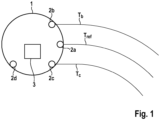
- Figure 1 shows exemplarily a moveable robot 1, such as a robot vacuum cleaner, which has a plurality of sensors 2 rigidly mounted with respect to the housing of the robot 1.
- the sensors 2 are position sensors to provide a sensor reading indicating position data per time instant. For successive time steps, the position data define a sensor trajectory for each of the sensors 2.
- the robot 1 has a control unit 3 which controls operation of the robot 1. The operation is controlled depending on the sensor readings of the sensors 2 to perform a predefined task, for example in case of a vacuum cleaner to move the robot 1 over an area to clean the area's surface.
- the sensors 2 are further referenced by indices a, b, c, d, wherein the sensor 2a serves as a reference sensor that is the target sensor other sensors 2b, 2c, 2d are calibrated towards.
- the reference sensor 2a provides sensor readings which form the reference trajectory T ref within a specific time frame.
- r and t represent the rotation and translation vectors for calibration of the respective sensor (defined by the index) so that after applying the rotation and translation vectors on the detected sensor trajectories Tb, Tc, ... of the corresponding sensors (obtained during the same time frame), they will match the reference trajectory provided by the reference sensor 2a.
- the sensor trajectories Tb, Tc, ... are indicated by position data for successive time steps wherein the time steps must not necessarily correspond to the time steps of the reference trajectory Tref provided by the reference sensor 2a. Furthermore, the sensors each have their own sensor characteristics, provide noise and have individual inaccuracies. Therefore, it is a task to match the time step-based trajectories towards one another, while additionally considering intrinsic inaccuracies and environmental noises.
- the encoder/decoder neural network may basically be formed as an LSTM encoder/decoder neural network (LSTM: long short-term memory) but can also be implemented using different kinds of neural networks.
- LSTM long short-term memory
- Substantially the ecoder/decoder neural network comprises an encoder unit followed by a decoder unit.
- the encoder unit compresses the trajectory data to an intermediate vector and the decoder network decompresses the trajectory to reconstruct the input trajectory.
- an attention map is used to correct time related mismatches between the input sensor trajectories and the corresponding reference trajectory.
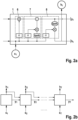
- FIGs 2a and 2b schematically show an LSTM node and an illustration of a recurrent processing of timely consecutive data s 1..T which is well known in the art.
- a LSTM node 5 includes an input gate 6, a forget gate 7 and an output gate 8 which are used to generate an internal node state h t and an output y t .
- a layer of an LSTM network can be formed.
- the number of layers generally allows to learn more expressive internal representation of inputs in principle.
- an LSTM encoder/decoder neural network with an attention map is well suited.
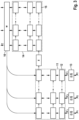
- Such an LSTM encoder/decoder neural network is shown in Figure 3 and is used to calibrate one of the sensors 2b, 2c, 2d to be calibrated with respect to the reference trajectory T ref , e.g. provided by the reference sensor 2a.
- the reference trajectory T ref can be provided by the control data for the motion driver of the robot or the like. In other words if the trajectory on which the robot is moved is known from the tration control or from external observation this data can be used as the reference trajectory.
- the configuration of Figure 3 shows the LSTM encoder/decoder neural network 10 having an LSTM encoder unit 11 to which a calibrated trajectory of a sensor to be calibrated is fed.
- the an LSTM encoder unit 11 has a number of an LSTM encoder cells 12 each of which is formed as a LSTM cell as described above.
- the LSTM encoder cells 12 are sequentially coupled and arranged in a number of consecutive layers.
- the data items of the calibrated sensor reading values s' 1... T at successive time steps are fed to a first layer formed by a number T of LSTM cells 12 as described above.
- the trajectory data is propagated through a number of layers of LSTM cells 12 while the output data of the last layer of LSTM cells of the encoder LSTM unit 11 is compressed to a lower dimensional manifold, such as an intermediate vector z.
- the intermediate vector z is generated by the last LSTM cell 12 of the last layer of the encoder LSTM unit 11.
- the last LSTM cell 12 has implemented a function mapping input which maps to a lower dimension intermediate vector z by multiplying a matrix with size n*m, where the dimension n is the size of h T / y T and where the dimension m is much smaller than n (original input dimension).
- the output y T of the last LSTM cell 12 is transformed by a given non-linear transformation to obtain the intermediate vector z.
- the intermediate vector z is serially transferred to the input of a first LSTM cell 12 of the decoder unit.
- the projection mentioned above is all computed automatically by error backpropagation, since the weights of the LSTM cells 12 are optimized by computing the z vector to recover trajectories as being base frames.
- the intermediate vector z includes the data of the calibrated trajectory in a compressed manner, so that the data of the intermediate vector z represent the sensor trajectory.
- the intermediate vector z is thereafter supplied to a decoder LSTM unit 14 which has a plurality of layers of a number T of LSTM cells 15 sequentially arranged.
- the decoder LSTM unit 14 has the same time step dimension T as the encoder LSTM
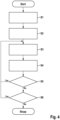
- one of the sensors 2b, 2c, 2d to be calibrated is selected in step S4 and initially a candidate calibration vector ⁇ ( r , t ) (as an initial calibration vector) is assumed.
- the candidate calibration vector is applied on the sensor reading values of the sensor trajectory of the sensor 2b ,2c, 2d to be calibrated before supplying them to the input of the encoder LSTM unit 11.
- the second training phase is carried out by propagating the calibrated sensor trajectories through the LSTM encoder/decoder neural network 10 and a reconstructed trajectory is respectively obtained at the output of the attention map unit.
- the reconstruction error between the reconstructed trajectory and the reference trajectory belonging to the same time frame is used to optimize the calibration vector, the encoder function, the decoder function and the attention matrix W for the respective sensor 2b, 2c, 2d.
- step S5 it is checked it the training process for the various sensor trajectories of the respective sensor has been completed. This can be done by applying a respective convergence criteria, by reaching a number of iterations or the like. If the training process has not been completed (alternative: yes) it is returned to step S3. Otherwise (alternative: no) the process is continued with step S6.
- the above steps S3, S4 of optimization are repeated for the various motion paths (time frames), i.e. the various sensor trajectories for which sensor trajectories of the respective (selected) sensor and associated reference trajectories are available.
- step S6 it is checked if a next sensor 2 of the sensor system shall be calibrated. If there is a next sensor to be calibrated (alternative: yes) then the method is continued by step S3 using the various sensor trajectories T of the corresponding next sensor. Otherwise (alternative: no), the process is discontinued.
- the so obtained calibration vector n ( r , t ) can be applied on the sensor reading of the respective sensor associated with the respective calibration vector ⁇ ( r , t ) by the product of ⁇ ( r , t ) s t b,c,d for sensors 2b, 2c, 2d.
Landscapes
- Engineering & Computer Science (AREA)
- Physics & Mathematics (AREA)
- Theoretical Computer Science (AREA)
- General Physics & Mathematics (AREA)
- Computing Systems (AREA)
- Mathematical Physics (AREA)
- Biophysics (AREA)
- Computational Linguistics (AREA)
- Data Mining & Analysis (AREA)
- Evolutionary Computation (AREA)
- General Health & Medical Sciences (AREA)
- Molecular Biology (AREA)
- Artificial Intelligence (AREA)
- General Engineering & Computer Science (AREA)
- Life Sciences & Earth Sciences (AREA)
- Biomedical Technology (AREA)
- Software Systems (AREA)
- Health & Medical Sciences (AREA)
- Manufacturing & Machinery (AREA)
- Radar, Positioning & Navigation (AREA)
- Remote Sensing (AREA)
- Robotics (AREA)
- Image Analysis (AREA)
- Transmission And Conversion Of Sensor Element Output (AREA)
- Length Measuring Devices With Unspecified Measuring Means (AREA)
- Feedback Control In General (AREA)
Description
- The present invention relates to multi-sensor systems with a plurality of sensors for sensing correlated measures. The present invention particularly relates to methods for calibrating sensors in a multi-sensor system.
- For many tasks, such as localization, mapping, tracking, and the like, multi-sensor systems are applied. In a technical system, multiple sensors are often used which are arranged offset from each other to provide at least partly redundant and/or correlated sensor readings. For instance, multiple position and intertia sensors may be used on different positions on a robot which provide correlated sensor readings when the robot moves.
- The quality of carrying out a specific task using the sensor readings of these multiple sensors is extremely sensitive to the calibration of the sensors used for the task. For sensors measuring the same or related measures, particularly, sensor orientation and position as well as their accuracy strongly affect the measurement results and essentially determine the performance of the technical system. If the exact relation between the multiple sensors, such as their relative orientation and position, is initially unknown, a sensor calibration is required to improve the functionality of the technical system.
- Conventionally, one approach to calibrate sensors of a technical system includes manually adapting calibration parameters of the sensors. Manual calibration has the known disadvantages of inaccuracy and long duration.
- A method for automatic calibration is e.g. known from N. Schneider et al., "RegNet: Multimodal Sensor Registration Using Deep Neural Networks", https://arxiv.org/pdf/1707.03167.pdf, wherein by means of a first deep convolutional neural network (CNN) a 6 degrees of freedom (DOF) extrinsic calibration between multimodal sensors is carried out wherein the conventional calibration steps (feature extraction, feature matching and global regression) are performed in a single real-time capable CNN.
- Furthermore, from document G. Iyer et al., "CalibNet: Self-Supervised Extrinsic Calibration using 3D Spatial Transformer Networks", https://arxiv.org/pdf/1803.08181.pdf, it is known a self-supervised deep network capable of automatically estimating the 6-DoF rigid body transformation between a 3D LiDAR and a 2D camera. The network is trained to predict calibration parameters that maximize the geometric and photometric consistency of the input images and point clouds.
- According to the present invention, it is provided a method for calibrating one or more sensors of a multi-sensor system according to
claim 1, a calibration system and a multi-sensor system according to the further independent claims. - Further embodiments are indicated in the depending subclaims.
- According to a first aspect, a method for calibrating a sensor with respect to a reference trajectory indicating a number of timely successive data values using an encoder/decoder neural network with an encoder function and a successive decoder function is provided, comprising the steps of:
- Training in a first training phase the encoder function and the decoder function of the the encoder/decoder neural network with respect to at least one reference trajectory so that a reconstruction error of the reference trajectory at an input of the encoder function and a reconstructed reference trajectory at an output of the decoder function is minimized,
- Training in a second training phase a calibration vector, and particularly the encoder function and the decoder function of the encoder/decoder neural network, with respect to a sensor trajectory so that a reconstruction error between an output sensor trajectory and a corresponding reference trajectory is minimized, wherein the output sensor trajectory is obtained by applying the calibration vector on the sensor trajectory and by applying the encoder and decoder function on the calibrated sensor trajectory; and
- Applying the calibration vector to calibrate the sensor.
- In a sensor system with multiple sensors with correlated sensor readings, such as a plurality of distributed sensors for sensing a position or a movement of a movable system, sensor offsets, noise, sensor inaccuracy, external interventions and the like make the conventional approaches to calibrate the multiple sensors of the multi-sensor system complex or even impossible for high precision calibration.
- Generally, for calibration sensor trajectories of the sensors to be calibrated are used and brought into relation towards a reference trajectory indicating the ground true system behavior during the same time frame. General issues for calibrating sensors using sensor trajectories of sensor readings are the unknown local relations, such as positional offsets of the sensors and the different time domains or the sensor readings, i.e. that each single sensor reading might have a certain off-time delay so that the sensor readings from different sensors might not match exactly on a specific time step.
- Matching trajectories with different off-time delays in combination with sensor noise, unknown local sensor distribution, and sensor inaccuracies are common constraints when a multi-sensor system shall be calibrated.
- The above method proposes an approach using an artificial neural network which can handle the complex environmental dynamics of uncertainties and noises of a multi-sensor system.
- Assuming the calibration of each sensor can be expressed by a calibration vector, which is configured with one or more dimensions. The calibration vector can be applied on a sensor trajectory to transform the sensor reading, i.e. sensor trajectory of one of the calibrated sensors, to the reference trajectory, such as a sensor trajectory of a reference sensor of the multi-sensor system obtained within the same time frame, it is a task to automatically calibrate the sensors of the sensor system by adapting the respective calibration vector. So, each sensor trajectory of each of the sensors to be calibrated can be applied with the respective calibration vector and thus be brought in line with the reference trajectory of e.g. the reference sensor by means of the calibration vector.
- The above method applies a recurrent neural network as an LSTM (Long-Short Term Memory) encoder/decoder neural network. The LSTM encoder/decoder neural network includes an encoder LSTM unit to compress calibrated trajectories of sensor readings of a specific sensor to be calibrated and to obtain an intermediate vector representing a lower dimensional manifold. The calibrated trajectories are a result of calibration of the sensor trajectories of the sensor to be calibrated by means of a candidate calibration vector or an applied calibration vector. The intermediate vector as a result of the encoder LSTM unit represents compressed information and represents the characteristics of the corresponding sensor behavior.
- Succeeding the encoder LSTM unit, a decoder LSTM unit is applied to receive the intermediate vector and to reconstruct the sensor trajectories from the intermediate vector such that the reconstructed trajectories can be matched to the given reference trajectory.
- The reference trajectory may be used to further compute an attention map to determine the likelihood of what time steps of input sensor trajectories attention should be paid to. This intrinsically gives the time delay offset estimate of the sensors.
- The calibration is made for each sensor by solving an optimization problem to match the reconstructed sensor trajectory with the reference trajectory by adapting the calibration vector to reduce the reconstruction error. Furthermore, during the optimization, also the encoder parameters of the encoder LSTM unit, the decoder parameters of the decoder LSTM unit and the attention map are optimized to obtain a parametrization of the respective sensor.
- The attention map has elements that represent weights indicating the relation between each time-step of the output trajectory (output of the decoder LSTM unit) to the time steps of the sensor trajectory (input trajectory) so to estimate the off-time delay using the look-back attention.
- For each sensor to be calibrated the system has to be trained by a plurality of sensor trajectories of the specific sensor and a plurality of corresponding reference trajectories associated with the plurality of sensor trajectories, i. e. the sensor trajectories and the reference trajectories both are obtained during the same time frame of a system's action. During the training the LSTM encoder/decoder neural network and particularly the calibration vectors can be optimized.
- The above described method allows performing an automatic calibration process for multiple sensors with respect to a reference trajectory. By using the above configuration of the artificial neural network automatic calibration is highly robust against noise, sensor inaccuracies and off-time delays.
- Furthermore, the first and second training phases may be alternately applied each for a number of training cycles, particularly until a convergence criteria is satisfied.
- It may be provided that in the second training phase an attention map is considered which is applied on the output sensor trajectory of the decoder function and wherein the training is configured to minimize the reconstruction error between the output sensor trajectory to which the attention map is applied and a corresponding reference trajectory.
- Moreover, the encoder function and decoder function corresponds to an encoder LSTM function and a decoder LSTM function, respectively.
- According to an embodiment, the encoder function may be configured to generate an intermediate vector corresponding to a lower dimensional manifold and the decoder function is configured to expand the intermediate vector having the same dimension as the input trajectory.
- It may be provided that the sensor trajectory of the sensor to be calibrated and the corresponding reference trajectory are related to the same time frame.
- Furthermore, the reference trajectory may be obtained by a reference sensor wherein the reference sensor and the sensor to be calibrated belong to the same multi-sensor system.
- Embodiments are described in more detail in conjunction with the accompanying drawings, in which:
- Figure 1
- shows a system with a robot with a multi-sensor arrangement to detect a trajectory of positions as an example for a system in which the automatic calibration process can be applied on;
- Figure 2
- schematically shows a conventional LSTM neural network;
- Figure 3
- schematically shows an LSTM encoder/decoder neural network used for automatically calibrating a sensor to a reference sensor by determining a calibration vector;
- Figure 4
- a flowchart indicating the process for automatically calibrating the sensor of a multi-sensor system.
-
Figure 1 shows exemplarily amoveable robot 1, such as a robot vacuum cleaner, which has a plurality ofsensors 2 rigidly mounted with respect to the housing of therobot 1. Thesensors 2 are position sensors to provide a sensor reading indicating position data per time instant. For successive time steps, the position data define a sensor trajectory for each of thesensors 2. Generally, therobot 1 has acontrol unit 3 which controls operation of therobot 1. The operation is controlled depending on the sensor readings of thesensors 2 to perform a predefined task, for example in case of a vacuum cleaner to move therobot 1 over an area to clean the area's surface. - The
sensors 2 are further referenced by indices a, b, c, d, wherein thesensor 2a serves as a reference sensor that is the target sensorother sensors reference sensor 2a provides sensor readings which form the reference trajectory Tref within a specific time frame. - To calibrate the relative position and orientation of
other sensors reference sensor 2a. - The sensor trajectories Tb, Tc, ... are indicated by position data for successive time steps wherein the time steps must not necessarily correspond to the time steps of the reference trajectory Tref provided by the
reference sensor 2a. Furthermore, the sensors each have their own sensor characteristics, provide noise and have individual inaccuracies. Therefore, it is a task to match the time step-based trajectories towards one another, while additionally considering intrinsic inaccuracies and environmental noises. - According to the herein described embodiment of the proposed method, this task is accomplished by means of an encoder/decoder neural network. The encoder/decoder neural network may basically be formed as an LSTM encoder/decoder neural network (LSTM: long short-term memory) but can also be implemented using different kinds of neural networks.
- Substantially the ecoder/decoder neural network comprises an encoder unit followed by a decoder unit. Wherein the encoder unit compresses the trajectory data to an intermediate vector and the decoder network decompresses the trajectory to reconstruct the input trajectory. Furthermore, an attention map is used to correct time related mismatches between the input sensor trajectories and the corresponding reference trajectory.
- A preferred embodiment uses an LSTM neural network which is basically described in conjunction with
Figures 2a and 2b . -
Figures 2a and 2b schematically show an LSTM node and an illustration of a recurrent processing of timely consecutive data s1..T which is well known in the art. Basically, a LSTM node 5 includes aninput gate 6, a forgetgate 7 and an output gate 8 which are used to generate an internal node state ht and an output yt. By cascading multiple LSTM nodes with their internal node state ht and output yt to respective inputs of a succeeding LSTM node as shown inFigure 2b , a layer of an LSTM network can be formed. - The hidden outputs ht=1...T from first or any of the next layers layer can be fed to a succeeding layer as input to form a deep multi-layer network. The number of layers generally allows to learn more expressive internal representation of inputs in principle.
- It has been found that for the time step-based trajectory match, an LSTM encoder/decoder neural network with an attention map is well suited. Such an LSTM encoder/decoder neural network is shown in
Figure 3 and is used to calibrate one of thesensors reference sensor 2a. Furthermore, the reference trajectory Tref can be provided by the control data for the motion driver of the robot or the like. In other words if the trajectory on which the robot is moved is known from the tration control or from external observation this data can be used as the reference trajectory. - The configuration of
Figure 3 shows the LSTM encoder/decoder neural network 10 having anLSTM encoder unit 11 to which a calibrated trajectory of a sensor to be calibrated is fed. The anLSTM encoder unit 11 has a number of anLSTM encoder cells 12 each of which is formed as a LSTM cell as described above. TheLSTM encoder cells 12 are sequentially coupled and arranged in a number of consecutive layers. - The calibrated trajectory is formed by a number of timely succeeding sensor readings s 1...T and obtained by applying a candidate calibration vector η(rcand, tcand ) (for training) or a previously determined calibration vector η(r , t ) (for a trained system) onto each sensor reading value s 1...T of the different time instances t=1..T in a
respective calibration unit 13. The data items of the calibrated sensor reading values s' 1...T at successive time steps are fed to a first layer formed by a number T ofLSTM cells 12 as described above. - The trajectory data is propagated through a number of layers of
LSTM cells 12 while the output data of the last layer of LSTM cells of theencoder LSTM unit 11 is compressed to a lower dimensional manifold, such as an intermediate vector z. The intermediate vector z is generated by thelast LSTM cell 12 of the last layer of theencoder LSTM unit 11. Thelast LSTM cell 12 has implemented a function mapping input which maps to a lower dimension intermediate vector z by multiplying a matrix with size n*m, where the dimension n is the size of hT / yT and where the dimension m is much smaller than n (original input dimension). - The output yT of the
last LSTM cell 12 is transformed by a given non-linear transformation to obtain the intermediate vector z. The intermediate vector z is serially transferred to the input of afirst LSTM cell 12 of the decoder unit. For instance, the non-linear transformation may be
- The projection mentioned above is all computed automatically by error backpropagation, since the weights of the
LSTM cells 12 are optimized by computing the z vector to recover trajectories as being base frames. - The intermediate vector z includes the data of the calibrated trajectory in a compressed manner, so that the data of the intermediate vector z represent the sensor trajectory.
- The intermediate vector z is thereafter supplied to a
decoder LSTM unit 14 which has a plurality of layers of a number T ofLSTM cells 15 sequentially arranged. Thedecoder LSTM unit 14 has the same time step dimension T as the encoder LSTM - The
decoder LSTM unit 14 has the same time step dimension T as the encoder LSTM -
unit 11 so that the calibrated trajectory at the input of theencoder LSTM unit 11 can be reconstructed from the intermediate vector z. - In an
attention map unit 16 the reconstructed trajectory is applied to an attention map to compensate for a time mismatch between the time base of the reference trajectory Tref and the trajectory Tb, Tc, Td to be calibrated. Informally, an attention map equips a neural network with the ability to focus on a subset of its inputs, i.e. on a subset of time steps. - Comparing the resulting reconstructed trajectory with the reference trajectory leads to an error which can be used to train the calibration vector, the encoder and decoder function and the attention map. The optimization problem can be written as:

reference sensor 2a, n(r, t) the calibration vector, WT t an attention map and gencoder the encoder function and fdecoder the decoder function. - The
encoder LSTM unit 11 and thedecoder LSTM unit 14 can be trained in a training phase by feeding data batches including sensor trajectories and reference trajectories and by training above parameters. Particularly, a first training phase includes the application of the reference trajectory without using the calibration units 13 (or by switching them to not rendering the respective reference trajectory data) to train the encoder and decoder function by minimizing the reconstruction error at the output of thedecoder LSTM unit 14. Theattention map unit 16 may be either deactivated or activated and applied with no time offset with respect to the reference trajectory. In the first training phase and activated - In the second training phase as the attention map is input dependent, for each pair of a sensor trajectory and corresponding reference trajectory. However, as in the first training phase only the reference trajectory is applied which has no time offset with respect to itself the attention map can be deactivated.
- In a second training phase a sensor trajectory to be calibrated is applied on the inputs of the calibration units and the encoder LST unit and the
decoder LSTM unit 14 as well as the attention map are trained to reduce the reconstruction error. The reconstruction error is determined by a distance between the reconstructed trajectory (which is obtained by using calibration units, the encoder LSTM unit, decoder LSTM unit and the attention map unit) and the corresponding reference trajectory. - Both training phases can be alternately carried out each for a plurality of training cycles.
- In the flowchart of
Figure 4 , the process of calibration of thesensors 2 of the sensor system of theaforementioned robot 1 is described. - In step S1, among the
sensors 2 of the sensor system, areference sensor 2a is selected. Allother sensors reference sensor 2a. - In step S2, trajectories are recorded for each of the
sensors 2, e.g. by moving the robot along a random or predetermined path. Thereby, a reference trajectory Tref can be obtained from the sensor readings of thereference sensor 2a and further sensor trajectories can be obtained from theother sensors robot 1 along one or more known motion paths which correspond to a respective reference trajectory. The number of training trajectories is selected so that the set of training trajectory data is sufficient to train the LSTM encoder/decoder neural network 10 as described above. - In step S3, the first training phase is performed. Therein, the various reference trajectories are used to train the LSTM encoder/decoder network 10 by minimizing the reconstruction error of propagating each of the reference trajectories through the
encoder LSTM unit 11 and thedecoder LSTM unit 14 according to above formula. The reconstruction error can be e.g. defined as a distance between the reconstructed trajectory at an output trajectory of thedecoder LSTM unit 14 and the reference trajectory. Thereby, parameters for the encoder function fencoder and the decoder function gdecoder can be trained applying a conventional method such as by backpropagation. - Following the training related to the reference trajectories, one of the
sensors sensor encoder LSTM unit 11. - The second training phase is carried out by propagating the calibrated sensor trajectories through the LSTM encoder/decoder neural network 10 and a reconstructed trajectory is respectively obtained at the output of the attention map unit. The reconstruction error between the reconstructed trajectory and the reference trajectory belonging to the same time frame is used to optimize the calibration vector, the encoder function, the decoder function and the attention matrix W for the
respective sensor - In step S5 it is checked it the training process for the various sensor trajectories of the respective sensor has been completed. This can be done by applying a respective convergence criteria, by reaching a number of iterations or the like. If the training process has not been completed (alternative: yes) it is returned to step S3. Otherwise (alternative: no) the process is continued with step S6. The above steps S3, S4 of optimization are repeated for the various motion paths (time frames), i.e. the various sensor trajectories for which sensor trajectories of the respective (selected) sensor and associated reference trajectories are available.
- In step S6 it is checked if a
next sensor 2 of the sensor system shall be calibrated. If there is a next sensor to be calibrated (alternative: yes) then the method is continued by step S3 using the various sensor trajectories T of the corresponding next sensor. Otherwise (alternative: no), the process is discontinued. - The so obtained calibration vector n(r, t) can be applied on the sensor reading of the respective sensor associated with the respective calibration vector η(r, t) by the product of η(r, t) st b,c,d for
sensors
Claims (11)
- Method for calibrating a sensor (2) with respect to a reference trajectory (Tref) indicating a number of timely successive data values using an encoder/decoder neural network (10) with an encoder function (gencoder) and a successive decoder function (fdecoder), wherein the sensor (2) is a position sensor to provide a sensor reading indicating position data per time instant, wherein the method comprising the steps of:- Training in a first training phase the encoder function (gencoder) and the decoder function (fdecoder) of the encoder/decoder neural network (10) with respect to at least one reference trajectory (Tref) so that a reconstruction error of the reference trajectory (Tref) at an input of the encoder function (gencoder) and a reconstructed reference trajectory (Trec) at an output of the decoder function (fdecoder) is minimized,- Training in a second training phase a calibration vector (η(r, t)) with respect to a sensor trajectory (T) so that a reconstruction error between an output sensor trajectory (T) and a corresponding reference trajectory (Tref) is minimized, wherein the output sensor trajectory (T) is obtained by applying the calibration vector (η(r, t)) on the sensor trajectory (T) and by applying the encoder function (gencoder) and decoder function (fdecoder) on the the calibrated sensor trajectory;- Applying the calibration vector (η(r, t)) to calibrate the sensor.
- Method according to claim 1, wherein the first and second training phases are alternately applied each for a number of training cycles, particularly until a convergence criteria is satisfied.
- Method according to claim 1 or 2, wherein the step of training in the second training phase comprises the training of the calibration vector (η(r, t)), the encoder function (gencoder) and the decoder function (fdecoder) of the encoder/decoder neural network (10).
- Method according to any of the claims 1 to 3, wherein in the second training phase an attention map is considered which is applied on the output sensor trajectory (T) of the decoder function (fdecoder) and wherein the training is configured to minimize the reconstruction error between the output sensor trajectory (T) to which the attention map is applied and a corresponding reference trajectory (Tref).
- Method according to any of the claims 1 to 4, wherein the encoder function (gencoder) and decoder function (fdecoder) corresponds to an encoder LSTM function and a decoder LSTM function, respectively.
- Method according to any of the claims 1 to 5, wherein the encoder function (gencoder) is configured to generate an intermediate vector corresponding to a lower dimensional manifold and the decoder function (fdecoder) is configured to expand the intermediate vector having the same dimension as the input trajectory.
- Method according to any of the claims 1 to 6, wherein the sensor trajectory of the sensor (2) to be calibrated and the corresponding reference trajectory (Tref) are related to the same time frame.
- Method according to any of the claims 1 to 7, wherein the reference trajectory (Tref) is obtained by a reference sensor (2a) wherein the reference sensor (2a) and the sensor (2) to be calibrated belong to the same multi-sensor system.
- Sensor system comprising:- multiple sensors (2) for obtaining sensor trajectories (T) ;- an encoder/decoder neural network (10) with an encoder function (gencoder) and a successive decoder function (fdecoder),- a control unit (3) configured to calibrate at least one of the multiple sensors with respect to a reference trajectory (Tref) indicating a number of timely successive data values, wherein the at least one of the multiple sensors is a position sensor providing a sensor reading indicating position data per time instant by:∘ training in a first training phase the encoder function (gencoder) and the decoder function (fdecoder) of the encoder/decoder neural network (10) with respect to at least one reference trajectory (Tref) so that a reconstruction error of the reference trajectory (Tref) at an input of the encoder function (gencoder) and a reconstructed reference trajectory (Trec) at an output of the decoder function (fdecoder) is minimized,∘ training in a second training phase a calibration vector (η(r, t)) with respect to a sensor trajectory (T) so that a reconstruction error between an output sensor trajectory and a corresponding reference trajectory (Tref) is minimized, wherein the output sensor trajectory (T) is obtained by applying the calibration vector (η(r, t)) on the sensor trajectory (T) and by applying the encoder function (gencoder) and decoder function (fdecoder) on the calibrated sensor trajectory; and∘ applying the calibration vector (η(r, t)) to calibrate the sensor (2).
- A computer program comprising instructions which, when the program is executed by a computer, cause the computer to carry out the method according to any of the claims 1 to 8.
- A computer-readable medium comprising instructions which, when executed by a computer, cause the computer to carry out the method according to any of the claims 1 to 8.
Priority Applications (3)
| Application Number | Priority Date | Filing Date | Title |
|---|---|---|---|
| EP19176913.2A EP3745310B1 (en) | 2019-05-28 | 2019-05-28 | Method for calibrating a multi-sensor system using an artificial neural network |
| US16/879,335 US11415433B2 (en) | 2019-05-28 | 2020-05-20 | Method for calibrating a multi-sensor system using an artificial neural network |
| CN202010460093.1A CN112013891B (en) | 2019-05-28 | 2020-05-27 | Method for calibrating a multisensor system using an artificial neural network |
Applications Claiming Priority (1)
| Application Number | Priority Date | Filing Date | Title |
|---|---|---|---|
| EP19176913.2A EP3745310B1 (en) | 2019-05-28 | 2019-05-28 | Method for calibrating a multi-sensor system using an artificial neural network |
Publications (2)
| Publication Number | Publication Date |
|---|---|
| EP3745310A1 EP3745310A1 (en) | 2020-12-02 |
| EP3745310B1 true EP3745310B1 (en) | 2025-04-23 |
Family
ID=66668783
Family Applications (1)
| Application Number | Title | Priority Date | Filing Date |
|---|---|---|---|
| EP19176913.2A Active EP3745310B1 (en) | 2019-05-28 | 2019-05-28 | Method for calibrating a multi-sensor system using an artificial neural network |
Country Status (3)
| Country | Link |
|---|---|
| US (1) | US11415433B2 (en) |
| EP (1) | EP3745310B1 (en) |
| CN (1) | CN112013891B (en) |
Families Citing this family (9)
| Publication number | Priority date | Publication date | Assignee | Title |
|---|---|---|---|---|
| US11960294B2 (en) * | 2020-07-13 | 2024-04-16 | Naver Corporation | Self-supervised attention learning for depth and motion estimation |
| CN113011508B (en) * | 2021-03-24 | 2025-02-28 | 西湖大学 | High Dimensional Data Processing Method Based on Deep Manifold Transformation Network |
| CN112985463B (en) * | 2021-04-21 | 2021-08-03 | 智道网联科技(北京)有限公司 | Calibration method and device for inertial measurement unit based on convolutional neural network model |
| CN113538506A (en) * | 2021-07-23 | 2021-10-22 | 陕西师范大学 | Pedestrian trajectory prediction method based on deep modeling of global dynamic scene information |
| US11821754B2 (en) * | 2022-02-18 | 2023-11-21 | Qualcomm Incorporated | Sensor calibration |
| CN119666033B (en) * | 2025-02-17 | 2025-05-02 | 深圳市爱保护科技有限公司 | Dynamic calibration method and device for motion sensor for intelligent terminal equipment |
| CN120063361B (en) * | 2025-04-23 | 2025-07-08 | 重庆联芯致康生物科技有限公司 | Wearable equipment data stabilization and calibration method |
| CN121117433B (en) * | 2025-11-13 | 2026-01-23 | 德信东源智能科技(北京)有限公司 | Vehicle Beidou positioning data anomaly repairing method based on deep learning |
| CN121253897B (en) * | 2025-12-08 | 2026-03-24 | 国网安徽省电力有限公司电力科学研究院 | Residual current monitoring method and system for station alternating current system |
Family Cites Families (33)
| Publication number | Priority date | Publication date | Assignee | Title |
|---|---|---|---|---|
| US4852018A (en) * | 1987-01-07 | 1989-07-25 | Trustees Of Boston University | Massively parellel real-time network architectures for robots capable of self-calibrating their operating parameters through associative learning |
| US5428710A (en) * | 1992-06-29 | 1995-06-27 | The United States Of America As Represented By The Administrator Of The National Aeronautics And Space Administration | Fast temporal neural learning using teacher forcing |
| US5930781A (en) * | 1992-10-27 | 1999-07-27 | The United States Of America As Represented By The Administrator Of The National Aeronautics And Space Administration | Neural network training by integration of adjoint systems of equations forward in time |
| AU2001291229A1 (en) * | 2000-09-27 | 2002-04-08 | David N Levin | Self-referential method and apparatus for creating stimulus representations thatare invariant under systematic transformations of sensor states |
| US20090259609A1 (en) * | 2008-04-15 | 2009-10-15 | Honeywell International Inc. | Method and system for providing a linear signal from a magnetoresistive position sensor |
| KR101022785B1 (en) * | 2008-09-17 | 2011-03-17 | 포항공과대학교 산학협력단 | Environment Mapping Method of Robot Using Neural Network and Evolutionary Computation |
| US9754204B2 (en) * | 2013-08-05 | 2017-09-05 | Board Of Trustees Of The University Of Alabama | Systems, methods and devices for vector control of permanent magnet synchronous machines using artificial neural networks |
| US9211643B1 (en) * | 2014-06-25 | 2015-12-15 | Microsoft Technology Licensing, Llc | Automatic in-situ registration and calibration of robotic arm/sensor/workspace system |
| WO2016095882A1 (en) * | 2014-12-16 | 2016-06-23 | Balluff Gmbh | Contactless position/distance sensor having an artificial neural network and method for operating same |
| CN105043433B (en) * | 2015-08-28 | 2016-12-21 | 北京理工大学 | A kind of photoelectric encoder fast-compensation method based on neutral net |
| US10595037B2 (en) * | 2016-10-28 | 2020-03-17 | Nec Corporation | Dynamic scene prediction with multiple interacting agents |
| US9989964B2 (en) * | 2016-11-03 | 2018-06-05 | Mitsubishi Electric Research Laboratories, Inc. | System and method for controlling vehicle using neural network |
| US10251709B2 (en) * | 2017-03-05 | 2019-04-09 | Samuel Cho | Architecture, system, and method for developing and robotically performing a medical procedure activity |
| JP6707485B2 (en) * | 2017-03-22 | 2020-06-10 | 株式会社東芝 | Object handling device and calibration method thereof |
| EP3638542B1 (en) * | 2017-06-16 | 2022-01-26 | Nauto, Inc. | System and method for contextualized vehicle operation determination |
| US10883844B2 (en) * | 2017-07-27 | 2021-01-05 | Waymo Llc | Neural networks for vehicle trajectory planning |
| US20200174490A1 (en) * | 2017-07-27 | 2020-06-04 | Waymo Llc | Neural networks for vehicle trajectory planning |
| US11256983B2 (en) * | 2017-07-27 | 2022-02-22 | Waymo Llc | Neural networks for vehicle trajectory planning |
| CN107506333A (en) * | 2017-08-11 | 2017-12-22 | 深圳市唯特视科技有限公司 | A kind of visual token algorithm based on ego-motion estimation |
| DE102017007765A1 (en) * | 2017-08-16 | 2018-01-25 | Daimler Ag | Method for calibrating sensors of a vehicle |
| JP2019039704A (en) * | 2017-08-23 | 2019-03-14 | Dmg森精機株式会社 | Calibration value generation method of encoder, calibration value generation system of encoder, and encoder |
| WO2019075245A1 (en) * | 2017-10-11 | 2019-04-18 | Beyond Limits, Inc. | Static engine and neural network for a cognitive reservoir system |
| US11106975B2 (en) * | 2017-10-20 | 2021-08-31 | Asapp, Inc. | Fast neural network implementations by increasing parallelism of cell computations |
| WO2019094843A1 (en) * | 2017-11-10 | 2019-05-16 | Nvidia Corporation | Systems and methods for safe and reliable autonomous vehicles |
| US20190184561A1 (en) * | 2017-12-15 | 2019-06-20 | The Regents Of The University Of California | Machine Learning based Fixed-Time Optimal Path Generation |
| US10699407B2 (en) * | 2018-04-11 | 2020-06-30 | Pie Medical Imaging B.V. | Method and system for assessing vessel obstruction based on machine learning |
| US10816992B2 (en) * | 2018-04-17 | 2020-10-27 | Baidu Usa Llc | Method for transforming 2D bounding boxes of objects into 3D positions for autonomous driving vehicles (ADVs) |
| CN109142171B (en) * | 2018-06-15 | 2021-08-03 | 上海师范大学 | Urban PM10 Concentration Prediction Method Based on Feature Dilation Fusion Neural Network |
| US20210397926A1 (en) * | 2018-09-29 | 2021-12-23 | VII Philip Alvelda | Data representations and architectures, systems, and methods for multi-sensory fusion, computing, and cross-domain generalization |
| US11940790B2 (en) * | 2018-12-12 | 2024-03-26 | Allstate Insurance Company | Safe hand-off between human driver and autonomous driving system |
| US10919543B2 (en) * | 2019-01-30 | 2021-02-16 | StradVision, Inc. | Learning method and learning device for determining whether to switch mode of vehicle from manual driving mode to autonomous driving mode by performing trajectory-based behavior analysis on recent driving route |
| CN109697476B (en) * | 2019-02-01 | 2023-06-23 | 重庆大学 | X-ray photon counting detector consistency calibration method based on deep learning |
| US12105209B2 (en) * | 2019-03-19 | 2024-10-01 | Adva Optical Networking Se | Method and apparatus for automatic detection of antenna site conditions |
-
2019
- 2019-05-28 EP EP19176913.2A patent/EP3745310B1/en active Active
-
2020
- 2020-05-20 US US16/879,335 patent/US11415433B2/en active Active
- 2020-05-27 CN CN202010460093.1A patent/CN112013891B/en active Active
Also Published As
| Publication number | Publication date |
|---|---|
| US20200378793A1 (en) | 2020-12-03 |
| US11415433B2 (en) | 2022-08-16 |
| CN112013891A (en) | 2020-12-01 |
| CN112013891B (en) | 2024-03-22 |
| EP3745310A1 (en) | 2020-12-02 |
Similar Documents
| Publication | Publication Date | Title |
|---|---|---|
| EP3745310B1 (en) | Method for calibrating a multi-sensor system using an artificial neural network | |
| Iyer et al. | CalibNet: Geometrically supervised extrinsic calibration using 3D spatial transformer networks | |
| EP3571664B1 (en) | Determining the location of a mobile device | |
| CN112183171A (en) | Method and device for establishing beacon map based on visual beacon | |
| Sushchenko et al. | Processing of redundant information in airborne electronic systems by means of neural networks | |
| Zhu et al. | Deep learning-based predicting and compensating method for the pose deviations of parallel robots | |
| CN114863201A (en) | Training method and device of three-dimensional detection model, computer equipment and storage medium | |
| Yin et al. | Dependant Gaussian processes regression for intelligent sampling of freeform and structured surfaces | |
| CN117405118A (en) | A multi-sensor fusion mapping method, system, equipment and storage medium | |
| Sibley et al. | A sliding window filter for incremental SLAM | |
| US20160314574A1 (en) | Method and device for fusing a plurality of uncertain or correlated data | |
| Li et al. | Performance analysis of deep learning supported Kalman filter | |
| Qiao et al. | SDI: A sparse drift identification approach for force/torque sensor calibration in industrial robots | |
| Haq et al. | Intelligent robotic positioning through AI-enhanced metrology: Integration of standards, sensor fusion, and adaptive calibration | |
| EP3571665B1 (en) | Determining the location of a mobile device | |
| CN112987010B (en) | System and method for multi-radar mapping of robot | |
| CN120823268A (en) | UAV positioning method and device based on multi-camera joint calibration | |
| CN115319756B (en) | A robot residual compensation method based on parameter reconfiguration neural network | |
| KR20200121666A (en) | Method for correcting error and sensor system | |
| Guo et al. | A method for improving coordinate transformation accuracy of multi-station visual measurement systems in large-scale measurement | |
| CN121492074B (en) | Dynamic repair welding method and system based on welding quality evaluation | |
| Zhi et al. | Uapgo: Uncertainty-Aware Pose Graph Optimization for Lidar-Based Slam Systems | |
| Sibley et al. | Constant time sliding window filter SLAM as a basis for metric visual perception | |
| CN121026111B (en) | GNSS/INS integrated navigation method, device, equipment and storage medium | |
| Liu et al. | IFAL-SLAM: an approach to inertial-centered multi-sensor fusion, factor graph optimization, and adaptive Lagrangian method |
Legal Events
| Date | Code | Title | Description |
|---|---|---|---|
| PUAI | Public reference made under article 153(3) epc to a published international application that has entered the european phase |
Free format text: ORIGINAL CODE: 0009012 |
|
| STAA | Information on the status of an ep patent application or granted ep patent |
Free format text: STATUS: THE APPLICATION HAS BEEN PUBLISHED |
|
| AK | Designated contracting states |
Kind code of ref document: A1 Designated state(s): AL AT BE BG CH CY CZ DE DK EE ES FI FR GB GR HR HU IE IS IT LI LT LU LV MC MK MT NL NO PL PT RO RS SE SI SK SM TR |
|
| AX | Request for extension of the european patent |
Extension state: BA ME |
|
| STAA | Information on the status of an ep patent application or granted ep patent |
Free format text: STATUS: REQUEST FOR EXAMINATION WAS MADE |
|
| 17P | Request for examination filed |
Effective date: 20210602 |
|
| RBV | Designated contracting states (corrected) |
Designated state(s): AL AT BE BG CH CY CZ DE DK EE ES FI FR GB GR HR HU IE IS IT LI LT LU LV MC MK MT NL NO PL PT RO RS SE SI SK SM TR |
|
| STAA | Information on the status of an ep patent application or granted ep patent |
Free format text: STATUS: EXAMINATION IS IN PROGRESS |
|
| 17Q | First examination report despatched |
Effective date: 20240313 |
|
| REG | Reference to a national code |
Ref country code: DE Ref legal event code: R079 Ref country code: DE Ref legal event code: R079 Ref document number: 602019068923 Country of ref document: DE Free format text: PREVIOUS MAIN CLASS: G06N0003040000 Ipc: G06N0003008000 |
|
| GRAP | Despatch of communication of intention to grant a patent |
Free format text: ORIGINAL CODE: EPIDOSNIGR1 |
|
| STAA | Information on the status of an ep patent application or granted ep patent |
Free format text: STATUS: GRANT OF PATENT IS INTENDED |
|
| RIC1 | Information provided on ipc code assigned before grant |
Ipc: G01C 25/00 20060101ALI20250127BHEP Ipc: G06N 3/08 20060101ALI20250127BHEP Ipc: G06N 3/045 20230101ALI20250127BHEP Ipc: G06N 3/044 20230101ALI20250127BHEP Ipc: G06N 3/008 20230101AFI20250127BHEP |
|
| INTG | Intention to grant announced |
Effective date: 20250207 |
|
| GRAS | Grant fee paid |
Free format text: ORIGINAL CODE: EPIDOSNIGR3 |
|
| GRAA | (expected) grant |
Free format text: ORIGINAL CODE: 0009210 |
|
| STAA | Information on the status of an ep patent application or granted ep patent |
Free format text: STATUS: THE PATENT HAS BEEN GRANTED |
|
| AK | Designated contracting states |
Kind code of ref document: B1 Designated state(s): AL AT BE BG CH CY CZ DE DK EE ES FI FR GB GR HR HU IE IS IT LI LT LU LV MC MK MT NL NO PL PT RO RS SE SI SK SM TR |
|
| REG | Reference to a national code |
Ref country code: GB Ref legal event code: FG4D |
|
| REG | Reference to a national code |
Ref country code: CH Ref legal event code: EP |
|
| REG | Reference to a national code |
Ref country code: DE Ref legal event code: R096 Ref document number: 602019068923 Country of ref document: DE |
|
| REG | Reference to a national code |
Ref country code: IE Ref legal event code: FG4D |
|
| REG | Reference to a national code |
Ref country code: NL Ref legal event code: MP Effective date: 20250423 |
|
| PG25 | Lapsed in a contracting state [announced via postgrant information from national office to epo] |
Ref country code: NL Free format text: LAPSE BECAUSE OF FAILURE TO SUBMIT A TRANSLATION OF THE DESCRIPTION OR TO PAY THE FEE WITHIN THE PRESCRIBED TIME-LIMIT Effective date: 20250423 |
|
| REG | Reference to a national code |
Ref country code: AT Ref legal event code: MK05 Ref document number: 1788490 Country of ref document: AT Kind code of ref document: T Effective date: 20250423 |
|
| PG25 | Lapsed in a contracting state [announced via postgrant information from national office to epo] |
Ref country code: FI Free format text: LAPSE BECAUSE OF FAILURE TO SUBMIT A TRANSLATION OF THE DESCRIPTION OR TO PAY THE FEE WITHIN THE PRESCRIBED TIME-LIMIT Effective date: 20250423 Ref country code: PT Free format text: LAPSE BECAUSE OF FAILURE TO SUBMIT A TRANSLATION OF THE DESCRIPTION OR TO PAY THE FEE WITHIN THE PRESCRIBED TIME-LIMIT Effective date: 20250825 Ref country code: ES Free format text: LAPSE BECAUSE OF FAILURE TO SUBMIT A TRANSLATION OF THE DESCRIPTION OR TO PAY THE FEE WITHIN THE PRESCRIBED TIME-LIMIT Effective date: 20250423 |
|
| PGFP | Annual fee paid to national office [announced via postgrant information from national office to epo] |
Ref country code: DE Payment date: 20250716 Year of fee payment: 7 |
|
| REG | Reference to a national code |
Ref country code: LT Ref legal event code: MG9D |
|
| PG25 | Lapsed in a contracting state [announced via postgrant information from national office to epo] |
Ref country code: NO Free format text: LAPSE BECAUSE OF FAILURE TO SUBMIT A TRANSLATION OF THE DESCRIPTION OR TO PAY THE FEE WITHIN THE PRESCRIBED TIME-LIMIT Effective date: 20250723 Ref country code: GR Free format text: LAPSE BECAUSE OF FAILURE TO SUBMIT A TRANSLATION OF THE DESCRIPTION OR TO PAY THE FEE WITHIN THE PRESCRIBED TIME-LIMIT Effective date: 20250724 |
|
| PG25 | Lapsed in a contracting state [announced via postgrant information from national office to epo] |
Ref country code: PL Free format text: LAPSE BECAUSE OF FAILURE TO SUBMIT A TRANSLATION OF THE DESCRIPTION OR TO PAY THE FEE WITHIN THE PRESCRIBED TIME-LIMIT Effective date: 20250423 |
|
| PG25 | Lapsed in a contracting state [announced via postgrant information from national office to epo] |
Ref country code: BG Free format text: LAPSE BECAUSE OF FAILURE TO SUBMIT A TRANSLATION OF THE DESCRIPTION OR TO PAY THE FEE WITHIN THE PRESCRIBED TIME-LIMIT Effective date: 20250423 |
|
| PG25 | Lapsed in a contracting state [announced via postgrant information from national office to epo] |
Ref country code: HR Free format text: LAPSE BECAUSE OF FAILURE TO SUBMIT A TRANSLATION OF THE DESCRIPTION OR TO PAY THE FEE WITHIN THE PRESCRIBED TIME-LIMIT Effective date: 20250423 |
|
| PG25 | Lapsed in a contracting state [announced via postgrant information from national office to epo] |
Ref country code: AT Free format text: LAPSE BECAUSE OF FAILURE TO SUBMIT A TRANSLATION OF THE DESCRIPTION OR TO PAY THE FEE WITHIN THE PRESCRIBED TIME-LIMIT Effective date: 20250423 |
|
| PG25 | Lapsed in a contracting state [announced via postgrant information from national office to epo] |
Ref country code: RS Free format text: LAPSE BECAUSE OF FAILURE TO SUBMIT A TRANSLATION OF THE DESCRIPTION OR TO PAY THE FEE WITHIN THE PRESCRIBED TIME-LIMIT Effective date: 20250723 |
|
| PG25 | Lapsed in a contracting state [announced via postgrant information from national office to epo] |
Ref country code: IS Free format text: LAPSE BECAUSE OF FAILURE TO SUBMIT A TRANSLATION OF THE DESCRIPTION OR TO PAY THE FEE WITHIN THE PRESCRIBED TIME-LIMIT Effective date: 20250823 |
|
| PG25 | Lapsed in a contracting state [announced via postgrant information from national office to epo] |
Ref country code: LV Free format text: LAPSE BECAUSE OF FAILURE TO SUBMIT A TRANSLATION OF THE DESCRIPTION OR TO PAY THE FEE WITHIN THE PRESCRIBED TIME-LIMIT Effective date: 20250423 |
|
| REG | Reference to a national code |
Ref country code: CH Ref legal event code: H13 Free format text: ST27 STATUS EVENT CODE: U-0-0-H10-H13 (AS PROVIDED BY THE NATIONAL OFFICE) Effective date: 20251223 |
|
| PG25 | Lapsed in a contracting state [announced via postgrant information from national office to epo] |
Ref country code: SM Free format text: LAPSE BECAUSE OF FAILURE TO SUBMIT A TRANSLATION OF THE DESCRIPTION OR TO PAY THE FEE WITHIN THE PRESCRIBED TIME-LIMIT Effective date: 20250423 Ref country code: DK Free format text: LAPSE BECAUSE OF FAILURE TO SUBMIT A TRANSLATION OF THE DESCRIPTION OR TO PAY THE FEE WITHIN THE PRESCRIBED TIME-LIMIT Effective date: 20250423 |
|
| PG25 | Lapsed in a contracting state [announced via postgrant information from national office to epo] |
Ref country code: LU Free format text: LAPSE BECAUSE OF NON-PAYMENT OF DUE FEES Effective date: 20250528 |
|
| PG25 | Lapsed in a contracting state [announced via postgrant information from national office to epo] |
Ref country code: CH Free format text: LAPSE BECAUSE OF NON-PAYMENT OF DUE FEES Effective date: 20250531 |
|
| PG25 | Lapsed in a contracting state [announced via postgrant information from national office to epo] |
Ref country code: CZ Free format text: LAPSE BECAUSE OF FAILURE TO SUBMIT A TRANSLATION OF THE DESCRIPTION OR TO PAY THE FEE WITHIN THE PRESCRIBED TIME-LIMIT Effective date: 20250423 |
|
| PG25 | Lapsed in a contracting state [announced via postgrant information from national office to epo] |
Ref country code: EE Free format text: LAPSE BECAUSE OF FAILURE TO SUBMIT A TRANSLATION OF THE DESCRIPTION OR TO PAY THE FEE WITHIN THE PRESCRIBED TIME-LIMIT Effective date: 20250423 |
|
| REG | Reference to a national code |
Ref country code: DE Ref legal event code: R097 Ref document number: 602019068923 Country of ref document: DE |
|
| PG25 | Lapsed in a contracting state [announced via postgrant information from national office to epo] |
Ref country code: SK Free format text: LAPSE BECAUSE OF FAILURE TO SUBMIT A TRANSLATION OF THE DESCRIPTION OR TO PAY THE FEE WITHIN THE PRESCRIBED TIME-LIMIT Effective date: 20250423 Ref country code: RO Free format text: LAPSE BECAUSE OF FAILURE TO SUBMIT A TRANSLATION OF THE DESCRIPTION OR TO PAY THE FEE WITHIN THE PRESCRIBED TIME-LIMIT Effective date: 20250423 |
|
| PG25 | Lapsed in a contracting state [announced via postgrant information from national office to epo] |
Ref country code: IT Free format text: LAPSE BECAUSE OF FAILURE TO SUBMIT A TRANSLATION OF THE DESCRIPTION OR TO PAY THE FEE WITHIN THE PRESCRIBED TIME-LIMIT Effective date: 20250423 |
|
| REG | Reference to a national code |
Ref country code: BE Ref legal event code: MM Effective date: 20250531 |
|
| PG25 | Lapsed in a contracting state [announced via postgrant information from national office to epo] |
Ref country code: MC Free format text: LAPSE BECAUSE OF FAILURE TO SUBMIT A TRANSLATION OF THE DESCRIPTION OR TO PAY THE FEE WITHIN THE PRESCRIBED TIME-LIMIT Effective date: 20250423 |
|
| PLBE | No opposition filed within time limit |
Free format text: ORIGINAL CODE: 0009261 |
|
| STAA | Information on the status of an ep patent application or granted ep patent |
Free format text: STATUS: NO OPPOSITION FILED WITHIN TIME LIMIT |
|
| REG | Reference to a national code |
Ref country code: CH Ref legal event code: L10 Free format text: ST27 STATUS EVENT CODE: U-0-0-L10-L00 (AS PROVIDED BY THE NATIONAL OFFICE) Effective date: 20260304 |
|
| GBPC | Gb: european patent ceased through non-payment of renewal fee |
Effective date: 20250723 |
|
| 26N | No opposition filed |
Effective date: 20260126 |
|
| PG25 | Lapsed in a contracting state [announced via postgrant information from national office to epo] |
Ref country code: GB Free format text: LAPSE BECAUSE OF NON-PAYMENT OF DUE FEES Effective date: 20250723 |
|
| PG25 | Lapsed in a contracting state [announced via postgrant information from national office to epo] |
Ref country code: IE Free format text: LAPSE BECAUSE OF NON-PAYMENT OF DUE FEES Effective date: 20250528 |
|
| PG25 | Lapsed in a contracting state [announced via postgrant information from national office to epo] |
Ref country code: BE Free format text: LAPSE BECAUSE OF NON-PAYMENT OF DUE FEES Effective date: 20250531 |
|
| PG25 | Lapsed in a contracting state [announced via postgrant information from national office to epo] |
Ref country code: FR Free format text: LAPSE BECAUSE OF NON-PAYMENT OF DUE FEES Effective date: 20250623 |