EP3745300A1 - Obstacle recognition method for library robot based on depth image - Google Patents
Obstacle recognition method for library robot based on depth image Download PDFInfo
- Publication number
- EP3745300A1 EP3745300A1 EP19822360.4A EP19822360A EP3745300A1 EP 3745300 A1 EP3745300 A1 EP 3745300A1 EP 19822360 A EP19822360 A EP 19822360A EP 3745300 A1 EP3745300 A1 EP 3745300A1
- Authority
- EP
- European Patent Office
- Prior art keywords
- area
- image
- obstacle
- plane
- thre
- Prior art date
- Legal status (The legal status is an assumption and is not a legal conclusion. Google has not performed a legal analysis and makes no representation as to the accuracy of the status listed.)
- Withdrawn
Links
Images

Classifications
-
- G—PHYSICS
- G06—COMPUTING OR CALCULATING; COUNTING
- G06V—IMAGE OR VIDEO RECOGNITION OR UNDERSTANDING
- G06V20/00—Scenes; Scene-specific elements
- G06V20/10—Terrestrial scenes
-
- G—PHYSICS
- G06—COMPUTING OR CALCULATING; COUNTING
- G06V—IMAGE OR VIDEO RECOGNITION OR UNDERSTANDING
- G06V10/00—Arrangements for image or video recognition or understanding
- G06V10/20—Image preprocessing
- G06V10/26—Segmentation of patterns in the image field; Cutting or merging of image elements to establish the pattern region, e.g. clustering-based techniques; Detection of occlusion
- G06V10/267—Segmentation of patterns in the image field; Cutting or merging of image elements to establish the pattern region, e.g. clustering-based techniques; Detection of occlusion by performing operations on regions, e.g. growing, shrinking or watersheds
-
- G—PHYSICS
- G06—COMPUTING OR CALCULATING; COUNTING
- G06V—IMAGE OR VIDEO RECOGNITION OR UNDERSTANDING
- G06V10/00—Arrangements for image or video recognition or understanding
- G06V10/20—Image preprocessing
- G06V10/30—Noise filtering
-
- G—PHYSICS
- G06—COMPUTING OR CALCULATING; COUNTING
- G06V—IMAGE OR VIDEO RECOGNITION OR UNDERSTANDING
- G06V10/00—Arrangements for image or video recognition or understanding
- G06V10/20—Image preprocessing
- G06V10/34—Smoothing or thinning of the pattern; Morphological operations; Skeletonisation
-
- G—PHYSICS
- G06—COMPUTING OR CALCULATING; COUNTING
- G06V—IMAGE OR VIDEO RECOGNITION OR UNDERSTANDING
- G06V10/00—Arrangements for image or video recognition or understanding
- G06V10/40—Extraction of image or video features
- G06V10/44—Local feature extraction by analysis of parts of the pattern, e.g. by detecting edges, contours, loops, corners, strokes or intersections; Connectivity analysis, e.g. of connected components
Definitions
- the disclosure relates to an image processing method for detecting an obstacle based on a depth image, in particular to a digital image processing method for detecting protruding books on a library bookshelf.
- the obstacle detection method based on LiDAR Compared with the LiDAR sensor, the vision sensor is low-cost, has strong adaptability to complex environment, and is not prone to being affected by environment or obstacle shapes. Besides, the vision sensors can obtain the image signals of environment information, which contain a lot of image information and have great advantages in describing the broadness and integrity of a target.
- the method based on edge information and the method based on stereo vision are widely applied in obstacle detection, and both have good performance.
- the edge is a basic image feature and has rich information, which can separate the obstacle from the background. But the method based on edge information performs poorly when the colors of the obstacle and the background are very close or the lighting is too dark.
- the method based on stereo vision can obtain three-dimensional information from a two-dimensional image, but suffers from expensive computation cost and the complexity of the features matching.
- the existing obstacle detection algorithms are not applicable to the detection of the protruding books on the bookshelf in the moving process of the library robot.
- RGB images it is difficult to distinguish the protruding books from the bookshelf and the adjacent books, because the colors are so close.
- the edge features are not suitable to solve this kind of problem.
- the disclosure aims to overcome the weakness that the existing edge detection algorithms cannot effectively detect the protruding books on a library bookshelf, and to solve the problem that the existing detection method based on stereo vision is running in a low speed.
- the disclosure processes the depth image, detects the edges and determines whether an obstacle is encountered to improve the algorithm performance.
- the disclosure discloses a library robot obstacle detection method based on a depth image.
- the method can be used in the obstacle detection, a library robot, image processing and other applications, which includes the following steps,
- step 1 the parameter is set to choose the pixels of which the pixel value is from 40 to 60 corresponding to a certain distance range
- step 2 the image is denoised, and the image edges are smoothed.
- f represents a function of the original two-dimensional image.
- g represents the function of a convolution kernel, of which the size is usually much smaller than that of the original image.
- n 1 and n 2 represent a position in the image range.
- the convolution operation refers to covering the center of the convolution kernel on each pixel of image and then conducting the point multiplication operation. After the absolute value is normalized, it is assigned to the pixel.
- step 4 the bookshelf plane is found out through a following method, in the depth image in step 1, the average column number of the region with a maximum gradient is the bookshelf plane.
- step 5 the result obtained in step 3 is utilized, because the pixel value of the plane will be close to 0 after the convolution operation.
- the threshold parameter dep_threshold is set, and the pixel with the value less than dep_threshold is considered as a plane.
- step 6 filtering out the regions with the small area, and judging if there is an obstacle in the regions with large areas, which includes the following steps:
- the disclosure has the remarkable advantages that the detection result is very good when it is very difficult to distinguish the protruding books from the bookshelf background and the adjacent books.
- the plane is found out by adopting the convolution operation and the algorithm runs in a high speed, so it is suitable for processing images obtained in real time in the moving process of the robot. Meanwhile, the result is also very accurate, and thus the algorithm performance is improved.
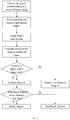
- FIG. 1 is a flow diagram of obstacle detection of the disclosure, and includes 6 steps.
- the pixels corresponding to a certain distance range is chosen, wherein in practice, the pixel values are between 40 and 60.
- the image is denoised and the image edges are smoothed by the opening operation in morphology, which includes erosion and dilation.
- g represents the function of a convolution kernel, of which the size is usually much smaller than that of the original image.
- n 1 and n 2 represent a position in the image range.
- the convolution operation refers to covering the center of the convolution kernel on each pixel of image and then conducting the point multiplication operation. After the absolute value is normalized, it is assigned to the pixel.
- the convolution operation is one of the most important methods in edge detection, and plays an important role in the fields of information technology such as machine learning, digital media and computer vision.
- the Sobel convolution kernel is used to process images, which includes horizontal and vertical matrix respectively. Then conduct the convolution operation using the two Sobel convolution kernel with the image, so that horizontal and vertical edges can be detected respectively.
- A represents an original image
- Gx and Gy represent images subjected to horizontal and vertical edge detection respectively
- Gy 1 2 1 0 0 0 ⁇ 1 ⁇ 2 ⁇ 1 ⁇
- a gradient result is obtained by using Gx, and an absolute value is taken and normalized to find out the vertical edge of the image.
- a bookshelf plane is found out through a following method: in an original depth image, the average column number of the region with a maximum gradient is the bookshelf plane.
- the result obtained in the step 3 is utilized, if it is a plane, the pixel value is close to 0 after convolution normalization.
- the threshold parameter dep_threshold is set, and the plane is determined when the pixel value is less than dep_threshold.
- the regions with a small area are filtered out, and judging if there is an obstacle in the regions with large areas.
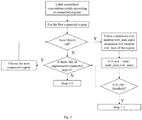
- the flow diagram of this process is shown in FIG. 2 , and includes the following steps.
- the area of a possible plane finally found is less than a certain value, it means that the obstacle will not block the advancing process of the robot, at the same time, if the area is larger than the value, and on average, the number of columns occupied by the obstacle is less than a certain value, it means that the book protruding distance is very small, and it will not block the advancing process of the robot.
- FIG. 3 an intermediate result diagram of an obstacle detection algorithm for an image is shown, where (a) in FIG. 3 is an original RGB image, (b) in FIG. 3 is a result of the depth image after choosing a certain distance, (c) in FIG. 3 is a diagram after denoising, (d) in FIG. 3 is a convolution result diagram, (d) in FIG. 3 is a boundary region diagram according to the convolution result, (e) in FIG. 3 is the found bookshelf plane, and (f) in FIG. 3 is the final plane result where a book may protrude.
- the experiments can show that both the accuracy and speed of the disclosure are satisfactory.
- the disclosure provides a method for detecting the obstacle based on a depth image, there are many methods and ways to implement the technical solution, and the above is only a preferred implementation of the disclosure. It should be noted that for those of ordinary kill in the art, without departing from the principles of the disclosure, several improvements and retouches can also be made, and these improvements and retouches should also be regarded as the scope of protection of the disclosure.
- the components that are not clear in this embodiment can be implemented with the existing technology.
Landscapes
- Engineering & Computer Science (AREA)
- Physics & Mathematics (AREA)
- General Physics & Mathematics (AREA)
- Multimedia (AREA)
- Theoretical Computer Science (AREA)
- Computer Vision & Pattern Recognition (AREA)
- Image Analysis (AREA)
- Image Processing (AREA)
Abstract
Description
- The disclosure relates to an image processing method for detecting an obstacle based on a depth image, in particular to a digital image processing method for detecting protruding books on a library bookshelf.
- In recent years, with the rapid development of computer vision and computer science and technology, more and more researchers are engaged in the research of robot vision. The application of a robot vision system to mobile robots also attracts more and more attention and shows a good development prospect, and the research on obstacle detection has become one of hot spots in many applications, and has achieved abundant accomplishments. However, there is no good way to detect the protruding books on a bookshelf in the moving process of a library robot.
- At present, there are two types of methods in obstacle detection at home and abroad: the obstacle detection method based on LiDAR and the obstacle detection method based on computer vision. Compared with the LiDAR sensor, the vision sensor is low-cost, has strong adaptability to complex environment, and is not prone to being affected by environment or obstacle shapes. Besides, the vision sensors can obtain the image signals of environment information, which contain a lot of image information and have great advantages in describing the broadness and integrity of a target.
- The method based on edge information and the method based on stereo vision are widely applied in obstacle detection, and both have good performance. The edge is a basic image feature and has rich information, which can separate the obstacle from the background. But the method based on edge information performs poorly when the colors of the obstacle and the background are very close or the lighting is too dark. The method based on stereo vision can obtain three-dimensional information from a two-dimensional image, but suffers from expensive computation cost and the complexity of the features matching.
- The existing obstacle detection algorithms are not applicable to the detection of the protruding books on the bookshelf in the moving process of the library robot. For RGB images, it is difficult to distinguish the protruding books from the bookshelf and the adjacent books, because the colors are so close. As a result, the edge features are not suitable to solve this kind of problem.
- Objectives of the disclosure: the disclosure aims to overcome the weakness that the existing edge detection algorithms cannot effectively detect the protruding books on a library bookshelf, and to solve the problem that the existing detection method based on stereo vision is running in a low speed. The disclosure processes the depth image, detects the edges and determines whether an obstacle is encountered to improve the algorithm performance.
- In order to solve the above technical problems, the disclosure discloses a library robot obstacle detection method based on a depth image. The method can be used in the obstacle detection, a library robot, image processing and other applications, which includes the following steps,
-
step 1, choosing the pixels corresponding to a certain distance range, wherein in practice, the pixel values are between 40 and 60; - step 2, denoising the image and smoothing the image edges by the opening operation in morphology, which includes erosion and dilation
- step 3, conducting edge detection by a convolution operation;
- step 4, finding out the bookshelf plane and drawing a dividing line;
- step 5, finding out the plane of a protruding book according to a convolution result;
- step 6, filtering out the regions with a small area, and judging if there is an obstacle in the regions with large areas.
- In
step 1, the parameter is set to choose the pixels of which the pixel value is from 40 to 60 corresponding to a certain distance range - In step 2, the image is denoised, and the image edges are smoothed.
- In step 3, the convolution operation is conducted by adopting a following convolution formula,


- In step 4, the bookshelf plane is found out through a following method, in the depth image in
step 1, the average column number of the region with a maximum gradient is the bookshelf plane. - In step 5, the result obtained in step 3 is utilized, because the pixel value of the plane will be close to 0 after the convolution operation. The threshold parameter dep_threshold is set, and the pixel with the value less than dep_threshold is considered as a plane.
- In step 6, filtering out the regions with the small area, and judging if there is an obstacle in the regions with large areas, which includes the following steps:
- step 6-1, finding connected regions through a plane result obtained in step 5 according to neighborhoods;
- step 6-2, setting the area threshold parameter area_thre;
- step 6-3, choosing the first connected region and skipping to step 6-4;
- step 6-4, for the connected region, counting the area of the connected region. If the area is less than the threshold parameter area_thre, the connected region is deleted, the next connected region is taken and the flow skips to step 6-4. If each of the connected regions is determined, stop = 0, indicating that there is no obstacle and the step 6 is ended. If the area of the connected region is larger than the area threshold parameter area_thre, the flow skips to step 6-5;
- step 6-5, calculating a distance col_ave of the book protruding from the bookshelf, and setting a threshold parameter col_thre. When the distance is larger than the threshold parameter col_thre, stop = 1, indicating that there is an obstacle book and step 6 is ended. Otherwise, the next connected region is taken, and the flow skips to step 6-4. If each of the connected regions is determined, then stop = 0, and step 6 is ended.
- Beneficial effects: the disclosure has the remarkable advantages that the detection result is very good when it is very difficult to distinguish the protruding books from the bookshelf background and the adjacent books. The plane is found out by adopting the convolution operation and the algorithm runs in a high speed, so it is suitable for processing images obtained in real time in the moving process of the robot. Meanwhile, the result is also very accurate, and thus the algorithm performance is improved.
- The disclosure is further specifically described in combination with the drawings and the detailed description, and the advantages of the above and/or other aspects of the disclosure will become clearer.
-
FIG. 1 is a flow diagram of obstacle detection of the disclosure. -
FIG. 2 is a flow diagram of judging whether to stop or not according to a normalized convolution result in the disclosure. -
FIG. 3 is an intermediate result diagram of the disclosure. - In order to make the object, technical solution and advantages of the disclosure clearer, this chapter makes a further detailed description of the disclosure in combination with the accompanying drawings.
-
FIG. 1 is a flow diagram of obstacle detection of the disclosure, and includes 6 steps. - In the first step, the pixels corresponding to a certain distance range is chosen, wherein in practice, the pixel values are between 40 and 60.
- In the second step, the image is denoised and the image edges are smoothed by the opening operation in morphology, which includes erosion and dilation.
- In the third step, a convolution operation is conducted by adopting a following convolution formula:

- The convolution operation is one of the most important methods in edge detection, and plays an important role in the fields of information technology such as machine learning, digital media and computer vision.
- At present, many convolution kernels have been widely used, here, in order to extract an edge and determine a plane, the Sobel convolution kernel is used to process images, which includes horizontal and vertical matrix respectively. Then conduct the convolution operation using the two Sobel convolution kernel with the image, so that horizontal and vertical edges can be detected respectively. If A represents an original image and Gx and Gy represent images subjected to horizontal and vertical edge detection respectively, a formula is

- In the fourth step, a bookshelf plane is found out through a following method: in an original depth image, the average column number of the region with a maximum gradient is the bookshelf plane.
- In the fifth step, the result obtained in the step 3 is utilized, if it is a plane, the pixel value is close to 0 after convolution normalization. The threshold parameter dep_threshold is set, and the plane is determined when the pixel value is less than dep_threshold.
- In the sixth step, the regions with a small area are filtered out, and judging if there is an obstacle in the regions with large areas. The flow diagram of this process is shown in
FIG. 2 , and includes the following steps. - Step 6-1, connected regions are found through a plane result obtained in step 5 according to neighborhoods, that is, for a pixel located at (x, y), wherein x and y represent a row number and a column number of the pixel in the image respectively, if there is a pixel with a pixel value not equal to 0 at the neighborhood position, the pixel is adjacent to the previous pixel, and is in the same connected region.
- Step 6-2, an area threshold parameter area_thre is set.
- Step 6-3, the first connected region is chosen and the flow skips to step 6-4.
- Step 6-4, for the connected region, the area of the connected region is counted. If the area is less than the threshold parameter area_thre, the connected region is deleted, the next connected region is taken, and the flows skips to step 6-4. If each of the connected regions is determined, stop = 0, indicating that there is no obstacle and step 6 is ended. If the area of the connected region is larger than the area threshold parameter area_thre, the flow skips to step 6-5.
- Step 6-5, a distance col_ave of the book protruding from the bookshelf is calculated, and a threshold parameter col_thre is set. When the distance is larger than the threshold parameter col_thre, stop = 1, indicating that there is an obstacle book and step 6 is ended. Otherwise, the next connected region is taken, the flow skips to step 6-4. If each of the connected regions is determined, then stop = 0, and step 6 is ended.
- If the area of a possible plane finally found is less than a certain value, it means that the obstacle will not block the advancing process of the robot, at the same time, if the area is larger than the value, and on average, the number of columns occupied by the obstacle is less than a certain value, it means that the book protruding distance is very small, and it will not block the advancing process of the robot.
- In order to verify the effectiveness of the algorithm, experiments are conducted on 8 video clips from the real environment, including 5 clips that robots will not hit and 3 clips that robots may hit. Each frame in these video clips is processed to judge whether the robot should stop or not.
- These 8 video clips are taken as an example, for each frame in the video clips, whether the robot encounters an obstacle is judged according to the steps as follows.
- 1. The depth image is transformed into gray-scale, and the pixels corresponding to a certain distance range is chosen. The gray-scale value in the depth image represents the distance between the object and the camera, then the image is processed, and part of a region where an obstacle is impossible to appear is removed.
- 2. The image is denoised and the image edges are smoothed by the opening operation in morphology.
- 3. The image is subjected to the convolution operation, and after convolution, an absolute value is normalized.
- 4. A bookshelf plane is found out through a following method: in the depth image in
step 1, the average column number of the region with a maximum gradient is the bookshelf plane. - 5. According to a normalized result obtained in step 3, the threshold parameter dep_threshold is set, in a convolution result, the part with the pixel value less than dep_threshold is the possible plane.
- 6. For the plane formed by the pixels in each neighborhood, firstly, whether the area of the plane is larger than the area threshold parameter area_thre or not is judged, then whether the number of columns that the plane occupies is larger than the threshold parameter col_thre or not is judged, if both are yes, for this image, it is determined that the robot should stop.
- In
FIG. 3 , an intermediate result diagram of an obstacle detection algorithm for an image is shown, where (a) inFIG. 3 is an original RGB image, (b) inFIG. 3 is a result of the depth image after choosing a certain distance, (c) inFIG. 3 is a diagram after denoising, (d) inFIG. 3 is a convolution result diagram, (d) inFIG. 3 is a boundary region diagram according to the convolution result, (e) inFIG. 3 is the found bookshelf plane, and (f) inFIG. 3 is the final plane result where a book may protrude. The experiments can show that both the accuracy and speed of the disclosure are satisfactory. - The disclosure provides a method for detecting the obstacle based on a depth image, there are many methods and ways to implement the technical solution, and the above is only a preferred implementation of the disclosure. It should be noted that for those of ordinary kill in the art, without departing from the principles of the disclosure, several improvements and retouches can also be made, and these improvements and retouches should also be regarded as the scope of protection of the disclosure. The components that are not clear in this embodiment can be implemented with the existing technology.
Claims (7)
- A library robot obstacle detection method based on a depth image, comprising the following steps:step 1, choosing the pixels corresponding to a certain distance range from the collected image;step 2, denoising the image and smoothing the edges;step 3, conducting edge detection by a convolution operation;step 4, finding out the bookshelf plane and drawing a dividing line;step 5, finding out the plane of a book protruding from a bookshelf according to a convolution result; andstep 6, filtering out the regions with an area less than a threshold parameter area_thre, and judging if there is an obstacle in the regions with large areas.
- The method according to claim 1, wherein in step 1, a parameter is set to choose the pixels of which the pixel value is from 40 to 60 corresponding to a certain distance range.
- The method according to claim 2, wherein in step 2, the image is denoised and the image edges are smoothed by the opening operation in morphology, which includes erosion and dilation.
- The method according to claim 3, wherein in step 3, the convolution operation is conducted by adopting a following convolution formula,

- The method according to claim 4, wherein in step 4, the bookshelf plane is found out through a following method: in the depth image in step 1, an average column number of the region with a maximum gradient is the bookshelf plane.
- The method according to claim 5, wherein in step 5, the result obtained in step 3 is utilized to set a threshold parameter dep_threshold, and the plane is determined when a pixel value is less than dep_threshold.
- The method according to claim 6, wherein in step 6, filtering out the region with the area less than the threshold parameter area_thre, and judging if there is an obstacle in the regions with large areas, comprises the following steps:step 6-1, finding connected regions through a plane result obtained in step 5 according to neighborhoods;step 6-2, setting the area threshold parameter area_thre;step 6-3, choosing the first connected region and skipping to step 6-4;step 6-4, for the connected region, counting the area of the connected region, wherein if the area is less than the threshold parameter area_thre, the connected region is deleted, and step 6-5 is conducted; and if the area of the connected region is larger than the area threshold parameter area_thre, the flow skips to step 6-6;step 6-5, taking a next connected region, wherein if each of the connected regions is determined, it is determined that there is no obstacle, step 6 is ended, and if not, the flow returns to step 6-4; andstep 6-6, calculating a distance col_ave of the book protruding from the bookshelf, and setting a threshold parameter col_thre, wherein when the distance is larger than the threshold parameter col_thre, it is determined that there is an obstacle book, and step 6 is ended; otherwise, taking the next connected area and skipping to step 6-4, wherein if each of the connected regions is determined, it is determined that there is no obstacle, and step 6 is ended.
Applications Claiming Priority (2)
| Application Number | Priority Date | Filing Date | Title |
|---|---|---|---|
| CN201810644120.3A CN109101874B (en) | 2018-06-21 | 2018-06-21 | Library robot obstacle identification method based on depth image |
| PCT/CN2019/082717 WO2019242388A1 (en) | 2018-06-21 | 2019-04-15 | Obstacle recognition method for library robot based on depth image |
Publications (2)
| Publication Number | Publication Date |
|---|---|
| EP3745300A1 true EP3745300A1 (en) | 2020-12-02 |
| EP3745300A4 EP3745300A4 (en) | 2021-03-24 |
Family
ID=64845021
Family Applications (1)
| Application Number | Title | Priority Date | Filing Date |
|---|---|---|---|
| EP19822360.4A Withdrawn EP3745300A4 (en) | 2018-06-21 | 2019-04-15 | OBSTACLE DETECTION METHODS FOR LIBRARY ROBOTS ON THE BASIS OF DEPTH IMAGES |
Country Status (3)
| Country | Link |
|---|---|
| EP (1) | EP3745300A4 (en) |
| CN (1) | CN109101874B (en) |
| WO (1) | WO2019242388A1 (en) |
Families Citing this family (4)
| Publication number | Priority date | Publication date | Assignee | Title |
|---|---|---|---|---|
| CN109101874B (en) * | 2018-06-21 | 2022-03-18 | 南京大学 | Library robot obstacle identification method based on depth image |
| CN111609852A (en) * | 2019-02-25 | 2020-09-01 | 北京奇虎科技有限公司 | Semantic map construction method, cleaning robot and electronic device |
| CN113139927B (en) * | 2020-01-02 | 2024-12-06 | 深圳怡化电脑股份有限公司 | Banknote crack detection method, device, equipment and readable medium |
| CN115311320A (en) * | 2022-08-05 | 2022-11-08 | 中原动力智能机器人有限公司 | Robot control method and device based on escalator detection |
Family Cites Families (7)
| Publication number | Priority date | Publication date | Assignee | Title |
|---|---|---|---|---|
| CN104318206B (en) * | 2014-09-30 | 2017-09-29 | 东软集团股份有限公司 | A kind of obstacle detection method and device |
| KR20170121933A (en) * | 2016-04-26 | 2017-11-03 | 삼성에스디에스 주식회사 | Method and Apparatus for avoiding collision using depth sensor |
| CN106096559A (en) * | 2016-06-16 | 2016-11-09 | 深圳零度智能机器人科技有限公司 | Obstacle detection method and system and moving object |
| CN106651836B (en) * | 2016-11-04 | 2019-10-22 | 中国科学院上海微系统与信息技术研究所 | A Ground Level Detection Method Based on Binocular Vision |
| CN107330925B (en) * | 2017-05-11 | 2020-05-22 | 北京交通大学 | Multi-obstacle detection and tracking method based on laser radar depth image |
| CN107397658B (en) * | 2017-07-26 | 2020-06-19 | 成都快眼科技有限公司 | Multi-scale full-convolution network and visual blind guiding method and device |
| CN109101874B (en) * | 2018-06-21 | 2022-03-18 | 南京大学 | Library robot obstacle identification method based on depth image |
-
2018
- 2018-06-21 CN CN201810644120.3A patent/CN109101874B/en active Active
-
2019
- 2019-04-15 EP EP19822360.4A patent/EP3745300A4/en not_active Withdrawn
- 2019-04-15 WO PCT/CN2019/082717 patent/WO2019242388A1/en not_active Ceased
Also Published As
| Publication number | Publication date |
|---|---|
| EP3745300A4 (en) | 2021-03-24 |
| CN109101874A (en) | 2018-12-28 |
| WO2019242388A1 (en) | 2019-12-26 |
| CN109101874B (en) | 2022-03-18 |
Similar Documents
| Publication | Publication Date | Title |
|---|---|---|
| CN112528878B (en) | Method, device, terminal equipment and readable storage medium for detecting lane lines | |
| Kluge | Extracting road curvature and orientation from image edge points without perceptual grouping into features | |
| Borkar et al. | Robust lane detection and tracking with ransac and kalman filter | |
| JP4607193B2 (en) | Vehicle and lane mark detection device | |
| EP3007099A1 (en) | Image recognition system for a vehicle and corresponding method | |
| KR101609303B1 (en) | Method to calibrate camera and apparatus therefor | |
| CN113221861B (en) | Multi-lane line detection method, device and detection equipment | |
| CN110814465B (en) | Universal method for automatically extracting welding seam contour | |
| CN107564034A (en) | The pedestrian detection and tracking of multiple target in a kind of monitor video | |
| CN105261020A (en) | Method for detecting fast lane line | |
| CN105987684A (en) | Monocular vision-based agricultural vehicle navigation line detection system and method | |
| CN104134209A (en) | Feature extraction and matching method and feature extraction and matching system in visual navigation | |
| EP3979196B1 (en) | Image processing method and apparatus for target detection | |
| Suddamalla et al. | A novel algorithm of lane detection addressing varied scenarios of curved and dashed lanemarks | |
| CN102982537A (en) | Scene change detection method and scene change detection system | |
| CN103955888A (en) | High-definition video image mosaic method and device based on SIFT | |
| CN104318559A (en) | Quick feature point detecting method for video image matching | |
| CN109101874B (en) | Library robot obstacle identification method based on depth image | |
| CN105335704B (en) | A method and device for lane line recognition based on bilinear interpolation | |
| CN108256445A (en) | Method for detecting lane lines and system | |
| Liu et al. | Effective road lane detection and tracking method using line segment detector | |
| WO2015140492A1 (en) | Recognition of objects within a video | |
| Liu et al. | Application of color filter adjustment and k-means clustering method in lane detection for self-driving cars | |
| Alaa et al. | A robust lane detection method for urban roads | |
| CN107097256A (en) | Model-free method for tracking target of the view-based access control model nonholonomic mobile robot under polar coordinates |
Legal Events
| Date | Code | Title | Description |
|---|---|---|---|
| STAA | Information on the status of an ep patent application or granted ep patent |
Free format text: STATUS: THE INTERNATIONAL PUBLICATION HAS BEEN MADE |
|
| PUAI | Public reference made under article 153(3) epc to a published international application that has entered the european phase |
Free format text: ORIGINAL CODE: 0009012 |
|
| STAA | Information on the status of an ep patent application or granted ep patent |
Free format text: STATUS: REQUEST FOR EXAMINATION WAS MADE |
|
| 17P | Request for examination filed |
Effective date: 20200828 |
|
| AK | Designated contracting states |
Kind code of ref document: A1 Designated state(s): AL AT BE BG CH CY CZ DE DK EE ES FI FR GB GR HR HU IE IS IT LI LT LU LV MC MK MT NL NO PL PT RO RS SE SI SK SM TR |
|
| AX | Request for extension of the european patent |
Extension state: BA ME |
|
| A4 | Supplementary search report drawn up and despatched |
Effective date: 20210223 |
|
| RIC1 | Information provided on ipc code assigned before grant |
Ipc: G06K 9/00 20060101AFI20210217BHEP Ipc: G06K 9/46 20060101ALI20210217BHEP |
|
| DAV | Request for validation of the european patent (deleted) | ||
| DAX | Request for extension of the european patent (deleted) | ||
| STAA | Information on the status of an ep patent application or granted ep patent |
Free format text: STATUS: EXAMINATION IS IN PROGRESS |
|
| 17Q | First examination report despatched |
Effective date: 20211105 |
|
| STAA | Information on the status of an ep patent application or granted ep patent |
Free format text: STATUS: THE APPLICATION IS DEEMED TO BE WITHDRAWN |
|
| 18D | Application deemed to be withdrawn |
Effective date: 20220917 |