EP3744758A1 - Onium-functionalized siloxanes - Google Patents
Onium-functionalized siloxanes Download PDFInfo
- Publication number
- EP3744758A1 EP3744758A1 EP19177583.2A EP19177583A EP3744758A1 EP 3744758 A1 EP3744758 A1 EP 3744758A1 EP 19177583 A EP19177583 A EP 19177583A EP 3744758 A1 EP3744758 A1 EP 3744758A1
- Authority
- EP
- European Patent Office
- Prior art keywords
- group
- onium
- integer
- heteroatom
- formula
- Prior art date
- Legal status (The legal status is an assumption and is not a legal conclusion. Google has not performed a legal analysis and makes no representation as to the accuracy of the status listed.)
- Granted
Links
- 0 C*(CNC)O* Chemical compound C*(CNC)O* 0.000 description 1
Classifications
-
- C—CHEMISTRY; METALLURGY
- C08—ORGANIC MACROMOLECULAR COMPOUNDS; THEIR PREPARATION OR CHEMICAL WORKING-UP; COMPOSITIONS BASED THEREON
- C08G—MACROMOLECULAR COMPOUNDS OBTAINED OTHERWISE THAN BY REACTIONS ONLY INVOLVING UNSATURATED CARBON-TO-CARBON BONDS
- C08G77/00—Macromolecular compounds obtained by reactions forming a linkage containing silicon with or without sulfur, nitrogen, oxygen or carbon in the main chain of the macromolecule
- C08G77/04—Polysiloxanes
- C08G77/22—Polysiloxanes containing silicon bound to organic groups containing atoms other than carbon, hydrogen and oxygen
- C08G77/26—Polysiloxanes containing silicon bound to organic groups containing atoms other than carbon, hydrogen and oxygen nitrogen-containing groups
-
- A—HUMAN NECESSITIES
- A01—AGRICULTURE; FORESTRY; ANIMAL HUSBANDRY; HUNTING; TRAPPING; FISHING
- A01N—PRESERVATION OF BODIES OF HUMANS OR ANIMALS OR PLANTS OR PARTS THEREOF; BIOCIDES, e.g. AS DISINFECTANTS, AS PESTICIDES OR AS HERBICIDES; PEST REPELLANTS OR ATTRACTANTS; PLANT GROWTH REGULATORS
- A01N55/00—Biocides, pest repellants or attractants, or plant growth regulators, containing organic compounds containing elements other than carbon, hydrogen, halogen, oxygen, nitrogen and sulfur
-
- C—CHEMISTRY; METALLURGY
- C08—ORGANIC MACROMOLECULAR COMPOUNDS; THEIR PREPARATION OR CHEMICAL WORKING-UP; COMPOSITIONS BASED THEREON
- C08G—MACROMOLECULAR COMPOUNDS OBTAINED OTHERWISE THAN BY REACTIONS ONLY INVOLVING UNSATURATED CARBON-TO-CARBON BONDS
- C08G77/00—Macromolecular compounds obtained by reactions forming a linkage containing silicon with or without sulfur, nitrogen, oxygen or carbon in the main chain of the macromolecule
- C08G77/04—Polysiloxanes
- C08G77/22—Polysiloxanes containing silicon bound to organic groups containing atoms other than carbon, hydrogen and oxygen
- C08G77/24—Polysiloxanes containing silicon bound to organic groups containing atoms other than carbon, hydrogen and oxygen halogen-containing groups
-
- C—CHEMISTRY; METALLURGY
- C08—ORGANIC MACROMOLECULAR COMPOUNDS; THEIR PREPARATION OR CHEMICAL WORKING-UP; COMPOSITIONS BASED THEREON
- C08G—MACROMOLECULAR COMPOUNDS OBTAINED OTHERWISE THAN BY REACTIONS ONLY INVOLVING UNSATURATED CARBON-TO-CARBON BONDS
- C08G77/00—Macromolecular compounds obtained by reactions forming a linkage containing silicon with or without sulfur, nitrogen, oxygen or carbon in the main chain of the macromolecule
- C08G77/04—Polysiloxanes
- C08G77/22—Polysiloxanes containing silicon bound to organic groups containing atoms other than carbon, hydrogen and oxygen
- C08G77/28—Polysiloxanes containing silicon bound to organic groups containing atoms other than carbon, hydrogen and oxygen sulfur-containing groups
-
- C—CHEMISTRY; METALLURGY
- C08—ORGANIC MACROMOLECULAR COMPOUNDS; THEIR PREPARATION OR CHEMICAL WORKING-UP; COMPOSITIONS BASED THEREON
- C08G—MACROMOLECULAR COMPOUNDS OBTAINED OTHERWISE THAN BY REACTIONS ONLY INVOLVING UNSATURATED CARBON-TO-CARBON BONDS
- C08G77/00—Macromolecular compounds obtained by reactions forming a linkage containing silicon with or without sulfur, nitrogen, oxygen or carbon in the main chain of the macromolecule
- C08G77/04—Polysiloxanes
- C08G77/22—Polysiloxanes containing silicon bound to organic groups containing atoms other than carbon, hydrogen and oxygen
- C08G77/30—Polysiloxanes containing silicon bound to organic groups containing atoms other than carbon, hydrogen and oxygen phosphorus-containing groups
-
- C—CHEMISTRY; METALLURGY
- C08—ORGANIC MACROMOLECULAR COMPOUNDS; THEIR PREPARATION OR CHEMICAL WORKING-UP; COMPOSITIONS BASED THEREON
- C08G—MACROMOLECULAR COMPOUNDS OBTAINED OTHERWISE THAN BY REACTIONS ONLY INVOLVING UNSATURATED CARBON-TO-CARBON BONDS
- C08G77/00—Macromolecular compounds obtained by reactions forming a linkage containing silicon with or without sulfur, nitrogen, oxygen or carbon in the main chain of the macromolecule
- C08G77/04—Polysiloxanes
- C08G77/38—Polysiloxanes modified by chemical after-treatment
- C08G77/382—Polysiloxanes modified by chemical after-treatment containing atoms other than carbon, hydrogen, oxygen or silicon
- C08G77/388—Polysiloxanes modified by chemical after-treatment containing atoms other than carbon, hydrogen, oxygen or silicon containing nitrogen
-
- C—CHEMISTRY; METALLURGY
- C08—ORGANIC MACROMOLECULAR COMPOUNDS; THEIR PREPARATION OR CHEMICAL WORKING-UP; COMPOSITIONS BASED THEREON
- C08G—MACROMOLECULAR COMPOUNDS OBTAINED OTHERWISE THAN BY REACTIONS ONLY INVOLVING UNSATURATED CARBON-TO-CARBON BONDS
- C08G77/00—Macromolecular compounds obtained by reactions forming a linkage containing silicon with or without sulfur, nitrogen, oxygen or carbon in the main chain of the macromolecule
- C08G77/04—Polysiloxanes
- C08G77/38—Polysiloxanes modified by chemical after-treatment
- C08G77/382—Polysiloxanes modified by chemical after-treatment containing atoms other than carbon, hydrogen, oxygen or silicon
- C08G77/392—Polysiloxanes modified by chemical after-treatment containing atoms other than carbon, hydrogen, oxygen or silicon containing sulfur
-
- C—CHEMISTRY; METALLURGY
- C08—ORGANIC MACROMOLECULAR COMPOUNDS; THEIR PREPARATION OR CHEMICAL WORKING-UP; COMPOSITIONS BASED THEREON
- C08G—MACROMOLECULAR COMPOUNDS OBTAINED OTHERWISE THAN BY REACTIONS ONLY INVOLVING UNSATURATED CARBON-TO-CARBON BONDS
- C08G77/00—Macromolecular compounds obtained by reactions forming a linkage containing silicon with or without sulfur, nitrogen, oxygen or carbon in the main chain of the macromolecule
- C08G77/04—Polysiloxanes
- C08G77/38—Polysiloxanes modified by chemical after-treatment
- C08G77/382—Polysiloxanes modified by chemical after-treatment containing atoms other than carbon, hydrogen, oxygen or silicon
- C08G77/395—Polysiloxanes modified by chemical after-treatment containing atoms other than carbon, hydrogen, oxygen or silicon containing phosphorus
-
- C—CHEMISTRY; METALLURGY
- C08—ORGANIC MACROMOLECULAR COMPOUNDS; THEIR PREPARATION OR CHEMICAL WORKING-UP; COMPOSITIONS BASED THEREON
- C08K—Use of inorganic or non-macromolecular organic substances as compounding ingredients
- C08K5/00—Use of organic ingredients
- C08K5/04—Oxygen-containing compounds
- C08K5/15—Heterocyclic compounds having oxygen in the ring
- C08K5/151—Heterocyclic compounds having oxygen in the ring having one oxygen atom in the ring
- C08K5/1535—Five-membered rings
Definitions
- the present invention relates to an onium-functionalized siloxane containing a siloxane backbone having at least one onium-functionalized side group.
- the starting material is a monomeric, oligomeric or polymeric, linear or cyclic siloxane, in which at least one functionalized side-group, preferably halogen-functionalized or pseudohalogen-functionalized side-group, is bonded to the siloxane backbone through a silyl-heteroatom bond, preferably silyl-oxo (Si-O) bond.
- the onium-functionalized siloxanes according to the present invention show antimicrobial activity, for instance against fungi, yeasts and gram-positive and gram-negative bacteria.
- the present invention is directed to a method for preparing the onium-functionalized siloxane and the use thereof as an antimicrobial agent.
- Siloxanes more precisely silicones, with functionalized groups are already known in literature. Most papers or patents deal with branched silicones which contain only siloxane groups or functional groups connected via silyl-carbon bonds, or silicones having alkyl or acyl groups, which have no special functionality or are very unreactive.
- Siloxanes having functional ammonium groups via sulfur bridge has been known.
- the functional group is not bonded to the siloxane backbone via silyl-heteroatom bond, there is no possibility of releasing the antimicrobial functional group.
- Onium-functionalized siloxanes according to the present invention contain a siloxane backbone having at least one onium-functionalized side group, which is connected to the siloxane backbone via silyl-heteroatom bond, preferably silyl-oxo bond (Si-O), which can be hydrolyzed in a controllable manner.
- the starting material is a monomeric, oligomeric or polymeric, linear or cyclic siloxane, in which at least one functionalized side-group, preferably halogen-functionalized side-group or pseudohalogen-functionalized side-group, is bonded to the siloxane backbone through a silyl-heteroatom bond, preferably silyl-oxo (Si-O) bond.
- the afore mentioned starting material can be ionized/derivatized with a nucleophile containing at least one atom selected from the 15 th or 16 th group of the periodic table, such as N, P, As, O, S and Se, preferably in the absence of a catalyst, to form an onium-cation.
- a nucleophile containing at least one atom selected from the 15 th or 16 th group of the periodic table, such as N, P, As, O, S and Se preferably in the absence of a catalyst, to form an onium-cation.
- silyl-heteroatom bond such as silyl-oxo (Si-O) bond
- Si-O silyl-oxo
- an onium-functionalized siloxane having the general formula (X) or (X-A) as defined herein.
- the present invention also provides a method for preparing said onium-functionalized siloxane.
- the present invention provides use of the onium-functionalized siloxane according to the invention or obtained by the method according to the invention as an antimicrobial agent, preferably against molds, yeasts, fungi, gram-positive bacteria, or gram-negative bacteria.
- room temperature is 23°C plus or minus 2°C.
- the molecular weights given in the present text refer to number average molecular weights (Mn), unless otherwise stipulated. All molecular weight data refer to values obtained by gel permeation chromatography (GPC) carried out using HP1090 II Chromatography with DAD detector (HEWLETT PACKARD) at 40 °C. Tetrahydrofuran (THF) was used as an eluent. THF was passed through three PSS SDV gel columns with molecular weight ranges of 102, 103 and 104 g ⁇ mol -1 with a flow rate of 0.9 ml ⁇ min -1 . The calibration of the device was carried out using polystyrene standards.
- polydispersity refers to a measure of the distribution of molecular mass in a given polymer sample. The polydispersity is calculated by dividing the weight average molecular weight (Mw) by the number average molecular weight (Mn).
- C 1 -C 8 alkyl refers to a monovalent group that contains 1 to 8 carbons atoms, that is a radical of an alkane and includes linear and branched organic groups.
- alkyl groups include, but are not limited to: methyl; ethyl; propyl; isopropyl; n-butyl; isobutyl; sec-butyl; tert-butyl; n-pentyl; n-hexyl; n-heptyl; and, 2-ethylhexyl.
- alkyl groups may be unsubstituted or may be substituted with one or more substituents such as halo, nitro, cyano, amido, amino, sulfonyl, sulfinyl, sulfanyl, sulfoxy, urea, thiourea, sulfamoyl, sulfamide and hydroxy.
- substituents such as halo, nitro, cyano, amido, amino, sulfonyl, sulfinyl, sulfanyl, sulfoxy, urea, thiourea, sulfamoyl, sulfamide and hydroxy.
- C 2 -C 8 alkenyl refers to an aliphatic hydrocarbon group which contains 2 to 8 carbon atoms and at least one carbon-carbon double bond, e.g., ethenyl, propenyl, butenyl, or pentenyl and structural isomers thereof such as 1- or 2-propenyl, 1-, 2-, or 3-butenyl, etc.
- Alkenyl groups can be linear or branched and substituted or unsubstituted. If they are substituted, the substituents are as defined above for alkyl.
- C 2 -C 8 alkynyl refers to an aliphatic hydrocarbon group which contains 2 to 8 carbon atoms and at least one carbon-carbon triple bond, e.g., ethynyl (acetylene), propynyl, butynyl, or pentynyl and structural isomers thereof as described above.
- Alkynyl groups can be linear or branched and substituted or unsubstituted.
- C 3 -C 10 cycloalkyl is understood to mean a saturated, mono-, bi- or tricyclic hydrocarbon group having from 3 to 10 carbon atoms.
- cycloalkyl groups include: cyclopropyl; cyclobutyl; cyclopentyl; cyclohexyl; cycloheptyl; cyclooctyl; adamantane; and, norbornane.
- an "C 6 -C 18 aryl” group used alone or as part of a larger moiety - as in "aralkyl group” - refers to optionally substituted, monocyclic, bicyclic and tricyclic ring systems in which the monocyclic ring system is aromatic or at least one of the rings in a bicyclic or tricyclic ring system is aromatic.
- the bicyclic and tricyclic ring systems include benzofused 2-3 membered carbocyclic rings.
- aryl groups include: phenyl; indenyl; naphthalenyl, tetrahydronaphthyl, tetrahydroindenyl; tetrahydroanthracenyl; and, anthracenyl. And a preference for phenyl groups may be noted.
- an "aralkyl” group refers to an alkyl group that is substituted with an aryl group.
- An example of an aralkyl group is benzyl.
- C 1 -C 60 alkylene group and “C 1 -C 20 alkylene” group refer respectively to divalent groups that contain from 1 to 60 or from 1 to 20 carbon atoms, that are radicals of an alkane and include linear, branched or cyclic groups, which groups may be substituted or substituted and may optionally be interrupted by at least one heteroatom.
- alkenylene refers to a divalent aliphatic hydrocarbon group having at least one carbon-carbon double bond that is a radical of an alkene.
- An alkenylene group can be linear or branched and substituted or unsubstituted.
- alkynylene refers to a divalent aliphatic hydrocarbon group having at least one carbon-carbon triple bond, that is a radical of an alkyne.
- An alkynylene group can also have one or more carbon-carbon double bonds.
- An alkynylene group can be linear or branched and substituted or unsubstituted.
- arylene group refers to a divalent group that is a radical of an aryl group. Suitable arylene group includes phenylene, furanylene, piperidylene, and naphthylene.
- aralkylene refers to a divalent group that is a radical of an aralkyl group.
- An aralkylene can be represented by the formula -R-Ar- where R is an alkylene and Ar is an arylene, i.e., an alkylene is bonded to an arylene.
- Suitable aralkylene groups includes xylylene and toluenylene.
- heteroatom means that the main chain or side chain of a residue comprises at least one atom that differs from carbon atom and hydrogen.
- heteroatom refers to nitrogen, oxygen, silicon, sulfur, phosphorus, halogens such as Cl, Br, F. Oxygen (O) and nitrogen (N) may be mentioned as typical heteroatoms in the context of the present invention.
- hydrocarbon residue includes saturated or unsaturated hydrocarbon residues.
- heterocyclic compound refers to a saturated or unsaturated, monocyclic, bicyclic, polycyclic or fused compound containing at least one heteroatom, preferably O, S, N, and/or P, in the ring structure.
- halogen refers to fluorine, chlorine, bromine or iodine and correspondingly the term “halide” denotes fluoride, chloride, bromide or iodide anions.
- Pseudohalogen refers to inorganic or organic groups which, when in the form of anions exhibit chemical properties similar to those of the halide ions. Pseudohalogen groups include, although are not exclusive to, azido (N 3 ), thiocyano (SCN) and cyano (CN).
- Onium-functionalized siloxanes according to the present invention have the general Formula (X) or (X-A): wherein:
- the different siloxane subunits n, n1, n2, and p are not necessarily present in the order illustrated herein.
- the subunits n, n1, n2, and p can be randomly distributed in the siloxane backbone in every possible combination.
- R 1 , R 2 , R 3 , R 4 , R 5 and R 6 may be the same or different and each is independently selected from a hydrogen atom or a linear, branched or cyclic hydrocarbon residue having 1 to 20 carbon atoms which may contain at least one heteroatom, preferably selected from O, N, S, Si, P, Cl, Br or F.
- R 1 , R 2 , R 3 , R 4 , R 5 and R 6 are the same or different and each is independently selected from the group consisting of a C 1 -C 12 alkyl group, more preferably C 1 -C 8 alkyl group, a C 2 -C 8 alkenyl group, a C 2 -C 8 alkynyl group, a C 3 -C 10 cycloalkyl group, a C 6 -C 18 aryl group and a C 6 -C 18 aralkyl group, which may contain at least one heteroatom, preferably selected from O, N, S, Si, P, Cl, Br or F.
- R 1 , R 2 , R 3 , R 4 , R 5 and R 6 are the same or different and each is independently selected from a C 1 -C 8 alkyl group which may contain at least one heteroatom, preferably selected from O, N, S, Si, P, Cl, Br or F, in particular methyl, ethyl, n-propyl, fluoropropyl, n-butyl, sec-butyl, or tert-butyl, or a C 6 -C 18 aryl group which may contain at least one heteroatom, preferably selected from O, N, S, Si, P, Cl, Br or F, in particular phenyl, tolyl or benzoyl.
- R 1 , R 2 , R 3 , R 4 , R 5 and R 6 are the same or different and independently selected from methyl or phenyl.
- A is preferably selected from O, S, NR 7 or PR 7 , where R 7 is selected from a hydrogen atom, a C 1 -C 8 alkyl group, a C 3 -C 10 cycloalkyl group, a C 6 -C 18 aryl group or a C 6 -C 18 aralkyl group, which may contain at least one heteroatom, preferably selected from O, N, S, P, Cl, Br or F.
- A is selected from O or S, in particular O, which provides a silyl-oxo bond between siloxane backbone and the onium-functionalized side-groups.
- Z is selected from a linear, branched or cyclic hydrocarbon residue having 2 to 60 carbon atoms, preferably 2 to 20 carbon atoms, which may contain at least one heteroatom, preferably selected from O, N, S, P, Si, Cl, Br or F.
- Z is selected from the group consisting of a C 2 -C 20 alkylene group, a C 2 -C 20 alkenylene group, C 2 -C 20 alkynylene group, a C 6 -C 18 arylene group and a C 6 -C 18 aralkylene group, which may contain at least one heteroatom, preferably selected from O, N, S, P, Si, Cl, Br or F.
- Y is an onium group, which can be represented as ER c R d where E is a positively charged atom selected from the 16 th group of the periodic table, preferably O, S or Se, or ER c R d R e where E is a positively charged atom selected from the 15 th group of the periodic table, preferably N, P or As, wherein R c , R d and R e may be the same or different and each is independently selected from a hydrogen atom, a C 1 -C 8 alkyl group, a C 3 -C 10 cycloalkyl group, a C 6 -C 18 aryl group or a C 6 -C 18 aralkyl group, which may contain at least one heteroatom, preferably O, N, S, Si, Cl, Br or F.
- X is selected from halogen atoms, preferably selected from Br, I or Cl, pseudohalogens, preferably cyano (CN), azido (N 3 ), cyanate (OCN), isocyanate (NCO), thiocyanate (SCN), isothiocyanate (NCS), or anions selected from Tf 2 N, BF 4 or PF 6 .
- halogen atoms preferably selected from Br, I or Cl
- pseudohalogens preferably cyano (CN), azido (N 3 ), cyanate (OCN), isocyanate (NCO), thiocyanate (SCN), isothiocyanate (NCS), or anions selected from Tf 2 N, BF 4 or PF 6 .
- X is selected from halogen atoms, preferably from Br, I or Cl, more preferably Br or I, in particular Br.
- the sum n1+n2 is an integer from 1 to 500, more preferably from 1 to 100; and/or p is an integer from 0 to 500, more preferably from 0 to 100.
- the siloxane may contain diorganosiloxane units, such as dimethylsiloxane or diphenylsiloxane units, in the backbone. The ratio between n units and p units can be varied.
- n or the sum n1+n2 is an integer from 1 to 50, more preferably from 1 to 30; and/or p is an integer from 0 to 50, more preferably from 0 to 30, wherein the sum p+n1+n2 is equal to or higher than 3.
- said onium-functionalized siloxane is a monomer, oligomer or polymer and has a number average molecular weight (Mn) of from 100 to 50,000g/mol, preferably 100 to 25,000 g/mol, more preferably from 100 to 15,000 g/mol.
- the present invention provides a method for preparing the onium-functionalized siloxane having the general Formula (X) or (X-A) as defined herein, comprising:
- the obtained siloxane having the general Formula (I) or (I-A) has a number average molecular weight of from 100 to 50,000g/mol, preferably from 100 to 25,000 g/mol, more preferably 100 to 15,000 g/mol.
- R 1 to R 6 , A, Z, X, n1, n2, and p in the Formula (I) and Formula (I-A) are the same as defined for the general Formula (X) and (X-A).
- Suitable nucleophiles are amines, phosphines, arsanes, ethers, alcohols, thiols, sulfides, selenium-containing molecules.
- Exemplary amines are: primary amines, such as methylamine or ethylamine, secondary amines, such as dimethylamine or diethylamine, tertiary amines, such as trimethylamine or trimethylamine, pyridine, piperidine, pyrrole, pyrroline, pyrrolidine, imidazole, 1-methyl-1H-imidazole, 1-butyl-1H-imidazole, pyrazole, pyrimidine, triazole, triazine, indole, quinoline, purine, such as adenine, guanine, hypoxanthine, xanthine, theobromine, caffeine, uric acid or isoguanine, and porphyrin; preferred for this invention are trimethylamine, triethylamine, pyridine, 1-methyl-1H-imidazole, and 1-butyl-1H-imidazole.
- primary amines such as methylamine or ethylamine
- Exemplary phosphines are organophosphines such as methylphosphine, dimethylphosphine, trimethylphosphine, phenylphosphine, diphenylphosphine, triphenylphosphine or cyclic phosphines, such as phosphiranes, phosphirenes, phospholanes, phosphole and phosphinanes.
- organophosphines such as methylphosphine, dimethylphosphine, trimethylphosphine, phenylphosphine, diphenylphosphine, triphenylphosphine or cyclic phosphines, such as phosphiranes, phosphirenes, phospholanes, phosphole and phosphinanes.
- Exemplary arsanes are monoarsanes, diarsanes or triarsanes with different alkyl chains or heterocycles, such as arsolane and arsole.
- ethers are ethylene oxide, 1,2-propylene oxide, tetrahydrofuran, furan, tetrahydropyran, pyran, oxirene, oxetane, oxete, oxepane, oxepine, 1,4-dioxane, crown ethers, epichlorhydrine, 1,2-butylenoxide, 1,2-pentylenoxide, isopentylenoxide, 1,2-hexylenoxide, 1,2-heptylenoxide, styrene oxide, cyclohexene oxide, methylglycidyl ether, ethylglycidyl ether, allylglycidyl ether, phenylglycidyl ether, butadiene monooxide, isopren monooxide, tolylglycidyl ether, cyclohexenoxide, cyclooctanepoxide
- Exemplary alcohols are methanol, ethanol, propan-1-ol, butan-1-ol, pentan-1-ol, hexan-1-ol, heptan-1-ol, octan-1-ol, nonan-1-ol, decan-1-ol, undecan-1-ol, dodecan-1-ol, tridecan-1-ol, tetradecan-1-ol, pentadecan-1-ol, hexadecan-1-ol, octadecan-1-ol, hexacosan-1-ol, triacontan-1-ol, propan-2-ol, butan-2-ol, 2-methylpropan-1-ol, 2-methylpropan-2-ol, pentan-2-ol, pentan-3-ol, 2-Methylbutan-1-ol, 3-methylbutan-1-ol, 2-methylbutan-2-ol, 3-methylbutan-2-ol, 2,2-d
- Exemplary sulfides are: sulfates and sulfites; thioethers, such as dimethyl sulfide, methyl phenyl sulfide, diethyl sulfide, methyl ethyl sulfide or diphenyl sulfide; thiophenes, such as thiiranes or thiirenes, thietanes or thietes, dithietanes or dithietes, tetrahydrothiophene or thiophene, dithiolane, dithiane and trithiane.
- thioethers such as dimethyl sulfide, methyl phenyl sulfide, diethyl sulfide, methyl ethyl sulfide or diphenyl sulfide
- thiophenes such as thiiranes or thiirenes, thietanes or thietes,
- selenium containing molecules are: selenols (RSeH), such as selenaphenol; selenyl halides, such as phenylselenyl bromide; selenoethers (R-Se-R), such as dimethylselenide, ethylmethylselenide, diethylselenide, methylpropylselenide, methylbutylselenide, butylethylselenide or ethylpropylselenide; and seleniranes.
- R-Se-R selenoethers
- the ionization/derivatization reaction can take place in solvent free conditions, as well as in polar and non-polar solvents, such as alcohols, aromatic or aliphatic alkanes, alkenes or alkynes, halogenated aromatic or aliphatic hydrocarbons and hydrocarbons containing heteroatoms, such as O, N, S, P, Cl, Br or F.
- polar and non-polar solvents such as alcohols, aromatic or aliphatic alkanes, alkenes or alkynes, halogenated aromatic or aliphatic hydrocarbons and hydrocarbons containing heteroatoms, such as O, N, S, P, Cl, Br or F.
- solvents such as toluene, THF, heptane, hexane, chloroform, ethyl acetate, acetone or ethanol. Any residual solvent is preferably removed after the completion of the reaction.
- the reaction can be carried out at a reaction temperature in the range of from 0 to 250°C, preferably from 50 to 130°C, and/or at a reaction pressure from 0.001 to 50 bar, preferably from 0.5 to 5 bar.
- siloxane having the general Formula (I) or (I-A) can be obtained by conventional methods.
- the siloxane having the general Formula (I) or (I-A) used in step (i) is obtainable by reacting
- the platinum catalyst can be selected from the group consisting of chloroplatinic acids, preferably hexachloroplatinic acid; alcohol modified chloroplatinic acids; olefin complexes of chloroplatinic acid; complexes of chloroplatinic acid and divinyltetramethyldisiloxane; fine platinum particles adsorbed on carbon carriers; platinum supported on metal oxide carriers, preferably Pt(Al 2 O 3 ); platinum black; platinum acetylacetonate; platinous halides, preferably PtCl 2 , PtCl 4 , Pt(CN) 2 ; complexes of platinous halides with unsaturated compounds, preferably ethylene, propylene, and organovinylsiloxanes; styrene hexamethyldiplatinum; platinum divinyltetramethyldisiloxane complex; the reaction product of chloroplatinic acid and an unsaturated aliphatic group-containing organosilicon compound; and a
- the platinum catalyst is hexachloroplatinic acid, commonly referred to as Speier's catalyst, which is described in US Patent Nos. 2,823,218 and 3,923,705 , or Karstedt's catalyst, which is described in US Patent Nos. 3,715,334 and 3,814,730 .
- Karstedt's catalyst is a platinum divinyltetramethyldisiloxane complex typically containing about one-weight percent of platinum in a solvent such as toluene.
- the platinum catalyst is present in an amount of from 0.0001 mol% to 10mol%, more preferably 0.001mol% to 0.1 mol%, of platinum based on the molar quantity of silicon-bonded hydrogen in the siloxane.
- the different siloxane subunits n, n1, n2, and p are not necessarily present in the order illustrated herein.
- the subunits n, n1, n2, and p can be randomly distributed in the siloxane backbone in every possible combination.
- R 1 , R 2 , R 3 , R 4 , R 5 and R 6 may be the same or different and each is independently selected from a hydrogen atom or a linear, branched or cyclic hydrocarbon residue having 1 to 20 carbon atoms which may contain at least one heteroatom, preferably selected from O, N, S, Si, P, Cl, Br or F.
- R 1 , R 2 , R 3 , R 4 , R 5 and R 6 are the same or different and each is independently selected from the group consisting of a C 1 -C 12 alkyl group, more preferably C 1 -C 8 alkyl group, a C 2 -C 8 alkenyl group, a C 2 -C 8 alkynyl group, a C 3 -C 10 cycloalkyl group, a C 6 -C 18 aryl group and a C 6 -C 18 aralkyl group, which may contain at least one heteroatom, preferably selected from O, N, S, Si, P, Cl, Br or F.
- R 1 , R 2 , R 3 , R 4 , R 5 and R 6 are the same or different and each is independently selected from a C 1 -C 8 alkyl group which may contain at least one heteroatom, preferably selected from O, N, S, Si, P, Cl, Br or F, in particular methyl, ethyl, n-propyl, fluoropropyl, n-butyl, sec-butyl, or tert-butyl, or a C 6 -C 18 aryl group which may contain at least one heteroatom, preferably selected from O, N, S, Si, P, Cl, Br or F, in particular phenyl, tolyl or benzoyl.
- R 1 , R 2 , R 3 , R 4 , R 5 and R 6 are the same or different and independently selected from methyl or phenyl.
- A is preferably selected from O, S, NR 7 or PR 7 , where R 7 is selected from a hydrogen atom, a C 1 -C 8 alkyl group, a C 3 -C 10 cycloalkyl group, a C 6 -C 18 aryl group or a C 6 -C 18 aralkyl group, which may contain at least one heteroatom, preferably selected from O, N, S, P, Cl, Br or F. In more preferred embodiments, A is selected from O or S, in particular O.
- Z is selected from a linear, branched or cyclic hydrocarbon residue having 2 to 60 carbon atoms, preferably 2 to 20 carbon atoms, which may contain at least one heteroatom, preferably selected from O, N, S, P, Si, Cl, Br or F.
- Z is selected from the group consisting of a C 2 -C 20 alkylene group, a C 2 -C 20 alkenylene group, C 2 -C 20 alkynylene group, a C 6 -C 18 arylene group and a C 6 -C 18 aralkylene group, which may contain at least one heteroatom, preferably selected from O, N, S, P, Si, Cl, Br or F.
- heterocyclic compounds are: ethylene oxide, 1,2-propylene oxide, tetrahydrofuran, 2-Methyltetrahydrofuran, oxetane, oxetene, tetrahydropyrane, oxepane, 1,4-dioxane, crown ethers, epichlorhydrin, 1,2-butylene oxide, 2,3-butylene oxide, 1,2-pentylene oxide, isopentylene oxide, 1,2-hexylene oxide, 1,2-heptylene oxide, styrene oxide, cyclohexene oxide, methylglycidyl ether, ethylglycidyl ether, allylglycidyl ether, phenylglycidyl ether, butadiene monoxide, isoprene monoxide, tolylglycidyl ether, cyclohexene oxide, cyclooctanee
- heterocyclic compounds contain O.
- Particularly preferred for this invention are 1,2-propylene oxide, 1,2-butylene oxide, 2,3-butylene oxide, styrene oxide, cyclohexene oxide, tetrahydrofuran, tetrahydropyrane, oxepane, 1,4-dioxane, ⁇ -caprolactones, and crown ethers.
- X is selected from halogen atoms, pseudohalogens, Tf 2 N, BF 4 or PF 6 and R a is selected from a hydrogen atom or a linear, branched or cyclic hydrocarbon residue having 1 to 20 carbon atoms which may contain at least one heteroatom, preferably selected from O, N, S, Si, Cl, Br or F.
- X is selected from Br, I or Cl, more preferably Br or I, in particular Br.
- R a is selected from the group consisting of a hydrogen atom, a C 1 -C 12 alkyl group, more preferably C 1 -C 8 alkyl group, a C 2 -C 8 alkenyl group, a C 2 -C 8 alkynyl group, a C 3 -C 10 cycloalkyl group, a C 6 -C 18 aryl group and a C 6 -C 18 aralkyl group, which may contain at least one heteroatom, preferably selected from O, N, S, Si, Cl, Br or F.
- R a is a C 2 -C 8 alkenyl group, more preferably selected from ethenyl, propenyl, butenyl, or pentenyl and structural isomers thereof such as 1- or 2-propenyl, 1-, 2-, or3-butenyl.
- n is the sum n1+n2 of Formula (I) or (I-A).
- n or the sum n1+n2 is an integer from 1 to 500, more preferably from 1 to 100; and/or p is an integer from 0 to 500, more preferably from 0 to 100.
- the siloxane may contain diorganosiloxane units, such as dimethylsiloxane or diphenylsiloxane units, in the backbone. The ratio between n units and p units can be varied.
- n or the sum n1+n2 is an integer from 1 to 50, more preferably from 1 to 30; and/or p is an integer from 0 to 50, more preferably from 0 to 30, wherein the sum p+n or the sum p+n1+n2 is equal to or higher than 3.
- the onium-functionalized siloxane according to the invention or the onium-functionalized siloxane obtained by the method according to the invention can be used as an antimicrobial agent, preferably against molds (like Aspergillus), yeasts, fungi (like Exophiala, also called “black yeasts"), gram-positive bacteria (like Staphylococcus) or gram-negative bacteria.
- molds like Aspergillus
- yeasts yeasts
- fungi like Exophiala, also called “black yeasts”
- gram-positive bacteria like Staphylococcus
- gram-negative bacteria like Staphylococcus
- a 250 ml three neck round bottomed flask was degassed under high vacuum (1 -3 mbar) and flushed with argon. Then, 200 ⁇ L of Karstedt (2% of Pt in the catalyst, 0.1% mol in the mixture) and toluene (50 mL, dried over molecular sieves) were added into the flask under argon atmosphere and stirred at room temperature (20°C) for a couple of minutes. Then tetrahydrofuran (18.5 mL, dried over molecular sieves) and allyl bromide (19.8 mL, 97%) were added into the system. Polyhydridomethylsiloxane (14.9 mL, Mn 1900 g/mol) were added dropwise.
- the procedure is the same as shown in Example 2.
- the halosilated intermediate has a 4-bromopentoxy-side-group.
- the procedure is the same as shown in Example 2.
- the halosilated intermediate has a 4-bromohexyloxy-side-group.
- the procedure is the same as shown in Example 5.
- the halosilated intermediate has a 4-bromopentoxy-side-group.
- the procedure is the same as shown in Example 5.
- the halosilated intermediate has a 4-bromohexyloxy-side-group.
- the procedure is the same as shown in Example 10.
- the halosilated intermediate has a 4-bromopentoxy-side-group.
- the procedure is the same as shown in Example 10.
- the halosilated intermediate has a 4-bromohexyloxy-side-group.
- the Kirby-Bauer Test is also known as Agar Diffusion Test and can be used for determination of antimicrobial activity in combination with diffusion properties.
- the utilized strains are Aspergillus brasiliensis (ATCC 16404), Staphylococcus aureus (ATCC 6538) and Exophiala dermatitidis (isolate).
- a suspension of the bacterial or fungal strain of interest is spread evenly over the face of a sterile agar plate.
- the antimicrobial test substrate preferential liquid aggregation state
- the agar plate is incubated for a defined time at a temperature suitable for the test microorganisms. If the test substrate leaches from the filter paper into the agar and it further contains antimicrobial activity, a zone of inhibition is formed around the filter paper. The larger the number in Table 1, the better the antimicrobial effect.
- MIC Minimum Inhibitory Concentration
- the MIC is an antimicrobial testing method to detect the lowest concentration of an antimicrobial agent that prevents visible growth of bacteria or molds.
- the utilized strains are Candida albicans (ATCC 10231) and Staphylococcus aureus (ATCC 6538). The evaluation is done optically. The antimicrobial activity is given when the solution is still clear. The concentrations appear from a serial dilution.
- DMSO was the utilized solvent in the test, the amines were utilized in the reaction, and Bardac ⁇ is a disinfectant.
- the numbers such as 1:10 or 1:100 show the dilution ratio.
Landscapes
- Chemical & Material Sciences (AREA)
- Health & Medical Sciences (AREA)
- Chemical Kinetics & Catalysis (AREA)
- Medicinal Chemistry (AREA)
- Polymers & Plastics (AREA)
- Organic Chemistry (AREA)
- Life Sciences & Earth Sciences (AREA)
- General Chemical & Material Sciences (AREA)
- Agronomy & Crop Science (AREA)
- Pest Control & Pesticides (AREA)
- Plant Pathology (AREA)
- Engineering & Computer Science (AREA)
- Dentistry (AREA)
- General Health & Medical Sciences (AREA)
- Wood Science & Technology (AREA)
- Zoology (AREA)
- Environmental Sciences (AREA)
- Silicon Polymers (AREA)
Abstract
Description
- The present invention relates to an onium-functionalized siloxane containing a siloxane backbone having at least one onium-functionalized side group. The starting material is a monomeric, oligomeric or polymeric, linear or cyclic siloxane, in which at least one functionalized side-group, preferably halogen-functionalized or pseudohalogen-functionalized side-group, is bonded to the siloxane backbone through a silyl-heteroatom bond, preferably silyl-oxo (Si-O) bond. The onium-functionalized siloxanes according to the present invention show antimicrobial activity, for instance against fungi, yeasts and gram-positive and gram-negative bacteria. In addition, the present invention is directed to a method for preparing the onium-functionalized siloxane and the use thereof as an antimicrobial agent.
- Siloxanes, more precisely silicones, with functionalized groups are already known in literature. Most papers or patents deal with branched silicones which contain only siloxane groups or functional groups connected via silyl-carbon bonds, or silicones having alkyl or acyl groups, which have no special functionality or are very unreactive.
- There are only few reports of compounds containing onium groups from the 15th or 16th group of the periodic table, which are bonded to a silicone or siloxane backbone. Most reports including
WO 2018/005190 A1 deal with curing systems, in which silicones and onium-containing compounds are mixed, but not covalently connected. The drawbacks inherent to this approach are the formation of inhomogeneous mixtures and an uncontrollable and very fast leaching or loss of the onium-functionalized compounds. - Other patents deal with copolymers, which contain siloxane units and onium-functionalized units in the same backbone or as end groups.
US patent 5747622 discloses a polymer having silicon atoms and sulfonium salt units in its main chain. The high stability of these materials precludes the possibility of controlled functional group release or leaching without destroying the whole polymer backbone.CN 107857862 A discloses dication-type silicone-modified water-based polyurethane color fixing agents, which possess sulfonium-functionalization as end groups. This limits the possibilities of usage, as well as the effect of the sulfonium groups. - Siloxanes having functional ammonium groups via sulfur bridge has been known. In such case, as the functional group is not bonded to the siloxane backbone via silyl-heteroatom bond, there is no possibility of releasing the antimicrobial functional group. Furthermore, there is also no control of the leaching effects without destroying the whole polymer backbone.
- Therefore, it is an object of the present invention to provide an onium-functionalized siloxane and its preparation method which overcomes at least some of drawbacks of the known systems.
- Onium-functionalized siloxanes according to the present invention contain a siloxane backbone having at least one onium-functionalized side group, which is connected to the siloxane backbone via silyl-heteroatom bond, preferably silyl-oxo bond (Si-O), which can be hydrolyzed in a controllable manner. The starting material is a monomeric, oligomeric or polymeric, linear or cyclic siloxane, in which at least one functionalized side-group, preferably halogen-functionalized side-group or pseudohalogen-functionalized side-group, is bonded to the siloxane backbone through a silyl-heteroatom bond, preferably silyl-oxo (Si-O) bond. The afore mentioned starting material can be ionized/derivatized with a nucleophile containing at least one atom selected from the 15th or 16th group of the periodic table, such as N, P, As, O, S and Se, preferably in the absence of a catalyst, to form an onium-cation.
- Due to the presence of a silyl-heteroatom bond such as silyl-oxo (Si-O) bond, the onium-functionalized side-groups, which show antimicrobial activity, can be released upon hydrolysis. Furthermore, by controlling the amount of the side-groups, the solubility of the silicone in water can be controlled as well.
- In accordance with the first aspect of the invention there is provided an onium-functionalized siloxane having the general formula (X) or (X-A) as defined herein.
- The present invention also provides a method for preparing said onium-functionalized siloxane.
- Yet another aspect, the present invention provides use of the onium-functionalized siloxane according to the invention or obtained by the method according to the invention as an antimicrobial agent, preferably against molds, yeasts, fungi, gram-positive bacteria, or gram-negative bacteria.
- As used herein, the singular forms "a", "an" and "the" include plural referents unless the context clearly dictates otherwise.
- The terms "comprising" and "comprises" as used herein are synonymous with "including", "includes", "containing" or "contains", and are inclusive or open-ended and do not exclude additional, non-recited members, elements or method steps.
- When amounts, concentrations, dimensions and other parameters are expressed in the form of a range, a preferable range, an upper limit value, a lower limit value or preferable upper and limit values, it should be understood that any ranges obtainable by combining any upper limit or preferable value with any lower limit or preferable value are also specifically disclosed, irrespective of whether the obtained ranges are clearly mentioned in the context.
- The words "preferred" and "preferably" are used frequently herein to refer to embodiments of the disclosure that may afford particular benefits, under certain circumstances. However, the recitation of one or more preferable or preferred embodiments does not imply that other embodiments are not useful and is not intended to exclude those other embodiments from the scope of the disclosure.
- As used herein, room temperature is 23°C plus or minus 2°C.
- The molecular weights given in the present text refer to number average molecular weights (Mn), unless otherwise stipulated. All molecular weight data refer to values obtained by gel permeation chromatography (GPC) carried out using HP1090 II Chromatography with DAD detector (HEWLETT PACKARD) at 40 °C. Tetrahydrofuran (THF) was used as an eluent. THF was passed through three PSS SDV gel columns with molecular weight ranges of 102, 103 and 104 g·mol-1 with a flow rate of 0.9 ml·min-1. The calibration of the device was carried out using polystyrene standards.
- As used herein, "polydispersity" refers to a measure of the distribution of molecular mass in a given polymer sample. The polydispersity is calculated by dividing the weight average molecular weight (Mw) by the number average molecular weight (Mn).
- For convenience in the description of the process of this invention, unsaturation provided by CH2=CH-CH2- terminal group is referred to as "allyl" unsaturation.
- As used herein, "C1-C8 alkyl" group refers to a monovalent group that contains 1 to 8 carbons atoms, that is a radical of an alkane and includes linear and branched organic groups. Examples of alkyl groups include, but are not limited to: methyl; ethyl; propyl; isopropyl; n-butyl; isobutyl; sec-butyl; tert-butyl; n-pentyl; n-hexyl; n-heptyl; and, 2-ethylhexyl. In the present invention, such alkyl groups may be unsubstituted or may be substituted with one or more substituents such as halo, nitro, cyano, amido, amino, sulfonyl, sulfinyl, sulfanyl, sulfoxy, urea, thiourea, sulfamoyl, sulfamide and hydroxy. The halogenated derivatives of the exemplary hydrocarbon radicals listed above might, in particular, be mentioned as examples of suitable substituted alkyl groups. In general, however, a preference for unsubstituted alkyl groups containing from 1 to 6 carbon atoms (C1-C6 alkyl) - for example unsubstituted alkyl groups containing from 1 to 4 carbon atoms (C1-C4 alkyl) - should be noted.
- As used herein, the term "C2-C8 alkenyl" group refers to an aliphatic hydrocarbon group which contains 2 to 8 carbon atoms and at least one carbon-carbon double bond, e.g., ethenyl, propenyl, butenyl, or pentenyl and structural isomers thereof such as 1- or 2-propenyl, 1-, 2-, or 3-butenyl, etc. Alkenyl groups can be linear or branched and substituted or unsubstituted. If they are substituted, the substituents are as defined above for alkyl.
- As used herein, the term "C2-C8 alkynyl" group refers to an aliphatic hydrocarbon group which contains 2 to 8 carbon atoms and at least one carbon-carbon triple bond, e.g., ethynyl (acetylene), propynyl, butynyl, or pentynyl and structural isomers thereof as described above. Alkynyl groups can be linear or branched and substituted or unsubstituted.
- The term "C3-C10 cycloalkyl" is understood to mean a saturated, mono-, bi- or tricyclic hydrocarbon group having from 3 to 10 carbon atoms. Examples of cycloalkyl groups include: cyclopropyl; cyclobutyl; cyclopentyl; cyclohexyl; cycloheptyl; cyclooctyl; adamantane; and, norbornane.
- As used herein, an "C6-C18 aryl" group used alone or as part of a larger moiety - as in "aralkyl group" - refers to optionally substituted, monocyclic, bicyclic and tricyclic ring systems in which the monocyclic ring system is aromatic or at least one of the rings in a bicyclic or tricyclic ring system is aromatic. The bicyclic and tricyclic ring systems include benzofused 2-3 membered carbocyclic rings. Exemplary aryl groups include: phenyl; indenyl; naphthalenyl, tetrahydronaphthyl, tetrahydroindenyl; tetrahydroanthracenyl; and, anthracenyl. And a preference for phenyl groups may be noted.
- As used herein, an "aralkyl" group refers to an alkyl group that is substituted with an aryl group. An example of an aralkyl group is benzyl.
- The terms "C1-C60 alkylene" group and "C1-C20 alkylene" group refer respectively to divalent groups that contain from 1 to 60 or from 1 to 20 carbon atoms, that are radicals of an alkane and include linear, branched or cyclic groups, which groups may be substituted or substituted and may optionally be interrupted by at least one heteroatom.
- As used herein, the term "alkenylene" group refers to a divalent aliphatic hydrocarbon group having at least one carbon-carbon double bond that is a radical of an alkene. An alkenylene group can be linear or branched and substituted or unsubstituted.
- As used herein, the term "alkynylene" group refers to a divalent aliphatic hydrocarbon group having at least one carbon-carbon triple bond, that is a radical of an alkyne. An alkynylene group can also have one or more carbon-carbon double bonds. An alkynylene group can be linear or branched and substituted or unsubstituted.
- As used herein, the term "arylene" group refers to a divalent group that is a radical of an aryl group. Suitable arylene group includes phenylene, furanylene, piperidylene, and naphthylene.
- As used herein, the term "aralkylene" group refers to a divalent group that is a radical of an aralkyl group. An aralkylene can be represented by the formula -R-Ar- where R is an alkylene and Ar is an arylene, i.e., an alkylene is bonded to an arylene. Suitable aralkylene groups includes xylylene and toluenylene.
- Where mentioned, the expression "contain at least one heteroatom" means that the main chain or side chain of a residue comprises at least one atom that differs from carbon atom and hydrogen. Preferably the term "heteroatom" refers to nitrogen, oxygen, silicon, sulfur, phosphorus, halogens such as Cl, Br, F. Oxygen (O) and nitrogen (N) may be mentioned as typical heteroatoms in the context of the present invention.
- As used herein, the term "hydrocarbon residue" includes saturated or unsaturated hydrocarbon residues.
- As used herein, the "heterocyclic compound" refers to a saturated or unsaturated, monocyclic, bicyclic, polycyclic or fused compound containing at least one heteroatom, preferably O, S, N, and/or P, in the ring structure.
- As used herein, the term "halogen" refers to fluorine, chlorine, bromine or iodine and correspondingly the term "halide" denotes fluoride, chloride, bromide or iodide anions.
- The term "pseudohalogen" refers to inorganic or organic groups which, when in the form of anions exhibit chemical properties similar to those of the halide ions. Pseudohalogen groups include, although are not exclusive to, azido (N3), thiocyano (SCN) and cyano (CN).
- Onium-functionalized siloxanes according to the present invention have the general Formula (X) or (X-A):

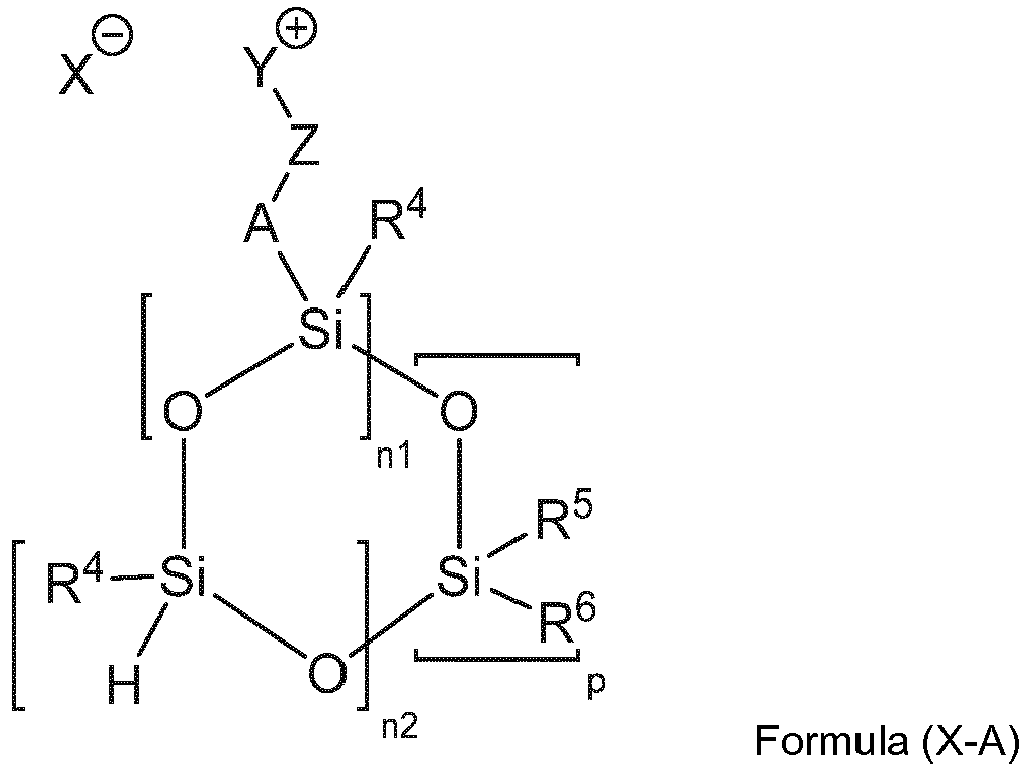
- R1, R2, R3, R4, R5 and R6 may be the same or different and each is independently selected from a hydrogen atom or a linear, branched or cyclic hydrocarbon residue having 1 to 20 carbon atoms which may contain at least one heteroatom;
- A is a heteroatom, preferably O or S, or a heteroatom-containing group, preferably NR7 or PR7, where R7 is selected from a hydrogen atom, a C1-C8 alkyl group, a C3-C10 cycloalkyl group, a C6-C18 aryl group or a C6-C18 aralkyl group, which may contain at least one heteroatom;
- Z is selected from a linear, branched or cyclic hydrocarbon residue having 2 to 60 carbon atoms which may contain at least one heteroatom;
- Y is an onium group;
- X is selected from halogen atoms, pseudohalogens, or anions selected from Tf2N, BF4 or PF6;
- in Formula (X) n1 is an integer from 1 to 1000, n2 is an integer from 0 to 100, and p is an integer from 0 to 1000; and
- in Formula (X-A) n1 is an integer from 1 to 100, n2 is an integer from 0 to 10, and p is an integer from 0 to 100, wherein the sum p+n1+n2 is equal to or higher than 3.
- In Formula (X) and Formula (X-A), the different siloxane subunits n, n1, n2, and p are not necessarily present in the order illustrated herein. The subunits n, n1, n2, and p can be randomly distributed in the siloxane backbone in every possible combination.
- In Formula (X) and Formula (X-A), R1, R2, R3, R4, R5 and R6 may be the same or different and each is independently selected from a hydrogen atom or a linear, branched or cyclic hydrocarbon residue having 1 to 20 carbon atoms which may contain at least one heteroatom, preferably selected from O, N, S, Si, P, Cl, Br or F.
- In preferred embodiments, R1, R2, R3, R4, R5 and R6 are the same or different and each is independently selected from the group consisting of a C1-C12 alkyl group, more preferably C1-C8 alkyl group, a C2-C8 alkenyl group, a C2-C8 alkynyl group, a C3-C10 cycloalkyl group, a C6-C18 aryl group and a C6-C18 aralkyl group, which may contain at least one heteroatom, preferably selected from O, N, S, Si, P, Cl, Br or F.
- In more preferred embodiments, R1, R2, R3, R4, R5 and R6 are the same or different and each is independently selected from a C1-C8 alkyl group which may contain at least one heteroatom, preferably selected from O, N, S, Si, P, Cl, Br or F, in particular methyl, ethyl, n-propyl, fluoropropyl, n-butyl, sec-butyl, or tert-butyl, or a C6-C18 aryl group which may contain at least one heteroatom, preferably selected from O, N, S, Si, P, Cl, Br or F, in particular phenyl, tolyl or benzoyl. In most preferred embodiments, R1, R2, R3, R4, R5 and R6 are the same or different and independently selected from methyl or phenyl.
- In Formula (X) and Formula (X-A), A is preferably selected from O, S, NR7 or PR7, where R7 is selected from a hydrogen atom, a C1-C8 alkyl group, a C3-C10 cycloalkyl group, a C6-C18 aryl group or a C6-C18 aralkyl group, which may contain at least one heteroatom, preferably selected from O, N, S, P, Cl, Br or F. In more preferred embodiments, A is selected from O or S, in particular O, which provides a silyl-oxo bond between siloxane backbone and the onium-functionalized side-groups.
- In Formula (X) and Formula (X-A), Z is selected from a linear, branched or cyclic hydrocarbon residue having 2 to 60 carbon atoms, preferably 2 to 20 carbon atoms, which may contain at least one heteroatom, preferably selected from O, N, S, P, Si, Cl, Br or F.
- In preferred embodiments, Z is selected from the group consisting of a C2-C20 alkylene group, a C2-C20 alkenylene group, C2-C20 alkynylene group, a C6-C18 arylene group and a C6-C18 aralkylene group, which may contain at least one heteroatom, preferably selected from O, N, S, P, Si, Cl, Br or F.
- In Formula (X) and Formula (X-A), Y is an onium group, which can be represented as ERcRd where E is a positively charged atom selected from the 16th group of the periodic table, preferably O, S or Se, or ERcRdRe where E is a positively charged atom selected from the 15th group of the periodic table, preferably N, P or As, wherein Rc, Rd and Re may be the same or different and each is independently selected from a hydrogen atom, a C1-C8 alkyl group, a C3-C10 cycloalkyl group, a C6-C18 aryl group or a C6-C18 aralkyl group, which may contain at least one heteroatom, preferably O, N, S, Si, Cl, Br or F.
- In Formula (X) and Formula (X-A), X is selected from halogen atoms, preferably selected from Br, I or Cl, pseudohalogens, preferably cyano (CN), azido (N3), cyanate (OCN), isocyanate (NCO), thiocyanate (SCN), isothiocyanate (NCS), or anions selected from Tf2N, BF4 or PF6.
- In preferred embodiments, X is selected from halogen atoms, preferably from Br, I or Cl, more preferably Br or I, in particular Br.
- In some embodiments, in Formula (X), the sum n1+n2 is an integer from 1 to 500, more preferably from 1 to 100; and/or p is an integer from 0 to 500, more preferably from 0 to 100. In some embodiments, the siloxane may contain diorganosiloxane units, such as dimethylsiloxane or diphenylsiloxane units, in the backbone. The ratio between n units and p units can be varied.
- In some embodiments, in Formula (X-A), n or the sum n1+n2 is an integer from 1 to 50, more preferably from 1 to 30; and/or p is an integer from 0 to 50, more preferably from 0 to 30, wherein the sum p+n1+n2 is equal to or higher than 3.
- In preferred embodiments, said onium-functionalized siloxane is a monomer, oligomer or polymer and has a number average molecular weight (Mn) of from 100 to 50,000g/mol, preferably 100 to 25,000 g/mol, more preferably from 100 to 15,000 g/mol.
- The present invention provides a method for preparing the onium-functionalized siloxane having the general Formula (X) or (X-A) as defined herein, comprising:
- (i) providing a siloxane having the general Formula (I) or (I-A)


- (ii) nucleophilic substitution of the X on the siloxane of Formula (I) or (I-A) by a nucleophile containing at least one atom selected from the 15th or 16th group of the periodic table, preferably N, P, As, O, S or Se, preferably in the absence of a catalyst.
- In certain embodiments, the obtained siloxane having the general Formula (I) or (I-A) has a number average molecular weight of from 100 to 50,000g/mol, preferably from 100 to 25,000 g/mol, more preferably 100 to 15,000 g/mol.
- R1 to R6, A, Z, X, n1, n2, and p in the Formula (I) and Formula (I-A) are the same as defined for the general Formula (X) and (X-A).
- Suitable nucleophiles are amines, phosphines, arsanes, ethers, alcohols, thiols, sulfides, selenium-containing molecules.
- Exemplary amines are: primary amines, such as methylamine or ethylamine, secondary amines, such as dimethylamine or diethylamine, tertiary amines, such as trimethylamine or trimethylamine, pyridine, piperidine, pyrrole, pyrroline, pyrrolidine, imidazole, 1-methyl-1H-imidazole, 1-butyl-1H-imidazole, pyrazole, pyrimidine, triazole, triazine, indole, quinoline, purine, such as adenine, guanine, hypoxanthine, xanthine, theobromine, caffeine, uric acid or isoguanine, and porphyrin; preferred for this invention are trimethylamine, triethylamine, pyridine, 1-methyl-1H-imidazole, and 1-butyl-1H-imidazole.
- Exemplary phosphines are organophosphines such as methylphosphine, dimethylphosphine, trimethylphosphine, phenylphosphine, diphenylphosphine, triphenylphosphine or cyclic phosphines, such as phosphiranes, phosphirenes, phospholanes, phosphole and phosphinanes.
- Exemplary arsanes are monoarsanes, diarsanes or triarsanes with different alkyl chains or heterocycles, such as arsolane and arsole.
- Exemplary ethers are ethylene oxide, 1,2-propylene oxide, tetrahydrofuran, furan, tetrahydropyran, pyran, oxirene, oxetane, oxete, oxepane, oxepine, 1,4-dioxane, crown ethers, epichlorhydrine, 1,2-butylenoxide, 1,2-pentylenoxide, isopentylenoxide, 1,2-hexylenoxide, 1,2-heptylenoxide, styrene oxide, cyclohexene oxide, methylglycidyl ether, ethylglycidyl ether, allylglycidyl ether, phenylglycidyl ether, butadiene monooxide, isopren monooxide, tolylglycidyl ether, cyclohexenoxide, cyclooctanepoxide, cyclododecanepoxide, (+)-cis-limonenoxide, (+)-cis, trans-limonenoxide and (-)-cis, trans-limonenoxide.
- Exemplary alcohols are methanol, ethanol, propan-1-ol, butan-1-ol, pentan-1-ol, hexan-1-ol, heptan-1-ol, octan-1-ol, nonan-1-ol, decan-1-ol, undecan-1-ol, dodecan-1-ol, tridecan-1-ol, tetradecan-1-ol, pentadecan-1-ol, hexadecan-1-ol, octadecan-1-ol, hexacosan-1-ol, triacontan-1-ol, propan-2-ol, butan-2-ol, 2-methylpropan-1-ol, 2-methylpropan-2-ol, pentan-2-ol, pentan-3-ol, 2-Methylbutan-1-ol, 3-methylbutan-1-ol, 2-methylbutan-2-ol, 3-methylbutan-2-ol, 2,2-dimethylpropan-1-ol, ethan-1,2-diol, propan-1,2-diol, propan-1,3-diol, butan-1,2-diol, butan-1,3-diol, butan-1,4-diol, butan-2,3-diol, pentan-1,5-diol, hexan-1,6-diol, octan-1,8-diol, nonan-1,9-diol, decan-1,10-diol, propan-1,2,3-triol, cyclopentanol, cyclohexanol, prop-2-en-1-ol, but-2-en-1-ol, (hydroxymethyl)benzol, 1-phenylethan-1-ol, 2-phenylethan-1-ol, diphenylmethanol, triphenylmethanol, phenol, cyclopentanol and cyclohexanol.
- Exemplary sulfides are: sulfates and sulfites; thioethers, such as dimethyl sulfide, methyl phenyl sulfide, diethyl sulfide, methyl ethyl sulfide or diphenyl sulfide; thiophenes, such as thiiranes or thiirenes, thietanes or thietes, dithietanes or dithietes, tetrahydrothiophene or thiophene, dithiolane, dithiane and trithiane.
- Exemplary selenium containing molecules are: selenols (RSeH), such as selenaphenol; selenyl halides, such as phenylselenyl bromide; selenoethers (R-Se-R), such as dimethylselenide, ethylmethylselenide, diethylselenide, methylpropylselenide, methylbutylselenide, butylethylselenide or ethylpropylselenide; and seleniranes.
- The ionization/derivatization reaction can take place in solvent free conditions, as well as in polar and non-polar solvents, such as alcohols, aromatic or aliphatic alkanes, alkenes or alkynes, halogenated aromatic or aliphatic hydrocarbons and hydrocarbons containing heteroatoms, such as O, N, S, P, Cl, Br or F. Preferably, the reaction takes place in solvents such as toluene, THF, heptane, hexane, chloroform, ethyl acetate, acetone or ethanol. Any residual solvent is preferably removed after the completion of the reaction.
- The reaction can be carried out at a reaction temperature in the range of from 0 to 250°C, preferably from 50 to 130°C, and/or at a reaction pressure from 0.001 to 50 bar, preferably from 0.5 to 5 bar.
- The siloxane having the general Formula (I) or (I-A) can be obtained by conventional methods.
- In preferred embodiments, the siloxane having the general Formula (I) or (I-A) used in step (i) is obtainable by reacting
- a) at least one siloxane having the general Formula (II) or (II-A) comprising at least one hydrogen atom bonded to a silicon atom


- R1, R2, R3, R4, R5 and R6 may be the same or different and each is independently selected from a hydrogen atom or a linear, branched or cyclic hydrocarbon residue having 1 to 20 carbon atoms which may contain at least one heteroatom;
- in Formula (II) n is an integer from 1 to 1000 and p is an integer from 0 to 1000; and
- in Formula (II-A) n is an integer from 1 to 100 and p is an integer from 0 to 100, wherein the sum p+n is equal to or higher than 3;
- b) at least one heterocyclic compound; and
- c) at least one compound having the general Formula (III)

- X is selected from halogen atoms, pseudohalogens, Tf2N, BF4 or PF6; and
- Ra is selected from the group consisting of a hydrogen atom or a linear, branched or cyclic hydrocarbon residue having 1 to 20 carbon atoms which may contain at least one heteroatom,
- wherein the reaction is catalyzed by at least one platinum catalyst.
- The above-described synthesis of the siloxane having the general Formula (I) and (I-A) is disclosed in
EP Patent Application no. 18209736.0 - The platinum catalyst can be selected from the group consisting of chloroplatinic acids, preferably hexachloroplatinic acid; alcohol modified chloroplatinic acids; olefin complexes of chloroplatinic acid; complexes of chloroplatinic acid and divinyltetramethyldisiloxane; fine platinum particles adsorbed on carbon carriers; platinum supported on metal oxide carriers, preferably Pt(Al2O3); platinum black; platinum acetylacetonate; platinous halides, preferably PtCl2, PtCl4, Pt(CN)2; complexes of platinous halides with unsaturated compounds, preferably ethylene, propylene, and organovinylsiloxanes; styrene hexamethyldiplatinum; platinum divinyltetramethyldisiloxane complex; the reaction product of chloroplatinic acid and an unsaturated aliphatic group-containing organosilicon compound; and a neutralized complex of platinous chloride and divinyltetramethyldisiloxane.
- In preferred embodiments, the platinum catalyst is hexachloroplatinic acid, commonly referred to as Speier's catalyst, which is described in
US Patent Nos. 2,823,218 and3,923,705 , or Karstedt's catalyst, which is described inUS Patent Nos. 3,715,334 and3,814,730 . Karstedt's catalyst is a platinum divinyltetramethyldisiloxane complex typically containing about one-weight percent of platinum in a solvent such as toluene. - In preferred embodiments, the platinum catalyst is present in an amount of from 0.0001 mol% to 10mol%, more preferably 0.001mol% to 0.1 mol%, of platinum based on the molar quantity of silicon-bonded hydrogen in the siloxane.
- In Formula (I), (I-A), (II), or (II-A), the different siloxane subunits n, n1, n2, and p are not necessarily present in the order illustrated herein. The subunits n, n1, n2, and p can be randomly distributed in the siloxane backbone in every possible combination.
- In Formula (I), (I-A), (II), or (II-A), R1, R2, R3, R4, R5 and R6 may be the same or different and each is independently selected from a hydrogen atom or a linear, branched or cyclic hydrocarbon residue having 1 to 20 carbon atoms which may contain at least one heteroatom, preferably selected from O, N, S, Si, P, Cl, Br or F.
- In preferred embodiments, R1, R2, R3, R4, R5 and R6 are the same or different and each is independently selected from the group consisting of a C1-C12 alkyl group, more preferably C1-C8 alkyl group, a C2-C8 alkenyl group, a C2-C8 alkynyl group, a C3-C10 cycloalkyl group, a C6-C18 aryl group and a C6-C18 aralkyl group, which may contain at least one heteroatom, preferably selected from O, N, S, Si, P, Cl, Br or F.
- In more preferred embodiments, R1, R2, R3, R4, R5 and R6 are the same or different and each is independently selected from a C1-C8 alkyl group which may contain at least one heteroatom, preferably selected from O, N, S, Si, P, Cl, Br or F, in particular methyl, ethyl, n-propyl, fluoropropyl, n-butyl, sec-butyl, or tert-butyl, or a C6-C18 aryl group which may contain at least one heteroatom, preferably selected from O, N, S, Si, P, Cl, Br or F, in particular phenyl, tolyl or benzoyl. In most preferred embodiments, R1, R2, R3, R4, R5 and R6 are the same or different and independently selected from methyl or phenyl.
- In Formula (I) or (I-A), A is preferably selected from O, S, NR7 or PR7, where R7 is selected from a hydrogen atom, a C1-C8 alkyl group, a C3-C10 cycloalkyl group, a C6-C18 aryl group or a C6-C18 aralkyl group, which may contain at least one heteroatom, preferably selected from O, N, S, P, Cl, Br or F. In more preferred embodiments, A is selected from O or S, in particular O.
- In Formula (I) or (I-A), Z is selected from a linear, branched or cyclic hydrocarbon residue having 2 to 60 carbon atoms, preferably 2 to 20 carbon atoms, which may contain at least one heteroatom, preferably selected from O, N, S, P, Si, Cl, Br or F.
- In preferred embodiments, Z is selected from the group consisting of a C2-C20 alkylene group, a C2-C20 alkenylene group, C2-C20 alkynylene group, a C6-C18 arylene group and a C6-C18 aralkylene group, which may contain at least one heteroatom, preferably selected from O, N, S, P, Si, Cl, Br or F.
- Exemplary heterocyclic compounds (component b) are: ethylene oxide, 1,2-propylene oxide, tetrahydrofuran, 2-Methyltetrahydrofuran, oxetane, oxetene, tetrahydropyrane, oxepane, 1,4-dioxane, crown ethers, epichlorhydrin, 1,2-butylene oxide, 2,3-butylene oxide, 1,2-pentylene oxide, isopentylene oxide, 1,2-hexylene oxide, 1,2-heptylene oxide, styrene oxide, cyclohexene oxide, methylglycidyl ether, ethylglycidyl ether, allylglycidyl ether, phenylglycidyl ether, butadiene monoxide, isoprene monoxide, tolylglycidyl ether, cyclohexene oxide, cyclooctanee epoxide, cyclododecane epoxide, (+)-cis-limonene oxide, (+)-cis, trans-limonene oxide and (-)-cis, trans-limonene oxide, lactones, such as β-propiolactones, γ-butyrotactones, D-glucono-δ-lactones or ε-caprolactones, dilactones, lactams, lactides and thiolactones, thiolane, other heterocyclic rings such as piperidine, pyrroline or pyrrolidine, aziridine, azirine, oxirene, thiirane (episulfides), thiirene, phosphirane, phosphirene, azetidine, azete, thietane and thiete.
- In preferred embodiments, heterocyclic compounds contain O.
- Particularly preferred for this invention are 1,2-propylene oxide, 1,2-butylene oxide, 2,3-butylene oxide, styrene oxide, cyclohexene oxide, tetrahydrofuran, tetrahydropyrane, oxepane, 1,4-dioxane, ε-caprolactones, and crown ethers.
- In Formula (III), X is selected from halogen atoms, pseudohalogens, Tf2N, BF4 or PF6 and Ra is selected from a hydrogen atom or a linear, branched or cyclic hydrocarbon residue having 1 to 20 carbon atoms which may contain at least one heteroatom, preferably selected from O, N, S, Si, Cl, Br or F.
- In preferred embodiments, X is selected from Br, I or Cl, more preferably Br or I, in particular Br.
- In preferred embodiments, Ra is selected from the group consisting of a hydrogen atom, a C1-C12 alkyl group, more preferably C1-C8 alkyl group, a C2-C8 alkenyl group, a C2-C8 alkynyl group, a C3-C10 cycloalkyl group, a C6-C18 aryl group and a C6-C18 aralkyl group, which may contain at least one heteroatom, preferably selected from O, N, S, Si, Cl, Br or F.
- In more preferred embodiments, Ra is a C2-C8 alkenyl group, more preferably selected from ethenyl, propenyl, butenyl, or pentenyl and structural isomers thereof such as 1- or 2-propenyl, 1-, 2-, or3-butenyl.
- In Formula (II) or (II-A), n is the sum n1+n2 of Formula (I) or (I-A).
- In some embodiments, in Formulae (I) and (II), n or the sum n1+n2 is an integer from 1 to 500, more preferably from 1 to 100; and/or p is an integer from 0 to 500, more preferably from 0 to 100. In some embodiments, the siloxane may contain diorganosiloxane units, such as dimethylsiloxane or diphenylsiloxane units, in the backbone. The ratio between n units and p units can be varied.
- In some embodiments, in Formulae (I-A) and (II-A), n or the sum n1+n2 is an integer from 1 to 50, more preferably from 1 to 30; and/or p is an integer from 0 to 50, more preferably from 0 to 30, wherein the sum p+n or the sum p+n1+n2 is equal to or higher than 3.
- The onium-functionalized siloxane according to the invention or the onium-functionalized siloxane obtained by the method according to the invention can be used as an antimicrobial agent, preferably against molds (like Aspergillus), yeasts, fungi (like Exophiala, also called "black yeasts"), gram-positive bacteria (like Staphylococcus) or gram-negative bacteria.
- Various features and embodiments of the disclosure are described in the following examples, which are intended to be representative and not limiting. The following examples serve to explain the invention, but the invention is not limited thereto.
-

- A 250 ml three neck round bottomed flask was degassed under high vacuum (1-3 mbar) and flushed with argon. Then, 200µL of Karstedt (2% of Pt in the catalyst, 0.1% mol in the mixture) and toluene (50 mL, dried over molecular sieves) were added into the flask under argon atmosphere and stirred at room temperature (20°C) for a couple of minutes. Then tetrahydrofuran (18.5 mL, dried over molecular sieves) and allyl bromide (19.8 mL, 97%) were added into the system. Polyhydridomethylsiloxane (14.9 mL, Mn 1900 g/mol) were added dropwise. The mixture was stirred and refluxed at 100°C inside under inert atmosphere (Ar) until complete conversion of the SiH groups was achieved (the reaction was followed by 1H-NMR). The mixture (when necessary) was decolorized by adding activated carbon and an excess of pentane and stirred for 16 h at room temperature. The crude was filtrated trough celite, and the solvents and volatiles were evaporated under vacuum. The obtained product (yield 80-90%) was a colorless, transparent viscous liquid. The molecular weight and structure of the product was confirmed by GPC (Mn = 4882 g/mol, PDI 2.190) and NMR spectroscopy.
-

- A 25 ml two neck round bottomed flask was degassed under high vacuum (1-3 mbar) and flushed with argon. Ethanol (5mL, dried over molecular sieves) and toluene (5 mL, dried over molecular sieves) are added. Halosilated intermediate obtained according to Example 1 is added into the flask under argon atmosphere and stirred at room temperature (20°C) for a couple of minutes. Then pyridine (1.85mL, 99%) was added into the system. The mixture was stirred (oil bath temperature: 75°C) under inert atmosphere (Ar) until complete quaternization was achieved (the reaction was followed by 1H-NMR). The solvents and volatiles were evaporated under vacuum. The obtained product (yield 95-100%) was a slightly yellow to yellow, transparent to milky, high viscous, sticky liquid. The molecular weight and structure of the product was confirmed by NMR spectroscopy.
- The procedure is the same as shown in Example 2. The halosilated intermediate has a 4-bromopentoxy-side-group.
- The procedure is the same as shown in Example 2. The halosilated intermediate has a 4-bromohexyloxy-side-group.
-
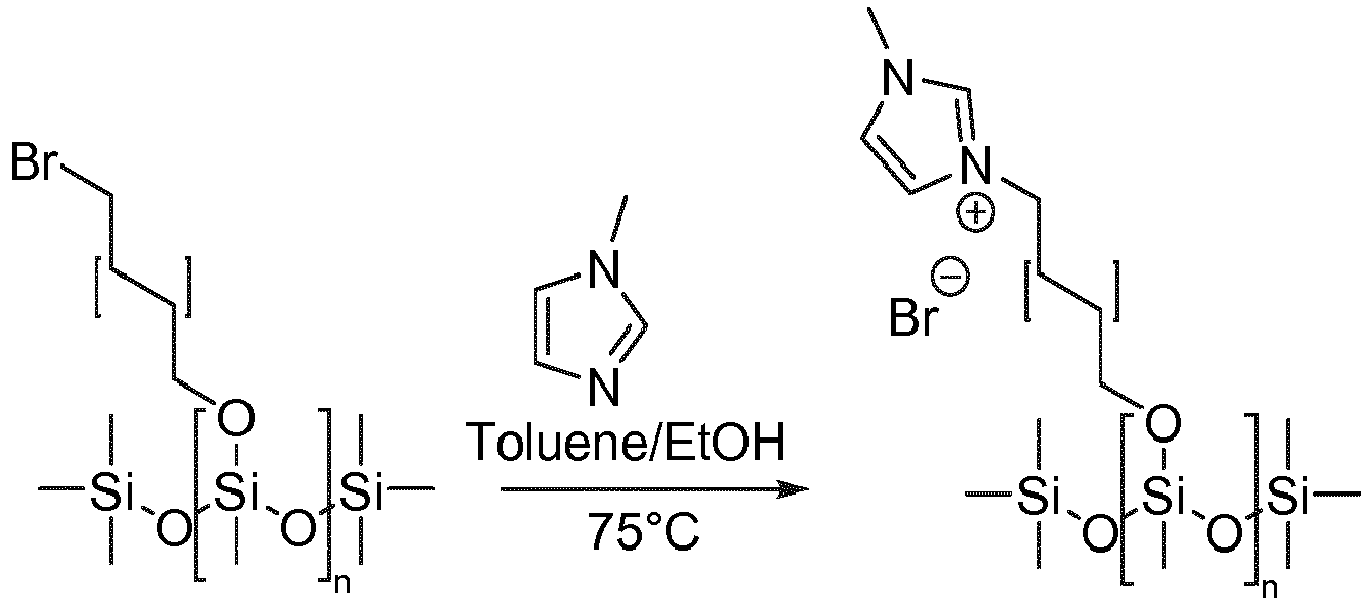
- A 25 ml two neck round bottomed flask was degassed under high vacuum (1-3 mbar) and flushed with argon. Ethanol (5mL, dried over molecular sieves) and toluene (5 mL, dried over molecular sieves) are added. Halosilated intermediate obtained according to Example 1 is added into the flask under argon atmosphere and stirred at room temperature (20°C) for a couple of minutes. Then 1-methyl-1H-imidazole (1.85mL, 99%) was added into the system. The mixture was stirred (oil bath temperature: 75°C) under inert atmosphere (Ar) until complete quaternization was achieved (the reaction was followed by 1H-NMR). The solvents and volatiles were evaporated under vacuum. The obtained product (yield 95-100%) was a yellow to orange, transparent to milky, high viscous, sticky liquid. The molecular weight and structure of the product was confirmed by NMR spectroscopy.
- The procedure is the same as shown in Example 5. The halosilated intermediate has a 4-bromopentoxy-side-group.
- The procedure is the same as shown in Example 5. The halosilated intermediate has a 4-bromohexyloxy-side-group.
-

- A 25 ml two neck round bottomed flask was degassed under high vacuum (1-3 mbar) and flushed with argon. Ethanol (5mL, dried over molecular sieves) and toluene (5 mL, dried over molecular sieves) are added. Halosilated intermediate obtained according to Example 1 is added into the flask under argon atmosphere and stirred at room temperature (20°C) for a couple of minutes. Then triethylamine (3.22mL) was added into the system. The mixture was stirred (oil bath temperature: 75°C) under inert atmosphere (Ar) until complete quaternization was achieved (the reaction was followed by 1H-NMR). The solvents and volatiles were evaporated under vacuum. The obtained product (yield 95-100%) was a white, high viscous, waxy liquid. The molecular weight and structure of the product was confirmed by NMR spectroscopy.
-

- A 25 ml two neck round bottomed flask was degassed under high vacuum (1-3 mbar) and flushed with argon. Tetrahydrofuran (5 mL, dried over molecular sieves) is added. Halosilated intermediate obtained according to Example 1 is added into the flask under argon atmosphere and stirred at room temperature (20°C) for a couple of minutes. Then trimethylamine (5.32mL, 28% in water, ca. 4.3mol/L) was added into the system. The mixture was stirred (oil bath temperature: 75°C) under inert atmosphere (Ar) until complete quaternization was achieved (the reaction was followed by 1H-NMR). The solvents and volatiles were evaporated under vacuum. The obtained product (yield 95-100%) was a white, high viscous, waxy liquid. The molecular weight and structure of the product was confirmed by NMR spectroscopy.
-

- A 25 ml two neck round bottomed flask was degassed under high vacuum (1-3 mbar) and flushed with argon. Ethanol (5mL, dried over molecular sieves) and toluene (5 mL, dried over molecular sieves) are added. Halosilated intermediate obtained according to Example 1 is added into the flask under argon atmosphere and stirred at room temperature (20°C) for a couple of minutes. Then 1-butyl-1H-imidazole (3.05mL, 99%) was added into the system. The mixture was stirred (oil bath temperature: 75°C) under inert atmosphere (Ar) until complete quaternization was achieved (the reaction was followed by 1H-NMR). The solvents and volatiles were evaporated under vacuum. The obtained product (yield 95-100%) was a colourless, transparent to milky, viscous, sticky liquid. The molecular weight and structure of the product was confirmed by NMR spectroscopy.
- The procedure is the same as shown in Example 10. The halosilated intermediate has a 4-bromopentoxy-side-group.
- The procedure is the same as shown in Example 10. The halosilated intermediate has a 4-bromohexyloxy-side-group.
- All NMR measurements were done on a Bruker 300MHz, 400MHz and 600MHz instrument with deuterated DMSO and methanol as solvent. All the samples were measured at room temperature (297 K). The chemical shifts are given in ppm. The calibration of the chemical shifts in 1H spectra was carried out by using the shifts of the deuterated solvents (DMSO-d6, 5H 2.49, 39.7; CD3OD, δH 3.31, 49.0).
- Gel permeation chromatography was carried out using HP1090 II Chromatography with DAD detector (HEWLETT PACKARD) at 40 °C. Tetrahydrofuran (THF) was used as an eluent. THF was passed through three PSS SDV gel columns with molecular weight ranges of 102, 103 and 104 g·mol-1 with a flow rate of 0.9 ml·min-1. The calibration of the device was carried out using polystyrene standards.
- The Kirby-Bauer Test is also known as Agar Diffusion Test and can be used for determination of antimicrobial activity in combination with diffusion properties. The utilized strains are Aspergillus brasiliensis (ATCC 16404), Staphylococcus aureus (ATCC 6538) and Exophiala dermatitidis (isolate). A suspension of the bacterial or fungal strain of interest is spread evenly over the face of a sterile agar plate. The antimicrobial test substrate (preferential liquid aggregation state) is applied to the center of the agar plate onto a small filter paper. The agar plate is incubated for a defined time at a temperature suitable for the test microorganisms. If the test substrate leaches from the filter paper into the agar and it further contains antimicrobial activity, a zone of inhibition is formed around the filter paper. The larger the number in Table 1, the better the antimicrobial effect.
- The MIC is an antimicrobial testing method to detect the lowest concentration of an antimicrobial agent that prevents visible growth of bacteria or molds. The utilized strains are Candida albicans (ATCC 10231) and Staphylococcus aureus (ATCC 6538). The evaluation is done optically. The antimicrobial activity is given when the solution is still clear. The concentrations appear from a serial dilution.
[Table 1] Test Results of Kirby-Bauer Test Zone of Inhibition [mm] (maximum 45mm) Samples Aspergillus brasiliensis (ATCC 16404) Exophiala dermatitidis Staphylococcus aureus (ATCC 6538) DMSO 0.0 0.0 n.d Bardac© 4.5 11.4 12.1 Bardac© 1:10 2.0 5.3 8.0 Bardac© 1:100 1.5 4.3 4.5 Pyridine 0.0 1.0 1.0 Pyridine 1:10 0.0 0.0 0.0 Pyridine 1:100 0.0 0.0 0.0 1-methyl-1H-imidazole 3.5 12.3 6.5 1-methyl-1H-imidazole 1:10 0.0 0.0 0.0 1-methyl-1H-imidazole 1:100 0.0 0.0 0.0 1-Butyl-1H-imidazole 5.0 15.0 11.0 Example 2 1.0 4.4 2.0 Example 3 0.0 6.0 6.0 Example 4 0.0 7.0 6.0 Example 5 4.4 8.8 10.5 Example 6 0.0 6.0 7.0 Example 7 0.0 9.0 7.0 Example 10 3.5 7.8 9.9 Example 11 2.8 8.3 8.3 Example 12 1.8 8.3 8.0 - DMSO was the utilized solvent in the test, the amines were utilized in the reaction, and Bardac© is a disinfectant. The numbers such as 1:10 or 1:100 show the dilution ratio.
- MIC test results are given in ppm in Table 2.
[Table 2] Test Results of MIC Staphylococcus aureus (ATCC 6538) Candida albicans (ATCC 10231) Example 2 25 625 Example 5 78 2500 Example 10 39 1250 Example 11 13 625 Example 12 13 625
Claims (11)
- An onium-functionalized siloxane having the general Formula (X) or (X-A)

 R1, R2, R3, R4, R5 and R6 may be the same or different and each is independently selected from a hydrogen atom or a linear, branched or cyclic hydrocarbon residue having 1 to 20 carbon atoms which may contain at least one heteroatom;A is a heteroatom, preferably O or S, or a heteroatom-containing group, preferably NR7 or PR7, where R7 is selected from a hydrogen atom, a C1-C8 alkyl group, a C3-C10 cycloalkyl group, a C6-C18 aryl group or a C6-C18 aralkyl group, which may contain at least one heteroatom;Z is selected from a linear, branched or cyclic hydrocarbon residue having 2 to 60 carbon atoms which may contain at least one heteroatom;Y is an onium group;X is selected from halogen atoms, pseudohalogens, or anions selected from Tf2N, BF4 or PF6;in Formula (X) n1 is an integer from 1 to 1000, n2 is an integer from 0 to 100, and p is an integer from 0 to 1000; andin Formula (X-A) n1 is an integer from 1 to 100, n2 is an integer from 0 to 10, and p is an integer from 0 to 100, wherein the sum p+n1+n2 is equal to or higher than 3.
 - The onium-functionalized siloxane according to claim 1, wherein the onium-functionalized siloxane is a monomer, oligomer or polymer and has a number average molecular weight (Mn) of from 100 to 50,000g/mol.
- The onium-functionalized siloxane according to claim 1 or 2, wherein Y is an onium group, which is represented as ERcRd where E is a positively charged atom selected from the 16th group of the periodic table or ERcRdRe where E is a positively charged atom selected from the 15th group of the periodic table, wherein Rc, Rd and Re may be the same or different and each is independently selected from a hydrogen atom, a C1-C8 alkyl group, a C3-C10 cycloalkyl group, a C6-C18 aryl group or a C6-C18 aralkyl group, which may contain at least one heteroatom.
- The onium-functionalized siloxane according to any one of claims 1 to 3, wherein X is selected from Br, I or Cl.
- The onium-functionalized siloxane according to any one of claims 1 to 4, A is a heteroatom selected from O or S, preferably O.
- A method for preparing the onium-functionalized siloxane having the general Formula (X) or (X-A) according to any one of claims 1 to 5, wherein the method comprises:(i) providing a siloxane having the general Formula (I) or (I-A)

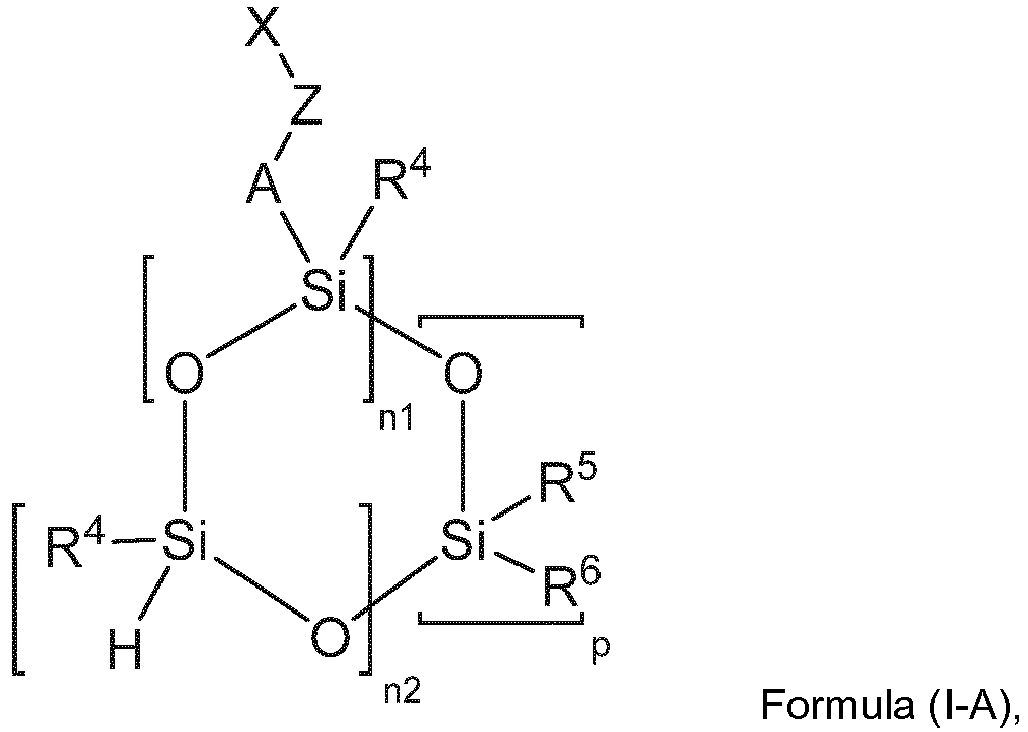 (ii) nucleophilic substitution of X on the siloxane of Formula (I) or (II-A) by a nucleophile containing at least one atom selected from the 15th or 16th group of the periodic table, preferably N, P, As, O, S or Se, preferably in the absence of a catalyst.
 - The method according to claim 6, wherein the siloxane having the general Formula (I) or (I-A) is obtained by reactinga) at least one siloxane having the general Formula (II) or (II-A) comprising at least one hydrogen atom bonded to a silicon atom

 R1 to R6 are the same as defined for the Formula (X) or (X-A) above;in Formula (II) n is an integer from 1 to 1000 and p is an integer from 0 to 1000; andin Formula (II-A) n is an integer from 1 to 100 and p is an integer from 0 to 100, wherein the sum p+n is equal to or higher than 3;b) at least one heterocyclic compound; andc) at least one compound having the general Formula (III)
 X is selected from halogen atoms, pseudohalogens, Tf2N, BF4 or PF6; andRa is selected from the group consisting of a hydrogen atom or a linear, branched or cyclic hydrocarbon residue having 1 to 20 carbon atoms which may contain at least one heteroatom,wherein the reaction is catalyzed by at least one platinum catalyst.
 - The method according to claim 6 or 7, wherein the nucleophile is selected from the group consisting of amines, phosphines, arsanes, ethers, alcohols, thiols, sulfides, and selenium-containing molecules.
- The method according to any one of claims 6 to 8, wherein the nucleophile is selected from the group consisting of methylamine, ethylamine, dimethylamine, diethylamine, trimethylamine, trimethylamine, pyridine, piperidine, pyrrole, pyrroline, pyrrolidine, imidazole, 1-methyl-1H-imidazole, 1-butyl-1H-imidazole, pyrazole, pyrimidine, triazole, triazine, indole, quinoline, purine, adenine, guanine, hypoxanthine, xanthine, theobromine, caffeine, uric acid, isoguanine, and porphyrin, preferably selected from trimethylamine, triethylamine, pyridine, 1-methyl-1H-imidazole, or 1-butyl-1H-imidazole.
- The method according to any one of claims 7 to 9, wherein the heterocyclic compound b) is selected from the group consisting of 1,2-propylene oxide, 1,2-butylene oxide, 2,3-butylene oxide, styrene oxide, cyclohexene oxide, tetrahydrofuran, tetrahydropyrane, oxepane, 1,4-dioxane, ε-caprolactones, and crown ethers.
- Use of the onium-functionalized siloxane according to any one of claims 1 to 5 or the onium-functionalized siloxane obtained by the method according to any one of claims 6 to 10 as an antimicrobial agent, preferably against molds, yeasts, fungi, gram-positive bacteria, or gram-negative bacteria.
Priority Applications (5)
| Application Number | Priority Date | Filing Date | Title |
|---|---|---|---|
| ES19177583T ES2949010T3 (en) | 2019-05-31 | 2019-05-31 | Onium functionalized siloxanes |
| PL19177583.2T PL3744758T3 (en) | 2019-05-31 | 2019-05-31 | Onium-functionalized siloxanes |
| EP19177583.2A EP3744758B1 (en) | 2019-05-31 | 2019-05-31 | Onium-functionalized siloxanes |
| PCT/EP2020/064245 WO2020239615A1 (en) | 2019-05-31 | 2020-05-22 | Onium-functionalized siloxanes |
| US17/537,631 US12247106B2 (en) | 2019-05-31 | 2021-11-30 | Onium-functionalized siloxanes |
Applications Claiming Priority (1)
| Application Number | Priority Date | Filing Date | Title |
|---|---|---|---|
| EP19177583.2A EP3744758B1 (en) | 2019-05-31 | 2019-05-31 | Onium-functionalized siloxanes |
Publications (2)
| Publication Number | Publication Date |
|---|---|
| EP3744758A1 true EP3744758A1 (en) | 2020-12-02 |
| EP3744758B1 EP3744758B1 (en) | 2023-04-19 |
Family
ID=66866901
Family Applications (1)
| Application Number | Title | Priority Date | Filing Date |
|---|---|---|---|
| EP19177583.2A Active EP3744758B1 (en) | 2019-05-31 | 2019-05-31 | Onium-functionalized siloxanes |
Country Status (5)
| Country | Link |
|---|---|
| US (1) | US12247106B2 (en) |
| EP (1) | EP3744758B1 (en) |
| ES (1) | ES2949010T3 (en) |
| PL (1) | PL3744758T3 (en) |
| WO (1) | WO2020239615A1 (en) |
Families Citing this family (1)
| Publication number | Priority date | Publication date | Assignee | Title |
|---|---|---|---|---|
| EP4461764B1 (en) | 2023-05-09 | 2026-01-14 | Henkel AG & Co. KGaA | Curable organosiloxane resins containing boron |
Citations (10)
| Publication number | Priority date | Publication date | Assignee | Title |
|---|---|---|---|---|
| US2823218A (en) | 1955-12-05 | 1958-02-11 | Dow Corning | Process for the production of organo-silicon compounds |
| US3715334A (en) | 1970-11-27 | 1973-02-06 | Gen Electric | Platinum-vinylsiloxanes |
| US3814730A (en) | 1970-08-06 | 1974-06-04 | Gen Electric | Platinum complexes of unsaturated siloxanes and platinum containing organopolysiloxanes |
| US3923705A (en) | 1974-10-30 | 1975-12-02 | Dow Corning | Method of preparing fire retardant siloxane foams and foams prepared therefrom |
| US5747622A (en) | 1993-04-06 | 1998-05-05 | Nec Corporation | Polymer having silicon atoms and sulfonium salt units and photoresist compositions containing the same |
| WO2007099042A1 (en) * | 2006-02-28 | 2007-09-07 | Ciba Holding Inc. | Antimicrobial compounds |
| CN105295050A (en) * | 2014-06-20 | 2016-02-03 | 北京化工大学 | Triaryl sulfonium salts containing silicon-oxygen chain and application thereof in photocuring epoxy resin |
| WO2018005190A1 (en) | 2016-06-29 | 2018-01-04 | 3M Innovative Properties Company | Adhesive article and method of making the same |
| CN107857862A (en) | 2017-12-07 | 2018-03-30 | 广东德美精细化工集团股份有限公司 | A kind of preparation method of dication type organic silicon modified aqueous polyurethane color fixing agent |
| US20180280201A1 (en) * | 2017-03-28 | 2018-10-04 | Allied Bioscience, Inc. | Antimicrobial coatings for medical dressings and dry antimicrobial medical dressings therefrom |
Family Cites Families (5)
| Publication number | Priority date | Publication date | Assignee | Title |
|---|---|---|---|---|
| US3677347A (en) * | 1969-12-22 | 1972-07-18 | Union Carbide Corp | Method of extinguishing fires and compositions therefor containing cationic silicone surfactants |
| US7402413B2 (en) | 2001-05-11 | 2008-07-22 | Kaneka Corporation | Method of expressing long-chain prenyl diphosphate synthase |
| JP5633147B2 (en) | 2008-03-10 | 2014-12-03 | 東レ株式会社 | Antibacterial composition for medical use and medical device |
| WO2013096211A1 (en) | 2011-12-22 | 2013-06-27 | Dow Corning Corporation | Silicone-based ionic liquids and applications thereof |
| EP3663329B1 (en) | 2018-12-03 | 2024-02-21 | Henkel AG & Co. KGaA | Method for preparing halogen-functionalized polysiloxanes |
-
2019
- 2019-05-31 ES ES19177583T patent/ES2949010T3/en active Active
- 2019-05-31 PL PL19177583.2T patent/PL3744758T3/en unknown
- 2019-05-31 EP EP19177583.2A patent/EP3744758B1/en active Active
-
2020
- 2020-05-22 WO PCT/EP2020/064245 patent/WO2020239615A1/en not_active Ceased
-
2021
- 2021-11-30 US US17/537,631 patent/US12247106B2/en active Active
Patent Citations (10)
| Publication number | Priority date | Publication date | Assignee | Title |
|---|---|---|---|---|
| US2823218A (en) | 1955-12-05 | 1958-02-11 | Dow Corning | Process for the production of organo-silicon compounds |
| US3814730A (en) | 1970-08-06 | 1974-06-04 | Gen Electric | Platinum complexes of unsaturated siloxanes and platinum containing organopolysiloxanes |
| US3715334A (en) | 1970-11-27 | 1973-02-06 | Gen Electric | Platinum-vinylsiloxanes |
| US3923705A (en) | 1974-10-30 | 1975-12-02 | Dow Corning | Method of preparing fire retardant siloxane foams and foams prepared therefrom |
| US5747622A (en) | 1993-04-06 | 1998-05-05 | Nec Corporation | Polymer having silicon atoms and sulfonium salt units and photoresist compositions containing the same |
| WO2007099042A1 (en) * | 2006-02-28 | 2007-09-07 | Ciba Holding Inc. | Antimicrobial compounds |
| CN105295050A (en) * | 2014-06-20 | 2016-02-03 | 北京化工大学 | Triaryl sulfonium salts containing silicon-oxygen chain and application thereof in photocuring epoxy resin |
| WO2018005190A1 (en) | 2016-06-29 | 2018-01-04 | 3M Innovative Properties Company | Adhesive article and method of making the same |
| US20180280201A1 (en) * | 2017-03-28 | 2018-10-04 | Allied Bioscience, Inc. | Antimicrobial coatings for medical dressings and dry antimicrobial medical dressings therefrom |
| CN107857862A (en) | 2017-12-07 | 2018-03-30 | 广东德美精细化工集团股份有限公司 | A kind of preparation method of dication type organic silicon modified aqueous polyurethane color fixing agent |
Also Published As
| Publication number | Publication date |
|---|---|
| EP3744758B1 (en) | 2023-04-19 |
| PL3744758T3 (en) | 2023-07-17 |
| ES2949010T3 (en) | 2023-09-25 |
| US12247106B2 (en) | 2025-03-11 |
| WO2020239615A1 (en) | 2020-12-03 |
| US20220089820A1 (en) | 2022-03-24 |
Similar Documents
| Publication | Publication Date | Title |
|---|---|---|
| US5258480A (en) | Syntheses of epoxysilicones | |
| CN112011060B (en) | Preparation of SiOC-bonded polyether siloxanes | |
| DE69415898T2 (en) | Process for the preparation of an organosilicon polymer | |
| US12247106B2 (en) | Onium-functionalized siloxanes | |
| EP0430216B1 (en) | Polydimethylsiloxane terminated at one end by a branched aminoalkyl group and preparation thereof | |
| EP3689944A1 (en) | Polysiloxazane compound, method for producing the same, and composition containing the same and cured product thereof | |
| US10421839B2 (en) | Aminoalkyl group-containing siloxane and a method for preparing the same | |
| WO2014099497A2 (en) | Alkoxy polysiloxanes and methods of making alkoxy silanes and siloxanes | |
| EP0520608B1 (en) | Silicones which contain lateral peripheral vinyl ether groups crosslinkable by cationic photoinitiators and their application for coatings and antiadhesive products for paper | |
| US12129340B2 (en) | Method for preparing halogen-functionalized polysiloxanes | |
| EP0578462A2 (en) | Polyepoxysilanes | |
| EP3932973B1 (en) | Bi-functionalized polysiloxane brush copolymers | |
| US6265496B1 (en) | Stable compositions with based of polyorganosiloxanes with cross-linkable functional groups for producing antiadhesive coatings | |
| US12545691B2 (en) | Tertiary hydroxyl functional alkoxysilanes and methods for preparing thereof | |
| EP3663371B1 (en) | Preparation of polysiloxane polyalkyleneglycol brush copolymers | |
| US12534578B2 (en) | Liquid silicate resins | |
| EP0639205B1 (en) | Siloxane copolymers containing vinyloxy groups, their preparation and use | |
| US20240318035A1 (en) | Fluorine-free hydrophobic coating | |
| US20240279252A1 (en) | Aqueous composition and method for producing same |
Legal Events
| Date | Code | Title | Description |
|---|---|---|---|
| PUAI | Public reference made under article 153(3) epc to a published international application that has entered the european phase |
Free format text: ORIGINAL CODE: 0009012 |
|
| STAA | Information on the status of an ep patent application or granted ep patent |
Free format text: STATUS: THE APPLICATION HAS BEEN PUBLISHED |
|
| AK | Designated contracting states |
Kind code of ref document: A1 Designated state(s): AL AT BE BG CH CY CZ DE DK EE ES FI FR GB GR HR HU IE IS IT LI LT LU LV MC MK MT NL NO PL PT RO RS SE SI SK SM TR |
|
| AX | Request for extension of the european patent |
Extension state: BA ME |
|
| STAA | Information on the status of an ep patent application or granted ep patent |
Free format text: STATUS: REQUEST FOR EXAMINATION WAS MADE |
|
| 17P | Request for examination filed |
Effective date: 20210423 |
|
| RBV | Designated contracting states (corrected) |
Designated state(s): AL AT BE BG CH CY CZ DE DK EE ES FI FR GB GR HR HU IE IS IT LI LT LU LV MC MK MT NL NO PL PT RO RS SE SI SK SM TR |
|
| GRAP | Despatch of communication of intention to grant a patent |
Free format text: ORIGINAL CODE: EPIDOSNIGR1 |
|
| STAA | Information on the status of an ep patent application or granted ep patent |
Free format text: STATUS: GRANT OF PATENT IS INTENDED |
|
| INTG | Intention to grant announced |
Effective date: 20220707 |
|
| GRAJ | Information related to disapproval of communication of intention to grant by the applicant or resumption of examination proceedings by the epo deleted |
Free format text: ORIGINAL CODE: EPIDOSDIGR1 |
|
| STAA | Information on the status of an ep patent application or granted ep patent |
Free format text: STATUS: REQUEST FOR EXAMINATION WAS MADE |
|
| INTC | Intention to grant announced (deleted) | ||
| INTG | Intention to grant announced |
Effective date: 20221215 |
|
| GRAS | Grant fee paid |
Free format text: ORIGINAL CODE: EPIDOSNIGR3 |
|
| STAA | Information on the status of an ep patent application or granted ep patent |
Free format text: STATUS: GRANT OF PATENT IS INTENDED |
|
| GRAA | (expected) grant |
Free format text: ORIGINAL CODE: 0009210 |
|
| STAA | Information on the status of an ep patent application or granted ep patent |
Free format text: STATUS: THE PATENT HAS BEEN GRANTED |
|
| AK | Designated contracting states |
Kind code of ref document: B1 Designated state(s): AL AT BE BG CH CY CZ DE DK EE ES FI FR GB GR HR HU IE IS IT LI LT LU LV MC MK MT NL NO PL PT RO RS SE SI SK SM TR |
|
| REG | Reference to a national code |
Ref country code: GB Ref legal event code: FG4D |
|
| REG | Reference to a national code |
Ref country code: DE Ref legal event code: R096 Ref document number: 602019027626 Country of ref document: DE |
|
| REG | Reference to a national code |
Ref country code: CH Ref legal event code: EP |
|
| REG | Reference to a national code |
Ref country code: IE Ref legal event code: FG4D |
|
| REG | Reference to a national code |
Ref country code: AT Ref legal event code: REF Ref document number: 1561165 Country of ref document: AT Kind code of ref document: T Effective date: 20230515 |
|
| REG | Reference to a national code |
Ref country code: NL Ref legal event code: FP |
|
| P01 | Opt-out of the competence of the unified patent court (upc) registered |
Effective date: 20230530 |
|
| REG | Reference to a national code |
Ref country code: LT Ref legal event code: MG9D |
|
| REG | Reference to a national code |
Ref country code: AT Ref legal event code: MK05 Ref document number: 1561165 Country of ref document: AT Kind code of ref document: T Effective date: 20230419 |
|
| REG | Reference to a national code |
Ref country code: ES Ref legal event code: FG2A Ref document number: 2949010 Country of ref document: ES Kind code of ref document: T3 Effective date: 20230925 |
|
| PG25 | Lapsed in a contracting state [announced via postgrant information from national office to epo] |
Ref country code: SE Free format text: LAPSE BECAUSE OF FAILURE TO SUBMIT A TRANSLATION OF THE DESCRIPTION OR TO PAY THE FEE WITHIN THE PRESCRIBED TIME-LIMIT Effective date: 20230419 Ref country code: PT Free format text: LAPSE BECAUSE OF FAILURE TO SUBMIT A TRANSLATION OF THE DESCRIPTION OR TO PAY THE FEE WITHIN THE PRESCRIBED TIME-LIMIT Effective date: 20230821 Ref country code: NO Free format text: LAPSE BECAUSE OF FAILURE TO SUBMIT A TRANSLATION OF THE DESCRIPTION OR TO PAY THE FEE WITHIN THE PRESCRIBED TIME-LIMIT Effective date: 20230719 Ref country code: AT Free format text: LAPSE BECAUSE OF FAILURE TO SUBMIT A TRANSLATION OF THE DESCRIPTION OR TO PAY THE FEE WITHIN THE PRESCRIBED TIME-LIMIT Effective date: 20230419 |
|
| PG25 | Lapsed in a contracting state [announced via postgrant information from national office to epo] |
Ref country code: RS Free format text: LAPSE BECAUSE OF FAILURE TO SUBMIT A TRANSLATION OF THE DESCRIPTION OR TO PAY THE FEE WITHIN THE PRESCRIBED TIME-LIMIT Effective date: 20230419 Ref country code: LV Free format text: LAPSE BECAUSE OF FAILURE TO SUBMIT A TRANSLATION OF THE DESCRIPTION OR TO PAY THE FEE WITHIN THE PRESCRIBED TIME-LIMIT Effective date: 20230419 Ref country code: LT Free format text: LAPSE BECAUSE OF FAILURE TO SUBMIT A TRANSLATION OF THE DESCRIPTION OR TO PAY THE FEE WITHIN THE PRESCRIBED TIME-LIMIT Effective date: 20230419 Ref country code: IS Free format text: LAPSE BECAUSE OF FAILURE TO SUBMIT A TRANSLATION OF THE DESCRIPTION OR TO PAY THE FEE WITHIN THE PRESCRIBED TIME-LIMIT Effective date: 20230819 Ref country code: HR Free format text: LAPSE BECAUSE OF FAILURE TO SUBMIT A TRANSLATION OF THE DESCRIPTION OR TO PAY THE FEE WITHIN THE PRESCRIBED TIME-LIMIT Effective date: 20230419 Ref country code: GR Free format text: LAPSE BECAUSE OF FAILURE TO SUBMIT A TRANSLATION OF THE DESCRIPTION OR TO PAY THE FEE WITHIN THE PRESCRIBED TIME-LIMIT Effective date: 20230720 |
|
| PG25 | Lapsed in a contracting state [announced via postgrant information from national office to epo] |
Ref country code: FI Free format text: LAPSE BECAUSE OF FAILURE TO SUBMIT A TRANSLATION OF THE DESCRIPTION OR TO PAY THE FEE WITHIN THE PRESCRIBED TIME-LIMIT Effective date: 20230419 |
|
| REG | Reference to a national code |
Ref country code: CH Ref legal event code: PL |
|
| PG25 | Lapsed in a contracting state [announced via postgrant information from national office to epo] |
Ref country code: SK Free format text: LAPSE BECAUSE OF FAILURE TO SUBMIT A TRANSLATION OF THE DESCRIPTION OR TO PAY THE FEE WITHIN THE PRESCRIBED TIME-LIMIT Effective date: 20230419 |
|
| PG25 | Lapsed in a contracting state [announced via postgrant information from national office to epo] |
Ref country code: MC Free format text: LAPSE BECAUSE OF FAILURE TO SUBMIT A TRANSLATION OF THE DESCRIPTION OR TO PAY THE FEE WITHIN THE PRESCRIBED TIME-LIMIT Effective date: 20230419 |
|
| REG | Reference to a national code |
Ref country code: DE Ref legal event code: R097 Ref document number: 602019027626 Country of ref document: DE |
|
| PG25 | Lapsed in a contracting state [announced via postgrant information from national office to epo] |
Ref country code: SM Free format text: LAPSE BECAUSE OF FAILURE TO SUBMIT A TRANSLATION OF THE DESCRIPTION OR TO PAY THE FEE WITHIN THE PRESCRIBED TIME-LIMIT Effective date: 20230419 Ref country code: SK Free format text: LAPSE BECAUSE OF FAILURE TO SUBMIT A TRANSLATION OF THE DESCRIPTION OR TO PAY THE FEE WITHIN THE PRESCRIBED TIME-LIMIT Effective date: 20230419 Ref country code: RO Free format text: LAPSE BECAUSE OF FAILURE TO SUBMIT A TRANSLATION OF THE DESCRIPTION OR TO PAY THE FEE WITHIN THE PRESCRIBED TIME-LIMIT Effective date: 20230419 Ref country code: MC Free format text: LAPSE BECAUSE OF FAILURE TO SUBMIT A TRANSLATION OF THE DESCRIPTION OR TO PAY THE FEE WITHIN THE PRESCRIBED TIME-LIMIT Effective date: 20230419 Ref country code: LU Free format text: LAPSE BECAUSE OF NON-PAYMENT OF DUE FEES Effective date: 20230531 Ref country code: LI Free format text: LAPSE BECAUSE OF NON-PAYMENT OF DUE FEES Effective date: 20230531 Ref country code: EE Free format text: LAPSE BECAUSE OF FAILURE TO SUBMIT A TRANSLATION OF THE DESCRIPTION OR TO PAY THE FEE WITHIN THE PRESCRIBED TIME-LIMIT Effective date: 20230419 Ref country code: DK Free format text: LAPSE BECAUSE OF FAILURE TO SUBMIT A TRANSLATION OF THE DESCRIPTION OR TO PAY THE FEE WITHIN THE PRESCRIBED TIME-LIMIT Effective date: 20230419 Ref country code: CZ Free format text: LAPSE BECAUSE OF FAILURE TO SUBMIT A TRANSLATION OF THE DESCRIPTION OR TO PAY THE FEE WITHIN THE PRESCRIBED TIME-LIMIT Effective date: 20230419 Ref country code: CH Free format text: LAPSE BECAUSE OF NON-PAYMENT OF DUE FEES Effective date: 20230531 |
|
| PLBE | No opposition filed within time limit |
Free format text: ORIGINAL CODE: 0009261 |
|
| STAA | Information on the status of an ep patent application or granted ep patent |
Free format text: STATUS: NO OPPOSITION FILED WITHIN TIME LIMIT |
|
| REG | Reference to a national code |
Ref country code: IE Ref legal event code: MM4A |
|
| 26N | No opposition filed |
Effective date: 20240122 |
|
| PG25 | Lapsed in a contracting state [announced via postgrant information from national office to epo] |
Ref country code: IE Free format text: LAPSE BECAUSE OF NON-PAYMENT OF DUE FEES Effective date: 20230531 |
|
| PG25 | Lapsed in a contracting state [announced via postgrant information from national office to epo] |
Ref country code: IE Free format text: LAPSE BECAUSE OF NON-PAYMENT OF DUE FEES Effective date: 20230531 |
|
| PG25 | Lapsed in a contracting state [announced via postgrant information from national office to epo] |
Ref country code: SI Free format text: LAPSE BECAUSE OF FAILURE TO SUBMIT A TRANSLATION OF THE DESCRIPTION OR TO PAY THE FEE WITHIN THE PRESCRIBED TIME-LIMIT Effective date: 20230419 |
|
| PG25 | Lapsed in a contracting state [announced via postgrant information from national office to epo] |
Ref country code: SI Free format text: LAPSE BECAUSE OF FAILURE TO SUBMIT A TRANSLATION OF THE DESCRIPTION OR TO PAY THE FEE WITHIN THE PRESCRIBED TIME-LIMIT Effective date: 20230419 Ref country code: IT Free format text: LAPSE BECAUSE OF FAILURE TO SUBMIT A TRANSLATION OF THE DESCRIPTION OR TO PAY THE FEE WITHIN THE PRESCRIBED TIME-LIMIT Effective date: 20230419 |
|
| PG25 | Lapsed in a contracting state [announced via postgrant information from national office to epo] |
Ref country code: BG Free format text: LAPSE BECAUSE OF FAILURE TO SUBMIT A TRANSLATION OF THE DESCRIPTION OR TO PAY THE FEE WITHIN THE PRESCRIBED TIME-LIMIT Effective date: 20230419 |
|
| PG25 | Lapsed in a contracting state [announced via postgrant information from national office to epo] |
Ref country code: BG Free format text: LAPSE BECAUSE OF FAILURE TO SUBMIT A TRANSLATION OF THE DESCRIPTION OR TO PAY THE FEE WITHIN THE PRESCRIBED TIME-LIMIT Effective date: 20230419 |
|
| PGFP | Annual fee paid to national office [announced via postgrant information from national office to epo] |
Ref country code: NL Payment date: 20250521 Year of fee payment: 7 |
|
| PGFP | Annual fee paid to national office [announced via postgrant information from national office to epo] |
Ref country code: PL Payment date: 20250523 Year of fee payment: 7 Ref country code: DE Payment date: 20250521 Year of fee payment: 7 |
|
| PGFP | Annual fee paid to national office [announced via postgrant information from national office to epo] |
Ref country code: BE Payment date: 20250521 Year of fee payment: 7 |
|
| PGFP | Annual fee paid to national office [announced via postgrant information from national office to epo] |
Ref country code: FR Payment date: 20250528 Year of fee payment: 7 |
|
| PG25 | Lapsed in a contracting state [announced via postgrant information from national office to epo] |
Ref country code: CY Free format text: LAPSE BECAUSE OF FAILURE TO SUBMIT A TRANSLATION OF THE DESCRIPTION OR TO PAY THE FEE WITHIN THE PRESCRIBED TIME-LIMIT; INVALID AB INITIO Effective date: 20190531 |
|
| PG25 | Lapsed in a contracting state [announced via postgrant information from national office to epo] |
Ref country code: HU Free format text: LAPSE BECAUSE OF FAILURE TO SUBMIT A TRANSLATION OF THE DESCRIPTION OR TO PAY THE FEE WITHIN THE PRESCRIBED TIME-LIMIT; INVALID AB INITIO Effective date: 20190531 |
|
| PGFP | Annual fee paid to national office [announced via postgrant information from national office to epo] |
Ref country code: ES Payment date: 20250630 Year of fee payment: 7 |
|
| PG25 | Lapsed in a contracting state [announced via postgrant information from national office to epo] |
Ref country code: TR Free format text: LAPSE BECAUSE OF FAILURE TO SUBMIT A TRANSLATION OF THE DESCRIPTION OR TO PAY THE FEE WITHIN THE PRESCRIBED TIME-LIMIT Effective date: 20230419 |
|
| PGFP | Annual fee paid to national office [announced via postgrant information from national office to epo] |
Ref country code: GB Payment date: 20260306 Year of fee payment: 8 |