EP3744750A1 - Bio-based polycarbonate ester and preparation method therefor - Google Patents
Bio-based polycarbonate ester and preparation method therefor Download PDFInfo
- Publication number
- EP3744750A1 EP3744750A1 EP19744450.8A EP19744450A EP3744750A1 EP 3744750 A1 EP3744750 A1 EP 3744750A1 EP 19744450 A EP19744450 A EP 19744450A EP 3744750 A1 EP3744750 A1 EP 3744750A1
- Authority
- EP
- European Patent Office
- Prior art keywords
- bio
- carbon atoms
- ester
- based polycarbonate
- group
- Prior art date
- Legal status (The legal status is an assumption and is not a legal conclusion. Google has not performed a legal analysis and makes no representation as to the accuracy of the status listed.)
- Pending
Links
- 239000004417 polycarbonate Substances 0.000 title claims abstract description 77
- 229920000515 polycarbonate Polymers 0.000 title claims abstract description 77
- 150000002148 esters Chemical class 0.000 title claims abstract description 73
- 238000002360 preparation method Methods 0.000 title claims abstract description 11
- 238000006068 polycondensation reaction Methods 0.000 claims abstract description 43
- 125000004432 carbon atom Chemical group C* 0.000 claims description 54
- 150000001875 compounds Chemical class 0.000 claims description 38
- -1 cycloalkyl ester Chemical class 0.000 claims description 32
- 239000000178 monomer Substances 0.000 claims description 27
- 239000000203 mixture Substances 0.000 claims description 25
- 238000004519 manufacturing process Methods 0.000 claims description 19
- 125000003118 aryl group Chemical group 0.000 claims description 11
- 125000000217 alkyl group Chemical group 0.000 claims description 7
- 230000008018 melting Effects 0.000 claims description 5
- 238000002844 melting Methods 0.000 claims description 5
- 125000003545 alkoxy group Chemical group 0.000 claims description 4
- 125000005907 alkyl ester group Chemical group 0.000 claims description 4
- 125000004390 alkyl sulfonyl group Chemical group 0.000 claims description 4
- 150000007860 aryl ester derivatives Chemical class 0.000 claims description 4
- 125000004391 aryl sulfonyl group Chemical group 0.000 claims description 4
- 125000004104 aryloxy group Chemical group 0.000 claims description 4
- 125000000000 cycloalkoxy group Chemical group 0.000 claims description 4
- 125000000753 cycloalkyl group Chemical group 0.000 claims description 4
- 125000005144 cycloalkylsulfonyl group Chemical group 0.000 claims description 4
- 125000001424 substituent group Chemical group 0.000 claims description 3
- 235000013305 food Nutrition 0.000 claims description 2
- 229940127554 medical product Drugs 0.000 claims description 2
- 238000010998 test method Methods 0.000 claims description 2
- 238000000034 method Methods 0.000 abstract description 21
- 238000006243 chemical reaction Methods 0.000 description 28
- IISBACLAFKSPIT-UHFFFAOYSA-N bisphenol A Chemical compound C=1C=C(O)C=CC=1C(C)(C)C1=CC=C(O)C=C1 IISBACLAFKSPIT-UHFFFAOYSA-N 0.000 description 21
- ISWSIDIOOBJBQZ-UHFFFAOYSA-N Phenol Chemical compound OC1=CC=CC=C1 ISWSIDIOOBJBQZ-UHFFFAOYSA-N 0.000 description 14
- 239000003054 catalyst Substances 0.000 description 14
- 101000805129 Homo sapiens Protein DPCD Proteins 0.000 description 13
- 102100037836 Protein DPCD Human genes 0.000 description 13
- 238000005259 measurement Methods 0.000 description 13
- 238000006116 polymerization reaction Methods 0.000 description 12
- 230000000704 physical effect Effects 0.000 description 10
- 239000006227 byproduct Substances 0.000 description 9
- 230000000052 comparative effect Effects 0.000 description 9
- 239000000047 product Substances 0.000 description 9
- YGYAWVDWMABLBF-UHFFFAOYSA-N Phosgene Chemical compound ClC(Cl)=O YGYAWVDWMABLBF-UHFFFAOYSA-N 0.000 description 8
- BVKZGUZCCUSVTD-UHFFFAOYSA-L Carbonate Chemical compound [O-]C([O-])=O BVKZGUZCCUSVTD-UHFFFAOYSA-L 0.000 description 7
- HPGJOUYGWKFYQW-UHFFFAOYSA-N diphenyl benzene-1,4-dicarboxylate Chemical compound C=1C=C(C(=O)OC=2C=CC=CC=2)C=CC=1C(=O)OC1=CC=CC=C1 HPGJOUYGWKFYQW-UHFFFAOYSA-N 0.000 description 7
- 238000000465 moulding Methods 0.000 description 7
- 229920000642 polymer Polymers 0.000 description 7
- HEMHJVSKTPXQMS-UHFFFAOYSA-M Sodium hydroxide Chemical compound [OH-].[Na+] HEMHJVSKTPXQMS-UHFFFAOYSA-M 0.000 description 6
- ROORDVPLFPIABK-UHFFFAOYSA-N diphenyl carbonate Chemical compound C=1C=CC=CC=1OC(=O)OC1=CC=CC=C1 ROORDVPLFPIABK-UHFFFAOYSA-N 0.000 description 6
- 238000002845 discoloration Methods 0.000 description 6
- WMFOQBRAJBCJND-UHFFFAOYSA-M Lithium hydroxide Chemical compound [Li+].[OH-] WMFOQBRAJBCJND-UHFFFAOYSA-M 0.000 description 5
- 229910052783 alkali metal Inorganic materials 0.000 description 5
- 150000001340 alkali metals Chemical class 0.000 description 5
- 229910052784 alkaline earth metal Inorganic materials 0.000 description 5
- 229910001388 sodium aluminate Inorganic materials 0.000 description 5
- 238000003756 stirring Methods 0.000 description 5
- PXGZQGDTEZPERC-UHFFFAOYSA-N 1,4-cyclohexanedicarboxylic acid Chemical compound OC(=O)C1CCC(C(O)=O)CC1 PXGZQGDTEZPERC-UHFFFAOYSA-N 0.000 description 4
- DSLRVRBSNLHVBH-UHFFFAOYSA-N 2,5-furandimethanol Chemical compound OCC1=CC=C(CO)O1 DSLRVRBSNLHVBH-UHFFFAOYSA-N 0.000 description 4
- VTYYLEPIZMXCLO-UHFFFAOYSA-L Calcium carbonate Chemical compound [Ca+2].[O-]C([O-])=O VTYYLEPIZMXCLO-UHFFFAOYSA-L 0.000 description 4
- CDBYLPFSWZWCQE-UHFFFAOYSA-L Sodium Carbonate Chemical compound [Na+].[Na+].[O-]C([O-])=O CDBYLPFSWZWCQE-UHFFFAOYSA-L 0.000 description 4
- 239000000654 additive Substances 0.000 description 4
- 230000006866 deterioration Effects 0.000 description 4
- 238000012360 testing method Methods 0.000 description 4
- KLDXJTOLSGUMSJ-JGWLITMVSA-N Isosorbide Chemical compound O[C@@H]1CO[C@@H]2[C@@H](O)CO[C@@H]21 KLDXJTOLSGUMSJ-JGWLITMVSA-N 0.000 description 3
- OFOBLEOULBTSOW-UHFFFAOYSA-N Malonic acid Chemical compound OC(=O)CC(O)=O OFOBLEOULBTSOW-UHFFFAOYSA-N 0.000 description 3
- 125000001931 aliphatic group Chemical group 0.000 description 3
- ADCOVFLJGNWWNZ-UHFFFAOYSA-N antimony trioxide Chemical compound O=[Sb]O[Sb]=O ADCOVFLJGNWWNZ-UHFFFAOYSA-N 0.000 description 3
- HUCVOHYBFXVBRW-UHFFFAOYSA-M caesium hydroxide Inorganic materials [OH-].[Cs+] HUCVOHYBFXVBRW-UHFFFAOYSA-M 0.000 description 3
- 238000005227 gel permeation chromatography Methods 0.000 description 3
- 230000009477 glass transition Effects 0.000 description 3
- 229960002479 isosorbide Drugs 0.000 description 3
- SCVFZCLFOSHCOH-UHFFFAOYSA-M potassium acetate Chemical compound [K+].CC([O-])=O SCVFZCLFOSHCOH-UHFFFAOYSA-M 0.000 description 3
- 239000000126 substance Substances 0.000 description 3
- KLDXJTOLSGUMSJ-UNTFVMJOSA-N (3s,3ar,6s,6ar)-2,3,3a,5,6,6a-hexahydrofuro[3,2-b]furan-3,6-diol Chemical compound O[C@H]1CO[C@@H]2[C@@H](O)CO[C@@H]21 KLDXJTOLSGUMSJ-UNTFVMJOSA-N 0.000 description 2
- FQXGHZNSUOHCLO-UHFFFAOYSA-N 2,2,4,4-tetramethyl-1,3-cyclobutanediol Chemical compound CC1(C)C(O)C(C)(C)C1O FQXGHZNSUOHCLO-UHFFFAOYSA-N 0.000 description 2
- CDBAMNGURPMUTG-UHFFFAOYSA-N 4-[2-(4-hydroxycyclohexyl)propan-2-yl]cyclohexan-1-ol Chemical compound C1CC(O)CCC1C(C)(C)C1CCC(O)CC1 CDBAMNGURPMUTG-UHFFFAOYSA-N 0.000 description 2
- QIGBRXMKCJKVMJ-UHFFFAOYSA-N Hydroquinone Chemical compound OC1=CC=C(O)C=C1 QIGBRXMKCJKVMJ-UHFFFAOYSA-N 0.000 description 2
- VMHLLURERBWHNL-UHFFFAOYSA-M Sodium acetate Chemical compound [Na+].CC([O-])=O VMHLLURERBWHNL-UHFFFAOYSA-M 0.000 description 2
- YIMQCDZDWXUDCA-UHFFFAOYSA-N [4-(hydroxymethyl)cyclohexyl]methanol Chemical compound OCC1CCC(CO)CC1 YIMQCDZDWXUDCA-UHFFFAOYSA-N 0.000 description 2
- YCZZQSFWHFBKMU-UHFFFAOYSA-N [5-(hydroxymethyl)oxolan-2-yl]methanol Chemical compound OCC1CCC(CO)O1 YCZZQSFWHFBKMU-UHFFFAOYSA-N 0.000 description 2
- 239000006096 absorbing agent Substances 0.000 description 2
- 150000001342 alkaline earth metals Chemical class 0.000 description 2
- ANBBXQWFNXMHLD-UHFFFAOYSA-N aluminum;sodium;oxygen(2-) Chemical compound [O-2].[O-2].[Na+].[Al+3] ANBBXQWFNXMHLD-UHFFFAOYSA-N 0.000 description 2
- 150000001408 amides Chemical class 0.000 description 2
- 239000003963 antioxidant agent Substances 0.000 description 2
- 230000003078 antioxidant effect Effects 0.000 description 2
- 239000007864 aqueous solution Substances 0.000 description 2
- RQPZNWPYLFFXCP-UHFFFAOYSA-L barium dihydroxide Chemical compound [OH-].[OH-].[Ba+2] RQPZNWPYLFFXCP-UHFFFAOYSA-L 0.000 description 2
- 229920000704 biodegradable plastic Polymers 0.000 description 2
- TZSMWSKOPZEMAJ-UHFFFAOYSA-N bis[(2-methoxyphenyl)methyl] carbonate Chemical compound COC1=CC=CC=C1COC(=O)OCC1=CC=CC=C1OC TZSMWSKOPZEMAJ-UHFFFAOYSA-N 0.000 description 2
- FJDQFPXHSGXQBY-UHFFFAOYSA-L caesium carbonate Chemical compound [Cs+].[Cs+].[O-]C([O-])=O FJDQFPXHSGXQBY-UHFFFAOYSA-L 0.000 description 2
- 229910000024 caesium carbonate Inorganic materials 0.000 description 2
- VSGNNIFQASZAOI-UHFFFAOYSA-L calcium acetate Chemical compound [Ca+2].CC([O-])=O.CC([O-])=O VSGNNIFQASZAOI-UHFFFAOYSA-L 0.000 description 2
- 229910000019 calcium carbonate Inorganic materials 0.000 description 2
- 239000003086 colorant Substances 0.000 description 2
- 239000006258 conductive agent Substances 0.000 description 2
- 238000001816 cooling Methods 0.000 description 2
- PFURGBBHAOXLIO-UHFFFAOYSA-N cyclohexane-1,2-diol Chemical compound OC1CCCCC1O PFURGBBHAOXLIO-UHFFFAOYSA-N 0.000 description 2
- BZODPBKOVGXQQH-UHFFFAOYSA-N diphenyl 1,2,3,4,4a,5,6,7,8,8a-decahydronaphthalene-2,6-dicarboxylate Chemical compound C1C(CCC2CC(CCC12)C(=O)OC1=CC=CC=C1)C(=O)OC1=CC=CC=C1 BZODPBKOVGXQQH-UHFFFAOYSA-N 0.000 description 2
- FHESUNXRPBHDQM-UHFFFAOYSA-N diphenyl benzene-1,3-dicarboxylate Chemical compound C=1C=CC(C(=O)OC=2C=CC=CC=2)=CC=1C(=O)OC1=CC=CC=C1 FHESUNXRPBHDQM-UHFFFAOYSA-N 0.000 description 2
- QDAZZWYFDWIFLB-UHFFFAOYSA-N diphenyl furan-2,5-dicarboxylate Chemical compound C=1C=C(C(=O)OC=2C=CC=CC=2)OC=1C(=O)OC1=CC=CC=C1 QDAZZWYFDWIFLB-UHFFFAOYSA-N 0.000 description 2
- RFQYQCXGTLBYEO-UHFFFAOYSA-N diphenyl oxolane-2,5-dicarboxylate Chemical compound O1C(CCC1C(=O)OC1=CC=CC=C1)C(=O)OC1=CC=CC=C1 RFQYQCXGTLBYEO-UHFFFAOYSA-N 0.000 description 2
- 230000008020 evaporation Effects 0.000 description 2
- 238000001704 evaporation Methods 0.000 description 2
- 150000004678 hydrides Chemical class 0.000 description 2
- 125000002887 hydroxy group Chemical group [H]O* 0.000 description 2
- BDAGIHXWWSANSR-NJFSPNSNSA-N hydroxyformaldehyde Chemical compound O[14CH]=O BDAGIHXWWSANSR-NJFSPNSNSA-N 0.000 description 2
- XIXADJRWDQXREU-UHFFFAOYSA-M lithium acetate Chemical compound [Li+].CC([O-])=O XIXADJRWDQXREU-UHFFFAOYSA-M 0.000 description 2
- 239000000314 lubricant Substances 0.000 description 2
- VTHJTEIRLNZDEV-UHFFFAOYSA-L magnesium dihydroxide Chemical compound [OH-].[OH-].[Mg+2] VTHJTEIRLNZDEV-UHFFFAOYSA-L 0.000 description 2
- 239000000347 magnesium hydroxide Substances 0.000 description 2
- 229910001862 magnesium hydroxide Inorganic materials 0.000 description 2
- 239000000395 magnesium oxide Substances 0.000 description 2
- CPLXHLVBOLITMK-UHFFFAOYSA-N magnesium oxide Inorganic materials [Mg]=O CPLXHLVBOLITMK-UHFFFAOYSA-N 0.000 description 2
- AXZKOIWUVFPNLO-UHFFFAOYSA-N magnesium;oxygen(2-) Chemical compound [O-2].[Mg+2] AXZKOIWUVFPNLO-UHFFFAOYSA-N 0.000 description 2
- 239000000155 melt Substances 0.000 description 2
- 239000002667 nucleating agent Substances 0.000 description 2
- UTOPWMOLSKOLTQ-UHFFFAOYSA-N octacosanoic acid Chemical compound CCCCCCCCCCCCCCCCCCCCCCCCCCCC(O)=O UTOPWMOLSKOLTQ-UHFFFAOYSA-N 0.000 description 2
- GLDOVTGHNKAZLK-UHFFFAOYSA-N octadecan-1-ol Chemical compound CCCCCCCCCCCCCCCCCCO GLDOVTGHNKAZLK-UHFFFAOYSA-N 0.000 description 2
- 230000003287 optical effect Effects 0.000 description 2
- 239000008188 pellet Substances 0.000 description 2
- ISWSIDIOOBJBQZ-UHFFFAOYSA-M phenolate Chemical compound [O-]C1=CC=CC=C1 ISWSIDIOOBJBQZ-UHFFFAOYSA-M 0.000 description 2
- 229940031826 phenolate Drugs 0.000 description 2
- OJMIONKXNSYLSR-UHFFFAOYSA-N phosphorous acid Chemical compound OP(O)O OJMIONKXNSYLSR-UHFFFAOYSA-N 0.000 description 2
- 229920003229 poly(methyl methacrylate) Polymers 0.000 description 2
- 239000002994 raw material Substances 0.000 description 2
- GHMLBKRAJCXXBS-UHFFFAOYSA-N resorcinol Chemical compound OC1=CC=CC(O)=C1 GHMLBKRAJCXXBS-UHFFFAOYSA-N 0.000 description 2
- 229910000029 sodium carbonate Inorganic materials 0.000 description 2
- 229910000018 strontium carbonate Inorganic materials 0.000 description 2
- UUCCCPNEFXQJEL-UHFFFAOYSA-L strontium dihydroxide Chemical compound [OH-].[OH-].[Sr+2] UUCCCPNEFXQJEL-UHFFFAOYSA-L 0.000 description 2
- 229910001866 strontium hydroxide Inorganic materials 0.000 description 2
- KKEYFWRCBNTPAC-UHFFFAOYSA-L terephthalate(2-) Chemical compound [O-]C(=O)C1=CC=C(C([O-])=O)C=C1 KKEYFWRCBNTPAC-UHFFFAOYSA-L 0.000 description 2
- 239000010409 thin film Substances 0.000 description 2
- 238000009736 wetting Methods 0.000 description 2
- RNFJDJUURJAICM-UHFFFAOYSA-N 2,2,4,4,6,6-hexaphenoxy-1,3,5-triaza-2$l^{5},4$l^{5},6$l^{5}-triphosphacyclohexa-1,3,5-triene Chemical compound N=1P(OC=2C=CC=CC=2)(OC=2C=CC=CC=2)=NP(OC=2C=CC=CC=2)(OC=2C=CC=CC=2)=NP=1(OC=1C=CC=CC=1)OC1=CC=CC=C1 RNFJDJUURJAICM-UHFFFAOYSA-N 0.000 description 1
- BPZIYBJCZRUDEG-UHFFFAOYSA-N 2-[3-(1-hydroxy-2-methylpropan-2-yl)-2,4,8,10-tetraoxaspiro[5.5]undecan-9-yl]-2-methylpropan-1-ol Chemical compound C1OC(C(C)(CO)C)OCC21COC(C(C)(C)CO)OC2 BPZIYBJCZRUDEG-UHFFFAOYSA-N 0.000 description 1
- MFGOFGRYDNHJTA-UHFFFAOYSA-N 2-amino-1-(2-fluorophenyl)ethanol Chemical compound NCC(O)C1=CC=CC=C1F MFGOFGRYDNHJTA-UHFFFAOYSA-N 0.000 description 1
- ISPYQTSUDJAMAB-UHFFFAOYSA-N 2-chlorophenol Chemical compound OC1=CC=CC=C1Cl ISPYQTSUDJAMAB-UHFFFAOYSA-N 0.000 description 1
- LYZMKCWNBRTLTJ-UHFFFAOYSA-N 2-methylcyclohexane-1,4-diol Chemical compound CC1CC(O)CCC1O LYZMKCWNBRTLTJ-UHFFFAOYSA-N 0.000 description 1
- HZGJTATYGAJRAL-UHFFFAOYSA-N 3,4,4a,5,6,7,8,8a-octahydro-2h-naphthalene-1,1-diol Chemical compound C1CCCC2C(O)(O)CCCC21 HZGJTATYGAJRAL-UHFFFAOYSA-N 0.000 description 1
- VPWNQTHUCYMVMZ-UHFFFAOYSA-N 4,4'-sulfonyldiphenol Chemical class C1=CC(O)=CC=C1S(=O)(=O)C1=CC=C(O)C=C1 VPWNQTHUCYMVMZ-UHFFFAOYSA-N 0.000 description 1
- QGZKDVFQNNGYKY-UHFFFAOYSA-O Ammonium Chemical compound [NH4+] QGZKDVFQNNGYKY-UHFFFAOYSA-O 0.000 description 1
- 229930185605 Bisphenol Natural products 0.000 description 1
- OKTJSMMVPCPJKN-UHFFFAOYSA-N Carbon Chemical compound [C] OKTJSMMVPCPJKN-UHFFFAOYSA-N 0.000 description 1
- OIFBSDVPJOWBCH-UHFFFAOYSA-N Diethyl carbonate Chemical compound CCOC(=O)OCC OIFBSDVPJOWBCH-UHFFFAOYSA-N 0.000 description 1
- 235000014755 Eruca sativa Nutrition 0.000 description 1
- 244000024675 Eruca sativa Species 0.000 description 1
- 229910013594 LiOAc Inorganic materials 0.000 description 1
- PFVJGHPEYRPGPE-UHFFFAOYSA-N O=C(C(CC1)CCC1C(OC1=CCCC=C1)=O)Oc1ccccc1 Chemical compound O=C(C(CC1)CCC1C(OC1=CCCC=C1)=O)Oc1ccccc1 PFVJGHPEYRPGPE-UHFFFAOYSA-N 0.000 description 1
- KWYUFKZDYYNOTN-UHFFFAOYSA-M Potassium hydroxide Chemical compound [OH-].[K+] KWYUFKZDYYNOTN-UHFFFAOYSA-M 0.000 description 1
- XLOMVQKBTHCTTD-UHFFFAOYSA-N Zinc monoxide Chemical compound [Zn]=O XLOMVQKBTHCTTD-UHFFFAOYSA-N 0.000 description 1
- ZXZCZWDQDAADMX-UHFFFAOYSA-N [1-(hydroxymethyl)-2-adamantyl]methanol Chemical compound C1C(C2)CC3CC1C(CO)C2(CO)C3 ZXZCZWDQDAADMX-UHFFFAOYSA-N 0.000 description 1
- XDODWINGEHBYRT-UHFFFAOYSA-N [2-(hydroxymethyl)cyclohexyl]methanol Chemical compound OCC1CCCCC1CO XDODWINGEHBYRT-UHFFFAOYSA-N 0.000 description 1
- LUSFFPXRDZKBMF-UHFFFAOYSA-N [3-(hydroxymethyl)cyclohexyl]methanol Chemical compound OCC1CCCC(CO)C1 LUSFFPXRDZKBMF-UHFFFAOYSA-N 0.000 description 1
- RDCRVCNPGSYUCY-UHFFFAOYSA-N [4-(hydroxymethyl)-3-bicyclo[2.2.1]heptanyl]methanol Chemical compound C1CC2(CO)C(CO)CC1C2 RDCRVCNPGSYUCY-UHFFFAOYSA-N 0.000 description 1
- ZDLKPCPBLWNAAR-UHFFFAOYSA-N [5-[2-[5-(hydroxymethyl)furan-2-yl]propan-2-yl]furan-2-yl]methanol Chemical compound C=1C=C(CO)OC=1C(C)(C)C1=CC=C(CO)O1 ZDLKPCPBLWNAAR-UHFFFAOYSA-N 0.000 description 1
- RVIZJROSQMQZCG-UHFFFAOYSA-N adamantane-1,2-diol Chemical compound C1C(C2)CC3CC1C(O)C2(O)C3 RVIZJROSQMQZCG-UHFFFAOYSA-N 0.000 description 1
- 230000000996 additive effect Effects 0.000 description 1
- 230000002411 adverse Effects 0.000 description 1
- 238000013019 agitation Methods 0.000 description 1
- 150000001412 amines Chemical class 0.000 description 1
- 239000002216 antistatic agent Substances 0.000 description 1
- ITHZDDVSAWDQPZ-UHFFFAOYSA-L barium acetate Chemical compound [Ba+2].CC([O-])=O.CC([O-])=O ITHZDDVSAWDQPZ-UHFFFAOYSA-L 0.000 description 1
- AYJRCSIUFZENHW-UHFFFAOYSA-L barium carbonate Chemical compound [Ba+2].[O-]C([O-])=O AYJRCSIUFZENHW-UHFFFAOYSA-L 0.000 description 1
- 229910001863 barium hydroxide Inorganic materials 0.000 description 1
- QVQLCTNNEUAWMS-UHFFFAOYSA-N barium oxide Chemical compound [Ba]=O QVQLCTNNEUAWMS-UHFFFAOYSA-N 0.000 description 1
- 238000010923 batch production Methods 0.000 description 1
- WZZPVFWYFOZMQS-UHFFFAOYSA-N bicyclo[2.2.1]heptane-3,4-diol Chemical compound C1CC2(O)C(O)CC1C2 WZZPVFWYFOZMQS-UHFFFAOYSA-N 0.000 description 1
- 239000004305 biphenyl Substances 0.000 description 1
- 235000010290 biphenyl Nutrition 0.000 description 1
- 238000000071 blow moulding Methods 0.000 description 1
- 150000001639 boron compounds Chemical class 0.000 description 1
- ZOAIGCHJWKDIPJ-UHFFFAOYSA-M caesium acetate Chemical compound [Cs+].CC([O-])=O ZOAIGCHJWKDIPJ-UHFFFAOYSA-M 0.000 description 1
- 239000001639 calcium acetate Substances 0.000 description 1
- 235000011092 calcium acetate Nutrition 0.000 description 1
- 229960005147 calcium acetate Drugs 0.000 description 1
- AXCZMVOFGPJBDE-UHFFFAOYSA-L calcium dihydroxide Chemical compound [OH-].[OH-].[Ca+2] AXCZMVOFGPJBDE-UHFFFAOYSA-L 0.000 description 1
- 229910052799 carbon Inorganic materials 0.000 description 1
- 239000006229 carbon black Substances 0.000 description 1
- PMMYEEVYMWASQN-IMJSIDKUSA-N cis-4-Hydroxy-L-proline Chemical compound O[C@@H]1CN[C@H](C(O)=O)C1 PMMYEEVYMWASQN-IMJSIDKUSA-N 0.000 description 1
- 238000010960 commercial process Methods 0.000 description 1
- 238000009833 condensation Methods 0.000 description 1
- 230000005494 condensation Effects 0.000 description 1
- 238000010924 continuous production Methods 0.000 description 1
- RLMGYIOTPQVQJR-UHFFFAOYSA-N cyclohexane-1,3-diol Chemical compound OC1CCCC(O)C1 RLMGYIOTPQVQJR-UHFFFAOYSA-N 0.000 description 1
- 230000003247 decreasing effect Effects 0.000 description 1
- JGFBRKRYDCGYKD-UHFFFAOYSA-N dibutyl(oxo)tin Chemical compound CCCC[Sn](=O)CCCC JGFBRKRYDCGYKD-UHFFFAOYSA-N 0.000 description 1
- IEJIGPNLZYLLBP-UHFFFAOYSA-N dimethyl carbonate Chemical compound COC(=O)OC IEJIGPNLZYLLBP-UHFFFAOYSA-N 0.000 description 1
- 150000002009 diols Chemical class 0.000 description 1
- CRLYMHQKFAIHNL-UHFFFAOYSA-N diphenyl 1,2,3,4,4a,5,6,7,8,8a-decahydronaphthalene-1,3-dicarboxylate Chemical compound C1C(CC(C2CCCCC12)C(=O)OC1=CC=CC=C1)C(=O)OC1=CC=CC=C1 CRLYMHQKFAIHNL-UHFFFAOYSA-N 0.000 description 1
- CWKGASQGUANGAI-UHFFFAOYSA-N diphenyl 1,2,3,4,4a,5,6,7,8,8a-decahydronaphthalene-1,4-dicarboxylate Chemical compound C1(CCC(C2CCCCC12)C(=O)OC1=CC=CC=C1)C(=O)OC1=CC=CC=C1 CWKGASQGUANGAI-UHFFFAOYSA-N 0.000 description 1
- DUYPFYGCOLPKGX-UHFFFAOYSA-N diphenyl 1,2,3,4,4a,5,6,7,8,8a-decahydronaphthalene-1,5-dicarboxylate Chemical compound C1(CCCC2C(CCCC12)C(=O)OC1=CC=CC=C1)C(=O)OC1=CC=CC=C1 DUYPFYGCOLPKGX-UHFFFAOYSA-N 0.000 description 1
- QNLIAWXQDDIRPZ-UHFFFAOYSA-N diphenyl 1,2,3,4,4a,5,6,7,8,8a-decahydronaphthalene-1,6-dicarboxylate Chemical compound C1C(CCC2C(CCCC12)C(=O)OC1=CC=CC=C1)C(=O)OC1=CC=CC=C1 QNLIAWXQDDIRPZ-UHFFFAOYSA-N 0.000 description 1
- QBWTZZPYPYWSBI-UHFFFAOYSA-N diphenyl 1,2,3,4,4a,5,6,7,8,8a-decahydronaphthalene-1,7-dicarboxylate Chemical compound C1C(CCC2CCCC(C12)C(=O)OC1=CC=CC=C1)C(=O)OC1=CC=CC=C1 QBWTZZPYPYWSBI-UHFFFAOYSA-N 0.000 description 1
- HWSXFMQBSQCOHA-UHFFFAOYSA-N diphenyl 1,2,3,4,4a,5,6,7,8,8a-decahydronaphthalene-2,7-dicarboxylate Chemical compound C1C(CCC2CCC(CC12)C(=O)OC1=CC=CC=C1)C(=O)OC1=CC=CC=C1 HWSXFMQBSQCOHA-UHFFFAOYSA-N 0.000 description 1
- DWNAQMUDCDVSLT-UHFFFAOYSA-N diphenyl phthalate Chemical compound C=1C=CC=C(C(=O)OC=2C=CC=CC=2)C=1C(=O)OC1=CC=CC=C1 DWNAQMUDCDVSLT-UHFFFAOYSA-N 0.000 description 1
- 238000007599 discharging Methods 0.000 description 1
- ODCCJTMPMUFERV-UHFFFAOYSA-N ditert-butyl carbonate Chemical compound CC(C)(C)OC(=O)OC(C)(C)C ODCCJTMPMUFERV-UHFFFAOYSA-N 0.000 description 1
- 230000000694 effects Effects 0.000 description 1
- 229920006351 engineering plastic Polymers 0.000 description 1
- 230000002708 enhancing effect Effects 0.000 description 1
- 238000001125 extrusion Methods 0.000 description 1
- 238000010101 extrusion blow moulding Methods 0.000 description 1
- 239000003063 flame retardant Substances 0.000 description 1
- 238000010097 foam moulding Methods 0.000 description 1
- 238000007542 hardness measurement Methods 0.000 description 1
- 239000012760 heat stabilizer Substances 0.000 description 1
- BHEPBYXIRTUNPN-UHFFFAOYSA-N hydridophosphorus(.) (triplet) Chemical compound [PH] BHEPBYXIRTUNPN-UHFFFAOYSA-N 0.000 description 1
- 238000001746 injection moulding Methods 0.000 description 1
- XGZVUEUWXADBQD-UHFFFAOYSA-L lithium carbonate Chemical compound [Li+].[Li+].[O-]C([O-])=O XGZVUEUWXADBQD-UHFFFAOYSA-L 0.000 description 1
- 239000011777 magnesium Substances 0.000 description 1
- UEGPKNKPLBYCNK-UHFFFAOYSA-L magnesium acetate Chemical compound [Mg+2].CC([O-])=O.CC([O-])=O UEGPKNKPLBYCNK-UHFFFAOYSA-L 0.000 description 1
- 239000011654 magnesium acetate Substances 0.000 description 1
- 235000011285 magnesium acetate Nutrition 0.000 description 1
- 229940069446 magnesium acetate Drugs 0.000 description 1
- ZLNQQNXFFQJAID-UHFFFAOYSA-L magnesium carbonate Chemical compound [Mg+2].[O-]C([O-])=O ZLNQQNXFFQJAID-UHFFFAOYSA-L 0.000 description 1
- 239000000463 material Substances 0.000 description 1
- 229910052751 metal Inorganic materials 0.000 description 1
- 239000002184 metal Substances 0.000 description 1
- GOQYKNQRPGWPLP-UHFFFAOYSA-N n-heptadecyl alcohol Natural products CCCCCCCCCCCCCCCCCO GOQYKNQRPGWPLP-UHFFFAOYSA-N 0.000 description 1
- OTLDLKLSNZMTTA-UHFFFAOYSA-N octahydro-1h-4,7-methanoindene-1,5-diyldimethanol Chemical compound C1C2C3C(CO)CCC3C1C(CO)C2 OTLDLKLSNZMTTA-UHFFFAOYSA-N 0.000 description 1
- 230000003647 oxidation Effects 0.000 description 1
- 238000007254 oxidation reaction Methods 0.000 description 1
- YEXPOXQUZXUXJW-UHFFFAOYSA-N oxolead Chemical compound [Pb]=O YEXPOXQUZXUXJW-UHFFFAOYSA-N 0.000 description 1
- ZUOUZKKEUPVFJK-UHFFFAOYSA-N phenylbenzene Natural products C1=CC=CC=C1C1=CC=CC=C1 ZUOUZKKEUPVFJK-UHFFFAOYSA-N 0.000 description 1
- 239000000049 pigment Substances 0.000 description 1
- 239000004014 plasticizer Substances 0.000 description 1
- 239000004926 polymethyl methacrylate Substances 0.000 description 1
- 235000011056 potassium acetate Nutrition 0.000 description 1
- BWHMMNNQKKPAPP-UHFFFAOYSA-L potassium carbonate Chemical compound [K+].[K+].[O-]C([O-])=O BWHMMNNQKKPAPP-UHFFFAOYSA-L 0.000 description 1
- 230000005855 radiation Effects 0.000 description 1
- 239000000376 reactant Substances 0.000 description 1
- 230000035484 reaction time Effects 0.000 description 1
- 230000009257 reactivity Effects 0.000 description 1
- 239000011347 resin Substances 0.000 description 1
- 229920005989 resin Polymers 0.000 description 1
- YGSDEFSMJLZEOE-UHFFFAOYSA-M salicylate Chemical compound OC1=CC=CC=C1C([O-])=O YGSDEFSMJLZEOE-UHFFFAOYSA-M 0.000 description 1
- 229960001860 salicylate Drugs 0.000 description 1
- 238000007086 side reaction Methods 0.000 description 1
- 239000001632 sodium acetate Substances 0.000 description 1
- 235000017281 sodium acetate Nutrition 0.000 description 1
- 239000007787 solid Substances 0.000 description 1
- 239000000243 solution Substances 0.000 description 1
- 239000003381 stabilizer Substances 0.000 description 1
- RXSHXLOMRZJCLB-UHFFFAOYSA-L strontium;diacetate Chemical compound [Sr+2].CC([O-])=O.CC([O-])=O RXSHXLOMRZJCLB-UHFFFAOYSA-L 0.000 description 1
- YEAUATLBSVJFOY-UHFFFAOYSA-N tetraantimony hexaoxide Chemical compound O1[Sb](O2)O[Sb]3O[Sb]1O[Sb]2O3 YEAUATLBSVJFOY-UHFFFAOYSA-N 0.000 description 1
- 238000005809 transesterification reaction Methods 0.000 description 1
- XLYOFNOQVPJJNP-UHFFFAOYSA-N water Substances O XLYOFNOQVPJJNP-UHFFFAOYSA-N 0.000 description 1
Classifications
-
- C—CHEMISTRY; METALLURGY
- C08—ORGANIC MACROMOLECULAR COMPOUNDS; THEIR PREPARATION OR CHEMICAL WORKING-UP; COMPOSITIONS BASED THEREON
- C08G—MACROMOLECULAR COMPOUNDS OBTAINED OTHERWISE THAN BY REACTIONS ONLY INVOLVING UNSATURATED CARBON-TO-CARBON BONDS
- C08G64/00—Macromolecular compounds obtained by reactions forming a carbonic ester link in the main chain of the macromolecule
- C08G64/20—General preparatory processes
- C08G64/30—General preparatory processes using carbonates
-
- C—CHEMISTRY; METALLURGY
- C08—ORGANIC MACROMOLECULAR COMPOUNDS; THEIR PREPARATION OR CHEMICAL WORKING-UP; COMPOSITIONS BASED THEREON
- C08G—MACROMOLECULAR COMPOUNDS OBTAINED OTHERWISE THAN BY REACTIONS ONLY INVOLVING UNSATURATED CARBON-TO-CARBON BONDS
- C08G64/00—Macromolecular compounds obtained by reactions forming a carbonic ester link in the main chain of the macromolecule
- C08G64/20—General preparatory processes
- C08G64/30—General preparatory processes using carbonates
- C08G64/305—General preparatory processes using carbonates and alcohols
-
- C—CHEMISTRY; METALLURGY
- C08—ORGANIC MACROMOLECULAR COMPOUNDS; THEIR PREPARATION OR CHEMICAL WORKING-UP; COMPOSITIONS BASED THEREON
- C08G—MACROMOLECULAR COMPOUNDS OBTAINED OTHERWISE THAN BY REACTIONS ONLY INVOLVING UNSATURATED CARBON-TO-CARBON BONDS
- C08G63/00—Macromolecular compounds obtained by reactions forming a carboxylic ester link in the main chain of the macromolecule
- C08G63/64—Polyesters containing both carboxylic ester groups and carbonate groups
-
- C—CHEMISTRY; METALLURGY
- C08—ORGANIC MACROMOLECULAR COMPOUNDS; THEIR PREPARATION OR CHEMICAL WORKING-UP; COMPOSITIONS BASED THEREON
- C08G—MACROMOLECULAR COMPOUNDS OBTAINED OTHERWISE THAN BY REACTIONS ONLY INVOLVING UNSATURATED CARBON-TO-CARBON BONDS
- C08G63/00—Macromolecular compounds obtained by reactions forming a carboxylic ester link in the main chain of the macromolecule
- C08G63/66—Polyesters containing oxygen in the form of ether groups
- C08G63/668—Polyesters containing oxygen in the form of ether groups derived from polycarboxylic acids and polyhydroxy compounds
- C08G63/672—Dicarboxylic acids and dihydroxy compounds
-
- C—CHEMISTRY; METALLURGY
- C08—ORGANIC MACROMOLECULAR COMPOUNDS; THEIR PREPARATION OR CHEMICAL WORKING-UP; COMPOSITIONS BASED THEREON
- C08G—MACROMOLECULAR COMPOUNDS OBTAINED OTHERWISE THAN BY REACTIONS ONLY INVOLVING UNSATURATED CARBON-TO-CARBON BONDS
- C08G63/00—Macromolecular compounds obtained by reactions forming a carboxylic ester link in the main chain of the macromolecule
- C08G63/78—Preparation processes
-
- C—CHEMISTRY; METALLURGY
- C08—ORGANIC MACROMOLECULAR COMPOUNDS; THEIR PREPARATION OR CHEMICAL WORKING-UP; COMPOSITIONS BASED THEREON
- C08G—MACROMOLECULAR COMPOUNDS OBTAINED OTHERWISE THAN BY REACTIONS ONLY INVOLVING UNSATURATED CARBON-TO-CARBON BONDS
- C08G63/00—Macromolecular compounds obtained by reactions forming a carboxylic ester link in the main chain of the macromolecule
- C08G63/78—Preparation processes
- C08G63/785—Preparation processes characterised by the apparatus used
-
- C—CHEMISTRY; METALLURGY
- C08—ORGANIC MACROMOLECULAR COMPOUNDS; THEIR PREPARATION OR CHEMICAL WORKING-UP; COMPOSITIONS BASED THEREON
- C08G—MACROMOLECULAR COMPOUNDS OBTAINED OTHERWISE THAN BY REACTIONS ONLY INVOLVING UNSATURATED CARBON-TO-CARBON BONDS
- C08G64/00—Macromolecular compounds obtained by reactions forming a carbonic ester link in the main chain of the macromolecule
- C08G64/02—Aliphatic polycarbonates
- C08G64/0208—Aliphatic polycarbonates saturated
-
- C—CHEMISTRY; METALLURGY
- C08—ORGANIC MACROMOLECULAR COMPOUNDS; THEIR PREPARATION OR CHEMICAL WORKING-UP; COMPOSITIONS BASED THEREON
- C08G—MACROMOLECULAR COMPOUNDS OBTAINED OTHERWISE THAN BY REACTIONS ONLY INVOLVING UNSATURATED CARBON-TO-CARBON BONDS
- C08G64/00—Macromolecular compounds obtained by reactions forming a carbonic ester link in the main chain of the macromolecule
- C08G64/20—General preparatory processes
- C08G64/205—General preparatory processes characterised by the apparatus used
Definitions
- the present invention relates to a bio-based polycarbonate ester and a process for preparing the same.
- the present invention relates to a process for preparing a bio-based polycarbonate ester that is excellent in such mechanical properties as tensile strength and impact strength by using a high-viscosity polycondensation reactor.
- a bio-based polycarbonate ester prepared by melt-polycondensation of 1,4:3,6-dianhydrohexitol with a carbonate or a dicarboxylate is a bioplastic that contains a bio-based monomer derived from a bio-source.
- the bio-based polycarbonate ester has high transparency of PMMA (poly(methyl methacrylate)), which is a representative transparent general-purpose resin, and high heat resistance of bisphenol A (BPA) polycarbonate.
- the polycarbonate thus prepared has high heat resistance and transparency, as well as excellent surface hardness, UV stability, flame retardancy, and chemical resistance, along with the advantages of a bioplastic.
- 1,4:3,6-dianhydrohexitol has the disadvantage that it is easily discolored at high temperatures due to its relatively low oxidation stability.
- 1,4:3,6-dianhydrohexitol is used in a melt-polycondensation process at high temperatures, the transparency of the product is deteriorated due to the discoloration of 1,4:3,6-dianhydrohexitol.
- a low-viscosity polymerization apparatus such as a conventional vertical stirring reactor is used, the melt viscosity of the polymer is increased as the amount of 1,4:3,6-dianhydrohexitol used increases.
- the commercial process of preparing a polycarbonate may be divided into a phosgene process and a non-phosgene melt-polycondensation process.
- phosgene process in which phosgene is used as a source material for a carbonate, diphenyl carbonate (hereinafter referred to as DPC) is used in the non-phosgene melt-polycondensation process.
- DPC diphenyl carbonate
- the non-phosgene melt-polycondensation process of a BPA polycarbonate uses BPA as a diol and DPC as a carbonate, and the transesterification reaction of BPA and DPC produces phenol as a byproduct of the melt polycondensation (see Korean Laid-open Patent Publication No. 2016-0014644 and Korean Patent No. 10-1221774 )
- the non-phosgene melt-polycondensation process of a BPA polycarbonate is typically carried out in a vertical stirring reactor, a horizontal screw reactor, a thin film evaporation reactor, a wire-wetting fall reactor, or the like.
- a BPA polycarbonate produced by the non-phosgene melt-polycondensation at high temperatures has various disadvantages such as discoloration, deterioration of physical properties, inability to produce products having various polymerization degrees, and high production costs. Therefore, there is a demand for a facility and a process for preparing a bio-based polycarbonate ester on a commercial scale, which can deal with the disadvantages as described above.
- an object of the present invention is to provide a bio-based polycarbonate ester that is excellent in such mechanical properties as tensile strength and impact strength by using a high-viscosity polycondensation reactor, which is capable of attaining a high polymerization degree at low temperatures while preventing discoloration and deterioration of the physical properties of 1,4:3,6-dianhydrohexitol.
- the present invention provides a process for preparing a bio-based polycarbonate ester, which comprises feeding a monomer mixture that comprises at least one compound selected from the group consisting of compounds represented by the following Formulae 1 to 3; and 1,4:3,6-dianhydrohexitol to a high-viscosity polycondensation reactor; and reacting them.
- R 1 and R 2 are each an alkyl group having 1 to 18 carbon atoms or an aryl group having 6 to 18 carbon atoms, wherein the aryl group may have at least one substituent selected from the group consisting of an alkyl group having 1 to 18 carbon atoms, a cycloalkyl group having 4 to 20 carbon atoms, an aryl group having 6 to 18 carbon atoms, an alkoxy group having 1 to 18 carbon atoms, a cycloalkoxy group having 4 to 20 carbon atoms, an aryloxy group having 6 to 18 carbon atoms, an alkylsulfonyl group having 1 to 18 carbon atoms, a cycloalkylsulfonyl group having 4 to 20 carbon atoms, an arylsulfonyl group having 6 to 18 carbon atoms, and an ester substituent.
- the ester substituent may be an alkyl ester having 1 to 18 carbon atoms, a cycloalkyl group having
- the present invention provides a bio-based polycarbonate ester prepared by the above-described preparation process and having an intrinsic viscosity (IV) of 0.8 to 2.3 dl/g.
- the present invention provides a molded article, which comprises the bio-based polycarbonate ester.
- the bio-based polycarbonate ester of the present invention is excellent in such mechanical properties as tensile strength and impact strength and is environmentally friendly since it is free from bisphenols.
- the process for preparing a bio-based polycarbonate ester of the present invention that uses a high-viscosity polycondensation reactor is capable of preventing discoloration and deterioration of the physical properties of 1,4:3,6-dianhydrohexitol, producing products having various polymerization degrees, and reducing the production costs.
- the present invention provides a process for preparing a bio-based polycarbonate ester, which comprises feeding a monomer mixture that comprises at least one compound selected from the group consisting of compounds represented by the following Formulae 1 to 3; and 1,4:3,6-dianhydrohexitol to a high-viscosity polycondensation reactor and reacting them: in the above Formula 2, R 1 and R 2 are each an alkyl group having 1 to 18 carbon atoms or an aryl group having 6 to 18 carbon atoms, wherein the aryl group may have at least one substituent selected from the group consisting of an alkyl group having 1 to 18 carbon atoms, a cycloalkyl group having 4 to 20 carbon atoms, an aryl group having 6 to 18 carbon atoms, an alkoxy group having 1 to 18 carbon atoms, a cycloalkoxy group having 4 to 20 carbon atoms, an aryloxy group having 6 to 18 carbon atoms, an alkylsulfonyl group having
- the monomer mixture comprises at least one compound selected from the group consisting of compounds represented by the following Formulae 1 to 3; and 1,4:3,6-dianhydrohexitol.
- 1,4:3,6-dianhydrohexitol may be at least one selected from the group consisting of isomannide, isosorbide, or isoidide. Specifically, it may be isosorbide.
- the cis/trans ratio of 1,4-diphenyl-cyclohexanedicarboxylate (DPCD), which is a compound represented by the above Formula 1, may be 1/99 to 99/1%, 10/90 to 90/10%, or 20/80 to 80/20%.
- the compound represented by the above Formula 2 may be dimethyl carbonate, diethyl carbonate, di-t-butyl carbonate, diphenyl carbonate, ditolyl carbonate, or bis(methyl salicyl) carbonate.
- diphenyl carbonate or substituted diphenyl carbonate may be used as the compound represented by the above Formula 2.
- the substituted diphenyl carbonate may be ditolyl carbonate or bis(methyl salicyl) carbonate.
- the monomer mixture may comprise compounds represented by the following Formulae 1 and 2; and 1,4:3,6-dianhydrohexitol.
- the total amounts of the compound represented by the above Formula 1 and the compound represented by the above Formula 2 may be 0.7 to 1.3 moles, 0.9 to 1.1 moles, or 0.95 to 1.05 mole, based on 1 mole of 1,4:3,6-dianhydrohexitol.
- the bio-based polycarbonate ester thus produced may contain repeat unit 1 represented by the following Formula 4 and repeat unit 2 represented by the following formula 5.
- the repeat unit 1 may be obtained from the reaction of 1,4:3,6-dianhydrohexitol and a carbonate-based compound represented by the above Formula 2
- the repeat unit 2 may be obtained from the reaction of 1,4:3,6-dianhydrohexitol and 1,4-cyclohexanedicarboxylate. That is, 1,4:3,6-dianhydrohexitol and the compound represented by the above Formula 2 may be reacted to form a carbonate bond (repeat unit 1, Formula 4), and 1,4:3,6-dianhydrohexitol and the compound represented by the above Formula 1 may be reacted to form an ester bond (repeat unit 2, Formula 5).
- the cis/trans ratio of 1,4-cyclohexanedicarboxylate in the repeat unit 2 represented by the above Formula 5 may be 1/99 to 99/1%, 20/80 to 80/20%, or 30/70 to 70/30%.
- the monomer mixture may comprise compounds represented by Formulae 2 and 3; and 1,4:3,6-dianhydrohexitol, wherein the compound represented by the above Formula 3 is diphenyl terephthalate (DPT).
- DPT diphenyl terephthalate
- the total amounts of the compound represented by the above Formula 2 and the compound represented by the above Formula 3 may be 0.7 to 1.3 moles, 0.9 to 1.1 moles, or 0.95 to 1.05 mole, based on 1 mole of 1,4:3,6-dianhydrohexitol.
- the bio-based polycarbonate ester thus produced may contain repeat unit 1 represented by the above Formula 4 and repeat unit 3 represented by the following formula 6.
- the repeat unit 1 may be obtained from the reaction of 1,4:3,6-dianhydrohexitol and a carbonate compound represented by the above Formula 2
- the repeat unit 3 may be obtained from the reaction of 1,4:3,6-dianhydrohexitol and a terephthalate. That is, 1,4:3,6-dianhydrohexitol and the compound represented by the above Formula 2 may be reacted to form a carbonate bond (repeat unit 1, Formula 4), and 1,4:3,6-dianhydrohexitol and the compound represented by the above Formula 3 may be reacted to form an ester bond (repeat unit 3, Formula 6).
- the monomer mixture may comprise compounds represented by the following Formulae 1 to 3; and 1,4:3,6-dianhydrohexitol.
- the total amounts of the compound represented by the above Formula 1, the compound represented by the above Formula 2, and the compound represented by the above Formula 3 may be 0.7 to 1.3 moles, 0.9 to 1.1 moles, or 0.95 to 1.05 mole, based on 1 mole of 1,4:3,6-dianhydrohexitol.
- the bio-based polycarbonate ester thus produced may contain repeat unit 1 represented by the following Formula 4, repeat unit 2 represented by the following Formula 5, and repeat unit 3 represented by the following formula 6.
- the repeat unit 1 may be obtained from the reaction of 1,4:3,6-dianhydrohexitol and a carbonate compound represented by the above Formula 2
- the repeat unit 2 may be obtained from the reaction of 1,4:3,6-dianhydrohexitol and 1,4-cyclohexanedicarboxylate
- the repeat unit 3 may be obtained from the reaction of 1,4:3,6-dianhydrohexitol and a terephthalate.
- 1,4:3,6-dianhydrohexitol and the compound represented by the above Formula 2 may be reacted to form a carbonate bond (repeat unit 1, Formula 4), 1,4:3,6-dianhydrohexitol and the compound represented by the above Formula 1 may be reacted to form an ester bond (repeat unit 2, Formula 5), and 1,4:3,6-dianhydrohexitol and the compound represented by the above Formula 3 may be reacted to form an ester bond (repeat unit 3, Formula 6).
- the monomer mixture may further comprise such additives as a catalyst and a stabilizer, and at least one monomer selected from the group consisting of an additional diol compound other than 1,4:3,6-dianhydrohexitol and an additional ester compound other than the compounds represented by the above Formulae 1 to 3.
- the monomer mixture may further comprise a catalyst for enhancing the reactivity of the reaction.
- the catalyst may be added to the reaction step at any time, but it is preferably added before the reaction.
- any alkali metal and/or alkali earth metal catalyst commonly used in a polycarbonate melt-polycondensation reaction may be used as the catalyst.
- an oxide, hydride, amide, or phenolate of an alkali metal and/or an alkaline earth metal may be used as the catalyst.
- alkali metal catalysts may include lithium hydroxide (LiOH), sodium hydroxide (NaOH), potassium hydroxide (KOH), cesium hydroxide (CsOH), lithium carbonate (Li 2 CO 3 ), sodium carbonate (Na 2 CO 3 ), potassium carbonate (K 2 CO 3 ), cesium carbonate (Cs 2 CO 3 ), lithium acetate (LiOAc), sodium acetate (NaOAc), potassium acetate (KOAc), cesium acetate (CsOAc), and the like.
- LiOH lithium hydroxide
- NaOH sodium hydroxide
- KOH potassium hydroxide
- CsOH cesium hydroxide
- Li 2 CO 3 lithium carbonate
- Na 2 CO 3 sodium carbonate
- K 2 CO 3 potassium carbonate
- cesium carbonate Cs 2 CO 3
- LiOAc lithium acetate
- NaOAc sodium acetate
- KOAc potassium acetate
- CsOAc cesium acetate
- alkali earth metal catalysts may include calcium hydroxide (Ca(OH) 2 ), barium hydroxide (Ba(OH) 2 ), magnesium hydroxide (Mg(OH) 2 ), strontium hydroxide (Sr(OH) 2 ), calcium carbonate (CaCO 3 ), barium carbonate (BaCO 3 ), magnesium carbonate (MgCO 3 ), strontium carbonate (SrCO 3 ), calcium acetate (Ca(OAc) 2 ), barium acetate (Ba(OAc) 2 ), magnesium acetate (Mg(OAc) 2 ), strontium acetate (Sr(OAc) 2 ), and the like.
- Examples of the oxide, hydride, amide, or phenolate of an alkali metal and/or an alkaline earth metal may include magnesium oxide (MgO), barium oxide (BaO), sodium aluminate (NaAlO 2 ), zinc oxide (ZnO), lead oxide (PbO), dibutyltin oxide ((C 4 H 9 ) 2 SnO), antimony trioxide (Sb 2 O 3 ), and the like.
- the catalyst may be used in an amount such that the metal equivalent of the catalyst is greater than 0 to 5 mmoles, greater than 0 to 3 mmoles, or greater than 0 to 1 mmole, based on 1 mole of the entire diol compounds. If the amount of the catalyst is within the above range, it is possible to prevent the problems that the degree of polymerization falls below the target degree of polymerization and that a side reaction takes place whereby such target physical properties as transparency are not satisfied.
- the alkali metal and/or alkali earth metal catalyst may be used in combination with a basic catalyst such as a basic ammonium or amine, a basic phosphorous, or a basic boron compound.
- the basic catalyst may be used alone or in combination, and the amount thereof is not particularly limited.
- the monomer mixture may further comprise an additional diol compound other than 1,4:3,6-dianhydrohexitol, depending on the target properties.
- the additional diol compound may have a single aliphatic ring or a condensed heterogeneous ring at the center of the molecule in order to enhance the heat resistance, transparency, UV stability, and weatherability of the bio-based polycarbonate ester thus prepared.
- the ring size and heat resistance proportionally increase.
- the optical characteristics do not depend on the ring size and the positions of the hydroxyl groups, but they vary with the characteristics of each raw material. As the ring size is bigger, it is more difficult to commercially produce and utilize the diol compound.
- the additional diol compound may be a primary, secondary, or tertiary diol compound.
- the additional diol compound may be at least one diol compound selected from the group consisting of 1,2-cyclohexanedimethanol, 1,3-cyclohexanedimethanol, 1,4-cyclohexanedimethanol, tricyclodecanedimethanol, pentacyclopentadecanedimethanol, decalindimethanol, tricyclotetradecanedimethanol, norbornanedimethanol, adamantanedimethanol, 3,9-bis(1,1-dimethyl-2-hydroxyethyl)-2,4,8,10-tetraoxaspiro[5,5]undecane, bicycle[2.2.2]octane-2,3-dimethanol, 2,4:3,5-di-o-methylene-D-mannitol, tetrahydro-2,5-furandimethanol, 2,5-furandimethanol, 5,5
- the additional diol compound may be 1,4-cyclohexanedimethanol, tetrahydrofuran-2,5-dimethanol, 2,5-furandimethanol, 2,2-bis(4-hydroxycyclohexyl)propane, or 2,2,4,4-tetramethyl-1,3-cyclobutanediol.
- the molar amount of the additional diol compound employed is p
- the molar amount of 1,4:3,6-dianhydrohexitol employed is to be 1 - p.
- the additional diol compound is a petrochemical-based diol compound, it may be used in an amount such that the bio-based carbon content (ASTM-D6866) in the final polymer derived from 1,4:3,6-dianhydrohexitol is at least 1% by mole.
- p may satisfy 0 ⁇ p ⁇ 0.99 mole. That is, the additional diol compound may be used in an amount of less than 0.99 mole based on 1 mole of 1,4:3,6-dianhydrohexitol.
- the monomer mixture may further comprise an additional ester compound other than the compounds represented by the above Formulae 1 to 3, which are ester-bond monomers in the polymer chain, depending on the target properties.
- the additional ester compound may be diphenyl ester.
- the additional ester compound may be prepared by reacting a primary, secondary, or tertiary dicarboxylate or dicarboxylic acid (hereinafter referred to as an additional dicarboxylate or dicarboxylic acid) with phenol or a phenol substituent.
- the additional ester compound may be prepared by reacting an additional dicarboxylate or dicarboxylic acid having a single aliphatic ring or a condensed heterogeneous ring at the center of the molecule with phenol or a phenol substituent in order to enhance the heat resistance, transparency, UV stability, and weatherability of the bio-based polycarbonate ester thus prepared.
- the additional ester compound may be at least one selected from the group consisting of 1,2-diphenyl-cyclohexanedicarboxylate, 1,3-diphenyl-cyclohexanedicarboxylate, diphenyl decahydro-1,4-naphthalenedicarboxylate, diphenyl decahydro-1,5-naphthalenedicarboxylate, diphenyl decahydro-2,4-naphthalenedicarboxylate, diphenyl decahydro-2,5-naphthalenedicarboxylate, diphenyl decahydro-2,6-naphthalenedicarboxylate, diphenyl decahydro-2,7-naphthalenedicarboxylate, diphenyl decahydro-2,8-naphthalenedicarboxylate, diphenyl tetrahydro-2,5-furanedicarboxylate, diphenyl 2,5-furanedicarboxylate, diphenyl
- the additional ester compound may be 1,3-diphenyl-cyclohexanedicarboxylate, diphenyl decahydro-2,6-naphthalenedicarboxylate, diphenyl tetrahydro-2,5-furanedicarboxylate, diphenyl 2,5-furanedicarboxylate or diphenyl isophthalate.
- the phenol substituent used in the preparation of the additional ester compound may be a compound represented by the following Formula 7.
- R 3 is at least one selected from the group consisting of an alkyl group having 1 to 18 carbon atoms, a cycloalkyl group having 4 to 20 carbon atoms, an aryl group having 6 to 18 carbon atoms, an alkoxy group having 1 to 18 carbon atoms, a cycloalkoxy group having 4 to 20 carbon atoms, an aryloxy group having 6 to 18 carbon atoms, an alkylsulfonyl group having 1 to 18 carbon atoms, a cycloalkylsulfonyl group having 4 to 20 carbon atoms, an arylsulfonyl group having 6 to 18 carbon atoms, or an ester substituent.
- the ester substituent may be an alkyl ester having 1 to 18 carbon atoms, a cycloalkyl ester having 4 to 20 carbon atoms, or an aryl ester having 6 to 18 carbon atoms.
- the molar amount of the additional ester compound employed is q
- the molar amount of the compounds represented by the above Formulae 1 to 3 employed is to be 1 - q.
- q may satisfy 0 ⁇ q ⁇ 1 mole. That is, the additional ester compound may be used in an amount of less than 1 mole based on 1 mole of the entire carbonate and/or ester compounds.
- the monomer mixture may further comprise an additive such as an antioxidant, a heat stabilizer, a light absorber, a color former, a lubricant, a colorant, a conductive agent, a nucleation agent, a flame retardant, a plasticizer, an antistatic agent, and the like.
- an additive such as an antioxidant, a heat stabilizer, a light absorber, a color former, a lubricant, a colorant, a conductive agent, a nucleation agent, a flame retardant, a plasticizer, an antistatic agent, and the like.
- the antioxidant may be hindered phenol, hydroquinone, phosphite, a substituted compound thereof, or the like.
- the light absorber may be resorcinol, salicylate, or the like.
- the color former may be phosphite, hydrophosphite, or the like.
- the lubricant may be montanic acid, stearyl alcohol, or the like.
- a dye and a pigment may be used as the colorant. Carbon black may be used as the conductive agent or the nucleation agent.
- the kinds and amounts of all of the above-mentioned additives are not particularly limited as long as they do not adversely affect the physical properties, especially transparency, of the bio-based polycarbonate esters thus prepared.
- melt-polycondensation reaction for a bio-based polycarbonate ester can be carried out at a relatively low-temperature range, it is possible to prevent discoloration and deterioration of the physical properties of the product. Further, it is possible to produce a product having a high polymerization degree without chain breakage that may be caused by the high shear force induced by the high agitation force applied in the melt-polycondensation process of a BPA polycarbonate carried out in a conventional low-viscosity polycondensation reactor that operates at high reaction temperatures.
- the high-viscosity polycondensation reactor may be a horizontal plug flow reactor.
- the high-viscosity polycondensation reactor may be an extruder, a kneader, or a finisher reactor that comprises one or more stirrers.
- the stirrer may comprise a shaft and a screw or may be in the form of a shaft-free.
- the screw of the stirrer shaft may be in the form of a spiral, a lattice, a bar, a spectacle, or the like. Specifically, it may be in the form of a bar.
- the high-viscosity polycondensation reactor may comprise such accessory equipment as a discharge screw for discharging the final molten polymer, a vapor column for collecting phenol as a reaction byproduct, a cooling trap, and a receiver.
- a discharge screw for discharging the final molten polymer
- a vapor column for collecting phenol as a reaction byproduct
- a cooling trap for collecting phenol as a reaction byproduct
- a receiver phenol as a reaction byproduct
- the molten polymer discharged through the discharge screw is conveyed to a pelletizer to produce pellets, which may be dried and packaged.
- the maximum viscosity in the high-viscosity polycondensation reactor may be 10,000 to 1,000,000 poises. Specifically, the maximum viscosity in the high-viscosity polycondensation reactor may be 20,000 to 500,000 poises or 50,000 to 200,000 poises. If the maximum viscosity in the high-viscosity polycondensation reactor is within the above range, it is easy to achieve a high polymerization degree at low reaction temperatures.
- the preparation process may be carried out with temperature elevation and depressurization in a stepwise manner in order to rapidly remove byproducts from the molten reactants having a high viscosity and to expedite the polymerization reaction.
- the preparation process may comprise (1) melting the monomer mixture and reacting the mixture at a reduced pressure to prepare a prepolymer; and (2) reacting the prepolymer at a reduced pressure to prepare a bio-based polycarbonate ester.
- the monomer mixture is melted and reacted at a reduced pressure to prepare a prepolymer.
- This step may be carried out in a reactor that comprises such accessory equipment as a vacuum pump for depressurization, a vapor column for collecting phenol as a reaction byproduct, a cooling trap, and a receiver.
- the prepolymer may have an intrinsic viscosity (IV) of 0.10 to 0.60 dl/g. Specifically, the prepolymer may have an intrinsic viscosity (IV) of 0.20 to 0.55 dl/g or 0.30 to 0.50 dl/g.
- this step may be carried out at 20 to 700 mbar and 140 to 220°C.
- this step may comprise (i) melting the monomer mixture, followed by raising the temperature to 140 to 180°C and reducing the pressure to 300 to 700 mbar; and (ii) raising the temperature to 180 to 220°C and reducing the pressure to 20 to 300 mbar. More specifically, this step may comprise (i) melting the monomer mixture, followed by raising the temperature to 150 to 180°C or 160 to 180°C, and reducing the pressure to 300 to 650 mbar or 300 to 600 mbar; and (ii) raising the temperature to 190 to 220°C or 200 to 220°C, and reducing the pressure to 20 to 250 mbar or 20 to 200 mbar.
- the prepolymer is reacted at a reduced pressure to prepare a bio-based polycarbonate ester.
- this step may be carried out at 0.1 to 20 mbar and 220 to 270°C.
- this step may comprise (i) raising the temperature of the prepolymer to 220 to 240°C and reducing the pressure to 5 to 20 mbar; and (ii) raising the temperature to 240 to 270°C and reducing the pressure to 0.1 to 5 mbar.
- this step may comprise (i) raising the temperature of the prepolymer to 220 to 240°C and reducing the pressure to 5 to 15 mbar or 5 to 10 mbar; and (ii) raising the temperature to 240 to 270°C and reducing the pressure to 0.1 to 3 mbar or 0.1 to 1 mbar.
- the rate of temperature elevation in this step may be 0.1 to 10°C/ min, 0.2 to 5°C/min, or 0.5 to 2°C/min.
- the reaction time may be 1 to 10 hours or 3 to 8 hours.
- phenol may be produced as a reaction byproduct while the melt-polycondensation reaction is carried out. It is preferable that phenol produced as a byproduct is removed from the reaction system in order to shift the reaction equilibrium towards the production of the polycarbonate ester. If the rate of temperature elevation in the melt-polycondensation reaction is within the above ranges, it is possible to prevent the problem that phenol, a reaction byproduct, evaporates or sublimes together with the reaction raw materials.
- the process for preparing a bio-based polycarbonate ester may be a batch or continuous process. Specifically, the above steps (1) and (2) may be carried out in the same reactor or may be carried out in different reactors, respectively.
- the above step (1) may be carried out in a reactor that may be used in the conventional process for producing a BPA polycarbonate on a commercial scale such as a vertical stirring reactor, a thin film evaporation reactor, a wire-wetting fall reactor, or the like. Thereafter, the prepolymer prepared in the above step (1) is continuously fed to a high-viscosity polycondensation reactor in which the above step (2) is carried.
- the feeding rate to the high-viscosity polycondensation reactor may be varied depending on the molecular weight of the prepolymer prepared.
- the reactor may be a high-viscosity polycondensation reactor.
- the present invention provides a bio-based polycarbonate ester prepared by the above-described preparation process and having an intrinsic viscosity (IV) of 0.8 to 2.3 dl/g.
- the bio-based polycarbonate ester may have an intrinsic viscosity (IV) of 0.8 to 2.0 dl/g, 0.8 to 1.7 dl/g, or 0.8 to 1.4 dl/g.
- a specimen injection-molded according to the ASTM D638 test method from the bio-based polycarbonate ester may have a tensile strength of 80 to 200 MPa and a flexural strength of 100 to 210 MPa.
- the specimen may have a tensile strength of 80 to 190 MPa, 80 to 180 MPa, or 80 to 170 MPa, and a flexural strength of 100 to 200 MPa, 100 to 190 MPa, or 100 to 180 MPa.
- the bio-based polycarbonate ester may have an Izod notch impact strength of 60 J/m to no breakage (NB). Specifically, the bio-based polycarbonate ester may have an Izod notch impact strength of 70 J/m to no breakage (NB), 80 J/m to no breakage (NB), or 90 J/m to no breakage (NB).
- no breakage indicates that the specimen does not break since it has an impact strength exceeding the measurement limit of the impact tester.
- the present invention provides a molded article that comprises a bio-based polycarbonate ester.
- the molded article may be produced by molding a bio-based polycarbonate ester.
- the molding method is not particularly limited.
- injection molding, extrusion molding, blow molding, extrusion blow molding, inflation molding, calender molding, foam molding, balloon molding, vacuum molding, and radiation molding may be adopted.
- the molded article is not particularly limited. It may be used as a substitute for conventional heat resistant and optical articles by virtue of its excellent heat resistance and transparency.
- the molded article may be an automobile part, an electric/electronic part, a lighting part, a medical product, a display part, an aviation part, a machine part, and a food container.
- a 12-liter twin-screw batch kneader reactor (CKR10B-170, LIST Corp.) was used as a high-viscosity polycondensation reactor.
- the reactor was charged with 3,204 g (21.92 moles) of isosorbide (ISB, Roquette Freres), 710 g (2.19 moles) of 1,4-diphenyl-cyclohexanedicarboxylate (DPCD, SK Chemicals), 4,215 g (19.68 moles) of diphenyl carbonate (DPC, Changfeng), and 2.87 g of a 1% aqueous solution of sodium aluminate (NaAlO 2 ) at room temperature. Thereafter, the temperature was raised to 150°C.
- the pressure was reduced to 500 mbar, and the temperature was then raised to 190°C over 1 hour. During the temperature elevation, phenol began to be generated as a reaction byproduct.
- the pressure was reduced to 100 mbar and maintained for 20 minutes, and then the temperature was raised to 230°C over 20 minutes.
- the pressure was reduced to 10 mbar, and then the temperature was raised to 250°C over 10 minutes.
- the pressure was reduced to 1 mbar or less, and the reaction continued until the maximum hydraulic pressure of 48 bar was reached. Thereafter, the reaction was terminated, and the product was cooled to room temperature to obtain a solid sample.
- the polycarbonate ester thus prepared had a Tg of 160°C, an IV of 1.05 dl/g, a number average molecular weight (Mn) of 40,857 g/mole, and a weight average molecular weight (Mw) of 100,952 g/mole as measured by gel permeation chromatography (GPC).
- Example 2 The same procedures as Example 1 were repeated to prepare a polycarbonate ester, except that 3,204g(21.92mol) of ISB, 1,421g(4.38mol) of DPCD, and 3,747g(17.49mol) of DPC were used.
- Example 2 The same procedures as Example 1 were repeated to prepare a polycarbonate ester, except that 3,204g(21.92mol) of ISB, 2,131g(6.57mol) of DPCD, and 3,278g(15.30mol) of DPC were used.
- Example 2 The same procedures as Example 1 were repeated to prepare a polycarbonate ester, except that 3,204g(21.92mol) of ISB, 2,842g(8.76mol) of DPCD, and 2,808g(13.11mol) of DPC were used.
- Example 2 The same procedures as Example 1 were repeated to prepare a polycarbonate ester, except that 3,204g(21.92mol) of ISB, 443g(10.95mol) of DPCD, and 2,339g(10.92mol) of DPC were used.
- Example 2 The same procedures as Example 1 were repeated to prepare a polycarbonate ester, except that 3,204g(21.92mol) of ISB, 697g(2.19mol) of DPT(SK Chemicals), and 4,215g(19.68mol) of DPC were used.
- Example 2 The same procedures as Example 1 were repeated to prepare a polycarbonate ester, except that 3,204g(21.92mol) of ISB, 710g(2.19mol) of DPCD, 697g(2.19mol) of DPT, and 3,747g(17.49mol) of DPC were used.
- 17-liter polycondensation bench reactor was charged with 1,995 g (13.65 moles) of ISB, 443 g (1.37 moles) of DPCD, 2,632 g (12.29 moles) of DPC, and 1.80 g of a 1% aqueous solution of NaAlO 2 at room temperature. Thereafter, the temperature was raised to 150°C. Once the temperature reached 150°C, the pressure was reduced to 400 torr, and the temperature was then raised to 190°C over 1 hour. During the temperature elevation, phenol began to be generated as a reaction byproduct. When the temperature reached 190°C, the pressure was reduced to 100 torr and maintained for 20 minutes, and then the temperature was raised to 230°C over 20 minutes.
- the pressure was reduced to 10 torr, and then the temperature was raised to 250°C over 10 minutes. Once the temperature reached 250°C, the pressure was reduced to 1 torr or less, and the reaction continued until the target stirring torque was reached. Upon arrival at the target stirring torque, the reaction was terminated.
- the polymerized product pressurized and discharged was rapidly cooled in a water bath and then cut into pellets.
- the polycarbonate ester thus prepared had a Tg of 160°C, an IV of 0.55 dl/g, an Mn of 17,309 g/mole, and an Mw of 36,368 g/mole as measured by GPC.
- bio-based polycarbonate esters of Examples 1 to 7 and Comparative Examples 1 and 2 were each evaluated for their physical properties by the following methods. The measured physical properties are shown in Table 1 below.
- the glass transition temperature was measured using a differential scanning calorimeter (Q20, TA Instruments) in accordance with ASTM D3418.
- a sample was dissolved in o-chlorophenol at a concentration of 1.2 g/dl at 150°C for 15 minutes.
- the intrinsic viscosity of the sample was measured in a thermostat at 35°C using an Ubbelodhe viscometer.
- a specimen prepared according to ASTM D638 was subjected to a measurement using a universal testing machine (Z010, Zwick Roell).
- a specimen prepared according to ASTM D638 was subjected to a measurement using a universal testing machine (4465, Instron).
- a specimen prepared according to ASTM D256 was subjected to a measurement for Izod impact strength using an impact tester (258-PC-S, Yasuda).
- a specimen prepared according to ASTM D648 was subjected to a measurement for heat distortion temperature using a heat distortion temperature testing machine (6M-2, Toyoseiki).
- the bio-based polycarbonate esters of Examples 1 to 7 prepared by using the high-viscosity polycondensation reactor according to the preparation process of the present invention were improved in terms of tensile strength, flexural strength, flexural modulus, impact strength, heat distortion temperature, and pencil hardness as compared with the bio-based polycarbonate esters of Comparative Examples 1 and 2 prepared by using the low-viscosity vertical alignment polycondensation reactor since the former had a higher molecular weight than that of the latter.
- Examples 1 to 5 the tensile strength and impact strength were increased, while the glass transition temperature, heat distortion temperature, and flexural strength were decreased, as the content of DPCD was increased (Examples 1 to 5).
- Examples 4 and 5 showed that the impact strength reached no breakage.
- the compositions of Examples 4 and 5 had a heat resistance and an impact strength equal to, or higher than, those of a BPA polycarbonate.
- Example 6 used DPT
- Example 7 used DPCD and DPT together. It was confirmed that the heat resistance was higher than that of Examples 1 and 2, while other physical properties were similar.
- the present invention can produce a high-molecular weight, bio-based polycarbonate ester having an intrinsic viscosity (IV) of 1.0 dl/g or more by using a high-viscosity polycondensation reactor.
- the bio-based polycarbonate ester thus prepared is excellent in heat resistance, transparency, and mechanical properties. Thus, it can be advantageously used in various applications.
Landscapes
- Chemical & Material Sciences (AREA)
- Health & Medical Sciences (AREA)
- Chemical Kinetics & Catalysis (AREA)
- Medicinal Chemistry (AREA)
- Polymers & Plastics (AREA)
- Organic Chemistry (AREA)
- Polyesters Or Polycarbonates (AREA)
Abstract
Description
- The present invention relates to a bio-based polycarbonate ester and a process for preparing the same. In more detail, the present invention relates to a process for preparing a bio-based polycarbonate ester that is excellent in such mechanical properties as tensile strength and impact strength by using a high-viscosity polycondensation reactor.
- A bio-based polycarbonate ester prepared by melt-polycondensation of 1,4:3,6-dianhydrohexitol with a carbonate or a dicarboxylate is a bioplastic that contains a bio-based monomer derived from a bio-source. The bio-based polycarbonate ester has high transparency of PMMA (poly(methyl methacrylate)), which is a representative transparent general-purpose resin, and high heat resistance of bisphenol A (BPA) polycarbonate. In particular, in the case where 1,4:3,6-dianhydrohexitol is used as a monomer for preparing a polycarbonate, which is one of the representative transparent engineering plastics, the polycarbonate thus prepared has high heat resistance and transparency, as well as excellent surface hardness, UV stability, flame retardancy, and chemical resistance, along with the advantages of a bioplastic.
- In addition, it is possible to enhance the ductility of the molecular structure of 1,4:3,6-dianhydrohexitol by copolymerizing a 1,4-cyclohexanedicarboxylate monomer having an aliphatic ring molecular structure. It is also possible to compensate for the disadvantage of a carbonate bond by replacing some of the carbonate bonds with an ester bond.
- However, despite its merits in terms of physical properties by virtue of its unique molecular structure, 1,4:3,6-dianhydrohexitol has the disadvantage that it is easily discolored at high temperatures due to its relatively low oxidation stability. Thus, if 1,4:3,6-dianhydrohexitol is used in a melt-polycondensation process at high temperatures, the transparency of the product is deteriorated due to the discoloration of 1,4:3,6-dianhydrohexitol. In addition, if a low-viscosity polymerization apparatus such as a conventional vertical stirring reactor is used, the melt viscosity of the polymer is increased as the amount of 1,4:3,6-dianhydrohexitol used increases. Since it is difficult to produce products having various polymerization degrees, the commercial applications thereof have been restricted. Consequently, in order to produce a product of high transparency and high strength while maintaining the inherent characteristics of 1,4:3,6-dianhydrohexitol, it is necessary to secure a polymerization facility and a process for preparing a bio-based polycarbonate ester having a high polymerization degree at low temperatures for preventing the discoloration of 1,4:3,6-dianhydrohexitol.
- Meanwhile, the commercial process of preparing a polycarbonate may be divided into a phosgene process and a non-phosgene melt-polycondensation process. Unlike the phosgene process in which phosgene is used as a source material for a carbonate, diphenyl carbonate (hereinafter referred to as DPC) is used in the non-phosgene melt-polycondensation process.
- The non-phosgene melt-polycondensation process of a BPA polycarbonate uses BPA as a diol and DPC as a carbonate, and the transesterification reaction of BPA and DPC produces phenol as a byproduct of the melt polycondensation (see Korean Laid-open Patent Publication No.
2016-0014644 10-1221774 - Accordingly, an object of the present invention is to provide a bio-based polycarbonate ester that is excellent in such mechanical properties as tensile strength and impact strength by using a high-viscosity polycondensation reactor, which is capable of attaining a high polymerization degree at low temperatures while preventing discoloration and deterioration of the physical properties of 1,4:3,6-dianhydrohexitol.
- In order to achieve the above object, the present invention provides a process for preparing a bio-based polycarbonate ester, which comprises feeding a monomer mixture that comprises at least one compound selected from the group consisting of compounds represented by the following Formulae 1 to 3; and 1,4:3,6-dianhydrohexitol to a high-viscosity polycondensation reactor; and reacting them.


R1 and R2 are each an alkyl group having 1 to 18 carbon atoms or an aryl group having 6 to 18 carbon atoms,
wherein the aryl group may have at least one substituent selected from the group consisting of an alkyl group having 1 to 18 carbon atoms, a cycloalkyl group having 4 to 20 carbon atoms, an aryl group having 6 to 18 carbon atoms, an alkoxy group having 1 to 18 carbon atoms, a cycloalkoxy group having 4 to 20 carbon atoms, an aryloxy group having 6 to 18 carbon atoms, an alkylsulfonyl group having 1 to 18 carbon atoms, a cycloalkylsulfonyl group having 4 to 20 carbon atoms, an arylsulfonyl group having 6 to 18 carbon atoms, and an ester substituent. In such event, the ester substituent may be an alkyl ester having 1 to 18 carbon atoms, a cycloalkyl ester having 4 to 20 carbon atoms, or an aryl ester having 6 to 18 carbon atoms. - In addition, the present invention provides a bio-based polycarbonate ester prepared by the above-described preparation process and having an intrinsic viscosity (IV) of 0.8 to 2.3 dl/g.
- Further, the present invention provides a molded article, which comprises the bio-based polycarbonate ester.
- The bio-based polycarbonate ester of the present invention is excellent in such mechanical properties as tensile strength and impact strength and is environmentally friendly since it is free from bisphenols.
- In addition, the process for preparing a bio-based polycarbonate ester of the present invention that uses a high-viscosity polycondensation reactor is capable of preventing discoloration and deterioration of the physical properties of 1,4:3,6-dianhydrohexitol, producing products having various polymerization degrees, and reducing the production costs.
- The present invention provides a process for preparing a bio-based polycarbonate ester, which comprises feeding a monomer mixture that comprises at least one compound selected from the group consisting of compounds represented by the following Formulae 1 to 3; and 1,4:3,6-dianhydrohexitol to a high-viscosity polycondensation reactor and reacting them:


R1 and R2 are each an alkyl group having 1 to 18 carbon atoms or an aryl group having 6 to 18 carbon atoms,
wherein the aryl group may have at least one substituent selected from the group consisting of an alkyl group having 1 to 18 carbon atoms, a cycloalkyl group having 4 to 20 carbon atoms, an aryl group having 6 to 18 carbon atoms, an alkoxy group having 1 to 18 carbon atoms, a cycloalkoxy group having 4 to 20 carbon atoms, an aryloxy group having 6 to 18 carbon atoms, an alkylsulfonyl group having 1 to 18 carbon atoms, a cycloalkylsulfonyl group having 4 to 20 carbon atoms, an arylsulfonyl group having 6 to 18 carbon atoms, and an ester substituent. In such event, the ester substituent may be an alkyl ester having 1 to 18 carbon atoms, a cycloalkyl ester having 4 to 20 carbon atoms, or an aryl ester having 6 to 18 carbon atoms. - The monomer mixture comprises at least one compound selected from the group consisting of compounds represented by the following Formulae 1 to 3; and 1,4:3,6-dianhydrohexitol.
- 1,4:3,6-dianhydrohexitol may be at least one selected from the group consisting of isomannide, isosorbide, or isoidide. Specifically, it may be isosorbide.
- The cis/trans ratio of 1,4-diphenyl-cyclohexanedicarboxylate (DPCD), which is a compound represented by the above Formula 1, may be 1/99 to 99/1%, 10/90 to 90/10%, or 20/80 to 80/20%.
- The compound represented by the above Formula 2 may be dimethyl carbonate, diethyl carbonate, di-t-butyl carbonate, diphenyl carbonate, ditolyl carbonate, or bis(methyl salicyl) carbonate. Specifically, since the reaction is carried out under reduced pressures, diphenyl carbonate or substituted diphenyl carbonate may be used as the compound represented by the above Formula 2. The substituted diphenyl carbonate may be ditolyl carbonate or bis(methyl salicyl) carbonate.
- The monomer mixture may comprise compounds represented by the following Formulae 1 and 2; and 1,4:3,6-dianhydrohexitol. Specifically, the total amounts of the compound represented by the above Formula 1 and the compound represented by the above Formula 2 may be 0.7 to 1.3 moles, 0.9 to 1.1 moles, or 0.95 to 1.05 mole, based on 1 mole of 1,4:3,6-dianhydrohexitol.
- If the monomer mixture comprises 1,4:3,6-dianhydrohexitol and the compounds represented by the above Formulae 1 and 2, the bio-based polycarbonate ester thus produced may contain repeat unit 1 represented by the following Formula 4 and repeat unit 2 represented by the following formula 5.


- Specifically, the repeat unit 1 may be obtained from the reaction of 1,4:3,6-dianhydrohexitol and a carbonate-based compound represented by the above Formula 2, and the repeat unit 2 may be obtained from the reaction of 1,4:3,6-dianhydrohexitol and 1,4-cyclohexanedicarboxylate. That is, 1,4:3,6-dianhydrohexitol and the compound represented by the above Formula 2 may be reacted to form a carbonate bond (repeat unit 1, Formula 4), and 1,4:3,6-dianhydrohexitol and the compound represented by the above Formula 1 may be reacted to form an ester bond (repeat unit 2, Formula 5).
- In addition, the cis/trans ratio of 1,4-cyclohexanedicarboxylate in the repeat unit 2 represented by the above Formula 5 may be 1/99 to 99/1%, 20/80 to 80/20%, or 30/70 to 70/30%.
- Meanwhile, the monomer mixture may comprise compounds represented by Formulae 2 and 3; and 1,4:3,6-dianhydrohexitol, wherein the compound represented by the above Formula 3 is diphenyl terephthalate (DPT). Specifically, the total amounts of the compound represented by the above Formula 2 and the compound represented by the above Formula 3 may be 0.7 to 1.3 moles, 0.9 to 1.1 moles, or 0.95 to 1.05 mole, based on 1 mole of 1,4:3,6-dianhydrohexitol.
- If the monomer mixture comprises 1,4:3,6-dianhydrohexitol and the compounds represented by the above Formulae 2 and 3, the bio-based polycarbonate ester thus produced may contain repeat unit 1 represented by the above Formula 4 and repeat unit 3 represented by the following formula 6.
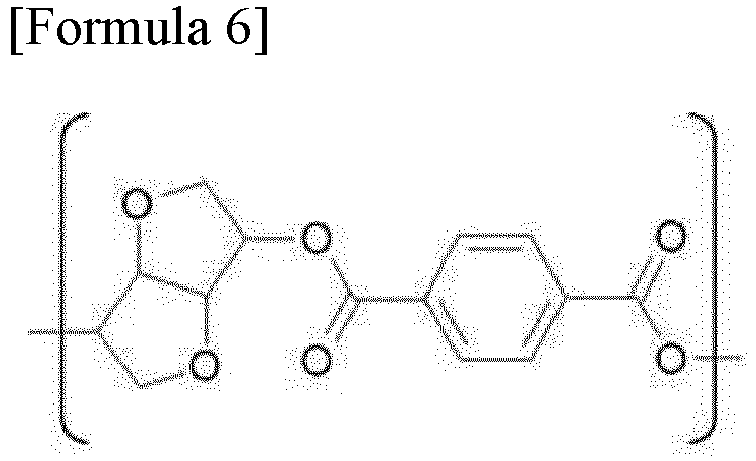
- Specifically, the repeat unit 1 may be obtained from the reaction of 1,4:3,6-dianhydrohexitol and a carbonate compound represented by the above Formula 2, and the repeat unit 3 may be obtained from the reaction of 1,4:3,6-dianhydrohexitol and a terephthalate. That is, 1,4:3,6-dianhydrohexitol and the compound represented by the above Formula 2 may be reacted to form a carbonate bond (repeat unit 1, Formula 4), and 1,4:3,6-dianhydrohexitol and the compound represented by the above Formula 3 may be reacted to form an ester bond (repeat unit 3, Formula 6).
- In addition, the monomer mixture may comprise compounds represented by the following Formulae 1 to 3; and 1,4:3,6-dianhydrohexitol. Specifically, the total amounts of the compound represented by the above Formula 1, the compound represented by the above Formula 2, and the compound represented by the above Formula 3 may be 0.7 to 1.3 moles, 0.9 to 1.1 moles, or 0.95 to 1.05 mole, based on 1 mole of 1,4:3,6-dianhydrohexitol.
- If the monomer mixture comprises 1,4:3,6-dianhydrohexitol and the compounds represented by the above Formulae 1 to 3, the bio-based polycarbonate ester thus produced may contain repeat unit 1 represented by the following Formula 4, repeat unit 2 represented by the following Formula 5, and repeat unit 3 represented by the following formula 6.
- Specifically, the repeat unit 1 may be obtained from the reaction of 1,4:3,6-dianhydrohexitol and a carbonate compound represented by the above Formula 2, the repeat unit 2 may be obtained from the reaction of 1,4:3,6-dianhydrohexitol and 1,4-cyclohexanedicarboxylate, and the repeat unit 3 may be obtained from the reaction of 1,4:3,6-dianhydrohexitol and a terephthalate. That is, 1,4:3,6-dianhydrohexitol and the compound represented by the above Formula 2 may be reacted to form a carbonate bond (repeat unit 1, Formula 4), 1,4:3,6-dianhydrohexitol and the compound represented by the above Formula 1 may be reacted to form an ester bond (repeat unit 2, Formula 5), and 1,4:3,6-dianhydrohexitol and the compound represented by the above Formula 3 may be reacted to form an ester bond (repeat unit 3, Formula 6).
- The monomer mixture may further comprise such additives as a catalyst and a stabilizer, and at least one monomer selected from the group consisting of an additional diol compound other than 1,4:3,6-dianhydrohexitol and an additional ester compound other than the compounds represented by the above Formulae 1 to 3.
- The monomer mixture may further comprise a catalyst for enhancing the reactivity of the reaction. In addition, the catalyst may be added to the reaction step at any time, but it is preferably added before the reaction.
- Any alkali metal and/or alkali earth metal catalyst commonly used in a polycarbonate melt-polycondensation reaction may be used as the catalyst. In addition, an oxide, hydride, amide, or phenolate of an alkali metal and/or an alkaline earth metal may be used as the catalyst.
- Examples of the alkali metal catalysts may include lithium hydroxide (LiOH), sodium hydroxide (NaOH), potassium hydroxide (KOH), cesium hydroxide (CsOH), lithium carbonate (Li2CO3), sodium carbonate (Na2CO3), potassium carbonate (K2CO3), cesium carbonate (Cs2CO3), lithium acetate (LiOAc), sodium acetate (NaOAc), potassium acetate (KOAc), cesium acetate (CsOAc), and the like.
- Examples of the alkali earth metal catalysts may include calcium hydroxide (Ca(OH)2), barium hydroxide (Ba(OH)2), magnesium hydroxide (Mg(OH)2), strontium hydroxide (Sr(OH)2), calcium carbonate (CaCO3), barium carbonate (BaCO3), magnesium carbonate (MgCO3), strontium carbonate (SrCO3), calcium acetate (Ca(OAc)2), barium acetate (Ba(OAc)2), magnesium acetate (Mg(OAc)2), strontium acetate (Sr(OAc)2), and the like.
- Examples of the oxide, hydride, amide, or phenolate of an alkali metal and/or an alkaline earth metal may include magnesium oxide (MgO), barium oxide (BaO), sodium aluminate (NaAlO2), zinc oxide (ZnO), lead oxide (PbO), dibutyltin oxide ((C4H9)2SnO), antimony trioxide (Sb2O3), and the like.
- The catalyst may be used in an amount such that the metal equivalent of the catalyst is greater than 0 to 5 mmoles, greater than 0 to 3 mmoles, or greater than 0 to 1 mmole, based on 1 mole of the entire diol compounds. If the amount of the catalyst is within the above range, it is possible to prevent the problems that the degree of polymerization falls below the target degree of polymerization and that a side reaction takes place whereby such target physical properties as transparency are not satisfied.
- Meanwhile, the alkali metal and/or alkali earth metal catalyst may be used in combination with a basic catalyst such as a basic ammonium or amine, a basic phosphorous, or a basic boron compound. The basic catalyst may be used alone or in combination, and the amount thereof is not particularly limited.
- The monomer mixture may further comprise an additional diol compound other than 1,4:3,6-dianhydrohexitol, depending on the target properties. Specifically, the additional diol compound may have a single aliphatic ring or a condensed heterogeneous ring at the center of the molecule in order to enhance the heat resistance, transparency, UV stability, and weatherability of the bio-based polycarbonate ester thus prepared. Meanwhile, when the hydroxyl groups are in a symmetrical structure, the ring size and heat resistance proportionally increase. On the other hand, the optical characteristics do not depend on the ring size and the positions of the hydroxyl groups, but they vary with the characteristics of each raw material. As the ring size is bigger, it is more difficult to commercially produce and utilize the diol compound.
- The additional diol compound may be a primary, secondary, or tertiary diol compound. Specifically, the additional diol compound may be at least one diol compound selected from the group consisting of 1,2-cyclohexanedimethanol, 1,3-cyclohexanedimethanol, 1,4-cyclohexanedimethanol, tricyclodecanedimethanol, pentacyclopentadecanedimethanol, decalindimethanol, tricyclotetradecanedimethanol, norbornanedimethanol, adamantanedimethanol, 3,9-bis(1,1-dimethyl-2-hydroxyethyl)-2,4,8,10-tetraoxaspiro[5,5]undecane, bicycle[2.2.2]octane-2,3-dimethanol, 2,4:3,5-di-o-methylene-D-mannitol, tetrahydro-2,5-furandimethanol, 2,5-furandimethanol, 5,5'-(1-methylethylidene)bis(2-furanmethanol), 1,2-cyclohexanediol, 1,3-cyclohexanediol, 1,4-cyclohexanediol, 2-methyl-1,4-cyclohexanediol, tricyclodecanediol, pentacyclopentadecanediol, decalindiol, tricyclotetradecanediol, norbornanediol, adamantanediol, 2,2-bis(4-hydroxycyclohexyl)propane, and 2,2,4,4-tetramethyl-1,3-cyclobutanediol.
- More specifically, the additional diol compound may be 1,4-cyclohexanedimethanol, tetrahydrofuran-2,5-dimethanol, 2,5-furandimethanol, 2,2-bis(4-hydroxycyclohexyl)propane, or 2,2,4,4-tetramethyl-1,3-cyclobutanediol.
- When the molar amount of the additional diol compound employed is p, the molar amount of 1,4:3,6-dianhydrohexitol employed is to be 1 - p. In particular, if the additional diol compound is a petrochemical-based diol compound, it may be used in an amount such that the bio-based carbon content (ASTM-D6866) in the final polymer derived from 1,4:3,6-dianhydrohexitol is at least 1% by mole. In such event, p may satisfy 0 ≤ p < 0.99 mole. That is, the additional diol compound may be used in an amount of less than 0.99 mole based on 1 mole of 1,4:3,6-dianhydrohexitol.
- The monomer mixture may further comprise an additional ester compound other than the compounds represented by the above Formulae 1 to 3, which are ester-bond monomers in the polymer chain, depending on the target properties.
- The additional ester compound may be diphenyl ester. In addition, the additional ester compound may be prepared by reacting a primary, secondary, or tertiary dicarboxylate or dicarboxylic acid (hereinafter referred to as an additional dicarboxylate or dicarboxylic acid) with phenol or a phenol substituent. Specifically, the additional ester compound may be prepared by reacting an additional dicarboxylate or dicarboxylic acid having a single aliphatic ring or a condensed heterogeneous ring at the center of the molecule with phenol or a phenol substituent in order to enhance the heat resistance, transparency, UV stability, and weatherability of the bio-based polycarbonate ester thus prepared.
- Specifically, the additional ester compound may be at least one selected from the group consisting of 1,2-diphenyl-cyclohexanedicarboxylate, 1,3-diphenyl-cyclohexanedicarboxylate, diphenyl decahydro-1,4-naphthalenedicarboxylate, diphenyl decahydro-1,5-naphthalenedicarboxylate, diphenyl decahydro-2,4-naphthalenedicarboxylate, diphenyl decahydro-2,5-naphthalenedicarboxylate, diphenyl decahydro-2,6-naphthalenedicarboxylate, diphenyl decahydro-2,7-naphthalenedicarboxylate, diphenyl decahydro-2,8-naphthalenedicarboxylate, diphenyl tetrahydro-2,5-furanedicarboxylate, diphenyl 2,5-furanedicarboxylate, diphenyl phthalate, and diphenyl isophthalate.
- More specifically, the additional ester compound may be 1,3-diphenyl-cyclohexanedicarboxylate, diphenyl decahydro-2,6-naphthalenedicarboxylate, diphenyl tetrahydro-2,5-furanedicarboxylate, diphenyl 2,5-furanedicarboxylate or diphenyl isophthalate.
- The phenol substituent used in the preparation of the additional ester compound may be a compound represented by the following Formula 7.

- In the above Formula 7,
R3 is at least one selected from the group consisting of an alkyl group having 1 to 18 carbon atoms, a cycloalkyl group having 4 to 20 carbon atoms, an aryl group having 6 to 18 carbon atoms, an alkoxy group having 1 to 18 carbon atoms, a cycloalkoxy group having 4 to 20 carbon atoms, an aryloxy group having 6 to 18 carbon atoms, an alkylsulfonyl group having 1 to 18 carbon atoms, a cycloalkylsulfonyl group having 4 to 20 carbon atoms, an arylsulfonyl group having 6 to 18 carbon atoms, or an ester substituent. In such event, the ester substituent may be an alkyl ester having 1 to 18 carbon atoms, a cycloalkyl ester having 4 to 20 carbon atoms, or an aryl ester having 6 to 18 carbon atoms. - When the molar amount of the additional ester compound employed is q, the molar amount of the compounds represented by the above Formulae 1 to 3 employed is to be 1 - q. In such event, q may satisfy 0 ≤ q < 1 mole. That is, the additional ester compound may be used in an amount of less than 1 mole based on 1 mole of the entire carbonate and/or ester compounds.
- In addition, the monomer mixture may further comprise an additive such as an antioxidant, a heat stabilizer, a light absorber, a color former, a lubricant, a colorant, a conductive agent, a nucleation agent, a flame retardant, a plasticizer, an antistatic agent, and the like.
- For example, the antioxidant may be hindered phenol, hydroquinone, phosphite, a substituted compound thereof, or the like. In addition, the light absorber may be resorcinol, salicylate, or the like. Further, the color former may be phosphite, hydrophosphite, or the like. The lubricant may be montanic acid, stearyl alcohol, or the like. In addition, a dye and a pigment may be used as the colorant. Carbon black may be used as the conductive agent or the nucleation agent.
- In such event, the kinds and amounts of all of the above-mentioned additives are not particularly limited as long as they do not adversely affect the physical properties, especially transparency, of the bio-based polycarbonate esters thus prepared.
- The molecular structure of BPA, which contains an aromatic ring, reduces the free volume of a polymer chain, whereas 1,4:3,6-dianhydrohexitol, which contains a rigid condensation heterogeneous ring, increases the free volume of a polymer chain. Thus, as compared with the polycondensation process of a BPA polycarbonate, which requires a high reaction temperature due to its high melt viscosity for the same heat resistance composition, it is more advantageous to employ a horizontal-type high-viscosity polycondensation reactor for the melt-polycondensation process of a bio-based polycarbonate ester, which can be carried out at a low reaction temperature due to its low melting point. In addition, since the melt-polycondensation reaction for a bio-based polycarbonate ester can be carried out at a relatively low-temperature range, it is possible to prevent discoloration and deterioration of the physical properties of the product. Further, it is possible to produce a product having a high polymerization degree without chain breakage that may be caused by the high shear force induced by the high agitation force applied in the melt-polycondensation process of a BPA polycarbonate carried out in a conventional low-viscosity polycondensation reactor that operates at high reaction temperatures.
- The high-viscosity polycondensation reactor may be a horizontal plug flow reactor. Specifically, the high-viscosity polycondensation reactor may be an extruder, a kneader, or a finisher reactor that comprises one or more stirrers.
- The stirrer may comprise a shaft and a screw or may be in the form of a shaft-free. In addition, the screw of the stirrer shaft may be in the form of a spiral, a lattice, a bar, a spectacle, or the like. Specifically, it may be in the form of a bar.
- The high-viscosity polycondensation reactor may comprise such accessory equipment as a discharge screw for discharging the final molten polymer, a vapor column for collecting phenol as a reaction byproduct, a cooling trap, and a receiver. In addition, in the high-viscosity polycondensation reactor, the molten polymer discharged through the discharge screw is conveyed to a pelletizer to produce pellets, which may be dried and packaged.
- The maximum viscosity in the high-viscosity polycondensation reactor may be 10,000 to 1,000,000 poises. Specifically, the maximum viscosity in the high-viscosity polycondensation reactor may be 20,000 to 500,000 poises or 50,000 to 200,000 poises. If the maximum viscosity in the high-viscosity polycondensation reactor is within the above range, it is easy to achieve a high polymerization degree at low reaction temperatures.
- The preparation process may be carried out with temperature elevation and depressurization in a stepwise manner in order to rapidly remove byproducts from the molten reactants having a high viscosity and to expedite the polymerization reaction.
- Specifically, the preparation process may comprise (1) melting the monomer mixture and reacting the mixture at a reduced pressure to prepare a prepolymer; and (2) reacting the prepolymer at a reduced pressure to prepare a bio-based polycarbonate ester.
- In this step, the monomer mixture is melted and reacted at a reduced pressure to prepare a prepolymer.
- This step may be carried out in a reactor that comprises such accessory equipment as a vacuum pump for depressurization, a vapor column for collecting phenol as a reaction byproduct, a cooling trap, and a receiver.
- The prepolymer may have an intrinsic viscosity (IV) of 0.10 to 0.60 dl/g. Specifically, the prepolymer may have an intrinsic viscosity (IV) of 0.20 to 0.55 dl/g or 0.30 to 0.50 dl/g.
- Specifically, this step may be carried out at 20 to 700 mbar and 140 to 220°C.
- Specifically, this step may comprise (i) melting the monomer mixture, followed by raising the temperature to 140 to 180°C and reducing the pressure to 300 to 700 mbar; and (ii) raising the temperature to 180 to 220°C and reducing the pressure to 20 to 300 mbar. More specifically, this step may comprise (i) melting the monomer mixture, followed by raising the temperature to 150 to 180°C or 160 to 180°C, and reducing the pressure to 300 to 650 mbar or 300 to 600 mbar; and (ii) raising the temperature to 190 to 220°C or 200 to 220°C, and reducing the pressure to 20 to 250 mbar or 20 to 200 mbar.
- In this step, the prepolymer is reacted at a reduced pressure to prepare a bio-based polycarbonate ester.
- Specifically, this step may be carried out at 0.1 to 20 mbar and 220 to 270°C.
- Specifically, this step may comprise (i) raising the temperature of the prepolymer to 220 to 240°C and reducing the pressure to 5 to 20 mbar; and (ii) raising the temperature to 240 to 270°C and reducing the pressure to 0.1 to 5 mbar. Specifically, this step may comprise (i) raising the temperature of the prepolymer to 220 to 240°C and reducing the pressure to 5 to 15 mbar or 5 to 10 mbar; and (ii) raising the temperature to 240 to 270°C and reducing the pressure to 0.1 to 3 mbar or 0.1 to 1 mbar.
- The rate of temperature elevation in this step may be 0.1 to 10°C/ min, 0.2 to 5°C/min, or 0.5 to 2°C/min. In addition, the reaction time may be 1 to 10 hours or 3 to 8 hours.
- Meanwhile, phenol may be produced as a reaction byproduct while the melt-polycondensation reaction is carried out. It is preferable that phenol produced as a byproduct is removed from the reaction system in order to shift the reaction equilibrium towards the production of the polycarbonate ester. If the rate of temperature elevation in the melt-polycondensation reaction is within the above ranges, it is possible to prevent the problem that phenol, a reaction byproduct, evaporates or sublimes together with the reaction raw materials.
- In addition, the process for preparing a bio-based polycarbonate ester may be a batch or continuous process. Specifically, the above steps (1) and (2) may be carried out in the same reactor or may be carried out in different reactors, respectively.
- If the above steps (1) and (2) are carried out in different reactors, the above step (1) may be carried out in a reactor that may be used in the conventional process for producing a BPA polycarbonate on a commercial scale such as a vertical stirring reactor, a thin film evaporation reactor, a wire-wetting fall reactor, or the like. Thereafter, the prepolymer prepared in the above step (1) is continuously fed to a high-viscosity polycondensation reactor in which the above step (2) is carried. The feeding rate to the high-viscosity polycondensation reactor may be varied depending on the molecular weight of the prepolymer prepared.
- In addition, if the above steps (1) and (2) are carried out in the same reactor, the reactor may be a high-viscosity polycondensation reactor.
- The present invention provides a bio-based polycarbonate ester prepared by the above-described preparation process and having an intrinsic viscosity (IV) of 0.8 to 2.3 dl/g.
- Specifically, the bio-based polycarbonate ester may have an intrinsic viscosity (IV) of 0.8 to 2.0 dl/g, 0.8 to 1.7 dl/g, or 0.8 to 1.4 dl/g.
- A specimen injection-molded according to the ASTM D638 test method from the bio-based polycarbonate ester may have a tensile strength of 80 to 200 MPa and a flexural strength of 100 to 210 MPa. Specifically, the specimen may have a tensile strength of 80 to 190 MPa, 80 to 180 MPa, or 80 to 170 MPa, and a flexural strength of 100 to 200 MPa, 100 to 190 MPa, or 100 to 180 MPa.
- The bio-based polycarbonate ester may have an Izod notch impact strength of 60 J/m to no breakage (NB). Specifically, the bio-based polycarbonate ester may have an Izod notch impact strength of 70 J/m to no breakage (NB), 80 J/m to no breakage (NB), or 90 J/m to no breakage (NB). Here, no breakage indicates that the specimen does not break since it has an impact strength exceeding the measurement limit of the impact tester.
- Further, the present invention provides a molded article that comprises a bio-based polycarbonate ester. Specifically, the molded article may be produced by molding a bio-based polycarbonate ester.
- The molding method is not particularly limited. For example, injection molding, extrusion molding, blow molding, extrusion blow molding, inflation molding, calender molding, foam molding, balloon molding, vacuum molding, and radiation molding may be adopted.
- The use of the molded article is not particularly limited. It may be used as a substitute for conventional heat resistant and optical articles by virtue of its excellent heat resistance and transparency. Specifically, the molded article may be an automobile part, an electric/electronic part, a lighting part, a medical product, a display part, an aviation part, a machine part, and a food container.
- Hereinafter, the present invention is described in more detail by the following examples and comparative examples. However, these examples are provided only for illustration purposes, and the present invention is not limited thereto.
- A 12-liter twin-screw batch kneader reactor (CKR10B-170, LIST Corp.) was used as a high-viscosity polycondensation reactor. The reactor was charged with 3,204 g (21.92 moles) of isosorbide (ISB, Roquette Freres), 710 g (2.19 moles) of 1,4-diphenyl-cyclohexanedicarboxylate (DPCD, SK Chemicals), 4,215 g (19.68 moles) of diphenyl carbonate (DPC, Changfeng), and 2.87 g of a 1% aqueous solution of sodium aluminate (NaAlO2) at room temperature. Thereafter, the temperature was raised to 150°C. Once the temperature reached 150°C, the pressure was reduced to 500 mbar, and the temperature was then raised to 190°C over 1 hour. During the temperature elevation, phenol began to be generated as a reaction byproduct. When the temperature reached 190°C, the pressure was reduced to 100 mbar and maintained for 20 minutes, and then the temperature was raised to 230°C over 20 minutes. Once the temperature reached 230°C, the pressure was reduced to 10 mbar, and then the temperature was raised to 250°C over 10 minutes. Once the temperature reached 250°C, the pressure was reduced to 1 mbar or less, and the reaction continued until the maximum hydraulic pressure of 48 bar was reached. Thereafter, the reaction was terminated, and the product was cooled to room temperature to obtain a solid sample.
- The polycarbonate ester thus prepared had a Tg of 160°C, an IV of 1.05 dl/g, a number average molecular weight (Mn) of 40,857 g/mole, and a weight average molecular weight (Mw) of 100,952 g/mole as measured by gel permeation chromatography (GPC).
- The same procedures as Example 1 were repeated to prepare a polycarbonate ester, except that 3,204g(21.92mol) of ISB, 1,421g(4.38mol) of DPCD, and 3,747g(17.49mol) of DPC were used.
- The same procedures as Example 1 were repeated to prepare a polycarbonate ester, except that 3,204g(21.92mol) of ISB, 2,131g(6.57mol) of DPCD, and 3,278g(15.30mol) of DPC were used.
- The same procedures as Example 1 were repeated to prepare a polycarbonate ester, except that 3,204g(21.92mol) of ISB, 2,842g(8.76mol) of DPCD, and 2,808g(13.11mol) of DPC were used.
- The same procedures as Example 1 were repeated to prepare a polycarbonate ester, except that 3,204g(21.92mol) of ISB, 443g(10.95mol) of DPCD, and 2,339g(10.92mol) of DPC were used.
- The same procedures as Example 1 were repeated to prepare a polycarbonate ester, except that 3,204g(21.92mol) of ISB, 697g(2.19mol) of DPT(SK Chemicals), and 4,215g(19.68mol) of DPC were used.
- The same procedures as Example 1 were repeated to prepare a polycarbonate ester, except that 3,204g(21.92mol) of ISB, 710g(2.19mol) of DPCD, 697g(2.19mol) of DPT, and 3,747g(17.49mol) of DPC were used.
- 17-liter polycondensation bench reactor was charged with 1,995 g (13.65 moles) of ISB, 443 g (1.37 moles) of DPCD, 2,632 g (12.29 moles) of DPC, and 1.80 g of a 1% aqueous solution of NaAlO2 at room temperature. Thereafter, the temperature was raised to 150°C. Once the temperature reached 150°C, the pressure was reduced to 400 torr, and the temperature was then raised to 190°C over 1 hour. During the temperature elevation, phenol began to be generated as a reaction byproduct. When the temperature reached 190°C, the pressure was reduced to 100 torr and maintained for 20 minutes, and then the temperature was raised to 230°C over 20 minutes. Once the temperature reached 230°C, the pressure was reduced to 10 torr, and then the temperature was raised to 250°C over 10 minutes. Once the temperature reached 250°C, the pressure was reduced to 1 torr or less, and the reaction continued until the target stirring torque was reached. Upon arrival at the target stirring torque, the reaction was terminated. The polymerized product pressurized and discharged was rapidly cooled in a water bath and then cut into pellets.
- The polycarbonate ester thus prepared had a Tg of 160°C, an IV of 0.55 dl/g, an Mn of 17,309 g/mole, and an Mw of 36,368 g/mole as measured by GPC.
- The same procedures as Comparative Example 1 were repeated, except that 1,995g(13.65mol) of ISB, 889g(2.74mol) of DPCD, and 2,339g(10.92mol) of DPC were used
- The bio-based polycarbonate esters of Examples 1 to 7 and Comparative Examples 1 and 2 were each evaluated for their physical properties by the following methods. The measured physical properties are shown in Table 1 below.
- The glass transition temperature was measured using a differential scanning calorimeter (Q20, TA Instruments) in accordance with ASTM D3418.
- A sample was dissolved in o-chlorophenol at a concentration of 1.2 g/dl at 150°C for 15 minutes. The intrinsic viscosity of the sample was measured in a thermostat at 35°C using an Ubbelodhe viscometer.
- A specimen prepared according to ASTM D638 was subjected to a measurement using a universal testing machine (Z010, Zwick Roell).
- A specimen prepared according to ASTM D638 was subjected to a measurement using a universal testing machine (4465, Instron).
- A specimen prepared according to ASTM D256 was subjected to a measurement for Izod impact strength using an impact tester (258-PC-S, Yasuda).
- A specimen prepared according to ASTM D648 was subjected to a measurement for heat distortion temperature using a heat distortion temperature testing machine (6M-2, Toyoseiki).
- A specimen prepared according to KS M ISO15184 was subjected to a measurement for pencil hardness using a pencil hardness testing machine (VF2377-123, TQC).
[Table 1] Ex. 1 Ex. 2 Ex. 3 Ex. 4 Ex. 5 Ex. 6 Ex. 7 C. Ex. 1 C. Ex. 2 ISB 1 1 1 1 1 1 1 1 1 DPC 0.9 0.8 0.7 0.6 0.5 0.9 0.8 0.9 0.8 DPCD 0.1 0.2 0.3 0.4 0.5 - 0.1 0.1 0.2 DPT - - - - - 0.1 0.1 - - IV (dl/g) 1.05 1.10 1.14 1.19 1.17 1.01 1.07 0.55 0.58 Tg (°C) 160 157 154 151 148 170 168 160 157 Tensile strength (MPa) 91 97 103 106 111 95 102 77 79 Flexural 170 165 158 152 148 174 168 152 131 strength (MPa) Flexural modulus (MPa) 3,486 3,361 3,254 3,138 3,031 3,512 3,423 3,062 2,936 Izod impact strength (J/m) 94 258 779 NB NB 102 242 12 37 Heat distortion temperature (°C) 138 135 131 129 127 147 145 131 127 Pencil hardness 3H 3H 2H 2H 2H 3H 3H 2H H - As shown in Table 1, the bio-based polycarbonate esters of Examples 1 to 7 prepared by using the high-viscosity polycondensation reactor according to the preparation process of the present invention were improved in terms of tensile strength, flexural strength, flexural modulus, impact strength, heat distortion temperature, and pencil hardness as compared with the bio-based polycarbonate esters of Comparative Examples 1 and 2 prepared by using the low-viscosity vertical alignment polycondensation reactor since the former had a higher molecular weight than that of the latter.
- In particular, it was confirmed that the impact strength of Examples 1 and 2 was significantly increased relative to the increase in tensile strength and flexural strength as compared with Comparative Examples 1 and 2, which had the same content of DPCD, by virtue of the increase in molecular weight. In addition, the heat distortion temperature and pencil hardness were also increased due to the increase in the molecular weight.
- In addition, the tensile strength and impact strength were increased, while the glass transition temperature, heat distortion temperature, and flexural strength were decreased, as the content of DPCD was increased (Examples 1 to 5). In particular, Examples 4 and 5 showed that the impact strength reached no breakage. As a result, the compositions of Examples 4 and 5 had a heat resistance and an impact strength equal to, or higher than, those of a BPA polycarbonate.
- Further, Example 6 used DPT, and Example 7 used DPCD and DPT together. It was confirmed that the heat resistance was higher than that of Examples 1 and 2, while other physical properties were similar.
- Meanwhile, the impact strength in Comparative Examples 1 and 2 prepared by using the low-viscosity vertical arrangement polycondensation reactor was significantly low due to the low molecular weight.
- Therefore, the present invention can produce a high-molecular weight, bio-based polycarbonate ester having an intrinsic viscosity (IV) of 1.0 dl/g or more by using a high-viscosity polycondensation reactor. The bio-based polycarbonate ester thus prepared is excellent in heat resistance, transparency, and mechanical properties. Thus, it can be advantageously used in various applications.
Claims (12)
- A process for preparing a bio-based polycarbonate ester, which comprises: feeding monomer mixture that comprises at least one compound selected from the group consisting of compounds represented by the following Formulae 1 to 3; and a 1,4:3,6-dianhydrohexitol to a high-viscosity polycondensation reactor; and reacting them:


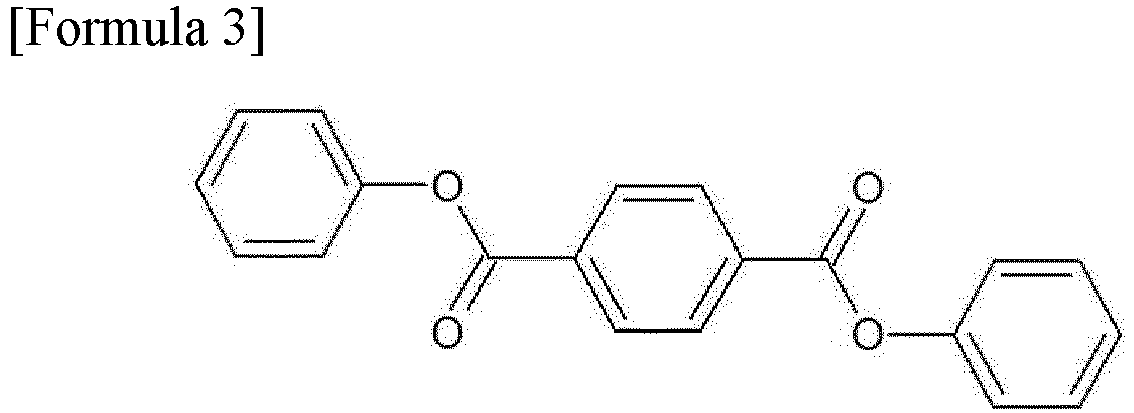
R1 and R2 are each an alkyl group having 1 to 18 carbon atoms or an aryl group having 6 to 18 carbon atoms,
wherein the aryl group may have at least one substituent selected from the group consisting of an alkyl group having 1 to 18 carbon atoms, a cycloalkyl group having 4 to 20 carbon atoms, an aryl group having 6 to 18 carbon atoms, an alkoxy group having 1 to 18 carbon atoms, a cycloalkoxy group having 4 to 20 carbon atoms, an aryloxy group having 6 to 18 carbon atoms, an alkylsulfonyl group having 1 to 18 carbon atoms, a cycloalkylsulfonyl group having 4 to 20 carbon atoms, an arylsulfonyl group having 6 to 18 carbon atoms, and an ester substituent; and the ester substituent may be an alkyl ester having 1 to 18 carbon atoms, a cycloalkyl ester having 4 to 20 carbon atoms, or an aryl ester having 6 to 18 carbon atoms. - The process for preparing a bio-based polycarbonate ester of claim 1, wherein the high-viscosity polycondensation reactor is an extruder, a kneader, or a finisher reactor that comprises one or more stirrers.
- The process for preparing a bio-based polycarbonate ester of claim 1, wherein the maximum reaching viscosity in the high-viscosity polycondensation reactor is 10,000 to 1,000,000 poises.
- The process for preparing a bio-based polycarbonate ester of claim 1, which comprises:(1) melting the monomer mixture and reacting the mixture at a reduced pressure to prepare a prepolymer; and(2) reacting the prepolymer at a reduced pressure to prepare a bio-based polycarbonate ester.
- The process for preparing a bio-based polycarbonate ester of claim 4, wherein the above step (1) is carried out at 20 to 700 mbar and 140 to 220°C.
- The process for preparing a bio-based polycarbonate ester of claim 4, wherein the prepolymer has an intrinsic viscosity (IV) of 0.10 to 0.60 dl/g.
- The process for preparing a bio-based polycarbonate ester of claim 4, wherein the above step (2) is carried out at 0.1 to 20 mbar and 220 to 270°C.
- A bio-based polycarbonate ester prepared by the preparation process of any one of claims 1 to 7 and having an intrinsic viscosity (IV) of 0.8 to 2.3 dl/g.
- The bio-based polycarbonate ester of claim 8, wherein a specimen injection-molded according to the ASTM D638 test method from the bio-based polycarbonate ester has a tensile strength of 80 to 200 MPa and a flexural strength of 100 to 210 MPa.
- The bio-based polycarbonate ester of claim 8, which has an Izod notch impact strength of 60 J/m to no breakage.
- A molded article, which comprises the bio-based polycarbonate ester of claim 8.
- The molded article of claim 11, which is an automobile part, an electric/electronic part, a display part, an aviation part, a machine part, a lighting part, a medical product, or a food container.
Applications Claiming Priority (2)
| Application Number | Priority Date | Filing Date | Title |
|---|---|---|---|
| KR20180008937 | 2018-01-24 | ||
| PCT/KR2019/001039 WO2019147051A1 (en) | 2018-01-24 | 2019-01-24 | Bio-based polycarbonate ester and preparation method therefor |
Publications (2)
| Publication Number | Publication Date |
|---|---|
| EP3744750A1 true EP3744750A1 (en) | 2020-12-02 |
| EP3744750A4 EP3744750A4 (en) | 2021-11-03 |
Family
ID=67394656
Family Applications (1)
| Application Number | Title | Priority Date | Filing Date |
|---|---|---|---|
| EP19744450.8A Pending EP3744750A4 (en) | 2018-01-24 | 2019-01-24 | Bio-based polycarbonate ester and preparation method therefor |
Country Status (7)
| Country | Link |
|---|---|
| US (1) | US11535705B2 (en) |
| EP (1) | EP3744750A4 (en) |
| JP (1) | JP7323134B2 (en) |
| KR (1) | KR102670159B1 (en) |
| CN (1) | CN111630082A (en) |
| TW (1) | TWI848929B (en) |
| WO (1) | WO2019147051A1 (en) |
Families Citing this family (11)
| Publication number | Priority date | Publication date | Assignee | Title |
|---|---|---|---|---|
| KR102577308B1 (en) * | 2017-09-28 | 2023-09-12 | 에스케이케미칼 주식회사 | Polycarbonate ester having high heat resistance, and preparation method thereof |
| KR102606874B1 (en) * | 2018-07-12 | 2023-11-27 | 에스케이케미칼 주식회사 | Biobased polycarbonate ester resin for eyeglass frame |
| KR20200047079A (en) | 2018-10-26 | 2020-05-07 | 에스케이케미칼 주식회사 | Polymerizable composition, and copolycarbonate ester and preparation method thereof |
| KR102528747B1 (en) * | 2019-11-29 | 2023-05-03 | 롯데케미칼 주식회사 | Improved heat resistance and impact resistance bio-mass based polymer compositions and manufacturing method the same |
| US12473397B2 (en) * | 2019-12-16 | 2025-11-18 | Covestro Intellectual Property Gmbh & Co. Kg | Polyester carbonates from aliphatic diacids and aliphatic diols, and process for the production thereof |
| CN114829451B (en) * | 2019-12-16 | 2024-08-16 | 科思创德国股份有限公司 | Process for preparing polyester carbonates |
| MX2022016126A (en) | 2020-06-19 | 2023-02-09 | Covestro Deutschland Ag | Polyester carbonates on the basis of cycloaliphatic diacids, 1,4:3,6-dianhydrohexitol and specific amounts of an additional aliphatic dihydroxy compound. |
| MX2022016129A (en) | 2020-06-19 | 2023-02-09 | Covestro Deutschland Ag | Polyester carbonates from cycloaliphatic diacids, 1,4:3,6-dianhydrohexitol and a further aliphatic dihydroxy compound. |
| KR20230027032A (en) | 2020-06-19 | 2023-02-27 | 코베스트로 도이칠란트 아게 | Polyester carbonate consisting of defined ratios of different diols |
| TWI745107B (en) * | 2020-09-29 | 2021-11-01 | 長春人造樹脂廠股份有限公司 | Polycarbonate polyester |
| CN114763408B (en) * | 2021-01-15 | 2023-10-24 | 万华化学集团股份有限公司 | A kind of high transparency, high hardness and low birefringence polycarbonate and its preparation method and application |
Family Cites Families (22)
| Publication number | Priority date | Publication date | Assignee | Title |
|---|---|---|---|---|
| JP3729515B2 (en) * | 1993-07-05 | 2005-12-21 | 株式会社フジタ | Air purification device |
| JP3401732B2 (en) | 1994-03-07 | 2003-04-28 | 出光石油化学株式会社 | Method for producing polycarbonate |
| US6350848B1 (en) * | 1997-11-28 | 2002-02-26 | Hitachi, Ltd. | Process and apparatus for producing polycarbonate |
| US7041775B2 (en) * | 2004-04-20 | 2006-05-09 | General Electric Company | Method for preparing a polycarbonate oligomer mixture at low temperature for manufacturing polycarbonate |
| KR101221774B1 (en) | 2007-08-16 | 2013-01-11 | 주식회사 엘지화학 | Method for Solid State Polymerization Using Film or Sheet Processing |
| JP4697295B2 (en) * | 2007-12-13 | 2011-06-08 | 三菱化学株式会社 | Method for producing polycarbonate |
| US7863404B2 (en) * | 2008-09-26 | 2011-01-04 | Sabic Innovative Plastics Ip B.V. | Method of making isosorbide polycarbonate |
| EP2371877B1 (en) | 2008-11-28 | 2026-04-29 | Mitsubishi Chemical Corporation | Polycarbonate resin, polycarbonate resin composition, optical film, and polycarbonate resin molded article |
| WO2011062600A1 (en) * | 2009-11-19 | 2011-05-26 | E. I. Du Pont De Nemours And Company | Polycondensation with a kneader reactor |
| JP2013076981A (en) * | 2011-09-14 | 2013-04-25 | Mitsubishi Chemicals Corp | Phase difference film, circularly polarizing plate using the same, and image display device |
| DE102012105296A1 (en) * | 2012-06-19 | 2013-12-19 | Epc Engineering Consulting Gmbh | Process and plant for the production of polycarbonate |
| US9193864B2 (en) * | 2012-06-22 | 2015-11-24 | Sabic Global Technologies B.V. | Polycarbonate compositions with improved impact resistance |
| WO2014021346A1 (en) * | 2012-08-01 | 2014-02-06 | 三菱化学株式会社 | Polycarbonate resin composition and transparent film |
| JP6311264B2 (en) * | 2012-10-16 | 2018-04-18 | 三菱ケミカル株式会社 | Resin composition, stretched film, circularly polarizing plate and image display device |
| EP2999734B1 (en) | 2013-05-23 | 2019-07-03 | Saudi Basic Industries Corporation | Methods for making melt polymerization polycondensation products |
| KR101995907B1 (en) * | 2013-07-24 | 2019-07-03 | 에스케이케미칼 주식회사 | Polycarbonate ester having high heat resistance and transparency, and preparation method thereof |
| CN104031249A (en) * | 2014-06-17 | 2014-09-10 | 中国科学院化学研究所 | Random copolymer of polycarbonate and aromatic polyester based on 1,4;3,6-diglycidyl hexanehexol and preparation method and application thereof |
| KR102342167B1 (en) * | 2015-01-22 | 2021-12-22 | 에스케이케미칼 주식회사 | Novel process for preparing polycarbonate ester having excellent transparency and high heat resistance |
| CN106622083A (en) | 2016-12-23 | 2017-05-10 | 南京昊扬化工装备有限公司 | Novel high-viscosity final polycondensation reactor |
| CN106800643B (en) | 2017-02-09 | 2019-08-27 | 中国科学院化学研究所 | A kind of preparation method of high heat resistance isosorbide type random copolyester |
| KR102577308B1 (en) * | 2017-09-28 | 2023-09-12 | 에스케이케미칼 주식회사 | Polycarbonate ester having high heat resistance, and preparation method thereof |
| KR102634462B1 (en) | 2017-11-09 | 2024-02-06 | 에스케이케미칼 주식회사 | Molded product prepared from polycarbonate ester having high heat resistance |
-
2019
- 2019-01-24 KR KR1020190009485A patent/KR102670159B1/en active Active
- 2019-01-24 JP JP2020535210A patent/JP7323134B2/en active Active
- 2019-01-24 EP EP19744450.8A patent/EP3744750A4/en active Pending
- 2019-01-24 CN CN201980009523.3A patent/CN111630082A/en active Pending
- 2019-01-24 US US16/960,615 patent/US11535705B2/en active Active
- 2019-01-24 WO PCT/KR2019/001039 patent/WO2019147051A1/en not_active Ceased
- 2019-01-24 TW TW108102743A patent/TWI848929B/en active
Also Published As
| Publication number | Publication date |
|---|---|
| CN111630082A (en) | 2020-09-04 |
| EP3744750A4 (en) | 2021-11-03 |
| JP7323134B2 (en) | 2023-08-08 |
| WO2019147051A1 (en) | 2019-08-01 |
| KR20190090364A (en) | 2019-08-01 |
| US11535705B2 (en) | 2022-12-27 |
| TW201936704A (en) | 2019-09-16 |
| JP2021511397A (en) | 2021-05-06 |
| US20200362105A1 (en) | 2020-11-19 |
| KR102670159B1 (en) | 2024-05-29 |
| TWI848929B (en) | 2024-07-21 |
Similar Documents
| Publication | Publication Date | Title |
|---|---|---|
| US11535705B2 (en) | Polycarbonate ester and preparation method therefor | |
| EP3822299B1 (en) | Bio-based polycarbonate ester resin for eyeglass frame | |
| KR102342167B1 (en) | Novel process for preparing polycarbonate ester having excellent transparency and high heat resistance | |
| KR102634462B1 (en) | Molded product prepared from polycarbonate ester having high heat resistance | |
| US12391795B2 (en) | Polymerizable composition, and copolycarbonate ester and method for producing same | |
| KR102577308B1 (en) | Polycarbonate ester having high heat resistance, and preparation method thereof | |
| EP3872112B1 (en) | Highly bio-based polycarbonate ester and method for producing same | |
| KR20100047127A (en) | Method for producing thermoplastic resin, polyester resin and polycarbonate resin, and their applications | |
| JP5287704B2 (en) | Polycarbonate resin composition | |
| KR102887978B1 (en) | Polycarbonate copolymer, method for preparing the same and composition comprising the same | |
| HK1177215A1 (en) | Process for production of highly polymerized aromatic polycarbonate resin |
Legal Events
| Date | Code | Title | Description |
|---|---|---|---|
| STAA | Information on the status of an ep patent application or granted ep patent |
Free format text: STATUS: THE INTERNATIONAL PUBLICATION HAS BEEN MADE |
|
| PUAI | Public reference made under article 153(3) epc to a published international application that has entered the european phase |
Free format text: ORIGINAL CODE: 0009012 |
|
| STAA | Information on the status of an ep patent application or granted ep patent |
Free format text: STATUS: REQUEST FOR EXAMINATION WAS MADE |
|
| 17P | Request for examination filed |
Effective date: 20200817 |
|
| AK | Designated contracting states |
Kind code of ref document: A1 Designated state(s): AL AT BE BG CH CY CZ DE DK EE ES FI FR GB GR HR HU IE IS IT LI LT LU LV MC MK MT NL NO PL PT RO RS SE SI SK SM TR |
|
| AX | Request for extension of the european patent |
Extension state: BA ME |
|
| DAV | Request for validation of the european patent (deleted) | ||
| DAX | Request for extension of the european patent (deleted) | ||
| A4 | Supplementary search report drawn up and despatched |
Effective date: 20210930 |
|
| RIC1 | Information provided on ipc code assigned before grant |
Ipc: C08G 63/78 20060101ALI20210924BHEP Ipc: C08G 63/672 20060101ALI20210924BHEP Ipc: C08G 64/20 20060101ALI20210924BHEP Ipc: C08G 64/30 20060101AFI20210924BHEP |
|
| STAA | Information on the status of an ep patent application or granted ep patent |
Free format text: STATUS: EXAMINATION IS IN PROGRESS |
|
| 17Q | First examination report despatched |
Effective date: 20240301 |