EP3744713A1 - Diyhydropyrimidine-2-one compounds and medicinal uses thereof - Google Patents
Diyhydropyrimidine-2-one compounds and medicinal uses thereof Download PDFInfo
- Publication number
- EP3744713A1 EP3744713A1 EP20161939.2A EP20161939A EP3744713A1 EP 3744713 A1 EP3744713 A1 EP 3744713A1 EP 20161939 A EP20161939 A EP 20161939A EP 3744713 A1 EP3744713 A1 EP 3744713A1
- Authority
- EP
- European Patent Office
- Prior art keywords
- compound
- substituted
- alkyl
- formula
- alkoxy
- Prior art date
- Legal status (The legal status is an assumption and is not a legal conclusion. Google has not performed a legal analysis and makes no representation as to the accuracy of the status listed.)
- Pending
Links
- 150000001875 compounds Chemical class 0.000 title claims description 618
- 150000003839 salts Chemical class 0.000 claims abstract description 111
- -1 cyclobutylidenemethyl Chemical group 0.000 claims description 220
- 125000005913 (C3-C6) cycloalkyl group Chemical group 0.000 claims description 81
- 125000000217 alkyl group Chemical group 0.000 claims description 77
- 125000002496 methyl group Chemical group [H]C([H])([H])* 0.000 claims description 77
- 125000004178 (C1-C4) alkyl group Chemical group 0.000 claims description 74
- 239000001257 hydrogen Substances 0.000 claims description 72
- 229910052739 hydrogen Inorganic materials 0.000 claims description 72
- 125000001424 substituent group Chemical group 0.000 claims description 69
- 125000004169 (C1-C6) alkyl group Chemical group 0.000 claims description 62
- 125000006274 (C1-C3)alkoxy group Chemical group 0.000 claims description 60
- 125000003545 alkoxy group Chemical group 0.000 claims description 58
- 125000006273 (C1-C3) alkyl group Chemical group 0.000 claims description 57
- 125000002887 hydroxy group Chemical group [H]O* 0.000 claims description 57
- 125000000843 phenylene group Chemical group C1(=C(C=CC=C1)*)* 0.000 claims description 57
- 229910052736 halogen Inorganic materials 0.000 claims description 54
- 150000002367 halogens Chemical class 0.000 claims description 54
- UFHFLCQGNIYNRP-UHFFFAOYSA-N Hydrogen Chemical compound [H][H] UFHFLCQGNIYNRP-UHFFFAOYSA-N 0.000 claims description 53
- 125000002023 trifluoromethyl group Chemical group FC(F)(F)* 0.000 claims description 48
- 125000002993 cycloalkylene group Chemical group 0.000 claims description 41
- 201000010099 disease Diseases 0.000 claims description 39
- 208000037265 diseases, disorders, signs and symptoms Diseases 0.000 claims description 39
- 208000030159 metabolic disease Diseases 0.000 claims description 37
- 208000023275 Autoimmune disease Diseases 0.000 claims description 36
- 208000016097 disease of metabolism Diseases 0.000 claims description 33
- 239000003795 chemical substances by application Substances 0.000 claims description 30
- 125000000753 cycloalkyl group Chemical group 0.000 claims description 30
- 125000001997 phenyl group Chemical group [H]C1=C([H])C([H])=C(*)C([H])=C1[H] 0.000 claims description 29
- 125000003161 (C1-C6) alkylene group Chemical group 0.000 claims description 26
- 125000003178 carboxy group Chemical group [H]OC(*)=O 0.000 claims description 26
- 125000000392 cycloalkenyl group Chemical group 0.000 claims description 20
- 201000004681 Psoriasis Diseases 0.000 claims description 19
- 206010067584 Type 1 diabetes mellitus Diseases 0.000 claims description 19
- 208000026935 allergic disease Diseases 0.000 claims description 19
- 201000000596 systemic lupus erythematosus Diseases 0.000 claims description 19
- 206010002556 Ankylosing Spondylitis Diseases 0.000 claims description 18
- 208000003556 Dry Eye Syndromes Diseases 0.000 claims description 18
- 206010013774 Dry eye Diseases 0.000 claims description 18
- 206010016654 Fibrosis Diseases 0.000 claims description 18
- 208000007048 Polymyalgia Rheumatica Diseases 0.000 claims description 18
- 206010046851 Uveitis Diseases 0.000 claims description 18
- 230000004761 fibrosis Effects 0.000 claims description 18
- 201000006417 multiple sclerosis Diseases 0.000 claims description 18
- 125000000229 (C1-C4)alkoxy group Chemical group 0.000 claims description 17
- 206010009900 Colitis ulcerative Diseases 0.000 claims description 17
- 208000011231 Crohn disease Diseases 0.000 claims description 17
- 208000022559 Inflammatory bowel disease Diseases 0.000 claims description 17
- 201000006704 Ulcerative Colitis Diseases 0.000 claims description 17
- 206010039073 rheumatoid arthritis Diseases 0.000 claims description 17
- 206010012601 diabetes mellitus Diseases 0.000 claims description 16
- 125000003342 alkenyl group Chemical group 0.000 claims description 15
- 125000000304 alkynyl group Chemical group 0.000 claims description 14
- 208000009329 Graft vs Host Disease Diseases 0.000 claims description 13
- 125000001153 fluoro group Chemical group F* 0.000 claims description 13
- 208000024908 graft versus host disease Diseases 0.000 claims description 13
- 150000002431 hydrogen Chemical group 0.000 claims description 12
- 125000004453 alkoxycarbonyl group Chemical group 0.000 claims description 11
- 125000003392 indanyl group Chemical group C1(CCC2=CC=CC=C12)* 0.000 claims description 11
- 125000003003 spiro group Chemical group 0.000 claims description 10
- 239000008194 pharmaceutical composition Substances 0.000 claims description 9
- 125000004769 (C1-C4) alkylsulfonyl group Chemical group 0.000 claims description 8
- 125000004448 alkyl carbonyl group Chemical group 0.000 claims description 8
- 125000005171 cycloalkylsulfanyl group Chemical group 0.000 claims description 8
- 125000006594 (C1-C3) alkylsulfony group Chemical group 0.000 claims description 7
- 125000006592 (C2-C3) alkenyl group Chemical group 0.000 claims description 7
- 125000004644 alkyl sulfinyl group Chemical group 0.000 claims description 7
- 125000004390 alkyl sulfonyl group Chemical group 0.000 claims description 7
- 125000004414 alkyl thio group Chemical group 0.000 claims description 7
- 125000005149 cycloalkylsulfinyl group Chemical group 0.000 claims description 7
- 239000003937 drug carrier Substances 0.000 claims description 7
- 125000005144 cycloalkylsulfonyl group Chemical group 0.000 claims description 6
- 125000000026 trimethylsilyl group Chemical group [H]C([H])([H])[Si]([*])(C([H])([H])[H])C([H])([H])[H] 0.000 claims description 6
- 125000000339 4-pyridyl group Chemical group N1=C([H])C([H])=C([*])C([H])=C1[H] 0.000 claims description 4
- 150000001408 amides Chemical class 0.000 claims description 4
- 108091008773 RAR-related orphan receptors γ Proteins 0.000 abstract description 31
- 239000003112 inhibitor Substances 0.000 abstract description 4
- 239000000243 solution Substances 0.000 description 348
- 238000006243 chemical reaction Methods 0.000 description 320
- XEKOWRVHYACXOJ-UHFFFAOYSA-N Ethyl acetate Chemical compound CCOC(C)=O XEKOWRVHYACXOJ-UHFFFAOYSA-N 0.000 description 211
- YMWUJEATGCHHMB-UHFFFAOYSA-N Dichloromethane Chemical compound ClCCl YMWUJEATGCHHMB-UHFFFAOYSA-N 0.000 description 141
- WYURNTSHIVDZCO-UHFFFAOYSA-N Tetrahydrofuran Chemical compound C1CCOC1 WYURNTSHIVDZCO-UHFFFAOYSA-N 0.000 description 140
- VLKZOEOYAKHREP-UHFFFAOYSA-N n-Hexane Chemical compound CCCCCC VLKZOEOYAKHREP-UHFFFAOYSA-N 0.000 description 132
- XLYOFNOQVPJJNP-UHFFFAOYSA-N water Chemical compound O XLYOFNOQVPJJNP-UHFFFAOYSA-N 0.000 description 131
- 238000000034 method Methods 0.000 description 121
- 238000002360 preparation method Methods 0.000 description 121
- OKKJLVBELUTLKV-UHFFFAOYSA-N Methanol Chemical compound OC OKKJLVBELUTLKV-UHFFFAOYSA-N 0.000 description 120
- YXFVVABEGXRONW-UHFFFAOYSA-N Toluene Chemical compound CC1=CC=CC=C1 YXFVVABEGXRONW-UHFFFAOYSA-N 0.000 description 114
- HEDRZPFGACZZDS-MICDWDOJSA-N Trichloro(2H)methane Chemical compound [2H]C(Cl)(Cl)Cl HEDRZPFGACZZDS-MICDWDOJSA-N 0.000 description 102
- CSNNHWWHGAXBCP-UHFFFAOYSA-L Magnesium sulfate Chemical compound [Mg+2].[O-][S+2]([O-])([O-])[O-] CSNNHWWHGAXBCP-UHFFFAOYSA-L 0.000 description 80
- 239000002904 solvent Substances 0.000 description 76
- VEXZGXHMUGYJMC-UHFFFAOYSA-N Hydrochloric acid Chemical compound Cl VEXZGXHMUGYJMC-UHFFFAOYSA-N 0.000 description 75
- WEVYAHXRMPXWCK-UHFFFAOYSA-N Acetonitrile Chemical compound CC#N WEVYAHXRMPXWCK-UHFFFAOYSA-N 0.000 description 72
- HEDRZPFGACZZDS-UHFFFAOYSA-N Chloroform Chemical compound ClC(Cl)Cl HEDRZPFGACZZDS-UHFFFAOYSA-N 0.000 description 72
- YLQBMQCUIZJEEH-UHFFFAOYSA-N tetrahydrofuran Natural products C=1C=COC=1 YLQBMQCUIZJEEH-UHFFFAOYSA-N 0.000 description 70
- ZMANZCXQSJIPKH-UHFFFAOYSA-N Triethylamine Chemical compound CCN(CC)CC ZMANZCXQSJIPKH-UHFFFAOYSA-N 0.000 description 66
- 230000002829 reductive effect Effects 0.000 description 66
- ZMXDDKWLCZADIW-UHFFFAOYSA-N N,N-Dimethylformamide Chemical compound CN(C)C=O ZMXDDKWLCZADIW-UHFFFAOYSA-N 0.000 description 62
- 238000001816 cooling Methods 0.000 description 60
- 239000000706 filtrate Substances 0.000 description 58
- 238000005160 1H NMR spectroscopy Methods 0.000 description 52
- LFQSCWFLJHTTHZ-UHFFFAOYSA-N Ethanol Chemical compound CCO LFQSCWFLJHTTHZ-UHFFFAOYSA-N 0.000 description 51
- FAPWRFPIFSIZLT-UHFFFAOYSA-M Sodium chloride Chemical compound [Na+].[Cl-] FAPWRFPIFSIZLT-UHFFFAOYSA-M 0.000 description 50
- 239000011259 mixed solution Substances 0.000 description 44
- 239000000203 mixture Substances 0.000 description 44
- PMZURENOXWZQFD-UHFFFAOYSA-L Sodium Sulfate Chemical compound [Na+].[Na+].[O-]S([O-])(=O)=O PMZURENOXWZQFD-UHFFFAOYSA-L 0.000 description 43
- 229910052938 sodium sulfate Inorganic materials 0.000 description 43
- 235000011152 sodium sulphate Nutrition 0.000 description 43
- 239000012044 organic layer Substances 0.000 description 42
- 229910052943 magnesium sulfate Inorganic materials 0.000 description 40
- 235000019341 magnesium sulphate Nutrition 0.000 description 40
- UHOVQNZJYSORNB-UHFFFAOYSA-N Benzene Chemical compound C1=CC=CC=C1 UHOVQNZJYSORNB-UHFFFAOYSA-N 0.000 description 39
- 239000002585 base Substances 0.000 description 35
- KFZMGEQAYNKOFK-UHFFFAOYSA-N Isopropanol Chemical compound CC(C)O KFZMGEQAYNKOFK-UHFFFAOYSA-N 0.000 description 34
- 238000010898 silica gel chromatography Methods 0.000 description 32
- HEMHJVSKTPXQMS-UHFFFAOYSA-M Sodium hydroxide Chemical compound [OH-].[Na+] HEMHJVSKTPXQMS-UHFFFAOYSA-M 0.000 description 30
- XKRFYHLGVUSROY-UHFFFAOYSA-N Argon Chemical compound [Ar] XKRFYHLGVUSROY-UHFFFAOYSA-N 0.000 description 28
- 125000004432 carbon atom Chemical group C* 0.000 description 28
- 239000002253 acid Substances 0.000 description 25
- UIIMBOGNXHQVGW-UHFFFAOYSA-M Sodium bicarbonate Chemical compound [Na+].OC([O-])=O UIIMBOGNXHQVGW-UHFFFAOYSA-M 0.000 description 24
- ZCSHNCUQKCANBX-UHFFFAOYSA-N lithium diisopropylamide Chemical compound [Li+].CC(C)[N-]C(C)C ZCSHNCUQKCANBX-UHFFFAOYSA-N 0.000 description 24
- XTHFKEDIFFGKHM-UHFFFAOYSA-N Dimethoxyethane Chemical compound COCCOC XTHFKEDIFFGKHM-UHFFFAOYSA-N 0.000 description 23
- RTZKZFJDLAIYFH-UHFFFAOYSA-N Diethyl ether Chemical compound CCOCC RTZKZFJDLAIYFH-UHFFFAOYSA-N 0.000 description 22
- CSCPPACGZOOCGX-UHFFFAOYSA-N Acetone Chemical compound CC(C)=O CSCPPACGZOOCGX-UHFFFAOYSA-N 0.000 description 21
- DTQVDTLACAAQTR-UHFFFAOYSA-N Trifluoroacetic acid Chemical compound OC(=O)C(F)(F)F DTQVDTLACAAQTR-UHFFFAOYSA-N 0.000 description 21
- 125000001570 methylene group Chemical group [H]C([H])([*:1])[*:2] 0.000 description 21
- QAOWNCQODCNURD-UHFFFAOYSA-N Sulfuric acid Chemical compound OS(O)(=O)=O QAOWNCQODCNURD-UHFFFAOYSA-N 0.000 description 17
- IJOOHPMOJXWVHK-UHFFFAOYSA-N chlorotrimethylsilane Chemical compound C[Si](C)(C)Cl IJOOHPMOJXWVHK-UHFFFAOYSA-N 0.000 description 16
- 230000014759 maintenance of location Effects 0.000 description 16
- DNIAPMSPPWPWGF-UHFFFAOYSA-N Propylene glycol Chemical compound CC(O)CO DNIAPMSPPWPWGF-UHFFFAOYSA-N 0.000 description 15
- 229910052799 carbon Inorganic materials 0.000 description 15
- 238000001514 detection method Methods 0.000 description 15
- UAOMVDZJSHZZME-UHFFFAOYSA-N diisopropylamine Chemical compound CC(C)NC(C)C UAOMVDZJSHZZME-UHFFFAOYSA-N 0.000 description 15
- 239000007787 solid Substances 0.000 description 15
- VHYFNPMBLIVWCW-UHFFFAOYSA-N 4-Dimethylaminopyridine Chemical compound CN(C)C1=CC=NC=C1 VHYFNPMBLIVWCW-UHFFFAOYSA-N 0.000 description 14
- IAZDPXIOMUYVGZ-UHFFFAOYSA-N Dimethylsulphoxide Chemical compound CS(C)=O IAZDPXIOMUYVGZ-UHFFFAOYSA-N 0.000 description 14
- 229910052786 argon Inorganic materials 0.000 description 14
- 150000001721 carbon Chemical group 0.000 description 14
- 125000001309 chloro group Chemical group Cl* 0.000 description 14
- 239000012043 crude product Substances 0.000 description 14
- 239000007789 gas Substances 0.000 description 14
- BDAGIHXWWSANSR-UHFFFAOYSA-N methanoic acid Natural products OC=O BDAGIHXWWSANSR-UHFFFAOYSA-N 0.000 description 14
- 239000000047 product Substances 0.000 description 14
- 125000002914 sec-butyl group Chemical group [H]C([H])([H])C([H])([H])C([H])(*)C([H])([H])[H] 0.000 description 14
- 238000000926 separation method Methods 0.000 description 14
- JOXIMZWYDAKGHI-UHFFFAOYSA-N toluene-4-sulfonic acid Chemical compound CC1=CC=C(S(O)(=O)=O)C=C1 JOXIMZWYDAKGHI-UHFFFAOYSA-N 0.000 description 14
- FPQQSJJWHUJYPU-UHFFFAOYSA-N 3-(dimethylamino)propyliminomethylidene-ethylazanium;chloride Chemical compound Cl.CCN=C=NCCCN(C)C FPQQSJJWHUJYPU-UHFFFAOYSA-N 0.000 description 13
- 239000007858 starting material Substances 0.000 description 13
- 125000000999 tert-butyl group Chemical group [H]C([H])([H])C(*)(C([H])([H])[H])C([H])([H])[H] 0.000 description 13
- QTBSBXVTEAMEQO-UHFFFAOYSA-N Acetic acid Chemical compound CC(O)=O QTBSBXVTEAMEQO-UHFFFAOYSA-N 0.000 description 12
- JGFZNNIVVJXRND-UHFFFAOYSA-N N,N-Diisopropylethylamine (DIPEA) Chemical compound CCN(C(C)C)C(C)C JGFZNNIVVJXRND-UHFFFAOYSA-N 0.000 description 12
- SIPUZPBQZHNSDW-UHFFFAOYSA-N bis(2-methylpropyl)aluminum Chemical compound CC(C)C[Al]CC(C)C SIPUZPBQZHNSDW-UHFFFAOYSA-N 0.000 description 12
- 125000001972 isopentyl group Chemical group [H]C([H])([H])C([H])(C([H])([H])[H])C([H])([H])C([H])([H])* 0.000 description 12
- 238000004064 recycling Methods 0.000 description 12
- 229910000030 sodium bicarbonate Inorganic materials 0.000 description 12
- 235000017557 sodium bicarbonate Nutrition 0.000 description 12
- PIZNQHDTOZMVBH-UHFFFAOYSA-N thionylimide Chemical compound N=S=O PIZNQHDTOZMVBH-UHFFFAOYSA-N 0.000 description 12
- QMMFVYPAHWMCMS-UHFFFAOYSA-N Dimethyl sulfide Chemical compound CSC QMMFVYPAHWMCMS-UHFFFAOYSA-N 0.000 description 11
- 238000006460 hydrolysis reaction Methods 0.000 description 11
- 230000002401 inhibitory effect Effects 0.000 description 11
- 125000000959 isobutyl group Chemical group [H]C([H])([H])C([H])(C([H])([H])[H])C([H])([H])* 0.000 description 11
- 125000001449 isopropyl group Chemical group [H]C([H])([H])C([H])(*)C([H])([H])[H] 0.000 description 11
- 125000006239 protecting group Chemical group 0.000 description 11
- 238000003786 synthesis reaction Methods 0.000 description 11
- MZRVEZGGRBJDDB-UHFFFAOYSA-N N-Butyllithium Chemical compound [Li]CCCC MZRVEZGGRBJDDB-UHFFFAOYSA-N 0.000 description 10
- CDBYLPFSWZWCQE-UHFFFAOYSA-L Sodium Carbonate Chemical compound [Na+].[Na+].[O-]C([O-])=O CDBYLPFSWZWCQE-UHFFFAOYSA-L 0.000 description 10
- 125000001495 ethyl group Chemical group [H]C([H])([H])C([H])([H])* 0.000 description 10
- 238000004128 high performance liquid chromatography Methods 0.000 description 10
- 125000004435 hydrogen atom Chemical group [H]* 0.000 description 10
- 239000007788 liquid Substances 0.000 description 10
- YNESATAKKCNGOF-UHFFFAOYSA-N lithium bis(trimethylsilyl)amide Chemical compound [Li+].C[Si](C)(C)[N-][Si](C)(C)C YNESATAKKCNGOF-UHFFFAOYSA-N 0.000 description 10
- 238000007254 oxidation reaction Methods 0.000 description 10
- LMDZBCPBFSXMTL-UHFFFAOYSA-N 1-Ethyl-3-(3-dimethylaminopropyl)carbodiimide Substances CCN=C=NCCCN(C)C LMDZBCPBFSXMTL-UHFFFAOYSA-N 0.000 description 9
- NLXLAEXVIDQMFP-UHFFFAOYSA-N Ammonia chloride Chemical class [NH4+].[Cl-] NLXLAEXVIDQMFP-UHFFFAOYSA-N 0.000 description 9
- OKTJSMMVPCPJKN-UHFFFAOYSA-N Carbon Chemical compound [C] OKTJSMMVPCPJKN-UHFFFAOYSA-N 0.000 description 9
- 239000002841 Lewis acid Substances 0.000 description 9
- 241000699670 Mus sp. Species 0.000 description 9
- KRKNYBCHXYNGOX-UHFFFAOYSA-N citric acid Chemical compound OC(=O)CC(O)(C(O)=O)CC(O)=O KRKNYBCHXYNGOX-UHFFFAOYSA-N 0.000 description 9
- 125000002485 formyl group Chemical group [H]C(*)=O 0.000 description 9
- 150000007517 lewis acids Chemical class 0.000 description 9
- 230000003287 optical effect Effects 0.000 description 9
- 125000001147 pentyl group Chemical group C(CCCC)* 0.000 description 9
- BASFCYQUMIYNBI-UHFFFAOYSA-N platinum Chemical compound [Pt] BASFCYQUMIYNBI-UHFFFAOYSA-N 0.000 description 9
- RYHBNJHYFVUHQT-UHFFFAOYSA-N 1,4-Dioxane Chemical compound C1COCCO1 RYHBNJHYFVUHQT-UHFFFAOYSA-N 0.000 description 8
- 125000006176 2-ethylbutyl group Chemical group [H]C([H])([H])C([H])([H])C([H])(C([H])([H])*)C([H])([H])C([H])([H])[H] 0.000 description 8
- 208000008439 Biliary Liver Cirrhosis Diseases 0.000 description 8
- 208000033222 Biliary cirrhosis primary Diseases 0.000 description 8
- QOSSAOTZNIDXMA-UHFFFAOYSA-N Dicylcohexylcarbodiimide Chemical compound C1CCCCC1N=C=NC1CCCCC1 QOSSAOTZNIDXMA-UHFFFAOYSA-N 0.000 description 8
- 208000012654 Primary biliary cholangitis Diseases 0.000 description 8
- JUJWROOIHBZHMG-UHFFFAOYSA-N Pyridine Chemical compound C1=CC=NC=C1 JUJWROOIHBZHMG-UHFFFAOYSA-N 0.000 description 8
- YNHIGQDRGKUECZ-UHFFFAOYSA-L bis(triphenylphosphine)palladium(ii) dichloride Chemical compound [Cl-].[Cl-].[Pd+2].C1=CC=CC=C1P(C=1C=CC=CC=1)C1=CC=CC=C1.C1=CC=CC=C1P(C=1C=CC=CC=1)C1=CC=CC=C1 YNHIGQDRGKUECZ-UHFFFAOYSA-L 0.000 description 8
- 125000000484 butyl group Chemical group [H]C([*])([H])C([H])([H])C([H])([H])C([H])([H])[H] 0.000 description 8
- 238000006880 cross-coupling reaction Methods 0.000 description 8
- MKRTXPORKIRPDG-UHFFFAOYSA-N diphenylphosphoryl azide Chemical compound C=1C=CC=CC=1P(=O)(N=[N+]=[N-])C1=CC=CC=C1 MKRTXPORKIRPDG-UHFFFAOYSA-N 0.000 description 8
- IXCSERBJSXMMFS-UHFFFAOYSA-N hydrogen chloride Substances Cl.Cl IXCSERBJSXMMFS-UHFFFAOYSA-N 0.000 description 8
- 229910000041 hydrogen chloride Inorganic materials 0.000 description 8
- 125000001971 neopentyl group Chemical group [H]C([*])([H])C(C([H])([H])[H])(C([H])([H])[H])C([H])([H])[H] 0.000 description 8
- 208000005069 pulmonary fibrosis Diseases 0.000 description 8
- 238000007363 ring formation reaction Methods 0.000 description 8
- 229920006395 saturated elastomer Polymers 0.000 description 8
- GEHJYWRUCIMESM-UHFFFAOYSA-L sodium sulfite Chemical compound [Na+].[Na+].[O-]S([O-])=O GEHJYWRUCIMESM-UHFFFAOYSA-L 0.000 description 8
- OSWFIVFLDKOXQC-UHFFFAOYSA-N 4-(3-methoxyphenyl)aniline Chemical compound COC1=CC=CC(C=2C=CC(N)=CC=2)=C1 OSWFIVFLDKOXQC-UHFFFAOYSA-N 0.000 description 7
- KVCQTKNUUQOELD-UHFFFAOYSA-N 4-amino-n-[1-(3-chloro-2-fluoroanilino)-6-methylisoquinolin-5-yl]thieno[3,2-d]pyrimidine-7-carboxamide Chemical compound N=1C=CC2=C(NC(=O)C=3C4=NC=NC(N)=C4SC=3)C(C)=CC=C2C=1NC1=CC=CC(Cl)=C1F KVCQTKNUUQOELD-UHFFFAOYSA-N 0.000 description 7
- DGAQECJNVWCQMB-PUAWFVPOSA-M Ilexoside XXIX Chemical compound C[C@@H]1CC[C@@]2(CC[C@@]3(C(=CC[C@H]4[C@]3(CC[C@@H]5[C@@]4(CC[C@@H](C5(C)C)OS(=O)(=O)[O-])C)C)[C@@H]2[C@]1(C)O)C)C(=O)O[C@H]6[C@@H]([C@H]([C@@H]([C@H](O6)CO)O)O)O.[Na+] DGAQECJNVWCQMB-PUAWFVPOSA-M 0.000 description 7
- 102000013691 Interleukin-17 Human genes 0.000 description 7
- 108050003558 Interleukin-17 Proteins 0.000 description 7
- 229940125545 RORγ antagonist Drugs 0.000 description 7
- 210000000068 Th17 cell Anatomy 0.000 description 7
- 239000003638 chemical reducing agent Substances 0.000 description 7
- 125000000113 cyclohexyl group Chemical group [H]C1([H])C([H])([H])C([H])([H])C([H])(*)C([H])([H])C1([H])[H] 0.000 description 7
- 150000002148 esters Chemical class 0.000 description 7
- 235000019253 formic acid Nutrition 0.000 description 7
- 150000002430 hydrocarbons Chemical group 0.000 description 7
- 239000010410 layer Substances 0.000 description 7
- 239000012046 mixed solvent Substances 0.000 description 7
- 239000007800 oxidant agent Substances 0.000 description 7
- 238000006722 reduction reaction Methods 0.000 description 7
- 229930195734 saturated hydrocarbon Natural products 0.000 description 7
- 229910052708 sodium Inorganic materials 0.000 description 7
- 239000011734 sodium Substances 0.000 description 7
- 125000001010 sulfinic acid amide group Chemical group 0.000 description 7
- 125000003542 3-methylbutan-2-yl group Chemical group [H]C([H])([H])C([H])(*)C([H])(C([H])([H])[H])C([H])([H])[H] 0.000 description 6
- WVDDGKGOMKODPV-UHFFFAOYSA-N Benzyl alcohol Chemical compound OCC1=CC=CC=C1 WVDDGKGOMKODPV-UHFFFAOYSA-N 0.000 description 6
- UGFAIRIUMAVXCW-UHFFFAOYSA-N Carbon monoxide Chemical compound [O+]#[C-] UGFAIRIUMAVXCW-UHFFFAOYSA-N 0.000 description 6
- 229920002134 Carboxymethyl cellulose Polymers 0.000 description 6
- FBPFZTCFMRRESA-KVTDHHQDSA-N D-Mannitol Chemical compound OC[C@@H](O)[C@@H](O)[C@H](O)[C@H](O)CO FBPFZTCFMRRESA-KVTDHHQDSA-N 0.000 description 6
- WMFOQBRAJBCJND-UHFFFAOYSA-M Lithium hydroxide Chemical compound [Li+].[OH-] WMFOQBRAJBCJND-UHFFFAOYSA-M 0.000 description 6
- JRNVZBWKYDBUCA-UHFFFAOYSA-N N-chlorosuccinimide Chemical compound ClN1C(=O)CCC1=O JRNVZBWKYDBUCA-UHFFFAOYSA-N 0.000 description 6
- MUBZPKHOEPUJKR-UHFFFAOYSA-N Oxalic acid Chemical compound OC(=O)C(O)=O MUBZPKHOEPUJKR-UHFFFAOYSA-N 0.000 description 6
- KDLHZDBZIXYQEI-UHFFFAOYSA-N Palladium Chemical compound [Pd] KDLHZDBZIXYQEI-UHFFFAOYSA-N 0.000 description 6
- DKGAVHZHDRPRBM-UHFFFAOYSA-N Tert-Butanol Chemical compound CC(C)(C)O DKGAVHZHDRPRBM-UHFFFAOYSA-N 0.000 description 6
- 125000002947 alkylene group Chemical group 0.000 description 6
- 208000006673 asthma Diseases 0.000 description 6
- 125000001797 benzyl group Chemical group [H]C1=C([H])C([H])=C(C([H])=C1[H])C([H])([H])* 0.000 description 6
- 125000001246 bromo group Chemical group Br* 0.000 description 6
- 229910002091 carbon monoxide Inorganic materials 0.000 description 6
- 235000010948 carboxy methyl cellulose Nutrition 0.000 description 6
- 239000003054 catalyst Substances 0.000 description 6
- 125000001995 cyclobutyl group Chemical group [H]C1([H])C([H])([H])C([H])(*)C1([H])[H] 0.000 description 6
- 229960004132 diethyl ether Drugs 0.000 description 6
- 125000004051 hexyl group Chemical group [H]C([H])([H])C([H])([H])C([H])([H])C([H])([H])C([H])([H])C([H])([H])* 0.000 description 6
- 238000006713 insertion reaction Methods 0.000 description 6
- 150000002576 ketones Chemical class 0.000 description 6
- ANYSGBYRTLOUPO-UHFFFAOYSA-N lithium tetramethylpiperidide Chemical compound [Li]N1C(C)(C)CCCC1(C)C ANYSGBYRTLOUPO-UHFFFAOYSA-N 0.000 description 6
- 125000000956 methoxy group Chemical group [H]C([H])([H])O* 0.000 description 6
- PSHKMPUSSFXUIA-UHFFFAOYSA-N n,n-dimethylpyridin-2-amine Chemical compound CN(C)C1=CC=CC=N1 PSHKMPUSSFXUIA-UHFFFAOYSA-N 0.000 description 6
- 125000003538 pentan-3-yl group Chemical group [H]C([H])([H])C([H])([H])C([H])(*)C([H])([H])C([H])([H])[H] 0.000 description 6
- 239000000126 substance Substances 0.000 description 6
- 125000000472 sulfonyl group Chemical group *S(*)(=O)=O 0.000 description 6
- WJKHJLXJJJATHN-UHFFFAOYSA-N triflic anhydride Chemical compound FC(F)(F)S(=O)(=O)OS(=O)(=O)C(F)(F)F WJKHJLXJJJATHN-UHFFFAOYSA-N 0.000 description 6
- 229910052725 zinc Inorganic materials 0.000 description 6
- 239000011701 zinc Substances 0.000 description 6
- 125000005919 1,2,2-trimethylpropyl group Chemical group 0.000 description 5
- PJUPKRYGDFTMTM-UHFFFAOYSA-N 1-hydroxybenzotriazole;hydrate Chemical compound O.C1=CC=C2N(O)N=NC2=C1 PJUPKRYGDFTMTM-UHFFFAOYSA-N 0.000 description 5
- BMYNFMYTOJXKLE-UHFFFAOYSA-N 3-azaniumyl-2-hydroxypropanoate Chemical compound NCC(O)C(O)=O BMYNFMYTOJXKLE-UHFFFAOYSA-N 0.000 description 5
- HBAQYPYDRFILMT-UHFFFAOYSA-N 8-[3-(1-cyclopropylpyrazol-4-yl)-1H-pyrazolo[4,3-d]pyrimidin-5-yl]-3-methyl-3,8-diazabicyclo[3.2.1]octan-2-one Chemical class C1(CC1)N1N=CC(=C1)C1=NNC2=C1N=C(N=C2)N1C2C(N(CC1CC2)C)=O HBAQYPYDRFILMT-UHFFFAOYSA-N 0.000 description 5
- OYPRJOBELJOOCE-UHFFFAOYSA-N Calcium Chemical compound [Ca] OYPRJOBELJOOCE-UHFFFAOYSA-N 0.000 description 5
- 241000124008 Mammalia Species 0.000 description 5
- HCHKCACWOHOZIP-UHFFFAOYSA-N Zinc Chemical compound [Zn] HCHKCACWOHOZIP-UHFFFAOYSA-N 0.000 description 5
- VJHCJDRQFCCTHL-UHFFFAOYSA-N acetic acid 2,3,4,5,6-pentahydroxyhexanal Chemical compound CC(O)=O.OCC(O)C(O)C(O)C(O)C=O VJHCJDRQFCCTHL-UHFFFAOYSA-N 0.000 description 5
- 125000002777 acetyl group Chemical group [H]C([H])([H])C(*)=O 0.000 description 5
- 239000011575 calcium Substances 0.000 description 5
- 229910052791 calcium Inorganic materials 0.000 description 5
- 229950008138 carmellose Drugs 0.000 description 5
- 210000004027 cell Anatomy 0.000 description 5
- 239000013078 crystal Substances 0.000 description 5
- 229940043279 diisopropylamine Drugs 0.000 description 5
- 239000000543 intermediate Substances 0.000 description 5
- 125000004491 isohexyl group Chemical group C(CCC(C)C)* 0.000 description 5
- 238000004519 manufacturing process Methods 0.000 description 5
- 229960004063 propylene glycol Drugs 0.000 description 5
- 235000013772 propylene glycol Nutrition 0.000 description 5
- 229910000029 sodium carbonate Inorganic materials 0.000 description 5
- 235000017550 sodium carbonate Nutrition 0.000 description 5
- 239000012453 solvate Substances 0.000 description 5
- 125000004213 tert-butoxy group Chemical group [H]C([H])([H])C(O*)(C([H])([H])[H])C([H])([H])[H] 0.000 description 5
- BRYMKDNCWBMHIF-ONEGZZNKSA-N (e)-4-methylpent-2-en-1-ol Chemical compound CC(C)\C=C\CO BRYMKDNCWBMHIF-ONEGZZNKSA-N 0.000 description 4
- GODIGXNJTHCLHB-UHFFFAOYSA-N 1-(4-bromo-3-chlorophenyl)ethanone Chemical compound CC(=O)C1=CC=C(Br)C(Cl)=C1 GODIGXNJTHCLHB-UHFFFAOYSA-N 0.000 description 4
- NVHZEOLMCJUIID-QHCPKHFHSA-N 3-[(6S)-6-[3-chloro-4-(3,3-dimethylbutyl)phenyl]-6-methyl-2-oxo-5-propan-2-yl-1H-pyrimidin-3-yl]propanoic acid Chemical compound ClC=1C=C(C=CC=1CCC(C)(C)C)[C@@]1(NC(N(C=C1C(C)C)CCC(=O)O)=O)C NVHZEOLMCJUIID-QHCPKHFHSA-N 0.000 description 4
- UYQIQGFGPIZXRM-VWLOTQADSA-N 3-[(6S)-6-[3-chloro-4-(4,4-dimethylcyclohexen-1-yl)phenyl]-6-methyl-2-oxo-5-propan-2-yl-1H-pyrimidin-3-yl]propanoic acid Chemical compound ClC=1C=C(C=CC=1C1=CCC(CC1)(C)C)[C@@]1(NC(N(C=C1C(C)C)CCC(=O)O)=O)C UYQIQGFGPIZXRM-VWLOTQADSA-N 0.000 description 4
- NHQDETIJWKXCTC-UHFFFAOYSA-N 3-chloroperbenzoic acid Chemical compound OOC(=O)C1=CC=CC(Cl)=C1 NHQDETIJWKXCTC-UHFFFAOYSA-N 0.000 description 4
- COMFNFUGYMZWBD-UHFFFAOYSA-N 4-bromo-3-chloro-n-methoxy-n-methylbenzamide Chemical compound CON(C)C(=O)C1=CC=C(Br)C(Cl)=C1 COMFNFUGYMZWBD-UHFFFAOYSA-N 0.000 description 4
- IJGRMHOSHXDMSA-UHFFFAOYSA-N Atomic nitrogen Chemical compound N#N IJGRMHOSHXDMSA-UHFFFAOYSA-N 0.000 description 4
- VZCYOOQTPOCHFL-OWOJBTEDSA-N Fumaric acid Chemical compound OC(=O)\C=C\C(O)=O VZCYOOQTPOCHFL-OWOJBTEDSA-N 0.000 description 4
- AFVFQIVMOAPDHO-UHFFFAOYSA-N Methanesulfonic acid Chemical compound CS(O)(=O)=O AFVFQIVMOAPDHO-UHFFFAOYSA-N 0.000 description 4
- 102100023421 Nuclear receptor ROR-gamma Human genes 0.000 description 4
- CBENFWSGALASAD-UHFFFAOYSA-N Ozone Chemical compound [O-][O+]=O CBENFWSGALASAD-UHFFFAOYSA-N 0.000 description 4
- NBIIXXVUZAFLBC-UHFFFAOYSA-N Phosphoric acid Chemical compound OP(O)(O)=O NBIIXXVUZAFLBC-UHFFFAOYSA-N 0.000 description 4
- ZLMJMSJWJFRBEC-UHFFFAOYSA-N Potassium Chemical compound [K] ZLMJMSJWJFRBEC-UHFFFAOYSA-N 0.000 description 4
- 235000011054 acetic acid Nutrition 0.000 description 4
- 239000000654 additive Substances 0.000 description 4
- 230000000996 additive effect Effects 0.000 description 4
- 150000001299 aldehydes Chemical class 0.000 description 4
- 238000010171 animal model Methods 0.000 description 4
- WPYMKLBDIGXBTP-UHFFFAOYSA-N benzoic acid Chemical compound OC(=O)C1=CC=CC=C1 WPYMKLBDIGXBTP-UHFFFAOYSA-N 0.000 description 4
- SUMDYPCJJOFFON-UHFFFAOYSA-N beta-hydroxyethanesulfonic acid Natural products OCCS(O)(=O)=O SUMDYPCJJOFFON-UHFFFAOYSA-N 0.000 description 4
- ILAHWRKJUDSMFH-UHFFFAOYSA-N boron tribromide Chemical compound BrB(Br)Br ILAHWRKJUDSMFH-UHFFFAOYSA-N 0.000 description 4
- 150000001718 carbodiimides Chemical class 0.000 description 4
- PFKFTWBEEFSNDU-UHFFFAOYSA-N carbonyldiimidazole Chemical compound C1=CN=CN1C(=O)N1C=CN=C1 PFKFTWBEEFSNDU-UHFFFAOYSA-N 0.000 description 4
- 235000010980 cellulose Nutrition 0.000 description 4
- 229920002678 cellulose Polymers 0.000 description 4
- 239000001913 cellulose Substances 0.000 description 4
- IFMWVBVPVXRZHE-UHFFFAOYSA-M chlorotitanium(3+);propan-2-olate Chemical compound [Cl-].[Ti+4].CC(C)[O-].CC(C)[O-].CC(C)[O-] IFMWVBVPVXRZHE-UHFFFAOYSA-M 0.000 description 4
- 238000009833 condensation Methods 0.000 description 4
- 230000005494 condensation Effects 0.000 description 4
- 238000010511 deprotection reaction Methods 0.000 description 4
- NKLCNNUWBJBICK-UHFFFAOYSA-N dess–martin periodinane Chemical compound C1=CC=C2I(OC(=O)C)(OC(C)=O)(OC(C)=O)OC(=O)C2=C1 NKLCNNUWBJBICK-UHFFFAOYSA-N 0.000 description 4
- 125000003754 ethoxycarbonyl group Chemical group C(=O)(OCC)* 0.000 description 4
- SLWATTRBGPJBEL-VWLOTQADSA-N ethyl 3-[(6S)-6-[3-chloro-4-(3,3-dimethylbutyl)phenyl]-6-methyl-2-oxo-5-propan-2-yl-1H-pyrimidin-3-yl]propanoate Chemical compound C(C)OC(CCN1C(N[C@@](C(=C1)C(C)C)(C)C1=CC(=C(C=C1)CCC(C)(C)C)Cl)=O)=O SLWATTRBGPJBEL-VWLOTQADSA-N 0.000 description 4
- GCBJOHHFPTWAGK-MHZLTWQESA-N ethyl 3-[(6S)-6-[3-chloro-4-(4,4-dimethylcyclohexen-1-yl)phenyl]-6-methyl-2-oxo-5-propan-2-yl-1H-pyrimidin-3-yl]propanoate Chemical compound C(C)OC(CCN1C(N[C@@](C(=C1)C(C)C)(C)C1=CC(=C(C=C1)C1=CCC(CC1)(C)C)Cl)=O)=O GCBJOHHFPTWAGK-MHZLTWQESA-N 0.000 description 4
- MOTRZVVGCFFABN-UHFFFAOYSA-N hexane;2-propan-2-yloxypropane Chemical compound CCCCCC.CC(C)OC(C)C MOTRZVVGCFFABN-UHFFFAOYSA-N 0.000 description 4
- 150000007529 inorganic bases Chemical class 0.000 description 4
- JVTAAEKCZFNVCJ-UHFFFAOYSA-N lactic acid Chemical compound CC(O)C(O)=O JVTAAEKCZFNVCJ-UHFFFAOYSA-N 0.000 description 4
- HQKMJHAJHXVSDF-UHFFFAOYSA-L magnesium stearate Chemical compound [Mg+2].CCCCCCCCCCCCCCCCCC([O-])=O.CCCCCCCCCCCCCCCCCC([O-])=O HQKMJHAJHXVSDF-UHFFFAOYSA-L 0.000 description 4
- 238000002844 melting Methods 0.000 description 4
- 230000008018 melting Effects 0.000 description 4
- LULAYUGMBFYYEX-UHFFFAOYSA-N metachloroperbenzoic acid Natural products OC(=O)C1=CC=CC(Cl)=C1 LULAYUGMBFYYEX-UHFFFAOYSA-N 0.000 description 4
- SKTCDJAMAYNROS-UHFFFAOYSA-N methoxycyclopentane Chemical compound COC1CCCC1 SKTCDJAMAYNROS-UHFFFAOYSA-N 0.000 description 4
- 150000007522 mineralic acids Chemical class 0.000 description 4
- 150000007524 organic acids Chemical class 0.000 description 4
- 150000007530 organic bases Chemical class 0.000 description 4
- 238000007248 oxidative elimination reaction Methods 0.000 description 4
- 229910052697 platinum Inorganic materials 0.000 description 4
- 229960003975 potassium Drugs 0.000 description 4
- 229910052700 potassium Inorganic materials 0.000 description 4
- 239000011591 potassium Substances 0.000 description 4
- BWHMMNNQKKPAPP-UHFFFAOYSA-L potassium carbonate Chemical compound [K+].[K+].[O-]C([O-])=O BWHMMNNQKKPAPP-UHFFFAOYSA-L 0.000 description 4
- LJCNRYVRMXRIQR-OLXYHTOASA-L potassium sodium L-tartrate Chemical compound [Na+].[K+].[O-]C(=O)[C@H](O)[C@@H](O)C([O-])=O LJCNRYVRMXRIQR-OLXYHTOASA-L 0.000 description 4
- 125000001436 propyl group Chemical group [H]C([*])([H])C([H])([H])C([H])([H])[H] 0.000 description 4
- UMJSCPRVCHMLSP-UHFFFAOYSA-N pyridine Natural products COC1=CC=CN=C1 UMJSCPRVCHMLSP-UHFFFAOYSA-N 0.000 description 4
- 230000009467 reduction Effects 0.000 description 4
- 239000012266 salt solution Substances 0.000 description 4
- 239000011780 sodium chloride Substances 0.000 description 4
- 235000011006 sodium potassium tartrate Nutrition 0.000 description 4
- 235000010265 sodium sulphite Nutrition 0.000 description 4
- 125000000475 sulfinyl group Chemical group [*:2]S([*:1])=O 0.000 description 4
- 208000024891 symptom Diseases 0.000 description 4
- 125000003396 thiol group Chemical group [H]S* 0.000 description 4
- FYSNRJHAOHDILO-UHFFFAOYSA-N thionyl chloride Chemical compound ClS(Cl)=O FYSNRJHAOHDILO-UHFFFAOYSA-N 0.000 description 4
- VZCYOOQTPOCHFL-UHFFFAOYSA-N trans-butenedioic acid Natural products OC(=O)C=CC(O)=O VZCYOOQTPOCHFL-UHFFFAOYSA-N 0.000 description 4
- RIOQSEWOXXDEQQ-UHFFFAOYSA-N triphenylphosphine Chemical compound C1=CC=CC=C1P(C=1C=CC=CC=1)C1=CC=CC=C1 RIOQSEWOXXDEQQ-UHFFFAOYSA-N 0.000 description 4
- LWIHDJKSTIGBAC-UHFFFAOYSA-K tripotassium phosphate Chemical compound [K+].[K+].[K+].[O-]P([O-])([O-])=O LWIHDJKSTIGBAC-UHFFFAOYSA-K 0.000 description 4
- UFDULEKOJAEIRI-UHFFFAOYSA-N (2-acetyloxy-3-iodophenyl) acetate Chemical compound CC(=O)OC1=CC=CC(I)=C1OC(C)=O UFDULEKOJAEIRI-UHFFFAOYSA-N 0.000 description 3
- KATXLVBQIMRMHP-UHFFFAOYSA-N 1-(4-bromo-3-chlorophenyl)propan-1-one Chemical compound CCC(=O)C1=CC=C(Br)C(Cl)=C1 KATXLVBQIMRMHP-UHFFFAOYSA-N 0.000 description 3
- DYWRVHXLQJUYAC-UHFFFAOYSA-N 2-[3-chloro-4-(3,3-dimethylbutyl)phenyl]propanoic acid Chemical compound ClC=1C=C(C=CC=1CCC(C)(C)C)C(C(=O)O)C DYWRVHXLQJUYAC-UHFFFAOYSA-N 0.000 description 3
- PPWNCLVNXGCGAF-UHFFFAOYSA-N 3,3-dimethylbut-1-yne Chemical compound CC(C)(C)C#C PPWNCLVNXGCGAF-UHFFFAOYSA-N 0.000 description 3
- 244000215068 Acacia senegal Species 0.000 description 3
- 239000005046 Chlorosilane Substances 0.000 description 3
- ZAFNJMIOTHYJRJ-UHFFFAOYSA-N Diisopropyl ether Chemical compound CC(C)OC(C)C ZAFNJMIOTHYJRJ-UHFFFAOYSA-N 0.000 description 3
- LYCAIKOWRPUZTN-UHFFFAOYSA-N Ethylene glycol Chemical compound OCCO LYCAIKOWRPUZTN-UHFFFAOYSA-N 0.000 description 3
- 230000005526 G1 to G0 transition Effects 0.000 description 3
- 229920000084 Gum arabic Polymers 0.000 description 3
- 238000006546 Horner-Wadsworth-Emmons reaction Methods 0.000 description 3
- MHAJPDPJQMAIIY-UHFFFAOYSA-N Hydrogen peroxide Chemical compound OO MHAJPDPJQMAIIY-UHFFFAOYSA-N 0.000 description 3
- 229920002153 Hydroxypropyl cellulose Polymers 0.000 description 3
- FYYHWMGAXLPEAU-UHFFFAOYSA-N Magnesium Chemical compound [Mg] FYYHWMGAXLPEAU-UHFFFAOYSA-N 0.000 description 3
- OQAGVSWESNCJJT-UHFFFAOYSA-N Methyl 3-methylbutanoate Chemical compound COC(=O)CC(C)C OQAGVSWESNCJJT-UHFFFAOYSA-N 0.000 description 3
- KBCOVKHULBZKNY-UHFFFAOYSA-N Methyl 4-methylpentanoate Chemical compound COC(=O)CCC(C)C KBCOVKHULBZKNY-UHFFFAOYSA-N 0.000 description 3
- 241000699666 Mus <mouse, genus> Species 0.000 description 3
- SJRJJKPEHAURKC-UHFFFAOYSA-N N-Methylmorpholine Chemical compound CN1CCOCC1 SJRJJKPEHAURKC-UHFFFAOYSA-N 0.000 description 3
- SECXISVLQFMRJM-UHFFFAOYSA-N N-Methylpyrrolidone Chemical compound CN1CCCC1=O SECXISVLQFMRJM-UHFFFAOYSA-N 0.000 description 3
- WHNWPMSKXPGLAX-UHFFFAOYSA-N N-Vinyl-2-pyrrolidone Chemical compound C=CN1CCCC1=O WHNWPMSKXPGLAX-UHFFFAOYSA-N 0.000 description 3
- CTQNGGLPUBDAKN-UHFFFAOYSA-N O-Xylene Chemical compound CC1=CC=CC=C1C CTQNGGLPUBDAKN-UHFFFAOYSA-N 0.000 description 3
- KWYUFKZDYYNOTN-UHFFFAOYSA-M Potassium hydroxide Chemical compound [OH-].[K+] KWYUFKZDYYNOTN-UHFFFAOYSA-M 0.000 description 3
- 238000003477 Sonogashira cross-coupling reaction Methods 0.000 description 3
- 238000006069 Suzuki reaction reaction Methods 0.000 description 3
- QYTDEUPAUMOIOP-UHFFFAOYSA-N TEMPO Chemical group CC1(C)CCCC(C)(C)N1[O] QYTDEUPAUMOIOP-UHFFFAOYSA-N 0.000 description 3
- ZBIKORITPGTTGI-UHFFFAOYSA-N [acetyloxy(phenyl)-$l^{3}-iodanyl] acetate Chemical compound CC(=O)OI(OC(C)=O)C1=CC=CC=C1 ZBIKORITPGTTGI-UHFFFAOYSA-N 0.000 description 3
- 235000010489 acacia gum Nutrition 0.000 description 3
- 239000000205 acacia gum Substances 0.000 description 3
- DPXJVFZANSGRMM-UHFFFAOYSA-N acetic acid;2,3,4,5,6-pentahydroxyhexanal;sodium Chemical compound [Na].CC(O)=O.OCC(O)C(O)C(O)C(O)C=O DPXJVFZANSGRMM-UHFFFAOYSA-N 0.000 description 3
- 230000002378 acidificating effect Effects 0.000 description 3
- 230000004913 activation Effects 0.000 description 3
- 238000007259 addition reaction Methods 0.000 description 3
- PNEYBMLMFCGWSK-UHFFFAOYSA-N aluminium oxide Inorganic materials [O-2].[O-2].[O-2].[Al+3].[Al+3] PNEYBMLMFCGWSK-UHFFFAOYSA-N 0.000 description 3
- 235000019270 ammonium chloride Nutrition 0.000 description 3
- 125000001584 benzyloxycarbonyl group Chemical group C(=O)(OCC1=CC=CC=C1)* 0.000 description 3
- 230000015572 biosynthetic process Effects 0.000 description 3
- FJDQFPXHSGXQBY-UHFFFAOYSA-L caesium carbonate Chemical compound [Cs+].[Cs+].[O-]C([O-])=O FJDQFPXHSGXQBY-UHFFFAOYSA-L 0.000 description 3
- 229910000024 caesium carbonate Inorganic materials 0.000 description 3
- 239000004202 carbamide Substances 0.000 description 3
- 125000002915 carbonyl group Chemical group [*:2]C([*:1])=O 0.000 description 3
- 239000003153 chemical reaction reagent Substances 0.000 description 3
- 238000004587 chromatography analysis Methods 0.000 description 3
- 235000015165 citric acid Nutrition 0.000 description 3
- 125000001511 cyclopentyl group Chemical group [H]C1([H])C([H])([H])C([H])([H])C([H])(*)C1([H])[H] 0.000 description 3
- 125000001559 cyclopropyl group Chemical group [H]C1([H])C([H])([H])C1([H])* 0.000 description 3
- 230000004069 differentiation Effects 0.000 description 3
- 239000002552 dosage form Substances 0.000 description 3
- 230000000694 effects Effects 0.000 description 3
- XGZNHFPFJRZBBT-UHFFFAOYSA-N ethanol;titanium Chemical compound [Ti].CCO.CCO.CCO.CCO XGZNHFPFJRZBBT-UHFFFAOYSA-N 0.000 description 3
- HHFAWKCIHAUFRX-UHFFFAOYSA-N ethoxide Chemical compound CC[O-] HHFAWKCIHAUFRX-UHFFFAOYSA-N 0.000 description 3
- 125000001301 ethoxy group Chemical group [H]C([H])([H])C([H])([H])O* 0.000 description 3
- NLKIAVRIMDKVFN-IBGZPJMESA-N ethyl 3-[(6S)-6-(4-bromo-3-chlorophenyl)-6-methyl-2-oxo-5-propan-2-yl-1H-pyrimidin-3-yl]propanoate Chemical compound C(C)OC(CCN1C(N[C@@](C(=C1)C(C)C)(C)C1=CC(=C(C=C1)Br)Cl)=O)=O NLKIAVRIMDKVFN-IBGZPJMESA-N 0.000 description 3
- XBSGYVHOINMTIM-UHFFFAOYSA-N ethyl 3-isocyanatopropanoate Chemical compound CCOC(=O)CCN=C=O XBSGYVHOINMTIM-UHFFFAOYSA-N 0.000 description 3
- 125000004494 ethyl ester group Chemical group 0.000 description 3
- 125000004672 ethylcarbonyl group Chemical group [H]C([H])([H])C([H])([H])C(*)=O 0.000 description 3
- 238000009472 formulation Methods 0.000 description 3
- 125000003187 heptyl group Chemical group [H]C([*])([H])C([H])([H])C([H])([H])C([H])([H])C([H])([H])C([H])([H])C([H])([H])[H] 0.000 description 3
- 230000007062 hydrolysis Effects 0.000 description 3
- NPZTUJOABDZTLV-UHFFFAOYSA-N hydroxybenzotriazole Substances O=C1C=CC=C2NNN=C12 NPZTUJOABDZTLV-UHFFFAOYSA-N 0.000 description 3
- 239000001863 hydroxypropyl cellulose Substances 0.000 description 3
- 235000010977 hydroxypropyl cellulose Nutrition 0.000 description 3
- 230000006698 induction Effects 0.000 description 3
- 125000003253 isopropoxy group Chemical group [H]C([H])([H])C([H])(O*)C([H])([H])[H] 0.000 description 3
- 229960003511 macrogol Drugs 0.000 description 3
- 239000011777 magnesium Substances 0.000 description 3
- 229910052749 magnesium Inorganic materials 0.000 description 3
- 235000010355 mannitol Nutrition 0.000 description 3
- 125000004184 methoxymethyl group Chemical group [H]C([H])([H])OC([H])([H])* 0.000 description 3
- BDHWZAVFXYMECL-UHFFFAOYSA-N methyl 2-(3-chloro-4-hydroxyphenyl)propanoate Chemical compound COC(=O)C(C)C1=CC=C(O)C(Cl)=C1 BDHWZAVFXYMECL-UHFFFAOYSA-N 0.000 description 3
- IWNJPKHXCOSZPD-UHFFFAOYSA-N methyl 2-[3-chloro-4-(3,3-dimethylbut-1-ynyl)phenyl]propanoate Chemical compound COC(C(C)C1=CC(=C(C=C1)C#CC(C)(C)C)Cl)=O IWNJPKHXCOSZPD-UHFFFAOYSA-N 0.000 description 3
- ILUCVCKKIVURIK-UHFFFAOYSA-N methyl 2-[3-chloro-4-(trifluoromethylsulfonyloxy)phenyl]propanoate Chemical compound COC(C(C)C1=CC(=C(C=C1)OS(=O)(=O)C(F)(F)F)Cl)=O ILUCVCKKIVURIK-UHFFFAOYSA-N 0.000 description 3
- GDOPTJXRTPNYNR-UHFFFAOYSA-N methyl-cyclopentane Natural products CC1CCCC1 GDOPTJXRTPNYNR-UHFFFAOYSA-N 0.000 description 3
- 125000002950 monocyclic group Chemical group 0.000 description 3
- 125000002347 octyl group Chemical group [H]C([*])([H])C([H])([H])C([H])([H])C([H])([H])C([H])([H])C([H])([H])C([H])([H])C([H])([H])[H] 0.000 description 3
- 230000003647 oxidation Effects 0.000 description 3
- 229920000036 polyvinylpyrrolidone Polymers 0.000 description 3
- 235000013855 polyvinylpyrrolidone Nutrition 0.000 description 3
- 235000015497 potassium bicarbonate Nutrition 0.000 description 3
- 229910000028 potassium bicarbonate Inorganic materials 0.000 description 3
- 239000011736 potassium bicarbonate Substances 0.000 description 3
- TYJJADVDDVDEDZ-UHFFFAOYSA-M potassium hydrogencarbonate Chemical compound [K+].OC([O-])=O TYJJADVDDVDEDZ-UHFFFAOYSA-M 0.000 description 3
- 229940086066 potassium hydrogencarbonate Drugs 0.000 description 3
- 239000003755 preservative agent Substances 0.000 description 3
- 238000000746 purification Methods 0.000 description 3
- LMUMMJCCZMWLEN-UHFFFAOYSA-N spiro[3.3]heptyl Chemical group [CH]1CCC11CCC1 LMUMMJCCZMWLEN-UHFFFAOYSA-N 0.000 description 3
- 239000000375 suspending agent Substances 0.000 description 3
- 239000000725 suspension Substances 0.000 description 3
- ILMRJRBKQSSXGY-UHFFFAOYSA-N tert-butyl(dimethyl)silicon Chemical compound C[Si](C)C(C)(C)C ILMRJRBKQSSXGY-UHFFFAOYSA-N 0.000 description 3
- 125000001981 tert-butyldimethylsilyl group Chemical group [H]C([H])([H])[Si]([H])(C([H])([H])[H])[*]C(C([H])([H])[H])(C([H])([H])[H])C([H])([H])[H] 0.000 description 3
- FPGGTKZVZWFYPV-UHFFFAOYSA-M tetrabutylammonium fluoride Chemical compound [F-].CCCC[N+](CCCC)(CCCC)CCCC FPGGTKZVZWFYPV-UHFFFAOYSA-M 0.000 description 3
- 210000001519 tissue Anatomy 0.000 description 3
- JMXKSZRRTHPKDL-UHFFFAOYSA-N titanium(IV) ethoxide Substances [Ti+4].CC[O-].CC[O-].CC[O-].CC[O-] JMXKSZRRTHPKDL-UHFFFAOYSA-N 0.000 description 3
- 125000003944 tolyl group Chemical group 0.000 description 3
- 239000005051 trimethylchlorosilane Substances 0.000 description 3
- LENZDBCJOHFCAS-UHFFFAOYSA-N tris Chemical compound OCC(N)(CO)CO LENZDBCJOHFCAS-UHFFFAOYSA-N 0.000 description 3
- 208000001072 type 2 diabetes mellitus Diseases 0.000 description 3
- 229930195735 unsaturated hydrocarbon Natural products 0.000 description 3
- 239000008096 xylene Substances 0.000 description 3
- PUPZLCDOIYMWBV-UHFFFAOYSA-N (+/-)-1,3-Butanediol Chemical compound CC(O)CCO PUPZLCDOIYMWBV-UHFFFAOYSA-N 0.000 description 2
- GLWKREOWWYXNPE-VUUHIHSGSA-N (2R)-3-amino-3-(4-bromo-3-chlorophenyl)-2-propan-2-ylbutan-1-ol Chemical compound NC([C@H](CO)C(C)C)(C)C1=CC(=C(C=C1)Br)Cl GLWKREOWWYXNPE-VUUHIHSGSA-N 0.000 description 2
- PLJOYCBKBNHWRT-VTBWFHPJSA-N (2R)-3-amino-3-[3-chloro-4-(3,3-dimethylbutyl)phenyl]-2-propan-2-ylbutan-1-ol Chemical compound NC([C@H](CO)C(C)C)(C)C1=CC(=C(C=C1)CCC(C)(C)C)Cl PLJOYCBKBNHWRT-VTBWFHPJSA-N 0.000 description 2
- NXLNNXIXOYSCMB-UHFFFAOYSA-N (4-nitrophenyl) carbonochloridate Chemical compound [O-][N+](=O)C1=CC=C(OC(Cl)=O)C=C1 NXLNNXIXOYSCMB-UHFFFAOYSA-N 0.000 description 2
- GHOKWGTUZJEAQD-ZETCQYMHSA-N (D)-(+)-Pantothenic acid Chemical compound OCC(C)(C)[C@@H](O)C(=O)NCCC(O)=O GHOKWGTUZJEAQD-ZETCQYMHSA-N 0.000 description 2
- WRIDQFICGBMAFQ-UHFFFAOYSA-N (E)-8-Octadecenoic acid Natural products CCCCCCCCCC=CCCCCCCC(O)=O WRIDQFICGBMAFQ-UHFFFAOYSA-N 0.000 description 2
- DEOQRPHLGPWWOV-BXUGYJKXSA-N (NE,S)-N-[1-(4-bromo-3-chlorophenyl)ethylidene]-2-methylpropane-2-sulfinamide Chemical compound BrC1=C(C=C(C=C1)\C(\C)=N\[S@@](=O)C(C)(C)C)Cl DEOQRPHLGPWWOV-BXUGYJKXSA-N 0.000 description 2
- YZSXCEVMEXASOK-IMEWXKHHSA-N (NE,S)-N-[1-[3-chloro-4-(3,3-dimethylbutyl)phenyl]ethylidene]-2-methylpropane-2-sulfinamide Chemical compound ClC=1C=C(C=CC=1CCC(C)(C)C)\C(\C)=N\[S@@](=O)C(C)(C)C YZSXCEVMEXASOK-IMEWXKHHSA-N 0.000 description 2
- XLMPFQKSHDUWAQ-OSJGQXIBSA-N (S)-N-[(2R)-2-(4-bromo-3-chlorophenyl)-3-(hydroxymethyl)-4-methylpentan-2-yl]-2-methylpropane-2-sulfinamide Chemical compound BrC1=C(C=C(C=C1)[C@](C(C(C)C)CO)(C)N[S@@](=O)C(C)(C)C)Cl XLMPFQKSHDUWAQ-OSJGQXIBSA-N 0.000 description 2
- IFAQFLWJWHACGD-QIKKGHIESA-N (S)-N-[(2R)-2-[3-chloro-4-(3,3-dimethylbutyl)phenyl]-3-(hydroxymethyl)-4-methylpentan-2-yl]-2-methylpropane-2-sulfinamide Chemical compound ClC=1C=C(C=CC=1CCC(C)(C)C)[C@](C(C(C)C)CO)(C)N[S@@](=O)C(C)(C)C IFAQFLWJWHACGD-QIKKGHIESA-N 0.000 description 2
- BJEPYKJPYRNKOW-REOHCLBHSA-N (S)-malic acid Chemical compound OC(=O)[C@@H](O)CC(O)=O BJEPYKJPYRNKOW-REOHCLBHSA-N 0.000 description 2
- DYLIWHYUXAJDOJ-OWOJBTEDSA-N (e)-4-(6-aminopurin-9-yl)but-2-en-1-ol Chemical compound NC1=NC=NC2=C1N=CN2C\C=C\CO DYLIWHYUXAJDOJ-OWOJBTEDSA-N 0.000 description 2
- PAAZPARNPHGIKF-UHFFFAOYSA-N 1,2-dibromoethane Chemical compound BrCCBr PAAZPARNPHGIKF-UHFFFAOYSA-N 0.000 description 2
- DQCHQDVPDLTHEK-UHFFFAOYSA-N 1-[3-chloro-4-(3,3-dimethylbut-1-ynyl)phenyl]ethanone Chemical compound ClC=1C=C(C=CC=1C#CC(C)(C)C)C(C)=O DQCHQDVPDLTHEK-UHFFFAOYSA-N 0.000 description 2
- NMWRIUYEKZWGPH-UHFFFAOYSA-N 1-[3-chloro-4-(3,3-dimethylbutyl)phenyl]ethanone Chemical compound ClC=1C=C(C=CC=1CCC(C)(C)C)C(C)=O NMWRIUYEKZWGPH-UHFFFAOYSA-N 0.000 description 2
- SAZCXZPSEYEBSV-UHFFFAOYSA-N 1-bromo-2-chloro-4-(2-isocyanato-3-propan-2-ylpent-4-en-2-yl)benzene Chemical compound BrC1=C(C=C(C=C1)C(C(C=C)C(C)C)(C)N=C=O)Cl SAZCXZPSEYEBSV-UHFFFAOYSA-N 0.000 description 2
- GFAZHVHNLUBROE-UHFFFAOYSA-N 1-hydroxybutan-2-one Chemical compound CCC(=O)CO GFAZHVHNLUBROE-UHFFFAOYSA-N 0.000 description 2
- VBICKXHEKHSIBG-UHFFFAOYSA-N 1-monostearoylglycerol Chemical compound CCCCCCCCCCCCCCCCCC(=O)OCC(O)CO VBICKXHEKHSIBG-UHFFFAOYSA-N 0.000 description 2
- JQEUELMRQYUNDS-UHFFFAOYSA-N 2-(4,4-dimethylcyclohexen-1-yl)-4,4,5,5-tetramethyl-1,3,2-dioxaborolane Chemical compound O1C(C)(C)C(C)(C)OB1C1=CCC(C)(C)CC1 JQEUELMRQYUNDS-UHFFFAOYSA-N 0.000 description 2
- OKQCPJVBTUUKOL-UHFFFAOYSA-N 2-(4-bromo-3-chlorophenyl)-2-methyl-3-propan-2-ylpent-4-enoic acid Chemical compound BrC1=C(C=C(C=C1)C(C(=O)O)(C(C=C)C(C)C)C)Cl OKQCPJVBTUUKOL-UHFFFAOYSA-N 0.000 description 2
- KXIKIPHLCOJLBB-UHFFFAOYSA-N 2-(4-bromo-3-chlorophenyl)propanoic acid Chemical compound OC(=O)C(C)C1=CC=C(Br)C(Cl)=C1 KXIKIPHLCOJLBB-UHFFFAOYSA-N 0.000 description 2
- XRXLMAIUKQVSNB-UHFFFAOYSA-N 2-[3-chloro-4-(3,3-dimethylbutyl)phenyl]-2-methyl-3-propan-2-ylpent-4-enoic acid Chemical compound ClC=1C=C(C=CC=1CCC(C)(C)C)C(C(=O)O)(C(C=C)C(C)C)C XRXLMAIUKQVSNB-UHFFFAOYSA-N 0.000 description 2
- HQIARNVQBHHPFM-UHFFFAOYSA-N 2-chloro-1-(3,3-dimethylbutyl)-4-(2-isocyanato-3-propan-2-ylpent-4-en-2-yl)benzene Chemical compound ClC1=C(C=CC(=C1)C(C(C=C)C(C)C)(C)N=C=O)CCC(C)(C)C HQIARNVQBHHPFM-UHFFFAOYSA-N 0.000 description 2
- CESUXLKAADQNTB-ZETCQYMHSA-N 2-methylpropane-2-sulfinamide Chemical compound CC(C)(C)[S@@](N)=O CESUXLKAADQNTB-ZETCQYMHSA-N 0.000 description 2
- LQJBNNIYVWPHFW-UHFFFAOYSA-N 20:1omega9c fatty acid Natural products CCCCCCCCCCC=CCCCCCCCC(O)=O LQJBNNIYVWPHFW-UHFFFAOYSA-N 0.000 description 2
- LWUQAKAQGFXICT-UHFFFAOYSA-N 3-chloro-4-(2,2-dimethylpropoxy)benzaldehyde Chemical compound ClC=1C=C(C=O)C=CC=1OCC(C)(C)C LWUQAKAQGFXICT-UHFFFAOYSA-N 0.000 description 2
- YGHRJJRRZDOVPD-UHFFFAOYSA-N 3-methylbutanal Chemical compound CC(C)CC=O YGHRJJRRZDOVPD-UHFFFAOYSA-N 0.000 description 2
- ZHMMPVANGNPCBW-UHFFFAOYSA-N 4-Hydroxyhydratropate Chemical compound OC(=O)C(C)C1=CC=C(O)C=C1 ZHMMPVANGNPCBW-UHFFFAOYSA-N 0.000 description 2
- PSKJIHDVFDVNBU-UHFFFAOYSA-N 4-bromo-3-chlorobenzoic acid Chemical compound OC(=O)C1=CC=C(Br)C(Cl)=C1 PSKJIHDVFDVNBU-UHFFFAOYSA-N 0.000 description 2
- 125000004487 4-tetrahydropyranyl group Chemical group [H]C1([H])OC([H])([H])C([H])([H])C([H])(*)C1([H])[H] 0.000 description 2
- NLKQBYZPHQTJLO-UHFFFAOYSA-N 5-[tert-butyl(dimethyl)silyl]oxy-2,2-dimethylpentan-1-ol Chemical compound C(C)(C)(C)[Si](OCCCC(CO)(C)C)(C)C NLKQBYZPHQTJLO-UHFFFAOYSA-N 0.000 description 2
- AUEAYHXJXCZPRC-UHFFFAOYSA-N 5-[tert-butyl(dimethyl)silyl]oxy-2,2-dimethylpentanal Chemical compound CC(C)(C)[Si](C)(C)OCCCC(C)(C)C=O AUEAYHXJXCZPRC-UHFFFAOYSA-N 0.000 description 2
- NCBLDACEROMJCN-UHFFFAOYSA-N 7-[tert-butyl(dimethyl)silyl]oxy-2-[3-chloro-4-(3,3-dimethylbutyl)phenyl]-3-ethenyl-2,4,4-trimethylheptanoic acid Chemical compound C(C)(C)(C)[Si](OCCCC(C(C(C(=O)O)(C)C1=CC(=C(C=C1)CCC(C)(C)C)Cl)C=C)(C)C)(C)C NCBLDACEROMJCN-UHFFFAOYSA-N 0.000 description 2
- QSBYPNXLFMSGKH-UHFFFAOYSA-N 9-Heptadecensaeure Natural products CCCCCCCC=CCCCCCCCC(O)=O QSBYPNXLFMSGKH-UHFFFAOYSA-N 0.000 description 2
- QGZKDVFQNNGYKY-UHFFFAOYSA-N Ammonia Chemical compound N QGZKDVFQNNGYKY-UHFFFAOYSA-N 0.000 description 2
- CIWBSHSKHKDKBQ-JLAZNSOCSA-N Ascorbic acid Chemical compound OC[C@H](O)[C@H]1OC(=O)C(O)=C1O CIWBSHSKHKDKBQ-JLAZNSOCSA-N 0.000 description 2
- 208000009137 Behcet syndrome Diseases 0.000 description 2
- 239000005711 Benzoic acid Substances 0.000 description 2
- 238000005761 Biginelli synthesis reaction Methods 0.000 description 2
- 102000019034 Chemokines Human genes 0.000 description 2
- 108010012236 Chemokines Proteins 0.000 description 2
- 238000003512 Claisen condensation reaction Methods 0.000 description 2
- 238000006969 Curtius rearrangement reaction Methods 0.000 description 2
- 102000004127 Cytokines Human genes 0.000 description 2
- 108090000695 Cytokines Proteins 0.000 description 2
- FBPFZTCFMRRESA-FSIIMWSLSA-N D-Glucitol Natural products OC[C@H](O)[C@H](O)[C@@H](O)[C@H](O)CO FBPFZTCFMRRESA-FSIIMWSLSA-N 0.000 description 2
- FBPFZTCFMRRESA-JGWLITMVSA-N D-glucitol Chemical compound OC[C@H](O)[C@@H](O)[C@H](O)[C@H](O)CO FBPFZTCFMRRESA-JGWLITMVSA-N 0.000 description 2
- RGHNJXZEOKUKBD-SQOUGZDYSA-N D-gluconic acid Chemical compound OC[C@@H](O)[C@@H](O)[C@H](O)[C@@H](O)C(O)=O RGHNJXZEOKUKBD-SQOUGZDYSA-N 0.000 description 2
- 229920001353 Dextrin Polymers 0.000 description 2
- 239000004375 Dextrin Substances 0.000 description 2
- FEWJPZIEWOKRBE-JCYAYHJZSA-N Dextrotartaric acid Chemical compound OC(=O)[C@H](O)[C@@H](O)C(O)=O FEWJPZIEWOKRBE-JCYAYHJZSA-N 0.000 description 2
- VGGSQFUCUMXWEO-UHFFFAOYSA-N Ethene Chemical compound C=C VGGSQFUCUMXWEO-UHFFFAOYSA-N 0.000 description 2
- 239000005977 Ethylene Substances 0.000 description 2
- UEXCJVNBTNXOEH-UHFFFAOYSA-N Ethynylbenzene Chemical group C#CC1=CC=CC=C1 UEXCJVNBTNXOEH-UHFFFAOYSA-N 0.000 description 2
- 208000009386 Experimental Arthritis Diseases 0.000 description 2
- KRHYYFGTRYWZRS-UHFFFAOYSA-N Fluorane Chemical compound F KRHYYFGTRYWZRS-UHFFFAOYSA-N 0.000 description 2
- IAJILQKETJEXLJ-UHFFFAOYSA-N Galacturonsaeure Natural products O=CC(O)C(O)C(O)C(O)C(O)=O IAJILQKETJEXLJ-UHFFFAOYSA-N 0.000 description 2
- 108010010803 Gelatin Proteins 0.000 description 2
- 239000007818 Grignard reagent Substances 0.000 description 2
- 206010020751 Hypersensitivity Diseases 0.000 description 2
- 206010022489 Insulin Resistance Diseases 0.000 description 2
- 206010023203 Joint destruction Diseases 0.000 description 2
- KDXKERNSBIXSRK-YFKPBYRVSA-N L-lysine Chemical compound NCCCC[C@H](N)C(O)=O KDXKERNSBIXSRK-YFKPBYRVSA-N 0.000 description 2
- 239000004166 Lanolin Substances 0.000 description 2
- KDXKERNSBIXSRK-UHFFFAOYSA-N Lysine Natural products NCCCCC(N)C(O)=O KDXKERNSBIXSRK-UHFFFAOYSA-N 0.000 description 2
- 239000004472 Lysine Substances 0.000 description 2
- 241001465754 Metazoa Species 0.000 description 2
- 238000006751 Mitsunobu reaction Methods 0.000 description 2
- FXHOOIRPVKKKFG-UHFFFAOYSA-N N,N-Dimethylacetamide Chemical compound CN(C)C(C)=O FXHOOIRPVKKKFG-UHFFFAOYSA-N 0.000 description 2
- MBBZMMPHUWSWHV-BDVNFPICSA-N N-methylglucamine Chemical compound CNC[C@H](O)[C@@H](O)[C@H](O)[C@H](O)CO MBBZMMPHUWSWHV-BDVNFPICSA-N 0.000 description 2
- GRYLNZFGIOXLOG-UHFFFAOYSA-N Nitric acid Chemical compound O[N+]([O-])=O GRYLNZFGIOXLOG-UHFFFAOYSA-N 0.000 description 2
- 239000005642 Oleic acid Substances 0.000 description 2
- ZQPPMHVWECSIRJ-UHFFFAOYSA-N Oleic acid Natural products CCCCCCCCC=CCCCCCCCC(O)=O ZQPPMHVWECSIRJ-UHFFFAOYSA-N 0.000 description 2
- 229920002230 Pectic acid Polymers 0.000 description 2
- KFSLWBXXFJQRDL-UHFFFAOYSA-N Peracetic acid Chemical compound CC(=O)OO KFSLWBXXFJQRDL-UHFFFAOYSA-N 0.000 description 2
- ISWSIDIOOBJBQZ-UHFFFAOYSA-N Phenol Chemical compound OC1=CC=CC=C1 ISWSIDIOOBJBQZ-UHFFFAOYSA-N 0.000 description 2
- GLUUGHFHXGJENI-UHFFFAOYSA-N Piperazine Chemical compound C1CNCCN1 GLUUGHFHXGJENI-UHFFFAOYSA-N 0.000 description 2
- OFOBLEOULBTSOW-UHFFFAOYSA-N Propanedioic acid Natural products OC(=O)CC(O)=O OFOBLEOULBTSOW-UHFFFAOYSA-N 0.000 description 2
- 108091008778 RORγ2 Proteins 0.000 description 2
- VYPSYNLAJGMNEJ-UHFFFAOYSA-N Silicium dioxide Chemical compound O=[Si]=O VYPSYNLAJGMNEJ-UHFFFAOYSA-N 0.000 description 2
- KEAYESYHFKHZAL-UHFFFAOYSA-N Sodium Chemical compound [Na] KEAYESYHFKHZAL-UHFFFAOYSA-N 0.000 description 2
- 229920002472 Starch Polymers 0.000 description 2
- KDYFGRWQOYBRFD-UHFFFAOYSA-N Succinic acid Natural products OC(=O)CCC(O)=O KDYFGRWQOYBRFD-UHFFFAOYSA-N 0.000 description 2
- UCKMPCXJQFINFW-UHFFFAOYSA-N Sulphide Chemical compound [S-2] UCKMPCXJQFINFW-UHFFFAOYSA-N 0.000 description 2
- 210000001744 T-lymphocyte Anatomy 0.000 description 2
- FEWJPZIEWOKRBE-UHFFFAOYSA-N Tartaric acid Natural products [H+].[H+].[O-]C(=O)C(O)C(O)C([O-])=O FEWJPZIEWOKRBE-UHFFFAOYSA-N 0.000 description 2
- 208000025749 Vogt-Koyanagi-Harada disease Diseases 0.000 description 2
- 208000034705 Vogt-Koyanagi-Harada syndrome Diseases 0.000 description 2
- JFZGDWVRIWKNGW-SNAWJCMRSA-N [(E)-4-methylpent-2-enyl] 2-(4-bromo-3-chlorophenyl)propanoate Chemical compound CC(/C=C/COC(C(C)C1=CC(=C(C=C1)Br)Cl)=O)C JFZGDWVRIWKNGW-SNAWJCMRSA-N 0.000 description 2
- FTBWKEUEOGMRFO-BQYQJAHWSA-N [(E)-4-methylpent-2-enyl] 2-[3-chloro-4-(3,3-dimethylbutyl)phenyl]propanoate Chemical compound CC(/C=C/COC(C(C)C1=CC(=C(C=C1)CCC(C)(C)C)Cl)=O)C FTBWKEUEOGMRFO-BQYQJAHWSA-N 0.000 description 2
- UWEPDOVEUUTIJI-SFQUDFHCSA-N [(E)-7-[tert-butyl(dimethyl)silyl]oxy-4,4-dimethylhept-2-enyl] 2-[3-chloro-4-(3,3-dimethylbutyl)phenyl]propanoate Chemical compound C(C)(C)(C)[Si](OCCCC(/C=C/COC(C(C)C1=CC(=C(C=C1)CCC(C)(C)C)Cl)=O)(C)C)(C)C UWEPDOVEUUTIJI-SFQUDFHCSA-N 0.000 description 2
- DSVGQVZAZSZEEX-UHFFFAOYSA-N [C].[Pt] Chemical compound [C].[Pt] DSVGQVZAZSZEEX-UHFFFAOYSA-N 0.000 description 2
- 230000003213 activating effect Effects 0.000 description 2
- 230000003044 adaptive effect Effects 0.000 description 2
- WNLRTRBMVRJNCN-UHFFFAOYSA-N adipic acid Chemical compound OC(=O)CCCCC(O)=O WNLRTRBMVRJNCN-UHFFFAOYSA-N 0.000 description 2
- 210000000577 adipose tissue Anatomy 0.000 description 2
- 150000001298 alcohols Chemical class 0.000 description 2
- IAJILQKETJEXLJ-QTBDOELSSA-N aldehydo-D-glucuronic acid Chemical compound O=C[C@H](O)[C@@H](O)[C@H](O)[C@H](O)C(O)=O IAJILQKETJEXLJ-QTBDOELSSA-N 0.000 description 2
- 230000007815 allergy Effects 0.000 description 2
- BJEPYKJPYRNKOW-UHFFFAOYSA-N alpha-hydroxysuccinic acid Natural products OC(=O)C(O)CC(O)=O BJEPYKJPYRNKOW-UHFFFAOYSA-N 0.000 description 2
- 229910000147 aluminium phosphate Inorganic materials 0.000 description 2
- 239000005557 antagonist Substances 0.000 description 2
- 239000003963 antioxidant agent Substances 0.000 description 2
- HJJPJSXJAXAIPN-UHFFFAOYSA-N arecoline Chemical compound COC(=O)C1=CCCN(C)C1 HJJPJSXJAXAIPN-UHFFFAOYSA-N 0.000 description 2
- BCJCJALHNXSXKE-UHFFFAOYSA-N azado Chemical group C1C(C2)CC3CC1N([O])C2C3 BCJCJALHNXSXKE-UHFFFAOYSA-N 0.000 description 2
- TWJVNKMWXNTSAP-UHFFFAOYSA-N azanium;hydroxide;hydrochloride Chemical class [NH4+].O.[Cl-] TWJVNKMWXNTSAP-UHFFFAOYSA-N 0.000 description 2
- SRSXLGNVWSONIS-UHFFFAOYSA-N benzenesulfonic acid Chemical compound OS(=O)(=O)C1=CC=CC=C1 SRSXLGNVWSONIS-UHFFFAOYSA-N 0.000 description 2
- 229940092714 benzenesulfonic acid Drugs 0.000 description 2
- BLFLLBZGZJTVJG-UHFFFAOYSA-N benzocaine Chemical compound CCOC(=O)C1=CC=C(N)C=C1 BLFLLBZGZJTVJG-UHFFFAOYSA-N 0.000 description 2
- 235000010233 benzoic acid Nutrition 0.000 description 2
- 235000019445 benzyl alcohol Nutrition 0.000 description 2
- 229960004217 benzyl alcohol Drugs 0.000 description 2
- SESFRYSPDFLNCH-UHFFFAOYSA-N benzyl benzoate Chemical compound C=1C=CC=CC=1C(=O)OCC1=CC=CC=C1 SESFRYSPDFLNCH-UHFFFAOYSA-N 0.000 description 2
- FCDPQMAOJARMTG-UHFFFAOYSA-L benzylidene-[1,3-bis(2,4,6-trimethylphenyl)imidazolidin-2-ylidene]-dichlororuthenium;tricyclohexylphosphane Chemical compound C1CCCCC1P(C1CCCCC1)C1CCCCC1.CC1=CC(C)=CC(C)=C1N(CCN1C=2C(=CC(C)=CC=2C)C)C1=[Ru](Cl)(Cl)=CC1=CC=CC=C1 FCDPQMAOJARMTG-UHFFFAOYSA-L 0.000 description 2
- 125000000051 benzyloxy group Chemical group [H]C1=C([H])C([H])=C(C([H])=C1[H])C([H])([H])O* 0.000 description 2
- 239000011230 binding agent Substances 0.000 description 2
- WTEOIRVLGSZEPR-UHFFFAOYSA-N boron trifluoride Chemical class FB(F)F WTEOIRVLGSZEPR-UHFFFAOYSA-N 0.000 description 2
- ZADPBFCGQRWHPN-UHFFFAOYSA-N boronic acid Chemical compound OBO ZADPBFCGQRWHPN-UHFFFAOYSA-N 0.000 description 2
- 239000000872 buffer Substances 0.000 description 2
- KDYFGRWQOYBRFD-NUQCWPJISA-N butanedioic acid Chemical compound O[14C](=O)CC[14C](O)=O KDYFGRWQOYBRFD-NUQCWPJISA-N 0.000 description 2
- 239000011203 carbon fibre reinforced carbon Substances 0.000 description 2
- 230000003197 catalytic effect Effects 0.000 description 2
- 238000009903 catalytic hydrogenation reaction Methods 0.000 description 2
- OSASVXMJTNOKOY-UHFFFAOYSA-N chlorobutanol Chemical compound CC(C)(O)C(Cl)(Cl)Cl OSASVXMJTNOKOY-UHFFFAOYSA-N 0.000 description 2
- 206010009887 colitis Diseases 0.000 description 2
- 239000003086 colorant Substances 0.000 description 2
- 238000006482 condensation reaction Methods 0.000 description 2
- GBRBMTNGQBKBQE-UHFFFAOYSA-L copper;diiodide Chemical compound I[Cu]I GBRBMTNGQBKBQE-UHFFFAOYSA-L 0.000 description 2
- 235000005687 corn oil Nutrition 0.000 description 2
- 239000002285 corn oil Substances 0.000 description 2
- 238000005859 coupling reaction Methods 0.000 description 2
- 238000002425 crystallisation Methods 0.000 description 2
- 230000008025 crystallization Effects 0.000 description 2
- 125000004976 cyclobutylene group Chemical group 0.000 description 2
- 125000004956 cyclohexylene group Chemical group 0.000 description 2
- 125000004979 cyclopentylene group Chemical group 0.000 description 2
- 125000004980 cyclopropylene group Chemical group 0.000 description 2
- 235000019425 dextrin Nutrition 0.000 description 2
- 150000005690 diesters Chemical class 0.000 description 2
- XBDQKXXYIPTUBI-UHFFFAOYSA-N dimethylselenoniopropionate Natural products CCC(O)=O XBDQKXXYIPTUBI-UHFFFAOYSA-N 0.000 description 2
- 239000007884 disintegrant Substances 0.000 description 2
- 229940079593 drug Drugs 0.000 description 2
- 239000003814 drug Substances 0.000 description 2
- 238000010828 elution Methods 0.000 description 2
- 229960004756 ethanol Drugs 0.000 description 2
- PZOPRBPSOQNBHQ-ACCUITESSA-N ethyl (E)-7-[tert-butyl(dimethyl)silyl]oxy-4,4-dimethylhept-2-enoate Chemical compound C(C)OC(\C=C\C(CCCO[Si](C)(C)C(C)(C)C)(C)C)=O PZOPRBPSOQNBHQ-ACCUITESSA-N 0.000 description 2
- NLKIAVRIMDKVFN-UHFFFAOYSA-N ethyl 3-[6-(4-bromo-3-chlorophenyl)-6-methyl-2-oxo-5-propan-2-yl-1H-pyrimidin-3-yl]propanoate Chemical compound C(C)OC(CCN1C(NC(C(=C1)C(C)C)(C)C1=CC(=C(C=C1)Br)Cl)=O)=O NLKIAVRIMDKVFN-UHFFFAOYSA-N 0.000 description 2
- SLWATTRBGPJBEL-UHFFFAOYSA-N ethyl 3-[6-[3-chloro-4-(3,3-dimethylbutyl)phenyl]-6-methyl-2-oxo-5-propan-2-yl-1H-pyrimidin-3-yl]propanoate Chemical compound C(C)OC(CCN1C(NC(C(=C1)C(C)C)(C)C1=CC(=C(C=C1)CCC(C)(C)C)Cl)=O)=O SLWATTRBGPJBEL-UHFFFAOYSA-N 0.000 description 2
- GCBJOHHFPTWAGK-UHFFFAOYSA-N ethyl 3-[6-[3-chloro-4-(4,4-dimethylcyclohexen-1-yl)phenyl]-6-methyl-2-oxo-5-propan-2-yl-1H-pyrimidin-3-yl]propanoate Chemical compound C(C)OC(CCN1C(NC(C(=C1)C(C)C)(C)C1=CC(=C(C=C1)C1=CCC(CC1)(C)C)Cl)=O)=O GCBJOHHFPTWAGK-UHFFFAOYSA-N 0.000 description 2
- HZWCJSLNRIBXEH-PKDNWHCCSA-N ethyl 3-[[(2R)-2-(4-bromo-3-chlorophenyl)-3-(hydroxymethyl)-4-methylpentan-2-yl]carbamoylamino]propanoate Chemical compound C(C)OC(CCNC(=O)N[C@@](C(C(C)C)CO)(C)C1=CC(=C(C=C1)Br)Cl)=O HZWCJSLNRIBXEH-PKDNWHCCSA-N 0.000 description 2
- SOWBOGDXGAWMTB-KUXBLMNESA-N ethyl 3-[[(2R)-2-[3-chloro-4-(3,3-dimethylbutyl)phenyl]-3-(hydroxymethyl)-4-methylpentan-2-yl]carbamoylamino]propanoate Chemical compound C(C)OC(CCNC(=O)N[C@@](C(C(C)C)CO)(C)C1=CC(=C(C=C1)CCC(C)(C)C)Cl)=O SOWBOGDXGAWMTB-KUXBLMNESA-N 0.000 description 2
- QLWBJXUHTGPBFJ-UHFFFAOYSA-N ethyl 3-[[2-(4-bromo-3-chlorophenyl)-3-propan-2-ylpent-4-en-2-yl]carbamoylamino]propanoate Chemical compound C(C)OC(CCNC(=O)NC(C(C=C)C(C)C)(C)C1=CC(=C(C=C1)Br)Cl)=O QLWBJXUHTGPBFJ-UHFFFAOYSA-N 0.000 description 2
- OGBSOCMXSGFUQB-UHFFFAOYSA-N ethyl 3-[[2-[3-chloro-4-(3,3-dimethylbutyl)phenyl]-3-propan-2-ylpent-4-en-2-yl]carbamoylamino]propanoate Chemical compound C(C)OC(CCNC(=O)NC(C(C=C)C(C)C)(C)C1=CC(=C(C=C1)CCC(C)(C)C)Cl)=O OGBSOCMXSGFUQB-UHFFFAOYSA-N 0.000 description 2
- RJCGNNHKSNIUAT-UHFFFAOYSA-N ethyl 3-aminopropanoate;hydron;chloride Chemical compound Cl.CCOC(=O)CCN RJCGNNHKSNIUAT-UHFFFAOYSA-N 0.000 description 2
- BOOSIBASVXHTRV-UHFFFAOYSA-N ethyl 4-(carbamoylamino)butanoate Chemical compound CCOC(=O)CCCNC(N)=O BOOSIBASVXHTRV-UHFFFAOYSA-N 0.000 description 2
- WXFMGCDSZVJXJR-UHFFFAOYSA-N ethyl 4-[5-tert-butyl-6-[3-chloro-4-(2,2-dimethylpropoxy)phenyl]-2-oxo-1,6-dihydropyrimidin-3-yl]butanoate Chemical compound C(C)OC(CCCN1C(NC(C(=C1)C(C)(C)C)C1=CC(=C(C=C1)OCC(C)(C)C)Cl)=O)=O WXFMGCDSZVJXJR-UHFFFAOYSA-N 0.000 description 2
- WCCNDPWNWAMIOH-UHFFFAOYSA-N ethyl 5-[tert-butyl(dimethyl)silyl]oxy-2,2-dimethylpentanoate Chemical compound C(C)OC(C(CCCO[Si](C)(C)C(C)(C)C)(C)C)=O WCCNDPWNWAMIOH-UHFFFAOYSA-N 0.000 description 2
- OAYLNYINCPYISS-UHFFFAOYSA-N ethyl acetate;hexane Chemical compound CCCCCC.CCOC(C)=O OAYLNYINCPYISS-UHFFFAOYSA-N 0.000 description 2
- NUVBSKCKDOMJSU-UHFFFAOYSA-N ethylparaben Chemical compound CCOC(=O)C1=CC=C(O)C=C1 NUVBSKCKDOMJSU-UHFFFAOYSA-N 0.000 description 2
- SSDZYLQUYMOSAK-UHFFFAOYSA-N ethynylcyclohexane Chemical group C#CC1CCCCC1 SSDZYLQUYMOSAK-UHFFFAOYSA-N 0.000 description 2
- 235000003599 food sweetener Nutrition 0.000 description 2
- 239000001530 fumaric acid Substances 0.000 description 2
- 235000011087 fumaric acid Nutrition 0.000 description 2
- 239000008273 gelatin Substances 0.000 description 2
- 229920000159 gelatin Polymers 0.000 description 2
- 235000019322 gelatine Nutrition 0.000 description 2
- 235000011852 gelatine desserts Nutrition 0.000 description 2
- 229940097043 glucuronic acid Drugs 0.000 description 2
- KWIUHFFTVRNATP-UHFFFAOYSA-N glycine betaine Chemical compound C[N+](C)(C)CC([O-])=O KWIUHFFTVRNATP-UHFFFAOYSA-N 0.000 description 2
- 150000004795 grignard reagents Chemical class 0.000 description 2
- 125000004836 hexamethylene group Chemical group [H]C([H])([*:2])C([H])([H])C([H])([H])C([H])([H])C([H])([H])C([H])([H])[*:1] 0.000 description 2
- GNOIPBMMFNIUFM-UHFFFAOYSA-N hexamethylphosphoric triamide Chemical compound CN(C)P(=O)(N(C)C)N(C)C GNOIPBMMFNIUFM-UHFFFAOYSA-N 0.000 description 2
- 125000003707 hexyloxy group Chemical group [H]C([H])([H])C([H])([H])C([H])([H])C([H])([H])C([H])([H])C([H])([H])O* 0.000 description 2
- 230000003301 hydrolyzing effect Effects 0.000 description 2
- USZLCYNVCCDPLQ-UHFFFAOYSA-N hydron;n-methoxymethanamine;chloride Chemical compound Cl.CNOC USZLCYNVCCDPLQ-UHFFFAOYSA-N 0.000 description 2
- ORTFAQDWJHRMNX-UHFFFAOYSA-N hydroxidooxidocarbon(.) Chemical group O[C]=O ORTFAQDWJHRMNX-UHFFFAOYSA-N 0.000 description 2
- XLSMFKSTNGKWQX-UHFFFAOYSA-N hydroxyacetone Chemical compound CC(=O)CO XLSMFKSTNGKWQX-UHFFFAOYSA-N 0.000 description 2
- 125000004029 hydroxymethyl group Chemical group [H]OC([H])([H])* 0.000 description 2
- 239000001866 hydroxypropyl methyl cellulose Substances 0.000 description 2
- 235000010979 hydroxypropyl methyl cellulose Nutrition 0.000 description 2
- 229920003088 hydroxypropyl methyl cellulose Polymers 0.000 description 2
- UFVKGYZPFZQRLF-UHFFFAOYSA-N hydroxypropyl methyl cellulose Chemical compound OC1C(O)C(OC)OC(CO)C1OC1C(O)C(O)C(OC2C(C(O)C(OC3C(C(O)C(O)C(CO)O3)O)C(CO)O2)O)C(CO)O1 UFVKGYZPFZQRLF-UHFFFAOYSA-N 0.000 description 2
- 230000005764 inhibitory process Effects 0.000 description 2
- 125000002346 iodo group Chemical group I* 0.000 description 2
- NIZHERJWXFHGGU-UHFFFAOYSA-N isocyanato(trimethyl)silane Chemical compound C[Si](C)(C)N=C=O NIZHERJWXFHGGU-UHFFFAOYSA-N 0.000 description 2
- QXJSBBXBKPUZAA-UHFFFAOYSA-N isooleic acid Natural products CCCCCCCC=CCCCCCCCCC(O)=O QXJSBBXBKPUZAA-UHFFFAOYSA-N 0.000 description 2
- 125000000555 isopropenyl group Chemical group [H]\C([H])=C(\*)C([H])([H])[H] 0.000 description 2
- 239000004310 lactic acid Substances 0.000 description 2
- 235000014655 lactic acid Nutrition 0.000 description 2
- 229940039717 lanolin Drugs 0.000 description 2
- 235000019388 lanolin Nutrition 0.000 description 2
- 238000004811 liquid chromatography Methods 0.000 description 2
- 229940031703 low substituted hydroxypropyl cellulose Drugs 0.000 description 2
- 239000000314 lubricant Substances 0.000 description 2
- 235000018977 lysine Nutrition 0.000 description 2
- 235000019359 magnesium stearate Nutrition 0.000 description 2
- IUYHWZFSGMZEOG-UHFFFAOYSA-M magnesium;propane;chloride Chemical compound [Mg+2].[Cl-].C[CH-]C IUYHWZFSGMZEOG-UHFFFAOYSA-M 0.000 description 2
- VZCYOOQTPOCHFL-UPHRSURJSA-N maleic acid Chemical compound OC(=O)\C=C/C(O)=O VZCYOOQTPOCHFL-UPHRSURJSA-N 0.000 description 2
- 239000011976 maleic acid Substances 0.000 description 2
- 239000001630 malic acid Substances 0.000 description 2
- 235000011090 malic acid Nutrition 0.000 description 2
- UKVIEHSSVKSQBA-UHFFFAOYSA-N methane;palladium Chemical compound C.[Pd] UKVIEHSSVKSQBA-UHFFFAOYSA-N 0.000 description 2
- RPNNPZHFJPXFQS-UHFFFAOYSA-N methane;rhodium Chemical compound C.[Rh] RPNNPZHFJPXFQS-UHFFFAOYSA-N 0.000 description 2
- 229940098779 methanesulfonic acid Drugs 0.000 description 2
- WFIMEDCMZQZXMP-HIHIMLMKSA-N methyl (2R)-3-(4-bromo-3-chlorophenyl)-3-[[(S)-tert-butylsulfinyl]amino]-2-propan-2-ylbutanoate Chemical compound COC([C@@H](C(C)(N[S@@](=O)C(C)(C)C)C1=CC(=C(C=C1)Br)Cl)C(C)C)=O WFIMEDCMZQZXMP-HIHIMLMKSA-N 0.000 description 2
- XTOHOZHARDCTLE-AEUHXTMESA-N methyl (2R)-3-[[(S)-tert-butylsulfinyl]amino]-3-[3-chloro-4-(3,3-dimethylbutyl)phenyl]-2-propan-2-ylbutanoate Chemical compound COC([C@@H](C(C)(N[S@@](=O)C(C)(C)C)C1=CC(=C(C=C1)CCC(C)(C)C)Cl)C(C)C)=O XTOHOZHARDCTLE-AEUHXTMESA-N 0.000 description 2
- YVOAQDZUARKSRL-SNAWJCMRSA-N methyl (e)-4-methylpent-2-enoate Chemical compound COC(=O)\C=C\C(C)C YVOAQDZUARKSRL-SNAWJCMRSA-N 0.000 description 2
- UECCFPQLLZPSNH-UHFFFAOYSA-N methyl 2-(4-bromo-3-chlorophenyl)propanoate Chemical compound COC(C(C)C1=CC(=C(C=C1)Br)Cl)=O UECCFPQLLZPSNH-UHFFFAOYSA-N 0.000 description 2
- QOHGMEYPUKSMST-UHFFFAOYSA-N methyl 2-(4-hydroxyphenyl)propanoate Chemical compound COC(=O)C(C)C1=CC=C(O)C=C1 QOHGMEYPUKSMST-UHFFFAOYSA-N 0.000 description 2
- DRYVBHKROQAJNW-UHFFFAOYSA-N methyl 2-[3-chloro-4-(3,3-dimethylbutyl)phenyl]propanoate Chemical compound COC(C(C)C1=CC(=C(C=C1)CCC(C)(C)C)Cl)=O DRYVBHKROQAJNW-UHFFFAOYSA-N 0.000 description 2
- 229920000609 methyl cellulose Polymers 0.000 description 2
- 150000004702 methyl esters Chemical class 0.000 description 2
- 239000001923 methylcellulose Substances 0.000 description 2
- 229960002900 methylcellulose Drugs 0.000 description 2
- 235000010981 methylcellulose Nutrition 0.000 description 2
- 125000004170 methylsulfonyl group Chemical group [H]C([H])([H])S(*)(=O)=O 0.000 description 2
- 230000005012 migration Effects 0.000 description 2
- 238000013508 migration Methods 0.000 description 2
- 238000002156 mixing Methods 0.000 description 2
- XTEGVFVZDVNBPF-UHFFFAOYSA-N naphthalene-1,5-disulfonic acid Chemical compound C1=CC=C2C(S(=O)(=O)O)=CC=CC2=C1S(O)(=O)=O XTEGVFVZDVNBPF-UHFFFAOYSA-N 0.000 description 2
- 201000008383 nephritis Diseases 0.000 description 2
- 229910017604 nitric acid Inorganic materials 0.000 description 2
- 229910052757 nitrogen Inorganic materials 0.000 description 2
- ZQPPMHVWECSIRJ-KTKRTIGZSA-N oleic acid Chemical compound CCCCCCCC\C=C/CCCCCCCC(O)=O ZQPPMHVWECSIRJ-KTKRTIGZSA-N 0.000 description 2
- 239000004006 olive oil Substances 0.000 description 2
- 235000008390 olive oil Nutrition 0.000 description 2
- 235000006408 oxalic acid Nutrition 0.000 description 2
- 230000001590 oxidative effect Effects 0.000 description 2
- 125000004430 oxygen atom Chemical group O* 0.000 description 2
- 229910052763 palladium Inorganic materials 0.000 description 2
- WLJNZVDCPSBLRP-UHFFFAOYSA-N pamoic acid Chemical compound C1=CC=C2C(CC=3C4=CC=CC=C4C=C(C=3O)C(=O)O)=C(O)C(C(O)=O)=CC2=C1 WLJNZVDCPSBLRP-UHFFFAOYSA-N 0.000 description 2
- 230000036961 partial effect Effects 0.000 description 2
- 230000008506 pathogenesis Effects 0.000 description 2
- 125000004817 pentamethylene group Chemical group [H]C([H])([*:2])C([H])([H])C([H])([H])C([H])([H])C([H])([H])[*:1] 0.000 description 2
- 235000019271 petrolatum Nutrition 0.000 description 2
- 239000000546 pharmaceutical excipient Substances 0.000 description 2
- IVDFJHOHABJVEH-UHFFFAOYSA-N pinacol Chemical compound CC(C)(O)C(C)(C)O IVDFJHOHABJVEH-UHFFFAOYSA-N 0.000 description 2
- 239000010318 polygalacturonic acid Substances 0.000 description 2
- 229910000027 potassium carbonate Inorganic materials 0.000 description 2
- 235000011181 potassium carbonates Nutrition 0.000 description 2
- WSHYKIAQCMIPTB-UHFFFAOYSA-M potassium;2-oxo-3-(3-oxo-1-phenylbutyl)chromen-4-olate Chemical compound [K+].[O-]C=1C2=CC=CC=C2OC(=O)C=1C(CC(=O)C)C1=CC=CC=C1 WSHYKIAQCMIPTB-UHFFFAOYSA-M 0.000 description 2
- 229940069328 povidone Drugs 0.000 description 2
- 230000002265 prevention Effects 0.000 description 2
- MHOVAHRLVXNVSD-UHFFFAOYSA-N rhodium atom Chemical compound [Rh] MHOVAHRLVXNVSD-UHFFFAOYSA-N 0.000 description 2
- YGSDEFSMJLZEOE-UHFFFAOYSA-N salicylic acid Chemical compound OC(=O)C1=CC=CC=C1O YGSDEFSMJLZEOE-UHFFFAOYSA-N 0.000 description 2
- 201000000306 sarcoidosis Diseases 0.000 description 2
- 239000008159 sesame oil Substances 0.000 description 2
- 235000011803 sesame oil Nutrition 0.000 description 2
- 239000001509 sodium citrate Substances 0.000 description 2
- NLJMYIDDQXHKNR-UHFFFAOYSA-K sodium citrate Chemical compound O.O.[Na+].[Na+].[Na+].[O-]C(=O)CC(O)(CC([O-])=O)C([O-])=O NLJMYIDDQXHKNR-UHFFFAOYSA-K 0.000 description 2
- 235000011083 sodium citrates Nutrition 0.000 description 2
- 239000012312 sodium hydride Substances 0.000 description 2
- 229910000104 sodium hydride Inorganic materials 0.000 description 2
- 229960002920 sorbitol Drugs 0.000 description 2
- 239000003381 stabilizer Substances 0.000 description 2
- 239000008107 starch Substances 0.000 description 2
- 235000019698 starch Nutrition 0.000 description 2
- 230000000707 stereoselective effect Effects 0.000 description 2
- 235000000346 sugar Nutrition 0.000 description 2
- 230000004083 survival effect Effects 0.000 description 2
- 239000003765 sweetening agent Substances 0.000 description 2
- 230000008961 swelling Effects 0.000 description 2
- 239000011975 tartaric acid Substances 0.000 description 2
- 235000002906 tartaric acid Nutrition 0.000 description 2
- DYHSDKLCOJIUFX-UHFFFAOYSA-N tert-butoxycarbonyl anhydride Chemical compound CC(C)(C)OC(=O)OC(=O)OC(C)(C)C DYHSDKLCOJIUFX-UHFFFAOYSA-N 0.000 description 2
- KJPNMJCRAHMVMG-UHFFFAOYSA-N tert-butyl-[5-[1-[3-chloro-4-(3,3-dimethylbutyl)phenyl]-1-isocyanatoethyl]-4,4-dimethylhept-6-enoxy]-dimethylsilane Chemical compound C(C)(C)(C)[Si](C)(C)OCCCC(C(C=C)C(C)(N=C=O)C1=CC(=C(C=C1)CCC(C)(C)C)Cl)(C)C KJPNMJCRAHMVMG-UHFFFAOYSA-N 0.000 description 2
- 125000000037 tert-butyldiphenylsilyl group Chemical group [H]C1=C([H])C([H])=C([H])C([H])=C1[Si]([H])([*]C(C([H])([H])[H])(C([H])([H])[H])C([H])([H])[H])C1=C([H])C([H])=C([H])C([H])=C1[H] 0.000 description 2
- ZMZDMBWJUHKJPS-UHFFFAOYSA-N thiocyanic acid Chemical compound SC#N ZMZDMBWJUHKJPS-UHFFFAOYSA-N 0.000 description 2
- 238000012546 transfer Methods 0.000 description 2
- GGUBFICZYGKNTD-UHFFFAOYSA-N triethyl phosphonoacetate Chemical compound CCOC(=O)CP(=O)(OCC)OCC GGUBFICZYGKNTD-UHFFFAOYSA-N 0.000 description 2
- AQRLNPVMDITEJU-UHFFFAOYSA-N triethylsilane Chemical compound CC[SiH](CC)CC AQRLNPVMDITEJU-UHFFFAOYSA-N 0.000 description 2
- 125000005951 trifluoromethanesulfonyloxy group Chemical group 0.000 description 2
- PYOKUURKVVELLB-UHFFFAOYSA-N trimethyl orthoformate Chemical compound COC(OC)OC PYOKUURKVVELLB-UHFFFAOYSA-N 0.000 description 2
- CSRZQMIRAZTJOY-UHFFFAOYSA-N trimethylsilyl iodide Chemical compound C[Si](C)(C)I CSRZQMIRAZTJOY-UHFFFAOYSA-N 0.000 description 2
- 229910000404 tripotassium phosphate Inorganic materials 0.000 description 2
- 235000019798 tripotassium phosphate Nutrition 0.000 description 2
- ZDPHROOEEOARMN-UHFFFAOYSA-N undecanoic acid Chemical compound CCCCCCCCCCC(O)=O ZDPHROOEEOARMN-UHFFFAOYSA-N 0.000 description 2
- FTLYMKDSHNWQKD-UHFFFAOYSA-N (2,4,5-trichlorophenyl)boronic acid Chemical compound OB(O)C1=CC(Cl)=C(Cl)C=C1Cl FTLYMKDSHNWQKD-UHFFFAOYSA-N 0.000 description 1
- QBYIENPQHBMVBV-HFEGYEGKSA-N (2R)-2-hydroxy-2-phenylacetic acid Chemical compound O[C@@H](C(O)=O)c1ccccc1.O[C@@H](C(O)=O)c1ccccc1 QBYIENPQHBMVBV-HFEGYEGKSA-N 0.000 description 1
- LNAZSHAWQACDHT-XIYTZBAFSA-N (2r,3r,4s,5r,6s)-4,5-dimethoxy-2-(methoxymethyl)-3-[(2s,3r,4s,5r,6r)-3,4,5-trimethoxy-6-(methoxymethyl)oxan-2-yl]oxy-6-[(2r,3r,4s,5r,6r)-4,5,6-trimethoxy-2-(methoxymethyl)oxan-3-yl]oxyoxane Chemical compound CO[C@@H]1[C@@H](OC)[C@H](OC)[C@@H](COC)O[C@H]1O[C@H]1[C@H](OC)[C@@H](OC)[C@H](O[C@H]2[C@@H]([C@@H](OC)[C@H](OC)O[C@@H]2COC)OC)O[C@@H]1COC LNAZSHAWQACDHT-XIYTZBAFSA-N 0.000 description 1
- HBEIHPSICGGZIF-UHFFFAOYSA-N (4-bromo-2-methoxyphenyl)methanol Chemical compound COC1=CC(Br)=CC=C1CO HBEIHPSICGGZIF-UHFFFAOYSA-N 0.000 description 1
- DEDZNWRBWULRPT-UHFFFAOYSA-N (4-bromo-3,5-dimethylphenyl)methanol Chemical compound CC1=CC(CO)=CC(C)=C1Br DEDZNWRBWULRPT-UHFFFAOYSA-N 0.000 description 1
- QXKNNVRGECWRKK-UHFFFAOYSA-N (4-bromo-3-chlorophenyl)methanol Chemical compound OCC1=CC=C(Br)C(Cl)=C1 QXKNNVRGECWRKK-UHFFFAOYSA-N 0.000 description 1
- 125000006532 (C3-C5) alkyl group Chemical group 0.000 description 1
- DFONURADROVQCB-CSKARUKUSA-N (E)-7-[tert-butyl(dimethyl)silyl]oxy-4,4-dimethylhept-2-en-1-ol Chemical compound C(C)(C)(C)[Si](OCCCC(/C=C/CO)(C)C)(C)C DFONURADROVQCB-CSKARUKUSA-N 0.000 description 1
- DSSYKIVIOFKYAU-XCBNKYQSSA-N (R)-camphor Chemical compound C1C[C@@]2(C)C(=O)C[C@@H]1C2(C)C DSSYKIVIOFKYAU-XCBNKYQSSA-N 0.000 description 1
- MIOPJNTWMNEORI-GMSGAONNSA-N (S)-camphorsulfonic acid Chemical compound C1C[C@@]2(CS(O)(=O)=O)C(=O)C[C@@H]1C2(C)C MIOPJNTWMNEORI-GMSGAONNSA-N 0.000 description 1
- CENIKOVZZYSSJM-SNAWJCMRSA-N (e)-4,4-dimethylpent-2-en-1-ol Chemical compound CC(C)(C)\C=C\CO CENIKOVZZYSSJM-SNAWJCMRSA-N 0.000 description 1
- KZPYGQFFRCFCPP-UHFFFAOYSA-N 1,1'-bis(diphenylphosphino)ferrocene Chemical compound [Fe+2].C1=CC=C[C-]1P(C=1C=CC=CC=1)C1=CC=CC=C1.C1=CC=C[C-]1P(C=1C=CC=CC=1)C1=CC=CC=C1 KZPYGQFFRCFCPP-UHFFFAOYSA-N 0.000 description 1
- WCFAPJDPAPDDAQ-UHFFFAOYSA-N 1,2-dihydropyrimidine Chemical group C1NC=CC=N1 WCFAPJDPAPDDAQ-UHFFFAOYSA-N 0.000 description 1
- 229940058015 1,3-butylene glycol Drugs 0.000 description 1
- QLDAYPXXQRIWMA-UHFFFAOYSA-N 1-(2-methoxy-2-oxoethyl)-5-oxopyrrolidine-3-carboxylic acid Chemical compound COC(=O)CN1CC(C(O)=O)CC1=O QLDAYPXXQRIWMA-UHFFFAOYSA-N 0.000 description 1
- ZGEGCLOFRBLKSE-UHFFFAOYSA-N 1-Heptene Chemical group CCCCCC=C ZGEGCLOFRBLKSE-UHFFFAOYSA-N 0.000 description 1
- WOVLKKLXYZJMSN-UHFFFAOYSA-N 1-Hydroxy-2-pentanone Chemical compound CCCC(=O)CO WOVLKKLXYZJMSN-UHFFFAOYSA-N 0.000 description 1
- TUSDEZXZIZRFGC-UHFFFAOYSA-N 1-O-galloyl-3,6-(R)-HHDP-beta-D-glucose Natural products OC1C(O2)COC(=O)C3=CC(O)=C(O)C(O)=C3C3=C(O)C(O)=C(O)C=C3C(=O)OC1C(O)C2OC(=O)C1=CC(O)=C(O)C(O)=C1 TUSDEZXZIZRFGC-UHFFFAOYSA-N 0.000 description 1
- XGCKOSFYXBAPQM-UHFFFAOYSA-N 1-chloro-3,3-dimethylbutane Chemical compound CC(C)(C)CCCl XGCKOSFYXBAPQM-UHFFFAOYSA-N 0.000 description 1
- LDMOEFOXLIZJOW-UHFFFAOYSA-N 1-dodecanesulfonic acid Chemical compound CCCCCCCCCCCCS(O)(=O)=O LDMOEFOXLIZJOW-UHFFFAOYSA-N 0.000 description 1
- CJTZXIJETZZARD-UHFFFAOYSA-N 1-iodo-2,2-dimethylpropane Chemical compound CC(C)(C)CI CJTZXIJETZZARD-UHFFFAOYSA-N 0.000 description 1
- 125000006468 1-methoxymethyl cyclopropyl group Chemical group [H]C([H])([H])OC([H])([H])C1(*)C([H])([H])C1([H])[H] 0.000 description 1
- 125000006432 1-methyl cyclopropyl group Chemical group [H]C([H])([H])C1(*)C([H])([H])C1([H])[H] 0.000 description 1
- RNCROYMBTHIPDN-UHFFFAOYSA-N 1-methylsulfonylazetidine Chemical group CS(=O)(=O)N1CCC1 RNCROYMBTHIPDN-UHFFFAOYSA-N 0.000 description 1
- KWKAKUADMBZCLK-UHFFFAOYSA-N 1-octene Chemical group CCCCCCC=C KWKAKUADMBZCLK-UHFFFAOYSA-N 0.000 description 1
- OETAGHMATZNMKL-UHFFFAOYSA-N 2,2-dimethyl-1,3-dihydroindene-5-carboxylic acid Chemical compound C1=C(C(O)=O)C=C2CC(C)(C)CC2=C1 OETAGHMATZNMKL-UHFFFAOYSA-N 0.000 description 1
- FRNHNENZDWMNBU-UHFFFAOYSA-N 2,4-dimethylpent-2-en-1-ol Chemical compound CC(C)C=C(C)CO FRNHNENZDWMNBU-UHFFFAOYSA-N 0.000 description 1
- ZWEHNKRNPOVVGH-UHFFFAOYSA-N 2-Butanone Chemical compound CCC(C)=O ZWEHNKRNPOVVGH-UHFFFAOYSA-N 0.000 description 1
- RVGLEPQPVDUSOJ-UHFFFAOYSA-N 2-Methyl-3-hydroxypropanoate Chemical compound COC(=O)CCO RVGLEPQPVDUSOJ-UHFFFAOYSA-N 0.000 description 1
- PXPMCAKTYKAROX-UHFFFAOYSA-N 2-[4-(carboxymethyl)-5-oxo-1,3-dioxolan-4-yl]acetic acid Chemical compound OC(=O)CC1(CC(O)=O)OCOC1=O PXPMCAKTYKAROX-UHFFFAOYSA-N 0.000 description 1
- JJMDTERTPNYIGZ-UHFFFAOYSA-N 2-cyclohexylacetaldehyde Chemical compound O=CCC1CCCCC1 JJMDTERTPNYIGZ-UHFFFAOYSA-N 0.000 description 1
- LDPMCSWZEGKWLC-UHFFFAOYSA-N 2-hexyl-4,4,5,5-tetramethyl-1,3,2-dioxaborolane Chemical compound CCCCCCB1OC(C)(C)C(C)(C)O1 LDPMCSWZEGKWLC-UHFFFAOYSA-N 0.000 description 1
- UPHOPMSGKZNELG-UHFFFAOYSA-N 2-hydroxynaphthalene-1-carboxylic acid Chemical compound C1=CC=C2C(C(=O)O)=C(O)C=CC2=C1 UPHOPMSGKZNELG-UHFFFAOYSA-N 0.000 description 1
- 125000004200 2-methoxyethyl group Chemical group [H]C([H])([H])OC([H])([H])C([H])([H])* 0.000 description 1
- PGHKJMVOHWKSLJ-UHFFFAOYSA-N 2-methoxyethyl n-(2-methoxyethoxycarbonylimino)carbamate Chemical compound COCCOC(=O)N=NC(=O)OCCOC PGHKJMVOHWKSLJ-UHFFFAOYSA-N 0.000 description 1
- ZAZPDOYUCVFPOI-UHFFFAOYSA-N 2-methylpropylboronic acid Chemical compound CC(C)CB(O)O ZAZPDOYUCVFPOI-UHFFFAOYSA-N 0.000 description 1
- UOBYKYZJUGYBDK-UHFFFAOYSA-N 2-naphthoic acid Chemical compound C1=CC=CC2=CC(C(=O)O)=CC=C21 UOBYKYZJUGYBDK-UHFFFAOYSA-N 0.000 description 1
- RKATWUBDSJHPEV-UHFFFAOYSA-N 3,3-difluorocyclobutan-1-amine Chemical compound NC1CC(F)(F)C1 RKATWUBDSJHPEV-UHFFFAOYSA-N 0.000 description 1
- ASZZHBXPMOVHCU-UHFFFAOYSA-N 3,9-diazaspiro[5.5]undecane-2,4-dione Chemical compound C1C(=O)NC(=O)CC11CCNCC1 ASZZHBXPMOVHCU-UHFFFAOYSA-N 0.000 description 1
- YUDLMIWJKAPSMQ-UHFFFAOYSA-N 3-(1-ethoxycarbonylcyclopropyl)propanoic acid Chemical compound C(C)OC(=O)C1(CC1)CCC(=O)O YUDLMIWJKAPSMQ-UHFFFAOYSA-N 0.000 description 1
- NVHZEOLMCJUIID-HSZRJFAPSA-N 3-[(6R)-6-[3-chloro-4-(3,3-dimethylbutyl)phenyl]-6-methyl-2-oxo-5-propan-2-yl-1H-pyrimidin-3-yl]propanoic acid Chemical compound ClC=1C=C(C=CC=1CCC(C)(C)C)[C@]1(NC(N(C=C1C(C)C)CCC(=O)O)=O)C NVHZEOLMCJUIID-HSZRJFAPSA-N 0.000 description 1
- UYQIQGFGPIZXRM-RUZDIDTESA-N 3-[(6R)-6-[3-chloro-4-(4,4-dimethylcyclohexen-1-yl)phenyl]-6-methyl-2-oxo-5-propan-2-yl-1H-pyrimidin-3-yl]propanoic acid Chemical compound ClC=1C=C(C=CC=1C1=CCC(CC1)(C)C)[C@]1(NC(N(C=C1C(C)C)CCC(=O)O)=O)C UYQIQGFGPIZXRM-RUZDIDTESA-N 0.000 description 1
- WNEODWDFDXWOLU-QHCPKHFHSA-N 3-[3-(hydroxymethyl)-4-[1-methyl-5-[[5-[(2s)-2-methyl-4-(oxetan-3-yl)piperazin-1-yl]pyridin-2-yl]amino]-6-oxopyridin-3-yl]pyridin-2-yl]-7,7-dimethyl-1,2,6,8-tetrahydrocyclopenta[3,4]pyrrolo[3,5-b]pyrazin-4-one Chemical compound C([C@@H](N(CC1)C=2C=NC(NC=3C(N(C)C=C(C=3)C=3C(=C(N4C(C5=CC=6CC(C)(C)CC=6N5CC4)=O)N=CC=3)CO)=O)=CC=2)C)N1C1COC1 WNEODWDFDXWOLU-QHCPKHFHSA-N 0.000 description 1
- UOQHWNPVNXSDDO-UHFFFAOYSA-N 3-bromoimidazo[1,2-a]pyridine-6-carbonitrile Chemical compound C1=CC(C#N)=CN2C(Br)=CN=C21 UOQHWNPVNXSDDO-UHFFFAOYSA-N 0.000 description 1
- QGMROEZDWJTIDW-UHFFFAOYSA-N 3-bromopropoxy-tert-butyl-dimethylsilane Chemical compound CC(C)(C)[Si](C)(C)OCCCBr QGMROEZDWJTIDW-UHFFFAOYSA-N 0.000 description 1
- VGSOCYWCRMXQAB-UHFFFAOYSA-N 3-chloro-4-hydroxybenzaldehyde Chemical compound OC1=CC=C(C=O)C=C1Cl VGSOCYWCRMXQAB-UHFFFAOYSA-N 0.000 description 1
- UJZHYIMESNWEQA-UHFFFAOYSA-N 3-methoxycarbonylbicyclo[1.1.1]pentane-1-carboxylic acid Chemical compound C1C2(C(O)=O)CC1(C(=O)OC)C2 UJZHYIMESNWEQA-UHFFFAOYSA-N 0.000 description 1
- WBCYESOPLZSTIQ-UHFFFAOYSA-N 3-propan-2-ylcyclobutan-1-one Chemical compound CC(C)C1CC(=O)C1 WBCYESOPLZSTIQ-UHFFFAOYSA-N 0.000 description 1
- DUOGSHWQQHGZKR-UHFFFAOYSA-N 4-[3-chloro-4-(3,3-dimethylbutyl)phenyl]-5-(5-hydroxy-2-methylpentan-2-yl)-4-methyl-1,3-dihydropyrimidin-2-one Chemical compound ClC=1C=C(C=CC=1CCC(C)(C)C)C1(NC(NC=C1C(CCCO)(C)C)=O)C DUOGSHWQQHGZKR-UHFFFAOYSA-N 0.000 description 1
- OSIFQQWVTIDYLT-UHFFFAOYSA-N 4-[4-[3-chloro-4-(3,3-dimethylbutyl)phenyl]-4-methyl-2-oxo-1,3-dihydropyrimidin-5-yl]-4-methylpentanoic acid Chemical compound ClC=1C=C(C=CC=1CCC(C)(C)C)C1(NC(NC=C1C(CCC(=O)O)(C)C)=O)C OSIFQQWVTIDYLT-UHFFFAOYSA-N 0.000 description 1
- RGUPPQULPZYNHP-UHFFFAOYSA-N 4-[5-tert-butyl-6-[3-chloro-4-(2,2-dimethylpropoxy)phenyl]-2-oxo-1,6-dihydropyrimidin-3-yl]butanoic acid Chemical compound C(C)(C)(C)C=1C(NC(N(C=1)CCCC(=O)O)=O)C1=CC(=C(C=C1)OCC(C)(C)C)Cl RGUPPQULPZYNHP-UHFFFAOYSA-N 0.000 description 1
- ZESQISZILVLJLZ-UHFFFAOYSA-N 4-aminobutanoic acid chloroethane Chemical compound C(C)Cl.NCCCC(=O)O ZESQISZILVLJLZ-UHFFFAOYSA-N 0.000 description 1
- WUBBRNOQWQTFEX-UHFFFAOYSA-N 4-aminosalicylic acid Chemical compound NC1=CC=C(C(O)=O)C(O)=C1 WUBBRNOQWQTFEX-UHFFFAOYSA-N 0.000 description 1
- OHHKQBZOURGNLR-UHFFFAOYSA-N 4-bromo-2-chloro-1-iodobenzene Chemical compound ClC1=CC(Br)=CC=C1I OHHKQBZOURGNLR-UHFFFAOYSA-N 0.000 description 1
- JWKQXPHYKRQLEJ-UHFFFAOYSA-N 4-bromo-2-ethyl-1-iodobenzene Chemical compound CCC1=CC(Br)=CC=C1I JWKQXPHYKRQLEJ-UHFFFAOYSA-N 0.000 description 1
- LDYVDYZLCRUOTM-UHFFFAOYSA-N 4-bromo-3-chlorobenzaldehyde Chemical compound ClC1=CC(C=O)=CC=C1Br LDYVDYZLCRUOTM-UHFFFAOYSA-N 0.000 description 1
- JFYHKJAFXHUHEH-UHFFFAOYSA-N 4-methylhex-2-en-1-ol Chemical compound CCC(C)C=CCO JFYHKJAFXHUHEH-UHFFFAOYSA-N 0.000 description 1
- JGEGJYXHCFUMJF-UHFFFAOYSA-N 4-methylpentanal Chemical compound CC(C)CCC=O JGEGJYXHCFUMJF-UHFFFAOYSA-N 0.000 description 1
- JWQFKVGACKJIAV-UHFFFAOYSA-N 5-[(3-carboxy-4-hydroxyphenyl)methyl]-2-hydroxybenzoic acid Chemical compound C1=C(O)C(C(=O)O)=CC(CC=2C=C(C(O)=CC=2)C(O)=O)=C1 JWQFKVGACKJIAV-UHFFFAOYSA-N 0.000 description 1
- NLWAKVGODLJALJ-UHFFFAOYSA-N 5-bromo-1,3-difluoro-2-iodobenzene Chemical compound FC1=CC(Br)=CC(F)=C1I NLWAKVGODLJALJ-UHFFFAOYSA-N 0.000 description 1
- BSIRLLZFIVAHES-UHFFFAOYSA-N 5-bromo-2-iodo-1,3-dimethylbenzene Chemical group CC1=CC(Br)=CC(C)=C1I BSIRLLZFIVAHES-UHFFFAOYSA-N 0.000 description 1
- KGVIGGKRRGGQMM-UHFFFAOYSA-N 5-bromo-2-iodophenol Chemical compound OC1=CC(Br)=CC=C1I KGVIGGKRRGGQMM-UHFFFAOYSA-N 0.000 description 1
- DFONURADROVQCB-UHFFFAOYSA-N 7-[tert-butyl(dimethyl)silyl]oxy-4,4-dimethylhept-2-en-1-ol Chemical compound [Si](C)(C)(C(C)(C)C)OCCCC(C=CCO)(C)C DFONURADROVQCB-UHFFFAOYSA-N 0.000 description 1
- 208000035285 Allergic Seasonal Rhinitis Diseases 0.000 description 1
- QGZKDVFQNNGYKY-UHFFFAOYSA-O Ammonium Chemical compound [NH4+] QGZKDVFQNNGYKY-UHFFFAOYSA-O 0.000 description 1
- 235000003911 Arachis Nutrition 0.000 description 1
- 244000105624 Arachis hypogaea Species 0.000 description 1
- 239000004475 Arginine Substances 0.000 description 1
- 108010011485 Aspartame Proteins 0.000 description 1
- 208000032116 Autoimmune Experimental Encephalomyelitis Diseases 0.000 description 1
- 108010006654 Bleomycin Proteins 0.000 description 1
- KZMGYPLQYOPHEL-UHFFFAOYSA-N Boron trifluoride etherate Chemical compound FB(F)F.CCOCC KZMGYPLQYOPHEL-UHFFFAOYSA-N 0.000 description 1
- 241000283690 Bos taurus Species 0.000 description 1
- MPPUDGXFCSJUMK-UHFFFAOYSA-N C(C1=CC=CC=C1)OC1=C(C=CC(=C1)Br)I Chemical compound C(C1=CC=CC=C1)OC1=C(C=CC(=C1)Br)I MPPUDGXFCSJUMK-UHFFFAOYSA-N 0.000 description 1
- HMBGXQKLGHIDMN-UHFFFAOYSA-M CCCC[Zn]Br Chemical compound CCCC[Zn]Br HMBGXQKLGHIDMN-UHFFFAOYSA-M 0.000 description 1
- DCERHCFNWRGHLK-UHFFFAOYSA-N C[Si](C)C Chemical compound C[Si](C)C DCERHCFNWRGHLK-UHFFFAOYSA-N 0.000 description 1
- 241000282472 Canis lupus familiaris Species 0.000 description 1
- 241000700198 Cavia Species 0.000 description 1
- 241000282693 Cercopithecidae Species 0.000 description 1
- GHOKWGTUZJEAQD-UHFFFAOYSA-N Chick antidermatitis factor Natural products OCC(C)(C)C(O)C(=O)NCCC(O)=O GHOKWGTUZJEAQD-UHFFFAOYSA-N 0.000 description 1
- 241000723346 Cinnamomum camphora Species 0.000 description 1
- 238000003479 Claisen-Ireland rearrangement reaction Methods 0.000 description 1
- 206010010744 Conjunctivitis allergic Diseases 0.000 description 1
- RYGMFSIKBFXOCR-UHFFFAOYSA-N Copper Chemical compound [Cu] RYGMFSIKBFXOCR-UHFFFAOYSA-N 0.000 description 1
- 229920002261 Corn starch Polymers 0.000 description 1
- 241000699800 Cricetinae Species 0.000 description 1
- 229920002785 Croscarmellose sodium Polymers 0.000 description 1
- CKLJMWTZIZZHCS-UHFFFAOYSA-N D-OH-Asp Natural products OC(=O)C(N)CC(O)=O CKLJMWTZIZZHCS-UHFFFAOYSA-N 0.000 description 1
- RGHNJXZEOKUKBD-UHFFFAOYSA-N D-gluconic acid Natural products OCC(O)C(O)C(O)C(O)C(O)=O RGHNJXZEOKUKBD-UHFFFAOYSA-N 0.000 description 1
- 230000004568 DNA-binding Effects 0.000 description 1
- 206010012438 Dermatitis atopic Diseases 0.000 description 1
- 229920002307 Dextran Polymers 0.000 description 1
- XBPCUCUWBYBCDP-UHFFFAOYSA-N Dicyclohexylamine Chemical compound C1CCCCC1NC1CCCCC1 XBPCUCUWBYBCDP-UHFFFAOYSA-N 0.000 description 1
- KCXVZYZYPLLWCC-UHFFFAOYSA-N EDTA Chemical compound OC(=O)CN(CC(O)=O)CCN(CC(O)=O)CC(O)=O KCXVZYZYPLLWCC-UHFFFAOYSA-N 0.000 description 1
- 241000283086 Equidae Species 0.000 description 1
- PIICEJLVQHRZGT-UHFFFAOYSA-N Ethylenediamine Chemical compound NCCN PIICEJLVQHRZGT-UHFFFAOYSA-N 0.000 description 1
- 239000001263 FEMA 3042 Substances 0.000 description 1
- 241000282326 Felis catus Species 0.000 description 1
- 208000004262 Food Hypersensitivity Diseases 0.000 description 1
- 206010016946 Food allergy Diseases 0.000 description 1
- DSLZVSRJTYRBFB-UHFFFAOYSA-N Galactaric acid Natural products OC(=O)C(O)C(O)C(O)C(O)C(O)=O DSLZVSRJTYRBFB-UHFFFAOYSA-N 0.000 description 1
- 208000005577 Gastroenteritis Diseases 0.000 description 1
- 206010018364 Glomerulonephritis Diseases 0.000 description 1
- WQZGKKKJIJFFOK-GASJEMHNSA-N Glucose Natural products OC[C@H]1OC(O)[C@H](O)[C@@H](O)[C@@H]1O WQZGKKKJIJFFOK-GASJEMHNSA-N 0.000 description 1
- WHUUTDBJXJRKMK-UHFFFAOYSA-N Glutamic acid Natural products OC(=O)C(N)CCC(O)=O WHUUTDBJXJRKMK-UHFFFAOYSA-N 0.000 description 1
- BIVBRWYINDPWKA-VLQRKCJKSA-L Glycyrrhizinate dipotassium Chemical compound [K+].[K+].O([C@@H]1[C@@H](O)[C@H](O)[C@H](O[C@@H]1O[C@H]1CC[C@]2(C)[C@H]3C(=O)C=C4[C@@H]5C[C@](C)(CC[C@@]5(CC[C@@]4(C)[C@]3(C)CC[C@H]2C1(C)C)C)C(O)=O)C([O-])=O)[C@@H]1O[C@H](C([O-])=O)[C@@H](O)[C@H](O)[C@H]1O BIVBRWYINDPWKA-VLQRKCJKSA-L 0.000 description 1
- 239000004354 Hydroxyethyl cellulose Substances 0.000 description 1
- 229920000663 Hydroxyethyl cellulose Polymers 0.000 description 1
- 208000035756 Infantile asthma Diseases 0.000 description 1
- 206010061218 Inflammation Diseases 0.000 description 1
- ODKSFYDXXFIFQN-BYPYZUCNSA-P L-argininium(2+) Chemical compound NC(=[NH2+])NCCC[C@H]([NH3+])C(O)=O ODKSFYDXXFIFQN-BYPYZUCNSA-P 0.000 description 1
- CKLJMWTZIZZHCS-REOHCLBHSA-N L-aspartic acid Chemical compound OC(=O)[C@@H](N)CC(O)=O CKLJMWTZIZZHCS-REOHCLBHSA-N 0.000 description 1
- WHUUTDBJXJRKMK-VKHMYHEASA-N L-glutamic acid Chemical compound OC(=O)[C@@H](N)CCC(O)=O WHUUTDBJXJRKMK-VKHMYHEASA-N 0.000 description 1
- GUBGYTABKSRVRQ-QKKXKWKRSA-N Lactose Natural products OC[C@H]1O[C@@H](O[C@H]2[C@H](O)[C@@H](O)C(O)O[C@@H]2CO)[C@H](O)[C@@H](O)[C@H]1O GUBGYTABKSRVRQ-QKKXKWKRSA-N 0.000 description 1
- WHXSMMKQMYFTQS-UHFFFAOYSA-N Lithium Chemical compound [Li] WHXSMMKQMYFTQS-UHFFFAOYSA-N 0.000 description 1
- 239000012448 Lithium borohydride Substances 0.000 description 1
- MPCRDALPQLDDFX-UHFFFAOYSA-L Magnesium perchlorate Chemical compound [Mg+2].[O-]Cl(=O)(=O)=O.[O-]Cl(=O)(=O)=O MPCRDALPQLDDFX-UHFFFAOYSA-L 0.000 description 1
- 102000005741 Metalloproteases Human genes 0.000 description 1
- 108010006035 Metalloproteases Proteins 0.000 description 1
- 239000012359 Methanesulfonyl chloride Substances 0.000 description 1
- VMHVFMBDCWCBHO-UHFFFAOYSA-N Methyl 5-methylhexanoate Chemical compound COC(=O)CCCC(C)C VMHVFMBDCWCBHO-UHFFFAOYSA-N 0.000 description 1
- 229920000168 Microcrystalline cellulose Polymers 0.000 description 1
- 108020005497 Nuclear hormone receptor Proteins 0.000 description 1
- 102000007399 Nuclear hormone receptor Human genes 0.000 description 1
- 241000283973 Oryctolagus cuniculus Species 0.000 description 1
- 238000006804 Parikh-Doering oxidation reaction Methods 0.000 description 1
- 229910002666 PdCl2 Inorganic materials 0.000 description 1
- 241001494479 Pecora Species 0.000 description 1
- LRBQNJMCXXYXIU-PPKXGCFTSA-N Penta-digallate-beta-D-glucose Natural products OC1=C(O)C(O)=CC(C(=O)OC=2C(=C(O)C=C(C=2)C(=O)OC[C@@H]2[C@H]([C@H](OC(=O)C=3C=C(OC(=O)C=4C=C(O)C(O)=C(O)C=4)C(O)=C(O)C=3)[C@@H](OC(=O)C=3C=C(OC(=O)C=4C=C(O)C(O)=C(O)C=4)C(O)=C(O)C=3)[C@H](OC(=O)C=3C=C(OC(=O)C=4C=C(O)C(O)=C(O)C=4)C(O)=C(O)C=3)O2)OC(=O)C=2C=C(OC(=O)C=3C=C(O)C(O)=C(O)C=3)C(O)=C(O)C=2)O)=C1 LRBQNJMCXXYXIU-PPKXGCFTSA-N 0.000 description 1
- 239000004264 Petrolatum Substances 0.000 description 1
- 206010035664 Pneumonia Diseases 0.000 description 1
- 239000004372 Polyvinyl alcohol Substances 0.000 description 1
- 239000004373 Pullulan Substances 0.000 description 1
- 229920001218 Pullulan Polymers 0.000 description 1
- IWYDHOAUDWTVEP-UHFFFAOYSA-N R-2-phenyl-2-hydroxyacetic acid Natural products OC(=O)C(O)C1=CC=CC=C1 IWYDHOAUDWTVEP-UHFFFAOYSA-N 0.000 description 1
- 241000700159 Rattus Species 0.000 description 1
- 241000219061 Rheum Species 0.000 description 1
- 206010039085 Rhinitis allergic Diseases 0.000 description 1
- 206010048908 Seasonal allergy Diseases 0.000 description 1
- VMHLLURERBWHNL-UHFFFAOYSA-M Sodium acetate Chemical compound [Na+].CC([O-])=O VMHLLURERBWHNL-UHFFFAOYSA-M 0.000 description 1
- 239000004288 Sodium dehydroacetate Substances 0.000 description 1
- 239000005708 Sodium hypochlorite Substances 0.000 description 1
- 229920002125 Sokalan® Polymers 0.000 description 1
- 235000021355 Stearic acid Nutrition 0.000 description 1
- 241000282887 Suidae Species 0.000 description 1
- LCKIEQZJEYYRIY-UHFFFAOYSA-N Titanium ion Chemical compound [Ti+4] LCKIEQZJEYYRIY-UHFFFAOYSA-N 0.000 description 1
- 229920001615 Tragacanth Polymers 0.000 description 1
- GSEJCLTVZPLZKY-UHFFFAOYSA-N Triethanolamine Chemical compound OCCN(CCO)CCO GSEJCLTVZPLZKY-UHFFFAOYSA-N 0.000 description 1
- 239000005703 Trimethylamine hydrochloride Substances 0.000 description 1
- 208000024780 Urticaria Diseases 0.000 description 1
- 238000002441 X-ray diffraction Methods 0.000 description 1
- QQIRAVWVGBTHMJ-UHFFFAOYSA-N [dimethyl-(trimethylsilylamino)silyl]methane;lithium Chemical compound [Li].C[Si](C)(C)N[Si](C)(C)C QQIRAVWVGBTHMJ-UHFFFAOYSA-N 0.000 description 1
- 229940124532 absorption promoter Drugs 0.000 description 1
- 239000004480 active ingredient Substances 0.000 description 1
- 239000001361 adipic acid Substances 0.000 description 1
- 235000011037 adipic acid Nutrition 0.000 description 1
- 230000011759 adipose tissue development Effects 0.000 description 1
- 235000010443 alginic acid Nutrition 0.000 description 1
- 239000000783 alginic acid Substances 0.000 description 1
- 229920000615 alginic acid Polymers 0.000 description 1
- 229960001126 alginic acid Drugs 0.000 description 1
- 150000004781 alginic acids Chemical class 0.000 description 1
- 238000005804 alkylation reaction Methods 0.000 description 1
- OENHQHLEOONYIE-UKMVMLAPSA-N all-trans beta-carotene Natural products CC=1CCCC(C)(C)C=1/C=C/C(/C)=C/C=C/C(/C)=C/C=C/C=C(C)C=CC=C(C)C=CC1=C(C)CCCC1(C)C OENHQHLEOONYIE-UKMVMLAPSA-N 0.000 description 1
- IYABWNGZIDDRAK-UHFFFAOYSA-N allene Chemical group C=C=C IYABWNGZIDDRAK-UHFFFAOYSA-N 0.000 description 1
- 230000002009 allergenic effect Effects 0.000 description 1
- 208000002205 allergic conjunctivitis Diseases 0.000 description 1
- 230000000172 allergic effect Effects 0.000 description 1
- 201000010105 allergic rhinitis Diseases 0.000 description 1
- 229910052782 aluminium Inorganic materials 0.000 description 1
- XAGFODPZIPBFFR-UHFFFAOYSA-N aluminium Chemical compound [Al] XAGFODPZIPBFFR-UHFFFAOYSA-N 0.000 description 1
- WLDHEUZGFKACJH-UHFFFAOYSA-K amaranth Chemical compound [Na+].[Na+].[Na+].C12=CC=C(S([O-])(=O)=O)C=C2C=C(S([O-])(=O)=O)C(O)=C1N=NC1=CC=C(S([O-])(=O)=O)C2=CC=CC=C12 WLDHEUZGFKACJH-UHFFFAOYSA-K 0.000 description 1
- 125000003277 amino group Chemical group 0.000 description 1
- 229960004909 aminosalicylic acid Drugs 0.000 description 1
- 229910021529 ammonia Inorganic materials 0.000 description 1
- 239000010775 animal oil Substances 0.000 description 1
- 239000000427 antigen Substances 0.000 description 1
- 108091007433 antigens Proteins 0.000 description 1
- 102000036639 antigens Human genes 0.000 description 1
- ODKSFYDXXFIFQN-UHFFFAOYSA-N arginine Natural products OC(=O)C(N)CCCNC(N)=N ODKSFYDXXFIFQN-UHFFFAOYSA-N 0.000 description 1
- 206010003246 arthritis Diseases 0.000 description 1
- 235000010323 ascorbic acid Nutrition 0.000 description 1
- 239000011668 ascorbic acid Substances 0.000 description 1
- 229960005070 ascorbic acid Drugs 0.000 description 1
- 239000000605 aspartame Substances 0.000 description 1
- IAOZJIPTCAWIRG-QWRGUYRKSA-N aspartame Chemical compound OC(=O)C[C@H](N)C(=O)N[C@H](C(=O)OC)CC1=CC=CC=C1 IAOZJIPTCAWIRG-QWRGUYRKSA-N 0.000 description 1
- 235000010357 aspartame Nutrition 0.000 description 1
- 229960003438 aspartame Drugs 0.000 description 1
- 239000000305 astragalus gummifer gum Substances 0.000 description 1
- 238000011914 asymmetric synthesis Methods 0.000 description 1
- 125000004429 atom Chemical group 0.000 description 1
- 208000024998 atopic conjunctivitis Diseases 0.000 description 1
- 201000008937 atopic dermatitis Diseases 0.000 description 1
- 208000010668 atopic eczema Diseases 0.000 description 1
- 230000002238 attenuated effect Effects 0.000 description 1
- 229910052788 barium Inorganic materials 0.000 description 1
- DSAJWYNOEDNPEQ-UHFFFAOYSA-N barium atom Chemical compound [Ba] DSAJWYNOEDNPEQ-UHFFFAOYSA-N 0.000 description 1
- UPABQMWFWCMOFV-UHFFFAOYSA-N benethamine Chemical compound C=1C=CC=CC=1CNCCC1=CC=CC=C1 UPABQMWFWCMOFV-UHFFFAOYSA-N 0.000 description 1
- 229960000686 benzalkonium chloride Drugs 0.000 description 1
- 229960002903 benzyl benzoate Drugs 0.000 description 1
- CADWTSSKOVRVJC-UHFFFAOYSA-N benzyl(dimethyl)azanium;chloride Chemical compound [Cl-].C[NH+](C)CC1=CC=CC=C1 CADWTSSKOVRVJC-UHFFFAOYSA-N 0.000 description 1
- FCDPQMAOJARMTG-UHFFFAOYSA-M benzylidene-[1,3-bis(2,4,6-trimethylphenyl)imidazolidin-2-ylidene]-dichlororuthenium;tricyclohexylphosphanium Chemical compound C1CCCCC1[PH+](C1CCCCC1)C1CCCCC1.CC1=CC(C)=CC(C)=C1N(CCN1C=2C(=CC(C)=CC=2C)C)C1=[Ru](Cl)(Cl)=CC1=CC=CC=C1 FCDPQMAOJARMTG-UHFFFAOYSA-M 0.000 description 1
- WQZGKKKJIJFFOK-VFUOTHLCSA-N beta-D-glucose Chemical compound OC[C@H]1O[C@@H](O)[C@H](O)[C@@H](O)[C@@H]1O WQZGKKKJIJFFOK-VFUOTHLCSA-N 0.000 description 1
- 235000013734 beta-carotene Nutrition 0.000 description 1
- 239000011648 beta-carotene Substances 0.000 description 1
- TUPZEYHYWIEDIH-WAIFQNFQSA-N beta-carotene Natural products CC(=C/C=C/C=C(C)/C=C/C=C(C)/C=C/C1=C(C)CCCC1(C)C)C=CC=C(/C)C=CC2=CCCCC2(C)C TUPZEYHYWIEDIH-WAIFQNFQSA-N 0.000 description 1
- ALRHLSYJTWAHJZ-UHFFFAOYSA-N beta-hydroxy propionic acid Natural products OCCC(O)=O ALRHLSYJTWAHJZ-UHFFFAOYSA-N 0.000 description 1
- 229960002747 betacarotene Drugs 0.000 description 1
- 229960003237 betaine Drugs 0.000 description 1
- 230000033228 biological regulation Effects 0.000 description 1
- 229910052797 bismuth Inorganic materials 0.000 description 1
- JCXGWMGPZLAOME-UHFFFAOYSA-N bismuth atom Chemical compound [Bi] JCXGWMGPZLAOME-UHFFFAOYSA-N 0.000 description 1
- 229960001561 bleomycin Drugs 0.000 description 1
- OYVAGSVQBOHSSS-UAPAGMARSA-O bleomycin A2 Chemical compound N([C@H](C(=O)N[C@H](C)[C@@H](O)[C@H](C)C(=O)N[C@@H]([C@H](O)C)C(=O)NCCC=1SC=C(N=1)C=1SC=C(N=1)C(=O)NCCC[S+](C)C)[C@@H](O[C@H]1[C@H]([C@@H](O)[C@H](O)[C@H](CO)O1)O[C@@H]1[C@H]([C@@H](OC(N)=O)[C@H](O)[C@@H](CO)O1)O)C=1N=CNC=1)C(=O)C1=NC([C@H](CC(N)=O)NC[C@H](N)C(N)=O)=NC(N)=C1C OYVAGSVQBOHSSS-UAPAGMARSA-O 0.000 description 1
- UUWSLBWDFJMSFP-UHFFFAOYSA-N bromomethylcyclohexane Chemical compound BrCC1CCCCC1 UUWSLBWDFJMSFP-UHFFFAOYSA-N 0.000 description 1
- 244000309464 bull Species 0.000 description 1
- 235000019437 butane-1,3-diol Nutrition 0.000 description 1
- CJZGTCYPCWQAJB-UHFFFAOYSA-L calcium stearate Chemical compound [Ca+2].CCCCCCCCCCCCCCCCCC([O-])=O.CCCCCCCCCCCCCCCCCC([O-])=O CJZGTCYPCWQAJB-UHFFFAOYSA-L 0.000 description 1
- 239000008116 calcium stearate Substances 0.000 description 1
- 235000013539 calcium stearate Nutrition 0.000 description 1
- 229960000846 camphor Drugs 0.000 description 1
- 229930008380 camphor Natural products 0.000 description 1
- 239000004204 candelilla wax Substances 0.000 description 1
- 239000002775 capsule Substances 0.000 description 1
- BVKZGUZCCUSVTD-UHFFFAOYSA-N carbonic acid Chemical compound OC(O)=O BVKZGUZCCUSVTD-UHFFFAOYSA-N 0.000 description 1
- 239000001768 carboxy methyl cellulose Substances 0.000 description 1
- 239000008112 carboxymethyl-cellulose Substances 0.000 description 1
- 239000004359 castor oil Substances 0.000 description 1
- 235000019438 castor oil Nutrition 0.000 description 1
- OIQPTROHQCGFEF-UHFFFAOYSA-L chembl1371409 Chemical compound [Na+].[Na+].OC1=CC=C2C=C(S([O-])(=O)=O)C=CC2=C1N=NC1=CC=C(S([O-])(=O)=O)C=C1 OIQPTROHQCGFEF-UHFFFAOYSA-L 0.000 description 1
- 238000005660 chlorination reaction Methods 0.000 description 1
- 229960004926 chlorobutanol Drugs 0.000 description 1
- QBWCMBCROVPCKQ-UHFFFAOYSA-N chlorous acid Chemical compound OCl=O QBWCMBCROVPCKQ-UHFFFAOYSA-N 0.000 description 1
- 229940077239 chlorous acid Drugs 0.000 description 1
- OEYIOHPDSNJKLS-UHFFFAOYSA-N choline Chemical compound C[N+](C)(C)CCO OEYIOHPDSNJKLS-UHFFFAOYSA-N 0.000 description 1
- 229960001231 choline Drugs 0.000 description 1
- 238000003776 cleavage reaction Methods 0.000 description 1
- CJXAEXPPLWQRFR-UHFFFAOYSA-N clemizole Chemical compound C1=CC(Cl)=CC=C1CN1C2=CC=CC=C2N=C1CN1CCCC1 CJXAEXPPLWQRFR-UHFFFAOYSA-N 0.000 description 1
- 229950002020 clemizole Drugs 0.000 description 1
- 238000004440 column chromatography Methods 0.000 description 1
- 238000007796 conventional method Methods 0.000 description 1
- 229910052802 copper Inorganic materials 0.000 description 1
- 239000010949 copper Substances 0.000 description 1
- 239000008120 corn starch Substances 0.000 description 1
- 229940099112 cornstarch Drugs 0.000 description 1
- 229960001681 croscarmellose sodium Drugs 0.000 description 1
- 229960000913 crospovidone Drugs 0.000 description 1
- 235000010947 crosslinked sodium carboxy methyl cellulose Nutrition 0.000 description 1
- 125000004122 cyclic group Chemical group 0.000 description 1
- 125000000596 cyclohexenyl group Chemical group C1(=CCCCC1)* 0.000 description 1
- USVZFSNDGFNNJT-UHFFFAOYSA-N cyclopenta-1,4-dien-1-yl(diphenyl)phosphane (2,3-dichlorocyclopenta-1,4-dien-1-yl)-diphenylphosphane iron(2+) Chemical compound [Fe++].c1cc[c-](c1)P(c1ccccc1)c1ccccc1.Clc1c(cc[c-]1Cl)P(c1ccccc1)c1ccccc1 USVZFSNDGFNNJT-UHFFFAOYSA-N 0.000 description 1
- 125000002433 cyclopentenyl group Chemical group C1(=CCCC1)* 0.000 description 1
- 230000002950 deficient Effects 0.000 description 1
- MHDVGSVTJDSBDK-UHFFFAOYSA-N dibenzyl ether Chemical group C=1C=CC=CC=1COCC1=CC=CC=C1 MHDVGSVTJDSBDK-UHFFFAOYSA-N 0.000 description 1
- ACYGYJFTZSAZKR-UHFFFAOYSA-J dicalcium;2-[2-[bis(carboxylatomethyl)amino]ethyl-(carboxylatomethyl)amino]acetate Chemical compound [Ca+2].[Ca+2].[O-]C(=O)CN(CC([O-])=O)CCN(CC([O-])=O)CC([O-])=O ACYGYJFTZSAZKR-UHFFFAOYSA-J 0.000 description 1
- 235000014113 dietary fatty acids Nutrition 0.000 description 1
- HPNMFZURTQLUMO-UHFFFAOYSA-N diethylamine Chemical compound CCNCC HPNMFZURTQLUMO-UHFFFAOYSA-N 0.000 description 1
- BNIILDVGGAEEIG-UHFFFAOYSA-L disodium hydrogen phosphate Chemical compound [Na+].[Na+].OP([O-])([O-])=O BNIILDVGGAEEIG-UHFFFAOYSA-L 0.000 description 1
- 229910000397 disodium phosphate Inorganic materials 0.000 description 1
- 235000019800 disodium phosphate Nutrition 0.000 description 1
- RAGZEDHHTPQLAI-UHFFFAOYSA-L disodium;2',4',5',7'-tetraiodo-3-oxospiro[2-benzofuran-1,9'-xanthene]-3',6'-diolate Chemical compound [Na+].[Na+].O1C(=O)C2=CC=CC=C2C21C1=CC(I)=C([O-])C(I)=C1OC1=C(I)C([O-])=C(I)C=C21 RAGZEDHHTPQLAI-UHFFFAOYSA-L 0.000 description 1
- 239000002270 dispersing agent Substances 0.000 description 1
- 238000004821 distillation Methods 0.000 description 1
- GUVUOGQBMYCBQP-UHFFFAOYSA-N dmpu Chemical compound CN1CCCN(C)C1=O GUVUOGQBMYCBQP-UHFFFAOYSA-N 0.000 description 1
- 229960001484 edetic acid Drugs 0.000 description 1
- 239000003995 emulsifying agent Substances 0.000 description 1
- 239000000839 emulsion Substances 0.000 description 1
- 239000011982 enantioselective catalyst Substances 0.000 description 1
- 230000002327 eosinophilic effect Effects 0.000 description 1
- AFAXGSQYZLGZPG-UHFFFAOYSA-N ethanedisulfonic acid Chemical compound OS(=O)(=O)CCS(O)(=O)=O AFAXGSQYZLGZPG-UHFFFAOYSA-N 0.000 description 1
- CCIVGXIOQKPBKL-UHFFFAOYSA-M ethanesulfonate Chemical compound CCS([O-])(=O)=O CCIVGXIOQKPBKL-UHFFFAOYSA-M 0.000 description 1
- BEFDCLMNVWHSGT-UHFFFAOYSA-N ethenylcyclopentane Chemical compound C=CC1CCCC1 BEFDCLMNVWHSGT-UHFFFAOYSA-N 0.000 description 1
- YKPKXMAVLXBQDT-UHFFFAOYSA-N ethyl 2-(carbamoylamino)acetate Chemical compound CCOC(=O)CNC(N)=O YKPKXMAVLXBQDT-UHFFFAOYSA-N 0.000 description 1
- GEHQGPWPODFANH-UHFFFAOYSA-N ethyl 3-(carbamoylamino)-2,2-dimethylpropanoate Chemical compound C(C)OC(C(CNC(=O)N)(C)C)=O GEHQGPWPODFANH-UHFFFAOYSA-N 0.000 description 1
- XEOGHRWXHRVXBZ-UHFFFAOYSA-N ethyl 3-(carbamoylamino)cyclohexane-1-carboxylate Chemical compound C(C)OC(=O)C1CC(CCC1)NC(=O)N XEOGHRWXHRVXBZ-UHFFFAOYSA-N 0.000 description 1
- SLWATTRBGPJBEL-RUZDIDTESA-N ethyl 3-[(6R)-6-[3-chloro-4-(3,3-dimethylbutyl)phenyl]-6-methyl-2-oxo-5-propan-2-yl-1H-pyrimidin-3-yl]propanoate Chemical compound C(C)OC(CCN1C(N[C@](C(=C1)C(C)C)(C)C1=CC(=C(C=C1)CCC(C)(C)C)Cl)=O)=O SLWATTRBGPJBEL-RUZDIDTESA-N 0.000 description 1
- GCBJOHHFPTWAGK-HHHXNRCGSA-N ethyl 3-[(6R)-6-[3-chloro-4-(4,4-dimethylcyclohexen-1-yl)phenyl]-6-methyl-2-oxo-5-propan-2-yl-1H-pyrimidin-3-yl]propanoate Chemical compound C(C)OC(CCN1C(N[C@](C(=C1)C(C)C)(C)C1=CC(=C(C=C1)C1=CCC(CC1)(C)C)Cl)=O)=O GCBJOHHFPTWAGK-HHHXNRCGSA-N 0.000 description 1
- UKDLORMZNPQILV-UHFFFAOYSA-N ethyl 3-hydroxypropanoate Chemical compound CCOC(=O)CCO UKDLORMZNPQILV-UHFFFAOYSA-N 0.000 description 1
- HLVGAFHZUPLCML-UHFFFAOYSA-N ethyl 4-(carbamoylamino)benzoate Chemical compound CCOC(=O)C1=CC=C(NC(N)=O)C=C1 HLVGAFHZUPLCML-UHFFFAOYSA-N 0.000 description 1
- WDAXFOBOLVPGLV-UHFFFAOYSA-N ethyl isobutyrate Chemical compound CCOC(=O)C(C)C WDAXFOBOLVPGLV-UHFFFAOYSA-N 0.000 description 1
- 239000004403 ethyl p-hydroxybenzoate Substances 0.000 description 1
- 235000010228 ethyl p-hydroxybenzoate Nutrition 0.000 description 1
- 229940012017 ethylenediamine Drugs 0.000 description 1
- 230000005713 exacerbation Effects 0.000 description 1
- 208000012997 experimental autoimmune encephalomyelitis Diseases 0.000 description 1
- 238000002474 experimental method Methods 0.000 description 1
- 239000003889 eye drop Substances 0.000 description 1
- 239000000194 fatty acid Substances 0.000 description 1
- 229930195729 fatty acid Natural products 0.000 description 1
- 150000004665 fatty acids Chemical class 0.000 description 1
- 239000000945 filler Substances 0.000 description 1
- 235000020932 food allergy Nutrition 0.000 description 1
- 239000000989 food dye Substances 0.000 description 1
- 238000005755 formation reaction Methods 0.000 description 1
- DSLZVSRJTYRBFB-DUHBMQHGSA-N galactaric acid Chemical compound OC(=O)[C@H](O)[C@@H](O)[C@@H](O)[C@H](O)C(O)=O DSLZVSRJTYRBFB-DUHBMQHGSA-N 0.000 description 1
- LRBQNJMCXXYXIU-QWKBTXIPSA-N gallotannic acid Chemical compound OC1=C(O)C(O)=CC(C(=O)OC=2C(=C(O)C=C(C=2)C(=O)OC[C@H]2[C@@H]([C@@H](OC(=O)C=3C=C(OC(=O)C=4C=C(O)C(O)=C(O)C=4)C(O)=C(O)C=3)[C@H](OC(=O)C=3C=C(OC(=O)C=4C=C(O)C(O)=C(O)C=4)C(O)=C(O)C=3)[C@@H](OC(=O)C=3C=C(OC(=O)C=4C=C(O)C(O)=C(O)C=4)C(O)=C(O)C=3)O2)OC(=O)C=2C=C(OC(=O)C=3C=C(O)C(O)=C(O)C=3)C(O)=C(O)C=2)O)=C1 LRBQNJMCXXYXIU-QWKBTXIPSA-N 0.000 description 1
- 239000000174 gluconic acid Substances 0.000 description 1
- 235000012208 gluconic acid Nutrition 0.000 description 1
- 239000008103 glucose Substances 0.000 description 1
- 239000004220 glutamic acid Substances 0.000 description 1
- 235000013922 glutamic acid Nutrition 0.000 description 1
- ZEMPKEQAKRGZGQ-XOQCFJPHSA-N glycerol triricinoleate Natural products CCCCCC[C@@H](O)CC=CCCCCCCCC(=O)OC[C@@H](COC(=O)CCCCCCCC=CC[C@@H](O)CCCCCC)OC(=O)CCCCCCCC=CC[C@H](O)CCCCCC ZEMPKEQAKRGZGQ-XOQCFJPHSA-N 0.000 description 1
- 229940075507 glyceryl monostearate Drugs 0.000 description 1
- 239000008187 granular material Substances 0.000 description 1
- 235000009200 high fat diet Nutrition 0.000 description 1
- 229930195733 hydrocarbon Natural products 0.000 description 1
- XMBWDFGMSWQBCA-UHFFFAOYSA-N hydrogen iodide Chemical compound I XMBWDFGMSWQBCA-UHFFFAOYSA-N 0.000 description 1
- 229940071870 hydroiodic acid Drugs 0.000 description 1
- 239000008311 hydrophilic ointment Substances 0.000 description 1
- 235000019447 hydroxyethyl cellulose Nutrition 0.000 description 1
- 229940071676 hydroxypropylcellulose Drugs 0.000 description 1
- 230000008105 immune reaction Effects 0.000 description 1
- 210000000987 immune system Anatomy 0.000 description 1
- 230000002757 inflammatory effect Effects 0.000 description 1
- 230000004054 inflammatory process Effects 0.000 description 1
- 208000030603 inherited susceptibility to asthma Diseases 0.000 description 1
- 239000007924 injection Substances 0.000 description 1
- 238000002347 injection Methods 0.000 description 1
- PNDPGZBMCMUPRI-UHFFFAOYSA-N iodine Chemical compound II PNDPGZBMCMUPRI-UHFFFAOYSA-N 0.000 description 1
- 238000002955 isolation Methods 0.000 description 1
- 229960000448 lactic acid Drugs 0.000 description 1
- 229940099563 lactobionic acid Drugs 0.000 description 1
- 239000008101 lactose Substances 0.000 description 1
- 230000003902 lesion Effects 0.000 description 1
- 108020001756 ligand binding domains Proteins 0.000 description 1
- 239000012669 liquid formulation Substances 0.000 description 1
- 229940057995 liquid paraffin Drugs 0.000 description 1
- 229910052744 lithium Inorganic materials 0.000 description 1
- 239000012280 lithium aluminium hydride Substances 0.000 description 1
- 239000007937 lozenge Substances 0.000 description 1
- 210000004072 lung Anatomy 0.000 description 1
- 210000004698 lymphocyte Anatomy 0.000 description 1
- NXPHGHWWQRMDIA-UHFFFAOYSA-M magnesium;carbanide;bromide Chemical compound [CH3-].[Mg+2].[Br-] NXPHGHWWQRMDIA-UHFFFAOYSA-M 0.000 description 1
- FRIJBUGBVQZNTB-UHFFFAOYSA-M magnesium;ethane;bromide Chemical compound [Mg+2].[Br-].[CH2-]C FRIJBUGBVQZNTB-UHFFFAOYSA-M 0.000 description 1
- 229940098895 maleic acid Drugs 0.000 description 1
- 229940099690 malic acid Drugs 0.000 description 1
- 229960002510 mandelic acid Drugs 0.000 description 1
- 239000000463 material Substances 0.000 description 1
- 238000005259 measurement Methods 0.000 description 1
- 238000003328 mesylation reaction Methods 0.000 description 1
- 230000006371 metabolic abnormality Effects 0.000 description 1
- 230000002503 metabolic effect Effects 0.000 description 1
- 229910052751 metal Inorganic materials 0.000 description 1
- 239000002184 metal Substances 0.000 description 1
- QARBMVPHQWIHKH-UHFFFAOYSA-N methanesulfonyl chloride Chemical compound CS(Cl)(=O)=O QARBMVPHQWIHKH-UHFFFAOYSA-N 0.000 description 1
- 125000001160 methoxycarbonyl group Chemical group [H]C([H])([H])OC(*)=O 0.000 description 1
- CDNOZUAQOUEAOE-UHFFFAOYSA-N methyl 2-[3-(methoxymethoxymethyl)cyclobutyl]acetate Chemical compound COC(CC1CC(C1)COCOC)=O CDNOZUAQOUEAOE-UHFFFAOYSA-N 0.000 description 1
- LCACMDQIVIBGNJ-UHFFFAOYSA-N methyl 3-aminobicyclo[1.1.1]pentane-1-carboxylate;hydrochloride Chemical compound Cl.C1C2(N)CC1(C(=O)OC)C2 LCACMDQIVIBGNJ-UHFFFAOYSA-N 0.000 description 1
- MLVGJFMHFIQWQZ-UHFFFAOYSA-N methyl 3-aminocyclopentane-1-carboxylate Chemical compound COC(=O)C1CCC(N)C1 MLVGJFMHFIQWQZ-UHFFFAOYSA-N 0.000 description 1
- UZCXPYDBYUEZCV-UHFFFAOYSA-N methyl 3-aminopropanoate Chemical compound COC(=O)CCN UZCXPYDBYUEZCV-UHFFFAOYSA-N 0.000 description 1
- KJRFTNVYOAGTHK-UHFFFAOYSA-N methyl 3-hydroxy-2,2-dimethylpropanoate Chemical compound COC(=O)C(C)(C)CO KJRFTNVYOAGTHK-UHFFFAOYSA-N 0.000 description 1
- UNOIUIVUMLPSGG-UHFFFAOYSA-N methyl 4-hydroxy-2,2-dimethylbutanoate Chemical compound COC(=O)C(C)(C)CCO UNOIUIVUMLPSGG-UHFFFAOYSA-N 0.000 description 1
- YIUJOEQFCBEWNL-UHFFFAOYSA-N methyl 5-hydroxy-2,2-dimethylpentanoate Chemical compound COC(=O)C(C)(C)CCCO YIUJOEQFCBEWNL-UHFFFAOYSA-N 0.000 description 1
- LRMHVVPPGGOAJQ-UHFFFAOYSA-N methyl nitrate Chemical compound CO[N+]([O-])=O LRMHVVPPGGOAJQ-UHFFFAOYSA-N 0.000 description 1
- JZMJDSHXVKJFKW-UHFFFAOYSA-N methyl sulfate Chemical compound COS(O)(=O)=O JZMJDSHXVKJFKW-UHFFFAOYSA-N 0.000 description 1
- 125000004674 methylcarbonyl group Chemical group CC(=O)* 0.000 description 1
- DVSDBMFJEQPWNO-UHFFFAOYSA-N methyllithium Chemical compound C[Li] DVSDBMFJEQPWNO-UHFFFAOYSA-N 0.000 description 1
- 239000008108 microcrystalline cellulose Substances 0.000 description 1
- 229940016286 microcrystalline cellulose Drugs 0.000 description 1
- 235000019813 microcrystalline cellulose Nutrition 0.000 description 1
- 239000001788 mono and diglycerides of fatty acids Substances 0.000 description 1
- 150000004682 monohydrates Chemical class 0.000 description 1
- 210000004877 mucosa Anatomy 0.000 description 1
- HVOYZOQVDYHUPF-UHFFFAOYSA-N n,n',n'-trimethylethane-1,2-diamine Chemical compound CNCCN(C)C HVOYZOQVDYHUPF-UHFFFAOYSA-N 0.000 description 1
- KRKPYFLIYNGWTE-UHFFFAOYSA-N n,o-dimethylhydroxylamine Chemical compound CNOC KRKPYFLIYNGWTE-UHFFFAOYSA-N 0.000 description 1
- KVBGVZZKJNLNJU-UHFFFAOYSA-N naphthalene-2-sulfonic acid Chemical compound C1=CC=CC2=CC(S(=O)(=O)O)=CC=C21 KVBGVZZKJNLNJU-UHFFFAOYSA-N 0.000 description 1
- 210000000440 neutrophil Anatomy 0.000 description 1
- 238000000655 nuclear magnetic resonance spectrum Methods 0.000 description 1
- 108020004017 nuclear receptors Proteins 0.000 description 1
- 108020004707 nucleic acids Proteins 0.000 description 1
- 102000039446 nucleic acids Human genes 0.000 description 1
- 150000007523 nucleic acids Chemical class 0.000 description 1
- QIQXTHQIDYTFRH-UHFFFAOYSA-N octadecanoic acid Chemical compound CCCCCCCCCCCCCCCCCC(O)=O QIQXTHQIDYTFRH-UHFFFAOYSA-N 0.000 description 1
- OQCDKBAXFALNLD-UHFFFAOYSA-N octadecanoic acid Natural products CCCCCCCC(C)CCCCCCCCC(O)=O OQCDKBAXFALNLD-UHFFFAOYSA-N 0.000 description 1
- 239000003921 oil Substances 0.000 description 1
- 235000019198 oils Nutrition 0.000 description 1
- 239000002674 ointment Substances 0.000 description 1
- 125000002524 organometallic group Chemical group 0.000 description 1
- PIBWKRNGBLPSSY-UHFFFAOYSA-L palladium(II) chloride Chemical compound Cl[Pd]Cl PIBWKRNGBLPSSY-UHFFFAOYSA-L 0.000 description 1
- 239000011713 pantothenic acid Substances 0.000 description 1
- 229940055726 pantothenic acid Drugs 0.000 description 1
- 235000019161 pantothenic acid Nutrition 0.000 description 1
- FJKROLUGYXJWQN-UHFFFAOYSA-N papa-hydroxy-benzoic acid Natural products OC(=O)C1=CC=C(O)C=C1 FJKROLUGYXJWQN-UHFFFAOYSA-N 0.000 description 1
- 229940056211 paraffin Drugs 0.000 description 1
- 239000012188 paraffin wax Substances 0.000 description 1
- LCLHHZYHLXDRQG-ZNKJPWOQSA-N pectic acid Chemical compound O[C@@H]1[C@@H](O)[C@@H](O)O[C@H](C(O)=O)[C@@H]1OC1[C@H](O)[C@@H](O)[C@@H](OC2[C@@H]([C@@H](O)[C@@H](O)[C@H](O2)C(O)=O)O)[C@@H](C(O)=O)O1 LCLHHZYHLXDRQG-ZNKJPWOQSA-N 0.000 description 1
- 229940066842 petrolatum Drugs 0.000 description 1
- 229960003742 phenol Drugs 0.000 description 1
- WVDDGKGOMKODPV-ZQBYOMGUSA-N phenyl(114C)methanol Chemical compound O[14CH2]C1=CC=CC=C1 WVDDGKGOMKODPV-ZQBYOMGUSA-N 0.000 description 1
- OXNIZHLAWKMVMX-UHFFFAOYSA-N picric acid Chemical compound OC1=C([N+]([O-])=O)C=C([N+]([O-])=O)C=C1[N+]([O-])=O OXNIZHLAWKMVMX-UHFFFAOYSA-N 0.000 description 1
- 239000004014 plasticizer Substances 0.000 description 1
- PXXKQOPKNFECSZ-UHFFFAOYSA-N platinum rhodium Chemical compound [Rh].[Pt] PXXKQOPKNFECSZ-UHFFFAOYSA-N 0.000 description 1
- 201000004338 pollen allergy Diseases 0.000 description 1
- 229920001495 poly(sodium acrylate) polymer Polymers 0.000 description 1
- 125000003367 polycyclic group Chemical group 0.000 description 1
- 229920001184 polypeptide Polymers 0.000 description 1
- 229920002451 polyvinyl alcohol Polymers 0.000 description 1
- 235000019422 polyvinyl alcohol Nutrition 0.000 description 1
- 235000013809 polyvinylpolypyrrolidone Nutrition 0.000 description 1
- 229920000523 polyvinylpolypyrrolidone Polymers 0.000 description 1
- 239000001267 polyvinylpyrrolidone Substances 0.000 description 1
- 239000012286 potassium permanganate Substances 0.000 description 1
- 239000000843 powder Substances 0.000 description 1
- 102000004196 processed proteins & peptides Human genes 0.000 description 1
- 108090000765 processed proteins & peptides Proteins 0.000 description 1
- BDERNNFJNOPAEC-UHFFFAOYSA-N propan-1-ol Chemical compound CCCO BDERNNFJNOPAEC-UHFFFAOYSA-N 0.000 description 1
- XTUSEBKMEQERQV-UHFFFAOYSA-N propan-2-ol;hydrate Chemical compound O.CC(C)O XTUSEBKMEQERQV-UHFFFAOYSA-N 0.000 description 1
- 229960005335 propanol Drugs 0.000 description 1
- 235000019260 propionic acid Nutrition 0.000 description 1
- 125000002572 propoxy group Chemical group [*]OC([H])([H])C(C([H])([H])[H])([H])[H] 0.000 description 1
- 125000004742 propyloxycarbonyl group Chemical group 0.000 description 1
- 235000018102 proteins Nutrition 0.000 description 1
- 108090000623 proteins and genes Proteins 0.000 description 1
- 102000004169 proteins and genes Human genes 0.000 description 1
- 235000019423 pullulan Nutrition 0.000 description 1
- 230000002685 pulmonary effect Effects 0.000 description 1
- 239000008213 purified water Substances 0.000 description 1
- IUVKMZGDUIUOCP-BTNSXGMBSA-N quinbolone Chemical compound O([C@H]1CC[C@H]2[C@H]3[C@@H]([C@]4(C=CC(=O)C=C4CC3)C)CC[C@@]21C)C1=CCCC1 IUVKMZGDUIUOCP-BTNSXGMBSA-N 0.000 description 1
- 239000000376 reactant Substances 0.000 description 1
- 238000006462 rearrangement reaction Methods 0.000 description 1
- 238000001953 recrystallisation Methods 0.000 description 1
- 238000011160 research Methods 0.000 description 1
- 229940085605 saccharin sodium Drugs 0.000 description 1
- 229960004889 salicylic acid Drugs 0.000 description 1
- RMAQACBXLXPBSY-UHFFFAOYSA-N silicic acid Chemical compound O[Si](O)(O)O RMAQACBXLXPBSY-UHFFFAOYSA-N 0.000 description 1
- 235000012239 silicon dioxide Nutrition 0.000 description 1
- 239000001632 sodium acetate Substances 0.000 description 1
- 235000017281 sodium acetate Nutrition 0.000 description 1
- 235000019259 sodium dehydroacetate Nutrition 0.000 description 1
- 229940079839 sodium dehydroacetate Drugs 0.000 description 1
- SUKJFIGYRHOWBL-UHFFFAOYSA-N sodium hypochlorite Chemical compound [Na+].Cl[O-] SUKJFIGYRHOWBL-UHFFFAOYSA-N 0.000 description 1
- NNMHYFLPFNGQFZ-UHFFFAOYSA-M sodium polyacrylate Chemical compound [Na+].[O-]C(=O)C=C NNMHYFLPFNGQFZ-UHFFFAOYSA-M 0.000 description 1
- 159000000000 sodium salts Chemical class 0.000 description 1
- DSOWAKKSGYUMTF-GZOLSCHFSA-M sodium;(1e)-1-(6-methyl-2,4-dioxopyran-3-ylidene)ethanolate Chemical compound [Na+].C\C([O-])=C1/C(=O)OC(C)=CC1=O DSOWAKKSGYUMTF-GZOLSCHFSA-M 0.000 description 1
- CMXPERZAMAQXSF-UHFFFAOYSA-M sodium;1,4-bis(2-ethylhexoxy)-1,4-dioxobutane-2-sulfonate;1,8-dihydroxyanthracene-9,10-dione Chemical compound [Na+].O=C1C2=CC=CC(O)=C2C(=O)C2=C1C=CC=C2O.CCCCC(CC)COC(=O)CC(S([O-])(=O)=O)C(=O)OCC(CC)CCCC CMXPERZAMAQXSF-UHFFFAOYSA-M 0.000 description 1
- 239000004334 sorbic acid Substances 0.000 description 1
- 235000010199 sorbic acid Nutrition 0.000 description 1
- 229940075582 sorbic acid Drugs 0.000 description 1
- AOAIWGRQECAIKB-UHFFFAOYSA-N spiro[3.3]heptan-2-one Chemical compound C1C(=O)CC11CCC1 AOAIWGRQECAIKB-UHFFFAOYSA-N 0.000 description 1
- 239000008117 stearic acid Substances 0.000 description 1
- 238000012916 structural analysis Methods 0.000 description 1
- WPLOVIFNBMNBPD-ATHMIXSHSA-N subtilin Chemical compound CC1SCC(NC2=O)C(=O)NC(CC(N)=O)C(=O)NC(C(=O)NC(CCCCN)C(=O)NC(C(C)CC)C(=O)NC(=C)C(=O)NC(CCCCN)C(O)=O)CSC(C)C2NC(=O)C(CC(C)C)NC(=O)C1NC(=O)C(CCC(N)=O)NC(=O)C(CC(C)C)NC(=O)C(NC(=O)C1NC(=O)C(=C/C)/NC(=O)C(CCC(N)=O)NC(=O)C(CC(C)C)NC(=O)C(C)NC(=O)CNC(=O)C(NC(=O)C(NC(=O)C2NC(=O)CNC(=O)C3CCCN3C(=O)C(NC(=O)C3NC(=O)C(CC(C)C)NC(=O)C(=C)NC(=O)C(CCC(O)=O)NC(=O)C(NC(=O)C(CCCCN)NC(=O)C(N)CC=4C5=CC=CC=C5NC=4)CSC3)C(C)SC2)C(C)C)C(C)SC1)CC1=CC=CC=C1 WPLOVIFNBMNBPD-ATHMIXSHSA-N 0.000 description 1
- 150000005846 sugar alcohols Polymers 0.000 description 1
- AKEJUJNQAAGONA-UHFFFAOYSA-N sulfur trioxide Inorganic materials O=S(=O)=O AKEJUJNQAAGONA-UHFFFAOYSA-N 0.000 description 1
- UDYFLDICVHJSOY-UHFFFAOYSA-N sulfur trioxide-pyridine complex Substances O=S(=O)=O.C1=CC=NC=C1 UDYFLDICVHJSOY-UHFFFAOYSA-N 0.000 description 1
- 239000000829 suppository Substances 0.000 description 1
- 238000010189 synthetic method Methods 0.000 description 1
- 229920001059 synthetic polymer Polymers 0.000 description 1
- 239000006188 syrup Substances 0.000 description 1
- 235000020357 syrup Nutrition 0.000 description 1
- 239000003826 tablet Substances 0.000 description 1
- 239000000454 talc Substances 0.000 description 1
- 229910052623 talc Inorganic materials 0.000 description 1
- 235000012222 talc Nutrition 0.000 description 1
- 229920002258 tannic acid Polymers 0.000 description 1
- 229940033123 tannic acid Drugs 0.000 description 1
- 235000015523 tannic acid Nutrition 0.000 description 1
- OTVFRZJXVQDULI-UHFFFAOYSA-N tert-butyl 2-(2-aminoethoxy)acetate Chemical compound CC(C)(C)OC(=O)COCCN OTVFRZJXVQDULI-UHFFFAOYSA-N 0.000 description 1
- BCNZYOJHNLTNEZ-UHFFFAOYSA-N tert-butyldimethylsilyl chloride Chemical compound CC(C)(C)[Si](C)(C)Cl BCNZYOJHNLTNEZ-UHFFFAOYSA-N 0.000 description 1
- DVFXLNFDWATPMW-IWOKLKJTSA-N tert-butyldiphenylsilyl Chemical compound O=C1NC(=O)C(C)=CN1[C@@H]1O[C@H](CO[Si](C=2C=CC=CC=2)(C=2C=CC=CC=2)C(C)(C)C)[C@@H](OP(O)(=O)OC[C@@H]2[C@H](C[C@@H](O2)N2C3=C(C(NC(N)=N3)=O)N=C2)OP(O)(=O)OC[C@@H]2[C@H](C[C@@H](O2)N2C3=C(C(NC(N)=N3)=O)N=C2)OP(O)(=O)OC[C@@H]2[C@H](C[C@@H](O2)N2C3=C(C(NC(N)=N3)=O)N=C2)OP(O)(=O)OC[C@@H]2[C@H](CC(O2)N2C3=NC=NC(N)=C3N=C2)OP(O)(=O)OC[C@@H]2[C@H](C[C@@H](O2)N2C3=C(C(NC(N)=N3)=O)N=C2)O)C1 DVFXLNFDWATPMW-IWOKLKJTSA-N 0.000 description 1
- 125000005931 tert-butyloxycarbonyl group Chemical group [H]C([H])([H])C(OC(*)=O)(C([H])([H])[H])C([H])([H])[H] 0.000 description 1
- 238000012360 testing method Methods 0.000 description 1
- DPKBAXPHAYBPRL-UHFFFAOYSA-M tetrabutylazanium;iodide Chemical compound [I-].CCCC[N+](CCCC)(CCCC)CCCC DPKBAXPHAYBPRL-UHFFFAOYSA-M 0.000 description 1
- 150000003527 tetrahydropyrans Chemical group 0.000 description 1
- 238000002560 therapeutic procedure Methods 0.000 description 1
- 239000012929 tonicity agent Substances 0.000 description 1
- 230000001988 toxicity Effects 0.000 description 1
- 231100000419 toxicity Toxicity 0.000 description 1
- FAQYAMRNWDIXMY-UHFFFAOYSA-N trichloroborane Chemical compound ClB(Cl)Cl FAQYAMRNWDIXMY-UHFFFAOYSA-N 0.000 description 1
- WRECIMRULFAWHA-UHFFFAOYSA-N trimethyl borate Chemical compound COB(OC)OC WRECIMRULFAWHA-UHFFFAOYSA-N 0.000 description 1
- SZYJELPVAFJOGJ-UHFFFAOYSA-N trimethylamine hydrochloride Chemical compound Cl.CN(C)C SZYJELPVAFJOGJ-UHFFFAOYSA-N 0.000 description 1
- NHDIQVFFNDKAQU-UHFFFAOYSA-N tripropan-2-yl borate Chemical compound CC(C)OB(OC(C)C)OC(C)C NHDIQVFFNDKAQU-UHFFFAOYSA-N 0.000 description 1
- UJMBCXLDXJUMFB-UHFFFAOYSA-K trisodium;5-oxo-1-(4-sulfonatophenyl)-4-[(4-sulfonatophenyl)diazenyl]-4h-pyrazole-3-carboxylate Chemical compound [Na+].[Na+].[Na+].[O-]C(=O)C1=NN(C=2C=CC(=CC=2)S([O-])(=O)=O)C(=O)C1N=NC1=CC=C(S([O-])(=O)=O)C=C1 UJMBCXLDXJUMFB-UHFFFAOYSA-K 0.000 description 1
- 230000007306 turnover Effects 0.000 description 1
- 229960005486 vaccine Drugs 0.000 description 1
- 235000015112 vegetable and seed oil Nutrition 0.000 description 1
- 239000008158 vegetable oil Substances 0.000 description 1
- 125000000391 vinyl group Chemical group [H]C([*])=C([H])[H] 0.000 description 1
- 239000001993 wax Substances 0.000 description 1
- 239000000080 wetting agent Substances 0.000 description 1
- 239000003871 white petrolatum Substances 0.000 description 1
- OENHQHLEOONYIE-JLTXGRSLSA-N β-Carotene Chemical compound CC=1CCCC(C)(C)C=1\C=C\C(\C)=C\C=C\C(\C)=C\C=C\C=C(/C)\C=C\C=C(/C)\C=C\C1=C(C)CCCC1(C)C OENHQHLEOONYIE-JLTXGRSLSA-N 0.000 description 1
Classifications
-
- C—CHEMISTRY; METALLURGY
- C07—ORGANIC CHEMISTRY
- C07D—HETEROCYCLIC COMPOUNDS
- C07D239/00—Heterocyclic compounds containing 1,3-diazine or hydrogenated 1,3-diazine rings
- C07D239/02—Heterocyclic compounds containing 1,3-diazine or hydrogenated 1,3-diazine rings not condensed with other rings
- C07D239/20—Heterocyclic compounds containing 1,3-diazine or hydrogenated 1,3-diazine rings not condensed with other rings having two double bonds between ring members or between ring members and non-ring members
- C07D239/22—Heterocyclic compounds containing 1,3-diazine or hydrogenated 1,3-diazine rings not condensed with other rings having two double bonds between ring members or between ring members and non-ring members with hetero atoms directly attached to ring carbon atoms
-
- A—HUMAN NECESSITIES
- A61—MEDICAL OR VETERINARY SCIENCE; HYGIENE
- A61K—PREPARATIONS FOR MEDICAL, DENTAL OR TOILETRY PURPOSES
- A61K31/00—Medicinal preparations containing organic active ingredients
- A61K31/33—Heterocyclic compounds
- A61K31/395—Heterocyclic compounds having nitrogen as a ring hetero atom, e.g. guanethidine or rifamycins
- A61K31/495—Heterocyclic compounds having nitrogen as a ring hetero atom, e.g. guanethidine or rifamycins having six-membered rings with two or more nitrogen atoms as the only ring heteroatoms, e.g. piperazine or tetrazines
- A61K31/505—Pyrimidines; Hydrogenated pyrimidines, e.g. trimethoprim
-
- A—HUMAN NECESSITIES
- A61—MEDICAL OR VETERINARY SCIENCE; HYGIENE
- A61K—PREPARATIONS FOR MEDICAL, DENTAL OR TOILETRY PURPOSES
- A61K31/00—Medicinal preparations containing organic active ingredients
- A61K31/33—Heterocyclic compounds
- A61K31/395—Heterocyclic compounds having nitrogen as a ring hetero atom, e.g. guanethidine or rifamycins
- A61K31/495—Heterocyclic compounds having nitrogen as a ring hetero atom, e.g. guanethidine or rifamycins having six-membered rings with two or more nitrogen atoms as the only ring heteroatoms, e.g. piperazine or tetrazines
- A61K31/505—Pyrimidines; Hydrogenated pyrimidines, e.g. trimethoprim
- A61K31/506—Pyrimidines; Hydrogenated pyrimidines, e.g. trimethoprim not condensed and containing further heterocyclic rings
-
- A—HUMAN NECESSITIES
- A61—MEDICAL OR VETERINARY SCIENCE; HYGIENE
- A61K—PREPARATIONS FOR MEDICAL, DENTAL OR TOILETRY PURPOSES
- A61K31/00—Medicinal preparations containing organic active ingredients
- A61K31/695—Silicon compounds
-
- A—HUMAN NECESSITIES
- A61—MEDICAL OR VETERINARY SCIENCE; HYGIENE
- A61P—SPECIFIC THERAPEUTIC ACTIVITY OF CHEMICAL COMPOUNDS OR MEDICINAL PREPARATIONS
- A61P1/00—Drugs for disorders of the alimentary tract or the digestive system
- A61P1/04—Drugs for disorders of the alimentary tract or the digestive system for ulcers, gastritis or reflux esophagitis, e.g. antacids, inhibitors of acid secretion, mucosal protectants
-
- A—HUMAN NECESSITIES
- A61—MEDICAL OR VETERINARY SCIENCE; HYGIENE
- A61P—SPECIFIC THERAPEUTIC ACTIVITY OF CHEMICAL COMPOUNDS OR MEDICINAL PREPARATIONS
- A61P17/00—Drugs for dermatological disorders
-
- A—HUMAN NECESSITIES
- A61—MEDICAL OR VETERINARY SCIENCE; HYGIENE
- A61P—SPECIFIC THERAPEUTIC ACTIVITY OF CHEMICAL COMPOUNDS OR MEDICINAL PREPARATIONS
- A61P17/00—Drugs for dermatological disorders
- A61P17/06—Antipsoriatics
-
- A—HUMAN NECESSITIES
- A61—MEDICAL OR VETERINARY SCIENCE; HYGIENE
- A61P—SPECIFIC THERAPEUTIC ACTIVITY OF CHEMICAL COMPOUNDS OR MEDICINAL PREPARATIONS
- A61P19/00—Drugs for skeletal disorders
- A61P19/02—Drugs for skeletal disorders for joint disorders, e.g. arthritis, arthrosis
-
- A—HUMAN NECESSITIES
- A61—MEDICAL OR VETERINARY SCIENCE; HYGIENE
- A61P—SPECIFIC THERAPEUTIC ACTIVITY OF CHEMICAL COMPOUNDS OR MEDICINAL PREPARATIONS
- A61P19/00—Drugs for skeletal disorders
- A61P19/04—Drugs for skeletal disorders for non-specific disorders of the connective tissue
-
- A—HUMAN NECESSITIES
- A61—MEDICAL OR VETERINARY SCIENCE; HYGIENE
- A61P—SPECIFIC THERAPEUTIC ACTIVITY OF CHEMICAL COMPOUNDS OR MEDICINAL PREPARATIONS
- A61P19/00—Drugs for skeletal disorders
- A61P19/08—Drugs for skeletal disorders for bone diseases, e.g. rachitism, Paget's disease
-
- A—HUMAN NECESSITIES
- A61—MEDICAL OR VETERINARY SCIENCE; HYGIENE
- A61P—SPECIFIC THERAPEUTIC ACTIVITY OF CHEMICAL COMPOUNDS OR MEDICINAL PREPARATIONS
- A61P25/00—Drugs for disorders of the nervous system
-
- A—HUMAN NECESSITIES
- A61—MEDICAL OR VETERINARY SCIENCE; HYGIENE
- A61P—SPECIFIC THERAPEUTIC ACTIVITY OF CHEMICAL COMPOUNDS OR MEDICINAL PREPARATIONS
- A61P27/00—Drugs for disorders of the senses
-
- A—HUMAN NECESSITIES
- A61—MEDICAL OR VETERINARY SCIENCE; HYGIENE
- A61P—SPECIFIC THERAPEUTIC ACTIVITY OF CHEMICAL COMPOUNDS OR MEDICINAL PREPARATIONS
- A61P29/00—Non-central analgesic, antipyretic or antiinflammatory agents, e.g. antirheumatic agents; Non-steroidal antiinflammatory drugs [NSAID]
-
- A—HUMAN NECESSITIES
- A61—MEDICAL OR VETERINARY SCIENCE; HYGIENE
- A61P—SPECIFIC THERAPEUTIC ACTIVITY OF CHEMICAL COMPOUNDS OR MEDICINAL PREPARATIONS
- A61P3/00—Drugs for disorders of the metabolism
-
- A—HUMAN NECESSITIES
- A61—MEDICAL OR VETERINARY SCIENCE; HYGIENE
- A61P—SPECIFIC THERAPEUTIC ACTIVITY OF CHEMICAL COMPOUNDS OR MEDICINAL PREPARATIONS
- A61P3/00—Drugs for disorders of the metabolism
- A61P3/08—Drugs for disorders of the metabolism for glucose homeostasis
- A61P3/10—Drugs for disorders of the metabolism for glucose homeostasis for hyperglycaemia, e.g. antidiabetics
-
- A—HUMAN NECESSITIES
- A61—MEDICAL OR VETERINARY SCIENCE; HYGIENE
- A61P—SPECIFIC THERAPEUTIC ACTIVITY OF CHEMICAL COMPOUNDS OR MEDICINAL PREPARATIONS
- A61P37/00—Drugs for immunological or allergic disorders
-
- A—HUMAN NECESSITIES
- A61—MEDICAL OR VETERINARY SCIENCE; HYGIENE
- A61P—SPECIFIC THERAPEUTIC ACTIVITY OF CHEMICAL COMPOUNDS OR MEDICINAL PREPARATIONS
- A61P37/00—Drugs for immunological or allergic disorders
- A61P37/02—Immunomodulators
- A61P37/06—Immunosuppressants, e.g. drugs for graft rejection
-
- A—HUMAN NECESSITIES
- A61—MEDICAL OR VETERINARY SCIENCE; HYGIENE
- A61P—SPECIFIC THERAPEUTIC ACTIVITY OF CHEMICAL COMPOUNDS OR MEDICINAL PREPARATIONS
- A61P43/00—Drugs for specific purposes, not provided for in groups A61P1/00-A61P41/00
-
- C—CHEMISTRY; METALLURGY
- C07—ORGANIC CHEMISTRY
- C07C—ACYCLIC OR CARBOCYCLIC COMPOUNDS
- C07C265/00—Derivatives of isocyanic acid
- C07C265/02—Derivatives of isocyanic acid having isocyanate groups bound to acyclic carbon atoms
-
- C—CHEMISTRY; METALLURGY
- C07—ORGANIC CHEMISTRY
- C07C—ACYCLIC OR CARBOCYCLIC COMPOUNDS
- C07C275/00—Derivatives of urea, i.e. compounds containing any of the groups, the nitrogen atoms not being part of nitro or nitroso groups
- C07C275/04—Derivatives of urea, i.e. compounds containing any of the groups, the nitrogen atoms not being part of nitro or nitroso groups having nitrogen atoms of urea groups bound to acyclic carbon atoms
- C07C275/06—Derivatives of urea, i.e. compounds containing any of the groups, the nitrogen atoms not being part of nitro or nitroso groups having nitrogen atoms of urea groups bound to acyclic carbon atoms of an acyclic and saturated carbon skeleton
-
- C—CHEMISTRY; METALLURGY
- C07—ORGANIC CHEMISTRY
- C07D—HETEROCYCLIC COMPOUNDS
- C07D239/00—Heterocyclic compounds containing 1,3-diazine or hydrogenated 1,3-diazine rings
- C07D239/02—Heterocyclic compounds containing 1,3-diazine or hydrogenated 1,3-diazine rings not condensed with other rings
- C07D239/24—Heterocyclic compounds containing 1,3-diazine or hydrogenated 1,3-diazine rings not condensed with other rings having three or more double bonds between ring members or between ring members and non-ring members
- C07D239/28—Heterocyclic compounds containing 1,3-diazine or hydrogenated 1,3-diazine rings not condensed with other rings having three or more double bonds between ring members or between ring members and non-ring members with hetero atoms or with carbon atoms having three bonds to hetero atoms with at the most one bond to halogen, directly attached to ring carbon atoms
- C07D239/32—One oxygen, sulfur or nitrogen atom
- C07D239/34—One oxygen atom
- C07D239/36—One oxygen atom as doubly bound oxygen atom or as unsubstituted hydroxy radical
-
- C—CHEMISTRY; METALLURGY
- C07—ORGANIC CHEMISTRY
- C07D—HETEROCYCLIC COMPOUNDS
- C07D401/00—Heterocyclic compounds containing two or more hetero rings, having nitrogen atoms as the only ring hetero atoms, at least one ring being a six-membered ring with only one nitrogen atom
- C07D401/02—Heterocyclic compounds containing two or more hetero rings, having nitrogen atoms as the only ring hetero atoms, at least one ring being a six-membered ring with only one nitrogen atom containing two hetero rings
- C07D401/04—Heterocyclic compounds containing two or more hetero rings, having nitrogen atoms as the only ring hetero atoms, at least one ring being a six-membered ring with only one nitrogen atom containing two hetero rings directly linked by a ring-member-to-ring-member bond
-
- C—CHEMISTRY; METALLURGY
- C07—ORGANIC CHEMISTRY
- C07D—HETEROCYCLIC COMPOUNDS
- C07D403/00—Heterocyclic compounds containing two or more hetero rings, having nitrogen atoms as the only ring hetero atoms, not provided for by group C07D401/00
- C07D403/02—Heterocyclic compounds containing two or more hetero rings, having nitrogen atoms as the only ring hetero atoms, not provided for by group C07D401/00 containing two hetero rings
- C07D403/04—Heterocyclic compounds containing two or more hetero rings, having nitrogen atoms as the only ring hetero atoms, not provided for by group C07D401/00 containing two hetero rings directly linked by a ring-member-to-ring-member bond
-
- C—CHEMISTRY; METALLURGY
- C07—ORGANIC CHEMISTRY
- C07D—HETEROCYCLIC COMPOUNDS
- C07D403/00—Heterocyclic compounds containing two or more hetero rings, having nitrogen atoms as the only ring hetero atoms, not provided for by group C07D401/00
- C07D403/02—Heterocyclic compounds containing two or more hetero rings, having nitrogen atoms as the only ring hetero atoms, not provided for by group C07D401/00 containing two hetero rings
- C07D403/06—Heterocyclic compounds containing two or more hetero rings, having nitrogen atoms as the only ring hetero atoms, not provided for by group C07D401/00 containing two hetero rings linked by a carbon chain containing only aliphatic carbon atoms
-
- C—CHEMISTRY; METALLURGY
- C07—ORGANIC CHEMISTRY
- C07D—HETEROCYCLIC COMPOUNDS
- C07D405/00—Heterocyclic compounds containing both one or more hetero rings having oxygen atoms as the only ring hetero atoms, and one or more rings having nitrogen as the only ring hetero atom
- C07D405/02—Heterocyclic compounds containing both one or more hetero rings having oxygen atoms as the only ring hetero atoms, and one or more rings having nitrogen as the only ring hetero atom containing two hetero rings
- C07D405/04—Heterocyclic compounds containing both one or more hetero rings having oxygen atoms as the only ring hetero atoms, and one or more rings having nitrogen as the only ring hetero atom containing two hetero rings directly linked by a ring-member-to-ring-member bond
-
- C—CHEMISTRY; METALLURGY
- C07—ORGANIC CHEMISTRY
- C07D—HETEROCYCLIC COMPOUNDS
- C07D405/00—Heterocyclic compounds containing both one or more hetero rings having oxygen atoms as the only ring hetero atoms, and one or more rings having nitrogen as the only ring hetero atom
- C07D405/02—Heterocyclic compounds containing both one or more hetero rings having oxygen atoms as the only ring hetero atoms, and one or more rings having nitrogen as the only ring hetero atom containing two hetero rings
- C07D405/10—Heterocyclic compounds containing both one or more hetero rings having oxygen atoms as the only ring hetero atoms, and one or more rings having nitrogen as the only ring hetero atom containing two hetero rings linked by a carbon chain containing aromatic rings
-
- C—CHEMISTRY; METALLURGY
- C07—ORGANIC CHEMISTRY
- C07D—HETEROCYCLIC COMPOUNDS
- C07D413/00—Heterocyclic compounds containing two or more hetero rings, at least one ring having nitrogen and oxygen atoms as the only ring hetero atoms
- C07D413/02—Heterocyclic compounds containing two or more hetero rings, at least one ring having nitrogen and oxygen atoms as the only ring hetero atoms containing two hetero rings
- C07D413/04—Heterocyclic compounds containing two or more hetero rings, at least one ring having nitrogen and oxygen atoms as the only ring hetero atoms containing two hetero rings directly linked by a ring-member-to-ring-member bond
-
- C—CHEMISTRY; METALLURGY
- C07—ORGANIC CHEMISTRY
- C07F—ACYCLIC, CARBOCYCLIC OR HETEROCYCLIC COMPOUNDS CONTAINING ELEMENTS OTHER THAN CARBON, HYDROGEN, HALOGEN, OXYGEN, NITROGEN, SULFUR, SELENIUM OR TELLURIUM
- C07F7/00—Compounds containing elements of Groups 4 or 14 of the Periodic Table
- C07F7/02—Silicon compounds
- C07F7/08—Compounds having one or more C—Si linkages
- C07F7/0803—Compounds with Si-C or Si-Si linkages
- C07F7/081—Compounds with Si-C or Si-Si linkages comprising at least one atom selected from the elements N, O, halogen, S, Se or Te
- C07F7/0812—Compounds with Si-C or Si-Si linkages comprising at least one atom selected from the elements N, O, halogen, S, Se or Te comprising a heterocyclic ring
-
- C—CHEMISTRY; METALLURGY
- C07—ORGANIC CHEMISTRY
- C07F—ACYCLIC, CARBOCYCLIC OR HETEROCYCLIC COMPOUNDS CONTAINING ELEMENTS OTHER THAN CARBON, HYDROGEN, HALOGEN, OXYGEN, NITROGEN, SULFUR, SELENIUM OR TELLURIUM
- C07F7/00—Compounds containing elements of Groups 4 or 14 of the Periodic Table
- C07F7/02—Silicon compounds
- C07F7/08—Compounds having one or more C—Si linkages
- C07F7/12—Organo silicon halides
Definitions
- the present invention relates to dihydropyrimidin-2-one compounds or pharmaceutically acceptable salts thereof which have inhibitory actions against Retinoid-related Orphan Receptor gamma (ROR ⁇ ), pharmaceutical compositions comprising the same, and medical uses thereof.
- ROR ⁇ Retinoid-related Orphan Receptor gamma
- ROR ⁇ is a nuclear receptor which is important for the differentiation and activation of Th17 cells.
- ROR ⁇ t is also known as a splice variant of ROR ⁇ (Nonpatent literature 1).
- ROR ⁇ and ROR ⁇ t differ only in their N-terminal domains, and share the same ligand-binding domain and DNA-binding domain. It is reported that ROR ⁇ is expressed in other tissues besides Th17 cells (Nonpatent literature 1).
- Th17 cells By inhibiting ROR ⁇ , the differentiation and activation of Th17 cells can be inhibited.
- IL-17 produced in Th17 cells is involved in the induction of a variety of chemokines, cytokines, metalloproteases and other inflammatory mediators, and the migration of neutrophil, hence, the inhibition of IL-17 may lead to the inhibition of such induction and migration (Nonpatent literatures 2 and 3).
- ROR ⁇ in adipose tissues is related to the regulation of adipogenesis, and by inhibiting ROR ⁇ , insulin resistance can be improved (Nonpatent literature 4).
- Th17 cells are involved in autoimmune diseases such as rheumatoid arthritis, psoriasis, inflammatory bowel disease such as Crohn's disease and ulcerative colitis, multiple sclerosis, systemic lupus erythematosus, ankylosing spondylitis, uveitis, polymyalgia rheumatica, type I diabetes, and graft versus host disease; allergic diseases; dry eye; and fibrosis such as pulmonary fibrosis and primary biliary cirrhosis. It is known that adipose tissues are involved in metabolic diseases.
- Nonpatent literature 5 As for rheumatoid arthritis, for example, it is reported that the administration of anti-IL-17 antibody can improve swelling and joint destruction associated with collagen-induced arthritis (Nonpatent literature 5). Moreover, it is reported that swelling and joint destruction associated with collagen-induced arthritis can be improved in experiments using IL-17-deficient mice (Nonpatent literature 6).
- Nonpatent literature 7 As for psoriasis, it is reported that in a clinical trial, the administration of anti-IL-17 antibody is effective in treating psoriasis (Nonpatent literature 7). Anti IL-17 antibodies have been placed on the market for use in psoriasis (Nonpatent literature 8).
- Nonpatent literature 11 As for systemic lupus erythematosus, it is reported that the onset of GBM nephritis model which is an animal model of glomerulonephritis can be inhibited in ROR ⁇ t-KO mice (Nonpatent literature 11). Nephritis associated with SLE may also be suppressed (Nonpatent literature 12).
- polymyalgia rheumatica As for polymyalgia rheumatica, an efficacy of anti-IL-17 antibody in treatment of polymyalgia rheumatica is currently tested in a clinical trial.
- type I diabetes the disease state of NOD mice which is a type I diabetes model can be suppressed by the administration of anti-IL-17 antibody (Nonpatent literature 14).
- fibrosis in a bleomycin-induced pulmonary fibrosis model which is an animal model of pulmonary fibrosis, the administration of anti-IL-17 antibody can inhibit inflammation and fibrosis in lung and can increase survival of the animal (Nonpatent literature 17).
- ROR ⁇ antagonists are thought to be useful for preventing or treating autoimmune disease such as rheumatoid arthritis, psoriasis, inflammatory bowel disease such as Crohn's disease and ulcerative colitis, multiple sclerosis, systemic lupus erythematosus, ankylosing spondylitis, uveitis, polymyalgia rheumatica, type I diabetes, and graft versus host disease; allergic diseases such as asthma; dry eye; fibrosis such as pulmonary fibrosis and primary biliary cirrhosis; and metabolic diseases such as diabetes.
- autoimmune disease such as rheumatoid arthritis, psoriasis, inflammatory bowel disease such as Crohn's disease and ulcerative colitis, multiple sclerosis, systemic lupus erythematosus, ankylosing spondylitis, uveitis, polymyalgia rheumatica, type I diabetes, and
- An object of the present invention is to provide dihydropyrimidin-2-one compounds or pharmaceutically acceptable salts thereof which have inhibitory actions against ROR ⁇ , pharmaceutical compositions comprising the same, and medical uses thereof.
- the present invention relates to compounds which would inhibit differentiation and activation of T helper 17 (Th17) cells by an inhibitory action for Retinoid-related Orphan Receptor gamma: ROR ⁇ and inhibit interleukin-17 (IL-17) production.
- Th17 T helper 17
- ROR ⁇ Retinoid-related Orphan Receptor gamma
- the present invention is also directed to provide an agent for preventing or treating autoimmune disease such as rheumatoid arthritis, psoriasis, inflammatory bowel disease such as Crohn's disease and ulcerative colitis, multiple sclerosis, systemic lupus erythematosus, ankylosing spondylitis, uveitis, polymyalgia rheumatica, type I diabetes, and graft versus host disease; allergic disease such as asthma; dry eye: fibrosis such as pulmonary fibrosis and primary biliary cirrhosis; and metabolic disease such as diabetes.
- autoimmune disease such as rheumatoid arthritis, psoriasis, inflammatory bowel disease such as Crohn's disease and ulcerative colitis, multiple sclerosis, systemic lupus erythematosus, ankylosing spondylitis, uveitis, polymyalgia rheumatica, type I diabetes, and
- the present inventors have found dihydropyrimidin-2-one compounds which are ROR ⁇ antagonists, thereby have completed the present invention.
- the present invention includes the following embodiments.
- Dihydropyrimidin-2-one compounds and pharmaceutically acceptable salts thereof of the present invention is useful as an agent for prevention or treatment of autoimmune diseases such as rheumatoid arthritis, psoriasis, inflammatory bowel disease such as Crohn's disease and ulcerative colitis, multiple sclerosis, systemic lupus erythematosus, ankylosing spondylitis, uveitis, polymyalgia rheumatica, type I diabetes, and graft versus host disease, allergic diseases such as asthma, dry eye, fibrosis such as pulmonary fibrosis and primary biliary cirrhosis, and metabolic diseases such as diabetes.
- autoimmune diseases such as rheumatoid arthritis, psoriasis, inflammatory bowel disease such as Crohn's disease and ulcerative colitis, multiple sclerosis, systemic lupus erythematosus, ankylosing spondylitis, uveitis, polymyal
- Halogen includes fluoro, chloro, bromo or iodo.
- a preferable “halogen” is fluoro or chloro.
- Alkyl means a straight or branched chain saturated hydrocarbon gorup, and includes, for example, “C 1-3 alkyl”, “C 1-4 alkyl”, “C 1-5 alkyl”, “C 1-6 alkyl”, “C 4-6 alkyl”, “C 4-8 alkyl”, and “C 5-8 alkyl", each of which means alkyl with 1 to 3 of carbon atom(s), 1 to 4 of carbon atom(s), 1 to 5 of carbon atom(s), 1 to 6 of carbon atom(s), 4 to 6 of carbon atoms, 4 to 8 of carbon atoms, and 5 to 8 of carbon atoms, respectively.
- C 1-3 alkyl includes, for example, methyl, ethyl, propyl, and isopropyl.
- a preferable “C 1-3 alkyl” is methyl.
- C 1-4 alkyl includes, for example, methyl, ethyl, propyl, isopropyl, butyl, isobutyl, sec-butyl, tert-butyl, and 1-methylpropyl.
- a preferable “C 1-4 alkyl” is methyl or ethyl.
- C 1-5 alkyl includes, for example, methyl, ethyl, propyl, isopropyl, butyl, isobutyl, sec-butyl, tert-butyl, 1-methylpropyl, pentyl, isopentyl, neopentyl, 1,2-dimethylpropyl, and 1-ethylpropyl.
- a preferable "C 1-5 alkyl” is methyl.
- C 1-6 alkyl includes, for example, methyl, ethyl, propyl, isopropyl, butyl, isobutyl, sec-butyl, tert-butyl, 1-methylpropyl, pentyl, isopentyl, neopentyl, 1,2-dimethylpropyl, 1-ethylpropyl, hexyl, isohexyl, 1,2,2-trimethylpropyl, 1,1-dimethylbutyl, 2.2-dimethylbutyl, 3,3-dimethylbutyl, and 2-ethylbutyl.
- C 1-6 alkyl is methyl, ethyl, isopropyl, isobutyl. tert-butyl, isopentyl. neopentyl, 1-methylpropyl or 1,1-dimethylbutyl.
- C 4-6 alkyl includes, for example, butyl, isobutyl, sec-butyl, tert-butyl, 1-methylpropyl, pentyl, isopentyl, neopentyl, 1,2-dimethylpropyl, 1-ethylpropyl, hexyl, isohexyl, 1,2,2-trimethylpropyl, 1,1-dimethylbutyl, 2,2-dimethylbutyl, 3,3-dimethylbutyl, and 2-ethylbutyl.
- a preferable one is isobutyl or isopentyl.
- C 4-8 alkyl includes, for example, butyl, isobutyl, sec-butyl, tert-butyl, 1-methylpropyl, pentyl, isopentyl, neopentyl, 1,2-dimethylpropyl, 1-ethylpropyl, hexyl, isohexyl, 1,2,2-trimethylpropyl, 1,1-dimethylbutyl, 2,2-dimethylbutyl, 3,3-dimethylbutyl, 2-ethylbutyl, heptyl, 4,4-dimethylpentyl, 1-methyl-3,3-dimethylbutyl, octyl, and 2-propylpentyl.
- a preferable one is butyl, isobutyl, pentyl, isopentyl, 3,3-dimethylbutyl, 2-ethylbutyl, 4,4-dimethylpentyl, 1-methyl-3,3-dimethylbutyl or 2-propylpentyl.
- C 5-8 alkyl includes, for example, pentyl, isopentyl, neopentyl, 1,2-dimethylpropyl, 1-ethylpropyl, hexyl, isohexyl, 1,2,2-trimethylpropyl, 1,1-dimethylbutyl, 2,2-dimethylbutyl, 3,3-dimethylbutyl, 2-ethylbutyl, heptyl, 4,4-dimethylpentyl, 1-methyl-3,3-dimethylbutyl, octyl, and 2-propylpentyl.
- a preferable one is pentyl, isopentyl, 3,3-dimethylbutyl, 2-ethylbutyl, 4,4-dimethylpentyl, 1-methyl-3,3-dimethylbutyl or 2-propylpentyl.
- C 1-6 alkyl optionally substituted with one hydroxy means "C 1-6 alkyl substituted with one hydroxy” or "unsubstituted C 1-6 alkyl".
- C 1-3 alkyl substituted with one hydroxy means “alkyl", with 1 to 3 of carbon atom(s), substituted at any position with one hydroxy. In particular, it includes, for example, hydroxymethyl.
- C 5-8 alkyl substituted with one hydroxy means “alkyl", with 5 to 8 of carbon atoms, substituted with at any position with one hydroxy. In particular, it includes, for example, 3,3-dimethyl-3-hydroxypropyl, 3,3-dimethyl-2-hydroxybutyl, and 3,3-dimethyl-4-hydroxybutyl.
- C 5-8 alkyl substituted with one halogen means “alkyl", with 5 to 8 of carbon atoms, substituted with at any position with one halogen. In particular, it includes, for example, 3-fluoro-3-methylbutyl.
- C 3-7 alkyl substituted with one trifluoromethyl means “alkyl", with 3 to 7 of carbon atoms, substituted at any position with one trifluoromethyl. In particular, it includes, for example, 4,4,4-trifluorobutyl and 4,4,4-trifluoro-3,3-dimethylbutyl.
- Alkenyl means a straight or branched chain unsaturated hydrocarbon group with one or more double bond(s) between carbon atoms, and includes, for example, "C 2-3 alkenyl” and “C 4-8 alkenyl” which "C 2-3 alkenyl” means alkenyl with 2 to 3 of carbon atoms and "C 4-8 alkenyl” means alkenyl with 4 to 8 of carbon atoms.
- a preferable “C 4-8 alkenyl” is "C 4-6 alkenyl” with one double bond between carbon atoms.
- C 2-3 alkenyl includes, for example, ethenyl and isopropenyl. A preferable one is isopropenyl.
- C 4-8 alkenyl includes, for example, 2-methyl-prop-1-enyl, 3,3-dimethyl-but-1-enyl, and 3-methyl-but-2-enyl.
- a preferable one is 2-methyl-prop-1-enyl or 3,3-dimethyl-but-1-enyl.
- Alkynyl means a straight or branched chain unsaturated hydrocarbon group with one or more triple bond(s) between carbon atoms, and includes, for example, "C 4-8 alkynyl” which means alkynyl with 4 to 8 carbon atoms.
- a preferable “C 4-8 alkynyl” is "C 4-6 alkynyl” with one triple bond between carbon atoms.
- C 4-8 alkynyl includes, for example, 3,3-dimethyl-but-1-ynyl, 3-methyl-but-1-ynyl, and 3-ethyl-pent-1-ynyl.
- a preferable one is 3,3-dimethyl-but-1-ynyl.
- Alkoxy means a group where a straight or branched chain saturated hydrocarbon group attaches to oxygen atom, and includes, for example, “C 1-3 alkoxy”, “C 1-4 alkoxy”, “C 2-4 alkoxy”, “C 3-6 alkoxy”, and “C 2-7 alkoxy”, each of which means alkoxy with 1 to 3 of carbon atom(s), 1 to 4 of carbon atom(s), 2 to 4 of carbon atoms, 3 to 6 of carbon atoms, and 2 to 7 of carbon atoms, respectively.
- C 1-3 alkoxy includes, for example, methoxy, ethoxy, propoxy, and isopropoxy.
- a preferable one is methoxy or ethoxy.
- C 1-4 alkoxy includes, for example, methoxy, ethoxy, propoxy, isopropoxy, butoxy, isobutoxy, sec-butoxy, and tert-butoxy. A preferable one is methoxy.
- C 2-4 alkoxy includes, for example, ethoxy. propoxy. isopropoxy, butoxy, isobutoxy, sec-butoxy, and tert-butoxy. A preferable one is isopropoxy or tert-butoxy.
- C 3-6 alkoxy includes, for example, propoxy, isopropoxy. butoxy, isobutoxy. sec-butoxy, tert-butoxy, pentyloxy, isopentyloxy, 2-methylbutoxy, 1.1-dimethylpropoxy, neopentyloxy, 3,3-dimethylbutoxy, 1-ethylpropoxy, and hexyloxy.
- a preferable one is isobutoxy, isopentyloxy, neopentyloxy or 3,3-dimethylbutoxy.
- C 2-7 alkoxy includes, for example, ethoxy, propoxy, isopropoxy, butoxy, isobutoxy, sec-butoxy, and tert-butoxy. A preferable one is isopropoxy or tert-butoxy.
- C 2-7 alkoxy substituted with one trifluoromethyl means “alkoxy", with 2 to 7 carbon atoms, substituted at any position with one "trifluoromethyl”. Its illustrative example includes, for example, 3,3,3-trifluoropropoxy, 4,4,4-trifluorobutoxy, 5,5,5-trifluoropentyloxy, 6,6,6-trifluorohexyloxy, 7,7,7-trifluoroheptyloxy, and 8,8,8-trifluorooctyloxy. A preferable one includes, for example, 3,3,3-trifluoropropoxy.
- C 1-3 alkyl substituted with one C 1-3 alkoxy means “alkyl", with 1 to 3 of carbon atom(s), substituted at any position with one C 1-3 alkoxy. In particular, it includes, for example, methoxymethyl.
- C 1-6 alkyl substituted with one C 1-4 alkoxy means “alkyl", with 1 to 6 of carbon atom(s), substituted at any position with one C 1-4 alkoxy. In particular, it includes, for example, 2-methoxyethyl, 1-methyl-2-methoxyethyl, 2-methoxypropyl, 4-methoxy-2,2-dimethylbutyl, and 3-tert-butoxypropyl.
- Cycloalkyl means a monocyclic saturated hydrocarbon group, and includes, for example, “C 3-6 cycloalkyl” and “C 4-6 cycloalkyl”, each of which means cycloalkyl with 3 to 6 of carbon atoms, and 4 to 6 of carbon atoms, respectively.
- C 3-6 cycloalkyl includes, for example, cyclopropyl, cyclobutyl, cyclopentyl, and cyclohexyl.
- C 4-6 cycloalkyl includes, for example, cyclobutyl, cyclopentyl, and cyclohexyl.
- C 3-6 cycloalkyl substituted with one C 1-3 alkoxy means “cycloalkyl", with 3 to 6 of carbon atoms, substituted at any position with one C 1-3 alkoxy. In particular, it includes, for example, 3-methoxycyclobutyl.
- C 3-6 cycloalkyl substituted with one C 1-3 alkoxy-C 1-3 alkyl means “cycloalkyl", with 3 to 6 of carbon atoms, substituted at any position with one C 1-3 alkoxy-C 1-3 alkyl. In particular, it includes, for example, 1-methoxymethylcyclopropyl and 3-methoxymethylcyclobutyl.
- Cycloalkenyl means a monocyclic unsaturated hydrocarbon group with one or more double bond(s) between carbon atoms, and includes, for example, “C 5-6 cycloalkenyl”, which means cycloalkenyl with 5 to 6 of carbon atoms.
- C 5-6 cycloalkenyl is “C 5-6 cycloalkenyl” with one double bond between carbon atoms.
- C 5-6 cycloalkenyl includes, for example, cyclopentenyl and cyclohexenyl.
- a preferable one is cyclopent-1-enyl or cyclohex-1-enyl.
- Spiro cycloalkyl means a cyclic saturated hydrocarbon group with one spiro atom, and includes, for example, “spiro C 6-11 cycloalkyl", which means spiro cycloalkyl with one spiro atom and 6 to 11 of carbon atoms.
- spiro C 6-11 cycloalkyl includes, for example, spiro [3.3]heptyl, spiro [4.4]nonyl, and spiro [5.5]undecyl.
- a preferable one is spiro [3.3]heptyl.
- Alkylcarbonyl means “alkyl”-attached carbonyl, and includes “C 1-3 alkylcarbonyl”.
- C 1-3 alkylcarbonyl includes carbonyl which attaches to the "C 1-3 alkyl”.
- a preferable one is methylcarbonyl.
- Alkylsulfanyl means “alkyl”-attached sulfanyl, and includes “C 4-6 alkylsulfanyl”.
- C 4-6 alkylsulfanyl includes sulfanyl which attaches to the "C 4-6 alkyl".
- a preferable one is isobutylsulfanyl or isopentylsulfanyl.
- Alkylsulfinyl means “alkyl”-attached sulfinyl, and includes “C 4-6 alkylsulfinyl”.
- C 4-6 alkylsulfinyl includes sulfinyl which attaches to the "C 4-6 alkyl".
- a preferable one is isobutylsulfinyl or isopentylsulfinyl.
- Alkylsulfonyl means “alkyl”-attached sulfonyl, and includes "C 1-3 alkylsulfonyl", “C 1-4 alkylsulfonyl”, and “C 4-6 alkylsulfonyl”.
- C 1-3 alkylsulfonyl includes sulfonyl which attaches to the "C 1-3 alkyl".
- a preferable one is methylsulfonyl.
- C 1-4 alkylsulfonyl includes sulfonyl which attaches to the "C 1-4 alkyl".
- a preferable one is methylsulfonyl.
- C 4-6 alkylsulfonyl includes sulfonyl which attaches to the "C 4-6 alkyl".
- a preferable one is isobutylsulfonyl or isopentylsulfonyl.
- C 1-6 alkyl substituted with one C 1-4 alkylsulfonyl means “alkyl", with 1 to 6 of carbon atom(s), substituted at any position with one C 1-4 alkylsulfonyl. In particular, it includes, for example, 2-methylsulfonylethyl.
- Alkoxycarbonyl means carbonyl which attaches to “alkoxy”, and includes, for example, “C 1-3 alkoxycarbonyl”.
- C 1-3 alkoxycarbonyl includes, for example, methoxycarbonyl, ethoxycarbonyl, and propoxycarbonyl.
- a preferable one is ethoxycarbonyl.
- Cycloalkylsulfanyl means “cycloalkyl”-attached sulfanyl, and includes “C 3-6 cycloalkylsulfanyl”.
- C 3-6 cycloalkylsulfanyl includes sulfanyl which attaches to the "C 3-6 cycloalkyl”.
- a preferable one is cyclopentylsulfanyl.
- Cycloalkylsulfinyl means “cycloalkyl”-attached sulfinyl, and includes “C 3-6 cycloalkylsulfinyl”.
- C 3-6 cycloalkylsulfinyl includes, for example, sulfinyl which attaches to the "C 3-6 cycloalkyl”.
- a preferable one is cyclopentylsulfinyl.
- Cycloalkylsulfonyl means “cycloalkyl”-attached sulfonyl, and includes “C 3-6 cycloalkylsulfonyl”.
- C 3-6 cycloalkylsulfanyl includes sulfonyl which attaches to the "C 3-6 cycloalkyl”.
- a preferable one is cyclopentylsulfonyl.
- Alkylene means a divalent group derived from straight or branched chain saturated hydrocarbon, and includes, for example, “C 1-3 alkylene” and “C 1-6 alkylene", each of which means alkylene with 1 to 3 of carbon atom(s) and 1 to 6 of carbon atom(s), respectively.
- C 1-3 alkylene includes, for example, methylene, ethylene, trimethylene, and -C(CH 3 ) 2 -.
- a preferable one is methylene or ethylene.
- C 1-6 alkylene includes, for example, methylene, ethylene. trimethylene, butylene, pentylene, hexylene, -C(CH 3 ) 2 -. -C(CH 3 ) 2 -CH 2 -, -(CH 2 ) 2 -CH(CH 3 )-,-CH 2 -C(CH 3 ) 2 -CH 2 -, -(CH 2 ) 3 -C(CH 3 ) 2 -, and -(CH 2 ) 2 -C(CH 3 ) 2 -.
- a preferable one is methylene, ethylene, trimethylene, butylene, -C(CH 3 ) 2 -, -C(CH 3 ) 2 -CH 2 -, -(CH 2 ) 2 -CH(CH 3 )-, -CH 2 -C(CH 3 ) 2 -CH 2 -, -(CH 2 ) 3 -C(CH 3 ) 2 - or -(CH 2 ) 2 -C(CH 3 ) 2 -.
- C 1-6 alkylene optionally substituted with one hydroxy means "C 1-6 alkylene substituted with one hydroxy” or "unsubstituted C 1-6 alkylene".
- Cycloalkylene means a divalent group derived from monocyclic saturated hydrocarbon, and includes, for example, “C 3-6 cycloalkylene”, which means cycloalkylene with 3 to 6 of carbon atoms.
- C 3-6 cycloalkylene includes, for example, cyclopropylene, cyclobutylene, cyclopentylene, and cyclohexylene.
- a preferable “C 3-6 cycloalkylene” is "C 4-6 cycloalkylene”.
- Cross-linked cycloalkylene means a divalent group derived from polycyclic saturated hydrocarbon with a cross-linked structure of carbon atoms, and includes, for example, “cross-linked C 5-8 cycloalkylene", which means cross-linked cycloalkylene with 5 to 8 of carbon atoms.
- cross-linked C 5-8 cycloalkylene includes, for example, bicyclo[1.1.1]pentylene, bicyclo[2.1.1]hexylene, bicyclo[2.2.1]heptylene, and bicyclo[2.2.2]octylene.
- a preferable "cross-linked C 5-8 cycloalkylene” is "cross-linked C 5-6 cycloalkylene", in paricular bicyclo[1.1.1]pentylene or bicyclo[2.1.1]hexylene.
- Phenylene substituted with one halogen means phenylene substituted at any position with one halogen. In particular, it includes, for example, 2-fluorophenylene and 4-fluorophenylene.
- Phenylene substituted with one C 1-3 alkyl means phenylene substituted at any position with one C 1-3 alkyl. In particular, it includes, for example, 2-methylphenylene and 3-methylphenylene.
- Phenylene substituted with one C 1-3 alkoxy means phenylene substituted at any position with one C 1-3 alkoxy. In particular, it includes, for example. 2-methoxyphenylene and 3-methoxyphenylene.
- Phenylene substituted with one trifluoromethyl means phenylene substituted at any position with one trifluoromethyl. In particular, it includes, for example, 3-trifluorophenylene.
- “Pyrrolidinediyl substituted with one carboxy” means pyrrolidinediyl substituted at any position with one carboxy. In particular, it includes, for example, 3-carboxypyrrolidine-1,4-diyl.
- “Pyrrolidinediyl substituted with one C 1-3 alkylcarbonyl” means pyrrolidinediyl substituted at any position with one C 1-3 alkylcarbonyl. In particular, it includes, for example, 1-methylcarbonylpyrrolidine-3,4-diyl.
- Pyrrolidinediyl substituted with one C 1-3 alkylsulfonyl means pyrrolidinediyl substituted at any position with one C 1-3 alkylsulfonyl. In particular, it includes, for example, 1-methylsulfonylpyrrolidine-3,4-diyl.
- Pyrazolediyl substituted with one C 1-3 alkyl means pyrazolediyl substituted at any position with one C 1-3 alkyl. In particular, it includes, for example, 1-methylpyrazole-3,5-diyl.
- a preferable "C 4-8 alkyl" in R 1 particularly includes butyl, isobutyl, sec-butyl, tert-butyl, 1-methylpropyl, pentyl, isopentyl, neopentyl, 1,2-dimethylpropyl, 1-ethylpropyl, hexyl, isohexyl, 1,2,2-trimethylpropyl, 1,1-dimethylbutyl, 2,2-dimethylbutyl, 3,3-dimethylbutyl, 2-ethylbutyl, heptyl, 4,4-dimethylpentyl, 1-methyl-3,3-dimethylbutyl, octyl, and 2-propylpentyl.
- a further preferable one is butyl, isobutyl, pentyl, isopentyl, 3,3-dimethylbutyl, 2-ethylbutyl, 4,4-dimethylpentyl, 1-methyl-3,3-dimethylbutyl or 2-propylpentyl.
- C 4-8 alkenyl in R 1 is "C 4-6 alkenyl", and particularly includes 2-methyl-propenyl, 3,3-dimethyl-but-1-enyl, and 3-methyl-but-2-enyl. A further preferable one is 2-methyl-propenyl or 3,3-dimethyl-but-1-enyl.
- C 4-8 alkynyl in R 1 is "C 4-6 alkynyl", and particularly includes 3.3-dimethyl-but-1-ynyl, and 3-methyl-but-1-ynyl.
- a further preferable one is "C 6 alkynyl", in particular 3,3-dimethyl-but-1-ynyl.
- a preferable "C 3-7 alkyl substituted with one trifluoromethyl” in R 1 is "C 3-5 alkyl substituted with one trifluoromethyl", and particularly includes 4,4,4-trifluorobutyl, 5,5,5-trifluoropentyl, 6,6,6-trifluorohexyl, and 4,4,4-trifluoro-3,3-dimethylbutyl.
- a further preferable one is 4,4,4-trifluorobutyl or 4,4,4-trifluoro-3,3-dimethylbutyl.
- a preferable "C 1-4 alkyl” in "C 1-4 alkyl substituted with one substituent selected from Group X a1 " in R 1 is "C 1-2 alkyl", in particular methyl or ethyl.
- a preferable "C 3-6 alkoxy" in R 1 is "C 4-6 alkoxy", and particularly includes propoxy, isopropoxy, butoxy, isobutoxy, sec-butoxy, tert-butoxy, pentyloxy, isopentyloxy, 2-methylbutoxy, 1,1-dimethylpropoxy, neopentyloxy, 3,3-dimethylbutoxy, 1-ethylpropoxy, and hexyloxy.
- a further preferable one is isobutoxy, isopentyloxy, neopentyloxy or 3,3-dimethylbutoxy.
- a preferable "C 2-7 alkoxy substituted with one trifluoromethyl” in R 1 is "C 2 alkoxy substituted with one trifluoromethyl", in particular 3,3,3-trifluoropropoxy.
- a preferable "C 1-3 alkoxy” in "C 1-3 alkoxy substituted with one substituent selected from Group X a2 " in R 1 is "C 1-2 alkoxy", in particular methoxy or ethoxy.
- a preferable "C 4-6 cycloalkyl" in R 1 is in particular cyclobutyl, cyclopentyl or cyclohexyl.
- a preferable "C 3-6 cycloalkyl substituted with one to two C 1-4 alkyl" in R 1 is "C 3-6 cycloalkyl substituted with the same or different one or two C 1-4 alkyl", more preferably “cyclopropyl or cyclohexyl substituted with the same or different one or two methyl, isopropyl or tert-butyl".
- it is 2-isopropylcyclopropyl.
- a preferable "C 5-6 cycloalkenyl optionally substituted with one to two C 1-4 alkyl" in R 1 is "C 5-6 cycloalkenyl optionally substituted with the same or different two C 1-4 alkyl", more preferably "1-cyclopentenyl or 1-cyclohexenyl, optionally substituted with the same or different two methyl".
- it is 1-cyclopentenyl, 1-cyclohexenyl, 3,3-dimethylcyclohex-1-enyl or 4,4-dimethylcyclohex-1-enyl.
- a preferable "spiro C 6-11 cycloalkyl" in R 1 is "spiro C 6-8 cycloalkyl", more preferably “spiro C 7 cycloalkyl”. In particular, it is spiro [3.3]heptyl.
- a preferable "C 1-3 alkoxycarbonyl" in R 1 is "C 1-2 alkoxycarbonyl", more preferably ethoxycarbonyl.
- a preferable "halogen" in R 2 is fluoro or chloro.
- a preferable "C 1-6 alkyl" in R 2 is "C 1-2 alkyl", more preferably methyl.
- a preferable "C 1-3 alkoxy optionally substituted with phenyl" in R 2 is "C 1-2 alkoxy optionally substituted with phenyl", more preferably benzyloxy.
- n is an integer of 0 to 2.
- the following partial structure includes the following embodiments.
- n is an integer of 1 or 2.
- the following partial structure includes the following embodiments.
- the above structure also includes the following embodiments.
- R 1 and R 2 may combine together with the benzene ring to which they attach to form indanyl where the indanyl may be substituted with the same or different one to two C 1-6 alkyl" includes, when "n" is 1, the following embodiments.
- a preferable "-Y b -COO-R 30 " in R 3 is -(C 3-5 alkylene)-COOH or -C 4 cycloalkylene-COOH, in particular -C(CH 3 ) 2 -COOH, -C(CH 3 ) 2 -CH 2 -COOH, -C(CH 3 ) 2 -(CH 2 ) 2 -COOH or-cyclobutylene-COOH.
- C 1-6 alkyl optionally substituted with one hydroxy in R 3 is "C 1-6 alkyl substituted with one hydroxy" or "unsubstituted C 1-6 alkyl".
- a preferable "C 1-6 alkyl substituted with one hydroxy” is "C 6 alkyl substituted with one hydroxy”.
- An illustrative example of "C 1-6 alkyl optionally substituted with one hydroxy” includes methyl, ethyl, isopropyl, isobutyl, tert-butyl, 1-methylpropyl, isopentyl, neopentyl or 4-hydroxy-1,1-dimethylbutyl.
- a preferable "C 3-6 cycloalkyl optionally substituted with the same or different one to three substituent(s) selected from Group X b " in R 3 is "C 3-6 cycloalkyl optionally substituted with the same or different one to two substituent(s) selected from fluoro or methyl", in particular cyclopropyl, cyclobutyl, 1-methylcyclopropyl, 3,3-difluorocyclobutyl or cyclohexyl.
- R 3 is -Y b -COO-R 30 , and includes any of the following structures.
- R 3 is -Y b -COO-R 30 wherein Y b is and in this case, one preferable embodiment of Formula [I] includes an embodiment having the following structure.
- a preferable R 4 is hydrogen.
- C 1-6 alkylene optionally substituted with one hydroxy" in Y c in “-Y c -COO-R 50 " in R 5 includes, for example, methylene, ethylene, trimethylene, butylene, (CH 2 ) 2 -CH(CH 3 ), CH(CH 3 )-(CH 2 ) 2 , (CH 2 ) 2 -C(CH 3 ) 2 , CH 2 -C(CH 3 ) 2 -CH 2 , C(CH 3 ) 2 -(CH 2 ) 2 , (CH 2 ) 3 -C(CH 3 ) 2 , and (CH 2 ) 2 -CH(OH).
- a preferable m is an integer of 0 to 2
- a preferable w is an integer of 0 to 1.
- a preferable "(CH 2 ) m -Y c1 -(CH 2 ) w " in Y c in "-Y c -COO-R 50 " in R 5 is Y c1 , Y c1 -CH 2 , CH 2 -Y c1 , CH 2 -Y c1 -CH 2 , (CH 2 ) 2 -Y c1 or (CH 2 ) 2 -Y c1 -CH 2 .
- a preferable "C 3-6 cycloalkylene optionally substituted with one C 1-3 alkyl" in Y c1 is "cyclopropylene, cyclobutylene, cyclopentylene or cyclohexylene, optionally substituted with one methyl".
- a preferable "cross-linked C 5-8 cycloalkylene" in Y c1 is "cross-linked C 5 cycloalkylene", and for example has the following structure.
- Y c1 is one preferable embodiment of Formula [I] includes embodiments having the following structures in the case where m is 0 and w is 0.
- a preferable R 50 is hydrogen or methyl.
- one preferable embodiment of Formula [I] includes an embodiment having the following structure in the case where m is 0 and w is 0.
- a preferable R 50 is hydrogen or methyl.
- one preferable embodiment of Formula [I] includes an embodiment having the following structure in the case where m is 0 and w is 0.
- a preferable R 50 is hydrogen or methyl.
- a preferable "C 1-4 alkyl optionally substituted with one C 1-3 alkoxy" in R 5 is "C 1-3 alkyl optionally substituted with one C 1-3 alkoxy", more preferably “ethyl or isopropyl, optionally substituted with one methoxy”. In particular, it is methoxyethyl or isopropyl.
- a preferable "C 3-6 cycloalkyl optionally substituted with one hydroxy-C 1-4 alkyl" in R 5 is "cyclobutyl optionally substituted with one hydroxymethyl”. In particular, it is cyclobutyl or 3-hydroxymethylcyclobutyl.
- R 5 is -Y c -COO-R 50 , and includes any of the following structures.
- a preferable R 6 is methyl.
- a compound of Formula [I] includes any compound of the following Formula [II], [III] or [VI].
- One preferable embodiment of the compound of Formula [I] includes the compounds of the following general formulae.
- Another preferable embodiment of the compound of Formula [I] is a compound of Formula [I], wherein R 1 is
- Another preferable embodiment of the compound of Formula [I] is a compound of Formula [I], wherein R 1 is
- a more preferable embodiment of the compound of Formula [I] is a compound of Formula [II-A] which R 6 is methyl in Formula [II]:
- Another more preferable embodiment of the compound of Formula [I] is a compound of Formula [II-B] which R 4 is hydrogen and R 6 is methyl in Formula [II]:
- Another preferable embodiment of the compound of Formula [I] is a compound of Formula [III]: wherein
- a more preferable embodiment of the compound of Formula [I] is a compound of Formula [III-A] which R 6 is methyl in Formula [III]:
- Another more preferable embodiment of the compound of Formula [I] is a compound of Formula [III-B] which R 4 is hydrogen and R 6 is methyl in Formula [III]:
- a more preferable embodiment of the compound of Formula [I] is a compound of Formula [IV-A] which R 6 is methyl in Formula [IV]:
- Another more preferable embodiment of the compound of Formula [I] is a compound of Formula [IV-B] which R 4 is hydrogen and R 6 is methyl in Formula [IV]:
- a more preferable embodiment of the compound of Formula [I] is a compound of Formula [E-IV-A] which R 6 is methyl in Formula [E-IV]:
- Another more preferable embodiment of the compound of Formula [I] is a compound of Formula [E-IV-B] which R 4 is hydrogen in Formula [E-IV-A]:
- a particularly preferable embodiment of the compound of Formula [E-IV] is a compound of the following formula:
- a more preferable embodiment of the compound of Formula [V] includes the compounds of the following general formulae.
- a further preferable embodiment of a compound of Formula [I] is any one of compounds of the following formulae: wherein
- a more preferable one is any one of compounds wherein R 2 is chloro or trifluoromethyl.
- a still more preferable one is any one of compounds of Formula [IV-B-A] to [IV-B-D] wherein Y c is C 1-6 alkylene, phenylene, cross-linked C 5-8 cycloalkylene or pyridinediyl.
- Another further preferable embodiment of a compound of Formula [I] is any one of compounds of the following formulae: wherein
- a more preferable one is any one of compounds wherein R 1 is C 4-8 alkyl, C 3-7 alkyl substituted with one trifluoromethyl, C 1-5 alkyl substituted with one substituent selected from Group X a1 , C 3-6 alkoxy, C 2-7 alkoxy substituted with one trifluoromethyl, C 1-3 alkoxy substituted with one substituent selected from Group X a2 , C 4-6 cycloalkyl, C 3-6 cycloalkyl substituted with the same or different one to two C 1-5 alkyl, C 5-6 cycloalkenyl optionally substituted with the same or different one to two C 1-4 alkyl, cyclohexylidenemethyl optionally substituted with the same or different one to two C 1-3 alkyl, tetrahydropyran-4-ylidenemethyl, C 3-6 cycloalkyl substituted with one to the same two halogen
- a still more preferable one is any one of compounds wherein R 1 is C 4-8 alkyl, C 3-7 alkyl substituted with one trifluoromethyl, C 1-5 alkyl substituted with one substituent selected from Group X a1 , C 3-6 alkoxy, C 4-6 cycloalkyl substituted with the same or different one to two C 1-5 alkyl, C 5-6 cycloalkenyl optionally substituted with the same or different one to two C 1-4 alkyl, C 6 cycloalkyl substituted with one to the same two halogen or C 6 cycloalkenyl substituted with one to the same two halogen; and R 2 is chloro or trifluoromethyl.
- R 1 is any one of the following substituents.
- Another embodiment of the present invention also includes the following embodiments.
- pharmaceutically acceptable salt may be any salts without excess toxicity known in the art.
- a salt with an inorganic acid includes, for example, a salt with an organic acid, a salt with an inorganic base, and a salt with an organic base.
- a salt with an organic acid includes, for example, a salt with an organic acid, a salt with an inorganic base, and a salt with an organic base.
- Various forms of pharmaceutically acceptable salts are well known in the art, and are listed in the following references, for example.
- the salt with an organic acid or inorganic acid includes a salt with acetic acid, adipic acid. alginic acid, 4-aminosalicylic acid, anhydromethylenecitric acid, benzoic acid. benzenesulfonic acid, calcium edetate, camphor acid, camphor-10-sulfonic acid, carbonic acid, citric acid, edetic acid, ethane-1,2-disulfonic acid, dodecylsulfonic acid, ethanesulfonic acid, fumaric acid, glucoheptonic acid, gluconic acid, glucuronic acid, glucoheptonic acid, glycollylarsanilic acid, hexylresorcylic acid, hydrobromic acid, hydrochloric acid, hydrofluoric acid, hydroiodic acid, hydroxynaphthoic acid, 2-hydroxy-1-ethanesulfonic acid, lactic acid, lactobionic acid, malic acid, maleic acid
- a preferable salt with an organic acid includes a salt with oxalic acid, maleic acid, citric acid, fumaric acid, lactic acid, malic acid, succinic acid, tartaric acid, acetic acid, trifluoroacetic acid, benzoic acid, glucuronic acid, oleic acid or pamoic acid.
- a salt with methanesulfonic acid, benzenesulfonic acid, p-toluenesulfonic acid or 2-hydroxy-1-ethanesulfonic acid is illustrated.
- a preferable salt with an inorganic acid includes a salt with hydrochloric acid, nitric acid, sulfuric acid, phosphoric acid or hydrobromic acid.
- the salt with an organic base includes a salt with arecoline, betaine, choline, clemizole, ethylenediamine, N-methylglucamine, N-benzylphenethylamine, tris(hydroxymethyl)methylamine, arginine or lysine.
- a preferable salt with an organic base includes a salt with tris(hydroxymethyl)methylamine, N-methylglucamine or lysine.
- the salt with an inorganic base includes a salt with ammonium, aluminum, barium, bismuth, calcium, lithium, magnesium, potassium, sodium or zinc.
- a preferable salt with an inorganic base includes a salt with sodium, potassium, calcium, magnesium or zinc.
- each pharmaceutically acceptable salt may be obtained by reacting a compound of Formula [I] with an inorganic base, an organic base, an inorganic acid or an organic acid.
- a preferable salt of a compound of Formula [I] includes a salt with sodium, potassium or calcium.
- Another preferable salt of a compound of Formula [I] includes a salt with sodium, potassium, L-lysine, tris(hydroxymethyl)methylamine, diethylamine, piperazine or dicyclohexylamine.
- a compound of Formula [I] or a pharmaceutically acceptable salt thereof may exist in its solvate.
- solvate means a compound where a solvent molecule is coordinated with a compound of Formula [I] or a pharmaceutically acceptable salt thereof, and includes a hydrate.
- a pharmaceutically acceptable solvate is preferred as the solvate, and includes, for example, a hydrate, an ethanolate, and a dimethylsulfoxidate of a compound of Formula [I] or a pharmaceutically acceptable salt thereof.
- it includes, for example, a hemihydrate, 1 hydrate, 2 hydrate or 1 ethanolate of a compound of Formula [I], or a monohydrate of a sodium salt of a compound of Formula [I] or a 1/2 ethanolate of dihydrochloride thereof.
- the solvates may be obtained.
- a compound of Formula [I] may exist as a tautomer.
- a compound of Formula [I] may exist as an individual tautomer or a mixture of tautomers.
- a compound of Formula [I] may have a carbon-carbon double bond.
- a compound of Formula [I] may exist as an E-isomer, a Z-isomer or a mixture of E- and Z-isomers.
- a compound of Formula [I] may exist as a stereoisomer which should be recognized as a cis/trans isomer.
- a compound of Formula [I] may exist as a cis-isomer, a transisomer or a mixture of cis- and trans-isomers.
- a compound of Formula [I] may have one or more asymmetric carbon atom(s).
- a compound of Formula [I] may exist as a single enantiomer, a single diastereomer, a mixture of enantiomers or a mixture of diastereomers.
- a compound of Formula [I] may exist as an atropisomer.
- a compound of Formula [I] may exist as an individual atropisomer or a mixture of atropisomers.
- a compound of Formula [I] may simultaneously have multiple structural features which can provide the above isomers.
- a compound of Formula [I] may also contain the above isomers in any ratios.
- Diastereomer mixtures may be isolated into each diastereomer by a conventional method such as chromatography or crystallization. Each diastereomer may be also prepared by using a starting material which is a single isomer in terms of stereochemistry or by a synthetic method using a stereoselective reaction.
- a mixture of enantiomers may be isolated into each single enantiomer by a well known method in the art.
- a mixture of enantiomers may be reacted with a substantially pure enantiomer which is known as a chiral auxiliary to form a mixture of diastereomers, which may be then isolated into a diastereomer with an enhanced isomeric ratio or a substantially pure single diastereomer by a common method such as fractionated crystallization or chromatography.
- the added chiral auxiliary may be removed from the isolated diastereomer by a cleavage reaction to give a desirable enantiomer.
- a mixture of enantiomers may be also directly separated by a well known chromatography in the art using a chiral stationary phase.
- either of enantiomers may be also obtained by using a substantially pure and optically active starting material or a stereoselective synthesis (i.e., asymmetric induction) from a prochiral intermediate with a chiral auxiliary or asymmetric catalyst.
- a stereoselective synthesis i.e., asymmetric induction
- An absolute configuration may be determined by X-ray crystallographic analysis of a crystalline product or intermediate.
- a crystalline product or intermediate which is induced by an agent having an asymmetric center with a known configuration may be used if needed.
- a compound of Formula [I] may be labeled with an isotope atom such as 2 H, 3 H, 14 C, and 35 S.
- a compound of Formula [I] or a pharmaceutically acceptable salt thereof is preferably a substantially purified compound of Formula [I] or pharmaceutically acceptable salt thereof.
- a more preferable one is a compound of Formula [I] or a pharmaceutically acceptable salt thereof purified in an 80% or more purity.
- a pharmaceutical composition in the present invention may be prepared by optionally mixing a compound of Formula [I] or a pharmaceutically acceptable salt thereof with at least one or more pharmaceutically acceptable carrier(s) in any amount.
- a content of a compound of Formula [I] or a pharmaceutically acceptable salt thereof in the pharmaceutical composition depends on dosage forms and doses, and is for example 0.1 to 100% by weight of the composition.
- a dosage form of a compound of Formula [I] or a pharmaceutically acceptable salt thereof includes an oral preparation such as a tablet, a capsule, a granule, a powder, a lozenge, a syrup, an emulsion, and a suspension or an parenteral preparation such as an external preparation, a suppository, an injection, an eye drop, a nasal preparation, and a pulmonary preparation.
- pharmaceutically acceptable carrier includes various common organic or inorganic carrier substances as a formulation material, and includes excipients, disintegrants, binders, fluidizers, and lubricants in a solid formulation, solvents, solubilizing agents, suspending agents, tonicity agents, buffers, and soothing agents in a liquid formulation, and bases, emulsifying agents, wetting agents, stabilizers, stabilizing agents, dispersants, plasticizers, pH regulators, absorption promoters, gelators, preservatives, fillers, solubilizers, solubilizing agents, and suspending agents in a semisolid formulation.
- a preserving agent, an antioxidant agent, a colorant or a sweetening agent may be also optionally used as an additive.
- excipient includes, for example, lactose, white soft sugar, D-mannitol, D-sorbitol, cornstarch, dextrin, microcrystalline cellulose, crystalline cellulose, carmellose, carmellose calcium, sodium carboxymethylstarch, low substituted hydroxypropylcellulose, and gum arabic.
- disintegrant includes, for example, carmellose, carmellose calcium, carmellose sodium, sodium carboxymethylstarch, croscarmellose sodium, crospovidone, low substituted hydroxypropylcellulose, hydroxypropylmethylcellulose, and crystalline cellulose.
- binder includes, for example, hydroxypropylcellulose, hydroxypropylmethylcellulose, povidone, crystalline cellulose, white soft sugar, dextrin, starch, gelatin, carmellose sodium, and gum arabic.
- fluidizer includes, for example, light anhydrous silicic acid and magnesium stearate.
- lubricant includes, for example, magnesium stearate, calcium stearate, and talc.
- solvent includes, for example, purified water, ethanol, propyleneglycol, macrogol, sesame oil, corn oil, and olive oil.
- solubilizing agent includes, for example, propyleneglycol, D-mannitol, benzyl benzoate, ethanol, triethanolamine, sodium carbonate, and sodium citrate.
- sustained release agent includes, for example, benzalkonium chloride, carmellose, hydroxypropylcellulose, propyleneglycol, povidone, methylcellulose, and glyceryl monostearate.
- tonicity agent includes, for example, glucose, D-sorbitol, sodium chloride, and D-mannitol.
- buffer includes, for example, sodium hydrogen phosphate, sodium acetate, sodium carbonate, and sodium citrate.
- smoothing agent includes, for example, benzyl alcohol.
- base includes, for example, water, animal or vegetable oils such as olive oil, corn oil, arachis oil, sesame oil, and castor oil, lower alcohols such as ethanol, propanol, propylene glycol, 1,3-butylene glycol, and phenol, higher fatty acid and an ester thereof, waxes, higher alcohols, polyalcohols, hydrocarbons such as white petrolatum, liquid paraffin, and paraffin, hydrophilic petrolatum, purified lanolin, absorptive ointment, hydrous lanolin, hydrophilic ointment, starch, pullulan, gum arabic, tragacanth gum, gelatin, dextran, cellulose derivatives such as methylcellulose, carboxymethylcellulose, hydroxyethylcellulose, and hydroxypropylcellulose, synthetic polymers such as carboxyvinyl polymer, sodium polyacrylate, polyvinyl alcohol, and polyvinylpyrrolidone, propylene glycol, macrogol such as macrogol
- preserving agent includes, for example, ethyl parahydroxybenzoate, chlorobutanol, benzyl alcohol, sodium dehydroacetate, and sorbic acid.
- antioxidant agent includes, for example, sodium sulfite and ascorbic acid.
- colorant includes, for example, food dye such as Food Red No. 2 and No. 3, and Food Yellow No. 4 and No. 5, and ⁇ -carotene.
- sweetening agent includes, for example saccharin sodium, dipotassium glycyrrhizate, and aspartame.
- a pharmaceutical composition in the present invention may be administered to human as well as mammals other than human such as mice, rats, hamsters, guinea pigs, rabbits, cats, dogs, pigs, cattle, horses, sheep, and monkeys orally or parenterally such as locally, rectally, intravenously, intramuscularly, and subcutaneously. While a dose may vary depending on subjects, diseases, symptoms, dosage forms, routes of administration and the like, for example when it is administered orally to an adult patient the dose of a compound of Formula [I] as the active ingredient ranges generally from about 0.01 mg to about 1 g per day, which may be administered once to several times in a divided amount.
- a compound of Formula [I] or a pharmaceutically acceptable salt thereof has an inhibitory activity of Retinoid-related Orphan Receptor ⁇ (ROR ⁇ ), and is useful for treating or preventing various diseases or conditions which are expected to be improved by adjusting the ROR ⁇ inhibitory activity, e.g.
- autoimmune diseases such as rheumatoid arthritis, psoriasis, inflammatory bowel diseases such as Crohn's disease and ulcerative colitis, multiple sclerosis, systemic lupus erythematosus (SLE), ankylosing spondylitis, uveitis, polymyalgia rheumatica, type I diabetes, and graft versus host disease, allergic diseases such as asthma, dry eye, fibrosis such as lung fibrosis and primary biliary cirrhosis, and metabolic diseases such as diabetes.
- SLE systemic lupus erythematosus
- ROR ⁇ antagonist means a compound having an ability which inhibits the function of Retinoid-related Orphan Receptor ⁇ (ROR ⁇ ) to make the activity thereof disappear or reduced.
- inhibit ROR ⁇ means that a function of ROR ⁇ is inhibited to make the activity thereof disappear or reduced, which includes, for example, the function of ROR ⁇ is inhibited according to Test Example 1 described hereafter.
- To “inhibit ROR ⁇ ” preferably includes “inhibiting human ROR ⁇ ". Inhibiting the function or disappearing or reducing the activity may be preferably carried out during clinical indication in human.
- ROR ⁇ inhibitor means any substance which inhibits ROR ⁇ , and may be a low molecular compound, a nucleic acid, polypeptide, protein, antibody, vaccine and the like.
- a preferable “ROR ⁇ inhibitor” is "human ROR ⁇ inhibitor”.
- treating includes improving symptoms, preventing severe diseases, maintaining a remission, preventing exacerbation as well as preventing relapse.
- preventing means suppressing pathogenesis of symptoms.
- autoimmune disease means a genric name of diseases where an immune system overreacts to and attacks normal cells and tissues thereof to cause symptoms, and in particular, includes rheumatoid arthritis, psoriasis, inflammatory bowel diseases such as Crohn's disease and ulcerative colitis, multiple sclerosis, systemic lupus erythematosus, Behcet's disease, sarcoidosis, Harada disease, ankylosing spondylitis, uveitis, polymyalgia rheumatica, type I diabetes, and graft versus host disease.
- allergic disease means a disease derived from the condition where an immune reaction excessively occurs against a certain antigen, and in particular, includes atopic dermatitis, allergic rhinitis such as pollen allergy, allergic conjunctivitis, allergic gastroenteritis, bronchial asthma, infantile asthma; food allergy, medication allergy, and hives.
- fibrosis means a condition with increased fibroconnective tissues, and in particular, includes lung fibrosis and primary biliary cirrhosis.
- metabolic disease means a disease caused by abnormity of metabolic turnover or a disease which includes metabolic abnormality as an element that constitutes pathogenesis, and includes, for example, diabetes such as type I diabetes or type II diabetes.
- the proposal of preferences and options in respect of different features of the compounds, methods, uses, and compositions comprises the proposal of combinations of those preferences and options for the different features, insofar as they are combinable and compatible.
- Methods for preparing a compound of Formula [I] or a pharmaceutically acceptable salt thereof are illustrated as below.
- a method for preparing a compound of Formula [I] or a pharmaceutically acceptable salt thereof is not however intended to be limited thereto.
- Each compound obtained in each step may be isolated and/or purified by known methods such as distillation, recrystallization, and column chromatography, if necessary, but a reaction may optionally proceed to a sequential step without isolation and purification.
- a compound of Formula [I] may be prepared according to the following Preparation Methods 1 to 5, for example:
- Each definition of each substituent in schemes in each Preparation Method is illustrative and is not limited thereto.
- a compound of Formula [Q-102] may be prepared from a compound of Formula [Q-101a] by a rearrangement reaction with diacetoxyiodobenzene (e.g. a method described in Chem. Pharm. Bull., 1985, 33, 1097-1103 ).
- a compound of Formula [Q-101a] may be prepared by Preparation Method 6 described below.
- a compound of Formula [Q-103] may be prepared from a compound of Formula [Q-102] by hydrolysis with a base.
- the base includes sodium hydroxide, potassium hydroxide, and lithium hydroxide.
- a preferable base is sodium hydroxide.
- a solvent includes methanol, ethanol, isopropanol, tetrahydrofuran, and water, and may be used alone or by mixture of two or more of them.
- a preferable solvent is a mixed solvent with ethanol and water.
- a reaction temperature includes from room temperature to 100°C.
- a preferable reaction temperature is room temperature.
- a compound of Formula [Q-105] may be prepared by a condensation reaction of a compound of Formula [Q-103] with a compound of Formula [Q-104].
- a condensation agent includes aqueous carbodiimide (WSC•HCl: 1-ethyl-3-(3-dimethylaminopropyl)carbodiimide hydrochloride), N,N'-dicyclohexylcarbodiimide (DCC), diphenylphosphoryl azide (DPPA), and carbonyldiimidazole (CDI).
- WSC•HCl 1-ethyl-3-(3-dimethylaminopropyl)carbodiimide hydrochloride
- DCC N,N'-dicyclohexylcarbodiimide
- DPPA diphenylphosphoryl azide
- CDI carbonyldiimidazole
- 1-hydroxy-1H-benzotriazole monohydrate HBt•H 2 O
- DMAP 4-dimethylaminopyridine
- a preferable condensation agent is a mixture of aqueous carbodiimide (WSC•HCl: 1-ethyl-3-(3-dimethylaminopropyl)carbodiimide hydrochloride) and 4-dimethylaminopyridine (DMAP).
- WSC•HCl 1-ethyl-3-(3-dimethylaminopropyl)carbodiimide hydrochloride
- DMAP 4-dimethylaminopyridine
- a solvent includes toluene, dichloromethane, chloroform, tetrahydrofuran, dioxane, N,N-dimethylformamide, dimethylsulfoxide, acetonitrile, and acetone, and may be used alone or by mixture of two or more of them.
- a preferable solvent is dichloromethane.
- a reaction temperature includes from 0°C to 100°C.
- a preferable reaction temperature is room temperature.
- a compound of Formula [Q-104] may be prepared by Preparation Method 7-1 described below.
- a compound of Formula [Q-106] may be prepared from a compound of Formula [Q-105] in the presence of a base and a chlorosilane compound by Ireland Claisen rearrangement reaction (e.g. a method described in Org. Lett., 2007, 9, 4431-4434 ).
- the base includes lithium diisopropylamide (LDA), lithium hexamethyldisilazide (LHMDS), and lithium 2,2,6,6-tetramethylpiperidide (LiTMP).
- LDA lithium diisopropylamide
- LHMDS lithium hexamethyldisilazide
- LiTMP lithium 2,2,6,6-tetramethylpiperidide
- a preferable base is lithium diisopropylamide (LDA).
- the chlorosilane compound includes trimethylsilyl chloride and tert-butyldimethylsilyl chloride.
- a preferable chlorosilane compound is trimethylsilyl chloride.
- Hexamethylphosphoric triamide HMPA
- N,N'-dimethylpropyleneurea DMPU
- a solvent includes an ether type solvent such as diethyl ether, tetrahydrofuran, 1,2-dimethoxyethane.
- a preferable solvent is tetrahydrofuran.
- a reaction temperature includes from -78°C to 80°C.
- a preferable reaction temperature is from -78°C to room temperature.
- a compound of Formula [Q-107] may be prepared from a compound of Formula [Q-106] in the presence of a base by an azidation reaction followed by Curtius rearrangement reaction.
- An azidation agent includes DPPA.
- the base includes triethylamine and diisopropylethylamine.
- a preferable base is triethylamine.
- a solvent includes benzene, toluene, and xylene.
- a preferable solvent is toluene.
- a reaction temperature includes from 0°C to 140°C.
- a preferable reaction temperature is 110°C.
- a compound of Formula [Q-109] may be prepared from a compound of Formula [Q-107] and a compound of Formula [Q-108].
- a compound of Formula [Q-108] is hydrochloride, one or more equivalent(s) of a base such as triethylamine may be optionally added.
- a solvent inludes benzene, toluene, dichloromethane, chloroform, diethyl ether, tetrahydrofuran, 1,2-dimethoxyethane, ethyl acetate, N,N-dimethylformamide, dimethylsulfoxide, acetonitrile, and acetone, and may be used alone or by mixture of two or more of them.
- a preferable solvent is tetrahydrofuran.
- a reaction temperature includes from 0°C to 80°C.
- a preferable reaction temperature is from 0°C to room temperature.
- a compound of Formula [Q-108] may be prepared by Preparation Method 8-2 described below.
- a compound of Formula [Q-110] may be prepared by an oxidative cleavage reaction of exo-olefin of a compound of Formula [Q-109], followed by a cyclization reaction with an acid.
- the oxidative cleavage reaction includes ozone oxidation by reductive treatment.
- a reducing agent used in the oxidative cleavage reaction includes dimethyl sulfide and triphenylphosphine.
- a preferable reducing agent is dimethyl sulfide.
- the acid used in the cyclization reaction includes hdyrochloric acid, acetic acid, hydrobromic acid, sulfuric acid, trifluoroacetic acid, and p-toluenesulfonic acid.
- a preferable acid is hdyrochloric acid.
- the acid used in the cyclization reaction may be mixed with reactants from the beginning or may be added to the reaction system after completion of the oxidative cleavage reaction.
- a solvent includes methanol, ethanol, isopropyl alcohol, tert-butanol, dichloromethane, and chloroform, and may be used alone or by mixture of two or more of them.
- a preferable solvent is methanol, or a mixed solvent of methanol with dichloromethane.
- a reaction temperature includes from -100°C to 80°C.
- a preferable reaction temperature is from -78°C to room temperature.
- a compound of Formula [I] may be prepared from a compound of Formula [Q-110] by the following method.
- a compound which R 3 or R 5 has a hydroxyl group as a substituent in a compound of Formula [I] and the hydroxyl group is protected with P 2 may be prepared by a deprotection reaction of P 2 .
- the deprotection reaction may be carried out from the compound obtained in the cyclization reaction by a method described in a reference (e.g. a method described in Peter G. M. Wuts (2007). Green's Protective Groups in Organic Synthesis Fourth Edition, Weinheim, Germany, Wiley-VCH, 165-215 ).
- the reaction may be carried out under an acidic condition simultaneously with the cyclization reaction.
- a compound which R 3 has a carboxyl group as a substituent in a compound of Formula [I] may be prepared by oxidizing a compound which R 3ql has a primary hydroxyl group as a substituent with Dess-Martin reagent to an aldehyde (e.g. a method described in J. Org. Chem., 2000, 65, 5498-5505 ), followed by an oxidation reaction of the aldehyde with 2,2,6,6-tetramethylpiperidine 1-oxyl (TEMPO) and chlorous acid (e.g. a method described in J. Org. Chem., 1999, 64, 2564-2566 ).
- an aldehyde e.g. a method described in J. Org. Chem., 2000, 65, 5498-5505
- TEMPO 2,2,6,6-tetramethylpiperidine 1-oxyl
- chlorous acid e.g. a method described in J. Org. Chem., 1999, 64, 2564-2566
- a compound which R 3 has a carboxyl group as a substituent may be prepared from a compound which R 3ql has an ester as a substituent by a hydrolysis reaction.
- the hydrolysis reaction may be carried out by a method of the above Step 2 or a hydrolysis reaction with an acid such as trifluoroacetic acid.
- a compound which R 5 has a carboxyl group as a substituent in a compound of Formula [I] may be prepared by an oxidation reaction of a hydroxyl group or a hydrolysis reaction of an ester according to the Preparation Method of the compound which R 3 has a carboxyl group as a substituent.
- R 5 is "-Y c -COO-R 50 "
- the compound may be prepared by the following hydrolysis reaction: wherein R 50 is for example C 1-4 alkyl and the other symbols have the same meanings as defined above.
- R 3 is "-Y b -COO-R 30 "
- the compound may be prepared by the following hydrolysis reaction: wherein R 30 is for example C 1-4 alkyl and the other symbols have the same meanings as defined above.
- R 3 is "-Y b -COO-R 30 " in which R 30 is hydrogen
- the compound may be prepared by the following oxidation reaction: wherein each symbol has the same meaning as defined above.
- a compound of Formula [I] may be also prepared from a compound of Formula [Q-201] prepared from a compound of Formula [Q-101b] according to Preparation Method 1.
- R q1 is for example bromo, iodo or benzyloxy
- R 3q is for example -Y b -COO-R q30 (in which R q30 is C 1-4 alkyl), C 1-4 alkyl optionally substituted with one C 1-3 alkoxy or C 3-6 cycloalkyl optionally substituted with hydroxy-C 1-4 alkyl protected with one P 2 .
- the other symbols have the same meanings as defined above.
- a compound which R 1 is C 3-6 alkoxy, C 2-7 alkoxy substituted with one trifluoromethyl or C 1-3 alkoxy substituted with one substituent selected from Group X a2 in Formula [I] may be prepared by the following method.
- Bn is benzyl
- X q1 is a leaving group such as halogen or a hydroxyl group
- R 12 is a substituent (e.g.
- C 3-6 alkyl which combines together with the oxygen atom on the benzene ring to form C 3-6 alkoxy, C 2-7 alkoxy substituted with one trifluoromethyl or C 1-3 alkoxy substituted with one substituent selected from Group X a2 ,
- R 1 is for example C 3-6 alkoxy or C 2-7 alkoxy substituted with one trifluoromethyl, and the other symbols have the same meanings as defined above.
- a compound of Formula [Q-202] may be prepared by deprotecting the benzyl group of a compound of Formula [Q-201a] according to a method described in a reference (e.g. a method described in Peter G. M. Wuts (2007) Green's Protective Groups in Organic Synthesis Fourth Edition, Weinheim, Germany, Wiley-VCH, p102-120 ).
- the benzyl group may be removed by a reaction in the presence of Lewis acid in the step.
- Lewis acid includes boron tribromide, boron trichloride, and trimethylsilyl iodide.
- a preferable Lewis acid is boron tribromide.
- a solvent includes benzene, toluene, dichloromethane, and chloroform.
- a preferable solvent is dichloromethane.
- a reaction temperature includes from -78°C to 80°C.
- a preferable reaction temperature is -78°C.
- a compound of Formula [Q-204] may be prepared from a compound of Formula [Q-202] and a compound of Formula [Q-203].
- X q1 is a leaving group such as halogen (alkylation reaction):
- a compound of Formula [Q-202] may be coupled with a compound of Formula [Q-203] in the presence of a base to give a compound of Formula [Q-204].
- the base includes sodium carbonate, potassium carbonate, cesium carbonate, and sodium hydrogencarbonate.
- a preferable base is cesium carbonate.
- a solvent includes diethyl ether, tetrahydrofuran, dioxane, 1,2-dimethoxyethane, benzene, toluene, methylene chloride, chloroform, ethyl acetate, acetone, N,N-dimethylformamide, and dimethylsulfoxide.
- a preferable solvent is N,N-dimethylformamide.
- a reaction temperature is from room temperature to 120°C.
- a preferable reaction temperature is 100°C.
- a compound of Formula [Q-202] may be subjected under Mitsunobu reaction with a compound of Formula [Q-203] in a solvent in the presence of bis(2-methoxyethyl)azodicarboxylate and triphenylphosphine to give a compound of Formula [Q-204].
- the solven includes methylene chloride, chloroform, tetrahydrofuran, and toluene.
- a preferable solvent is tetrahydrofuran.
- a reaction temperature includes from 0°C to 100°C.
- a preferable reaction temperature is from room temperature to 60°C.
- a compound of Formula [I] may be prepared from a compound of Formula [Q-204] according to Preparation Method 1 Step 8.
- a compound which R 1 is, for example, C 4-8 alkyl or C 1-4 alkyl substituted with one substituent selected from Group X al in Formula [I] may be prepared from a compound of Formula [Q-201b] by a cross coupling reaction or an insertion reaction of carbon monoxide: wherein R q2 is for example bromo, iodo or trifluoromethane sulfonyloxy and the other symbols have the same meanings as defined above.
- the cross coupling reaction includes a method described in a reference (e.g. a method described in F. Diederich, P. J. Stang (1998). Metal-catalyzed Cross-coupling Reactions, Weinheim, Germany, Wiley-VCH ), and the insertion reaction of carbon monoxide includes a method described in a reference (e.g. M. Schlosser (1994). Organometallics in Synthesis, Weinheim, Germany, Wiley-VCH ).
- R 1 is for example C 4-8 alkyl or C 1-4 alkyl substituted with one substituent selected from Group X al (provided that R 1 is not C 3-6 alkoxy, C 2-7 alkoxy substituted with one trifluoromethyl or C 1-3 alkoxy substituted with one substituent selected from Group X a2 ),
- R 10 is for example C 2-6 alkyl, M 1 is boronic acid, boronic acid ester or trifluoroborate salt, M 2 is zinc or zinc halide, and the other symbols have the same meanings as defined above.
- a commercially available product e.g. isobutylboronic acid, 1-hexylboronic acid pinacol ester, potassium (3,3-dimethylbutyl)trifluoroborate, butylzinc bromide, cyclohexylacetylene
- R 1 -X qq e.g. 1-chloro-3,3-dimethyl-butane, bromomethyl-cyclohexane; X qq is chloro, bromo or iodo
- a compound of Formula [Q-202a] may be prepared by the following method.
- a compound which M 1 is boronic acid may be prepared by preparing Grignard reagent from a commercially available compound such as R 1 -Br and magnesium to react with trimethyl borate, triisopropyl borate, for example.
- a compound which M 1 is boronic acid ester may be prepared by reacting a boronic acid compound with pinacol.
- a compound which M 1 is trifluoroborate salt may be prepared by reacting a boronic acid compound with potassium hydrogen fluoride.
- a compound of Formula [Q-202b] may be prepared from a commerically available compound such as R 1 -I and zinc.
- An activating agent of zinc includes iodine, trimethylsilyl chloride and 1.2-dibromoethane, and may be used alone or by mixture of two or more of them.
- a preferable activating agent is trimethylsilyl chloride or 1,2-dibromoethane.
- a solvent includes tetrahydrofuran, N,N-dimethylformamide, and N.N-dimethylacetamide.
- a preferable solvent is tetrahydrofuran or dimethylacetamide.
- a reaction temperature includes from room temperature to 80°C.
- a preferable reaction temperature is room temperature.
- a commerically available product such as 3,3-dimethyl-1-butyne, cyclohexylacetylene, and phenylacetylene may be used for a compound of Formula [Q-202c].
- An alkynylene compound of Formula [I] obtained by Sonogashira reaction may be converted into an alkyl compound by a catalytic hydrogen addition reaction with a catalyst such as palladium on carbon, platinum on carbon, and rhodium-alumina.
- a compound of Formula [Q-201b] may be reacted in an alcohol solvent such as ethanol to convert into an ester corresponding to the alcohol.
- a compound which R 3 or R 5 has a hydroxyl group as a substituent a compound which R 3 has a carboxyl group as a substituent or a compound which R 3 has a carboxyl group as a substituent may be prepared according to Preparation Method 2-1 Step 3.
- a compound which R 6 is hydrogen in a compound of Formula [I] may be prepared by Biginelli reaction.
- R 6 is hydrogen and each symbol has the same meaning as defined above.
- a compound of Formula [I] may be prepared by reacting a compound of Formula [Q-301], a compound of Formula [Q-302], and a compound of Formula [Q-303] in the presence of an acid.
- the acid includes hdyrochloric acid, acetic acid, trimethylchlorosilane, and p-toluenesulfonic acid.
- a preferable acid is trimethylchlorosilane.
- a solvent includes toluene, dichloromethane, chloroform, tetrahydrofuran, dioxane, N,N-dimethylformamide, dimethylsulfoxide, acetonitrile, and acetone, and may be used alone or by mixture of two or more of them.
- a preferable solvent in the reaction is a mixed solvent of acetonitrile and N,N-dimethylformamide.
- a reaction temperature includes from 0°C to 140°C.
- a preferable reaction temperature is from room temperature to 120°C.
- a compound of Formula [Q-301] may be prepared by Preparation Method 6 described below.
- a compound of Formula [Q-302] may be prepared by Preparation Method 7-2 described below.
- a compound of Formula [Q-303] may be prepared by Preparation Method 8-3 described below.
- a compound which R 3 or R 5 has a hydroxyl group as a substituent, a compound which R 3 has a carboxyl group as a substituent or a compound which R 5 has a carboxyl group as a substituent in a compound of Formula [I] may be prepared according to Preparation Method 2-1 Step 3.
- a compound of Formula [IV-D] wherein R 4 is hydrogen in a compound of Formula [I]: may be prepared under an asymmetric synthesis with optically active sulfinyl amide.
- R 3q2 is for example -Y b -CH 2 OP 3 (in which P 3 is a protective group such as tert-butyldiphenylsilyl (TBDPS) and benzyl), C 1-6 alkyl optionally substituted with a hydroxyl group protected with one P 3 , C 3-6 cycloalkyl optionally substituted with the same or different one to three substituent(s) selected from Group X b .
- R s is for example tert-butyl; and the other symbols have the same meanings as defined above.
- a compound of Formula [Q-403] may be prepared by reacting a compound of Formula [Q-401a] and a compound of Formula [Q-402] in the presence of Lewis acid according to a method described in a reference (e.g. a method described in G. K. Datta; J. A. Ellman, J. Org. Chem. 2010, 75, 6283-6285 ).
- An illustrative example of a compound of Formula [Q-402] includes the following compound.
- Lewis acid includes Lewis acid such as tetraalkyl orthotitanate.
- a preferable Lewis acid is tetraethyl orthotitanate.
- a solvent includes benzene, toluene, dichloromethane, chloroform, tetrahydrofuran, dioxane, 1,2-dimethoxyethane, and cyclopentylmethyl ether.
- a preferable solvent is cyclopentylmethyl ether.
- a reaction temperature includes from room temperature to 120°C.
- a preferable reaction temperature is 110°C.
- a commercially available product may be used for a compound of Formula [Q-401a] or it may be prepared by known methods or Preparation Method 6.
- a compound of Formula [Q-405] may be prepared by reacting a compound of Formula [Q-403] and a compound of Formula [Q-404] in the presence of a base according to a method described in a reference (e.g. a method described in T. P. Tang; J. A. Ellman, J. Org. Chem. 2002, 67, 7819-7832 ).
- the base includes lithium diisopropylamide (LDA), lithium hexamethyldisilazide (LHMDS), and lithium 2,2,6,6-tetramethylpiperidide (LiTMP).
- LDA lithium diisopropylamide
- LHMDS lithium hexamethyldisilazide
- LiTMP 2,2,6,6-tetramethylpiperidide
- a preferable base is lithium diisopropylamide (LDA) or lithium hexamethyldisilazide (LHMDS).
- a solvent includes benzene, toluene, xylene, hexane, tetrahydrofuran, dioxane, and 1,2-dimethoxyethane, and may be used alone or by mixture of two or more of them.
- a preferable solvent is tetrahydrofuran.
- a reaction temperature includes from -78°C to room temperature.
- a preferable reaction temperature is from -78°C to 0°C.
- an additive such as titanium (IV) chlorotriisopropoxy may be also added.
- An equivalent amount of the base includes from 1 to 3 equivalent(s).
- a preferable amount is 2.1 equivalents.
- a commercially available product may be used for a compound of Formula [Q-404] or it may be prepared by known methods or Preparation Method 6.
- a compound of Formula [Q-406] may be prepared by reacting a compound of Formula [Q-405] with a reducing agent.
- the reducing agent includes diisobutylaluminum hydride, lithium aluminum hydride, and lithium borohydride.
- a preferable reducing agent is diisobutylaluminum hydride.
- a solvent includes toluene, dichloromethane, diethyl ether, and tetrahydrofuran.
- a preferable solvent is toluene.
- a reaction temperature includes from -78°C to room temperature.
- a preferable reaction temperature is from -78°C to 0°C.
- a compound of Formula [Q-407] may be prepared by hydrolyze a compound of Formula [Q-406] under an acidic condition.
- the acid includes hdyrochloric acid, hydrobromic acid, sulfuric acid, trifluoroacetic acid, and p-toluenesulfonic acid.
- a preferable acid is hdyrochloric acid.
- a solvent includes tetrahydrofuran, methanol, ethanol, and isopropyl alcohol, and may be used alone or by mixture of two or more of them.
- a preferable solvent is methanol.
- a reaction temperature includes from 0°C to 60°C.
- a preferable reaction temperature is from 0°C to room temperature.
- a compound of Formula [Q-409] may be prepared from a compound of Formula [Q-407] and a compound of Formula [Q-408].
- a solvent includes benzene, toluene, dichloromethane, chloroform, diethyl ether, tetrahydrofuran, 1,2-dimethoxyethane, ethyl acetate, N,N-dimethylformamide, dimethyl sulfoxide, acetonitrile, and acetone, and may be used alone or by mixture of two or more of them.
- a preferable solvent is tetrahydrofuran.
- a reaction temperature includes from 0°C to 80°C.
- a preferable reaction temperature is from 0°C to room temperature.
- a compound of Formula [Q-410] may be prepared by an oxidation reaction of a compound of Formula [Q-409], followed by a cyclization reaction.
- the oxidizing agent includes 2-azaadamantane-N-oxyl (AZADO), 2,2,6,6-tetramethyl-1-piperidinyloxy radical (TEMPO), and Dess-Martin reagent (DMP). Diacetoxyiodobenzene or sodium hydrochlorite, for example, may be optionally added as a co-oxidizing agent.
- a preferable oxidizing agent in the reaction is a mixture of 2,2,6,6-tetramethyl-1-piperidinyloxy radical (TEMPO) and diacetoxyiodobenzene.
- the acid in the cyclization reaction includes hdyrochloric acid, trifluoroacetic acid, and p-toluenesulfonic acid.
- a preferable acid is trifluoroacetic acid.
- a solvent includes tert-butanol, benzene, toluene, dichloromethane, chloroform, ethyl acetate, and acetonitrile.
- a preferable solvent in the reaction is dichloromethane or chloroform.
- a reaction temperature includes from 0°C to 80°C.
- a preferable reaction temperature is from 0°C to room temperature.
- a compound which R 3 or R 5 has a hydroxyl group as a substituent, a compound which R 3 has a carboxyl group as a substituent or a compound which R 5 has a carboxyl group as a substituent in a compound of Formula [IV-D] may be prepared according to Preparation Method 1 Step 8.
- the following compound of Formula [E-IV-D] may be prepared using an enantiomer (i.e., a compound of Formula [E-Q-402]) of a compound of Formula [Q-402] according to Preparation Method 4.
- a compound of Formula [Q-501] may be prepared from a compound of Formula [Q-401b] and a compound of Formula [Q-402] according to Preparation Method 4.
- a compound of Formula [IV-D] may be prepared from a compound of Formula [Q-501] according to the following Preparation Method 5-1 or 5-2. In the formula, each symbol has the same meaning as defined above.
- R q1 is for example a hydroxyl group in a compound of Formula [Q-501]:
- a compound of Formula [Q-503] which R 1 is C 3-6 alkoxy, C 2-7 alkoxy substituted with one trifluoromethyl or C 1-3 alkoxy substituted with one substituent selected from Group X a2 in Formula [IV-D] may be prepared by the following method.
- R 1 is C 3-6 alkoxy, C 2-7 alkoxy substituted with one trifluoromethyl or C 1-3 alkoxy substituted with one substituent selected from Group X a2 , and the other symbols have the same meanings as defined above.
- a compound of Formula [Q-501a] may be prepared from a compound which R q1 is a benzyl ether group in a compound of Formula [Q-401 b] according to Preparation Method 4.
- a compound of Formula [Q-503] may be prepared from a compound of Formula [Q-501a] according to Preparation Method 2-1.
- R q1 is for example bromo, iodo or trifluoromethanesulfonyloxy group in a compound of Formula [Q-501]:
- a compound which R 1 is a substituent such as C 4-8 alkyl and C 1-4 alkyl substituted with one substituent selected from Group X al in Formula [IV-D] may be prepared from a compound of the following Formula [Q-501b] by a cross coupling reaction or an insertion reaction of carbon monoxide.
- each symbol has the same meaning as defined above.
- each symbol has the same meaning as defined above.
- a compound of Formula [IV-D] may be prepared from a compound of Formula [Q-501b] according to Preparation Method 2-2.
- Preparation Method 5-2 (Suzuki coupling) is for example as follows.
- a compound of Formula [R 1 -M 1 ] may be synthesized by a common procedure.
- GrubbsCat.2nd means a second-generation Grubbs catalyst, (1,3-bis(2,4,6-trimethylphenyl)-2-imidazolidinylidene)dichloro(phenylmethylene)(tricyclohexylphosphine)-ruthenium, and the other symbols have the same meanings as defined above.
- R q1 is bromo in a compound of Formula [Q-501] (i.e., a compound of Formula [Q-504]):
- a compound which R 1 is C 3-6 alkylsulfanyl, C 3-6 alkylsulfinyl, C 3-6 alkylsulfonyl, C 3-6 cycloalkylsulfanyl, C 3-6 cycloalkylsulfinyl or C 3-6 cycloalkylsulfonyl in Formula [IV-D] may be prepared by the following method. In the formula,
- a compound of Formula [Q-504] may be prepared from a compound of Formula [Q-401c] using Preparation Method 5.
- a compound of Formula [Q-506] may be prepared by a coupling reaction of a compound of Formula [Q-504] and a compound of Formula [Q-505] according to a method described in a literature such as a method described in Org. Lett. 2004, 6, 4587-4590 , for example.
- a compound of Formula [IV-D] may be prepared from a compound of Formula [Q-506] according to Preparation Method 1 Step 8.
- a compound of Formula [Q-507] may be prepared by an oxidation reaction of sulfide of a compound of Formula [Q-506].
- An oxidizing agent includes hydrogen peroxide, peracetic acid, hydroperoxide, permanganate, meta-chloroperbenzoic acid, and sodium hypochlorite.
- a preferable oxidizing agent is meta-chloroperbenzoic acid.
- a solvent includes benzene, dichloromethane, acetonitrile, and water, and may be used alone or by mixture of two or more of them.
- a preferable solvent is dichloromethane.
- a reaction temperature includes from -78°C to room temperature.
- a preferable reaction temperature is -78°C.
- a compound of Formula [IV-D] may be prepared from a compound of Formula [Q-507] according to Preparation Method 1 Step 8.
- a compound of Formula [Q-508] may be prepared by an oxidation reaction of sulfide of a compound of Formula [Q-506].
- An oxidizing agent includes oxone, meta-chloroperbenzoic acid, and potassium permanganate.
- a preferable oxidizing agent is meta-chloroperbenzoic acid.
- a solvent includes benzene, dichloromethane, acetonitrile, and water, and may be used alone or by mixture of two or more of them.
- a preferable solvent is dichloromethane.
- a reaction temperature includes from -78°C to room temperature.
- a preferable reaction temperature is room temperature.
- a compound of Formula [IV-D] may be prepared from a compound of Formula [Q-508] according to Preparation Method 1 Step 8.
- a compound of Formula [Q-520] may be prepared from a compound of Formula [Q-401a] according to Preparation Method 4.
- a compound of Formula [IV-D] may be prepared from a compound of Formula [Q-520] using cross-coupling reaction.
- R 3q3 is -Y b -COOR q30 wherein Y b is phenyl and R q30 is hydrogen or C 1-4 alkyl, R 6 is methyl, and the other symbols have the same meanings as defined above.
- a compound of Formula [Q-511] may be prepared by reacting a compound of Formula [Q-403] with a compound of Formula [Q-510] under a basic condition.
- a base includes lithium diisopropylamide (LDA), lithium hexamethyldisilazide (LHMDS), and lithium 2,2,6,6-tetramethylpiperidide (LiTMP).
- LDA lithium diisopropylamide
- LHMDS lithium hexamethyldisilazide
- LiTMP 2,2,6,6-tetramethylpiperidide
- a preferable base is lithium diisopropylamide (LDA) or lithium hexamethyldisilazide (LHMDS).
- a solvent includes benzene, toluene, xylene, hexane, tetrahydrofuran, dioxane, and 1,2-dimethoxyethane, and may be used alone or by mixture of two or more of them.
- a preferable solvent is tetrahydrofuran.
- a reaction temperature includes from -78°C to room temperature.
- a preferable reaction temperature is from -78°C to 0°C.
- an additive such as chlorotriisopropoxy titanium (IV) may be further added.
- An equivalent amount of a base includes from 1 to 3 equivalent amount(s).
- a preferable equivalent amount is 2.1 equivalent amounts.
- a commercially available product such as 3-hydroxy-propionic acid methyl ester, 3-hydroxy-propionic acid ethyl ester, and 3-hydroxy-propionic acid t-butyl ester may be used.
- a compound of Formula [Q-512] may be prepared by hydrolyzing a compound of Formula [Q-511] under an acidic condition.
- An acid includes hydrochloric acid, hydrobromic acid, sulfuric acid, trifluoroacetic acid, and p-toluenesulfonic acid.
- a preferable acid is hydrochloric acid.
- a solvent includes tetrahydrofuran, methanol, ethanol, and isopropyl alcohol, and may be used alone or by mixture of two or more of them.
- a preferable solvent is methanol.
- a reaction temperature includes from 0°C to 60°C.
- a preferable reaction temperature is from 0°C to room temperature.
- a compound of Formula [Q-513] may be prepared by protecting a compound of Formula [Q-512] with tert-butyldiphenylsilyl (TBDPS) according to a method described in a literature (e.g. a method described in Peter G. M. Wuts (2007). Green's Protective Groups in Organic Synthesis Fourth Edition, Weinheim, Germany, Wiley-VCH, 141-144 ).
- TDPS tert-butyldiphenylsilyl
- a compound of Formula [Q-514] may be prepared by reacting a compound of Formula [Q-513] with p-nitrophenyl chloroformate under a basic condition.
- a base includes triethylamine, diisopropylethylamine, pyridine, N-methylmorpholine, and potassium carbonate.
- a preferable base is triethylamine.
- a solvent includes chloroform, dichloromethane, toluene, tetrahydrofuran, and acetonitrile.
- a preferable solvent is chloroform.
- a reaction temperature includes from 0°C to 85°C.
- a preferable reaction temperature is 0°C.
- a compound of Formula [Q-516] may be prepared by reacting a compound of Formula [Q-514] with a compound of Formula [Q-515] under a basic condition.
- a base includes triethylamine and diisopropylethylamine.
- a preferable base is triethylamine.
- a solvent includes chloroform, dichloromethane, and tetrahydrofuran.
- a preferable solvent is chloroform.
- a reaction temperature includes from room temperature to 60°C.
- a preferable reaction temperature is 60°C.
- a compound of Formula [Q-517] may be prepared by deprotecting tert-butyldiphenylsilyl (TBDPS) of a compound of Formula [Q-516] according to a method described in a literature (e.g. a method described in Peter G. M. Wuts (2007). Green's Protective Groups in Organic Synthesis Fourth Edition, Weinheim, Germany, Wiley-VCH, 142-143 ).
- TDPS tert-butyldiphenylsilyl
- a compound of Formula [Q-518] may be prepared from a compound of Formula [Q-517] according to Preparation Method 4 Step 6.
- a compound of Formula [Q-519] may be prepared by deprotecting tert-butyl ester from a compound of Formula [Q-518] wherein P 1 is for example tert-butyl according to a method described in a literature (e.g. a method described in Peter G. M. Wuts. Protective Groups in Organic Synthesis Third Edition, Wiley-Interscience, 406-407 ).
- a compound of Formula [Q-520] may be prepared by brominating a compound of Formula [Q-519] according to a method described in a literature (e.g. a method described in A. J. Zych; H. Wang; S. A. Sakwa, Tetrahedron Lett. 2010, 51, 5103-5105 ).
- a compound of Formula [Q-522] may be prepared from a compound of Formula [Q-520] and a compound of Formula [Q-521] according to Preparation Method 2-2 (including cross-coupling).
- a compound of Formula [IV-D] may be prepared for example by hydrolyzing a compound of Formula [Q-522].
- Step 11 coupling reaction
- Step 12 hydrolysis reaction
- a compound of Formula [Q-536] may be prepared from a compound of Formula [Q-401a] using Preparation Methods 4 and 5-4.
- a compound of Formula [IV-D] may be prepared from a compound of Formula [Q-536] by a cyclization reaction under a basic condition, a reduction reaction using Schwartz's reagent, an oxidation reaction using Dess-Martin reagent into an aldehyde compound, followed by Pinnic Oxidation into a carboxylic acid compound.
- Y b is C 3-6 cycloalkylene
- R 3 is -Y b -COOH
- R 6 is methyl: and the other symbols have the same meanings as defined above.
- TBDMS tert-butyldimethylsilyl
- TBDPS tert-butyldiphenylsilyl
- MOM methoxymethyl
- a compound of Formula [Q-403] may be prepared from a compound of Formula [Q-401a] according to Preparation Method 4 Step 1.
- a compound of Formula [Q-531] may be prepared from a compound of Formula [Q-403] and a compound of Formula [Q-530] according to Preparation Method 4 Step 2.
- a compound of Formula [Q-530] may be commercially available or synthesized by a method described in a literature (e.g. a method described in WO 2009/019174 ).
- a compound of Formula [Q-403] may be prepared from a compound of Formula [Q-401a] according to Preparation Method 4 Step 4.
- a compound of Formula [Q-533] may be prepared by protecting a compound of Formula [Q-532] with tert-butyldimethylsilyl (TBDMS) according to a method described in a literature (e.g. a method described in Peter G. M. Wuts. Protective Groups in Organic Synthesis Third Edition, Wiley-Interscience, 127-131 ).
- TDMS tert-butyldimethylsilyl
- a compound of Formula [Q-534] may be prepared from a compound of Formula [Q-533] according to Preparation Method 5 Step 5.
- a compound of Formula [Q-536] may be prepared from a compound of Formula [Q-534] and a compound of Formula [Q-535] according to Preparation Method 5 Step 6.
- a compound of Formula [Q-537] may be prepared by cyclizing a compound of Formula [Q-536] according to a method described in a literature (e.g. a method described in R. Patino-Molina; I. Cubero-Lajo; M. J. P. Vega; M. T. Garcia-Lopez, Tetrahedron Lett. 2007, 48, 3615-3616 ).
- a compound of Formula [Q-538] may be prepared by reducing a compound of Formula [Q-537] with Schwartz's reagent according to a method described in for example S. R. Dandepally; R. Elgoummadi; A. L. Williams, Tetrahedron Lett. 2013, 54, 925-928 .
- a compound of Formula [Q-539] may be prepared by oxidizing a compound of Formula [Q-538] with Dess-Martin reagent (e.g. a method described in E. Vedejs; D. W. Piotrowski; F. C. Tucci, J. Org. Chem. 2000, 65, 5498-5505 ).
- Dess-Martin reagent e.g. a method described in E. Vedejs; D. W. Piotrowski; F. C. Tucci, J. Org. Chem. 2000, 65, 5498-5505 .
- a compound of Formula [IV-D] may be prepared from a compound of Formula [Q-539] by Pinnick oxidation (e.g. a method described in G. A. Kraus; B. Roth, J. Org. Chem. 1980, 45, 4825-4830 ).
- Preparation Method 5-5 is illustrated in the following reactions when chemical name: (3-methoxymethoxymethyl-cyclobutyl)-acetic acid methyl ester is used as a compound of Formula [Q-530] and chemical name: 3,3-difluoro-cyclobutylamine is used as a compound of Formula [Q-535].
- R 6 is methyl, and the other symbols have the same meanings as defined above.
- a commercially available product e.g.
- 4-bromo-3-chloro-benzaldehyde, 1-(4-bromo-3-chloro-phenyl)-ethanone, 1-(4-bromo-3-chlorophenyl)-propan-1-one) may be used for the compound or it may be prepared by known methods.
- each symbol has the same meaning as defined above.
- a compound of Formula [Q-602] may be prepared by a condensation reaction of a compound of Formula [Q-601] with N,O-dimethylhydroxylamine or N,O-dimethylhydroxylamine hydrochloride.
- the condensation agent includes aqueous carbodiimide (WSC•HCl: 1-ethyl-3-(3-dimethylaminopropyl)carbodiimide hydrochloride), N,N'-dicyclohexylcarbodiimide (DCC), diphenylphosphoryl azide (DPPA), and carbonyldiimidazole (CDI).
- WSC•HCl 1-ethyl-3-(3-dimethylaminopropyl)carbodiimide hydrochloride
- DCC N,N'-dicyclohexylcarbodiimide
- DPPA diphenylphosphoryl azide
- CDI carbonyldiimidazole
- 1-hydroxy-1H-benzotriazole monohydrate HBt•H 2 O
- DMAP 4-dimethylaminopyridine
- a preferable condensation agent in the step is a mixture of aqueous carbodiimide (WSC•HCl: 1-ethyl-3-(3-dimethylaminopropyl)carbodiimide hydrochloride) and 1-hydroxy-1H-benzotriazole monohydrate (HOBt•H 2 O).
- a solvent includes toluene, dichloromethane, chloroform, tetrahydrofuran, dioxane, N,N-dimethylformamide, dimethylsulfoxide, acetonitrile, and acetone, and may be used alone or by mixture of two or more of them.
- a preferable solvent in the reaction is N,N-dimethylformamide or acetonitrile.
- a compound of Formula [Q-101b] or Formula [Q-401b] may be prepared by reacting a compound of Formula [Q-602] with Grignard reagent such as MeMgX and EtMgX (wherein X is chloro or bromo).
- a solvent includes an ether solvent such as diethyl ether, tetrahydrofuran (THF), and 1,2-dimethoxyethane (DME).
- ether solvent such as diethyl ether, tetrahydrofuran (THF), and 1,2-dimethoxyethane (DME).
- DME 1,2-dimethoxyethane
- a preferable solvent is THF.
- a compound of Formula [Q-301a] may be prepared by reacting a compound of Formula [Q-602] with a reducing agent such as diisobutylaluminum hydride (DIBAL-H).
- DIBAL-H diisobutylaluminum hydride
- a compound which U 1 is formyl or ketone may be also prepared from a commercially available compound such as 2,2-dimethyl-indane-5-carboxylic acid in place of a compound of Formula [Q-601] by the above Steps 1 and 2.
- U 1 is formyl, acetyl or ethylcarbonyl and each symbol has the same meaning as defined above.
- a compound of Formula [Q-101a], a starting material of Preparation Method 1, a compound of Formula [Q-301], a starting material of Preparation Method 3, and a compound of Formula [Q-401a], a starting material of Preparation Method 4, are represented by the following general formula: wherein each symbol has the same meaning as defined above.
- a compound of Formula [Q-101a], Formula [Q-301] or Formula [Q-401a] wherein R 1 is C 3-6 alkoxy, C 2-7 alkoxy substituted with one trifluoromethyl or C 1-3 alkoxy substituted with one substituent selected from Group X a2 may be prepared from a compound of Formula [Q-101b1] or Formula [Q-401b1] via a compound of Formula [Q-603].
- Step 1 a deprotection reaction of benzyl group
- Step 2 a reaction with a compound of Formula [Q-203]
- a compound of Formula [Q-101a], Formula [Q-301] or Formula [Q-401a] wherein R 1 is C 4-8 alkyl or C 1-4 alkyl substituted with one substituent selected from Group X a1 but R 1 is not C 3-6 alkoxy, C 2-7 alkoxy substitututed with one trifluoromethyl or C 1-3 alkoxy substituted with one substituent selected from Group X a2 may be prepared from a compound of Formula [Q-101b2] or Formula [Q-401b2].
- a cross-coupling reaction using palladium may be carried out according to Preparation Method 2-2.
- U 1 is acetyl or ethylcarbonyl, and each symbol has the same meaning as defined above.
- a compound of Formula [Q-102b] may be prepared from 2-(3-chloro-4-trifluoromethanesulfonyloxy-phenyl)-propionic-acid-methyl-ester prepared from known 2-(3-chloro-4-hydroxy-phenyl)-propionic-acid-methyl-ester or a compound of the following Formula [Q-101b2] according to Preparation Method 1 Step 1.
- a compound of Formula [Q-102] may be prepared from a compound of Formula [Q-102b] according to Preparation Method 2-2.
- a compound of Formula [Q-101a], [Q-301] or [Q-401a] which is a starting material of Preparation Method 1, 3 or 4: wherein each symbol has the same meaning as defined above may be prepared by the following method, for example.
- R is for example C 2-4 alkyl, and the other symbols have the same meanings as defined above.
- a compound of Formula [Q-604] a commercially available compound such as (4-bromo-3-chloro-phenyl)-methanol, (4-bromo-3,5-dimethyl-phenyl)-methanol, and (4-bromo-2-methoxy-phenyl)-methanol may be used.
- a compound of Formula [Q-605] may be prepared by reacting a compound of Formula [Q-604] with a commercially available compound such as R 11 -Br in the presence of a base such as sodium hydride.
- a solvent includes N,N-dimethylformamide.
- a compound of Formula [Q-605] wherein R 11 is tert-butyl may be prepared by reacting a compound of Formula [Q-604] with di-tert-butyl dicarbonate in the presence of magnesium perchlorate (e.g. a method described in Org. Lett., 2005, 7, 427-430 ).
- a compound of Formula [Q-606] may be prepared from a compound of Formula [Q-605] according to an insertion reaction of carbon monoxide in Preparation Method 2-2.
- a solvent includes a mixed solvent of toluene and water.
- the corresponding formyl, acetyl or ethylcarbonyl compound of Formula [Q-101a], [Q-301] or [Q-401a] may be prepared from a compound of Formula [Q-606] according to Preparation Method 6-1.
- a compound of Formula [Q-101a], [Q-301] or [Q-401a] which is a starting material of Preparation Method 1, 3 or 4: wherein each symbol has the same meaning as defined above may be also prepared by a formation reaction of carbon-carbon bond of a compound of the following Formula [Q-607] and the compound having ketone or formyl.
- a commercially available product such as 4-bromo-2-chloro-1-iodobenzene, 5-bromo-1,3-difluoro-2-iodobenzene, 4-bromo-2-ethyliodobenzene, and 5-bromo-2-iodo-m-xylene may be used.
- 2-benzyloxy-4-bromo-1-iodo-benzene which a commercially available 5-bromo-2-iodophenol is benzylated by a known method is also illustrated.
- the compound having ketone or formyl includes the compound having ketone such as spiro-C 6-11 cycloalkanone and C 4-6 cycloalkanone or the compound having formyl such as C 4-8 alkylaldehyde.
- a compound of Formula [Q-609] may be prepared by a halogen-metal exchange reaction of a compound of Formula [Q-607] with isopropylmagnesium chloride and the like, followed by an addition reaction with a compound of Formula [Q-608].
- a solvent includes THF and DME.
- a reaction temperature includes from -45°C to room temperature.
- a compound of Formula [Q-610] may be prepared by a mesylation reaction of a compound of Formula [Q-609] in the presence of a base.
- a mesylating agent includes methanesulfonyl chloride.
- a base includes triethylamine and diisopropylethylamine.
- a preferable base is triethylamine.
- a catalytic amount of trimethylamine hydrochloride and the like may be added if needed.
- a solvent includes benzene, toluene, dichloromethane, chloroform, tetrahydrofuran, acetonitrile, and acetone.
- a preferable solvent is toluene.
- a reaction temperature includes from 0°C to 60°C.
- a preferable reaction temperature is from 0°C to room temperature.
- a compound of Formula [Q-611] may be prepared by a catalytic hydrogenation of a compound of Formula [Q-610] in the presence of a catalyst.
- a catalyst includes palladium carbon, platinum carbon, rhodium carbon, and rhodium-alumina.
- a preferable catalyst is rhodium carbon.
- a solvent includes methanol, ethanol. isopropanol, tetrahydrofuran, 1,2-dimethoxyethane, and ethyl acetate, and may be used alone or by mixture of two or more of them.
- a preferable solvent is a mixed solvent of methanol and tetrahydrofuran.
- a compound of Formula [Q-611] may be also prepared by reducing a compound of Formula [Q-609] in the presence of Lewis acid.
- Lewis acid includes boron trifluoride diethyl ether.
- a reducing agent includes triethylsilane.
- a solvent includes dichloromethane and tetrahydrofuran.
- a preferable solvent is dichloromethane.
- a reaction temperature includes from -78°C to room temperature.
- a preferable reaction temperature is from -78°C to room temperature.
- a compound of Formula [Q-612] may be prepared from a compound of Formula [Q-611] accroding to an insertion reaction of carbon monoxide in Preparation Method 6-3.
- the corresponding formyl, acetyl or ethylcarbonyl compound of Formula [Q-101a], [Q-301] or [Q-401a] may be prepared from a compound of Formula [Q-612] according to Preparation Method 6-1.
- the following compound may be prepared with a ketone compound of "C 3-6 cycloalkyl substituted with the same or different one to two C 1-5 alkyl", e.g. 3-isopropyl-cyclobutanone, as described above.
- a compound of Formula [Q-102], an intermediate of Preparation Method 1, e.g. a compound of Formula [Q-617] wherein R 2 is chloro and R 6 is methyl and the like, may be prepared by the following method.
- a compound of Formula [Q-614] may be prepared by esterifying a compound of Formula [Q-613]. For example, when thionyl chloride and methanol are used, methyl ester may be obtained.
- a compound of Formula [Q-613] a commercially available product such as 2-(4-hydroxy-phenyl)-propionic acid may be used.
- a compound of Formula [Q-615] may be prepared by chlorination of a compound of Formula [Q-614] with N-chlorosuccinimide (NCS) and the like.
- a solvent includes acetonitrile and N,N-dimethylformamide.
- a preferable solvent is N,N-dimethylformamide.
- a compound of Formula [Q-616] may be prepared by reacting a compound of Formula [Q-615] with trifluoromethanesulfonic anhydride in the presence of a base.
- a base includes triethylamine and pyridine.
- a preferable base is pyridine.
- a solvent includes toluene, dichloromethane, chloroform, and tetrahydrofuran.
- a preferable solvent is dichloromethane.
- a reaction temperature includes from 0°C to room temperature.
- a preferable reaction temperature is 0°C.
- a compound of Formula [Q-617] may be prepared from a compound of Formula [Q-616] by a cross-coupling reaction (e.g. Suzuki reaction and Sonogashira reaction) as described in Preparation Method 2-2.
- a cross-coupling reaction e.g. Suzuki reaction and Sonogashira reaction
- the resulted alkynylene compound may be converted into an alkylene compound by a catalytic hydrogenation with a catalyst such as palladium carbon, platinum carbon, and rhodium-alumina.
- a compound of Formula [I] wherein R 2 is chloro and R 6 is methyl and the like may be prepared with a compound of Formula [Q-617] by the reactions described in Preparation Method 1.
- each symbol has the same meaning as defined above
- a commercially available compound such as 4-methyl-2-pentan-1-ol, 4-methyl-2-hexen-1-ol, 4,4-dimethyl-2-penten-1-ol, and 2,4-dimethyl-2-penten-1-ol may be used, which may be alternatively prepared by the following method.
- each symbol has the same meaning as defined above.
- a compound of Formula [Q-702] may be prepared from a compound of Formula [Q-701] and alkylphosphonic diester such as triethyl phosphonoacetate under Horner-Wadsworth-Emmons Reaction.
- a compound of Formula [Q-104] may be prepared from a compound of Formula [Q-702] by DIBAL reduction according to Preparation Method 6-1 Step 2.
- a commercially available aldehyde such as 2-methylpropylaldehyde, isovaleraldehyde, 3,3-dimethylbutylaldehyde, and 4-methylpentylaldehyde may be used, which may be alternatively prepared by a known method.
- a compound of Formula [Q-701a] may be prepared from a compound of Formula [Q-703].
- each symbol has the same meaning as defined above.
- a compound of Formula [Q-704] may be prepared by protecting a hydroxyl group of a compound of Formula [Q-703] (e.g. a commerically available compound such as 2,2-dimethyl-3-hydroxypropanoic acid methyl ester, 4-hydroxy-2,2-dimethyl-butanoic acid methyl ester, and 5-hydroxy-2,2-dimethyl-pentanoic acid methyl ester) with trimethylsilyl (TMS). tertbutyldimethylsilyl (TBS) and the like according to a method described in a literature (e.g. a method described in Peter G. M. Wuts (2007). Green's Protective Groups in Organic Synthesis Fourth Edition, Weinheim, Germany, Wiley-VCH, 165-215 ).
- TMS trimethylsilyl
- TMS tertbutyldimethylsilyl
- a compound of Formula [Q-705] may be prepared from a compound of Formula [Q-704] under DIBAL reduction according to Preparation Method 6-1 Step 2.
- a compound of Formula [Q-701a] may be for example prepared by Parikh-Doering oxidation reaction of a compound of Formula [Q-705] with SO 3 •Py.
- a compound of Formula [Q-701b] may be also prepared from C 3-6 cycloalkanone optionally substituted with the same or different one to three substituent(s) selected from Group X b and Wittig reagent according to a method described in a literature (e.g. a method described in Bioorg. Med. Chem. Lett. 2004, 14(20), 5199-5203 ).
- a literature e.g. a method described in Bioorg. Med. Chem. Lett. 2004, 14(20), 5199-5203 .
- R 3q1 is cyclohexyl, the following is illustrated.
- a commerically available aldehyde or ketone such as 3,3-dimethyl-butylaldehyde, 4-methylpentanal, cyclohexyl-acetaldehyde, and 2-butanone may be used, which may be alternatively prepared by a known method.
- a compound of Formula [Q-302] wherein R 4 is H i.e., an aldehyde compound
- R 4 is H
- a compound of Formula [Q-701] may be prepared from a compound of Formula [Q-701] under a carburation reaction according to a method described in a literature (e.g. a method described in Bioorg. Med. Chem. Lett.
- a compound of Formula [Q-302] wherein R 4 is methyl may be prepared from a compound of Formula [Q-701] under a carburation reaction according to a method described in a literature (e.g. a method described in Tetrahedron Lett. 2009, 50, 1276-1278 ).
- a commerically available ester such as 3-methyl-butanoic acid methyl ester, 4-methylvaleric acid methyl ester (i.e., 4-Methyl-pentanoic acid methyl ester), and 5-methylhexanoic acid methyl ester may be used, which may be alternatively prepared by a known method.
- a methyl ester of a compound of Formula [Q-404] may be replaced with an ethyl ester.
- the ester compound may be, for example, prepared from a compound where a hydroxyl group of C 3-6 cycloalkanone optionally substituted with the same or different one to three substituent(s) selected from Group X b or a commerically available product such as 1-hydroxypropan-2-one, 1-hydroxybutan-2-one, and 1-hydroxypentan-2-one is protected with TBDPS, benzyl and the like under Horner-Wadsworth-Emmons Reaction and the like using alkylphosphonic diester.
- a compound of Formula [Q-404a] may be synthesized by the following preparation method.
- each symbol has the same meaning as defined above.
- a compound of Formula [Q-707] may be prepared from a compound of Formula [Q-706] by a protecting reaction of alcohol according to Preparation Method 7-1.
- a compound of Formula [Q-708] may be prepared from a compound of Formula [Q-707] under Horner-Wadsworth-Emmons Reaction according to Preparation Method 7-1 Step 1.
- a compound of Formula [Q-404a] may be prepared from a compound of Formula [Q-708] by 1,4-addition reaction with methyllithium in the presence of a copper catalyst (e.g. a method described in J. Am. Chem. Soc. 2009, 131(44), 16016-16017 ).
- a compound of Formula [Q-408] may be prepared by the following method.
- each symbol has the same meaning as defined above.
- a compound of Formula [Q-408] may be prepared from a compound of Formula [Q-801] (e.g. a commerically available product such as 3-(methoxycarbonyl)bicyclo[1.1.1]pentane-1-carboxylic acid, 1-(2-methoxy-2-oxoethyl)-5-oxopyrrolidine-3-carboxylic acid, and 3-[1-(ethoxycarbonyl)cyclopropyl]propanoic acid) by an azidation reaction, followed by Curtius rearrangement reaction according to Preparation Method 1 Step 5.
- a compound of Formula [Q-801] e.g. a commerically available product such as 3-(methoxycarbonyl)bicyclo[1.1.1]pentane-1-carboxylic acid, 1-(2-methoxy-2-oxoethyl)-5-oxopyrrolidine-3-carboxylic acid, and 3-[1-(ethoxycarbonyl)cyclopropyl]prop
- a commercially available product such as methyl 3-aminopropanoate, methyl 3-aminocyclopentanecarboxylate, tert-butyl 2-(2-aminoethoxy)acetate, ethyl 4-aminobenzoate, and methyl 3-aminobicyclo[1.1.1]pentane-1-carboxylate hydrochloride may be used, which may be alternatively prepared by a known method.
- a compound of Formula [Q-108] may be prepared by reacting a compound of Formula [Q-408] with benzyl alcohol or t-BuOH to protect an amino group with tert-butoxycarbonyl group (Boc group) or benzyloxycarbonyl group (Cbz group), followed by deprotection of the Boc group or Cbz group according to a known method (e.g. a method described in Peter G. M. Wuts (2007). Green's Protective Groups in Organic Synthesis Fourth Edition, Weinheim, Germany, Wiley-VCH. 725-735, 748-756 ).
- a known method e.g. a method described in Peter G. M. Wuts (2007). Green's Protective Groups in Organic Synthesis Fourth Edition, Weinheim, Germany, Wiley-VCH. 725-735, 748-756 .
- each symbol has the same meaning as defined above.
- urea compound such as ureido-acetic acid ethyl ester, 2,2-dimethyl-3-ureido-propionic acid ethyl ester, 3-ureido-cyclohexanecarboxylic acid ethyl ester, and 4-ureido-benzoic acid ethyl ester may be used, which may be duley prepared by a known method.
- a compound of Formula [Q-303] may be prapred by the following method.
- each symbol has the same meaning as defined above.
- a compound of Formula [Q-303] may be prepared from a compound of Formula [Q-108] and trimethylsilyl isocyanate.
- a base includes triethylamine, diisopropylethylamine, and dimethylaminopyridine (DMAP), and may be used alone or by mixture of two or more of them.
- a preferable base is a mixture of triethylamine and dimethylaminopyridine.
- a solvent includes benzene, toluene, tetrahydrofuran, dichloromethane. chloroform, ethyl acetate, and acetonitrile.
- a preferable solvent is tetrahydrofuran.
- a reaction temperature includes from under ice cooling to 120°C.
- a preferable reaction temperature is 80°C.
- a racemate of Formula [I] obtained in Preparation Method 1, 2 or 3 or a racemate of Formula [Q-110] or Formula [Q-201], an intermediate of a compound of Formula [I], may be separated into a desirable enantiomer by liquid chromatography using a chiral stationary phase.
- a racemate [Q-901] which "R 6 is methyl” and “R 5 is -Y c -COO-C 2 H 5 " in the following formula may be separated and isolated into a compound of Formula [Q-902] and a compound of Formula [Q-E-902] by liquid chromatography using a chiral stationary phase, followed by hydrolysis of each isolated enantiomer to give a desirable compound.
- a separation condition is for example any of the followings.
- a mobile phase may be optionally adjusted depending on polarities of compounds and a mixing ratio of each solvent may be modified.
- a method for preparing a compound of Formula [I] or a pharmaceutically acceptable salt thereof is illustrated by Examples.
- a method for preparation of a compound of Formula [I] or a pharmaceutically acceptable salt thereof is however not limited to the method for preparation.
- the titled compound (64.5 mg) was obtained as a compound in a fraction eluted earlier in recycling preparative chromatograph (separation condition A1).
- the compound was analyzed by analytical column DAICEL CHIRALPAK IA-3 (analytical condition B1) to determine 6.6 min as the retention time and > 99% ee as the optical purity.
- the separation condition was as follows.
- the resulted compounds were analyzed with a chiral column to determine 13.5 min as the retention time and > 99% ee as the optical purity of the relsuted enantiomer compound.
- the retention time of the other enantiomer was 16.7 min.
- the solution was added dropwise to a mixed solution of 10 w/w% aqueous ammonium chloride solution (300 mL)-ethyl acetate (200 mL) under ice cooling, and the mixed solution was stirred at room temperature for 30 minutes.
- To the mixed solution was added Celite, and the mixed solution was stirred for additional 30 minutes at room temperature. After removing an insoluble on a filter, the filtrate was washed sequentially with 30 w/w% aqueous ammonium chloride solution and aqueous saturated sodium chloride solution, and dried over sodium sulfate. After removing sodium sulfate on a filter, the filtrate was concentrated under reduced pressure.
- Diisopropylamine (52.7 mL) was mixed in tetrahydrofuran (341 mL) under argon gas. To the reaction solution was added dropwise 1.63 M n-butyllithium/hexane solution (220 mL) at -78°C, and the reaction solution was stirred at -78°C for 40 minutes. To the reaction solution was added dropwise a mixed solution of 3-methyl-butanoic acid methyl ester (45 mL) in tetrahydrofuran (34 mL), and the reaction solution was stirred at -78°C for additional 1 hour.
- the reaction solution was cooled to -78°C and was dropped under ice cooling to aqueous ammonium chloride solution.
- the resulted mixed solution was stirred under ice cooling for 1 hour, and then an insoluble was removed on a filter.
- the filtrate was separated, and the organic layer was washed sequentially with ammonium chloride water and aqueous sodium chloride solution and dried over sodium sulfate. After removing sodium sulfate on a filter, the filtrate was concentrated under reduced pressure.
- the resulted compound was analyzed with a chiral column, and the retention time of the resulted titled compound (S-enantiomer) was 9.0 minutes, the optical purity of which was > 99% ee.
- the resulted solid (20 mg) was mixed in a mixed solvent of 2-propanol-water (1:20, 0.21 mL), and the suspension was stirred at 60°C for 1.5 hours. The suspension was cooled to room temperature over 1 hour, and then the precipitated solid was filtered to give a crystal of the titled compound (18 mg). The melting point of the crystal was 117.5-118.7°C.
- 2-(3-Chloro-4-hydroxy-phenyl)-propionic acid methyl ester (101.5 g) was mixed in methylene chloride (600 mL) and pyridine (73 mL) under argon gas. To the reaction solution was added dropwise trifluoromethanesulfonic anhydride (91 mL) under ice cooling, and the reaction solution was stirred at room temperature for 6.5 hours. Then to the reaction solution was added trifluoromethanesulfonic anhydride (11.4 mL), and the reaction solution was stirred at room temperature overnight. To the reaction solution was added water, which was then extracted with chloroform.
- Residue C a residue (34.08 g/referred to as Residue C hereinafter).
- Residue C was analyzed ( 1 H-NMR measurement), which showed that the reduction reaction was not completed (i.e. a starting material was existed), and the reduction reaction was repeated.
- Residue C (34 g) was divided into two halves of Residue D (17 g) and Residue E (17 g).
- Residue D (17 g) was mixed in methanol (185 mL).
- To the mixed solution was added 5 w/w% platinum/activated carbon (1.85 g), and the reaction solution was stirred for 5 hours under hydrogen gas at 4 atm. Then platinum/activated carbon was removed from the reaction solution on a filter to give a filtrate (referred to as Filtrate F hereinafter).
- Residue E (17 g) was treated according to the reduction procedure to give a filtrate (referred to as Filtrate G hereinafter).
- the reaction solution was extracted with dichloromethane, and the organic layer was washed sequentially with 1M aqueous sulfuric acid solution, water, and aqueous saturated sodium chloride solution, and dried over magnesium sulfate. After removing magnesium sulfate on a filter, the filtrate was concentrated under reduced pressure to give the titled compound in dichloromethane solution (73.3 w/w%, 18.81 g).
- reaction solution was concentrated under reduced pressure, and to the residue was added 2M hydrogen chloride/methanol solution (1 mL), and the reaction solution was stirred at room temperature for 2 hours.
- the ethyl ester compound obtained as a fraction eluted later was converted into a carboxylic acid compound in the next step (Step 14, hydrolysis reaction).
- the retention time and NMR spectrum of the carboxylic acid compound in a chiral column coincided with those in a chiral column of the carboxylic acid compound (S-enantiomer) obtained in the method using the optically active sulfinamide.
- the resulted compound was analyzed by a chiral column, and the retention time of the resulted titled compound (S-enantiomer) was 9.0 minutes, the optical purity of which was > 99%ee.
- Example 86 (The enantiomer of Example 87)
- the resulted compound was analyzed using a chiral column, and the retention time of the resulted titled compound (S-enantiomer) was 9.2 minutes, the optical purity of which was > 99%ee.
- 2-(4-Bromo-3-chloro-phenyl)-propionic acid methyl ester (55.3 g) was mixed in tetrahydrofuran (100 mL) and methanol (100 mL). To the reaction solution was added 2M aqueous sodium hydroxide solution (150 mL), and the reaction solution was stirred at 60°C for 1.5 hours. To the reaction solution was added 2M aqueous sodium hydroxide solution (50 mL), and the reaction solution was further stirred for 3.5 hours. The reaction solution was concentrated under reduced pressure, and to the resulted residue was added hexane (150 mL), which was separated.
- the organic layer was washed sequentially with 1M hydrochloric acid, 5 w/v% aqueous sodium hydrogen carbonate solution, water, and aqueous saturated sodium chloride solution, and dried over magnesium sulfate.
- the organic layer was concentrated under reduced pressure to give the titled compound (18.5 g) as a crude product.
- Example 115 (The enantiomer of Example 116)
- Diisopropylamine (14.3 mL) and tetrahydrofuran (70 mL) were mixed under argon gas.
- To the reaction solution was added dropwise 1.55M n-butyllithium/hexane solution (65.8 mL) at -78°C, and the reaction solution was stirred for 10 minutes under ice cooling.
- To the reaction solution was added dropwise a mixed solution of isobutanoic acid ethyl ester (13.6 mL) in tetrahydrofuran (70 mL) at -78°C, and the reaction solution was stirred at -78°C for 1.5 hours.
- the organic layer was washed sequentially with 0.5M hydrochloric acid (2 ⁇ 150 mL), water (150 mL), saturated aqueous sodium hydrogen carbonate solution (100 mL), and aqueous saturated sodium chloride solution, and dried over sodium sulfate. After removing sodium sulfate on a filter, the filtrate was concentrated to give the titled compound (23.6 g).
Landscapes
- Chemical & Material Sciences (AREA)
- Organic Chemistry (AREA)
- Health & Medical Sciences (AREA)
- Pharmacology & Pharmacy (AREA)
- Veterinary Medicine (AREA)
- Public Health (AREA)
- General Health & Medical Sciences (AREA)
- Animal Behavior & Ethology (AREA)
- Life Sciences & Earth Sciences (AREA)
- Medicinal Chemistry (AREA)
- General Chemical & Material Sciences (AREA)
- Chemical Kinetics & Catalysis (AREA)
- Nuclear Medicine, Radiotherapy & Molecular Imaging (AREA)
- Engineering & Computer Science (AREA)
- Bioinformatics & Cheminformatics (AREA)
- Epidemiology (AREA)
- Immunology (AREA)
- Diabetes (AREA)
- Rheumatology (AREA)
- Physical Education & Sports Medicine (AREA)
- Dermatology (AREA)
- Biomedical Technology (AREA)
- Hematology (AREA)
- Obesity (AREA)
- Neurology (AREA)
- Pain & Pain Management (AREA)
- Neurosurgery (AREA)
- Orthopedic Medicine & Surgery (AREA)
- Endocrinology (AREA)
- Emergency Medicine (AREA)
- Transplantation (AREA)
- Pharmaceuticals Containing Other Organic And Inorganic Compounds (AREA)
- Plural Heterocyclic Compounds (AREA)
- Medicinal Preparation (AREA)
- Cephalosporin Compounds (AREA)
Abstract
Description
- The present invention relates to dihydropyrimidin-2-one compounds or pharmaceutically acceptable salts thereof which have inhibitory actions against Retinoid-related Orphan Receptor gamma (RORγ), pharmaceutical compositions comprising the same, and medical uses thereof.
- RORγ is a nuclear receptor which is important for the differentiation and activation of Th17 cells. RORγt is also known as a splice variant of RORγ (Nonpatent literature 1). RORγ and RORγt differ only in their N-terminal domains, and share the same ligand-binding domain and DNA-binding domain. It is reported that RORγ is expressed in other tissues besides Th17 cells (Nonpatent literature 1).
- By inhibiting RORγ, the differentiation and activation of Th17 cells can be inhibited. IL-17 produced in Th17 cells is involved in the induction of a variety of chemokines, cytokines, metalloproteases and other inflammatory mediators, and the migration of neutrophil, hence, the inhibition of IL-17 may lead to the inhibition of such induction and migration (Nonpatent literatures 2 and 3).
- RORγ in adipose tissues is related to the regulation of adipogenesis, and by inhibiting RORγ, insulin resistance can be improved (Nonpatent literature 4).
- It is known that Th17 cells are involved in autoimmune diseases such as rheumatoid arthritis, psoriasis, inflammatory bowel disease such as Crohn's disease and ulcerative colitis, multiple sclerosis, systemic lupus erythematosus, ankylosing spondylitis, uveitis, polymyalgia rheumatica, type I diabetes, and graft versus host disease; allergic diseases; dry eye; and fibrosis such as pulmonary fibrosis and primary biliary cirrhosis. It is known that adipose tissues are involved in metabolic diseases.
- As for rheumatoid arthritis, for example, it is reported that the administration of anti-IL-17 antibody can improve swelling and joint destruction associated with collagen-induced arthritis (Nonpatent literature 5). Moreover, it is reported that swelling and joint destruction associated with collagen-induced arthritis can be improved in experiments using IL-17-deficient mice (Nonpatent literature 6).
- As for psoriasis, it is reported that in a clinical trial, the administration of anti-IL-17 antibody is effective in treating psoriasis (Nonpatent literature 7). Anti IL-17 antibodies have been placed on the market for use in psoriasis (Nonpatent literature 8).
- As for inflammatory bowel diseases such as Crohn's disease and ulcerative colitis, in a colitis model induced by the adaptive transfer of T-cells, the adaptive transfer of T-cells derived from RORγ-KO mice does not increase IL-17 in the mucosa, thereby the onset of colitis can be suppressed (Nonpatent literature 9).
- As for multiple sclerosis, the disease state of mouse experimental autoimmune encephalomyelitis model which is an animal model of multiple sclerosis can be suppressed in RORγt-KO mice (Nonpatent literature 10).
- As for systemic lupus erythematosus, it is reported that the onset of GBM nephritis model which is an animal model of glomerulonephritis can be inhibited in RORγt-KO mice (Nonpatent literature 11). Nephritis associated with SLE may also be suppressed (Nonpatent literature 12).
- As for ankylosing spondylitis, it is reported that the administration of anti-IL-17 antibody is effective in treating ankylosing spondylitis (Nonpatent literature 13).
- As for uveitis, it is reported that the administration of anti-IL-17 antibody is effective in treating uveitis associated with Behcet's disease, sarcoidosis and Harada disease (Nonpatent literature 7).
- As for polymyalgia rheumatica, an efficacy of anti-IL-17 antibody in treatment of polymyalgia rheumatica is currently tested in a clinical trial.
- As for type I diabetes, the disease state of NOD mice which is a type I diabetes model can be suppressed by the administration of anti-IL-17 antibody (Nonpatent literature 14).
- As for graft versus host disease, it is reported in a mouse transplant model that a survival rate and a rejection in a host would be improved by transfecting RORγKO mouse-derived cells (Nonpatent literature 19).
- As for allergic disease such as asthma, in OVA-sensitized model, the attenuated eosinophilic pulmonary inflammation, the reduced numbers of CD4+ lymphocytes, and the decrease of Th2 cytokines/chemokines level are exhibited in RORγ-KO mice, that is, the allergenic reaction can be inhibited in RORγ-KO mice (Nonpatent literature 15).
- As for dry eye, it is reported that the Th17 cells increases in an animal model of dry eye, and an efficacy of anti-IL-17 antibody in dry eye patient is currently tested in a clinical trial (Nonpatent literature 16).
- As for fibrosis, in a bleomycin-induced pulmonary fibrosis model which is an animal model of pulmonary fibrosis, the administration of anti-IL-17 antibody can inhibit inflammation and fibrosis in lung and can increase survival of the animal (Nonpatent literature 17).
- As for primary biliary cirrhosis, it is reported that Th17 cells in the lesion area of a patient with a primary biliary cirrhosis increase, and an efficacy of an antibody to IL-23 which activates Thl7 cells is currently tested in a clinical trial (Nonpatent literature 18).
- As for metabolic disease, the insulin resistance which is induced by feeding a high-fat diet can be suppressed in RORγ KO mice (Nonpatent literature 4).
- On the basis of these findings, RORγ antagonists are thought to be useful for preventing or treating autoimmune disease such as rheumatoid arthritis, psoriasis, inflammatory bowel disease such as Crohn's disease and ulcerative colitis, multiple sclerosis, systemic lupus erythematosus, ankylosing spondylitis, uveitis, polymyalgia rheumatica, type I diabetes, and graft versus host disease; allergic diseases such as asthma; dry eye; fibrosis such as pulmonary fibrosis and primary biliary cirrhosis; and metabolic diseases such as diabetes.
-
- [Nonpatent literature 1] Anton. 2009 NRS 7, 1-32
- [Nonpatent literature 2] Koenders et al. 2006 Ann Rheum Dis 65 (Suppl III), iii29-iii33
- [Nonpatent literature 3] Carsten et al. 2007 J Allergy Clin Immunol 120, 247-54
- [Nonpatent literature 4] Bettina et al. 2011 EMBO Mol Med 3, 1-15
- [Nonpatent literature 5] Hilde et al. 2009 Arthritis Research & Therapy 11: R122
- [Nonpatent literature 6] Susumu et al. 2003 J. Immnol 171, 6173-6177
- [Nonpatent literature 7] Wolfgang et al. 2010 Sci Transl Med 2, 52ra72
- [Nonpatent literature 8] Sanford et al. Drugs (2015) 75: 329-338
- [Nonpatent literature 9] Moritz et al. 2009 Gastroenterology 136, 257-67
- [Nonpatent literature 10] Ivaylo et al. 2006 Cell 126, 1121-1133
- [Nonpatent literature 11] Oliver et al. 2011 J Am Soc Nephrol 22: 472-483
- [Nonpatent literature 12] Jose et al. 2010 Curr Opin Rheumatol 22, 499-503
- [Nonpatent literature 13] Dominique et al. Lancet 2013, 382(9906): 1705
- [Nonpatent literature 14] Juliet et al. 2009 Diabetes 58: 1302-1311
- [Nonpatent literature 15] Stephen et al. 2007 J. Immnol 178, 3208-18
- [Nonpatent literature 16] ClinicalTrials.gov Identifier: NCT01250171
- [Nonpatent literature 17] Su et al. 2011 J. Immnol 187
- [Nonpatent literature 18] ClinicalTrials.gov Identifier: NCT01389973
- [Nonpatent literature 19] Fulton LM et al. 2012 J.Immunol 15; 189(4): 1765-1772
- An object of the present invention is to provide dihydropyrimidin-2-one compounds or pharmaceutically acceptable salts thereof which have inhibitory actions against RORγ, pharmaceutical compositions comprising the same, and medical uses thereof.
- In particular, the present invention relates to compounds which would inhibit differentiation and activation of T helper 17 (Th17) cells by an inhibitory action for Retinoid-related Orphan Receptor gamma: RORγ and inhibit interleukin-17 (IL-17) production.
- The present invention is also directed to provide an agent for preventing or treating autoimmune disease such as rheumatoid arthritis, psoriasis, inflammatory bowel disease such as Crohn's disease and ulcerative colitis, multiple sclerosis, systemic lupus erythematosus, ankylosing spondylitis, uveitis, polymyalgia rheumatica, type I diabetes, and graft versus host disease; allergic disease such as asthma; dry eye: fibrosis such as pulmonary fibrosis and primary biliary cirrhosis; and metabolic disease such as diabetes.
- The present inventors have found dihydropyrimidin-2-one compounds which are RORγ antagonists, thereby have completed the present invention.
- That is, the present invention includes the following embodiments.
- [01] A compound of Formula [I] or a pharmaceutically acceptable salt thereof:

- R1 is
- (1) C4-8 alkyl,
- (2) C3-8 alkyl substituted with one hydroxy,
- (3) C4-8 alkyl substituted with one halogen,
- (4) C4-8 alkenyl,
- (5) C4-8 alkynyl,
- (6) C3-7 alkyl substituted with one trifluoromethyl,
- (7) C1-5 alkyl substituted with one substituent selected from Group Xa1,
- (8) C3-6 alkoxy,
- (9) C2-7 alkoxy substituted with one trifluoromethyl,
- (10) C1-3 alkoxy substituted with one substituent selected from Group Xa2,
- (11) C4-6 cycloalkyl,
- (12) C3-6 cycloalkyl substituted with the same or different one to two C1-5 alkyl.
- (13) C5-6 cycloalkenyl optionally substituted with the same or different one to two C1-4 alkyl,
- (14) spiro C6-11 cycloalkyl,
- (15) C1-3 alkoxycarbonyl,
- (16) C3-6 alkylsulfanyl,
- (17) C3-6 alkylsulfinyl,
- (18) C3-6 alkylsulfonyl,
- (19) C3-6 cycloalkylsulfanyl,
- (20) C3-6 cycloalkylsulfinyl,
- (21) C3-6 cycloalkylsulfonyl,
- (22) cyclobutylidenemethyl,
- (23) cyclopentylidenemethyl,
- (24) cyclohexylidenemethyl optionally substituted with the same or different one to two C1-3 alkyl,
- (25) tetrahydropyran-4-ylidenemethyl,
- (26) C3-6 cycloalkyl substituted with one to the same two halogen, or
- (27) C5-6 cycloalkenyl substituted with one to the same two halogen;
- Group Xa1 is
- (a) C3-6 cycloalkyl optionally substituted with the same or different one to three C1-5 alkyl,
- (b) C3-6 cycloalkyl substituted with the same or different one to two halogen,
- (c) phenyl,
- (d) C2-4 alkoxy,
- (e) trimethylsilyl,
- (f) carboxy, and
- (g) tetrahydropyran-4-yl;
- Group Xa2 is
- (a) C3-6 cycloalkyl,
- (b) phenyl, and
- (c) C1-4 alkoxy;
- R2 is
- (1) halogen,
- (2) C1-6 alkyl,
- (3) C1-3 alkoxy optionally substituted with phenyl, or
- (4) trifluoromethyl;
- n is an integer of 0, 1 or 2, provided that when n is 2, each R2 may be different with each other; or
- R1 and R2 may combine together with the benzene ring to which they attach to form indanyl where the indanyl may be substituted with the same or different one to two C1-6 alkyl;
- R3 is
- (1) -Yb-COO-R30,
- (2) C1-6 alkyl optionally substituted with one hydroxy,
- (3) C1-6 alkyl substituted with one C1-4 alkoxy,
- (4) C1-6 alkyl substituted with one C1-4 alkylsulfonyl,
- (5) C3-6 cycloalkyl optionally substituted with the same or different one to three substituent(s) selected from Group Xb,
- (6)

- (7)

- (8) phenyl,
- (9)
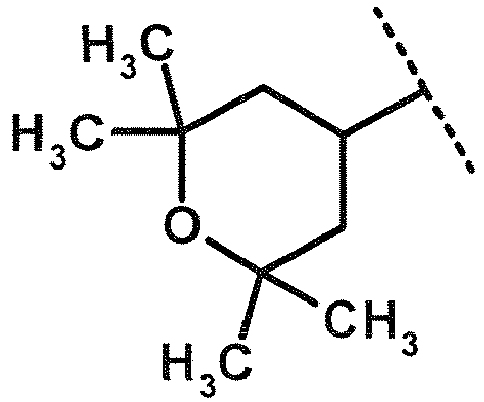
- (10) C2-3 alkenyl;
- Yb is
- (a) C1-6 alkylene,
- (b) C3-6 cycloalkylene,
- (c) phenylene,
- (d) pyridinediyl or
- (e)

- R30 is
- (a) hydrogen or
- (b) C1-4 alkyl;
- Group Xb is
- (a) halogen,
- (b) C1-6 alkyl,
- (c) C1-3 alkyl substituted with one hydroxy,
- (d) C1-3 alkyl substituted with one C1-3 alkoxy, and
- (e) C1-3 alkoxy;
- R4 is
- (1) hydrogen or
- (2) methyl;
- R5 is
- (1) -Yc-COO-R50,
- (2) hydrogen,
- (3) C1-4 alkyl optionally substituted with one C1-3 alkoxy,
- (4) C1-4 alkyl substituted with one amide,
- (5) C1-3 alkyl substituted with one C3-6 cycloalkyl substituted with the same or different two halogen,
- (6) C3-6 cycloalkyl optionally substituted with one hydroxy-C1-4 alkyl,
- (7) C3-6 cycloalkyl substituted with one C1-3 alkoxy,
- (8) C3-6 cycloalkyl substituted with one C1-3 alkoxy-C1-3 alkyl,
- (9) C3-6 cycloalkyl substituted with the same or different one to two halogen,
- (10) C3-6 cycloalkyl substituted with the same or different one to two C1-3 alkyl,
- (11) tetrahydropyran-4-yl or
- (12) pyridin-4-yl;
- Yc is
- (a) C1-6 alkylene optionally substituted with one hydroxy,
- (b) CH2-CH2-O-CH2 or
- (c) (CH2)m-Yc1-(CH2)w;
- m is an integer of 0, 1 or 2;
- w is an integer of 0, 1 or 2;
- Yc1 is
- (a) C3-6 cycloalkylene optionally substituted with one C1-3 alkyl,
- (b) phenylene,
- (c) phenylene substituted with one halogen,
- (d) phenylene substituted with one C1-3 alkyl,
- (e) phenylene substituted with one C1-3 alkoxy,
- (f) phenylene substituted with one trifluoromethyl,
- (g) cross-linked C5-8 cycloalkylene,
- (h)

- (i)

- (j) spiro[3.3]heptanediyl,
- (k) pyrrolidinediyl,
- (l) pyrrolidinediyl substituted with one carboxy,
- (m) pyrrolidinediyl substituted with one C1-3 alkylcarbonyl,
- (n) pyrrolidinediyl substituted with one C1-3 alkylsulfonyl,
- (o) pyridinediyl,
- (p) isoxazolediyl or
- (q) pyrazolediyl substituted with one C1-3 alkyl;
- R50 is
- (a) hydrogen or
- (b) C1-4 alkyl;
- R6 is
- (1) hydrogen or
- (2) methyl;
when R5 is -Yc-COO-R50, Yc is (CH2)m-Yc1-(CH2)w, m and w are 0, and Yc1 is (b) phenylene,
(c) phenylene substituted with one halogen, (d) phenylene substituted with one C1-3 alkyl, (e) phenylene substituted with one C1-3 alkoxy or (f) phenylene substituted with one trifluoromethyl, then R6 is methyl; and
either R3 or R5 or both of them have "-COO-".
- R1 is
- [02] The compound of [01], wherein the compound of Formula [I] is a compound of Formula [II], or a pharmaceutically acceptable salt thereof:

R3 is- (1) C1-6 alkyl optionally substituted with one hydroxy,
- (2) C1-6 alkyl substituted with one C1-4 alkoxy,
- (3) C1-6 alkyl substituted with one C1-4 alkylsulfonyl,
- (4) C3-6 cycloalkyl optionally substituted with the same or different one to three substituent(s) selected from Group Xb,
- (5)

- (6)
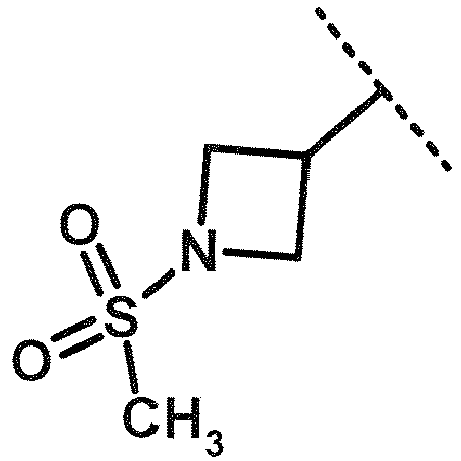
- (7) phenyl,
- (8)

- (9) C2-3 alkenyl; and the other symbols have the same meanings as defined in [01].
- [03] The compound of [01], wherein the compound of Formula [I] is a compound of Formula [III], or a pharmaceutically acceptable salt thereof:

R3 is- (1) hydrogen,
- (2) C1-4 alkyl optionally substituted with one C1-3 alkoxy,
- (3) C1-4 alkyl substituted with one amide,
- (4) C1-3 alkyl substituted with one C3-6 cycloalkyl substituted with the same or different two halogen,
- (5) C3-6 cycloalkyl optionally substituted with one hydroxy-C1-4 alkyl,
- (6) C3-6 cycloalkyl substituted with one C1-3 alkoxy,
- (7) C3-6 cycloalkyl substituted with one C1-3 alkoxy-C1-3 alkyl,
- (8) C3-6 cycloalkyl substituted with the same or different one to two halogen.
- (9) C3-6 cycloalkyl substituted with the same or different one to two C1-3 alkyl,
- (10) tetrahydropyran-4-yl or
- (11) pyridin-4-yl; and the other symbols have the same meanings as defined in [01].
- [04] The compound of [01], wherein the compound of Formula [I] is a compound of Formula [IV], or a pharmaceutically acceptable salt thereof:

- [05] The compound of any one of [01] to [04], wherein R6 is methyl, or a pharmaceutically acceptable salt thereof.
- [06] The compound of any one of [01] to [05], wherein R4 is hydrogen, or a pharmaceutically acceptable salt thereof.
- [07] The compound of any one of [01] to [06], wherein n is an integer of 1 or 2, or a pharmaceutically acceptable salt thereof.
- [08] The compound of any one of [01] to [07], wherein R2 is halogen or trifluoromethyl, or a pharmaceutically acceptable salt thereof.
- [09] The compound of any one of [01], [02], [04] to [07] or [08], wherein Yc is
- (a) C1-6 alkylene or
- (b) (CH2)m-Yc1-(CH2)w;
w is an integer of 0 or 1;
Yc1 is- (a) C3-6 cycloalkylene optionally substituted with one C1-3alkyl,
- (b) phenylene,
- (c) phenylene substituted with one halogen,
- (d) phenylene substituted with one C1-3 alkyl,
- (e) phenylene substituted with one C1-3 alkoxy,
- (f) phenylene substituted with one trifluoromethyl,
- (g) cross-linked C5-8 cycloalkylene,
- (h) pyridinediyl or
- (i) pyrazolediyl substituted with one C1-3 alkyl; and
- (1) C1-6 alkyl optionally substituted with one hydroxy,
- (2) C1-6 alkyl substituted with one C1-4 alkoxy or
- (3) C3-6 cycloalkyl optionally substituted with the same or different one to three substituent(s) selected from Group Xb, or a pharmaceutically acceptable salt thereof.
- [10] The compound of [02], wherein R50 is hydrogen, or a pharmaceutically acceptable salt thereof.
- [11] The compound of [01], wherein the compound of Formula [I] is any one of the compounds of Formulae [IV-B-A] to [IV-B-N], or a pharmaceutically acceptable salt thereof:


- R3h is hydrogen or methyl;
- R3w is methyl or fluoro;
- nx is an integer of 0 or 2;
- nw is an integer of 0, 1, 2 or 3;
- R3 is C1-6 alkyl optionally substituted with one hydroxy,
C1-6 alkyl substituted with one C1-4 alkoxy or
C3-6 cycloalkyl optionally substituted with the same or different one to three substituent(s) selected from Group Xb; - R5B is hydrogen, halogen, C1-3 alkyl, C1-3 alkoxy or trifluoromethyl; and
- the other symbols have the same meanings as defined in [01].
- [12] The compound of [01], selected from the group consisting of the following formulae, or a pharmaceutically acceptable salt thereof.


- [13] A pharmaceutical composition comprising the compound of any one of [01] to [12] or a pharmaceutically acceptable salt thereof and a pharmaceutically acceptable carrier.
- [14] An RORy antagonist comprising the compound of any one of [01] to [12] or a pharmaceutically acceptable salt thereof and a pharmaceutically acceptable carrier.
- [15] An agent for treating or preventing a disease selected from the group consisting of autoimmune disease, allergic disease, dry eye, fibrosis, and metabolic disease, comprising the compound of any one of [01] to [12] or a pharmaceutically acceptable salt thereof.
- [16] The agent of [15], wherein the disease is autoimmune disease.
- [17] The agent of [16], wherein the autoimmune disease is selected from the group consisting of rheumatoid arthritis, psoriasis, inflammatory bowel disease such as Crohn's disease and ulcerative colitis, multiple sclerosis, systemic lupus erythematosus, ankylosing spondylitis, uveitis, polymyalgia rheumatica, type I diabetes, and graft versus host disease.
- [18] The agent of [15], wherein the disease is metabolic disease.
- [19] The agent of [18], wherein the metabolic disease is diabetes.
- [20] A method of inhibiting RORy, comprising administering to a mammal a therapeutically effective amount of the compound of any one of [01] to [12] or a pharmaceutically acceptable salt thereof.
- [21] A method of treating or preventing a disease selected from the group consisting of autoimmune disease, allergic disease, dry eye, fibrosis, and metabolic disease, comprising administering to a mammal an effective amount of the compound of any one of [01] to [12] or a pharmaceutically acceptable salt thereof.
- [22] The method of [21], wherein the disease is autoimmune disease.
- [23] The method of [22], wherein the autoimmune disease is selected from the group consisting of rheumatoid arthritis, psoriasis, inflammatory bowel disease such as Crohn's disease and ulcerative colitis, multiple sclerosis, systemic lupus erythematosus, ankylosing spondylitis, uveitis, polymyalgia rheumatica, type I diabetes, and graft versus host disease.
- [24] The method of [21], wherein the disease is metabolic disease.
- [25] The method of [24], wherein the metabolic disease is diabetes.
- [26] Use of the compound of any one of [01] to [12] or a pharmaceutically acceptable salt thereof for the manufacture of an RORγ antagonist.
- [27] Use of the compound of any one of [01] to [12] or a pharmaceutically acceptable salt thereof for the manufacture of an agent for treating or preventing a disease selected from the group consisting of autoimmune disease, allergic disease, dry eye, fibrosis, and metabolic disease.
- [28] The use of [27], wherein the disease is autoimmune disease.
- [29] The use of [28], wherein the autoimmune disease is selected from the group consisting of rheumatoid arthritis, psoriasis, inflammatory bowel disease such as Crohn's disease and ulcerative colitis, multiple sclerosis, systemic lupus erythematosus, ankylosing spondylitis, uveitis, polymyalgia rheumatica, type I diabetes, and graft versus host disease.
- [30] The use of [27], wherein the disease is metabolic disease.
- [31] The use of [30], wherein the metabolic disease is diabetes.
- [32] A compound of any one of [01] to [12] or a pharmaceutically acceptable salt thereof for use as an RORy antagonist.
- [33] A compound of any one of [01] to [12] or a pharmaceutically acceptable salt thereof for use as an agent for treating or preventing a disease selected from the group consisting of autoimmune disease, allergic disease, dry eye, fibrosis, and metabolic disease.
- [34] The compound of [33], wherein the disease is autoimmune disease, or a pharmaceutically acceptable salt thereof.
- [35] The compound of [34], wherein the autoimmune disease is selected from the group consisting of rheumatoid arthritis, psoriasis, inflammatory bowel disease such as Crohn's disease and ulcerative colitis, multiple sclerosis, systemic lupus erythematosus, ankylosing spondylitis, uveitis, polymyalgia rheumatica, type I diabetes, and graft versus host disease, or a pharmaceutically acceptable salt thereof.
- [36] The compound of [33], wherein the disease is metabolic disease, or a pharmaceutically acceptable salt thereof.
- [37] The compound of [36], wherein the metabolic disease is diabetes, or a pharmaceutically acceptable salt thereof.
- Dihydropyrimidin-2-one compounds and pharmaceutically acceptable salts thereof of the present invention is useful as an agent for prevention or treatment of autoimmune diseases such as rheumatoid arthritis, psoriasis, inflammatory bowel disease such as Crohn's disease and ulcerative colitis, multiple sclerosis, systemic lupus erythematosus, ankylosing spondylitis, uveitis, polymyalgia rheumatica, type I diabetes, and graft versus host disease, allergic diseases such as asthma, dry eye, fibrosis such as pulmonary fibrosis and primary biliary cirrhosis, and metabolic diseases such as diabetes.
- Definitions of terms used herein are as follows.
- "Halogen" includes fluoro, chloro, bromo or iodo. A preferable "halogen" is fluoro or chloro.
- "Alkyl" means a straight or branched chain saturated hydrocarbon gorup, and includes, for example, "C1-3 alkyl", "C1-4 alkyl", "C1-5 alkyl", "C1-6 alkyl", "C4-6 alkyl", "C4-8 alkyl", and "C5-8 alkyl", each of which means alkyl with 1 to 3 of carbon atom(s), 1 to 4 of carbon atom(s), 1 to 5 of carbon atom(s), 1 to 6 of carbon atom(s), 4 to 6 of carbon atoms, 4 to 8 of carbon atoms, and 5 to 8 of carbon atoms, respectively.
- An illustrative example of "C1-3 alkyl" includes, for example, methyl, ethyl, propyl, and isopropyl. A preferable "C1-3 alkyl" is methyl.
- An illustrative example of "C1-4 alkyl" includes, for example, methyl, ethyl, propyl, isopropyl, butyl, isobutyl, sec-butyl, tert-butyl, and 1-methylpropyl. A preferable "C1-4 alkyl" is methyl or ethyl.
- An illustrative example of "C1-5 alkyl" includes, for example, methyl, ethyl, propyl, isopropyl, butyl, isobutyl, sec-butyl, tert-butyl, 1-methylpropyl, pentyl, isopentyl, neopentyl, 1,2-dimethylpropyl, and 1-ethylpropyl. A preferable "C1-5 alkyl" is methyl.
- An illustrative example of "C1-6 alkyl" includes, for example, methyl, ethyl, propyl, isopropyl, butyl, isobutyl, sec-butyl, tert-butyl, 1-methylpropyl, pentyl, isopentyl, neopentyl, 1,2-dimethylpropyl, 1-ethylpropyl, hexyl, isohexyl, 1,2,2-trimethylpropyl, 1,1-dimethylbutyl, 2.2-dimethylbutyl, 3,3-dimethylbutyl, and 2-ethylbutyl. A preferable "C1-6 alkyl" is methyl, ethyl, isopropyl, isobutyl. tert-butyl, isopentyl. neopentyl, 1-methylpropyl or 1,1-dimethylbutyl.
- An illustrative example of "C4-6 alkyl" includes, for example, butyl, isobutyl, sec-butyl, tert-butyl, 1-methylpropyl, pentyl, isopentyl, neopentyl, 1,2-dimethylpropyl, 1-ethylpropyl, hexyl, isohexyl, 1,2,2-trimethylpropyl, 1,1-dimethylbutyl, 2,2-dimethylbutyl, 3,3-dimethylbutyl, and 2-ethylbutyl. A preferable one is isobutyl or isopentyl.
- An illustrative example of "C4-8 alkyl" includes, for example, butyl, isobutyl, sec-butyl, tert-butyl, 1-methylpropyl, pentyl, isopentyl, neopentyl, 1,2-dimethylpropyl, 1-ethylpropyl, hexyl, isohexyl, 1,2,2-trimethylpropyl, 1,1-dimethylbutyl, 2,2-dimethylbutyl, 3,3-dimethylbutyl, 2-ethylbutyl, heptyl, 4,4-dimethylpentyl, 1-methyl-3,3-dimethylbutyl, octyl, and 2-propylpentyl. A preferable one is butyl, isobutyl, pentyl, isopentyl, 3,3-dimethylbutyl, 2-ethylbutyl, 4,4-dimethylpentyl, 1-methyl-3,3-dimethylbutyl or 2-propylpentyl.
- An illustrative example of "C5-8 alkyl" includes, for example, pentyl, isopentyl, neopentyl, 1,2-dimethylpropyl, 1-ethylpropyl, hexyl, isohexyl, 1,2,2-trimethylpropyl, 1,1-dimethylbutyl, 2,2-dimethylbutyl, 3,3-dimethylbutyl, 2-ethylbutyl, heptyl, 4,4-dimethylpentyl, 1-methyl-3,3-dimethylbutyl, octyl, and 2-propylpentyl. A preferable one is pentyl, isopentyl, 3,3-dimethylbutyl, 2-ethylbutyl, 4,4-dimethylpentyl, 1-methyl-3,3-dimethylbutyl or 2-propylpentyl.
- "C1-6 alkyl optionally substituted with one hydroxy" means "C1-6 alkyl substituted with one hydroxy" or "unsubstituted C1-6 alkyl".
- "C1-3 alkyl substituted with one hydroxy" means "alkyl", with 1 to 3 of carbon atom(s), substituted at any position with one hydroxy. In particular, it includes, for example, hydroxymethyl.
- "C5-8 alkyl substituted with one hydroxy" means "alkyl", with 5 to 8 of carbon atoms, substituted with at any position with one hydroxy. In particular, it includes, for example, 3,3-dimethyl-3-hydroxypropyl, 3,3-dimethyl-2-hydroxybutyl, and 3,3-dimethyl-4-hydroxybutyl.
- "C5-8 alkyl substituted with one halogen" means "alkyl", with 5 to 8 of carbon atoms, substituted with at any position with one halogen. In particular, it includes, for example, 3-fluoro-3-methylbutyl.
- "C3-7 alkyl substituted with one trifluoromethyl" means "alkyl", with 3 to 7 of carbon atoms, substituted at any position with one trifluoromethyl. In particular, it includes, for example, 4,4,4-trifluorobutyl and 4,4,4-trifluoro-3,3-dimethylbutyl.
- "Alkenyl" means a straight or branched chain unsaturated hydrocarbon group with one or more double bond(s) between carbon atoms, and includes, for example, "C2-3 alkenyl" and "C4-8 alkenyl" which "C2-3 alkenyl" means alkenyl with 2 to 3 of carbon atoms and "C4-8 alkenyl" means alkenyl with 4 to 8 of carbon atoms. A preferable "C4-8 alkenyl" is "C4-6 alkenyl" with one double bond between carbon atoms.
- An illustrative example of "C2-3 alkenyl" includes, for example, ethenyl and isopropenyl. A preferable one is isopropenyl.
- An illustrative example of "C4-8 alkenyl" includes, for example, 2-methyl-prop-1-enyl, 3,3-dimethyl-but-1-enyl, and 3-methyl-but-2-enyl. A preferable one is 2-methyl-prop-1-enyl or 3,3-dimethyl-but-1-enyl.
- "Alkynyl" means a straight or branched chain unsaturated hydrocarbon group with one or more triple bond(s) between carbon atoms, and includes, for example, "C4-8 alkynyl" which means alkynyl with 4 to 8 carbon atoms. A preferable "C4-8 alkynyl" is "C4-6 alkynyl" with one triple bond between carbon atoms.
- An illustrative example of "C4-8 alkynyl" includes, for example, 3,3-dimethyl-but-1-ynyl, 3-methyl-but-1-ynyl, and 3-ethyl-pent-1-ynyl. A preferable one is 3,3-dimethyl-but-1-ynyl.
- "Alkoxy" means a group where a straight or branched chain saturated hydrocarbon group attaches to oxygen atom, and includes, for example, "C1-3 alkoxy", "C1-4 alkoxy", "C2-4 alkoxy", "C3-6 alkoxy", and "C2-7 alkoxy", each of which means alkoxy with 1 to 3 of carbon atom(s), 1 to 4 of carbon atom(s), 2 to 4 of carbon atoms, 3 to 6 of carbon atoms, and 2 to 7 of carbon atoms, respectively.
- An illustrative example of "C1-3 alkoxy" includes, for example, methoxy, ethoxy, propoxy, and isopropoxy. A preferable one is methoxy or ethoxy.
- An illustrative example of "C1-4 alkoxy" includes, for example, methoxy, ethoxy, propoxy, isopropoxy, butoxy, isobutoxy, sec-butoxy, and tert-butoxy. A preferable one is methoxy.
- An illustrative example of "C2-4 alkoxy" includes, for example, ethoxy. propoxy. isopropoxy, butoxy, isobutoxy, sec-butoxy, and tert-butoxy. A preferable one is isopropoxy or tert-butoxy.
- An illustrative example of "C3-6 alkoxy" includes, for example, propoxy, isopropoxy. butoxy, isobutoxy. sec-butoxy, tert-butoxy, pentyloxy, isopentyloxy, 2-methylbutoxy, 1.1-dimethylpropoxy, neopentyloxy, 3,3-dimethylbutoxy, 1-ethylpropoxy, and hexyloxy. A preferable one is isobutoxy, isopentyloxy, neopentyloxy or 3,3-dimethylbutoxy.
- An illustrative example of "C2-7 alkoxy" includes, for example, ethoxy, propoxy, isopropoxy, butoxy, isobutoxy, sec-butoxy, and tert-butoxy. A preferable one is isopropoxy or tert-butoxy.
- "C2-7 alkoxy substituted with one trifluoromethyl" means "alkoxy", with 2 to 7 carbon atoms, substituted at any position with one "trifluoromethyl". Its illustrative example includes, for example, 3,3,3-trifluoropropoxy, 4,4,4-trifluorobutoxy, 5,5,5-trifluoropentyloxy, 6,6,6-trifluorohexyloxy, 7,7,7-trifluoroheptyloxy, and 8,8,8-trifluorooctyloxy. A preferable one includes, for example, 3,3,3-trifluoropropoxy.
- "C1-3 alkyl substituted with one C1-3 alkoxy" means "alkyl", with 1 to 3 of carbon atom(s), substituted at any position with one C1-3 alkoxy. In particular, it includes, for example, methoxymethyl.
- "C1-6 alkyl substituted with one C1-4 alkoxy" means "alkyl", with 1 to 6 of carbon atom(s), substituted at any position with one C1-4 alkoxy. In particular, it includes, for example, 2-methoxyethyl, 1-methyl-2-methoxyethyl, 2-methoxypropyl, 4-methoxy-2,2-dimethylbutyl, and 3-tert-butoxypropyl.
- "Cycloalkyl" means a monocyclic saturated hydrocarbon group, and includes, for example, "C3-6 cycloalkyl" and "C4-6 cycloalkyl", each of which means cycloalkyl with 3 to 6 of carbon atoms, and 4 to 6 of carbon atoms, respectively.
- An illustrative example of "C3-6 cycloalkyl" includes, for example, cyclopropyl, cyclobutyl, cyclopentyl, and cyclohexyl.
- An illustrative example of "C4-6 cycloalkyl" includes, for example, cyclobutyl, cyclopentyl, and cyclohexyl.
- "C3-6 cycloalkyl substituted with one C1-3 alkoxy" means "cycloalkyl", with 3 to 6 of carbon atoms, substituted at any position with one C1-3 alkoxy. In particular, it includes, for example, 3-methoxycyclobutyl.
- "C3-6 cycloalkyl substituted with one C1-3 alkoxy-C1-3 alkyl" means "cycloalkyl", with 3 to 6 of carbon atoms, substituted at any position with one C1-3 alkoxy-C1-3 alkyl. In particular, it includes, for example, 1-methoxymethylcyclopropyl and 3-methoxymethylcyclobutyl.
- "Cycloalkenyl" means a monocyclic unsaturated hydrocarbon group with one or more double bond(s) between carbon atoms, and includes, for example, "C5-6 cycloalkenyl", which means cycloalkenyl with 5 to 6 of carbon atoms.
- A preferable "C5-6 cycloalkenyl" is "C5-6 cycloalkenyl" with one double bond between carbon atoms.
- An illustrative example of "C5-6 cycloalkenyl" includes, for example, cyclopentenyl and cyclohexenyl. A preferable one is cyclopent-1-enyl or cyclohex-1-enyl.
- "Spiro cycloalkyl" means a cyclic saturated hydrocarbon group with one spiro atom, and includes, for example, "spiro C6-11 cycloalkyl", which means spiro cycloalkyl with one spiro atom and 6 to 11 of carbon atoms.
- An illustrative example of "spiro C6-11 cycloalkyl" includes, for example, spiro [3.3]heptyl, spiro [4.4]nonyl, and spiro [5.5]undecyl. A preferable one is spiro [3.3]heptyl.
- "Alkylcarbonyl" means "alkyl"-attached carbonyl, and includes "C1-3 alkylcarbonyl".
- An illustrative example of "C1-3 alkylcarbonyl" includes carbonyl which attaches to the "C1-3 alkyl". A preferable one is methylcarbonyl.
- "Alkylsulfanyl" means "alkyl"-attached sulfanyl, and includes "C4-6 alkylsulfanyl".
- An illustrative example of "C4-6 alkylsulfanyl" includes sulfanyl which attaches to the "C4-6 alkyl". A preferable one is isobutylsulfanyl or isopentylsulfanyl.
- "Alkylsulfinyl" means "alkyl"-attached sulfinyl, and includes "C4-6 alkylsulfinyl".
- An illustrative example of "C4-6 alkylsulfinyl" includes sulfinyl which attaches to the "C4-6 alkyl". A preferable one is isobutylsulfinyl or isopentylsulfinyl.
- "Alkylsulfonyl" means "alkyl"-attached sulfonyl, and includes "C1-3 alkylsulfonyl", "C1-4 alkylsulfonyl", and "C4-6 alkylsulfonyl".
- An illustrative example of "C1-3 alkylsulfonyl" includes sulfonyl which attaches to the "C1-3 alkyl". A preferable one is methylsulfonyl.
- An illustrative example of "C1-4 alkylsulfonyl" includes sulfonyl which attaches to the "C1-4 alkyl". A preferable one is methylsulfonyl.
- An illustrative example of "C4-6 alkylsulfonyl" includes sulfonyl which attaches to the "C4-6 alkyl". A preferable one is isobutylsulfonyl or isopentylsulfonyl.
- "C1-6 alkyl substituted with one C1-4 alkylsulfonyl" means "alkyl", with 1 to 6 of carbon atom(s), substituted at any position with one C1-4 alkylsulfonyl. In particular, it includes, for example, 2-methylsulfonylethyl.
- "Alkoxycarbonyl" means carbonyl which attaches to "alkoxy", and includes, for example, "C1-3 alkoxycarbonyl".
- An illustrative example of "C1-3 alkoxycarbonyl" includes, for example, methoxycarbonyl, ethoxycarbonyl, and propoxycarbonyl. A preferable one is ethoxycarbonyl.
- "Cycloalkylsulfanyl" means "cycloalkyl"-attached sulfanyl, and includes "C3-6 cycloalkylsulfanyl".
- An illustrative example of "C3-6 cycloalkylsulfanyl" includes sulfanyl which attaches to the "C3-6 cycloalkyl". A preferable one is cyclopentylsulfanyl.
- "Cycloalkylsulfinyl" means "cycloalkyl"-attached sulfinyl, and includes "C3-6 cycloalkylsulfinyl".
- An illustrative example of "C3-6 cycloalkylsulfinyl" includes, for example, sulfinyl which attaches to the "C3-6 cycloalkyl". A preferable one is cyclopentylsulfinyl.
- "Cycloalkylsulfonyl" means "cycloalkyl"-attached sulfonyl, and includes "C3-6 cycloalkylsulfonyl".
- An illustrative example of "C3-6 cycloalkylsulfanyl" includes sulfonyl which attaches to the "C3-6 cycloalkyl". A preferable one is cyclopentylsulfonyl.
- "Alkylene" means a divalent group derived from straight or branched chain saturated hydrocarbon, and includes, for example, "C1-3 alkylene" and "C1-6 alkylene", each of which means alkylene with 1 to 3 of carbon atom(s) and 1 to 6 of carbon atom(s), respectively.
- An illustrative example of "C1-3 alkylene" includes, for example, methylene, ethylene, trimethylene, and -C(CH3)2-. A preferable one is methylene or ethylene.
- An illustrative example of "C1-6 alkylene" includes, for example, methylene, ethylene. trimethylene, butylene, pentylene, hexylene, -C(CH3)2-. -C(CH3)2-CH2-, -(CH2)2-CH(CH3)-,-CH2-C(CH3)2-CH2-, -(CH2)3-C(CH3)2-, and -(CH2)2-C(CH3)2-. A preferable one is methylene, ethylene, trimethylene, butylene, -C(CH3)2-, -C(CH3)2-CH2-, -(CH2)2-CH(CH3)-, -CH2-C(CH3)2-CH2-, -(CH2)3-C(CH3)2- or -(CH2)2-C(CH3)2-.
- "C1-6 alkylene optionally substituted with one hydroxy" means "C1-6 alkylene substituted with one hydroxy" or "unsubstituted C1-6 alkylene".
- "Cycloalkylene" means a divalent group derived from monocyclic saturated hydrocarbon, and includes, for example, "C3-6 cycloalkylene", which means cycloalkylene with 3 to 6 of carbon atoms.
- An illustrative example of "C3-6 cycloalkylene" includes, for example, cyclopropylene, cyclobutylene, cyclopentylene, and cyclohexylene. A preferable "C3-6 cycloalkylene" is "C4-6 cycloalkylene".
- "Cross-linked cycloalkylene" means a divalent group derived from polycyclic saturated hydrocarbon with a cross-linked structure of carbon atoms, and includes, for example, "cross-linked C5-8 cycloalkylene", which means cross-linked cycloalkylene with 5 to 8 of carbon atoms.
- An illustrative example of "cross-linked C5-8 cycloalkylene" includes, for example, bicyclo[1.1.1]pentylene, bicyclo[2.1.1]hexylene, bicyclo[2.2.1]heptylene, and bicyclo[2.2.2]octylene. A preferable "cross-linked C5-8 cycloalkylene" is "cross-linked C5-6 cycloalkylene", in paricular bicyclo[1.1.1]pentylene or bicyclo[2.1.1]hexylene.
- "Phenylene substituted with one halogen" means phenylene substituted at any position with one halogen. In particular, it includes, for example, 2-fluorophenylene and 4-fluorophenylene.
- "Phenylene substituted with one C1-3 alkyl" means phenylene substituted at any position with one C1-3 alkyl. In particular, it includes, for example, 2-methylphenylene and 3-methylphenylene.
- "Phenylene substituted with one C1-3 alkoxy" means phenylene substituted at any position with one C1-3 alkoxy. In particular, it includes, for example. 2-methoxyphenylene and 3-methoxyphenylene.
- "Phenylene substituted with one trifluoromethyl" means phenylene substituted at any position with one trifluoromethyl. In particular, it includes, for example, 3-trifluorophenylene.
- "Pyrrolidinediyl substituted with one carboxy" means pyrrolidinediyl substituted at any position with one carboxy. In particular, it includes, for example, 3-carboxypyrrolidine-1,4-diyl.
- "Pyrrolidinediyl substituted with one C1-3 alkylcarbonyl" means pyrrolidinediyl substituted at any position with one C1-3 alkylcarbonyl. In particular, it includes, for example, 1-methylcarbonylpyrrolidine-3,4-diyl.
- "Pyrrolidinediyl substituted with one C1-3 alkylsulfonyl" means pyrrolidinediyl substituted at any position with one C1-3 alkylsulfonyl. In particular, it includes, for example, 1-methylsulfonylpyrrolidine-3,4-diyl.
- "Pyrazolediyl substituted with one C1-3 alkyl" means pyrazolediyl substituted at any position with one C1-3 alkyl. In particular, it includes, for example, 1-methylpyrazole-3,5-diyl.
- Embodiments of each group in the above formulae are illustrated as below.
- A preferable "C4-8 alkyl" in R1 particularly includes butyl, isobutyl, sec-butyl, tert-butyl, 1-methylpropyl, pentyl, isopentyl, neopentyl, 1,2-dimethylpropyl, 1-ethylpropyl, hexyl, isohexyl, 1,2,2-trimethylpropyl, 1,1-dimethylbutyl, 2,2-dimethylbutyl, 3,3-dimethylbutyl, 2-ethylbutyl, heptyl, 4,4-dimethylpentyl, 1-methyl-3,3-dimethylbutyl, octyl, and 2-propylpentyl. A further preferable one is butyl, isobutyl, pentyl, isopentyl, 3,3-dimethylbutyl, 2-ethylbutyl, 4,4-dimethylpentyl, 1-methyl-3,3-dimethylbutyl or 2-propylpentyl.
- A preferable "C4-8 alkenyl" in R1 is "C4-6 alkenyl", and particularly includes 2-methyl-propenyl, 3,3-dimethyl-but-1-enyl, and 3-methyl-but-2-enyl. A further preferable one is 2-methyl-propenyl or 3,3-dimethyl-but-1-enyl.
- A preferable "C4-8 alkynyl" in R1 is "C4-6 alkynyl", and particularly includes 3.3-dimethyl-but-1-ynyl, and 3-methyl-but-1-ynyl. A further preferable one is "C6 alkynyl", in particular 3,3-dimethyl-but-1-ynyl.
- A preferable "C3-7 alkyl substituted with one trifluoromethyl" in R1 is "C3-5 alkyl substituted with one trifluoromethyl", and particularly includes 4,4,4-trifluorobutyl, 5,5,5-trifluoropentyl, 6,6,6-trifluorohexyl, and 4,4,4-trifluoro-3,3-dimethylbutyl. A further preferable one is 4,4,4-trifluorobutyl or 4,4,4-trifluoro-3,3-dimethylbutyl.
- A preferable "C1-4 alkyl" in "C1-4 alkyl substituted with one substituent selected from Group Xa1" in R1 is "C1-2 alkyl", in particular methyl or ethyl.
- A preferable "C3-6 alkoxy" in R1 is "C4-6 alkoxy", and particularly includes propoxy, isopropoxy, butoxy, isobutoxy, sec-butoxy, tert-butoxy, pentyloxy, isopentyloxy, 2-methylbutoxy, 1,1-dimethylpropoxy, neopentyloxy, 3,3-dimethylbutoxy, 1-ethylpropoxy, and hexyloxy. A further preferable one is isobutoxy, isopentyloxy, neopentyloxy or 3,3-dimethylbutoxy.
- A preferable "C2-7 alkoxy substituted with one trifluoromethyl" in R1 is "C2 alkoxy substituted with one trifluoromethyl", in particular 3,3,3-trifluoropropoxy.
- A preferable "C1-3 alkoxy" in "C1-3 alkoxy substituted with one substituent selected from Group Xa2" in R1 is "C1-2 alkoxy", in particular methoxy or ethoxy.
- A preferable "C4-6 cycloalkyl" in R1 is in particular cyclobutyl, cyclopentyl or cyclohexyl.
- A preferable "C3-6 cycloalkyl substituted with one to two C1-4 alkyl" in R1 is "C3-6 cycloalkyl substituted with the same or different one or two C1-4 alkyl", more preferably "cyclopropyl or cyclohexyl substituted with the same or different one or two methyl, isopropyl or tert-butyl". In particular, it is 2-isopropylcyclopropyl. 2-tert-butylcyclopropyl or 3,3-dimethylcyclohexyl.
- A preferable "C5-6 cycloalkenyl optionally substituted with one to two C1-4 alkyl" in R1 is "C5-6 cycloalkenyl optionally substituted with the same or different two C1-4 alkyl", more preferably "1-cyclopentenyl or 1-cyclohexenyl, optionally substituted with the same or different two methyl". In particular, it is 1-cyclopentenyl, 1-cyclohexenyl, 3,3-dimethylcyclohex-1-enyl or 4,4-dimethylcyclohex-1-enyl.
- A preferable "spiro C6-11 cycloalkyl" in R1 is "spiro C6-8 cycloalkyl", more preferably "spiro C7 cycloalkyl". In particular, it is spiro [3.3]heptyl.
- A preferable "C1-3 alkoxycarbonyl" in R1 is "C1-2 alkoxycarbonyl", more preferably ethoxycarbonyl.
- A preferable "halogen" in R2 is fluoro or chloro.
- A preferable "C1-6 alkyl" in R2 is "C1-2 alkyl", more preferably methyl.
- A preferable "C1-3 alkoxy optionally substituted with phenyl" in R2 is "C1-2 alkoxy optionally substituted with phenyl", more preferably benzyloxy.
- A preferable "n" is an integer of 0 to 2. In Formula [I], the following partial structure:


- A further preferable "n" is an integer of 1 or 2. In Formula [I], the following partial structure:


- In the above embodiments, when R2 is halogen, the following moieties are illustrated.
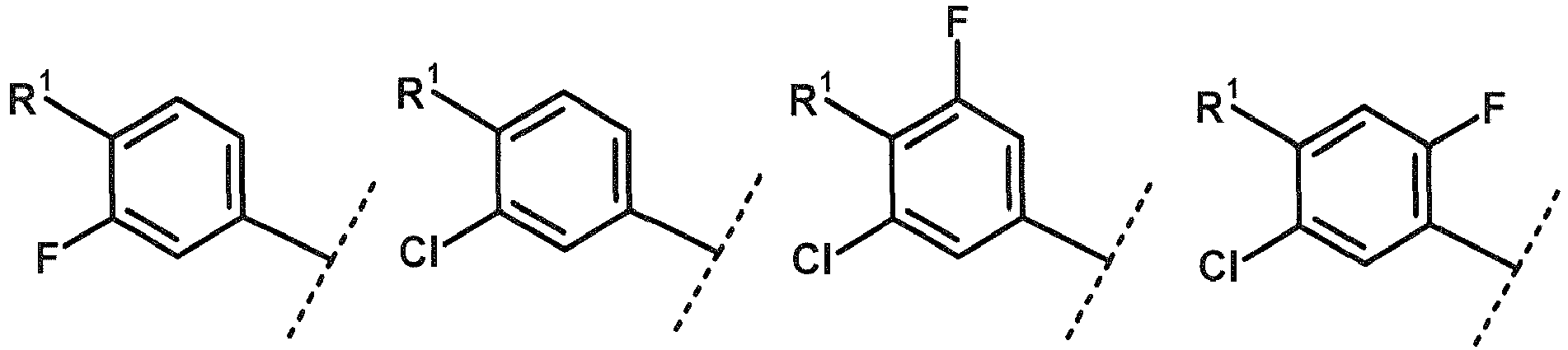
- The above structure also includes the following embodiments.

- An embodiment of "R1 and R2 may combine together with the benzene ring to which they attach to form indanyl where the indanyl may be substituted with the same or different one to two C1-6 alkyl" includes, when "n" is 1, the following embodiments.


- A preferable "-Yb-COO-R30" in R3 is -(C3-5 alkylene)-COOH or -C4 cycloalkylene-COOH, in particular -C(CH3)2-COOH, -C(CH3)2-CH2-COOH, -C(CH3)2-(CH2)2-COOH or-cyclobutylene-COOH.
- "C1-6 alkyl optionally substituted with one hydroxy" in R3 is "C1-6 alkyl substituted with one hydroxy" or "unsubstituted C1-6 alkyl". A preferable "C1-6 alkyl substituted with one hydroxy" is "C6 alkyl substituted with one hydroxy". An illustrative example of "C1-6 alkyl optionally substituted with one hydroxy" includes methyl, ethyl, isopropyl, isobutyl, tert-butyl, 1-methylpropyl, isopentyl, neopentyl or 4-hydroxy-1,1-dimethylbutyl.
- A preferable "C3-6 cycloalkyl optionally substituted with the same or different one to three substituent(s) selected from Group Xb" in R3 is "C3-6 cycloalkyl optionally substituted with the same or different one to two substituent(s) selected from fluoro or methyl", in particular cyclopropyl, cyclobutyl, 1-methylcyclopropyl, 3,3-difluorocyclobutyl or cyclohexyl.
- One preferable embodiment of R3 is -Yb-COO-R30, and includes any of the following structures.

- Another preferable embodiment of R3 is -Yb-COO-R30 wherein Yb is


- A preferable R4 is hydrogen.
- An illustrative example of "C1-6 alkylene optionally substituted with one hydroxy" in Yc in "-Yc-COO-R50" in R5 includes, for example, methylene, ethylene, trimethylene, butylene, (CH2)2-CH(CH3), CH(CH3)-(CH2)2, (CH2)2-C(CH3)2, CH2-C(CH3)2-CH2, C(CH3)2-(CH2)2, (CH2)3-C(CH3)2, and (CH2)2-CH(OH).
- A preferable m is an integer of 0 to 2, and a preferable w is an integer of 0 to 1.
- A preferable "(CH2)m-Yc1-(CH2)w" in Yc in "-Yc-COO-R50" in R5 is Yc1, Yc1-CH2, CH2-Yc1, CH2-Yc1-CH2, (CH2)2-Yc1 or (CH2)2-Yc1-CH2.
- A preferable "C3-6 cycloalkylene optionally substituted with one C1-3 alkyl" in Yc1 is "cyclopropylene, cyclobutylene, cyclopentylene or cyclohexylene, optionally substituted with one methyl".
- A preferable "cross-linked C5-8 cycloalkylene" in Yc1 is "cross-linked C5 cycloalkylene", and for example has the following structure.

- When Yc1 is


- In this case, a preferable R50 is hydrogen or methyl.
- When Yc1 is "pyrazolediyl substituted with one C1-3 alkyl", one preferable embodiment of Formula [I] includes an embodiment having the following structure in the case where m is 0 and w is 0.

- In this case, a preferable R50 is hydrogen or methyl.
- When Yc1 is "isoxazolediyl", one preferable embodiment of Formula [I] includes an embodiment having the following structure in the case where m is 0 and w is 0.
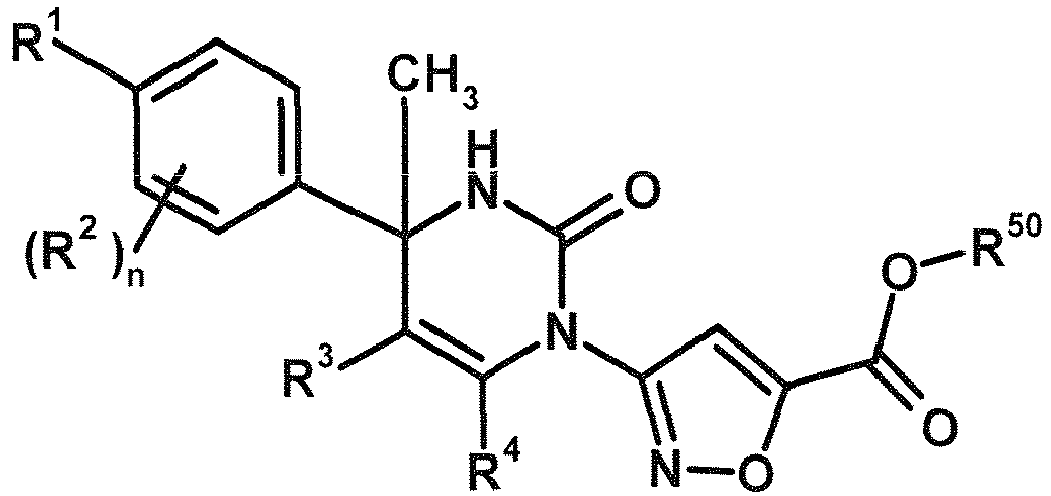
- In this case, a preferable R50 is hydrogen or methyl.
- A preferable "C1-4 alkyl optionally substituted with one C1-3 alkoxy" in R5 is "C1-3 alkyl optionally substituted with one C1-3 alkoxy", more preferably "ethyl or isopropyl, optionally substituted with one methoxy". In particular, it is methoxyethyl or isopropyl.
- A preferable "C3-6 cycloalkyl optionally substituted with one hydroxy-C1-4 alkyl" in R5 is "cyclobutyl optionally substituted with one hydroxymethyl". In particular, it is cyclobutyl or 3-hydroxymethylcyclobutyl.
- One preferable embodiment of R5 is -Yc-COO-R50, and includes any of the following structures.


- A preferable R6 is methyl.
- In [01], the expression "when R3 is -Yc-COO-R50, Yc is (CH2)m-Yc1-(CH2)w, m and w are 0, and Yc1 is phenylene, then R6 is methyl" means an embodiment where R6 is methyl when R5 moiety attaches to a dihydropyrimidine ring via phenylene. An illustrative example includes the following embodiment.
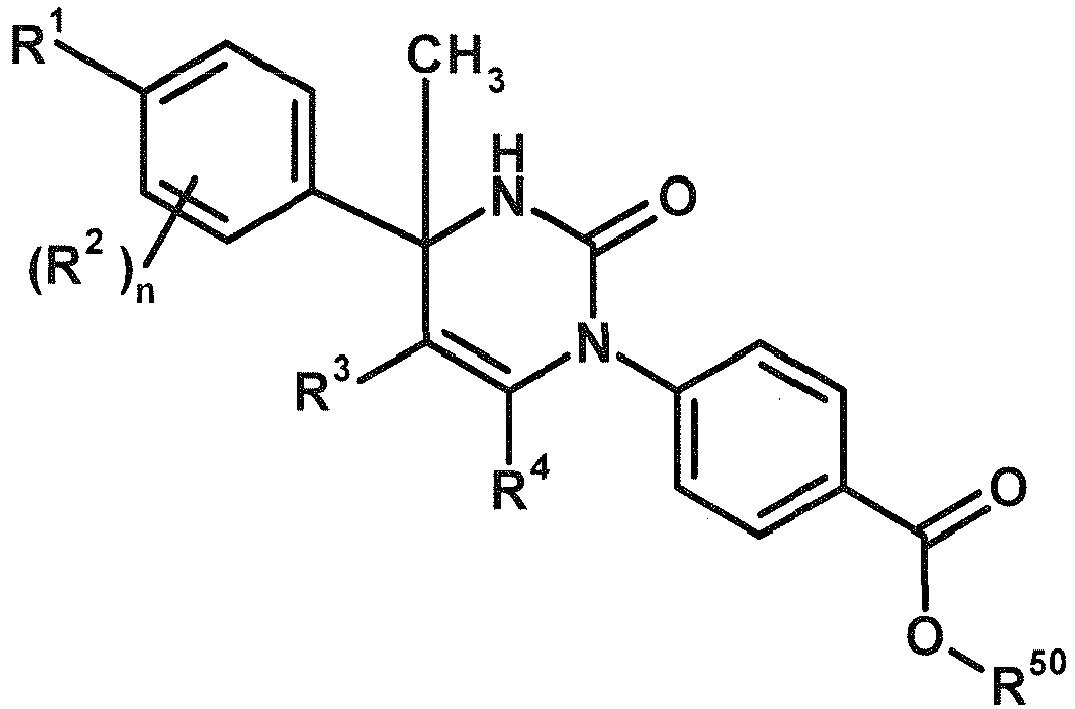
- In [01], the expression "either R3 or R5 or both of them have "-COO-" includes the following embodiments.
- An embodiment where when R3 is (1) -Yb-COO-R30, then R5 is
- (1) Yc-COO-R50,
- (2) hydrogen,
- (3) C1-4 alkyl optionally substituted with one C1-3 alkoxy or
- (4) C3-6 cycloalkyl optionally substituted with one hydroxy-C1-4 alkyl; or an embodiment where when R3 is
- (1) C1-6 alkyl optionally substituted with one hydroxy,
- (2) C3-6 cycloalkyl optionally substituted with the same or different one to three substituent(s) selected from Group Xb,
- (3)

- (4)

- A compound of Formula [I] includes any compound of the following Formula [II], [III] or [VI].


- One preferable embodiment of the compound of Formula [I] includes the compounds of the following general formulae.
- Each symbol in the following each formula has the same meaning as defined in the above [01] unless otherwise specified.


- Another preferable embodiment of the compound of Formula [I] is a compound of Formula [I],
wherein R1 is - (1) C4-8 alkyl,
- (2) C4-6 alkenyl,
- (3) C4-6 alkynyl,
- (4) C3-5 alkyl substituted with one trifluoromethyl,
- (5) C1-4 alkyl substituted with one substituent selected from Group Xal,
- (6) C3-6 alkoxy,
- (7) C2-7 alkoxy substituted with one trifluoromethyl,
- (8) C1-3 alkoxy substituted with one substituent selected from Group Xa2,
- (9) C4-6 cycloalkyl,
- (10) C3-6 cycloalkyl substituted with one to two C1-4alkyl,
- (11) C5-6 cycloalkenyl optionally substituted with one to two C1-4 alkyl,
- (12) spiro C6-8 cycloalkyl or
- (13) C1-3 alkoxycarbonyl;
- (a) C3-6 cycloalkyl optionally substituted with the same or different one to three C1-5 alkyl,
- (b) phenyl,
- (c) C2-4 alkoxy, and
- (d) trimethylsilyl;
- (a) C3-6 cycloalkyl,
- (b) phenyl, and
- (c) C1-4 alkoxy;
- (1) halogen,
- (2) C1-6 alkyl or
- (3) C1-3 alkoxy optionally substituted with phenyl;
- (1) -Yb-COO-R30,
- (2) C1-6 alkyl optionally substituted with one hydroxy,
- (3) C3-6 cycloalkyl optionally substituted with the same or different one to three substituent(s) selected from Group Xb,
- (4)

- (5)

- (a) C1-6 alkylene or
- (b) C4-6 cycloalkylene;
- (a) hydrogen or
- (b) C1-4 alkyl;
- (a) halogen and
- (b) C1-6 alkyl;
- (1) hydrogen or
- (2) methyl;
- (1) -Yc-COO-R50,
- (2) hydrogen,
- (3) C1-4 alkyl optionally substituted with one C1-3 alkoxy or
- (4) C3-6 cycloalkyl optionally substituted with one hydroxy-C1-4 alkyl;
- (a) C1-6 alkylene optionally substituted with one hydroxy,
- (b) CH2-CH2-O-CH2 or
- (c) (CH2)m-Yc1-(CH2)w;
w is an integer of 0, 1 or 2;
Yc1 is- (a) C4-6 cycloalkylene optionally substituted with one C1-3 alkyl,
- (b) phenylene,
- (c) cross-linked C5-6 cycloalkylene or
- (d)

- (a) hydrogen or (b) C1-4 alkyl;
- (1) hydrogen or (2) methyl,
when R5 is -Yc-COO-R50, Yc is (CH2)m-Yc1-(CH2)w, m and w are 0, and Yc1 is phenylene, then R6 is methyl; and
either R3 or R5 or both of them have "-COO-". - Another preferable embodiment of the compound of Formula [I] is a compound of Formula [I],
wherein R1 is - (1) C4-8 alkyl,
- (2) C4-6 alkenyl,
- (3) C6 alkynyl,
- (4) trifluoromethyl-C3-5 alkyl,
- (5) C1-2 alkyl substituted with one substituent selected from Group Xal,
- (6) C4-6 alkoxy,
- (7) trifluoromethyl-C2 alkoxy,
- (8) C1-2 alkoxy substituted with one substituent selected from Group Xa2,
- (9) C4-6 cycloalkyl,
- (10) C3-6 cycloalkyl substituted with one to two C1-4 alkyl,
- (11) C5-6 cycloalkenyl optionally substituted with one to two C1-4 alkyl,
- (12) spiro C7 cycloalkyl or
- (13) ethoxycarbonyl;
- (a) C3-6 cycloalkyl optionally substituted with one to two methyl.
- (b) phenyl,
- (c) C3-4 alkoxy, and
- (d) trimethylsilyl;
- (a) cyclohexyl,
- (b) phenyl, and
- (c) methoxy;
- (1) fluoro or chloro,
- (2) C1-6alkyl or
- (3) methoxy optionally substituted with phenyl;
- (1) -Yb-COO-R30,
- (2) C1-6 alkyl optionally substituted with one hydroxy,
- (3) C3-6 cycloalkyl optionally substituted with the same or different one to two substituent(s) selected from Group Xb,
- (4)

- (5)

- (a) C3-5 alkylene or
- (b) C4 cycloalkylene;
- (a) fluoro and
- (b) methyl;
- (1) hydrogen or
- (2) methyl;
- (1) -Yc-COO-R50,
- (2) hydrogen,
- (3) C2-3 alkyl optionally substituted with one C1-3 alkoxy or
- (4) C4 cycloalkyl optionally substituted with one hydroxy-C1-4 alkyl;
- (a) C1-6 alkylene optionally substituted with one hydroxy,
- (b) CH2-CH2-O-CH2 or
- (c) (CH2)m-Yc1-(CH2)w;
- (a) C3-6 cycloalkylene optionally substituted with one methyl,
- (b) phenylene,
- (c) cross-linked C5 cycloalkylene or
- (d)

- (a) hydrogen or
- (b) methyl;
- (1) hydrogen or
- (2) methyl,
- Another preferable embodiment of the compound of Formula [I] is a compound of the following Formula [II]:

- R1 is
- (1) C4-8 alkyl,
- (2) C3-6 alkoxy or
- (3) C5-6cycloalkenyl optionally substituted with one to two C1-4alkyl;
- R2 is fluoro or chloro;
- n is 1;
- R3 is C1-6 alkyl;
- R4 is
- (1) hydrogen or
- (2) methyl;
- Yc is C1-6 alkylene;
- R50 is
- (a) hydrogen or
- (b) C1-4 alkyl;
- R6 is
- (1) hydrogen or
- (2) methyl.
- A more preferable embodiment of the compound of Formula [I] is a compound of Formula [II-A] which R6 is methyl in Formula [II]:

- Another more preferable embodiment of the compound of Formula [I] is a compound of Formula [II-B] which R4 is hydrogen and R6 is methyl in Formula [II]:

- Another preferable embodiment of the compound of Formula [I] is a compound of Formula [III]:

- R1 is
- (1) C4-8 alkyl,
- (2) C3-6 alkoxy or
- (3) C5-6 cycloalkenyl optionally substituted with one to two C1-4 alkyl;
- R2 is fluoro or chloro;
- n is 1;
- Yb is C1-6 alkylene;
- R30 is
- (a) hydrogen or
- (b) C1-4alkyl;
- R4 is
- (1) hydrogen or
- (2) methyl;
- R3 is
- (1) hydrogen,
- (2) C1-4 alkyl optionally substituted with one C1-3 alkoxy or
- (3) C3-6 cycloalkyl optionally substituted with one hydroxy-C1-4 alkyl;
- R6 is
- (1) hydrogen or
- (2) methyl.
- A more preferable embodiment of the compound of Formula [I] is a compound of Formula [III-A] which R6 is methyl in Formula [III]:
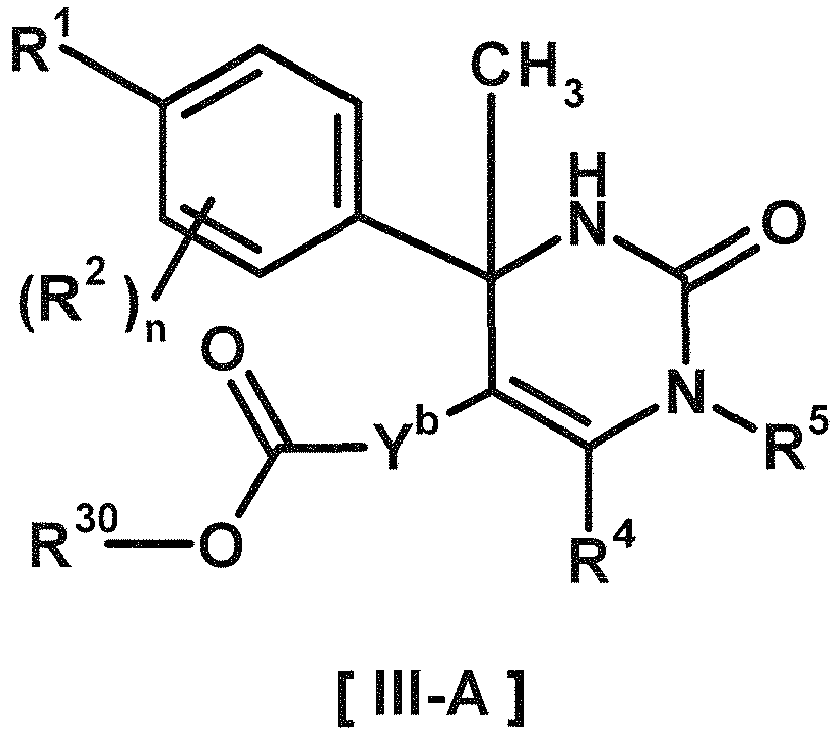
- Another more preferable embodiment of the compound of Formula [I] is a compound of Formula [III-B] which R4 is hydrogen and R6 is methyl in Formula [III]:

- Another preferable embodiment of the compound of Formula [I] is a compound of the following Formula [IV]:

- A more preferable embodiment of the compound of Formula [I] is a compound of Formula [IV-A] which R6 is methyl in Formula [IV]:

- Another more preferable embodiment of the compound of Formula [I] is a compound of Formula [IV-B] which R4 is hydrogen and R6 is methyl in Formula [IV]:

- Another more preferable embodiment is a compound of the following formula:

- Another preferable embodiment of the compound of Formula [I] is a compound of Formula [IV-D] which R4 is hydrogen in Formula [IV]:

- Another preferable embodiment of the compound of Formula [I] is a compound of the following Formula [E-IV]:

- A more preferable embodiment of the compound of Formula [I] is a compound of Formula [E-IV-A] which R6 is methyl in Formula [E-IV]:

- Another more preferable embodiment of the compound of Formula [I] is a compound of Formula [E-IV-B] which R4 is hydrogen in Formula [E-IV-A]:

- A particularly preferable embodiment of the compound of Formula [E-IV] is a compound of the following formula:

- Another preferable embodiment of the compound of Formula [I] is a compound of the following Formula [V]:

- R3a is
- (1) hydrogen or
- (2) C1-6 alkyl optionally substituted with the same or different one to three substituent(s) selected from the group consisting of hydroxy, halogen, hydroxycarbonyl, and C1-3 alkoxycarbonyl;
- R3b is
- (1) hydrogen or
- (2) C1-6 alkyl;
- R3c is
- (1) hydrogen or
- (2) C1-6 alkyl; and the other symbols have the same meanings as defined in [01], provided that
- when R5 is -Yc-COO-R-50, Yc is (CH2)m-Yc1-(CH2)w, m and w are 0, and Yc1 is phenylene, then R6 is methyl; and
- either a structure of the formula:

- Another embodiment of the compound of Formula [V] is the following compound:

- R3a and R3b may combine together with the carbon atom to which they attach to form
- (1) a C3-6 cycloalkane ring optionally substituted with the same or different one to three substituent(s) selected from the group consisting of hydroxy, halogen, hydroxycarbonyl, and C1-3 alkoxycarbonyl,
- (2) a tetrahydropyran ring or
- (3) a 1-methanesulfonylazetidine ring;
- R3c is (1) hydrogen or (2) C1-6 alkyl; and the other symbols have the same meanings as defined in [01],
- provided that
- when R5 is -Yc-COO-R50, Yc is (CH2)m-Yc1-(CH2)w, m and w are 0, and Yc1 is phenylene, then R6 is methyl;
- either a structure of the formula:

- A more preferable embodiment of the compound of Formula [V] includes the compounds of the following general formulae.


- Another preferable embodiment of the compound of Formula [I] is a compound of the following Formula [VI]:
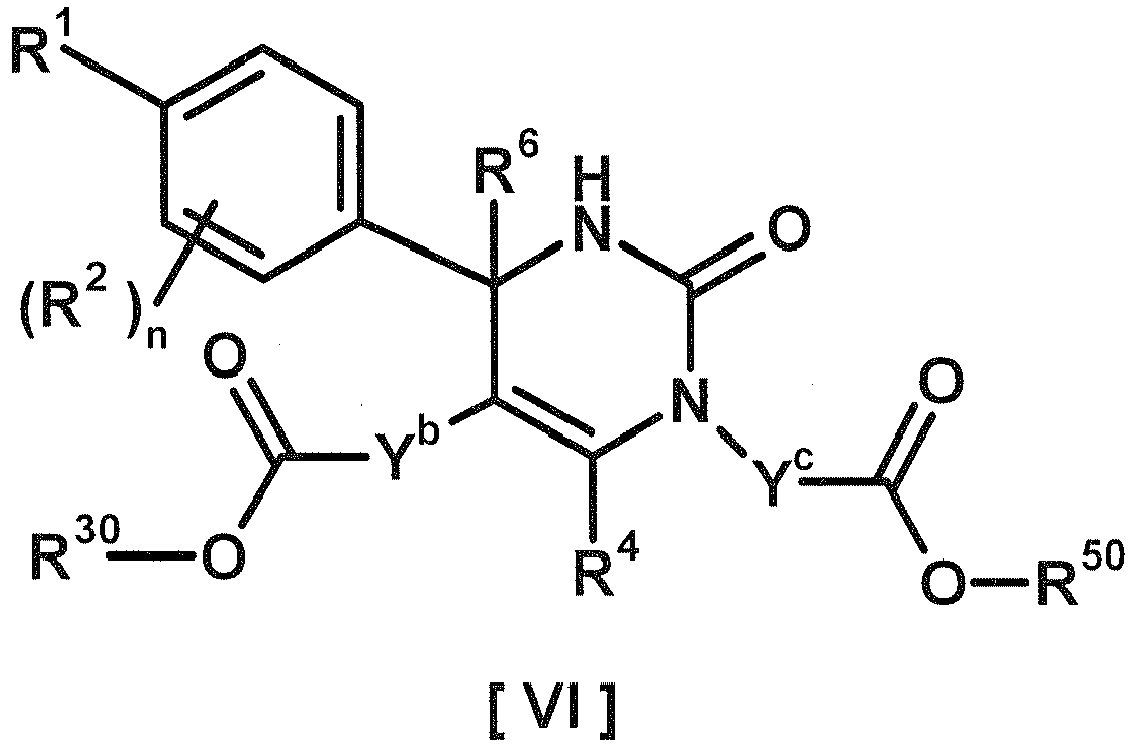
- A further preferable embodiment of a compound of Formula [I] is any one of compounds of the following formulae:


- R3h is hydrogen or methyl;
- R3w is methyl or fluoro;
- nx is an inter of 0 or 2;
- nw is an integer of 0, 1, 2 or 3; and
- the other symbols have the same meanings as defined in [01].
- In the Formulae [IV-B-A] to [IV-B-D], a more preferable one is any one of compounds wherein R2 is chloro or trifluoromethyl.
- In the Formulae [IV-B-A] to [IV-B-D], a still more preferable one is any one of compounds wherein
Yc is - (a) C1-6 alkylene optionally substituted with one hydroxy or
- (b) (CH2)m-Yc1-(CH2)w;
- (a) C3-6 cycloalkylene optionally substituted with one C1-3 alkyl,
- (b) phenylene,
- (c) phenylene substituted with one halogen,
- (d) phenylene substituted with one C1-3 alkyl,
- (e) phenylene substituted with one C1-3 alkoxy,
- (f) phenylene substituted with one trifluoromethyl,
- (g) cross-linked C5-8 cycloalkylene,
- (h) pyrrolidinediyl,
- (i) pyrrolidinediyl substituted with one carboxy,
- (j) pyrrolidinediyl substituted with one C1-3 alkylcarbonyl,
- (k) pyrrolidinediyl substituted with one C1-3 alkylsulfonyl or
- (l) pyridinediyl.
- A still more preferable one is any one of compounds of Formula [IV-B-A] to [IV-B-D] wherein
Yc is C1-6alkylene, phenylene, cross-linked C5-8 cycloalkylene or pyridinediyl. - Another further preferable embodiment of a compound of Formula [I] is any one of compounds of the following formulae:


- R3 is C1-6 alkyl optionally substituted with one hydroxy,
C1-6 alkyl substituted with one C1-4 alkoxy or
C3-6 cycloalkyl optionally substituted with the same or different one to three substituent(s) selected from Group Xb; - R3B is hydrogen, halogen, C1-3 alkyl, C1-3 alkoxy or trifluoromethyl; and the other symbols have the same meanings as defined in [01].
- In the Formulae [IV-B-A] to [IV-B-N], a more preferable one is any one of compounds wherein
R1 is
C4-8 alkyl,
C3-7 alkyl substituted with one trifluoromethyl,
C1-5 alkyl substituted with one substituent selected from Group Xa1,
C3-6 alkoxy,
C2-7 alkoxy substituted with one trifluoromethyl,
C1-3 alkoxy substituted with one substituent selected from Group Xa2,
C4-6 cycloalkyl,
C3-6 cycloalkyl substituted with the same or different one to two C1-5 alkyl,
C5-6 cycloalkenyl optionally substituted with the same or different one to two C1-4 alkyl, cyclohexylidenemethyl optionally substituted with the same or different one to two C1-3 alkyl, tetrahydropyran-4-ylidenemethyl,
C3-6 cycloalkyl substituted with one to the same two halogen or
C5-6 cycloalkenyl substituted with one to the same two halogen; and
R2 is fluoro, chloro or trifluoromethyl. - In the Formulae [IV-B-A] to [IV-B-N], a still more preferable one is any one of compounds wherein
R1 is
C4-8 alkyl,
C3-7 alkyl substituted with one trifluoromethyl,
C1-5 alkyl substituted with one substituent selected from Group Xa1,
C3-6 alkoxy,
C4-6 cycloalkyl substituted with the same or different one to two C1-5 alkyl,
C5-6 cycloalkenyl optionally substituted with the same or different one to two C1-4 alkyl,
C6 cycloalkyl substituted with one to the same two halogen or
C6 cycloalkenyl substituted with one to the same two halogen; and
R2 is chloro or trifluoromethyl. - In a still more preferable embodiment of the Formulae [IV-B-A] to [IV-B-N], R1 is any one of the following substituents.

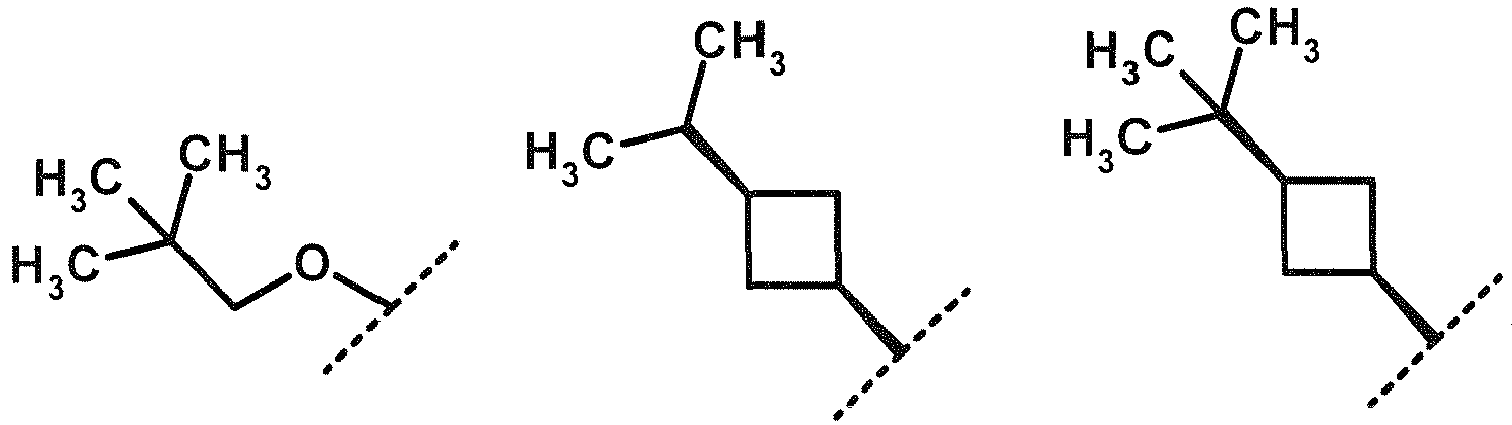


- Another embodiment of the present invention also includes the following embodiments.
- [Ola] A compound of Formula [I] or a pharmaceutically acceptable salt thereof:

- R1 is
- (1) C4-8 alkyl,
- (2) C4-8 alkenyl,
- (3) C4-8 alkynyl,
- (4) C3-7 alkyl substituted with one trifluoromethyl,
- (5) C1-4 alkyl substituted with one substituent selected from Group Xa1,
- (6) C3-6 alkoxy,
- (7) C2-7 alkoxy substituted with one trifluoromethyl,
- (8) C1-3 alkoxy substituted with one substituent selected from Group Xa2,
- (9) C4-6 cycloalkyl,
- (10) C3-6 cycloalkyl substituted with one to two C1-4 alkyl,
- (11) C5-6 cycloalkenyl optionally substituted with one to two C1-4 alkyl,
- (12) spiro C6-11 cycloalkyl or
- (13) C1-3 alkoxycarbonyl;
- Group Xal is
- (a) C3-6 cycloalkyl optionally substituted with the same or different one to three C1-5 alkyl,
- (b) phenyl,
- (c) C2-4 alkoxy, and
- (d) trimethylsilyl;
- Group Xa2 is
- (a) C3-6 cycloalkyl,
- (b) phenyl, and
- (c) C1-4 alkoxy;
- R2 is
- (1) halogen,
- (2) C1-6 alkyl, or
- (3) C1-3 alkoxy optionally substituted with phenyl;
- n is an integer of 0, 1 or 2, provided that when n is 2, each R2 may be different with each other; or
- R1 and R2 may combine together with the benzene ring to which they attach to form indanyl where the indanyl may be substituted with the same or different one to two C1-6 alkyl;
- R3 is
- (1) -Yb-COO-R30,
- (2) C1-6 alkyl optionally substituted with one hydroxy,
- (3) C3-6 cycloalkyl optionally substituted with the same or different one to three substituent(s) selected from Group Xb,
- (4)

- (5)

- Yb is
- (a) C1-6 alkylene or (b) C3-6 cycloalkylene;
- R30 is
- (a) hydrogen or (b) C1-4 alkyl;
- Group Xb is
- (a) halogen and
- (b) C1-6 alkyl;
- R4 is
- (1) hydrogen or
- (2) methyl;
- R5 is
- (1) -Yc-COO-R50,
- (2) hydrogen,
- (3) C1-4 alkyl optionally substituted with one C1-3 alkoxy or
- (4) C3-6 cycloalkyl optionally substituted with one hydroxy-C1-4 alkyl:
- Yc is
- (a) C1-6 alkylene optionally substituted with one hydroxy,
- (b) CH2-CH2-O-CH2 or
- (c) (CH2)m-Yc1-(CH2)w;
- m is an integer of 0, 1 or 2;
- w is an integer of 0,1 or 2;
- Ycl is
- (a) C3-6 cycloalkylene optionally substituted with one C1-3 alkyl,
- (b) phenylene,
- (c) cross-linked C5-8 cycloalkylene or
- (d)

- R50 is
- (a) hydrogen or
- (b) C1-4 alkyl;
- R6 is
- (1) hydrogen or
- (2) methyl;
provided that
- when R5 is -Yc-COO-R50, Yc is (CH2)m-Yc1-(CH2)w, m and w are 0, and Yc1 is phenylene, then R6 is methyl; and
- either R3 or R5 or both of them have "-COO-".
- R1 is
- [02a] The compound of [Ola], wherein the compound of Formula [I] is a compound of Formula [II], or a pharmaceutically acceptable salt thereof.

- [03a] The compound of [Ola], wherein the compound of Formula [I] is a compound of Formula [III], or a pharmaceutically acceptable salt thereof.

- [04a] The compound of [Ola], wherein the compound of Formula [I] is a compound of Formula [IV], or a pharmaceutically acceptable salt thereof.
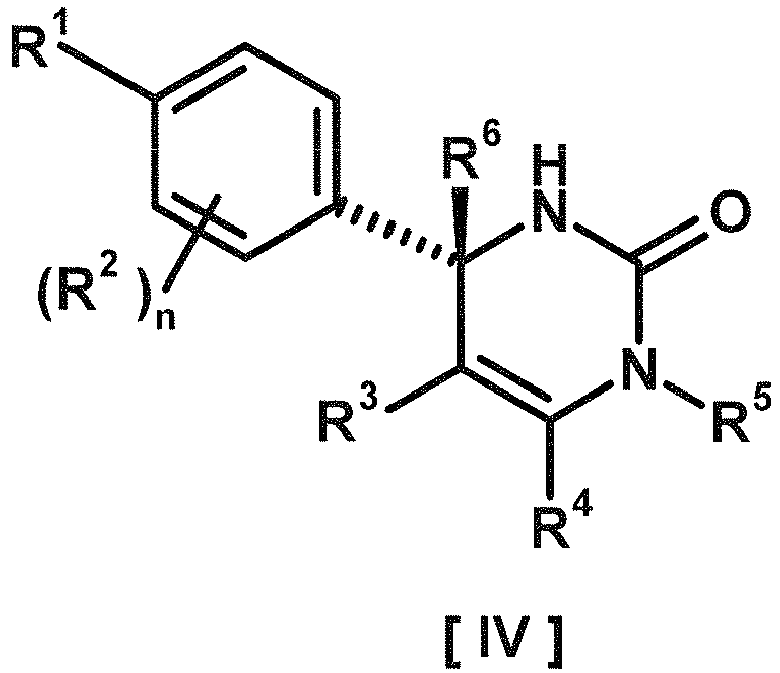
- [05a] The compound of any one of [Ola] to [04a], wherein R6 is methyl, or a pharmaceutically acceptable salt thereof.
- [06a] The compound of any one of [Ola] to [05a], wherein R4 is hydrogen, or a pharmaceutically acceptable salt thereof.
- [07a] The compound of any one of [Ola] to [06a], wherein n is an integer of 1 or 2, or a pharmaceutically acceptable salt thereof.
- [08a] The compound of any one of [10a] to [07a], wherein R2 is halogen, or a pharmaceutically acceptable salt thereof.
- [09a] The compound of [08a], wherein R2 is chloro or fluoro, or a pharmaceutically acceptable salt thereof.
- [10a] The compound of [02a], wherein R50 is hydrogen, or a pharmaceutically acceptable salt thereof.
- [11a] The compound of [03a], wherein R30 is hydrogen, or a pharmaceutically acceptable salt thereof.
- [12a] A pharmaceutical composition comprising the compound of any one of [10a] to [11a] or a pharmaceutically acceptable salt thereof and a pharmaceutically acceptable carrier.
- [13a] An RORγ antagonist comprising the compound of any one of [Ola] to [11a] or a pharmaceutically acceptable salt thereof and a pharmaceutically acceptable carrier.
- [14a] An agent for treating or preventing a disease selected from the group consisting of autoimmune disease, allergic disease, dry eye, fibrosis, and metabolic disease, comprising the compound of any one of [Ola] to [11a] or a pharmaceutically acceptable salt thereof.
- [15a] The agent of [14a], wherein the disease is autoimmune disease.
- [16a] The agent of [15a], wherein the autoimmune disease is selected from the group consisting of rheumatoid arthritis, psoriasis, inflammatory bowel disease such as Crohn's disease and ulcerative colitis, multiple sclerosis, systemic lupus erythematosus, ankylosing spondylitis, uveitis, polymyalgia rheumatica, and type I diabetes.
- [17a] The agent of [14a], wherein the disease is metabolic disease.
- [18a] The agent of [17a], wherein the metabolic disease is diabetes.
- [19a] A method of inhibiting RORγ, comprising administering to a mammal a therapeutically effective amount of the compound of any one of [Ola] to [11a] or a pharmaceutically acceptable salt thereof.
- [20a] A method of treating or preventing a disease selected from the group consisting of autoimmune disease, allergic disease, dry eye, fibrosis, and metabolic disease, comprising administering to a mammal an effective amount of the compound of any one of [10a] to [11a] or a pharmaceutically acceptable salt thereof.
- [21a] The method of [20a], wherein the disease is autoimmune disease.
- [22a] The method of [21a], wherein the autoimmune disease is selected from the group consisting of rheumatoid arthritis, psoriasis, inflammatory bowel disease such as Crohn's disease and ulcerative colitis, multiple sclerosis, systemic lupus erythematosus, ankylosing spondylitis, uveitis, polymyalgia rheumatica, and type I diabetes.
- [23a] The method of [20a], wherein the disease is metabolic disease.
- [24a] The method of [23a], wherein the metabolic disease is diabetes.
- [25a] Use of the compound of any one of [01a] to [11a] or a pharmaceutically acceptable salt thereof for the manufacture of an RORγ antagonist.
- [26a] Use of the compound of any one of [10a] to [11a] or a pharmaceutically acceptable salt thereof for the manufacture of an agent for treatment or prevention of a disease selected from the group consisting of autoimmune disease, allergic disease, dry eye, fibrosis, and metabolic disease.
- [27a] The use of [26a], wherein the disease is autoimmune disease.
- [28a] The use of [27a], wherein the autoimmune disease is selected from the group consisting of rheumatoid arthritis, psoriasis, inflammatory bowel disease such as Crohn's disease and ulcerative colitis, multiple sclerosis, systemic lupus erythematosus, ankylosing spondylitis, uveitis, polymyalgia rheumatica, and type I diabetes.
- [29a] The use of [26a], wherein the disease is metabolic disease.
- [30a] The use of [29a], wherein the metabolic disease is diabetes.
- [31a] A compound of any one of [Ola] to [11a] or a pharmaceutically acceptable salt thereof for use as an RORγ antagonist.
- [32a] A compound of any one of [Ola] to [11a] or a pharmaceutically acceptable salt thereof for use as an agent for treatming or preventing a disease selected from the group consisting of autoimmune disease, allergic disease, dry eye, fibrosis, and metabolic disease.
- [33a] The compound of [32a], wherein the disease is autoimmune disease, or a pharmaceutically acceptable salt thereof.
- [34a] The compound of [33a], wherein the autoimmune disease is selected from the group consisting of rheumatoid arthritis, psoriasis, inflammatory bowel disease such as Crohn's disease and ulcerative colitis, multiple sclerosis, systemic lupus erythematosus, ankylosing spondylitis, uveitis, polymyalgia rheumatica, and type I diabetes, or a pharmaceutically acceptable salt thereof.
- [35a] The compound of [32a], wherein the disease is metabolic disease, or a pharmaceutically acceptable salt thereof.
- [36a] The compound of [35a], wherein the metabolic disease is diabetes, or a pharmaceutically acceptable salt thereof.
- The term "pharmaceutically acceptable salt" may be any salts without excess toxicity known in the art.
- In particular, it includes, for example, a salt with an inorganic acid, a salt with an organic acid, a salt with an inorganic base, and a salt with an organic base. Various forms of pharmaceutically acceptable salts are well known in the art, and are listed in the following references, for example.
- (a) Berge et al., J. Pharm. Sci., 66, p 1-19 (1977),
- (b) Stahl et al., "Handbook of Pharmaceutical Salt: Properties, Selection, and Use" (Wiley-VCH, Weinheim, Germany, 2002),
- (c) Paulekuhn et al., J. Med. Chem., 50, p 6665-6672 (2007)
- The salt with an organic acid or inorganic acid includes a salt with acetic acid, adipic acid. alginic acid, 4-aminosalicylic acid, anhydromethylenecitric acid, benzoic acid. benzenesulfonic acid, calcium edetate, camphor acid, camphor-10-sulfonic acid, carbonic acid, citric acid, edetic acid, ethane-1,2-disulfonic acid, dodecylsulfonic acid, ethanesulfonic acid, fumaric acid, glucoheptonic acid, gluconic acid, glucuronic acid, glucoheptonic acid, glycollylarsanilic acid, hexylresorcylic acid, hydrobromic acid, hydrochloric acid, hydrofluoric acid, hydroiodic acid, hydroxynaphthoic acid, 2-hydroxy-1-ethanesulfonic acid, lactic acid, lactobionic acid, malic acid, maleic acid, mandelic acid, methanesulfonic acid, methylsulfuric acid, methylnitric acid, methylenebis(salicylic acid), galactaric acid, naphthalene-2-sulfonic acid, 2-naphthoic acid, 1,5-naphthalenedisulfonic acid, nitric acid, oleic acid, oxalic acid, pamoic acid, pantothenic acid, pectic acid, phosphoric acid, picric acid, propionic acid, polygalacturonic acid, salicylic acid, stearic acid, succinic acid, sulfuric acid, tannic acid, tartaric acid, teoclic acid, thiocyanic acid, trifluoroacetic acid, p-toluenesulfonic acid, undecanoic acid, asparaginic acid or glutamic acid.
- A preferable salt with an organic acid includes a salt with oxalic acid, maleic acid, citric acid, fumaric acid, lactic acid, malic acid, succinic acid, tartaric acid, acetic acid, trifluoroacetic acid, benzoic acid, glucuronic acid, oleic acid or pamoic acid. Alternatively, a salt with methanesulfonic acid, benzenesulfonic acid, p-toluenesulfonic acid or 2-hydroxy-1-ethanesulfonic acid is illustrated.
- A preferable salt with an inorganic acid includes a salt with hydrochloric acid, nitric acid, sulfuric acid, phosphoric acid or hydrobromic acid.
- The salt with an organic base includes a salt with arecoline, betaine, choline, clemizole, ethylenediamine, N-methylglucamine, N-benzylphenethylamine, tris(hydroxymethyl)methylamine, arginine or lysine.
- A preferable salt with an organic base includes a salt with tris(hydroxymethyl)methylamine, N-methylglucamine or lysine.
- The salt with an inorganic base includes a salt with ammonium, aluminum, barium, bismuth, calcium, lithium, magnesium, potassium, sodium or zinc.
- A preferable salt with an inorganic base includes a salt with sodium, potassium, calcium, magnesium or zinc.
- According to known methods, each pharmaceutically acceptable salt may be obtained by reacting a compound of Formula [I] with an inorganic base, an organic base, an inorganic acid or an organic acid.
- A preferable salt of a compound of Formula [I] includes a salt with sodium, potassium or calcium.
- Another preferable salt of a compound of Formula [I] includes a salt with sodium, potassium, L-lysine, tris(hydroxymethyl)methylamine, diethylamine, piperazine or dicyclohexylamine.
- A compound of Formula [I] or a pharmaceutically acceptable salt thereof may exist in its solvate.
- The term "solvate" means a compound where a solvent molecule is coordinated with a compound of Formula [I] or a pharmaceutically acceptable salt thereof, and includes a hydrate.
- A pharmaceutically acceptable solvate is preferred as the solvate, and includes, for example, a hydrate, an ethanolate, and a dimethylsulfoxidate of a compound of Formula [I] or a pharmaceutically acceptable salt thereof.
- In particular, it includes, for example, a hemihydrate, 1 hydrate, 2 hydrate or 1 ethanolate of a compound of Formula [I], or a monohydrate of a sodium salt of a compound of Formula [I] or a 1/2 ethanolate of dihydrochloride thereof.
- According to known methods, the solvates may be obtained.
- A compound of Formula [I] may exist as a tautomer. In that case, a compound of Formula [I] may exist as an individual tautomer or a mixture of tautomers.
- A compound of Formula [I] may have a carbon-carbon double bond. In that case, a compound of Formula [I] may exist as an E-isomer, a Z-isomer or a mixture of E- and Z-isomers.
- A compound of Formula [I] may exist as a stereoisomer which should be recognized as a cis/trans isomer. In that case, a compound of Formula [I] may exist as a cis-isomer, a transisomer or a mixture of cis- and trans-isomers.
- A compound of Formula [I] may have one or more asymmetric carbon atom(s). In that case, a compound of Formula [I] may exist as a single enantiomer, a single diastereomer, a mixture of enantiomers or a mixture of diastereomers.
- A compound of Formula [I] may exist as an atropisomer. In that case, a compound of Formula [I] may exist as an individual atropisomer or a mixture of atropisomers.
- A compound of Formula [I] may simultaneously have multiple structural features which can provide the above isomers. A compound of Formula [I] may also contain the above isomers in any ratios.
- Formulae, chemical structures or chemical names without specifying a stereochemistry herein include all the above isomers which may exist, unless otherwise specified.
- Diastereomer mixtures may be isolated into each diastereomer by a conventional method such as chromatography or crystallization. Each diastereomer may be also prepared by using a starting material which is a single isomer in terms of stereochemistry or by a synthetic method using a stereoselective reaction.
- A mixture of enantiomers may be isolated into each single enantiomer by a well known method in the art.
- For example, a mixture of enantiomers may be reacted with a substantially pure enantiomer which is known as a chiral auxiliary to form a mixture of diastereomers, which may be then isolated into a diastereomer with an enhanced isomeric ratio or a substantially pure single diastereomer by a common method such as fractionated crystallization or chromatography. The added chiral auxiliary may be removed from the isolated diastereomer by a cleavage reaction to give a desirable enantiomer.
- A mixture of enantiomers may be also directly separated by a well known chromatography in the art using a chiral stationary phase.
- Alternatively, either of enantiomers may be also obtained by using a substantially pure and optically active starting material or a stereoselective synthesis (i.e., asymmetric induction) from a prochiral intermediate with a chiral auxiliary or asymmetric catalyst.
- An absolute configuration may be determined by X-ray crystallographic analysis of a crystalline product or intermediate. In that case, a crystalline product or intermediate which is induced by an agent having an asymmetric center with a known configuration may be used if needed.
- A compound of Formula [I] may be labeled with an isotope atom such as 2H, 3H, 14C, and 35S.
- A compound of Formula [I] or a pharmaceutically acceptable salt thereof is preferably a substantially purified compound of Formula [I] or pharmaceutically acceptable salt thereof. A more preferable one is a compound of Formula [I] or a pharmaceutically acceptable salt thereof purified in an 80% or more purity.
- According to known methods in the art of pharmaceutical formulation, a pharmaceutical composition in the present invention may be prepared by optionally mixing a compound of Formula [I] or a pharmaceutically acceptable salt thereof with at least one or more pharmaceutically acceptable carrier(s) in any amount. A content of a compound of Formula [I] or a pharmaceutically acceptable salt thereof in the pharmaceutical composition depends on dosage forms and doses, and is for example 0.1 to 100% by weight of the composition.
- A dosage form of a compound of Formula [I] or a pharmaceutically acceptable salt thereof includes an oral preparation such as a tablet, a capsule, a granule, a powder, a lozenge, a syrup, an emulsion, and a suspension or an parenteral preparation such as an external preparation, a suppository, an injection, an eye drop, a nasal preparation, and a pulmonary preparation.
- The term "pharmaceutically acceptable carrier" includes various common organic or inorganic carrier substances as a formulation material, and includes excipients, disintegrants, binders, fluidizers, and lubricants in a solid formulation, solvents, solubilizing agents, suspending agents, tonicity agents, buffers, and soothing agents in a liquid formulation, and bases, emulsifying agents, wetting agents, stabilizers, stabilizing agents, dispersants, plasticizers, pH regulators, absorption promoters, gelators, preservatives, fillers, solubilizers, solubilizing agents, and suspending agents in a semisolid formulation.
- A preserving agent, an antioxidant agent, a colorant or a sweetening agent may be also optionally used as an additive.
- The term "excipient" includes, for example, lactose, white soft sugar, D-mannitol, D-sorbitol, cornstarch, dextrin, microcrystalline cellulose, crystalline cellulose, carmellose, carmellose calcium, sodium carboxymethylstarch, low substituted hydroxypropylcellulose, and gum arabic.
- The term "disintegrant" includes, for example, carmellose, carmellose calcium, carmellose sodium, sodium carboxymethylstarch, croscarmellose sodium, crospovidone, low substituted hydroxypropylcellulose, hydroxypropylmethylcellulose, and crystalline cellulose.
- The term "binder" includes, for example, hydroxypropylcellulose, hydroxypropylmethylcellulose, povidone, crystalline cellulose, white soft sugar, dextrin, starch, gelatin, carmellose sodium, and gum arabic.
- The term "fluidizer" includes, for example, light anhydrous silicic acid and magnesium stearate.
- The term "lubricant" includes, for example, magnesium stearate, calcium stearate, and talc.
- The term "solvent" includes, for example, purified water, ethanol, propyleneglycol, macrogol, sesame oil, corn oil, and olive oil.
- The term "solubilizing agent" includes, for example, propyleneglycol, D-mannitol, benzyl benzoate, ethanol, triethanolamine, sodium carbonate, and sodium citrate.
- The term "suspending agent" includes, for example, benzalkonium chloride, carmellose, hydroxypropylcellulose, propyleneglycol, povidone, methylcellulose, and glyceryl monostearate.
- The term "tonicity agent" includes, for example, glucose, D-sorbitol, sodium chloride, and D-mannitol.
- The term "buffer" includes, for example, sodium hydrogen phosphate, sodium acetate, sodium carbonate, and sodium citrate.
- The term "soothing agent" includes, for example, benzyl alcohol.
- The term "base" includes, for example, water, animal or vegetable oils such as olive oil, corn oil, arachis oil, sesame oil, and castor oil, lower alcohols such as ethanol, propanol, propylene glycol, 1,3-butylene glycol, and phenol, higher fatty acid and an ester thereof, waxes, higher alcohols, polyalcohols, hydrocarbons such as white petrolatum, liquid paraffin, and paraffin, hydrophilic petrolatum, purified lanolin, absorptive ointment, hydrous lanolin, hydrophilic ointment, starch, pullulan, gum arabic, tragacanth gum, gelatin, dextran, cellulose derivatives such as methylcellulose, carboxymethylcellulose, hydroxyethylcellulose, and hydroxypropylcellulose, synthetic polymers such as carboxyvinyl polymer, sodium polyacrylate, polyvinyl alcohol, and polyvinylpyrrolidone, propylene glycol, macrogol such as macrogol 200 to 600, and a combination of two or more of them.
- The term "preserving agent" includes, for example, ethyl parahydroxybenzoate, chlorobutanol, benzyl alcohol, sodium dehydroacetate, and sorbic acid.
- The term "antioxidant agent" includes, for example, sodium sulfite and ascorbic acid.
- The term "colorant" includes, for example, food dye such as Food Red No. 2 and No. 3, and Food Yellow No. 4 and No. 5, and β-carotene.
- The term "sweetening agent" includes, for example saccharin sodium, dipotassium glycyrrhizate, and aspartame.
- A pharmaceutical composition in the present invention may be administered to human as well as mammals other than human such as mice, rats, hamsters, guinea pigs, rabbits, cats, dogs, pigs, cattle, horses, sheep, and monkeys orally or parenterally such as locally, rectally, intravenously, intramuscularly, and subcutaneously. While a dose may vary depending on subjects, diseases, symptoms, dosage forms, routes of administration and the like, for example when it is administered orally to an adult patient the dose of a compound of Formula [I] as the active ingredient ranges generally from about 0.01 mg to about 1 g per day, which may be administered once to several times in a divided amount.
- A compound of Formula [I] or a pharmaceutically acceptable salt thereof has an inhibitory activity of Retinoid-related Orphan Receptor γ (RORγ), and is useful for treating or preventing various diseases or conditions which are expected to be improved by adjusting the RORγ inhibitory activity, e.g. autoimmune diseases such as rheumatoid arthritis, psoriasis, inflammatory bowel diseases such as Crohn's disease and ulcerative colitis, multiple sclerosis, systemic lupus erythematosus (SLE), ankylosing spondylitis, uveitis, polymyalgia rheumatica, type I diabetes, and graft versus host disease, allergic diseases such as asthma, dry eye, fibrosis such as lung fibrosis and primary biliary cirrhosis, and metabolic diseases such as diabetes.
- The term "RORγ antagonist" means a compound having an ability which inhibits the function of Retinoid-related Orphan Receptor γ (RORγ) to make the activity thereof disappear or reduced.
- To "inhibit RORγ" means that a function of RORγ is inhibited to make the activity thereof disappear or reduced, which includes, for example, the function of RORγ is inhibited according to Test Example 1 described hereafter. To "inhibit RORγ" preferably includes "inhibiting human RORγ". Inhibiting the function or disappearing or reducing the activity may be preferably carried out during clinical indication in human.
- The term "RORγ inhibitor" means any substance which inhibits RORγ, and may be a low molecular compound, a nucleic acid, polypeptide, protein, antibody, vaccine and the like. A preferable "RORγ inhibitor" is "human RORγ inhibitor".
- The term "treating" used herein includes improving symptoms, preventing severe diseases, maintaining a remission, preventing exacerbation as well as preventing relapse.
- The term "preventing" used herein means suppressing pathogenesis of symptoms.
- The term "autoimmune disease" means a genric name of diseases where an immune system overreacts to and attacks normal cells and tissues thereof to cause symptoms, and in particular, includes rheumatoid arthritis, psoriasis, inflammatory bowel diseases such as Crohn's disease and ulcerative colitis, multiple sclerosis, systemic lupus erythematosus, Behcet's disease, sarcoidosis, Harada disease, ankylosing spondylitis, uveitis, polymyalgia rheumatica, type I diabetes, and graft versus host disease.
- The term "allergic disease" means a disease derived from the condition where an immune reaction excessively occurs against a certain antigen, and in particular, includes atopic dermatitis, allergic rhinitis such as pollen allergy, allergic conjunctivitis, allergic gastroenteritis, bronchial asthma, infantile asthma; food allergy, medication allergy, and hives.
- The term "fibrosis" means a condition with increased fibroconnective tissues, and in particular, includes lung fibrosis and primary biliary cirrhosis.
- The term "metabolic disease" means a disease caused by abnormity of metabolic turnover or a disease which includes metabolic abnormality as an element that constitutes pathogenesis, and includes, for example, diabetes such as type I diabetes or type II diabetes.
- Herein, the proposal of preferences and options in respect of different features of the compounds, methods, uses, and compositions comprises the proposal of combinations of those preferences and options for the different features, insofar as they are combinable and compatible.
- Methods for preparing a compound of Formula [I] or a pharmaceutically acceptable salt thereof are illustrated as below. A method for preparing a compound of Formula [I] or a pharmaceutically acceptable salt thereof is not however intended to be limited thereto.
- Each compound obtained in each step may be isolated and/or purified by known methods such as distillation, recrystallization, and column chromatography, if necessary, but a reaction may optionally proceed to a sequential step without isolation and purification.
- In particular, a compound of Formula [I] may be prepared according to the following Preparation Methods 1 to 5, for example:

- A method for preparing dihydropyrimidin-2-one compounds via Claisen reaction (1)
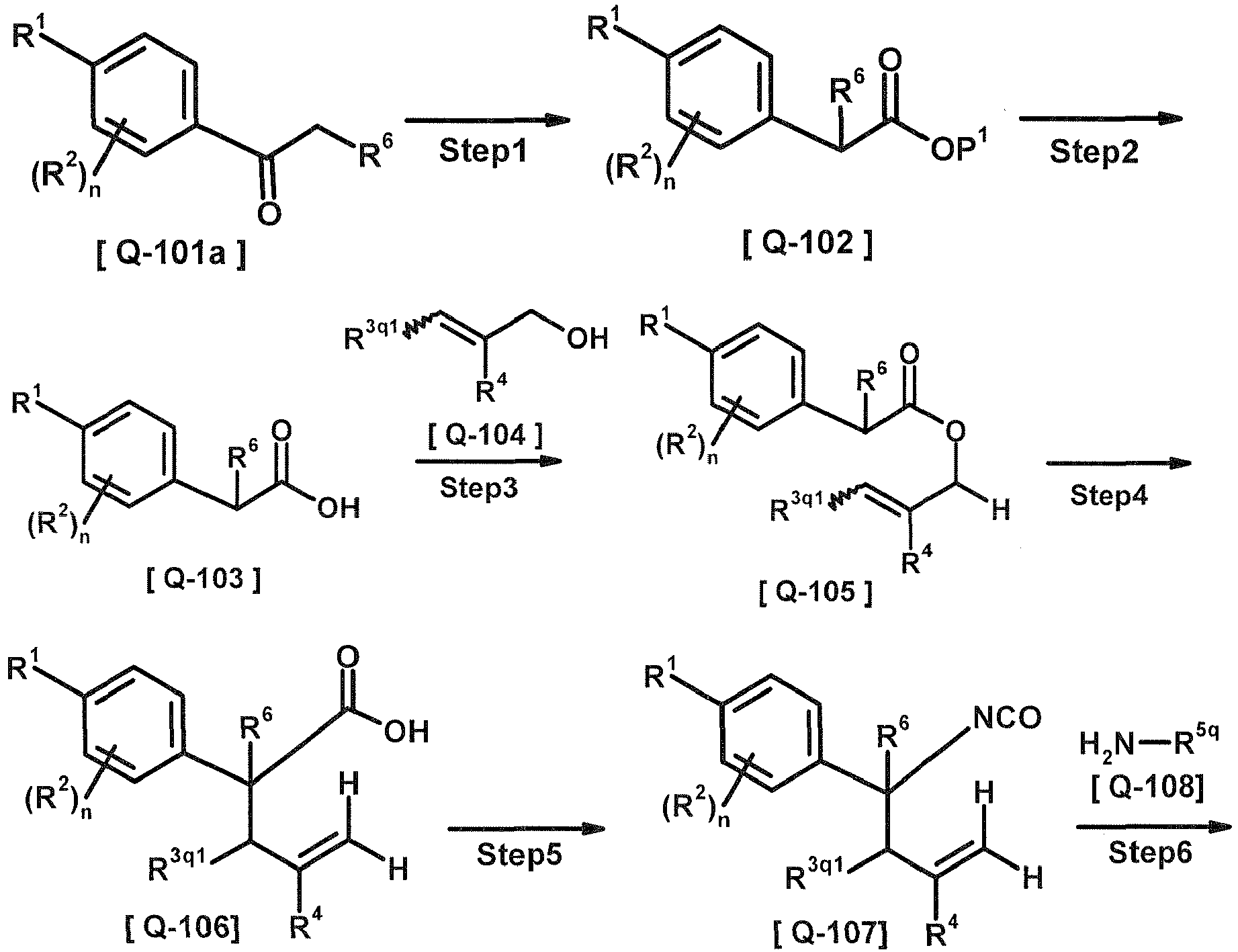

- P1 is for example C1-4 alkyl;
- R3ql is for example -Yb-CH2OP2 (in which P2 is a protective group such as trimethylsilyl (TMS) and tert-butyldimethylsilyl (TBDMS)), C1-6 alkyl optionally substituted with hydroxy protected with one P2, C3-6 cycloalkyl optionally substituted with the same or different one to three substituent(s) selected from Group Xb. 4-tetrahydropyranyl or 1-methanesulfonyl-3-azetidinyl;
- Yb is for example C1-6 alkylene or C3-6 cycloalkylene;
- Group Xb is for example halogen or C1-6 alkyl;
- R5q is for example -Yc-COO-Rq50 (in which Rq50 is C1-4 alkyl), hydrogen, C1-4 alkyl optionally substituted with one C1-3 alkoxy or C3-6 cycloalkyl optionally substituted with hydroxy-C1-4 alkyl protected with one P2;
- Yc is C1-6 alkylene optionally substituted with hydroxy protected with one P2, CH2-CH2-O-CH2 or (CH2)m-Yc1-(CH2)w;
- m is an integer of 0, 1 or 2;
- w is an integer of 0, 1 or 2;
- Ycl is for example C3-6 cycloalkylene optionally substituted with one C1-3 alkyl, phenylene, cross-linked C5-8 cycloalkylene or

- the other symbols have the same meanings as defined in [01].
- A compound of Formula [Q-102] may be prepared from a compound of Formula [Q-101a] by a rearrangement reaction with diacetoxyiodobenzene (e.g. a method described in Chem. Pharm. Bull., 1985, 33, 1097-1103).
- A compound of Formula [Q-101a] may be prepared by Preparation Method 6 described below.
- A compound of Formula [Q-103] may be prepared from a compound of Formula [Q-102] by hydrolysis with a base.
- The base includes sodium hydroxide, potassium hydroxide, and lithium hydroxide. A preferable base is sodium hydroxide.
- A solvent includes methanol, ethanol, isopropanol, tetrahydrofuran, and water, and may be used alone or by mixture of two or more of them. A preferable solvent is a mixed solvent with ethanol and water.
- A reaction temperature includes from room temperature to 100°C. A preferable reaction temperature is room temperature.
- A compound of Formula [Q-105] may be prepared by a condensation reaction of a compound of Formula [Q-103] with a compound of Formula [Q-104].
- A condensation agent includes aqueous carbodiimide (WSC•HCl: 1-ethyl-3-(3-dimethylaminopropyl)carbodiimide hydrochloride), N,N'-dicyclohexylcarbodiimide (DCC), diphenylphosphoryl azide (DPPA), and carbonyldiimidazole (CDI). For example, 1-hydroxy-1H-benzotriazole monohydrate (HOBt•H2O) or 4-dimethylaminopyridine (DMAP) may be optionally added thereto. A preferable condensation agent is a mixture of aqueous carbodiimide (WSC•HCl: 1-ethyl-3-(3-dimethylaminopropyl)carbodiimide hydrochloride) and 4-dimethylaminopyridine (DMAP).
- A solvent includes toluene, dichloromethane, chloroform, tetrahydrofuran, dioxane, N,N-dimethylformamide, dimethylsulfoxide, acetonitrile, and acetone, and may be used alone or by mixture of two or more of them. A preferable solvent is dichloromethane.
- A reaction temperature includes from 0°C to 100°C. A preferable reaction temperature is room temperature.
- A compound of Formula [Q-104] may be prepared by Preparation Method 7-1 described below.
- A compound of Formula [Q-106] may be prepared from a compound of Formula [Q-105] in the presence of a base and a chlorosilane compound by Ireland Claisen rearrangement reaction (e.g. a method described in Org. Lett., 2007, 9, 4431-4434).
- The base includes lithium diisopropylamide (LDA), lithium hexamethyldisilazide (LHMDS), and lithium 2,2,6,6-tetramethylpiperidide (LiTMP). A preferable base is lithium diisopropylamide (LDA).
- The chlorosilane compound includes trimethylsilyl chloride and tert-butyldimethylsilyl chloride. A preferable chlorosilane compound is trimethylsilyl chloride.
- Hexamethylphosphoric triamide (HMPA) or N,N'-dimethylpropyleneurea (DMPU) may be added as an additive.
- A solvent includes an ether type solvent such as diethyl ether, tetrahydrofuran, 1,2-dimethoxyethane. A preferable solvent is tetrahydrofuran.
- A reaction temperature includes from -78°C to 80°C. A preferable reaction temperature is from -78°C to room temperature.
- A compound of Formula [Q-107] may be prepared from a compound of Formula [Q-106] in the presence of a base by an azidation reaction followed by Curtius rearrangement reaction.
- An azidation agent includes DPPA.
- The base includes triethylamine and diisopropylethylamine. A preferable base is triethylamine.
- A solvent includes benzene, toluene, and xylene. A preferable solvent is toluene.
- A reaction temperature includes from 0°C to 140°C. A preferable reaction temperature is 110°C.
- A compound of Formula [Q-109] may be prepared from a compound of Formula [Q-107] and a compound of Formula [Q-108]. When a compound of Formula [Q-108] is hydrochloride, one or more equivalent(s) of a base such as triethylamine may be optionally added.
- A solvent inludes benzene, toluene, dichloromethane, chloroform, diethyl ether, tetrahydrofuran, 1,2-dimethoxyethane, ethyl acetate, N,N-dimethylformamide, dimethylsulfoxide, acetonitrile, and acetone, and may be used alone or by mixture of two or more of them. A preferable solvent is tetrahydrofuran.
- A reaction temperature includes from 0°C to 80°C. A preferable reaction temperature is from 0°C to room temperature.
- A compound of Formula [Q-108] may be prepared by Preparation Method 8-2 described below.
- A compound of Formula [Q-110] may be prepared by an oxidative cleavage reaction of exo-olefin of a compound of Formula [Q-109], followed by a cyclization reaction with an acid.
- The oxidative cleavage reaction includes ozone oxidation by reductive treatment. A reducing agent used in the oxidative cleavage reaction includes dimethyl sulfide and triphenylphosphine. A preferable reducing agent is dimethyl sulfide.
- The acid used in the cyclization reaction includes hdyrochloric acid, acetic acid, hydrobromic acid, sulfuric acid, trifluoroacetic acid, and p-toluenesulfonic acid. A preferable acid is hdyrochloric acid. The acid used in the cyclization reaction may be mixed with reactants from the beginning or may be added to the reaction system after completion of the oxidative cleavage reaction.
- A solvent includes methanol, ethanol, isopropyl alcohol, tert-butanol, dichloromethane, and chloroform, and may be used alone or by mixture of two or more of them. A preferable solvent is methanol, or a mixed solvent of methanol with dichloromethane.
- A reaction temperature includes from -100°C to 80°C. A preferable reaction temperature is from -78°C to room temperature.
- A compound of Formula [I] may be prepared from a compound of Formula [Q-110] by the following method. For example, a compound which R3 or R5 has a hydroxyl group as a substituent in a compound of Formula [I] and the hydroxyl group is protected with P2 may be prepared by a deprotection reaction of P2. The deprotection reaction may be carried out from the compound obtained in the cyclization reaction by a method described in a reference (e.g. a method described in Peter G. M. Wuts (2007). Green's Protective Groups in Organic Synthesis Fourth Edition, Weinheim, Germany, Wiley-VCH, 165-215). Alternatively, the reaction may be carried out under an acidic condition simultaneously with the cyclization reaction.
- A compound which R3 has a carboxyl group as a substituent in a compound of Formula [I] may be prepared by oxidizing a compound which R3ql has a primary hydroxyl group as a substituent with Dess-Martin reagent to an aldehyde (e.g. a method described in J. Org. Chem., 2000, 65, 5498-5505), followed by an oxidation reaction of the aldehyde with 2,2,6,6-tetramethylpiperidine 1-oxyl (TEMPO) and chlorous acid (e.g. a method described in J. Org. Chem., 1999, 64, 2564-2566). Alternatively, a compound which R3 has a carboxyl group as a substituent may be prepared from a compound which R3ql has an ester as a substituent by a hydrolysis reaction. The hydrolysis reaction may be carried out by a method of the above Step 2 or a hydrolysis reaction with an acid such as trifluoroacetic acid.
- A compound which R5 has a carboxyl group as a substituent in a compound of Formula [I] may be prepared by an oxidation reaction of a hydroxyl group or a hydrolysis reaction of an ester according to the Preparation Method of the compound which R3 has a carboxyl group as a substituent.
- For example, when R5 is "-Yc-COO-R50", the compound may be prepared by the following hydrolysis reaction:

- For example when R3 is "-Yb-COO-R30", the compound may be prepared by the following hydrolysis reaction:

- For example, when R3 is "-Yb-COO-R30" in which R30 is hydrogen, the compound may be prepared by the following oxidation reaction:

- An example of Preparation Method 1 is as follows.
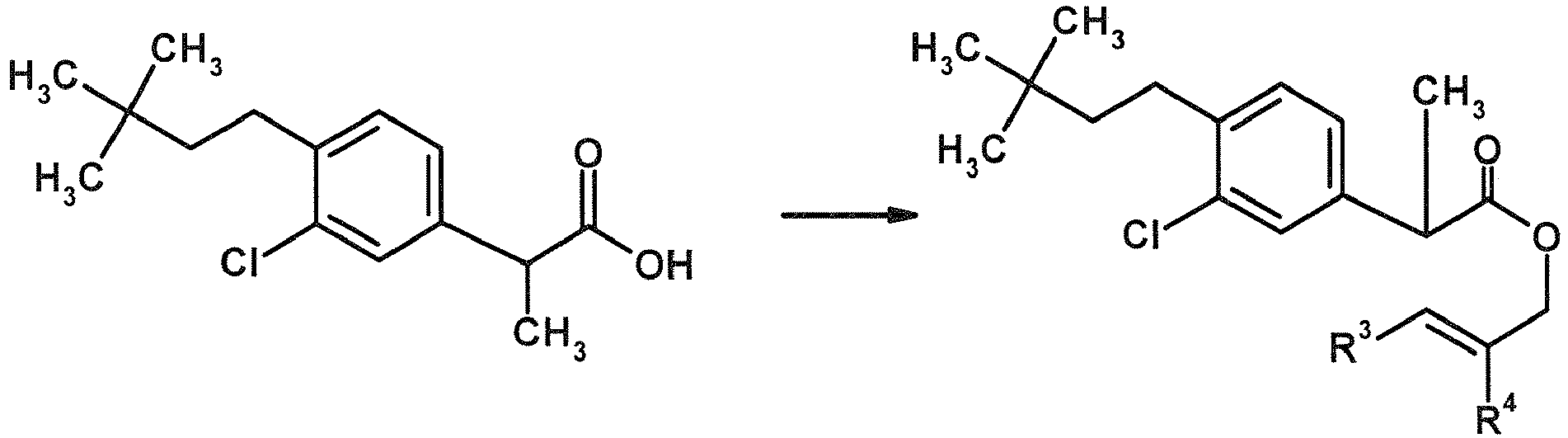

- A compound of Formula [I] may be also prepared from a compound of Formula [Q-201] prepared from a compound of Formula [Q-101b] according to Preparation Method 1.

- A compound which R1 is C3-6 alkoxy, C2-7 alkoxy substituted with one trifluoromethyl or C1-3 alkoxy substituted with one substituent selected from Group Xa2 in Formula [I] may be prepared by the following method.

- A compound of Formula [Q-202] may be prepared by deprotecting the benzyl group of a compound of Formula [Q-201a] according to a method described in a reference (e.g. a method described in Peter G. M. Wuts (2007) Green's Protective Groups in Organic Synthesis Fourth Edition, Weinheim, Germany, Wiley-VCH, p102-120). For example, the benzyl group may be removed by a reaction in the presence of Lewis acid in the step.
- Lewis acid includes boron tribromide, boron trichloride, and trimethylsilyl iodide. A preferable Lewis acid is boron tribromide.
- A solvent includes benzene, toluene, dichloromethane, and chloroform. A preferable solvent is dichloromethane.
- A reaction temperature includes from -78°C to 80°C. A preferable reaction temperature is -78°C.
- A compound of Formula [Q-204] may be prepared from a compound of Formula [Q-202] and a compound of Formula [Q-203].
When Xq1 is a leaving group such as halogen (alkylation reaction):
A compound of Formula [Q-202] may be coupled with a compound of Formula [Q-203] in the presence of a base to give a compound of Formula [Q-204]. - The base includes sodium carbonate, potassium carbonate, cesium carbonate, and sodium hydrogencarbonate. A preferable base is cesium carbonate.
- A solvent includes diethyl ether, tetrahydrofuran, dioxane, 1,2-dimethoxyethane, benzene, toluene, methylene chloride, chloroform, ethyl acetate, acetone, N,N-dimethylformamide, and dimethylsulfoxide. A preferable solvent is N,N-dimethylformamide.
- A reaction temperature is from room temperature to 120°C. A preferable reaction temperature is 100°C.
- When Xq1 is a hydroxyl group (Mitsunobu reaction):
A compound of Formula [Q-202] may be subjected under Mitsunobu reaction with a compound of Formula [Q-203] in a solvent in the presence of bis(2-methoxyethyl)azodicarboxylate and triphenylphosphine to give a compound of Formula [Q-204]. - The solven includes methylene chloride, chloroform, tetrahydrofuran, and toluene. A preferable solvent is tetrahydrofuran.
- A reaction temperature includes from 0°C to 100°C. A preferable reaction temperature is from room temperature to 60°C.
- A compound of Formula [I] may be prepared from a compound of Formula [Q-204] according to Preparation Method 1 Step 8.
- An example of Preparation Method 2-1 is as follows.


- A compound which R1 is, for example, C4-8 alkyl or C1-4 alkyl substituted with one substituent selected from Group Xal in Formula [I] (provided that R1 is not C3-6 alkoxy, C2-7 alkoxy substituted with one trifluoromethyl or C1-3 alkoxy substituted with one substituent selected from Group Xa2) may be prepared from a compound of Formula [Q-201b] by a cross coupling reaction or an insertion reaction of carbon monoxide:

- The cross coupling reaction includes a method described in a reference (e.g. a method described in F. Diederich, P. J. Stang (1998). Metal-catalyzed Cross-coupling Reactions, Weinheim, Germany, Wiley-VCH), and the insertion reaction of carbon monoxide includes a method described in a reference (e.g. M. Schlosser (1994). Organometallics in Synthesis, Weinheim, Germany, Wiley-VCH).
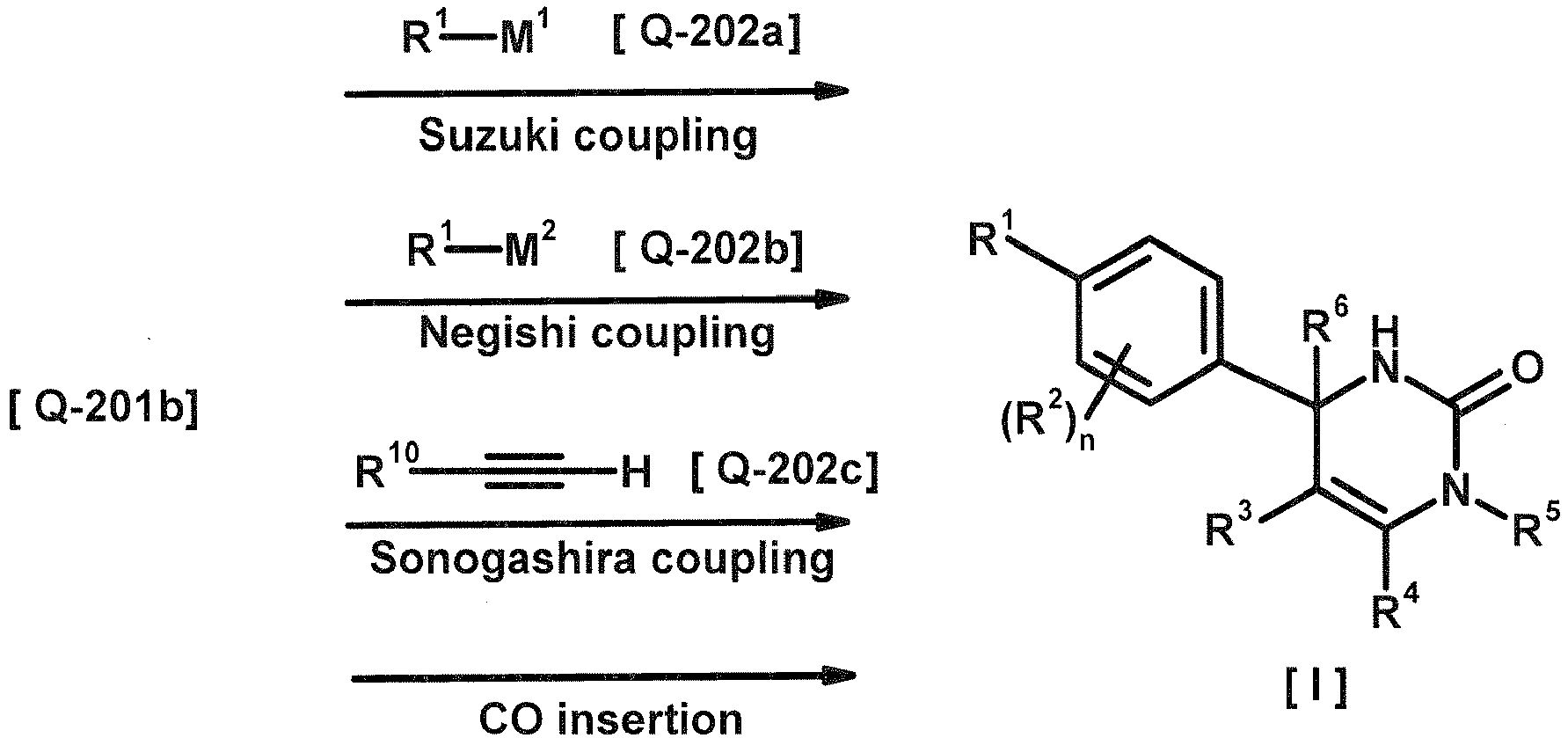
- For compounds of Formula [Q-202a], Formula [Q-202b], and Formula [Q-202c], a commercially available product (e.g. isobutylboronic acid, 1-hexylboronic acid pinacol ester, potassium (3,3-dimethylbutyl)trifluoroborate, butylzinc bromide, cyclohexylacetylene) may be used or they may be for example prepared from a commercially available R1-Xqq (e.g. 1-chloro-3,3-dimethyl-butane, bromomethyl-cyclohexane; Xqq is chloro, bromo or iodo) according to known methods.
- For example, a compound of Formula [Q-202a] may be prepared by the following method.
- A compound which M1 is boronic acid may be prepared by preparing Grignard reagent from a commercially available compound such as R1-Br and magnesium to react with trimethyl borate, triisopropyl borate, for example.
- A compound which M1 is boronic acid ester may be prepared by reacting a boronic acid compound with pinacol.
- A compound which M1 is trifluoroborate salt may be prepared by reacting a boronic acid compound with potassium hydrogen fluoride.
- For example, a compound of Formula [Q-202b] may be prepared from a commerically available compound such as R1-I and zinc.
- An activating agent of zinc includes iodine, trimethylsilyl chloride and 1.2-dibromoethane, and may be used alone or by mixture of two or more of them. A preferable activating agent is trimethylsilyl chloride or 1,2-dibromoethane.
- A solvent includes tetrahydrofuran, N,N-dimethylformamide, and N.N-dimethylacetamide. A preferable solvent is tetrahydrofuran or dimethylacetamide.
- A reaction temperature includes from room temperature to 80°C. A preferable reaction temperature is room temperature.
- For example, a commerically available product such as 3,3-dimethyl-1-butyne, cyclohexylacetylene, and phenylacetylene may be used for a compound of Formula [Q-202c].
- An alkynylene compound of Formula [I] obtained by Sonogashira reaction may be converted into an alkyl compound by a catalytic hydrogen addition reaction with a catalyst such as palladium on carbon, platinum on carbon, and rhodium-alumina.
- In the insertion reaction of carbon monoxide, a compound of Formula [Q-201b] may be reacted in an alcohol solvent such as ethanol to convert into an ester corresponding to the alcohol.
- In a compound of Formula [I], a compound which R3 or R5 has a hydroxyl group as a substituent, a compound which R3 has a carboxyl group as a substituent or a compound which R3 has a carboxyl group as a substituent may be prepared according to Preparation Method 2-1 Step 3.
- An example of Preparation Method 2-2 is as follows.

- A compound which R6 is hydrogen in a compound of Formula [I] may be prepared by Biginelli reaction.

- A compound of Formula [I] may be prepared by reacting a compound of Formula [Q-301], a compound of Formula [Q-302], and a compound of Formula [Q-303] in the presence of an acid.
- The acid includes hdyrochloric acid, acetic acid, trimethylchlorosilane, and p-toluenesulfonic acid. A preferable acid is trimethylchlorosilane.
- A solvent includes toluene, dichloromethane, chloroform, tetrahydrofuran, dioxane, N,N-dimethylformamide, dimethylsulfoxide, acetonitrile, and acetone, and may be used alone or by mixture of two or more of them. A preferable solvent in the reaction is a mixed solvent of acetonitrile and N,N-dimethylformamide.
- A reaction temperature includes from 0°C to 140°C. A preferable reaction temperature is from room temperature to 120°C.
- A compound of Formula [Q-301] may be prepared by Preparation Method 6 described below.
- A compound of Formula [Q-302] may be prepared by Preparation Method 7-2 described below.
- A compound of Formula [Q-303] may be prepared by Preparation Method 8-3 described below.
- A compound which R3 or R5 has a hydroxyl group as a substituent, a compound which R3 has a carboxyl group as a substituent or a compound which R5 has a carboxyl group as a substituent in a compound of Formula [I] may be prepared according to Preparation Method 2-1 Step 3.
- A compound of Formula [IV-D] wherein R4 is hydrogen in a compound of Formula [I]:


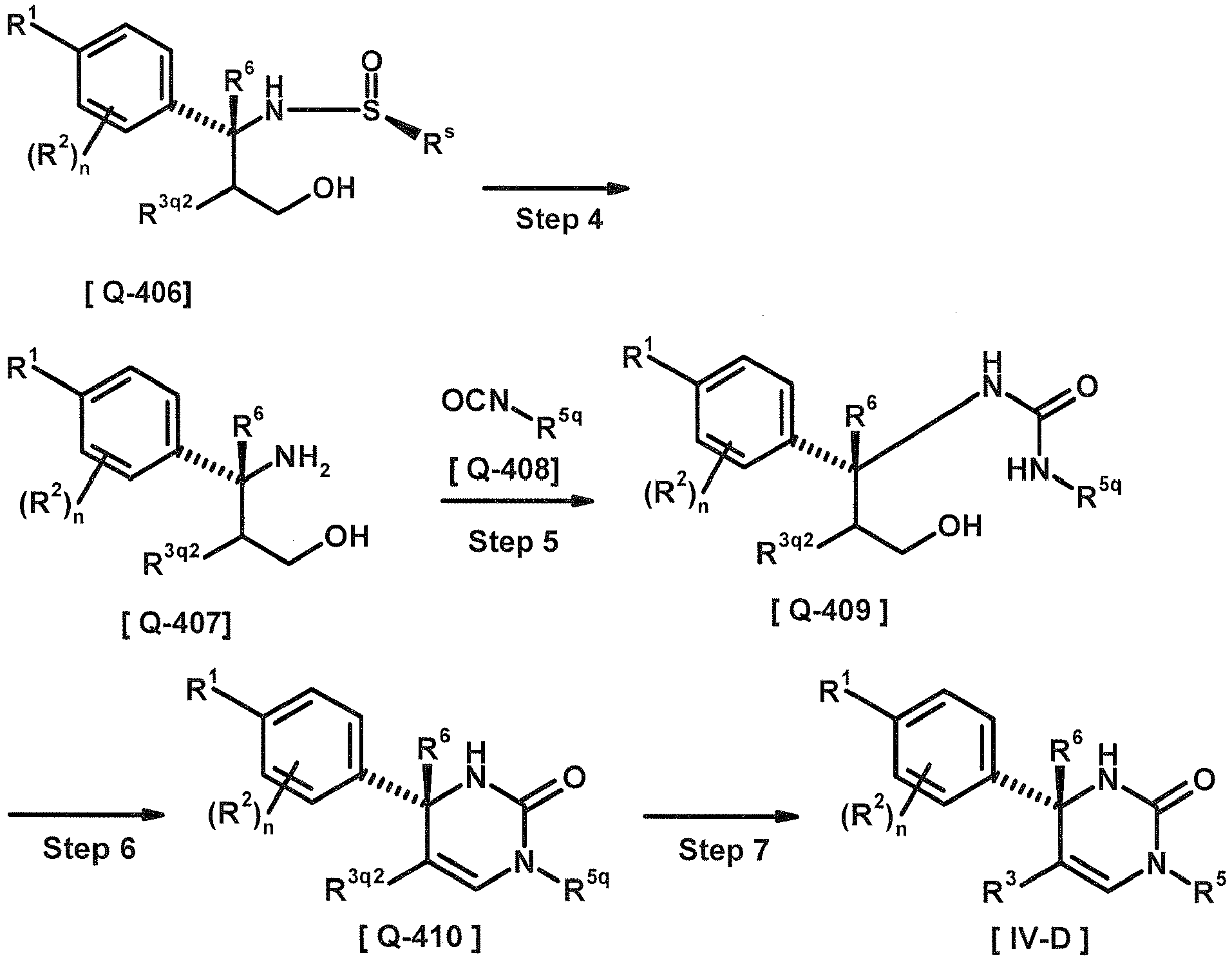
- A compound of Formula [Q-403] may be prepared by reacting a compound of Formula [Q-401a] and a compound of Formula [Q-402] in the presence of Lewis acid according to a method described in a reference (e.g. a method described in G. K. Datta; J. A. Ellman, J. Org. Chem. 2010, 75, 6283-6285).
- An illustrative example of a compound of Formula [Q-402] includes the following compound.

- Lewis acid includes Lewis acid such as tetraalkyl orthotitanate. A preferable Lewis acid is tetraethyl orthotitanate.
- A solvent includes benzene, toluene, dichloromethane, chloroform, tetrahydrofuran, dioxane, 1,2-dimethoxyethane, and cyclopentylmethyl ether. A preferable solvent is cyclopentylmethyl ether.
- A reaction temperature includes from room temperature to 120°C. A preferable reaction temperature is 110°C.
- A commercially available product may be used for a compound of Formula [Q-401a] or it may be prepared by known methods or Preparation Method 6.
- A compound of Formula [Q-405] may be prepared by reacting a compound of Formula [Q-403] and a compound of Formula [Q-404] in the presence of a base according to a method described in a reference (e.g. a method described in T. P. Tang; J. A. Ellman, J. Org. Chem. 2002, 67, 7819-7832).
- The base includes lithium diisopropylamide (LDA), lithium hexamethyldisilazide (LHMDS), and lithium 2,2,6,6-tetramethylpiperidide (LiTMP). A preferable base is lithium diisopropylamide (LDA) or lithium hexamethyldisilazide (LHMDS).
- A solvent includes benzene, toluene, xylene, hexane, tetrahydrofuran, dioxane, and 1,2-dimethoxyethane, and may be used alone or by mixture of two or more of them. A preferable solvent is tetrahydrofuran.
- A reaction temperature includes from -78°C to room temperature. A preferable reaction temperature is from -78°C to 0°C.
- To improve diastereoselectivity, an additive such as titanium (IV) chlorotriisopropoxy may be also added.
- An equivalent amount of the base includes from 1 to 3 equivalent(s). A preferable amount is 2.1 equivalents.
- A commercially available product may be used for a compound of Formula [Q-404] or it may be prepared by known methods or Preparation Method 6.
- A compound of Formula [Q-406] may be prepared by reacting a compound of Formula [Q-405] with a reducing agent.
- The reducing agent includes diisobutylaluminum hydride, lithium aluminum hydride, and lithium borohydride. A preferable reducing agent is diisobutylaluminum hydride.
- A solvent includes toluene, dichloromethane, diethyl ether, and tetrahydrofuran. A preferable solvent is toluene.
- A reaction temperature includes from -78°C to room temperature. A preferable reaction temperature is from -78°C to 0°C.
- A compound of Formula [Q-407] may be prepared by hydrolyze a compound of Formula [Q-406] under an acidic condition.
- The acid includes hdyrochloric acid, hydrobromic acid, sulfuric acid, trifluoroacetic acid, and p-toluenesulfonic acid. A preferable acid is hdyrochloric acid.
- A solvent includes tetrahydrofuran, methanol, ethanol, and isopropyl alcohol, and may be used alone or by mixture of two or more of them. A preferable solvent is methanol.
- A reaction temperature includes from 0°C to 60°C. A preferable reaction temperature is from 0°C to room temperature.
- A compound of Formula [Q-409] may be prepared from a compound of Formula [Q-407] and a compound of Formula [Q-408].
- A solvent includes benzene, toluene, dichloromethane, chloroform, diethyl ether, tetrahydrofuran, 1,2-dimethoxyethane, ethyl acetate, N,N-dimethylformamide, dimethyl sulfoxide, acetonitrile, and acetone, and may be used alone or by mixture of two or more of them. A preferable solvent is tetrahydrofuran.
- A reaction temperature includes from 0°C to 80°C. A preferable reaction temperature is from 0°C to room temperature.
- A compound of Formula [Q-410] may be prepared by an oxidation reaction of a compound of Formula [Q-409], followed by a cyclization reaction.
- The oxidizing agent includes 2-azaadamantane-N-oxyl (AZADO), 2,2,6,6-tetramethyl-1-piperidinyloxy radical (TEMPO), and Dess-Martin reagent (DMP). Diacetoxyiodobenzene or sodium hydrochlorite, for example, may be optionally added as a co-oxidizing agent. A preferable oxidizing agent in the reaction is a mixture of 2,2,6,6-tetramethyl-1-piperidinyloxy radical (TEMPO) and diacetoxyiodobenzene.
- The acid in the cyclization reaction includes hdyrochloric acid, trifluoroacetic acid, and p-toluenesulfonic acid. A preferable acid is trifluoroacetic acid.
- A solvent includes tert-butanol, benzene, toluene, dichloromethane, chloroform, ethyl acetate, and acetonitrile. A preferable solvent in the reaction is dichloromethane or chloroform.
- A reaction temperature includes from 0°C to 80°C. A preferable reaction temperature is from 0°C to room temperature.
- A compound which R3 or R5 has a hydroxyl group as a substituent, a compound which R3 has a carboxyl group as a substituent or a compound which R5 has a carboxyl group as a substituent in a compound of Formula [IV-D] may be prepared according to Preparation Method 1 Step 8.
- The following compound of Formula [E-IV-D] may be prepared using an enantiomer (i.e., a compound of Formula [E-Q-402]) of a compound of Formula [Q-402] according to Preparation Method 4.

- A compound of Formula [Q-501] may be prepared from a compound of Formula [Q-401b] and a compound of Formula [Q-402] according to Preparation Method 4. A compound of Formula [IV-D] may be prepared from a compound of Formula [Q-501] according to the following Preparation Method 5-1 or 5-2.
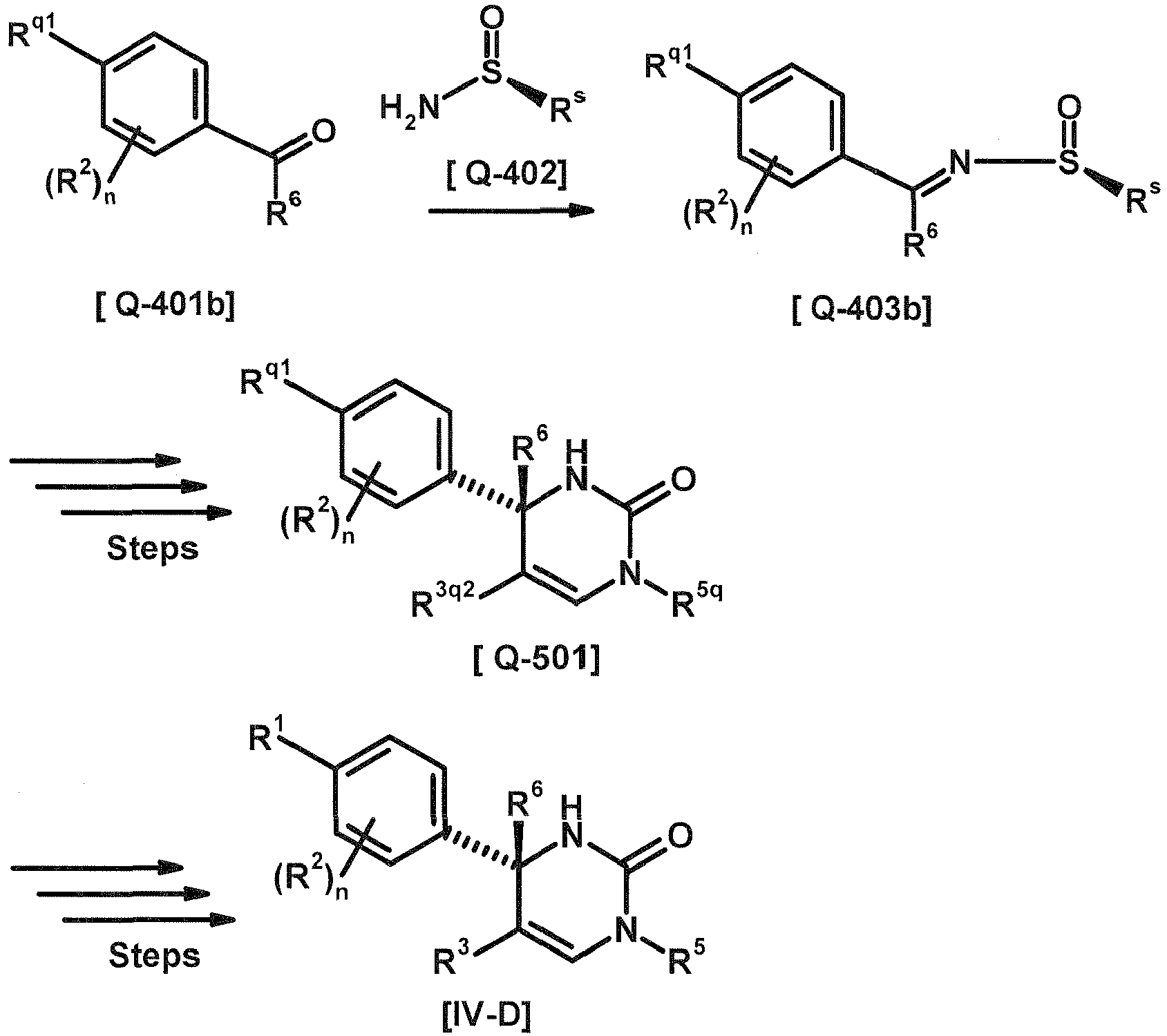
- When Rq1 is for example a hydroxyl group in a compound of Formula [Q-501]:
For example, a compound of Formula [Q-503] which R1 is C3-6 alkoxy, C2-7 alkoxy substituted with one trifluoromethyl or C1-3 alkoxy substituted with one substituent selected from Group Xa2 in Formula [IV-D] may be prepared by the following method.
- A compound of Formula [Q-501a] may be prepared from a compound which Rq1 is a benzyl ether group in a compound of Formula [Q-401 b] according to Preparation Method 4.
- A compound of Formula [Q-503] may be prepared from a compound of Formula [Q-501a] according to Preparation Method 2-1.
- When Rq1 is for example bromo, iodo or trifluoromethanesulfonyloxy group in a compound of Formula [Q-501]:
A compound which R1 is a substituent such as C4-8 alkyl and C1-4 alkyl substituted with one substituent selected from Group Xal in Formula [IV-D] (provided that R1 is not C3-6 alkoxy, C2-7 alkoxy substituted with one trifluoromethyl or C1-3 alkoxy substituted with one substituent selected from Group Xa2) may be prepared from a compound of the following Formula [Q-501b] by a cross coupling reaction or an insertion reaction of carbon monoxide.

- A compound of Formula [IV-D] may be prepared from a compound of Formula [Q-501b] according to Preparation Method 2-2.
- In particular, Preparation Method 5-2 (Suzuki coupling) is for example as follows. A compound of Formula [R1-M1] may be synthesized by a common procedure.

- When Rq1 is bromo in a compound of Formula [Q-501] (i.e., a compound of Formula [Q-504]):
A compound which R1 is C3-6 alkylsulfanyl, C3-6 alkylsulfinyl, C3-6 alkylsulfonyl, C3-6 cycloalkylsulfanyl, C3-6 cycloalkylsulfinyl or C3-6 cycloalkylsulfonyl in Formula [IV-D] may be prepared by the following method.
- R1s is C3-6 alkyl or C3-6 cycloalkyl,
- R1 is C3-6 alkylsulfanyl or C3-6 cycloalkylsulfanyl,
- R5q is - Yc-COORq50 wherein Yc is C1-6 alkylene optionally substituted with one hydroxy and
- Rq50 is hydrogen or C1-4 alkyl,
- R5 is -Yc-COOH,
- R6 is methyl, and the other symbols have the same meanings as defined above.
- A compound of Formula [Q-504] may be prepared from a compound of Formula [Q-401c] using Preparation Method 5.
- A compound of Formula [Q-506] may be prepared by a coupling reaction of a compound of Formula [Q-504] and a compound of Formula [Q-505] according to a method described in a literature such as a method described in Org. Lett. 2004, 6, 4587-4590, for example.
- A compound of Formula [IV-D] may be prepared from a compound of Formula [Q-506] according to Preparation Method 1 Step 8.
- For example, an illustrative example of Preparation Method 5-3 includes the following reactions:

-

- R1s is C3-6 alkyl or C3-6 cycloalkyl.
- R1 is C3-6 alkylsulfinyl or C3-6 cycloalkylsulfinyl,
- R5q is -Yc-COORq50 wherein Yc is C1-6 alkylene optionally substituted with one hydroxy and
- Rq50 is hydrogen or C1-4 alkyl,
- R5 is -Yc-COOH,
- R6 is methyl, and the other symbols have the same meanings as defined above.
- A compound of Formula [Q-507] may be prepared by an oxidation reaction of sulfide of a compound of Formula [Q-506].
- An oxidizing agent includes hydrogen peroxide, peracetic acid, hydroperoxide, permanganate, meta-chloroperbenzoic acid, and sodium hypochlorite. A preferable oxidizing agent is meta-chloroperbenzoic acid.
- A solvent includes benzene, dichloromethane, acetonitrile, and water, and may be used alone or by mixture of two or more of them. A preferable solvent is dichloromethane.
- A reaction temperature includes from -78°C to room temperature. A preferable reaction temperature is -78°C.
- A compound of Formula [IV-D] may be prepared from a compound of Formula [Q-507] according to Preparation Method 1 Step 8.
-

- R1s is C3-6 alkyl or C3-6 cycloalkyl,
- R1 is C3-6 alkylsulfonyl or C3-6 cycloalkylsulfonyl,
- R5q is - Yc-COORq50 wherein Yc is C1-6 alkylene optionally substituted with one hydroxy and
- Rq50 is hydrogen or C1-4 alkyl,
- R5 is -Yc-COOH,
- R6 is methyl, and the other symbols have the same meanings as defined above.
- A compound of Formula [Q-508] may be prepared by an oxidation reaction of sulfide of a compound of Formula [Q-506].
- An oxidizing agent includes oxone, meta-chloroperbenzoic acid, and potassium permanganate. A preferable oxidizing agent is meta-chloroperbenzoic acid.
- A solvent includes benzene, dichloromethane, acetonitrile, and water, and may be used alone or by mixture of two or more of them. A preferable solvent is dichloromethane.
- A reaction temperature includes from -78°C to room temperature. A preferable reaction temperature is room temperature.
- A compound of Formula [IV-D] may be prepared from a compound of Formula [Q-508] according to Preparation Method 1 Step 8.
- Preparation Method of dihydropyrimidin-2-one compounds using optically active sulfinylamide (4) (i.e., An alternative method for preparing a compound of Formula [IV-D] using p-nitrophenyl chloroformate)
- A compound of Formula [Q-520] may be prepared from a compound of Formula [Q-401a] according to Preparation Method 4. A compound of Formula [IV-D] may be prepared from a compound of Formula [Q-520] using cross-coupling reaction.


- The reaction is carried out in a similar way to Preparation Method 4 Step 1.
- A compound of Formula [Q-511] may be prepared by reacting a compound of Formula [Q-403] with a compound of Formula [Q-510] under a basic condition.
- A base includes lithium diisopropylamide (LDA), lithium hexamethyldisilazide (LHMDS), and lithium 2,2,6,6-tetramethylpiperidide (LiTMP). A preferable base is lithium diisopropylamide (LDA) or lithium hexamethyldisilazide (LHMDS).
- A solvent includes benzene, toluene, xylene, hexane, tetrahydrofuran, dioxane, and 1,2-dimethoxyethane, and may be used alone or by mixture of two or more of them. A preferable solvent is tetrahydrofuran.
- A reaction temperature includes from -78°C to room temperature. A preferable reaction temperature is from -78°C to 0°C.
- To improve a diastereoselectivity, an additive such as chlorotriisopropoxy titanium (IV) may be further added.
- An equivalent amount of a base includes from 1 to 3 equivalent amount(s). A preferable equivalent amount is 2.1 equivalent amounts.
- As a compound of Formula [Q-510], a commercially available product such as 3-hydroxy-propionic acid methyl ester, 3-hydroxy-propionic acid ethyl ester, and 3-hydroxy-propionic acid t-butyl ester may be used.
- A compound of Formula [Q-512] may be prepared by hydrolyzing a compound of Formula [Q-511] under an acidic condition.
- An acid includes hydrochloric acid, hydrobromic acid, sulfuric acid, trifluoroacetic acid, and p-toluenesulfonic acid. A preferable acid is hydrochloric acid.
- A solvent includes tetrahydrofuran, methanol, ethanol, and isopropyl alcohol, and may be used alone or by mixture of two or more of them. A preferable solvent is methanol.
- A reaction temperature includes from 0°C to 60°C. A preferable reaction temperature is from 0°C to room temperature.
- A compound of Formula [Q-513] may be prepared by protecting a compound of Formula [Q-512] with tert-butyldiphenylsilyl (TBDPS) according to a method described in a literature (e.g. a method described in Peter G. M. Wuts (2007). Green's Protective Groups in Organic Synthesis Fourth Edition, Weinheim, Germany, Wiley-VCH, 141-144).
- A compound of Formula [Q-514] may be prepared by reacting a compound of Formula [Q-513] with p-nitrophenyl chloroformate under a basic condition.
- A base includes triethylamine, diisopropylethylamine, pyridine, N-methylmorpholine, and potassium carbonate. A preferable base is triethylamine.
- A solvent includes chloroform, dichloromethane, toluene, tetrahydrofuran, and acetonitrile. A preferable solvent is chloroform.
- A reaction temperature includes from 0°C to 85°C. A preferable reaction temperature is 0°C.
- A compound of Formula [Q-516] may be prepared by reacting a compound of Formula [Q-514] with a compound of Formula [Q-515] under a basic condition.
- A base includes triethylamine and diisopropylethylamine. A preferable base is triethylamine.
- A solvent includes chloroform, dichloromethane, and tetrahydrofuran. A preferable solvent is chloroform.
- A reaction temperature includes from room temperature to 60°C. A preferable reaction temperature is 60°C.
- A compound of Formula [Q-517] may be prepared by deprotecting tert-butyldiphenylsilyl (TBDPS) of a compound of Formula [Q-516] according to a method described in a literature (e.g. a method described in Peter G. M. Wuts (2007). Green's Protective Groups in Organic Synthesis Fourth Edition, Weinheim, Germany, Wiley-VCH, 142-143).
- A compound of Formula [Q-518] may be prepared from a compound of Formula [Q-517] according to Preparation Method 4 Step 6.
- A compound of Formula [Q-519] may be prepared by deprotecting tert-butyl ester from a compound of Formula [Q-518] wherein P1 is for example tert-butyl according to a method described in a literature (e.g. a method described in Peter G. M. Wuts. Protective Groups in Organic Synthesis Third Edition, Wiley-Interscience, 406-407).
- A compound of Formula [Q-520] may be prepared by brominating a compound of Formula [Q-519] according to a method described in a literature (e.g. a method described in A. J. Zych; H. Wang; S. A. Sakwa, Tetrahedron Lett. 2010, 51, 5103-5105).
- A compound of Formula [Q-522] may be prepared from a compound of Formula [Q-520] and a compound of Formula [Q-521] according to Preparation Method 2-2 (including cross-coupling).
- A compound of Formula [IV-D] may be prepared for example by hydrolyzing a compound of Formula [Q-522].
- In Preparation Method 5-4. Step 11 (coupling reaction) and Step 12 (hydrolysis reaction) are illustrated as follows.

- A compound of Formula [Q-536] may be prepared from a compound of Formula [Q-401a] using Preparation Methods 4 and 5-4. A compound of Formula [IV-D] may be prepared from a compound of Formula [Q-536] by a cyclization reaction under a basic condition, a reduction reaction using Schwartz's reagent, an oxidation reaction using Dess-Martin reagent into an aldehyde compound, followed by Pinnic Oxidation into a carboxylic acid compound.


- Protective groups in the formula may be optionally changed. For example, TBDMS (tert-butyldimethylsilyl) may be replaced with TBDPS (tert-butyldiphenylsilyl), and MOM (methoxymethyl) may be replaced with methyl.
- A compound of Formula [Q-403] may be prepared from a compound of Formula [Q-401a] according to Preparation Method 4 Step 1.
- A compound of Formula [Q-531] may be prepared from a compound of Formula [Q-403] and a compound of Formula [Q-530] according to Preparation Method 4 Step 2. A compound of Formula [Q-530] may be commercially available or synthesized by a method described in a literature (e.g. a method described in
WO 2009/019174 ). - A compound of Formula [Q-403] may be prepared from a compound of Formula [Q-401a] according to Preparation Method 4 Step 4.
- A compound of Formula [Q-533] may be prepared by protecting a compound of Formula [Q-532] with tert-butyldimethylsilyl (TBDMS) according to a method described in a literature (e.g. a method described in Peter G. M. Wuts. Protective Groups in Organic Synthesis Third Edition, Wiley-Interscience, 127-131).
- A compound of Formula [Q-534] may be prepared from a compound of Formula [Q-533] according to Preparation Method 5 Step 5.
- A compound of Formula [Q-536] may be prepared from a compound of Formula [Q-534] and a compound of Formula [Q-535] according to Preparation Method 5 Step 6.
- A compound of Formula [Q-537] may be prepared by cyclizing a compound of Formula [Q-536] according to a method described in a literature (e.g. a method described in R. Patino-Molina; I. Cubero-Lajo; M. J. P. Vega; M. T. Garcia-Lopez, Tetrahedron Lett. 2007, 48, 3615-3616).
- A compound of Formula [Q-538] may be prepared by reducing a compound of Formula [Q-537] with Schwartz's reagent according to a method described in for example S. R. Dandepally; R. Elgoummadi; A. L. Williams, Tetrahedron Lett. 2013, 54, 925-928.
- A compound of Formula [Q-539] may be prepared by oxidizing a compound of Formula [Q-538] with Dess-Martin reagent (e.g. a method described in E. Vedejs; D. W. Piotrowski; F. C. Tucci, J. Org. Chem. 2000, 65, 5498-5505).
- A compound of Formula [IV-D] may be prepared from a compound of Formula [Q-539] by Pinnick oxidation (e.g. a method described in G. A. Kraus; B. Roth, J. Org. Chem. 1980, 45, 4825-4830).
- Preparation Method 5-5 is illustrated in the following reactions when chemical name: (3-methoxymethoxymethyl-cyclobutyl)-acetic acid methyl ester is used as a compound of Formula [Q-530] and chemical name: 3,3-difluoro-cyclobutylamine is used as a compound of Formula [Q-535].

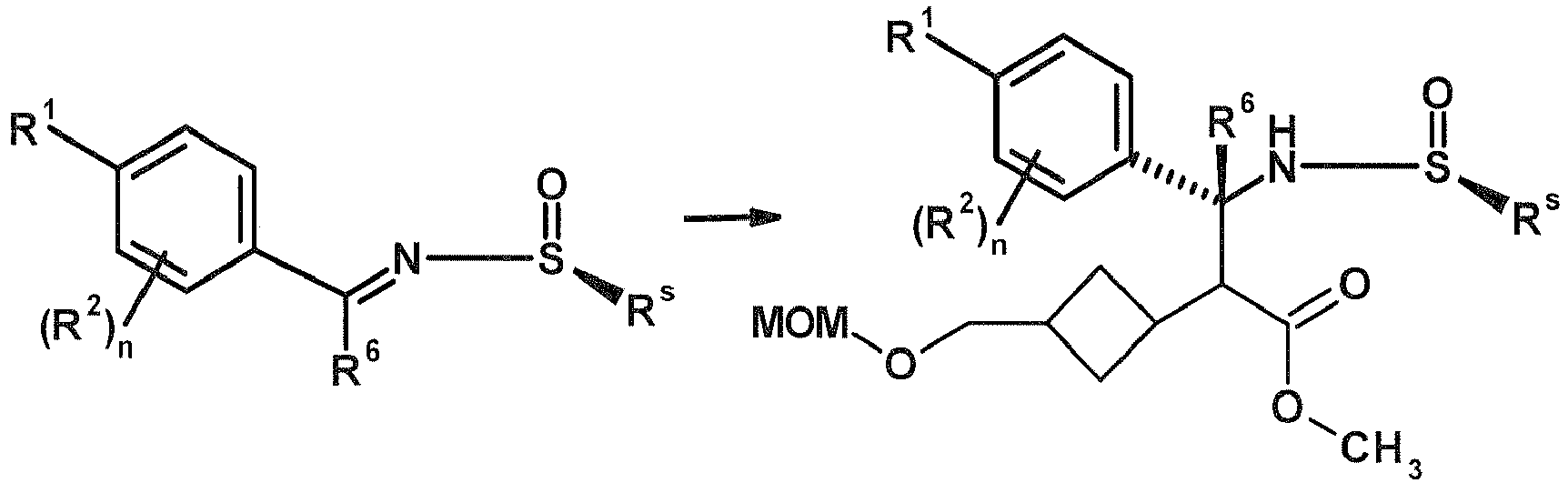

- A compound of Formula [Q-101b], Formula [Q-301a] or [Q-401b] which is a starting material of Preparation Method 2 or 5 is represented by the following general formula:

- For example, it may be prepared by the following method.

- A compound of Formula [Q-602] may be prepared by a condensation reaction of a compound of Formula [Q-601] with N,O-dimethylhydroxylamine or N,O-dimethylhydroxylamine hydrochloride.
- The condensation agent includes aqueous carbodiimide (WSC•HCl: 1-ethyl-3-(3-dimethylaminopropyl)carbodiimide hydrochloride), N,N'-dicyclohexylcarbodiimide (DCC), diphenylphosphoryl azide (DPPA), and carbonyldiimidazole (CDI). For example, 1-hydroxy-1H-benzotriazole monohydrate (HOBt•H2O) or 4-dimethylaminopyridine (DMAP) may be optionally added. A preferable condensation agent in the step is a mixture of aqueous carbodiimide (WSC•HCl: 1-ethyl-3-(3-dimethylaminopropyl)carbodiimide hydrochloride) and 1-hydroxy-1H-benzotriazole monohydrate (HOBt•H2O).
- A solvent includes toluene, dichloromethane, chloroform, tetrahydrofuran, dioxane, N,N-dimethylformamide, dimethylsulfoxide, acetonitrile, and acetone, and may be used alone or by mixture of two or more of them. A preferable solvent in the reaction is N,N-dimethylformamide or acetonitrile.
- A compound of Formula [Q-101b] or Formula [Q-401b] may be prepared by reacting a compound of Formula [Q-602] with Grignard reagent such as MeMgX and EtMgX (wherein X is chloro or bromo).
- A solvent includes an ether solvent such as diethyl ether, tetrahydrofuran (THF), and 1,2-dimethoxyethane (DME). A preferable solvent is THF.
- A compound of Formula [Q-301a] may be prepared by reacting a compound of Formula [Q-602] with a reducing agent such as diisobutylaluminum hydride (DIBAL-H).
- For example, a compound which U1 is formyl or ketone may be also prepared from a commercially available compound such as 2,2-dimethyl-indane-5-carboxylic acid in place of a compound of Formula [Q-601] by the above Steps 1 and 2.

- A compound of Formula [Q-101a], a starting material of Preparation Method 1, a compound of Formula [Q-301], a starting material of Preparation Method 3, and a compound of Formula [Q-401a], a starting material of Preparation Method 4, are represented by the following general formula:

- The above compound may be for example prepared according to the following method.

- For example, a compound of Formula [Q-101a], Formula [Q-301] or Formula [Q-401a] wherein R1 is C3-6 alkoxy, C2-7 alkoxy substituted with one trifluoromethyl or C1-3 alkoxy substituted with one substituent selected from Group Xa2 may be prepared from a compound of Formula [Q-101b1] or Formula [Q-401b1] via a compound of Formula [Q-603].
- Each Step may be carried out according to Preparation Method 2-1 Step 1 (a deprotection reaction of benzyl group) and Step 2 (a reaction with a compound of Formula [Q-203]).
- For example, a compound of Formula [Q-101a], Formula [Q-301] or Formula [Q-401a] wherein R1 is C4-8 alkyl or C1-4 alkyl substituted with one substituent selected from Group Xa1 but R1 is not C3-6 alkoxy, C2-7 alkoxy substitututed with one trifluoromethyl or C1-3 alkoxy substituted with one substituent selected from Group Xa2 may be prepared from a compound of Formula [Q-101b2] or Formula [Q-401b2].
- In the step, a cross-coupling reaction using palladium (including Suzuki reaction) may be carried out according to Preparation Method 2-2.
-

- A compound of Formula [Q-102b] may be prepared from 2-(3-chloro-4-trifluoromethanesulfonyloxy-phenyl)-propionic-acid-methyl-ester prepared from known 2-(3-chloro-4-hydroxy-phenyl)-propionic-acid-methyl-ester or a compound of the following Formula [Q-101b2] according to Preparation Method 1 Step 1.
- A compound of Formula [Q-102] may be prepared from a compound of Formula [Q-102b] according to Preparation Method 2-2.
- A compound of Formula [Q-101a], [Q-301] or [Q-401a] which is a starting material of Preparation Method 1, 3 or 4:

may be prepared by the following method, for example.
- As a compound of Formula [Q-604], a commercially available compound such as (4-bromo-3-chloro-phenyl)-methanol, (4-bromo-3,5-dimethyl-phenyl)-methanol, and (4-bromo-2-methoxy-phenyl)-methanol may be used. A compound of Formula [Q-605] may be prepared by reacting a compound of Formula [Q-604] with a commercially available compound such as R11-Br in the presence of a base such as sodium hydride.
- A solvent includes N,N-dimethylformamide.
- A compound of Formula [Q-605] wherein R11 is tert-butyl may be prepared by reacting a compound of Formula [Q-604] with di-tert-butyl dicarbonate in the presence of magnesium perchlorate (e.g. a method described in Org. Lett., 2005, 7, 427-430).
- A compound of Formula [Q-606] may be prepared from a compound of Formula [Q-605] according to an insertion reaction of carbon monoxide in Preparation Method 2-2.
- A solvent includes a mixed solvent of toluene and water.
- The corresponding formyl, acetyl or ethylcarbonyl compound of Formula [Q-101a], [Q-301] or [Q-401a] may be prepared from a compound of Formula [Q-606] according to Preparation Method 6-1.
- A compound of Formula [Q-101a], [Q-301] or [Q-401a] which is a starting material of Preparation Method 1, 3 or 4:

may be also prepared by a formation reaction of carbon-carbon bond of a compound of the following Formula [Q-607] and the compound having ketone or formyl. - As a compound of Formula [Q-607], a commercially available product such as 4-bromo-2-chloro-1-iodobenzene, 5-bromo-1,3-difluoro-2-iodobenzene, 4-bromo-2-ethyliodobenzene, and 5-bromo-2-iodo-m-xylene may be used. Alternatively, 2-benzyloxy-4-bromo-1-iodo-benzene which a commercially available 5-bromo-2-iodophenol is benzylated by a known method is also illustrated.
- The compound having ketone or formyl includes the compound having ketone such as spiro-C6-11 cycloalkanone and C4-6 cycloalkanone or the compound having formyl such as C4-8 alkylaldehyde.
- For example, when spiro-C6-11 cycloalkanone as the compound having ketone or formyl is spiro[3.3]heptan-2-one, a compound of Formula [Q-607] may be reacted as follows to prepare a compound of the following Formula [Q-612].


- A compound of Formula [Q-609] may be prepared by a halogen-metal exchange reaction of a compound of Formula [Q-607] with isopropylmagnesium chloride and the like, followed by an addition reaction with a compound of Formula [Q-608].
- A solvent includes THF and DME. A reaction temperature includes from -45°C to room temperature.
- A compound of Formula [Q-610] may be prepared by a mesylation reaction of a compound of Formula [Q-609] in the presence of a base.
- A mesylating agent includes methanesulfonyl chloride.
- A base includes triethylamine and diisopropylethylamine. A preferable base is triethylamine. A catalytic amount of trimethylamine hydrochloride and the like may be added if needed.
- A solvent includes benzene, toluene, dichloromethane, chloroform, tetrahydrofuran, acetonitrile, and acetone. A preferable solvent is toluene.
- A reaction temperature includes from 0°C to 60°C. A preferable reaction temperature is from 0°C to room temperature.
- A compound of Formula [Q-611] may be prepared by a catalytic hydrogenation of a compound of Formula [Q-610] in the presence of a catalyst.
- A catalyst includes palladium carbon, platinum carbon, rhodium carbon, and rhodium-alumina. A preferable catalyst is rhodium carbon.
- A solvent includes methanol, ethanol. isopropanol, tetrahydrofuran, 1,2-dimethoxyethane, and ethyl acetate, and may be used alone or by mixture of two or more of them. A preferable solvent is a mixed solvent of methanol and tetrahydrofuran.
- A compound of Formula [Q-611] may be also prepared by reducing a compound of Formula [Q-609] in the presence of Lewis acid.
- Lewis acid includes boron trifluoride diethyl ether.
- A reducing agent includes triethylsilane.
- A solvent includes dichloromethane and tetrahydrofuran. A preferable solvent is dichloromethane.
- A reaction temperature includes from -78°C to room temperature. A preferable reaction temperature is from -78°C to room temperature.
- A compound of Formula [Q-612] may be prepared from a compound of Formula [Q-611] accroding to an insertion reaction of carbon monoxide in Preparation Method 6-3.
- The corresponding formyl, acetyl or ethylcarbonyl compound of Formula [Q-101a], [Q-301] or [Q-401a] may be prepared from a compound of Formula [Q-612] according to Preparation Method 6-1.
- The following compound may be prepared with a ketone compound of "C3-6 cycloalkyl substituted with the same or different one to two C1-5 alkyl", e.g. 3-isopropyl-cyclobutanone, as described above.

- A compound of Formula [Q-102], an intermediate of Preparation Method 1, e.g. a compound of Formula [Q-617] wherein R2 is chloro and R6 is methyl and the like, may be prepared by the following method.

- A compound of Formula [Q-614] may be prepared by esterifying a compound of Formula [Q-613]. For example, when thionyl chloride and methanol are used, methyl ester may be obtained. As a compound of Formula [Q-613], a commercially available product such as 2-(4-hydroxy-phenyl)-propionic acid may be used.
- A compound of Formula [Q-615] may be prepared by chlorination of a compound of Formula [Q-614] with N-chlorosuccinimide (NCS) and the like.
- A solvent includes acetonitrile and N,N-dimethylformamide. A preferable solvent is N,N-dimethylformamide.
- A compound of Formula [Q-616] may be prepared by reacting a compound of Formula [Q-615] with trifluoromethanesulfonic anhydride in the presence of a base.
- A base includes triethylamine and pyridine. A preferable base is pyridine.
- A solvent includes toluene, dichloromethane, chloroform, and tetrahydrofuran. A preferable solvent is dichloromethane.
- A reaction temperature includes from 0°C to room temperature. A preferable reaction temperature is 0°C.
- A compound of Formula [Q-617] may be prepared from a compound of Formula [Q-616] by a cross-coupling reaction (e.g. Suzuki reaction and Sonogashira reaction) as described in Preparation Method 2-2.
- When Sonogashira reaction is carried out, the resulted alkynylene compound may be converted into an alkylene compound by a catalytic hydrogenation with a catalyst such as palladium carbon, platinum carbon, and rhodium-alumina.
- A compound of Formula [I] wherein R2 is chloro and R6 is methyl and the like (i.e., a compound of Formula [I-Ca]) may be prepared with a compound of Formula [Q-617] by the reactions described in Preparation Method 1.
- As a compound of Formula [Q-104]:
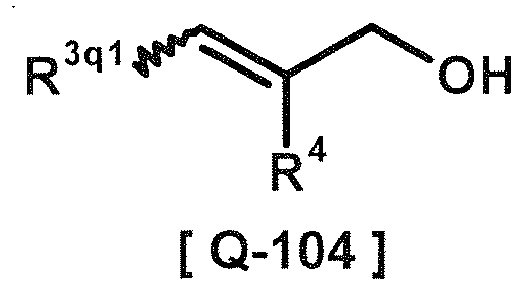
a commercially available compound such as 4-methyl-2-pentan-1-ol, 4-methyl-2-hexen-1-ol, 4,4-dimethyl-2-penten-1-ol, and 2,4-dimethyl-2-penten-1-ol may be used, which may be alternatively prepared by the following method.
- A compound of Formula [Q-702] may be prepared from a compound of Formula [Q-701] and alkylphosphonic diester such as triethyl phosphonoacetate under Horner-Wadsworth-Emmons Reaction.
- A compound of Formula [Q-104] may be prepared from a compound of Formula [Q-702] by DIBAL reduction according to Preparation Method 6-1 Step 2.
- As a compound of Formula [Q-701], a commercially available aldehyde such as 2-methylpropylaldehyde, isovaleraldehyde, 3,3-dimethylbutylaldehyde, and 4-methylpentylaldehyde may be used, which may be alternatively prepared by a known method.
- For example, a compound of Formula [Q-701a] may be prepared from a compound of Formula [Q-703].

- A compound of Formula [Q-704] may be prepared by protecting a hydroxyl group of a compound of Formula [Q-703] (e.g. a commerically available compound such as 2,2-dimethyl-3-hydroxypropanoic acid methyl ester, 4-hydroxy-2,2-dimethyl-butanoic acid methyl ester, and 5-hydroxy-2,2-dimethyl-pentanoic acid methyl ester) with trimethylsilyl (TMS). tertbutyldimethylsilyl (TBS) and the like according to a method described in a literature (e.g. a method described in Peter G. M. Wuts (2007). Green's Protective Groups in Organic Synthesis Fourth Edition, Weinheim, Germany, Wiley-VCH, 165-215).
- A compound of Formula [Q-705] may be prepared from a compound of Formula [Q-704] under DIBAL reduction according to Preparation Method 6-1 Step 2.
- A compound of Formula [Q-701a] may be for example prepared by Parikh-Doering oxidation reaction of a compound of Formula [Q-705] with SO3•Py.
-

- A compound of Formula [Q-701b] may be also prepared from C3-6 cycloalkanone optionally substituted with the same or different one to three substituent(s) selected from Group Xb and Wittig reagent according to a method described in a literature (e.g. a method described in Bioorg. Med. Chem. Lett. 2004, 14(20), 5199-5203). For example, when R3q1 is cyclohexyl, the following is illustrated.

- As a compound of Formula [Q-302]:

a commerically available aldehyde or ketone such as 3,3-dimethyl-butylaldehyde, 4-methylpentanal, cyclohexyl-acetaldehyde, and 2-butanone may be used, which may be alternatively prepared by a known method. For example, a compound of Formula [Q-302] wherein R4 is H (i.e., an aldehyde compound) may be prepared from a compound of Formula [Q-701] under a carburation reaction according to a method described in a literature (e.g. a method described in Bioorg. Med. Chem. Lett. 2004, 14 (20), 5199-5203). For example, a compound of Formula [Q-302] wherein R4 is methyl (i.e., a ketone compound) may be prepared from a compound of Formula [Q-701] under a carburation reaction according to a method described in a literature (e.g. a method described in Tetrahedron Lett. 2009, 50, 1276-1278). - As a compound of Formula [Q-404]:

a commerically available ester such as 3-methyl-butanoic acid methyl ester, 4-methylvaleric acid methyl ester (i.e., 4-Methyl-pentanoic acid methyl ester), and 5-methylhexanoic acid methyl ester may be used, which may be alternatively prepared by a known method. - A methyl ester of a compound of Formula [Q-404] may be replaced with an ethyl ester.

- The ester compound may be, for example, prepared from a compound where a hydroxyl group of C3-6 cycloalkanone optionally substituted with the same or different one to three substituent(s) selected from Group Xb or a commerically available product such as 1-hydroxypropan-2-one, 1-hydroxybutan-2-one, and 1-hydroxypentan-2-one is protected with TBDPS, benzyl and the like under Horner-Wadsworth-Emmons Reaction and the like using alkylphosphonic diester.
- For example, a compound of Formula [Q-404a] may be synthesized by the following preparation method.

- A compound of Formula [Q-707] may be prepared from a compound of Formula [Q-706] by a protecting reaction of alcohol according to Preparation Method 7-1.
- A compound of Formula [Q-708] may be prepared from a compound of Formula [Q-707] under Horner-Wadsworth-Emmons Reaction according to Preparation Method 7-1 Step 1.
- A compound of Formula [Q-404a] may be prepared from a compound of Formula [Q-708] by 1,4-addition reaction with methyllithium in the presence of a copper catalyst (e.g. a method described in J. Am. Chem. Soc. 2009, 131(44), 16016-16017).
- As a compound of Formula [Q-408]:

a commercially available product such as 6-isocyanate-hexanoic acid ethyl ester, 2-isocyanate-2-methyl-propionic acid methyl ester, 3-isocyanate-propionic acid methyl ester, 4-isocyanate-cyclohexanecarboxylic acid methyl ester, and 4-isocyanatebenzoic acid ethyl ester may be used, which may be alternatively prepared by a known method. - For example, a compound of Formula [Q-408] may be prepared by the following method.

- A compound of Formula [Q-408] may be prepared from a compound of Formula [Q-801] (e.g. a commerically available product such as 3-(methoxycarbonyl)bicyclo[1.1.1]pentane-1-carboxylic acid, 1-(2-methoxy-2-oxoethyl)-5-oxopyrrolidine-3-carboxylic acid, and 3-[1-(ethoxycarbonyl)cyclopropyl]propanoic acid) by an azidation reaction, followed by Curtius rearrangement reaction according to Preparation Method 1 Step 5.
- As a compound of Formula [Q-108]:

a commercially available product such as methyl 3-aminopropanoate, methyl 3-aminocyclopentanecarboxylate, tert-butyl 2-(2-aminoethoxy)acetate, ethyl 4-aminobenzoate, and methyl 3-aminobicyclo[1.1.1]pentane-1-carboxylate hydrochloride may be used, which may be alternatively prepared by a known method. - For example, a compound of Formula [Q-108] may be prepared by reacting a compound of Formula [Q-408] with benzyl alcohol or t-BuOH to protect an amino group with tert-butoxycarbonyl group (Boc group) or benzyloxycarbonyl group (Cbz group), followed by deprotection of the Boc group or Cbz group according to a known method (e.g. a method described in Peter G. M. Wuts (2007). Green's Protective Groups in Organic Synthesis Fourth Edition, Weinheim, Germany, Wiley-VCH. 725-735, 748-756).

- As a compound of Formula [Q-303]:

a commerically available urea compound such as ureido-acetic acid ethyl ester, 2,2-dimethyl-3-ureido-propionic acid ethyl ester, 3-ureido-cyclohexanecarboxylic acid ethyl ester, and 4-ureido-benzoic acid ethyl ester may be used, which may be alternativley prepared by a known method. - For example, a compound of Formula [Q-303] may be prapred by the following method.

- A compound of Formula [Q-303] may be prepared from a compound of Formula [Q-108] and trimethylsilyl isocyanate.
- A base includes triethylamine, diisopropylethylamine, and dimethylaminopyridine (DMAP), and may be used alone or by mixture of two or more of them. A preferable base is a mixture of triethylamine and dimethylaminopyridine.
- A solvent includes benzene, toluene, tetrahydrofuran, dichloromethane. chloroform, ethyl acetate, and acetonitrile. A preferable solvent is tetrahydrofuran.
- A reaction temperature includes from under ice cooling to 120°C. A preferable reaction temperature is 80°C.
- A racemate of Formula [I] obtained in Preparation Method 1, 2 or 3 or a racemate of Formula [Q-110] or Formula [Q-201], an intermediate of a compound of Formula [I], may be separated into a desirable enantiomer by liquid chromatography using a chiral stationary phase.

- For example, a racemate [Q-901] which "R6 is methyl" and "R5 is -Yc-COO-C2H5" in the following formula may be separated and isolated into a compound of Formula [Q-902] and a compound of Formula [Q-E-902] by liquid chromatography using a chiral stationary phase, followed by hydrolysis of each isolated enantiomer to give a desirable compound.

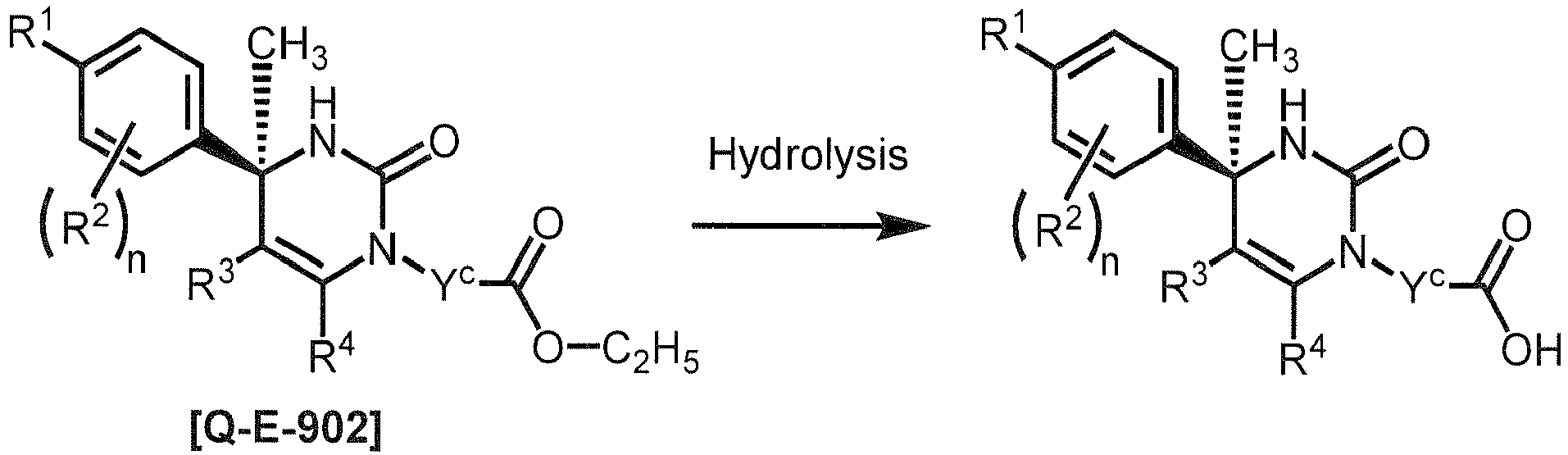
- A separation condition is for example any of the followings. A mobile phase may be optionally adjusted depending on polarities of compounds and a mixing ratio of each solvent may be modified.
- Separation condition A:
- Separation instrument; Recycling preparative chromatograph LC-9225 NEXT SERIES Japan Analytical Industry Co., Ltd.
- Column; DAICEL CHIRALPAK IA 2.0 cmϕ × 25 cm
- Mobile phase; hexane:2-propanol=90:10
- Flow rate; 10.0 mL/min
- Detection; UV (254nm)
- Separation condition B:
- Separation instrument; Recycling preparative chromatograph LC-9225 NEXT SERIES Japan Analytical Industry Co., Ltd.
- Column; Japan Analytical Industry Co., Ltd. JAIGEL-ODS-AP, SP-120-10, 2.0 cmϕ × 25 cm Mobile phase; acetonitrile:H2O:formic acid = 90:10:0.1
- Flow rate; 10.0 mL/min
- Detection; UV (220 nm)
- The following abbreviations may be for example used herein:
- DMF: dimethylformamide
- TBAF: tetrabutylammonium fluoride
- NMP: N-methylpyrrolidone
- Grubbs Cat. 2nd: (1,3-bis(2,4,6-trimethylphenyl)-2-imidazolidinylidene)dichloro-(phenylmethylene)(tricyclohexylphosphine)ruthenium
- PdCl2(dppf): dichloro[1,1'-bis(diphenylphosphino)ferrocene]palladium
- In particular, a method for preparing a compound of Formula [I] or a pharmaceutically acceptable salt thereof is illustrated by Examples. A method for preparation of a compound of Formula [I] or a pharmaceutically acceptable salt thereof is however not limited to the method for preparation.
- For example, to "purify through silica gel column chromatography (ethyl acetate:hexane = 1:50 -> 1:5)" means a procedure for elution with a mixed solution with a mixed ratio of 1:50 (ethyl acetate:hexane), followed by elution with a mixed solution with a mixed ratio of 1:5 (ethyl acetate:hexane) in a purification through silica gel column chromatography. "d.r." means a diastereomer ratio. A melting point is determined by a melting point determination apparatus (Yanaco MP-500D, manufactured by Yanagimoto Seisakujo).
-

- 3-Chloro-4-hydroxybenzaldehyde (5 g) and 1-iodo-2,2-dimethylpropane (8.5 mL) were mixed in N,N-dimethylformamide (25 mL). To the reaction solution was added cesium carbonate (4.43 g), and the reaction solution was stirred at 100°C overnight. To the reaction solution was added water, and then the mixture was extracted with ethyl acetate. The organic layer was sequentially washed with water and aqueous saturated sodium chloride solution, and dried over magnesium sulfate. After removing magnesium sulfate on a filter, the filtrate was concentrated under reduced pressure to give the titled compound (4.82 g).
-

- 4-Aminobutyric acid ethyl hydrochloride (3.00 g), triethylamine (2.49 mL), and 4-dimethylaminopyridine (218 mg) were mixed in tetrahydrofuran (40 mL). To the reaction solution was added trimethylsilyl isocyanate (2.37 mL), and the reaction solution was stirred at 80°C for 3.5 hours. To the reaction solution was added ethyl acetate under ice cooling. After removing an insoluble on a filter, the filtrate was concentrated under reduced pressure. The solid precipitated by adding diisopropylether to the resulted residue was filtered to give the titled compound (2.48 g).
-

- 3-Chloro-4-(2,2-dimethylpropoxy)-benzaldehyde (510 mg) and 4-carbamoylaminobutanoic acid ethyl ester (261 mg) were mixed in acetonitrile (1.6 mL) and N,N-dimethylformamide (0.8 mL). To the reaction solution was added trimethylchlorosilane (0.19 mL), and the reaction solution was stirred for 30 minutes. To the reaction solution was added 3,3-dimethylbutylaldehyde (0.19 mL), and the reaction solution was stirred at 80°C for 2.5 hours. Water was added to the reaction solution at room temperature, which was then extracted with ethyl acetate. The organic layer was sequentially washed with water and aqueous saturated sodium chloride solution, and dried over magnesium sulfate. After removing magnesium sulfate on a filter, the filtrate was concentrated under reduced pressure. The resulted residue was purified through silica gel chromatography (ethyl acetate:chloroform = 1:2), followed by thin layer silica gel chromatography (ethyl acetate:chloroform = 1:2), to give a racemate of the titled compound (147.4 mg). The racemate was separated and purified by recycling preparative chromatograph.
- The titled compound (64.5 mg) was obtained as a compound in a fraction eluted earlier in recycling preparative chromatograph (separation condition A1). The compound was analyzed by analytical column DAICEL CHIRALPAK IA-3 (analytical condition B1) to determine 6.6 min as the retention time and > 99% ee as the optical purity.
- An enantiomer of the titled compound (i.e., an ethyl ester of Example 6) was obtained as a compound in a fraction eluted later in recycling preparative chromatograph (separation condition A1). The compound was analyzed by analytical column DAICEL CHIRALPAK IA-3 (analytical condition B1) to determine 9.5 min as the retention time and > 99% ee as the optical purity.
- The separation condition was as follows.
- Separation instrument; Recycling preparative chromatograph LC-9225 NEXT SERIES Japan Analytical Industry Co., Ltd.
Column; DAICEL CHIRALPAK IA 2.0 cmϕ × 25 cm
Mobile phase; hexane:2-propanol=70:30
Flow rate; 10.0 mL/min
Detection; UV (220 nm) - The analytical condition used in the chiral column was as follows.
(Analytical condition B1)
Measuring instrument; HPLC system Shimadzu Corporation high-performance liquid chromatograph prominence
Column; DAICEL CHIRALPAK IA-3 0.46 cmϕ × 15 cm
Column temperature; 40°C
Mobile phase; hexane:2-propanol=80:20
Flow rate; 1.0 mL/min
Detection; UV (220 nm) -

- 4-{5-tert-Butyl-4-[3-chloro-4-(2,2-dimethylpropoxy)-phenyl]-2-oxo-3,4-dihydro-2H-pyrimidin-1-yl}-butanoic acid ethyl ester (63 mg) obtained in Step 3 was mixed in ethanol (0.5 mL). To the reaction solution was added 4M aqueous lithium hydroxide solution (0.07 mL), and the reaction solution was stirred at room temperature for 3.5 hours. To the reaction solution were added 2M aqueous hydrochloric acid solution and water under ice cooling, which was then extracted with ethyl acetate. The organic layer was washed with aqueous saturated sodium chloride solution, and dried over magnesium sulfate. After removing magnesium sulfate on a filter, the filtrate was concentrated under reduced pressure. To the resulted residue was added a mixed solvent of hexane-diisopropylether (1:1), and the precipitated solid was filtered to give the titled compound (47.8 mg).
- The resulted compounds were analyzed with a chiral column to determine 13.5 min as the retention time and > 99% ee as the optical purity of the relsuted enantiomer compound. The retention time of the other enantiomer was 16.7 min.
- The analytical condition used in the chiral column was as follows.
Measuring instrument; HPLC system Shimadzu Corporation high-performance liquid chromatograph prominence
Column; DAICEL CHIRALPAK AS-3R 0.46 cmϕ × 15 cm
Column temperature; 40°C
Mobile phase; water:acetonitrile:trifluoroacetic acid=30:70:0.1
Flow rate; 0.5 mL/min
Detection; UV (220 nm) -

- 4-Bromo-3-chloro-benzoic acid (100 g), N,O-dimethylhydroxylamine hydrochloride (49.7 g), 1-hydroxybenzotriazole monohydrate (13.0 g), and diisopropylethylamine (103.8 mL) were mixed in acetonitrile (800 mL). To the reaction solution was added 1-ethyl-3-(3-dimethylaminopropyl)carbodiimide hydrochloride (97.6 g) in four batches under ice cooling, and the reaction solution was stirred at room temperature overnight. To the reaction solution were added toluene (1 L) and water (500 mL), and the mixture was separated, and then the aqueous layer was extracted with toluene (500 ml) twice. The resulted organic layer was collected and washed sequentially with 1M hydrochloric acid, water, saturated aqueous sodium hydrogen carbonate solution, and aqueous saturated sodium chloride solution, and dried over magnesium sulfate. After removing magnesium sulfate on a filter, the filtrate was concentrated under reduced pressure to give the titled compound (115.8 g) as a crude product.
1H-NMR (400 MHz, CDCl3) 3.36 (s, 3H), 3.55 (s, 3H), 7.47 (dd, J=8.32, 1.85Hz, 1H), 7.66 (d, J=8.32Hz, 1H), 7.81 (d, J=1.85Hz, 1H) -

- 4-Bromo-3-chloro-N-methoxy-N-methyl-benzamide (115 g) was mixed in tetrahydrofuran (575 mL). To the reaction solution was added dropwise 1M methylmagnesium bromide / tetrahydrofuran solution (516 mL) under ice cooling, and the reaction solution was stirred for 2 hours under ice cooling. To the reaction solution was added dropwise 1M hydrochloric acid (550 mL) under ice cooling, and then to the mixture was added ethyl acetate (500 ml). The mixed solution was separated, and the aqueous layer was then extracted with ethyl acetate. The resulted organic layer was collected and washed sequentially with water and aqueous saturated sodium chloride solution, and dried over magnesium sulfate. After removing magnesium sulfate on a filter, the filtrate was concentrated under reduced pressure. To the resulted residue were added diisopropylether and hexane, and the precipitated solid was filtered to give the titled compound (91.5 g).
1H-NMR (400 MHz, CDCl3) 2.59 (s, 3H), 7.68 (dd, J=8.32, 1.85Hz, 1H), 7.74 (d, J=8.32Hz, 1H), 8.02 (d, J=1.85Hz, 1H) -

- 1-(4-Bromo-3-chloro-phenyl)-ethanone (78 g), triethylamine (390 mL), 3,3-dimethyl-but-1-yne (53.2 mL), and copper iodide (6.4 g) were mixed in N,N-dimethylformamide (46 mL) under argon gas. To the reaction solution was added bis(triphenylphosphine)palladium (II) dichloride (23.5 g), and the reaction solution was stirred at 90°C for 2 hours. To the reaction solution were added saturated ammonium chloride water, a mixed solution of ethyl acetate-hexane (1:1), and Celite at room temperature, and the mixture was stirred for 10 minutes. After removing an insoluble on a filter, the filtrate was extracted with a mixed solution of ethyl acetate-hexane (1:1). The organic layer was sequentially washed with aqueous saturated ammonium chloride solution, 0.5M hydrochloric acid, water, and aqueous saturated sodium chloride solution, and dried over magnesium sulfate. After removing magnesium sulfate on a filter, the filtrated was concentrated under reduced pressure. The resulted residue was purified through silica gel column chromatography (ethyl acetate:hexane=1:30 -> 1:13) to give the titled compound (75.37 g).
1H-NMR (400 MHz, CDCl3) 1.35 (s, 9H), 2.58 (s, 3H), 7.49 (d, J=7.97Hz, 1H), 7.74 (dd, J=7.97, 1.69Hz, 1H), 7.95 (d, J=1.69Hz, 1H) -

- 1-[3-Chloro-4-(3,3-dimethyl-but-1-ynyl)-phenyl]-ethanone (22.3 g) was mixed in tetrahydrofuran (112 mL) and methanol (112 mL). To the reaction solution was added 5 w/w% rhodium/alumina (2.23 g), and the reaction solution was stirred for 8.5 hours under hydrogen gas at ordinary pressure. After removing rhodium/alumina on a filter, the filtrate was concentrated under reduced pressure. The procedure was repeated two more times, and the resulted residue was collected and purified through silica gel chromatography (ethyl acetate:hexane=1:50) to give the titled compound (58.0 g).
1H-NMR (400 MHz, CDCl3) 0.98 (s, 9H), 1.45 - 1.48 (m, 2H), 1.54 (s, 3H), 2.57 (s, 3H), 2.72-2.76 (m, 2H), 7.31 (d, J=7.92Hz, 1H), 7.76 (dd, J=7.92, 1.79Hz, 1H), 7.92 (d, J=1.79Hz, 1H) -

- 1-[3-Chloro-4-(3,3-dimethyl-butyl)-phenyl]-ethanone (56.1 g) and (S)-(-)-2-methylpropane-2-sulfinic acid amide (29.05 g) were mixed in cyclopentylmethyl ether (234 mL). To the reaction solution was added tetraethyl orthotitanate (98.3 mL), and the reaction solution was stirred at 110°C for 4.5 hours. The solution was added dropwise to a mixed solution of 10 w/w% aqueous ammonium chloride solution (300 mL)-ethyl acetate (200 mL) under ice cooling, and the mixed solution was stirred at room temperature for 30 minutes. To the mixed solution was added Celite, and the mixed solution was stirred for additional 30 minutes at room temperature. After removing an insoluble on a filter, the filtrate was washed sequentially with 30 w/w% aqueous ammonium chloride solution and aqueous saturated sodium chloride solution, and dried over sodium sulfate. After removing sodium sulfate on a filter, the filtrate was concentrated under reduced pressure. The resulted residue was purified through silica gel column chromatography (ethyl acetate:hexane=1:50 -> 1:33 -> 1:20 -> 1:10 -> 1:5) to give the titled compound (69.86 g).
1H-NMR (400 MHz, CDCl3) 0.99 (s. 9H), 1.32 (s, 9H), 1.45 - 1.47 (m. 2H), 2.70 - 2.75 (m, 2H), 2.73 (s, 3H), 7.26 (d, J=8.09Hz, 1H), 7.68 (dd, J=8.09, 1.74Hz, 1H), 7.84 (d, J=1.74Hz, 1H) -

- Diisopropylamine (52.7 mL) was mixed in tetrahydrofuran (341 mL) under argon gas. To the reaction solution was added dropwise 1.63 M n-butyllithium/hexane solution (220 mL) at -78°C, and the reaction solution was stirred at -78°C for 40 minutes. To the reaction solution was added dropwise a mixed solution of 3-methyl-butanoic acid methyl ester (45 mL) in tetrahydrofuran (34 mL), and the reaction solution was stirred at -78°C for additional 1 hour. To the reaction solution was added dropwise 1 M chloro titanium (IV) triisopropoxide/hexane solution (682 mL), and the reaction solution was stirred at -78°C for additional 30 minutes. To the reaction solution was added dropwise a mixed solution of (S)-2-methyl-propane-2-sulfinic acid [1-[3-chloro-4-(3,3-dimethyl-butyl)-phenyl]-eth-(E)-ylidene]-amide (60.73 g) in tetrahydrofuran (34 mL), and the reaction solution was stirred at -78°C for 10 minutes, then at - 40°C for additional 2 hours. The reaction solution was cooled to -78°C and was dropped under ice cooling to aqueous ammonium chloride solution. The resulted mixed solution was stirred under ice cooling for 1 hour, and then an insoluble was removed on a filter. The filtrate was separated, and the organic layer was washed sequentially with ammonium chloride water and aqueous sodium chloride solution and dried over sodium sulfate. After removing sodium sulfate on a filter, the filtrate was concentrated under reduced pressure. The resulted residue was purified through silica gel column chromatography (ethyl acetate:hexane=1:20 -> 1:10 -> 1:4 -> 1:3) to give the titled compound (64.91 g) as a mixture of diastereomers generated by isopropyl group at α-position of ester (d.r.=90:10).
1H-NMR (400 MHz, CDCl3) 0.72 (d, J=6.82Hz, 0.3H), 0.92 (d, J=2.31Hz, 2.7H), 0.93 (d, J=2.31Hz, 2.7H), 0.98 (s, 8.1H), 0.99 (s, 0.9H), 1.01 (d, J=6.82Hz, 0.3H), 1.25 (s, 8.1H), 1.34 (s, 0.9H), 1.44 - 1.49 (m, 2H), 1.86 (s, 0.3H), 1.89 (s, 2.7H), 2.01 - 2.11 (m, 1H), 2.46 (d, J=3.93Hz, 0.1H), 2.63 - 2.72 (m, 2H), 2.83 (d, J=3.93Hz, 0.9H), 3.59 (s, 2.7H), 3.70 (s, 0.3H), 5.04 (brs, 0.9H), 5.42 (brs, 0.1H), 7.13 - 7.27 (m, 2H), 7.39 (d, J=2.08Hz, 0.9H), 7.43 (d, J=1.85Hz, 0.1H) -

- (R)-3-[3-Chloro-4-(3,3-dimethyl-butyl)-phenyl]-2-isopropyl-3-((S)-2-methyl-propane-2-sulfinylamino)-butanoic acid methyl ester (54.9 g) was mixed in toluene (384 mL) under argon gas. To the reaction was added dropwise 1 M diisobutylaluminum hydride/toluene solution (415 mL) at -78°C, and the reaction solution was stirred at -78°C for 50 minutes, then gradually warmed to 0°C to stirr for 3 hours. To the reaction solution was added dropwise under ice cooling methanol, then aqueous Rochelle salt solution. To the mixed solution was added ethyl acetate, and then the mixture was stirred at room temperature for 3 hours. The resulted solution was extracted with ethyl acetate. The organic layer was washed sequentially with water and aqueous saturated sodium chloride solution, and dried over sodium sulfate. After removing sodium sulfate on a filter, the filtrate was concentrated under reduced pressure. To the resulted residue was added diisopropylether, and the precipitated solid was filtered to give the titled compound (42.0 g, d.r.=95:5).
1H-NMR (400 MHz, CDCl3) 0.70 (d, J=7.06Hz, 3H), 0.75 (d, J=7.06Hz, 3H), 0.99 (s, 9H), 1.15 (s, 9H), 1.17 - 1.26 (m, 1H), 1.47 - 1.52 (m, 2H), 1.94 (s, 3H), 2.04 - 2.09 (m, 1H), 2.65 - 2.71 (m, 2H), 3.91 - 3.96 (m, 1H), 3.99 - 4.06 (m, 1H), 4.75 (s, 1H), 6.63 (s, 1H), 7.17 (d, J=8.04Hz, 1H), 7.23 (dd, J=8.04, 1.91Hz, 1H), 7.40 (d, J=1.91Hz, 1H) (for the major isomer) - An absolute configuration of the quaternary asymmetric carbon in the titled compound was determined by purification of the major isomer of the titled compound (i.e. the following compound), followed by single crystal X-ray structural analysis thereof.

-

- (S)-2-Methyl-propane-2-sulfinic acid {(R)-1-[3-chloro-4-(3,3-dimethyl-butyl)-phenyl]-2-hydroxymethyl-1,3-dimethyl-butyl}amide (41.4 g) was mixed in methanol (207 mL) and tetrahydrofuran (21 ml). To the reaction solution was added dropwise 2M hydrogen chloride/methanol solution (193 mL) under ice cooling, and the reaction solution was stirred at room temperature for three hours. The reaction solution was concentrated under reduced pressure, and chloroform was added to the residue. An aqueous sodium carbonate solution was added to the mixed solution under ice cooling so that the aqueous layer was adjusted to pH 10. The mixed solution was extracted with chloroform. The organic layer was washed with aqueous saturated sodium chloride solution, and dried over sodium sulfate. After removing sodium sulfate on a filter, the filtrate was concentrated under reduced pressure to give the titled compound (29.0 g, d.r.=95:5) as a crude product.
1H-NMR (400 MHz, CDCl3) 0.80 (d, J=7.00Hz, 3H), 0.85 (d, J=7.00Hz, 3H), 0.98 (s, 9H), 1.35 - 1.42 (m, 1H), 1.43 - 1.49 (m, 2H), 1.60 (s, 3H), 1.86 - 1.91 (m, 1H), 2.65 - 2.70 (m, 2H), 3.70 (dd, J=11.59, 3.38Hz, 5H), 3.92 (dd, J=11.59, 9.18Hz, 1H), 7.21 - 7.22 (m, 2H), 7.36 (d, J=1.69Hz, 1H) (for the major isomer) -

- (R)-3-Amino-3-[3-chloro-4-(3,3-dimethyl-butyl)-phenyl]-2-isopropyl-butan-1-ol (29.0 g) was mixed in tetrahydrofuran (203 mL). To the reaction solution was added 3-isocyanatopropionic acid ethyl ester (11.8 mL) under ice cooling, and the reaction solution was stirred at room temperature for 100 minutes. To the reaction solution was added 3-isocyanatopropionic acid ethyl ester (1.18 mL) under ice cooling, and the reaction solution was stirred at room temperature for 75 minutes. To the reaction solution was added 3-isocyanatopropionic acid ethyl ester (0.59 mL) at room temperature, and the reaction solution was stirred at room temperature for 2 hours. To the mixed solution was added N,N,N'-trimethylethylenediamine (1.73 mL), and the mixture was stirred at room temperature for 40 minutes. To the reaction solution was added 0.1M hydrochloric acid, which was extracted with ethyl acetate. The organic layer was washed sequentially with water, aqueous saturated sodium chloride solution, and aqueous sodium chloride solution, and dried over sodium sulfate. After removing sodium sulfate on a filter, the reaction solution was concentrated under reduced pressure, and the resulted residue was purified through silica gel column chromatography (ethyl acetate:chloroform=1:10 -> 1:5 -> 1:3) to give the titled compound (41.6 g, d.r.=95:5).
1H-NMR (400 MHz, CDCl3) 0.77 (d, J=6.94Hz, 3H), 0.83 (d, J=6.94Hz, 3H), 0.98 (s, 9H), 1.25 (t, J=7.03Hz, 3H), 1.48 (dt, J=9.02, 4.05Hz, 2H), 1.52 - 1.58 (m, 1H), 1.71 - 1.74 (m, 1H), 1.79 (s, 3H), 2.33 - 2.45 (m, 2H), 2.63 - 2.68 (m, 2H), 2.82 (brs, 1H), 3.31 (q, J=6.17Hz, 2H), 3.80 (d, J=11.10Hz, 1H), 3.90 - 3.95 (m, 1H), 4.12 (q, J=7.03Hz, 2H), 4.49 (t, J=6.01Hz, 1H), 7.13 (brs, 1H), 7.16 (d, J=8.15Hz, 1H), 7.25 (dd, J=8.15, 2.03Hz, 1H), 7.38 (d, J=2.03Hz, 1H) -

- 3-(3-{(R)-1-[3-Chloro-4-(3,3-dimethyl-butyl)-phenyl]-2-hydroxymethyl-1,3-dimethylbutyl}-ureido)-propionic acid ethyl ester (17.1 g) and iodobenzene diacetate (13.3 g) were mixed in dichloromethane (143 mL). To the reaction solution was added a mixed solution of 2,2,6,6-tetramethylpiperidine 1-oxyl free radical (17.5 mg) in dichloromethane (2 ml) under ice cooling, and the reaction solution was stirred at room temperature for 18 hours. To the reaction solution was added trifluoroacetic acid (10.78 mL) under ice cooling, and then the reaction solution was stirred at room temperature for 1 hour. To the reaction solution was added aqueous sodium sulfite solution under ice cooling, and then thereto was added aqueous potassium hydrogen carbonate solution. The resulted mixed solution was extracted with ethyl acetate. The organic layer was washed sequentially with water and aqueous saturated sodium chloride solution, and dried over sodium sulfate. After removing sodium sulfate on a filter, the filtrate was concentrated under reduced pressure. The resulted residue was purified through silica gel column chromatography (ethyl acetate:hexane=1:20 -> 1:9 -> 1:7 -> 1:4 -> 1:3) to give the titled compound (18.3 g).
1H-NMR (400 MHz, CDCl3) 0.71 (d, J=6.94Hz, 3H), 0.98 (s, 9H), 1.04 (d, J=6.94Hz, 3H), 1.28 (t, J=7.17Hz, 4H), 1.41 - 1.48 (m, 2H), 1.68 (s, 3H), 1.83 - 1.90 (m, 1H), 2.64 - 2.69 (m, 4H), 3.78 (t, J=6.59Hz, 2H), 4.16 (q, J=7.17Hz, 3H), 4.61 (s, 1H), 5.90 (s, 1H), 7.16 (d, J=8.04Hz, 1H), 7.24 (dd, J=7.94, 2.02Hz, 1H), 7.38 (d, J=2.02Hz, 1H) -

- 3-{(S)-4-[3-Chloro-4-(3,3-dimethyl-butyl)-phenyl]-5-isopropyl-4-methyl-2-oxo-3,4-dihydro-2H-pyrimidin-1-yl}-propionic acid ethyl ester (34.8 g) obtained by repeating Example 87 (a method for preparation using an optically active sulfinamide) Steps 1 to 10 was mixed in ethanol (350 mL). To the reaction solution was added dropwise 4M aqueous sodium hydroxide solution (38.7 mL) under ice cooling, and the reaction solution was stirred at room temperature for 2 hours. The reaction solution was concentrated under reduced pressure, and then water was added to the residue. To the mixed solution was added 6M hydrochloric acid (25.8 mL) under ice cooling. The precipitated solid was dissolved in ethyl acetate, and then extracted with ethyl acetate. The organic layer was washed with aqueous saturated sodium chloride solution, and then dried over magnesium sulfate. After removing sodium sulfate on a filter, the reaction solution was concentrated under reduced pressure. To the resulted residue was added ethanol (500 mL), which was again concentrated under reduced pressure. The resulted residue was mixed in water (600 mL). To the reaction solution was added 4M aqueous sodium hydroxide solution (26.85 mL) under ice cooling. To the reaction solution was added 6M hydrochloric acid (17.9 mL) under ice cooling, and the reaction solution was stirred under ice cooling for 30 minutes. Then 6M hydrochloric acid was added to the solution so that the reaction solution was adjusted to pH 2, and the reaction solution was stirred under ice cooling for 30 minutes. The precipitated solid was filtered and dried to give the titled compound (28.9 g).
- A specific optical rotation of the resulted compound was [α]D 25 = +112.6° (c=1.00, methanol).
- The resulted compound was analyzed with a chiral column, and the retention time of the resulted titled compound (S-enantiomer) was 9.0 minutes, the optical purity of which was > 99% ee.
- The analytical condition using a chiral column was as follows.
Measuring instrument; HPLC system Shimadzu Corporation high-performance liquid chromatograph prominence
Column; DAICEL CHIRALPAK AD-3R 0.46 cmϕ × 15 cm
Column temperature; 40°C
Mobile phase; water: acetonitrile:formic acid=30:70:0.1
Flow rate; 0.5 mL/min
Detection; UV (220 nm) - The resulted solid (20 mg) was mixed in a mixed solvent of 2-propanol-water (1:20, 0.21 mL), and the suspension was stirred at 60°C for 1.5 hours. The suspension was cooled to room temperature over 1 hour, and then the precipitated solid was filtered to give a crystal of the titled compound (18 mg). The melting point of the crystal was 117.5-118.7°C.
-

- 2-(4-Hydroxyphenyl)propionic acid (75 g) was mixed in methanol (750 mL). To the reaction solution was added dropwise thionyl chloride (49 mL), and the reaction solution was stirred at 60°C for 3 hours. The reaction solution was concentrated under reduced pressure, and water was added to the residue, which was then extracted with ethyl acetate. The organic layer was washed sequentially with water and aqueous saturated sodium chloride solution, and dried over magnesium sulfate. After removing magnesium sulfate on a filter, the filtrate was concentrated under reduced pressure to give the titled compound (97 g) as a crude product.
1H-NMR (400 MHz, CDCl3) 1.45 (d, J=7.40Hz, 3H), 3.64 - 3.66 (m, 4H), 5.08 (s, 1H), 6.75 - 6.78 (m, 2H), 7.14 - 7.15 (m, 2H) -

- 2-(4-Hydroxy-phenyl)-propionic acid methyl ester (97.0 g) was mixed in N,N-dimethylformamide (450 mL). To the reaction solution was added N-chlorosuccinimide (60.1 g), and the reaction solution was stirred at 80°C for 4 hours. To the reaction solution was added water, which was then extracted with toluene. The organic layer was washed with water and aqueous saturated sodium chloride solution, and dried over magnesium sulfate. After removing magnesium sulfate on a filter, the filtrated was concentrated under reduced pressure to give the titled compound (101.5 g) as a crude product.
1H-NMR (400 MHz, CDCl3) 1.45 (d, J=7.17Hz, 3H), 3.61 - 3.66 (m, 4H), 5.58 (s, 1H), 6.95 (d, J=8.55Hz, 1H), 7.09 (dd, J=8.44, 1.97Hz, 1H), 7.25 (d, J=8.55Hz, 1H) -

- 2-(3-Chloro-4-hydroxy-phenyl)-propionic acid methyl ester (101.5 g) was mixed in methylene chloride (600 mL) and pyridine (73 mL) under argon gas. To the reaction solution was added dropwise trifluoromethanesulfonic anhydride (91 mL) under ice cooling, and the reaction solution was stirred at room temperature for 6.5 hours. Then to the reaction solution was added trifluoromethanesulfonic anhydride (11.4 mL), and the reaction solution was stirred at room temperature overnight. To the reaction solution was added water, which was then extracted with chloroform. The organic layer was washed sequentially with 1M hydrochloric acid, saturated aqueous sodium hydrogen carbonate solution, and aqueous saturated sodium chloride solution, and dried over magnesium sulfate. After removing magnesium sulfate on a filter, the filtrate was concentrated under reduced pressure to give the titled compound (156.69 g) as a crude product.
1H-NMR (400 MHz, CDCl3) 1.50 (d, J=7.17Hz, 3H), 3.67 - 3.71 (m, 4H), 7.27 - 7.28 (m, 1H), 7.46 (d, J=1.85Hz, 1H) -

- 2-(3-Chloro-4-trifluoromethanesulfonyloxyphenyl)propionic acid methyl ester (60 g), tetrabutylammonium iodide (128 g), 3,3-dimethyl-but-1-yne (42.4 mL), triethylamine (60 mL), bis(triphenylphosphine)palladium (II) dichloride (12.2 g), and copper iodide (9.88 g) were mixed in N,N-dimethylformamide (300 mL) under argon gas. The reaction solution was stirred at 70°C for 1 hour. To the reaction solution was added water, which was then extracted with toluene. The organic layer was washed sequentially with 1M hydrochloric acid, water, saturated aqueous sodium hydrogen carbonate solution, and saturated sodium chloride water, and dried over magnesium sulfate. After removing magnesium sulfate on a filter, the filtrate was concentrated under reduced pressure. The resulted residue was purified through silica gel column chromatography (ethyl acetate:hexane=1:30 -> 1:20) to give the titled compound (37.15 g).
1H-NMR (400 MHz, CDCl3) 1.31 (s, 9H), 1.45 (d, J=7.17Hz, 3H), 3.62 - 3.67 (m, 4H), 7.08 (dd, J=7.86, 1.85Hz, 1H), 7.29 (d, J=1.62Hz, 1H), 7.34 (d, J=8.09Hz, 1H) -
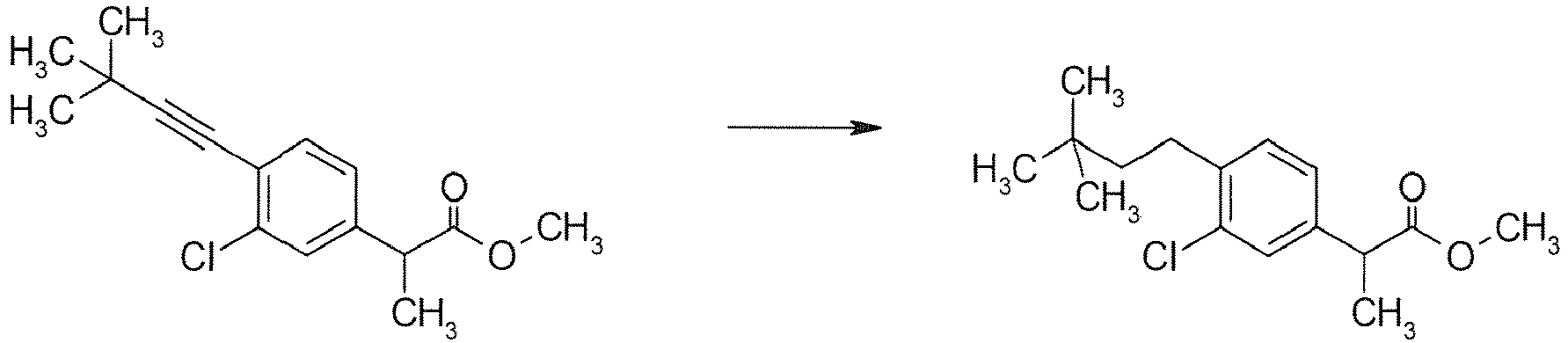
- 2-[3-Chloro-4-(3,3-dimethyl-but-1-ynyl)-phenyl]-propionic acid methyl ester (18.5 g) was mixed in methanol (185 mL). To the mixed solutoin was added 5 w/w% platinum/activated carbon (1.85 g), and the reaction solution was stirred for 9 hours under hydrogen gas at 4 atm. Removal from the reaction solution platinum/activated carbon on a filter gave a filtrate (referred to as Filtrate A hereinafter).
- According to the reduction procedure, 2-[3-chloro-4-(3,3-dimethyl-but-1-ynyl)-phenyl]-propionic acid methyl ester (18.5 g) was treated to give a filtrate (referred to as Filtrate B hereinafter).
- Filtrate A and Filtrate B were combined and concentrated under reduced pressure to give a residue (34.08 g/referred to as Residue C hereinafter).
- Residue C was analyzed (1H-NMR measurement), which showed that the reduction reaction was not completed (i.e. a starting material was existed), and the reduction reaction was repeated.
- Residue C (34 g) was divided into two halves of Residue D (17 g) and Residue E (17 g). Residue D (17 g) was mixed in methanol (185 mL). To the mixed solution was added 5 w/w% platinum/activated carbon (1.85 g), and the reaction solution was stirred for 5 hours under hydrogen gas at 4 atm. Then platinum/activated carbon was removed from the reaction solution on a filter to give a filtrate (referred to as Filtrate F hereinafter).
- Residue E (17 g) was treated according to the reduction procedure to give a filtrate (referred to as Filtrate G hereinafter).
- The resulted Filtrate F and Filtrate G were combined and concentrated under reduced pressure to give the titled compound (35.06 g) as a crude product.
1H-NMR (400 MHz, CDCl3) 0.97 (s, 9H), 1.42 - 1.48 (m, 5H), 2.63 - 2.68 (m, 2H), 3.65 - 3.66 (m, 4H), 7.10 (dd, J=7.85, 1.81Hz, 1H), 7.16 (d,J=7.97Hz, 1H), 7.26 - 7.27 (m, 1H) -

- 2-[3-Chloro-4-(3,3-dimethyl-butyl)-phenyl]-propionic acid methyl ester (35.0 g) was mixed in tetrahydrofuran (110 mL) and methanol (110 ml). To the reaction solution was added dropwise 4M aqueous sodium hydroxide solution (93 mL) under ice cooling, and the reaction solution was stirred at room temperature for 2 hours. Then to the reaction solution was added dropwise 2M hydrochloric acid (186 mL) under ice cooling, and the resulted mixed solution was extracted with ethyl acetate. The organic layer was washed sequentially with water and saturated sodium chloride water, and then dried over sodium sulfate. After removing sodium sulfate on a filter, the filtrate was concentrated under reduced pressure. To the resulted residue was added a mixed solution of hexane-diisopropylether (10:1), and then the precipitated solid was filtered. The resulted filtrate was concentrated under reduced pressure, and to the residue was added again a mixed solution of hexane-diisopropylether (10:1), and the precipitated solid was filtered. The resulted solid was collected to give the titled compound (30.4 g).
1H-NMR (400 MHz, CDCl3) 0.96 (s, 9H), 1.42 - 1.44 (m, 2H), 1.48 (d, J=7.17Hz, 3H), 2.63-2.65 (m, 2H), 3.67 (q, J=7.17Hz, 1H), 7.11 (dd, J=7.98, 1.73Hz, 1H), 7.15 (d, J=8.09Hz, 1H), 7.28 (d, J=1.85Hz, 1H) -

- (E)-4-Methyl-pent-2-enoic acid methyl ester (16.72 g) was mixed in dichloromethane (50 mL). To the reaction solution was added dropwise 1M diisobutylaluminum hydride/dichloromethane solution (300 mL) at -78°C, and the reaction solution was stirred at - 78°C for 1 hour. The reaction solution was added dropwise to 1.5M aqueous sulfuric acid solution (350 mL) under ice cooling, and then the mixed solution was stirred under ice cooling for 1.5 hours. The reaction solution was extracted with dichloromethane, and the organic layer was washed sequentially with 1M aqueous sulfuric acid solution, water, and aqueous saturated sodium chloride solution, and dried over magnesium sulfate. After removing magnesium sulfate on a filter, the filtrate was concentrated under reduced pressure to give the titled compound in dichloromethane solution (73.3 w/w%, 18.81 g).
1H-NMR (400 MHz, CDCl3) 1.00 (d, J=6.94Hz, 6H), 1.25 (s, 1H), 2.31 (td, J=13.58, 6.78Hz, 1H), 4.09 (d, J=5.78Hz, 2H), 5.59 (tdd, J=10.63, 5.20, 0.89Hz, 1H), 5.67 (ddt, J=15.26, 6.17, 0.90Hz, 1H) -

- 73.3 w/w% of (E)-4-methyl-pent-2-en-1-ol/dichloromethane solution (5.33 g), 2-[3-chloro-4-(3,3-dimethyl-butyl)-phenyl]-propionic acid (10.0 g), and 4-dimethylaminopyridine (1.36 g) were mixed in chloroform (150 mL). To the reaction solution was added 1-ethyl-3-(3-dimethylaminopropyl)carbodiimide hydrochloride (4.7 g) under ice cooling, and the reaction solution was stirred at room temperature overnight. To the reaction solution were added ethyl acetate and 1M hydrochloric acid, which was then extracted with ethyl acetate. The organic layer was washed sequentially with water, aqueous sodium hydrogen carbonate solution, and aqueous saturated sodium chloride solution, and dried over magnesium sulfate. After removing magnesium sulfate on a filter, the filtrate was concentrated under reduced pressure to give the titled compound (13.0 g) as a crude product.
1H-NMR (400 MHz, CDCl3) 0.92 - 1.04 (m, 10H), 1.37 - 1.51 (m, 5H), 1.56 (s, 3H), 2.22 - 2.33 (m, 1H), 2.59 - 2.72 (m, 2H), 3.61 - 3.70 (m, 1H), 4.42 - 4.60 (m, 2H), 5.45 (tt, J=10.87, 3.38Hz, 1H), 5.65 (dd, J=15.45, 6.52Hz, 1H), 7.08 - 7.17 (m, 2H), 7.27 - 7.30 (m, 1H) -
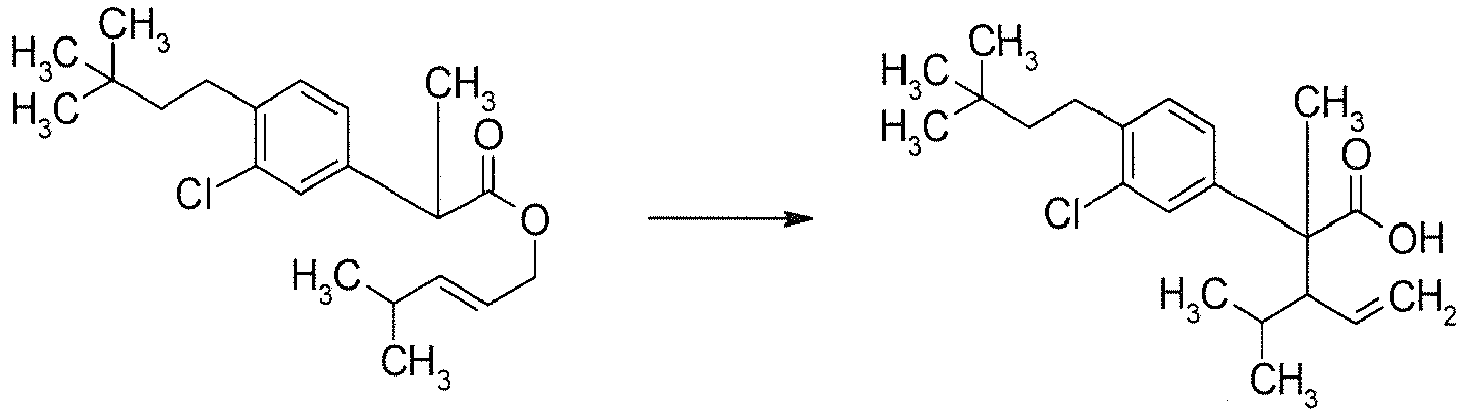
- Diisopropylamine (10.9 mL) was mixed in tetrahydrofuran (130 mL). To the reaction solution was added dropwise 1.64M n-butyllithium /hexane solution (45.2 mL) at -78°C, and the reaction solution was stirred at -78°C for 20 minutes. To the reaction solution was added dropwise a mixed solution of 2-[3-chloro-4-(3,3-dimethyl-butyl)-phenyl]-propionic acid (E)-4-methyl-pent-2-enyl ester (13.0 g) in tetrahydrofuran (130 mL) over 30 minutes at -78°C, and the reaction solution was stirred under ice cooling for 60 minutes. Then thereto was added dropwise chlorotrimethylsilane (9.87 mL) at -78°C, and the reaction solution was stirred at - 78°C for 30 minutes, which was then stirred under ice cooling for 130 minutes, then at room temperature for 150 minutes. To the reaction solution was added 1M hydrochloric acid under ice cooling, which was then extracted with ethyl acetate. The organic layer was washed sequentially with water and aqueous saturated sodium chloride solution, and dried over magnesium sulfate. After removing magnesium sulfate on a filter, the filtrate was concentrated under reduced pressure. The resulted residue was purified through silica gel chromatography (ethyl acetate:hexane=1:30 -> 1:15 -> 1:7) to give the titled compound (14.49 g).
1H-NMR (400 MHz, CDCl3) 0.67 (d, J=6.94Hz, 2H), 0.74 (d, J=6.70Hz, 2H), 0.83 (d, J=6.70Hz, 1H), 0.95 (t, J=4.05Hz, 10H), 1.39 - 1.47 (m, 311). 1.58 (s, 3H), 2.60 - 2.65 (m, 2H), 2.79 - 2.83 (m, 1H), 4.69 (dd, J=16.88, 2.08Hz, 0.3H), 4.83 (dd, J=10.17, 2.08Hz, 0.3H), 5.12 (dd, J=7.86, 2.31Hz, 0.7H), 5.16 (s, 0.7H), 5.31 (dt, J=19.34, 8.44Hz, 0.3H), 5.65 - 5.74 (m, 0.7H), 7.09 (d, J=8.09Hz, 0.3H), 7.15 (d, J=8.32Hz, 0.3H), 7.19 (dd, J=8.21, 1.97Hz, 0.3H), 7.31 (dt, J=12.10, 4.28Hz, 0.3H), 7.43 (d, J=2.08Hz, 0.3H) -

- 2-[3-Chloro-4-(3,3-dimethyl-butyl)-phenyl]-3-isopropyl-2-methyl-pent-4-enoic acid (12.0 g) and triethylamine (7.2 mL) were mixed in toluene (120 mL). To the reaction solution was added diphenyl phosphoryl azide (11.1 mL), and the reaction solution was stirred at 120°C for 7.5 hours. The reaction solution was concentrated under reduced pressure, and the resulted residue was purified through silica gel chromatography (ethyl acetate:hexane=1:30) to give the titled compound (9.6 g).
1H-NMR (400 MHz, CDCl3) 0.64 (d, J=6.70Hz, 2H), 0.67 (d, J=6.94Hz, 1H), 0.82 (d, J=6.94Hz, 1H), 0.84 (d, J=6.70Hz, 2H), 0.98 (s, 6H), 0.98 (s, 3H), 1.46 (m, 2H), 1.62 (s, 1H), 1.74 (s, 2H), 1.99 - 2.01 (m, 0.65H), 2.17 - 2.20 (m, 1H), 2.35 (brs, 0.35H), 2.64 - 2.70 (m, 2H), 4.88 - 4.93 (m, 0.65H), 5.12 - 5.17 (m, 1H), 5.34 - 5.36 (m, 0.35H), 5.60 - 5.64 (m, 0.65H), 5.81 - 5.88 (m, 0.35H), 7.15 - 7.15 (m, 1H), 7.17 - 7.18 (m, 1H), 7.31 - 7.32 (m, 0.65H), 7.35 - 7.36 (m, 0.35H) -

- 2-Chloro-1-(3,3-dimethyl-butyl)-4-(1-isocyanato-2-isopropyl-1-methyl-but-3-enyl)-benzene (400 mg) and 3-amino-propionic acid ethyl ester hydrochloride (194 mg) were mixed in 1,4-dioxane (4 mL). To the reaction solution was added triethylamine (0.18 mL), and the reaction solution was stirred at 60°C for about 40 minutes. The reaction solution was concentrated under reduced pressure, and the resulted residue was purified through silica gel column chromatography (methanol:chloroform=1:99 -> 2:98 -> 4:96) to give the titled compound (478 mg).
1H-NMR (400 MHz, CDCl3) 0.21 - 0.26 (m, 0.33H), 0.54 - 0.60 (m, 0.67H), 0.70 - 0.75 (m, 0.67H), 0.80 - 0.84 (m, 0.33H), 0.97 - 0.99 (m, 9H), 1.40 - 1.53 (m, 2H), 1.66 - 1.69 (m, 2H), 1.79 - 1.82 (m, 1H), 1.64 - 1.83 (m, 3H), 1.84 - 2.04 (m, 1H), 2.25 - 2.45 (m, 2H), 2.61 - 2.72 (m, 2H), 3.22 - 3.38 (m, 2H), 4.01 - 4.14 (m, 2H), 4.35 - 4.59 (m, 1H), 4.87 - 5.41 (m, 1H), 5.53 - 5.88 (m, 1H), 7.10 - 7.43 (m, 2H) -

- 3-{3-[1-(3-Chloro-4-(3,3-dimethyl-butyl)-phenyl)-2-isopropyl-1-methyl-but-3-enyl]-ureido}-propionic acid ethyl ester (478 mg) was mixed in methanol (8 mL). The reaction solution was stirred at -78°C for 30 minutes under ozone flow. Then the reaction solution was stirred at -78°C for 3 minutes under nitrogen flow. Then to the reaction solution were added methylsulfide (0.76 mL) at -78°C and methanol (4 mL) at room temperature. The reaction solution was concentrated under reduced pressure, and to the residue was added 2M hydrogen chloride/methanol solution (1 mL), and the reaction solution was stirred at room temperature for 2 hours. The reaction solution was concentrated under reduced pressure, and the resulted residue was purified through silica gel chromatography (methanol:chloroform=4:96) twice to give the titled compound (191 mg).
1H-NMR (400 MHz, CDCl3) 0.67 - 0.72 (m, 3H), 0.96 (s, 9H), 1.00 - 1.05 (m, 3H), 1.22 - 1.29 (m, 3H), 1.40 - 1.46 (m, 2H), 1.67 (s, 3H), 1.80 - 1.89 (m, 1H), 2.62 - 2.69 (m, 4H), 3.74 - 3.79 (m, 2H), 4.11 - 4.18 (m, 2H), 4.61 (brs, 1H), 5.88 (s, 1H), 7.13 - 7.17 (m, 1H), 7.20 - 7.24 (m, 1H), 7.35 - 7.37 (m, 1H) -

- 3-{4-[3-Chloro-4-(3,3-dimethyl-butyl)-phenyl]-5-isopropyl-4-methyl-2-oxo-3,4-dihydro-2H-pyrimidin-1-yl}-propionic acid ethyl ester (racemate/191 mg) was purified using a recycling preparative chromatograph to give 61 mg as a fraction compound eluted later (analytical column DAICEL CHIRALPAK IA-3, retention time 7.1 minutes) and 58 mg as a fraction compound eluted earlier (analytical column DAICEL CHIRALPAK IA-3, retention time 4.9 minutes).
- The separation condition by the recycling preparative chromatograph is shown as follows.
Separation instrument; Recycling preparative chromatograph LC-9225 NEXT SERIES Japan Analytical Industry Co., Ltd.
Column; DAICEL CHIRALPAK IA 2.0 cmϕ × 25 cm
Mobile phase; hexane:2-propanol=90:10
Flow rate; 10.0 mL/min
Detection; UV (254 nm) - The analytical condition using a chiral column is as follows.
Measuring instrument; HPLC system Shimadzu Corporation high-performance liquid chromatograph prominence
Column; DAICEL CHIRALPAK IA-3 0.46 cmϕ × 15 cm
Column temperature; 40°C
Mobile phase; hexane:2-propanol=90:10
Flow rate; 1.0 mL/min
Detection; UV (254 nm) - The ethyl ester compound obtained as a fraction eluted later was converted into a carboxylic acid compound in the next step (Step 14, hydrolysis reaction). The retention time and NMR spectrum of the carboxylic acid compound in a chiral column coincided with those in a chiral column of the carboxylic acid compound (S-enantiomer) obtained in the method using the optically active sulfinamide.
- The ester compound obtained as a fraction eluted later was thus estimated as an S-enantiomer.
(S-enantiomer)
1H-NMR (400 MHz, CDCl3) 0.67 - 0.72 (m, 3H), 0.96 (s, 9H), 1.00 - 1.05 (m, 3H), 1.22 - 1.29 (m, 3H), 1.40 - 1.46 (m, 2H), 1.67 (s, 3H), 1.80 - 1.89 (m, 1H), 2.62 - 2.69 (m, 4H), 3.74 - 3.79 (m, 2H), 4.11 - 4.18 (m, 2H), 4.61 (brs, 1H), 5.88 (s, 1H), 7.13 - 7.17 (m, 1H), 7.20 - 7.24 (m, 1H), 7.35 - 7.37 (m, 1H)
(R-enantiomer)
1H-NMR (400 MHz, CDCl3) 0.67 - 0.72 (m, 3H), 0.96 (s, 9H), 1.00 - 1.05 (m, 3H), 1.22 - 1.29 (m, 3H), 1.40 - 1.46 (m, 2H), 1.67 (s, 3H), 1.80 - 1.89 (m, 1H), 2.62 - 2.69 (m, 4H), 3.74 - 3.79 (m, 2H), 4.11 - 4.18 (m, 2H), 4.61 (brs, 1H), 5.88 (s, 1H), 7.13 - 7.17 (m, 1H), 7.20 - 7.24 (m, 1H), 7.35 - 7.37 (m, 1H) -
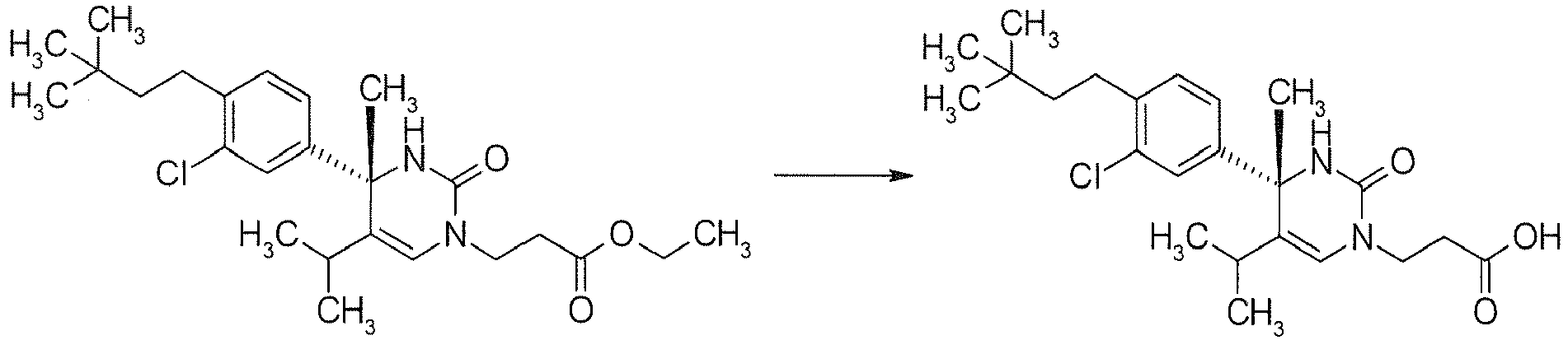
- 3-{(S)-4-[3-Chloro-4-(3,3-dimethyl-butyl)-phenyl]-5-isopropyl-4-methyl-2-oxo-3,4-dihydro-2H-pyrimidin-1-yl}-propionic acid ethyl ester (57 mg) was mixed in methanol (2 mL). To the reaction solution was added 2M aqueous sodium hydroxide solution (0.25 mL), and the reaction solution was stirred at 60°C. The reaction solution was concentrated under reduced pressure, and then water was added thereto. To the resulted mixed solution was added 2M hydrochloric acid (0.25 mL), which was then stirred at room temperature. The precipitated solid was filtered to give the titled compound (49 mg).
- The resulted compound was analyzed by a chiral column, and the retention time of the resulted titled compound (S-enantiomer) was 9.0 minutes, the optical purity of which was > 99%ee. The analytical condition in the chiral column was as follows.
Measuring instrument; HPLC system Shimadzu Corporation high-performance liquid chromatograph prominence
Column; DAICEL CHIRALPAK AD-3R 0.46 cmϕ × 15 cm
Column temperature; 40°C
Mobile phase; water:acetonitrile:formic acid=30:70:0.1
Flow rate; 0.5 mL/min
Detection; UV (220 nm) -
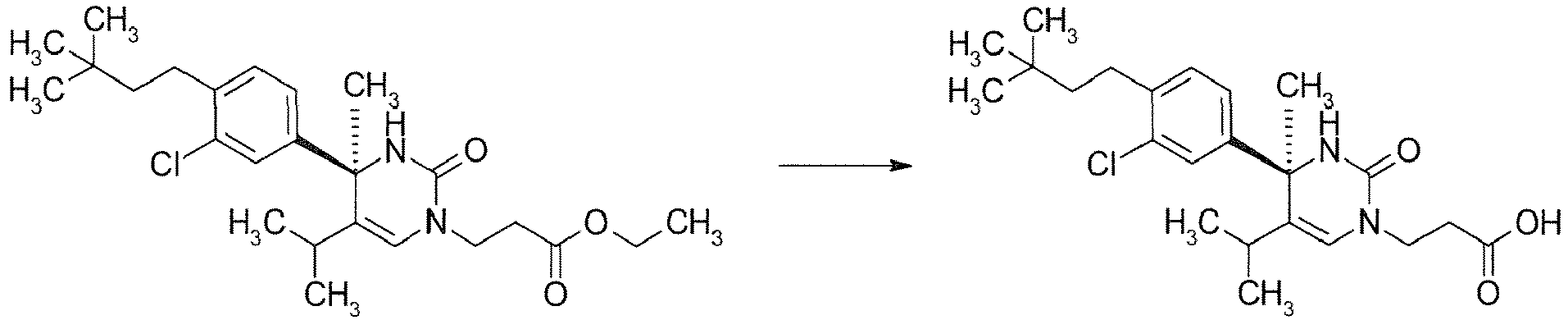
- 3-{(R)-4-[3-Chloro-4-(3,3-dimethyl-butyl)-phenyl]-5-isopropyl-4-methyl-2-oxo-3,4-dihydro-2H-pyrimidin-1-yl}-propionic acid ethyl ester obtained in Example 87 Step 13 was treated according to the reaction in Example 87 Step 14 to give the titled compound (36 mg). The retention time of the resulted enantiomer (R-enantiomer) was 6.0 minutes.
- The analytical condition in a chiral column was as follows.
Measuring instrument; HPLC system Shimadzu Corporation high-performance liquid chromatograph prominence
Column; DAICEL CHIRALPAK AD-3R 0.46 cmϕ × 15 cm
Column temperature; 40°C
Mobile phase; water:acetonitrile:formic acid=30:70:0.1
Flow rate; 1.0 mL/min
Detection; UV (220 nm) -

- 1-(4-Bromo-3-chloro-phenyl)-ethanone (20 g) prepared according to Example 87 (a method for preparation using an optically active sulfinamide) Steps 1 to 2 and (S)-(-)-2-methylpropane-2-sulfinic acid amide (11.4 g) were mixed in cyclopentylmethyl ether (100 mL). To the reaction solution was added tetraethyl orthotitanate (23.3 mL), and the reaction solution was stirred at 100°C for 5 hours. To the reaction solution was added 25 w/w% aqueous citric acid solution under ice cooling, and the mixed solution was stirred at room temperature. After removing an insoluble on a filter, the filtrate was extracted with toluene. The organic layer was washed sequentially with water and aqueous saturated sodium chloride solution, and then concentrated under reduced pressure. The resulted residue was purified through silica gel column chromatography (ethyl acetate:hexane=1:20 -> 1:10 -> 1:5) to give the titled compound (23 g).
1H-NMR (400 MHz, CDCl3) 1.30 (s, 9H), 2.72 (s, 3H), 7.56 - 7.61 (m, 1H), 7.66 (d, J=8.55Hz, 1H), 7.91 (d, J=2.08Hz, 1H) -

- Diisopropylamine (21.1 mL) was mixed in THF (138 mL) under argon gas. To the reaction solution was added dropwise 1.63M n-butyllithium/hexane solution (88 mL) at -78°C. and the reaction solution was stirred at -78°C for 20 minutes. To the reaction solution was added dropwise 3-methyl-butanoic acid methyl ester (18 mL), and the reaction solution was stirred at -78°C for 30 minutes. To the reaction solution were added dropwise 1M chloro titanium (IV) triisopropoxide/hexane solution (100 mL) and then a mixed solution of chloro titanium (IV) triisopropoxide (48.7 g) in tetrahydrofuran (80 mL). and the reaction solution was stirred at -78°C for 30 minutes. To the reaction solution was added dropwise a mixed solution of (S)-2-methyl-propane-2-sulfinic acid [1-(4-bromo-3-chloro-phenyl)-eth-(E)-ylidene]-amide (23 g) in THF (138 mL), and the reaction solution was stirred at -78°C for 75 minutes and then at -45°C for 2 hours. The reaction solution was added dropwise saturated aqueous Rochelle salt solution. The mixed solution was extracted with ethyl acetate. The organic layer was washed sequentially with water and aqueous saturated sodium chloride solution, and then dried over sodium sulfate. After removing sodium sulfate on a filter, the filtrate was concentrated under reduced pressure. The resulted residue was purified through silica gel column chromatography (ethyl acetate:hexane=1:10) to give the titled compound (16 g) as a mixture of diastereomers generated by the isopropyl group at α-position of ester (d.r.=72: 28).
1H-NMR (400 MHz, CDCl3) 0.75 - 1.01 (m, 6H), 1.25 (s, 6H), 1.33 (s, 3H), 1.87 - 1.88 (m, 3H), 2.04 - 2.12 (m, 1H), 2.46 (d, J=4.11Hz, 0.3H), 2.80 (d, J=3.86Hz, 0.7H), 3.60 (t, J=6.64Hz, 2H), 3.71 (s, 1H), 5.13 (s, 0.7H), 5.42 (s, 0.3H), 7.14 - 7.22 (m, 1H), 7.52 - 7.56 (m, 1H), 7.57 - 7.59 (m, 1H) -

- (R)-3-(4-Bromo-3-chloro-phenyl)-2-isopropyl-3-((S)-2-methyl-propane-2-sulfinylamino)-butanoic acid methyl ester (16 g) was mixed in toluene (160 mL) under argon gas. To the reaction solution was added dropwise 1.01M diisobutylaluminum hydride/toluene solution (140 mL) at -78°C, and the reaction solution was stirred at -78°C for 30 minutes, and then gradually warmed to 0°C, and then stirred for 1 hour. To the reaction solution were added dropwise methanol and then aqueous Rochelle salt solution under ice cooling, and then the mixed solution was extracted with ethyl acetate. The organic layer was washed sequentially with water and aqueous saturated sodium chloride solution, and then dried over sodium sulfate. After removing sodium sulfate on a filter, the filtrate was concentrated under reduced pressure. The resulted residue was purified through silica gel column chromatography (ethyl acetate:hexane=1:5 -> 1:3 -> 1:1, then ethyl acetate only, then methanol: chloroform=1:20) to give the titled compound (11.5 g).
1H-NMR (400 MHz, CDCl3) 0.66 - 0.85 (m, 6H), 1.13 (s, 7H), 1.29 (s, 2H), 1.69 - 1.81 (m, 2H), 1.89 - 2.00 (m, 3H), 2.01 - 2.12 (m, 1H), 3.83 - 4.12 (m, 2H), 5.06 - 5.28 (m, 1H), 6.81-6.93 (m, 1H), 7.12 - 7.23 (m, 1H), 7.50 - 7.62 (m, 2H) -

- (S)-2-Methyl-propane-2-sulfinic acid [(R)-1-(4-bromo-3-chloro-phenyl)-2-hydroxymethyl-1,3-dimethyl-butyl]amide (11.5 g) was mixed in methanol (66 mL). To the reaction solution was added dropwise 2M hydrogen chloride/methanol solution (54 mL) under ice cooling, and the reaction solution was left to stand at room temperature overnight. The reaction solution was concentrated under reduced pressure, and aqueous sodium carbonate solution was added to the residue so that the aqueous layer was adjusted to pH 10, and then the reaction solution was extracted with chloroform. The organic layer was washed sequentially with water and aqueous saturated sodium chloride solution, and then dried over sodium sulfate. After removing sodium sulfate on a filter, the filtrate was concentrated under reduced pressure to give the titled compound (14 g) as a crude product.
1H-NMR (400 MHz, CDCl3) 0.66 - 0.89 (m, 6H), 1.34 - 1.49 (m, 1H), 1.58 - 1.61 (m, 3H), 1.62 - 1.76 (m, 1H), 1.83 - 1.88 (m, 1H), 3.65 - 3.72 (m, 1H), 3.87 - 4.00 (m, 1H), 7.12 - 7.25 (m, 3H), 7.48 - 7.55 (m, 1H), 7.55 - 7.63 (m, 1H) -

- (R)-3-Amino-3-(4-bromo-3-chloro-phenyl)-2-isopropyl-butan-1-ol (14 g) was mixed in tetrahydrofuran (50 mL). To the reaction solution was added a mixed solution of 3-isocyanate-propionic acid ethyl ester (3.56 mL) in tetrahydrofuran (50 mL) under ice cooling, and the reaction solution was stirred under ice cooling for 1.5 hours. To the reaction solution was added water, which was then extracted with ethyl acetate. The organic layer was washed sequentially with 0.1M hydrochloric acid, water, and aqueous saturated sodium chloride solution, and then dried over sodium sulfate. After removing sodium sulfate on a filter, the filtrate was concentrated under reduced pressure. The resulted residue was purified through silica gel column chromatography (ethyl acetate:hexane=1:10 -> 1:5 -> 1:3 -> 1:1, then methanol:chloroform=1:20) to give the titled compound (13.7 g).
1H-NMR (400 MHz, CDCl3) 0.26 - 0.80 (m, 3H), 0.80 - 0.97 (m, 3H), 1.23 - 1.31 (m, 3H), 1.46 - 1.55 (m, 1H), 1.64 - 1.71 (m, 1H), 1.79 - 1.90 (m, 3H), 2.38 - 2.48 (m, 2H), 3.28 - 3.39 (m, 2H), 3.76 - 3.85 (m, 1H), 3.88 - 3.99 (m, 1H), 4.08 - 4.18 (m, 2H), 4.55 - 4.71 (m, 1H), 7.06 - 7.13 (m, 1H), 7.14 - 7.22 (m, 1H), 7.43 - 7.58 (m, 2H) -

- 3-{3-[(R)-1-(4-Bromo-3-chloro-phenyl)-2-hydroxymethyl-1,3-dimethyl-butyl]-ureido}-propionic acid ethyl ester (9.49 g) and iodobenzene diacetate (7.26 g) were mixed in dichloromethane (95 mL). To the reaction solution was added 2,2,6,6-tetramethylpiperidine 1-oxyl free radical (319 mg) under ice cooling, and the reaction solution was stirred at room temperature for 3.5 hours. To the reaction solution was added TFA (6.1 mL) under ice cooling, and the reaction solution was stirred at room temperature for 3.5 hours. To the reaction solution were added 20 w/w% aqueous sodium sulfite solution and 25 w/w% aqueous potassium hydrogen carbonate solution, and then the mixed solution was extracted with chloroform. The organic layer was washed sequentially with 25 w/w% aqueous potassium hydrogen carbonate solution and aqueous saturated sodium chloride solution, and then dried over magnesium sulfate. After removing magnesium sulfate on a filter, the filtrate was concentrated under reduced pressure. The resulted residue was purified through silica gel column chromatography (ethyl acetate:hexane=1:6 -> 1:3 -> 1:2) to give the titled compound (7.77 g).
1H-NMR (400 MHz, CDCl3) 0.68 - 0.74 (m, 3H), 1.00 - 1.07 (m, 3H), 1.26 (s, 3H), 1.68 (s, 3H), 1.80 - 1.89 (m, 1H), 2.60 - 2.67 (m, 2H), 3.72 - 3.78 (m, 2H), 4.08 - 4.19 (m, 2H), 4.82 (brs, 1H), 5.91 (s, 1H), 7.15 - 7.21 (m, 1H), 7.47 - 7.51 (m, 1H), 7.53 - 7.58 (m, 1H) -
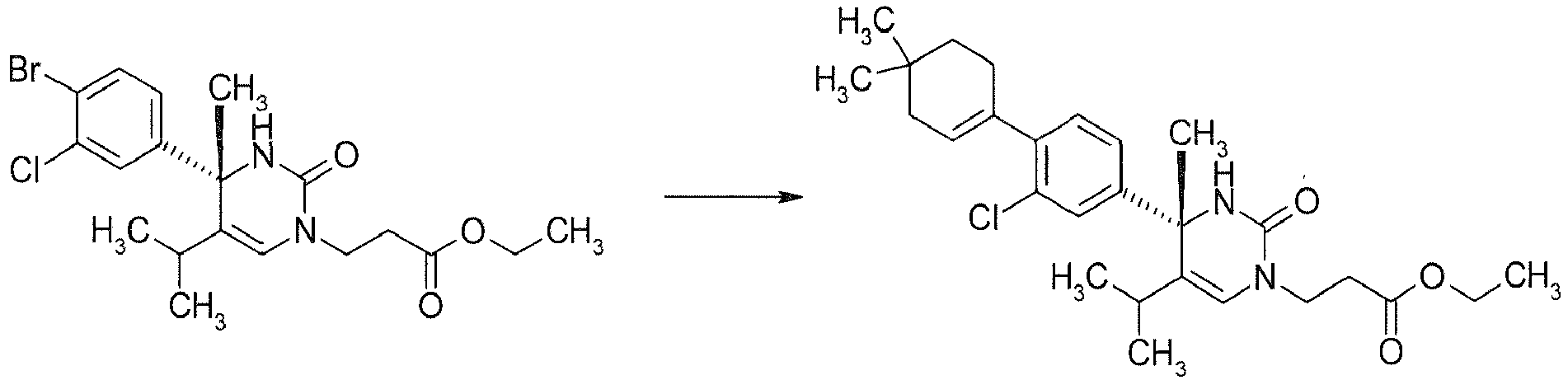
- 3-[(S)-4-(4-Bromo-3-chloro-phenyl)-5-isopropyl-4-methyl-2-oxo-3,4-dihydro-2H-pyrimidin-1-yl]-propionic acid ethyl ester (58.1 g) prepared according to Example 116 (a method for preparation using an optically active sulfinamide) Steps 1 to 6, 3-[(S)-4-(4-bromo-3-chloro-phenyl)-5-isopropyl-4-methyl-2-oxo-3,4-dihydro-2H-pyrimidin-1-yl]-propionic acid ethyl ester obtained in the previous step 6 (2.9 g), 2-(4,4-dimethyl-1-cyclohexenyl)-4,4,5,5-tetramethyl-[1,3,2]dioxaborolane (48.9 g), and tripotassium phosphate (87.7 g) were mixed in 1,2-dimethoxyethane (777 mL) and water (194 mL) under argon gas. To the reaction solution was added bis(triphenylphosphine)palladium (II) dichloride (5.6 g), and the reaction solution was stirred at 100°C for 4 hours. To the reaction solution was added ethyl acetate at room temperature, and then an insoluble was removed on a filter. The filtrate was extracted with ethyl acetate, washed with aqueous saturated sodium chloride solution, and then dried over sodium sulfate. After removing sodium sulfate on a filter, the filtrate was concentrated under reduced pressure. The resulted residue was purified twice through silica gel chromatography to give the titled compound (48.3 g).
1H-NMR (400 MHz, CDCl3) 0.73 (d, J=6.76Hz, 3H), 1.00 (s, 611), 1.05 (d, J=7.00Hz, 3H), 1.27 (t, J=7.00Hz. 2H), 1.50 (t, J=6.52Hz, 2H), 1.69 (s, 3H), 1.85 - 1.92 (m, 1H), 1.95 - 1.97 (m, 2H), 2.28 - 2.32 (m, 2H), 2.67 (t, J=6.64Hz, 2H), 3.78 (t, J=6.64Hz, 2H), 4.13 - 4.19 (m, 2H), 4.62 (s, 1H), 5.58 - 5.61 (m, 1H), 5.91 (s, 1H), 7.11 (d, J=7.97Hz, 1H), 7.25 (dd, J=7.97, 1.93Hz, 1H), 7.38 (d, J=1.93Hz, 1H) -

- 3-{(S)-4-[3-Chloro-4-(4,4-dimethyl-1-cyclohex-1-enyl)-phenyl]-5-isopropyl-4-methyl-2-oxo-3,4-dihydro-2H-pyrimidin-1-yl}-propionic acid ethyl ester (48.3 g) was mixed in ethanol (480 mL). To the reaction solution was added 4M aqueous sodium hydroxide solution (51 mL) under ice cooling, and the reaction solution was stirred at room temperature overnight. The reaction solution was concentrated under reduced pressure, and then thereto was added water (960 mL). To the reaction solution was added 2M hydrochloric acid (102 mL) under ice cooling, and the reaction solution was stirred under ice cooling for 3 hours. The precipitated solid was filtered to give the titled compound (41 g) as a crystal. The specific optical rotation of the resulted compound was [α]D 25=+106.1° (c=1.00, methanol). The melting point of the resulted crystal was 90-95°C.
- The resulted compound was analyzed using a chiral column, and the retention time of the resulted titled compound (S-enantiomer) was 9.2 minutes, the optical purity of which was > 99%ee.
- The analytical condition in the chiral column is shown as follows.
Measuring instrument; HPLC system Shimadzu Corporation high-performance liquid chromatograph prominence
Column; DAICEL CHIRALPAK AD-3R 0.46 cmϕ × 15 cm
Column temperature; 40°C
Mobile phase; water:acetonitrile:formic acid=30:70:0.1
Flow rate; 1.0 mL/min
Detection; UV (220 nm) -

- 4-Bromo-3-chlorobenzoic acid (25.0 g), N.O-dimethylhydroxylamine hydrochloride (12.4 g), 1-hydroxybenzotriazolemonohydrate (19.5 g), and triethylamine (22.2 mL) were mixed in N,N-dimethylformamide (100 mL). To the reaction solution was added 1-ethyl-3-(3-dimethylaminopropyl)carbodiimide hydrochloride (24.4 g) under ice cooling, and the reaction solution was stirred at room temperature overnight. To the reaction solution was added 5 w/v% aqueous sodium hydrogen carbonate solution, which was then extracted with ethyl acetate. The organic layer was washed sequentially with water and aqueous saturated sodium chloride solution, and dried over magnesium sulfate. After removing magnesium sulfate on a filter, the filtrate was concentrated under reduced pressure to give the titled compound (31 g) as a crude product.
1H-NMR (400 MHz, CDCl3) 3.36 (d, J=1.16Hz, 3H), 3.55 (d, J=0.92Hz, 3H), 7.47 (dt, J=8.17, 1.50Hz, 1H), 7.66 (dd, J=8.32, 1.16Hz, 1H), 7.81 (t, J=1.50Hz, 1H) -

- 4-Bromo-3-chloro-N-methoxy-N-methylbenzamide (31 g) was mixed in tetrahydrofuran (60 mL). To the reaction solution was added dropwise 0.97M ethylmagnesium bromide/tetrahydrofuran solution (141 mL) under ice cooling, and the reaction solution was stirred at room temperature for 1.5 hours. To the reaction solution was added 2M hydrochloric acid (140 mL) under ice cooling, which was then extracted with toluene. The organic layer was washed sequentially with water and aqueous saturated sodium chloride solution, and dried over magnesium sulfate. After removing magnesium sulfate on a filter, the filtrate was concentrated under reduced pressure to give the titled compound (26.80 g) as a crude product.
1H-NMR (400 MHz, CDCl3) 1.22 (t, J=7.17Hz, 3H), 2.96 (q, J=7.17Hz, 2H), 7.68 (dd, J=8.44, 1.97Hz, 1H), 7.72 (d, J=8.32Hz, 1H), 8.02 (d, J=1.85Hz, 1H) -

- 1-(4-Bromo-3-chloro-phenyl)-propan-1-one (26.80 g) and iodobenzene diacetate (36.9 g) were mixed in trimethyl orthoformate (250 mL). To the reaction solution was slowly added concentrated sulfuric acid (11.1 mL) under water cooling, and the reaction solution was stirred at 60°C for 3 hours. To the reaction solution was added water, which was then extracted with ethyl acetate. The organic layer was washed sequentially with aqueous sodium sulfite solution, water, and aqueous saturated sodium chloride solution, and dried over magnesium sulfate. After removing magnesium sulfate on a filter, the filtrate was concentrated under reduced pressure to give the titled compound (55.3 g) as a crude product.
1H-NMR (400 MHz, CDCl3) 1.48 (d, J=7.17Hz, 3H), 3.23 (dd, J=7.40, 0.46Hz, 1H), 3.67 (d, J=0.46Hz, 3H), 7.06 (dd, J=8.32, 2.08Hz, 1H), 7.40 (d, J=2.08Hz, 1H), 7.55 (d, J=8.32Hz, 1H) -

- 2-(4-Bromo-3-chloro-phenyl)-propionic acid methyl ester (55.3 g) was mixed in tetrahydrofuran (100 mL) and methanol (100 mL). To the reaction solution was added 2M aqueous sodium hydroxide solution (150 mL), and the reaction solution was stirred at 60°C for 1.5 hours. To the reaction solution was added 2M aqueous sodium hydroxide solution (50 mL), and the reaction solution was further stirred for 3.5 hours. The reaction solution was concentrated under reduced pressure, and to the resulted residue was added hexane (150 mL), which was separated. The aqueous layer was washed again with hexane (150 mL), and then thereto was added 2M hydrochloric acid (200 mL), which was extracted with ethyl acetate. The organic layer was washed sequentially with water and aqueous saturated sodium chloride solution, and dried over magnesium sulfate. After removing magnesium sulfate on a filter, a mixed solution which toluene was added to the filtrate was concentrated under reduced pressure to give the titled compound (21.6 g) as a crude product.
1H-NMR (400 MHz, CDCl3) 1.51 (d, J=7.17, 3H), 3.70 (q, J=7.17Hz, 1H), 7.08 (dd, J=8.21, 2.20Hz, 1H), 7.42 (d, J=2.08Hz, 1H), 7.57 (t, J=6.01Hz, 1H), 10.63 (s, 1H) -

- (E)-4-methyl-pent-2-enoic acid methyl ester (20.7 g) was mixed in dichloromethane (50 mL). To the reaction solution was added dropwise 1M diisobutylaluminum hydride/dichloromethane solution (300 mL) at -78°C, and the reaction solution was stirred at - 78°C for 1 hour. To the reaction solution was added methanol (45 mL), and then the reaction solution was warmed to room temperature. The reaction solution was added dropwise to 1M aqueous sulfuric acid solution (150 mL), and then extracted with dichloromethane. The organic layer was washed with aqueous saturated sodium chloride solution and dried over sodium sulfate. After removing sodium sulfate on a filter, the filtrate was concentrated under reduced pressure to give the titled compound in dichloromethane solution (35.1 w/w%, 57.3 g).
1H-NMR (400 MHz, CDCl3) 1.00 (d, J=6.94Hz, 6H), 1.25 (s, 1H), 2.31 (td, J=13.58, 6.78Hz, 1H), 4.09 (d, J=5.78Hz, 2H), 5.59 (tdd, J=10.63, 5.20, 0.89Hz, 1H), 5.67 (ddt, J=15.26, 6.17, 0.90Hz, 1H) -

- 35.1 w/w% of (E)-4-methyl-pent-2-en-1-ol/dichloromethane solution (28.8 g) and 4-dimethylaminopyridine (11.4 g) were mixed in dichloromethane (200 mL). To the reaction solution was added 1-ethyl-3-(3-dimethylaminopropyl)carbodiimide hydrochloride (17.9 g) under ice cooling, and the reaction solution was stirred for 30 minutes. To the reaction solution was added a mixed solution of 2-(4-bromo-3-chloro-phenyl)-propionic acid (22.0 g) in dichloromethane (100 mL), and the reaction solution was stirred at room temperature overnight. To the reaction solution was added water (200 mL), which was then extracted with chloroform. The organic layer was washed sequentially with 1M aqueous hydrochloric acid solution, 5 w/v% aqueous sodium hydrogen carbonate solution, water, and aqueous saturated sodium chloride solution, and dried over magnesium sulfate. After removing magnesium sulfate on a filter, the filtrate was concentrated under reduced pressure. The resulted residue was purified through silica gel chromatography (toluene:hexane=1 :2) to give the titled compound (20.8 g).
1H-NMR (400 MHz, CDCl3) 0.97 (d, J=6.47Hz, 6H), 1.48 (d, J=7.17Hz, 3H), 2.28 (td, J=13.35, 6.70Hz, 1H), 3.66 (q, J=7.24Hz, 1H), 4.51 (dd, J=6.59, 3.35Hz, 2H), 5.44 (dtd, J=15.45, 6.36, 1.35Hz, 1H), 5.66 (ddt, J=15.49, 6.47, 1.18Hz, 1H), 7.07 (dd, J=8.32, 2.08Hz, 1H), 7.41 (d, J=2.08Hz, 1H), 7.55 (d, J=8.09Hz, 1H) -

- 2-(4-Bromo-3-chloro-phenyl)-propionic acid (E)-4-methyl-pent-2-enyl ester (17.5 g) was mixed in tetrahydrofuran (200 mL). To the reaction solution was added dropwise 1.17M lithium hexamethyldisilazane/tetrahydrofuran solution (45.3 mL) at -41°C, and the reaction solution was stirred at -41°C for 1 hour. To the reaction solution was added dropwise chlorotrimethylsilane (12.8 mL), and then the reaction solution was stirred at -41°C for 30 minutes and then stirred at room temperature overnight. To the reaction solution was added 1M aqueous hydrochloric acid solution, which was then extracted with ethyl acetate. The organic layer was concentrated under reduced pressure to give the titled compound (18.0 g) as a crude product.
1H-NMR (400 MHz, CDCl3) 0.71 (d, J=6.70Hz, 2.01H), 0.76 (d, J=6.70Hz, 2.01H), 0.86 (d, J=6.70Hz, 0.99H), 0.96 (d, J=6.70Hz, 0.99H), 1.57 (ddd, J=13.47, 6.65, 3.99Hz, 0.67H), 1.60 (s, 2.01H), 1.61 (s, 0.99H), 1.78 (ddd, J=13.47, 6.65, 3.99Hz, 0.33H), 2.78 (dd, J=9.13, 2.89Hz, 0.33H), 2.81 (dd, J=10.06, 2.66Hz, 0.67H), 4.71 (dd, J=16.88, 1.62Hz, 0.33H), 4.87 (dd, J=10.17, 2.08Hz, 0.33H), 5.15 (dd, J=13.87, 2.31Hz, 0.67H), 5.18 (dd, J=7.28, 2.20Hz, 0.67H), 5.31 (dt, J=19.42, 8.50Hz, 0.33H), 5.70 (dt, J=19.19, 8.38Hz, 0.67H), 7.17 (dd, J=8.32, 2.31Hz, 0.33H), 7.28 (dd, J=8.67, 2.43Hz, 0.67H), 7.48 (d, J=2.31Hz, 0.33H), 7.50 (d, J=8.55Hz, 0.33H), 7.57 (d, J=8.55Hz, 0.67H), 7.59 (d, J=2.31Hz, 0.67H), 10.3 (s, 1H) -

- 2-(4-Bromo-3-chloro-phenyl)-3-isopropyl-2-methyl-pent-4-enoic acid (18.0 g) and triethylamine (10.6 mL) were mixed in toluene (300 mL). To the reaction solution was added diphenyl phosphoryl azide (16.3 mL), and the reaction solution was stirred at 70°C for 2 hours. The reaction solution was concentrated under reduced pressure, and the resulted residue was purified through silica gel chromatography (chloroform:hexane=1:4) to give the titled compound (15.5 g).
1H-NMR (400 MHz, CDCl3) 0.69 (d, J=6.47Hz, 1.05H), 0.70 (d, J=6.94Hz, 1.95H), 0.83 (d, J=6.94Hz, 1.05H), 0.86 (d, J=6.94Hz, 1.95H), 1.40 - 1.48 (m, 0.35H), 1.63 (s, 1.05H), 1.76 (s, 1.95H), 1.99 - 2.06 (m, 0.65H), 2.16 (dd, J=10.17, 2.31Hz, 0.65H), 2.20 (dd, J=9.94, 2.54Hz, 0.35H), 4.88 (dd, J=16.99, 1.97Hz, 0.65H), 5.13 (dd, J=10.29, 1.97Hz, 0.65H), 5.18 (dd, J=16.88, 2.08Hz, 0.35H), 5.38 (dd, J=10.29, 1.97Hz, 0.35H), 5.60 (dt, J=19.27, 8.50Hz, 0.65H), 5.84 (dt, J=19.03, 8.44Hz, 0.35H), 7.10 (dd, J=8.55, 2.31Hz, 0.65H), 7.14 (dd, J=8.55, 2.31Hz, 0.35H), 7.45 (d, J=2.31Hz, 0.65H), 7.51 (d, J=2.31Hz, 0.35H), 7.55 (d, J=8.32Hz, 0.65H), 7.59 (d, J=8.32Hz, 0.35H) -

- 1-Bromo-2-chloro-4-(1-isocyanato-2-isopropyl-1-methyl-but-3-enyl)-benzene (13.76 g) and triethylamine (11.2 mL) were mixed in tetrahydrofuran (100 mL). To the reaction solution was added 3-amino-propionic acid ethyl ester hydrochloride (7.4 g) under ice cooling, and the reaction solution was stirred at room temperature overnight. To the reaction solution was added 1M aqueous hydrochloric acid solution (100 mL), which was then extracted with ethyl acetate. The organic layer was washed sequentially with 1M hydrochloric acid, 5 w/v% aqueous sodium hydrogen carbonate solution, water, and aqueous saturated sodium chloride solution, and dried over magnesium sulfate. The organic layer was concentrated under reduced pressure to give the titled compound (18.5 g) as a crude product.
1H-NMR (400 MHz, CDCl3) 0.32 (d, J=6.70Hz, 1.02H), 0.59 (d, J=6.70Hz, 1.98H), 0.76 (d, J=6.70Hz, 1.98H), 0.84 (d, J=6.94Hz, 1.02H), 1.25 (t, J=7.05Hz, 1.98H), 1.25 (t, J=7.17Hz, 1.02H), 1.45 - 1.53 (m, 1H), 1.71 (s, 1.98H), 1.83 (s, 1.02H), 1.98 (dd, J=10.52, 1.97Hz, 0.66H), 1.99 (dd, J=10.52, 1.50Hz, 0.34H), 2.38 (td, J=5.84, 1.77Hz, 1.32H), 2.42 (t, J=5.90Hz, 0.68H), 3.25 - 3.41 (m, 2H), 4.11 (q, J=7.17Hz, 1.32H), 4.11 (q, J=7.17Hz, 0.68H), 4.57 (t, J=6.01Hz, 0.66H), 4.66 (t, J=6.13Hz, 0.34H), 4.93 (s, 1H), 5.07 (dd, J=16.88, 1.85Hz, 0.34H), 5.22 (dd, J=17.34, 2.54Hz, 0.66H), 5.26 (dd, J=10.87, 2.31Hz, 0.34H), 5.37 (dd, J=10.06, 1.97Hz, 0.66H), 5.59 (dt, J=19.50, 8.44Hz, 0.34H), 5.79 (dt, J=19.42, 8.50Hz, 0.66H), 7.09 (dd, J=8.55, 2.31Hz, 0.34H), 7.20 (dd, J=8.32, 2.31Hz, 0.66H), 7.41 (d, J=2.31Hz, 0.34H), 7.51 (d, J=2.31Hz, 0.66H), 7.53 (d, J=8.32Hz, 0.34H), 7.56 (d, J=8.32Hz, 0.66H) -

- 3-{3-[1-(4-Bromo-3-chloro-phenyl)-2-isopropyl-1-methyl-but-3-enyl]-ureido}-propionic acid ethyl ester (18.5 g) was mixed in methanol (100 mL) and dichloromethane (50 mL). The reaction solution was stirred at -78°C for 3 hours under ozone flow. The reaction solution was then stirred at -78°C for 30 minutes under nitrogen flow. To the reaction solution was added methylsulfide (15 mL) at -78°C, and the reaction solution was warmed to room temperature. To the reaction solution was added ethanol (50 mL), and the mixed solution was concentrated under reduced pressure. To the resulted residue was added 2M hydrogen chloride/ethanol solution (50 mL), and the reaction solution was stirred at room temperature for 1 hour. The reaction solution was concentrated under reduced pressure, and the resulted residue was purified through silica gel chromatography (ethyl acetate:chloroform=1:4) and then recrystallized from a mixed solution of hexane-diisopropylether (1:1) to give the titled compound (6.19 g).
1H-NMR (400 MHz, CDCl3) 0.68 - 0.74 (m, 3H), 1.00 - 1.07 (m, 3H), 1.26 (s, 3H), 1.68 (s, 3H), 1.80 - 1.89 (m, 1H), 2.60 - 2.67 (m, 2H), 3.72 - 3.78 (m, 2H), 4.08 - 4.19 (m, 2H), 4.82 (brs, 1H), 5.91 (s, 1H), 7.15 - 7.21 (m, 1H), 7.47 - 7.51 (m, 1H), 7.53 - 7.58 (m, 1 H) -

- 3-[4-(4-Bromo-3-chloro-phenyl)-5-isopropyl-4-methyl-2-oxo-3,4-dihydro-2H-pyrimidin-1-yl]-propionic acid ethyl ester (200 mg), 2-(4,4-dimethyl-1-cyclohexenyl)-4,4,5,5-tetramethyl-[1,3,2]dioxaborolane (160 mg) and tripotassium phosphate (287 mg) were mixed in 1.2-dimethoxyethane (4 mL) and water (1 mL) under argon gas. To the reaction solution was added bis(triphenylphosphine)palladium (II) dichloride (16 mg), and the reaction solution was stirred at 100°C overnight. To the reaction solution was added ethyl acetate at room temperature, and then an insoluble was removed on a filter. The filtrate was washed sequentially with water and aqueous saturated sodium chloride solution, and then dried over sodium sulfate. After removing sodium sulfate on a filter, the filtrate was concentrated under reduced pressure. The resulted residue was purified through silica gel chromatography (ethyl acetate:hexane=1:3), followed by thin layer silica gel chromatography (methanol:chloroform=1: 30) to give the titled compound (180 mg).
1H-NMR (400 MHz, CDCl3) 0.73 (d, J=6.76Hz, 3H), 1.00 (s, 6H), 1.05 (d, J=7.00Hz, 3H), 1.27 (t, J=7.00Hz, 2H), 1.50 (t, J=6.52Hz, 2H), 1.69 (s, 3H), 1.85 - 1.92 (m, 1H), 1.95 - 1.97 (m, 2H), 2.28 - 2.32 (m, 2H), 2.67 (t, J=6.64Hz, 2H), 3.78 (t, J=6.64Hz, 2H), 4.13 - 4.19 (m, 2H), 4.62 (s, 1H), 5.58 - 5.61 (m, 1H), 5.91 (s, 1H), 7.11 (d, J=7.97Hz, 1H), 7.25 (dd, J=7.97, 1.93Hz, 1H), 7.38 (d, J=1.93Hz, 1H) -

- 3-{4-[3-Chloro-4-(4,4-dimethyl-1-cyclohex-1-enyl)-phenyl]-5-isopropyl-4-methyl-2-oxo-3,4-dihydro-2H-pyrimidin-1-yl}-propionic acid ethyl ester (racemate/190 mg) was purified with recycling preparative chromatograph to give 71 mg as a fraction compound eluted later (analytical column DAICEL CHIRALPAK IA-3, retention time 6.4 minutes) and 75 mg as a fraction compound eluted earlier (analytical column DAICEL CHIRALPAK IA-3, retention time 4.1 minutes).
- The separation condition in the recycling preparative chromatograph is shown as follows.
Separation instrument; Recycling preparative chromatograph LC-9225 NEXT SERIES Japan Analytical Industry Co., Ltd.
Column; DAICEL CHIRALPAK IA 2.0 cmϕ × 25 cm
Mobile phase; hexane:2-propanol=90:10
Flow rate; 10.0 mL/min
Detection; UV (254 nm) - The analytical condition in a chiral column is shown as follows.
Measuring instrument; HPLC system Shimadzu Corporation high-performance liquid chromatograph prominence
Column; DAICEL CHIRALPAK IA-3 0.46 cmϕ × 15 cm
Column temperature; 40°C
Mobile phase; hexane:2-propanol=90:10
Flow rate; 1.0 mL/min
Detection; UV (254 nm) - The retention time of the compound obtained in the next step by hydrolysis of the compound as a fraction eluted later in a chiral column coincided with that in the chiral column of the compound obtained by the method using the optically active sulfinamide in Example 116 Step 8. The compound obtained as a fraction eluted later was thus estimated as an S-enantiomer.
-

- 3-{(S)-4-[3-Chloro-4-(4,4-dimethyl-1-cyclohex-1-enyl)-phenyl]-5-isopropyl-4-methyl-2-oxo-3,4-dihydro-2H-pyrimidin-1-yl}-propionic acid ethyl ester (25 mg) was mixed in tetrahydrofuran (0.5 mL) and methanol (1 mL), and thereto was added 1M aqueous sodium hydroxide solution (0.16 mL) at room temperature. The reaction solution was stirred at 50°C for 8 hours. The reaction solution was concentrated under reduced pressure, and then thereto was added water. To the mixed solution was added 1M hydrochloric acid (0.2 mL) under ice cooling, and then the mixed solution was stirred at room temperature. The precipitated solid was filtered to give the titled compound (19 mg). The resulted compound was analyzed by a chiral column, and the retention time of the resulted titled compound (S-enantiomer) was 9.2 minutes, the optical purity of which was > 99%ee.
- The analytical condition in the chiral column is shown as follows.
Measuring instrument; HPLC system Shimadzu Corporation high-performance liquid chromatograph prominence
Column; DAICEL CHIRALPAK AD-3R 0.46 cmϕ × 15 cm
Column temperature; 40°C
Mobile phase; water:acetonitrile:formic acid=30:70:0.1
Flow rate; 1.0 mL/min
Detection; UV (220 nm) -

- 3-{(R)-4-[3-Chloro-4-(4,4-dimethyl-1-cyclohex-1-enyl)-phenyl]-5-isopropyl-4-methyl-2-oxo-3,4-dihydro-2H-pyrimidin-1-yl}-propionic acid ethyl ester obtained by Example 116 Step 12 was treated according to Example 116 Step 13 to give the titled compound (25 mg). The retention time of the resulted enantiomer (R-enantiomer) was 6.0 minutes.
- The analytical condition in the chiral column is shown as follows.
Measuring instrument; HPLC system Shimadzu Corporation high-performance liquid chromatograph prominence
Column; DAICEL CHIRALPAK AD-3R 0.46 cmϕ × 15 cm
Column temperature; 40°C
Mobile phase; water:acetonitrile:formic acid=30:70:0.1
Flow rate; 1.0 mL/min
Detection; UV (220 nm) -

- Diisopropylamine (14.3 mL) and tetrahydrofuran (70 mL) were mixed under argon gas. To the reaction solution was added dropwise 1.55M n-butyllithium/hexane solution (65.8 mL) at -78°C, and the reaction solution was stirred for 10 minutes under ice cooling. To the reaction solution was added dropwise a mixed solution of isobutanoic acid ethyl ester (13.6 mL) in tetrahydrofuran (70 mL) at -78°C, and the reaction solution was stirred at -78°C for 1.5 hours. To the reaction solution was added dropwise a mixed solution of 3-bromopropoxy-tert-butyldimethylsilane (23.9 mL) in tetrahydrofuran (30 mL) at -78°C, and the reaction solution was stirred at -78°C for 5.5 hours and then stirred at room temperature for 3 days. To the reaction solution was added aqueous saturated ammonium chloride solution, which was then extracted with ethyl acetate. The organic layer was washed with aqueous saturated sodium chloride solution, and dried over sodium sulfate. After removing sodium sulfate on a filter, the filtrate was concentrated under reduced pressure. The resulted residue was purified through silica gel column chromatography (ethyl acetate:hexane=1:20) to give the titled compound (26.4 g).
1H-NMR (400 MHz, CDCl3) 0.04 (s, 6H), 0.89 (s, 9H), 1.17 (s, 6H), 1.24 (t, J=7.25Hz, 3H), 1.41-1.50 (m, 2H), 1.56-1.51 (m, 2H), 3.58 (t, J=6.45Hz, 2H), 4.11 (q, J=6.85Hz, 2H) -

- 5-(tert-Butyl-dimethyl-silanyloxy)-2,2-dimethyl-pentanoic acid ethyl ester (26.5 g) was mixed in tetrahydrofuran (200 mL) under argon gas. To the reaction solution was added dropwise 1M diisobutylaluminum hydride/toluene solution (210 mL) at -78°C, and the reaction solution was stirred at -78°C for 40 minutes. To the reaction solution were added ethyl acetate and 1M aqueous Rochelle salt solution (500 mL), and the reaction solution was stirred at room temperature for 30 minutes. The reaction solution was extracted with ethyl acetate. The organic layer was washed sequentially with 0.5M hydrochloric acid (2×200 mL), water (2×200 mL), saturated aqueous sodium hydrogen carbonate solution, and aqueous saturated sodium chloride solution, and dried over sodium sulfate. After removing sodium sulfate on a filter, the filtrate was concentrated to give the titled compound (24.3 g).
1H-NMR (400 MHz, CDCl3) 0.06 (s, 6H), 0.87 (s, 6H), 0.90 (s, 9H), 1.25-1.29 (m, 2H), 1.46-1.56 (m, 2H), 3.32 (s, 2H), 3.60 (t, J=6.45Hz, 2H) -

- 5-(tert-Butyl-dimethyl-silanyloxy)-2,2-dimethyl-pentan-1-ol (24.3 g) and triethylamine (38.2 mL) were mixed in dichloromethane (100 mL). To the reaction solution was added dropwise a mixed solution of sulfur trioxide pyridine complex (20.1 g) in DMSO (130 mL) under ice cooling, and the reaction solution was stirred at room temperature for 2 hours. To the reaction solution was added saturated aqueous sodium hydrogen carbonate solution (100 mL), which was then extracted with ethyl acetate. The organic layer was washed sequentially with 0.5M hydrochloric acid (3×200 mL), water (150 mL), saturated aqueous sodium hydrogen carbonate solution (100 mL), and aqueous saturated sodium chloride solution, and dried over sodium sulfate. After removing sodium sulfate on a filter, the filtrate was concentrated to give the titled compound (25.2 g).
1H-NMR (400 MHz, CDCl3) 0.04 (s, 6H), 0.89 (s, 9H), 1.05 (s, 6H), 1.47-1.41 (m, 2H), 1.54-1.48 (m, 2H), 3.59 (t, J=6.45Hz, 2H), 9.45 (s, 1H) -

- Sodium hydride (60 w/w%) (4.40 g) was mixed in tetrahydrofuran (100 mL) under argon gas. To the reaction solution was added dropwise ethyl diethylphosphonoacetate (21.8 mL) under ice cooling, and the reaction solution was stirred at room temperature for 40 minutes. To the reaction solution was added dropwise a mixed solution of 5-(tert-butyldimethyl-silanyloxy)-2,2-dimethyl-pentanal (21.9 g) in tetrahydrofuran (50 mL) under ice cooling, and the reaction solution was stirred at room temperature for 75 minutes. To the reaction solution was added aqueous saturated ammonium chloride solution (150 mL) under ice cooling, which was extracted with ethyl acetate. The organic layer was washed sequentially with water (150 mL) and aqueous saturated sodium chloride solution, and dried over sodium sulfate. After removing sodium sulfate on a filter, the filtrate was concentrated. The resulted residue was purified through silica gel column chromatography (ethyl acetate:hexane=1:20) to give the titled compound (27.1 g).
1H-NMR (400 MHz, CDCl3) 0.04 (s, 6H), 0.89 (s, 9H), 1.05 (s, 6H), 1.29 (t, J=7.05Hz, 3H), 1.36-1.47 (m, 4H), 3.56 (t, J=6.04Hz, 2H), 4.19 (q, J=7.25Hz, 2H), 5.72 (d, J=16.12Hz, 1H), 6.90 (d, J=16.12Hz, 1H) -

- (E)-7-(tert-Butyl-dimethyl-silanyloxy)-4,4-dimethyl-hept-2-enoic acid ethyl ester (27.1 g) was mixed in tetrahydrofuran (200 mL) under argon gas. To the reaction solution was added dropwise 1M diisobutylaluminum hydride/toluene solution (190 mL) at -78°C, and the reaction solution was stirred at -78°C for 1.5 hours. To the reaction solution was added 0.5M hydrochloric acid (200 mL), which was then extracted with ethyl acetate (500 mL). The organic layer was washed sequentially with 0.5M hydrochloric acid (2×150 mL), water (150 mL), saturated aqueous sodium hydrogen carbonate solution (100 mL), and aqueous saturated sodium chloride solution, and dried over sodium sulfate. After removing sodium sulfate on a filter, the filtrate was concentrated to give the titled compound (23.6 g).
1H-NMR (400 MHz, CDCl3) 0.04 (s, 6H), 0.89 (s, 9H), 0.99 (s, 6H), 1.22 (brs, 1H), 1.31-1.27 (m, 2H), 1.40-1.48 (m, 2H), 3.56 (t, J=6.85Hz, 2H), 4.11 (d, J=5.24Hz, 2H), 5.53 (dt, J=15.72, 5.64Hz, 1H), 5.63 (dt, J=15.72, 0.81Hz, 1H) -

- 2-[3-Chloro-4-(3,3-dimethylbutyl)phenyl]propionic acid (21.3 g), 7-(tert-butyldimethylsilyloxy)-4,4-dimethyl-2-heptenol (21.6 g), and 4-dimethylaminopyridine (11.6 g) were mixed in dichloromethane (250 mL). To the reaction solution was added 1-ethyl-3-(3-dimethylaminopropyl)carbodiimide hydrochloride (18.2 g) under ice cooling, and the reaction solution was stirred at room temperature for 16 hours. The reaction solution was concentrated under reduced pressure, and to the residue was added water (150 mL), which was then extracted with ethyl acetate (500 mL). The organic layer was washed sequentially with water (150 mL) and aqueous saturated sodium chloride solution, and dried over sodium sulfate. After removing sodium sulfate on a filter, the filtrate was concentrated. The resulted residue was purified through silica gel column chromatography (ethyl acetate:hexane=1:20) to give the titled compound (40.1 g).
1H-NMR (400 MHz, CDCl3) 0.04 (s, 6H), 0.89 (s, 9H), 0.95 (s, 6H), 0.97 (s, 9H), 1.23-1.27 (m, 2H), 1.35-1.47 (m, 4H), 1.47 (d, J=7.25Hz, 3H), 2.63-2.67 (m, 2H), 3.55 (t, J=6.45Hz, 2H), 3.66 (q, J=7.12Hz, 1H), 4.52 (dt, J=6.45, 1.21Hz, 2H), 5.38 (dt, J=15.72, 6.45Hz, 1H), 5.59 (dt, J=15.72, 1.21Hz, 1H), 7.11 (dd, J=7.66, 1.61Hz, 1H), 7.15 (d, J=8.06Hz, 1H), 7.28 (d, J=1.61Hz, 1H) -

- Diisopropylamine (22.7 mL) was mixed in tetrahydrofuran (200 mL) under argon gas. To the reaction solution was added dropwise 1.55M n-butyllithium/hexane solution (100 mL) at -78°C, and the reaction solution was stirred under ice cooling for 20 minutes. To the reaction solution was added dropwise a mixed solution of 2-[3-chloro-4-(3,3-dimethyl-butyl)-phenyl]-propionic acid (E)-7-(tert-butyl-dimethyl-silanyloxy)-4,4-dimethyl-hept-2-enyl ester (40.1 g) in tetrahydrofuran (250 mL) at -78°C, and the reaction solution was stirred under ice cooling for 1 hour. To the reaction solution was added chlorotrimethylsilane (20.8 mL) at - 78°C, and the reaction solution was stirred at -78°C for 1.5 hours and then stirred at room temperature for 19.5 hours. To the reaction solution was added 1M hydrochloric acid (312 mL) under ice cooling, which was then extracted with ethyl acetate (500 mL). The organic layer was washed sequentially with 18 w/v% aqueous sodium chloride solution (300 mL) and aqueous saturated sodium chloride solution, and dried over sodium sulfate. After removing sodium sulfate on a filter, the filtrate was concentrated. The resulted residue was purified through silica gel column chromatography (ethyl acetate:hexane= 1:4) to give the titled compound (14.5 g).
1H-NMR (400 MHz, CDCl3) 0.03 (s, 3.0H), 0.05 (s, 3.0H), 0.51 (s, 1.5H), 0.78 (s, 1.5H), 0.89 (s, 4.5H), 0.90 (s, 4.5H), 0.93 (s, 1.5H), 0.95 (s, 4.5H), 0.97 (s, 4.5H), 1.02 (s, 1.5H), 1.20-1.60 (m, 6.0H), 1.71 (s, 1.5H), 1.72 (s, 1.5H), 2.59-2.67 (m, 2.0H), 3.07-3.11 (m, 1.0H), 3.45 (t, J=6.85Hz, 1.0H), 3.57 (t, J=7.25Hz, 1.0H), 4.56 (dd, J=16.92, 2.01Hz, 0.5H), 4.74 (dd, J=10.28, 2.22Hz, 0.5H), 5.13-5.17 (m, 1.0H), 5.24-5.34 (m, 0.5H), 5.84-5.93 (m, 0.5H), 7.07 (d, J=8.06Hz. 0.5H), 7.13 (d, J=8.46Hz, 0.5H), 7.28-7.24 (m, 0.5H), 7.39 (d, J=2.01Hz, 0.5H), 7.46 (dd, J=8.46, 2.01Hz, 0.5H), 7.58 (d, J=2.01Hz, 0.5H) -

- 7-(tert-Butyl-dimethyl-silanyloxy)-2-[3-chloro-4-(3,3-dimethyl-butyl)-phenyl]-2,4,4-trimethyl-3-vinyl-heptanoic acid (7.17 g) and triethylamine (2.86 mL) were mixed in toluene (100 mL). To the reaction solution was added diphenyl phosphoryl azide (4.42 mL), and the reaction solution was stirred at 110°C for 3 hours. The reaction solution was concentrated under reduced pressure, and the resulted residue was purified through silica gel column chromatography (ethyl acetate:hexane=1:60) to give the titled compound (5.12 g).
1H-NMR (400 MHz, CDCl3) 0.02 (s, 3.0H), 0.04 (s, 3.0H), 0.53 (s, 1.5H), 0.75 (s, 1.5H). 0.81 (s. 1.5H), 0.88 (s, 4.5H), 0.89 (s, 4.5H). 0.91 (s, 1.5H), 0.98 (s, 4.5H). 0.98 (s, 4.5H), 1.12-1.48 (m, 6.0H), 1.60 (s, 1.5H), 1.81 (s, 1.5H). 2.34-2.42 (m, 1.0H), 2.64-2.69 (m, 2.0H), 3.36-3.41 (m, 1.0H), 3.49 (t, J=6.45Hz, 1.0H), 4.77 (dd, J=17.13, 1.81Hz, 0.5H), 5.06-5.12 (m, 1.0H), 5.29 (dd, J=10.07, 2.01Hz, 0.5H), 5.74-5.83 (m, 0.5H), 5.88-5.98 (m, 0.5H), 7.28-7.13 (m, 2.0H), 7.33 (d, J=2.01Hz, 0.5H), 7.37 (d, J=2.01Hz, 0.5H) -

- tert-Butyl-(5-{1-[3-chloro-4-(3,3-dimethyl-butyl)-phenyl]-1-isocyanatoethyl}-4,4-dimethyl-hept-6-enyloxy)-dimethyl-silane (552 mg) was mixed in tetrahydrofuran (10 mL). To the reaction solution was added 2M ammonia/methanol solution (3.18 mL), and the reaction solution was stirred at room temperature for 18.5 hours. The reaction solution was concentrated under reduced pressure, and the resulted residue was purified through silica gel column chromatography (ethyl acetate:hexane=2:1) to give the titled compound (574 mg).
1H-NMR (400 MHz, CDCl3) 0.02 (s, 3.0H), 0.03 (s, 3.0H), 0.51 (s, 1.5H), 0.74 (s, 1.5H), 0.76 (s, 1.5H), 0.84 (s, 1.5H), 0.88 (s, 4.5H), 0.88 (s, 4.5H), 0.97 (s, 4.5H), 0.98 (s, 4.5H), 1.13-1.48 (m, 6.0H), 1.84 (s, 1.5H), 1.88 (s, 1.5H), 2.22 (d, J=10.48Hz, 0.5H), 2.34 (d, J=10.88Hz, 0.5H), 2.63-2.69 (m, 2.0H), 3.35-3.41 (m, 1.01-1), 3.46 (t, J=5.91Hz, 1.0H), 3.95 (s, 1.0H), 4.15 (s, 1.0H), 4.85 (dd, J=17.13, 1.81Hz, 0.5H), 5.09 (dd, J=10.07, 2.01Hz, 0.5H), 5.23-5.31 (m, 1.0H), 5.39-5.43 (m, 1.0H), 5.70-5.80 (m, 0.5H), 5.94-6.04 (m, 0.5H), 7.13-7.20 (m, 1.5H), 7.36-7.32 (m, 1.0H), 7.49 (d, J=1,61Hz, 0.5H) -

- {6-(tert-Butyl-dimethyl-silanyloxy)-1-[3-chloro-4-(3,3-dimethyl-butyl)-phenyl]-1,3,3-trimethyl-3-vinyl-hexyl}-urea (574 mg) was mixed in methanol (10 mL). The reaction solution was stirred at -78°C for 1 hour under ozone flow. To the reaction solution were added dimethylsulfide (0.785 mL) at -78°C and then 2M hydrochloric acid/methanol solution (1.06 mL) under ice cooling. The reaction solution was stirred overnight, which was then concentrated. To the resulted residue was added saturated aqueous sodium hydrogen carbonate solution, which was then extracted with ethyl acetate. The organic layer was washed sequentially with water and aqueous saturated sodium chloride solution, and dried over sodium sulfate. After removing sodium sulfate on a filter, the filtrate was concentrated. The resulted residue was purified through silica gel column chromatography (methanol:chloroform=1:10) to give a racemate of the titled compound (257 mg).
- The racemate was separated and purified by a recycling preparative chromatograph.
- The titled compound (103 mg) was obtained as a comound in a fraction eluted later in a recycling preparative chromatograph (separation condition A2).
- The compound was analyzed in the analytical condition B2, and the retention time was 5.6 minutes and the optical purity was > 99%ee.
- The enantiomer of the titled compound was obtained as a compound in a fraction eluted earlier in a recycling preparative chromatograph (separation condition A2).
- The compound was analyzed in the analytical condition B2, and the retention time was 3.8 minutes.
- The separation condition is shown as follows.
(Separation condition A2)
Separation instrument; Recycling preparative chromatograph LC-9225 NEXT SERIES Japan Analytical Industry Co., Ltd.
Column; DAICEL CHIRALPAK IA 2.0 cmϕ × 25 cm
Mobile phase; hexane:2-propanol=80:20
Flow rate; 10.0 mL/min
Detection; UV (254 nm) - The analytical condition in the chiral column is shown as follows.
(Analytical condition B2)
Measuring instrument; HPLC system Shimadzu Corporation high-performance liquid chromatograph prominence
Column; DAICEL CHIRALPAK IA-3 0.46 cmϕ × 15 cm
Column temperature; 40°C
Mobile phase; hexane:2-propanol=80:20
Flow rate; 1.0 mL/min
Detection; UV (254 nm)
1H-NMR (400 MHz, CDCl3) 0.84 (s, 3H), 0.97 (s, 3H), 0.98 (s, 9H), 1.24 - 1.48 (m, 6H), 1.84 (s, 3H), 2.65-2.69 (m, 2H), 3.55-3.45 (m, 2H), 4.66 (s, 1H), 6.07 (d, J=5.24Hz, 1H), 6.60 (s, 1H), 7.17 (d, J=8.06Hz, 1H), 7.31 (dd, J=8.06, 2.01Hz, 1H), 7.46 (d, J=2.01Hz. 1H) -

- 4-[3-Chloro-4-(3,3-dimethyl-butyl)-phenyl]-5-(4-hydroxy-1,1-dimethyl-butyl)-4-methyl-3,4-dihydro-1H-pyrimidin-2-one (22.6 mg) obtained in the previous step was mixed in chloroform (2.0 mL). To the reaction solution was added Dess-Martin Periodinane (67.7 mg) under ice cooling, and the reaction solution was stirred under ice cooling for 1 hour. To the reaction solution were added 10 w/v% aqueous sodium sulfite solution and saturated aqueous sodium hydrogen carbonate solution, which was then extracted with ethyl acetate. The organic layer was washed sequentially with saturated aqueous sodium hydrogen carbonate solution and aqueous saturated sodium chloride solution, and dried over sodium sulfate. After removing sodium sulfate on a filter, the filtrate was concentrated to give the titled compound (25.1 mg).
1H-NMR (400 MHz, CDCl3) 0.86 (s, 3H), 0.98 (s, 9H), 0.99 (s, 3H), 1.27-1.19 (m, 1H), 1.42-1.47 (m, 2H), 1.49-1.56 (m, 1H), 1.84 (s, 3H), 2.24-2.32 (m, 2H), 2.65-2.69 (m, 2H), 4.62 (s, 1H), 6.07 (d, J=5.24Hz, 1H), 6.43 (s, 1H), 7.17 (d, J=8.06Hz, 1H), 7.30 (dd, J=8.06, 2.01Hz, 1H), 7.46 (d, J=2.01Hz, 1H), 9.66 (t, J=1.21Hz, 1H) -

- 4-{4-[3-Chloro-4-(3,3-dimethyl-butyl)-phenyl]-4-methyl-2-oxo-1,2,3,4-tetrahydro-pyrimidin-5-yl}-4-methyl-pentanal (25.1 mg) obtained in the previous step, 2-methyl-2-butene (0.0588 mL), and 1M aqueous sodium dihydrogenphosphate solution (0.555 mL) were mixed in tert-butanol (1.5 mL) and acetonitrile (3.0 mL). To the reaction solution was added 0.166M aqueous sodium chlorite solution (0.500 mL), and the reaction solution was stirred at room temperature for 2.5 hours. To the reaction solution were added 10 w/v% aqueous sodium sulfite solution and 1M hydrochloric acid, which was then extracted with ethyl acetate. The organic layer was washed with aqueous saturated sodium chloride solution, and dried over sodium sulfate. After removing sodium sulfate on a filter, the filtrate was concentrated. The resulted residue was purified through thin layer silica gel chromatography (methanol: chloroform=1:9) to give the titled compound (13.4 mg).
-

- 4-Benzyloxy-butan-1-ol (5.0 g), potassium bromide (0.66 g). and 2,2,6,6-tetramethylpiperidine 1-oxyl free radical (43.1 mg) were mixed in toluene (15 mL), ethyl acetate (15 mL), and water (3 mL). To the reaction solution were added dropwise a mixed solution of potassium hydrogen carbonate (5.55 g) in water (15 mL) and then 15 w/w% aqueous sodium hypochlorite solution (16.5 mL) under ice cooling. The reaction solution was stirred under ice cooling for 1.5 hours. To the reaction solution was added 15 w/w% aqueous sodium hypochlorite solution (4 mL), and the reaction solution was stirred for additional 2 hours. The reaction solution was extracted with toluene. The organic layer was washed sequentially with water, a mixed solution of potassium iodide (73 mg) in 1M hydrochloric acid (5 mL), a mixed solution of sodium thiosulfate (2.3 g) and potassium carbonate (4.02 g) in water (8.3 mL), and aqueous saturated sodium chloride solution, and dried over magnesium sulfate. After removing magnesium sulfate on a filter, the filtrate was concentrated under reduced pressure to give the titled compound (4.08 g) as a crude product.
1H-NMR (400 MHz, CDCl3) 1.91 - 1.99 (m, 2H), 2.55 (td, J=7.05, 1.62Hz, 2H), 3.51 (t, J=6.13Hz, 2H), 4.49 (s, 2H), 7.15 - 7.37 (m, 5H), 9.79 (t, J=1.62Hz, 1H) -

- 4-Benzyloxy-butylaldehyde (4.08 g) and Molecular Sieves 4A (15.8 g) were mixed in toluene (55 mL). To the reaction solution was added a mixed solution of piperidine (1.36 mL) in toluene (15 mL) under ice cooling, and the reaction solution was stirred at room temperature overnight. After removing an insoluble on a filter, the filtrate was concentrated under reduced pressure to give the titled compound (5.24 g) as a crude product.
1H-NMR (400 MHz, DMSO-D6) 1.38 - 1.65 (m, 6H). 2.13 - 2.20 (m, 2H), 2.69 (t, J=5.09Hz. 4H), 3.35 (t, J=7.05Hz, 2H), 4.17 - 4.25 (m, 1H), 4.44 (s, 2H), 5.86 (d, J=13.87Hz, 1H), 7.14-7.36 (m, 5H) -

- 1-((E)-4-Benzyloxy-but-1-enyl)-piperidine (5.24 g) and hydroquinone (13.2 mg) were mixed in acetonitrile (3.45 mL). To the reaction solution was added ethyl acrylate (1.89 mL), and the reaction solution was stirred at 85°C overnight. The reaction solution was concentrated under reduced pressure to give the titled compound (6.45g) as a crude product.
1H-NMR (400 MHz, DMSO-D6) 1.15 (t, J=7.05Hz, 3H), 1.30 - 2.35 (m, 16H), 2.65 - 2.79 (m, 1H), 3.36 - 3.45 (m, 3H), 4.00 - 4.08 (m, 2H), 4.42 (s, 2H), 7.16 - 7.36 (m, 5H) -

- 3-(2-Benzyloxy-ethyl)-2-piperidin-1-yl-cyclobutanecarboxylic acid ethyl ester (6.45 g) was mixed in methyl p-toluenesulfonate (1.92 mL). The reaction solution was stirred at 105°C for 1 hour. The reaction solution was cooled to 50°C, and water (13.5 mL) was added thereto. To the reaction solution was added potassium hydroxide (3.04 g, 85%) under ice cooling, and then the reaction solution was stirred at 45°C overnight. The reaction solution was washed sequentially with diethylether and a mixed solution of diethylether-hexane solution (1:1). Concentrated hydrochloric acid was added to the aqueous layer under ice cooling so that the aqueous layer was adjusted to pH 1, which was then extracted with ethyl acetate. The organic layer was washed sequentially with water and aqueous saturated sodium chloride solution, and dried over magnesium sulfate. After removing magnesium sulfate on a filter, the filtrate was concentrated under reduced pressure to give the titled compound (4.57g) as a crude product.
1H-NMR (400 MHz, CDCl3) 1.82 - 1.88 (m, 8H), 2.50 (t, J=7.17Hz, 1H), 2.84 - 2.93 (m, 2H). 3.51 - 3.56 (m, 2H), 4.51 (s, 3H), 6.98 (d, J=0.92Hz, 1H), 7.26 - 7.38 (m, 5H) -

- 3-(2-Benzyloxy-ethyl)-cyclobut-1-enecarboxylic acid (4.57 g) and zinc (4.17 g) were mixed in tetrahydrofuran (53 mL) and water (21.2 mL). To the reaction solution was added dropwise concentrated hydrochloric acid (31.8 mL) under ice cooling, and the reaction solution was stirred at room temperature for 2.5 hours. Tetrahydrofuran was distilled away under reduced pressure, which was then extracted with ethyl acetate. The organic layer was washed sequentially with water and aqueous saturated sodium chloride solution, and dried over magnesium sulfate. After removing magnesium sulfate on a filter, the filtrate was concentrated under reduced pressure. The resulted residue was purified through silica gel column chromatography (acetone:hexane=1:9 -> 1:6) to give the titled compound (2.93 g).
1H-NMR (400 MHz, CDCl3) 1.78 (q, J=6.73Hz, 2H), 1.92 - 2.01 (m, 3H), 2.38 - 2.59 (m, 5H), 3.09 - 3.17 (m, 1H), 3.43 (t, J=6.73Hz, 2H), 4.48 (s, 2H), 7.26 - 7.36 (m, 5H) -

- trans-3-(2-Benzyloxy-ethyl)-cyclobutanecarboxylic acid (2.93 g), 4-dimethylaminopyridine (0.15 g), 1-hydroxybenzotriazole monohydrate, and ethanol (0.86 mL) were mixed in chloroform. To the reaction solution was added 1-ethyl-3-(3-dimethylaminopropyl)carbodiimide hydrochloride (2.84 g) under ice cooling, and the reaction solution was stirred at room temperature overnight. The reaction solution was concentrated under reduced pressure and water was added to the resulted residue, which was extracted with ethyl acetate. The organic layer was washed sequentially with water and aqueous saturated sodium chloride solution, and dried over magnesium sulfate. After removing magnesium sulfate on a filter, the filtrate was concentrated under reduced pressure. The resulted residue was purified through silica gel column chromatography (ethyl acetate:hexane=1:16) to give the titled compound (2.37 g).
1H-NMR (400 MHz, CDCl3) 1.26 (t, J=7.13Hz, 4H), 1.78 (q, J=6.82Hz, 2H), 1.89 - 1.96 (m, 2H), 2.35 - 2.44 (m, 2H), 2.47 - 2.54 (m, 1H), 3.03 - 3.11 (m, 1H), 3.42 (t, J=6.82Hz, 2H), 4.14 (q, J=7.13Hz, 3H), 4.48 (s, 2H), 7.24 - 7.36 (m, 11H) -

- trans-3-(2-Benzyloxy-ethyl)-cyclobutanecarboxylic acid ethyl ester (2.37 g) was mixed in tetrahydrofuran (24 mL). To the reaction solution was added 10 w/w% palladium hydroxide/activated carbon (0.24 g), and the reaction solution was stirred at room temperature for 3.5 hours at an ordinary pressure under hydrogen gas. After removing palladium hydroxide/activated carbon on a filter, the filtrate was concentrated under reduced pressure. The resulted residue was purified through silica gel column chromatography (ethyl acetate:hexane=1:4 -> 1:3 -> 1:1.5) to give the titled compound (1.24 g).
1H-NMR (400 MHz, CDCl3) 1.19 (brs, 1H), 1.26 (t, J=7.17Hz, 3H), 1.74 (q, J=6.94Hz, 2H), 1.87 - 1.97 (m, 2H), 2.37 - 2.45 (m, 2H), 2.46 - 2.55 (m, 1H), 3.04 - 3.13 (m, 1H), 3.57 - 3.64 (m, 2H), 4.14 (q, J=7.17Hz, 3H) -

- trans-3-(2-Hydroxy-ethyl)-cyclobutanecarboxylic acid ethyl ester (1.24 g) and 2,2,6,6-tetramethylpiperidine-1-oxyl free radical (39 mg) were mixed in acetonitrile (12 mL) and 1M phosphate buffer (5.5 mL). To the reaction solution were added sodium chlorite (0.91 g) and 15 w/w% aqueous sodium hypochlorite solution (74 µL) under ice cooling, and the reaction solution was stirred under ice cooling for 5 minutes and then stirred at room temperature for 4 hours. To the reaction solution was added aqueous sodium sulfite solution under ice cooling, and the reaction solution was stirred at room temperature for 30 minutes. An aqueous potassium hydrogensulfate solution was added to the reaction solution so that the aqueous layer was adjusted to pH 2, which was then extracted with ethyl acetate. The organic layer was washed with aqueous saturated sodium chloride solution, and dried over magnesium sulfate. After removing magnesium sulfate on a filter, the filtrate was concentrated under reduced pressure. The resulted residue was purified through silica gel column chromatography (methanol:chloroform=1:20) to give the titled compound (1.18 g).
1H-NMR (400 MHz, CDCl3) 1.26 (t, J=7.17Hz, 4H), 1.98 - 2.05 (m, 2H), 2.46 - 2.53 (m, 2H), 2.61 - 2.65 (m, 1H), 2.67 - 2.71 (m, 1H), 2.75 - 2.87 (m, 1H), 3.06 - 3.14 (m, 1H), 4.15 (q, J=7.17Hz, 2H) -

- trans-3-Carboxymethyl-cyclobutanecarboxylic acid ethyl ester (1.18 g), benzylalcohol (1.05 mL), and triethylamine (3.8 mL) were mixed in toluene (12 mL). To the reaction solution was added diphenyl phosphoryl azide (1.6 mL) under ice cooling, and the reaction solution was stirred at room temperature for 15 minutes, then at 100°C for 1 hour, and then at 70°C for 7 hours. To the reaction solution was added water at room temperature, which was then extracted with ethyl acetate. The organic layer was washed sequentially with water, aqueous potassium hydrogensulfate solution, aqueous sodium hydrogen carbonate solution, and aqueous saturated sodium chloride solution, and dried over sodium sulfate. After removing sodium sulfate on a filter, the filtrate was concentrated under reduced pressure. The resulted residue was purified through silica gel column chromatography (ethyl acetate:hexane=1:9 -> 1:4 -> 1:3) to give the titled compound (0.85 g).
1H-NMR (400 MHz, CDCl3) 1.25 (t, J=7.17Hz, 3H), 1.93 - 2.00 (m, 2H), 2.33 - 2.40 (m, 2H), 2.50 - 2.55 (m, 1H), 3.06 - 3.13 (m, 1H), 3.27 - 3.31 (m, 2H), 4.14 (q, J=7.17Hz, 3H), 4.72 (brs, 1H), 5.10 (s, 2H), 7.30 - 7.38 (m, 5H) -

- trans-3-(Benzyloxycarbonylaminomethyl)-cyclobutanecarboxylic acid ethyl ester (400 mg) was mixed in ethanol. To the reaction solution was added 10 w/w% palladium/activated carbon (60 mg), and the reaction solution was stirred at room temperature overnight at an ordinary pressure under hydrogen gas overnight. After removing palladium/activated carbon on a filter, the filtrate was concentrated under reduced pressure to give the titled compound (232 mg) as a crude product.
1H-NMR (400 MHz, CDCl3) 1.26 (t, J=7.17Hz, 3H), 1.92 - 1.98 (m, 2H), 2.34 - 2.43 (m, 3H), 2.76 - 2.79 (m, 2H), 3.04 - 3.12 (m, 1H), 4.15 (q, J=7.17Hz, 3H) -

- 3-Aminomethyl-cyclobutanecarboxylic acid ethyl ester (232 mg) was mixed in dichloromethane (5.5 mL) and saturated aqueous sodium hydrogen carbonate solution (5.5 mL). To the reaction solution was added triphosgene (134 mg) under ice cooling, and the reaction solution was stirred under ice cooling for 3 hours. The reaction solution was extracted with chloroform. The organic layer was washed with aqueous saturated sodium chloride solution, and dried over sodium sulfate. After removing sodium sulfate on a filter, the filtrate was concentrated under reduced pressure to give the titled compound (236 mg) as a crude product.
1H-NMR (400 MHz, CDCl3) 1.27 (t, J=7.1 1Hz. 3H), 2.01 - 2.08 (m, 2H), 2.37 - 2.45 (m, 2H), 2.58 - 2.68 (m, 1H), 3.04 - 3.13 (m, 1H), 3.36 (d, J=6.70Hz, 2H), 4.16 (q, J=7.11Hz, 2H) -

- (R)-3-amino-3-[3-chloro-4-(3,3-dimethyl-butyl)-phenyl]-2-isopropyl-butan-1-ol (130 mg) obtained according to Example 87 (a method for preparation using an optically active sulfinamide) Steps 1 to 8 was mixed in tetrahydrofuran (0.5 mL). To the reaction solution was added a mixed solution of trans-3-isocyanatomethyl-cyclobutanecarboxylic acid ethyl ester (56 mg) in tetrahydrofuran (0.5 mL) under ice cooling, and the reaction solution was stirred at room temperature overnight. To the reaction solution was added N,N,N'-trimethylethylenediamine (10 µl), which was then concentrated under reduced pressure. The resulted residue was purified through silica gel column chromatography (acetone:chloroform=1:6) to give the titled compound (128 mg, d.r.=79:21).
1H-NMR (400 MHz, CDCl3) 0.22 (d, J=6.94Hz, 0.69H), 0.75 (d, J=6.94Hz, 2.31H), 0.80 (d, J=6.94Hz, 2.31H), 0.95 (d, J=6.94Hz, 0.69H), 0.97 (s, 2.07H), 0.98 (s, 6.93H), 1.25 (t, J=7.17Hz, 3H), 1.40 - 1.49 (m, 2.77H), 1.64 - 1.87 (m, 6.23H), 2.14 - 2.40 (m, 3H), 2.63 - 2.69 (m, 2H), 2.94 - 3.19 (m, 3H), 3.71 - 4.03 (m, 3H), 4.09 - 4.15 (m, 2H), 7.15 - 7.21 (m, 1H), 7.24 - 7.30 (m, 1H), 7.35 - 7.43 (m, 2H) -

- 3-(3-{(R)-1-[3-Chloro-4-(3,3-dimethyl-butyl)-phenyl]-2-hydroxymethyl-1,3-dimethylbutyl}-ureidomethyl)-cyclobutanecarboxylic acid ethyl ester (128 mg) and iodobenzene diacetate (90 mg) were mixed in dichloromethane (1.3 mL). To the reaction solution was added 2,2,6,6-tetramethylpiperidine-1-oxyl free radical (2 mg) under ice cooling, and the reaction solution was stirred at room temperature for 2 hours. To the reaction solution was added trifluoroacetic acid (0.74 µl), and the reaction solution was stirred for 1 hour. To the reaction solution was added dropwise aqueous sodium sulfite solution under ice cooling, and then thereto was added dropwise aqueous sodium hydrogen carbonate solution so that the aqueous layer was adjusted to pH 6. The resulted mixed solution was extracted with ethyl acetate. The organic layer was washed sequentially with water and aqueous saturated sodium chloride solution, and dried over sodium sulfate. After removing sodium sulfate on a filter, the filtrate was concentrated under reduced pressure. The resulted residue was purified through silica gel column chromatography (ethyl acetate:hexane=1:3), followed by purification by recycling preparative chromatograph to give the titled compound (72 mg).
- The separation condition is shown as follows.
Separation instrument; Recycling preparative chromatograph LC-9225 NEXT SERIES Japan Analytical Industry Co., Ltd.
Column; DAICEL CHIRALPAK IA-3 2.0 cmϕ × 25 cm
Mobile phase; hexane:2-propanol=90:10
Flow rate; 10.0 mL/min
Detection; UV (220 nm)
1H-NMR (400 MHz, CDCl3) 0.72 (d, J=6.82Hz, 3H), 0.98 (s, 9H), 1.05 (d, J=6.82Hz, 3H), 1.26 (t, J=7.13Hz, 3H), 1.42 - 1.47 (m, 2H), 1.68 (s, 3H), 1.86 - 1.94 (m, 1H), 2.04 - 2.11 (m, 2H), 2.35 - 2.42 (m, 2H), 2.63 - 2.77 (m, 3H), 3.09 - 3.18 (m, 1H), 3.58 (d, J=7.63Hz, 2H), 4.15 (q, J=7.09Hz, 2H), 4.62 (brs, 1H), 5.81 (s, 1H), 7.16 (d, J=8.04Hz, 1H), 7.23 (dd, J=8.04, 1.91Hz, 1H), 7.37 (d, J=1.81Hz, 1H) -

- 3-{(S)-4-[3-Chloro-4-(3,3-dimethyl-butyl)-phenyl]-5-isopropyl-4-methyl-2-oxo-3,4-dihydro-2H-pyrimidin-1-ylmethyl}-cyclobutanecarboxylic acid ethyl ester (72 mg) was mixed in tetrahydrofuran (360 µl) and methanol (360 µl). To the reaction solution was added dropwise 2M aqueous sodium hydroxide solution (296 µl) under ice cooling, and the reaction solution was stirred at room temperature overnight. The reaction solution was concentrated under reduced pressure, and thereto was added water. To the mixed solution was added 1M hydrochloric acid (590 µl) under ice cooling, and then the mixed solution was stirred at room temperature. The precipitated solid was filtered to give the titled compound (59 mg).
- The specific optical rotation of the resulted compound was [α]D 25= + 141.2° (c=0.05, methanol).
- The resulted compound was analyzed by a chiral column, and the retention time of the resulted titled compound was 10.1 minutes.
- The analytical condition in the chiral column is shown as follows.
Measuring instrument; HPLC system Shimadzu Corporation high-performance liquid chromatograph prominence
Column; DAICEL CHIRALPAK AD-3R 0.46 cmϕ × 15 cm
Column temperature; 40°C
Mobile phase; water:acetonitrile:formic acid=30:70:0.1
Flow rate; 1.0 mL/min
Detection; UV (220 nm) -

- (R)-3-[3-Chloro-4-(3.3-dimethyl-butyl)-phenyl]-2-isopropyl-3-((S)-2-methyl-propane-sulfinylamino)-butyric acid methyl ester (3.39 g) prepared according to Example 87 (a method for preparation using an optically active sulfinamide) Steps 1 to 6 was mixed in tetrahydrofuran (30 mL). To the reaction solution was added dropwise 1M isobutylaluminum hydride/toluene solution (22.4 mL) at -78°C, and the reaction solution was stirred under ice cooling for 2.5 hours. To the reaction solution was added saturated aqueous Rochelle salt solution, wghich was then extracted with ethyl acetate. The organic layer was washed sequentially with aqueous saturated sodium chloride solution and water, and then concentrated under reduced pressure. The resulted residue was purified through silica gel column chromatography (ethyl acetate:hexane=1: 2) to give the titled compound (3.01 g).
-

- (S)-2-Methyl-propane-2-sulfinic acid {(R)-1-[3-chloro-4-(3,3-dimethyl-butyl)-phenyl]-2-hydroxymethyl-1,3-dimethyl-butyl}amide (3.0 g) was mixed in methanol (15 mL). To the reaction solution was added 2M hydrogen chloride/methanol solution (11.2 mL) under ice cooling, and the reaction solution was left to stand at room temperature overnight. The reaction solution was concentrated under reduced pressure, and to the residue was added saturated sodium carbonate solution under ice cooling so that the aqueous layer was adjusted to be alkaline. The mixed solution was extracted with chloroform, and the organic layer was dried over sodium sulfate. After removing sodium sulfate on a filter, the filtrate was concentrated under reduced pressure to give the titled compound (2.37 g) as a crude product.
-

- (R)-3-Amino-3-[3 -chloro-4-(3,3-dimethyl-butyl)-phenyl]-2-isopropyl-butan-1-ol (100 mg) was mixed in tetrahydrofuran (1.5 mL). To the reaction solution was added 4-isocyanatebenzoic acid ethyl ester (59 mg) under ice cooling, and the reaction solution was stirred at room temperature for 1 hour. To the reaction solution was added 4-isocyanatebenzoic acid ethyl ester (34 mg), and the reaction solution was concentrated under reduced pressure. The resulted residue was purified through silica gel column chromatography (methanol:chloroform=5:95) to give the titled compound (139 mg).
1H-NMR (400 MHz, CDCl3) 0.74 - 0.83 (m, 3H), 0.83 - 0.88 (m, 3H), 0.92 - 1.01 (m, 9H), 1.30 - 1.49 (m, 5H), 1.85 - 2.03 (m, 5H), 2.54 - 2.67 (m, 1H), 3.76 - 4.02 (m, 1H), 4.28 - 4.40 (m, 2H), 6.24 - 6.42 (m, 1H), 7.10 - 7.56 (m, 5H), 7.85 - 8.03 (m, 2H) -

- 4-(3-{(R)-1-[3-Chloro-4-(3.3-dimethyl-butyl)-phenyl]-2-hydroxymethyl-1,3-dimethyl-butyl}-ureido)-benzoic acid ethyl ester (139 mg) and iodobenzene diacetate (182 mg) were mixed in dichloromethane (3.0 mL). To the reaction solution was added 2,2,6,6-tetramethylpiperidine 1-oxyl (4.0 mg) under ice cooling, and the reaction solution was stirred at room temperature for 3 hours. To the reaction solution was added saturated aqueous sodium sulfite solution under ice cooling, which was then extracted with chloroform. The organic layer was dried over sodium sulfate. After removing sodium sulfate on a filter, the filtrate was concentrated under reduced pressure. The resulted residue was purified through silica gel column chromatography (ethyl acetate:hexane=3:1) to give the titled compound (33 mg).
1H-NMR (400 MHz, CDCl3) 0.70 - 0.78 (m, 3H), 0.97 (s, 9H), 1.06 - 1.12 (m, 3H), 1.34 - 1.41 (m, 3H), 1.42 - 1.49 (m, 2H), 1.79 (s, 3H), 1.92 - 2.03 (m, 1H), 2.63 - 2.71 (m, 2H), 4.30 - 4.42 (m, 211), 5.07 (brs, 1H), 6.18 (s, 1H), 7.13 - 7.23 (m, 1H), 7.27 - 7.34 (m, 1H), 7.38 - 7.49 (m, 3H), 8.00 - 8.11 (m, 2H) -

- 4-{(S)-4-[3-Chloro-4-(3,3-dimethyl-butyl)-phenyl]-5-isopropyl-4-methyl-2-oxo-3,4-dihydro-2H-pyrimidin-1-yl}-benzoic acid ethyl ester (33 mg) was mixed in ethanol (1.0 mL) and tetrahydrofuran (1.0 mL). To the reaction solution was added 2M aqueous sodium hydroxide solution (0.132 mL), and the reaction solution was stirred at room temperature for 90 minutes, and then stirred at 70°C so that the reaction solution became cloudy. The reaction solution was concentrated under reduced pressure, and then thereto was added 2M aqueous hydrochloric acid solution (0.132 mL). The precipitated solid was filtered to give the titled compound (21 mg).
- The specific optical rotation of the resulted compound was [α]D 25= + 87.5° (c=0.25, methanol).
- The resulted compound was analyzed by a chiral column, and the retention time of the resulted titled compound was 16.2 minutes.
- The analytical condition in a chiral column is shown as follows.
Measuring instrument; HPLC system Shimadzu Corporation high-performance liquid chromatograph prominence
Column; DAICEL CHIRALPAK AD-3R 0.46 cmcp ×15 cm
Column temperature; 40°C
Mobile phase; water:acetonitrile:formic acid=30:70:0.1
Flow rate; 1.0 mL/min
Detection; UV (220 nm) -

- (R)-3-Amino-3-[3-chloro-4-(3,3-dimethyl-butyl)-phenyl]-2-isopropyl-butan-1-ol (181 mg, corresponding to 0.5 mmol) prepared according to Example 159 (a method for preparation using an optically active sulfinamide) Steps 1 to 2 was mixed in tetrahydrofuran (5.0 mL), and thereto was added 4-isocyanate-2-methoxy-benzoic acid methyl ester (114 mg) under ice cooling. A cooling bath was removed, and the reaction solution was stirred at room temperature overnight. The resulted solution was then concentrated under reduced pressure. The resulted residue was purified through silica gel column chromatography (ethyl acetate:hexane=4:1) to give the titled compound (139 mg).
-

- 4-(3-{(R)-1-[3-Chloro-4-(3.3-dimethyl-butyl)-phenyl]-2-hydroxymethyl-1,3-dimethyl-butyl}-ureido)-2-methoxy-benzoic acid methyl ester (139 mg) and dichloromethane (2.0 mL) were mixed, and thereto were added 2,2,6,6-tetramethylpiperidine 1-oxyl (4.0 mg) and iodobenzene diacetate (92 mg) under ice cooling. A cooling bath was removed, and the reaction solution was stirred for about 3 hours. Then trifluoroacetic acid (119 mg) was added to the reaction solution. The reaction solution was stirred at room temperature for 80 minutes, and then thereto were added saturated aqueous sodium sulfite solution and chloroform, which was separated. The organic layer was dried over sodium sulfate. After filtered through sodium sulfate, the filtrate was concentrated under reduced pressure. The resulted residue was purified through silica gel column chromatography (ethyl acetate:hexane=2:3), followed by prufication by thin layer silica gel chromatography (ethyl acetate:hexane=1:1) to give the titled compound (81 mg).
-

- 4-{(S)-4-[3-Chloro-4-(3,3-dimethyl-butyl)-phenyl]-5-isopropyl-4-methyl-2-oxo-3,4-dihydro-2H-pyrimidin-1-yl}-2-methoxy-benzoic acid methyl ester (68 mg), methanol (2.0 mL), and tetrahydrofuran (1.0 mL) were mixed. To the reaction solution was added 2M aqueous sodium hydroxide solution (0.2 mL) at room temperature, which was stirred at 70°C for about 3 hours. The reaction solution was concentrated under reduced pressure, and then thereto was added 2Maqueous hydrochloric acid solution (0.2 mL). The precipitated solid was filtered and dried at 60°C to give the titled compound (58 mg).
-

- cis-3-tert-Butoxycarbonylmethyl-cyclobutanoic acid (10.0 g) was mixed with tetrahydrofuran (100 mL), and thereto was added dropwise 0.85M boranetetrahydrofuran/tetrahydrofuran solution (82 mL) at -16°C. The reaction solution was stirred for 23 hours with naturally warming to room temperature, and then thereto was added 6M hydrochloric acid (20 mL). The reaction solution was concentrated, and then thereto were added ethyl acetate and water, which was separated. The organic layer was washed sequentially with water (3 times) and aqueous saturated sodium chloride solution, and dried over magnesium sulfate. After removing magnesium sulfate on a filter, the filtrate was concentrated under reduced pressure to give the titled compound (8.93 g).
1H-NMR (400 MHz, CDCl3) 1.43 (s, 9H), 1.45 - 1.51 (m, 2H), 2.18 - 2.25 (m, 2H), 2.29 (d, J=7.25Hz, 2H), 2.36 - 2.43 (m, 1H), 2.58 - 2.48 (m, 1H), 3.55 (d, J=6.45Hz, 2H) -

- cis-(3-Hydroxymethyl-cyclobutyl)-acetic acid tert-butyl ester (1.25 g) was mixed with chloroform (6.0 mL), and then thereto was added trifluoroacetic acid (3.0 mL) at room temperature. The mixture was stirred for 71 hours, and then thereto was added trifluoroacetic acid (3.0 mL). The mixture was stirred at 60°C for 1.5 hours, and then concentrated. After azeotropy with toluene (twice), the residue was mixed with methanol (9.0 mL), and thereto was added 2M trimethylsilyldiazomethane n-hexane solution (9.4 mL). The reaction solution was stirred for 1 hour at room temperature, and then thereto was added acetic acid (80 mL), which was concentrated. The resulted residue was purified through silica gel column chromatography (ethyl acetate:hexane=1:20 -> 1:10 -> 1:5 -> 1:2 -> 1:1)) to give the titled compound (983 mg).
1H-NMR (400 MHz, CDCl3) 1.43 - 1.52 (m, 2H), 2.18 - 2.27 (m, 2H), 2.34 - 2.46 (m, 3H), 2.52 - 2.62 (m, 1H), 3.55 (d, J=6.28Hz, 2H), 3.65 (s, 3H) -

- cis-(3-Hydroxymethyl-cyclobutyl)-acetic acid methyl ester (500 mg) was mixed with chloroform (5.0 mL), and thereto were added chloromethyl methyl ether (0.323 mL) and diisopropylethylamine (0.739 mL) under ice cooling. The reaction solution was stirred for 20 hours at room temperature, and then thereto were added ethyl acetate and 0.5M hydrochloric acid, which was separated. The organic layer was washed sequentially with 0.5N hydrochloric acid, water, aqueous sodium hydrogen carbonate solution, and aqueous saturated sodium chloride solution, and dried over sodium sulfate. After removing sodium sulfate on a filter, the filtrate was concentrated under reduced pressure. The resulted residue was purified through silica gel column chromatography (ethyl acetate:hexane=1:15 -> 1:10) to give the titled compound (364 mg).
1H-NMR (400 MHz, CDCl3) 1.44 - 1.53 (m, 2H), 2.22 - 2.29 (m, 2H), 2.39 (d, J=7.25Hz, 2H), 2.43 - 2.49 (m, 1H), 2.52 - 2.62 (m, 1H), 3.35 (s, 3H), 3.44 (d, J=6.45Hz, 2H), 3.65 (s, 3H), 4.60 (s, 2H) -

- Diisopropylamine (0.280 mL) was mixed in tetrahydrofuran (1.0 mL) under argon gas. To the reaction solution was added dropwise 1.63M n-butyllithium/hexane solution (1.20 mL) at -78°C, and the reaction solution was stirred at 0°C for 10 minutes. To the reaction solution was added dropwise a mixed solution of (3-methoxymethoxymethyl-cyclobutyl)-acetic acid methyl ester (363 mg) in tetrahydrofuran (2.0 mL) at -78°C, which was stirred at -20°C for additional 1.5 hours. To the reaction solution was added dropwise 1M chloro titanium (IV) triisopropoxide/hexane solution (3.70 mL) at -78°C, which was stirred at -78°C for additional 1 hour. To the reaction solution was added dropwise a mixed solution of (S)-2-methyl-propane-2-sulfinic acid [1-[3-chloro-4-(3,3-dimethyl-butyl)-phenyl]-eth-(E)-ylidene]-amide (307 mg) in tetrahydrofuran (2.0 mL), which was stirred at -78°C for 4 hours. To the reaction solution was added acetic acid (0.212 mL) at -78°C. To the reaction solution were added 10 wt/v% aqueous citric acid solution and ethyl acetateat room temperature, which was separated. The organic layer was washed sequentially with 10 wt/wt% aqueous citric acid solution and aqueous saturated sodium chloride solution, and dried over sodium sulfate. After removing sodium sulfate on a filter, the filtrate was concentrated under reduced pressure. The resulted residue was purified through silica gel column chromatography (ethyl acetate:hexane=1:2 -> 1:1 -> 2:1) to give the titled compound (429 mg) as a diastereomer mixture.
1H-NMR (400 MHz, CDCl3) 0.97 - 0.98 (m, 9H), 1.28 - 1.34 (m, 9H), 1.42 - 1.52 (m, 3H), 1.74 - 1.83 (m, 3H), 1.85 - 1.91 (m, 1H), 2.01 - 2.11 (m, 1H), 2.28 - 2.55 (m, 2H), 2.61 - 2.71 (m, 3H), 2.85 - 2.96 (m, 1H), 3.29 - 3.35 (m, 5H), 3.53 - 3.65 (m, 3H), 4.53 - 4.60 (m, 2H), 5.03 - 5.28 (m, 1H), 7.12 - 7.21 (m, 2H), 7.41 - 7.37 (m, 1H) -

- (R)-3-[3-Chloro-4-(3,3-dimethyl-butyl)-phenyl]-2-(3-methoxymethoxymethyl-cyclobutyl)-3-((S)-2-methyl-propane-2-sulfinylamino)-butanoic acid methyl ester (315 mg) was mixed with methanol (3.0 mL), and thereto was added 2M hydrogen chloride/methanol solution (0.458 mL) under ice cooling. The reaction solution was stirred at room temperature for 21 hours, and then thereto were added 2N aqueous sodium hydroxide solution (0.910 mL) and saturated aqueous sodium hydrogen carbonate solution under ice cooling. To the reaction solution was added ethyl acetate, which was separated. Then the organic layer was washed with aqueous saturated sodium chloride solution, and dried over sodium sulfate. After removing sodium sulfate on a filter, the filtrate was concentrated under reduced pressure. The resulted residue was purified through silica gel column chromatography (ethyl acetate:hexane=2:1-> 4:1 -> ethyl acetate:methanol=20:1) to give a diastereomer compound A of the titled compound (57.5 mg) and a diastereomer compound B of the titled compound (60.3 mg), respectively.
- 1H-NMR (400 MHz, CDCl3) 0.81 - 0.89 (m, 1H), 0.97 (s, 9H), 1.39 - 1.49 (m, 7H), 1.93 - 2.01 (m, 1H), 2.13 - 2.21 (m, 1H), 2.46 - 2.53 (m, 1H), 2.64 - 2.68 (m, 2H), 2.79 (d, J=9.27Hz, 1H), 3.37 (d, J=6.04Hz, 2H), 3.68 (s, 3H), 7.14 (d, J=8.06Hz, 1H), 7.25 (dd, J=8.06, 2.01Hz, 1H), 7.47 (d, J=2.01Hz, 1H)
- 1H-NMR (400 MHz, CDCl3) 0.97 (s, 9H), 1.41 - 1.46 (m, 7H), 2.00 - 2.15 (m, 2H), 2.30 - 2.41 (m, 1H), 2.63 - 2.68 (m, 3H), 2.81 (d, J=9.67Hz, 1H), 3.41 (s, 3H), 3.50 (d. J=6.04Hz, 2H), 7.13 (d, J=8.06Hz, 1H). 7.22 (dd, J=8.06, 2.01Hz, 1H), 7.40 (d, J=2.01Hz, 1H)
-

- The diastereomer compound A of (R)-3-amino-3-[3-chloro-4-(3,3-dimethyl-butyl)-phenyl]-2-(3-hydroxymethyl-cyclobutyl)-butanoic acid methyl ester (57.0 mg) was mixed with dimethylformamide (1.0 mL), and thereto were added t-butyldimethylchlorosilane (34.3 mg) and imidazole (15.5 mg) at room temperature. The mixture was stirred for 16.5 hours, and then thereto were added ethyl acetate and water, which was separated. The organic layer was washed sequentially with water (3 times) and aqueous saturated sodium chloride solution, and dried over sodium sulfate. After removing sodium sulfate on a filter, the filtrate was concentrated under reduced pressure. The resulted residue was purified through silica gel column chromatography (ethyl acetate:hexane=1:4) to give a diastereomer compound A of the titled compound (68.6 mg).
1H-NMR (400 MHz, CDCl3) 0.04 (s, 6H), 0.79 - 0.88 (m, 1H), 0.85 (s, 9H), 0.97 (s, 9H), 1.29-1.36 (m, 1H), 1.40 (s, 3H), 1.42 - 1.50 (m, 3H), 1.84 - 1.92 (m, 1H), 2.06 - 2.15 (m, 1H), 2.38-2.49 (m, 1H), 2.63 - 2.67 (m, 2H), 2.78 (d, J=9.67Hz, 1H), 3.31 (d, J=5.64Hz, 2H), 3.68 (s, 3H), 7.13 (d, J=8.06Hz, 1H), 7.26 - 7.24 (m, 1H), 7.45 (d, J=2.01Hz, 1H) - The diastereomer compound B of (R)-3-amino-3-[3-chloro-4-(3,3-dimethyl-butyl)-phenyl]-2-(3-hydroxymethyl-cyclobutyl)-butanoic acid methyl ester (60.0 mg) was treated in a similar way to the diastereomer compound A of (R)-3-amino-3-[3-chloro-4-(3,3-dimethylbutyl)-phenyl]-2-(3-hydroxymethyl-cyclobutyl)-butanoic acid methyl ester to give a diastereomer compound B of the titled compound (65.0 mg).
1H-NMR (400 MHz, CDCl3) 0.02 (s, 6H), 0.89 (s, 9H), 0.97 (s, 9H), 1.38 - 1.45 (m, 6H), 1.50-1.58 (m, 1H), 1.92 - 2.03 (m, 2H), 2.24 - 2.32 (m, 1H), 2.57 - 2.66 (m, 3H), 2.79 (d, J=9.67Hz, 1H), 3.40 (s, 3H), 3.44 (dd, J=5.64, 1.61Hz, 2H), 7.12 (d, J=8.06Hz, 1H), 7.22 (dd, J=8.06, 2.01Hz, 1H). 7.40 (d, J=2.01Hz, 1H) -

- The diastereomer compound A (31.3 mg) and the diastereomer compound B (28.0 mg) of (R)-3-amino-2-[3-(tert-butyl-dimethyl-silanyloxymethyl)-cyclobutyl]-3-[3-chloro-4-(3,3-dimethyl-butyl)-phenyl]-butanoic acid methyl ester were mixed with chloroform (1.5 mL), and thereto were added diisopropylethylamine (0.0434 mL) and a solution of chloroformic acid p-nitrophenyl ester (50.4 mg) in chloroform (0.5 mL) at room temperature. The reaction solution was stirred for 3 hours, and then concentrated under reduced pressure. The resulted residue was purified through thin layer silica gel column chromatography (ethyl acetate:hexane=1:6) to give the titled compound (51.4 mg).
-

- (R)-2-[3-(tert-Butyl-dimethyl-silanyloxymethyl)-cyclobutyl]-3-[3-chloro-4-(3,3-dimethyl-butyl)-phenyl]-3-(4-nitro-phenoxycarbonylamino)-butanoic acid methyl ester (51.4 mg) was mixed with chloroform (1.0 mL), and thereto were added 3,3-difluorocyclobutylamine hydrochloride (32.9 mg) and triethylamine (0.0478 mL). The reaction solution was stirred for 17.5 hours at 60°C, and then concentrated under reduced pressure. The resulted residue was purified through silica gel column chromatography (ethyl acetate:hexane=1:8 -> 1:6) to give the titled compound (51.3 mg).
-

- (R)-2-[3-(tert-Butyl-dimethyl-silanyloxymethyl)-cyclobutyl]-3-[3-chloro-4-(3,3-dimethy]-butyl)-phenyl]-3-(3-fluoro-3-methyl-cyclobutyloxycarbonylamino)-butanoic acid methyl ester (51.3 mg) was mixed with tetrahydrofuran (2.0 mL) under argon gas, and thereto was added potassium t-butoxide (12.8 mg) under ice cooling. The reaction solution was stirred for 40 minutes under ice cooling, and then thereto was added water. To the reaction solution was added ethyl acetate, which was separated. The organic layer was washed sequentially with water and aqueous saturated sodium chloride solution, and dried over sodium sulfate. After removing sodium sulfate on a filter, the filtrate was concentrated under reduced pressure. The resulted residue was purified through thin layer silica gel chromatography (ethyl acetate:hexane=1:4) to give the titled compound (36.0 mg) as a mixture of diastereomers.
1H-NMR (400 MHz, CDCl3) - 0.03 - 0.04 (m, 6H), 0.85 - 0.91 (m, 9H), 0.97 - 0.98 (m, 9H), 1.40 - 1.65 (m, 6H), 1.76 - 2.23 (m, 3H), 2.54 - 2.89 (m, 6H), 3.05 - 3.19 (m, 1H), 3.29 - 3.52 (m, 4H), 4.70 - 4.98 (m, 1H), 5.40 (brs, 1H), 7.28 - 7.06 (m, 3H) -

- Bis(cyclopentadienyl)zirconium (IV) chloride hydride (73.6 mg) was mixed with tetrahydrofuran (3.0 mL) under argon gas. To the suspension was added a solution of (R)-5-[3-(tert-butyl-dimethyl-silanyloxymethyl)-cyclobutyl]-6-[3-chloro-4-(3,3-dimethyl-butyl)-phenyl]-3-(3,3-difluoro-cyclobutyl)-6-methyl-dihydro-pyrimidine-2,4-dione (36.0 mg) in tetrahydrofuran (6.0 ml) at room temperature, which was then stirred. To the reaction solution was added bis(cyclopentadienyl)zirconium (IV) chloridehydride (75.0 mg), and the mixture was stirred for 20 hours. To the reaction solution was added 2N hydrochloric acid (1.0 mL) at room temperature. The reaction solution was stirred for 3 days, and then thereto were added ethyl acetate and water, which was then separated. The organic layer was washed sequentially with saturated aqueous sodium hydrogen carbonate solution and aqueous saturated sodium chloride solution, and dried over sodium sulfate. After removing sodium sulfate on a filter, the filtrate was concentrated under reduced pressure. The resulted residue was purified through thin layer silica gel chromatography (methanol: chloroform=1:15) to give the titled compound (10.6 mg).
1H-NMR (400 MHz, CDCl3) 0.98 (s, 9H), 1.34 - 1.47 (m, 3H), 1.58 - 1.70 (m, 5H), 2.09 - 2.28 (m, 2H), 2.39 - 2.48 (m, 1H), 2.65 - 2.69 (m, 2H), 2.76 - 2.89 (m, 2H), 2.93 - 3.03 (m, 2H), 3.49 (d, J=5.64Hz, 2H), 4.76 - 4.70 (m, 1H), 4.87 (s, 1H), 5.89 (d, J=1.21Hz, 1H), 7.17 (d, J=8.06Hz, 1H), 7.20 (dd, J=8.06, 1.61Hz, 1H), 7.34 (d, J=1.61Hz, 1H) -

- (S)-4-[3-Chloro-4-(3,3-dimethyl-butyl)-phenyl]-1-(3,3-difluoro-cyclobutyl)-5-(3-hydroxymethyl-cyclobutyl)-4-methyl-3,4-dihydro-1H-pyrimidin-2-one (10.6 mg) was mixed with chloroform (0.5 ml), and thereto was added Dess-Martin reagent (15.9 mg) under ice cooling. The reaction solution was stirred for 20 minutes under ice cooling, and then thereto were added 10 wt/v% aqueous sodium sulfite solution and saturated aqueous sodium hydrogen carbonate solution, then ethyl acetate. After separation, the organic layer was washed sequentially with saturated aqueous sodium hydrogen carbonate solution and aqueous saturated sodium chloride solution, and dried over sodium sulfate. After removing sodium sulfate on a filter, the filtrate was concentrated under reduced pressure. The residue was mixed with t-butanol (0.7 mL) and acetonitrile (1.4 mL), and thereto were added 1M aqueous sodium dihydrogenphosphate solution (0.22 mL) and an aqueous solution (0.25 mL) of 2-methyl-2-butene, sodium chlorite (3.8 mg) at room temperature. The reaction solution was stirred for 15.5 hours at room temperature, and then thereto were added sequentially 10 wt/v% aqueous sodium sulfite solution and 2N hydrochloric acid, then ethyl acetate. Aftere separation, the organic layer was washed with aqueous saturated sodium chloride solution, and dried over sodium sulfate. After removing sodium sulfate on a filter, the filtrate was concentrated under reduced pressure. The resulted residue was purified through thin layer silica gel column chromatography (methanol:chloroform=1:10) to give the titled compound (7.5 mg).
-

- 4-Bromo-2-chloro-1-iodobenzene (3.68 g) was mixed in tetrahydrofuran (17.8 mL). To the reaction solution was added dropwise 2M isopropylmagnesium chloride/tetrahydrofuran (5.8 mL) at -30°C, and the reaction solution was stirred at -30°C for 40 minutes. To the reaction solution were added dropwise 0.6M lanthanum chloride bis(lithium chloride) complex/tetrahydrofuran (4.5 mL) and then a mixed solution of 3-isopropyl-cyclobutanone (1.00 g) in tetrahydrofuran (8.9 mL), and the reaction solution was stirred at -30°C for 4 hours. To the reaction solution was added 20% aqueous ammonium chloride solution, which was then extracted with tert-butylmethylether. The organic layer was washed sequentially with 20% aqueous ammonium chloride solution, water, and 20% aqueous sodium chloride solution, and dried over magnesium sulfate. After removing magnesium sulfate on a filter, the filtrate was concentrated under reduced pressure. The resulted residue was purified through silica gel column chromatography (ethyl acetate:hexane=0:100 -> 10:90) to give the titled compound (2.72 g) as a mixture of cis- and trans-isomers.
-

- 1-(4-Bromo-2-chloro-phenyl)-3-isopropyl-cyclobutanol (2.42 g) and pentafluoroanilinium trifluoromethanesulfonate (133 mg) were mixed in toluene (16.0 mL). The reaction solution was stirred at 80°C for 2 hours. The reaction solution was concentrated under reduced pressure, and the resulted residue was purified through silica gel column chromatography (hexane) to give the titled compound (2.02 g).
1H-NMR (400 MHz, CDCl3) 0.95 (d, J=6.70Hz, 3H), 0.98 (d, J=6.47Hz, 3H), 1.59 - 1.68 (m, 1H), 2.42 - 2.52 (m, 2H), 2.91 (dd, J=12.72, 4.39Hz, 1H), 6.74 (s, 1H), 7.12 (d, J=8.32Hz, 1H), 7.34 (dd, J=8.32, 1.97Hz, 1H), 7.50 (d, J=1.97Hz, 1H) -

- 4-bromo-2-chloro-1-(3-isopropyl-cyclobut-1-enyl)-benzene (2.02 g) was mixed in a mixed solution of tetrahydrofuran (10.0 mL) and methanol (10.0 mL). To the reaction solution was added 5 w/w% rhodium/activated carbon (203 mg), and the reaction solution was stirred for 3 hours at 1 atm under hydrogen gas. After removing rhodium/activated carbon on a filter, the filtrate was concentrated under reduced pressure. The resulted residue was purified through silica gel column chromatography (hexane) to give the titled compound (1.94 g). The relative configurations of substituents on the cyclobutane ring were estimated as cis-configuration by NOESY measurement.
1H-NMR (400 MHz, CDCl3) 0.83 (d, J=6.70Hz, 6H), 1.37 - 1.46 (m, 1H), 1.59 - 1.68 (m, 2H), 1.85 - 1.96 (m, 1H), 2.46 - 2.54 (m, 2H), 3.39 - 3.48 (m, 1H). 7.11 (d, J=8.27Hz, 1H), 7.34 (dd, J=8.27, 2.03Hz, 1H), 7.46 (d, J=2.03Hz, 1H) -
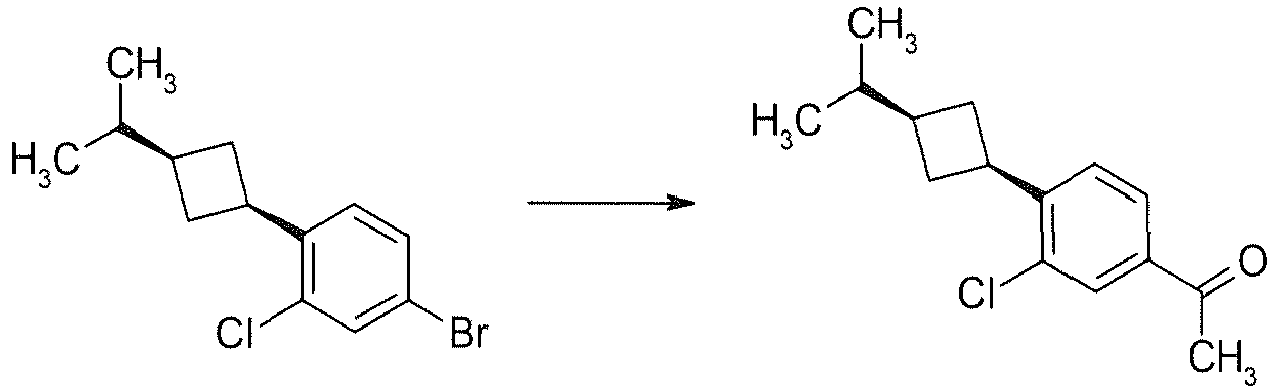
- 4-Bromo-2-chloro-1-(3-isopropyl-cyclobutyl)-benzene (1.85 g), palladium acetate (30 mg) and 1,3-bis(diphenylphosphino)propane (103 mg) were mixed in 2-ethoxyethanol (13.0 mL) under argon gas. The reaction solution was stirred at room temperature for 10 minutes, and then to the reaction solution were added N,N-diisopropylethylamine (2.8 mL) and ethyleneglycol monovinyl ether (1.8 mL). The reaction solution was stirred at 145°C for 2.5 hours. To the reaction solution was added 6M hydrochloric acid (3.2 mL) under ice cooling, and the reaction solution was stirred at room temperature overnight. To the reaction solution was added water, which was then extracted with tert-butylmethylether. The organic layer was washed sequentially with water and 25% aqueous sodium chloride solution, and dried over magnesium sulfate. After removing magnesium sulfate on a filter, the filtrate was concentrated under reduced pressure. The resulted residue was purified through silica gel column chromatography (ethyl acetate:hexane=0:100 -> 10:90) to give the titled compound (1.24 g).
1H-NMR (400 MHz, CDCl3) 0.84 (d, J=6.70Hz, 6H), 1.43 (d, J=34.91Hz, 1H), 1.70 (d, J=36.07Hz, 2H), 1.94 (d, J=42.08Hz, 1H), 2.54 - 2.58 (m, 2H), 2.57 (s, 3H), 3.50 - 3.59 (m, 1H), 7.35 (d, J=7.98Hz, 1H), 7.80 (dd, J=7.98, 1.74Hz, 1H), 7.89 (d, J=1.74Hz, 1H) -

- 1-[3-Chloro-4-(3-isopropyl-cyclobutyl)-phenyl]-ethanone was treated as a starting material in a similar manner to Example 87 (a method for preparation using an optically active sulfinamide) Steps 5 to 11 to give the titled compound (73 mg).
-

- 4-Bromo-3-trifluoromethyl-benzoic acid (5.2 g), bis(triphenylphosphine)palladium (II) dichloride (678 mg), and copper iodide (185 mg) were mixed in N-methylpyrrolidone (32 mL) under argon gas. The reaction system was vacuated to replace with argon three times, and then thereto were added diisopropylamine (10.9 mL) and 3,3-dimethyl-but-1-yne (3.55 mL). The reaction solution was stirred at 60°C overnight, and then warmed to room temperature, and to the reaction solution was added toluene (30 mL). Then thereto were added 2M aqueous sodium hydroxide solution (12 mL) and water, which wash then extracted with toluene. The resulted aqueous layer was acidified by adding 6M aqueous hydrochloric acid solution (20 mL), and ethyl acetate was added thereto, and the mixture was separated. The organic layer was washed with brine, and then dried over magnesium sulfate. After removing magnesium sulfate on a filter, the filtrate was concentrated under reduced pressure. The resulted residue was purified through silica gel column chromatography (ethyl acetate:methanol=90:10). Hexane was then added to the resulted solid, and the resulted slurry was stirred and then filtered to give the titled compound (2.4 g). The filtrate was concentrated under reduced pressure, and purified through silica gel column chromatography (ethyl acetate:hexane=1:9 -> 10:0) to give the titled compound (1.47 g).
1H-NMR (400 MHz, CDCl3) 1.33 (s, 9H), 7.57 - 7.62 (m, 1H), 8.12 - 8.17 (m, 1H), 8.32 - 8.35 (m, 1H) -

- 4-(3,3-Dimethyl-but-1-ynyl)-3-trifluoromethyl-benzoic acid (3.9 g) was mixed in methanol (40 mL). To the mixed solution was added 5 w/w% platinum/activated carbon (1.16 g), and the reaction solution was stirred for two days overnight at 1 atm under hydrogen gas. After removing platinum/activated carbon on a filter from the reaction solution, the filtrate was concentrated under reduced pressure to give the titled compound (7.32 g).
1H-NMR (400 MHz, CDCl3) 0.97 (s, 9H), 1.44 - 1.52 (m, 2H), 2.76 - 2.84 (m, 2H), 7.39 - 7.45 (m, 1H), 8.12 - 8.18 (m, 1H), 8.34 (brs, 1H) -

- 4-(3,3-Dimethyl-butyl)-3-trifluoromethyl-benzoic acid, a crude product, (3.78 g), N,O-dimethylhydroxylamine hydrochloride (1.48 g), 1-hydroxybenzotriazolemonohydrate (211 mg), and sodium hydrogen carbonate (1.28 g) were mixed in N,N-dimethylformamide (22 mL). Then thereto was added WSC•HCl (3.04 g), and the mixture was stirred at room temperature for 3 hours and then left to stand at room temperature ovenight. To the reaction solution were added water, hexane, and ethyl acetate, which was then separated, and then the aqueous layer was extracted with ethyl acetate twice. After azeotropy of the organic layer with a denatured ethanol solution, the resulted residue was purified through silica gel chromatography (ethyl acetate:hexane=8:92 -> 1:1) to give the titled compound (4.29 g).
1H-NMR (400 MHz, CDCl3) 0.96 (s, 9H), 1.44 - 1.50 (m, 2H), 2.72 - 2.79 (m, 2H), 3.36 (s, 3H), 3.54 (s, 3H), 7.31 - 7.36 (m, 1H), 7.76 - 7.81 (m, 1H), 7.95 - 7.98 (m, 1H) -

- 4-(3,3-Dimethyl-butyl)-N-methoxy-N-methyl-3-trifluoromethyl-benzamide (4.29 g) was mixed in tetrahydrofuran (25 mL). To the reaction solution was added dropwise 0.91M methylmagnesium bromide/tetrahydrofuran solution (22.3 mL) under ice cooling, and the reaction solution was stirred under ice cooling for 40 minutes. To the reaction solution were added dropwise 1M hydrochloric acid (32 mL) and water under ice cooling, and then thereto was added ethyl acetate. After the mixed solution was separated, the aqueous layer was extracted with ethyl acetate. The resulted organic layer was dried over magnesium sulfate. After removing magnesium sulfate on a filter, the filtrate was concentrated under reduced pressure to give the titled compound (3.6 g).
-

- 1-[4-(3,3-Dimethyl-butyl)-3-trifluoromethyl-phenyl]-ethanone was treated as a starting material in a similar manner to Example 87 (a method for preparation using an optically active sulfinamide) Steps 5 to 11 to give the titled compound (29 mg).
-

- (R)-3-Amino-3-[3-chloro-4-(3,3-dimethyl-butyl)-phenyl]-2-isopropyl-butan-1-ol (1.98 g) obtained according to Example 159 (a method for preparation using an optically active sulfinamide) Steps 1 to 2 was mixed with dimethylformamide (50 ml), and to the mixed solution were mixed chloro-t-butyldiphenylsilane (2.36 ml) and imidazole (620 mg) under ice cooling. The reaction solution was stirred at room temperature for 20 hours. To the reaction solution were added ethyl acetate and water, which was then separated. The organic layer was washed with water and aqueous saturated sodium chloride solution, and dried over sodium sulfate. After removing sodium sulfate on a filter, the reaction solution was concentrated under reduced pressure, and the resulted residue was purified through silica gel column chromatography (ethyl acetate:n-hexane) to give the titled compound (2.77 g).
1H-NMR (400 MHz, CDCl3) 0.79 (d, J=7.25Hz, 3H), 0.81 (d, J=7.25Hz, 3H), 0.98 (s, 9H), 1.06 (s, 9H), 1.37 (s, 3H), 1.43 - 1.47 (m, 2H), 1.68 - 1.75 (m, 1H), 1.79 - 1.82 (m, 1H), 2.62 - 2.67 (m, 2H), 3.81 (d, J=5.24Hz, 2H), 7.10 (d, J=8.06Hz, 1H), 7.18 (dd, J=8.06, 2.01Hz, 1H), 7.37 - 7.46 (m, 7H), 7.69 - 7.66 (m, 4H) -

- 6-Amino-nicotinic acid methyl ester (100 mg) was mixed with dichloromethane (5.0 mL) and tetrahydrofuran (3.0 mL). To the mixed solution were added p-nitrophenyl chloroformate (146 mg) and pyridine (0.0798 mL) under ice cooling, which was then stirred for 1 hour. The mixture was stirred at room temperature for 15 minutes, and then a solid was filtered. The resulted solid was washed sequentially with water, tetrahydrofuran, and n-hexane, and then dried under reduced pressure to give the titled compound (57.3 mg).
1H-NMR (400 MHz, DMSO-D6) 3.76 (s, 3H), 6.45 (dd. J=8.87, 0.81 Hz, 1H), 6.93 (td, J=6.35. 3.90Hz, 2H), 7.82 (dd, J=8.87, 2.82Hz, 1H), 8.12 (td, J=6.35. 3.90Hz, 2H), 8.50 (dd, J=2.42, 0.81Hz, 1H), 11.04 (s, 1H) -

- (R)-2-(tert-Butyl-diphenyl-silany)oxymethyl)-1-[3-chloro-4-(3,3-dimethyl-butyl)-phenyl]-1,3-dimethyl-butylamine (71.7 mg) was mixed with chloroform (1.5 ml), and to the mixed solution were added 6-(4-nitro-phenoxycarbonylamino)-nicotinic acid methyl ester (57.3 mg) and triethylamine (0.0252 ml) at room temperature. The reaction solution was stirred at 60°C for 3 hours, and then concentrated. The residue was purified through thin layer silica gel chromatography (chloroform:methanol=20:1) to give the titled compound (105 mg).
1H-NMR (400 MHz, CDCl3) 0.97 (s, 9H), 0.99 (s, 9H), 1.04 (d, J=6.85Hz, 3H), 1.21 (d, J=6.85Hz, 3H), 1.34 - 1.39 (m, 2H), 1.78 (s, 3H), 1.98 - 2.01 (m, 1H), 2.11 - 2.18 (m, 1H), 2.53 - 2.66 (m, 2H), 3.47 (dd, J=10.88, 4.03Hz, 1H), 3.67 (dd, J=10.88, 8.87Hz, 1H), 3.93 (s, 3H), 6.36 (d, J=8.87Hz, 1H), 7.01 (d, J=8.06Hz, 1H), 7.07 (dd, J=8.06, 1.61Hz, 1H), 7.26 - 7.30 (m, 3H), 7.33 - 7.42 (m, 4H), 7.48 (dd, J=8.06, 1.61Hz, 2H), 7.57 (dd, J=7.66, 1.61Hz, 2H), 8.03 (dd, J=8.87, 2.01Hz, 1H), 8.66 (s, 1H), 8.73 (d, J=2.01Hz, 1H), 10.05 (s, 1H) -

- 6-(3-{(R)-2-(tert-Butyl-diphenyl-silanyloxymethyl)-1-[3-chloro-4-(3,3-dimethyl-butyl)-phenyl]-1,3-dimethyl-butyl}-ureido)-nicotmic acid methyl ester (105 mg) was mixed with tetrahydrofuran (1.0 ml). To the mixed solution was added at room temperature an 1M solution of tetrabutylammonium fluoride in tetrahydrofuran (0.191 ml). The mixture was stirred for 15 hours at room temperature, and then concentrated. The residue was purified through thin layer silica gel column chromatography (chloroform:methanol=20:1) to give the titled compound (62.0 mg).
1H-NMR (400 MHz, CDCl3) 0.93 (d, J=6.85Hz, 3H), 0.96 (s, 9H), 1.15 (d, J=6.85Hz, 3H), 1.43 (dd, J=8.87, 8.46Hz, 2H), 1.87 - 1.90 (m, 1H), 1.92 (s, 3H), 2.12 - 2.19 (m, 1H), 2.58 - 2.71 (m, 2H), 3.61 - 3.72 (m, 2H), 3.93 (s, 3H), 6.39 (d, J=8.46Hz, 1H), 7.16 (d, J=8.06Hz, 1H), 7.23 (dd. J=8.06, 2.01Hz, 1H), 7.39 (d, J=2.01Hz, 1H), 8.05 (dd, J=8.46, 2.42Hz, 1H), 8.79 (d, J=2.42Hz, 1H), 8.97 (s, 1H), 10.20 (s, 1H) -

- 6-(3-{(R)-1-[3-Chloro-4-(3,3-dimethyl-butyl)-phenyl]-2-hydroxymethyl-1,3-dimethylbutyl}-ureido)-nicotinic acid methyl ester (62.0 mg) and iodobenzene diacetate (43.6 mg) were mixed in dichloromethane (1.0 mL). To the reaction solution was added 2,2,6,6-tetramethylpiperidine 1-oxyl free radical (1.9 mg) under ice cooling, and the reaction solution was stirred at room temperature for 18 hours. To the reaction solution was added trifluoroacetic acid (0.0182 mL) under ice cooling, which was then stirred at room temperature for 4.5 hours. To the reaction solution were added aqueous sodium sulfite solution and then aqueous sodium hydrogen carbonate solution at room temperature. The resulted mixed solution was extracted with ethyl acetate. The organic layer was washed with aqueous saturated sodium chloride solution, and dried over sodium sulfate. After removing sodium sulfate on a filter, the filtrate was concentrated under reduced pressure. The resulted residue was purified through thin layer silica gel column chromatography (chloroform:methanol=20:1).
- The resulted compound was mixed with chloroform, and thereto was added trifluoroacetic acid. The reaction solution was stirred at 50°C for 3.5 hours, and then concentrated. The residue was mixed with ethyl acetate, and washed sequentially with aqueous sodium hydrogen carbonate solution, and aqueous saturated sodium chloride solution, and dried over sodium sulfate. After removing sodium sulfate on a filter, the filtrate was concentrated under reduced pressure to give the titled compound (22.5 mg).
1H-NMR (400 MHz, CDCl3) 0.84 (d, J=6.85Hz, 3H), 0.98 (s, 9H), 1.17 (d, J=6.85Hz, 3H), 1.42 - 1.46 (m, 2H), 1.81 (s, 3H), 1.95 - 2.02 (m, 1H), 2.65 - 2.69 (m, 2H), 3.95 (s, 3H), 5.22 (s, 1H), 7.19 (d, J=8.06Hz, 1H), 7.30 (dd, J=8.06, 2.01Hz, 1H), 7.39 (s, 1H), 7.44 (d, J=2.01Hz, 1H), 8.12 (d, J=8.87Hz, 1H), 8.25 (dd, J=8.87, 2.42Hz, 1H), 9.01 (d, J=2.42Hz, 1H) -

- 6-{(S)-4-[3-Chloro-4-(3,3-dimethyl-butyl)-phenyl]-5-isopropyl-4-methyl-2-oxo-3,4-dihydro-2H-pyrimidin-1-yl}-nicotinic acid methyl ester (22.5 mg) was mixed with ethanol (1.0 mL) and tetrahydrofuran (0.25 mL). To the reaction solution was added dropwise 2M aqueous sodium hydroxide solution (0.0465 mL) at room temperature, and the reaction solution was stirred at room temperature for 14.5 hours. To the reaction solution was added 2M hydrochloric acid at room temperature, which was then concentrated. To the residue was added a mixed solution of ethyl acetate and methanol (ethyl acetate:methanol=10:1), and an insoluble was removed on a filter. The filtrate was concentrated to give the titled compound (22.0 mg).
- According to the following reaction scheme, the compounds of Examples 263 and 264 were prepared. In the reaction scheme, 3-[(S)-4-(4-bromo-3-chloro-phenyl)-5-isopropyl-4-methyl-2-oxo-3,4-dihydro-2H-pyrimidin-1-yl]-propionic acid ethyl ester was synthesized in Example 116 Step 6.

- The compound of Example 273 was prepared using an optically active sulfinic acid as follows.
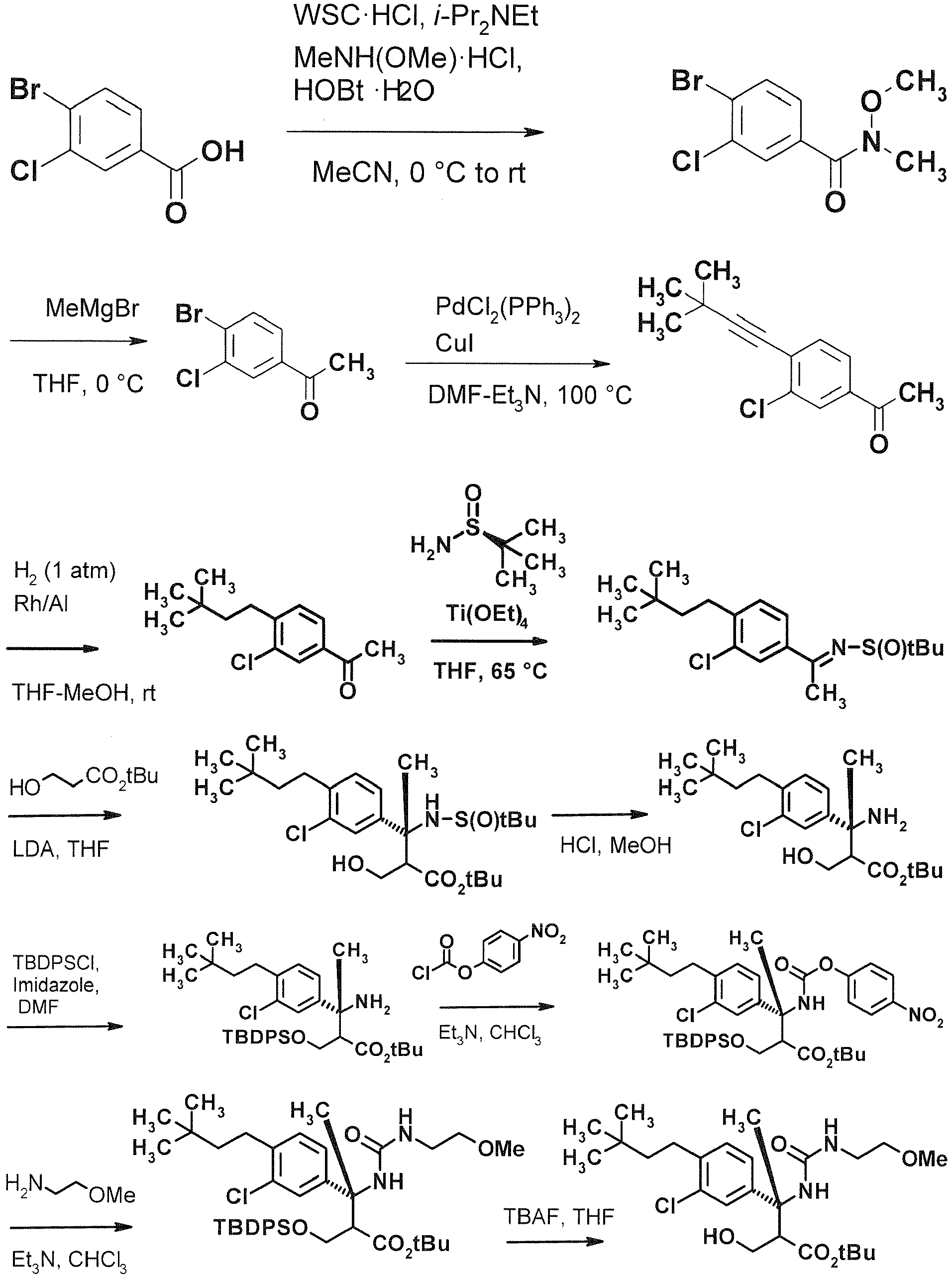

- The compound of Example 292 was prepared according to the following reaction scheme.


- The compounds of Examples 293 and 294 were prepared using the bromo product obtained in Step 10 of the method using Cleisen reaction in Example 116 and 2-methyl-but-3-yn-2-ol.


- The compound of Example 296 was prepared according to the following reaction scheme.

- The compound of Example 298 was prepared according to the following reaction scheme. In the following reaction scheme, 3-[(S)-4-(4-bromo-3-chloro-phenyl)-5-isopropyl-4-methyl-2-oxo-3,4-dihydro-2H-pyrimidin-1-yl]-propionic acid ethyl ester was synthesized in Example 116 Step 6.

- The compound of Example 316 was prepared using (3,3-difluoro-cyclobutyl)-acetic acid methyl ester as follows according to the method of Example 229.


- The compound of Example 320 was prepared using (3,3-difluoro-cyclobutyl)-acetic acid methyl ester as follows according to the method of Example 271.


- According to the method of Example 87, Example 116, Example 154 or Example 159 using an optically active sulfinic acid amide (i.e., (S)-(-)-2-methyl-propane-2-sulfinic acid amide), the following Example compounds were prepared.
Example 38, Example 113, Example 125, Example 126,
Example 127, Example 137, Example 140, Example 147,
Example 150, Example 157, Example 158, Example 161,
Example 162, Example 163, Example 164, Example 165,
Example 173, Example 175, Example 176, Example 177,
Example 178, Example 179, Example 183, Example 185,
Example 189 - According to the method using the reaction of an optically active sulfinic acid amide the following Example compounds were prepared.
Example 190 to Example 357, other than Example 190, Example 191, Example 197, Example 198, Example 199, Example 200, Example 205, Example 212, Example 213, and Example 312 - According to the method of Example 87, Example 116 or Example 130 using Cleisen reacton, the following Example compounds were prepared.
Example 9, Example 12, Example 13, Example 14,
Example 15, Example 16, Example 17, Example 18,
Example 19, Example 20, Example 21, Example 22,
Example 23, Example 24, Example 25, Example 26,
Example 27, Example 28, Example 29, Example 30,
Example 31, Example 32, Example 33, Example 34,
Example 35, Example 36, Example 37, Example 38,
Example 39, Example 40, Example 41, Example 42,
Example 43, Example 44, Example 45, Example 46,
Example 47, Example 48, Example 49, Example 50,
Example 51, Example 52, Example 53, Example 54,
Example 55, Example 56, Example 57, Example 58,
Example 59, Example 60, Example 61, Example 63,
Example 64, Example 65, Example 66, Example 67,
Example 68, Example 69, Example 70, Example 71,
Example 72, Example 73, Example 74, Example 75,
Example 76, Example 77, Example 78, Example 79,
Example 80, Example 81, Example 82, Example 83,
Example 84, Example 85, Example 86, Example 88,
Example 89, Example 90, Example 91, Example 92,
Example 93, Example 94, Example 95, Example 96,
Example 97, Example 98, Example 99, Example 100,
Example 103, Example 104, Example 105, Example 106,
Example 107, Example 108, Example 109, Example 110,
Example 111, Example 112, Example 114, Example 115,
Example 117, Example 118, Example 119, Example 120,
Example 121, Example 122, Example 123, Example 124,
Example 128, Example 129, Example 131, Example 132,
Example 133, Example 134, Example 135, Example 136,
Example 138, Example 139, Example 141, Example 142,
Example 143, Example 144, Example 145, Example 146,
Example 148, Example 149, Example 151, Example 152,
Example 153, Example 155, Example 156, Example 160,
Example 166, Example 167, Example 168, Example 169,
Example 170, Example 171, Example 172, Example 174,
Example 180, Example 181, Example 182, Example 184,
Example 186, Example 188 - According to the method using the Cleisen reaction, the following Example compounds were prepared.
Example 190, Example 191, Example 197, Example 198,
Example 199, Example 200, Example 205, Example 312 - When an Example compound is an optically active product, a desirable enantiomer was obtained by a chiral column separation and purification of a racemate intermediate (e.g. an ethyl ester intermediate).
- For example, the following example is illustrated (see Example 87, Steps 13 and 14, a method for preparation using Cleisen reaction).

- Each absolute configuration of each enantiomer was estimated on the basis of the followings:
- 1) A consistency of the retention times in a chiral column of an optically active product obtained in the method using an optically active sulfinic acid amide and an optically active product obtained by the method using Cleisen reaction and a separation using a chiral column;
- 2) A certain regularity in the retention times in a chiral column of a methyl ester intermediate or an ethyl ester intermediate of a compound in the present invention and the like;
- 3) A certain regularity in the strength of the biological activity value of each enantiomer of a compound in the present invention (Test Example 1); and/or
- 4) Results of X-ray structural analysis of a co-crystal of a compound having an RORγ antagonist activity (i.e. a related compound having the same 4-phenyl-3,4-dihydro-1H-pyrimidin-2-one skeleton as the compound of the present invention) and RORγ.
- Absoute configurations of parts of Example compounds and the intermediates were determined by single crystal X-ray structural analysis.
- According to Example 5, the following Example compounds were prepared using Biginelli reaction.
Example 1, Example 2, Example 3, Example 4,
Example 6, Example 7, Example 8, Example 10,
Example 11, Example 62, Example 101, Example 102,
Example 187 - Chemical structures and structural information of Example compounds prepared as above are shown in the following tables.
- In the tables, i) refers to a stereochemistry of the Example compound, ii) refers to physical data (such as the retention time in a chiral column) and analytical conditions for the Example compound, or physical data (such as the retention time in a chiral column) and analytical conditions for a precursor or intermediate such as an ester of the Example compound.
- In the tables,
"Chiral column IA-3" refers to CHIRALPAK IA-3 0.46 cmϕ × 15 cm manufactured by DAICEL Corporation, "Chiral column IC" refers to CHIRALPAK IC 0.46 cmϕ × 25 cm manufactured by DAICEL Corporation, "Chiral column IF-3" refers to CHIRALPAK IF-3 0.46 cmϕ × 15 cm manufactured by DAICEL Corporation, "Chiral column AD-3R" refers to CHIRALPAKAD-3R 0.46 cmϕ × 15 cm manufactured by DAICEL Corporation, and "Chiral column AS-3R" refers to CHIRALPAKAS-3R 0.46 cmϕ × 15 cm manufactured by DAICEL Corporation. - In the tables, "JAIGEL-ODS-AP-A" refers to an analytical column JAIGEL-ODS-AP-A, SP-120-10, ϕ6 × 25 cm of Japan Analytical Industry Co., Ltd.
- In the tables, for example, "Chiral column IC, IPA/Hexane=3/7, 1 ml/min, Retention time 8.1 min" refers to "Chiral column, Mobile phase, Flow rate, Retention time, used in the measurement". "IPA" refers to isopropanol. "Hex" or "hexane" refers to n-hexane. "TFA" refers to trifluoroacetic acid.
- In the tables, for example, "the optical purity of a methyl ester of Example 32 was > 99%ee" refers to "HPLC analysis using a chiral column for a methyl ester, a synthetic precursor, of Example 32 showed that the optical purity was > 99%ee".

- In the tables, HPLC analyses of Examples 38, 87, and 116 using a chiral column were determined with samples synthesized by a method using Cleisen reaction.
- The specific optical rotations were determined with samples synthesized by a method using an optically active sulfinic acid amide.
- In the tables, Example 64, Example 278, Example 279, and Example 280 are different with each other and any one of the following isomeric compounds, respectively.


[Table 1] Example Chemical Structural Formula Structural Information 1 
i) Racemate 2 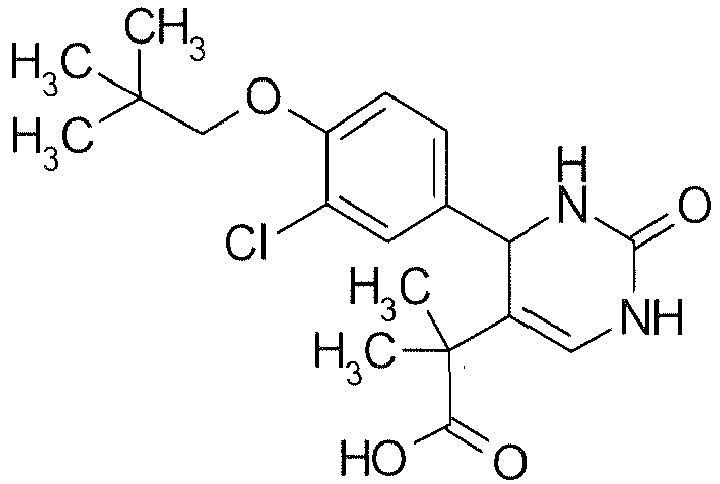
i) Racemate 3 
i) Racemate 4 
i) Racemate 5 
i) Optically active product of Example 1 Enantiomer of Example 6 ii) Optical purity was >99%ee Chiral column AS-3R, H2O/MeCN/TFA=30/70/0.1, Flow rate 0.5 ml/min, Retention time 13.5 min 6 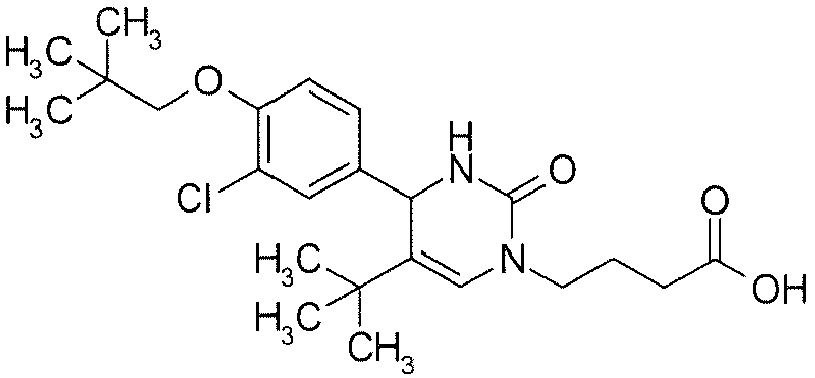
i) Optically active product of Example 1 Enantiomer of Example 5 ii) Optical purity was >99%ee Chiral column AS-3R, H2O/MeCN/TFA=30/70/0.1, Flow rate 0.5 ml/min, Retention time 16.7 min 7 
i) Racemate 8 
i) Racemate 9 
i) Racemate 10 
i) Optically active product of Example 8 Enantiomer of Example 11 ii) Optical purity was >99%ee Chiral column AS-3R, H2O/MeCN/TFA=30/70/0.1, Flow rate 0.5 ml/min, Retention time 13.6 min 11 
i) Optically active product of Example 8. Optical purity was >99%ee Enantiomer of Example 10 ii) Chiral column AS-3R, H2O/MeCN/TFA=30/70/0.1, Flow rate 0.5 ml/min, Retention time 12.6 min 12 
i) Optically active product of Example 9 Enantiomer of Example 13 ii) Optical purity of methyl ester of Example 12 was 99.9%ee Chiral column IC, IPA/hexane=30/70, 1 ml/min, Retention time 7.1 min 13 
i) Optically active product of Example 9 Enantiomer of Example 12 ii) Optical purity of methyl ester of Example 13 was 98.9%ee Chiral column IC, IPA/hexane=30/70, 1 ml/min, Retention time 8.1 min 14 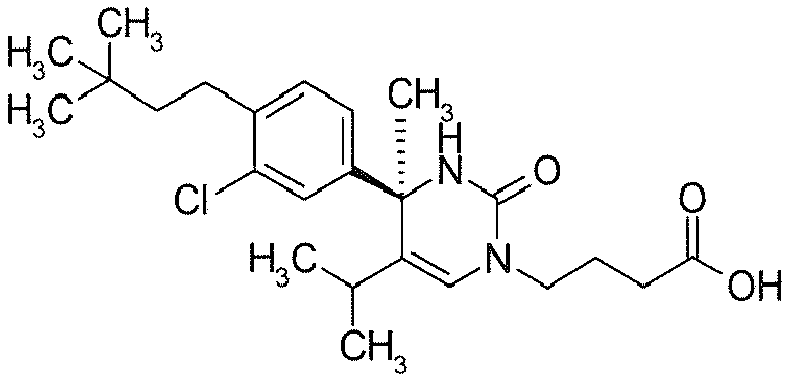
i) Enantiomer of Example 15 ii) Optical purity was >99%ee Chiral column AS-3R, H2O/MeCN/TFA=40/60/0.1, Flow rate =0.5 ml/min, Retention time 11.4 min 15 
i) Enantiomer of Example 14 ii) Optical purity was >99%ee Chiral column AS-3R, H2O/MeCN/TFA=40/60/0. 1, Flow rate =0.5 ml/min, Retention time 12.7 min 16 
i) Racemate 17 
i) Racemate 18 
i) Racemate 19 
i) Single enantiomer Example 19, Example 20, and Example 21 are diastereomers with each other ii) 96.7%d.e Chiral column IC, IPA/hexane/TFA=3/7/0.1, 1 ml/min, Retention time 5.8 min, 20 
i) Single enantiomer Example 19, Example 20, and Example 21 are diastereomer with each other ii) 96.2%d.e. Chiral column IC, IPA/hexane/TFA=3/7/0.1, 1 ml/min, Retention time 5.3 min 21 
i) A mixture of two diastereomers Example 19, Example 20, and Example 21 are diastereomer with each other ii) Chiral column IC, IPA/hexane/TFA=1/9/0.1, 1 ml/min, Retention time 12.9 min, 13.3 min 22 
i) Racemate 23 
i) Racemate 24 
i) A mixture of two diastereomers ii) Methyl ester of Example 24 analytical condition Chiral column IF-3, hexane/IPA=90/10, Flow rate 1 ml/min, Retention time 8.6 min, 8.7 min 25 
i) A mixture of two diastereomers ii) Methyl ester of Example 25 analytical condition Chiral column IF-3, hexane/IPA=90/10, Flow rate 1 ml/min, Retention time 12.5 min, 13.3 min 26 
i) Racemate 27 
i) Racemate 28 
i) Racemate 29 
i) Racemate 30 
i) Racemate 31 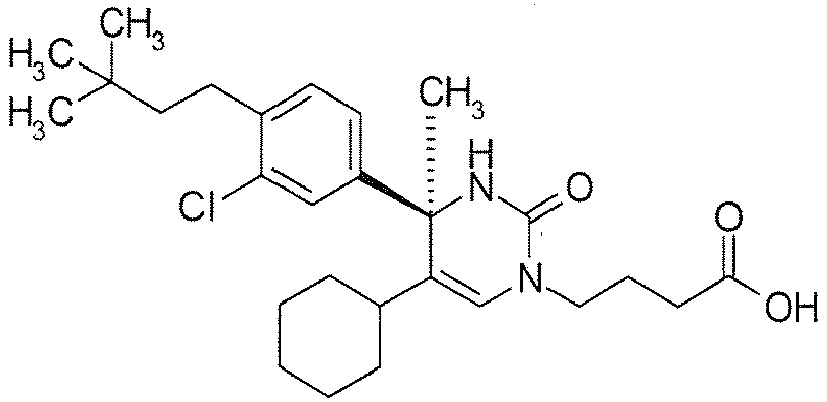
i) Enantiomer of Example 32 ii) Optical purity of methyl ester of Example 31 was >99%ee Chiral column IA-3, hexane/IPA=80/20, Flow rate 1 ml/min, Retention time 3.7 min 32 
i) Enantiomer of Example 31 ii) Optical purity of methyl ester of Example 32 was >99%ee Chiral column IA-3, hexane/IPA=80/20, Flow rate 1 ml/min, Retention time 4.6 min 33 
i) A mixture of two diastereomers ii) Chiral column AS-3R, H2O/MeCN/TFA=40/60/0.1, 0.5 ml/min, Retention time 12.60 min 34 
i) A mixture of two diastereomers ii) Chiral column AS-3R, H2O/MeCN/TFA=40/60/0.1, 0.5 ml/min, Retention time 13.25 min, 14.05 min 35 
i) Enantiomer of Example 36 ii) Optical purity was >99.5%ee Chiral column IA-3, IPA/Hex/TFA=5/95/0.1, 1 ml/min, Retention time 4.91 min 36 
i) Enantiomer of Example 35 ii) Optical purity was >99.5%ee Chiral column IA-3, IPA/Hex/TFA=5/95/0.1, 1 ml/min, Retention time 8.08 min 37 
i) Enantiomer of Example 38 ii) 92%ee Chiral column AD-3R, H?O/MeCN/HCOOH=30/70/0.1, Flow rate 0.5 ml/min, Retention time 6.5 min 38 
i) Enantiomer of Example 37 ii) >99%ee Chiral column AD-3R, H2O/MeCN/HCOOH=30/70/0.1, Flow rate 0.5 ml/min, Retention time 10.0 min [α]D 25 = +106.5° (C = 1.00, MeOH) 39 
i) Enantiomer of Example 40 ii) Optical purity of methyl ester of Example 39 was >99%ee Chiral column IA-3, IPA/Hex/TFA= 10/90/0.1, 1 ml/min, Retention time 6.32 min 40 
i) Enantiomer of Example 39 ii) Optical purity of methyl ester of Example 40 was >99%ee Chiral column IA-3, IPA/Hex/TFA= 10/90/0.1, 1 ml/min, Retention time 9.27 min 41 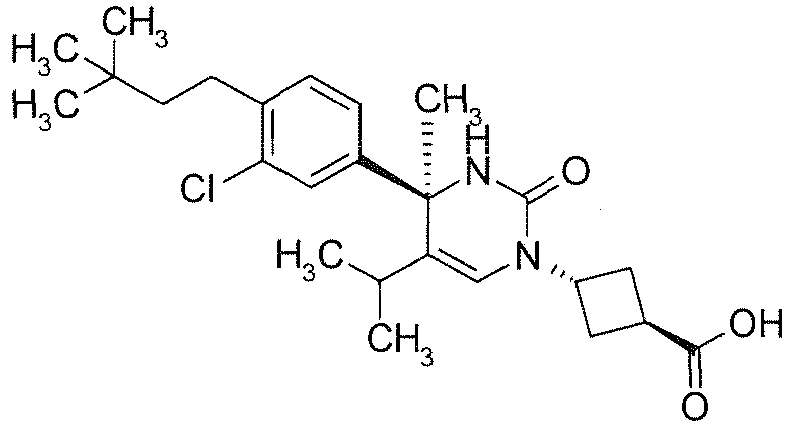
i) Enantiomer of Example 42 ii) Optical purity of methyl ester of Example 41 was >99%ee Chiral column IA-3, hexane/IPA=90/10, Flow rate 1 ml/min, Retention time 4.8 min 42 
i) Enantiomer of Example 41 ii) Optical purity of methyl ester of Example 42 was >99%ee Chiral column IA-3, hexane/IPA=90/10, Flow rate 1 ml/min, Retention time 10.2 min 43 
i) Enantiomer of Example 44 ii) Analytical condition of methyl ester of Example 43 Chiral column IA-3, hexane/IPA=90/10, Flow rate 1 ml/min, Retention time 4.0 min 44 
i) Enantiomer of Example 43 ii) Analytical condition of methyl ester of Example 44 Chiral column IA-3, hexane/IPA=90/10, Flow rate 1 ml/min, Retention time 4.0 min 45 
i) Enantiomer of Example 46 ii) Optical purity of methyl ester of Example 45 was >99%ee Chiral column IA-3, hexane/IPA=90/10, Flow rate 1 ml/min, Retention time 4.4 min 46 
i) Enantiomer of Example 45 ii) Optical purity of methyl ester of Example 46 was >99%ee Chiral column IA-3, hexane/IPA=90/10, Flow rate 1 ml/min, Retention time 6.7 min 47 
i) Enantiomer of Example 48 ii) Optical purity of methyl ester of Example 47 was >99%ee Chiral column IA-3, hexane/IPA=90/10, Flow rate 1 ml/min, Retention time 5.3 min 48 
i) Enantiomer of Example 47 ii) Optical purity of methyl ester of Example 48 was >99%ee Chiral column IA-3, hexane/IPA=90/10, Flow rate 1 ml/min, Retention time 7.3 min 49 
i) Enantiomer of Example 50 ii) Optical purity of methyl ester of Example 49 was >99%ee Chiral column IA-3, hexane/IPA=80/20, Flow rate 1 ml/min, Retention time 5.3 min 50 
i) Enantiomer of Example 49 ii) Optical purity of methyl ester of Example 50 was >99%ee Chiral column IA-3, hexane/IPA=80/20, Flow rate 1 ml/min, Retention time 7.3 min 51 
i) Enantiomer of Example 52 ii) Optical purity of methyl ester was >99%ee Chiral column IA-3, hexane/IPA=90/10, Flow rate 1 ml/min, Retention time 6.0 min 52 
i) Enantiomer of Example 51 ii) Optical purity of methyl ester of Example 52 was >99%ee Chiral column IA-3, hexane/IPA=90/10, Flow rate 1 ml/min, Retention time 7.9 min 53 
i) Racemate 54 
i) Enantiomer of Example 55 ii) Optical purity of methyl ester of Example 54 was >99%ee Chiral column IA-3, IPA/Hex/TFA=10/90/0.1, 1 ml/min, Retention time 3.65 min 55 
i) Enantiomer of Example 54 ii) Optical purity of methyl ester of Example 55 was >99%ee Chiral column IA-3, IPA/Hex/TFA=1 0/90/0.1, 1 ml/min, Retention time 6.01 min 56 
i) Enantiomer of Example 57 ii) Optical purity of methyl ester of Example 56 was >99%ee Chiral column IA-3, hexane/IPA=90/10, Flow rate 1 ml/min, Retention time 5.8 min 57 
i) Enantiomer of Example 58 ii) Optical purity of methyl ester of Example 57 was >99%ee Chiral column IA-3, hexane/IPA=90/10, Flow rate 1 ml/min, Retention time 8.5 min 58 
i) Enantiomer of Example 59 ii) Optical purity of methyl ester of Example 57 was >99%ee Chiral column IA-3, hexane/IPA=90/10, Flow rate 1 ml/min, Retention time 5.2 min 59 
i) Enantiomer of Example 58 ii) Optical purity of methyl ester was >99%ee Chiral column IA-3, hexane/IPA=90/10, Flow rate 1 ml/min, Retention time 8.1 min 60 
i) Enantiomer of Example 61 ii) Optical purity of methyl ester of Example 60 was >99%ee Chiral column IA-3, hexane/IPA=90/10, Flow rate 1 ml/min, Retention time 6.1 min 61 
i) Enantiomer of Example 60 ii) Optical purity of methyl ester of Example 61 was >99%ee Chiral column IA-3, hexane/IPA=90/10, Flow rate 1 ml/min, Retention time 9.6 min 62 
i) Racemate 63 
i) Single enantiomer Stereochemistry of cyclopentane ring not determined ii) Optical purity of methyl ester of Example 63 was >99%ee Chiral column IA-3, hexane/IPA=90/10, Flow rate 1 ml/min, Retention time 4.3 min 64 
i) Single enantiomer Stereochemistry of cyclopentane ring not determined Examples 64, 278, 279, and 280 are a diastereomer with each other ii) Optical purity of methyl ester of Example 64 was >99%ee Chiral column IA-3, hexane/IPA=90/10, Flow rate 1 ml/min, Retention time 6.3 min Optical purity of Example 64 was >99%ee Analytical condition of Example 64 JAIGEL-ODS-AP-A, MeCN/H2O/HCO2H=90/10/0.1, Flow rate 1 ml/min, Retention time 9.6 min. 65 
i) Racemate 66 
i) Enantiomer of Example 67 ii) Optical purity of methyl ester of Example 66 was >98%ee Chiral column IF-3, IPA/Hex/TFA= 10/90/0.1, 1 ml/min, Retention time 8.69 min 67 
i) Enantiomer of Example 66 ii) Optical purity of methyl ester of Example 67 was >98%ee Chiral column IF-3, IPA/Hex/TFA= 10/90/0.1, 1 ml/min, Retention time 10.26 min 68 
i) Enantiomer of Example 69 ii) Optical purity of methyl ester of Example 68 was >99%ee Chiral column IA-3, hexane/IPA=90/10, Flow rate 1 ml/min, Retention time 5.3 min 69 
i) Enantiomer of Example 68 ii) Optical purity of methyl ester of Example 69 was >99%ee Chiral column IA-3, hexane/IPA=90/10, Flow rate 1 ml/min, Retention time 8.4 min 70 
i) Racemate 71 
i) Enantiomer of Example 72 ii) Optical purity of methyl ester of Example 71 was >99%ee Chiral column IA-3, hexane/IPA=90/10, Flow rate 1 ml/min, Retention time 4.2 min 72 
i) Enantiomer of Example 71 ii) Optical purity of methyl ester of Example 72 was >99%ee Chiral column IA-3, hexane/IPA=90/10, Flow rate 1 ml/min, Retention time 6.5 min 73 
i) Diastereomer mixture ii) Analytical condition of methyl ester of Example 73 Chiral column IA-3, hexane/IPA=90/10, Flow rate 1 ml/min, Retention time 3.6 min, 4.6 min, 7.0 min, 7.7 min Example 73 was prepared by hydrolysis of two diastereomer mixtures with 7.0 min and 7.7 min of retention times among the isomers. 74 
i) Enantiomer of Example 75 ii) Optical purity of methyl ester of Example 74 was >99%ee Chiral column IA-3, hexane/IPA=90/10, Flow rate 1 ml/min, Retention time 3.8 min 75 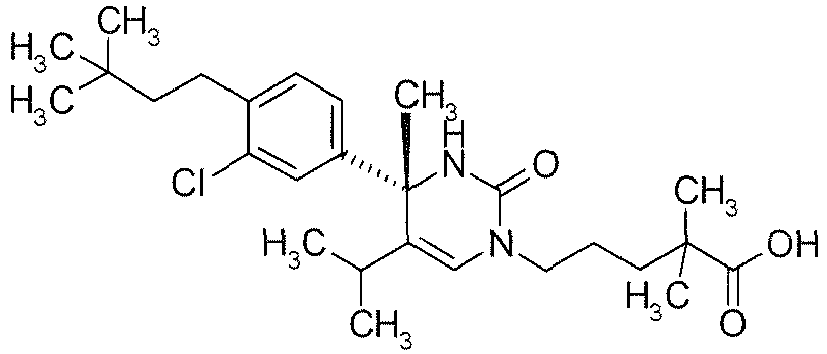
i) Enantiomer of Example 74 ii) Optical purity of methyl ester of Example 75 was >99%ee Chiral column IA-3, hexane/IPA=90/10, Flow rate 1 ml/min, Retention time 5.0 min 76 
i) Enantiomer of Example 77 ii) Optical purity of methyl ester of Example 76 was >99%ee Chiral column IA-3, hexane/IPA=90/10, Flow rate 1 ml/min, Retention time 3.7 min 77 
i) Enantiomer of Example 76 ii) Optical purity of methyl ester of Example 77 was >99%ee Chiral column IA-3, hexane/IPA=90/10, Flow rate 1 ml/min, Retention time 6.1 min 78 
i) Enantiomer of Example 79 ii) Optical purity of methyl ester of Example 78 was >99.5%ee Chiral column IA-3, IPA/Hex/TFA= 10/90/0.1, 1 ml/min, Retention time 5.27 min 79 
i) Enantiomer of Example 78 ii) Optical purity of methyl ester of Example 79 was >99.5%ee Chiral column IA-3, iPA/Hex/TFA=10/90/0.1, 1 ml/min, Retention time 9.25 min 80 
i) Racemate 81 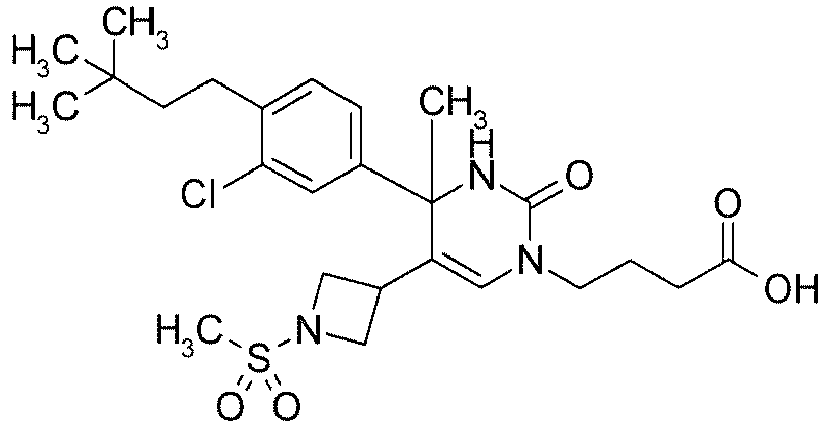
i) Racemate 82 
i) Enantiomer of Example 83 ii) Optical purity of methyl ester of Example 82 was >99%ee Chiral column IA-3, hexane/IPA=80/20, Flow rate 1 ml/min, Retention time 4.2 min 83 
i) Enantiomer of Example 82 ii) Optical purity of methyl ester of Example 83 was >99%ee Chiral column IA-3, hexane/IPA=80/20, Flow rate 1 ml/min, Retention time 6.3 min 84 
i) Racemate 85 
i) Racemate 86 
i) Enantiomer of Example 87 ii) Optical purity of ethyl ester was >99%ee Analytical condition of ethyl ester of Example 86 Chiral column IA-3, hexane/IPA=90/10, Flow rate 1 ml/min, Retention time 4.9 min Optical purity of Example 86 was >99%ee Analytical condition of Example 86 Chiral column AD-3R, H2O/MeCN/HCOOH=30/70/0.1, Flow rate 0.5 ml/min, Retention time 6.0 min 87 
i) Enantiomer of Example 86 ii) Optical purity of ethyl ester was >99%ee Analytical condition of ethyl ester of Example 87 Chiral column IA-3, hexane/IPA=90/10, Flow rate 1 ml/min, Retention time 7.1 min Optical purity of Example 87 was >99%ee Analytical condition of Example 87 Chiral column AD-3R, H2O/MeCN/HCOOH=30/70/0.1, Flow rate 0.5 ml/min Retention time 9.0 min [α]D 25 = +112.6° (C = 1.00, MeOH) 88 
i) Diastereomer of Example 89 ii) Optical purity of methyl ester of Example 88 was >99%ee Chiral column IA-3, hexane/IPA=80/20, Flow rate 1 ml/min, Retention time 3.7 min 89 
i) Diastereomer of Example 88 ii) Optical purity of methyl ester of Example 89 was >99%ee Chiral column IA-3, hexane/IPA=80/20, Flow rate 1 ml/min, Retention time 5.6 min 90 
i) Racemate 91 
i) Enantiomer of Example 92 ii) Optical purity of methyl ester of Example 91 was >99%ee Chiral column IA-3, hexane/IPA=80/20, Flow rate 1 ml/min, Retention time 4.5 min 92 
i) Enantiomer of Example 91 ii) Optical purity of methyl ester of Example 92 was >99%ee Chiral column IA-3, hexane/IPA=80/20, Flow rate 1 ml/min, Retention time 7.5 min 93 
i) Enantiomer of Example 94 ii) Optical purity of methyl ester of Example 93 was >99%ee Chiral column IA-3, hexane/IPA=90/10, Flow rate 1 ml/min, Retention time 5.3 min 94 
i) Enantiomer of Example 93 ii) Optical purity of methyl ester of Example 94 was >99%ee Chiral column IA-3, hexane/IPA=90/10, Flow rate 1 ml/min, Retention time 6.8 min 95 
i) Enantiomer of Example 96 ii) Analytical condition of methyl ester of Example 95 Chiral column IA-3, hexane/IPA=90/10, Flow rate 1 ml/min, Retention time 5.0 min 96 
i) Enantiomer of Example 95 ii) Analytical condition of methyl ester of Example 96 Chiral column IA-3, hexane/IPA=90/10, Flow rate 1 ml/min, Retention time 9.7 min 97 
i) Enantiomer of Example 98 ii) Optical purity of ethyl ester of Example 97 was >99%ee Chiral column IA-3, hexane/IPA=90/10, Flow rate 1 ml/min, Retention time 4.2 min 98 
i) Enantiomer of Example 97 ii) Optical purity of ethyl ester of Example 98 was >99%ee Chiral column IA-3, hexane/IPA=90/10, Flow rate 1 ml/min, Retention time 6.2 min 99 
i) Enantiomer of Example 100 ii) Optical purity of methyl ester of Example 99 was >99%ee Chiral column IA-3, hexane/IPA=80/20, Flow rate 1 ml/min, Retention time 4.3 min 100 
i) Enantiomer of Example 99 ii) Optical purity of methyl ester of Example 100 was >99%ee Chiral column IA-3, hexane/IPA=80/20, Flow rate 1 ml/min, Retention time 8.9 min 101 
i) Enantiomer of Example 102 ii) Analytical condition of methyl ester of Example 101 Chiral column IA-3, hexane/IPA=80/20, Flow rate 1 ml/min, Retention time 7.3 min 102 
i) Enantiomer of Example 101 ii) Analytical condition of methyl ester of Example 102 Chiral column IA-3, hexane/IPA=80/20, Flow rate 1 ml/min, Retention time 7.9 min 103 
i) Enantiomer of Example 104 ii) Optical purity of methyl ester of Example 103 was >99%ee Chiral column IA-3, hexane/IPA=90/10, Flow rate 1 ml/min, Retention time 4.7 min 104 
i) Enantiomer of Example 103 ii) Optical purity of methyl ester of Example 104 was >99%ee Chiral column IA-3, hexane/IPA=90/10, Flow rate 1 ml/min, Retention time 12.4 min 105 
i) Racemate 106 
i) Racemate 107 
i) Enantiomer of Example 108 ii) Optical purity of methyl ester of Example 107 was >99%ee Chiral column IA-3, hexane/IPA=80/10, Flow rate 1 ml/min, Retention time 3.4 min The relative configuration of substituents on the cyclobutane ring was estimated as trans-isomer 108 
i) Enantiomer of Example 107 ii) Optical purity of methyl ester of Example 108 was >99%ee Chiral column IA-3, hexane/IPA=80/10, Flow rate 1 ml/min, Retention time 4.9 min 109 
i) Enantiomer of Example 110 ii) Analytical condition of methyl ester of Example 109 Chiral column IA-3, hexane/IPA=90/10, Flow rate 1 ml/min, Retention time 5.7 min 110 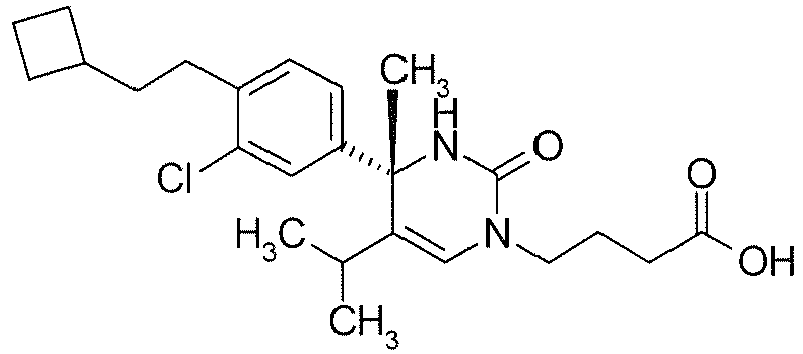
i) Enantiomer of Example 109 ii) Analytical condition of methyl ester of Example 110 Chiral column IA-3, hexane/IPA=90/10, Flow rate 1 ml/min. Retention time 9.3 min 111 
i) Enantiomer of Example 112 ii) Optical purity of ethyl ester of Example 111 was 86.6%ee Chiral column IA-3, hexane/IPA=90/10, Flow rate 1 ml/min, Retention time 3.8 min 112 
i) Enantiomer of Example 111 ii) Optical purity of ethyl ester of Example 112 was 98.8%ee Chiral column IA-3, hexane/IPA=90/10, Flow rate 1 ml/min, Retention time 4.3 min 113 
i) Optically active product (optical purity not determined) 114 
i) Racemate 115 
i) Enantiomer of Example 116 ii) Optical purity was >99%ee Analytical condition of ethyl ester of Example 115 Chiral column IA-3, hexane/IPA=90/10, Flow rate 1 ml/min, Retention time 4.1 min Analytical condition of Example 115 Chiral column AD-3R, H2O/MeCN/HCOOH=30/70/0.1, Flow rate 0.5 ml/min, Retention time 6.0 min 116 
i) Enantiomer of Example 115 ii) Optical purity was >99%ee Analytical condition of ethyl ester of Example 116 Chiral column IA-3, hexane/IPA=90/10, Flow rate 1 ml/min, Retention time 6.4 min Analytical condition of Example 116 Chiral column AD-3R, H2O/MeCN/HCOOH=30/70/0.1, Flow rate 0.5 ml/min, Retention time 9.2 min [α]D 25 = + 106.1° (C = 1.00, MeOH) 117 
i) Enantiomer of Example 118 ii) Prepared by hydrolysis of ethyl ester of Example 117 Analytical condition of ethyl ester Chiral column IA-3, hexane/IPA=90/10, Flow rate 1 ml/min, Retention time 4.1 min 118 
i) Enantiomer of Example 117 ii) Synthesized by hydrolysis of ethyl ester of Example 118 Analytical condition of ethyl ester Chiral column IA-3, hexane/IPA=90/10, Flow rate 1 ml/min, Retention time 6.4 min 119 
i) Enantiomer of Example 120 ii) Analytical condition of ethyl ester of Example 119 Chiral column IA-3, hexane/IPA=90/10, Flow rate 1 ml/min, Retention time 4.8 min 120 
i) Enantiomer of Example 119 ii) Analytical condition of ethyl ester of Example 120 Chiral column IA-3, hexane/IPA=90/10, Flow rate 1 ml/min, Retention time 8.9 min 121 
i) Enantiomer of Example 122 ii) Analytical condition of ethyl ester of Example 121 Chiral column IA-3, hexane/IPA=90/10, Flow rate 1 ml/min, Retention time 4.7 min 122 
i) Enantiomer of Example 121 ii) Analytical condition of ethyl ester of Example 122 Chiral column IA-3, hexane/IPA=90/10, Flow rate 1 ml/min, Retention time 7.8 min 123 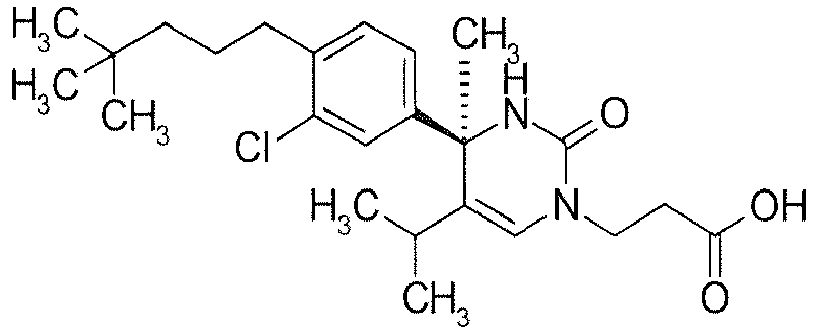
i) Enantiomer of Example 124 ii) Analytical condition of ethyl ester of Example 123 Chiral column IA-3, hexane/IPA=90/10, Flow rate 1 ml/min, Retention time 4.2 min 124 
i) Enantiomer of Example 123 ii) Analytical condition of ethyl ester of Example 124 Chiral column IA-3, hexane/IPA=90/10, Flow rate 1 ml/min, Retention time 6.7 min 125 
i) Optically active product (optical purity not determined) 126 
i) Optically active product (optical purity not determined) 127 
i) Optically active product (optical purity not determined) 128 
i) Enantiomer of Example 129 ii) Analytical condition of ethyl ester of Example 128 Chiral column IA-3, hexane/IPA=90/10, Flow rate 1 ml/min, Retention time 5.1 min 129 
i) Enantiomer of Example 129 ii) Analytical condition of ethyl ester of Example 128 Chiral column IA-3, hexane/IPA=90/10, Flow rate 1 ml/min, Retention time 11.1 min 130 
i) Optically active product (optical purity not determined) 131 
i) Enantiomer of Example 132 ii) Analytical condition of ethyl ester of Example 131 Chiral column IA-3, hexane/IPA=90/10, Flow rate 1 ml/min, Retention time 5.0 min 132 
i) Enantiomer of Example 131 ii) Analytical condition of ethyl ester of Example 132 Chiral column IA-3, hexane/IPA=90/10, Flow rate 1 ml/min, Retention time 8.7 min 133 
i) Enantiomer of Example 134 ii) Analytical condition of ethyl ester of Example 133 Chiral column IA-3, hexane/IPA=90/10, Flow rate 1 ml/min, Retention time 4.4 min 134 
i) Enantiomer of Example 133 ii) Analytical condition of ethyl ester of Example 134 Chiral column IA-3, hexane/IPA=90/10, Flow rate 1 ml/min, Retention time 5.9 min 135 
i) Enantiomer of Example 136 Prepared by reduction of ethyl ester of Example 133 ii) Analytical condition of ethyl ester of Example 135 Chiral column IA-3, hexane/IPA=90/10, Flow rate 1 ml/min, Retention time 4.4 min 136 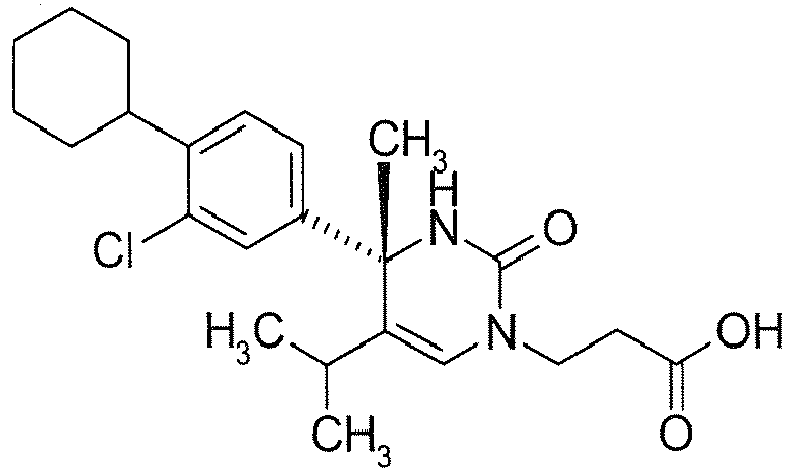
i) Enantiomer of Example 135 Prepared by reduction of ethyl ester of Example 134 ii) Analytical condition of ethyl ester of Example 136 Chiral column IA-3, hexane/IPA=90/10, Flow rate 1 ml/min, Retention time 5.9 min 137 
i) Optically active product ii) Chiral column AD-3R, H2O/MeCN/HCOOH=30/70/0.1, Flow rate 0.5 ml/min Retention time 9.2 min [α]D 25 = +113.4° (C = 0.5, MeOH) 138 
i) Enantiomer of Example 139 ii) Optical purity of methyl ester of Example 1 38 was >99%ee Chiral column IA-3, hexane/IPA=90/10, Flow rate 1 ml/min, Retention time 4.9 min 139 
i) Enantiomer of Example 138 ii) Optical purity of methyl ester of Example 139 was >99%ee Chiral column IA-3, hexane/IPA=90/10, Flow rate 1 ml/min, Retention time 8.7 min 140 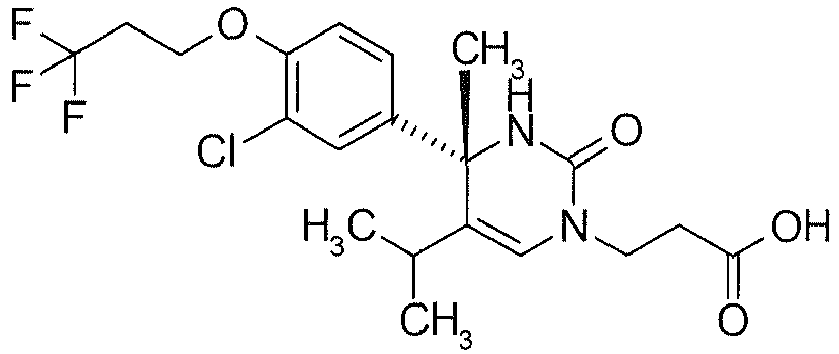
i) Optically active product (optical purity not determined) 141 
i) Enantiomer of Example 142 ii) Analytical condition of ethyl ester of Example 141 Chiral column IA-3, hexane/IPA=90/10, Flow rate 1 ml/min, Retention time 4.1 min 142 
i) Enantiomer of Example 141 ii) Analytical condition of ethyl ester of Example 142 Chiral column IA-3, hexane/IPA=90/10, Flow rate 1 ml/min, Retention time 7.5 min 143 
i) Enantiomer of Example 144 ii) Analytical condition of ethyl ester of Example 143 Chiral column IA-3, hexane/IPA=90/10, Flow rate 1 ml/min, Retention time 6.0 min 144 
i) Enantiomer of Example 143 ii) Analytical condition of ethyl ester of Example 144 Chiral column IA-3, hexane/IPA=90/10, Flow rate 1 ml/min, Retention time 11.1 min 145 
i) Enantiomer of Example 146 ii) Optical purity of methyl ester of Example 145 was >99%ee Chiral column IA-3, hexane/IPA=90/10, Flow rate 1 ml/min, Retention time 5.1 min 146 
i) Enantiomer of Example 145 ii) Optical purity of methyl ester of Example 146 was >99%ee Chiral column IA-3, hexane/IPA=90/10, Flow rate 1 ml/min, Retention time 8.6 min 147 
i) Optically active product (optical purity not determined) 148 
i) Enantiomer of Example 149 ii) Analytical condition of ethyl ester of Example 148 Chiral column IA-3, hexane/IPA=90/10, Flow rate 1 ml/min, Retention time 4.9 min 149 
i) Enantiomer of Example 148 ii) Analytical condition of ethyl ester of Example 149 Chiral column IA-3, hexane/IPA=90/10, Flow rate 1 ml/min, Retention time 8.7 min 150 
i) Optically active product (optical purity not determined) 151 
i) Optically active product ii) Analytical condition of ethyl ester of Example 151 Chiral column IA-3, hexane/IPA=90/10, Flow rate 1 ml/min, Prepared from a fraction with 6.1 min of retention time among fractions with retention times of 4.2 min and 6.1 min 152 
i) Optically active product ii) Analytical condition of ethyl ester of Example 152 Chiral column IA-3, hexane/IPA=90/10, Flow rate 1 ml/min, Retention time 5.1 min 153 
i) Optically active product ii) Analytical condition of ethyl ester of Example 153 Chiral column IA-3, hexane/IPA=90/10, Flow rate 1 ml/min, Retention time 7.5 min 154 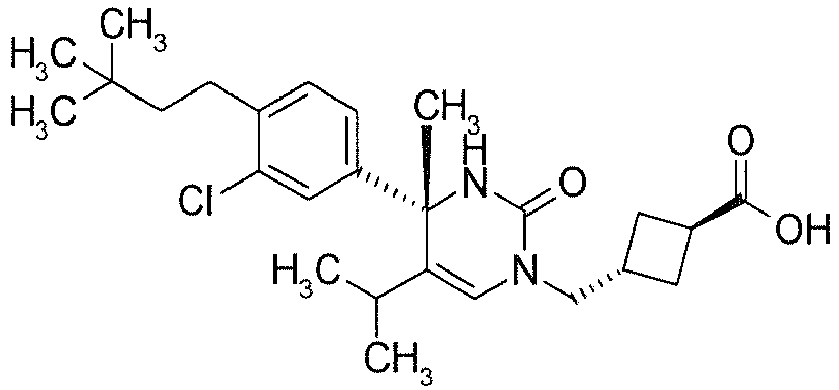
i) Optically active product ii) Chiral column AD-3R, H2O/MeCN/HCOOH=30/70/0.1, Flow rate 0.5 ml/min, Retention time 12.1 min [α]D 25 = +141.2° (C = 0.05, MeOH) 155 
i) Enantiomer of Example 156 Same absolute configuration as Example 148 (prepared by reduction of ethyl ester of Example 148) 156 
i) Enantiomer of Example 155 Same absolute configuration as Example 149 (prepared by reduction of ethyl ester of Example 149) 157 
i) Optically active product (optical purity not determined) 158 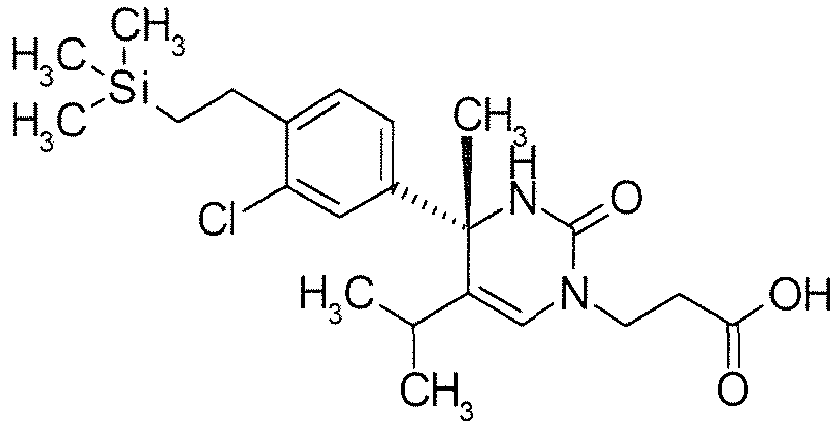
i) Optically active product (optical purity not determined) 159 
i) Optically active product ii) Chiral column AD-3R, H2O/MeCN/HCOOH=30/70/0.1, Flow rate 0.5 ml/min, Retention time 16.2 min [α]D 25 = +87.5° (C = 0.25, MeOH) 160 
i) Optically active product (optical purity not determined) 161 
i) Optically active product (optical purity not determined) 162 
i) Optically active product (optical purity not determined) 163 
i) Optically active product (optical purity not determined) 164 
i) Optically active product (optical purity not determined) 165 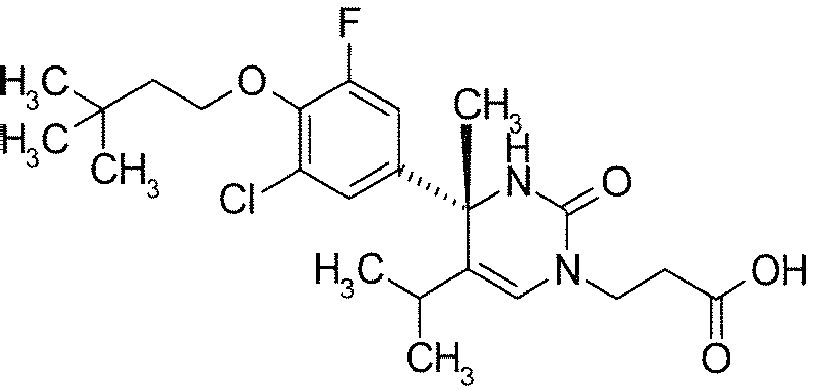
i) Optically active product (optical purity not determined) 166 
i) Single enantiomer Example 166 and Example 167 are a diastereomer with each other ii) Ethyl ester of Example 166 was prepared by reduction of ethyl ester of Example 151 (Chiral column IA-3, hexane/IPA=90/10, Flow rate 1 ml/min, the compound in a fraction with 6.9 min of retention time). Prepared from the ethyl ester (Chiral column IA-3, hexane/IPA=80/20, Flow rate 1 ml/min, the compound in a fraction of 3.8 min with retention time) 167 
i) Single enantiomer Example 166 and Example 167 are a diastereomer with each other ii) Ethyl ester of Example 167 was prepared by reduction of ethyl ester of Example 151 (Chiral column IA-3, hexane/IPA=90/10, Flow rate 1 ml/min, the compound in a fraction with 6.9 min of retention time). Prepared from the ethyl ester (Chiral column IA-3, hexane/IPA=80/20, Flow rate 1 ml/min, the compound in a fraction with 4.6 min of retention time) 168 
i) Optically active product (optical purity not determined) 169 
i) Single enantiomer Stereochemistry of the cyclopropane ring was estimated as trans-isomer Example 169 and Example 170 are a diastereomer with each other ii) Analytical condition of ethyl ester of Example 169 Chiral column IA-3, hexane/IPA=90/10, Flow rate 1 ml/min, Retention time 6.7 min 170 
i) Single enantiomer Stereochemistry of the cyclopropane ring was estimated as trans-isomer Example 169 and Example 170 are a diastereomer with each other ii) Analytical condition of ethyl ester of Example 170 Chiral column IA-3, hexane/IPA=90/10, Flow rate 1 ml/min, Retention time 7.1 min 171 
i) Optically active product ii) Analytical condition of ethyl ester of Example 171 Chiral column IA-3, hexane/IPA=90/10, Flow rate 1 ml/min, Prepared from a fraction with 6.6 min of retention time among fractions with 4.8 min and 6.6 min of retention times. 172 
i) Optically active product (optical purity not determined) 173 
i) Optically active product (optical purity not determined) 174 
i) Single enantiomer Stereochemistry of the cyclopropane ring was estimated as trans-isomer ii) Analytical condition of ethyl ester of Example 174 Chiral column IA-3, hexane/IPA=90/10, Flow rate 1 ml/min, Retention time 14.5 min 175 
i) Optically active product (optical purity not determined) 176 
i) Optically active product (optical purity not determined) 177 
i) Optically active product (optical purity not determined) 178 
i) Optically active product (optical purity not determined) 179 
i) Diastereomer mixture of 3-{(S)-4-[3-chloro-4-((S)-1,3,3-trimethyl-butyl)-phenyl]-5-isopropyl-4-methyl-2-oxo-3,4-dihydro-2H-pyrimidin-1-yl}-propionic acid and 3-{(S)-4-[3-chloro-4-((R)-1,3,3-trimethyl-butyl)-phenyl]-5-isopropyl-4-methyl-2-oxo-3,4-dihydro-2H-pyrimidin-1-yl}-propionic acid 180 
i) Optically active product (optical purity not determined) 181 
i) Optically active product (optical purity not determined) 182 
i) Optically active product (optical purity not determined) 183 
i) Optically active product (optical purity not determined) 184 
i) Optically active product (optical purity not determined) 185 
i) Optically active product (optical purity not determined) 186 
i) Optically active product (optical purity not determined) ii) Na salt of Example 77 187 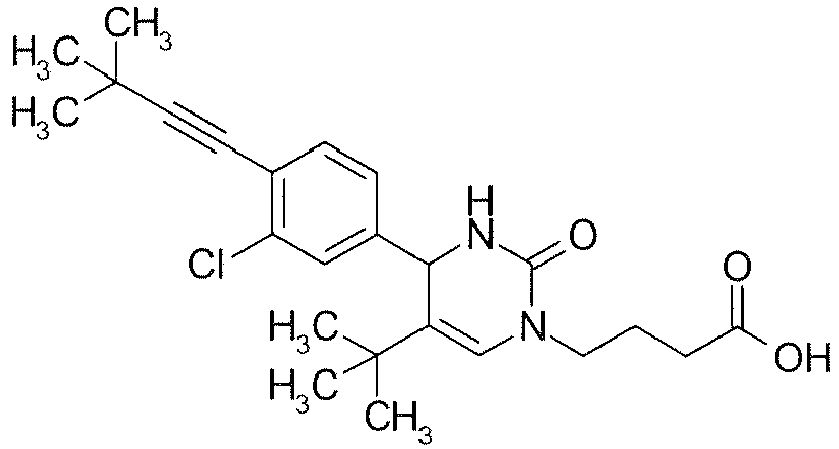
i) Racemate 188 
i) Racemate 189 
i) Optically active product (optical purity not determined) [Table 2] Example Chemical Structural Formula Structural Information 190 
i) Optically active product (optical purity not determined) ii) Analytical condition Chiral column IA-3, hexane/IPA=80/20, Flow rate 1 ml/min, Retention time 4.7 min 191 
i) Optically active product (optical purity not determined) ii) Analytical condition Chiral column IA-3, hexane/IPA=80/20, Flow rate 1 ml/min, Retention time 10.7 min 192 
i) Optically active product (optical purity not determined) 193 
i) Optically active product (optical purity not determined) 194 
i) Optically active product (optical purity not determined) 195 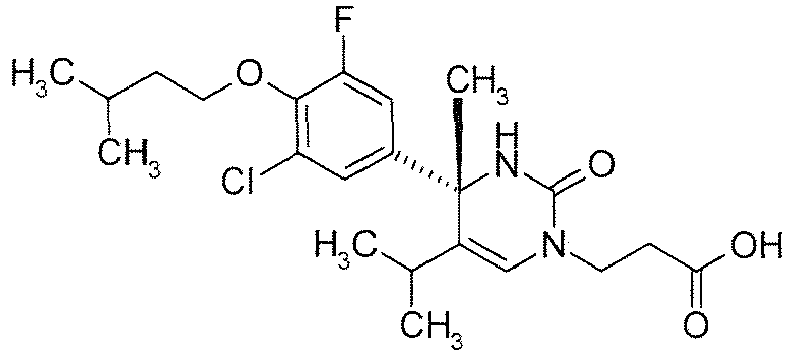
i) Optically active product (optical purity not determined) 196 
i) Optically active product (optical purity not determined) 197 
i) Optically active product (optical purity not determined) ii) Optical purity of alcohol, a synthetic precursor, was >99%ee Analytical condition of alcohol of Example 197 Chiral column IA-3, hexane/IPA=80/20, Flow rate 1 ml/min, Retention time 6.3 min 198 
i) Optically active product (optical purity not determined) 199 
i) Optically active product (optical purity not determined) ii) Optical purity of alcohol, a synthetic precursor, was >99%ee Analytical condition of alcohol of Example 199 Chiral column IA-3, hexane/IPA=80/20, Flow rate 1 ml/min, Retention time 5.7 min 200 
i) Optically active product (optical purity not determined) ii) Optical purity of alcohol, a synthetic precursor, was >99%ee Analytical condition of alcohol of Example 200 Chiral column IA-3, hexane/IPA=80/20, Flow rate 1 ml/min, Retention time 6.0 min 201 
i) Optically active product (optical purity not determined) 202 
i) Optically active product (optical purity not determined) 203 
i) Optically active product (optical purity not determined) 204 
i) Optically active product (optical purity not determined) 205 
i) Optically active product (optical purity not determined) ii) Analytical condition of methyl ester of Example 205 Chiral column IA-3, hexane/IPA=80/20, Flow rate 1 ml/min, Retention time 8.8 min 206 
i) Optically active product (optical purity not determined) 207 
i) Optically active product (optical purity not determined) 208 
i) Optically active product (optical purity not determined) 209 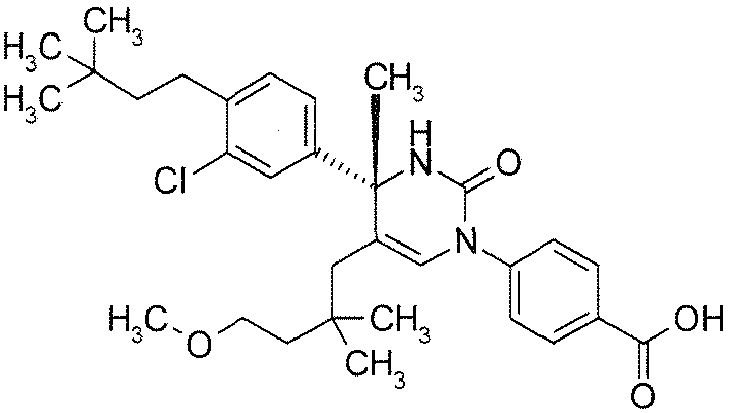
i) Optically active product (optical purity not determined) 210 
i) Optically active product (optical purity not determined) 211 
i) Optically active product (optical purity not determined) 212 
i) Enantiomer of Example 213 ii) Optical purity of ethyl ester was >99%ee Chiral column IA-3, hexane/IPA=90/10, Flow rate 1 ml/min, Retention time 5.2 min 213 
i) Enantiomer of Example 212 ii) Optical purity of ethyl ester was >99%ee Chiral column IA-3, hexane/IPA=90/10, Flow rate 1 ml/min, Retention time 8.3 min 214 
i) Optically active product (optical purity not determined) 215 
i) A mixture of two diastereomers 216 
i) Optically active product (optical purity not determined) 217 
i) A mixture of two diastereomers 218 
i) Optically active product (optical purity not determined) 219 
i) Optically active product (optical purity not determined) 220 
i) Optically active product (optical purity not determined) 221 
i) Optically active product (optical purity not determined) 222 
i) Optically active product (optical purity not determined) 223 
i) A mixture of two diastereomers 224 
i) Optically active product (optical purity not determined) 225 
i) Optically active product (optical purity not determined) 226 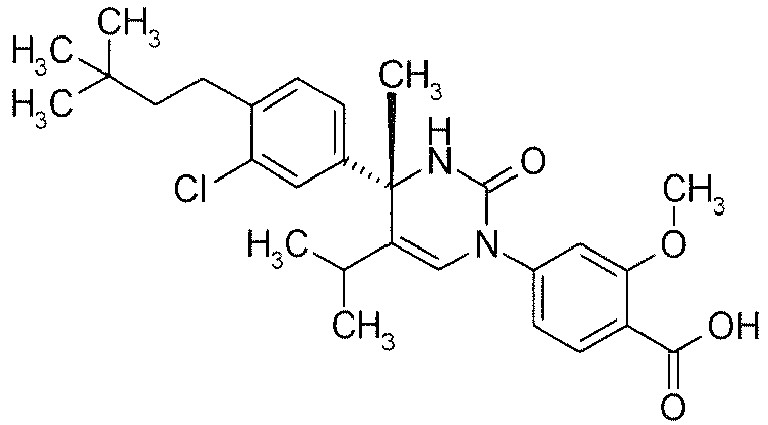
i) Optically active product (optical purity not determined) 227 
i) Optically active product (optical purity not determined) 228 
i) Optically active product (optical purity not determined) 229 
i) Optically active product (optical purity not determined) 230 
i) Optically active product (optical purity not determined) 231 
i) Optically active product (optical purity not determined) 232 
i) Single enantiomer (optical purity not determined) Example 232 and Example 233 are a diastereomer with each other 233 
i) Single enantiomer (optical purity not determined) Example 232 and Example 233 are a diastereomer with each other 234 
i) Optically active product (optical purity not determined) 235 
i) Optically active product (optical purity not determined) 236 
i) Optically active product (optical purity not determined) 237 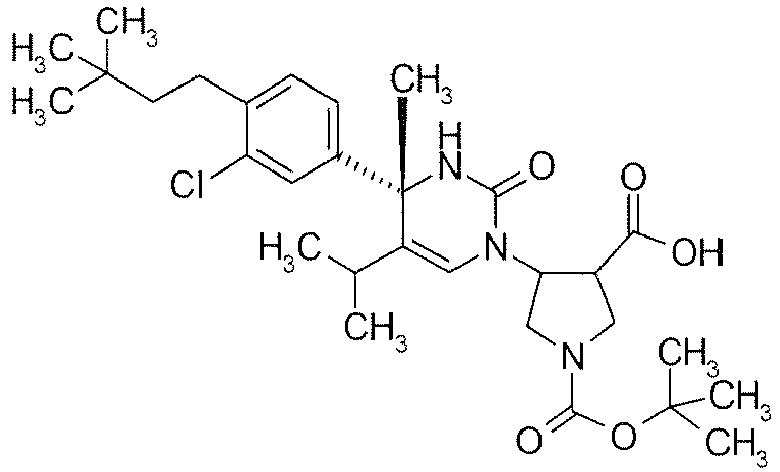
i) Single enantiomer (optical purity not determined) Stereochemistry of the pyrrolidine ring was estimated as trans-isomer 238 
i) Optically active product (optical purity not determined) Stereochemistry of the pyrrolidine ring was estimated as trans-isomer 239 
i) Single enantiomer (optical purity not determined) Stereochemistry of the pyrrolidine ring was estimated as trans-isomer 240 
i) Single enantiomer (optical purity not determined) Stereochemistry of the pyrrolidine ring was estimated as trans-isomer 241 
i) Optically active product (optical purity not determined) 242 
i) Single enantiomer (optical purity not determined) Stereochemistry of the cyclopentane ring was estimated as trans-isomer Example 242 and Example 243 are a diastereomer with each other 243 
i) Single enantiomer (optical purity not determined) Stereochemistry of the cyclopentane ring was estimated as trans-isomer Example 242 and Example 243 are a diastereomer with each other 244 
i) Single enantiomer (optical purity not determined) Stereochemistry of the pyrrolidine ring was estimated as trans-isomer Example 244 and Example 245 are a diastereomer with each other 245 
i) Single enantiomer (optical purity not determined) Stereochemistry of the pyrrolidine ring was estimated as trans-isomer Example 244 and Example 245 are a diastereomer with each other 246 
i) Optically active product (optical purity not determined) 247 
i) Optically active product (optical purity not determined) 248 
i) Optically active product (optical purity not determined) 249 
i) Optically active product (optical purity not determined) 250 
i) Optically active product (optical purity not determined) 251 
i) Optically active product (optical purity not determined) 252 
i) Optically active product (optical purity not determined) 253 
i) Optically active product (optical purity not determined) 254 
i) Single enantiomer (optical purity not determined) Stereochemistry of the cyclohexane ring was estimated as trans-isomer Example 254, Example 255, Example 256, and Example 257 are a diastereomer with each other ii) Optical purity of Example 254 was >99%ee Analytical condition of Example 254 JAIGEL-ODS-AP-A, MeCN/H2O/HCO2H=90/10/0.1, Flow rate 1 ml/min, Retention time 10.2 min. 255 
i) Single enantiomer (optical purity not determined) Stereochemistry of the cyclohexane ring was estimated as cis-isomer Example 254, Example 255, Example 256, and Example 257 are a diastereomer with each other ii) Optical purity of Example 255 was >99%ee Analytical condition of Example 255 JAIGEL-ODS-AP-A, MeCN/H2O/HCO2H=90/10/0.1, Flow rate 1 ml/min, Retention time 13.2 min. 256 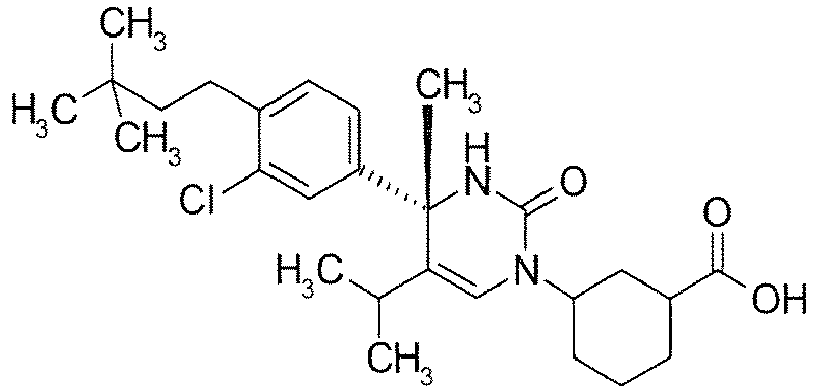
i) Single enantiomer (optical purity not determined) Stereochemistry of the cyclohexane ring was estimated as trans-isomer Example 254, Example 255, Example 256, and Example 257 are a diastereomer with each other ii) Optical purity of Example 256 was >99%ee Analytical condition of Example 256 JAIGEL-ODS-AP-A, MeCN/H2O/HCO2H=90/10/0.1, Flow rate 1 ml/min, Retention time 11.7 min. 257 
i) Single enantiomer (optical purity not determined) Stereochemistry of the cyclohexane ring was estimated as cis-isomer Example 254, Example 255, Example 256, and Example 257 are a diastereomer with each other ii) Optical purity of Example 257 was >99%ee Analytical condition of Example 257 JAIGEL ODS-AP-A, MeCN/H2O/HCO2H=90/10/0.1, Flow rate 1 ml/min, Retention time 14.0 min. 258 
i) Optically active product (optical purity not determined) 259 
i) Optically active product (optical purity not determined) 260 
i) Optically active product (optical purity not determined) 261 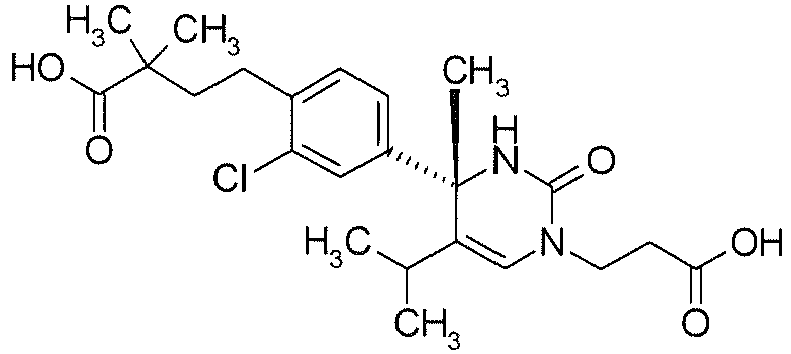
i) Optically active product (optical purity not determined) 262 
i) Optically active product (optical purity not determined) 263 
i) Optically active product (optical purity not determined) 264 
i) Optically active product (optical purity not determined) 265 
i) Optically active product (optical purity not determined) 266 
i) Optically active product (optical purity not determined) 267 
i) Optically active product (optical purity not determined) 268 
i) Optically active product (optical purity not determined) 269 
i) Optically active product (optical purity not determined) 270 
i) Optically active product (optical purity not determined) 271 
i) Optically active product (optical purity not determined) 272 
i) Optically active product (optical purity not determined) 273 
i) Optically active product (optical purity not determined) 274 
i) Optically active product (optical purity not determined) 275 
i) Optically active product (optical purity not determined) 276 
i) Single enantiomer (optical purity not determined) Stereochemistry of the cyclobutane ring not determined 277 
i) Single enantiomer (optical purity not determined) Stereochemistry of the cyclobutane ring not determined 278 
i) Single enantiomer Stereochemistry of the cyclopentane ring not determined Examples 64, 278, 279, and 280 are a diastereomer with each other ii) Optical purity of Example 278 was >99%ee Analytical condition of Example 278 JAIGEL-ODS-AP-A, MeCN/H2O/HCO2H=90/10/0.1, Flow rate 1 ml/min, Retention time 9.1 min. 279 
i) Single enantiomer Stereochemistry of the cyclopentane ring not determined Examples 64, 278, 279, and 280 are a diastereomer with each other ii) Optical purity of Example 279 was >99%ee Analytical condition of Example 279 JAIGEL-ODS-AP-A, MeCN/H2O/HCO2H=90/10/0.1, Flow rate 1 ml/min, Retention time 10.4 min. 280 
i) Single enantiomer Stereochemistry of the cyclopentane ring not determined Examples 64, 278, 279, and 280 are a diastereomer with each other ii) Optical purity of Example 280 was >99%ee Analytical condition of Example 280 JAIGEL-ODS-AP-A, MeCN/H2O/HCO2H=90/10/0.1, Flow rate 1 ml/min, Retention time 10.8 min. 281 
i) Optically active product (optical purity not determined) 282 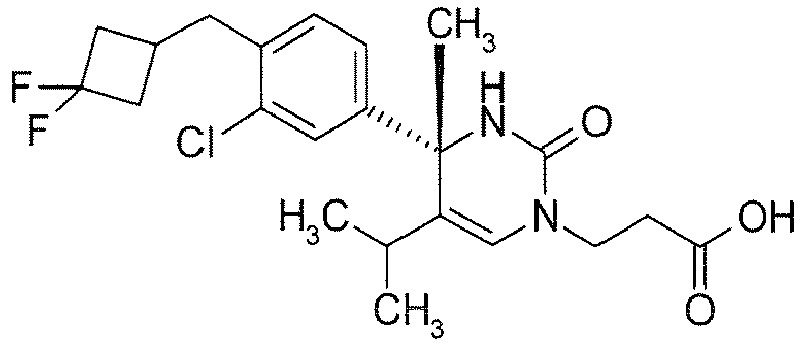
i) Optically active product (optical purity not determined) 283 
i) Optically active product (optical purity not determined) 284 
i) Optically active product (optical purity not determined) 285 
i) Optically active product (optical purity not determined) 286 
i) Optically active product (optical purity not determined) 287 
i) Optically active product (optical purity not determined) 288 
i) Optically active product (optical purity not determined) 289 
i) Optically active product (optical purity not determined) 290 
i) Optically active product (optical purity not determined) 291 
i) Optically active product (optical purity not determined) 292 
i) Optically active product (optical purity not determined) 293 
i) Optically active product (optical purity not determined) 294 
i) Optically active product (optical purity not determined) 295 
i) Optically active product (optical purity not determined) 296 
i) Optically active product (optical purity not determined) 297 
i) Optically active product (optical purity not determined) 298 
i) Optically active product (optical purity not determined) 299 
i) Single enantiomer Example 299 and Example 300 are a diastereomer with each other ii) Optical purity of Example 299 was >99%ee Analytical condition of Example 299 JAIGEL-ODS-AP-A, MeCN/H2O/HCO2H=80/20/0.1, Flow rate 1 ml/min, Retention time 14.7 min. 300 
i) Single enantiomer Example 299 and Example 300 are a diastereomer with each other ii) Optical purity of Example 300 was >99%ee Analytical condition of Example 300 JAIGEL-ODS-AP-A, MeCN/H2O/HCO2H=80/20/0.1, Flow rate 1 ml/min, Retention time 15.3 min. 301 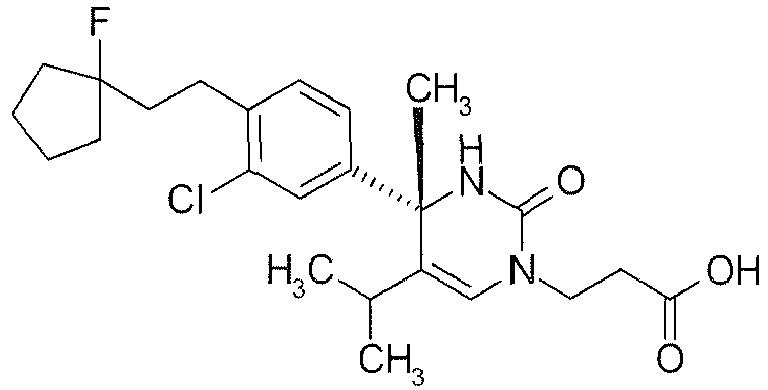
i) Optically active product (optical purity not determined) 302 
i) Optically active product (optical purity not determined) 303 
i) Optically active product (optical purity not determined) 304 
i) Optically active product (optical purity not determined) Diastereomer mixture 305 
i) Single enantiomer (optical purity not determined) Example 305 and Example 306 are a diastereomer with each other 306 
i) Single enantiomer (optical purity not determined) Example 305 and Example 306 are a diastereomer with each other 307 
i) Single enantiomer (optical purity not determined) Example 307 and Example 308 are a diastereomer with each other 308 
i) Single enantiomer (optical purity not determined) Example 307 and Example 308 are a diastereomer with each other 309 
i) Optically active product (optical purity not determined) 310 
i) Single enantiomer (optical purity not determined) Example 310 and Example 311 are a diastereomer with each other 311 
i) Single enantiomer (optical purity not determined) Stereochemistry of hydroxyl not determined 312 
i) Single enantiomer, >99%ee Analytical condition of Example 312 Chiral column IA-3, hexane/IPA=80/20, Flow rate 1 ml/min, Retention time 8.8 min 313 
i) Optically active product (optical purity not determined) 314 
i) Optically active product (optical purity not determined) 315 
i) Optically active product (optical purity not determined) 316 
i) Optically active product (optical purity not determined) 317 
i) Optically active product (optical purity not determined) 318 
i) Optically active product (optical purity not determined) 319 
i) Optically active product (optical purity not determined) 320 
i) Optically active product (optical purity not determined) 321 
i) Optically active product (optical purity not determined) 322 
i) Optically active product (optical purity not determined) 323 
i) Optically active product (optical purity not determined) 324 
i) Optically active product (optical purity not determined) 325 
i) Optically active product (optical purity not determined) 326 
i) Optically active product (optical purity not determined) 327 
i) Optically active product (optical purity not determined) 328 
i) Optically active product (optical purity not determined) 329 
i) Optically active product (optical purity not determined) 330 
i) Optically active product (optical purity not determined) 331 
i) Optically active product (optical purity not determined) 332 
i) Optically active product (optical purity not determined) 333 
i) Optically active product (optical purity not determined) 334 
i) Optically active product (optical purity not determined) 335 
i) Optically active product (optical purity not determined) 336 
i) Optically active product (optical purity not determined) 337 
i) Optically active product (optical purity not determined) 338 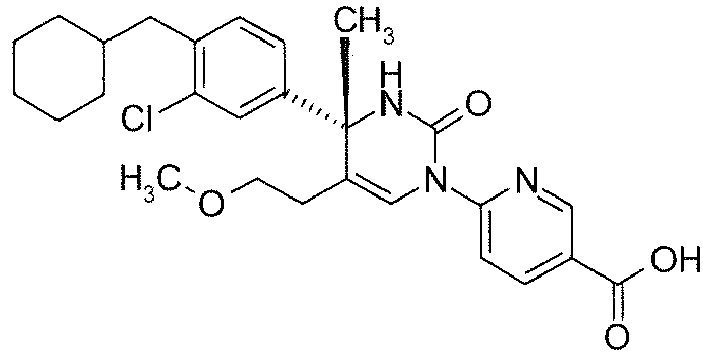
i) Optically active product (optical purity not determined) 339 
i) Optically active product (optical purity not determined) 340 
i) Optically active product (optical purity not determined) 341 
i) Optically active product (optical purity not determined) 342 
i) Optically active product (optical purity not determined) 343 
i) Optically active product (optical purity not determined) 344 
i) Single enantiomer (optical purity not determined) Stereochemistry of the cyclobutane ring was estimated as cis-isomer 345 
i) Optically active product (optical purity not determined) 346 
i) Optically active product (optical purity not determined) 347 
i) Optically active product (optical purity not determined) 348 
i) Optically active product (optical purity not determined) 349 
i) Optically active product (optical purity not determined) 350 
i) Optically active product (optical purity not determined) 351 
i) Single enantiomer (optical purity not determined) Example 351 and Example 352 are a diastereomer with each other 352 
i) Single enantiomer (optical purity not determined) Example 351 and Example 352 are a diastereomer with each other 353 
i) Optically active product (optical purity not determined) 354 
i) Optically active product (optical purity not determined) 355 
i) Optically active product (optical purity not determined) 356 
i) Optically active product (optical purity not determined) 357 
i) Optically active product (optical purity not determined) - In the following table, compounds of Examples 38, 87, and 116 were synthesized by a preparation method using Claisen reaction and measured.
[Table 3] Example 1H-NMR MS M+H or M-Na + H M-H or M-Na-H 1 (400 MHz, CDCl3) 0.98 (s, 9H), 1.06 (s, 9H), 1.88 - 2.04 (m, 2H), 2.32 - 2.44 (m, 2H), 3.37 - 3.44 (m, 1H), 3.61 (s, 2H), 3.69 - 3.76 (m, 1H), 4.82 (d, J=2.65Hz, 1H), 5.75 - 5.81 (m, 1H), 6.09 (s, 1H), 6.82 (d, J=8.60Hz, 1H), 7.06 (dd, J=8.49, 2.32Hz, 1H), 7.23 (d, J=2.21Hz, 1H) 437 435 2 (400 MHz, DMSO-D6) 0.96 (s, 3H), 1.02 (s, 9H), 1.20 (s, 3H), 3.68 (s, 2H), 4.72 (d, J=3.24Hz, 1H), 6.22 (d, J=5.32Hz, 1H), 7.06 (t, J=8.21Hz, 2H), 7.14 (dd, J=8.32, 2.08Hz, 1H), 7.26 (d, J=2.08Hz, 1H), 8.21 (s, 1H), 12.14 (s, 1H) 381 379 3 (400 MHz, CDCl3) 0.98 (s, 9H), 1.14 - 1.31 (m, 3H), 1.49 - 1.59 (m, 2H), 1.64 - 1.78 (m, 8H), 1.90 - 2.03 (m, 2H), 2.32 - 2.45 (m, 2H), 3.39 - 3.46 (m, 1H), 3.68 - 3.75 (m, 1H), 4.03 (t, J=6.73Hz, 2H), 4.82 (d, J=2.65Hz, 1H), 5.58 (d, J=2.21Hz, 1H), 6.09 (s, 1H), 6.85 (d, J=8.38Hz, 1H), 7.06 (dd, J=8.49, 2.10Hz, 1H), 7.22 (d, J=1.98Hz, 1H) 477 475 4 (400 MHz, DMSO-D6) 0.88 (s, 3H), 1.02 (s, 9H), 1.08 (s, 3H), 2.15 (d, J=13.87Hz, 1H), 2.29 (d, J=14.33Hz, 1H), 3.68 (s, 2H), 4.77 (d, J=3.24Hz, 1H), 6.15 (d, J=5.32Hz, 1H), 7.03 (s, 1H), 7.05 (d, J=8.55Hz, 1H), 7.19 (dd, J=8.44, 2.20Hz, 1H), 7.33 (d, J=2.08Hz, 1H), 8.09 (d, J=3.24Hz, 1H), 11.92 (s, 1H) 395 393 5 (400 MHz, CDCl3) 0.98 (s, 9H), 1.06 (s, 9H), 1.90-2.03 (m, 2H), 2.32 - 2.45 (m, 2H), 3.38 - 3.45 (m, 1H), 3.61 (s, 2H), 3.68 - 3.75 (m, 1H), 4.82 (d, J=2.65Hz, 1H), 5.62 (brs, 1H), 6.09 (s, 1H), 6.82 (d, J=8.16Hz, 1H), 7.05 (dd, J=8.49, 2.32Hz, 1H), 7.23 (d, J=2.2 1Hz, 1 H) 437 435 6 (400 MHz, CDCl3) 0.99 (s, 9H), 1.07 (s, 9H), 1.91-2.03 (m, 2H), 2.33 - 2.45 (m, 2H), 3.39 - 3.46 (m, 1H), 3.62 (s, 2H), 3.69 - 3.76 (m, 1H), 4.82 (d, J=2.65Hz, 1H), 5.50 - 5.60 (brm, 1H), 6.09 (s, 1H), 6.83 (d, J=8.38Hz, 1H), 7.05 (dd, J=8.38, 2.21Hz, 1H), 7.23 (d, J=2.21Hz, 1H) 437 435 7 (400 MHz, DMSO-D6) 0.72 (s, 3H), 0.96 (s, 3H), 1.00 (s, 9H), 1.37 - 1.46 (m, 1H), 1.61 - 1.69 (m, 1H), 1.95 - 2.10 (m, 2H), 3.68 (s, 2H), 4.64 (d, J=3.24Hz, 1H), 6.08 (d, J=5.32Hz, 1H), 7.01 (s, 1H), 7.05 (d, J=8.44Hz, 1H), 7.19 (dd, J=8.44, 2.20Hz, 1H), 7.32 (d, J=2.31Hz, 1H), 8.14 (d, J=4.86Hz, 1H), 11.96 (s, 1H) 409 407 8 (400 MHz, CDCl3) 0.97 (s, 9H), 0.98 (s, 9H), 1.24 - 1.30 (m, 2H), 1.41 - 1.46 (m, 2H), 1.89 - 2.02 (m, 2H), 2.36 - 2.40 (m, 2H), 2.62 - 2.67 (m, 2H), 3.37 - 3.44 (m, 1H), 3.68 - 3.75 (m, 1H), 4.84 (d, J=2.87Hz, 1H), 5.82 (brs, 1H), 6.10 (s, 1H), 7.04 (dd, J=7.72, 1.76Hz, 1H), 7.16 (d, J=7.94Hz, 1H), 7.20 (d, J=1.76Hz, 1H) 435 433 9 (400 MHz, DMSO-D6) 0.73 (d, J=6.94Hz, 3H), 1.03 (s, 9H), 1.05 (d, J=6.94Hz, 3H), 1.61 (s, 3H), 1.65-1.76 (m, 2H), 1.92 - 1.99 (m, 1H), 2.19 (t, J=7.40Hz, 2H), 2.40 - 2.50 (m. 1H), 3.40 - 3.50 (m, 1H), 3.70 (s, 2H), 6.05 (s, 1H), 6.98 (s, 1H). 7.07 (d, J=8.79Hz, 1H). 7.27 (dd, J=8.67, 2.43Hz, III), 7.37 (d, J=2.31Hz, 1H), 12.07 (s, 1H) 437 435 10 (400 MHz, DMSO-D6) 0.92 (s, 9H), 0.93 (s, 9H), 1.34 - 1.38 (m, 2H), 1.62 - 1.79 (m, 2H), 2.18 (t, J=7.40Hz, 2H), 2.57 - 2.61 (m, 2H), 3.11 - 3.18 (m, 1H), 3.59-3.66 (m, 1H), 4.76 (d, J=3.01Hz, 1H), 6.25 (s, 1H), 7.13 (dd, J=7.86, 1.62Hz, 1H), 7.16 (d, J=3.24Hz, 1H), 7.25 (d, J=7.86Hz, 1H), 7.28 (d, J=1.85Hz, 1H), 12.05 (brs, 1H) 435 433 11 (400 MHz, DMSO-D6) 0.92 (s, 9H), 0.93 (s, 9H), 1.34 - 1.38 (m, 2H), 1.62 - 1.78 (m, 2H), 2.18 (t, J=7.40Hz, 2H), 2.57 - 2.61 (m, 2H), 3.11 - 3.18 (m, 1H), 3.59-3.66 (m, 1H), 4.76 (d, J=3.01Hz, 1H), 6.25 (s, 1H), 7.13 (dd, J=7.86, 1.62Hz, 1H), 7.16 (d, J=3.24Hz, 1H), 7.25 (d, J=7.86Hz, 1H), 7.28 (d, J=1.85Hz, 1H), 12.05 (brs, 1H) 435 433 12 (400 MHz, DMSO-D6) 0.72 (d, J=6.76Hz, 3H), 1.00 (d, J=13.28Hz, 9H), 1.04 (d, J=6.76Hz, 3H), 1.60 (s, 3H), 1.66 - 1.73 (m, 2H), 1.95 (dd, J=13.52, 6.76Hz, 1H), 2.19 (t, J=7.49Hz, 2H), 3.27 - 3.34 (m, 1H), 3.41 - 3.48 (m, 1H), 3.69 (s, 2H), 6.04 (s, 1H), 6.97 (s, 1H), 7.06 (d, J=8.69Hz, 1H), 7.26 (dd, J=8.57, 2.29Hz, 1H), 7.37 (d, J=2.41Hz, 1H), 12.06 (s, 1H) 437 435 13 (400 MHz, DMSO-D6) 0.72 (d, J=7.00Hz, 3H), 1.02 (s, 9H), 1.04 (t, J=5.80Hz, 3H), 1.60 (s, 3H), 1.66-1.73 (m, 2H), 1.91 - 1.97 (m, 1H), 2.19 (t, J=7.49Hz, 2H), 3.27 - 3.34 (m, 1H), 3.41 - 3.48 (m, 1H), 3.69 (s, 2H), 6.04 (s, 1H), 6.97 (s, 1H), 7.06 (d, J=8.69Hz, 1H), 7.26 (dd, J=8.57, 2.29Hz, 1H), 7.37 (d, J=2.41Hz, 1H), 12.06 (s, 1H) 437 435 14 (400 MHz, DMSO-D6) 0.71 (d, J=6.94Hz, 3H), 0.95 (s, 9H), 1.04 (d, J=6.70Hz, 3H), 1.36 - 1.40 (m, 2H), 1.61 (s, 3H), 1.66 - 1.73 (m, 2H), 1.94 - 2.01 (m, 1H), 2.17 (t, J=7.63Hz, 2H), 2.56 - 2.66 (m, 2H), 3.25-3.35 (m, 1H), 3.41 - 3.48 (m, 1H), 6.05 (s, 1H), 7.01 (s, 1H), 7.26 (dd, J=7.98, 1.73Hz, 1H), 7.29 (d, J=8.09Hz, 1H), 7.35 (d, J=1.62Hz, 1H), 12.08 (s, 1H) 435 433 15 (400 MHz, DMSO-D6) 0.71 (d, J=6.94Hz, 3H), 0.94 (s, 9H), 1.04 (d, J=6.70Hz, 3H), 1.36 - 1.40 (m, 2H), 1.61 (s, 3H), 1.65 - 1.73 (m, 2H), 1.94 - 2.01 (m, 1H), 2.17 (t, J=7.40Hz, 2H), 2.60 - 2.67 (m, 2H), 3.25-3.35 (m, 1H), 3.41 - 3.48 (m, 1H), 6.05 (s, 1H), 7.01 (s, 1H), 7.26 (dd, J=7.98, 1.73Hz, 1H), 7.29 (d, J=8.09Hz, 1H), 7.35 (d, J=1.62Hz, 1H), 12.08 (s, 1H) 435 433 16 (400 MHz, DMSO-D6) 0.76 (d, J=7.00Hz, 3H), 1.01 (s, 9H), 1.07 (d, J=6.40Hz, 3H), 1.60 (s, 3H), 1.98-2.05 (m, 1H), 2.22 - 2.31 (m, 2H), 2.35 - 2.40 (m, 2H), 2.70 - 2.78 (m, 1H), 3.69 (s, 2H), 4.65 - 4.74 (m, 1H), 6.26 (s, 1H), 7.06 (s, 1H), 7.09 (s, 1H), 7.24 (dd, J=8.69, 2.41Hz, 1H), 7.34 (d, J=2.41 Hz, 1H), 12.22 (s, 1H) 449 447 17 (400 MHz, DMSO-D6) 0.78 (d, J=7.49Hz, 3H), 1.03 (s, 9H), 1.09 (d, J=6.76Hz, 3H), 1.60 (s, 3H), 1.95-2.02 (m, 1H), 2.24 - 2.30 (m, 2H), 2.46 - 2.54 (m, 2H), 2.88 - 2.90 (m, 1H), 3.69 (s, 2H), 4.92 - 5.01 (m, 1H), 6.32 (s, 1H), 7.07 (t, J=4.35Hz, 2H), 7.24 (dd, J=8.57, 2.29Hz, 1H), 7.33 (d, J=2.17Hz, 1H), 12.25 (s, 1H) 449 447 18 (400 MHz, DMSO-D6) 0.71 (d, J=6.76Hz, 3H), 1.01 (s, 9H), 1.03 (d, J=7.00Hz, 3H), 1.47 - 1.48 (m, 4H), 1.60 (s, 3H), 1.91 - 1.98 (m, 1H), 2.24 (t, J=6.64Hz, 2H), 3.25 - 3.32 (m, 1H), 3.41 - 3.44 (m, 1H), 3.69 (s, 2H), 6.05 (s, 1H), 6.93 (s, 1H), 7.06 (d, J=8.69Hz, 1H). 7.26 (dd, J=8.69, 2.41Hz, 1H), 7.36 (d, 451 449 J=2.41Hz, 1H), 11.99 (s, 1H) 19 (400 MHz, DMSO-D6) 0.70 (d, J=6.94Hz, 3H), 1.00 (s, 9H), 1.02 (d, J=6.70Hz, 4H), 1.08 (d, J=6.94Hz, 3H), 1.47 (td, J=13.76, 7.32Hz, 1H), 1.58 (s, 3H), 1.79 (td, J=13.70, 7.24Hz, 1H), 1.89 - 1.95 (m, 1H), 2.28 (dt, J=16.49, 4.74Hz, 1H), 3.32 - 3.43 (m, 1H), 3.68 (s, 2H), 6.02 (s, 1H), 6.95 (s, 1H), 7.05 (d, J=8.79Hz, 1H), 7.25 (dd, J=8.55, 2.31Hz, 1H), 7.35 (d, J=2.31Hz, 1H), 12.11 (s, 1H) 451 449 20 (400 MHz, DMSO-D6) 0.71 (d, J=6.70Hz, 3H), 1.00 (s, 9H), 1.02 (d, J=6.70Hz, 3H), 1.07 (d, J=6.94Hz, 3H), 1.47 - 1.50 (m, 1H), 1.58 (s, 3H), 1.75 - 1.79 (m, 1H), 1.95 - 1.97 (m, 1H), 2.26 - 2.28 (m, 1H), 3.20 - 3.27 (m, 1H), 3.47 - 3.54 (m, 1H), 3.67 (s, 2H), 6.01 (s, 1H), 6.96 (s, 1H), 7.04 (d, J=8.79Hz, 1H), 7.24 (dd, J=8.55, 2.31Hz, 1H), 7.35 (d, J=2.31Hz, 1H), 12.11 (s, 1H) 451 449 21 (400 MHz, DMSO-D6) 0.70 (dd, J=6.94, 3.24Hz, 3H), 1.00 (s, 9H), 1.02 (d, J=7.40Hz, 3H), 1.07 (dd, J=6.94, 4.16Hz, 3H), 1.42 - 1.53 (m, 1H), 1.58 (s, 3H), 1.73-1.84 (m, 1H), 1.89 - 1.98 (m, 1H), 2.23 - 2.33 (m, 1H). 3.17 - 3.57 (m, 2H), 3.68 (s, 2H), 6.02 (d, J=3.70Hz, 1H), 6.96 (d, J=4.86Hz, 1H), 7.05 (dd, J=8.67, 2.20Hz, 1H), 7.25 (dt, J=8.79, 2.14Hz, 1H), 7.35 (d, J=2.31Hz, 1H), 12.11 (s, 1H) 451 449 22 (400 MHz, DMSO-D6) 0.94 (s, 9H), 0.94 (s, 9H), 1.36 - 1.40 (m, 2H), 1.70 - 1.72 (m, 2H), 1.78 (s, 3H), 2.19 (t, J=7.46Hz, 2H), 2.60 - 2.64 (m, 2H), 3.26 - 3.28 (m, 1H), 3.48 - 3.55 (m, 1H), 6.23 (s, 1H), 6.85 (s, 1H), 7.27 (s, 2H). 7.36 (s, 1H), 12.09 (brs, 1H) 449 447 23 (400 MHz, DMSO-D6) 0.82 (s, 9H), 0.94 (s, 9H), 1.35 - 1.39 (m. 2H), 1.54 (s, 3H), 1.65 - 1.69 (m, 2H), 1.79 (d, J=4.16Hz, 2H), 2.13 (t, J=7.46Hz, 2H), 2.59 - 2.63 (m, 2H), 3.25 - 3.27 (m, 1H), 3.43 - 3.50 (m, 1H), 6.06 (s, 1H), 7.13 (s, 1H), 7.24 - 7.27 (m, 2H), 7.34 (d, J=1.73Hz, 1H), 12.06 (brs, 1H) 463 461 24 (400 MHz, DMSO-D6) 0.70 - 0.72 (m, 3H), 0.90-0.98 (m, 9H), 1.05 - 1.07 (m, 6H), 1.36 - 1.40 (m, 2H), 1.47 - 1.50 (m, 1H), 1.61 (s, 3H), 1.76 - 1.83 (m, 1H), 1.95 - 2.01 (m, 1H), 2.26 - 2.31 (m, 1H), 2.60 - 2.64 (m, 2H), 3.23 - 3.27 (m, 1H), 3.35 - 3.54 (m, 1H), 6.04 (d, J=4.39Hz, 1H), 7.02 (d, J=5.78Hz, 1H), 7.23 - 7.32 (m, 2H), 7.34 (d, J=1.62Hz, 1H), 12.12 (s, 1H) 449 447 25 (400 MHz, DMSO-D6) 0.70 - 0.72 (m, 3H), 0.90-0.98 (m, 9H), 1.05 - 1.07 (m, 6H), 1.36 - 1.40 (m, 2H), 1.47 - 1.50 (m, 1H), 1.61 (s, 3H), 1.76 - 1.83 (m, 1H), 1.95 - 2.01 (m, 1H), 2.26 - 2.31 (m, 1H), 2.60 - 2.64 (m, 2H), 3.23 - 3.27 (m, 1H), 3.35 - 3.54 (m, 1H), 6.04 (d, J=4.39Hz, 1H), 7.02 (d, J=5.78Hz, 1H), 7.23 - 7.32 (m, 2H), 7.34 (d, J=1.62Hz, 1H), 12.12 (s, 1H) 449 447 26 (400 MHz, CDCl3) δ: 0.70 (t, J=6.65 Hz, 3H), 0.94 (d, J=12.89 Hz, 9H), 1.05 (q, J=3.49 Hz, 3H), 1.45-1.50 (m, 2H), 1.72 (d, J=9.67 Hz, 3H), 1.92 (dd, J=10.88, 6.85 Hz, 3H), 2.37 (t, J=6.85 Hz, 2H), 2.53-2.57 (m, 2H), 3.55 (q, J=6.31 Hz, 2H), 5.36-5.49 (m, 1H), 5.78 (s, 1H), 7.14 (d, J=8.46 Hz, 2H), 7.31 (dd, J=8.26, 4.23 Hz, 2H). 401 399 27 (400 MHz, CDCl3) δ: 0.71 (dd, J=12.69, 6.65 Hz, 3H), 0.93 (dd, J=14.51, 11.69 Hz, 6H), 1.06 (dd, J=20.75, 13.90 Hz, 3H), 1.48 (dt, J=17.19, 7.45 Hz, 2H), 1.61 (td, J=13.30, 6.85 Hz, 1H), 1.69 (d, J=14.10 Hz, 3H), 1.87-1.94 (m, 3H), 2.38 (t, J=6.85 Hz, 2H), 2.67-2.71 (m, 2H), 3.55 (dq, J=25.39, 6.58 Hz, 2H), 421 419 5.47 (s, 1H), 5.80 (d, J=11.69 Hz, 1H), 7.17 (d, J=8.06 Hz, 1H), 7.24 (dd, J=8.06, 2.01 Hz, 1H), 7.37 (d, J=2.01 Hz, 1H). 28 (400 MHz, CDCl3) δ: 0.72 (d, J=6.85 Hz, 3H), 0.94 (t, J=7.25 Hz, 3H), 1.06 (d, J=6.85 Hz, 3H), 1.37 (t, J=7.45 Hz, 2H), 1.57 (dd, J=15.51, 7.86 Hz, 2H), 1.72 (s, 3H), 1.93 (dt, J=18.67, 6.95 Hz, 3H), 2.41 (t, J=6.85 Hz, 2H), 2.71 (t, J=7.66 Hz, 2H), 3.58 (dd, J=7.66, 5.64 Hz, 2H), 4.97 (s, 1H), 5.81 (s, 1H), 7.19 (d, J=7.66 Hz, 1H), 7.23 (d, J=2.01 Hz, 1H), 7.38 (d, J=1.61 Hz, 1H). 407 405 29 (400 MHz, DMSO-D6) 0.74 (d, J=6.94Hz, 3H), 0.94 (s, 9H), 1.06 (d, J=6.94Hz, 3H), 1.34 - 1.43 (m, 4H), 1.54 - 1.65 (m, 7H), 1.95 - 2.05 (m, 3H), 2.20 - 2.27 (m, 1H), 2.59 - 2.64 (m, 2H), 4.03 - 4.09 (m, 1H), 6.13 (s, 1H), 7.01 (s, 1H), 7.24 (dd, J=8.09, 1.85Hz, 1H), 7.29 (d, J=8.09Hz, 1H), 7.33 (d, J=1.85Hz, 1H), 12.05 (s, 1H) 475 473 30 (400 MHz, DMSO-D6) 0.70 (d, J=6.94Hz, 3H), 0.94 (s, 9H), 1.03 (d, J=6.70Hz, 3H), 1.24 - 1.25 (m, 1H), 1.38 (dt, J=10.33, 3.41Hz, 2H), 1.44 - 1.60 (m, 9H), 2.02 - 2.13 (m, 3H), 2.60 - 2.62 (m, 2H), 4.07 - 4.09 (m, 1H), 5.91 (s, 1H), 7.03 (s, 1H), 7.23 (dd, J=7.98, 1.97Hz, 1H), 7.29 (d, J=7.86Hz, 1H), 7.33 (d, J=1.85Hz, 1H) 475 473 31 (400 MHz, CDCl3) 0.87 - 0.94 (m, 2H), 0.96 (s. 9H), 1.02 - 1.18 (m, 4H), 1.41 - 1.45 (m, 2H), 1.47 - 1.59 (m, 3H), 1.67 (s, 3H), 1.68 - 1.79 (m, 2H), 1.87 - 1.94 (m, 2H), 2.35 (t, J=6.94Hz, 2H), 2.63 - 2.68 (m, 2H), 3.52 (t, J=6.47Hz, 2H), 5.20 (s, 1H), 5.76 (s, 1H), 7.15 (d, J=8.09Hz, 1H), 7.21 (dd, J=7.98, 1.97Hz, 1H), 7.35 (d, J=1.85Hz, 1H) 475 473 32 (400 MHz, CDCl3) 0.89 - 0.95 (m, 2H), 0.96 (s, 9H), 1.04 - 1.17 (m, 4H), 1.41 - 1.45 (m, 2H), 1.47 - 1.59 (m, 3H), 1.68 (s, 3H), 1.70 - 1.79 (m, 2H), 1.89 - 1.96 (m, 2H), 2.38 (t, J=6.94Hz, 2H), 2.64 - 2.68 (m, 2H), 3.55 (t, J=6.59Hz, 2H), 5.05 (s, 1H), 5.77 (s, 1H), 7.16 (d, J=8.09Hz, 1H), 7.21 (dd, J=8.09, 2.08Hz, 1H), 7.35 (d, J=2.08Hz, 1H) 475 473 33 (400 MHz, DMSO-D6) 0.38 (t, J=7.34Hz, 1.5H), 0.61 (d, J=6.82Hz, 1.5H), 0.83 (t, J=7.34Hz, 1.5H), 0.94 (s, 4.5H), 0.95 (s, 4.5H), 1.02 (d, J=6.70Hz, 1.5H), 1.04-1.06 (m, 1H), 1.24 - 1.31 (m, 0.5H), 1.3 7 (dt, J=12.48, 5.12Hz, 2H), 1.42 - 1.49 (m, 0.5H), 1.58 (s, 1.5H), 1.61 (s, 1.5H), 1.69 - 1.71 (m, 3H), 2.17 - 2.18 (m, 2H), 2.61 - 2.63 (m, 2H), 3.23 - 3.53 (m, 3H), 5.93 (s, 0.5H), 5.96 (s, 0.5H), 7.00 (s, 0.5H), 7.02 (s, 0.5H), 7.26 - 7.28 (m, 2H), 7.34 (d, J=1.62Hz, 0.5H), 7.35 (d, J=1.50Hz, 0.5H), 12.09 (brs, 1H) 449 447 34 (400 MHz, DMSO-D6) 0.38 (t, J=7.28Hz, 1.5H), 0.61 (d, J=6.82Hz, 1.5H), 0.83 (t, J=7.34Hz, 1.5H), 0.94 (s, 4.5H), 0.95 (s, 4.5H), 1.02 (d, J=6.82Hz, 1.5H), 1.05-1.07 (m, 1H), 1.24 - 1.31 (m, 0.5H), 1.36 - 1.39 (m, 2H), 1.42 - 1.49 (m, 0.5H), 1.58 (s, 1.5H), 1.61 (s, 1.5H), 1.69 - 1.72 (m, 3H), 2.17 - 2.19 (m, 2H), 2.61-2.63 (m, 2H), 3.23 - 3.53 (m, 3H), 5.93 (s, 0.5H), 5.97 (s, 0.5H), 7.00 (s, 0.5H), 7.02 (s, 0.5H), 7.26 - 7.28 (m, 2H), 7.34 (d, J=1.62Hz, 0.5H), 7.35 (d, J=1.50Hz, 0.5H), 12.10 (brs, 1H) 449 447 35 (400 MHz, DMSO-D6) 0.76 (d, J=6.82Hz, 3H), 0.87 (s, 3H), 0.89 (s, 3H), 0.94 (s, 9H), 1.04 (d, J=6.82Hz, 3H), 1.35 - 1.40 (m, 2H), 1.61 (s, 3H), 2.02 - 2.07 (m, 3H), 2.60 - 2.64 (m, 2H), 3.17 (d, J=13.99Hz, 1H), 3.56 (d, J=13.99Hz, 1H), 6.08 (s, 1H), 7.17 (bs, 1H), 7.29 - 7.29 (m, 2H), 7.39 (s, 1H). 12.09 (bs, 1H) 463 461 36 (400 MHz, DMSO-D6) 0.76 (d, J=6.82Hz, 3H), 0.87 (s, 3H), 0.89 (s, 3H), 0.94 (s, 9H), 1.04 (d, J=6.82Hz, 3H), 1.35 - 1.40 (m, 2H), 1.61 (s, 3H), 2.02 - 2.07 (m, 3H), 2.60 - 2.64 (m, 2H), 3.17 (d, J=13.99Hz, 1H), 3.56 (d, J=13.99Hz, 1H), 6.08 (s, 1H), 7.17 (bs, 1H), 7.29 - 7.29 (m, 2H), 7.39 (s, 1H), 12.09 (bs, 1H) 463 461 37 (400 MHz, DMSO-D6) 0.72 - 0.79 (m, 6H), 0.95 (s, 9H), 1.35 - 1.40 (m, 2H), 1.45 - 1.50 (m, 1H), 1.55-1.58 (m, 4H), 1.65 - 1.72 (m, 3H), 2.16 (t, J=7.51Hz, 2H), 2.60 - 2.64 (m, 2H), 3.27 - 3.31 (m, 1H), 3.42-3.48 (m, 1H), 5.94 (s, 1H), 7.05 (s, 1H), 7.25 - 7.28 (m, 2H), 7.35 (d, J=1.73Hz, 1 H), 12.08 (brs, 1H) 449 447 38 (400 MHz, DMSO-D6) 0.73 - 0.76 (m, 6H), 0.95 (s, 9H), 1.35 - 1.40 (m, 2H), 1.45 - 1.49 (m, 1H), 1.55-1.58 (m, 4H), 1.68 - 1.70 (m, 3H), 2.16 (t, J=7.51Hz, 2H), 2.60 - 2.64 (m, 2H), 3.27 - 3.30 (m, 1H), 3.41-3.48 (m, 1H), 5.94 (s, 1H), 7.05 (s, 1H), 7.25 - 7.28 (m, 2H), 7.35 (d, J=1.73Hz, 1H), 12.08 (brs, 1H) 449 447 39 (400 MHz, DMSO-D6) 0.69 (d, J=6.70Hz, 3H), 0.95 (s, 9H), 1.03 (d, J=6.70Hz, 3H), 1.38 (dt, J=8.79, 3.73Hz, 2H), 1.61 (s, 3H), 1.93 - 1.96 (m, 1H), 2.62 (dt, J=10.40, 3.73Hz, 2H), 3.44 - 3.62 (m, 4H), 3.92 (s, 2H), 6.12 (s, 1H), 7.02 (bs, 1H), 7.27 - 7.30 (m, 2H), 7.34 - 7.36 (m, 1H) 451 449 40 (400 MHz, DMSO-D6) 0.69 (d, J=6.70Hz, 3H), 0.95 (s, 9H), 1.03 (d, J=6.70Hz, 3H), 1.38 (dt, J=8.79, 3.73Hz, 2H), 1.61 (s, 3H), 1.93 - 1.96 (m, 1H), 2.62 (dt, J=10.40, 3.73Hz, 2H), 3.44 - 3.62 (m, 4H), 3.92 (s, 2H), 6.12 (s, 1H), 7.02 (bs, 1H), 7.27 - 7.30 (m, 2H), 7.34 - 7.36 (m, 1H) 451 449 41 (400 MHz, DMSO-D6) 0.67 - 0.79 (m, 3H), 0.94 (s, 9H), 1.03 - 1.13 (m, 3H), 1.32 - 1.43 (m, 2H), 1.54 - 1.61 (m, 3H), 1.93 - 2.05 (m, 1H), 2.14 - 2.35 (m, 5H), 2.54 - 2.69 (m, 2H), 4.83 - 4.99 (m, 1H), 6.27 (s, 1H), 6.99 (s, 1H), 7.17 - 7.35 (m, 3H) 447 445 42 (400 MHz, DMSO-D6) 0.67 - 0.79 (m, 3H), 0.94 (s, 9H), 1.03 - 1.13 (m, 3H), 1.32 - 1.43 (m, 2H), 1.54 - 1.61 (m, 3H), 1.93 - 2.05 (m, 1H), 2.14 - 2.35 (m, 5H), 2.54 - 2.69 (m, 2H), 4.83 - 4.99 (m, 1H), 6.27 (s, 1H), 6.99 (s, 1H), 7.17 - 7.35 (m, 3H) 447 445 43 (400 MHz, DMSO-D6) 0.74 - 0.77 (m, 6H), 0.94 (s, 9H), 1.01 - 1.10 (m, 1H), 1.14 - 1.23 (m, 1H), 1.38 - 1.41 (m, 3H), 1.57 (s, 3H), 1.63 - 1.71 (m, 3H), 1.83 - 1.90 (m, 1H), 2.14 (t, J=7.46Hz, 2H), 2.60 - 2.64 (m, 2H), 3.25 - 3.27 (m, 1H), 3.40 - 3.47 (m, 1H), 5.94 (s, 1H), 7.05 (s, 1H), 7.24 (dd, J=7.98, 1.85Hz, 1H), 7.29 (d, J=7.98Hz, 1H), 7.34 (d, J=1.85Hz, 1H), 12.08 (brs, 1H) 463 461 44 (400 MHz, DMSO-D6) 0.74 - 0.77 (m, 6H), 0.94 (s, 9H), 1.02 - 1.06 (m, 1H), 1.15 - 1.21 (m, 1H), 1.38 - 1.41 (m, 3H), 1.57 (s, 3H), 1.64 - 1.68 (m, 3H), 1.84 - 1.88 (m, 1H), 2.13 (t, J=7.46Hz, 2H), 2.60 - 2.64 (m, 2H), 3.25 - 3.27 (m, 1H), 3.40 - 3.47 (m, 1H), 5.94 (s, 1H), 7.05 (s, 1H), 7.24 (dd, J=8.03, 1.79Hz, 1H), 7.29 (d, J=8.09Hz, 1H), 7.34 (d, J=1.85Hz, 1H) 463 461 45 (400 MHz, DMSO-D6) 0.69 - 0.77 (m, 3H), 0.93 (s, 9H), 1.02 - 1.10 (m, 3H), 1.30 - 1.43 (m, 2H), 1.61 (s, 3H), 1.95 - 2.06 (m, 1H), 2.18 - 2.39 (m, 5H), 2.57 - 2.65 (m, 2H), 2.66 - 2.77 (m, 1H), 4.59 - 4.73 (m, 1H), 6.25 (s, 1H), 7.09 (s, 1H), 7.17 - 7.33 (m, 3H), 12.23 (brs, 1H) 447 445 46 (400 MHz, DMSO-D6) 0.69 - 0.77 (m, 3H), 0.93 (s, 9H), 1.02 - 1.10 (m, 3H), 1.30 - 1.43 (m, 2H), 1.61 (s, 3H), 1.95 - 2.06 (m, 1H), 2.18 - 2.39 (m, 5H), 2.57 - 2.65 (m, 2H), 2.66 - 2.77 (m, 1H), 4.59 - 4.73 (m, 1H), 6.25 (s, 1H), 7.09 (s, 1H), 7.17 - 7.33 (m, 3H), 12.23 (brs, 1 H) 447 445 47 (400 MHz, DMSO-D6) 0.64 - 0.72 (m, 3H), 0.93 (s, 9H), 1.00 - 1.05 (m, 3H), 1.31 - 1.40 (m, 2H), 1.40 - 1.51 (m, 4H), 1.59 (s, 3H), 1.90 - 2.00 (m, 1H), 2.18 - 2.25 (m, 2H), 2.55 - 2.65 (m, 2H), 3.21 - 3.28 (m, 1H), 3.38 - 3.46 (m, 1H), 6.04 (s, 1H), 6.95 (brs, 1H), 7.21 - 7.29 (m, 2H), 7.31 - 7.34 (m, 1H), 11.94 (brs, 1H) 449 447 48 (400 MHz, DMSO-D6) 0.64 - 0.72 (m, 3H), 0.93 (s, 9H), 1.00 - 1.05 (m, 3H), 1.31 - 1.40 (m, 2H), 1.40 - 1.51 (m, 4H), 1.59 (s, 3H), 1.90 - 2.00 (m, 1H), 2.18 - 2.25 (m, 2H), 2.55 - 2.65 (m, 2H), 3.21 - 3.28 (m, 1H), 3.38 - 3.46 (m, 1H), 6.04 (s, 1H), 6.95 (brs, 1H), 7.21 - 7.29 (m, 2H), 7.31 - 7.34 (m, 1H), 11.94 (brs, 1H) 449 447 49 (400 MHz, DMSO-D6) 0.47 - 0.54 (m, 3H), 0.86 - 0.91 (m, 3H), 0.94 (s, 9H), 1.33 - 1.42 (m, 2H), 1.54 (s, 3H), 1.75 - 1.88 (m, 1H), 2.57 - 2.65 (m, 2H), 2.81 - 2.90 (m, 2H), 3.49 - 3.59 (m, 1H), 3.70 - 3.81 (m, 1H), 5.78 (s, 1H), 6.96 (s, 1H), 7.09 - 7.15 (m, 1H), 7.21 - 7.27 (m, 1H), 7.27 - 7.34 (m, 3H), 7.80 - 7.86 (m, 2H), 12.75 (brs, 1H) 497 495 50 (400 MHz, DMSO-D6) 0.47 - 0.54 (m, 3H), 0.86 - 0.91 (m, 3H), 0.94 (s, 9H), 1.33 - 1.42 (m, 2H), 1.54 (s, 3H), 1.75 - 1.88 (m, 1H), 2.57 - 2.65 (m, 2H), 2.81 - 2.90 (m, 2H), 3.49 - 3.59 (m, 1H), 3.70 - 3.81 (m, 1H), 5.78 (s, 1H), 6.96 (s, 1H), 7.09 - 7.15 (m, 1H), 7.21 - 7.27 (m, 1H), 7.27 - 7.34 (m, 3H), 7.80 - 7.86 (m, 2H), 12.75 (brs, 1H) 497 495 51 (400 MHz, DMSO-D6) 0.15 - 0.19 (m, 1H), 0.51 - 0.41 (m, 3H), 0.79 (s, 3H), 0.94 (s, 9H), 1.36 - 1.40 (m, 2H), 1.66 - 1.71 (m, 2H), 1.74 (s, 3H), 2.16 (t, J=7.49Hz, 2H), 2.60 - 2.64 (m, 2H), 3.16 - 3.27 (m, 1H), 3.47 - 3.55 (m, 1H), 6.25 (s, 1H), 7.08 (s, 1H), 7.27 (d, J=0.97Hz, 2H), 7.38 (s, 1H), 12.05 (brs, 1H) 447 445 52 (400 MHz, DMSO-D6) 0.16 - 0.19 (m, 1H), 0.41 - 0.51 (m, 3H), 0.79 (s, 3H), 0.94 (s, 9H), 1.36 - 1.40 (m, 2H), 1.66 - 1.71 (m, 2H), 1.73 (s, 3H), 2.19 - 2.13 (m, 2H), 2.60 - 2.64 (m, 2H), 3.18 - 3.25 (m, 1H), 3.47 - 3.55 (m, 1H), 6.25 (s, 1H), 7.08 (s, 1H), 7.27 (s, 2H), 7.38 (s, 1H), 12.04 (brs, 1H) 447 445 53 (400 MHz, CDCl3) δ: 0.72 (d, J=6.85 Hz, 3H), 0.90 (t, J=6.85 Hz, 3H), 1.06 (d, J=6.85 Hz, 3H), 1.35 (t, J=3.63 Hz, 4H), 1.60 (t, J=7.45 Hz, 2H), 1.73 (d, J=8.06 Hz, 3H), 1.93 (tt, J=17.93, 5.31 Hz, 3H), 2.41 (t, J=7.05 Hz, 2H), 2.70 (t, J=7.66 Hz, 2H), 3.58 (td, J=6.55, 3.49 Hz, 2H), 5.06 (s, 1H), 5.82 (s, 1H), 7.18 (d, J=8.06 Hz, 1H), 7.23 (d, J=2.01 Hz, 1H), 7.38 (d, J=2.01 Hz, 1H). 421 419 54 (400 MHz, DMSO-D6) 0.70 (d, J=6.82Hz, 3H), 0.95 (s, 9H), 1.04 (d, J=6.82Hz, 3H), 1.12 (s, 6H), 1.36 - 1.40 (m, 2H), 1.60 (s, 3H), 1.63 - 1.68 (m, 2H), 1.97 - 1.98 (m, 1H), 2.60 - 2.64 (m, 2H), 3.27 - 3.41 (m, 4H), 6.00 (s, 1H), 7.00 (bs, 1H), 7.26 (dd, J=8.09, 1.85Hz, 1H), 7.30 (d, J=8.09Hz, 1H), 7.34 (d, J=1.85Hz, 1H), 12.18 (bs, 1H) 463 461 55 (400 MHz, DMSO-D6) 0.70 (d, J=6.82Hz, 3H), 0.95 (s, 9H), 1.04 (d, J=6.82Hz, 3H), 1.12 (s, 6H), 1.36 - 1.40 (m, 2H), 1.60 (s, 3H), 1.63 - 1.68 (m, 2H), 1.97 - 1.98 (m, 1H), 2.60 - 2.64 (m, 2H), 3.27 - 3.41 (m, 4H), 6.00 (s, 1H), 7.00 (bs, 1H), 7.26 (dd, J=8.09, 1.85Hz, 1H), 7.30 (d, J=8.09Hz, 1H), 7.34 (d, J=1.85Hz, 1H), 463 461 12.18 (bs, 1H) 56 (400 MHz, CDCl3) 0.20-0.26 (m, 1H), 0.27-0.32 (m, 1H), 0.38-0.45 (m, 1H), 0.60-0.67 (m, 1H), 0.86-0.92 (m, 1H), 0.98 (s, 9H), 1.42-1.47 (m, 2H), 1.80 (s, 3H), 1.89-1.96 (m, 2H), 2.39 (t, J=7.05Hz, 2H), 2.65-2.69 (m, 2H), 3.54 (ddd, J=6.85, 6.85, 2.82Hz, 2H), 5.09 (s, 1H), 5.65 (d, J=1.61Hz, 1H), 7.19 (d, J=8.06Hz, 1H), 7.27 (dd, J=4.43, 2.01Hz, 1H), 7.41 (d, J=2.01Hz, 1H) 433 431 57 (400 MHz, CDCl3) 0.20-0.26 (m, 1H), 0.27-0.32 (m, 1H), 0.38-0.45 (m, 1H), 0.60-0.67 (m, 1H), 0.86-0.92 (m, 1H), 0.98 (s, 9H), 1.42-1.47 (m, 2H), 1.80 (s, 3H), 1.89-1.96 (m, 2H), 2.39 (t, J=7.05Hz, 2H), 2.65-2.69 (m, 2H), 3.54 (ddd, J=6.85, 6.85, 2.82Hz, 2H), 5.09 (s, 1H), 5.65 (d, J=1.61Hz, 1H), 7.19 (d, J=8.06Hz, 1H), 7.27 (dd, J=4.43, 2.01Hz, 1H), 7.41 (d, J=2.01Hz, 1H) 433 431 58 (400 MHz, CDCl3) 0.98 (s, 9H), 1.42-1.47 (m, 2H), 1.52-1.67 (m, 3H), 1.64 (s, 3H), 1.69-1.76 (m, 1H), 1.80-1.88 (m, 1H), 1.92-2.03 (m, 3H), 2.40 (t, J=7.25Hz, 2H), 2.51-2.59 (m, 1H), 2.64-2.68 (m, 2H), 3.57 (ddd, J=14.91, 12.89, 8.06Hz, 2H), 5.32 (s, 1H), 5.77 (d, J=1.21Hz, 1H), 7.16 (d, J=8.06Hz, 1H), 7.20 (dd, J=8.06, 2.01Hz, 1H), 7.34 (d, J = 1.61 Hz, 1H) 447 445 59 (400 MHz, CDCl3) 0.98 (s, 9H), 1.42-1.47 (m, 2H), 1.52-1.67 (m, 3H), 1.64 (s, 3H), 1.69-1.76 (m, 1H), 1.80-1.88 (m, 1H), 1.92-2.03 (m, 3H), 2.40 (t, J=7.25Hz, 2H), 2.51-2.59 (m, 1H), 2.64-2.68 (m, 2H), 3.57 (ddd, J=14.91, 12.89, 8.06Hz, 2H), 5.32 (s, 1H), 5.77 (d, J=1.21Hz, 1H), 7.16 (d, J=8.06Hz, 1H), 7.20 (dd, J=8.06, 2.01Hz, 1H), 7.34 (d, J = 1.61 Hz, 1H) 447 445 60 (400 MHz, CDCl3) 0.98 (s, 9H), 1.42-1.45 (m, 2H), 1.46 (d, J=1.61Hz, 3H), 1.70 (s, 3H), 1.90-1.97 (m, 2H), 2.40 (t, J=6.85Hz, 2H), 2.65-2.69 (m, 2H), 3.55 (t, J=6.85Hz, 2H), 5.04 (s, 1H), 5.76 (d, J=1.21Hz, 407 405 1H), 7.21-7.20 (m, 2H), 7.36 (d, J=1.61Hz, 1H) 61 (400 MHz, CDCl3) 0.98 (s, 9H), 1.42-1.45 (m, 2H), 1.46 (d, J=1.61Hz, 3H), 1.70 (s, 3H), 1.90-1.97 (m, 2H), 2.40 (t, J=6.85Hz, 2H), 2.65-2.69 (m, 2H), 3.55 (t, J=6.85Hz, 2H), 5.04 (s, 1H), 5.76 (d, J=1.21Hz, 1H), 7.21-7.20 (m, 2H), 7.36 (d, J=1.61Hz, 1H) 407 405 62 (400 MHz, DMSO-D6) 1.02 (s, 9H), 1.89 - 2.01 (m, 3H), 2.14 - 2.20 (m, 1H), 2.63 - 2.72 (m, 1H), 2.75 - 2.81 (m, 1H), 3.69 (s, 2H), 4.66 (s, 1H), 5.95 (d, J=4.35Hz, 1H), 7.01 (s, 1H), 7.08 (d, J=8.69Hz, 1H), 7.13 (dd, J=8.45, 1.93Hz, 1H), 7.25 (d, J=1.69Hz, 1H), 8.11 (d, J=3.38Hz, 1H) 393 391 63 (400 MHz, DMSO-D6) 0.68 - 0.77 (m, 3H), 0.93 (s, 9H), 1.00 - 1.08 (m, 3H), 1.32 - 1.40 (m, 2H), 1.59 (s, 3H), 1.66 - 1.91 (m, 4H), 1.91 - 2.06 (m, 2H), 2.57 - 2.64 (m, 2H), 2.67 - 2.79 (m, 1H), 4.63 - 4.77 (m, 1H), 6.18 (s, 1H), 7.02 (s, 1H), 7.19 - 7.37 (m, 3H), 12.21 (brs, 1H) 461 459 64 (400 MHz, DMSO-D6) 0.68 - 0.77 (m, 3H), 0.93 (s, 9H), 1.00 - 1.08 (m, 3H), 1.32 - 1.40 (m, 2H), 1.59 (s, 3H), 1.66 - 1.91 (m, 4H), 1.91 - 2.06 (m, 2H), 2.57 - 2.64 (m, 2H), 2.67 - 2.79 (m, 1H), 4.63 - 4.77 (m, 1H), 6.18 (s, 1H), 7.02 (s, 1H), 7.19 - 7.37 (m, 3H), 12.21 (brs, 1H) 461 459 65 (400 MHz, CDCl3) δ: 0.70 (t, J=7.66 Hz, 3H), 0.98 (d, J=7.25 Hz, 9H), 1.05 (d, J=6.85 Hz, 3H), 1.28 (d, J=15.72 Hz, 2H), 1.37-1.42 (m, 2H), 1.72 (d, J=5.24 Hz, 3H), 1.88-1.98 (m, 3H), 2.29 (s, 3H), 2.41 (t, J=6.85 Hz, 2H), 2.51-2.55 (m, 2H), 3.57 (ddd, J=14.81, 8.36, 5.94 Hz, 2H), 5.12 (s, 1H), 5.78 (s, 1H), 7.08 (d, J=7.66 Hz, 1H), 7.16 (d, J=7.66 Hz, 2H). 415 413 66 (400 MHz, DMSO-D6) 0.70 (d, J=6.94Hz, 3H), 0.94 (s, 9H), 1.03 (d, J=6.70Hz, 3H), 1.24 - 1.25 (m, 1H), 1.38 (dt, J=10.33, 3.41Hz, 2H), 1.44 - 1.60 (m, 9H), 2.02 - 2.13 (m, 3H), 2.60 - 2.62 (m, 2H), 4.07 - 4.09 (m, 1H), 5.91 (s, 1H), 7.03 (s, 1H), 7.23 (dd, J=7.98, 1.97Hz, 1H), 7.29 (d, J=7.86Hz, 1H), 7.33 (d, J=1.85Hz, 1H) 475 473 67 (400 MHz, DMSO-D6) 0.70 (d, J=6.94Hz, 3H), 0.94 (s, 9H), 1.03 (d, J=6.70Hz, 3H), 1.24 - 1.25 (m, 1H), 1.38 (dt, J=10.33, 3.41Hz, 2H), 1.44 - 1.60 (m, 9H), 2.02 - 2.13 (m, 3H), 2.60 - 2.62 (m, 2H), 4.07 - 4.09 (m, 1H), 5.91 (s, 1H), 7.03 (s, 1H), 7.23 (dd, J=7.98, 1.97Hz, 1H), 7.29 (d, J=7.86Hz, 1H), 7.33 (d, J=1.85Hz, 1H) 475 473 68 (400 MHz, CDCl3) 0.93 (t, J=7.25Hz, 3H), 0.98 (s, 9H), 1.42-1.47 (m, 2H), 1.59-1.68 (m, 1H), 1.69 (s, 3H), 1.91-1.84 (m, 1H), 1.99-1.92 (m, 2H), 2.40 (t, J=7.05Hz, 2H), 2.69-2.64 (m, 2H), 3.58 (t, J=6.45Hz, 2H), 5.06 (s, 1H), 5.71 (t, J=1.61Hz, 1H), 7.18 (d, J=8.06Hz, 1H), 7.22 (dd, J=7.66, 2.01Hz, 1H), 7.35 (d, J=1.61 Hz, 1H) 421 419 69 (400 MHz, CDCl3) 0.93 (t, J=7.25Hz, 3H), 0.98 (s, 9H), 1.42-1.47 (m, 2H), 1.59-1.68 (m, 1H), 1.69 (s, 3H), 1.91-1.84 (m, 1H), 1.99-1.92 (m, 2H), 2.40 (t, J=7.05Hz, 2H), 2.69-2.64 (m, 2H), 3.58 (t, J=6.45Hz, 2H), 5.06 (s, 1H), 5.71 (t, J=1.61Hz, 1H), 7.18 (d, J=8.06Hz, 1H), 7.22 (dd, J=7.66, 2.01Hz, 1H), 7.35 (d, J=1.61 Hz, 1H) 421 419 70 (400 MHz, CDCl3) δ: 0.72 (d, J=6.85 Hz, 3H), 0.91 (q, J=8.19 Hz, 3H), 1.06 (d, J=6.85 Hz, 3H), 1.30-1.40 (m, 2H), 1.57 (dt, J=16.12, 7.05 Hz, 2H), 1.72 (d, J=9.67 Hz, 3H), 1.93 (td, J=13.00, 6.45 Hz, 3H), 2.39 (t, J=6.85 Hz, 2H),2.61 (t, J=7.66 Hz, 2H), 3.49-3.60 391 389 (m, 2H), 5.33 (s, 1H), 5.81 (s, 1H), 7.11 (dq, J=24.48, 6.18 Hz, 3H). 71 (400 MHz, DMSO-D6) 0.61 - 0.72 (m, 5H), 0.93 (s, 9H), 0.98 - 1.04 (m, 5H), 1.32 - 1.40 (m, 2H), 1.59 (s, 3H), 1.61 - 1.67 (m, 2H), 1.87 - 1.98 (m, 1H), 2.57 - 2.65 (m, 2H), 3.44 - 3.58 (m, 2H), 5.93 (s, 1H), 6.95 (s, 1H), 7.22 - 7.31 (m, 2H), 7.31 - 7.39 (m, 1H), 12.09 (brs, 1H) 461 459 72 (400 MHz, DMSO-D6) 0.61 - 0.72 (m, 5H), 0.93 (s, 9H), 0.98 - 1.04 (m, 5H), 1.32 - 1.40 (m, 2H), 1.59 (s, 3H), 1.61 - 1.67 (m, 2H), 1.87 - 1.98 (m, 1H), 2.57 - 2.65 (m, 2H), 3.44 - 3.58 (m, 2H), 5.93 (s, 1H), 6.95 (s, 1H), 7.22 - 7.31 (m, 2H), 7.31 - 7.39 (m, 1H), 12.09 (brs, 1H) 461 459 73 (400 MHz, CDCl3) 0.68 - 0.75 (m, 3H), 0.95 (s, 9H), 0.99 - 1.07 (m, 3H), 1.13 - 1.28 (m, 3H), 1.37 - 1.48 (m, 2H), 1.65 (s, 3H), 1.72 - 1.98 (m, 4H), 2.19 - 2.36 (m, 1H), 2.58 - 2.68 (m, 2H), 4.56 (brs, 1H), 5.82 (s, 1H), 7.08 - 7.22 (m, 2H), 7.32 - 7.39 (m, 1H) 449 447 74 (400 MHz, DMSO-D6) 0.70 - 0.72 (m, 3H), 0.94 (s, 9H), 0.98 (s, 6H), 1.01 - 1.09 (m, 3H), 1.26 - 1.45 (m, 6H), 1.59 (s, 3H), 1.91 - 2.03 (m, 1H), 2.59 - 2.66 (m, 2H), 3.14 - 3.23 (m, 1H), 3.36 - 3.47 (m, 1H), 6.01 (s, 1H), 6.92 (s, 1H), 7.23 - 7.32 (m, 2H), 7.33 - 7.39 (m, 1H) 477 475 75 (400 MHz, DMSO-D6) 0.70 - 0.72 (m, 3H), 0.94 (s, 9H), 0.98 (s, 6H), 1.01 - 1.09 (m, 3H), 1.26 - 1.45 (m, 6H), 1.59 (s, 3H), 1.91 - 2.03 (m, 1H), 2.59 - 2.66 (m, 2H), 3.14 - 3.23 (m, 1H), 3.36 - 3.47 (m, 1H), 6.01 (s, 1H), 6.92 (s, 1H), 7.23 - 7.32 (m, 2H), 7.33 - 7.39 (m, 1H) 477 475 76 (400 MHz, DMSO-D6) 0.63 - 0.72 (m, 3H), 0.93 (s, 9H), 0.98 - 1.05 (m, 2H), 1.30 - 1.43 (m, 2H), 1.57 (s, 3H), 1.89 - 1.99 (m, 1H), 2.06 (brs, 6H), 2.57 - 2.68 (m, 2H), 5.93 (s, 1H), 6.94 (brs, 1H), 7.19 - 7.35 (m, 3H) 459 457 77 (400 MHz, DMSO-D6) 0.63 - 0.72 (m, 3H), 0.93 (s, 9H), 0.98 - 1.05 (m, 2H), 1.30 - 1.43 (m, 2H), 1.57 (s, 3H), 1.89 - 1.99 (m, 1H), 2.06 (brs, 6H), 2.57 - 2.68 (m, 2H), 5.93 (s, 1H), 6.94 (brs, 1H), 7.19 - 7.35 (m, 3H) 459 457 78 (400 MHz, DMSO-D6) 0.74 (d, J=6.94Hz, 3H), 0.94 (s, 9H), 1.06 (d, J=6.94Hz, 3H), 1.34 - 1.43 (m, 4H), 1.54 - 1.65 (m, 7H), 1.95 - 2.05 (m, 3H), 2.20 - 2.27 (m, 1H), 2.59 - 2.64 (m, 2H), 4.03 - 4.09 (m, 1H), 6.13 (s, 1H), 7.01 (s, 1H), 7.24 (dd, J=8.09, 1.85Hz, 1H), 7.29 (d, J=8.09Hz, 1H), 7.33 (d, J=1.85Hz, 1H), 12.05 (s, 1H) 475 473 79 (400 MHz, DMSO-D6) 0.74 (d, J=6.94Hz, 3H), 0.94 (s, 9H), 1.06 (d, J=6.94Hz, 3H), 1.34 - 1.43 (m, 4H), 1.54 - 1.65 (m, 7H), 1.95 - 2.05 (m, 3H), 2.20 - 2.27 (m, 1H), 2.59 - 2.64 (m, 2H), 4.03 - 4.09 (m, 1H), 6.13 (s, 1H), 7.01 (s, 1H), 7.24 (dd, J=8.09, 1.85Hz, 1H), 7.29 (d, J=8.09Hz, 1H), 7.33 (d, J=1.85Hz, 1H), 12.05 (s, 1H) 475 473 80 (400 MHz, DMSO-D6) 0.72 (d, J=6.82Hz, 3H), 0.94 (s, 9H), 1.04 (d, J=6.82Hz, 3H), 1.37 (dt, J=8.71, 3.67Hz, 2H), 1.60 (s, 3H), 1.88 - 2.01 (m, 3H), 2.12 - 2.15 (m, 2H), 2.62 (dt, J=10.17, 3.67Hz, 2H), 2.97 - 3.00 (m, 1H), 3.26 - 3.28 (m, 1H), 3.62 (dd, J=13.64, 7.40Hz, 1H), 6.11 (s, 1H), 7.01 (bs, 1H), 7.24 (dd, J=8.09, 1.85Hz, 1H), 7.28 (d, J=8.09Hz, 1H), 7.32 (d, J=1.85Hz, 1H), 12.06 (bs, 1H) 461 459 81 (400 MHz, CDCl3) 0.98 (s, 9H), 1.42-1.46 (m, 2H), 1.64 (s, 3H), 1.93-2.00 (m, 2H), 2.40 (t, J=7.25Hz, 2H), 2.65-2.69 (m, 2H), 2.80 (s, 3H), 2.88-2.96 (m, 1H), 3.29 (t, J=7.25Hz, 1H), 3.45 (t, J=7.66Hz, 1H), 3.50-3.57 (m, 1H), 3.63-3.70 (m, 1H), 3.84 (d, J=7.66Hz, 2H), 5.57 (s, 1H), 6.03 (s, 1H), 7.20 (s, 2H), 7.33 (s, 1H) 526 524 82 (400 MHz, DMSO-D6) 0.52 - 0.57 (m, 3H), 0.89 - 0.92 (m, 3H), 0.94 (s, 9H), 1.31 - 1.42 (m, 2H), 1.55 (s, 3H), 1.78 - 1.89 (m, 1H), 2.58 - 2.64 (m, 2H), 3.05 - 3.18 (m, 2H), 3.50 - 3.59 (m, 1H), 3.61 - 3.70 (m, 1H), 5.77 (s, 1H), 6.94 (s, 1H), 7.15 - 7.24 (m, 2H), 7.25 - 7.34 (m, 3H), 7.36 - 7.45 (m, 1H), 7.77 - 7.84 (m, 1H), 12.91 (brs, 1H) 497 495 83 (400 MHz, DMSO-D6) 0.52 - 0.57 (m, 3H), 0.89 - 0.92 (m, 3H), 0.94 (s, 9H), 1.31 - 1.42 (m, 2H), 1.55 (s, 3H), 1.78 - 1.89 (m, 1H), 2.58 - 2.64 (m, 2H), 3.05 - 3.18 (m, 2H), 3.50 - 3.59 (m, 1H), 3.61 - 3.70 (m, 1H), 5.77 (s, 1H), 6.94 (s, 1H), 7.15 - 7.24 (m, 2H), 7.25 - 7.34 (m, 3H), 7.36 - 7.45 (m, 1H), 7.77 - 7.84 (m, 1H), 12.91 (brs, 1H) 497 495 84 (400 MHz, DMSO-D6) 0.66 (d, J=6.94Hz, 3H), 0.88 (t, J=7.40Hz, 3H), 1.03 (d, J=6.94Hz, 3H), 1.28 (qt, J=7.40, 7.20Hz, 2H), 1.53 (tt, J=7.63, 7.20Hz, 2H), 1.61 (s, 3H), 1.70 (tt, J=7.40, 6.80Hz, 2H), 1.94 (sep, J=6.94Hz, 1H), 2.18 (t, J=7.40Hz, 2H), 2.54 (t, J=7.63Hz, 2H), 3.31 (dt, J=13.60, 6.80Hz, 1H), 3.43 (dt, J=13.60, 6.80Hz, 1H), 5.99 (s, 1H), 6.87 (s, 1H), 7.14 (d, J=8.32Hz, 2H), 7.29 (d, J=8.32Hz, 2H), 12.07 (brs, 1H) 373 371 85 (400 MHz, CDCl3) δ: 0.61 (d, J = 6.85 Hz, 3H), 0.92 (t, J = 7.25 Hz, 3H), 1.01 (d, J = 6.85 Hz, 3H), 1.36 (d, J = 7.25 Hz, 2H), 479 477 1.69 (s, 3H), 1.96 (d, J = 6.45 Hz, 3H), 2.42 (t, J = 6.65 Hz, 2H), 2.66 (s, 2H), 3.58 (d, J = 6.45 Hz, 2H), 4.82 (s, 1H), 5.08 (d, J = 7.25 Hz, 2H), 5.74 (s, 1H), 6.92 (d, J = 6.45 Hz, 2H), 7.11 (d, J = 8.46 Hz, 1H), 7.38 (dt, J = 13.70, 5.84 Hz, 5H). 86 (400 MHz, DMSO-D6) 0.66 - 0.71 (m, 3H), 0.94 (s, 9H), 1.00 - 1.07 (m, 3H), 1.34 - 1.43 (m, 2H), 1.60 (s, 3H), 1.86 - 1.99 (m, 1H), 2.38 - 2.46 (m, 2H), 2.59 - 2.66 (m, 2H), 3.46 - 3.56 (m, 1H), 3.56 - 3.66 (m, 1H), 6.11 (s, 1H), 7.01 (s, 1H), 7.23 - 7.31 (m, 2H), 7.32 - 7.35 (m, 1H), 12.27 (brs, 1H) 421 419 87 (400 MHz, DMSO-D6) 0.66 - 0.71 (m, 3H), 0.94 (s, 9H), 1.00 - 1.07 (m, 3H), 1.34 - 1.43 (m, 2H), 1.60 (s, 3H), 1.86 - 1.99 (m, 1H), 2.38 - 2.46 (m, 2H), 2.59 - 2.66 (m, 2H), 3.46 - 3.56 (m, 1H), 3.56 - 3.66 (m, 1H), 6.11 (s, 1H), 7.01 (s, 1H), 7.23 - 7.31 (m, 2H), 7.32 - 7.35 (m, 1H), 12.27 (brs, 1H) 421 419 88 (400 MHz, DMSO-D6) 0.65 - 0.73 (m, 2H), 0.95 (s, 9H), 1.00 - 1.07 (m, 2H), 1.34 - 1.42 (m, 2H), 1.54 - 1.68 (m, 4H), 1.84 - 2.01 (m, 2H), 2.59 - 2.66 (m, 2H), 3.40 - 3.52 (m, 2H), 3.77 - 3.88 (m, 1H), 6.04 (s, 1H), 7.01 (s, 1H), 7.23 - 7.32 (m, 2H), 7.32 - 7.37 (m, 1H) 451 449 89 (400 MHz, DMSO-D6) 0.65 - 0.73 (m, 2H), 0.95 (s, 9H), 1.00 - 1.07 (m, 2H), 1.34 - 1.42 (m, 2H), 1.54 - 1.68 (m, 4H), 1.84 - 2.01 (m, 2H), 2.59 - 2.66 (m, 2H), 3.40 - 3.52 (m, 2H), 3.77 - 3.88 (m, 1H), 6.04 (s, 1H), 7.01 (s, 1H), 7.23 - 7.32 (m, 2H), 7.32 - 7.37 (m, 1H) 451 449 90 (400 MHz, CDCl3) 0.80 (d, J=7.25Hz, 3H), 0.97 (s, 9H), 1.14 (d, J=7.25Hz, 3H), 1.42-1.47 (m, 2H), 1.65 (s, 3H), 1.84-1.91 (m, 2H), 2.04-1.96 (m, 1H), 2.00 (s, 3H), 2.36 (t, J=6.85Hz, 2H), 2.68-2.64 (m, 2H), 3.78-3.61 (m, 2H), 5.52 (s, 1H), 7.16 (d, J=8.06Hz, 1H), 7.24 (dd, J=8.06, 1.61Hz, 1H), 7.37 (d, J=1.61 Hz, 1H) 449 447 91 (400 MHz, CDCl3) 0.93-1.02 (m, 2H), 0.98 (s, 9H), 1.29-1.39 (m, 1H), 1.42-1.47 (m, 2H), 1.51-1.76 (m, 2H), 1.71 (s, 3H), 1.90-1.96 (m, 2H), 2.37 (t, J=7.25Hz, 2H), 2.64-2.69 (m, 2H), 3.08 (dd, J=12.09, 11.69Hz, 1H), 3.29 (dd, J=11.69, 12.49Hz, 1H), 3.48-3.61 (m, 2H), 3.80 (dd, J=11.69, 3.63Hz, 1H), 3.95 (dd, J=11.28, 2.82Hz, 1H), 5.65 (s, 1H), 5.86 (s, 1H), 7.18 (d, J=8.06Hz, 1H), 7.24 (dd, J=8.06, 2.01Hz, 1H), 7.38 (d, J=1.61 Hz, 1H) 477 475 92 (400 MHz, CDCl3) 0.93-1.02 (m, 2H), 0.98 (s, 9H), 1.29-1.39 (m, 1H), 1.42-1.47 (m, 2H), 1.51-1.76 (m, 2H), 1.71 (s, 3H), 1.90-1.96 (m, 2H), 2.37 (t, J=7.25Hz, 2H), 2.64-2.69 (m, 2H), 3.08 (dd, J=12.09, 11.69Hz, 1H), 3.29 (dd, J=11.69, 12.49Hz, 1H), 3.48-3.61 (m, 2H), 3.80 (dd, J=11.69, 3.63Hz, 1H), 3.95 (dd, J=11.28, 2.82Hz, 1H), 5.65 (s, 1H), 5.86 (s, 1H), 7.18 (d, J=8.06Hz, 1H), 7.24 (dd, J=8.06, 2.01Hz, 1H), 7.38 (d, J=1.61 Hz, 1H) 477 475 93 (400 MHz, DMSO-D6) 0.60 - 0.68 (m, 3H), 0.93 (s, 9H), 0.98 - 1.02 (m, 3H), 1.31 - 1.40 (m, 2H), 1.63 (s, 3H), 1.85 - 1.96 (m, 1H), 2.57 - 2.66 (m, 2H), 3.91 - 4.02 (m, 1H), 4.05 - 4.15 (m, 1H), 6.06 (s, 1H), 7.05 (s, 1H), 7.22 - 7.29 (m, 1H), 7.31 - 7.38 (m, 1H), 7.43 - 7.48 (m, 1H), 12.41 - 12.73 (m, 1H) 407 405 94 (400 MHz, DMSO-D6) 0.60 - 0.68 (m, 3H), 0.93 (s, 9H), 0.98 - 1.02 (m, 3H), 1.31 - 1.40 (m, 2H), 1.63 (s, 3H), 1.85 - 1.96 (m, 1H), 2.57 - 2.66 (m, 2H), 3.91 - 4.02 (m, 1H), 4.05 - 4.15 (m, 1H), 6.06 (s, 1H), 7.05 (s, 1H), 7.22 - 7.29 (m, 1H). 7.31 - 7.38 (m, 1H), 7.43 - 7.48 (m, 1H), 12.41 - 12.73 (m, 1H) 407 405 95 (400 MHz, DMSO-D6) 0.93 (s, 9H), 1.21 - 1.23 (m, 1H), 1.34 - 1.38 (m, 2H), 1.54 (s, 3H), 2.21 - 2.32 (m, 3H), 2.52 - 2.63 (m, 7H), 2.64 - 2.66 (m, 1H), 4.92 - 4.96 (m, 1H), 6.38 (s, 1H), 7.20 - 7.22 (m, 2H), 7.29 (d, J=8.09Hz, 1H), 7.31 (d, J=1.85Hz, 1H) 495 493 96 (400 MHz, DMSO-D6) 0.93 (s, 9H), 1.21 - 1.23 (m, 1H), 1.34 - 1.38 (m, 2H), 1.54 (s, 3H), 2.23 - 2.32 (m, 3H), 2.51 - 2.66 (m, 7H), 2.84 - 2.90 (m, 1H), 4.90 - 4.98 (m, 1H), 6.38 (s, 1H), 7.21 (dd, J=7.98, 1.97Hz, 1H), 7.23 (s, 1H), 7.29 (d, J=8.09Hz, 1H), 7.31 (d, J=1.85Hz, 1H) 495 493 97 (400 MHz, DMSO-D6) 0.65 - 0.69 (m, 3H), 0.86 - 0.91 (m, 2H), 0.93 (s, 9H), 0.99 - 1.06 (m, 5H), 1.32 - 1.40 (m, 2H), 1.59 (s, 3H), 1.91 - 2.01 (m, 1H), 2.57 - 2.64 (m, 2H), 3.65 - 3.74 (m, 2H), 6.26 (s, 1H), 7.02 (s, 1H), 7.21 - 7.30 (m, 2H), 7.32 - 7.36 (m, 1H), 12.38 (brs, 1H) 447 445 98 (400 MHz, DMSO-D6) 0.65 - 0.69 (m, 3H), 0.86 - 0.91 (m, 2H), 0.93 (s, 9H), 0.99 - 1.06 (m, 5H), 1.32 - 1.40 (m, 2H), 1.59 (s, 3H), 1.91 - 2.01 (m, 1H), 2.57 - 2.64 (m, 2H), 3.65 - 3.74 (m, 2H), 6.26 (s, 1H), 7.02 (s, 1H), 7.21 - 7.30 (m, 2H), 7.32 - 7.36 (m, 1H), 12.38 (brs, 1H) 447 445 99 (400 MHz, CDCl3) 0.93-1.05 (m, 2H), 0.98 (s, 9H), 1.35-1.47 (m, 3H), 1.56-1.77 (m, 2H), 1.70 (s, 3H), 2.56-2.69 (m, 6H), 3.00-3.05 (m, 1H), 3.10 (t, J=11.69Hz, 1H), 3.30 (t, J=11.28Hz, 1H), 3.81 (d, J=12.09Hz, 1H), 3.96 (d, J=11.28Hz, 1H). 4.99-5.08 (m, 1H), 5.61 (s, 1H), 6.06 (s, 1H), 7.18 (d, J=8.06Hz, 1H), 7.24 (d, J=10.07Hz, 1H), 7.37 (s, 1H) 489 487 100 (400 MHz, CDCl3) 0.93-1.05 (m, 2H), 0.98 (s, 9H), 1.35-1.47 (m, 3H), 1.56-1.77 (m, 2H), 1.70 (s, 3H), 2.56-2.69 (m, 6H), 3.00-3.05 (m, 1H), 3.10 (t, J=11.69Hz, 1H), 3.30 (t, J=11.28Hz, 1H), 3.81 (d, J=12.09Hz, 1H), 3.96 (d, J=11.28Hz, 1H). 4.99-5.08 (m, 1H), 5.61 (s, 1H), 6.06 (s, 1H), 7.18 (d, J=8.06Hz, 1H), 7.24 (d, J=10.07Hz, 1H), 7.37 (s, 1H) 489 487 101 (400 MHz, CDCl3) 0.97 (s, 9H), 1.01 (s, 9H), 1.41 - 1.45 (m, 2H), 2.62 - 2.69 (m, 6H), 3.06 - 3.13 (m, 1H), 4.77 (d, J=2.90Hz, 1H), 4.91 - 5.00 (m, 1H), 5.31 - 5.36 (m, 1H), 6.27 (s, 1H), 7.02 (dd, J=7.85, 1.81Hz, 1H), 7.15 (d, J=7.73Hz, 1H), 7.17 (d, J=1.69Hz, 1H) 447 445 102 (400 MHz, CDCl3) 0.97 (s, 9H), 1.01 (s, 9H), 1.41 - 1.45 (m, 2H), 2.62 - 2.68 (m, 6H), 3.05 - 3.12 (m, 1H), 4.77 (d, J=3.14Hz, 1H), 4.91 - 5.00 (m, 1H), 5.39 (d, J=2.41Hz, 1H), 6.27 (s, 1H), 7.02 (dd, J=7.73, 1.93Hz, 1H), 7.15 (d, J=7.97Hz, 1H), 7.17 (d, J=1.93Hz, 1H) 447 445 103 (400 MHz, DMSO-D6) 0.70 - 0.77 (m, 3H), 0.93 (s, 9H), 1.03 - 1.10 (m, 3H), 1.33 - 1.42 (m, 2H), 1.61 (s, 3H), 1.85 - 1.95 (m, 1H), 2.17 - 2.29 (m, 2H), 2.36 - 2.47 (m, 2H), 2.55 - 2.63 (m, 2H), 2.81 - 2.89 (m, 1H), 4.88 - 5.01 (m, 1H), 6.26 (s, 1H), 6.98 (s, 1H), 7.11 - 7.20 (m, 1H), 7.27 - 7.33 (m, 1H), 12.18 (brs, 1H) 465 463 104 (400 MHz, DMSO-D6) 0.70 - 0.77 (m, 3H), 0.93 (s, 9H), 1.03 - 1.10 (m, 3H), 1.33 - 1.42 (m, 2H), 1.61 (s, 3H), 1.85 - 1.95 (m, 1H), 2.17 - 2.29 (m, 2H), 2.36 - 2.47 (m, 2H), 2.55 - 2.63 (m, 2H), 2.81 - 2.89 (m, 1H), 4.88 - 5.01 (m, 1H), 6.26 (s, 1H), 6.98 (s, 1H), 7.11 - 7.20 (m, 1H), 7.27 - 7.33 (m, 1H), 12.18 (brs, 1H) 465 463 105 (400 MHz, DMSO-D6) 0.68 (d, J=6.45Hz, 3H), 1.03 (d, J=6.45Hz, 3H), 1.61 (s, 3H), 1.66 - 1.74 (m, 2H), 1.93 (qq, J=6.45, 6.45Hz, 1H), 2.18 (t, J=7.45Hz, 2H), 2.71 - 2.83 (m, 2H), 3.27 - 3.34 (m, 1H), 3.39 - 3.46 429 427 (m, 1H), 4.18 (t, J=5.84Hz, 2H), 6.00 (s, 1H), 6.87 (s, 1H), 6.91 (d, J=8.87Hz, 2H), 7.31 (d, J=8.87Hz, 2H) 106 (400 MHz, DMSO-D6) 0.63 (d, J=6.85Hz, 3H), 0.84 (d, J=6.45Hz, 6H), 1.02 (d, J=6.85Hz, 3H), 1.62 (s, 3H), 1.66 - 1.74 (m, 2H), 1.80 (tsep, J=6.45, 7.25Hz, 1H), 1.94 (qq, J=6.85, 6.85Hz, 1H), 2.18 (t, J=7.66Hz, 2H), 2.42 (d, J=7.25Hz, 2H), 3.28 - 3.34 (m, 1H), 3.40 - 3.47 (m, 1H), 5.99 (s, 1H), 6.89 (s, 1H), 7.10 (d, J=8.46Hz, 2H), 7.29 (d, J=8.46Hz, 2H), 12.07 (brs, 1H) 373 371 107 (400Mz, DMSO-D6) 0.76 (d, J=6.76 Hz, 1H), 0.96 (d, J=12.56 Hz, 9H), 1.09 (d, J=6.76 Hz, 1H), 1.35-1.40 (m, 2H), 1.60 (s, 3H), 1.86-1.89 (m, 2H), 2.00-2.03 (m, 1H), 2.34-2.43 (m, 5H), 2.61-2.65 (m, 2H), 4.87-4.89 (m, 1H), 6.30 (s, 1H), 7.05 (s, 1H), 7.22-7.24 (m, 1H), 7.29-7.31 (m, 2H). 461 459 108 (400Mz, DMSO-D6) 0.76 (d, J=6.76 Hz, 1H), 0.96 (d, J=12.56 Hz, 9H), 1.09 (d, J=6.76 Hz, 1H), 1.35-1.40 (m, 2H), 1.60 (s, 3H), 1.86-1.89 (m, 2H), 2.00-2.03 (m, 1H), 2.34-2.43 (m, 5H), 2.61-2.65 (m, 2H), 4.87-4.89 (m, 1H), 6.30 (s, 1H), 7.05 (s, 1H), 7.22-7.24 (m, 1H), 7.29-7.31 (m, 2H). 461 459 109 (400 MHz, DMSO-D6) 0.70 (d, J=6.94Hz, 3H), 1.04 (d, J=6.70Hz, 3H), 1.57 - 1.84 (m, 8H), 1.61 (s, 3H), 1.94 - 2.04 (m, 3H), 2.17 (t, J=7.51Hz, 2H), 2.20 - 2.28 (m, 1H), 2.56 (dd, J=8.79, 6.94Hz, 2H), 3.27 - 3.34 (m, 1H), 3.42 - 3.49 (m, 1H), 6.05 (s, 1H), 6.99 (s, 1 H), 7.27 (s, 2H), 7.35 (s, 1 H), 12.04 (s, 1H) 433 431 110 (400 MHz, DMSO-D6) 0.71 (d, J=6.94Hz, 3H), 1.04 (d, J=6.70Hz, 3H), 1.57 - 1.84 (m, 8H), 1.61 (s, 3H), 1.94 - 2.05 (m, 3H), 2.17 (t, J=7.51Hz, 2H), 2.20 - 2.26 (m, 1H), 2.56 (dd, J=8.67, 6.82Hz, 2H), 3.27 - 3.34 (m, 1H), 3.42 - 3.49 (m, 1H), 6.05 (s, 1H), 7.00 433 431 (s, 1H), 7.27 (s, 2H), 7.35 (s, 1H), 12.06 (s, 1H) 111 (400 MHz, DMSO-D6) 0.70 - 0.78 (m, 3H), 0.93 (s, 9H), 1.02 - 1.09 (m, 3H), 1.30 - 1.42 (m, 5H), 1.60 (s, 3H), 1.96 - 2.12 (m, 3H), 2.50 - 2.54 (m, 2H), 2.58 - 2.67 (m, 2H), 4.78 - 4.95 (m, 1H), 6.30 (s, 1H), 7.11 (s, 1H), 7.18 - 7.35 (m, 3H), 12.32 (brs, 1H) 461 459 112 (400 MHz, DMSO-D6) 0.70 - 0.78 (m, 3H), 0.93 (s, 9H), 1.02 - 1.09 (m. 3H), 1.30 - 1.42 (m, 5H), 1.60 (s, 3H), 1.96 - 2.12 (m, 3H), 2.50 - 2.54 (m, 2H), 2.58 - 2.67 (m, 2H), 4.78 - 4.95 (m, 1H), 6.30 (s, 1H), 7.11 (s, 1H), 7.18 - 7.35 (m, 3H), 12.32 (brs, 1H) 461 459 113 (400 MHz, DMSO-D6) 0.64 (d, J=6.70Hz, 3H), 1.01 (d, J=6.70Hz, 3H), 1.09 (s, 3H), 1.10 (s, 3H), 1.60 (s, 3H), 1.89 (sep, J=6.70Hz, 1H), 2.45 (t, J=6.94Hz, 2H), 2.62 - 2.67 (m, 4H), 3.52 (dt, J=14.00, 6.94Hz, 1H), 3.62 (dt, J=14.00, 6.94Hz, 1H), 6.03 (s, 1H), 6.86 (s, 1H), 7.09 (d, J=7.86Hz, 1H), 7.12 (d, J=7.86Hz, 1H), 7.19 (s, 1H), 12.24 (s, 1H) 371 369 114 (400 MHz, DMSO-D6) 0.69 (d, J=6.85Hz, 3H), 1.04 (d, J=6.85Hz, 3H), 1.31 (t, J=7.25Hz, 3H), 1.64 (s, 3H), 1.96 (qq, J=6.85, 6.85Hz, 1H), 2.45 (dd, J=6.85, 6.85Hz, 2H), 3.51 (dt, J=13.50, 6.85Hz, 1H), 3.65 (dt, J=13.50, 6.85Hz, 1H), 4.32 (q, J=7.25Hz, 2H), 6.15 (s, 1H), 7.16 (s, 1H), 7.46 (dd, J=8.06, 2.01Hz, 1H), 7.50 (d, J=2.01Hz, 1H), 7.77 (d, J=8.06Hz, 1H) 409 407 115 (400 MHz, DMSO-D6) 0.71 (d, J=6.76Hz, 3H), 0.98 (s, 6H), 1.03 (d, J=6.76Hz, 3H), 1.45 (t, J=6.52Hz, 2H), 1.61 (s, 3H), 1.92 - 1.99 (m, 3H), 2.21 - 2.26 (m, 2H), 2.45 (t, J=7.00Hz, 2H), 3.49 - 3.56 (m, 1H), 3.58 - 3.65 (m, 1H), 5.54 - 5.56 (m, 1H), 6.12 (s, 1H), 7.04 (s, 1H), 7.19 (d, J=7.97Hz, 1H), 7.29 (dd, J=7.97, 1.93Hz, 1H), 7.36 (d, J=1.93Hz, 1H), 12.25 (brs, 1H) 445 443 116 (400 MHz, DMSO-D6) 0.71 (d, J=7.00Hz, 3H), 0.98 (s, 6H), 1.03 (d, J=6.76Hz, 3H), 1.46 (t, J=6.52Hz, 2H), 1.61 (s, 3H), 1.92 - 1.99 (m, 3H), 2.22 - 2.26 (m, 2H), 2.45 (t, J=7.00Hz, 2H), 3.49 - 3.56 (m, 1H), 3.59 - 3.66 (m, 1H), 5.54 - 5.56 (m, 1H), 6.13 (s, 1H), 7.04 (s, 1H), 7.19 (d, J=7.97Hz, 1H), 7.29 (dd, J=8.09, 1.81Hz, 1 H), 7.36 (d, J=1.93Hz, 1H), 12.26 (brs, 1H) 445 443 117 (400 MHz, DMSO-D6) 0.69 (d, J=6.76Hz, 3H), 0.94 (s, 3H), 0.97 (s, 3H), 1.03 (d, J=7.00Hz, 3H), 1.29 - 1.37 (m, 2H), 1.42 - 1.49 (m, 2H), 1.55 - 1.60 (m, 7H), 1.90 - 1.97 (m, 1H), 2.45 (t, J=7.00Hz, 3H), 2.76 - 2.84 (m, 1H), 3.48 - 3.55 (m, 1H), 3.58 - 3.65 (m, 1H), 6.11 (s, 1H), 7.02 (s, 1H), 7.30 (dd, J=7.97, 1.93Hz, 1H), 7.34 (d, J=1.93Hz, 1H), 7.39 (d, J=8.21Hz, 1H), 12.26 (brs, 1H) 447 445 118 (400 MHz, DMSO-D6) 0.69 (d, J=7.00Hz, 3H), 0.94 (s, 3H), 0.97 (s, 3H), 1.03 (d, J=5.80Hz, 3H), 1.29 - 1.37 (m, 2H), 1.45 - 1.48 (m, 2H), 1.55 - 1.58 (m, 4H), 1.60 (s, 3H), 1.90 - 1.97 (m, 1H), 2.45 (t, J=7.00Hz, 2H), 2.76 - 2.84 (m, 1H), 3.48 - 3.55 (m, 1H), 3.58 - 3.65 (m, 1H), 6.11 (s, 1H), 7.02 (s, 1H), 7.30 (dd, J=8.09, 1.81Hz, 1H), 7.34 (d, J=1.93Hz, 1H), 7.39 (d, J=8.21Hz, 1H), 12.26 (brs, 1H) 447 445 119 (400 MHz, DMSO-D6) 0.68 (d, J=6.94Hz, 3H), 1.03 (d, J=6.70Hz, 3H), 1.07 - 1.19 (m, 2H), 1.42 - 1.60 (m, 6H), 1.61 (s, 3H), 1.71 - 1.81 (m, 3H), 1.93 (t, J=6.70Hz, 1H), 2.45 (t, J=6.94Hz, 2H), 2.65 - 2.69 (m, 2H), 3.54 (dd, J=13.76, 6.82Hz, 1H), 3.62 (dd, J=13.76, 6.82Hz, 1H), 6.11 (s, 1H), 7.02 (s, 1H), 7.27 (dd, J=7.98, 1.73Hz, 1H), 7.30 (d, J=8.09Hz, 1H), 7.35 (d, J=1.62Hz, 1H), 12.30 (s, 1H) 433 431 120 (400 MHz, DMSO-D6) 0.68 (d, J=6.94Hz, 3H), 1.02 (d, J=6.70Hz, 3H), 1.06 - 1.19 (m, 2H), 1.46 - 1.58 (m, 433 431 6H), 1.60 (s, 3H), 1.70 - 1.80 (m, 3H), 1.89 - 1.96 (m, 1H), 2.44 (t, J=7.05Hz, 2H), 2.64 - 2.68 (m, 2H), 3.48 - 3.55 (m, 1H), 3.58 - 3.65 (m, 1H), 6.10 (s, 1H), 7.01 (s, 1H), 7.26 (dd, J=8.09, 1.85Hz, 1H), 7.29 (d, J=8.09Hz, 1H), 7.34 (d, J=1.62Hz, 1H), 12.33 (s, 1H) 121 (400 MHz, DMSO-D6) 0.69 (d, J=6.94Hz, 3H), 1.03 (d, J=6.94Hz, 3H), 1.57 - 1.66 (m, 4H), 1.60 (s, 3H), 1.75 - 1.82 (m, 2H), 1.90 - 1.97 (m, 1H), 1.97 - 2.05 (m, 2H), 2.24 (t, J=7.74Hz, 1H), 2.30 - 2.36 (m, 2H), 2.56 (t, J=7.86Hz, 2H), 3.45 - 3.54 (m, 1H), 3.55 - 3.64 (m, 1H), 6.11 (s, 1H), 6.97 (s, 1H), 7.26 (d, J=0.92Hz, 2H), 7.33 (s, 1H), 12.44 (s, 1H) 419 417 122 (400 MHz, DMSO-D6) 0.69 (d, J=6.94Hz, 3H), 1.03 (d, J=6.70Hz, 3H), 1.57 - 1.66 (m, 4H), 1.60 (s, 3H), 1.79 (dt, J=12.02, 5.20Hz, 2H), 1.94 (dd, J=12.72, 5.55Hz, 1H), 1.98 - 2.02 (m, 2H), 2.24 (t, J=7.74Hz, 1H), 2.29 - 2.36 (m, 2H), 2.56 (dd, J=12.95, 4.86Hz, 2H), 3.45 - 3.54 (m, 1H), 3.55 - 3.64 (m, 1H), 6.11 (s, 1H), 6.96 (s, 1H), 7.26 (d, J=0.92Hz, 2H), 7.33 (s, 1H), 12.35 (s, 1H) 419 417 123 (400 MHz, DMSO-D6) 0.67 (d, J=6.94Hz, 3H), 0.84 (s, 9H), 1.02 (d, J=6.70Hz, 3H), 1.17 - 1.23 (m, 2H), 1.47 - 1.55 (m, 2H), 1.60 (s, 3H), 1.93 (t, J=7.05Hz, 1H), 2.35 - 2.44 (m, 2H), 2.63 (t, J=7.74Hz, 2H), 3.52 (dd, J=14.10, 6.94Hz, 1H), 3.60 (dd, J=14.10, 6.94Hz, 1H), 6.10 (s, 1H), 7.00 (s, 1H), 7.26 (dd, J=7.60, 1.40Hz, 1H), 7.29 (d, J=7.60Hz, 1H), 7.35 (d, J=1.39Hz, 1H), 12.40 (s, 1H) 435 433 124 (400 MHz, DMSO-D6) 0.67 (d, J=6.70Hz, 3H), 0.84 (s, 9H), 1.02 (d, J=6.94Hz, 3H), 1.20 (dd, J=11.10, 5.78Hz, 2H), 1.47 - 1.55 (m, 2H), 1.60 (s, 3H), 1.92 (dd, J=11.79, 4.86Hz, 1H), 2.43 (t, J=7.05Hz, 2H), 2.63 (t, J=7.63Hz, 2H), 3.51 (dd, J=13.87, 6.94Hz, 435 433 1H), 3.61 (dd, J=13.87, 6.94Hz, 1H), 6.10 (s, 1H), 7.02 (s, 1H), 7.27 (dd, J=8.09, 1.62Hz, 1H), 7.29 (d, J=8.09Hz, 1H), 7.35 (d, J=1.39Hz, 1H), 12.39 (s, 1H) 125 (400 MHz, CDCl3) 0.67 - 0.73 (m, 3H), 1.00 (s, 9H), 1.02 - 1.06 (m, 3H), 1.69 (s, 3H), 1.75 - 1.81 (m, 2H), 1.82 - 1.91 (m, 1H), 2.61 - 2.68 (m, 2H), 3.70 - 3.84 (m, 2H), 4.04 - 4.11 (m, 2H), 5.45 (s, 1H), 5.85 (s, 1H), 6.83 - 6.91 (m, 1H), 7.27 - 7.30 (m, 1H), 7.41 - 7.43 (m, 1H) 437 435 126 (400 MHz, CDCl3) 0.68 - 0.74 (m, 3H), 1.01 - 1.06 (m, 3H), 1.08 (s, 9H), 1.69 (s, 3H), 1.82 - 1.90 (m, 1H), 2.63 - 2.71 (m, 2H), 3.64 (s, 2H), 3.71 - 3.82 (m, 2H), 5.24 (s, 1H), 5.86 (s, 1H), 6.81 - 6.87 (m, 1H), 7.22 - 7.28 (m, 1H), 7.39 - 7.44 (m, 1H) 423 421 127 (400 MHz, CDCl3) 0.65 - 0.73 (m, 3H), 1.00 - 1.06 (m, 3H), 1.68 (s, 3H), 1.80 - 1.90 (m, 1H), 2.59 - 2.69 (m, 2H), 3.47 (s, 3H), 3.72 - 3.78 (m, 2H), 3.78 - 3.83 (m, 2H), 4.13 - 4.20 (m, 2H), 5.32 - 5.52 (m, 1H), 5.84 (s, 1H), 6.87 - 6.92 (m, 1H), 7.26 - 7.30 (m, 1H), 7.40 - 7.44 (m, 1H) 411 409 128 (400 MHz, DMSO-D6) 0.67 (d, J=6.85Hz, 3H), 1.02 (d, J=6.85Hz, 3H), 1.61 (s, 3H), 1.72 - 1.80 (m, 2H), 1.93 (qq, J=6.85, 6.85Hz, 1H), 2.22 - 2.35 (m, 2H), 2.44 (dd, J=6.85, 6.85Hz, 2H), 2.76 (t, J=7.86Hz, 2H), 3.52 (dt, J=13.50, 6.85Hz, 1H), 3.62 (dt, J=13.50, 6.85Hz, 1H), 6.11 (s, 1H), 7.03 (s, 1H), 7.30 (dd, J=8.06, 1.61Hz, 1H), 7.33 (d, J=8.06Hz, 1H), 7.38 (d, J=1.61Hz, 1H) 447 445 129 (400 MHz, DMSO-D6) 0.67 (d, J=6.85Hz, 3H). 1.02 (d, J=6.85Hz, 3H), 1.61 (s, 3H), 1.72 - 1.80 (m, 2H), 1.93 (qq, J=6.85, 6.85Hz, 1H), 2.22 - 2.35 (m, 2H), 2.44 (dd, J=6.85, 6.85Hz, 2H), 2.76 (t, J=7.86Hz, 2H), 3.52 (dt, J=13.50, 6.85Hz, 1H), 3.62 (dt, J=13.50, 447 445 6.85Hz, 1H), 6.11 (s, 1H), 7.04 (s, 1H), 7.30 (dd, J=8.06, 1.61Hz, 1H), 7.33 (d, J=8.06Hz, 1H), 7.38 (d, J=1.61Hz, 1H) 130 (400 MHz, DMSO-D6) 0.73 (s, 3H), 0.92 (s, 3H), 0.95 (s, 9H), 1.27-1.35 (m, 1H), 1.36-1.41 (m, 2H), 1.66-1.72 (m, 1H), 1.74 (s. 3H), 1.98-2.13 (m, 2H), 2.59-2.64 (m, 2H), 6.00 (d, J=5.24Hz, 1H), 6.77 (d, J=2.01Hz, 1H), 7.28 (s, 2H), 7.36 (s, 1H), 8.22 (dd, J=5.24, 2.42Hz, 1H), 11.96 (br s, 1H) 421 419 131 (400 MHz, CDCl3) 0.24 - 0.30 (m, 4H), 0.71 (d, J=6.76Hz, 3H), 1.05 (d, J=6.76Hz, 3H), 1.12 (s, 3H), 1.47 - 1.51 (m, 2H), 1.71 (s, 3H), 1.85 - 1.92 (m, 1H), 2.69 (t, J=6.40Hz, 2H), 2.76 - 2.80 (m, 2H), 3.77 (t, J=6.52Hz, 2H), 5.89 (s, 1H), 6.00 (brs, 1H), 7.17 (d, J=8.21Hz, 1H), 7.23 (dd, J=7.97, 1.93Hz, 1H), 7.35 (d, J=1.93Hz, 1H) 419 417 132 (400 MHz, CDCl3) 0.24 - 0.29 (m, 4H), 0.72 (d, J=7.00Hz, 3H), 1.05 (d, J=7.00Hz, 3H), 1.12 (s, 3H), 1.47 - 1.52 (m, 2H), 1.72 (s, 3H), 1.86 - 1.93 (m, 1H), 2.70 (t, J=6.40Hz, 2H), 2.76 - 2.80 (m, 2H), 3.77 (t, J=6.52Hz, 2H), 5.90 (s, 1H), 6.31 (brs, 1H), 7.18 (d, J=7.97Hz, 1H), 7.22 (dd, J=7.97, 1.93Hz, 1H), 7.34 (d, J=1.93Hz, 1H) 419 417 133 (400 MHz, DMSO-D6) 0.71 (d, J=6.76Hz, 3H), 1.03 (d, J=6.76Hz, 3H), 1.60 - 1.65 (m, 5H), 1.67 - 1.73 (m, 2H), 1.92 - 1.99 (m, 1H), 2.11 - 2.16 (m, 2H), 2.20 - 2.24 (m, 2H), 2.45 (t, J=6.88Hz, 3H), 3.48 - 3.56 (m, 1H), 3.58 - 3.65 (m, 1H), 5.62 - 5.65 (m, 1H), 6.12 (s, 1H), 7.04 (s, 1H), 7.18 (d, J=8.21Hz, 1H), 7.29 (dd, J=7.97, 1.93Hz, 1H), 7.36 (d, J=1.93Hz, 1H), 12.26 (brs, 1H) 417 415 134 (400 MHz, DMSO-D6) 0.71 (d, J=6.76Hz, 3H), 1.03 (d, J=6.76Hz, 3H), 1.61 - 1.65 (m, 5H), 1.67 - 1.73 (m, 417 415 2H), 1.92 - 1.99 (m, 1H), 2.12 - 2.16 (m, 2H), 2.20 - 2.24 (m, 2H), 2.45 (t, J=6.88Hz, 2H), 3.49 - 3.56 (m, 1H), 3.58 - 3.65 (m, 1H), 5.62 - 5.64 (m, 1H), 6.12 (s, 1H), 7.04 (s, 1H), 7.18 (d, J=7.97Hz, 1H), 7.29 (dd, J=8.09, 1.81Hz, 1H), 7.36 (d, J=1.93Hz, 1H), 12.26 (brs, 1H) 135 (400 MHz, DMSO-D6) 0.69 (d, J=7.00Hz, 3H), 1.02 (d, J=6.76Hz, 3H), 1.19 - 1.44 (m, 5H), 1.60 (s, 3H), 1.70 - 1.81 (m, 5H), 1.90 - 1.97 (m, 1H), 2.45 (t, J=7.00Hz, 3H), 2.85 - 2.91 (m, 1H), 3.48 - 3.55 (m, 1H), 3.58 - 3.65 (m, 1H), 6.11 (s, 1H), 7.01 (s, 1H), 7.31 - 7.32 (m, 2H), 7.34 (d, J=1.69Hz, 1H), 12.26 (brs, 1H) 419 417 136 (400 MHz, DMSO-D6) 0.69 (d, J=6.76Hz, 3H), 1.02 (d, J=6.76Hz, 3H), 1.18 - 1.44 (m, 5H), 1.60 (s, 3H), 1.70 - 1.81 (m, 5H), 1.90 - 1.97 (m, 1H), 2.45 (t, J=6.88Hz, 2H), 2.85 - 2.91 (m, 1H), 3.48 - 3.55 (m, 1H), 3.58 - 3.65 (m, 1H), 6.11 (s, 1H), 7.01 (s, 1H), 7.31 - 7.32 (m, 2H), 7.34 (d, J=1.45Hz, 1H), 12.26 (brs, 1H) 419 417 137 (400 MHz, DMSO-D6) 0.72 (d, J=6.28Hz, 3H), 0.76 (d, J=6.28Hz, 3H), 0.95 (s, 9H), 1.36 - 1.40 (m, 2H), 1.42 - 1.52 (m, 2H), 1.55 (s, 3H), 1.62 - 1.68 (m, 1H), 2.44 (t, J=6.76Hz, 2H), 2.60 - 2.64 (m, 2H), 3.48 - 3.55 (m, 1H), 3.58 - 3.64 (m, 1H), 5.99 (s, 1H), 7.06 (s, 1H), 7.25 (dd, J=7.97, 1.69Hz, 1H), 7.28 (d, J=7.97Hz, 1H), 7.33 (d, J=1.69Hz, 1H) 435 433 138 (400MHz, DMSO-D6) 0.67 (d, J=6.76Hz, 3H), 0.86-0.96 (m, 2H), 1.02-1.04 (m, 4H), 1.16-1.21 (m, 4H), 1.40-1.43 (m, 2H), 1.60 (s, 3H), 1.66-1.74 (m, 4H), 1.89-1.96 (m, 1H), 2.45 (t, J=6.88Hz, 2H), 2.64-2.68 (m, 2H), 3.48-3.65 (m, 2H), 6.10 (s, 1H), 7.02 (s, 1H), 7.26-7.27 (m, 2H), 7.34 (s, 1H), 12.30 (br s, 1H). 447 445 139 (400MHz, DMSO-D6) 0.67 (d, J=6.76Hz, 3H), 0.86-0.96 (m, 2H), 1.02-1.04 (m, 4H), 1.16-1.21 (m, 4H), 1.40-1.43 (m, 2H), 1.60 (s, 3H), 1.66-1.74 (m, 4H), 1.89-1.96 (m, 1H), 2.45 (t, J=6.88Hz. 2H), 2.64-2.68 (m, 2H), 3.48-3.65 (m, 2H), 6.10 (s, 1H), 7.02 (s, 1H), 7.26-7.27 (m, 2H), 7.34 (s, 1H), 12.30 (br s, 1H). 447 445 140 (400 MHz, DMSO-D6) 0.70 (d, J=6.85Hz, 3H), 1.02 (d, J=6.85Hz, 3H), 1.60 (s, 3H), 1.92 (qq, J=6.85, 6.85Hz, 1H), 2.45 (dd, J=6.85, 6.85Hz, 2H), 2.76 - 2.87 (m, 2H), 3.52 (dt, J=13.50, 6.85Hz, 1H), 3.63 (dt, J=13.50, 6.85Hz, 1H), 4.27 (t, J=5.84Hz, 2H), 6.10 (s, 1H), 7.01 (s, 1H), 7.14 (d, J=8.46Hz, 1H), 7.29 (dd, J=8.46, 2.42Hz, 1H), 7.38 (d, J=2.42Hz, 1H) 449 447 141 (400 MHz, DMSO-D6) 0.67 (d, J=6.94Hz, 3H), 1.01 (s, 3H), 1.02 (d, J=6.01Hz, 3H), 1.09 (s, 3H), 1.38 (dd, J=11.68, 8.67Hz, 2H), 1.57 - 1.65 (m, 2H), 1.60 (s, 3H), 1.81 (td, J=8.84, 2.77Hz, 2H), 1.92 (dd, J=8.90, 4.51Hz, 1H), 2.16 (t, J=8.09Hz, 1H), 2.45 (t, J=6.94Hz, 2H), 2.56 (t, J=7.74Hz, 2H), 3.53 (dd, J=13.76, 6.82Hz, 1H), 3.61 (dd, J=13.76, 6.82Hz, 1H), 6.10 (s, 1H), 7.02 (s, 1H), 7.26 (d, J=1.16Hz, 2H), 7.34 (s, 1H), 12.25 (s, 1H) 447 445 142 (400 MHz, DMSO-D6) 0.67 (d, J=6.94Hz, 3H), 1.01 (s, 3H), 1.02 (d, J=5.78Hz, 3H), 1.09 (s, 3H), 1.38 (dd, J=11.44, 8.90Hz, 2H), 1.57 - 1.65 (m, 2H), 1.60 (s, 3H), 1.81 (dt, J=13.18, 4.16Hz, 2H), 1.92 (dd, J=9.02, 4.62Hz, 1H), 2.16 (t, J=8.21Hz, 1H), 2.45 (dd, J=9.02, 5.09Hz, 2H), 2.56 (dd, J=10.06, 5.43Hz, 2H), 3.53 (q, J=6.86Hz, 1H), 3.61 (dd, J=13.76, 6.82Hz, 1H), 6.10 (s, 1H), 7.02 (s, 1H), 7.26 (d, J=1.16Hz, 2H), 7.34 (s, 1H), 12.25 (s, 1H) 447 445 143 (400 MHz, DMSO-D6) 0.69 (d, J=6.94Hz, 3H), 1.04 (d, J=6.70Hz, 3H), 1.61 (s, 3H), 1.93 (dd, J=11.10, 441 439 4.39Hz, 1H), 2.45 (dd, J=9.83, 4.28Hz, 2H), 2.85 (dd, J=9.83, 5.90Hz, 2H), 2.96 (dd, J=9.71, 5.55Hz, 2H), 3.53 (t, J=6.82Hz, 1H), 3.63 (t, J=6.94Hz, 1H), 6.11 (s, 1H), 7.03 (s, 1H), 7.17 - 7.23 (m, 3H), 7.26 - 7.29 (m, 4H), 7.38 (d, J=1.39Hz, 1H), 12.30 (s, 1H) 144 (400 MHz, DMSO-D6) 0.69 (d, J=6.70Hz, 3H), 1.03 (d, J=6.94Hz, 3H), 1.60 (s, 3H), 1.90 - 1.97 (m, 1H), 2.29 - 2.35 (m, 2H), 2.84 (dd, J=9.71, 5.55Hz, 2H), 2.94 (dd, J=9.59, 5.43Hz, 2H), 3.53 (t, J=6.82Hz, 1H), 3.63 (t, J=6.94Hz, 1H), 6.11 (s, 1H), 6.98 (s, 1H), 7.16 - 7.21 (m, 3H), 7.23 - 7.29 (m, 4H), 7.37 (d, J=1.62Hz, 1H), 12.50 (s, 1H) 441 439 145 (400 MHz, CDCl3) 0.98 (s, 9H), 1.42-1.47 (m, 2H), 1.68 (s, 3H), 1.93-2.07 (m, 3H), 2.08-2.18 (m, 1H), 2.32-2.46 (m, 4H), 2.60-2.69 (m, 3H), 3.67-3.53 (m, 2H), 5.20 (s, 1H), 5.85 (d, J=1.21Hz, 1H), 7.20 (s, 2H), 7.36 (s, 1H) 483 481 146 (400 MHz, CDCl3) 0.98 (s, 9H), 1.42-1.47 (m, 2H), 1.68 (s, 3H), 1.93-2.07 (m, 3H), 2.08-2.18 (m, 1H), 2.32-2.46 (m, 4H), 2.60-2.69 (m, 3H), 3.67-3.53 (m, 2H), 5.20 (s, 1H), 5.85 (d, J=1.21Hz, 1H), 7.20 (s, 2H), 7.36 (s, 1H) 483 481 147 (400 MHz, DMSO-D6) 0.64 - 0.71 (m, 3H), 0.99 - 1.04 (m, 3H), 1.22 (s, 9H), 1.59 (s, 3H), 1.87 - 1.96 (m, 1H), 2.40 - 2.46 (m, 2H), 3.42 - 3.56 (m, 1H), 3.56 - 3.69 (m, 1H), 4.42 (s, 2H), 6.09 (s, 1H), 7.02 (s, 1H), 7.27 - 7.38 (m, 2H), 7.40 - 7.49 (m, 1H), 12.24 (brs, 1H) 423 421 148 (400 MHz, DMSO-D6) 0.72 (d, J=6.70Hz, 3H), 1.04 (d, J=6.70Hz, 3H), 1.61 (s, 3H), 1.90 - 1.98 (m, 3H), 2.42 - 2.53 (m, 4H), 2.67 - 2.72 (m, 2H), 3.48 - 3.55 (m, 1H), 3.62 (dd, J=13.87, 6.94Hz, 1H), 6.13 (s, 1H), 6.14 - 6.16 (m, 1H), 7.05 (s, 1H), 7.30 (dd, J=8.21, 403 401 1.73Hz, 1H), 7.33 (d, J=7.86Hz, 1H), 7.38 (d, J=1.62Hz, 1H), 12.26 (s, 1H) 149 (400 MHz, DMSO-D6) 0.72 (d, J=6.94Hz, 3H), 1.03 (d, J=6.70Hz, 3H), 1.61 (s, 3H), 1.95 (dt, J=20.88, 6.59Hz, 3H), 2.42 - 2.51 (m, 4H), 2.69 (td, J=7.51, 2.00Hz, 2H), 3.48 - 3.55 (m, 1H), 3.59 - 3.66 (m, 1H), 6.13 (s, 1H), 6.15 (dd, J=4.16, 2.31Hz, 1H), 7.05 (s, 1H), 7.30 (dd, J=8.21, 1.73Hz, 1H), 7.33 (d, J=8.09Hz, 1H), 7.38 (d, J=1.62Hz, 1H), 12.31 (s, 1H) 403 401 150 (400 MHz, DMSO-D6) 0.69 (d, J=6.85Hz, 3H), 0.93 (d, J=6.45Hz, 6H), 1.02 (d, J=6.85Hz, 3H), 1.59 (s, 3H), 1.63 (dt, J=6.65, 6.70Hz, 2H), 1.81 (tsep, J=6.70, 6.45Hz, 1H), 1.92 (qq, J=6.85, 6.85Hz, 1H), 2.44 (dd, J=7.05, 7.05Hz, 2H), 3.51 (dt, J=13.50, 7.05Hz, 1H), 3.62 (dt, J=13.50, 7.05Hz, 1H), 4.06 (t, J=6.65Hz, 2H), 6.09 (s, 1H), 6.98 (s, 1H), 7.10 (d, J=8.87Hz, 1H), 7.27 (dd, J=8.87, 2.42Hz, 1H), 7.35 (d, J=2.42Hz, 1H) 423 421 151 (400 MHz, DMSO-D6) 0.71 (d, J=6.76Hz, 3H), 1.03 (s, 6H), 1.03 (d, J=6.76Hz, 3H), 1.46 - 1.49 (m, 2H), 1.61 (s, 3H), 1.68 - 1.74 (m, 2H), 1.91 - 1.98 (m, 1H), 2.16 (t, J=5.92Hz, 2H), 2.45 (t, J=6.88Hz, 2H), 3.48 - 3.55 (m, 1H), 3.59 - 3.66 (m, 1H), 5.37 (s, 1H), 6.12 (s, 1H), 7.04 (s, 1H), 7.16 (d, J=7.97Hz, 1H), 7.29 (dd, J=7.97, 1.45Hz, 1H), 7.36 (d, J=1.21Hz, 1H), 12.24 (brs, 1H) 445 443 152 (400 MHz, DMSO-D6) 0.69 (d, J=7.00Hz, 3H), 1.03 (d, J=6.76Hz, 3H), 1.61 (s, 3H), 1.75 - 1.82 (m, 1H), 1.90 - 2.10 (m, 4H), 2.30 - 2.37 (m, 2H), 2.45 (t, J=7.00Hz, 2H), 3.48 - 3.55 (m, 1H), 3.59 - 3.74 (m, 2H), 6.11 (s, 1H), 7.02 (s, 1H), 7.31 - 7.33 (m, 2H), 7.37 (d, J=8.93Hz, 1H), 12.26 (brs, 1H) 391 389 153 (400 MHz, DMSO-D6) 0.69 (d, J=7.00Hz, 3H), 1.03 (d, J=6.76Hz, 3H), 1.60 (s, 3H), 1.75 - 1.82 (m, 1H), 1.90 - 2.10 (m, 4H), 2.30 - 2.36 (m, 2H), 2.45 (t, J=7.00Hz, 2H), 3.48 - 3.55 (m, 1H), 3.59 - 3.74 (m, 2H), 6.11 (s, 1H), 7.02 (s, 1H), 7.32 (dd, J=7.49, 1.69Hz, 1H), 7.33 (s, 1H), 7.37 (d, J=8.69Hz, 1H), 12.25 (brs, 1H) 391 389 154 (400 MHz, DMSO-D6) 0.72 (d, J=6.82Hz, 3H), 0.94 (s, 9H), 1.04 (d, J=6.82Hz, 3H), 1.37 (dt, J=8.71, 3.67Hz, 2H), 1.60 (s, 3H), 1.88 - 2.01 (m, 3H), 2.12 - 2.15 (m, 2H), 2.62 (dt, J=10.17, 3.67Hz, 2H), 2.97 - 3.00 (m, 1H), 3.26 - 3.28 (m, 1H), 3.62 (dd, J=13.64, 7.40Hz, 1H), 6.11 (s, 1H), 7.01 (bs, 1H), 7.24 (dd, J=8.09, 1.85Hz, 1H), 7.28 (d, J=8.09Hz, 1H), 7.32 (d, J=1.85Hz, 1H), 12.06 (bs, 1H) 461 459 155 (400 MHz, DMSO-D6) 0.70 (d, J=6.94Hz, 3H), 1.03 (d, J=6.70Hz, 3H), 1.50 - 1.57 (m, 2H), 1.61 (s, 3H), 1.61 - 1.70 (m, 2H), 1.72 - 1.81 (m, 2H), 1.90 - 2.02 (m, 3H), 2.44 (t, J=6.94Hz, 2H), 3.28 - 3.34 (m, 1H), 3.52 (q, J=7.01Hz, 1H), 3.61 (dd, J=13.87, 6.94Hz, 1H), 6.11 (s, 1H), 7.01 (s, 1H), 7.29 (dd, J=8.21, 1.97Hz, 1H), 7.35 (d, J=1.95Hz, 1H), 7.35 (d, J=8.21Hz, 1H), 12.27 (s, 1H) 405 403 156 (400 MHz, DMSO-D6) 0.71 (d, J=6.94Hz, 3H), 1.03 (d, J=6.94Hz, 3H), 1.47 - 1.57 (m, 2H), 1.60 (s, 3H), 1.62 - 1.70 (m, 2H), 1.73 - 1.79 (m, 2H), 1.93 - 2.00 (m, 3H), 2.35 - 2.41 (m, 2H), 3.28 - 3.34 (m, 1H), 3.51 (dd, J=13.87, 7.17Hz, 1H), 3.59 (dd, J=13.87, 7.17Hz, 1H), 6.12 (s, 1H), 6.98 (s, 1H), 7.29 (dd, J=8.09, 1.85Hz, 1H), 7.35 (d, J=1.94Hz, 1H), 7.35 (d, J=8.21 Hz, 1H), 12.39 (s, 1H) 405 403 157 (400 MHz, CDCl3) 0.67 - 0.75 (m, 3H), 1.00 - 1.08 (m, 3H), 1.21 - 1.28 (m, 6H), 1.70 (s. 3H), 1.82 - 1.95 409 407 (m, 1H), 2.60 - 2.66 (m, 2H), 3.68 - 3.82 (m, 3H), 4.56 (s, 2H), 5.40 - 5.66 (m, 1H), 5.88 (s, 1H), 7.31 - 7.42 (m, 2H), 7.45 - 7.52 (m, 1H) 158 (400 MHz, CDCl3) δ: 0.03 (d, J=2.82 Hz, 9H), 0.70 (d, J=6.85 Hz, 3H), 0.81-0.85 (m, 2H), 1.04 (d, J=6.85 Hz, 3H), 1.70 (s, 3H), 1.83-1.90 (m, 1H), 2.67 (dt, J=14.78, 5.44 Hz, 4H), 3.71-3.82 (m, 2H), 5.50 (s, 1H), 5.87 (s, 1H), 7.20 (d, J=8.06 Hz, 1H), 7.25 (d, J=2.01 Hz, 2H), 7.37 (d, J=2.01 Hz, 1H), 437 435 159 (400 MHz, DMSO-D6) 0.73 - 0.78 (m, 3H), 0.96 (s, 9H), 1.07 - 1.13 (m, 3H), 1.35 - 1.44 (m, 2H), 1.72 (s, 3H), 2.01 - 2.09 (m, 1H), 2.60 - 2.70 (m, 2H), 6.39 (s, 1H), 7.30 - 7.40 (m, 2H), 7.41 - 7.47 (m, 3H), 7.54 - 7.59 (m, 1H), 7.91 - 7.96 (m, 2H) 469 467 160 (400 MHz, CDCl3) 0.79 (s, 3H), 0.90 (m, 9H), 1.04 (d, J=9.02Hz, 3H), 1.11 - 1.39 (m, 3H), 1.43 (m, 2H), 1.94 (s, 3H), 2.19 (m, 1H), 2.27 - 2.34 (m, 1H), 2.61 - 2.65 (m, 2H), 3.38 (mz, 4H), 3.48 - 3.54 (m, 2H), 6.11 (s, 1H), 6.66 (s, 1H), 7.11 (d, J=8.09Hz, 1H), 7.25 (m, 2H), 7.38 (d, J=1.85Hz, 1H) 479 477 161 (400 MHz, DMSO-D6) 0.69 (d, J=6.85Hz, 3H), 1.03 (d, J=6.85Hz, 3H), 1.59 (s, 3H), 1.95 (qq, J=6.85, 6.85Hz, 1H), 2.44 (dd, J=6.85, 6.85Hz, 2H), 3.50 (dt, J=13.50, 6.85Hz, 1H), 3.64 (dt, J=13.50, 6.85Hz, 1H), 5.12 (s, 2H), 6.12 (s, 1H), 7.09 (s, 1H), 7.22 (dd, J=12.40, 2.50Hz, 2H), 7.25 (dd, J=2.50, 1.41Hz, 2H), 7.34 - 7.40 (m, 3H), 7.43 - 7.46 (m, 2H) 461 459 162 (400 MHz, DMSO-D6) 0.71 (d, J=6.85Hz, 3H), 0.95 (s, 9H), 1.03 (d, J=6.85Hz, 3H), 1.36 - 1.40 (m, 2H), 1.62 (s, 3H), 1.98 (qq, J=6.85, 6.85Hz, 1H), 2.26 - 2.32 (m, 1H), 2.60 - 2.65 (m, 2H), 2.65 - 2.71 (m, 1H), 3.35 - 3.38 (m, 1H), 3.67 - 3.72 (m, 1H), 3.85 (d, J=17.33Hz, 1H), 4.07 (d, J=17.33Hz, 1H), 5.02 - 5.09 490 488 (m, 1H), 6.22 (s, 1H), 7.19 (s, 1H), 7.27 (dd, J=8.06, 2.01Hz, 1H), 7.30 (d, J=8.06Hz, 1H), 7.35 (d, J=2.01Hz, 1H) 163 (400 MHz, DMSO-D6) 0.73 (d, J=6.85Hz, 3H), 0.95 (s, 9H), 1.07 (d, J=6.85Hz, 3H), 1.36 - 1.41 (m, 2H), 1.62 (s, 3H), 1.98 (qq, J=6.85, 6.85Hz, 1H), 2.18 - 2.24 (m, 1 H), 2.60 - 2.65 (m, 2H), 2.67 - 2.74 (m, 1H), 3.35 - 3.39 (m, 1H), 3.68 - 3.73 (m, 1H), 3.83 (d, J=17.73Hz, 1H), 4.10 (d, J=17.73Hz, 1H), 5.03 - 5.09 (m, 1H), 6.28 (s, 1H), 7.21 (s, 1H), 7.25 (dd, J=8.06, 2.01Hz, 1H), 7.31 (d, J=8.06Hz, 1H), 7.34 (d, J=2.01Hz, 1H) 490 488 164 (400 MHz, DMSO-D6) 0.72 (d, J=6.85Hz, 3H), 1.02 (s, 9H), 1.03 (d, J=6.85Hz, 3H), 1.60 (s, 3H), 1.97 (qq, J=6.85, 6.85Hz, 1H), 2.43 (dd, J=7.05, 7.05Hz, 2H), 3.50 (dt, J=13.50, 7.05Hz, 1H), 3.64 (dt, J=13.50, 7.05Hz, 1H), 3.73 (s, 2H), 6.13 (s, 1H), 7.09 (s, 1H), 7.21 (dd, J=12.49, 2.42Hz, 1H), 7.25 (dd, J=2.42, 1.21Hz, 1H) 441 439 165 (400 MHz, DMSO-D6) 0.72 (d, J=6.85Hz, 3H), 0.94 (s, 9H), 1.03 (d, J=6.85Hz, 3H), 1.60 (s, 3H), 1.67 (t, J=7.45Hz, 2H), 1.97 (qq, J=6.85, 6.85Hz, 1H), 2.44 (dd, J=6.85, 6.85Hz, 2H), 3.50 (dt, J=13.50, 6.85Hz, 1H), 3.64 (dt, J=13.50, 6.85Hz, 1H), 4.09 (t, J=7.45Hz, 2H), 6.13 (s, 1H), 7.09 (s, 1H), 7.22 (dd, J=12.29, 2.22Hz, 1H), 7.26 (dd, J=2.22, 1.41Hz, 1H) 455 453 166 (400 MHz, DMSO-D6) 0.69 (d, J=7.00Hz_ 3H), 0.93 (s, 3H), 1.01 (s, 3H), 1.02 (d, J=7.00Hz, 3H), 1.17 - 1.35 (m, 3H), 1.38 - 1.46 (m, 2H), 1.55 - 1.74 (m, 6H), 1.89 - 1.96 (m, 1H), 2.45 (t, J=6.76Hz, 2H), 3.07 - 3.15 (m, 1H), 3.48 - 3.55 (m, 1H), 3.58 - 3.65 (m, 1H), 6.11 (s, 1H), 7.02 (s, 1H), 7.28 - 7.34 (m, 3H), 12.25 (brs, 1H) 447 445 167 (400 MHz, DMSO-D6) 0.69 (d, J=6.76Hz, 3H), 0.93 (s, 3H), 1.01 (s, 3H), 1.02 (d, J=6.76Hz, 3H), 1.15 - 1.35 (m, 3H), 1.38 - 1.46 (m, 2H), 1.54 - 1.74 (m, 6H), 1.89 - 1.96 (m, 1H), 2.45 (t, J=6.76Hz, 3H), 3.08 - 3.17 (m, 1H), 3.48 - 3.55 (m, 1H), 3.58 - 3.65 (m, 1H), 6.11 (s, 1H), 7.01 (s, 1H), 7.28 - 7.34 (m, 3H), 12.25 (brs, 1H) 447 445 168 (400 MHz, CDCl3) 0.97 (s, 9H), 1.41 - 1.50 (m, 2H), 1.63 (s, 3H), 1.76 - 1.96 (m, 3H), 2.03 - 2.18 (m, 1H), 2.24 - 2.35 (m, 1H), 2.38 - 2.51 (m, 1H), 2.61 - 2.71 (m, 2H), 2.74 - 2.88 (m, 1H), 3.38 (s, 3H), 3.53 - 3.60 (m, 2H), 3.61 - 3.75 (m, 2H), 5.08 - 5.42 (m, 1H), 5.93 (s, 1H), 7.12 - 7.24 (m, 2H), 7.35 - 7.39 (m, 1H) 463 461 169 (400 MHz, DMSO-D6) 0.70 (d, J=6.94Hz, 3H), 0.86 - 0.94 (m, 3H), 0.90 (s, 9H), 1.02 (d, J=6.94Hz, 3H), 1.59 (s, 3H), 1.90 - 1.95 (m, 1H), 1.99 - 2.05 (m, 1H), 2.44 (t, J=6.70Hz, 2H), 3.47 - 3.54 (m, 1H), 3.58 - 3.65 (m, 1H), 6.11 (s, 1H), 6.97 (d, J=8.55Hz, 1H), 6.98 (s, 1H), 7.23 (dd, J=8.21, 1.97Hz, 1H), 7.33 (d, J=2.08Hz, 1H), 12.28 (s, 1H) 433 431 170 (400 MHz, DMSO-D6) 0.71 (d, J=6.94Hz, 3H), 0.85 - 0.94 (m, 3H), 0.90 (s, 9H), 1.03 (d, J=6.70Hz, 3H), 1.59 (s, 3H), 1.94 (t, J=6.94Hz, 1H), 1.99 - 2.04 (m, 1H), 2.35 - 2.40 (m, 2H), 3.50 (dd, J=13.99, 6.82Hz, 1H), 3.59 (dd, J=13.99, 6.82Hz, 1H), 6.11 (s, 1H), 6.96 (d, J=8.28Hz, 1H), 6.97 (s, 1H), 7.22 (dd, J=8.09, 1.85Hz, 1H), 7.34 (d, J=1.85Hz, 1H), 12.35 (s, 1H) 433 431 171 (400 MHz, CDCl3) 0.30 - 0.40 (m, 2H), 0.51 (m, 1H), 0.78 (s, 3H), 0.92 - 1.00 (m, 9H), 1.40 - 1.45 (m, 2H), 1.79 (s, 4H), 2.65 (m, 5H), 3.67 - 3.78 (m, 1H), 5.31 (s, 1H), 6.11 (s, 1H), 7.14 (d, J=8.09Hz, 1H), 7.21 (d, J=2.08Hz, 1H), 7.24 (m, 1H), 7.37 (d, J=2.08Hz, 1H) 433 431 172 (400 MHz, CDCl3) 0.85 (s, 3H), 0.97 (s, 9H), 1.13 (s, 3H), 1.21 (d, J=4.84Hz, 3H), 1.23 (d, J=4.84Hz, 3H), 1.34-1.39 (m, 1H), 1.42-1.46 (m, 2H), 1.97 (s, 3H), 2.12-2.25 (m, 2H), 2.35-2.27 (m, 1H), 2.66-2.62 (m, 2H), 4.59-4.52 (m, 1H), 6.16 (s, 1H), 6.58 (s, 1H), 7.13 (d, J=8.06Hz, 1H), 7.23 (dd, J=8.06, 2.01Hz, 1H), 7.36 (d, J=2.01Hz, 1H) 463 461 173 (400 MHz, DMSO-D6) 0.69 (d, J=6.94Hz, 3H), 1.02 (d, J=6.70Hz, 3H), 1.60 (s, 3H), 1.77 - 2.04 (m, 7H), 2.12 (t, J=6.82Hz, 2H), 2.38 - 2.47 (m, 4H), 3.46 - 3.56 (m, 2H), 3.62 (dt, J=13.60, 6.80Hz, 1H), 6.11 (s, 1H), 7.01 (s, 1H), 7.28 - 7.33 (m, 3H), 12.27 (brs, 1H) 431 429 174 (400 MHz, DMSO-D6) 0.70 (d, J=6.70Hz, 3H), 0.78 - 0.88 (m, 2H), 0.88 - 0.95 (m, 1H), 0.98 (d, J=6.70Hz, 3H), 1.02 (t, J=6.13Hz, 6H), 1.14 - 1.21 (m, 1H), 1.59 (s, 3H), 1.93 (dd, J=12.37, 6.13Hz, 2H), 2.35 - 2.43 (m, 2H), 3.50 (dd, J=13.76, 6.59Hz, 1H), 3.59 (dd, J=13.76, 7.05Hz, 1H), 6.11 (s, 1H), 6.93 (d, J=8.32Hz, 1H), 6.96 (s, 1H), 7.22 (dd, J=8.21, 1.97Hz, 1H), 7.33 (d, J=2.08Hz, 1H), 12.46 (s, 1H) 419 417 175 (400 MHz, DMSO-D6) 0.71 (d, J=6.85Hz, 3H), 0.95 (s, 9H), 1.03 (d, J=6.85Hz, 3H), 1.31 - 1.35 (m, 2H), 1.60 (s, 3H), 1.97 (qq, J=6.85, 6.85Hz, 1H), 2.43 (dd, J=6.85, 6.85Hz, 2H), 2.64 - 2.69 (m, 2H), 3.50 (dt, J=13.50, 6.85Hz, 1H), 3.63 (dt, J=13.50, 6.85Hz, 1H), 6.14 (s, 1H), 7.09 (s, 1H), 7.12 (dd, J=11.08, 1.81Hz, 1H), 7.24 (dd, J=1.81, 1.01 Hz, 1H) 439 437 176 (400 MHz, DMSO-D6) 0.67 (d, J=6.85Hz, 3H), 0.93 (s, 9H), 1.02 (d, J=6.85Hz, 3H), 1.38 - 1.42 (m, 2H), 1.60 (s, 3H), 1.94 (qq, J=6.85, 6.85Hz, 1H), 2.44 (dd, J=6.85, 6.85Hz, 2H), 2.52 - 2.55 (m, 2H), 3.51 (dt, J=13.50, 6.85Hz, 1H), 3.62 (dt, J=13.50, 6.85Hz, 1H), 6.09 (s, 1H), 6.99 (s, 1H), 7.07 (dd, J=11.89, 2.01Hz, 405 403 1 H), 7.12 (dd, J=8.06, 2.01Hz, 1 H), 7.23 (dd, J=8.06, 4.03Hz, 1H) 177 (400 MHz, DMSO-D6) 0.65 (d, J=6.82Hz, 3H), 0.84 (t, J=7.51Hz, 6H), 1.02 (d, J=6.82Hz, 3H), 1.20 - 1.30 (m, 4H), 1.53 - 1.56 (m, 1H), 1.61 (s, 3H), 1.88 - 1.95 (m, 1H), 2.45 (t, J=6.80Hz, 2H), 2.59 (d, J=7.17Hz, 2H), 3.52 (dt, J=14.00, 6.80Hz, 2H), 3.62 (dt, J=14.00, 6.80Hz, 2H), 6.09 (s, 1H), 7.04 (bs, 1H), 7.24 (d, J=8.09Hz, 2H), 7.27 (dd, J=8.09, 1.74Hz, 2H), 7.35 (d, J=1. 74Hz, 1H), 12.31 (bs, 1H) 421 419 178 (400 MHz, DMSO-D6) 0.63 (d, J=6.94Hz, 3H), 0.81 (t, J=6.70Hz, 6H), 1.01 (d, J=6.94Hz, 3H), 1.13 - 1.35 (m, 8H), 1.61 (s, 3H), 1.67 - 1.70 (m, 1H), 1.87 - 1.94 (m, 1H), 2.45 (t, J=6.80Hz, 2H), 2.59 (d, J=7.17Hz, 2H), 3.53 (dt, J=14.00, 6.80Hz, 1H), 3.62 (dt, J=14.00, 6.80Hz, 1H), 6.08 (s, 1H), 7.05 (bs, 1H), 7.23 (t, J=3.93Hz, 1H), 7.25 - 7.29 (m, 1H), 7.35 (d, J=1.85Hz, 1H), 12.29 (bs, 1H) 449 447 179 (400 MHz, DMSO-D6) 0.598 (d, J=7.20Hz, 1.5H), 0.600 (d, J=7.20Hz, 1.5H), 0.99 (d, J=6.70Hz, 3H), 1.11 (d, J=7.20Hz, 1.5H), 1.12 (d, J=7.20Hz, 1.5H), 1.46 (ddd, J=14.05, 3.93, 0.92Hz, 1H), 1.58 (s, 3H), 1.75 (dd, J=14.05, 8.79Hz, 1H), 1.87 - 1.90 (m, 1H), 2.42 - 2.44 (m, 2H), 2.48 - 2.49 (m, 1H), 3.51 (dt, J=14.00, 6.80Hz, 1H), 3.61 (dt, J=14.00, 6.80Hz, 1H), 6.06 (s, 1H), 6.98 (s, 0.5H), 7.00 (s, 0.5H), 7.27 - 7.31 (m, 2H), 7.36 - 7.38 (m, 1H) 435 433 180 (400 MHz, CDCl3) 0.90 (s, 3H), 0.96 - 1.02 (m, 18H), 1.29 - 1.52 (m, 4H), 1.80 (s, 3H), 2.51 - 2.72 (m, 8H), 2.96 - 3.10 (m, 1H), 3.44 - 3.60 (m, 2H), 4.94 - 5.06 (m, 1H), 5.07 - 5.18 (m, 1H), 6.16 (s, 1H), 7.13 - 7.20 (m, 2H), 7.21 - 7.28 (m, 1H), 7.40 - 7.45 (m, 1H) 505 503 181 (400 MHz, CDCl3) 0.82 (s, 3H), 0.96 (s, 9H), 1.15 (s, 3H), 1.36 - 1.47 (m, 2H), 1.99 (s, 3H), 2.18 - 2.36 (m, 2H), 2.50 - 2.78 (m, 8H), 2.97 - 3.10 (m, 1H), 3.72 (s, 3H), 4.77 - 4.90 (m, 1H), 6.24 (s, 1H), 7.02 (brs, 1H), 7.08 - 7.14 (m, 1H), 7.17 - 7.21 (m, 1H), 7.31 - 7.33 (m, 1H) 533 531 182 (400 MHz, CDCl3) 0.77 (s, 3H), 0.94 (s, 9H), 1.13 (s, 3H), 1.33 - 1.50 (m, 3H), 1.97 (s, 3H), 2.07 - 2.50 (m, 6H), 2.57 - 2.71 (m, 2H), 3.70 - 3.75 (m, 2H), 4.78 - 4.89 (m, 1H), 6.31 (s, 1H), 6.91 (brs, 1H), 7.07 - 7.13 (m, 1H), 7.13 - 7.21 (m, 1H), 7.29 - 7.35 (m, 1H) 505 503 183 (400 MHz, DMSO-D6) 0.69 (d, J=6.85Hz, 3H), 0.99 (d, J=6.45Hz, 6H), 1.02 (d, J=6.85Hz, 3H), 1.59 (s, 3H), 1.92 (qq, J=6.85, 6.85Hz, 1H), 2.03 (tsep, J=6.45, 6.45Hz, 1H), 2.45 (dd, J=7.05, 7.05Hz, 2H), 3.52 (dt, J=13.50, 7.05Hz, 1H), 3.62 (dt, J=13.50, 7.05Hz, 1H), 3.81 (d, J=6.45Hz, 2H), 6.09 (s, 1H), 6.98 (s, 1H), 7.07 (d, J=8.87Hz, 1H), 7.26 (dd, J=8.87, 2.42Hz, 1H), 7.36 (d, J=2.42Hz, 1H) 409 407 184 (400 MHz, CDCl3) 0.85 (d, J=15.26Hz, 3H), 0.96 (s, 9H), 1.10 (s, 6H), 1.24 - 1.77 (m, 8H), 1.90 m, 2H), 2.14 - 2.31 (m, 2H), 2.61 - 2.65 (m, 2H), 4.72 (m, 1H), 6.08 (s, 1H), 6.30 (s, 1H), 7.12 (d, J=7.63Hz, 1H), 7.21 (t, J=3.93Hz, 1H), 7.25 (t, J=1.50Hz, 1H), 7.35 (s, 1H) 475 473 185 (400 MHz, DMSO-D6) 0.64 - 0.70 (m, 3H), 0.98 - 1.03 (m, 3H), 1.16 (s, 6H), 1.58 (s, 3H), 1.60 - 1.67 (m, 2H), 1.85 - 1.99 (m, 1H), 2.35 - 2.42 (m, 2H), 2.66 - 2.74 (m, 2H), 3.43 - 3.55 (m, 1H), 3.55 - 3.65 (m, 1H), 6.10 (s, 1H), 7.00 (s, 1H), 7.21 - 7.39 (m, 3H) 475 473 186 (400 MHz, DMSO-D6) 0.64 - 0.70 (m, 3H), 0.94 (s, 9H), 0.99 - 1.04 (m, 3H), 1.33 - 1.41 (m, 2H), 1.58 (s, 3H), 1.85 - 2.00 (m, 7H), 2.58 - 2.64 (m, 2H), 4.00 - 459 457 4.15 (m, 1H), 5.93 (s, 1H), 6.86 (s, 1H), 7.19 - 7.34 (m, 3H) 187 (400 MHz, CDCl3) 0.97 (s, 9H), 1.33 (s, 9H), 1.90 - 2.03 (m, 2H), 2.32 - 2.45 (m, 2H), 3.40 - 3.47 (m, 1H), 3.67 - 3.74 (m, 1H), 4.84 (d, J=2.87Hz, 1H), 5.50 - 5.59 (brm, 1H), 6.11 (s, 1H), 7.05 (dd, J=7.94, 1.76Hz, 1H), 7.25 (d, J=1.76Hz, 1H), 7.38 (d, J=7.94Hz, 1H) 431 429 188 (400 MHz, DMSO-D6) 0.67 (d, J=6.85Hz, 3H), 1.03 (d, J=6.85Hz, 3H), 1.63 (s, 3H), 1.67 - 1.74 (m, 2H), 1.82 (s, 3H), 1.87 (s, 3H), 1.96 (qq, J=6.85, 6.85Hz, 1H), 2.18 (t, J=7.45Hz, 2H), 3.28 - 3.34 (m, 1H), 3.40 - 3.47 (m, 1H), 6.01 (s, 1H), 6.24 (s, 1H), 6.91 (s, 1H), 7.18 (d, J=8.46Hz, 2H), 7.34 (d, J=8.46Hz, 2H) 371 369 189 (400 MHz, DMSO-D6) 0.72 (d, J=6.85Hz, 3H), 1.04 (d, J=6.85Hz, 3H), 1.11 (s, 9H), 1.61 (s, 3H), 1.98 (qq, J=6.85, 6.85Hz, 1H), 2.44 (dd, J=7.05, 7.05Hz, 2H), 3.51 (dt, J=13.50, 7.05Hz, 1H), 3.64 (dt, J=13.50, 7.05Hz, 1H), 6.14 (s, 1H), 6.29 (d, J=16.52Hz, 1H), 6.44 (d, J=16.52Hz, 1H), 7.13 (s, 1H), 7.17 (dd, J=12.29, 1.81Hz, 1H), 7.28 (d, J=1.81Hz, 1H) 437 435 [Table 4] Example 1H-NMR MS M+H or M-Na + H M-H or M-Na-H 190 (400 MHz, CDCl3) 0.90 (s, 3H), 0.97 (s, 9H), 1.00 (s, 3H), 1.24 - 1.40 (m, 2H), 1.40 - 1.51 (m, 3H), 1.79 (s, 3H), 2.56 - 2.73 (m, 6H), 3.00 - 3.11 (m, 1H), 3.43 - 3.60 (m, 2H), 3.73 (s, 3H), 4.48 - 4.53 (m, 1H), 4.89 - 5.03 (m, 1H), 6.14 (s, 1H), 7.14 - 7.18 (m, 1H), 7.24 - 519 517 7.29 (m, 1H), 7.42 - 7.46 (m, 1H) 191 (400 MHz, CDCl3) 0.90 (s, 3H), 0.97 (s, 9H), 1.00 (s, 3H), 1.24 - 1.40 (m, 2H), 1.40 - 1.51 (m, 3H), 1.79 (s, 3H), 2.56 - 2.73 (m, 6H), 3.00 - 3.11 (m, 1H), 3.43 - 3.60 (m, 2H), 3.73 (s, 3H), 4.48 - 4.53 (m, 1H), 4.89 - 5.03 (m, 1H), 6.14 (s, 1H), 7.14 - 7.18 (m, 1H), 7.24 - 7.29 (m, 1H), 7.42 - 7.46 (m, 1H) 519 517 192 (400 MHz, DMSO-D6) 0.73 - 0.79 (m, 3H), 0.88 - 0.93 (m, 6H), 1.05 - 1.11 (m, 3H), 1.55 - 1.63 (m, 2H), 1.70 (s, 3H), 1.77 - 1.88 (m, 1H), 2.02 - 2.13 (m, 1H), 4.05 - 4.11 (m, 2H), 6.35 (s, 1H), 7.27 - 7.38 (m, 4H), 7.51 - 7.55 (m, 1H), 7.85 - 7.91 (m, 2H) 489 487 193 (400 MHz, DMSO-D6) 0.72 - 0.78 (m, 3H), 1.01 (s, 9H), 1.06 - 1.10 (m, 3H), 1.70 (s, 3H), 2.03 - 2.12 (m, 1H), 3.73 - 3.75 (m, 2H), 6.33 (s, 1H), 7.24 - 7.36 (m, 4H), 7.46 - 7.52 (m, 1H), 7.82 - 7.89 (m, 2H) 489 487 194 (400 MHz, DMSO-D6) 0.72 (d, J=6.85Hz, 3H), 0.99 (d, J=6.45Hz, 6H), 1.03 (d, J=6.45Hz, 3H), 1.60 (s, 3H), 1.93 - 2.05 (m, 2H), 2.44 (t, J=7.05Hz, 2H), 3.50 (dt, J=13.50, 7.05Hz, 1H), 3.64 (dt, J=13.50, 7.05Hz, 1H), 3.83 (d, J=6.25Hz, 2H), 6.13 (s, 1H), 7.09 (s, 1H), 7.21 (dd, J=12.29, 2.22Hz, 1H), 7.25 (dd, J=2.22, 1.41Hz, 1H) 427 425 195 (400 MHz, DMSO-D6) 0.72 (d, J=6.85Hz, 3H), 0.92 (d, J=6.85Hz, 6H), 1.03 (d, J=6.85Hz, 3H), 1.57 - 1.62 (m, 2H), 1.60 (s, 3H), 1.78 - 1.88 (m, 1H), 1.93 - 2.00 (m, 1H), 2.44 (t, J=6.85Hz, 2H), 3.50 (dt, J=13.50, 6.85Hz, 1H), 3.64 (dt, J=13.50, 6.85Hz, 1H), 4.07 (t, J=6.45Hz, 2H), 6.13 (s, 1H), 7.09 (s, 1H), 7.22 (dd, J=12.29, 2.22Hz, 1H), 7.26 (dd, J=2.22, 1.41Hz, 1H) 441 439 196 (400 MHz, DMSO-D6) 0.71 - 0.77 (m, 3H), 1.06 - 1.11 (m, 3H), 1.14 - 1.18 (m, 6H), 1.61 - 1.69 (m, 2H), 1.72 (s, 3H), 2.01 - 2.09 (m, 1H), 2.68 - 2.77 (m, 2H), 6.39 (s, 1H), 7.36 - 7.40 (m, 2H), 7.41 - 7.49 (m, 3H), 7.55 - 7.58 (m, 1H), 7.91 - 7.95 (m, 2H), 12.86 (brs, 1H) 523 521 197 (400 MHz, CDCl3) 0.83 (s, 3H), 0.97 (s, 9H), 1.14 (s, 3H), 1.33 - 1.40 (m, 1H), 1.41 - 1.48 (m, 2H), 1.97 (s, 3H), 2.11 - 2.34 (m, 3H), 2.34 - 2.46 (m, 3H), 2.46 - 2.57 (m, 1H), 2.59 - 2.69 (m, 2H), 3.26 (s, 3H), 3.97 - 4.04 (m, 1H), 4.77 - 4.87 (m, 1H), 6.22 (s, 1H), 6.81 (brs, 1H), 7.10 - 7.15 (m, 1H), 7.19 - 7.22 (m, 1H), 7.32 - 7.35 (m, 1H) 505 503 198 (400 MHz, DMSO-D6) 0.81 (s, 3H), 0.94 (s, 9H), 0.98 (s, 3H), 1.35 - 1.40 (m, 3H), 1.74 (s, 3H), 1.76 - 1.83 (m, 1H), 1.93 - 1.99 (m, 2H), 2.04 - 2.08 (m, 2H), 2.25 - 2.40 (m, 3H), 2.59 - 2.63 (m, 2H), 3.28 (s, 3H), 3.40 (d, J=6.45Hz, 2H), 4.88 - 4.80 (m, 1H), 6.34 (s, 1H), 6.92 (s, 1H), 7.22 (dd, J=8.06, 2.01Hz, 1H), 7.27 (d, J=8.06Hz, 1H), 7.32 (d, J=2.01Hz, 1H) 519 517 199 (400 MHz, CDCl3) 0.77 - 0.91 (m, 2H), 0.96 - 0.99 (m, 9H), 1.40 - 1.49 (m, 2H), 1.61 - 1.66 (m, 3H), 1.69 - 1.76 (m, 1H), 1.77 - 1.94 (m, 2H), 2.09 - 2.19 (m, 1H), 2.27 - 2.37 (m, 1H), 2.43 - 2.53 (m, 1H), 2.61 - 2.71 (m, 1H), 2.78 - 2.92 (m, 1H), 3.47 - 3.57 (m, 2H), 4.01 - 4.11 (m, 2H), 4.51 - 4.63 (m, 1H), 5.12 (brs, 1H), 5.96 (brs, 1H), 7.15 - 7.19 (m, 2H), 7.33 - 7.34 (m, 1H) 489 487 200 (400 MHz, CDCl3) 0.98 (s, 9H), 1.41 - 1.47 (m, 2H), 1.62 - 1.66 (m, 3H), 1.79 - 1.98 (m, 3H), 2.09 - 2.21 (m, 1 H), 2.39 - 2.54 (m, 5H), 2.62 - 2.71 (m, 2H), 2.81 - 2.92 (m, 1H), 3.26 - 3.30 (m, 3H), 3.99 - 4.06 (m, 1H), 4.84 - 4.90 (m, 1H), 4.92 - 5.02 (m, 1H), 5.98 - 489 487 6.00 (m, 1H), 7.14 - 7.23 (m, 2H), 7.33 - 7.36 (m, 1H) 201 (400 MHz, CDCl3) 0.74 - 0.85 (m, 6H), 1.05 (s, 9H), 1.47 - 1.63 (m, 2H), 1.66 - 1.75 (m, 4H), 2.61 - 2.68 (m, 2H), 3.59 - 3.66 (m, 2H), 3.67 - 3.77 (m, 2H), 5.30 (brs, 1H), 5.79 (s, 1H), 6.56 - 6.62 (m, 1H), 7.03 - 7.10 (m, 1H) 455 453 202 (400 MHz, CDCl3) 0.74 - 0.85 (m, 6H), 0.91 - 1.01 (m, 6H), 1.45 - 2.09 (m, 9H), 2.60 - 2.69 (m, 2H), 3.68 - 3.78 (m, 2H), 4.00 - 4.07 (m, 2H), 5.19 (brs, 1H), 5.79 (s, 1H), 6.58 - 6.65 (m, 1H), 7.03 - 7.12 (m, 1H) 455 453 203 (400 MHz, DMSO-D6) 0.75 - 0.80 (m, 3H), 1.09 - 1.13 (m, 3H), 1.24 (s, 9H), 1.74 (s, 3H), 2.03 - 2.13 (m, 1H), 4.45 (s, 2H), 6.41 (s, 1H), 7.41 - 7.54 (m, 5H), 7.58 - 7.62 (m, 1H), 7.92 - 7.97 (m, 2H), 12.88 (brs, 1H) 471 469 204 (400 MHz, DMSO-D6) 0.64 - 0.72 (m, 3H), 0.94 (s, 9H), 0.98 - 1.03 (m, 3H), 1.35 - 1.38 (m, 2H), 1.96 - 2.05 (m, 3H), 2.57 - 2.65 (m, 2H), 4.48 - 4.57 (m, 1H), 4.70 - 4.79 (m, 2H), 6.14 (s, 1H), 7.17 - 7.36 (m, 6H), 7.84 - 7.89 (m, 2H), 12.88 (brs, 1H) 483 481 205 (400 MHz, DMSO-D6) 0.95 (s, 9H), 1.34 - 1.41 (m, 2H), 1.43 - 1.51 (m, 1H), 1.51 - 1.54 (m, 3H), 1.57 - 1.67 (m, 2H), 2.02 - 2.15 (m, 2H), 2.23 - 2.34 (m, 4H), 2.58 - 2.65 (m, 2H), 2.84 - 2.95 (m, 1H), 3.23 - 3.28 (m, 2H), 4.32 - 4.37 (m, 1H), 4.88 - 4.99 (m, 1H), 6.17 (s, 1H), 7.12 - 7.14 (m, 1H), 7.18 - 7.24 (m, 1H), 7.26 - 7.31 (m, 2H), 12.24 (brs, 1H) 489 487 206 (400 MHz, CDCl3) 0.94 - 1.01 (m, 9H), 1.40 - 1.49 (m, 211), 1.53 - 1.68 (m, 5H), 2.05 - 2.17 (m, 1H), 2.17 - 2.29 (m, 1H), 2.29 - 2.43 (m, 1 H), 2.58 - 2.69 (m, 5H), 3.20 - 3.24 (m, 2H), 3.27 - 3.30 (m, 3H), 3.66 - 3.79 (m, 1H), 3.79 - 3.90 (m, 1H), 5.53 - 5.64 (m, 1H), 5.79 - 5.82 (m, 1H), 7.12 - 7.23 (m, 2H), 7.31 - 7.36 477 475 (m, 1H) 207 (400 MHz, DMSO-D6) 0.68 - 0.72 (m, 3H), 0.96 (s, 9H), 1.03 - 1.09 (m, 3H), 1.37 - 1.43 (m, 2H), 1.73 (s, 3H), 1.98 - 2.08 (m, 1H), 2.61 - 2.69 (m, 2H), 6.20 (s, 1H), 7.32 - 7.46 (m, 3H), 7.46 - 7.49 (m, 1H), 7.51 - 7.56 (m, 1H), 7.65 - 7.72 (m, 1H), 7.72 - 7.78 (m, 1H) 487 485 208 (400 MHz, CDCl3) 0.68 - 0.79 (m, 3H), 0.98 (brs, 9H), 1.03 - 1.09 (m, 3H), 1.39 - 1.49 (m, 2H), 1.72 - 1.80 (m, 3H), 1.87 - 2.00 (m, 1H), 2.61 - 2.72 (m, 2H), 5.51 - 5.77 (m, 1H), 6.00 - 6.10 (m, 1H), 7.00 - 7.12 (m, 1 H), 7.14 - 7.24 (m, 1H), 7.28 - 7.35 (m, 1H), 7.37 - 7.51 (m, 2H), 7.84 - 7.99 (m, 1H) 487 485 209 (400 MHz, DMSO-D6) 0.75 - 0.79 (m, 3H), 0.79 - 0.83 (m, 3H), 0.95 (s, 9H), 1.34 - 1.44 (m, 4H), 1.66 (s, 3H), 1.84 - 1.95 (m, 2H), 2.60 - 2.67 (m, 2H), 3.15 (s, 3H), 3.24 - 3.29 (m, 2H), 6.39 (s, 1H), 7.32 - 7.36 (m, 2H), 7.41 - 7.44 (m, 2H), 7.44 - 7.46 (m, 1H), 7.64 - 7.69 (m, 1 H), 7.91 - 7.97 (m, 2H) 541 539 210 (400 MHz, DMSO-D6) 0.96 (s, 9H), 1.35 - 1.43 (m, 2H), 1.69 (s, 3H), 1.96 - 2.09 (m, 1H), 2.13 - 2.22 (m, 1H), 2.60 - 2.69 (m, 2H), 3.12 (s, 3H), 3.18 - 3.29 (m, 2H), 6.39 (s, 1H), 7.32 - 7.39 (m, 2H), 7.42 - 7.48 (m, 3H), 7.63 - 7.67 (m, 1H), 7.90 - 7.97 (m, 2H), 12.89 (brs, 1H) 485 483 211 (400 MHz, CDCl3) 0.98 (s, 9H), 1.40 - 1.48 (m, 2H), 1.68 (s, 3H), 1.84 - 1.95 (m, 1H), 2.00 - 2.11 (m, 1H), 2.59 - 2.70 (m, 4H), 3.14 - 3.27 (m, 5H), 3.67 - 3.88 (m, 2H), 5.53 (brs, 1H), 5.91 - 5.93 (m, 1H), 7.15 - 7.19 (m, 1H), 7.22 - 7.26 (m, 1H), 7.37 - 7.39 (m, 1H) 437 435 212 (400 MHz, DMSO-D6) 0.72 (d, J=6.94Hz, 3H), 0.92 (s, 9H), 1.03 (d, J=6.94Hz, 3H), 1.32 - 1.38 (m, 2H), 1.61 (s, 3H), 1.91 - 1.98 (m, 1H), 2.43 - 2.49 (m, 4H), 3.45 - 3.52 (m, 1H), 3.61 - 3.69 (m, 1H), 3.75 (s, 3H), 417 415 6.08 (s, 1H), 6.87 (dd, J=7.74, 1.73Hz, 1H), 6.89 - 6.92 (m, 2H), 7.05 (d, J=7.86Hz, 1H), 12.24 (s, 1H) 213 (400 MHz, DMSO-D6) 0.72 (d, J=6.94Hz, 3H), 0.92 (s, 9H), 1.03 (d, J=6.94Hz, 3H), 1.32 - 1.38 (m, 2H), 1.61 (s, 3H), 1.94 (t, J=6.70Hz, 1H), 2.43 - 2.49 (m, 4H), 3.45 - 3.52 (m, 1H), 3.62 - 3.69 (m, 1H), 3.75 (s, 3H), 6.08 (s, 1H), 6.87 (dd, J=7.74, 1.73Hz, 1H), 6.89 - 6.92 (m, 2H), 7.05 (d, J=7.86Hz, 1H), 12.26 (s, 1H) 417 415 214 (400 MHz, CDCl3) 0.70 (d, J=6.94Hz, 3H), 1.03 (t, J=5.20Hz, 6H), 1.06 (d, J=6.70Hz, 6H), 1.88 (tt, J=19.19, 6.40Hz, 2H), 2.66 (t, J=6.24Hz, 2H), 2.80 (d, J=6.94Hz, 2H), 3.76 (t, J=6.47Hz, 2H), 5.19 (s, 1H), 5.86 (s, 1 H), 7.18 (d, J=8.32Hz, 1H), 7.28 (dd, J=8.44, 1.97Hz, 1H), 7.39 (d, J=2.08Hz, 1H) 425 423 215 (400 MHz, CDCl3) 0.69 (t, J=6.59Hz, 3H), 1.06 (d, J=6.70Hz, 6H), 1.20 (d, J=6.70Hz, 6H), 1.88 (dt, J=19.34, 6.70Hz, 2H), 2.60 (tt, J=17.11, 5.39Hz, 2H), 2.83 (dd, J=12.95, 9.94Hz, 2H), 3.76 (ddd, J=44.74, 20.46, 12.60Hz, 2H), 5.69 (d, J=27.51Hz, 1H), 5.91 (s, 1H), 7.45 (dd, J=18.84, 1.73Hz, 1H), 7.58 (ddd, J=20.29, 8.38, 1.79Hz, 1H), 7.86 (dd, J=10.52, 8.21Hz, 1H) 441 439 216 1H-NMR (CDCl3) δ: 0.71 (d, J = 6.94 Hz, 3H), 0.87 (t, J = 3.24 Hz, 6H), 1.07 (d, J = 6.94 Hz, 6H), 1.51-1.68 (m, 2H), 1.86 (dd, J = 13.64, 6.70 Hz, 2H), 2.58 (dt, J = 8.71, 3.29 Hz, 2H), 3.36-3.40 (m, 2H), 3.69-3.85 (m, 2H), 5.82 (s, 1H), 5.92 (s, 1H), 7.54 (dd, J = 8.32, 1.85 Hz, 1H), 7.63 (d, J = 1.85 Hz, 1H), 8.06 (d, J = 8.32 Hz, 1H). 471 469 217 (400 MHz, CDCl3) 0.71 (d, J=6.94Hz, 3H), 0.87 (t, J=3.24Hz, 6H), 1.07 (d, J=6.94Hz, 6H), 1.51 - 1.68 (m, 2H), 1.86 (dd, J=13.64, 6.70Hz, 2H), 2.58 (dt, J=8.71, 3.29Hz, 2H), 3.36 - 3.40 (m, 2H), 3.69 - 3.85 455 453 (m, 2H), 5.82 (s, 1H), 5.92 (s, 1 H), 7.54 (dd, J=8.32, 1.85Hz, 1H), 7.63 (d, J=1.85Hz, 1H), 8.06 (d, J=8.32Hz, 1H) 218 (400 MHz, CDCl3) 0.70 (d, J=6.70Hz, 3H), 0.93 (d, J=6.70Hz, 6H), 1.04 (d, J=6.94Hz, 3H), 1.57 (dd, J=15.37, 6.82Hz, 5H), 1.72 - 1.89 (m, 2H), 2.66 (t, J=6.36Hz, 2H), 2.92 (t, J=7.74Hz, 2H), 3.76 (td, J=6.30, 2.62Hz, 2H), 5.24 (s, 1H), 5.86 (s, 1H), 7.19 (d, J=8.32Hz, 1H), 7.29 (dd, J=8.32, 2.08Hz, 1H), 7.40 (d, J=1.85Hz, 1H) 439 437 219 (400 MHz, CDCl3) 0.71 (d, J=6.94Hz, 3H), 0.99 - 1.08 (m, 9H), 1.83 - 1.90 (m, 3H), 2.18 - 2.28 (m, 2H), 2.52 - 2.60 (m, 2H), 3.28 (d, J=6.47Hz, 2H), 3.67 - 3.86 (m, 2H), 5.92 (d, J=5.32Hz, 2H), 7.54 (dd, J=8.44, 1.73Hz, 1H), 7.62 (d, J=1.85Hz, 1H), 8.07 (d, J=8.32Hz, 1H) 457 455 220 (400 MHz, DMSO-D6) 0.61 - 0.77 (m, 3H), 0.95 (s, 9H), 0.99 - 1.10 (m, 3H), 1.35 - 1.43 (m, 2H), 1.71 (s, 3H), 2.02 - 2.18 (m, 4H), 2.60 - 2.69 (m, 2H), 5.91 - 6.04 (m, 1H), 6.95 - 7.05 (m, 1H), 7.18 - 7.45 (m, 3H), 7.46 - 7.49 (m, 1H), 7.62 - 7.67 (m, 1H), 7.67 - 7.75 (m, 1H) 483 481 221 (400 MHz, DMSO-D6) 0.65 - 0.70 (m, 3H), 0.94 (s, 9H), 1.00 - 1.06 (m, 3H), 1.36 - 1.43 (m, 2H), 1.71 (s, 3H), 1.95 - 2.05 (m, 1H), 2.60 - 2.68 (m, 2H), 3.87 (s, 3H), 5.98 (s, 1H), 7.29 - 7.36 (m, 3H), 7.37 - 7.44 (m, 1H), 7.52 - 7.60 (m, 3H), 13.03 (brs, 1H) 499 497 222 (400 MHz, CDCl3) 0.71 - 0.77 (m, 3H), 0.98 (s, 9H), 1.03 - 1.10 (m, 3H), 1.40 - 1.49 (m, 2H), 1.71 (s, 3H), 1.87 - 1.97 (m, 1H), 2.63 - 2.72 (m, 2H), 4.17 - 4.26 (m, 3H), 4.27 - 4.35 (m, 3H), 5.35 (brs, 1H), 5.91 (s, 1H), 7.14 - 7.21 (m, 1H), 7.23 - 7.28 (m, 1H), 7.38 - 7.41 (m, 1H) 495 493 223 (400 MHz, CDCl3) 0.66 (dd, J=9.02, 6.94Hz, 3H), 1.05 (dd, J=6.82, 1.50Hz, 3H), 1.31 - 2.07 (m, 20H), 2.61 - 2.67 (m, 2H), 3.42 (t, J=7.86Hz, 1H), 3.70 - 3.84 (m, 2H), 5.53 (d, J=15.95Hz, 1H), 5.90 (d, J=3.24Hz, 1H), 7.44 (dd, J=17.57, 1.85Hz, 1H), 7.54 (tt, J=13.18, 3.74Hz, 1H), 7.78 (dd, J=10.06, 8.21Hz, 1H) 453 451 224 (400 MHz, CDCl3) 0.70 (d, J=6.94Hz, 3H), 1.04 (d, J=6.94Hz, 3H), 1.54 - 1.89 (m, 0H), 2.10 (t, J=7.86Hz, 2H), 2.67 (t, J=6.24Hz, 2H), 3.76 (t, J=6.24Hz, 2H), 5.19 (s, 1H), 5.87 (s, 1H), 7.28 (t, J=2.08Hz, 2H), 7.39 (s, 1H) 437 435 225 (400 MHz, CDCl3) 0.97 (s, 9H), 1.41 - 1.49 (m, 2H), 1.71 (s, 3H), 2.63 - 2.70 (m, 2H), 3.39 (s, 3H), 3.54 - 3.63 (m, 3H), 3.82 - 3.95 (m, 1H), 5.43 - 5.55 (m, 1H), 225 6.44 (s, 1H), 6.96 - 7.01 (m, 2H), 7.15 - 7.21 (m, 1H), 7.25 - 7.30 (m, 1H), 7.43 - 7.46 (m, 1H), 7.83 - 7.87 (m, 2H) 485 483 226 (400 MHz, CDCl3) 0.76 - 0.81 (m, 3H), 0.99 (s, 9H), 1.10 - 1.14 (m, 3H), 1.42 - 1.49 (m, 2H), 1.82 (s, 3H), 1.95 - 2.04 (m, 1H), 2.66 - 2.72 (m, 2H), 4.11 (s, 3H), 4.93 (brs, 1H), 6.23 (s, 1H), 7.00 - 7.05 (m, 1H), 7.20 - 7.25 (m, 1H), 7.29 - 7.34 (m, 1H), 7.36 - 7.40 (m, 1H), 7.45 - 7.48 (m, 1H), 8.20 - 8.25 (m, 1H) 499 497 227 (400 MHz, CDCl3) 0.70 (d, J=6.94Hz, 3H), 1.07 (d, J=6.70Hz, 3H), 1.64 (d, J=7.17Hz, 5H), 1.83 (dt, J=17.42, 7.63Hz, 4H), 2.05 (t, J=11.33Hz, 2H), 2.57 (dd, J=9.13, 6.59Hz, 2H), 3.77 (ddd, J=25.72, 13.24, 6.65Hz, 2H), 4.07 (t, J=7.40Hz, 1H), 5.83 (s, 1H), 5.91 (s, 1H), 7.50 - 7.54 (m, 1H), 7.62 (d, J=1.85Hz, 1H), 8.06 (d, J=8.32Hz, 1H) 469 467 228 (400 MHz, CDCl3) 0.74 (d, J=6.85Hz, 3H), 0.96 - 1.10 (m, 4H), 0.98 (s, 9H), 1.07 (d, J=6.85Hz, 3H), 1.46 - 1.42 (m, 2H), 1.68 (s, 3H), 1.87 - 1.93 (m, 1H), 2.64 - 2.69 (m, 2H), 2.72 (s, 2H), 5.45 (s, 1H), 5.98 (s, 1H), 7.18 (d, J=8.06Hz, 1H), 7.21 (dd, J=8.06, 1.61Hz, 1H), 7.33 (d, J=1.61Hz, 1H) 447 445 229 (400 MHz, CDCl3) 0.98 (s, 9H), 1.42 - 1.47 (m, 2H), 1.64 (s, 3H), 1.81 - 1.92 (m, 2H), 2.09 - 2.17 (m, 1H), 2.28 - 2.38 (m, 1H, 2.45 - 2.54 (m, 1H), 2.65 - 2.69 (m, 2H), 2.78 - 2.91 (m, 3H), 2.94 - 3.04 (m, 2H), 4.66 - 4.76 (m, 1H), 4.99 (s, 1H), 5.95 (s, 1H), 7.21 - 7.17 (m, 2H), 7.34 (s, 1H) 495 493 230 (400 MHz, CDCl3) 0.98 (s, 9H), 1.14 - 1.19 (m, 6H), 1.40 - 1.48 (m, 2H), 1.67 (s, 3H), 1.99 - 2.11 (m, 1H), 2.13 - 2.37 (m, 3H), 2.61 - 2.70 (m, 2H), 4.59 - 4.70 (m, 1H), 5.83 (s, 1H), 5.90 (s, 1H), 7.13 - 7.22 (m, 2H), 7.32 - 7.37 (m, 1H) 421 419 231 (400 MHz, MeOH-D4) 1.01 (s, 9H), 1.44 - 1.51 (m, 2H), 1.84 (s, 3H), 2.19 - 2.38 (m, 4H), 2.70 - 2.76 (m, 2H), 6.50 (s, 1H), 7.27 - 7.33 (m, 1H), 7.38 - 7.43 (m, 1 H), 7.48 - 7.51 (m, 1H), 7.56 - 7.60 (m, 2H), 8.49 - 8.55 (m, 2H) 456 454 232 (400 MHz, DMSO-D6) 0.70 - 0.76 (m, 3H), 0.93 (s, 9H), 1.03 - 1.07 (m, 3H), 1.32 - 1.41 (m, 2H), 1.57 (s, 3H), 1.91 - 2.26 (m, 9H), 2.57 - 2.63 (m, 2H), 4.46 - 4.59 (m, 1H), 6.15 (s, 1H), 7.01 (brs, 1H), 7.19 - 7.23 (m, 1H), 7.25 - 7.32 (m, 2H) 487 475 233 (400 MHz, DMSO-D6) 0.69 - 0.75 (m, 3H), 0.93 (s, 9H), 1.02 - 1.08 (m, 3H), 1.32 - 1.40 (m, 2H), 1.58 (s, 3H), 1.84 - 2.20 (m, 9H), 2.56 - 2.64 (m, 2H), 4.46 - 4.58 (m, 1H), 6.14 (s, 1H), 7.00 (brs, 1H), 7.18 - 7.24 (m, 1H), 7.24 - 7.31 (m, 2H) 487 485 234 (400 MHz, CDCl3) 0.75 (d, J=6.85Hz, 3H), 0.98 (s, 9H), 1.08 (d, J=6.85Hz, 3H), 1.42 - 1.46 (m, 2H), 1.71 (s, 3H), 1.74 - 1.89 (m, 3H), 1.94 - 2.11 (m, 4H), 2.63 - 2.68 (m, 2H), 2.80 (td, J=8.46, 8.06Hz, 1H), 4.89 (td, J=7.25, 8.06Hz, 1H), 5.27 (s, 1H), 5.93 (s, 1H), 7.17 (d, J=8.06Hz, 1H), 7.23 (dd, J=8.06, 2.01Hz, 1H), 7.36 (d, J=2.01Hz, 1H) 461 459 235 (400 MHz, DMSO-D6) 0.65 (d, J=6.85Hz, 3H), 0.95 (s, 9H), 1.01 (d, J=6.85Hz, 3H), 1.22 - 1.46 (m, 5H), 1.55 (s, 3H), 1.57 - 1.67 (m, 3H), 1.69 - 1.78 (m, 1H), 1.79 - 1.94 (m, 2H), 2.45 - 2.53 (m, 1H), 2.60 - 2.65 (m, 2H), 4.11 - 4.26 (m, 1H), 6.10 (s, 1H), 6.79 (s, 1H), 7.26 (dd, J=8.06, 1.61Hz, 1H), 7.29 (d, J=8.06Hz, 1H), 7.34 (d, J=1.61Hz, 1H) 475 473 236 (400 MHz, DMSO-D6) 0.67 - 0.74 (m, 3H), 0.95 (s, 9H), 1.01 - 1.06 (m, 3H), 1.14 - 1.20 (m, 3H), 1.34 - 1.42 (m, 2H), 1.58 (s, 3H), 1.87 - 1.99 (m, 1H), 2.52 - 2.57 (m, 2H), 2.58 - 2.66 (m, 2H), 4.55 - 4.70 (m, 1H), 6.11 (s, 1H), 6.93 - 6.96 (m, 1H), 7.23 - 7.32 (m, 2H), 7.32 - 7.36 (m, 1H), 12.21 (brs, 1H) 435 433 237 (400 MHz, DMSO-D6) 0.65 - 0.73 (m, 3H), 0.95 (s, 9H), 1.02 - 1.07 (m, 3H), 1.35 - 1.40 (m, 2H), 1.42 (s, 9H), 1.56 - 1.64 (m, 3H), 1.86 - 1.97 (m, 1H), 2.59 - 2.66 (m, 2H), 3.24 - 3.43 (m, 4H), 3.45 - 3.56 (m, 1H), 3.56 - 3.67 (m, 1H), 4.85 - 5.03 (m, 1H), 6.18 - 6.30 (m, 1H), 7.11 - 7.18 (m, 1H), 7.23 - 7.39 (m, 3H), 12.63 (brs, 1H) 562 560 238 (400 MHz, DMSO-D6) 0.65 - 0.73 (m, 3H), 0.95 (s, 9H), 1.02 - 1.08 (m, 3H), 1.35 - 1.42 (m, 2H), 1.59 - 1.68 (m, 311), 2.59 - 2.66 (m, 2H), 3.25 - 3.52 (m, 5H), 3.58 - 3.68 (m, 1H), 4.77 - 5.03 (m, 1H), 6.20 - 6.29 (m, 1H), 7.24 - 7.42 (m, 4H), 8.87 - 9.22 (m, 1H) 462 460 239 (400 MHz, DMSO-D6) 0.64 - 0.71 (m, 3H), 0.94 (s, 9H), 1.00 - 1.07 (m, 3H), 1.32 - 1.41 (m, 2H), 1.56 - 1.63 (m, 3H), 1.83 - 1.96 (m, 4H), 2.57 - 2.65 (m, 2H), 3.30 - 3.36 (m, 1H), 3.39 - 3.64 (m, 2H), 3.66 - 3.89 (m, 2H), 4.80 - 5.13 (m, 1H), 6.13 - 6.32 (m, 1H), 7.10 - 7.16 (m, 1H), 7.22 - 7.39 (m, 2H), 12.62 (brs, 1H) 504 502 240 (400 MHz, DMSO-D6) 0.65 - 0.72 (m, 3H), 0.93 (s, 9H), 1.00 - 1.06 (m, 3H), 1.33 - 1.41 (m, 2H), 1.60 (s, 3H), 1.86 - 2.00 (m, 1H), 2.57 - 2.64 (m, 2H), 2.91 - 2.96 (m, 3H), 3.08 - 3.26 (m, 2H), 3.38 - 3.52 (m, 2H), 3.52 - 3.59 (m, 1H), 4.81 - 5.02 (m, 1H), 6.19 (s, 1H), 7.08 - 7.15 (m, 1H), 7.22 - 7.31 (m, 2H), 7.31 - 7.37 (m, 1H) 540 538 241 (400 MHz, DMSO-D6) 0.95 (s, 9H), 1.30 - 1.40 (m, 3H), 1.48 - 1.59 (m, 2H), 1.52 (s, 3H), 2.02 - 2.09 (m, 2H), 2.35 - 2.43 (m, 3H), 2.60 - 2.64 (m, 2H), 3.22 (d, J=5.64Hz, 2H), 3.48 - 3.55 (m, 1H), 3.57 - 3.65 (m, 1H), 6.03 (s, 1H), 7.02 (s, 1H), 7.22 (dd, J=8.06, 2.01Hz, 1H), 7.28 (d, J=8.06Hz, 1H), 7.31 (d, J=2.01Hz, 1H) 463 461 242 (400 MHz, DMSO-D6) 0.68 - 0.73 (m, 3H), 0.95 (s, 9H), 1.02 - 1.07 (m, 3H), 1.33 - 1.42 (m, 2H), 1.47 - 2.00 (m, 9H), 2.53 - 2.57 (m, 2H), 2.58 - 2.66 (m, 2H), 4.67 - 4.78 (m, 1H), 6.04 - 6.08 (m, 1H), 6.90 - 6.95 (m, 1H), 7.22 - 7.36 (m, 3H) 461 459 243 (400 MHz, DMSO-D6) 0.68 - 0.73 (m, 3H), 0.95 (s, 9H), 1.02 - 1.07 (m, 3H), 1.33 - 1.42 (m, 2H), 1.47 - 2.00 (m, 9H), 2.53 - 2.57 (m, 2H), 2.58 - 2.66 (m, 2H), 4.67 - 4.78 (m, 1H), 6.04 - 6.08 (m, 1H), 6.90 - 6.95 (m, 1H), 7.22 - 7.36 (m, 3H) 461 459 244 (400 MHz, CDCl3) 0.85 - 0.89 (m, 3H), 0.97 (s, 9H), 1.08 - 1.13 (m, 3H), 1.29 - 1.35 (m, 3H), 1.40 - 1.47 (m, 2H), 1.85 (s, 3H), 2.59 - 2.69 (m, 2H), 3.28 - 3.66 (m, 5H), 3.77 - 3.92 (m, 1H), 4.20 - 4.30 (m, 2H), 4.30 - 4.38 (m, 1H), 5.95 (s, 1H), 7.12 - 7.20 (m, 1H), 7.28 - 7.36 (m, 1H), 7.60 - 7.69 (m, 1H), 8.66 (brs, 1H), 11.57 (brs, 1H) 490 488 245 (400 MHz, CDCl3) 0.78 - 0.82 (m, 3H), 0.97 (s, 9H), 1.04 - 1.12 (m, 3H), 1.22 - 1.35 (m, 3H), 1.38 - 1.52 (m, 2H), 1.80 (s, 3H), 2.57 - 2.72 (m, 1H), 3.36 - 3.71 (m, 5H), 3.72 - 3.91 (m, 1H), 4.20 - 4.30 (m, 2H), 4.35 - 4.47 (m, 1H), 5.95 (s, 1H), 7.03 - 7.10 (m, 1H), 7.13 - 7.20 (m, 1H), 7.23 - 7.26 (m, 1H), 7.30 - 7.35 (m, 1H), 8.79 (brs, 1H), 10.94 (brs, 1H) 490 488 246 (400 MHz, DMSO-D6) 0.95 (s, 9H), 1.35 - 1.40 (m, 2H), 1.53 (s, 3H), 1.58 - 1.70 (m, 2H), 1.74 - 2.11 (m, 9H), 2.23 - 2.31 (m, 1H), 2.55 (d, J=9.27Hz, 1H), 2.60 - 2.64 (m, 2H), 2.73 - 2.82 (m, 1H), 4.27 - 4.20 (m, 1H), 5.97 (s, 1H), 7.18 (s, 1H), 7.21 (dd, J=7.86, 1.81Hz, 1H), 7.29 (d, J=8.06Hz, 1H), 7.31 (d, J=2.01Hz, 1H) 523 521 247 (400 MHz, DMSO-D6) 0.67 - 0.73 (m, 3H), 0.92 (s, 9H), 1.01 - 1.06 (m, 3H), 1.13 - 1.19 (m, 3H), 1.32 - 1.41 (m, 2H), 1.58 (s, 3H), 1.89 - 2.01 (m, 1H), 2.50 - 2.54 (m, 2H), 2.56 - 2.67 (m, 2H), 4.54 - 4.69 (m, 1H), 6.10 (s, 1H), 6.92 - 6.98 (m, 1H), 7.21 - 7.29 (m, 2H), 7.29 - 7.35 (m, 1H), 12.16 (brs, 1H) 435 433 248 (400 MHz, CDCl3) 0.98 (s, 9H), 1.42 - 1.46 (m, 2H), 1.63 (s, 3H), 1.82 - 1.91 (m, 2H), 2.11 (q, J=10.21Hz, 1H), 2.29 - 2.55 (m, 5H), 2.61 - 2.72 (m, 4H), 2.81 - 2.90 (m, 1H), 3.63 (d, J=7.25Hz, 2H), 5.09 (s, 1H), 5.83 (s, 1H), 7.18 - 7.16 (m, 2H), 7.32 (s, 1H) 509 507 249 (400 MHz, DMSO-D6) 0.95 (s, 9H), 1.36 - 1.40 (m, 2H), 1.53 (s, 3H), 1.70 (t, J=10.00Hz, 2H), 1.89 - 1.96 (m, 1H), 2.18 - 2.25 (m, 1H), 2.29 - 2.3 5 (m, 2H), 2.43 - 2.53 (m, 1H), 2.60 - 2.75 (m, 3H), 3.49 - 3.56 (m, 1H), 3.58 - 3.66 (m, 1H), 6.03 (s, 1H), 6.86 (s, I H), 7.06 (s, 1H), 7.23 (dd, J=1.61, 8.06Hz, 1H), 7.29 (d, J=8.06Hz, 1H), 7.31 (d, J=2.01Hz, 1H), 7.37 (s, 1H) 476 474 250 (400 MHz, DMSO-D6) 0.72 - 0.85 (m, 4H), 0.95 (s, 9H), 1.35 - 1.40 (m, 2H), 1.52 (s, 3H), 1.67 (q, J=10.21Hz, 1H), 1.73 - 1.81 (m, 1H), 1.91 (q, J=10.07Hz, 1H), 2.21 - 2.29 (m, 1H), 2.46 - 2.53 (m, 1H), 2.60 - 2.64 (m, 2H), 2.72 - 2.78 (m, 1H), 3.28 (s, 3H), 3.34 - 3.44 (m, 2H), 5.93 (s, 1H), 7.03 (s, 1H), 7.21 (dd, J=2.01, 8.06Hz, 1H), 7.29 - 7.27 (m, 2H) 489 487 251 (400 MHz, CDCl3) 0.98 (s, 9H), 1.17 (s, 3H), 1.21 (s, 3H), 1.42 - 1.46 (m, 2H), 1.62 (s, 3H), 1.83 - 1.97 (m, 4H), 2.10 - 2.18 (m, 3H), 2.28 - 2.36 (m, 1H), 2.44 - 2.52 (m, 1H), 2.63 - 2.68 (m, 2H), 2.80 - 2.89 (m, 1H), 4.79 - 4.88 (m, 1H), 5.27 (s, 1H), 6.06 (s, 1H), 7.15 (d, J=8.06Hz, 1H), 7.19 (dd, J=8.06, 1.61Hz, 1H), 7.33 (d, J=1.61Hz, 1H) 487 485 252 (400 MHz, CDCl3) 0.98 (s, 9H), 1.41 - 1.48 (m, 2H), 1.79 (s, 3H), 1.98 - 2.24 (m, 2H), 2.32 - 2.57 (m, 2H), 2.61 - 2.74 (m, 3H), 5.45 (brs, 1H), 6.20 (s, 1H), 7.20 - 7.24 (m, 1H), 7.26 - 7.31 (m, 1H), 7.40 - 7.55 (m, 3H), 8.05 - 8.20 (m, 2H) 517 515 253 (400 MHz, DMSO-D6) 0.64 (d, J=6.70Hz, 3H), 0.93 (s, 9H), 1.01 (d, J=6.70Hz, 3H), 1.42 (dt, J=8.55, 4.16Hz, 2H), 1.60 (s, 3H), 1.86 - 1.94 (m, 1H), 2.42 - 2.54 (m, 4H), 3.48 - 3.56 (m, 1H), 3.57 - 3.65 (m, 1H), 6.05 (s, 1H), 6.90 (s, 1H), 7.14 (d, J=8.09Hz, 2H), 7.28 (d, J=8.09Hz, 2H), 12.26 - 12.29 (m, 1H) 387 385 254 (400 MHz, DMSO-D6) 0.67 - 0.73 (m, 3H), 0.93 (s, 9H), 1.00 - 1.06 (m, 3H), 1.32 - 1.54 (m, 4H), 1.55 - 1.66 (m, 4H), 1.70 - 1.81 (m, 1H), 1.83 - 2.02 (m, 3H), 2.56 - 2.63 (m, 2H), 2.74 - 2.80 (m, 1H), 4.21 - 4.33 (m, 1H), 6.09 (s, 1H), 6.94 (s, 1H), 7.19 - 7.25 (m, 1H), 7.25 - 7.29 (m, 1H), 7.30 - 7.33 (m, 1H), 12.18 (brs, 1H) 475 473 255 (400 MHz, DMSO-D6) 0.68 - 0.74 (m, 3H), 0.93 (s, 9H), 1.01 - 1.07 (m, 3H), 1.31 - 1.44 (m, 4H), 1.44 - 1.54 (m, 2H), 1.55 - 1.67 (m, 4H), 1.70 - 1.81 (m, 1H), 1.83 - 2.02 (m, 3H), 2.57 - 2.64 (m, 2H), 4.22 - 4.33 (m, 1H), 6.10 (s, 1H), 6.94 (s, 1H), 7.19 - 7.24 (m, 1H), 7.24 - 7.29 (m, 1H), 7.29 - 7.33 (m, 1H), 12.19 (brs, 1H) 475 473 256 (400 MHz, DMSO-D6) 0.67 - 0.73 (m, 3H), 0.93 (s, 9H), 1.00 - 1.06 (m, 3H), 1.32 - 1.54 (m, 4H), 1.55 - 1.66 (m, 4H), 1.70 - 1.81 (m, 1H), 1.83 - 2.02 (m, 3H), 2.56 - 2.63 (m, 2H), 2.74 - 2.80 (m, 1H), 4.21 - 4.33 (m, 1H), 6.09 (s, 1H), 6.94 (s, 1H), 7.19 - 7.25 (m, 1H), 7.25 - 7.29 (m, 1H), 7.30 - 7.33 (m, 1H), 12.18 (brs, 1H) 475 473 257 (400 MHz, DMSO-D6) 0.68 - 0.74 (m, 3H), 0.93 (s, 9H), 1.01 - 1.07 (m, 3H), 1.31 - 1.44 (m, 4H), 1.44 - 1.54 (m, 2H), 1.55 - 1.67 (m, 4H), 1.70 - 1.81 (m, 1H), 1.83 - 2.02 (m, 3H), 2.57 - 2.64 (m, 2H), 4.22 - 4.33 (m, 1H), 6.10 (s, 1H), 6.94 (s, 1H), 7.19 - 7.24 (m, 1H), 7.24 - 7.29 (m, 1H), 7.29 - 7.33 (m, 1H), 12.19 (brs, 1H) 475 473 258 (400 MHz, DMSO-D6) 0.69 (d, J=6.70Hz, 3H), 0.80 (d, J=6.70Hz, 6H), 1.02 (d, J=6.70Hz, 3H), 1.37 - 1.48 (m, 1H), 1.60 - 1.69 (m, 2H), 1.60 (s, 3H), 1.83 - 1.97 (m, 2H), 2.38 - 2.48 (m, 4H), 3.37 - 3.46 (m, 1H), 3.52 (ddd, J=6.80, 7.20, 14.00Hz, 1H), 3.62 (ddd, J=6.80, 433 431 7.20, 14.00Hz, 1H), 6.11 (s, 1H), 7.03 (s, 1H), 7.29 - 7.34 (m, 3H), 12.30 (brs, 1H) 259 (400 MHz, CDCl3) 0.75 (d, J=6.85Hz, 3H), 0.98 (s, 9H), 1.04 (d, J=6.85Hz, 3H), 1.42 - 1.47 (m, 2H), 1.56 (s, 3H), 1.58 (s, 3H), 1.67 (s, 3H), 1.90 - 1.97 (m, 1H), 2.64 - 2.69 (m, 2H), 3.11 (d, J=14.51 Hz, 1H), 3.19 (d, J=14.91Hz, 1H), 4.97 (s, 1H), 6.16 (s, 1H), 7.18 (d, J=8.06Hz, 1H), 7.25 (dd, J=2.01, 8.06Hz, 1H), 7.38 (d, J=2.01Hz, 1H) 449 447 260 (400 MHz, CDCl3) 0.71 (d, J=6.94Hz, 3H), 0.98 (s, 6H), 1.05 (d, J=6.94Hz, 3H), 1.49 - 1.54 (m, 2H), 1.70 (s, 3H), 1.84 - 1.91 (m, 1H), 2.70 - 2.65 (m, 4H), 3.40 (s, 2H), 3.75 - 3.77 (m, 2H), 5.28 (s, 1 H), 5.87 (s, 1H), 7.19 (d, J=8.09Hz, 1H), 7.26 (dd, J=8.09, 1.85Hz, 1H), 7.38 (d, J=1.85Hz, 1H) 437 435 261 (400 MHz, CDCl3) 0.99 (d, J=6.94Hz, 3H), 1.13 - 1.11 (m, 6H), 1.16 (s, 3H), 1.39 - 1.66 (m, 2H), 1.80 (s, 3H), 1.91 - 1.96 (m, 1H), 2.14 - 2.23 (m, 1H), 2.53 - 2.58 (m, 1H), 3.31 - 3.19 (m, 2H), 3.96 - 4.00 (m, 1H), 6.12 (s, 1H), 6.66 - 6.69 (m, 1H), 7.13 - 7.16 (m, 1H), 7.26 (s, 1H) 451 449 262 (400 MHz, DMSO-D6) 0.68 - 0.76 (m, 3H), 0.93 (s, 9H), 0.99 - 1.10 (m, 5H), 1.32 - 1.40 (m, 2H), 1.46 - 1.62 (m, 7H), 1.63 - 1.81 (m, 3H), 1.94 - 2.03 (m, 1H), 2.07 - 2.1 1 (m, 2H), 2.57 - 2.64 (m, 2H), 3.99 - 4.10 (m, 1H), 6.13 (s, 1H), 6.97 (brs, 1H), 7.20 - 7.29 (m, 2H), 7.2 9 - 7.33 (m, 1H) 489 487 263 (400 MHz, CDCl3) 0.69 (d, J=6.85Hz, 3H), 1.05 (d, J=6.85Hz, 3H), 1.17 - 1.26 (m, 2H), 1.50 - 1.56 (m, 2H), 1.62 - 1.68 (m, 4H), 1.70 (s, 3H), 1.84 - 1.91 (m, 1H), 2.13 - 2.21 (m, 1H), 2.66 (t, J=6.25Hz, 2H), 2.71 (d, J=7.25Hz, 2H), 3.70 - 3.84 (m, 2H), 5.28 (s, 1H), 5.86 (s, 1H), 7.17 (d, J=8.06Hz, 1H), 7.26 - 7.24 (m, 419 417 1H), 7.38 (d, J=2.01Hz, 1H) 264 (400 MHz, CDCl3) 0.71 (d, J=6.85Hz, 3H), 1.05 (d, J=6.85Hz, 3H), 1.68 - 1.77 (m, 4H), 1.71 (s, 3H), 1.85 - 1.92 (m, 1H), 2.45 (t, J=7.05Hz, 2H), 2.53 (t, J=6.85Hz, 2H), 2.67 (t, J=6.25Hz, 2H), 3.84 - 3.71 (m, 2H), 5.30 (s, 1H), 5.87 (s, 1H), 6.55 (t, J=2.01Hz, 1H), 7.29 (dd, J=8.06, 2.42Hz, 1H), 7.39 (d, J=8.87Hz, 1H), 7.41 (d, J=2.01Hz, 1H) 417 415 265 (400 MHz, CDCl3) 0.98 (s, 9H), 1.44 - 1.48 (m, 2H), 1.67 (s, 3H), 2.65 - 2.70 (m, 2H), 2.72 (t, J=6.04Hz, 2H), 3.91 - 3.75 (m, 2H), 5.49 (s, 1H), 6.25 (s, 1H), 6.87 (dd, J=8.06, 1.61Hz, 2H), 7.25 - 7.14 (m, 5H), 7.38 (d, J=2.01Hz, 1H) 455 453 266 (400 MHz, DMSO-D6) 0.69 - 0.76 (m, 3H), 0.94 (s, 9H), 1.04 - 1.10 (m, 3H), 1.34 - 1.42 (m, 2H), 1.70 (s, 3H), 1.96 - 2.09 (m, 1H), 2.43 - 2.53 (m, 3H), 2.60 - 2.67 (m, 2H), 6.29 (s, 1H), 7.06 - 7.18 (m, 2H), 7.29 - 7.39 (m, 2H), 7.40 - 7.46 (m, 2H), 7.64 - 7.75 (m, 1H) 483 481 267 (400 MHz, CDCl3) 0.71 (d, J=6.85Hz, 3H), 1.05 (d, J=6.85Hz, 3H), 1.54 - 1.69 (m, 6H), 1.71 (s, 3H), 1.86 - 1.93 (m, 1H), 2.22 (t, J=5.64Hz, 2H), 2.30 (t, J=5.64Hz, 2H), 2.65 (t, J=6.25Hz, 2H), 3.71 - 3.82 (m, 2H), 5.45 (s, 1H), 5.88 (s, 1H), 6.18 (s, 1H), 7.18 (d, J=8.06Hz, 1H), 7.28 (dd, J=8.06, 1.61Hz, 1H), 7.41 (d, J=1.61 Hz, 1H) 431 429 268 (400 MHz, CDCl3) 0.69 (d, J=6.85Hz, 3H), 0.95 - 0.98 (m, 2H), 1.04 (d, J=6.85Hz, 3H), 1.13 - 1.22 (m, 3H), 1.60 - 1.68 (m, 6H), 1.70 (s, 3H), 1.84 - 1.91 (m, 1H), 2.58 (d, J=6.85Hz, 2H), 2.64 (t, J=6.45Hz, 2H), 3.83 - 3.70 (m, 2H), 5.49 (s, 1H), 5.86 (s, 1H), 7.12 (d, J=8.06Hz, 1H), 7.24 (dd, J=8.06, 2.01Hz, 1H). 7.38 (d, J=2.01Hz, 1H) 433 431 269 (400 MHz, DMSO-D6) 0.68 - 0.74 (m, 3H), 0.94 (s, 9H), 1.00 - 1.06 (m, 3H), 1.31 - 1.46 (m, 4H), 1.46 - 1.53 (m, 2H), 1.57 (s, 3H), 1.71 - 1.81 (m, 2H), 1.81 - 1.91 (m, 2H), 1.99 - 2.05 (m, 1H), 2.08 - 2.19 (m, 2H), 2.56 - 2.64 (m, 2H), 6.09 (s, 1H), 6.80 (brs, 1H), 7.20 - 7.31 (m, 2H), 7.31 - 7.37 (m, 1H) 487 485 270 (400 MHz, DMSO-D6) 0.62 - 0.69 (m, 3H), 0.93 (s, 9H), 0.99 - 1.05 (m, 3H), 1.36 - 1.43 (m, 2H), 1.63 (s, 3H), 1.84 - 1.94 (m, 1H), 2.39 - 2.45 (m, 2H), 2.62 - 2.69 (m, 2H), 3.45 - 3.54 (m, 1H), 3.57 - 3.67 (m, 1H), 6.13 (s, 1H), 7.07 (s, 1H), 7.38 - 7.43 (m, 1H), 7.54 - 7.61 (m, 2H), 12.28 (brs, 1H) 455 453 271 (400 MHz, DMSO-D6) 0.70 - 0.74 (m, 3H), 0.93 (s, 9H), 1.06 - 1.12 (m, 3H), 1.36 - 1.44 (m, 2H), 1.75 (s, 3H), 1.98 - 2.08 (m, 1H), 2.63 - 2.72 (m, 2H), 6.42 (s, 1H), 7.42 - 7.50 (m, 3H), 7.60 - 7.63 (m, 1H), 7.65 - 7.70 (m, 2H), 7.90 - 7.96 (m, 2H), 12.89 (brs, 1H) 503 501 272 (400 MHz, DMSO-D6) 0.67 - 0.73 (m, 3H), 0.95 (s, 9H), 1.01 - 1.06 (m, 3H), 1.34 - 1.43 (m, 2H), 1.60 (s, 3H), 1.62 - 1.84 (m, 8H), 1.95 - 2.06 (m, 1H), 2.59 - 2.66 (m, 2H), 5.91 (s, 1H), 6.90 (brs, 1H), 7.22 - 7.37 (m, 3H) 473 471 273 (400 MHz, CDCl3) 0.98 (s, 9H), 1.44 - 1.48 (m, 2H), 1.71 (s, 3H), 2.66 - 2.71 (m, 2H), 3.41 (s, 3H), 3.57 - 3.61 (m, 3H), 3.88 - 3.94 (m, 1H), 5.46 (s, 1H), 6.35 (s, 1H), 7.01 (dt, J=8.46, 2.01Hz, 1H), 7.19 - 7.30 (m, 3H), 7.45 (d, J=2.01Hz, 1H), 7.74 (t, J=1.61Hz, 1H), 7.90 (dt, J=7.66, 1.41Hz, 1H) 485 483 274 (400 MHz, DMSO-D6) 0.94 (s, 9H), 1.32 - 1.41 (m, 2H), 1.55 (s, 3H), 1.73 - 1.84 (m, 6H), 1.85 - 1.89 (m, 2H), 1.90 - 1.99 (m, 1H), 2.01 - 2.12 (m, 1H), 2.57 - 2.64 (m, 2H), 3.10 (s, 3H), 3.11 - 3.25 (m, 2H), 5.93 (s, 1H), 7.04 (brs, 1H), 7.22 - 7.27 (m, 1H), 7.27 - 7.32 489 487 (m, 1H), 7.32 - 7.36 (m, 1H), 12.30 (brs, 1H) 275 (400 MHz, DMSO-D6) 0.95 (s, 9H), 1.38 - 1.43 (m, 2H), 1.62 (s, 3H), 2.64 - 2.68 (m, 2H), 3.28 (s, 3H), 3.41 - 3.53 (m, 3H), 3.80 - 3.87 (m, 1H), 6.79 (s, 1H), 7.34 (dd, J=8.06, 1.61Hz, 1H), 7.37 (d, J=8.46Hz, 1H), 7.47 (d, J=1.21Hz, 1H), 7.54 (s, 1H), 7.71 (t, J=2.22Hz, 1H), 8.39 (d, J=1.61Hz, 1H), 8.85 (d, J=1.21Hz, 1H) 486 484 276 (400 MHz, CDCl3) 0.97 (s, 9H), 1.39 - 1.48 (m, 2H), 1.71 - 1.84 (m, 5H), 2.07 - 2.23 (m, 2H), 2.63 - 2.71 (m, 2H), 2.83 - 2.96 (m, 1H), 3.17 (s, 3H), 3.76 - 3.85 (m, 1H), 5.45 (brs, 1H), 6.19 - 6.22 (m, 1H), 7.16 - 7.22 (m, 1H), 7.23 - 7.29 (m, 1H), 7.38 - 7.44 (m, 1H), 7.46 - 7.53 (m, 2H), 8.08 - 8.16 (m, 2H) 511 509 277 (400 MHz, CDCl3) 0.98 (s, 9H), 1.41 - 1.48 (m, 2H), 1.48 - 1.58 (m, 1H), 1.72 - 1.81 (m, 4H), 1.90 - 2.00 (m, 1H), 2.01 - 2.13 (m, 1H), 2.39 - 2.49 (m, 1H), 2.63 - 2.71 (m, 2H), 3.16 (s, 3H), 3.52 - 3.64 (m, 1H), 5.33 (s, 1H), 6.17 - 6.21 (m, 1H), 7.18 - 7.23 (m, 1H), 7.26 - 7.31 (m, 1H), 7.40 - 7.43 (m, 1H), 7.47 - 7.52 (m, 2H), 8.07 - 8.14 (m, 2H) 511 509 278 (400 MHz, DMSO-D6) 0.70 - 0.75 (m, 3H), 0.93 (s, 9H), 1.01 - 1.07 (m, 3H), 1.32 - 1.41 (m, 2H), 1.51 - 1.66 (m, 4H), 1.66 - 1.92 (m, 4H), 1.92 - 2.05 (m, 2H), 2.57 - 2.64 (m, 2H), 2.69 - 2.80 (m, 1H), 4.65 - 4.77 (m, 1H), 6.18 (s, 1H), 7.03 (brs, 1H), 7.19 - 7.26 (m, 1H), 7.25 - 7.34 (m, 2H), 12.17 (brs, 1H) 461 459 279 (400 MHz, DMSO-D6) 0.67 - 0.74 (m, 3H), 0.93 (s, 9H), 1.01 - 1.09 (m, 3H), 1.30 - 1.41 (m, 2H), 1.53 - 1.64 (m, 4H), 1.67 - 1.93 (m, 4H), 1.93 - 2.05 (m, 2H), 2.56 - 2.64 (m, 2H), 2.69 - 2.81 (m, 1H), 4.65 - 4.78 (m, 1H), 6.19 (s, 1H), 7.02 (s, 1H), 7.19 - 7.34 (m, 3H), 12.20 (brs, 1H) 461 459 280 (400 MHz, CDCl3) 0.71 - 0.78 (m, 3H), 0.97 (s, 9H), 1.03 - 1.10 (m, 3H), 1.40 - 1.49 (m, 2H), 1.64 - 1.76 (m, 4H), 1.81 - 1.99 (m, 3H), 2.04 - 2.16 (m, 2H), 2.23 - 2.34 (m, 1H), 2.61 - 2.71 (m, 2H), 2.91 - 3.03 (m, 1H), 4.82 - 4.96 (m, 1H), 5.63 (brs, 1H), 5.86 (brs, 1H), 7.14 - 7.19 (m, 1H), 7.20 - 7.25 (m, 1H), 7.34 - 7.38 (m, 1H) 461 459 281 (400 MHz, DMSO-D6) 0.76 (d, J=6.85Hz, 3H), 0.95 (s, 9H), 1.12 (d, J=6.85Hz, 3H), 1.36 - 1.40 (m, 2H), 1.74 (s, 3H), 2.06 - 2.13 (m, 1H), 2.62 - 2.66 (m, 2H), 7.29 (s, 1H), 7.32 - 7.36 (m, 2H), 7.41 (s, 1H), 7.91 (s, 1H), 8.06 (dd, J=8.87, 0.81Hz, 1H), 8.22 (dd, J=8.87, 2.42Hz, 1H), 8.90 (dd, J=2.42, 0.81Hz, 1H), 13.20 (s, 1H) 470 468 282 (400 MHz, CDCl3) 0.68 (d, J=6.85Hz, 3H), 1.05 (d, J=6.85Hz, 3H), 1.71 (s, 3H), 1.83 - 1.90 (m, 1H), 2.22 - 2.34 (m, 2H), 2.47 - 2.56 (m, 1H), 2.58 - 2.69 (m, 4H), 2.90 (d, J=7.66Hz, 2H), 3.82 - 3.70 (m, 2H), 5.68 (s, 1H), 5.87 (s, 1H), 7.13 (d, J=8.06Hz, 1H), 7.29 (dd, J=8.06, 2.01Hz, 1H), 7.42 (d, J=2.01Hz, 1H) 441 439 283 (400 MHz, DMSO-D6) 0.69 - 0.75 (m, 3H), 0.94 (s, 9H), 1.05 - 1.10 (m, 3H), 1.34 - 1.42 (m, 2H), 1.71 (s, 3H), 1.97 - 2.08 (m, 1H), 2.59 - 2.68 (m, 2H), 6.38 (s, 1H), 7.30 - 7.39 (m, 2H), 7.42 - 7.45 (m, 1H), 7.46 - 7.72 (m, 4H) 537 535 284 (400 MHz, DMSO-D6) 0.69 (d, J=12.49Hz, 1H), 0.80 (s, 3H), 0.91 (s, 3H), 0.94 (s, 9H), 1.07 (s, 3H), 1.09 - 1.23 (m, 2H), 1.12 (s, 3H), 1.32 - 1.37 (m, 2H), 1.53 (d, J=12.09Hz, 1H), 1.61 (s, 3H), 1.99 - 2.06 (m, 1H), 2.44 (t, J=6.85Hz, 2H), 2.61 - 2.65 (m, 2H), 3.51 - 3.62 (m, 2H), 6.06 (s, 1H), 7.09 (s, 1H), 7.29 (d, J=8.06Hz, 1H), 7.32 (dd, J=8.06, 1.61Hz, 1H), 7.40 (d, J=1.61Hz, 1H) 519 517 285 (400 MHz, CDCl3) 0.70 (d, J=6.85Hz, 3H), 0.98 (s, 6H), 1.04 (d, J=6.85Hz, 3H), 1.34 (t, J=6.25Hz, 2H), 1.46 (t, J=6.25Hz, 2H), 1.69 (s, 3H), 1.85 - 1.92 (m, 1H), 2.24 (t, J=6.04Hz, 2H), 2.32 (t, J=6.04Hz, 2H), 2.63 (t, J=6.45Hz, 2H), 3.68 - 3.82 (m, 2H), 5.80 (s, 1H), 5.87 (s, 1H), 6.19 (s, 1H), 7.18 (d, J=8.06Hz, 1H), 7.27 (dd, J=8.06, 2.01Hz, 1H), 7.40 (d, J=2.01Hz, 1H) 459 457 286 (400 MHz, CDCl3) 0.68 (d, J=6.85Hz, 3H), 0.87 (s, 3H), 0.88 (s, 3H), 1.03 (d, J=6.85Hz, 3H), 1.08 - 1.23 (m, 4H), 1.33 - 1.36 (m, 2H), 1.45 - 1.56 (m, 3H), 1.68 (s, 3H), 1.83 - 1.90 (m, 1H), 2.60 - 2.63 (m, 4H), 3.67 - 3.82 (m, 2H), 5.85 (s, 1H), 5.86 (s, 1H), 7.12 (d, J=8.06Hz, 1H), 7.24 (dd, J=8.06, 2.01Hz, 1H), 7.37 (d, J=2.01Hz, 1H) 461 459 287 (400 MHz, DMSO-D6) 0.93 (s, 9H), 1.02 (d, J=6.24Hz, 1H), 1.12, (s, 3H), 1.14 (s, 3H), 1.22 (s, 1H), 1.34 - 1.38 (m, 2H), 1.48 (s, 3H), 1.83 - 1.85 (m, 2H), 1.89 - 2.05 (m, 4H), 2.22 - 2.25 (m, 1H), 2.59 - 2.63 (m, 2H), 2.79 (t, J=8.55Hz, 1H), 3.52 (brs, 1H), 4.65 - 4.74 (m, 1H), 6.15 (s, 1H), 7.07 (s, 1H), 7.14 - 7.16 (m, 1H), 7.25 - 7.26 (m, 2H) 487 485 288 (400 MHz, CDCl3) 0.71 (d, J=6.85Hz, 3H), 1.04 (d, J=6.85Hz, 3H), 1.70 (s, 3H), 1.84 - 1.91 (m, 1H), 2.08 - 2.17 (m, 2H), 2.67 (t, J=6.25Hz, 2H), 2.92 (t, J=7.66Hz, 2H), 2.99 (t, J=8.06Hz, 2H), 3.71 - 3.83 (m, 2H), 5.28 (s, 1H), 5.87 (s, 1H), 6.41 (t, J=2.22Hz, 1H), 7.26 - 7.27 (m, 2H), 7.40 (d, J=1.21Hz, 1H) 403 401 289 (400 MHz, CDCl3) 0.72 (d, J=6.85Hz, 3H), 1.06 (d, J=6.85Hz, 3H), 1.72 (s, 3H), 1.93 - 1.87 (m, 1H), 2.37 (t, J=5.04Hz, 2H), 2.44 (t, J=5.04Hz, 2H), 2.66 (t, J=6.25Hz, 2H), 3.67 (t, J=5.44Hz, 2H), 3.75 - 3.82 (m, 4H), 5.34 (s, 1H), 5.89 (s, 1H), 6.30 (s, 1H), 7.17 (d, 433 431 J=8.06Hz, 1H), 7.29 (dd, J=8.46, 2.42Hz, 1H), 7.44 (d, J=2.01Hz, 1H) 290 (400 MHz, CDCl3) 0.69 (d, J=6.85Hz, 3H), 1.05 (d, J=6.85Hz, 3H), 1.33 - 1.43 (m, 2H), 1.50 - 1.54 (m, 2H), 1.71 (s, 3H), 1.81 - 1.91 (m, 2H), 2.61 - 2.67 (m, 4H), 3.33 (td, J=11.69, 1.61Hz, 2H), 3.76 (dt, J=20.42, 7.25Hz, 2H), 3.94 (dd, J=11.28, 2.82Hz, 2H), 5.56 (s, 1H), 5.87 (s, 1H), 7.13 (d, J=8.06Hz, 1H), 7.27 (dd, J=8.06, 2.01Hz, 1H), 7.41 (d, J=2.01Hz, 1H) 435 433 291 (400 MHz, CDCl3) 0.68 (d, J=6.85Hz, 3H), 1.04 (d, J=6.85Hz, 3H), 1.69 (s, 3H), 1.71 - 1.77 (m, 2H), 1.81 - 1.90 (m, 3H), 1.99 - 2.08 (m, 2H), 2.60 - 2.68 (m, 3H), 2.80 (d, J=7.66Hz, 2H), 3.70 - 3.83 (m, 2H), 5.32 (s, 1H), 5.86 (s, 1H), 7.12 (d, J=8.06Hz, 1H), 7.24 (dd, J=8.06, 2.01Hz, 1H), 7.38 (d, J=2.01Hz, 1H) 405 403 292 (400 MHz, CDCl3) 0.96 (s, 12H), 1.40 - 1.45 (m, 2H), 1.66 (s, 3H), 1.80 (s, 3H), 2.61 - 2.71 (m, 4H), 3.69 - 3.87 (m, 2H), 4.45 (s, 1H), 4.69 (s, 1H), 5.23 (s, 1H), 6.24 (s, 1H), 7.14 (d, J=7.86Hz, 1H), 7.22 (dd, J=7.86, 1.62Hz, 1H), 7.36 (d, J=1.62Hz, 1H) 419 417 293 (400 MHz, CDCl3) 0.71 (d, J=6.88Hz, 3H), 1.05 (d, J=6.88Hz, 3H), 1.26 (s, 1H), 1.30 (s, 6H), 1.70 (s, 3H), 1.71 - 1.76 (m, 2H), 1.85 - 1.92 (m, 1H), 2.59 - 2.72 (m, 2H), 2.76 - 2.81 (m, 2H), 3.69 - 3.82 (m, 2H), 5.46 (s, 1H), 5.87 (s, 1H), 7.19 (d, J=8.07Hz, 1H), 7.26 (dd, J=8.07, 2.09Hz, 1H), 7.38 (d, J=2.09Hz, 1H) 423 42 1 294 (400 MHz, CDCl3) 0.70 (d, J=6.88Hz, 3H), 1.05 (d, J=6.88Hz, 3H), 1.40 (s, 3H), 1.46 (s, 3H), 1.71 (s, 3H), 1.84 - 1.93 (m, 3H), 2.66 (t, J=6.28Hz, 2H), 2.79 - 2.84 (m, 2H), 3.71 - 3.84 (m, 2H), 5.40 (brs, 1H), 5.88 (s, 1H), 7.20 (d, J=8.07Hz, 1H), 7.28 (dd, J=8.07, 2.09Hz, 1H), 7.40 (d, J=1.79Hz, 1H) 425 423 295 (400 MHz, DMSO-D6) 0.73 (d, J=6.82Hz, 3H), 0.95 (s, 9H), 1.10 (d, J=6.82Hz, 3H), 1.35 - 1.41 (m, 2H), 1.73 (s, 3H), 2.02 - 2.10 (m, 1H), 2.61 - 2.67 (m, 2H), 6.79 (s, 1 H), 7.30 - 7.41 (m, 4H), 8.01 (s, 1H) 460 458 296 (400 MHz, CDCl3) 0.98 (s, 9H), 1.41 - 1.46 (m, 2H), 1.66 (s, 6H), 1.67 (s, 3H), 2.66 - 2.71 (m, 2H), 3.39 (s, 3H), 3.56 - 3.65 (m, 3H), 3.74 - 3.81 (m, 1H), 5.15 (s, 1H), 6.23 (s, 1H), 6.80 (s, 1H), 7.09 (s, 1H), 7.19 (d, J=8.06Hz, 1H), 7.28 (dd, J=8.06, 2.01Hz, 1H), 7.43 (d, J=1.61Hz, 1H) 517 515 297 (400 MHz, DMSO-D6) 0.70 (d, J=6.90Hz, 3H), 0.94 (s, 9H), 1.05 (d, J=6.90Hz, 3H), 1.36 - 1.41 (m, 2H), 1.71 (s, 3H), 2.61 - 2.66 (m, 2H), 3.55 (s, 3H), 6.11 (s, 1H), 6.32 (brs, 1H), 7.35 (brs, 2H), 7.43 (brs, 1H), 7.67 (brs, 1H) 473 471 298 (400 MHz, CDCl3) 0.72 (d, J=6.94Hz, 3H), 1.05 (d, J=6.94Hz, 3H), 1.10 (s, 3H), 1.28 (s, 3H), 1.70 (s, 3H), 1.85 - 1.92 (m, 3H), 2.21 - 2.26 (m, 2H), 2.69 (t, J=6.24Hz, 2H), 3.66 - 3.83 (m, 3H), 5.20 (brs, 1H), 5.88 (s, 1H), 7.25 (d, J=8.21Hz, 1H), 7.30 (dd, J=8.21, 2.08Hz, 1H), 7.36 (d, J=2.08Hz, 1H) 419 417 299 (400 MHz, CDCl3) 0.61 - 0.71 (m, 3H), 0.95 (s, 9H), 0.99 - 1.06 (m, 3H), 1.11 - 1.17 (m, 3H), 1.38 - 1.47 (m, 2H), 1.67 (brs, 3H), 1.78 - 1.90 (m, 1H), 2.59 - 2.67 (m, 2H), 2.72 - 2.85 (m, 1H), 3.46 - 3.60 (m, 1H), 3.62 - 3.75 (m, 1H), 5.76 - 5.85 (m, 2H), 7.11 - 7.17 (m, 1H), 7.21 - 7.25 (m, 1H), 7.33 - 7.38 (m, 1H) 435 433 300 (400 MHz, CDCl3) 0.61 - 0.71 (m, 3H), 0.95 (s, 9H), 0.99 - 1.06 (m, 3H), 1.11 - 1.17 (m, 3H), 1.38 - 1.47 (m, 2H), 1.67 (brs, 3H), 1.78 - 1.90 (m, 1H), 2.59 - 2.67 (m, 2H), 2.72 - 2.85 (m, 1H), 3.46 - 3.60 (m, 1H), 3.62 - 3.75 (m, 1H), 5.76 - 5.85 (m, 2H), 7.11 - 7.17 (m, 1H), 7.21 - 7.25 (m, 1H), 7.33 - 7.38 (m, 1H) 435 433 301 (400 MHz, CDCl3) 0.71 (d, J=6.94Hz, 3H), 1.05 (d, J=6.94Hz, 3H), 1.58 - 1.67 (m, 4H), 1.71 (s, 3H), 1.80 - 1.91 (m, 3H), 1.94 - 2.04 (m, 4H), 2.68 (t, J=6.24Hz, 2H), 2.86 - 2.90 (m, 2H), 3.72 - 3.83 (m, 2H), 5.24 (s, 1H), 5.88 (s, 1H), 7.21 (d, J=8.09Hz, 1H), 7.27 (dd, J=8.09, 2.08Hz, 1H), 7.40 (d, J=2.08Hz, 1H) 451 449 302 (400 MHz, DMSO-D6) 0.65 - 0.71 (m, 3H), 0.79 (s, 9H), 0.99 - 1.03 (m, 3H), 1.58 (s, 3H), 1.68 - 1.81 (m, 2H), 1.87 - 1.97 (m, 1H), 2.04 - 2.15 (m, 1H), 2.17 - 2.33 (m, 4H), 3.30 - 3.40 (m, 1H), 3.40 - 3.50 (m, 1H), 3.51 - 3.61 (m, 1H), 6.10 (s, 1H), 6.91 (brs, 1H), 7.27 - 7.32 (m, 3H) 447 445 303 (400 MHz, DMSO-D6) 1.03 (s, 9H), 1.36 - 1.41 (m, 2H), 1.61 (s, 3H), 2.03 - 2.11 (m, 1H), 2.21 - 2.29 (m, 1H), 2.46 (t, J=7.17Hz, 2H), 2.61 - 2.65 (m, 2H), 2.92 (s, 3H), 2.93 - 2.98 (m, 1H), 3.15 - 3.22 (m, 1H), 3.48 - 3.65 (m, 2H), 6.16 (s, 1H), 7.20 (s, 1H), 7.26 (dd, J=8.09, 1.85Hz, 1H), 7.31 (d, J=8.09Hz, 1H), 7.37 (d, J=1.85Hz, 1H), 12.26 (brs, 1H) 485 483 304 (400 MHz, CDCl3) 0.83 (s, 9H), 0.96 - 1.03 (m, 3H), 1.65 - 1.69 (m, 3H), 1.70 - 1.84 (m, 3H), 1.91 - 2.06 (m, 1H), 2.08 - 2.21 (m, 1H), 2.24 - 2.36 (m, 2H), 2.58 - 2.66 (m, 2H), 2.89 - 3.05 (m, 1H), 3.14 - 3.18 (m, 3H), 3.35 - 3.48 (m, 1H), 3.66 - 3.88 (m, 2H), 5.66 - 5.72 (m, 1 H), 5.93 - 5.99 (m, 1H), 7.20 - 7.24 (m, 1H), 7.27 - 7.32 (m, 1H), 7.35 - 7.38 (m, 1 H) 477 475 305 (400 MHz, DMSO-D6) 0.69 (d, J=6.94Hz, 3H), 0.95 (s, 9H), 1.35 - 1.41 (m, 2H), 1.58 (s, 3H), 1.90 - 2.00 (m, 1H), 2.45 (t, J=6.94Hz, 2H), 2.60 - 2.66 (m, 2H), 3.08 (t, J=9.02Hz, 1H), 3.21 (s, 3H), 3.46 - 3.65 (m, 2H), 6.11 (s, 1H), 7.07 (s, 1H), 7.25 - 7.31 (m, 2H), 7.33 - 7.36 (m, 1H) 451 449 306 (400 MHz, DMSO-D6) 0.95 (s, 9H), 1.02 (d, J=6.94Hz, 3H), 1.34 - 1.40 (m, 2H), 1.60 (s, 3H), 1.93 - 2.02 (m, 1H), 2.42 (t, J=7.05Hz, 2H), 2.56 - 2.66 (m, 3H), 2.85 (t, J=9.36Hz, 1H), 2.90 (s, 3H), 3.48 - 3.63 (m, 2H), 6.08 (s, 1H), 7.05 (s, 1H), 7.26 - 7.31 (m, 2H), 7.36 (s, 1H) 451 449 307 (400 MHz, DMSO-D6) 0.73 (d, J=6.94Hz, 3H), 0.95 (s, 9H), 1.37 - 1.43 (m, 2H), 1.69 (s, 3H), 2.05 - 2.11 (m, 1H), 2.63 - 2.68 (m, 2H), 3.19 (t, J=8.90Hz, 1H), 3.23 (s, 3H), 3.33 - 3.37 (m, 2H), 6.30 (s, 1H), 7.17 (d, J=8.32Hz, 2H), 7.33 - 7.46 (m, 4H), 7.83 (d, J=8.32Hz, 2H) 499 497 308 (400 MHz, DMSO-D6) 0.95 (s, 9H), 1.09 (d, J=6.70Hz, 3H), 1.36 - 1.41 (m, 2H), 1.73 (s, 3H), 2.08 - 2.14 (m, 1H), 2.62 - 2.71 (m, 3H), 2.92 (s, 3H), 2.96 (t, J=9.13Hz, 1H), 6.37 (s, 1H), 7.33 - 7.48 (m, 5H), 7.58 (s, 1H), 7.91 - 7.94 (m, 2H) 499 497 309 (400 MHz, DMSO-D6) 0.69 (d, J=6.82Hz, 3H), 0.87 (s, 9H), 1.02 (d, J=6.82Hz, 3H), 1.32 (d, J=6.70Hz, 2H), 1.60 (s, 3H), 1.65 (d, J=32.60Hz, 2H), 1.93 (sep, J=6.82Hz, 1H), 2.28 - 2.40 (m, 1H), 2.43 - 2.46 (m, 2H), 2.48 - 2.54 (m, 2H), 3.44 - 3.56 (m, 2H), 3.62 (ddd, J=6.80, 7.20, 14.00Hz, 1H), 6.11 (s, 1H), 7.01 (s, 1H), 7.29 - 7.33 (m, 3H), 12.32 (brs, 1H) 461 459 310 (400 MHz, DMSO-D6) 0.73 (d, J=6.82Hz, 3H), 0.91 (s, 9H), 1.04 (d, J=6.82Hz, 3H), 1.61 (s, 3H), 1.93 - 2.00 (m, 1H), 2.36 - 2.46 (m, 3H), 2.93 - 2.98 (m, 1H), 3.47 - 3.55 (m, 1H), 3.58 - 3.66 (m, 1H), 4.38 (brs, 1H), 6.12 (s, 1H), 7.01 (s, 1H), 7.24 (dd, J=7.98, 1.97Hz, 1H), 7.31 - 7.34 (m, 2H) 437 435 311 (400 MHz, DMSO-D6) 0.73 (d, J=6.82Hz, 3H), 0.91 (s, 9H), 1.04 (d, J=6.82Hz, 3H), 1.61 (s, 3H), 1.92 - 2.00 (m, 1H), 2.36 - 2.45 (m, 3H), 2.96 (dd, J=13.76, 1.50Hz, 1H), 3.47 - 3.55 (m, 1H), 3.58 - 3.66 (m, 1H), 4.39 (brs, 1H), 6.12 (s, 1H), 7.00 (s, 1H), 7.24 (dd, J=8.09, 1.85Hz, 1H), 7.31 - 7.35 (m, 2H) 437 435 312 (400 MHz, CDCl3) 0.97 (s, 9H), 1.39 - 1.47 (m, 2H), 1.52 - 1.68 (m, 5H), 2.07 - 2.26 (m, 2H), 2.36 - 2.47 (m, 1H), 2.56 - 2.68 (m, 6H), 2.98 - 3.08 (m, 1H), 3.46 - 3.51 (m, 2H), 3.72 (s, 3H), 4.64 - 4.69 (m, 1H), 4.89 - 5.01 (m, 1H), 5.90 - 5.94 (m, 1H), 7.12 - 7.21 (m, 2H), 7.32 - 7.35 (m, 1H) 503 501 313 (400 MHz, CDCl3) 0.98 (s, 9H), 1.12 (s, 9H), 1.37 - 1.74 (m, 6H), 1.80 (s, 3H), 2.65 - 2.73 (m, 2H), 3.19 - 3.29 (m, 2H), 5.15 (s, 1H), 6.18 (s, 1H), 7.19 - 7.33 (m, 2H), 7.42 - 7.52 (m, 3H), 8.07 - 8.13 (m, 2H) 541 539 314 (400 MHz, DMSO-D6) 0.66 - 0.71 (m, 3H), 0.94 (s, 9H), 1.02 - 1.07 (m, 3H), 1.37 - 1.44 (m, 2H), 1.65 (s, 3H), 1.78 - 1.82 (m, 2H), 1.81 - 1.87 (m, 4H), 1.91 - 1.96 (m, 2H), 1.96 - 2.05 (m, 1H), 2.64 - 2.71 (m, 2H), 5.96 (s, 1H), 7.04 (s, 1H), 7.40 - 7.47 (m, 1H), 7.56 - 7.63 (m, 2H), 12.27 (brs, 1H) 507 505 315 (400 MHz, DMSO-D6) 0.79 (s, 9H), 1.68 (s, 3H), 1.70 - 1.81 (m, 2H), 1.96 - 2.08 (m, 1H), 2.08 - 2.17 (m, 2H), 2.17 - 2.28 (m, 2H), 3.1 1 (s, 3H), 3.16 - 3.44 (m, 3H), 6.38 (s, 1H), 7.32 - 7.48 (m, 5H), 7.61 - 7.65 (m, 1H), 7.89 - 7.96 (m, 2H), 12.86 (brs, 1H) 511 509 316 (400 MHz, DMSO-D6) 0.93 (s, 9H), 1.33 - 1.40 (m, 2H), 1.54 (brs, 3H), 2.15 (brs, 6H), 2.17 - 2.27 (m, 2H), 2.38 - 2.46 (m, 2H), 2.58 - 2.64 (m, 2H), 2.65 - 2.77 (m, 1H), 6.01 (brs, 1H), 7.14 (brs, 1H), 7.18 - 7.24 (m, 1H), 7.27 - 7.33 (m, 2H) 507 505 317 (400 MHz, DMSO-D6) 0.66 (d, J=6.94Hz, 3H), 1.02 (d, J=6.94Hz, 3H), 1.30 (s, 9H), 1.61 (s, 3H), 1.89 - 1.95 (m, 1H), 2.45 (t, J=6.94Hz, 2H), 3.48 - 3.67 (m, 2H), 6.12 (s, 1H), 7.10 (s, 1H), 7.31 (dd, J=8.09, 1.85Hz, 1H), 7.43 (d, J=8.09Hz, 1H), 7.43 (d, J=1.85Hz, 1H), 12.25 (brs, 1H) 417 415 318 (400 MHz, DMSO-D6) 0.81 (d, J=6.70Hz, 6H), 1.38 - 1.49 (m, 1H), 1.63 - 1.69 (m, 2H), 1.69 (s, 3H), 1.84 - 1.96 (m, 1H), 1.99 - 2.08 (m, 1H), 2.13 - 2.23 (m, 1H), 2.40 - 2.48 (m, 2H), 3.13 (s, 3H), 3.20 - 3.29 (m, 2H), 3.44 (tt, J=9.66, 7.33Hz, 1H), 6.39 (s, 1H), 7.35 - 7.44 (m, 3H), 7.46 (dt, J=8.94, 2.20Hz, 2H), 7.65 (s, 1H), 7.94 (dt, J=8.94, 2.20Hz, 2H), 12.91 (brs, 1H) 497 495 319 (400 MHz, CDCl3) 0.96 (s, 9H), 1.40 - 1.46 (m, 2H), 1.89 - 2.16 (m, 3H), 2.26 - 2.45 (m, 2H), 2.56 - 2.70 (m, 4H), 3.69 - 3.78 (m, 1H), 3.78 - 3.88 (m, 1H), 5.65 (brs, 1H), 5.89 - 5.93 (m, 1H), 7.13 - 7.22 (m, 2H), 7.33 - 7.36 (m, 1H) 469 467 320 (400 MHz, DMSO-D6) 0.94 (s, 9H), 1.33 - 1.41 (m, 2H), 1.69 (s, 3H), 2.14 - 2.36 (m, 2H), 2.56 - 2.67 (m, 3H), 2.75 - 2.90 (m, 1H), 3.23 - 3.44 (m, 1H), 7.23 - 7.35 (m, 3H), 7.39 - 7.42 (m, 1H), 7.97 - 8.03 (m, 2H), 8.19 - 8.25 (m, 2H), 8.87 - 8.92 (m, 1H) 518 516 321 (400 MHz, DMSO-D6) 0.23 - 0.32 (m, 2H), 0.32 - 0.40 (m, 1H), 0.54 - 0.62 (m, 1H), 0.87 - 0.94 (m, 1H), 0.97 (s, 6H), 1.41 - 1.47 (m, 2H), 1.67 (s, 3H), 1.90 - 1.94 (m, 2H), 2.20 - 2.26 (m, 2H). 2.34 - 2.42 (m, 2H), 3.40 - 3.50 (m, 1H), 3.51 - 3.62 (m, 1H), 5.52 - 5.55 (m, 1H), 5.92 - 5.96 (m, 1H), 7.11 - 7.15 (m, 1H), 7.15 - 7.17 (m, 1H), 7.17 - 7.20 (m, 1H), 7.27 - 7.33 (m, 1H), 7.3 5 - 7.39 (m, 1H) 443 441 322 (400 MHz, DMSO-D6) 0.64 - 0.69 (m, 3H), 0.93 (s, 9H), 1.00 - 1.05 (m, 3H), 1.36 - 1.42 (m, 2H), 1.64 (s, 3H), 1.90 - 1.98 (m, 1H), 2.28 (s, 6H), 2.62 - 2.71 (m, 2H), 5.99 (s, 1H), 7.12 (brs, 1H), 7.39 - 7.45 (m, 1H), 7.52 - 7.61 (m, 2H), 12.41 (brs, 1H) 493 491 323 (400 MHz, DMSO-D6) 0.95 (s, 9H), 1.38 - 1.46 (m, 2H), 1.73 (s, 3H), 1.98 - 2.10 (m, 1H), 2.13 - 2.24 (m, 1H), 2.66 - 2.73 (m, 2H), 3.09 (s, 3H), 3.16 - 3.25 (m, 2H), 6.42 (s, 1H), 7.41 - 7.46 (m, 2H), 7.46 - 7.51 (m, 1H), 7.66 - 7.74 (m, 3H), 7.91 - 7.96 (m, 2H) 519 517 324 (400 MHz, DMSO-D6) 0.92 (s, 9H), 1.35 - 1.43 (m, 2H), 1.60 (s, 3H), 1.74 - 1.79 (m, 2H), 1.79 - 1.83 (m, 4H), 1.87 - 1.91 (m, 2H), 1.91 - 1.99 (m, 1H), 2.03 - 2.13 (m, 1H), 2.62 - 2.70 (m, 2H), 3.06 (s, 3H), 3.08 - 3.21 (m, 2H), 5.97 (s, 1H), 7.10 (brs, 1H), 7.38 - 7.44 (m, 1H), 7.53 - 7.59 (m, 1H), 7.60 - 7.65 (m, 1H), 12.27 (brs, 1H) 523 521 325 (400 MHz, DMSO-D6) 0.94 (s, 9H), 1.30 - 1.44 (m, 4H), 1.49 - 1.57 (m, 2H), 1.56 - 1.64 (m, 5H), 1.91 - 2.05 (m, 3H), 2.07 - 2.24 (m, 2H), 2.63 - 2.71 (m, 2H), 3.09 (s, 3H), 3.10 - 3.25 (m, 2H), 3.96 - 4.09 (m, 1H), 6.16 (s, 1H), 7.18 (brs, 1H), 7.40 - 7.44 (m, 1H), 7.54 - 7.59 (m, 1H), 7.61 - 7.64 (m, 1H), 12.07 (brs, 1H) 525 523 326 (400 MHz, CDCl3) 0.69 - 0.76 (m, 3H), 0.97 (s, 9H), 1.04 - 1.10 (m, 3H), 1.42 - 1.50 (m, 2H), 1.76 (s, 3H), 1.84 - 1.94 (m, 1H), 2.68 - 2.77 (m, 2H), 4.19 - 4.27 (m, 3H), 4.28 - 4.35 (m, 3H), 5.18 (brs, 1H), 5.94 (s, 1H), 7.28 - 7.32 (m, 1H), 7.52 - 7.58 (m, 1H), 7.62 - 7.67 (m, 1H) 529 527 327 (400 MHz, DMSO-D6) 0.72 (d, J=6.94Hz, 3H), 1.04 (d, J=6.94Hz, 3H), 1.62 (s, 3H), 1.93 - 1.99 (m, 1H), 2.10 - 2.20 (m, 2H), 2.45 (t, J=6.82Hz, 2H), 2.66 - 2.75 (m, 2H), 3.48 - 3.66 (m, 2H), 5.54 - 5.58 (m, 1 H), 453 451 6.13 (s, 1H), 7.06 (s, 1H), 7.23 (d, J=8.09Hz, 1H), 7.32 (dd, J=8.09, 2.08Hz, 1H), 7.39 (d, J=2.08Hz, 1H), 12.25 (brs, 1H) 328 (400 MHz, DMSO-D6) 0.69 (d, J=6.94Hz, 3H), 1.03 (d, J=6.94Hz, 3H), 1.61 (s, 3H), 1.63 - 1.70 (m, 2H), 1.83 - 1.87 (m, 2H), 1.91 - 2.15 (m, 5H), 2.45 (t, J=6.94Hz, 2H), 3.03 - 3.11 (m, 1H), 3.48 - 3.65 (m, 2H), 6.12 (s, 1H), 7.03 (s, 1H), 7.30 - 7.38 (m, 3H), 12.25 (brs, 1H) 455 453 329 (400 MHz, DMSO-D6) 0.80 (d, J=6.58Hz, 6H), 1.40 - 1.45 (m, 1H), 1.55 (s, 3H), 1.62 - 1.67 (m, 2H), 1.85 - 1.90 (m, 1H), 2.22 - 2.28 (m, 3H), 2.41 - 2.45 (m, 3H), 2.55 - 2.60 (m, 4H), 2.69 - 2.75 (m, 1H), 2.88 (t, J=9.87Hz, 1H), 3.37 - 3.46 (m, 1H), 4.91 - 5.01 (m, 1H), 6.41 (s, 1H), 7.25 (s, 1H), 7.27 - 7.35 (m, 3H), 12.23 (s, 1H) 507 505 330 (400 MHz, DMSO-D6) 0.80 (d, J=6.70Hz, 6H), 1.38 - 1.48 (m, 1H), 1.57 (s, 3H), 1.60 - 1.70 (m, 2H), 1.77 - 1.99 (m, 6H), 1.83 (s, 4H), 2.04 - 2.13 (m, 1H), 2.39 - 2.47 (m, 2H), 3.12 (s, 3H), 3.13 - 3.19 (m, 1H), 3.20 - 3.27 (m, 1H), 3.37 - 3.47 (m, 1H), 5.94 (s, 1H), 7.06 (s, 1H), 7.28 - 7.36 (m, 3H), 12.30 (brs, 1H) 501 499 331 (400 MHz, DMSO-D6) 0.98 (s, 6H), 1.46 (t, J=6.40Hz, 2H), 1.58 (s, 3H), 1.86 - 1.95 (m, 3H), 2.03 - 2.11 (m, 1H), 2.21 - 2.27 (m, 2H), 2.44 (t, J=6.94Hz, 2H), 3.12 - 3.28 (m, 5H), 3.47 - 3.62 (m, 2H), 5.54 - 5.56 (m, 1H), 6.07 (s, 1H), 7.14 (s, 1H), 7.19 (d, J=7.98Hz, 1H), 7.29 (dd, J=7.98, 1.85Hz, 1H), 7.37 (d, J=1.85Hz, 1H), 12.24 (brs, 1H) 461 459 332 (400 MHz, DMSO-D6) 0.98 (s, 6H), 1.46 (t, J=6.36Hz, 2H), 1.70 (s, 3H), 1.91 - 1.96 (m, 2H), 2.01 - 2.10 (m, 1H), 2.15 - 2.28 (m, 3H), 3.12 (s, 3H), 3.20 - 3.29 (m, 2H), 5.55 - 5.58 (m, 1H), 6.40 (s, 1H), 7.25 509 507 (d, J=7.91Hz, 1H), 7.40 (dd, J=7.91, 1.97Hz, 1H), 7.44 - 7.49 (m, 3H), 7.67 (s, 1H), 7.91 - 7.96 (m, 2H), 12.90 (brs, 1H) 333 (400 MHz, DMSO-D6) 0.98 (s, 6H), 1.46 (t, J=6.36Hz, 2H), 1.70 (s, 3H), 1.92 - 1.95 (m, 2H), 2.00 - 2.08 (m, 1H), 2.13 - 2.28 (m, 3H), 3.12 (s, 3H), 3.20 - 3.30 (m, 2H), 3.82 (s, 3H), 5.55 - 5.58 (m, 1H), 6.39 (s, 1H), 6.96 (dd, J=8.32, 1.85Hz, 1H), 7.07 (d, J=1.62Hz, 1H), 7.25 (d, J=7.86Hz, 1H), 7.40 (dd, J=7.98, 1.97Hz, 1H), 7.48 (d, J=1.85Hz, 1H), 7.62 (s, 1H), 7.66 (d, J=8.55Hz, 1H), 12.50 (s, 0H) 539 537 334 (400 MHz, DMSO-D6) 0.98 (s, 6H), 1.46 (t, J=6.36Hz, 2H), 1.70 (s, 3H), 1.91 - 1.95 (m, 2H), 2.05 - 2.13 (m, 1H), 2.19 - 2.27 (m, 3H), 3.14 (s, 3H), 3.22 - 3.26 (m, 2H), 5.55 - 5.57 (m, 1H), 7.17 (s, 1H), 7.23 (d, J=8.04Hz, 1H), 7.37 (dd, J=8.04, 1.91Hz, 1H), 7.45 (d, J=1.91 Hz, 1H), 7.81 - 7.86 (m, 2H), 8.14 (dd, J=8.67, 2.03Hz, 1H), 8.81 (d, J=2.03Hz, 1H) 510 508 335 (400 MHz, DMSO-D6) 0.92 - 1.03 (m, 2H), 1.09 - 1.18 (m, 3H), 1.50 - 1.68 (m, 9H), 1.85 - 1.93 (m, 1H), 2.00 - 2.09 (m, 1H), 2.44 (t, J=6.94Hz, 2H), 2.56 (d, J=6.94Hz, 2H), 3.05 - 3.12 (m, 4H), 3.15 - 3.22 (m, 1H), 3.47 - 3.63 (m, 2H), 6.06 (s, 1H), 7.11 (s, 1H), 7.22 - 7.28 (m, 2H), 7.36 (d, J=1.39Hz, 1H), 12.25 (brs, 1H) 449 447 336 (400 MHz, DMSO-D6) 0.95 - 1.05 (m, 2H), 1.10 - 1.17 (m, 3H), 1.53 - 1.70 (m, 9H), 1.99 - 2.07 (m, 1H), 2.13 - 2.21 (m, 1H), 2.58 (d, J=6.70Hz, 2H), 3.10 (s, 3H), 3.13 - 3.28 (m, 2H), 6.39 (s, 1H), 7.28 - 7.31 (m, 1H), 7.35 - 7.37 (m, 1H), 7.45 - 7.49 (m, 3H), 7.64 (s, 1 H), 7.92 - 7.96 (m, 2H), 12.89 (s, 1H) 497 495 337 (400 MHz, DMSO-D6) 0.96 - 1.03 (m, 2H), 1.10 - 1.18 (m, 3H), 1.53 - 1.71 (m, 9H), 1.98 - 2.06 (m, 1H), 2.12 - 2.20 (m, 1H), 2.58 (d, J=6.70Hz, 2H), 3.10 (s, 3H), 3.12 - 3.28 (m, 2H), 3.82 (s, 3H), 6.38 (s, 1H), 6.93 - 6.97 (m, 1H), 7.05 - 7.07 (m, 1H), 7.30 (d, J=8.15Hz, 1H), 7.37 (dd, J=8.15, 2.14Hz, 1H), 7.46 (d, J=2.14Hz, 1H), 7.59 (s, 1H), 7.63 - 7.67 (m, 1H) 527 525 338 (400 MHz, DMSO-D6) 0.93 - 1.04 (m, 2H), 1.09 - 1.18 (m, 3H), 1.52 - 1.72 (m, 9H), 2.02 - 2.11 (m, 1H), 2.17 - 2.26 (m, 1H), 2.57 (d, J=6.00Hz, 2H), 3.11 (s, 3H), 3.21 (d, J=14.57Hz, 2H), 7.24 - 7.34 (m, 3H), 7.42 (d, J=1.85Hz, 1H), 7.95 (s, 1H), 8.04 (dd, J=8.79, 0.69Hz, 1H), 8.22 (dd, J=8.79, 2.54Hz, 1H), 8.87 - 8.89 (m, 1H) 498 496 339 (400 MHz, DMSO-D6) 0.88 - 1.03 (m, 2H), 0.91 (s, 9H), 1.09 - 1.18 (m, 3H), 1.52 - 1.69 (m, 6H), 1.77 (s, 3H), 2.41 - 2.47 (m, 2H), 2.55 (d, J=6.45Hz, 2H), 3.47 - 3.54 (m, 1H), 3.71 - 3.64 (m, 1H), 6.29 (s, 1H), 6.85 (s, 1H), 7.20 (d, J=8.06Hz, 1H), 7.25 (dd, J=8.46, 2.01Hz, 1H), 7.35 (d, J=2.01Hz, 1H) 447 445 340 (400 MHz, DMSO-D6) 0.94 (s, 9H), 1.37 - 1.44 (m, 2H), 1.61 (s, 3H), 1.87 - 1.98 (m, 1H), 2.02 - 2.13 (m, 1H), 2.25 (s, 6H), 2.64 - 2.72 (m, 2H), 3.05 - 3.14 (m, 4H), 3.14 - 3.22 (m, 1H), 6.03 (s, 1H), 7.20 - 7.24 (m, 1H), 7.42 - 7.47 (m, 1H), 7.54 - 7.59 (m, 1H), 7.59 - 7.64 (m, 1H), 12.49 (brs, 1 H) 509 507 341 (400 MHz, CDCl3) 0.96 (s, 9H), 1.41 - 1.48 (m, 2H), 1.70 (s, 3H), 1.87 - 2.13 (m, 2H), 2.28 - 2.44 (m, 2H), 2.50 (s, 6H), 2.57 - 2.68 (m, 1H), 2.68 - 2.76 (m, 2H), 5.18 (brs, 1H), 5.86 (s, 1H), 7.27 - 7.32 (m, 1H), 7.44 - 7.50 (m, 1H), 7.57 - 7.61 (m, 1H) 541 53 9 342 (400 MHz, CDCl3) 0.98 (s, 9H), 1.44 - 1.51 (m, 2H), 1.84 (s, 3H), 1.96 - 2.24 (m, 2H), 2.37 - 2.57 (m, 2H), 2.63 - 2.81 (m, 3H), 5.44 (brs, 1H), 6.24 (s, 1H), 7.32 - 7.40 (m, 1H), 7.45 - 7.54 (m, 2H), 7.55 - 7.63 (m, 1H), 7.67 - 7.72 (m, 1H), 8.08 - 8.18 (m, 2H) 551 549 343 (400 MHz, CDCl3) 0.96 - 1.00 (m, 9H), 1.42 - 1.50 (m, 2H), 1.71 (s, 3H), 1.88 - 2.13 (m, 2H), 2.29 - 2.45 (m, 2H), 2.59 - 2.67 (m, 2H), 2.68 - 2.77 (m, 2H), 3.69 - 3.75 (m, 1H), 3.75 - 3.88 (m, 2H), 5.81 (brs, 1H), 5.95 (s, 1H), 7.28 - 7.33 (m, 1H), 7.48 - 7.54 (m, 1H), 7.60 - 7.63 (m, 1H) 503 501 344 (400 MHz, CDCl3) 0.82 (s, 9H), 1.65 - 1.69 (m, 3H), 1.71 - 1.85 (m, 3H), 1.85 - 1.97 (m, 2H), 1.98 - 2.03 (m, 3H), 2.03 - 2.18 (m, 6H), 2.24 - 2.37 (m, 2H), 3.14 - 3.26 (m, 5H), 3.35 - 3.47 (m, 1H), 4.88 (brs, 1H), 5.84 (s, 1H), 7.18 - 7.28 (m, 2H), 7.32 - 7.37 (m, 1H) 515 513 345 (400 MHz, CDCl3) 0.73 - 0.78 (m, 3H), 0.96 (s, 9H), 1.09 - 1.14 (m, 3H), 1.43 - 1.49 (m, 2H), 1.85 (s, 3H), 1.90 - 2.00 (m, 1H), 2.69 - 2.78 (m, 2H), 4.10 (s, 3H), 4.92 (s, 1H), 6.24 (s, 1H), 6.99 - 7.04 (m, 1H), 7.30 - 7.37 (m, 2H), 7.56 - 7.62 (m, 1H), 7.69 - 7.72 (m, 1H), 8.18 - 8.25 (m, 1H), 10.44 - 10.67 (m, 1H) 533 531 346 (400 MHz, CDCl3) 0.97 (s, 9H), 1.41 - 1.49 (m, 2H), 1.78 (s, 3H), 1.97 - 2.26 (m, 2H), 2.33 - 2.59 (m, 2H), 2.62 - 2.76 (m, 3H), 4.10 (s, 3H), 4.98 (brs, 1H), 6.19 - 6.23 (m, 1H), 7.00 - 7.07 (m, 1H), 7.20 - 7.29 (m, 2H), 7.30 - 7.34 (m, 1H), 7.42 - 7.45 (m, 1H), 8.20 - 8.26 (m, 1H), 10.51 (brs, 1H) 547 545 347 (400 MHz, CDCl3) 0.16 - 0.24 (m, 1H), 0.25 - 0.32 (m, 1H), 0.33 - 0.43 (m, 1H), 0.56 - 0.65 (m, 1H), 0.82 - 0.91 (m, 1H), 0.91 - 1.06 (m, 2H), 1.09 - 1.30 (m, 4H), 1.55 - 1.76 (m, 6H), 1.79 (s, 3H), 2.54 - 2.65 (m, 4H), 3.65 - 3.81 (m, 2H), 5.66 (brs, 1H), 5.70 - 5.72 431 429 (m, 1H), 7.11 - 7.15 (m, 1H), 7.25 - 7.29 (m, 1H), 7.40 - 7.44 (m, 1H) 348 (400 MHz, DMSO-D6) 0.94 (d, J=6.47Hz, 6H), 1.63 (t, J=6.82Hz, 2H), 1.67 (s, 3H), 1.76 - 1.86 (m, 1H), 2.21 - 2.40 (m, 2H), 2.56 - 2.67 (m, 3H), 4.09 (t, J=6.59Hz, 2H), 6.49 (d, J=0.92Hz, 1H), 7.16 (d, J=8.79Hz, 1H), 7.36 (dd, J=8.67, 2.43Hz, 1H), 7.47 (d, J=2.54Hz, 1H), 7.50 - 7.53 (m, 2H), 7.67 (s, 1H), 7.94 - 7.96 (m, 2H), 12.90 (brs, 1H) 519 517 349 (400 MHz, DMSO-D6) 0.93 (d, J=6.47Hz, 6H), 1.55 (s, 3H), 1.65 - 1.60 (m, 2H), 1.75 - 1.86 (m, 1H), 2.18 - 2.28 (m, 2H), 2.32 (s, 6H), 2.42 - 2.55 (m, 2H), 2.66 - 2.75 (m, 1H), 4.07 (t, J=6.59Hz, 2H), 6.03 (d, J=1.16Hz, 1H), 7.13 (d, J=8.70Hz, 1H), 7.21 (s, 1H), 7.24 (dd, J=8.70, 2.43Hz, 1H), 7.35 (d, J=2.43Hz, 1H), 12.46 (brs, 1 H) 509 507 350 (400 MHz, DMSO-D6) 0.12 - 0.16 (m, 2H), 0.41 - 0.46 (m, 2H), 0.81 - 0.89 (m, 1H), 1.64 (t, J=6.47Hz, 2H), 1.68 (s, 3H), 2.21 - 2.37 (m, 2H), 2.54 - 2.74 (m, 3H), 4.12 (t, J=6.47Hz, 2H), 6.49 (d, J=0.92Hz, 1H), 7.16 (d, J=8.70Hz, 1H), 7.37 (dd, J=8.70, 2.50Hz, 1H), 7.47 (d, J=2.50Hz, 1H), 7.50 - 7.53 (m, 2H), 7.67 (s, 1H), 7.93 - 7.97 (m, 2H), 12.90 (brs, 1H) 517 515 351 (400 MHz, DMSO-D6) 0.70 (d, J=6.94Hz, 3H), 0.95 (s, 9H), 1.35 - 1.41 (m, 2H), 1.56 - 1.77 (m, 11H), 1.99 - 2.06 (m, 1H), 2.61 - 2.65 (m, 2H), 3.11 (t, J=8.90Hz, 1H), 3.22 (s, 4H), 5.93 (s, 1H), 6.91 (s, 1H), 7.25 - 7.35 (m, 3H) 503 501 352 (400 MHz, DMSO-D6) 0.95 (s, 10H), 1.03 (d, J=6.70Hz, 3H), 1.35 - 1.40 (m, 2H), 1.61 - 1.79 (m, 11H), 2.00 - 2.06 (m, 1H), 2.61 - 2.67 (m, 3H), 2.86 - 2.91 (m, 1H), 2.93 (s, 3H), 5.90 (s, 1H), 6.95 (s, 1H), 7.25 - 7.32 (m, 2H), 7.37 (d, J=1.85Hz, 1H) 503 501 353 (400 MHz, DMSO-D6) 1.03 (s, 9H), 1.67 (s, 3H), 2.38 - 2.21 (m, 2H), 2.54 - 2.79 (m, 3H), 3.72 (s, 2H), 6.49 (d, J=0.92Hz, 1H), 7.12 (d, J=8.79Hz, 1H), 7.36 (dd, J=8.55, 2.31Hz, 1H), 7.47 (d, J=2.31Hz, 1H), 7.50 - 7.53 (m, 2H), 7.67 (s, 1H), 7.93 - 7.97 (m, 2H), 12.90 (brs, 1H) 519 517 354 (400 MHz, DMSO-D6) 0.16 - 0.12 (m, 2H), 0.45 - 0.41 (m, 2H), 0.81 - 0.88 (m, 1H), 1.56 (s, 3H), 1.61 - 1.67 (m, 2H), 2.19 - 2.28 (m, 2H), 2.32 (s, 6H), 2.44 - 2.57 (m, 2H), 2.66 - 2.74 (m, 1H), 4.10 (t, J=6.47Hz, 2H), 6.03 (d, J=1.16Hz, 1H), 7.12 (d, J=8.79Hz, 1H), 7.21 (s, 1H), 7.24 (dd, J=8.67, 2.43Hz, 1H), 7.35 (d, J=2.54Hz, 1H), 12.44 (brs, 1H) 507 505 355 (400 MHz, DMSO-D6) 1.02 (s, 9H), 1.55 (s, 3H), 2.28 - 2.19 (m, 2H), 2.32 (s, 6H), 2.44 - 2.52 (m, 2H), 2.66 - 2.74 (m, 1H), 3.70 (s, 2H), 6.04 (d, J=1.16Hz, 1H), 7.08 (d, J=8.55Hz, 1H), 7.21 (s, 1H), 7.23 (dd, J=8.55, 2.31Hz, 1H), 7.35 (d, J=2.31Hz, 1H), 12.44 (brs, 1H) 509 507 356 (400 MHz, DMSO-D6) 0.70 - 0.76 (m, 3H), 0.94 (s, 9H), 1.06 - 1.11 (m, 3H), 1.37 - 1.46 (m, 2H), 1.71 (s, 3H), 2.02 - 2.10 (m, 1H), 2.52 - 2.61 (m, 2H), 6.26 (s, 1H), 7.14 - 7.21 (m, 3H), 7.21 - 7.27 (m, 1H), 7.27 - 7.34 (m, 1H), 7.34 - 7.37 (m, 1H), 7.80 - 7.87 (m, 2H) 453 451 357 (400 MHz, DMSO-D6) 1.55 (s, 3H), 1.73 - 1.64 (m, 2H), 1.76 - 1.87 (m, 4H), 2.01 - 2.08 (m, 2H), 2.17 - 2.28 (m, 2H), 2.32 (s, 6H), 2.41 - 2.51 (m, 3H), 2.66 - 2.74 (m, 1H), 3.98 (t, J=6.47Hz, 2H), 6.03 (d, J=1.16Hz, 1H), 7.09 (d, J=8.79Hz, 1H), 7.21 (s, 1H), 7.23 (dd, J=8.67, 2.43Hz, 1H), 7.34 (d, J=2.31Hz, 1H), 12.45 (brs, 1H) 521 519 - Formulation examples of the present invention include for example the following, but the present invention should not be construed as being limited thereto.
Formulation example 1 (Preparation of a capsule) 1) Compound of Example 1 30 mg 2) Microcrystalline cellulose 10 mg 3) Lactose 19 mg 4) Magnesium stearate 1 mg 1), 2), 3), and 4) are mixed and filled in a gelatin capsule. Formulation example 2 (Preparation of a tablet) 1) Compound of Example 1 10 g 2) Lactose 50 g 3) Corn starch 15 g 4) Carmellose calcium 44 g 5) Magnesium stearate 1 g The entire amounts of 1), 2) and 3) and 30 g of 4) are mixed with water and dried in vacuo and then granulated. The granulated powder is mixed with 14 g of 4) and 1 g of 5) and tableted by a tableting machine. In this way, 1000 tablets can be obtained, each of which contains 10 mg of Compound of Example 1. - Pharmacological effects of the typical compounds of the present invention were observed.
- Inhibitory effect of a test article on transcriptional activity of RORγ was measured by means of the following reporter gene assay.
- cDNA encoding human and mouse RORγ ligand binding domain (LBD) were obtained based on the sequences of human RORγ (Genebank registered number NM_005060.3) and mouse RORγ (Genebank registered number NM_011281.2) (LBD sequence: human RORγ, from Ser253 to Lys518; mouse RORγ, from Ile251 to Lys516).
- The LBD cDNA of human or mouse RORγ was inserted into pFA-CMV vector (Strategene), which expresses GAL4-DNA binding domain fusion protein. The resulting plasmids are hereinafter referred to as GAL4-hRORγ plasmid and GAL4-mRORγ plasmid, respectively.
- GAL4-hRORγ plasmid or GAL4-mRORγ plasmid was transiently co-transfected into Chinese hamster ovary cells (CHO cells) with pG5-Luc (Promega), a reporter plasmid expressing firefly luciferase depending on GAL4.
- TransIT (Registered trademark) CHO transfection reagent (Mirus) was used to co-transfect GAL4-hRORγ plasmid or GAL4-mRORγ plasmid into CHO cells with pG5-Luc plasmid. One day before the assay, CHO cells were suspended in HAM F-12 Nutrient medium containing 10 v/v % fetal bovine serum and seeded at 6 x 10⁶ cells per 175 cm2 cell culture flask. Fifty four micro litters of TransIT (Registered trademark) CHO reagent was added into a 15 ml tube containing 1.16 mL of HAM F-12 Nutrient medium without fetal bovine serum, and mixed and incubated at room temperature for 10 min. Thirty six micro litters of plasmid solution containing the GAL4-hRORγ plasmid (400 ng), pG5-Luc plasmid (9000 ng) and pcDNA3 plasmid (8600 ng) were added into the tube and mixed gently. In case of mouse assay, a plasmid solution containing the GAL4-mRORγ plasmid (250 ng), pG5-Luc plasmid (9000 ng) and pcDNA3 plasmid (8750 ng) was added, instead. The mixture was incubated at room temperature for 10 min. Nine micro litters of CHO Mojo Reagent were then added into each tube and mixed gently. The mixture was incubated at room temperature for 10 min. The resultant transfection reagent was applied to the cell culture. After incubation at 37°C, 5% CO2 for 4 hours, the plasmid-transfected CHO cells were harvested with a trypsin treatment. The collected cells were resuspended in HAM F-12 Nutrient medium supplemented with 10 v/v % fetal bovine serum and plated into a 384-well-white plate at 8,000 cells/50 µL/well. The plate was incubated at room temperature for 1 hour and then further incubated at 37°C, 5% CO2 for 3 hours. The test articles were dissolved in dimethylsulfoxide (DMSO) to obtain a concentration of 10 mM. The resulting solution was diluted with a medium just before use and added to the cells in the plate to prepare 8 different concentrations of the test article. The final concentration of DMSO was 0.2 v/v %. After the addition of the test articles, the cells were incubated at 37°C, 5% CO2 for 2 days.
- Cell viability was tested by a fluorescence method using Resazurin (invitrogen). Two days after the addition of the test article, Resazurin was diluted with a medium to make the 20 µM resazurin solution. Ten micro litters of the diluted Resazurin solution was added into the 384-well-plate. Then, the fluorescence was measured immediately at 615 nm with the excitation wavelength of 570 nm (0 hr reading). After incubation at 37°C, 5% CO2 for 2 hours, the fluorescence was measured at 615 nm with the excitation wavelength of 570 nm again (2 hour reading). The fluorescence counts (2 hr - 0 hr) were calculated by subtracting the 0 hr readings from the 2 hr readings. The luminescence count (2h-0h) in the cells treated with 0.2% DMSO alone was defined as 100%, and the cell viability in the test article was calculated as a percentage (% - of - control) based on the value of 0.2 % DMSO alone. When the cell viability is 70% or less, it was judged that the test article has cytotoxicity.
- RORγ transcriptional activity was detected as the intracellular luciferase activity using SteadyLite HTS Reporter Gene Assay System (Perkin Elmer). StedyLite Reagent was diluted five-fold into a solution containing Extension reagent (10 mM Tricine, 0.2% w/v BSA, 0.02% v/v Tween-20) to obtain the luciferase substrate solution. After the measurement of the cell viability using Resazurin, the culture media in the plate were removed, and then the luciferase substrate solution was added into each well. After the incubation at room temperature for 10 minutes, luminescence of each well was measured by a microplate reader. The luciferase activity derived from the luminescence count in the vehicle-control well treated with 0.2% DMSO alone was defined as 100%, and the luciferase activity in the test article was calculated as a percentage (% - of - control) based on the value of the vehicle-control. EC50 value of test article was calculated by curve fitting with GraphPad Prism. The luminescence counts at the concentration of the test article where the cytotoxicity was observed were excluded from the data analysis.
- The results are shown in the table below.
- The values with % is the activity of the test article which was calculated as a percentage (% - of - control) based on the value of the vehicle-control treated with 0.2% DMSO alone (100%).
- In the following table, compounds of Examples 38, 87, and 116 were synthesized by a preparation method using Claisen reaction and measured.
[Table 5] Example LUC EC50 (µM) hRORγ mRORγ 1 0.088 0.060 2 >20 13.060 (55%) 3 0.182 0.061 4 1.443 0.675 5 0.034 0.024 6 >8 >8 (76%) (75%) 7 0.152 0.110 8 0.021 0.022 9 0.055 0.032 10 0.009 0.017 11 >8 >8 (87%) (79%) 12 0.023 0.017 13 6.572 5.926 14 >8 >8 (69%) (59%) 15 0.012 0.012 16 0.362 0.137 17 0.206 0.153 18 0.051 0.028 19 2.285 1.209 20 2.935 2.519 21 0.019 0.024 22 0.017 0.029 23 0.042 0.041 24 2.938 2.934 25 <0.032 <0.032 26 0.364 0.217 27 0.025 0.016 28 0.187 0.082 29 0.036 0.049 30 0.060 0.047 31 3.074 >3.2 (52%) 32 0.026 0.046 33 0.435 0.617 34 0.013 0.021 35 >3.2 >3.2 (51%) (52%) 36 0.021 0.024 37 0.154 0.282 38 0.011 0.015 39 0.020 0.026 40 0.152 0.198 41 >8 >8 (59%) (61%) 42 0.031 0.028 43 0.564 0.835 44 0.051 0.090 45 7.330 7.508 46 0.017 0.016 47 1.103 0.764 48 0.012 0.016 49 0.983 0.832 50 0.007 0.013 51 1.181 1.083 52 0.010 0.015 53 0.036 0.021 54 >8 >8 (92%) (81%) 55 0.022 0.026 56 5.163 4.291 57 0.031 0.022 58 1.249 1.654 59 0.012 0.020 60 15.270 12.430 61 0.143 0.046 62 0.665 0.520 63 >8 >8 (51%) (70%) 64 0.019 0.016 65 0.028 0.021 66 3.609 2.681 67 0.023 0.017 68 1.236 1.756 69 0.020 0.017 70 0.251 0.133 71 0.505 0.758 72 0.013 0.017 73 0.803 0.657 74 0.986 1.103 75 0.296 0.316 76 3.472 6.358 77 0.015 0.024 78 6.490 10.760 79 0.016 0.018 80 0.016 0.017 81 2.579 2.487 82 0.980 0.790 83 0.040 0.043 84 0.746 0.502 85 0.545 0.368 86 6.770 >8 (51%) 87 0.011 0.015 88 0.443 0.422 89 0.016 0.016 90 0.015 0.018 91 0.539 1.152 92 0.013 0.020 93 2.144 2.544 94 0.152 0.142 95 >3.2 5.685 (66%) 96 0.033 0.026 97 1.344 3.097 98 0.013 0.018 99 1.507 2.886 100 0.020 0.035 101 0.032 0.021 102 >8 >8 (76%) (76%) 103 >3.2 >3.2 (65%) (50%) 104 0.050 0.031 105 2.792 1.691 106 1.162 0.616 107 3.930 1.976 108 0.016 0.021 109 >8 (60%) >8 (67%) 110 0.011 0.010 111 0.405 0.481 112 0.021 0.019 113 3.031 1.399 114 14.880 10.960 115 >8 (110%) >8 (100%) 116 0.015 0.022 117 >3.2 (106%) >8 (76%) 118 0.019 0.017 119 >8 (74%) >8 (76%) 120 0.061 0.014 121 >8 (62%) >8 (85%) 122 0.028 0.015 123 >3.2 (109%) >3.2 (100%) 124 >0.512 (54%) 0.030 125 <0.032 <0.032 126 0.037 0.027 127 2.940 1.950 128 >20 (66%) >20 (54%) 129 0.047 <0.032 130 0.010 0.019 131 >8 >8 (77%) (81%) 132 0.018 0.014 133 >8 >8 (71%) (88%) 134 0.070 0.027 135 >8 >8 (90%) (84%) 136 0.094 0.049 137 0.015 0.011 138 >8 >8 (85%) (96%) 139 >0.512 0.027 (110%) 140 0.209 0.139 141 >8 >8 (57%) (52%) 142 >0.512 0.049 (102%) 143 >8 >8 (90%) (100%) 144 >0.512 0.037 (60%) 145 2.038 3.973 146 0.014 0.012 147 0.059 0.030 148 >8 >8 (57%) (69%) 149 1.014 0.245 150 0.021 0.012 151 0.018 0.023 152 >20 >20 (56%) (57%) 153 0.327 0.116 154 0.010 0.014 155 >8 >8 (83%) (81%) 156 0.520 0.166 157 0.497 0.255 158 0.030 0.023 159 0.021 0.023 160 0.015 0.040 161 0.154 0.047 162 0.172 0.275 163 0.143 0.267 164 0.018 0.011 165 0.027 0.017 166 0.014 0.029 167 0.065 0.049 168 0.012 0.018 169 0.008 0.015 170 0.058 0.040 171 0.012 0.014 172 0.013 0.018 173 0.022 0.011 174 0.014 0.011 175 0.009 0.012 176 0.022 0.013 177 0.017 0.017 178 0.019 0.021 179 0.064 0.027 180 0.032 0.050 181 0.018 0.032 182 0.027 0.076 183 0.118 0.078 184 0.011 0.022 185 0.009 0.014 186 0.091 0.116 187 0.172 0.063 188 2.606 1.129 189 0.030 0.022 [Table 6] Example LUC EC50(µM) hRORγ mRORγ 190 >8 >8 (74%) (66%) 191 0.045 0.071 192 0.017 0.011 193 0.018 0.019 194 0.058 0.028 195 0.018 0.012 196 0.009 0.017 197 0.013 0.023 198 0.012 0.026 199 0.070 0.136 200 0.014 0.023 201 0.060 0.051 202 0.087 0.052 203 0.030 0.021 204 0.014 0.017 205 0.281 0.427 206 0.081 0.117 207 0.009 0.018 208 0.021 0.040 209 0.051 0.074 210 0.006 0.007 211 0.011 0.008 212 >8 >8 (68%) (81%) 213 0.131 0.056 214 0.169 0.100 215 >20 >20 (77%) (70%) 216 >20 >20 (86%) (76%) 217 >20 >20 (90%) (77%) 218 0.376 0.122 219 >20 >20 (88%) (86%) 220 0.022 0.029 221 0.025 0.024 222 0.020 0.040 223 >20 >20 (78%) (70%) 224 0.343 0.123 225 0.101 0.072 226 0.017 0.020 227 >20 (89%) >20 (87%) 228 0.032 0.032 229 0.009 0.018 230 0.225 0.076 231 0.692 0.458 232 0.015 0.019 233 0.069 0.072 234 0.964 0.534 235 >3.2 (70%) 1.610 236 0.020 0.015 237 0.719 0.673 238 0.715 0.666 239 4.562 3.065 240 0.108 0.147 241 0.112 0.247 242 0.078 0.058 243 1.219 0.543 244 0.176 0.269 245 0.261 0.301 246 0.010 0.022 247 0.018 0.016 248 0.010 0.021 249 0.412 0.779 250 0.042 0.114 251 0.013 0.028 252 0.020 0.028 253 0.075 0.034 254 0.028 0.028 255 0.273 0.296 256 0.022 0.026 257 0.165 0.115 258 0.022 0.016 259 0.057 0.043 260 0.439 0.492 261 >20 (90%) >20 (100%) 262 0.022 0.022 263 0.026 0.018 264 0.045 0.033 265 0.037 0.071 266 0.012 0.017 267 0.030 0.033 268 0.015 0.014 269 0.019 0.023 270 0.052 0.026 271 0.043 0.047 272 0.017 0.036 273 0.025 0.075 274 0.008 0.008 275 0.542 1.215 276 0.028 0.047 277 0.023 0.038 278 0.013 0.013 279 0.016 0.022 280 0.026 0.042 281 0.014 0.021 282 0.378 0.187 283 0.018 0.028 284 2.785 1.503 285 1.353 0.030 286 0.270 0.038 287 0.036 0.034 288 1.491 0.917 289 1.117 0.773 290 0.463 0.259 291 1.085 0.138 292 0.089 0.073 293 1.095 1.019 294 0.068 0.034 295 0.134 0.366 296 3.721 4.533 297 0.044 0.061 298 0.022 0.018 299 0.011 0.016 300 0.010 0.014 301 0.027 0.010 302 0.028 0.030 303 1.399 1.308 304 0.021 0.019 305 0.003 0.006 306 0.063 0.027 307 0.005 0.013 308 0.032 0.025 309 >3.2 0.071 (63%) 310 0.476 0.277 311 0.086 0.094 312 0.248 0.538 313 0.260 0.366 314 0.038 0.032 315 0.013 0.019 316 0.018 0.019 317 0.040 0.024 318 0.017 0.014 319 0.013 0.014 320 0.023 0.027 321 0.060 0.048 322 0.021 0.019 323 0.051 0.023 324 0.047 0.036 325 0.174 0.060 32 6 0.032 0.036 327 0.058 0.040 328 0.035 0.019 329 0.074 0.050 330 0.019 0.014 331 0.014 0.008 332 0.012 0.013 333 0.023 0.013 334 0.022 0.014 335 0.026 0.011 336 0.010 0.007 337 0.022 0.014 338 0.013 0.012 339 0.017 0.015 340 0.123 0.043 341 0.067 0.032 342 0.043 0.028 343 0.038 0.019 344 0.013 0.012 345 0.042 0.023 346 0.026 0.018 347 0.109 0.035 348 0.046 0.039 349 0.063 0.045 350 0.109 0.052 351 0.004 0.011 352 0.063 0.051 353 0.059 0.045 354 0.239 0.144 355 0.113 0.052 356 0.021 0.015 357 0.034 0.029 - The compound of Formula [I] or a pharmaceutically acceptable salt thereof is useful in treating or preventing autoimmune disease such as rheumatoid arthritis, psoriasis, inflammatory bowel disease such as Crohn's disease and ulcerative colitis, multiple sclerosis, systemic lupus erythematosus, ankylosing spondylitis, uveitis, polymyalgia rheumatica, type I diabetes, and graft versus host disease; allergic disease such as asthma; dry eye; fibrosis such as pulmonary fibrosis and primary biliary cirrhosis; and metabolic disease such as diabetes.
R 1 and R2 may combine together with the benzene ring to which they attach to form indanyl where the indanyl may be substituted with the same or different one to two C1-6 alkyl;
R3 is
R1 and R2 may combine together with the benzene ring to which they attach to form indanyl optionally substituted with two methyl;
R3 is
Group Xb is
w is an integer of 0 or 1;
Yc1 is
when R5 is -Yc-COO-R50, Yc is (ethylene)-Yc1-(methylene), and Yc1 is phenylene, then R6 is methyl; and
either R3 or R5 or both of them have "-COO-".
w is an integer of 0, 1 or 2; and
Ycl is
Claims (17)
- A compound of Formula [I] or a pharmaceutically acceptable salt thereof:
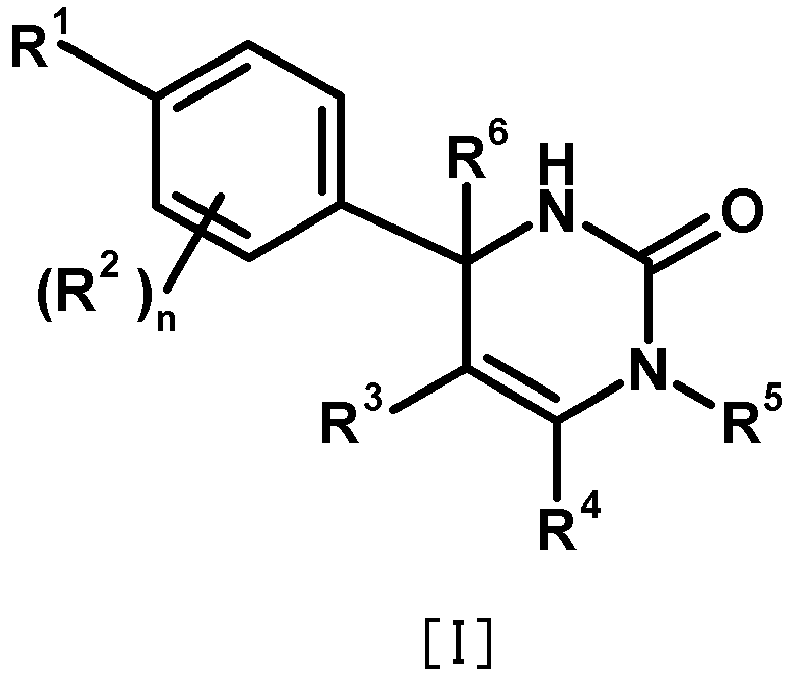 R1 is(1) C4-8 alkyl,(2) C3-8 alkyl substituted with one hydroxy,(3) C4-8 alkyl substituted with one halogen,(4) C4-8 alkenyl,(5) C4-8 alkynyl,(6) C3-7 alkyl substituted with one trifluoromethyl,(7) C1-5 alkyl substituted with one substituent selected from Group Xa1,(8) C3-6 alkoxy,(9) C2-7 alkoxy substituted with one trifluoromethyl,(10) C1-3 alkoxy substituted with one substituent selected from Group Xa2,(11) C4-6 cycloalkyl,(12) C3-6 cycloalkyl substituted with the same or different one to two C1-5 alkyl,(13) C5-6 cycloalkenyl optionally substituted with the same or different one to two C1-4 alkyl,(14) spiro C6-11 cycloalkyl,(15) C1-3 alkoxycarbonyl,(16) C3-6 alkylsulfanyl,(17) C3-6 alkylsulfinyl,(18) C3-6 alkylsulfonyl,(19) C3-6 cycloalkylsulfanyl,(20) C3-6 cycloalkylsulfinyl,(21) C3-6 cycloalkylsulfonyl,(22) cyclobutylidenemethyl,(23) cyclopentylidenemethyl,(24) cyclohexylidenemethyl optionally substituted with the same or different one to two C1-3 alkyl,(25) tetrahydropyran-4-ylidenemethyl,(26) C3-6 cycloalkyl substituted with one to the same two halogen, or(27) C5-6 cycloalkenyl substituted with one to the same two halogen;Group Xa1 is(a) C3-6 cycloalkyl optionally substituted with the same or different one to three C1-5 alkyl,(b) C3-6 cycloalkyl substituted with the same or different one to two halogen,(c) phenyl,(d) C2-4 alkoxy,(e) trimethylsilyl,(f) carboxy, and(g) tetrahydropyran-4-yl;Group Xa2 is(a) C3-6 cycloalkyl,(b) phenyl, and(c) C1-4 alkoxy;R2 is(1) halogen,(2) C1-6 alkyl,(3) C1-3 alkoxy optionally substituted with phenyl, or(4) trifluoromethyl;n is an integer of 0, 1 or 2, provided that when n is 2, each R2 may be different with each other; orR1 and R2 may combine together with the benzene ring to which they attach to form indanyl where the indanyl may be substituted with the same or different one to two C1-6 alkyl;R3 is(1) -Yb-COO-R30,(2) C1-6 alkyl optionally substituted with one hydroxy,(3) C1-6 alkyl substituted with one C1-4 alkoxy,(4) C1-6 alkyl substituted with one C1-4 alkylsulfonyl,(5) C3-6 cycloalkyl optionally substituted with the same or different one to three substituent(s) selected from Group Xb,(6)
 (7)
(7) (8) phenyl,(9)
 (10) C2-3 alkenyl;Yb is(a) C1-6 alkylene,(b) C3-6 cycloalkylene,(c) phenylene,(d) pyridinediyl or(e)
 R30 is(a) hydrogen or (b) C1-4 alkyl;Group Xb is(a) halogen,(b) C1-6 alkyl,(c) C1-3 alkyl substituted with one hydroxy,(d) C1-3 alkyl substituted with one C1-3 alkoxy, and(e) C1-3 alkoxy;R4 is
(1) hydrogen or (2) methyl;R5 is(1) -Yc-COO-R50,(2) hydrogen,(3) C1-4 alkyl optionally substituted with one C1-3 alkoxy,(4) C1-4 alkyl substituted with one amide,(5) C1-3 alkyl substituted with one C3-6 cycloalkyl substituted with the same or different two halogen,(6) C3-6 cycloalkyl optionally substituted with one hydroxy-C1-4 alkyl,(7) C3-6 cycloalkyl substituted with one C1-3 alkoxy,(8) C3-6 cycloalkyl substituted with one C1-3 alkoxy-C1-3 alkyl,(9) C3-6 cycloalkyl substituted with the same or different one to two halogen,(10) C3-6 cycloalkyl substituted with the same or different one to two C1-3 alkyl,(11) tetrahydropyran-4-yl or(12) pyridin-4-yl;Yc is(a) C1-6 alkylene optionally substituted with one hydroxy,(b) CH2-CH2-O-CH2 or(c) (CH2)m-Yc1-(CH2)w;m is an integer of 0, 1 or 2;w is an integer of 0, 1 or 2;Yc1 is(a) C3-6 cycloalkylene optionally substituted with one C1-3 alkyl,(b) phenylene,(c) phenylene substituted with one halogen,(d) phenylene substituted with one C1-3 alkyl,(e) phenylene substituted with one C1-3 alkoxy,(f) phenylene substituted with one trifluoromethyl,(g) cross-linked C5-8 cycloalkylene,(h) (i)
(i) (j) spiro[3.3]heptanediyl,(k) pyrrolidinediyl,(l) pyrrolidinediyl substituted with one carboxy,(m) pyrrolidinediyl substituted with one C1-3 alkylcarbonyl,(n) pyrrolidinediyl substituted with one C1-3 alkylsulfonyl,(o) pyridinediyl,(p) isoxazolediyl or(q) pyrazolediyl substituted with one C1-3 alkyl;R50 is
(a) hydrogen or (b) C1-4 alkyl;R6 is
(l) hydrogen or (2) methyl;provided thatwhen R5 is -Yc-COO-R50, Yc is (CH2)m-Yc1-(CH2)w, m and w are 0, and Yc1 is (b) phenylene, (c) phenylene substituted with one halogen, (d) phenylene substituted with one C1-3 alkyl, (e) phenylene substituted with one C1-3 alkoxy or (f) phenylene substituted with one trifluoromethyl, then R6 is methyl; andeither R3 or R5 or both of them have "-COO-". - The compound of claim 1, wherein the compound of Formula [I] is a compound of Formula [II], or a pharmaceutically acceptable salt thereof:

R3 is(1) C1-6 alkyl optionally substituted with one hydroxy,(2) C1-6 alkyl substituted with one C1-4 alkoxy,(3) C1-6 alkyl substituted with one C1-4 alkylsulfonyl,(4) C3-6 cycloalkyl optionally substituted with the same or different one to three substituent(s) selected from Group Xb,(5) (6)
(6) (7) phenyl,(8)
 (9) C2-3 alkenyl; and the other symbols have the same meanings as defined in claim 1.
 - The compound of claim 1, wherein the compound of Formula [I] is a compound of Formula [III], or a pharmaceutically acceptable salt thereof:

R5 is(1) hydrogen,(2) C1-4 alkyl optionally substituted with one C1-3 alkoxy,(3) C1-4 alkyl substituted with one amide,(4) C1-3 alkyl substituted with one C3-6 cycloalkyl substituted with the same or different two halogen,(5) C3-6 cycloalkyl optionally substituted with one hydroxy-C1-4 alkyl,(6) C3-6 cycloalkyl substituted with one C1-3 alkoxy,(7) C3-6 cycloalkyl substituted with one C1-3 alkoxy-C1-3 alkyl,(8) C3-6 cycloalkyl substituted with the same or different one to two halogen,(9) C3-6 cycloalkyl substituted with the same or different one to two C1-3 alkyl,(10) tetrahydropyran-4-yl or(11) pyridin-4-yl; and the other symbols have the same meanings as defined in claim 1. - The compound of claim 1, wherein the compound of Formula [I] is a compound of Formula [IV], or a pharmaceutically acceptable salt thereof:

- The compound of any one of claims 1 to 4, wherein R6 is methyl, or a pharmaceutically acceptable salt thereof.
- The compound of any one of claims 1 to 5, wherein R4 is hydrogen, or a pharmaceutically acceptable salt thereof.
- The compound of any one of claims 1 to 6, wherein n is an integer of 1 or 2, or a pharmaceutically acceptable salt thereof.
- The compound of any one of claims 1 to 7, wherein R2 is halogen or trifluoromethyl, or a pharmaceutically acceptable salt thereof.
- The compound of any one of claims 1, 2, 4 to 7 or 8, wherein Yc is(a) C1-6 alkylene or(b) (CH2)m-Yc1-(CH2)w;R3 is
m is an integer of 0 or 1;
w is an integer of 0 or 1;
Yc1 is(a) C3-6 cycloalkylene optionally substituted with one C1-3 alkyl,(b) phenylene,(c) phenylene substituted with one halogen,(d) phenylene substituted with one C1-3 alkyl,(e) phenylene substituted with one C1-3 alkoxy,(f) phenylene substituted with one trifluoromethyl,(g) cross-linked C5-8 cycloalkylene,(h) pyridinediyl or(i) pyrazolediyl substituted with one C1-3 alkyl; and(1) C1-6 alkyl optionally substituted with one hydroxy,(2) C1-6 alkyl substituted with one C1-4 alkoxy or(3) C3-6 cycloalkyl optionally substituted with the same or different one to three substituent(s) selected from Group Xb, or a pharmaceutically acceptable salt thereof. - The compound of claim 2, wherein R50 is hydrogen, or a pharmaceutically acceptable salt thereof.
- The compound of claim 1, wherein the compound of Formula [I] is any one of the compounds of Formulae [IV-B-A] to [IV-B-N], or a pharmaceutically acceptable salt thereof:


 R3h is hydrogen or methyl;R3w is methyl or fluoro;nx is an integer of 0 or 2;nw is an integer of 0, 1, 2 or 3;R3 is C1-6 alkyl optionally substituted with one hydroxy,
C1-6 alkyl substituted with one C1-4 alkoxy or
C3-6 cycloalkyl optionally substituted with the same or different one to three substituent(s) selected from Group Xb;R5B is hydrogen, halogen, C1-3 alkyl, C1-3 alkoxy or trifluoromethyl; andthe other symbols have the same meanings as defined in claim 1. - The compound of claim 1, selected from the group consisting of the following formulae, or a pharmaceutically acceptable salt thereof.


- A pharmaceutical composition comprising the compound of any one of claims 1 to 12 or a pharmaceutically acceptable salt thereof and a pharmaceutically acceptable carrier.
- An agent for use in treating or preventing a disease selected from the group consisting of autoimmune disease, allergic disease, dry eye, fibrosis, and metabolic disease, comprising the compound of any one of claims 1 to 12 or a pharmaceutically acceptable salt thereof,
preferably wherein the disease is autoimmune disease,
more preferably wherein the autoimmune disease is selected from the group consisting of rheumatoid arthritis, psoriasis, inflammatory bowel disease such as Crohn's disease and ulcerative colitis, multiple sclerosis, systemic lupus erythematosus, ankylosing spondylitis, uveitis, polymyalgia rheumatica, type I diabetes, and graft versus host disease. - The agent for use of claim 14, wherein the disease is metabolic disease, preferably wherein the metabolic disease is diabetes.
- A compound of any one of claims 1 to 12 or a pharmaceutically acceptable salt thereof for use in treating or preventing a disease selected from the group consisting of autoimmune disease, allergic disease, dry eye, fibrosis, and metabolic disease, preferably wherein the disease is autoimmune disease,
more preferably wherein the autoimmune disease is selected from the group consisting of rheumatoid arthritis, psoriasis, inflammatory bowel disease such as Crohn's disease and ulcerative colitis, multiple sclerosis, systemic lupus erythematosus, ankylosing spondylitis, uveitis, polymyalgia rheumatica, type I diabetes, and graft versus host disease. - The compound or a pharmaceutically acceptable salt thereof for use of claim 16, wherein the disease is metabolic disease,
preferably wherein the metabolic disease is diabetes.
Applications Claiming Priority (3)
| Application Number | Priority Date | Filing Date | Title |
|---|---|---|---|
| JP2014251771 | 2014-12-12 | ||
| PCT/JP2015/084791 WO2016093342A1 (en) | 2014-12-12 | 2015-12-11 | Dihydropyrimidine-2-one compounds and medicinal uses thereof |
| EP15866802.0A EP3231793B1 (en) | 2014-12-12 | 2015-12-11 | Dihydropyrimidine-2-one compounds and medicinal uses thereof |
Related Parent Applications (1)
| Application Number | Title | Priority Date | Filing Date |
|---|---|---|---|
| EP15866802.0A Division EP3231793B1 (en) | 2014-12-12 | 2015-12-11 | Dihydropyrimidine-2-one compounds and medicinal uses thereof |
Publications (1)
| Publication Number | Publication Date |
|---|---|
| EP3744713A1 true EP3744713A1 (en) | 2020-12-02 |
Family
ID=56107519
Family Applications (2)
| Application Number | Title | Priority Date | Filing Date |
|---|---|---|---|
| EP20161939.2A Pending EP3744713A1 (en) | 2014-12-12 | 2015-12-11 | Diyhydropyrimidine-2-one compounds and medicinal uses thereof |
| EP15866802.0A Active EP3231793B1 (en) | 2014-12-12 | 2015-12-11 | Dihydropyrimidine-2-one compounds and medicinal uses thereof |
Family Applications After (1)
| Application Number | Title | Priority Date | Filing Date |
|---|---|---|---|
| EP15866802.0A Active EP3231793B1 (en) | 2014-12-12 | 2015-12-11 | Dihydropyrimidine-2-one compounds and medicinal uses thereof |
Country Status (34)
| Country | Link |
|---|---|
| US (4) | US10196363B2 (en) |
| EP (2) | EP3744713A1 (en) |
| JP (4) | JP6757565B2 (en) |
| KR (1) | KR102551018B1 (en) |
| CN (1) | CN107001286B (en) |
| AR (1) | AR102972A1 (en) |
| AU (1) | AU2015362394C1 (en) |
| BR (1) | BR112017010471B1 (en) |
| CA (1) | CA2965804C (en) |
| CL (1) | CL2017001467A1 (en) |
| CO (1) | CO2017005732A2 (en) |
| CY (1) | CY1122971T1 (en) |
| DK (1) | DK3231793T3 (en) |
| ES (1) | ES2787700T3 (en) |
| HR (1) | HRP20200584T1 (en) |
| HU (1) | HUE048503T2 (en) |
| IL (2) | IL251940B (en) |
| LT (1) | LT3231793T (en) |
| ME (1) | ME03760B (en) |
| MX (1) | MX371128B (en) |
| MY (1) | MY193671A (en) |
| PE (1) | PE20171119A1 (en) |
| PH (1) | PH12017501071B1 (en) |
| PL (1) | PL3231793T3 (en) |
| PT (1) | PT3231793T (en) |
| RS (1) | RS60352B1 (en) |
| RU (1) | RU2770061C2 (en) |
| SA (1) | SA517381678B1 (en) |
| SG (2) | SG11201703885TA (en) |
| SI (1) | SI3231793T1 (en) |
| SM (1) | SMT202000215T1 (en) |
| TW (2) | TWI690515B (en) |
| WO (1) | WO2016093342A1 (en) |
| ZA (1) | ZA201703976B (en) |
Families Citing this family (8)
| Publication number | Priority date | Publication date | Assignee | Title |
|---|---|---|---|---|
| AU2015362394C1 (en) * | 2014-12-12 | 2021-01-28 | Japan Tobacco Inc. | Dihydropyrimidine-2-one compounds and medicinal uses thereof |
| CN106496008A (en) * | 2016-10-20 | 2017-03-15 | 上海毕得医药科技有限公司 | A kind of method of synthesizing 4-(4-chlorophenyl) cyclohexanone |
| KR20200126973A (en) * | 2018-02-28 | 2020-11-09 | 니뽄 다바코 산교 가부시키가이샤 | 4-methyldihydropyrimidinone compound and its pharmaceutical use |
| CN111741948B (en) * | 2018-02-28 | 2023-11-10 | 日本烟草产业株式会社 | Saturated ring fused dihydropyrimidinone or dihydrotriazinone compounds and their pharmaceutical uses |
| CN110294762B (en) * | 2019-06-14 | 2020-12-15 | 深圳市疾病预防控制中心(深圳市卫生检验中心、深圳市预防医学研究所) | Artificial Antigen and Application for Detection of Oryza sativa Acidosis |
| WO2021149786A1 (en) | 2020-01-24 | 2021-07-29 | Japan Tobacco Inc. | Methods of treating cancer using dihydropyrimidin-2-one compounds |
| WO2023232870A1 (en) | 2022-05-31 | 2023-12-07 | Immunic Ag | Rorg/rorgt modulators for the treatment of virus infections like covid-19 |
| CN117430562A (en) * | 2023-09-26 | 2024-01-23 | 中山大学 | A kind of 4-methyl-2-oxo-3,6-dihydropyrimidine compound and its preparation method and application |
Citations (2)
| Publication number | Priority date | Publication date | Assignee | Title |
|---|---|---|---|---|
| WO2009019174A1 (en) | 2007-08-09 | 2009-02-12 | F. Hoffmann-La Roche Ag | Benzoyl-piperidine derivatives as dual modulators of the 5-ht2a and d3 receptors |
| WO2014062938A1 (en) * | 2012-10-19 | 2014-04-24 | Bristol-Myers Squibb Company | Rory modulators |
Family Cites Families (13)
| Publication number | Priority date | Publication date | Assignee | Title |
|---|---|---|---|---|
| US4485107A (en) * | 1982-11-01 | 1984-11-27 | Janssen Pharmaceutica N.V. | [[Bis(aryl)methylene]-1-piperidinyl]alkyl-pyrimidinones |
| EP1962855B1 (en) * | 2005-12-22 | 2013-08-21 | Hydra Biosciences, Inc. | Trpa1 inhibitors for treating pain |
| DE102006031314A1 (en) * | 2006-07-01 | 2008-01-03 | Bayer Healthcare Aktiengesellschaft | Use of 1,4-diaryl-dihydropyrimidin-2-one derivative for producing a medicament for the treatment and/or prophylaxis of e.g. pulmonary arterial hypertension, chronic-obstructive lung diseases and sleep apnea syndrome |
| US20110201634A1 (en) * | 2008-06-13 | 2011-08-18 | Delhi University | Dihydropyridimidinone compounds for the treatment of cardiovascular diseases and process for preparing the same |
| WO2012147916A1 (en) * | 2011-04-28 | 2012-11-01 | 日本たばこ産業株式会社 | Amide compound and pharmaceutical application therefor |
| EP2682389A1 (en) | 2012-07-02 | 2014-01-08 | Commissariat A L'energie Atomique Et Aux Energies Alternatives | Dihydropyrimidin-2(1H)-ones and dihydropyrimidin-2(1H)-thiones as inhibitors of sodium iodide symporter |
| US20160137639A1 (en) | 2012-10-26 | 2016-05-19 | Japan Tobacco Inc. | Triazole-isoxazole compound and medical use thereof |
| CN103113308B (en) * | 2013-01-25 | 2014-11-19 | 浙江大学 | Method for preparing dihydropyrimidinone derivative |
| UA120108C2 (en) | 2014-12-12 | 2019-10-10 | Мерк Патент Гмбх | Combination of a 6-oxo-1,6-dihydro-pyridazine derivative having anti-cancer activity with an egfr inhibitor |
| AU2015362394C1 (en) * | 2014-12-12 | 2021-01-28 | Japan Tobacco Inc. | Dihydropyrimidine-2-one compounds and medicinal uses thereof |
| CA2970500C (en) | 2014-12-12 | 2023-08-29 | Acetylon Pharmaceuticals, Inc. | Piperidine derivatives as hdac1/2 inhibitors |
| MA41148A (en) | 2014-12-12 | 2017-10-17 | H Lundbeck As | IDALOPIRDINE MANUFACTURING PROCESS |
| TW201630881A (en) | 2014-12-12 | 2016-09-01 | H 朗德貝克公司 | A process for the manufacture of idalopirdine |
-
2015
- 2015-12-11 AU AU2015362394A patent/AU2015362394C1/en not_active Ceased
- 2015-12-11 TW TW104141671A patent/TWI690515B/en active
- 2015-12-11 RS RS20200583A patent/RS60352B1/en unknown
- 2015-12-11 HU HUE15866802A patent/HUE048503T2/en unknown
- 2015-12-11 PH PH1/2017/501071A patent/PH12017501071B1/en unknown
- 2015-12-11 US US14/966,120 patent/US10196363B2/en active Active
- 2015-12-11 JP JP2015241742A patent/JP6757565B2/en active Active
- 2015-12-11 SM SM20200215T patent/SMT202000215T1/en unknown
- 2015-12-11 CA CA2965804A patent/CA2965804C/en active Active
- 2015-12-11 MY MYPI2017702091A patent/MY193671A/en unknown
- 2015-12-11 WO PCT/JP2015/084791 patent/WO2016093342A1/en not_active Ceased
- 2015-12-11 ES ES15866802T patent/ES2787700T3/en active Active
- 2015-12-11 LT LTEP15866802.0T patent/LT3231793T/en unknown
- 2015-12-11 PL PL15866802T patent/PL3231793T3/en unknown
- 2015-12-11 CN CN201580067185.0A patent/CN107001286B/en active Active
- 2015-12-11 SG SG11201703885TA patent/SG11201703885TA/en unknown
- 2015-12-11 KR KR1020177018832A patent/KR102551018B1/en active Active
- 2015-12-11 HR HRP20200584TT patent/HRP20200584T1/en unknown
- 2015-12-11 DK DK15866802.0T patent/DK3231793T3/en active
- 2015-12-11 PE PE2017000974A patent/PE20171119A1/en unknown
- 2015-12-11 RU RU2017124423A patent/RU2770061C2/en not_active Application Discontinuation
- 2015-12-11 EP EP20161939.2A patent/EP3744713A1/en active Pending
- 2015-12-11 EP EP15866802.0A patent/EP3231793B1/en active Active
- 2015-12-11 ME MEP-2020-61A patent/ME03760B/en unknown
- 2015-12-11 TW TW108140988A patent/TWI739206B/en not_active IP Right Cessation
- 2015-12-11 AR ARP150104039A patent/AR102972A1/en active IP Right Grant
- 2015-12-11 SI SI201531175T patent/SI3231793T1/en unknown
- 2015-12-11 BR BR112017010471-7A patent/BR112017010471B1/en active IP Right Grant
- 2015-12-11 PT PT158668020T patent/PT3231793T/en unknown
- 2015-12-11 MX MX2017007577A patent/MX371128B/en active IP Right Grant
- 2015-12-11 SG SG10202010291VA patent/SG10202010291VA/en unknown
-
2017
- 2017-04-26 IL IL251940A patent/IL251940B/en active IP Right Grant
- 2017-06-07 SA SA517381678A patent/SA517381678B1/en unknown
- 2017-06-08 CL CL2017001467A patent/CL2017001467A1/en unknown
- 2017-06-09 CO CONC2017/0005732A patent/CO2017005732A2/en unknown
- 2017-06-09 ZA ZA2017/03976A patent/ZA201703976B/en unknown
-
2018
- 2018-12-20 US US16/228,448 patent/US20190359575A1/en not_active Abandoned
-
2020
- 2020-05-20 CY CY20201100462T patent/CY1122971T1/en unknown
- 2020-06-16 US US16/902,935 patent/US20210130300A1/en not_active Abandoned
- 2020-08-31 JP JP2020145707A patent/JP2020200339A/en active Pending
-
2021
- 2021-05-20 IL IL283335A patent/IL283335B/en unknown
-
2022
- 2022-05-31 JP JP2022088388A patent/JP2022116239A/en active Pending
- 2022-12-20 US US18/085,466 patent/US20230373932A1/en not_active Abandoned
-
2024
- 2024-07-08 JP JP2024109343A patent/JP2024133646A/en active Pending
Patent Citations (2)
| Publication number | Priority date | Publication date | Assignee | Title |
|---|---|---|---|---|
| WO2009019174A1 (en) | 2007-08-09 | 2009-02-12 | F. Hoffmann-La Roche Ag | Benzoyl-piperidine derivatives as dual modulators of the 5-ht2a and d3 receptors |
| WO2014062938A1 (en) * | 2012-10-19 | 2014-04-24 | Bristol-Myers Squibb Company | Rory modulators |
Non-Patent Citations (37)
| Title |
|---|
| A. J. ZYCHH. WANGS. A. SAKWA, TETRAHEDRON LETT., vol. 51, 2010, pages 5103 - 5105 |
| ANTON, NRS, vol. 7, 2009, pages 1 - 32 |
| BERGE ET AL., J. PHARM. SCI., vol. 66, 1977, pages 1 - 19 |
| BETTINA ET AL., EMBO MOL MED, vol. 3, 2011, pages 1 - 15 |
| BIOORG. MED. CHEM. LETT., vol. 14, no. 20, 2004, pages 5199 - 5203 |
| CARSTEN ET AL., J ALLERGY CLIN IMMUNOL, vol. 120, 2007, pages 247 - 54 |
| CHEM. PHARM. BULL., vol. 33, 1985, pages 1097 - 1103 |
| DOMINIQUE ET AL., LANCET, vol. 382, no. 9906, 2013, pages 1705 |
| E. VEDEJSD. W. PIOTROWSKIF. C. TUCCI, J. ORG. CHEM., vol. 65, 2000, pages 5498 - 5505 |
| F. DIEDERICHP. J. STANG: "Metal-catalyzed Cross-coupling Reactions", 1998, WILEY-VCH |
| FULTON LM ET AL., J.IMMUNOL, vol. 189, no. 4, 2012, pages 1765 - 1772 |
| G. A. KRAUSB. ROTH, J. ORG. CHEM., vol. 45, 1980, pages 4825 - 4830 |
| G. K. DATTAJ. A. ELLMAN, J. ORG. CHEM., vol. 75, 2010, pages 6283 - 6285 |
| HILDE ET AL., ARTHRITIS RESEARCH & THERAPY, vol. 11, 2009, pages R122 |
| IVAYLO ET AL., CELL, vol. 126, 2006, pages 1121 - 1133 |
| J. AM. CHEM. SOC., vol. 131, no. 44, 2009, pages 16016 - 16017 |
| J. ORG. CHEM., vol. 64, 1999, pages 2564 - 2566 |
| JOSE ET AL., CURR OPIN RHEUMATOL, vol. 22, 2010, pages 499 - 503 |
| JULIET ET AL., DIABETES, vol. 58, 2009, pages 1302 - 1311 |
| KOENDERS ET AL., ANN RHEUM DIS, vol. 65, no. III, 2006, pages iii29 - iii33 |
| M. SCHLOSSER: "Organometallics in Synthesis", 1994, WILEY-VCH |
| MATHIEU DUBERNET ET AL: "Identification of New Nonsteroidal ROR[alpha] Ligands; Related Structure-Activity Relationships and Docking Studies", ACS MEDICINAL CHEMISTRY LETTERS, vol. 4, no. 6, 1 January 2013 (2013-01-01), US, pages 504 - 508, XP055453852, ISSN: 1948-5875, DOI: 10.1021/ml300471d * |
| MORITZ ET AL., GASTROENTEROLOGY, vol. 136, 2009, pages 257 - 67 |
| OLIVER ET AL., J AM SOC NEPHROL, vol. 22, 2011, pages 472 - 483 |
| ORG. LETT., vol. 7, 2005, pages 427 - 430 |
| ORG. LETT., vol. 9, 2007, pages 4431 - 4434 |
| PAULEKUHN ET AL., J. MED. CHEM., vol. 50, 2007, pages 6665 - 6672 |
| PETER G. M. WUTS: "Green's Protective Groups in Organic Synthesis", 2007, WILEY-VCH., pages: 725 - 735,748-756 |
| R. PATINO-MOLINAI. CUBERO-LAJOM. J. P. VEGAM. T. GARCIA-LOPEZ, TETRAHEDRON LETT., vol. 48, 2007, pages 3615 - 3616 |
| S. R. DANDEPALLYR. ELGOUMMADIA. L. WILLIAMS, TETRAHEDRON LETT., vol. 54, 2013, pages 925 - 928 |
| SANFORD ET AL., DRUGS, vol. 75, 2015, pages 329 - 338 |
| STEPHEN ET AL., J. IMMNOL, vol. 178, 2007, pages 3208 - 18 |
| SU ET AL., J. IMMNOL, vol. 187, 2011 |
| SUSUMU ET AL., J. IMMNOL, vol. 171, 2003, pages 6173 - 6177 |
| T. P. TANGJ. A. ELLMAN, J. ORG. CHEM., vol. 67, 2002, pages 7819 - 7832 |
| TETRAHEDRON LETT., vol. 50, 2009, pages 1276 - 1278 |
| WOLFGANG ET AL., SCI TRANSL MED, vol. 2, 2010, pages 52ra72 |
Also Published As
Similar Documents
| Publication | Publication Date | Title |
|---|---|---|
| EP3231793B1 (en) | Dihydropyrimidine-2-one compounds and medicinal uses thereof | |
| EP3760619B1 (en) | Saturated ring-condensed dihydropyrimidinone or dihydrotriazinone compound, and pharmaceutical use thereof | |
| KR101344989B1 (en) | Derivatives Having PAPR Activity | |
| HK1237778B (en) | Dihydropyrimidine-2-one compounds and medicinal uses thereof | |
| HK1237778A1 (en) | Dihydropyrimidine-2-one compounds and medicinal uses thereof | |
| HK40040328A (en) | Saturated ring-condensed dihydropyrimidinone or dihydrotriazinone compound, and pharmaceutical use thereof | |
| JP2007126358A (en) | Phenylalanine derivative | |
| EP2253636A1 (en) | Neuronal cell death inhibitor | |
| JPS60104077A (en) | Novel gamma-aminolactic acid transamination enzyme inhibitorand manufacture |
Legal Events
| Date | Code | Title | Description |
|---|---|---|---|
| PUAI | Public reference made under article 153(3) epc to a published international application that has entered the european phase |
Free format text: ORIGINAL CODE: 0009012 |
|
| STAA | Information on the status of an ep patent application or granted ep patent |
Free format text: STATUS: THE APPLICATION HAS BEEN PUBLISHED |
|
| AC | Divisional application: reference to earlier application |
Ref document number: 3231793 Country of ref document: EP Kind code of ref document: P |
|
| AK | Designated contracting states |
Kind code of ref document: A1 Designated state(s): AL AT BE BG CH CY CZ DE DK EE ES FI FR GB GR HR HU IE IS IT LI LT LU LV MC MK MT NL NO PL PT RO RS SE SI SK SM TR |
|
| AX | Request for extension of the european patent |
Extension state: BA ME |
|
| RAP1 | Party data changed (applicant data changed or rights of an application transferred) |
Owner name: JAPAN TOBACCO INC. |
|
| STAA | Information on the status of an ep patent application or granted ep patent |
Free format text: STATUS: REQUEST FOR EXAMINATION WAS MADE |
|
| 17P | Request for examination filed |
Effective date: 20210520 |
|
| RAX | Requested extension states of the european patent have changed |
Extension state: ME Payment date: 20210520 Extension state: BA Payment date: 20210520 |
|
| RBV | Designated contracting states (corrected) |
Designated state(s): AL AT BE BG CH CY CZ DE DK EE ES FI FR GB GR HR HU IE IS IT LI LT LU LV MC MK MT NL NO PL PT RO RS SE SI SK SM TR |
|
| STAA | Information on the status of an ep patent application or granted ep patent |
Free format text: STATUS: EXAMINATION IS IN PROGRESS |
|
| 17Q | First examination report despatched |
Effective date: 20210920 |