EP3744483A1 - Robot instruction device - Google Patents
Robot instruction device Download PDFInfo
- Publication number
- EP3744483A1 EP3744483A1 EP19743361.8A EP19743361A EP3744483A1 EP 3744483 A1 EP3744483 A1 EP 3744483A1 EP 19743361 A EP19743361 A EP 19743361A EP 3744483 A1 EP3744483 A1 EP 3744483A1
- Authority
- EP
- European Patent Office
- Prior art keywords
- robot
- word
- specified
- pitch
- specific
- Prior art date
- Legal status (The legal status is an assumption and is not a legal conclusion. Google has not performed a legal analysis and makes no representation as to the accuracy of the status listed.)
- Withdrawn
Links
Images



Classifications
-
- B—PERFORMING OPERATIONS; TRANSPORTING
- B25—HAND TOOLS; PORTABLE POWER-DRIVEN TOOLS; MANIPULATORS
- B25J—MANIPULATORS; CHAMBERS PROVIDED WITH MANIPULATION DEVICES
- B25J9/00—Program-controlled manipulators
- B25J9/0081—Program-controlled manipulators with leader teach-in means
-
- G—PHYSICS
- G10—MUSICAL INSTRUMENTS; ACOUSTICS
- G10L—SPEECH ANALYSIS TECHNIQUES OR SPEECH SYNTHESIS; SPEECH RECOGNITION; SPEECH OR VOICE PROCESSING TECHNIQUES; SPEECH OR AUDIO CODING OR DECODING
- G10L15/00—Speech recognition
- G10L15/22—Procedures used during a speech recognition process, e.g. man-machine dialogue
-
- B—PERFORMING OPERATIONS; TRANSPORTING
- B25—HAND TOOLS; PORTABLE POWER-DRIVEN TOOLS; MANIPULATORS
- B25J—MANIPULATORS; CHAMBERS PROVIDED WITH MANIPULATION DEVICES
- B25J13/00—Controls for manipulators
- B25J13/003—Controls for manipulators by means of an audio-responsive input
-
- B—PERFORMING OPERATIONS; TRANSPORTING
- B25—HAND TOOLS; PORTABLE POWER-DRIVEN TOOLS; MANIPULATORS
- B25J—MANIPULATORS; CHAMBERS PROVIDED WITH MANIPULATION DEVICES
- B25J9/00—Program-controlled manipulators
- B25J9/0084—Program-controlled manipulators comprising a plurality of manipulators
- B25J9/0087—Dual arms
-
- B—PERFORMING OPERATIONS; TRANSPORTING
- B25—HAND TOOLS; PORTABLE POWER-DRIVEN TOOLS; MANIPULATORS
- B25J—MANIPULATORS; CHAMBERS PROVIDED WITH MANIPULATION DEVICES
- B25J9/00—Program-controlled manipulators
- B25J9/02—Program-controlled manipulators characterised by movement of the arms, e.g. cartesian coordinate type
- B25J9/04—Program-controlled manipulators characterised by movement of the arms, e.g. cartesian coordinate type by rotating at least one arm, excluding the head movement itself, e.g. cylindrical coordinate type or polar coordinate type
- B25J9/041—Cylindrical coordinate type
- B25J9/042—Cylindrical coordinate type comprising an articulated arm
- B25J9/043—Cylindrical coordinate type comprising an articulated arm double selective compliance articulated robot arms [SCARA]
-
- B—PERFORMING OPERATIONS; TRANSPORTING
- B25—HAND TOOLS; PORTABLE POWER-DRIVEN TOOLS; MANIPULATORS
- B25J—MANIPULATORS; CHAMBERS PROVIDED WITH MANIPULATION DEVICES
- B25J9/00—Program-controlled manipulators
- B25J9/16—Program controls
- B25J9/1656—Program controls characterised by programming, planning systems for manipulators
-
- G—PHYSICS
- G06—COMPUTING OR CALCULATING; COUNTING
- G06F—ELECTRIC DIGITAL DATA PROCESSING
- G06F3/00—Input arrangements for transferring data to be processed into a form capable of being handled by the computer; Output arrangements for transferring data from processing unit to output unit, e.g. interface arrangements
- G06F3/16—Sound input; Sound output
- G06F3/167—Audio in a user interface, e.g. using voice commands for navigating, audio feedback
-
- G—PHYSICS
- G10—MUSICAL INSTRUMENTS; ACOUSTICS
- G10L—SPEECH ANALYSIS TECHNIQUES OR SPEECH SYNTHESIS; SPEECH RECOGNITION; SPEECH OR VOICE PROCESSING TECHNIQUES; SPEECH OR AUDIO CODING OR DECODING
- G10L15/00—Speech recognition
- G10L15/08—Speech classification or search
- G10L15/083—Recognition networks
-
- B—PERFORMING OPERATIONS; TRANSPORTING
- B25—HAND TOOLS; PORTABLE POWER-DRIVEN TOOLS; MANIPULATORS
- B25J—MANIPULATORS; CHAMBERS PROVIDED WITH MANIPULATION DEVICES
- B25J9/00—Program-controlled manipulators
- B25J9/16—Program controls
- B25J9/1679—Program controls characterised by the tasks executed
- B25J9/1682—Dual arm manipulator; Coordination of several manipulators
-
- G—PHYSICS
- G05—CONTROLLING; REGULATING
- G05B—CONTROL OR REGULATING SYSTEMS IN GENERAL; FUNCTIONAL ELEMENTS OF SUCH SYSTEMS; MONITORING OR TESTING ARRANGEMENTS FOR SUCH SYSTEMS OR ELEMENTS
- G05B19/00—Program-control systems
- G05B19/02—Program-control systems electric
- G05B19/42—Recording and playback systems, i.e. in which the program is recorded from a cycle of operations, e.g. the cycle of operations being manually controlled, after which this record is played back on the same machine
- G05B19/423—Teaching successive positions by walk-through, i.e. the tool head or end effector being grasped and guided directly, with or without servo-assistance, to follow a path
-
- G—PHYSICS
- G05—CONTROLLING; REGULATING
- G05B—CONTROL OR REGULATING SYSTEMS IN GENERAL; FUNCTIONAL ELEMENTS OF SUCH SYSTEMS; MONITORING OR TESTING ARRANGEMENTS FOR SUCH SYSTEMS OR ELEMENTS
- G05B2219/00—Program-control systems
- G05B2219/30—Nc systems
- G05B2219/35—Nc in input of data, input till input file format
- G05B2219/35453—Voice announcement, oral, speech input
-
- G—PHYSICS
- G10—MUSICAL INSTRUMENTS; ACOUSTICS
- G10L—SPEECH ANALYSIS TECHNIQUES OR SPEECH SYNTHESIS; SPEECH RECOGNITION; SPEECH OR VOICE PROCESSING TECHNIQUES; SPEECH OR AUDIO CODING OR DECODING
- G10L15/00—Speech recognition
- G10L15/22—Procedures used during a speech recognition process, e.g. man-machine dialogue
- G10L2015/223—Execution procedure of a spoken command
-
- Y—GENERAL TAGGING OF NEW TECHNOLOGICAL DEVELOPMENTS; GENERAL TAGGING OF CROSS-SECTIONAL TECHNOLOGIES SPANNING OVER SEVERAL SECTIONS OF THE IPC; TECHNICAL SUBJECTS COVERED BY FORMER USPC CROSS-REFERENCE ART COLLECTIONS [XRACs] AND DIGESTS
- Y02—TECHNOLOGIES OR APPLICATIONS FOR MITIGATION OR ADAPTATION AGAINST CLIMATE CHANGE
- Y02P—CLIMATE CHANGE MITIGATION TECHNOLOGIES IN THE PRODUCTION OR PROCESSING OF GOODS
- Y02P90/00—Enabling technologies with a potential contribution to greenhouse gas [GHG] emissions mitigation
- Y02P90/02—Total factory control, e.g. smart factories, flexible manufacturing systems [FMS] or integrated manufacturing systems [IMS]
Definitions
- the present disclosure relates to a teaching device for a robot.
- a direct teaching method as a method of teaching a robot a work.
- an operator holds a tip end of the robot, moves the robot to a desired location or makes the robot to take a desired posture, and causes the robot to store this location or posture to teach the robot the operation.
- the operator needs to operate a teaching pendant in addition to the direct movement of the robot to the instructed location.
- the teaching pendant has an inching mode in which the robot is moved in a desired direction by a remote operation. In the inching mode, the operator must watch the teaching pendant while watching the robot because he/she uses operation keys of the teaching pendant.
- Patent Documents 1 and 2 In recent years, in order to reduce the operator's burden, teaching devices for robots which perform the inching by an audio input have been proposed (see Patent Documents 1 and 2).
- the operator when performing the inching with voice without using the teaching pendant, the operator speaks, for example, as "6 mm positive in the X-axis direction" or "2 mm negative in the Z-axis direction.”
- the speech recognition rate has tendency that the recognition takes more time and causes more errors as the speech becomes longer.
- the present disclosure is made in view of solving the above problem, and one purpose thereof is to improve a speech-recognition accuracy of an audio input in an inching mode of a robot.
- a teaching device for a robot configured to teach the robot an operation and includes a voice input part configured to accept an input of voice of an operator, a voice recognition part configured to recognize the voice of the operator inputted into the voice input part, a memory part configured to store beforehand a specific word associated with operation of the robot, a specific-word extraction part configured to extract from the memory part the specific word matching with a word recognized by the voice recognition part, and an operation command generation part configured to generate an operation command for the robot based on operational information associated with the specific word extracted by the specific-word extraction part.
- the specific word includes a first word for specifying a pitch corresponding to a moving distance when the robot is moved in a given direction from a specified location, and a second word for specifying a moving direction of the robot.
- the operation command generation part When the pitch specified by the first word is not updated and the moving direction of the robot is specified by the second word, the operation command generation part generates the operation command so that the robot is moved in the specified direction at the specified pitch.
- the voice recognition part recognizes the voice of the operator inputted into the voice input part
- the specific-word extraction part extracts from the memory part the specific word matching with the word recognized by the voice recognition part.
- the operation command generation part generates the operation command for the robot based on the operational information (specify command) associated with the specific word extracted by the specific-word extraction part.
- the specific word includes a word for specifying a pitch when the robot is moved in a given direction from a specified location by a direct teaching etc., and a word for specifying the moving direction of the robot.
- the pitch specified by the first word is not updated and the moving direction of the robot is specified by the second word.
- the operation command is generated so that the robot is moved in the specified direction at the specified pitch. Therefore, the moving pitch can be specified by the audio input (e.g., the operator utters "PITCH 2MM"), and then, the moving direction of the robot can be specified (e.g., the operator utters "RIGHT, RIGHT, RIGHT, DOWN"). Since the utterance by the operator each time becomes shorter, the precision of the speech recognition improves.
- the specific word may further include a third word easy to utter for moving the robot forward or backward in the specified direction at the specified pitch.
- the operation command generation part may generate the operation command so that the robot is moved forward or backward by the third word in the specified direction at the specified pitch.
- the robot can be moved forward or backward in the specified direction at the specified pitch by this word easy to utter after the moving direction of the robot is specified. For example, suppose that "2MM" is specified as the pitch and "30 DEGREES UPPER RIGHT” is specified as the direction. Then, without the pitch and the direction being updated, when the operator speaks once "GO,” the robot moves upward and rightward by 2 mm. Further, without the pitch and the direction being updated, when the operator speaks once "BACK,” the robot moves upward and rightward by -2 mm. That is, it moves 30 degrees downward and leftward by 2 mm.
- the first word may include an ambiguous expression for specifying a pitch when the robot is moved in a given direction from a specified location.
- the memory part may store beforehand a numeric value and a unit thereof corresponding to the ambiguous expression so as to be associated with the ambiguous expression.
- the operation command generation part may generate the operation command so that the robot is moved in the specified moving direction at the specified pitch.
- the robot may have a plurality of robotic arms.
- the specific word may further include a word for specifying a robotic arm to be used as a target of movement among the plurality of robotic arms.
- one robotic arm to be used as the target of movement among the plurality of robotic arms can be specified by the utterance (e.g., "UPPER ARM,” “LOWER ARM,” “BOTH ARMS”).
- the teaching device may teach the robot the operation by the direct teaching.
- the present disclosure has the configuration described above so that a speech-recognition accuracy of an audio input in an inching mode of a robot can be improved.
- FIG. 1 is a block diagram illustrating a configuration of a teaching device for a robot according to one embodiment of the present disclosure.
- a teaching device 1 is a teaching device for the robot for teaching a robot 3 operation by a direct teaching.
- the teaching device 1 is provided with a speech recognition function, and is comprised of a teaching terminal communicatably connected to a control device 4 of the robot.
- the teaching device 1 is connected to a microphone (voice input part) 2 which collects voice uttered by an operator 50.
- the microphone 2 is desirable to be provided with a noise shield means which reduces an input of sound other than the voice uttered by the operator 50.
- Such a noise shield means may include a reflecting plate which reflects the voice uttered from the mouth of the operator 50 and collects the voice in the microphone, and an insulating member which interrupts the sound from a direction other than the mouth of the operator 50. Further, the noise shield means is also desirable to use a directional microphone having high sensibility for the voice from the direction of the mouth of the operator 50. Alternatively, a bone conductive microphone which collects bone conducting sound of the operator 50 is also suitably used. Such microphones eliminate noise at a location where the robot 3 is installed, such as a production line of a factory, and clearly collect the voice of the operator 50.
- the teaching device 1 includes a voice recognition part 11 which recognizes the voice of the operator inputted into the microphone 2, a memory part 12 which stores beforehand specific word(s) associated with operation of the robot 3, a specific-word extraction part 13 which extracts from the memory part 12 the specific word which matches with the word recognized by the voice recognition part 11, and an operation command generation part 14 which creates an operation command for the robot based on operational information (specify command) associated with the specific word extracted by the specific-word extraction part 13.
- the teaching device 1 is a computer provided with, for example, one or more processors, a memory, an input/output interface, and a communication interface.
- the voice recognition part 11, the specific-word extraction part 13, and the operation command generation part 14 are functional blocks implemented by the processor executing a given program.
- the memory part 12 stores beforehand the specific words to be extracted by a speech recognition, various data, such as the commands, related to the robot operation associated with the respective specific words, and other speech recognition processing programs.
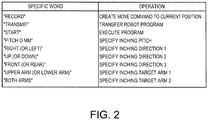
- Fig. 2 is a chart illustrating examples of the specific words to be extracted by the speech recognition. As illustrated in Fig. 2 , each specific word(s) is associated with operation of the robot 3. For example, a specific word “RECORD” is associated with "a command for creating a move command to a current position" in a teaching mode. The specific word “TRANSMIT” is associated with "a program transfer command of the robot” generated in the teaching mode. The specific word “START” is associated with "a program execution command” in a playback mode.
- the specific word "PITCH oo MM” is associated with "a pitch specify command” in an inching mode. This is a word which specifies a pitch when moving the robot in a given direction from the location specified by the direct teaching, ⁇ corresponds to a numeric value.
- the specific word “RIGHT (OR LEFT)” is associated with “a specify command to the right or to the left in the moving direction” of the robot in the inching mode.
- the specific word “UP (OR DOWN)” is associated with “a specify command to upward or downward in the moving direction” of the robot in the inching mode.
- the specific word “FRONT (OR REAR)” is associated with "a specify command to forward or rearward in the moving direction” of the robot in the inching mode.
- the specific words “UPPER ARM (OR LOWER ARM)” and “BOTH ARMS” are associated with "a command for specifying a target arm” in the inching mode of a dual-arm robot.
- the specific-word extraction part 13 extracts from the memory part 12 the specific word which matches with the word recognized by the voice recognition part 11.
- the operation command generation part 14 generates the operation command for the robot based on the operational information (specify command) associated with the specific word extracted by the specific-word extraction part 13, and outputs it to the control device 4.
- the robot 3 has one of the teaching mode for teaching the operation based on the operation command from the control device 4 and the playback mode for automatically performing the taught operation.
- the robot 3 is connected to the control device 4.
- the control device 4 is a robot controller provided with, for example, an arithmetic processor, a servo amplifier, a memory, an input/output interface, and a communication interface.
- the control device 4 includes a direct teaching part 21, an operation command generation part 22, and a memory part 23.
- the direct teaching part 21 detects a location or a posture of the robot which is led by the operator 50 in the teaching mode, and stores in the memory part 23 teaching information, such as a teaching point.
- the operation command generation part 22 transmits to the robot 3 a signal commanding operation of the robot 3 based on the operation command from the teaching device 1 in the teaching mode.
- a signal for commanding operation of the robot 3 in order to perform a playback of the taught operation program etc. is transmitted to the robot 3.
- the memory part 23 stores teaching information, such as the operation program generated in the teaching mode.
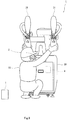
- Fig. 3 is a view illustrating a situation of a teaching work of the robot 3.
- the robot 3 is the dual-arm robot having a pair of robotic arms 31 supported by a base 30.
- the robot 3 is installed in a limited space corresponding to a size of one person (e.g., 610 mm x 620 mm).
- the location and posture of the robotic arm 31 (angles of each joint and a tip end of the arm) are manually operated by the operator 50.
- the operator 50 wears the microphone 2 which hands-free collects the voice uttered by the operator 50, he/she can operate the robot 3 by the audio input.
- the operator 50 grabs the tip end of the robotic arm 31, and moves the robotic arm 31 to a desired location or changes it to take a desired posture, and this location or posture is stored.
- the teaching device 1 recognizes the voice of the operator 50 inputted into the microphone 2 by the voice recognition part 11.
- the specific-word extraction part 13 extracts from the memory part 12 the specific word which matches with the word recognized by the voice recognition part 11 (see Fig. 2 ).
- the specific-word extraction part 13 extracts from the memory part 12 "the command for creating the move command to the current position" associated with the specific word "RECORD,” and outputs it to the operation command generation part 14.
- the operation command generation part 14 generates the operation command for the robot based on "the command for creating the move command to the current position,” and outputs it to the control device 4.
- the control device 4 receives the operation command, and the current position or posture of the robot is stored in the memory part 23.
- the teaching device 1 of this embodiment can perform by the audio input the inching mode in which the robot is moved to a given direction from the location and posture of the robot which are registered by the direct teaching.
- the memory part 12 stores a word which specifies a pitch when moving the robot in the given direction from the location specified by the direct teaching, and a word which specifies the moving direction of the robot.
- the specific word(s) "PITCH ⁇ MM" is associated with “the pitch specify command” in the inching mode.
- the specific word “RIGHT (OR LEFT)” is associated with "the specify command to the right or to the left in the moving direction" of the robot in the inching mode.
- Fig. 4 is a schematic diagram illustrating flows of signals in robot operation by the audio input.
- the teaching device 1 recognizes the voice of the operator 50 inputted into the microphone 2 by the voice recognition part 11.
- the specific-word extraction part 13 extracts from the memory part 12 the specific words which match with the words recognized by the voice recognition part 11 (see Fig. 2 ).
- the specific-word extraction part 13 extracts from the memory part 12 "the pitch specify command” associated with the specific words "PITCH ⁇ MM,” and outputs it to the operation command generation part 14.
- the operation command generation part 14 generates the operation command for the robot based on "the pitch specify command,” and outputs it to the control device 4.
- the control device 4 receives the operation command and the pitch in the inching mode is specified.
- the specified pitch is stored in the memory part 23.
- the teaching device 1 recognizes the voice of the operator 50 inputted into the microphone 2 by the voice recognition part 11.
- the specific-word extraction part 13 extracts from the memory part 12 the specific word which matches with the word recognized by the voice recognition part 11 (see Fig. 2 ).
- the specific-word extraction part 13 extracts three times from the memory part 12 "the specify command to the right in the moving direction” associated with the specific word “RIGHT,” it extracts once "the specify command to downward in the moving direction” associated with the specific word “DOWN,” and outputs them to the operation command generation part 14.
- the operation command generation part 14 generates the operation command for the robot based on the three "specify commands to the right in the moving direction" and one "specify command to downward in the moving direction,” and outputs it to the control device 4.
- the control device 4 receives the operation command, refers to the pitch (2 mm) stored in the memory part 23 based on the received operation command, and moves the robot to 6 mm to the right and 2 mm to downward in the inching mode.
- the operation command generation part 14 generates the operation command so that the robot is moved in the specified direction at the specified pitch.
- the recognition precision of the speech recognition improves.
- the specific word further includes a word easy to utter for moving the robot forward or backward in the specified direction at the specified pitch, and after the moving direction of the robot is specified, the robot may be moved in the specified direction at the given pitch by the easy-to-utter word.
- Fig. 5 is a table illustrating other examples of the specific words extracted by the speech recognition.
- the easy-to-utter word for moving the robot forward or backward is "GO OR BACK.” Since these words have one vowel, utterance of these words is easier to be recognized by the speech recognition. For example, suppose that 2 mm is specified as the pitch and "30 DEGREES UPPER RIGHT" is specified as the direction. Then, without the pitch and the direction being updated, when the operator speaks once "GO,” the robot moves upward and rightward by 2 mm.
- the operation command for moving the robot in the direction already specified by a distance corresponding to the pitch already specified is generated.
- the operation command for moving the robot in the direction opposite to the direction already specified by a distance corresponding to the pitch already specified is generated.
- the robot may be moved in the specified moving direction at the specified pitch, when the pitch is specified without the specified moving direction being updated.
- the robot may be moved in the specified moving direction at the specified pitch, when the pitch is specified without the specified moving direction being updated.
- the operation command for moving the robot rightward by 2 mm may be generated.
- the operation command for moving the robot rightward by 0.2 mm may be generated.
- the word for specifying the pitch may be "2 MM” and "0.2 MM” which include a concrete numeric value, and as illustrated in Fig. 5 , it may be "A BIT,” “ONLY A BIT,” “LITTLE MORE,” and “JUST LITTLE MORE” which include an ambiguous expression.
- These words are registered (stored) and a relation of the concrete pitch (a numeric value and its unit) corresponding to each word is also registered (stored). For example, the words “A BIT” and “ONLY A BIT” are registered (stored) and 2 mm and 0.2 mm are associated with them as the pitches corresponding to the words.
- the word "A BIT” is associated with the pitch of 2 mm and the word “ONLY A BIT” is associated with the pitch of 0.2 mm.
- the operation command for moving the robot rightward by 2 mm is generated.
- the operation command for moving the robot rightward by 0.2 mm is generated.
- the robot moves rightward by the total of 2.4 mm.
- various degrees are expressed by using ambiguous expressions in many cases. Therefore, if the word includes the ambiguous expression rather than the concrete numeric value, the operator is easier to specify the pitch in his/her intuitive sense.
- one robotic arm may be specified by the audio input in the inching mode as a moving target.
- the operator 50 can specify the robotic arm 31 which becomes the inching target by uttering either the "UPPER ARM,” the "LOWER ARM” or "BOTH ARMS.”
- teaching device 1 is to teach the robot the operation by the direct teaching, it may be to teach the robot operation by other teaching.
- the present disclosure is useful for teaching the robot.
Landscapes
- Engineering & Computer Science (AREA)
- Mechanical Engineering (AREA)
- Robotics (AREA)
- Multimedia (AREA)
- Human Computer Interaction (AREA)
- Physics & Mathematics (AREA)
- Audiology, Speech & Language Pathology (AREA)
- Health & Medical Sciences (AREA)
- Acoustics & Sound (AREA)
- Computational Linguistics (AREA)
- Theoretical Computer Science (AREA)
- General Health & Medical Sciences (AREA)
- General Engineering & Computer Science (AREA)
- General Physics & Mathematics (AREA)
- Manipulator (AREA)
- Numerical Control (AREA)
Abstract
Description
- The present disclosure relates to a teaching device for a robot.
- Generally, there is a direct teaching method as a method of teaching a robot a work. In this direct teaching method, an operator holds a tip end of the robot, moves the robot to a desired location or makes the robot to take a desired posture, and causes the robot to store this location or posture to teach the robot the operation. The operator needs to operate a teaching pendant in addition to the direct movement of the robot to the instructed location. The teaching pendant has an inching mode in which the robot is moved in a desired direction by a remote operation. In the inching mode, the operator must watch the teaching pendant while watching the robot because he/she uses operation keys of the teaching pendant.
- In recent years, in order to reduce the operator's burden, teaching devices for robots which perform the inching by an audio input have been proposed (see
Patent Documents 1 and 2). -
- [Patent Document 1]
-
JP2003-080482A - [Patent Document 2]
-
JP2005-088114A - However, in the above-described conventional art, when performing the inching with voice without using the teaching pendant, the operator speaks, for example, as "6 mm positive in the X-axis direction" or "2 mm negative in the Z-axis direction." Generally, the speech recognition rate has tendency that the recognition takes more time and causes more errors as the speech becomes longer.
- The present disclosure is made in view of solving the above problem, and one purpose thereof is to improve a speech-recognition accuracy of an audio input in an inching mode of a robot.
- In order to solve the described issue, a teaching device for a robot according to one aspect of the present disclosure is provided, which is configured to teach the robot an operation and includes a voice input part configured to accept an input of voice of an operator, a voice recognition part configured to recognize the voice of the operator inputted into the voice input part, a memory part configured to store beforehand a specific word associated with operation of the robot, a specific-word extraction part configured to extract from the memory part the specific word matching with a word recognized by the voice recognition part, and an operation command generation part configured to generate an operation command for the robot based on operational information associated with the specific word extracted by the specific-word extraction part. The specific word includes a first word for specifying a pitch corresponding to a moving distance when the robot is moved in a given direction from a specified location, and a second word for specifying a moving direction of the robot. When the pitch specified by the first word is not updated and the moving direction of the robot is specified by the second word, the operation command generation part generates the operation command so that the robot is moved in the specified direction at the specified pitch.
- According to this configuration, when the operator utters to the voice input part (e.g., microphone) in an inching mode, the voice recognition part recognizes the voice of the operator inputted into the voice input part, and the specific-word extraction part extracts from the memory part the specific word matching with the word recognized by the voice recognition part. The operation command generation part generates the operation command for the robot based on the operational information (specify command) associated with the specific word extracted by the specific-word extraction part. Here, the specific word includes a word for specifying a pitch when the robot is moved in a given direction from a specified location by a direct teaching etc., and a word for specifying the moving direction of the robot. Thus, when the specific-word extraction part extracts the second word followed by the first word, the pitch specified by the first word is not updated and the moving direction of the robot is specified by the second word. In this case, the operation command is generated so that the robot is moved in the specified direction at the specified pitch. Therefore, the moving pitch can be specified by the audio input (e.g., the operator utters "PITCH 2MM"), and then, the moving direction of the robot can be specified (e.g., the operator utters "RIGHT, RIGHT, RIGHT, DOWN"). Since the utterance by the operator each time becomes shorter, the precision of the speech recognition improves.
- The specific word may further include a third word easy to utter for moving the robot forward or backward in the specified direction at the specified pitch. When the pitch specified by the first word is not updated and the moving direction of the robot is specified by the second word, the operation command generation part may generate the operation command so that the robot is moved forward or backward by the third word in the specified direction at the specified pitch.
- According to this configuration, since the specific word includes the third word easy to utter, the robot can be moved forward or backward in the specified direction at the specified pitch by this word easy to utter after the moving direction of the robot is specified. For example, suppose that "2MM" is specified as the pitch and "30 DEGREES UPPER RIGHT" is specified as the direction. Then, without the pitch and the direction being updated, when the operator speaks once "GO," the robot moves upward and rightward by 2 mm. Further, without the pitch and the direction being updated, when the operator speaks once "BACK," the robot moves upward and rightward by -2 mm. That is, it moves 30 degrees downward and leftward by 2 mm. Further, without the pitch and the direction being updated, when the operator speaks "GO, GO, GO," the robot moves upward and rightward by the total of 6 mm. Thus, since the robot is moved forward or backward with the easy-to-utter word, the precision of the speech recognition improves.
- The first word may include an ambiguous expression for specifying a pitch when the robot is moved in a given direction from a specified location. The memory part may store beforehand a numeric value and a unit thereof corresponding to the ambiguous expression so as to be associated with the ambiguous expression. When the moving direction specified by the second word is not updated and the pitch of the robot is specified by the numeric value and the unit corresponding to the ambiguous expression, the operation command generation part may generate the operation command so that the robot is moved in the specified moving direction at the specified pitch.
- The robot may have a plurality of robotic arms. The specific word may further include a word for specifying a robotic arm to be used as a target of movement among the plurality of robotic arms.
- According to this configuration, one robotic arm to be used as the target of movement among the plurality of robotic arms can be specified by the utterance (e.g., "UPPER ARM," "LOWER ARM," "BOTH ARMS").
- The teaching device may teach the robot the operation by the direct teaching.
- The present disclosure has the configuration described above so that a speech-recognition accuracy of an audio input in an inching mode of a robot can be improved.
-
-
Fig. 1 is a block diagram illustrating a configuration of a teaching device for a robot according to one embodiment. -
Fig. 2 is a table illustrating one example of specific words extracted by a speech recognition. -
Fig. 3 is a view illustrating a situation of a teaching work of the robot. -
Fig. 4 is a schematic diagram illustrating flows of signals in the teaching work of the robot. -
Fig. 5 is a table illustrating other examples of the specific words extracted by the speech recognition. - Hereinafter, a desirable embodiment is described with reference to the drawings. Note that, below, the same reference characters are assigned to the same or corresponding components throughout the drawings to omit redundant description. Moreover, the drawings are to schematically illustrate the components to facilitate understandings.
-
Fig. 1 is a block diagram illustrating a configuration of a teaching device for a robot according to one embodiment of the present disclosure. Ateaching device 1 is a teaching device for the robot for teaching arobot 3 operation by a direct teaching. In this embodiment, theteaching device 1 is provided with a speech recognition function, and is comprised of a teaching terminal communicatably connected to acontrol device 4 of the robot. Theteaching device 1 is connected to a microphone (voice input part) 2 which collects voice uttered by anoperator 50. The microphone 2 is desirable to be provided with a noise shield means which reduces an input of sound other than the voice uttered by theoperator 50. Such a noise shield means may include a reflecting plate which reflects the voice uttered from the mouth of theoperator 50 and collects the voice in the microphone, and an insulating member which interrupts the sound from a direction other than the mouth of theoperator 50. Further, the noise shield means is also desirable to use a directional microphone having high sensibility for the voice from the direction of the mouth of theoperator 50. Alternatively, a bone conductive microphone which collects bone conducting sound of theoperator 50 is also suitably used. Such microphones eliminate noise at a location where therobot 3 is installed, such as a production line of a factory, and clearly collect the voice of theoperator 50. - The
teaching device 1 includes avoice recognition part 11 which recognizes the voice of the operator inputted into themicrophone 2, amemory part 12 which stores beforehand specific word(s) associated with operation of therobot 3, a specific-word extraction part 13 which extracts from thememory part 12 the specific word which matches with the word recognized by thevoice recognition part 11, and an operationcommand generation part 14 which creates an operation command for the robot based on operational information (specify command) associated with the specific word extracted by the specific-word extraction part 13. Here, theteaching device 1 is a computer provided with, for example, one or more processors, a memory, an input/output interface, and a communication interface. Thevoice recognition part 11, the specific-word extraction part 13, and the operationcommand generation part 14 are functional blocks implemented by the processor executing a given program. - The
memory part 12 stores beforehand the specific words to be extracted by a speech recognition, various data, such as the commands, related to the robot operation associated with the respective specific words, and other speech recognition processing programs.Fig. 2 is a chart illustrating examples of the specific words to be extracted by the speech recognition. As illustrated inFig. 2 , each specific word(s) is associated with operation of therobot 3. For example, a specific word "RECORD" is associated with "a command for creating a move command to a current position" in a teaching mode. The specific word "TRANSMIT" is associated with "a program transfer command of the robot" generated in the teaching mode. The specific word "START" is associated with "a program execution command" in a playback mode. The specific word "PITCH oo MM" is associated with "a pitch specify command" in an inching mode. This is a word which specifies a pitch when moving the robot in a given direction from the location specified by the direct teaching, ○○ corresponds to a numeric value. The specific word "RIGHT (OR LEFT)" is associated with "a specify command to the right or to the left in the moving direction" of the robot in the inching mode. The specific word "UP (OR DOWN)" is associated with "a specify command to upward or downward in the moving direction" of the robot in the inching mode. The specific word "FRONT (OR REAR)" is associated with "a specify command to forward or rearward in the moving direction" of the robot in the inching mode. The specific words "UPPER ARM (OR LOWER ARM)" and "BOTH ARMS" are associated with "a command for specifying a target arm" in the inching mode of a dual-arm robot. - The specific-
word extraction part 13 extracts from thememory part 12 the specific word which matches with the word recognized by thevoice recognition part 11. The operationcommand generation part 14 generates the operation command for the robot based on the operational information (specify command) associated with the specific word extracted by the specific-word extraction part 13, and outputs it to thecontrol device 4. - The
robot 3 has one of the teaching mode for teaching the operation based on the operation command from thecontrol device 4 and the playback mode for automatically performing the taught operation. Therobot 3 is connected to thecontrol device 4. Thecontrol device 4 is a robot controller provided with, for example, an arithmetic processor, a servo amplifier, a memory, an input/output interface, and a communication interface. Thecontrol device 4 includes adirect teaching part 21, an operationcommand generation part 22, and amemory part 23. Thedirect teaching part 21 detects a location or a posture of the robot which is led by theoperator 50 in the teaching mode, and stores in thememory part 23 teaching information, such as a teaching point. The operationcommand generation part 22 transmits to the robot 3 a signal commanding operation of therobot 3 based on the operation command from theteaching device 1 in the teaching mode. In the playback mode, a signal for commanding operation of therobot 3 in order to perform a playback of the taught operation program etc. is transmitted to therobot 3. Thememory part 23 stores teaching information, such as the operation program generated in the teaching mode. - Next, the direct teaching of the
robot 3 by theteaching device 1 is described.Fig. 3 is a view illustrating a situation of a teaching work of therobot 3. As illustrated inFig. 3 , therobot 3 is the dual-arm robot having a pair ofrobotic arms 31 supported by abase 30. Therobot 3 is installed in a limited space corresponding to a size of one person (e.g., 610 mm x 620 mm). In the teaching mode, the location and posture of the robotic arm 31 (angles of each joint and a tip end of the arm) are manually operated by theoperator 50. Moreover, in this embodiment, since theoperator 50 wears themicrophone 2 which hands-free collects the voice uttered by theoperator 50, he/she can operate therobot 3 by the audio input. - The
operator 50 grabs the tip end of therobotic arm 31, and moves therobotic arm 31 to a desired location or changes it to take a desired posture, and this location or posture is stored. Here, when theoperator 50 utters the word "RECORD," theteaching device 1 recognizes the voice of theoperator 50 inputted into themicrophone 2 by thevoice recognition part 11. The specific-word extraction part 13 extracts from thememory part 12 the specific word which matches with the word recognized by the voice recognition part 11 (seeFig. 2 ). Here, the specific-word extraction part 13 extracts from thememory part 12 "the command for creating the move command to the current position" associated with the specific word "RECORD," and outputs it to the operationcommand generation part 14. The operationcommand generation part 14 generates the operation command for the robot based on "the command for creating the move command to the current position," and outputs it to thecontrol device 4. Thecontrol device 4 receives the operation command, and the current position or posture of the robot is stored in thememory part 23. - Moreover, the
teaching device 1 of this embodiment can perform by the audio input the inching mode in which the robot is moved to a given direction from the location and posture of the robot which are registered by the direct teaching. Thememory part 12 stores a word which specifies a pitch when moving the robot in the given direction from the location specified by the direct teaching, and a word which specifies the moving direction of the robot. As illustrated inFig. 2 , the specific word(s) "PITCH ○○ MM" is associated with "the pitch specify command" in the inching mode. The specific word "RIGHT (OR LEFT)" is associated with "the specify command to the right or to the left in the moving direction" of the robot in the inching mode. -
Fig. 4 is a schematic diagram illustrating flows of signals in robot operation by the audio input. As illustrated inFig. 4 , when theoperator 50 utters the words of "PITCH 2MM," theteaching device 1 recognizes the voice of theoperator 50 inputted into themicrophone 2 by thevoice recognition part 11. The specific-word extraction part 13 extracts from thememory part 12 the specific words which match with the words recognized by the voice recognition part 11 (seeFig. 2 ). Here, the specific-word extraction part 13 extracts from thememory part 12 "the pitch specify command" associated with the specific words "PITCH ○○ MM," and outputs it to the operationcommand generation part 14. The operationcommand generation part 14 generates the operation command for the robot based on "the pitch specify command," and outputs it to thecontrol device 4. Thecontrol device 4 receives the operation command and the pitch in the inching mode is specified. The specified pitch is stored in thememory part 23. - Next, when the
operator 50 utters the word "RIGHT," "RIGHT," "RIGHT," and "DOWN," theteaching device 1 recognizes the voice of theoperator 50 inputted into themicrophone 2 by thevoice recognition part 11. The specific-word extraction part 13 extracts from thememory part 12 the specific word which matches with the word recognized by the voice recognition part 11 (seeFig. 2 ). Here, after the specific-word extraction part 13 extracts three times from thememory part 12 "the specify command to the right in the moving direction" associated with the specific word "RIGHT," it extracts once "the specify command to downward in the moving direction" associated with the specific word "DOWN," and outputs them to the operationcommand generation part 14. - The operation
command generation part 14 generates the operation command for the robot based on the three "specify commands to the right in the moving direction" and one "specify command to downward in the moving direction," and outputs it to thecontrol device 4. Thecontrol device 4 receives the operation command, refers to the pitch (2 mm) stored in thememory part 23 based on the received operation command, and moves the robot to 6 mm to the right and 2 mm to downward in the inching mode. Thus, when the moving direction of the robot is specified without the specified pitch (2 mm) being updated, the operationcommand generation part 14 generates the operation command so that the robot is moved in the specified direction at the specified pitch. - Therefore, according to this embodiment, since the utterance by the
operator 50 each time becomes shorter in the inching mode using the audio input, the recognition precision of the speech recognition improves. - Note that, in this embodiment, once the pitch is specified, when only the word indicative of the direction is uttered without the pitch being updated, the robot is moved in the uttered direction by a distance corresponding to the pitch. However, it is sometimes difficult to repeatedly utter the word indicative of the direction. For example, "RIGHT" is not so difficult to utter repeatedly, but the words "30 DEGREES UPPER RIGHT" are difficult to utter repeatedly.
- Thus, the specific word further includes a word easy to utter for moving the robot forward or backward in the specified direction at the specified pitch, and after the moving direction of the robot is specified, the robot may be moved in the specified direction at the given pitch by the easy-to-utter word.
-
Fig. 5 is a table illustrating other examples of the specific words extracted by the speech recognition. As illustrated inFig. 5 , the easy-to-utter word for moving the robot forward or backward is "GO OR BACK." Since these words have one vowel, utterance of these words is easier to be recognized by the speech recognition. For example, suppose that 2 mm is specified as the pitch and "30 DEGREES UPPER RIGHT" is specified as the direction. Then, without the pitch and the direction being updated, when the operator speaks once "GO," the robot moves upward and rightward by 2 mm. Further, without the pitch and the direction being updated, when the operator speaks once "BACK," the robot moves upward and rightward by -2 mm (i.e., it moves 30 degrees downward and leftward by 2 mm). Further, without the pitch and the direction being updated, when the operator speaks "GO, GO, GO," the robot moves upward and rightward by the total of 6 mm - That is, when the operator utters the word "GO" and the teaching device recognizes it, the operation command for moving the robot in the direction already specified by a distance corresponding to the pitch already specified is generated. Moreover, when the operator utters the word "BACK" and the teaching device 1 (voice recognition part 11) recognizes it, the operation command for moving the robot in the direction opposite to the direction already specified by a distance corresponding to the pitch already specified is generated. Thus, since the robot is moved forward or backward with the easy-to-utter word, the recognition precision of the speech recognition improves.
- Note that although in this embodiment the robot is moved in the specified direction at the specified pitch when the moving direction of the robot is specified without the specified pitch being updated, the robot may be moved in the specified moving direction at the specified pitch, when the pitch is specified without the specified moving direction being updated. For example, when the right is specified as the moving direction, and the operator utters the word "2 MM" without the moving direction being updated, the operation command for moving the robot rightward by 2 mm may be generated. Further, when the operator utters the word "0.2 MM" without the moving direction being changed, the operation command for moving the robot rightward by 0.2 mm may be generated.
- The word for specifying the pitch may be "2 MM" and "0.2 MM" which include a concrete numeric value, and as illustrated in
Fig. 5 , it may be "A BIT," "ONLY A BIT," "LITTLE MORE," and "JUST LITTLE MORE" which include an ambiguous expression. These words are registered (stored) and a relation of the concrete pitch (a numeric value and its unit) corresponding to each word is also registered (stored). For example, the words "A BIT" and "ONLY A BIT" are registered (stored) and 2 mm and 0.2 mm are associated with them as the pitches corresponding to the words. That is, the word "A BIT" is associated with the pitch of 2 mm and the word "ONLY A BIT" is associated with the pitch of 0.2 mm. For example, when the right is already specified as the moving direction and the operator utters the word "A BIT" without the moving direction being updated, the operation command for moving the robot rightward by 2 mm is generated. Further, when the operator utters the word "ONLY A BIT" without the moving direction being changed, the operation command for moving the robot rightward by 0.2 mm is generated. Further, when the operator utters "A BIT, ONLY A BIT, ONLY A BIT" without the moving direction being changed, the robot moves rightward by the total of 2.4 mm. In the human's ordinary conversation, various degrees are expressed by using ambiguous expressions in many cases. Therefore, if the word includes the ambiguous expression rather than the concrete numeric value, the operator is easier to specify the pitch in his/her intuitive sense. - Note that since the
robot 3 is the dual-arm robot having the tworobotic arms 31, one robotic arm may be specified by the audio input in the inching mode as a moving target. For example, theoperator 50 can specify therobotic arm 31 which becomes the inching target by uttering either the "UPPER ARM," the "LOWER ARM" or "BOTH ARMS." - Note that although in this embodiment the
teaching device 1 is to teach the robot the operation by the direct teaching, it may be to teach the robot operation by other teaching. - It is apparent for the person skilled in the art that many improvements and other embodiments of the present disclosure are possible from the above description. Therefore, the above description is to be interpreted only as illustration, and it is provided in order to teach the person skilled in the art the best mode that implements the present disclosure. The details of the configuration and/or the function may be changed substantially without departing from the spirit of the present disclosure.
- The present disclosure is useful for teaching the robot.
-
- 1
- Teaching Device
- 2
- Microphone (Voice Input Part)
- 3
- Robot
- 4
- Control Device (Robot Controller)
- 11
- Voice Recognition Part
- 12
- Memory Part
- 13
- Specific-Word Extraction Part
- 14
- Operation Command Generation Part
- 21
- Direct Teaching Part
- 22
- Operation Command Part
- 23
- Memory Part
- 31
- Robotic Arm
- 50
- Operator
Claims (5)
- A teaching device for a robot configured to teach the robot an operation, comprising:a voice input part configured to accept an input of voice of an operator;a voice recognition part configured to recognize the voice of the operator inputted into the voice input part;a memory part configured to store beforehand a specific word associated with operation of the robot;a specific-word extraction part configured to extract from the memory part the specific word matching with a word recognized by the voice recognition part; andan operation command generation part configured to generate an operation command for the robot based on operational information associated with the specific word extracted by the specific-word extraction part,wherein the specific word includes a first word for specifying a pitch corresponding to a moving distance when the robot is moved in a given direction from a specified location, and a second word for specifying a moving direction of the robot, andwherein when the pitch specified by the first word is not updated and the moving direction of the robot is specified by the second word, the operation command generation part generates the operation command so that the robot is moved in the specified direction at the specified pitch.
- The teaching device of claim 1, wherein the specific word further includes a third word easy to utter for moving the robot forward or backward in the specified moving direction at the specified pitch, and
wherein when the pitch specified by the first word is not updated and the moving direction of the robot is specified by the second word, the operation command generation part generates the operation command so that the robot is moved forward or backward by the third word in the specified direction at the specified pitch. - The teaching device of claim 1 or 2, wherein the first word includes an ambiguous expression for specifying a pitch when the robot is moved in a given direction from a specified location,
wherein the memory part stores beforehand a numeric value and a unit thereof corresponding to the ambiguous expression so as to be associated with the ambiguous expression, and
wherein when the moving direction specified by the second word is not updated and the pitch of the robot is specified by the numeric value and the unit corresponding to the ambiguous expression, the operation command generation part generates the operation command so that the robot is moved in the specified moving direction at the specified pitch. - The teaching device of any one of claims 1 to 3, wherein the robot has a plurality of robotic arms, and
wherein the specific word further includes a word for specifying a robotic arm to be used as a target of movement among the plurality of robotic arms. - The teaching device of any one of claims 1 to 4, wherein the teaching device teaches the robot the operation by a direct teaching.
Applications Claiming Priority (3)
| Application Number | Priority Date | Filing Date | Title |
|---|---|---|---|
| JP2018010445 | 2018-01-25 | ||
| JP2018097118A JP2019126902A (en) | 2018-01-25 | 2018-05-21 | Robot teaching device |
| PCT/JP2019/001825 WO2019146586A1 (en) | 2018-01-25 | 2019-01-22 | Robot instruction device |
Publications (2)
| Publication Number | Publication Date |
|---|---|
| EP3744483A1 true EP3744483A1 (en) | 2020-12-02 |
| EP3744483A4 EP3744483A4 (en) | 2021-10-20 |
Family
ID=67470978
Family Applications (1)
| Application Number | Title | Priority Date | Filing Date |
|---|---|---|---|
| EP19743361.8A Withdrawn EP3744483A4 (en) | 2018-01-25 | 2019-01-22 | Robot instruction device |
Country Status (4)
| Country | Link |
|---|---|
| US (1) | US20200353614A1 (en) |
| EP (1) | EP3744483A4 (en) |
| JP (1) | JP2019126902A (en) |
| CN (1) | CN111867789A (en) |
Cited By (1)
| Publication number | Priority date | Publication date | Assignee | Title |
|---|---|---|---|---|
| WO2024011518A1 (en) | 2022-07-14 | 2024-01-18 | Abb Schweiz Ag | Method for controlling industrial robot and industrial robot |
Families Citing this family (1)
| Publication number | Priority date | Publication date | Assignee | Title |
|---|---|---|---|---|
| CN113843814A (en) * | 2021-09-10 | 2021-12-28 | 北京声智科技有限公司 | Control system, method, device and storage medium for robotic arm equipment |
Family Cites Families (16)
| Publication number | Priority date | Publication date | Assignee | Title |
|---|---|---|---|---|
| SE8305378L (en) * | 1983-09-30 | 1985-03-31 | Asea Ab | INDUSTRIAL ROBOT |
| JPS6390298A (en) * | 1986-10-03 | 1988-04-21 | Sumitomo Heavy Ind Ltd | Sound remote controller for crane |
| JPH0740264A (en) * | 1993-08-05 | 1995-02-10 | Sumitomo Heavy Ind Ltd | 3D motion instruction device |
| JPH08216074A (en) * | 1995-02-17 | 1996-08-27 | Yaskawa Electric Corp | Robot direct teaching device |
| JP2000099306A (en) * | 1998-05-28 | 2000-04-07 | Canon Inc | Control device, control method therefor, and storage medium storing program for executing operation processing |
| JP2000356999A (en) * | 1999-06-16 | 2000-12-26 | Ishikawajima Harima Heavy Ind Co Ltd | Voice command input device and method |
| US6519566B1 (en) * | 2000-03-01 | 2003-02-11 | International Business Machines Corporation | Method for hands-free operation of a pointer |
| JP2001322079A (en) * | 2000-05-15 | 2001-11-20 | Sony Corp | Legged mobile robot and method of teaching its operation |
| JP2004351533A (en) * | 2003-05-27 | 2004-12-16 | Fanuc Ltd | Robot system |
| JP4433273B2 (en) * | 2003-08-19 | 2010-03-17 | ソニー株式会社 | Robot apparatus and control method of robot apparatus |
| JP4232196B2 (en) * | 2003-09-16 | 2009-03-04 | 株式会社安川電機 | Robot direct teaching device and robot system |
| JP4452207B2 (en) * | 2005-04-08 | 2010-04-21 | 三菱重工業株式会社 | Robot teaching device |
| US9403279B2 (en) * | 2013-06-13 | 2016-08-02 | The Boeing Company | Robotic system with verbal interaction |
| JP6679846B2 (en) * | 2015-06-02 | 2020-04-15 | セイコーエプソン株式会社 | Teaching device and robot system |
| CN106095109B (en) * | 2016-06-20 | 2019-05-14 | 华南理工大学 | An online teaching method of robot based on gesture and voice |
| CN106363637B (en) * | 2016-10-12 | 2018-10-30 | 华南理工大学 | A kind of quick teaching method of robot and device |
-
2018
- 2018-05-21 JP JP2018097118A patent/JP2019126902A/en active Pending
-
2019
- 2019-01-22 CN CN201980010023.1A patent/CN111867789A/en active Pending
- 2019-01-22 EP EP19743361.8A patent/EP3744483A4/en not_active Withdrawn
-
2020
- 2020-07-27 US US16/939,496 patent/US20200353614A1/en not_active Abandoned
Cited By (2)
| Publication number | Priority date | Publication date | Assignee | Title |
|---|---|---|---|---|
| WO2024011518A1 (en) | 2022-07-14 | 2024-01-18 | Abb Schweiz Ag | Method for controlling industrial robot and industrial robot |
| EP4554756A4 (en) * | 2022-07-14 | 2026-03-11 | Abb Schweiz Ag | METHOD FOR CONTROLLING AN INDUSTRIAL ROBOT AND INDUSTRIAL ROBOT |
Also Published As
| Publication number | Publication date |
|---|---|
| EP3744483A4 (en) | 2021-10-20 |
| CN111867789A (en) | 2020-10-30 |
| US20200353614A1 (en) | 2020-11-12 |
| JP2019126902A (en) | 2019-08-01 |
Similar Documents
| Publication | Publication Date | Title |
|---|---|---|
| EP2931485B1 (en) | Bare hand robot path teaching | |
| JP2009241166A (en) | Robot remote operation system | |
| CN103654967A (en) | Speech-controlled auxiliary imaging device for minimally invasive operations | |
| JP5141876B2 (en) | Orbit search device | |
| CN111844085B (en) | Robot teaching device | |
| JP2001188555A (en) | Information processing apparatus and method, and recording medium | |
| CN111843986B (en) | Robot teaching device | |
| US20200353614A1 (en) | Teaching device for robot | |
| CN116394277B (en) | A humanoid piano playing robot | |
| Sirasala et al. | Collaborative Robot as Scrub Nurse. | |
| JP7201984B2 (en) | Android gesture generator and computer program | |
| KR101322394B1 (en) | Vocal recognition information retrieval system and method the same | |
| JPWO2006097975A1 (en) | Speech recognition program | |
| US20140297257A1 (en) | Motion sensor-based portable automatic interpretation apparatus and control method thereof | |
| CN115922692A (en) | A Human-Robot Multimodal Interaction Method Oriented to Teleoperation | |
| WO2019146586A1 (en) | Robot instruction device | |
| Gosavi et al. | Speech recognition for robotic control | |
| JP2021066004A (en) | Control device, control system and control method | |
| JP4433273B2 (en) | Robot apparatus and control method of robot apparatus | |
| JP2017084041A (en) | Voice command input device and welding system | |
| Asha et al. | Voice-Controlled Object Pick and Place for Collaborative Robots Employing the ROS2 Framework | |
| Saravanan et al. | Command and control of industrial manipulator through speech-based interfaces in Indic Languages: N. Saravanan, R. Sivaramakrishnan | |
| JP2004283927A (en) | Robot control device and method, recording medium, and program | |
| JP2012037820A (en) | Voice recognition apparatus, voice recognition apparatus for picking, and voice recognition method | |
| KR20160033329A (en) | System and Method for Translating Sign Language |
Legal Events
| Date | Code | Title | Description |
|---|---|---|---|
| STAA | Information on the status of an ep patent application or granted ep patent |
Free format text: STATUS: THE INTERNATIONAL PUBLICATION HAS BEEN MADE |
|
| PUAI | Public reference made under article 153(3) epc to a published international application that has entered the european phase |
Free format text: ORIGINAL CODE: 0009012 |
|
| STAA | Information on the status of an ep patent application or granted ep patent |
Free format text: STATUS: REQUEST FOR EXAMINATION WAS MADE |
|
| 17P | Request for examination filed |
Effective date: 20200818 |
|
| AK | Designated contracting states |
Kind code of ref document: A1 Designated state(s): AL AT BE BG CH CY CZ DE DK EE ES FI FR GB GR HR HU IE IS IT LI LT LU LV MC MK MT NL NO PL PT RO RS SE SI SK SM TR |
|
| AX | Request for extension of the european patent |
Extension state: BA ME |
|
| DAV | Request for validation of the european patent (deleted) | ||
| DAX | Request for extension of the european patent (deleted) | ||
| A4 | Supplementary search report drawn up and despatched |
Effective date: 20210921 |
|
| RIC1 | Information provided on ipc code assigned before grant |
Ipc: G10L 15/22 20060101ALI20210915BHEP Ipc: B25J 9/16 20060101ALI20210915BHEP Ipc: G06F 3/16 20060101ALI20210915BHEP Ipc: B25J 13/00 20060101ALI20210915BHEP Ipc: B25J 9/00 20060101ALI20210915BHEP Ipc: G05B 19/423 20060101ALI20210915BHEP Ipc: B25J 9/22 20060101AFI20210915BHEP |
|
| STAA | Information on the status of an ep patent application or granted ep patent |
Free format text: STATUS: THE APPLICATION HAS BEEN WITHDRAWN |
|
| 18W | Application withdrawn |
Effective date: 20220131 |