EP3743126B1 - Fluorescent polymeric coating film for medical devices - Google Patents
Fluorescent polymeric coating film for medical devices Download PDFInfo
- Publication number
- EP3743126B1 EP3743126B1 EP19701664.5A EP19701664A EP3743126B1 EP 3743126 B1 EP3743126 B1 EP 3743126B1 EP 19701664 A EP19701664 A EP 19701664A EP 3743126 B1 EP3743126 B1 EP 3743126B1
- Authority
- EP
- European Patent Office
- Prior art keywords
- alkyl
- unsubstituted
- group
- alkenyl
- cyclo
- Prior art date
- Legal status (The legal status is an assumption and is not a legal conclusion. Google has not performed a legal analysis and makes no representation as to the accuracy of the status listed.)
- Active
Links
- 0 BC1=C(C=CI)I[C@@](*)CC1=CC=* Chemical compound BC1=C(C=CI)I[C@@](*)CC1=CC=* 0.000 description 19
- OPUZETDBEZISDT-UHFFFAOYSA-N CC1(C)C(C=CCC2)=C2N(C)C1 Chemical compound CC1(C)C(C=CCC2)=C2N(C)C1 OPUZETDBEZISDT-UHFFFAOYSA-N 0.000 description 1
- MJIXUOODQYOPSX-UHFFFAOYSA-N CC1(C)c(c(cccc2)c2cc2)c2[N+](C)=C1/C=C/C(CCC/C1=C\C=C2\N(C)c3ccc(cccc4)c4c3C2(C)C)=C1Oc1cc(C)cc(C)c1 Chemical compound CC1(C)c(c(cccc2)c2cc2)c2[N+](C)=C1/C=C/C(CCC/C1=C\C=C2\N(C)c3ccc(cccc4)c4c3C2(C)C)=C1Oc1cc(C)cc(C)c1 MJIXUOODQYOPSX-UHFFFAOYSA-N 0.000 description 1
- OQLQDSZUBLCILN-IECGRNSXSA-O ClC(/C(/CCC1)=C/Nc2ccccc2)=C1/C=[NH+]/c1ccccc1 Chemical compound ClC(/C(/CCC1)=C/Nc2ccccc2)=C1/C=[NH+]/c1ccccc1 OQLQDSZUBLCILN-IECGRNSXSA-O 0.000 description 1
Images


Classifications
-
- A—HUMAN NECESSITIES
- A61—MEDICAL OR VETERINARY SCIENCE; HYGIENE
- A61L—METHODS OR APPARATUS FOR STERILISING MATERIALS OR OBJECTS IN GENERAL; DISINFECTION, STERILISATION OR DEODORISATION OF AIR; CHEMICAL ASPECTS OF BANDAGES, DRESSINGS, ABSORBENT PADS OR SURGICAL ARTICLES; MATERIALS FOR BANDAGES, DRESSINGS, ABSORBENT PADS OR SURGICAL ARTICLES
- A61L31/00—Materials for other surgical articles, e.g. stents, stent-grafts, shunts, surgical drapes, guide wires, materials for adhesion prevention, occluding devices, surgical gloves, tissue fixation devices
- A61L31/08—Materials for coatings
- A61L31/10—Macromolecular materials
-
- C—CHEMISTRY; METALLURGY
- C09—DYES; PAINTS; POLISHES; NATURAL RESINS; ADHESIVES; COMPOSITIONS NOT OTHERWISE PROVIDED FOR; APPLICATIONS OF MATERIALS NOT OTHERWISE PROVIDED FOR
- C09D—COATING COMPOSITIONS, e.g. PAINTS, VARNISHES OR LACQUERS; FILLING PASTES; CHEMICAL PAINT OR INK REMOVERS; INKS; CORRECTING FLUIDS; WOODSTAINS; PASTES OR SOLIDS FOR COLOURING OR PRINTING; USE OF MATERIALS THEREFOR
- C09D5/00—Coating compositions, e.g. paints, varnishes or lacquers, characterised by their physical nature or the effects produced; Filling pastes
- C09D5/22—Luminous paints
-
- A—HUMAN NECESSITIES
- A61—MEDICAL OR VETERINARY SCIENCE; HYGIENE
- A61B—DIAGNOSIS; SURGERY; IDENTIFICATION
- A61B17/00—Surgical instruments, devices or methods
- A61B17/04—Surgical instruments, devices or methods for suturing wounds; Holders or packages for needles or suture materials
- A61B17/06—Needles ; Sutures; Needle-suture combinations; Holders or packages for needles or suture materials
- A61B17/06166—Sutures
-
- A—HUMAN NECESSITIES
- A61—MEDICAL OR VETERINARY SCIENCE; HYGIENE
- A61B—DIAGNOSIS; SURGERY; IDENTIFICATION
- A61B90/00—Instruments, implements or accessories specially adapted for surgery or diagnosis and not covered by any of the groups A61B1/00 - A61B50/00, e.g. for luxation treatment or for protecting wound edges
- A61B90/39—Markers, e.g. radio-opaque or breast lesions markers
-
- A—HUMAN NECESSITIES
- A61—MEDICAL OR VETERINARY SCIENCE; HYGIENE
- A61L—METHODS OR APPARATUS FOR STERILISING MATERIALS OR OBJECTS IN GENERAL; DISINFECTION, STERILISATION OR DEODORISATION OF AIR; CHEMICAL ASPECTS OF BANDAGES, DRESSINGS, ABSORBENT PADS OR SURGICAL ARTICLES; MATERIALS FOR BANDAGES, DRESSINGS, ABSORBENT PADS OR SURGICAL ARTICLES
- A61L17/00—Materials for surgical sutures or for ligaturing blood vessels ; Materials for prostheses or catheters
- A61L17/14—Post-treatment to improve physical properties
- A61L17/145—Coating
-
- A—HUMAN NECESSITIES
- A61—MEDICAL OR VETERINARY SCIENCE; HYGIENE
- A61L—METHODS OR APPARATUS FOR STERILISING MATERIALS OR OBJECTS IN GENERAL; DISINFECTION, STERILISATION OR DEODORISATION OF AIR; CHEMICAL ASPECTS OF BANDAGES, DRESSINGS, ABSORBENT PADS OR SURGICAL ARTICLES; MATERIALS FOR BANDAGES, DRESSINGS, ABSORBENT PADS OR SURGICAL ARTICLES
- A61L29/00—Materials for catheters, medical tubing, cannulae, or endoscopes or for coating catheters
- A61L29/08—Materials for coatings
- A61L29/085—Macromolecular materials
-
- A—HUMAN NECESSITIES
- A61—MEDICAL OR VETERINARY SCIENCE; HYGIENE
- A61L—METHODS OR APPARATUS FOR STERILISING MATERIALS OR OBJECTS IN GENERAL; DISINFECTION, STERILISATION OR DEODORISATION OF AIR; CHEMICAL ASPECTS OF BANDAGES, DRESSINGS, ABSORBENT PADS OR SURGICAL ARTICLES; MATERIALS FOR BANDAGES, DRESSINGS, ABSORBENT PADS OR SURGICAL ARTICLES
- A61L29/00—Materials for catheters, medical tubing, cannulae, or endoscopes or for coating catheters
- A61L29/14—Materials characterised by their function or physical properties, e.g. lubricating compositions
-
- A—HUMAN NECESSITIES
- A61—MEDICAL OR VETERINARY SCIENCE; HYGIENE
- A61L—METHODS OR APPARATUS FOR STERILISING MATERIALS OR OBJECTS IN GENERAL; DISINFECTION, STERILISATION OR DEODORISATION OF AIR; CHEMICAL ASPECTS OF BANDAGES, DRESSINGS, ABSORBENT PADS OR SURGICAL ARTICLES; MATERIALS FOR BANDAGES, DRESSINGS, ABSORBENT PADS OR SURGICAL ARTICLES
- A61L31/00—Materials for other surgical articles, e.g. stents, stent-grafts, shunts, surgical drapes, guide wires, materials for adhesion prevention, occluding devices, surgical gloves, tissue fixation devices
- A61L31/14—Materials characterised by their function or physical properties, e.g. injectable or lubricating compositions, shape-memory materials, surface modified materials
-
- A—HUMAN NECESSITIES
- A61—MEDICAL OR VETERINARY SCIENCE; HYGIENE
- A61M—DEVICES FOR INTRODUCING MEDIA INTO, OR ONTO, THE BODY; DEVICES FOR TRANSDUCING BODY MEDIA OR FOR TAKING MEDIA FROM THE BODY; DEVICES FOR PRODUCING OR ENDING SLEEP OR STUPOR
- A61M25/00—Catheters; Hollow probes
- A61M25/0043—Catheters; Hollow probes characterised by structural features
- A61M25/0045—Catheters; Hollow probes characterised by structural features multi-layered, e.g. coated
-
- C—CHEMISTRY; METALLURGY
- C09—DYES; PAINTS; POLISHES; NATURAL RESINS; ADHESIVES; COMPOSITIONS NOT OTHERWISE PROVIDED FOR; APPLICATIONS OF MATERIALS NOT OTHERWISE PROVIDED FOR
- C09B—ORGANIC DYES OR CLOSELY-RELATED COMPOUNDS FOR PRODUCING DYES, e.g. PIGMENTS; MORDANTS; LAKES
- C09B23/00—Methine or polymethine dyes, e.g. cyanine dyes
- C09B23/0066—Methine or polymethine dyes, e.g. cyanine dyes the polymethine chain being part of a carbocyclic ring,(e.g. benzene, naphtalene, cyclohexene, cyclobutenene-quadratic acid)
-
- C—CHEMISTRY; METALLURGY
- C09—DYES; PAINTS; POLISHES; NATURAL RESINS; ADHESIVES; COMPOSITIONS NOT OTHERWISE PROVIDED FOR; APPLICATIONS OF MATERIALS NOT OTHERWISE PROVIDED FOR
- C09B—ORGANIC DYES OR CLOSELY-RELATED COMPOUNDS FOR PRODUCING DYES, e.g. PIGMENTS; MORDANTS; LAKES
- C09B23/00—Methine or polymethine dyes, e.g. cyanine dyes
- C09B23/02—Methine or polymethine dyes, e.g. cyanine dyes the polymethine chain containing an odd number of >CH- or >C[alkyl]- groups
- C09B23/08—Methine or polymethine dyes, e.g. cyanine dyes the polymethine chain containing an odd number of >CH- or >C[alkyl]- groups more than three >CH- groups, e.g. polycarbocyanines
- C09B23/083—Methine or polymethine dyes, e.g. cyanine dyes the polymethine chain containing an odd number of >CH- or >C[alkyl]- groups more than three >CH- groups, e.g. polycarbocyanines five >CH- groups
-
- C—CHEMISTRY; METALLURGY
- C09—DYES; PAINTS; POLISHES; NATURAL RESINS; ADHESIVES; COMPOSITIONS NOT OTHERWISE PROVIDED FOR; APPLICATIONS OF MATERIALS NOT OTHERWISE PROVIDED FOR
- C09B—ORGANIC DYES OR CLOSELY-RELATED COMPOUNDS FOR PRODUCING DYES, e.g. PIGMENTS; MORDANTS; LAKES
- C09B23/00—Methine or polymethine dyes, e.g. cyanine dyes
- C09B23/02—Methine or polymethine dyes, e.g. cyanine dyes the polymethine chain containing an odd number of >CH- or >C[alkyl]- groups
- C09B23/08—Methine or polymethine dyes, e.g. cyanine dyes the polymethine chain containing an odd number of >CH- or >C[alkyl]- groups more than three >CH- groups, e.g. polycarbocyanines
- C09B23/086—Methine or polymethine dyes, e.g. cyanine dyes the polymethine chain containing an odd number of >CH- or >C[alkyl]- groups more than three >CH- groups, e.g. polycarbocyanines more than five >CH- groups
-
- C—CHEMISTRY; METALLURGY
- C09—DYES; PAINTS; POLISHES; NATURAL RESINS; ADHESIVES; COMPOSITIONS NOT OTHERWISE PROVIDED FOR; APPLICATIONS OF MATERIALS NOT OTHERWISE PROVIDED FOR
- C09D—COATING COMPOSITIONS, e.g. PAINTS, VARNISHES OR LACQUERS; FILLING PASTES; CHEMICAL PAINT OR INK REMOVERS; INKS; CORRECTING FLUIDS; WOODSTAINS; PASTES OR SOLIDS FOR COLOURING OR PRINTING; USE OF MATERIALS THEREFOR
- C09D133/00—Coating compositions based on homopolymers or copolymers of compounds having one or more unsaturated aliphatic radicals, each having only one carbon-to-carbon double bond, and at least one being terminated by only one carboxyl radical, or of salts, anhydrides, esters, amides, imides, or nitriles thereof; Coating compositions based on derivatives of such polymers
- C09D133/04—Homopolymers or copolymers of esters
- C09D133/06—Homopolymers or copolymers of esters of esters containing only carbon, hydrogen and oxygen, the oxygen atom being present only as part of the carboxyl radical
- C09D133/10—Homopolymers or copolymers of methacrylic acid esters
- C09D133/12—Homopolymers or copolymers of methyl methacrylate
-
- C—CHEMISTRY; METALLURGY
- C09—DYES; PAINTS; POLISHES; NATURAL RESINS; ADHESIVES; COMPOSITIONS NOT OTHERWISE PROVIDED FOR; APPLICATIONS OF MATERIALS NOT OTHERWISE PROVIDED FOR
- C09D—COATING COMPOSITIONS, e.g. PAINTS, VARNISHES OR LACQUERS; FILLING PASTES; CHEMICAL PAINT OR INK REMOVERS; INKS; CORRECTING FLUIDS; WOODSTAINS; PASTES OR SOLIDS FOR COLOURING OR PRINTING; USE OF MATERIALS THEREFOR
- C09D167/00—Coating compositions based on polyesters obtained by reactions forming a carboxylic ester link in the main chain; Coating compositions based on derivatives of such polymers
- C09D167/04—Polyesters derived from hydroxycarboxylic acids, e.g. lactones
-
- C—CHEMISTRY; METALLURGY
- C09—DYES; PAINTS; POLISHES; NATURAL RESINS; ADHESIVES; COMPOSITIONS NOT OTHERWISE PROVIDED FOR; APPLICATIONS OF MATERIALS NOT OTHERWISE PROVIDED FOR
- C09D—COATING COMPOSITIONS, e.g. PAINTS, VARNISHES OR LACQUERS; FILLING PASTES; CHEMICAL PAINT OR INK REMOVERS; INKS; CORRECTING FLUIDS; WOODSTAINS; PASTES OR SOLIDS FOR COLOURING OR PRINTING; USE OF MATERIALS THEREFOR
- C09D7/00—Features of coating compositions, not provided for in group C09D5/00; Processes for incorporating ingredients in coating compositions
- C09D7/20—Diluents or solvents
-
- C—CHEMISTRY; METALLURGY
- C09—DYES; PAINTS; POLISHES; NATURAL RESINS; ADHESIVES; COMPOSITIONS NOT OTHERWISE PROVIDED FOR; APPLICATIONS OF MATERIALS NOT OTHERWISE PROVIDED FOR
- C09K—MATERIALS FOR MISCELLANEOUS APPLICATIONS, NOT PROVIDED FOR ELSEWHERE
- C09K11/00—Luminescent materials, e.g. electroluminescent or chemiluminescent
- C09K11/06—Luminescent materials, e.g. electroluminescent or chemiluminescent containing organic luminescent materials
-
- A—HUMAN NECESSITIES
- A61—MEDICAL OR VETERINARY SCIENCE; HYGIENE
- A61B—DIAGNOSIS; SURGERY; IDENTIFICATION
- A61B90/00—Instruments, implements or accessories specially adapted for surgery or diagnosis and not covered by any of the groups A61B1/00 - A61B50/00, e.g. for luxation treatment or for protecting wound edges
- A61B90/39—Markers, e.g. radio-opaque or breast lesions markers
- A61B2090/3937—Visible markers
- A61B2090/3941—Photoluminescent markers
-
- A—HUMAN NECESSITIES
- A61—MEDICAL OR VETERINARY SCIENCE; HYGIENE
- A61L—METHODS OR APPARATUS FOR STERILISING MATERIALS OR OBJECTS IN GENERAL; DISINFECTION, STERILISATION OR DEODORISATION OF AIR; CHEMICAL ASPECTS OF BANDAGES, DRESSINGS, ABSORBENT PADS OR SURGICAL ARTICLES; MATERIALS FOR BANDAGES, DRESSINGS, ABSORBENT PADS OR SURGICAL ARTICLES
- A61L2300/00—Biologically active materials used in bandages, wound dressings, absorbent pads or medical devices
- A61L2300/40—Biologically active materials used in bandages, wound dressings, absorbent pads or medical devices characterised by a specific therapeutic activity or mode of action
- A61L2300/442—Colorants, dyes
-
- A—HUMAN NECESSITIES
- A61—MEDICAL OR VETERINARY SCIENCE; HYGIENE
- A61L—METHODS OR APPARATUS FOR STERILISING MATERIALS OR OBJECTS IN GENERAL; DISINFECTION, STERILISATION OR DEODORISATION OF AIR; CHEMICAL ASPECTS OF BANDAGES, DRESSINGS, ABSORBENT PADS OR SURGICAL ARTICLES; MATERIALS FOR BANDAGES, DRESSINGS, ABSORBENT PADS OR SURGICAL ARTICLES
- A61L2420/00—Materials or methods for coatings medical devices
- A61L2420/02—Methods for coating medical devices
-
- A—HUMAN NECESSITIES
- A61—MEDICAL OR VETERINARY SCIENCE; HYGIENE
- A61L—METHODS OR APPARATUS FOR STERILISING MATERIALS OR OBJECTS IN GENERAL; DISINFECTION, STERILISATION OR DEODORISATION OF AIR; CHEMICAL ASPECTS OF BANDAGES, DRESSINGS, ABSORBENT PADS OR SURGICAL ARTICLES; MATERIALS FOR BANDAGES, DRESSINGS, ABSORBENT PADS OR SURGICAL ARTICLES
- A61L2420/00—Materials or methods for coatings medical devices
- A61L2420/06—Coatings containing a mixture of two or more compounds
-
- C—CHEMISTRY; METALLURGY
- C08—ORGANIC MACROMOLECULAR COMPOUNDS; THEIR PREPARATION OR CHEMICAL WORKING-UP; COMPOSITIONS BASED THEREON
- C08K—Use of inorganic or non-macromolecular organic substances as compounding ingredients
- C08K5/00—Use of organic ingredients
- C08K5/0008—Organic ingredients according to more than one of the "one dot" groups of C08K5/01 - C08K5/59
- C08K5/0041—Optical brightening agents, organic pigments
-
- C—CHEMISTRY; METALLURGY
- C09—DYES; PAINTS; POLISHES; NATURAL RESINS; ADHESIVES; COMPOSITIONS NOT OTHERWISE PROVIDED FOR; APPLICATIONS OF MATERIALS NOT OTHERWISE PROVIDED FOR
- C09D—COATING COMPOSITIONS, e.g. PAINTS, VARNISHES OR LACQUERS; FILLING PASTES; CHEMICAL PAINT OR INK REMOVERS; INKS; CORRECTING FLUIDS; WOODSTAINS; PASTES OR SOLIDS FOR COLOURING OR PRINTING; USE OF MATERIALS THEREFOR
- C09D7/00—Features of coating compositions, not provided for in group C09D5/00; Processes for incorporating ingredients in coating compositions
- C09D7/40—Additives
- C09D7/65—Additives macromolecular
-
- C—CHEMISTRY; METALLURGY
- C09—DYES; PAINTS; POLISHES; NATURAL RESINS; ADHESIVES; COMPOSITIONS NOT OTHERWISE PROVIDED FOR; APPLICATIONS OF MATERIALS NOT OTHERWISE PROVIDED FOR
- C09K—MATERIALS FOR MISCELLANEOUS APPLICATIONS, NOT PROVIDED FOR ELSEWHERE
- C09K2211/00—Chemical nature of organic luminescent or tenebrescent compounds
- C09K2211/10—Non-macromolecular compounds
- C09K2211/1003—Carbocyclic compounds
- C09K2211/1007—Non-condensed systems
-
- C—CHEMISTRY; METALLURGY
- C09—DYES; PAINTS; POLISHES; NATURAL RESINS; ADHESIVES; COMPOSITIONS NOT OTHERWISE PROVIDED FOR; APPLICATIONS OF MATERIALS NOT OTHERWISE PROVIDED FOR
- C09K—MATERIALS FOR MISCELLANEOUS APPLICATIONS, NOT PROVIDED FOR ELSEWHERE
- C09K2211/00—Chemical nature of organic luminescent or tenebrescent compounds
- C09K2211/10—Non-macromolecular compounds
- C09K2211/1018—Heterocyclic compounds
Definitions
- the present invention concerns a fluorescent polymeric coating film for medical devices and a method for coating a medical device by said fluorescent polymeric film.
- NIR near-infrared fluorescence
- ICG indocyanine green
- ICG Indocyanine green
- WO 2017/151634 describes a composition comprising a polymeric matrix and a fluorophore dye, such as rhodamine, indocyanine green or dansyl chloride for coating a medical device.
- a fluorophore dye such as rhodamine, indocyanine green or dansyl chloride
- ICG-based polymeric coating cannot produce homogenous coating on a smooth surface, and has a limitation in stability. This means that the imaging contrast is not satisfactory and it is lost rapidly after implanting into the body.
- the Inventors of the present invention have observed that a particular family of near-infrared fluorescent dyes with the help of suitable counterion can be stably and homogenously immobilized in a very thin polymer layer.
- Said polymeric film displays a high adhesive property to smooth surface and is suitable to work as coating film on a medical device.
- the new coating film of the invention shows an improved NIR fluorescent brightness and a better in vivo stability.
- the Inventors have developed a simple and quickly carried out method for coating medical devices which allows to further increase in vivo stability of a coating film.
- the first aspect of the invention concerns a coating film based on hydrophobic polymer, in particular biocompatible hydrophobic polymer, comprising a counterion and a near-infrared dye which belongs to the family of long-chain cyanine 7.5 derivatives, and their analogues.
- this aspect of the invention is to provide a fluorescent polymeric coating film visible in near-infrared light for coating a medical device, said coating film being a single layer or multiple layers of hydrophobic polymer, and at least one polymeric layer comprising an ionic fluorescent dye and its couterion, said fluorescent dye being represented by Formula I wherein :
- the hydrophobic polymer is chosen from poly(methyl methacrylate), poly(ethyl methacrylate), poly(propyl methacrylate), poly(butyl methacrylate), poly(methyl methacrylate-co-methacrylic acid), poly(lactide-co-glycolide), polylactic acid, polyglycolic acid, polycaprolacton, cellulose triacetate, nitrocellulose, polydimethylsiloxane, poly(ethylene terephthalate), polycarbonate, polyethylene, ethylene vinyl acetate copolymer, polyurethane, polystyrene, and copolymers thereof with poly(ethylene glycol).
- the coating films of the present invention show improved brightness of NIR fluorescence. Moreover, said coating films are also more homogeneous, stable, and have a significantly better adhesion on a smooth surface.
- coating film refers to a single layered or multiple-layered dried thin layer(s) formed after applying a solution of a polymer comprising a fluorescent dye of formula I as defined before and a counterion as mentioned hereafter.
- the fluorescent dyes of formula I can be visible by a light having a wavelength of from 650 nm to 1400 nm, in particular from 700 nm to 1000 nm.
- coating film comprises multiple polymeric layers
- some polymeric layers can be devoid of a fluorescent dye and its couterion.
- These polymeric layers in a coating film of the invention can provide a protection or mechanical support function.
- the outermost layer is based on a biocompatible hydrophobic polymer.
- hydrophobic polymers are either biocompatible polymers or can be made biocompatible by conventional methods, for example by combination with poly(ethylene glycol).
- biocompatible hydrophobic polymer as used herein means a hydrophobic polymer suitable to be used in living animal or human tissues or systems, and being nontoxic, noninflammatory, nonallergic, non-cancerous, without causing harm, inflammation, immune response and/or carcinogenesis in the animal or human body during the time necessary for medical operation, such as a surgery.
- the employment of a biocompatible polymer allows the coating film of the Invention to be compatible with in vivo application, such as for coating a medical or surgical device.
- the fluorescent dye is represented by the formula II:
- the fluorescent dye is represented by the formula II(a):
- a fluorescent polymeric coating film visible in near-infrared light for coating a medical device said coating film being formed by a hydrophobic polymer, in particular a biocompatible hydrophobic polymer, a fluorescent dye and a counterion, said fluorescent dye being represented by Formula I wherein :
- the presence of counterions may contribute to decrease aggregation and self-quenching of fluorescent dyes in coating film of the invention.
- the counterion is chosen from:
- bulky organic counterion as used herein means a large organic anion bearing aromatic and/or aliphatic residues.
- inorganic counterion may include, without limitation, chloride, perchlorate, sulfonate, nitrate, tetrafluoroborate, hexafluorophosphate.
- organic counterion may include, without limitation, acetate, formate, propionate, anions of fatty acids, benzoate, tosylate.
- the weight of fluorescent dye in a polymeric layer is from 0.1 to 50%, particularly from 0.5 to 10%, still more particularly 1%, by weight of the hydrophobic polymer in said polymeric layer.
- alkyl refers to a branched or unbranched saturated hydrocarbon group having the indicated number of carbon atoms.
- (Cx-Cy)alkyl wherein x and y respectively being a different positive integer, is meant to an alkyl group having from x to y number of carbon atoms.
- (C1-C20)alkyl refers to an alkyl group having from 1 to 20 carbon atoms, from 1 to 10 carbon atoms, from 8 to 20 carbon atoms or from 12 to 18 carbon atoms.
- alkyl can be, but not limited to, methyl, ethyl, n-propyl, iso-propyl, n-butyl, sec-butyl, iso-butyl, tert-butyl, n-pentyl, isopentyl, neopentyl, n-hexyl, 3-methylhexyl, 2,2-dimethylpentyl, 2,3-dimethylpentyl, n-heptyl, n-octyl, n-nonyl, n-decyl, n-undecyl, n-docenyl, n-tridecyl, n-tetradecyl, n-pentadecyl, n-hexadecyl, n-heptadecyl, n-octadecyl, n-nonadecyl, n-icosyl.
- hetero(C1-C10)alkyl “hetero(C1-C20)alkyl”, and “hetero(C8-C20)alkyl” respectively refer to a (C1-C10)alkyl group, a (C1-C20)alkyl group or a (C8-C20)alkyl group as defined before in which one or more carbon atoms are replaced by an oxygen, nitrogen, phosphorus or sulfur.
- a heteroalkyl can be an alkyloxy (methoxy, ethoxy, etc), alkylmercapto (methylmercapto, ethylmercapto, erc), or an alkyloxyethyl (methoxyethyl, etc), etc.
- cycloalkyl refers to a cyclic saturated carbon-based ring composed of at least three carbon atoms.
- cyclo(3-20)alkyl refers to an cycloalkyl composed of from 3 to 20 carbon atoms, from 3 to 10 carbon atoms, or from 8 to 20 carbon atoms.
- cycloalkyl groups include, but are not limited to, cyclopropyl, cyclobutyl, cyclopentyl, cyclohexyl, cycloheptyl, cyclooctyl, cyclononyl, cyclodecyl, cyclotetradecyl, cyclohexadecyl, cycloheptadecyl, cyclooctadecyl, cyclononadecyl, cycloicosyl.
- alkenyl refers to a branched or unbranched hydrocarbon group of the indicated number of carbon atoms having at least one carbon-carbon double bond.
- alkenyl as used herein, alone or in combination, refers to a branched or unbranched hydrocarbon group of the indicated number of carbon atoms having at least one carbon-carbon double bond.
- (C2-C20)alkenyl signify respectively an alkenyl group of 2 to 20 atoms, an alkenyl group of 2 to 10 carbon atoms or an alkenyl group of 8 to 20 carbon atoms.
- alkenyl group examples include ethenyl, 1-propenyl, 2-propenyl, isopropenyl, 1-butenyl, 2-butenyl, 3-butenyl, isobutenyl, 1- pentenyl, 1-hexenyl, 1- heptenyl, 1-octenyl, 1-nonenyl, 2-nonenyl, 1-decenyl, 1-undecenyl, 1-dodecenyl, 1-tridecenyl, 1-tetradecenyl, 1-pentadecenyl, 1-hexadecenyl, 1-heptadecenyl, 1-octadecenyl, 1-nonadecenyl, 1-eicosenyl, 1,3-butadienyl, 1,4-pentadienyl.
- cycloalkenyl refers to a cyclic unsaturated carbon-based ring composed of at least 3 carbon atoms and containing at least one carbon-carbon double bond.
- cyclo(3-20)alkenyl signify respectively a cycloalkenyl having 3-20 carbon atoms, a cycloalkenyl having 3-10 carbon atoms or a cyclocalkenyl having 8-20 carbon atoms.
- cycloalkenyl groups include, but are not limited to, cyclopropenyl, cyclobutenyl, cvclopentenyl, cyclopentadienyl, cyclohexenyl, cyclohexadienyl, cycloheptenyl, cyclooctenyl, and the like.
- heterocycloalkenyl refers to a hererocyclic unsaturated carbon-based ring comprising at least two carbon atoms and at least one heteroatom chosen from oxygen, nitrogen, phosphorus or sulfur.
- heterocyclo(C2-C20)alkenyl refers to a heterocycloalkenyl having 2-20 carbon atoms, having 2-10 carbon atoms, or having 8-20 carbon atoms.
- alkynyl as used herein, alone or in combination, means a branched or unbranched hydrocarbon group of the indicated number of atoms comprising at least a triple bond between two carbon atoms.
- the terms "(C2-C20)alkynyl”, “(C2-C10)alkynyl”, or “(C8-C20)alkynyl respectively signify an alkynyl group having 2 to 20 carbon atoms, 2 to 10 carbon atoms, or 8 to 20 carbon atoms. Examples of alkynyl groups include ethynyl, propynyl, butynyl, octynyl, etc.
- aryl as employed herein alone or as part of another group refers to monocyclic and bicyclic aromatic groups containing 6 to 10 carbons in the ring portion. Examples of aryl include phenyl and naphthyl.
- (C1-C20)alkylaryl and "(C1-C10)alkylaryl” respectively refer to an aryl group as defined being substituted by an (C1-C20)alkyl group or an (C1-C10)alkyl group.
- heteroaryl refers to an aryl group, in which one or more carbon atoms are replaced by an oxygen, a nitrogen, a phophorus or a sulfur, for example the 4-pyridyl, 2-imidazolyl, 3-pyrazolyl and isochinolinyl group.
- aryl(C1-C10)alkyl refers to a (C1-C10)alkyl as defined before being substituted by an aryl.
- (C1-C20)alkylheteroaryl and "(C1-C10)alkylheteroaryl” respectively mean a heteroaryl group as defined before being substituted by a (C1-C20)alkyl group or a (C1-C10)alkyl group.
- heterocyclic group refers to a carbocyclic group, in which one or more carbon atoms are replaced by an oxygen, a nitrogen, a phosphorus, or a sulfur atom.
- a heterocyclic group can be a heteroaryl, a heterocycloalkyl, a heterocycloalkenyl, etc. Examples of heterocyclic group include furyl, pyrrolyl, imidazolyl, thiazolyl, isothiazolyl, pyrrolidinyl, pyridyl, quinolyl, pyrimidinyl.
- halogen means fluorine, chlorine, bromine or iodine.
- R 5 and R 6 are independently selected from unsubstituted (C1
- the substituent A 1 of formula I as defined before is , and the substituent A 2 of formula I is R 1 and R 3 being defined as before.
- R 1 and R 3 of formula I, formula II, or formula IIa as defined before are independently selected from the group consisting of unsubstituted (C1-C20)alkyl, an unsubstituted cyclo(C3-C20)alkyl, an unsubstituted (C2-C20)alkenyl, an unsubstituted (C2-C20)alkynyl, an unsubstituted heterocyclic group, an unsubstituted cyclo(C3-C20)alkenyl, an unsubstituted heterocyclo(C2-C20)alkenyl, an unsubstituted aryl, an unsubstituted heteroaryl, an unsubstituted hetero(C1-C20)alkyl, an unsubstituted (C1-C20)alkylaryl, an unsubstituted (C1-C20)alkylheteroaryl.
- each of R 1 and R 3 of formula I, formula II, or formula IIa as described above can be independently selected from an aforementioned substituent group which are substituted by a hydrophobic group.
- Said hydrophobic group can be chosen from methyl, ethyl, methoxy, ethyloxy.
- R 1 and R 3 of formula I, formula II, or formula IIa as defined before are independently selected from the group of unsubstituted (C8-C20)alkyl, an unsubstituted cyclo(C8-C20)alkyl, an unsubstituted (C8-C20)alkenyl, an unsubstituted (C8-C20)alkynyl, an unsubstituted cyclo(C8-C20)alkenyl, an unsubstituted heterocyclo(C8-C20)alkenyl, and hetero(C8-C20)alkyl.
- R 1 and R 3 of formula I, formula II, or formula IIa as described above are independently selected from the group of unsubstituted (C8-C20)alkyl, particularly the group of unsubstituted (C12-C18)alkyl.
- R 1 and R 3 of formula I, formula II, or formula IIa as described above are independently selected from the group of unsubstituted (C12-C19)alkyl, (C12-C17)alkyl, or (C12-C16)alkyl, or (C12-C15)alkyl, or (C11-C19)alkyl, (C11-C18)alkyl, or (C11-C17)alkyl, or (C11-C16)alkyl, or (C11-C15)alkyl, or (C11-C14)alkyl, or (C13-C19)alkyl, or (C13-C18)alkyl, or (C13-C17)alkyl, or (C13-C16)alkyl, or (C14-C19)alkyl, or (C14-C18)alkyl, or (C14-C17)alkyl, or (C15-C19)alkyl, or (C15-C19)al
- R 1 and R 3 of formula I, formula II, or formula IIa as described above are independently selected from n-docenyl, n-tridecyl, n-tetradecyl, n-pentadecyl, n-hexadecyl, n-heptadecyl, n-octadecyl, n-nonadecyl, or n-icosyl.
- a particular embodiment of the present invention concerns a fluorescent polymeric coating film, wherein the fluorescent dye is of Formula Ia , or of Formula Ib , or R 1 and R 3 being independently selected from the group of unsubstituted (C8-C20)alkyl, particularly the group of unsubstituted (C12-C18)alkyl.
- a more particular embodiment of the present invention is related to a fluorescent coating film wherein the fluorescent dye is , or
- the polymer contained in the coating film of the invention is also preferably non-biodegradable to avoid the spreading of fluorescent dyes in the tissues.
- biodegradable refers to the propriety of a polymer which can be degraded into a low molecular weight material through a degradation process such as a hydrolytic reaction or enzymatic reaction during the metabolism in the animal or human body.
- said polymer is chosen from poly(D,L-lactide-co-glycolide), poly(methyl methacrylate) and polycaprolactone.
- said polymer is chosen from poly(methyl methacrylate) and polycaprolactone.
- the coating film of the invention Owing to biocompatibility of the coating film of the invention, it is particularly suitable to be applied to medical or surgical devices, such as a surgical packing, fiducial marker, a surgical tap, a needle, a surgical retractor, a clip, a surgical thread, a staple, a knife, a safety pin, a scissor, a clamp, a scalpel, a hemostat, a tweezer, a forcep, a suction tip, a gauze, a cottonoid, a sponge, a catheter, a stainless steel wire, a surgical site marker, a stent, a pacemaker, a nerve stimulator, a drug delivery system, a port-a-cath, a magnetic anastomosis system, an intravascular embolization device, a mechanical linear stapler, a mechanical circular stapler, a drug-delivery implant, a piezoelectric implant, a diagnostic video-capsule, a magnetic tracking capsule.
- a surgical marker or a catheter coated by a coating film of the present invention is particularly useful in identification of tumors or vulnerable anatomical structures.
- the intraluminal instruments or implants coated by a coating film of the present invention can be visualized by conventional surgical fluorescent imaging system or by Near-Infrared spectroscopy, which makes it easy to identify said instruments or implants during image-guided surgery, even though when they are hidden behind a tissue or an organ.
- the fluorescent polymeric film of the present invention is visible in near-infrared light having a wavelength of from 650 nm to 1400 nm, in particular from 700 nm to 1000 nm.
- the fluorescent polymeric film of the present invention can further comprise, in one or several polymeric layers, one or several additives which can be a polymer or a small organic molecule having function to improve mechanical properties or biocompatibility of coating film.
- a fluorescent polymeric coating film visible in near-infrared light can also be used as a fluorescent marker of a biological tissue, especially a human or animal tissue, such as an organ, during a surgery.
- Said coating film is a single layer or multiple layers of hydrophobic polymer, and at least one polymeric layer comprising a fluorescent dye of formula I, I(a), I(b), II, II(a) or II(b) as described above and an ionic counterion as described above.
- At least the outermost polymeric layer of the coating film is based on a biocompatible hydrophobic polymer.
- a second aspect of the present invention concerns a method for coating a medical device by a fluorescent polymeric coating film as described before.
- Said method is carried out by employment of a solution of hydrophobic polymer comprising an aforementioned ionic fluorescent dye of formula I, a counterion and an organic volatile solvent.
- Said method comprises following steps:
- the fluorescent dye is represented by Formula I wherein :
- Solvent used in the solution of step (i) can be an organic solvent, in particular chosen from acetonitrile, acetone, dioxane, ethyl acetate, propyl acetate, butyl acetate, amyl acetate, tetrahydrofuran, diethyl ether, 1,2-dimethoxyethane, 1,2-dioxane, dichloromethane, chloroform, petroleum ether, toluene, o-xylene, m-xylene, p-xylene.
- organic solvent in particular chosen from acetonitrile, acetone, dioxane, ethyl acetate, propyl acetate, butyl acetate, amyl acetate, tetrahydrofuran, diethyl ether, 1,2-dimethoxyethane, 1,2-dioxane, dichloromethane, chloroform, petroleum ether, toluene,
- the concentration of the hydrophobic polymer in above solution is from 1 to 100 mg/ml, preferably 30 mg/ml of solution and the weight of fluorescent dye in a polymeric layer is from 0.1 to 50%, particularly from 0.5 to 10%, still more particularly 1%, by weight of the hydrophobic polymer in said polymeric layer.
- the step (i) of above method can be done by simple immersion of the tool to be coated inside the solution.
- the step (ii) of above method can be a step of drying in air.
- the time of drying for evaporating the solvent can be for example 30 minutes. This step is preferably carried out in dark.
- said method further comprises step (iii) and step (iv) after the step (ii):
- steps (iii) and (iv) produces a protective film at the outside surface of the coating film containing the fluorescent dyes and can further reduce the risk of fluorescent dyes spreading in animal or human body.
- the step (iv) can be carried out in dark during 24 hours.
- Immersion and drying steps can be alternately repeated several times to increase the performance of the tool. Each time, the step (i) is repeated when the solvent is completed evaporated and the forming coating film is completed dried.
- the steps (i) and (ii) as described before are repeated from 1 to 50 times, preferably 1 to 20 times.
- the steps (iii) and (iv) as described before are repeated from 1 to 20 times.
- a repetition of steps (i) and (ii) is firstly carried out to coat a medical device by a coating film described before, and after complete drying of said coating film, a repetition of steps (iii) and (iv) is then employed to yield a protective outside film.
- Aforementioned method is suitable for coating a medical device chosen from a surgical packing, fiducial marker, a surgical tap, a needle, a surgical retractor, a clip, a surgical thread, a staple, a knife, a safety pin, a scissor, a clamp, a scalpel, a hemostat, a tweezer, a forcep, a suction tip, a gauze, a cottonoid, a sponge, a catheter, a stainless steel wire, a surgical site marker, a stent, a pacemaker, a nerve stimulator, a drug delivery system, a port-a-cath, a magnetic anastomosis system, an intravascular embolization device, a mechanical linear stapler, a mechanical circular stapler, a drug-delivery implant, a piezoelectric implant, a diagnostic video-capsule, a magnetic tracking capsule.
- a medical device chosen from a surgical packing, fiducial marker, a surgical tap, a
- the method of the invention uses a fluorescent dye of formula I, wherein
- the method of the invention uses a fluorescent dye of formula I, wherein R 1 and R 3 are independently selected from the group of unsubstituted (C8-C20)alkyl, particularly the group of unsubstituted (C12-C18)alkyl.
- the fluorescent dye used in the method of the present invention is , or and the counterion used in the method is tetraphenylborate.
- Also disclosed herein but not forming part of the present invention is a method for visualizing a medical device during image-guided surgery, said method comprising:
- Fluorescent dye Cy7.5-C18-TPB of structure before: is synthesized according to protocol below and summarized in schema 1(a) of figure 8 .
- Dioctadecylcyanine 7.5 chloride (1 eq., 200 mg, 0.18 mmol) was dissolved in 5 mL of DCM, sodium tetraphenylborate (3 eq., 184 mg, 0.539 mmol) was added and the dispersion was sonicated for 5 min. TLC control has shown full conversion. Afterwards, the mixture was purified on a silica column, eluent DCM/MeOH 95/5 (product goes almost with front). Dioctadecylcyanine 7.5 tetraphenylborate (218 mg, 0.167 mmol, 93 %) was obtained as green viscous oil and used without further characterisation.
- CY 7.5 C8 was synthesized by following our previous method. 1,1,2-trimethyl-3-octyl-1H-benzo[e]indol-3-ium iodide (2 equiv.), glutaconaldehydedianil hydrochloride (1 equiv.) were mixed in pyridine. Acetic anhydride (13.4 equiv.) was added and stirred at 60°C for 3 hours. Reaction was monitored by TLC. Upon completion, solvent was evaporated under vacuum, dissolved in DCM and washed with 0.1 N HCI for 3 times. Organic mass was further washed with water and brine, dried on magnesium sulphate and purified by silica gel column chromatography using DCM and Methanol.
- cyclic analogues of cyanine 7.5 dye (scheme 1b of figure 8 ) were synthesized in five steps.
- Indolinium salts with C8 or C18 alkyl chains were synthesized by the condensation of trimethyl benzindole with alkyl iodide.
- Formylation of cyclohexanone followed by condensation with aniline in the presence of HCI resulted in the cyclic inner salt (b).
- Condensation of inner salt (b) and indolinium salt in the presence of sodium acetate resulted in a key intermediate cyclic chloro-cyanine.
- Substitution of -chloro with different phenol derivatives followed by the counter ion exchange with tetraphenyl borate resulted in a series of cyanine derivatives.
- Cyclic cyanine dye having methyl group on the central cyclic ring was prepared by following the different route (scheme 1c of figure 8 ).
- Inner salt was prepared from 1-methylcyclohexene in the presence of N-methyl-N-phenyl formamide and POCl 3 . Condensation of inner salt with indolinium salt in the presence of pyridine resulted in the final compound.
- chloro-cyanine (10 mg, 0.0084 mmol, 1 equiv.) was dissolved in dry DMF (2 ml) at 25°C.
- 2,6-dipehenylphenol (10.34 mg, 0.0420 mmol, 5 equiv.) was dissolved in dry DMF (2 ml) and dry K 2 CO 3 (2.32 mg, 0.0168 mmol 2 equiv.) was added to it and the solution was stirred for 10-15 minutes. It was carefully filtered to get rid of the unreacted K 2 CO 3 and the filtrate was slowly added to the solution of chloro-cyanine. The reaction mass was stirred at 25°C for 30 minutes.
- the reaction was monitored by UV-Vis spectroscopy characterized by the disappearance of the absorption band at around 820 nm (corresponds to chloro-cyanine) and the formation of a new absorption band at shorter wavelength region. Upon completion, the reaction was quenched with solid CO 2 and concentrated under vacuum to remove the DMF. The reaction mass was redissolved in dichloromethane and purified by silica gel column chromatography using dichloromethane/methanol as eluents.
- cyanine 7.5 dye of formula (I) of the present invention Six derivatives of cyanine 7.5 dye of formula (I) of the present invention: HA-06, HA-04, HA-05, HA-60, HA-63, HA-69, as iodide or tetraphenylborate (TB) salts, were synthesised according to the protocol described above.
- Tetraphenylborate salts of Cy7.5 derivatives were prepared by the similar protocol as for Cy7.5-C18-TPB.
- Polymethylmethacrylate is dissolved at 30 mg/ml in acetonitrile.
- Cy7.5-C18-TPB dye with tetraphenylborate counterion is added at 1wt% with respect to the polymer.
- a comparative coating solution is prepared according to the same protocol.
- the comparative coating solution is the same as tested coating solution, except that a ICG derivative (ICG, ICG-N, or ICG-P) is used as fluorescent dye in place of Cy7.5-C18-TPB.
- a ICG derivative ICG, ICG-N, or ICG-P
- ICG-N is an ICG salt with tetrabutyl ammonium as counterion.
- ICG-P is an ICG salt with tetraphenyl phosphonium as counterion.
- the coating solution prepared in section 1.2 is placed in the eppendorf tube.
- the medical device to be coated is immersed into this solution and then immediately taken out by tweezers. It is placed on the aluminium foil to dry for 15-20 min in the dark. Then, the procedure can be repeated 5-10 times in order to increase the thickness of the polymer layer and thus the brightness of the fiducial.
- fiducial is left for 24h in the dark for complete drying of remaining acetonitrile. At this step the fiducial is ready to use.
- a stainless steel wire, silicon pieces, a surgical thread, a catheter, a nano-gastric tube, surgical markers and medical gauze are coated by the tested coating solution according to this protocol.
- a stainless steel wire, silicon pieces, a surgical thread are also coated by the comparative coating solutions.
- the coating film of the present invention is adhesive to smooth surface, such as on stainless steel wires.
- the coating film of the present invention is also more stable than ICG-based coating film.
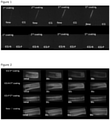
- the figure 2 shows that fluorescence observed for the coating film of the invention is more homogeneous and can remain stable 90 seconds after the coating procedure, while the fluorescence observed for ICG-based coating films is not homogeneous and is quickly lost.
- the figure 3 shows that the fluorescence brightness observed for the coating film of the invention on surgical thread is preserved a week after the coating procedure, while the brightness of ICG-based coating films endures significant decrease during 1 week.
- ICG-P or ICG-N ICG derivative dyes
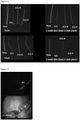
- the figure 4 shows that the ureter, which is an anatomical structure vulnerable to injury during lower abdominal operation, can be easily identified by the insertion of a catheter coated by a Cy7.5-C18-TPB-based coating film via a fluorescent imaging system.
- the figure 5 shows that a tip of naso-gastric tube, which is sometimes difficult to be identified during surgery, can be easily located after being coated by a Cy7.5TPB-based coating film.
- the figure 6 shows that surgical markers coated by a Cy7.5-C18-TPB-based coating film can be visualized from outside of the intestinal organ, which can help the surgeon to find the location of the tumor and be useful for registration of digital augmented reality technology.
- the figure 7 shows that the coating film of the present invention can also be used for coating a woven fabric.
- Coating films made from different polymers were also tested. For all studied polymers, coating films based on fluorescent dyes Cy7.5-C18-TPB and the derivatives HA-06-I, HA-60-TPB systematically display better brightness than a coating film based on ICG ( Figure 10A, 10B ).
- NIR fluorescence detected from steel fiducials coated with PMMA films based on HA-06-I or HA-60-TPB inserted into muscle tissue is comparable with that from coating PMMA film based on CY7.5-C18-TPB ( Figure 11 ).
Landscapes
- Health & Medical Sciences (AREA)
- Life Sciences & Earth Sciences (AREA)
- Chemical & Material Sciences (AREA)
- Public Health (AREA)
- Animal Behavior & Ethology (AREA)
- General Health & Medical Sciences (AREA)
- Veterinary Medicine (AREA)
- Engineering & Computer Science (AREA)
- Organic Chemistry (AREA)
- Surgery (AREA)
- Epidemiology (AREA)
- Materials Engineering (AREA)
- Heart & Thoracic Surgery (AREA)
- Wood Science & Technology (AREA)
- Vascular Medicine (AREA)
- Biomedical Technology (AREA)
- Nuclear Medicine, Radiotherapy & Molecular Imaging (AREA)
- Medical Informatics (AREA)
- Molecular Biology (AREA)
- Chemical Kinetics & Catalysis (AREA)
- Oral & Maxillofacial Surgery (AREA)
- Pathology (AREA)
- Biophysics (AREA)
- Pulmonology (AREA)
- Anesthesiology (AREA)
- Hematology (AREA)
- Materials For Medical Uses (AREA)
- Paints Or Removers (AREA)
Description
- The present invention concerns a fluorescent polymeric coating film for medical devices and a method for coating a medical device by said fluorescent polymeric film.
- During surgical operation, it is frequently difficult to localize important anatomical structure or location of pathology, because they are hidden behind other structure or they are not exposed outside of the organ. In laparoscopic surgery, it is also necessary to accurately localize the position of a surgical instrument. Thanks to its deep penetration into the tissues and high signal-to-background ratio, the near-infrared fluorescent light has been widely used in surgical operation to visualize hidden organ or tissue. Image-guided surgery using near-infrared fluorescence (NIR) could decrease the organ injury, increase the accuracy of the operation and allow carrying out a surgical operation in a region difficult to access.
- Therefore, in order to be visible by surgical fluorescent imaging system during image-guided surgery using NIR, special medical tools, such as fiducials, need be marked by fluorescent dyes.
- However, most of fluorescent dyes, like indocyanine green (ICG), cannot be directly used in a surgical operation, because of their easy spreading over the body which makes it difficult to control local dye spreading and dye leakage into the intraperitoneal cavity. Moreover, ICG cannot be easily conjugated with other molecules.
- In the last 10 years, polymeric near-infrared fluorescent materials have been developed for coating surgical and medical instruments. Currently, the coating is nearly all based on Indocyanine green (ICG), which is the most frequently used near-infrared fluorescent dye with an approval of FDA of human usage.
- For example,
WO 2017/151634 describes a composition comprising a polymeric matrix and a fluorophore dye, such as rhodamine, indocyanine green or dansyl chloride for coating a medical device. - However, it is found that ICG-based polymeric coating cannot produce homogenous coating on a smooth surface, and has a limitation in stability. This means that the imaging contrast is not satisfactory and it is lost rapidly after implanting into the body.
- In fact, the existing techniques for coating fiducials suffer from the following drawbacks:
- 1) low stability of coating leading to leakage of the dye to tissue;
- 2) low brightness
- 3) fast chemical and photo-chemical degradation (bleaching).
- It is necessary to provide new NIR fluorescent materials suitable for coating medical and surgical devices and having improved brightness and in vivo stability compared to ICG-based coating materials.
- Against all odds, the Inventors of the present invention have observed that a particular family of near-infrared fluorescent dyes with the help of suitable counterion can be stably and homogenously immobilized in a very thin polymer layer. Said polymeric film displays a high adhesive property to smooth surface and is suitable to work as coating film on a medical device. Compared to an ICG-based coating film, the new coating film of the invention shows an improved NIR fluorescent brightness and a better in vivo stability.
- Moreover, the Inventors have developed a simple and quickly carried out method for coating medical devices which allows to further increase in vivo stability of a coating film.
- The first aspect of the invention concerns a coating film based on hydrophobic polymer, in particular biocompatible hydrophobic polymer, comprising a counterion and a near-infrared dye which belongs to the family of long-chain cyanine 7.5 derivatives, and their analogues.
- In more detail, this aspect of the invention is to provide a fluorescent polymeric coating film visible in near-infrared light for coating a medical device, said coating film being a single layer or multiple layers of hydrophobic polymer, and at least one polymeric layer comprising an ionic fluorescent dye and its couterion,
said fluorescent dye being represented by Formula I
- R8 and R9 are the same or different and independently selected from a group consisting of :
- an hydrogen, or
- a group chosen from a (C1-C20)alkyl, a cyclo(C3-C20)alkyl, a (C2-C20)alkenyl, a (C2-C20)alkynyl, a heterocyclic group, a cyclo(C3-C20)alkenyl, a heterocyclo(C2-C20)alkenyl, an aryl, a heteroaryl, a hetero(C1-C20)alkyl, a (C1-C20)alkylaryl, or a (C1 C20)alkylheteroaryl, said group being unsubstituted or substituted by one or two substituents chosen from a (C1-C5) alkyl, an aryl, or -COOR11, R11 being a (C1-C20) alkyl, or
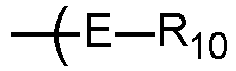
- a group of formula
- A1 is

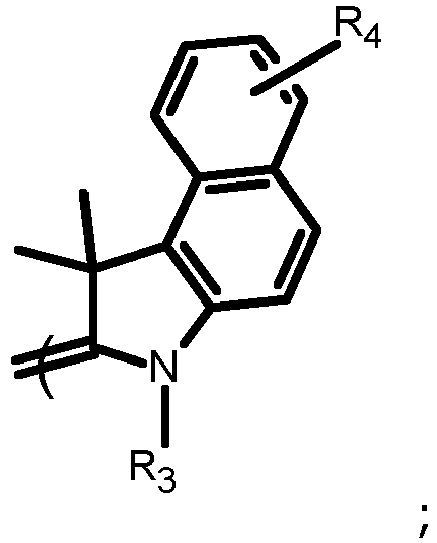
- or A1 is


- Wherein:
- R2 and R4 are independently selected from the group consisting of hydrogen, halogen, (C1-C10)alkyl, -OR5, -NR5R6, -NO2, -CF3, -CN, -SR5, -N3, -C(=O)R5, -OC(=)OR5, - C(=O)NR5R6, -NR5C(=O)R6, wherein R5 and R6 are independently selected from hydrogen, unsubstituted (C1-C10)alkyl, unsubstituted (C2-C10)alkenyl, unsubstituted (C2-C10)alkynyl, cyclo(C3-C10)alkyl, heterocyclic group, cyclo(C3-C10)alkenyl, heterocyclo(C2-C10)alkenyl, aryl, heteroaryl, aryl(C1-C10)alkyl, hetero(C1-C10)alkyl, (C1-C10)alkylaryl, (C1-C10)alkylheteroaryl ;
- R1 and R3 are independently selected from the group consisting of a (C1-C20)alkyl eventually substituted by a hydrophobic group, a cyclo(C3-C20)alkyl eventually substituted by a hydrophobic group, a (C2-C20)alkenyl eventually substituted by a hydrophobic group, a (C2-C20)alkynyl, a heterocyclic group eventually substituted by a hydrophobic group, a cyclo(C3-C20)alkenyl eventually substituted by a hydrophobic group, a heterocyclo(C2-C20)alkenyl eventually substituted by a hydrophobic group, an aryl eventually substituted by a hydrophobic group, a heteroaryl eventually substituted by a hydrophobic group, a hetero(C1-C20)alkyl eventually substituted by a hydrophobic group, a (C1-C20)alkylaryl eventually substituted by a hydrophobic group, a (C1-C20)alkylheteroaryl eventually substituted by a hydrophobic group, said hydrophobic group being selected from methyl, ethyl, methoxy, ethyloxy.
- The hydrophobic polymer is chosen from poly(methyl methacrylate), poly(ethyl methacrylate), poly(propyl methacrylate), poly(butyl methacrylate), poly(methyl methacrylate-co-methacrylic acid), poly(lactide-co-glycolide), polylactic acid, polyglycolic acid, polycaprolacton, cellulose triacetate, nitrocellulose, polydimethylsiloxane, poly(ethylene terephthalate), polycarbonate, polyethylene, ethylene vinyl acetate copolymer, polyurethane, polystyrene, and copolymers thereof with poly(ethylene glycol).
- Compared to ICG-based polymeric coating films, the coating films of the present invention show improved brightness of NIR fluorescence. Moreover, said coating films are also more homogeneous, stable, and have a significantly better adhesion on a smooth surface.
- The term "coating film", as used herein, refers to a single layered or multiple-layered dried thin layer(s) formed after applying a solution of a polymer comprising a fluorescent dye of formula I as defined before and a counterion as mentioned hereafter.
- Without being bounded by the theory, these benefits may be due to the use of a hydrophobic cyanine 7.5 derivative of formula I as defined above and of the counterions.
- Indeed, above fluorescent dyes of formula I are more hydrophobic than ICG, which may help to avoid the problem of solubility encountered by ICG-based polymeric coating films.
- The fluorescent dyes of formula I can be visible by a light having a wavelength of from 650 nm to 1400 nm, in particular from 700 nm to 1000 nm.
- When said coating film comprises multiple polymeric layers, some polymeric layers can be devoid of a fluorescent dye and its couterion. These polymeric layers in a coating film of the invention can provide a protection or mechanical support function.
- According to an embodiment of the present invention, the outermost layer is based on a biocompatible hydrophobic polymer.
- Above-mentioned hydrophobic polymers are either biocompatible polymers or can be made biocompatible by conventional methods, for example by combination with poly(ethylene glycol).
- The term "biocompatible hydrophobic polymer" as used herein means a hydrophobic polymer suitable to be used in living animal or human tissues or systems, and being nontoxic, noninflammatory, nonallergic, non-cancerous, without causing harm, inflammation, immune response and/or carcinogenesis in the animal or human body during the time necessary for medical operation, such as a surgery.
- The employment of a biocompatible polymer allows the coating film of the Invention to be compatible with in vivo application, such as for coating a medical or surgical device.
- In a particular embodiment of the invention, the fluorescent dye is represented by the formula II:
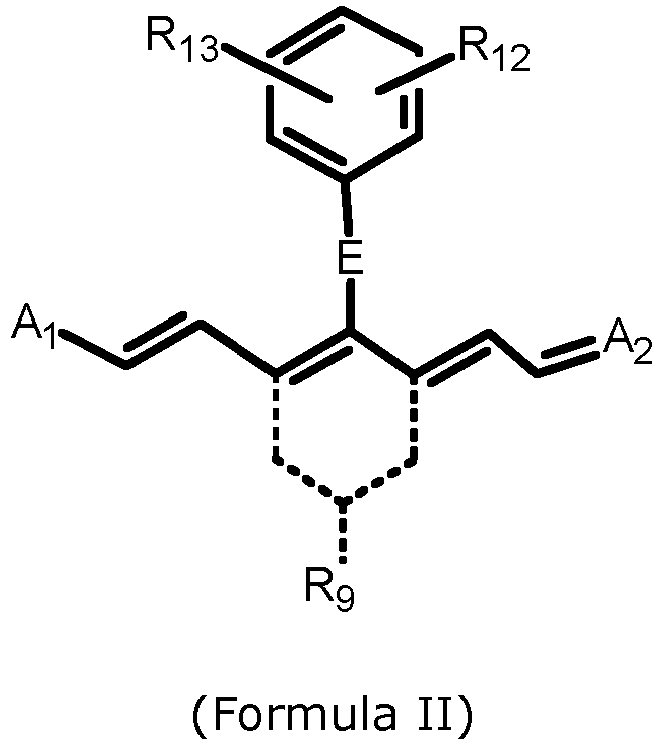
- Wherein:
- A1, A2, R9, and E are as defined before;
- R12 and R13 are the same or different and independently selected from an hydrogen, an aryl, a (C1-C5) alkyl, or -COOR11, R11 being a (C1-C20) alkyl.
- In a more particular embodiment of the invention, the fluorescent dye is represented by the formula II(a):

- Wherein:
- A1, A2, R9, and E are as defined before;
- R12 and R13 are the same or different and independently selected from an aryl;
- In another particular embodiment of the invention is to provide a fluorescent polymeric coating film visible in near-infrared light for coating a medical device, said coating film being formed by a hydrophobic polymer, in particular a biocompatible hydrophobic polymer, a fluorescent dye and a counterion,
said fluorescent dye being represented by Formula I
- R8 and R9 are the same or different and independently selected from the group consisting of an hydrogen, an unsubstituted (C1-C20)alkyl, an unsubstituted cyclo(C3-C20)alkyl, an unsubstituted (C2-C20)alkenyl, an unsubstituted (C2-C20)alkynyl, an unsubstituted heterocyclic group, an unsubstituted cyclo(C3-C20)alkenyl, an unsubstituted heterocyclo(C2-C20)alkenyl, an unsubstituted aryl, an unsubstituted heteroaryl, an unsubstituted hetero(C1-C20)alkyl, an unsubstituted (C1-C20)alkylaryl, an unsubstituted (C1-C20)alkylheteroaryl;
- A1 is


- or A1 is


- Wherein:
- R2 and R4 are independently selected from the group consisting of hydrogen, halogen, (C1-C10)alkyl, -OR5, -NR5R6, -NO2, -CF3, -CN, -SR5, -N3, -C(=O)R5, -OC(=)OR5, -C(=O)NR5R6, -NR5C(=O)R6, wherein R5 and R6 are independently selected from hydrogen, unsubstituted (C1-C10)alkyl, unsubstituted (C2-C10)alkenyl, unsubstituted (C2-C10)alkynyl, unsubstituted cyclo(C3-C10)alkyl, unsubstituted heterocyclic group, unsubstituted cyclo(C3-C10)alkenyl, unsubstituted heterocyclo(C2-C10)alkenyl, unsubstituted aryl, unsubstituted heteroaryl, unsubstituted aryl(C1-C10)alkyl, unsubstituted hetero(C1-C10)alkyl, unsubstituted (C1-C10)alkylaryl, unsubstituted (C1-C10)alkylheteroaryl ;
- R1 and R3 are independently selected from the group consisting of a (C1-C20)alkyl eventually substituted by a hydrophobic group, a cyclo(C3-C20)alkyl eventually substituted by a hydrophobic group, a (C2-C20)alkenyl eventually substituted by a hydrophobic group, a (C2-C20)alkynyl eventually substituted by a hydrophobic group, a heterocyclic group eventually substituted by a hydrophobic group, a cyclo(C3-C20)alkenyl eventually substituted by a hydrophobic group, a heterocyclo(C2-C20)alkenyl eventually substituted by a hydrophobic group, an aryl eventually substituted by a hydrophobic group, a heteroaryl eventually substituted by a hydrophobic group, a hetero(C1-C20)alkyl eventually substituted by a hydrophobic group, a (C1-C20)alkylaryl eventually substituted by a hydrophobic group, a (C1-C20)alkylheteroaryl eventually substituted by a hydrophobic group, said hydrophobic group being selected from methyl, ethyl, methoxy, ethyloxy,
- said counterion being an inorganic counterion or a bulky organic counterion.
- The presence of counterions may contribute to decrease aggregation and self-quenching of fluorescent dyes in coating film of the invention.
- With regard to the present invention, the counterion is chosen from:
- an inorganic counterion,
- an organic counterion, or
- a bulky organic counterion chosen from tetraphenylborate, tetrakis(pentafluorophenyl)borate, tetrakis(4-fluorophenyl)borate, tetraphenylborate, tetrakis[3,5-bis-(trifluoromethyl)phenyl]borate, tetrakis[3,5-bis-(1,1,1,3,3,3-hexafluoro-2-methoxy-2-propyl)phenyl]borate and tetrakis[perfluoro-tert-butoxy]aluminate.
- The term "bulky organic counterion" as used herein means a large organic anion bearing aromatic and/or aliphatic residues.
- Examples of inorganic counterion may include, without limitation, chloride, perchlorate, sulfonate, nitrate, tetrafluoroborate, hexafluorophosphate.
- Examples of organic counterion may include, without limitation, acetate, formate, propionate, anions of fatty acids, benzoate, tosylate.
- In order to avoid fluorescent dye aggregation and self-quenching, besides the use of an appropriate counterion, it may be also necessary to control within an appropriate range the weight of fluorescent dye compared to the polymer in a polymeric layer. Preferably, the weight of fluorescent dye in a polymeric layer is from 0.1 to 50%, particularly from 0.5 to 10%, still more particularly 1%, by weight of the hydrophobic polymer in said polymeric layer.
- In the present description the term "alkyl", alone or in combination, refers to a branched or unbranched saturated hydrocarbon group having the indicated number of carbon atoms. As used herein, the term "(Cx-Cy)alkyl", wherein x and y respectively being a different positive integer, is meant to an alkyl group having from x to y number of carbon atoms. For example, the terms "(C1-C20)alkyl", "(C1-C10)alkyl", "(C8-C20)alkyl", "(C12-C18)alkyl" as used herein respectively refer to an alkyl group having from 1 to 20 carbon atoms, from 1 to 10 carbon atoms, from 8 to 20 carbon atoms or from 12 to 18 carbon atoms.
- Examples of alkyl can be, but not limited to, methyl, ethyl, n-propyl, iso-propyl, n-butyl, sec-butyl, iso-butyl, tert-butyl, n-pentyl, isopentyl, neopentyl, n-hexyl, 3-methylhexyl, 2,2-dimethylpentyl, 2,3-dimethylpentyl, n-heptyl, n-octyl, n-nonyl, n-decyl, n-undecyl, n-docenyl, n-tridecyl, n-tetradecyl, n-pentadecyl, n-hexadecyl, n-heptadecyl, n-octadecyl, n-nonadecyl, n-icosyl.
- The terms "hetero(C1-C10)alkyl", "hetero(C1-C20)alkyl", and "hetero(C8-C20)alkyl" respectively refer to a (C1-C10)alkyl group, a (C1-C20)alkyl group or a (C8-C20)alkyl group as defined before in which one or more carbon atoms are replaced by an oxygen, nitrogen, phosphorus or sulfur. Example of a heteroalkyl can be an alkyloxy (methoxy, ethoxy, etc), alkylmercapto (methylmercapto, ethylmercapto, erc), or an alkyloxyethyl (methoxyethyl, etc), etc.
- The term "cycloalkyl" refers to a cyclic saturated carbon-based ring composed of at least three carbon atoms. The terms "cyclo(3-20)alkyl", "cyclo(3-10)alkyl" or "cyclo(8-20)alkyl" respectively refer to an cycloalkyl composed of from 3 to 20 carbon atoms, from 3 to 10 carbon atoms, or from 8 to 20 carbon atoms.
- Examples of cycloalkyl groups include, but are not limited to, cyclopropyl, cyclobutyl, cyclopentyl, cyclohexyl, cycloheptyl, cyclooctyl, cyclononyl, cyclodecyl, cyclotetradecyl, cyclohexadecyl, cycloheptadecyl, cyclooctadecyl, cyclononadecyl, cycloicosyl.
- The term "alkenyl" as used herein, alone or in combination, refers to a branched or unbranched hydrocarbon group of the indicated number of carbon atoms having at least one carbon-carbon double bond. The terms "(C2-C20)alkenyl", "(C2-C10)alkenyl" or "(C8-C20)alkenyl" signify respectively an alkenyl group of 2 to 20 atoms, an alkenyl group of 2 to 10 carbon atoms or an alkenyl group of 8 to 20 carbon atoms.
- Examples of alkenyl group are ethenyl, 1-propenyl, 2-propenyl, isopropenyl, 1-butenyl, 2-butenyl, 3-butenyl, isobutenyl, 1- pentenyl, 1-hexenyl, 1- heptenyl, 1-octenyl, 1-nonenyl, 2-nonenyl, 1-decenyl, 1-undecenyl, 1-dodecenyl, 1-tridecenyl, 1-tetradecenyl, 1-pentadecenyl, 1-hexadecenyl, 1-heptadecenyl, 1-octadecenyl, 1-nonadecenyl, 1-eicosenyl, 1,3-butadienyl, 1,4-pentadienyl.
- The term "cycloalkenyl" refers to a cyclic unsaturated carbon-based ring composed of at least 3 carbon atoms and containing at least one carbon-carbon double bond. The terms "cyclo(3-20)alkenyl", "cyclo(3-10)alkenyl" and "cyclo(8-20)alkenyl" signify respectively a cycloalkenyl having 3-20 carbon atoms, a cycloalkenyl having 3-10 carbon atoms or a cyclocalkenyl having 8-20 carbon atoms.
- Examples of cycloalkenyl groups include, but are not limited to, cyclopropenyl, cyclobutenyl, cvclopentenyl, cyclopentadienyl, cyclohexenyl, cyclohexadienyl, cycloheptenyl, cyclooctenyl, and the like.
- The terms "heterocycloalkenyl" as used herein refers to a hererocyclic unsaturated carbon-based ring comprising at least two carbon atoms and at least one heteroatom chosen from oxygen, nitrogen, phosphorus or sulfur. The terms "heterocyclo(C2-C20)alkenyl", "heterocyclo(C2-C10)alkenyl" and "heterocyclo(C8-C20)alkenyl" respectively refer to a heterocycloalkenyl having 2-20 carbon atoms, having 2-10 carbon atoms, or having 8-20 carbon atoms.
- The term "alkynyl" as used herein, alone or in combination, means a branched or unbranched hydrocarbon group of the indicated number of atoms comprising at least a triple bond between two carbon atoms. The terms "(C2-C20)alkynyl", "(C2-C10)alkynyl", or "(C8-C20)alkynyl respectively signify an alkynyl group having 2 to 20 carbon atoms, 2 to 10 carbon atoms, or 8 to 20 carbon atoms. Examples of alkynyl groups include ethynyl, propynyl, butynyl, octynyl, etc.
- The term "aryl" as employed herein alone or as part of another group refers to monocyclic and bicyclic aromatic groups containing 6 to 10 carbons in the ring portion. Examples of aryl include phenyl and naphthyl.
- The term "(C1-C20)alkylaryl" and "(C1-C10)alkylaryl" respectively refer to an aryl group as defined being substituted by an (C1-C20)alkyl group or an (C1-C10)alkyl group.
- The term "heteroaryl" refers to an aryl group, in which one or more carbon atoms are replaced by an oxygen, a nitrogen, a phophorus or a sulfur, for example the 4-pyridyl, 2-imidazolyl, 3-pyrazolyl and isochinolinyl group.
- The term "aryl(C1-C10)alkyl" refers to a (C1-C10)alkyl as defined before being substituted by an aryl.
- The terms "(C1-C20)alkylheteroaryl" and "(C1-C10)alkylheteroaryl" respectively mean a heteroaryl group as defined before being substituted by a (C1-C20)alkyl group or a (C1-C10)alkyl group.
- The term "heterocyclic group" refers to a carbocyclic group, in which one or more carbon atoms are replaced by an oxygen, a nitrogen, a phosphorus, or a sulfur atom. A heterocyclic group can be a heteroaryl, a heterocycloalkyl, a heterocycloalkenyl, etc. Examples of heterocyclic group include furyl, pyrrolyl, imidazolyl, thiazolyl, isothiazolyl, pyrrolidinyl, pyridyl, quinolyl, pyrimidinyl.
- The term "halogen" means fluorine, chlorine, bromine or iodine.
- The terms "device" and "tool" as used herein are interchangeable.
- In a preferable embodiment, when R2 and/or R4 of formula I, formula II, or formula IIa as described above are chosen from -OR5, -NR5R6,-SR5,-C(=O)R5, -OC(=)OR5, -C(=O)NR5R6, -NR5C(=O)R6, wherein R5 and R6 are independently selected from unsubstituted (C1-C10)alkyl, unsubstituted (C2-C10)alkenyl, unsubstituted (C2-C10)alkynyl, unsubstituted cyclo(C3-C10)alkyl, unsubstituted cyclo(C3-C10)alkenyl, unsubstituted aryl, unsubstituted aryl(C1-C10)alkyl, unsubstituted (C1-C10)alkylaryl.
- In a particular embodiment relating to the fluorescent polymeric coating film of the invention, the substituent A1 of formula I as defined before is


- According to one embodiment of the invention, R1 and R3 of formula I, formula II, or formula IIa as defined before are independently selected from the group consisting of unsubstituted (C1-C20)alkyl, an unsubstituted cyclo(C3-C20)alkyl, an unsubstituted (C2-C20)alkenyl, an unsubstituted (C2-C20)alkynyl, an unsubstituted heterocyclic group, an unsubstituted cyclo(C3-C20)alkenyl, an unsubstituted heterocyclo(C2-C20)alkenyl, an unsubstituted aryl, an unsubstituted heteroaryl, an unsubstituted hetero(C1-C20)alkyl, an unsubstituted (C1-C20)alkylaryl, an unsubstituted (C1-C20)alkylheteroaryl.
- According to another embodiment of the invention, each of R1 and R3 of formula I, formula II, or formula IIa as described above can be independently selected from an aforementioned substituent group which are substituted by a hydrophobic group.
- Said hydrophobic group can be chosen from methyl, ethyl, methoxy, ethyloxy.
- According to a more particular embodiment of the invention, R1 and R3 of formula I, formula II, or formula IIa as defined before are independently selected from the group of unsubstituted (C8-C20)alkyl, an unsubstituted cyclo(C8-C20)alkyl, an unsubstituted (C8-C20)alkenyl, an unsubstituted (C8-C20)alkynyl, an unsubstituted cyclo(C8-C20)alkenyl, an unsubstituted heterocyclo(C8-C20)alkenyl, and hetero(C8-C20)alkyl.
- In a preferred embodiment of the invention, R1 and R3 of formula I, formula II, or formula IIa as described above are independently selected from the group of unsubstituted (C8-C20)alkyl, particularly the group of unsubstituted (C12-C18)alkyl.
- In another preferred embodiment of the invention, R1 and R3 of formula I, formula II, or formula IIa as described above are independently selected from the group of unsubstituted (C12-C19)alkyl, (C12-C17)alkyl, or (C12-C16)alkyl, or (C12-C15)alkyl, or (C11-C19)alkyl, (C11-C18)alkyl, or (C11-C17)alkyl, or (C11-C16)alkyl, or (C11-C15)alkyl, or (C11-C14)alkyl, or (C13-C19)alkyl, or (C13-C18)alkyl, or (C13-C17)alkyl, or (C13-C16)alkyl, or (C14-C19)alkyl, or (C14-C18)alkyl, or (C14-C17)alkyl, or (C15-C19)alkyl, or (C15-C18)alkyl.
- More preferably, R1 and R3 of formula I, formula II, or formula IIa as described above are independently selected from n-docenyl, n-tridecyl, n-tetradecyl, n-pentadecyl, n-hexadecyl, n-heptadecyl, n-octadecyl, n-nonadecyl, or n-icosyl.
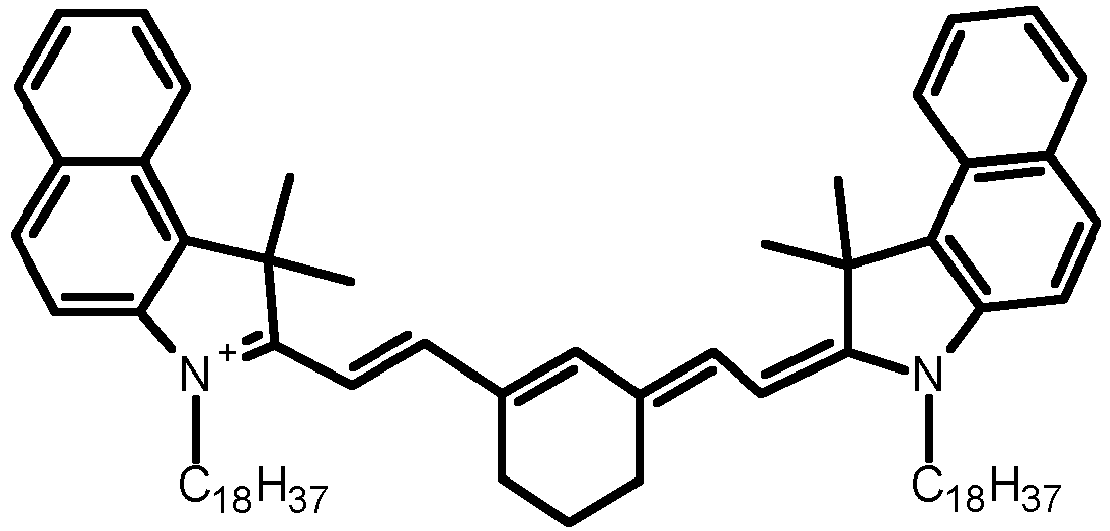
- A particular embodiment of the present invention concerns a fluorescent polymeric coating film, wherein the fluorescent dye is of Formula Ia


- A more particular embodiment of the present invention is related to a fluorescent coating film wherein the fluorescent dye is


- The polymer contained in the coating film of the invention is also preferably non-biodegradable to avoid the spreading of fluorescent dyes in the tissues.
- The term "biodegradable" as used herein refers to the propriety of a polymer which can be degraded into a low molecular weight material through a degradation process such as a hydrolytic reaction or enzymatic reaction during the metabolism in the animal or human body.
- In a preferred embodiment of the present invention, said polymer is chosen from poly(D,L-lactide-co-glycolide), poly(methyl methacrylate) and polycaprolactone.
- In a more preferred embodiment of the present invention, said polymer is chosen from poly(methyl methacrylate) and polycaprolactone.
- Owing to biocompatibility of the coating film of the invention, it is particularly suitable to be applied to medical or surgical devices, such as a surgical packing, fiducial marker, a surgical tap, a needle, a surgical retractor, a clip, a surgical thread, a staple, a knife, a safety pin, a scissor, a clamp, a scalpel, a hemostat, a tweezer, a forcep, a suction tip, a gauze, a cottonoid, a sponge, a catheter, a stainless steel wire, a surgical site marker, a stent, a pacemaker, a nerve stimulator, a drug delivery system, a port-a-cath, a magnetic anastomosis system, an intravascular embolization device, a mechanical linear stapler, a mechanical circular stapler, a drug-delivery implant, a piezoelectric implant, a diagnostic video-capsule, a magnetic tracking capsule.
- For example, a surgical marker or a catheter coated by a coating film of the present invention is particularly useful in identification of tumors or vulnerable anatomical structures.
- The intraluminal instruments or implants coated by a coating film of the present invention can be visualized by conventional surgical fluorescent imaging system or by Near-Infrared spectroscopy, which makes it easy to identify said instruments or implants during image-guided surgery, even though when they are hidden behind a tissue or an organ.
- The fluorescent polymeric film of the present invention is visible in near-infrared light having a wavelength of from 650 nm to 1400 nm, in particular from 700 nm to 1000 nm.
- The fluorescent polymeric film of the present invention can further comprise, in one or several polymeric layers, one or several additives which can be a polymer or a small organic molecule having function to improve mechanical properties or biocompatibility of coating film.
- A fluorescent polymeric coating film visible in near-infrared light can also be used as a fluorescent marker of a biological tissue, especially a human or animal tissue, such as an organ, during a surgery.
- Said coating film is a single layer or multiple layers of hydrophobic polymer, and at least one polymeric layer comprising a fluorescent dye of formula I, I(a), I(b), II, II(a) or II(b) as described above and an ionic counterion as described above.
- Preferably, at least the outermost polymeric layer of the coating film is based on a biocompatible hydrophobic polymer.
- A second aspect of the present invention concerns a method for coating a medical device by a fluorescent polymeric coating film as described before.
- Said method is carried out by employment of a solution of hydrophobic polymer comprising an aforementioned ionic fluorescent dye of formula I, a counterion and an organic volatile solvent.
- Said method comprises following steps:
- (i) contacting said medical device with a solution comprising one or several solvents, a hydrophobic polymer, a fluorescent dye and a counterion,
- said hydrophobic polymer being chosen from poly(methyl methacrylate), poly(ethyl methacrylate), poly(propyl methacrylate), poly(butyl methacrylate), poly(methyl methacrylate-co-methacrylic acid), poly(lactide-co-glycolide), polylactic acid, polyglycolic acid, polycaprolacton, cellulose triacetate, nitrocellulose, polydimethylsiloxane, poly(ethylene terephthalate), polycarbonate, polyethylene, ethylene vinyl acetate copolymer, polyurethane, polystyrene, and copolymers thereof with poly(ethylene glycol);
- said fluorescent dye being represented by Formula I wherein :

- R8 and R9 are the same or different and independently selected from the group consisting of:
- an hydrogen,
- a group chosen from a (C1-C20)alkyl, a cyclo(C3-C20)alkyl, a (C2-C20)alkenyl, a (C2-C20)alkynyl, a heterocyclic group, a cyclo(C3-C20)alkenyl, a heterocyclo(C2-C20)alkenyl, an aryl, a heteroaryl, a hetero(C1-C20)alkyl, a (C1-C20)alkylaryl, or a (C1 C20)alkylheteroaryl, said group being unsubstituted or substituted by one or two substituents chosen from a (C1-C5) alkyl, an aryl, or -COOR11, R11 being a (C1-C20) alkyl, or
- a group of formula

- A1 is

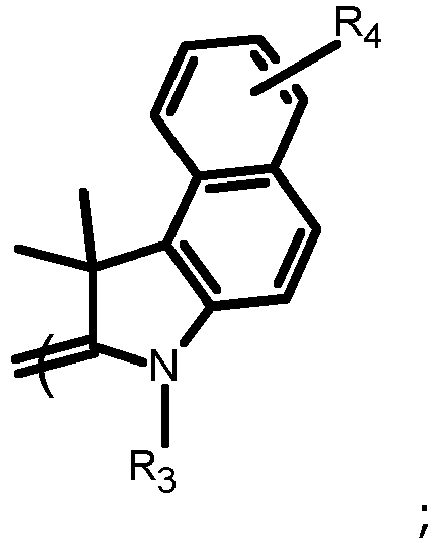
- or A1 is


- R8 and R9 are the same or different and independently selected from the group consisting of:
- Wherein:
- R2 and R4 are independently selected from the group consisting of hydrogen, halogen, (C1-C10)alkyl, -OR5, -NR5R6, -NO2, -CF3, -CN, -SR5, -N3, -C(=O)R5, -OC(=)OR5, - C(=O)NR5R6, -NR5C(=O)R6, wherein R5 and R6 are independently selected from hydrogen, unsubstituted (C1-C10)alkyl, unsubstituted (C2-C10)alkenyl, unsubstituted (C2-C10)alkynyl, cyclo(C3-C10)alkyl, heterocyclic group, cyclo(C3-C10)alkenyl, heterocyclo(C2-C10)alkenyl, aryl, heteroaryl, aryl(C1-C10)alkyl, hetero(C1-C10)alkyl, (C1-C10)alkylaryl, (C1-C10)alkylheteroaryl ;
- R1 and R3 are independently selected from the group consisting of a (C1-C20)alkyl eventually substituted by a hydrophobic group, a cyclo(C3-C20)alkyl eventually substituted by an hydrophobic group, a (C2-C20)alkenyl eventually substituted by a hydrophobic group, a (C2-C20)alkynyl, a heterocyclic group eventually substituted by a hydrophobic group, a cyclo(C3-C20)alkenyl eventually substituted by a hydrophobic group, a heterocyclo(C2-C20)alkenyl eventually substituted by a hydrophobic group, an aryl eventually substituted by a hydrophobic group, a heteroaryl eventually substituted by a hydrophobic group, a hetero(C1-C20)alkyl eventually substituted by a hydrophobic group, a (C1-C20)alkylaryl eventually substituted by a hydrophobic group, a (C1-C20)alkylheteroaryl eventually substituted by a hydrophobic group, said hydrophobic group being selected from methyl, ethyl, methoxy, ethyloxy;
- said counterion being an inorganic counterion, or an organic counterion or a bulky organic counterion;
- According to a particular embodiment of the method of coating of the present invention, the fluorescent dye is represented by Formula I

- R8 and R9 are the same or different and independently selected from the group consisting of an hydrogen, an unsubstituted (C1-C20)alkyl, an unsubstituted cyclo(C3-C20)alkyl, an unsubstituted (C2-C20)alkenyl, an unsubstituted (C2-C20)alkynyl, an unsubstituted heterocyclic group, an unsubstituted cyclo(C3-C20)alkenyl, an unsubstituted heterocyclo(C2-C20)alkenyl, an unsubstituted aryl, an unsubstituted heteroaryl, an unsubstituted hetero(C1-C20)alkyl, an unsubstituted (C1-C20)alkylaryl, an unsubstituted (C1-C20)alkylheteroaryl;
- A1 is


- or A1 is


- Wherein:
- R2 and R4 are independently selected from the group consisting of hydrogen, halogen, (C1-C10)alkyl, -OR5, -NR5R6, -NO2, -CF3, -CN, -SR5, -N3, -C(=O)R5, -OC(=)OR5, - C(=O)NR5R6, -NR5C(=O)R6, wherein R5 and R6 are independently selected from hydrogen, unsubstituted (C1-C10)alkyl, unsubstituted (C2-C10)alkenyl, unsubstituted (C2-C10)alkynyl, cyclo(C3-C10)alkyl, heterocyclic group, cyclo(C3-C10)alkenyl, heterocyclo(C2-C10)alkenyl, aryl, heteroaryl, aryl(C1-C10)alkyl, hetero(C1-C10)alkyl, (C1-C10)alkylaryl, (C1-C10)alkylheteroaryl ;
- R1 and R3 are independently selected from the group consisting of a (C1-C20)alkyl eventually substituted by an hydrophobic group, a cyclo(C3-C20)alkyl eventually substituted by an hydrophobic group, a (C2-C20)alkenyl eventually substituted by a hydrophobic group, a (C2-C20)alkynyl, a heterocyclic group eventually substituted by a hydrophobic group, a cyclo(C3-C20)alkenyl eventually substituted by a hydrophobic group, a heterocyclo(C2-C20)alkenyl eventually substituted by a hydrophobic group, an aryl eventually substituted by a hydrophobic group, a heteroaryl eventually substituted by a hydrophobic group, a hetero(C1-C20)alkyl eventually substituted by a hydrophobic group, a (C1-C20)alkylaryl eventually substituted by a hydrophobic group, a (C1-C20)alkylheteroaryl eventually substituted by a hydrophobic group, said hydrophobic group being selected from methyl, ethyl, methoxy, ethyloxy;
- said counterion being an inorganic counterion or a bulky organic counterion chosen from tetrakis(pentafluorophenyl)borate, tetrakis(4-fluorophenyl)borate, tetraphenylborate.
- Solvent used in the solution of step (i) can be an organic solvent, in particular chosen from acetonitrile, acetone, dioxane, ethyl acetate, propyl acetate, butyl acetate, amyl acetate, tetrahydrofuran, diethyl ether, 1,2-dimethoxyethane, 1,2-dioxane, dichloromethane, chloroform, petroleum ether, toluene, o-xylene, m-xylene, p-xylene.
- Particularly, the concentration of the hydrophobic polymer in above solution is from 1 to 100 mg/ml, preferably 30 mg/ml of solution and the weight of fluorescent dye in a polymeric layer is from 0.1 to 50%, particularly from 0.5 to 10%, still more particularly 1%, by weight of the hydrophobic polymer in said polymeric layer.
- The step (i) of above method can be done by simple immersion of the tool to be coated inside the solution. The step (ii) of above method can be a step of drying in air. The time of drying for evaporating the solvent can be for example 30 minutes. This step is preferably carried out in dark.
- According to an advantageous embodiment, when said coating film is multi-layered, said method further comprises step (iii) and step (iv) after the step (ii):
- (iii) Contacting coated medical device obtained in step (ii) with a solution comprising one or several solvents and a hydrophobic polymer and eventually devoid of any fluorescent dye;
- (iv) Evaporating the solvent in said solution to produce a polymeric layer on said medical device.
- The application of steps (iii) and (iv) produces a protective film at the outside surface of the coating film containing the fluorescent dyes and can further reduce the risk of fluorescent dyes spreading in animal or human body. The step (iv) can be carried out in dark during 24 hours.
- Immersion and drying steps can be alternately repeated several times to increase the performance of the tool. Each time, the step (i) is repeated when the solvent is completed evaporated and the forming coating film is completed dried.
- According to an embodiment of the invention, the steps (i) and (ii) as described before are repeated from 1 to 50 times, preferably 1 to 20 times.
- According to another embodiment of the invention, the steps (iii) and (iv) as described before are repeated from 1 to 20 times.
- In a preferred embodiment of the method of the invention, a repetition of steps (i) and (ii) is firstly carried out to coat a medical device by a coating film described before, and after complete drying of said coating film, a repetition of steps (iii) and (iv) is then employed to yield a protective outside film.
- Aforementioned method is suitable for coating a medical device chosen from a surgical packing, fiducial marker, a surgical tap, a needle, a surgical retractor, a clip, a surgical thread, a staple, a knife, a safety pin, a scissor, a clamp, a scalpel, a hemostat, a tweezer, a forcep, a suction tip, a gauze, a cottonoid, a sponge, a catheter, a stainless steel wire, a surgical site marker, a stent, a pacemaker, a nerve stimulator, a drug delivery system, a port-a-cath, a magnetic anastomosis system, an intravascular embolization device, a mechanical linear stapler, a mechanical circular stapler, a drug-delivery implant, a piezoelectric implant, a diagnostic video-capsule, a magnetic tracking capsule.
- According to a particular embodiment, the method of the invention uses a fluorescent dye of formula I, wherein
- A1 is


- In a preferred embodiment, the method of the invention uses a fluorescent dye of formula I, wherein R1 and R3 are independently selected from the group of unsubstituted (C8-C20)alkyl, particularly the group of unsubstituted (C12-C18)alkyl.
- More preferably, the fluorescent dye used in the method of the present invention is


- Also disclosed herein but not forming part of the present invention is a method for visualizing a medical device during image-guided surgery, said method comprising:
- Coating said medical device by an aforementioned coating film,
- Visualizing said medical device by a fluorescent image system which detects near-infrared fluorescence.
- The present invention is described in more detail hereinafter by the figures and the examples.
-
-
Figure 1 concerns photos of coated stainless steel wires taken by a fluorescent image system. These wires are respectively coated 1, 2, 3 or 5 times by a coating film of the invention (New, Cy7.5-C18-TPB-based coating) or by three different ICG-based coating films (ICG, ICG salt with tetraphenyl phosphonium counterion (ICG-P), ICG salt with tetrabutyl ammonium counterion (ICG-N)). -
Figure 2 displays photos by a fluorescent image system of coated silicon pieces taken just after coating procedure (initial, before drying) or after 30s, 60s or 90s of drying. These pieces are respectively coated 1 time by a coating film of the invention (New, Cy7.5-C18-TPB-based coating) or 5 times by three different ICG-based coating films (ICG, ICG-P, ICG-N). -
Figure 3 displays photos of coated surgical thread taken just after coating procedure (basal) or one week after coating by a fluorescent image system. These surgical thread are respectively coated by a coating film of the invention (New, Cy7.5-C18-TPB-based coating) or by ICG-based coating films (ICG, ICG-P, ICG-N). -
Figure 4 shows that the ureter (indicated by 2 arrows) during a image-guided surgery is identified by an inserted catheter, which is coated by Cy7.5-C18-TPB-based coating film and visible via fluorescent imaging system. -
Figure 5 shows that a tip of naso-gastric tube coated by Cy7.5-C18-TPB-based coating film can be visualized during surgery (indicated by 2 arrows). -
Figure 6 shows that four-corners of the pathologic lesion of the stomach were marked by insertion of the marker coated by Cy7.5-C18-TPB-based coating film (indicated by 4 arrows). -
Figure 7 shows that gauze pieces coated by Cy7.5-C18-TPB-based coating film and plunged by blood during a surgery is identified in NIR via a fluorescent imaging system. -
Figure 8 shows synthetic protocols for CY7.5 dye and its derivatives of formula I. -
Figure 9 shows fluorescence images of the coating films containing different dyes of the present invention deposited on the glass surface. -
Figure 10 (A) shows fluorescence images of coating films of the invention based on fluorescent dye CY7.5-C18-TPB, HA-06-I, HA-60-TPB and different hydrophobic polymers: PMMA, PLGA or PLC. The coating films based on ICG are prepared as control.Figure 10 (B) shows emission intensity values obtained from the images of the thin films containing different types of fluorescent dyes and polymers. -
Figure 11 shows tissue imaging with steel fiducials coated with different dyes (1% loading) in PMMA: (a) Chicken tissue under normal light; (b) fluorescence image of the tissue; (c) Fluorescence images of the coated fiducials inserted into the chicken tissues (1 for HA-06-I, 2 for HA-60-TPB, 3 for Cy7.5-C18-TPB). - Fluorescent dye Cy7.5-C18-TPB of structure before:

figure 8 . - 250 mL round-bottom flask equipped with magnetic stirring bar was charged with 1,1,2-Trimethylbenz[e]indole (1 eq., 6.88 g, 32.9 mmol) and 1-iodooctadecane (2 eq., 25 g, 65.7 mmol), 100 mL of 2-butanone was added subsequently. Reaction mixture was refluxed for 24h, then cooled down to r.t. Reaction mixture was cooled down to r.t., diethyl ether was added and formed solid part was filtered off and washed with 100 mL of diethyl ether. Obtained crystals of crude product were redissolved in DCM and precipitated back while by adding diethyl ether, afterwards filtered and washed with diethyl ether. Product was obtained as slightly green crystals in 76% yield (14.73g).
- 1H NMR (400 MHz, CDCl3) δ 8.10 (d, J = 8.7 Hz, 1H), 8.08 (dd, J = 8.0, 1.1 Hz, 1H), 8.04 (dd, J = 8.2, 1.3 Hz, 1H), 7.76 (d, J = 8.9 Hz, 1H), 7.72 (ddd, J = 8.3, 6.9, 1.4 Hz, 1H), 7.65 (ddd, J = 8.1, 6.9, 1.2 Hz, 1H), 4.78 (t, J = 7.7 Hz, 2H), 3.19 (s, 3H), 1.97 (p, J = 7.8 Hz, 2H), 1.87 (s, 6H), 1.52 - 1.41 (m, 2H), 1.40 - 1.30 (m, 2H), 1.28 - 1.19 (m, 26H), 0.85 (t, J = 7.0 Hz, 3H).
- 13C NMR (100 MHz, CDCl3) δ 195.25, 138.34, 137.29, 133.82, 131.56, 130.17, 128.77, 127.97, 127.74, 122.96, 112.59, 56.04, 50.56, 32.00, 29.77, 29.76, 29.73, 29.70, 29.65, 29.55, 29.43, 29.41, 29.24, 28.26, 26.92, 22.85, 22.76, 17.03, 14.18.
- HRMS (m/z): [M]+ calculated for C33H52N 462.40943; found 462.40854.
- 1,1,2-trimethyl-3-octadecyl-1H-benzo[e]indol-3-ium iodide (1) (2.2 eq., 1029 mg, 1.75 mmol) and glutaconaldehydedianil hydrochloride (1 eq., 226 mg, 0.794 mmol) were mixed in 10ml of pyridine, afterwards Ac2O (13.4 eq., 1087 mg, 1 mL, 10.6 mmol) was added and the reaction mixture was heated to 60 °C while stirring and left for 3h. After reaction was finished, solvents were evaporated at vacuum, and the crude product was dissolved in DCM, washed with 0.1 N HCI (3 times), brine and water. DCM layer was dried over Na2SO4, the solvent was evaporated and the product was purified by column chromatography on silica (gradient DCM/MeOH 99/1 - 95/5). Product was obtained as a green solid (926 mg, 0.906 mmol, 52 %)
- 1H NMR (400 MHz, CDCl3): δ 8.16 (d, J=8Hz, 2H), 8.06 (t, J=12Hz, 2H), 7.97 (bs, 1H), 7.92 (d, J=8Hz, 4H), 7.61 (t, J=7Hz, 2H), 7.46 (t, J=7Hz, 2H), 7.35 (d, J=9Hz, 2H), 6.67 (t, J=12Hz, 2H), 6.25 (d, J=12Hz, 2H), 4.14 (bs, 4H), 2.04 (s, 12H), 1.87 (m, J=7Hz, 4H), 1.49 (m, J=7Hz, 4H), 1.39 (m, J=7Hz, 4H), 1.26 (bs, 52H), 0.88 (t, J=7Hz, 6H)
- 13C NMR (100 MHz, CDCl3): δ 173.07, 157.04, 151.02, 139.74, 133.98, 131.83, 130.59, 130.09, 128.41, 127.87, 126.27, 125.06, 122.47, 110.56, 103.39, 51.155, 44.76, 32.06, 29.842, 29.807, 29.76, 29.72, 29.60, 29.53, 29.50, 27.86, 27.14, 22.82, 14.26
- HRMS (m/z): [M]+ calculated. for C71H105N2 + 985.8272; found 985.8290.
- Dioctadecylcyanine 7.5 chloride (1 eq., 200 mg, 0.18 mmol) was dissolved in 5 mL of DCM, sodium tetraphenylborate (3 eq., 184 mg, 0.539 mmol) was added and the dispersion was sonicated for 5 min. TLC control has shown full conversion. Afterwards, the mixture was purified on a silica column, eluent DCM/MeOH 95/5 (product goes almost with front). Dioctadecylcyanine 7.5 tetraphenylborate (218 mg, 0.167 mmol, 93 %) was obtained as green viscous oil and used without further characterisation.
-

- CY 7.5 C8 was synthesized by following our previous method. 1,1,2-trimethyl-3-octyl-1H-benzo[e]indol-3-ium iodide (2 equiv.), glutaconaldehydedianil hydrochloride (1 equiv.) were mixed in pyridine. Acetic anhydride (13.4 equiv.) was added and stirred at 60°C for 3 hours. Reaction was monitored by TLC. Upon completion, solvent was evaporated under vacuum, dissolved in DCM and washed with 0.1 N HCI for 3 times. Organic mass was further washed with water and brine, dried on magnesium sulphate and purified by silica gel column chromatography using DCM and Methanol.
Yield 60% 1H NMR (CD3OD, 500 MHz) δ 0.85-0.89 (t, 6H), 1.26-1.27 (m, 12H), 1.37∗1.49 (m, 6H), 1.70-1.74 (m, 1H), 1.79-1.85 (m, 2H), 1.96 (s, 7H), 1.99 (s, 2H), 2.11 (s, 6H), 2.16 (s, 2H), 3.81-3.85 (m, 1H), 4.15-4.19 (m, 2H), 6.29-6.32 (d, 1H, J=13.68 Hz), 6.56-6.63 (t, 1H, J=12.55 Hz), 7.05-7.08 (t, 2H, J=7.40 Hz), 7.26-7.30 (t, 5H, J=8.53), 7.43-7.47 (t, 1H, J=7.91 Hz), 7.52-7.54 (d, 5H, J=9.79 Hz), 7.59-7.63 (t, 1H, J=6.90 Hz), 7.81-7.86 (m, 1H), 7.95-8.04 (m, 2H), 8.19-8.21 (d, 1H, J=8.53 Hz). BRMS (ES+), m/z [M+H] 705.5210. - Substituted cyclic analogues of cyanine 7.5 dye (scheme 1b of
figure 8 ) were synthesized in five steps. Indolinium salts with C8 or C18 alkyl chains were synthesized by the condensation of trimethyl benzindole with alkyl iodide. Formylation of cyclohexanone followed by condensation with aniline in the presence of HCI resulted in the cyclic inner salt (b). Condensation of inner salt (b) and indolinium salt in the presence of sodium acetate resulted in a key intermediate cyclic chloro-cyanine. Substitution of -chloro with different phenol derivatives followed by the counter ion exchange with tetraphenyl borate resulted in a series of cyanine derivatives. - Cyclic cyanine dye having methyl group on the central cyclic ring (HA-04-I) was prepared by following the different route (scheme 1c of
figure 8 ). Inner salt was prepared from 1-methylcyclohexene in the presence of N-methyl-N-phenyl formamide and POCl3. Condensation of inner salt with indolinium salt in the presence of pyridine resulted in the final compound. -

- This compound was prepared by following the literature method (Bioconjugate Chem. 1997, 8, 751-756; Chem. Commun., 2014, 50, 15439-15442). Yield 57% 1H NMR (DMSO d 6, 400 MHz) δ 1.84 (s, 2H), 2.74 (s, 4H), 7.20-7.26 (m, 2H), 7.41-7.46 (m, 6H), 7.55-7.57 (d, 4H, J=7.91 Hz), 7.70-7.72 (d, 1H, J= 7.71 Hz), 8.68 (s, 2H).
- As what is shown in schema 1b of
figure 8 , chloro-cyanine (10 mg, 0.0084 mmol, 1 equiv.) was dissolved in dry DMF (2 ml) at 25°C. In a separate round bottom flask, 2,6-dipehenylphenol (10.34 mg, 0.0420 mmol, 5 equiv.) was dissolved in dry DMF (2 ml) and dry K2CO3 (2.32 mg, 0.0168 mmol 2 equiv.) was added to it and the solution was stirred for 10-15 minutes. It was carefully filtered to get rid of the unreacted K2CO3 and the filtrate was slowly added to the solution of chloro-cyanine. The reaction mass was stirred at 25°C for 30 minutes. The reaction was monitored by UV-Vis spectroscopy characterized by the disappearance of the absorption band at around 820 nm (corresponds to chloro-cyanine) and the formation of a new absorption band at shorter wavelength region. Upon completion, the reaction was quenched with solid CO2 and concentrated under vacuum to remove the DMF. The reaction mass was redissolved in dichloromethane and purified by silica gel column chromatography using dichloromethane/methanol as eluents. - Six derivatives of cyanine 7.5 dye of formula (I) of the present invention: HA-06, HA-04, HA-05, HA-60, HA-63, HA-69, as iodide or tetraphenylborate (TB) salts, were synthesised according to the protocol described above.
-

- The title compound (68%, green solid) was prepared from 2,6-diphenylphenol according to the general protocol S1. 1H NMR (CD3OD, 400 MHz) δ 0.84-0.87 (t, 6H), 1.24 (s, 59H), 1.39-1.47 (m, 9H), 1.71 (s, 10H), 1.84-1.88 (t, 3H), 2.03 (s, 2H), 2.15-2.18 (t, 4H), 4.16-4.20 (t, 4H), 4.60 (s, 1H), 5.96-5.99 (d, 2H J= 14.05 Hz), 7.30-7.34 (t, 1H, J= 7.40 Hz), 7.37-7.47 (m, 9H), 7.49-7.64 (m, 8H), 7.95-7.99 (t, 4H, J= 8.53 Hz), 8.08 (s, 1H), 8.12-8.15 (t, 3H, J= 3H) BRMS (ES+), m/z [M+H] 1270.9522.
-

-

- The title compound (65%,) was prepared from 3,5-dimethylphenol according to the general protocol S1. 1H NMR (CD3OD, 400 MHz) δ 0.84-0.88 (t, 6H), 1.25 (s, 55H), 1.44 (br, 12H), 1.84-1.87 (t, 6H), 2.03 (s, 3H), 2.09-2.12 (t, 2H), 2.17 (s, 3H), 2.67 (s, 2H), 2.79 (br, 4H), 4.20-4.24 (t, 4H), 4.60 (s, 1H), 6.18-6.21 (d, 2H, J= 14.43 Hz), 6.55 (s, 1H), 6.80-6.82 (d, 1H, J= 7.65 Hz), 7.43-7.47 (t, 2H, J= 7.15 Hz), 7.53-7.55 (d, 2H, J=8.78 Hz), 7.57-7.66 (m, 3H), 7.94-7.96 (2H, d, J=17.57 Hz), 7.98-8.04 (m, 3H), 8.08-8.10 (2H, J= 8.53 Hz). BRMS (ES+), m/z [M+H] 1145.9127.
-

- Yield (68%) This compound was prepared from methyl-4-hydroxybenzoate and chloro-cyanine C8 according to the general protocol S1. BRMS (ES+), m/z [M+H] 895.5898.
-

- Yield (50%). This compound was prepared from methyl-4-hydroxybenzoate and chloro-cyanine C18 according to the general protocol S1. BRMS (ES+), m/z [M+H] 1175.8981.
-

- The title compound (63%, green solid) was prepared from 3,5-dimethylphenol and chloro-cyanine C8 according to the general protocol S1. 1H NMR (CDCl3, 400 MHz) δ 0.87 (s, 6H), 1.16-1.42 (m, 26H), 1.68 (s, 7H), 1.86 (s, 4H), 2.00 (s, 4H), 2.16 (s, 3H), 2.76-2.86 (d, 2H), 4.17-4.29 (d, 4H), 5.49 (s, 3H), 5.94-5.98 (d, 1H, J= 13.68 Hz), 6.30-6.33 (1H, d, J=14.18 Hz), 7.30-7.62 (m, 15H), 7.94-8.14 (m, 7H), 8.24-826 (1H, d, J=8.51 Hz), 8.51-8.55 (1H, d, J=14.10 Hz). BRMS (ES+), m/z [M+H] 989.6366.
- Tetraphenylborate salts of Cy7.5 derivatives were prepared by the similar protocol as for Cy7.5-C18-TPB.
- Commercially available poly(methylmethacrylate), Cy7.5-C18-TPB synthesized before, tetraphenylborate and acetonitrile are used for preparing a tested coating solution.
- Polymethylmethacrylate is dissolved at 30 mg/ml in acetonitrile. Cy7.5-C18-TPB dye with tetraphenylborate counterion is added at 1wt% with respect to the polymer.
- A comparative coating solution is prepared according to the same protocol. The comparative coating solution is the same as tested coating solution, except that a ICG derivative (ICG, ICG-N, or ICG-P) is used as fluorescent dye in place of Cy7.5-C18-TPB.
- ICG-N is an ICG salt with tetrabutyl ammonium as counterion. ICG-P is an ICG salt with tetraphenyl phosphonium as counterion.
- These two reference dyes are used to show that counterions in combination with ICG cannot produce the same performance as the specially designed hydrophobic dyes and counterions.
- The coating solution prepared in section 1.2 is placed in the eppendorf tube. The medical device to be coated is immersed into this solution and then immediately taken out by tweezers. It is placed on the aluminium foil to dry for 15-20 min in the dark. Then, the procedure can be repeated 5-10 times in order to increase the thickness of the polymer layer and thus the brightness of the fiducial. After the coating, fiducial is left for 24h in the dark for complete drying of remaining acetonitrile. At this step the fiducial is ready to use.
- A stainless steel wire, silicon pieces, a surgical thread, a catheter, a nano-gastric tube, surgical markers and medical gauze are coated by the tested coating solution according to this protocol.
- A stainless steel wire, silicon pieces, a surgical thread are also coated by the comparative coating solutions.
- Compared to ICG-based polymeric coating films, the coating film of the present invention is adhesive to smooth surface, such as on stainless steel wires.
- Indeed, the NIR fluorescence of costing film based on Cy7.5-C18-TPB on a stainless steel wire became visible after the first coating and increases by multiple coating, while ICG-based coating films could generate fluorescent labelling of the wires at all even after 5 time coating procedure (
figure 1 ). - The coating film of the present invention is also more stable than ICG-based coating film.
- The
figure 2 shows that fluorescence observed for the coating film of the invention is more homogeneous and can remain stable 90 seconds after the coating procedure, while the fluorescence observed for ICG-based coating films is not homogeneous and is quickly lost. - The
figure 3 shows that the fluorescence brightness observed for the coating film of the invention on surgical thread is preserved a week after the coating procedure, while the brightness of ICG-based coating films endures significant decrease during 1 week. - It is interesting to note that the presence of a counterion in ICG derivative dyes (ICG-P or ICG-N) does not have significant impact to the brightness and stability of ICG-based polymeric coating films.
- The
figure 4 shows that the ureter, which is an anatomical structure vulnerable to injury during lower abdominal operation, can be easily identified by the insertion of a catheter coated by a Cy7.5-C18-TPB-based coating film via a fluorescent imaging system. - The
figure 5 shows that a tip of naso-gastric tube, which is sometimes difficult to be identified during surgery, can be easily located after being coated by a Cy7.5TPB-based coating film. - The
figure 6 shows that surgical markers coated by a Cy7.5-C18-TPB-based coating film can be visualized from outside of the intestinal organ, which can help the surgeon to find the location of the tumor and be useful for registration of digital augmented reality technology. - The
figure 7 shows that the coating film of the present invention can also be used for coating a woven fabric. - Coating films of the invention containing PMMA and respectively CY7.5-C18-TPB, CY7.5-C8-TPB, HA-60-TPB, or HA-06-I as fluorescent dye and counterion, and comparative coating films containing PMMA with ICG or PMMA only, were prepared by spin coating a mixture of PMMA (30 mg/ml) with different dyes (1% loading) on a 25 mm glass substrate. Images were taken by using a home built NIR imaging setup.
- The results illustrated in
figure 9 show that the coating films of the present invention are brighter than the coating film containing ICG. - Coating films made from different polymers were also tested. For all studied polymers, coating films based on fluorescent dyes Cy7.5-C18-TPB and the derivatives HA-06-I, HA-60-TPB systematically display better brightness than a coating film based on ICG (
Figure 10A, 10B ). - Moreover, the NIR fluorescence detected from steel fiducials coated with PMMA films based on HA-06-I or HA-60-TPB inserted into muscle tissue is comparable with that from coating PMMA film based on CY7.5-C18-TPB (
Figure 11 ).
Claims (19)
- A fluorescent polymeric coating film visible in near-infrared light for coating a medical device, said coating film being a single layer or multiple layers of hydrophobic polymer, and at least one polymeric layer comprising a fluorescent dye and a counterion,
said fluorescent dye being represented by Formula I - R8 and R9 are the same or different and independently selected from a group consisting of :- an hydrogen, or- a group chosen from a (C1-C20)alkyl, a cyclo(C3-C20)alkyl, a (C2-C20)alkenyl, a (C2-C20)alkynyl, a heterocyclic group, a cyclo(C3-C20)alkenyl, a heterocyclo(C2-C20)alkenyl, an aryl, a heteroaryl, a hetero(C1-C20)alkyl, a (C1-C20)alkylaryl, or a (C1 C20)alkylheteroaryl, said group being unsubstituted or substituted by one or two substituents chosen from a (C1-C5) alkyl, an aryl, or -COOR11, R11 being a (C1-C20) alkyl, or- a group of formula
 - A1 is
 - or A1 issaid hydrophobic polymer is chosen from poly(methyl methacrylate), poly(ethyl methacrylate), poly(propyl methacrylate), poly(butyl methacrylate), poly(methyl methacrylate-co-methacrylic acid), poly(lactide-co-glycolide), polylactic acid, polyglycolic acid, polycaprolacton, cellulose triacetate, nitrocellulose, polydimethylsiloxane, poly(ethylene terephthalate), polycarbonate, polyethylene, ethylene vinyl acetate copolymer, polyurethane, polystyrene, and copolymers thereof with poly(ethylene glycol).
 - R2 and R4 are independently selected from the group consisting of hydrogen, halogen, (C1-C10)alkyl, -OR5, -NR5R6, -NO2, -CF3, -CN, -SR5, -N3, -C(=O)R5, -OC(=)OR5, - C(=O)NR5R6, -NR5C(=O)R6, wherein R5 and R6 are independently selected from hydrogen, unsubstituted (C1-C10)alkyl, unsubstituted (C2-C10)alkenyl, unsubstituted (C2-C10)alkynyl, cyclo(C3-C10)alkyl, heterocyclic group, cyclo(C3-C10)alkenyl, heterocyclo(C2-C10)alkenyl, aryl, heteroaryl, aryl(C1-C10)alkyl, hetero(C1-C10)alkyl, (C1-C10)alkylaryl, (C1-C10)alkylheteroaryl ;- R1 and R3 are independently selected from the group consisting of a (C1-C20)alkyl eventually substituted by a hydrophobic group, a cyclo(C3-C20)alkyl eventually substituted by a hydrophobic group, a (C2-C20)alkenyl eventually substituted by a hydrophobic group, a (C2-C20)alkynyl, a heterocyclic group eventually substituted by a hydrophobic group, a cyclo(C3-C20)alkenyl eventually substituted by a hydrophobic group, a heterocyclo(C2-C20)alkenyl eventually substituted by a hydrophobic group, an aryl eventually substituted by a hydrophobic group, a heteroaryl eventually substituted by a hydrophobic group, a hetero(C1-C20)alkyl eventually substituted by a hydrophobic group, a (C1-C20)alkylaryl eventually substituted by a hydrophobic group, a (C1-C20)alkylheteroaryl eventually substituted by a hydrophobic group, said hydrophobic group being selected from methyl, ethyl, methoxy, ethyloxy;
 - Fluorescent polymeric coating film according to claim 1, wherein the outermost polymeric layer is based on a biocompatible hydrophobic polymer.
- Fluorescent polymeric coating film according to any one of claims 1 to 2, wherein the counterion is chosen from:- an inorganic counterion,- an organic counterion, or- a bulky organic counterion chosen from tetraphenylborate, tetrakis(pentafluorophenyl)borate, tetrakis(4-fluorophenyl)borate, tetraphenylborate, tetrakis[3,5-bis-(trifluoromethyl)phenyl]borate, tetrakis[3,5-bis-(1,1,1,3,3,3-hexafluoro-2-methoxy-2-propyl)phenyl]borate and tetrakis[perfluoro-tert-butoxy]aluminate
- Fluorescent polymeric coating film according to any one of claims 1 to 3, wherein the fluorescent dye is represented by the formula II:
 - A1, A2, R9, and E are as defined in claim 1;- R12 and R13 are the same or different and independently selected from an hydrogen, an aryl, a (C1-C5) alkyl, or -COOR11, R11 being a (C1-C20) alkyl.
 - Fluorescent polymeric coating film according to claim 4, wherein the fluorescent dye is represented by the formula II(a) :
 - A1, A2, R9, and E are as defined in claim 1;- R12 and R13 are the same or different and independently selected from an aryl;the counterion for said fluorescent dye is an inorganic counterion.
 - A fluorescent polymeric coating film according to anyone of claim 1 to 3, formed by a hydrophobic polymer, in particular a biocompatible hydrophobic polymer, an ionic fluorescent dye and a counterion,
said fluorescent dye being represented by Formula I - R8 and R9 are the same or different and independently selected from the group consisting of an hydrogen, an unsubstituted (C1-C20)alkyl, an unsubstituted cyclo(C3-C20)alkyl, an unsubstituted (C2-C20)alkenyl, an unsubstituted (C2-C20)alkynyl, an unsubstituted heterocyclic group, an unsubstituted cyclo(C3-C20)alkenyl, an unsubstituted heterocyclo(C2-C20)alkenyl, an unsubstituted aryl, an unsubstituted heteroaryl, an unsubstituted hetero(C1-C20)alkyl, an unsubstituted (C1-C20)alkylaryl, an unsubstituted (C1-C20)alkylheteroaryl;- A1 is
 - or A1 is
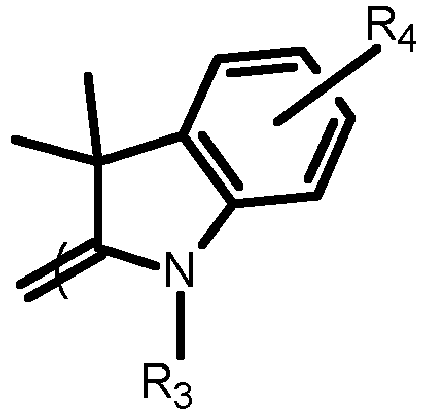 - R2 and R4 are independently selected from the group consisting of hydrogen, halogen, (C1-C10)alkyl, -OR5, -NR5R6, -NO2, -CF3, -CN, -SR5, -N3, -C(=O)R5, -OC(=)OR5, - C(=O)NR5R6, -NR5C(=O)R6, wherein R5 and R6 are independently selected from hydrogen, unsubstituted (C1-C10)alkyl, unsubstituted (C2-C10)alkenyl, unsubstituted (C2-C10)alkynyl, cyclo(C3-C10)alkyl, heterocyclic group, cyclo(C3-C10)alkenyl, heterocyclo(C2-C10)alkenyl, aryl, heteroaryl, aryl(C1-C10)alkyl, hetero(C1-C10)alkyl, (C1-C10)alkylaryl, (C1-C10)alkylheteroaryl ;- R1 and R3 are independently selected from the group consisting of a (C1-C20)alkyl eventually substituted by a hydrophobic group, a cyclo(C3-C20)alkyl eventually substituted by a hydrophobic group, a (C2-C20)alkenyl eventually substituted by a hydrophobic group, a (C2-C20)alkynyl, a heterocyclic group eventually substituted by a hydrophobic group, a cyclo(C3-C20)alkenyl eventually substituted by a hydrophobic group, a heterocyclo(C2-C20)alkenyl eventually substituted by a hydrophobic group, an aryl eventually substituted by a hydrophobic group, a heteroaryl eventually substituted by a hydrophobic group, a hetero(C1-C20)alkyl eventually substituted by a hydrophobic group, a (C1-C20)alkylaryl eventually substituted by a hydrophobic group, a (C1-C20)alkylheteroaryl eventually substituted by a hydrophobic group, said hydrophobic group being selected from methyl, ethyl, methoxy, ethyloxy;- said counterion being an inorganic counterion, or an organic counterion or a bulky organic counterion.
 - Fluorescent polymeric coating film according to any one of claims 1 to 6, wherein- A1 is


- Fluorescent polymeric coating film according to any one of claim 1 to 7, wherein R1 and R3 are independently selected from the group consisting of unsubstituted (C1-C20)alkyl, an unsubstituted cyclo(C3-C20)alkyl, an unsubstituted (C2-C20)alkenyl, an unsubstituted (C2-C20)alkynyl, an unsubstituted heterocyclic group, an unsubstituted cyclo(C3-C20)alkenyl, an unsubstituted heterocyclo(C2-C20)alkenyl, an unsubstituted aryl, an unsubstituted heteroaryl, an unsubstituted hetero(C1-C20)alkyl, an unsubstituted (C1-C20)alkylaryl, an unsubstituted (C1-C20)alkylheteroaryl.
- Fluorescent polymeric coating film according to any one of claims 1 to 8, wherein R1 and R3 are independently selected from the group of unsubstituted (C8-C20)alkyl, particularly the group of unsubstituted (C12-C18)alkyl.
- Fluorescent polymeric coating film according to any one of claims 1 to 9, wherein the fluorescent dye is of Formula Ia


- Fluorescent polymeric coating film according to claim 1-10, wherein the fluorescent dye is

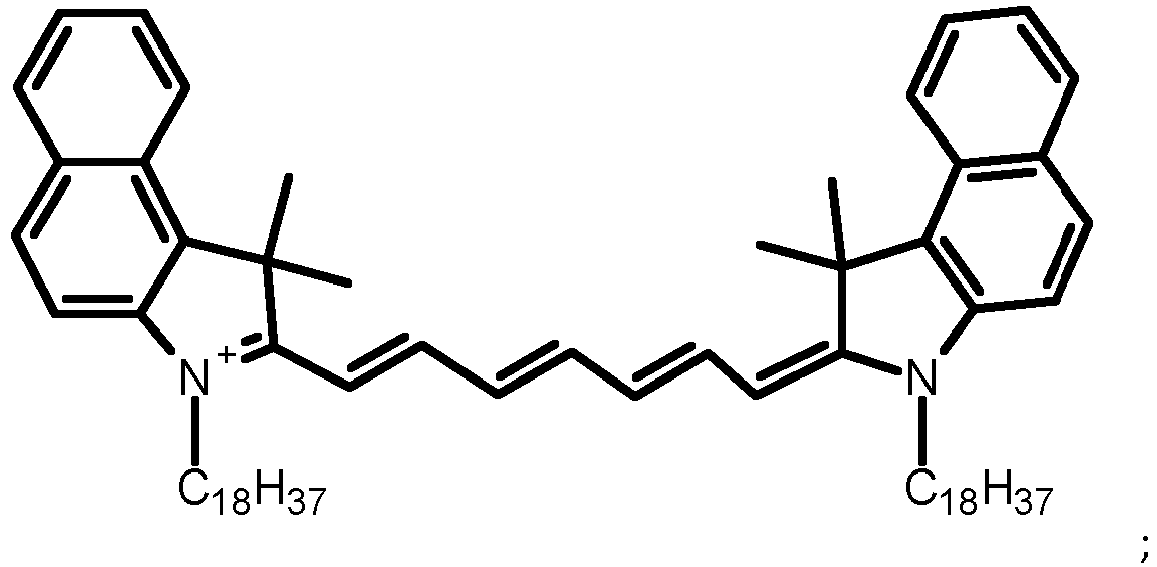

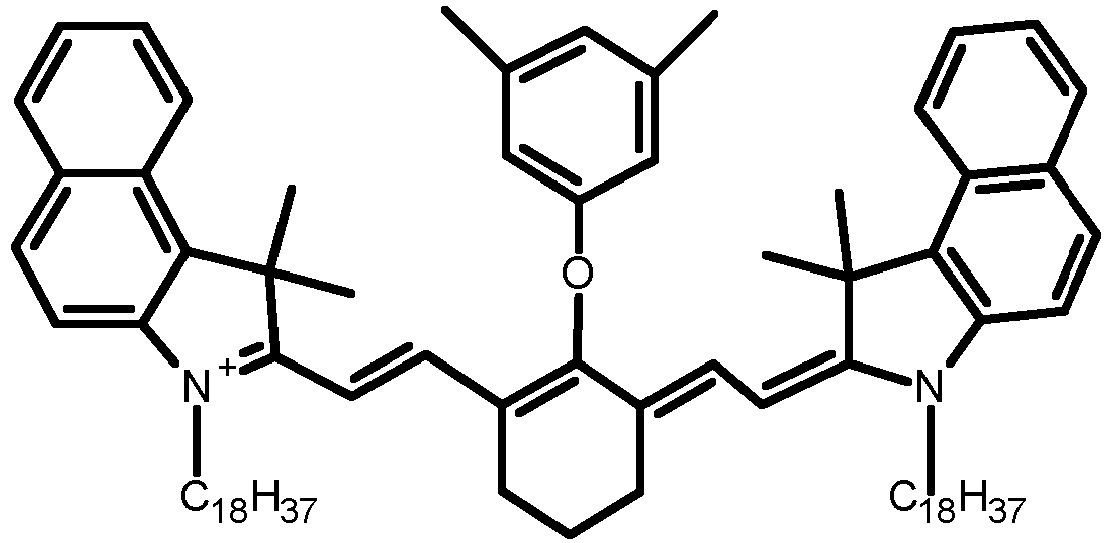

- Fluorescent polymeric coating film according to any one of claims 1 to 11, wherein the weight of fluorescent dye in a polymeric layer is from 0,1 to 50%, particularly from 0,5 to 10%, still more particularly 1%, by weight of the hydrophobic polymer in said polymeric layer.
- A method for coating a medical device by a fluorescent polymeric coating film visible in near-infrared light as defined according to any one of claims 1 to 12, comprising:(i) a step of contacting said medical device with a solution comprising one or several solvents, a hydrophobic polymer, an ionic fluorescent dye and a counterion,said hydrophobic polymer being chosen from poly(methyl methacrylate), poly(ethyl methacrylate), poly(propyl methacrylate), poly(butyl methacrylate), poly(methyl methacrylate-co-methacrylic acid), poly(lactide-co-glycolide), polylactic acid, polyglycolic acid, polycaprolacton, cellulose triacetate, nitrocellulose, polydimethylsiloxane, poly(ethylene terephthalate), polycarbonate, polyethylene, ethylene vinyl acetate copolymer, polyurethane, polystyrene, and copolymers thereof with poly(ethylene glycol);said fluorescent dye being represented by Formula I wherein :
 - R8 and R9 are the same or different and independently selected from the group consisting of:- an hydrogen,- a group chosen from a (C1-C20)alkyl, a cyclo(C3-C20)alkyl, a (C2-C20)alkenyl, a (C2-C20)alkynyl, a heterocyclic group, a cyclo(C3-C20)alkenyl, a heterocyclo(C2-C20)alkenyl, an aryl, a heteroaryl, a hetero(C1-C20)alkyl, a (C1-C20)alkylaryl, or a (C1 C20)alkylheteroaryl, said group being unsubstituted or substituted by one or two substituents chosen from a (C1-C5) alkyl, an aryl, or -COOR11, R11 being a (C1-C20) alkyl, or- a group of formula
 - A1 is
 - or A1 is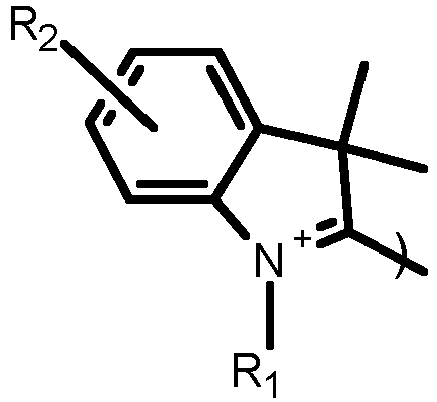
 - R2 and R4 are independently selected from the group consisting of hydrogen, halogen, (C1-C10)alkyl, -OR5, -NR5R6, -NO2, -CF3, -CN, -SR5, -N3, -C(=O)R5, -OC(=)OR5, - C(=O)NR5R6, -NR5C(=O)R6, wherein R5 and R6 are independently selected from hydrogen, unsubstituted (C1-C10)alkyl, unsubstituted (C2-C10)alkenyl, unsubstituted (C2-C10)alkynyl, cyclo(C3-C10)alkyl, heterocyclic group, cyclo(C3-C10)alkenyl, heterocyclo(C2-C10)alkenyl, aryl, heteroaryl, aryl(C1-C10)alkyl, hetero(C1-C10)alkyl, (C1-C10)alkylaryl, (C1-C10)alkylheteroaryl ;- R1 and R3 are independently selected from the group consisting of a (C1-C20)alkyl eventually substituted by a hydrophobic group, a cyclo(C3-C20)alkyl eventually substituted by an hydrophobic group, a (C2-C20)alkenyl eventually substituted by a hydrophobic group, a (C2-C20)alkynyl, a heterocyclic group eventually substituted by a hydrophobic group, a cyclo(C3-C20)alkenyl eventually substituted by a hydrophobic group, a heterocyclo(C2-C20)alkenyl eventually substituted by a hydrophobic group, an aryl eventually substituted by a hydrophobic group, a heteroaryl eventually substituted by a hydrophobic group, a hetero(C1-C20)alkyl eventually substituted by a hydrophobic group, a (C1-C20)alkylaryl eventually substituted by a hydrophobic group, a (C1-C20)alkylheteroaryl eventually substituted by a hydrophobic group, said hydrophobic group being selected from methyl, ethyl, methoxy, ethyloxy;- said counterion being an inorganic counterion, or an organic counterion or a bulky organic counterion;(ii) Evaporating the solvent in said solution to form one polymeric layer comprising a fluorescent dye and a counterion on said medical device.
 - Method according to claim 13, when said coating film is multi-layered, said method comprises step (iii) and step (iv) after the step (ii):(iii) Contacting coated medical device obtained in step (ii) with a solution comprising one or several solvents and a hydrophobic polymer and eventually devoid of any fluorescent dye;(iv) Evaporating the solvent in said solution to produce a polymeric layer on said medical device.
- Method according to claims 13 or 14, wherein said solution contains an organic solvent, in particular chosen from acetonitrile, acetone, tetrahydrofuran, dioxane, ethyl acetate, propyl acetate, butyl acetate, amyl acetate, diethyl ether, 1,2-dimethoxyethane, 1,2-dioxane, dichloromethane, chloroform, petroleum ether, toluene, o-xylene, m-xylene, p-xylene.
- Method according to any one of claims 13 to 15, wherein the hydrophobic polymer is from 1 to 100 mg/ml, preferably 30 mg/ml of solution; the weight of fluorescent dye in a polymeric layer is from 0.1 to 50%, particularly from 0.5 to 10%, still more particularly 1%, by weight of the hydrophobic polymer in said polymeric layer.
- Method according to any one of claims 13 to 16, wherein the medical device is chosen from a surgical packing, fiducial marker, a surgical tap, a needle, a surgical retractor, a clip, a surgical thread, a staple, a knife, a safety pin, a scissor, a clamp, a scalpel, a hemostat, a tweezer, a forcep, a suction tip, a gauze, a cottonoid, a sponge, a catheter, a stainless steel wire, a surgical site marker, a stent, a pacemaker, a nerve stimulator, a drug delivery system, a port-a-cath, a magnetic anastomosis system, an intravascular embolization device, a mechanical linear stapler, a mechanical circular stapler, a drug-delivery implant, a piezoelectric implant, a diagnostic video-capsule, a magnetic tracking capsule.
- Method according to any one of claims 13 to 17, wherein the steps (i) and (ii) are repeated from 1 to 50 times, preferably 1 to 20.
- Method according to any one of claims 13 to 18, wherein the steps (iii) and (iv) are repeated from 1 to 20 times.
Applications Claiming Priority (2)
| Application Number | Priority Date | Filing Date | Title |
|---|---|---|---|
| EP18305075.6A EP3517146A1 (en) | 2018-01-26 | 2018-01-26 | Fluorescent polymeric coating film for medical devices |
| PCT/EP2019/051990 WO2019145532A1 (en) | 2018-01-26 | 2019-01-28 | Fluorescent polymeric coating film for medical devices |
Publications (2)
| Publication Number | Publication Date |
|---|---|
| EP3743126A1 EP3743126A1 (en) | 2020-12-02 |
| EP3743126B1 true EP3743126B1 (en) | 2022-03-16 |
Family
ID=61163634
Family Applications (2)
| Application Number | Title | Priority Date | Filing Date |
|---|---|---|---|
| EP18305075.6A Withdrawn EP3517146A1 (en) | 2018-01-26 | 2018-01-26 | Fluorescent polymeric coating film for medical devices |
| EP19701664.5A Active EP3743126B1 (en) | 2018-01-26 | 2019-01-28 | Fluorescent polymeric coating film for medical devices |
Family Applications Before (1)
| Application Number | Title | Priority Date | Filing Date |
|---|---|---|---|
| EP18305075.6A Withdrawn EP3517146A1 (en) | 2018-01-26 | 2018-01-26 | Fluorescent polymeric coating film for medical devices |
Country Status (9)
| Country | Link |
|---|---|
| US (1) | US12291654B2 (en) |
| EP (2) | EP3517146A1 (en) |
| JP (1) | JP7423547B2 (en) |
| KR (1) | KR102620144B1 (en) |
| CN (1) | CN111867646B (en) |
| CA (1) | CA3086097A1 (en) |
| DK (1) | DK3743126T3 (en) |
| ES (1) | ES2918398T3 (en) |
| WO (1) | WO2019145532A1 (en) |
Families Citing this family (7)
| Publication number | Priority date | Publication date | Assignee | Title |
|---|---|---|---|---|
| US11554197B2 (en) | 2018-11-20 | 2023-01-17 | BioMark, LLC | Device with an open cell element |
| FR3110165B1 (en) * | 2020-05-15 | 2022-10-28 | Proimaging | New fluorescent compounds for tumor tissue labeling |
| EP4169474A1 (en) | 2021-10-25 | 2023-04-26 | Erbe Vision GmbH | System and method for image registration |
| WO2024106293A1 (en) * | 2022-11-15 | 2024-05-23 | 株式会社日本触媒 | Cyanine compound, resin composition, and optical member |
| CN115737937A (en) * | 2022-12-12 | 2023-03-07 | 广东省人民医院 | Fluorescent hydrogel lubrication catheter and preparation method thereof |
| CN117683372A (en) * | 2023-10-14 | 2024-03-12 | 江苏荣耀光学科技有限公司 | A kind of nanophotothermal reagent and its preparation method and application |
| CN118852886A (en) * | 2024-07-01 | 2024-10-29 | 吉林大学 | A preparation method and application of cyanine dye |
Family Cites Families (13)
| Publication number | Priority date | Publication date | Assignee | Title |
|---|---|---|---|---|
| JPS5967092A (en) * | 1982-10-11 | 1984-04-16 | Tdk Corp | Optical recording medium |
| JPS59201243A (en) * | 1983-04-28 | 1984-11-14 | Tdk Corp | Optical recording medium |
| JPH05150395A (en) * | 1991-11-28 | 1993-06-18 | Canon Inc | Dry silver salt photoconductor and image forming method using the photoconductor |
| US7052512B2 (en) * | 2001-07-18 | 2006-05-30 | Boston Scientific Scimed, Inc. | Fluorescent dyed lubricant for medical devices |
| US6921620B2 (en) * | 2001-08-21 | 2005-07-26 | Kodak Polychrome Graphics Llc | Imageable composition containing colorant having a counter anion derived from a non-volatile acid |
| DE10214937A1 (en) * | 2002-04-04 | 2003-10-16 | Basf Ag | Cyclic compounds and their use as light absorbers, light emitters or complex ligands |
| EP2428230A1 (en) | 2008-12-25 | 2012-03-14 | Canon Kabushiki Kaisha | Probe for auditory hair cells. |
| FR2940653B1 (en) * | 2008-12-29 | 2011-02-04 | Centre Nat Rech Scient | NOVEL FLUORESCENT DIPYRROMETHEN-BOROSUBSTITUTE COMPOUNDS AND THEIR USE FOR DIAGNOSIS |
| US8353154B2 (en) | 2009-09-21 | 2013-01-15 | GM Global Technology Operations LLC | Thermally efficient exhaust treatment system for an internal combustion engine |
| US20110071387A1 (en) * | 2009-09-24 | 2011-03-24 | Health Beacons, Inc. | Medical implant device and probe device having up and/or down conversion molecules and method of making the same |
| US9138492B2 (en) | 2012-02-23 | 2015-09-22 | Canon Kabushiki Kaisha | Particle containing hydrophobic dye having cyanine structure, and contrast agent containing the particle |
| US11338069B2 (en) | 2016-02-29 | 2022-05-24 | The Regents Of The Unversity Of California | Fluorescent and/or NIR coatings for medical objects, object recovery systems and methods |
| JP2017164315A (en) * | 2016-03-16 | 2017-09-21 | 旭硝子株式会社 | Method for manufacturing medical device |
-
2018
- 2018-01-26 EP EP18305075.6A patent/EP3517146A1/en not_active Withdrawn
-
2019
- 2019-01-28 EP EP19701664.5A patent/EP3743126B1/en active Active
- 2019-01-28 CA CA3086097A patent/CA3086097A1/en active Pending
- 2019-01-28 CN CN201980008004.5A patent/CN111867646B/en active Active
- 2019-01-28 JP JP2020562844A patent/JP7423547B2/en active Active
- 2019-01-28 US US16/964,704 patent/US12291654B2/en active Active
- 2019-01-28 DK DK19701664.5T patent/DK3743126T3/en active
- 2019-01-28 WO PCT/EP2019/051990 patent/WO2019145532A1/en not_active Ceased
- 2019-01-28 KR KR1020207021513A patent/KR102620144B1/en active Active
- 2019-01-28 ES ES19701664T patent/ES2918398T3/en active Active
Also Published As
| Publication number | Publication date |
|---|---|
| WO2019145532A1 (en) | 2019-08-01 |
| JP2021512748A (en) | 2021-05-20 |
| KR20200115503A (en) | 2020-10-07 |
| CN111867646B (en) | 2022-03-22 |
| US20200347243A1 (en) | 2020-11-05 |
| ES2918398T3 (en) | 2022-07-15 |
| CA3086097A1 (en) | 2019-08-01 |
| KR102620144B1 (en) | 2023-12-29 |
| EP3743126A1 (en) | 2020-12-02 |
| EP3517146A1 (en) | 2019-07-31 |
| JP7423547B2 (en) | 2024-01-29 |
| US12291654B2 (en) | 2025-05-06 |
| DK3743126T3 (en) | 2022-06-27 |
| CN111867646A (en) | 2020-10-30 |
Similar Documents
| Publication | Publication Date | Title |
|---|---|---|
| US12291654B2 (en) | Fluorescent polymeric coating film for medical devices | |
| RU2350355C9 (en) | Fluorescent contrasting near infrared agent and method of fluorescent tomography | |
| CN106977628B (en) | Indocyanine compound, its synthesis and purification method, diagnostic composition, in vivo dynamic measurement device and circulation visualization device | |
| CZ284897A3 (en) | Esters of 5-aminolevullinic acids, process of their preparation and pharmaceutical composition containing thereof | |
| WO2001064660A1 (en) | Novel quinoline ligands and metal complexes for diagnosis and therapy | |
| CN105566938A (en) | Mitochondrion-targeted heptamethine indocyanine dye, preparation method and application | |
| FR3046172A1 (en) | MACROCYCLIC LIGANDS WITH GROUP (S) PICOLINATE (S), THEIR COMPLEXES AND THEIR MEDICAL USES | |
| WO2011087000A1 (en) | Diagnostic for cancer | |
| EP2691402B1 (en) | Bifunctional hydroxy-bisphosphonic acid derivatives | |
| EP4635513A1 (en) | Near-infrared photosensitizer that can be activated in slightly acidic tumor environment and preparation method therefor and use thereof | |
| EP3522870A1 (en) | Ultralow-power near infrared lamp light operable targeted organic nanoparticle photodynamic therapy | |
| KR102174196B1 (en) | Hydrophobic Silicon-rhodamine Fluorescent Probes and Use Thereof | |
| CN113597547B (en) | Fluorescent imaging reagents for lipid droplets in cells and tissues | |
| CA3061174A1 (en) | Targeting nanoparticles | |
| AU2016252864A1 (en) | Metal complexes with bisphosphonate or pyrophosphate useful as imaging agents | |
| CN110003086B (en) | A kind of amphiphilic small molecule IR820-1MT and its preparation and its preparation method and application | |
| RU2800751C2 (en) | Crystalline or amorphous form of fxr agonists being steroid derivatives, their production method and their use | |
| JP2025017142A (en) | Compound, fluorescent dye, kit, cell membrane detection method, and staining material | |
| Weatherall | Synthesis of Phospholipids for the Study of Cell Surface Protein Binding and Activation | |
| CN117756696A (en) | High-resolution, residue-free, protein-escape cyanine dye and its preparation method and application | |
| WO2025248194A1 (en) | Contrast agent for medical imaging | |
| HK1237359A1 (en) | Novel indocyanine compound, synthesis method thereof, purification method thereof, diagnostic composition using indocyanine compound, and device for measuring in vivo kinetics and device for visualizing circulation using diagnostic composition | |
| WO2018026538A1 (en) | Novel scaffolds for intracellular compound delivery for the detection of cancer cells | |
| PL100829B1 (en) | METHOD OF MAKING NEW BIS- / BIHYDROXYPROPYLAMIDES / 5-HYDROXYPROPIONylAMINO-2,4,6-TRIODO-ISOPHTALIC ACID |
Legal Events
| Date | Code | Title | Description |
|---|---|---|---|
| STAA | Information on the status of an ep patent application or granted ep patent |
Free format text: STATUS: UNKNOWN |
|
| STAA | Information on the status of an ep patent application or granted ep patent |
Free format text: STATUS: THE INTERNATIONAL PUBLICATION HAS BEEN MADE |
|
| PUAI | Public reference made under article 153(3) epc to a published international application that has entered the european phase |
Free format text: ORIGINAL CODE: 0009012 |
|
| STAA | Information on the status of an ep patent application or granted ep patent |
Free format text: STATUS: REQUEST FOR EXAMINATION WAS MADE |
|
| 17P | Request for examination filed |
Effective date: 20200722 |
|
| AK | Designated contracting states |
Kind code of ref document: A1 Designated state(s): AL AT BE BG CH CY CZ DE DK EE ES FI FR GB GR HR HU IE IS IT LI LT LU LV MC MK MT NL NO PL PT RO RS SE SI SK SM TR |
|
| AX | Request for extension of the european patent |
Extension state: BA ME |
|
| DAV | Request for validation of the european patent (deleted) | ||
| DAX | Request for extension of the european patent (deleted) | ||
| GRAP | Despatch of communication of intention to grant a patent |
Free format text: ORIGINAL CODE: EPIDOSNIGR1 |
|
| STAA | Information on the status of an ep patent application or granted ep patent |
Free format text: STATUS: GRANT OF PATENT IS INTENDED |
|
| INTG | Intention to grant announced |
Effective date: 20211012 |
|
| GRAS | Grant fee paid |
Free format text: ORIGINAL CODE: EPIDOSNIGR3 |
|
| GRAA | (expected) grant |
Free format text: ORIGINAL CODE: 0009210 |
|
| STAA | Information on the status of an ep patent application or granted ep patent |
Free format text: STATUS: THE PATENT HAS BEEN GRANTED |
|
| AK | Designated contracting states |
Kind code of ref document: B1 Designated state(s): AL AT BE BG CH CY CZ DE DK EE ES FI FR GB GR HR HU IE IS IT LI LT LU LV MC MK MT NL NO PL PT RO RS SE SI SK SM TR |
|
| REG | Reference to a national code |
Ref country code: GB Ref legal event code: FG4D |
|
| REG | Reference to a national code |
Ref country code: CH Ref legal event code: EP Ref country code: DE Ref legal event code: R096 Ref document number: 602019012593 Country of ref document: DE |
|
| REG | Reference to a national code |
Ref country code: IE Ref legal event code: FG4D |
|
| REG | Reference to a national code |
Ref country code: AT Ref legal event code: REF Ref document number: 1475439 Country of ref document: AT Kind code of ref document: T Effective date: 20220415 |
|
| REG | Reference to a national code |
Ref country code: FI Ref legal event code: FGE |
|
| REG | Reference to a national code |
Ref country code: DK Ref legal event code: T3 Effective date: 20220621 |
|
| REG | Reference to a national code |
Ref country code: NL Ref legal event code: FP |
|
| REG | Reference to a national code |
Ref country code: LT Ref legal event code: MG9D |
|
| REG | Reference to a national code |
Ref country code: SE Ref legal event code: TRGR |
|
| REG | Reference to a national code |
Ref country code: ES Ref legal event code: FG2A Ref document number: 2918398 Country of ref document: ES Kind code of ref document: T3 Effective date: 20220715 |
|
| PG25 | Lapsed in a contracting state [announced via postgrant information from national office to epo] |
Ref country code: RS Free format text: LAPSE BECAUSE OF FAILURE TO SUBMIT A TRANSLATION OF THE DESCRIPTION OR TO PAY THE FEE WITHIN THE PRESCRIBED TIME-LIMIT Effective date: 20220316 Ref country code: NO Free format text: LAPSE BECAUSE OF FAILURE TO SUBMIT A TRANSLATION OF THE DESCRIPTION OR TO PAY THE FEE WITHIN THE PRESCRIBED TIME-LIMIT Effective date: 20220616 Ref country code: LT Free format text: LAPSE BECAUSE OF FAILURE TO SUBMIT A TRANSLATION OF THE DESCRIPTION OR TO PAY THE FEE WITHIN THE PRESCRIBED TIME-LIMIT Effective date: 20220316 Ref country code: HR Free format text: LAPSE BECAUSE OF FAILURE TO SUBMIT A TRANSLATION OF THE DESCRIPTION OR TO PAY THE FEE WITHIN THE PRESCRIBED TIME-LIMIT Effective date: 20220316 Ref country code: BG Free format text: LAPSE BECAUSE OF FAILURE TO SUBMIT A TRANSLATION OF THE DESCRIPTION OR TO PAY THE FEE WITHIN THE PRESCRIBED TIME-LIMIT Effective date: 20220616 |
|
| PG25 | Lapsed in a contracting state [announced via postgrant information from national office to epo] |
Ref country code: LV Free format text: LAPSE BECAUSE OF FAILURE TO SUBMIT A TRANSLATION OF THE DESCRIPTION OR TO PAY THE FEE WITHIN THE PRESCRIBED TIME-LIMIT Effective date: 20220316 Ref country code: GR Free format text: LAPSE BECAUSE OF FAILURE TO SUBMIT A TRANSLATION OF THE DESCRIPTION OR TO PAY THE FEE WITHIN THE PRESCRIBED TIME-LIMIT Effective date: 20220617 |
|
| PG25 | Lapsed in a contracting state [announced via postgrant information from national office to epo] |
Ref country code: SM Free format text: LAPSE BECAUSE OF FAILURE TO SUBMIT A TRANSLATION OF THE DESCRIPTION OR TO PAY THE FEE WITHIN THE PRESCRIBED TIME-LIMIT Effective date: 20220316 Ref country code: SK Free format text: LAPSE BECAUSE OF FAILURE TO SUBMIT A TRANSLATION OF THE DESCRIPTION OR TO PAY THE FEE WITHIN THE PRESCRIBED TIME-LIMIT Effective date: 20220316 Ref country code: RO Free format text: LAPSE BECAUSE OF FAILURE TO SUBMIT A TRANSLATION OF THE DESCRIPTION OR TO PAY THE FEE WITHIN THE PRESCRIBED TIME-LIMIT Effective date: 20220316 Ref country code: PT Free format text: LAPSE BECAUSE OF FAILURE TO SUBMIT A TRANSLATION OF THE DESCRIPTION OR TO PAY THE FEE WITHIN THE PRESCRIBED TIME-LIMIT Effective date: 20220718 Ref country code: EE Free format text: LAPSE BECAUSE OF FAILURE TO SUBMIT A TRANSLATION OF THE DESCRIPTION OR TO PAY THE FEE WITHIN THE PRESCRIBED TIME-LIMIT Effective date: 20220316 Ref country code: CZ Free format text: LAPSE BECAUSE OF FAILURE TO SUBMIT A TRANSLATION OF THE DESCRIPTION OR TO PAY THE FEE WITHIN THE PRESCRIBED TIME-LIMIT Effective date: 20220316 |
|
| PG25 | Lapsed in a contracting state [announced via postgrant information from national office to epo] |
Ref country code: PL Free format text: LAPSE BECAUSE OF FAILURE TO SUBMIT A TRANSLATION OF THE DESCRIPTION OR TO PAY THE FEE WITHIN THE PRESCRIBED TIME-LIMIT Effective date: 20220316 Ref country code: IS Free format text: LAPSE BECAUSE OF FAILURE TO SUBMIT A TRANSLATION OF THE DESCRIPTION OR TO PAY THE FEE WITHIN THE PRESCRIBED TIME-LIMIT Effective date: 20220716 Ref country code: AL Free format text: LAPSE BECAUSE OF FAILURE TO SUBMIT A TRANSLATION OF THE DESCRIPTION OR TO PAY THE FEE WITHIN THE PRESCRIBED TIME-LIMIT Effective date: 20220316 |
|
| REG | Reference to a national code |
Ref country code: DE Ref legal event code: R097 Ref document number: 602019012593 Country of ref document: DE |
|
| PLBE | No opposition filed within time limit |
Free format text: ORIGINAL CODE: 0009261 |
|
| STAA | Information on the status of an ep patent application or granted ep patent |
Free format text: STATUS: NO OPPOSITION FILED WITHIN TIME LIMIT |
|
| 26N | No opposition filed |
Effective date: 20221219 |
|
| PG25 | Lapsed in a contracting state [announced via postgrant information from national office to epo] |
Ref country code: SI Free format text: LAPSE BECAUSE OF FAILURE TO SUBMIT A TRANSLATION OF THE DESCRIPTION OR TO PAY THE FEE WITHIN THE PRESCRIBED TIME-LIMIT Effective date: 20220316 |
|
| REG | Reference to a national code |
Ref country code: AT Ref legal event code: UEP Ref document number: 1475439 Country of ref document: AT Kind code of ref document: T Effective date: 20220316 |
|
| PG25 | Lapsed in a contracting state [announced via postgrant information from national office to epo] |
Ref country code: LU Free format text: LAPSE BECAUSE OF NON-PAYMENT OF DUE FEES Effective date: 20230128 |
|
| P01 | Opt-out of the competence of the unified patent court (upc) registered |
Effective date: 20230906 |
|
| PG25 | Lapsed in a contracting state [announced via postgrant information from national office to epo] |
Ref country code: MC Free format text: LAPSE BECAUSE OF FAILURE TO SUBMIT A TRANSLATION OF THE DESCRIPTION OR TO PAY THE FEE WITHIN THE PRESCRIBED TIME-LIMIT Effective date: 20220316 |
|
| PG25 | Lapsed in a contracting state [announced via postgrant information from national office to epo] |
Ref country code: MC Free format text: LAPSE BECAUSE OF FAILURE TO SUBMIT A TRANSLATION OF THE DESCRIPTION OR TO PAY THE FEE WITHIN THE PRESCRIBED TIME-LIMIT Effective date: 20220316 |
|
| PGFP | Annual fee paid to national office [announced via postgrant information from national office to epo] |
Ref country code: ES Payment date: 20250328 Year of fee payment: 7 |
|
| PG25 | Lapsed in a contracting state [announced via postgrant information from national office to epo] |
Ref country code: CY Free format text: LAPSE BECAUSE OF FAILURE TO SUBMIT A TRANSLATION OF THE DESCRIPTION OR TO PAY THE FEE WITHIN THE PRESCRIBED TIME-LIMIT; INVALID AB INITIO Effective date: 20190128 |
|
| PG25 | Lapsed in a contracting state [announced via postgrant information from national office to epo] |
Ref country code: HU Free format text: LAPSE BECAUSE OF FAILURE TO SUBMIT A TRANSLATION OF THE DESCRIPTION OR TO PAY THE FEE WITHIN THE PRESCRIBED TIME-LIMIT; INVALID AB INITIO Effective date: 20190128 |
|
| PG25 | Lapsed in a contracting state [announced via postgrant information from national office to epo] |
Ref country code: TR Free format text: LAPSE BECAUSE OF FAILURE TO SUBMIT A TRANSLATION OF THE DESCRIPTION OR TO PAY THE FEE WITHIN THE PRESCRIBED TIME-LIMIT Effective date: 20220316 |
|
| REG | Reference to a national code |
Ref country code: CH Ref legal event code: U11 Free format text: ST27 STATUS EVENT CODE: U-0-0-U10-U11 (AS PROVIDED BY THE NATIONAL OFFICE) Effective date: 20260204 |
|
| PGFP | Annual fee paid to national office [announced via postgrant information from national office to epo] |
Ref country code: NL Payment date: 20260129 Year of fee payment: 8 |
|
| PGFP | Annual fee paid to national office [announced via postgrant information from national office to epo] |
Ref country code: SE Payment date: 20260128 Year of fee payment: 8 |
|
| PGFP | Annual fee paid to national office [announced via postgrant information from national office to epo] |
Ref country code: GB Payment date: 20260128 Year of fee payment: 8 |
|
| PGFP | Annual fee paid to national office [announced via postgrant information from national office to epo] |
Ref country code: DK Payment date: 20260127 Year of fee payment: 8 Ref country code: DE Payment date: 20260223 Year of fee payment: 8 Ref country code: IE Payment date: 20260128 Year of fee payment: 8 |
|
| PGFP | Annual fee paid to national office [announced via postgrant information from national office to epo] |
Ref country code: AT Payment date: 20260127 Year of fee payment: 8 |
|
| PGFP | Annual fee paid to national office [announced via postgrant information from national office to epo] |
Ref country code: FI Payment date: 20260127 Year of fee payment: 8 Ref country code: BE Payment date: 20260129 Year of fee payment: 8 Ref country code: IT Payment date: 20260127 Year of fee payment: 8 |
|
| PGFP | Annual fee paid to national office [announced via postgrant information from national office to epo] |
Ref country code: FR Payment date: 20260128 Year of fee payment: 8 |
|
| PGFP | Annual fee paid to national office [announced via postgrant information from national office to epo] |
Ref country code: CH Payment date: 20260204 Year of fee payment: 8 |