EP3743053B1 - Use of cannabinoids in the treatment of epilepsy - Google Patents
Use of cannabinoids in the treatment of epilepsy Download PDFInfo
- Publication number
- EP3743053B1 EP3743053B1 EP19702670.1A EP19702670A EP3743053B1 EP 3743053 B1 EP3743053 B1 EP 3743053B1 EP 19702670 A EP19702670 A EP 19702670A EP 3743053 B1 EP3743053 B1 EP 3743053B1
- Authority
- EP
- European Patent Office
- Prior art keywords
- cbd
- seizures
- epilepsy
- treatment
- stiripentol
- Prior art date
- Legal status (The legal status is an assumption and is not a legal conclusion. Google has not performed a legal analysis and makes no representation as to the accuracy of the status listed.)
- Active
Links
Classifications
-
- A—HUMAN NECESSITIES
- A61—MEDICAL OR VETERINARY SCIENCE; HYGIENE
- A61K—PREPARATIONS FOR MEDICAL, DENTAL OR TOILETRY PURPOSES
- A61K31/00—Medicinal preparations containing organic active ingredients
- A61K31/658—Medicinal preparations containing organic active ingredients o-phenolic cannabinoids, e.g. cannabidiol, cannabigerolic acid, cannabichromene or tetrahydrocannabinol
-
- A—HUMAN NECESSITIES
- A61—MEDICAL OR VETERINARY SCIENCE; HYGIENE
- A61K—PREPARATIONS FOR MEDICAL, DENTAL OR TOILETRY PURPOSES
- A61K31/00—Medicinal preparations containing organic active ingredients
- A61K31/33—Heterocyclic compounds
- A61K31/335—Heterocyclic compounds having oxygen as the only ring hetero atom, e.g. fungichromin
- A61K31/357—Heterocyclic compounds having oxygen as the only ring hetero atom, e.g. fungichromin having two or more oxygen atoms in the same ring, e.g. crown ethers, guanadrel
-
- A—HUMAN NECESSITIES
- A61—MEDICAL OR VETERINARY SCIENCE; HYGIENE
- A61K—PREPARATIONS FOR MEDICAL, DENTAL OR TOILETRY PURPOSES
- A61K31/00—Medicinal preparations containing organic active ingredients
- A61K31/33—Heterocyclic compounds
- A61K31/335—Heterocyclic compounds having oxygen as the only ring hetero atom, e.g. fungichromin
- A61K31/357—Heterocyclic compounds having oxygen as the only ring hetero atom, e.g. fungichromin having two or more oxygen atoms in the same ring, e.g. crown ethers, guanadrel
- A61K31/36—Compounds containing methylenedioxyphenyl groups, e.g. sesamin
-
- A—HUMAN NECESSITIES
- A61—MEDICAL OR VETERINARY SCIENCE; HYGIENE
- A61K—PREPARATIONS FOR MEDICAL, DENTAL OR TOILETRY PURPOSES
- A61K31/00—Medicinal preparations containing organic active ingredients
- A61K31/33—Heterocyclic compounds
- A61K31/395—Heterocyclic compounds having nitrogen as a ring hetero atom, e.g. guanethidine or rifamycins
- A61K31/55—Heterocyclic compounds having nitrogen as a ring hetero atom, e.g. guanethidine or rifamycins having seven-membered rings, e.g. azelastine, pentylenetetrazole
- A61K31/551—Heterocyclic compounds having nitrogen as a ring hetero atom, e.g. guanethidine or rifamycins having seven-membered rings, e.g. azelastine, pentylenetetrazole having two nitrogen atoms, e.g. dilazep
-
- A—HUMAN NECESSITIES
- A61—MEDICAL OR VETERINARY SCIENCE; HYGIENE
- A61K—PREPARATIONS FOR MEDICAL, DENTAL OR TOILETRY PURPOSES
- A61K31/00—Medicinal preparations containing organic active ingredients
- A61K31/33—Heterocyclic compounds
- A61K31/395—Heterocyclic compounds having nitrogen as a ring hetero atom, e.g. guanethidine or rifamycins
- A61K31/55—Heterocyclic compounds having nitrogen as a ring hetero atom, e.g. guanethidine or rifamycins having seven-membered rings, e.g. azelastine, pentylenetetrazole
- A61K31/551—Heterocyclic compounds having nitrogen as a ring hetero atom, e.g. guanethidine or rifamycins having seven-membered rings, e.g. azelastine, pentylenetetrazole having two nitrogen atoms, e.g. dilazep
- A61K31/5513—1,4-Benzodiazepines, e.g. diazepam or clozapine
-
- A—HUMAN NECESSITIES
- A61—MEDICAL OR VETERINARY SCIENCE; HYGIENE
- A61K—PREPARATIONS FOR MEDICAL, DENTAL OR TOILETRY PURPOSES
- A61K36/00—Medicinal preparations of undetermined constitution containing material from algae, lichens, fungi or plants, or derivatives thereof, e.g. traditional herbal medicines
- A61K36/18—Magnoliophyta (angiosperms)
- A61K36/185—Magnoliopsida (dicotyledons)
-
- A—HUMAN NECESSITIES
- A61—MEDICAL OR VETERINARY SCIENCE; HYGIENE
- A61K—PREPARATIONS FOR MEDICAL, DENTAL OR TOILETRY PURPOSES
- A61K36/00—Medicinal preparations of undetermined constitution containing material from algae, lichens, fungi or plants, or derivatives thereof, e.g. traditional herbal medicines
- A61K36/18—Magnoliophyta (angiosperms)
- A61K36/185—Magnoliopsida (dicotyledons)
- A61K36/348—Cannabaceae
- A61K36/3482—Cannabis
-
- A—HUMAN NECESSITIES
- A61—MEDICAL OR VETERINARY SCIENCE; HYGIENE
- A61K—PREPARATIONS FOR MEDICAL, DENTAL OR TOILETRY PURPOSES
- A61K45/00—Medicinal preparations containing active ingredients not provided for in groups A61K31/00 - A61K41/00
- A61K45/06—Mixtures of active ingredients without chemical characterisation, e.g. antiphlogistics and cardiaca
-
- A—HUMAN NECESSITIES
- A61—MEDICAL OR VETERINARY SCIENCE; HYGIENE
- A61P—SPECIFIC THERAPEUTIC ACTIVITY OF CHEMICAL COMPOUNDS OR MEDICINAL PREPARATIONS
- A61P25/00—Drugs for disorders of the nervous system
- A61P25/08—Antiepileptics; Anticonvulsants
-
- A—HUMAN NECESSITIES
- A61—MEDICAL OR VETERINARY SCIENCE; HYGIENE
- A61K—PREPARATIONS FOR MEDICAL, DENTAL OR TOILETRY PURPOSES
- A61K2300/00—Mixtures or combinations of active ingredients, wherein at least one active ingredient is fully defined in groups A61K31/00 - A61K41/00
Definitions
- the CBD used is in the form of a highly purified extract of cannabis such that the CBD is present at greater than 98% of the total extract (w/w) and the other components of the extract are characterised.
- the cannabinoid tetrahydrocannabinol (THC) has been substantially removed, to a level of not more than 0.15% (w/w) and the propyl analogue of CBD, cannabidivarin, (CBDV) is present in amounts of up to 1%.
- the CBD may be a synthetically produced CBD.
- Epilepsy occurs in approximately 1% of the population worldwide, (Thurman et al., 2011) of which 70% are able to adequately control their symptoms with the available existing anti-epileptic drugs (AEDs). However, 30% of this patient group, (Eadie et al., 2012), are unable to obtain seizure freedom from the AED that are available and as such are termed as suffering from intractable or "treatment-resistant epilepsy” (TRE).
- TRE treatment-resistant epilepsy
- Intractable or treatment-resistant epilepsy was defined in 2009 by the International League against Epilepsy (ILAE) as "failure of adequate trials of two tolerated and appropriately chosen and used AED schedules (whether as monotherapies or in combination) to achieve sustained seizure freedom" (Kwan et al., 2009 ).
- ILAE International League against Epilepsy
- Childhood epilepsy can be caused by many different syndromes and genetic mutations and as such diagnosis for these children may take some time.
- Generalised seizures where the seizure arises within and rapidly engages bilaterally distributed networks, can be split into six subtypes: Tonic-Clonic (grand mal) seizures; Absence (petit mal) Seizures; Clonic Seizures; Tonic Seizures; Atonic Seizures and Myoclonic Seizures.
- LGS Lennox-Gastaut syndrome
- LGS can be caused by brain malformations, perinatal asphyxia, severe head injury, central nervous system infection and inherited degenerative or metabolic conditions. In 30-35% of cases, no cause can be found.
- the first line treatment for drop seizures usually comprises a broad-spectrum AED, such as sodium valproate often in combination with rufinamide or lamotrigine.
- AEDs that may be considered include felbamate, clobazam and topiramate.
- Dravet syndrome Another childhood epilepsy syndrome is Dravet syndrome. Onset of Dravet syndrome almost always occurs during the first year of life with clonic and tonic-clonic seizures in previously healthy and developmentally normal infants (Dravet, 2011). Symptoms peak at about five months of age. Other seizures develop between one and four years of age such as prolonged focal dyscognitive seizures and brief absence seizures.
- Seizures progress to be frequent and treatment-resistant, meaning that the seizures do not respond well to treatment. They also tend to be prolonged, lasting more than 5 minutes. Prolonged seizures may lead to status epilepticus, which is a seizure that lasts more than 30 minutes, or seizures that occur in clusters, one after another.
- Prognosis is poor and approximately 14% of children die during a seizure, because of infection, or suddenly due to uncertain causes, often because of the relentless neurological decline. Patients develop intellectual disability and life-long ongoing seizures. Intellectual impairment varies from severe in 50% patients, to moderate and mild intellectual disability each accounting for 25% of cases.
- Stiripentol is approved in Europe for the treatment of Dravet syndrome in conjunction with clobazam and valproic acid. In the US, stiripentol was granted an Orphan Designation for the treatment of Dravet syndrome in 2008; however, the drug is not FDA approved.
- Potent sodium channel blockers used to treat epilepsy actually increase seizure frequency in patients with Dravet Syndrome.
- the most common are phenytoin, carbamazepine, lamotrigine and rufinamide.
- Management may also include a ketogenic diet, and physical and vagus nerve stimulation.
- a ketogenic diet and physical and vagus nerve stimulation.
- many patients with Dravet syndrome are treated with anti-psychotic drugs, stimulants, and drugs to treat insomnia.
- AEDs used specifically in childhood epilepsy AED Mechanism Indication Clobazam GABA receptor agonism Adjunctive therapy in complex partial seizures Status epilepticus Myoclonic Myoclonic-absent Simple partial Complex partial Absence seizures Lennox-Gastaut syndrome Stiripentol GABA receptor agonism Severe myoclonic epilepsy in infancy (Dravet syndrome)
- CBD cannabidiol
- CBD is administered in combination with stiripentol and clobazam.
- the treatment-resistant epilepsy is Dravet Syndrome.
- the individual is a human.
- cannabinoids which are identified in the present application for reference. So far over 60 different cannabinoids have been identified and these cannabinoids can be split into different groups as follows: Phytocannabinoids; Endocannabinoids and Synthetic cannabinoids (which may be novel cannabinoids or synthetically produced phytocannabinoids or endocannabinoids).
- phytocannabinoids are cannabinoids that originate from nature and can be found in the cannabis plant.
- the phytocannabinoids can be isolated from plants to produce a highly purified extract or can be reproduced synthetically.
- “Childhood epilepsy” refers to the many different syndromes and genetic mutations that can occur to cause epilepsy in childhood. Examples of some of these are as follows: Dravet Syndrome; Myoclonic-Absence Epilepsy; Lennox-Gastaut syndrome; Generalized Epilepsy of unknown origin; CDKL5 mutation; Aicardi syndrome; tuberous sclerosis complex; bilateral polymicrogyria; Dup15q; SNAP25; and febrile infection related epilepsy syndrome (FIRES); benign rolandic epilepsy; juvenile myoclonic epilepsy; infantile spasm (West syndrome); and Landau-Kleffner syndrome. The list above is non-exhaustive as many different childhood epilepsies exist.
- the drug substance used is a liquid carbon dioxide extract of high-CBD containing chemotypes of Cannabis sativa L. which had been further purified by a solvent crystallization method to yield CBD.
- the crystallisation process specifically removes other cannabinoids and plant components to yield greater than 98% CBD.
- CBD is highly purified because it is produced from a cannabis plant rather than synthetically there is a small number of other cannabinoids which are co-produced and co-extracted with the CBD. Details of these cannabinoids and the quantities in which they are present in the medication are as described in Table 5 below.
- Table 5 Composition of highly purified CBD extract Cannabinoid Concentration CBD > 98% w/w CBDA NMT 0.15% w/w CBDV NMT 1.0% w/w ⁇ 9 THC NMT 0.15% w/w CBD-C4 NMT 0.5% w/w > - greater than NMT - not more than
- EXAMPLE 1 DRUG-DRUG INTERACTION BETWEEN CANNABIDIOL (CBD) AND STIRIPENTOL (STP) DURING A CLINICAL TRIAL
- Convulsive seizures were defined as all countable atonic, tonic, clonic, and tonic-clonic seizures. The primary efficacy end point was percent change from baseline in convulsive seizures.
- Table 6 below describes the percentage of patients that recorded a 50% reduction in convulsive seizures over the treatment period. Table 6: Interaction between CBD and other AEDs Combination of AEDs Percentage of patients with greater than 50% reduction in seizures Stiripentol 14% Stiripentol + Clobazam 8% Stiripentol + CBD 43% Stiripentol + Clobazam + CBD 26%
- those patients that are already taking a combination of stiripentol and clobazam may benefit from the inclusion of CBD as an adjunct therapy as such an inclusion has been found to reduce the number of seizures.
- Stiripentol is a positive allosteric modulator of GABA-A receptors in the brain that enhances the opening duration of the channel by binding to a site different than the benzodiazepine binding site. Reduced synaptosomal uptake of GABA and/or inhibition of GABA transaminase may also explain the role of stiripentol in reducing seizures.
- Combination of CBD with AEDs that work as GABA receptor agonists may therefore prove to be of particular benefit in the treatment of childhood epilepsy syndromes.
- CBD 750 mg twice daily
- STP steady-state pharmacokinetics of stiripentol
- Analyte plasma concentrations were determined using validated bioanalytical methods.
- a secondary objective was to evaluate the safety and tolerability of CBD when co-administered with STP.
- AE adverse event
Landscapes
- Health & Medical Sciences (AREA)
- Life Sciences & Earth Sciences (AREA)
- Chemical & Material Sciences (AREA)
- Medicinal Chemistry (AREA)
- Pharmacology & Pharmacy (AREA)
- Animal Behavior & Ethology (AREA)
- General Health & Medical Sciences (AREA)
- Public Health (AREA)
- Veterinary Medicine (AREA)
- Epidemiology (AREA)
- Engineering & Computer Science (AREA)
- Natural Medicines & Medicinal Plants (AREA)
- General Chemical & Material Sciences (AREA)
- Nuclear Medicine, Radiotherapy & Molecular Imaging (AREA)
- Organic Chemistry (AREA)
- Chemical Kinetics & Catalysis (AREA)
- Neurosurgery (AREA)
- Neurology (AREA)
- Pain & Pain Management (AREA)
- Bioinformatics & Cheminformatics (AREA)
- Biomedical Technology (AREA)
- Mycology (AREA)
- Microbiology (AREA)
- Medical Informatics (AREA)
- Alternative & Traditional Medicine (AREA)
- Biotechnology (AREA)
- Botany (AREA)
- Pharmaceuticals Containing Other Organic And Inorganic Compounds (AREA)
- Acyclic And Carbocyclic Compounds In Medicinal Compositions (AREA)
- Medicines That Contain Protein Lipid Enzymes And Other Medicines (AREA)
- Medicines Containing Plant Substances (AREA)
- Organic Low-Molecular-Weight Compounds And Preparation Thereof (AREA)
Description
- The present invention relates to cannabidiol (CBD) for use in the treatment of patients with childhood-onset epilepsy who are concurrently taking stiripentol.
- Preferably the CBD used is in the form of a highly purified extract of cannabis such that the CBD is present at greater than 98% of the total extract (w/w) and the other components of the extract are characterised. In particular the cannabinoid tetrahydrocannabinol (THC) has been substantially removed, to a level of not more than 0.15% (w/w) and the propyl analogue of CBD, cannabidivarin, (CBDV) is present in amounts of up to 1%. Alternatively, the CBD may be a synthetically produced CBD.
- Epilepsy occurs in approximately 1% of the population worldwide, (Thurman et al., 2011) of which 70% are able to adequately control their symptoms with the available existing anti-epileptic drugs (AEDs). However, 30% of this patient group, (Eadie et al., 2012), are unable to obtain seizure freedom from the AED that are available and as such are termed as suffering from intractable or "treatment-resistant epilepsy" (TRE).
- Intractable or treatment-resistant epilepsy was defined in 2009 by the International League Against Epilepsy (ILAE) as "failure of adequate trials of two tolerated and appropriately chosen and used AED schedules (whether as monotherapies or in combination) to achieve sustained seizure freedom" (Kwan et al., 2009).
- Individuals who develop epilepsy during the first few years of life are often difficult to treat and as such are often termed treatment-resistant. Children who undergo frequent seizures in childhood are often left with neurological damage which can cause cognitive, behavioral and motor delays.
- Childhood-onset epilepsy is a relatively common neurological disorder in children and young adults with a prevalence of approximately 700 per 100,000. This is twice the number of epileptic adults per population.
- When a child or young adult presents with a seizure, investigations are normally undertaken in order to investigate the cause. Childhood epilepsy can be caused by many different syndromes and genetic mutations and as such diagnosis for these children may take some time.
- The main symptom of epilepsy is repeated seizures. In order to determine the type of epilepsy or the epileptic syndrome that a patient is suffering from, an investigation into the type of seizures that the patient is experiencing is undertaken. Clinical observations and electroencephalography (EEG) tests are conducted and the type(s) of seizures are classified according to the ILAE classification described below.
- The International classification of seizure types proposed by the ILAE was adopted in 1981 and a revised proposal was published by the ILAE in 2010 and has not yet superseded the 1981 classification. The 2010 proposal for revised terminology includes the proposed changes to replace the terminology of partial with focal. In addition, the term "simple partial seizure" has been replaced by the term "focal seizure where awareness / responsiveness is not impaired" and the term "complex partial seizure" has been replaced by the term "focal seizure where awareness / consciousness is impaired".
- Generalised seizures, where the seizure arises within and rapidly engages bilaterally distributed networks, can be split into six subtypes: Tonic-Clonic (grand mal) seizures; Absence (petit mal) Seizures; Clonic Seizures; Tonic Seizures; Atonic Seizures and Myoclonic Seizures.
- Focal (partial) seizures where the seizure originates within networks limited to only one hemisphere, are also split into sub-categories. Here the seizure is characterized according to one or more features of the seizure, including aura, motor, autonomic and awareness / responsiveness. Where a seizure begins as a localized seizure and rapidly evolves to be distributed within bilateral networks this seizure is known as a Bilateral convulsive seizure, which is the proposed terminology to replace Secondary Generalised Seizures (generalized seizures that have evolved from focal seizures and are no longer remain localized).
- Epileptic syndromes often present with many different types of seizure and identifying the types of seizure that a patient is suffering from is important as many of the standard AEDs are targeted to treat or are only effective against a given seizure type / subtype.
- One such childhood epilepsy syndrome is Lennox-Gastaut syndrome (LGS). LGS is a severe form of epilepsy, where seizures usually begin before the age of 4. Seizure types, which vary among patients, include tonic (stiffening of the body, upward deviation of the eyes, dilation of the pupils, and altered respiratory patterns), atonic (brief loss of muscle tone and consciousness, causing abrupt falls), atypical absence (staring spells), and myoclonic (sudden muscle jerks). There may be periods of frequent seizures mixed with brief, relatively seizure-free periods.
- Seizures in LGS are often described as "drop seizures". Such drop seizures are defined as an attack or spell (atonic, tonic or tonic-clonic) involving the entire body, trunk or head that led or could have led to a fall, injury, slumping in a chair or hitting the patient's head on a surface.
- Most patients with LGS experience some degree of impaired intellectual functioning or information processing, along with developmental delays, and behavioural disturbances.
- LGS can be caused by brain malformations, perinatal asphyxia, severe head injury, central nervous system infection and inherited degenerative or metabolic conditions. In 30-35% of cases, no cause can be found.
- The first line treatment for drop seizures, including the treatment of drop seizures in patients with LGS, usually comprises a broad-spectrum AED, such as sodium valproate often in combination with rufinamide or lamotrigine. Other AEDs that may be considered include felbamate, clobazam and topiramate.
- Another childhood epilepsy syndrome is Dravet syndrome. Onset of Dravet syndrome almost always occurs during the first year of life with clonic and tonic-clonic seizures in previously healthy and developmentally normal infants (Dravet, 2011). Symptoms peak at about five months of age. Other seizures develop between one and four years of age such as prolonged focal dyscognitive seizures and brief absence seizures.
- In diagnosing Dravet syndrome both focal and generalised seizures are considered to be mandatory, Dravet patients may also experience atypical absence seizures, myoclonic absence seizures, atonic seizures and non-convulsive status epilepticus.
- Seizures progress to be frequent and treatment-resistant, meaning that the seizures do not respond well to treatment. They also tend to be prolonged, lasting more than 5 minutes. Prolonged seizures may lead to status epilepticus, which is a seizure that lasts more than 30 minutes, or seizures that occur in clusters, one after another.
- Prognosis is poor and approximately 14% of children die during a seizure, because of infection, or suddenly due to uncertain causes, often because of the relentless neurological decline. Patients develop intellectual disability and life-long ongoing seizures. Intellectual impairment varies from severe in 50% patients, to moderate and mild intellectual disability each accounting for 25% of cases.
- There are currently no FDA approved treatments specifically indicated for Dravet syndrome. The standard of care usually involves a combination of the following anticonvulsants: clobazam, clonazepam, levetiracetam, topiramate and valproic acid.
- Stiripentol is approved in Europe for the treatment of Dravet syndrome in conjunction with clobazam and valproic acid. In the US, stiripentol was granted an Orphan Designation for the treatment of Dravet syndrome in 2008; however, the drug is not FDA approved.
- Potent sodium channel blockers used to treat epilepsy actually increase seizure frequency in patients with Dravet Syndrome. The most common are phenytoin, carbamazepine, lamotrigine and rufinamide.
- Management may also include a ketogenic diet, and physical and vagus nerve stimulation. In addition to anti-convulsive drugs, many patients with Dravet syndrome are treated with anti-psychotic drugs, stimulants, and drugs to treat insomnia.
- Orrin Devinsky et al.: The New England Journal of Medicine; Vol.376(11); pages 2011-2020, discloses a trial of cannabidiol for drug-resistant seizures in the Dravet syndrome. Cannabidiol resulted in a greater reduction in convulsive-seizure frequency.
- Common AEDs defined by their mechanisms of action are described in the following tables:
Table 1. Examples of narrow spectrum AEDs Narrow-spectrum AED Mechanism Indication Phenytoin Sodium channel Complex partial Tonic-clonic Phenobarbital GABA / Calcium channel Partial seizures Tonic-clonic Carbamazepine Sodium channel Partial seizures Tonic-clonic Mixed seizures Oxcarbazepine Sodium channel Partial seizures Tonic-clonic Mixed seizures Gabapentin Calcium channel Partial seizures Mixed seizures Pregabalin Calcium channel Adjunct therapy for partial seizures with or without secondary generalisation Lacosamide Sodium channel Adjunct therapy for partial seizures Vigabatrin GABA receptor agonism Secondarily generalized tonic-clonic seizures Partial seizures Infantile spasms due to West syndrome Table 2. Examples of broad spectrum AEDs Broad-spectrum AED Mechanism Indication Valproic acid GABA / Sodium channel First-line treatment for tonic-clonic seizures, absence seizures and myoclonic seizures Second-line treatment for partial seizures and infantile spasms. Intravenous use in status epilepticus Lamotrigine Sodium channel Partial seizures Tonic-clonic Seizures associated with Lennox-Gastaut syndrome Ethosuximide Calcium channel Absence seizures Topiramate GABA / Sodium channel Seizures associated with Lennox-Gastaut syndrome Zonisamide GABA / Calcium /Sodium channel Adjunctive therapy in adults with partial-onset seizures Infantile spasm Mixed seizure Lennox-Gastaut syndrome Myoclonic Generalised tonic-clonic seizure Levetiracetam Calcium channel Partial seizures Adjunctive therapy for partial, myoclonic and tonic-clonic seizures Clonazepam GABA receptor agonism Typical and atypical absences Infantile myoclonic Myoclonic seizures Akinetic seizures Rufinamide Sodium channel Adjunctive treatment of partial seizures associated with Lennox-Gastaut syndrome Table 3. Examples of AEDs used specifically in childhood epilepsy AED Mechanism Indication Clobazam GABA receptor agonism Adjunctive therapy in complex partial seizures Status epilepticus Myoclonic Myoclonic-absent Simple partial Complex partial Absence seizures Lennox-Gastaut syndrome Stiripentol GABA receptor agonism Severe myoclonic epilepsy in infancy (Dravet syndrome) - The present invention demonstrates that patients with treatment-resistant childhood onset epilepsy have a poor response rate for seizure reduction when treated with the anti-epileptic drug stiripentol. Furthermore, the efficacy of the treatment with stiripentol is found to be reduced further when combined with the anti-epileptic drug clobazam. However, surprisingly when the cannabinoid cannabidiol (CBD) is provided in combination with either stiripentol or stiripentol and clobazam there is a significant and beneficial increase in the response rate in the ability of the drugs to reduce seizures.
- Such an increase in efficacy by the addition of CBD is unexpected, particularly given the data that demonstrates a decrease in efficacy when the stiripentol is combined with clobazam.
- In accordance with a first aspect of the present invention there is provided cannabidiol (CBD) for use in the reduction of seizures in treatment-resistant epilepsy, wherein the CBD is administered in combination with stiripentol.
- In a further embodiment the CBD is administered in combination with stiripentol and clobazam.
- Preferably the CBD is in the form of a highly purified extract of cannabis which comprises at least 98% (w/w) CBD and comprises less than 0.15% THC and up to 1% CBDV.
- Alternatively, the CBD is present as a synthetic compound.
- Preferably the dose of CBD is below 50 mg/kg/day. More preferably wherein the dose of CBD is greater than 10 mg/kg/day, more preferably the dose of CBD is greater than 20 mg/kg/day.
- The treatment-resistant epilepsy is Dravet Syndrome.
- In accordance with a non-claimed aspect of the present disclosure there is provided a method of treating treatment-resistant epilepsy, wherein the CBD is administered to an individual in need thereof in combination with stiripentol (STP).
- Preferably the individual is a human.
- Definitions of some of the terms used to describe the invention are detailed below:
- The cannabinoids described in the present application are listed below along with their standard abbreviations.
Table 4. Cannabinoids and their abbreviations CBD Cannabidiol 
CBDA Cannabidiolic acid 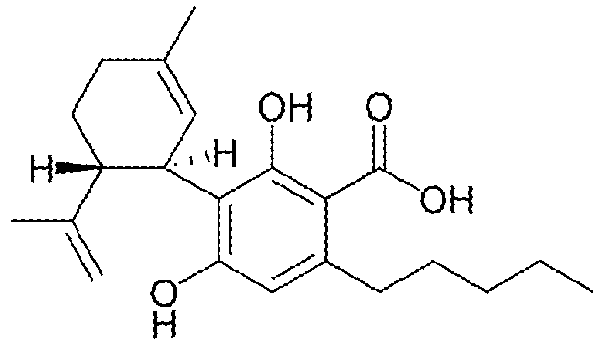
CBDV Cannabidivarin 
CBDVA Cannabidivarinic acid 
THC Tetrahydrocannabinol 
- The table above is not exhaustive and merely details the cannabinoids which are identified in the present application for reference. So far over 60 different cannabinoids have been identified and these cannabinoids can be split into different groups as follows: Phytocannabinoids; Endocannabinoids and Synthetic cannabinoids (which may be novel cannabinoids or synthetically produced phytocannabinoids or endocannabinoids).
- "Phytocannabinoids" are cannabinoids that originate from nature and can be found in the cannabis plant. The phytocannabinoids can be isolated from plants to produce a highly purified extract or can be reproduced synthetically.
- "Highly purified cannabinoid extracts" are defined as cannabinoids that have been extracted from the cannabis plant and purified to the extent that other cannabinoids and non-cannabinoid components that are co-extracted with the cannabinoids have been substantially removed, such that the highly purified cannabinoid is greater than or equal to 98% (w/w) pure.
- "Synthetic cannabinoids" are compounds that have a cannabinoid or cannabinoid-like structure and are manufactured using chemical means rather than by the plant.
- Phytocannabinoids can be obtained as either the neutral (decarboxylated form) or the carboxylic acid form depending on the method used to extract the cannabinoids. For example, it is known that heating the carboxylic acid form will cause most of the carboxylic acid form to decarboxylate into the neutral form.
- "Treatment-resistant epilepsy" (TRE) or "intractable epilepsy" is defined as per the ILAE guidance of 2009 as epilepsy that is not adequately controlled by trials of one or more AED. Treatment resistant epilepsies such as Dravet syndrome or Lennox-Gastaut syndrome are difficult to treat childhood epilepsies. Often the treatment of seizures in patients with these syndromes involves the use of adjunctive therapy, e.g., treatment with more than one anti-epileptic drugs concurrently.
- "Childhood epilepsy" refers to the many different syndromes and genetic mutations that can occur to cause epilepsy in childhood. Examples of some of these are as follows: Dravet Syndrome; Myoclonic-Absence Epilepsy; Lennox-Gastaut syndrome; Generalized Epilepsy of unknown origin; CDKL5 mutation; Aicardi syndrome; tuberous sclerosis complex; bilateral polymicrogyria; Dup15q; SNAP25; and febrile infection related epilepsy syndrome (FIRES); benign rolandic epilepsy; juvenile myoclonic epilepsy; infantile spasm (West syndrome); and Landau-Kleffner syndrome. The list above is non-exhaustive as many different childhood epilepsies exist.
- The following describes the production of the highly-purified (>98% w/w) cannabidiol extract which has a known and constant composition was used in the Examples below.
- In summary the drug substance used is a liquid carbon dioxide extract of high-CBD containing chemotypes of Cannabis sativa L. which had been further purified by a solvent crystallization method to yield CBD. The crystallisation process specifically removes other cannabinoids and plant components to yield greater than 98% CBD. Although the CBD is highly purified because it is produced from a cannabis plant rather than synthetically there is a small number of other cannabinoids which are co-produced and co-extracted with the CBD. Details of these cannabinoids and the quantities in which they are present in the medication are as described in Table 5 below.
Table 5: Composition of highly purified CBD extract Cannabinoid Concentration CBD > 98% w/w CBDA NMT 0.15% w/w CBDV NMT 1.0% w/w Δ9 THC NMT 0.15% w/w CBD-C4 NMT 0.5% w/w > - greater than
NMT - not more than - The efficacy of CBD for the adjunctive treatment of seizures associated with Dravet syndrome was demonstrated in a single trial in patients aged 2 -18 years. Following completion of a 4-week baseline period, patients were randomized to receive either 20 mg/kg/day CBD (n=61) or placebo (n=59). CBD or placebo were added to their current anti-epileptic treatment which remained stable over the treatment period of the study.
- All patients had a diagnosis of treatment-resistant Dravet syndrome and seizures were inadequately controlled with one or more concomitant anti-epileptic drugs (AEDs) with or without vagal nerve stimulation or ketogenic diet.
- Seizure counts were reported daily via an Interactive Voice Response System. Convulsive seizures were defined as all countable atonic, tonic, clonic, and tonic-clonic seizures. The primary efficacy end point was percent change from baseline in convulsive seizures.
- At baseline, disease state characteristics were comparable between groups with 72.5% reporting an increase in seizure frequency with prior treatment and 15% never experiencing a reduction in seizure frequency with previous medications.
- During a 4-week baseline period, patients were required to have at least 4 convulsive seizures (tonic-clonic, clonic, tonic or atonic) while on stable AED therapy. Patients had previously failed a median of 4 prior AEDs and 93% were taking 2 or more concomitant AEDs during the trial. The most commonly used concomitant AEDs (>25% of patients) were clobazam, valproate, stiripentol, levetiracetam, and topiramate.
- The median percent change from baseline in reduction of convulsive seizures in Dravet Syndrome for the CBD 20 mg/kg/day group was statistically superior to placebo (p=0.0123).
- Following the trial statistical analysis was performed on the various patient groups to determine whether there was an interaction between any of the concomitant AEDs that the patients were taking. Data for the interaction between CBD and stiripentol (STP) are described below.
- Table 6 below describes the percentage of patients that recorded a 50% reduction in convulsive seizures over the treatment period.
Table 6: Interaction between CBD and other AEDs Combination of AEDs Percentage of patients with greater than 50% reduction in seizures Stiripentol 14% Stiripentol + Clobazam 8% Stiripentol + CBD 43% Stiripentol + Clobazam + CBD 26% - As is shown, 14% of patients that were taking stiripentol and placebo experienced a greater than 50% reduction in the number of seizures from the number recorded during the 4 week baseline recording period.
- Surprisingly, there was a reduction in efficacy in patients that were taking stiripentol and clobazam, where only 8% of these patients experienced a greater than 50% reduction in seizures from the baseline rate.
- In the groups that were taking the test compound CBD, there was an increase in efficacy in both groups. It was found that 43% of patients that were on stiripentol and CBD obtained a greater than 50% reduction in convulsive seizures, whereas 26% of patients that were taking stiripentol, clobazam and CBD obtained a greater than 50% reduction in seizures.
- The increase in efficacy brought about by the addition of CBD to the AED stiripentol provides a useful combination of therapy. Such an increase in efficacy was unexpected.
- Furthermore, those patients that are already taking a combination of stiripentol and clobazam may benefit from the inclusion of CBD as an adjunct therapy as such an inclusion has been found to reduce the number of seizures.
- As can be seen in Table 3 both stiripentol and clobazam are commonly used AEDs in childhood epilepsy syndromes, furthermore they both work via enhancement of gamma-aminobutyric acid (GABA) A-receptor agonism.
- Stiripentol is a positive allosteric modulator of GABA-A receptors in the brain that enhances the opening duration of the channel by binding to a site different than the benzodiazepine binding site. Reduced synaptosomal uptake of GABA and/or inhibition of GABA transaminase may also explain the role of stiripentol in reducing seizures.
- Clobazam binds at distinct binding sites at the post-synaptic GABA receptor. These GABA receptors are in various locations in the CNS (limbic, reticular formation) and clobazam increases the duration of time for which the receptor is open. As a result, hyper polarization and stabilization of the membrane occur as the post-synaptic inhibitory effect of GABA is enhanced.
- Combination of CBD with AEDs that work as GABA receptor agonists may therefore prove to be of particular benefit in the treatment of childhood epilepsy syndromes.
- As part of an open-label, fixed sequence, healthy volunteer trial the primary objective was to investigate the impact of CBD (750 mg twice daily) on the steady-state pharmacokinetics of stiripentol (STP) (750 mg) and the reciprocal effect on CBD, 7-hydroxy-cannabidiol (7-OH-CBD) and 7-carboxy-cannabidiol (7-COOH-CBD).
- Analyte plasma concentrations were determined using validated bioanalytical methods. A secondary objective was to evaluate the safety and tolerability of CBD when co-administered with STP.
- When CBD was combined with STP (12 subjects) there was a 1.28- to 1.55-fold increase in exposure (Cmax and AUCtau). Co-administration of STP with CBD had no effect on CBD exposure; however, STP reduced 7-OH-CBD and 7-COOH-CBD exposure by 29% and 13% respectively.
- The most common adverse event (AE) was diarrhoea, none of the effects on analyte exposure observed were likely to be clinically relevant or correlated with incidence or severity of AEs.
- The above data demonstrate that the combination of CBD with STP provides a safe and efficacious combination treatment option.
Claims (8)
- Cannabidiol (CBD) for use in the reduction of seizures in treatment-resistant Dravet syndrome, wherein the CBD is administered in combination with stiripentol.
- Cannabidiol (CBD) for use according to claim 1, wherein the CBD is in the form of a highly purified extract of cannabis which comprises at least 98% (w/w) CBD.
- Cannabidiol (CBD) for use according to claim 2, wherein the highly purified extract comprises less than 0.15% tetrahydrocannabinol (THC).
- Cannabidiol (CBD) for use according to claim 2, wherein the extract further comprises up to 1% cannabidivarin (CBDV).
- Cannabidiol (CBD) for use according to claim 1, wherein the CBD is present as a synthetic compound.
- Cannabidiol (CBD) for use according to any of the preceding claims, wherein the dose of CBD is below 50 mg/kg/day.
- Cannabidiol (CBD) for use according to any of the preceding claims, wherein the dose of CBD is greater than 10 mg/kg/day.
- Cannabidiol (CBD) for use according to any of the preceding claims, wherein the dose of CBD is greater than 20 mg/kg/day.
Applications Claiming Priority (2)
| Application Number | Priority Date | Filing Date | Title |
|---|---|---|---|
| GB1801158.5A GB2572737A (en) | 2018-01-24 | 2018-01-24 | Use of cannabinoids in the treatment of epilepsy |
| PCT/GB2019/050174 WO2019145700A1 (en) | 2018-01-24 | 2019-01-22 | Use of cannabinoids in the treatment of epilepsy |
Publications (2)
| Publication Number | Publication Date |
|---|---|
| EP3743053A1 EP3743053A1 (en) | 2020-12-02 |
| EP3743053B1 true EP3743053B1 (en) | 2023-11-29 |
Family
ID=61283592
Family Applications (1)
| Application Number | Title | Priority Date | Filing Date |
|---|---|---|---|
| EP19702670.1A Active EP3743053B1 (en) | 2018-01-24 | 2019-01-22 | Use of cannabinoids in the treatment of epilepsy |
Country Status (16)
| Country | Link |
|---|---|
| US (2) | US20200352878A1 (en) |
| EP (1) | EP3743053B1 (en) |
| JP (1) | JP7712079B2 (en) |
| KR (1) | KR102785354B1 (en) |
| CN (1) | CN111670031A (en) |
| AU (1) | AU2019211224B2 (en) |
| BR (1) | BR112020015018A2 (en) |
| CA (1) | CA3089404A1 (en) |
| DK (1) | DK3743053T3 (en) |
| ES (1) | ES2966727T3 (en) |
| FI (1) | FI3743053T3 (en) |
| GB (1) | GB2572737A (en) |
| IL (1) | IL276217B2 (en) |
| MX (1) | MX2020007784A (en) |
| RU (1) | RU2020127876A (en) |
| WO (1) | WO2019145700A1 (en) |
Families Citing this family (36)
| Publication number | Priority date | Publication date | Assignee | Title |
|---|---|---|---|---|
| GB2487712B (en) | 2011-01-04 | 2015-10-28 | Otsuka Pharma Co Ltd | Use of the phytocannabinoid cannabidiol (CBD) in combination with a standard anti-epileptic drug (SAED) in the treatment of epilepsy |
| GB2514054A (en) | 2011-09-29 | 2014-11-12 | Gw Pharma Ltd | A pharmaceutical composition comprising the phytocannabinoids cannabidivarin (CBDV) and cannabidiol (CBD) |
| GB2530001B (en) | 2014-06-17 | 2019-01-16 | Gw Pharma Ltd | Use of cannabidiol in the reduction of convulsive seizure frequency in treatment-resistant epilepsy |
| GB2527599A (en) | 2014-06-27 | 2015-12-30 | Gw Pharma Ltd | Use of 7-OH-Cannabidiol (7-OH-CBD) and/or 7-OH-Cannabidivarin (7-OH-CBDV) in the treatment of epilepsy |
| GB2531281A (en) | 2014-10-14 | 2016-04-20 | Gw Pharma Ltd | Use of cannabidiol in the treatment of intractable epilepsy |
| GB2531282A (en) | 2014-10-14 | 2016-04-20 | Gw Pharma Ltd | Use of cannabinoids in the treatment of epilepsy |
| GB2539472A (en) | 2015-06-17 | 2016-12-21 | Gw Res Ltd | Use of cannabinoids in the treatment of epilepsy |
| GB2541191A (en) | 2015-08-10 | 2017-02-15 | Gw Pharma Ltd | Use of cannabinoids in the treatment of epilepsy |
| GB2551987A (en) | 2016-07-01 | 2018-01-10 | Gw Res Ltd | Oral cannabinoid formulations |
| GB2551986A (en) | 2016-07-01 | 2018-01-10 | Gw Res Ltd | Parenteral formulations |
| GB2560019A (en) | 2017-02-27 | 2018-08-29 | Gw Res Ltd | Use of cannabinoids in the treatment of leukaemia |
| GB2564383B (en) | 2017-06-23 | 2021-04-21 | Gw Res Ltd | Use of cannabidiol in the treatment of tumours assoicated with Tuberous Sclerosis Complex |
| GB201715919D0 (en) | 2017-09-29 | 2017-11-15 | Gw Res Ltd | use of cannabinoids in the treatment of epilepsy |
| GB2568929A (en) | 2017-12-01 | 2019-06-05 | Gw Res Ltd | Use of cannabinoids in the treatment of epilepsy |
| GB2569961B (en) | 2018-01-03 | 2021-12-22 | Gw Res Ltd | Pharmaceutical |
| GB201806953D0 (en) | 2018-04-27 | 2018-06-13 | Gw Res Ltd | Cannabidiol Preparations |
| GB201910389D0 (en) | 2019-07-19 | 2019-09-04 | Gw Pharma Ltd | Novel compounds, methods for their manufacture, and uses thereof |
| GB2588576A (en) | 2019-08-27 | 2021-05-05 | Gw Res Ltd | Use of cannabinoids in the treatment of dyskinesia associated with Parkinson's disease |
| GB201916849D0 (en) | 2019-11-19 | 2020-01-01 | Gw Res Ltd | Cannabidiol-type cannabinoid compound |
| GB201916846D0 (en) | 2019-11-19 | 2020-01-01 | Gw Res Ltd | Cannabidiol-type cannabinoid compound |
| GB201916977D0 (en) | 2019-11-21 | 2020-01-08 | Gw Res Ltd | Cannibidol-type cannabinoid compound |
| GB201916974D0 (en) | 2019-11-21 | 2020-01-08 | Gw Res Ltd | Cannabidol-type cannabinoid compound |
| GB202002754D0 (en) | 2020-02-27 | 2020-04-15 | Gw Res Ltd | Methods of treating tuberous sclerosis complex with cannabidiol and everolimus |
| GB2597308A (en) | 2020-07-20 | 2022-01-26 | Gw Res Ltd | Use of cannabidiol in the treatment of seizures associated with rare epilepsy syndromes related to structural abnormalities of the brain |
| GB2597299A (en) | 2020-07-20 | 2022-01-26 | Gw Res Ltd | Use of cannabidiol in the treatment of seizures associated with rare epilepsy syndromes related to structural abnormalities of the brain |
| GB2597283A (en) | 2020-07-20 | 2022-01-26 | Gw Res Ltd | Use of cannabidiol in the treatment of seizures associated with rare epilepsy syndromes related to structural abnormalities of the brain |
| GB2597300A (en) * | 2020-07-20 | 2022-01-26 | Gw Res Ltd | Use of cannabidiol in the treatment of seizures associated with rare epilepsy syndromes related to structural abnormalities of the brain |
| GB2597321A (en) | 2020-07-20 | 2022-01-26 | Gw Res Ltd | Use of cannabidiol in the treatment of seizures associated with rare epilepsy syndromes related to genetic abnormalities |
| GB2597297A (en) | 2020-07-20 | 2022-01-26 | Gw Res Ltd | Use of cannabidiol in the treatment of seizures associated with rare epilepsy syndromes related to structural abnormalities of the brain |
| GB2597282A (en) * | 2020-07-20 | 2022-01-26 | Gw Res Ltd | Use of cannabidiol in the treatment of seizures associated with rare epilepsy syndromes related to genetic abnormalities |
| GB202013765D0 (en) | 2020-09-02 | 2020-10-14 | Gw Res Ltd | Method of preparing cannabinoids |
| GB2602019A (en) | 2020-12-15 | 2022-06-22 | Gw Res Ltd | Cannabinoid derivative as a pharmaceutically active compound and method of preparation thereof |
| GB2604132A (en) * | 2021-02-25 | 2022-08-31 | Gw Res Ltd | Use of cannabidiol and clobazam in the treatment of childhood-onset epilepsy syndromes |
| US20250025482A1 (en) * | 2021-07-28 | 2025-01-23 | GW Research Limited | Use of cannabidiol in the treatment of epilepsy |
| US12036228B2 (en) | 2022-04-12 | 2024-07-16 | Shackelford Pharma Inc. | Treatment of seizure disorders |
| AU2023321655A1 (en) | 2022-08-12 | 2025-02-13 | Jazz Pharmaceuticals Research Uk Limited | Oral solid dosage forms comprising cannabinoids |
Citations (2)
| Publication number | Priority date | Publication date | Assignee | Title |
|---|---|---|---|---|
| WO2015193668A1 (en) | 2014-06-17 | 2015-12-23 | Gw Pharma Limited | Use of cannabidiol in the treatment of epilepsy |
| GB2539472A (en) * | 2015-06-17 | 2016-12-21 | Gw Res Ltd | Use of cannabinoids in the treatment of epilepsy |
Family Cites Families (5)
| Publication number | Priority date | Publication date | Assignee | Title |
|---|---|---|---|---|
| GB2487712B (en) * | 2011-01-04 | 2015-10-28 | Otsuka Pharma Co Ltd | Use of the phytocannabinoid cannabidiol (CBD) in combination with a standard anti-epileptic drug (SAED) in the treatment of epilepsy |
| GB2531281A (en) * | 2014-10-14 | 2016-04-20 | Gw Pharma Ltd | Use of cannabidiol in the treatment of intractable epilepsy |
| GB2531282A (en) * | 2014-10-14 | 2016-04-20 | Gw Pharma Ltd | Use of cannabinoids in the treatment of epilepsy |
| US10751300B2 (en) * | 2015-01-25 | 2020-08-25 | India Globalization Capital, Inc. | Composition and method for treating seizure disorders |
| GB2548873B (en) * | 2016-03-31 | 2020-12-02 | Gw Res Ltd | Use of Cannabidiol in the Treatment of SturgeWeber Syndrome |
-
2018
- 2018-01-24 GB GB1801158.5A patent/GB2572737A/en not_active Withdrawn
-
2019
- 2019-01-22 KR KR1020207023811A patent/KR102785354B1/en active Active
- 2019-01-22 CN CN201980010033.5A patent/CN111670031A/en active Pending
- 2019-01-22 FI FIEP19702670.1T patent/FI3743053T3/en active
- 2019-01-22 JP JP2020540552A patent/JP7712079B2/en active Active
- 2019-01-22 AU AU2019211224A patent/AU2019211224B2/en active Active
- 2019-01-22 IL IL276217A patent/IL276217B2/en unknown
- 2019-01-22 WO PCT/GB2019/050174 patent/WO2019145700A1/en not_active Ceased
- 2019-01-22 EP EP19702670.1A patent/EP3743053B1/en active Active
- 2019-01-22 ES ES19702670T patent/ES2966727T3/en active Active
- 2019-01-22 CA CA3089404A patent/CA3089404A1/en active Pending
- 2019-01-22 BR BR112020015018-5A patent/BR112020015018A2/en not_active IP Right Cessation
- 2019-01-22 DK DK19702670.1T patent/DK3743053T3/en active
- 2019-01-22 MX MX2020007784A patent/MX2020007784A/en unknown
- 2019-01-22 RU RU2020127876A patent/RU2020127876A/en unknown
- 2019-01-22 US US16/960,665 patent/US20200352878A1/en not_active Abandoned
-
2021
- 2021-12-16 US US17/552,487 patent/US20220249396A1/en not_active Abandoned
Patent Citations (2)
| Publication number | Priority date | Publication date | Assignee | Title |
|---|---|---|---|---|
| WO2015193668A1 (en) | 2014-06-17 | 2015-12-23 | Gw Pharma Limited | Use of cannabidiol in the treatment of epilepsy |
| GB2539472A (en) * | 2015-06-17 | 2016-12-21 | Gw Res Ltd | Use of cannabinoids in the treatment of epilepsy |
Non-Patent Citations (9)
| Title |
|---|
| ANONYMOUS: "Antiepileptic Efficacy Study of GWP42003-P in Children and Young Adults With Dravet Syndrome (GWPCARE1) ", CLINICALTRIALS.GOV; NCT02091375, 27 September 2016 (2016-09-27), XP093210514, Retrieved from the Internet <URL:https://clinicaltrials.gov/study/NCT02091375?term=NCT02091375&rank=1&a=18> |
| ANONYMOUS: "Public summary of opinion on orphan designation - Cannabidiol for the treatment of Dravet syndrome", EUROPEAN MEDICINES AGENCY; EMA/COMP/557465/2014; COMMITTEE FOR ORPHAN MEDICINAL PRODUCTS, 10 November 2014 (2014-11-10), XP093210517, Retrieved from the Internet <URL:https://www.ema.europa.eu/en/documents/orphan-designation/eu3141339-public-summary-opinion-orphan-designation-cannabidiol-treatment-dravet-syndrome_en.pdf> |
| CHARLOTTE DRAVET: "The core Dravet syndrome phenotype", EPILEPSIA, RAVEN PRESS LTD, NEW YORK , US, vol. 52, 1 April 2011 (2011-04-01), New York , US , pages 3 - 9, XP055735374, ISSN: 0013-9580, DOI: 10.1111/j.1528-1167.2011.02994.x |
| EMILIO PERUCCA: "Cannabinoids in the Treatment of Epilepsy: Hard Evidence at Last?", JOURNAL OF EPILEPSY RESEARCH, vol. 7, no. 2, 28 December 2017 (2017-12-28), pages 61 - 76, XP055581907, ISSN: 2233-6249, DOI: 10.14581/jer.17012 |
| ORRIN DEVINSKY, J. HELEN CROSS, LINDA LAUX, ERIC MARSH, IAN MILLER, RIMA NABBOUT, INGRID E. SCHEFFER, ELIZABETH A. THIELE, STEPHEN: "Trial of Cannabidiol for Drug-Resistant Seizures in the Dravet Syndrome", THE NEW ENGLAND JOURNAL OF MEDICINE, MASSACHUSETTS MEDICAL SOCIETY, US, vol. 376, no. 21, 25 May 2017 (2017-05-25), US , pages 2011 - 2020, XP055581640, ISSN: 0028-4793, DOI: 10.1056/NEJMoa1611618 |
| S. WRIGHT ET AL.: "CANNABIDIOL (CBD) IN DRAVET SYNDROME: A RANDOMISED, DOSE-RANGING PHARMACOKINETICS AND SAFETY TRIAL (GWPCARE1)", EPILEPSIA, vol. 58(Suppl.5), 1 September 2017 (2017-09-01), pages s56, XP002790754 |
| VEZYROGLOU KATHARINA; CROSS J. HELEN: "Targeted Treatment in Childhood Epilepsy Syndromes", CURRENT TREATMENT OPTIONS IN NEUROLOGY, SPRINGER US, NEW YORK, vol. 18, no. 6, 7 May 2016 (2016-05-07), New York, pages 1 - 12, XP035680313, ISSN: 1092-8480, DOI: 10.1007/s11940-016-0407-4 |
| WALLACE ADAM, WIRRELL ELAINE, KENNEY-JUNG DANIEL L.: "Pharmacotherapy for Dravet Syndrome", PAEDIATRIC DRUGS, ADIS INTERNATIONAL, AUCKLAND, NZ, vol. 18, no. 3, 1 June 2016 (2016-06-01), NZ , pages 197 - 208, XP009557384, ISSN: 1174-5878, DOI: 10.1007/s40272-016-0171-7 |
| WIRRELL ELAINE C.: "Treatment of Dravet Syndrome", CANADIAN JOURNAL OF NEUROLOGICAL SCIENCES, WINNIPEG, CA, vol. 43, no. S3, 1 June 2016 (2016-06-01), CA , pages S13 - S18, XP093210510, ISSN: 0317-1671, DOI: 10.1017/cjn.2016.249 |
Also Published As
| Publication number | Publication date |
|---|---|
| WO2019145700A1 (en) | 2019-08-01 |
| IL276217A (en) | 2020-09-30 |
| US20220249396A1 (en) | 2022-08-11 |
| AU2019211224B2 (en) | 2024-11-14 |
| JP7712079B2 (en) | 2025-07-23 |
| BR112020015018A2 (en) | 2021-01-19 |
| AU2019211224A1 (en) | 2020-08-13 |
| GB2572737A (en) | 2019-10-16 |
| ES2966727T3 (en) | 2024-04-24 |
| IL276217B1 (en) | 2025-01-01 |
| GB201801158D0 (en) | 2018-03-07 |
| EP3743053A1 (en) | 2020-12-02 |
| RU2020127876A (en) | 2022-02-24 |
| MX2020007784A (en) | 2020-09-18 |
| CN111670031A (en) | 2020-09-15 |
| DK3743053T3 (en) | 2024-01-02 |
| IL276217B2 (en) | 2025-05-01 |
| JP2021511350A (en) | 2021-05-06 |
| KR102785354B1 (en) | 2025-03-20 |
| KR20200112896A (en) | 2020-10-05 |
| FI3743053T3 (en) | 2023-12-14 |
| CA3089404A1 (en) | 2019-08-01 |
| RU2020127876A3 (en) | 2022-02-24 |
| US20200352878A1 (en) | 2020-11-12 |
Similar Documents
| Publication | Publication Date | Title |
|---|---|---|
| EP3743053B1 (en) | Use of cannabinoids in the treatment of epilepsy | |
| AU2023258400B2 (en) | Use of cannabinoids in the treatment of epilepsy | |
| AU2018374550B2 (en) | Use of cannabinoids in the treatment of epilepsy | |
| AU2024216397A1 (en) | Use of cannabinoids in the treatment of seizures associated with Lennox-Gastaut syndrome | |
| US20250177321A1 (en) | Use of cannabinoids in the treatment of epilepsy | |
| US20200138738A1 (en) | Use of cannabinoids in the treatment of epilepsy | |
| EP3206715B1 (en) | Use of cannabidiol in the treatment of tuberous sclerosis complex | |
| EP3157512B1 (en) | Use of cannabidiol in the treatment of epilepsy | |
| EP3886825A1 (en) | Use of cannabinoids in the treatment of epilepsy | |
| GB2539472A (en) | Use of cannabinoids in the treatment of epilepsy | |
| HK40040845A (en) | Use of cannabinoids in the treatment of epilepsy | |
| HK40040845B (en) | Use of cannabinoids in the treatment of epilepsy |
Legal Events
| Date | Code | Title | Description |
|---|---|---|---|
| STAA | Information on the status of an ep patent application or granted ep patent |
Free format text: STATUS: UNKNOWN |
|
| STAA | Information on the status of an ep patent application or granted ep patent |
Free format text: STATUS: THE INTERNATIONAL PUBLICATION HAS BEEN MADE |
|
| PUAI | Public reference made under article 153(3) epc to a published international application that has entered the european phase |
Free format text: ORIGINAL CODE: 0009012 |
|
| STAA | Information on the status of an ep patent application or granted ep patent |
Free format text: STATUS: REQUEST FOR EXAMINATION WAS MADE |
|
| 17P | Request for examination filed |
Effective date: 20200806 |
|
| AK | Designated contracting states |
Kind code of ref document: A1 Designated state(s): AL AT BE BG CH CY CZ DE DK EE ES FI FR GB GR HR HU IE IS IT LI LT LU LV MC MK MT NL NO PL PT RO RS SE SI SK SM TR |
|
| AX | Request for extension of the european patent |
Extension state: BA ME |
|
| DAV | Request for validation of the european patent (deleted) | ||
| DAX | Request for extension of the european patent (deleted) | ||
| REG | Reference to a national code |
Ref country code: HK Ref legal event code: DE Ref document number: 40040845 Country of ref document: HK |
|
| STAA | Information on the status of an ep patent application or granted ep patent |
Free format text: STATUS: EXAMINATION IS IN PROGRESS |
|
| 17Q | First examination report despatched |
Effective date: 20220825 |
|
| GRAP | Despatch of communication of intention to grant a patent |
Free format text: ORIGINAL CODE: EPIDOSNIGR1 |
|
| STAA | Information on the status of an ep patent application or granted ep patent |
Free format text: STATUS: GRANT OF PATENT IS INTENDED |
|
| INTG | Intention to grant announced |
Effective date: 20230719 |
|
| GRAS | Grant fee paid |
Free format text: ORIGINAL CODE: EPIDOSNIGR3 |
|
| GRAA | (expected) grant |
Free format text: ORIGINAL CODE: 0009210 |
|
| STAA | Information on the status of an ep patent application or granted ep patent |
Free format text: STATUS: THE PATENT HAS BEEN GRANTED |
|
| P01 | Opt-out of the competence of the unified patent court (upc) registered |
Effective date: 20231009 |
|
| AK | Designated contracting states |
Kind code of ref document: B1 Designated state(s): AL AT BE BG CH CY CZ DE DK EE ES FI FR GB GR HR HU IE IS IT LI LT LU LV MC MK MT NL NO PL PT RO RS SE SI SK SM TR |
|
| REG | Reference to a national code |
Ref country code: GB Ref legal event code: FG4D |
|
| REG | Reference to a national code |
Ref country code: CH Ref legal event code: EP |
|
| REG | Reference to a national code |
Ref country code: FI Ref legal event code: FGE Ref country code: DE Ref legal event code: R096 Ref document number: 602019042300 Country of ref document: DE |
|
| REG | Reference to a national code |
Ref country code: IE Ref legal event code: FG4D |
|
| REG | Reference to a national code |
Ref country code: NO Ref legal event code: T2 Effective date: 20231129 |
|
| REG | Reference to a national code |
Ref country code: SE Ref legal event code: TRGR Ref country code: DK Ref legal event code: T3 Effective date: 20231218 |
|
| REG | Reference to a national code |
Ref country code: NL Ref legal event code: FP |
|
| REG | Reference to a national code |
Ref country code: LT Ref legal event code: MG9D |
|
| PG25 | Lapsed in a contracting state [announced via postgrant information from national office to epo] |
Ref country code: GR Free format text: LAPSE BECAUSE OF FAILURE TO SUBMIT A TRANSLATION OF THE DESCRIPTION OR TO PAY THE FEE WITHIN THE PRESCRIBED TIME-LIMIT Effective date: 20240301 |
|
| PG25 | Lapsed in a contracting state [announced via postgrant information from national office to epo] |
Ref country code: IS Free format text: LAPSE BECAUSE OF FAILURE TO SUBMIT A TRANSLATION OF THE DESCRIPTION OR TO PAY THE FEE WITHIN THE PRESCRIBED TIME-LIMIT Effective date: 20240329 |
|
| PG25 | Lapsed in a contracting state [announced via postgrant information from national office to epo] |
Ref country code: LT Free format text: LAPSE BECAUSE OF FAILURE TO SUBMIT A TRANSLATION OF THE DESCRIPTION OR TO PAY THE FEE WITHIN THE PRESCRIBED TIME-LIMIT Effective date: 20231129 |
|
| REG | Reference to a national code |
Ref country code: ES Ref legal event code: FG2A Ref document number: 2966727 Country of ref document: ES Kind code of ref document: T3 Effective date: 20240424 |
|
| PG25 | Lapsed in a contracting state [announced via postgrant information from national office to epo] |
Ref country code: LT Free format text: LAPSE BECAUSE OF FAILURE TO SUBMIT A TRANSLATION OF THE DESCRIPTION OR TO PAY THE FEE WITHIN THE PRESCRIBED TIME-LIMIT Effective date: 20231129 Ref country code: IS Free format text: LAPSE BECAUSE OF FAILURE TO SUBMIT A TRANSLATION OF THE DESCRIPTION OR TO PAY THE FEE WITHIN THE PRESCRIBED TIME-LIMIT Effective date: 20240329 Ref country code: GR Free format text: LAPSE BECAUSE OF FAILURE TO SUBMIT A TRANSLATION OF THE DESCRIPTION OR TO PAY THE FEE WITHIN THE PRESCRIBED TIME-LIMIT Effective date: 20240301 Ref country code: BG Free format text: LAPSE BECAUSE OF FAILURE TO SUBMIT A TRANSLATION OF THE DESCRIPTION OR TO PAY THE FEE WITHIN THE PRESCRIBED TIME-LIMIT Effective date: 20240229 |
|
| PG25 | Lapsed in a contracting state [announced via postgrant information from national office to epo] |
Ref country code: RS Free format text: LAPSE BECAUSE OF FAILURE TO SUBMIT A TRANSLATION OF THE DESCRIPTION OR TO PAY THE FEE WITHIN THE PRESCRIBED TIME-LIMIT Effective date: 20231129 Ref country code: PL Free format text: LAPSE BECAUSE OF FAILURE TO SUBMIT A TRANSLATION OF THE DESCRIPTION OR TO PAY THE FEE WITHIN THE PRESCRIBED TIME-LIMIT Effective date: 20231129 Ref country code: LV Free format text: LAPSE BECAUSE OF FAILURE TO SUBMIT A TRANSLATION OF THE DESCRIPTION OR TO PAY THE FEE WITHIN THE PRESCRIBED TIME-LIMIT Effective date: 20231129 Ref country code: HR Free format text: LAPSE BECAUSE OF FAILURE TO SUBMIT A TRANSLATION OF THE DESCRIPTION OR TO PAY THE FEE WITHIN THE PRESCRIBED TIME-LIMIT Effective date: 20231129 |
|
| REG | Reference to a national code |
Ref country code: AT Ref legal event code: UEP Ref document number: 1635396 Country of ref document: AT Kind code of ref document: T Effective date: 20231129 |
|
| PG25 | Lapsed in a contracting state [announced via postgrant information from national office to epo] |
Ref country code: CZ Free format text: LAPSE BECAUSE OF FAILURE TO SUBMIT A TRANSLATION OF THE DESCRIPTION OR TO PAY THE FEE WITHIN THE PRESCRIBED TIME-LIMIT Effective date: 20231129 |
|
| PG25 | Lapsed in a contracting state [announced via postgrant information from national office to epo] |
Ref country code: SK Free format text: LAPSE BECAUSE OF FAILURE TO SUBMIT A TRANSLATION OF THE DESCRIPTION OR TO PAY THE FEE WITHIN THE PRESCRIBED TIME-LIMIT Effective date: 20231129 |
|
| PG25 | Lapsed in a contracting state [announced via postgrant information from national office to epo] |
Ref country code: SM Free format text: LAPSE BECAUSE OF FAILURE TO SUBMIT A TRANSLATION OF THE DESCRIPTION OR TO PAY THE FEE WITHIN THE PRESCRIBED TIME-LIMIT Effective date: 20231129 Ref country code: SK Free format text: LAPSE BECAUSE OF FAILURE TO SUBMIT A TRANSLATION OF THE DESCRIPTION OR TO PAY THE FEE WITHIN THE PRESCRIBED TIME-LIMIT Effective date: 20231129 Ref country code: RO Free format text: LAPSE BECAUSE OF FAILURE TO SUBMIT A TRANSLATION OF THE DESCRIPTION OR TO PAY THE FEE WITHIN THE PRESCRIBED TIME-LIMIT Effective date: 20231129 Ref country code: EE Free format text: LAPSE BECAUSE OF FAILURE TO SUBMIT A TRANSLATION OF THE DESCRIPTION OR TO PAY THE FEE WITHIN THE PRESCRIBED TIME-LIMIT Effective date: 20231129 Ref country code: CZ Free format text: LAPSE BECAUSE OF FAILURE TO SUBMIT A TRANSLATION OF THE DESCRIPTION OR TO PAY THE FEE WITHIN THE PRESCRIBED TIME-LIMIT Effective date: 20231129 |
|
| PG25 | Lapsed in a contracting state [announced via postgrant information from national office to epo] |
Ref country code: PT Free format text: LAPSE BECAUSE OF FAILURE TO SUBMIT A TRANSLATION OF THE DESCRIPTION OR TO PAY THE FEE WITHIN THE PRESCRIBED TIME-LIMIT Effective date: 20240401 |
|
| PG25 | Lapsed in a contracting state [announced via postgrant information from national office to epo] |
Ref country code: MC Free format text: LAPSE BECAUSE OF FAILURE TO SUBMIT A TRANSLATION OF THE DESCRIPTION OR TO PAY THE FEE WITHIN THE PRESCRIBED TIME-LIMIT Effective date: 20231129 |
|
| REG | Reference to a national code |
Ref country code: DE Ref legal event code: R026 Ref document number: 602019042300 Country of ref document: DE |
|
| PG25 | Lapsed in a contracting state [announced via postgrant information from national office to epo] |
Ref country code: PT Free format text: LAPSE BECAUSE OF FAILURE TO SUBMIT A TRANSLATION OF THE DESCRIPTION OR TO PAY THE FEE WITHIN THE PRESCRIBED TIME-LIMIT Effective date: 20240401 Ref country code: MC Free format text: LAPSE BECAUSE OF FAILURE TO SUBMIT A TRANSLATION OF THE DESCRIPTION OR TO PAY THE FEE WITHIN THE PRESCRIBED TIME-LIMIT Effective date: 20231129 |
|
| PLBI | Opposition filed |
Free format text: ORIGINAL CODE: 0009260 |
|
| PLAB | Opposition data, opponent's data or that of the opponent's representative modified |
Free format text: ORIGINAL CODE: 0009299OPPO |
|
| PLAX | Notice of opposition and request to file observation + time limit sent |
Free format text: ORIGINAL CODE: EPIDOSNOBS2 |
|
| 26 | Opposition filed |
Opponent name: KRAUS & LEDERER PARTGMBB Effective date: 20240827 |
|
| R26 | Opposition filed (corrected) |
Opponent name: KRAUS & LEDERER PARTGMBB Effective date: 20240827 |
|
| PG25 | Lapsed in a contracting state [announced via postgrant information from national office to epo] |
Ref country code: SI Free format text: LAPSE BECAUSE OF FAILURE TO SUBMIT A TRANSLATION OF THE DESCRIPTION OR TO PAY THE FEE WITHIN THE PRESCRIBED TIME-LIMIT Effective date: 20231129 |
|
| PG25 | Lapsed in a contracting state [announced via postgrant information from national office to epo] |
Ref country code: SI Free format text: LAPSE BECAUSE OF FAILURE TO SUBMIT A TRANSLATION OF THE DESCRIPTION OR TO PAY THE FEE WITHIN THE PRESCRIBED TIME-LIMIT Effective date: 20231129 |
|
| PLBB | Reply of patent proprietor to notice(s) of opposition received |
Free format text: ORIGINAL CODE: EPIDOSNOBS3 |
|
| REG | Reference to a national code |
Ref country code: LU Ref legal event code: HC Owner name: JAZZ PHARMACEUTICALS RESEARCH UK LIMITED; GB Free format text: FORMER OWNER: GW RESEARCH LIMITED Effective date: 20250718 |
|
| PG25 | Lapsed in a contracting state [announced via postgrant information from national office to epo] |
Ref country code: CY Free format text: LAPSE BECAUSE OF FAILURE TO SUBMIT A TRANSLATION OF THE DESCRIPTION OR TO PAY THE FEE WITHIN THE PRESCRIBED TIME-LIMIT; INVALID AB INITIO Effective date: 20190122 |
|
| REG | Reference to a national code |
Ref country code: BE Ref legal event code: HC Owner name: JAZZ PHARMACEUTICALS OPERATIONS UK LIMITED; GB Free format text: DETAILS ASSIGNMENT: CHANGE OF OWNER(S), CHANGE OF OWNER(S) NAME; FORMER OWNER NAME: GW RESEARCH LIMITED Effective date: 20250526 Ref country code: BE Ref legal event code: HC Owner name: JAZZ PHARMACEUTICALS RESEARCH UK LIMITED; GB Free format text: DETAILS ASSIGNMENT: CHANGE OF OWNER(S), CHANGE OF OWNER(S) NAME; FORMER OWNER NAME: GW RESEARCH LIMITED Effective date: 20250526 |
|
| REG | Reference to a national code |
Ref country code: NL Ref legal event code: HC Owner name: JAZZ PHARMACEUTICALS RESEARCH UK LIMITED; GB Free format text: DETAILS ASSIGNMENT: CHANGE OF OWNER(S), CHANGE OF OWNER(S) NAME; FORMER OWNER NAME: GW RESEARCH LIMITED Effective date: 20250813 |
|
| PG25 | Lapsed in a contracting state [announced via postgrant information from national office to epo] |
Ref country code: HU Free format text: LAPSE BECAUSE OF FAILURE TO SUBMIT A TRANSLATION OF THE DESCRIPTION OR TO PAY THE FEE WITHIN THE PRESCRIBED TIME-LIMIT; INVALID AB INITIO Effective date: 20190122 |
|
| PG25 | Lapsed in a contracting state [announced via postgrant information from national office to epo] |
Ref country code: TR Free format text: LAPSE BECAUSE OF FAILURE TO SUBMIT A TRANSLATION OF THE DESCRIPTION OR TO PAY THE FEE WITHIN THE PRESCRIBED TIME-LIMIT Effective date: 20231129 |
|
| PGFP | Annual fee paid to national office [announced via postgrant information from national office to epo] |
Ref country code: GB Payment date: 20251204 Year of fee payment: 8 |
|
| PGFP | Annual fee paid to national office [announced via postgrant information from national office to epo] |
Ref country code: FI Payment date: 20251230 Year of fee payment: 8 |
|
| PGFP | Annual fee paid to national office [announced via postgrant information from national office to epo] |
Ref country code: NL Payment date: 20251215 Year of fee payment: 8 Ref country code: FR Payment date: 20251128 Year of fee payment: 8 |
|
| REG | Reference to a national code |
Ref country code: AT Ref legal event code: HC Ref document number: 1635396 Country of ref document: AT Kind code of ref document: T Owner name: JAZZ PHARMACEUTICALS RESEARCH UK LIMITED, GB Effective date: 20251124 |
|
| PGFP | Annual fee paid to national office [announced via postgrant information from national office to epo] |
Ref country code: SE Payment date: 20251126 Year of fee payment: 8 |
|
| PGFP | Annual fee paid to national office [announced via postgrant information from national office to epo] |
Ref country code: IE Payment date: 20251126 Year of fee payment: 8 |
|
| REG | Reference to a national code |
Ref country code: CH Ref legal event code: U11 Free format text: ST27 STATUS EVENT CODE: U-0-0-U10-U11 (AS PROVIDED BY THE NATIONAL OFFICE) Effective date: 20260201 |
|
| PGFP | Annual fee paid to national office [announced via postgrant information from national office to epo] |
Ref country code: LU Payment date: 20260116 Year of fee payment: 8 |
|
| PGFP | Annual fee paid to national office [announced via postgrant information from national office to epo] |
Ref country code: ES Payment date: 20260209 Year of fee payment: 8 |
|
| PGFP | Annual fee paid to national office [announced via postgrant information from national office to epo] |
Ref country code: NO Payment date: 20260109 Year of fee payment: 8 Ref country code: DE Payment date: 20251126 Year of fee payment: 8 Ref country code: DK Payment date: 20260113 Year of fee payment: 8 |
|
| PGFP | Annual fee paid to national office [announced via postgrant information from national office to epo] |
Ref country code: AT Payment date: 20251230 Year of fee payment: 8 |
|
| PGFP | Annual fee paid to national office [announced via postgrant information from national office to epo] |
Ref country code: BE Payment date: 20260106 Year of fee payment: 8 Ref country code: IT Payment date: 20251219 Year of fee payment: 8 |
|
| RDAF | Communication despatched that patent is revoked |
Free format text: ORIGINAL CODE: EPIDOSNREV1 |
|
| PGFP | Annual fee paid to national office [announced via postgrant information from national office to epo] |
Ref country code: CH Payment date: 20260201 Year of fee payment: 8 |