EP3742745A1 - Method and device for retransmitting packet via wireless fidelity link - Google Patents
Method and device for retransmitting packet via wireless fidelity link Download PDFInfo
- Publication number
- EP3742745A1 EP3742745A1 EP19771087.4A EP19771087A EP3742745A1 EP 3742745 A1 EP3742745 A1 EP 3742745A1 EP 19771087 A EP19771087 A EP 19771087A EP 3742745 A1 EP3742745 A1 EP 3742745A1
- Authority
- EP
- European Patent Office
- Prior art keywords
- wireless fidelity
- link
- packet
- gateway
- fidelity link
- Prior art date
- Legal status (The legal status is an assumption and is not a legal conclusion. Google has not performed a legal analysis and makes no representation as to the accuracy of the status listed.)
- Pending
Links
Images

Classifications
-
- H—ELECTRICITY
- H04—ELECTRIC COMMUNICATION TECHNIQUE
- H04L—TRANSMISSION OF DIGITAL INFORMATION, e.g. TELEGRAPHIC COMMUNICATION
- H04L45/00—Routing or path finding of packets in data switching networks
- H04L45/22—Alternate routing
-
- H—ELECTRICITY
- H04—ELECTRIC COMMUNICATION TECHNIQUE
- H04L—TRANSMISSION OF DIGITAL INFORMATION, e.g. TELEGRAPHIC COMMUNICATION
- H04L1/00—Arrangements for detecting or preventing errors in the information received
- H04L1/12—Arrangements for detecting or preventing errors in the information received by using return channel
- H04L1/16—Arrangements for detecting or preventing errors in the information received by using return channel in which the return channel carries supervisory signals, e.g. repetition request signals
- H04L1/18—Automatic repetition systems, e.g. Van Duuren systems
- H04L1/1812—Hybrid protocols; Hybrid automatic repeat request [HARQ]
- H04L1/1816—Hybrid protocols; Hybrid automatic repeat request [HARQ] with retransmission of the same, encoded, message
-
- H—ELECTRICITY
- H04—ELECTRIC COMMUNICATION TECHNIQUE
- H04L—TRANSMISSION OF DIGITAL INFORMATION, e.g. TELEGRAPHIC COMMUNICATION
- H04L47/00—Traffic control in data switching networks
- H04L47/10—Flow control; Congestion control
- H04L47/11—Identifying congestion
-
- H—ELECTRICITY
- H04—ELECTRIC COMMUNICATION TECHNIQUE
- H04N—PICTORIAL COMMUNICATION, e.g. TELEVISION
- H04N21/00—Selective content distribution, e.g. interactive television or video on demand [VOD]
- H04N21/40—Client devices specifically adapted for the reception of or interaction with content, e.g. set-top-box [STB]; Operations thereof
- H04N21/43—Processing of content or additional data, e.g. demultiplexing additional data from a digital video stream; Elementary client operations, e.g. monitoring of home network or synchronising decoder's clock; Client middleware
- H04N21/436—Interfacing a local distribution network, e.g. communicating with another STB or one or more peripheral devices inside the home
- H04N21/4363—Adapting the video stream to a specific local network, e.g. a Bluetooth® network
- H04N21/43637—Adapting the video stream to a specific local network, e.g. a Bluetooth® network involving a wireless protocol, e.g. Bluetooth®, RF or wireless LAN [IEEE 802.11]
-
- H—ELECTRICITY
- H04—ELECTRIC COMMUNICATION TECHNIQUE
- H04N—PICTORIAL COMMUNICATION, e.g. TELEVISION
- H04N21/00—Selective content distribution, e.g. interactive television or video on demand [VOD]
- H04N21/60—Network structure or processes for video distribution between server and client or between remote clients; Control signalling between clients, server and network components; Transmission of management data between server and client, e.g. sending from server to client commands for recording incoming content stream; Communication details between server and client
- H04N21/61—Network physical structure; Signal processing
- H04N21/6106—Network physical structure; Signal processing specially adapted to the downstream path of the transmission network
- H04N21/6131—Network physical structure; Signal processing specially adapted to the downstream path of the transmission network involving transmission via a mobile phone network
-
- H—ELECTRICITY
- H04—ELECTRIC COMMUNICATION TECHNIQUE
- H04N—PICTORIAL COMMUNICATION, e.g. TELEVISION
- H04N21/00—Selective content distribution, e.g. interactive television or video on demand [VOD]
- H04N21/60—Network structure or processes for video distribution between server and client or between remote clients; Control signalling between clients, server and network components; Transmission of management data between server and client, e.g. sending from server to client commands for recording incoming content stream; Communication details between server and client
- H04N21/63—Control signaling related to video distribution between client, server and network components; Network processes for video distribution between server and clients or between remote clients, e.g. transmitting basic layer and enhancement layers over different transmission paths, setting up a peer-to-peer communication via Internet between remote STB's; Communication protocols; Addressing
- H04N21/637—Control signals issued by the client directed to the server or network components
- H04N21/6375—Control signals issued by the client directed to the server or network components for requesting retransmission, e.g. of data packets lost or corrupted during transmission from server
-
- H—ELECTRICITY
- H04—ELECTRIC COMMUNICATION TECHNIQUE
- H04N—PICTORIAL COMMUNICATION, e.g. TELEVISION
- H04N21/00—Selective content distribution, e.g. interactive television or video on demand [VOD]
- H04N21/60—Network structure or processes for video distribution between server and client or between remote clients; Control signalling between clients, server and network components; Transmission of management data between server and client, e.g. sending from server to client commands for recording incoming content stream; Communication details between server and client
- H04N21/63—Control signaling related to video distribution between client, server and network components; Network processes for video distribution between server and clients or between remote clients, e.g. transmitting basic layer and enhancement layers over different transmission paths, setting up a peer-to-peer communication via Internet between remote STB's; Communication protocols; Addressing
- H04N21/647—Control signaling between network components and server or clients; Network processes for video distribution between server and clients, e.g. controlling the quality of the video stream, by dropping packets, protecting content from unauthorised alteration within the network, monitoring of network load, bridging between two different networks, e.g. between IP and wireless
- H04N21/64723—Monitoring of network processes or resources, e.g. monitoring of network load
- H04N21/64738—Monitoring network characteristics, e.g. bandwidth, congestion level
-
- H—ELECTRICITY
- H04—ELECTRIC COMMUNICATION TECHNIQUE
- H04W—WIRELESS COMMUNICATION NETWORKS
- H04W40/00—Communication routing or communication path finding
- H04W40/02—Communication route or path selection, e.g. power-based or shortest path routing
- H04W40/12—Communication route or path selection, e.g. power-based or shortest path routing based on transmission quality or channel quality
- H04W40/125—Communication route or path selection, e.g. power-based or shortest path routing based on transmission quality or channel quality using a measured number of retransmissions as a link metric
-
- H—ELECTRICITY
- H04—ELECTRIC COMMUNICATION TECHNIQUE
- H04W—WIRELESS COMMUNICATION NETWORKS
- H04W40/00—Communication routing or communication path finding
- H04W40/02—Communication route or path selection, e.g. power-based or shortest path routing
- H04W40/12—Communication route or path selection, e.g. power-based or shortest path routing based on transmission quality or channel quality
- H04W40/16—Communication route or path selection, e.g. power-based or shortest path routing based on transmission quality or channel quality based on interference
-
- H—ELECTRICITY
- H04—ELECTRIC COMMUNICATION TECHNIQUE
- H04W—WIRELESS COMMUNICATION NETWORKS
- H04W28/00—Network traffic management; Network resource management
- H04W28/02—Traffic management, e.g. flow control or congestion control
- H04W28/0289—Congestion control
-
- H—ELECTRICITY
- H04—ELECTRIC COMMUNICATION TECHNIQUE
- H04W—WIRELESS COMMUNICATION NETWORKS
- H04W40/00—Communication routing or communication path finding
- H04W40/02—Communication route or path selection, e.g. power-based or shortest path routing
- H04W40/18—Communication route or path selection, e.g. power-based or shortest path routing based on predicted events
Definitions
- the present invention relates to the communications field, and in particular, to a method for retransmitting a packet on a wireless fidelity (WIreless-FIdelity, WIFI) link and an apparatus.
- WIFI wireless fidelity
- Wi-Fi links are often used as data channels for carrying video streams when video services, such as IP television (Internet Protocol Television, IPTV) and OTT (over the top) video services, are deployed in hotels and homes.
- video services such as IP television (Internet Protocol Television, IPTV) and OTT (over the top) video services
- IPTV Internet Protocol Television
- OTT over the top
- operating frequency bands of a wireless fidelity link include 2.4 GHz and 5 GHz.
- the 2.4 GHz operating frequency band features low signal attenuation and large coverage.
- the 5 GHz operating frequency band features high bandwidth, many selectable channels, less contention, and low interference.
- a video service requires high bandwidth and is sensitive to a latency and a packet loss. Therefore, a 5 GHz Wi-Fi link is usually used for carrying the video service for a mid- and high-end product.
- a Wi-Fi link uses an air interface for transmission and is unstable. Inevitably, even a 5 GHz link with high bandwidth is sometimes incapable of carrying a video due to insufficient quality of the link. For example, distant deployment results in insufficient signal strength; another device that operates on a 5 GHz frequency band generates interference; receiving of a radar signal triggers an avoidance mechanism and leads to switching of an operating channel; and a negotiated rate selection algorithm causes rate fluctuation. In this case, a packet loss on a Wi-Fi air interface, queue congestion, and a latency increase may occur. As a result, artifacts or even frame freezing of video services may be further caused.
- Embodiments of the present invention provide a method for retransmitting a packet on a wireless fidelity link and an apparatus, to ensure a response speed and a success rate of video packet retransmission and reduce artifacts and frame freezing of a video service.
- a method for retransmitting a packet on a wireless fidelity link including: A gateway first receives a packet retransmission request sent by a user terminal and determines a packet that needs to be retransmitted; the gateway detects a downlink quality indicator on a gateway side of a first wireless fidelity link and a downlink quality indicator on a gateway side of a second wireless fidelity link, and determines a link for retransmitting the packet, based on the downlink quality indicator on the gateway side of the first wireless fidelity link and the downlink quality indicator on the gateway side of the second wireless fidelity link; and the gateway sends, to the user terminal on the determined link for retransmitting the packet, the determined packet that needs to be retransmitted, where an operating frequency band of the first wireless fidelity link is different from an operating frequency band of the second wireless fidelity link.
- the method further includes: receiving a downlink quality indicator that is sent by the user terminal and that is on a user terminal side of the first wireless fidelity link and a downlink quality indicator that is sent by the user terminal and that is on a user terminal side of the second wireless fidelity link; and determining the link for sending the to-be-retransmitted packet, based on the downlink quality indicator on the gateway side of the first wireless fidelity link, the downlink quality indicator on the gateway side of the second wireless fidelity link, an uplink quality indicator on the user terminal side of the first wireless fidelity link, and an uplink quality indicator on the user terminal side of the second wireless fidelity link.
- the operating frequency band of the first wireless fidelity link is 5 GHz and the operating frequency band of the second wireless fidelity link is 2.4 GHz.
- the method further includes: The gateway receives a video stream pushed by a video source server, and sends the video stream to the user terminal on the first wireless fidelity link.
- the downlink quality indicator and the uplink quality indicator each include a congestion level and an estimated latency; and if a congestion level of a downlink on the gateway side of the first wireless fidelity link is greater than or equal to a first threshold, it is determined to send the to-be-retransmitted packet on the second wireless fidelity link; if a congestion level of a downlink on the gateway side of the first wireless fidelity link is less than or equal to a second threshold, it is determined to send the to-be-retransmitted packet on the first wireless fidelity link; or if a congestion level of a downlink on the gateway side of the first wireless fidelity link is greater than a second threshold but less than a first threshold, either link whose estimated latency is lower is selected from the first wireless fidelity link and the second wireless fidelity link, to send the to-be-retransmitted packet.
- the first threshold is 0.9 and the second threshold is 0.1.
- the congestion level is equal to a percentage of a quantity of to-be-sent packets in a total queue depth
- Estimated latency Quantity of to-be-sent packets ⁇ Average packet size Transmission quality
- that the determined packet that needs to be retransmitted is sent to the user terminal includes retransmitting a frame I in the packet based on a preset quantity of retransmissions of the frame I and a frame P in the packet based on a preset quantity of retransmissions of the frame P, where the quantity of retransmissions of the frame I is N, the quantity of retransmissions of the frame P is M, a relationship between N and M is: N > M, and N and M are non-zero natural numbers.
- the method further includes: retransmitting a frame B in the packet based on a preset quantity of retransmissions of the frame B, where the quantity of retransmissions of the frame B is K, a relationship between the quantity K of retransmissions of the frame B and the quantity M of retransmissions of the frame P is: M > K, and K is a non-zero natural number.
- an embodiment of the present invention provides a gateway, connected to a user terminal through a first wireless fidelity link and a second wireless fidelity link, where an operating frequency band of the first wireless fidelity link is different from an operating frequency band of the second wireless fidelity link, and the gateway includes:
- the first receiving unit is further configured to receive an uplink quality indicator that is sent by the user terminal and that is on a user terminal side of the first wireless fidelity link and an uplink quality indicator that is sent by the user terminal and that is on a user terminal side of the second wireless fidelity link; and the first detection unit is further configured to determine the link for sending the to-be-retransmitted packet, based on the downlink quality indicator on the gateway side of the first wireless fidelity link, the downlink quality indicator on the gateway side of the second wireless fidelity link, the uplink quality indicator on the user terminal side of the first wireless fidelity link, and the uplink quality indicator on the user terminal side of the second wireless fidelity link.
- the first receiving unit is further configured to: receive a video stream pushed by a video source server, and send the video stream to the user terminal on the first wireless fidelity link.
- the operating frequency band of the first wireless fidelity link is 5 GHz and the operating frequency band of the second wireless fidelity link is 2.4 GHz.
- the downlink quality indicator and the uplink quality indicator each include a congestion level and an estimated latency
- the first detection unit is specifically configured to: if a congestion level of a downlink on the gateway side of the first wireless fidelity link is greater than or equal to a first threshold, determine to send the to-be-retransmitted packet on the second wireless fidelity link; if a congestion level of a downlink on the gateway side of the first wireless fidelity link is less than or equal to a second threshold, determine to send the to-be-retransmitted packet on the first wireless fidelity link; or if a congestion level of a downlink on the gateway side of the first wireless fidelity link is greater than a second threshold but less than a first threshold, select, from the first wireless fidelity link and the second wireless fidelity link, either link whose estimated latency is lower, to send the to-be-retransmitted packet.
- the first threshold is 0.9 and the second threshold is 0.1.
- that the first sending unit sends, to the user terminal, the determined packet that needs to be retransmitted includes: retransmitting a frame I in the packet based on a preset quantity of retransmissions of the frame I and a frame P in the packet based on a preset quantity of retransmissions of the frame P, where the quantity of retransmissions of the frame I is N, the quantity of retransmissions of the frame P is M, a relationship between N and M is: N > M, and N and M are non-zero natural numbers.
- that the first sending unit sends, to the user terminal, the determined packet that needs to be retransmitted further includes: retransmitting a frame B in the packet based on a preset quantity of retransmissions of the frame B, where the quantity of retransmissions of the frame B is K, a relationship between the quantity K of retransmissions of the frame B and the quantity M of retransmissions of the frame P is: M > K, and K is a non-zero natural number.
- a gateway including a memory, a processor, and a program that is stored in the memory and that can be run on the processor, where when executing the program, the processor performs the method according to any embodiment of the first aspect.
- a computer-readable storage medium where the computer-readable storage medium includes an instruction, and when the instruction is run on a gateway, the gateway is enabled to perform the method according to any embodiment of the first aspect.
- a computer program product including an instruction is provided, where when the instruction is run on a gateway, the gateway is enabled to perform the method according to any embodiment of the first aspect.
- FIG. 1 is a schematic diagram of an example application scenario of an embodiment of the present invention.
- a system in this scenario includes a video source server, a gateway, and a user terminal.
- the video source server pushes a video stream to the gateway, the gateway forwards the video stream to the user terminal, and a video application on the user terminal plays a video.
- the user terminal buffers a small amount of video content in advance. If a video frame cannot be decoded due to a video packet loss detected in the buffered video, a lost packet needs to be obtained within a relatively short buffer period (which is usually Is). If the lost packet is not obtained within the relatively short buffer period, the frame is lost, and frame freezing is caused.
- a relatively short buffer period which is usually Is
- the video application on the user terminal sends, to the video server, a request for retransmitting the packet.
- the gateway After receiving the request that is for retransmitting the packet and that is sent by the user terminal, the gateway searches a buffered video of the gateway for the video packet that needs to be retransmitted. After receiving the request that is for retransmitting the packet and that is sent by the user terminal, the gateway searches the buffered video of the gateway for the video packet that needs to be retransmitted, and then retransmits, to the user terminal, the packet that needs to be retransmitted. After receiving the retransmitted packet, the user terminal reassembles the video frame to obtain a normal packet.
- two wireless fidelity links with different operating frequency bands are established between the gateway and a user terminal side.
- an operating frequency band of one link is 2.4 GHz
- an operating frequency band of the other link is 5 GHz.
- the gateway establishes a wireless fidelity access point (Access Point, AP).
- the user terminal for example, a video device in FIG. 1
- the user terminal is connected to the AP through a wireless fidelity station (Station), and then is connected to the gateway.
- the 5 GHz Wi-Fi link is used as a main data channel for carrying a heavy traffic flow, for example, a video stream sent by the gateway to the user terminal.
- the 2.4 GHz Wi-Fi link is used as a fast dedicated channel for a few high-priority packets, for example, a video packet to be retransmitted by the user terminal to the gateway.
- the gateway After receiving the request that is for retransmitting the packet and that is sent by the user terminal, the gateway detects a downlink quality indicator on a gateway side of a first wireless fidelity link and a downlink quality indicator on a gateway side of a second wireless fidelity link, and determines a path for sending the to-be-retransmitted packet, based on the downlink quality indicator on the gateway side of the first wireless fidelity link and the downlink quality indicator on the gateway side of the second wireless fidelity link.
- retransmission is performed on the other link. In other words, when quality of the 5 GHz Wi-Fi link is poor, the video packet that needs to be retransmitted may be sent to the user terminal on the 2.4 GHz Wi-Fi link.
- the technical solution improves a retransmission response speed and a success rate, and reduces packet losses and artifacts and frame freezing of a video service.
- FIG. 2 shows an example method procedure for retransmitting a packet on a Wi-Fi link according to an embodiment of the present invention.
- the method procedure is performed by a gateway.
- the method procedure specifically includes the following steps.
- Step 201 The gateway receives a video stream pushed by a video source server.
- Step 202 The gateway sends the video stream to a user terminal.
- the gateway receives the video stream pushed by the video source server and sends the video stream to the user terminal on a first Wi-Fi link.
- the video stream may be of an IPTV or OTT type, or a live TV or a video on demand.
- the video stream is data constituted by consecutive video packets.
- Step 203 The user terminal detects that there is a lost video packet, and sends a packet retransmission request message to the gateway.
- a retransmitted packet sent by the user terminal carries an identifier of the lost packet.
- Step 204 The gateway receives the packet retransmission request sent by the user terminal and determines a packet that needs to be retransmitted.
- the gateway may search video packets locally buffered in the gateway for the video packet that needs to be retransmitted.
- Step 205 The gateway detects a downlink quality indicator on a gateway side of the first Wi-Fi link and a downlink quality indicator on a gateway side of a second Wi-Fi link, and determines a path for sending the to-be-retransmitted packet, based on the downlink quality indicator on the gateway side of the first Wi-Fi link and the downlink quality indicator on the gateway side of the second Wi-Fi link.
- the gateway is far away from the user terminal.
- an interference source is 10 meters away from the user terminal and strongly interferes with the user terminal.
- the interference source is 30 meters away from the gateway, and the gateway is basically not interfered with by the interference source.
- the gateway determines to send the to-be-retransmitted packet on the second Wi-Fi link.
- uplink quality on a user terminal side of the second Wi-Fi link is relatively poor, and therefore cannot be used for receiving the packet retransmitted by the gateway.
- the gateway may further consider an uplink quality indicator on a user terminal side of the first Wi-Fi link and the uplink quality indicator on a user terminal side of the second Wi-Fi link.
- the gateway obtains the uplink quality indicator that is fed back by the user terminal and that is on the user terminal side of the first wireless fidelity link and the uplink quality indicator that is fed back by the user terminal and that is on the user terminal side of the second wireless fidelity link, and determines the link for sending the to-be-retransmitted packet, based on the downlink quality indicator on the gateway side of the first wireless fidelity link, the downlink quality indicator on the gateway side of the second wireless fidelity link, the uplink quality indicator on the user terminal side of the first wireless fidelity link, and the uplink quality indicator on the user terminal side of the second wireless fidelity link.
- a downlink indicates a direction from the gateway to the user terminal
- an uplink indicates a direction from the user terminal to the gateway.
- Step 206 The gateway sends, to the user terminal on the determined path for retransmitting the packet, the determined packet that needs to be retransmitted.
- an operating frequency band of the first Wi-Fi link is different from an operating frequency band of the second Wi-Fi link.
- the operating frequency band of the first Wi-Fi link is set to 5 GHz
- the operating frequency band of the second Wi-Fi link is set to 2.4 GHz.
- the first Wi-Fi link is used to carry the video stream that is sent by the gateway to the user terminal.
- the second Wi-Fi link is used to carry the packet retransmission request that is sent by the user terminal to the gateway and carry, when quality of the first Wi-Fi link is poor, a to-be-retransmitted video packet that is sent by the gateway to the user terminal.
- the downlink quality indicator and the uplink quality indicator each include a congestion level and an estimated latency.
- Congestion refers to a case in which network transmission performance deteriorates due to limited resources of forwarding nodes when there are a large quantity of transmitted packets. If a congestion level of a downlink on the gateway side of the first Wi-Fi link is greater than or equal to a first threshold (which, for example, is set to 0.9), it is determined to send the to-be-retransmitted packet on the second Wi-Fi link.
- a congestion level of a downlink on the gateway side of the first Wi-Fi link is less than or equal to a second threshold (which, for example, is set to 0.1), it is determined to send the to-be-retransmitted packet on the first Wi-Fi link. If a congestion level of a downlink on the gateway side of the first Wi-Fi link is greater than a second threshold but less than a first threshold, either link whose estimated latency is lower is selected from the first Wi-Fi link and the second Wi-Fi link, to send the to-be-retransmitted packet.
- a second threshold which, for example, is set to 0.1
- the congestion level is equal to a percentage of a quantity of to-be-sent packets in a total queue depth (queue-size).
- Estimated latency Quantity of to-be-sent packets ⁇ Average packet size Transmission quality
- Transmission quality Negotiated rate ⁇ 1 ⁇ Interference duty cycle ⁇ Packet sending success rate
- the total queue depth refers to a maximum quantity of packets that can be buffered for a sending packet queue.
- the to-be-sent packet refers to a total quantity of packets that need to be retransmitted.
- the negotiated rate refers to a modulation and coding scheme for a Wi-Fi radio frequency, and different modulation schemes correspond to different rates and robustness.
- the interference duty cycle indicates a percentage of time when there is an interfering signal in total time.
- the packet sending success rate refers to a percentage of successfully sent packets in total sent packets.
- a Wi-Fi packet can be successfully sent only after an acknowledgment frame is received from a receiver. If the acknowledgment frame is not received from the receiver, the Wi-Fi packet fails to be sent.
- the gateway sends, to the user terminal, the determined packet that needs to be retransmitted includes retransmitting a frame I in the packet based on a preset quantity of retransmissions of the frame I and a frame P in the packet based on a preset quantity of retransmissions of the frame P.
- the quantity of retransmissions of the frame I is N
- the quantity of retransmissions of the frame P is M
- a relationship between N and M is: N > M
- N and M are non-zero natural numbers.
- the gateway may further retransmit a frame B in the packet based on a preset quantity of retransmissions of the frame B.
- the quantity of retransmissions of the frame B is K
- a relationship between the quantity K of retransmissions of the frame B and the quantity M of retransmissions of the frame P is: M > K
- K is a non-zero natural number
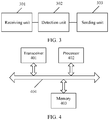
- FIG. 3 shows an example of a gateway provided in an embodiment of the present invention.
- the gateway is connected to a user terminal through a first wireless fidelity link and a second wireless fidelity link.
- a video source server pushes a video stream to the gateway, the gateway forwards the video stream to the user terminal, and a video application on the user terminal plays a video.
- the gateway in this embodiment includes a receiving unit 301, a detection unit 302, and a sending unit 303.
- the receiving unit 301 is configured to: receive a packet retransmission request sent by the user terminal and determine a packet that needs to be retransmitted.
- the detection unit 302 is configured to: detect a downlink quality indicator on a gateway side of the first Wi-Fi link and a downlink quality indicator on a gateway side of a second Wi-Fi link, and determine a path for retransmitting the packet, based on the downlink quality indicator on the gateway side of the first Wi-Fi link and the downlink quality indicator on the gateway side of the second Wi-Fi link.
- the sending unit 303 is configured to send, to the user terminal on the determined path for retransmitting the packet, the determined packet that needs to be retransmitted.
- an operating frequency band of the first Wi-Fi link is different from an operating frequency band of the second Wi-Fi link.
- the operating frequency band of the first Wi-Fi link is 5 GHz
- the operating frequency band of the second Wi-Fi link is 2.4 GHz.
- the first Wi-Fi link is used to carry the video stream that is sent by the gateway to the user terminal.
- the second Wi-Fi link is used to carry the packet retransmission request that is sent by the user terminal to the gateway and carry, when quality of the first Wi-Fi link is poor, a retransmitted video packet that is sent by the gateway to the user terminal.
- the gateway may further consider an uplink quality indicator on a user terminal side of the first Wi-Fi link and an uplink quality indicator on a user terminal side of the second Wi-Fi link.
- a first receiving unit is further configured to receive the uplink quality indicator that is sent by the user terminal and that is on the user terminal side of the first Wi-Fi link and the uplink quality indicator that is sent by the user terminal and that is on the user terminal side of the second Wi-Fi link.
- a first detection unit is configured to: select, as the link for sending the to-be-retransmitted packet, either link with better quality from the first Wi-Fi link and the second Wi-Fi link based on the downlink quality indicator on the gateway side of the first Wi-Fi link, the downlink quality indicator on the gateway side of the second Wi-Fi link, the uplink quality indicator on the user terminal side of the first Wi-Fi link, and the uplink quality indicator on the user terminal side of the second Wi-Fi link; and respond to retransmitting the packet as soon as possible.
- the downlink quality indicator and the uplink quality indicator each include a congestion (congestion) level and an estimated latency.
- the congestion level refers to a case in which network transmission performance deteriorates due to limited resources of forwarding nodes when a quantity of transmitted packets is excessively large. If a congestion level of a downlink on the gateway side of the first Wi-Fi link is greater than or equal to a first threshold (which, for example, is set to 0.9), it is determined to send the to-be-retransmitted packet on the second Wi-Fi link.
- a congestion level of a downlink on the gateway side of the first Wi-Fi link is less than or equal to a second threshold (which, for example, is set to 0.1), it is determined to send the to-be-retransmitted packet on the first Wi-Fi link. If a congestion level of a downlink on the gateway side of the first Wi-Fi link is greater than a second threshold but less than a first threshold, either link whose estimated latency is lower is selected from the first Wi-Fi link and the second Wi-Fi link, to send the to-be-retransmitted packet.
- a second threshold which, for example, is set to 0.1
- FIG. 4 shows a gateway 400 provided in an embodiment of the present invention.
- the gateway includes a transceiver 401, a processor 402, and a memory 403.
- the processor 402 is configured to control an operation of the device 400.
- the memory 403 may include a read-only memory and a random access memory, and store an instruction and data that may be executed by the processor 402. Apart of the memory 403 may further include a nonvolatile random access memory (nonvolatile random access memory, NVRAM).
- Components such as the transceiver 401, the processor 402, and the memory 403 are connected by a bus 404.
- the bus 404 may further include a power bus, a control bus, and a status signal bus. However, for clear description, various types of buses in the figure are marked as the bus 404.
- the method that is for retransmitting a packet and that is disclosed in FIG. 2 in the embodiments of the present invention may be applied to the processor 402, or may be implemented by the processor 402.
- steps of a processing procedure may be implemented by using an integrated logical circuit of hardware in the processor 402 or an instruction in a form of software.
- the processor 402 may be a general purpose processor, a digital signal processor, an application-specific integrated circuit, a field programmable gate array or another programmable logic device, a discrete gate or transistor logic device, or a discrete hardware component, and may implement or execute the method, steps, and logical block diagrams shown in FIG. 2 in the embodiments of the present invention.
- the general purpose processor may be a microprocessor or any conventional processor or the like.
- the steps of the method disclosed with reference to FIG. 2 in the embodiments of the present invention may be directly performed by a hardware processor, or may be performed by using a combination of hardware in the processor and a software module.
- the software module may be located in a mature storage medium in the art, such as a random access memory, a flash memory, a read-only memory, a programmable read-only memory, an electrically erasable programmable memory, or a register.
- the storage medium is located in the memory 403, and the processor 402 reads information stored in the memory 403 and completes the steps in the method shown in FIG. 2 in combination with hardware of the processor 402.
- the transceiver 401 receives a packet retransmission request sent by a user terminal and determines a packet that needs to be retransmitted.
- the processor 402 detects a downlink quality indicator on a gateway side of the first wireless fidelity (WIFI) link and a downlink quality indicator on a gateway side of a second wireless fidelity (WIFI) link, and determines a path for retransmitting the packet, based on the downlink quality indicator on the gateway side of the first Wi-Fi link and the downlink quality indicator on the gateway side of the second Wi-Fi link.
- the transceiver 401 sends, to the user terminal on the determined link for retransmitting the packet, the determined packet that needs to be retransmitted.
- the transceiver 401 is further configured to receive an uplink quality indicator that is sent by the user terminal and that is on a user terminal side of the first Wi-Fi link and an uplink quality indicator that is sent by the user terminal and that is on a user terminal side of the second Wi-Fi link.
- the processor 402 further determines a link for retransmitting the packet based on the downlink quality indicator on the gateway side of the first Wi-Fi link, the downlink quality indicator on the gateway side of the second Wi-Fi link, the uplink quality indicator on the user terminal side of the first Wi-Fi link, and the uplink quality indicator on the user terminal side of the second Wi-Fi link.
- a quality indicator of each of the first Wi-Fi link and the second Wi-Fi link includes a congestion level and an estimated latency. Specifically, if a congestion level of a downlink on the gateway side of the first Wi-Fi link is greater than or equal to a first threshold (which, for example, is set to 0.9), it is determined to send the to-be-retransmitted packet on the second Wi-Fi link. If a congestion level of a downlink on the gateway side of the first Wi-Fi link is less than or equal to a second threshold (which, for example, is set to 0.1), it is determined to send the to-be-retransmitted packet on the first Wi-Fi link.
- a congestion level of a downlink on the gateway side of the first Wi-Fi link is greater than or equal to a first threshold (which, for example, is set to 0.9)
- a second threshold which, for example, is set to 0.1
- a congestion level of a downlink on the gateway side of the first Wi-Fi link is greater than a second threshold but less than a first threshold, either link whose estimated latency is lower is selected from the first Wi-Fi link and the second Wi-Fi link, to send the to-be-retransmitted packet.
- An embodiment of the present invention further provides a computer storage medium.
- the computer storage medium is configured to store computer software instructions used by the gateway shown in FIG. 2 , and includes a program designed for executing the foregoing method embodiment. The program is executed, and a retransmission response speed and a success rate are ensured. This reduces packet losses and artifacts and frame freezing of a video service.
- An embodiment of this application provides a computer program product including an instruction.
- the computer program product runs on a computer, the computer is enabled to execute an instruction for the method that is for retransmitting a packet and that is shown in FIG. 2 . This ensures a retransmission response speed and a success rate, and reduces packet losses and artifacts and frame freezing of a video service.
- the embodiments of the present invention may be provided as a method, or a computer program product. Therefore, the present invention may use a form of hardware only embodiments, software only embodiments, or embodiments with a combination of software and hardware. Moreover, the present invention may use a form of a computer program product that is implemented on one or more computer-usable storage media (including but not limited to a disk memory, a CD-ROM, an optical memory, and the like) that include computer-usable program code.
- computer-usable storage media including but not limited to a disk memory, a CD-ROM, an optical memory, and the like
- These computer program instructions may be provided for a general-purpose computer, a dedicated computer, an embedded processor, or a processor of another programmable data processing device to generate a machine, so that the instructions executed by the computer or the processor of the another programmable data processing device generate an apparatus for implementing a specific function in one or more processes in the flowcharts and/or in one or more blocks in the block diagrams.
- These computer program instructions may alternatively be stored in a computer-readable memory that can instruct a computer or another programmable data processing device to work in a specific manner, so that the instructions stored in the computer-readable memory generate an artifact that includes an instruction apparatus.
- the instruction apparatus implements a specific function in one or more processes in the flowcharts and/or in one or more blocks in the block diagrams.
- These computer program instructions may alternatively be loaded onto a computer or another programmable data processing device, so that a series of operations and steps are performed on the computer or the another programmable device, thereby generating computer-implemented processing. Therefore, the instructions executed on the computer or the another programmable device provide steps for implementing a specific function in one or more processes in the flowcharts and/or in one or more blocks in the block diagrams.
Landscapes
- Engineering & Computer Science (AREA)
- Signal Processing (AREA)
- Computer Networks & Wireless Communication (AREA)
- Multimedia (AREA)
- Computer Security & Cryptography (AREA)
- Mobile Radio Communication Systems (AREA)
Abstract
Description
- The present invention relates to the communications field, and in particular, to a method for retransmitting a packet on a wireless fidelity (WIreless-FIdelity, WIFI) link and an apparatus.
- Due to cabling restrictions, Wi-Fi links are often used as data channels for carrying video streams when video services, such as IP television (Internet Protocol Television, IPTV) and OTT (over the top) video services, are deployed in hotels and homes. Currently, operating frequency bands of a wireless fidelity link include 2.4 GHz and 5 GHz. The 2.4 GHz operating frequency band features low signal attenuation and large coverage. The 5 GHz operating frequency band features high bandwidth, many selectable channels, less contention, and low interference. A video service requires high bandwidth and is sensitive to a latency and a packet loss. Therefore, a 5 GHz Wi-Fi link is usually used for carrying the video service for a mid- and high-end product.
- A Wi-Fi link uses an air interface for transmission and is unstable. Inevitably, even a 5 GHz link with high bandwidth is sometimes incapable of carrying a video due to insufficient quality of the link. For example, distant deployment results in insufficient signal strength; another device that operates on a 5 GHz frequency band generates interference; receiving of a radar signal triggers an avoidance mechanism and leads to switching of an operating channel; and a negotiated rate selection algorithm causes rate fluctuation. In this case, a packet loss on a Wi-Fi air interface, queue congestion, and a latency increase may occur. As a result, artifacts or even frame freezing of video services may be further caused.
- Embodiments of the present invention provide a method for retransmitting a packet on a wireless fidelity link and an apparatus, to ensure a response speed and a success rate of video packet retransmission and reduce artifacts and frame freezing of a video service.
- According to a first aspect, a method for retransmitting a packet on a wireless fidelity link is provided, including: A gateway first receives a packet retransmission request sent by a user terminal and determines a packet that needs to be retransmitted; the gateway detects a downlink quality indicator on a gateway side of a first wireless fidelity link and a downlink quality indicator on a gateway side of a second wireless fidelity link, and determines a link for retransmitting the packet, based on the downlink quality indicator on the gateway side of the first wireless fidelity link and the downlink quality indicator on the gateway side of the second wireless fidelity link; and the gateway sends, to the user terminal on the determined link for retransmitting the packet, the determined packet that needs to be retransmitted, where an operating frequency band of the first wireless fidelity link is different from an operating frequency band of the second wireless fidelity link.
- In some embodiments of the first aspect, the method further includes: receiving a downlink quality indicator that is sent by the user terminal and that is on a user terminal side of the first wireless fidelity link and a downlink quality indicator that is sent by the user terminal and that is on a user terminal side of the second wireless fidelity link; and determining the link for sending the to-be-retransmitted packet, based on the downlink quality indicator on the gateway side of the first wireless fidelity link, the downlink quality indicator on the gateway side of the second wireless fidelity link, an uplink quality indicator on the user terminal side of the first wireless fidelity link, and an uplink quality indicator on the user terminal side of the second wireless fidelity link.
- In some embodiments of the first aspect, the operating frequency band of the first wireless fidelity link is 5 GHz and the operating frequency band of the second wireless fidelity link is 2.4 GHz.
- In some embodiments of the first aspect, the method further includes: The gateway receives a video stream pushed by a video source server, and sends the video stream to the user terminal on the first wireless fidelity link.
- In some embodiments of the first aspect, the downlink quality indicator and the uplink quality indicator each include a congestion level and an estimated latency; and if a congestion level of a downlink on the gateway side of the first wireless fidelity link is greater than or equal to a first threshold, it is determined to send the to-be-retransmitted packet on the second wireless fidelity link; if a congestion level of a downlink on the gateway side of the first wireless fidelity link is less than or equal to a second threshold, it is determined to send the to-be-retransmitted packet on the first wireless fidelity link; or if a congestion level of a downlink on the gateway side of the first wireless fidelity link is greater than a second threshold but less than a first threshold, either link whose estimated latency is lower is selected from the first wireless fidelity link and the second wireless fidelity link, to send the to-be-retransmitted packet.
- In some embodiments of the first aspect, the first threshold is 0.9 and the second threshold is 0.1.
- In some embodiments of the first aspect, the congestion level is equal to a percentage of a quantity of to-be-sent packets in a total queue depth, and the estimated latency satisfies:

the transmission quality satisfies:
- In some embodiments of the first aspect, that the determined packet that needs to be retransmitted is sent to the user terminal includes retransmitting a frame I in the packet based on a preset quantity of retransmissions of the frame I and a frame P in the packet based on a preset quantity of retransmissions of the frame P, where the quantity of retransmissions of the frame I is N, the quantity of retransmissions of the frame P is M, a relationship between N and M is: N > M, and N and M are non-zero natural numbers.
- In some embodiments of the first aspect, the method further includes: retransmitting a frame B in the packet based on a preset quantity of retransmissions of the frame B, where the quantity of retransmissions of the frame B is K, a relationship between the quantity K of retransmissions of the frame B and the quantity M of retransmissions of the frame P is: M > K, and K is a non-zero natural number.
- According to a second aspect, an embodiment of the present invention provides a gateway, connected to a user terminal through a first wireless fidelity link and a second wireless fidelity link, where an operating frequency band of the first wireless fidelity link is different from an operating frequency band of the second wireless fidelity link, and the gateway includes:
- a first receiving unit, configured to: receive a packet retransmission request sent by the user terminal and determine a packet that needs to be retransmitted;
- a first detection unit, configured to: detect a downlink quality indicator on a gateway side of a first wireless fidelity link and a downlink quality indicator on a gateway side of a second wireless fidelity link, and determine a link for retransmitting the packet, based on the downlink quality indicator on the gateway side of the first wireless fidelity link and the downlink quality indicator on the gateway side of the second wireless fidelity link; and
- a first sending unit, configured to send, to the user terminal on the determined link for retransmitting the packet, the determined packet that needs to be retransmitted, where the operating frequency band of the first wireless fidelity link is different from the operating frequency band of the second wireless fidelity link.
- In some embodiments of the second aspect, the first receiving unit is further configured to receive an uplink quality indicator that is sent by the user terminal and that is on a user terminal side of the first wireless fidelity link and an uplink quality indicator that is sent by the user terminal and that is on a user terminal side of the second wireless fidelity link; and the first detection unit is further configured to determine the link for sending the to-be-retransmitted packet, based on the downlink quality indicator on the gateway side of the first wireless fidelity link, the downlink quality indicator on the gateway side of the second wireless fidelity link, the uplink quality indicator on the user terminal side of the first wireless fidelity link, and the uplink quality indicator on the user terminal side of the second wireless fidelity link.
- In some embodiments of the second aspect, the first receiving unit is further configured to: receive a video stream pushed by a video source server, and send the video stream to the user terminal on the first wireless fidelity link.
- In some embodiments of the second aspect, the operating frequency band of the first wireless fidelity link is 5 GHz and the operating frequency band of the second wireless fidelity link is 2.4 GHz.
- In some embodiments of the second aspect, the downlink quality indicator and the uplink quality indicator each include a congestion level and an estimated latency, and the first detection unit is specifically configured to: if a congestion level of a downlink on the gateway side of the first wireless fidelity link is greater than or equal to a first threshold, determine to send the to-be-retransmitted packet on the second wireless fidelity link; if a congestion level of a downlink on the gateway side of the first wireless fidelity link is less than or equal to a second threshold, determine to send the to-be-retransmitted packet on the first wireless fidelity link; or if a congestion level of a downlink on the gateway side of the first wireless fidelity link is greater than a second threshold but less than a first threshold, select, from the first wireless fidelity link and the second wireless fidelity link, either link whose estimated latency is lower, to send the to-be-retransmitted packet.
- In some embodiments of the second aspect, the first threshold is 0.9 and the second threshold is 0.1.
- In some embodiments of the second aspect, the first detection unit is specifically configured to: the congestion level is equal to a percentage of a quantity of to-be-sent packets in a total queue depth, and the estimated latency satisfies:

the transmission quality satisfies:
- In some embodiments of the second aspect, that the first sending unit sends, to the user terminal, the determined packet that needs to be retransmitted includes: retransmitting a frame I in the packet based on a preset quantity of retransmissions of the frame I and a frame P in the packet based on a preset quantity of retransmissions of the frame P, where the quantity of retransmissions of the frame I is N, the quantity of retransmissions of the frame P is M, a relationship between N and M is: N > M, and N and M are non-zero natural numbers.
- In some embodiments of the second aspect, that the first sending unit sends, to the user terminal, the determined packet that needs to be retransmitted further includes: retransmitting a frame B in the packet based on a preset quantity of retransmissions of the frame B, where the quantity of retransmissions of the frame B is K, a relationship between the quantity K of retransmissions of the frame B and the quantity M of retransmissions of the frame P is: M > K, and K is a non-zero natural number.
- According to a third aspect, a gateway is provided, including a memory, a processor, and a program that is stored in the memory and that can be run on the processor, where when executing the program, the processor performs the method according to any embodiment of the first aspect.
- According to a fourth aspect, a computer-readable storage medium is provided, where the computer-readable storage medium includes an instruction, and when the instruction is run on a gateway, the gateway is enabled to perform the method according to any embodiment of the first aspect.
- According to a fifth aspect, a computer program product including an instruction is provided, where when the instruction is run on a gateway, the gateway is enabled to perform the method according to any embodiment of the first aspect.
- To describe the technical solutions in the embodiments of the present invention more clearly, the following briefly describes the accompanying drawings required for describing the embodiments.
-
FIG. 1 is a schematic diagram of a scenario to which an embodiment of the present invention applies and in which a video service is carried on a Wi-Fi link; -
FIG. 2 shows a method procedure for retransmitting a packet on a Wi-Fi link according to an embodiment of the present invention; -
FIG. 3 is a schematic diagram of a gateway according to an embodiment of the present invention; and -
FIG. 4 is a schematic diagram of another gateway according to an embodiment of the present invention. - To make the objectives, technical solutions, and benefits of the embodiments of the present invention clearer and more comprehensible, the following further describes the present invention in detail with reference to the accompanying drawings and embodiments. It should be understood that specific embodiments described herein are merely used to explain the present invention, but are not intended to limit the present invention.
-
FIG. 1 is a schematic diagram of an example application scenario of an embodiment of the present invention. A system in this scenario includes a video source server, a gateway, and a user terminal. The video source server pushes a video stream to the gateway, the gateway forwards the video stream to the user terminal, and a video application on the user terminal plays a video. During video playing on the user terminal, the user terminal buffers a small amount of video content in advance. If a video frame cannot be decoded due to a video packet loss detected in the buffered video, a lost packet needs to be obtained within a relatively short buffer period (which is usually Is). If the lost packet is not obtained within the relatively short buffer period, the frame is lost, and frame freezing is caused. To obtain the lost packet, the video application on the user terminal sends, to the video server, a request for retransmitting the packet. After receiving the request that is for retransmitting the packet and that is sent by the user terminal, the gateway searches a buffered video of the gateway for the video packet that needs to be retransmitted. After receiving the request that is for retransmitting the packet and that is sent by the user terminal, the gateway searches the buffered video of the gateway for the video packet that needs to be retransmitted, and then retransmits, to the user terminal, the packet that needs to be retransmitted. After receiving the retransmitted packet, the user terminal reassembles the video frame to obtain a normal packet. - In this embodiment of the present invention, two wireless fidelity links with different operating frequency bands are established between the gateway and a user terminal side. For example, an operating frequency band of one link is 2.4 GHz, and an operating frequency band of the other link is 5 GHz. The gateway establishes a wireless fidelity access point (Access Point, AP). The user terminal (for example, a video device in
FIG. 1 ) is connected to the AP through a wireless fidelity station (Station), and then is connected to the gateway. When the links work properly, the 5 GHz Wi-Fi link is used as a main data channel for carrying a heavy traffic flow, for example, a video stream sent by the gateway to the user terminal. The 2.4 GHz Wi-Fi link is used as a fast dedicated channel for a few high-priority packets, for example, a video packet to be retransmitted by the user terminal to the gateway. - After receiving the request that is for retransmitting the packet and that is sent by the user terminal, the gateway detects a downlink quality indicator on a gateway side of a first wireless fidelity link and a downlink quality indicator on a gateway side of a second wireless fidelity link, and determines a path for sending the to-be-retransmitted packet, based on the downlink quality indicator on the gateway side of the first wireless fidelity link and the downlink quality indicator on the gateway side of the second wireless fidelity link. When there is transmission quality variation on one link, retransmission is performed on the other link. In other words, when quality of the 5 GHz Wi-Fi link is poor, the video packet that needs to be retransmitted may be sent to the user terminal on the 2.4 GHz Wi-Fi link. The technical solution improves a retransmission response speed and a success rate, and reduces packet losses and artifacts and frame freezing of a video service.
- Based on the foregoing description,
FIG. 2 shows an example method procedure for retransmitting a packet on a Wi-Fi link according to an embodiment of the present invention. The method procedure is performed by a gateway. - As shown in
FIG. 2 , the method procedure specifically includes the following steps. - Step 201: The gateway receives a video stream pushed by a video source server.
- Step 202: The gateway sends the video stream to a user terminal.
- The gateway receives the video stream pushed by the video source server and sends the video stream to the user terminal on a first Wi-Fi link. The video stream may be of an IPTV or OTT type, or a live TV or a video on demand. The video stream is data constituted by consecutive video packets.
- Step 203: The user terminal detects that there is a lost video packet, and sends a packet retransmission request message to the gateway.
- A retransmitted packet sent by the user terminal carries an identifier of the lost packet.
- Step 204: The gateway receives the packet retransmission request sent by the user terminal and determines a packet that needs to be retransmitted.
- Based on the identifier that is of the packet that needs to be retransmitted and that is carried in the packet retransmission request message, the gateway may search video packets locally buffered in the gateway for the video packet that needs to be retransmitted.
- Step 205: The gateway detects a downlink quality indicator on a gateway side of the first Wi-Fi link and a downlink quality indicator on a gateway side of a second Wi-Fi link, and determines a path for sending the to-be-retransmitted packet, based on the downlink quality indicator on the gateway side of the first Wi-Fi link and the downlink quality indicator on the gateway side of the second Wi-Fi link.
- Actually, the gateway is far away from the user terminal. For example, an interference source is 10 meters away from the user terminal and strongly interferes with the user terminal. However, the interference source is 30 meters away from the gateway, and the gateway is basically not interfered with by the interference source. In view of this, when detecting that downlink quality on the gateway side of the second Wi-Fi link is better than downlink quality on the gateway side of the first Wi-Fi link, the gateway determines to send the to-be-retransmitted packet on the second Wi-Fi link. Actually, uplink quality on a user terminal side of the second Wi-Fi link is relatively poor, and therefore cannot be used for receiving the packet retransmitted by the gateway. To more accurately determine a link quality indicator, the gateway may further consider an uplink quality indicator on a user terminal side of the first Wi-Fi link and the uplink quality indicator on a user terminal side of the second Wi-Fi link. The gateway obtains the uplink quality indicator that is fed back by the user terminal and that is on the user terminal side of the first wireless fidelity link and the uplink quality indicator that is fed back by the user terminal and that is on the user terminal side of the second wireless fidelity link, and determines the link for sending the to-be-retransmitted packet, based on the downlink quality indicator on the gateway side of the first wireless fidelity link, the downlink quality indicator on the gateway side of the second wireless fidelity link, the uplink quality indicator on the user terminal side of the first wireless fidelity link, and the uplink quality indicator on the user terminal side of the second wireless fidelity link. In this embodiment of the present invention, a downlink indicates a direction from the gateway to the user terminal, and an uplink indicates a direction from the user terminal to the gateway.
- Step 206: The gateway sends, to the user terminal on the determined path for retransmitting the packet, the determined packet that needs to be retransmitted.
- In this embodiment of the present invention, an operating frequency band of the first Wi-Fi link is different from an operating frequency band of the second Wi-Fi link. For example, the operating frequency band of the first Wi-Fi link is set to 5 GHz, and the operating frequency band of the second Wi-Fi link is set to 2.4 GHz. Usually, the first Wi-Fi link is used to carry the video stream that is sent by the gateway to the user terminal. The second Wi-Fi link is used to carry the packet retransmission request that is sent by the user terminal to the gateway and carry, when quality of the first Wi-Fi link is poor, a to-be-retransmitted video packet that is sent by the gateway to the user terminal.
- Specifically, in this embodiment of the present invention, the downlink quality indicator and the uplink quality indicator each include a congestion level and an estimated latency. Congestion (congestion) refers to a case in which network transmission performance deteriorates due to limited resources of forwarding nodes when there are a large quantity of transmitted packets. If a congestion level of a downlink on the gateway side of the first Wi-Fi link is greater than or equal to a first threshold (which, for example, is set to 0.9), it is determined to send the to-be-retransmitted packet on the second Wi-Fi link. If a congestion level of a downlink on the gateway side of the first Wi-Fi link is less than or equal to a second threshold (which, for example, is set to 0.1), it is determined to send the to-be-retransmitted packet on the first Wi-Fi link. If a congestion level of a downlink on the gateway side of the first Wi-Fi link is greater than a second threshold but less than a first threshold, either link whose estimated latency is lower is selected from the first Wi-Fi link and the second Wi-Fi link, to send the to-be-retransmitted packet.
- Specifically, the congestion level is equal to a percentage of a quantity of to-be-sent packets in a total queue depth (queue-size).
- A calculation formula of the estimated latency is:

- A calculation formula of the transmission quality is:

- In the foregoing formulas (1) and (2), the total queue depth refers to a maximum quantity of packets that can be buffered for a sending packet queue. The to-be-sent packet refers to a total quantity of packets that need to be retransmitted. The negotiated rate refers to a modulation and coding scheme for a Wi-Fi radio frequency, and different modulation schemes correspond to different rates and robustness. The interference duty cycle indicates a percentage of time when there is an interfering signal in total time. The packet sending success rate refers to a percentage of successfully sent packets in total sent packets. A Wi-Fi packet can be successfully sent only after an acknowledgment frame is received from a receiver. If the acknowledgment frame is not received from the receiver, the Wi-Fi packet fails to be sent.
- The foregoing calculation methods for the congestion level, the estimated latency, and the transmission quality are merely examples. There may be other calculation manners, and examples are not enumerated herein.
- Specifically, that the gateway sends, to the user terminal, the determined packet that needs to be retransmitted includes retransmitting a frame I in the packet based on a preset quantity of retransmissions of the frame I and a frame P in the packet based on a preset quantity of retransmissions of the frame P. The quantity of retransmissions of the frame I is N, the quantity of retransmissions of the frame P is M, a relationship between N and M is: N > M, and N and M are non-zero natural numbers. On the basis that the frame I and the frame P are retransmitted, the gateway may further retransmit a frame B in the packet based on a preset quantity of retransmissions of the frame B. The quantity of retransmissions of the frame B is K, a relationship between the quantity K of retransmissions of the frame B and the quantity M of retransmissions of the frame P is: M > K, and K is a non-zero natural number.
- Based on a same concept,
FIG. 3 shows an example of a gateway provided in an embodiment of the present invention. The gateway is connected to a user terminal through a first wireless fidelity link and a second wireless fidelity link. A video source server pushes a video stream to the gateway, the gateway forwards the video stream to the user terminal, and a video application on the user terminal plays a video. The gateway in this embodiment includes a receivingunit 301, adetection unit 302, and a sendingunit 303. - The receiving
unit 301 is configured to: receive a packet retransmission request sent by the user terminal and determine a packet that needs to be retransmitted. - The
detection unit 302 is configured to: detect a downlink quality indicator on a gateway side of the first Wi-Fi link and a downlink quality indicator on a gateway side of a second Wi-Fi link, and determine a path for retransmitting the packet, based on the downlink quality indicator on the gateway side of the first Wi-Fi link and the downlink quality indicator on the gateway side of the second Wi-Fi link. - The sending
unit 303 is configured to send, to the user terminal on the determined path for retransmitting the packet, the determined packet that needs to be retransmitted. - In this embodiment of the present invention, an operating frequency band of the first Wi-Fi link is different from an operating frequency band of the second Wi-Fi link. The operating frequency band of the first Wi-Fi link is 5 GHz, and the operating frequency band of the second Wi-Fi link is 2.4 GHz. Usually, the first Wi-Fi link is used to carry the video stream that is sent by the gateway to the user terminal. The second Wi-Fi link is used to carry the packet retransmission request that is sent by the user terminal to the gateway and carry, when quality of the first Wi-Fi link is poor, a retransmitted video packet that is sent by the gateway to the user terminal.
- To improve accuracy, when determining a sending path for retransmitting the packet, the gateway may further consider an uplink quality indicator on a user terminal side of the first Wi-Fi link and an uplink quality indicator on a user terminal side of the second Wi-Fi link. A first receiving unit is further configured to receive the uplink quality indicator that is sent by the user terminal and that is on the user terminal side of the first Wi-Fi link and the uplink quality indicator that is sent by the user terminal and that is on the user terminal side of the second Wi-Fi link.
- A first detection unit is configured to: select, as the link for sending the to-be-retransmitted packet, either link with better quality from the first Wi-Fi link and the second Wi-Fi link based on the downlink quality indicator on the gateway side of the first Wi-Fi link, the downlink quality indicator on the gateway side of the second Wi-Fi link, the uplink quality indicator on the user terminal side of the first Wi-Fi link, and the uplink quality indicator on the user terminal side of the second Wi-Fi link; and respond to retransmitting the packet as soon as possible.
- For the detection unit of the gateway, the downlink quality indicator and the uplink quality indicator each include a congestion (congestion) level and an estimated latency. The congestion level refers to a case in which network transmission performance deteriorates due to limited resources of forwarding nodes when a quantity of transmitted packets is excessively large. If a congestion level of a downlink on the gateway side of the first Wi-Fi link is greater than or equal to a first threshold (which, for example, is set to 0.9), it is determined to send the to-be-retransmitted packet on the second Wi-Fi link. If a congestion level of a downlink on the gateway side of the first Wi-Fi link is less than or equal to a second threshold (which, for example, is set to 0.1), it is determined to send the to-be-retransmitted packet on the first Wi-Fi link. If a congestion level of a downlink on the gateway side of the first Wi-Fi link is greater than a second threshold but less than a first threshold, either link whose estimated latency is lower is selected from the first Wi-Fi link and the second Wi-Fi link, to send the to-be-retransmitted packet.
- For specific descriptions of the congestion level and the estimated latency, refer to the descriptions in the method shown in
FIG. 2 . Details are not described herein again. - Based on a same concept,
FIG. 4 shows a gateway 400 provided in an embodiment of the present invention. The gateway includes atransceiver 401, aprocessor 402, and amemory 403. Theprocessor 402 is configured to control an operation of the device 400. Thememory 403 may include a read-only memory and a random access memory, and store an instruction and data that may be executed by theprocessor 402. Apart of thememory 403 may further include a nonvolatile random access memory (nonvolatile random access memory, NVRAM). Components such as thetransceiver 401, theprocessor 402, and thememory 403 are connected by abus 404. In addition to a data bus, thebus 404 may further include a power bus, a control bus, and a status signal bus. However, for clear description, various types of buses in the figure are marked as thebus 404. - The method that is for retransmitting a packet and that is disclosed in
FIG. 2 in the embodiments of the present invention may be applied to theprocessor 402, or may be implemented by theprocessor 402. In an implementation process, steps of a processing procedure may be implemented by using an integrated logical circuit of hardware in theprocessor 402 or an instruction in a form of software. Theprocessor 402 may be a general purpose processor, a digital signal processor, an application-specific integrated circuit, a field programmable gate array or another programmable logic device, a discrete gate or transistor logic device, or a discrete hardware component, and may implement or execute the method, steps, and logical block diagrams shown inFIG. 2 in the embodiments of the present invention. The general purpose processor may be a microprocessor or any conventional processor or the like. The steps of the method disclosed with reference toFIG. 2 in the embodiments of the present invention may be directly performed by a hardware processor, or may be performed by using a combination of hardware in the processor and a software module. The software module may be located in a mature storage medium in the art, such as a random access memory, a flash memory, a read-only memory, a programmable read-only memory, an electrically erasable programmable memory, or a register. The storage medium is located in thememory 403, and theprocessor 402 reads information stored in thememory 403 and completes the steps in the method shown inFIG. 2 in combination with hardware of theprocessor 402. - The
transceiver 401 receives a packet retransmission request sent by a user terminal and determines a packet that needs to be retransmitted. Theprocessor 402 detects a downlink quality indicator on a gateway side of the first wireless fidelity (WIFI) link and a downlink quality indicator on a gateway side of a second wireless fidelity (WIFI) link, and determines a path for retransmitting the packet, based on the downlink quality indicator on the gateway side of the first Wi-Fi link and the downlink quality indicator on the gateway side of the second Wi-Fi link. Thetransceiver 401 sends, to the user terminal on the determined link for retransmitting the packet, the determined packet that needs to be retransmitted. - In an embodiment, the
transceiver 401 is further configured to receive an uplink quality indicator that is sent by the user terminal and that is on a user terminal side of the first Wi-Fi link and an uplink quality indicator that is sent by the user terminal and that is on a user terminal side of the second Wi-Fi link. - The
processor 402 further determines a link for retransmitting the packet based on the downlink quality indicator on the gateway side of the first Wi-Fi link, the downlink quality indicator on the gateway side of the second Wi-Fi link, the uplink quality indicator on the user terminal side of the first Wi-Fi link, and the uplink quality indicator on the user terminal side of the second Wi-Fi link. - For the
processor 402, a quality indicator of each of the first Wi-Fi link and the second Wi-Fi link includes a congestion level and an estimated latency. Specifically, if a congestion level of a downlink on the gateway side of the first Wi-Fi link is greater than or equal to a first threshold (which, for example, is set to 0.9), it is determined to send the to-be-retransmitted packet on the second Wi-Fi link. If a congestion level of a downlink on the gateway side of the first Wi-Fi link is less than or equal to a second threshold (which, for example, is set to 0.1), it is determined to send the to-be-retransmitted packet on the first Wi-Fi link. If a congestion level of a downlink on the gateway side of the first Wi-Fi link is greater than a second threshold but less than a first threshold, either link whose estimated latency is lower is selected from the first Wi-Fi link and the second Wi-Fi link, to send the to-be-retransmitted packet. - For specific descriptions of the congestion level and the estimated latency, refer to the descriptions in the method shown in
FIG. 2 . Details are not described herein again. - An embodiment of the present invention further provides a computer storage medium. The computer storage medium is configured to store computer software instructions used by the gateway shown in
FIG. 2 , and includes a program designed for executing the foregoing method embodiment. The program is executed, and a retransmission response speed and a success rate are ensured. This reduces packet losses and artifacts and frame freezing of a video service. - An embodiment of this application provides a computer program product including an instruction. When the computer program product runs on a computer, the computer is enabled to execute an instruction for the method that is for retransmitting a packet and that is shown in
FIG. 2 . This ensures a retransmission response speed and a success rate, and reduces packet losses and artifacts and frame freezing of a video service. - A person skilled in the art should understand that the embodiments of the present invention may be provided as a method, or a computer program product. Therefore, the present invention may use a form of hardware only embodiments, software only embodiments, or embodiments with a combination of software and hardware. Moreover, the present invention may use a form of a computer program product that is implemented on one or more computer-usable storage media (including but not limited to a disk memory, a CD-ROM, an optical memory, and the like) that include computer-usable program code.
- The present invention is described with reference to the flowcharts and/or block diagrams of the method, the device (system), and the computer program product according to the embodiments of the present invention. It should be understood that computer program instructions may be used to implement each process and/or each block in the flowcharts and/or the block diagrams and a combination of a process and/or a block in the flowcharts and/or the block diagrams. These computer program instructions may be provided for a general-purpose computer, a dedicated computer, an embedded processor, or a processor of another programmable data processing device to generate a machine, so that the instructions executed by the computer or the processor of the another programmable data processing device generate an apparatus for implementing a specific function in one or more processes in the flowcharts and/or in one or more blocks in the block diagrams.
- These computer program instructions may alternatively be stored in a computer-readable memory that can instruct a computer or another programmable data processing device to work in a specific manner, so that the instructions stored in the computer-readable memory generate an artifact that includes an instruction apparatus. The instruction apparatus implements a specific function in one or more processes in the flowcharts and/or in one or more blocks in the block diagrams.
- These computer program instructions may alternatively be loaded onto a computer or another programmable data processing device, so that a series of operations and steps are performed on the computer or the another programmable device, thereby generating computer-implemented processing. Therefore, the instructions executed on the computer or the another programmable device provide steps for implementing a specific function in one or more processes in the flowcharts and/or in one or more blocks in the block diagrams.
- Although some preferred embodiments of the present invention have been described, a person skilled in the art can make changes and modifications to these embodiments once they learn the basic inventive concept. Therefore, the following claims are intended to be construed as to cover the preferred embodiments and all changes and modifications falling within the scope of the present invention.
- It is clear that a person skilled in the art can make various modifications and variations to the present invention without departing from the spirit and scope of the present invention. The present invention is intended to cover these modifications and variations provided that they fall within the scope of protection defined by the following claims and their equivalent technologies of the present invention.
Claims (21)
- A method for retransmitting a packet on a wireless fidelity link, comprising:receiving a packet retransmission request sent by a user terminal and determining a packet that needs to be retransmitted;detecting a downlink quality indicator on a gateway side of a first wireless fidelity link and a downlink quality indicator on a gateway side of a second wireless fidelity link, and determining a link for retransmitting the packet, based on the downlink quality indicator on the gateway side of the first wireless fidelity link and the downlink quality indicator on the gateway side of the second wireless fidelity link; andsending, to the user terminal on the determined link for retransmitting the packet, the determined packet that needs to be retransmitted, wherein an operating frequency band of the first wireless fidelity link is different from an operating frequency band of the second wireless fidelity link.
- The method for retransmitting a packet on a wireless fidelity link according to claim 1, further comprising:receiving a downlink quality indicator that is sent by the user terminal and that is on a user terminal side of the first wireless fidelity link and a downlink quality indicator that is sent by the user terminal and that is on a user terminal side of the second wireless fidelity link; anddetermining the link for sending the to-be-retransmitted packet, based on the downlink quality indicator on the gateway side of the first wireless fidelity link, the downlink quality indicator on the gateway side of the second wireless fidelity link, an uplink quality indicator on the user terminal side of the first wireless fidelity link, and an uplink quality indicator on the user terminal side of the second wireless fidelity link.
- The method for retransmitting a packet on a wireless fidelity link according to claim 1, wherein the operating frequency band of the first wireless fidelity link is 5 GHz and the operating frequency band of the second wireless fidelity link is 2.4 GHz.
- The method for retransmitting a packet on a wireless fidelity link according to claim 3, further comprising:
receiving a video stream pushed by a video source server, and sending the video stream to the user terminal on the first wireless fidelity link. - The method for retransmitting a packet on a wireless fidelity link according to claim 3, wherein the downlink quality indicator and the uplink quality indicator each comprise a congestion level and an estimated latency; and if a congestion level of a downlink on the gateway side of the first wireless fidelity link is greater than or equal to a first threshold, determining to send the to-be-retransmitted packet on the second wireless fidelity link; if a congestion level of a downlink on the gateway side of the first wireless fidelity link is less than or equal to a second threshold, determining to send the to-be-retransmitted packet on the first wireless fidelity link; or if a congestion level of a downlink on the gateway side of the first wireless fidelity link is greater than a second threshold but less than a first threshold, selecting, from the first wireless fidelity link and the second wireless fidelity link, either link whose estimated latency is lower, to send the to-be-retransmitted packet.
- The method for retransmitting a packet on a wireless fidelity link according to claim 5, wherein the first threshold is 0.9 and the second threshold is 0.1.
- The method for retransmitting a packet on a wireless fidelity link according to claim 5 or 6, wherein the congestion level is equal to a percentage of a quantity of to-be-sent packets in a total queue depth, and the estimated latency satisfies:

the transmission quality satisfies:
- The method for retransmitting a packet on a wireless fidelity link according to any one of claims 1 to 7, wherein the sending, to the user terminal, the determined packet that needs to be retransmitted comprises:
retransmitting a frame I in the packet based on a preset quantity of retransmissions of the frame I and a frame P in the packet based on a preset quantity of retransmissions of the frame P, wherein the quantity of retransmissions of the frame I is N, the quantity of retransmissions of the frame P is M, a relationship between N and M is: N > M, and N and M are non-zero natural numbers. - The method for retransmitting a packet on a wireless fidelity link according to any one of claims 1 to 7, further comprising:
retransmitting a frame B in the packet based on a preset quantity of retransmissions of the frame B, wherein the quantity of retransmissions of the frame B is K, a relationship between the quantity K of retransmissions of the frame B and the quantity M of retransmissions of the frame P is: M > K, and K is a non-zero natural number. - A gateway, connected to a user terminal through a first wireless fidelity link and a second wireless fidelity link, wherein an operating frequency band of the first wireless fidelity link is different from an operating frequency band of the second wireless fidelity link, and the gateway comprises:a first receiving unit, configured to: receive a packet retransmission request sent by the user terminal, and determine a packet that needs to be retransmitted;a first detection unit, configured to: detect a downlink quality indicator on a gateway side of a first wireless fidelity link and a downlink quality indicator on a gateway side of a second wireless fidelity link, and determine a link for retransmitting the packet, based on the downlink quality indicator on the gateway side of the first wireless fidelity link and the downlink quality indicator on the gateway side of the second wireless fidelity link; anda first sending unit, configured to send, to the user terminal on the determined link for retransmitting the packet, the determined packet that needs to be retransmitted, wherein the operating frequency band of the first wireless fidelity link is different from the operating frequency band of the second wireless fidelity link.
- The gateway according to claim 10, wherein
the first receiving unit is further configured to receive an uplink quality indicator that is sent by the user terminal and that is on a user terminal side of the first wireless fidelity link and an uplink quality indicator that is sent by the user terminal and that is on a user terminal side of the second wireless fidelity link; and
the first detection unit is further configured to determine the link for sending the to-be-retransmitted packet, based on the downlink quality indicator on the gateway side of the first wireless fidelity link, the downlink quality indicator on the gateway side of the second wireless fidelity link, the uplink quality indicator on the user terminal side of the first wireless fidelity link, and the uplink quality indicator on the user terminal side of the second wireless fidelity link. - The gateway according to claim 10, wherein the first receiving unit is further configured to: receive a video stream pushed by a video source server, and send the video stream to the user terminal on the first wireless fidelity link.
- The gateway according to claim 10, wherein the operating frequency band of the first wireless fidelity link is 5 GHz and the operating frequency band of the second wireless fidelity link is 2.4 GHz.
- The gateway according to claim 13, wherein the downlink quality indicator and the uplink quality indicator each comprise a congestion level and an estimated latency, and the first detection unit is specifically configured to: if a congestion level of a downlink on the gateway side of the first wireless fidelity link is greater than or equal to a first threshold, determine to send the to-be-retransmitted packet on the second wireless fidelity link; if a congestion level of a downlink on the gateway side of the first wireless fidelity link is less than or equal to a second threshold, determine to send the to-be-retransmitted packet on the first wireless fidelity link; or if a congestion level of a downlink on the gateway side of the first wireless fidelity link is greater than a second threshold but less than a first threshold, select, from the first wireless fidelity link and the second wireless fidelity link, either link whose estimated latency is lower, to send the to-be-retransmitted packet.
- The gateway according to claim 14, wherein the first threshold is 0.9 and the second threshold is 0.1.
- The gateway according to claim 14 or 15, wherein the first detection unit is specifically configured to: the congestion level is equal to a percentage of a quantity of to-be-sent packets in a total queue depth, and the estimated latency satisfies:

the transmission quality satisfies:
- The gateway according to any one of claims 10 to 16, wherein that the first sending unit sends, to the user terminal, the determined packet that needs to be retransmitted comprises:
retransmitting a frame I in the packet based on a preset quantity of retransmissions of the frame I and a frame P in the packet based on a preset quantity of retransmissions of the frame P, wherein the quantity of retransmissions of the frame I is N, the quantity of retransmissions of the frame P is M, a relationship between N and M is: N > M, and N and M are non-zero natural numbers. - The gateway according to any one of claims 10 to 16, wherein that the first sending unit sends, to the user terminal, the determined packet that needs to be retransmitted further comprises:
retransmitting a frame B in the packet based on a preset quantity of retransmissions of the frame B, wherein the quantity of retransmissions of the frame B is K, a relationship between the quantity K of retransmissions of the frame B and the quantity M of retransmissions of the frame P is: M > K, and K is a non-zero natural number. - A gateway, comprising a memory, a processor, and a program that is stored in the memory and that can be run on the processor, wherein when executing the program, the processor performs the method according to any one of claims 1 to 9.
- A computer-readable storage medium, comprising an instruction, wherein when the instruction is run on a gateway, the gateway is enabled to perform the method according to any one of claims 1 to 9.
- A computer program product comprising an instruction, wherein when the instruction is run on a gateway, the gateway is enabled to perform the method according to any one of claims 1 to 9.
Applications Claiming Priority (2)
| Application Number | Priority Date | Filing Date | Title |
|---|---|---|---|
| CN201810234929.9A CN110300337A (en) | 2018-03-21 | 2018-03-21 | The method and apparatus of Wireless Fidelity link transmission message |
| PCT/CN2019/078730 WO2019179437A1 (en) | 2018-03-21 | 2019-03-19 | Method and device for retransmitting packet via wireless fidelity link |
Publications (2)
| Publication Number | Publication Date |
|---|---|
| EP3742745A1 true EP3742745A1 (en) | 2020-11-25 |
| EP3742745A4 EP3742745A4 (en) | 2021-01-06 |
Family
ID=67986690
Family Applications (1)
| Application Number | Title | Priority Date | Filing Date |
|---|---|---|---|
| EP19771087.4A Pending EP3742745A4 (en) | 2018-03-21 | 2019-03-19 | METHOD AND DEVICE FOR PACKET RETRANSMISSION VIA A WIRELESS LOYALTY LINK |
Country Status (4)
| Country | Link |
|---|---|
| US (1) | US11445268B2 (en) |
| EP (1) | EP3742745A4 (en) |
| CN (1) | CN110300337A (en) |
| WO (1) | WO2019179437A1 (en) |
Families Citing this family (4)
| Publication number | Priority date | Publication date | Assignee | Title |
|---|---|---|---|---|
| US12238582B2 (en) * | 2019-04-23 | 2025-02-25 | Sony Group Corporation | Communication device and communication method |
| CN113872916B (en) * | 2020-06-30 | 2024-12-17 | 中兴通讯股份有限公司 | Data retransmission method, network device, and computer-readable storage medium |
| US11770219B2 (en) * | 2021-05-12 | 2023-09-26 | Qualcomm Incorporated | Downlink retransmission by relay node |
| EP4420338A1 (en) * | 2021-10-18 | 2024-08-28 | Telefonaktiebolaget LM Ericsson (publ) | Selective quic datagram payload retransmission in a network |
Family Cites Families (17)
| Publication number | Priority date | Publication date | Assignee | Title |
|---|---|---|---|---|
| US20050207345A1 (en) * | 2004-03-22 | 2005-09-22 | Onggosanusi Eko N | Hybrid ARQ schemes for a multi-carrier communications system |
| WO2008029792A1 (en) * | 2006-09-08 | 2008-03-13 | Kyocera Corporation | Radio communication system, base station device, radio communication terminal, and radio communication method |
| CN101527947B (en) * | 2008-03-06 | 2013-01-23 | 上海贝尔阿尔卡特股份有限公司 | Method and device for selecting communication path for mobile terminal in wireless relay network |
| KR101566577B1 (en) * | 2010-01-06 | 2015-11-05 | 인터디지탈 패튼 홀딩스, 인크 | Method and apparatus for assisted/coordinated intra-home communications |
| US8885621B2 (en) * | 2010-04-26 | 2014-11-11 | Intel Corporation | Method, apparatus and system for switching traffic streams among multiple bands |
| CN102098301B (en) | 2011-01-06 | 2015-07-29 | 复旦大学 | The adaptive data transmission method of multilink and system |
| KR101953144B1 (en) * | 2012-03-27 | 2019-02-28 | 에스케이 텔레콤주식회사 | ACCESS POINT SUPPORTING 2.4GHz/5GHz DUAL BAND IN WIRELESS LAN AND ROAD BALANCING METHOD THEREOF |
| CN103119980B (en) | 2012-09-29 | 2016-11-09 | 华为技术有限公司 | The method and apparatus of data distribution |
| US9320050B2 (en) * | 2013-06-28 | 2016-04-19 | Apple Inc. | Systems and methods to enhance radio link performance in a multi-carrier environment |
| US9402199B2 (en) * | 2013-10-14 | 2016-07-26 | Netgear, Inc. | Systems and methods for wireless load balancing and channel selection for a wireless device using WLAN modules operating simultaneously in different wireless bands |
| CN103596228B (en) * | 2013-11-19 | 2016-12-07 | 福建星网锐捷网络有限公司 | A kind of wireless channel switching method and device |
| CN104660573A (en) * | 2013-11-25 | 2015-05-27 | 上海益尚信息科技有限公司 | Low information interaction multi-base station device for SCTP (stream control transmission protocol) |
| CN109905842B (en) * | 2014-06-30 | 2020-11-17 | 优倍快公司 | Method for determining radio transmission characteristics |
| CN104469958B (en) | 2014-12-31 | 2018-07-31 | 华为技术有限公司 | The method and wlan device of dual band communication |
| US10660072B2 (en) * | 2015-03-18 | 2020-05-19 | Apple Inc. | Terminal device and mobile radio communication by terminal device |
| CN105682150A (en) | 2016-02-25 | 2016-06-15 | 努比亚技术有限公司 | Multilink intelligent shunting method and mobile terminal |
| CN105681326A (en) | 2016-02-26 | 2016-06-15 | 努比亚技术有限公司 | Multilink data transmission device and method |
-
2018
- 2018-03-21 CN CN201810234929.9A patent/CN110300337A/en active Pending
-
2019
- 2019-03-19 EP EP19771087.4A patent/EP3742745A4/en active Pending
- 2019-03-19 WO PCT/CN2019/078730 patent/WO2019179437A1/en not_active Ceased
-
2020
- 2020-08-28 US US17/005,859 patent/US11445268B2/en active Active
Also Published As
| Publication number | Publication date |
|---|---|
| US20200396520A1 (en) | 2020-12-17 |
| CN110300337A (en) | 2019-10-01 |
| WO2019179437A1 (en) | 2019-09-26 |
| US11445268B2 (en) | 2022-09-13 |
| EP3742745A4 (en) | 2021-01-06 |
Similar Documents
| Publication | Publication Date | Title |
|---|---|---|
| US11445268B2 (en) | Method for retransmitting packet on wireless fidelity link and apparatus | |
| CN108200780B (en) | System and method for back-off procedure for authorizing assisted access | |
| EP2109954B1 (en) | Ack prioritization in wireless networks | |
| Kim et al. | Network coded tcp (ctcp) | |
| US7801063B2 (en) | Method and apparatus for rate fallback in a wireless communication system | |
| EP1458166A1 (en) | Apparatus and method for increasing throughput of transmission of QOS driven packets | |
| US9806858B2 (en) | Method and apparatus for controlling length of aggregation frame in wireless network | |
| EP2396943B1 (en) | Controlling bandwidth share | |
| Slingerland et al. | Performance of transport control protocol over dynamic spectrum access links | |
| US8483195B2 (en) | Wireless communication apparatus and wireless communication method | |
| KR20070092977A (en) | Wireless communication device | |
| KR101428041B1 (en) | And apparatus for transmitting and receiving an automatic retransmission request feedback information element in a communication system | |
| CN110859010B (en) | Method and device for realizing conflict detection of data transmission | |
| JPWO2004102888A1 (en) | Communication method, wireless terminal and base station | |
| US9713169B2 (en) | Method and apparatus for controlling startup of request to send/clear to send mechanism | |
| KR100750170B1 (en) | Method and apparatus for transmitting data frame efficiently in communication network | |
| US9572066B2 (en) | Apparatus and method for access point selection | |
| WO2018086707A1 (en) | Feedback based flexible transmission scheme for contention-based urllc transmission | |
| KR20190011898A (en) | Terminal, base station, and transmitting method thereof in a wireless communication system | |
| JP4974366B2 (en) | Wireless environment monitoring apparatus and program for monitoring time occupation ratio of wireless environment | |
| US20090109951A1 (en) | Method and Apparatus for Counting Transmission Times of a PDU | |
| US20160037500A1 (en) | Method and apparatus for controlling transmission rate of physical layer | |
| US10003470B2 (en) | Method and terminal for transmitting and receiving data | |
| CN108476428B (en) | Method and network node for handling signals transmitted from a wireless device | |
| CN109075959B (en) | Method, device, storage medium and terminal for sending information |
Legal Events
| Date | Code | Title | Description |
|---|---|---|---|
| STAA | Information on the status of an ep patent application or granted ep patent |
Free format text: STATUS: THE INTERNATIONAL PUBLICATION HAS BEEN MADE |
|
| PUAI | Public reference made under article 153(3) epc to a published international application that has entered the european phase |
Free format text: ORIGINAL CODE: 0009012 |
|
| STAA | Information on the status of an ep patent application or granted ep patent |
Free format text: STATUS: REQUEST FOR EXAMINATION WAS MADE |
|
| 17P | Request for examination filed |
Effective date: 20200818 |
|
| AK | Designated contracting states |
Kind code of ref document: A1 Designated state(s): AL AT BE BG CH CY CZ DE DK EE ES FI FR GB GR HR HU IE IS IT LI LT LU LV MC MK MT NL NO PL PT RO RS SE SI SK SM TR |
|
| AX | Request for extension of the european patent |
Extension state: BA ME |
|
| A4 | Supplementary search report drawn up and despatched |
Effective date: 20201204 |
|
| RIC1 | Information provided on ipc code assigned before grant |
Ipc: H04N 21/6375 20110101AFI20201130BHEP Ipc: H04N 21/647 20110101ALI20201130BHEP Ipc: H04N 21/61 20110101ALI20201130BHEP Ipc: H04W 40/12 20090101ALI20201130BHEP |
|
| DAV | Request for validation of the european patent (deleted) | ||
| DAX | Request for extension of the european patent (deleted) | ||
| STAA | Information on the status of an ep patent application or granted ep patent |
Free format text: STATUS: EXAMINATION IS IN PROGRESS |
|
| 17Q | First examination report despatched |
Effective date: 20211214 |