EP3742305A1 - Output control program, output control method, and output control device - Google Patents
Output control program, output control method, and output control device Download PDFInfo
- Publication number
- EP3742305A1 EP3742305A1 EP18899983.3A EP18899983A EP3742305A1 EP 3742305 A1 EP3742305 A1 EP 3742305A1 EP 18899983 A EP18899983 A EP 18899983A EP 3742305 A1 EP3742305 A1 EP 3742305A1
- Authority
- EP
- European Patent Office
- Prior art keywords
- faq
- response
- accuracy
- question
- answer
- Prior art date
- Legal status (The legal status is an assumption and is not a legal conclusion. Google has not performed a legal analysis and makes no representation as to the accuracy of the status listed.)
- Ceased
Links
Images













Classifications
-
- G—PHYSICS
- G06—COMPUTING OR CALCULATING; COUNTING
- G06F—ELECTRIC DIGITAL DATA PROCESSING
- G06F16/00—Information retrieval; Database structures therefor; File system structures therefor
- G06F16/20—Information retrieval; Database structures therefor; File system structures therefor of structured data, e.g. relational data
- G06F16/24—Querying
- G06F16/245—Query processing
- G06F16/2452—Query translation
- G06F16/24522—Translation of natural language queries to structured queries
-
- G—PHYSICS
- G06—COMPUTING OR CALCULATING; COUNTING
- G06F—ELECTRIC DIGITAL DATA PROCESSING
- G06F16/00—Information retrieval; Database structures therefor; File system structures therefor
- G06F16/30—Information retrieval; Database structures therefor; File system structures therefor of unstructured textual data
- G06F16/33—Querying
- G06F16/332—Query formulation
- G06F16/3329—Natural language query formulation
-
- G—PHYSICS
- G06—COMPUTING OR CALCULATING; COUNTING
- G06F—ELECTRIC DIGITAL DATA PROCESSING
- G06F16/00—Information retrieval; Database structures therefor; File system structures therefor
- G06F16/20—Information retrieval; Database structures therefor; File system structures therefor of structured data, e.g. relational data
- G06F16/24—Querying
- G06F16/245—Query processing
- G06F16/2458—Special types of queries, e.g. statistical queries, fuzzy queries or distributed queries
- G06F16/2462—Approximate or statistical queries
-
- G—PHYSICS
- G06—COMPUTING OR CALCULATING; COUNTING
- G06F—ELECTRIC DIGITAL DATA PROCESSING
- G06F16/00—Information retrieval; Database structures therefor; File system structures therefor
- G06F16/90—Details of database functions independent of the retrieved data types
- G06F16/95—Retrieval from the web
- G06F16/953—Querying, e.g. by the use of web search engines
- G06F16/9535—Search customisation based on user profiles and personalisation
Definitions
- the present invention relates to an output control program, an output control method, and an output control apparatus.
- AI artificial intelligence
- FAQ frequently-asked-questions
- chatbot An automatic conversation program is referred to as "chatbot".
- the chatbot generally makes conversation in the form of questions and answers, and thus, in a case where an output answer is not an answer that a user requires, the user needs to additionally input another question in order to obtain another answer. Meanwhile, if all possible answers are output, the user needs to determine which answer is appropriate, which is extremely troublesome.
- an object is to flexibly output an answer according to accuracy of the answer.
- an output control program for causing a computer to execute processing of: in a case where input of a question is accepted, extracting an accuracy of each of one or a plurality of answers to the question, the accuracy being stored in a storage unit; and selecting an answer to be output from the one or plurality of answers so that a total value of the accuracy of the one or plurality of answers to the question is equal to or larger than a first threshold.
- FIG. 1 illustrates an exemplary configuration of the system.
- a system 1000 includes a plurality of user terminals 3 and a server apparatus 100. Each user terminal 3 and the server apparatus 100 are connectable via the Internet 2.
- the plurality of user terminals 3 is information processing terminals used by users 1, and includes a browser, a specific application for a chatbot, and the like.
- the server apparatus 100 is an information processing apparatus that responds to a question from the user 1 and makes conversation with the user 1 by using a chatbot using artificial intelligence (AI), and corresponds to an output control apparatus that controls output (answer) in response to input of a question.
- AI artificial intelligence
- FAQ frequently-asked-questions
- PoC proof of concept
- a plurality of answers can be given to a question in some cases. This case is performed only when a plurality of answers to a question is defined to some extent.
- a mechanism for changing the contents to be displayed on a user interface (UI) in accordance with accuracy of answers and a degree of fulfillment of answers (knowledge) of an FAQ search engine For example, a plurality of answers, e.g., about one to five answers are given to a question in accordance with accuracy indicating likelihood of the answers obtained by a search engine. The accuracy indicates that the answer is more accurate as the accuracy is closer to 1, and the answer is less accurate as the accuracy is closer to 0.
- the number of answers is made variable according to the accuracy of the answers, instead of being fixed.
- a hardware configuration of such a server apparatus 100 is, for example, a hardware configuration illustrated in FIG. 2 .
- FIG. 2 illustrates a hardware configuration of the server apparatus.
- the server apparatus 100 is an information processing apparatus controlled by a computer, and includes a central processing unit (CPU) 11a, a primary storage 12a, an auxiliary storage 13a, an input device 14a, and a display device 15a, a communication interface (I/F) 17a, and a drive device 18a, which are connected to a bus B1.
- CPU central processing unit
- I/F communication interface
- drive device 18a which are connected to a bus B1.
- the CPU 11a corresponds to a processor that controls the server apparatus 100 in accordance with a program stored in the primary storage 12a.
- the primary storage 12a is a random access memory (RAM), a read only memory (ROM), or the like, and stores or temporarily stores programs executed by the CPU 11a, data necessary for processing in the CPU 11a, and data obtained by processing in the CPU 11a, and the like.
- the auxiliary storage 13a is a hard disk drive (HDD) or the like, and stores data such as programs for executing various kinds of processing. Some of the programs stored in the auxiliary storage 13a are loaded into the primary storage 12a and are executed by the CPU 11a. Thus, various kinds of processing are realized.
- One or more of the primary storage 12a, the auxiliary storage 13a, and an external storage device accessible by the server apparatus 100 correspond to a storage unit 130a.
- the input device 14a includes a mouse, a keyboard, and the like, and is used by a user to input various kinds of information required for processing performed by the server apparatus 100.
- the display device 15a displays various kinds of necessary information under the control of the CPU 11a.
- the input device 14a and the display device 15a may be a user interface including an integrated touchscreen or the like.
- the communication I/F 17a performs communication via, for example, a wired or wireless network. Communication by the communication I/F 17a is not limited to communication via a wireless or wired network.
- the drive device 18a serves as an interface between a storage medium 19a (for example, a CD-ROM or the like) set in the drive device 18a and the server apparatus 100.
- Programs for realizing processing performed by the server apparatus 100 are provided for the server apparatus 100 via, for example, the storage medium 19a such as a compact disc read-only memory (CD-ROM).
- Programs for realizing various kinds of processing according to this embodiment described below are stored in the storage medium 19a, and the programs stored in the storage medium 19a are installed in the server apparatus 100 via the drive device 18a.
- the installed programs are executable by the server apparatus 100.
- the storage medium 19a for storing the programs is not limited to a CD-ROM, and only needs to be one or more computer-readable non-transitory tangible media having a structure.
- a computer-readable storage medium may be not only a CD-ROM but also a portable recording medium such as a digital versatile disk (DVD) and a USB memory, a semiconductor memory such as a flash memory, or the like.
- FIG. 3 illustrates a hardware configuration of the user terminal.
- the user terminal 3 is an information processing terminal controlled by a computer, such as a tablet information processing terminal or a mobile phone, and includes a central processing unit (CPU) 11b, a primary storage 12b, and a user interface (I/F) 16b, a communication I/F 17b, and a drive device 18b, which are connected to a bus B2.
- CPU central processing unit
- I/F user interface
- 17b communication I/F 17b
- drive device 18b which are connected to a bus B2.
- the CPU 11b corresponds to a processor that controls the user terminal 3 in accordance with a program stored in the primary storage 12b.
- the primary storage 12b is a random access memory (RAM), a read only memory (ROM), or the like, and stores or temporarily stores programs executed by the CPU 11b, data necessary for processing in the CPU 11b, and data obtained by processing in the CPU 11b, and the like.
- the programs stored in the primary storage 12b are executed by the CPU 11b, and thus various kinds of processing are realized.
- the user I/F 16b is a touchscreen or the like that displays various kinds of necessary information under the control of the CPU 11b and can accept operation input from the user.
- Communication by the communication I/F 17b is not limited to communication via a wireless or wired network.
- a program for realizing processing performed by the user terminal 3 is downloaded from an external device via a network 2.
- the program may be stored in the primary storage 12b or the storage medium 19b of the user terminal 3 in advance.
- the primary storage 12b and/or the storage medium 19b correspond to a storage unit 130b.
- the drive device 18b serves as an interface between the storage medium 19b (for example, secure digital (SD) memory card or the like) set in the drive device 18b and the user terminal 3.
- the storage medium 19b only needs to be one or more computer-readable non-transitory tangible media having a structure.
- the user terminal 3 may be desktop, notebook, laptop, or other types of information processing terminals.
- a hardware configuration thereof is the same as the hardware configuration in FIG. 2 , and thus description thereof will be omitted.
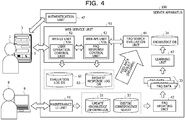
- FIG. 4 illustrates an exemplary functional configuration of the server apparatus.
- the server apparatus 100 includes a maintenance UI unit 41, an FAQ updating unit 42, a learning unit 43, an FAQ search evaluation unit 44, an authentication unit 47, and a WEB service unit 51 as processing units.
- the processing units 41 to 44, 47, and 51 are realized by processing that the corresponding programs cause the CPU 11a to execute.
- the storage unit 130a stores update knowledge information 31, an existing correspondence history 32, FAQ data 33, a knowledge DB 34, an evaluation log 62, a request response log 63, and the like.
- this embodiment is not limited to this example.
- the maintenance UI unit 41 provides a maintenance screen of knowledge information for an administrator terminal 9 of an administrator 8 of the server apparatus 100.
- the administrator 8 uses the maintenance screen displayed on the administrator terminal 9 to, for example, add, edit, and delete the knowledge information.
- the update knowledge information 31 obtained from the administrator terminal 9 is stored in the storage unit 130a.
- the FAQ updating unit 42 outputs the updated FAQ data 33 to the storage unit 130a on the basis of the update knowledge information 31 and the existing correspondence history 32.
- the learning unit 43 analyzes the FAQ data 33 and outputs the knowledge DB 34 to the storage unit 130a.
- the FAQ data 33 shows a pair of a question sentence and an answer sentence.
- the FAQ search evaluation unit 44 corresponds to a bot engine, and searches the knowledge DB 34 in response to a search request from the WEB service unit 51, evaluates the search result, and calculates (scores) accuracy.
- the authentication unit 47 authenticates the user 1 in response to a request to the server apparatus 100 for a WEB service, and permits the user 1 to use the WEB service in a case where the authentication is successfully performed.
- the WEB service unit 51 provides a search service for the user 1 authenticated by the authentication unit 47.
- the WEB service unit 51 displays a conversational UI screen 5 on the user terminal 3 of the user 1, accepts a question from the user 1 on the UI screen 5, and displays a response to the question.
- the WEB service unit 51 includes a WEB-UI unit 52 and a WEB-API unit 53.
- the WEB-UI unit 52 Upon receipt of a question on the UI screen 5 of the user terminal 3, the WEB-UI unit 52 performs control of notifying the FAQ search evaluation unit 44 of the reception via the WEB-API unit 53 and displaying, on the UI screen 5, one or more answers selected by the WEB-API unit 53 from search results obtained by the FAQ search evaluation unit 44.
- the WEB-UI unit 52 includes a user operation control unit 52a that performs display control of the UI screen 5 in response to user operation performed on the UI screen 5. Based on an FAQ response list received from the WEB-API unit 53, the user operation control unit 52a creates, for example, display data that displays one or a plurality of answers to be included in a response in a selectable manner, transmits the display data to the user terminal 3, and displays the display data thereon.
- evaluation information indicating evaluation of the WEB service provided by the server apparatus 100 from the user 1 is acquired, the evaluation information is recorded in the evaluation log DB 62.
- the WEB-API unit 53 Upon receipt of the question from the WEB-UI unit 52, the WEB-API unit 53 transmits an inquiry to the FAQ search evaluation unit 44, receives a search result with scores, determines the number of answers to the question, whether to lead the user to a call center, or the like on the basis of the scores, and creates response information.
- the created response information is transmitted to the user terminal 3 by the WEB-UI unit 52 and is displayed on the UI screen 5 of the user terminal 3.
- the WEB-API unit 53 includes an FAQ response control unit 53a that controls the number of answers to be included in a response to a question.
- the FAQ response control unit 53a determines the number of answers to be included in a response, and transmits, to the WEB-UI unit 52, an FAQ response list in which answers corresponding to the determined number of answers are listed.
- the question and the FAQ response list are recorded in the request response log DB 63.
- the WEB-UI unit 52 notifies the user operation control unit 52a of the FAQ response list.
- the evaluation log DB 62 and the request response log DB 63 are fed back to the FAQ search evaluation unit 44 to improve accuracy of answers.
- FIGS. 5 and 6 are explanatory diagrams of an example of display control by the WEB-UI unit.
- UI screens 71 and 72 include a conversation display 7a, a question input area 7b, and a transmission mark 7c.
- a left-justified conversation sentence indicates an utterance from the server apparatus 100
- a right-justified conversation sentence indicates the contents of a question or the like input by the user 1. The same applies to screen examples described below.
- the UI screen 71 shows an example of an initial display state, and displays, for example, a conversation sentence 81 "Hello, it's in charge of FAQ of the system ⁇ . Please ask any questions if you need any assistance.” at the top and prompts the user 1 to input a question sentence.
- the UI screen 72 is displayed on the user terminal 3.
- a response sentence 83a and an optional sentence 83b are included in a response and are transmitted from the server apparatus 100.
- the response sentence 83a and the optional sentence 83b received from the server apparatus 100 are displayed.
- the response sentence 83a displays a message that prompts the user 1 to select a sentence, such as "Is there a corresponding FAQ in the following FAQ?".
- the optional sentence 83b includes a plurality of sentences selectable by the user. In this example, in order to specify intent of the question of the user 1, the following four options are shown:
- the options correspond to a plurality of answer sentences from the server apparatus 100.
- the user 1 selects a sentence that specifies the question from those options. For example, in a case where the user 1 selects "I want to use a trial website.”, the screen transitions to a UI screen 73 illustrated in FIG. 6 .
- a question sentence 84 having the same contents is displayed in a right-justified manner.
- response sentences 85a and 85b and a selection icon 85c are included in a response and are transmitted from the server apparatus 100.
- the response sentences 85a and 85b and the selection icon 85c are displayed in a left-justified manner.
- the response sentence 85a indicates "Please request the following information via e-mail.
- the user 1 selects the part 85a-2, checks details, and then selects "Yes” for the response sentence 85b.
- the UI screen 73 transitions to a UI screen 74.
- Full text of the response sentence 85a is displayed on the UI screen 74, and a response sentence 86 from the server apparatus 100 is displayed in response to the selection of "Yes” in the selection icon 85c.
- the response sentence 86 indicates "I'm happy I could help.
- the response sentence 86 means that a series of conversation ends, and is a sentence example used in a case where the question of the user 1 is solved.
- FIGS. 7 to 9 are explanatory diagrams of another example of display control by the WEB-UI unit.
- a conversation sentence 87 indicating the selected sentence "Not applicable” is displayed below the optional sentences 83b in a right-justified manner on the UI screen 7a, and a response sentence 88a, an optional sentence 88b, and a selection icon 85c are included in a response and are transmitted from the server apparatus 100.
- the response sentence 88a and the optional sentence 88b received from the server apparatus 100 are displayed.
- the response sentence 88a displays a message that prompts the user 1 to select a sentence, such as "Is there a corresponding FAQ in the following FAQ?".
- the optional sentence 88b includes a plurality of sentences selectable by the user. In this example, in order to specify intent of the question of the user 1, the following four options are shown:
- FIG. 8 illustrates a UI screen 76 displayed in a case where the user 1 selects "Please tell me the minimum number of days before use.”
- a question sentence 89 indicating the selected sentence "Please tell me the minimum number of days before use.” is displayed in a right-justified manner, and response sentences 90a and 90b and a selection icon 90c are transmitted from the server apparatus 100 as a response.
- the response sentences 90a and 90b and the selection icon 90c are displayed in a left-justified manner.
- the response sentence 90a indicates "'You can use it in three business days from application in the shortest time.'", and the response sentence 90b indicates "Was this information helpful?". Further, in the selection icon 90c, icons for the response sentence 90b are displayed. In this example, icons such as "Yes” and “See other FAQ” are displayed in the selection icon 90c. When the user 1 selects "Yes” from the selection icon 90c, a series of processing regarding this FAQ is terminated. Meanwhile, a case where "See other FAQ" is selected from the selection icon 90c on the UI screen 76 will be described with reference to FIG. 9 .
- a conversation sentence 91 indicating "See other FAQ” is displayed in a right-justified manner in response to the selection of "See other FAQ" in the selection icon 90c.
- Response sentences 92a and 92b and optional sentences 92c are transmitted from the server apparatus 100 as a response. Then, the response sentences 92a and 92b and the optional sentences 92c from the server apparatus 100 are displayed in a left-justified manner.
- the response sentence 92a indicates "I'm sorry I could't help.”
- the response sentence 92b indicates "Is there a corresponding FAQ in the following FAQ?".
- the optional sentences 92c is the same as the optional sentences 88b on the UI screen 76 in FIG. 8 .
- the UI screen 77 transitions to a UI screen 78.
- a conversation sentence 93 "Not applicable.” is displayed in a right-justified manner below the optional sentences 92c.
- a response sentence 94a, an optional sentence 94b, and a response sentence 94c are displayed in response to "Not applicable.” from the server apparatus 100.
- the response sentence 94a indicates "I will connect you to the help desk. Please select a contact method.”
- the optional sentence 94b displays icons for allowing the user to select either e-mail or telephone.
- the response sentence 94c indicates "? See other FAQ for reference”.
- the number of options at the time of responding to input from the user 1 is made variable on the basis of accuracy indicating appropriateness of a response.
- input by the user 1 including selection will be collectively referred to as “questions”, and responses from the server apparatus 100 will be referred to as “answers”.
- the number of options at the time of response corresponds to the number of answers.
- the server apparatus 100 in this embodiment variably controls the number of answers by
- FIGs. 10A to 10C are explanatory diagrams of determination examples.
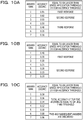
- FIGs. 10A to 10C illustrate search evaluation result examples provided by the FAQ search evaluation unit 44 for the WEB-API unit 53.
- the search evaluation result includes items such as answer rank and accuracy (score).
- the answer rank indicates descending order of accuracy, and the accuracy (score) indicates accuracy of a searched answer. Further, a response time to be displayed in a series of conversation is additionally shown in association with the rank. In this example, a case where
- FIG. 10A illustrates an example of the search evaluation result including an answer to be applied alone.
- the accuracy of an answer in an answer rank "1" is "0.95", and the accuracy of this answer alone is equal to or larger than the single application threshold S1. Therefore, the first response is made only with this answer.
- the second response is made with a plurality of answers determined in order from the answer rank "2" by using the high-accuracy threshold S2.
- the accuracy "0.65" in the answer rank “2" is equal to or less than the single application threshold S1, and thus the accuracy "0.55" in the answer rank “3” is added.
- the total accuracy is "1.20", which is equal to or larger than the high-accuracy threshold S2.
- the total number of answers is two, which is equal to or less than the maximum number of answers P1. Therefore, in the second response, two answers in the answer ranks "2" and "3" are displayed on the user terminal 3 as optional sentences.
- the third response is made with a plurality of answers determined in order from the answer rank "2" by using the high-accuracy threshold S2.
- the accuracy "0.50” in the answer rank "4", the accuracy “0.40” in the answer rank “5", and the accuracy "0.35" in the answer rank “6” are summed up, the total accuracy is equal to or larger than the high-accuracy threshold S2 for the first time.
- the total number of answers is three, which is equal to or less than the maximum number of answers P1. Therefore, in the third response, three answers in the answer rank "3", the answer rank "4", and the answer rank "5" are displayed on the user terminal 3 as optional sentences.
- FIG. 10B illustrates an example of the search evaluation result including high-accuracy answers.
- the accuracy of the answer in the answer rank "1" is "0.40", which is less than the single application threshold S1. Therefore, a response is made with the number of answers equal to or larger than the high-accuracy threshold S2.
- the total accuracy is equal to or larger than the high-accuracy threshold S2 for the first time.
- the total number of answers is three, which is equal to or less than the maximum number of answers P1. Therefore, in the first response, three answers in the answer ranks "1", “2", and “3” are displayed on the user terminal 3 as optional sentences.
- FIG. 10C illustrates an example of the search evaluation result including low-accuracy answers.
- the accuracy of the answer in the answer rank "1" is "0.40", which is less than the single application threshold S1. Therefore, it is determined whether or not a response can be made with the number of answers whose total accuracy is equal to or larger than the high-accuracy threshold S2.
- a range of answer ranks for each response up to a predetermined number of times of response may be determined at the time of the first response. For example, in a case where the number of times of response is three times, a range of answer ranks for each response up to the third response may be determined at the time of the first response.
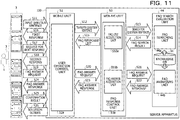
- FIG. 11 is an explanatory diagram of an outline of operation of display control in this embodiment.
- the FAQ response control unit 53a of the WEB-API unit 53 includes an FAQ list acquisition unit 55a and an FAQ answer acquisition unit 55b.
- the FAQ list acquisition unit 55a determines the number of answers and answers for specifying a question intended by the user 1.
- the FAQ answer acquisition unit 55b acquires an answer to the specified question intended by the user 1 from an FAQ answering unit 44b of the FAQ search evaluation unit 44.
- the FAQ search evaluation unit 44 includes an FAQ searching unit 44a and the FAQ answering unit 44b.
- the FAQ searching unit 44a searches the knowledge DB 34 for candidate FAQ similar to the question sentence of the user 1.
- the WEB-UI unit 52 of the server apparatus 100 detects input of a question sentence on the user terminal 3 (step S11)
- the user operation control unit 52a transfers the question sentence to the WEB-API unit 53 (Step S12).
- the FAQ list acquisition unit 55a of the FAQ response control unit 53a requests the FAQ search evaluation unit 44 to search for question sentences (step S13).
- the FAQ searching unit 44a searches the knowledge DB 34 for candidate FAQ similar to the question sentence, and transmits an FAQ search result showing the searched candidate FAQ to the WEB-API unit 53 (step S14).
- the FAQ list acquisition unit 55a notifies the WEB-UI unit 52 of an FAQ response list based on the FAQ search result (Step S15).
- the FAQ response list includes FAQ question sentences, FAQ response sentences, and the like.
- the user operation control unit 52a determines the number of answers and answers to be included in a response with respect to the user terminal 3 on the basis of the FAQ response list, and makes the first response to the question sentence input in step S11 (Step S16). Upon receipt of a request for the next response from the user terminal 3 (step S17), the user operation control unit 52a makes the second response on the basis of the FAQ response list (step S18).
- the user operation control unit 52a Upon receipt of an FAQ answer request from the user terminal 3 (step S19), the user operation control unit 52a transmits the FAQ answer request to the WEB-API unit 53 (step S20).
- the FAQ answer acquisition unit 55b of the FAQ response control unit 53a transmits the FAQ answer request to the FAQ search evaluation unit 44 (Step S21).
- the FAQ answering unit 44b uses the knowledge DB 34 to search for an answer to the question specified in the FAQ answer request, and notifies the WEB-API unit 53 of an FAQ answer response including the search result (step S22).
- the FAQ answer acquisition unit 55b transmits the FAQ answer response to the WEB-UI unit 52 (step S23).
- the user operation control unit 52a transmits the FAQ answer response to the user terminal 3 (step S24). Thereafter, when the WEB-UI unit 52 receives a confirmation result from the user terminal 3 (step S25), the user operation control unit 52a displays a solution screen on the user terminal 3 (step S26), and a response to the question sentence input in step S11 is terminated.
- FIG. 12 illustrates parameter examples.
- a parameter name indicates the kind of parameter, and an identifier is indicated for each parameter name.
- FIG. 12 illustrates values of the respective parameters.
- the present invention is not limited to this example.
- the parameters are the single application threshold S1, the high-accuracy threshold S2, the low-accuracy threshold S3, a determination threshold S4 for determining that a relationship is low, the maximum number of answers P1 per response, the maximum number of responses P2 before an alternative answer, and the maximum number of responses P3 after an alternative answer.
- the thresholds used for determination based on the accuracy will be described.
- the single application threshold is, for example, "0.70".
- a response is made with the number of FAQ whose total value of accuracies added in descending order is equal to or larger than the high-accuracy threshold as an answer.
- a plurality of FAQ is displayed to be selectable on the user terminal 3.
- the high-accuracy threshold is, for example, "0.95".
- the total accuracy of FAQ having the maximum number of answers (P1) per response is equal to or less than the low-accuracy threshold, it is determined that the searched FAQ deviate from the question of the user 1, and an alternative answer ("Please contact the call center.”, or the like) is displayed.
- the low-accuracy threshold is, for example, "0.85".
- an introductory message such as "The following FAQ may be irrelevant to your question... " is displayed at the beginning of question sentences of the FAQ that has been searched for on the basis of the question sentence of the user 1. The message is displayed before the FAQ question sentences on the user terminal 3.
- the maximum number of answers displayable in a response on the user terminal 3 is indicated.
- the maximum number of answers per response is, for example, about three to six.
- the maximum number of responses from which the user 1 can select "Not applicable" is indicated.
- the maximum number of answers before an alternative answer is, for example, four times or the like.
- the alternative answer corresponds to the question sentences of the FAQ that have been searched for on the basis of the question sentence input by the user 1.
- the maximum number of responses with which question sentences of low-accuracy FAQ can be referred to is indicated.
- the maximum number of responses is used when the question sentences of the low-accuracy FAQ are continuously displayed even after the alternative answer.
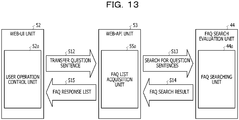
- FIG. 13 illustrates an outline of the first response processing.
- the first response processing in FIG. 13 corresponds to steps S12 to S15 in FIG. 11 .
- processing by the FAQ list acquisition unit 55a in the first response processing will be described with reference to FIG. 14 .
- FIG. 14 is a flowchart of processing performed by the FAQ list acquisition unit.
- the FAQ list acquisition unit 55a upon receipt of a question sentence from the user operation control unit 52a of the WEB-UI unit 52 (step S121), the FAQ list acquisition unit 55a reads the parameters P1 and P3 from the storage unit 130a (step S122).
- the FAQ list acquisition unit 55a requests the FAQ search evaluation unit 44 to search for question sentences by using the question sentence while setting a value obtained by multiplying P1 by P3 as the maximum number of FAQ (step S123), and receives an FAQ search result from the FAQ search evaluation unit 44 (step S124).
- the FAQ list acquisition unit 55a edits a response telegraphic message for the WEB-UI unit 52 (step S125), transmits an FAQ response list to the WEB-UI unit 52 (step S126), and terminates this processing.
- FIGs. 15A to 15D illustrates telegraphic message examples in steps 12 to S15.
- FIG. 15A illustrates an example of the transferred telegraphic message in step S12.
- a transferred telegraphic message 131 includes a character string "What is a procedure for changing the person in charge?" indicating the question sentence input by the user 1.
- FIG. 15B illustrates an example of a search telegraphic message in step S13.
- a search telegraphic message 132 indicates not only the contents of the transferred telegraphic message 131 but also the maximum number of FAQ "50" obtained by multiplying P1 by P3.
- FIG. 15C illustrates an example of a result telegraphic message in step S14.
- a result telegraphic message 133 includes descriptions 133a to 133c and the like.
- the description 133a indicates a session ID "20171116113533968478" used when the question sentence is transferred from the user operation control unit 52a to the FAQ list acquisition unit 55a, and the description 133b indicates that the total number of searched candidate FAQ is "20".
- the description 133c indicates an FAQ question sentence in each answer rank.
- This example shows an FAQ question sentence "I changed the person in charge", an FAQ question sentence ID "K02-01-01”, the accuracy "0.5494", and the like for the answer rank "1".
- This example shows an FAQ question sentence "I want to add a person in charge", an FAQ question sentence ID "K02-01-02”, the accuracy "0.4667”, and the like for the answer rank "2". Further, regarding the answer ranks "3" to "20", descriptions are similarly made.
- FIG. 15D illustrates an example of a response list telegraphic message in step S15.
- a response list telegraphic message 134 includes descriptions 134a to 134c and the like.
- the description 134a indicates the session ID "20171116113533968478" used when the question sentence is transferred from the user operation control unit 52a to the FAQ list acquisition unit 55a, and the description 134b indicates that the total number of searched candidate FAQ is "20".
- the description 134c has the same contents as the description 133c, except for the answer rank.
- FIG. 16 illustrates an outline of the second response processing.
- the second response processing in FIG. 16 corresponds to steps S20 to S23 in FIG. 11 .
- processing by the FAQ list acquisition unit 55a in the second response processing will be described with reference to FIG. 17 .
- FIG. 17 is a flowchart of processing performed by the FAQ answer acquisition unit.
- the FAQ answer acquisition unit 55b upon receipt of the FAQ answer request from the user operation control unit 52a of the WEB-UI unit 52, the FAQ answer acquisition unit 55b acquires an FAQ question sentence ID (step S141), and transmits a request for detailed information of the FAQ question ID to the FAQ search evaluation unit 44 (step S142). The request for detailed information of the FAQ question ID is transmitted to the FAQ answering unit 44b via the FAQ search evaluation unit 44.
- the FAQ answer acquisition unit 55b edits a response telegraphic message for the WEB-UI unit 52 (step S144), transmits the FAQ answer response to the WEB-UI unit 52 (step S155), and terminates this processing.
- FIGs. 18A to 18D illustrate telegraphic message examples in steps S20 to S23.
- FIG. 18A illustrates an answer request telegraphic message 151 in step S20.
- the answer request telegraphic message 151 includes descriptions 151a to 151c and the like.
- the description 151a specifies "yes” indicating that the user 1 has specified one of the candidate FAQ question sentences.
- the description 151b specifies an ID "K01-02-01-02" of the FAQ question sentence selected by the user 1.
- the description 151c specifies the session ID "20171116113533968478" for specifying the answer request telegraphic message 151.
- FIG. 18B illustrates an example of an answer request telegraphic message in step S21.
- An answer request telegraphic message 152 includes a description 152a, a description 152b, and the like.
- the description 152a indicates the FAQ question sentence ID "K01-02-01-02" specified in the answer request telegraphic message 151.
- the description 152b indicates the session ID "20171116113533968478" in the answer request telegraphic message 151.
- FIG. 18C illustrates an example of an answer response telegraphic message in step S22.
- An answer response telegraphic message 153 includes descriptions 153a to 153c and the like.
- the description 153a indicates the session ID "20171116113533968478" in the answer request telegraphic message 151.
- the description 153b specifies "ok” indicating that candidate FAQ have been searched for.
- the description 153c indicates information regarding the FAQ question sentence in each answer rank.
- This example shows the FAQ question sentence ID "K02-01-01", the accuracy "0.5495", the FAQ question sentence "I want to change the person in charge", an FAQ response sentence "The person in charge of the design sheet... ", and the like for the answer rank "1".
- FIG. 18D illustrates an example of an answer response telegraphic message in step S23.
- An answer response telegraphic message 154 includes descriptions 154a to 154c and the like.
- the description 154a indicates the session ID "20171116113533968478" in the answer request telegraphic message 151, and the description 154b specifies "ok” indicating that the candidate FAQ have been searched for.
- the description 154c indicates information regarding a searched FAQ answer sentence.
- This example shows the FAQ question sentence ID "K02-01-01", the accuracy "0.5494", the FAQ response sentence "The person in charge of the design sheet", and the like.
- FIG. 19 is an explanatory diagram of the processing flow in the user operation control unit in the first response processing. Description will be made by using an exemplary configuration in which the user operation control unit 52a includes an input reception unit 54a, an FAQ list development unit 54b, and an FAQ display control unit 54c.
- the input reception unit 54a transfers the question sentence to the WEB-API unit 53 (step S12).
- the FAQ list development unit 54b develops the FAQ response list in the primary storage 12a.
- the FAQ display control unit 54c determines the number of FAQ question sentences to be included in a response and the FAQ question sentences by using the FAQ response list stored in the primary storage 12a, and performs display control of displaying the response on the user terminal 3 (step S16). The first response is made. Thereafter, the display control described with reference to FIG. 11 is performed by the FAQ display control unit 54c.
- FIG. 20 illustrates an exemplary data structure of the FAQ response list.
- An FAQ response list 201 in FIG. 20 is a table showing candidate FAQ searched for on the basis of the question sentence input by the user 1.
- the FAQ response list 201 includes items such as answer rank, FAQ question sentence ID, FAQ question sentence, accuracy, and response number.
- the answer rank indicates descending order of accuracy.
- the FAQ question sentence ID indicates an ID for identifying an FAQ question sentence.
- the FAQ question sentence indicates the content of the question sentence of each of the candidate FAQ.
- the accuracy indicates a degree of similarity to the question sentence input by the user 1.
- the response number is set by the FAQ display control unit 54c and indicates the determined response number. This example shows a state in which the response number has not been set yet.
- FIG. 21 is a flowchart of overall processing performed by the user operation control unit of the WEB-UI unit.
- the input reception unit 54a determines whether or not a question sentence has been received from the user terminal 3 (step S201). In a case where the question sentence is received (YES in step S201), the input reception unit 54a determines that this is the first FAQ display control, acquires the parameters S1, S2, S3, S4, P1, P2, and P3 from the storage unit 130a, and stores the parameters in the primary storage 12a (step S202). Then, the input reception unit 54a transfers the received question sentence to the WEB-API unit 53 to make a request to acquire an FAQ response list (step S203).
- the FAQ list development unit 54b develops the FAQ response list in the primary storage 12a (step S205). Then, the FAQ display control unit 54c performs the first FAQ display control processing (step S206). Then, the processing by the user operation control unit 52a is terminated.
- the input reception unit 54a determines whether or not "See other FAQ” has been received (step S207). In a case where "See other FAQ" is received (YES in step S207), the input reception unit 54a directly calls the FAQ display control unit 54c without transferring "See other FAQ" to the WEB-API unit 53, and executes the second FAQ display control processing (step S208). Thereafter, the processing by the user operation control unit 52a is terminated.
- the input reception unit 54a directly calls the FAQ display control unit 54c without transferring "See other FAQ" to the WEB-API unit 53, and executes the third FAQ display control processing that is performed in response to reception of "Not applicable” (step S209). Thereafter, the processing by the user operation control unit 52a is terminated.
- FIGS. 22 and 23 are flowcharts of the first FAQ display control processing performed by the FAQ display control unit.
- processing of setting a value to the response number in the FAQ response list is performed.
- the number of FAQ question sentences to be included in each response and the FAQ question sentences are determined.
- the FAQ display control unit 54c sets 0 to a total accuracy v indicating the sum total of accuracies selected from the FAQ response list, and sets 1 to a response number p (step S301) .
- the FAQ display control unit 54c performs processing of a loop 1. In the loop 1, processing of summing up accuracies in descending order of accuracy in the FAQ response list is performed.
- the FAQ display control unit 54c sets 0 as an initial value of a counter i, and, in a case where the counter i is equal to or less than the value of P1 ⁇ P3, adds P1 to the counter i and repeats the loop 1.
- the FAQ display control unit 54c further performs processing of a loop 2.
- display control processing for each response is performed.
- the FAQ display control unit 54c sets 1 as an initial value of a counter j, and, in a case where the counter j is equal to or less than P1, increments the counter j by 1 and repeats the loop 2.
- FAQ(i + j) indicates an answer rank that is currently processed in the FAQ response list and specifies a record.
- the FAQ display control unit 54c determines whether or not the accuracy of FAQ(i + j) is equal to or larger than the single application threshold S1 (Step S302). In a case where the accuracy is equal to or larger than the single application threshold S1 (YES in step S302), the FAQ display control unit 54c sets p to the response number of FAQ(i + j) (step S303), and proceeds to step S310.
- the FAQ display control unit 54c adds the accuracy of FAQ(i + j) to the total accuracy v (step S304), and determines whether or not the total accuracy v is equal to or larger than the high-accuracy threshold S2 (step S305). In a case where the accuracy is equal to or larger than the high-accuracy threshold S2 (YES in step S305), the FAQ display control unit 54c sets p to the response number of FAQ(i + j) (step S306), and proceeds to step S310.
- the FAQ display control unit 54c determines whether or not the counter j is the maximum number of answers P1 per response and whether or not the total accuracy v is equal to or less than the low-accuracy threshold S3 (step S307). In a case where the total accuracy v is equal to or less than the low-accuracy threshold S3 (YES in step S307), the FAQ display control unit 54c sets null to the response number of FAQ(i + j) (step S308), and repeats the loop 2 until the counter j becomes larger than the maximum number of answers P1 per response.
- the FAQ display control unit 54c sets p to the response number of FAQ(i + j) (step S309), and repeats the loop 2 until the counter j becomes larger than the maximum number of answers P1 per response.
- the FAQ display control unit 54c increments the response number p by 1 (step S310), and repeats the loop 1 while adding P1 to the counter i until the counter i becomes equal to or larger than the value of P1 ⁇ P3.
- the FAQ display control unit 54c terminates the loop 1, and proceeds to step S312 in FIG. 23 .
- Steps S312 to S317 in FIG. 23 and FAQ display processing A320 correspond to the first FAQ display control.
- the FAQ display control unit 54c initializes an FAQ display area (Step S312), sets 1 to the response number p (Step S313), and performs processing of a loop 3.
- FAQ for the first response are extracted from the FAQ response list in descending order of accuracy.
- the FAQ display control unit 54c sets 0 as the initial value of the counter i, and, in a case where the counter i is equal to or less than the value of P1 ⁇ P3, increments the counter i by 1 and repeats the loop 3.
- FAQ(i) specifies the i-th record in descending order of accuracy in the FAQ response list.
- the FAQ display control unit 54c determines whether or not the response number of FAQ(i) matches p (step S314). In a case where the response number of FAQ(i) does not match p (NO in step S314), the FAQ display control unit 54c repeats the loop 3 until the counter i becomes equal to or larger than the value of P1 ⁇ P3.
- the FAQ display control unit 54c determines whether or not the accuracy of FAQ(i) is less than the determination threshold S4 for determining that a relationship is low (step S315). In a case where the accuracy is less than the determination threshold S4 (YES in step S315), the FAQ display control unit 54c adds a sentence "The following FAQ may be irrelevant" to the beginning of the FAQ question sentences (step S316), and adds FAQ(i) to the FAQ display area (step S317). Then, the FAQ display control unit 54c repeats the loop 3 until the counter i becomes equal to or larger than the value of P1 ⁇ P3.
- the FAQ display control unit 54c adds FAQ(i) to the FAQ display area (step S317), and repeats the loop 3 until the counter i becomes equal to or larger than the value of P1 ⁇ P3.
- the FAQ display control unit 54c terminates the loop 3 and performs the FAQ display processing A320.
- the FAQ display processing A320 it is determined whether or not FAQ exists in the FAQ display area (step S321).
- the FAQ display control unit 54c displays candidate FAQ questions on the user terminal 3 by referring to the FAQ display area (step S322), and terminates the FAQ display processing A320.
- the FAQ display control unit 54c displays an alternative answer on the user terminal 3 (step S323), and terminates the FAQ display processing A320.
- the FAQ display control unit 54c terminates the first FAQ display control.
- FIG. 24 is a flowchart of the second FAQ display control processing performed by the FAQ display control unit.
- FAQ display control in the second and subsequent responses which is performed in response to reception of "See other FAQ", is performed.
- the FAQ display control unit 54c acquires the response number, sets the response number to the number X (step S331), and initializes the FAQ display area (step S332). Further, the FAQ display control unit 54c sets the number X to the response number p (step S333), and performs processing of a loop 4. In the loop 4, processing of extracting, from the FAQ response list, FAQ whose response numbers p indicate X in descending order of accuracy is performed.
- the FAQ display control unit 54c sets 0 as the initial value of the counter i, and, in a case where the counter i is equal to or less than the value of P1 ⁇ P3, increments the counter i by 1 and repeats the loop 4.
- the FAQ display control unit 54c determines whether or not the response number of FAQ(i) matches p (step S334). In a case where the response number of FAQ(i) does not match p (NO in step S334), the FAQ display control unit 54c exits from the loop 4 and performs the FAQ display processing A320 ( FIG. 23 ) (step S337). When the FAQ display processing A320 ( FIG. 23 ) is terminated, the FAQ display control unit 54c terminates the second FAQ display control processing.
- the FAQ display control unit 54c adds FAQ(i) to the FAQ display area (step S335).
- the FAQ display control unit 54c repeats the loop 4 while adding P1 to the counter i until the counter i becomes equal to or larger than the value of P1 ⁇ P3.
- the FAQ display control unit 54c terminates the loop 4, performs the FAQ display processing A320 ( FIG. 23 ), and then terminates the second FAQ display control processing.
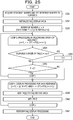
- FIG. 25 is a flowchart of the third FAQ display control processing performed by the FAQ display control unit.
- FAQ display control which is performed in response to reception of "Not applicable”, is performed.
- the FAQ display control unit 54c acquires the response number, sets the response number to the number X (step S351), and initializes the FAQ display area (step S352). Further, the FAQ display control unit 54c sets the number X to the response number p, sets Z to a start rank Y (step S353), and performs processing of a loop 5. Z is initially zero. In the loop 5, processing of summing up accuracies in descending order of accuracy in the FAQ response list is performed. The FAQ display control unit 54c sets 0 as the initial value of the counter i, and, in a case where the counter i is equal to or less than the value of P1 ⁇ P3, increments the counter i by 1 and repeats the loop 5.
- the FAQ display control unit 54c determines whether or not the response number of FAQ(i) is null (step S354). In this determination processing in step S354, it is determined whether or not FAQ are only low-accuracy FAQ. In a case where the response number of FAQ(i) is null (YES in step S354), the FAQ display control unit 54c sets the counter i to the start rank Y (step S355), and then determines whether or not the start rank Y is larger than zero (step S356). In a case where the start rank Y is equal to or less than zero (NO in step S356), the FAQ display control unit 54c exits from the loop 5 and starts a loop 6.
- the FAQ display control unit 54c repeats the loop 5 until the counter i becomes equal to or larger than the value of P1 ⁇ P3.
- the FAQ display control unit 54c When the loop 5 is terminated, the FAQ display control unit 54c performs processing of the loop 6. In the loop 6, display processing for each response is performed.
- the FAQ display control unit 54c sets the start position Y to the counter i, and, in a case where the counter i is equal to or less than Y + P1 and is less than P1 ⁇ P3, increments the counter i by 1 and repeats the loop 6.
- the FAQ display control unit 54c adds FAQ(i) to the FAQ display area (step S359), sets the counter i to Z (step S360), and performs similar processing while the above-described repetition condition for the loop 6 is satisfied.
- Z indicates a start rank for the next response.
- the FAQ display control unit 54c performs the FAQ display processing A320 (step S362), and then terminates the third FAQ display control processing.
- this embodiment supports at least the following operations:
- FIG. 26 illustrates exemplary data of a table regarding the display control in Operation 1.
- a table 201-1 is a data table showing results of the display control in Operation 1.
- the table 201-1 shows a data example of items such as determination result, in addition to the items of the FAQ response list 201 of FIG. 20 .
- the item of FAQ question sentence is omitted.
- the determination result indicates a total value of accuracies in the display control.
- remarks are additionally provided.
- the accuracy in the answer rank "1" is "0.7546", and thus the accuracy of the FAQ question sentence in the answer rank "1" alone is equal to or larger than the single application threshold S1. Thus, only this FAQ question sentence is included.
- the response number "1" is set for the answer rank "1".
- the accuracy in the answer rank "2" is "0.1033", which is less than the single application threshold S1 and the high-accuracy threshold S2.
- the accuracies in the subsequent answer ranks “3” to “6” are added until the accuracies become the high-accuracy threshold S2 within the limits of the maximum number of times P1 per response.
- the determination result "0.4925" is less than the low-accuracy threshold S3, and thus it is determined that a response including FAQ question sentences is not made. Therefore, the response number null is set to the answer ranks "3" to "6". Further, the response number null is also set to the answer ranks "7" to "20” indicating low accuracy. Based on the table 201-1 created in this way, display control on the user terminal 3 is performed.
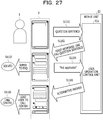
- FIG. 27 illustrates an exemplary processing flow between the user terminal and the server apparatus according to Operation 1.
- the user operation control unit 52a of the WEB-UI unit 52 upon receipt of a question sentence from the user terminal 3 (step S1101), acquires the FAQ response list 201 in which candidate FAQ similar to the question sentence are sorted in order of accuracy from the FAQ searching unit 44a via the WEB-API unit 53.
- the user operation control unit 52a creates the table 201-1 ( FIG. 26 ) in the storage unit 130a on the basis of the FAQ response list 201, includes the FAQ question sentence of the response number "1" in the first response, transmits the first response to the user terminal 3, and displays the first response on the user I/F 16b (step S1102) .
- the user operation control unit 52a upon receipt of the telegraphic message indicating "Not applicable", the user operation control unit 52a refers to the table 201-1 to search for a record indicating the response number "2". No record indicating the response number "2" exists in the table 201-1, and thus an alternative answer for leading the user to the call center is transmitted to the user terminal 3 as a response (step S1105).
- the alternative answer is displayed on the user terminal 3 (step S1106), the user 1 can obtain inquiry means to the call center.
- FIG. 28 illustrates exemplary data of a table regarding the display control in Operation 2.
- a table 201-2 is a data table showing results of the display control in Operation 2.
- the table 201-2 shows exemplary data of items similar to those of the table 201-1 in FIG. 26 .
- the accuracy in the answer rank “1” is "0.5494", which is less than the single application threshold S1, and the accuracy "0.4667” in the answer rank “2” is added.
- “1.0161” is obtained.
- the total accuracy "1.0161” is equal to or larger than the high-accuracy threshold S2, and thus "1" is set to the response numbers in the answer ranks “1” and "2" so that the FQA question sentences in the answer ranks “1" and "2" are included in the first response.
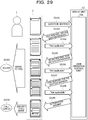
- FIG. 29 illustrates an exemplary processing flow between the user terminal and the server apparatus according to Operation 2.
- the user operation control unit 52a of the WEB-UI unit 52 upon receipt of a question sentence from the user terminal 3 (step S2101), acquires the FAQ response list 201 in which candidate FAQ similar to the question sentence are sorted in order of accuracy from the FAQ searching unit 44a via the WEB-API unit 53.
- the user operation control unit 52a creates the table 201-2 ( FIG. 28 ) in the storage unit 130a on the basis of the FAQ response list 201, includes the FAQ question sentences of the response number "1" in the first response, transmits the first response to the user terminal 3, and displays the first response on the user I/F 16b (step S2102).
- the user operation control unit 52a upon receipt of the telegraphic message indicating "Not applicable", the user operation control unit 52a refers to the table 201-2 to search for a record indicating the response number "2".
- the FAQ question sentences of the response number "2" are included in the second response, are transmitted to the user terminal 3, and are displayed on the user I/F 16b (step S2105).
- the user operation control unit 52a upon receipt of the telegraphic message indicating "Not applicable", the user operation control unit 52a refers to the table 201-2 to search for a record indicating the response number "3".
- the FAQ question sentences of the response number "3" are included in the third response, are transmitted to the user terminal 3, and are displayed on the user I/F 16b (step S2107).
- the user operation control unit 52a upon receipt of the telegraphic message indicating "Not applicable", the user operation control unit 52a refers to the table 201-2 to search for a record indicating the response number "4". No record indicating the response number "4" exists in the table 201-2, and thus an alternative answer for leading the user to the call center is transmitted to the user terminal 3 as a response (step S2109).
- the alternative answer is displayed on the user terminal 3 (step S2110), the user 1 can obtain inquiry means to the call center.
- FIG. 30 illustrates exemplary data of a table regarding the display control in Operation 3.
- a table 201-3 is a data table showing results of the display control in Operation 2.
- the table 201-3 shows exemplary data of items similar to those of the table 201-1 in FIG. 26 .
- the accuracy in the answer rank “1” is "0.5188", which is less than the single application threshold S1, and is added with the accuracy "0.4967” in the answer rank “2".
- “1.0155” is obtained.
- the total accuracy "1.0155” is equal to or larger than the high-accuracy threshold S2, and thus "1" is set to the response numbers in the answer ranks “1” and "2" so that the FQA question sentences in the answer ranks “1” and "2" are included in the first response.
- FIG. 31 illustrates an exemplary processing flow between the user terminal and the server apparatus according to Operation 3.
- the user operation control unit 52a of the WEB-UI unit 52 upon receipt of a question sentence from the user terminal 3 (step S3101), acquires the FAQ response list 201 in which candidate FAQ similar to the question sentence are sorted in order of accuracy from the FAQ searching unit 44a via the WEB-API unit 53.
- the user operation control unit 52a creates the table 201-3 ( FIG. 30 ) in the storage unit 130a on the basis of the FAQ response list 201, includes the FAQ question sentences of the response number "1" in the first response, transmits the first response to the user terminal 3, and displays the first response on the user I/F 16b (step S3102).
- the user operation control unit 52a upon receipt of the telegraphic message indicating "Not applicable", the user operation control unit 52a refers to the table 201-3 to search for a record indicating the response number "2".
- the FAQ question sentences of the response number "2" are included in the second response, are transmitted to the user terminal 3, and are displayed on the user I/F 16b (step S3105).
- the user operation control unit 52a upon receipt of the telegraphic message indicating "Not applicable", the user operation control unit 52a refers to the table 201-3 to search for a record indicating the response number "3".
- the FAQ question sentences of the response number "3" are included in the third response, are transmitted to the user terminal 3, and are displayed on the user I/F 16b (step S3107).
- the user operation control unit 52a upon receipt of the telegraphic message indicating "Not applicable", the user operation control unit 52a refers to the table 201-3 to search for a record indicating the response number "4".
- the FAQ question sentences of the response number "4" are included in the fourth response, are transmitted to the user terminal 3, and are displayed on the user I/F 16b (step S3109).
- the user operation control unit 52a upon receipt of the telegraphic message indicating "Not applicable", the user operation control unit 52a refers to the table 201-3 to search for a record indicating the response number "5". No record indicating the response number "5" exists in the table 201-3, and thus an alternative answer for leading the user to the call center is transmitted to the user terminal 3 as a response (step S3111).
- the alternative answer is displayed on the user terminal 3 (step S3112)
- the user 1 can obtain inquiry means to the call center.
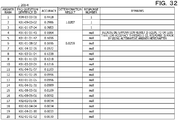
- FIG. 32 illustrates exemplary data of a table regarding the display control in Operation 4.
- a table 201-4 is a data table showing results of the display control in Operation 2.
- the table 201-4 shows exemplary data of items similar to those of the table 201-1 in FIG. 26 .
- the accuracy in the answer rank “1” is "0.4418", which is less than the single application threshold S1.
- the accuracy "1.0057” is obtained when the accuracy in the answer rank "3" is added.
- the total accuracy "1.0057” is equal to or larger than the high-accuracy threshold S2, and thus the FQA question sentences in the answer ranks "1" to "3" are included in the first response. Therefore, "1" is set to the response numbers in the answer ranks "1" to "3".
- FIG. 33 illustrates an exemplary processing flow between the user terminal and the server apparatus according to Operation 4.
- the user operation control unit 52a of the WEB-UI unit 52 upon receipt of a question sentence from the user terminal 3 (step S4101), acquires the FAQ response list 201 in which candidate FAQ similar to the question sentence are sorted in order of accuracy from the FAQ searching unit 44a via the WEB-API unit 53.
- the user operation control unit 52a creates the table 201-4 ( FIG. 32 ) in the storage unit 130a on the basis of the FAQ response list 201, includes the FAQ question sentences of the response number "1" in the first response, transmits the first response to the user terminal 3, and displays the first response on the user I/F 16b (step S4102) .
- the user operation control unit 52a upon receipt of the telegraphic message indicating "Not applicable", the user operation control unit 52a refers to the table 201-4 to search for a record indicating the response number "2". No record indicating the response number "2" exists in the table 201-4, and thus an alternative answer for leading the user to the call center is transmitted to the user terminal 3 as a response (step S4105).
- the alternative answer is displayed on the user terminal 3 (step S4106), the user 1 can obtain inquiry means to the call center.
- FIG. 34 illustrates exemplary data of a table regarding the display control in Operation 5.
- a table 201-5 is a data table showing results of the display control in Operation 5.
- the table 201-5 shows exemplary data of items similar to those of the table 201-1 in FIG. 26 .
- the accuracy in the answer rank "1" is "0.1612", which is less than the single application threshold S1.
- the accuracies are added according to the answer ranks from the answer rank "1" to the maximum number of times P1 per response.
- the total accuracy is "0.6366", which is less than the low-accuracy threshold S3.
- FIG. 35 illustrates an exemplary processing flow between the user terminal and the server apparatus according to Operation 5.
- the user operation control unit 52a of the WEB-UI unit 52 upon receipt of a question sentence from the user terminal 3 (step S5101), acquires the FAQ response list 201 in which candidate FAQ similar to the question sentence are sorted in order of accuracy from the FAQ searching unit 44a via the WEB-API unit 53.
- the user operation control unit 52a creates the table 201-5 ( FIG. 34 ) in the storage unit 130a on the basis of the FAQ response list 201, determines that it is difficult to answer the question sentence of the user 1 because no FAQ question sentence of the response number "1" exists in the table 201-5, and transmits an alternative answer to the user terminal 3 as a response (step S5102).
- the user 1 can obtain inquiry means to the call center.
- the number of answers to be displayed for each response on the user terminal 3 is determined in accordance with accuracy of answers and a degree of fulfillment of answers of an FAQ search engine. Further, in a case where no answer can be obtained with a certain or higher degree of accuracy, a message such as "Connect to the call center" is displayed to lead the user 1 to the call center.
- the user 1 who uses a UI of the chatbot can obtain a plurality of selectable answers in a response with respect to a single question, and can therefore obtain desired information with fewer operations.
- This embodiment is also applicable to, for example, a safety confirmation system that gives answers regarding safety confirmation in response to safety confirmation inquiries from school students and staffs, employees in an office, and the like when an earthquake or weather warning occurs.
- the FAQ search evaluation unit 44 corresponds to an example of an extraction unit
- the WEB service unit 51 corresponds to an example of a selection unit.
Landscapes
- Engineering & Computer Science (AREA)
- Theoretical Computer Science (AREA)
- Physics & Mathematics (AREA)
- Databases & Information Systems (AREA)
- General Physics & Mathematics (AREA)
- Data Mining & Analysis (AREA)
- General Engineering & Computer Science (AREA)
- Computational Linguistics (AREA)
- Mathematical Physics (AREA)
- Probability & Statistics with Applications (AREA)
- Artificial Intelligence (AREA)
- Fuzzy Systems (AREA)
- Software Systems (AREA)
- Human Computer Interaction (AREA)
- Information Retrieval, Db Structures And Fs Structures Therefor (AREA)
Abstract
Description
- The present invention relates to an output control program, an output control method, and an output control apparatus.
- Automatic conversation programs using artificial intelligence (AI) have been used in recent years. There is mainly realized searching for a providable service from a knowledge database obtained by AI in response to an inquiry input by a user to thereby provide information.
- There is known, for example, a technique of, in a case where it is difficult to select an answer to a question written in a natural sentence from a frequently-asked-questions (FAQ) database, outputting a related question, a reverse question, or the like in order to provide information with high accuracy.
-
- Patent Document 1: Japanese Laid-open Patent Publication No.
2015-36945 - Patent Document 2: Japanese Laid-open Patent Publication No.
2005-202627 - Patent Document 3: Japanese Laid-open Patent Publication No.
2004-171479 - An automatic conversation program is referred to as "chatbot". The chatbot generally makes conversation in the form of questions and answers, and thus, in a case where an output answer is not an answer that a user requires, the user needs to additionally input another question in order to obtain another answer. Meanwhile, if all possible answers are output, the user needs to determine which answer is appropriate, which is extremely troublesome.
- Therefore, in one aspect, an object is to flexibly output an answer according to accuracy of the answer.
- According to an aspect, provided is an output control program for causing a computer to execute processing of: in a case where input of a question is accepted, extracting an accuracy of each of one or a plurality of answers to the question, the accuracy being stored in a storage unit; and selecting an answer to be output from the one or plurality of answers so that a total value of the accuracy of the one or plurality of answers to the question is equal to or larger than a first threshold.
- It is possible to flexibly output an answer according to accuracy of the answer.
-
-
FIG. 1 illustrates an exemplary configuration of a system. -
FIG. 2 illustrates a hardware configuration of a server apparatus. -
FIG. 3 illustrates a hardware configuration of a user terminal. -
FIG. 4 illustrates an exemplary functional configuration of a server apparatus. -
FIG. 5 is an explanatory diagram of an example of display control by a WEB-UI unit. -
FIG. 6 is an explanatory diagram of an example of display control by a WEB-UI unit. -
FIG. 7 is an explanatory diagram of another example of display control by a WEB-UI unit. -
FIG. 8 is an explanatory diagram of another example of display control by a WEB-UI unit. -
FIG. 9 is an explanatory diagram of another example of display control by a WEB-UI unit. -
FIGs. 10A to 10C are explanatory diagrams of determination examples. -
FIG. 11 is an explanatory diagram of an outline of operation of display control in this embodiment. -
FIG. 12 illustrates parameter examples. -
FIG. 13 illustrates an outline of first response processing. -
FIG. 14 is a flowchart of processing performed by an FAQ list acquisition unit. -
FIGs. 15A to 15D illustrate telegraphic message examples insteps 12 to S15. -
FIG. 16 illustrates an outline of second response processing. -
FIG. 17 is a flowchart of processing performed by an FAQ answer acquisition unit. -
FIGs. 18A to 18D illustrate telegraphic message examples in steps S20 to S23. -
FIG. 19 is an explanatory diagram of a processing flow in a user operation control unit in the first response processing. -
FIG. 20 illustrates an exemplary data structure of an FAQ response list. -
FIG. 21 is a flowchart of overall processing performed by a user operation control unit of a WEB-UI unit. -
FIG. 22 is a flowchart of first FAQ display control processing performed by an FAQ display control unit. -
FIG. 23 is a flowchart of the first FAQ display control processing performed by an FAQ display control unit. -
FIG. 24 is a flowchart of second FAQ display control processing performed by an FAQ display control unit. -
FIG. 25 is a flowchart of third FAQ display control processing performed by an FAQ display control unit. -
FIG. 26 illustrates exemplary data of a table regarding display control inOperation 1. -
FIG. 27 illustrates an exemplary processing flow between a user terminal and a server apparatus according toOperation 1. -
FIG. 28 illustrates exemplary data of a table regarding display control inOperation 2. -
FIG. 29 illustrates an exemplary processing flow between a user terminal and a server apparatus according toOperation 2. -
FIG. 30 illustrates exemplary data of a table regarding display control inOperation 3. -
FIG. 31 illustrates an exemplary processing flow between a user terminal and a server apparatus according toOperation 3. -
FIG. 32 illustrates exemplary data of a table regarding display control inOperation 4. -
FIG. 33 illustrates an exemplary processing flow between a user terminal and a server apparatus according toOperation 4. -
FIG. 34 illustrates exemplary data of a table regarding display control inOperation 5. -
FIG. 35 illustrates an exemplary processing flow between a user terminal and a server apparatus according toOperation 5. - Hereinafter, an embodiment of the present invention will be described with reference to the drawings. First, a system regarding a chatbot will be described.
FIG. 1 illustrates an exemplary configuration of the system. InFIG. 1 , asystem 1000 includes a plurality ofuser terminals 3 and aserver apparatus 100. Eachuser terminal 3 and theserver apparatus 100 are connectable via the Internet 2. - The plurality of
user terminals 3 is information processing terminals used byusers 1, and includes a browser, a specific application for a chatbot, and the like. Theserver apparatus 100 is an information processing apparatus that responds to a question from theuser 1 and makes conversation with theuser 1 by using a chatbot using artificial intelligence (AI), and corresponds to an output control apparatus that controls output (answer) in response to input of a question. - For the purpose of supporting a call center using AI, the inventors and the like mounted a frequently-asked-questions (FAQ) chatbot on such a
system 1000 and implemented proof of concept (PoC) by theuser 1. As a result, the following problems became apparent. - Online chat is basically conversation in the form of questions and answers, and thus, in a case where the
user 1 does not obtain an answer that the user requires, the number of conversations is increased and the time and effort for input is increased. - However, a plurality of answers can be given to a question in some cases. This case is performed only when a plurality of answers to a question is defined to some extent.
- In a case where a plurality of answers is given and there are too many answers, the chatbot is no longer appropriately used, and it is desirable to use a search engine instead of online chat. Control thereof is not appropriately performed.
- In a case where the
user 1 does not immediately obtain the number of times that the user requires, theuser 1 may be dissatisfied. That is, stress put on theuser 1 increases as conversation continues. This phenomenon also occurs in general conversation with people. - From the above, in order to improve convenience of the chatbot that supports a call center for the
user 1, the following points are problems: - to give an answer that the
user 1 requires as a first response if possible; - to give a plurality of answers as a response in a case where accuracy of the answers is not so high; and
- to immediately give an answer that leads the user to a call center by telephone, e-mail, or the like in a case where no appropriate answer is obtained (in a case where there are only low-accuracy answers).
- In order to solve the above problems, the inventors and the like have devised a mechanism for changing the contents to be displayed on a user interface (UI) in accordance with accuracy of answers and a degree of fulfillment of answers (knowledge) of an FAQ search engine. For example, a plurality of answers, e.g., about one to five answers are given to a question in accordance with accuracy indicating likelihood of the answers obtained by a search engine. The accuracy indicates that the answer is more accurate as the accuracy is closer to 1, and the answer is less accurate as the accuracy is closer to 0.
- The number of answers given as a response is controlled as follows:
- a case of high accuracy: a small number of answers; and
- a case of low accuracy: a large number of answers.
- In a case where the accuracy of the answers is too low, a response is made by adding "Connect to the call center" to the beginning of the answers.
- Specifically, the number of answers is made variable according to the accuracy of the answers, instead of being fixed.
- To process a plurality of answers to a question in descending order of accuracy.
- In a case where there is a plurality of answers, to determine the number of answers included in a response on the basis of a threshold (high-accuracy threshold S2 described below) for determining the number of answers per response with respect to a sum total of answers having high accuracies. Regarding the number of answers, the number of answers obtained when accuracies are added from the highest accuracy and a sum total of accuracies is equal to or larger than the high-accuracy threshold S2 is adopted.
- Meanwhile, an answer that leads the user to the call center is immediately given to a question that is difficult to answer.
- In a case where there is a plurality of answers, to determine whether or not the question is a question to give an answer that leads the user to the call center on the basis of a threshold (low-accuracy threshold S3 described below) for determining that it is difficult to answer the question with respect to a sum total of high accuracies of the maximum number (about one to five) of answers. In a case where the sum total of the high accuracies of the maximum number (about one to five) of answers is equal to or less than the threshold, it is determined that it is difficult to answer the question.
- With such a specific configuration, a function of the
server apparatus 100 can be improved. A hardware configuration of such aserver apparatus 100 is, for example, a hardware configuration illustrated inFIG. 2 . -
FIG. 2 illustrates a hardware configuration of the server apparatus. InFIG. 2 , theserver apparatus 100 is an information processing apparatus controlled by a computer, and includes a central processing unit (CPU) 11a, aprimary storage 12a, anauxiliary storage 13a, aninput device 14a, and adisplay device 15a, a communication interface (I/F) 17a, and adrive device 18a, which are connected to a bus B1. - The
CPU 11a corresponds to a processor that controls theserver apparatus 100 in accordance with a program stored in theprimary storage 12a. Theprimary storage 12a is a random access memory (RAM), a read only memory (ROM), or the like, and stores or temporarily stores programs executed by theCPU 11a, data necessary for processing in theCPU 11a, and data obtained by processing in theCPU 11a, and the like. - The
auxiliary storage 13a is a hard disk drive (HDD) or the like, and stores data such as programs for executing various kinds of processing. Some of the programs stored in theauxiliary storage 13a are loaded into theprimary storage 12a and are executed by theCPU 11a. Thus, various kinds of processing are realized. One or more of theprimary storage 12a, theauxiliary storage 13a, and an external storage device accessible by theserver apparatus 100 correspond to astorage unit 130a. - The
input device 14a includes a mouse, a keyboard, and the like, and is used by a user to input various kinds of information required for processing performed by theserver apparatus 100. Thedisplay device 15a displays various kinds of necessary information under the control of theCPU 11a. Theinput device 14a and thedisplay device 15a may be a user interface including an integrated touchscreen or the like. The communication I/F 17a performs communication via, for example, a wired or wireless network. Communication by the communication I/F 17a is not limited to communication via a wireless or wired network. - The
drive device 18a serves as an interface between astorage medium 19a (for example, a CD-ROM or the like) set in thedrive device 18a and theserver apparatus 100. Programs for realizing processing performed by theserver apparatus 100 are provided for theserver apparatus 100 via, for example, thestorage medium 19a such as a compact disc read-only memory (CD-ROM). Programs for realizing various kinds of processing according to this embodiment described below are stored in thestorage medium 19a, and the programs stored in thestorage medium 19a are installed in theserver apparatus 100 via thedrive device 18a. The installed programs are executable by theserver apparatus 100. - Note that the
storage medium 19a for storing the programs is not limited to a CD-ROM, and only needs to be one or more computer-readable non-transitory tangible media having a structure. A computer-readable storage medium may be not only a CD-ROM but also a portable recording medium such as a digital versatile disk (DVD) and a USB memory, a semiconductor memory such as a flash memory, or the like. -
FIG. 3 illustrates a hardware configuration of the user terminal. InFIG. 3 , theuser terminal 3 is an information processing terminal controlled by a computer, such as a tablet information processing terminal or a mobile phone, and includes a central processing unit (CPU) 11b, aprimary storage 12b, and a user interface (I/F) 16b, a communication I/F 17b, and adrive device 18b, which are connected to a bus B2. - The
CPU 11b corresponds to a processor that controls theuser terminal 3 in accordance with a program stored in theprimary storage 12b. Theprimary storage 12b is a random access memory (RAM), a read only memory (ROM), or the like, and stores or temporarily stores programs executed by theCPU 11b, data necessary for processing in theCPU 11b, and data obtained by processing in theCPU 11b, and the like. The programs stored in theprimary storage 12b are executed by theCPU 11b, and thus various kinds of processing are realized. - The user I/
F 16b is a touchscreen or the like that displays various kinds of necessary information under the control of theCPU 11b and can accept operation input from the user. Communication by the communication I/F 17b is not limited to communication via a wireless or wired network. - A program for realizing processing performed by the
user terminal 3 is downloaded from an external device via anetwork 2. Alternatively, the program may be stored in theprimary storage 12b or thestorage medium 19b of theuser terminal 3 in advance. Theprimary storage 12b and/or thestorage medium 19b correspond to astorage unit 130b. - The
drive device 18b serves as an interface between thestorage medium 19b (for example, secure digital (SD) memory card or the like) set in thedrive device 18b and theuser terminal 3. Note that thestorage medium 19b only needs to be one or more computer-readable non-transitory tangible media having a structure. - The
user terminal 3 may be desktop, notebook, laptop, or other types of information processing terminals. A hardware configuration thereof is the same as the hardware configuration inFIG. 2 , and thus description thereof will be omitted. -
FIG. 4 illustrates an exemplary functional configuration of the server apparatus. InFIG. 4 , theserver apparatus 100 includes amaintenance UI unit 41, anFAQ updating unit 42, a learning unit 43, an FAQsearch evaluation unit 44, anauthentication unit 47, and aWEB service unit 51 as processing units. Theprocessing units 41 to 44, 47, and 51 are realized by processing that the corresponding programs cause theCPU 11a to execute. Thestorage unit 130a stores updateknowledge information 31, an existingcorrespondence history 32,FAQ data 33, aknowledge DB 34, anevaluation log 62, arequest response log 63, and the like. Hereinafter, an example of supporting a call center will be described, but this embodiment is not limited to this example. - The
maintenance UI unit 41 provides a maintenance screen of knowledge information for anadministrator terminal 9 of anadministrator 8 of theserver apparatus 100. Theadministrator 8 uses the maintenance screen displayed on theadministrator terminal 9 to, for example, add, edit, and delete the knowledge information. Theupdate knowledge information 31 obtained from theadministrator terminal 9 is stored in thestorage unit 130a. - The
FAQ updating unit 42 outputs the updatedFAQ data 33 to thestorage unit 130a on the basis of theupdate knowledge information 31 and the existingcorrespondence history 32. The learning unit 43 analyzes theFAQ data 33 and outputs theknowledge DB 34 to thestorage unit 130a. TheFAQ data 33 shows a pair of a question sentence and an answer sentence. - The FAQ
search evaluation unit 44 corresponds to a bot engine, and searches theknowledge DB 34 in response to a search request from theWEB service unit 51, evaluates the search result, and calculates (scores) accuracy. Theauthentication unit 47 authenticates theuser 1 in response to a request to theserver apparatus 100 for a WEB service, and permits theuser 1 to use the WEB service in a case where the authentication is successfully performed. - The
WEB service unit 51 provides a search service for theuser 1 authenticated by theauthentication unit 47. TheWEB service unit 51 displays aconversational UI screen 5 on theuser terminal 3 of theuser 1, accepts a question from theuser 1 on theUI screen 5, and displays a response to the question. TheWEB service unit 51 includes a WEB-UI unit 52 and a WEB-API unit 53. - Upon receipt of a question on the
UI screen 5 of theuser terminal 3, the WEB-UI unit 52 performs control of notifying the FAQsearch evaluation unit 44 of the reception via the WEB-API unit 53 and displaying, on theUI screen 5, one or more answers selected by the WEB-API unit 53 from search results obtained by the FAQsearch evaluation unit 44. - The WEB-
UI unit 52 includes a useroperation control unit 52a that performs display control of theUI screen 5 in response to user operation performed on theUI screen 5. Based on an FAQ response list received from the WEB-API unit 53, the useroperation control unit 52a creates, for example, display data that displays one or a plurality of answers to be included in a response in a selectable manner, transmits the display data to theuser terminal 3, and displays the display data thereon. When evaluation information indicating evaluation of the WEB service provided by theserver apparatus 100 from theuser 1 is acquired, the evaluation information is recorded in theevaluation log DB 62. - Upon receipt of the question from the WEB-
UI unit 52, the WEB-API unit 53 transmits an inquiry to the FAQsearch evaluation unit 44, receives a search result with scores, determines the number of answers to the question, whether to lead the user to a call center, or the like on the basis of the scores, and creates response information. The created response information is transmitted to theuser terminal 3 by the WEB-UI unit 52 and is displayed on theUI screen 5 of theuser terminal 3. - The WEB-
API unit 53 includes an FAQresponse control unit 53a that controls the number of answers to be included in a response to a question. Upon receipt of an FAQ search result from the FAQsearch evaluation unit 44, the FAQresponse control unit 53a determines the number of answers to be included in a response, and transmits, to the WEB-UI unit 52, an FAQ response list in which answers corresponding to the determined number of answers are listed. The question and the FAQ response list are recorded in the requestresponse log DB 63. The WEB-UI unit 52 notifies the useroperation control unit 52a of the FAQ response list. Theevaluation log DB 62 and the requestresponse log DB 63 are fed back to the FAQsearch evaluation unit 44 to improve accuracy of answers. - First, display control by the WEB-
UI unit 52 in response to user operation will be described. First, transition of theUI screen 5 by display control, which is performed in a case where a question is solved, will be described.FIGS. 5 and6 are explanatory diagrams of an example of display control by the WEB-UI unit. - In
FIG. 5 , UI screens 71 and 72 include aconversation display 7a, aquestion input area 7b, and atransmission mark 7c. In theconversation display 7a, a left-justified conversation sentence indicates an utterance from theserver apparatus 100, and a right-justified conversation sentence indicates the contents of a question or the like input by theuser 1. The same applies to screen examples described below. - The
UI screen 71 shows an example of an initial display state, and displays, for example, aconversation sentence 81 "Hello, it's in charge of FAQ of the system ○○. Please ask any questions if you need any assistance." at the top and prompts theuser 1 to input a question sentence. When theuser 1 inputs the contents of a question to thequestion input area 7b and selects thetransmission mark 7c, theUI screen 72 is displayed on theuser terminal 3. - When the
user 1 inputs aquestion sentence 82 "Can I use a trial website?" and selects thetransmission mark 7c on theUI screen 72, aresponse sentence 83a and anoptional sentence 83b are included in a response and are transmitted from theserver apparatus 100. Theresponse sentence 83a and theoptional sentence 83b received from theserver apparatus 100 are displayed. - The
response sentence 83a displays a message that prompts theuser 1 to select a sentence, such as "Is there a corresponding FAQ in the following FAQ?". Further, theoptional sentence 83b includes a plurality of sentences selectable by the user. In this example, in order to specify intent of the question of theuser 1, the following four options are shown: - ""What is 'the number of IDs'?";
- "Please tell me a difference from the product website.";
- "I want to use a trial website."; and
- Not applicable."
- The options correspond to a plurality of answer sentences from the
server apparatus 100. The same applies in the following description. Theuser 1 selects a sentence that specifies the question from those options. For example, in a case where theuser 1 selects "I want to use a trial website.", the screen transitions to aUI screen 73 illustrated inFIG. 6 . - In
FIG. 6 , in response to the selection of "I want to use a trial website." by theuser 1, aquestion sentence 84 having the same contents is displayed in a right-justified manner. Then,response sentences selection icon 85c are included in a response and are transmitted from theserver apparatus 100. In response to reception of the response from theserver apparatus 100, theresponse sentences selection icon 85c are displayed in a left-justified manner. - The
response sentence 85a indicates
"Please request the following information via e-mail. - Customer name (furigana), Representative... View more", and
- The
user 1 selects thepart 85a-2, checks details, and then selects "Yes" for theresponse sentence 85b. TheUI screen 73 transitions to aUI screen 74. Full text of theresponse sentence 85a is displayed on theUI screen 74, and aresponse sentence 86 from theserver apparatus 100 is displayed in response to the selection of "Yes" in theselection icon 85c. Theresponse sentence 86 indicates "I'm happy I could help. - Please ask me at any time.". The
response sentence 86 means that a series of conversation ends, and is a sentence example used in a case where the question of theuser 1 is solved. - Next, a case where FAQ is searched for and a case where no answer is found in FAQ will be described by using a display control example from the
UI screen 72 inFIG. 5 .FIGS. 7 to 9 are explanatory diagrams of another example of display control by the WEB-UI unit. - In the
UI screen 72 ofFIG. 7 , when the user selects "Not applicable" from theoptional sentences 83b, the screen transitions to aUI screen 75. On theUI screen 75, aconversation sentence 87 indicating the selected sentence "Not applicable" is displayed below theoptional sentences 83b in a right-justified manner on theUI screen 7a, and aresponse sentence 88a, anoptional sentence 88b, and aselection icon 85c are included in a response and are transmitted from theserver apparatus 100. Theresponse sentence 88a and theoptional sentence 88b received from theserver apparatus 100 are displayed. - The
response sentence 88a displays a message that prompts theuser 1 to select a sentence, such as "Is there a corresponding FAQ in the following FAQ?". Further, theoptional sentence 88b includes a plurality of sentences selectable by the user. In this example, in order to specify intent of the question of theuser 1, the following four options are shown: - ""Please tell me the minimum number of days before use.";
- "What is the loan period?";
- "Can I migrate all actual registrant data and carry out a test?"; and
- Not applicable."
- The
user 1 selects a sentence that specifies the question from those options. Theuser 1 selects "Please tell me the minimum number of days before use." -
FIG. 8 illustrates aUI screen 76 displayed in a case where theuser 1 selects "Please tell me the minimum number of days before use." On theUI screen 76, aquestion sentence 89 indicating the selected sentence "Please tell me the minimum number of days before use." is displayed in a right-justified manner, andresponse sentences selection icon 90c are transmitted from theserver apparatus 100 as a response. In response to reception of the response from theserver apparatus 100, theresponse sentences selection icon 90c are displayed in a left-justified manner. - The
response sentence 90a indicates
"'You can use it in three business days from application in the shortest time.'", and
theresponse sentence 90b indicates
"Was this information helpful?". Further, in theselection icon 90c, icons for theresponse sentence 90b are displayed. In this example, icons such as "Yes" and "See other FAQ" are displayed in theselection icon 90c. When theuser 1 selects "Yes" from theselection icon 90c, a series of processing regarding this FAQ is terminated. Meanwhile, a case where "See other FAQ" is selected from theselection icon 90c on theUI screen 76 will be described with reference toFIG. 9 . - On a
UI screen 77 inFIG. 9 , aconversation sentence 91 indicating "See other FAQ" is displayed in a right-justified manner in response to the selection of "See other FAQ" in theselection icon 90c.Response sentences optional sentences 92c are transmitted from theserver apparatus 100 as a response. Then, theresponse sentences optional sentences 92c from theserver apparatus 100 are displayed in a left-justified manner. - The
response sentence 92a indicates "I'm sorry I couldn't help.". Theresponse sentence 92b indicates "Is there a corresponding FAQ in the following FAQ?". Theoptional sentences 92c is the same as theoptional sentences 88b on theUI screen 76 inFIG. 8 . - In a case where the
user 1 selects "Not applicable." from theoptional sentences 92c, theUI screen 77 transitions to aUI screen 78. On theUI screen 78, aconversation sentence 93 "Not applicable." is displayed in a right-justified manner below theoptional sentences 92c. Further, aresponse sentence 94a, anoptional sentence 94b, and aresponse sentence 94c are displayed in response to "Not applicable." from theserver apparatus 100. - The
response sentence 94a indicates "I will connect you to the help desk. Please select a contact method." Theoptional sentence 94b displays icons for allowing the user to select either e-mail or telephone. Theresponse sentence 94c indicates "? See other FAQ for reference". - As described above, even in a case where an intended question cannot be specified from the contents input by the
user 1, a response is made with a plurality of candidates by display control on theUI screen 5 provided by this embodiment. This makes it possible to reduce complexity of operation to find out the intended question. Further, it is also possible to shorten time required for giving an appropriate answer, as compared with a case of questions and answers. Furthermore, it is possible to determine that the question intended by theuser 1 cannot be specified, and lead theuser 1 to the call center. - In addition to the above, in this embodiment, the number of options at the time of responding to input from the
user 1 is made variable on the basis of accuracy indicating appropriateness of a response. Hereinafter, input by theuser 1 including selection will be collectively referred to as "questions", and responses from theserver apparatus 100 will be referred to as "answers". Further, the number of options at the time of response corresponds to the number of answers. Theserver apparatus 100 in this embodiment variably controls the number of answers by - selecting answers in descending order of accuracy from a plurality of answers to a question,
- in a case where the first accuracy is equal to or larger than a single application threshold, determining that the number of answers to respond is one, and
- determining the minimum number of answers in which a total sum of high accuracies is equal to or larger than a high-accuracy threshold.
- In addition to the above,
- in a case where a sum total of accuracies of the maximum number of answers (for example, about one to five) determined in descending order of accuracy in advance is equal to or less than a low-accuracy threshold S3 (
FIG. 12 ), theserver apparatus 100 in this embodiment determines that it is difficult to answer the question, and performs display control of leading the user to the call center instead of answering the question. - An example of determining the number of answers and an example of determining that it is difficult to answer the question will be described with reference to
FIGs. 10A to 10C. FIGs. 10A to 10C are explanatory diagrams of determination examples.FIGs. 10A to 10C illustrate search evaluation result examples provided by the FAQsearch evaluation unit 44 for the WEB-API unit 53. - The search evaluation result includes items such as answer rank and accuracy (score). The answer rank indicates descending order of accuracy, and the accuracy (score) indicates accuracy of a searched answer. Further, a response time to be displayed in a series of conversation is additionally shown in association with the rank. In this example, a case where
- a single application threshold S1 = 0.70,
- a high-accuracy threshold S2 = 0.95,
- the low-accuracy threshold S3 = 0.80, and
- the maximum number of answers P1 = 5
-
FIG. 10A illustrates an example of the search evaluation result including an answer to be applied alone. In the example ofFIG. 10A , the accuracy of an answer in an answer rank "1" is "0.95", and the accuracy of this answer alone is equal to or larger than the single application threshold S1. Therefore, the first response is made only with this answer. - Further, in a case where the
user 1 desires another answer different from the answer applied alone, the second response is made with a plurality of answers determined in order from the answer rank "2" by using the high-accuracy threshold S2. The accuracy "0.65" in the answer rank "2" is equal to or less than the single application threshold S1, and thus the accuracy "0.55" in the answer rank "3" is added. The total accuracy is "1.20", which is equal to or larger than the high-accuracy threshold S2. Further, the total number of answers is two, which is equal to or less than the maximum number of answers P1. Therefore, in the second response, two answers in the answer ranks "2" and "3" are displayed on theuser terminal 3 as optional sentences. - In a case where the
user 1 desires another answer even in the second response, the third response is made with a plurality of answers determined in order from the answer rank "2" by using the high-accuracy threshold S2. When the accuracy "0.50" in the answer rank "4", the accuracy "0.40" in the answer rank "5", and the accuracy "0.35" in the answer rank "6" are summed up, the total accuracy is equal to or larger than the high-accuracy threshold S2 for the first time. Further, the total number of answers is three, which is equal to or less than the maximum number of answers P1. Therefore, in the third response, three answers in the answer rank "3", the answer rank "4", and the answer rank "5" are displayed on theuser terminal 3 as optional sentences. -
FIG. 10B illustrates an example of the search evaluation result including high-accuracy answers. In the example ofFIG. 10B , the accuracy of the answer in the answer rank "1" is "0.40", which is less than the single application threshold S1. Therefore, a response is made with the number of answers equal to or larger than the high-accuracy threshold S2. When the three accuracies in the answer ranks "1", "2", and "3" are summed up, the total accuracy is equal to or larger than the high-accuracy threshold S2 for the first time. Further, the total number of answers is three, which is equal to or less than the maximum number of answers P1. Therefore, in the first response, three answers in the answer ranks "1", "2", and "3" are displayed on theuser terminal 3 as optional sentences. - In a case where the
user 1 desires another answer, similarly, four answers in the answer ranks "4" to "7" whose total accuracy is equal to or larger than the high-accuracy threshold S2 for the first time are displayed on theuser terminal 3 as optional sentences. -
FIG. 10C illustrates an example of the search evaluation result including low-accuracy answers. In the example ofFIG. 10C , the accuracy of the answer in the answer rank "1" is "0.40", which is less than the single application threshold S1. Therefore, it is determined whether or not a response can be made with the number of answers whose total accuracy is equal to or larger than the high-accuracy threshold S2. - Even when five accuracies in the answer ranks "1" to "5", which are the maximum number of answers P1, are added, the total accuracy thereof is less than the high-accuracy threshold S2. Therefore, it is determined that it is difficult to answer the question, and an answer is made to lead the user to the call center. In this example, the answer ranks "6" and "7" are not targets to be determined and may therefore be discarded.
- In a case where the total accuracy is equal to or larger than the high-accuracy threshold S2 at least within the maximum number of answers P1 as in the examples of
FIGS. 10(A) and 10(B) , a range of answer ranks for each response up to a predetermined number of times of response may be determined at the time of the first response. For example, in a case where the number of times of response is three times, a range of answer ranks for each response up to the third response may be determined at the time of the first response. -
FIG. 11 is an explanatory diagram of an outline of operation of display control in this embodiment. Hereinafter, description will be made by using an exemplary configuration in which the FAQresponse control unit 53a of the WEB-API unit 53 includes an FAQlist acquisition unit 55a and an FAQanswer acquisition unit 55b. The FAQlist acquisition unit 55a determines the number of answers and answers for specifying a question intended by theuser 1. The FAQanswer acquisition unit 55b acquires an answer to the specified question intended by theuser 1 from anFAQ answering unit 44b of the FAQsearch evaluation unit 44. - Further, the FAQ
search evaluation unit 44 includes anFAQ searching unit 44a and theFAQ answering unit 44b. TheFAQ searching unit 44a searches theknowledge DB 34 for candidate FAQ similar to the question sentence of theuser 1. - In
FIG. 11 , when the WEB-UI unit 52 of theserver apparatus 100 detects input of a question sentence on the user terminal 3 (step S11), the useroperation control unit 52a transfers the question sentence to the WEB-API unit 53 (Step S12). In the WEB-API unit 53, the FAQlist acquisition unit 55a of the FAQresponse control unit 53a requests the FAQsearch evaluation unit 44 to search for question sentences (step S13). - In the FAQ
search evaluation unit 44, theFAQ searching unit 44a searches theknowledge DB 34 for candidate FAQ similar to the question sentence, and transmits an FAQ search result showing the searched candidate FAQ to the WEB-API unit 53 (step S14). In the WEB-API unit 53, the FAQlist acquisition unit 55a notifies the WEB-UI unit 52 of an FAQ response list based on the FAQ search result (Step S15). The FAQ response list includes FAQ question sentences, FAQ response sentences, and the like. - In the WEB-
UI unit 52, the useroperation control unit 52a determines the number of answers and answers to be included in a response with respect to theuser terminal 3 on the basis of the FAQ response list, and makes the first response to the question sentence input in step S11 (Step S16). Upon receipt of a request for the next response from the user terminal 3 (step S17), the useroperation control unit 52a makes the second response on the basis of the FAQ response list (step S18). - Upon receipt of an FAQ answer request from the user terminal 3 (step S19), the user
operation control unit 52a transmits the FAQ answer request to the WEB-API unit 53 (step S20). In the WEB-API unit 53, the FAQanswer acquisition unit 55b of the FAQresponse control unit 53a transmits the FAQ answer request to the FAQ search evaluation unit 44 (Step S21). - In the FAQ
search evaluation unit 44, theFAQ answering unit 44b uses theknowledge DB 34 to search for an answer to the question specified in the FAQ answer request, and notifies the WEB-API unit 53 of an FAQ answer response including the search result (step S22). - In the WEB-
API unit 53, the FAQanswer acquisition unit 55b transmits the FAQ answer response to the WEB-UI unit 52 (step S23). In the WEB-UI unit 52, the useroperation control unit 52a transmits the FAQ answer response to the user terminal 3 (step S24). Thereafter, when the WEB-UI unit 52 receives a confirmation result from the user terminal 3 (step S25), the useroperation control unit 52a displays a solution screen on the user terminal 3 (step S26), and a response to the question sentence input in step S11 is terminated. - Hereinafter, details of the processing flow will be described. First, various parameters used in this embodiment will be described.
FIG. 12 illustrates parameter examples. InFIG. 12 , a parameter name indicates the kind of parameter, and an identifier is indicated for each parameter name. Further, as an example,FIG. 12 illustrates values of the respective parameters. However, the present invention is not limited to this example. - The parameters are the single application threshold S1, the high-accuracy threshold S2, the low-accuracy threshold S3, a determination threshold S4 for determining that a relationship is low, the maximum number of answers P1 per response, the maximum number of responses P2 before an alternative answer, and the maximum number of responses P3 after an alternative answer. First, the thresholds used for determination based on the accuracy will be described.
- In a case where the accuracy of a single FAQ is equal to or larger than the single application threshold, it is determined that the FAQ is extremely close to the question of the user, and a response is made with an answer. Only the highest FAQ is displayed on the
user terminal 3. The single application threshold is, for example, "0.70". - A response is made with the number of FAQ whose total value of accuracies added in descending order is equal to or larger than the high-accuracy threshold as an answer. A plurality of FAQ is displayed to be selectable on the
user terminal 3. The high-accuracy threshold is, for example, "0.95". - In a case where the total accuracy of FAQ having the maximum number of answers (P1) per response is equal to or less than the low-accuracy threshold, it is determined that the searched FAQ deviate from the question of the
user 1, and an alternative answer ("Please contact the call center.", or the like) is displayed. The low-accuracy threshold is, for example, "0.85". - In a case where the accuracy of FAQ that has been searched for on the basis of the question sentence of the
user 1 is equal to or less than the determination threshold S4, an introductory message such as "The following FAQ may be irrelevant to your question... " is displayed at the beginning of question sentences of the FAQ that has been searched for on the basis of the question sentence of theuser 1. The message is displayed before the FAQ question sentences on theuser terminal 3. - Next, description is made on display condition parameters used when a response is displayed on the
user terminal 3. - The maximum number of answers displayable in a response on the
user terminal 3 is indicated. The maximum number of answers per response is, for example, about three to six. - The maximum number of responses from which the
user 1 can select "Not applicable" is indicated. The maximum number of answers before an alternative answer is, for example, four times or the like. The alternative answer corresponds to the question sentences of the FAQ that have been searched for on the basis of the question sentence input by theuser 1. - Even after the
user 1 obtains the alternative answer (in a case where theresponse sentence 94c is selected on theUI screen 78 ofFIG. 9 ), the maximum number of responses with which question sentences of low-accuracy FAQ can be referred to is indicated. The maximum number of responses is used when the question sentences of the low-accuracy FAQ are continuously displayed even after the alternative answer. - Hereinafter, a processing flow performed between the user
operation control unit 52a of the WEB-UI unit 52 and the FAQsearch evaluation unit 44 will be described. First, the first response processing flow in which, in response to input of a question sentence of theuser 1, a response is made with question sentences of FAQ similar to the question sentence as an answer will be described with reference toFIG. 13 . -
FIG. 13 illustrates an outline of the first response processing. The first response processing inFIG. 13 corresponds to steps S12 to S15 inFIG. 11 . Referring toFIG. 13 , processing by the FAQlist acquisition unit 55a in the first response processing will be described with reference toFIG. 14 . -
FIG. 14 is a flowchart of processing performed by the FAQ list acquisition unit. InFIG. 14 , upon receipt of a question sentence from the useroperation control unit 52a of the WEB-UI unit 52 (step S121), the FAQlist acquisition unit 55a reads the parameters P1 and P3 from thestorage unit 130a (step S122). - The FAQ
list acquisition unit 55a requests the FAQsearch evaluation unit 44 to search for question sentences by using the question sentence while setting a value obtained by multiplying P1 by P3 as the maximum number of FAQ (step S123), and receives an FAQ search result from the FAQ search evaluation unit 44 (step S124). - Then, the FAQ
list acquisition unit 55a edits a response telegraphic message for the WEB-UI unit 52 (step S125), transmits an FAQ response list to the WEB-UI unit 52 (step S126), and terminates this processing. -
FIGs. 15A to 15D illustrates telegraphic message examples insteps 12 to S15.FIG. 15A illustrates an example of the transferred telegraphic message in step S12. A transferredtelegraphic message 131 includes a character string "What is a procedure for changing the person in charge?" indicating the question sentence input by theuser 1. -
FIG. 15B illustrates an example of a search telegraphic message in step S13. A searchtelegraphic message 132 indicates not only the contents of the transferredtelegraphic message 131 but also the maximum number of FAQ "50" obtained by multiplying P1 by P3. -
FIG. 15C illustrates an example of a result telegraphic message in step S14. A resulttelegraphic message 133 includesdescriptions 133a to 133c and the like. Thedescription 133a indicates a session ID "20171116113533968478" used when the question sentence is transferred from the useroperation control unit 52a to the FAQlist acquisition unit 55a, and thedescription 133b indicates that the total number of searched candidate FAQ is "20". - The
description 133c indicates an FAQ question sentence in each answer rank. This example shows an FAQ question sentence "I changed the person in charge...", an FAQ question sentence ID "K02-01-01", the accuracy "0.5494", and the like for the answer rank "1". This example shows an FAQ question sentence "I want to add a person in charge...", an FAQ question sentence ID "K02-01-02", the accuracy "0.4667", and the like for the answer rank "2". Further, regarding the answer ranks "3" to "20", descriptions are similarly made. -
FIG. 15D illustrates an example of a response list telegraphic message in step S15. A response listtelegraphic message 134 includesdescriptions 134a to 134c and the like. Thedescription 134a indicates the session ID "20171116113533968478" used when the question sentence is transferred from the useroperation control unit 52a to the FAQlist acquisition unit 55a, and thedescription 134b indicates that the total number of searched candidate FAQ is "20". Thedescription 134c has the same contents as thedescription 133c, except for the answer rank. -
FIG. 16 illustrates an outline of the second response processing. The second response processing inFIG. 16 corresponds to steps S20 to S23 inFIG. 11 . Referring toFIG. 16 , processing by the FAQlist acquisition unit 55a in the second response processing will be described with reference toFIG. 17 . -
FIG. 17 is a flowchart of processing performed by the FAQ answer acquisition unit. InFIG. 17 , upon receipt of the FAQ answer request from the useroperation control unit 52a of the WEB-UI unit 52, the FAQanswer acquisition unit 55b acquires an FAQ question sentence ID (step S141), and transmits a request for detailed information of the FAQ question ID to the FAQ search evaluation unit 44 (step S142). The request for detailed information of the FAQ question ID is transmitted to theFAQ answering unit 44b via the FAQsearch evaluation unit 44. - Upon receipt of the FAQ answer response from the
FAQ answering unit 44b (step S143), the FAQanswer acquisition unit 55b edits a response telegraphic message for the WEB-UI unit 52 (step S144), transmits the FAQ answer response to the WEB-UI unit 52 (step S155), and terminates this processing. -
FIGs. 18A to 18D illustrate telegraphic message examples in steps S20 to S23.FIG. 18A illustrates an answer requesttelegraphic message 151 in step S20. The answer requesttelegraphic message 151 includesdescriptions 151a to 151c and the like. Thedescription 151a specifies "yes" indicating that theuser 1 has specified one of the candidate FAQ question sentences. Thedescription 151b specifies an ID "K01-02-01-02" of the FAQ question sentence selected by theuser 1. Thedescription 151c specifies the session ID "20171116113533968478" for specifying the answer requesttelegraphic message 151. -
FIG. 18B illustrates an example of an answer request telegraphic message in step S21. An answer requesttelegraphic message 152 includes adescription 152a, adescription 152b, and the like. Thedescription 152a indicates the FAQ question sentence ID "K01-02-01-02" specified in the answer requesttelegraphic message 151. Thedescription 152b indicates the session ID "20171116113533968478" in the answer requesttelegraphic message 151. -
FIG. 18C illustrates an example of an answer response telegraphic message in step S22. An answer responsetelegraphic message 153 includesdescriptions 153a to 153c and the like. Thedescription 153a indicates the session ID "20171116113533968478" in the answer requesttelegraphic message 151. Thedescription 153b specifies "ok" indicating that candidate FAQ have been searched for. - The
description 153c indicates information regarding the FAQ question sentence in each answer rank. This example shows the FAQ question sentence ID "K02-01-01", the accuracy "0.5495", the FAQ question sentence "I want to change the person in charge...", an FAQ response sentence "The person in charge of the design sheet... ", and the like for the answer rank "1". -
FIG. 18D illustrates an example of an answer response telegraphic message in step S23. An answer responsetelegraphic message 154 includesdescriptions 154a to 154c and the like. Thedescription 154a indicates the session ID "20171116113533968478" in the answer requesttelegraphic message 151, and thedescription 154b specifies "ok" indicating that the candidate FAQ have been searched for. - The
description 154c indicates information regarding a searched FAQ answer sentence. This example shows the FAQ question sentence ID "K02-01-01", the accuracy "0.5494", the FAQ response sentence "The person in charge of the design sheet...", and the like. - Next, a processing flow in the user
operation control unit 52a in the first response processing ofFIG. 13 will be described.FIG. 19 is an explanatory diagram of the processing flow in the user operation control unit in the first response processing. Description will be made by using an exemplary configuration in which the useroperation control unit 52a includes aninput reception unit 54a, an FAQlist development unit 54b, and an FAQdisplay control unit 54c. - As illustrated in
FIG. 19 , upon receipt of data such as the question sentence input by theuser 1 on the user terminal 3 (step S11), theinput reception unit 54a transfers the question sentence to the WEB-API unit 53 (step S12). - When the FAQ response list is provided from the FAQ
list acquisition unit 55a of the WEB-API unit 53 (step S15), the FAQlist development unit 54b develops the FAQ response list in theprimary storage 12a. - The FAQ
display control unit 54c determines the number of FAQ question sentences to be included in a response and the FAQ question sentences by using the FAQ response list stored in theprimary storage 12a, and performs display control of displaying the response on the user terminal 3 (step S16). The first response is made. Thereafter, the display control described with reference toFIG. 11 is performed by the FAQdisplay control unit 54c. -
FIG. 20 illustrates an exemplary data structure of the FAQ response list. AnFAQ response list 201 inFIG. 20 is a table showing candidate FAQ searched for on the basis of the question sentence input by theuser 1. TheFAQ response list 201 includes items such as answer rank, FAQ question sentence ID, FAQ question sentence, accuracy, and response number. - The answer rank indicates descending order of accuracy. The FAQ question sentence ID indicates an ID for identifying an FAQ question sentence. The FAQ question sentence indicates the content of the question sentence of each of the candidate FAQ. The accuracy indicates a degree of similarity to the question sentence input by the
user 1. The response number is set by the FAQdisplay control unit 54c and indicates the determined response number. This example shows a state in which the response number has not been set yet. -
FIG. 21 is a flowchart of overall processing performed by the user operation control unit of the WEB-UI unit. InFIG. 21 , in the useroperation control unit 52a, theinput reception unit 54a determines whether or not a question sentence has been received from the user terminal 3 (step S201). In a case where the question sentence is received (YES in step S201), theinput reception unit 54a determines that this is the first FAQ display control, acquires the parameters S1, S2, S3, S4, P1, P2, and P3 from thestorage unit 130a, and stores the parameters in theprimary storage 12a (step S202). Then, theinput reception unit 54a transfers the received question sentence to the WEB-API unit 53 to make a request to acquire an FAQ response list (step S203). - When the user
operation control unit 52a receives the FAQ response list from the WEB-API unit 53 (step S204), the FAQlist development unit 54b develops the FAQ response list in theprimary storage 12a (step S205). Then, the FAQdisplay control unit 54c performs the first FAQ display control processing (step S206). Then, the processing by the useroperation control unit 52a is terminated. - Meanwhile, in a case where the question sentence has not been received (NO in step S201), the
input reception unit 54a determines whether or not "See other FAQ" has been received (step S207). In a case where "See other FAQ" is received (YES in step S207), theinput reception unit 54a directly calls the FAQdisplay control unit 54c without transferring "See other FAQ" to the WEB-API unit 53, and executes the second FAQ display control processing (step S208). Thereafter, the processing by the useroperation control unit 52a is terminated. - Meanwhile, in a case where "See other FAQ" has not been received (NO in step S207), the
input reception unit 54a directly calls the FAQdisplay control unit 54c without transferring "See other FAQ" to the WEB-API unit 53, and executes the third FAQ display control processing that is performed in response to reception of "Not applicable" (step S209). Thereafter, the processing by the useroperation control unit 52a is terminated. -
FIGS. 22 and23 are flowcharts of the first FAQ display control processing performed by the FAQ display control unit. InFIG. 22 , processing of setting a value to the response number in the FAQ response list is performed. The number of FAQ question sentences to be included in each response and the FAQ question sentences are determined. The FAQdisplay control unit 54c sets 0 to a total accuracy v indicating the sum total of accuracies selected from the FAQ response list, and sets 1 to a response number p (step S301) . - The FAQ
display control unit 54c performs processing of aloop 1. In theloop 1, processing of summing up accuracies in descending order of accuracy in the FAQ response list is performed. The FAQdisplay control unit 54c sets 0 as an initial value of a counter i, and, in a case where the counter i is equal to or less than the value of P1 × P3, adds P1 to the counter i and repeats theloop 1. - In the
loop 1, the FAQdisplay control unit 54c further performs processing of aloop 2. In theloop 2, display control processing for each response is performed. The FAQdisplay control unit 54c sets 1 as an initial value of a counter j, and, in a case where the counter j is equal to or less than P1, increments the counter j by 1 and repeats theloop 2. Hereinafter, FAQ(i + j) indicates an answer rank that is currently processed in the FAQ response list and specifies a record. - The FAQ
display control unit 54c determines whether or not the accuracy of FAQ(i + j) is equal to or larger than the single application threshold S1 (Step S302). In a case where the accuracy is equal to or larger than the single application threshold S1 (YES in step S302), the FAQdisplay control unit 54c sets p to the response number of FAQ(i + j) (step S303), and proceeds to step S310. - Meanwhile, in a case where the accuracy is less than the single application threshold S1 (NO in step S302), the FAQ
display control unit 54c adds the accuracy of FAQ(i + j) to the total accuracy v (step S304), and determines whether or not the total accuracy v is equal to or larger than the high-accuracy threshold S2 (step S305). In a case where the accuracy is equal to or larger than the high-accuracy threshold S2 (YES in step S305), the FAQdisplay control unit 54c sets p to the response number of FAQ(i + j) (step S306), and proceeds to step S310. - Meanwhile, in a case where the accuracy is less than the high-accuracy threshold S2 (NO in step S305), the FAQ
display control unit 54c determines whether or not the counter j is the maximum number of answers P1 per response and whether or not the total accuracy v is equal to or less than the low-accuracy threshold S3 (step S307). In a case where the total accuracy v is equal to or less than the low-accuracy threshold S3 (YES in step S307), the FAQdisplay control unit 54c sets null to the response number of FAQ(i + j) (step S308), and repeats theloop 2 until the counter j becomes larger than the maximum number of answers P1 per response. - Meanwhile, in a case where the total accuracy v is larger than the low-accuracy threshold S3 (NO in step S307), the FAQ
display control unit 54c sets p to the response number of FAQ(i + j) (step S309), and repeats theloop 2 until the counter j becomes larger than the maximum number of answers P1 per response. - When the counter j becomes larger than the maximum number of answers P1 per response, the FAQ
display control unit 54c increments the response number p by 1 (step S310), and repeats theloop 1 while adding P1 to the counter i until the counter i becomes equal to or larger than the value of P1 × P3. When the counter i becomes equal to or larger than the value of P1 × P3, the FAQdisplay control unit 54c terminates theloop 1, and proceeds to step S312 inFIG. 23 . Steps S312 to S317 inFIG. 23 and FAQ display processing A320 correspond to the first FAQ display control. - In
FIG. 23 , the FAQdisplay control unit 54c initializes an FAQ display area (Step S312), sets 1 to the response number p (Step S313), and performs processing of aloop 3. In theloop 3, FAQ for the first response are extracted from the FAQ response list in descending order of accuracy. The FAQdisplay control unit 54c sets 0 as the initial value of the counter i, and, in a case where the counter i is equal to or less than the value of P1 × P3, increments the counter i by 1 and repeats theloop 3. Hereinafter, FAQ(i) specifies the i-th record in descending order of accuracy in the FAQ response list. - The FAQ
display control unit 54c determines whether or not the response number of FAQ(i) matches p (step S314). In a case where the response number of FAQ(i) does not match p (NO in step S314), the FAQdisplay control unit 54c repeats theloop 3 until the counter i becomes equal to or larger than the value of P1 × P3. - In a case where the response number of FAQ(i) matches p (YES in step S314), the FAQ
display control unit 54c determines whether or not the accuracy of FAQ(i) is less than the determination threshold S4 for determining that a relationship is low (step S315). In a case where the accuracy is less than the determination threshold S4 (YES in step S315), the FAQdisplay control unit 54c adds a sentence "The following FAQ may be irrelevant..." to the beginning of the FAQ question sentences (step S316), and adds FAQ(i) to the FAQ display area (step S317). Then, the FAQdisplay control unit 54c repeats theloop 3 until the counter i becomes equal to or larger than the value of P1 × P3. - In a case where the accuracy is equal to or larger than the determination threshold S4 (NO in step S315), the FAQ
display control unit 54c adds FAQ(i) to the FAQ display area (step S317), and repeats theloop 3 until the counter i becomes equal to or larger than the value of P1 × P3. - When the counter i becomes equal to or larger than the value of P1 × P3, the FAQ
display control unit 54c terminates theloop 3 and performs the FAQ display processing A320. In the FAQ display processing A320, it is determined whether or not FAQ exists in the FAQ display area (step S321). In a case where FAQ exists (YES in step S321), the FAQdisplay control unit 54c displays candidate FAQ questions on theuser terminal 3 by referring to the FAQ display area (step S322), and terminates the FAQ display processing A320. Meanwhile, in a case where no FAQ exists (NO in step S321), the FAQdisplay control unit 54c displays an alternative answer on the user terminal 3 (step S323), and terminates the FAQ display processing A320. After the FAQ display processing A320 is terminated, the FAQdisplay control unit 54c terminates the first FAQ display control. -
FIG. 24 is a flowchart of the second FAQ display control processing performed by the FAQ display control unit. In the second FAQ display control processing, FAQ display control in the second and subsequent responses, which is performed in response to reception of "See other FAQ", is performed. - As illustrated in
FIG. 24 , the FAQdisplay control unit 54c acquires the response number, sets the response number to the number X (step S331), and initializes the FAQ display area (step S332). Further, the FAQdisplay control unit 54c sets the number X to the response number p (step S333), and performs processing of aloop 4. In theloop 4, processing of extracting, from the FAQ response list, FAQ whose response numbers p indicate X in descending order of accuracy is performed. The FAQdisplay control unit 54c sets 0 as the initial value of the counter i, and, in a case where the counter i is equal to or less than the value of P1 × P3, increments the counter i by 1 and repeats theloop 4. - The FAQ
display control unit 54c determines whether or not the response number of FAQ(i) matches p (step S334). In a case where the response number of FAQ(i) does not match p (NO in step S334), the FAQdisplay control unit 54c exits from theloop 4 and performs the FAQ display processing A320 (FIG. 23 ) (step S337). When the FAQ display processing A320 (FIG. 23 ) is terminated, the FAQdisplay control unit 54c terminates the second FAQ display control processing. - Meanwhile, the response number of FAQ(i) matches p (YES in step S334), and the FAQ
display control unit 54c adds FAQ(i) to the FAQ display area (step S335). The FAQdisplay control unit 54c repeats theloop 4 while adding P1 to the counter i until the counter i becomes equal to or larger than the value of P1 × P3. When the counter i becomes equal to or larger than the value of P1 × P3, the FAQdisplay control unit 54c terminates theloop 4, performs the FAQ display processing A320 (FIG. 23 ), and then terminates the second FAQ display control processing. -
FIG. 25 is a flowchart of the third FAQ display control processing performed by the FAQ display control unit. In the third FAQ display control processing, FAQ display control, which is performed in response to reception of "Not applicable", is performed. - As illustrated in
FIG. 25 , the FAQdisplay control unit 54c acquires the response number, sets the response number to the number X (step S351), and initializes the FAQ display area (step S352). Further, the FAQdisplay control unit 54c sets the number X to the response number p, sets Z to a start rank Y (step S353), and performs processing of aloop 5. Z is initially zero. In theloop 5, processing of summing up accuracies in descending order of accuracy in the FAQ response list is performed. The FAQdisplay control unit 54c sets 0 as the initial value of the counter i, and, in a case where the counter i is equal to or less than the value of P1 × P3, increments the counter i by 1 and repeats theloop 5. - The FAQ
display control unit 54c determines whether or not the response number of FAQ(i) is null (step S354). In this determination processing in step S354, it is determined whether or not FAQ are only low-accuracy FAQ. In a case where the response number of FAQ(i) is null (YES in step S354), the FAQdisplay control unit 54c sets the counter i to the start rank Y (step S355), and then determines whether or not the start rank Y is larger than zero (step S356). In a case where the start rank Y is equal to or less than zero (NO in step S356), the FAQdisplay control unit 54c exits from theloop 5 and starts aloop 6. - Meanwhile, in a case where the start rank Y is larger than zero (YES in step S356), the FAQ
display control unit 54c repeats theloop 5 until the counter i becomes equal to or larger than the value of P1 × P3. - When the
loop 5 is terminated, the FAQdisplay control unit 54c performs processing of theloop 6. In theloop 6, display processing for each response is performed. The FAQdisplay control unit 54c sets the start position Y to the counter i, and, in a case where the counter i is equal to or less than Y + P1 and is less than P1 × P3, increments the counter i by 1 and repeats theloop 6. - The FAQ
display control unit 54c adds FAQ(i) to the FAQ display area (step S359), sets the counter i to Z (step S360), and performs similar processing while the above-described repetition condition for theloop 6 is satisfied. When theloop 6 is terminated, Z indicates a start rank for the next response. - When the
loop 6 is terminated, the FAQdisplay control unit 54c performs the FAQ display processing A320 (step S362), and then terminates the third FAQ display control processing. - Next, this embodiment supports at least the following operations:
- Operation 1: Display control performed in a case where an extremely high accuracy answer (FAQ question sentence) exists;
- Operation 2: Display control performed in a case where high accuracy answers (FAQ question sentences) exist;
- Operation 3: Display control performed in a case where moderate accuracy answers (FAQ question sentences) exist as a whole;
- Operation 4: Display control performed in a case where low accuracy answers (FAQ question sentences) exist as a whole;
- Operation 5: Display control performed in a case where it is difficult to answer a question;
-
FIG. 26 illustrates exemplary data of a table regarding the display control inOperation 1. InFIG. 26 , a table 201-1 is a data table showing results of the display control inOperation 1. The table 201-1 shows a data example of items such as determination result, in addition to the items of theFAQ response list 201 ofFIG. 20 . The item of FAQ question sentence is omitted. The determination result indicates a total value of accuracies in the display control. InFIG. 26 , remarks are additionally provided. - Referring to the table 201-1, the accuracy in the answer rank "1" is "0.7546", and thus the accuracy of the FAQ question sentence in the answer rank "1" alone is equal to or larger than the single application threshold S1. Thus, only this FAQ question sentence is included. The response number "1" is set for the answer rank "1".
- Then, the accuracy in the answer rank "2" is "0.1033", which is less than the single application threshold S1 and the high-accuracy threshold S2. Thus, the accuracies in the subsequent answer ranks "3" to "6" are added until the accuracies become the high-accuracy threshold S2 within the limits of the maximum number of times P1 per response. The determination result "0.4925" is less than the low-accuracy threshold S3, and thus it is determined that a response including FAQ question sentences is not made. Therefore, the response number null is set to the answer ranks "3" to "6". Further, the response number null is also set to the answer ranks "7" to "20" indicating low accuracy. Based on the table 201-1 created in this way, display control on the
user terminal 3 is performed. -
FIG. 27 illustrates an exemplary processing flow between the user terminal and the server apparatus according toOperation 1. As illustrated inFIG. 27 , in theserver apparatus 100, upon receipt of a question sentence from the user terminal 3 (step S1101), the useroperation control unit 52a of the WEB-UI unit 52 acquires theFAQ response list 201 in which candidate FAQ similar to the question sentence are sorted in order of accuracy from theFAQ searching unit 44a via the WEB-API unit 53. - The user
operation control unit 52a creates the table 201-1 (FIG. 26 ) in thestorage unit 130a on the basis of theFAQ response list 201, includes the FAQ question sentence of the response number "1" in the first response, transmits the first response to theuser terminal 3, and displays the first response on the user I/F 16b (step S1102) . - In a case where an answer displayed as the first response displayed on the
user terminal 3 corresponds to the intended question, theuser 1 selects the displayed FAQ question sentence, and thus an FAQ response sentence is displayed on theuser terminal 3. Therefore, the question of theuser 1 is solved (step S1103). Meanwhile, when theuser 1 determines that the answer displayed as the displayed first response does not correspond to the intended question sentence and selects "Not applicable", a telegraphic message indicating "Not applicable" is transmitted to the server apparatus 100 (step S1104). - In the
server apparatus 100, upon receipt of the telegraphic message indicating "Not applicable", the useroperation control unit 52a refers to the table 201-1 to search for a record indicating the response number "2". No record indicating the response number "2" exists in the table 201-1, and thus an alternative answer for leading the user to the call center is transmitted to theuser terminal 3 as a response (step S1105). When the alternative answer is displayed on the user terminal 3 (step S1106), theuser 1 can obtain inquiry means to the call center. -
FIG. 28 illustrates exemplary data of a table regarding the display control inOperation 2. InFIG. 28 , a table 201-2 is a data table showing results of the display control inOperation 2. The table 201-2 shows exemplary data of items similar to those of the table 201-1 inFIG. 26 . - Referring to the table 201-2, the accuracy in the answer rank "1" is "0.5494", which is less than the single application threshold S1, and the accuracy "0.4667" in the answer rank "2" is added. Thus, "1.0161" is obtained. The total accuracy "1.0161" is equal to or larger than the high-accuracy threshold S2, and thus "1" is set to the response numbers in the answer ranks "1" and "2" so that the FQA question sentences in the answer ranks "1" and "2" are included in the first response.
- In a case where the accuracies are added according to the answer ranks from the answer rank "3" to the maximum number of times P1 per response, "0.9695" is obtained when the accuracy in the answer rank "6" is added. The total accuracy "0.9695" is equal to or larger than the high-accuracy threshold S2, and thus the FQA question sentences in the answer ranks "3" to "6" are included in the second response. Therefore, "2" is set to the response numbers in the answer ranks "3" to "6".
- Similarly, when the answer ranks "7" to "11" are added, "1.0527" is obtained. The total accuracy "1.0527" is equal to or larger than the high-accuracy threshold S2, and thus "3" is set to the response numbers in the answer ranks "7" to "11" so that the FQA question sentences in the answer ranks "7" to "11" are included in the third response.
- Further, when the answer ranks "12" to "16" are added, "0.8259" is obtained. The total accuracy "0.8259" is equal to or less than the low-accuracy threshold S3, and thus "null" is set to the response numbers in the answer ranks "12" to "16". In the fourth response, an alternative answer is included in a response and is displayed on the
user terminal 3. -
FIG. 29 illustrates an exemplary processing flow between the user terminal and the server apparatus according toOperation 2. As illustrated inFIG. 29 , in theserver apparatus 100, upon receipt of a question sentence from the user terminal 3 (step S2101), the useroperation control unit 52a of the WEB-UI unit 52 acquires theFAQ response list 201 in which candidate FAQ similar to the question sentence are sorted in order of accuracy from theFAQ searching unit 44a via the WEB-API unit 53. - The user
operation control unit 52a creates the table 201-2 (FIG. 28 ) in thestorage unit 130a on the basis of theFAQ response list 201, includes the FAQ question sentences of the response number "1" in the first response, transmits the first response to theuser terminal 3, and displays the first response on the user I/F 16b (step S2102). - In a case where any of answers displayed as the first response displayed on the
user terminal 3 corresponds to the intended question, theuser 1 selects one of the displayed FAQ question sentences, and thus an FAQ response sentence is displayed on theuser terminal 3. Therefore, the question of theuser 1 is solved (step S2103). Meanwhile, when theuser 1 determines that the answers displayed as the displayed first response do not correspond to the intended question sentence and selects "Not applicable", a telegraphic message indicating "Not applicable" is transmitted to the server apparatus 100 (step S2104). - In the
server apparatus 100, upon receipt of the telegraphic message indicating "Not applicable", the useroperation control unit 52a refers to the table 201-2 to search for a record indicating the response number "2". In the table 201-2, the FAQ question sentences of the response number "2" are included in the second response, are transmitted to theuser terminal 3, and are displayed on the user I/F 16b (step S2105). - In a case where any of answers displayed as the second response displayed on the
user terminal 3 corresponds to the intended question, theuser 1 selects one of the displayed FAQ question sentences, and thus an FAQ response sentence is displayed on theuser terminal 3. Therefore, the question of theuser 1 is solved (step S2103). Meanwhile, when theuser 1 determines that the answers displayed as the displayed second response do not correspond to the intended question sentence and selects "Not applicable", a telegraphic message indicating "Not applicable" is transmitted to the server apparatus 100 (step S2106) . - In the
server apparatus 100, upon receipt of the telegraphic message indicating "Not applicable", the useroperation control unit 52a refers to the table 201-2 to search for a record indicating the response number "3". In the table 201-2, the FAQ question sentences of the response number "3" are included in the third response, are transmitted to theuser terminal 3, and are displayed on the user I/F 16b (step S2107). - In a case where any of answers displayed as the third response displayed on the
user terminal 3 corresponds to the intended question, theuser 1 selects one of the displayed FAQ question sentences, and thus an FAQ response sentence is displayed on theuser terminal 3. Therefore, the question of theuser 1 is solved (step S2103). Meanwhile, when theuser 1 determines that the answers displayed as the displayed third response do not correspond to the intended question sentence and selects "Not applicable", a telegraphic message indicating "Not applicable" is transmitted to the server apparatus 100 (step S2108). - In the
server apparatus 100, upon receipt of the telegraphic message indicating "Not applicable", the useroperation control unit 52a refers to the table 201-2 to search for a record indicating the response number "4". No record indicating the response number "4" exists in the table 201-2, and thus an alternative answer for leading the user to the call center is transmitted to theuser terminal 3 as a response (step S2109). When the alternative answer is displayed on the user terminal 3 (step S2110), theuser 1 can obtain inquiry means to the call center. -
FIG. 30 illustrates exemplary data of a table regarding the display control inOperation 3. InFIG. 30 , a table 201-3 is a data table showing results of the display control inOperation 2. The table 201-3 shows exemplary data of items similar to those of the table 201-1 inFIG. 26 . - Referring to the table 201-3, the accuracy in the answer rank "1" is "0.5188", which is less than the single application threshold S1, and is added with the accuracy "0.4967" in the answer rank "2". Thus, "1.0155" is obtained. The total accuracy "1.0155" is equal to or larger than the high-accuracy threshold S2, and thus "1" is set to the response numbers in the answer ranks "1" and "2" so that the FQA question sentences in the answer ranks "1" and "2" are included in the first response.
- In a case where the accuracies are added according to the answer ranks from the answer rank "3" to the maximum number of times P1 per response, "1.1718" is obtained when the accuracy in the answer rank "5" is added. The total accuracy "1.1718" is equal to or larger than the high-accuracy threshold S2, and thus "2" is set to the response numbers in the answer ranks "3" to "5" so that the FQA question sentences in the answer ranks "3" to "5" are included in the second response.
- Similarly, when the answer ranks "6" to "9" are added, "1.1789" is obtained. The total accuracy "1.1789" is equal to or larger than the high-accuracy threshold S2, and thus "3" is set to the response numbers in the answer ranks "6" to "9" so that the FQA question sentences in the answer ranks "6" to "9" are included in the third response.
- Similarly, when the answer ranks "10" to "14" are added, "0.8848" is obtained. The total accuracy "0.8848" is equal to or larger than the high-accuracy threshold S2, and thus "4" is set to the response numbers in the answer ranks "10" to "14" so that the FQA question sentences in the answer ranks "10" to "14" are included in the third response.
- Meanwhile, the maximum number of responses P2 before an alternative answer has already been set to the response number, and thus "null" is set to the response numbers in the answer ranks "15" to "20". In the fifth and subsequent responses, an alternative answer is included in a response and is displayed on the
user terminal 3. -
FIG. 31 illustrates an exemplary processing flow between the user terminal and the server apparatus according toOperation 3. As illustrated inFIG. 31 , in theserver apparatus 100, upon receipt of a question sentence from the user terminal 3 (step S3101), the useroperation control unit 52a of the WEB-UI unit 52 acquires theFAQ response list 201 in which candidate FAQ similar to the question sentence are sorted in order of accuracy from theFAQ searching unit 44a via the WEB-API unit 53. - The user
operation control unit 52a creates the table 201-3 (FIG. 30 ) in thestorage unit 130a on the basis of theFAQ response list 201, includes the FAQ question sentences of the response number "1" in the first response, transmits the first response to theuser terminal 3, and displays the first response on the user I/F 16b (step S3102). - In a case where any of answers displayed as the first response displayed on the
user terminal 3 corresponds to the intended question, theuser 1 selects one of the displayed FAQ question sentences, and thus an FAQ response sentence is displayed on theuser terminal 3. Therefore, the question of theuser 1 is solved (step S3103). Meanwhile, when theuser 1 determines that the answers displayed as the displayed first response do not correspond to the intended question sentence and selects "Not applicable", a telegraphic message indicating "Not applicable" is transmitted to the server apparatus 100 (step S3104). - In the
server apparatus 100, upon receipt of the telegraphic message indicating "Not applicable", the useroperation control unit 52a refers to the table 201-3 to search for a record indicating the response number "2". In the table 201-3, the FAQ question sentences of the response number "2" are included in the second response, are transmitted to theuser terminal 3, and are displayed on the user I/F 16b (step S3105). - In a case where any of answers displayed as the second response displayed on the
user terminal 3 corresponds to the intended question, theuser 1 selects one of the displayed FAQ question sentences, and thus an FAQ response sentence is displayed on theuser terminal 3. Therefore, the question of theuser 1 is solved (step S3103). Meanwhile, when theuser 1 determines that the answers displayed as the displayed second response do not correspond to the intended question sentence and selects "Not applicable", a telegraphic message indicating "Not applicable" is transmitted to the server apparatus 100 (step S3106). - In the
server apparatus 100, upon receipt of the telegraphic message indicating "Not applicable", the useroperation control unit 52a refers to the table 201-3 to search for a record indicating the response number "3". In the table 201-3, the FAQ question sentences of the response number "3" are included in the third response, are transmitted to theuser terminal 3, and are displayed on the user I/F 16b (step S3107). - In a case where any of answers displayed as the third response displayed on the
user terminal 3 corresponds to the intended question, theuser 1 selects one of the displayed FAQ question sentences, and thus an FAQ response sentence is displayed on theuser terminal 3. Therefore, the question of theuser 1 is solved (step S3103). Meanwhile, when theuser 1 determines that the answers displayed as the displayed third response do not correspond to the intended question sentence and selects "Not applicable", a telegraphic message indicating "Not applicable" is transmitted to the server apparatus 100 (step S3108). - In the
server apparatus 100, upon receipt of the telegraphic message indicating "Not applicable", the useroperation control unit 52a refers to the table 201-3 to search for a record indicating the response number "4". In the table 201-3, the FAQ question sentences of the response number "4" are included in the fourth response, are transmitted to theuser terminal 3, and are displayed on the user I/F 16b (step S3109). - In a case where any of answers displayed as the fourth response displayed on the
user terminal 3 corresponds to the intended question, theuser 1 selects one of the displayed FAQ question sentences, and thus an FAQ response sentence is displayed on theuser terminal 3. Therefore, the question of theuser 1 is solved (step S3103). Meanwhile, when theuser 1 determines that the answers displayed as the displayed fourth response do not correspond to the intended question sentence and selects "Not applicable", a telegraphic message indicating "Not applicable" is transmitted to the server apparatus 100 (step S3110). - In the
server apparatus 100, upon receipt of the telegraphic message indicating "Not applicable", the useroperation control unit 52a refers to the table 201-3 to search for a record indicating the response number "5". No record indicating the response number "5" exists in the table 201-3, and thus an alternative answer for leading the user to the call center is transmitted to theuser terminal 3 as a response (step S3111). When the alternative answer is displayed on the user terminal 3 (step S3112), theuser 1 can obtain inquiry means to the call center. -
FIG. 32 illustrates exemplary data of a table regarding the display control inOperation 4. InFIG. 32 , a table 201-4 is a data table showing results of the display control inOperation 2. The table 201-4 shows exemplary data of items similar to those of the table 201-1 inFIG. 26 . - Referring to the table 201-4, the accuracy in the answer rank "1" is "0.4418", which is less than the single application threshold S1. In a case where the accuracies are added according to the answer ranks from the answer rank "1" to the maximum number of times P1 per response, the accuracy "1.0057" is obtained when the accuracy in the answer rank "3" is added. The total accuracy "1.0057" is equal to or larger than the high-accuracy threshold S2, and thus the FQA question sentences in the answer ranks "1" to "3" are included in the first response. Therefore, "1" is set to the response numbers in the answer ranks "1" to "3".
- Then, when the accuracies are added from the answer ranks "4" to "8" corresponding to the maximum number of times P1 per response, "0.8259" is obtained. The total accuracy "0.8259" is equal to or less than the low-accuracy threshold S3, and thus "null" is set to the response numbers in the answer ranks "4" to "8". In the second response, an alternative answer is included in a response and is displayed on the
user terminal 3. -
FIG. 33 illustrates an exemplary processing flow between the user terminal and the server apparatus according toOperation 4. As illustrated inFIG. 33 , in theserver apparatus 100, upon receipt of a question sentence from the user terminal 3 (step S4101), the useroperation control unit 52a of the WEB-UI unit 52 acquires theFAQ response list 201 in which candidate FAQ similar to the question sentence are sorted in order of accuracy from theFAQ searching unit 44a via the WEB-API unit 53. - The user
operation control unit 52a creates the table 201-4 (FIG. 32 ) in thestorage unit 130a on the basis of theFAQ response list 201, includes the FAQ question sentences of the response number "1" in the first response, transmits the first response to theuser terminal 3, and displays the first response on the user I/F 16b (step S4102) . - In a case where any of answers displayed as the first response displayed on the
user terminal 3 corresponds to the intended question, theuser 1 selects one of the displayed FAQ question sentences, and thus an FAQ response sentence is displayed on theuser terminal 3. Therefore, the question of theuser 1 is solved (step S4103). Meanwhile, when theuser 1 determines that the answers displayed as the displayed first response do not correspond to the intended question sentence and selects "Not applicable", a telegraphic message indicating "Not applicable" is transmitted to the server apparatus 100 (step S4104). - In the
server apparatus 100, upon receipt of the telegraphic message indicating "Not applicable", the useroperation control unit 52a refers to the table 201-4 to search for a record indicating the response number "2". No record indicating the response number "2" exists in the table 201-4, and thus an alternative answer for leading the user to the call center is transmitted to theuser terminal 3 as a response (step S4105). When the alternative answer is displayed on the user terminal 3 (step S4106), theuser 1 can obtain inquiry means to the call center. -
FIG. 34 illustrates exemplary data of a table regarding the display control inOperation 5. InFIG. 34 , a table 201-5 is a data table showing results of the display control inOperation 5. The table 201-5 shows exemplary data of items similar to those of the table 201-1 inFIG. 26 . - Referring to the table 201-5, the accuracy in the answer rank "1" is "0.1612", which is less than the single application threshold S1. Thus, the accuracies are added according to the answer ranks from the answer rank "1" to the maximum number of times P1 per response. Even in a case where the accuracies in the answer ranks "1" to "5" are summed up, the total accuracy is "0.6366", which is less than the low-accuracy threshold S3. Thus, it is determined that it is difficult to answer the question sentence of the
user 1, and an alternative answer is made. -
FIG. 35 illustrates an exemplary processing flow between the user terminal and the server apparatus according toOperation 5. As illustrated inFIG. 35 , in theserver apparatus 100, upon receipt of a question sentence from the user terminal 3 (step S5101), the useroperation control unit 52a of the WEB-UI unit 52 acquires theFAQ response list 201 in which candidate FAQ similar to the question sentence are sorted in order of accuracy from theFAQ searching unit 44a via the WEB-API unit 53. - The user
operation control unit 52a creates the table 201-5 (FIG. 34 ) in thestorage unit 130a on the basis of theFAQ response list 201, determines that it is difficult to answer the question sentence of theuser 1 because no FAQ question sentence of the response number "1" exists in the table 201-5, and transmits an alternative answer to theuser terminal 3 as a response (step S5102). - When the alternative answer is displayed on the user terminal 3 (step S5103), the
user 1 can obtain inquiry means to the call center. - As described above, according to this embodiment, the number of answers to be displayed for each response on the
user terminal 3 is determined in accordance with accuracy of answers and a degree of fulfillment of answers of an FAQ search engine. Further, in a case where no answer can be obtained with a certain or higher degree of accuracy, a message such as "Connect to the call center" is displayed to lead theuser 1 to the call center. - The
user 1 who uses a UI of the chatbot can obtain a plurality of selectable answers in a response with respect to a single question, and can therefore obtain desired information with fewer operations. - This embodiment is also applicable to, for example, a safety confirmation system that gives answers regarding safety confirmation in response to safety confirmation inquiries from school students and staffs, employees in an office, and the like when an earthquake or weather warning occurs.
- In the above description, the FAQ
search evaluation unit 44 corresponds to an example of an extraction unit, and theWEB service unit 51 corresponds to an example of a selection unit. - The present invention is not limited to the embodiments specifically disclosed above, and various modifications and changes can be made without departing from the scope of the claims.
-
- 3
- user terminal
- 31
- update knowledge information
- 32
- existing correspondence history
- 33
- FAQ updating unit
- 34
- knowledge DB
- 41
- maintenance UI unit
- 42
- FAQ updating unit
- 43
- learning unit
- 44
- FAQ search evaluation unit
- 47
- authentication unit
- 51
- WEB service unit
- 52
- WEB-UI unit
- 52a
- user operation control unit
- 53
- WEB-API unit
- 53a
- FAQ response control unit
- 62
- evaluation log DB
- 63
- request response log DB
- 100
- server apparatus
"Was this information helpful?". A
Claims (10)
- An output control program for causing a computer to execute processing of:in a case where input of a question is accepted, extracting an accuracy of each of one or a plurality of answers to the question, the accuracy being stored in a storage unit; andselecting an answer to be output from the one or plurality of answers so that a total value of the accuracy of the one or plurality of answers to the question is equal to or larger than a first threshold.
- The output control program according to claim 1 for causing the computer to further execute processing of
in a case where the total value is calculated, adding the accuracy of the one or plurality of answers to the question in descending order of the accuracy of the one or plurality of answers. - The output control program according to claim 2 for causing the computer to further execute processing of
changing contents to be output in a case where all the accuracy of the one or plurality of answers to the question is equal to or less than a second threshold or in a case where a total value of accuracies of high-accuracy questions is equal to or less than a third threshold. - The output control program according to claim 3 for causing the computer to further execute processing of
in a case where the contents to be output is changed, outputting information regarding another inquiry means for asking the question. - The output control program according to claim 4 for causing the computer to further execute processing of
setting each time when the total value becomes equal to or larger than the first threshold as an output unit in descending order of accuracy, performing first output including an answer having the highest accuracy in response to the question, and performing second output in response to input to the first output. - The output control program according to claim 5 for causing the computer to further execute processing of
outputting the answer having the highest accuracy in a case where the answer is equal to or larger than a fourth threshold at which the answer is output alone. - The output control program according to claim 6 for causing the computer to further execute processing of
in a case where the accuracy is equal to or less than the second threshold, adding a specific message to the beginning of each of the one or plurality of answers. - The output control program according to claim 7, wherein
a value decreases in the order of the first threshold, the third threshold, the fourth threshold, and the second threshold. - An output control method, comprisingcausing a computer to execute processing ofin a case where input of a question is accepted, extracting an accuracy of each of one or a plurality of answers to the question, the accuracy being stored in a storage unit, andselecting an answer to be output from the one or plurality of answers so that a total value of the accuracy of the one or plurality of answers to the question is equal to or larger than a first threshold.
- An output control apparatus comprising:an extraction unit configured to, in a case where input of a question is accepted, extract an accuracy of each of one or a plurality of answers to the question, the accuracy being stored in a storage unit; anda selection unit configured to select an answer to be output from the one or plurality of answers so that a total value of the accuracy of the one or plurality of answers to the question is equal to or larger than a first threshold.
Applications Claiming Priority (1)
| Application Number | Priority Date | Filing Date | Title |
|---|---|---|---|
| PCT/JP2018/000771 WO2019138567A1 (en) | 2018-01-15 | 2018-01-15 | Output control program, output control method, and output control device |
Publications (2)
| Publication Number | Publication Date |
|---|---|
| EP3742305A1 true EP3742305A1 (en) | 2020-11-25 |
| EP3742305A4 EP3742305A4 (en) | 2020-11-25 |
Family
ID=67218562
Family Applications (1)
| Application Number | Title | Priority Date | Filing Date |
|---|---|---|---|
| EP18899983.3A Ceased EP3742305A4 (en) | 2018-01-15 | 2018-01-15 | OUTPUT CONTROL PROGRAM, OUTPUT CONTROL METHOD AND OUTPUT CONTROL DEVICE |
Country Status (4)
| Country | Link |
|---|---|
| US (1) | US11301466B2 (en) |
| EP (1) | EP3742305A4 (en) |
| JP (1) | JPWO2019138567A1 (en) |
| WO (1) | WO2019138567A1 (en) |
Families Citing this family (9)
| Publication number | Priority date | Publication date | Assignee | Title |
|---|---|---|---|---|
| US11227218B2 (en) * | 2018-02-22 | 2022-01-18 | Salesforce.Com, Inc. | Question answering from minimal context over documents |
| JP7172226B2 (en) * | 2018-07-20 | 2022-11-16 | 株式会社リコー | SEARCH DEVICE, SEARCH METHOD AND SEARCH PROGRAM |
| JP2021081896A (en) * | 2019-11-18 | 2021-05-27 | ウイングアーク1st株式会社 | Chat system, chat control device and program for chat |
| JP7131720B2 (en) * | 2019-12-26 | 2022-09-06 | 日本電気株式会社 | Information provision method |
| JP2021131755A (en) * | 2020-02-20 | 2021-09-09 | 沖電気工業株式会社 | Interactive processing device and interactive processing program |
| WO2021224969A1 (en) * | 2020-05-07 | 2021-11-11 | アローサル・テクノロジー株式会社 | Chat system |
| JP7088270B2 (en) * | 2020-11-30 | 2022-06-21 | 凸版印刷株式会社 | Question answering system and question answering method |
| KR20230004150A (en) * | 2021-06-30 | 2023-01-06 | 주식회사 카카오 | Method and apparatus for providing counseling service |
| WO2024249326A1 (en) * | 2023-05-26 | 2024-12-05 | X Development Llc | Task performance using language models |
Family Cites Families (11)
| Publication number | Priority date | Publication date | Assignee | Title |
|---|---|---|---|---|
| JP2004171479A (en) | 2002-11-22 | 2004-06-17 | Toshiba Corp | Help desk system and method |
| JP2005202627A (en) | 2004-01-15 | 2005-07-28 | Oki Electric Ind Co Ltd | Question answering device and question answering system |
| US20070150279A1 (en) * | 2005-12-27 | 2007-06-28 | Oracle International Corporation | Word matching with context sensitive character to sound correlating |
| JP5741238B2 (en) * | 2011-06-13 | 2015-07-01 | 富士通株式会社 | Program, central apparatus, information processing method, and information processing system |
| JP2015036945A (en) | 2013-08-15 | 2015-02-23 | 株式会社インテリジェントウェイブ | Question answer control program, question answer control server, and question answer control method |
| US9864952B2 (en) * | 2014-05-27 | 2018-01-09 | Genesys Telecommunications Laboratories, Inc. | Controlled question and answer knowledge system management confirming customer does not want to terminate/cancel service/relationship |
| US9690861B2 (en) * | 2014-07-17 | 2017-06-27 | International Business Machines Corporation | Deep semantic search of electronic medical records |
| WO2016104736A1 (en) * | 2014-12-26 | 2016-06-30 | 株式会社オルツ | Communication provision system and communication provision method |
| US10572516B2 (en) * | 2015-12-15 | 2020-02-25 | [24]7.ai, Inc. | Method and apparatus for managing natural language queries of customers |
| US10937526B2 (en) * | 2016-02-17 | 2021-03-02 | International Business Machines Corporation | Cognitive evaluation of assessment questions and answers to determine patient characteristics |
| US11128579B2 (en) * | 2016-09-29 | 2021-09-21 | Admithub Pbc | Systems and processes for operating and training a text-based chatbot |
-
2018
- 2018-01-15 EP EP18899983.3A patent/EP3742305A4/en not_active Ceased
- 2018-01-15 JP JP2019564258A patent/JPWO2019138567A1/en active Pending
- 2018-01-15 WO PCT/JP2018/000771 patent/WO2019138567A1/en not_active Ceased
-
2020
- 2020-06-15 US US16/901,472 patent/US11301466B2/en active Active
Also Published As
| Publication number | Publication date |
|---|---|
| US11301466B2 (en) | 2022-04-12 |
| US20200311073A1 (en) | 2020-10-01 |
| WO2019138567A1 (en) | 2019-07-18 |
| EP3742305A4 (en) | 2020-11-25 |
| JPWO2019138567A1 (en) | 2020-12-03 |
Similar Documents
| Publication | Publication Date | Title |
|---|---|---|
| EP3742305A1 (en) | Output control program, output control method, and output control device | |
| CN115082602B (en) | Method for generating digital person, training method, training device, training equipment and training medium for model | |
| JP6588637B2 (en) | Learning personalized entity pronunciation | |
| JP6505117B2 (en) | Interaction of digital personal digital assistant by replication and rich multimedia at response | |
| US20170277993A1 (en) | Virtual assistant escalation | |
| CN112750187B (en) | Animation generation method, device, equipment and computer-readable storage medium | |
| US9613141B2 (en) | Real-time audio dictionary updating system | |
| US20200210505A1 (en) | Electronic apparatus and controlling method thereof | |
| JP2021096847A (en) | Recommending multimedia based on user utterance | |
| US12333217B2 (en) | Asset design and generation using digital assistant | |
| CN119295578B (en) | Comic generation method, device, electronic device and storage medium | |
| CN118608659A (en) | Multimodal text generation method, acquisition method, device, equipment and medium | |
| CN114177621B (en) | Data processing method and device | |
| US10930302B2 (en) | Quality of text analytics | |
| CN113223559B (en) | A method, device and equipment for evaluating synthetic speech | |
| CN114093356A (en) | Voice interaction method and device, electronic equipment and storage medium | |
| JP7517750B2 (en) | Automatic music selection system for wedding ceremonies | |
| CN121934743A (en) | An interaction method, device, electronic device, and storage medium | |
| CN121071082A (en) | Multi-dimensional-based text output method and device and related equipment | |
| Shivangi et al. | Comparative Evaluation of Speech Interfaces of Conversational Agents in Hindi | |
| CN113839790A (en) | Data processing method, electronic device and storage medium | |
| CN120596055A (en) | Audio playback method, device, computer-readable storage medium, and product | |
| WO2023210340A1 (en) | Learning device and learning method | |
| CN121503661A (en) | Methods, related apparatus and computer program products for generating content | |
| JP2024140928A (en) | Text Analysis Device |
Legal Events
| Date | Code | Title | Description |
|---|---|---|---|
| STAA | Information on the status of an ep patent application or granted ep patent |
Free format text: STATUS: THE INTERNATIONAL PUBLICATION HAS BEEN MADE |
|
| PUAI | Public reference made under article 153(3) epc to a published international application that has entered the european phase |
Free format text: ORIGINAL CODE: 0009012 |
|
| STAA | Information on the status of an ep patent application or granted ep patent |
Free format text: STATUS: REQUEST FOR EXAMINATION WAS MADE |
|
| 17P | Request for examination filed |
Effective date: 20200609 |
|
| A4 | Supplementary search report drawn up and despatched |
Effective date: 20200928 |
|
| AK | Designated contracting states |
Kind code of ref document: A1 Designated state(s): AL AT BE BG CH CY CZ DE DK EE ES FI FR GB GR HR HU IE IS IT LI LT LU LV MC MK MT NL NO PL PT RO RS SE SI SK SM TR |
|
| AX | Request for extension of the european patent |
Extension state: BA ME |
|
| DAV | Request for validation of the european patent (deleted) | ||
| DAX | Request for extension of the european patent (deleted) | ||
| STAA | Information on the status of an ep patent application or granted ep patent |
Free format text: STATUS: EXAMINATION IS IN PROGRESS |
|
| 17Q | First examination report despatched |
Effective date: 20210615 |
|
| REG | Reference to a national code |
Ref country code: DE Ref legal event code: R003 |
|
| STAA | Information on the status of an ep patent application or granted ep patent |
Free format text: STATUS: THE APPLICATION HAS BEEN REFUSED |
|
| 18R | Application refused |
Effective date: 20230217 |