EP3742228A1 - Photopolymer composition - Google Patents
Photopolymer composition Download PDFInfo
- Publication number
- EP3742228A1 EP3742228A1 EP19896625.1A EP19896625A EP3742228A1 EP 3742228 A1 EP3742228 A1 EP 3742228A1 EP 19896625 A EP19896625 A EP 19896625A EP 3742228 A1 EP3742228 A1 EP 3742228A1
- Authority
- EP
- European Patent Office
- Prior art keywords
- carbon atoms
- group
- sulfur
- oxygen
- photopolymer composition
- Prior art date
- Legal status (The legal status is an assumption and is not a legal conclusion. Google has not performed a legal analysis and makes no representation as to the accuracy of the status listed.)
- Pending
Links
- 239000000203 mixture Substances 0.000 title claims abstract description 93
- 150000001875 compounds Chemical class 0.000 claims abstract description 77
- 239000000178 monomer Substances 0.000 claims abstract description 60
- 239000000126 substance Substances 0.000 claims abstract description 54
- 239000011159 matrix material Substances 0.000 claims abstract description 45
- 229920000642 polymer Polymers 0.000 claims abstract description 32
- 239000002243 precursor Substances 0.000 claims abstract description 17
- 125000004432 carbon atom Chemical group C* 0.000 claims description 92
- BLRPTPMANUNPDV-UHFFFAOYSA-N Silane Chemical compound [SiH4] BLRPTPMANUNPDV-UHFFFAOYSA-N 0.000 claims description 73
- 229910000077 silane Inorganic materials 0.000 claims description 70
- 125000000524 functional group Chemical group 0.000 claims description 65
- IJGRMHOSHXDMSA-UHFFFAOYSA-N Atomic nitrogen Chemical compound N#N IJGRMHOSHXDMSA-UHFFFAOYSA-N 0.000 claims description 62
- -1 difluoromethylene groups Chemical group 0.000 claims description 47
- NINIDFKCEFEMDL-UHFFFAOYSA-N Sulfur Chemical group [S] NINIDFKCEFEMDL-UHFFFAOYSA-N 0.000 claims description 37
- 229910052717 sulfur Chemical group 0.000 claims description 37
- 239000011593 sulfur Chemical group 0.000 claims description 37
- QVGXLLKOCUKJST-UHFFFAOYSA-N atomic oxygen Chemical group [O] QVGXLLKOCUKJST-UHFFFAOYSA-N 0.000 claims description 36
- 229910052760 oxygen Inorganic materials 0.000 claims description 36
- 239000001301 oxygen Substances 0.000 claims description 36
- 238000000034 method Methods 0.000 claims description 33
- 229910052757 nitrogen Inorganic materials 0.000 claims description 32
- 125000002723 alicyclic group Chemical group 0.000 claims description 30
- 239000003431 cross linking reagent Substances 0.000 claims description 28
- NIXOWILDQLNWCW-UHFFFAOYSA-M acrylate group Chemical group C(C=C)(=O)[O-] NIXOWILDQLNWCW-UHFFFAOYSA-M 0.000 claims description 27
- 229920003122 (meth)acrylate-based copolymer Polymers 0.000 claims description 26
- 230000003287 optical effect Effects 0.000 claims description 22
- YCKRFDGAMUMZLT-UHFFFAOYSA-N Fluorine atom Chemical compound [F] YCKRFDGAMUMZLT-UHFFFAOYSA-N 0.000 claims description 21
- 229910052731 fluorine Inorganic materials 0.000 claims description 21
- 239000011737 fluorine Substances 0.000 claims description 21
- 125000002029 aromatic hydrocarbon group Chemical group 0.000 claims description 19
- 229920005862 polyol Polymers 0.000 claims description 19
- 150000003077 polyols Chemical class 0.000 claims description 18
- 239000004721 Polyphenylene oxide Substances 0.000 claims description 17
- 229920000570 polyether Polymers 0.000 claims description 17
- 125000000217 alkyl group Chemical group 0.000 claims description 15
- 125000000753 cycloalkyl group Chemical group 0.000 claims description 14
- 239000001257 hydrogen Substances 0.000 claims description 13
- 229910052739 hydrogen Inorganic materials 0.000 claims description 13
- 125000004185 ester group Chemical group 0.000 claims description 9
- IQPQWNKOIGAROB-UHFFFAOYSA-N isocyanate group Chemical group [N-]=C=O IQPQWNKOIGAROB-UHFFFAOYSA-N 0.000 claims description 9
- 239000003054 catalyst Substances 0.000 claims description 8
- 239000007795 chemical reaction product Substances 0.000 claims description 8
- 229920001651 Cyanoacrylate Polymers 0.000 claims description 7
- 229910019142 PO4 Inorganic materials 0.000 claims description 7
- 239000000654 additive Substances 0.000 claims description 7
- 125000003545 alkoxy group Chemical group 0.000 claims description 7
- NBIIXXVUZAFLBC-UHFFFAOYSA-K phosphate Chemical compound [O-]P([O-])([O-])=O NBIIXXVUZAFLBC-UHFFFAOYSA-K 0.000 claims description 7
- 239000010452 phosphate Substances 0.000 claims description 7
- MWCLLHOVUTZFKS-UHFFFAOYSA-N Methyl cyanoacrylate Chemical compound COC(=O)C(=C)C#N MWCLLHOVUTZFKS-UHFFFAOYSA-N 0.000 claims description 6
- 125000003277 amino group Chemical group 0.000 claims description 6
- 229910052736 halogen Inorganic materials 0.000 claims description 6
- 150000002367 halogens Chemical class 0.000 claims description 6
- UFHFLCQGNIYNRP-UHFFFAOYSA-N Hydrogen Chemical compound [H][H] UFHFLCQGNIYNRP-UHFFFAOYSA-N 0.000 claims description 5
- 230000000996 additive effect Effects 0.000 claims description 5
- 125000001033 ether group Chemical group 0.000 claims description 5
- 150000002431 hydrogen Chemical group 0.000 claims description 5
- 125000003368 amide group Chemical group 0.000 claims description 4
- 239000011247 coating layer Substances 0.000 claims description 4
- 230000001427 coherent effect Effects 0.000 claims description 4
- 230000000379 polymerizing effect Effects 0.000 claims description 4
- YMWUJEATGCHHMB-UHFFFAOYSA-N Dichloromethane Chemical compound ClCCl YMWUJEATGCHHMB-UHFFFAOYSA-N 0.000 description 48
- 238000002360 preparation method Methods 0.000 description 32
- HEDRZPFGACZZDS-MICDWDOJSA-N Trichloro(2H)methane Chemical compound [2H]C(Cl)(Cl)Cl HEDRZPFGACZZDS-MICDWDOJSA-N 0.000 description 24
- 238000006243 chemical reaction Methods 0.000 description 24
- CSNNHWWHGAXBCP-UHFFFAOYSA-L Magnesium sulfate Chemical compound [Mg+2].[O-][S+2]([O-])([O-])[O-] CSNNHWWHGAXBCP-UHFFFAOYSA-L 0.000 description 22
- 239000000975 dye Substances 0.000 description 22
- VLKZOEOYAKHREP-UHFFFAOYSA-N n-Hexane Chemical compound CCCCCC VLKZOEOYAKHREP-UHFFFAOYSA-N 0.000 description 18
- 239000000047 product Substances 0.000 description 17
- ZWEHNKRNPOVVGH-UHFFFAOYSA-N 2-Butanone Chemical compound CCC(C)=O ZWEHNKRNPOVVGH-UHFFFAOYSA-N 0.000 description 15
- XEKOWRVHYACXOJ-UHFFFAOYSA-N Ethyl acetate Chemical compound CCOC(C)=O XEKOWRVHYACXOJ-UHFFFAOYSA-N 0.000 description 15
- 238000004132 cross linking Methods 0.000 description 15
- 239000000243 solution Substances 0.000 description 15
- WYURNTSHIVDZCO-UHFFFAOYSA-N Tetrahydrofuran Chemical compound C1CCOC1 WYURNTSHIVDZCO-UHFFFAOYSA-N 0.000 description 12
- 230000008569 process Effects 0.000 description 12
- 239000002904 solvent Substances 0.000 description 12
- 238000005160 1H NMR spectroscopy Methods 0.000 description 11
- 229910052943 magnesium sulfate Inorganic materials 0.000 description 11
- 125000001931 aliphatic group Chemical group 0.000 description 10
- 239000003960 organic solvent Substances 0.000 description 10
- 239000003505 polymerization initiator Substances 0.000 description 10
- OKKJLVBELUTLKV-UHFFFAOYSA-N Methanol Chemical compound OC OKKJLVBELUTLKV-UHFFFAOYSA-N 0.000 description 9
- 125000003118 aryl group Chemical group 0.000 description 9
- 238000001723 curing Methods 0.000 description 9
- UIIMBOGNXHQVGW-UHFFFAOYSA-M Sodium bicarbonate Chemical compound [Na+].OC([O-])=O UIIMBOGNXHQVGW-UHFFFAOYSA-M 0.000 description 8
- 239000011248 coating agent Substances 0.000 description 8
- 238000000576 coating method Methods 0.000 description 8
- 239000003999 initiator Substances 0.000 description 8
- XLYOFNOQVPJJNP-UHFFFAOYSA-N water Substances O XLYOFNOQVPJJNP-UHFFFAOYSA-N 0.000 description 8
- 230000015572 biosynthetic process Effects 0.000 description 7
- 229910052799 carbon Inorganic materials 0.000 description 7
- 239000012948 isocyanate Substances 0.000 description 7
- 239000012044 organic layer Substances 0.000 description 7
- 150000005846 sugar alcohols Polymers 0.000 description 7
- QTBSBXVTEAMEQO-UHFFFAOYSA-N Acetic acid Chemical compound CC(O)=O QTBSBXVTEAMEQO-UHFFFAOYSA-N 0.000 description 6
- HEDRZPFGACZZDS-UHFFFAOYSA-N Chloroform Chemical compound ClC(Cl)Cl HEDRZPFGACZZDS-UHFFFAOYSA-N 0.000 description 6
- LFQSCWFLJHTTHZ-UHFFFAOYSA-N Ethanol Chemical compound CCO LFQSCWFLJHTTHZ-UHFFFAOYSA-N 0.000 description 6
- PEDCQBHIVMGVHV-UHFFFAOYSA-N Glycerine Chemical compound OCC(O)CO PEDCQBHIVMGVHV-UHFFFAOYSA-N 0.000 description 6
- WERYXYBDKMZEQL-UHFFFAOYSA-N butane-1,4-diol Chemical compound OCCCCO WERYXYBDKMZEQL-UHFFFAOYSA-N 0.000 description 6
- 230000000052 comparative effect Effects 0.000 description 6
- 239000003480 eluent Substances 0.000 description 6
- 239000010410 layer Substances 0.000 description 6
- 238000002156 mixing Methods 0.000 description 6
- 239000003504 photosensitizing agent Substances 0.000 description 6
- 238000006116 polymerization reaction Methods 0.000 description 6
- 239000000758 substrate Substances 0.000 description 6
- 238000003786 synthesis reaction Methods 0.000 description 6
- AYOXEPQOGBRDEB-UHFFFAOYSA-N 4,7-dibromo-5,6-dimethoxy-2,1,3-benzothiadiazole Chemical compound BrC1=C(OC)C(OC)=C(Br)C2=NSN=C21 AYOXEPQOGBRDEB-UHFFFAOYSA-N 0.000 description 5
- 239000004793 Polystyrene Substances 0.000 description 5
- UKLDJPRMSDWDSL-UHFFFAOYSA-L [dibutyl(dodecanoyloxy)stannyl] dodecanoate Chemical compound CCCCCCCCCCCC(=O)O[Sn](CCCC)(CCCC)OC(=O)CCCCCCCCCCC UKLDJPRMSDWDSL-UHFFFAOYSA-L 0.000 description 5
- 230000009477 glass transition Effects 0.000 description 5
- 239000000463 material Substances 0.000 description 5
- 238000005259 measurement Methods 0.000 description 5
- 230000002165 photosensitisation Effects 0.000 description 5
- 239000004014 plasticizer Substances 0.000 description 5
- 229920005906 polyester polyol Polymers 0.000 description 5
- 229920002223 polystyrene Polymers 0.000 description 5
- 229920006395 saturated elastomer Polymers 0.000 description 5
- 238000003756 stirring Methods 0.000 description 5
- YLQBMQCUIZJEEH-UHFFFAOYSA-N tetrahydrofuran Natural products C=1C=COC=1 YLQBMQCUIZJEEH-UHFFFAOYSA-N 0.000 description 5
- 230000000007 visual effect Effects 0.000 description 5
- PUPZLCDOIYMWBV-UHFFFAOYSA-N (+/-)-1,3-Butanediol Chemical compound CC(O)CCO PUPZLCDOIYMWBV-UHFFFAOYSA-N 0.000 description 4
- XDLMVUHYZWKMMD-UHFFFAOYSA-N 3-trimethoxysilylpropyl 2-methylprop-2-enoate Chemical compound CO[Si](OC)(OC)CCCOC(=O)C(C)=C XDLMVUHYZWKMMD-UHFFFAOYSA-N 0.000 description 4
- VVBLNCFGVYUYGU-UHFFFAOYSA-N 4,4'-Bis(dimethylamino)benzophenone Chemical compound C1=CC(N(C)C)=CC=C1C(=O)C1=CC=C(N(C)C)C=C1 VVBLNCFGVYUYGU-UHFFFAOYSA-N 0.000 description 4
- OKTJSMMVPCPJKN-UHFFFAOYSA-N Carbon Chemical compound [C] OKTJSMMVPCPJKN-UHFFFAOYSA-N 0.000 description 4
- LYCAIKOWRPUZTN-UHFFFAOYSA-N Ethylene glycol Chemical compound OCCO LYCAIKOWRPUZTN-UHFFFAOYSA-N 0.000 description 4
- NTIZESTWPVYFNL-UHFFFAOYSA-N Methyl isobutyl ketone Chemical compound CC(C)CC(C)=O NTIZESTWPVYFNL-UHFFFAOYSA-N 0.000 description 4
- UIHCLUNTQKBZGK-UHFFFAOYSA-N Methyl isobutyl ketone Natural products CCC(C)C(C)=O UIHCLUNTQKBZGK-UHFFFAOYSA-N 0.000 description 4
- XSQUKJJJFZCRTK-UHFFFAOYSA-N Urea Chemical compound NC(N)=O XSQUKJJJFZCRTK-UHFFFAOYSA-N 0.000 description 4
- 239000002253 acid Substances 0.000 description 4
- 150000001298 alcohols Chemical class 0.000 description 4
- 125000002947 alkylene group Chemical group 0.000 description 4
- 150000001412 amines Chemical class 0.000 description 4
- 229920001577 copolymer Polymers 0.000 description 4
- MTHSVFCYNBDYFN-UHFFFAOYSA-N diethylene glycol Chemical compound OCCOCCO MTHSVFCYNBDYFN-UHFFFAOYSA-N 0.000 description 4
- 150000002009 diols Chemical class 0.000 description 4
- 125000002496 methyl group Chemical group [H]C([H])([H])* 0.000 description 4
- 125000001570 methylene group Chemical group [H]C([H])([*:1])[*:2] 0.000 description 4
- 239000012074 organic phase Substances 0.000 description 4
- 239000005056 polyisocyanate Substances 0.000 description 4
- BWHMMNNQKKPAPP-UHFFFAOYSA-L potassium carbonate Chemical compound [K+].[K+].[O-]C([O-])=O BWHMMNNQKKPAPP-UHFFFAOYSA-L 0.000 description 4
- 238000006722 reduction reaction Methods 0.000 description 4
- 150000003839 salts Chemical class 0.000 description 4
- 229910000030 sodium bicarbonate Inorganic materials 0.000 description 4
- 238000002371 ultraviolet--visible spectrum Methods 0.000 description 4
- ABDKAPXRBAPSQN-UHFFFAOYSA-N veratrole Chemical compound COC1=CC=CC=C1OC ABDKAPXRBAPSQN-UHFFFAOYSA-N 0.000 description 4
- KVZCFGUFXKYTGX-UHFFFAOYSA-N 5,6-dimethoxy-2,1,3-benzothiadiazole Chemical compound C1=C(OC)C(OC)=CC2=NSN=C21 KVZCFGUFXKYTGX-UHFFFAOYSA-N 0.000 description 3
- WKBOTKDWSSQWDR-UHFFFAOYSA-N Bromine atom Chemical compound [Br] WKBOTKDWSSQWDR-UHFFFAOYSA-N 0.000 description 3
- HEMHJVSKTPXQMS-UHFFFAOYSA-M Sodium hydroxide Chemical compound [OH-].[Na+] HEMHJVSKTPXQMS-UHFFFAOYSA-M 0.000 description 3
- YXFVVABEGXRONW-UHFFFAOYSA-N Toluene Chemical compound CC1=CC=CC=C1 YXFVVABEGXRONW-UHFFFAOYSA-N 0.000 description 3
- ZMANZCXQSJIPKH-UHFFFAOYSA-N Triethylamine Chemical compound CCN(CC)CC ZMANZCXQSJIPKH-UHFFFAOYSA-N 0.000 description 3
- 238000004458 analytical method Methods 0.000 description 3
- RWCCWEUUXYIKHB-UHFFFAOYSA-N benzophenone Chemical compound C=1C=CC=CC=1C(=O)C1=CC=CC=C1 RWCCWEUUXYIKHB-UHFFFAOYSA-N 0.000 description 3
- 239000012965 benzophenone Substances 0.000 description 3
- 230000005540 biological transmission Effects 0.000 description 3
- IISBACLAFKSPIT-UHFFFAOYSA-N bisphenol A Chemical class C=1C=C(O)C=CC=1C(C)(C)C1=CC=C(O)C=C1 IISBACLAFKSPIT-UHFFFAOYSA-N 0.000 description 3
- 229920001400 block copolymer Polymers 0.000 description 3
- GDTBXPJZTBHREO-UHFFFAOYSA-N bromine Substances BrBr GDTBXPJZTBHREO-UHFFFAOYSA-N 0.000 description 3
- 229910052794 bromium Inorganic materials 0.000 description 3
- 125000000484 butyl group Chemical group [H]C([*])([H])C([H])([H])C([H])([H])C([H])([H])[H] 0.000 description 3
- 150000001721 carbon Chemical group 0.000 description 3
- 229940125898 compound 5 Drugs 0.000 description 3
- 230000007423 decrease Effects 0.000 description 3
- 230000000694 effects Effects 0.000 description 3
- 230000006870 function Effects 0.000 description 3
- 239000011521 glass Substances 0.000 description 3
- XXMIOPMDWAUFGU-UHFFFAOYSA-N hexane-1,6-diol Chemical compound OCCCCCCO XXMIOPMDWAUFGU-UHFFFAOYSA-N 0.000 description 3
- 125000004435 hydrogen atom Chemical group [H]* 0.000 description 3
- 150000002596 lactones Chemical class 0.000 description 3
- 238000004519 manufacturing process Methods 0.000 description 3
- 229920005596 polymer binder Polymers 0.000 description 3
- 239000002491 polymer binding agent Substances 0.000 description 3
- 125000004805 propylene group Chemical group [H]C([H])([H])C([H])([*:1])C([H])([H])[*:2] 0.000 description 3
- 229920005604 random copolymer Polymers 0.000 description 3
- 238000010992 reflux Methods 0.000 description 3
- CXMXRPHRNRROMY-UHFFFAOYSA-N sebacic acid Chemical compound OC(=O)CCCCCCCCC(O)=O CXMXRPHRNRROMY-UHFFFAOYSA-N 0.000 description 3
- 238000012546 transfer Methods 0.000 description 3
- STCOOQWBFONSKY-UHFFFAOYSA-N tributyl phosphate Chemical compound CCCCOP(=O)(OCCCC)OCCCC STCOOQWBFONSKY-UHFFFAOYSA-N 0.000 description 3
- DNIAPMSPPWPWGF-VKHMYHEASA-N (+)-propylene glycol Chemical compound C[C@H](O)CO DNIAPMSPPWPWGF-VKHMYHEASA-N 0.000 description 2
- DNIAPMSPPWPWGF-GSVOUGTGSA-N (R)-(-)-Propylene glycol Chemical compound C[C@@H](O)CO DNIAPMSPPWPWGF-GSVOUGTGSA-N 0.000 description 2
- WFDHPWTYKOAFBJ-UHFFFAOYSA-N 1,2-dimethoxy-4,5-dinitrobenzene Chemical compound COC1=CC([N+]([O-])=O)=C([N+]([O-])=O)C=C1OC WFDHPWTYKOAFBJ-UHFFFAOYSA-N 0.000 description 2
- PCHXZXKMYCGVFA-UHFFFAOYSA-N 1,3-diazetidine-2,4-dione Chemical compound O=C1NC(=O)N1 PCHXZXKMYCGVFA-UHFFFAOYSA-N 0.000 description 2
- YPFDHNVEDLHUCE-UHFFFAOYSA-N 1,3-propanediol Substances OCCCO YPFDHNVEDLHUCE-UHFFFAOYSA-N 0.000 description 2
- 238000001644 13C nuclear magnetic resonance spectroscopy Methods 0.000 description 2
- KWVGIHKZDCUPEU-UHFFFAOYSA-N 2,2-dimethoxy-2-phenylacetophenone Chemical compound C=1C=CC=CC=1C(OC)(OC)C(=O)C1=CC=CC=C1 KWVGIHKZDCUPEU-UHFFFAOYSA-N 0.000 description 2
- VZSRBBMJRBPUNF-UHFFFAOYSA-N 2-(2,3-dihydro-1H-inden-2-ylamino)-N-[3-oxo-3-(2,4,6,7-tetrahydrotriazolo[4,5-c]pyridin-5-yl)propyl]pyrimidine-5-carboxamide Chemical compound C1C(CC2=CC=CC=C12)NC1=NC=C(C=N1)C(=O)NCCC(N1CC2=C(CC1)NN=N2)=O VZSRBBMJRBPUNF-UHFFFAOYSA-N 0.000 description 2
- LCZVSXRMYJUNFX-UHFFFAOYSA-N 2-[2-(2-hydroxypropoxy)propoxy]propan-1-ol Chemical compound CC(O)COC(C)COC(C)CO LCZVSXRMYJUNFX-UHFFFAOYSA-N 0.000 description 2
- UHFFVFAKEGKNAQ-UHFFFAOYSA-N 2-benzyl-2-(dimethylamino)-1-(4-morpholin-4-ylphenyl)butan-1-one Chemical compound C=1C=C(N2CCOCC2)C=CC=1C(=O)C(CC)(N(C)C)CC1=CC=CC=C1 UHFFVFAKEGKNAQ-UHFFFAOYSA-N 0.000 description 2
- XLLIQLLCWZCATF-UHFFFAOYSA-N 2-methoxyethyl acetate Chemical compound COCCOC(C)=O XLLIQLLCWZCATF-UHFFFAOYSA-N 0.000 description 2
- 125000005916 2-methylpentyl group Chemical group 0.000 description 2
- KBQVDAIIQCXKPI-UHFFFAOYSA-N 3-trimethoxysilylpropyl prop-2-enoate Chemical compound CO[Si](OC)(OC)CCCOC(=O)C=C KBQVDAIIQCXKPI-UHFFFAOYSA-N 0.000 description 2
- SKIUVOVOIJBJPN-UHFFFAOYSA-N 4,5-dimethoxybenzene-1,2-diamine Chemical compound COC1=CC(N)=C(N)C=C1OC SKIUVOVOIJBJPN-UHFFFAOYSA-N 0.000 description 2
- YEJRWHAVMIAJKC-UHFFFAOYSA-N 4-Butyrolactone Chemical compound O=C1CCCO1 YEJRWHAVMIAJKC-UHFFFAOYSA-N 0.000 description 2
- IDYQDAOWJXVXKN-UHFFFAOYSA-N 5,6-dimethoxy-4,7-di(thiophen-3-yl)-2,1,3-benzothiadiazole Chemical compound COC1=C(C=2C(=NSN=2)C(=C1OC)C1=CSC=C1)C1=CSC=C1 IDYQDAOWJXVXKN-UHFFFAOYSA-N 0.000 description 2
- PJMDLNIAGSYXLA-UHFFFAOYSA-N 6-iminooxadiazine-4,5-dione Chemical group N=C1ON=NC(=O)C1=O PJMDLNIAGSYXLA-UHFFFAOYSA-N 0.000 description 2
- SANIRTQDABNCHF-UHFFFAOYSA-N 7-(diethylamino)-3-[7-(diethylamino)-2-oxochromene-3-carbonyl]chromen-2-one Chemical compound C1=C(N(CC)CC)C=C2OC(=O)C(C(=O)C3=CC4=CC=C(C=C4OC3=O)N(CC)CC)=CC2=C1 SANIRTQDABNCHF-UHFFFAOYSA-N 0.000 description 2
- YFSPXPHOFOEZBK-UHFFFAOYSA-N 7-[2,4-di(piperidin-1-yl)phenyl]-2,1,3-benzoxadiazol-4-amine Chemical compound N1(CCCCC1)C1=C(C=CC(=C1)N1CCCCC1)C1=CC=C(C=2C1=NON=2)N YFSPXPHOFOEZBK-UHFFFAOYSA-N 0.000 description 2
- KMBAQKXSIMJRGO-UHFFFAOYSA-N 7-[2,4-di(piperidin-1-yl)phenyl]-4-nitro-2,1,3-benzoxadiazole Chemical compound N1(CCCCC1)C1=C(C=CC(=C1)N1CCCCC1)C1=CC=C(C2=NON=C21)[N+](=O)[O-] KMBAQKXSIMJRGO-UHFFFAOYSA-N 0.000 description 2
- RWSOTUBLDIXVET-UHFFFAOYSA-N Dihydrogen sulfide Chemical class S RWSOTUBLDIXVET-UHFFFAOYSA-N 0.000 description 2
- BRLQWZUYTZBJKN-UHFFFAOYSA-N Epichlorohydrin Chemical compound ClCC1CO1 BRLQWZUYTZBJKN-UHFFFAOYSA-N 0.000 description 2
- JOYRKODLDBILNP-UHFFFAOYSA-N Ethyl urethane Chemical compound CCOC(N)=O JOYRKODLDBILNP-UHFFFAOYSA-N 0.000 description 2
- IAYPIBMASNFSPL-UHFFFAOYSA-N Ethylene oxide Chemical compound C1CO1 IAYPIBMASNFSPL-UHFFFAOYSA-N 0.000 description 2
- 239000005057 Hexamethylene diisocyanate Substances 0.000 description 2
- LRHPLDYGYMQRHN-UHFFFAOYSA-N N-Butanol Chemical compound CCCCO LRHPLDYGYMQRHN-UHFFFAOYSA-N 0.000 description 2
- AFCARXCZXQIEQB-UHFFFAOYSA-N N-[3-oxo-3-(2,4,6,7-tetrahydrotriazolo[4,5-c]pyridin-5-yl)propyl]-2-[[3-(trifluoromethoxy)phenyl]methylamino]pyrimidine-5-carboxamide Chemical compound O=C(CCNC(=O)C=1C=NC(=NC=1)NCC1=CC(=CC=C1)OC(F)(F)F)N1CC2=C(CC1)NN=N2 AFCARXCZXQIEQB-UHFFFAOYSA-N 0.000 description 2
- 150000007945 N-acyl ureas Chemical class 0.000 description 2
- USKJMUFHXCJSGV-UHFFFAOYSA-N N=C=O.N=C=O.N=C=O Chemical compound N=C=O.N=C=O.N=C=O USKJMUFHXCJSGV-UHFFFAOYSA-N 0.000 description 2
- NQRYJNQNLNOLGT-UHFFFAOYSA-N Piperidine Chemical compound C1CCNCC1 NQRYJNQNLNOLGT-UHFFFAOYSA-N 0.000 description 2
- GOOHAUXETOMSMM-UHFFFAOYSA-N Propylene oxide Chemical compound CC1CO1 GOOHAUXETOMSMM-UHFFFAOYSA-N 0.000 description 2
- JUJWROOIHBZHMG-UHFFFAOYSA-N Pyridine Chemical compound C1=CC=NC=C1 JUJWROOIHBZHMG-UHFFFAOYSA-N 0.000 description 2
- AWMVMTVKBNGEAK-UHFFFAOYSA-N Styrene oxide Chemical class C1OC1C1=CC=CC=C1 AWMVMTVKBNGEAK-UHFFFAOYSA-N 0.000 description 2
- KKEYFWRCBNTPAC-UHFFFAOYSA-N Terephthalic acid Chemical compound OC(=O)C1=CC=C(C(O)=O)C=C1 KKEYFWRCBNTPAC-UHFFFAOYSA-N 0.000 description 2
- DKGAVHZHDRPRBM-UHFFFAOYSA-N Tert-Butanol Chemical compound CC(C)(C)O DKGAVHZHDRPRBM-UHFFFAOYSA-N 0.000 description 2
- UWHCKJMYHZGTIT-UHFFFAOYSA-N Tetraethylene glycol, Natural products OCCOCCOCCOCCO UWHCKJMYHZGTIT-UHFFFAOYSA-N 0.000 description 2
- ZJCCRDAZUWHFQH-UHFFFAOYSA-N Trimethylolpropane Chemical compound CCC(CO)(CO)CO ZJCCRDAZUWHFQH-UHFFFAOYSA-N 0.000 description 2
- YIMQCDZDWXUDCA-UHFFFAOYSA-N [4-(hydroxymethyl)cyclohexyl]methanol Chemical compound OCC1CCC(CO)CC1 YIMQCDZDWXUDCA-UHFFFAOYSA-N 0.000 description 2
- 238000002835 absorbance Methods 0.000 description 2
- 238000010521 absorption reaction Methods 0.000 description 2
- 150000001242 acetic acid derivatives Chemical class 0.000 description 2
- YRKCREAYFQTBPV-UHFFFAOYSA-N acetylacetone Chemical compound CC(=O)CC(C)=O YRKCREAYFQTBPV-UHFFFAOYSA-N 0.000 description 2
- WNLRTRBMVRJNCN-UHFFFAOYSA-N adipic acid Chemical compound OC(=O)CCCCC(O)=O WNLRTRBMVRJNCN-UHFFFAOYSA-N 0.000 description 2
- 150000001414 amino alcohols Chemical class 0.000 description 2
- 150000008064 anhydrides Chemical class 0.000 description 2
- 239000002518 antifoaming agent Substances 0.000 description 2
- ISAOCJYIOMOJEB-UHFFFAOYSA-N benzoin Chemical compound C=1C=CC=CC=1C(O)C(=O)C1=CC=CC=C1 ISAOCJYIOMOJEB-UHFFFAOYSA-N 0.000 description 2
- 125000001797 benzyl group Chemical group [H]C1=C([H])C([H])=C(C([H])=C1[H])C([H])([H])* 0.000 description 2
- 150000001642 boronic acid derivatives Chemical group 0.000 description 2
- 235000019437 butane-1,3-diol Nutrition 0.000 description 2
- CQEYYJKEWSMYFG-UHFFFAOYSA-N butyl acrylate Chemical compound CCCCOC(=O)C=C CQEYYJKEWSMYFG-UHFFFAOYSA-N 0.000 description 2
- 239000004202 carbamide Substances 0.000 description 2
- 150000001718 carbodiimides Chemical class 0.000 description 2
- 125000003178 carboxy group Chemical group [H]OC(*)=O 0.000 description 2
- YCIMNLLNPGFGHC-UHFFFAOYSA-N catechol Chemical compound OC1=CC=CC=C1O YCIMNLLNPGFGHC-UHFFFAOYSA-N 0.000 description 2
- 230000008859 change Effects 0.000 description 2
- 239000007810 chemical reaction solvent Substances 0.000 description 2
- 229940125773 compound 10 Drugs 0.000 description 2
- 229940125782 compound 2 Drugs 0.000 description 2
- 229940126214 compound 3 Drugs 0.000 description 2
- 238000009833 condensation Methods 0.000 description 2
- 230000005494 condensation Effects 0.000 description 2
- 230000007547 defect Effects 0.000 description 2
- 239000012975 dibutyltin dilaurate Substances 0.000 description 2
- 238000009792 diffusion process Methods 0.000 description 2
- GHLKSLMMWAKNBM-UHFFFAOYSA-N dodecane-1,12-diol Chemical compound OCCCCCCCCCCCCO GHLKSLMMWAKNBM-UHFFFAOYSA-N 0.000 description 2
- 238000001035 drying Methods 0.000 description 2
- RTZKZFJDLAIYFH-UHFFFAOYSA-N ether Substances CCOCC RTZKZFJDLAIYFH-UHFFFAOYSA-N 0.000 description 2
- 150000002170 ethers Chemical class 0.000 description 2
- 239000000706 filtrate Substances 0.000 description 2
- NIHNNTQXNPWCJQ-UHFFFAOYSA-N fluorene Chemical compound C1=CC=C2CC3=CC=CC=C3C2=C1 NIHNNTQXNPWCJQ-UHFFFAOYSA-N 0.000 description 2
- RRAMGCGOFNQTLD-UHFFFAOYSA-N hexamethylene diisocyanate Chemical compound O=C=NCCCCCCN=C=O RRAMGCGOFNQTLD-UHFFFAOYSA-N 0.000 description 2
- 125000002887 hydroxy group Chemical group [H]O* 0.000 description 2
- RAXXELZNTBOGNW-UHFFFAOYSA-N imidazole Natural products C1=CNC=N1 RAXXELZNTBOGNW-UHFFFAOYSA-N 0.000 description 2
- 150000002460 imidazoles Chemical class 0.000 description 2
- ZFSLODLOARCGLH-UHFFFAOYSA-N isocyanuric acid Chemical compound OC1=NC(O)=NC(O)=N1 ZFSLODLOARCGLH-UHFFFAOYSA-N 0.000 description 2
- QQVIHTHCMHWDBS-UHFFFAOYSA-N isophthalic acid Chemical compound OC(=O)C1=CC=CC(C(O)=O)=C1 QQVIHTHCMHWDBS-UHFFFAOYSA-N 0.000 description 2
- JMMWKPVZQRWMSS-UHFFFAOYSA-N isopropyl acetate Chemical compound CC(C)OC(C)=O JMMWKPVZQRWMSS-UHFFFAOYSA-N 0.000 description 2
- ZLVXBBHTMQJRSX-VMGNSXQWSA-N jdtic Chemical compound C1([C@]2(C)CCN(C[C@@H]2C)C[C@H](C(C)C)NC(=O)[C@@H]2NCC3=CC(O)=CC=C3C2)=CC=CC(O)=C1 ZLVXBBHTMQJRSX-VMGNSXQWSA-N 0.000 description 2
- 150000002576 ketones Chemical class 0.000 description 2
- 239000012263 liquid product Substances 0.000 description 2
- 238000000691 measurement method Methods 0.000 description 2
- DNIAPMSPPWPWGF-UHFFFAOYSA-N monopropylene glycol Natural products CC(O)CO DNIAPMSPPWPWGF-UHFFFAOYSA-N 0.000 description 2
- SLCVBVWXLSEKPL-UHFFFAOYSA-N neopentyl glycol Chemical compound OCC(C)(C)CO SLCVBVWXLSEKPL-UHFFFAOYSA-N 0.000 description 2
- BDJRBEYXGGNYIS-UHFFFAOYSA-N nonanedioic acid Chemical compound OC(=O)CCCCCCCC(O)=O BDJRBEYXGGNYIS-UHFFFAOYSA-N 0.000 description 2
- HXSACZWWBYWLIS-UHFFFAOYSA-N oxadiazine-4,5,6-trione Chemical compound O=C1ON=NC(=O)C1=O HXSACZWWBYWLIS-UHFFFAOYSA-N 0.000 description 2
- 239000012071 phase Substances 0.000 description 2
- XNGIFLGASWRNHJ-UHFFFAOYSA-N phthalic acid Chemical compound OC(=O)C1=CC=CC=C1C(O)=O XNGIFLGASWRNHJ-UHFFFAOYSA-N 0.000 description 2
- WLJVNTCWHIRURA-UHFFFAOYSA-N pimelic acid Chemical compound OC(=O)CCCCCC(O)=O WLJVNTCWHIRURA-UHFFFAOYSA-N 0.000 description 2
- 239000004417 polycarbonate Substances 0.000 description 2
- 229920000515 polycarbonate Polymers 0.000 description 2
- 229920000728 polyester Polymers 0.000 description 2
- 229920000166 polytrimethylene carbonate Polymers 0.000 description 2
- 229910000027 potassium carbonate Inorganic materials 0.000 description 2
- KCTAWXVAICEBSD-UHFFFAOYSA-N prop-2-enoyloxy prop-2-eneperoxoate Chemical compound C=CC(=O)OOOC(=O)C=C KCTAWXVAICEBSD-UHFFFAOYSA-N 0.000 description 2
- BDERNNFJNOPAEC-UHFFFAOYSA-N propan-1-ol Chemical compound CCCO BDERNNFJNOPAEC-UHFFFAOYSA-N 0.000 description 2
- 235000013772 propylene glycol Nutrition 0.000 description 2
- 150000003254 radicals Chemical class 0.000 description 2
- 230000009467 reduction Effects 0.000 description 2
- AKHNMLFCWUSKQB-UHFFFAOYSA-L sodium thiosulfate Chemical compound [Na+].[Na+].[O-]S([O-])(=O)=S AKHNMLFCWUSKQB-UHFFFAOYSA-L 0.000 description 2
- 239000007787 solid Substances 0.000 description 2
- 238000001228 spectrum Methods 0.000 description 2
- 238000003860 storage Methods 0.000 description 2
- TYFQFVWCELRYAO-UHFFFAOYSA-N suberic acid Chemical compound OC(=O)CCCCCCC(O)=O TYFQFVWCELRYAO-UHFFFAOYSA-N 0.000 description 2
- 239000000725 suspension Substances 0.000 description 2
- 125000001973 tert-pentyl group Chemical group [H]C([H])([H])C([H])([H])C(*)(C([H])([H])[H])C([H])([H])[H] 0.000 description 2
- 150000003512 tertiary amines Chemical class 0.000 description 2
- ANRHNWWPFJCPAZ-UHFFFAOYSA-M thionine Chemical compound [Cl-].C1=CC(N)=CC2=[S+]C3=CC(N)=CC=C3N=C21 ANRHNWWPFJCPAZ-UHFFFAOYSA-M 0.000 description 2
- JOXIMZWYDAKGHI-UHFFFAOYSA-N toluene-4-sulfonic acid Chemical compound CC1=CC=C(S(O)(=O)=O)C=C1 JOXIMZWYDAKGHI-UHFFFAOYSA-N 0.000 description 2
- FRGPKMWIYVTFIQ-UHFFFAOYSA-N triethoxy(3-isocyanatopropyl)silane Chemical compound CCO[Si](OCC)(OCC)CCCN=C=O FRGPKMWIYVTFIQ-UHFFFAOYSA-N 0.000 description 2
- ZIBGPFATKBEMQZ-UHFFFAOYSA-N triethylene glycol Chemical compound OCCOCCOCCO ZIBGPFATKBEMQZ-UHFFFAOYSA-N 0.000 description 2
- ARCGXLSVLAOJQL-UHFFFAOYSA-N trimellitic acid Chemical compound OC(=O)C1=CC=C(C(O)=O)C(C(O)=O)=C1 ARCGXLSVLAOJQL-UHFFFAOYSA-N 0.000 description 2
- AVWRKZWQTYIKIY-UHFFFAOYSA-N urea-1-carboxylic acid Chemical compound NC(=O)NC(O)=O AVWRKZWQTYIKIY-UHFFFAOYSA-N 0.000 description 2
- QNODIIQQMGDSEF-UHFFFAOYSA-N (1-hydroxycyclohexyl)-phenylmethanone Chemical compound C=1C=CC=CC=1C(=O)C1(O)CCCCC1 QNODIIQQMGDSEF-UHFFFAOYSA-N 0.000 description 1
- DLDWUFCUUXXYTB-UHFFFAOYSA-N (2-oxo-1,2-diphenylethyl) 4-methylbenzenesulfonate Chemical compound C1=CC(C)=CC=C1S(=O)(=O)OC(C=1C=CC=CC=1)C(=O)C1=CC=CC=C1 DLDWUFCUUXXYTB-UHFFFAOYSA-N 0.000 description 1
- FVMNARAKYNRZID-UHFFFAOYSA-M (2z)-1-ethyl-2-[(e)-3-(1-ethylquinolin-1-ium-2-yl)prop-2-enylidene]quinoline;chloride Chemical compound [Cl-].C1=CC2=CC=CC=C2N(CC)C1=CC=CC1=CC=C(C=CC=C2)C2=[N+]1CC FVMNARAKYNRZID-UHFFFAOYSA-M 0.000 description 1
- SZCWBURCISJFEZ-UHFFFAOYSA-N (3-hydroxy-2,2-dimethylpropyl) 3-hydroxy-2,2-dimethylpropanoate Chemical compound OCC(C)(C)COC(=O)C(C)(C)CO SZCWBURCISJFEZ-UHFFFAOYSA-N 0.000 description 1
- WMAVHUWINYPPKT-UHFFFAOYSA-M (e)-3-methyl-n-[(e)-(1-methyl-2-phenylindol-1-ium-3-ylidene)amino]-1,3-thiazol-2-imine;chloride Chemical compound [Cl-].C12=CC=CC=C2N(C)C(C=2C=CC=CC=2)=C1N=NC=1SC=C[N+]=1C WMAVHUWINYPPKT-UHFFFAOYSA-M 0.000 description 1
- FIOJWGRGPONADF-UHFFFAOYSA-N (sulfinylamino)benzene Chemical compound O=S=NC1=CC=CC=C1 FIOJWGRGPONADF-UHFFFAOYSA-N 0.000 description 1
- YOBOXHGSEJBUPB-MTOQALJVSA-N (z)-4-hydroxypent-3-en-2-one;zirconium Chemical compound [Zr].C\C(O)=C\C(C)=O.C\C(O)=C\C(C)=O.C\C(O)=C\C(C)=O.C\C(O)=C\C(C)=O YOBOXHGSEJBUPB-MTOQALJVSA-N 0.000 description 1
- KYVBNYUBXIEUFW-UHFFFAOYSA-N 1,1,3,3-tetramethylguanidine Chemical compound CN(C)C(=N)N(C)C KYVBNYUBXIEUFW-UHFFFAOYSA-N 0.000 description 1
- ZOMLUNRKXJYKPD-UHFFFAOYSA-N 1,3,3-trimethyl-2-[2-(2-methylindol-3-ylidene)ethylidene]indole;hydrochloride Chemical compound [Cl-].C1=CC=C2C(C)(C)C(/C=C/C=3C4=CC=CC=C4NC=3C)=[N+](C)C2=C1 ZOMLUNRKXJYKPD-UHFFFAOYSA-N 0.000 description 1
- 229940058015 1,3-butylene glycol Drugs 0.000 description 1
- ZPQOPVIELGIULI-UHFFFAOYSA-N 1,3-dichlorobenzene Chemical compound ClC1=CC=CC(Cl)=C1 ZPQOPVIELGIULI-UHFFFAOYSA-N 0.000 description 1
- YHMYGUUIMTVXNW-UHFFFAOYSA-N 1,3-dihydrobenzimidazole-2-thione Chemical compound C1=CC=C2NC(S)=NC2=C1 YHMYGUUIMTVXNW-UHFFFAOYSA-N 0.000 description 1
- RYHBNJHYFVUHQT-UHFFFAOYSA-N 1,4-Dioxane Chemical compound C1COCCO1 RYHBNJHYFVUHQT-UHFFFAOYSA-N 0.000 description 1
- ALQLPWJFHRMHIU-UHFFFAOYSA-N 1,4-diisocyanatobenzene Chemical compound O=C=NC1=CC=C(N=C=O)C=C1 ALQLPWJFHRMHIU-UHFFFAOYSA-N 0.000 description 1
- OVBFMUAFNIIQAL-UHFFFAOYSA-N 1,4-diisocyanatobutane Chemical compound O=C=NCCCCN=C=O OVBFMUAFNIIQAL-UHFFFAOYSA-N 0.000 description 1
- CDMDQYCEEKCBGR-UHFFFAOYSA-N 1,4-diisocyanatocyclohexane Chemical compound O=C=NC1CCC(N=C=O)CC1 CDMDQYCEEKCBGR-UHFFFAOYSA-N 0.000 description 1
- SBJCUZQNHOLYMD-UHFFFAOYSA-N 1,5-Naphthalene diisocyanate Chemical compound C1=CC=C2C(N=C=O)=CC=CC2=C1N=C=O SBJCUZQNHOLYMD-UHFFFAOYSA-N 0.000 description 1
- QGLRLXLDMZCFBP-UHFFFAOYSA-N 1,6-diisocyanato-2,4,4-trimethylhexane Chemical compound O=C=NCC(C)CC(C)(C)CCN=C=O QGLRLXLDMZCFBP-UHFFFAOYSA-N 0.000 description 1
- VNQXSTWCDUXYEZ-UHFFFAOYSA-N 1,7,7-trimethylbicyclo[2.2.1]heptane-2,3-dione Chemical compound C1CC2(C)C(=O)C(=O)C1C2(C)C VNQXSTWCDUXYEZ-UHFFFAOYSA-N 0.000 description 1
- RHNNQENFSNOGAM-UHFFFAOYSA-N 1,8-diisocyanato-4-(isocyanatomethyl)octane Chemical compound O=C=NCCCCC(CN=C=O)CCCN=C=O RHNNQENFSNOGAM-UHFFFAOYSA-N 0.000 description 1
- DKMMQGJYYBNSMT-UHFFFAOYSA-N 1-(3-piperidin-1-ylphenyl)piperidine Chemical compound C1CCCCN1C1=CC=CC(N2CCCCC2)=C1 DKMMQGJYYBNSMT-UHFFFAOYSA-N 0.000 description 1
- BIAAQBNMRITRDV-UHFFFAOYSA-N 1-(chloromethoxy)-2-methoxyethane Chemical compound COCCOCCl BIAAQBNMRITRDV-UHFFFAOYSA-N 0.000 description 1
- WLAWBAYUZCKKJS-UHFFFAOYSA-N 1-cyclododecyl-1,2-diazacyclododecane Chemical compound N1(NCCCCCCCCCC1)C1CCCCCCCCCCC1 WLAWBAYUZCKKJS-UHFFFAOYSA-N 0.000 description 1
- PPNCOQHHSGMKGI-UHFFFAOYSA-N 1-cyclononyldiazonane Chemical compound C1CCCCCCCC1N1NCCCCCCC1 PPNCOQHHSGMKGI-UHFFFAOYSA-N 0.000 description 1
- 125000006218 1-ethylbutyl group Chemical group [H]C([H])([H])C([H])([H])C([H])([H])C([H])(*)C([H])([H])C([H])([H])[H] 0.000 description 1
- 239000012956 1-hydroxycyclohexylphenyl-ketone Substances 0.000 description 1
- ARXJGSRGQADJSQ-UHFFFAOYSA-N 1-methoxypropan-2-ol Chemical compound COCC(C)O ARXJGSRGQADJSQ-UHFFFAOYSA-N 0.000 description 1
- OEBXWWBYZJNKRK-UHFFFAOYSA-N 1-methyl-2,3,4,6,7,8-hexahydropyrimido[1,2-a]pyrimidine Chemical compound C1CCN=C2N(C)CCCN21 OEBXWWBYZJNKRK-UHFFFAOYSA-N 0.000 description 1
- RTBFRGCFXZNCOE-UHFFFAOYSA-N 1-methylsulfonylpiperidin-4-one Chemical compound CS(=O)(=O)N1CCC(=O)CC1 RTBFRGCFXZNCOE-UHFFFAOYSA-N 0.000 description 1
- YUBBHLUEJPLYOZ-UHFFFAOYSA-N 1-phenyl-4-(4-phenylphenyl)benzene phosphoric acid Chemical compound P(=O)(O)(O)O.C1(=CC=CC=C1)C1=CC=C(C=C1)C1=CC=C(C=C1)C1=CC=CC=C1 YUBBHLUEJPLYOZ-UHFFFAOYSA-N 0.000 description 1
- AZUHIVLOSAPWDM-UHFFFAOYSA-N 2-(1h-imidazol-2-yl)-1h-imidazole Chemical class C1=CNC(C=2NC=CN=2)=N1 AZUHIVLOSAPWDM-UHFFFAOYSA-N 0.000 description 1
- OZAIFHULBGXAKX-UHFFFAOYSA-N 2-(2-cyanopropan-2-yldiazenyl)-2-methylpropanenitrile Chemical compound N#CC(C)(C)N=NC(C)(C)C#N OZAIFHULBGXAKX-UHFFFAOYSA-N 0.000 description 1
- YEVQZPWSVWZAOB-UHFFFAOYSA-N 2-(bromomethyl)-1-iodo-4-(trifluoromethyl)benzene Chemical compound FC(F)(F)C1=CC=C(I)C(CBr)=C1 YEVQZPWSVWZAOB-UHFFFAOYSA-N 0.000 description 1
- FALRKNHUBBKYCC-UHFFFAOYSA-N 2-(chloromethyl)pyridine-3-carbonitrile Chemical compound ClCC1=NC=CC=C1C#N FALRKNHUBBKYCC-UHFFFAOYSA-N 0.000 description 1
- PTTPXKJBFFKCEK-UHFFFAOYSA-N 2-Methyl-4-heptanone Chemical compound CC(C)CC(=O)CC(C)C PTTPXKJBFFKCEK-UHFFFAOYSA-N 0.000 description 1
- UWOSNAGVFGKPDL-UHFFFAOYSA-N 2-[(2,5-dinitrophenyl)methyl]-4-methylbenzenesulfonic acid Chemical compound CC1=CC=C(S(O)(=O)=O)C(CC=2C(=CC=C(C=2)[N+]([O-])=O)[N+]([O-])=O)=C1 UWOSNAGVFGKPDL-UHFFFAOYSA-N 0.000 description 1
- WMYINDVYGQKYMI-UHFFFAOYSA-N 2-[2,2-bis(hydroxymethyl)butoxymethyl]-2-ethylpropane-1,3-diol Chemical compound CCC(CO)(CO)COCC(CC)(CO)CO WMYINDVYGQKYMI-UHFFFAOYSA-N 0.000 description 1
- BFMDZOWJRVLYPB-UHFFFAOYSA-N 2-[2-[2-(1,1-difluoro-2-hydroxyethoxy)-1,1,2,2-tetrafluoroethoxy]-1,1,2,2-tetrafluoroethoxy]-2,2-difluoroethanol Chemical compound OCC(F)(F)OC(F)(F)C(F)(F)OC(F)(F)C(F)(F)OC(F)(F)CO BFMDZOWJRVLYPB-UHFFFAOYSA-N 0.000 description 1
- TXBCBTDQIULDIA-UHFFFAOYSA-N 2-[[3-hydroxy-2,2-bis(hydroxymethyl)propoxy]methyl]-2-(hydroxymethyl)propane-1,3-diol Chemical compound OCC(CO)(CO)COCC(CO)(CO)CO TXBCBTDQIULDIA-UHFFFAOYSA-N 0.000 description 1
- WVQHODUGKTXKQF-UHFFFAOYSA-N 2-ethyl-2-methylhexane-1,1-diol Chemical compound CCCCC(C)(CC)C(O)O WVQHODUGKTXKQF-UHFFFAOYSA-N 0.000 description 1
- LIAWCKFOFPPVGF-UHFFFAOYSA-N 2-ethyladamantane Chemical compound C1C(C2)CC3CC1C(CC)C2C3 LIAWCKFOFPPVGF-UHFFFAOYSA-N 0.000 description 1
- 125000006176 2-ethylbutyl group Chemical group [H]C([H])([H])C([H])([H])C([H])(C([H])([H])*)C([H])([H])C([H])([H])[H] 0.000 description 1
- RIYRDRZNXDRTIL-UHFFFAOYSA-L 2-ethylhexanoate;zirconium(2+) Chemical compound [Zr+2].CCCCC(CC)C([O-])=O.CCCCC(CC)C([O-])=O RIYRDRZNXDRTIL-UHFFFAOYSA-L 0.000 description 1
- IYBOGQYZTIIPNI-UHFFFAOYSA-N 2-methylhexano-6-lactone Chemical compound CC1CCCCOC1=O IYBOGQYZTIIPNI-UHFFFAOYSA-N 0.000 description 1
- QJGNSTCICFBACB-UHFFFAOYSA-N 2-octylpropanedioic acid Chemical compound CCCCCCCCC(C(O)=O)C(O)=O QJGNSTCICFBACB-UHFFFAOYSA-N 0.000 description 1
- VYZKQGGPNIFCLD-UHFFFAOYSA-N 3,3-dimethylhexane-2,2-diol Chemical compound CCCC(C)(C)C(C)(O)O VYZKQGGPNIFCLD-UHFFFAOYSA-N 0.000 description 1
- YHFGMFYKZBWPRW-UHFFFAOYSA-N 3-methylpentane-1,1-diol Chemical compound CCC(C)CC(O)O YHFGMFYKZBWPRW-UHFFFAOYSA-N 0.000 description 1
- JJZNCUHIYJBAMS-UHFFFAOYSA-N 3-phenyl-2h-1,2-oxazol-5-one Chemical compound N1OC(=O)C=C1C1=CC=CC=C1 JJZNCUHIYJBAMS-UHFFFAOYSA-N 0.000 description 1
- UPMLOUAZCHDJJD-UHFFFAOYSA-N 4,4'-Diphenylmethane Diisocyanate Chemical compound C1=CC(N=C=O)=CC=C1CC1=CC=C(N=C=O)C=C1 UPMLOUAZCHDJJD-UHFFFAOYSA-N 0.000 description 1
- IICCLYANAQEHCI-UHFFFAOYSA-N 4,5,6,7-tetrachloro-3',6'-dihydroxy-2',4',5',7'-tetraiodospiro[2-benzofuran-3,9'-xanthene]-1-one Chemical compound O1C(=O)C(C(=C(Cl)C(Cl)=C2Cl)Cl)=C2C21C1=CC(I)=C(O)C(I)=C1OC1=C(I)C(O)=C(I)C=C21 IICCLYANAQEHCI-UHFFFAOYSA-N 0.000 description 1
- CDBAMNGURPMUTG-UHFFFAOYSA-N 4-[2-(4-hydroxycyclohexyl)propan-2-yl]cyclohexan-1-ol Chemical compound C1CC(O)CCC1C(C)(C)C1CCC(O)CC1 CDBAMNGURPMUTG-UHFFFAOYSA-N 0.000 description 1
- IGHBXJSNZCFXNK-UHFFFAOYSA-N 4-chloro-7-nitrobenzofurazan Chemical compound [O-][N+](=O)C1=CC=C(Cl)C2=NON=C12 IGHBXJSNZCFXNK-UHFFFAOYSA-N 0.000 description 1
- DYXPFYWJHRUFPW-UHFFFAOYSA-N 4-ethyldecane-3,3-diol Chemical compound CCCCCCC(CC)C(O)(O)CC DYXPFYWJHRUFPW-UHFFFAOYSA-N 0.000 description 1
- 125000004920 4-methyl-2-pentyl group Chemical group CC(CC(C)*)C 0.000 description 1
- REPMZEQSQQAHJR-UHFFFAOYSA-N 7-(diethylamino)-3,4-dioxo-10H-phenoxazine-1-carboxamide hydrochloride Chemical compound [Cl-].OC(=[NH2+])C1=CC(=O)C(=O)C2=C1NC1=CC=C(N(CC)CC)C=C1O2 REPMZEQSQQAHJR-UHFFFAOYSA-N 0.000 description 1
- IBPADELTPKRSCQ-UHFFFAOYSA-N 9h-fluoren-1-yl prop-2-enoate Chemical compound C1C2=CC=CC=C2C2=C1C(OC(=O)C=C)=CC=C2 IBPADELTPKRSCQ-UHFFFAOYSA-N 0.000 description 1
- OZAIFHULBGXAKX-VAWYXSNFSA-N AIBN Substances N#CC(C)(C)\N=N\C(C)(C)C#N OZAIFHULBGXAKX-VAWYXSNFSA-N 0.000 description 1
- HRPVXLWXLXDGHG-UHFFFAOYSA-N Acrylamide Chemical compound NC(=O)C=C HRPVXLWXLXDGHG-UHFFFAOYSA-N 0.000 description 1
- 239000004925 Acrylic resin Substances 0.000 description 1
- 229920000178 Acrylic resin Polymers 0.000 description 1
- NLHHRLWOUZZQLW-UHFFFAOYSA-N Acrylonitrile Chemical compound C=CC#N NLHHRLWOUZZQLW-UHFFFAOYSA-N 0.000 description 1
- 229930185605 Bisphenol Natural products 0.000 description 1
- 239000004971 Cross linker Substances 0.000 description 1
- FBPFZTCFMRRESA-FSIIMWSLSA-N D-Glucitol Natural products OC[C@H](O)[C@H](O)[C@@H](O)[C@H](O)CO FBPFZTCFMRRESA-FSIIMWSLSA-N 0.000 description 1
- FBPFZTCFMRRESA-JGWLITMVSA-N D-glucitol Chemical compound OC[C@H](O)[C@@H](O)[C@H](O)[C@H](O)CO FBPFZTCFMRRESA-JGWLITMVSA-N 0.000 description 1
- CWYNVVGOOAEACU-UHFFFAOYSA-N Fe2+ Chemical compound [Fe+2] CWYNVVGOOAEACU-UHFFFAOYSA-N 0.000 description 1
- XEEYBQQBJWHFJM-UHFFFAOYSA-N Iron Chemical compound [Fe] XEEYBQQBJWHFJM-UHFFFAOYSA-N 0.000 description 1
- VQTUBCCKSQIDNK-UHFFFAOYSA-N Isobutene Chemical group CC(C)=C VQTUBCCKSQIDNK-UHFFFAOYSA-N 0.000 description 1
- KFZMGEQAYNKOFK-UHFFFAOYSA-N Isopropanol Chemical compound CC(C)O KFZMGEQAYNKOFK-UHFFFAOYSA-N 0.000 description 1
- CERQOIWHTDAKMF-UHFFFAOYSA-M Methacrylate Chemical compound CC(=C)C([O-])=O CERQOIWHTDAKMF-UHFFFAOYSA-M 0.000 description 1
- CERQOIWHTDAKMF-UHFFFAOYSA-N Methacrylic acid Chemical compound CC(=C)C(O)=O CERQOIWHTDAKMF-UHFFFAOYSA-N 0.000 description 1
- GRYLNZFGIOXLOG-UHFFFAOYSA-N Nitric acid Chemical compound O[N+]([O-])=O GRYLNZFGIOXLOG-UHFFFAOYSA-N 0.000 description 1
- QVHMSMOUDQXMRS-UHFFFAOYSA-N PPG n4 Chemical compound CC(O)COC(C)COC(C)COC(C)CO QVHMSMOUDQXMRS-UHFFFAOYSA-N 0.000 description 1
- NFHFRUOZVGFOOS-UHFFFAOYSA-N Pd(PPh3)4 Substances [Pd].C1=CC=CC=C1P(C=1C=CC=CC=1)C1=CC=CC=C1.C1=CC=CC=C1P(C=1C=CC=CC=1)C1=CC=CC=C1.C1=CC=CC=C1P(C=1C=CC=CC=1)C1=CC=CC=C1.C1=CC=CC=C1P(C=1C=CC=CC=1)C1=CC=CC=C1 NFHFRUOZVGFOOS-UHFFFAOYSA-N 0.000 description 1
- ALQSHHUCVQOPAS-UHFFFAOYSA-N Pentane-1,5-diol Chemical compound OCCCCCO ALQSHHUCVQOPAS-UHFFFAOYSA-N 0.000 description 1
- YGYAWVDWMABLBF-UHFFFAOYSA-N Phosgene Chemical compound ClC(Cl)=O YGYAWVDWMABLBF-UHFFFAOYSA-N 0.000 description 1
- OAICVXFJPJFONN-UHFFFAOYSA-N Phosphorus Chemical compound [P] OAICVXFJPJFONN-UHFFFAOYSA-N 0.000 description 1
- 229920002565 Polyethylene Glycol 400 Polymers 0.000 description 1
- 239000002202 Polyethylene glycol Substances 0.000 description 1
- XUIMIQQOPSSXEZ-UHFFFAOYSA-N Silicon Chemical group [Si] XUIMIQQOPSSXEZ-UHFFFAOYSA-N 0.000 description 1
- KEAYESYHFKHZAL-UHFFFAOYSA-N Sodium Chemical compound [Na] KEAYESYHFKHZAL-UHFFFAOYSA-N 0.000 description 1
- 244000028419 Styrax benzoin Species 0.000 description 1
- 235000000126 Styrax benzoin Nutrition 0.000 description 1
- KDYFGRWQOYBRFD-UHFFFAOYSA-N Succinic acid Natural products OC(=O)CCC(O)=O KDYFGRWQOYBRFD-UHFFFAOYSA-N 0.000 description 1
- QAOWNCQODCNURD-UHFFFAOYSA-N Sulfuric acid Chemical compound OS(O)(=O)=O QAOWNCQODCNURD-UHFFFAOYSA-N 0.000 description 1
- 235000008411 Sumatra benzointree Nutrition 0.000 description 1
- LINDOXZENKYESA-UHFFFAOYSA-N TMG Natural products CNC(N)=NC LINDOXZENKYESA-UHFFFAOYSA-N 0.000 description 1
- YSMRWXYRXBRSND-UHFFFAOYSA-N TOTP Chemical compound CC1=CC=CC=C1OP(=O)(OC=1C(=CC=CC=1)C)OC1=CC=CC=C1C YSMRWXYRXBRSND-UHFFFAOYSA-N 0.000 description 1
- ATJFFYVFTNAWJD-UHFFFAOYSA-N Tin Chemical compound [Sn] ATJFFYVFTNAWJD-UHFFFAOYSA-N 0.000 description 1
- RTAQQCXQSZGOHL-UHFFFAOYSA-N Titanium Chemical compound [Ti] RTAQQCXQSZGOHL-UHFFFAOYSA-N 0.000 description 1
- XSTXAVWGXDQKEL-UHFFFAOYSA-N Trichloroethylene Chemical compound ClC=C(Cl)Cl XSTXAVWGXDQKEL-UHFFFAOYSA-N 0.000 description 1
- OKJPEAGHQZHRQV-UHFFFAOYSA-N Triiodomethane Natural products IC(I)I OKJPEAGHQZHRQV-UHFFFAOYSA-N 0.000 description 1
- CBMCZKMIOZYAHS-NSCUHMNNSA-N [(e)-prop-1-enyl]boronic acid Chemical compound C\C=C\B(O)O CBMCZKMIOZYAHS-NSCUHMNNSA-N 0.000 description 1
- FGPCETMNRYMFJR-UHFFFAOYSA-L [7,7-dimethyloctanoyloxy(dimethyl)stannyl] 7,7-dimethyloctanoate Chemical compound CC(C)(C)CCCCCC(=O)O[Sn](C)(C)OC(=O)CCCCCC(C)(C)C FGPCETMNRYMFJR-UHFFFAOYSA-L 0.000 description 1
- LOCXTTRLSIDGPS-UHFFFAOYSA-N [[1-oxo-1-(4-phenylsulfanylphenyl)octan-2-ylidene]amino] benzoate Chemical compound C=1C=C(SC=2C=CC=CC=2)C=CC=1C(=O)C(CCCCCC)=NOC(=O)C1=CC=CC=C1 LOCXTTRLSIDGPS-UHFFFAOYSA-N 0.000 description 1
- 150000008065 acid anhydrides Chemical class 0.000 description 1
- 150000007513 acids Chemical class 0.000 description 1
- 238000007259 addition reaction Methods 0.000 description 1
- 239000001361 adipic acid Substances 0.000 description 1
- 235000011037 adipic acid Nutrition 0.000 description 1
- 150000001335 aliphatic alkanes Chemical class 0.000 description 1
- 150000004645 aluminates Chemical class 0.000 description 1
- JFCQEDHGNNZCLN-UHFFFAOYSA-N anhydrous glutaric acid Natural products OC(=O)CCCC(O)=O JFCQEDHGNNZCLN-UHFFFAOYSA-N 0.000 description 1
- RJGDLRCDCYRQOQ-UHFFFAOYSA-N anthrone Chemical compound C1=CC=C2C(=O)C3=CC=CC=C3CC2=C1 RJGDLRCDCYRQOQ-UHFFFAOYSA-N 0.000 description 1
- 239000008346 aqueous phase Substances 0.000 description 1
- UHOVQNZJYSORNB-UHFFFAOYSA-N benzene Substances C1=CC=CC=C1 UHOVQNZJYSORNB-UHFFFAOYSA-N 0.000 description 1
- 229960002130 benzoin Drugs 0.000 description 1
- 150000008366 benzophenones Chemical class 0.000 description 1
- MQDJYUACMFCOFT-UHFFFAOYSA-N bis[2-(1-hydroxycyclohexyl)phenyl]methanone Chemical compound C=1C=CC=C(C(=O)C=2C(=CC=CC=2)C2(O)CCCCC2)C=1C1(O)CCCCC1 MQDJYUACMFCOFT-UHFFFAOYSA-N 0.000 description 1
- OHJMTUPIZMNBFR-UHFFFAOYSA-N biuret Chemical compound NC(=O)NC(N)=O OHJMTUPIZMNBFR-UHFFFAOYSA-N 0.000 description 1
- 229930006711 bornane-2,3-dione Natural products 0.000 description 1
- OWBTYPJTUOEWEK-UHFFFAOYSA-N butane-2,3-diol Chemical compound CC(O)C(C)O OWBTYPJTUOEWEK-UHFFFAOYSA-N 0.000 description 1
- KDYFGRWQOYBRFD-NUQCWPJISA-N butanedioic acid Chemical compound O[14C](=O)CC[14C](O)=O KDYFGRWQOYBRFD-NUQCWPJISA-N 0.000 description 1
- 229930188620 butyrolactone Natural products 0.000 description 1
- DVECBJCOGJRVPX-UHFFFAOYSA-N butyryl chloride Chemical compound CCCC(Cl)=O DVECBJCOGJRVPX-UHFFFAOYSA-N 0.000 description 1
- VYXSBFYARXAAKO-WTKGSRSZSA-N chembl402140 Chemical compound Cl.C1=2C=C(C)C(NCC)=CC=2OC2=C\C(=N/CC)C(C)=CC2=C1C1=CC=CC=C1C(=O)OCC VYXSBFYARXAAKO-WTKGSRSZSA-N 0.000 description 1
- PMMYEEVYMWASQN-IMJSIDKUSA-N cis-4-Hydroxy-L-proline Chemical compound O[C@@H]1CN[C@H](C(O)=O)C1 PMMYEEVYMWASQN-IMJSIDKUSA-N 0.000 description 1
- 238000004440 column chromatography Methods 0.000 description 1
- 239000013078 crystal Substances 0.000 description 1
- 125000004122 cyclic group Chemical group 0.000 description 1
- IFDVQVHZEKPUSC-UHFFFAOYSA-N cyclohex-3-ene-1,2-dicarboxylic acid Chemical compound OC(=O)C1CCC=CC1C(O)=O IFDVQVHZEKPUSC-UHFFFAOYSA-N 0.000 description 1
- PDXRQENMIVHKPI-UHFFFAOYSA-N cyclohexane-1,1-diol Chemical compound OC1(O)CCCCC1 PDXRQENMIVHKPI-UHFFFAOYSA-N 0.000 description 1
- QSAWQNUELGIYBC-UHFFFAOYSA-N cyclohexane-1,2-dicarboxylic acid Chemical compound OC(=O)C1CCCCC1C(O)=O QSAWQNUELGIYBC-UHFFFAOYSA-N 0.000 description 1
- VKONPUDBRVKQLM-UHFFFAOYSA-N cyclohexane-1,4-diol Chemical compound OC1CCC(O)CC1 VKONPUDBRVKQLM-UHFFFAOYSA-N 0.000 description 1
- 125000004210 cyclohexylmethyl group Chemical group [H]C([H])(*)C1([H])C([H])([H])C([H])([H])C([H])([H])C([H])([H])C1([H])[H] 0.000 description 1
- PESYEWKSBIWTAK-UHFFFAOYSA-N cyclopenta-1,3-diene;titanium(2+) Chemical compound [Ti+2].C=1C=C[CH-]C=1.C=1C=C[CH-]C=1 PESYEWKSBIWTAK-UHFFFAOYSA-N 0.000 description 1
- 125000004851 cyclopentylmethyl group Chemical group C1(CCCC1)C* 0.000 description 1
- FOTKYAAJKYLFFN-UHFFFAOYSA-N decane-1,10-diol Chemical compound OCCCCCCCCCCO FOTKYAAJKYLFFN-UHFFFAOYSA-N 0.000 description 1
- 230000003247 decreasing effect Effects 0.000 description 1
- 238000011161 development Methods 0.000 description 1
- 239000012954 diazonium Substances 0.000 description 1
- 150000001989 diazonium salts Chemical class 0.000 description 1
- 125000005442 diisocyanate group Chemical group 0.000 description 1
- IEJIGPNLZYLLBP-UHFFFAOYSA-N dimethyl carbonate Chemical compound COC(=O)OC IEJIGPNLZYLLBP-UHFFFAOYSA-N 0.000 description 1
- PWEVMPIIOJUPRI-UHFFFAOYSA-N dimethyltin Chemical compound C[Sn]C PWEVMPIIOJUPRI-UHFFFAOYSA-N 0.000 description 1
- ROORDVPLFPIABK-UHFFFAOYSA-N diphenyl carbonate Chemical compound C=1C=CC=CC=1OC(=O)OC1=CC=CC=C1 ROORDVPLFPIABK-UHFFFAOYSA-N 0.000 description 1
- VFHVQBAGLAREND-UHFFFAOYSA-N diphenylphosphoryl-(2,4,6-trimethylphenyl)methanone Chemical compound CC1=CC(C)=CC(C)=C1C(=O)P(=O)(C=1C=CC=CC=1)C1=CC=CC=C1 VFHVQBAGLAREND-UHFFFAOYSA-N 0.000 description 1
- SZXQTJUDPRGNJN-UHFFFAOYSA-N dipropylene glycol Chemical compound OCCCOCCCO SZXQTJUDPRGNJN-UHFFFAOYSA-N 0.000 description 1
- PPAVUALENQYVKC-UHFFFAOYSA-L disodium chloride hydroxide hydrate Chemical compound O.[Cl-].[Na+].[OH-].[Na+] PPAVUALENQYVKC-UHFFFAOYSA-L 0.000 description 1
- 239000006185 dispersion Substances 0.000 description 1
- WNAHIZMDSQCWRP-UHFFFAOYSA-N dodecane-1-thiol Chemical compound CCCCCCCCCCCCS WNAHIZMDSQCWRP-UHFFFAOYSA-N 0.000 description 1
- YQGOJNYOYNNSMM-UHFFFAOYSA-N eosin Chemical compound [Na+].OC(=O)C1=CC=CC=C1C1=C2C=C(Br)C(=O)C(Br)=C2OC2=C(Br)C(O)=C(Br)C=C21 YQGOJNYOYNNSMM-UHFFFAOYSA-N 0.000 description 1
- 239000003822 epoxy resin Substances 0.000 description 1
- IINNWAYUJNWZRM-UHFFFAOYSA-L erythrosin B Chemical compound [Na+].[Na+].[O-]C(=O)C1=CC=CC=C1C1=C2C=C(I)C(=O)C(I)=C2OC2=C(I)C([O-])=C(I)C=C21 IINNWAYUJNWZRM-UHFFFAOYSA-L 0.000 description 1
- 229940011411 erythrosine Drugs 0.000 description 1
- 239000004174 erythrosine Substances 0.000 description 1
- 235000012732 erythrosine Nutrition 0.000 description 1
- 150000002148 esters Chemical class 0.000 description 1
- 125000001495 ethyl group Chemical group [H]C([H])([H])C([H])([H])* 0.000 description 1
- JVICFMRAVNKDOE-UHFFFAOYSA-M ethyl violet Chemical compound [Cl-].C1=CC(N(CC)CC)=CC=C1C(C=1C=CC(=CC=1)N(CC)CC)=C1C=CC(=[N+](CC)CC)C=C1 JVICFMRAVNKDOE-UHFFFAOYSA-M 0.000 description 1
- SQHOAFZGYFNDQX-UHFFFAOYSA-N ethyl-[7-(ethylamino)-2,8-dimethylphenothiazin-3-ylidene]azanium;chloride Chemical compound [Cl-].S1C2=CC(=[NH+]CC)C(C)=CC2=NC2=C1C=C(NCC)C(C)=C2 SQHOAFZGYFNDQX-UHFFFAOYSA-N 0.000 description 1
- 125000000816 ethylene group Chemical group [H]C([H])([*:1])C([H])([H])[*:2] 0.000 description 1
- 238000011156 evaluation Methods 0.000 description 1
- 230000001747 exhibiting effect Effects 0.000 description 1
- 238000002474 experimental method Methods 0.000 description 1
- 238000000605 extraction Methods 0.000 description 1
- 239000012467 final product Substances 0.000 description 1
- 125000003983 fluorenyl group Chemical group C1(=CC=CC=2C3=CC=CC=C3CC12)* 0.000 description 1
- 238000012682 free radical photopolymerization Methods 0.000 description 1
- ADAUKUOAOMLVSN-UHFFFAOYSA-N gallocyanin Chemical compound [Cl-].OC(=O)C1=CC(O)=C(O)C2=[O+]C3=CC(N(C)C)=CC=C3N=C21 ADAUKUOAOMLVSN-UHFFFAOYSA-N 0.000 description 1
- 229920000578 graft copolymer Polymers 0.000 description 1
- 235000019382 gum benzoic Nutrition 0.000 description 1
- 125000005843 halogen group Chemical group 0.000 description 1
- LNEPOXFFQSENCJ-UHFFFAOYSA-N haloperidol Chemical compound C1CC(O)(C=2C=CC(Cl)=CC=2)CCN1CCCC(=O)C1=CC=C(F)C=C1 LNEPOXFFQSENCJ-UHFFFAOYSA-N 0.000 description 1
- 238000010438 heat treatment Methods 0.000 description 1
- 125000003187 heptyl group Chemical group [H]C([*])([H])C([H])([H])C([H])([H])C([H])([H])C([H])([H])C([H])([H])C([H])([H])[H] 0.000 description 1
- 125000004836 hexamethylene group Chemical group [H]C([H])([*:2])C([H])([H])C([H])([H])C([H])([H])C([H])([H])C([H])([H])[*:1] 0.000 description 1
- 125000004051 hexyl group Chemical group [H]C([H])([H])C([H])([H])C([H])([H])C([H])([H])C([H])([H])C([H])([H])* 0.000 description 1
- 229920001519 homopolymer Polymers 0.000 description 1
- XMBWDFGMSWQBCA-UHFFFAOYSA-N hydrogen iodide Chemical class I XMBWDFGMSWQBCA-UHFFFAOYSA-N 0.000 description 1
- 150000003949 imides Chemical class 0.000 description 1
- 230000006872 improvement Effects 0.000 description 1
- 229940079865 intestinal antiinfectives imidazole derivative Drugs 0.000 description 1
- PNDPGZBMCMUPRI-UHFFFAOYSA-N iodine Chemical compound II PNDPGZBMCMUPRI-UHFFFAOYSA-N 0.000 description 1
- INQOMBQAUSQDDS-UHFFFAOYSA-N iodomethane Chemical compound IC INQOMBQAUSQDDS-UHFFFAOYSA-N 0.000 description 1
- ZXEKIIBDNHEJCQ-UHFFFAOYSA-N isobutanol Chemical compound CC(C)CO ZXEKIIBDNHEJCQ-UHFFFAOYSA-N 0.000 description 1
- 125000000959 isobutyl group Chemical group [H]C([H])([H])C([H])(C([H])([H])[H])C([H])([H])* 0.000 description 1
- 125000004491 isohexyl group Chemical group C(CCC(C)C)* 0.000 description 1
- 125000001972 isopentyl group Chemical group [H]C([H])([H])C([H])(C([H])([H])[H])C([H])([H])C([H])([H])* 0.000 description 1
- NIMLQBUJDJZYEJ-UHFFFAOYSA-N isophorone diisocyanate Chemical compound CC1(C)CC(N=C=O)CC(C)(CN=C=O)C1 NIMLQBUJDJZYEJ-UHFFFAOYSA-N 0.000 description 1
- 125000001449 isopropyl group Chemical group [H]C([H])([H])C([H])(*)C([H])([H])[H] 0.000 description 1
- 150000004757 linear silanes Chemical class 0.000 description 1
- 239000004973 liquid crystal related substance Substances 0.000 description 1
- 239000012669 liquid formulation Substances 0.000 description 1
- 235000019341 magnesium sulphate Nutrition 0.000 description 1
- 230000001404 mediated effect Effects 0.000 description 1
- CXKWCBBOMKCUKX-UHFFFAOYSA-M methylene blue Chemical compound [Cl-].C1=CC(N(C)C)=CC2=[S+]C3=CC(N(C)C)=CC=C3N=C21 CXKWCBBOMKCUKX-UHFFFAOYSA-M 0.000 description 1
- 229960000907 methylthioninium chloride Drugs 0.000 description 1
- 239000002480 mineral oil Substances 0.000 description 1
- 235000010446 mineral oil Nutrition 0.000 description 1
- 125000004108 n-butyl group Chemical group [H]C([H])([H])C([H])([H])C([H])([H])C([H])([H])* 0.000 description 1
- 125000003136 n-heptyl group Chemical group [H]C([H])([H])C([H])([H])C([H])([H])C([H])([H])C([H])([H])C([H])([H])C([H])([H])* 0.000 description 1
- 125000001280 n-hexyl group Chemical group C(CCCCC)* 0.000 description 1
- 125000000740 n-pentyl group Chemical group [H]C([H])([H])C([H])([H])C([H])([H])C([H])([H])C([H])([H])* 0.000 description 1
- 125000004123 n-propyl group Chemical group [H]C([H])([H])C([H])([H])C([H])([H])* 0.000 description 1
- 229940117969 neopentyl glycol Drugs 0.000 description 1
- 125000001971 neopentyl group Chemical group [H]C([*])([H])C(C([H])([H])[H])(C([H])([H])[H])C([H])([H])[H] 0.000 description 1
- 229910017604 nitric acid Inorganic materials 0.000 description 1
- 125000004433 nitrogen atom Chemical group N* 0.000 description 1
- OEIJHBUUFURJLI-UHFFFAOYSA-N octane-1,8-diol Chemical compound OCCCCCCCCO OEIJHBUUFURJLI-UHFFFAOYSA-N 0.000 description 1
- XZZXKVYTWCYOQX-UHFFFAOYSA-J octanoate;tin(4+) Chemical compound [Sn+4].CCCCCCCC([O-])=O.CCCCCCCC([O-])=O.CCCCCCCC([O-])=O.CCCCCCCC([O-])=O XZZXKVYTWCYOQX-UHFFFAOYSA-J 0.000 description 1
- YAFOVCNAQTZDQB-UHFFFAOYSA-N octyl diphenyl phosphate Chemical compound C=1C=CC=CC=1OP(=O)(OCCCCCCCC)OC1=CC=CC=C1 YAFOVCNAQTZDQB-UHFFFAOYSA-N 0.000 description 1
- 125000002347 octyl group Chemical group [H]C([*])([H])C([H])([H])C([H])([H])C([H])([H])C([H])([H])C([H])([H])C([H])([H])C([H])([H])[H] 0.000 description 1
- 150000001451 organic peroxides Chemical class 0.000 description 1
- BTTPFGPVCJCQAZ-UHFFFAOYSA-N oxirane;2-phenylphenol Chemical compound C1CO1.OC1=CC=CC=C1C1=CC=CC=C1 BTTPFGPVCJCQAZ-UHFFFAOYSA-N 0.000 description 1
- 125000004430 oxygen atom Chemical group O* 0.000 description 1
- WXZMFSXDPGVJKK-UHFFFAOYSA-N pentaerythritol Chemical compound OCC(CO)(CO)CO WXZMFSXDPGVJKK-UHFFFAOYSA-N 0.000 description 1
- 125000004817 pentamethylene group Chemical group [H]C([H])([*:2])C([H])([H])C([H])([H])C([H])([H])C([H])([H])[*:1] 0.000 description 1
- 125000003538 pentan-3-yl group Chemical group [H]C([H])([H])C([H])([H])C([H])(*)C([H])([H])C([H])([H])[H] 0.000 description 1
- 125000001147 pentyl group Chemical group C(CCCC)* 0.000 description 1
- 229910052698 phosphorus Inorganic materials 0.000 description 1
- 239000011574 phosphorus Substances 0.000 description 1
- 238000000016 photochemical curing Methods 0.000 description 1
- 230000000704 physical effect Effects 0.000 description 1
- 239000000049 pigment Substances 0.000 description 1
- 229920000233 poly(alkylene oxides) Polymers 0.000 description 1
- 229920005646 polycarboxylate Polymers 0.000 description 1
- 229920000647 polyepoxide Polymers 0.000 description 1
- 229920001223 polyethylene glycol Polymers 0.000 description 1
- 229920001228 polyisocyanate Polymers 0.000 description 1
- 229920006254 polymer film Polymers 0.000 description 1
- 229920001296 polysiloxane Polymers 0.000 description 1
- 239000004814 polyurethane Substances 0.000 description 1
- 229920002635 polyurethane Polymers 0.000 description 1
- LPNYRYFBWFDTMA-UHFFFAOYSA-N potassium tert-butoxide Chemical compound [K+].CC(C)(C)[O-] LPNYRYFBWFDTMA-UHFFFAOYSA-N 0.000 description 1
- 230000001737 promoting effect Effects 0.000 description 1
- 125000001436 propyl group Chemical group [H]C([*])([H])C([H])([H])C([H])([H])[H] 0.000 description 1
- UMJSCPRVCHMLSP-UHFFFAOYSA-N pyridine Natural products COC1=CC=CN=C1 UMJSCPRVCHMLSP-UHFFFAOYSA-N 0.000 description 1
- INCIMLINXXICKS-UHFFFAOYSA-M pyronin Y Chemical compound [Cl-].C1=CC(=[N+](C)C)C=C2OC3=CC(N(C)C)=CC=C3C=C21 INCIMLINXXICKS-UHFFFAOYSA-M 0.000 description 1
- VYZSQJOZEWGVJN-UHFFFAOYSA-M pyrylium iodide Chemical compound [I-].C1=CC=[O+]C=C1 VYZSQJOZEWGVJN-UHFFFAOYSA-M 0.000 description 1
- 230000005855 radiation Effects 0.000 description 1
- 239000000376 reactant Substances 0.000 description 1
- 239000011541 reaction mixture Substances 0.000 description 1
- 230000009257 reactivity Effects 0.000 description 1
- 229920005989 resin Polymers 0.000 description 1
- 239000011347 resin Substances 0.000 description 1
- 229940081623 rose bengal Drugs 0.000 description 1
- 229930187593 rose bengal Natural products 0.000 description 1
- STRXNPAVPKGJQR-UHFFFAOYSA-N rose bengal A Natural products O1C(=O)C(C(=CC=C2Cl)Cl)=C2C21C1=CC(I)=C(O)C(I)=C1OC1=C(I)C(O)=C(I)C=C21 STRXNPAVPKGJQR-UHFFFAOYSA-N 0.000 description 1
- OARRHUQTFTUEOS-UHFFFAOYSA-N safranin Chemical compound [Cl-].C=12C=C(N)C(C)=CC2=NC2=CC(C)=C(N)C=C2[N+]=1C1=CC=CC=C1 OARRHUQTFTUEOS-UHFFFAOYSA-N 0.000 description 1
- 125000002914 sec-butyl group Chemical group [H]C([H])([H])C([H])([H])C([H])(*)C([H])([H])[H] 0.000 description 1
- 125000003548 sec-pentyl group Chemical group [H]C([H])([H])C([H])([H])C([H])([H])C([H])(*)C([H])([H])[H] 0.000 description 1
- 238000004904 shortening Methods 0.000 description 1
- 229910052710 silicon Inorganic materials 0.000 description 1
- 239000012312 sodium hydride Substances 0.000 description 1
- 229910000104 sodium hydride Inorganic materials 0.000 description 1
- DVQHRBFGRZHMSR-UHFFFAOYSA-N sodium methyl 2,2-dimethyl-4,6-dioxo-5-(N-prop-2-enoxy-C-propylcarbonimidoyl)cyclohexane-1-carboxylate Chemical compound [Na+].C=CCON=C(CCC)[C-]1C(=O)CC(C)(C)C(C(=O)OC)C1=O DVQHRBFGRZHMSR-UHFFFAOYSA-N 0.000 description 1
- 239000000600 sorbitol Substances 0.000 description 1
- 229940014800 succinic anhydride Drugs 0.000 description 1
- 150000003459 sulfonic acid esters Chemical class 0.000 description 1
- 125000000999 tert-butyl group Chemical group [H]C([H])([H])C(*)(C([H])([H])[H])C([H])([H])[H] 0.000 description 1
- UFDHBDMSHIXOKF-UHFFFAOYSA-N tetrahydrophthalic acid Natural products OC(=O)C1=C(C(O)=O)CCCC1 UFDHBDMSHIXOKF-UHFFFAOYSA-N 0.000 description 1
- 125000003396 thiol group Chemical group [H]S* 0.000 description 1
- QNMBSXGYAQZCTN-UHFFFAOYSA-N thiophen-3-ylboronic acid Chemical compound OB(O)C=1C=CSC=1 QNMBSXGYAQZCTN-UHFFFAOYSA-N 0.000 description 1
- YRHRIQCWCFGUEQ-UHFFFAOYSA-N thioxanthen-9-one Chemical class C1=CC=C2C(=O)C3=CC=CC=C3SC2=C1 YRHRIQCWCFGUEQ-UHFFFAOYSA-N 0.000 description 1
- 229910052719 titanium Inorganic materials 0.000 description 1
- 239000010936 titanium Substances 0.000 description 1
- RUELTTOHQODFPA-UHFFFAOYSA-N toluene 2,6-diisocyanate Chemical compound CC1=C(N=C=O)C=CC=C1N=C=O RUELTTOHQODFPA-UHFFFAOYSA-N 0.000 description 1
- QQQSFSZALRVCSZ-UHFFFAOYSA-N triethoxysilane Chemical group CCO[SiH](OCC)OCC QQQSFSZALRVCSZ-UHFFFAOYSA-N 0.000 description 1
- ZMANZCXQSJIPKH-UHFFFAOYSA-O triethylammonium ion Chemical compound CC[NH+](CC)CC ZMANZCXQSJIPKH-UHFFFAOYSA-O 0.000 description 1
- IMNIMPAHZVJRPE-UHFFFAOYSA-N triethylenediamine Chemical compound C1CN2CCN1CC2 IMNIMPAHZVJRPE-UHFFFAOYSA-N 0.000 description 1
- SRPWOOOHEPICQU-UHFFFAOYSA-N trimellitic anhydride Chemical compound OC(=O)C1=CC=C2C(=O)OC(=O)C2=C1 SRPWOOOHEPICQU-UHFFFAOYSA-N 0.000 description 1
- YUYCVXFAYWRXLS-UHFFFAOYSA-N trimethoxysilane Chemical group CO[SiH](OC)OC YUYCVXFAYWRXLS-UHFFFAOYSA-N 0.000 description 1
- QXJQHYBHAIHNGG-UHFFFAOYSA-N trimethylolethane Chemical compound OCC(C)(CO)CO QXJQHYBHAIHNGG-UHFFFAOYSA-N 0.000 description 1
- 150000004072 triols Chemical class 0.000 description 1
- MDCWDBMBZLORER-UHFFFAOYSA-N triphenyl borate Chemical compound C=1C=CC=CC=1OB(OC=1C=CC=CC=1)OC1=CC=CC=C1 MDCWDBMBZLORER-UHFFFAOYSA-N 0.000 description 1
- XZZNDPSIHUTMOC-UHFFFAOYSA-N triphenyl phosphate Chemical compound C=1C=CC=CC=1OP(OC=1C=CC=CC=1)(=O)OC1=CC=CC=C1 XZZNDPSIHUTMOC-UHFFFAOYSA-N 0.000 description 1
- JEVGKYBUANQAKG-UHFFFAOYSA-N victoria blue R Chemical compound [Cl-].C12=CC=CC=C2C(=[NH+]CC)C=CC1=C(C=1C=CC(=CC=1)N(C)C)C1=CC=C(N(C)C)C=C1 JEVGKYBUANQAKG-UHFFFAOYSA-N 0.000 description 1
- 125000000391 vinyl group Chemical group [H]C([*])=C([H])[H] 0.000 description 1
- CHJMFFKHPHCQIJ-UHFFFAOYSA-L zinc;octanoate Chemical compound [Zn+2].CCCCCCCC([O-])=O.CCCCCCCC([O-])=O CHJMFFKHPHCQIJ-UHFFFAOYSA-L 0.000 description 1
- 150000007934 α,β-unsaturated carboxylic acids Chemical class 0.000 description 1
- PAPBSGBWRJIAAV-UHFFFAOYSA-N ε-Caprolactone Chemical compound O=C1CCCCCO1 PAPBSGBWRJIAAV-UHFFFAOYSA-N 0.000 description 1
Classifications
-
- G—PHYSICS
- G03—PHOTOGRAPHY; CINEMATOGRAPHY; ANALOGOUS TECHNIQUES USING WAVES OTHER THAN OPTICAL WAVES; ELECTROGRAPHY; HOLOGRAPHY
- G03F—PHOTOMECHANICAL PRODUCTION OF TEXTURED OR PATTERNED SURFACES, e.g. FOR PRINTING, FOR PROCESSING OF SEMICONDUCTOR DEVICES; MATERIALS THEREFOR; ORIGINALS THEREFOR; APPARATUS SPECIALLY ADAPTED THEREFOR
- G03F7/00—Photomechanical, e.g. photolithographic, production of textured or patterned surfaces, e.g. printing surfaces; Materials therefor, e.g. comprising photoresists; Apparatus specially adapted therefor
- G03F7/004—Photosensitive materials
- G03F7/09—Photosensitive materials characterised by structural details, e.g. supports, auxiliary layers
- G03F7/105—Photosensitive materials characterised by structural details, e.g. supports, auxiliary layers having substances, e.g. indicators, for forming visible images
-
- G—PHYSICS
- G03—PHOTOGRAPHY; CINEMATOGRAPHY; ANALOGOUS TECHNIQUES USING WAVES OTHER THAN OPTICAL WAVES; ELECTROGRAPHY; HOLOGRAPHY
- G03F—PHOTOMECHANICAL PRODUCTION OF TEXTURED OR PATTERNED SURFACES, e.g. FOR PRINTING, FOR PROCESSING OF SEMICONDUCTOR DEVICES; MATERIALS THEREFOR; ORIGINALS THEREFOR; APPARATUS SPECIALLY ADAPTED THEREFOR
- G03F7/00—Photomechanical, e.g. photolithographic, production of textured or patterned surfaces, e.g. printing surfaces; Materials therefor, e.g. comprising photoresists; Apparatus specially adapted therefor
- G03F7/0005—Production of optical devices or components in so far as characterised by the lithographic processes or materials used therefor
- G03F7/001—Phase modulating patterns, e.g. refractive index patterns
-
- C—CHEMISTRY; METALLURGY
- C08—ORGANIC MACROMOLECULAR COMPOUNDS; THEIR PREPARATION OR CHEMICAL WORKING-UP; COMPOSITIONS BASED THEREON
- C08F—MACROMOLECULAR COMPOUNDS OBTAINED BY REACTIONS ONLY INVOLVING CARBON-TO-CARBON UNSATURATED BONDS
- C08F220/00—Copolymers of compounds having one or more unsaturated aliphatic radicals, each having only one carbon-to-carbon double bond, and only one being terminated by only one carboxyl radical or a salt, anhydride ester, amide, imide or nitrile thereof
- C08F220/02—Monocarboxylic acids having less than ten carbon atoms; Derivatives thereof
- C08F220/10—Esters
- C08F220/12—Esters of monohydric alcohols or phenols
- C08F220/16—Esters of monohydric alcohols or phenols of phenols or of alcohols containing two or more carbon atoms
- C08F220/18—Esters of monohydric alcohols or phenols of phenols or of alcohols containing two or more carbon atoms with acrylic or methacrylic acids
- C08F220/1804—C4-(meth)acrylate, e.g. butyl (meth)acrylate, isobutyl (meth)acrylate or tert-butyl (meth)acrylate
-
- C—CHEMISTRY; METALLURGY
- C08—ORGANIC MACROMOLECULAR COMPOUNDS; THEIR PREPARATION OR CHEMICAL WORKING-UP; COMPOSITIONS BASED THEREON
- C08J—WORKING-UP; GENERAL PROCESSES OF COMPOUNDING; AFTER-TREATMENT NOT COVERED BY SUBCLASSES C08B, C08C, C08F, C08G or C08H
- C08J3/00—Processes of treating or compounding macromolecular substances
- C08J3/24—Crosslinking, e.g. vulcanising, of macromolecules
-
- G—PHYSICS
- G03—PHOTOGRAPHY; CINEMATOGRAPHY; ANALOGOUS TECHNIQUES USING WAVES OTHER THAN OPTICAL WAVES; ELECTROGRAPHY; HOLOGRAPHY
- G03F—PHOTOMECHANICAL PRODUCTION OF TEXTURED OR PATTERNED SURFACES, e.g. FOR PRINTING, FOR PROCESSING OF SEMICONDUCTOR DEVICES; MATERIALS THEREFOR; ORIGINALS THEREFOR; APPARATUS SPECIALLY ADAPTED THEREFOR
- G03F7/00—Photomechanical, e.g. photolithographic, production of textured or patterned surfaces, e.g. printing surfaces; Materials therefor, e.g. comprising photoresists; Apparatus specially adapted therefor
- G03F7/004—Photosensitive materials
- G03F7/0046—Photosensitive materials with perfluoro compounds, e.g. for dry lithography
-
- G—PHYSICS
- G03—PHOTOGRAPHY; CINEMATOGRAPHY; ANALOGOUS TECHNIQUES USING WAVES OTHER THAN OPTICAL WAVES; ELECTROGRAPHY; HOLOGRAPHY
- G03F—PHOTOMECHANICAL PRODUCTION OF TEXTURED OR PATTERNED SURFACES, e.g. FOR PRINTING, FOR PROCESSING OF SEMICONDUCTOR DEVICES; MATERIALS THEREFOR; ORIGINALS THEREFOR; APPARATUS SPECIALLY ADAPTED THEREFOR
- G03F7/00—Photomechanical, e.g. photolithographic, production of textured or patterned surfaces, e.g. printing surfaces; Materials therefor, e.g. comprising photoresists; Apparatus specially adapted therefor
- G03F7/004—Photosensitive materials
- G03F7/027—Non-macromolecular photopolymerisable compounds having carbon-to-carbon double bonds, e.g. ethylenic compounds
- G03F7/028—Non-macromolecular photopolymerisable compounds having carbon-to-carbon double bonds, e.g. ethylenic compounds with photosensitivity-increasing substances, e.g. photoinitiators
-
- G—PHYSICS
- G03—PHOTOGRAPHY; CINEMATOGRAPHY; ANALOGOUS TECHNIQUES USING WAVES OTHER THAN OPTICAL WAVES; ELECTROGRAPHY; HOLOGRAPHY
- G03F—PHOTOMECHANICAL PRODUCTION OF TEXTURED OR PATTERNED SURFACES, e.g. FOR PRINTING, FOR PROCESSING OF SEMICONDUCTOR DEVICES; MATERIALS THEREFOR; ORIGINALS THEREFOR; APPARATUS SPECIALLY ADAPTED THEREFOR
- G03F7/00—Photomechanical, e.g. photolithographic, production of textured or patterned surfaces, e.g. printing surfaces; Materials therefor, e.g. comprising photoresists; Apparatus specially adapted therefor
- G03F7/004—Photosensitive materials
- G03F7/027—Non-macromolecular photopolymerisable compounds having carbon-to-carbon double bonds, e.g. ethylenic compounds
- G03F7/028—Non-macromolecular photopolymerisable compounds having carbon-to-carbon double bonds, e.g. ethylenic compounds with photosensitivity-increasing substances, e.g. photoinitiators
- G03F7/031—Organic compounds not covered by group G03F7/029
-
- G—PHYSICS
- G03—PHOTOGRAPHY; CINEMATOGRAPHY; ANALOGOUS TECHNIQUES USING WAVES OTHER THAN OPTICAL WAVES; ELECTROGRAPHY; HOLOGRAPHY
- G03F—PHOTOMECHANICAL PRODUCTION OF TEXTURED OR PATTERNED SURFACES, e.g. FOR PRINTING, FOR PROCESSING OF SEMICONDUCTOR DEVICES; MATERIALS THEREFOR; ORIGINALS THEREFOR; APPARATUS SPECIALLY ADAPTED THEREFOR
- G03F7/00—Photomechanical, e.g. photolithographic, production of textured or patterned surfaces, e.g. printing surfaces; Materials therefor, e.g. comprising photoresists; Apparatus specially adapted therefor
- G03F7/004—Photosensitive materials
- G03F7/027—Non-macromolecular photopolymerisable compounds having carbon-to-carbon double bonds, e.g. ethylenic compounds
- G03F7/032—Non-macromolecular photopolymerisable compounds having carbon-to-carbon double bonds, e.g. ethylenic compounds with binders
- G03F7/033—Non-macromolecular photopolymerisable compounds having carbon-to-carbon double bonds, e.g. ethylenic compounds with binders the binders being polymers obtained by reactions only involving carbon-to-carbon unsaturated bonds, e.g. vinyl polymers
-
- G—PHYSICS
- G03—PHOTOGRAPHY; CINEMATOGRAPHY; ANALOGOUS TECHNIQUES USING WAVES OTHER THAN OPTICAL WAVES; ELECTROGRAPHY; HOLOGRAPHY
- G03F—PHOTOMECHANICAL PRODUCTION OF TEXTURED OR PATTERNED SURFACES, e.g. FOR PRINTING, FOR PROCESSING OF SEMICONDUCTOR DEVICES; MATERIALS THEREFOR; ORIGINALS THEREFOR; APPARATUS SPECIALLY ADAPTED THEREFOR
- G03F7/00—Photomechanical, e.g. photolithographic, production of textured or patterned surfaces, e.g. printing surfaces; Materials therefor, e.g. comprising photoresists; Apparatus specially adapted therefor
- G03F7/004—Photosensitive materials
- G03F7/027—Non-macromolecular photopolymerisable compounds having carbon-to-carbon double bonds, e.g. ethylenic compounds
- G03F7/032—Non-macromolecular photopolymerisable compounds having carbon-to-carbon double bonds, e.g. ethylenic compounds with binders
- G03F7/035—Non-macromolecular photopolymerisable compounds having carbon-to-carbon double bonds, e.g. ethylenic compounds with binders the binders being polyurethanes
-
- G—PHYSICS
- G03—PHOTOGRAPHY; CINEMATOGRAPHY; ANALOGOUS TECHNIQUES USING WAVES OTHER THAN OPTICAL WAVES; ELECTROGRAPHY; HOLOGRAPHY
- G03F—PHOTOMECHANICAL PRODUCTION OF TEXTURED OR PATTERNED SURFACES, e.g. FOR PRINTING, FOR PROCESSING OF SEMICONDUCTOR DEVICES; MATERIALS THEREFOR; ORIGINALS THEREFOR; APPARATUS SPECIALLY ADAPTED THEREFOR
- G03F7/00—Photomechanical, e.g. photolithographic, production of textured or patterned surfaces, e.g. printing surfaces; Materials therefor, e.g. comprising photoresists; Apparatus specially adapted therefor
- G03F7/004—Photosensitive materials
- G03F7/075—Silicon-containing compounds
-
- G—PHYSICS
- G03—PHOTOGRAPHY; CINEMATOGRAPHY; ANALOGOUS TECHNIQUES USING WAVES OTHER THAN OPTICAL WAVES; ELECTROGRAPHY; HOLOGRAPHY
- G03F—PHOTOMECHANICAL PRODUCTION OF TEXTURED OR PATTERNED SURFACES, e.g. FOR PRINTING, FOR PROCESSING OF SEMICONDUCTOR DEVICES; MATERIALS THEREFOR; ORIGINALS THEREFOR; APPARATUS SPECIALLY ADAPTED THEREFOR
- G03F7/00—Photomechanical, e.g. photolithographic, production of textured or patterned surfaces, e.g. printing surfaces; Materials therefor, e.g. comprising photoresists; Apparatus specially adapted therefor
- G03F7/004—Photosensitive materials
- G03F7/075—Silicon-containing compounds
- G03F7/0757—Macromolecular compounds containing Si-O, Si-C or Si-N bonds
- G03F7/0758—Macromolecular compounds containing Si-O, Si-C or Si-N bonds with silicon- containing groups in the side chains
-
- G—PHYSICS
- G03—PHOTOGRAPHY; CINEMATOGRAPHY; ANALOGOUS TECHNIQUES USING WAVES OTHER THAN OPTICAL WAVES; ELECTROGRAPHY; HOLOGRAPHY
- G03F—PHOTOMECHANICAL PRODUCTION OF TEXTURED OR PATTERNED SURFACES, e.g. FOR PRINTING, FOR PROCESSING OF SEMICONDUCTOR DEVICES; MATERIALS THEREFOR; ORIGINALS THEREFOR; APPARATUS SPECIALLY ADAPTED THEREFOR
- G03F7/00—Photomechanical, e.g. photolithographic, production of textured or patterned surfaces, e.g. printing surfaces; Materials therefor, e.g. comprising photoresists; Apparatus specially adapted therefor
- G03F7/70—Microphotolithographic exposure; Apparatus therefor
- G03F7/70408—Interferometric lithography; Holographic lithography; Self-imaging lithography, e.g. utilizing the Talbot effect
-
- G—PHYSICS
- G03—PHOTOGRAPHY; CINEMATOGRAPHY; ANALOGOUS TECHNIQUES USING WAVES OTHER THAN OPTICAL WAVES; ELECTROGRAPHY; HOLOGRAPHY
- G03H—HOLOGRAPHIC PROCESSES OR APPARATUS
- G03H1/00—Holographic processes or apparatus using light, infrared or ultraviolet waves for obtaining holograms or for obtaining an image from them; Details peculiar thereto
- G03H1/02—Details of features involved during the holographic process; Replication of holograms without interference recording
-
- C—CHEMISTRY; METALLURGY
- C08—ORGANIC MACROMOLECULAR COMPOUNDS; THEIR PREPARATION OR CHEMICAL WORKING-UP; COMPOSITIONS BASED THEREON
- C08J—WORKING-UP; GENERAL PROCESSES OF COMPOUNDING; AFTER-TREATMENT NOT COVERED BY SUBCLASSES C08B, C08C, C08F, C08G or C08H
- C08J2333/00—Characterised by the use of homopolymers or copolymers of compounds having one or more unsaturated aliphatic radicals, each having only one carbon-to-carbon double bond, and only one being terminated by only one carboxyl radical, or of salts, anhydrides, esters, amides, imides, or nitriles thereof; Derivatives of such polymers
- C08J2333/04—Characterised by the use of homopolymers or copolymers of compounds having one or more unsaturated aliphatic radicals, each having only one carbon-to-carbon double bond, and only one being terminated by only one carboxyl radical, or of salts, anhydrides, esters, amides, imides, or nitriles thereof; Derivatives of such polymers esters
- C08J2333/06—Characterised by the use of homopolymers or copolymers of compounds having one or more unsaturated aliphatic radicals, each having only one carbon-to-carbon double bond, and only one being terminated by only one carboxyl radical, or of salts, anhydrides, esters, amides, imides, or nitriles thereof; Derivatives of such polymers esters of esters containing only carbon, hydrogen, and oxygen, the oxygen atom being present only as part of the carboxyl radical
- C08J2333/08—Homopolymers or copolymers of acrylic acid esters
-
- G—PHYSICS
- G03—PHOTOGRAPHY; CINEMATOGRAPHY; ANALOGOUS TECHNIQUES USING WAVES OTHER THAN OPTICAL WAVES; ELECTROGRAPHY; HOLOGRAPHY
- G03H—HOLOGRAPHIC PROCESSES OR APPARATUS
- G03H1/00—Holographic processes or apparatus using light, infrared or ultraviolet waves for obtaining holograms or for obtaining an image from them; Details peculiar thereto
- G03H1/02—Details of features involved during the holographic process; Replication of holograms without interference recording
- G03H2001/026—Recording materials or recording processes
- G03H2001/0264—Organic recording material
-
- G—PHYSICS
- G03—PHOTOGRAPHY; CINEMATOGRAPHY; ANALOGOUS TECHNIQUES USING WAVES OTHER THAN OPTICAL WAVES; ELECTROGRAPHY; HOLOGRAPHY
- G03H—HOLOGRAPHIC PROCESSES OR APPARATUS
- G03H2260/00—Recording materials or recording processes
- G03H2260/12—Photopolymer
Definitions
- the present disclosure relates to a photopolymer composition, a hologram recording medium, an optical element and a holographic recording method.
- Hologram recording medium records information by changing a refractive index in the holographic recording layer in the medium through an exposure process, reads the variation of refractive index in the medium thus recorded, and reproduces the information.
- the light interference pattern can be easily stored as a hologram by photopolymerization of the low molecular weight monomer. Therefore, the photopolymer can be used in various fields such as optical lenses, mirrors, deflecting mirrors, filters, diffusing screens, diffraction elements, light guides, waveguides, holographic optical elements having projection screen and/or mask functions, medium of optical memory system and light diffusion plate, optical wavelength multiplexers, reflection type, transmission type color filters, and the like.
- a photopolymer composition for hologram production comprises a polymer binder, a monomer, and a photoinitiator, and the photosensitive film produced from such a composition is irradiated with laser interference light to induce photopolymerization of local monomers.
- the refractive index modulation value n is influenced by the thickness and the diffraction efficiency (DE) of the photopolymer layer, and the angular selectivity is wider as the thickness decreases.
- a photopolymer composition for hologram recording comprising a dye compound having a novel structure is provided herein.
- a hologram recording medium produced from the above-mentioned photopolymer composition is provided herein
- an optical element comprising the above-mentioned hologram recording medium is provided herein.
- a holographic recording method comprising selectively polymerizing photoreactive monomers contained in the above-mentioned photopolymer composition by a coherent laser is provided herein.
- the (meth)acrylate refers to either methacrylate or acrylate.
- the (co)polymer refers to either a homopolymer or a copolymer (including a random copolymer, a block copolymer, and a graft copolymer).
- the hologram as used herein refers to a recording medium in which optical information is recorded in an entire visible range and a near ultraviolet range (300 to 800 nm) through an exposure process, and examples thereof include all of visual holograms such as in-line (Gabor) holograms, off-axis holograms, full-aperture transfer holograms, white light transmission holograms ("rainbow holograms”), Denisyuk holograms, off-axis reflection holograms, edge-literature holograms or holographic stereograms.
- visual holograms such as in-line (Gabor) holograms, off-axis holograms, full-aperture transfer holograms, white light transmission holograms ("rainbow holograms"), Denisyuk holograms, off-axis reflection holograms, edge-literature holograms or holographic stereograms.
- the alkyl group can be linear or branched, and the carbon number of thereof is not particularly limited, but is preferably 1 to 40. According to one embodiment, the carbon number of the alkyl group is 1 to 20. According to another embodiment, the carbon number of the alkyl group is 1 to 10. According to still another embodiment, the carbon number of the alkyl group is 1 to 6.
- alkyl group examples include methyl, ethyl, propyl, n-propyl, isopropyl, butyl, n-butyl, isobutyl, tert-butyl, sec-butyl, 1-methyl-butyl, 1-ethyl-butyl, pentyl, n-pentyl, isopentyl, neopentyl, tert-pentyl, hexyl, n-hexyl, 1-methylpentyl, 2-methylpentyl, 4-methyl-2-pentyl, 3,3-dimethylbutyl, 2-ethylbutyl, heptyl, n-heptyl, 1-methylhexyl, cyclopentylmethyl, cyclohexylmethyl, octyl, n-octyl, tert-octyl, 1-methylheptyl, 2-ethylhexyl, 2-
- the alkylene group is a bivalent functional group derived from alkane, and can be, for example, linear, branched or cyclic methylene group, ethylene group, propylene group, isobutylene group, sec-butylene group, tert-butylene group, pentylene group, hexylene group, and the like.
- a photopolymer composition comprising: a polymer matrix or a precursor thereof; a dye including a compound of the following Chemical Formula 1; a photoreactive monomer; and a photoinitiator: wherein in Chemical Formula 1:
- the present inventors have newly synthesized the compound of Chemical Formula 1 above, and found through experiments that as the compound of Chemical Formula 1 has the above-mentioned novel structure, it can have high photosensitizer properties, excellent light resistance and high solubility in solvents, can achieve improved luminance and color reproduction, and can achieve high refractive index modulation in holographic media; in particular, the compound of Chemical Formula 1 has a relatively fast reaction rate when applied to a holographic medium and thus can shorten the recording time, as compared with previously known dyes, thereby completing the present disclosure.
- the compound of Chemical Formula 1 can be used as a dye in a photopolymer composition that provides a holographic recording medium.
- the cyanoacrylate ester group can be one in which hydrogen of the carboxyl group (-COOH) of the cyanoacrylate is replaced by an aliphatic functional group having 1 to 20 carbon atoms, an alicyclic functional group having 3 to 20 carbon atoms, an alicyclic functional group having 3 to 20 carbon atoms substituted with one or more aliphatic functional groups having 1 to 20 carbon atoms, an aromatic functional group having 6 to 20 carbon atoms, or an aromatic functional group having 6 to 20 carbon atoms substituted with one or more aliphatic functional groups having 1 to 20 carbon atoms.
- the polymer matrix or a precursor thereof can serve as a support for the holographic recording medium and the final product produced therefrom, and the photoreactive monomer can serve as a recording monomer.
- the photoreactive monomer can be selectively polymerized on the polymer matrix during holographic recording, thus exhibiting refractive index modulation due to portions having different refractive indices.
- the polymer matrix or a precursor thereof can be used without particular limitation as long as it is a compound that can be commonly used in a photopolymer composition providing a holographic recording medium.
- the polymer matrix or a precursor thereof include 1) a reaction product between a compound containing one or more isocyanate groups and a polyol; or 2) a polymer matrix including a (meth)acrylate-based (co)polymer in which the silane-based functional group is located in a branched chain and a silane crosslinking agent.
- a hologram formed from a photopolymer composition comprising a polymer matrix including a (meth)acrylate-based (co)polymer in which the silane-based functional group is located in a branched chain and a silane crosslinking agent, or a precursor thereof can achieve significantly improved refractive index modulation values and excellent durability against temperature and humidity even in a smaller thickness range, as compared with previously known holograms.
- the crosslinking density is optimized when producing a coating film or a hologram from the photopolymer composition, and excellent durability against temperature and humidity can be secured as compared with the existing matrix.
- the mobility between the photoreactive monomer having a high refractive index and the component having a low refractive index can be increased, thereby maximizing the refractive index modulation and improving the recording characteristics.
- a crosslinked structure mediated by a siloxane bond can be easily introduced through a sol-gel reaction between a modified (meth)acrylate-based (co)polymer containing a silane-based functional group and a silane crosslinking agent containing a terminal silane-based functional group, and excellent durability against temperature and humidity can be secured through this siloxane bond.
- the (meth)acrylate-based (co)polymer in which the silane-based functional group is located in a branched chain and the silane crosslinking agent can be present as separate components, and they can also be presented in the form of complexes formed by reaction with each other.
- the silane-based functional group can be located in a branched chain.
- the silane-based functional group can include a silane functional group or an alkoxysilane functional group, and preferably, a trimethoxysilane group can be used as an alkoxysilane functional group.
- the silane-based functional group can form a siloxane bond through a sol-gel reaction with the silane-based functional group contained in the silane crosslinking agent to crosslink the (meth)acrylate-based (co)polymer and the silane crosslinking agent.
- the silane crosslinking agent can be a compound having an average of one or more silane-based functional groups per molecule or a mixture thereof, or it can be a compound containing one or more silane-based functional groups.
- the silane-based functional group can include a silane functional group or an alkoxysilane functional group, and preferably, a triethoxysilane group can be used as the alkoxysilane functional group.
- the silane-based functional group forms a siloxane bond through a sol-gel reaction with the silane-based functional group contained in the (meth)acrylate-based (co)polymer to crosslink the (meth)acrylate-based (co)polymer and the silane crosslinking agent.
- the silane crosslinking agent can have an equivalent weight of the silane-based functional groups of 200 g/equivalent to 1000 g/equivalent.
- the crosslinking density between the (meth)acrylate-based (co)polymer and the silane crosslinking agent is optimized, and thus, excellent durability against temperature and humidity can be secured as compared with the existing matrix.
- the mobility between the photoreactive monomer having a high refractive index and the component having a low refractive index is increased, and thereby, the refractive index modulation can be maximized and the recording characteristics can be improved.
- the equivalent weight of the silane-based functional group contained in the silane crosslinking agent is excessively increased to 1000 g/equivalent or more, the interface of the diffraction grating after recording can be collapsed due to the reduction in the crosslinking density of the matrix. Due to the loose crosslinking density and the low glass transition temperature, the monomer and plasticizer components can be eluted to the surface to generate haze.
- the equivalent weight of the silane-based functional group contained in the silane crosslinking agent is excessively reduced to less than 200 g/ equivalent, the crosslinking density is too high, which impedes the mobility of the monomer and plasticizer components, and thereby, the problem that the recording characteristics become extremely low can occur.
- the silane crosslinking agent is a linear polyether main chain having a weight average molecular weight of 100 to 2000, or 300 to 1000, or 300 to 700, and a silane-based functional group bonded to a terminal or branched chain of the main chain.
- the linear polyether main chain having a weight average molecular weight of 100 to 2000 can include the repeating unit of the following Chemical Formula 13: [Chemical Formula 13] -(R 8 O) n -R 8 - wherein in Chemical Formula 13, R 8 is an alkylene group having 1 to 10 carbon atoms, and n is an integer of 1 or more, or 1 to 50, or 5 to 20, or 8 to 10.
- the mobility of the components can be improved through adjustments of the glass transition temperature and the crosslinking density of the matrix.
- the bond between the silane-based functional group and the polyether main chain can be formed via a urethane bond.
- the silane-based functional group and the polyether main chain can form a mutual bond through a urethane bond.
- the silicon atom contained in the silane-based functional group is bonded directly to the nitrogen atom of the urethane bond or via an alkylene group having 1 to 10 carbon atoms, and the functional group of R 8 contained in the polyether main chain can be bonded directly to an oxygen atom of the urethane bond.
- silane crosslinking agent is a reaction product produced through reaction between an isocyanate compound containing a silane-based functional group and a linear polyether polyol compound having a weight average molecular weight of 100 to 2000.
- the isocyanate compound can include an aliphatic, cycloaliphatic, aromatic or aromatic aliphatic mono-isocyanate di-isocyanate, tri-isocyanate or poly-isocyanate; or an oligo-isocyanate or a poly-isocyanate of di-or tri-isocyanate having urethane, urea, carbodiimide, acyl urea, isocyanurate, allophanate, buret, oxadiazinetrione, uretdione or iminooxadiazine dione structures.
- isocyanate compound containing the silane-based functional group can be 3-isocyanatopropyltriethoxysilane.
- polyether polyols are, for example, the polyaddition products of styrene oxides, ethylene oxide, propylene oxide, tetrahydrofuran, butylene oxide, epichlorohydrin and their mixed adducts and graft products, and the polyether polyols obtained by condensation of polyhydric alcohols or mixtures thereof and those obtained by alkoxylation of polyhydric alcohols, amines and amino alcohols.
- polyether polyols are poly(propylene oxides), poly(ethylene oxides) and combinations thereof in the form of random or block copolymers, or poly(tetrahydrofurans) and mixtures thereof, having an OH functionality of 1.5 to 6 and a number average molecular weight between 200 and 18000 g/mol, preferably having an OH functionality of 1.8 to 4.0 and a number average molecular weight of 600 to 8000 g/mol and particularly preferably having an OH functionality of 1.9 to 3.1 and a number average molecular weight of 650 to 4500 g/mol.
- silane crosslinking agent When the silane-based functional group and the polyether main chain are bonded via a urethane bond in this way, a silane crosslinking agent can be more easily synthesized.
- the weight average molecular weight (measured by GPC) of the silane crosslinking agent can be 1000 to 5,000,000.
- the weight average molecular weight refers to a weight average molecular weight (unit: g/mol) converted in terms of polystyrene measured by GPC method.
- a detector and an analytical column such as a commonly known analysis apparatus and differential refractive index detector can be used, and commonly applied temperature conditions, solvent, and flow rate can be used. Specific examples of the measurement conditions can include a temperature of 30°C, chloroform solvent and a flow rate of 1 mL/min.
- the (meth)acrylate-based (co)polymer can include a (meth)acrylate repeating unit and a (meth)acrylate repeating unit in which a silane-based functional group is located in a branched chain.
- Examples of the (meth)acrylate repeating unit in which a silane-based functional group is located in a branched chain can include a repeating unit of the following Chemical Formula 11: wherein in Chemical Formula 11, R 1 to R 3 are each independently an alkyl group having 1 to 10 carbon atoms, R 4 is hydrogen or an alkyl group having 1 to 10 carbon atoms, and R 5 is an alkylene group having 1 to 10 carbon atoms.
- R 1 to R 3 are each independently a methyl group having 1 carbon atom
- R 4 is a methyl group having 1 carbon atom
- R 5 is a repeating unit derived from 3-methacryloxypropyltrimethoxysilane (KBM-503) which is a propylene group having 3 carbon atoms
- R 1 to R 3 are each independently a methyl group having 1 carbon atom
- R 4 is hydrogen
- R 5 can be a repeating unit derived from 3-acryloxypropyltrimethoxysilane (KBM-5103) which is a propylene group having 3 carbon atoms.
- examples of the (meth)acrylate repeating unit can be a repeating unit of the following Chemical Formula 12: wherein in Chemical Formula 12, R 6 is an alkyl group having 1 to 20 carbon atoms, and R 7 is hydrogen or an alkyl group having 1 to 10 carbon atoms.
- Chemical Formula 12 can be a repeating unit derived from butyl acrylate where R 6 is a butyl group having 4 carbon atoms, and R 7 is hydrogen.
- the molar ratio between the repeating unit of Chemical Formula 12 and the repeating unit of Chemical Formula 11 can be 0.5: 1 to 14: 1. If the molar ratio of repeating units of Chemical Formula 11 is excessively reduced, the crosslinking density of the matrix becomes too low to serve as a support, which can cause in a decrease in recording characteristics after recording. And, if the molar ratio of the repeating units of Chemical Formula 11 is excessively increased, the crosslinking density of the matrix becomes too high, and the mobility of the respective components is deteriorated which can cause a decrease in the refractive index modulation value.
- the weight average molecular weight (measured by GPC) of the (meth)acrylate-based (co)polymer can be 100,000 to 5,000,000, or 300,000 to 900,000.
- the weight average molecular weight refers to a weight average molecular weight (unit: g/mol) converted in terms of polystyrene measured by GPC method.
- a detector and an analytical column such as a commonly known analysis apparatus and differential refractive index detector can be used, and commonly applied temperature conditions, solvent, and flow rate can be used. Specific examples of the measurement conditions can include a temperature of 30°C, chloroform solvent and a flow rate of 1 mL/min.
- the equivalent weight of the silane-based functional group can be 300 g/equivalent to 2000 g/equivalent, or 500 g/equivalent to 2000 g/equivalent, or 550 g/equivalent to 1800 g/equivalent, or 580 g/equivalent to 1600 g/equivalent, or 586 g/equivalent to 1562 g/equivalent.
- the silane-based functional group equivalent weight is an equivalent weight of one silane-based functional group (g/equivalent), which is a value obtained by dividing the weight average molecular weight of the (meth)acrylate-based (co)polymer by the number of silane-based functional groups per molecule.
- the crosslinking density between the (meth)acrylate (co)polymer and the silane crosslinker can be optimized, thus securing excellent durability against temperature and humidity as compared with the existing matrix.
- the mobility between the photoreactive monomer having a high refractive index and the component having a low refractive index is increased, and thereby the refractive index modulation can be maximized and the recording characteristics can be improved.
- the equivalent weight of the silane-based functional group contained in the (meth)acrylate-based (co)polymer in which the silane-based functional group is located in a branched chain is excessively increased to more than 2000 g/equivalent, the crosslinking density is too low to serve as a support, the interface of the diffraction grating generated after recording is collapsed, and the refractive index modulation value can be decreased with the lapse of time.
- the silane crosslinking agent can be contained in an amount of 10 to 90 parts by weight, or 20 to 70 parts by weight, or 22 to 65 parts by weight based on 100 parts by weight of the (meth)acrylate-based (co)polymer.
- the curing speed of the matrix is significantly slowed, the function as a support is lost, the interface of the diffraction grating after recording can be easily collapsed.
- the curing speed of the matrix can be increased, but compatibility problems with other components occur due to an excessive increase in the reactive silane group content, and thus, haze occurs.
- the modulus (storage elastic modulus) of the reaction product can be 0.01 MPa to 5 MPa.
- the value of storage modulus (G') can be measured at a room temperature (20°C to 25°C) at a frequency of 1 Hz using a discovery hybrid rheometer (DHR) from TA Instruments.
- the glass transition temperature of the reaction product can be -40°C to 10°C.
- a specific example of the measurement method of the glass transition temperature can be a method of measuring the phase angle (loss modulus) change of the film coated with the photopolymerizable composition in the range of -80°C to 30°C under the setting conditions of strain of 0.1%, frequency of 1 Hz, temperature raising rate of 5 °C/min using a dynamic mechanical analysis (DMA).
- DMA dynamic mechanical analysis
- polymer matrix or its precursor can be a polymer matrix including the reaction product between a compound containing at least one isocyanate group and a polyol.
- the compound containing at least one isocyanate group can be a known compound having an average of one or more NCO functional groups per molecule or a mixture thereof, and can be a compound containing the one or more isocyanate groups.
- the compound containing one or more isocyanate groups is an aliphatic, cycloaliphatic, aromatic or aromatic aliphatic mono-isocyanate di-isocyanate, tri-isocyanate or poly-isocyanate.
- the compound containing one or more isocyanate groups can be relatively high molecular weight secondary products (oligo- and polyisocyanates) of monomeric di- and/or triisocyanates having urethane, urea, carbodiimide, acylurea, isocyanurate, allophanate, biuret, oxadiazinetrione, uretdione or iminooxadiazinedione structures.
- the compound containing one or more isocyanate groups include butylene diisocyanate, hexamethylene diisocyanate (HDI), isophorone diisocyanate (IPDI), 1,8-diisocyanato-4-(isocyanatomethyl)octane, 2,2,4- and/or 2,4,4-trimethylhexamethylene diisocyanate, the isomeric bis(4,4'-isocyanatocyclohexyl)methanes and mixtures thereof having any desired isomer content, isocyanatomethyl-1,8-octane diisocyanate, 1,4-cyclohexylene diisocyanate, the isomeric cyclohexanedimethylene diisocyanate, 1,4-phenylene diisocyanate, 2,4- and/or 2,6-toluene diisocyanate, 1,5-naphthylene diisocyanate, 2,4'- or 4,4'-dipheny
- the polyol that forms a polymer matrix by reacting with the compound containing at least one isocyanate group can be an aliphatic, araliphatic or cycloaliphatic diol, triol and/or higher polyol, having 2 to 20 carbon atoms.
- the polyol can have a hydroxyl equivalent weight of 300 g/mol to 10,000 g/mol and a weight average molecular weight of 100,000 to 1,500,0000 g/mol.
- diols examples are ethylene glycol, diethylene glycol, triethylene glycol, tetraethylene glycol, dipropylene glycol, tripropylene glycol, 1,2-propanediol, 1,3-propanediol, 1,4-butanediol, neopentylglycol, 2-ethyl-2-butylpropanediol, trimethylpentanediol, diethyloctanediol positional isomers, 1,3-butylene glycol, cyclohexanediol, 1,4-cyclohexanedimethanol, 1,6-hexanediol, 1,2- and 1,4-cyclohexanediol, hydrogenated bisphenol A (2,2-bis(4-hydroxycyclohexyl)propane), and 2,2-dimethyl-3-hydroxypropyl dimethyl-3-hydroxypropionate.
- triols are trimethylolethane, trimethylolpropane or glycerol.
- Suitable higher-functional alcohols are ditrimethylolpropane, pentaerythritol, dipentaerythritol or sorbitol.
- polyol relatively high molecular weight aliphatic and cycloaliphatic polyols, such as polyester polyols, polyether polyols, polycarbonate polyols, hydroxy-functional acrylic resins, hydroxy-functional polyurethanes, hydroxy-functional epoxy resins or the like can be used.
- polyesterpolyols are linear polyester diols, as can be prepared in a known manner from aliphatic, cycloaliphatic or aromatic di- or polycarboxylic acids or their anhydrides, such as, for example, succinic acid, glutaric acid, adipic acid, pimelic acid, suberic acid, azelaic acid, sebacic acid, nonanedicarboxylic acid, decanedicarboxylic acid, terephthalic acid, isophthalic acid, o-phthalic acid, tetrahydrophthalic acid, hexahydrophthalic acid or trimellitic acid, and acid anhydrides, such as o-phthalic anhydride, trimellitic anhydride or succinic anhydride, or a mixture thereof, by using polyhydric alcohols, such as, for example, ethanediol, di-, tri- or tetraethylene glycol, 1,2-propanediol, di-, tri-, or t
- cycloaliphatic and/or aromatic di- and polyhydroxy compounds are also suitable as polyhydric alcohols for the preparation of the polyester polyols.
- the free polycarboxylic acid it is also possible to use the corresponding polycarboxylic anhydrides or corresponding polycarboxylates of lower alcohols or mixtures thereof for the preparation of the polyesters.
- polyester polyols which can be used for the synthesis of the polymer matrix can be homo- or copolymers of lactones, which are preferably obtained by an addition reaction of lactones or lactone mixtures, such as butyrolactone, ⁇ -caprolactone and/or methyl- ⁇ -caprolactone, with suitable difunctional and/or higher-functional initiator molecules, such as, for example, the low molecular weight polyhydric alcohols mentioned above as synthesis components for polyester polyols.
- lactones or lactone mixtures such as butyrolactone, ⁇ -caprolactone and/or methyl- ⁇ -caprolactone
- polycarbonates having hydroxyl groups are also suitable as a polyhydroxy component for the prepolymer synthesis, for example those which can be prepared by reaction of diols, such as 1,4-butanediol and/or 1,6-hexanediol and/or 3-methylpentanediol, with diaryl carbonates, e.g., diphenyl carbonate, dimethyl carbonate or phosgene.
- diols such as 1,4-butanediol and/or 1,6-hexanediol and/or 3-methylpentanediol
- diaryl carbonates e.g., diphenyl carbonate, dimethyl carbonate or phosgene.
- polyether polyols are poly(propylene oxides), poly(ethylene oxides) and combinations thereof in the form of random or block copolymers or poly(tetrahydrofurans) and mixtures thereof having an OH functionality of 1.5 to 6 and a number average molecular weight between 200 and 18000 g/mol, preferably having an OH functionality of 1.8 to 4.0 and a number average molecular weight of 600 to 8000 g/mol and particularly preferably having an OH functionality of 1.9 to 3.1 and a number average molecular weight of 650 to 4500 g/mol.
- the photoreactive monomer can include a polyfunctional (meth)acrylate monomer or a monofunctional (meth)acrylate monomer.
- the refractive index becomes high.
- the refractive index modulation occurs, and a diffraction grating is generated by such refractive index modulation.
- one example of the photoreactive monomer can include (meth)acrylate-based ⁇ , ⁇ -unsaturated carboxylic acid derivative, for example, (meth)acrylate, (meth)acrylamide, (meth)acrylonitrile, (meth)acrylic acid or the like, or a compound containing a vinyl group or a thiol group.
- (meth)acrylate-based ⁇ , ⁇ -unsaturated carboxylic acid derivative for example, (meth)acrylate, (meth)acrylamide, (meth)acrylonitrile, (meth)acrylic acid or the like, or a compound containing a vinyl group or a thiol group.
- the photoreactive monomer can include a polyfunctional (meth)acrylate monomer having a refractive index of 1.5 or more, 1.53 or more, or 1.5 to 1.7.
- the polyfunctional (meth)acrylate monomer having a refractive index of 1.5 or more, or 1.53 or more, or 1.5 to 1.7 can include a halogen atom (bromine, iodine, etc.), sulfur (S), phosphorus (P), or aromatic ring.
- the photoreactive monomer include a polyfunctional (meth)acrylate monomer having a refractive index of 1.5 or more include bisphenol A modified diacrylate type, fluorene acrylate type (HR6022, etc. - Miwon Specialty Chemical), bisphenol fluorene epoxy acrylate type (HR6100, HR6060, HR6042, etc. - Miwon), halogenated epoxy acrylate series (HR1139, HR3362, etc. - Miwon).
- a polyfunctional (meth)acrylate monomer having a refractive index of 1.5 or more include bisphenol A modified diacrylate type, fluorene acrylate type (HR6022, etc. - Miwon Specialty Chemical), bisphenol fluorene epoxy acrylate type (HR6100, HR6060, HR6042, etc. - Miwon), halogenated epoxy acrylate series (HR1139, HR3362, etc. - Miwon).
- the photoreactive monomer can include a monofunctional (meth)acrylate monomer.
- the monofunctional (meth)acrylate monomer can contain an ether bond and a fluorene functional group in the molecule.
- Specific examples of such monofunctional (meth)acrylate monomer include phenoxybenzyl (meth)acrylate, o-phenylphenol ethylene oxide (meth)acrylate, benzyl (meth)acrylate, 2-(phenylthio)ethyl (meth)acrylate, biphenylmethyl (meth)acrylate, or the like.
- the photoreactive monomer can have a weight average molecular weight of 50 g/mol to 1000 g/mol, or 200 g/mol to 600 g/mol.
- the weight average molecular weight refers to a weight average molecular weight converted in terms of polystyrene measured by GPC method.
- the photopolymer composition of the embodiment can include a photoinitiator.
- the photoinitiator is a compound which is activated by light or actinic radiation and initiates polymerization of a compound containing a photoreactive functional group such as the photoreactive monomer.
- photoinitiators can be used without particular limitation, but specific examples thereof include a photoradical polymerization initiator, a photocationic polymerization initiator, or a photoanionic polymerization initiator.
- photoradical polymerization initiator examples include imidazole derivatives, bisimidazole derivatives, N-aryl glycine derivatives, organic azide compounds, titanocene, aluminate complex, organic peroxide, N-alkoxypyridinium salts, thioxanthone derivatives, amine derivatives or the like.
- examples of the photoradical polymerization initiator include 3-di(t-butyldioxycarbonyl)benzophenone, 3,3',4,4"-tetrakis(t-butyldioxycarbonyl)benzophenone, 3-phenyl-5-isoxazolone, 2-mercapto benzimidazole, bis(2,4,5-triphenyl)imidazole, 2,2-dimethoxy-1,2-diphenylethane-1-one (product name: Irgacure 651/manufacturer: BASF), 1-hydroxy-cyclohexyl-phenyl-ketone (product name: Irgacure 184/manufacturer: BASF), 2-benzyl-2-dimethylamino-1-(4-morpholinophenyl)-butanone-1 (product name: Irgacure 369/manufacturer: BASF), and bis( ⁇ 5-2,4-cyclopentadiene-1-yl)-bis(
- the photocationic polymerization initiator can include a diazonium salt, a sulfonium salt, or an iodonium salt, and examples thereof include sulfonic acid esters, imidosulfonates, dialkyl-4-hydroxysulfonium salts, arylsulfonic acid-p-nitrobenzyl esters, silanol-aluminum complexes, ( ⁇ 6-benzene) ( ⁇ 5-cyclopentadienyl)iron (II), or the like.
- benzoin tosylate, 2,5-dinitrobenzyltosylate, N-tosylphthalic acid imide, or the like can be mentioned.
- photocationic polymerization initiator examples include commercially available products such as Cyracure UVI-6970, Cyracure UVI-6974 and Cyracure UVI-6990 (manufacturer: Dow Chemical Co. in USA), Irgacure 264 and Irgacure 250 (manufacturer: BASF) or CIT-1682 (manufacturer: Nippon Soda).
- the photoanionic polymerization initiator can be borate salt, for example, butyryl chlorine butyl triphenyl borate, or the like. More specific examples of the photoanionic polymerization initiator include commercially available products such as Borate V (manufacturer: Spectra Group).
- the photopolymer composition of the embodiment can include monomolecular (type I) initiator or bimolecular (type II) initiator.
- the (type I) system for free radical photopolymerization can include, for example, an aromatic ketone compounds in combination with a tertiary amine, such as benzophenone, alkylbenzophenone, 4,4'-bis(dimethylamino)benzophenone (Michler's ketone), anthrone and halogenated benzophenone or a mixture of these types.
- the bimolecular (type II) initiator can include benzoin and derivatives thereof, benzyl ketal, acylphosphine oxide, for example, 2,4,6-trimethylbenzoyldiphenylphosphine oxide, bisacylophosphine oxide, phenylglyoxyl ester, camphorquinone, alpha-aminoalkylphenone, alpha-dialkoxyacetophenone, 1-[4-(phenylthio)phenyl]octane-1,2-dione 2-(O-benzoyloxime), alpha-hydroxyalkylphenone, and the like.
- benzoin and derivatives thereof benzyl ketal
- acylphosphine oxide for example, 2,4,6-trimethylbenzoyldiphenylphosphine oxide, bisacylophosphine oxide, phenylglyoxyl ester, camphorquinone, alpha-aminoalkylphenone, alpha-dialkoxyacetophen
- the photopolymer composition of the embodiment can include 1% to 80% by weight of the polymer matrix or a precursor thereof; 1% to 80% by weight of the photoreactive monomer; 0.0001% to 10% by weight of the dye; and 0.1% to 20% by weight of the photoinitiator.
- the photopolymer composition further includes an organic solvent as described hereinafter, the content of the above-mentioned components is based on the sum of the above-mentioned components (the sum of the components excluding the organic solvent).
- the photopolymer composition can further include at least one additive selected from the group consisting of a catalyst, a phosphate-based compound, and a low refractive index fluorine-based compound.
- the phosphate-based compound and the low refractive index fluorine-based compound have a lower refractive index than the photoreactive monomer, and thus, the refractive index of the polymer matrix is lowered and the refractive index modulation of the photopolymer composition can be maximized. Furthermore, the phosphate-based compound can act as a plasticizer to lower the glass transition temperature of the polymer matrix, to increase the mobility of the photoreactive monomer and the low refractive components, and to contribute to the improvement of the formability of the photopolymer composition.
- the low refractive index fluorine-based compound has stability with little reactivity and has low refractive properties.
- the refractive index of the polymer matrix can be lowered, and the refractive index modulation with the monomer can be maximized.
- Tg of the matrix is lowered by the low refractive-index fluorine-based compound serving as a plasticizer, and the reduction reaction rate of the compound dye of Chemical Formula 1 in the flexible matrix is accelerated, or the hydrogen transfer speed as an initiator (H-Transfer) is accelerated, whereby the monomer polymerization rate due to radical generation is improved, and the effect of shortening the recording time or increasing the recording efficiency can be achieved.
- H-Transfer hydrogen transfer speed as an initiator
- the fluorine-based compound can include at least two difluoromethylene groups and at least one functional group selected from the group consisting of an ether group, an ester group and an amide group.
- the fluorine-based compound can include a structure of the following Chemical Formula 14 in which functional groups including ether groups are bonded to both terminal ends of the central functional group including a direct bond or an ether bond between two difluoromethylene groups: wherein in Chemical Formula 14, R 11 and R 12 are each independently a difluoromethylene group, R 13 and R 16 are each independently a methylene group, R 14 and R 15 are each independently a difluoromethylene group, R 17 and R 18 are each independently a polyalkylene oxide group, m is an integer of 1 or more, or an integer of 1 to 10, or an integer of 1 to 3.
- R 11 and R 12 are each independently a difluoromethylene group
- R 13 and R 16 are each independently a methylene group
- R 14 and R 15 are each independently a difluoromethylene group
- R 17 and R 18 are each independently a 2-methoxyethoxymethoxy group
- m is 2.
- the fluorine-based compound can have a refractive index of less than 1.45, or more than 1.3 and less than 1.45. As described above, since the photoreactive monomer has a refractive index of 1.5 or more, the fluorine-based compound can reduce the refractive index of the polymer matrix through a lower refractive index compared to the photoreactive monomer, thereby maximizing the refractive index modulation with the monomer.
- the content of the fluorine-based compound can be 30 parts by weight to 150 parts by weight, or 50 parts by weight to 110 parts by weight, based on 100 parts by weight of the photoreactive monomer.
- the refractive index modulation value after recording is lowered due to the lack of low refractive index components.
- the content of the fluorine-based compound is excessively increased relative to 100 parts by weight of the photoreactive monomer, a haze can be generated due to the compatibility problem with other components, or it can cause a problem that some fluorine-based compounds are eluted on the surface of the coating layer.
- the fluorine-based compound can have a weight average molecular weight (measured by GPC) of 300 or more, or 300 to 1000.
- GPC weight average molecular weight
- phosphate-based compound examples include triphenyl phosphate, tricresyl phosphate, cresyldiphenyl phosphate, octyldiphenyl phosphate, diphenyl biphenyl phosphate, trioctyl phosphate, tributyl phosphate and the like.
- the phosphate-based compound can be added together with the above-mentioned fluorine-based compound at a weight ratio of 1: 5 to 5: 1.
- the phosphate-based compound can have a refractive index of less than 1.5 and a molecular weight of 700 or less.
- the photopolymer composition can further include other additives, a catalyst, and the like.
- the photopolymer composition can include a commonly known catalyst for promoting polymerization of the polymer matrix or photoreactive monomer.
- the catalyst include tin octanoate, zinc octanoate, dibutyltin dilaurate, dimethylbis[(1-oxoneodecyl)oxy]stannane, dimethyl tin dicarboxylate, zirconium bis(ethylhexanoate), zirconium acetylacetonate, p-toluenesulfonic acid or tertiary amines, for example, 1,4-diazabicyclo[2.2.2]octane, diazabicyclononane, diazabicyclo dodecane, 1,1,3,3-tetramethylguanidine, 1,3,4,6,7,8-hexahydro-1-methyl-2H-pyrimid
- Examples of the other additives include a defoaming agent, and as the defoaming agent, a silicone-based reactive additive can be used, and an example thereof is Tego Rad 2500.
- the photopolymer composition of the embodiment can, in addition to the compound of Chemical Formula 1, further include a photoreactive dye different therefrom.
- the photosensitizing dye serves as photosensitizing pigment to sensitize the photoinitiator. More specifically, the photosensitizing dye can be stimulated by the light irradiated on the photopolymer composition and can also serve as an initiator to initiate polymerization of the monomer and the crosslinking monomer,
- Examples of the photosensitizing dyes different from the compound of Chemical Formula 1 are not particularly limited, and various compounds commonly known in the art can be used.
- Specific examples of the photosensitizing dye include sulfonium derivative of ceramidonine, new methylene blue, thioerythrosine triethylammonium, 6-acetylamino-2-methylceramidonin, eosin, erythrosine, rose bengal, thionine, basic yellow, Pinacyanol chloride, Rhodamine 6G, Gallocyanine, ethyl violet, Victoria blue R, Celestine blue, Quinaldine Red, Crystal Violet, Brilliant Green, Astrazon orange G, Darrow Red, Pyronin Y, Basic Red 29, pyrylium iodide, Safranin O, Cyanine, Methylene Blue, Azure A, or a combination of two or more thereof.
- an organic solvent can be used in the production of the photopolymer composition of the embodiment.
- the organic solvent include ketones, alcohols, acetates, ethers, and mixtures of two or more thereof.
- organic solvent examples include ketones such as methyl ethyl ketone, methyl isobutyl ketone, acetylacetone or isobutyl ketone; alcohols such as methanol, ethanol, n-propanol, i-propanol, n-butanol, i-butanol or t-butanol; acetates such as ethyl acetate, i-propyl acetate, or polyethylene glycol monomethyl ether acetate; ethers such as tetrahydrofuran or propylene glycol monomethyl ether; or a mixture of two or more thereof.
- ketones such as methyl ethyl ketone, methyl isobutyl ketone, acetylacetone or isobutyl ketone
- alcohols such as methanol, ethanol, n-propanol, i-propanol, n-butanol, i-butan
- the organic solvent can be added at the time of mixing the respective components contained in the photopolymer composition for producing the hologram recording medium, or can be contained in the photopolymer composition while adding the respective components in a state of being dispersed or mixed in an organic solvent.
- the content of the organic solvent in the photopolymer composition is too low, the fluidity of the photopolymer composition can be lowered, resulting in the occurrence of defects such as the occurrence of striped patterns on the finally produced film.
- the organic solvent is added in an excess amount, the solid content is lowered, and the coating and film formation are not sufficient, so that the physical properties and surface characteristics of the film can be deteriorated and defects can occur during the drying and curing process.
- the photopolymer composition can include an organic solvent such that the total solid content concentration of the components contained is 1% to 70% by weight, or 2% to 50% by weight.
- a hologram recording medium produced from the photopolymer composition of the embodiment can be provided.
- the hologram recording medium can achieve a refractive index modulation value (n) of 0.020 or more, 0.021 or more, or 0.023 or more, or 0.025 or more, or 0.027 or more, or any one of the lower limits to 0.035 even at a thickness of 5 ⁇ m to 30 ⁇ m.
- the hologram recording medium can achieve 50% or more, 85% or more, or 85 to 99% of diffraction efficiency at a thickness of 5 ⁇ m to 30 ⁇ m.
- the respective components contained therein are homogeneously mixed, dried and cured at a temperature of 20°C or higher, and then subjected to predetermined exposure procedures, thereby producing a hologram for optical application in the entire visible range and the near ultraviolet region (300 to 800 nm).
- the components forming a polymer matrix or the precursor thereof are first homogeneously mixed, and the above-described silane crosslinking agent is subsequently mixed with the catalyst, thereby preparing the process of forming holograms.
- a mixing device for mixing the respective components contained therein, a mixing device, a stirrer, a mixer, or the like which are commonly known in the art can be used without particular limitation.
- the temperature in the mixing process can be 0°C to 100°C, preferably 10°C to 80°C, particularly preferably 20°C to 60°C.
- the components forming a polymer matrix or the precursor thereof in the photopolymer composition are first homogenized and mixed, and then it can be a liquid formulation that is cured at a temperature of 20°C or more.
- the curing temperature can vary depending on the composition of the photopolymer and the curing is promoted, for example, by heating at a temperature of from 30°C to 180°C.
- the photopolymer can be in state of being injected into or coated onto a predetermined substrate or mold.
- the method of recording a visual hologram on a hologram recording medium produced from the photopolymer composition generally known methods can be used without particular limitation, and the method described in the holographic recording method of the embodiment described hereinafter can be adopted as one example.
- a hologram recording medium comprising: a polymer matrix or a precursor thereof; a dye including a compound of the following Chemical Formula 1; and a photoreactive monomer, wherein the hologram recording medium has a refractive index modulation value (n) of 0.023 or more in a thickness range of 5 ⁇ m to 30 ⁇ m: wherein in Chemical Formula 1:
- each of the polymer matrix or a precursor thereof, a dye including a compound of Chemical Formula 1, and a photoreactive monomer include all the contents described above with respect to the photopolymer composition of the embodiment.
- the hologram recording medium can achieve a refractive index modulation value (n) of 0.023 or more, or 0.025 or more, or 0.027 or more, or any one of the lower limits to 0.035 even at a thickness of 5 ⁇ m to 30 ⁇ m.
- the hologram recording medium can achieve a diffraction efficiency of 50% or more, or 85% or more, or 85 to 99% at a thickness of 5 ⁇ m to 30 ⁇ m.
- the coating layer can further include a low refractive index fluorine-based compound comprising at least two difluoromethylene groups and at least one functional group selected from the group consisting of an ether group, an ester group and an amide group.
- Tg of the matrix is lowered by the low refractive index fluorine-based compound serving as a plasticizer, and the reduction reaction rate of the compound dye of Chemical Formula 1 in the flexible matrix is accelerated, or the hydrogen transfer speed or the like as an initiator (H-Transfer) can be accelerated, whereby the monomer polymerization rate due to radical generation is improved, and the effect of increasing the recording efficiency or reducing the recording time can be achieved.
- H-Transfer hydrogen transfer speed or the like as an initiator
- the hologram recording medium can be formed by coating and drying the photopolymer composition, or it can also be formed by coating and thermally curing or photocuring the photopolymer composition.
- the hologram recording medium can further include a substrate on which the coating layer is formed on one side.
- the substrate can be any one of various types of substrates such as polymer films and glass substrates.
- a holographic recording method which comprises selectively polymerizing photoreactive monomers contained in the photopolymer composition by a coherent laser.
- a visual hologram can be recorded on the media provided through the process of mixing and curing the photopolymer composition, using known devices and methods under commonly known conditions.
- an optical element including a hologram recording medium can be provided.
- optical element examples include optical lenses, mirrors, deflecting mirrors, filters, diffusing screens, diffraction elements, light guides, waveguides, holographic optical elements having projection screen and/or mask functions, medium of optical memory system and light diffusion plate, optical wavelength multiplexers, reflection type, transmission type color filters, and the like.
- An example of an optical element including the hologram recording medium can include a hologram display device.
- the hologram display device includes a light source unit, an input unit, an optical system, and a display unit.
- the light source unit is a portion that irradiates a laser beam used for providing, recording, and reproducing three-dimensional image information of an object in the input unit and the display unit.
- the input unit is a portion that previously inputs three-dimensional image information of an object to be recorded on the display unit, and for example, three-dimensional information of an object such as the intensity and phase of light for each space can be inputted into an electrically addressed liquid crystal SLM, wherein an input beam can be used.
- the optical system can include a mirror, a polarizer, a beam splitter, a beam shutter, a lens, and the like.
- the optical system can be distributed into an input beam for sending a laser beam emitted from the light source unit to the input unit, a recording beam for sending the laser beam to the display unit, a reference beam, an erasing beam, a reading beam, and the like.
- the display unit can receive three-dimensional image information of an object from an input unit, record it on a hologram plate comprising an optically addressed SLM, and reproduce the three-dimensional image of the object.
- the three-dimensional image information of the object can be recorded via interference of the input beam and the reference beam.
- the three-dimensional image information of the object recorded on the hologram plate can be reproduced into a three-dimensional image by the diffraction pattern generated by the reading beam.
- the erasing beam can be used to quickly remove the formed diffraction pattern.
- the hologram plate can be moved between a position at which a three-dimensional image is inputted and a position at which a three-dimensional image is reproduced.
- a compound having a novel structure a photopolymer composition capable of providing a hologram recording medium which can achieve a large refractive index modulation value even while being thin, has a relatively fast reaction rate and thus can shorten the recording time, and has improved durability against temperature and humidity, a hologram recording medium which can achieve a large refractive index modulation value even while being thin, has a relatively fast reaction rate and thus can shorten the recording time, and has improved durability against temperature and humidity, an optical element including the hologram recording medium, and a holographic recording method using the hologram recording medium.
- 1,3-Dichlorobenzene (0.7 mL, 0.0068 mol) and piperidine (2 mL, 0.0204 mol) were dissolved in 30 mL of toluene in a pressure tube.
- KOt-Bu (3 g, 0.0272 mol) was added and the pressure tube was sealed and then heated at 135°C for 30 hours.
- the reaction was cooled to room temperature and 30 mL of water was added.
- the aqueous phase was separated, and extracted with dichloromethane.
- the organic phase was dried over MgSO 4 and concentrated.
- the residue was purified by column (eluent: hexane: EA 95: 5). Yield: 0.8 g (50%).
- MEK methyl ethyl ketone
- a photoreactive monomer high refractive index acrylate, refractive index of
- the silane crosslinking agent of Preparation Example 4 was added to the coating solution and further stirred for 5 to 10 minutes. Then, DBTDL as a catalyst was added to the coating solution, stirred for about 1 minute, then coated to a thickness of 7 ⁇ m on a TAC substrate having a thickness of 80 ⁇ m using a Meyer bar and dried at 40°C for 1 hour.
- a holographic recording was done via interference of two interference lights (reference light and object light), and the transmission-type recording was done so that the two beams were incident on the same side of the sample.
- the diffraction efficiencies are changed according to the incident angle of the two beams, and become non-slanted when the incident angles of the two beams are the same.
- the diffraction grating is generated vertically to the film because the incident angles of the two beams are the same on the normal basis.
- Equation 1 ⁇ is a diffraction efficiency
- P D is an output amount (mW/cm 2 ) of the diffracted beam of a sample after recording
- P T is an output amount (mW/cm 2 ) of the transmitted beam of the recorded sample.
- the lossless dielectric grating of the transmission-type hologram can calculate the refractive index modulation value ( ⁇ n) from the following Equation 2.
- the hologram recording medium of Examples 1 to 4 can achieve a refractive index modulation value ( ⁇ n) of 0.025 or more at a thickness of 8 ⁇ m.
- ⁇ n refractive index modulation value
- Comparative Examples 1 to 3 has a relatively low diffraction efficiency as compared with Examples.
Landscapes
- Physics & Mathematics (AREA)
- General Physics & Mathematics (AREA)
- Spectroscopy & Molecular Physics (AREA)
- Chemical & Material Sciences (AREA)
- Chemical Kinetics & Catalysis (AREA)
- Architecture (AREA)
- Structural Engineering (AREA)
- Engineering & Computer Science (AREA)
- Health & Medical Sciences (AREA)
- Medicinal Chemistry (AREA)
- Polymers & Plastics (AREA)
- Organic Chemistry (AREA)
- Holo Graphy (AREA)
- Optical Filters (AREA)
- Polymerisation Methods In General (AREA)
Abstract
a polymer matrix or a precursor thereof;
a dye including a compound of the following Chemical Formula 1;
a photoreactive monomer; and
a photoinitiator,
Description
- This application is a National Stage Application of International Application No.
PCT/KR2019/017732 filed on December 13, 2019 10-2018-0162284 filed on December 14, 2018 10-2019-0165053 filed on December 11, 2019 - The present disclosure relates to a photopolymer composition, a hologram recording medium, an optical element and a holographic recording method.
- Hologram recording medium records information by changing a refractive index in the holographic recording layer in the medium through an exposure process, reads the variation of refractive index in the medium thus recorded, and reproduces the information.
- When a photopolymer (photosensitive resin) is used, the light interference pattern can be easily stored as a hologram by photopolymerization of the low molecular weight monomer. Therefore, the photopolymer can be used in various fields such as optical lenses, mirrors, deflecting mirrors, filters, diffusing screens, diffraction elements, light guides, waveguides, holographic optical elements having projection screen and/or mask functions, medium of optical memory system and light diffusion plate, optical wavelength multiplexers, reflection type, transmission type color filters, and the like.
- Typically, a photopolymer composition for hologram production comprises a polymer binder, a monomer, and a photoinitiator, and the photosensitive film produced from such a composition is irradiated with laser interference light to induce photopolymerization of local monomers.
- During such photopolymerization process, in a portion where a relatively large number of monomers are present, the refractive index becomes high, and in a portion where a relatively large number of polymer binders are present, the refractive index is relatively lowered and thus, the refractive index modulation occurs, and a diffraction grating is generated by such refractive index modulation. The refractive index modulation value n is influenced by the thickness and the diffraction efficiency (DE) of the photopolymer layer, and the angular selectivity is wider as the thickness decreases.
- Recently, along with the demand for the development of materials capable of maintaining a hologram with high diffraction efficiency and stability, various attempts have been conducted to manufacture a photopolymer layer having a large refractive index modulation even while being thin.
- It is one object of the present disclosure to provide a photopolymer composition which can more easily provide a photopolymer layer which can achieve a large refractive index modulation value even while being thin, has a relatively fast reaction rate and thus can shorten the recording time, and has improved durability against temperature and humidity.
- It is another object of the present disclosure to provide a hologram recording medium that can achieve a large refractive index modulation value even while being thin, has a relatively fast reaction rate and thus can shorten the recording time, and has improved durability against temperature and humidity.
- It is still another object of the present disclosure to provide an optical element comprising the above-mentioned hologram recording medium.
- It is a further object of the present disclosure to provide a holographic recording method comprising selectively polymerizing photoreactive monomers contained in the photopolymer composition by a coherent laser.
- In one aspect, a photopolymer composition for hologram recording comprising a dye compound having a novel structure is provided herein.
- In another aspect, a hologram recording medium produced from the above-mentioned photopolymer composition is provided herein
In another aspect, an optical element comprising the above-mentioned hologram recording medium is provided herein. - In yet another aspect, a holographic recording method comprising selectively polymerizing photoreactive monomers contained in the above-mentioned photopolymer composition by a coherent laser is provided herein.
- Hereinafter, a photopolymer composition, a hologram recording medium, an optical element, and a holographic recording method according to specific embodiments of the present disclosure will be described in more detail.
- As used herein, the (meth)acrylate refers to either methacrylate or acrylate.
- As used herein, the (co)polymer refers to either a homopolymer or a copolymer (including a random copolymer, a block copolymer, and a graft copolymer).
- Further, the hologram as used herein refers to a recording medium in which optical information is recorded in an entire visible range and a near ultraviolet range (300 to 800 nm) through an exposure process, and examples thereof include all of visual holograms such as in-line (Gabor) holograms, off-axis holograms, full-aperture transfer holograms, white light transmission holograms ("rainbow holograms"), Denisyuk holograms, off-axis reflection holograms, edge-literature holograms or holographic stereograms.
- As used herein, the alkyl group can be linear or branched, and the carbon number of thereof is not particularly limited, but is preferably 1 to 40. According to one embodiment, the carbon number of the alkyl group is 1 to 20. According to another embodiment, the carbon number of the alkyl group is 1 to 10. According to still another embodiment, the carbon number of the alkyl group is 1 to 6. Specific examples of the alkyl group include methyl, ethyl, propyl, n-propyl, isopropyl, butyl, n-butyl, isobutyl, tert-butyl, sec-butyl, 1-methyl-butyl, 1-ethyl-butyl, pentyl, n-pentyl, isopentyl, neopentyl, tert-pentyl, hexyl, n-hexyl, 1-methylpentyl, 2-methylpentyl, 4-methyl-2-pentyl, 3,3-dimethylbutyl, 2-ethylbutyl, heptyl, n-heptyl, 1-methylhexyl, cyclopentylmethyl, cyclohexylmethyl, octyl, n-octyl, tert-octyl, 1-methylheptyl, 2-ethylhexyl, 2-propylpentyl, n-nonyl, 2,2-dimethylheptyl, 1-ethyl-propyl, 1,1-dimethylpropyl, isohexyl, 2-methylpentyl, 4-methylhexyl, 5-methylhexyl, and the like, but are not limited thereto.
- As used herein, the alkylene group is a bivalent functional group derived from alkane, and can be, for example, linear, branched or cyclic methylene group, ethylene group, propylene group, isobutylene group, sec-butylene group, tert-butylene group, pentylene group, hexylene group, and the like.
- According to one embodiment of the present disclosure, provided is a photopolymer composition comprising: a polymer matrix or a precursor thereof; a dye including a compound of the following Chemical Formula 1; a photoreactive monomer; and a photoinitiator:

- X is oxygen or sulfur; and
- R1 to R4 are each independently selected from the group consisting of:
- hydrogen;
- an alkyl group having 1 to 20 carbon atoms;
- an alkoxy group having 1 to 20 carbon atoms;
- a cycloalkyl group having 4 to 20 carbon atoms;
- an aromatic hydrocarbon group having 6 to 20 carbon atoms;
- an aromatic hydrocarbon group having 6 to 20 carbon atoms to which a cyanoacrylate or an ester group thereof is bonded;
- an amine group;
- a halogen;
- an alicyclic or aromatic heterocycle having 4 to 20 carbon atoms containing at least one of oxygen, sulfur or nitrogen;
- a cycloalkyl group having 4 to 20 carbon atoms substituted with at least one alicyclic or aromatic heterocycle having 4 to 20 carbon atoms containing at least one of oxygen, sulfur or nitrogen; and
- an aromatic hydrocarbon group having 6 to 20 carbon atoms substituted with at least one alicyclic or aromatic heterocycle having 4 to 20 carbon atoms containing at least one of oxygen, sulfur or nitrogen.
- The present inventors have newly synthesized the compound of Chemical Formula 1 above, and found through experiments that as the compound of Chemical Formula 1 has the above-mentioned novel structure, it can have high photosensitizer properties, excellent light resistance and high solubility in solvents, can achieve improved luminance and color reproduction, and can achieve high refractive index modulation in holographic media; in particular, the compound of Chemical Formula 1 has a relatively fast reaction rate when applied to a holographic medium and thus can shorten the recording time, as compared with previously known dyes, thereby completing the present disclosure.
- More specifically, the compound of Chemical Formula 1 can be used as a dye in a photopolymer composition that provides a holographic recording medium.
- In Chemical Formula 1, definitions of each functional group are the same as those described above.
- More specific examples of the compound of Chemical Formula 1 are as follows.
- In Chemical Formula 1:
- X is oxygen or sulfur; and
- at least one of R1 to R4 is selected from the group consisting of:
- an alicyclic or aromatic heterocycle having 4 to 20 carbon atoms containing at least one of oxygen, sulfur or nitrogen;
- a cycloalkyl group having 4 to 20 carbon atoms substituted with at least one alicyclic or aromatic heterocycle having 4 to 20 carbon atoms containing at least one of oxygen, sulfur or nitrogen; and
- an aromatic hydrocarbon group having 6 to 20 carbon atoms substituted with at least one alicyclic or aromatic heterocycle having 4 to 20 carbon atoms containing at least one of oxygen, sulfur or nitrogen.
- Also, in Chemical Formula 1:
- X is oxygen or sulfur;
- R2 and R3 are each independently hydrogen, an alkyl group having 1 to 20 carbon atoms, or a halogen; and
- one of R1 and R4 is an amine group, and the other is selected from the group consisting of:
- an alicyclic or aromatic heterocycle having 4 to 20 carbon atoms containing at least one of oxygen, sulfur or nitrogen;
- a cycloalkyl group having 4 to 20 carbon atoms substituted with an alicyclic or aromatic heterocycle having 4 to 20 carbon atoms containing at least one of oxygen, sulfur or nitrogen; and
- an aromatic hydrocarbon group having 6 to 20 carbon atoms substituted with an alicyclic or aromatic heterocycle having 4 to 20 carbon atoms containing at least one of oxygen, sulfur or nitrogen.
- Further, in Chemical Formula 1:
- X is oxygen or sulfur;
- R2 and R3 are each independently an alkoxy group having 1 to 5 carbon atoms; and
- R1 and R4 are each independently selected from the group consisting of:
- an alicyclic or aromatic heterocycle having 4 to 20 carbon atoms containing at least one of oxygen, sulfur or nitrogen;
- a cycloalkyl group having 4 to 20 carbon atoms substituted with an alicyclic or aromatic heterocycle having 4 to 20 carbon atoms containing one or more of oxygen, sulfur or nitrogen; and
- an aromatic hydrocarbon group having 6 to 20 carbon atoms substituted with an alicyclic or aromatic heterocycle having 4 to 20 carbon atoms containing one or more of oxygen, sulfur or nitrogen.
- Further, in Chemical Formula 1:
- X is oxygen or sulfur;
- R2 and R3 are each independently an alkoxy group having 1 to 5 carbon atoms; and
- R1 and R4 can be each independently an aromatic hydrocarbon group having 6 to 20 carbon atoms to which a cyanoacrylate or an ester group thereof is bonded.
- The cyanoacrylate ester group can be one in which hydrogen of the carboxyl group (-COOH) of the cyanoacrylate is replaced by an aliphatic functional group having 1 to 20 carbon atoms, an alicyclic functional group having 3 to 20 carbon atoms, an alicyclic functional group having 3 to 20 carbon atoms substituted with one or more aliphatic functional groups having 1 to 20 carbon atoms, an aromatic functional group having 6 to 20 carbon atoms, or an aromatic functional group having 6 to 20 carbon atoms substituted with one or more aliphatic functional groups having 1 to 20 carbon atoms.
- Further, more specific examples of the compound of Chemical Formula 1 include compounds of the following Chemical Formulas 2 to 5 or mixtures thereof:


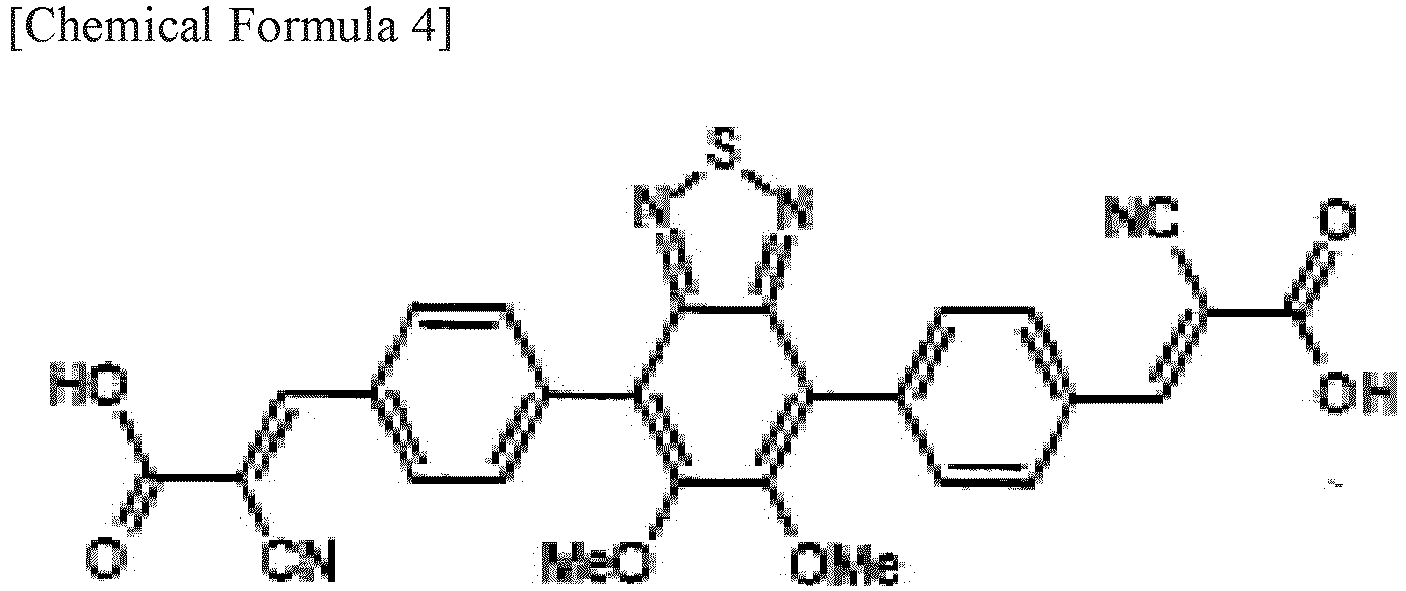

- Generally, in photopolymer compositions that provide a hologram recording medium, methods such as imparting a certain change to a polymer matrix or a recording monomer used for increasing the refractive index modulation value and the diffraction efficiency, or using a specific additive thereto, etc. are known. However, the compound of Chemical Formula 1 described above can more easily improve the refractive index modulation value and the diffraction efficiency even if the amount of use is not so high, and when applied to a holographic medium, it has a relatively fast reaction rate and thus can shorten the recording time.
- Meanwhile, the polymer matrix or a precursor thereof can serve as a support for the holographic recording medium and the final product produced therefrom, and the photoreactive monomer can serve as a recording monomer. In accordance with the use thereof, the photoreactive monomer can be selectively polymerized on the polymer matrix during holographic recording, thus exhibiting refractive index modulation due to portions having different refractive indices.
- The polymer matrix or a precursor thereof can be used without particular limitation as long as it is a compound that can be commonly used in a photopolymer composition providing a holographic recording medium.
- Specific examples of the polymer matrix or a precursor thereof include 1) a reaction product between a compound containing one or more isocyanate groups and a polyol; or 2) a polymer matrix including a (meth)acrylate-based (co)polymer in which the silane-based functional group is located in a branched chain and a silane crosslinking agent.
- A hologram formed from a photopolymer composition comprising a polymer matrix including a (meth)acrylate-based (co)polymer in which the silane-based functional group is located in a branched chain and a silane crosslinking agent, or a precursor thereof can achieve significantly improved refractive index modulation values and excellent durability against temperature and humidity even in a smaller thickness range, as compared with previously known holograms.
- As the silane-based crosslinking agent and the polymer matrix containing a (meth)acrylate-based (co)polymer in which the silane-based functional group is located in a branched chain, or a precursor thereof are used, the crosslinking density is optimized when producing a coating film or a hologram from the photopolymer composition, and excellent durability against temperature and humidity can be secured as compared with the existing matrix. In addition, by optimizing the crosslinking density as described above, the mobility between the photoreactive monomer having a high refractive index and the component having a low refractive index can be increased, thereby maximizing the refractive index modulation and improving the recording characteristics.
- In particular, a crosslinked structure mediated by a siloxane bond can be easily introduced through a sol-gel reaction between a modified (meth)acrylate-based (co)polymer containing a silane-based functional group and a silane crosslinking agent containing a terminal silane-based functional group, and excellent durability against temperature and humidity can be secured through this siloxane bond.
- In the polymer matrix, the (meth)acrylate-based (co)polymer in which the silane-based functional group is located in a branched chain and the silane crosslinking agent can be present as separate components, and they can also be presented in the form of complexes formed by reaction with each other.
- In the above (meth)acrylate-based (co)polymer, the silane-based functional group can be located in a branched chain. The silane-based functional group can include a silane functional group or an alkoxysilane functional group, and preferably, a trimethoxysilane group can be used as an alkoxysilane functional group.
- The silane-based functional group can form a siloxane bond through a sol-gel reaction with the silane-based functional group contained in the silane crosslinking agent to crosslink the (meth)acrylate-based (co)polymer and the silane crosslinking agent.
- The silane crosslinking agent can be a compound having an average of one or more silane-based functional groups per molecule or a mixture thereof, or it can be a compound containing one or more silane-based functional groups. The silane-based functional group can include a silane functional group or an alkoxysilane functional group, and preferably, a triethoxysilane group can be used as the alkoxysilane functional group. The silane-based functional group forms a siloxane bond through a sol-gel reaction with the silane-based functional group contained in the (meth)acrylate-based (co)polymer to crosslink the (meth)acrylate-based (co)polymer and the silane crosslinking agent.
- At this time, the silane crosslinking agent can have an equivalent weight of the silane-based functional groups of 200 g/equivalent to 1000 g/equivalent. Thereby, the crosslinking density between the (meth)acrylate-based (co)polymer and the silane crosslinking agent is optimized, and thus, excellent durability against temperature and humidity can be secured as compared with the existing matrix. In addition, by optimizing the crosslinking density as described above, the mobility between the photoreactive monomer having a high refractive index and the component having a low refractive index is increased, and thereby, the refractive index modulation can be maximized and the recording characteristics can be improved.
- If the equivalent weight of the silane-based functional group contained in the silane crosslinking agent is excessively increased to 1000 g/equivalent or more, the interface of the diffraction grating after recording can be collapsed due to the reduction in the crosslinking density of the matrix. Due to the loose crosslinking density and the low glass transition temperature, the monomer and plasticizer components can be eluted to the surface to generate haze. When the equivalent weight of the silane-based functional group contained in the silane crosslinking agent is excessively reduced to less than 200 g/ equivalent, the crosslinking density is too high, which impedes the mobility of the monomer and plasticizer components, and thereby, the problem that the recording characteristics become extremely low can occur.
- More specifically, the silane crosslinking agent is a linear polyether main chain having a weight average molecular weight of 100 to 2000, or 300 to 1000, or 300 to 700, and a silane-based functional group bonded to a terminal or branched chain of the main chain.
- The linear polyether main chain having a weight average molecular weight of 100 to 2000 can include the repeating unit of the following Chemical Formula 13:
[Chemical Formula 13] -(R8O)n-R8-
wherein in Chemical Formula 13, R8 is an alkylene group having 1 to 10 carbon atoms, and n is an integer of 1 or more, or 1 to 50, or 5 to 20, or 8 to 10. - As the silane crosslinking agent introduces a flexible polyether polyol as a main chain, the mobility of the components can be improved through adjustments of the glass transition temperature and the crosslinking density of the matrix.
- Meanwhile, the bond between the silane-based functional group and the polyether main chain can be formed via a urethane bond. Specifically, the silane-based functional group and the polyether main chain can form a mutual bond through a urethane bond. More specifically, the silicon atom contained in the silane-based functional group is bonded directly to the nitrogen atom of the urethane bond or via an alkylene group having 1 to 10 carbon atoms, and the functional group of R8 contained in the polyether main chain can be bonded directly to an oxygen atom of the urethane bond.
- The reason why the silane-based functional group and the polyether main chain are bonded via a urethane bond in this way is that the silane crosslinking agent is a reaction product produced through reaction between an isocyanate compound containing a silane-based functional group and a linear polyether polyol compound having a weight average molecular weight of 100 to 2000.
- More specifically, the isocyanate compound can include an aliphatic, cycloaliphatic, aromatic or aromatic aliphatic mono-isocyanate di-isocyanate, tri-isocyanate or poly-isocyanate; or an oligo-isocyanate or a poly-isocyanate of di-or tri-isocyanate having urethane, urea, carbodiimide, acyl urea, isocyanurate, allophanate, buret, oxadiazinetrione, uretdione or iminooxadiazine dione structures.
- Specific examples of the isocyanate compound containing the silane-based functional group can be 3-isocyanatopropyltriethoxysilane.
- Further, the polyether polyols are, for example, the polyaddition products of styrene oxides, ethylene oxide, propylene oxide, tetrahydrofuran, butylene oxide, epichlorohydrin and their mixed adducts and graft products, and the polyether polyols obtained by condensation of polyhydric alcohols or mixtures thereof and those obtained by alkoxylation of polyhydric alcohols, amines and amino alcohols.
- Specific examples of the polyether polyols are poly(propylene oxides), poly(ethylene oxides) and combinations thereof in the form of random or block copolymers, or poly(tetrahydrofurans) and mixtures thereof, having an OH functionality of 1.5 to 6 and a number average molecular weight between 200 and 18000 g/mol, preferably having an OH functionality of 1.8 to 4.0 and a number average molecular weight of 600 to 8000 g/mol and particularly preferably having an OH functionality of 1.9 to 3.1 and a number average molecular weight of 650 to 4500 g/mol.
- When the silane-based functional group and the polyether main chain are bonded via a urethane bond in this way, a silane crosslinking agent can be more easily synthesized.
- The weight average molecular weight (measured by GPC) of the silane crosslinking agent can be 1000 to 5,000,000. The weight average molecular weight refers to a weight average molecular weight (unit: g/mol) converted in terms of polystyrene measured by GPC method. In the process of measuring the weight average molecular weight in terms of polystyrene measured by GPC method, a detector and an analytical column, such as a commonly known analysis apparatus and differential refractive index detector can be used, and commonly applied temperature conditions, solvent, and flow rate can be used. Specific examples of the measurement conditions can include a temperature of 30°C, chloroform solvent and a flow rate of 1 mL/min.
- Meanwhile, the (meth)acrylate-based (co)polymer can include a (meth)acrylate repeating unit and a (meth)acrylate repeating unit in which a silane-based functional group is located in a branched chain.
- Examples of the (meth)acrylate repeating unit in which a silane-based functional group is located in a branched chain can include a repeating unit of the following Chemical Formula 11:

- Preferably, in Chemical Formula 11, R1 to R3 are each independently a methyl group having 1 carbon atom, R4 is a methyl group having 1 carbon atom, R5 is a repeating unit derived from 3-methacryloxypropyltrimethoxysilane (KBM-503) which is a propylene group having 3 carbon atoms, or R1 to R3 are each independently a methyl group having 1 carbon atom, R4 is hydrogen, and R5 can be a repeating unit derived from 3-acryloxypropyltrimethoxysilane (KBM-5103) which is a propylene group having 3 carbon atoms.
- Further, examples of the (meth)acrylate repeating unit can be a repeating unit of the following Chemical Formula 12:

- The molar ratio between the repeating unit of Chemical Formula 12 and the repeating unit of Chemical Formula 11 can be 0.5: 1 to 14: 1. If the molar ratio of repeating units of Chemical Formula 11 is excessively reduced, the crosslinking density of the matrix becomes too low to serve as a support, which can cause in a decrease in recording characteristics after recording. And, if the molar ratio of the repeating units of Chemical Formula 11 is excessively increased, the crosslinking density of the matrix becomes too high, and the mobility of the respective components is deteriorated which can cause a decrease in the refractive index modulation value.
- The weight average molecular weight (measured by GPC) of the (meth)acrylate-based (co)polymer can be 100,000 to 5,000,000, or 300,000 to 900,000. The weight average molecular weight refers to a weight average molecular weight (unit: g/mol) converted in terms of polystyrene measured by GPC method. In the process of measuring the weight average molecular weight converted in terms of polystyrene measured by GPC method, a detector and an analytical column, such as a commonly known analysis apparatus and differential refractive index detector can be used, and commonly applied temperature conditions, solvent, and flow rate can be used. Specific examples of the measurement conditions can include a temperature of 30°C, chloroform solvent and a flow rate of 1 mL/min.
- Meanwhile, in the (meth)acrylate-based (co)polymer, the equivalent weight of the silane-based functional group can be 300 g/equivalent to 2000 g/equivalent, or 500 g/equivalent to 2000 g/equivalent, or 550 g/equivalent to 1800 g/equivalent, or 580 g/equivalent to 1600 g/equivalent, or 586 g/equivalent to 1562 g/equivalent.
- The silane-based functional group equivalent weight is an equivalent weight of one silane-based functional group (g/equivalent), which is a value obtained by dividing the weight average molecular weight of the (meth)acrylate-based (co)polymer by the number of silane-based functional groups per molecule. The smaller the equivalent weight value, the higher the density of the functional group, and the larger the equivalent weight value, the smaller the density of the functional group.
- Consequently, the crosslinking density between the (meth)acrylate (co)polymer and the silane crosslinker can be optimized, thus securing excellent durability against temperature and humidity as compared with the existing matrix. In addition, by optimizing the crosslinking density as described above, the mobility between the photoreactive monomer having a high refractive index and the component having a low refractive index is increased, and thereby the refractive index modulation can be maximized and the recording characteristics can be improved.
- When the equivalent weight of the silane-based functional group contained in the (meth)acrylate-based (co)polymer in which the silane-based functional group is located in a branched chain is excessively reduced to less than 300 g/equivalent, the crosslinking density of the matrix becomes too high and the mobility of the components is inhibited, which causes a reduction of the recording characteristics.
- Further, if the equivalent weight of the silane-based functional group contained in the (meth)acrylate-based (co)polymer in which the silane-based functional group is located in a branched chain is excessively increased to more than 2000 g/equivalent, the crosslinking density is too low to serve as a support, the interface of the diffraction grating generated after recording is collapsed, and the refractive index modulation value can be decreased with the lapse of time.
- Meanwhile, the silane crosslinking agent can be contained in an amount of 10 to 90 parts by weight, or 20 to 70 parts by weight, or 22 to 65 parts by weight based on 100 parts by weight of the (meth)acrylate-based (co)polymer.
- In the reaction product, when the content of the silane crosslinking agent is excessively reduced relative to 100 parts by weight of the (meth)acrylate-based (co)polymer, the curing speed of the matrix is significantly slowed, the function as a support is lost, the interface of the diffraction grating after recording can be easily collapsed. In the reaction product, when the content of the silane crosslinking agent is excessively increased relative to 100 parts by weight of the (meth)acrylate-based (co)polymer, the curing speed of the matrix can be increased, but compatibility problems with other components occur due to an excessive increase in the reactive silane group content, and thus, haze occurs.
- Further, the modulus (storage elastic modulus) of the reaction product can be 0.01 MPa to 5 MPa. As a specific example of the modulus measurement method, the value of storage modulus (G') can be measured at a room temperature (20°C to 25°C) at a frequency of 1 Hz using a discovery hybrid rheometer (DHR) from TA Instruments.
- Further, the glass transition temperature of the reaction product can be -40°C to 10°C. A specific example of the measurement method of the glass transition temperature can be a method of measuring the phase angle (loss modulus) change of the film coated with the photopolymerizable composition in the range of -80°C to 30°C under the setting conditions of strain of 0.1%, frequency of 1 Hz, temperature raising rate of 5 °C/min using a dynamic mechanical analysis (DMA).
- Another example of the polymer matrix or its precursor can be a polymer matrix including the reaction product between a compound containing at least one isocyanate group and a polyol.
- The compound containing at least one isocyanate group can be a known compound having an average of one or more NCO functional groups per molecule or a mixture thereof, and can be a compound containing the one or more isocyanate groups.
- More specifically, the compound containing one or more isocyanate groups is an aliphatic, cycloaliphatic, aromatic or aromatic aliphatic mono-isocyanate di-isocyanate, tri-isocyanate or poly-isocyanate. In addition, the compound containing one or more isocyanate groups can be relatively high molecular weight secondary products (oligo- and polyisocyanates) of monomeric di- and/or triisocyanates having urethane, urea, carbodiimide, acylurea, isocyanurate, allophanate, biuret, oxadiazinetrione, uretdione or iminooxadiazinedione structures.
- Specific examples of the compound containing one or more isocyanate groups include butylene diisocyanate, hexamethylene diisocyanate (HDI), isophorone diisocyanate (IPDI), 1,8-diisocyanato-4-(isocyanatomethyl)octane, 2,2,4- and/or 2,4,4-trimethylhexamethylene diisocyanate, the isomeric bis(4,4'-isocyanatocyclohexyl)methanes and mixtures thereof having any desired isomer content, isocyanatomethyl-1,8-octane diisocyanate, 1,4-cyclohexylene diisocyanate, the isomeric cyclohexanedimethylene diisocyanate, 1,4-phenylene diisocyanate, 2,4- and/or 2,6-toluene diisocyanate, 1,5-naphthylene diisocyanate, 2,4'- or 4,4'-diphenylmethane diisocyanate and/or 4,4',4"-triisocyanate and the like.
- The polyol that forms a polymer matrix by reacting with the compound containing at least one isocyanate group can be an aliphatic, araliphatic or cycloaliphatic diol, triol and/or higher polyol, having 2 to 20 carbon atoms.
- The polyol can have a hydroxyl equivalent weight of 300 g/mol to 10,000 g/mol and a weight average molecular weight of 100,000 to 1,500,0000 g/mol.
- Examples of the diols are ethylene glycol, diethylene glycol, triethylene glycol, tetraethylene glycol, dipropylene glycol, tripropylene glycol, 1,2-propanediol, 1,3-propanediol, 1,4-butanediol, neopentylglycol, 2-ethyl-2-butylpropanediol, trimethylpentanediol, diethyloctanediol positional isomers, 1,3-butylene glycol, cyclohexanediol, 1,4-cyclohexanedimethanol, 1,6-hexanediol, 1,2- and 1,4-cyclohexanediol, hydrogenated bisphenol A (2,2-bis(4-hydroxycyclohexyl)propane), and 2,2-dimethyl-3-hydroxypropyl dimethyl-3-hydroxypropionate.
- Further, examples of the triols are trimethylolethane, trimethylolpropane or glycerol. Suitable higher-functional alcohols are ditrimethylolpropane, pentaerythritol, dipentaerythritol or sorbitol.
- Further, as the polyol, relatively high molecular weight aliphatic and cycloaliphatic polyols, such as polyester polyols, polyether polyols, polycarbonate polyols, hydroxy-functional acrylic resins, hydroxy-functional polyurethanes, hydroxy-functional epoxy resins or the like can be used.
- The polyesterpolyols are linear polyester diols, as can be prepared in a known manner from aliphatic, cycloaliphatic or aromatic di- or polycarboxylic acids or their anhydrides, such as, for example, succinic acid, glutaric acid, adipic acid, pimelic acid, suberic acid, azelaic acid, sebacic acid, nonanedicarboxylic acid, decanedicarboxylic acid, terephthalic acid, isophthalic acid, o-phthalic acid, tetrahydrophthalic acid, hexahydrophthalic acid or trimellitic acid, and acid anhydrides, such as o-phthalic anhydride, trimellitic anhydride or succinic anhydride, or a mixture thereof, by using polyhydric alcohols, such as, for example, ethanediol, di-, tri- or tetraethylene glycol, 1,2-propanediol, di-, tri-, or tetrapropylene glycol, 1,3-propanediol, 1,4-butanediol, 1,3-butanediol, 2,3-butanediol, 1,5-pentanediol, 1,6-hexanediol, 2,2-dimethyl-1,3-propanediol, 1,4-dihydroxycyclohexane, 1,4-dimethylolcyclohexane, 1,8-octanediol, 1,10-decanediol, 1,12-dodecanediol or mixtures thereof, optionally with concomitant use of higher functional polyols, such as trimethylolpropane or glycerol. Of course, cycloaliphatic and/or aromatic di- and polyhydroxy compounds are also suitable as polyhydric alcohols for the preparation of the polyester polyols. Instead of the free polycarboxylic acid, it is also possible to use the corresponding polycarboxylic anhydrides or corresponding polycarboxylates of lower alcohols or mixtures thereof for the preparation of the polyesters.
- Further, polyester polyols which can be used for the synthesis of the polymer matrix can be homo- or copolymers of lactones, which are preferably obtained by an addition reaction of lactones or lactone mixtures, such as butyrolactone, ε-caprolactone and/or methyl- ε-caprolactone, with suitable difunctional and/or higher-functional initiator molecules, such as, for example, the low molecular weight polyhydric alcohols mentioned above as synthesis components for polyester polyols.
- Further, polycarbonates having hydroxyl groups are also suitable as a polyhydroxy component for the prepolymer synthesis, for example those which can be prepared by reaction of diols, such as 1,4-butanediol and/or 1,6-hexanediol and/or 3-methylpentanediol, with diaryl carbonates, e.g., diphenyl carbonate, dimethyl carbonate or phosgene.
- Further, polyether polyols that can be used for the synthesis of the polymer matrix include, for example, the polyaddition products of styrene oxides, of ethylene oxide, propylene oxide, tetrahydrofuran, butylene oxide, epichlorohydrin and their mixed adducts and graft products, and the polyether polyols obtained by condensation of polyhydric alcohols or mixtures thereof and those obtained by alkoxylation of polyhydric alcohols, amines and amino alcohols. Specific examples of the polyether polyols are poly(propylene oxides), poly(ethylene oxides) and combinations thereof in the form of random or block copolymers or poly(tetrahydrofurans) and mixtures thereof having an OH functionality of 1.5 to 6 and a number average molecular weight between 200 and 18000 g/mol, preferably having an OH functionality of 1.8 to 4.0 and a number average molecular weight of 600 to 8000 g/mol and particularly preferably having an OH functionality of 1.9 to 3.1 and a number average molecular weight of 650 to 4500 g/mol.
- Meanwhile, the photoreactive monomer can include a polyfunctional (meth)acrylate monomer or a monofunctional (meth)acrylate monomer.
- As described above, in a portion where the monomer is polymerized in the process of photopolymerization of the photopolymer composition and the polymer is present in relatively large amounts, the refractive index becomes high. In a portion where the polymer binder is present in relatively large amounts, the refractive index becomes relatively low, the refractive index modulation occurs, and a diffraction grating is generated by such refractive index modulation.
- Specifically, one example of the photoreactive monomer can include (meth)acrylate-based α,β-unsaturated carboxylic acid derivative, for example, (meth)acrylate, (meth)acrylamide, (meth)acrylonitrile, (meth)acrylic acid or the like, or a compound containing a vinyl group or a thiol group.
- One example of the photoreactive monomer can include a polyfunctional (meth)acrylate monomer having a refractive index of 1.5 or more, 1.53 or more, or 1.5 to 1.7. The polyfunctional (meth)acrylate monomer having a refractive index of 1.5 or more, or 1.53 or more, or 1.5 to 1.7 can include a halogen atom (bromine, iodine, etc.), sulfur (S), phosphorus (P), or aromatic ring.
- More specific examples of the photoreactive monomer include a polyfunctional (meth)acrylate monomer having a refractive index of 1.5 or more include bisphenol A modified diacrylate type, fluorene acrylate type (HR6022, etc. - Miwon Specialty Chemical), bisphenol fluorene epoxy acrylate type (HR6100, HR6060, HR6042, etc. - Miwon), halogenated epoxy acrylate series (HR1139, HR3362, etc. - Miwon).
- Another example of the photoreactive monomer can include a monofunctional (meth)acrylate monomer. The monofunctional (meth)acrylate monomer can contain an ether bond and a fluorene functional group in the molecule. Specific examples of such monofunctional (meth)acrylate monomer include phenoxybenzyl (meth)acrylate, o-phenylphenol ethylene oxide (meth)acrylate, benzyl (meth)acrylate, 2-(phenylthio)ethyl (meth)acrylate, biphenylmethyl (meth)acrylate, or the like.
- Meanwhile, the photoreactive monomer can have a weight average molecular weight of 50 g/mol to 1000 g/mol, or 200 g/mol to 600 g/mol. The weight average molecular weight refers to a weight average molecular weight converted in terms of polystyrene measured by GPC method.
- Meanwhile, the photopolymer composition of the embodiment can include a photoinitiator. The photoinitiator is a compound which is activated by light or actinic radiation and initiates polymerization of a compound containing a photoreactive functional group such as the photoreactive monomer.
- As the photoinitiator, commonly known photoinitiators can be used without particular limitation, but specific examples thereof include a photoradical polymerization initiator, a photocationic polymerization initiator, or a photoanionic polymerization initiator.
- Specific examples of the photoradical polymerization initiator include imidazole derivatives, bisimidazole derivatives, N-aryl glycine derivatives, organic azide compounds, titanocene, aluminate complex, organic peroxide, N-alkoxypyridinium salts, thioxanthone derivatives, amine derivatives or the like. More specifically, examples of the photoradical polymerization initiator include 3-di(t-butyldioxycarbonyl)benzophenone, 3,3',4,4"-tetrakis(t-butyldioxycarbonyl)benzophenone, 3-phenyl-5-isoxazolone, 2-mercapto benzimidazole, bis(2,4,5-triphenyl)imidazole, 2,2-dimethoxy-1,2-diphenylethane-1-one (product name: Irgacure 651/manufacturer: BASF), 1-hydroxy-cyclohexyl-phenyl-ketone (product name: Irgacure 184/manufacturer: BASF), 2-benzyl-2-dimethylamino-1-(4-morpholinophenyl)-butanone-1 (product name: Irgacure 369/manufacturer: BASF), and bis(η5-2,4-cyclopentadiene-1-yl)-bis(2,6-difluoro-3-(1H-pyrrole-1-yl)-phenyl)titanium (product name: Irgacure 784/manufacturer: BASF), Ebecryl P-1 15(manufacturer: SK entis).
- The photocationic polymerization initiator can include a diazonium salt, a sulfonium salt, or an iodonium salt, and examples thereof include sulfonic acid esters, imidosulfonates, dialkyl-4-hydroxysulfonium salts, arylsulfonic acid-p-nitrobenzyl esters, silanol-aluminum complexes, (η6-benzene) (η5-cyclopentadienyl)iron (II), or the like. In addition, benzoin tosylate, 2,5-dinitrobenzyltosylate, N-tosylphthalic acid imide, or the like can be mentioned. More specific examples of the photocationic polymerization initiator include commercially available products such as Cyracure UVI-6970, Cyracure UVI-6974 and Cyracure UVI-6990 (manufacturer: Dow Chemical Co. in USA), Irgacure 264 and Irgacure 250 (manufacturer: BASF) or CIT-1682 (manufacturer: Nippon Soda).
- The photoanionic polymerization initiator can be borate salt, for example, butyryl chlorine butyl triphenyl borate, or the like. More specific examples of the photoanionic polymerization initiator include commercially available products such as Borate V (manufacturer: Spectra Group).
- In addition, the photopolymer composition of the embodiment can include monomolecular (type I) initiator or bimolecular (type II) initiator. The (type I) system for free radical photopolymerization can include, for example, an aromatic ketone compounds in combination with a tertiary amine, such as benzophenone, alkylbenzophenone, 4,4'-bis(dimethylamino)benzophenone (Michler's ketone), anthrone and halogenated benzophenone or a mixture of these types. The bimolecular (type II) initiator can include benzoin and derivatives thereof, benzyl ketal, acylphosphine oxide, for example, 2,4,6-trimethylbenzoyldiphenylphosphine oxide, bisacylophosphine oxide, phenylglyoxyl ester, camphorquinone, alpha-aminoalkylphenone, alpha-dialkoxyacetophenone, 1-[4-(phenylthio)phenyl]octane-1,2-dione 2-(O-benzoyloxime), alpha-hydroxyalkylphenone, and the like.
- The photopolymer composition of the embodiment can include 1% to 80% by weight of the polymer matrix or a precursor thereof; 1% to 80% by weight of the photoreactive monomer; 0.0001% to 10% by weight of the dye; and 0.1% to 20% by weight of the photoinitiator. When the photopolymer composition further includes an organic solvent as described hereinafter, the content of the above-mentioned components is based on the sum of the above-mentioned components (the sum of the components excluding the organic solvent).
- Meanwhile, the photopolymer composition can further include at least one additive selected from the group consisting of a catalyst, a phosphate-based compound, and a low refractive index fluorine-based compound.
- The phosphate-based compound and the low refractive index fluorine-based compound have a lower refractive index than the photoreactive monomer, and thus, the refractive index of the polymer matrix is lowered and the refractive index modulation of the photopolymer composition can be maximized. Furthermore, the phosphate-based compound can act as a plasticizer to lower the glass transition temperature of the polymer matrix, to increase the mobility of the photoreactive monomer and the low refractive components, and to contribute to the improvement of the formability of the photopolymer composition.
- More specifically, the low refractive index fluorine-based compound has stability with little reactivity and has low refractive properties. Thus, when added to the photopolymer composition, the refractive index of the polymer matrix can be lowered, and the refractive index modulation with the monomer can be maximized.
- Meanwhile, when the compound of Formula 1 and the low refractive-index fluorine-based compound are used together, Tg of the matrix is lowered by the low refractive-index fluorine-based compound serving as a plasticizer, and the reduction reaction rate of the compound dye of Chemical Formula 1 in the flexible matrix is accelerated, or the hydrogen transfer speed as an initiator (H-Transfer) is accelerated, whereby the monomer polymerization rate due to radical generation is improved, and the effect of shortening the recording time or increasing the recording efficiency can be achieved.
- The fluorine-based compound can include at least two difluoromethylene groups and at least one functional group selected from the group consisting of an ether group, an ester group and an amide group. The fluorine-based compound can include a structure of the following Chemical Formula 14 in which functional groups including ether groups are bonded to both terminal ends of the central functional group including a direct bond or an ether bond between two difluoromethylene groups:

- Preferably, in Chemical Formula 14, R11 and R12 are each independently a difluoromethylene group, R13 and R16 are each independently a methylene group, R14 and R15 are each independently a difluoromethylene group, R17 and R18 are each independently a 2-methoxyethoxymethoxy group, and m is 2.
- The fluorine-based compound can have a refractive index of less than 1.45, or more than 1.3 and less than 1.45. As described above, since the photoreactive monomer has a refractive index of 1.5 or more, the fluorine-based compound can reduce the refractive index of the polymer matrix through a lower refractive index compared to the photoreactive monomer, thereby maximizing the refractive index modulation with the monomer.
- Specifically, the content of the fluorine-based compound can be 30 parts by weight to 150 parts by weight, or 50 parts by weight to 110 parts by weight, based on 100 parts by weight of the photoreactive monomer.
- When the content of the fluorine-based compound is excessively reduced relative to 100 parts by weight of the photoreactive monomer, the refractive index modulation value after recording is lowered due to the lack of low refractive index components. When the content of the fluorine-based compound is excessively increased relative to 100 parts by weight of the photoreactive monomer, a haze can be generated due to the compatibility problem with other components, or it can cause a problem that some fluorine-based compounds are eluted on the surface of the coating layer.
- The fluorine-based compound can have a weight average molecular weight (measured by GPC) of 300 or more, or 300 to 1000. A specific method of measuring the weight average molecular weight is as described above.
- Meanwhile, specific examples of the phosphate-based compound include triphenyl phosphate, tricresyl phosphate, cresyldiphenyl phosphate, octyldiphenyl phosphate, diphenyl biphenyl phosphate, trioctyl phosphate, tributyl phosphate and the like.
- The phosphate-based compound can be added together with the above-mentioned fluorine-based compound at a weight ratio of 1: 5 to 5: 1. The phosphate-based compound can have a refractive index of less than 1.5 and a molecular weight of 700 or less.
- The photopolymer composition can further include other additives, a catalyst, and the like. For example, the photopolymer composition can include a commonly known catalyst for promoting polymerization of the polymer matrix or photoreactive monomer. Examples of the catalyst include tin octanoate, zinc octanoate, dibutyltin dilaurate, dimethylbis[(1-oxoneodecyl)oxy]stannane, dimethyl tin dicarboxylate, zirconium bis(ethylhexanoate), zirconium acetylacetonate, p-toluenesulfonic acid or tertiary amines, for example, 1,4-diazabicyclo[2.2.2]octane, diazabicyclononane, diazabicyclo dodecane, 1,1,3,3-tetramethylguanidine, 1,3,4,6,7,8-hexahydro-1-methyl-2H-pyrimido(1,2-a)pyrimidine, and the like.
- Examples of the other additives include a defoaming agent, and as the defoaming agent, a silicone-based reactive additive can be used, and an example thereof is Tego Rad 2500.
- Meanwhile, the photopolymer composition of the embodiment can, in addition to the compound of Chemical Formula 1, further include a photoreactive dye different therefrom.
- The photosensitizing dye serves as photosensitizing pigment to sensitize the photoinitiator. More specifically, the photosensitizing dye can be stimulated by the light irradiated on the photopolymer composition and can also serve as an initiator to initiate polymerization of the monomer and the crosslinking monomer,
- Examples of the photosensitizing dyes different from the compound of Chemical Formula 1 are not particularly limited, and various compounds commonly known in the art can be used. Specific examples of the photosensitizing dye include sulfonium derivative of ceramidonine, new methylene blue, thioerythrosine triethylammonium, 6-acetylamino-2-methylceramidonin, eosin, erythrosine, rose bengal, thionine, basic yellow, Pinacyanol chloride, Rhodamine 6G, Gallocyanine, ethyl violet, Victoria blue R, Celestine blue, Quinaldine Red, Crystal Violet, Brilliant Green, Astrazon orange G, Darrow Red, Pyronin Y, Basic Red 29, pyrylium iodide, Safranin O, Cyanine, Methylene Blue, Azure A, or a combination of two or more thereof.
- Meanwhile, an organic solvent can be used in the production of the photopolymer composition of the embodiment. Non-limiting examples of the organic solvent include ketones, alcohols, acetates, ethers, and mixtures of two or more thereof.
- Specific examples of such organic solvent include ketones such as methyl ethyl ketone, methyl isobutyl ketone, acetylacetone or isobutyl ketone; alcohols such as methanol, ethanol, n-propanol, i-propanol, n-butanol, i-butanol or t-butanol; acetates such as ethyl acetate, i-propyl acetate, or polyethylene glycol monomethyl ether acetate; ethers such as tetrahydrofuran or propylene glycol monomethyl ether; or a mixture of two or more thereof.
- The organic solvent can be added at the time of mixing the respective components contained in the photopolymer composition for producing the hologram recording medium, or can be contained in the photopolymer composition while adding the respective components in a state of being dispersed or mixed in an organic solvent. When the content of the organic solvent in the photopolymer composition is too low, the fluidity of the photopolymer composition can be lowered, resulting in the occurrence of defects such as the occurrence of striped patterns on the finally produced film. In addition, when the organic solvent is added in an excess amount, the solid content is lowered, and the coating and film formation are not sufficient, so that the physical properties and surface characteristics of the film can be deteriorated and defects can occur during the drying and curing process. Thus, the photopolymer composition can include an organic solvent such that the total solid content concentration of the components contained is 1% to 70% by weight, or 2% to 50% by weight.
- Meanwhile, according to another embodiment of the present disclosure, a hologram recording medium produced from the photopolymer composition of the embodiment can be provided.
- The details concerning the photopolymer composition of the embodiment are the same as those described above.
- Meanwhile, the hologram recording medium can achieve a refractive index modulation value (n) of 0.020 or more, 0.021 or more, or 0.023 or more, or 0.025 or more, or 0.027 or more, or any one of the lower limits to 0.035 even at a thickness of 5 µm to 30 µm.
- In addition, the hologram recording medium can achieve 50% or more, 85% or more, or 85 to 99% of diffraction efficiency at a thickness of 5 µm to 30 µm.
- In the photopolymer composition for producing the hologram recording medium, the respective components contained therein are homogeneously mixed, dried and cured at a temperature of 20°C or higher, and then subjected to predetermined exposure procedures, thereby producing a hologram for optical application in the entire visible range and the near ultraviolet region (300 to 800 nm).
- In the photopolymer composition, the components forming a polymer matrix or the precursor thereof are first homogeneously mixed, and the above-described silane crosslinking agent is subsequently mixed with the catalyst, thereby preparing the process of forming holograms.
- In the photopolymer composition, for mixing the respective components contained therein, a mixing device, a stirrer, a mixer, or the like which are commonly known in the art can be used without particular limitation. The temperature in the mixing process can be 0°C to 100°C, preferably 10°C to 80°C, particularly preferably 20°C to 60°C.
- Meanwhile, the components forming a polymer matrix or the precursor thereof in the photopolymer composition are first homogenized and mixed, and then it can be a liquid formulation that is cured at a temperature of 20°C or more. The curing temperature can vary depending on the composition of the photopolymer and the curing is promoted, for example, by heating at a temperature of from 30°C to 180°C.
- At the time of curing, the photopolymer can be in state of being injected into or coated onto a predetermined substrate or mold.
- Meanwhile, as the method of recording a visual hologram on a hologram recording medium produced from the photopolymer composition, generally known methods can be used without particular limitation, and the method described in the holographic recording method of the embodiment described hereinafter can be adopted as one example.
- Meanwhile, according to another embodiment of the present disclosure, there can be provided a hologram recording medium comprising: a polymer matrix or a precursor thereof; a dye including a compound of the following Chemical Formula 1; and a photoreactive monomer, wherein the hologram recording medium has a refractive index modulation value (n) of 0.023 or more in a thickness range of 5 µm to 30 µm:

- X is oxygen or sulfur; and
- R1 to R4 are each independently selected from the group consisting of:
- hydrogen;
- an alkyl group having 1 to 20 carbon atoms;
- an alkoxy group having 1 to 20 carbon atoms;
- a cycloalkyl group having 4 to 20 carbon atoms;
- an aromatic hydrocarbon group having 6 to 20 carbon atoms;
- an aromatic hydrocarbon group having 6 to 20 carbon atoms to which a cyanoacrylate or an ester group thereof is bonded;
- an amine group;
- a halogen;
- an alicyclic or aromatic heterocycle having 4 to 20 carbon atoms containing at least one of oxygen, sulfur or nitrogen;
- a cycloalkyl group having 4 to 20 carbon atoms substituted with at least one alicyclic or aromatic heterocycle having 4 to 20 carbon atoms containing at least one of oxygen, sulfur or nitrogen; and
- an aromatic hydrocarbon group having 6 to 20 carbon atoms substituted with at least one alicyclic or aromatic heterocycle having 4 to 20 carbon atoms containing at least one of oxygen, sulfur or nitrogen.
- The details concerning each of the polymer matrix or a precursor thereof, a dye including a compound of Chemical Formula 1, and a photoreactive monomer include all the contents described above with respect to the photopolymer composition of the embodiment.
- The hologram recording medium can achieve a refractive index modulation value (n) of 0.023 or more, or 0.025 or more, or 0.027 or more, or any one of the lower limits to 0.035 even at a thickness of 5 µm to 30 µm.
- Further, the hologram recording medium can achieve a diffraction efficiency of 50% or more, or 85% or more, or 85 to 99% at a thickness of 5 µm to 30 µm.
- Meanwhile, the coating layer can further include a low refractive index fluorine-based compound comprising at least two difluoromethylene groups and at least one functional group selected from the group consisting of an ether group, an ester group and an amide group.
- Meanwhile, as described above, when the compound of Chemical Formula 1 and the low refractive-index fluorine-based compound are used together, Tg of the matrix is lowered by the low refractive index fluorine-based compound serving as a plasticizer, and the reduction reaction rate of the compound dye of Chemical Formula 1 in the flexible matrix is accelerated, or the hydrogen transfer speed or the like as an initiator (H-Transfer) can be accelerated, whereby the monomer polymerization rate due to radical generation is improved, and the effect of increasing the recording efficiency or reducing the recording time can be achieved.
- Meanwhile, the hologram recording medium can be formed by coating and drying the photopolymer composition, or it can also be formed by coating and thermally curing or photocuring the photopolymer composition.
- The hologram recording medium can further include a substrate on which the coating layer is formed on one side. The substrate can be any one of various types of substrates such as polymer films and glass substrates.
- Meanwhile, according to another embodiment of the present disclosure, there can be provided a holographic recording method which comprises selectively polymerizing photoreactive monomers contained in the photopolymer composition by a coherent laser.
- As described above, through the process of mixing and curing the photopolymer composition, it is possible to produce a medium in a form in which no visual hologram is recorded, and a visual hologram can be recorded on the medium through a predetermined exposure process.
- A visual hologram can be recorded on the media provided through the process of mixing and curing the photopolymer composition, using known devices and methods under commonly known conditions.
- Meanwhile, according to another embodiment of the present disclosure, an optical element including a hologram recording medium can be provided.
- Specific examples of the optical element include optical lenses, mirrors, deflecting mirrors, filters, diffusing screens, diffraction elements, light guides, waveguides, holographic optical elements having projection screen and/or mask functions, medium of optical memory system and light diffusion plate, optical wavelength multiplexers, reflection type, transmission type color filters, and the like.
- An example of an optical element including the hologram recording medium can include a hologram display device.
- The hologram display device includes a light source unit, an input unit, an optical system, and a display unit. The light source unit is a portion that irradiates a laser beam used for providing, recording, and reproducing three-dimensional image information of an object in the input unit and the display unit. Further, the input unit is a portion that previously inputs three-dimensional image information of an object to be recorded on the display unit, and for example, three-dimensional information of an object such as the intensity and phase of light for each space can be inputted into an electrically addressed liquid crystal SLM, wherein an input beam can be used. The optical system can include a mirror, a polarizer, a beam splitter, a beam shutter, a lens, and the like. The optical system can be distributed into an input beam for sending a laser beam emitted from the light source unit to the input unit, a recording beam for sending the laser beam to the display unit, a reference beam, an erasing beam, a reading beam, and the like.
- The display unit can receive three-dimensional image information of an object from an input unit, record it on a hologram plate comprising an optically addressed SLM, and reproduce the three-dimensional image of the object. In this case, the three-dimensional image information of the object can be recorded via interference of the input beam and the reference beam. The three-dimensional image information of the object recorded on the hologram plate can be reproduced into a three-dimensional image by the diffraction pattern generated by the reading beam. The erasing beam can be used to quickly remove the formed diffraction pattern. Meanwhile, the hologram plate can be moved between a position at which a three-dimensional image is inputted and a position at which a three-dimensional image is reproduced.
- According to the present disclosure, there can be provided a compound having a novel structure, a photopolymer composition capable of providing a hologram recording medium which can achieve a large refractive index modulation value even while being thin, has a relatively fast reaction rate and thus can shorten the recording time, and has improved durability against temperature and humidity, a hologram recording medium which can achieve a large refractive index modulation value even while being thin, has a relatively fast reaction rate and thus can shorten the recording time, and has improved durability against temperature and humidity, an optical element including the hologram recording medium, and a holographic recording method using the hologram recording medium.
- Hereinafter, the present disclosure will be described in more detail by way of the following examples. However, these examples are given for illustrative purposes only and are not intended to limit the scope of the present disclosure thereto.
-

- A mixture of catechol (10 g, 0.0908 mol) and K2CO3 (31.3 g, 0.2270 mol) was stirred under nitrogen for 10 minutes. Iodomethane (11.8 mL, 0.1906 mol) was added thereto, and the mixture was stirred at room temperature for 1.5 hours, and then heated under reflux overnight. The reaction was cooled to room temperature, K2CO3 was filtered off, and the filtrate was concentrated. The residue was dissolved in dichloromethane, and the solution was washed with water. The organic layer was separated, dried over MgSO4 and concentrated to give 12.3 g (98%) of Compound 2.
1H NMR (CDCl3): 6.94-6.87 (4H, s, Ar), 3.90 (6H, s, 2CH3). -
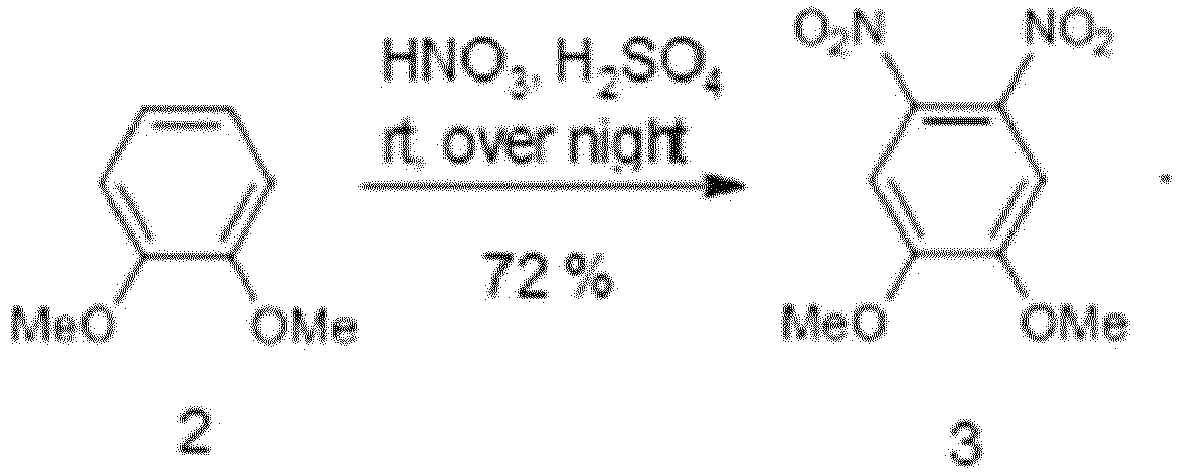
- 10.5 g of 1,2-Dimethoxybenzene (Chemical Formula 2) was dissolved in 420 mL of dichloromethane, and then the solution was added dropwise to 69% HNO3 (169 mL) in an ice bath over 30 minutes. Concentrated H2SO4 (83 mL) was added dropwise to this mixture and stirring was continued overnight at room temperature. The reaction mixture was poured onto crushed ice, and the resulting suspension was extracted with dichloromethane. The organic layer was separated, washed with IN NaOH brine, and dried over MgSO4. The solvent was evaporated to give the product, which was recrystallized from ethanol (200 ml).
Yield: 12.6 g (72%).
1H NMR (CDCl3): 7.35 (2H, s, Ar), 4.03 (6H, s, 2CH3). -

- 1,2-Dimethoxy-4,5-dinitrobenzene (Compound 3) (4.6 g, 0.0202 mol) and tin (11.9 g, 0.1010 mol) were dissolved in 100 mL of HCl, and the solution was heated to reflux for 3 hours. The reaction was cooled, and 90 mL of NaOH solution (77 g in 90 mL water) was carefully added thereto. The product was extracted with dichloromethane, and the organic layer was separated, washed with water, dried over MgSO4 and concentrated.
Yield: 2.9 g (85%).
1H NMR (CDCl3): 6.37 (2H, s, Ar), 3.79 (6H, s, 2CH3), 3.16 (4H, s, 2NH2). -

- A mixture of 4,5-Dimethoxybenzene-1,2-diamine(Compound 4) (2.7 g, 0.0160 mol), N-thionylaniline (3.6 mL, 0.0321 mol) and 20 mL of pyridine were refluxed overnight. The reaction was cooled and quenched with cold 3N HCl (100 mL). The dark suspension was filtered and the filtrate was extracted with dichloromethane and ethyl acetate. The organic phase was dried over MgSO4. After removing the solvent, the residue was purified by a column (eluent: dichloromethane).
Yield: 2.1 g (67.7%).
1H NMR (CDCl3): 7.19 (2H, s, Ar), 4.02 (6H, s, 2CH3). -

- 5,6-Dimethoxybenzo[c]-1,2,5-thiadiazole (Compound 5) (0.5 g, 0.0025 mol) was dissolved in a mixture of dichloromethane (60 mL) and AcOH (30 mL), and bromine (0.4 ml, 0.018 mol) was added, and stirred in the dark at room temperature for 48 hours. The mixture was poured into water (150 mL), and the product was extracted with dichloromethane. The organic layer was separated, washed with saturated aqueous NaHCO3, then washed with saturated aqueous Na2S2O3, and dried over MgSO4. After removing the solvent, the residue was purified by column (eluent: hexane).
Yield: 0.8 g (95%).
1H NMR (CDCl3): 4.05 (6H, s, 2CH3). 13C NMR (CDCl3): 155.03, 150.51, 106.36, 61.85 -

- 5,6-Dimethoxybenzo[c]-1,2,5-thiadiazole (Compound 5) (0.5 g, 0.0025 mol) was dissolved in a mixture of dichloromethane (60 mL) and AcOH (30 mL), and bromine (0.4 ml, 0.018 mol) was added, and stirred in the dark at room temperature for 48 hours. The mixture was poured into water (150 mL), and the product was extracted with dichloromethane. The organic layer was separated, washed with saturated aqueous NaHCO3, then washed with saturated aqueous Na2S2O3, and dried over MgSO4. After removing the solvent, the residue was purified by column (eluent: hexane).
Yield: 0.8 g (95%).
1H NMR (CDCl3): 4.05 (6H, s, 2CH3). 13C NMR (CDCl3): 155.03, 150.51, 106.36, 61.85 -

- A mixture of Compound 6 (0.5 g, 0.0015 mol), 1M NaHCO3 (15 mL), dioxane (15 mL) and 3-thiophenboronic acid (0.5 g, 0.0039 mol) was heated under reflux. Pd(PPh3)4 (0.034 g, 0.00003 mol) was added thereto, and the reaction was refluxed under nitrogen overnight. The reaction was cooled at room temperature, and the residue was filtered and then dissolved in dichloromethane. The solution was washed with water, the organic phase was separated, then dried over MgSO4 and concentrated. The residue was dissolved in methanol and filtered.
Yield: 0.5 g (90%).
1H NMR (CDCl3): 8.13-8.12 (2H, d, Ar), 7.85-7.83 (2H, d, Ar), 7.49-7.47 (2H, m, Ar), 3.87 (6H, s, 2CH3).
UV-VIS spectrum : λmax=410nm
*UV-VIS spectrum
The synthesized dye was diluted to 0.001 wt% with methyl ethyl ketone (MEK) solvent using a UV-Vis Spectrophotometer, and the absorbance (%) in the wavelength range of 380 nm to 780 nm was measured to determine the maximum absorption wavelength. -

- 1,3-Dichlorobenzene (0.7 mL, 0.0068 mol) and piperidine (2 mL, 0.0204 mol) were dissolved in 30 mL of toluene in a pressure tube. KOt-Bu (3 g, 0.0272 mol) was added and the pressure tube was sealed and then heated at 135°C for 30 hours. The reaction was cooled to room temperature and 30 mL of water was added. The aqueous phase was separated, and extracted with dichloromethane. The organic phase was dried over MgSO4 and concentrated. The residue was purified by column (eluent: hexane: EA 95: 5).
Yield: 0.8 g (50%).
1H NMR (CDCl3): 7.15-7.09 (1H, t, Ar), 6.55-7.53 (1H, m, Ar), 6.48-6.44 (2H, d, Ar), 3.14-3.11 (8H, m, 4CH2) 1.74-1.67 (8H, m, 4CH2), 1.59-1.53 (4H, m, 2CH2). -

- 4-Chloro-7-nitrobenzofurazan (0.57 g, 0.0028 mol) was dissolved in 40 mL of chloroform. Triethylamine (4 mL, 0.0028 mol) and Compound 8 (0.7 g, 0.0028 mol) were added to the solution. The color of the solution changed from pale yellow to dark blue. The reaction solution was stirred at room temperature for 24 hours. Water was added and the organic phase was separated, dried over MgSO4 and concentrated. The residue was purified by column (eluent: hexane: EA 9: 1).
Yield: 0.4 g (36%).
1H NMR (CDCl3): 8.53-8.51 (1H, d, Ar), 8.30-8.27 (1H, d, Ar), 7.68-7.65 (1H, d, Ar), 6.67-6.62 (2H, m, Ar) 3.36-3.33 (4H, m, 2CH2), 2.86-2.82 (4H, m, 2CH2), 1.75-1.64 (6H, m, 3CH2), 1.49-1.45 (6H, m, 3CH2). -

- 4-(2,4-Di(piperidin-1-yl)phenyl)-7-nitrobenzo [c] [1,2,5] -oxadiazole (Compound 10) (0.4 g, 0.00098 mol) was dissolved in AcOH(10 mL). The solution was heated to 80°C, and iron powder (0.16 g, 0.00294 mol) was added under nitrogen. The mixture was stirred at 80°C for 30 minutes. The reaction solution was cooled to room temperature and concentrated in vacuo. The residue was dissolved in ethyl acetate and washed with saturated aqueous NaHCO3. The aqueous layers were combined and washed with ethyl acetate. The organic layers were combined, dried over MgSO4 and concentrated. The residue was purified by column (eluent: hexane: EA 9: 1-7: 3). The product was dissolved in dichloromethane, precipitated by adding hexane, and then filtered.
Yield: 0.1 g (28%).
1H NMR (CDCl3) : 7.63-7.60 (1H, d, Ar), 7.39-7.37 (1H, d, Ar), 6.67-6.62 (2H, m, Ar), 6.45-6.42 (1H, d, Ar) 4.49 (2H, s, NH2), 3.22-3.18 (4H, t, 2CH2), 2.80-2.78 (4H, m, 2CH2), 1.76-1.69 (4H, m, 2CH2), 1.63-1.57 (2H, m, CH2), 1.38-1.35 (6H, m, 3CH2).
UV-VIS spectrum : λmax=454nm
*UV-VIS spectrum
The synthesized dye was diluted to 0.001 wt% with methyl ethyl ketone (MEK) solvent using a UV-Vis Spectrophotometer, and the absorbance (%) in the wavelength range of 380 nm to 780 nm was measured to determine the maximum absorption wavelength. - 20.51 g of 2,2'-((oxybis(1,1,2,2-tetrafluoroethane-2,1-diyl))bis(oxy))bis(2,2-difluoroethan-1-ol) was placed in a 1000 ml flask, and then dissolved in 500 g of tetrahydrofuran and 4.40 g of sodium hydride (60% dispersion in mineral oil) was carefully added several times while stirring at 0°C for 20 minutes, 12.50 ml of 2-methoxyethoxymethyl chloride was slowly dropped. When it was confirmed that all of the reactants have been consumed by 1H NMR, the reaction solvent was removed under reduced pressure. After extraction was performed three times with 300 g of dichloromethane, the organic layer was collected, and filtered with magnesium sulfate, applied to reduced pressure to remove all dichloromethane. Thereby, 29 g of a liquid product having a purity of 95% or more was obtained at a yield of 98%.
- 69.3 g of butyl acrylate and 20.7 g of KBM-503 (3-methacryloxypropyltrimethoxysilane) were placed in a 2 L jacket reactor, and diluted with 700 g of ethyl acetate. The reaction temperature was set at about 70°C and stirring was performed for about one hour. 0.02 g of n-dodecyl mercaptan was further added and stirring was performed for about 30 minutes. Then, 0.06 g of AIBN, which is a polymerization initiator, was added and polymerization was allowed to proceed for 4 hours or more at the reaction temperature and maintained until the content of the residual acrylate became less than 1%, thereby preparing (meth)acrylate-based (co)polymer (weight average molecular weight: about 900,000, Si-(OR)3 equivalent weight: 1019 g/equivalent) in which a silane-based functional group is located in a branched chain.
- 19.79 g of KBE-9007 (3-isocyanatopropyltriethoxysilane), 12.80 g of PEG-400 and 0.57 g of DBTDL were placed in a 1000 ml flask, and diluted with 300 g of tetrahydrofuran. Stirring was performed at room temperature until being confirmed by TLC that all the reaction material had been consumed, the reaction solvent was all removed under reduced pressure.
- 28 g of a liquid product having a purity of 95% or more was separated at a yield of 91% through column chromatography under a developing solution of dichloromethane: methyl alcohol = 30: 1 to obtain a silane crosslinking agent.
- As shown in Table 1 below, the (meth)acrylate-based (co)polymer of Preparation Example 3 in which the silane-based functional group is located in a branched chain, a photoreactive monomer (high refractive index acrylate, refractive index of 1.600, HR6022 [Miwon Specialty Chemical]), the non-reactive low refractive index material of Preparation Example 2, tributyl phosphate [TBP], 3,3'-carbonyl bis(7-diethylaminocoumarin) [Aldrich product], Compounds of Preparation Examples 1-1 and 1-2, Ebecryl P-115 (SK Entis), Borate V (Spectra Group), Irgacure 250 (Onium salt, BASF) and methyl isobutyl ketone (MIBK) were mixed in a state where light was blocked, and stirred for about 10 minutes with a Paste mixer to obtain a clear coating solution.
- The silane crosslinking agent of Preparation Example 4 was added to the coating solution and further stirred for 5 to 10 minutes. Then, DBTDL as a catalyst was added to the coating solution, stirred for about 1 minute, then coated to a thickness of 7 µm on a TAC substrate having a thickness of 80 µm using a Meyer bar and dried at 40°C for 1 hour.
-
- (1) The photopolymer-coated surfaces prepared in each of Examples and Comparative Examples were laminated on a slide glass, and fixed so that a laser first passed through the glass surface at the time of recording.
- (2) Measurement of Diffraction Efficiency (η)
- A holographic recording was done via interference of two interference lights (reference light and object light), and the transmission-type recording was done so that the two beams were incident on the same side of the sample. The diffraction efficiencies are changed according to the incident angle of the two beams, and become non-slanted when the incident angles of the two beams are the same. In the non-slanted recording, the diffraction grating is generated vertically to the film because the incident angles of the two beams are the same on the normal basis.
- The recording (2θ=45°) was done in a transmission-type non-slanted manner using a laser with a wavelength of 460 nm or a laser with a wavelength of 473 nm, and the diffraction efficiency (η) was calculated according to the following Equation 1.

- In the Equation 1, η is a diffraction efficiency, PD is an output amount (mW/cm2) of the diffracted beam of a sample after recording, and PT is an output amount (mW/cm2) of the transmitted beam of the recorded sample.
- The lossless dielectric grating of the transmission-type hologram can calculate the refractive index modulation value (Δn) from the following Equation 2.

- in Equation 2, d is a thickness of the photopolymer layer, (Δn) is a refractive index modulation value, (η)DE) is a diffraction efficiency, and λ is a recording wavelength.
[Table 1] Measurement Results of Experimental Examples of Photopolymer Compositions of Examples (unit: g) and Holographic Recording Medium Prepared Therefrom Category Example 1 Example 2 Example 3 Example 4 Comparative Example 1 Comparative Example 2 (Meth)acrylate-based copolymer Preparation Example 3 21.5 21.5 21.5 21.5 21.5 21.5 Linear silane crosslinking agent Preparation Example 4 6.1 6.1 6.1 6.1 6.1 6.1 Photo reactive monomer HR6022 40.2 40.2 40.2 40.2 40.2 40.2 Dye 3,3'-Carbonyl bis(7-diethylaminocoumarin) 0.3 0.3 Preparation Example 1-1 0.3 0.3 Preparation Example 1-2 0.3 0.3 Initiator Amine (Ebecryl P-115) 1.5 1.5 Borate salt (Borate V) 0.2 0.2 0.2 Onium salt (Irgacure 250) 0.1 0.1 0.1 0.1 0.1 0.1 Non-reactive low refractive index material Preparation Example 2 30 30 30 30 30 30 Catalyst DBTDL(dibutyltin dilaurate) 0.02 0.02 0.02 0.02 0.02 0.02 Additive BYK3500 0.5 0.5 0.5 0.5 0.5 0.5 Solvent MIBK 295 295 295 296 300 300 Coating thickness (unit: µm) 8 8 8 8 8 8 Recording time (sec) 10 10 10 30 30 45 Δn 0.028 0.027 0.025 0.030 0.020 0.022 - As shown in Table 1 above, it was confirmed that the hologram recording medium of Examples 1 to 4 can achieve a refractive index modulation value (Δn) of 0.025 or more at a thickness of 8 µm. In contrast, it was confirmed that the hologram recording medium of Comparative Examples 1 to 3 has a relatively low diffraction efficiency as compared with Examples.
- That is, as the result of the evaluation after hologram recording (460 nm Laser) for Examples 1 to 4, it was confirmed that when the compounds obtained in the Preparation Examples 1-1 and 1-2 were used, a relatively high level of refractive index modulation value (Δn) was achieved, and it had a relatively fast reaction rate and could shorten the recording time, as compared with the dye used in the Comparative Examples.
Claims (16)
- A photopolymer composition for hologram recording comprising:a polymer matrix or a precursor thereof;a dye including a compound of the following Chemical Formula 1;a photoreactive monomer; anda photoinitiator,
 X is oxygen or sulfur; andR1 to R4 are each independently selected from the group consisting of:hydrogen;an alkyl group having 1 to 20 carbon atoms;an alkoxy group having 1 to 20 carbon atoms;a cycloalkyl group having 4 to 20 carbon atoms;an aromatic hydrocarbon group having 6 to 20 carbon atoms;an aromatic hydrocarbon group having 6 to 20 carbon atoms to which a cyanoacrylate or an ester group thereof is bonded;an amine group;a halogen;an alicyclic or aromatic heterocycle having 4 to 20 carbon atoms containing at least one of oxygen, sulfur or nitrogen;a cycloalkyl group having 4 to 20 carbon atoms substituted with at least one alicyclic or aromatic heterocycle having 4 to 20 carbon atoms containing at least one of oxygen, sulfur or nitrogen; andan aromatic hydrocarbon group having 6 to 20 carbon atoms substituted with at least one alicyclic or aromatic heterocycle having 4 to 20 carbon atoms containing at least one of oxygen, sulfur or nitrogen.
 - The photopolymer composition according to claim 1, wherein in Chemical Formula 1, at least one of R1 to R4 is selected from the group consisting of:an alicyclic or aromatic heterocycle having 4 to 20 carbon atoms containing at least one of oxygen, sulfur or nitrogen;a cycloalkyl group having 4 to 20 carbon atoms; andan aromatic hydrocarbon group having 6 to 20 carbon atoms substituted with an alicyclic or aromatic heterocycle having 4 to 20 carbon atoms containing one or more of oxygen, sulfur or nitrogen.
- The photopolymer composition according to claim 1, wherein in Chemical Formula 1:R2 and R3 are each independently hydrogen, an alkyl group having 1 to 20 carbon atoms, or a halogen; andone of R1 and R4 is an amine group and the other is selected from the group consisting of:an alicyclic or aromatic heterocycle having 4 to 20 carbon atoms containing at least one of oxygen, sulfur or nitrogen;a cycloalkyl group having 4 to 20 carbon atoms; andan aromatic hydrocarbon group having 6 to 20 carbon atoms substituted with an alicyclic or aromatic heterocycle having 4 to 20 carbon atoms containing at least one of oxygen, sulfur or nitrogen.
- The photopolymer composition according to claim 1, wherein in Chemical Formula 1:R2 and R3 are each independently an alkoxy group having 1 to 5 carbon atoms; andR1 and R4 are each independently selected from the group consisting of:an alicyclic or aromatic heterocycle having 4 to 20 carbon atoms containing at least one of oxygen, sulfur or nitrogen;a cycloalkyl group having 4 to 20 carbon atoms substituted with an alicyclic or aromatic heterocycle having 4 to 20 carbon atoms containing one or more of oxygen, sulfur or nitrogen; andan aromatic hydrocarbon group having 6 to 20 carbon atoms substituted with an alicyclic or aromatic heterocycle having 4 to 20 carbon atoms containing one or more of oxygen, sulfur or nitrogen.
- The photopolymer composition according to claim 1, wherein the polymer matrix or a precursor thereof includes:1) a reaction product between a compound containing one or more isocyanate groups and a polyol; or2) a polymer matrix including a silane crosslinking agent and a (meth)acrylate-based (co)polymer in which a silane-based functional group is located in a branched chain.
- The photopolymer composition according to claim 5, wherein the silane crosslinking agent includes:a linear polyether main chain having a weight average molecular weight of 100 to 2000; anda silane-based functional group bonded at a terminal end or a branched chain of the main chain.
- The photopolymer composition according to claim 5, wherein:the (meth)acrylate-based (co)polymer includes a (meth)acrylate repeating unit and a (meth)acrylate repeating unit in which a silane-based functional group is located in the branched chain; andthe (meth)acrylate-based (co)polymer has a weight average molecular weight of 100,000 to 1,000,000.
- The photopolymer composition according to claim 1,
wherein the photoreactive monomer includes a polyfunctional (meth)acrylate monomer, or a monofunctional (meth)acrylate monomer. - The photopolymer composition according to claim 1, comprising:1% to 80% by weight of the polymer matrix or a precursor thereof;1% to 80% by weight of the photoreactive monomer;0.0001% to 10% by weight of the dye; and0.1% to 20% by weight of the photoinitiator.
- The photopolymer composition according to claim 1, wherein the photopolymer composition further comprises at least one additive selected from the group consisting of a catalyst, a phosphate-based compound, and a low refractive index fluorine-based compound.
- The photopolymer composition according to claim 10, wherein the low refractive index fluorine-based compound includes at least two difluoromethylene groups and at least one functional group selected from the group consisting of an ether group, an ester group and an amide group.
- A hologram recording medium comprising the photopolymer composition of claim 1.
- A hologram recording medium, comprising:a polymer matrix or a precursor thereof;a dye including a compound of the following Chemical Formula 1; anda photoreactive monomer,wherein the hologram recording medium has a refractive index modulation value (n) of 0.023 or more in a thickness range of 5 µm to 30 µm
 X is oxygen or sulfur; andR1 to R4 are each independently selected from the group consisting of:hydrogen;an alkyl group having 1 to 20 carbon atoms;an alkoxy group having 1 to 20 carbon atoms;a cycloalkyl group having 4 to 20 carbon atoms;an aromatic hydrocarbon group having 6 to 20 carbon atoms;an aromatic hydrocarbon group having 6 to 20 carbon atoms to which a cyanoacrylate or an ester group thereof is bonded;an amine group;a halogen;an alicyclic or aromatic heterocycle having 4 to 20 carbon atoms containing at least one of oxygen, sulfur or nitrogen;a cycloalkyl group having 4 to 20 carbon atoms substituted with at least one alicyclic or aromatic heterocycle having 4 to 20 carbon atoms containing at least one of oxygen, sulfur or nitrogen; andan aromatic hydrocarbon group having 6 to 20 carbon atoms substituted with at least one alicyclic or aromatic heterocycle having 4 to 20 carbon atoms containing at least one of oxygen, sulfur or nitrogen.
 - The hologram recording medium according to claim 13,
wherein the coating layer further includes a low refractive index fluorine-based compound comprising at least two difluoromethylene groups and at least one functional group selected from the group consisting of an ether group, an ester group and an amide group. - An optical element comprising the hologram recording medium of claim 12 or 13.
- A holographic recording method comprising selectively polymerizing photoreactive monomers contained in the photopolymer composition of claim 1 by a coherent laser.
Applications Claiming Priority (3)
| Application Number | Priority Date | Filing Date | Title |
|---|---|---|---|
| KR20180162284 | 2018-12-14 | ||
| KR1020190165053A KR102239212B1 (en) | 2018-12-14 | 2019-12-11 | Photopolymer composition |
| PCT/KR2019/017732 WO2020122678A1 (en) | 2018-12-14 | 2019-12-13 | Photopolymer composition |
Publications (2)
| Publication Number | Publication Date |
|---|---|
| EP3742228A1 true EP3742228A1 (en) | 2020-11-25 |
| EP3742228A4 EP3742228A4 (en) | 2021-03-10 |
Family
ID=71408164
Family Applications (1)
| Application Number | Title | Priority Date | Filing Date |
|---|---|---|---|
| EP19896625.1A Pending EP3742228A4 (en) | 2018-12-14 | 2019-12-13 | COMPOSITION OF PHOTOPOLYMER |
Country Status (5)
| Country | Link |
|---|---|
| US (1) | US11435664B2 (en) |
| EP (1) | EP3742228A4 (en) |
| JP (1) | JP7045027B2 (en) |
| KR (1) | KR102239212B1 (en) |
| CN (1) | CN111699437B (en) |
Families Citing this family (8)
| Publication number | Priority date | Publication date | Assignee | Title |
|---|---|---|---|---|
| KR102009421B1 (en) * | 2017-04-25 | 2019-08-12 | 주식회사 엘지화학 | Photopolymer composition |
| KR102268129B1 (en) * | 2017-10-16 | 2021-06-22 | 주식회사 엘지화학 | Unreactive fluoro compound and photopolymer composition comprising the same |
| KR102244648B1 (en) * | 2017-12-08 | 2021-04-26 | 주식회사 엘지화학 | Photopolymer composition |
| KR102228538B1 (en) * | 2018-06-01 | 2021-03-15 | 주식회사 엘지화학 | Dye compound and photopolymer composition |
| KR102338107B1 (en) * | 2018-09-14 | 2021-12-09 | 주식회사 엘지화학 | Holographic media |
| KR102309427B1 (en) * | 2018-09-27 | 2021-10-05 | 주식회사 엘지화학 | Holographic media |
| WO2024096358A1 (en) | 2022-11-04 | 2024-05-10 | 주식회사 엘지화학 | Hologram recording medium and optical element comprising same |
| WO2024098069A2 (en) * | 2022-11-04 | 2024-05-10 | Digilens Inc. | Holographic mixtures including moisture absorbing materials |
Family Cites Families (36)
| Publication number | Priority date | Publication date | Assignee | Title |
|---|---|---|---|---|
| TW200401164A (en) * | 2002-03-01 | 2004-01-16 | Shipley Co Llc | Photoresist compositions |
| EP1548039B1 (en) * | 2002-07-29 | 2008-08-13 | Mitsui Chemicals, Inc. | Photopolymerizable composition and use thereof |
| JP2004296529A (en) * | 2003-03-25 | 2004-10-21 | Mitsubishi Chemicals Corp | Optical amplifier |
| US20050046915A1 (en) * | 2003-08-22 | 2005-03-03 | Fuji Photo Film Co., Ltd. | Hologram recording material composition, hologram recording material and hologram recording method |
| JP2005189256A (en) * | 2003-12-24 | 2005-07-14 | Mitsui Chemicals Inc | Photosensitive resin composition for volume hologram recording and volume hologram using the same |
| KR20060110365A (en) | 2004-02-13 | 2006-10-24 | 도아고세이가부시키가이샤 | Volumetric Hologram Recording Materials and Volumetric Hologram Recording Media |
| US20060057467A1 (en) * | 2004-09-16 | 2006-03-16 | Fuji Photo Film Co., Ltd. | Hologram recording material and hologram recording method |
| JP2006235386A (en) * | 2005-02-25 | 2006-09-07 | Fuji Photo Film Co Ltd | Hologram recording material and optical recording material using the same |
| CN101137940B (en) * | 2005-03-08 | 2010-08-25 | 新日铁化学株式会社 | Photosensitive resin composition for volume phase hologram recording and optical information recording medium using same |
| JP4636469B2 (en) | 2005-09-02 | 2011-02-23 | ダイセル化学工業株式会社 | Photosensitive composition for volume hologram recording |
| CN1935872B (en) * | 2005-09-23 | 2010-08-18 | 长兴化学工业股份有限公司 | Radiation-curable alkoxysilylated hyperbranched polyester acrylates and process for their preparation |
| CN102112497B (en) * | 2008-06-06 | 2013-04-10 | 巴斯夫欧洲公司 | Photoinitiator mixtures |
| CN102741925B (en) | 2009-11-03 | 2015-12-16 | 拜尔材料科学股份公司 | Method for producing holographic film |
| WO2011054795A1 (en) * | 2009-11-03 | 2011-05-12 | Bayer Materialscience Ag | Fluorourethane as an additive in a photopolymer formulation |
| PL2317511T3 (en) * | 2009-11-03 | 2012-08-31 | Bayer Materialscience Ag | Photopolymer formulations with adjustable mechanical module Guv |
| EP2372454A1 (en) | 2010-03-29 | 2011-10-05 | Bayer MaterialScience AG | Photopolymer formulation for producing visible holograms |
| EP2450893A1 (en) | 2010-11-08 | 2012-05-09 | Bayer MaterialScience AG | Photopolymer formula for producing of holographic media with highly networked matrix polymers |
| TWI557187B (en) | 2012-05-03 | 2016-11-11 | 拜耳材料科學股份有限公司 | Novel photoinitiators for photopolymers |
| KR20140010482A (en) * | 2012-07-12 | 2014-01-27 | 순천향대학교 산학협력단 | Method for preparing nano-fabric membrane with electric radiation |
| KR101569854B1 (en) * | 2013-02-21 | 2015-12-01 | 서울대학교산학협력단 | Benzothiadiazole derivatives, method for producing the same, and organic solar cells using the same |
| KR102234246B1 (en) * | 2013-05-24 | 2021-04-01 | 메르크 파텐트 게엠베하 | Device for controlling the passage of energy, containing a dichroic dye compound |
| JP2014234495A (en) | 2013-06-05 | 2014-12-15 | 日東電工株式会社 | Fluorescent dye compound having benzothiadiazole structure, and wavelength conversion type sealing material composition using the same |
| JP2014237792A (en) | 2013-06-10 | 2014-12-18 | 日東電工株式会社 | Fluorescent dye compound having benzothiadiazole structure and wavelength conversion-type sealing material composition using the same |
| ITMI20131620A1 (en) | 2013-10-01 | 2015-04-02 | Eni Spa | LUMINESCENT SOLAR CONCENTRATOR INCLUDING TETRASOSTITUTE BENZOETERODIAZOLIC COMPOUNDS |
| PL3058423T3 (en) | 2013-10-17 | 2018-09-28 | Covestro Deutschland Ag | Photopolymer formulation for producing holographic media with low tg borates |
| US9804490B2 (en) | 2013-12-20 | 2017-10-31 | Covestro Deutschland Ag | Holographic media with improved light sensitivity |
| CN107340243B (en) * | 2016-11-24 | 2020-03-10 | 临沂大学 | β -cyclodextrin modified holographic sensor method for quantitatively analyzing ibuprofen in biological sample |
| KR102156872B1 (en) * | 2017-09-27 | 2020-09-16 | 주식회사 엘지화학 | Photopolymer composition |
| KR102244648B1 (en) * | 2017-12-08 | 2021-04-26 | 주식회사 엘지화학 | Photopolymer composition |
| KR102166848B1 (en) * | 2017-12-11 | 2020-10-16 | 주식회사 엘지화학 | Photopolymer composition |
| KR102166846B1 (en) * | 2017-12-11 | 2020-10-16 | 주식회사 엘지화학 | Photopolymer composition |
| KR102157366B1 (en) * | 2017-12-15 | 2021-03-29 | 주식회사 엘지화학 | Dye compound and photopolymer composition |
| KR102228538B1 (en) * | 2018-06-01 | 2021-03-15 | 주식회사 엘지화학 | Dye compound and photopolymer composition |
| CN108912308B (en) * | 2018-06-15 | 2020-09-18 | 天津理工大学 | A two-component cationic visible light initiator and its application in photocuring |
| KR102338107B1 (en) * | 2018-09-14 | 2021-12-09 | 주식회사 엘지화학 | Holographic media |
| KR102309427B1 (en) * | 2018-09-27 | 2021-10-05 | 주식회사 엘지화학 | Holographic media |
-
2019
- 2019-12-11 KR KR1020190165053A patent/KR102239212B1/en active Active
- 2019-12-13 US US16/968,084 patent/US11435664B2/en active Active
- 2019-12-13 CN CN201980012736.1A patent/CN111699437B/en active Active
- 2019-12-13 EP EP19896625.1A patent/EP3742228A4/en active Pending
- 2019-12-13 JP JP2020541486A patent/JP7045027B2/en active Active
Also Published As
| Publication number | Publication date |
|---|---|
| CN111699437A (en) | 2020-09-22 |
| JP2021512195A (en) | 2021-05-13 |
| JP7045027B2 (en) | 2022-03-31 |
| KR20200074026A (en) | 2020-06-24 |
| US20210026239A1 (en) | 2021-01-28 |
| KR102239212B1 (en) | 2021-04-12 |
| US11435664B2 (en) | 2022-09-06 |
| CN111699437B (en) | 2023-09-12 |
| EP3742228A4 (en) | 2021-03-10 |
Similar Documents
| Publication | Publication Date | Title |
|---|---|---|
| EP3733784B1 (en) | Photopolymer composition | |
| US11435664B2 (en) | Photopolymer composition | |
| US11084933B2 (en) | Dye compound and photopolymer composition | |
| EP3588499B1 (en) | Photopolymer composition | |
| US11591433B2 (en) | Photopolymer composition | |
| US11292888B2 (en) | Non-reactive fluoro compound and photopolymer composition comprising the same | |
| EP3514627B1 (en) | Photopolymer composition, hologram recording medium, optical element and holographic recording method | |
| KR20240077211A (en) | Dye compound, photopolymer composition, holographic recording medium, optical element and holographic recording method using the same | |
| WO2019117538A1 (en) | Dye compound and photopolymer composition |
Legal Events
| Date | Code | Title | Description |
|---|---|---|---|
| STAA | Information on the status of an ep patent application or granted ep patent |
Free format text: STATUS: THE INTERNATIONAL PUBLICATION HAS BEEN MADE |
|
| PUAI | Public reference made under article 153(3) epc to a published international application that has entered the european phase |
Free format text: ORIGINAL CODE: 0009012 |
|
| STAA | Information on the status of an ep patent application or granted ep patent |
Free format text: STATUS: REQUEST FOR EXAMINATION WAS MADE |
|
| 17P | Request for examination filed |
Effective date: 20200820 |
|
| AK | Designated contracting states |
Kind code of ref document: A1 Designated state(s): AL AT BE BG CH CY CZ DE DK EE ES FI FR GB GR HR HU IE IS IT LI LT LU LV MC MK MT NL NO PL PT RO RS SE SI SK SM TR |
|
| AX | Request for extension of the european patent |
Extension state: BA ME |
|
| A4 | Supplementary search report drawn up and despatched |
Effective date: 20210210 |
|
| RIC1 | Information provided on ipc code assigned before grant |
Ipc: G03F 7/075 20060101ALI20210204BHEP Ipc: G03F 7/20 20060101ALI20210204BHEP Ipc: G03F 7/035 20060101ALI20210204BHEP Ipc: G03F 7/00 20060101ALI20210204BHEP Ipc: G03F 7/105 20060101AFI20210204BHEP Ipc: G03F 7/028 20060101ALI20210204BHEP Ipc: G03F 7/033 20060101ALI20210204BHEP Ipc: G03F 7/004 20060101ALI20210204BHEP |
|
| DAV | Request for validation of the european patent (deleted) | ||
| DAX | Request for extension of the european patent (deleted) | ||
| STAA | Information on the status of an ep patent application or granted ep patent |
Free format text: STATUS: EXAMINATION IS IN PROGRESS |
|
| 17Q | First examination report despatched |
Effective date: 20230525 |