EP3741693B1 - Antimicrobial gas releasing agents and systems and methods for using the same - Google Patents
Antimicrobial gas releasing agents and systems and methods for using the same Download PDFInfo
- Publication number
- EP3741693B1 EP3741693B1 EP20185264.7A EP20185264A EP3741693B1 EP 3741693 B1 EP3741693 B1 EP 3741693B1 EP 20185264 A EP20185264 A EP 20185264A EP 3741693 B1 EP3741693 B1 EP 3741693B1
- Authority
- EP
- European Patent Office
- Prior art keywords
- chlorine dioxide
- entrained polymer
- dioxide gas
- polymer
- film
- Prior art date
- Legal status (The legal status is an assumption and is not a legal conclusion. Google has not performed a legal analysis and makes no representation as to the accuracy of the status listed.)
- Active
Links
Images



Classifications
-
- B—PERFORMING OPERATIONS; TRANSPORTING
- B65—CONVEYING; PACKING; STORING; HANDLING THIN OR FILAMENTARY MATERIAL
- B65D—CONTAINERS FOR STORAGE OR TRANSPORT OF ARTICLES OR MATERIALS, e.g. BAGS, BARRELS, BOTTLES, BOXES, CANS, CARTONS, CRATES, DRUMS, JARS, TANKS, HOPPERS, FORWARDING CONTAINERS; ACCESSORIES, CLOSURES, OR FITTINGS THEREFOR; PACKAGING ELEMENTS; PACKAGES
- B65D81/00—Containers, packaging elements, or packages, for contents presenting particular transport or storage problems, or adapted to be used for non-packaging purposes after removal of contents
- B65D81/24—Adaptations for preventing deterioration or decay of contents; Applications to the container or packaging material of food preservatives, fungicides, pesticides or animal repellants
- B65D81/28—Applications of food preservatives, fungicides, pesticides or animal repellants
-
- A—HUMAN NECESSITIES
- A01—AGRICULTURE; FORESTRY; ANIMAL HUSBANDRY; HUNTING; TRAPPING; FISHING
- A01N—PRESERVATION OF BODIES OF HUMANS OR ANIMALS OR PLANTS OR PARTS THEREOF; BIOCIDES, e.g. AS DISINFECTANTS, AS PESTICIDES OR AS HERBICIDES; PEST REPELLANTS OR ATTRACTANTS; PLANT GROWTH REGULATORS
- A01N59/00—Biocides, pest repellants or attractants, or plant growth regulators containing elements or inorganic compounds
-
- A—HUMAN NECESSITIES
- A23—FOODS OR FOODSTUFFS; TREATMENT THEREOF, NOT COVERED BY OTHER CLASSES
- A23B—PRESERVATION OF FOODS, FOODSTUFFS OR NON-ALCOHOLIC BEVERAGES; CHEMICAL RIPENING OF FRUIT OR VEGETABLES
- A23B2/00—Preservation of foods or foodstuffs, in general
- A23B2/70—Preservation of foods or foodstuffs, in general by treatment with chemicals
- A23B2/704—Preservation of foods or foodstuffs, in general by treatment with chemicals in the form of gases, e.g. fumigation; Compositions or apparatus therefor
- A23B2/721—Preservation of foods or foodstuffs, in general by treatment with chemicals in the form of gases, e.g. fumigation; Compositions or apparatus therefor in a controlled atmosphere comprising other gases in addition to CO2, N2, O2 or H2O
-
- A—HUMAN NECESSITIES
- A23—FOODS OR FOODSTUFFS; TREATMENT THEREOF, NOT COVERED BY OTHER CLASSES
- A23B—PRESERVATION OF FOODS, FOODSTUFFS OR NON-ALCOHOLIC BEVERAGES; CHEMICAL RIPENING OF FRUIT OR VEGETABLES
- A23B4/00—Preservation of meat, sausages, fish or fish products
- A23B4/14—Preserving with chemicals not covered by groups A23B4/02 or A23B4/12
- A23B4/16—Preserving with chemicals not covered by groups A23B4/02 or A23B4/12 in the form of gases, e.g. fumigation; Compositions or apparatus therefor
-
- A—HUMAN NECESSITIES
- A23—FOODS OR FOODSTUFFS; TREATMENT THEREOF, NOT COVERED BY OTHER CLASSES
- A23B—PRESERVATION OF FOODS, FOODSTUFFS OR NON-ALCOHOLIC BEVERAGES; CHEMICAL RIPENING OF FRUIT OR VEGETABLES
- A23B7/00—Preservation of fruit or vegetables; Chemical ripening of fruit or vegetables
- A23B7/14—Preserving or ripening with chemicals not covered by group A23B7/08 or A23B7/10
- A23B7/144—Preserving or ripening with chemicals not covered by group A23B7/08 or A23B7/10 in the form of gases, e.g. fumigation; Compositions or apparatus therefor
- A23B7/152—Preserving or ripening with chemicals not covered by group A23B7/08 or A23B7/10 in the form of gases, e.g. fumigation; Compositions or apparatus therefor in a controlled atmosphere comprising other gases in addition to CO2, N2, O2 or H2O ; Elimination of such other gases
-
- B—PERFORMING OPERATIONS; TRANSPORTING
- B32—LAYERED PRODUCTS
- B32B—LAYERED PRODUCTS, i.e. PRODUCTS BUILT-UP OF STRATA OF FLAT OR NON-FLAT, e.g. CELLULAR OR HONEYCOMB, FORM
- B32B1/00—Layered products having a non-planar shape
-
- B—PERFORMING OPERATIONS; TRANSPORTING
- B32—LAYERED PRODUCTS
- B32B—LAYERED PRODUCTS, i.e. PRODUCTS BUILT-UP OF STRATA OF FLAT OR NON-FLAT, e.g. CELLULAR OR HONEYCOMB, FORM
- B32B27/00—Layered products comprising a layer of synthetic resin
- B32B27/18—Layered products comprising a layer of synthetic resin characterised by the use of special additives
-
- B—PERFORMING OPERATIONS; TRANSPORTING
- B32—LAYERED PRODUCTS
- B32B—LAYERED PRODUCTS, i.e. PRODUCTS BUILT-UP OF STRATA OF FLAT OR NON-FLAT, e.g. CELLULAR OR HONEYCOMB, FORM
- B32B27/00—Layered products comprising a layer of synthetic resin
- B32B27/30—Layered products comprising a layer of synthetic resin comprising vinyl (co)polymers; comprising acrylic (co)polymers
- B32B27/306—Layered products comprising a layer of synthetic resin comprising vinyl (co)polymers; comprising acrylic (co)polymers comprising vinyl acetate or vinyl alcohol (co)polymers
-
- B—PERFORMING OPERATIONS; TRANSPORTING
- B65—CONVEYING; PACKING; STORING; HANDLING THIN OR FILAMENTARY MATERIAL
- B65B—MACHINES, APPARATUS OR DEVICES FOR, OR METHODS OF, PACKAGING ARTICLES OR MATERIALS; UNPACKING
- B65B25/00—Packaging other articles presenting special problems
- B65B25/02—Packaging agricultural or horticultural products
- B65B25/04—Packaging fruit or vegetables
- B65B25/041—Packaging fruit or vegetables combined with their conservation
-
- B—PERFORMING OPERATIONS; TRANSPORTING
- B65—CONVEYING; PACKING; STORING; HANDLING THIN OR FILAMENTARY MATERIAL
- B65B—MACHINES, APPARATUS OR DEVICES FOR, OR METHODS OF, PACKAGING ARTICLES OR MATERIALS; UNPACKING
- B65B25/00—Packaging other articles presenting special problems
- B65B25/06—Packaging slices or specially-shaped pieces of meat, cheese, or other plastic or tacky products
- B65B25/065—Packaging slices or specially-shaped pieces of meat, cheese, or other plastic or tacky products of meat
- B65B25/067—Packaging slices or specially-shaped pieces of meat, cheese, or other plastic or tacky products of meat combined with its conservation
-
- B—PERFORMING OPERATIONS; TRANSPORTING
- B65—CONVEYING; PACKING; STORING; HANDLING THIN OR FILAMENTARY MATERIAL
- B65B—MACHINES, APPARATUS OR DEVICES FOR, OR METHODS OF, PACKAGING ARTICLES OR MATERIALS; UNPACKING
- B65B55/00—Preserving, protecting or purifying packages or package contents in association with packaging
- B65B55/02—Sterilising, e.g. of complete packages
- B65B55/12—Sterilising contents prior to, or during, packaging
- B65B55/19—Sterilising contents prior to, or during, packaging by adding materials intended to remove free oxygen or to develop inhibitor gases, e.g. vapour phase inhibitors
-
- B—PERFORMING OPERATIONS; TRANSPORTING
- B65—CONVEYING; PACKING; STORING; HANDLING THIN OR FILAMENTARY MATERIAL
- B65D—CONTAINERS FOR STORAGE OR TRANSPORT OF ARTICLES OR MATERIALS, e.g. BAGS, BARRELS, BOTTLES, BOXES, CANS, CARTONS, CRATES, DRUMS, JARS, TANKS, HOPPERS, FORWARDING CONTAINERS; ACCESSORIES, CLOSURES, OR FITTINGS THEREFOR; PACKAGING ELEMENTS; PACKAGES
- B65D1/00—Rigid or semi-rigid containers having bodies formed in one piece, e.g. by casting metallic material, by moulding plastics, by blowing vitreous material, by throwing ceramic material, by moulding pulped fibrous material or by deep-drawing operations performed on sheet material
- B65D1/34—Trays or like shallow containers
-
- B—PERFORMING OPERATIONS; TRANSPORTING
- B65—CONVEYING; PACKING; STORING; HANDLING THIN OR FILAMENTARY MATERIAL
- B65D—CONTAINERS FOR STORAGE OR TRANSPORT OF ARTICLES OR MATERIALS, e.g. BAGS, BARRELS, BOTTLES, BOXES, CANS, CARTONS, CRATES, DRUMS, JARS, TANKS, HOPPERS, FORWARDING CONTAINERS; ACCESSORIES, CLOSURES, OR FITTINGS THEREFOR; PACKAGING ELEMENTS; PACKAGES
- B65D25/00—Details of other kinds or types of rigid or semi-rigid containers
- B65D25/14—Linings or internal coatings
-
- B—PERFORMING OPERATIONS; TRANSPORTING
- B65—CONVEYING; PACKING; STORING; HANDLING THIN OR FILAMENTARY MATERIAL
- B65D—CONTAINERS FOR STORAGE OR TRANSPORT OF ARTICLES OR MATERIALS, e.g. BAGS, BARRELS, BOTTLES, BOXES, CANS, CARTONS, CRATES, DRUMS, JARS, TANKS, HOPPERS, FORWARDING CONTAINERS; ACCESSORIES, CLOSURES, OR FITTINGS THEREFOR; PACKAGING ELEMENTS; PACKAGES
- B65D51/00—Closures not otherwise provided for
- B65D51/24—Closures not otherwise provided for combined or co-operating with auxiliary devices for non-closing purposes
- B65D51/28—Closures not otherwise provided for combined or co-operating with auxiliary devices for non-closing purposes with auxiliary containers for additional articles or materials
-
- B—PERFORMING OPERATIONS; TRANSPORTING
- B65—CONVEYING; PACKING; STORING; HANDLING THIN OR FILAMENTARY MATERIAL
- B65D—CONTAINERS FOR STORAGE OR TRANSPORT OF ARTICLES OR MATERIALS, e.g. BAGS, BARRELS, BOTTLES, BOXES, CANS, CARTONS, CRATES, DRUMS, JARS, TANKS, HOPPERS, FORWARDING CONTAINERS; ACCESSORIES, CLOSURES, OR FITTINGS THEREFOR; PACKAGING ELEMENTS; PACKAGES
- B65D85/00—Containers, packaging elements or packages, specially adapted for particular articles or materials
- B65D85/70—Containers, packaging elements or packages, specially adapted for particular articles or materials for materials not otherwise provided for
- B65D85/72—Containers, packaging elements or packages, specially adapted for particular articles or materials for materials not otherwise provided for for edible or potable liquids, semiliquids, or plastic or pasty materials
-
- A—HUMAN NECESSITIES
- A23—FOODS OR FOODSTUFFS; TREATMENT THEREOF, NOT COVERED BY OTHER CLASSES
- A23V—INDEXING SCHEME RELATING TO FOODS, FOODSTUFFS OR NON-ALCOHOLIC BEVERAGES AND LACTIC OR PROPIONIC ACID BACTERIA USED IN FOODSTUFFS OR FOOD PREPARATION
- A23V2002/00—Food compositions, function of food ingredients or processes for food or foodstuffs
-
- B—PERFORMING OPERATIONS; TRANSPORTING
- B32—LAYERED PRODUCTS
- B32B—LAYERED PRODUCTS, i.e. PRODUCTS BUILT-UP OF STRATA OF FLAT OR NON-FLAT, e.g. CELLULAR OR HONEYCOMB, FORM
- B32B2264/00—Composition or properties of particles which form a particulate layer or are present as additives
- B32B2264/10—Inorganic particles
- B32B2264/104—Oxysalt, e.g. carbonate, sulfate, phosphate or nitrate particles
-
- B—PERFORMING OPERATIONS; TRANSPORTING
- B32—LAYERED PRODUCTS
- B32B—LAYERED PRODUCTS, i.e. PRODUCTS BUILT-UP OF STRATA OF FLAT OR NON-FLAT, e.g. CELLULAR OR HONEYCOMB, FORM
- B32B2307/00—Properties of the layers or laminate
- B32B2307/70—Other properties
- B32B2307/714—Inert, i.e. inert to chemical degradation, corrosion
- B32B2307/7145—Rot proof, resistant to bacteria, mildew, mould, fungi
-
- B—PERFORMING OPERATIONS; TRANSPORTING
- B32—LAYERED PRODUCTS
- B32B—LAYERED PRODUCTS, i.e. PRODUCTS BUILT-UP OF STRATA OF FLAT OR NON-FLAT, e.g. CELLULAR OR HONEYCOMB, FORM
- B32B2439/00—Containers; Receptacles
- B32B2439/70—Food packaging
-
- B—PERFORMING OPERATIONS; TRANSPORTING
- B32—LAYERED PRODUCTS
- B32B—LAYERED PRODUCTS, i.e. PRODUCTS BUILT-UP OF STRATA OF FLAT OR NON-FLAT, e.g. CELLULAR OR HONEYCOMB, FORM
- B32B2439/00—Containers; Receptacles
- B32B2439/80—Medical packaging
Definitions
- This invention relates to an entrained polymer, containers comprising said entrained polymer, and methods using said containers, useful for reducing and preventing the growth of microbes, or for killing microbes, within an interior space of a container and/or on product/good that is stored in the container.
- the entrained polymer is entrained with an antimicrobial releasing agent, namely a chlorine dioxide gas releasing agent.
- Food products particularly sliced or cut fresh foodstuffs such as meat, poultry, fruit, and vegetables are typically stored and sold in a supporting container, e.g., tray, that is overwrapped by a transparent plastic film, enabling visual inspection of the food products.
- These food products generally produce an exudate (i.e., juices), which can be a source for the growth of microbial agents.
- contamination of processing equipment or other surfaces with which the food products come into contact may remain with the food and proliferate while packaged.
- food products may be contaminated even before the packaging process.
- a tomato may have an opening in its skin through which unwanted microorganisms enter and replicate.
- Breakdown in the food handling process and/or cold chain management can allow microbial growth of contaminated food, potentially leading to outbreaks of food borne illness.
- cold chain management e.g., refrigeration during food transport breaks for several hours
- the shelf-life and safety of the contaminated food products is affected by contamination and proliferation of microbes.
- preservatives as a component of the food, such as potassium sorbate, sodium benzoate and nitrites.
- preservatives are regarded by some in the health field and consumers as being unnatural and presenting health risks.
- antimicrobial agents it is desirable to provide antimicrobial agents to release antimicrobial gas into a headspace of the food product package or container to control the growth of microbes, as compared to a solid or liquid component that requires direct contact with the stored food in order to be effective.
- One such challenge is attaining a desired release profile of antimicrobial gas within the headspace during a designated time period. Failure to attain the appropriate release profile for a given product may result in a failure to achieve the desired shelf life for that product.
- WO 2017/031349 describes a multilayer medical packaging film including a first layer and a chlorine dioxide-producing layer, the latter including a polymer composition and a plurality of chlorite ions.
- the invention provides an entrained polymer, the entrained polymer comprising:
- the invention provides a method for inhibiting or preventing the growth of microbes or for killing microbes on a good in the interior space of a closed container.
- the method includes providing an entrained polymer according to the invention.
- the container includes a bottom surface, a top opening, one or more sidewalls extending in a vertical direction from the bottom surface to the top opening, an interior space formed by the one or more sidewalls, a headspace formed by the interior space that is not occupied by the good, and a cover to close and/or seal the container.
- the method further includes positioning the at least one entrained polymer article within the interior space of the container; placing the good in the container; covering the container; presenting the moisture in the interior space of the container; and releasing the chlorine dioxide gas within the interior space in a concentration effective for reducing or preventing the growth of microbes or for killing microbes present on the good.
- a package for inhibiting or preventing growth of microbes or for killing microbes in a closed container having a product located therein.
- the package is a container defining an interior space therein.
- a product (optionally a food product) is provided within the interior space.
- a headspace is formed within a volume of the interior space that is not occupied by the product.
- the entrained polymer according to the invention is disposed within the interior space, the chlorine dioxide releasing agent releasing chlorine dioxide gas into the headspace by reaction of moisture with the chlorine dioxide gas releasing agent.
- the chlorine dioxide gas releasing agent is optionally provided in an amount that releases the chlorine dioxide gas to provide a headspace concentration of from 10 parts per million (PPM) to 35 PPM for a period of 16 hours to 36 hours, optionally from 15 PPM to 30 PPM for a period of 16 hours to 36 hours, optionally from 15 PPM to 30 PPM for a period of about 24 hours.
- PPM parts per million
- the product when the product is provided within the interior space, the product is contaminated by at least one type of pathogen.
- the chlorine dioxide gas releasing agent provides a controlled release of chlorine dioxide gas to effectuate, after a span of 13 days from when the product is provided within the interior space and under storage conditions of 7° C, at least a 2 log base 10 reduction in colony forming units per gram (CFU/g), optionally at least a 3 log base 10 reduction in CFU/g, of the at least one type of pathogen, optionally at least a 4 log base 10 reduction in CFU/g, of the at least one type of pathogen.
- the at least one pathogen is Salmonella, E. Coli, Listeria and/or Geotrichum.
- the product is a food product and the amount of chlorine dioxide gas releasing agent and/or chlorine dioxide gas is present in an amount sufficient to effectuate the at least 2 log base 10 reduction in CFU/g, (or at least 3 log base 10 or 4 log base 10 reduction in CFU/g), of the at least one type of pathogen, such efficacy does not come at the expense of organoleptic degradation of the food product.
- the food product is not bleached or otherwise discolored.
- the chlorine dioxide gas releasing agent is provided in at least one entrained polymer article located within the interior space, wherein the entrained polymer is an entrained polymer according to the invention.
- the entrained polymer article is provided as a film having a thickness of from 0.1 mm to 1.0 mm, preferably from 0.2 mm to 0.6 mm, optionally about 0.3 mm.
- such film is provided above the midline (preferably at least 2/3 or 3/4) of the container sidewalls, which inventors have found helps to attain a desired chlorine dioxide gas release profile.
- the chlorine dioxide gas releasing agent is a powdered mixture comprising the alkaline metal chlorite, preferably sodium chlorite.
- the powdered mixture further comprises at least one catalyst, optionally sulfuric acid clay, and at least one humidity trigger, optionally calcium chloride.
- the invention provides a method for inhibiting or preventing the growth of microbes or for killing microbes on a good in the interior space of a closed container, the good being a food product.
- the method includes providing a closed container defining an interior space therein and a food product within the interior space.
- a headspace is formed within a volume of the interior space that is not occupied by the product.
- An entrained polymer according to the invention is provided in the interior space.
- the chlorine dioxide gas releasing agent releases chlorine dioxide gas into the headspace by reaction of moisture with the chlorine dioxide gas releasing agent.
- the chlorine dioxide gas releasing agent is provided in an amount sufficient to release the chlorine dioxide gas to provide a desired headspace concentration of the chlorine dioxide gas over a predetermined amount of time.
- the chlorine dioxide gas releasing agent optionally provides a controlled release of chlorine dioxide gas to effectuate, after a span of 13 days under storage conditions of 7° C, at least a 2 log base 10 reduction in CFU/g, optionally at least a 3 log base 10 reduction in CFU/g, optionally at least a 4 log base 10 reduction in CFU/g, of the at least one type of pathogen.
- this method effectuates the reduction without causing organoleptic degradation of the food product, for example without bleaching or otherwise causing discoloration of the food product.
- the chlorine dioxide gas releasing agent is provided in an entrained polymer film as described herein.
- an aspect of the invention may include use of the package for storing a food product, wherein the food product exudes moisture that activates the chlorine dioxide gas releasing agent to release chlorine dioxide gas in the headspace.
- This use may attain desired headspace chlorine dioxide gas concentrations as described herein.
- This use may effectuate, after a span of 13 days from when the product is provided within the interior space and under storage conditions of 7° C, at least a 2 log base 10 reduction in colony forming units per gram (CFU/g), optionally at least a 3 log base 10 reduction in CFU/g, optionally at least a 4 log base 10 reduction in CFU/g, of the at least one type of pathogen.
- CFU/g colony forming units per gram
- This is preferably done without causing organoleptic degradation of the food product, for example without bleaching or otherwise discoloring the food product.
- the term "active agent” is defined as chlorine dioxide gas releasing agent comprising an alkaline chlorite, wherein release of the chlorine dioxide gas is activated by contact of the entrained polymer with moisture.
- the active agent is a material that is preferably immiscible with the base polymer and when mixed and heated with the base polymer and the channeling agent, will not melt, i.e., has a melting point that is higher than the melting point for either the base polymer or the channeling agent.
- chlorine dioxide gas releasing agent refers to an active agent that is capable of releasing chlorine dioxide gas.
- This active agent includes an alkaline chlorite as active component, and may include other components (such as a catalyst and trigger) in a formulation (e.g., powdered mixture) configured to release the antimicrobial gas chlorine dioxide.
- Chlorine dioxide gas is a compound that inhibits or prevents the growth and proliferation of microbes or kills microbes.
- the chlorine dioxide gas is released by the chlorine dioxide gas releasing agent.
- the chlorine dioxide gas releasing agent is triggered by contact with moisture, which reacts with the chlorine dioxide gas releasing agent to cause the agent to release chlorine dioxide gas.
- the term "base polymer” is a polymer optionally having a water vapor transmission rate that is substantially lower than, lower than or substantially equivalent to that of the channeling agent, because the chlorine dioxide gas releasing agent is an chlorine dioxide gas releasing agent that is activated by moisture.
- This agent includes an alkaline chlorite and may include other components in a formulation configured to release the antimicrobial gas chlorine dioxide.
- the primary function of the base polymer is to provide structure for the entrained polymer.
- the channeling agent has a water vapor transmission rate of at least two times that of the base polymer. In other embodiments, the channeling agent has a water vapor transmission rate of at least five times that of the base polymer. In other embodiments, the channeling agent has a water vapor transmission rate of at least ten times that of the base polymer. In still other embodiments, the channeling agent has a water vapor transmission rate of at least twenty times that of the base polymer. In still another embodiment, the channeling agent has a water vapor transmission rate of at least fifty times that of the base polymer. In still other embodiments, the channeling agent has a water vapor transmission rate of at least one hundred times that of the base polymer.
- channeling agent or “channeling agents” is defined as a material that is immiscible with the base polymer and has an affinity to transport a gas phase substance at a faster rate than the base polymer.
- a channeling agent is capable of forming channels through the entrained polymer when formed by mixing the channeling agent with the base polymer. Such channels are capable of transmitting moisture through the entrained polymer at a faster rate than in solely the base polymer.
- channels or "interconnecting channels” is defined as passages formed of the channeling agent that penetrate through the base polymer and may be interconnected with each other.
- the term "entrained polymer” is defined as a monolithic material formed of at least a base polymer with a chlorine dioxide gas releasing agent and a channeling agent entrained or distributed throughout.
- a “monolithic material” is defined as a material that does not consist of two or more discrete macroscopic layers or portions. Accordingly, a “monolithic material” does not include a multi-layer composite.
- a package may include a container with a product stored therein.
- a package, packaging and container include a tray, box, carton, bottle receptacle, vessel, pouch and flexible bag.
- a pouch or flexible bag may be made from, e.g., polypropylene or polyethylene.
- the package or container may be closed, covered and/or sealed using a variety of mechanisms including a cover, a lid, lidding sealant, an adhesive and a heat seal, for example.
- the package or container is composed or constructed of various materials, such as plastic (e.g., polypropylene or polyethylene), paper, Styrofoam, glass, metal and combinations thereof.
- the package or container is composed of a rigid or semi-rigid polymer, optionally polypropylene or polyethylene, and preferably has sufficient rigidity to retain its shape under gravity.
- the present application provides active entrained polymers comprising active agents, wherein such polymers can be extruded and/or molded into a variety of desired forms, e.g., container liners, plugs, film sheets, pellets and other such structures.
- active entrained polymers include channeling agents, such as polyethylene glycol (PEG), which form channels between the surface of the entrained polymer and its interior to transmit moisture to the entrained active agent.
- Entrained polymers are described, for example, in U.S. Pat. Nos. 5,911,937 , 6,080,350 , 6,124,006 , 6,130,263 , 6,194,079 , 6,214,255 , 6,486,231 , 7,005,459 , and U.S. Pat. Pub. No. 2016/0039955 .
- Figs. 1-6 illustrate exemplary entrained polymers 20 and various packaging assemblies formed of entrained polymers according to embodiments of the invention.
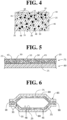
- the entrained polymers 20 each include a base polymer 25, a channeling agent 35 and an active agent 30.
- the channeling agent 35 forms interconnecting channels 45 through the entrained polymer 20.
- At least some of the active agent 30 is contained within these channels 45, such that the channels 45 communicate between the active agent 30 and the exterior of the entrained polymer 20 via channel openings 48 formed at outer surfaces of the entrained polymer 25.
- the active agent 30 is a chlorine dioxide gas releasing agent as defined herein.
- Suitable channeling agents include polyglycol such as polyethylene glycol (PEG), ethylene-vinyl alcohol (EVOH), polyvinyl alcohol (PVOH), glycerin polyamine, polyurethane and polycarboxylic acid including polyacrylic acid or polymethacrylic acid.
- the channeling agent 35 can be, for example, a water insoluble polymer, such as a propylene oxide polymerisate-monobutyl ether, which is commercially available under the trade name Polyglykol B01/240, produced by CLARIANT.
- the channeling agent could be a propylene oxide polymerisate monobutyl ether, which is commercially available under the trade name Polyglykol B01/20, produced by CLARIANT, propylene oxide polymerisate, which is commercially available under the trade name Polyglykol D0 1/240, produced by CLARIANT, ethylene vinyl acetate, nylon 6, nylon 66, or any combination of the foregoing.
- Entrained polymers with chlorine dioxide gas releasing agents are further described below.
- FIG. 4 illustrates an embodiment of an entrained polymer 10 according to the invention, in which the active agent 30 is a chlorine dioxide gas releasing agent.
- the arrows indicate the path of moisture from an exterior of the entrained polymer 10, through the channels 45, to the particles of chlorine dioxide gas releasing agent 30.
- the chlorine dioxide gas releasing agent reacts with or is otherwise triggered or activated by the moisture and in response releases chlorine dioxide gas.
- Chlorine dioxide gas-releasing agents are, e.g., a combination of sodium chlorite, a catalyst and a trigger.
- Preferred features of chlorine dioxide gas releasing agents used according to the present invention include any one or more of the following characteristics: (1) they volatize at refrigerated temperatures; (2) they are food safe and edible in finished form; (3) they may be incorporated safely into an entrained polymer formulation or other mechanism for release; (4) they are shelf stable in long term storage conditions; (5) they release the released chlorine dioxide gas only once a package in which the chlorine dioxide gas releasing agent is disposed, is sealed with product disposed in the package; (6) they do not affect a stored food product organoleptically when they are formulated and configured to achieve a desired release profile within the package; and (7) they are preferably acceptable under applicable governmental regulations and/or guidelines pertaining to food packaging and finished food labeling.
- the antimicrobial releasing agents are agents that release chlorine dioxide (ClO 2 ) in gas form as the released antimicrobial material.
- the chlorine dioxide gas releasing agent is a compound or formulation comprising an alkaline chlorite, such as, e.g. sodium chlorite or potassium chlorite, and optionally a catalyst and a trigger (e.g., in the form of a powder) which in combination are triggered or activated by moisture to cause the agent to release chlorine dioxide.
- an alkaline chlorite such as, e.g. sodium chlorite or potassium chlorite
- a catalyst and a trigger e.g., in the form of a powder
- a trigger e.g., in the form of a powder
- a suitable chlorine dioxide gas releasing agent which is based on Example 6 of U.S. Pat. No. 6,676,850 and is configured to release chlorine dioxide gas upon activation by moisture, may be prepared as follows.
- the chlorine dioxide gas releasing agent includes a formulation comprising sodium chlorite (as the active component), a base catalyst and a trigger.
- the catalyst and trigger preparations are made separately, then combined together and ultimately combined with the sodium chlorite.
- the base catalyst is optionally made by first preparing a 25-30 wt. % sodium silicate solution (SiO 2 :Na 2 O proportion of 2.0 to 3.3 by weight). That solution is mixed into an aqueous slurry of 28-44 wt. % Georgia Kaolin Clay (particle size diameter of about 80% less than one micrometer), wherein the sodium silicate solution is 2 wt. % of the slurry.
- the slurry is oven dried at 100°C to generate agglomerates or microspheres of about 70 ⁇ m in size. 300 g of these microspheres are impregnated with 280 g of 2.16 N sulfuric acid solution. That mixture is then dried at 100°C. Next, the dried mixture undergoes a calcine process at 350°C for 3 hours, followed by an additional calcine process at 300°C in a sealed glass jar with the seal wrapped with tape. This mixture forms the base catalyst.
- the base catalyst and trigger mixture is combined with 5.3 g of sodium chlorite (which is the active component of the active agent).
- the full mixture is then ground with mortar and pestle at ambient room temperature, thus forming an embodiment of a chlorine dioxide gas releasing agent.
- the chlorine dioxide gas releasing agent is then deposited in a sealed glass jar with tape wrapped around the seal to preserve it and keep it essentially free of moisture, which would prematurely activate it (to release chlorine dioxide gas).
- the entrained polymer comprises the active agent in an amount of 40%-70% by weight.
- the entrained polymer is in the form of a film disposed within sealed packaging containing fresh foodstuffs, e.g., meat or produce.
- the chlorine dioxide gas releasing agent loading level or concentration can range from 10% to 80%, preferably 40% to 70%, more preferably from 40% to 60%, and even more preferably from 45% to 55% by weight with respect to the total weight of the entrained polymer.
- the channeling agent may be provided in a range of 2% to 10% by weight, preferably about 5% by weight.
- the base polymer may range from 10% to 50% by weight of the total composition, preferably from 20% to 35% by weight.
- a colorant is added, e.g., at about 2% by weight of the total composition.
- an entrained polymer may be a formulation including 50% by weight of ASEPTROL 7.05 chlorine dioxide gas releasing agent in the form of the powdered mixture, 38% by weight ethyl vinyl acetate (EVA) as a base polymer and 12% by weight polyethylene glycol (PEG) as a channeling agent.
- EVA ethyl vinyl acetate
- PEG polyethylene glycol
- FIG. 1 shows a plug 55 constructed of an entrained polymer 20, in accordance with certain embodiments of the invention.
- the plug 55 may be placed inside of a container.
- the entrained polymer 20 includes a base polymer 25, a channeling agent 35 and a chlorine dioxide gas releasing agent (active agent) 30.
- FIG. 2 shows a cross-sectional view of the plug 55 shown in FIG. 1 .
- FIG. 2 shows that the entrained polymer 20 has been solidified such that the channeling agent 35 forms interconnecting channels 45 to establish passages throughout the solidified plug 55.
- At least some of the active agent 30 is contained within the channels 45, such that the channels 45 communicate between the active agent 30 and the exterior of the entrained polymer 20 via channel openings 48 formed at outer surfaces of the entrained polymer 25.
- FIG. 3 illustrates an embodiment of a plug 55 having similar construction and makeup to the plug 55 of FIG. 2 , where interconnecting channels 45 are finer as compared to those shown in FIG. 2 .
- a dimer agent i.e., a plasticizer
- the dimer agent may enhance the compatibility between the base polymer 25 and the channeling agent 35. This enhanced compatibility is facilitated by a lower viscosity of the blend, which may promote a more thorough blending of the base polymer 25 and channeling agent 35, which under normal conditions can resist combination into a uniform solution.
- the interconnecting channels 45 which are formed therethrough have a greater dispersion and a smaller porosity, thereby establishing a greater density of interconnecting channels throughout the plug 55.
- Interconnecting channels 45 facilitate transmission of a desired material, such as moisture or gas, through the base polymer 25, which generally acts as a barrier to resist permeation of these materials. For this reason, the base polymer 25 itself acts as a barrier substance within which an active agent 30 may be entrained.
- the interconnecting channels 45 formed of the channeling agent 35 provide pathways for the desired material to move through the entrained polymer 10. Without these interconnecting channels 45, it is believed that relatively small quantities of the desired material would be transmitted through the base polymer 25 to or from the active agent 30. Additionally, wherein the desired material is transmitted from the active agent 30, it is released from the active agent 30, i.e. it is chlorine dioxide gas.
- FIG. 5 illustrates an active sheet or film 75 formed of the entrained polymer 20 used in combination with a barrier sheet 80 to form a composite, according to an embodiment of the invention.
- the characteristics of the active sheet 75 are similar to those described with respect to the plug 55 shown in FIGs. 1 and 2 .
- the barrier sheet 80 may be a substrate such as foil and/or a polymer (such as a container wall) with low moisture or oxygen permeability.
- the barrier sheet 80 is compatible with the active sheet 75 and thus, is configured to thermally bond to the active sheet 75, when the active sheet 75 solidifies after dispensing.
- FIG. 6 illustrates an embodiment in which the two sheets 75, 80 are combined to form a packaging wrap having active characteristics at an interior surface formed by the entrained polymer 20/active sheet 75, and vapor resistant characteristics at an exterior surface formed by the barrier sheet 80.
- the sheets 75, 80 of FIG. 5 are joined together to form an active package 85, as shown in FIG. 6 .
- two laminates or composites are provided, each formed of an active sheet 75 joined with a barrier sheet 80.
- the sheet laminates are stacked, with each active sheet 75 facing the other, so as to be disposed on an interior of the package, and are joined at a sealing region 90, formed about a perimeter of the sealed region of the package interior.
- the antimicrobial entrained polymer is in the form of a film that is disposed within a sealed food package.
- the film may be adhered, e.g., using an adhesive, to an inner surface of the package.
- the film may be heat staked (without an adhesive) to the inner surface of the package.
- the process of heat staking film onto a substrate is known in the art and described in detail in U.S. Pat. No. 8,142,603 .
- the size and thickness of the film can vary.
- the film has a thickness of approximately 0.3 mm.
- the film may range from 0.1 mm to 1.0 mm, more preferably from 0.3 mm to 0.6 mm.
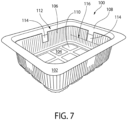
- FIG. 7 shows a package 100 for storing fresh foodstuffs, e.g., produce or meat, in accordance with certain embodiments of the invention.
- the package 100 is shown in the form of a plastic tray 102. Although, other forms and materials are also contemplated as being within the scope of the invention.
- the tray 102 comprises a base 104, and sidewalls 106 extending vertically from the base 104 leading to a tray opening 108.
- the base 104 and sidewalls 106 together define an interior 110, e.g. for holding and storing fresh produce.
- the package 100 also includes a flexible plastic lidding film 112, which is disposed over and seals the opening 108.
- covers or lids may be used to close and seal the opening 108.
- the cover or lid is transparent, such that the interior can be viewed.
- the package 100 further includes sections of antimicrobial entrained polymer film 114 disposed on the sidewalls 106.
- the film 114 is preferably disposed at or near the top of the sidewall 106, proximal to the opening 108. At least a portion, although preferably most or all of each of the film sections 114 protrude above the midline 116 of the sidewall 106, the midline 116 being centrally located between the base 104 and the opening 108.
- film placement at or towards the top of the package 100 has an effect on efficacy of the film sections 114, as such placement facilitates desirable distribution of released chlorine dioxide gas into the headspace of the package 100.
- Placing the entrained polymer at too low of a height above the base 104, or beneath the food in the package, has been found not to provide desirable distribution of the released chlorine dioxide gas in the headspace. If placement mass transfer of the chlorine dioxide gas is not optimal, some of the food product/good will not be adequately protected against the growth of microbes. Additionally, the food may undesirably react with and/or absorb the released chlorine dioxide gas.
- placing the film above the midline of the sidewall preferably at a height of at least 67% or 75% or about 80% of the sidewall, facilitates achieving a desired chlorine dioxide gas release profile and headspace concentration.
- the entrained polymer film 114 is heat staked to the package (e.g., on the sidewall as described and shown vis-à-vis Fig. 7 ).
- heat staking could allow the film to permanently adhere to the sidewall without use of an adhesive.
- An adhesive may be problematic in some circumstances because it may release unwanted volatiles in the food- containing headspace.
- Aspects of a heat staking process that may be used in accordance with optional embodiments of the invention are disclosed in U.S. Pat. No. 8,142,603 , as referenced above. Heat staking, in this instance, refers to heating a sealing layer substrate on the sidewall while exerting sufficient pressure on the film and sealing layer substrate to adhere the film to the container wall.
- the antimicrobial entrained polymer film 114 may be connected to the surface of the lidding film 112 (or a lid) that is inside of the container, in place of the film sections 114 on the sidewall(s) 106, or in addition thereto.
- the antimicrobial entrained polymer film 114 may be incorporated into the composition of the lidding film 112 (or a lid).
- release profile of the released chlorine dioxide gas In addition to placement of the film 114, another important factor is the release profile of the released chlorine dioxide gas. As aforementioned, to ensure adequate shelf life, release of the chlorine dioxide gas must not all occur immediately; rather, release should be extended, sustained and predetermined to attain a desired shelf life.
- the polymer entrained with chlorine dioxide gas releasing agent is self-activating, meaning that release of the chlorine dioxide gas is not initiated until the chlorine dioxide gas releasing agent is exposed to the moisture.
- moisture is not present in the interior, e.g., headspace, of the container prior to a food product being placed inside of the container.
- the food product Upon placement, the food product generates moisture that interacts with the chlorine dioxide gas releasing agent entrained in the polymer, to generate the chlorine dioxide gas in the headspace.
- the container is sealed in a moisture tight manner to trap moisture within the container generated by moisture-exuding comestibles.
- a controlled release and/or a desired release profile can be achieved by applying a coating to the active agent, e.g., using a spray coater, wherein the coating is configured to release the released antimicrobial agent within a desired time frame.
- the chlorine dioxide gas releasing agents may have different coatings applied thereon to achieve different release effects. For example, if a 14-day shelf life is desired, based on predetermined relative humidity of the package, the amount of moisture present to trigger the chlorine dioxide gas releasing agent may be determined. Based on this determination, the agent may be coated with extended release coatings of varying thicknesses and/or properties to achieve the desired release profile.
- active agent will be coated such that it will not begin releasing chlorine dioxide gas until after one week, while other active agent will begin release almost immediately.
- Spray coating technology is known in the art.
- pharmaceutical beads and the like are spray coated to control the release rate of active ingredient, e.g., to create extended or sustained release drugs.
- such technology may be adapted to apply coatings to the active agent to achieve a desired controlled rate of release of chlorine dioxide gas.
- a controlled release and/or desired release profile may be achieved by providing a layer, optionally on both sides of the film, of a material configured to control moisture uptake into the entrained polymer (which in turn triggers release of the chlorine dioxide).
- the film may include a polymer liner, made e.g., from low density polyethylene (LDPE) disposed on either side or both sides thereof.
- LDPE low density polyethylene
- the thickness of the film and liner(s) can vary.
- the film is approximately 0.3 mm thick and the LDPE liners on either side are each approximately 0.02 mm to 0.04 mm thick.
- the LDPE liners may be coextruded with the film or laminated thereon.
- a controlled release and/or desired release profile may be achieved by modifying the formulation of the trigger of the chlorine dioxide gas releasing agent.
- the trigger when contacted by moisture, liquefies and then reacts with the active component (e.g., sodium chlorite) to cause release of the chlorine dioxide gas.
- the trigger may be formulated to liquefy upon contact with moisture at different rates. The faster the trigger liquefies, the faster the release of chlorine dioxide gas and vice versa. In this way, modification of the trigger is yet another vehicle provide a desired release rate of chlorine dioxide gas.
- Any combination of the aforementioned mechanisms may be utilized to achieve desired release rates and release profiles of chlorine dioxide gas within a container headspace.
- the desired release profile of chlorine dioxide gas in a container headspace may vary depending on the nature of the product that is stored. For example, the inventors have found that foods having a high water content appear to require a high burst of antimicrobial gas followed by a drop in headspace concentration during the storage period while foods having a more modest water content appear to respond well to a relatively steady headspace concentration over the storage period.
- Examples of food products that exude high amounts of moisture and that are more appropriately protected by a release profile having a quick burst of chlorine dioxide gas followed by a drop include sliced, diced or cut foods selected from the group consisting of: tomatoes, washed peppers, washed onions, water melon, honey dew, cantaloupe, strawberries, peaches, pineapple, oranges, seafood, meat and poultry.
- an amount of the chlorine dioxide gas releasing agent that releases the chlorine dioxide gas to preferably provide a headspace concentration of from 10 parts per million (PPM) to 35 PPM for a period of 16 hours to 36 hours, optionally from 15 PPM to 30 PPM for a period of 16 hours to 36 hours, optionally from 15 PPM to 30 PPM for a period of about 24 hours.
- Headspace concentration measurements may be obtained, for example, using a PORTASENS II gas detector from Analytical Technology, Inc. for readings taken with chlorine dioxide sensors placed within the package.
- the sensors may be one or more of 00-1004 Chlorine Dioxide, 0-1/5 PPM (2 PPM Std.), 00-1005 Chlorine Dioxide, 0-5/200 (20 PPM Std.) and 00-1359 Chlorine Dioxide, 0- 200/1000 PPM (1000 PPM Std.), which are also from Analytical Technology, Inc. and are compatible with the PORTASENS II gas detector.
- Examples of food products that exude moderate or low amounts of moisture are whole or minimally processed produce selected from the group consisting of: broccoli, brussel sprouts, cabbage, cucumbers, bananas, herbs, whole peppers, carrots, root vegetables and potatoes.
- an amount of chlorine dioxide gas releasing agent releases the chlorine dioxide gas to preferably provide a headspace concentration of from 8 PPM to 15 PPM for a period of 13 days. Regardless of whether this exact headspace concentration is met, it is preferred that the chlorine dioxide gas releasing agents are provided in entrained polymer films, as described herein, for such low or moderate moisture exuding foods.
- the chlorine dioxide gas is provided in a headspace concentration over a determined time period to effectuate, after a span of 13 days from when the product is provided within the interior space and under storage conditions of 7°C, at least a 2 log base 10 reduction in colony forming units per gram (CFU/g), optionally at least a 3 log base 10 reduction in CFU/g, optionally at least a 4 log base 10 reduction in CFU/g of the at least one type of pathogen, without causing organoleptic degradation of the food product.
- organoleptic degradation may include bleaching or other discoloration of the food product.
- 700-950 mg of the chlorine dioxide gas releasing agent is effective when used in a 1L container having 1.25 lbs of tomatoes stored therein. It is contemplated that proportional adjustment of the mass of chlorine dioxide gas releasing agent may be done according to changes in container volume and amount/type of contents.
- the entrained polymers according to the invention may be used outside of food preservation applications.
- they may be adapted for use in sterilization of disposable medical devices, i.e., to reduce the bioburden of such devices when they are packaged.
- the primary difference between preservation of fresh food and medical devices is shelf life.
- Preservation of fresh food implicates a shelf life measured in days or weeks while maintaining sterility of packaged medical devices requires a shelf life measured in months or years. Accordingly, the release profile over time for one application versus the other will necessarily vary.
- a storage temperature of 7°C was chosen to replicate a storage temperature that is slightly elevated above ideal storage temperature (or to simulate an inadvertent spike in temperature during storage, e.g., when refrigeration equipment breaks down for a few hours).
- Three packages similar to that shown in FIG. 7 were utilized in this experiment. All three included antimicrobial entrained polymer film sections placed substantially as shown in FIG. 7 .
- the film was an entrained polymer film including an chlorine dioxide gas releasing agent in the form of a powdered mixture comprising sodium chlorite (which produces chlorine dioxide gas), sulfuric acid clay (as a catalyst) and calcium chloride (as a humidity trigger). This powdered mixture is sold commercially by BASF under the name ASEPTROL and is described above.
- the formulation for the film itself was a formulation including 50% by weight of the aforementioned chlorine dioxide gas releasing agent in the form of the powdered mixture, 38% by weight ethyl vinyl acetate (EVA) as a base polymer and 12% by weight polyethylene glycol (PEG) as a channeling agent.
- EVA ethyl vinyl acetate
- PEG polyethylene glycol
- This film formulation is described herein as X2597 and is considered one exemplary embodiment of an entrained polymer according to the invention.
- the chlorine dioxide gas releasing agent is triggered by moisture to release chlorine dioxide (ClO 2 ) gas as the released antimicrobial material.
- the film, as between the three packages, was the same formulation and dimensions. However, two of the films had external layers to control moisture uptake and one had no such layers.
- the film in Package A was sandwiched between coextruded layers of LDPE that were about 0.02 mm thick.
- the film in Package B was sandwiched between coextruded layers of LDPE that were about 0.04 mm thick.
- the film in Package C (the control) had no such polymer layers on either side of the film.
- Package B had the steadiest and most consistent release profile, attributable to the thicker polymer liner sandwiching the antimicrobial film, which controlled moisture uptake into the film.
- the release profile of Package B may be desirable for certain applications, for example where the food product exudes a relatively modest amount of moisture, such as broccoli.
- a common cause of rejects for quality of tomatoes is Geotrichum candidum, a yeast-like mold that grows as a white fuzz.
- Geotrichum candidum a yeast-like mold that grows as a white fuzz.
- sliced tomatoes deliberately tainted with G. candidum were packaged and subjected to testing.
- a storage temperature of 7°C was chosen to replicate a storage temperature that is slightly elevated above ideal storage temperature (or to simulate an inadvertent spike in temperature during storage, e.g., when refrigeration equipment breaks down for a few hours).
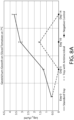
- the results are provided on the graphs shown in FIGS. 8A and 8B .
- the results show conclusively that the antimicrobial film significantly inhibited growth of Geotrichum on the sliced tomatoes compared to the package without the film.
- proliferation of Geotrichum on the sliced tomatoes was readily apparent to the naked eye.
- the sliced tomatoes in the package with the entrained polymer ClO 2 -releasing antimicrobial film appeared fresh, with no visible signs of Geotrichum growth. This is further notable given the suboptimal 7°C storage conditions for the day test.
- tomatoes were merely exemplary and that other produce and fresh foods (e.g., meat) may be used in accordance with the invention.
- Entrained polymer film (X2597 film, described above) was placed in the headspace of a tray at various height positions on the sidewalls to test the effectiveness of various antimicrobial film locations/positions, as well as various sampling locations.
- MCT Maxwell Chase Technologies, LLC of Atlanta, GA.
- FPT refers to FRESH-R-PAX ® trays of Maxwell Chase Technologies, LLC.
- Tempure Scientific Top Mount Laboratory Refrigerator (Model #LP-75-HG-TP) equipped with a Dixell XR40CX computer control set at 7°C temperature with high of 8°C and low of 6°C cooling setting.
- 2 Sets of CPC #3438400 Quick-Disconnect Valves with compression fittings per mason jar (McMaster-Carr (MCM) #5012K122).
- Flex ® GP 70 3/16" ID, 1 ⁇ 4" OD black PVC tubing (MCM #5231K35). 011 Buna-N O-ring, oil resistant, round profile (MCM #9408K41). Xacto Knife.
- the MCT FPT125D (1/4 steam size, deep white polypropylene) trays were modified as follows. Three holes approximately 8.5 mm wide and 2 cm apart were made into the MCT FPT125D trays with an Xacto knife. Edges of the hole were cleaned and the CPC valves were screwed into the holes with an o-ring on both sides, and the compression fitting tightening down the 2 rings. Both valves were placed with QDV on the outside of the lid and container to allow for the automatic closing valves to be on the outside for sampling purposes.
- Flex ® GP 70 3/16" ID, 1 ⁇ 4" OD black PVC tubing (MCM#5231K35) was used on both intake and outtake ports of the C16 Portable Gas Analyzer, as well as the other end of the CPC #3438400 Quick-Disconnect Valves with compression fittings to connect to the trays to sample the headspace in the trays.
- CSP film samples were cut from the same strip of film and same width. Then, each sample was weighed to 1.000 g and connected to a sidewall of the tray with a plastic piece to hold it in place. There were two samples in each tray, which resulted in 2 g of CSP film per tray. Each of the samples was connected to a different sidewall of the tray.
- the tomatoes were sliced using the hand-slicer with the calyx facing down. The ends were discarded. About 7 slices of tomatoes were placed on the bottom surface of each tray.
- the manual sealer was heated to 375°F, and each tray with tomatoes therein was placed on the respective sealing plate. Lidding/Sealing film was placed over the tray, the sealing handle was pressed down and held for approximately 1-2 seconds to cover/seal the tomatoes inside the tray.
- FIG. 9 shows the release of ClO 2 (ppm) corresponding to various positions of the CSP film in the tray, i.e., at 0%, 50%, 64%, 79% and 100% height from the bottom surface based on total height of the sidewall. These respective heights are measured from the midline of the film.
- FIG. 10 shows the effect of the CSP film height on headspace concentration.
- the placement of the film should be preferably in the top 20% of the tray, i.e., positioned at a vertical height that is 80% to 100% of the total height of the sidewall measured from the bottom surface, and should be placed at least at 64% of the total height of the sidewall of the tray.
- CSP ClO 2 emitting films designated formulation X2597 (described above), at 0.3 mm thickness were used.
- This formulation was designed to have a fast ClO 2 release profile and did not use an overlying polyethylene layer to reduce the moisture uptake rate into the film.
- the X-2597 film is a formulation including 50% by weight of chlorine dioxide gas releasing agent, 38% by weight ethyl vinyl acetate (EVA) as a base polymer and 12% by weight polyethylene glycol (PEG) as a channeling agent. Trays with either 4 grams or 3 grams of film per tray were used. The tomatoes in the tray were each inoculated with three pathogens, i.e., Listeria monocytogenes, E. Coli and Salmonella.
- EVA ethyl vinyl acetate
- PEG polyethylene glycol
- Tomatoes-category 5x5 extra for waste
- Tomato hand-slicer Primary Castle
- Manual sealer set at 375°F(Maxwell Chase Tech.)
- Polypropylene lidding film Approx. 90
- OTR Maxwell Chase Tech
- Listeria monocytogenes 5 strain cocktail inoculums Food Isolates
- Salmonella 5 strain cocktail Food Isolates
- FPT 125D Trays (1/4 steam sized white polypropylene trays) w/ 1 g ClO 2 film on each upper corner 10 FPT 125D Trays (1/4 steam sized white polypropylene trays) w/ 0.75 g ClO 2 film on each upper corner 10 FPT 125D Trays (1/4 steam sized white polypropylene trays) designated -MCT 4 Un-inoculated Trays designated - UN Refrigerator set at 7°C 564 MOX Plates (60 day 0. 168 days 5, 8, 12) designated - List.
- 564 XLD plates (60 day 0. 168 days 5, 8, 12) designated -Sal.
- 564 PCA plates (60 day 0. 168 days 5,8, 12) designated - APC
- 564 MAC plates (60 day 0. 168 days 5,8, 12) designated - E. coli Enrichment broth for corresponding pathogens Extra plates for streak verification
- Salmonella, Listeria monocytogenes, and E. Coli O157:H7 5 strain cocktails were prepared, mixed and kept overnight. The target was to achieve a 5-log inoculation of each pathogen on the tomatoes.
- the inoculated tomatoes had 10 9 CFU pathogen/ml inoculum. Inoculations were plated for verification and initial levels.
- a solution of 200 ppm free chlorine solution was prepared using lukewarm water. The slicer was immersed in the solution for 2 min, and then rinsed with tap water.
- a 200-ppm free chlorine solution was prepared using warm water (approximately the same temperature as for the tomatoes).
- the tomatoes were placed in tap water first, then the chlorine solution for 2 minutes, and rinsed with tap water.
- the tomatoes were sliced using the hand-slicer with the calyx facing down. The ends were discarded such that there were 42 slices packed into each tray (6 tomatoes by 7 slices/tomato).
- the manual sealer was heated to 375°F. Each tray was placed on the sealing plate and the lidding film was pulled over the tray. The sealing handle was depressed and held in place for approximately 1-2 seconds. After sealing, each tray was checked to verify that the lidding film was fully attached to the tray.
- test trays were analyzed on days 0, 5, 8 and 12. For each tray, there were a total of three samples for each pathogen, three pathogens per tray and three APC (aerobic plate count) samples were taken from each tray. Each sample consisted of two slices taken using sterile forceps. The two slices were weighed into the sterile stomacher bag (weight was approximately 40-50 g) and three times the amount of sterile Peptone water was added. The tomatoes were stomached at 260 rpm for 1 minute. The necessary dilutions were then prepared ( ⁇ 3) from the homogenate and duplicate spread plated onto the corresponding PCA, MOX, SMAC, or XLD plates.
- CFU colony forming units
- this experiment cumulatively included a total of 376 tests (94 Salmonella, 94 E. Coli, 94 Listeria, 94 APC). Results are shown in FIGS. 11-13 .
- FIG. 11 shows that there was a decline in Salmonella after Day 0 and stayed in decline until day 12 for the CSP3 trays, and continued for the CSP4 trays.
- Each of these samples showed a reduction in Salmonella counts of at least 1.8 logs on day 5, 2.5 logs for day 8, and 3 logs for Day 12 respectively. This demonstrates a 99.9% reduction in Salmonella after 12 days in the CSP trays.
- FIG. 12 shows results for E . coli that are similar to the Salmonella results.
- a decline in E . coli after Day 0 resulted in a reduction of at least 2 logs on day 5, 4 logs on day 8, and 3 logs on day 12.
- FIG. 12 shows an increase for the CSP3 tray on Day 12. It was determined that there was a 99.9% reduction in E . coli after a 12-day period.
- FIG. 13 shows that the CSP film also reduced Listeria by 1 log over 12 days of shelf life. This is consistent on every day samples were obtained, and demonstrated a 90% reduction of Listeria monocytogenes consistently for 12 days.
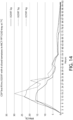
- FIG. 14 provides release curves for the 3 g and 4 g versions that were used in Example 4.
- FIG. 14 also provides a release curve for trays that used only 2 g of film.
- the trays using 4 g of film peaked at approximately 30 ppm of ClO 2 at about hour 18, while holding above 10 ppm between about hour 6 to hour 33.
- the trays using 3 g of film (CSP3) peaked at approximately 23 ppm of ClO 2 at about hour 15, while holding above 10 ppm between about hour 6 to hour 33.
- these embodiments provided sufficient headspace concentration to achieve a desired microbial kill and did so without bleaching the tomatoes.
- FIG. 14 also shows a release curve for trays using 2 g of film. As the curve shows, that trays peaked at approximately 16 ppm of ClO 2 between hours 12 and 18. However, that curve shows that ClO 2 concentration only held above 10 ppm between about hours 8 to 26. In some circumstances, this concentration and release curve may provide sufficient antimicrobial effect, but in this instance, this concentration was not preferred.
Landscapes
- Engineering & Computer Science (AREA)
- Life Sciences & Earth Sciences (AREA)
- Mechanical Engineering (AREA)
- Chemical & Material Sciences (AREA)
- Food Science & Technology (AREA)
- Wood Science & Technology (AREA)
- Zoology (AREA)
- Pest Control & Pesticides (AREA)
- Agronomy & Crop Science (AREA)
- Polymers & Plastics (AREA)
- Health & Medical Sciences (AREA)
- General Health & Medical Sciences (AREA)
- Dentistry (AREA)
- Inorganic Chemistry (AREA)
- Environmental Sciences (AREA)
- Plant Pathology (AREA)
- Chemical Kinetics & Catalysis (AREA)
- General Chemical & Material Sciences (AREA)
- Ceramic Engineering (AREA)
- Packages (AREA)
- Food Preservation Except Freezing, Refrigeration, And Drying (AREA)
- Agricultural Chemicals And Associated Chemicals (AREA)
- Apparatus For Disinfection Or Sterilisation (AREA)
- Storage Of Fruits Or Vegetables (AREA)
- Packging For Living Organisms, Food Or Medicinal Products That Are Sensitive To Environmental Conditiond (AREA)
- Medicinal Preparation (AREA)
- Medicinal Chemistry (AREA)
- Organic Chemistry (AREA)
Description
- This invention relates to an entrained polymer, containers comprising said entrained polymer, and methods using said containers, useful for reducing and preventing the growth of microbes, or for killing microbes, within an interior space of a container and/or on product/good that is stored in the container. The entrained polymer is entrained with an antimicrobial releasing agent, namely a chlorine dioxide gas releasing agent.
- There are many items that are preferably stored, shipped and/or utilized in an environment that must be controlled and/or regulated. For example, in the moisture control field, containers and/or packages having the ability to absorb excess moisture trapped therein have been recognized as desirable. Likewise, in packaging products that carry a risk of contamination, e.g., food, it may be desirable to control the growth and proliferation of microbes.
- Food products, particularly sliced or cut fresh foodstuffs such as meat, poultry, fruit, and vegetables are typically stored and sold in a supporting container, e.g., tray, that is overwrapped by a transparent plastic film, enabling visual inspection of the food products. These food products generally produce an exudate (i.e., juices), which can be a source for the growth of microbial agents. In addition, contamination of processing equipment or other surfaces with which the food products come into contact may remain with the food and proliferate while packaged. Similarly, food products may be contaminated even before the packaging process. For example, a tomato may have an opening in its skin through which unwanted microorganisms enter and replicate. Breakdown in the food handling process and/or cold chain management (e.g., refrigeration during food transport breaks for several hours) can allow microbial growth of contaminated food, potentially leading to outbreaks of food borne illness. Regardless of the source or nature of microbial contamination in food, the shelf-life and safety of the contaminated food products is affected by contamination and proliferation of microbes.
- One way that the food industry has addressed preservation of foodstuffs is by including food grade preservatives as a component of the food, such as potassium sorbate, sodium benzoate and nitrites. However, such preservatives are regarded by some in the health field and consumers as being unnatural and presenting health risks. Moreover, it is not practical to use such preservatives with non-processed foods, for example fresh fruits or vegetables.
- Another way that the food industry has addressed food preservation is to utilize antimicrobial agents that directly contact the food as a component in packaging material. However, such direct contact may be undesirable in some applications.
- For certain applications, it is desirable to provide antimicrobial agents to release antimicrobial gas into a headspace of the food product package or container to control the growth of microbes, as compared to a solid or liquid component that requires direct contact with the stored food in order to be effective. However, there are challenges with providing the antimicrobial gas in the headspace. One such challenge is attaining a desired release profile of antimicrobial gas within the headspace during a designated time period. Failure to attain the appropriate release profile for a given product may result in a failure to achieve the desired shelf life for that product. Thus, there exists a need for improved delivery of antimicrobial agents to control, reduce and substantially destroy microbial contamination in food packaging as well as other applications, such as packaging of sterilized disposable medical devices. A challenge in meeting this need is maintaining a balance between providing sufficient antimicrobial gas in the package headspace to effectively control and/or kill pathogens while not "overdosing" the package headspace, which could adversely affect the quality of the product, e.g., by organoleptic degradation.
WO 2017/031349 describes a multilayer medical packaging film including a first layer and a chlorine dioxide-producing layer, the latter including a polymer composition and a plurality of chlorite ions. - Accordingly, in one aspect, the invention provides an entrained polymer, the entrained polymer comprising:
- (a) a base polymer selected from polypropylene, polyethylene, polyisoprene, polybutadiene, polybutene, polysiloxane, polycarbonate, polyamide, ethylene-vinyl acetate copolymer, ethylene-methacrylate copolymer, poly(vinyl chloride), polystyrene, polyester, polyanhydride, polyacrylonitrile, polysulfone, polyacrylic ester, polyurethane, polyacetal, or a copolymer or mixture thereof;
- (b) a channeling agent, wherein the entrained polymer features channels through the base polymer formed of the channeling agent, and wherein the channeling agent is a poly glycol (for example, a polyethylene glycol (PEG)), ethylene-vinyl alcohol (EVOH), polyvinyl alcohol (PVOH), glycerin polyamine, polyurethane, polycarboxylic acid, propylene oxide polymerisate-monobutyl ether, propylene oxide polymerisate, ethylene-vinyl acetate,
nylon 6,nylon 66, or a combination thereof; and - (c) a chlorine dioxide gas releasing agent comprising an alkaline chlorite, wherein release of the chlorine dioxide gas is activated by contact of the entrained polymer with moisture.
- In another aspect, the invention provides a method for inhibiting or preventing the growth of microbes or for killing microbes on a good in the interior space of a closed container. The method includes providing an entrained polymer according to the invention. The container includes a bottom surface, a top opening, one or more sidewalls extending in a vertical direction from the bottom surface to the top opening, an interior space formed by the one or more sidewalls, a headspace formed by the interior space that is not occupied by the good, and a cover to close and/or seal the container. The method further includes positioning the at least one entrained polymer article within the interior space of the container; placing the good in the container; covering the container; presenting the moisture in the interior space of the container; and releasing the chlorine dioxide gas within the interior space in a concentration effective for reducing or preventing the growth of microbes or for killing microbes present on the good.
- In another aspect, a package is provided for inhibiting or preventing growth of microbes or for killing microbes in a closed container having a product located therein. The package is a container defining an interior space therein. A product (optionally a food product) is provided within the interior space. A headspace is formed within a volume of the interior space that is not occupied by the product. The entrained polymer according to the invention is disposed within the interior space, the chlorine dioxide releasing agent releasing chlorine dioxide gas into the headspace by reaction of moisture with the chlorine dioxide gas releasing agent. The chlorine dioxide gas releasing agent is optionally provided in an amount that releases the chlorine dioxide gas to provide a headspace concentration of from 10 parts per million (PPM) to 35 PPM for a period of 16 hours to 36 hours, optionally from 15 PPM to 30 PPM for a period of 16 hours to 36 hours, optionally from 15 PPM to 30 PPM for a period of about 24 hours.
- Optionally, in any embodiment, when the product is provided within the interior space, the product is contaminated by at least one type of pathogen. The chlorine dioxide gas releasing agent provides a controlled release of chlorine dioxide gas to effectuate, after a span of 13 days from when the product is provided within the interior space and under storage conditions of 7° C, at least a 2
log base 10 reduction in colony forming units per gram (CFU/g), optionally at least a 3log base 10 reduction in CFU/g, of the at least one type of pathogen, optionally at least a 4log base 10 reduction in CFU/g, of the at least one type of pathogen. Optionally, the at least one pathogen is Salmonella, E. Coli, Listeria and/or Geotrichum. - Optionally, if the product is a food product and the amount of chlorine dioxide gas releasing agent and/or chlorine dioxide gas is present in an amount sufficient to effectuate the at least 2
log base 10 reduction in CFU/g, (or at least 3log base log base 10 reduction in CFU/g), of the at least one type of pathogen, such efficacy does not come at the expense of organoleptic degradation of the food product. For example the food product is not bleached or otherwise discolored. - Optionally, in any embodiment, the chlorine dioxide gas releasing agent is provided in at least one entrained polymer article located within the interior space, wherein the entrained polymer is an entrained polymer according to the invention. Preferably, such entrained polymer article is provided as a film having a thickness of from 0.1 mm to 1.0 mm, preferably from 0.2 mm to 0.6 mm, optionally about 0.3 mm. Preferably, such film is provided above the midline (preferably at least 2/3 or 3/4) of the container sidewalls, which inventors have found helps to attain a desired chlorine dioxide gas release profile.
- Optionally, in any embodiment, the chlorine dioxide gas releasing agent is a powdered mixture comprising the alkaline metal chlorite, preferably sodium chlorite. Optionally, the powdered mixture further comprises at least one catalyst, optionally sulfuric acid clay, and at least one humidity trigger, optionally calcium chloride.
- In one embodiment, the invention provides a method for inhibiting or preventing the growth of microbes or for killing microbes on a good in the interior space of a closed container, the good being a food product. The method includes providing a closed container defining an interior space therein and a food product within the interior space. A headspace is formed within a volume of the interior space that is not occupied by the product. An entrained polymer according to the invention is provided in the interior space. The chlorine dioxide gas releasing agent releases chlorine dioxide gas into the headspace by reaction of moisture with the chlorine dioxide gas releasing agent. The chlorine dioxide gas releasing agent is provided in an amount sufficient to release the chlorine dioxide gas to provide a desired headspace concentration of the chlorine dioxide gas over a predetermined amount of time. According to the method, if the product is contaminated by at least one type of pathogen at the time the product is provided within the interior space, the chlorine dioxide gas releasing agent optionally provides a controlled release of chlorine dioxide gas to effectuate, after a span of 13 days under storage conditions of 7° C, at least a 2
log base 10 reduction in CFU/g, optionally at least a 3log base 10 reduction in CFU/g, optionally at least a 4log base 10 reduction in CFU/g, of the at least one type of pathogen. Preferably, this method effectuates the reduction without causing organoleptic degradation of the food product, for example without bleaching or otherwise causing discoloration of the food product. Preferably, the chlorine dioxide gas releasing agent is provided in an entrained polymer film as described herein. - In any embodiment of a package described herein, an aspect of the invention may include use of the package for storing a food product, wherein the food product exudes moisture that activates the chlorine dioxide gas releasing agent to release chlorine dioxide gas in the headspace. This use may attain desired headspace chlorine dioxide gas concentrations as described herein. This use may effectuate, after a span of 13 days from when the product is provided within the interior space and under storage conditions of 7° C, at least a 2
log base 10 reduction in colony forming units per gram (CFU/g), optionally at least a 3log base 10 reduction in CFU/g, optionally at least a 4log base 10 reduction in CFU/g, of the at least one type of pathogen. This is preferably done without causing organoleptic degradation of the food product, for example without bleaching or otherwise discoloring the food product. - The invention will be described in conjunction with the following drawings in which like reference numerals designate like elements and wherein:
-
FIG. 1 is a perspective view of a plug formed of an entrained polymer according to an embodiment of the present invention. -
FIG. 2 is a cross section taken along line 2-2 ofFIG. 1 ; -
FIG. 3 is a cross section similar to that ofFIG. 2 , showing a plug formed of another embodiment of an entrained polymer according to the present invention; -
FIG. 4 is a schematic illustration of an entrained polymer according to an embodiment of the present invention, in which the chlorine dioxide gas releasing material that is activated by contact with moisture. -
FIG. 5 is a cross sectional view of a sheet or film formed of an entrained polymer according to an embodiment of the present invention, adhered to a barrier sheet substrate. -
FIG. 6 is a cross section of a package that may be formed using an entrained polymer according to an embodiment of the present invention. -
FIG. 7 is a perspective view of an exemplary package incorporating entrained polymer films according to an embodiment of the present invention. -
FIGS. 8A and8B are plots comparing Geotrichum Growth on contaminated tomatoes stored in packages respectively with and without use of entrained polymer film according to the invention. -
FIG. 9 is a plot showing the measured amount of ClO2 (chlorine dioxide) provided within a headspace of a container including entrained polymer film according to the invention. -
FIG. 10 is a plot showing the measured amount of ClO2 provided within a headspace of a container including an entrained polymer film according to the invention positioned at varying heights on the sidewall. -
FIG. 11 is a plot showing the log CFU/gram reduction in Salmonella for foodstuff stored in containers with an entrained polymer film according to the invention being positioned therein, as compared to containers absent of the entrained polymer film. -
FIG. 12 is a plot showing the log CFU/gram reduction in E. Coli for foodstuff stored in containers with an entrained polymer film according to the invention being positioned therein, as compared to containers absent of the entrained polymer film. -
FIG. 13 is a plot showing the log CFU/gram reduction in Listeria for foodstuff stored in containers with an entrained polymer film according to the invention being positioned therein as compared to containers absent of the entrained polymer film. -
FIG. 14 is a plot showing the measured amounts of ClO2 provided within a headspace of a container depending on the amount of entrained polymer film according to the invention provided in the container. - As used herein, the term "active agent" is defined as chlorine dioxide gas releasing agent comprising an alkaline chlorite, wherein release of the chlorine dioxide gas is activated by contact of the entrained polymer with moisture. The active agent is a material that is preferably immiscible with the base polymer and when mixed and heated with the base polymer and the channeling agent, will not melt, i.e., has a melting point that is higher than the melting point for either the base polymer or the channeling agent.
- The term "chlorine dioxide gas releasing agent" refers to an active agent that is capable of releasing chlorine dioxide gas. This active agent includes an alkaline chlorite as active component, and may include other components (such as a catalyst and trigger) in a formulation (e.g., powdered mixture) configured to release the antimicrobial gas chlorine dioxide. Chlorine dioxide gas is a compound that inhibits or prevents the growth and proliferation of microbes or kills microbes. The chlorine dioxide gas is released by the chlorine dioxide gas releasing agent. The chlorine dioxide gas releasing agent is triggered by contact with moisture, which reacts with the chlorine dioxide gas releasing agent to cause the agent to release chlorine dioxide gas.
- As used herein, the term "base polymer" is a polymer optionally having a water vapor transmission rate that is substantially lower than, lower than or substantially equivalent to that of the channeling agent, because the chlorine dioxide gas releasing agent is an chlorine dioxide gas releasing agent that is activated by moisture. This agent includes an alkaline chlorite and may include other components in a formulation configured to release the antimicrobial gas chlorine dioxide. The primary function of the base polymer is to provide structure for the entrained polymer.
- In certain embodiments, the channeling agent has a water vapor transmission rate of at least two times that of the base polymer. In other embodiments, the channeling agent has a water vapor transmission rate of at least five times that of the base polymer. In other embodiments, the channeling agent has a water vapor transmission rate of at least ten times that of the base polymer. In still other embodiments, the channeling agent has a water vapor transmission rate of at least twenty times that of the base polymer. In still another embodiment, the channeling agent has a water vapor transmission rate of at least fifty times that of the base polymer. In still other embodiments, the channeling agent has a water vapor transmission rate of at least one hundred times that of the base polymer.
- As used herein, the term "channeling agent" or "channeling agents" is defined as a material that is immiscible with the base polymer and has an affinity to transport a gas phase substance at a faster rate than the base polymer. A channeling agent is capable of forming channels through the entrained polymer when formed by mixing the channeling agent with the base polymer. Such channels are capable of transmitting moisture through the entrained polymer at a faster rate than in solely the base polymer.
- As used herein, the term "channels" or "interconnecting channels" is defined as passages formed of the channeling agent that penetrate through the base polymer and may be interconnected with each other.
- As used herein, the term "entrained polymer" is defined as a monolithic material formed of at least a base polymer with a chlorine dioxide gas releasing agent and a channeling agent entrained or distributed throughout.
- As used herein, the term "monolithic material" is defined as a material that does not consist of two or more discrete macroscopic layers or portions. Accordingly, a "monolithic material" does not include a multi-layer composite.
- Furthermore, the terms "package," "packaging" and "container" may be used interchangeably herein to indicate an object that holds or contains a good, e.g., food product and foodstuffs. Optionally, a package may include a container with a product stored therein. Examples of a package, packaging and container include a tray, box, carton, bottle receptacle, vessel, pouch and flexible bag. A pouch or flexible bag may be made from, e.g., polypropylene or polyethylene. The package or container may be closed, covered and/or sealed using a variety of mechanisms including a cover, a lid, lidding sealant, an adhesive and a heat seal, for example. The package or container is composed or constructed of various materials, such as plastic (e.g., polypropylene or polyethylene), paper, Styrofoam, glass, metal and combinations thereof. In one embodiment, the package or container is composed of a rigid or semi-rigid polymer, optionally polypropylene or polyethylene, and preferably has sufficient rigidity to retain its shape under gravity.
- Conventionally, desiccants, oxygen absorbers and other active agents have been used in raw form, e.g., as loose particulates housed in sachets or canisters within packaging, to control the internal environment of the package. For many applications, it is not desired to have such loosely stored active substances. Thus, the present application provides active entrained polymers comprising active agents, wherein such polymers can be extruded and/or molded into a variety of desired forms, e.g., container liners, plugs, film sheets, pellets and other such structures. Such active entrained polymers include channeling agents, such as polyethylene glycol (PEG), which form channels between the surface of the entrained polymer and its interior to transmit moisture to the entrained active agent. Entrained polymers are described, for example, in
U.S. Pat. Nos. 5,911,937 ,6,080,350 ,6,124,006 ,6,130,263 ,6,194,079 ,6,214,255 ,6,486,231 ,7,005,459 , andU.S. Pat. Pub. No. 2016/0039955 . -
Figs. 1-6 illustrate exemplary entrainedpolymers 20 and various packaging assemblies formed of entrained polymers according to embodiments of the invention. The entrainedpolymers 20 each include abase polymer 25, a channelingagent 35 and anactive agent 30. As shown, the channelingagent 35forms interconnecting channels 45 through the entrainedpolymer 20. At least some of theactive agent 30 is contained within thesechannels 45, such that thechannels 45 communicate between theactive agent 30 and the exterior of the entrainedpolymer 20 viachannel openings 48 formed at outer surfaces of the entrainedpolymer 25. Theactive agent 30 is a chlorine dioxide gas releasing agent as defined herein. - Suitable channeling agents include polyglycol such as polyethylene glycol (PEG), ethylene-vinyl alcohol (EVOH), polyvinyl alcohol (PVOH), glycerin polyamine, polyurethane and polycarboxylic acid including polyacrylic acid or polymethacrylic acid. Alternatively, the channeling
agent 35 can be, for example, a water insoluble polymer, such as a propylene oxide polymerisate-monobutyl ether, which is commercially available under the trade name Polyglykol B01/240, produced by CLARIANT. In other embodiments, the channeling agent could be a propylene oxide polymerisate monobutyl ether, which is commercially available under the trade name Polyglykol B01/20, produced by CLARIANT, propylene oxide polymerisate, which is commercially available under the tradename Polyglykol D0 1/240, produced by CLARIANT, ethylene vinyl acetate,nylon 6,nylon 66, or any combination of the foregoing. - Entrained polymers with chlorine dioxide gas releasing agents are further described below.
-
FIG. 4 illustrates an embodiment of an entrainedpolymer 10 according to the invention, in which theactive agent 30 is a chlorine dioxide gas releasing agent. The arrows indicate the path of moisture from an exterior of the entrainedpolymer 10, through thechannels 45, to the particles of chlorine dioxidegas releasing agent 30. The chlorine dioxide gas releasing agent reacts with or is otherwise triggered or activated by the moisture and in response releases chlorine dioxide gas. - As will be discussed in greater detail below, the chlorine dioxide gas releasing agent is generally used in a closed system so that the released chlorine dioxide gas does not escape. Chlorine dioxide gas-releasing agents are, e.g., a combination of sodium chlorite, a catalyst and a trigger.
- Preferred features of chlorine dioxide gas releasing agents used according to the present invention include any one or more of the following characteristics: (1) they volatize at refrigerated temperatures; (2) they are food safe and edible in finished form; (3) they may be incorporated safely into an entrained polymer formulation or other mechanism for release; (4) they are shelf stable in long term storage conditions; (5) they release the released chlorine dioxide gas only once a package in which the chlorine dioxide gas releasing agent is disposed, is sealed with product disposed in the package; (6) they do not affect a stored food product organoleptically when they are formulated and configured to achieve a desired release profile within the package; and (7) they are preferably acceptable under applicable governmental regulations and/or guidelines pertaining to food packaging and finished food labeling.
- In the present invention, the antimicrobial releasing agents are agents that release chlorine dioxide (ClO2) in gas form as the released antimicrobial material. The chlorine dioxide gas releasing agent is a compound or formulation comprising an alkaline chlorite, such as, e.g. sodium chlorite or potassium chlorite, and optionally a catalyst and a trigger (e.g., in the form of a powder) which in combination are triggered or activated by moisture to cause the agent to release chlorine dioxide. One exemplary chlorine dioxide gas releasing agent is provided under the brand ASEPTROL 7.05 by BASF Catalysts LLC. This material and preparation of the same is described in
U.S. Pat. No. 6,676,850 . Example 6 of the aforementioned patent describes a formulation that is particularly suitable as an chlorine dioxide gas releasing agent. - A suitable chlorine dioxide gas releasing agent, which is based on Example 6 of
U.S. Pat. No. 6,676,850 and is configured to release chlorine dioxide gas upon activation by moisture, may be prepared as follows. - The chlorine dioxide gas releasing agent includes a formulation comprising sodium chlorite (as the active component), a base catalyst and a trigger. The catalyst and trigger preparations are made separately, then combined together and ultimately combined with the sodium chlorite.
- The base catalyst is optionally made by first preparing a 25-30 wt. % sodium silicate solution (SiO2:Na2O proportion of 2.0 to 3.3 by weight). That solution is mixed into an aqueous slurry of 28-44 wt. % Georgia Kaolin Clay (particle size diameter of about 80% less than one micrometer), wherein the sodium silicate solution is 2 wt. % of the slurry. The slurry is oven dried at 100°C to generate agglomerates or microspheres of about 70 µm in size. 300 g of these microspheres are impregnated with 280 g of 2.16 N sulfuric acid solution. That mixture is then dried at 100°C. Next, the dried mixture undergoes a calcine process at 350°C for 3 hours, followed by an additional calcine process at 300°C in a sealed glass jar with the seal wrapped with tape. This mixture forms the base catalyst.
- Next, 84.6 g of the base catalyst are mixed with 10.1 g of the trigger, dry calcium chloride. This base catalyst and trigger mixture is ground with mortar and pestle at ambient room temperature. This mixture is dried for 2 hours at 200°C. The base catalyst and trigger mixture is then cooled to room temperature in a sealed glass jar with tape wrapped around the seal.
- Finally, the base catalyst and trigger mixture is combined with 5.3 g of sodium chlorite (which is the active component of the active agent). The full mixture is then ground with mortar and pestle at ambient room temperature, thus forming an embodiment of a chlorine dioxide gas releasing agent. The chlorine dioxide gas releasing agent is then deposited in a sealed glass jar with tape wrapped around the seal to preserve it and keep it essentially free of moisture, which would prematurely activate it (to release chlorine dioxide gas).
- Optionally, the entrained polymer comprises the active agent in an amount of 40%-70% by weight.
Optionally, the entrained polymer is in the form of a film disposed within sealed packaging containing fresh foodstuffs, e.g., meat or produce. - It is generally believed that the higher the chlorine dioxide gas releasing agent concentration in an entrained polymer mixture, the greater the releasing capacity of the final composition. However, too high an active agent concentration may cause the entrained polymer to be too brittle. This may also cause the molten mixture of active agent, base polymer and channeling agent to be more difficult to either thermally form, extrude or injection mold. In one embodiment, the chlorine dioxide gas releasing agent loading level or concentration can range from 10% to 80%, preferably 40% to 70%, more preferably from 40% to 60%, and even more preferably from 45% to 55% by weight with respect to the total weight of the entrained polymer. Optionally, the channeling agent may be provided in a range of 2% to 10% by weight, preferably about 5% by weight. Optionally, the base polymer may range from 10% to 50% by weight of the total composition, preferably from 20% to 35% by weight. Optionally, a colorant is added, e.g., at about 2% by weight of the total composition.
- In one embodiment, an entrained polymer may be a formulation including 50% by weight of ASEPTROL 7.05 chlorine dioxide gas releasing agent in the form of the powdered mixture, 38% by weight ethyl vinyl acetate (EVA) as a base polymer and 12% by weight polyethylene glycol (PEG) as a channeling agent.
-
FIG. 1 shows aplug 55 constructed of an entrainedpolymer 20, in accordance with certain embodiments of the invention. Theplug 55 may be placed inside of a container. As aforementioned, the entrainedpolymer 20 includes abase polymer 25, a channelingagent 35 and a chlorine dioxide gas releasing agent (active agent) 30. -
FIG. 2 shows a cross-sectional view of theplug 55 shown inFIG. 1 . In addition,FIG. 2 shows that the entrainedpolymer 20 has been solidified such that the channelingagent 35forms interconnecting channels 45 to establish passages throughout the solidifiedplug 55. At least some of theactive agent 30 is contained within thechannels 45, such that thechannels 45 communicate between theactive agent 30 and the exterior of the entrainedpolymer 20 viachannel openings 48 formed at outer surfaces of the entrainedpolymer 25. -
FIG. 3 illustrates an embodiment of aplug 55 having similar construction and makeup to theplug 55 ofFIG. 2 , where interconnectingchannels 45 are finer as compared to those shown inFIG. 2 . This can result from the use of a dimer agent (i.e., a plasticizer) together with a channelingagent 35. The dimer agent may enhance the compatibility between thebase polymer 25 and the channelingagent 35. This enhanced compatibility is facilitated by a lower viscosity of the blend, which may promote a more thorough blending of thebase polymer 25 and channelingagent 35, which under normal conditions can resist combination into a uniform solution. Upon solidification of the entrainedpolymer 20 having a dimer agent added thereto, the interconnectingchannels 45 which are formed therethrough have a greater dispersion and a smaller porosity, thereby establishing a greater density of interconnecting channels throughout theplug 55. - Interconnecting
channels 45, such as those disclosed herein, facilitate transmission of a desired material, such as moisture or gas, through thebase polymer 25, which generally acts as a barrier to resist permeation of these materials. For this reason, thebase polymer 25 itself acts as a barrier substance within which anactive agent 30 may be entrained. The interconnectingchannels 45 formed of the channelingagent 35 provide pathways for the desired material to move through the entrainedpolymer 10. Without these interconnectingchannels 45, it is believed that relatively small quantities of the desired material would be transmitted through thebase polymer 25 to or from theactive agent 30. Additionally, wherein the desired material is transmitted from theactive agent 30, it is released from theactive agent 30, i.e. it is chlorine dioxide gas. -
FIG. 5 illustrates an active sheet orfilm 75 formed of the entrainedpolymer 20 used in combination with abarrier sheet 80 to form a composite, according to an embodiment of the invention. The characteristics of theactive sheet 75 are similar to those described with respect to theplug 55 shown inFIGs. 1 and 2 . Thebarrier sheet 80 may be a substrate such as foil and/or a polymer (such as a container wall) with low moisture or oxygen permeability. Thebarrier sheet 80 is compatible with theactive sheet 75 and thus, is configured to thermally bond to theactive sheet 75, when theactive sheet 75 solidifies after dispensing.FIG. 6 illustrates an embodiment in which the twosheets polymer 20/active sheet 75, and vapor resistant characteristics at an exterior surface formed by thebarrier sheet 80. - In one embodiment, the
sheets FIG. 5 are joined together to form anactive package 85, as shown inFIG. 6 . As shown, two laminates or composites are provided, each formed of anactive sheet 75 joined with abarrier sheet 80. The sheet laminates are stacked, with eachactive sheet 75 facing the other, so as to be disposed on an interior of the package, and are joined at a sealingregion 90, formed about a perimeter of the sealed region of the package interior. - Optionally, in any of the foregoing embodiments, the antimicrobial entrained polymer is in the form of a film that is disposed within a sealed food package. Optionally, the film may be adhered, e.g., using an adhesive, to an inner surface of the package. Alternatively, the film may be heat staked (without an adhesive) to the inner surface of the package. The process of heat staking film onto a substrate is known in the art and described in detail in
U.S. Pat. No. 8,142,603 . The size and thickness of the film can vary. In certain embodiments, the film has a thickness of approximately 0.3 mm. Optionally, the film may range from 0.1 mm to 1.0 mm, more preferably from 0.3 mm to 0.6 mm. -
FIG. 7 shows apackage 100 for storing fresh foodstuffs, e.g., produce or meat, in accordance with certain embodiments of the invention. Thepackage 100 is shown in the form of aplastic tray 102. Although, other forms and materials are also contemplated as being within the scope of the invention. Thetray 102 comprises abase 104, and sidewalls 106 extending vertically from the base 104 leading to atray opening 108. Thebase 104 andsidewalls 106 together define an interior 110, e.g. for holding and storing fresh produce. Thepackage 100 also includes a flexibleplastic lidding film 112, which is disposed over and seals theopening 108. It is contemplated and understood that a wide variety of covers or lids may be used to close and seal theopening 108. Optionally, the cover or lid is transparent, such that the interior can be viewed. When a product (e.g., sliced tomatoes) is stored within the interior 110, empty space surrounding and above the product is herein referred to as "headspace" (not shown). - The
package 100 further includes sections of antimicrobial entrainedpolymer film 114 disposed on thesidewalls 106. In the embodiment shown, there are four sections ofsuch film 114, one section offilm 114 persidewall 106. Thefilm 114 is preferably disposed at or near the top of thesidewall 106, proximal to theopening 108. At least a portion, although preferably most or all of each of thefilm sections 114 protrude above themidline 116 of thesidewall 106, themidline 116 being centrally located between the base 104 and theopening 108. It has been found that film placement at or towards the top of thepackage 100 has an effect on efficacy of thefilm sections 114, as such placement facilitates desirable distribution of released chlorine dioxide gas into the headspace of thepackage 100. Placing the entrained polymer at too low of a height above thebase 104, or beneath the food in the package, has been found not to provide desirable distribution of the released chlorine dioxide gas in the headspace. If placement mass transfer of the chlorine dioxide gas is not optimal, some of the food product/good will not be adequately protected against the growth of microbes. Additionally, the food may undesirably react with and/or absorb the released chlorine dioxide gas. As explained further below, it has been found that placing the film above the midline of the sidewall, preferably at a height of at least 67% or 75% or about 80% of the sidewall, facilitates achieving a desired chlorine dioxide gas release profile and headspace concentration. - Optionally, the entrained
polymer film 114 is heat staked to the package (e.g., on the sidewall as described and shown vis-à-visFig. 7 ). Advantageously, heat staking could allow the film to permanently adhere to the sidewall without use of an adhesive. An adhesive may be problematic in some circumstances because it may release unwanted volatiles in the food- containing headspace. Aspects of a heat staking process that may be used in accordance with optional embodiments of the invention are disclosed inU.S. Pat. No. 8,142,603 , as referenced above. Heat staking, in this instance, refers to heating a sealing layer substrate on the sidewall while exerting sufficient pressure on the film and sealing layer substrate to adhere the film to the container wall. - In certain embodiments, the antimicrobial entrained
polymer film 114 may be connected to the surface of the lidding film 112 (or a lid) that is inside of the container, in place of thefilm sections 114 on the sidewall(s) 106, or in addition thereto. Alternatively, the antimicrobial entrainedpolymer film 114 may be incorporated into the composition of the lidding film 112 (or a lid). - In addition to placement of the
film 114, another important factor is the release profile of the released chlorine dioxide gas. As aforementioned, to ensure adequate shelf life, release of the chlorine dioxide gas must not all occur immediately; rather, release should be extended, sustained and predetermined to attain a desired shelf life. - In general, the polymer entrained with chlorine dioxide gas releasing agent is self-activating, meaning that release of the chlorine dioxide gas is not initiated until the chlorine dioxide gas releasing agent is exposed to the moisture. Typically, moisture is not present in the interior, e.g., headspace, of the container prior to a food product being placed inside of the container. Upon placement, the food product generates moisture that interacts with the chlorine dioxide gas releasing agent entrained in the polymer, to generate the chlorine dioxide gas in the headspace. In one embodiment, the container is sealed in a moisture tight manner to trap moisture within the container generated by moisture-exuding comestibles.
- In certain embodiments, a controlled release and/or a desired release profile can be achieved by applying a coating to the active agent, e.g., using a spray coater, wherein the coating is configured to release the released antimicrobial agent within a desired time frame. The chlorine dioxide gas releasing agents may have different coatings applied thereon to achieve different release effects. For example, if a 14-day shelf life is desired, based on predetermined relative humidity of the package, the amount of moisture present to trigger the chlorine dioxide gas releasing agent may be determined. Based on this determination, the agent may be coated with extended release coatings of varying thicknesses and/or properties to achieve the desired release profile. For example, some active agent will be coated such that it will not begin releasing chlorine dioxide gas until after one week, while other active agent will begin release almost immediately. Spray coating technology is known in the art. For example, pharmaceutical beads and the like are spray coated to control the release rate of active ingredient, e.g., to create extended or sustained release drugs. Optionally, such technology may be adapted to apply coatings to the active agent to achieve a desired controlled rate of release of chlorine dioxide gas.
- Alternatively, a controlled release and/or desired release profile may be achieved by providing a layer, optionally on both sides of the film, of a material configured to control moisture uptake into the entrained polymer (which in turn triggers release of the chlorine dioxide). For example, the film may include a polymer liner, made e.g., from low density polyethylene (LDPE) disposed on either side or both sides thereof. The thickness of the film and liner(s) can vary. In certain embodiments, the film is approximately 0.3 mm thick and the LDPE liners on either side are each approximately 0.02 mm to 0.04 mm thick. The LDPE liners may be coextruded with the film or laminated thereon.
- Alternatively, a controlled release and/or desired release profile may be achieved by modifying the formulation of the trigger of the chlorine dioxide gas releasing agent. For example, the trigger, when contacted by moisture, liquefies and then reacts with the active component (e.g., sodium chlorite) to cause release of the chlorine dioxide gas. The trigger may be formulated to liquefy upon contact with moisture at different rates. The faster the trigger liquefies, the faster the release of chlorine dioxide gas and vice versa. In this way, modification of the trigger is yet another vehicle provide a desired release rate of chlorine dioxide gas.
- Any combination of the aforementioned mechanisms may be utilized to achieve desired release rates and release profiles of chlorine dioxide gas within a container headspace.
- The inventors have discovered that the desired release profile of chlorine dioxide gas in a container headspace may vary depending on the nature of the product that is stored. For example, the inventors have found that foods having a high water content appear to require a high burst of antimicrobial gas followed by a drop in headspace concentration during the storage period while foods having a more modest water content appear to respond well to a relatively steady headspace concentration over the storage period.
- Examples of food products that exude high amounts of moisture and that are more appropriately protected by a release profile having a quick burst of chlorine dioxide gas followed by a drop include sliced, diced or cut foods selected from the group consisting of: tomatoes, washed peppers, washed onions, water melon, honey dew, cantaloupe, strawberries, peaches, pineapple, oranges, seafood, meat and poultry. For such foods, an amount of the chlorine dioxide gas releasing agent is provided that releases the chlorine dioxide gas to preferably provide a headspace concentration of from 10 parts per million (PPM) to 35 PPM for a period of 16 hours to 36 hours, optionally from 15 PPM to 30 PPM for a period of 16 hours to 36 hours, optionally from 15 PPM to 30 PPM for a period of about 24 hours. Headspace concentration measurements may be obtained, for example, using a PORTASENS II gas detector from Analytical Technology, Inc. for readings taken with chlorine dioxide sensors placed within the package. The sensors may be one or more of 00-1004 Chlorine Dioxide, 0-1/5 PPM (2 PPM Std.), 00-1005 Chlorine Dioxide, 0-5/200 (20 PPM Std.) and 00-1359 Chlorine Dioxide, 0- 200/1000 PPM (1000 PPM Std.), which are also from Analytical Technology, Inc. and are compatible with the PORTASENS II gas detector.
- This type of "quick burst" (headspace concentration of from 10 parts per million (PPM) to 35 PPM for a period of 16 hours to 36 hours) appears to be required so that the chlorine dioxide gas, which dissolves in water, can stay ahead of the dissolution curve to provide sufficient antimicrobial effect during the spike in headspace concentration, to improve the shelf life of contaminated food over an approximately two-week period. Notwithstanding the characterization of the release as "quick burst," it may still be considered controlled release because headspace concentration is still regulated to fall within a desired concentration over a given period, even if relatively "quick." The inventors have found, for example, that the aforementioned headspace concentrations works well to significantly reduce the microbial count of contaminated sliced tomatoes over about thirteen days without bleaching the tomatoes. This is borne out by examples provided below.
- Examples of food products that exude moderate or low amounts of moisture are whole or minimally processed produce selected from the group consisting of: broccoli, brussel sprouts, cabbage, cucumbers, bananas, herbs, whole peppers, carrots, root vegetables and potatoes. For such foods, an amount of chlorine dioxide gas releasing agent releases the chlorine dioxide gas to preferably provide a headspace concentration of from 8 PPM to 15 PPM for a period of 13 days. Regardless of whether this exact headspace concentration is met, it is preferred that the chlorine dioxide gas releasing agents are provided in entrained polymer films, as described herein, for such low or moderate moisture exuding foods.
- The aforementioned release profiles and headspace concentration assume the presence of moisture exuding food product in the package.
- In either case (high moisture exuding or moderate/low moisture exuding foods), where the product is contaminated by at least one type of pathogen, the chlorine dioxide gas is provided in a headspace concentration over a determined time period to effectuate, after a span of 13 days from when the product is provided within the interior space and under storage conditions of 7°C, at least a 2
log base 10 reduction in colony forming units per gram (CFU/g), optionally at least a 3log base 10 reduction in CFU/g, optionally at least a 4log base 10 reduction in CFU/g of the at least one type of pathogen, without causing organoleptic degradation of the food product. Such organoleptic degradation may include bleaching or other discoloration of the food product. - Optionally, according to any embodiment, 700-950 mg of the chlorine dioxide gas releasing agent is effective when used in a 1L container having 1.25 lbs of tomatoes stored therein. It is contemplated that proportional adjustment of the mass of chlorine dioxide gas releasing agent may be done according to changes in container volume and amount/type of contents.
- The entrained polymers according to the invention may be used outside of food preservation applications. For example, they may be adapted for use in sterilization of disposable medical devices, i.e., to reduce the bioburden of such devices when they are packaged. The primary difference between preservation of fresh food and medical devices is shelf life. Preservation of fresh food implicates a shelf life measured in days or weeks while maintaining sterility of packaged medical devices requires a shelf life measured in months or years. Accordingly, the release profile over time for one application versus the other will necessarily vary.
- The invention will be illustrated in more detail with reference to the following Examples, but it should be understood that the present invention is not deemed to be limited thereto.
- A storage temperature of 7°C was chosen to replicate a storage temperature that is slightly elevated above ideal storage temperature (or to simulate an inadvertent spike in temperature during storage, e.g., when refrigeration equipment breaks down for a few hours). Three packages similar to that shown in
FIG. 7 were utilized in this experiment. All three included antimicrobial entrained polymer film sections placed substantially as shown inFIG. 7 . The film was an entrained polymer film including an chlorine dioxide gas releasing agent in the form of a powdered mixture comprising sodium chlorite (which produces chlorine dioxide gas), sulfuric acid clay (as a catalyst) and calcium chloride (as a humidity trigger). This powdered mixture is sold commercially by BASF under the name ASEPTROL and is described above. - The formulation for the film itself was a formulation including 50% by weight of the aforementioned chlorine dioxide gas releasing agent in the form of the powdered mixture, 38% by weight ethyl vinyl acetate (EVA) as a base polymer and 12% by weight polyethylene glycol (PEG) as a channeling agent. This film formulation is described herein as X2597 and is considered one exemplary embodiment of an entrained polymer according to the invention. As described above, the chlorine dioxide gas releasing agent is triggered by moisture to release chlorine dioxide (ClO2) gas as the released antimicrobial material. The film, as between the three packages, was the same formulation and dimensions. However, two of the films had external layers to control moisture uptake and one had no such layers. The film in Package A was sandwiched between coextruded layers of LDPE that were about 0.02 mm thick. The film in Package B was sandwiched between coextruded layers of LDPE that were about 0.04 mm thick. The film in Package C (the control) had no such polymer layers on either side of the film.
- The ClO2 levels in the packages were measured for 13 days with detection sensors calibrated for the desired concentration known to have an antimicrobial effect on most organisms. Results were as follows (values presented in ppm concentration of ClOz).
Day Package A Package B Package C 1 24 17 34 2 27 22 43 3 28 21 29 4 27 21 27 5 28 20 26 6 29 20 25 7 26 21 18 8 21 21 12 9 17 19 9 10 13 17 4 11 11 16 4 12 8 13 4 13 6 11 4 - This Example demonstrates that Package B had the steadiest and most consistent release profile, attributable to the thicker polymer liner sandwiching the antimicrobial film, which controlled moisture uptake into the film. The release profile of Package B may be desirable for certain applications, for example where the food product exudes a relatively modest amount of moisture, such as broccoli.
- A common cause of rejects for quality of tomatoes is Geotrichum candidum, a yeast-like mold that grows as a white fuzz. In this example, sliced tomatoes deliberately tainted with G. candidum were packaged and subjected to testing. A storage temperature of 7°C was chosen to replicate a storage temperature that is slightly elevated above ideal storage temperature (or to simulate an inadvertent spike in temperature during storage, e.g., when refrigeration equipment breaks down for a few hours).
- A package similar to that shown in
FIG. 7 , with the ClO2-releasing antimicrobial film placed towards the top of the package, was used to store the contaminated sliced tomatoes. A second package, otherwise identical to the first except without the antimicrobial film, was used to store the contaminated sliced tomatoes. The results are provided on the graphs shown inFIGS. 8A and8B . The results show conclusively that the antimicrobial film significantly inhibited growth of Geotrichum on the sliced tomatoes compared to the package without the film. In the package without the antimicrobial film, proliferation of Geotrichum on the sliced tomatoes was readily apparent to the naked eye. By contrast, the sliced tomatoes in the package with the entrained polymer ClO2-releasing antimicrobial film appeared fresh, with no visible signs of Geotrichum growth. This is further notable given the suboptimal 7°C storage conditions for the day test. - It should be understood that examples on tomatoes were merely exemplary and that other produce and fresh foods (e.g., meat) may be used in accordance with the invention.
- Entrained polymer film (X2597 film, described above) was placed in the headspace of a tray at various height positions on the sidewalls to test the effectiveness of various antimicrobial film locations/positions, as well as various sampling locations. The abbreviation "MCT" as used herein refers to Maxwell Chase Technologies, LLC of Atlanta, GA. The abbreviation "FPT" refers to FRESH-R-PAX® trays of Maxwell Chase Technologies, LLC.
- The following materials were used in this example:
16 - 1 g X2597 Film Strips Lot #02116A030A (CSP Technologies -Auburn, AL). 66 Tomatoes (5x5 red tomatoes purchased from grocery store the day of the experiment). 24 MCT FPT 125D Trays (Maxwell Chase Technologies - Atlanta, GA) having a bottom surface and an opposite opening, with four sidewalls extending vertically from the bottom surface. The sidewalls had a length of 10" and height of 3 5"8 (measured from the bottom surface). 24 plastic holders (Made from cut MCT FPT125D trays.) Polypropylene (PP) lidding film approx. 50-gauge oriented polypropylene cast/ 1 mil. Cast Polypropylene (0.00152" thick) app. 90cc/100in2/day OTR, 0.8gm/100in2/day WVTR (MCT - Atlanta, GA) MCT-MTS Manual Tray Sealer at 375°F (MCT Atlanta, GA). SABER Tomato Hand- Slicer 7/32" slices (Prince Castle, Carol Stream, IL).ATI C16 Portable Gas Analyzer (Analytical Technology Inc. Collegeville, PA). ClO2 Sensor #00-1425 1/5 (ATI Collegeville, PA). ClO2 Sensor #00-1004 1/5. ClO2 Sensor #00-1005 5/200. ClO2 Sensor #00-1359 200/2000. Tempure Scientific Top Mount Laboratory Refrigerator (Model #LP-75-HG-TP) equipped with a Dixell XR40CX computer control set at 7°C temperature with high of 8°C and low of 6°C cooling setting. 2 Sets of CPC #3438400 Quick-Disconnect Valves with compression fittings per mason jar (McMaster-Carr (MCM) #5012K122). Flex® GP 70 3/16" ID, ¼" OD black PVC tubing (MCM #5231K35). 011 Buna-N O-ring, oil resistant, round profile (MCM #9408K41). Xacto Knife. - The MCT FPT125D (1/4 steam size, deep white polypropylene) trays were modified as follows. Three holes approximately 8.5 mm wide and 2 cm apart were made into the MCT FPT125D trays with an Xacto knife. Edges of the hole were cleaned and the CPC valves were screwed into the holes with an o-ring on both sides, and the compression fitting tightening down the 2 rings. Both valves were placed with QDV on the outside of the lid and container to allow for the automatic closing valves to be on the outside for sampling purposes.
- Flex® GP 70 3/16" ID, ¼" OD black PVC tubing (MCM#5231K35) was used on both intake and outtake ports of the C16 Portable Gas Analyzer, as well as the other end of the CPC #3438400 Quick-Disconnect Valves with compression fittings to connect to the trays to sample the headspace in the trays.
- CSP film samples were cut from the same strip of film and same width. Then, each sample was weighed to 1.000 g and connected to a sidewall of the tray with a plastic piece to hold it in place. There were two samples in each tray, which resulted in 2 g of CSP film per tray. Each of the samples was connected to a different sidewall of the tray.
- The tomatoes were sliced using the hand-slicer with the calyx facing down. The ends were discarded. About 7 slices of tomatoes were placed on the bottom surface of each tray.
- The manual sealer was heated to 375°F, and each tray with tomatoes therein was placed on the respective sealing plate. Lidding/Sealing film was placed over the tray, the sealing handle was pressed down and held for approximately 1-2 seconds to cover/seal the tomatoes inside the tray.
- For each of the trays, the ClO2 release rate was measured in one-hour intervals over an 11-hour period.
FIG. 9 shows the release of ClO2 (ppm) corresponding to various positions of the CSP film in the tray, i.e., at 0%, 50%, 64%, 79% and 100% height from the bottom surface based on total height of the sidewall. These respective heights are measured from the midline of the film.FIG. 10 shows the effect of the CSP film height on headspace concentration. - The results indicate that varying the height of the CSP film in the tray has an effect on the presence of ClO2 in the headspace. From the bottom of the tray (0%) to the mid-point (50%-approximately 2 inches up the sidewall in this particular example), there was only a small, e.g., insignificant change in headspace concentration. However, from the mid-point to the top of the tray, the increase in height resulted in a significant increase in concentration. The concentration doubled from a position at 64% of the total height to the top of the tray (100%). The data indicates that in order to maximize the headspace concentration of ClO2 for optimum effectiveness and/or to minimize the amount of film required, the placement of the film should be preferably in the top 20% of the tray, i.e., positioned at a vertical height that is 80% to 100% of the total height of the sidewall measured from the bottom surface, and should be placed at least at 64% of the total height of the sidewall of the tray.
- The effectiveness of reducing the level of Listeria monocytogenes, E. coli, and Salmonella, was evaluated for CSP ClO2 film applied to an upper portion of a tray as compared to control trays absent of the CSP ClO2 film.
- CSP ClO2 emitting films, designated formulation X2597 (described above), at 0.3 mm thickness were used. This formulation was designed to have a fast ClO2 release profile and did not use an overlying polyethylene layer to reduce the moisture uptake rate into the film. As described above, the X-2597 film is a formulation including 50% by weight of chlorine dioxide gas releasing agent, 38% by weight ethyl vinyl acetate (EVA) as a base polymer and 12% by weight polyethylene glycol (PEG) as a channeling agent. Trays with either 4 grams or 3 grams of film per tray were used. The tomatoes in the tray were each inoculated with three pathogens, i.e., Listeria monocytogenes, E. Coli and Salmonella.
- The following materials were used in this example.
250 Tomatoes-category 5x5 (extra for waste) (5 cases 50/ cases)Tomato hand-slicer (Prince Castle) Manual sealer set at 375°F(Maxwell Chase Tech.) Polypropylene lidding film Approx. 90 OTR (Maxwell Chase Tech) Listeria monocytogenes 5 strain cocktail inoculums (Food Isolates)Salmonella 5 strain cocktail (Food Isolates)E. coli O157: H7 5 strain cocktail (Food Isolates)Sterile Dilution water and tubes Sterile forceps Alcohol beaker and flame for sterilizing forceps Sterile surgical knives 10 FPT 125D Trays (1/4 steam sized white polypropylene trays) w/ 1 g ClO2 film on each upper corner 10 FPT 125D Trays (1/4 steam sized white polypropylene trays) w/ 0.75 g ClO2 film on each upper corner 10 FPT 125D Trays (1/4 steam sized white polypropylene trays) designated - MCT 4 Un-inoculated Trays designated - UN Refrigerator set at 7°C 564 MOX Plates (60 day 0. 168days 564 XLD plates (60 day 0. 168days 564 PCA plates (60 day 0. 168days 564 MAC plates (60 day 0. 168days Enrichment broth for corresponding pathogens Extra plates for streak verification - Salmonella, Listeria monocytogenes, and E. Coli O157:
H7 5 strain cocktails were prepared, mixed and kept overnight. The target was to achieve a 5-log inoculation of each pathogen on the tomatoes. The inoculated tomatoes had 109 CFU pathogen/ml inoculum. Inoculations were plated for verification and initial levels. - A solution of 200 ppm free chlorine solution was prepared using lukewarm water. The slicer was immersed in the solution for 2 min, and then rinsed with tap water.
- A 200-ppm free chlorine solution was prepared using warm water (approximately the same temperature as for the tomatoes). The tomatoes were placed in tap water first, then the chlorine solution for 2 minutes, and rinsed with tap water. The tomatoes were sliced using the hand-slicer with the calyx facing down. The ends were discarded such that there were 42 slices packed into each tray (6 tomatoes by 7 slices/tomato).
- Eighteen (18) tomato slices within each tray were spot inoculated with the Salmonella, Listeria monocytogenes, and E. Coli (6 each) inoculums to achieve a triplicate analysis in each tray. The 18 tomato slices selected were identified by marking each slice with a Sharpie adjacent to the area to be inoculated. The inoculum was vortexed and 10 µl of inoculum was quickly withdrawn with a sterile pipette tip and micropipetted onto the two slices marked at the top. This was repeated twice more per tray per pathogen.
- The manual sealer was heated to 375°F. Each tray was placed on the sealing plate and the lidding film was pulled over the tray. The sealing handle was depressed and held in place for approximately 1-2 seconds. After sealing, each tray was checked to verify that the lidding film was fully attached to the tray.
- The test trays were analyzed on
days - Data was calculated as colony forming units (CFU) per gram. CFU values were converted to log values for data analysis. Data was averaged per tray and per sample type. The following is a summary of the tests that were conducted on respective days. The term "CSP3" refers to trays using 3 g of X2597 film and the term "CSP4" refers to trays using 4 g of X2597 film.
- Day 0: 1 MCT tray inoculated w/ 3 Salmonella, 3 E. Coli, 3 Listeria and 3 APC tests/tray = 12 tests; 1 CSP4 tray inoculated w/ 3 Salmonella, 3 E. Coli, 3 Listeria and 3 APC tests/tray = 12 tests; 1 CSP3 tray inoculated w/ 3 Salmonella, 3 E. Coli, 3 Listeria and 3 APC tests/tray = 12 tests; 1 UN tray not inoculated (Negative Control) x 4 tests (sal, E.coli,Lm,APC)/tray = 4 tests. Cumulatively, this was a total of 40 tests.
- Day 5: 3 MCT tray inoculated w/ 3 Salmonella, 3 E. Coli, 3 Listeria and 3 APC tests/tray = 36 tests; 3 CSP4 tray inoculated w/ 3 Salmonella, 3 E. Coli, 3 Listeria and 3 APC tests/tray = 36 tests; 3 CSP3 tray inoculated w/ 3 Salmonella, 3 E. Coli, 3 Listeria and 3 APC tests/tray = 36 tests; 1 UN tray not inoculated (Negative Control) x 4 tests (sal, E.coli,Lm,APC)/tray = 4 tests. Cumulatively, this was a total of 112 tests.
- Day 8: 3 MCT tray inoculated w/ 3 Salmonella, 3 E. Coli, 3 Listeria and 3 APC tests/tray = 36 tests; 3 CSP4 tray inoculated w/ 3 Salmonella, 3 E. Coli, 3 Listeria and 3 APC tests/tray = 36 tests; 3 CSP3 tray inoculated w/ 3 Salmonella, 3 E. Coli, 3 Listeria and 3 APC tests/tray = 36 tests; 1 UN tray not inoculated (Negative Control) x 4 tests (sal, E.coli,Lm,APC)/tray = 4 tests. Cumulatively, this was a total of 112 tests.
- Day 12: 3 MCT tray inoculated w/ 3 Salmonella, 3 E. Coli, 3 Listeria and 3 APC tests/tray = 36 tests; 3 CSP4 tray inoculated w/ 3 Salmonella, 3 E. Coli, 3 Listeria and 3 APC tests/tray = 36 tests; 3 CSP3 tray inoculated w/ 3 Salmonella, 3 E. Coli, 3 Listeria and 3 APC tests/tray = 36 tests; 1 UN tray not inoculated (Negative Control) x 4 tests (sal, E.coli,Lm,APC)/tray = 4 tests. Cumulatively, this was a total of 112 tests.
- In all, this experiment cumulatively included a total of 376 tests (94 Salmonella, 94 E. Coli, 94 Listeria, 94 APC). Results are shown in
FIGS. 11-13 . -
FIG. 11 shows that there was a decline in Salmonella afterDay 0 and stayed in decline untilday 12 for the CSP3 trays, and continued for the CSP4 trays. Each of these samples showed a reduction in Salmonella counts of at least 1.8 logs onday 5, 2.5 logs forday Day 12 respectively. This demonstrates a 99.9% reduction in Salmonella after 12 days in the CSP trays. -
FIG. 12 shows results for E. coli that are similar to the Salmonella results. A decline in E. coli afterDay 0 resulted in a reduction of at least 2 logs onday day day 12. Similar toFIG. 11 for Salmonella,FIG. 12 shows an increase for the CSP3 tray onDay 12. It was determined that there was a 99.9% reduction in E. coli after a 12-day period. -
FIG. 13 shows that the CSP film also reduced Listeria by 1 log over 12 days of shelf life. This is consistent on every day samples were obtained, and demonstrated a 90% reduction of Listeria monocytogenes consistently for 12 days. - These results demonstrate the effectiveness of the CSP trays with sliced tomatoes over a 12-day storage period to reduce the amounts of Salmonella, E. coli, and Listeria inoculated on the tomato slices and stored at 8°C. This is not a normal storage condition, but it simulates potential abuse within the cold chain that is noted in food safety storage practices as being the major cause of spoilage and pathogen growth. The use of these trays can contribute to reducing the potential for pathogens growth to harmful levels in sliced tomatoes.
- As described in Example 4, above, trays using 3 g or 4 g of X2597 film demonstrated significant activity in inhibiting pathogenic growth and proliferation over the testing period. The film formulations were configured to provide a quick burst release profile, as discussed elsewhere in this specification.
FIG. 14 provides release curves for the 3 g and 4 g versions that were used in Example 4.FIG. 14 also provides a release curve for trays that used only 2 g of film. - As
FIG. 14 shows, the trays using 4 g of film (CSP4) peaked at approximately 30 ppm of ClO2 at abouthour 18, while holding above 10 ppm between abouthour 6 tohour 33. The trays using 3 g of film (CSP3) peaked at approximately 23 ppm of ClO2 at abouthour 15, while holding above 10 ppm between abouthour 6 tohour 33. As stated above in Example 4, these embodiments provided sufficient headspace concentration to achieve a desired microbial kill and did so without bleaching the tomatoes. -
FIG. 14 also shows a release curve for trays using 2 g of film. As the curve shows, that trays peaked at approximately 16 ppm of ClO2 betweenhours hours 8 to 26. In some circumstances, this concentration and release curve may provide sufficient antimicrobial effect, but in this instance, this concentration was not preferred.
Claims (16)
- An entrained polymer, the entrained polymer comprising:(a) a base polymer selected from polypropylene, polyethylene, polyisoprene, polybutadiene, polybutene, polysiloxane, polycarbonate, polyamide, ethylene-vinyl acetate copolymer, ethylene-methacrylate copolymer, poly(vinyl chloride), polystyrene, polyester, polyanhydride, polyacrylonitrile, polysulfone, polyacrylic ester, polyurethane, polyacetal, or a copolymer or mixture thereof;(b) a channeling agent, wherein the entrained polymer features channels through the base polymer formed of the channeling agent, and wherein the channeling agent is a polyglycol, ethylene-vinyl alcohol (EVOH), polyvinyl alcohol (PVOH), glycerin polyamine, polyurethane, polycarboxylic acid, propylene oxide polymerisate-monobutyl ether, propylene oxide polymerisate, ethylene-vinyl acetate, nylon 6, nylon 66, or a combination thereof; and(c) a chlorine dioxide gas releasing agent comprising an alkaline chlorite, wherein release of the chlorine dioxide gas is activated by contact of the entrained polymer with moisture.
- The entrained polymer of claim 1, comprising:(a) 10-50% by weight of the base polymer,(b) 2-10% by weight of the channeling agent, and(c) 40-70% by weight of the chlorine dioxide gas releasing agent.
- The entrained polymer of claim 1 or claim 2, wherein the channeling agent is a polyethylene glycol (PEG), ethylene-vinyl alcohol (EVOH), polyvinyl alcohol (PVOH), glycerin polyamine, polyurethane, polycarboxylic acid, a propylene oxide polymerisate-monobutyl ether, a propylene oxide polymerisate monobutyl ether, propylene oxide polymerisate, ethylene vinyl acetate, nylon 6, nylon 66, or a combination thereof.
- The entrained polymer of any previous claim, wherein the chlorine dioxide gas releasing agent further comprises a humidity trigger and/or a catalyst.
- The entrained polymer of any previous claim formed into a pellet, a plug, a liner, a film or a sheet.
- The entrained polymer of claim 5, wherein the entrained polymer is a film having a thickness of from 0.1 mm to 1.0 mm.
- The entrained polymer of any previous claim, wherein the entrained polymer is formed into a packaging material or is a component of a packaging material.
- The entrained polymer of claim 7, provided as a lid or a lidding film or as a component of a lid or a lidding film.
- The entrained polymer of claim 7, provided as a component of a flexible bag made from polypropylene or polyethylene.
- The entrained polymer of any previous claim, wherein the entrained polymer and/or the chlorine dioxide releasing agent is coated with at least one extended release coating or layer to effectuate a pre-determined release profile of the chlorine dioxide gas.
- A container comprising the entrained polymer of any one of claims 1 to 10.
- The container of claim 11, the container being closed and having therein chlorine dioxide gas generated by the entrained polymer.
- The container of claim 12, wherein the container is for use in storing food.
- A method of inhibiting or preventing growth of or killing microbes on a good in the interior space of a closed container, the method comprising the steps of:(a) placing the good into the container, with a headspace being formed within the interior space that is not occupied by the good;(b) providing an entrained polymer as defined in any one of claims 1 to 10; and(c) contacting the entrained polymer with moisture to activate formation of the chlorine dioxide gas in the headspace at a concentration sufficient to inhibit, prevent or kill microbes on the good.
- The method of claim 14, wherein the chlorine dioxide gas sterilizes the good.
- The method of claim 15, wherein the good to be sterilized is a medical device.
Applications Claiming Priority (3)
| Application Number | Priority Date | Filing Date | Title |
|---|---|---|---|
| US201662421348P | 2016-11-13 | 2016-11-13 | |
| PCT/US2017/061389 WO2018089933A1 (en) | 2016-11-13 | 2017-11-13 | Antimicrobial gas releasing agents and systems and methods for using the same |
| EP17805366.6A EP3468878B1 (en) | 2016-11-13 | 2017-11-13 | Antimicrobial gas releasing agents and systems and methods for using the same |
Related Parent Applications (1)
| Application Number | Title | Priority Date | Filing Date |
|---|---|---|---|
| EP17805366.6A Division EP3468878B1 (en) | 2016-11-13 | 2017-11-13 | Antimicrobial gas releasing agents and systems and methods for using the same |
Publications (2)
| Publication Number | Publication Date |
|---|---|
| EP3741693A1 EP3741693A1 (en) | 2020-11-25 |
| EP3741693B1 true EP3741693B1 (en) | 2024-01-03 |
Family
ID=60484498
Family Applications (2)
| Application Number | Title | Priority Date | Filing Date |
|---|---|---|---|
| EP20185264.7A Active EP3741693B1 (en) | 2016-11-13 | 2017-11-13 | Antimicrobial gas releasing agents and systems and methods for using the same |
| EP17805366.6A Active EP3468878B1 (en) | 2016-11-13 | 2017-11-13 | Antimicrobial gas releasing agents and systems and methods for using the same |
Family Applications After (1)
| Application Number | Title | Priority Date | Filing Date |
|---|---|---|---|
| EP17805366.6A Active EP3468878B1 (en) | 2016-11-13 | 2017-11-13 | Antimicrobial gas releasing agents and systems and methods for using the same |
Country Status (30)
| Country | Link |
|---|---|
| US (1) | US20190276218A1 (en) |
| EP (2) | EP3741693B1 (en) |
| JP (2) | JP6974456B2 (en) |
| KR (2) | KR20190108102A (en) |
| CN (2) | CN121717038A (en) |
| AU (1) | AU2017356288B2 (en) |
| CA (1) | CA3043317C (en) |
| CL (1) | CL2019001271A1 (en) |
| CO (1) | CO2019005991A2 (en) |
| CY (1) | CY1124403T1 (en) |
| DE (1) | DE112017005695T5 (en) |
| DK (1) | DK3468878T3 (en) |
| EA (1) | EA201990966A1 (en) |
| ES (1) | ES2824522T3 (en) |
| HR (1) | HRP20201611T1 (en) |
| HU (1) | HUE052123T2 (en) |
| IL (2) | IL266539A (en) |
| LT (1) | LT3468878T (en) |
| MX (1) | MX2019005404A (en) |
| MY (1) | MY191896A (en) |
| PE (1) | PE20190886A1 (en) |
| PH (1) | PH12019501000B1 (en) |
| PL (1) | PL3468878T3 (en) |
| PT (1) | PT3468878T (en) |
| RS (1) | RS60949B1 (en) |
| SG (2) | SG10202107513TA (en) |
| SI (1) | SI3468878T1 (en) |
| SM (1) | SMT202000553T1 (en) |
| WO (1) | WO2018089933A1 (en) |
| ZA (1) | ZA201903753B (en) |
Families Citing this family (17)
| Publication number | Priority date | Publication date | Assignee | Title |
|---|---|---|---|---|
| ES2903371T3 (en) | 2017-03-03 | 2022-04-01 | Csp Technologies Inc | Methods for dispensing and adhering to thermoplastic occluded polymeric substrates |
| JP6761437B2 (en) * | 2018-03-15 | 2020-09-23 | シャープ株式会社 | Synthetic polymer membranes with a bactericidal surface, plastic products with synthetic polymer membranes, sterilization methods using the surface of synthetic polymer membranes, photocurable resin compositions, and methods for producing synthetic polymer membranes. |
| EP3844081A1 (en) | 2018-08-28 | 2021-07-07 | Maxwell Chase Technologies, LLC. | Package for and method of heating or cooking liquid-exuding products |
| HRP20201836T1 (en) | 2018-11-13 | 2021-01-08 | Csp Technologies, Inc. | Antimicrobial gas releasing agents and systems and methods for using the same |
| US12329159B2 (en) | 2018-12-13 | 2025-06-17 | ProKure Solutions, LLC | Systems and methods for use of chlorine dioxide in cultivation and post-harvest applications |
| EP3898450A4 (en) * | 2018-12-19 | 2022-08-17 | Maxwell Chase Technologies, LLC. | METHODS OF PACKAGING AND PRESERVING BERRY PRODUCTS |
| WO2020231448A1 (en) * | 2019-05-16 | 2020-11-19 | Csp Technologies, Inc. | Antimicrobial gas releasing agents and systems and methods for using the same |
| USD978619S1 (en) | 2019-12-20 | 2023-02-21 | Csp Technologies, Inc. | Tray |
| USD978620S1 (en) | 2019-12-20 | 2023-02-21 | Csp Technologies, Inc. | Tray |
| EP4085009A4 (en) * | 2019-12-31 | 2023-09-13 | Amcor Flexibles North America, Inc. | PACKAGING OF PRODUCTS INCLUDING SELF-STERILIZING COMPONENTS |
| TWI787731B (en) * | 2020-02-13 | 2022-12-21 | 美商Csp技術股份有限公司 | Methods, systems and compositions using aldehyde for inhibition of melanosis |
| WO2021217161A1 (en) * | 2020-03-22 | 2021-10-28 | Csp Technologies, Inc. | Disinfection systems and methods using polymer compositions that form chlorine dioxide gas |
| CN115397744A (en) * | 2020-04-22 | 2022-11-25 | Csp技术有限公司 | Packages configured to preserve or inhibit pathogens on products and methods of making and using at least portions of the packages |
| EP4149259A4 (en) * | 2020-05-12 | 2024-06-12 | CSP Technologies, Inc. | ANTIMICROBIAL GAS-RELEASING AGENTS AND SYSTEMS AND METHODS FOR USING THEM |
| EP4188673B1 (en) | 2020-08-03 | 2024-12-04 | CSP Technologies, Inc. | Methods for dispensing and forming 3a molecular sieve hot melt entrained polymers onto substrates |
| KR102507158B1 (en) * | 2021-11-29 | 2023-03-07 | 경상북도(농업기술원) | Low-concentration continuous treatment method for maintaining freshness of peaches |
| CN118790608B (en) * | 2024-08-06 | 2025-11-11 | 正业包装(中山)有限公司 | Cinnamon essential oil composition and application thereof in fruit fresh-keeping cartons |
Family Cites Families (25)
| Publication number | Priority date | Publication date | Assignee | Title |
|---|---|---|---|---|
| US5360609A (en) * | 1993-02-12 | 1994-11-01 | Southwest Research Institute | Chlorine dioxide generating polymer packaging films |
| US6080350A (en) | 1995-04-19 | 2000-06-27 | Capitol Specialty Plastics, Inc. | Dessicant entrained polymer |
| US6194079B1 (en) | 1995-04-19 | 2001-02-27 | Capitol Specialty Plastics, Inc. | Monolithic polymer composition having an absorbing material |
| US6130263A (en) | 1995-04-19 | 2000-10-10 | Capitol Specialty Plastics, Inc. | Desiccant entrained polymer |
| US5911937A (en) | 1995-04-19 | 1999-06-15 | Capitol Specialty Plastics, Inc. | Desiccant entrained polymer |
| US6214255B1 (en) | 1995-04-19 | 2001-04-10 | Capitol Specialty Plastics, Inc. | Desiccant entrained polymer |
| US6486231B1 (en) | 1995-04-19 | 2002-11-26 | Csp Technologies, Inc. | Co-continuous interconnecting channel morphology composition |
| US6124006A (en) | 1995-04-19 | 2000-09-26 | Capitol Specialty Plastics, Inc. | Modified polymers having controlled transmission rates |
| MY112836A (en) * | 1995-06-05 | 2001-09-29 | Bernard Tech Inc | Sustained release biocidal compositions and their uses |
| US6077495A (en) | 1997-03-03 | 2000-06-20 | Engelhard Corporation | Method, composition and system for the controlled release of chlorine dioxide gas |
| US6156342A (en) * | 1998-05-26 | 2000-12-05 | Andex Pharmaceuticals, Inc. | Controlled release oral dosage form |
| ATE484380T1 (en) * | 2001-08-06 | 2010-10-15 | Csp Technologies Inc | METHOD AND COMPOSITION FOR AN IN-TOOL LINING |
| EP1677595B1 (en) * | 2003-10-24 | 2013-03-27 | Avery Dennison Corporation | Antimicrobial composites, films, labelstocks and labels |
| WO2005095216A1 (en) | 2004-03-26 | 2005-10-13 | Csp Technologies, Inc. | Active film adhered to flexible packages and method thereof |
| US20070042094A1 (en) * | 2005-08-22 | 2007-02-22 | Alcide Corporation | Oxidation method and compositions therefor |
| PT2563674T (en) * | 2010-04-19 | 2016-07-12 | Freshtec Inc | Packaging system for perishable goods |
| ES2659955T3 (en) * | 2012-11-30 | 2018-03-20 | Kimberly-Clark Worldwide, Inc. | Controlled release compositions and methods for use |
| CN105073876A (en) | 2013-03-14 | 2015-11-18 | Csp技术公司 | Agent for the formation of channels in an entrained polymer, entrained polymer containing such an agent, process for producing such an entrained polymer and product containing the same |
| US20140335204A1 (en) * | 2013-03-15 | 2014-11-13 | Hercules Incorporated | Synergistic blends of antimicrobials useful for controlling microorganisms in industrial processes |
| US20140311094A1 (en) * | 2013-04-17 | 2014-10-23 | Cryovac, Inc. | Methods of Increasing the Generation of a Gas Within a Package |
| JP2017530936A (en) | 2014-07-01 | 2017-10-19 | アドヴァ・バー−オンAdva BAR−ON | System and method for releasing chlorine dioxide |
| KR20160078012A (en) * | 2014-12-24 | 2016-07-04 | 단국대학교 천안캠퍼스 산학협력단 | A composition for control of mold, a pack comprising the same and a packaging method of cut flowers using the pack |
| CA2995981C (en) * | 2015-08-18 | 2023-09-19 | Wisconsin Alumni Research Foundation | Release of c1o2 gas from medical device packaging film |
| US10537125B2 (en) * | 2016-05-23 | 2020-01-21 | The United States Of America, As Represented By The Secretary Of Agriculture | Chlorine dioxide gas releasing package label insert for enhancing microbial safety of food |
| EP3645416A1 (en) * | 2017-06-30 | 2020-05-06 | Maxwell Chase Technologies, LLC. | Methods of packaging and preserving finfish |
-
2017
- 2017-11-13 SG SG10202107513TA patent/SG10202107513TA/en unknown
- 2017-11-13 PH PH1/2019/501000A patent/PH12019501000B1/en unknown
- 2017-11-13 DK DK17805366.6T patent/DK3468878T3/en active
- 2017-11-13 ES ES17805366T patent/ES2824522T3/en active Active
- 2017-11-13 CN CN202511892757.0A patent/CN121717038A/en active Pending
- 2017-11-13 AU AU2017356288A patent/AU2017356288B2/en active Active
- 2017-11-13 US US16/349,578 patent/US20190276218A1/en not_active Abandoned
- 2017-11-13 WO PCT/US2017/061389 patent/WO2018089933A1/en not_active Ceased
- 2017-11-13 SG SG11201903806RA patent/SG11201903806RA/en unknown
- 2017-11-13 SI SI201730454T patent/SI3468878T1/en unknown
- 2017-11-13 KR KR1020197016695A patent/KR20190108102A/en not_active Ceased
- 2017-11-13 SM SM20200553T patent/SMT202000553T1/en unknown
- 2017-11-13 JP JP2019524317A patent/JP6974456B2/en active Active
- 2017-11-13 KR KR1020217037305A patent/KR102528461B1/en active Active
- 2017-11-13 DE DE112017005695.0T patent/DE112017005695T5/en active Pending
- 2017-11-13 CN CN201780069614.7A patent/CN109937180A/en active Pending
- 2017-11-13 LT LTEP17805366.6T patent/LT3468878T/en unknown
- 2017-11-13 MX MX2019005404A patent/MX2019005404A/en unknown
- 2017-11-13 RS RS20201214A patent/RS60949B1/en unknown
- 2017-11-13 MY MYPI2019002643A patent/MY191896A/en unknown
- 2017-11-13 EP EP20185264.7A patent/EP3741693B1/en active Active
- 2017-11-13 HR HRP20201611TT patent/HRP20201611T1/en unknown
- 2017-11-13 HU HUE17805366A patent/HUE052123T2/en unknown
- 2017-11-13 EP EP17805366.6A patent/EP3468878B1/en active Active
- 2017-11-13 PE PE2019000984A patent/PE20190886A1/en unknown
- 2017-11-13 CA CA3043317A patent/CA3043317C/en active Active
- 2017-11-13 EA EA201990966A patent/EA201990966A1/en unknown
- 2017-11-13 PT PT178053666T patent/PT3468878T/en unknown
- 2017-11-13 PL PL17805366T patent/PL3468878T3/en unknown
-
2019
- 2019-05-08 IL IL266539A patent/IL266539A/en active IP Right Grant
- 2019-05-09 CL CL2019001271A patent/CL2019001271A1/en unknown
- 2019-06-07 CO CO2019005991A patent/CO2019005991A2/en unknown
- 2019-06-11 ZA ZA201903753A patent/ZA201903753B/en unknown
-
2020
- 2020-10-13 CY CY20201100968T patent/CY1124403T1/en unknown
- 2020-12-01 IL IL279116A patent/IL279116B/en unknown
-
2021
- 2021-11-04 JP JP2021180586A patent/JP7279135B2/en active Active
Also Published As
Similar Documents
| Publication | Publication Date | Title |
|---|---|---|
| EP3468878B1 (en) | Antimicrobial gas releasing agents and systems and methods for using the same | |
| US20190335746A1 (en) | Antimicrobial gas releasing agents and systems and methods for using the same | |
| KR102596538B1 (en) | Antimicrobial gas releasing agents and systems and methods for using the same | |
| CA3043566A1 (en) | Antimicrobial gas releasing agents and systems and methods for using the same | |
| AU2019445709A1 (en) | Antimicrobial gas releasing agents and systems and methods for using the same | |
| HK40042920A (en) | Antimicrobial gas releasing agents and systems and methods for using the same | |
| HK40006286B (en) | Antimicrobial gas releasing agents and systems and methods for using the same | |
| HK40006286A (en) | Antimicrobial gas releasing agents and systems and methods for using the same | |
| US20230079404A1 (en) | Antimicrobial gas releasing agents and systems and methods for using the same | |
| BR112019009498B1 (en) | PACKAGING AND METHOD FOR INHIBITING OR PREVENTING THE GROWTH OF MICROBES AND/OR FOR EXTERMINATING MICROBES IN A CLOSED CONTAINER WHICH HAS A PRODUCT LOCATED IN THE SAME AND USE OF THE PACKAGING | |
| EA040718B1 (en) | ANTIMICROBIAL GAS RELEASE AGENTS AND SYSTEMS AND METHODS OF THEIR APPLICATION |
Legal Events
| Date | Code | Title | Description |
|---|---|---|---|
| PUAI | Public reference made under article 153(3) epc to a published international application that has entered the european phase |
Free format text: ORIGINAL CODE: 0009012 |
|
| STAA | Information on the status of an ep patent application or granted ep patent |
Free format text: STATUS: THE APPLICATION HAS BEEN PUBLISHED |
|
| AC | Divisional application: reference to earlier application |
Ref document number: 3468878 Country of ref document: EP Kind code of ref document: P |
|
| AK | Designated contracting states |
Kind code of ref document: A1 Designated state(s): AL AT BE BG CH CY CZ DE DK EE ES FI FR GB GR HR HU IE IS IT LI LT LU LV MC MK MT NL NO PL PT RO RS SE SI SK SM TR |
|
| STAA | Information on the status of an ep patent application or granted ep patent |
Free format text: STATUS: REQUEST FOR EXAMINATION WAS MADE |
|
| 17P | Request for examination filed |
Effective date: 20210427 |
|
| RBV | Designated contracting states (corrected) |
Designated state(s): AL AT BE BG CH CY CZ DE DK EE ES FI FR GB GR HR HU IE IS IT LI LT LU LV MC MK MT NL NO PL PT RO RS SE SI SK SM TR |
|
| STAA | Information on the status of an ep patent application or granted ep patent |
Free format text: STATUS: EXAMINATION IS IN PROGRESS |
|
| 17Q | First examination report despatched |
Effective date: 20210730 |
|
| REG | Reference to a national code |
Ref country code: HK Ref legal event code: DE Ref document number: 40042920 Country of ref document: HK |
|
| GRAP | Despatch of communication of intention to grant a patent |
Free format text: ORIGINAL CODE: EPIDOSNIGR1 |
|
| STAA | Information on the status of an ep patent application or granted ep patent |
Free format text: STATUS: GRANT OF PATENT IS INTENDED |
|
| INTG | Intention to grant announced |
Effective date: 20230201 |
|
| GRAJ | Information related to disapproval of communication of intention to grant by the applicant or resumption of examination proceedings by the epo deleted |
Free format text: ORIGINAL CODE: EPIDOSDIGR1 |
|
| STAA | Information on the status of an ep patent application or granted ep patent |
Free format text: STATUS: EXAMINATION IS IN PROGRESS |
|
| GRAP | Despatch of communication of intention to grant a patent |
Free format text: ORIGINAL CODE: EPIDOSNIGR1 |
|
| STAA | Information on the status of an ep patent application or granted ep patent |
Free format text: STATUS: GRANT OF PATENT IS INTENDED |
|
| INTC | Intention to grant announced (deleted) | ||
| INTG | Intention to grant announced |
Effective date: 20230622 |
|
| P01 | Opt-out of the competence of the unified patent court (upc) registered |
Effective date: 20230621 |
|
| GRAS | Grant fee paid |
Free format text: ORIGINAL CODE: EPIDOSNIGR3 |
|
| GRAA | (expected) grant |
Free format text: ORIGINAL CODE: 0009210 |
|
| STAA | Information on the status of an ep patent application or granted ep patent |
Free format text: STATUS: THE PATENT HAS BEEN GRANTED |
|
| AC | Divisional application: reference to earlier application |
Ref document number: 3468878 Country of ref document: EP Kind code of ref document: P |
|
| AK | Designated contracting states |
Kind code of ref document: B1 Designated state(s): AL AT BE BG CH CY CZ DE DK EE ES FI FR GB GR HR HU IE IS IT LI LT LU LV MC MK MT NL NO PL PT RO RS SE SI SK SM TR |
|
| REG | Reference to a national code |
Ref country code: GB Ref legal event code: FG4D |
|
| REG | Reference to a national code |
Ref country code: DE Ref legal event code: R096 Ref document number: 602017078248 Country of ref document: DE |
|
| REG | Reference to a national code |
Ref country code: CH Ref legal event code: EP |
|
| REG | Reference to a national code |
Ref country code: IE Ref legal event code: FG4D |
|
| REG | Reference to a national code |
Ref country code: NL Ref legal event code: FP |
|
| REG | Reference to a national code |
Ref country code: LT Ref legal event code: MG9D |
|
| PG25 | Lapsed in a contracting state [announced via postgrant information from national office to epo] |
Ref country code: ES Free format text: LAPSE BECAUSE OF FAILURE TO SUBMIT A TRANSLATION OF THE DESCRIPTION OR TO PAY THE FEE WITHIN THE PRESCRIBED TIME-LIMIT Effective date: 20240103 |
|
| PG25 | Lapsed in a contracting state [announced via postgrant information from national office to epo] |
Ref country code: ES Free format text: LAPSE BECAUSE OF FAILURE TO SUBMIT A TRANSLATION OF THE DESCRIPTION OR TO PAY THE FEE WITHIN THE PRESCRIBED TIME-LIMIT Effective date: 20240103 |
|
| REG | Reference to a national code |
Ref country code: AT Ref legal event code: MK05 Ref document number: 1646568 Country of ref document: AT Kind code of ref document: T Effective date: 20240103 |
|
| PG25 | Lapsed in a contracting state [announced via postgrant information from national office to epo] |
Ref country code: IS Free format text: LAPSE BECAUSE OF FAILURE TO SUBMIT A TRANSLATION OF THE DESCRIPTION OR TO PAY THE FEE WITHIN THE PRESCRIBED TIME-LIMIT Effective date: 20240503 |
|
| PG25 | Lapsed in a contracting state [announced via postgrant information from national office to epo] |
Ref country code: LT Free format text: LAPSE BECAUSE OF FAILURE TO SUBMIT A TRANSLATION OF THE DESCRIPTION OR TO PAY THE FEE WITHIN THE PRESCRIBED TIME-LIMIT Effective date: 20240103 |
|
| PG25 | Lapsed in a contracting state [announced via postgrant information from national office to epo] |
Ref country code: GR Free format text: LAPSE BECAUSE OF FAILURE TO SUBMIT A TRANSLATION OF THE DESCRIPTION OR TO PAY THE FEE WITHIN THE PRESCRIBED TIME-LIMIT Effective date: 20240404 |
|
| PG25 | Lapsed in a contracting state [announced via postgrant information from national office to epo] |
Ref country code: RS Free format text: LAPSE BECAUSE OF FAILURE TO SUBMIT A TRANSLATION OF THE DESCRIPTION OR TO PAY THE FEE WITHIN THE PRESCRIBED TIME-LIMIT Effective date: 20240403 Ref country code: HR Free format text: LAPSE BECAUSE OF FAILURE TO SUBMIT A TRANSLATION OF THE DESCRIPTION OR TO PAY THE FEE WITHIN THE PRESCRIBED TIME-LIMIT Effective date: 20240103 |
|
| PG25 | Lapsed in a contracting state [announced via postgrant information from national office to epo] |
Ref country code: CZ Free format text: LAPSE BECAUSE OF FAILURE TO SUBMIT A TRANSLATION OF THE DESCRIPTION OR TO PAY THE FEE WITHIN THE PRESCRIBED TIME-LIMIT Effective date: 20240103 Ref country code: AT Free format text: LAPSE BECAUSE OF FAILURE TO SUBMIT A TRANSLATION OF THE DESCRIPTION OR TO PAY THE FEE WITHIN THE PRESCRIBED TIME-LIMIT Effective date: 20240103 |
|
| PG25 | Lapsed in a contracting state [announced via postgrant information from national office to epo] |
Ref country code: RS Free format text: LAPSE BECAUSE OF FAILURE TO SUBMIT A TRANSLATION OF THE DESCRIPTION OR TO PAY THE FEE WITHIN THE PRESCRIBED TIME-LIMIT Effective date: 20240403 Ref country code: NO Free format text: LAPSE BECAUSE OF FAILURE TO SUBMIT A TRANSLATION OF THE DESCRIPTION OR TO PAY THE FEE WITHIN THE PRESCRIBED TIME-LIMIT Effective date: 20240403 Ref country code: LT Free format text: LAPSE BECAUSE OF FAILURE TO SUBMIT A TRANSLATION OF THE DESCRIPTION OR TO PAY THE FEE WITHIN THE PRESCRIBED TIME-LIMIT Effective date: 20240103 Ref country code: IS Free format text: LAPSE BECAUSE OF FAILURE TO SUBMIT A TRANSLATION OF THE DESCRIPTION OR TO PAY THE FEE WITHIN THE PRESCRIBED TIME-LIMIT Effective date: 20240503 Ref country code: HR Free format text: LAPSE BECAUSE OF FAILURE TO SUBMIT A TRANSLATION OF THE DESCRIPTION OR TO PAY THE FEE WITHIN THE PRESCRIBED TIME-LIMIT Effective date: 20240103 Ref country code: GR Free format text: LAPSE BECAUSE OF FAILURE TO SUBMIT A TRANSLATION OF THE DESCRIPTION OR TO PAY THE FEE WITHIN THE PRESCRIBED TIME-LIMIT Effective date: 20240404 Ref country code: CZ Free format text: LAPSE BECAUSE OF FAILURE TO SUBMIT A TRANSLATION OF THE DESCRIPTION OR TO PAY THE FEE WITHIN THE PRESCRIBED TIME-LIMIT Effective date: 20240103 Ref country code: BG Free format text: LAPSE BECAUSE OF FAILURE TO SUBMIT A TRANSLATION OF THE DESCRIPTION OR TO PAY THE FEE WITHIN THE PRESCRIBED TIME-LIMIT Effective date: 20240103 Ref country code: AT Free format text: LAPSE BECAUSE OF FAILURE TO SUBMIT A TRANSLATION OF THE DESCRIPTION OR TO PAY THE FEE WITHIN THE PRESCRIBED TIME-LIMIT Effective date: 20240103 |
|
| PG25 | Lapsed in a contracting state [announced via postgrant information from national office to epo] |
Ref country code: PL Free format text: LAPSE BECAUSE OF FAILURE TO SUBMIT A TRANSLATION OF THE DESCRIPTION OR TO PAY THE FEE WITHIN THE PRESCRIBED TIME-LIMIT Effective date: 20240103 Ref country code: PT Free format text: LAPSE BECAUSE OF FAILURE TO SUBMIT A TRANSLATION OF THE DESCRIPTION OR TO PAY THE FEE WITHIN THE PRESCRIBED TIME-LIMIT Effective date: 20240503 |
|
| PG25 | Lapsed in a contracting state [announced via postgrant information from national office to epo] |
Ref country code: SE Free format text: LAPSE BECAUSE OF FAILURE TO SUBMIT A TRANSLATION OF THE DESCRIPTION OR TO PAY THE FEE WITHIN THE PRESCRIBED TIME-LIMIT Effective date: 20240103 Ref country code: PT Free format text: LAPSE BECAUSE OF FAILURE TO SUBMIT A TRANSLATION OF THE DESCRIPTION OR TO PAY THE FEE WITHIN THE PRESCRIBED TIME-LIMIT Effective date: 20240503 Ref country code: PL Free format text: LAPSE BECAUSE OF FAILURE TO SUBMIT A TRANSLATION OF THE DESCRIPTION OR TO PAY THE FEE WITHIN THE PRESCRIBED TIME-LIMIT Effective date: 20240103 Ref country code: LV Free format text: LAPSE BECAUSE OF FAILURE TO SUBMIT A TRANSLATION OF THE DESCRIPTION OR TO PAY THE FEE WITHIN THE PRESCRIBED TIME-LIMIT Effective date: 20240103 |
|
| REG | Reference to a national code |
Ref country code: DE Ref legal event code: R097 Ref document number: 602017078248 Country of ref document: DE |
|
| PG25 | Lapsed in a contracting state [announced via postgrant information from national office to epo] |
Ref country code: DK Free format text: LAPSE BECAUSE OF FAILURE TO SUBMIT A TRANSLATION OF THE DESCRIPTION OR TO PAY THE FEE WITHIN THE PRESCRIBED TIME-LIMIT Effective date: 20240103 |
|
| PG25 | Lapsed in a contracting state [announced via postgrant information from national office to epo] |
Ref country code: SM Free format text: LAPSE BECAUSE OF FAILURE TO SUBMIT A TRANSLATION OF THE DESCRIPTION OR TO PAY THE FEE WITHIN THE PRESCRIBED TIME-LIMIT Effective date: 20240103 |
|
| PG25 | Lapsed in a contracting state [announced via postgrant information from national office to epo] |
Ref country code: EE Free format text: LAPSE BECAUSE OF FAILURE TO SUBMIT A TRANSLATION OF THE DESCRIPTION OR TO PAY THE FEE WITHIN THE PRESCRIBED TIME-LIMIT Effective date: 20240103 |
|
| PG25 | Lapsed in a contracting state [announced via postgrant information from national office to epo] |
Ref country code: SK Free format text: LAPSE BECAUSE OF FAILURE TO SUBMIT A TRANSLATION OF THE DESCRIPTION OR TO PAY THE FEE WITHIN THE PRESCRIBED TIME-LIMIT Effective date: 20240103 |
|
| PG25 | Lapsed in a contracting state [announced via postgrant information from national office to epo] |
Ref country code: SM Free format text: LAPSE BECAUSE OF FAILURE TO SUBMIT A TRANSLATION OF THE DESCRIPTION OR TO PAY THE FEE WITHIN THE PRESCRIBED TIME-LIMIT Effective date: 20240103 Ref country code: SK Free format text: LAPSE BECAUSE OF FAILURE TO SUBMIT A TRANSLATION OF THE DESCRIPTION OR TO PAY THE FEE WITHIN THE PRESCRIBED TIME-LIMIT Effective date: 20240103 Ref country code: RO Free format text: LAPSE BECAUSE OF FAILURE TO SUBMIT A TRANSLATION OF THE DESCRIPTION OR TO PAY THE FEE WITHIN THE PRESCRIBED TIME-LIMIT Effective date: 20240103 Ref country code: EE Free format text: LAPSE BECAUSE OF FAILURE TO SUBMIT A TRANSLATION OF THE DESCRIPTION OR TO PAY THE FEE WITHIN THE PRESCRIBED TIME-LIMIT Effective date: 20240103 Ref country code: DK Free format text: LAPSE BECAUSE OF FAILURE TO SUBMIT A TRANSLATION OF THE DESCRIPTION OR TO PAY THE FEE WITHIN THE PRESCRIBED TIME-LIMIT Effective date: 20240103 |
|
| PLBE | No opposition filed within time limit |
Free format text: ORIGINAL CODE: 0009261 |
|
| STAA | Information on the status of an ep patent application or granted ep patent |
Free format text: STATUS: NO OPPOSITION FILED WITHIN TIME LIMIT |
|
| 26N | No opposition filed |
Effective date: 20241007 |
|
| PG25 | Lapsed in a contracting state [announced via postgrant information from national office to epo] |
Ref country code: SI Free format text: LAPSE BECAUSE OF FAILURE TO SUBMIT A TRANSLATION OF THE DESCRIPTION OR TO PAY THE FEE WITHIN THE PRESCRIBED TIME-LIMIT Effective date: 20240103 |
|
| PG25 | Lapsed in a contracting state [announced via postgrant information from national office to epo] |
Ref country code: MC Free format text: LAPSE BECAUSE OF FAILURE TO SUBMIT A TRANSLATION OF THE DESCRIPTION OR TO PAY THE FEE WITHIN THE PRESCRIBED TIME-LIMIT Effective date: 20240103 |
|
| PG25 | Lapsed in a contracting state [announced via postgrant information from national office to epo] |
Ref country code: LU Free format text: LAPSE BECAUSE OF NON-PAYMENT OF DUE FEES Effective date: 20241113 |
|
| REG | Reference to a national code |
Ref country code: BE Ref legal event code: MM Effective date: 20241130 |
|
| PG25 | Lapsed in a contracting state [announced via postgrant information from national office to epo] |
Ref country code: FI Free format text: LAPSE BECAUSE OF FAILURE TO SUBMIT A TRANSLATION OF THE DESCRIPTION OR TO PAY THE FEE WITHIN THE PRESCRIBED TIME-LIMIT Effective date: 20240103 |
|
| PG25 | Lapsed in a contracting state [announced via postgrant information from national office to epo] |
Ref country code: BE Free format text: LAPSE BECAUSE OF NON-PAYMENT OF DUE FEES Effective date: 20241130 |
|
| REG | Reference to a national code |
Ref country code: CH Ref legal event code: U11 Free format text: ST27 STATUS EVENT CODE: U-0-0-U10-U11 (AS PROVIDED BY THE NATIONAL OFFICE) Effective date: 20251201 |
|
| PGFP | Annual fee paid to national office [announced via postgrant information from national office to epo] |
Ref country code: NL Payment date: 20251126 Year of fee payment: 9 |
|
| PGFP | Annual fee paid to national office [announced via postgrant information from national office to epo] |
Ref country code: DE Payment date: 20251128 Year of fee payment: 9 |
|
| PGFP | Annual fee paid to national office [announced via postgrant information from national office to epo] |
Ref country code: GB Payment date: 20251127 Year of fee payment: 9 |
|
| PGFP | Annual fee paid to national office [announced via postgrant information from national office to epo] |
Ref country code: IT Payment date: 20251119 Year of fee payment: 9 |
|
| PGFP | Annual fee paid to national office [announced via postgrant information from national office to epo] |
Ref country code: FR Payment date: 20251125 Year of fee payment: 9 |
|
| PGFP | Annual fee paid to national office [announced via postgrant information from national office to epo] |
Ref country code: CH Payment date: 20251201 Year of fee payment: 9 |
|
| PGFP | Annual fee paid to national office [announced via postgrant information from national office to epo] |
Ref country code: IE Payment date: 20251127 Year of fee payment: 9 |
|
| PG25 | Lapsed in a contracting state [announced via postgrant information from national office to epo] |
Ref country code: HU Free format text: LAPSE BECAUSE OF FAILURE TO SUBMIT A TRANSLATION OF THE DESCRIPTION OR TO PAY THE FEE WITHIN THE PRESCRIBED TIME-LIMIT; INVALID AB INITIO Effective date: 20171113 |
|
| PG25 | Lapsed in a contracting state [announced via postgrant information from national office to epo] |
Ref country code: CY Free format text: LAPSE BECAUSE OF FAILURE TO SUBMIT A TRANSLATION OF THE DESCRIPTION OR TO PAY THE FEE WITHIN THE PRESCRIBED TIME-LIMIT; INVALID AB INITIO Effective date: 20171113 |