EP3741601B1 - Vehicle comprising a transmission arrangement - Google Patents
Vehicle comprising a transmission arrangement Download PDFInfo
- Publication number
- EP3741601B1 EP3741601B1 EP20175853.9A EP20175853A EP3741601B1 EP 3741601 B1 EP3741601 B1 EP 3741601B1 EP 20175853 A EP20175853 A EP 20175853A EP 3741601 B1 EP3741601 B1 EP 3741601B1
- Authority
- EP
- European Patent Office
- Prior art keywords
- motor
- generator
- flywheel
- crankshaft
- main clutch
- Prior art date
- Legal status (The legal status is an assumption and is not a legal conclusion. Google has not performed a legal analysis and makes no representation as to the accuracy of the status listed.)
- Active
Links
Images
Classifications
-
- B—PERFORMING OPERATIONS; TRANSPORTING
- B60—VEHICLES IN GENERAL
- B60K—ARRANGEMENT OR MOUNTING OF PROPULSION UNITS OR OF TRANSMISSIONS IN VEHICLES; ARRANGEMENT OR MOUNTING OF PLURAL DIVERSE PRIME-MOVERS IN VEHICLES; AUXILIARY DRIVES FOR VEHICLES; INSTRUMENTATION OR DASHBOARDS FOR VEHICLES; ARRANGEMENTS IN CONNECTION WITH COOLING, AIR INTAKE, GAS EXHAUST OR FUEL SUPPLY OF PROPULSION UNITS IN VEHICLES
- B60K6/00—Arrangement or mounting of plural diverse prime-movers for mutual or common propulsion, e.g. hybrid propulsion systems comprising electric motors and internal combustion engines
- B60K6/20—Arrangement or mounting of plural diverse prime-movers for mutual or common propulsion, e.g. hybrid propulsion systems comprising electric motors and internal combustion engines the prime-movers consisting of electric motors and internal combustion engines, e.g. HEVs
- B60K6/42—Arrangement or mounting of plural diverse prime-movers for mutual or common propulsion, e.g. hybrid propulsion systems comprising electric motors and internal combustion engines the prime-movers consisting of electric motors and internal combustion engines, e.g. HEVs characterised by the architecture of the hybrid electric vehicle
- B60K6/44—Series-parallel type
- B60K6/442—Series-parallel switching type
-
- B—PERFORMING OPERATIONS; TRANSPORTING
- B60—VEHICLES IN GENERAL
- B60K—ARRANGEMENT OR MOUNTING OF PROPULSION UNITS OR OF TRANSMISSIONS IN VEHICLES; ARRANGEMENT OR MOUNTING OF PLURAL DIVERSE PRIME-MOVERS IN VEHICLES; AUXILIARY DRIVES FOR VEHICLES; INSTRUMENTATION OR DASHBOARDS FOR VEHICLES; ARRANGEMENTS IN CONNECTION WITH COOLING, AIR INTAKE, GAS EXHAUST OR FUEL SUPPLY OF PROPULSION UNITS IN VEHICLES
- B60K6/00—Arrangement or mounting of plural diverse prime-movers for mutual or common propulsion, e.g. hybrid propulsion systems comprising electric motors and internal combustion engines
- B60K6/20—Arrangement or mounting of plural diverse prime-movers for mutual or common propulsion, e.g. hybrid propulsion systems comprising electric motors and internal combustion engines the prime-movers consisting of electric motors and internal combustion engines, e.g. HEVs
- B60K6/22—Arrangement or mounting of plural diverse prime-movers for mutual or common propulsion, e.g. hybrid propulsion systems comprising electric motors and internal combustion engines the prime-movers consisting of electric motors and internal combustion engines, e.g. HEVs characterised by apparatus, components or means specially adapted for HEVs
- B60K6/38—Arrangement or mounting of plural diverse prime-movers for mutual or common propulsion, e.g. hybrid propulsion systems comprising electric motors and internal combustion engines the prime-movers consisting of electric motors and internal combustion engines, e.g. HEVs characterised by apparatus, components or means specially adapted for HEVs characterised by the driveline clutches
- B60K6/387—Actuated clutches, i.e. clutches engaged or disengaged by electric, hydraulic or mechanical actuating means
-
- B—PERFORMING OPERATIONS; TRANSPORTING
- B60—VEHICLES IN GENERAL
- B60K—ARRANGEMENT OR MOUNTING OF PROPULSION UNITS OR OF TRANSMISSIONS IN VEHICLES; ARRANGEMENT OR MOUNTING OF PLURAL DIVERSE PRIME-MOVERS IN VEHICLES; AUXILIARY DRIVES FOR VEHICLES; INSTRUMENTATION OR DASHBOARDS FOR VEHICLES; ARRANGEMENTS IN CONNECTION WITH COOLING, AIR INTAKE, GAS EXHAUST OR FUEL SUPPLY OF PROPULSION UNITS IN VEHICLES
- B60K6/00—Arrangement or mounting of plural diverse prime-movers for mutual or common propulsion, e.g. hybrid propulsion systems comprising electric motors and internal combustion engines
- B60K6/20—Arrangement or mounting of plural diverse prime-movers for mutual or common propulsion, e.g. hybrid propulsion systems comprising electric motors and internal combustion engines the prime-movers consisting of electric motors and internal combustion engines, e.g. HEVs
- B60K6/42—Arrangement or mounting of plural diverse prime-movers for mutual or common propulsion, e.g. hybrid propulsion systems comprising electric motors and internal combustion engines the prime-movers consisting of electric motors and internal combustion engines, e.g. HEVs characterised by the architecture of the hybrid electric vehicle
- B60K6/48—Parallel type
-
- B—PERFORMING OPERATIONS; TRANSPORTING
- B60—VEHICLES IN GENERAL
- B60K—ARRANGEMENT OR MOUNTING OF PROPULSION UNITS OR OF TRANSMISSIONS IN VEHICLES; ARRANGEMENT OR MOUNTING OF PLURAL DIVERSE PRIME-MOVERS IN VEHICLES; AUXILIARY DRIVES FOR VEHICLES; INSTRUMENTATION OR DASHBOARDS FOR VEHICLES; ARRANGEMENTS IN CONNECTION WITH COOLING, AIR INTAKE, GAS EXHAUST OR FUEL SUPPLY OF PROPULSION UNITS IN VEHICLES
- B60K6/00—Arrangement or mounting of plural diverse prime-movers for mutual or common propulsion, e.g. hybrid propulsion systems comprising electric motors and internal combustion engines
- B60K6/20—Arrangement or mounting of plural diverse prime-movers for mutual or common propulsion, e.g. hybrid propulsion systems comprising electric motors and internal combustion engines the prime-movers consisting of electric motors and internal combustion engines, e.g. HEVs
- B60K6/42—Arrangement or mounting of plural diverse prime-movers for mutual or common propulsion, e.g. hybrid propulsion systems comprising electric motors and internal combustion engines the prime-movers consisting of electric motors and internal combustion engines, e.g. HEVs characterised by the architecture of the hybrid electric vehicle
- B60K6/48—Parallel type
- B60K6/485—Motor-assist type
-
- B—PERFORMING OPERATIONS; TRANSPORTING
- B60—VEHICLES IN GENERAL
- B60K—ARRANGEMENT OR MOUNTING OF PROPULSION UNITS OR OF TRANSMISSIONS IN VEHICLES; ARRANGEMENT OR MOUNTING OF PLURAL DIVERSE PRIME-MOVERS IN VEHICLES; AUXILIARY DRIVES FOR VEHICLES; INSTRUMENTATION OR DASHBOARDS FOR VEHICLES; ARRANGEMENTS IN CONNECTION WITH COOLING, AIR INTAKE, GAS EXHAUST OR FUEL SUPPLY OF PROPULSION UNITS IN VEHICLES
- B60K6/00—Arrangement or mounting of plural diverse prime-movers for mutual or common propulsion, e.g. hybrid propulsion systems comprising electric motors and internal combustion engines
- B60K6/20—Arrangement or mounting of plural diverse prime-movers for mutual or common propulsion, e.g. hybrid propulsion systems comprising electric motors and internal combustion engines the prime-movers consisting of electric motors and internal combustion engines, e.g. HEVs
- B60K6/50—Architecture of the driveline characterised by arrangement or kind of transmission units
- B60K6/54—Transmission for changing ratio
- B60K6/547—Transmission for changing ratio the transmission being a stepped gearing
-
- B—PERFORMING OPERATIONS; TRANSPORTING
- B60—VEHICLES IN GENERAL
- B60W—CONJOINT CONTROL OF VEHICLE SUB-UNITS OF DIFFERENT TYPE OR DIFFERENT FUNCTION; CONTROL SYSTEMS SPECIALLY ADAPTED FOR HYBRID VEHICLES; ROAD VEHICLE DRIVE CONTROL SYSTEMS FOR PURPOSES NOT RELATED TO THE CONTROL OF A PARTICULAR SUB-UNIT
- B60W10/00—Conjoint control of vehicle sub-units of different type or different function
- B60W10/02—Conjoint control of vehicle sub-units of different type or different function including control of driveline clutches
-
- B—PERFORMING OPERATIONS; TRANSPORTING
- B60—VEHICLES IN GENERAL
- B60W—CONJOINT CONTROL OF VEHICLE SUB-UNITS OF DIFFERENT TYPE OR DIFFERENT FUNCTION; CONTROL SYSTEMS SPECIALLY ADAPTED FOR HYBRID VEHICLES; ROAD VEHICLE DRIVE CONTROL SYSTEMS FOR PURPOSES NOT RELATED TO THE CONTROL OF A PARTICULAR SUB-UNIT
- B60W10/00—Conjoint control of vehicle sub-units of different type or different function
- B60W10/04—Conjoint control of vehicle sub-units of different type or different function including control of propulsion units
- B60W10/06—Conjoint control of vehicle sub-units of different type or different function including control of propulsion units including control of combustion engines
-
- B—PERFORMING OPERATIONS; TRANSPORTING
- B60—VEHICLES IN GENERAL
- B60W—CONJOINT CONTROL OF VEHICLE SUB-UNITS OF DIFFERENT TYPE OR DIFFERENT FUNCTION; CONTROL SYSTEMS SPECIALLY ADAPTED FOR HYBRID VEHICLES; ROAD VEHICLE DRIVE CONTROL SYSTEMS FOR PURPOSES NOT RELATED TO THE CONTROL OF A PARTICULAR SUB-UNIT
- B60W10/00—Conjoint control of vehicle sub-units of different type or different function
- B60W10/04—Conjoint control of vehicle sub-units of different type or different function including control of propulsion units
- B60W10/08—Conjoint control of vehicle sub-units of different type or different function including control of propulsion units including control of electric propulsion units, e.g. motors or generators
-
- B—PERFORMING OPERATIONS; TRANSPORTING
- B60—VEHICLES IN GENERAL
- B60W—CONJOINT CONTROL OF VEHICLE SUB-UNITS OF DIFFERENT TYPE OR DIFFERENT FUNCTION; CONTROL SYSTEMS SPECIALLY ADAPTED FOR HYBRID VEHICLES; ROAD VEHICLE DRIVE CONTROL SYSTEMS FOR PURPOSES NOT RELATED TO THE CONTROL OF A PARTICULAR SUB-UNIT
- B60W10/00—Conjoint control of vehicle sub-units of different type or different function
- B60W10/10—Conjoint control of vehicle sub-units of different type or different function including control of change-speed gearings
- B60W10/11—Stepped gearings
-
- B—PERFORMING OPERATIONS; TRANSPORTING
- B60—VEHICLES IN GENERAL
- B60W—CONJOINT CONTROL OF VEHICLE SUB-UNITS OF DIFFERENT TYPE OR DIFFERENT FUNCTION; CONTROL SYSTEMS SPECIALLY ADAPTED FOR HYBRID VEHICLES; ROAD VEHICLE DRIVE CONTROL SYSTEMS FOR PURPOSES NOT RELATED TO THE CONTROL OF A PARTICULAR SUB-UNIT
- B60W20/00—Control systems specially adapted for hybrid vehicles
-
- B—PERFORMING OPERATIONS; TRANSPORTING
- B60—VEHICLES IN GENERAL
- B60W—CONJOINT CONTROL OF VEHICLE SUB-UNITS OF DIFFERENT TYPE OR DIFFERENT FUNCTION; CONTROL SYSTEMS SPECIALLY ADAPTED FOR HYBRID VEHICLES; ROAD VEHICLE DRIVE CONTROL SYSTEMS FOR PURPOSES NOT RELATED TO THE CONTROL OF A PARTICULAR SUB-UNIT
- B60W20/00—Control systems specially adapted for hybrid vehicles
- B60W20/10—Controlling the power contribution of each of the prime movers to meet required power demand
- B60W20/15—Control strategies specially adapted for achieving a particular effect
-
- B—PERFORMING OPERATIONS; TRANSPORTING
- B60—VEHICLES IN GENERAL
- B60W—CONJOINT CONTROL OF VEHICLE SUB-UNITS OF DIFFERENT TYPE OR DIFFERENT FUNCTION; CONTROL SYSTEMS SPECIALLY ADAPTED FOR HYBRID VEHICLES; ROAD VEHICLE DRIVE CONTROL SYSTEMS FOR PURPOSES NOT RELATED TO THE CONTROL OF A PARTICULAR SUB-UNIT
- B60W30/00—Purposes of road vehicle drive control systems not related to the control of a particular sub-unit, e.g. of systems using conjoint control of vehicle sub-units
- B60W30/18—Propelling the vehicle
- B60W30/19—Improvement of gear change, e.g. by synchronisation or smoothing gear shift
-
- B—PERFORMING OPERATIONS; TRANSPORTING
- B60—VEHICLES IN GENERAL
- B60K—ARRANGEMENT OR MOUNTING OF PROPULSION UNITS OR OF TRANSMISSIONS IN VEHICLES; ARRANGEMENT OR MOUNTING OF PLURAL DIVERSE PRIME-MOVERS IN VEHICLES; AUXILIARY DRIVES FOR VEHICLES; INSTRUMENTATION OR DASHBOARDS FOR VEHICLES; ARRANGEMENTS IN CONNECTION WITH COOLING, AIR INTAKE, GAS EXHAUST OR FUEL SUPPLY OF PROPULSION UNITS IN VEHICLES
- B60K6/00—Arrangement or mounting of plural diverse prime-movers for mutual or common propulsion, e.g. hybrid propulsion systems comprising electric motors and internal combustion engines
- B60K6/20—Arrangement or mounting of plural diverse prime-movers for mutual or common propulsion, e.g. hybrid propulsion systems comprising electric motors and internal combustion engines the prime-movers consisting of electric motors and internal combustion engines, e.g. HEVs
- B60K6/42—Arrangement or mounting of plural diverse prime-movers for mutual or common propulsion, e.g. hybrid propulsion systems comprising electric motors and internal combustion engines the prime-movers consisting of electric motors and internal combustion engines, e.g. HEVs characterised by the architecture of the hybrid electric vehicle
- B60K6/48—Parallel type
- B60K2006/4825—Electric machine connected or connectable to gearbox input shaft
-
- B—PERFORMING OPERATIONS; TRANSPORTING
- B60—VEHICLES IN GENERAL
- B60W—CONJOINT CONTROL OF VEHICLE SUB-UNITS OF DIFFERENT TYPE OR DIFFERENT FUNCTION; CONTROL SYSTEMS SPECIALLY ADAPTED FOR HYBRID VEHICLES; ROAD VEHICLE DRIVE CONTROL SYSTEMS FOR PURPOSES NOT RELATED TO THE CONTROL OF A PARTICULAR SUB-UNIT
- B60W2510/00—Input parameters relating to a particular sub-units
- B60W2510/02—Clutches
- B60W2510/0208—Clutch engagement state, e.g. engaged or disengaged
-
- B—PERFORMING OPERATIONS; TRANSPORTING
- B60—VEHICLES IN GENERAL
- B60W—CONJOINT CONTROL OF VEHICLE SUB-UNITS OF DIFFERENT TYPE OR DIFFERENT FUNCTION; CONTROL SYSTEMS SPECIALLY ADAPTED FOR HYBRID VEHICLES; ROAD VEHICLE DRIVE CONTROL SYSTEMS FOR PURPOSES NOT RELATED TO THE CONTROL OF A PARTICULAR SUB-UNIT
- B60W2510/00—Input parameters relating to a particular sub-units
- B60W2510/06—Combustion engines, Gas turbines
- B60W2510/0638—Engine speed
-
- B—PERFORMING OPERATIONS; TRANSPORTING
- B60—VEHICLES IN GENERAL
- B60W—CONJOINT CONTROL OF VEHICLE SUB-UNITS OF DIFFERENT TYPE OR DIFFERENT FUNCTION; CONTROL SYSTEMS SPECIALLY ADAPTED FOR HYBRID VEHICLES; ROAD VEHICLE DRIVE CONTROL SYSTEMS FOR PURPOSES NOT RELATED TO THE CONTROL OF A PARTICULAR SUB-UNIT
- B60W2510/00—Input parameters relating to a particular sub-units
- B60W2510/08—Electric propulsion units
- B60W2510/081—Speed
-
- B—PERFORMING OPERATIONS; TRANSPORTING
- B60—VEHICLES IN GENERAL
- B60W—CONJOINT CONTROL OF VEHICLE SUB-UNITS OF DIFFERENT TYPE OR DIFFERENT FUNCTION; CONTROL SYSTEMS SPECIALLY ADAPTED FOR HYBRID VEHICLES; ROAD VEHICLE DRIVE CONTROL SYSTEMS FOR PURPOSES NOT RELATED TO THE CONTROL OF A PARTICULAR SUB-UNIT
- B60W2510/00—Input parameters relating to a particular sub-units
- B60W2510/10—Change speed gearings
- B60W2510/1015—Input shaft speed, e.g. turbine speed
-
- B—PERFORMING OPERATIONS; TRANSPORTING
- B60—VEHICLES IN GENERAL
- B60W—CONJOINT CONTROL OF VEHICLE SUB-UNITS OF DIFFERENT TYPE OR DIFFERENT FUNCTION; CONTROL SYSTEMS SPECIALLY ADAPTED FOR HYBRID VEHICLES; ROAD VEHICLE DRIVE CONTROL SYSTEMS FOR PURPOSES NOT RELATED TO THE CONTROL OF A PARTICULAR SUB-UNIT
- B60W2710/00—Output or target parameters relating to a particular sub-units
- B60W2710/06—Combustion engines, Gas turbines
- B60W2710/0644—Engine speed
-
- B—PERFORMING OPERATIONS; TRANSPORTING
- B60—VEHICLES IN GENERAL
- B60W—CONJOINT CONTROL OF VEHICLE SUB-UNITS OF DIFFERENT TYPE OR DIFFERENT FUNCTION; CONTROL SYSTEMS SPECIALLY ADAPTED FOR HYBRID VEHICLES; ROAD VEHICLE DRIVE CONTROL SYSTEMS FOR PURPOSES NOT RELATED TO THE CONTROL OF A PARTICULAR SUB-UNIT
- B60W2710/00—Output or target parameters relating to a particular sub-units
- B60W2710/08—Electric propulsion units
- B60W2710/081—Speed
-
- B—PERFORMING OPERATIONS; TRANSPORTING
- B60—VEHICLES IN GENERAL
- B60W—CONJOINT CONTROL OF VEHICLE SUB-UNITS OF DIFFERENT TYPE OR DIFFERENT FUNCTION; CONTROL SYSTEMS SPECIALLY ADAPTED FOR HYBRID VEHICLES; ROAD VEHICLE DRIVE CONTROL SYSTEMS FOR PURPOSES NOT RELATED TO THE CONTROL OF A PARTICULAR SUB-UNIT
- B60W2710/00—Output or target parameters relating to a particular sub-units
- B60W2710/10—Change speed gearings
- B60W2710/1011—Input shaft speed, e.g. turbine speed
-
- Y—GENERAL TAGGING OF NEW TECHNOLOGICAL DEVELOPMENTS; GENERAL TAGGING OF CROSS-SECTIONAL TECHNOLOGIES SPANNING OVER SEVERAL SECTIONS OF THE IPC; TECHNICAL SUBJECTS COVERED BY FORMER USPC CROSS-REFERENCE ART COLLECTIONS [XRACs] AND DIGESTS
- Y02—TECHNOLOGIES OR APPLICATIONS FOR MITIGATION OR ADAPTATION AGAINST CLIMATE CHANGE
- Y02T—CLIMATE CHANGE MITIGATION TECHNOLOGIES RELATED TO TRANSPORTATION
- Y02T10/00—Road transport of goods or passengers
- Y02T10/60—Other road transportation technologies with climate change mitigation effect
- Y02T10/62—Hybrid vehicles
Definitions
- the present invention relates to a method and architecture to manage energy delivered by a combustion engine crankshaft to a vehicular transmission.
- the combustion engine crankshaft are interconnected with the drive wheel of a vehicle through a gearbox and a clutch interposed between the primary shaft of the gearbox and the combustion engine crankshaft.
- Industrial vehicles are also equipped with engine brake systems in order to brake the vehicle by exploiting the combustion engine itself before or in parallel with the activation of the conventional brakes.
- crankshaft speed should be reduced to "fit" the gearbox primary shaft speed. This speed adaptation is carried out during main clutch release, thus the energy is wasted as frictions.
- crank shaft speed has to be adjusted for each gear shifting.
- a fast adjustment of the crank shaft speed enables good drivability reduced drive force loss).
- crankshaft speed leads to energy consumption, especially when the crank shaft speed has to be reduced.
- the engine brake is sometimes activated to enable reduce crankshaft speed to obtain a fast gear shifting. Consequently, such crankshaft energy is lost.
- An up-and-down-shift costs about 1% of total fuel consumption per gear shifting within 1km.
- US2004/204286A1 and US2009/048747A1 disclose solutions having an engine, a flywheel together with an integrated electric machine, coupled to the output shaft of the engine, a clutch, and a further electric machine arranged downstream of the clutch.
- DE102005016117A1 discloses an electric motor arranged between an engine and a clutch, and controlled together with the engine to synchronize the engine speed with a transmission speed.
- WO2014/202068A2 discloses a solution having an engine, an electric machine, a freewheel arranged between the engine and the electric machine, a downstream transmission, and a clutch arranged between the electric engine and the transmission.
- the main object of the present invention is to propose an architecture to achieve a fast crank-shaft speed adaptation by limiting energy losses.
- the main concept of the present invention is the implementation of a first motor-generator directly coupled with the engine crankshaft and a second motor-generator, which optionally is directly connected with the input shaft of the gearbox.
- crankshaft speed must be slowed, its energy content is recovered by the first motor-generator, for example, before the activation of a higher gear (up-shifting) during vehicle accelerations or when the engine is turned off and/or operated at idle when the vehicle goes into sailing mode and/or during regenerative braking instead.
- a higher gear up-shifting
- crankshaft speed can be controlled by the combustion engine acceleration, but the speed dynamics depends on combustion engine crankshaft.
- the second motor-generator On the opposite side of the first motor-generator with respect to the main clutch is arranged the second motor-generator, capable to enable an adjustment of the gear input speed for better synchronization during gear shift.
- the first motor-generator is integrated into a first portion of the flywheel defined by a dual-mass flywheel, while the second motor-generator is at least partially integrated into a second portion of the flywheel.
- the flywheel is a single mass, and the first and second portions correspond to the first and second face of the single monolithic disc defining the flywheel.
- the flywheel is a dual-mass fly wheel, the first portion corresponds to a first disc and the second portion correspond to a second disc, and between the first and second portions of the dual-mass flywheel a torsional vibration damper is arranged.
- the second portion of the dual-mass flywheel is shaped as a bell in which the main clutch is arranged.
- the second motor-generator is partially arranged within the bell in order to limit the longitudinal extension of the whole assembly.
- second element does not imply the presence of a "first element”, first, second, etc.. are used only for improving the clarity of the description and they should not be interpreted in a limiting way.
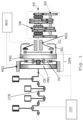
- an internal combustion engine ICE is schematized with four piston connected to the engine crankshaft CK.
- the crankshaft is directly connected to a dual-mass flywheel DFW, which includes a first flywheel FW1 and a second flywheel FW2, coupled together through a vibration damper VD per se known.
- DFW dual-mass flywheel
- VD vibration damper
- the first flywheel FW1 defines also the rotor of a first motor-generator MG1, schematically indicated through the windings or permanent magnets of the stator.
- Such first motor-generator can be a radial of axial flux motor-generator. Therefore, it should be understood that, in spite of the figure 1 , where the stator is depicted radially with respect to the rotor as in a radial flux drive, the stator can be arranged to define an axial flow drive.
- the first motor generator integrates a first portion or second portion of the flywheel
- the rotor of the motor generator is exploited not only to generate or adsorb torque, but also for its inertia as a flywheel. For this reason flat rotors are preferred because the inertia is proportional to the square of their radial extension.
- An axial flow drive is preferred as first motor-generator, due to its limited axial extension and the high torque developed.
- the second flywheel FW2 defines the basis of a bell BL in which the main clutch CL is arranged.
- the main clutch is connected, on one side, with the second flywheel and, on the opposite site, to the primary shaft PS of the gearbox GB.
- a second motor-generator MG2 is enslaved on the shaft connecting the main clutch CL with the primary (input) shaft PS of the gearbox GB. It is useful in certain preferred embodiments of the control method disclosed here below.
- the mechanical energy is, thus, converted into electric energy.
- This energy can be stored into a battery pack BATT or used to supply the second motor-generator.
- the recovered electric energy can be exploited, without intermediation of the storage batteries, to adjust the gear box input shaft speed in order to improve synchronization of the gearbox.
- batteries are optional.
- the electric energy drained to slow down the crankshaft partly is used to improve synchronization of the input shaft of the gearbox through the second motor-generator, and an excess of energy is stored in the battery pack. Immediately after the gear-shifting, such excess of energy is supplied to the first and/or second motor generator to supplement the internal combustion engine.
- the crankshaft speed when during downshifts the crankshaft speed needs to be increased, while the main clutch is going to close, the crankshaft speed is controlled through fuel injection but also thought the first motor-generator which can exert a positive and/or negative torque to the crankshaft according to the combustion engine dynamics.
- the first motor-generator exerts a positive torque to supplement the combustion engine, and in a consequent second time period, the first motor-generator can exert a negative torque to limit crankshaft speed overshoot.
- gear-shifting becomes faster and the driveability is improved without increase fuel consumption.
- the architecture can be exploited as long as the main clutch is closed to perform all the known operations of the parallel hybrid vehicles, with the first and second motor-generator operating simultaneously and in parallel during regenerative braking and during vehicle acceleration supplementing the internal combustion engine.
- control of the first and/or second motor generator can be carried out by the same control unit ECU usually implemented to control the internal combustion engine.
- the vehicles are provided of a CAN data network interconnecting the ECU with sensors and actuators.
- a first speed sensor is usually associated with the first flywheel and a second speed sensor is associated to the input shaft PS of the gearshift in order to monitor also a reciprocal speed difference, indicating the engaged/disengaged condition of the main clutch.
- a speed difference can be appreciated, this implies at least a partial disengagement of the main clutch.
Landscapes
- Engineering & Computer Science (AREA)
- Transportation (AREA)
- Mechanical Engineering (AREA)
- Chemical & Material Sciences (AREA)
- Combustion & Propulsion (AREA)
- Automation & Control Theory (AREA)
- Hybrid Electric Vehicles (AREA)
- Electric Propulsion And Braking For Vehicles (AREA)
- Toys (AREA)
- General Details Of Gearings (AREA)
- Arrangement Of Transmissions (AREA)
Description
- This patent application claims priority from
Italian patent application no. 102019000007008 filed on 20/05/2019 - The present invention relates to a method and architecture to manage energy delivered by a combustion engine crankshaft to a vehicular transmission.
- The combustion engine crankshaft are interconnected with the drive wheel of a vehicle through a gearbox and a clutch interposed between the primary shaft of the gearbox and the combustion engine crankshaft.
- Industrial vehicles are also equipped with engine brake systems in order to brake the vehicle by exploiting the combustion engine itself before or in parallel with the activation of the conventional brakes.
- During gear shifts, often the crankshaft speed should be reduced to "fit" the gearbox primary shaft speed. This speed adaptation is carried out during main clutch release, thus the energy is wasted as frictions.
- The crank shaft speed has to be adjusted for each gear shifting. A fast adjustment of the crank shaft speed enables good drivability reduced drive force loss).
- A sudden modification of the crankshaft speed leads to energy consumption, especially when the crank shaft speed has to be reduced. The engine brake is sometimes activated to enable reduce crankshaft speed to obtain a fast gear shifting. Consequently, such crankshaft energy is lost. An up-and-down-shift costs about 1% of total fuel consumption per gear shifting within 1km.
-
US2004/204286A1 andUS2009/048747A1 disclose solutions having an engine, a flywheel together with an integrated electric machine, coupled to the output shaft of the engine, a clutch, and a further electric machine arranged downstream of the clutch. -
DE102005016117A1 discloses an electric motor arranged between an engine and a clutch, and controlled together with the engine to synchronize the engine speed with a transmission speed. -
WO2014/202068A2 discloses a solution having an engine, an electric machine, a freewheel arranged between the engine and the electric machine, a downstream transmission, and a clutch arranged between the electric engine and the transmission. - The main object of the present invention is to propose an architecture to achieve a fast crank-shaft speed adaptation by limiting energy losses.
- The main concept of the present invention is the implementation of a first motor-generator directly coupled with the engine crankshaft and a second motor-generator, which optionally is directly connected with the input shaft of the gearbox.
- Any time the crankshaft speed must be slowed, its energy content is recovered by the first motor-generator, for example, before the activation of a higher gear (up-shifting) during vehicle accelerations or when the engine is turned off and/or operated at idle when the vehicle goes into sailing mode and/or during regenerative braking instead.
- Any time the crankshaft speed must be speeded up, the first motor-generator can help to avoid any speed overshoot. Indeed, the crankshaft speed can be controlled by the combustion engine acceleration, but the speed dynamics depends on combustion engine crankshaft.
- Thanks to the present invention, a fast and precise crankshaft speed control is achieved improving gearshift speed and improved comfort.
- On the opposite side of the first motor-generator with respect to the main clutch is arranged the second motor-generator, capable to enable an adjustment of the gear input speed for better synchronization during gear shift.
- According to the invention, the first motor-generator is integrated into a first portion of the flywheel defined by a dual-mass flywheel, while the second motor-generator is at least partially integrated into a second portion of the flywheel.
- According to a solution that is not part of the present invention, the flywheel is a single mass, and the first and second portions correspond to the first and second face of the single monolithic disc defining the flywheel. According to the invention, the flywheel is a dual-mass fly wheel, the first portion corresponds to a first disc and the second portion correspond to a second disc, and between the first and second portions of the dual-mass flywheel a torsional vibration damper is arranged. The second portion of the dual-mass flywheel is shaped as a bell in which the main clutch is arranged. The second motor-generator is partially arranged within the bell in order to limit the longitudinal extension of the whole assembly.
- These and further objects are achieved by means of the attached dependent claims, which describe preferred embodiments of the invention, forming an integral part of the present description.
- The invention will become fully clear from the following detailed description, given by way of a mere exemplifying and non-limiting example, to be read with reference to the attached drawing figures, wherein:
-
Fig. 1 shows a possible layout of the present invention. - The same reference numerals and letters in the figures designate the same or functionally equivalent parts.
- According to the present invention, the term "second element" does not imply the presence of a "first element", first, second, etc.. are used only for improving the clarity of the description and they should not be interpreted in a limiting way.
- According to
figure 1 , an internal combustion engine ICE is schematized with four piston connected to the engine crankshaft CK. - The crankshaft is directly connected to a dual-mass flywheel DFW, which includes a first flywheel FW1 and a second flywheel FW2, coupled together through a vibration damper VD per se known.
- The first flywheel FW1 defines also the rotor of a first motor-generator MG1, schematically indicated through the windings or permanent magnets of the stator.
- Such first motor-generator can be a radial of axial flux motor-generator. Therefore, it should be understood that, in spite of the
figure 1 , where the stator is depicted radially with respect to the rotor as in a radial flux drive, the stator can be arranged to define an axial flow drive. - The expression "the first motor generator integrates a first portion or second portion of the flywheel" means that the rotor of the motor generator is exploited not only to generate or adsorb torque, but also for its inertia as a flywheel. For this reason flat rotors are preferred because the inertia is proportional to the square of their radial extension.
- An axial flow drive is preferred as first motor-generator, due to its limited axial extension and the high torque developed.
- The second flywheel FW2 defines the basis of a bell BL in which the main clutch CL is arranged.
- The main clutch is connected, on one side, with the second flywheel and, on the opposite site, to the primary shaft PS of the gearbox GB.
- A second motor-generator MG2 is enslaved on the shaft connecting the main clutch CL with the primary (input) shaft PS of the gearbox GB. It is useful in certain preferred embodiments of the control method disclosed here below.
- According to a first aspect of the present invention, any time the main clutch CL is open and the crankshaft speed needs to be slowed down the first motor-generator MG1 applies a negative torque. The mechanical energy is, thus, converted into electric energy.
- This energy can be stored into a battery pack BATT or used to supply the second motor-generator. This means that the battery pack can be present according to preferred implementations of the present invention.
- The recovered electric energy can be exploited, without intermediation of the storage batteries, to adjust the gear box input shaft speed in order to improve synchronization of the gearbox. In other words, batteries are optional. Instead, with a battery storage, it is possible to control such motor-generator(s) to supplement the combustion engine during vehicle accelerations. Any supplementing operation, which is not essential for carrying out the present invention, needs the presence of a battery pack.
- According to a preferred embodiment of the invention, the electric energy drained to slow down the crankshaft, partly is used to improve synchronization of the input shaft of the gearbox through the second motor-generator, and an excess of energy is stored in the battery pack. Immediately after the gear-shifting, such excess of energy is supplied to the first and/or second motor generator to supplement the internal combustion engine.
- According to another aspect of the present invention, when during downshifts the crankshaft speed needs to be increased, while the main clutch is going to close, the crankshaft speed is controlled through fuel injection but also thought the first motor-generator which can exert a positive and/or negative torque to the crankshaft according to the combustion engine dynamics. For example in a first time period, the first motor-generator exerts a positive torque to supplement the combustion engine, and in a consequent second time period, the first motor-generator can exert a negative torque to limit crankshaft speed overshoot.
- Thanks to the present invention, gear-shifting becomes faster and the driveability is improved without increase fuel consumption.
- In addition, the architecture can be exploited as long as the main clutch is closed to perform all the known operations of the parallel hybrid vehicles, with the first and second motor-generator operating simultaneously and in parallel during regenerative braking and during vehicle acceleration supplementing the internal combustion engine. Numerous specific details are set forth such as examples of specific components, devices, and methods, to provide a thorough understanding of embodiments of the present disclosure. It will be apparent to those skilled in the art that specific details need not be employed, that example embodiments may be embodied in many different forms and that neither should be construed to limit the scope of the invention which is defined by the appended claims.
- In some example embodiments, well known processes, well-known device structures are disclosed.
- For example, the control of the first and/or second motor generator can be carried out by the same control unit ECU usually implemented to control the internal combustion engine.
- Usually, the vehicles are provided of a CAN data network interconnecting the ECU with sensors and actuators. A first speed sensor is usually associated with the first flywheel and a second speed sensor is associated to the input shaft PS of the gearshift in order to monitor also a reciprocal speed difference, indicating the engaged/disengaged condition of the main clutch. The skilled person knows that when a speed difference can be appreciated, this implies at least a partial disengagement of the main clutch.
- Many changes, modifications, variations and other uses and applications of the subject invention will become apparent to those skilled in the art after considering the specification and the accompanying drawings which disclose preferred embodiments thereof as described in the appended claims.
- The features disclosed in the prior art background are introduced only in order to better understand the invention and not as a declaration about the existence of known prior art. In addition, said features define the context of the present invention, thus such features shall be considered in common with the detailed description.
- Further implementation details will not be described, as the man skilled in the art is able to carry out the invention starting from the teaching of the above description.
Claims (10)
- Vehicle comprising:- driving wheels;- an internal combustion engine (ICE) having a crankshaft (CH) ;- a transmission arrangement arranged to transfer propulsion from the crankshaft to the driving wheels; the transmission arrangement comprising:a) a double-mass flywheel (DFW; FW1, FW2) comprising:(1) a first portion (FW1) directly coupled to the crankshaft (CH) and corresponding to a first flywheel, and(2) a second portion (FW2) corresponding to a second flywheel,b) a main clutch (CL),c) a gearbox (GB) arranged between the main clutch (CL) and said driving wheels, and comprising an input shaft (PS) able to be interconnected with said second portion through said clutch;- a first motor generator (MG1) integrating said first flywheel (FW1),- elaborating means (CPU) configured to control said first motor generator in such a way to adjust a crankshaft speed during gear shift as long as the main clutch is in disengagement condition, in order to adapt the crankshaft speed with an input shaft speed for a soft consequent main clutch engagement;wherein the first and second flywheels are interconnected through a vibration damper (VD), andwherein said first motor generator (MG1) integrates said first flywheel;characterized in that said second flywheel defines the basis of a bell (BL); the main clutch (CL) being arranged in said bell;wherein said vehicle further comprises a second motor-generator (MG2) arranged between said main clutch (CL) and said input shaft (PS) and partially arranged within said bell (BL).
- Vehicle according to claim 1, wherein said second motor-generator (MG2) comprises a rotor connecting the main clutch (CL) to said input shaft (PS).
- Vehicle according to claim 1, wherein the first motor-generator is integrated into said first flywheel, while the second motor-generator is at least partially integrated into said second flywheel.
- Vehicle according to anyone of the previous claims, wherein said elaborating means are configured to slowdown said crankshaft during up-shifting, so as to recover electric energy.
- Vehicle according to claim 1, wherein said second motor-generator (MG2) interconnects said main clutch (CL) and said input shaft (PS), and wherein said elaborating means (ECU) are further configured to control said second motor-generator to adjust the input shaft speed in order to improve a synchronization of the gear shifting.
- Vehicle according to claims 4 and 5, wherein said electric energy, recovered during slowdown of said crankshaft, is exploited to control said second motor-generator so as to adjust the input shaft speed.
- Vehicle according to any one of the previous claims, wherein, when the crankshaft speed is to be increased, said elaborating means are configured to speed up said combustion engine by controlling a corresponding fuel injection and to adjust a consequent speed dynamics through said first motor-generator.
- Vehicle according to any one of the previous claims, further comprising energy storage means (BATT) operatively connected to said first motor generator (MG1) in order to exploit recovered electric energy in other operating conditions.
- Vehicle according to claims 5 and 8, wherein said second motor-generator is operatively connected to said energy storage means in order to exploit recovered electric energy in other operating conditions.
- Vehicle according to claim 1 or 2 or 3 or 5, wherein said first and second motor-generators are arranged to operate in parallel and simultaneously when said main clutch is in an engagement condition.
Applications Claiming Priority (1)
| Application Number | Priority Date | Filing Date | Title |
|---|---|---|---|
| IT102019000007008A IT201900007008A1 (en) | 2019-05-20 | 2019-05-20 | ARRANGEMENT OF A VEHICLE TRANSMISSION |
Publications (2)
| Publication Number | Publication Date |
|---|---|
| EP3741601A1 EP3741601A1 (en) | 2020-11-25 |
| EP3741601B1 true EP3741601B1 (en) | 2024-10-09 |
Family
ID=67875960
Family Applications (1)
| Application Number | Title | Priority Date | Filing Date |
|---|---|---|---|
| EP20175853.9A Active EP3741601B1 (en) | 2019-05-20 | 2020-05-20 | Vehicle comprising a transmission arrangement |
Country Status (2)
| Country | Link |
|---|---|
| EP (1) | EP3741601B1 (en) |
| IT (1) | IT201900007008A1 (en) |
Family Cites Families (5)
| Publication number | Priority date | Publication date | Assignee | Title |
|---|---|---|---|---|
| DE4323601A1 (en) * | 1993-07-09 | 1995-01-12 | Mannesmann Ag | Drive arrangement for a hybrid vehicle |
| EP1038346A2 (en) * | 1997-10-21 | 2000-09-27 | Stridsberg Innovation Ab | A hybrid powertrain |
| TWI264388B (en) * | 2004-12-23 | 2006-10-21 | Ind Tech Res Inst | Method for controlling gear shift of gearshift transmission of hybrid car |
| US8417427B2 (en) * | 2005-11-15 | 2013-04-09 | Stridsberg Powertrain Ab | Hybrid vehicle with soft shafts |
| DE102014209620A1 (en) * | 2013-06-20 | 2014-12-24 | Schaeffler Technologies Gmbh & Co. Kg | Powertrain topology and actuator therefor |
-
2019
- 2019-05-20 IT IT102019000007008A patent/IT201900007008A1/en unknown
-
2020
- 2020-05-20 EP EP20175853.9A patent/EP3741601B1/en active Active
Also Published As
| Publication number | Publication date |
|---|---|
| IT201900007008A1 (en) | 2020-11-20 |
| EP3741601A1 (en) | 2020-11-25 |
Similar Documents
| Publication | Publication Date | Title |
|---|---|---|
| EP3321145B1 (en) | Device for controlling driving force of hybrid vehicle | |
| JP6101718B2 (en) | Hybrid vehicle | |
| JP5467197B2 (en) | Hybrid drive device | |
| US20060021456A1 (en) | Hybrid powertrain system | |
| CN103732943B (en) | Dynamic damper device | |
| KR20130114059A (en) | Hybrid electric vehicle powertrain | |
| JP2012020619A (en) | Vehicle power transmission control device | |
| JP3823960B2 (en) | Vehicle transmission | |
| JP7298179B2 (en) | Electric vehicle control method and electric vehicle drive system | |
| JPWO2016167201A1 (en) | Vehicle shift control device | |
| JP6972905B2 (en) | Vehicle control device | |
| JP6874650B2 (en) | Hybrid vehicle control device | |
| JP2009143356A (en) | Vehicle drive device | |
| JP2006118590A (en) | Hybrid vehicle | |
| JP2015113932A (en) | Control device for automatic transmission | |
| JP6942558B2 (en) | Hybrid vehicle control method | |
| EP3741601B1 (en) | Vehicle comprising a transmission arrangement | |
| JP2010089537A (en) | Hybrid vehicle | |
| JP2005155843A (en) | Drive device for hybrid vehicle | |
| JP2015048065A (en) | Control device for power output device | |
| US11124175B2 (en) | Control method for a vehicle hybrid drivetrain | |
| JP2019100482A (en) | Shift control device of vehicle | |
| JP3868976B2 (en) | Automobile and its transmission, and control device for automobile | |
| JP4816265B2 (en) | VEHICLE POWER DEVICE AND CONTROL DEVICE THEREOF | |
| JP2020118191A (en) | transmission |
Legal Events
| Date | Code | Title | Description |
|---|---|---|---|
| PUAI | Public reference made under article 153(3) epc to a published international application that has entered the european phase |
Free format text: ORIGINAL CODE: 0009012 |
|
| STAA | Information on the status of an ep patent application or granted ep patent |
Free format text: STATUS: THE APPLICATION HAS BEEN PUBLISHED |
|
| AK | Designated contracting states |
Kind code of ref document: A1 Designated state(s): AL AT BE BG CH CY CZ DE DK EE ES FI FR GB GR HR HU IE IS IT LI LT LU LV MC MK MT NL NO PL PT RO RS SE SI SK SM TR |
|
| AX | Request for extension of the european patent |
Extension state: BA ME |
|
| STAA | Information on the status of an ep patent application or granted ep patent |
Free format text: STATUS: REQUEST FOR EXAMINATION WAS MADE |
|
| 17P | Request for examination filed |
Effective date: 20210119 |
|
| RBV | Designated contracting states (corrected) |
Designated state(s): AL AT BE BG CH CY CZ DE DK EE ES FI FR GB GR HR HU IE IS IT LI LT LU LV MC MK MT NL NO PL PT RO RS SE SI SK SM TR |
|
| STAA | Information on the status of an ep patent application or granted ep patent |
Free format text: STATUS: EXAMINATION IS IN PROGRESS |
|
| 17Q | First examination report despatched |
Effective date: 20220805 |
|
| GRAP | Despatch of communication of intention to grant a patent |
Free format text: ORIGINAL CODE: EPIDOSNIGR1 |
|
| STAA | Information on the status of an ep patent application or granted ep patent |
Free format text: STATUS: GRANT OF PATENT IS INTENDED |
|
| INTG | Intention to grant announced |
Effective date: 20240514 |
|
| P01 | Opt-out of the competence of the unified patent court (upc) registered |
Free format text: CASE NUMBER: APP_39647/2024 Effective date: 20240703 |
|
| GRAS | Grant fee paid |
Free format text: ORIGINAL CODE: EPIDOSNIGR3 |
|
| GRAA | (expected) grant |
Free format text: ORIGINAL CODE: 0009210 |
|
| STAA | Information on the status of an ep patent application or granted ep patent |
Free format text: STATUS: THE PATENT HAS BEEN GRANTED |
|
| AK | Designated contracting states |
Kind code of ref document: B1 Designated state(s): AL AT BE BG CH CY CZ DE DK EE ES FI FR GB GR HR HU IE IS IT LI LT LU LV MC MK MT NL NO PL PT RO RS SE SI SK SM TR |
|
| REG | Reference to a national code |
Ref country code: CH Ref legal event code: EP |
|
| REG | Reference to a national code |
Ref country code: DE Ref legal event code: R096 Ref document number: 602020038916 Country of ref document: DE |
|
| REG | Reference to a national code |
Ref country code: IE Ref legal event code: FG4D |
|
| REG | Reference to a national code |
Ref country code: LT Ref legal event code: MG9D |
|
| REG | Reference to a national code |
Ref country code: NL Ref legal event code: MP Effective date: 20241009 |
|
| REG | Reference to a national code |
Ref country code: AT Ref legal event code: MK05 Ref document number: 1730228 Country of ref document: AT Kind code of ref document: T Effective date: 20241009 |
|
| PG25 | Lapsed in a contracting state [announced via postgrant information from national office to epo] |
Ref country code: NL Free format text: LAPSE BECAUSE OF FAILURE TO SUBMIT A TRANSLATION OF THE DESCRIPTION OR TO PAY THE FEE WITHIN THE PRESCRIBED TIME-LIMIT Effective date: 20241009 |
|
| PG25 | Lapsed in a contracting state [announced via postgrant information from national office to epo] |
Ref country code: NL Free format text: LAPSE BECAUSE OF FAILURE TO SUBMIT A TRANSLATION OF THE DESCRIPTION OR TO PAY THE FEE WITHIN THE PRESCRIBED TIME-LIMIT Effective date: 20241009 |
|
| PG25 | Lapsed in a contracting state [announced via postgrant information from national office to epo] |
Ref country code: IS Free format text: LAPSE BECAUSE OF FAILURE TO SUBMIT A TRANSLATION OF THE DESCRIPTION OR TO PAY THE FEE WITHIN THE PRESCRIBED TIME-LIMIT Effective date: 20250209 Ref country code: HR Free format text: LAPSE BECAUSE OF FAILURE TO SUBMIT A TRANSLATION OF THE DESCRIPTION OR TO PAY THE FEE WITHIN THE PRESCRIBED TIME-LIMIT Effective date: 20241009 Ref country code: PT Free format text: LAPSE BECAUSE OF FAILURE TO SUBMIT A TRANSLATION OF THE DESCRIPTION OR TO PAY THE FEE WITHIN THE PRESCRIBED TIME-LIMIT Effective date: 20250210 |
|
| PG25 | Lapsed in a contracting state [announced via postgrant information from national office to epo] |
Ref country code: FI Free format text: LAPSE BECAUSE OF FAILURE TO SUBMIT A TRANSLATION OF THE DESCRIPTION OR TO PAY THE FEE WITHIN THE PRESCRIBED TIME-LIMIT Effective date: 20241009 |
|
| PG25 | Lapsed in a contracting state [announced via postgrant information from national office to epo] |
Ref country code: BG Free format text: LAPSE BECAUSE OF FAILURE TO SUBMIT A TRANSLATION OF THE DESCRIPTION OR TO PAY THE FEE WITHIN THE PRESCRIBED TIME-LIMIT Effective date: 20241009 |
|
| PG25 | Lapsed in a contracting state [announced via postgrant information from national office to epo] |
Ref country code: ES Free format text: LAPSE BECAUSE OF FAILURE TO SUBMIT A TRANSLATION OF THE DESCRIPTION OR TO PAY THE FEE WITHIN THE PRESCRIBED TIME-LIMIT Effective date: 20241009 |
|
| PG25 | Lapsed in a contracting state [announced via postgrant information from national office to epo] |
Ref country code: NO Free format text: LAPSE BECAUSE OF FAILURE TO SUBMIT A TRANSLATION OF THE DESCRIPTION OR TO PAY THE FEE WITHIN THE PRESCRIBED TIME-LIMIT Effective date: 20250109 |
|
| PG25 | Lapsed in a contracting state [announced via postgrant information from national office to epo] |
Ref country code: AT Free format text: LAPSE BECAUSE OF FAILURE TO SUBMIT A TRANSLATION OF THE DESCRIPTION OR TO PAY THE FEE WITHIN THE PRESCRIBED TIME-LIMIT Effective date: 20241009 Ref country code: LV Free format text: LAPSE BECAUSE OF FAILURE TO SUBMIT A TRANSLATION OF THE DESCRIPTION OR TO PAY THE FEE WITHIN THE PRESCRIBED TIME-LIMIT Effective date: 20241009 Ref country code: GR Free format text: LAPSE BECAUSE OF FAILURE TO SUBMIT A TRANSLATION OF THE DESCRIPTION OR TO PAY THE FEE WITHIN THE PRESCRIBED TIME-LIMIT Effective date: 20250110 |
|
| PG25 | Lapsed in a contracting state [announced via postgrant information from national office to epo] |
Ref country code: PL Free format text: LAPSE BECAUSE OF FAILURE TO SUBMIT A TRANSLATION OF THE DESCRIPTION OR TO PAY THE FEE WITHIN THE PRESCRIBED TIME-LIMIT Effective date: 20241009 |
|
| PG25 | Lapsed in a contracting state [announced via postgrant information from national office to epo] |
Ref country code: RS Free format text: LAPSE BECAUSE OF FAILURE TO SUBMIT A TRANSLATION OF THE DESCRIPTION OR TO PAY THE FEE WITHIN THE PRESCRIBED TIME-LIMIT Effective date: 20250109 |
|
| PG25 | Lapsed in a contracting state [announced via postgrant information from national office to epo] |
Ref country code: SM Free format text: LAPSE BECAUSE OF FAILURE TO SUBMIT A TRANSLATION OF THE DESCRIPTION OR TO PAY THE FEE WITHIN THE PRESCRIBED TIME-LIMIT Effective date: 20241009 |
|
| PGFP | Annual fee paid to national office [announced via postgrant information from national office to epo] |
Ref country code: DE Payment date: 20250528 Year of fee payment: 6 |
|
| PG25 | Lapsed in a contracting state [announced via postgrant information from national office to epo] |
Ref country code: DK Free format text: LAPSE BECAUSE OF FAILURE TO SUBMIT A TRANSLATION OF THE DESCRIPTION OR TO PAY THE FEE WITHIN THE PRESCRIBED TIME-LIMIT Effective date: 20241009 |
|
| REG | Reference to a national code |
Ref country code: DE Ref legal event code: R097 Ref document number: 602020038916 Country of ref document: DE |
|
| PGFP | Annual fee paid to national office [announced via postgrant information from national office to epo] |
Ref country code: IT Payment date: 20250512 Year of fee payment: 6 |
|
| PG25 | Lapsed in a contracting state [announced via postgrant information from national office to epo] |
Ref country code: EE Free format text: LAPSE BECAUSE OF FAILURE TO SUBMIT A TRANSLATION OF THE DESCRIPTION OR TO PAY THE FEE WITHIN THE PRESCRIBED TIME-LIMIT Effective date: 20241009 |
|
| PGFP | Annual fee paid to national office [announced via postgrant information from national office to epo] |
Ref country code: FR Payment date: 20250526 Year of fee payment: 6 |
|
| PG25 | Lapsed in a contracting state [announced via postgrant information from national office to epo] |
Ref country code: RO Free format text: LAPSE BECAUSE OF FAILURE TO SUBMIT A TRANSLATION OF THE DESCRIPTION OR TO PAY THE FEE WITHIN THE PRESCRIBED TIME-LIMIT Effective date: 20241009 |
|
| PG25 | Lapsed in a contracting state [announced via postgrant information from national office to epo] |
Ref country code: SK Free format text: LAPSE BECAUSE OF FAILURE TO SUBMIT A TRANSLATION OF THE DESCRIPTION OR TO PAY THE FEE WITHIN THE PRESCRIBED TIME-LIMIT Effective date: 20241009 |
|
| PG25 | Lapsed in a contracting state [announced via postgrant information from national office to epo] |
Ref country code: CZ Free format text: LAPSE BECAUSE OF FAILURE TO SUBMIT A TRANSLATION OF THE DESCRIPTION OR TO PAY THE FEE WITHIN THE PRESCRIBED TIME-LIMIT Effective date: 20241009 |
|
| PLBE | No opposition filed within time limit |
Free format text: ORIGINAL CODE: 0009261 |
|
| STAA | Information on the status of an ep patent application or granted ep patent |
Free format text: STATUS: NO OPPOSITION FILED WITHIN TIME LIMIT |
|
| PG25 | Lapsed in a contracting state [announced via postgrant information from national office to epo] |
Ref country code: SE Free format text: LAPSE BECAUSE OF FAILURE TO SUBMIT A TRANSLATION OF THE DESCRIPTION OR TO PAY THE FEE WITHIN THE PRESCRIBED TIME-LIMIT Effective date: 20241009 |
|
| 26N | No opposition filed |
Effective date: 20250710 |
|
| REG | Reference to a national code |
Ref country code: CH Ref legal event code: H13 Free format text: ST27 STATUS EVENT CODE: U-0-0-H10-H13 (AS PROVIDED BY THE NATIONAL OFFICE) Effective date: 20251223 |
|
| PG25 | Lapsed in a contracting state [announced via postgrant information from national office to epo] |
Ref country code: LU Free format text: LAPSE BECAUSE OF NON-PAYMENT OF DUE FEES Effective date: 20250520 |
|
| PG25 | Lapsed in a contracting state [announced via postgrant information from national office to epo] |
Ref country code: CH Free format text: LAPSE BECAUSE OF NON-PAYMENT OF DUE FEES Effective date: 20250531 |
|
| GBPC | Gb: european patent ceased through non-payment of renewal fee |
Effective date: 20250520 |
|
| REG | Reference to a national code |
Ref country code: BE Ref legal event code: MM Effective date: 20250531 |
|
| PG25 | Lapsed in a contracting state [announced via postgrant information from national office to epo] |
Ref country code: MC Free format text: LAPSE BECAUSE OF FAILURE TO SUBMIT A TRANSLATION OF THE DESCRIPTION OR TO PAY THE FEE WITHIN THE PRESCRIBED TIME-LIMIT Effective date: 20241009 |
|
| PG25 | Lapsed in a contracting state [announced via postgrant information from national office to epo] |
Ref country code: GB Free format text: LAPSE BECAUSE OF NON-PAYMENT OF DUE FEES Effective date: 20250520 |
|
| PG25 | Lapsed in a contracting state [announced via postgrant information from national office to epo] |
Ref country code: IE Free format text: LAPSE BECAUSE OF NON-PAYMENT OF DUE FEES Effective date: 20250520 |
|
| PG25 | Lapsed in a contracting state [announced via postgrant information from national office to epo] |
Ref country code: BE Free format text: LAPSE BECAUSE OF NON-PAYMENT OF DUE FEES Effective date: 20250531 |