EP3741294A1 - Ecg signal denoising method, and terminal - Google Patents
Ecg signal denoising method, and terminal Download PDFInfo
- Publication number
- EP3741294A1 EP3741294A1 EP18901747.8A EP18901747A EP3741294A1 EP 3741294 A1 EP3741294 A1 EP 3741294A1 EP 18901747 A EP18901747 A EP 18901747A EP 3741294 A1 EP3741294 A1 EP 3741294A1
- Authority
- EP
- European Patent Office
- Prior art keywords
- signal
- cpr
- noise
- terminal
- frequency
- Prior art date
- Legal status (The legal status is an assumption and is not a legal conclusion. Google has not performed a legal analysis and makes no representation as to the accuracy of the status listed.)
- Granted
Links
Images


Classifications
-
- A—HUMAN NECESSITIES
- A61—MEDICAL OR VETERINARY SCIENCE; HYGIENE
- A61B—DIAGNOSIS; SURGERY; IDENTIFICATION
- A61B5/00—Measuring for diagnostic purposes; Identification of persons
- A61B5/72—Signal processing specially adapted for physiological signals or for diagnostic purposes
- A61B5/7203—Signal processing specially adapted for physiological signals or for diagnostic purposes for noise prevention, reduction or removal
- A61B5/7217—Signal processing specially adapted for physiological signals or for diagnostic purposes for noise prevention, reduction or removal of noise originating from a therapeutic or surgical apparatus, e.g. from a pacemaker
-
- A—HUMAN NECESSITIES
- A61—MEDICAL OR VETERINARY SCIENCE; HYGIENE
- A61B—DIAGNOSIS; SURGERY; IDENTIFICATION
- A61B5/00—Measuring for diagnostic purposes; Identification of persons
- A61B5/24—Detecting, measuring or recording bioelectric or biomagnetic signals of the body or parts thereof
- A61B5/316—Modalities, i.e. specific diagnostic methods
- A61B5/318—Heart-related electrical modalities, e.g. electrocardiography [ECG]
-
- A—HUMAN NECESSITIES
- A61—MEDICAL OR VETERINARY SCIENCE; HYGIENE
- A61N—ELECTROTHERAPY; MAGNETOTHERAPY; RADIATION THERAPY; ULTRASOUND THERAPY
- A61N1/00—Electrotherapy; Circuits therefor
- A61N1/18—Applying electric currents by contact electrodes
- A61N1/32—Applying electric currents by contact electrodes alternating or intermittent currents
- A61N1/38—Applying electric currents by contact electrodes alternating or intermittent currents for producing shock effects
- A61N1/39—Heart defibrillators
Definitions
- the present application relates to the technical field of medical signal processing, and in particular to an ECG signal denoising method and a terminal.
- CPR cardiopulmonary resuscitation
- ECG electrocardiograph
- the present application provides an ECG signal denoising method and a terminal, which can achieve a better filtering effect.
- an ECG signal denoising method comprising:
- the terminal analyzing whether the noise of the ECG signal in the first signal correlates with the CPR signal specifically comprises:
- the terminal determining whether the noise of the ECG signal correlates with the CPR signal, according to the ratio of the noise of the ECG signal caused by the CPR process to the first signal and/or the frequency interval between the first frequency and the second frequency specifically comprises: the terminal determining that the noise of the ECG signal correlates with the CPR signal if the frequency interval between the first frequency and the second frequency is smaller than a first threshold.
- the terminal determining whether the noise of the ECG signal correlates with the CPR signal, according to the ratio of the noise of the ECG signal caused by the CPR process to the first signal and/or the frequency interval between the first frequency and the second frequency specifically comprises: the terminal determining that the noise of the ECG signal correlates with the CPR signal if the ratio is greater than a second threshold.
- the terminal determining whether the noise of the ECG signal correlates with the CPR signal, according to the ratio of the noise of the ECG signal caused by the CPR process to the first signal and/or the frequency interval between the first frequency and the second frequency specifically comprises: the terminal determining that the noise of the ECG signal correlates with the CPR signal if the ratio is greater than a third threshold and the frequency interval between the first frequency and the second frequency is smaller than a fourth threshold.
- the first frequency is a frequency at which the maximum peak of the CPR signal is located.
- the second frequency is a frequency at which the maximum peak of the first signal is located.
- the terminal determining, according to a degree of the correlation between the noise of the ECG signal and the CPR signal, a filtering method for the first signal specifically comprises: if the terminal determines that the degree of the correlation exceeds a first value, the terminal determining to use a first filtering method for filtering the first signal, or otherwise, the terminal determining to use a second filtering method for filtering the first signal, wherein the order of the first filtering method is higher than the order of the second filtering method.
- the terminal determining that the degree of the correlation exceeds a first value specifically comprises: if the difference between the ratio of the noise of the ECG signal to the first signal and the ratio of a first signal component of the CPR signal is smaller than a fifth threshold, the terminal determining that the degree of the correlation exceeds the first value, wherein the amplitude of the first signal component exceeds a third preset value.
- the method further comprises: the terminal ascertaining whether the CPR signal exists, and performing, if the CPR signal exists, the step of the terminal analyzing whether the noise of the ECG signal in the first signal correlates with the CPR signal.
- the terminal ascertaining whether the CPR signal exists specifically comprises: after the terminal performs frequency domain analysis (power spectrum estimation) on the CPR signal, the terminal ascertaining whether the number of peaks of the CPR signal in frequency domain is zero, and if the number is not zero, the terminal determining that the CPR signal exists, or otherwise, the terminal determining that the CPR signal does not exist.
- frequency domain analysis power spectrum estimation
- the method further comprises: if the noise of the ECG signal does not correlate with the CPR signal, the terminal determining, according to the ratio of the noise of the ECG signal to the first signal, a filtering method for the first signal.
- the terminal determining, according to the ratio of the noise of the ECG signal to the first signal, a filtering method for the first signal specifically comprises: if the ratio of the noise of the ECG signal caused by the CPR process to the first signal is greater than a sixth threshold, the terminal determining to use a third filtering method for filtering the first signal, wherein the capability of the third filtering method to suppress the noise of the ECG signal is higher than a fourth preset value.
- the present application provides a terminal, comprising:
- the analysis unit comprises:
- the third determination unit is specifically configured to: determine that the noise of the ECG signal correlates with the CPR signal if the frequency interval between the first frequency and the second frequency is smaller than a first threshold.
- the third determination unit is specifically configured to: determine that the noise of the ECG signal correlates with the CPR signal if the ratio is greater than a second threshold.
- the third determination unit is specifically configured to: determine that the noise of the ECG signal correlates with the CPR signal if the ratio is greater than a third threshold and the frequency interval between the first frequency and the second frequency is smaller than a fourth threshold.
- the determination unit is specifically configured to: if it is determined that the degree of the correlation exceeds a first value, determine to use a first filtering method for filtering the first signal, or otherwise, determine to use a second filtering method for filtering the first signal, wherein the order of the first filtering method is higher than the order of the second filtering method.
- the terminal further comprises: an ascertainment unit configured to ascertain whether the CPR signal exists, and perform, if the CPR signal exists, the step of the terminal analyzing whether the noise of the ECG signal in the first signal correlates with the CPR signal.
- the ascertainment unit is specifically configured to: after the analysis unit performs frequency domain analysis (power spectrum estimation) on the CPR signal, ascertain whether the number of peaks of the CPR signal in frequency domain is zero, and if the number is not zero, determine that the CPR signal exists, or otherwise, determine that the CPR signal does not exist.
- frequency domain analysis power spectrum estimation
- the determination unit is further configured to: if the noise of the ECG signal does not correlate with the CPR signal, determine, according to the ratio of the noise of the ECG signal to the first signal, a filtering method for the first signal.
- the determination unit is further specifically configured to:
- the present application provides another terminal, comprising: a display device, a memory, and a processor coupled to the memory, wherein the memory is configured to store an application program code, and the processor is configured to invoke the program code to perform the method of the first aspect.
- the present application provides a computer-readable storage medium storing a computer program, the computer program comprising a program instruction that, when executed by a processor, causes the processor to perform the method of the first aspect.
- the present application provides a computer program comprising an ECG signal denoising instruction, wherein when the computer program is executed on a computer, the ECG signal denoising instruction is used to perform the method of the first aspect.
- the present application provides an ECG signal denoising method and a terminal.
- the terminal detects a CPR signal and a first signal, wherein the first signal comprises an ECG signal and noise of the ECG signal.
- the terminal analyzes whether the noise of the ECG signal in the first signal correlates with the CPR signal. Then, if the noise of the ECG signal correlates with the CPR signal, the terminal determines, according to a degree of the correlation between the noise of the ECG signal and the CPR signal, a filtering method for the first signal.
- the terminal filters the first signal according to the determined filtering method to remove the noise of the ECG signal.
- the term “if' may be interpreted as “when” or “once” or “in response to determination” or “in response to detection” according to the context.
- the phrase “if determined” or “if detected [described condition or event]” may be interpreted as “once determined” or “in response to determination” or “once detected [described condition or event]” or “in response to detection of [the described condition or event]” according to the context.
- the terminal described in the present application includes, but is not limited to, other portable apparatuses such as a mobile phone, a laptop computer, or a tablet computer with a touch-sensitive surface (e.g., a touch screen display and/or a touch pad). It should also be understood that, in some embodiments, the apparatus is not a portable communication apparatus, but a desktop computer with a touch-sensitive surface (e.g., a touch screen display and/or a touch pad).
- a terminal comprising a display and a touch-sensitive surface is described in the following discussion. However, it should be understood that the terminal may comprise one or more other physical user interface apparatuses such as a physical keyboard, a mouse, and/or a joystick.
- the terminal supports various application programs, such as one or more of the following: drawing application programs, presentation application programs, word processing application programs, website creation application programs, disk burning application programs, spreadsheet application programs, game application programs, phone application programs, video conferencing application programs, e-mail application programs, instant messaging application programs, exercise support application programs, photo management application programs, digital camera application programs, digital video camera application programs, web browsing application programs, digital music player application programs, and/or digital video player application programs.
- application programs such as one or more of the following: drawing application programs, presentation application programs, word processing application programs, website creation application programs, disk burning application programs, spreadsheet application programs, game application programs, phone application programs, video conferencing application programs, e-mail application programs, instant messaging application programs, exercise support application programs, photo management application programs, digital camera application programs, digital video camera application programs, web browsing application programs, digital music player application programs, and/or digital video player application programs.
- Various application programs executable on the terminal may employ at least one common physical user interface apparatus such as a touch-sensitive surface.
- One or more functions of the touch-sensitive surface and corresponding information displayed on the terminal may be adjusted and/or changed between the application programs and/or within the corresponding application programs.
- the common physical architecture e.g., the touch-sensitive surface
- the terminal may support various application programs with user interfaces that are intuitive and transparent to users.
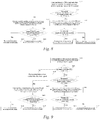
- Fig. 4 is a schematic flowchart of an ECG signal denoising method provided by the present application.
- the method may comprise at least the following steps: S101, a terminal may detect a CPR signal and a first signal.
- the first signal may comprise an ECG signal and noise of the ECG signal.
- the CPR signal may include at least but is not limited to the following signals: a CPR compression pressure signal, a CPR compression displacement signal, a CPR compression acceleration signal or a chest impedance signal, etc. It should be noted that the frequency range of CPR compression may include but is not limited to 1 Hz to 5 Hz.
- the terminal may monitor or detect, by means of a CPR monitor, the CPR signal from a CPR sensor placed on a user's body.
- the terminal may monitor or detect, by means of the ECG monitor, the ECG signal from an ECG sensor placed on the user's body.
- the terminal may monitor or detect, by means of the ECG sensor, the noise of the ECG signal from the ECG sensor placed on the user's body, and the noise may be generated by the CPR compression.
- the signal from the ECG sensor placed on the user's body is collectively referred to as a first signal, and the first signal may include but is not limited to the ECG signal and the noise of the ECG signal.
- the noise of the ECG signal may comprise at least the following two types of noise.
- noise of the ECG signal caused by a CPR process noise of the ECG signal caused by a CPR process.
- Second type of noise noise of the ECG signal caused by other factors in the environment (other than the CPR process).
- the terminal may analyze whether the noise of the ECG signal in the first signal correlates with the CPR signal.
- the determination of a first signal component of the CPR signal may comprise at least the following steps:
- the first frequency may be a center frequency of the CPR signal.
- the center frequency of the CPR signal is a frequency at which a peak with the maximum amplitude in the power spectrum estimation diagram of the CPR signal is located. That is, the terminal may determine the center frequency of the CPR signal from the power spectrum estimation diagram of the CPR signal according to the first preset value.
- Step 3 the terminal may determine a corresponding signal within a range of 0.5 Hz centered on the center frequency of the CPR signal as the first signal component of the CPR signal.
- the frequency variation range of the first signal may be 0.5 Hz to 40 Hz.
- the frequency variation range of the CPR signal may be 0.5 Hz to 40 Hz.
- the determination of the noise of the ECG signal caused by the CPR process may comprise at least the following steps:
- the terminal may determine a second frequency of the first signal from a power spectrum estimation diagram of the first signal according to a second preset value.
- the second frequency may be a center frequency of the first signal.
- the center frequency of the first signal is a frequency at which a peak with the maximum amplitude in the power spectrum estimation diagram of the first signal is located.
- the terminal may analyze, by at least the following three methods, whether the noise of the ECG signal correlates with the CPR signal.
- First method if the frequency interval between the center frequency of the first signal and the center frequency of the CPR signal is smaller than a first threshold, the terminal may determine that the noise of the ECG signal correlates with the CPR signal.
- the first threshold is controllable, and the value range of the first threshold may be [1, 2].
- the terminal may determine that the noise of the ECG signal correlates with the CPR signal.
- Second method if the ratio of the noise of the ECG signal caused by the CPR process to the first signal is greater than a second threshold, the terminal may determine that the noise of the ECG signal correlates with the CPR signal, wherein the value range of the second threshold may be [0.35, 0.4].
- the terminal may determine that the noise of the ECG signal correlates with the CPR signal.
- Third method if the ratio of the noise of the ECG signal caused by the CPR process to the first signal is greater than a third threshold and the frequency interval between the center frequency of the CPR signal and the center frequency of the first signal is smaller than a fourth threshold, the terminal may determine that the noise of the ECG signal correlates with the CPR signal.
- the value range of the third threshold may be [0.25, 0.3]
- the value range of the fourth threshold may be [1, 2].
- the terminal may determine that the noise of the ECG signal correlates with the CPR signal.
- the terminal may ascertain whether the noise of the ECG signal correlates with the CPR signal, according to the frequency interval between the center frequency of the first signal and the center frequency of the CPR signal and/or the ratio of the noise of the ECG signal caused by the CPR process to the first signal.
- the terminal may determine, according to a degree of the correlation between the noise of the ECG signal and the CPR signal, a filtering method for the first signal.
- the method for filtering the first signal by the terminal may include but is not limited to the following two methods: First filtering method: the terminal may filter the first signal by means of a high-order adaptive filter to remove the noise of the ECG signal.
- the order of the high-order adaptive filter may be 4 to 6.
- the terminal may filter the first signal by means of a low-order adaptive filter to remove the noise of the ECG signal.
- the order of the low-order adaptive filter may be 2 to 3.
- the terminal may determine the filtering method for the first signal depending on whether the degree of the correlation between the noise of the ECG signal and the CPR signal exceeds a first value. If the terminal determines that the degree of the correlation between the noise of the ECG signal and the CPR signal exceeds the first value, the terminal may determine to use the first filtering method for filtering the first signal. Otherwise, the terminal may determine to use the second filtering method for filtering the first signal.
- the first filtering method may filter more noise of the ECG signal, but may also remove part of useful signal (ECG signal) in the first signal.
- ECG signal useful signal
- the capability of the second filtering method (low-order adaptive filter) to remove the noise of ECG is lower than that of the first filtering method (high-order adaptive filter), but may retain more ECG signals (avoid filtering out too many ECG signals in the first signal).
- the method that the terminal ascertains whether the degree of the correlation between the noise of the ECG signal and the CPR signal exceeds the first value may comprise: if the difference between the ratio of the noise of the ECG signal caused by the CPR process to the first signal and the ratio of the first signal component of the CPR signal is smaller than a fifth threshold, the terminal determines that the degree of the correlation between the noise of the ECG signal and the CPR signal exceeds the first value; or otherwise, the terminal determines that the degree of the correlation between the noise of the ECG signal and the CPR signal does not exceed the first value.
- the terminal determines that the degree of the correlation between the noise of the ECG signal and the CPR signal exceeds the first value. Otherwise, the terminal determines that the degree of the correlation between the noise of the ECG signal and the CPR signal does not exceed the first value.
- the fifth threshold is controllable, and the terminal may determine the filtering method suitable for the first signal by setting the fifth threshold. It should be noted that the value range of the fifth threshold may be [0.25, 0.3].
- the terminal may filter the first signal according to the determined filtering method to remove the noise of the ECG signal.
- the terminal may filter the first signal according to the determined filtering method (the first filtering method or the second filtering method), that is, the terminal may filter the first signal according to the determined adaptive filter (the high-order adaptive filter or the low-order adaptive filter).
- the determined filtering method the first filtering method or the second filtering method
- the terminal may filter the first signal according to the determined adaptive filter (the high-order adaptive filter or the low-order adaptive filter).
- parameters of the adaptive filter may be changed by using an adaptive algorithm, to remove the noise of the ECG signal.
- the adaptive algorithm may include but is not limited to the following three algorithms:
- the adaptive filter may comprise at least the following two basic processes: Filtering process: the terminal may filter, by means of the filter, the CPR signal that causes the noise of the ECG signal.
- the terminal automatically adjusts the parameters of the filter (e.g., a weight of the filter) by using the adaptive algorithm and the filtered CPR signal.
- the parameters of the filter e.g., a weight of the filter
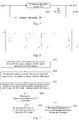
- Fig. 5 exemplarily shows a schematic structural diagram of an adaptive filter.
- x(n) represents the CPR signal (an input vector at the moment n, that is, a column vector composed of input data entering each tap of the adaptive filter at the moment n)
- d (n) represents the ECG signal
- y(n) represents the filtered CPR signal
- e (n) represents the filtered ECG signal.
- the value range of the step factor ⁇ may be (0.0000002, 0.00002).
- parameter-adjustable digital filter as shown in Fig. 5 may be a transversal filter as shown in Fig. 6 (a tapped delay line filter or a finite impulse response filter).
- z -1 represents a unit delay unit, and the number of unit delay units may be the order of the adaptive filter.
- n represents the moment, and M represents the order of the adaptive filter.
- w m ⁇ represents a parameter of the adaptive filter or the weight of the adaptive filter.
- x (n - m) represents the CPR signal on the m th tap line of the adaptive filter at the moment n.
- the terminal may automatically adjust the parameters of the adaptive filter (i.e., the weight of the adaptive filter) by using the adaptive algorithm and the filtered CPR signal to minimize the CPR signal, that is, the terminal may remove the noise (noise caused by the CPR process) of the ECG signal in the first signal to the greatest extent by means of the adaptive filter.
- the parameters of the adaptive filter i.e., the weight of the adaptive filter
- Figs. 5 and 6 are only used to explain the present application, and should not constitute limitations.
- Fig. 7 is a schematic flowchart of another ECG signal denoising method provided by the present application. The method embodiment of Fig. 4 is specifically described. As shown in Fig. 7 , the method may comprise at least the following steps: S201, a terminal detects a CPR signal and a first signal, wherein the first signal may comprise an ECG signal and noise of the ECG signal.
- the noise of the ECG signal may comprise at least the following two types of noise.
- noise of the ECG signal caused by a CPR process noise of the ECG signal caused by a CPR process.
- Second type of noise noise of the ECG signal caused by other factors in the environment (other than the CPR process).
- the terminal analyzes whether the noise of the ECG signal in the first signal correlates with the CPR signal.
- the determination of a first signal component of the CPR signal may comprise at least the following steps:
- the frequency variation range of the first signal may be 0.5 Hz to 40 Hz.
- the frequency variation range of the CPR signal may be 0.5 Hz to 40 Hz.
- the determination of the noise of the ECG signal caused by the CPR process may comprise at least the following steps:
- the terminal may determine a second frequency of the first signal from a power spectrum estimation diagram of the first signal according to a second preset value.
- the second frequency may be a center frequency of the first signal.
- the center frequency of the first signal is a frequency at which a peak with the maximum amplitude in the power spectrum estimation diagram of the first signal is located.
- the terminal may analyze, by at least the following three methods, whether the noise of the ECG signal correlates with the CPR signal.
- the methods are not limited here.
- First method if the frequency interval between the center frequency of the first signal and the center frequency of the CPR signal is smaller than a first threshold, the terminal may determine that the noise of the ECG signal correlates with the CPR signal.
- the first threshold is controllable, and the value range of the first threshold may be [1, 2].
- the terminal may determine that the noise of the ECG signal correlates with the CPR signal.
- Second method if the ratio of the noise of the ECG signal caused by the CPR process to the first signal is greater than a second threshold, the terminal may determine that the noise of the ECG signal correlates with the CPR signal, wherein the value range of the second threshold may be [0.35, 0.4].
- the terminal may determine that the noise of the ECG signal correlates with the CPR signal.
- Third method if the ratio of the noise of the ECG signal caused by the CPR process to the first signal is greater than a third threshold and the frequency interval between the center frequency of the CPR signal and the center frequency of the first signal is smaller than a fourth threshold, the terminal may determine that the noise of the ECG signal correlates with the CPR signal.
- the value range of the third threshold may be [0.25, 0.3]
- the value range of the fourth threshold may be [1, 2].
- the terminal may determine that the noise of the ECG signal correlates with the CPR signal.
- the terminal may ascertain whether the noise of the ECG signal correlates with the CPR signal, according to the frequency interval between the center frequency of the first signal and the center frequency of the CPR signal and/or the ratio of the noise of the ECG signal caused by the CPR process to the first signal.
- the terminal may determine, according to a degree of the correlation between the noise of the ECG signal and the CPR signal, a filtering method for the first signal.
- the terminal may measure the degree of the correlation between the noise of the ECG signal and the CPR signal by at least one method. For detailed explanation, reference is made to step S204.
- the method for filtering the first signal by the terminal may include but is not limited to the following two methods: First filtering method: the terminal filters the first signal by means of a high-order adaptive filter to remove the noise of the ECG signal.
- the order of the high-order adaptive filter may be 4 to 6.
- Second filtering method the terminal filters the first signal by means of a low-order adaptive filter to remove the noise of the ECG signal.
- the order of the low-order adaptive filter may be 2 to 3.
- the terminal may determine the filtering method for the first signal depending on whether the degree of the correlation between the noise of the ECG signal and the CPR signal exceeds a first value. If the terminal determines that the degree of the correlation between the noise of the ECG signal and the CPR signal exceeds the first value, the terminal may determine to use the first filtering method for filtering the first signal. Otherwise, the terminal may determine to use the second filtering method for filtering the first signal.
- the first filtering method may filter more noise of the ECG signal, but may also remove part of useful signal (ECG signal) in the first signal.
- ECG signal useful signal
- the capability of the second filtering method (low-order adaptive filter) to remove the noise of the ECG signal is lower than that of the first filtering method (high-order adaptive filter), but may retain more ECG signals (avoid filtering out too many ECG signals in the first signal).
- the terminal ascertains whether the degree of the correlation between the noise of the ECG signal and the CPR signal exceeds the first value.
- the method that the terminal determines whether the degree of the correlation between the noise of the ECG signal and the CPR signal exceeds the first value may comprise: the terminal ascertains whether the difference between the ratio of the noise of the ECG signal caused by the CPR process to the first signal and the ratio of the first signal component of the CPR signal is smaller than a fifth threshold.
- the method that the terminal ascertains whether the degree of the correlation exceeds the first value may comprise: the method for comparing the magnitude relationship between the difference ⁇ and the fifth threshold. It may be understood that the fifth threshold is controllable, and the terminal determines, by setting the fifth threshold, the filtering method suitable for filtering the first signal. It should be noted that the value range of the fifth threshold may be [0.25, 0.3].
- the terminal determines to use a first filtering method for filtering the first signal to remove the noise of the ECG signal.
- the terminal may determine that the degree of the correlation between the noise of the ECG signal and the CPR signal exceeds the first value, and then the terminal may determine to use the first filtering method for filtering the first signal to remove the noise of the ECG signal.
- the terminal may determine to use a second filtering method for filtering the first signal to remove the noise of the ECG signal.
- the terminal may determine that the degree of the correlation between the noise of the ECG signal and the CPR signal does not exceed the first value, and then the terminal may determine to use the second filtering method for filtering the first signal to remove the noise of the ECG signal.
- Fig. 8 is a schematic flowchart of still another ECG signal denoising method provided by the present application.
- a terminal may determine, according to the ratio of the noise of the ECG signal to a first signal, a filtering method for the first signal.
- the method may comprise at least the following steps: S301, a terminal may detect a CPR signal and a first signal, wherein the first signal may comprise an ECG signal and noise of the ECG signal.
- the terminal may analyze whether the noise of the ECG signal in the first signal correlates with the CPR signal.
- the terminal may determine, according to the ratio of the noise of the ECG signal to the first signal, a filtering method for the first signal.
- the terminal may determine, according to the ratio of the noise of the ECG signal caused by the CPR process to the first signal, the filtering method for the first signal, which comprises: a third filtering method: the terminal may filter the first signal by means of a high-order adaptive filter to remove the noise of the ECG signal.
- the order of the high-order adaptive filter may be 4 to 6.
- the terminal may ascertain whether the ratio of the noise of the ECG signal caused by the CPR process to the first signal is greater than a sixth threshold.
- the sixth threshold is controllable, and the terminal may determine the filtering method suitable for the first signal by setting the sixth threshold. It should be noted that the value range of the sixth threshold may be [0.2, 0.25]. Here, the noise of the ECG signal mainly arises from other factors (other than the CPR compression signal) in the surrounding environment.
- the terminal may determine to use a third filtering method for filtering the first signal to remove the noise of the ECG signal.
- the capability of the third filtering method to suppress the noise of the ECG signal is higher than a fourth preset value.
- the terminal may illustrate with the fourth preset value that the third filtering method has a strong capability to suppress the noise of the ECG signal.
- the filtering method e.g., adaptive filter
- the fourth preset value corresponds to a low-order filtering method.
- the capability of the third filtering method being higher than the fourth preset value means that the third filtering method is a high-order filtering method. For example, if the order of a low-order filtering method is [2, 3], the order of the third filtering method may be [4, 5]. If the order of the low-order filtering method is [4, 5], the order of the third filtering method is [6, 7].
- the terminal may determine not to filter the first signal if the ratio of the noise of the ECG signal caused by the CPR process to the first signal is smaller than or equal to the sixth threshold (that is, the noise of the ECG signal in the first signal is negligible), the terminal may determine not to filter the first signal.
- the terminal may not filter the first signal if the noise in the first signal is low enough to be negligible.
- the terminal may determine, according to a degree of the correlation between the noise of the ECG signal and the CPR signal, a filtering method for the first signal.
- the terminal may ascertain whether the degree of the correlation between the noise of the ECG signal and the CPR signal exceeds a first value.
- the terminal may determine to use a first filtering method for filtering the first signal to remove the noise of the ECG signal.
- the terminal may determine to use a second filtering method for filtering the first signal to remove the noise of the ECG signal.
- Fig. 9 is a schematic flowchart of still another ECG signal denoising method provided by the present application.
- the terminal ascertains whether a CPR signal exists, and if the CPR signal does not exist, the terminal may not filter an ECG signal.
- the method may comprise at least the following steps: S401, a terminal detects a CPR signal and a first signal, wherein the first signal may comprise an ECG signal and noise of the ECG signal.
- the terminal may ascertain whether the CPR signal exists.
- the terminal may ascertain whether the number of peaks of the CPR signal in frequency domain is zero, and if the number of peaks is not zero, the terminal may determine that the CPR signal exists. Otherwise, the terminal may determine that the CPR signal does not exist.
- frequency domain analysis for example, power spectrum estimation
- the terminal may not filter the first signal.
- the terminal has not monitored or detected, by means of a CPR monitor, any CPR signal from a CPR sensor placed on a user's body (that is, if the first signal does not contain noise caused by a CPR process, the noise of the ECG signal is negligible). Then, the terminal may determine not to filter the first signal. It may be understood that, in the case that the noise of the ECG signal is negligible, if the terminal filters the first signal, it may remove too many ECG signals (pure signals) in the first signal, which causes serious distortion of the ECG signals.
- the terminal may analyze whether the noise of the ECG signal correlates with the CPR signal.
- the terminal may determine, according to the ratio of the noise of the ECG signal caused by the CPR process to the first signal, a filtering method for the first signal.
- the terminal may ascertain whether the ratio of the noise of the ECG signal caused by the CPR process to the first signal is greater than a sixth threshold.
- the terminal may determine to use a third filtering method for filtering the first signal to remove the noise of the ECG signal.
- the terminal may determine not to filter the first signal.
- the terminal may determine, according to a degree of the correlation between the noise of the ECG signal and the CPR signal, a filtering method for the first signal.
- the terminal may ascertain whether the degree of the correlation between the noise of the ECG signal and the CPR signal exceeds a first value.
- the terminal may determine to use a first filtering method for filtering the first signal to remove the noise of the ECG signal.
- the terminal may determine to use a second filtering method for filtering the first signal to remove the noise of the ECG signal.
- the present application provides a terminal for implementing the method described in the embodiment of Fig. 4 , 7 , 8 or 9 .
- the terminal shown in Fig. 10 may be configured to perform the description in the corresponding embodiments described in all of the foregoing.
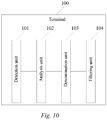
- the terminal 100 may comprise: a detection unit 101, an analysis unit 102, a determination unit 103, and a filtering unit 104.
- the detection unit 101 may be configured to detect a CPR signal and a first signal, wherein the first signal may comprise an ECG signal and noise of the ECG signal.
- the analysis unit 102 may be configured to analyze whether the noise of the ECG signal in the first signal correlates with the CPR signal.
- the determination unit 103 may be configured to, if the analysis unit analyzes that the noise of the ECG signal correlates with the CPR signal, determine, according to a degree of the correlation between the noise of the ECG signal and the CPR signal, a filtering method for the first signal.
- the filtering unit 104 may be configured to filter the first signal according to the determined filtering method to remove the noise of the ECG signal.
- the analysis unit 102 comprises a first determination unit, a second determination unit, and a third determination unit.
- the first determination unit may be configured to determine a first frequency of the CPR signal, wherein the amplitude of the CPR signal at the first frequency exceeds a first preset value, and the first frequency is used to determine a frequency domain range in which the noise of the ECG signal is located.
- the second determination unit may be configured to determine a second frequency of the first signal, wherein the amplitude of the first signal at the second frequency exceeds a second preset value.
- the third determination unit may be configured to determine whether the noise of the ECG signal correlates with the CPR signal, according to the ratio of the noise of the ECG signal caused by the CPR process to the first signal and/or the frequency interval between the first frequency and the second frequency.
- the third determination unit is specifically configured to: determine, by at least the following three methods, whether the noise of the ECG signal correlates with the CPR signal.
- First method if the frequency interval between the center frequency of the first signal and the center frequency of the CPR signal is smaller than a first threshold, it may be determined that the noise of the ECG signal correlates with the CPR signal.
- Second method if the ratio of the noise of the ECG signal caused by the CPR process to the first signal is greater than a second threshold, it may be determined that the noise of the ECG signal correlates with the CPR signal.
- Third method if the ratio of the noise of the ECG signal caused by the CPR process to the first signal is greater than a third threshold and the frequency interval between the center frequency of the CPR signal and the center frequency of the first signal is smaller than a fourth threshold, it may be determined that the noise of the ECG signal correlates with the CPR signal.
- the determination unit 103 may be specifically configured to: if it is determined that the degree of the correlation exceeds a first value, determine to use a first filtering method for filtering the first signal, or otherwise, determine to use a second filtering method for filtering the first signal, wherein the order of the first filtering method is higher than the order of the second filtering method.
- the terminal determines that the degree of the correlation exceeds the first value, wherein the amplitude of the first signal component exceeds a third preset value.
- the determination unit 103 may be further configured to, if the noise of the ECG signal does not correlate with the CPR signal, determine, according to the ratio of the noise of the ECG signal caused by the CPR process to the first signal, a filtering method for the first signal.
- the ratio of the noise of the ECG signal caused by the CPR process to the first signal is greater than a sixth threshold, it is determined to use a third filtering method for filtering the first signal, wherein the capability of the third filtering method to suppress the noise of the ECG signal is higher than a fourth preset value.
- the terminal 100 may further comprise: in addition to the detection unit 101, the analysis unit 102, the determination unit 103, and the filtering unit 104: an ascertainment unit.
- the ascertainment unit may be configured to ascertain whether the CPR signal exists, and perform, if the CPR signal exists, the step of the analysis unit 102 analyzing whether the noise of the ECG signal in the first signal correlates with the CPR signal.
- the ascertainment unit may be specifically configured to: after the analysis unit performs frequency domain analysis (power spectrum estimation) on the CPR signal, ascertain whether the number of peaks of the CPR signal in frequency domain is zero, and if the number is not zero, determine that the CPR signal exists, or otherwise, determine that the CPR signal does not exist.
- frequency domain analysis power spectrum estimation
- the terminal 100 is only an example provided by the embodiment of the present application, and the terminal 100 may have more or fewer components than those shown, may combine two or more components, or may have different configurations of components.
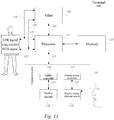
- Fig. 11 is a schematic structural diagram of another terminal provided by the present application.
- the terminal may comprise various medical apparatuses such as an electrocardiograph monitor, an electrocardiograph diagnostic instrument, an electrocardiograph instrument, or a temporary pacemaker, which is not limited in this embodiment of the present application.
- the terminal 110 may comprise: one or more processors 111, one or more filters 112, a memory 113 (one or more computer-readable storage media), and a peripheral system 114. These components may communicate on one or more communication buses 115.
- the memory 113 is coupled to the processor 111, and may be configured to store various software programs and/or multiple groups of instructions.
- the memory 113 may comprise a high-speed random access memory, and may also comprise a non-volatile memory, for example, one or more magnetic disk storage apparatuses, flash memory apparatuses, or other non-volatile solid-state storage apparatuses.
- the memory 113 may store an operating system (hereinafter referred to as a system), for example, ANDROID, IOS, WINDOWS, or an embedded operating system such as LINUX.
- the memory 113 may also store a network communication program, which may be used to communicate with one or more additional apparatuses, one or more terminal apparatuses, and one or more network apparatuses.
- the memory 113 may also store a user interface program, which may display the content of an application program vividly by means of a graphical operation interface, and receive a user's control operations on the application program by means of input controls such as menus, dialog boxes, and keys.
- the memory 113 may also be configured to store a first signal and a CPR signal.
- the first signal may comprise an ECG signal and noise of the ECG signal.
- the processor 111 may be configured to analyze the the correlation between the CPR signal and the noise of the ECG signal and the degree of the correlation between the noise of the ECG signal and the CPR signal, and determine a filtering method for the first signal. That is, the processor 111 may be configured to determine a filtering method (filter) suitable for filtering the first signal from the filter 112.
- the filter 112 may be configured to filter the first signal to remove the noise of the ECG signal. It should be noted that the filter 112 may be one or more hardware filters integrated outside the processor 111, or one or more software programs that filter the first signal.
- the peripheral system 114 is mainly configured to realize an interactive function between the terminal 110 and a user/external environment, and mainly comprises input and output devices of the terminal 100.
- the peripheral system 114 may comprise: an audio controller 116 and a display screen controller 117.
- Various controllers may be coupled to their respective peripheral apparatuses (for example, an audio circuit 118 and a display screen 119).
- the display screen may be a display screen configured with a self-capacitive floating touch panel, or a display screen configured with an infrared floating touch panel.
- the peripheral system 114 may further comprise other I/O peripherals.
- the display screen 119 may be used by a doctor to observe a patient's ECG signal in real time, which facilitates the doctor in adjusting first-aid measures in time to rescue the patient.
- the audio circuit 118 may be configured to prompt the doctor in real time about the patient's physical state (the pulsating state of the patient's heart), and further output prompts suggesting that the doctor quickly adjusts the first-aid measures.
- terminal 110 is only an example provided by the embodiment of the present application, and the terminal 110 may have more or fewer components than those shown, may combine two or more components, or may have different configurations of components.
- the present application provides a computer-readable storage medium, storing a computer program, which is implemented when executed by a processor.
- the computer-readable storage medium may be an internal storage unit of the terminal described in any of the aforesaid embodiments, such as a hard disk or a memory of the terminal.
- the computer-readable storage medium may also be an external storage apparatus of the terminal, such as a removable hard disk, a smart media card (SMC), a secure digital (SD) card, or a flash card equipped on the terminal.
- the computer-readable storage medium may further comprise both an internal storage unit and an external storage apparatus of the terminal.
- the computer-readable storage medium is used to store a computer program, and other programs and data required by the terminal.
- the computer-readable storage medium may also be used to temporarily store data that has been or will be output.
- terminal embodiments described above are merely exemplary.
- the division of the units is only a logic function division.
- there may be other division methods for example, multiple units or components may be combined or integrated into another system, or some features may be omitted or not implemented.
- the mutual coupling or direct coupling or communication connection shown or discussed may be indirect coupling or communication connection through some interfaces, terminal or units, and may be in electrical, mechanical or other forms.
- the units described as separate parts may or may not be physically separated, and the parts displayed as units may or may not be physical units, i.e., may be located in one place or may be distributed over multiple network units. Some or all of the units can be selected according to actual needs to achieve the purpose of solutions of the embodiments of the present application.
- the functional units in the embodiments of the present application may be integrated into one processing unit or may alternatively exist as being physically separate, or two or more of the units may be integrated into one unit.
- the above integrated unit can be implemented in the form of hardware or a software function unit.
- the integrated unit may be stored in a computer-readable storage medium.
- the computer software product may be stored in a storage medium and comprises several instructions for instructing a computer apparatus (which may be a personal computer, a server, or a network apparatus) to perform all or some of the steps of the methods described in the embodiments of the present application.
- the aforesaid storage medium comprises: a U disk, a removable hard disk, read-only memory (ROM), a random access memory (RAM), a magnetic disk or an optical disk and other media that can store program codes.
Landscapes
- Health & Medical Sciences (AREA)
- Life Sciences & Earth Sciences (AREA)
- Engineering & Computer Science (AREA)
- Signal Processing (AREA)
- Animal Behavior & Ethology (AREA)
- General Health & Medical Sciences (AREA)
- Veterinary Medicine (AREA)
- Biomedical Technology (AREA)
- Heart & Thoracic Surgery (AREA)
- Public Health (AREA)
- Molecular Biology (AREA)
- Surgery (AREA)
- Physics & Mathematics (AREA)
- Pathology (AREA)
- Medical Informatics (AREA)
- Biophysics (AREA)
- Cardiology (AREA)
- Artificial Intelligence (AREA)
- Computer Vision & Pattern Recognition (AREA)
- Physiology (AREA)
- Psychiatry (AREA)
- Nuclear Medicine, Radiotherapy & Molecular Imaging (AREA)
- Radiology & Medical Imaging (AREA)
- Noise Elimination (AREA)
- Measurement And Recording Of Electrical Phenomena And Electrical Characteristics Of The Living Body (AREA)
- Soundproofing, Sound Blocking, And Sound Damping (AREA)
Abstract
Description
- The present application relates to the technical field of medical signal processing, and in particular to an ECG signal denoising method and a terminal.
- In clinical practice, when a doctor performs cardiopulmonary resuscitation (CPR) compression on a patient, great interference will be posed to an electrocardiograph (ECG) signal to seriously affect the quality of the ECG signal, such that the doctor can hardly acquire the patient's physical condition information easily from the ECG signal, and has to stop the CPR compression to acquire the patient's physical condition information from the ECG signal, which increases the interruption time of the CPR compression and reduces the success rate of rescue.
- For various ECG signals, the existing technologies all adopt fixed-order adaptive filters, causing the following problems:
- 1. In clinical practice, CPR compression is performed sometimes, but it does not interfere with the ECG signal. In this case, if filtering is still performed, the ECG signal will be seriously distorted. As shown in
Fig. 1 , interference does not exist in the ECG signal originally, but the ECG signal is distorted relatively seriously after adaptive filtering. - 2. As shown in
Fig. 2 , the ECG signal is an arrest signal. If a low-order adaptive filter is used, there will be significant residuals in the filtered ECG signal, which affects the doctor's judgment on the rhythm type, so only a high-order adaptive filter can completely eliminate interference and restore the arrest signal. - 3. As shown in
Fig. 3 , the ECG signal is an autonomic rhythm signal. If a high-order adaptive filter is used, a signal in the form of tremor waves will be introduced. In this case, some automatic analysis algorithms for an arrhythmia may misjudge this signal as a ventricular fibrillation signal, so a low-order adaptive filter is used to effectively filter the interference introduced by CPR compression and also retain the characteristics of the ECG signal. - The present application provides an ECG signal denoising method and a terminal, which can achieve a better filtering effect.
- According to a first aspect, the present application provides an ECG signal denoising method, comprising:
- a terminal detecting a CPR signal and a first signal, wherein the first signal comprises an ECG signal;
- the terminal analyzing whether the noise of the ECG signal in the first signal correlates with the CPR signal;
- if the noise of the ECG signal correlates with the CPR signal, the terminal determining, according to a degree of the correlation between the noise of the ECG signal and the CPR signal, a filtering method for the first signal; and
- the terminal filtering the first signal according to the determined filtering method to remove the noise of the ECG signal.
- With reference to the first aspect, in some possible embodiments, the terminal analyzing whether the noise of the ECG signal in the first signal correlates with the CPR signal specifically comprises:
- the terminal determining a first frequency of the CPR signal, wherein the amplitude of the CPR signal at the first frequency exceeds a first preset value, and the first frequency is used to determine a frequency domain range in which the noise of the ECG signal is located;
- the terminal determining a second frequency of the first signal, wherein the amplitude of the first signal at the second frequency exceeds a second preset value; and
- the terminal determining whether the noise of the ECG signal correlates with the CPR signal, according to the ratio of the noise of the ECG signal caused by the CPR process to the first signal and/or the frequency interval between the first frequency and the second frequency.
- With reference to the first aspect, in some possible embodiments, the terminal determining whether the noise of the ECG signal correlates with the CPR signal, according to the ratio of the noise of the ECG signal caused by the CPR process to the first signal and/or the frequency interval between the first frequency and the second frequency specifically comprises:
the terminal determining that the noise of the ECG signal correlates with the CPR signal if the frequency interval between the first frequency and the second frequency is smaller than a first threshold. - With reference to the first aspect, in some possible embodiments, the terminal determining whether the noise of the ECG signal correlates with the CPR signal, according to the ratio of the noise of the ECG signal caused by the CPR process to the first signal and/or the frequency interval between the first frequency and the second frequency specifically comprises:
the terminal determining that the noise of the ECG signal correlates with the CPR signal if the ratio is greater than a second threshold. - With reference to the first aspect, in some possible embodiments, the terminal determining whether the noise of the ECG signal correlates with the CPR signal, according to the ratio of the noise of the ECG signal caused by the CPR process to the first signal and/or the frequency interval between the first frequency and the second frequency specifically comprises:
the terminal determining that the noise of the ECG signal correlates with the CPR signal if the ratio is greater than a third threshold and the frequency interval between the first frequency and the second frequency is smaller than a fourth threshold. - With reference to the first aspect, in some possible embodiments, the first frequency is a frequency at which the maximum peak of the CPR signal is located.
- With reference to the first aspect, in some possible embodiments, the second frequency is a frequency at which the maximum peak of the first signal is located.
- With reference to the first aspect, in some possible embodiments, the terminal determining, according to a degree of the correlation between the noise of the ECG signal and the CPR signal, a filtering method for the first signal specifically comprises:
if the terminal determines that the degree of the correlation exceeds a first value, the terminal determining to use a first filtering method for filtering the first signal, or otherwise, the terminal determining to use a second filtering method for filtering the first signal, wherein the order of the first filtering method is higher than the order of the second filtering method. - With reference to the first aspect, in some possible embodiments, the terminal determining that the degree of the correlation exceeds a first value specifically comprises:
if the difference between the ratio of the noise of the ECG signal to the first signal and the ratio of a first signal component of the CPR signal is smaller than a fifth threshold, the terminal determining that the degree of the correlation exceeds the first value, wherein the amplitude of the first signal component exceeds a third preset value. - With reference to the first aspect, in some possible embodiments, the method further comprises:
the terminal ascertaining whether the CPR signal exists, and performing, if the CPR signal exists, the step of the terminal analyzing whether the noise of the ECG signal in the first signal correlates with the CPR signal. - With reference to the first aspect, in some possible embodiments, the terminal ascertaining whether the CPR signal exists specifically comprises:
after the terminal performs frequency domain analysis (power spectrum estimation) on the CPR signal, the terminal ascertaining whether the number of peaks of the CPR signal in frequency domain is zero, and if the number is not zero, the terminal determining that the CPR signal exists, or otherwise, the terminal determining that the CPR signal does not exist. - With reference to the first aspect, in some possible embodiments, the method further comprises:
if the noise of the ECG signal does not correlate with the CPR signal, the terminal determining, according to the ratio of the noise of the ECG signal to the first signal, a filtering method for the first signal. - With reference to the first aspect, in some possible embodiments, the terminal determining, according to the ratio of the noise of the ECG signal to the first signal, a filtering method for the first signal specifically comprises:
if the ratio of the noise of the ECG signal caused by the CPR process to the first signal is greater than a sixth threshold, the terminal determining to use a third filtering method for filtering the first signal, wherein the capability of the third filtering method to suppress the noise of the ECG signal is higher than a fourth preset value. - According to a second aspect, the present application provides a terminal, comprising:
- a detection unit configured to detect a CPR signal and a first signal, wherein the first signal comprises an ECG signal and noise of the ECG signal;
- an analysis unit configured to analyze whether the noise of the ECG signal in the first signal correlates with the CPR signal;
- a determination unit configured to, if the analysis unit analyzes that the noise of the ECG signal correlates with the CPR signal, determine, according to a degree of the correlation between the noise of the ECG signal and the CPR signal, a filtering method for the first signal; and
- a filtering unit configured to filter the first signal according to the determined filtering method to remove the noise of the ECG signal.
- With reference to the second aspect, in some possible embodiments,
the analysis unit comprises: - a first determination unit configured to determine a first frequency of the CPR signal, wherein the amplitude of the CPR signal at the first frequency exceeds a first preset value, and the first frequency is used to determine a frequency domain range in which the noise of the ECG signal is located;
- a second determination unit configured to determine a second frequency of the first signal, wherein the amplitude of the first signal at the second frequency exceeds a second preset value; and
- a third determination unit configured to determine whether the noise of the ECG signal correlates with the CPR signal, according to the ratio of the noise of the ECG signal caused by the CPR process to the first signal and/or the frequency interval between the first frequency and the second frequency.
- With reference to the second aspect, in some possible embodiments, the third determination unit is specifically configured to:
determine that the noise of the ECG signal correlates with the CPR signal if the frequency interval between the first frequency and the second frequency is smaller than a first threshold. - With reference to the second aspect, in some possible embodiments, the third determination unit is specifically configured to:
determine that the noise of the ECG signal correlates with the CPR signal if the ratio is greater than a second threshold. - With reference to the second aspect, in some possible embodiments, the third determination unit is specifically configured to:
determine that the noise of the ECG signal correlates with the CPR signal if the ratio is greater than a third threshold and the frequency interval between the first frequency and the second frequency is smaller than a fourth threshold. - With reference to the second aspect, in some possible embodiments, the determination unit is specifically configured to:
if it is determined that the degree of the correlation exceeds a first value, determine to use a first filtering method for filtering the first signal, or otherwise, determine to use a second filtering method for filtering the first signal, wherein the order of the first filtering method is higher than the order of the second filtering method. - With reference to the second aspect, in some possible embodiments, the terminal further comprises:
an ascertainment unit configured to ascertain whether the CPR signal exists, and perform, if the CPR signal exists, the step of the terminal analyzing whether the noise of the ECG signal in the first signal correlates with the CPR signal. - With reference to the second aspect, in some possible embodiments, the ascertainment unit is specifically configured to:
after the analysis unit performs frequency domain analysis (power spectrum estimation) on the CPR signal, ascertain whether the number of peaks of the CPR signal in frequency domain is zero, and if the number is not zero, determine that the CPR signal exists, or otherwise, determine that the CPR signal does not exist. - With reference to the second aspect, in some possible embodiments, the determination unit is further configured to:
if the noise of the ECG signal does not correlate with the CPR signal, determine, according to the ratio of the noise of the ECG signal to the first signal, a filtering method for the first signal. - With reference to the second aspect, in some possible embodiments, the determination unit is further specifically configured to:
- if the ratio of the noise of the ECG signal caused by the CPR process to the first signal is greater than a sixth threshold,
- determine to use a third filtering method for filtering the first signal, wherein the capability of the third filtering method to suppress the noise of the ECG signal is higher than a fourth preset value.
- According to a third aspect, the present application provides another terminal, comprising: a display device, a memory, and a processor coupled to the memory, wherein the memory is configured to store an application program code, and the processor is configured to invoke the program code to perform the method of the first aspect.
- According to a fourth aspect, the present application provides a computer-readable storage medium storing a computer program, the computer program comprising a program instruction that, when executed by a processor, causes the processor to perform the method of the first aspect.
- According to a fifth aspect, the present application provides a computer program comprising an ECG signal denoising instruction, wherein when the computer program is executed on a computer, the ECG signal denoising instruction is used to perform the method of the first aspect.
- The present application provides an ECG signal denoising method and a terminal. First, the terminal detects a CPR signal and a first signal, wherein the first signal comprises an ECG signal and noise of the ECG signal. Second, the terminal analyzes whether the noise of the ECG signal in the first signal correlates with the CPR signal. Then, if the noise of the ECG signal correlates with the CPR signal, the terminal determines, according to a degree of the correlation between the noise of the ECG signal and the CPR signal, a filtering method for the first signal. Finally, the terminal filters the first signal according to the determined filtering method to remove the noise of the ECG signal. By using the present application, a better filtering effect can be achieved.
- In order to illustrate the technical solutions in the embodiments of the present application more clearly, a brief introduction to the drawings required for the embodiments will be provided below. Obviously, the drawings in the following description are merely some of the embodiments of the present application, and those of ordinary skill in the art would also have been able to obtain other drawings according to these drawings without involving any inventive effort.
-
Figs. 1 to 3 are schematic diagrams of ECG signal denoising provided by the present application; -
Fig. 4 is a schematic flowchart of an ECG signal denoising method provided by the present application; -
Fig. 5 is a schematic structural diagram of an adaptive filter provided by the present application; -
Fig. 6 is a schematic structural diagram of a filter provided by the present application; -
Fig. 7 is a schematic flowchart of another ECG signal denoising method provided by the present application; -
Fig. 8 is a schematic flowchart of still another ECG signal denoising method provided by the present application; -
Fig. 9 is a schematic flowchart of still another ECG signal denoising method provided by the present application; -
Fig. 10 is a schematic structural diagram of a terminal provided by the present application; and -
Fig. 11 is a schematic structural diagram of another terminal provided by the present application. - The technical solutions of the present application will be described below clearly and comprehensively in conjunction with the drawings of the present application. Clearly, the embodiments described are some embodiments of the present application and are not all the possible embodiments. Based on the embodiments given in the present application, all other embodiments that would be obtained by those of ordinary skill in the art without expending inventive effort shall all fall within the scope of protection of the present application.
- It should be understood that when used in the description and the appended claims, the terms "comprise" and "contain" indicate the presence of the described features, wholes, steps, operations, elements and/or the components, but do not exclude the presence or addition of one or more other features, wholes, steps, operations, elements, components and/or the combinations thereof.
- It should also be understood that the terms used in the description of the present application are only intended to describe specific embodiments, but not to limit the present application. As used in the description and the appended claims of the present application, unless the context clearly indicates otherwise, the singular forms "a", "an" and "the" are intended to comprise the plural forms.
- It should also be further understood that the term "and/or" used in the description and the appended claims of the present application refers to one of the items listed correlatively or any combination and all possible combinations of the items, and comprises these combinations.
- As used in the description and the appended claims, the term "if' may be interpreted as "when" or "once" or "in response to determination" or "in response to detection" according to the context. Similarly, the phrase "if determined" or "if detected [described condition or event]" may be interpreted as "once determined" or "in response to determination" or "once detected [described condition or event]" or "in response to detection of [the described condition or event]" according to the context.
- In specific implementations, the terminal described in the present application includes, but is not limited to, other portable apparatuses such as a mobile phone, a laptop computer, or a tablet computer with a touch-sensitive surface (e.g., a touch screen display and/or a touch pad). It should also be understood that, in some embodiments, the apparatus is not a portable communication apparatus, but a desktop computer with a touch-sensitive surface (e.g., a touch screen display and/or a touch pad).
- A terminal comprising a display and a touch-sensitive surface is described in the following discussion. However, it should be understood that the terminal may comprise one or more other physical user interface apparatuses such as a physical keyboard, a mouse, and/or a joystick.
- The terminal supports various application programs, such as one or more of the following: drawing application programs, presentation application programs, word processing application programs, website creation application programs, disk burning application programs, spreadsheet application programs, game application programs, phone application programs, video conferencing application programs, e-mail application programs, instant messaging application programs, exercise support application programs, photo management application programs, digital camera application programs, digital video camera application programs, web browsing application programs, digital music player application programs, and/or digital video player application programs.
- Various application programs executable on the terminal may employ at least one common physical user interface apparatus such as a touch-sensitive surface. One or more functions of the touch-sensitive surface and corresponding information displayed on the terminal may be adjusted and/or changed between the application programs and/or within the corresponding application programs. In this way, the common physical architecture (e.g., the touch-sensitive surface) of the terminal may support various application programs with user interfaces that are intuitive and transparent to users.
-
Fig. 4 is a schematic flowchart of an ECG signal denoising method provided by the present application. As shown inFig. 1 , the method may comprise at least the following steps:
S101, a terminal may detect a CPR signal and a first signal. Here, the first signal may comprise an ECG signal and noise of the ECG signal. - In this embodiment of the present application, the CPR signal may include at least but is not limited to the following signals: a CPR compression pressure signal, a CPR compression displacement signal, a CPR compression acceleration signal or a chest impedance signal, etc. It should be noted that the frequency range of CPR compression may include but is not limited to 1 Hz to 5 Hz.
- It may be known that the terminal may monitor or detect, by means of a CPR monitor, the CPR signal from a CPR sensor placed on a user's body. In addition, the terminal may monitor or detect, by means of the ECG monitor, the ECG signal from an ECG sensor placed on the user's body.
- It may be understood that, in addition to the ECG signal, the terminal may monitor or detect, by means of the ECG sensor, the noise of the ECG signal from the ECG sensor placed on the user's body, and the noise may be generated by the CPR compression. In this embodiment of the present application, the signal from the ECG sensor placed on the user's body is collectively referred to as a first signal, and the first signal may include but is not limited to the ECG signal and the noise of the ECG signal.
- It should be noted that the noise of the ECG signal may comprise at least the following two types of noise.
- First type of noise: noise of the ECG signal caused by a CPR process.
- Second type of noise: noise of the ECG signal caused by other factors in the environment (other than the CPR process).
- S102, the terminal may analyze whether the noise of the ECG signal in the first signal correlates with the CPR signal.
- In this embodiment of the present application, the determination of a first signal component of the CPR signal may comprise at least the following steps:
- Step 1: the terminal may perform frequency domain analysis (power spectrum estimation) on the CPR signal.
- Step 2: the terminal may determine a first frequency of the CPR signal from a power spectrum estimation diagram of the CPR signal according to a first preset value.
- Optionally, the first frequency may be a center frequency of the CPR signal. Here, the center frequency of the CPR signal is a frequency at which a peak with the maximum amplitude in the power spectrum estimation diagram of the CPR signal is located. That is, the terminal may determine the center frequency of the CPR signal from the power spectrum estimation diagram of the CPR signal according to the first preset value.
- Step 3: the terminal may determine a corresponding signal within a range of 0.5 Hz centered on the center frequency of the CPR signal as the first signal component of the CPR signal.
- It should be noted that the frequency variation range of the first signal may be 0.5 Hz to 40 Hz. The frequency variation range of the CPR signal may be 0.5 Hz to 40 Hz.
- Here, the determination of the noise of the ECG signal caused by the CPR process may comprise at least the following steps:
- Step 1: the terminal may perform frequency domain analysis (power spectrum estimation) on the CPR signal.
- Step 2: the terminal may determine a first frequency of the CPR signal from a power spectrum estimation diagram of the CPR signal according to a first preset value. Here, the first frequency may be a center frequency of the CPR signal.
- Step 3: the terminal may determine a corresponding signal, in the first signal, within a range of 0.5 Hz centered on the center frequency of the CPR signal as the noise of the ECG signal caused by the CPR process.
- It may be understood that the terminal may determine a second frequency of the first signal from a power spectrum estimation diagram of the first signal according to a second preset value. Here, the second frequency may be a center frequency of the first signal. It should be noted that the center frequency of the first signal is a frequency at which a peak with the maximum amplitude in the power spectrum estimation diagram of the first signal is located.
- Specifically, the terminal may analyze, by at least the following three methods, whether the noise of the ECG signal correlates with the CPR signal.
- First method: if the frequency interval between the center frequency of the first signal and the center frequency of the CPR signal is smaller than a first threshold, the terminal may determine that the noise of the ECG signal correlates with the CPR signal. Here, the first threshold is controllable, and the value range of the first threshold may be [1, 2].
- Specifically, the frequency interval f between the center frequency of the first signal and the center frequency of the CPR signal may be:

- That is, if the frequency interval f is smaller than the first threshold, the terminal may determine that the noise of the ECG signal correlates with the CPR signal.
- Second method: if the ratio of the noise of the ECG signal caused by the CPR process to the first signal is greater than a second threshold, the terminal may determine that the noise of the ECG signal correlates with the CPR signal, wherein the value range of the second threshold may be [0.35, 0.4].
- Specifically, the ratio θ 1 of the noise of the ECG signal caused by the CPR process to the first signal may be:
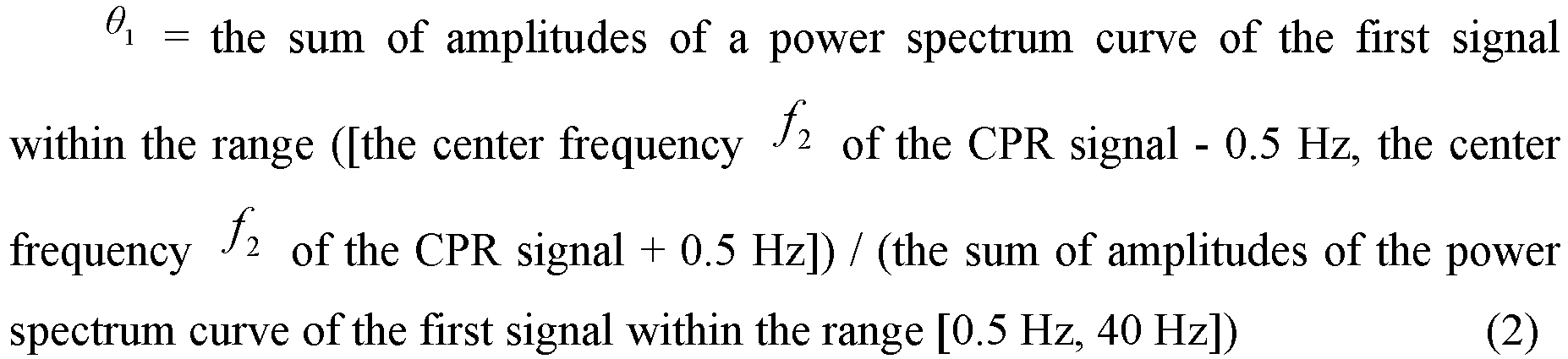
- That is, if the ratio θ 1 is greater than the second threshold, the terminal may determine that the noise of the ECG signal correlates with the CPR signal.
- Third method: if the ratio of the noise of the ECG signal caused by the CPR process to the first signal is greater than a third threshold and the frequency interval between the center frequency of the CPR signal and the center frequency of the first signal is smaller than a fourth threshold, the terminal may determine that the noise of the ECG signal correlates with the CPR signal. Here, the value range of the third threshold may be [0.25, 0.3], and the value range of the fourth threshold may be [1, 2].
- That is, if the frequency interval f is smaller than the fourth threshold and the ratio θ 1 is greater than the third threshold, the terminal may determine that the noise of the ECG signal correlates with the CPR signal.
- In summary, the terminal may ascertain whether the noise of the ECG signal correlates with the CPR signal, according to the frequency interval between the center frequency of the first signal and the center frequency of the CPR signal and/or the ratio of the noise of the ECG signal caused by the CPR process to the first signal.
- S103, if the noise of the ECG signal correlates with the CPR signal, the terminal may determine, according to a degree of the correlation between the noise of the ECG signal and the CPR signal, a filtering method for the first signal.
- In this embodiment of the present application, the method for filtering the first signal by the terminal may include but is not limited to the following two methods:
First filtering method: the terminal may filter the first signal by means of a high-order adaptive filter to remove the noise of the ECG signal. Here, the order of the high-order adaptive filter may be 4 to 6. - Second filtering method: the terminal may filter the first signal by means of a low-order adaptive filter to remove the noise of the ECG signal. Here, the order of the low-order adaptive filter may be 2 to 3.
- Specifically, the terminal may determine the filtering method for the first signal depending on whether the degree of the correlation between the noise of the ECG signal and the CPR signal exceeds a first value. If the terminal determines that the degree of the correlation between the noise of the ECG signal and the CPR signal exceeds the first value, the terminal may determine to use the first filtering method for filtering the first signal. Otherwise, the terminal may determine to use the second filtering method for filtering the first signal.
- It should be noted that, compared with the second filtering method, the first filtering method may filter more noise of the ECG signal, but may also remove part of useful signal (ECG signal) in the first signal. The capability of the second filtering method (low-order adaptive filter) to remove the noise of ECG is lower than that of the first filtering method (high-order adaptive filter), but may retain more ECG signals (avoid filtering out too many ECG signals in the first signal).
- Further, the method that the terminal ascertains whether the degree of the correlation between the noise of the ECG signal and the CPR signal exceeds the first value may comprise:
if the difference between the ratio of the noise of the ECG signal caused by the CPR process to the first signal and the ratio of the first signal component of the CPR signal is smaller than a fifth threshold, the terminal determines that the degree of the correlation between the noise of the ECG signal and the CPR signal exceeds the first value; or otherwise, the terminal determines that the degree of the correlation between the noise of the ECG signal and the CPR signal does not exceed the first value. - The difference between the ratio of the noise of the ECG signal caused by the CPR process to the first signal and the ratio of the first signal component of the CPR signal is specifically described below. Specifically, the ratio θ 2 of the first signal component of the CPR signal may be:

- In combination with the ratio θ 1 of the noise of the ECG signal caused by the CPR process to the first signal in formula (2), the difference θ between the ratio θ 1 of the noise of the ECG signal caused by the CPR process to the first signal and the ratio θ 2 of the first signal component of the CPR signal may be:

- That is, if the difference θ is smaller than the fifth threshold, the terminal determines that the degree of the correlation between the noise of the ECG signal and the CPR signal exceeds the first value. Otherwise, the terminal determines that the degree of the correlation between the noise of the ECG signal and the CPR signal does not exceed the first value.
- It may be understood that the fifth threshold is controllable, and the terminal may determine the filtering method suitable for the first signal by setting the fifth threshold. It should be noted that the value range of the fifth threshold may be [0.25, 0.3].
- S104, the terminal may filter the first signal according to the determined filtering method to remove the noise of the ECG signal.
- In this embodiment of the present application, the terminal may filter the first signal according to the determined filtering method (the first filtering method or the second filtering method), that is, the terminal may filter the first signal according to the determined adaptive filter (the high-order adaptive filter or the low-order adaptive filter).
- It should be noted that parameters of the adaptive filter may be changed by using an adaptive algorithm, to remove the noise of the ECG signal.
- Here, the adaptive algorithm may include but is not limited to the following three algorithms:
- First algorithm: least mean square (LMS) algorithm.
- Second algorithm: steepest descent method.
- Third algorithm: recursive least squares (RLS) algorithm.
- The adaptive filter may comprise at least the following two basic processes:
Filtering process: the terminal may filter, by means of the filter, the CPR signal that causes the noise of the ECG signal. - Adaptive process: the terminal automatically adjusts the parameters of the filter (e.g., a weight of the filter) by using the adaptive algorithm and the filtered CPR signal.
-
Fig. 5 exemplarily shows a schematic structural diagram of an adaptive filter. As shown inFig. 5 , x(n) represents the CPR signal (an input vector at the moment n, that is, a column vector composed of input data entering each tap of the adaptive filter at the moment n), d(n) represents the ECG signal, y(n) represents the filtered CPR signal, and e(n) represents the filtered ECG signal. - It may be understood that the filtered CPR signal may be expressed as:

- The filtered ECG signal may be expressed as:

- The tap weight vector w(n) of the adaptive filter may be expressed as:

- Here, the value range of the step factor µ may be (0.0000002, 0.00002).
- Further, the parameter-adjustable digital filter as shown in
Fig. 5 may be a transversal filter as shown inFig. 6 (a tapped delay line filter or a finite impulse response filter). - As shown in
Fig. 6 , it should be known that z-1 represents a unit delay unit, and the number of unit delay units may be the order of the adaptive filter. n represents the moment, and M represents the order of the adaptive filter.
- It may be understood that formula (5) that characterizes the filtered CPR signal may also be expressed as:

- Here, x(n - m) represents the CPR signal on the mth tap line of the adaptive filter at the moment n.
- In summary, after the terminal sets the order of the adaptive filter (e.g., the number of delay units in the adaptive filter), the terminal may automatically adjust the parameters of the adaptive filter (i.e., the weight of the adaptive filter) by using the adaptive algorithm and the filtered CPR signal to minimize the CPR signal, that is, the terminal may remove the noise (noise caused by the CPR process) of the ECG signal in the first signal to the greatest extent by means of the adaptive filter.
-
Figs. 5 and 6 are only used to explain the present application, and should not constitute limitations. -
Fig. 7 is a schematic flowchart of another ECG signal denoising method provided by the present application. The method embodiment ofFig. 4 is specifically described. As shown inFig. 7 , the method may comprise at least the following steps:
S201, a terminal detects a CPR signal and a first signal, wherein the first signal may comprise an ECG signal and noise of the ECG signal. - In this embodiment of the present application, the noise of the ECG signal may comprise at least the following two types of noise.
- First type of noise: noise of the ECG signal caused by a CPR process.
- Second type of noise: noise of the ECG signal caused by other factors in the environment (other than the CPR process).
- S202, the terminal analyzes whether the noise of the ECG signal in the first signal correlates with the CPR signal.
- In this embodiment of the present application, the determination of a first signal component of the CPR signal may comprise at least the following steps:
- Step 1: the terminal may perform frequency domain analysis (power spectrum estimation) on the CPR signal.
- Step 2: the terminal may determine a first frequency of the CPR signal from a power spectrum estimation diagram of the CPR signal according to a first preset value. Here, the first frequency may be a center frequency of the CPR signal. Here, the center frequency of the CPR signal is a frequency at which a peak with the maximum amplitude in the power spectrum estimation diagram of the CPR signal is located. That is, the terminal may determine the center frequency of the CPR signal from the power spectrum estimation diagram of the CPR signal according to the first preset value.
- Step 3: the terminal may determine a corresponding signal within a range of 0.5 Hz centered on the center frequency of the CPR signal as the first signal component of the CPR signal.
- It should be noted that the frequency variation range of the first signal may be 0.5 Hz to 40 Hz. The frequency variation range of the CPR signal may be 0.5 Hz to 40 Hz.
- Here, the determination of the noise of the ECG signal caused by the CPR process may comprise at least the following steps:
- Step 1: the terminal may perform frequency domain analysis (power spectrum estimation) on the CPR signal.
- Step 2: the terminal may determine a first frequency of the CPR signal from a power spectrum estimation diagram of the CPR signal according to a first preset value. Here, the first frequency may be a center frequency of the CPR signal.
- Step 3: the terminal may determine a corresponding signal, in the first signal, within a range of 0.5 Hz centered on the center frequency of the CPR signal as the noise of the ECG signal caused by the CPR process.
- It may be understood that the terminal may determine a second frequency of the first signal from a power spectrum estimation diagram of the first signal according to a second preset value. Here, the second frequency may be a center frequency of the first signal. It should be noted that the center frequency of the first signal is a frequency at which a peak with the maximum amplitude in the power spectrum estimation diagram of the first signal is located.
- The terminal may analyze, by at least the following three methods, whether the noise of the ECG signal correlates with the CPR signal. The methods are not limited here.
- First method: if the frequency interval between the center frequency of the first signal and the center frequency of the CPR signal is smaller than a first threshold, the terminal may determine that the noise of the ECG signal correlates with the CPR signal. Here, the first threshold is controllable, and the value range of the first threshold may be [1, 2].
- Specifically, the frequency interval f between the center frequency of the first signal and the center frequency of the CPR signal may be:

- That is, if the frequency interval f is smaller than the first threshold, the terminal may determine that the noise of the ECG signal correlates with the CPR signal.
- Second method: if the ratio of the noise of the ECG signal caused by the CPR process to the first signal is greater than a second threshold, the terminal may determine that the noise of the ECG signal correlates with the CPR signal, wherein the value range of the second threshold may be [0.35, 0.4].
- Specifically, the ratio θ 1 of the noise of the ECG signal caused by the CPR process to the first signal may be:

- That is, if the ratio θ 1 is greater than the second threshold, the terminal may determine that the noise of the ECG signal correlates with the CPR signal.
- Third method: if the ratio of the noise of the ECG signal caused by the CPR process to the first signal is greater than a third threshold and the frequency interval between the center frequency of the CPR signal and the center frequency of the first signal is smaller than a fourth threshold, the terminal may determine that the noise of the ECG signal correlates with the CPR signal. Here, the value range of the third threshold may be [0.25, 0.3], and the value range of the fourth threshold may be [1, 2].
- That is, if the frequency interval f is smaller than the fourth threshold and the ratio θ 1 is greater than the third threshold, the terminal may determine that the noise of the ECG signal correlates with the CPR signal.
- That is, the terminal may ascertain whether the noise of the ECG signal correlates with the CPR signal, according to the frequency interval between the center frequency of the first signal and the center frequency of the CPR signal and/or the ratio of the noise of the ECG signal caused by the CPR process to the first signal.
- S203, if the noise of the ECG signal correlates with the CPR signal, the terminal may determine, according to a degree of the correlation between the noise of the ECG signal and the CPR signal, a filtering method for the first signal.
- In this embodiment of the present application, the terminal may measure the degree of the correlation between the noise of the ECG signal and the CPR signal by at least one method. For detailed explanation, reference is made to step S204.
- Here, the method for filtering the first signal by the terminal may include but is not limited to the following two methods:
First filtering method: the terminal filters the first signal by means of a high-order adaptive filter to remove the noise of the ECG signal. Here, the order of the high-order adaptive filter may be 4 to 6. - Second filtering method: the terminal filters the first signal by means of a low-order adaptive filter to remove the noise of the ECG signal. Here, the order of the low-order adaptive filter may be 2 to 3.
- Specifically, the terminal may determine the filtering method for the first signal depending on whether the degree of the correlation between the noise of the ECG signal and the CPR signal exceeds a first value. If the terminal determines that the degree of the correlation between the noise of the ECG signal and the CPR signal exceeds the first value, the terminal may determine to use the first filtering method for filtering the first signal. Otherwise, the terminal may determine to use the second filtering method for filtering the first signal.
- It should be noted that, compared with the second filtering method, the first filtering method may filter more noise of the ECG signal, but may also remove part of useful signal (ECG signal) in the first signal. The capability of the second filtering method (low-order adaptive filter) to remove the noise of the ECG signal is lower than that of the first filtering method (high-order adaptive filter), but may retain more ECG signals (avoid filtering out too many ECG signals in the first signal).
- S204, the terminal ascertains whether the degree of the correlation between the noise of the ECG signal and the CPR signal exceeds the first value.
- Specifically, the method that the terminal determines whether the degree of the correlation between the noise of the ECG signal and the CPR signal exceeds the first value may comprise:
the terminal ascertains whether the difference between the ratio of the noise of the ECG signal caused by the CPR process to the first signal and the ratio of the first signal component of the CPR signal is smaller than a fifth threshold. Specifically, the ratio θ 2 of the first signal component of the CPR signal may be:
- In summary, the difference θ between the ratio θ 1 of the noise of the ECG signal caused by the CPR process to the first signal and the ratio θ 2 of the first signal component of the CPR signal may be:

- That is, the method that the terminal ascertains whether the degree of the correlation exceeds the first value may comprise: the method for comparing the magnitude relationship between the difference θ and the fifth threshold. It may be understood that the fifth threshold is controllable, and the terminal determines, by setting the fifth threshold, the filtering method suitable for filtering the first signal. It should be noted that the value range of the fifth threshold may be [0.25, 0.3].
- S205, if the degree of the correlation between the noise of the ECG signal and the CPR signal exceeds the first value, the terminal determines to use a first filtering method for filtering the first signal to remove the noise of the ECG signal.
- Specifically, with reference to step S204, if the difference between the ratio of the noise of the ECG signal caused by the CPR process to the first signal and the ratio of the first signal component of the CPR signal is smaller than the fifth threshold, the terminal may determine that the degree of the correlation between the noise of the ECG signal and the CPR signal exceeds the first value, and then the terminal may determine to use the first filtering method for filtering the first signal to remove the noise of the ECG signal.
- S206, if the degree of the correlation between the noise of the ECG signal and the CPR signal does not exceed the first value, the terminal may determine to use a second filtering method for filtering the first signal to remove the noise of the ECG signal.
- Specifically, with reference to step S204, if the difference between the ratio of the noise of the ECG signal caused by the CPR process to the first signal and the ratio of the first signal component of the CPR signal is not smaller than the fifth threshold, the terminal may determine that the degree of the correlation between the noise of the ECG signal and the CPR signal does not exceed the first value, and then the terminal may determine to use the second filtering method for filtering the first signal to remove the noise of the ECG signal.
- It may be understood that, for related definitions and descriptions not provided in the method embodiment of
Fig. 7 , reference may be made to those in the method embodiment ofFig. 4 , and details are not described herein again. -
Fig. 8 is a schematic flowchart of still another ECG signal denoising method provided by the present application. In the embodiment ofFig. 8 , if noise of an ECG signal does not correlate with a CPR signal, a terminal may determine, according to the ratio of the noise of the ECG signal to a first signal, a filtering method for the first signal. As shown inFig. 8 , the method may comprise at least the following steps:
S301, a terminal may detect a CPR signal and a first signal, wherein the first signal may comprise an ECG signal and noise of the ECG signal. - S302, the terminal may analyze whether the noise of the ECG signal in the first signal correlates with the CPR signal.
- S303, if the noise of the ECG signal does not correlate with the CPR signal, the terminal may determine, according to the ratio of the noise of the ECG signal to the first signal, a filtering method for the first signal.
- Specifically, the terminal may determine, according to the ratio of the noise of the ECG signal caused by the CPR process to the first signal, the filtering method for the first signal, which comprises:
a third filtering method: the terminal may filter the first signal by means of a high-order adaptive filter to remove the noise of the ECG signal. Here, the order of the high-order adaptive filter may be 4 to 6. - S304, the terminal may ascertain whether the ratio of the noise of the ECG signal caused by the CPR process to the first signal is greater than a sixth threshold.
- It may be understood that the sixth threshold is controllable, and the terminal may determine the filtering method suitable for the first signal by setting the sixth threshold. It should be noted that the value range of the sixth threshold may be [0.2, 0.25]. Here, the noise of the ECG signal mainly arises from other factors (other than the CPR compression signal) in the surrounding environment.
- S305, if the ratio of the noise of the ECG signal caused by the CPR process to the first signal is greater than the sixth threshold, the terminal may determine to use a third filtering method for filtering the first signal to remove the noise of the ECG signal.
- Specifically, the capability of the third filtering method to suppress the noise of the ECG signal is higher than a fourth preset value. The terminal may illustrate with the fourth preset value that the third filtering method has a strong capability to suppress the noise of the ECG signal. It should be noted that, the filtering method (e.g., adaptive filter) having a higher order has a higher capability to remove noise. Here, the fourth preset value corresponds to a low-order filtering method. The capability of the third filtering method being higher than the fourth preset value means that the third filtering method is a high-order filtering method. For example, if the order of a low-order filtering method is [2, 3], the order of the third filtering method may be [4, 5]. If the order of the low-order filtering method is [4, 5], the order of the third filtering method is [6, 7].
- S306, if the ratio of the noise of the ECG signal caused by the CPR process to the first signal is smaller than or equal to the sixth threshold (that is, the noise of the ECG signal in the first signal is negligible), the terminal may determine not to filter the first signal.
- Specifically, if the noise in the first signal is low enough to be negligible, the terminal may not filter the first signal.
- S307, if the noise of the ECG signal correlates with the CPR signal, the terminal may determine, according to a degree of the correlation between the noise of the ECG signal and the CPR signal, a filtering method for the first signal.
- S308, the terminal may ascertain whether the degree of the correlation between the noise of the ECG signal and the CPR signal exceeds a first value.
- S309, if the degree of the correlation between the noise of the ECG signal and the CPR signal exceeds the first value, the terminal may determine to use a first filtering method for filtering the first signal to remove the noise of the ECG signal.
- S310, if the degree of the correlation between the noise of the ECG signal and the CPR signal does not exceed the first value, the terminal may determine to use a second filtering method for filtering the first signal to remove the noise of the ECG signal.
- It may be understood that, for related definitions and descriptions not provided in the method embodiment of
Fig. 8 , reference may be made to those in the method embodiments ofFig. 4 andFig. 7 , and details are not described herein again. -
Fig. 9 is a schematic flowchart of still another ECG signal denoising method provided by the present application. In the embodiment ofFig. 9 , the terminal ascertains whether a CPR signal exists, and if the CPR signal does not exist, the terminal may not filter an ECG signal. As shown inFig. 9 , the method may comprise at least the following steps:
S401, a terminal detects a CPR signal and a first signal, wherein the first signal may comprise an ECG signal and noise of the ECG signal. - S402, the terminal may ascertain whether the CPR signal exists.
- Specifically, after the terminal performs frequency domain analysis (for example, power spectrum estimation) on the CPR signal, the terminal may ascertain whether the number of peaks of the CPR signal in frequency domain is zero, and if the number of peaks is not zero, the terminal may determine that the CPR signal exists. Otherwise, the terminal may determine that the CPR signal does not exist.
- S403, if the terminal determines that the CPR signal does not exist, the terminal may not filter the first signal.
- Specifically, the terminal has not monitored or detected, by means of a CPR monitor, any CPR signal from a CPR sensor placed on a user's body (that is, if the first signal does not contain noise caused by a CPR process, the noise of the ECG signal is negligible). Then, the terminal may determine not to filter the first signal. It may be understood that, in the case that the noise of the ECG signal is negligible, if the terminal filters the first signal, it may remove too many ECG signals (pure signals) in the first signal, which causes serious distortion of the ECG signals.
- S404, if the CPR signal exists, the terminal may analyze whether the noise of the ECG signal correlates with the CPR signal.
- S405, if the noise of the ECG signal does not correlate with the CPR signal, the terminal may determine, according to the ratio of the noise of the ECG signal caused by the CPR process to the first signal, a filtering method for the first signal.
- S406, the terminal may ascertain whether the ratio of the noise of the ECG signal caused by the CPR process to the first signal is greater than a sixth threshold.
- S407, if the ratio of the noise of the ECG signal caused by the CPR process to the first signal is greater than the sixth threshold, the terminal may determine to use a third filtering method for filtering the first signal to remove the noise of the ECG signal.
- S408, if the ratio of the noise of the ECG signal caused by the CPR process to the first signal is smaller than or equal to the sixth threshold (that is, the noise of the ECG signal in the first signal is negligible), the terminal may determine not to filter the first signal.
- S409, if the noise of the ECG signal correlates with the CPR signal, the terminal may determine, according to a degree of the correlation between the noise of the ECG signal and the CPR signal, a filtering method for the first signal.
- S410, the terminal may ascertain whether the degree of the correlation between the noise of the ECG signal and the CPR signal exceeds a first value.
- S411, if the degree of the correlation between the noise of the ECG signal and the CPR signal exceeds the first value, the terminal may determine to use a first filtering method for filtering the first signal to remove the noise of the ECG signal.
- S412, if the degree of the correlation between the noise of the ECG signal and the CPR signal does not exceed the first value, the terminal may determine to use a second filtering method for filtering the first signal to remove the noise of the ECG signal.
- It may be understood that, for related definitions and descriptions not provided in the method embodiment of
Fig. 9 , reference may be made to those in the method embodiments ofFig. 4 ,Fig. 7 andFig. 8 , and details are not described herein again. - In order to facilitate the implementation of the embodiments of the present application, the present application provides a terminal for implementing the method described in the embodiment of
Fig. 4 ,7 ,8 or 9 . The terminal shown inFig. 10 may be configured to perform the description in the corresponding embodiments described in all of the foregoing. As shown inFig. 10 , the terminal 100 may comprise: adetection unit 101, ananalysis unit 102, adetermination unit 103, and afiltering unit 104. - The
detection unit 101 may be configured to detect a CPR signal and a first signal, wherein the first signal may comprise an ECG signal and noise of the ECG signal. - The
analysis unit 102 may be configured to analyze whether the noise of the ECG signal in the first signal correlates with the CPR signal. - The
determination unit 103 may be configured to, if the analysis unit analyzes that the noise of the ECG signal correlates with the CPR signal, determine, according to a degree of the correlation between the noise of the ECG signal and the CPR signal, a filtering method for the first signal. - The
filtering unit 104 may be configured to filter the first signal according to the determined filtering method to remove the noise of the ECG signal. - The
analysis unit 102 comprises a first determination unit, a second determination unit, and a third determination unit. - The first determination unit may be configured to determine a first frequency of the CPR signal, wherein the amplitude of the CPR signal at the first frequency exceeds a first preset value, and the first frequency is used to determine a frequency domain range in which the noise of the ECG signal is located.
- The second determination unit may be configured to determine a second frequency of the first signal, wherein the amplitude of the first signal at the second frequency exceeds a second preset value.
- The third determination unit may be configured to determine whether the noise of the ECG signal correlates with the CPR signal, according to the ratio of the noise of the ECG signal caused by the CPR process to the first signal and/or the frequency interval between the first frequency and the second frequency.
- The third determination unit is specifically configured to:
determine, by at least the following three methods, whether the noise of the ECG signal correlates with the CPR signal. - First method: if the frequency interval between the center frequency of the first signal and the center frequency of the CPR signal is smaller than a first threshold, it may be determined that the noise of the ECG signal correlates with the CPR signal.
- Second method: if the ratio of the noise of the ECG signal caused by the CPR process to the first signal is greater than a second threshold, it may be determined that the noise of the ECG signal correlates with the CPR signal.
- Third method: if the ratio of the noise of the ECG signal caused by the CPR process to the first signal is greater than a third threshold and the frequency interval between the center frequency of the CPR signal and the center frequency of the first signal is smaller than a fourth threshold, it may be determined that the noise of the ECG signal correlates with the CPR signal.
- The
determination unit 103 may be specifically configured to:
if it is determined that the degree of the correlation exceeds a first value, determine to use a first filtering method for filtering the first signal, or otherwise, determine to use a second filtering method for filtering the first signal, wherein the order of the first filtering method is higher than the order of the second filtering method. - Further, if the difference between the ratio of the noise of the ECG signal caused by a CPR process to the first signal and the ratio of a first signal component of the CPR signal is smaller than a fifth threshold, the terminal determines that the degree of the correlation exceeds the first value, wherein the amplitude of the first signal component exceeds a third preset value.
- The
determination unit 103 may be further configured to, if the noise of the ECG signal does not correlate with the CPR signal, determine, according to the ratio of the noise of the ECG signal caused by the CPR process to the first signal, a filtering method for the first signal. - Specifically, if the ratio of the noise of the ECG signal caused by the CPR process to the first signal is greater than a sixth threshold, it is determined to use a third filtering method for filtering the first signal, wherein the capability of the third filtering method to suppress the noise of the ECG signal is higher than a fourth preset value.
- Further, the terminal 100 may further comprise: in addition to the
detection unit 101, theanalysis unit 102, thedetermination unit 103, and the filtering unit 104: an ascertainment unit. - The ascertainment unit may be configured to ascertain whether the CPR signal exists, and perform, if the CPR signal exists, the step of the
analysis unit 102 analyzing whether the noise of the ECG signal in the first signal correlates with the CPR signal. - The ascertainment unit may be specifically configured to:
after the analysis unit performs frequency domain analysis (power spectrum estimation) on the CPR signal, ascertain whether the number of peaks of the CPR signal in frequency domain is zero, and if the number is not zero, determine that the CPR signal exists, or otherwise, determine that the CPR signal does not exist. - It should be understood that the terminal 100 is only an example provided by the embodiment of the present application, and the terminal 100 may have more or fewer components than those shown, may combine two or more components, or may have different configurations of components.
- It may be understood that, for specific implementations of the functional modules comprised in the
terminal 100 ofFig. 10 , reference may be made to the method embodiment ofFig. 4 ,7 ,8 or 9 , and details are not described herein again. -
Fig. 11 is a schematic structural diagram of another terminal provided by the present application. In this embodiment of the present application, the terminal may comprise various medical apparatuses such as an electrocardiograph monitor, an electrocardiograph diagnostic instrument, an electrocardiograph instrument, or a temporary pacemaker, which is not limited in this embodiment of the present application. As shown inFig. 11 , the terminal 110 may comprise: one ormore processors 111, one ormore filters 112, a memory 113 (one or more computer-readable storage media), and aperipheral system 114. These components may communicate on one ormore communication buses 115. - The
memory 113 is coupled to theprocessor 111, and may be configured to store various software programs and/or multiple groups of instructions. In specific implementations, thememory 113 may comprise a high-speed random access memory, and may also comprise a non-volatile memory, for example, one or more magnetic disk storage apparatuses, flash memory apparatuses, or other non-volatile solid-state storage apparatuses. Thememory 113 may store an operating system (hereinafter referred to as a system), for example, ANDROID, IOS, WINDOWS, or an embedded operating system such as LINUX. Thememory 113 may also store a network communication program, which may be used to communicate with one or more additional apparatuses, one or more terminal apparatuses, and one or more network apparatuses. Thememory 113 may also store a user interface program, which may display the content of an application program vividly by means of a graphical operation interface, and receive a user's control operations on the application program by means of input controls such as menus, dialog boxes, and keys. - It may be understood that the
memory 113 may also be configured to store a first signal and a CPR signal. Here, the first signal may comprise an ECG signal and noise of the ECG signal. - It may be understood that the
processor 111 may be configured to analyze the the correlation between the CPR signal and the noise of the ECG signal and the degree of the correlation between the noise of the ECG signal and the CPR signal, and determine a filtering method for the first signal. That is, theprocessor 111 may be configured to determine a filtering method (filter) suitable for filtering the first signal from thefilter 112. - It may be understood that the
filter 112 may be configured to filter the first signal to remove the noise of the ECG signal. It should be noted that thefilter 112 may be one or more hardware filters integrated outside theprocessor 111, or one or more software programs that filter the first signal. - The
peripheral system 114 is mainly configured to realize an interactive function between the terminal 110 and a user/external environment, and mainly comprises input and output devices of the terminal 100. In a specific implementation, theperipheral system 114 may comprise: anaudio controller 116 and adisplay screen controller 117. Various controllers may be coupled to their respective peripheral apparatuses (for example, anaudio circuit 118 and a display screen 119). In some embodiments, the display screen may be a display screen configured with a self-capacitive floating touch panel, or a display screen configured with an infrared floating touch panel. It should be noted that theperipheral system 114 may further comprise other I/O peripherals. - It may be understood that the
display screen 119 may be used by a doctor to observe a patient's ECG signal in real time, which facilitates the doctor in adjusting first-aid measures in time to rescue the patient. Theaudio circuit 118 may be configured to prompt the doctor in real time about the patient's physical state (the pulsating state of the patient's heart), and further output prompts suggesting that the doctor quickly adjusts the first-aid measures. - It should be understood that the terminal 110 is only an example provided by the embodiment of the present application, and the terminal 110 may have more or fewer components than those shown, may combine two or more components, or may have different configurations of components.
- It may be understood that, for specific implementations of the functional modules comprised in the
terminal 110 ofFig. 11 , reference may be made to the method embodiment ofFig. 4 ,7 ,8 or 9 , and details are not described herein again. - The present application provides a computer-readable storage medium, storing a computer program, which is implemented when executed by a processor.
- The computer-readable storage medium may be an internal storage unit of the terminal described in any of the aforesaid embodiments, such as a hard disk or a memory of the terminal. The computer-readable storage medium may also be an external storage apparatus of the terminal, such as a removable hard disk, a smart media card (SMC), a secure digital (SD) card, or a flash card equipped on the terminal. Further, the computer-readable storage medium may further comprise both an internal storage unit and an external storage apparatus of the terminal. The computer-readable storage medium is used to store a computer program, and other programs and data required by the terminal. The computer-readable storage medium may also be used to temporarily store data that has been or will be output.
- Those of ordinary skill in the art may realize that the units and algorithm steps of the various examples described in conjunction with the embodiments disclosed herein can be implemented in electronic hardware, computer software or a combination of both. In order to clearly illustrate hardware and software interchangeability, the compositions and steps of the various examples have been generally described in terms of function in the above description. Whether these functions are performed in hardware or software depends on the specific application and design constraints of the technical solution. Those skilled in the art could use different methods to implement the described functions for each particular application, but such implementation should not be considered to be beyond the scope of the present application.
- Those skilled in the art would have clearly understood that for convenience and conciseness of description, the specific working processes of the above-described terminals and units can refer to the corresponding processes in the aforesaid embodiments of the method and will not be further described here.
- In several embodiments provided in the present application, it is to be understood that the disclosed terminals and methods may be implemented in other ways, for example, to describe the compositions and steps of the various examples. Whether these functions are performed in hardware or software depends on the specific application and design constraints of the technical solution. Those skilled in the art could use different methods to implement the described functions for each particular application, but such implementation should not be considered to be beyond the scope of the present invention.
- The terminal embodiments described above are merely exemplary. For example, the division of the units is only a logic function division. In actual implementation, there may be other division methods, for example, multiple units or components may be combined or integrated into another system, or some features may be omitted or not implemented. In addition, the mutual coupling or direct coupling or communication connection shown or discussed may be indirect coupling or communication connection through some interfaces, terminal or units, and may be in electrical, mechanical or other forms.
- The units described as separate parts may or may not be physically separated, and the parts displayed as units may or may not be physical units, i.e., may be located in one place or may be distributed over multiple network units. Some or all of the units can be selected according to actual needs to achieve the purpose of solutions of the embodiments of the present application.
- In addition, the functional units in the embodiments of the present application may be integrated into one processing unit or may alternatively exist as being physically separate, or two or more of the units may be integrated into one unit. The above integrated unit can be implemented in the form of hardware or a software function unit.
- If the integrated unit is implemented in the form of a software function unit and sold or used as an independent product, it may be stored in a computer-readable storage medium. Based on such an understanding, the technical solutions of the present application essentially, or the part contributing to the prior art may be implemented in the form of a software product. The computer software product may be stored in a storage medium and comprises several instructions for instructing a computer apparatus (which may be a personal computer, a server, or a network apparatus) to perform all or some of the steps of the methods described in the embodiments of the present application. The aforesaid storage medium comprises: a U disk, a removable hard disk, read-only memory (ROM), a random access memory (RAM), a magnetic disk or an optical disk and other media that can store program codes.
- The above descriptions are merely the specific embodiments of the present application, but the scope of protection of the present application is not limited thereto, those skilled in the art would readily think of various equivalent modifications or substitutions within the technical scope disclosed in the present application, and these modifications or substitutions should all be intended to be included within the scope of protection of the present application. Therefore, the scope of protection of the present application shall be subject to the scope of protection of the claims.
Claims (25)
- An ECG signal denoising method, comprising:detecting a CPR signal and a first signal by a terminal, wherein the first signal comprises an ECG signal and a noise of the ECG signal;analyzing, by the terminal, whether the noise of the ECG signal in the first signal correlates with the CPR signal;determining, by the terminal, a filtering method for the first signal according to a degree of the correlation between the noise of the ECG signal and the CPR signal, when the noise of the ECG signal correlates with the CPR signal; andfiltering, by the terminal, the first signal according to the determined filtering method to remove the noise of the ECG signal.
- The method of claim 1, characterized in that the step of analyzing, by the terminal, whether the noise of the ECG signal in the first signal correlates with the CPR signal specifically comprises:determining, by the terminal, a first frequency of the CPR signal, wherein an amplitude of the CPR signal at the first frequency exceeds a first preset value, and the first frequency is used to determine a frequency domain range in which the noise of the ECG signal is located;determining, by the terminal, a second frequency of the first signal, wherein an amplitude of the first signal at the second frequency exceeds a second preset value; anddetermining, by the terminal, whether the noise of the ECG signal correlates with the CPR signal, according to a ratio of the noise of the ECG signal caused by the CPR process to the first signal, and/or, a frequency interval between the first frequency and the second frequency.
- The method of claim 2, characterized in that the step of determining, by the terminal, whether the noise of the ECG signal correlates with the CPR signal, according to a ratio of the noise of the ECG signal caused by the CPR process to the first signal, and/or, according to a frequency interval between the first frequency and the second frequency specifically comprises:
determining, by the terminal, that the noise of the ECG signal correlates with the CPR signal when the frequency interval between the first frequency and the second frequency is smaller than a first threshold. - The method of claim 2, characterized in that the step of determining, by the terminal, whether the noise of the ECG signal correlates with the CPR signal, according to a ratio of the noise of the ECG signal caused by the CPR process to the first signal, and/or, a frequency interval between the first frequency and the second frequency specifically comprises:
determining, by the terminal, that the noise of the ECG signal correlates with the CPR signal when the ratio is greater than a second threshold. - The method of claim 2, characterized in that the step of determining, by the terminal, whether the noise of the ECG signal correlates with the CPR signal, according to a ratio of the noise of the ECG signal caused by the CPR process to the first signal, and/or, a frequency interval between the first frequency and the second frequency specifically comprises:
determining, by the terminal, that the noise of the ECG signal correlates with the CPR signal when the ratio is greater than a third threshold and the frequency interval between the first frequency and the second frequency is smaller than a fourth threshold. - The method of any one of claims 2 to 5, characterized in that
the first frequency is a frequency at which a maximum peak of the CPR signal is located. - The method of any one of claims 2 to 6, characterized in that
the second frequency is a frequency at which a maximum peak of the first signal is located. - The method of claim 1, characterized in that the step of determining, by the terminal, a filtering method for the first signal according to a degree of the correlation between the noise of the ECG signal and the CPR signal, when the noise of the ECG signal correlates with the CPR signal specifically comprises:
determining, by the terminal, a first filtering method for the first signal, when the terminal ascertaining that the degree of the correlation exceeds a first value, otherwise, determining, by the terminal, a second filtering method for the first signal, wherein an order of a filter in the first filtering method is higher than an order of a filter in the second filtering method. - The method of claim 8, characterized in that the step of the terminal ascertaining that the degree of the correlation exceeds a first value specifically comprises:
determining, by the terminal, that the degree of the correlation exceeds the first value, when a difference between a ratio of the noise of the ECG signal to the first signal and a ratio of a first signal component of the CPR signal to the CPR signal is smaller than a fifth threshold, wherein an amplitude of the first signal component exceeds a third preset value. - The method of claim 1, further comprising:
ascertaining, by the terminal, whether the CPR signal exists, and performing, by the terminal, the step of analyzing whether the noise of the ECG signal in the first signal correlates with the CPR signal, when the CPR signal exists. - The method of claim 10, characterized in that the step of ascertaining, by the terminal, whether the CPR signal exists specifically comprises:
ascertaining, by the terminal, whether a number of peaks of the CPR signal in a frequency domain is zero, after the terminal performs a frequency domain analysis (a power spectrum estimation) on the CPR signal; determining, by the terminal, that the CPR signal exists, when the number is not zero; and determining, by the terminal, that the CPR signal does not exist, when the number is zero. - The method of claim 1, further comprising:
determining, by the terminal, a filtering method for the first signal, according to a ratio of the noise of the ECG signal caused by a CPR process to the first signal, when the noise of the ECG signal does not correlate with the CPR signal. - The method of claim 12, characterized in that the step of determining, by the terminal, a filtering method for the first signal, according to a ratio of the noise of the ECG signal caused by a CPR process to the first signal specifically comprises:
determining, by the terminal, to use a third filtering method for filtering the first signal, when the ratio of the noise of the ECG signal caused by the CPR process to the first signal is greater than a sixth threshold, wherein capability of the third filtering method to suppress the noise of the ECG signal is higher than a fourth preset value. - A terminal, comprising:a detection unit configured to detect a CPR signal and a first signal, wherein the first signal comprises an ECG signal and a noise of the ECG signal;an analysis unit configured to analyze whether the noise of the ECG signal in the first signal correlates with the CPR signal;a determination unit configured to determine a filtering method for the first signal according to a degree of the correlation between the noise of the ECG signal and the CPR signal, when the analysis unit analyzes that the noise of the ECG signal correlates with the CPR signal; anda filtering unit configured to filter the first signal according to the determined filtering method to remove the noise of the ECG signal.
- The terminal of claim 14, characterized in that the analysis unit comprises:a first determination unit configured to determine a first frequency of the CPR signal, wherein an amplitude of the CPR signal at the first frequency exceeds a first preset value, and the first frequency is configured to determine a frequency domain range in which the noise of the ECG signal is located;a second determination unit configured to determine a second frequency of the first signal, wherein an amplitude of the first signal at the second frequency exceeds a second preset value; anda third determination unit configured to determine whether the noise of the ECG signal correlates with the CPR signal, according to a ratio of the noise of the ECG signal caused by the CPR process to the first signal, and/or, according to a frequency interval between the first frequency and the second frequency.
- The terminal of claim 15, characterized in that the third determination unit is specifically configured to:
determine that the noise of the ECG signal correlates with the CPR signal when the frequency interval between the first frequency and the second frequency is smaller than a first threshold. - The terminal of claim 15, characterized in that the third determination unit is specifically configured to:
determine that the noise of the ECG signal correlates with the CPR signal when the ratio is greater than a second threshold. - The terminal of claim 15, characterized in that the third determination unit is specifically configured to:
determine that the noise of the ECG signal correlates with the CPR signal when the ratio is greater than a third threshold and the frequency interval between the first frequency and the second frequency is smaller than a fourth threshold. - The terminal of claim 14, characterized in that the determination unit is specifically configured to:
determine a first filtering method for the first signal, when the degree of the correlation exceeds a first value, otherwise, determine a second filtering method for the first signal, wherein an order of a filter in the first filtering method is higher than an order of a filter in the second filtering method. - The terminal of claim 14, further comprising:
an ascertainment unit configured to ascertain whether the CPR signal exists, and perform the step of the terminal analyzing whether the noise of the ECG signal in the first signal correlates with the CPR signal, when the CPR signal exists. - The terminal of claim 20, characterized in that the ascertainment unit is specifically configured to:
ascertain whether a number of peaks of the CPR signal in a frequency domain is zero, after the analysis unit performs a frequency domain analysis (a power spectrum estimation) on the CPR signal; determine that the CPR signal exists, when the number is not zero, or otherwise, determine that the CPR signal does not exist. - The terminal of claim 14, characterized in that the determination unit is further configured to:
determine a filtering method for the first signal, according to a ratio of the noise of the ECG signal caused by a CPR process to the first signal, when the noise of the ECG signal does not correlate with the CPR signal. - The terminal of claim 22, characterized in that the determination unit is further specifically configured to:
determine to use a third filtering method for filtering the first signal, when the ratio of the noise of the ECG signal caused by the CPR process to the first signal is greater than a sixth threshold, wherein the capability of the third filtering method to suppress the noise of the ECG signal is higher than a fourth preset value. - A terminal, comprising: a display device, a memory, and a processor coupled to the memory, wherein the memory is configured to store an application program code, and the processor is configured to invoke the program code to perform the method of any one of claims 1 to 13.
- A computer-readable storage medium, storing a computer program, the computer program comprising a program instruction that, when executed by a processor, causes the processor to perform the method of any one of claims 1 to 13.
Applications Claiming Priority (1)
| Application Number | Priority Date | Filing Date | Title |
|---|---|---|---|
| PCT/CN2018/073250 WO2019140603A1 (en) | 2018-01-18 | 2018-01-18 | Ecg signal denoising method, and terminal |
Publications (3)
| Publication Number | Publication Date |
|---|---|
| EP3741294A1 true EP3741294A1 (en) | 2020-11-25 |
| EP3741294A4 EP3741294A4 (en) | 2020-12-09 |
| EP3741294B1 EP3741294B1 (en) | 2022-11-23 |
Family
ID=67300880
Family Applications (1)
| Application Number | Title | Priority Date | Filing Date |
|---|---|---|---|
| EP18901747.8A Active EP3741294B1 (en) | 2018-01-18 | 2018-01-18 | Ecg signal denoising computer program, storage medium, and terminal |
Country Status (3)
| Country | Link |
|---|---|
| EP (1) | EP3741294B1 (en) |
| CN (1) | CN111683593B (en) |
| WO (1) | WO2019140603A1 (en) |
Families Citing this family (1)
| Publication number | Priority date | Publication date | Assignee | Title |
|---|---|---|---|---|
| WO2023115483A1 (en) * | 2021-12-23 | 2023-06-29 | 深圳迈瑞生物医疗电子股份有限公司 | Compression detection method and device for cardiopulmonary resuscitation, and storage medium |
Family Cites Families (10)
| Publication number | Priority date | Publication date | Assignee | Title |
|---|---|---|---|---|
| CA2617232A1 (en) * | 2004-07-30 | 2006-02-09 | Access Cardiosystems, Inc. | Method and apparatus for detecting artifact signals in the electrocardiogram of a patient caused by cpr and/or patient motion using patient impedance |
| US20080097534A1 (en) * | 2006-10-20 | 2008-04-24 | Helge Myklebust | Resuscitation system |
| GB2446826A (en) * | 2007-02-20 | 2008-08-27 | Laerdal Medical As | Resuscitation decision support |
| CN102781512B (en) * | 2010-02-12 | 2016-06-01 | Zoll医疗公司 | Defibrillator display |
| US8903498B2 (en) * | 2012-03-27 | 2014-12-02 | Physio-Control, Inc. | System and method for electrocardiogram analysis and optimization of cardiopulmonary resuscitation and therapy delivery |
| EP2854627B1 (en) * | 2012-06-01 | 2018-08-29 | Koninklijke Philips N.V. | Apparatus for analyzing cardiac rhythm during cpr |
| JP2014076117A (en) * | 2012-10-09 | 2014-05-01 | Nippon Koden Corp | Electrocardiogram analyzer, and electrode set |
| EP2968963B1 (en) * | 2013-03-13 | 2017-10-18 | Koninklijke Philips N.V. | Apparatus for scoring the reliability of shock advisory during cardiopulmonary resuscitation |
| CN104323769B (en) * | 2014-09-19 | 2016-09-07 | 中国人民解放军第三军医大学 | Method, system and the external defibrillation instrument of a kind of electrocardio interference suppressing CPR to cause |
| JP6727209B2 (en) * | 2014-12-18 | 2020-07-22 | コーニンクレッカ フィリップス エヌ ヴェKoninklijke Philips N.V. | Device for monitoring heart rhythm during CPR |
-
2018
- 2018-01-18 EP EP18901747.8A patent/EP3741294B1/en active Active
- 2018-01-18 CN CN201880086671.0A patent/CN111683593B/en active Active
- 2018-01-18 WO PCT/CN2018/073250 patent/WO2019140603A1/en not_active Ceased
Also Published As
| Publication number | Publication date |
|---|---|
| CN111683593A (en) | 2020-09-18 |
| WO2019140603A1 (en) | 2019-07-25 |
| CN111683593B (en) | 2023-09-01 |
| EP3741294A4 (en) | 2020-12-09 |
| EP3741294B1 (en) | 2022-11-23 |
Similar Documents
| Publication | Publication Date | Title |
|---|---|---|
| EP3348047B1 (en) | Audio signal processing | |
| CN106157967A (en) | Impulse noise mitigation | |
| WO2013158570A1 (en) | Reconstruction of original touch image from differential touch image | |
| US20150205359A1 (en) | Interactive user gesture inputs | |
| WO2022143522A1 (en) | Audio signal processing method and apparatus, and electronic device | |
| US10194815B2 (en) | Variable bandwidth ECG high pass filter | |
| Saxena et al. | Denoising of ECG signals using FIR & IIR filter: A performance analysis | |
| CN107393551B (en) | Audio noise reduction method and device | |
| EP4147230B1 (en) | System and method for data augmentation for multi-microphone signal processing | |
| CN107333076A (en) | The method of adjustment of television set and its audio signal intermediate frequency point data, device | |
| US11770146B2 (en) | Apparatus and method for removing high-frequency radio frequency interference | |
| EP3741294B1 (en) | Ecg signal denoising computer program, storage medium, and terminal | |
| CN113507662A (en) | Noise reduction processing method, apparatus, device, storage medium, and program | |
| CN111933166A (en) | Echo suppression method, echo suppression device, storage medium and electronic equipment | |
| CN112289336B (en) | Audio signal processing method and device | |
| CN109688503A (en) | Psychological response condition detecting system and method | |
| KR102556815B1 (en) | Electronic device and Method for controlling the electronic device thereof | |
| Tan et al. | Electrocardiographic analysis during uninterrupted cardiopulmonary resuscitation | |
| JP7371217B1 (en) | Voice processing method and system for mobile terminals based on hand grip and direction detection | |
| CN112399302A (en) | Audio playing method and device of wearable audio playing device | |
| EP2816818B1 (en) | Sound field spatial stabilizer with echo spectral coherence compensation | |
| EP2816817B1 (en) | Sound field spatial stabilizer with spectral coherence compensation | |
| US20180011683A1 (en) | Data processing method and terminal thereof | |
| CN116094479A (en) | Filter design method, device, electronic equipment and readable storage medium | |
| US20240412719A1 (en) | Cancellation of ultrasonic signals |
Legal Events
| Date | Code | Title | Description |
|---|---|---|---|
| STAA | Information on the status of an ep patent application or granted ep patent |
Free format text: STATUS: THE INTERNATIONAL PUBLICATION HAS BEEN MADE |
|
| PUAI | Public reference made under article 153(3) epc to a published international application that has entered the european phase |
Free format text: ORIGINAL CODE: 0009012 |
|
| STAA | Information on the status of an ep patent application or granted ep patent |
Free format text: STATUS: REQUEST FOR EXAMINATION WAS MADE |
|
| 17P | Request for examination filed |
Effective date: 20200730 |
|
| AK | Designated contracting states |
Kind code of ref document: A1 Designated state(s): AL AT BE BG CH CY CZ DE DK EE ES FI FR GB GR HR HU IE IS IT LI LT LU LV MC MK MT NL NO PL PT RO RS SE SI SK SM TR |
|
| AX | Request for extension of the european patent |
Extension state: BA ME |
|
| A4 | Supplementary search report drawn up and despatched |
Effective date: 20201111 |
|
| RIC1 | Information provided on ipc code assigned before grant |
Ipc: A61B 5/04 20060101ALI20201105BHEP Ipc: A61N 1/39 20060101ALI20201105BHEP Ipc: A61B 5/0402 20060101AFI20201105BHEP |
|
| DAV | Request for validation of the european patent (deleted) | ||
| DAX | Request for extension of the european patent (deleted) | ||
| REG | Reference to a national code |
Ref country code: DE Ref legal event code: R079 Ref document number: 602018043502 Country of ref document: DE Free format text: PREVIOUS MAIN CLASS: A61B0005040200 Ipc: A61B0005316000 |
|
| RIC1 | Information provided on ipc code assigned before grant |
Ipc: A61B 5/316 20210101AFI20220330BHEP |
|
| GRAP | Despatch of communication of intention to grant a patent |
Free format text: ORIGINAL CODE: EPIDOSNIGR1 |
|
| STAA | Information on the status of an ep patent application or granted ep patent |
Free format text: STATUS: GRANT OF PATENT IS INTENDED |
|
| INTG | Intention to grant announced |
Effective date: 20220527 |
|
| GRAS | Grant fee paid |
Free format text: ORIGINAL CODE: EPIDOSNIGR3 |
|
| GRAA | (expected) grant |
Free format text: ORIGINAL CODE: 0009210 |
|
| STAA | Information on the status of an ep patent application or granted ep patent |
Free format text: STATUS: THE PATENT HAS BEEN GRANTED |
|
| AK | Designated contracting states |
Kind code of ref document: B1 Designated state(s): AL AT BE BG CH CY CZ DE DK EE ES FI FR GB GR HR HU IE IS IT LI LT LU LV MC MK MT NL NO PL PT RO RS SE SI SK SM TR |
|
| REG | Reference to a national code |
Ref country code: GB Ref legal event code: FG4D |
|
| REG | Reference to a national code |
Ref country code: CH Ref legal event code: EP |
|
| REG | Reference to a national code |
Ref country code: DE Ref legal event code: R096 Ref document number: 602018043502 Country of ref document: DE |
|
| REG | Reference to a national code |
Ref country code: AT Ref legal event code: REF Ref document number: 1532651 Country of ref document: AT Kind code of ref document: T Effective date: 20221215 |
|
| REG | Reference to a national code |
Ref country code: IE Ref legal event code: FG4D |
|
| REG | Reference to a national code |
Ref country code: NL Ref legal event code: FP |
|
| REG | Reference to a national code |
Ref country code: LT Ref legal event code: MG9D |
|
| REG | Reference to a national code |
Ref country code: AT Ref legal event code: MK05 Ref document number: 1532651 Country of ref document: AT Kind code of ref document: T Effective date: 20221123 |
|
| PG25 | Lapsed in a contracting state [announced via postgrant information from national office to epo] |
Ref country code: SE Free format text: LAPSE BECAUSE OF FAILURE TO SUBMIT A TRANSLATION OF THE DESCRIPTION OR TO PAY THE FEE WITHIN THE PRESCRIBED TIME-LIMIT Effective date: 20221123 Ref country code: PT Free format text: LAPSE BECAUSE OF FAILURE TO SUBMIT A TRANSLATION OF THE DESCRIPTION OR TO PAY THE FEE WITHIN THE PRESCRIBED TIME-LIMIT Effective date: 20230323 Ref country code: NO Free format text: LAPSE BECAUSE OF FAILURE TO SUBMIT A TRANSLATION OF THE DESCRIPTION OR TO PAY THE FEE WITHIN THE PRESCRIBED TIME-LIMIT Effective date: 20230223 Ref country code: LT Free format text: LAPSE BECAUSE OF FAILURE TO SUBMIT A TRANSLATION OF THE DESCRIPTION OR TO PAY THE FEE WITHIN THE PRESCRIBED TIME-LIMIT Effective date: 20221123 Ref country code: FI Free format text: LAPSE BECAUSE OF FAILURE TO SUBMIT A TRANSLATION OF THE DESCRIPTION OR TO PAY THE FEE WITHIN THE PRESCRIBED TIME-LIMIT Effective date: 20221123 Ref country code: ES Free format text: LAPSE BECAUSE OF FAILURE TO SUBMIT A TRANSLATION OF THE DESCRIPTION OR TO PAY THE FEE WITHIN THE PRESCRIBED TIME-LIMIT Effective date: 20221123 Ref country code: AT Free format text: LAPSE BECAUSE OF FAILURE TO SUBMIT A TRANSLATION OF THE DESCRIPTION OR TO PAY THE FEE WITHIN THE PRESCRIBED TIME-LIMIT Effective date: 20221123 |
|
| PG25 | Lapsed in a contracting state [announced via postgrant information from national office to epo] |
Ref country code: RS Free format text: LAPSE BECAUSE OF FAILURE TO SUBMIT A TRANSLATION OF THE DESCRIPTION OR TO PAY THE FEE WITHIN THE PRESCRIBED TIME-LIMIT Effective date: 20221123 Ref country code: PL Free format text: LAPSE BECAUSE OF FAILURE TO SUBMIT A TRANSLATION OF THE DESCRIPTION OR TO PAY THE FEE WITHIN THE PRESCRIBED TIME-LIMIT Effective date: 20221123 Ref country code: LV Free format text: LAPSE BECAUSE OF FAILURE TO SUBMIT A TRANSLATION OF THE DESCRIPTION OR TO PAY THE FEE WITHIN THE PRESCRIBED TIME-LIMIT Effective date: 20221123 Ref country code: IS Free format text: LAPSE BECAUSE OF FAILURE TO SUBMIT A TRANSLATION OF THE DESCRIPTION OR TO PAY THE FEE WITHIN THE PRESCRIBED TIME-LIMIT Effective date: 20230323 Ref country code: HR Free format text: LAPSE BECAUSE OF FAILURE TO SUBMIT A TRANSLATION OF THE DESCRIPTION OR TO PAY THE FEE WITHIN THE PRESCRIBED TIME-LIMIT Effective date: 20221123 Ref country code: GR Free format text: LAPSE BECAUSE OF FAILURE TO SUBMIT A TRANSLATION OF THE DESCRIPTION OR TO PAY THE FEE WITHIN THE PRESCRIBED TIME-LIMIT Effective date: 20230224 |
|
| PG25 | Lapsed in a contracting state [announced via postgrant information from national office to epo] |
Ref country code: SM Free format text: LAPSE BECAUSE OF FAILURE TO SUBMIT A TRANSLATION OF THE DESCRIPTION OR TO PAY THE FEE WITHIN THE PRESCRIBED TIME-LIMIT Effective date: 20221123 Ref country code: RO Free format text: LAPSE BECAUSE OF FAILURE TO SUBMIT A TRANSLATION OF THE DESCRIPTION OR TO PAY THE FEE WITHIN THE PRESCRIBED TIME-LIMIT Effective date: 20221123 Ref country code: EE Free format text: LAPSE BECAUSE OF FAILURE TO SUBMIT A TRANSLATION OF THE DESCRIPTION OR TO PAY THE FEE WITHIN THE PRESCRIBED TIME-LIMIT Effective date: 20221123 Ref country code: DK Free format text: LAPSE BECAUSE OF FAILURE TO SUBMIT A TRANSLATION OF THE DESCRIPTION OR TO PAY THE FEE WITHIN THE PRESCRIBED TIME-LIMIT Effective date: 20221123 Ref country code: CZ Free format text: LAPSE BECAUSE OF FAILURE TO SUBMIT A TRANSLATION OF THE DESCRIPTION OR TO PAY THE FEE WITHIN THE PRESCRIBED TIME-LIMIT Effective date: 20221123 |
|
| REG | Reference to a national code |
Ref country code: DE Ref legal event code: R097 Ref document number: 602018043502 Country of ref document: DE |
|
| PG25 | Lapsed in a contracting state [announced via postgrant information from national office to epo] |
Ref country code: SK Free format text: LAPSE BECAUSE OF FAILURE TO SUBMIT A TRANSLATION OF THE DESCRIPTION OR TO PAY THE FEE WITHIN THE PRESCRIBED TIME-LIMIT Effective date: 20221123 Ref country code: AL Free format text: LAPSE BECAUSE OF FAILURE TO SUBMIT A TRANSLATION OF THE DESCRIPTION OR TO PAY THE FEE WITHIN THE PRESCRIBED TIME-LIMIT Effective date: 20221123 |
|
| REG | Reference to a national code |
Ref country code: CH Ref legal event code: PL |
|
| PG25 | Lapsed in a contracting state [announced via postgrant information from national office to epo] |
Ref country code: LU Free format text: LAPSE BECAUSE OF NON-PAYMENT OF DUE FEES Effective date: 20230118 |
|
| PLBE | No opposition filed within time limit |
Free format text: ORIGINAL CODE: 0009261 |
|
| STAA | Information on the status of an ep patent application or granted ep patent |
Free format text: STATUS: NO OPPOSITION FILED WITHIN TIME LIMIT |
|
| REG | Reference to a national code |
Ref country code: BE Ref legal event code: MM Effective date: 20230131 |
|
| PG25 | Lapsed in a contracting state [announced via postgrant information from national office to epo] |
Ref country code: LI Free format text: LAPSE BECAUSE OF NON-PAYMENT OF DUE FEES Effective date: 20230131 Ref country code: CH Free format text: LAPSE BECAUSE OF NON-PAYMENT OF DUE FEES Effective date: 20230131 |
|
| 26N | No opposition filed |
Effective date: 20230824 |
|
| PG25 | Lapsed in a contracting state [announced via postgrant information from national office to epo] |
Ref country code: SI Free format text: LAPSE BECAUSE OF FAILURE TO SUBMIT A TRANSLATION OF THE DESCRIPTION OR TO PAY THE FEE WITHIN THE PRESCRIBED TIME-LIMIT Effective date: 20221123 Ref country code: BE Free format text: LAPSE BECAUSE OF NON-PAYMENT OF DUE FEES Effective date: 20230131 |
|
| PG25 | Lapsed in a contracting state [announced via postgrant information from national office to epo] |
Ref country code: IE Free format text: LAPSE BECAUSE OF NON-PAYMENT OF DUE FEES Effective date: 20230118 |
|
| PG25 | Lapsed in a contracting state [announced via postgrant information from national office to epo] |
Ref country code: IT Free format text: LAPSE BECAUSE OF FAILURE TO SUBMIT A TRANSLATION OF THE DESCRIPTION OR TO PAY THE FEE WITHIN THE PRESCRIBED TIME-LIMIT Effective date: 20221123 |
|
| PG25 | Lapsed in a contracting state [announced via postgrant information from national office to epo] |
Ref country code: MC Free format text: LAPSE BECAUSE OF FAILURE TO SUBMIT A TRANSLATION OF THE DESCRIPTION OR TO PAY THE FEE WITHIN THE PRESCRIBED TIME-LIMIT Effective date: 20221123 |
|
| PG25 | Lapsed in a contracting state [announced via postgrant information from national office to epo] |
Ref country code: MC Free format text: LAPSE BECAUSE OF FAILURE TO SUBMIT A TRANSLATION OF THE DESCRIPTION OR TO PAY THE FEE WITHIN THE PRESCRIBED TIME-LIMIT Effective date: 20221123 |
|
| PG25 | Lapsed in a contracting state [announced via postgrant information from national office to epo] |
Ref country code: BG Free format text: LAPSE BECAUSE OF FAILURE TO SUBMIT A TRANSLATION OF THE DESCRIPTION OR TO PAY THE FEE WITHIN THE PRESCRIBED TIME-LIMIT Effective date: 20221123 |
|
| PG25 | Lapsed in a contracting state [announced via postgrant information from national office to epo] |
Ref country code: BG Free format text: LAPSE BECAUSE OF FAILURE TO SUBMIT A TRANSLATION OF THE DESCRIPTION OR TO PAY THE FEE WITHIN THE PRESCRIBED TIME-LIMIT Effective date: 20221123 |
|
| PG25 | Lapsed in a contracting state [announced via postgrant information from national office to epo] |
Ref country code: CY Free format text: LAPSE BECAUSE OF FAILURE TO SUBMIT A TRANSLATION OF THE DESCRIPTION OR TO PAY THE FEE WITHIN THE PRESCRIBED TIME-LIMIT; INVALID AB INITIO Effective date: 20180118 |
|
| PG25 | Lapsed in a contracting state [announced via postgrant information from national office to epo] |
Ref country code: HU Free format text: LAPSE BECAUSE OF FAILURE TO SUBMIT A TRANSLATION OF THE DESCRIPTION OR TO PAY THE FEE WITHIN THE PRESCRIBED TIME-LIMIT; INVALID AB INITIO Effective date: 20180118 |
|
| PG25 | Lapsed in a contracting state [announced via postgrant information from national office to epo] |
Ref country code: TR Free format text: LAPSE BECAUSE OF FAILURE TO SUBMIT A TRANSLATION OF THE DESCRIPTION OR TO PAY THE FEE WITHIN THE PRESCRIBED TIME-LIMIT Effective date: 20221123 |
|
| PGFP | Annual fee paid to national office [announced via postgrant information from national office to epo] |
Ref country code: NL Payment date: 20260121 Year of fee payment: 9 |
|
| PGFP | Annual fee paid to national office [announced via postgrant information from national office to epo] |
Ref country code: GB Payment date: 20260123 Year of fee payment: 9 |
|
| PGFP | Annual fee paid to national office [announced via postgrant information from national office to epo] |
Ref country code: DE Payment date: 20260121 Year of fee payment: 9 |
|
| PGFP | Annual fee paid to national office [announced via postgrant information from national office to epo] |
Ref country code: FR Payment date: 20260123 Year of fee payment: 9 |