EP3740484B1 - 5-(pyrimidin-4-yl)thiazol-2-yl urea derivatives as therapeutic agents - Google Patents
5-(pyrimidin-4-yl)thiazol-2-yl urea derivatives as therapeutic agents Download PDFInfo
- Publication number
- EP3740484B1 EP3740484B1 EP19738966.1A EP19738966A EP3740484B1 EP 3740484 B1 EP3740484 B1 EP 3740484B1 EP 19738966 A EP19738966 A EP 19738966A EP 3740484 B1 EP3740484 B1 EP 3740484B1
- Authority
- EP
- European Patent Office
- Prior art keywords
- alkyl
- methyl
- pyrimidin
- urea
- methylamino
- Prior art date
- Legal status (The legal status is an assumption and is not a legal conclusion. Google has not performed a legal analysis and makes no representation as to the accuracy of the status listed.)
- Active
Links
Classifications
-
- A—HUMAN NECESSITIES
- A61—MEDICAL OR VETERINARY SCIENCE; HYGIENE
- A61P—SPECIFIC THERAPEUTIC ACTIVITY OF CHEMICAL COMPOUNDS OR MEDICINAL PREPARATIONS
- A61P35/00—Antineoplastic agents
-
- A—HUMAN NECESSITIES
- A61—MEDICAL OR VETERINARY SCIENCE; HYGIENE
- A61P—SPECIFIC THERAPEUTIC ACTIVITY OF CHEMICAL COMPOUNDS OR MEDICINAL PREPARATIONS
- A61P35/00—Antineoplastic agents
- A61P35/02—Antineoplastic agents specific for leukemia
-
- C—CHEMISTRY; METALLURGY
- C07—ORGANIC CHEMISTRY
- C07D—HETEROCYCLIC COMPOUNDS
- C07D417/00—Heterocyclic compounds containing two or more hetero rings, at least one ring having nitrogen and sulfur atoms as the only ring hetero atoms, not provided for by group C07D415/00
- C07D417/02—Heterocyclic compounds containing two or more hetero rings, at least one ring having nitrogen and sulfur atoms as the only ring hetero atoms, not provided for by group C07D415/00 containing two hetero rings
- C07D417/04—Heterocyclic compounds containing two or more hetero rings, at least one ring having nitrogen and sulfur atoms as the only ring hetero atoms, not provided for by group C07D415/00 containing two hetero rings directly linked by a ring-member-to-ring-member bond
-
- C—CHEMISTRY; METALLURGY
- C07—ORGANIC CHEMISTRY
- C07D—HETEROCYCLIC COMPOUNDS
- C07D417/00—Heterocyclic compounds containing two or more hetero rings, at least one ring having nitrogen and sulfur atoms as the only ring hetero atoms, not provided for by group C07D415/00
- C07D417/14—Heterocyclic compounds containing two or more hetero rings, at least one ring having nitrogen and sulfur atoms as the only ring hetero atoms, not provided for by group C07D415/00 containing three or more hetero rings
Definitions
- the present invention relates to a novel class of inhibitors of protein kinases useful in the treatment of proliferative cell diseases and conditions including cancers.
- CDKs Cyclin-dependent kinases
- CDK1, CDK2, CDK3, CDK4 and CDK6 and their cyclin partners eg cyclin A, B, D 1, D2, D3, E and F
- CDK7, CDK8, CDK9 and CDK11 and their associated cyclin partners are considered to be transcriptional regulators.
- CDKs are thus involved in the regulation of cell-cycle control, apoptosis, neuronal physiology, differentiation, and transcription.
- CDK inhibitors in the treatment of various diseases, including cancers, cardiovascular disorders, inflammatory diseases, neurodegenerative diseases and viral diseases, is of considerable interest.
- CDK8/cyclin C in certain cancers and other proliferative cell diseases and conditions.
- CDK8 has been reported to be an oncogene particularly associated with colorectal cancer ( Firestein R et al., Nature 455(7212):547-551, 2008 ); the CDK8 gene has been shown to be amplified in human colorectal tumors, activating ⁇ -catenin-mediated transcription that drives colon tumorigenesis.
- CDK8 may act as a tumor suppressor ( Fryer CJ et al., Molecular Cell 16(4):509-520, 2004 ), particularly within the notch and EGFR signaling pathways ( Grants JM et al., Genetics 202(2):583-599 ), and/or promotes transcriptional activation mediated by the tumor suppressor protein p53.
- a tumor suppressor Fryer CJ et al., Molecular Cell 16(4):509-520, 2004
- notch and EGFR signaling pathways Grants JM et al., Genetics 202(2):583-599
- CDK8 may act as a tumor suppressor ( Fryer CJ et al., Molecular Cell 16(4):509-520, 2004 ), particularly within the notch and EGFR signaling pathways ( Grants JM et al., Genetics 202(2):583-599 ), and/or promotes transcriptional activation mediated by the tumor suppressor protein p53.
- cortistatin A is, however, known to be a potent and selective inhibitor of CDK8 ( Pelish HE et al., Nature 526(7572):273-276, 2015 ), and has been shown to suppress cell growth in acute myeloid leukaemia (AML) cell lines. Moreover, it has been reported that cortistatin A shows anticancer activity in a mouse model of AML, and that this is achieved by causing selective up-regulation of super-enhancer (SE)-associated genes with tumour suppressor and lineage-controlling functions such as CEBPA, IRF8, IRF1 and ETV6 (Pelish et al., supra ) . Overall, the role of CDK8 in cancer and the use of CDK8 inhibitors in therapeutics has been described ( Philip S et al., J. Med Chem 61(12):5073-5092, 2018 ).
- SE super-enhancer
- the present applicant has now identified a new class of pyrimidine compounds, particularly novel 5-(pyrimidin-4-yl)thiazol-2-yl urea compounds, which inhibit at least the CDK8 protein kinase and may therefore be useful in the prevention and/or treatment of various diseases and conditions including proliferative diseases and conditions such as cancers.
- WO 00/26203 A1 discloses compounds which are 2-ureido-1, 3-thiazole derivatives of formula (I) wherein R is a halogen atom, a nitro group, an optionally substituted amino group or it is a group, optionally further substituted, selected from: i) straight or branched C 1 -C 6 alkyl; ii) C 3 -C 6 cycloalkyl; iii) aryl or arylalkyl with from 1 to 6 carbon atoms within the straight or branched alkyl chain; R 1 is an optionally substituted group selected from: i) straight or branched C 1 -C 6 alkyl; ii) 3 to 6 membered carbocycle or 5 to 7 membered heterocycle ring; iii) aryl or arylcarbonyl; iv) arylalkyl with from 1 to 6 carbon atoms within the straight or branched alkyl chain; R 2 is hydrogen, a straight
- the present invention provides a compound of formula I: wherein:
- the present invention provides a compound as defined in the first aspect or a pharmaceutically acceptable salt or solvate thereof, for use in treating cancer or another proliferative cell disease or condition.
- the present invention provides a therapeutically effective amount of a compound as defined in the first aspect or a pharmaceutically acceptable salt or solvate thereof, optionally in combination with a pharmaceutically acceptable carrier, diluent and/or excipient, for use in treating cancer or another proliferative cell disease or condition in a subject.
- the present invention provides a pharmaceutical composition or medicament comprising a compound as defined in the first aspect and a pharmaceutically acceptable carrier, diluent and/or excipient.
- Also disclosed is a method for modulating protein kinase activity in a cell comprising introducing to or contacting said cell with an effective amount of a compound as defined in the first aspect or a pharmaceutically acceptable salt or solvate thereof.
- the present invention provides a compound as defined in the first aspect or a pharmaceutically acceptable salt or solvate thereof, for use in treating a disease or condition in a subject, wherein said disease or condition may be characterised by over-expression of CDK8 and/or one or more aberrant CDK8 activity.
- the present invention provides a therapeutically effective amount of a compound as defined in the first aspect or a pharmaceutically acceptable salt or solvate thereof, optionally in combination with a pharmaceutically acceptable carrier, diluent and/or excipient, for use in treating a disease or condition in a subject, wherein said disease or condition may be characterised by over-expression of CDK8 and/or one or more aberrant CDK8 activity.
- the present applicant has now identified a class of 5-(pyrimidin-4-yl)thiazol-2-yl urea derivatives suitable for use in the prevention and/or treatment of various diseases and conditions including proliferative cell diseases and conditions such as cancers, which possess desirable biological activity (eg the compounds may inhibit cell proliferation by inhibiting the activity of CDKs such as CDK8).
- the present invention provides a
- the compound of the first aspect is not N-[5-(2-methyl-4-pyrimidinyl)-4-(3-methylphenyl)-1,3-thiazol-2-yl]-N'-phenylurea.
- the compounds of formula I are believed to possess anti-proliferative activity and are therefore considered to be of use in the treatment of proliferative cell diseases and conditions such as cancers (including, for example, colorectal cancer, leukaemia and lymphoma) and other diseases and conditions associated with uncontrolled cell proliferation such as, for example, some cardiovascular diseases or conditions such as restenosis and cardiomyopathy, some auto-immune diseases such as glomerulonephritis and rheumatoid arthritis, dermatological conditions such as psoriasis, and fungal or parasitic disorders.
- cancers including, for example, colorectal cancer, leukaemia and lymphoma
- other diseases and conditions associated with uncontrolled cell proliferation such as, for example, some cardiovascular diseases or conditions such as restenosis and cardiomyopathy, some auto-immune diseases such as glomerulonephritis and rheumatoid arthritis, dermatological conditions such as psoriasis, and fungal or parasitic disorders.
- the present invention provides a compound as defined in the first aspect or a pharmaceutically acceptable salt or solvate thereof, for use in treating cancer or another proliferative cell disease or condition.
- the present invention provides a therapeutically effective amount of a compound as defined in the first aspect or a pharmaceutically acceptable salt or solvate thereof, optionally in combination with a pharmaceutically acceptable carrier, diluent and/or excipient, for use in treating cancer or another proliferative cell disease or condition in a subject.
- the present invention provides a pharmaceutical composition or medicament comprising a compound as defined in the first aspect and a pharmaceutically acceptable carrier, diluent and/or excipient.
- Also disclosed is a method for modulating protein kinase activity in a cell comprising introducing to or contacting said cell with an effective amount of a compound as defined in the first aspect or a pharmaceutically acceptable salt or solvate thereof.
- the compounds of the first aspect are considered to inhibit at least the CDK8 protein kinase.
- the present invention provides a compound as defined in the first aspect or a pharmaceutically acceptable salt or solvate thereof, for use in treating a disease or condition in a subject.
- the said disease or condition is characterised by over-expression of CDK8 and/or one or more aberrant CDK8 activity.
- said disease or condition may be one which may be beneficially treated by inhibiting CDK8 (eg by inhibiting CDK8 activity, association with cyclin C/mediator complex and/or expression).
- a disease or condition to be treated is associated with CDK8 over-expression (eg through CDK8 amplification)
- the over-expression may occur in one or more tissues, especially tissues affected by the disease or condition (eg colorectal tissues).
- tissues affected by the disease or condition eg colorectal tissues
- an aberrant CDK8 activity that aberrant activity may occur in one or more tissues, especially tissues affected by the disease or condition (eg acute myeloid leukaemia, colorectal tissues).
- aberrant CDK8 activity include enhanced or diminished binding and/or phosphorylation of transcription factors, and/or enhanced or diminished association with cyclin C and/or their mediator complex.
- the present invention provides a therapeutically effective amount of a compound as defined in the first aspect or a pharmaceutically acceptable salt or solvate thereof, optionally in combination with a pharmaceutically acceptable carrier, diluent and/or excipient, for use in treating a disease or condition in a subject, wherein said disease or condition may be characterised by over-expression of CDK8 and/or one or more aberrant CDK8 activity.
- the term “treating” includes prophylaxis as well as the alleviation of established symptoms of a condition.
- the act of "treating" a disease or condition therefore includes: (1) preventing or delaying the appearance of clinical symptoms of the disease or condition developing in a subject afflicted with or predisposed to the disease or condition; (2) inhibiting the disease or condition (ie arresting, reducing or delaying the development of the disease or condition or a relapse thereof (in case of a maintenance treatment) or at least one clinical or subclinical symptom thereof; and (3) relieving or attenuating the disease or condition (ie causing regression of the disease or condition or at least one of its clinical or subclinical symptoms).
- heteroalkyl refers to both straight chain and branched alkyl groups wherein one or more carbon atoms are replaced by an O-, N- or S- atom (eg 1-methoxypropanyl, methyl propionate etc).
- cycloalkyl represents cyclic versions of alkyl (cyclopropyl, cyclopentyl, cyclohexyl etc), and may include fused rings. Cycloalkyl groups are unsubstituted, but may be substituted with those groups typically suitable for alkyl group substituents.
- heterocycloalkyl or “heterocyclic” represents a cycloalkyl containing at least one annular carbon and at least one annular heteroatom selected from the group consisting of N, O and S, wherein the ring is not aromatic but can contain unsaturations.
- the nitrogen and sulfur atoms in a heterocyclic group can be oxidised and the nitrogen atom(s) may optionally be quaternised.
- the heterocyclic group can be fused to an additional carbocyclic or heterocyclic ring.
- a heterocyclic group can be attached to the remainder of the molecule at an annular carbon or annular heteroatom.
- heterocyclic main contain fused rings, but excludes fused systems containing a heteroaryl group as part of the fused ring system.
- heterocycloalkyl include, but are not limited to, 1-piperidinyl, 1-piperazinyl, morpholinyl, alkylpiperidinyl etc.
- Heterocycloalkyl moieties can be unsubstituted or substituted with various substituents known in the art, eg hydroxyl, halogen, alkylamino etc.
- aryl refers to a substituted (mono- or poly-) or unsubstituted monoaromatic or polyaromatic group, wherein said polyaromatic group may be fused or unfused.
- the term therefore includes groups having from 6 to 10 carbon atoms (eg phenyl, naphthyl etc). It is also to be understood that the term “aryl” is synonymous with the term “aromatic”.
- heteroaryl refers to a substituted (mono- or poly-) or unsubstituted monoaromatic or polyaromatic group wherein polyaromatic group may be fused or unfused; and wherein at least one of the rings is an aromatic ring that contains from one to four heteroatoms selected from N, O and S as ring members (i.e. it contains at least one heteroaromatic ring); and wherein the nitrogen and sulfur atoms can be oxidised and the nitrogen atom(s) can be quatemised.
- aralkyl is used as a conjunction of the terms alkyl and aryl as defined above.
- alicyclic refers to a cyclic aliphatic group.
- aliphatic takes its normal meaning in the art and includes non-aromatic groups such as alkanes, alkenes and alkynes and substituted derivatives thereof.
- halogen refers to fluoro, chloro, bromo and iodo.
- derivative includes any chemical modification of an entity. Illustrative of such chemical modifications is the replacement of hydrogen by a halogen group, an alkyl group, an acyl group or an amino group.
- the phrase "manufacture of a medicament” includes the use of one or more of the compounds of formula I directly as the medicament or in any stage of the manufacture of a medicament comprising one or more of the compounds of formula I.
- Some of the compounds of formula I may exist as single stereoisomers, racemates, and/or mixtures of enantiomers and /or diastereomers. All such single stereoisomers, racemates and mixtures thereof, are encompassed within the scope of the present invention.
- the isomeric forms such as diastereomers, enantiomers, and geometrical isomers can be separated by physical and/or chemical methods known to those skilled in the art.
- pharmaceutically acceptable salt refers to salts that retain the desired biological activity of the compounds of formula I, and include pharmaceutically acceptable acid addition salts and base addition salts.
- Suitable pharmaceutically acceptable acid addition salts of the compounds of formula I may be prepared from an inorganic acid or from an organic acid. Examples of such inorganic acids are hydrochloric, sulfuric and phosphoric acid.
- Appropriate organic acids may be selected from aliphatic, cycloaliphatic, aromatic, heterocyclic carboxylic and sulfonic classes of organic acids, examples of which are formic, acetic, propionic, succinic, glycolic, gluconic, lactic, malic, tartaric, citric, fumaric, maleic, alkyl sulfonic and arylsulfonic. Additional information on pharmaceutically acceptable salts can be found in Remington's Pharmaceutical Sciences, 19th Edition, Mack Publishing Co., Easton, PA 1995 .
- Prodrugs are not part of the present invention.
- “Prodrug” means a compound that undergoes conversion to a compound of formula I within a biological system, usually by metabolic means (eg by hydrolysis, reduction or oxidation).
- metabolic means eg by hydrolysis, reduction or oxidation.
- an ester prodrug of a compound of formula I containing a hydroxyl group may be convertible by hydrolysis in vivo to the compound of formula I.
- Suitable esters of the compounds of formula I containing a hydroxyl group may be, for example, acetates, citrates, lactates, tartrates, malonates, oxalates, salicylates, propionates, succinates, fumarates, maleates, methylene-bis-P-hydroxynaphthoates, gestisates, isethionates, di-p-toluoyltartrates, methanesulfonates, ethanesulfonates, benzenesulfonates, p-toluenesulfonates, cyclohexylsulfamates and quinates.
- an ester prodrug of a compound of formula I containing a carboxy group may be convertible by hydrolysis in vivo to the compound of formula I.
- ester prodrugs include those described by Leinweber FJ, Drug Metab Rev 18:379-439 (1987 ).
- an acyl prodrug of a compound of formula I containing an amino group may be convertible by hydrolysis in vivo to the compound of formula I. Examples of prodrugs for these and other functional groups, including amines, are provided in Prodrugs: challenges and rewards, Valentino J Stella (ed), Springer, 2007 .
- the therapeutically effective amount may vary and depend upon a variety of factors including the activity of the particular compound (or salt or solvate thereof), the metabolic stability and length of action of the particular compound (or salt or solvate thereof), the age, body weight, sex, health, route and time of administration, rate of excretion of the particular compound (or salt or solvate thereof), and the severity of, for example, the cancer or other proliferative cell disease or condition to be treated.
- R 1 , R 2 and R 3 are each independently selected from the group consisting of H, alkyl, NH 2 , NH-alkyl, S-C 1-6 alkyl, halogen or CN.
- R 4 , R 5 , R 6 , R 7 and R 8 are each independently selected from the group consisting of H, alkyl (eg a C 1-6 alkyl or, preferably, a C 1-3 alkyl such as methyl), alkyl-R 10 (eg a C 1-6 alkyl-R 10 or a C 1-3 alkyl-R 10 such as CH 2 -R 10 ), aralkyl, aralkyl-R 10 , heteroalkyl, cycloalkyl, heterocycloalkyl, aryl (eg phenyl), aryl-R 10 , heteroaryl (eg pyridinyl, pyrimidinyl), halogen, NOz, CHO, CN, CHF 2 , CF 3 , OH, O, O-CHF z , O-CF 3 , O-alkyl (eg an O-C 1-6 alkyl, preferably, an O-C 1-3 alkyl such as O-CH
- R 9 is H or C 1-6 alkyl.
- R 1 is CH(alkyl) 2 (eg a CH(C 1-6 alkyl) 2 , preferably a CH(C 1-3 alkyl) 2 such as CH(methyl) 2 ), NH 2 , NH-alkyl (eg a NH-C 1-6 alkyl, preferably, a NH-C 1-3 alkyl such as NH-CH 3 ), N(alkyl) 2 (eg an N(C 1-6 alkyl) 2 , preferably, a N(C 1-3 alkyl) 2 such as N(CH 3 ) 2 ) or S-C 1-6 alkyl (preferably a S-C 1-3 alkyl such as S-methyl).
- NH-alkyl eg a NH-C 1-6 alkyl, preferably, a NH-C 1-3 alkyl such as NH-CH 3
- N(alkyl) 2 eg an N(C 1-6 alkyl) 2 , preferably, a N(C 1-3
- R 2 is H.
- R 3 is H, halogen (preferably F or Cl) or CN.
- R 4 is H.
- R 2 , R 3 and R 4 are all H.
- R 5 is selected from H, NH 2 , C 1-6 alkyl (eg methyl, ethyl or benzyl), halogen (preferably F or Cl), O-C 1-3 alkyl (eg O-methyl), CHF 2 , CF 3 or CHO.
- R 6 is selected from H, NH 2 , C 1-6 alkyl (eg methyl, ethyl or benzyl), halogen (preferably F or Cl), O-C 1-3 alkyl (eg O-methyl), CHF 2 , CF 3 or CHO.
- R 6 is selected from C 1-3 alkyl-R 10 such as the following:
- R 7 is selected from H, NH 2 , NO 2 , C 1-6 alkyl (eg methyl, ethyl or isopropyl), halogen (preferably F, Br or Cl), O-C 1-3 alkyl (eg O-methyl or O-ethyl), CHF 2 , O-CHF z , CF 3 , O-CF 3 , S-C 1-3 alkyl (eg S-methyl), SCF 3 , SO 2 CF 3 , CN or CHO.
- C 1-6 alkyl eg methyl, ethyl or isopropyl
- halogen preferably F, Br or Cl
- O-C 1-3 alkyl eg O-methyl or O-ethyl
- R 8 is selected from H, NH 2 , C 1-6 alkyl (eg methyl, ethyl or benzyl), halogen (preferably F or Cl), O-C 1-3 alkyl (eg O-methyl), CHF 2 , CF 3 or CHO.
- R 9 is H or a C 1-6 alkyl (eg methyl or ethyl).
- the compounds of the present invention exhibit anti-proliferative activity in human cell lines, as measured by a standard cytotoxicity assay.
- the compound exhibits an IC 50 value of less than 5 ⁇ M, even more preferably less than 1 ⁇ M as measured by the cell viability (MTT proliferation) assay described in Example 2 hereinafter. More preferably still, the compound exhibits an IC 50 value of less than 0.5 ⁇ M.
- the compounds of the present invention inhibit one or more protein kinases, as measured by any standard assay well known to those skilled in the art.
- the compound exhibits an IC 50 value of less than 1 ⁇ M or less than 0.5 ⁇ M as measured by the kinase assay described in Example 2 hereinafter, more preferably still less than 0.1 ⁇ M.
- Table 1 Chemical structure of selected compounds of the present invention No. Structure Name Mass 1 1-(4-Methyl-5-(2-(methylamino)pyrimidin-4-yl)thiazol-2-yl)-3 -phenylurea 340.1 2 1-(4-Methyl-5-(2-(methylamino)-pyrimidin-4-yl)thiazol-2-yl)-3-(2-(trifluoromethyl)phenyl)urea 408.1 3 1-(2-Fluorophenyl)-3-(4-methyl-5-(2-(methylamino)pyrimidin-4-yl)thiazol-2-yl)urea 358.1 4 1-(2-Methoxyphenyl)-3-(4-methyl-5-(2-(methylamino)pyrimidin-4-yl)thiazol-2-yl)urea 370.1 5 1-(3-Chlor
- Compounds may be administered in combination with one or more additional agent(s) for the treatment of cancer or another proliferative disease or condition.
- the compounds may be used in combination with other anti-cancer agents in order to inhibit more than one cancer signalling pathway simultaneously so as to make cancer cells more susceptible to anti-cancer therapies (eg treatments with other anti-cancer agents, chemotherapy, radiotherapy or a combination thereof).
- the compounds of formula I may be used in combination with one or more of the following categories of anti-cancer agents:
- a compound of the present invention and the other anti-cancer agent can be administered in the same pharmaceutical composition or in separate pharmaceutical compositions. If administered in separate pharmaceutical compositions, the compound and the other anti-cancer agent may be administered simultaneously or sequentially in any order (eg within seconds or minutes or even hours (eg 2 to 48 hours)).
- the present invention is typically applied to the treatment of cancer or another proliferative cell disease or condition in a human subject.
- the subject may also be selected from, for example, livestock animals (eg cows, horses, pigs, sheep and goats), companion animals (eg dogs and cats) and exotic animals (eg non-human primates, tigers, elephants etc).
- Cancers and other proliferative cell diseases and conditions that may be treated in accordance with the present invention include colorectal cancer, biliary tract cancer, brain cancer (including glioblastomas and medulloblastomas), breast cancer, cervical cancer; choriocarcinoma, endometrial cancer, oesophageal cancer, gastric cancer, haematological neoplasms (including acute lymphocytic leukemia (ALL)), chronic lymphocytic leukemia (CLL) and chronic myelogenous leukemia (CML), acute myeloid leukaemia (AML), multiple myeloma, AIDS-associated leukemias and adult T-cell leukemia lymphoma, intraepithelial neoplasms (including Bowen's disease and Paget's disease), liver cancer, lung cancer, lymphomas (including Hodgkin's disease and lymphocytic lymphomas), neuroblastomas, oral cancer (including squamous cell carcinoma),
- the compounds of the present invention are used to treat cancers characterised by over-expression of CDKs (particularly the over-expression of CDK8), for example, colorectal cancer, chronic lymphocytic leukaemia (CLL), lymphoma, leukaemia, breast cancer, lung cancer, prostate cancer, melanoma, pancreatic cancer, ovarian cancer, squamous cancer, carcinoma of head and neck, endometrial cancer, and oesophageal carcinoma (reviewed in Lapenna et al., Nat Rev Drug Discov 8(7):547-66 (2009 ) and Asghar et al., Nat Rev Drug Discov 14(2): 130-46 (2015 )).
- CDKs characterised by over-expression of CDKs
- CDKs and/or cyclin over-expression may be determined by, for example, assessing the amount of mRNA encoding CDK and/or cyclin in a suitable sample using any of the techniques well known to those skilled in the art (eg quantitative amplification techniques such as qPCR).
- the compounds of the present invention may be formulated into a pharmaceutical composition with a pharmaceutically acceptable carrier, diluent and/or excipient.
- suitable carriers and diluents are well known to those skilled in the art, and are described in, for example, Remington's Pharmaceutical Sciences, Mack Publishing Co., Easton, PA 1995 .
- suitable excipients for the various different forms of pharmaceutical compositions described herein may be found in the Handbook of Pharmaceutical Excipients, 2nd Edition, (1994), Edited by A Wade and PJ Weller .
- suitable carriers include lactose, starch, glucose, methyl cellulose, magnesium stearate, mannitol, sorbitol and the like.
- suitable diluents include ethanol, glycerol and water. The choice of carrier, diluent and/or excipient may be made with regard to the intended route of administration and standard pharmaceutical practice.
- a pharmaceutical composition comprising a compound of the present invention may further comprise any suitable binders, lubricants, suspending agents, coating agents and solubilising agents.
- suitable binders include starch, gelatin, natural sugars such as glucose, anhydrous lactose, free-flow lactose, beta-lactose, corn sweeteners, natural and synthetic gums, such as acacia, tragacanth or sodium alginate, carboxymethyl cellulose and polyethylene glycol.
- suitable lubricants include sodium oleate, sodium stearate, magnesium stearate, sodium benzoate, sodium acetate, sodium chloride and the like.
- Preservatives, stabilising agents, dyes and even flavouring agents may be provided in the pharmaceutical composition.
- preservatives include sodium benzoate, sorbic acid and esters of p-hydroxybenzoic acid. Anti-oxidants and suspending agents may be also used.
- a pharmaceutical composition comprising a compound of the present invention may be adapted for oral, rectal, vaginal, parenteral, intramuscular, intraperitoneal, intraarterial, intrathecal, intrabronchial, subcutaneous, intradermal, intravenous, nasal, buccal or sublingual routes of administration.
- oral administration particular use may be made of compressed tablets, pills, tablets, gellules, drops, and capsules.
- a pharmaceutical composition may comprise solutions or emulsions which may be injected intravenously, intraarterially, intrathecally, subcutaneously, intradermally, intraperitoneally or intramuscularly, and which are prepared from sterile or sterilisable solutions.
- a pharmaceutical composition comprising a compound of the present invention may also be in form of suppositories, pessaries, suspensions, emulsions, lotions, ointments, creams, gels, sprays, solutions or dusting powders.
- a pharmaceutical composition may be formulated in unit dosage form (ie in the form of discrete portions containing a unit dose, or a multiple or sub-unit of a unit dose).
- the compounds of the present invention may be provided as a pharmaceutically acceptable salt including, for example, suitable acid addition or base salts thereof.
- suitable pharmaceutical salts may be found in Berge et al., JPharm Sci 66:1-19 (1977 ).
- Salts are formed, for example with strong inorganic acids such as mineral acids (eg sulfuric acid, phosphoric acid or hydrohalic acids), with strong organic carboxylic acids, such as alkanecarboxylic acids of 1 to 4 carbon atoms which are unsubstituted or substituted (eg by halogen), such as acetic acid, with saturated or unsaturated dicarboxylic acids (eg oxalic, malonic, succinic, maleic, fumaric, phthalic or tetraphthalic acid), with hydroxycarboxylic acids (eg ascorbic, glycolic, lactic, malic, tartaric or citric acid), with amino acids (eg aspartic or glutamic acid), with benzoic acid, or with organic s
- the compounds of the present invention may be provided in their various crystalline forms, polymorphic forms and (an)hydrous forms.
- chemical compounds may be isolated in any of such forms by slightly varying the method of purification and or isolation from the solvents used in the synthetic preparation of such compounds.
- the present invention further provides a method of synthesising a compound according to the present invention, or a pharmaceutically acceptable salt or solvate thereof.
- a compound according to the present invention is synthesised by, for example, the following Scheme 1; involving reaction between pyrimidine precursors (F) and isocyanatobenzenes (G) which can be obtained from suitable aniline and triphosgene in the presence of bases, e.g. triethylamine, potassium hydroxide, sodium carbonate, and cesium carbonate.
- the pyrimidine precursors (F) can be prepared by reacting acrylates (B) or (D) with suitable amidines or guanidines by a number of methods well known to those skilled in the art.
- (F) can be obtained from suitable pyrimidine precursors directly, e.g.
- Acrylates (B) or (D) which may be particularly suitable for the purpose of synthesising compounds according to the present invention, may be obtained from heterocyclic ketones (A) and (C) by condensation with the respective acetaldehydes and N,N-dimethylformamide dimethyl acetal.
- the kinase activity of CDK8/CycC was measured using a radiometric protein kinase assay (33PanQinase ® Activity Assay) by ProQinase GmbH, Freiburg, Germany, with the protocols shown at www.proqinase.com/sites/default/files/public/uploads/WildtypeProfiler/radiometric_assay_v05_2012_ manual.pdf.
- IC 50 determination (8.3 nM with 1.0 ⁇ M ATP and 1.0 ⁇ g/50 ⁇ L of substrate RBER-IRStide) was performed as duplicate measurements and calculated using Quattro Workflow V3.1.1 (Quattro Research GmbH, Germany). Apparent inhibition constants ( K i ) values were calculated from K m (ATP) and IC 50 values for the respective kinases. The results are shown in Table 2.
- Compounds from Example 1 may be subjected to a standard MTT (3-(4,5-dimethylthiazol-2-yl)-2,5-diphenyltetrazolium bromide) and resazurin assays on solid tumour cell lines and leukemia cell lines, respectively, as previously reported ( Wang S et al., J Med Chem 47: 1662-1675, 2004 and Diab S et al. CheMedChem 9:962-972, 2014 ).
- Compound concentrations required to inhibit 50% of cell growth (GI 50 ) can be calculated using non-linear regression analysis. The results of example compounds are shown in Table 2.
Landscapes
- Chemical & Material Sciences (AREA)
- Organic Chemistry (AREA)
- Health & Medical Sciences (AREA)
- Chemical Kinetics & Catalysis (AREA)
- General Chemical & Material Sciences (AREA)
- Medicinal Chemistry (AREA)
- Nuclear Medicine, Radiotherapy & Molecular Imaging (AREA)
- Pharmacology & Pharmacy (AREA)
- Life Sciences & Earth Sciences (AREA)
- Animal Behavior & Ethology (AREA)
- General Health & Medical Sciences (AREA)
- Public Health (AREA)
- Veterinary Medicine (AREA)
- Hematology (AREA)
- Oncology (AREA)
- Pharmaceuticals Containing Other Organic And Inorganic Compounds (AREA)
- Plural Heterocyclic Compounds (AREA)
Description
- The present invention relates to a novel class of inhibitors of protein kinases useful in the treatment of proliferative cell diseases and conditions including cancers.
- The present application claims priority from
Australian Provisional Patent Application No 2018900114 titled "5-(pyrimidin-4-yl)thiazol-2-yl urea derivatives as therapeutic agents" filed on 15 January 2018 - Protein kinases regulate various biological functions, including DNA replication, transcription, translation, cell cycle progression, energy metabolism, migration, and cell growth, making them excellent targets for treating proliferative diseases and conditions including cancers. New compounds, which inhibit the activity of protein kinases and are effective as therapeutic anti-proliferative agents, are still needed.
- Cyclin-dependent kinases (CDKs) are serine-threonine protein kinases that associate with various cyclin subunits. There are more than 20 CDKs which may be classified according to their main functions. That is, CDK1, CDK2, CDK3, CDK4 and CDK6 and their cyclin partners (eg cyclin A, B, D 1, D2, D3, E and F) are known to be involved in the control of cell cycle progression, and are thus considered to be cell cycle regulators. On the other hand, CDK7, CDK8, CDK9 and CDK11 and their associated cyclin partners (eg cyclin C, H, K, L1, L2, T1 and T2), are considered to be transcriptional regulators. CDKs are thus involved in the regulation of cell-cycle control, apoptosis, neuronal physiology, differentiation, and transcription. As such, the use of CDK inhibitors in the treatment of various diseases, including cancers, cardiovascular disorders, inflammatory diseases, neurodegenerative diseases and viral diseases, is of considerable interest.
- In the context of the present invention, of particular interest is the role of CDK8/cyclin C in certain cancers and other proliferative cell diseases and conditions. CDK8 has been reported to be an oncogene particularly associated with colorectal cancer (Firestein R et al., Nature 455(7212):547-551, 2008); the CDK8 gene has been shown to be amplified in human colorectal tumors, activating β-catenin-mediated transcription that drives colon tumorigenesis. However, in other cell types, it is thought that CDK8 may act as a tumor suppressor (Fryer CJ et al., Molecular Cell 16(4):509-520, 2004), particularly within the notch and EGFR signaling pathways (Grants JM et al., Genetics 202(2):583-599), and/or promotes transcriptional activation mediated by the tumor suppressor protein p53. Reflecting the need to further elucidate the function of CDK8 in various cell types and tissues, it is believed that there has been no human testing to date of any potential therapeutic agents specifically targeting CDK8. The natural product cortistatin A is, however, known to be a potent and selective inhibitor of CDK8 (Pelish HE et al., Nature 526(7572):273-276, 2015), and has been shown to suppress cell growth in acute myeloid leukaemia (AML) cell lines. Moreover, it has been reported that cortistatin A shows anticancer activity in a mouse model of AML, and that this is achieved by causing selective up-regulation of super-enhancer (SE)-associated genes with tumour suppressor and lineage-controlling functions such as CEBPA, IRF8, IRF1 and ETV6 (Pelish et al., supra). Overall, the role of CDK8 in cancer and the use of CDK8 inhibitors in therapeutics has been described (Philip S et al., J. Med Chem 61(12):5073-5092, 2018).
- The present applicant has now identified a new class of pyrimidine compounds, particularly novel 5-(pyrimidin-4-yl)thiazol-2-yl urea compounds, which inhibit at least the CDK8 protein kinase and may therefore be useful in the prevention and/or treatment of various diseases and conditions including proliferative diseases and conditions such as cancers.
-
WO 00/26203 A1 - The invention is defined in the appended set of claims. References to methods of treatment comprising administering a medicament and methods of manufacturing a medicament are to be interpreted as referring to the medicament for use in treating the specified disease. According to a first aspect, the present invention provides a compound of formula I:

- R1, R2 and R3 are each independently selected from the group consisting of H, alkyl, NH2, NH-alkyl, S-C1-6 alkyl, halogen or CN,
- R4, R5, R6, R7 and R8 are each independently selected from the group consisting of H, alkyl, alkyl-R10, aralkyl, aralkyl-R10, heteroalkyl, cycloalkyl, heterocycloalkyl, aryl, aryl-R10, heteroaryl, halogen, NOz, CHO, CN, CHF2, CF3, OH, O, O-CHFz, O-CF3, O-alkyl, O-alkyl-R10, O-heteroalkyl, O-cycloalkyl, O-heterocycloalkyl, O-aryl, O-heteroaryl, O-R10, NH2, NH-alkyl, NH-alkyl-R10, NH-heteroalkyl, NH-cycloalkyl, NH-heterocycloalkyl, NH-aryl, NH-heteroaryl, NH-R10, N-(alkyl)2, N-(heteroalkyl)2, N-(cycloalkyl)2, N-(heterocycloalkyl)2, N-(aryl)2, N-(heteroaryl)2, N-(R10)(R11), N-(alkyl)(R10), N-(alkyl)(aryl), N-(heteroalkyl)(R10), N-(cycloalkyl)(R10), N-(heterocycloalkyl)(R10), N-(aryl)(R10), N-(heteroaryl)(R10), SH-alkyl, SH-alkyl-R10, SH-heteroalkyl, SH-cycloalkyl, SH-heterocycloalkyl, SH-aryl, SH-heteroaryl, S-(alkyl)2, S-heteroalkyl, S-C1-6 alkyl, S-CF3, SO2CF3, S-(cycloalkyl)2, S-(heterocycloalkyl)2, S-(aryl)2, S-(heteroaryl)2, S-(alkyl)(aryl), SH-R10, S-(R10)(R11), S-(alkyl)(R10), S-(heteroaryl)(R10), S-(cycloalkyl)(R10), S-(heterocycloalkyl)(R10), S-(aryl)(R10), S-(heteroaryl)(R10), COOH, CONH2, CONH-alkyl, CONH-aryl, CON-(alkyl)(R10), CON(aryl)(R10), CON(heteroaryl)(R10), CONH-R10, CON-(R10)(R11), SO3H, SOz-alkyl, SO2-alkyl-R10, SOz-aryl, SOz-aryl-R10, SO2NH2, SO2NH-R10, SO2N-(R10)(R11), CO-alkyl, CO-alkyl-R10, CO-aryl, CO-aryl-R10, COR10, COOR10, and R12,
- R9 is H or C1-6 alkyl,
- and wherein R10 and R11 are each independently selected from the group consisting of H, alkyl, alkyl-R13, heteroalkyl, cycloalkyl, heterocycloalkyl, aryl, heteroaryl, halogen, NOz, CN, CF3, OH, O-alkyl, O-alkyl-R13, O-heteroalkyl, O-cycloalkyl, O-heterocycloalkyl, O-aryl, O-heteroaryl, O-R13, NH2, NH-alkyl, NH-alkyl-R13, NH-heteroalkyl, NH-cycloalkyl, NH-heterocycloalkyl, NH-aryl, NH-heteroaryl, NH-R13, N-(alkyl)2, N-(heteroalkyl)2, N-(cycloalkyl)2, N-(heterocycloalkyl)2, N-(aryl)2, N-(heteroaryl)2, N-(R13)(R14), N-(alkyl)(R13), N-(heteroalkyl)(R13), N-(cycloalkyl)(R13), N-(heterocycloalkyl)(R13), N-(aryl)(R13), N-(heteroaryl)(R13), SH-alkyl, SH-alkyl-R13, SH-heteroalkyl, SH-cycloalkyl, SH-heterocycloalkyl, SH-aryl, SH-heteroaryl, S-(alkyl)2, S-(cycloalkyl)2, S-(heterocycloalkyl)2, S-(aryl)2, S-(heteroaryl)2, S-(alkyl)(aryl), SH-R13, S-(R13)(R14), S-(alkyl)(R13), S-(heteroaryl)(R13), S-(cycloalkyl)(R13), S-(heterocycloalkyl)(R13), S-(aryl)(R13), S-(heteroaryl)(R13), COOH, COO-alkyl, CONH2, CONH-alkyl, CONH-aryl, CON-(alkyl)(R13), CON(aryl)(R13), CON(heteroaryl)(R13), CONH-R13, CON-(R13)(R14), SO3H, SO2-alkyl, SO2-alkyl-R13, SO2-aryl, SO2-aryl-R13, SO2NH2, SO2NH-R13, SO2N-(R13)(R14), CO-alkyl, CO-alkyl-R13, CO-aryl, CO-aryl-R13, COR13, COOR13, and R12,
- and wherein said heterocycloalkyl and heteroaryl groups comprise at least one but no more than two heteroatoms selected from N, S and O, and wherein said alkyl, heteroalkyl, cycloalkyl, heterocycloalkyl, aralkyl, aryl and heteroaryl groups may be optionally substituted with one or more groups selected from halogen, CN, OH, O-methyl, C1-6 alkyl, NH2, N-(C1-6 alkyl)2, COOH, CO-C1-6 alkyl, CONH2, SO2-C1-6 alkyl, CF3; and
- wherein R12, R13 and R14 are independently selected from water solubilising groups from the group consisting of: mono-, di- and poly-hydroxylated alicyclic groups, di- or poly-hydroxylated aliphatic or aryl groups; N-, O- and/or S-containing heterocyclic groups substituted with one or more hydroxyl or amino groups, aliphatic and aryl groups comprising one or more carboxamide, sulfoxide, sulfone or sulfonamide groups; and halogenated alkylcarbonyl groups;
- or a pharmaceutically acceptable salt or solvate thereof;
- and wherein the compound is not N-[5-(2-methyl-4-pyrimidinyl)-4-(3-methylphenyl)-1,3-thiazol-2-yl]-N'-phenylurea.
- In a second aspect, the present invention provides a compound as defined in the first aspect or a pharmaceutically acceptable salt or solvate thereof, for use in treating cancer or another proliferative cell disease or condition.
- In a third aspect, the present invention provides a therapeutically effective amount of a compound as defined in the first aspect or a pharmaceutically acceptable salt or solvate thereof, optionally in combination with a pharmaceutically acceptable carrier, diluent and/or excipient, for use in treating cancer or another proliferative cell disease or condition in a subject.
- In a fifth aspect, the present invention provides a pharmaceutical composition or medicament comprising a compound as defined in the first aspect and a pharmaceutically acceptable carrier, diluent and/or excipient.
- Also disclosed is a method for modulating protein kinase activity in a cell, comprising introducing to or contacting said cell with an effective amount of a compound as defined in the first aspect or a pharmaceutically acceptable salt or solvate thereof. This aspect is not covered by the appended claims but is considered useful for understanding the invention.
- In a sixth aspect, the present invention provides a compound as defined in the first aspect or a pharmaceutically acceptable salt or solvate thereof, for use in treating a disease or condition in a subject, wherein said disease or condition may be characterised by over-expression of CDK8 and/or one or more aberrant CDK8 activity.
- In a seventh aspect, the present invention provides a therapeutically effective amount of a compound as defined in the first aspect or a pharmaceutically acceptable salt or solvate thereof, optionally in combination with a pharmaceutically acceptable carrier, diluent and/or excipient, for use in treating a disease or condition in a subject, wherein said disease or condition may be characterised by over-expression of CDK8 and/or one or more aberrant CDK8 activity.
- The present applicant has now identified a class of 5-(pyrimidin-4-yl)thiazol-2-yl urea derivatives suitable for use in the prevention and/or treatment of various diseases and conditions including proliferative cell diseases and conditions such as cancers, which possess desirable biological activity (eg the compounds may inhibit cell proliferation by inhibiting the activity of CDKs such as CDK8).
- In a first aspect, the present invention provides a
- compound of formula I:

- wherein:
- R1, R2 and R3 are each independently selected from the group consisting of H, alkyl, NH2, NH-alkyl, S-C1-6 alkyl, halogen or CN,
- R4, R5, R6, R7 and R8 are each independently selected from the group consisting of H, alkyl, alkyl-R10, aralkyl, aralkyl-R10, heteroalkyl, cycloalkyl, heterocycloalkyl, aryl, aryl-R10, heteroaryl, halogen, NOz, CHO, CN, CHF2, CF3, OH, O, O-CHFz, O-CF3, O-alkyl, O-alkyl-R10, O-heteroalkyl, O-cycloalkyl, O-heterocycloalkyl, O-aryl, O-heteroaryl, O-R10, NH2, NH-alkyl, NH-alkyl-R10, NH-heteroalkyl, NH-cycloalkyl, NH-heterocycloalkyl, NH-aryl, NH-heteroaryl, NH-R10, N-(alkyl)2, N-(heteroalkyl)2, N-(cycloalkyl)2, N-(heterocycloalkyl)2, N-(aryl)2, N-(heteroaryl)2, N-(R10)(R11), N-(alkyl)(R10), N-(alkyl)(aryl), N-(heteroalkyl)(R10), N-(cycloalkyl)(R10), N-(heterocycloalkyl)(R10), N-(aryl)(R10), N-(heteroaryl)(R10), SH-alkyl, SH-alkyl-R10, SH-heteroalkyl, SH-cycloalkyl, SH-heterocycloalkyl, SH-aryl, SH-heteroaryl, S-(alkyl)2, S-heteroalkyl, S-C1-6 alkyl, S-CF3, SO2CF3, S-(cycloalkyl)2, S-(heterocycloalkyl)2, S-(aryl)2, S-(heteroaryl)2, S-(alkyl)(aryl), SH-R10, S-(R10)(R11), S-(alkyl)(R10), S-(heteroaryl)(R10), S-(cycloalkyl)(R10), S-(heterocycloalkyl)(R10), S-(aryl)(R10), S-(heteroaryl)(R10), COOH, CONH2, CONH-alkyl, CONH-aryl, CON-(alkyl)(R10), CON(aryl)(R10), CON(heteroaryl)(R10), CONH-R10, CON-(R10)(R11), SO3H, SOz-alkyl, SO2-alkyl-R10, SOz-aryl, SOz-aryl-R10, SO2NH2, SO2NH-R10, SO2N-(R10)(R11), CO-alkyl, CO-alkyl-R10, CO-aryl, CO-aryl-R10, COR10, COOR10, and R12,
- R9 is H or C1-6 alkyl,
- and wherein R10 and R11 are each independently selected from the group consisting of H, alkyl, alkyl-R13, heteroalkyl, cycloalkyl, heterocycloalkyl, aryl, heteroaryl, halogen, NOz, CN, CF3, OH, O-alkyl, O-alkyl-R13, O-heteroalkyl, O-cycloalkyl, O-heterocycloalkyl, O-aryl, O-heteroaryl, O-R13, NH2, NH-alkyl, NH-alkyl-R13, NH-heteroalkyl, NH-cycloalkyl, NH-heterocycloalkyl, NH-aryl, NH-heteroaryl, NH-R13, N-(alkyl)2, N-(heteroalkyl)2, N-(cycloalkyl)2, N-(heterocycloalkyl)2, N-(aryl)2, N-(heteroaryl)2, N-(R13)(R14), N-(alkyl)(R13), N-(heteroalkyl)(R13), N-(cycloalkyl)(R13), N-(heterocycloalkyl)(R13), N-(aryl)(R13), N-(heteroaryl)(R13), SH-alkyl, SH-alkyl-R13, SH-heteroalkyl, SH-cycloalkyl, SH-heterocycloalkyl, SH-aryl, SH-heteroaryl, S-(alkyl)2, S-(cycloalkyl)2, S-(heterocycloalkyl)2, S-(aryl)2, S-(heteroaryl)2, S-(alkyl)(aryl), SH-R13, S-(R13)(R14), S-(alkyl)(R13), S-(heteroaryl)(R13), S-(cycloalkyl)(R13), S-(heterocycloalkyl)(R13), S-(aryl)(R13), S-(heteroaryl)(R13), COOH, COO-alkyl, CONH2, CONH-alkyl, CONH-aryl, CON-(alkyl)(R13), CON(aryl)(R13), CON(heteroaryl)(R13), CONH-R13, CON-(R13)(R14), SO3H, SOz-alkyl, SO2-alkyl-R13, SOz-aryl, SOz-aryl-R13, SO2NH2, SO2NH-R13, SO2N-(R13)(R14), CO-alkyl, CO-alkyl-R13, CO-aryl, CO-aryl-R13, COR13, COOR13, and R12,
- and wherein said heterocycloalkyl and heteroaryl groups comprise at least one but no more than two heteroatoms selected from N, S and O, and wherein said alkyl, heteroalkyl, cycloalkyl, heterocycloalkyl, aralkyl, aryl and heteroaryl groups may be optionally substituted with one or more groups selected from halogen, CN, OH, O-methyl, C1-6 alkyl, NH2, N-(C1-6 alkyl)2, COOH, CO-C1-6 alkyl, CONH2, SO2-C1-6 alkyl, CF3; and
- wherein R12, R13 and R14 are independently selected from water solubilising groups from the group consisting of: mono-, di- and poly-hydroxylated alicyclic groups, di- or poly-hydroxylated aliphatic or aryl groups; N-, O- and/or S-containing heterocyclic groups substituted with one or more hydroxyl or amino groups, aliphatic and aryl groups comprising one or more carboxamide, sulfoxide, sulfone or sulfonamide groups; and halogenated alkylcarbonyl groups;
- or a pharmaceutically acceptable salt or solvate thereof;
- and wherein the compound is not N-[5-(2-methyl-4-pyrimidinyl)-4-(3-methylphenyl)-1,3-thiazol-2-yl]-N'-phenylurea.
- The compound of the first aspect is not N-[5-(2-methyl-4-pyrimidinyl)-4-(3-methylphenyl)-1,3-thiazol-2-yl]-N'-phenylurea.
- The compounds of formula I are believed to possess anti-proliferative activity and are therefore considered to be of use in the treatment of proliferative cell diseases and conditions such as cancers (including, for example, colorectal cancer, leukaemia and lymphoma) and other diseases and conditions associated with uncontrolled cell proliferation such as, for example, some cardiovascular diseases or conditions such as restenosis and cardiomyopathy, some auto-immune diseases such as glomerulonephritis and rheumatoid arthritis, dermatological conditions such as psoriasis, and fungal or parasitic disorders. As used herein, an anti-proliferative effect within the scope of the present invention may be demonstrated by the ability to inhibit cell proliferation in an in vitro whole cell assay.
- Thus, in a second aspect, the present invention provides a compound as defined in the first aspect or a pharmaceutically acceptable salt or solvate thereof, for use in treating cancer or another proliferative cell disease or condition.
- In a third aspect, the present invention provides a therapeutically effective amount of a compound as defined in the first aspect or a pharmaceutically acceptable salt or solvate thereof, optionally in combination with a pharmaceutically acceptable carrier, diluent and/or excipient, for use in treating cancer or another proliferative cell disease or condition in a subject.
- In a fifth aspect, the present invention provides a pharmaceutical composition or medicament comprising a compound as defined in the first aspect and a pharmaceutically acceptable carrier, diluent and/or excipient.
- Also disclosed is a method for modulating protein kinase activity in a cell, comprising introducing to or contacting said cell with an effective amount of a compound as defined in the first aspect or a pharmaceutically acceptable salt or solvate thereof. This aspect is not covered by the appended claims but is considered useful for understanding the invention.
- As mentioned above, the compounds of the first aspect are considered to inhibit at least the CDK8 protein kinase.
- Thus, in a sixth aspect, the present invention provides a compound as defined in the first aspect or a pharmaceutically acceptable salt or solvate thereof, for use in treating a disease or condition in a subject. The said disease or condition is characterised by over-expression of CDK8 and/or one or more aberrant CDK8 activity. Otherwise, said disease or condition may be one which may be beneficially treated by inhibiting CDK8 (eg by inhibiting CDK8 activity, association with cyclin C/mediator complex and/or expression).
- Where a disease or condition to be treated is associated with CDK8 over-expression (eg through CDK8 amplification), the over-expression may occur in one or more tissues, especially tissues affected by the disease or condition (eg colorectal tissues). Similarly, where a disease or condition to be treated is associated with an aberrant CDK8 activity, that aberrant activity may occur in one or more tissues, especially tissues affected by the disease or condition (eg acute myeloid leukaemia, colorectal tissues). Examples of aberrant CDK8 activity include enhanced or diminished binding and/or phosphorylation of transcription factors, and/or enhanced or diminished association with cyclin C and/or their mediator complex.
- In a seventh aspect, the present invention provides a therapeutically effective amount of a compound as defined in the first aspect or a pharmaceutically acceptable salt or solvate thereof, optionally in combination with a pharmaceutically acceptable carrier, diluent and/or excipient, for use in treating a disease or condition in a subject, wherein said disease or condition may be characterised by over-expression of CDK8 and/or one or more aberrant CDK8 activity.
- In this specification, a number of terms are used which are well known to those skilled in the art. Nevertheless, for the purposes of clarity, a number of these terms are hereinafter defined.
- As used herein, the term "treating" includes prophylaxis as well as the alleviation of established symptoms of a condition. As such, the act of "treating" a disease or condition therefore includes: (1) preventing or delaying the appearance of clinical symptoms of the disease or condition developing in a subject afflicted with or predisposed to the disease or condition; (2) inhibiting the disease or condition (ie arresting, reducing or delaying the development of the disease or condition or a relapse thereof (in case of a maintenance treatment) or at least one clinical or subclinical symptom thereof; and (3) relieving or attenuating the disease or condition (ie causing regression of the disease or condition or at least one of its clinical or subclinical symptoms).
- As used herein, the term "alkyl" includes both straight chain and branched alkyl groups having from 1 to 8 carbon atoms (eg methyl, ethyl propyl, isopropyl, butyl, isobutyl, tert-butyl, pentyl, hexyl etc).
- As used herein, the term "heteroalkyl" refers to both straight chain and branched alkyl groups wherein one or more carbon atoms are replaced by an O-, N- or S- atom (eg 1-methoxypropanyl, methyl propionate etc).
- As used herein, the term "cycloalkyl" represents cyclic versions of alkyl (cyclopropyl, cyclopentyl, cyclohexyl etc), and may include fused rings. Cycloalkyl groups are unsubstituted, but may be substituted with those groups typically suitable for alkyl group substituents.
- As used herein, the term "heterocycloalkyl" or "heterocyclic" represents a cycloalkyl containing at least one annular carbon and at least one annular heteroatom selected from the group consisting of N, O and S, wherein the ring is not aromatic but can contain unsaturations. The nitrogen and sulfur atoms in a heterocyclic group can be oxidised and the nitrogen atom(s) may optionally be quaternised. The heterocyclic group can be fused to an additional carbocyclic or heterocyclic ring. A heterocyclic group can be attached to the remainder of the molecule at an annular carbon or annular heteroatom. Additionally, heterocyclic main contain fused rings, but excludes fused systems containing a heteroaryl group as part of the fused ring system. Examples of heterocycloalkyl include, but are not limited to, 1-piperidinyl, 1-piperazinyl, morpholinyl, alkylpiperidinyl etc. Heterocycloalkyl moieties can be unsubstituted or substituted with various substituents known in the art, eg hydroxyl, halogen, alkylamino etc.
- As used herein, the term "aryl" refers to a substituted (mono- or poly-) or unsubstituted monoaromatic or polyaromatic group, wherein said polyaromatic group may be fused or unfused. The term therefore includes groups having from 6 to 10 carbon atoms (eg phenyl, naphthyl etc). It is also to be understood that the term "aryl" is synonymous with the term "aromatic".
- As used herein, the term "heteroaryl" refers to a substituted (mono- or poly-) or unsubstituted monoaromatic or polyaromatic group wherein polyaromatic group may be fused or unfused; and wherein at least one of the rings is an aromatic ring that contains from one to four heteroatoms selected from N, O and S as ring members (i.e. it contains at least one heteroaromatic ring); and wherein the nitrogen and sulfur atoms can be oxidised and the nitrogen atom(s) can be quatemised. A heteroaryl group can be attached to the remainder of the molecule through an annular carbon or annular heteroatom, and it can be attached through any ring of the heteroaryl moiety, if that moiety is bicyclic, tricyclic or a fused ring system. Illustrative examples of heteroaryl groups include 2-pyridyl, 3-pyridyl, 4-pyridyl, 4-pyrimidyl, 5-indolyl etc.
- As used herein, the term "aralkyl" is used as a conjunction of the terms alkyl and aryl as defined above.
- As used herein, the term "alicyclic" refers to a cyclic aliphatic group.
- The term "aliphatic" takes its normal meaning in the art and includes non-aromatic groups such as alkanes, alkenes and alkynes and substituted derivatives thereof.
- The term "halogen" refers to fluoro, chloro, bromo and iodo.
- The term "derivative" as used herein, includes any chemical modification of an entity. Illustrative of such chemical modifications is the replacement of hydrogen by a halogen group, an alkyl group, an acyl group or an amino group.
- As used herein, the phrase "manufacture of a medicament" includes the use of one or more of the compounds of formula I directly as the medicament or in any stage of the manufacture of a medicament comprising one or more of the compounds of formula I.
- Some of the compounds of formula I may exist as single stereoisomers, racemates, and/or mixtures of enantiomers and /or diastereomers. All such single stereoisomers, racemates and mixtures thereof, are encompassed within the scope of the present invention. The isomeric forms such as diastereomers, enantiomers, and geometrical isomers can be separated by physical and/or chemical methods known to those skilled in the art.
- The term "pharmaceutically acceptable salt" as used herein, refers to salts that retain the desired biological activity of the compounds of formula I, and include pharmaceutically acceptable acid addition salts and base addition salts. Suitable pharmaceutically acceptable acid addition salts of the compounds of formula I may be prepared from an inorganic acid or from an organic acid. Examples of such inorganic acids are hydrochloric, sulfuric and phosphoric acid. Appropriate organic acids may be selected from aliphatic, cycloaliphatic, aromatic, heterocyclic carboxylic and sulfonic classes of organic acids, examples of which are formic, acetic, propionic, succinic, glycolic, gluconic, lactic, malic, tartaric, citric, fumaric, maleic, alkyl sulfonic and arylsulfonic. Additional information on pharmaceutically acceptable salts can be found in Remington's Pharmaceutical Sciences, 19th Edition, Mack Publishing Co., Easton, PA 1995.
- In the case of compounds of formula I that are solid, it will be understood by those skilled in the art that the compounds (or pharmaceutically acceptable salts or solvates thereof) may exist in different crystalline or polymorphic forms, all of which are encompassed within the scope of the present invention.
- Prodrugs are not part of the present invention. "Prodrug" means a compound that undergoes conversion to a compound of formula I within a biological system, usually by metabolic means (eg by hydrolysis, reduction or oxidation). For example, an ester prodrug of a compound of formula I containing a hydroxyl group may be convertible by hydrolysis in vivo to the compound of formula I. Suitable esters of the compounds of formula I containing a hydroxyl group may be, for example, acetates, citrates, lactates, tartrates, malonates, oxalates, salicylates, propionates, succinates, fumarates, maleates, methylene-bis-P-hydroxynaphthoates, gestisates, isethionates, di-p-toluoyltartrates, methanesulfonates, ethanesulfonates, benzenesulfonates, p-toluenesulfonates, cyclohexylsulfamates and quinates. As another example, an ester prodrug of a compound of formula I containing a carboxy group may be convertible by hydrolysis in vivo to the compound of formula I. Examples of ester prodrugs include those described by Leinweber FJ, Drug Metab Rev 18:379-439 (1987). Similarly, an acyl prodrug of a compound of formula I containing an amino group may be convertible by hydrolysis in vivo to the compound of formula I. Examples of prodrugs for these and other functional groups, including amines, are provided in Prodrugs: challenges and rewards, Valentino J Stella (ed), Springer, 2007.
- The term "therapeutically effective amount" or "effective amount" is an amount sufficient to effect beneficial or desired clinical results. A therapeutically effective amount can be administered in one or more administrations. Typically, a therapeutically effective amount is sufficient for treating a disease or condition or otherwise to palliate, ameliorate, stabilise, reverse, slow or delay the progression of a disease or condition such as, for example, cancer or another proliferative cell disease or condition. By way of example only, a therapeutically effective amount of a compound of formula I, or a pharmaceutically acceptable salt or solvate thereof, may comprise between about 0.1 and about 250 mg/kg body weight per day, more preferably between about 0.1 and about 100 mg/kg body weight per day and, still more preferably between about 0.1 and about 25 mg/kg body weight per day. However, notwithstanding the above, it will be understood by those skilled in the art that the therapeutically effective amount may vary and depend upon a variety of factors including the activity of the particular compound (or salt or solvate thereof), the metabolic stability and length of action of the particular compound (or salt or solvate thereof), the age, body weight, sex, health, route and time of administration, rate of excretion of the particular compound (or salt or solvate thereof), and the severity of, for example, the cancer or other proliferative cell disease or condition to be treated.
- The compounds of formula I comprise water solubilising groups R12, R13 and R14 independently selected from the group consisting of: mono-, di- and poly-hydroxylated alicyclic groups, di- or poly-hydroxylated aliphatic or aryl groups; N-, O- and/or S-containing heterocyclic groups substituted with one or more hydroxyl or amino groups, aliphatic and aryl groups comprising one or more carboxamide, sulfoxide, sulfone or sulfonamide groups; and halogenated alkylcarbonyl groups.
- R1, R2 and R3 are each independently selected from the group consisting of H, alkyl, NH2, NH-alkyl, S-C1-6 alkyl, halogen or CN.
- R4, R5, R6, R7 and R8 are each independently selected from the group consisting of H, alkyl (eg a C1-6 alkyl or, preferably, a C1-3 alkyl such as methyl), alkyl-R10 (eg a C1-6 alkyl-R10 or a C1-3 alkyl-R10 such as CH2-R10), aralkyl, aralkyl-R10, heteroalkyl, cycloalkyl, heterocycloalkyl, aryl (eg phenyl), aryl-R10, heteroaryl (eg pyridinyl, pyrimidinyl), halogen, NOz, CHO, CN, CHF2, CF3, OH, O, O-CHFz, O-CF3, O-alkyl (eg an O-C1-6 alkyl, preferably, an O-C1-3 alkyl such as O-CH3), O-alkyl-R10, O-heteroalkyl, O-cycloalkyl, O-heterocycloalkyl, O-aryl, O-heteroaryl, O-R10, NH2, NH-alkyl (eg a NH-C1-6 alkyl, preferably, a NH-C1-3 alkyl such as NH-CH3), NH-alkyl-R10, NH-heteroalkyl (eg N 1 ,N 1-dimethylethane-1,2-diamine), NH-cycloalkyl (eg a NH-C3-8 cycloalkyl such as NH(C5H9); ie NH-cyclopentyl), NH-heterocycloalkyl (eg NH-C3-8 heterocycloalkyl such as NH(C5H11N); ie NH-piperidinamine), NH-aryl, NH-heteroaryl, NH-R10, N-(alkyl)2 (eg anN(C1-6 alkyl)2, preferably, a N(C1-3 alkyl)2 such as N(CH3)2), N-(heteroalkyl)2, N-(cycloalkyl)2 (eg N(C5H9)2), N-(heterocycloalkyl)2 (such as N-dipiperidinamine), N-(aryl)2, N-(heteroaryl)2, N-(R10)(R11), N-(alkyl)(R10), N-(alkyl)(aryl), N-(heteroalkyl)(R10), N-(cycloalkyl)(R10), N-(heterocycloalkyl)(R10), N-(aryl)(R10), N-(heteroaryl)(R10), SH-alkyl (eg a SH-C1-6 alkyl or, preferably, a SH-C1-3 alkyl such as SHCH3 and SHC(CH3)), SH-alkyl-R10, SH-heteroalkyl, SH-cycloalkyl, SH-heterocycloalkyl, SH-aryl, SH-heteroaryl, S-(alkyl)2, S-heteroalkyl, S-C1-6 alkyl (preferably a S-C1-3 alkyl such as S-methyl), S-CF3, SO2CF3, S-(cycloalkyl)2, S-(heterocycloalkyl)2, S-(aryl)2, S-(heteroaryl)2, S-(alkyl)(aryl), SH-R10, S-(R10)(R11), S-(alkyl)(R10), S-(heteroaryl)(R10), S-(cycloalkyl)(R10), S-(heterocycloalkyl)(R10), S-(aryl)(R10), S-(heteroaryl)(R10), COOH, CONH2, CONH-alkyl, CONH-aryl, CON-(alkyl)(R10), CON(aryl)(R10), CON(heteroaryl)(R10), CONH-R10, CON-(R10)(R11), SO3H, SO2-alkyl, SO2-alkyl-R10, SOz-aryl, SO2-aryl-R10, SO2NH2, SO2NH-R10, SO2N-(R10)(R11), CO-alkyl, CO-alkyl-R10, CO-aryl, CO-aryl-R10, CO-R10, COOR10, and R12.
- R9 is H or C1-6 alkyl.
- In some preferred embodiments, R1 is CH(alkyl)2 (eg a CH(C1-6 alkyl)2, preferably a CH(C1-3 alkyl)2 such as CH(methyl)2), NH2, NH-alkyl (eg a NH-C1-6 alkyl, preferably, a NH-C1-3 alkyl such as NH-CH3), N(alkyl)2 (eg an N(C1-6 alkyl)2, preferably, a N(C1-3 alkyl)2 such as N(CH3)2) or S-C1-6 alkyl (preferably a S-C1-3 alkyl such as S-methyl).
- In some preferred embodiments, R2 is H.
- In some preferred embodiments, R3 is H, halogen (preferably F or Cl) or CN.
- In some preferred embodiments, R4 is H.
- In some particularly preferred embodiments, R2, R3 and R4 are all H.
- In some preferred embodiments, R5 is selected from H, NH2, C1-6 alkyl (eg methyl, ethyl or benzyl), halogen (preferably F or Cl), O-C1-3 alkyl (eg O-methyl), CHF2, CF3 or CHO.
- In some preferred embodiments, R6 is selected from H, NH2, C1-6 alkyl (eg methyl, ethyl or benzyl), halogen (preferably F or Cl), O-C1-3 alkyl (eg O-methyl), CHF2, CF3 or CHO.
- In other embodiments, R6 is selected from C1-3 alkyl-R10 such as the following:


- In some preferred embodiments, R7 is selected from H, NH2, NO2, C1-6 alkyl (eg methyl, ethyl or isopropyl), halogen (preferably F, Br or Cl), O-C1-3 alkyl (eg O-methyl or O-ethyl), CHF2, O-CHFz, CF3, O-CF3, S-C1-3 alkyl (eg S-methyl), SCF3, SO2CF3, CN or CHO.
- In some preferred embodiments, R8 is selected from H, NH2, C1-6 alkyl (eg methyl, ethyl or benzyl), halogen (preferably F or Cl), O-C1-3 alkyl (eg O-methyl), CHF2, CF3 or CHO.
- R9 is H or a C1-6 alkyl (eg methyl or ethyl).
- In some preferred embodiments, the compounds of the present invention exhibit anti-proliferative activity in human cell lines, as measured by a standard cytotoxicity assay. Preferably, the compound exhibits an IC50 value of less than 5 µM, even more preferably less than 1 µM as measured by the cell viability (MTT proliferation) assay described in Example 2 hereinafter. More preferably still, the compound exhibits an IC50 value of less than 0.5 µM.
- In some preferred embodiments, the compounds of the present invention inhibit one or more protein kinases, as measured by any standard assay well known to those skilled in the art. Preferably, the compound exhibits an IC50 value of less than 1 µM or less than 0.5 µM as measured by the kinase assay described in Example 2 hereinafter, more preferably still less than 0.1 µM.
- Particular examples of compounds according to the first aspect are shown in Table 1 below. Only compounds according to the first aspect as defined above are covered by the appended set of claims.
Table 1 Chemical structure of selected compounds of the present invention No. Structure Name Mass 1 
1-(4-Methyl-5-(2-(methylamino)pyrimidin-4-yl)thiazol-2-yl)-3 -phenylurea 340.1 2 
1-(4-Methyl-5-(2-(methylamino)-pyrimidin-4-yl)thiazol-2-yl)-3-(2-(trifluoromethyl)phenyl)urea 408.1 3 
1-(2-Fluorophenyl)-3-(4-methyl-5-(2-(methylamino)pyrimidin-4-yl)thiazol-2-yl)urea 358.1 4 
1-(2-Methoxyphenyl)-3-(4-methyl-5-(2-(methylamino)pyrimidin-4-yl)thiazol-2-yl)urea 370.1 5 
1-(3-Chloro-4-(trifluoromethyl)-phenyl)-3-(4-methyl-5-(2-(methylamino)pyrimidin-4-yl)thiazol-2-yl)urea 442.1 6 
1-(4-Fluoro-2-methylphenyl)-3-(4-methyl-5-(2-(methylamino)-pyrimidin-4-yl)thiazol-2-yl)urea 372.1 7 
1-(4-fluoro-2-(trifluoromethyl)-phenyl)-3-(4-methyl-5-(2-(methylamino)-pyrimidin-4-yl)thiazol-2-yl)urea 426.1 8 
1-(2,4-Bis(trifluoromethyl)phenyl)-3-(4-methyl-5-(2-(methylamino)-pyrimidin-4-yl)thiazol-2-yl)urea 476.1 9 
1-(2,5-Bis(trifluoromethyl)phenyl)-3-(4-methyl-5-(2-(methylamino)-pyrimidin-4-yl)thiazol-2-yl)urea 476.1 10 
1-(4-Methyl-5-(2-(methylamino)-pyrimidin-4-yl)thiazol-2-yl)-3-(3-(trifluoromethyl)phenyl)urea 408.1 11 
1-(3-Chlorophenyl)-3-(4-methyl-5-(2-(methylamino)pyrimidin-4-yl)thiazol-2-yl)urea 374.1 12 
1-(3-Bromophenyl)-3-(4-methyl-5-(2-(methylamino)pyrimidin-4-yl)thiazol-2-yl)urea 418.0 13 
1-(4-Methyl-5-(2-(methylamino)pyrimidin-4-yl)thiazol-2-yl)-3 -(m-tolyl)urea 354.1 14 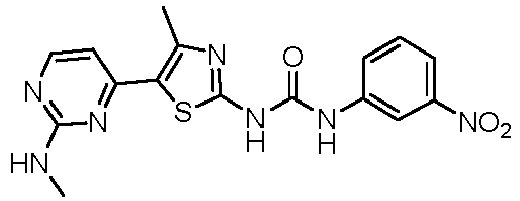
1-(4-Methyl-5-(2-(methylamino)pyrimidin-4-yl)thiazol-2-yl)-3-(3-nitrophenyl)urea 385.1 15 
1-(3-Cyanophenyl)-3-(4-methyl-5-(2-(methylamino)pyrimidin-4-yl)thiazol-2-yl)urea 365.1 16 
1-(3-Methoxyphenyl)-3-(4-methyl-5-(2-(methylamino)pyrimidin-4-yl)thiazol-2-yl)urea 370.1 17 
1-(3-Isopropylphenyl)-3-(4-methyl-5-(2-(methylamino)pyrimidin-4-yl)thiazol-2-yl)urea 382.1 18 
1-(4-Methyl-5-(2-(methylamino)-pyrimidin-4-yl)thiazol-2-yl)-3-(3-(trifluoromethoxy)phenyl)urea 424.0 19 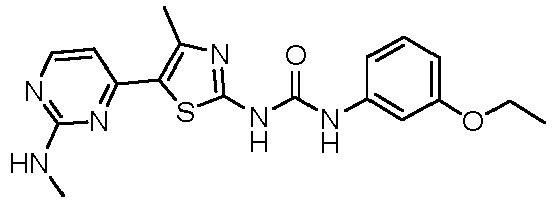
1-(3-Ethoxyphenyl)-3-(4-methyl-5-(2-(methylamino)pyrimidin-4-yl)thiazol-2-yl)urea 384.1 20 
1-(3-(Difluoromethoxy)phenyl)-3-(4-methyl-5-(2-(methylamino)-pyrimidin-4-yl)thiazol-2-yl)urea 406.1 21 
1-(4-Methyl-5-(2-(methylamino)-pyrimidin-4-yl)thiazol-2-yl)-3-(3-(methylthio)phenyl)urea 386.1 22 
1-(4-Methyl-5-(2-(methylamino)-pyrimidin-4-yl)thiazol-2-yl)-3-(3-((trifluoromethyl)thio)phenyl)urea 440.1 23 
1-(4-Methyl-5-(2-(methylamino)pyrimidin-4-yl)-thiazol-2-yl)-3-(3-((trifluoromethyl)-sulfonyl)phenyl)urea 472.1 24 
1-(4-Chloro-3-(trifluoromethyl)-phenyl)-3-(4-methyl-5-(2-(methylamino)-pyrimidin-4-yl)thiazol-2-yl)urea 442.0 25 
1-(4-Fluoro-3-(trifluoromethyl)phenyl)-3-(4-methyl-5-(2-(methylamino)-pyrimidin-4-yl)thiazol-2-yl)urea 426.1 26 
1-(4-Methyl-3-(trifluoromethyl)-phenyl)-3-(4-methyl-5-(2-(methylamino)pyrimidin-4-yl)thiazol-2-yl)urea 422.1 27 
1-(3,4-Bis(trifluoromethyl)phenyl)-3-(4-methyl-5-(2-(methylamino)-pyrimidin-4-yl)thiazol-2-yl)urea 476.1 28 
1-(3-Fluoro-4-(trifluoromethyl)phenyl)-3-(4-methyl-5-(2-(methylamino)-pyrimidin-4-yl)thiazol-2-yl)urea 426.1 29 
1-(3-Chloro-4-methylphenyl)-3-(4-methyl-5-(2-(methylamino)-pyrimidin-4-yl)thiazol-2-yl)urea 388.1 30 
1-(4-Chloro-3-methylphenyl)-3-(4-methyl-5-(2-(methylamino)-pyrimidin-4-yl)thiazol-2-yl)urea 388.1 31 
1-(3-Chloro-4-(morpholinomethyl)phenyl)-3 -(4-methyl-5-(2-(methylamino)-pyrimidin-4-yl)thiazol-2-yl)urea 473.1 32 
1-(4-Methyl-5-(2-(methylamino)-pyrimidin-4-yl)thiazol-2-yl)-3-(4-((4-methylpiperazin-1-yl)methyl)-3-(trifluoromethyl)phenyl)urea 520.2 33 
1-(4-((4-Ethylpiperazin-1-yl)methyl)-3-(trifluoromethyl)phenyl)-3-(4-methyl-5-(2-(methylamino)-pyrimidin-4-yl)thiazol-2-yl)urea 534.2 34 
1-(4-((4-Isopropylpiperazin-1-yl)methyl)-3-(trifluoromethyl)-phenyl)-3-(4-methyl-5-(2-(methylamino)pyrimidin-4-yl)thiazol-2-yl)urea 548.2 35 
1-(4-((4-Acetylpiperazin-1-yl)methyl)-3- (trifluoromethyl)-phenyl)-3-(4-methyl-5-(2-(methylamino)pyrimidin-4-yl)thiazol-2-yl)urea 548.2 36 
1-(4-Methyl-5-(2-(methylamino)-pyrimidin-4-yl)thiazol-2-yl)-3-(4-((4-(methylsulfonyl)piperazin-1-yl)methyl)-3-(trifluoromethyl)-phenyl)urea 584.2 37 
1-(4-Methyl-5-(2-(methylamino)-pyrimidin-4-yl)thiazol-2-yl)-3-(4-(morpholinomethyl)-3-(trifluoromethyl)phenyl)urea 507.2 38 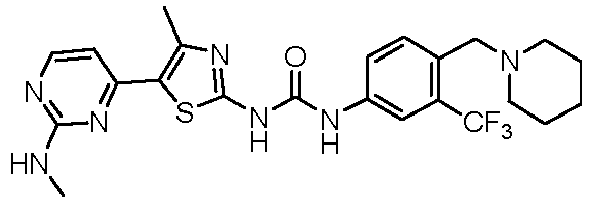
1-(4-Methyl-5-(2-(methylamino)-pyrimidin-4-yl)thiazol-2-yl)-3-(4-(piperidin-1-ylmethyl)-3- (trifluoromethyl)phenyl)urea 505.2 39 
1-(4-((4-Aminopiperidin-1-yl)methyl)-3-(trifluoromethyl)-phenyl)-3-(4-methyl-5-(2-(methylamino)pyrimidin-4-yl)thiazol-2-yl)urea 520.2 40 
1-(4-Methyl-5-(2-(methylamino)-pyrimidin-4-yl)thiazol-2-yl)-3-(4-((4-methylpiperidin-1-yl)methyl)-3-(trifluoromethyl)phenyl)urea 519.2 41 
1-(4-Methyl-5-(2-(methylamino)pyrimidin-4-yl)thiazol-2-yl)-3-(4-(trifluoromethyl)phenyl)urea 408.1 42 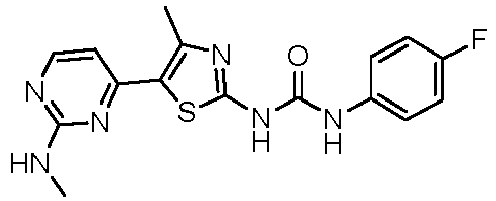
1-(4-Fluorophenyl)-3-(4-methyl-5-(2-(methylamino)pyrimidin-4-yl)thiazol-2-yl)urea 358.1 43 
1-(4-Chlorophenyl)-3-(4-methyl-5-(2-(methylamino)pyrimidin-4-yl)thiazol-2-yl)urea 374.1 44 
1-(4-Methyl-5-(2-(methylamino)pyrimidin-4-yl)thiazol-2-yl)-3-(p-tolyl)urea 354.1 45 
1-(4-Methoxyphenyl)-3-(4-methyl-5-(2-(methylamino)pyrimidin-4-yl)thiazol-2-yl)urea 370.1 46 
1-(5-(2-(Dimethylamino)pyrimidin-4-yl)-4-methylthiazol-2-yl)-3-(3- (trifluoromethyl)phenyl)urea 422.1 47 
1-(3-Chlorophenyl)-3-(5-(2-(dimethylamino)pyrimidin-4-yl)-4-methylthiazol-2-yl)urea 388.1 48 
1-(3-Chloro-4-methylphenyl)-3-(5-(2-(dimethylamino)pyrimidin-4-yl)-4-methylthiazol-2-yl)urea 402.1 49 
1-(5-(2-(Dimethylamino)pyrimidin-4-yl)-4-methylthiazol-2yl)-3-(4-((4-methylpiperazin-1-yl)methyl)-3-(trifluoromethyl)phenyl)urea 534.2 50 
1-(4-((4-Acetylpiperazin-1-yl)methyl)-3- (trifluoromethyl)-phenyl)-3-(5-(2-(dimethylamino)-pyrimidin-4-yl)-4-methylthiazol-2-yl)urea 562.2 51 
1-(5-(2-Aminopyrimidin-4-yl)-4-methylthiazol-2-yl)-3-(3-(trifluoromethyl)phenyl)urea 394.1 52 
1-(5-(2-(Ethylamino)pyrimidin-4-yl)-4-methylthiazol-2 yl)-3-(4-((4-methylpiperazin-1-yl)methyl)-3-(trifluoromethyl)phenyl)urea 534.2 53 
1-(5-(2-(Ethylamino)pyrimidin-4-yl)-4-methylthiazol-2-yl)-3-(4-((4-ethylpiperazin-1-yl)methyl)-3-(trifluoromethyl)phenyl)urea 548.2 54 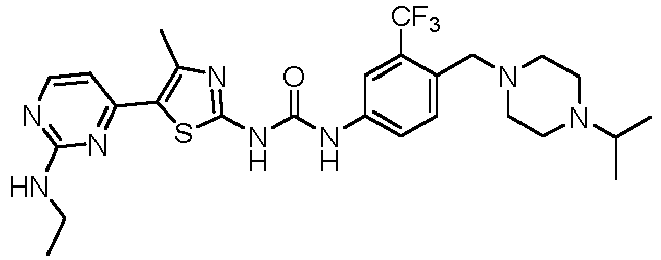
1-(5-(2-(ethylamino)pyrimidin-4-yl)-4-methylthiazol-2 yl)-3-(4-((4-isopropylpiperazin-1-yl)methyl)-3-(trifluoromethyl)phenyl)urea 562.2 55 
1-(4-((4-Acetylpiperazin-1-yl)methyl)-3- (trifluoromethyl)-phenyl)-3-(5-(2-(ethylamino)-pyrimidin-4-yl)-4-methylthiazol-2-yl)urea 562.2 56 
1-(5-(2-(Ethylamino)pyrimidin-4-yl)-4-methylthiazol-2-yl)-3-(4-(morpholinomethyl)-3- (trifluoromethyl)phenyl)urea 521.2 57 
1-(5-(2-(Ethylamino)pyrimidin-4-yl)-4-methylthiazol-2 yl)-3-(4-((4-methylpiperidin-1-yl)methyl)-3-(trifluoromethyl)phenyl)urea 533.2 58 
1-(5-(2-(Methylamino)pyrimidin-4-yl)thiazol-2-yl)-3-(4-((4-methylpiperazin-1-yl)methyl)-3- (trifluoromethyl)phenyl)urea 506.2 59 
1-(4-((4-Ethylpiperazin-1-yl)methyl)-3- (trifluoromethyl)phenyl)-3-(5-(2-(methylamino)pyrimidin-4-yl)thiazol-2-yl)urea 520.2 60 
1-(4-((4-Isopropylpiperazin-1-yl)methyl)-3-(trifluoromethyl)phenyl)-3-(5-(2-(methylamino)pyrimidin-4-yl)thiazol-2-yl)urea 535.2 61 
1-(4-((4-Acetylpiperazin-1-yl)methyl)-3- (trifluoromethyl)phenyl)-3-(5-(2-(methylamino)pyrimidin-4-yl)thiazol-2-yl)urea 535.2 62 
1-(5-(2-Aminopyrimidin-4-yl)-4-methylthiazol-2-yl)-3-(4-((4-ethylpiperazin-1-yl)methyl)-3- (trifluoromethyl)phenyl)urea 521.2 63 
1-(5-(2-Aminopyrimidin-4-yl)-4-methylthiazol-2-yl)-3-(4-((4-isopropylpiperazin-1-yl)methyl)-3- (trifluoromethyl)phenyl)urea 535.2 64 
1-(5-(2-Aminopyrimidin-4-yl)-4-methylthiazol-2-yl)-3-(4-(morpholinomethyl)-3-(trifluoromethyl)phenyl)urea 494.2 65 
1-(5-(5-Chloro-2-(methylamino)pyrimidin-4 yl)-4-methylthiazol-2-yl)-3-(4-((4-methylpiperazin-1-yl)methyl)-3-(trifluoromethyl)phenyl)urea 555.2 66 
1-(5-(5-Chloro-2-(methylamino)pyrimidin-4-yl)-4-methylthiazol-2-yl)-3-(4-((4-ethylpiperazin-1-yl)methyl)-3-(trifluoromethyl)phenyl)urea 569.2 67 
1-(5-(5-Chloro-2-(methylamino)pyrimidin-4-yl)-4-methylthiazol-2 yl)-3-(4-((4-isopropylpiperazin-1-yl)methyl)-3-(trifluoromethyl)phenyl)urea 583.2 68 
1-(4-((4-Acetylpiperazin-1-yl)methyl)-3- (trifluoromethyl)phenyl)-3-(5-(5-chloro-2-(methylamino)pyrimidin-4-yl)-4-methylthiazol-2-yl)urea 583.2 69 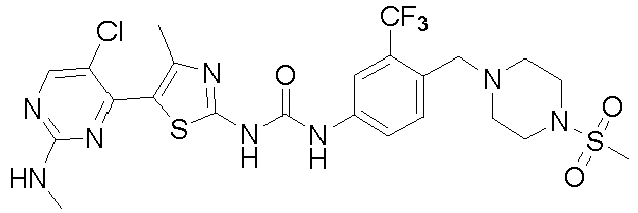
1-(5-(5-Chloro-2-(methylamino)pyrimidin-4-yl)-4-methylthiazol-2-yl)-3-(4-((4-(methylsulfonyl)piperazin-1-yl)methyl)-3-(trifluoromethyl)phenyl)urea 619.1 70 
1-(5-(5-Fluoro-2-(methylamino)pyrimidin-4-yl)-4-methylthiazol-2-yl)-3-(4-(morpholinomethyl)-3- (trifluoromethyl)phenyl)urea 526.2 71 
1-(5-(5-Cyano-2-(methylamino)pyrimidin-4-yl)-4-methylthiazol-2-yl)-3-(4-((4-methylpiperazin-1-yl)methyl)-3-(trifluoromethyl)phenyl)urea 546.2 72 
1-(5-(5-Cyano-2-(methylamino)pyrimidin-4-yl)-4-methylthiazol-2-yl)-3-(4-((4-ethylpiperazin-1-yl)methyl)-3-(trifluoromethyl)phenyl)urea 560.2 73 
1-(5-(5-Cyano-2-(methylamino)pyrimidin-4-yl)-4-methylthiazol-2-yl)-3-(4-((4-isopropylpiperazin-1-yl)methyl)-3-(trifluoromethyl)phenyl)urea 574.2 74 
1-(5-(5-Cyano-2-(methylamino)pyrimidin-4-yl)-4-methylthiazol-2-yl)-3-(4-((4-(methylsulfonyl)piperazin-1-yl)methyl)-3-(trifluoromethyl)phenyl)urea 610.2 75 
1-(5-(5-Cyano-2-(methylamino)pyrimidin-4-yl)-4-methylthiazol-2-yl)-3-(4-(morpholinomethyl)-3- (trifluoromethyl)phenyl)urea 533.2 76 
1-(5-(2-Isopropylpyrimidin-4-yl)-4-methylthiazol-2-yl)-3-(4-((4-methylpiperazin-1-yl)methyl)-3- (trifluoromethyl)phenyl)urea 534.2 77 
1-(4-((4-Acetylpiperazin-1-yl)methyl)-3- (trifluoromethyl)phenyl)-3-(5-(2-isopropylpyrimidin-4-yl)-4-methylthiazol-2-yl)urea 562.2 78 
1-(5-(2-Isopropylpyrimidin-4-yl)-4-methylthiazol-2-yl)-3-(4-((4-(methylsulfonyl)-piperazin-1-yl)methyl)-3-(trifluoromethyl)phenyl)urea 598.2 77 79 
1-(5-(2-Isopropylpyrimidin-4-yl)-4-methylthiazol-2-yl)-3-(4-(morpholinomethyl)-3-(trifluoromethyl)phenyl)urea 521.2 80 
1-(4-Methyl-5-(2-(methylthio)pyrimidin-4-yl)thiazol-2-yl)-3-(4-((4-methyl-piperazin-1-yl)methyl)-3-(trifluoromethyl)phenyl)urea 538.2 81 
1-(4-((4-Acetylpiperazin-1-yl)methyl)-3 - (trifluoromethyl)phenyl)-3-(4-methyl-5-(2-(methylthio)pyrimidin-4-yl)thiazol-2-yl)urea 566.2 82 
1-(4-Methyl-5-(2-(methylthio)pyrimidin-4-yl)thiazol-2-yl)-3-(4-((4-(methylsulfonyl)piperazin-1-yl)methyl)-3-(trifluoromethyl)phenyl)urea 602.1 83 
1-(4-Methyl-5-(2-(methylthio)pyrimidin-4-yl)thiazol-2-yl)-3-(4-(morpholinomethyl)-3-(trifluoromethyl)phenyl)urea 525.1 - Compounds (and pharmaceutically acceptable salts or solvates thereof) may be administered in combination with one or more additional agent(s) for the treatment of cancer or another proliferative disease or condition. For example, the compounds may be used in combination with other anti-cancer agents in order to inhibit more than one cancer signalling pathway simultaneously so as to make cancer cells more susceptible to anti-cancer therapies (eg treatments with other anti-cancer agents, chemotherapy, radiotherapy or a combination thereof). As such, the compounds of formula I may be used in combination with one or more of the following categories of anti-cancer agents:
- other anti-proliferative/antineoplastic drugs and combinations thereof, as used in medical oncology, such as alkylating agents (eg cis-platin, oxaliplatin, carboplatin, cyclophosphamide, nitrogen mustard, melphalan, chlorambucil, busulphan, temozolamide and nitrosoureas); antimetabolites (eg gemcitabine and antifolates such as fluoropyrimidines like 5-fluorouracil and tegafur, raltitrexed, methotrexate, cytosine arabinoside, fludarabine and hydroxyurea); antitumour antibiotics (eg anthracyclines such as adriamycin, bleomycin, doxorubicin, daunomycin, epirubicin, idarubicin, mitomycin-C, dactinomycin and mithramycin); antimitotic agents (eg vinca alkaloids such as vincristine, vinblastine, vindesine and vinorelbine and taxoids including taxol and taxotere and polokinase inhibitors); and topoisomerase inhibitors
(eg epipodophyllotoxins such as etoposide and teniposide, amsacrine, topotecan and camptothecin); - cytostatic agents such as antioestrogens (eg tamoxifen, fulvestrant, toremifene, raloxifene, droloxifene and iodoxyfene), antiandrogens (eg bicalutamide, flutamide, nilutamide and cyproterone acetate), LHRH antagonists or LHRH agonists (eg goserelin, leuprorelin and buserelin), progestogens (eg megestrol acetate), aromatase inhibitors (eg as anastrozole, letrozole, vorazole and exemestane) and inhibitors of 5α-reductase such as finasteride;
- anti-invasion agents (eg c-Src kinase family inhibitors such as 4-(6-chloro-2,3-methylenedioxyanilino)-7-[2-(4-methylpiperazin-1-yl)ethoxy]-5-tetrahydropyran-4-yloxyquinazoline (AZD0530; International Patent Publication No
WO 01/94341 - inhibitors of growth factor function (eg growth factor antibodies and growth factor receptor antibodies such as the anti-erbB2 antibody trastuzumab (Herceptin™), the anti-EGFR antibody panitumumab, the anti-erbB1 antibody cetuximab (Erbitux, C225) and any growth factor or growth factor receptor antibodies disclosed by Stem et al. Critical reviews in oncology/haematology, 2005, Vol. 54, pp11-29). Such inhibitors also include tyrosine kinase inhibitors such as inhibitors of the epidermal growth factor family (eg EGFR family tyrosine kinase inhibitors such as N-(3-chloro-4-fluorophenyl)-7-methoxy-6-(3-morpholinopropoxy) quinazolin-4-amine (gefitinib, ZD1839), N-(3-ethynylphenyl)-6,7-bis(2-methoxyethoxy) quinazolin-4-amine (erlotinib, OSI-774) and 6-acrylamido-N-(3-chloro-4-fluorophenyl)-7-(3-morpholinopropoxy)-quinazolin-4-amine (CI 1033), erbB2 tyrosine kinase inhibitors such as lapatinib); inhibitors of the hepatocyte growth factor family; inhibitors of the insulin growth factor family; inhibitors of the platelet-derived growth factor family such as imatinib and/or nilotinib (AMN107); inhibitors of serine/threonine kinases (eg Ras/Raf signalling inhibitors such as farnesyl transferase inhibitors including sorafenib (BAY 43-9006), tipifarnib (R115777) and lonafamib (SCH66336)), inhibitors of cell signalling through MEK and/or AKT kinases, c-kit inhibitors, abl kinase inhibitors, PI3 kinase inhibitors, Plt3 kinase inhibitors, CSF-1R kinase inhibitors, IGF receptor (insulin-like growth factor) kinase inhibitors; aurora kinase inhibitors (eg AZD1152, PH739358, VX-680, MLN8054, R763, MP235, MP529, VX-528 and AX39459) and cyclin dependent kinase inhibitors such as CDK2 and/or CDK9 inhibitors;
- anti-angiogenic agents such as those which inhibit the effects of vascular endothelial growth factor (eg the anti-vascular endothelial cell growth factor antibody bevacizumab (Avastin™) and VEGF receptor tyrosine kinase inhibitors such as vandetanib (ZD6474), vatalanib (PTK787), sunitinib (SU11248), axitinib (AG-013736), pazopanib (GW 786034) and 4-(4-fluoro-2-methylindol-5-yloxy)-6-methoxy-7-(3-pyrrolidin-1-ylpropoxy)quinazoline (AZD2171; Example 240 within International Patent Publication No
WO 00/47212 WO97/22596 WO 97/30035 WO 97/32856 WO 98/13354 - vascular damaging agents such as Combretastatin A4 and compounds disclosed in International Patent Publication Nos
WO 99/02166 WO 00/40529 WO 00/41669 WO 01/92224 WO 02/04434 WO 02/08213 - an endothelin receptor antagonist such as zibotentan (ZD4054) or atrasentan;
- antisense therapies such as those which are directed to the targets listed above, such as ISIS 2503, an anti-ras antisense;
- gene therapy approaches, including for example approaches to replace aberrant genes such as aberrant p53 or aberrant BRCA1 or BRCA2, GDEPT (gene-directed enzyme pro-drug therapy) approaches such as those using cytosine deaminase, thymidine kinase or a bacterial nitroreductase enzyme and approaches to increase patient tolerance to chemotherapy or radiotherapy such as multi-drug resistance gene therapy; and
- immunotherapy approaches, including for example ex vivo and in vivo approaches to increase the immunogenicity of patient tumour cells, such as transfection with cytokines such as interleukin 2, interleukin 4 or granulocyte-macrophage colony stimulating factor, approaches to decrease T-cell anergy, approaches using transfected immune cells such as cytokine-transfected dendritic cells, approaches using cytokine-transfected tumour cell lines and approaches using anti-idiotypic antibodies.
- Where used in combination with other anti-cancer agents, a compound of the present invention and the other anti-cancer agent can be administered in the same pharmaceutical composition or in separate pharmaceutical compositions. If administered in separate pharmaceutical compositions, the compound and the other anti-cancer agent may be administered simultaneously or sequentially in any order (eg within seconds or minutes or even hours (eg 2 to 48 hours)).
- The present invention is typically applied to the treatment of cancer or another proliferative cell disease or condition in a human subject. However, the subject may also be selected from, for example, livestock animals (eg cows, horses, pigs, sheep and goats), companion animals (eg dogs and cats) and exotic animals (eg non-human primates, tigers, elephants etc).
- Cancers and other proliferative cell diseases and conditions that may be treated in accordance with the present invention include colorectal cancer, biliary tract cancer, brain cancer (including glioblastomas and medulloblastomas), breast cancer, cervical cancer; choriocarcinoma, endometrial cancer, oesophageal cancer, gastric cancer, haematological neoplasms (including acute lymphocytic leukemia (ALL)), chronic lymphocytic leukemia (CLL) and chronic myelogenous leukemia (CML), acute myeloid leukaemia (AML), multiple myeloma, AIDS-associated leukemias and adult T-cell leukemia lymphoma, intraepithelial neoplasms (including Bowen's disease and Paget's disease), liver cancer, lung cancer, lymphomas (including Hodgkin's disease and lymphocytic lymphomas), neuroblastomas, oral cancer (including squamous cell carcinoma), ovarian cancer (including those arising from epithelial cells, stromal cells, germ cells, and mesenchymal cells), pancreatic cancer, prostate cancer, colorectal cancer, sarcomas (including leiomyosarcoma, rhabdomyosarcoma, liposarcoma, fibrosarcoma, and osteosarcoma), skin cancer (including melanoma, Kaposi's sarcoma, basocellular cancer, and squamous cell cancer), testicular cancer (including germinal tumours such as seminoma, non-seminoma teratomas, and choriocarcinomas), stromal tumours, germ cell tumours, thyroid cancer (including thyroid adenocarcinoma and medullar carcinoma), and renal cancer (including adenocarcinoma and Wilms' tumour).
- In some embodiments, the compounds of the present invention are used to treat cancers characterised by over-expression of CDKs (particularly the over-expression of CDK8), for example, colorectal cancer, chronic lymphocytic leukaemia (CLL), lymphoma, leukaemia, breast cancer, lung cancer, prostate cancer, melanoma, pancreatic cancer, ovarian cancer, squamous cancer, carcinoma of head and neck, endometrial cancer, and oesophageal carcinoma (reviewed in Lapenna et al., Nat Rev Drug Discov 8(7):547-66 (2009) and Asghar et al., Nat Rev Drug Discov 14(2): 130-46 (2015)). CDKs and/or cyclin over-expression may be determined by, for example, assessing the amount of mRNA encoding CDK and/or cyclin in a suitable sample using any of the techniques well known to those skilled in the art (eg quantitative amplification techniques such as qPCR).
- The compounds of the present invention may be formulated into a pharmaceutical composition with a pharmaceutically acceptable carrier, diluent and/or excipient. Examples of suitable carriers and diluents are well known to those skilled in the art, and are described in, for example, Remington's Pharmaceutical Sciences, Mack Publishing Co., Easton, PA 1995. Examples of suitable excipients for the various different forms of pharmaceutical compositions described herein may be found in the Handbook of Pharmaceutical Excipients, 2nd Edition, (1994), Edited by A Wade and PJ Weller. Examples of suitable carriers include lactose, starch, glucose, methyl cellulose, magnesium stearate, mannitol, sorbitol and the like. Examples of suitable diluents include ethanol, glycerol and water. The choice of carrier, diluent and/or excipient may be made with regard to the intended route of administration and standard pharmaceutical practice.
- A pharmaceutical composition comprising a compound of the present invention may further comprise any suitable binders, lubricants, suspending agents, coating agents and solubilising agents. Examples of suitable binders include starch, gelatin, natural sugars such as glucose, anhydrous lactose, free-flow lactose, beta-lactose, corn sweeteners, natural and synthetic gums, such as acacia, tragacanth or sodium alginate, carboxymethyl cellulose and polyethylene glycol. Examples of suitable lubricants include sodium oleate, sodium stearate, magnesium stearate, sodium benzoate, sodium acetate, sodium chloride and the like. Preservatives, stabilising agents, dyes and even flavouring agents may be provided in the pharmaceutical composition. Examples of preservatives include sodium benzoate, sorbic acid and esters of p-hydroxybenzoic acid. Anti-oxidants and suspending agents may be also used.
- A pharmaceutical composition comprising a compound of the present invention may be adapted for oral, rectal, vaginal, parenteral, intramuscular, intraperitoneal, intraarterial, intrathecal, intrabronchial, subcutaneous, intradermal, intravenous, nasal, buccal or sublingual routes of administration. For oral administration, particular use may be made of compressed tablets, pills, tablets, gellules, drops, and capsules. For other forms of administration, a pharmaceutical composition may comprise solutions or emulsions which may be injected intravenously, intraarterially, intrathecally, subcutaneously, intradermally, intraperitoneally or intramuscularly, and which are prepared from sterile or sterilisable solutions. A pharmaceutical composition comprising a compound of the present invention may also be in form of suppositories, pessaries, suspensions, emulsions, lotions, ointments, creams, gels, sprays, solutions or dusting powders. A pharmaceutical composition may be formulated in unit dosage form (ie in the form of discrete portions containing a unit dose, or a multiple or sub-unit of a unit dose).
- The compounds of the present invention may be provided as a pharmaceutically acceptable salt including, for example, suitable acid addition or base salts thereof. A review of suitable pharmaceutical salts may be found in Berge et al., JPharm Sci 66:1-19 (1977). Salts are formed, for example with strong inorganic acids such as mineral acids (eg sulfuric acid, phosphoric acid or hydrohalic acids), with strong organic carboxylic acids, such as alkanecarboxylic acids of 1 to 4 carbon atoms which are unsubstituted or substituted (eg by halogen), such as acetic acid, with saturated or unsaturated dicarboxylic acids (eg oxalic, malonic, succinic, maleic, fumaric, phthalic or tetraphthalic acid), with hydroxycarboxylic acids (eg ascorbic, glycolic, lactic, malic, tartaric or citric acid), with amino acids (eg aspartic or glutamic acid), with benzoic acid, or with organic sulfonic acids (eg (C1-C4)-alkyl- or aryl-sulfonic acids which are unsubstituted or substituted by, for example, halogen) such as methane- or p-toluene sulfonic acid).
- The compounds of the present invention may be provided in their various crystalline forms, polymorphic forms and (an)hydrous forms. In this regard, it is well known to those skilled in the art that chemical compounds may be isolated in any of such forms by slightly varying the method of purification and or isolation from the solvents used in the synthetic preparation of such compounds.
- The present invention further provides a method of synthesising a compound according to the present invention, or a pharmaceutically acceptable salt or solvate thereof.
- In some embodiments, a compound according to the present invention is synthesised by, for example, the following Scheme 1; involving reaction between pyrimidine precursors (F) and isocyanatobenzenes (G) which can be obtained from suitable aniline and triphosgene in the presence of bases, e.g. triethylamine, potassium hydroxide, sodium carbonate, and cesium carbonate. The pyrimidine precursors (F) can be prepared by reacting acrylates (B) or (D) with suitable amidines or guanidines by a number of methods well known to those skilled in the art. Alternatively, (F) can be obtained from suitable pyrimidine precursors directly, e.g. from 2,4-disubstituted (halogen, amine, etc.) pyrimidines by successive substitution reactions. Acrylates (B) or (D) which may be particularly suitable for the purpose of synthesising compounds according to the present invention, may be obtained from heterocyclic ketones (A) and (C) by condensation with the respective acetaldehydes and N,N-dimethylformamide dimethyl acetal.

- The present invention is hereinafter further described by way of the following, non-limiting examples:
- 1H spectra were recorded at 298 K on a Bruker AVANCE III HD 500 spectrometer and were analysed using Bruker Topspin 3.2 software. 1H NMR signals are reported with chemical shift values δ (ppm), multiplicity (s = singlet, d = doublet, t = triplet, q = quartet, dd = doublet of doublets, m = multiplet and br = broad), relative integral, coupling constants J (Hz) and assignments. High resolution mass spectra were recorded on an AB SCIEX TripleTOF 5600 mass spectrometer (Concord, ON, Canada), and ionisation of all samples was carried out using ESI.
- General synthetic procedure. To a solution of triphosgene (0.4 equiv) in dry DCM at 0°C under N2 was added dropwise a solution of aniline (1.0 equiv) and triethylamine (1.0 equiv) in DCM. The reaction mixture was stirred for 1 h at room temperature. A solution of an appropriate thiazole-2-amine (1.0 equiv) and triethylamine (1.0 equiv) in DMSO was then added and the reaction mixture was stirred overnight. Water was added to the mixture, and the residue was purified by Biotage® FlashMaster Personal+ chromatography (silica gel), and crystallised if necessary, to give the desired compounds.
- Prepared by treating 4-methyl-5-(2-(methylamino)pyrimidin-4-yl)thiazol-2-amine (100 mg, 452 µmol) and aniline (42.0 mg, 452 µmol) according to the general synthetic procedure to produce a white solid (77.0 mg, 54%). 1H NMR (DMSO-d6) δ 2.55 (s, 3H), 2.82 (d, 3H, J 4.5), 6.76 (d, 1H, J 4.5), 7.03-7.07 (m, 2H), 7.32 (t, 2H, J 8.0), 7.49 (d, 2H), 8.25 (app s, 1H), 9.01 (br s, 1H), 10.60 (br s, 1H). HRMS m/z 341.1179.
- 1-(4-methyl-5-(2-(methylamino)pyrimidin-4-yl)thiazol-2-yl)-3-(2-(trifluoromethyl)phenyl)urea (2) Prepared by treating 4-methyl-5-(2-(methylamino)pyrimidin-4-yl)thiazol-2-amine (100 mg, 452 µmol) and 2-(trifluoromethyl)aniline (72 mg, 452 µmol) according to the general synthetic procedure to produce a white solid (63.0 mg, 34%). 1H NMR (DMSO-d6) δ 2.56 (s, 3H), 2.81 (d, 3H, J 3.0), 6.77 (s, 1H,), 7.06 (s, 1H), 7.36 (t, 1H, J 8.0), 7.67-7.74 (m, 2H), 7.98 (d, 1H, J 8.5), 8.26 (s, 1H), 8.73 (br s, 1H), 11.30 (br s, 1H). HRMS m/z 409.1060.
- Prepared by treating 4-methyl-5-(2-(methylamino)pyrimidin-4-yl)thiazol-2-amine (100 mg, 452 µmol) and 2-fluoroaniline (83.0 mg, 452 µmol) according to the general synthetic procedure to produce a white solid (105 mg, 65%). 1H NMR (DMSO-d6) δ 2.55 (s, 3H), 2.82 (s, 3H, J 4.5), 6.77 (d, 1H, J 4.5), 7.07 (app d, 1H, J 4.5), 7.08-7.7.11 (m, 1H), 7.19 (t, 1H, J 8.0), 7.26-7.30 (m, 1H), 8.13 (t, 1H, J 8.0), 8.26 (app s, 1H), 9.02 (br s, 1H), 10.86 (br s, 1H). HRMS m/z 359.1091.
- Prepared by treating 4-methyl-5-(2-(methylamino)pyrimidin-4-yl)thiazol-2-amine (100 mg, 452 µmol) and 2-methoxyaniline (55.0 mg, 452 µmol) according to the general synthetic procedure to produce a white solid (90.0 mg, 54%). 1H NMR (DMSO-d6) δ 2.56 (s, 3H), 2.82 (s, 3H, J 4.5), 3.88 (s, 3H), 6.76 (d, 1H, J 4.5), 6.93 (t, 1H, J 8.0), 7.01-7.06 (m, 2H), 8.11 (d, 2H, J 8.0), 8.25 (app s, 1H), 8.84 (br s, 1H), 11.13 (br s, 1H). HRMS m/z 371.1279.
- 1-(3-chloro-4-(trifluoromethyl)phenyl)-3-(4-methyl-5-(2-(methylamino)pyrimidin-4-yl)thiazol-2-yl)urea (5) Prepared by reacting 4-methyl-5-(2-(methylamino)pyrimidin-4-yl)thiazol-2-amine (100 mg, 452 µmol) and 3-chloro-4-(trifluoromethyl)aniline (88.0 mg, 452 µmol) according to the general synthetic procedure to produce a white solid (70.0 mg, 35%). 1H NMR (DMSO-d6) δ 2.56 (s, 3H), 2.83 (d, 3H, J 4.5), 6.64 (app d, 1H, J 4.5), 7.09 (app d, 1H, J 4.5) 7.62 (d, 1H, J 8.0), 7.76(d, 1H, J 9.0), 7.98 (s, 1H), 8.26 (s, 1H), 9.62 (brs, 1H), 11.03 (brs, 1H). HRMS m/z 443.0668.
- 1-(4-fluoro-2-methylphenyl)-3-(4-methyl-5-(2-(methylamino)pyrimidin-4-yl)thiazol-2-yl)urea (6) Prepared by reacting 4-methyl-5-(2-(methylamino)pyrimidin-4-yl)thiazol-2-amine (100 mg, 452 µmol) and 4-fluoro-2-methylaniline (56.0 mg, 452 µmol) according to the general synthetic procedure to produce a white solid (93.0 mg, 56%). 1H NMR (DMSO-d6) δ 2.25 (s, 3H), 2.55 (s, 3H), 2.81 (d, 3H, J 4.5), 6.75 (d, 1H, J 4.0), 6.70-7.05 (m, 2H), 7.10 (dd, 1H, J 9.5 & 3.0), 7.78 (dd, 1H, J 8.5 & 5.5), 8.25 (s, 1H), 8.44 (brs, 1H), 10.94 (brs, 1H). HRMS m/z 373.1246.
- 1-(4-fluoro-2-(trifluoromethyl)phenyl)-3-(4-methyl-5-(2-(methylamino)pyrimidin-4-yl)thiazol-2-yl)urea (7) Prepared by reacting 4-methyl-5-(2-(methylamino)pyrimidin-4-yl)thiazol-2-amine (100 mg, 452 µmol) and 4-fluoro-2-(trifluoromethyl)aniline (81 mg, 452 µmol) according to the general synthetic procedure to produce a white solid (68.0 mg, 35%). 1H NMR (DMSO-d6) δ 2.55 (s, 3H), 2.81 (d, 3H, J 4.5), 6.76 (app s, 1H), 7.06 (app d, 1H, J 3.0), 7.37 (d, 1H, J 7.5), 7.54 (t, 1H, J 8.0), 7.68 (d, 1H, J 7.5), 8.04 (s, 1H), 8.25 (s, 1H), 9.38 (brs, 1H), 11.21 (brs, 1H). HRMS m/z 427.0958.
- 1-(2,4-bis(trifluoromethyl)phenyl)-3-(4-methyl-5-(2-(methylamino)pyrimidin-4-yl)thiazol-2-yl)urea (8) Prepared by reacting 4-methyl-5-(2-(methylamino)pyrimidin-4-yl)thiazol-2-amine (100 mg, 452 µmol) and 2,4-bis(trifluoromethyl)aniline (103 mg, 452 µmol) according to the general synthetic procedure to produce a white solid (120 mg, 56%). 1H NMR (DMSO-d6) δ 2.56 (s, 3H), 2.82 (d, 3H, J 4.0), 6.78 (app s, 1H), 7.08 (s, 1H), 8.00 (s, 1H), 8.07 (d, 1H, J 8.0), 8.26 (app s, 1H), 8.40 (d, 1H, J 8.0), 8.90 (br s, 1H), 11.56 (br s, 1H). HRMS m/z 477.0930.
- 1-(2,5-bis(trifluoromethyl)phenyl)-3-(4-methyl-5-(2-(methylamino)pyrimidin-4-yl)thiazol-2-yl)urea (9) Prepared by treating 4-methyl-5-(2-(methylamino)pyrimidin-4-yl)thiazol-2-amine (100 mg, 452 µmol) and 2,5-bis(trifluoromethyl)aniline (103 mg, 452 µmol) according to the general synthetic procedure to produce a white solid (77.0 mg, 36%). 1H NMR (DMSO-d6) δ 2.56(s, 3H), 2.82 (s, 3H, J 4.0), 6.78 (s, 1H), 7.08 (s, 1H), 7.70 (d, 1H, J 8.0), 7.80 (d, 1H, J 8.0), 8.26 (s, 1H), 8.48 (s, 1H), 8.95 (brs, 1H), 11.49 (brs, 1H). HRMS m/z 477.0925.
- 1-(4-methyl-5-(2-(methylamino)pyrimidin-4-yl)thiazol-2-yl)-3-(3-(trifluoromethyl)phenyl)urea (10) Prepared by treating 4-methyl-5-(2-(methylamino)pyrimidin-4-yl)thiazol-2-amine (100 mg, 452 µmol) and 3-(trifluoromethyl)aniline (72 mg, 452 µmol) according to the general synthetic procedure to produce a white solid (43.0 mg, 23%). 1H NMR (DMSO-d6) δ 2.55 (s, 3H), 2.83 (d, 3H, J 3.5), 6.76 (d, 1H, J 3.0), 7.06 (d, 1H, J 3.0), 7.59 (t, 1H, J 6.5) 7.65 (d, 1H, J 8.5), 7.93 (s, 1H), 8.25 (s, 1H), 8.72 (brs, 1H), 11.01 (brs, 1H). HRMS m/z 409.1060.
- Prepared by treating 4-methyl-5-(2-(methylamino)pyrimidin-4-yl)thiazol-2-amine (100 mg, 452 µmol) and 3-chloroaniline (57.0 mg, 452 µmol) according to the general synthetic procedure to produce a white solid (82.0 mg, 49%). 1H NMR (DMSO-d6) δ 2.55 (s, 3H), 2.82 (d, 3H, J 3.5), 6.76 (s, 1H), 7.08 (d, 2H, J 7.0), 7.34 (d, 2H, J 8.0), 7.74 (s, 1H) 8.25 (s, 1H), 9.21 (brs, 1H), 10.75 (brs, 1H). HRMS m/z 375.0790.
- Prepared by treating 4-methyl-5-(2-(methylamino)pyrimidin-4-yl)thiazol-2-amine (100 mg, 452 µmol) and 4-chloro-3-methylaniline (77.0 mg, 452 µmol) according to the general synthetic procedure to produce a white solid (59.0 mg, 31%). 1H NMR (DMSO-d6) δ 2.55 (s, 3H), 2.83 (d, 3H, J 4.0), 6.75 (d, 1H, J 4.0), 7.06 (d, 1H, J 4.5), 7.22 (d, 1H, J 8.0), 7.27 (t, 1H, J 8.0), 7.40 (d, 1H, J 6.5), 7.88 (s, 1H), 8.25 (s, 1H), 9.20 (brs, 1H), 10.80 (brs, 1H). HRMS m/z 419.0276.
- Obtained by treating 4-methyl-5-(2-(methylamino)pyrimidin-4-yl)thiazol-2-amine (100 mg, 452 µmol) and m-toluidine (48.0 mg, 452 µmol) according to the general synthetic procedure to produce a white solid (69.0 mg, 43%). 1H NMR (DMSO-d6) δ 2.30 (s, 3H), 2.55 (s, 3H), 2.83 (s, 3H, J 5.0), 6.75 (d, 1H, J 5.0), 6.86 (d, 1H, J 7.5), 7.05 (d, 1H, J 5.0), 7.20 (t, 1H, J 8.0), 7.26 (d, 1H, J 8.0), 7.34 (s, 1H), 8.25 (s, 1H), 8.92 (brs, 1H), 10.59 (brs, 1H). HRMS m/z 355.1333.
- Obtained by treating 4-methyl-5-(2-(methylamino)pyrimidin-4-yl)thiazol-2-amine (100 mg, 452 µmol) and 3-nitroaniline (62.0 mg, 452 µmol) according to the general synthetic procedure to produce a yellow solid (22.0 mg, 12%). 1H NMR (DMSO-d6) δ 2.56 (s, 3H), 2.83 (d, 3H, J 5.0), 6.76 (d, 1H, J 5.0), 7.08 (q, 1H, J 5.0), 7.59 (t, 1H, J 8.5), 7.83 (d, 1H, J 8.0), 7.88 (d, 1H, J 8.0), 8.26 (s, 1H), 8.61 (s, 1H), 9.56 (brs, 1H), 11.00 (brs, 1H). HRMS m/z 386.1035.
- Obtained by treating 4-methyl-5-(2-(methylamino)pyrimidin-4-yl)thiazol-2-amine (100 mg, 452 µmol) and 3-aminobenzonitrile (53.0 mg, 452 µmol) according to the general synthetic procedure to produce a white solid (15.0 mg, 9%). 1H NMR (DMSO-d6) δ 2.55 (s, 3H), 2.83 (d, 3H, J 4.5), 6.75 (d, 1H, J 4.5), 7.06 (d, 1H, J 4.0), 7.22 (d, 1H, J7.5) 7.27 (t, 1H, J 8.0), 7.40 (d, 1H, J 7.0), 7.88 (s, 1H), 8.25 (s, 1H), 9.20 (brs, 1H), 10.76 (brs, 1H). HRMS m/z 366.1127.
- Obtained by treating 4-methyl-5-(2-(methylamino)pyrimidin-4-yl)thiazol-2-amine (100 mg, 452 µmol) and 3-methoxyaniline (55.0 mg, 452 µmol) according to the general synthetic procedure to produce a white solid (78.0 mg, 47%). 1H NMR (DMSO-d6) δ 2.55 (s, 3H), 2.82 (s, 3H, J 4.0), 3.75 (s, 3H), 6.62 (d, 1H, J 7.0), 6.76 (d, 1H, J 3.5), 6.99 (d, 1H, J 7.0), 7.06 (d, 1H, J 4.5), 7.21 (d, 1H, J 8.0), 7.23 (s, 1H), 8.25 (s, 1H), 9.01 (brs, 1H), 10.58 (brs, 1H). HRMS m/z 371.1285.
- Obtained by treating 4-methyl-5-(2-(methylamino)pyrimidin-4-yl)thiazol-2-amine (100 mg, 452 µmol) and 3-isopropylaniline (61.0 mg, 452 µmol) according to the general synthetic procedure to produce a white solid (45.0 mg, 26%). 1H NMR (DMSO-d6) δ 1.20 (d, 6H, J 7.0), 2.55 (s, 3H), 2.83 (d, 3H, J 4.0), 2.86-2.90 (m, 1H), 6.76 (d, 1H, J 4.0), 6.93 (d, 1H, J 7.0), 7.05 (d, 1H, J 4.5), 7.23 (t, 1H, J 7.5), 7.28 (d, 1H, J 7.5), 7.38 (s, 1H), 8.25 (s, 1H), 8.94 (brs, 1H), 10.57 (brs, 1H). HRMS m/z 383.1655.
- Obtained by treating 4-methyl-5-(2-(methylamino)pyrimidin-4-yl)thiazol-2-amine (100 mg, 452 µmol) and 3-ethoxyaniline (62.0 mg, 452 µmol) according to the general synthetic procedure to produce a white solid (58.0 mg, 33%). 1H NMR (DMSO-d6) δ 1.33 (t, 3H, J 7.0), 2.55 (s, 3H), 2.82 (d, 3H, J 4.5), 4.01 (q, 2H, J 7.0), 6.35 (d, 1H, J 7.0), 6.75 (d, 1H, J 4.5), 6.97 (d, 1H, J 7.5), 7.06 (d, 1H, J 4.5), 7.18-7.21 (m, 2H), 8.25 (s, 1H), 9.00 (brs, 1H), 10.53 (brs, 1H). HRMS m/z 385.1438.
- 1-(3-(difluoromethoxy)phenyl)-3-(4-methyl-5-(2-(methylamino)pyrimidin-4-yl)thiazol-2-yl)urea (20) Obtained by treating 4-methyl-5-(2-(methylamino)pyrimidin-4-yl)thiazol-2-amine (100 mg, 452 µmol) and 3-(difluoromethoxy)aniline (72.0 mg, 452 µmol) according to the general synthetic procedure to produce a white solid (49.0 mg, 27%). 1H NMR (DMSO-d6) δ 2.55 (s, 3H), 2.82 (d, 3H, J 4.5), 6.76 (d, 1H, J 4.5), 6.84 (d, 1H, J 7.0), 7.06 (d, 1H, J 4.5), 7.20 (t, 1H, J 74.5), 7.27 (d, 1H, J 7.5), 7.36 (t, 1H, J 8.0), 7.50 (s, 1H), 8.25 (s, 1H), 9.23 (brs, 1H), 10.71 (brs, 1H). HRMS m/z 407.1099.
- 1-(4-methyl-5-(2-(methylamino)pyrimidin-4-yl)thiazol-2-yl)-3-(3-(methylthio) phenyl)urea (21) Obtained by treating 4-methyl-5-(2-(methylamino)pyrimidin-4-yl)thiazol-2-amine (100 mg, 452 µmol) and 3-(methylthio)aniline (63.0 mg, 452 µmol) according to the general synthetic procedure to produce a white solid (74.0 mg, 43%). 1H NMR (DMSO-d6) δ 2.53 (s, 3H), 2.58 (s, 3H), 2.85 (d, 3H, J 3.5), 6.78 (s, 1H), 6.95 (d, 1H, J 7.0), 7.09 (d, 1H, J 4.5), 7.24 (s, 1H), 7.28 (t, 1H, J 8.0), 7.52 (s, 1H), 8.28 (s, 1H), 9.08 (brs, 1H), 10.69 (brs, 1H). HRMS m/z 387.1062.
- 1-(4-methyl-5-(2-(methylamino)pyrimidin-4-yl)thiazol-2-yl)-3-(3-((trifluoromethyl) thio)phenyl)-urea (22) Obtained by treating 4-methyl-5-(2-(methylamino)pyrimidin-4-yl)thiazol-2-amine (100 mg, 452 µmol) and 3-((trifluoromethyl)thio)aniline (87.0 mg, 452 µmol) according to the general synthetic procedure to produce a white solid (53.0 mg, 27%). 1H NMR (DMSO-d6) δ 2.56 (s, 3H), 2.83 (d, 3H, J 5.0), 6.76 (d, 1H, J 5.0), 7.07 (q, 1H, J 4.5), 7.37 (d, 1H, J 7.5), 7.48 (t, 1H, J 8.0), 7.64 (d, 1H, J 8.0), 8.03 (s, 1H), 8.26 (s, 1H), 9.33 (brs, 1H), 10.81 (brs, 1H). HRMS m/z 441.0781.
- 1-(4-methyl-5-(2-(methylamino)pyrimidin-4-yl)thiazol-2-yl)-3-(3-((trifluoromethyl) sulfonyl)-phenyl)urea (23) Obtained by treating 4-methyl-5-(2-(methylamino)pyrimidin-4-yl)thiazol-2-amine (100 mg, 452 µmol) and 3-((trifluoromethyl)sulfonyl)aniline (101 mg, 452 µmol) according to the general synthetic procedure to produce a white solid (89.0 mg, 42%). 1H NMR (DMSO-d6) δ 2.56 (s, 3H), 2.83 (d, 3H, J 4.5), 6.76 (d, 1H, J 4.0), 7.11 (d, 1H, J 5.0), 7.98 (d, 2H, J 9.0), 8.03 (d, 2H, J 9.0), 8.27 (s, 1H), 9.94 (brs, 1H), 11.24 (brs, 1H). HRMS m/z 473.0670.
- 1-(4-chloro-3-(trifluoromethyl)phenyl)-3-(4-methyl-5-(2-(methylamino)pyrimidin-4-yl)thiazol-2-yl)urea (24) Obtained by treating 4-methyl-5-(2-(methylamino)pyrimidin-4-yl)thiazol-2-amine (100 mg, 452 µmol) and 4-chloro-3-(trifluoromethyl)aniline (88.0 mg, 452 µmol) according to the general synthetic procedure to produce a white solid (76.0 mg, 38%). 1H NMR (DMSO-d6) δ 2.55 (s, 3H), 2.81 (d, 3H, J 5.0), 6.74 (d, 1H, J 4.5), 7.06 (d, 1H, J 5.0), 7.62 (d, 1H, J 8.5), 7.77(d, 1H, J 8.0), 8.16 (s, 1H), 8.25 (s, 1H), 9.57 (brs, 1H), 11.40 (brs, 1H). HRMS m/z 443.0668.
- 1-(4-fluoro-3-(trifluoromethyl)phenyl)-3-(4-methyl-5-(2-(methylamino)pyrimidin-4-yl)thiazol-2-yl)urea (25) Obtained by treating 4-methyl-5-(2-(methylamino)pyrimidin-4-yl)thiazol-2-amine (100 mg, 452 µmol) and 4-fluoro-3-(trifluoromethyl)aniline (81.0 mg, 452 µmol) according to the general synthetic procedure to produce a white solid (102 mg, 53%). 1H NMR (DMSO-d6) δ 2.55 (s, 3H), 2.82 (d, 3H, J 5.0), 6.75 (d, 1H, J5.0), 7.07 (q, 1H, J 5.0), 7.46 (t, 1H, J 9.5), 7.75 (t, 1H, J 4.5), 8.04 (d, 1H, J 4.5), 8.25 (s, 1H), 9.38 (brs, 1H). HRMS m/z 427.0955.
- 1-(4-methyl-3-(trifluoromethyl)phenyl)-3-(4-methyl-5-(2-(methylamino)pyrimidin-4-yl)thiazol-2-yl)urea (26) Obtained by treating 4-methyl-5-(2-(methylamino)pyrimidin-4-yl)thiazol-2-amine (100 mg, 452 µmol) and 4-methyl-3-(trifluoromethyl)aniline (79.0 mg, 452 µmol) according to the general synthetic procedure to produce a white solid (42.0 mg, 22%). 1H NMR (DMSO-d6) δ 2.39 (s, 3H), 2.55 (s, 3H), 2.82 (d, 3H, J 5.0), 6.76 (d, 1H, J 5.0), 7.06 (q, 1H, J 4.5), 7.37 (d, 1H, J 5.5), 7.59 (d, 1H, J 8.0), 7.96 (s, 1H), 8.25 (s, 1H), 9.25 (brs, 1H), 10.80 (brs, 1H). HRMS m/z 423.1213.
- 1-(3.4-bis(trifluoromethyl)phenyl)-3-(4-methyl-5-(2-(methylamino)pyrimidin-4-yl)thiazol-2-yl)urea (27) Obtained by treating 4-methyl-5-(2-(methylamino)pyrimidin-4-yl)thiazol-2-amine (100 mg, 452 µmol) and 3,4-bis(trifluoromethyl)aniline (103 mg, 452 µmol) according to the general synthetic procedure to produce a white solid (88.0 mg, 41%). 1H NMR (DMSO-d6) δ 2.56 (s, 3H), 2.83 (d, 3H, J 3.5), 6.76 (s, 1H), 7.10 (d, 1H, J 4.0), 7.95 (d, 1H, J 8.5), 7.99 (s, 1H), 8.27 (s, 1H), 8.29 (s, 1H), 9.82 (brs, 1H). HRMS m/z 477.0932.
- 1-(3-fluoro-4-(trifluoromethyl)phenyl)-3-(4-methyl-5-(2-(methylamino)pyrimidin-4-yl)thiazol-2-yl)urea (28) Obtained by treating 4-methyl-5-(2-(methylamino)pyrimidin-4-yl)thiazol-2-amine (100 mg, 452 µmol) and 3-fluoro-4-(trifluoromethyl)aniline (81.0 mg, 452 µmol) according to the general synthetic procedure to produce a white solid (77.0 mg, 40%). 1H NMR (DMSO-d6) δ 2.56 (s, 3H), 2.83 (d, 3H, J 4.5), 6.75 (d, 1H, J4.5), 7.09 (q, 1H, J 4.5), 7.45 (d, 1H, J 8.5), 7.68 (t, 1H, J 8.5), 7.77 (d, 1H, J 8.5), 8.26 (s, 1H), 9.65 (brs, 1H). HRMS m/z 427.0953.
- 1-(3-chloro-4-methylphenyl)-3-(4-methyl-5-(2-(methylamino)pyrimidin-4-yl)thiazol-2-yl)urea (29) Obtained by treating 4-methyl-5-(2-(methylamino)pyrimidin-4-yl)thiazol-2-amine (100 mg, 452 µmol) and 3-chloro-4-methylaniline (63.0 mg, 452 µmol) according to the general synthetic procedure to produce a white solid (71.0 mg, 41%). 1H NMR (DMSO-d6) δ 2.27 (s, 3H), 2.55 (s, 3H), 2.81 (d, 3H, J 4.5), 6.75 (d, 1H, J 4.5), 7.05 (d, 1H, J 4.0), 7.27 (d, 2H, J 8.0), 7.71 (s, 1H), 8.25 (s, 1H), 9.11 (brs, 1H), 10.79 (brs, 1H). HRMS m/z 389.0953.
- 1-(4-chloro-3-methylphenyl)-3-(4-methyl-5-(2-(methylamino)pyrimidin-4-yl)thiazol-2-yl)urea (30) Obtained by treating 4-methyl-5-(2-(methylamino)pyrimidin-4-yl)thiazol-2-amine (100 mg, 452 µmol) and 4-chloro-3-methylaniline (63.0 mg, 452 µmol) according to the general synthetic procedure to produce a white solid (105 mg, 60%). 1H NMR (DMSO-d6) δ 2.31 (s, 3H), 2.55 (s, 3H), 2.82 (d, 3H, J 5.0), 6.75 (d, 1H, J 5.0), 7.05 (d, 1H, J 4.5), 7.33 (d, 1H, J 9.0), 7.36 (d, 1H, J 10.5), 7.50 (s, 1H), 8.25 (s, 1H), 9.05 (brs, 1H), 10.69 (brs, 1H). HRMS m/z 389.0950.
- 1-(3-chloro-4-(morpholinomethyl)phenyl)-3-(4-methyl-5-(2-(methylamino)pyrimidin-4-yl)thiazol-2-yl)urea (31) Obtained by treating 4-methyl-5-(2-(methylamino)pyrimidin-4-yl)thiazol-2-amine (100 mg, 452 µmol) and 3-chloro-4-(morpholinomethyl)aniline (101 mg, 452 µmol) according to the general synthetic procedure to produce a white solid (63.0 mg, 30%). 1H NMR (DMSO-d6) δ 2.39 (t, 4H, J 4.5), 2.50 (s, 3H), 2.82(d, 3H, J 4.5), 3.50 (s, 2H), 3.57 (t, 4H, J 4.0), 6.75 (d, 1H, J 4.5), 7.05 (d, 1H, J 4.5), 7.35 (d, 1H, J 7.5), 7.39 (d, 1H, J 8.0), 7.73 (s, 1H) 8.24 (s, 1H), 9.29 (brs, 1H), 10.97 (brs, 1H). HRMS m/z 473.1406.
- 1-(4-methyl-5-(2-(methylamino)pyrimidin-4-yl)thiazol-2-yl)-3-(4-((4-methylpiperazin-1-yl)methyl)-3-(trifluoromethyl)phenyl)urea (32) Obtained by treating 4-methyl-5-(2-(methylamino)pyrimidin-4-yl)thiazol-2-amine (100 mg, 452 µmol) and 4-((4-methylpiperazin-1-yl)methyl)-3-(trifluoromethyl)aniline (123 mg, 452 µmol) according to the general synthetic procedure to produce a white solid (73.0 mg, 31%). 1H NMR (CD3OD/CDCl3) δ 2.27 (s, 3H), 2.48 (brs, 8H), 2.61 (s, 3H), 2.97(s, 3H), 3.60 (s, 2H), 6.74 (d, 1H, J 5.0), 7.64 (dd, 1H, J 8.5 & 2.5), 7.68 (d, 1H, J 8.5), 7.79 (d, 1H, J 2.0), 8.15 (d, 1H, J 5.0). HRMS m/z 521.2057.
- 1-(4-((4-ethylpiperazin-1-yl)methyl)-3-(trifluoromethyl)phenyl)-3-(4-methyl-5-(2-(methylamino)pyrimidin-4-yl)thiazol-2-yl)urea (33) Obtained by treating 4-methyl-5-(2-(methylamino)pyrimidin-4-yl)thiazol-2-amine (100 mg, 452 µmol) and 4-((4-ethylpiperazin-1-yl)methyl)-3-(trifluoromethyl)aniline (129 mg, 452 µmol) according to the general synthetic procedure to produce a white solid (55.0 mg, 23%). 1H NMR (CD3OD/CDCl3) δ 1.09 (t, 3H, J 7.5), 2.44 (q, 2H, J 7.0), 2.49 (brs, 8H), 2.61 (s, 3H), 2.97(s, 3H), 3.62 (s, 2H), 6.75 (d, 1H, J 5.5), 7.64 (d, 1H, J 8.5), 7.68 (d, 1H, J 8.5), 7.82 (s, 1H), 8.15 (d, 1H, J 5.0). HRMS m/z 535.2205.
- 1-(4-((4-isopropylpiperazin-1-yl)methyl)-3-(trifluoromethyl)phenyl)-3-(4-methyl-5-(2-(methylamino)pyrimidin-4-yl)thiazol-2-yl)urea (34) Obtained by treating 4-methyl-5-(2-(methylamino)pyrimidin-4-yl)thiazol-2-amine (100 mg, 452 µmol) and 4-((4-isopropylpiperazin-1-yl)methyl)-3-(trifluoromethyl)aniline (136 mg, 452 µmol) according to the general synthetic procedure to produce a white solid (112 mg, 45%). 1H NMR (CD3OD/CDCl3) δ 1.07 (d, 6H, J 6.0), 2.52-2.66 (m, 12H), 2.96 (s, 3H), 3.61 (s, 2H), 6.74 (d, 1H, J 5.5), 7.65 (d, 1H, J 7.5), 7.73 (d, 1H, J 8.5), 7.82 (s, 1H), 8.16 (d, 1H, J 5.0). HRMS m/z 549.2369.
- 1-(4-((4-acetylpiperazin-1-yl)methyl)-3-(trifluoromethyl)phenyl)-3-(4-methyl-5-(2-(methylamino)pyrimidin-4-yl)thiazol-2-yl)urea (35) Obtained by treating 4-methyl-5-(2-(methylamino)pyrimidin-4-yl)thiazol-2-amine (100 mg, 452 µmol) and 1-(4-(4-amino-2-(trifluoromethyl)benzyl)piperazin-1-yl)ethan-1-one (135 mg, 452 µmol) according to the general synthetic procedure to produce a white solid (82.0 mg, 33%). 1H NMR (CD3OD/CDCl3) δ 2.07 (s, 3H), 2.43 (t, 2H, J 5.0), 2.47 (t, 2H, J 5.0), 2.60 (s, 3H), 2.96 (s, 3H), 3.49 (t, 2H, J 5.0), 3.59 (t, 2H, J 4.5), 3.62 (s, 2H), 6.73 (d, 1H, J 5.5), 7.66 (d, 1H, J 8.5), 7.69 (d, 1H, J 8.5), 7.80 (s, 1H), 8.15 (d, 1H, J 5.0). HRMS m/z 549.2010.
- 1-(4-methyl-5-(2-(methylamino)pyrimidin-4-yl)thiazol-2-yl)-3-(4-((4-(methylsulfonyl) piperazin-1-yl)methyl)-3-(trifluoromethyl)phenyl)urea (36) Obtained by treating 4-methyl-5-(2-(methylamino)pyrimidin-4-yl)thiazol-2-amine (100 mg, 452 µmol) and 4-((4-(methylsulfonyl)piperazin-1-yl)methyl)-3-(trifluoromethyl)aniline (152 mg, 452 µmol) according to the general synthetic procedure to produce a white solid (96.0 mg, 37%). 1H NMR (CD3OD/CDCl3) δ 2.56 (t, 4H, J 5.0), 2.61 (s, 3H), 2.81 (s, 3H), 2.97 (app s, 3H), 3.23 (t, 4H, J 5.0), 3.65 (s, 2H), 6.73 (d, 1H, J 5.5), 7.64-7.68 (m, 2H), 7.78 (s, 1H), 8.15 (d, 1H, J 5.0). HRMS m/z 585.1679.
- 1-(4-methyl-5-(2-(methylamino)pyrimidin-4-yl)thiazol-2-yl)-3-(4-(morpholinomethyl)-3-(trifluoromethyl)phenyl)urea (37) Obtained by treating 4-methyl-5-(2-(methylamino)pyrimidin-4-yl)thiazol-2-amine (100 mg, 452 µmol) and 4-(morpholinomethyl)-3-(trifluoromethyl)aniline (117 mg, 452 µmol) according to the general synthetic procedure to produce a white solid (63.0 mg, 28%). 1H NMR (CD3OD/CDCl3) δ 2.47 (s, 4H), 2.61 (s, 3H), 2.97(s, 3H), 3.60 (s, 2H), 3.70 (s, 4H), 6.75 (d, 1H, J 5.0), 7.64 (d, 1H, J 7.5), 7.70 (d, 1H, J 8.0), 7.82 (s, 1H), 8.15 (d, 1H, J 4.0). HRMS m/z 508.1730.
- 1-(4-methyl-5-(2-(methylamino)pyrimidin-4-yl)thiazol-2-yl)-3-(4-(piperidin-1-ylmethyl)-3-(trifluoromethyl)phenyl)urea (38) Obtained by treating 4-methyl-5-(2-(methylamino)pyrimidin-4-yl)thiazol-2-amine (100 mg, 452 µmol) and 4-(piperidin-1-ylmethyl)-3-(trifluoromethyl)aniline (116 mg, 452 µmol) according to the general synthetic procedure to produce a white solid (40.0 mg, 18%). 1H NMR (CD3OD/CDCl3) δ 1.45 (s, 2H), 1.56-1.60 (m, 4H), 2.43 (s, 4H), 2.60 (s, 3H), 2.97 (s, 3H), 3.59 (s, 2H), 6.72 (d, 1H, J 5.5), 7.62 (dd, 1H, J 8.5 & 2.0), 7.71 (d, 1H, J 8.5), 7.81 (d, 1H, J 2.0), 8.14 (d, 1H, J 5.0). HRMS m/z 506.1939.
- 1-(4-((4-aminopiperidin-1-yl)methyl)-3-(trifluoromethyl)phenyl)-3-(4-methyl-5-(2-(methylamino)pyrimidin-4-yl)thiazol-2-yl)urea (39) To a solution of tert-butyl (1-(4-(3-(4-methyl-5-(2-(methylamino)pyrimidin-4-yl)thiazol-2-yl)ureido)-2-(trifluoromethyl)benzyl)piperidin-4-yl)carbamate4-methyl-5-(2-(methylamino)-pyrimidin-4-yl)thiazol-2-amine (131 mg, 211 µmol) in DCM was added TFA (0.2 mL) and refluxed overnight, and concentrated under reduced pressure. The residue was taken to pH > 11 with saturated aqueous Na2CO3 solution, and extracted with DCM. The organic extracts were combined, and concentrated under reduced pressure. The residue was purified by Biotage® FlashMaster Personal+ chromatography (silica gel: DCM ramping to DCM:MeOH = 90:10), and then washed with MeOH to give 39 as a white solid (64.0 mg, 59%). 1H NMR (CD3OD/CDCl3) δ 1.39-1.47 (m, 2H), 1.80 (d, 2H, J 12.0), 2.08 (t, 2H, J 11.5), 2.60 (s, 3H), 2.65-2.70 (m, 1H), 2.83 (d, 2H, J 11.5), 2.96 (s, 3H), 3.58 (s, 2H), 6.74 (d, 1H, J 5.5), 7.63 (dd, 1H, J 8.5 & 2.0), 7.69 (d, 1H, J 8.5), 7.82 (d, 1H, J 2.0), 8.15 (d, 1H, J 5.5). HRMS m/z 521.2047.
- 1-(4-methyl-5-(2-(methylamino)pyrimidin-4-yl)thiazol-2-yl)-3-(4-((4-methylpiperidin-1-yl)methyl)-3-(trifluoromethyl)phenyl)urea (40) Obtained by treating 4-methyl-5-(2-(methylamino)pyrimidin-4-yl)thiazol-2-amine (100 mg, 452 µmol) and 4-((4-methylpiperidin-1-yl)methyl)-3-(trifluoromethyl)aniline (122 mg, 452 µmol) according to the general synthetic procedure to produce a white solid (75.0 mg, 34%). 1H NMR (CD3OD/CDCl3) δ 0.90 (d, 3H, J 6.5), 1.19-1.26 (m, 2H), 1.37 (brs, 1H), 1.59 (d, 2H, J 12.5), 2.00 (t, 2H, J 11.5), 2.60 (s, 3H), 2.80 (d, 2H, J 11.5), 2.96 (s, 3H), 3.56 (s, 2H), 6.72 (d, 1H, J 5.0), 7.61 (d, 1H, J 8.5), 7.70 (d, 1H, J 8.5), 7.80 (s, 1H), 8.14 (d, 1H, J 5.0). HRMS m/z 520.2108.
- 1-(4-methyl-5-(2-(methylamino)pyrimidin-4-yl)thiazol-2-yl)-3-(4-(trifluoromethyl) phenyl)urea (41) Obtained by treating 4-methyl-5-(2-(methylamino)pyrimidin-4-yl)thiazol-2-amine (100 mg, 452 µmol) and 4-(trifluoromethyl)aniline (72.0 mg, 452 µmol) according to the general synthetic procedure to produce a white solid (67.0 mg, 36%). 1H NMR (DMSO-d6) δ 2.56 (s, 3H), 2.82 (d, 3H, J 4.5), 6.76 (d, 1H, J 4.5), 7.08 (d, 1H, J 5.0), 7.66 (d, 2H, J 8.5), 7.73 (d, 2H, J 8.5), 8.26 (s, 1H), 9.42 (brs, 1H), 10.83 (brs, 1H). HRMS m/z 408.1051.
- Obtained by treating 4-methyl-5-(2-(methylamino)pyrimidin-4-yl)thiazol-2-amine (100 mg, 452 µmol) and 4-fluoroaniline (50.0 mg, 452 µmol) according to the general synthetic procedure to produce a white solid (88.0 mg, 55%). 1H NMR (DMSO-d6) δ 2.55 (s, 3H), 2.82 (d, 3H, J 4.5), 6.75 (d, 1H, J5.0), 7.05 (q, 1H, J 4.0), 7.16 (t, 2H, J 8.5), 7.51 (q, 2H, J 4.5), 8.25 (s, 1H), 9.05 (brs, 1H), 10.65 (brs, 1H). HRMS m/z 359.1080.
- Obtained by treating 4-methyl-5-(2-(methylamino)pyrimidin-4-yl)thiazol-2-amine (100 mg, 452 µmol) and 4-chloroaniline (57.0 mg, 452 µmol) according to the general synthetic procedure to produce a white solid (77.0 mg, 46%). 1H NMR (DMSO-d6) δ 2.55 (s, 3H), 2.82 (d, 3H, J 4.0), 6.75 (s, 1H), 7.07 (d, 1H, J 4.5), 7.36 (d, 2H, J 8.5), 7.54 (d, 2H, J 7.5), 8.25 (s, 1H), 9.16 (brs, 1H), 10.70 (brs, 1H). HRMS m/z 375.0795.
- Obtained by treating 4-methyl-5-(2-(methylamino)pyrimidin-4-yl)thiazol-2-amine (100 mg, 452 µmol) and p-toluidine (48.0 mg, 452 µmol) according to the general synthetic procedure to produce a white solid (76.0 mg, 48%). 1H NMR (DMSO-d6) δ 2.26 (s, 3H), 2.55 (s, 3H), 2.82 (s, 3H, J 4.5), 6.75 (d, 1H, J 4.5), 7.05 (q, 1H, J 4.5), 7.12 (d, 2H, J 8.5), 7.37 (d, 2H, J 8.0), 8.25 (s, 1H), 8.90 (brs, 1H), 10.55 (brs, 1H). HRMS m/z 355.1337.
- Obtained by treating 4-methyl-5-(2-(methylamino)pyrimidin-4-yl)thiazol-2-amine (100 mg, 452 µmol) and 4-methoxyaniline (55.0 mg, 452 µmol) according to the general synthetic procedure to produce a white solid (86.0 mg, 51%). 1H NMR (DMSO-d6) δ 2.54 (s, 3H), 2.82 (s, 3H, J 4.5), 3.73 (s, 3H), 6.75 (d, 1H, J 3.5), 6.90 (d, 2H, J 8.5), 7.05 (d, 1H, J 4.5), 7.39 (d, 1H, J 8.5), 8.24 (s, 1H), 8.82 (brs, 1H), 10.54 (brs, 1H). HRMS m/z 371.1288.
- 1-(5-(2-(dimethylamino)pyrimidin-4-yl)-4-methylthiazol-2-yl)-3-(3-(trifluoromethyl) phenyl)urea (46) Obtained by treating 5-(2-(dimethylamino)pyrimidin-4-yl)-4-methylthiazol-2-amine (100 mg, 425 µmol) and 3-(trifluoromethyl)aniline (68.0 mg, 425 µmol) according to the general synthetic procedure to produce a white solid (88.0 mg, 50%). 1H NMR (DMSO-d6) δ 2.59 (s, 3H), 3.16 (s, 6H), 6.75 (d, 1H, J 5.0), 7.36 (d, 1H, J 8.0), 7.54 (t, 1H, J 8.0), 7.68 (d, 1H, J 8.0), 7.99 (s, 1H), 8.31 (d, 1H, J 5.0), 9.22 (brs, 1H), 10.74 (brs, 1H). HRMS m/z 423.1216.
- 1-(3-chlorophenyl)-3-(5-(2-(dimethylamino)pyrimidin-4-yl)-4-methylthiazol-2-yl)urea (47)
- 1-(3-chloro-4-methylphenyl)-3-(5-(2-(dimethylamino)pyrimidin-4-yl)-4-methylthiazol-2-yl)urea (48) Obtained by treating 5-(2-(dimethylamino)pyrimidin-4-yl)-4-methylthiazol-2-amine (100 mg, 425 µmol) and 3-chloro-4-methylaniline (59.0 mg, 425 µmol) according to the general synthetic procedure to produce a white solid (79.0 mg, 47%). 1H NMR (DMSO-J6) δ 2.30 (s, 3H), 2.58 (s, 3H), 3.16 (s, 6H), 6.75 (d, 1H, J 5.0), 7.27 (d, 2H, J 8.0), 7.68 (s, 1H), 8.31 (d, 1H, J 5.0), 8.96 (brs, 1H), 10.58 (brs, 1H). HRMS m/z 403.1110.
- 1-(5-(2-(dimethylamino)pyrimidin-4-yl)-4-methylthiazol-2-yl)-3-(4-((4-methylpiperazin-1-yl)methyl)-3-(trifluoromethyl)phenyl)urea (49) Obtained by treating 5-(2-(dimethylamino)pyrimidin-4-yl)-4-methylthiazol-2-amine (100 mg, 425 µmol) and 4-((4-methylpiperazin-1-yl)methyl)-3-(trifluoromethyl)aniline (115 mg, 425 µmol) according to the general synthetic procedure to produce a white solid (62.0 mg, 28%). 1H NMR (CD3OD/CDCl3) δ 2.28 (s, 3H), 2.50 (brs, 8H), 2.60 (s, 3H), 3.18 (s, 6H), 3.60 (s, 2H), 6.70 (d, 1H, J 5.5), 7.64 (d, 1H, J 8.0), 7.68 (d, 1H, J 8.5), 7.81 (s, 1H), 8.20 (d, 1H, J 5.0). HRMS m/z 535.2215.
- 1-(4-((4-aceiylpiperazin-1-yl)methyl)-3-(trifluoromethyl)phenyl)-3-(5-(2-(dimethylamino)-pyrimidin-4-yl)-4-methylthiazol-2-yl)urea (50) Obtained by treating 5-(2-(dimethylamino)pyrimidin-4-yl)-4-methylthiazol-2-amine (100 mg, 425 µmol) and 1-(4-(4-amino-2-(trifluoromethyl)benzyl)piperazin-1-yl)ethan-1-one (126 mg, 425 µmol) according to the general synthetic procedure to produce a white solid (93.0 mg, 39%). 1H NMR (CD3OD/CDCl3) δ 2.08 (s, 3H), 2.43 (t, 2H, J 4.5), 2.48 (t, 2H, J 5.0), 2.61 (s, 3H), 3.18 (s, 6H), 3.51 (t, 2H, J 5.5), 3.59 (t, 2H, J 5.5), 3.62 (s, 2H), 6.70 (d, 1H, J 5.5), 7.66 (d, 1H, J 8.5), 7.70 (d, 1H, J 8.5), 7.81 (s, 1H), 8.20 (d, 1H, J 5.0). HRMS m/z 563.2155.
- Obtained by treating 5-(2-aminopyrimidin-4-yl)-4-methylthiazol-2-amine (100 mg, 482 µmol) and 3-(trifluoromethyl)aniline (78.0 mg, 482 µmol) according to the general synthetic procedure to produce a white solid (96.0 mg, 41%). 1H NMR (DMSO-d6) δ 2.56 (s, 3H), 6.30 (s, 2H), 6.78 (d, 1H, J 5.0), 7.37 (d, 1H, J 8.0), 7.55 (t, 1H, J 8.0), 7.68 (d, 1H, J 8.0), 8.02 (s, 1H), 8.23 (d, 1H, J 5.0), 9.22 (brs, 1H), 10.71 (brs, 1H). HRMS m/z 395.0893.
- 1-(5-(2-(ethylamino)pyrimidin-4-yl)-4-methylthiazol-2-yl)-3-(4-((4-methylpiperazin-1-yl)methyl)-3-(trifluoromethyl)phenyl)urea (52) Obtained by treating 5-(2-(ethylamino)pyrimidin-4-yl)-4-methylthiazol-2-amine (100 mg, 425 µmol) and 4-((4-methylpiperazin-1-yl)methyl)-3-(trifluoromethyl)aniline (115 mg, 425 µmol) according to the general synthetic procedure to produce a white solid (95.0 mg, 42%). 1H NMR (CD3OD/CDCl3) δ 1.23 (t, 3H, J 7.0), 2.28 (s, 3H), 2.50 (brs, 8H), 2.60 (s, 3H), 3.43 (q, 2H), 3.60 (s, 2H), 6.74 (d, 1H, J 5.5), 7.64 (dd, 1H, J 8.5 & 2.0), 7.68 (d, 1H, J 8.5), 7.81 (d, 1H, J 2.0), 8.14 (d, 1H, J 5.5). HRMS m/z 535.2208.
- 1-(5-(2-(ethylamino)pyrimidin-4-yl)-4-methylthiazol-2-yl)-3-(4-((4-ethylpiperazin-1-yl)methyl)-3-(trifluoromethyl)phenyl)urea (53) Obtained by treating 5-(2-(ethylamino)pyrimidin-4-yl)-4-methylthiazol-2-amine (100 mg, 425 µmol) and 4-((4-ethylpiperazin-1-yl)methyl)-3-(trifluoromethyl)aniline (121 mg, 425 µmol) according to the general synthetic procedure to produce a white solid (67.0 mg, 29%). 1H NMR (CD3OD/CDCl3) δ 1.08 (t, 3H, J 7.5),1.23 (t, 3H, J 7.5), 2.43 (q, 2H, J 7.0), 2.51 (brs, 8H), 2.60 (s, 3H), 3.43 (q, 2H, J 7.0), 3.60 (s, 2H), 6.73 (d, 1H, J 5.5), 7.64 (dd, 1H, J 8.5 & 2.0), 7.68 (d, 1H, J 8.5), 7.80 (d, 1H, J2.0), 8.14 (d, 1H, J 5.0). HRMS m/z 549.2370.
- 1-(5-(2-(ethylamino)pyrimidin-4-yl)-4-methylthiazol-2-yl)-3-(4-((4-isopropylpiperazin-1-yl)methyl)-3-(trifluoromethyl)phenyl)urea (54) Obtained by treating 5-(2-(ethylamino)pyrimidin-4-yl)-4-methylthiazol-2-amine (100 mg, 425 µmol) and 4-((4-isopropylpiperazin-1-yl)methyl)-3-(trifluoromethyl)aniline (126 mg, 452 µmol) as a white solid (77.0 mg, 33%). 1H NMR (CD3OD/CDCl3) δ 1.07 (d, 6H, J 6.5), 2.52-2.66 (m, 12H), 3.43 (q, 2H, J 7.0), 3.60 (s, 2H), 6.72 (d, 1H, J 5.5), 7.64 (dd, 1H, J8.5 & 2.0), 7.68 (d, 1H, J 8.5), 7.78 (d, 1H, J2.0), 8.14 (d, 1H, J 5.5). HRMS m/z 563.2529.
- 1-(4-((4-aceiylpiperazin-1-yl)methyl)-3-(trifluoromethyl)phenyl)-3-(5-(2-(ethylamino) pyrimidin-4-yl)-4-methylthiazol-2-yl)urea (55) Obtained by treating 5-(2-(ethylamino)pyrimidin-4-yl)-4-methylthiazol-2-amine (100 mg, 425 µmol) and 1-(4-(4-amino-2-(trifluoromethyl)benzyl)piperazin-1-yl)ethan-1-one (126 mg, 425 µmol) according to the general synthetic procedure to produce a white solid (101 mg, 43%). 1H NMR (CD3OD/CDCl3) δ 1.24 (t, 3H, J 7.0), 2.08 (s, 3H), 2.44 (t, 2H, J 4.5), 2.49 (t, 2H, J 5.0), 2.60 (s, 3H), 3.44 (q, 2H, J 7.0) 3.52 (t, 2H, J 5.5), 3.59 (t, 2H, J 5.5), 3.63 (s, 2H), 6.75 (d, 1H, J 5.5), 7.66 (d, 1H, J 8.0), 7.71 (d, 1H, J 8.0), 7.82 (s, 1H), 8.14 (d, 1H, J 5.5). HRMS m/z 563.2163.
- 1-(5-(2-(ethylamino)pyrimidin-4-yl)-4-methylthiazol-2-yl)-3-(4-(morpholinomethyl)-3-(trifluoromethyl)phenyl)urea (56) Obtained by treating 5-(2-(ethylamino)pyrimidin-4-yl)-4-methylthiazol-2-amine (100 mg, 425 µmol) and 4-(morpholinomethyl)-3-(trifluoromethyl)aniline (109 mg, 425 µmol) according to the general synthetic procedure to produce a white solid (120 mg, 55%). 1H NMR (CD3OD/CDCl3) δ 1.23 (t, 3H, J 7.5), 2.46 (t, 4H, J 5.0), 2.60 (s, 3H), 3.43 (q, 2H, J 7.0), 3.60 (s, 2H), 3.70 (t, 4H, J 4.5), 6.73 (d, 1H, J 5.5), 7.64 (dd, 1H, J8.5 & 1.5), 7.70 (d, 1H, J 8.5), 7.81 (d, 1H, J 2.0), 8.14 (d, 1H, J5.0). HRMS m/z 522.1890.
- 1-(5-(2-(ethylamino)pyrimidin-4-yl)-4-methylthiazol-2-yl)-3-(4-((4-methylpiperidin-1-yl)methyl)-3-(trifluoromethyl)phenyl)urea (57) Obtained by treating 5-(2-(ethylamino)pyrimidin-4-yl)-4-methylthiazol-2-amine (100 mg, 425 µmol) and 4-((4-methylpiperidin-1-yl)methyl)-3-(trifluoromethyl)aniline (114 mg, 425 µmol) according to the general synthetic procedure to produce a white solid (79.0 mg, 35%). 1H NMR (CD3OD/CDCl3) δ 0.90 (d, 3H, J 6.5), 1.18-1.25 (m, 5H), 1.34-1.38 (m, 1H), 1.58 (app d, 2H, J 12.5), 1.99 (t, 2H, J 11.0), 2.59 (s, 3H), 2.79 (d, 2H, J 11.5), 3.43 (q, 2H, J 7.0), 3.55 (s, 2H), 6.70 (d, 1H, J 5.5), 7.61 (d, 1H, J 8.5), 7.69 (d, 1H, J 8.5), 7.77 (d, 1H, J 1.5), 8.13 (d, 1H, J5.0). HRMS m/z 534.2250.
- 1-(5-(2-(methylamino)pyrimidin-4-yl)thiazol-2-yl)-3-(4-((4-methylpiperazin-1-yl)methyl)-3-(trifluoromethyl)phenyl)urea (58) Obtained by treating 5-(2-(methylamino)pyrimidin-4-yl)thiazol-2-amine (100 mg, 482 µmol) and 4-((4-methylpiperazin-1-yl)methyl)-3-(trifluoromethyl)aniline (131 mg, 482 µmol) according to the general synthetic procedure to produce a yellow solid (58.0 mg, 24%). 1H NMR (DMSo-d6) δ 2.17 (s, 3H), 2.38 (br s, 8H), 2.83 (d, 3H, J 4.5), 3.54 (s, 2H), 7.02 (d, 1H, J 5.0), 7.07 (q, 1H, J 4.5), 7.66 (s, 2H), 7.98 (s, 1H), 8.20 (s, 1H), 8.23 (s, 1H), 9.42 (brs, 1H), 11.07 (brs, 1H). HRMS m/z 507.1899.
- 1-(4-((4-ethylpiperazin-1-yl)methyl)-3-(trifluoromethyl)phenyl)-3-(5-(2-(methylamino) pyrimidin-4-yl)thiazol-2-yl)urea (59) Obtained by treating 5-(2-(methylamino)pyrimidin-4-yl)thiazol-2-amine (100 mg, 482 µmol) and 4-((4-ethylpiperazin-1-yl)methyl)-3-(trifluoromethyl)aniline (138 mg, 482 µmol) according to the general synthetic procedure to produce a yellow solid (35.0 mg, 14%). 1H NMR (CD3OD/CDCl3) δ 1.08 (t, 3H, J 7.5), 2.43 (q, 2H, J 7.5), 2.51 (brs, 8H), 2.96 (s, 3H), 3.61 (s, 2H), 6.81 (d, 1H, J 5.0), 7.65 (d, 1H, J 8.5), 7.68 (d, 1H, J 8.5), 7.77 (s, 1H), 7.94 (s, 1H), 8.13 (d, 1H, J 4.5). HRMS m/z 521.2057.
- 1-(4-((4-isopropylpiperazin-1-yl)methyl)-3-(trifluoromethyl)phenyl)-3-(5-(2-(methylamino) pyrimidin-4-yl)thiazol-2-yl)urea (60) Obtained by treating 5-(2-(methylamino)pyrimidin-4-yl)thiazol-2-amine (100 mg, 483 µmol) and 4-((4-isopropylpiperazin-1-yl)methyl)-3-(trifluoromethyl)aniline (145 mg, 483 µmol) according to the general synthetic procedure to produce a yellow solid (51.0 mg, 20%). 1H NMR (DMSO-d6) δ 0.96 (d, 6H, J 6.5), 2.39 (br s, 8H), 2.61-2.66 (m, 1H), 2.83 (d, 3H, J 4.5), 3.53 (s, 2H), 7.02 (d, 1H, J 5.0), 7.07 (q, 1H, J 4.5), 7.66 (br s, 2H), 7.99 (br s, 1H), 8.20 (s, 1H), 8.23 (br s, 1H), 9.45 (br s, 1H), 11.06 (br s, 1H). HRMS m/z 535.2218.
- 1-(4-((4-acetylpiperazin-1-yl)methyl)-3-(trifluoromethyl)phenyl)-3-(5-(2-(methylamino)-pyrimidin-4-yl)thiazol-2-yl)urea (61) Obtained by treating 5-(2-(methylamino)pyrimidin-4-yl)thiazol-2-amine (100 mg, 483 µmol) and 1-(4-(4-amino-2-(trifluoromethyl)benzyl)piperazin-1-yl)ethan-1-one (145 mg, 483 µmol) according to the general synthetic procedure to produce a yellow solid (59.0 mg, 23%). 1H NMR (DMSO-d6) δ 1.98 (s, 3H), 2.32 (t, 2H, J 4.5), 2.38 (t, 2H, J 4.5), 2.83 (d, 3H, J 4.5), 3.52 (t, 2H, J 5.5), 3.58 (s, 2H), 3.59 (t, 2H, J 5.5), 7.03 (d, 1H, J 5.0), 7.08 (q, 1H, J 4.5), 7.68 (br s, 2H), 7.99 (br s, 1H), 8.20 (s, 1H), 8.23 (br s, 1H), 9.34 (br s, 1H), 10.99 (br s, 1H). HRMS m/z 535.1840.
- 1-(5-(2-aminopyrimidin-4-yl)-4-methylthiazol-2-yl)-3-(4-((4-ethylpiperazin-1-yl)methyl)-3-(trifluoromethyl)phenyl)urea (62) Obtained by treating 5-(2-aminopyrimidin-4-yl)-4-methylthiazol-2-amine (100 mg, 483 µmol) and 4-((4-ethylpiperazin-1-yl)methyl)-3-(trifluoromethyl)aniline (138 mg, 483 µmol) according to the general synthetic procedure to produce a yellow solid (64.0 mg, 26%). 1H NMR (DMSO-d6) δ 0.98 (t, 3H, J 7.0), 2.31 (q, 2H, J 7.0), 2.38 (br s, 8H), 2.53 (s, 3H), 3.53 (s, 2H), 6.61 (br s, 2H), 6.78 (d, 1H, J 5.5), 7.66 (br s, 2H), 8.01 (br s, 1H), 8.22 (d, 1H, J 5.0), 9.34 (br s, 1H), 11.00 (br s, 1H). HRMS m/z 521.2058.
- 1-(5-(2-aminopyrimidin-4-yl)-4-methylthiazol-2-yl)-3-(4-((4-isopropylpiperazin-1-yl)methyl)-3-(trifluoromethyl)phenyl)urea (63) Obtained by treating 5-(2-aminopyrimidin-4-yl)-4-methylthiazol-2-amine (100 mg, 483 µmol) and 4-((4-isopropylpiperazin-1-yl)methyl)-3-(trifluoromethyl)aniline (145 mg, 483 µmol) according to the general synthetic procedure to produce a yellow solid (56.0 mg, 22%). 1H NMR (DMSO-d6) δ 0.96 (d, 6H, J 6.5), 2.38 (br s, 8H), 2.53 (s, 3H), 2.59-2.64 (m, 1H), 3.52 (s, 2H), 6.61 (br s, 2H), 6.78 (d, 1H, J 5.5), 7.66 (br s, 2H), 8.01 (br s, 1H), 8.22 (d, 1H, J 5.5), 9.37 (brs, 1H), 11.01 (brs, 1H). HRMS m/z 535.2205.
- 1-(5-(2-aminopyrimidin-4-yl)-4-methylthiazol-2-yl)-3-(4-(morpholinomethyl)-3-(trifluoromethyl)phenyl)urea (64) Obtained by treating 5-(2-aminopyrimidin-4-yl)-4-methylthiazol-2-amine (100 mg, 483 µmol) and 4-(morpholinomethyl)-3-(trifluoromethyl)aniline (125 mg, 483 µmol) according to the general synthetic procedure to produce a yellow solid (51.0 mg, 22%). 1H NMR (DMSO-d6) δ 2.38 (br s, 4H), 2.53 (s, 3H), 3.55 (s, 2H), 3.58 (t, 4H, J 4.5), 6.61 (br s, 2H), 6.78 (d, 1H, J 5.5), 7.68 (br s, 2H), 8.02 (br s, 1H), 8.22 (d, 1H, J 5.0), 9.33 (br s, 1H), 10.85 (br s, 1H). HRMS m/z 494.1583.
- 1-(5-(5-chloro-2-(methylamino)pyrimidin-4-yl)-4-methylthiazol-2-yl)-3-(4-((4-methylpiperazin-1-yl)methyl)-3-(trifluoromethyl)phenyl)urea (65) Obtained by treating 5-(5-chloro-2-(methylamino)pyrimidin-4-yl)-4-methylthiazol-2-amine (100 mg, 392 µmol) and 4-((4-methylpiperazin-1-yl)methyl)-3-(trifluoromethyl)aniline (107 mg, 392 µmol)according to the general synthetic procedure to produce a yellow solid (85.0 mg, 39%). 1H NMR (DMSO-d6) 2.16 (s, 3H), 2.37 (br s, 11 H), 2.81 (d, 3H, J 5.0), 3.53 (s, 2H), 7.38 (q, 1H, J 5.0), 7.64-7.68 (m, 2H), 7.97 (br s, 1H), 8.35 (br s, 1H), 9.39 (br s, 1H), 11.11 (br s, 1H). HRMS m/z 555.1663.
- 1-(5-(5-chloro-2-(methylamino)pyrimidin-4-yl)-4-methylthiazol-2-yl)-3-(4-((4-ethylpiperazin-1-yl)methyl)-3-(trifluoromethyl)phenyl)urea (66) Obtained by treating 5-(5-chloro-2-(methylamino)pyrimidin-4-yl)-4-methylthiazol-2-amine (100 mg, 392 µmol) and 4-((4-ethylpiperazin-1-yl)methyl)-3-(trifluoromethyl)aniline (112 mg, 392 µmol) according to the general synthetic procedure to produce a yellow solid (110 mg, 50%). 1H NMR (DMSO-d6) 0.98 (t, 3H, J 7.0), 2.30-2.38 (m, 13H), 2.81 (d, 3H, J 4.5), 3.53 (s, 2H), 7.38 (q, 1H, J 5.0), 7.64-7.68 (m, 2H), 7.97 (br s, 1H), 8.35 (br s, 1H), 9.41 (br s, 1H), 11.09 (br s, 1H). HRMS m/z 569.1824.
- 1-(5-(5-chloro-2-(methylamino)pyrimidin-4-yl)-4-methylthiazol-2-yl)-3-(4-((4-isopropylpiperazin-1-yl)methyl)-3-(trifluoromethyl)phenyl)urea (67) Obtained by treating 5-(5-chloro-2-(methylamino)pyrimidin-4-yl)-4-methylthiazol-2-amine (100 mg, 392 µmol) and 4-((4-isopropylpiperazin-1-yl)methyl)-3-(trifluoromethyl)aniline (117 mg, 392 µmol) according to the general synthetic procedure to produce a yellow solid (65.0 mg, 29%). 1H NMR (DMSO-d6) δ 0.96 (d, 6H, J 6.5), 2.45 (br s, 11H), 2.59-2.64 (m, 1H), 2.81 (d, 3H, J 5.0), 3.52 (s, 2H), 7.38 (q, 1H, J 5.0), 7.66 (br s, 2H), 7.97 (br s, 1H), 8.34 (br s, 1H), 9.38 (br s, 1H), 11.06 (br s, 1H). HRMS m/z 583.1983.
- 1-(4-((4-aceiylpiperazin-1-yl)methyl)-3-(trifluoromethyl)phenyl)-3-(5-(5-chloro-2-(methylamino)pyrimidin-4-yl)-4-methylthiazol-2-yl)urea (68) Obtained by treating 5-(5-chloro-2-(methylamino)pyrimidin-4-yl)-4-methylthiazol-2-amine (100 mg, 392 µmol) and 1-(4-(4-amino-2-(trifluoromethyl)benzyl)piperazin-1-yl)ethan-1-one (117 mg, 392 µmol) according to the general synthetic procedure to produce a yellow solid (45.0 mg, 20%). 1H NMR (DMSO-d6) δ 1.98 (s, 3H), 2.32 (t, 2H, J 5.0), 2.38 (t, 2H, J 5.0), 2.46 (s, 3H), 2.81 (d, 3H, J 4.5), 3.41-3.45 (m, 4H), 3.57 (s, 2H), 7.39 (q, 1H, J 5.0), 7.67-7.70 (m, 2H), 7.98 (br s, 1H), 8.35 (br s, 1H), 9.35 (br s, 1H), 10.89 (br s, 1H). HRMS m/z 583.1618.
- 1-(5-(5-chloro-2-(methylamino)pyrimidin-4-yl)-4-methylthiazol-2-yl)-3-(4-((4-(methylsulfonyl)piperazin-1-yl)methyl)-3-(trifluoromethyl)phenyl)urea (69) Obtained by treating 5-(5-chloro-2-(methylamino)pyrimidin-4-yl)-4-methylthiazol-2-amine (100 mg, 392 µmol) and 4-((4-(methylsulfonyl)piperazin-1-yl)methyl)-3-(trifluoromethyl)aniline (131 mg, 392 µmol) according to the general synthetic procedure to produce a yellow solid (70.0 mg, 29%). 1H NMR (DMSO-J6) 2.48 (br s, 7H), 2.81 (d, 3H, J 4.5), 2.88 (s, 3H), 3.12-3.18 (m, 4H), 3.61 (s, 2H), 7.39 (q, 1H, J 5.0), 7.65-7.70 (m, 2H), 7.98 (br s, 1H), 8.35 (br s, 1H), 9.35 (br s, 1H),10.89 (br s, 1H). HRMS m/z 619.1289.
- 1-(5-(5-fluoro-2-(methylamino)pyrimidin-4-yl)-4-methylthiazol-2-yl)-3-(4-(morpholinomethyl)-3-(trifluoromethyl)phenyl)urea (70) Obtained by treating 5-(5-fluoro-2-(methylamino)pyrimidin-4-yl)-4-methylthiazol-2-amine (174 mg, 728 µmol) and 4-(morpholinomethyl)-3-(trifluoromethyl)aniline (189 mg, 728 µmol) according to the general synthetic procedure to produce a yellow solid (186 mg, 48%). 1H NMR (DMSO-d6) δ 2.37 (br s, 4H), 2.57 (s, 3H), 2.81 (d, 3H, J 5.0), 3.55 (s, 2H), 3.58 (t, 4H, J 4.5), 7.14 (q, 1H, J 5.0), 7.68 (br s, 2H), 7.98 (br s, 1H), 8.35 (d, 1H, J 4.5), 9.34 (br s, 1H), 10.94 (br s, 1H). HRMS m/z 526.1644.
- 1-(5-(5-cyano-2-(methylamino)pyrimidin-4-yl)-4-methylthiazol-2-yl)-3-(4-((4-methylpiperazin-1-yl)methyl)-3-(trifluoromethyl)phenyl)urea (71) Obtained by treating 4-(2-amino-4-methylthiazol-5-yl)-2-(methylamino)pyrimidine-5-carbonitrile (100 mg, 406 µmol) and 4-((4-methylpiperazin-1-yl)methyl)-3-(trifluoromethyl)aniline (112 mg, 406 µmol) according to the general synthetic procedure to produce a yellow solid (97.0 mg, 43%). 1H NMR (DMSO-d6) δ 2.17 (s, 3H), 2.38 (br s, 8H), 2.47 (d, 3H, J 38.5), 2.89 (d, 3H, J 5.0), 3.54 (s, 2H), 7.64-7.69 (m, 2H), 7.96 (dd, 1H, J 9.0 & 2.0), 8.22 (q, 1H, J 5.0), 8.70 (d, 1H, J 64.5), 9.40 (brs, 1H), 11.20 (brs, 1H). HRMS m/z 546.2009.
- 1-(5-(5-cyano-2-(methylamino)pyrimidin-4-yl)-4-methylthiazol-2-yl)-3-(4-((4-ethylpiperazin-1-yl)methyl)-3-(trifluoromethyl)phenyl)urea (72) Obtained by treating 4-(2-amino-4-methylthiazol-5-yl)-2-(methylamino)pyrimidine-5-carbonitrile (100 mg, 406 µmol) and 4-((4-ethylpiperazin-1-yl)methyl)-3-(trifluoromethyl)aniline (117 mg, 406µmol) according to the general synthetic procedure to produce a yellowish white solid (85.0 mg, 37%). 1H NMR (DMSO-d6) δ 0.98 (t, 3H, J 7.5), 2.33 (q, 2H, J 7.5), 2.39 (br s, 8H), 2.47 (d, 3H, J 38.5), 2.89 (d, 3H, J 5.0), 3.54 (s, 2H), 7.67-7.73 (m, 2H), 7.96 (dd, 1H, J 9.0 & 2.0), 8.21 (q, 1H, J 4.5), 8.70 (d, 1H, J 64.5), 9.40 (br s, 1H), 11.17 (br s, 1H). HRMS m/z 560.2163.
- 1-(5-(5-cyano-2-(methylamino)pyrimidin-4-yl)-4-methylthiazol-2-yl)-3-(4-((4-isopropylpiperazin-1-yl)methyl)-3-(trifluoromethyl)phenyl)urea (73) Obtained by treating 4-(2-amino-4-methylthiazol-5-yl)-2-(methylamino)pyrimidine-5-carbonitrile (100 mg, 406 µmol) and 4-((4-isopropylpiperazin-1-yl)methyl)-3-(trifluoromethyl)aniline (123 mg, 406 µmol) according to the general synthetic procedure to produce a yellow solid (113 mg, 48%). 1H NMR (DMSO-d6) δ 0.97 (d, 6H, J 6.5), 2.39 (br s, 8H), 2.47 (d, 3H, J 38.5), 2.64-2.66 (m, 1H), 2.89 (d, 3H, J 5.0), 3.53 (s, 2H), 7.67-7.71 (m, 2H), 7.96 (dd, 1H, J 9.0 & 2.0), 8.22 (q, 1H, J 5.0), 8.70 (d, 1H, J 64.5), 9.42 (br s, 1H), 11.11 (br s, 1H). HRMS m/z 574.2316.
- 1-(5-(5-cyano-2-(methylamino)pyrimidin-4-yl)-4-methylthiazol-2-yl)-3-(4-((4-(methylsulfonyl)piperazin-1-yl)methyl)-3-(trifluoromethyl)phenyl)urea (74) Obtained by treating 4-(2-amino-4-methylthiazol-5-yl)-2-(methylamino)pyrimidine-5-carbonitrile (100 mg, 406 µmol) and 4-((4-(methylsulfonyl)piperazin-1-yl)methyl)-3-(trifluoromethyl)aniline (138 mg, 406 µmol) according to the general synthetic procedure to produce a yellow solid (114 mg, 46%). 1H NMR (DMSO-d6) δ 2.48 (d, 3H, J 38.5), 2.49 (t, 4H, J 5.5), 2.89 (br s, 6H), 3.13 (t, 4H, J 5.0), 3.62 (s, 2H), 7.66-7.71 (m, 2H), 7.97 (d, 1H, J 9.0), 8.23 (q, 1H, J 5.0), 8.71 (d, 1H, J 63.5), 9.39 (br s, 1H), 11.05 (br s, 1H). HRMS m/z 610.1625.
- 1-(5-(5-cyano-2-(methylamino)pyrimidin-4-yl)-4-methylthiazol-2-yl)-3-(4-(morpholinomethyl)-3-(trifluoromethyl)phenyl)urea (75) Obtained by treating 4-(2-amino-4-methylthiazol-5-yl)-2-(methylamino)pyrimidine-5-carbonitrile (100 mg, 406 µmol) and 4-(morpholinomethyl)-3-(trifluoromethyl)aniline (107 mg, 406 µmol) according to the general synthetic procedure to produce a yellowish white solid (76.0 mg, 35%). 1H NMR (DMSO-d6) δ 2.37 (br s, 4H), 2.47 (d, 3H, J 38.0), 2.89 (d, 3H, J 5.0), 3.55 (s, 2H), 3.58 (t, 4H, J 4.0), 7.69 (br s, 2H), 7.97 (d, 1H, J 9.5), 8.23 (q, 1H, J 4.5), 8.71 (d, 1H, J 63.0), 9.37 (br s, 1H), 11.03 (br s, 1H). HRMS m/z 533.1696.
- 1-(5-(2-isopropylpyrimidin-4-yl)-4-methylthiazol-2-yl)-3-(4-((4-methylpiperazin-1-yl)methyl)-3-(trifluoromethyl)phenyl)urea (76) Obtained by treating 5-(2-isopropylpyrimidin-4-yl)-4-methylthiazol-2-amine (100 mg, 427 µmol) and 4-((4-methylpiperazin-1-yl)methyl)-3-(trifluoromethyl)aniline (117 mg, 427 µmol) according to the general synthetic procedure to produce a yellow solid yellow solid (135 mg, 59%). 1H NMR (DMSO-d6) 1.30 (d, 6H, J 7.0), 2.20 (s, 3H), 2.39 (br s, 8H), 2.60 (s, 3H), 3.06-3.14 (m, 1H), 3.54 (s, 2H), 7.45 (d, 1H, J 5.5), 7.66 (br s, 2H), 7.99 (br s, 1H), 8.66 (d, 1H, J 5.5), 9.43 (br s, 1H), 11.07 (br s, 1H). HRMS m/z 534.2258.
- 1-(4-((4-aceiylpiperazin-1-yl)methyl)-3-(trifluoromethyl)phenyl)-3-(5-(2-isopropylpyrimidin-4-yl)-4-methylthiazol-2-yl)urea (77) Obtained by treating 5-(2-isopropylpyrimidin-4-yl)-4-methylthiazol-2-amine (100 mg, 427 µmol) and 1-(4-(4-amino-2-(trifluoromethyl)benzyl)piperazin-1-yl)ethan-1-one (129 mg, 427 µmol) according to the general synthetic procedure to produce a yellow solid (80.0 mg, 33%). 1H NMR (DMSO-d6) δ 1.30 (d, 6H, J 7.0), 1.98 (s, 3H), 2.32 (t, 2H, J 5.0), 2.38 (t, 2H, J 4.5), 2.60 (s, 3H), 3.06-3.14 (m, 1H), 3.42 (t, 4H, J 5.5), 3.58 (s, 2H), 7.45 (d, 1H, J 5.5), 7.69 (br s, 2H), 8.01 (s, 1H), 8.67 (d, 1H, J 5.5), 9.38 (br s, 1H), 10.98 (br s, 1H). HRMS m/z 562.2215.
- 1-(5-(2-isopropylpyrimidin-4-yl)-4-methylthiazol-2-yl)-3-(4-((4-(methylsulfonyl)-piperazin-1-yl)methyl)-3-(trifluoromethyl)phenyl)urea (78) Obtained by treating 5-(2-isopropylpyrimidin-4-yl)-4-methylthiazol-2-amine (100 mg, 427 µmol) and 4-((4-(methylsulfonyl)piperazin-1-yl)methyl)-3-(trifluoromethyl)aniline (144 mg, 427 µmol) according to the general synthetic procedure to produce a yellow solid (112 mg, 44%). 1H NMR (DMSO-d6) δ 1.30 (d, 6H, J 7.0), 2.48 (br s, 4H), 2.60 (s, 3H), 2.88 (s, 3H), 3.07-3.13 (m, 5H), 3.62 (s, 2H), 7.45 (d, 1H, J 5.5), 7.67 (br s, 2H), 8.01 (br s, 1H), 8.67 (d, 1H, J 5.0), 9.36 (br s, 1H), 10.91 (br s, 1H). HRMS m/z 598.1876.
- 1-(5-(2-isopropylpyrimidin-4-yl)-4-methylthiazol-2-yl)-3-(4-(morpholinomethyl)-3-(trifluoromethyl)phenyl)urea (79) Obtained by treating 5-(2-isopropylpyrimidin-4-yl)-4-methylthiazol-2-amine (100 mg, 427 µmol) and 4-(morpholinomethyl)-3-(trifluoromethyl)aniline (112 mg, 427 µmol) according to the general synthetic procedure to produce a yellow solid (65.0 mg, 29%). 1H NMR (DMSO-d6) δ 1.30 (d, 6H, J 7.0), 2.37 (br s, 4H), 2.60 (s, 3H), 3.06-3.14 (m, 1H), 3.55 (s, 2H), 3.59 (t, 4H, J 4.5), 7.45 (d, 1H, J 5.5), 7.68 (br s, 2H), 8.01 (br s, 1H), 8.67 (d, 1H, J 5.5), 9.35 (br s, 1H), 10.95 (br s, 1H). HRMS m/z 521.1944.
- 1-(4-methyl-5-(2-(methylthio)pyrimidin-4-yl)thiazol-2-yl)-3-(4-((4-methyl-piperazin-1-yl)methyl)-3-(trifluoromethyl)phenyl)urea (80) Obtained by treating 4-methyl-5-(2-(methylthio)pyrimidin-4-yl)thiazol-2-amine (100 mg, 420 µmol) and 4-((4-methylpiperazin-1-yl)methyl)-3-(trifluoromethyl)aniline (114 mg, 420 µmol) according to the general synthetic procedure to produce a yellow solid (51.0 mg, 23%). 1H NMR (DMSO-d6) δ 2.17 (s, 3H), 2.38 (br s, 8H), 2.54 (s, 3H), 2.59 (s, 3H), 3.54 (s, 2H), 7.32 (d, 1H, J 5.5), 7.64-7.68 (m, 2H), 7.98 (d, J 2.0, 1H), 8.53 (d, 1H, J 5.5), 9.41 (br s, 1H), 11.16 (br s, 1H). HRMS m/z 538.1661.
- 1-(4-((4-aceiylpiperazin-1-yl)methyl)-3-(trifluoromethyl)phenyl)-3-(4-methyl-5- 2-(methylthio)pyrimidin-4-yl)thiazol-2-yl)urea (81) Obtained by treating 4-methyl-5-(2-(methylthio)pyrimidin-4-yl)thiazol-2-amine (100 mg, 420 µmol) and 1-(4-(4-amino-2-(trifluoromethyl)benzyl)piperazin-1-yl)ethan-1-one (126 mg, 420 µmol) according to the general synthetic procedure to produce a yellow solid (155 mg, 65%). 1H NMR (DMSO-d6) δ 1.98 (s, 3H), 2.32 (t, 2H, J 5.0), 2.38 (t, 2H, J 5.0), 2.54 (s, 3H), 2.59 (s, 3H), 3.43 (t, 4H, J 6.0), 3.58 (s, 2H), 7.34 (d, 1H, J 5.5), 7.68 (br s, 2H), 7.99 (br s, 1H), 8.55 (d, 1H, J 5.0), 9.37 (br s, 1H), 11.00 (br s, 1H). HRMS m/z 566.1619.
- 1-(4-methyl-5-(2-(methylthio)pyrimidin-4-yl)thiazol-2-yl)-3-(4-((4-(methylsulfonyl)piperazin-1-yl)methyl)-3-(trifluoromethyl)phenyl)urea (82) Obtained by treating 4-methyl-5-(2-(methylthio)pyrimidin-4-yl)thiazol-2-amine (100 mg, 420 µmol) and 4-((4-(methylsulfonyl)piperazin-1-yl)methyl)-3-(trifluoromethyl)aniline (142 mg, 420 µmol) according to the general synthetic procedure to produce a yellow solid (64.0 mg, 26%). 1H NMR (DMSO-d6) δ 2.48 (t, 4H, J 6.0), 2.54 (s, 3H), 2.59 (s, 3H), 2.88 (s, 3H), 3.12 (br s, 4H), 3.62 (s, 2H), 7.33 (d, 1H, J 5.5), 7.66-7.71 (m, 2H), 7.99 (br s, 1H), 8.54 (d, 1H, J 5.5), 9.49 (br s, 1H), 11.36 (br s, 1H). HRMS m/z 602.1291.
- 1-(4-methyl-5-(2-(methylthio)pyrimidin-4-yl)thiazol-2-yl)-3-(4-(morpholino-methyl)-3-(trifluoromethyl)phenyl)urea (83) Obtained by treating 4-methyl-5-(2-(methylthio)pyrimidin-4-yl)thiazol-2-amine (100 mg, 420 µmol) and 4-(morpholinomethyl)-3-(trifluoromethyl)aniline (109 mg, 420 µmol) according to the general synthetic procedure to produce a yellow solid yellow solid (70.0 mg, 32%). 1H NMR (DMSO-d6) δ 2.37 (br s, 4H), 2.54 (s, 3H), 2.59 (s, 3H), 3.55 (s, 2H), 3.58 (t, 4H, J 4.5), 7.33 (d, 1H. J 5.5), 7.68 (br s, 2H), 7.99 (br s, 1H), 8.54 (d, 1H, J 5.0), 9.35 (br s, 1H), 11.02 (br s, 1H). HRMS m/z 525.1345.
- The kinase activity of CDK8/CycC was measured using a radiometric protein kinase assay (33PanQinase® Activity Assay) by ProQinase GmbH, Freiburg, Germany, with the protocols shown at www.proqinase.com/sites/default/files/public/uploads/WildtypeProfiler/radiometric_assay_v05_2012_ manual.pdf. IC50 determination (8.3 nM with 1.0 µM ATP and 1.0 µg/50 µL of substrate RBER-IRStide) was performed as duplicate measurements and calculated using Quattro Workflow V3.1.1 (Quattro Research GmbH, Germany). Apparent inhibition constants (K i) values were calculated from K m (ATP) and IC50 values for the respective kinases. The results are shown in Table 2.
- Compounds from Example 1 may be subjected to a standard MTT (3-(4,5-dimethylthiazol-2-yl)-2,5-diphenyltetrazolium bromide) and resazurin assays on solid tumour cell lines and leukemia cell lines, respectively, as previously reported (Wang S et al., J Med Chem 47: 1662-1675, 2004 and Diab S et al. CheMedChem 9:962-972, 2014). Compound concentrations required to inhibit 50% of cell growth (GI50) can be calculated using non-linear regression analysis. The results of example compounds are shown in Table 2.
Table 2 Biological activity of compounds of the present invention Compound CDK8 Kinase inhibition IC50 (µM) 72 h growth inhibition GI50 (µM) MV-4-11 HCT-116 1 0.036 0.639 ± 0.12 1.511 ± 0.06 2 1.360 - - 3 0.042 0.952 ± 0.20 1.586 ± 0.06 4 0.049 0.457 ± 0.18 0.537 ± 0.14 5 0.025 3.810 ± 0.58 7.104 ± 0.96 6 0.233 - - 7 2.300 - - 8 0.065 - - 9 0.041 0.526 ± 0.04 0.519 ± 0.16 10 0.010 0.870 ± 0.36 0.510 ± 0.03 11 0.033 1.481 ± 1.32 0.693 ± 0.03 12 0.007 2.113 ± 1.64 6.405 ± 0.27 13 0.006 3.903 ± 1.10 2.770 ± 0.21 14 0.010 0.585 ± 0.03 5.079 ± 0.82 15 0.008 0.565 ± 0.04 6.253 ± 0.61 16 0.009 2.273 ± 0.68 - 17 0.015 3.506 ± 0.79 5.972 ± 0.723 18 0.025 4.996 ± 0.63 4.293 ± 0.523 19 0.006 - 0.854 ± 0.01 20 0.006 0.939 ± 0.06 4.531 ± 0.98 21 0.009 3.348 ± 0.19 6.132 ± 0.91 22 0.020 4.634 ± 1.56 4.307 ± 0.75 23 0.026 3.168 ± 0.53 4.955 ± 0.12 24 0.012 3.478 ± 9.53 7.252 ± 0.31 25 0.013 2.232 ± 0.14 5.852 ± 1.14 26 0.015 2.564 ± 0.49 5.099 ± 0.66 27 0.053 4.157 ± 0.80 5.641 ± 0.32 28 0.026 3.278 ± 0.64 0.772 ± 0.25 29 0.013 2.160 ± 1.17 7.774 ± 0.43 30 0.008 4.389 ± 1.02 2.346 ± 3.21 31 0.022 0.945 ± 0.05 6.833 ± 1.01 32 0.012 < 0.001 0.366 ± 0.09 33 0.010 < 0.001 0.457 ± 0.03 34 0.011 < 0.001 - 35 0.014 0.085 ± 0.00 - 36 0.032 0.076 ± 0.01 - 37 0.009 0.068 ± 0.03 7.845 ± 0.39 38 - 0.994 ± 0.13 - 39 0.008 0.096 ± 0.00 - 40 0.034 2.512 ± 0.39 - 41 0.019 - - 42 - - - 43 0.009 1.523 ± 0.80 5.959 ± 0.44 44 0.007 2.605 ± 0.46 2.374 ± 0.05 45 0.011 0.756 ± 0.12 3.044 ± 0.53 46 0.041 5.495 ± 0.49 35.022 ± 11.82 47 0.038 5.278 ± 0.15 5.769 ± 0.42 48 0.046 5.913 ± 0.18 8.337 ± 0.60 49 0.082 < 0.001 - 50 0.202 0.612 ± 0.06 - 51 0.060 5.714 ± 0.59 4.323 ± 0.41 52 0.015 < 0.001 - 53 0.090 < 0.001 - 54 0.016 < 0.001 - 55 0.035 0.214 ± 0.12 - 56 0.021 0.529 ± 0.12 - 57 0.049 6.158 ± 0.14 - 58 0.007 0.001 ± 0.00 - 59 0.012 0.001 ± 0.00 - 60 0.016 0.007 ± 0.00 - 61 0.020 0.176 ± 0.04 - 62 0.014 0.001 ± 0.00 - 63 0.013 0.003 ± 0.00 - 64 0.015 0.275 ± 0.05 - 65 0.015 0.055 ± 0.01 - 66 0.021 0.073 ± 0.03 - 67 0.030 0.174 ± 0.01 - 68 0.080 4.250 ± 0.42 - 69 0.132 4.691 ± 0.42 - 70 0.025 0.273 ± 0.01 - 71 0.050 0.200 ± 0.02 - 72 0.064 0.432 ± 0.01 - 73 0.059 0.482 ± 0.03 - 74 0.272 3.254 ± 0.35 - 75 0.082 3.417 ± 0.23 - 76 0.074 < 0.001 - 77 0.169 0.712 ± 0.02 - 78 0.293 1.590 ± 0.09 - 79 0.206 0.998 ± 0.06 - 80 0.079 0.001 ± 0.00 - 81 0.177 0.715 ± 0.01 - 82 0.220 0.721 ± 0.03 - 83 0.121 1.556 ± 0.10 - - Throughout the specification and the claims that follow, unless the context requires otherwise, the words "comprise" and "include" and variations such as "comprising" and "including" will be understood to imply the inclusion of a stated integer or group of integers, but not the exclusion of any other integer or group of integers.
- The reference to any prior art in this specification is not, and should not be taken as, an acknowledgement of any form of suggestion that such prior art forms part of the common general knowledge.
- It will be appreciated that the invention is not limited to the embodiments disclosed, but is capable of numerous rearrangements, modifications and substitutions without departing from the scope of the invention as set forth and defined by the following claims.
Claims (15)
- A compound of formula I:
 R1, R2 and R3 are each independently selected from the group consisting of H, alkyl, NH2, NH-alkyl, S-C1-6 alkyl, halogen or CN,R4, R5, R6, R7 and R8 are each independently selected from the group consisting of H, alkyl, alkyl-R10, aralkyl, aralkyl-R10, heteroalkyl, cycloalkyl, heterocycloalkyl, aryl, aryl-R10, heteroaryl, halogen, NOz, CHO, CN, CHF2, CF3, OH, O, O-CHF2, O-CF3, O-alkyl, O-alkyl-R10, O-heteroalkyl, O-cycloalkyl, O-heterocycloalkyl, O-aryl, O-heteroaryl, O-R10, NH2, NH-alkyl, NH-alkyl-R10, NH-heteroalkyl, NH-cycloalkyl, NH-heterocycloalkyl, NH-aryl, NH-heteroaryl, NH-R10, N-(alkyl)2, N-(heteroalkyl)2, N-(cycloalkyl)2, N-(heterocycloalkyl)2, N-(aryl)2, N-(heteroaryl)2, N-(R10)(R11), N-(alkyl)(R10), N-(alkyl)(aryl), N-(heteroalkyl)(R10), N-(cycloalkyl)(R10), N-(heterocycloalkyl)(R10), N-(aryl)(R10), N-(heteroaryl)(R10), SH-alkyl, SH-alkyl-R10, SH-heteroalkyl, SH-cycloalkyl, SH-heterocycloalkyl, SH-aryl, SH-heteroaryl, S-(alkyl)2, S-heteroalkyl, S-C1-6 alkyl, S-CF3, SO2CF3, S-(cycloalkyl)2, S-(heterocycloalkyl)2, S-(aryl)2, S-(heteroaryl)2, S-(alkyl)(aryl), SH-R10, S-(R10)(R11), S-(alkyl)(R10), S-(heteroaryl)(R10), S-(cycloalkyl)(R10), S-(heterocycloalkyl)(R10), S-(aryl)(R10), S-(heteroaryl)(R10), COOH, CONH2, CONH-alkyl, CONH-aryl, CON-(alkyl)(R10), CON(aryl)(R10), CON(heteroaryl)(R10), CONH-R10, CON-(R10)(R11), SO3H, SO2-alkyl, SO2-alkyl-R10, SO2-aryl, SO2-aryl-R10, SO2NH2, SO2NH-R10, SO2N-(R10)(R11), CO-alkyl, CO-alkyl-R10, CO-aryl, CO-aryl-R10, CO-R10, COOR10, and R12,R9 is H or C1-6 alkyl,and wherein R10 and R11 are each independently selected from the group consisting of H, alkyl, alkyl-R13, heteroalkyl, cycloalkyl, heterocycloalkyl, aryl, heteroaryl, halogen, NOz, CN, CF3, OH, O-alkyl, O-alkyl-R13, O-heteroalkyl, O-cycloalkyl, O-heterocycloalkyl, O-aryl, O-heteroaryl, O-R13, NH2, NH-alkyl, NH-alkyl-R13, NH-heteroalkyl, NH-cycloalkyl, NH-heterocycloalkyl, NH-aryl, NH-heteroaryl, NH-R13, N-(alkyl)2, N-(heteroalkyl)2, N-(cycloalkyl)2, N-(heterocycloalkyl)2, N-(aryl)2, N-(heteroaryl)2, N-(R13)(R14), N-(alkyl)(R13), N-(heteroalkyl)(R13), N-(cycloalkyl)(R13), N-(heterocycloalkyl)(R13), N-(aryl)(R13), N-(heteroaryl)(R13), SH-alkyl, SH-alkyl-R13, SH-heteroalkyl, SH-cycloalkyl, SH-heterocycloalkyl, SH-aryl, SH-heteroaryl, S-(alkyl)2, S-(cycloalkyl)2, S-(heterocycloalkyl)2, S-(aryl)2, S-(heteroaryl)2, S-(alkyl)(aryl), SH-R13, S-(R13)(R14), S-(alkyl)(R13), S-(heteroaryl)(R13), S-(cycloalkyl)(R13), S-(heterocycloalkyl)(R13), S-(aryl)(R13), S-(heteroaryl)(R13), COOH, COO-alkyl, CONH2, CONH-alkyl, CONH-aryl, CON-(alkyl)(R13), CON(aryl)(R13), CON(heteroaryl)(R13), CONH-R13, CON-(R13)(R14), SO3H, SOz-alkyl, SO2-alkyl-R13, SO2-aryl, SO2-aryl-R13, SO2NH2, SO2NH-R13, SO2N-(R13)(R14), CO-alkyl, CO-alkyl-R13, CO-aryl, CO-aryl-R13, COR13, COOR13, and R12,and wherein said heterocycloalkyl and heteroaryl groups comprise at least one but no more than two heteroatoms selected from N, S and O, and wherein said alkyl, heteroalkyl, cycloalkyl, heterocycloalkyl, aralkyl, aryl and heteroaryl groups may be optionally substituted with one or more groups selected from halogen, CN, OH, O-methyl, C1-6 alkyl, NH2, N-(C1-6 alkyl)2, COOH, CO-C1-6 alkyl, CONH2, SO2-C1-6 alkyl, CF3; andwherein R12, R13 and R14 are independently selected from water solubilising groups from the group consisting of: mono-, di- and poly-hydroxylated alicyclic groups, di- or poly-hydroxylated aliphatic or aryl groups; N-, O- and/or S-containing heterocyclic groups substituted with one or more hydroxyl or amino groups, aliphatic and aryl groups comprising one or more carboxamide, sulfoxide, sulfone or sulfonamide groups; and halogenated alkylcarbonyl groups;or a pharmaceutically acceptable salt or solvate thereof;and wherein the compound is not N-[5-(2-methyl-4-pyrimidinyl)-4-(3-methylphenyl)-1,3-thiazol-2-yl]-N'-phenylurea.
 - A compound according to claim 1, wherein R4, R5, R6, R7 and R8 are each independently selected from the group consisting of H, alkyl, alkyl-R10, cycloalkyl, heterocycloalkyl, aryl, heteroaryl, halogen, NOz, CHF2, CF3, CHO, CN, OH, O, O-CHF2, O-CF3, O-alkyl, O-heteroalkyl, O-C3-8 cycloalkyl, O-aryl, O-heteroaryl, NH2, NH-alkyl, NH-heteroalkyl, NH-cycloalkyl, NH-heterocycloalkyl, NH-aryl, NH-heteroaryl, N(alkyl)2, N(cycloalkyl)2, N(heterocycloalkyl)2, N-(alkyl)(aryl), SH-alkyl, SH-aryl, SH-heteroaryl, S-heteroalkyl, S-C1-6 alkyl, S-CF3, SO2CF3, S-(C3-8 cycloalkyl)2, and R12.
- A compound according to claim 1 or 2, wherein R1 is CH(C1-6 alkyl)2, NH2, NH-C1-6 alkyl or N(C1-6 alkyl)2, or S-C1-6 alkyl.
- A compound according to any one of claims 1 to 3, wherein R3 is H, halogen or CN.
- A compound according to any one of claims 1 to 4, wherein R2 is H.
- A compound according to any one of claims 1 to 5, wherein R5 is selected from H, NH2, C1-6 alkyl, halogen, O-C1-3 alkyl, CHF2, CF3, and CHO.
- A compound according to any one of claims 1 to 6, wherein R5 is selected from H and CF3.
- A compound according to any one of claims 1 to 7, wherein R6 is selected from H, NH2, C1-6 alkyl, halogen, O-C1-3 alkyl, CHF2, CF3, CHO and the following.


- A compound according to any one of claims 1 to 8, wherein R7 is selected from H, NH2, NO2, C1-6 alkyl, halogen, O-C1-3 alkyl, CHF2, O-CHF2, CF3, O-CF3, S-C1-3 alkyl, SCF3, SO2CF3, CN and CHO.
- A compound according to any one of claims 1 to 9, wherein R8 is selected from H, NH2, C1-6 alkyl, halogen, O-C1-3 alkyl, CHF2, CF3 and CHO.
- A compound according to any one of claims 1 to 10, wherein R9 is methyl.
- A compound according to claim 1, wherein the compound is selected from:1-(4-Methyl-5-(2-(methylamino)-pyrimidin-4-yl)thiazol-2-yl)-3-(3-(trifluoromethyl)phenyl)urea;1-(3-Bromophenyl)-3-(4-methyl-5-(2-(methylamino)pyrimidin-4-yl)thiazol-2-yl)urea;1-(4-Methyl-5-(2-(methylamino)pyrimidin-4-yl)thiazol-2-yl)-3-(m-tolyl)urea;1-(3-Cyanophenyl)-3-(4-methyl-5-(2-(methylamino)pyrimidin-4-yl)thiazol-2-yl)urea;1-(3-Methoxyphenyl)-3-(4-methyl-5-(2-(methylamino)pyrimidin-4-yl)thiazol-2-yl)urea;1-(3-Ethoxyphenyl)-3-(4-methyl-5-(2-(methylamino)pyrimidin-4-yl)thiazol-2-yl)urea;1-(3-(Difluoromethoxy)phenyl)-3-(4-methyl-5-(2-(methylamino)-pyrimidin-4-yl)thiazol-2-yl)urea;1-(4-Methyl-5-(2-(methylamino)-pyrimidin-4-yl)thiazol-2-yl)-3-(3-(methylthio)phenyl)urea;1-(4-Chloro-3-methylphenyl)-3-(4-methyl-5-(2-(methylamino)-pyrimidin-4-yl)thiazol-2-yl)urea;1-(3-Chloro-4-(morpholinomethyl)phenyl)-3-(4-methyl-5-(2-(methylamino)-pyrimidin-4-yl)thiazol-2-yl)urea;1-(4-Methyl-5-(2-(methylamino)-pyrimidin-4-yl)thiazol-2-yl)-3-(4-((4-methylpiperazin-1-yl)methyl)-3-(trifluoromethyl)phenyl)urea;1-(4-((4-Ethylpiperazin-1-yl)methyl)-3 -(trifluoromethyl)phenyl)-3 -(4-methyl-5 -(2-(methylamino)-pyrimidin-4-yl)thiazol-2-yl)urea;1-(4-((4-Isopropylpiperazin-1-yl)methyl)-3-(trifluoromethyl)-phenyl)-3-(4-methyl-5-(2-(methylamino)pyrimidin-4-yl)thiazol-2-yl)urea;1-(4-((4-Acetylpiperazin-1-yl)methyl)-3 -(trifluoromethyl)-phenyl)-3 -(4-methyl-5 -(2-(methylamino)pyrimidin-4-yl)thiazol-2-yl)urea;1-(4-Methyl-5-(2-(methylamino)-pyrimidin-4-yl)thiazol-2-yl)-3-(4-((4-(methylsulfonyl)piperazin-1-yl)methyl)-3-(trifluoromethyl)-phenyl)urea;1-(4-Methyl-5-(2-(methylamino)-pyrimidin-4-yl)thiazol-2-yl)-3-(4-(morpholinomethyl)-3-(trifluoromethyl)phenyl)urea;1-(4-((4-Aminopiperidin-1-yl)methyl)-3-(trifluoromethyl)-phenyl)-3-(4-methyl-5-(2-(methylamino)pyrimidin-4-yl)thiazol-2-yl)urea;1-(4-Chlorophenyl)-3-(4-methyl-5-(2-(methylamino)pyrimidin-4-yl)thiazol-2-yl)urea;1-(4-Methyl-5-(2-(methylamino)pyrimidin-4-yl)thiazol-2-yl)-3-(p-tolyl)urea;1-(4-Methoxyphenyl)-3-(4-methyl-5-(2-(methylamino)pyrimidin-4-yl)thiazol-2-yl)urea;1-(5-(2-(Dimethylamino)pyrimidin-4-yl)-4-methylthiazol-2-yl)-3-(4-((4-methylpiperazin-1-yl)methyl)-3-(trifluoromethyl)phenyl)urea;1-(5-(2-(Ethylamino)pyrimidin-4-yl)-4-methylthiazol-2-yl)-3-(4-((4-methylpiperazin-1-yl)methyl)-3-(trifluoromethyl)phenyl)urea;1-(5-(2-(Ethylamino)pyrimidin-4-yl)-4-methylthiazol-2-yl)-3-(4-((4-ethylpiperazin-1-yl)methyl)-3-(trifluoromethyl)phenyl)urea;1-(5-(2-(ethylamino)pyrimidin-4-yl)-4-methylthiazol-2-yl)-3-(4-((4-isopropylpiperazin-1-yl)methyl)-3-(trifluoromethyl)phenyl)urea;1-(4-((4-Acetylpiperazin-1-yl)methyl)-3-(trifluoromethyl)-phenyl)-3-(5-(2-(ethylamino)-pyrimidin-4-yl)-4-methylthiazol-2-yl)urea;1-(5-(2-(Methylamino)pyrimidin-4-yl)thiazol-2-yl)-3-(4-((4-methylpiperazin-1-yl)methyl)-3-(trifluoromethyl)phenyl)urea;1-(4-((4-Ethylpiperazin-1-yl)methyl)-3 -(trifluoromethyl)phenyl)-3-(5-(2-(methylamino)pyrimidin-4-yl)thiazol-2-yl)urea;1-(4-((4-Isopropylpiperazin-1-yl)methyl)-3-(trifluoromethyl)phenyl)-3-(5-(2-(methylamino)pyrimidin-4-yl)thiazol-2-yl)urea;1-(4-((4-Acetylpiperazin-1-yl)methyl)-3 -(trifluoromethyl)phenyl)-3-(5-(2-(methylamino)pyrimidin-4-yl)thiazol-2-yl)urea;1-(5-(2-Aminopyrimidin-4-yl)-4-methylthiazol-2-yl)-3-(4-((4-ethylpiperazin-1-yl)methyl)-3-(trifluoromethyl)phenyl)urea;1-(5-(2-Aminopyrimidin-4-yl)-4-methylthiazol-2-yl)-3-(4-((4-isopropylpiperazin-1-yl)methyl)-3-(trifluoromethyl)phenyl)urea;1-(5-(2-Aminopyrimidin-4-yl)-4-methylthiazol-2-yl)-3-(4-(morpholinomethyl)-3-(trifluoromethyl)phenyl)urea;1-(5-(5-Chloro-2-(methylamino)pyrimidin-4-yl)-4-methylthiazol-2-yl)-3-(4-((4-methylpiperazin-1-yl)methyl)-3 -(trifluoromethyl)phenyl)urea;1-(5-(5-Chloro-2-(methylamino)pyrimidin-4-yl)-4-methylthiazol-2-yl)-3-(4-((4-ethylpiperazin-1-yl)methyl)-3 -(trifluoromethyl)phenyl)urea;1-(5-(5-Chloro-2-(methylamino)pyrimidin-4-yl)-4-methylthiazol-2-yl)-3-(4-((4-isopropylpiperazin-1-yl)methyl)-3-(trifluoromethyl)phenyl)urea;1-(4-((4-Acetylpiperazin-1-yl)methyl)-3-(trifluoromethyl)phenyl)-3-(5-(5-chloro-2-(methylamino)pyrimidin-4-yl)-4-methylthiazol-2-yl)urea;1-(5-(5-Fluoro-2-(methylamino)pyrimidin-4-yl)-4-methylthiazol-2-yl)-3-(4-(morpholinomethyl)-3-(trifluoromethyl)phenyl)urea;1-(5-(5-Cyano-2-(methylamino)pyrimidin-4-yl)-4-methylthiazol-2-yl)-3-(4-((4-methylpiperazin-1-yl)methyl)-3 -(trifluoromethyl)phenyl)urea;1-(5-(5-Cyano-2-(methylamino)pyrimidin-4-yl)-4-methylthiazol-2-yl)-3-(4-((4-ethylpiperazin-1-yl)methyl)-3 -(trifluoromethyl)phenyl)urea;1-(5-(5-Cyano-2-(methylamino)pyrimidin-4-yl)-4-methylthiazol-2-yl)-3-(4-((4-isopropylpiperazin-1-yl)methyl)-3-(trifluoromethyl)phenyl)urea;1-(5-(2-Isopropylpyrimidin-4-yl)-4-methylthiazol-2-yl)-3-(4-((4-methylpiperazin-1-yl)methyl)-3-(trifluoromethyl)phenyl)urea;1-(4-((4-Acetylpiperazin-1-yl)methyl)-3 -(trifluoromethyl)phenyl)-3-(5-(2-isopropylpyrimidin-4-yl)-4-methylthiazol-2-yl)urea; and1-(4-Methyl-5-(2-(methylthio)pyrimidin-4-yl)thiazol-2-yl)-3-(4-((4-methyl-piperazin-1-yl)methyl)-3-(trifluoromethyl)phenyl)urea.
- A compound according to any one of claims 1 to 12 or a pharmaceutically acceptable salt or solvate thereof, for use in treating cancer or another proliferative cell disease or condition.
- A pharmaceutical composition or medicament comprising a compound according to any one of claims 1 to 12 and a pharmaceutically acceptable carrier, diluent and/or excipient.
- A compound according to any one of claims 1 to 12 or a pharmaceutically acceptable salt or solvate thereof, for use in treating a disease or condition in a subject characterised by over-expression of CDK8 and/or one or more aberrant CDK8 activity.
Applications Claiming Priority (2)
| Application Number | Priority Date | Filing Date | Title |
|---|---|---|---|
| AU2018900114A AU2018900114A0 (en) | 2018-01-15 | 5-(pyrimidin-4-yl)thiazol-2-yl urea derivatives as therapeutic agents | |
| PCT/AU2019/000005 WO2019136514A1 (en) | 2018-01-15 | 2019-01-14 | 5-(pyrimidin-4-yl)thiazol-2-yl urea derivatives as therapeutic agents |
Publications (3)
| Publication Number | Publication Date |
|---|---|
| EP3740484A1 EP3740484A1 (en) | 2020-11-25 |
| EP3740484A4 EP3740484A4 (en) | 2021-06-09 |
| EP3740484B1 true EP3740484B1 (en) | 2024-09-11 |
Family
ID=67218195
Family Applications (1)
| Application Number | Title | Priority Date | Filing Date |
|---|---|---|---|
| EP19738966.1A Active EP3740484B1 (en) | 2018-01-15 | 2019-01-14 | 5-(pyrimidin-4-yl)thiazol-2-yl urea derivatives as therapeutic agents |
Country Status (6)
| Country | Link |
|---|---|
| US (2) | US11325900B2 (en) |
| EP (1) | EP3740484B1 (en) |
| JP (1) | JP7406808B2 (en) |
| CN (1) | CN111757881B (en) |
| AU (1) | AU2019207517A1 (en) |
| WO (1) | WO2019136514A1 (en) |
Families Citing this family (2)
| Publication number | Priority date | Publication date | Assignee | Title |
|---|---|---|---|---|
| AU2019207517A1 (en) * | 2018-01-15 | 2020-08-27 | Aucentra Therapeutics Pty Ltd | 5-(pyrimidin-4-yl)thiazol-2-yl urea derivatives as therapeutic agents |
| KR102432841B1 (en) * | 2020-02-03 | 2022-08-17 | 순천대학교 산학협력단 | Substituted arylurea compounds for inducing apoptosis and composition for anticancer comprising the same |
Family Cites Families (20)
| Publication number | Priority date | Publication date | Assignee | Title |
|---|---|---|---|---|
| GB9624482D0 (en) | 1995-12-18 | 1997-01-15 | Zeneca Phaema S A | Chemical compounds |
| WO1997030035A1 (en) | 1996-02-13 | 1997-08-21 | Zeneca Limited | Quinazoline derivatives as vegf inhibitors |
| ES2169355T3 (en) | 1996-03-05 | 2002-07-01 | Astrazeneca Ab | DERIVATIVES OF 4-ANILINOQUINAZOLINA. |
| GB9718972D0 (en) | 1996-09-25 | 1997-11-12 | Zeneca Ltd | Chemical compounds |
| GB9714249D0 (en) | 1997-07-08 | 1997-09-10 | Angiogene Pharm Ltd | Vascular damaging agents |
| GB9823873D0 (en) | 1998-10-30 | 1998-12-30 | Pharmacia & Upjohn Spa | 2-ureido-thiazole derivatives,process for their preparation,and their use as antitumour agents |
| GB9900334D0 (en) | 1999-01-07 | 1999-02-24 | Angiogene Pharm Ltd | Tricylic vascular damaging agents |
| GB9900752D0 (en) | 1999-01-15 | 1999-03-03 | Angiogene Pharm Ltd | Benzimidazole vascular damaging agents |
| BRPI0017548B8 (en) | 1999-02-10 | 2023-05-02 | Astrazeneca Ab | COMPOUND |
| IL152682A0 (en) | 2000-05-31 | 2003-06-24 | Astrazeneca Ab | Indole derivatives with vascular damaging activity |
| UA73993C2 (en) | 2000-06-06 | 2005-10-17 | Астразенека Аб | Quinazoline derivatives for the treatment of tumours and a pharmaceutical composition |
| BR0112224A (en) | 2000-07-07 | 2003-06-10 | Angiogene Pharm Ltd | Compound, pharmaceutical composition, use of a compound or a pharmaceutically acceptable salt, solvate or prodrug thereof, and process for preparing a compound |
| HUP0301742A3 (en) | 2000-07-07 | 2005-08-29 | Angiogene Pharm Ltd | Colchinol derivatives as angiogenesis inhibitors, process for producing them, pharmaceutical compositions containing them and their use |
| EP1364949A4 (en) * | 2001-02-02 | 2005-11-23 | Takeda Pharmaceutical | INHIBITOR OF JNK |
| JP2002302445A (en) | 2001-02-02 | 2002-10-18 | Takeda Chem Ind Ltd | Jnk inhibitor |
| EP1402900A1 (en) | 2001-06-11 | 2004-03-31 | Takeda Chemical Industries, Ltd. | Medicinal compositions |
| AR044519A1 (en) | 2003-05-02 | 2005-09-14 | Novartis Ag | DERIVATIVES OF PIRIDIN-TIAZOL AMINA AND PIRIMIDIN-TIAZOL AMINA |
| GB0411791D0 (en) * | 2004-05-26 | 2004-06-30 | Cyclacel Ltd | Compounds |
| US20060178388A1 (en) * | 2005-02-04 | 2006-08-10 | Wrobleski Stephen T | Phenyl-substituted pyrimidine compounds useful as kinase inhibitors |
| AU2019207517A1 (en) * | 2018-01-15 | 2020-08-27 | Aucentra Therapeutics Pty Ltd | 5-(pyrimidin-4-yl)thiazol-2-yl urea derivatives as therapeutic agents |
-
2019
- 2019-01-14 AU AU2019207517A patent/AU2019207517A1/en not_active Abandoned
- 2019-01-14 CN CN201980012403.9A patent/CN111757881B/en active Active
- 2019-01-14 US US16/961,986 patent/US11325900B2/en active Active
- 2019-01-14 WO PCT/AU2019/000005 patent/WO2019136514A1/en not_active Ceased
- 2019-01-14 JP JP2020538854A patent/JP7406808B2/en active Active
- 2019-01-14 EP EP19738966.1A patent/EP3740484B1/en active Active
-
2022
- 2022-04-20 US US17/724,629 patent/US20230092876A1/en not_active Abandoned
Also Published As
| Publication number | Publication date |
|---|---|
| EP3740484A4 (en) | 2021-06-09 |
| WO2019136514A1 (en) | 2019-07-18 |
| AU2019207517A1 (en) | 2020-08-27 |
| EP3740484A1 (en) | 2020-11-25 |
| JP2021510704A (en) | 2021-04-30 |
| CN111757881B (en) | 2024-05-07 |
| US11325900B2 (en) | 2022-05-10 |
| US20230092876A1 (en) | 2023-03-23 |
| US20210070746A1 (en) | 2021-03-11 |
| CA3087805A1 (en) | 2019-07-18 |
| CN111757881A (en) | 2020-10-09 |
| JP7406808B2 (en) | 2023-12-28 |
Similar Documents
| Publication | Publication Date | Title |
|---|---|---|
| US11970491B2 (en) | N-(pyridin-2-yl)-4-(thiazol-5-yl)pyrimidin-2-amine derivatives as therapeutic compounds | |
| WO2018141002A2 (en) | DERIVATIVES OF N-CYCLOALKYL/HETEROCYCLOALKYL-4-(IMIDAZO [1,2-a]PYRIDINE)PYRIMIDIN-2-AMINE AS THERAPEUTIC AGENTS | |
| HK1218296A1 (en) | Sulfoximine substituted 5-fluoro-n-(pyridin-2-yl)pyridin-2-amine derivatives and their use as cdk9 kinase inhibitors | |
| JP2012530726A (en) | Dihydropyrimidine compounds and methods of synthesis, pharmaceutical compositions and uses thereof | |
| AU2013250912A1 (en) | Therapeutic compounds | |
| CN115666561A (en) | Treatment of proliferative disorders of the CNS | |
| US20230092876A1 (en) | 5-(pyrimidin-4-yl)thiazol-2-yl urea derivatives as therapeutic agents | |
| US12398132B2 (en) | Derivatives of 4-(imidazo[1,2-a]pyridin-3-yl)-n-(pyridinyl)pyrimidin-2-amine as therapeutic agents | |
| JP6671359B2 (en) | Fluorinated benzofuranyl-pyrimidine derivatives containing sulfoximine groups | |
| CA3087805C (en) | 5-(pyrimidin-4-yl)thiazol-2-yl urea derivatives as therapeutic agents | |
| CN116096708B (en) | Derivatives of 2-oxo-N- (4- (pyrimidin-4-yloxy/thio) phenyl) -1, 2-dihydropyridine-3-carboxamide as protein kinase inhibitors for therapy | |
| CA2994023C (en) | N-(pyridin-2-yl)-4-(thiazol-5-yl)pyrimidin-2-amine derivatives as therapeutic compounds | |
| HK40082485A (en) | Treatment of proliferative diseases of the cns | |
| JP2017531003A (en) | Benzofuranyl-pyrimidine derivatives containing sulfonic groups |
Legal Events
| Date | Code | Title | Description |
|---|---|---|---|
| STAA | Information on the status of an ep patent application or granted ep patent |
Free format text: STATUS: THE INTERNATIONAL PUBLICATION HAS BEEN MADE |
|
| PUAI | Public reference made under article 153(3) epc to a published international application that has entered the european phase |
Free format text: ORIGINAL CODE: 0009012 |
|
| STAA | Information on the status of an ep patent application or granted ep patent |
Free format text: STATUS: REQUEST FOR EXAMINATION WAS MADE |
|
| 17P | Request for examination filed |
Effective date: 20200806 |
|
| AK | Designated contracting states |
Kind code of ref document: A1 Designated state(s): AL AT BE BG CH CY CZ DE DK EE ES FI FR GB GR HR HU IE IS IT LI LT LU LV MC MK MT NL NO PL PT RO RS SE SI SK SM TR |
|
| AX | Request for extension of the european patent |
Extension state: BA ME |
|
| DAV | Request for validation of the european patent (deleted) | ||
| DAX | Request for extension of the european patent (deleted) | ||
| A4 | Supplementary search report drawn up and despatched |
Effective date: 20210511 |
|
| RIC1 | Information provided on ipc code assigned before grant |
Ipc: C07D 417/04 20060101AFI20210505BHEP Ipc: C07D 417/14 20060101ALI20210505BHEP Ipc: A61K 31/506 20060101ALI20210505BHEP Ipc: A61P 35/00 20060101ALI20210505BHEP Ipc: A61P 35/02 20060101ALI20210505BHEP |
|
| RAP1 | Party data changed (applicant data changed or rights of an application transferred) |
Owner name: AUCENTRA THERAPEUTICS PTY LTD |
|
| STAA | Information on the status of an ep patent application or granted ep patent |
Free format text: STATUS: EXAMINATION IS IN PROGRESS |
|
| 17Q | First examination report despatched |
Effective date: 20230313 |
|
| GRAP | Despatch of communication of intention to grant a patent |
Free format text: ORIGINAL CODE: EPIDOSNIGR1 |
|
| STAA | Information on the status of an ep patent application or granted ep patent |
Free format text: STATUS: GRANT OF PATENT IS INTENDED |
|
| INTG | Intention to grant announced |
Effective date: 20240404 |
|
| RIN1 | Information on inventor provided before grant (corrected) |
Inventor name: YU, MINGFENG Inventor name: PHILIP, STEPHEN Inventor name: WANG, SHUDONG |
|
| GRAS | Grant fee paid |
Free format text: ORIGINAL CODE: EPIDOSNIGR3 |
|
| GRAA | (expected) grant |
Free format text: ORIGINAL CODE: 0009210 |
|
| STAA | Information on the status of an ep patent application or granted ep patent |
Free format text: STATUS: THE PATENT HAS BEEN GRANTED |
|
| RAP3 | Party data changed (applicant data changed or rights of an application transferred) |
Owner name: AUCENTRA THERAPEUTICS PTY LTD |
|
| AK | Designated contracting states |
Kind code of ref document: B1 Designated state(s): AL AT BE BG CH CY CZ DE DK EE ES FI FR GB GR HR HU IE IS IT LI LT LU LV MC MK MT NL NO PL PT RO RS SE SI SK SM TR |
|
| P01 | Opt-out of the competence of the unified patent court (upc) registered |
Free format text: CASE NUMBER: APP_45194/2024 Effective date: 20240805 |
|
| REG | Reference to a national code |
Ref country code: GB Ref legal event code: FG4D |
|
| REG | Reference to a national code |
Ref country code: CH Ref legal event code: EP |
|
| REG | Reference to a national code |
Ref country code: DE Ref legal event code: R096 Ref document number: 602019058698 Country of ref document: DE |
|
| REG | Reference to a national code |
Ref country code: IE Ref legal event code: FG4D |
|
| REG | Reference to a national code |
Ref country code: LT Ref legal event code: MG9D |
|
| PG25 | Lapsed in a contracting state [announced via postgrant information from national office to epo] |
Ref country code: NO Free format text: LAPSE BECAUSE OF FAILURE TO SUBMIT A TRANSLATION OF THE DESCRIPTION OR TO PAY THE FEE WITHIN THE PRESCRIBED TIME-LIMIT Effective date: 20241211 |
|
| REG | Reference to a national code |
Ref country code: NL Ref legal event code: MP Effective date: 20240911 |
|
| PG25 | Lapsed in a contracting state [announced via postgrant information from national office to epo] |
Ref country code: GR Free format text: LAPSE BECAUSE OF FAILURE TO SUBMIT A TRANSLATION OF THE DESCRIPTION OR TO PAY THE FEE WITHIN THE PRESCRIBED TIME-LIMIT Effective date: 20241212 Ref country code: FI Free format text: LAPSE BECAUSE OF FAILURE TO SUBMIT A TRANSLATION OF THE DESCRIPTION OR TO PAY THE FEE WITHIN THE PRESCRIBED TIME-LIMIT Effective date: 20240911 |
|
| PG25 | Lapsed in a contracting state [announced via postgrant information from national office to epo] |
Ref country code: BG Free format text: LAPSE BECAUSE OF FAILURE TO SUBMIT A TRANSLATION OF THE DESCRIPTION OR TO PAY THE FEE WITHIN THE PRESCRIBED TIME-LIMIT Effective date: 20240911 |
|
| PG25 | Lapsed in a contracting state [announced via postgrant information from national office to epo] |
Ref country code: LV Free format text: LAPSE BECAUSE OF FAILURE TO SUBMIT A TRANSLATION OF THE DESCRIPTION OR TO PAY THE FEE WITHIN THE PRESCRIBED TIME-LIMIT Effective date: 20240911 |
|
| PG25 | Lapsed in a contracting state [announced via postgrant information from national office to epo] |
Ref country code: HR Free format text: LAPSE BECAUSE OF FAILURE TO SUBMIT A TRANSLATION OF THE DESCRIPTION OR TO PAY THE FEE WITHIN THE PRESCRIBED TIME-LIMIT Effective date: 20240911 |
|
| PG25 | Lapsed in a contracting state [announced via postgrant information from national office to epo] |
Ref country code: RS Free format text: LAPSE BECAUSE OF FAILURE TO SUBMIT A TRANSLATION OF THE DESCRIPTION OR TO PAY THE FEE WITHIN THE PRESCRIBED TIME-LIMIT Effective date: 20241211 Ref country code: ES Free format text: LAPSE BECAUSE OF FAILURE TO SUBMIT A TRANSLATION OF THE DESCRIPTION OR TO PAY THE FEE WITHIN THE PRESCRIBED TIME-LIMIT Effective date: 20240911 |
|
| PG25 | Lapsed in a contracting state [announced via postgrant information from national office to epo] |
Ref country code: RS Free format text: LAPSE BECAUSE OF FAILURE TO SUBMIT A TRANSLATION OF THE DESCRIPTION OR TO PAY THE FEE WITHIN THE PRESCRIBED TIME-LIMIT Effective date: 20241211 Ref country code: NO Free format text: LAPSE BECAUSE OF FAILURE TO SUBMIT A TRANSLATION OF THE DESCRIPTION OR TO PAY THE FEE WITHIN THE PRESCRIBED TIME-LIMIT Effective date: 20241211 Ref country code: LV Free format text: LAPSE BECAUSE OF FAILURE TO SUBMIT A TRANSLATION OF THE DESCRIPTION OR TO PAY THE FEE WITHIN THE PRESCRIBED TIME-LIMIT Effective date: 20240911 Ref country code: HR Free format text: LAPSE BECAUSE OF FAILURE TO SUBMIT A TRANSLATION OF THE DESCRIPTION OR TO PAY THE FEE WITHIN THE PRESCRIBED TIME-LIMIT Effective date: 20240911 Ref country code: GR Free format text: LAPSE BECAUSE OF FAILURE TO SUBMIT A TRANSLATION OF THE DESCRIPTION OR TO PAY THE FEE WITHIN THE PRESCRIBED TIME-LIMIT Effective date: 20241212 Ref country code: FI Free format text: LAPSE BECAUSE OF FAILURE TO SUBMIT A TRANSLATION OF THE DESCRIPTION OR TO PAY THE FEE WITHIN THE PRESCRIBED TIME-LIMIT Effective date: 20240911 Ref country code: ES Free format text: LAPSE BECAUSE OF FAILURE TO SUBMIT A TRANSLATION OF THE DESCRIPTION OR TO PAY THE FEE WITHIN THE PRESCRIBED TIME-LIMIT Effective date: 20240911 Ref country code: BG Free format text: LAPSE BECAUSE OF FAILURE TO SUBMIT A TRANSLATION OF THE DESCRIPTION OR TO PAY THE FEE WITHIN THE PRESCRIBED TIME-LIMIT Effective date: 20240911 |
|
| REG | Reference to a national code |
Ref country code: AT Ref legal event code: MK05 Ref document number: 1722597 Country of ref document: AT Kind code of ref document: T Effective date: 20240911 |
|
| PG25 | Lapsed in a contracting state [announced via postgrant information from national office to epo] |
Ref country code: NL Free format text: LAPSE BECAUSE OF FAILURE TO SUBMIT A TRANSLATION OF THE DESCRIPTION OR TO PAY THE FEE WITHIN THE PRESCRIBED TIME-LIMIT Effective date: 20240911 |
|
| PG25 | Lapsed in a contracting state [announced via postgrant information from national office to epo] |
Ref country code: IS Free format text: LAPSE BECAUSE OF FAILURE TO SUBMIT A TRANSLATION OF THE DESCRIPTION OR TO PAY THE FEE WITHIN THE PRESCRIBED TIME-LIMIT Effective date: 20250111 Ref country code: PT Free format text: LAPSE BECAUSE OF FAILURE TO SUBMIT A TRANSLATION OF THE DESCRIPTION OR TO PAY THE FEE WITHIN THE PRESCRIBED TIME-LIMIT Effective date: 20250113 |
|
| PG25 | Lapsed in a contracting state [announced via postgrant information from national office to epo] |
Ref country code: RO Free format text: LAPSE BECAUSE OF FAILURE TO SUBMIT A TRANSLATION OF THE DESCRIPTION OR TO PAY THE FEE WITHIN THE PRESCRIBED TIME-LIMIT Effective date: 20240911 Ref country code: SM Free format text: LAPSE BECAUSE OF FAILURE TO SUBMIT A TRANSLATION OF THE DESCRIPTION OR TO PAY THE FEE WITHIN THE PRESCRIBED TIME-LIMIT Effective date: 20240911 |
|
| PG25 | Lapsed in a contracting state [announced via postgrant information from national office to epo] |
Ref country code: EE Free format text: LAPSE BECAUSE OF FAILURE TO SUBMIT A TRANSLATION OF THE DESCRIPTION OR TO PAY THE FEE WITHIN THE PRESCRIBED TIME-LIMIT Effective date: 20240911 Ref country code: AT Free format text: LAPSE BECAUSE OF FAILURE TO SUBMIT A TRANSLATION OF THE DESCRIPTION OR TO PAY THE FEE WITHIN THE PRESCRIBED TIME-LIMIT Effective date: 20240911 |
|
| PG25 | Lapsed in a contracting state [announced via postgrant information from national office to epo] |
Ref country code: CZ Free format text: LAPSE BECAUSE OF FAILURE TO SUBMIT A TRANSLATION OF THE DESCRIPTION OR TO PAY THE FEE WITHIN THE PRESCRIBED TIME-LIMIT Effective date: 20240911 Ref country code: PL Free format text: LAPSE BECAUSE OF FAILURE TO SUBMIT A TRANSLATION OF THE DESCRIPTION OR TO PAY THE FEE WITHIN THE PRESCRIBED TIME-LIMIT Effective date: 20240911 |
|
| PG25 | Lapsed in a contracting state [announced via postgrant information from national office to epo] |
Ref country code: IT Free format text: LAPSE BECAUSE OF FAILURE TO SUBMIT A TRANSLATION OF THE DESCRIPTION OR TO PAY THE FEE WITHIN THE PRESCRIBED TIME-LIMIT Effective date: 20240911 Ref country code: SK Free format text: LAPSE BECAUSE OF FAILURE TO SUBMIT A TRANSLATION OF THE DESCRIPTION OR TO PAY THE FEE WITHIN THE PRESCRIBED TIME-LIMIT Effective date: 20240911 |
|
| REG | Reference to a national code |
Ref country code: DE Ref legal event code: R097 Ref document number: 602019058698 Country of ref document: DE |
|
| PG25 | Lapsed in a contracting state [announced via postgrant information from national office to epo] |
Ref country code: DK Free format text: LAPSE BECAUSE OF FAILURE TO SUBMIT A TRANSLATION OF THE DESCRIPTION OR TO PAY THE FEE WITHIN THE PRESCRIBED TIME-LIMIT Effective date: 20240911 |
|
| PLBE | No opposition filed within time limit |
Free format text: ORIGINAL CODE: 0009261 |
|
| STAA | Information on the status of an ep patent application or granted ep patent |
Free format text: STATUS: NO OPPOSITION FILED WITHIN TIME LIMIT |
|
| 26N | No opposition filed |
Effective date: 20250612 |
|
| PG25 | Lapsed in a contracting state [announced via postgrant information from national office to epo] |
Ref country code: SE Free format text: LAPSE BECAUSE OF FAILURE TO SUBMIT A TRANSLATION OF THE DESCRIPTION OR TO PAY THE FEE WITHIN THE PRESCRIBED TIME-LIMIT Effective date: 20240911 |
|
| PG25 | Lapsed in a contracting state [announced via postgrant information from national office to epo] |
Ref country code: MC Free format text: LAPSE BECAUSE OF FAILURE TO SUBMIT A TRANSLATION OF THE DESCRIPTION OR TO PAY THE FEE WITHIN THE PRESCRIBED TIME-LIMIT Effective date: 20240911 Ref country code: LU Free format text: LAPSE BECAUSE OF NON-PAYMENT OF DUE FEES Effective date: 20250114 |
|
| PG25 | Lapsed in a contracting state [announced via postgrant information from national office to epo] |
Ref country code: BE Free format text: LAPSE BECAUSE OF NON-PAYMENT OF DUE FEES Effective date: 20250131 |
|
| REG | Reference to a national code |
Ref country code: BE Ref legal event code: MM Effective date: 20250131 |
|
| PGFP | Annual fee paid to national office [announced via postgrant information from national office to epo] |
Ref country code: GB Payment date: 20251215 Year of fee payment: 8 |
|
| PG25 | Lapsed in a contracting state [announced via postgrant information from national office to epo] |
Ref country code: IE Free format text: LAPSE BECAUSE OF NON-PAYMENT OF DUE FEES Effective date: 20250114 |
|
| REG | Reference to a national code |
Ref country code: CH Ref legal event code: U11 Free format text: ST27 STATUS EVENT CODE: U-0-0-U10-U11 (AS PROVIDED BY THE NATIONAL OFFICE) Effective date: 20260201 |
|
| PGFP | Annual fee paid to national office [announced via postgrant information from national office to epo] |
Ref country code: DE Payment date: 20260127 Year of fee payment: 8 |
|
| PGFP | Annual fee paid to national office [announced via postgrant information from national office to epo] |
Ref country code: FR Payment date: 20260126 Year of fee payment: 8 |
|
| PGFP | Annual fee paid to national office [announced via postgrant information from national office to epo] |
Ref country code: CH Payment date: 20260201 Year of fee payment: 8 |