EP3739895A1 - Media playback - Google Patents
Media playback Download PDFInfo
- Publication number
- EP3739895A1 EP3739895A1 EP19764165.7A EP19764165A EP3739895A1 EP 3739895 A1 EP3739895 A1 EP 3739895A1 EP 19764165 A EP19764165 A EP 19764165A EP 3739895 A1 EP3739895 A1 EP 3739895A1
- Authority
- EP
- European Patent Office
- Prior art keywords
- target
- frame
- time
- media
- key frame
- Prior art date
- Legal status (The legal status is an assumption and is not a legal conclusion. Google has not performed a legal analysis and makes no representation as to the accuracy of the status listed.)
- Granted
Links
Images


Classifications
-
- G—PHYSICS
- G06—COMPUTING OR CALCULATING; COUNTING
- G06F—ELECTRIC DIGITAL DATA PROCESSING
- G06F3/00—Input arrangements for transferring data to be processed into a form capable of being handled by the computer; Output arrangements for transferring data from processing unit to output unit, e.g. interface arrangements
- G06F3/01—Input arrangements or combined input and output arrangements for interaction between user and computer
- G06F3/048—Interaction techniques based on graphical user interfaces [GUI]
- G06F3/0484—Interaction techniques based on graphical user interfaces [GUI] for the control of specific functions or operations, e.g. selecting or manipulating an object, an image or a displayed text element, setting a parameter value or selecting a range
- G06F3/04847—Interaction techniques to control parameter settings, e.g. interaction with sliders or dials
-
- H—ELECTRICITY
- H04—ELECTRIC COMMUNICATION TECHNIQUE
- H04N—PICTORIAL COMMUNICATION, e.g. TELEVISION
- H04N21/00—Selective content distribution, e.g. interactive television or video on demand [VOD]
- H04N21/40—Client devices specifically adapted for the reception of or interaction with content, e.g. set-top-box [STB]; Operations thereof
- H04N21/43—Processing of content or additional data, e.g. demultiplexing additional data from a digital video stream; Elementary client operations, e.g. monitoring of home network or synchronising decoder's clock; Client middleware
- H04N21/431—Generation of visual interfaces for content selection or interaction; Content or additional data rendering
- H04N21/4312—Generation of visual interfaces for content selection or interaction; Content or additional data rendering involving specific graphical features, e.g. screen layout, special fonts or colors, blinking icons, highlights or animations
-
- G—PHYSICS
- G06—COMPUTING OR CALCULATING; COUNTING
- G06F—ELECTRIC DIGITAL DATA PROCESSING
- G06F3/00—Input arrangements for transferring data to be processed into a form capable of being handled by the computer; Output arrangements for transferring data from processing unit to output unit, e.g. interface arrangements
- G06F3/01—Input arrangements or combined input and output arrangements for interaction between user and computer
- G06F3/048—Interaction techniques based on graphical user interfaces [GUI]
- G06F3/0484—Interaction techniques based on graphical user interfaces [GUI] for the control of specific functions or operations, e.g. selecting or manipulating an object, an image or a displayed text element, setting a parameter value or selecting a range
- G06F3/0485—Scrolling or panning
-
- G—PHYSICS
- G06—COMPUTING OR CALCULATING; COUNTING
- G06F—ELECTRIC DIGITAL DATA PROCESSING
- G06F3/00—Input arrangements for transferring data to be processed into a form capable of being handled by the computer; Output arrangements for transferring data from processing unit to output unit, e.g. interface arrangements
- G06F3/16—Sound input; Sound output
- G06F3/165—Management of the audio stream, e.g. setting of volume, audio stream path
-
- G—PHYSICS
- G11—INFORMATION STORAGE
- G11B—INFORMATION STORAGE BASED ON RELATIVE MOVEMENT BETWEEN RECORD CARRIER AND TRANSDUCER
- G11B27/00—Editing; Indexing; Addressing; Timing or synchronising; Monitoring; Measuring tape travel
- G11B27/10—Indexing; Addressing; Timing or synchronising; Measuring tape travel
- G11B27/102—Programmed access in sequence to addressed parts of tracks of operating record carriers
- G11B27/105—Programmed access in sequence to addressed parts of tracks of operating record carriers of operating discs
-
- G—PHYSICS
- G11—INFORMATION STORAGE
- G11B—INFORMATION STORAGE BASED ON RELATIVE MOVEMENT BETWEEN RECORD CARRIER AND TRANSDUCER
- G11B27/00—Editing; Indexing; Addressing; Timing or synchronising; Monitoring; Measuring tape travel
- G11B27/10—Indexing; Addressing; Timing or synchronising; Measuring tape travel
- G11B27/34—Indicating arrangements
-
- H—ELECTRICITY
- H04—ELECTRIC COMMUNICATION TECHNIQUE
- H04N—PICTORIAL COMMUNICATION, e.g. TELEVISION
- H04N21/00—Selective content distribution, e.g. interactive television or video on demand [VOD]
- H04N21/20—Servers specifically adapted for the distribution of content, e.g. VOD servers; Operations thereof
- H04N21/23—Processing of content or additional data; Elementary server operations; Server middleware
- H04N21/234—Processing of video elementary streams, e.g. splicing of video streams or manipulating encoded video stream scene graphs
- H04N21/23424—Processing of video elementary streams, e.g. splicing of video streams or manipulating encoded video stream scene graphs involving splicing one content stream with another content stream, e.g. for inserting or substituting an advertisement
-
- H—ELECTRICITY
- H04—ELECTRIC COMMUNICATION TECHNIQUE
- H04N—PICTORIAL COMMUNICATION, e.g. TELEVISION
- H04N21/00—Selective content distribution, e.g. interactive television or video on demand [VOD]
- H04N21/20—Servers specifically adapted for the distribution of content, e.g. VOD servers; Operations thereof
- H04N21/23—Processing of content or additional data; Elementary server operations; Server middleware
- H04N21/239—Interfacing the upstream path of the transmission network, e.g. prioritizing client content requests
- H04N21/2393—Interfacing the upstream path of the transmission network, e.g. prioritizing client content requests involving handling client requests
-
- H—ELECTRICITY
- H04—ELECTRIC COMMUNICATION TECHNIQUE
- H04N—PICTORIAL COMMUNICATION, e.g. TELEVISION
- H04N21/00—Selective content distribution, e.g. interactive television or video on demand [VOD]
- H04N21/40—Client devices specifically adapted for the reception of or interaction with content, e.g. set-top-box [STB]; Operations thereof
- H04N21/43—Processing of content or additional data, e.g. demultiplexing additional data from a digital video stream; Elementary client operations, e.g. monitoring of home network or synchronising decoder's clock; Client middleware
- H04N21/439—Processing of audio elementary streams
- H04N21/4396—Processing of audio elementary streams by muting the audio signal
-
- H—ELECTRICITY
- H04—ELECTRIC COMMUNICATION TECHNIQUE
- H04N—PICTORIAL COMMUNICATION, e.g. TELEVISION
- H04N21/00—Selective content distribution, e.g. interactive television or video on demand [VOD]
- H04N21/40—Client devices specifically adapted for the reception of or interaction with content, e.g. set-top-box [STB]; Operations thereof
- H04N21/43—Processing of content or additional data, e.g. demultiplexing additional data from a digital video stream; Elementary client operations, e.g. monitoring of home network or synchronising decoder's clock; Client middleware
- H04N21/44—Processing of video elementary streams, e.g. splicing a video clip retrieved from local storage with an incoming video stream or rendering scenes according to encoded video stream scene graphs
- H04N21/4402—Processing of video elementary streams, e.g. splicing a video clip retrieved from local storage with an incoming video stream or rendering scenes according to encoded video stream scene graphs involving reformatting operations of video signals for household redistribution, storage or real-time display
- H04N21/440236—Processing of video elementary streams, e.g. splicing a video clip retrieved from local storage with an incoming video stream or rendering scenes according to encoded video stream scene graphs involving reformatting operations of video signals for household redistribution, storage or real-time display by media transcoding, e.g. video is transformed into a slideshow of still pictures, audio is converted into text
-
- H—ELECTRICITY
- H04—ELECTRIC COMMUNICATION TECHNIQUE
- H04N—PICTORIAL COMMUNICATION, e.g. TELEVISION
- H04N21/00—Selective content distribution, e.g. interactive television or video on demand [VOD]
- H04N21/40—Client devices specifically adapted for the reception of or interaction with content, e.g. set-top-box [STB]; Operations thereof
- H04N21/47—End-user applications
- H04N21/472—End-user interface for requesting content, additional data or services; End-user interface for interacting with content, e.g. for content reservation or setting reminders, for requesting event notification, for manipulating displayed content
- H04N21/47217—End-user interface for requesting content, additional data or services; End-user interface for interacting with content, e.g. for content reservation or setting reminders, for requesting event notification, for manipulating displayed content for controlling playback functions for recorded or on-demand content, e.g. using progress bars, mode or play-point indicators or bookmarks
-
- H—ELECTRICITY
- H04—ELECTRIC COMMUNICATION TECHNIQUE
- H04N—PICTORIAL COMMUNICATION, e.g. TELEVISION
- H04N21/00—Selective content distribution, e.g. interactive television or video on demand [VOD]
- H04N21/60—Network structure or processes for video distribution between server and client or between remote clients; Control signalling between clients, server and network components; Transmission of management data between server and client, e.g. sending from server to client commands for recording incoming content stream; Communication details between server and client
- H04N21/65—Transmission of management data between client and server
- H04N21/658—Transmission by the client directed to the server
- H04N21/6587—Control parameters, e.g. trick play commands, viewpoint selection
Definitions
- the present invention relates to multimedia technology, and in particular, to playing media.
- a video watcher may want to skip a part of the video by fast forwarding, or a video watcher may want to watch a part of the video that has already played by rewinding.
- the fast forwarding or rewinding is achieved by clicking or dragging a progress bar or sliding on an interface of a player.
- the examples of the present disclosure may be applied to any device capable of playing media files.
- the device may be a smart TV set, a smart telephone set, a personal computer (PC), a portable multimedia player and so on. It is understood that the specific device is not limited in the examples of the present disclosure.
- FIG. 1 shows a schematic diagram illustrating an architecture of a system for playing media, in accordance with embodiments of the present disclosure.
- the system includes a controlling module 101, an analyzing layer 102, an audio-video separating layer 103, a decoding layer 104, a rendering layer 105 and a player 106.
- the controlling module 101 can communicate with the analyzing layer 102, the audio-video separating layer 103, the decoding layer 104 and the rendering layer 105.
- the analyzing layer 102 may communicate with the audio-video separating layer 103.
- the audio-video separating layer 103 may communicate with the decoding layer 104 and the decoding layer 104 may communicate with the rendering layer 105.
- the player 106 may communicate with the controlling module 101, the analyzing layer 102, the audio-video separating layer 103, the decoding layer 104 and the rendering layer 105.
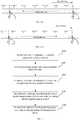
- the application scenarios may be classified into the following four types based on different progress adjustment manners: an operation of rewinding by clicking shown in FIG. 2-A , an operation of fast forwarding by clicking shown in FIG. 2-B , an operation of rewinding by sliding shown in FIG. 2-C and an operation of fast forwarding by sliding shown in FIG. 2-D .
- the click operation corresponds to a click on a corresponding position of a progress bar and the slide operation corresponds not only to a slide on a progress bar but also to a slide on a player interface in some scenarios, which is not limited herein.
- a start position of a progress bar is position B, and a user may rewind progress bar from the position B to a position A by clicking on the position A with a mouse or a finger.
- the start position of the progress bar is position A, the user may fast-forward progress bar from the position A to the position B by clicking on the position B with a mouse or a finger.
- the initial position of the progress bar is position B, the user may rewind progress bar to the position A by sliding the mouse or sliding the finger.
- the initial position of the progress bar is position A, the user may move progress to the position B by sliding the mouse or sliding the finger.
- the application scenarios may be classified into the following types based on media types and playing manners:
- the media stream refers to media formats, for example, video or multimedia files such as audio/video stream transmit through a network. It is noted that the scenario types including but not limited to the above types are all applicable to the embodiments of the present disclosure. Illustrative descriptions are made below by taking playing media with a webpage browser as an example.
- IPB The most common compression and encoding is IPB, where I refers to an I frame, P refers to a P frame and B refers to a B frame.
- the I frame (also referred to as intra-picture) is a key frame and subjects to intra-frame compression.
- Decoding may be completed with a single I frame.
- the P frame is a predictive frame. That is, the P frame can be decoded with reference to information of a previous relevant frame.
- the B frame is a bi-directional interpolated prediction frame. That is, decoding can be completed with reference to the previous frame and a next frame to be decoded.
- data compression is performed based on the I frame.
- IDR Instantaneous Decoding Refresh
- the IDR frame is a special I frame and differs from a normal I frame in that the IDR frame can ensure a frame after the IDR frame will not refer to a frame before the IDR frame. Theoretically, as long as there is an IDR frame, decoding can get started from the IDR frame and a video starts to play. However, due to similar functions, the IDR frame may be directly written as the I frame in some cases.
- the IDR frame has a default interval of 250 frames in the most commonly used H264 encoding format.
- a browser may actively find an I frame or an IDR frame that is immediately before target time corresponding to the target position and then start transmitting data to the player from the found frame.
- the player may perform pause() to pause playing and perform flush() to clear caches and then receive data transmitted by the browser passively and finally decode and play the data.
- an interval of adjacent I frames or IDR frames is uncertain, which may range from 0.1 seconds to 10 seconds and mostly range from 0.5 seconds to 2 seconds.
- the browser may search for one previous I frame nearest the position of the 9th second, that is, the I frame of the 8th second.
- the video may start playing from the 8th second, resulting in an error of one second compared with the 9th second of the target position designated by the user.
- the user may feel that the video cannot always locate the target position accurately.
- a progress bar may appear when a browser plays a media stream
- a phenomenon that the progress bar will skip to the position of the 8th second by itself and the media stream starts playing from the 8th second after the progress bar is dragged to the position of the 9th second by seeking (fast forwarding and rewinding) may appear in the above browser interface, thereby causing a negative experience for the user.
- FIG. 3 is a flowchart illustrating a method of playing media, in accordance with embodiments of the present disclosure.
- the method may be applied to a device (such as a TV set, a personal computer, a laptop computer and so on) capable of playing media.
- a device such as a TV set, a personal computer, a laptop computer and so on
- the method includes the following blocks.
- the input includes an operation of rewinding by clicking shown in FIG. 2-A , an operation of fast forwarding by clicking shown in FIG. 2-B , an operation of rewinding by sliding shown in FIG. 2-C and an operation of fast forwarding by sliding shown in FIG. 2-D .
- an instruction for play progress adjustment is generated based on the input, where the instruction includes an adjustment manner, a start position and a target position of the input.
- the adjustment manner of the input is a click.
- the target position of play progress adjustment corresponds to a click point.
- the adjustment manner of the input is a slide.
- the target position of play progress adjustment corresponds to an end point of the slide.
- a target key frame that is immediately before a target time corresponding to the target position is determined.
- the target key frame is the I frame or the IDR frame.
- a Program Association Table (PAT) in a Transport Stream (TS) is obtained by use of a Packet Identifier (PID) (0x00) in the TS and then a Program Map Table (PMT) is obtained based on the information of the PMT carried in the PAT, a TS packet containing a Packetized Elementary Streams (PES) header (that is, a TS packet with a payload-unit-start-indicator being 1 in a packet header) in the PMT is obtained, information of picture_header (starting with 0x00000100) contained in the TS packet is read and then picture_coding_type (occupying 3 bits) is reached after another 10 bits (Temporal_reference occupies 10 bits).
- PID Packet Identifier
- PMT Program Map Table
- the frame is the I frame. If the picture_coding_type is 010, the frame is the P frame. If the picture_coding_type is 011, the frame is the B frame. In this way, the target key frame that is immediately before the target time corresponding to the target position information of the play progress adjustment may be determined.
- blocking the presentation of the decoded media data starting from the target key frame includes:
- the frozen-frame image is aimed to ensure continuity of images in a seek process.
- the player will always keep displaying the last frame of image before the seek and this image of frozen frame is the frozen-frame image.
- an image of the start position of the play progress adjustment is determined as the target frozen-frame image for freezing the frame.
- the adjustment manner of the input is a slide operation
- the image of the start position and one or more images of the key frames (i.e. the I frames) at a fixed interval between the time corresponding to the start position and the target time are obtained sequentially for displaying during a frame freezing process.
- the image of the start position and the images of the key frames i.e.
- the I frames) between the time corresponding to the start position and the target time are displayed on the screen sequentially. Finally, the I frame image that is between the time corresponding to the start position and the target time and is closer to the target time than the other key frames between the time corresponding to the start position and the target time is frozen on the screen.
- the system time clock (STC) of the player progresses normally.
- playing the media data decoded starting from the target time includes: when the media stream is a video media stream, cancelling frame freezing of the target frozen-frame image and blocking of the video media stream already decoded and to be played.
- the media stream is a media stream with a mixture of audio and video
- cancelling muting process of the audio media stream already decoded and to be played and cancelling frame freezing of the target frozen-frame image and blocking of the video media stream already decoded and to be played at the same time.
- the method disclosed may include:
- the above preset value may be 1 second or 2 seconds.
- the instruction for play progress adjustment is generated based on the input by a user for triggering a play progress adjustment to the media; and the target key frame that is immediately before the target time corresponding to the target position of play progress adjustment is determined. Decoding is performed starting from the target key frame and the presentation of the media data obtained by decoding starting from the target key frame is blocked. In response to the system time clock of the player progressing to the target time, the media data decoded starting from the target time is played. In this way, the problem that the media is not able to be played accurately based on a change position of a progress bar is solved, thereby improving a user's experience.
- FIG. 4 shows a flowchart illustrating a method of playing media, in accordance with embodiments of the present disclosure.
- the method may be applied to a device capable of playing media.
- the device may be deployed with the system architecture shown in FIG. 1 .
- the type of a media stream may be determined with an analyzing layer 102.
- the method includes the following blocks.
- an instruction for play progress adjustment is generated based on the input.
- the instruction for play progress adjustment includes an adjustment manner of the input, a start position of the input and a target position of the input.
- a target key frame that is immediately before target time corresponding to the target position is determined.
- a browser invokes pause() function of a player to pause playing the current media stream upon receiving the instruction for play progress adjustment, and transmits the target position of the play progress adjustment to the player through seek() function; at the same time, the analyzing layer 102 analyzes the media stream to determine the target key frame pos_I_frame that is immediately before the target time corresponding to the target position and the browser continues requesting data from a webpage.
- audio-video separation is performed for the media stream with audio and video.
- the player may obtain the frozen-frame image and perform frame freezing for the frozen-frame image with a function freeze(), then wait for data distributed from the browser.
- the video media stream is decoded starting from the target key frame and decoding is performed for the audio media stream starting from a corresponding frame of the audio media stream at the same time.
- the video media stream is decoded starting from the target key frame and the audio media stream is decoded starting from a corresponding frame of the audio media stream with the decoding layer 104. Since the browser requests data from the webpage based on the target key frame pos_I_frame, a frame from which audio media stream starts to decode corresponds exactly to the target key frame. For ease of description, it is described as the audio media stream is decoded starting from the target key frame. That is to say, the audio media stream is decoded starting from a time point which synchronizes with the target key frame.
- block S405 and block S406 are mutually associated in some application scenarios. A description is provided with reference to FIG. 2-A, FIG. 2-B , FIG. 2-C and FIG. 2-D .
- FIG. 2-A illustrates an application scenario of rewinding by clicking.
- the progress bar is rewound from position B to position A.
- start position B of the play progress adjustment is determined based on the play progress change instruction at block S402 and an image at position B is obtained as a frozen-frame image and the frozen-frame image is frozen on the screen.
- decoding is performed starting from the I frame 1 of the video media stream and a corresponding frame of the audio media stream, respectively, based on block S406.
- FIG. 2-B illustrates an application scenario of fast-forwarding by clicking.
- the progress bar is fast-forwarded to position B from position A.
- start position A of play progress adjustment is determined based on the play progress change instruction at block S402 and an image at position A is obtained as a frozen-frame image and the frozen-frame image is frozen on the screen.
- decoding is performed starting from the I frame 7 of the video media stream and a corresponding frame of the audio media stream, respectively, based on block S406.
- FIG. 2-C illustrates an application scenario of rewinding by sliding.
- the play progress is rewound from position B to position A.
- start position B of play progress adjustment is determined based on the play progress change instruction at block S402 and an image at position B is obtained as a frozen-frame image for freezing; and then the images of I frame 7, I frame 6, I frame 5, I frame 4, I frame 3 and I frame 2 are obtained as frozen-frame images for freezing frames sequentially during the play progress adjustment, and decoding is performed starting from I frame 1 of the video media stream and a corresponding frame of the audio media stream, respectively, based on block S406.
- the frozen-frame images are obtained sequentially for freezing, so when a first frozen-frame image has been obtained for freezing, the previous frozen-frame image currently frozen on the display screen is updated with the first frozen-frame image.
- the frozen-frame image for performing block S406 is an image of the I frame 2, which corresponds to the target frozen-frame image in block S407.
- FIG. 2-D illustrates an application scenario of fast-forwarding by sliding.
- the play progress is fast-forwarded to position B from position A.
- start position A of play progress adjustment is determined based on the instruction for play progress adjustment at block S402 and an image at position A is obtained as a frozen-frame image for freezing; then the images of I frame 2, I frame 3, I frame 4, I frame 5, I frame 6 and I frame 7 are obtained sequentially as frozen-frame images for freezing.
- decoding is performed starting from I frame 7 of the video media stream and a corresponding frame of the audio media stream, respectively, based on block S406.
- the frozen-frame images are obtained sequentially for freezing, so when a first frozen-frame image has been obtained for freezing, the frozen-frame image currently frozen on the display screen is updated with the first frozen-frame image.
- the frozen-frame image for performing block S406 is an image of I frame 7 which is the target frozen-frame image in block S407.
- muting is performed for the audio media stream already decoded and to be played and blocking is performed for the video media stream already decoded and to be played with the target frozen-frame image.
- the player invokes mute() to make it work on the rendering layer 105. That is, the player invokes mute() to make it work on an audio renderer and a video renderer of the rendering layer 105 respectively to perform muting for an audio output and a video output respectively such that the media stream is forced to play in the backend without displaying content to users.
- unmute() is performed for media files rendered at this time and frame unfreezing is performed for the target frozen-frame image at this time by invoking unfreeze().
- the media stream is played.
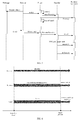
- blocks of the method shown in FIG. 4 are further described with reference to the method of playing media shown in FIG. 5 .
- the method further comprises the following procedures.
- a browser invokes a function of a player pause() to pause playing, and optionally, the browser may invoke flushIfNeed() to clear cache data, send the target position pos_target_seek of play progress adjustment contained in the instruction at block S402 to the player by a function seek() and continues requesting data from a webpage by requestData().
- the player may perform frame freezing for the image by the function freeze(), send a decoding-pausing instruction to a decoder by pauseDecode() and then wait for data distributed from the webpage by Data().
- the browser may write the data into the player by writeData().
- the player may send decoding-resuming instruction to the decoder by ResumeDecode().
- the decoder may performing decoding for the data written into the player through writeData() starting from the target key frame determined at block S403.
- the data After being decoded, the data is sent to a renderer. At the same time, muting process is performed for the rendered data by invoking mute().
- the player is able to play accurately from the target position of the play progress after the above processing is performed.
- Benefits are described with reference to an example: when a user watches to the 3rd second, the user may change the play progress to the 9th second (pos_target_seek) by a click operation; the player may freeze the picture of the 3rd second and then start decoding from the position of the 8th second (pos_I_frame, assume the position of the 8th second is a position of a key frame) in the back-end and play the decoded media stream in the back-end; when the media stream played in the back-end proceeds to the 9th second, the player may perform frame unfreezing for the picture of the 3rd second and display the video output starting from the 9th second as well as play the audio, resulting in the effect of directly playing from the 9th second for users.
- embodiments of the present disclosure include corresponding hardware structures and/or software modules executing different functions to achieve the above functions.
- Embodiments of the present disclosure can be implemented by hardware or by a combination of hardware and computer software in combination with units (devices) and algorithm blocks of different embodiments of the present disclosure, and whether a function is implemented by hardware or by a computer software driven hardware depends on specific applications and design constraint conditions of the technical solution.
- Those skilled in the art may adopt a different method for each specific application to implement the described functions.
- the implementation shall not be regarded as exceeding the scope of technical solution of the embodiments of the present disclosure.
- embodiments of the present disclosure may perform functional units (devices) division for an apparatus for executing the above method.
- different functional units (devices) may be divided based on corresponding functions and two or more functions may also be integrated into one processing unit (device).
- the above integrated units (devices) may be implemented not only by hardware but also by software functional units (devices). It is noted that division of units (devices) in the embodiments of the present disclosure are illustrative and is merely logic functional division and another division manner may also be adopted in actual implementations.
- FIG. 7 illustrates an apparatus for playing media where integrated units (devices) are adapted, in accordance with embodiments of the present disclosure.
- the apparatus includes a receiving module 701, a generating module 702, a first determining module 703, a first processing module 704 and a second processing module 705.
- the receiving module 701 is configured to receive an input from a user for triggering a play progress adjustment to media.
- the generating module 702 is configured to generate an instruction for play progress adjustment based on the input, where the instruction includes an adjustment manner of the input, start position of the input and target position of the input.
- the first determining module 703 is configured to determine a target key frame that is immediately before target time corresponding to the target position.
- the first processing module 704 is configured to perform decoding for data of the media starting from the target key frame and block presentation of the decoded media data starting from the target key frame.
- the second processing module 705 is configured to play media data decoded starting from the target time in response to a system time clock progressing to the target time.
- the progress adjustment manner includes a click operation and a slide operation.
- the target position corresponds to the position of the click operation.
- the target position corresponds to a stop position of the slide operation.
- the apparatus may also include: a third processing module, configured to determine a target key frame that is immediately before target time corresponding to the target position and start decoding and playing media from the found target key frame when the interval between two adjacent key frames is greater than the preset value.
- a third processing module configured to determine a target key frame that is immediately before target time corresponding to the target position and start decoding and playing media from the found target key frame when the interval between two adjacent key frames is greater than the preset value.
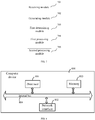
- FIG. 8 is a schematic diagram illustrating a structure of a computer device 800, in accordance with embodiments of the present disclosure. That is, another structural diagram of an apparatus 700 for playing media is illustrated.
- the computer device 800 includes a processor 801 and a network interface 802.
- the processor 801 may be a controller.
- the processor 801 is configured to support the apparatus 700 for playing media to execute the functions shown in FIGs. 3-5 .
- the network interface 802 is configured to perform functions of receiving and sending data for the apparatus 700 for playing media.
- the computer device 800 may also include a memory 803 configured to couple with the processor 801 and store program instructions and data required by the device.
- the processor 801, the network interface 802 and the memory 803 are connected via an internal bus 804.
- the memory 803 is configured to store instructions and the processor 801 is configured to execute instructions stored in the memory 803 to control the network interface 802 to receive and send data and complete blocks of executing corresponding functions by the apparatus 700 for playing media in the above method.
- processors mentioned in the above embodiments of the present disclosure may be a Central Processing Unit (CPU), a general-purpose processor, a Digital Signal Processor (DSP), an Application-Specific Integrated Circuit (ASIC), a Field Programmable Gate Array (FPGA) or other programmable logic devices, transistor logic device, a hardware component or any combination thereof.
- the processor can implement or execute different illustrative logic blocks, modules and circuits described in combination with the present disclosure.
- the processor may also be a combination of realizing computation functions, for example, may be a combination including one or more microprocessors and a combination of DSP and a microprocessor and so on.
- the memory may be integrated into the processor and may also be configured separated from the processor.
- a computer storage medium for storing some instructions.
- the instructions may cause a processor to implement any one of the above methods involved in the apparatus for playing media.
- a computer program product for storing computer programs.
- the computer programs are used to execute the method of playing media in the above method embodiments.
- embodiments of the present disclosure may be provided as a method, a system, or a computer program product.
- entire hardware embodiments, entire software embodiments or embodiments combining software and hardware may be adopted in the present disclosure.
- the present disclosure may be implemented in the form of a computer program product that is operated on one or more computer available storage media (including but not limited to magnetic disk memory, CD-ROM, optical memory and so on) including computer available program codes.
- Embodiments of the present disclosure are described by referring to flowcharts and/or block diagrams of a method, a device (a system) and a computer program product. It is understood that each flowchart and/or block in the flowcharts and/or the block diagrams or a combination of a flow chart and/or a block of the flowcharts and/or the block diagrams may be implemented by computer program instructions.
- These computer program instructions may be provided to a general-purpose computer, a dedicated computer, an embedded processor, or a processor of another programmable data processing device to generate a machine so that the instructions executable by a computer or a processor of another programmable data processing device generate an apparatus for implementing functions designated in one or more flows of the flowcharts and/or one or more blocks of the block diagrams.
- the computer program instructions may also be loaded on a computer or another programmable data processing devices so that a series of operation blocks can be executed on the computer or another programmable device to generate processing achieved by the computer, and thus instructions executable on the computer or another programmable device are provided for blocks for realizing functions designated in one or more flows of the flowcharts and/or one or more blocks of the block diagrams.
Landscapes
- Engineering & Computer Science (AREA)
- Multimedia (AREA)
- Signal Processing (AREA)
- Theoretical Computer Science (AREA)
- Human Computer Interaction (AREA)
- General Engineering & Computer Science (AREA)
- Physics & Mathematics (AREA)
- General Physics & Mathematics (AREA)
- Databases & Information Systems (AREA)
- General Health & Medical Sciences (AREA)
- Audiology, Speech & Language Pathology (AREA)
- Health & Medical Sciences (AREA)
- Business, Economics & Management (AREA)
- Marketing (AREA)
- Two-Way Televisions, Distribution Of Moving Picture Or The Like (AREA)
- Television Signal Processing For Recording (AREA)
Abstract
Description
- This application claims priority to Chinese Patent Application No.
201810180598.5 - The present invention relates to multimedia technology, and in particular, to playing media.
- During video playing, a video watcher may want to skip a part of the video by fast forwarding, or a video watcher may want to watch a part of the video that has already played by rewinding. Typically, the fast forwarding or rewinding is achieved by clicking or dragging a progress bar or sliding on an interface of a player.
-
- In a first aspect, there is provided a method for playing media including:
- receiving an input from a user for triggering a play progress adjustment to the media;
- generating an instruction for play progress adjustment based on the input, where the instruction includes an adjustment manner, a start position and a target position of the input;
- determining a target key frame immediately before a target time corresponding to the target position;
- decoding data of the media starting from the target key frame and blocking presentation of the decoded media data starting from the target key frame;
- playing media data decoded starting from the target time in response to a system time clock progressing to the target time.
- In a second aspect, there is provided a media playing apparatus including:
- a processor; and
- a memory storing instructions executable by the processor;
- when the executable instructions are executed, the processor is caused to:
- receive an input from a user for triggering a play progress adjustment to the media;
- generate an instruction for play progress adjustment based on the input, where the instruction includes an adjustment manner, a start position and a target position of the input;
- determine a target key frame immediately before a target time corresponding to the target position;
- decode data of the media which starts from the target key frame and block presentation of the decoded media data starting from the target key frame;
- in response to a system time clock progressing to the target time, play media data decoded starting from the target time.
- In a third aspect, there is provided one or more computer readable media storing instructions, when the instructions are executed by one or more processors, the one or more processors are caused to implement the method of the above first aspect.
-
-
FIG. 1 shows a schematic diagram illustrating an architecture of a system for playing media, in accordance with embodiments of the present disclosure. -
FIG. 2-A shows a schematic diagram illustrating an application scenario of rewinding by clicking when playing media, in accordance with embodiments of the present disclosure. -
FIG. 2-B shows a schematic diagram illustrating an application scenario of fast forwarding by clicking when playing media, in accordance with embodiments of the present disclosure. -
FIG. 2-C shows a schematic diagram illustrating an application scenario of rewinding by sliding when playing media, in accordance with embodiments of the present disclosure. -
FIG. 2-D shows a schematic diagram illustrating an application scenario of fast forwarding by sliding when playing media, in accordance with embodiments of the present disclosure. -
FIG. 3 shows a flowchart illustrating a method of playing media, in accordance with embodiments of the present disclosure. -
FIG. 4 shows a flowchart illustrating a method of playing media, in accordance with embodiments of the present disclosure. -
FIG. 5 shows a time sequence diagram illustrating a method of playing media, in accordance with embodiments of the present disclosure. -
FIG. 6 shows another time sequence diagram illustrating a method of playing media, in accordance with embodiments of the present disclosure. -
FIG. 7 shows a schematic diagram illustrating a structure of an apparatus for playing media, in accordance with embodiments of the present disclosure. -
FIG. 8 shows a schematic diagram illustrating a structure of a computer device, in accordance with embodiments of the present disclosure. - To describe the object, technical solutions and advantages of the present disclosure more clearly, the examples of the present disclosure will be further described in detail in combination with accompanying drawings.
- The examples of the present disclosure may be applied to any device capable of playing media files. The device may be a smart TV set, a smart telephone set, a personal computer (PC), a portable multimedia player and so on. It is understood that the specific device is not limited in the examples of the present disclosure.
- For convenience of understanding, a system architecture and an application scenario involved in the examples of the present disclosure will be first introduced before detailed explanation is made to the examples of the present disclosure.
- Firstly, a brief description of the system architecture is given.
-
FIG. 1 shows a schematic diagram illustrating an architecture of a system for playing media, in accordance with embodiments of the present disclosure. As shown inFIG. 1 , the system includes a controllingmodule 101, an analyzinglayer 102, an audio-video separating layer 103, adecoding layer 104, arendering layer 105 and aplayer 106. The controllingmodule 101 can communicate with the analyzinglayer 102, the audio-video separating layer 103, thedecoding layer 104 and therendering layer 105. The analyzinglayer 102 may communicate with the audio-video separating layer 103. The audio-video separating layer 103 may communicate with thedecoding layer 104 and thedecoding layer 104 may communicate with therendering layer 105. Theplayer 106 may communicate with the controllingmodule 101, the analyzinglayer 102, the audio-video separating layer 103, thedecoding layer 104 and therendering layer 105. - Secondly, the application scenario is discussed further below.
- The application scenarios may be classified into the following four types based on different progress adjustment manners: an operation of rewinding by clicking shown in
FIG. 2-A , an operation of fast forwarding by clicking shown inFIG. 2-B , an operation of rewinding by sliding shown inFIG. 2-C and an operation of fast forwarding by sliding shown inFIG. 2-D . The click operation corresponds to a click on a corresponding position of a progress bar and the slide operation corresponds not only to a slide on a progress bar but also to a slide on a player interface in some scenarios, which is not limited herein. - As shown in
FIG. 2-A , a start position of a progress bar is position B, and a user may rewind progress bar from the position B to a position A by clicking on the position A with a mouse or a finger. As shown inFIG. 2-B , the start position of the progress bar is position A, the user may fast-forward progress bar from the position A to the position B by clicking on the position B with a mouse or a finger. As shown inFIG. 2-C , the initial position of the progress bar is position B, the user may rewind progress bar to the position A by sliding the mouse or sliding the finger. As shown inFIG. 2-D , the initial position of the progress bar is position A, the user may move progress to the position B by sliding the mouse or sliding the finger. - The application scenarios may be classified into the following types based on media types and playing manners:
-
Type 1, in which media stream is played through a webpage browser; -
Type 2, in which media stream is played through a web application; -
Type 3, in which local media is played through a webpage browser; -
Type 4, in which local media is played through a local player; and -
Type 5, in which media is played by a Digital Living Network Alliance (DLNA). - The media stream refers to media formats, for example, video or multimedia files such as audio/video stream transmit through a network. It is noted that the scenario types including but not limited to the above types are all applicable to the embodiments of the present disclosure. Illustrative descriptions are made below by taking playing media with a webpage browser as an example.
- To improve video transmission and storage efficiency, data may be compressed and encoded. The most common compression and encoding is IPB, where I refers to an I frame, P refers to a P frame and B refers to a B frame. The I frame (also referred to as intra-picture) is a key frame and subjects to intra-frame compression. Decoding may be completed with a single I frame. The P frame is a predictive frame. That is, the P frame can be decoded with reference to information of a previous relevant frame. The B frame is a bi-directional interpolated prediction frame. That is, decoding can be completed with reference to the previous frame and a next frame to be decoded. For the P frame and the B frame, data compression is performed based on the I frame. In addition, there is a special I frame, which can be understood as Instantaneous Decoding Refresh (IDR) frame. When decoding is performed to the special frame, the decoder may clear all caches and a subsequent frame will not refer to them any more. The IDR frame is a special I frame and differs from a normal I frame in that the IDR frame can ensure a frame after the IDR frame will not refer to a frame before the IDR frame. Theoretically, as long as there is an IDR frame, decoding can get started from the IDR frame and a video starts to play. However, due to similar functions, the IDR frame may be directly written as the I frame in some cases. The IDR frame has a default interval of 250 frames in the most commonly used H264 encoding format.
- When a media stream is being played, if a target position does not correspond to an I frame or an IDR frame, the decoder cannot start decoding directly from the target position. Thus, based on a protocol specification, a browser may actively find an I frame or an IDR frame that is immediately before target time corresponding to the target position and then start transmitting data to the player from the found frame. In most solutions, the player may perform pause() to pause playing and perform flush() to clear caches and then receive data transmitted by the browser passively and finally decode and play the data. For different media sources, an interval of adjacent I frames or IDR frames is uncertain, which may range from 0.1 seconds to 10 seconds and mostly range from 0.5 seconds to 2 seconds. Since the decoder cannot perform decoding directly in the interval, the decoder needs to obtain one I frame that is immediately before the target time corresponding to the target position before decoding the data for continued play. In this way, a play start position will be advanced relative to the target position, resulting in inaccurate positioning. For example, when a user plays a video stream with an interval =2s, the user may drag a progress bar to the position of the 9th second, that is, the target time corresponding to the target position is 9s. At this time, the I frames near the position of 9s are located at the positions of the 8th second and the 10th second, respectively. Thus, when the player requests the data of the 9th second, the browser may search for one previous I frame nearest the position of the 9th second, that is, the I frame of the 8th second. When play is recovered, the video may start playing from the 8th second, resulting in an error of one second compared with the 9th second of the target position designated by the user. Thus, the user may feel that the video cannot always locate the target position accurately. Additionally, since a progress bar may appear when a browser plays a media stream, a phenomenon that the progress bar will skip to the position of the 8th second by itself and the media stream starts playing from the 8th second after the progress bar is dragged to the position of the 9th second by seeking (fast forwarding and rewinding) may appear in the above browser interface, thereby causing a negative experience for the user.
- To solve the above problems, the present disclosure provides a method for playing media and an apparatus for playing media. After discussing the system architecture and the application scenarios involved in the embodiments of the present disclosure, detailed description will be made below for the embodiments of the present disclosure.
FIG. 3 is a flowchart illustrating a method of playing media, in accordance with embodiments of the present disclosure. The method may be applied to a device (such as a TV set, a personal computer, a laptop computer and so on) capable of playing media. As shown inFIG. 3 , the method includes the following blocks. - At block S301, an input from a user for triggering a play progress adjustment to the media is received.
- Optionally, the input includes an operation of rewinding by clicking shown in
FIG. 2-A , an operation of fast forwarding by clicking shown inFIG. 2-B , an operation of rewinding by sliding shown inFIG. 2-C and an operation of fast forwarding by sliding shown inFIG. 2-D . - At block S302, an instruction for play progress adjustment is generated based on the input, where the instruction includes an adjustment manner, a start position and a target position of the input.
- In some embodiments, the adjustment manner of the input is a click. When the adjustment manner of the input is a click, the target position of play progress adjustment corresponds to a click point.
- In some embodiments, the adjustment manner of the input is a slide. When the adjustment manner of the input is a slide, the target position of play progress adjustment corresponds to an end point of the slide.
- At block S303, a target key frame that is immediately before a target time corresponding to the target position is determined.
- In some embodiments, for a video media stream, the target key frame is the I frame or the IDR frame. In some embodiments, a Program Association Table (PAT) in a Transport Stream (TS) is obtained by use of a Packet Identifier (PID) (0x00) in the TS and then a Program Map Table (PMT) is obtained based on the information of the PMT carried in the PAT, a TS packet containing a Packetized Elementary Streams (PES) header (that is, a TS packet with a payload-unit-start-indicator being 1 in a packet header) in the PMT is obtained, information of picture_header (starting with 0x00000100) contained in the TS packet is read and then picture_coding_type (occupying 3 bits) is reached after another 10 bits (Temporal_reference occupies 10 bits). If the picture_coding_type is 001 (binary), the frame is the I frame. If the picture_coding_type is 010, the frame is the P frame. If the picture_coding_type is 011, the frame is the B frame. In this way, the target key frame that is immediately before the target time corresponding to the target position information of the play progress adjustment may be determined.
- At block S304, data of the media which starts from the target key frame is decoded and presentation of the decoded media data starting from the target key frame is blocked.
- In some embodiments, blocking the presentation of the decoded media data starting from the target key frame includes:
- when a media stream is a video media stream, blocking the video media stream which is decoded and to be played with a target frozen-frame image.
- when the media stream is a media stream with a mixture of audio and video, firstly the media stream is separated into an audio media stream and a video media stream with an audio-video separator and then muting process is performed for the audio media stream already decoded and to be played and the video media stream already decoded and to be played is blocked with the target frozen-frame image.
- The frozen-frame image is aimed to ensure continuity of images in a seek process. The player will always keep displaying the last frame of image before the seek and this image of frozen frame is the frozen-frame image. Specifically, when the adjustment manner of the input is a click operation, an image of the start position of the play progress adjustment is determined as the target frozen-frame image for freezing the frame. When the adjustment manner of the input is a slide operation, the image of the start position and one or more images of the key frames (i.e. the I frames) at a fixed interval between the time corresponding to the start position and the target time are obtained sequentially for displaying during a frame freezing process. In the slide process, the image of the start position and the images of the key frames (i.e. the I frames) between the time corresponding to the start position and the target time are displayed on the screen sequentially. Finally, the I frame image that is between the time corresponding to the start position and the target time and is closer to the target time than the other key frames between the time corresponding to the start position and the target time is frozen on the screen.
- At block S305, in response to a system time clock progressing to the target time, media data decoded starting from the target time is played.
- While performing blocks S301-S304, the system time clock (STC) of the player progresses normally. When the STC of the player reaches the target time, playing the media data decoded starting from the target time includes:
when the media stream is a video media stream, cancelling frame freezing of the target frozen-frame image and blocking of the video media stream already decoded and to be played. - When the media stream is a media stream with a mixture of audio and video, cancelling muting process of the audio media stream already decoded and to be played, and cancelling frame freezing of the target frozen-frame image and blocking of the video media stream already decoded and to be played at the same time.
- In some embodiments, after the input by a user for triggering the play progress adjustment to the media is received, the method disclosed may include:
- determining whether a time interval between adjacent key frames is less than a preset value;
- performing blocks S302 to S305 in response to the interval between adjacent key frames being less than the preset value;
- determining a target key frame that is immediately before the target time corresponding to the target position in response to the interval between adjacent key frames being no less than the preset value; and performing decoding and playing media data starting from the target key frame.
- In some embodiments, the above preset value may be 1 second or 2 seconds.
- To sum up, the instruction for play progress adjustment is generated based on the input by a user for triggering a play progress adjustment to the media; and the target key frame that is immediately before the target time corresponding to the target position of play progress adjustment is determined. Decoding is performed starting from the target key frame and the presentation of the media data obtained by decoding starting from the target key frame is blocked. In response to the system time clock of the player progressing to the target time, the media data decoded starting from the target time is played. In this way, the problem that the media is not able to be played accurately based on a change position of a progress bar is solved, thereby improving a user's experience.
-
FIG. 4 shows a flowchart illustrating a method of playing media, in accordance with embodiments of the present disclosure. The method may be applied to a device capable of playing media. Also, the device may be deployed with the system architecture shown inFIG. 1 . By taking a media stream with a mixture of audio and video as an example of a media stream, the example shown inFIG. 3 will be discussed further below with reference toFIG. 1 . It is noted that the type of a media stream may be determined with ananalyzing layer 102. As shown inFIG. 4 , the method includes the following blocks. - At block S401, an input from a user for triggering a play progress adjustment is received.
- At block S402, an instruction for play progress adjustment is generated based on the input.
- The instruction for play progress adjustment includes an adjustment manner of the input, a start position of the input and a target position of the input.
- At block S403, a target key frame that is immediately before target time corresponding to the target position is determined.
- Specifically, a browser invokes pause() function of a player to pause playing the current media stream upon receiving the instruction for play progress adjustment, and transmits the target position of the play progress adjustment to the player through seek() function; at the same time, the
analyzing layer 102 analyzes the media stream to determine the target key frame pos_I_frame that is immediately before the target time corresponding to the target position and the browser continues requesting data from a webpage. - At block S404, audio-video separation is performed for the media stream with audio and video.
- In particular, upon receiving media stream requested from the webpage, the media stream is separated into an audio media stream and a video media stream with an audio-video separator in the audio-
video separating layer 103. Afterwards, the audio media stream and the video media stream are sent to an audio decoder and a video decoder of thedecoding layer 104, respectively. - At block S405, a frozen-frame image is obtained and frame freezing is performed.
- After receiving a call for function seek(), the player may obtain the frozen-frame image and perform frame freezing for the frozen-frame image with a function freeze(), then wait for data distributed from the browser.
- At block S406, the video media stream is decoded starting from the target key frame and decoding is performed for the audio media stream starting from a corresponding frame of the audio media stream at the same time.
- Specifically, the video media stream is decoded starting from the target key frame and the audio media stream is decoded starting from a corresponding frame of the audio media stream with the
decoding layer 104. Since the browser requests data from the webpage based on the target key frame pos_I_frame, a frame from which audio media stream starts to decode corresponds exactly to the target key frame. For ease of description, it is described as the audio media stream is decoded starting from the target key frame. That is to say, the audio media stream is decoded starting from a time point which synchronizes with the target key frame. - It is noted that block S405 and block S406 are mutually associated in some application scenarios. A description is provided with reference to
FIG. 2-A, FIG. 2-B ,FIG. 2-C and FIG. 2-D . -
FIG. 2-A illustrates an application scenario of rewinding by clicking. In this application scenario, the progress bar is rewound from position B to position A. First, start position B of the play progress adjustment is determined based on the play progress change instruction at block S402 and an image at position B is obtained as a frozen-frame image and the frozen-frame image is frozen on the screen. Second, decoding is performed starting from theI frame 1 of the video media stream and a corresponding frame of the audio media stream, respectively, based on block S406. -
FIG. 2-B illustrates an application scenario of fast-forwarding by clicking. In this application scenario, the progress bar is fast-forwarded to position B from position A. First, start position A of play progress adjustment is determined based on the play progress change instruction at block S402 and an image at position A is obtained as a frozen-frame image and the frozen-frame image is frozen on the screen. Second, decoding is performed starting from theI frame 7 of the video media stream and a corresponding frame of the audio media stream, respectively, based on block S406. -
FIG. 2-C illustrates an application scenario of rewinding by sliding. In some embodiments, in this application scenario, the play progress is rewound from position B to position A. First, start position B of play progress adjustment is determined based on the play progress change instruction at block S402 and an image at position B is obtained as a frozen-frame image for freezing; and then the images ofI frame 7,I frame 6,I frame 5,I frame 4, I frame 3 and I frame 2 are obtained as frozen-frame images for freezing frames sequentially during the play progress adjustment, and decoding is performed starting fromI frame 1 of the video media stream and a corresponding frame of the audio media stream, respectively, based on block S406. The frozen-frame images are obtained sequentially for freezing, so when a first frozen-frame image has been obtained for freezing, the previous frozen-frame image currently frozen on the display screen is updated with the first frozen-frame image. Thus, in this application scenario, the frozen-frame image for performing block S406 is an image of theI frame 2, which corresponds to the target frozen-frame image in block S407. -
FIG. 2-D illustrates an application scenario of fast-forwarding by sliding. In some embodiments, in this application scenario, the play progress is fast-forwarded to position B from position A. First, start position A of play progress adjustment is determined based on the instruction for play progress adjustment at block S402 and an image at position A is obtained as a frozen-frame image for freezing; then the images ofI frame 2,I frame 3,I frame 4,I frame 5, I frame 6 and I frame 7 are obtained sequentially as frozen-frame images for freezing. Second, decoding is performed starting fromI frame 7 of the video media stream and a corresponding frame of the audio media stream, respectively, based on block S406. The frozen-frame images are obtained sequentially for freezing, so when a first frozen-frame image has been obtained for freezing, the frozen-frame image currently frozen on the display screen is updated with the first frozen-frame image. Thus, in the application scenario, the frozen-frame image for performing block S406 is an image ofI frame 7 which is the target frozen-frame image in block S407. - At block S407, muting is performed for the audio media stream already decoded and to be played and blocking is performed for the video media stream already decoded and to be played with the target frozen-frame image.
- In some embodiments of the present disclosure, after the decoded media stream flows into the
rendering layer 105, the player invokes mute() to make it work on therendering layer 105. That is, the player invokes mute() to make it work on an audio renderer and a video renderer of therendering layer 105 respectively to perform muting for an audio output and a video output respectively such that the media stream is forced to play in the backend without displaying content to users. - At block S408, in response to the system time clock of the player progressing to the target time, muting process of the audio media stream to be played at this time is cancelled and frame freezing of the target frozen-frame image and blocking of the video media stream to be played at this time are cancelled.
- When the system time clock goes to the target time corresponding to the target position pos_target_seek, unmute() is performed for media files rendered at this time and frame unfreezing is performed for the target frozen-frame image at this time by invoking unfreeze().
- At block S409, the media stream is played.
- To understand better the relationship of different blocks shown in
FIG. 4 , blocks of the method shown inFIG. 4 are further described with reference to the method of playing media shown inFIG. 5 . As shown inFIG. 5 , after blocks S401 to S403 are performed, the method further comprises the following procedures. - A browser invokes a function of a player pause() to pause playing, and optionally, the browser may invoke flushIfNeed() to clear cache data, send the target position pos_target_seek of play progress adjustment contained in the instruction at block S402 to the player by a function seek() and continues requesting data from a webpage by requestData().
- After receiving a call for the function seek(), the player may perform frame freezing for the image by the function freeze(), send a decoding-pausing instruction to a decoder by pauseDecode() and then wait for data distributed from the webpage by Data().
- After requesting data from webpage, the browser may write the data into the player by writeData(). After receiving the data, the player may send decoding-resuming instruction to the decoder by ResumeDecode(). The decoder may performing decoding for the data written into the player through writeData() starting from the target key frame determined at block S403.
- After being decoded, the data is sent to a renderer. At the same time, muting process is performed for the rendered data by invoking mute().
- When the system time clock of the player reaches the target time corresponding to pos_target_seek, unmuting process is performed for the rendered data through unmute() and frame unfreezing is performed for the target frozen-frame image through unfreeze() at the same time.
- In the above embodiments, the player is able to play accurately from the target position of the play progress after the above processing is performed. Benefits are described with reference to an example: when a user watches to the 3rd second, the user may change the play progress to the 9th second (pos_target_seek) by a click operation; the player may freeze the picture of the 3rd second and then start decoding from the position of the 8th second (pos_I_frame, assume the position of the 8th second is a position of a key frame) in the back-end and play the decoded media stream in the back-end; when the media stream played in the back-end proceeds to the 9th second, the player may perform frame unfreezing for the picture of the 3rd second and display the video output starting from the 9th second as well as play the audio, resulting in the effect of directly playing from the 9th second for users.
- In addition, as shown in
FIG. 6 , when the player plays a video between the position pos_I_frame and the position pos_target_seek after receiving the progress adjustment instruction, the player will not return STC time progressing forward as usual to the browser but return pos_target_seek and the player will not continue to return STC time until the STC progresses to the time corresponding to pos_target_seek. In this way, when the player plays a video between the position pos_I_frame and the position pos_target_seek, the progress bar stays at the target position instead of moving to the position of pos_I_frame. Thus, the problem that the progress bar jumps back after seek is solved. - It is noted that embodiments of the present disclosure include corresponding hardware structures and/or software modules executing different functions to achieve the above functions. Embodiments of the present disclosure can be implemented by hardware or by a combination of hardware and computer software in combination with units (devices) and algorithm blocks of different embodiments of the present disclosure, and whether a function is implemented by hardware or by a computer software driven hardware depends on specific applications and design constraint conditions of the technical solution. Those skilled in the art may adopt a different method for each specific application to implement the described functions. However, the implementation shall not be regarded as exceeding the scope of technical solution of the embodiments of the present disclosure.
- Based on the above method examples, embodiments of the present disclosure may perform functional units (devices) division for an apparatus for executing the above method. For example, different functional units (devices) may be divided based on corresponding functions and two or more functions may also be integrated into one processing unit (device). The above integrated units (devices) may be implemented not only by hardware but also by software functional units (devices). It is noted that division of units (devices) in the embodiments of the present disclosure are illustrative and is merely logic functional division and another division manner may also be adopted in actual implementations.
-
FIG. 7 illustrates an apparatus for playing media where integrated units (devices) are adapted, in accordance with embodiments of the present disclosure. As shown inFIG. 7 , the apparatus includes a receivingmodule 701, agenerating module 702, a first determiningmodule 703, afirst processing module 704 and asecond processing module 705. - The receiving
module 701 is configured to receive an input from a user for triggering a play progress adjustment to media. - The
generating module 702 is configured to generate an instruction for play progress adjustment based on the input, where the instruction includes an adjustment manner of the input, start position of the input and target position of the input. - The first determining
module 703 is configured to determine a target key frame that is immediately before target time corresponding to the target position. - The
first processing module 704 is configured to perform decoding for data of the media starting from the target key frame and block presentation of the decoded media data starting from the target key frame. - The
second processing module 705 is configured to play media data decoded starting from the target time in response to a system time clock progressing to the target time. - Optionally, the progress adjustment manner includes a click operation and a slide operation.
- When the progress adjustment manner is the click operation, the target position corresponds to the position of the click operation.
- When the progress adjustment manner is the slide operation, the target position corresponds to a stop position of the slide operation.
- Optionally, the apparatus may also include:
a second determining module configured to determine whether an interval between two adjacent key frames is less than a preset value after input by the user for triggering a play progress adjustment to the media is received. - Optionally, the apparatus may also include:
a third processing module, configured to determine a target key frame that is immediately before target time corresponding to the target position and start decoding and playing media from the found target key frame when the interval between two adjacent key frames is greater than the preset value. -
FIG. 8 is a schematic diagram illustrating a structure of acomputer device 800, in accordance with embodiments of the present disclosure. That is, another structural diagram of an apparatus 700 for playing media is illustrated. As shown inFIG. 8 , thecomputer device 800 includes aprocessor 801 and anetwork interface 802. Theprocessor 801 may be a controller. Theprocessor 801 is configured to support the apparatus 700 for playing media to execute the functions shown inFIGs. 3-5 . Thenetwork interface 802 is configured to perform functions of receiving and sending data for the apparatus 700 for playing media. Thecomputer device 800 may also include amemory 803 configured to couple with theprocessor 801 and store program instructions and data required by the device. Theprocessor 801, thenetwork interface 802 and thememory 803 are connected via aninternal bus 804. Thememory 803 is configured to store instructions and theprocessor 801 is configured to execute instructions stored in thememory 803 to control thenetwork interface 802 to receive and send data and complete blocks of executing corresponding functions by the apparatus 700 for playing media in the above method. - In an example of the present disclosure, a reference may be made to the descriptions of the above method or other examples for concepts, explanations, detailed descriptions and other blocks that are involved in the apparatus 700 for playing media and the
computer device 800 and relate to the technical solutions of the present disclosure, which will not be described herein. - It is noted that the processors mentioned in the above embodiments of the present disclosure may be a Central Processing Unit (CPU), a general-purpose processor, a Digital Signal Processor (DSP), an Application-Specific Integrated Circuit (ASIC), a Field Programmable Gate Array (FPGA) or other programmable logic devices, transistor logic device, a hardware component or any combination thereof. The processor can implement or execute different illustrative logic blocks, modules and circuits described in combination with the present disclosure. The processor may also be a combination of realizing computation functions, for example, may be a combination including one or more microprocessors and a combination of DSP and a microprocessor and so on. The memory may be integrated into the processor and may also be configured separated from the processor.
- According to embodiments of the present disclosure, there is also provided a computer storage medium for storing some instructions. When being executed, the instructions may cause a processor to implement any one of the above methods involved in the apparatus for playing media.
- According to embodiments of the present disclosure, there is also provided a computer program product for storing computer programs. The computer programs are used to execute the method of playing media in the above method embodiments.
- The persons skilled in the art should understand that embodiments of the present disclosure may be provided as a method, a system, or a computer program product. Thus, entire hardware embodiments, entire software embodiments or embodiments combining software and hardware may be adopted in the present disclosure. Further, the present disclosure may be implemented in the form of a computer program product that is operated on one or more computer available storage media (including but not limited to magnetic disk memory, CD-ROM, optical memory and so on) including computer available program codes.
- Embodiments of the present disclosure are described by referring to flowcharts and/or block diagrams of a method, a device (a system) and a computer program product. It is understood that each flowchart and/or block in the flowcharts and/or the block diagrams or a combination of a flow chart and/or a block of the flowcharts and/or the block diagrams may be implemented by computer program instructions. These computer program instructions may be provided to a general-purpose computer, a dedicated computer, an embedded processor, or a processor of another programmable data processing device to generate a machine so that the instructions executable by a computer or a processor of another programmable data processing device generate an apparatus for implementing functions designated in one or more flows of the flowcharts and/or one or more blocks of the block diagrams.
- Further, these computer program instructions may also be stored in a computer readable memory that can direct a computer or another programmable data processing device to work in a particular manner so that the instructions stored in the computer readable memory generate a product including an instruction apparatus, and the instruction apparatus can implement functions designated in one or more flows of the flowcharts and/or one or more blocks of the block diagrams.
- The computer program instructions may also be loaded on a computer or another programmable data processing devices so that a series of operation blocks can be executed on the computer or another programmable device to generate processing achieved by the computer, and thus instructions executable on the computer or another programmable device are provided for blocks for realizing functions designated in one or more flows of the flowcharts and/or one or more blocks of the block diagrams.
Claims (18)
- A method for playing media, comprising:receiving an input from a user for triggering a play progress adjustment to the media;generating an instruction for play progress adjustment based on the input, wherein the instruction comprises a target position, an adjustment manner and a start position of the input;determining a target key frame immediately before a target time corresponding to the target position;decoding data of the media starting from the target key frame and blocking presentation of the decoded media data starting from the target key frame; andplaying media data decoded starting from the target time in response to a system time clock progressing to the target time.
- The method according to claim 1, wherein
the adjustment manner comprises a click operation, and the target position corresponds to a click point. - The method according to claim 1, wherein
the adjustment manner comprises a slide operation, and the target position corresponds to an end point of the slide operation. - The method according to claim 2, wherein blocking the presentation of the decoded media data starting from the target key frame comprises:
performing a frame freezing for a first picture at a time of receiving the click operation on a play interface of the media data. - The method according to claim 3, wherein blocking the presentation of the decoded media data starting from the target key frame comprises:
on a play interface of the media data, displaying a first picture at a time of receiving the slide operation, one or more key frames between a time corresponding to the first picture and the target time, and then performing a frame freezing for a second picture corresponding to a key frame which is between the time corresponding to the first picture and the target time and which is closer to the target time than other key frames. - The method according to claim 4 or 5, further comprising:
performing a muting process for an audio output in the decoded media data which starts from the target key frame until the target time. - The method according to claim 4, further comprising:
in response to a system time clock progressing to the target time, cancelling the frame freezing for the first picture. - The method according to claim 5, further comprising:
in response to a system time clock progressing to the target time, cancelling the frame freezing for the second picture. - The method according to claim 7 or 8, further comprising:
cancelling the muting process for the audio output. - The method according to claim 1, after the input is received, the method further comprises:determining whether a time interval between two adjacent key frames is less than a preset value;in response to the time interval being no less than the preset value, determining the target key frame that is immediately before the target time corresponding to the target position; andstarting decoding and playing the media starting from the target key frame.
- A media playing apparatus, comprising:a processor; anda memory storing instructions executable by the processor,wherein when the executable instructions are executed, the processor is caused to:receive an input from a user for triggering a play progress adjustment to the media;generate an instruction for play progress adjustment based on the input, wherein the instruction comprises a target position, an adjustment manner and a start position of the input;determine a target key frame immediately before a target time corresponding to the target position;decode data of the media which starts from the target key frame and block presentation of the decoded media data starting from the target key frame; andin response to a system time clock progressing to the target time, play media data decoded starting from the target time.
- The apparatus according to claim 11, wherein, when blocking the presentation of the decoded media data starting from the target key frame, the processor is caused to:
perform a frame freezing for a first picture at a time of receiving the operation on a play interface of the media data. - The apparatus according to claim 11, wherein, when blocking the presentation of the decoded media data starting from the target key frame, the processor is caused to:
on a play interface of the media data, display a first picture at a time of receiving the operation, one or more key frames between a time corresponding to the first picture and the target time, and then perform a frame freezing for a second picture corresponding to a key frame which is between the time corresponding to the first picture and the target time and which is closer to the target time than other key frames. - The apparatus according to claim 12 or 13, wherein the executable instructions also cause the processor to:
perform a muting process for an audio output in the decoded media data which starts from the target key frame until the target time. - The apparatus according to claim 12, wherein the executable instructions also cause the processor to:
in response to a system time clock progressing to the target time, cancel the frame freezing for the first picture. - The apparatus according to claim 13, wherein the executable instructions also cause the processor to:
in response to a system time clock progressing to the target time, cancel the frame freezing for the second picture. - The apparatus according to claim 10, wherein, after the input is received, the executable instructions also cause the processor to:determine whether an interval between two adjacent key frames is less than a preset value;in response to the interval between two adjacent key frames being no less than the preset value, determine the target key frame immediately before the target time corresponding to the target position; andstart decoding and playing the media starting from the target key frame.
- A non-transitory computer readable storage medium having instructions stored thereon that, when executed by a processor, cause the processor to implement the method according to any one of claims 1 to 10.
Applications Claiming Priority (2)
| Application Number | Priority Date | Filing Date | Title |
|---|---|---|---|
| CN201810180598.5A CN110234031A (en) | 2018-03-05 | 2018-03-05 | A kind of method and device of media play |
| PCT/CN2019/076963 WO2019170073A1 (en) | 2018-03-05 | 2019-03-05 | Media playback |
Publications (3)
| Publication Number | Publication Date |
|---|---|
| EP3739895A1 true EP3739895A1 (en) | 2020-11-18 |
| EP3739895A4 EP3739895A4 (en) | 2021-02-17 |
| EP3739895B1 EP3739895B1 (en) | 2026-02-11 |
Family
ID=67846848
Family Applications (1)
| Application Number | Title | Priority Date | Filing Date |
|---|---|---|---|
| EP19764165.7A Active EP3739895B1 (en) | 2018-03-05 | 2019-03-05 | Media playback |
Country Status (4)
| Country | Link |
|---|---|
| US (1) | US10705709B2 (en) |
| EP (1) | EP3739895B1 (en) |
| CN (1) | CN110234031A (en) |
| WO (1) | WO2019170073A1 (en) |
Families Citing this family (29)
| Publication number | Priority date | Publication date | Assignee | Title |
|---|---|---|---|---|
| KR102654716B1 (en) * | 2019-02-11 | 2024-04-04 | 한화비전 주식회사 | Method and Apparatus for playing back video in accordance with requested video playback time |
| CN112887755A (en) * | 2019-11-29 | 2021-06-01 | 北京百度网讯科技有限公司 | Method and device for playing video |
| CN110913272A (en) * | 2019-12-03 | 2020-03-24 | 腾讯科技(深圳)有限公司 | Video playing method and device, computer readable storage medium and computer equipment |
| NO346123B1 (en) * | 2020-02-05 | 2022-03-07 | Movi Tech As | Video decoding method and device enabling improved user interaction with video content |
| CN111970486B (en) * | 2020-07-15 | 2022-04-19 | 浙江大华技术股份有限公司 | Video occlusion method, device and storage medium |
| KR102788372B1 (en) * | 2020-07-31 | 2025-03-31 | 삼성전자주식회사 | The method for outputting a video and the electronic device supporting same |
| CN112040280A (en) * | 2020-08-20 | 2020-12-04 | 连尚(新昌)网络科技有限公司 | Method and equipment for providing video information |
| CN112423096B (en) | 2020-11-03 | 2022-10-04 | 上海哔哩哔哩科技有限公司 | Playing optimization method and system |
| CN112511906B (en) * | 2020-11-27 | 2021-11-12 | 上海幽癸信息科技有限公司 | Audio and video playing progress control system and method |
| CN112601127B (en) * | 2020-11-30 | 2023-03-24 | Oppo(重庆)智能科技有限公司 | Video display method and device, electronic equipment and computer readable storage medium |
| CN112511887B (en) * | 2020-11-30 | 2023-10-13 | 京东方科技集团股份有限公司 | Video playback control method and corresponding devices, equipment, systems and storage media |
| CN113157369B (en) * | 2021-04-07 | 2023-04-18 | 杭州网易云音乐科技有限公司 | Music playing interaction method and device, storage medium and electronic equipment |
| CN115225970A (en) * | 2021-04-16 | 2022-10-21 | 海信视像科技股份有限公司 | Display device and video skipping method thereof |
| CN113395581B (en) * | 2021-06-15 | 2023-07-25 | 北京字跳网络技术有限公司 | Audio playing method and device, electronic equipment and storage medium |
| CN113423009B (en) * | 2021-08-23 | 2021-12-24 | 北京拓课网络科技有限公司 | Video progress adjusting method and device and electronic equipment |
| CN113726778A (en) * | 2021-08-30 | 2021-11-30 | 咪咕视讯科技有限公司 | Streaming media seek method, device, computing equipment and computer storage medium |
| CN113986849B (en) * | 2021-10-26 | 2024-12-27 | 中国第一汽车股份有限公司 | Music caching method, device, electronic device and storage medium |
| CN114339430B (en) * | 2021-12-10 | 2023-04-28 | 中国船舶重工集团公司第七0九研究所 | Video repositioning playing method and system based on hard decoding |
| CN114584840B (en) * | 2022-02-28 | 2024-02-23 | 北京梧桐车联科技有限责任公司 | Audio and video playing method and device and storage medium |
| CN114786065B (en) * | 2022-03-29 | 2024-08-20 | 广州埋堆堆科技有限公司 | FFmpeg-based HLS video playing progress accurate switching method |
| CN114710695B (en) * | 2022-04-07 | 2024-06-11 | 北京字跳网络技术有限公司 | Progress adjustment method, device, electronic equipment, storage medium and program product |
| CN115119063B (en) * | 2022-05-27 | 2024-06-21 | 腾讯科技(深圳)有限公司 | Media playback progress control method, device, computer equipment and storage medium |
| CN117376648A (en) * | 2022-06-29 | 2024-01-09 | 杭州海康威视数字技术股份有限公司 | A progress bar time update method, device and storage medium |
| CN115243063B (en) * | 2022-07-13 | 2024-04-19 | 广州博冠信息科技有限公司 | Video stream processing method, processing device and processing system |
| CN115174924B (en) * | 2022-07-20 | 2024-05-28 | 天翼数字生活科技有限公司 | Set top box, video playing time delay calculation method, system, equipment and medium |
| CN115767134B (en) * | 2022-11-11 | 2025-03-07 | 深圳市洲明科技股份有限公司 | Audio and video processing method, device, computer equipment and storage medium |
| CN117294885A (en) * | 2022-12-29 | 2023-12-26 | 聚好看科技股份有限公司 | A display device and service device |
| CN116248963B (en) * | 2023-02-23 | 2024-07-12 | 北京奇艺世纪科技有限公司 | Video playing method and device, electronic equipment and storage medium |
| US20260113510A1 (en) * | 2024-10-17 | 2026-04-23 | Roku, Inc. | Smart video seek and playback experiences |
Family Cites Families (11)
| Publication number | Priority date | Publication date | Assignee | Title |
|---|---|---|---|---|
| US5959690A (en) * | 1996-02-20 | 1999-09-28 | Sas Institute, Inc. | Method and apparatus for transitions and other special effects in digital motion video |
| GB2477800A (en) * | 2010-02-16 | 2011-08-17 | Nds Ltd | Video trick mode playback |
| CN103596059A (en) * | 2013-11-21 | 2014-02-19 | 乐视致新电子科技(天津)有限公司 | Intelligent-television media player and playing progress adjusting method thereof, and intelligent television |
| US9520155B2 (en) * | 2013-12-24 | 2016-12-13 | JBF Interlude 2009 LTD | Methods and systems for seeking to non-key frames |
| CN104918120B (en) * | 2014-03-12 | 2019-03-29 | 联想(北京)有限公司 | A kind of playback progress adjusting method and electronic equipment |
| CN104618794B (en) * | 2014-04-29 | 2018-08-03 | 腾讯科技(北京)有限公司 | The method and apparatus for playing video |
| CN104661083A (en) * | 2015-02-06 | 2015-05-27 | 南京传唱软件科技有限公司 | Video playing method and system as well as stream media playing method, device and system |
| CN105208463B (en) * | 2015-08-31 | 2017-12-15 | 暴风集团股份有限公司 | The method and system of frame determination is carried out for m3u8 files |
| US10142707B2 (en) * | 2016-02-25 | 2018-11-27 | Cyberlink Corp. | Systems and methods for video streaming based on conversion of a target key frame |
| CN107566918B (en) * | 2017-09-21 | 2019-08-13 | 中国电子科技集团公司第二十八研究所 | A kind of low delay under video distribution scene takes the neutrel extraction of root |
| CN107801100A (en) * | 2017-09-27 | 2018-03-13 | 北京潘达互娱科技有限公司 | A kind of video location player method and device |
-
2018
- 2018-03-05 CN CN201810180598.5A patent/CN110234031A/en active Pending
-
2019
- 2019-03-05 WO PCT/CN2019/076963 patent/WO2019170073A1/en not_active Ceased
- 2019-03-05 EP EP19764165.7A patent/EP3739895B1/en active Active
- 2019-03-21 US US16/360,588 patent/US10705709B2/en active Active
Also Published As
| Publication number | Publication date |
|---|---|
| US20190272088A1 (en) | 2019-09-05 |
| US10705709B2 (en) | 2020-07-07 |
| EP3739895A4 (en) | 2021-02-17 |
| CN110234031A (en) | 2019-09-13 |
| WO2019170073A1 (en) | 2019-09-12 |
| EP3739895B1 (en) | 2026-02-11 |
Similar Documents
| Publication | Publication Date | Title |
|---|---|---|
| EP3739895B1 (en) | Media playback | |
| JP5859625B2 (en) | Adaptive media content to scrub remote devices | |
| US10244201B2 (en) | Electronic apparatus and communication control method | |
| US8244897B2 (en) | Content reproduction apparatus, content reproduction method, and program | |
| US20090043908A1 (en) | Content playback device, content playback method, computer-readable storage medium, and content playback system | |
| WO2016049976A1 (en) | Method and system for realizing streaming media data seamlessly connecting in intelligent home | |
| US12456490B2 (en) | Method and apparatus for video seeking and playing, terminal device and storage medium | |
| US11356739B2 (en) | Video playback method, terminal apparatus, and storage medium | |
| US11388474B2 (en) | Server-side scene change content stitching | |
| CN102123281A (en) | Fast forward and fast backward treatment method and device during video playing and mobile terminal | |
| US9872054B2 (en) | Presentation of a multi-frame segment of video content | |
| KR20200056859A (en) | A method and system for generating and providing a preview video of a video content | |
| US11589119B2 (en) | Pseudo seamless switching method, device and media for web playing different video sources | |
| CN119922355A (en) | Multimedia playback method, device, equipment and storage medium | |
| KR101378092B1 (en) | Method for searching streaming data skip and device thereof | |
| US9047914B1 (en) | Content navigation | |
| CN115776594A (en) | Video continuous playing method and device, electronic equipment and storage medium | |
| US20150030070A1 (en) | Adaptive decoding of a video frame in accordance with initiation of non-sequential playback of video data associated therewith | |
| US20130128951A1 (en) | Method and apparatus for decoding content using decoding information | |
| CN112887755A (en) | Method and device for playing video | |
| HK1186612B (en) | Adaptive media content scrubbing on a remote device | |
| HK1186612A (en) | Adaptive media content scrubbing on a remote device |
Legal Events
| Date | Code | Title | Description |
|---|---|---|---|
| STAA | Information on the status of an ep patent application or granted ep patent |
Free format text: STATUS: THE INTERNATIONAL PUBLICATION HAS BEEN MADE |
|
| PUAI | Public reference made under article 153(3) epc to a published international application that has entered the european phase |
Free format text: ORIGINAL CODE: 0009012 |
|
| STAA | Information on the status of an ep patent application or granted ep patent |
Free format text: STATUS: REQUEST FOR EXAMINATION WAS MADE |
|
| 17P | Request for examination filed |
Effective date: 20200813 |
|
| AK | Designated contracting states |
Kind code of ref document: A1 Designated state(s): AL AT BE BG CH CY CZ DE DK EE ES FI FR GB GR HR HU IE IS IT LI LT LU LV MC MK MT NL NO PL PT RO RS SE SI SK SM TR |
|
| AX | Request for extension of the european patent |
Extension state: BA ME |
|
| A4 | Supplementary search report drawn up and despatched |
Effective date: 20210115 |
|
| RIC1 | Information provided on ipc code assigned before grant |
Ipc: H04N 21/4782 20110101ALI20210111BHEP Ipc: H04N 21/472 20110101AFI20210111BHEP Ipc: H04N 21/4402 20110101ALI20210111BHEP |
|
| DAV | Request for validation of the european patent (deleted) | ||
| DAX | Request for extension of the european patent (deleted) | ||
| RAP1 | Party data changed (applicant data changed or rights of an application transferred) |
Owner name: VIDAA (NETHERLANDS) INTERNATIONAL HOLDINGS, B.V. |
|
| STAA | Information on the status of an ep patent application or granted ep patent |
Free format text: STATUS: EXAMINATION IS IN PROGRESS |
|
| 17Q | First examination report despatched |
Effective date: 20221130 |
|
| GRAP | Despatch of communication of intention to grant a patent |
Free format text: ORIGINAL CODE: EPIDOSNIGR1 |
|
| STAA | Information on the status of an ep patent application or granted ep patent |
Free format text: STATUS: GRANT OF PATENT IS INTENDED |
|
| INTG | Intention to grant announced |
Effective date: 20251006 |
|
| GRAS | Grant fee paid |
Free format text: ORIGINAL CODE: EPIDOSNIGR3 |
|
| GRAA | (expected) grant |
Free format text: ORIGINAL CODE: 0009210 |
|
| STAA | Information on the status of an ep patent application or granted ep patent |
Free format text: STATUS: THE PATENT HAS BEEN GRANTED |
|
| AK | Designated contracting states |
Kind code of ref document: B1 Designated state(s): AL AT BE BG CH CY CZ DE DK EE ES FI FR GB GR HR HU IE IS IT LI LT LU LV MC MK MT NL NO PL PT RO RS SE SI SK SM TR |
|
| REG | Reference to a national code |
Ref country code: CH Ref legal event code: F10 Free format text: ST27 STATUS EVENT CODE: U-0-0-F10-F00 (AS PROVIDED BY THE NATIONAL OFFICE) Effective date: 20260211 Ref country code: GB Ref legal event code: FG4D |
|
| REG | Reference to a national code |
Ref country code: NL Ref legal event code: FP |
|
| REG | Reference to a national code |
Ref country code: DE Ref legal event code: R096 Ref document number: 602019081227 Country of ref document: DE |
|
| REG | Reference to a national code |
Ref country code: IE Ref legal event code: FG4D |
|
| PGFP | Annual fee paid to national office [announced via postgrant information from national office to epo] |
Ref country code: GB Payment date: 20260324 Year of fee payment: 8 |
|
| PGFP | Annual fee paid to national office [announced via postgrant information from national office to epo] |
Ref country code: DE Payment date: 20260319 Year of fee payment: 8 |
|
| PGFP | Annual fee paid to national office [announced via postgrant information from national office to epo] |
Ref country code: NL Payment date: 20260319 Year of fee payment: 8 |