EP3739791A1 - Method for generating hybrid automatic repeat request codebook, user equipment, and medium - Google Patents
Method for generating hybrid automatic repeat request codebook, user equipment, and medium Download PDFInfo
- Publication number
- EP3739791A1 EP3739791A1 EP18900116.7A EP18900116A EP3739791A1 EP 3739791 A1 EP3739791 A1 EP 3739791A1 EP 18900116 A EP18900116 A EP 18900116A EP 3739791 A1 EP3739791 A1 EP 3739791A1
- Authority
- EP
- European Patent Office
- Prior art keywords
- harq
- bits
- pdschs
- cbgs
- cbg
- Prior art date
- Legal status (The legal status is an assumption and is not a legal conclusion. Google has not performed a legal analysis and makes no representation as to the accuracy of the status listed.)
- Granted
Links
Images
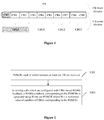


Classifications
-
- H—ELECTRICITY
- H04—ELECTRIC COMMUNICATION TECHNIQUE
- H04L—TRANSMISSION OF DIGITAL INFORMATION, e.g. TELEGRAPHIC COMMUNICATION
- H04L1/00—Arrangements for detecting or preventing errors in the information received
- H04L1/12—Arrangements for detecting or preventing errors in the information received by using return channel
- H04L1/16—Arrangements for detecting or preventing errors in the information received by using return channel in which the return channel carries supervisory signals, e.g. repetition request signals
- H04L1/18—Automatic repetition systems, e.g. Van Duuren systems
- H04L1/1867—Arrangements specially adapted for the transmitter end
- H04L1/1893—Physical mapping arrangements
-
- H—ELECTRICITY
- H04—ELECTRIC COMMUNICATION TECHNIQUE
- H04L—TRANSMISSION OF DIGITAL INFORMATION, e.g. TELEGRAPHIC COMMUNICATION
- H04L1/00—Arrangements for detecting or preventing errors in the information received
- H04L1/12—Arrangements for detecting or preventing errors in the information received by using return channel
- H04L1/16—Arrangements for detecting or preventing errors in the information received by using return channel in which the return channel carries supervisory signals, e.g. repetition request signals
- H04L1/18—Automatic repetition systems, e.g. Van Duuren systems
- H04L1/1829—Arrangements specially adapted for the receiver end
- H04L1/1861—Physical mapping arrangements
-
- H—ELECTRICITY
- H04—ELECTRIC COMMUNICATION TECHNIQUE
- H04L—TRANSMISSION OF DIGITAL INFORMATION, e.g. TELEGRAPHIC COMMUNICATION
- H04L1/00—Arrangements for detecting or preventing errors in the information received
- H04L1/12—Arrangements for detecting or preventing errors in the information received by using return channel
- H04L1/16—Arrangements for detecting or preventing errors in the information received by using return channel in which the return channel carries supervisory signals, e.g. repetition request signals
- H04L1/1607—Details of the supervisory signal
-
- H—ELECTRICITY
- H04—ELECTRIC COMMUNICATION TECHNIQUE
- H04L—TRANSMISSION OF DIGITAL INFORMATION, e.g. TELEGRAPHIC COMMUNICATION
- H04L1/00—Arrangements for detecting or preventing errors in the information received
- H04L1/12—Arrangements for detecting or preventing errors in the information received by using return channel
- H04L1/16—Arrangements for detecting or preventing errors in the information received by using return channel in which the return channel carries supervisory signals, e.g. repetition request signals
- H04L1/18—Automatic repetition systems, e.g. Van Duuren systems
- H04L1/1812—Hybrid protocols; Hybrid automatic repeat request [HARQ]
-
- H—ELECTRICITY
- H04—ELECTRIC COMMUNICATION TECHNIQUE
- H04L—TRANSMISSION OF DIGITAL INFORMATION, e.g. TELEGRAPHIC COMMUNICATION
- H04L1/00—Arrangements for detecting or preventing errors in the information received
- H04L1/12—Arrangements for detecting or preventing errors in the information received by using return channel
- H04L1/16—Arrangements for detecting or preventing errors in the information received by using return channel in which the return channel carries supervisory signals, e.g. repetition request signals
- H04L1/18—Automatic repetition systems, e.g. Van Duuren systems
- H04L1/1829—Arrangements specially adapted for the receiver end
- H04L1/1864—ARQ related signaling
-
- H—ELECTRICITY
- H04—ELECTRIC COMMUNICATION TECHNIQUE
- H04L—TRANSMISSION OF DIGITAL INFORMATION, e.g. TELEGRAPHIC COMMUNICATION
- H04L5/00—Arrangements affording multiple use of the transmission path
- H04L5/003—Arrangements for allocating sub-channels of the transmission path
- H04L5/0053—Allocation of signalling, i.e. of overhead other than pilot signals
- H04L5/0055—Physical resource allocation for ACK/NACK
-
- H—ELECTRICITY
- H04—ELECTRIC COMMUNICATION TECHNIQUE
- H04W—WIRELESS COMMUNICATION NETWORKS
- H04W72/00—Local resource management
- H04W72/20—Control channels or signalling for resource management
- H04W72/23—Control channels or signalling for resource management in the downlink direction of a wireless link, i.e. towards a terminal
Definitions
- the present disclosure generally relates to communication field, and more particularly, to a method for generating a hybrid automatic repeat request codebook, a user equipment and a medium.
- HARQ Hybrid Automatic Repeat request
- LTE Long Term Evolution
- NR New Radio
- HARQ Hybrid Automatic Repeat request
- FEC helps a receiver to correct errors by adding redundant information, thus reducing times of retransmission.
- FEC cannot correct
- the receiver requests a sender to retransmit data through the ARQ mechanism.
- the receiver uses an error-detection code, usually a Cyclic Redundancy Check (CRC) check, to detect whether a received data packet is correctly decoded. If the data packet is correctly decoded, the receiver sends an acknowledgment (ACK) to the sender.
- CRC Cyclic Redundancy Check
- the sender After receiving the ACK, the sender will send a new data packet. If the data packet is not correctly decoded, the receiver sends a negative acknowledgment (NACK) to the sender. After receiving the NACK, the sender will retransmit the same data packet.
- NACK negative acknowledgment
- the receiver performs HARQ feedback on each Transport Block (TB) using a single bit, that is, feeding back whether each TB is correctly decoded using a single bit.
- TB Transport Block
- CBs code blocks
- a size of a TB is increased significantly, and the number of code blocks (CBs) in each TB is several times larger compared with the LTE system. Therefore, multiple bits feedback per TB is introduced in NR to increase spectrum efficiency.
- CBs in one TB are divided into several Code Block Groups (CBGs) each of which includes one or more CBs, and HARQ feedback is performed on each CBG, that is, whether each CBG is correctly decoded is fed back by a single bit.
- CBGs Code Block Groups
- HARQ feedback of a TB is performed by using bits corresponding to the maximum value of numbers of CBGs configured for each TB across all the serving cells in a Physical Uplink Control CHannel (PUCCH) group.
- PUCCH Physical Uplink Control CHannel
- PDSCH Physical Downlink Shared CHannel
- bit overhead of HARQ feedback based on CBG may be reduced, and resource utilization may be improved.
- a method for generating a HARQ codebook including: receiving Physical Downlink Shared Channels (PDSCHs) each of which includes at least one TB; and to serving cells which are configured with CBG-based HARQ feedback, generating a HARQ codebook corresponding to the PDSCHs using N bits per PDSCH, wherein N is a maximum value of numbers of CBGs corresponding to the PDSCHs.
- PDSCHs Physical Downlink Shared Channels
- N is max ⁇ N i ⁇ , where i is an identifier of one of the serving cells which are configured with CBG-based HARQ feedback, N i is the maximum value of numbers of CBGs corresponding to the PDSCHs for the corresponding serving cell i, and max ⁇ represents taking the maximum value.
- generating the HARQ codebook corresponding to the PDSCHs using N bits per PDSCH includes: if the number of TBs in each of the PDSCHs is two, generating a first HARQ codebook corresponding to CBGs included in a first TB using first N/2 bits; and generating a second HARQ codebook corresponding to CBGs included in a second TB using remaining N/2 bits.
- generating the first HARQ codebook corresponding to CBGs included in the first TB using the first N/2 bits includes: if M1 is less than N/2, generating the first HARQ codebook corresponding to CBGs included in the first TB using first M1 bits among the first N/2 bits; and setting remaining (N/2-M1) bits to NACK, where M1 is the maximum value of the number of CBGs corresponding to the first TB.
- generating the second HARQ codebook corresponding to CBGs included in the second TB using the remaining N/2 bits includes: if M2 is less than N/2, generating the second HARQ codebook corresponding to CBGs included in the second TB using first M2 bits among the remaining N/2 bits; and setting remaining (N/2-M2) bits to NACK, where M2 is the maximum value of the number of CBGs corresponding to the second TB.
- generating the HARQ codebook corresponding to the PDSCHs using N bits per PDSCH includes: if the number of TBs in each of the PDSCHs is two and M1+M2 ⁇ N, generating a first HARQ codebook corresponding to CBGs included in a first TB using first M1 bits; generating a second HARQ codebook corresponding to CBGs included in a second TB using M2 bits following the first M1 bits; and setting remaining (N-M1-M2) bits to NACK, where M1 is the maximum value of the number of CBGs corresponding to the first TB, and M2 is the maximum value of the number of CBGs corresponding to the second TB.
- generating the HARQ codebook corresponding to the PDSCHs using N bits per PDSCH includes: if the number of TBs in each of the PDSCHs is one and M0 ⁇ N, generating the HARQ codebook corresponding to CBGs included in the TB using first M0 bits; and setting remaining (N-MO) bits to NACK, where M0 is the maximum value of the number of CBGs corresponding to the TB.
- generating the HARQ codebook corresponding to the PDSCHs using N bits per PDSCH includes: generating the HARQ codebook corresponding to the TBs using a first bit; and setting remaining (N-1) bits to NACK.
- a UE including: a first receiving circuitry, configured to receive PDSCHs each of which includes at least one TB; and a generating circuitry, configured to: to serving cells which are configured with CBG-based HARQ feedback, generate a HARQ codebook corresponding to the PDSCHs using N bits per PDSCH, where N is a maximum value of numbers of CBGs corresponding to the PDSCHs.
- N is max ⁇ N i ⁇ , where i is an identifier of one of the serving cells which are configured with CBG-based HARQ feedback, N i is the maximum value of numbers of CBGs corresponding to the PDSCHs for the corresponding serving cell i, and max ⁇ represents taking the maximum value.
- a second receiving circuitry configured to receive a signaling from a base station, where the signaling includes the number of TBs in each of the PDSCHs in the serving cell i; if the number of TBs in each of the PDSCHs in the serving
- the generating circuitry is configured to: if the number of TBs in each of the PDSCHs is two, generate a first HARQ codebook corresponding to CBGs included in a first TB using first N/2 bits; and generate a second HARQ codebook corresponding to CBGs included in a second TB using remaining N/2 bits.
- the generating circuitry is configured to: if M1 is less than N/2, generate the first HARQ codebook corresponding to CBGs included in the first TB using first M1 bits among the first N/2 bits; and set remaining (N/2-M1) bits to NACK, where M1 is the maximum value of the number of CBGs corresponding to the first TB.
- the generating circuitry is configured to: if M2 is less than N/2, generate the second HARQ codebook corresponding to CBGs included in the second TB using first M2 bits among the remaining N/2 bits; and set remaining (N/2-M2) bits to NACK, where M2 is the maximum value of the number of CBGs corresponding to the second TB.
- the generating circuitry is configured to: if the number of TBs in each of the PDSCHs is two and M1+M2 ⁇ N, generate a first HARQ codebook corresponding to CBGs included in a first TB using first M1 bits; generate a second HARQ codebook corresponding to CBGs included in a second TB using M2 bits following the first M1 bits; and set remaining (N-M1-M2) bits to NACK, where M1 is the maximum value of the number of CBGs corresponding to the first TB, and M2 is the maximum value of the number of CBGs corresponding to the second TB.
- the generating circuitry is configured to: if the number of TBs in each of the PDSCHs is one and M0 ⁇ N, generate the HARQ codebook corresponding to CBGs included in the TB using first M0 bits; and set remaining (N-MO) bits to NACK, where M0 is the maximum value of the number of CBGs corresponding to the TB.
- the generating circuitry is configured to: generate the HARQ codebook corresponding to the TBs using a first bit; and set remaining (N-1) bits to NACK.
- a computer readable storage medium having computer instructions stored therein is provided, where once the computer instructions are executed, any one of the above methods for generating the HARQ codebook is performed.
- a UE including a memory and a processor
- the memory has computer instructions stored therein, and once the processor executes the computer instructions, any one of the above methods for generating the HARQ codebook is performed.
- Embodiments of the present disclosure may provide following advantages.
- the HARQ codebook corresponding to the PDSCHs is generated using N bits per PDSCH.
- N is a maximum value of numbers of CBGs corresponding to the PDSCHs rather than a maximum value of numbers of CBGs corresponding to the TBs. Therefore, the configured maximum value of the numbers of CBGs may not be too great to adapt numbers of different TBs. Bit overhead of the CBG-based HARQ feedback may be reduced, and resource utilization may be improved.
- CBs in one TB are divided into several CBGs each of which includes one or more CBs, and HARQ feedback is performed on each CBG, that is, whether each CBG is correctly decoded is fed back by a single bit.
- the CBG is not correctly decoded, the entire CBG will be retransmitted. Therefore, when some CBGs of a TB are incorrectly decoded, only the incorrectly decoded CBGs rather than the entire TB will be retransmitted.
- Figure 1 schematically illustrates a diagram of a CBG in existing techniques.
- one TB includes ten CBs, which are CB0 to CB9.
- the ten CBs are divided into 4 CBGs including CBGO to CGB3, where CBGO includes CB0 to CB2, CBG1 includes CB3 to CB5, and CBG2 includes CB6 to CB7, and CBG3 includes CB8 to CB9.
- a HARQ codebook is fed back based on CBG, when CB0 is not correctly decoded and CB1 to CB9 are correctly decoded, a codebook bit corresponding to CBGO is set to NACK as CB0 belongs to CBGO, and codebook bits corresponding to other CBGs are set to ACK.
- the base station After receiving the HARQ codebook, the base station only retransmits CB0 ⁇ CB2 belonging to CBGO rather than the entire TB.
- HARQ feedback of a TB is performed by using bits corresponding to the maximum value of numbers of CBGs configured for each TB across all the serving cells in a PUCCH group. In case of the number of TBs per PDSCH is 2, the feedback bits are over dimensioned.
- a HARQ codebook corresponding to PDSCHs is generated using N bits per PDSCH.
- N is a maximum value of numbers of CBGs corresponding to PDSCHs rather than a maximum value of numbers of CBGs corresponding to the TBs. Therefore, a configured maximum value of numbers of CBGs may not be too great to adapt numbers of different TBs. Bit overhead of CBG-based HARQ feedback may be reduced, and resource utilization may be improved.
- Figure 2 schematically illustrates a flow chart of a method for generating a HARQ codebook according to an embodiment.
- the method includes S201 and S202.
- the PDSCHs may be received based on schedule information indicated by a Physical Downlink Control Channel (PDCCH).
- PDCH Physical Downlink Control Channel
- the PDCCH may indicate the PDSCHs based on different DCI formats, such as DCI format 1_1 or DCT format 1_0 which can be referred to descriptions of DCI formats in existing protocols and is not described in detail here.
- a HARQ codebook corresponding to the PDSCHs is generated using N bits per PDSCH, where N is a maximum value of numbers of CBGs corresponding to the PDSCHs.
- different PDSCHs may be configured with different numbers of CBGs, and a maximum value among the different numbers of CBGs is the maximum value of numbers of CBGs corresponding to the PDSCHs.
- the number of the serving cells which are configured with CBG-based HARQ feedback is one or more.
- N is max ⁇ N i ⁇ , where i is an identifier of one of the serving cells which are configured with CBG-based HARQ feedback, N i is the maximum value of numbers of CBGs corresponding to the PDSCHs for the corresponding serving cell i, and max ⁇ represents taking the maximum value.
- the HARQ codebook is configured as a dynamic HARQ codebook.
- the method may further include: receiving a signaling from a base station, where the signaling includes the number of TBs in each of the PDSCHs in the serving cell i, for example, Number-MCS-HARQ-DL-DCI.
- different TBs may be configured with different numbers of CBGs, and a maximum value among the different numbers of CBGs is the maximum value of numbers of CBGs corresponding to the TBs for the corresponding serving cell i.
- generating the HARQ codebook corresponding to the PDSCHs using N bits per PDSCH may include: if the number of TBs in each of the PDSCHs is two, generating a first HARQ codebook corresponding to CBGs included in the first TB using first N/2 bits; and generating a second HARQ codebook corresponding to CBGs included in the second TB using remaining N/2 bits.
- generating the first HARQ codebook corresponding to CBGs included in the first TB using the first N/2 bits includes: if M1 is less than N/2, generating the first HARQ codebook corresponding to CBGs included in the first TB using first M1 bits among the first N/2 bits; and setting remaining (N/2-M1) bits to NACK, where M1 is the maximum value of the number of CBGs corresponding to the first TB.
- generating the second HARQ codebook corresponding to CBGs included in the second TB using the remaining N/2 bits includes: if M2 is less than N/2, generating the second HARQ codebook corresponding to CBGs included in the second TB using first M2 bits among the remaining N/2 bits; and setting the remaining (N/2-M2) bits to NACK, where M2 is the maximum value of the number of CBGs corresponding to the second TB.
- generating the HARQ codebook corresponding to the PDSCHs using N bits per PDSCH may include: if the number of TBs in each of the PDSCHs is two and M1+M2 ⁇ N, generating a first HARQ codebook corresponding to CBGs included in the first TB using first M1 bits; generating a second HARQ codebook corresponding to CBGs included in the second TB using M2 bits following the first M1 bits; and setting remaining (N-M1-M2) bits to NACK, where M1 is the maximum value of the number of CBGs corresponding to the first TB, and M2 is the maximum value of the number of CBGs corresponding to the second TB.
- generating the HARQ codebook corresponding to the PDSCHs using N bits per PDSCH may include: if the number of TBs in each of the PDSCHs is one and M0 ⁇ N, generating the HARQ codebook corresponding to CBGs included in the TB using first M0 bits; and setting remaining (N-MO) bits to NACK, where M0 is the maximum value of the number of CBGs corresponding to the TB.
- generating the HARQ codebook corresponding to the PDSCHs using N bits per PDSCH may include: generating the HARQ codebook corresponding to the TB using a first bit; and setting remaining (N-1) bits to NACK.
- the HARQ codebook indicates for the base station whether the TBs or the CBGs are correctly decoded.
- the HARQ codebook may be also called as other names with the same meaning, such as HARQ-ACK information or HARQ-ACK feedback, which also falls within the scope of the present disclosure.
- the UE uses N HARQ ⁇ ACK , max CBG / PDSCH , max HARQ-ACK bits to feed back a CBG-level HARQ-ACK.
- first N HARQ ⁇ ACK , max CBG / PDSCH , max / 2 bits may be used to indicate HARQ-ACK information of CBGs included in a first TB; if N HARQ ⁇ ACK , c CBG / TB 0 of CBGs included in the first TB is less than N HARQ ⁇ ACK , max CBG / PDSCH , max / 2 , first N HARQ ⁇ ACK , c CBG / TB 0 bits feed back HARQ-ACK information of CBGs included in TB0, and remaining N HARQ ⁇ ACK , max CBG / PDSCH , max / 2 ⁇ N HARQ ⁇ ACK , c CBG / TB 0 bits are set to NACK
- N HARQ ⁇ ACK , c CBG / TB 0 of CBGs included in the first TB is less than N HARQ ⁇ ACK , max CBG / PDSCH , max , first N HARQ ⁇ ACK , c CBG / TB 0 bits are used to indicate HARQ-ACK information of CBGs included in TB0, and remaining N HARQ ⁇ ACK , max CBG / PDSCH , max ⁇ N HARQ ⁇ ACK , c CBG / TB 0 bits are set to NACK; when the UE receives a PDSCH scheduled in DCI format 1_0, a first bit is used to feed back HARQ-ACK information corresponding to the TB scheduled by the PDSCH, and remaining N HARQ ⁇ ACK , max CBG / PDSCH , max ⁇ 1 bits are set to NACK; when the UE receives an SPS deactivation indicated in DCI format 1_0,
- the UE uses N HARQ ⁇ ACK , max CBG / PDSCH , max HARQ-ACK bits to feed back a CBG-level HARQ-ACK.
- first N HARQ ⁇ ACK , max CBG / PDSCH , max / 2 bits may be used to indicate HARQ-ACK information of CBGs included in a first TB; if N HARQ ⁇ ACK , c CBG / TB 0 of CBGs included in the first TB is less than N HARQ ⁇ ACK , max CBG / PDSCH , max / 2 , the first N HARQ ⁇ ACK , c CBG / TB 0 bits feed back HARQ-ACK information of CBGs included in TB0, and remaining N HARQ ⁇ ACK , max CBG / PDSCH , max / 2 ⁇ N HARQ ⁇ ACK , c CBG / TB 0 bits are set to N
- N HARQ ⁇ ACK , c CBG / TB 0 of CBGs included in the first TB is less than N HARQ ⁇ ACK , max CBG / PDSCH , max , first N HARQ ⁇ ACK , c CBG / TB 0 bits are used to indicate HARQ-ACK information of CBGs included in TB0, and remaining N HARQ ⁇ ACK , max CBG / PDSCH , max ⁇ N HARQ ⁇ ACK , c CBG / TB 0 bits are set to NACK; when the UE receives a PDSCH scheduled in DCI format 1_0, only TB-level HARQ-ACK is fed back, and CBG-level HARQ-ACK is not fed back; when the UE receives an SPS deactivation indicated in DCI format 1_0, only TB-level HARQ-ACK is fed back, and CBG-level HARQ-ACK is not fed back; and if
- a generating mode of the HARQ codebook for the TBs associated with SPS is determined based on related parameters, and the HARQ codebook for the TBs associated with SPS is generated based on the determined generating mode. In this way, HARQ feedback in an SPS scenario is realized.
- embodiments of the present disclosure provide a diagram of a HARQ codebook in Figure 4 .
- a UE is configured with two serving cells, and an RRC parameter HARQ-ACK-codebook is 'dynamic'.
- the UE when the UE receives one PDSCH scheduled by a PDCCH or an SPS deactivation indicated by a PDCCH, the UE uses N HARQ ⁇ ACK , max CBG / PDSCH , max HARQ-ACK bits to feed back a CBG-level HARQ-ACK.
- the total codebook fed back is 100000100000110110.
- embodiments of the present disclosure provide a diagram of a HARQ codebook in Figure 5 .
- a UE is configured with two serving cells, and an RRC parameter HARQ-ACK-codebook is 'dynamic'.
- the generated codebook is 11110000.
- the total codebook fed back is 1111000011111111.
- embodiments of the present disclosure provide a diagram of a HARQ codebook in Figure 6 .
- a UE is configured with two serving cells, and an RRC parameter HARQ-ACK-codebook is 'dynamic'.
- the codebook generated by the UE is as follows.
- the total codebook fed back is 111110, where the sub-codebook 1 is 1, the sub-codebook 2 is 1111, and SPS codebook is 0.
- embodiments of the present disclosure provide a diagram of a HARQ codebook in Figure 7 .
- a UE is configured with two serving cells, and an RRC parameter HARQ-ACK-codebook is 'dynamic'.
- the codebook generated by the UE is as follows.
- the total codebook fed back is 11011111, where the sub-codebook 1 is 1101, and the sub-codebook 2 is 1111.
- embodiments of the present disclosure provide a diagram of a HARQ codebook in Figure 8 .
- a UE is configured with two serving cells, and an RRC parameter HARQ-ACK-codebook is 'dynamic'.
- the total codebook fed back is 100000100000111100.
- embodiments of the present disclosure further provide a UE capable of implementing the above method for generating the HARQ codebook, as shown in Figure 3 .
- the UE 30 includes a first receiving circuitry 31 and a generating circuitry 32.
- the first receiving circuitry 31 is configured to receive PDSCHs each of which includes at least one TB.
- the generating circuitry 32 is configured to: to serving cells which are configured with CBG-based HARQ feedback, generate a HARQ codebook corresponding to the PDSCHs using N bits per PDSCH, where N is a maximum value of numbers of CBGs corresponding to the PDSCHs.
- N is max ⁇ N i ⁇ , where i is an identifier of the serving cell which are configured with CBG-based HARQ feedback, N i is the maximum value of numbers of CBGs corresponding to the PDSCHs for the corresponding serving cell i, and max ⁇ represents taking the maximum value.
- the UE 30 further includes a second receiving circuitry (not shown) configured to receive a signaling from a base station, where the signaling includes the number of TBs in each of the PDSCHs in the serving cell i, for example, Number-MCS-HARQ-DL-DCI.
- the generating circuitry 32 is configured to: if the number of TBs in each of the PDSCHs is two, generate a first HARQ codebook corresponding to CBGs included in the first TB using first N/2 bits; and generate a second HARQ codebook corresponding to CBGs included in the second TB using remaining N/2 bits.
- the generating circuitry 32 is configured to: if M1 is less than N/2, generate the first HARQ codebook corresponding to CBGs included in the first TB using first M1 bits among the first N/2 bits; and set remaining (N/2-M1) bits to NACK, where M1 is the maximum value of the number of CBGs corresponding to the first TB.
- the generating circuitry 32 is configured to: if M2 is less than N/2, generate the second HARQ codebook corresponding to CBGs included in the second TB using first M2 bits among the remaining N/2 bits; and set remaining (N/2-M2) bits to NACK, where M2 is the maximum value of the number of CBGs corresponding to the second TB.
- the generating circuitry 32 is configured to: if the number of TBs in each of the PDSCHs is two and M1+M2 ⁇ N, generate a first HARQ codebook corresponding to CBGs included in the first TB using first M1 bits; generate a second HARQ codebook corresponding to CBGs included in the second TB using M2 bits following the first M1 bits; and set remaining (N-M1-M2) bits to NACK, where M1 is the maximum value of the number of CBGs corresponding to the first TB, and M2 is the maximum value of the number of CBGs corresponding to the second TB.
- the generating circuitry 32 is configured to: if the number of TBs in each of the PDSCHs is one and M0 ⁇ N, generate the HARQ codebook corresponding to CBGs included in the TB using first M0 bits; and set remaining (N-MO) bits to NACK, where M0 is the maximum value of the number of CBGs corresponding to the TB.
- the generating circuitry 32 is configured to: generate the HARQ codebook corresponding to the TB using a first bit; and set remaining (N-1) bits to NACK.
- a computer readable storage medium having computer instructions stored therein is provided, where once the computer instructions are executed, any one of the above methods for generating the HARQ codebook is performed.
- the computer readable storage medium is a non-volatile or non-transient storage medium.
- a UE including a memory and a processor
- the memory has computer instructions stored therein, and once the processor executes the computer instructions, any one of the above methods for generating the HARQ codebook is performed.
- the computer program may be stored in a readable storage medium, such as a magnetic disk, an optical disk, a Read-Only Memory (ROM) or a Random Access Memory (RAM).
- a readable storage medium such as a magnetic disk, an optical disk, a Read-Only Memory (ROM) or a Random Access Memory (RAM).
Landscapes
- Engineering & Computer Science (AREA)
- Signal Processing (AREA)
- Computer Networks & Wireless Communication (AREA)
- Mobile Radio Communication Systems (AREA)
- Detection And Prevention Of Errors In Transmission (AREA)
Abstract
Description
- The present application claims priority to Chinese patent application No.
201810033775.7, filed on January 12, 2018 - The present disclosure generally relates to communication field, and more particularly, to a method for generating a hybrid automatic repeat request codebook, a user equipment and a medium.
- In a Long Term Evolution (LTE) system and a New Radio (NR) system, a Hybrid Automatic Repeat request (HARQ) mechanism is supported. HARQ is a technology that combines Forward Error Correction (FEC) and Automatic Repeat reQuest (ARQ). FEC helps a receiver to correct errors by adding redundant information, thus reducing times of retransmission. For errors that FEC cannot correct, the receiver requests a sender to retransmit data through the ARQ mechanism. The receiver uses an error-detection code, usually a Cyclic Redundancy Check (CRC) check, to detect whether a received data packet is correctly decoded. If the data packet is correctly decoded, the receiver sends an acknowledgment (ACK) to the sender. After receiving the ACK, the sender will send a new data packet. If the data packet is not correctly decoded, the receiver sends a negative acknowledgment (NACK) to the sender. After receiving the NACK, the sender will retransmit the same data packet.
- For the LTE system, the receiver performs HARQ feedback on each Transport Block (TB) using a single bit, that is, feeding back whether each TB is correctly decoded using a single bit. For the NR system, a size of a TB is increased significantly, and the number of code blocks (CBs) in each TB is several times larger compared with the LTE system. Therefore, multiple bits feedback per TB is introduced in NR to increase spectrum efficiency. CBs in one TB are divided into several Code Block Groups (CBGs) each of which includes one or more CBs, and HARQ feedback is performed on each CBG, that is, whether each CBG is correctly decoded is fed back by a single bit. When the CBG is not correctly decoded, the entire CBG will be retransmitted. Therefore, when some CBGs of a TB are incorrectly decoded, only the incorrectly decoded CBGs rather than the entire TB will be retransmitted.
- However, in the existing method of performing CBG-based HARQ feedback, HARQ feedback of a TB is performed by using bits corresponding to the maximum value of numbers of CBGs configured for each TB across all the serving cells in a Physical Uplink Control CHannel (PUCCH) group. In case of the number of TBs per Physical Downlink Shared CHannel (PDSCH) is 2, the feedback bits are over dimensioned.
- By embodiments of the present disclosure, bit overhead of HARQ feedback based on CBG may be reduced, and resource utilization may be improved.
- In an embodiment of the present disclosure, a method for generating a HARQ codebook is provided, including: receiving Physical Downlink Shared Channels (PDSCHs) each of which includes at least one TB; and to serving cells which are configured with CBG-based HARQ feedback, generating a HARQ codebook corresponding to the PDSCHs using N bits per PDSCH, wherein N is a maximum value of numbers of CBGs corresponding to the PDSCHs.
- Optionally, if the number of the serving cells which are configured with CBG-based HARQ feedback is more than one, and the HARQ codebook is configured as a dynamic HARQ codebook, N is max{N i}, where i is an identifier of one of the serving cells which are configured with CBG-based HARQ feedback, N i is the maximum value of numbers of CBGs corresponding to the PDSCHs for the corresponding serving cell i, and max{} represents taking the maximum value.
- Optionally, the method may further include: receiving a signaling from a base station, wherein the signaling includes the number of TBs in each of the PDSCHs in the serving cell i; if the number of TBs in each of the PDSCHs in the serving cell i is two, N i = 2 × N i TB; and if the number of TBs in each of the PDSCHs in the serving cell i is one, N i = N i TB, where i is an identifier of one of the serving cells which are configured with CBG-based HARQ feedback, and N i TB is a maximum value of numbers of CBGs corresponding to the TBs for the corresponding serving cell i.
- Optionally, if a DCI format corresponding to the PDSCHs is DCI format 1_1, generating the HARQ codebook corresponding to the PDSCHs using N bits per PDSCH includes: if the number of TBs in each of the PDSCHs is two, generating a first HARQ codebook corresponding to CBGs included in a first TB using first N/2 bits; and generating a second HARQ codebook corresponding to CBGs included in a second TB using remaining N/2 bits.
- Optionally, generating the first HARQ codebook corresponding to CBGs included in the first TB using the first N/2 bits includes: if M1 is less than N/2, generating the first HARQ codebook corresponding to CBGs included in the first TB using first M1 bits among the first N/2 bits; and setting remaining (N/2-M1) bits to NACK, where M1 is the maximum value of the number of CBGs corresponding to the first TB.
- Optionally, generating the second HARQ codebook corresponding to CBGs included in the second TB using the remaining N/2 bits includes: if M2 is less than N/2, generating the second HARQ codebook corresponding to CBGs included in the second TB using first M2 bits among the remaining N/2 bits; and setting remaining (N/2-M2) bits to NACK, where M2 is the maximum value of the number of CBGs corresponding to the second TB.
- Optionally, if a DCI format corresponding to the PDSCHs is DCI format 1_1, generating the HARQ codebook corresponding to the PDSCHs using N bits per PDSCH includes: if the number of TBs in each of the PDSCHs is two and M1+M2<N, generating a first HARQ codebook corresponding to CBGs included in a first TB using first M1 bits; generating a second HARQ codebook corresponding to CBGs included in a second TB using M2 bits following the first M1 bits; and setting remaining (N-M1-M2) bits to NACK, where M1 is the maximum value of the number of CBGs corresponding to the first TB, and M2 is the maximum value of the number of CBGs corresponding to the second TB.
- Optionally, if a DCI format corresponding to the PDSCHs is DCI format 1_1, generating the HARQ codebook corresponding to the PDSCHs using N bits per PDSCH includes: if the number of TBs in each of the PDSCHs is one and M0<N, generating the HARQ codebook corresponding to CBGs included in the TB using first M0 bits; and setting remaining (N-MO) bits to NACK, where M0 is the maximum value of the number of CBGs corresponding to the TB.
- Optionally, if a DCI format corresponding to the PDSCHs is DCI format 1_0, generating the HARQ codebook corresponding to the PDSCHs using N bits per PDSCH includes: generating the HARQ codebook corresponding to the TBs using a first bit; and setting remaining (N-1) bits to NACK.
- In an embodiment of the present disclosure, a UE is provided, including: a first receiving circuitry, configured to receive PDSCHs each of which includes at least one TB; and a generating circuitry, configured to: to serving cells which are configured with CBG-based HARQ feedback, generate a HARQ codebook corresponding to the PDSCHs using N bits per PDSCH, where N is a maximum value of numbers of CBGs corresponding to the PDSCHs.
- Optionally, if the number of the serving cells which are configured with CBG-based HARQ feedback is more than one, and the HARQ codebook is configured as a dynamic HARQ codebook, N is max{N i}, where i is an identifier of one of the serving cells which are configured with CBG-based HARQ feedback, N i is the maximum value of numbers of CBGs corresponding to the PDSCHs for the corresponding serving cell i, and max{} represents taking the maximum value.
- Optionally, the UE may further include: a second receiving circuitry configured to receive a signaling from a base station, where the signaling includes the number of TBs in each of the PDSCHs in the serving cell i; if the number of TBs in each of the PDSCHs in the serving cell i is two, N i = 2 × N i TB; and if the number of TBs in each of the PDSCHs in the serving cell i is one, N i = N i TB, where i is an identifier of one of the serving cells which are configured with CBG-based HARQ feedback, and N i TB is a maximum value of numbers of CBGs corresponding to the TBs for the corresponding serving cell i.
- Optionally, if a DCI format corresponding to the PDSCHs is DCI format 1_1, the generating circuitry is configured to: if the number of TBs in each of the PDSCHs is two, generate a first HARQ codebook corresponding to CBGs included in a first TB using first N/2 bits; and generate a second HARQ codebook corresponding to CBGs included in a second TB using remaining N/2 bits.
- Optionally, the generating circuitry is configured to: if M1 is less than N/2, generate the first HARQ codebook corresponding to CBGs included in the first TB using first M1 bits among the first N/2 bits; and set remaining (N/2-M1) bits to NACK, where M1 is the maximum value of the number of CBGs corresponding to the first TB.
- Optionally, the generating circuitry is configured to: if M2 is less than N/2, generate the second HARQ codebook corresponding to CBGs included in the second TB using first M2 bits among the remaining N/2 bits; and set remaining (N/2-M2) bits to NACK, where M2 is the maximum value of the number of CBGs corresponding to the second TB.
- Optionally, if a DCI format corresponding to the PDSCHs is DCI format 1_1, the generating circuitry is configured to: if the number of TBs in each of the PDSCHs is two and M1+M2<N, generate a first HARQ codebook corresponding to CBGs included in a first TB using first M1 bits; generate a second HARQ codebook corresponding to CBGs included in a second TB using M2 bits following the first M1 bits; and set remaining (N-M1-M2) bits to NACK, where M1 is the maximum value of the number of CBGs corresponding to the first TB, and M2 is the maximum value of the number of CBGs corresponding to the second TB.
- Optionally, if a DCI format corresponding to the PDSCHs is DCI format 1_1, the generating circuitry is configured to: if the number of TBs in each of the PDSCHs is one and M0<N, generate the HARQ codebook corresponding to CBGs included in the TB using first M0 bits; and set remaining (N-MO) bits to NACK, where M0 is the maximum value of the number of CBGs corresponding to the TB.
- Optionally, if a DCI format corresponding to the PDSCHs is DCI format 1_0, the generating circuitry is configured to: generate the HARQ codebook corresponding to the TBs using a first bit; and set remaining (N-1) bits to NACK.
- In an embodiment of the present disclosure, a computer readable storage medium having computer instructions stored therein is provided, where once the computer instructions are executed, any one of the above methods for generating the HARQ codebook is performed.
- In an embodiment of the present disclosure, a UE including a memory and a processor is provided, where the memory has computer instructions stored therein, and once the processor executes the computer instructions, any one of the above methods for generating the HARQ codebook is performed.
- Embodiments of the present disclosure may provide following advantages. To the serving cells which are configured with CBG-based HARQ feedback, the HARQ codebook corresponding to the PDSCHs is generated using N bits per PDSCH. N is a maximum value of numbers of CBGs corresponding to the PDSCHs rather than a maximum value of numbers of CBGs corresponding to the TBs. Therefore, the configured maximum value of the numbers of CBGs may not be too great to adapt numbers of different TBs. Bit overhead of the CBG-based HARQ feedback may be reduced, and resource utilization may be improved.
-
-
Figure 1 schematically illustrates a diagram of a CBG in existing techniques; -
Figure 2 schematically illustrates a flow chart of a method for generating a HARQ codebook according to an embodiment; -
Figure 3 schematically illustrates a structural diagram of a UE according to an embodiment; -
Figure 4 schematically illustrates a diagram of a HARQ codebook according to an embodiment; -
Figure 5 schematically illustrates a diagram of a HARQ codebook according to an embodiment; -
Figure 6 schematically illustrates a diagram of a HARQ codebook according to an embodiment; and -
Figure 7 schematically illustrates a diagram of a HARQ codebook according to an embodiment; and -
Figure 8 schematically illustrates a diagram of a HARQ codebook according to an embodiment. - For the NR system, a size of a TB is increased significantly. Therefore, multiple bits feedback per TB is introduced in NR to increase spectrum efficiency. CBs in one TB are divided into several CBGs each of which includes one or more CBs, and HARQ feedback is performed on each CBG, that is, whether each CBG is correctly decoded is fed back by a single bit. When the CBG is not correctly decoded, the entire CBG will be retransmitted. Therefore, when some CBGs of a TB are incorrectly decoded, only the incorrectly decoded CBGs rather than the entire TB will be retransmitted.
-
Figure 1 schematically illustrates a diagram of a CBG in existing techniques. - Referring to
Figure 1 , one TB includes ten CBs, which are CB0 to CB9. The ten CBs are divided into 4 CBGs including CBGO to CGB3, where CBGO includes CB0 to CB2, CBG1 includes CB3 to CB5, and CBG2 includes CB6 to CB7, and CBG3 includes CB8 to CB9. - If a HARQ codebook is fed back based on CBG, when CB0 is not correctly decoded and CB1 to CB9 are correctly decoded, a codebook bit corresponding to CBGO is set to NACK as CB0 belongs to CBGO, and codebook bits corresponding to other CBGs are set to ACK. After receiving the HARQ codebook, the base station only retransmits CB0∼CB2 belonging to CBGO rather than the entire TB.
- In the existing method of performing CBG-based HARQ feedback, HARQ feedback of a TB is performed by using bits corresponding to the maximum value of numbers of CBGs configured for each TB across all the serving cells in a PUCCH group. In case of the number of TBs per PDSCH is 2, the feedback bits are over dimensioned.
- In embodiments of the present disclosure, to serving cells which are configured with CBG-based HARQ feedback, a HARQ codebook corresponding to PDSCHs is generated using N bits per PDSCH. N is a maximum value of numbers of CBGs corresponding to PDSCHs rather than a maximum value of numbers of CBGs corresponding to the TBs. Therefore, a configured maximum value of numbers of CBGs may not be too great to adapt numbers of different TBs. Bit overhead of CBG-based HARQ feedback may be reduced, and resource utilization may be improved.
- In order to clarify the object, solutions and advantages of embodiments of the present disclosure, embodiments of present disclosure will be described clearly in detail in conjunction with accompanying drawings.
-
Figure 2 schematically illustrates a flow chart of a method for generating a HARQ codebook according to an embodiment. Referring toFigure 2 , the method includes S201 and S202. - In S201, PDSCHs each of which includes at least one TB are received.
- In some embodiments, the PDSCHs may be received based on schedule information indicated by a Physical Downlink Control Channel (PDCCH).
- In some embodiments, the PDCCH may indicate the PDSCHs based on different DCI formats, such as DCI format 1_1 or DCT format 1_0 which can be referred to descriptions of DCI formats in existing protocols and is not described in detail here.
- In S202, to serving cells which are configured with CBG-based HARQ feedback, a HARQ codebook corresponding to the PDSCHs is generated using N bits per PDSCH, where N is a maximum value of numbers of CBGs corresponding to the PDSCHs.
- In some embodiments, different PDSCHs may be configured with different numbers of CBGs, and a maximum value among the different numbers of CBGs is the maximum value of numbers of CBGs corresponding to the PDSCHs.
- In some embodiments, the number of the serving cells which are configured with CBG-based HARQ feedback is one or more.
- In some embodiments, if the number of the serving cells which are configured with CBG-based HARQ feedback is more than one, and the HARQ codebook is configured as a dynamic HARQ codebook, N is max{N i}, where i is an identifier of one of the serving cells which are configured with CBG-based HARQ feedback, N i is the maximum value of numbers of CBGs corresponding to the PDSCHs for the corresponding serving cell i, and max{} represents taking the maximum value.
- In some embodiments, according to 3GPP protocol, if parameter HARQ-ACK-codebook is dynamic, the HARQ codebook is configured as a dynamic HARQ codebook.
- In some embodiments, the method may further include: receiving a signaling from a base station, where the signaling includes the number of TBs in each of the PDSCHs in the serving cell i, for example, Number-MCS-HARQ-DL-DCI. If the number of TBs in each of the PDSCHs in the serving cell i is two, N i = 2 × N i TB; and if the number of TBs in each of the PDSCHs in the serving cell i is one, N i = N i TB, where i is an identifier of one of the serving cells which are configured with CBG-based HARQ feedback, and N i TB is a maximum value of numbers of CBGs corresponding to the TBs for the corresponding serving cell i.
- In some embodiments, different TBs may be configured with different numbers of CBGs, and a maximum value among the different numbers of CBGs is the maximum value of numbers of CBGs corresponding to the TBs for the corresponding serving cell i.
- In some embodiments, if the DCI format corresponding to the PDSCHs is DCI format 1_1, generating the HARQ codebook corresponding to the PDSCHs using N bits per PDSCH may include: if the number of TBs in each of the PDSCHs is two, generating a first HARQ codebook corresponding to CBGs included in the first TB using first N/2 bits; and generating a second HARQ codebook corresponding to CBGs included in the second TB using remaining N/2 bits.
- In some embodiments, generating the first HARQ codebook corresponding to CBGs included in the first TB using the first N/2 bits includes: if M1 is less than N/2, generating the first HARQ codebook corresponding to CBGs included in the first TB using first M1 bits among the first N/2 bits; and setting remaining (N/2-M1) bits to NACK, where M1 is the maximum value of the number of CBGs corresponding to the first TB.
- In some embodiments, generating the second HARQ codebook corresponding to CBGs included in the second TB using the remaining N/2 bits includes: if M2 is less than N/2, generating the second HARQ codebook corresponding to CBGs included in the second TB using first M2 bits among the remaining N/2 bits; and setting the remaining (N/2-M2) bits to NACK, where M2 is the maximum value of the number of CBGs corresponding to the second TB.
- In some embodiments, if the DCI format corresponding to the PDSCHs is DCI format 1_1, generating the HARQ codebook corresponding to the PDSCHs using N bits per PDSCH may include: if the number of TBs in each of the PDSCHs is two and M1+M2<N, generating a first HARQ codebook corresponding to CBGs included in the first TB using first M1 bits; generating a second HARQ codebook corresponding to CBGs included in the second TB using M2 bits following the first M1 bits; and setting remaining (N-M1-M2) bits to NACK, where M1 is the maximum value of the number of CBGs corresponding to the first TB, and M2 is the maximum value of the number of CBGs corresponding to the second TB.
- In some embodiments, if the DCI format corresponding to the PDSCHs is DCI format 1_1, generating the HARQ codebook corresponding to the PDSCHs using N bits per PDSCH may include: if the number of TBs in each of the PDSCHs is one and M0<N, generating the HARQ codebook corresponding to CBGs included in the TB using first M0 bits; and setting remaining (N-MO) bits to NACK, where M0 is the maximum value of the number of CBGs corresponding to the TB.
- In some embodiments, if the DCI format corresponding to the PDSCHs is DCI format 1_0, generating the HARQ codebook corresponding to the PDSCHs using N bits per PDSCH may include: generating the HARQ codebook corresponding to the TB using a first bit; and setting remaining (N-1) bits to NACK.
- In some embodiments, the HARQ codebook indicates for the base station whether the TBs or the CBGs are correctly decoded. The HARQ codebook may be also called as other names with the same meaning, such as HARQ-ACK information or HARQ-ACK feedback, which also falls within the scope of the present disclosure.
- In some embodiments, when the UE adopts HARQ-ACK multiplexing, an RRC parameter HARQ-ACK-codebook is "dynamic", and there are multiple serving cells, i.e., carrier aggregation, to a serving cell C with an RRC parameter CBG-DL = ON (where C is an identifier of the serving cell), the base station configures, for the UE, the maximum value


- For a cell with CBG-DL = ON,
when the UE receives a PDSCH scheduled in the DCI format 1_1 and the RRC parameter Number-MCS-HARQ-DL-DCI=2, first



when the UE receives a PDSCH scheduled in the DCI format 1_1 and the RRC parameter Number-MCS-HARQ-DL-DCI=2, first


when the UE receives a PDSCH scheduled in DCI format 1_1 and the RRC parameter Number-MCS-HARQ-DL-DCI=1, first




when the UE receives a PDSCH scheduled in the DCI format 1_1 and the RRC parameter Number-MCS-HARQ-DL-DCI=1,


when the UE receives a PDSCH scheduled in DCI format 1_0, a first bit is used to feed back HARQ-ACK information corresponding to the TB scheduled by the PDSCH, and remaining
when the UE receives an SPS deactivation indicated in DCI format 1_0, the UE uses a first bit to generate one bit of HARQ-ACK information to be fed back to the PDCCH, where the first bit is ACK and remaining
if an SPS is activated, NSPS bits are added after a total codebook to correspond to the SPS for transmitting HARQ-ACK. - In some embodiments, when the UE adopts HARQ-ACK multiplexing, an RRC parameter HARQ-ACK-codebook is "dynamic", and there are multiple serving cells, i.e., carrier aggregation, to a serving cell C with an RRC parameter CBG-DL = ON (where C is an identifier of the serving cell), the base station configures, for the UE, the maximum value


- For a cell with CBG-DL = ON,
when the UE receives a PDSCH scheduled in the DCI format 1_1 and the RRC parameter Number-MCS-HARQ-DL-DCI=2, first


when the UE receives a PDSCH scheduled in the DCI format 1_1 and the RRC parameter Number-MCS-HARQ-DL-DCI=2, first


when the UE receives a PDSCH scheduled in the DCI format 1_1 and the RRC parameter Number-MCS-HARQ-DL-DCI=1,


when the UE receives a PDSCH scheduled in DCI format 1_0, only TB-level HARQ-ACK is fed back, and CBG-level HARQ-ACK is not fed back;
when the UE receives an SPS deactivation indicated in DCI format 1_0, only TB-level HARQ-ACK is fed back, and CBG-level HARQ-ACK is not fed back; and
if an SPS is activated, NSPS bits are added after a total codebook to correspond to the SPS for transmitting HARQ-ACK. - By above embodiments, to TBs associated with SPS, a generating mode of the HARQ codebook for the TBs associated with SPS is determined based on related parameters, and the HARQ codebook for the TBs associated with SPS is generated based on the determined generating mode. In this way, HARQ feedback in an SPS scenario is realized.
- To make those skilled in the art better understand and implement solutions of the present disclosure, embodiments of the present disclosure provide a diagram of a HARQ codebook in
Figure 4 . - Referring to
Figure 4 , a UE is configured with two serving cells, and an RRC parameter HARQ-ACK-codebook is 'dynamic'. A primary serving cell has an ID (serial number) of 0 and an RRC parameter CBG-DL=ON. An RRC parameter CBGs-per-TB-DL configures that the maximum number


- By above embodiments, when the UE receives one PDSCH scheduled by a PDCCH or an SPS deactivation indicated by a PDCCH, the UE uses

- Specifically, in a slot T41, to the serving
cell 0, if an SPS deactivation indicated by a PDCCH is received, and HARQ-ACK feedback time (feedback time) K1=4, i.e., four time slots, the generated codebook is 100000; to the servingcell 1, if a PDSCH scheduled with a format of DCI format 1_0 is received and decoded correctly, and feedback time K1=4, the generated codebook is 100000. - In a slot T42, to the serving
cell 0, if a PDSCH scheduled with a format of DCI format 1_1 is received and two TBs are decoded correctly, and feedback time K1=2, the generated codebook is 110110. - In a slot T43 corresponding to a HARQ-ACK feedback time point, the total codebook fed back is 100000100000110110.
- To make those skilled in the art better understand and implement solutions of the present disclosure, embodiments of the present disclosure provide a diagram of a HARQ codebook in
Figure 5 . - Referring to
Figure 5 , a UE is configured with two serving cells, and an RRC parameter HARQ-ACK-codebook is 'dynamic'. A primary serving cell has an ID (serial number) of 0 and an RRC parameter CBG-DL=ON. An RRC parameter CBGs-per-TB-DL configures that the maximum number


- By above embodiments, when the UE receives one PDSCH scheduled by a PDCCH or an SPS deactivation indicated by a PDCCH, the UE uses

- Specifically, in a slot T51, to the serving
cell 1, if a PDSCH scheduled with a format of DCI format 1_1 is received and the TB is decoded correctly, and feedback time K1=4, the generated codebook is 11110000. - In a slot T52, to the serving
cell 0, if a PDSCH scheduled with a format of DCI format 1_1 is received and two TBs are decoded correctly, and feedback time K1=2, the generated codebook is 11111111. - In a slot T53 corresponding to a HARQ-ACK feedback time point, the total codebook fed back is 1111000011111111.
- To make those skilled in the art better understand and implement solutions of the present disclosure, embodiments of the present disclosure provide a diagram of a HARQ codebook in
Figure 6 . - Referring to
Figure 6 , a UE is configured with two serving cells, and an RRC parameter HARQ-ACK-codebook is 'dynamic'. A primary serving cell has an ID (serial number) of 0 and an RRC parameter CBG-DL=OFF, and SPS is activated. A secondary serving cell has an ID of 1 and an RRC parameter CBG-DL=ON. An RRC parameter CBGs-per-TB-DL configures that the maximum number
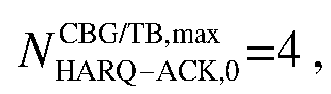

- By above embodiments, the codebook generated by the UE is as follows.
- Specifically, in a slot T61, to the serving
cell 0, if a PDSCH of SPS is received and the TB is not decoded correctly, and feedback time K1=6, the generated codebook is 0; to the servingcell 1, if a PDSCH scheduled with a format of DCI format 1_1 is received and the TB is decoded correctly, and feedback time K1=6, the generated codebook is 1111. - In a slot T62, to the serving
cell 0, if a PDSCH scheduled with DCI is received and the TB is decoded correctly, and feedback time K1=2, the generated codebook is 1. - In a slot T63 corresponding to a HARQ-ACK feedback time point, the total codebook fed back is 111110, where the
sub-codebook 1 is 1, the sub-codebook 2 is 1111, and SPS codebook is 0. - To make those skilled in the art better understand and implement solutions of the present disclosure, embodiments of the present disclosure provide a diagram of a HARQ codebook in
Figure 7 . - Referring to
Figure 7 , a UE is configured with two serving cells, and an RRC parameter HARQ-ACK-codebook is 'dynamic'. A primary serving cell has an ID (serial number) of 0 and an RRC parameter CBG-DL=ON. An RRC parameter CBGs-per-TB-DL configures that the maximum number


- By above embodiments, the codebook generated by the UE is as follows.
- Specifically, in a slot T71, to the serving
cell 0, if an SPS deactivation indicated by a PDCCH is received, and feedback time K1=6, the generated codebook is 1; to the servingcell 1, if a PDSCH scheduled with a format of DCI format 1_1 is received and the TB is decoded correctly, and feedback time K1=6, the generated codebook is 1. - In a slot T72, to the serving
cell 0, if a PDSCH scheduled with a format of DCI format 1_0 is received and the TB is not decoded correctly, and feedback time K1=4, the generated codebook is 0. - In a slot T73, to the serving
cell 0, if a PDSCH scheduled with a format of DCI format 1_1 is received and the TB is decoded correctly, and feedback time K1=2, the generated codebook is 1/1111. - In a slot T74 corresponding to a HARQ-ACK feedback time point, the total codebook fed back is 11011111, where the
sub-codebook 1 is 1101, and the sub-codebook 2 is 1111. - To make those skilled in the art better understand and implement solutions of the present disclosure, embodiments of the present disclosure provide a diagram of a HARQ codebook in
Figure 8 . - Referring to
Figure 8 , a UE is configured with two serving cells, and an RRC parameter HARQ-ACK-codebook is 'dynamic'. A primary serving cell has an ID (serial number) of 0 and an RRC parameter CBG-DL=ON. An RRC parameter CBGs-per-TB-DL configures that the maximum number


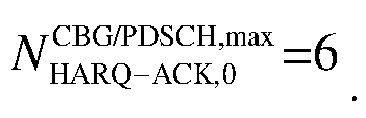
- By above embodiments, when the UE receives one PDSCH scheduled by a PDCCH or an SPS deactivation indicated by a PDCCH, the UE uses

- Specifically, in a slot T81, to the serving
cell 0, if an SPS deactivation indicated by a PDCCH is received, and feedback time K1=4, the generated codebook is 100000; to the servingcell 1, if a PDSCH scheduled with a format of DCI format 1_0 is received and the TB is decoded correctly, and feedback time K1=4, the generated codebook is 100000. - In a slot T82, to the serving
cell 0, if a PDSCH scheduled with a format of DCI format 1_1 is received and two TBs are decoded correctly, and feedback time K1=2, the generated codebook is 111100. - In a slot T83 corresponding to a HARQ-ACK feedback time point, the total codebook fed back is 100000100000111100.
- To make those skilled in the art better understand and implement solutions of the present disclosure, embodiments of the present disclosure further provide a UE capable of implementing the above method for generating the HARQ codebook, as shown in
Figure 3 . - Referring to
Figure 3 , the UE 30 includes afirst receiving circuitry 31 and a generatingcircuitry 32. - The
first receiving circuitry 31 is configured to receive PDSCHs each of which includes at least one TB. - The generating
circuitry 32 is configured to: to serving cells which are configured with CBG-based HARQ feedback, generate a HARQ codebook corresponding to the PDSCHs using N bits per PDSCH, where N is a maximum value of numbers of CBGs corresponding to the PDSCHs. - In some embodiments, if the number of the serving cells which are configured with CBG-based HARQ feedback is more than one, and the HARQ codebook is configured as a dynamic HARQ codebook, N is max{N i}, where i is an identifier of the serving cell which are configured with CBG-based HARQ feedback, N i is the maximum value of numbers of CBGs corresponding to the PDSCHs for the corresponding serving cell i, and max{} represents taking the maximum value.
- In some embodiments, the UE 30 further includes a second receiving circuitry (not shown) configured to receive a signaling from a base station, where the signaling includes the number of TBs in each of the PDSCHs in the serving cell i, for example, Number-MCS-HARQ-DL-DCI. If the number of TBs in each of the PDSCHs in the serving cell i is two, N i = 2 × N i TB; and if the number of TBs in each of the PDSCHs in the serving cell i is one, N i = N i TB, where i is an identifier of one of the serving cells which are configured with CBG-based HARQ feedback, and N i TB is a maximum value of numbers of CBGs corresponding to the TBs for the corresponding serving cell i.
- In some embodiments, if a DCI format corresponding to the PDSCHs is DCI format 1_1, the generating
circuitry 32 is configured to: if the number of TBs in each of the PDSCHs is two, generate a first HARQ codebook corresponding to CBGs included in the first TB using first N/2 bits; and generate a second HARQ codebook corresponding to CBGs included in the second TB using remaining N/2 bits. - In some embodiments, the generating
circuitry 32 is configured to: if M1 is less than N/2, generate the first HARQ codebook corresponding to CBGs included in the first TB using first M1 bits among the first N/2 bits; and set remaining (N/2-M1) bits to NACK, where M1 is the maximum value of the number of CBGs corresponding to the first TB. - In some embodiments, the generating
circuitry 32 is configured to: if M2 is less than N/2, generate the second HARQ codebook corresponding to CBGs included in the second TB using first M2 bits among the remaining N/2 bits; and set remaining (N/2-M2) bits to NACK, where M2 is the maximum value of the number of CBGs corresponding to the second TB. - In some embodiments, if the DCI format corresponding to the PDSCHs is DCI format 1_1, the generating
circuitry 32 is configured to: if the number of TBs in each of the PDSCHs is two and M1+M2<N, generate a first HARQ codebook corresponding to CBGs included in the first TB using first M1 bits; generate a second HARQ codebook corresponding to CBGs included in the second TB using M2 bits following the first M1 bits; and set remaining (N-M1-M2) bits to NACK, where M1 is the maximum value of the number of CBGs corresponding to the first TB, and M2 is the maximum value of the number of CBGs corresponding to the second TB. - In some embodiments, if the DCI format corresponding to the PDSCHs is DCI format 1_1, the generating
circuitry 32 is configured to: if the number of TBs in each of the PDSCHs is one and M0<N, generate the HARQ codebook corresponding to CBGs included in the TB using first M0 bits; and set remaining (N-MO) bits to NACK, where M0 is the maximum value of the number of CBGs corresponding to the TB. - In some embodiments, if the DCI format corresponding to the PDSCHs is DCI format 1_0, the generating
circuitry 32 is configured to: generate the HARQ codebook corresponding to the TB using a first bit; and set remaining (N-1) bits to NACK. - Operation procedures and principles of the UE 30 can be referred to the descriptions of the method for generating the HARQ codebook provided in the above embodiments, and are not described in detail here.
- In an embodiment of the present disclosure, a computer readable storage medium having computer instructions stored therein is provided, where once the computer instructions are executed, any one of the above methods for generating the HARQ codebook is performed. The computer readable storage medium is a non-volatile or non-transient storage medium.
- In an embodiment of the present disclosure, a UE including a memory and a processor is provided, where the memory has computer instructions stored therein, and once the processor executes the computer instructions, any one of the above methods for generating the HARQ codebook is performed.
- Those skilled in the art can understand that all of or a portion of the processes in the method provided in the above embodiments can be implemented by related hardware with instruction of computer program. The computer program may be stored in a readable storage medium, such as a magnetic disk, an optical disk, a Read-Only Memory (ROM) or a Random Access Memory (RAM).
- Although the present disclosure has been disclosed above with reference to preferred embodiments thereof, it should be understood that the disclosure is presented by way of example only, and not limitation. Those skilled in the art can modify and vary the embodiments without departing from the spirit and scope of the present disclosure.
Claims (20)
- A method for generating a Hybrid Automatic Repeat reQuest (HARQ) codebook, comprising:receiving Physical Downlink Shared Channels (PDSCHs) each of which comprises at least one Transport Block (TB); andto serving cells which are configured with Code Block Group (CBG)-based HARQ feedback, generating a HARQ codebook corresponding to the PDSCHs using N bits per PDSCH, wherein N is a maximum value of numbers of CBGs corresponding to the PDSCHs.
- The method according to claim 1, wherein if the number of the serving cells which are configured with CBG-based HARQ feedback is more than one, and the HARQ codebook is configured as a dynamic HARQ codebook, N is max{N i}, where i is an identifier of one of the serving cells which are configured with CBG-based HARQ feedback, N i is the maximum value of numbers of CBGs corresponding to the PDSCHs for the corresponding serving cell i, and max{} represents taking the maximum value.
- The method according to claim 2, further comprising: receiving a signaling from a base station,
wherein the signaling comprises the number of TBs in each of the PDSCHs in the serving cell i; if the number of TBs in each of the PDSCHs in the serving cell i is two, N i = 2 × N i TB; and if the number of TBs in each of the PDSCHs in the serving cell i is one, N i = N i TB, where i is an identifier of one of the serving cells which are configured with CBG-based HARQ feedback, and N i TB is a maximum value of numbers of CBGs corresponding to the TBs for the corresponding serving cell i. - The method according to claim 3, wherein if a Downlink Control Information (DCI) format corresponding to the PDSCHs is DCI format 1_1, generating the HARQ codebook corresponding to the PDSCHs using N bits per PDSCH comprises:if the number of TBs in each of the PDSCHs is two, generating a first HARQ codebook corresponding to CBGs included in a first TB using first N/2 bits; andgenerating a second HARQ codebook corresponding to CBGs included in a second TB using remaining N/2 bits.
- The method according to claim 4, wherein generating the first HARQ codebook corresponding to CBGs included in the first TB using the first N/2 bits comprises:
if M1 is less than N/2, generating the first HARQ codebook corresponding to CBGs included in the first TB using first M1 bits among the first N/2 bits; and setting remaining (N/2-M1) bits to NACK, where M1 is the maximum value of the number of CBGs corresponding to the first TB. - The method according to claim 4, wherein generating the second HARQ codebook corresponding to CBGs included in the second TB using the remaining N/2 bits comprises:
if M2 is less than N/2, generating the second HARQ codebook corresponding to CBGs included in the second TB using first M2 bits among the remaining N/2 bits; and setting remaining (N/2-M2) bits to NACK, where M2 is the maximum value of the number of CBGs corresponding to the second TB. - The method according to claim 3, wherein if a DCI format corresponding to the PDSCHs is DCI format 1_1, generating the HARQ codebook corresponding to the PDSCHs using N bits per PDSCH comprises:
if the number of TBs in each of the PDSCHs is two and M1+M2<N, generating a first HARQ codebook corresponding to CBGs included in a first TB using first M1 bits; generating a second HARQ codebook corresponding to CBGs included in a second TB using M2 bits following the first M1 bits; and setting remaining (N-M1-M2) bits to NACK, where M1 is the maximum value of the number of CBGs corresponding to the first TB, and M2 is the maximum value of the number of CBGs corresponding to the second TB. - The method according to claim 3, wherein if a DCI format corresponding to the PDSCHs is DCI format 1_1, generating the HARQ codebook corresponding to the PDSCHs using N bits per PDSCH comprises:
if the number of TBs in each of the PDSCHs is one and M0<N, generating the HARQ codebook corresponding to CBGs included in the TB using first M0 bits; and setting remaining (N-MO) bits to NACK, where M0 is the maximum value of the number of CBGs corresponding to the TB. - The method according to claim 3, wherein if a DCI format corresponding to the PDSCHs is DCI format 1_0, generating the HARQ codebook corresponding to the PDSCHs using N bits per PDSCH comprises:
generating the HARQ codebook corresponding to the TB using a first bit; and setting remaining (N-1) bits to NACK. - A User Equipment (UE), comprising:a first receiving circuitry, configured to receive Physical Downlink Shared Channels (PDSCHs) each of which comprises at least one Transport Block (TB); anda generating circuitry, configured to: to serving cells which are configured with Code Block Group (CBG)-based Hybrid Automatic Repeat reQuest (HARQ) feedback, generate a HARQ codebook corresponding to the PDSCHs using N bits per PDSCH, where N is a maximum value of numbers of CBGs corresponding to the PDSCHs.
- The UE according to claim 10, wherein if the number of the serving cells which are configured with CBG-based HARQ feedback is more than one, and the HARQ codebook is configured as a dynamic HARQ codebook, N is max{N i}, where i is an identifier of one of the serving cells which are configured with CBG-based HARQ feedback, N i is the maximum value of numbers of CBGs corresponding to the PDSCHs for the corresponding serving cell i, and max{} represents taking the maximum value.
- The UE according to claim 11, further comprising:a second receiving circuitry configured to receive a signaling from a base station,where the signaling comprises the number of TBs in each of the PDSCHs in the serving cell i; if the number of TBs in each of the PDSCHs in the serving cell i is two, N i = 2 × N i TB; and if the number of TBs in each of the PDSCHs in the serving cell i is one, N i = N i TB, where i is an identifier of one of the serving cells which are configured with CBG-based HARQ, and N i TB is a maximum value of numbers of CBGs corresponding to the TBs for the corresponding serving cell i.
- The UE according to claim 12, wherein if a DCI format corresponding to the PDSCHs is DCI format 1_1, the generating circuitry is configured to: if the number of TBs in each of the PDSCHs is two, generate a first HARQ codebook corresponding to CBGs included in a first TB using first N/2 bits; and generate a second HARQ codebook corresponding to CBGs included in a second TB using remaining N/2 bits.
- The UE according to claim 13, wherein the generating circuitry is configured to: if M1 is less than N/2, generate the first HARQ codebook corresponding to CBGs included in the first TB using first M1 bits among the first N/2 bits; and set remaining (N/2-M1) bits to NACK, where M1 is the maximum value of the number of CBGs corresponding to the first TB.
- The UE according to claim 13, wherein the generating circuitry is configured to: if M2 is less than N/2, generate the second HARQ codebook corresponding to CBGs included in the second TB using first M2 bits among the remaining N/2 bits; and set remaining (N/2-M2) bits to NACK, where M2 is the maximum value of the number of CBGs corresponding to the second TB.
- The UE according to claim 12, wherein if a DCI format corresponding to the PDSCHs is DCI format 1_1, the generating circuitry is configured to:
if the number of TBs in each of the PDSCHs is two and M1+M2<N, generate a first HARQ codebook corresponding to CBGs included in a first TB using first M1 bits; generate a second HARQ codebook corresponding to CBGs included in a second TB using M2 bits following the first M1 bits; and set remaining (N-M1-M2) bits to NACK, where M1 is the maximum value of the number of CBGs corresponding to the first TB, and M2 is the maximum value of the number of CBGs corresponding to the second TB. - The UE according to claim 12, wherein if a DCI format corresponding to the PDSCHs is DCI format 1_1, the generating circuitry is configured to:
if the number of TBs in each of the PDSCHs is one and M0<N, generate the HARQ codebook corresponding to CBGs included in the TB using first M0 bits; and set remaining (N-MO) bits to NACK, where M0 is the maximum value of the number of CBGs corresponding to the TB. - The UE according to claim 12, wherein if a DCI format corresponding to the PDSCHs is DCI format 1_0, the generating circuitry is configured to:
generate the HARQ codebook corresponding to the TBs using a first bit; and set remaining (N-1) bits to NACK. - A computer readable storage medium having computer instructions stored therein, wherein once the computer instructions are executed, the method according to any one of claims 1 to 9 is performed.
- A User Equipment (UE) comprising a memory and a processor, wherein the memory has computer instructions stored therein, and once the processor executes the computer instructions, the method according to any one of claims 1 to 9 is performed.
Applications Claiming Priority (2)
| Application Number | Priority Date | Filing Date | Title |
|---|---|---|---|
| CN201810033775.7A CN110034901B (en) | 2018-01-12 | 2018-01-12 | Method for generating hybrid automatic repeat request codebook, user equipment, and medium |
| PCT/CN2018/124762 WO2019137243A1 (en) | 2018-01-12 | 2018-12-28 | Method for generating hybrid automatic repeat request codebook, user equipment, and medium |
Publications (3)
| Publication Number | Publication Date |
|---|---|
| EP3739791A1 true EP3739791A1 (en) | 2020-11-18 |
| EP3739791A4 EP3739791A4 (en) | 2021-10-13 |
| EP3739791B1 EP3739791B1 (en) | 2022-11-30 |
Family
ID=67213100
Family Applications (1)
| Application Number | Title | Priority Date | Filing Date |
|---|---|---|---|
| EP18900116.7A Active EP3739791B1 (en) | 2018-01-12 | 2018-12-28 | Method for generating hybrid automatic repeat request codebook, user equipment, and medium |
Country Status (4)
| Country | Link |
|---|---|
| US (1) | US20190222366A1 (en) |
| EP (1) | EP3739791B1 (en) |
| CN (1) | CN110034901B (en) |
| WO (1) | WO2019137243A1 (en) |
Families Citing this family (13)
| Publication number | Priority date | Publication date | Assignee | Title |
|---|---|---|---|---|
| WO2020202477A1 (en) * | 2019-04-02 | 2020-10-08 | 株式会社Nttドコモ | User terminal and wireless communication method |
| CN110535558B (en) * | 2019-07-24 | 2024-11-01 | 中兴通讯股份有限公司 | Data transmission method, device and storage medium |
| CN112291046B (en) * | 2019-07-24 | 2022-05-13 | 华为技术有限公司 | Communication method, communication device and computer readable storage medium |
| CN111092696B (en) * | 2019-08-02 | 2024-08-02 | 中兴通讯股份有限公司 | Wireless communication transmission method, terminal equipment and storage medium |
| CN112398585B (en) * | 2019-08-12 | 2023-05-09 | 中国移动通信有限公司研究院 | Codebook generation method and device |
| CN113812105B (en) * | 2019-09-30 | 2023-01-06 | 华为技术有限公司 | Transmission method, device and storage medium of uplink control information |
| US12184431B2 (en) * | 2019-10-28 | 2024-12-31 | Beijing Xiaomi Mobile Software Co., Ltd. | Method and device for transmitting hybrid automatic repeat request acknowledgement information |
| CN112788760B (en) * | 2019-11-08 | 2022-09-13 | 维沃移动通信有限公司 | Method for determining hybrid automatic repeat request-acknowledgement HARQ-ACK feedback position and communication equipment |
| CN114745081B (en) * | 2020-01-23 | 2023-10-27 | Oppo广东移动通信有限公司 | Method, device, equipment and storage medium for determining HARQ-ACK codebook |
| CN113543348B (en) * | 2020-04-15 | 2024-08-16 | 大唐移动通信设备有限公司 | HARQ-ACK transmission method, terminal and network side equipment |
| EP4122148A4 (en) * | 2020-04-30 | 2024-04-03 | FG Innovation Company Limited | METHOD AND USER DEVICE FOR A HARQ-ACK CODEBOOK |
| US12513713B2 (en) | 2021-09-24 | 2025-12-30 | Apple Inc. | Codebook group-based operation with multiple-physical downlink shared channel scheduling |
| US12278774B2 (en) * | 2022-04-13 | 2025-04-15 | Qualcomm Incorporated | Feedback communications for transport blocks with multiple code block groups |
Family Cites Families (6)
| Publication number | Priority date | Publication date | Assignee | Title |
|---|---|---|---|---|
| CN101667900B (en) * | 2008-09-02 | 2014-11-05 | 中兴通讯股份有限公司 | Method for feeding back HARQ |
| WO2015024215A1 (en) * | 2013-08-21 | 2015-02-26 | Qualcomm Incorporated | Pucch resource mapping an harq-ack feedback |
| KR102511925B1 (en) * | 2015-11-06 | 2023-03-20 | 주식회사 아이티엘 | Apparatus and method for performing hybrid automatic repeat request operation in wireless communication system supporting carrier aggregation |
| CN106788918B (en) * | 2016-12-30 | 2020-02-11 | 展讯通信(上海)有限公司 | HARQ (hybrid automatic repeat request) configuration method, feedback method, base station and user equipment |
| CN107483160A (en) * | 2017-08-17 | 2017-12-15 | 深圳市金立通信设备有限公司 | A kind of retransmission feedback method, base station, terminal and computer-readable medium |
| ES3018785T3 (en) * | 2017-11-16 | 2025-05-19 | Lenovo Beijing Ltd | Method and apparatus for harq-ack codebook determination |
-
2018
- 2018-01-12 CN CN201810033775.7A patent/CN110034901B/en active Active
- 2018-11-07 US US16/183,099 patent/US20190222366A1/en not_active Abandoned
- 2018-12-28 EP EP18900116.7A patent/EP3739791B1/en active Active
- 2018-12-28 WO PCT/CN2018/124762 patent/WO2019137243A1/en not_active Ceased
Also Published As
| Publication number | Publication date |
|---|---|
| EP3739791B1 (en) | 2022-11-30 |
| CN110034901A (en) | 2019-07-19 |
| CN110034901B (en) | 2020-07-17 |
| EP3739791A4 (en) | 2021-10-13 |
| WO2019137243A1 (en) | 2019-07-18 |
| US20190222366A1 (en) | 2019-07-18 |
Similar Documents
| Publication | Publication Date | Title |
|---|---|---|
| EP3739791A1 (en) | Method for generating hybrid automatic repeat request codebook, user equipment, and medium | |
| US11910382B2 (en) | Method of transmitting physical uplink control channel and related device | |
| US10484149B2 (en) | Uplink control information transmission method and apparatus | |
| US20220286227A1 (en) | Data Transmission Method and Apparatus | |
| CN110034902B (en) | Method for generating hybrid automatic repeat request codebook, user equipment and medium | |
| EP3242434B1 (en) | Method and device for transmitting feedback information in communication system | |
| US10727985B2 (en) | Control information sending method and communications device | |
| US20220131650A1 (en) | Harq-ack processing method and device | |
| US20160338029A1 (en) | Method and apparatus for encoding and processing acknowledgement information | |
| US20220224452A1 (en) | Feedback Information Transmission Method and Apparatus | |
| EP4165933A1 (en) | Wireless communication method and user equipment for transmitting harq-ack codebook | |
| WO2017049463A1 (en) | Method and device for transmitting uplink control information (uci) in carrier aggregation | |
| EP3096485A1 (en) | Resource management method and device and computer storage medium | |
| EP3182633B1 (en) | Method for implementing hybrid automatic repeat request and corresponding user equipment | |
| WO2013091578A1 (en) | Communication method, enb and user equipment | |
| EP3331305B1 (en) | Uplink data transmission method and device | |
| US11902943B2 (en) | Communication method and communications apparatus | |
| KR20180137010A (en) | Feedback message transmission method, feedback message processing method and apparatus | |
| CN119483842A (en) | Method and device for generating hybrid automatic repeat request HARQ codebook | |
| US20120188926A1 (en) | Method and apparatus for feeding back ack/nack information | |
| US20240107513A1 (en) | Codebook retransmission indication in control signaling | |
| EP3598709B1 (en) | Acknowledgement information transmission method, terminal device, and network device | |
| EP2615762A1 (en) | Method and apparatus for processing hybrid automatic repeat request | |
| CN102752088A (en) | Method, device and system for sending and receiving response message | |
| EP3691167A1 (en) | Communication method and device |
Legal Events
| Date | Code | Title | Description |
|---|---|---|---|
| STAA | Information on the status of an ep patent application or granted ep patent |
Free format text: STATUS: THE INTERNATIONAL PUBLICATION HAS BEEN MADE |
|
| PUAI | Public reference made under article 153(3) epc to a published international application that has entered the european phase |
Free format text: ORIGINAL CODE: 0009012 |
|
| STAA | Information on the status of an ep patent application or granted ep patent |
Free format text: STATUS: REQUEST FOR EXAMINATION WAS MADE |
|
| 17P | Request for examination filed |
Effective date: 20200625 |
|
| AK | Designated contracting states |
Kind code of ref document: A1 Designated state(s): AL AT BE BG CH CY CZ DE DK EE ES FI FR GB GR HR HU IE IS IT LI LT LU LV MC MK MT NL NO PL PT RO RS SE SI SK SM TR |
|
| AX | Request for extension of the european patent |
Extension state: BA ME |
|
| DAV | Request for validation of the european patent (deleted) | ||
| DAX | Request for extension of the european patent (deleted) | ||
| A4 | Supplementary search report drawn up and despatched |
Effective date: 20210910 |
|
| RIC1 | Information provided on ipc code assigned before grant |
Ipc: H04L 1/16 20060101ALI20210906BHEP Ipc: H04L 1/18 20060101ALI20210906BHEP Ipc: H04L 5/00 20060101AFI20210906BHEP |
|
| GRAP | Despatch of communication of intention to grant a patent |
Free format text: ORIGINAL CODE: EPIDOSNIGR1 |
|
| STAA | Information on the status of an ep patent application or granted ep patent |
Free format text: STATUS: GRANT OF PATENT IS INTENDED |
|
| INTG | Intention to grant announced |
Effective date: 20220613 |
|
| GRAS | Grant fee paid |
Free format text: ORIGINAL CODE: EPIDOSNIGR3 |
|
| GRAA | (expected) grant |
Free format text: ORIGINAL CODE: 0009210 |
|
| STAA | Information on the status of an ep patent application or granted ep patent |
Free format text: STATUS: THE PATENT HAS BEEN GRANTED |
|
| AK | Designated contracting states |
Kind code of ref document: B1 Designated state(s): AL AT BE BG CH CY CZ DE DK EE ES FI FR GB GR HR HU IE IS IT LI LT LU LV MC MK MT NL NO PL PT RO RS SE SI SK SM TR |
|
| REG | Reference to a national code |
Ref country code: CH Ref legal event code: EP Ref country code: GB Ref legal event code: FG4D |
|
| REG | Reference to a national code |
Ref country code: AT Ref legal event code: REF Ref document number: 1535529 Country of ref document: AT Kind code of ref document: T Effective date: 20221215 Ref country code: DE Ref legal event code: R096 Ref document number: 602018043841 Country of ref document: DE |
|
| RAP4 | Party data changed (patent owner data changed or rights of a patent transferred) |
Owner name: BEIJING UNISOC COMMUNICATIONS TECHNOLOGY CO., LTD. |
|
| REG | Reference to a national code |
Ref country code: IE Ref legal event code: FG4D |
|
| REG | Reference to a national code |
Ref country code: LT Ref legal event code: MG9D |
|
| REG | Reference to a national code |
Ref country code: NL Ref legal event code: MP Effective date: 20221130 |
|
| PG25 | Lapsed in a contracting state [announced via postgrant information from national office to epo] |
Ref country code: SE Free format text: LAPSE BECAUSE OF FAILURE TO SUBMIT A TRANSLATION OF THE DESCRIPTION OR TO PAY THE FEE WITHIN THE PRESCRIBED TIME-LIMIT Effective date: 20221130 Ref country code: PT Free format text: LAPSE BECAUSE OF FAILURE TO SUBMIT A TRANSLATION OF THE DESCRIPTION OR TO PAY THE FEE WITHIN THE PRESCRIBED TIME-LIMIT Effective date: 20230331 Ref country code: NO Free format text: LAPSE BECAUSE OF FAILURE TO SUBMIT A TRANSLATION OF THE DESCRIPTION OR TO PAY THE FEE WITHIN THE PRESCRIBED TIME-LIMIT Effective date: 20230228 Ref country code: LT Free format text: LAPSE BECAUSE OF FAILURE TO SUBMIT A TRANSLATION OF THE DESCRIPTION OR TO PAY THE FEE WITHIN THE PRESCRIBED TIME-LIMIT Effective date: 20221130 Ref country code: FI Free format text: LAPSE BECAUSE OF FAILURE TO SUBMIT A TRANSLATION OF THE DESCRIPTION OR TO PAY THE FEE WITHIN THE PRESCRIBED TIME-LIMIT Effective date: 20221130 Ref country code: ES Free format text: LAPSE BECAUSE OF FAILURE TO SUBMIT A TRANSLATION OF THE DESCRIPTION OR TO PAY THE FEE WITHIN THE PRESCRIBED TIME-LIMIT Effective date: 20221130 |
|
| REG | Reference to a national code |
Ref country code: AT Ref legal event code: MK05 Ref document number: 1535529 Country of ref document: AT Kind code of ref document: T Effective date: 20221130 |
|
| PG25 | Lapsed in a contracting state [announced via postgrant information from national office to epo] |
Ref country code: RS Free format text: LAPSE BECAUSE OF FAILURE TO SUBMIT A TRANSLATION OF THE DESCRIPTION OR TO PAY THE FEE WITHIN THE PRESCRIBED TIME-LIMIT Effective date: 20221130 Ref country code: PL Free format text: LAPSE BECAUSE OF FAILURE TO SUBMIT A TRANSLATION OF THE DESCRIPTION OR TO PAY THE FEE WITHIN THE PRESCRIBED TIME-LIMIT Effective date: 20221130 Ref country code: LV Free format text: LAPSE BECAUSE OF FAILURE TO SUBMIT A TRANSLATION OF THE DESCRIPTION OR TO PAY THE FEE WITHIN THE PRESCRIBED TIME-LIMIT Effective date: 20221130 Ref country code: IS Free format text: LAPSE BECAUSE OF FAILURE TO SUBMIT A TRANSLATION OF THE DESCRIPTION OR TO PAY THE FEE WITHIN THE PRESCRIBED TIME-LIMIT Effective date: 20230330 Ref country code: HR Free format text: LAPSE BECAUSE OF FAILURE TO SUBMIT A TRANSLATION OF THE DESCRIPTION OR TO PAY THE FEE WITHIN THE PRESCRIBED TIME-LIMIT Effective date: 20221130 Ref country code: GR Free format text: LAPSE BECAUSE OF FAILURE TO SUBMIT A TRANSLATION OF THE DESCRIPTION OR TO PAY THE FEE WITHIN THE PRESCRIBED TIME-LIMIT Effective date: 20230301 |
|
| PG25 | Lapsed in a contracting state [announced via postgrant information from national office to epo] |
Ref country code: NL Free format text: LAPSE BECAUSE OF FAILURE TO SUBMIT A TRANSLATION OF THE DESCRIPTION OR TO PAY THE FEE WITHIN THE PRESCRIBED TIME-LIMIT Effective date: 20221130 |
|
| PG25 | Lapsed in a contracting state [announced via postgrant information from national office to epo] |
Ref country code: SM Free format text: LAPSE BECAUSE OF FAILURE TO SUBMIT A TRANSLATION OF THE DESCRIPTION OR TO PAY THE FEE WITHIN THE PRESCRIBED TIME-LIMIT Effective date: 20221130 Ref country code: RO Free format text: LAPSE BECAUSE OF FAILURE TO SUBMIT A TRANSLATION OF THE DESCRIPTION OR TO PAY THE FEE WITHIN THE PRESCRIBED TIME-LIMIT Effective date: 20221130 Ref country code: EE Free format text: LAPSE BECAUSE OF FAILURE TO SUBMIT A TRANSLATION OF THE DESCRIPTION OR TO PAY THE FEE WITHIN THE PRESCRIBED TIME-LIMIT Effective date: 20221130 Ref country code: DK Free format text: LAPSE BECAUSE OF FAILURE TO SUBMIT A TRANSLATION OF THE DESCRIPTION OR TO PAY THE FEE WITHIN THE PRESCRIBED TIME-LIMIT Effective date: 20221130 Ref country code: CZ Free format text: LAPSE BECAUSE OF FAILURE TO SUBMIT A TRANSLATION OF THE DESCRIPTION OR TO PAY THE FEE WITHIN THE PRESCRIBED TIME-LIMIT Effective date: 20221130 Ref country code: AT Free format text: LAPSE BECAUSE OF FAILURE TO SUBMIT A TRANSLATION OF THE DESCRIPTION OR TO PAY THE FEE WITHIN THE PRESCRIBED TIME-LIMIT Effective date: 20221130 |
|
| REG | Reference to a national code |
Ref country code: CH Ref legal event code: PL |
|
| REG | Reference to a national code |
Ref country code: BE Ref legal event code: MM Effective date: 20221231 |
|
| PG25 | Lapsed in a contracting state [announced via postgrant information from national office to epo] |
Ref country code: SK Free format text: LAPSE BECAUSE OF FAILURE TO SUBMIT A TRANSLATION OF THE DESCRIPTION OR TO PAY THE FEE WITHIN THE PRESCRIBED TIME-LIMIT Effective date: 20221130 Ref country code: LU Free format text: LAPSE BECAUSE OF NON-PAYMENT OF DUE FEES Effective date: 20221228 Ref country code: AL Free format text: LAPSE BECAUSE OF FAILURE TO SUBMIT A TRANSLATION OF THE DESCRIPTION OR TO PAY THE FEE WITHIN THE PRESCRIBED TIME-LIMIT Effective date: 20221130 |
|
| REG | Reference to a national code |
Ref country code: DE Ref legal event code: R097 Ref document number: 602018043841 Country of ref document: DE |
|
| PLBE | No opposition filed within time limit |
Free format text: ORIGINAL CODE: 0009261 |
|
| STAA | Information on the status of an ep patent application or granted ep patent |
Free format text: STATUS: NO OPPOSITION FILED WITHIN TIME LIMIT |
|
| PG25 | Lapsed in a contracting state [announced via postgrant information from national office to epo] |
Ref country code: LI Free format text: LAPSE BECAUSE OF NON-PAYMENT OF DUE FEES Effective date: 20221231 Ref country code: IE Free format text: LAPSE BECAUSE OF NON-PAYMENT OF DUE FEES Effective date: 20221228 Ref country code: CH Free format text: LAPSE BECAUSE OF NON-PAYMENT OF DUE FEES Effective date: 20221231 |
|
| 26N | No opposition filed |
Effective date: 20230831 |
|
| PG25 | Lapsed in a contracting state [announced via postgrant information from national office to epo] |
Ref country code: SI Free format text: LAPSE BECAUSE OF FAILURE TO SUBMIT A TRANSLATION OF THE DESCRIPTION OR TO PAY THE FEE WITHIN THE PRESCRIBED TIME-LIMIT Effective date: 20221130 Ref country code: FR Free format text: LAPSE BECAUSE OF NON-PAYMENT OF DUE FEES Effective date: 20230130 Ref country code: BE Free format text: LAPSE BECAUSE OF NON-PAYMENT OF DUE FEES Effective date: 20221231 |
|
| PG25 | Lapsed in a contracting state [announced via postgrant information from national office to epo] |
Ref country code: CY Free format text: LAPSE BECAUSE OF FAILURE TO SUBMIT A TRANSLATION OF THE DESCRIPTION OR TO PAY THE FEE WITHIN THE PRESCRIBED TIME-LIMIT Effective date: 20221130 |
|
| PG25 | Lapsed in a contracting state [announced via postgrant information from national office to epo] |
Ref country code: MK Free format text: LAPSE BECAUSE OF FAILURE TO SUBMIT A TRANSLATION OF THE DESCRIPTION OR TO PAY THE FEE WITHIN THE PRESCRIBED TIME-LIMIT Effective date: 20221130 Ref country code: IT Free format text: LAPSE BECAUSE OF FAILURE TO SUBMIT A TRANSLATION OF THE DESCRIPTION OR TO PAY THE FEE WITHIN THE PRESCRIBED TIME-LIMIT Effective date: 20221130 Ref country code: HU Free format text: LAPSE BECAUSE OF FAILURE TO SUBMIT A TRANSLATION OF THE DESCRIPTION OR TO PAY THE FEE WITHIN THE PRESCRIBED TIME-LIMIT; INVALID AB INITIO Effective date: 20181228 |
|
| PG25 | Lapsed in a contracting state [announced via postgrant information from national office to epo] |
Ref country code: MC Free format text: LAPSE BECAUSE OF FAILURE TO SUBMIT A TRANSLATION OF THE DESCRIPTION OR TO PAY THE FEE WITHIN THE PRESCRIBED TIME-LIMIT Effective date: 20221130 |
|
| PG25 | Lapsed in a contracting state [announced via postgrant information from national office to epo] |
Ref country code: MC Free format text: LAPSE BECAUSE OF FAILURE TO SUBMIT A TRANSLATION OF THE DESCRIPTION OR TO PAY THE FEE WITHIN THE PRESCRIBED TIME-LIMIT Effective date: 20221130 |
|
| PG25 | Lapsed in a contracting state [announced via postgrant information from national office to epo] |
Ref country code: BG Free format text: LAPSE BECAUSE OF FAILURE TO SUBMIT A TRANSLATION OF THE DESCRIPTION OR TO PAY THE FEE WITHIN THE PRESCRIBED TIME-LIMIT Effective date: 20221130 |
|
| PG25 | Lapsed in a contracting state [announced via postgrant information from national office to epo] |
Ref country code: MT Free format text: LAPSE BECAUSE OF FAILURE TO SUBMIT A TRANSLATION OF THE DESCRIPTION OR TO PAY THE FEE WITHIN THE PRESCRIBED TIME-LIMIT Effective date: 20221130 |
|
| PG25 | Lapsed in a contracting state [announced via postgrant information from national office to epo] |
Ref country code: TR Free format text: LAPSE BECAUSE OF FAILURE TO SUBMIT A TRANSLATION OF THE DESCRIPTION OR TO PAY THE FEE WITHIN THE PRESCRIBED TIME-LIMIT Effective date: 20221130 |
|
| PGFP | Annual fee paid to national office [announced via postgrant information from national office to epo] |
Ref country code: GB Payment date: 20251104 Year of fee payment: 8 |
|
| PGFP | Annual fee paid to national office [announced via postgrant information from national office to epo] |
Ref country code: DE Payment date: 20251222 Year of fee payment: 8 |