EP3739580A1 - Switching of sampling rates at audio processing devices - Google Patents
Switching of sampling rates at audio processing devices Download PDFInfo
- Publication number
- EP3739580A1 EP3739580A1 EP20185071.6A EP20185071A EP3739580A1 EP 3739580 A1 EP3739580 A1 EP 3739580A1 EP 20185071 A EP20185071 A EP 20185071A EP 3739580 A1 EP3739580 A1 EP 3739580A1
- Authority
- EP
- European Patent Office
- Prior art keywords
- audio frame
- memory state
- memory
- decoded audio
- memories
- Prior art date
- Legal status (The legal status is an assumption and is not a legal conclusion. Google has not performed a legal analysis and makes no representation as to the accuracy of the status listed.)
- Granted
Links
Images




Classifications
-
- G—PHYSICS
- G10—MUSICAL INSTRUMENTS; ACOUSTICS
- G10L—SPEECH ANALYSIS TECHNIQUES OR SPEECH SYNTHESIS; SPEECH RECOGNITION; SPEECH OR VOICE PROCESSING TECHNIQUES; SPEECH OR AUDIO CODING OR DECODING
- G10L19/00—Speech or audio signals analysis-synthesis techniques for redundancy reduction, e.g. in vocoders; Coding or decoding of speech or audio signals, using source filter models or psychoacoustic analysis
- G10L19/04—Speech or audio signals analysis-synthesis techniques for redundancy reduction, e.g. in vocoders; Coding or decoding of speech or audio signals, using source filter models or psychoacoustic analysis using predictive techniques
-
- G—PHYSICS
- G10—MUSICAL INSTRUMENTS; ACOUSTICS
- G10L—SPEECH ANALYSIS TECHNIQUES OR SPEECH SYNTHESIS; SPEECH RECOGNITION; SPEECH OR VOICE PROCESSING TECHNIQUES; SPEECH OR AUDIO CODING OR DECODING
- G10L19/00—Speech or audio signals analysis-synthesis techniques for redundancy reduction, e.g. in vocoders; Coding or decoding of speech or audio signals, using source filter models or psychoacoustic analysis
- G10L19/04—Speech or audio signals analysis-synthesis techniques for redundancy reduction, e.g. in vocoders; Coding or decoding of speech or audio signals, using source filter models or psychoacoustic analysis using predictive techniques
- G10L19/16—Vocoder architecture
- G10L19/173—Transcoding, i.e. converting between two coded representations avoiding cascaded coding-decoding
-
- G—PHYSICS
- G10—MUSICAL INSTRUMENTS; ACOUSTICS
- G10L—SPEECH ANALYSIS TECHNIQUES OR SPEECH SYNTHESIS; SPEECH RECOGNITION; SPEECH OR VOICE PROCESSING TECHNIQUES; SPEECH OR AUDIO CODING OR DECODING
- G10L19/00—Speech or audio signals analysis-synthesis techniques for redundancy reduction, e.g. in vocoders; Coding or decoding of speech or audio signals, using source filter models or psychoacoustic analysis
- G10L19/04—Speech or audio signals analysis-synthesis techniques for redundancy reduction, e.g. in vocoders; Coding or decoding of speech or audio signals, using source filter models or psychoacoustic analysis using predictive techniques
- G10L19/16—Vocoder architecture
- G10L19/18—Vocoders using multiple modes
-
- G—PHYSICS
- G10—MUSICAL INSTRUMENTS; ACOUSTICS
- G10L—SPEECH ANALYSIS TECHNIQUES OR SPEECH SYNTHESIS; SPEECH RECOGNITION; SPEECH OR VOICE PROCESSING TECHNIQUES; SPEECH OR AUDIO CODING OR DECODING
- G10L19/00—Speech or audio signals analysis-synthesis techniques for redundancy reduction, e.g. in vocoders; Coding or decoding of speech or audio signals, using source filter models or psychoacoustic analysis
- G10L19/04—Speech or audio signals analysis-synthesis techniques for redundancy reduction, e.g. in vocoders; Coding or decoding of speech or audio signals, using source filter models or psychoacoustic analysis using predictive techniques
- G10L19/16—Vocoder architecture
- G10L19/18—Vocoders using multiple modes
- G10L19/20—Vocoders using multiple modes using sound class specific coding, hybrid encoders or object based coding
-
- G—PHYSICS
- G10—MUSICAL INSTRUMENTS; ACOUSTICS
- G10L—SPEECH ANALYSIS TECHNIQUES OR SPEECH SYNTHESIS; SPEECH RECOGNITION; SPEECH OR VOICE PROCESSING TECHNIQUES; SPEECH OR AUDIO CODING OR DECODING
- G10L19/00—Speech or audio signals analysis-synthesis techniques for redundancy reduction, e.g. in vocoders; Coding or decoding of speech or audio signals, using source filter models or psychoacoustic analysis
- G10L19/04—Speech or audio signals analysis-synthesis techniques for redundancy reduction, e.g. in vocoders; Coding or decoding of speech or audio signals, using source filter models or psychoacoustic analysis using predictive techniques
- G10L19/16—Vocoder architecture
- G10L19/18—Vocoders using multiple modes
- G10L19/22—Mode decision, i.e. based on audio signal content versus external parameters
-
- G—PHYSICS
- G10—MUSICAL INSTRUMENTS; ACOUSTICS
- G10L—SPEECH ANALYSIS TECHNIQUES OR SPEECH SYNTHESIS; SPEECH RECOGNITION; SPEECH OR VOICE PROCESSING TECHNIQUES; SPEECH OR AUDIO CODING OR DECODING
- G10L19/00—Speech or audio signals analysis-synthesis techniques for redundancy reduction, e.g. in vocoders; Coding or decoding of speech or audio signals, using source filter models or psychoacoustic analysis
- G10L19/04—Speech or audio signals analysis-synthesis techniques for redundancy reduction, e.g. in vocoders; Coding or decoding of speech or audio signals, using source filter models or psychoacoustic analysis using predictive techniques
- G10L19/16—Vocoder architecture
- G10L19/18—Vocoders using multiple modes
- G10L19/24—Variable rate codecs, e.g. for generating different qualities using a scalable representation such as hierarchical encoding or layered encoding
-
- G—PHYSICS
- G10—MUSICAL INSTRUMENTS; ACOUSTICS
- G10L—SPEECH ANALYSIS TECHNIQUES OR SPEECH SYNTHESIS; SPEECH RECOGNITION; SPEECH OR VOICE PROCESSING TECHNIQUES; SPEECH OR AUDIO CODING OR DECODING
- G10L19/00—Speech or audio signals analysis-synthesis techniques for redundancy reduction, e.g. in vocoders; Coding or decoding of speech or audio signals, using source filter models or psychoacoustic analysis
- G10L19/04—Speech or audio signals analysis-synthesis techniques for redundancy reduction, e.g. in vocoders; Coding or decoding of speech or audio signals, using source filter models or psychoacoustic analysis using predictive techniques
- G10L19/26—Pre-filtering or post-filtering
-
- G—PHYSICS
- G10—MUSICAL INSTRUMENTS; ACOUSTICS
- G10L—SPEECH ANALYSIS TECHNIQUES OR SPEECH SYNTHESIS; SPEECH RECOGNITION; SPEECH OR VOICE PROCESSING TECHNIQUES; SPEECH OR AUDIO CODING OR DECODING
- G10L19/00—Speech or audio signals analysis-synthesis techniques for redundancy reduction, e.g. in vocoders; Coding or decoding of speech or audio signals, using source filter models or psychoacoustic analysis
- G10L2019/0001—Codebooks
- G10L2019/0002—Codebook adaptations
Definitions
- the present invention is concerned with speech and audio coding, and more particularly to an audio encoder device and an audio decoder device for pro-cessing an audio signal, for which the input and output sampling rate is changing from a preceding frame to a current frame.
- the present invention is further related to methods of operating such devices as well as to computer programs executing such methods.
- Speech and audio coding can get the benefit of having a multi-cadence input and output, and of being able to switch instantaneously and seamlessly for one to another sampling rate.
- Conventional speech and audio coders use a single sampling rate for a determine output bit-rate and are not able to change it without resetting completely the system. It creates then a disconti-nuity in the communication and in the decoded signal.
- adaptive sampling rate and bit-rate allow a higher quality by selecting the optimal parameters depending usually on both the source and the channel condition. It is then important to achieve a seamless transi-tion, when changing the sampling rate of the input/output signal.
- Efficient speech and audio coders need to be able to change their sampling rate from a time region to another one to better suit to the source and to the channel condition.
- the change of sampling rate is particularly problematic for continuous linear filters, which can only be applied if their past states show the same sampling rate as the current time section to filter.
- More particularly predictive coding maintains at the encoder and decoder over time and frame different memory states.
- CELP code-excited linear predic-tion
- LPC linear prediction coding
- LPC linear prediction coding
- a straightforward approach is to reset all memories when a sam-pling rate change occurs. It creates a very annoying discontinuity in the de-coded signal. The recovery can be very long and very noticeable.
- the problem to be solved is to provide an improved concept for switching of sampling rates at audio processing devices.
- an audio decoder device for decod-ing a bitstream, wherein the audio decoder device comprises:
- decoded audio frame relates to an audio frame currently under processing whereas the term “preceding decoded audio frame” relates to an audio frame, which was processed before the audio frame currently under processing.
- the present invention allows a predictive coding scheme to switch its intern sampling rate without the need to resample the whole buffers for recomputing the states of its filters. By resampling directly and only the necessary memory states, a low complexity is maintained while a seamless transition is still pos-sible.
- the one or more mem-ories comprise an adaptive codebook memory configured to store an adap-tive codebook memory state for determining one or more excitation parame-ters for the decoded audio frame
- the memory state resampling de-vice is configured to determine the adaptive codebook state for determining the one or more excitation parameters for the decoded audio frame by resampling a preceding adaptive codebook state for determining of one or more excitation parameters for the preceding decoded audio frame and to store the adaptive codebook state for determining of the one or more excita-tion parameters for the decoded audio frame into the adaptive codebook memory.
- the adaptive codebook memory state is, for example, used in CELP devices.
- the memory sizes at different sampling rates must be equal in terms of time duration they cover. In other words, if a filter has an order of M at the sampling rate fs_2, the memory up-dated at the preceding sampling rate fs_1 should cover at least M*(fs_1)/(fs_2) samples.
- the memory is usually proportional to the sampling rate in the case for the adaptive codebook, which covers about the last 20ms of the decoded residu-al signal whatever the sampling rate may be, there is no extra memory man-agement to do.
- the one or more mem-ories comprise a synthesis filter memory configured to store a synthesis filter memory state for determining one or more synthesis filter parameters for the decoded audio frame
- the memory state resampling device is con-figured to determine the synthesis memory state for determining the one or more synthesis filter parameters for the decoded audio frame by resampling a preceding synthesis memory state for determining of one or more synthesis filter parameters for the preceding decoded audio frame and to store the syn-thesis memory state for determining of the one or more synthesis filter pa-rameters for the decoded audio frame into the synthesis filter memory.
- the synthesis filter memory state may be a LPC synthesis filter state, which is used, for example, in CELP devices.
- the order of the memory is not proportional to the sampling rate, or even constant whatever the sampling rate may be, an extra memory management has to done for being able to cover the largest duration possible.
- the LPC synthesis state order of AMR-WB+ is always 16. At 12.8 kHz, the smallest sampling rate it covers 1.25ms although it represents only 0.33ms at 48kHz. For being able to resample the buffer at any of the sam-pling rate between 12.8 and 48kHz, the memory of the LPC synthesis filter state has to be extended from 16 to 60 samples, which represents 1.25 ms at 48kHz.
- synthesis filter will be performed by using the states from mem_syn_r[L_SYN_MEM-M] to mem_syn_r[L_SYN_MEM-1].
- the memory resampling device is configured in such way that the same synthesis filter parameters are used for a plurality of subframes of the decoded audio frame.
- the LPC coefficients of the last frame are usually used for interpolating the current LPC coefficients with a time granularity of 5ms. If the sampling rate is changing, the interpolation cannot be performed. If the LPC are recomputed, the interpolation can be performed using the newly recomputed LPC coeffi-cients. In the present invention, the interpolation cannot be performed direct-ly. In one embodiment, the LPC coefficients are not interpolated in the first frame after a sampling rate switching. For all 5 ms subframe, the same set of coefficients is used.
- the memory resampling device is configured in such way that the resampling of the preceding syn-thesis filter memory state is done by transforming the synthesis filter memory state for the preceding decoded audio frame to a power spectrum and by resampling the power spectrum.
- the LPC coefficients can be estimated at the new sampling rate fs_2 without the need to redo a whole LP analysis.
- the old LPC coefficients at sampling rate fs_1 are transformed to a power spectrum which is resampled.
- the Levinson-Durbin algorithm is then applied on the autocorrelation deduced from the resampled power spectrum.
- the one or more mem-ories comprise a de-emphasis memory configured to store a de-emphasis memory state for determining one or more de-emphasis parameters for the decoded audio frame
- the memory state resampling device is con-figured to determine the de-emphasis memory state for determining the one or more de-emphasis parameters for the decoded audio frame by resampling a preceding de-emphasis memory state for determining of one or more de-emphasis parameters for the preceding decoded audio frame and to store the de-emphasis memory state for determining of the one or more de-emphasis parameters for the decoded audio frame into the de-emphasis memory.
- the de-emphasis memory state is, for example, also used in CELP.
- the de-emphasis has usually a fixed order of 1, which represents 0.0781 ms @ 12.8 kHz. This duration is covered by 3.75 samples @ 48 kHz. A memory buffer of 4 samples is then needed if we adopt the method presented above.
- the one or more mem-ories are configured in such way that a number of stored samples for the de-coded audio frame is proportional to the sampling rate of the decoded audio frame.
- the memory resampling device is configured in such way that the resampling is done by linear interpolation.
- the resampling function resamp() can be done with any kind of resampling methods.
- time domain a conventional LP filter and decima-tion/oversampling is usual.
- the memory state resampling device is configured to retrieve the preceding memory state for one or more of said memories from the memory device.
- the present invention can be applied when using the same coding scheme with different intern sampling rates. For example it can be the case when us-ing a CELP with an intern sampling rate of 12.8 kHz for low bit-rates when the available bandwidth of the channel is limited and switching to 16 kHz in-tern sampling rate for higher bit-rates when the channel conditions are better.
- the audio decoder de-vice comprises an inverse-filtering device configured for inverse-filtering of the preceding decoded audio frame at the preceding sampling rate in order to determine the preceding memory state of one or more of said memories, wherein the memory state resampling device is configured to retrieve the preceding memory state for one or more of said memories from the inverse-filtering device.
- no resampling is used before the inverse filtering. Instead the memory states themselves are resampled direct-ly. If the previous decoder processing the preceding audio frame is a predic-tive decoder like CELP, the inverse decoding is not needed and can be by-passed since the preceding memory states are always maintained at the pre-ceding sampling rate.
- the memory state resampling device is configured to retrieve the preceding memory state for one or more of said memories from of a further audio processing device.
- the further audio processing device may be, for example, a further audio decoder device or a home for noise generating device.
- the present invention can be used in DTX mode, when the active frames are coded at 12.8 kHz with a conventional CELP and when the inactive parts are modeled with a 16 kHz noise generator (CNG).
- CNG noise generator
- the invention can be used, for example, when combining a TCX and an ACELP running at different sampling rates.
- the problem is solved by a method for op-erating an audio decoder device for decoding a bitstream, the method com-prising the steps of:
- an audio encoder device for encoding a framed audio signal, wherein the audio encoder device comprises:
- the invention is mainly focused on the audio decoder device. However it can also be applied at the audio encoder device. Indeed CELP is based on an Analysis-by-Synthesis principle, where a local decoding is performed on the encoder side. For this reason the same principle as described for the decod-er can be applied on the encoder side. Moreover in case of a switched cod-ing, e.g. ACELP/TCX, the transform-based coder may have to be able to up-date the memories of the speech coder even at the encoder side in case of coding switching in the next frame. For this purpose, a local decoder is used in the transformed-based encoder for updating the memories state of the CELP. It may be that the transformed-based encoder is running at a different sampling rate than the CELP and the invention can be then applied in this case.
- the synthesis filter device, the memory device, the memory state resampling device and the inverse-filtering device of the audio encoder device are equivalent to the synthesis filter device, the memory device, the memory state resampling device and the inverse filtering device of the audio decoder device as discussed above.
- the one or more mem-ories comprise an adaptive codebook memory configured to store an adap-tive codebook state for determining one or more excitation parameters for the decoded audio frame
- the memory state resampling device is con-figured to determine the adaptive codebook state for determining the one or more excitation parameters for the decoded audio frame by resampling a preceding adaptive codebook state for determining of one or more excitation parameters for the preceding decoded audio frame and to store the adaptive codebook state for determining of the one or more excitation parameters for the decoded audio frame into the adaptive codebook memory.
- the one or more mem-ories comprise a synthesis filter memory configured to store a synthesis filter memory state for determining one or more synthesis filter parameters for the decoded audio frame
- the memory state resampling device is con-figured to determine the synthesis memory state for determining the one or more synthesis filter parameters for the decoded audio frame by resampling a preceding synthesis memory state for determining of one or more synthesis filter parameters for the preceding decoded audio frame and to store the syn-thesis memory state for determining of the one or more synthesis filter pa-rameters for the decoded audio frame into the synthesis filter memory.
- the memory state resampling device is configured in such way that the same synthesis filter parameters are used for a plurality of subframes of the decoded audio frame.
- the memory resampling device is configured in such way that the resampling of the pre-ceding synthesis filter memory state is done by transforming the preceding synthesis filter memory state for the preceding decoded audio frame to a power spectrum and by resampling the power spectrum.
- the one or more mem-ories comprise a de-emphasis memory configured to store a de-emphasis memory state for determining one or more de-emphasis parameters for the decoded audio frame
- the memory state resampling device is con-figured to determine the de-emphasis memory state for determining the one or more de-emphasis parameters for the decoded audio frame by resampling a preceding de-emphasis memory state for determining of one or more de-emphasis parameters for the preceding decoded audio frame and to store the de-emphasis memory state for determining of the one or more de-emphasis parameters for the decoded audio frame into the de-emphasis memory.
- the one or more mem-ories are configured in such way that a number of stored samples for the de-coded audio frame is proportional to the sampling rate of the decoded audio frame.
- the memory resampling device is configured in such way that the resampling is done by linear interpolation.
- the memory state resampling device is configured to retrieve the preceding memory state for one or more of said memories from the memory device.
- the audio encoder de-vice comprises an inverse-filtering device configured for inverse-filtering of the preceding decoded audio frame in order to determine the preceding memory state for one or more of said memories, wherein the memory state resampling device is configured to retrieve the preceding memory state for one or more of said memories from the inverse-filtering device.
- Audio encoder device configured to retrieve the preceding memory state for one or more of said memories from of a further audio encoder device.
- the problem is solved by a method for op-erating an audio encoder device for encoding a framed audio signal, the method comprising the steps of:
- the problem is solved by a computer program, when running on a processor, executing the method ac-cording to the invention.
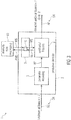
- Fig. 1 illustrates an embodiment of an audio decoder device according to pri-or art in a schematic view.
- the audio decoder device 1 comprises:
- the synthesis filter 4 For synthesizing the audio parameters AP the synthesis filter 4 sends an in-terrogation signal IS to the memory 6, wherein the interrogation signal IS de-pends on the one or more audio parameters AP.
- the memory 6 returns a response signal RS which depends on the interrogation signal IS and on the memory state MS for the decoded audio frame AF.
- This embodiment of a prior art audio decoder device allows to switch from a non-predictive audio decoder device to the predictive decoder device 1 shown in Fig. 1 .
- the non-predictive audio decoder device and the predictive decoder device 1 are using the same sampling rate SR.
- Fig. 2 illustrates a second embodiment of an audio decoder device 1 accord-ing to prior art in a schematic view.
- the audio decoder device 1 shown in Fig. 2 comprises an audio frame resampling device 8, which is configured to resample a preceding audio frame PAF having a preceding sample rate PSR in order to produce a preceding audio frame PAF having a sample rate SR, which is a sample rate SR of the audio frame AF.
- the preceding audio frame PAF having the sample rate SR is then analyzed by and parameter analyzer 9 which is configured to determine LPC coeffi-cients LPCC for the preceding audio frame PAF having the sample rate SR.
- the LPC coefficients LPCC are then used by the inverse-filtering device 7 for inverse-filtering of the preceding audio frame PAF having the sample rate SR in order to determine the memory state MS for the decoded audio frame AF.
- Fig. 3 illustrates a first embodiment of an audio decoder device according to the invention in a schematic view.
- the audio decoder device 1 comprises:
- the synthesis filter 4 For synthesizing the audio parameters AP the synthesis filter 4 sends an in-terrogation signal IS to the memory 6, wherein the interrogation signal IS de-pends on the one or more audio parameters AP.
- the memory 6 returns a response signal RS which depends on the interrogation signal IS and on the memory state MS for the decoded audio frame AF.
- decoded audio frame AF relates to an audio frame currently under processing
- the term "preceding decoded audio frame PAF” relates to an audio frame, which was processed before the audio frame currently under processing.
- the present invention allows a predictive coding scheme to switch its intern sampling rate without the need to resample the whole buffers for recomputing the states of its filters. By resampling directly and only the necessary memory states MS, a low complexity is maintained while a seamless transition is still possible.
- the memory state resampling device 10 is configured to retrieve the preceding memory state PMS; PAMS, PSMS, PDMS for one or more of said memories 6 from the memory device 5.
- the present invention can be applied when using the same coding scheme with different intern sampling rates PSR, SR.
- PSR intern sampling rate
- SR intern sampling rate
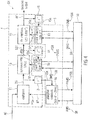
- Fig. 4 illustrates more details of the first embodiment of an audio decoder device according to the invention in a schematic view.
- the memory device 5 comprises a first memory 6a, which is an adaptive code-book 6a, a second memory 6b, which is a synthesis filter memory 6b, and a third memory 6c which is a de-emphasis memory 6c.
- the audio parameters AP are fed to an excitation module 11 which produces an output signal OS which is delayed by a delay inserter 12 and sent to the adaptive codebook memory 6a as an interrogation signal ISa.
- the adaptive codebook memory 6a outputs a response signal RSa, which contains one or more excitation parameters EP, which are fed to the excitation module 11.
- the output signal OS of the excitation module 11 is further fed to the synthe-sis filter module 13, which outputs an output signal OS1.
- the output signal OS1 is delayed by a delay inserter 14 and sent to the synthesis filter memory 6b as an interrogation signal ISb.
- the synthesis filter memory 13 outputs a response signal RSb, which contains one or more synthesis parameters SP, which are fed to the synthesis filter memory 13.
- Output signal OS1 of the synthesis filter module 13 is further fed to the de-emphasis module 15, which outputs that decoded audio frame AF at the sampling rate SR.
- the audio frame AF is further delayed by a delay inserter 16 and fit to the de-emphasis memory 6c as an interrogation signal ISc.
- the de-emphasis memory 6c outputs a response signal RSc, which contains one or more de-emphasis parameters DP which are fed to a de-emphasis module 15.
- the one or more mem-ories comprise 6a, 6b, 6c an adaptive codebook memory 6a configured to store an adaptive codebook memory state AMS for determining one or more excitation parameters EP for the decoded audio frame AF
- the memory state resampling device 10 is configured to determine the adaptive codebook memory state AMS for determining the one or more excitation pa-rameters EP for the decoded audio frame AF by resampling a preceding adaptive codebook memory state PAMS for determining of one or more exci-tation parameters for the preceding decoded audio frame PAF and to store the adaptive codebook memory state AMS for determining of the one or more excitation parameters EP for the decoded audio frame AF into the adaptive codebook memory 6a.
- the adaptive codebook memory state AMS is, for example, used in CELP devices.
- the memory sizes at different sampling rates SR, PSR must be equal in terms of time duration they cover. In other words, if a filter has an order of M at the sampling rate SR, the memory updated at the preceding sampling rate PSR should cover at least M*(PSR)/(SR) samples.
- the memory 6a is usually proportional to the sampling rate SR in the case for the adaptive codebook, which covers about the last 20ms of the decoded residual signal whatever the sampling rate SR may be, there is no extra memory management to do.
- the one or more memories 6a, 6b, 6c comprise a synthesis filter memory 6b configured to store a synthesis filter memory state SMS for determining one or more synthesis fil-ter parameters SP for the decoded audio frame AF
- the memory state resampling device 1 is configured to determine the synthesis filter memory state SMS for determining the one or more synthesis filter parame-ters SP for the decoded audio frame AF by resampling a preceding synthesis memory state PSMS for determining of one or more synthesis filter parame-ters for the preceding decoded audio frame PAF and to store the synthesis memory state SMS for determining of the one or more synthesis filter param-eters SP for the decoded audio frame AF into the synthesis filter memory 6b.
- the synthesis filter memory state SMS may be a LPC synthesis filter state, which is used, for example, in CELP devices.
- the order of the memory is not proportional to the sampling rate SR, or even constant whatever the sampling rate may be, an extra memory management has to done for being able to cover the largest duration possible.
- the LPC synthesis state order of AMR-WB+ is always 16. At 12.8 kHz, the smallest sampling rate it covers 1.25ms although it represents only 0.33ms at 48kHz. For being able to resample the buffer any of the sam-pling rate between 12.8 and 48kHz, the memory of the LPC synthesis filter state has to be extended from 16 to 60 samples, which represents 1.25 ms at 48kHz.
- synthesis filter will be performed by using the states from mem_syn_r[L_SYN_MEM-M] to mem_syn_r[L_SYN_MEM-1].
- the memory resampling device 10 is configured in such way that the same synthesis filter parameters SP are used for a plurality of subframes of the decoded audio frame AF.
- the LPC coefficients of the last frame PAF are usually used for interpolating the current LPC coefficients with a time granularity of 5ms. If the sampling rate is changing from PSR to SR, the interpolation cannot be performed. If the LPC are recomputed, the interpolation can be performed using the newly recomputed LPC coefficients. In the present invention, the interpolation cannot be performed directly. In one embodiment, the LPC coefficients are not interpolated in the first frame AF after a sampling rate switching. For all 5 ms subframe, the same set of coefficients is used.
- the memory resampling device 10 is configured in such way that the resampling of the preceding synthesis filter memory state PSMS is done by transforming the preceding synthesis filter memory state PSMS for the preceding decoded audio frame PAF to a power spectrum and by resampling the power spectrum.
- the LPC coefficients can be estimated at the new sampling rate RS without the need to redo a whole LP analysis.
- the old LPC coefficients at sampling rate PSR are transformed to a power spectrum which is resampled.
- the Levinson-Durbin algorithm is then applied on the autocorrelation deduced from the resampled power spectrum.
- the one or more memories 6a, 6b, 6c comprise a de-emphasis memory 6c configured to store a de-emphasis memory state DMS for determining one or more de-emphasis parameters DP for the decoded audio frame AF, wherein the memory state resampling device 10 is configured to determine the de-emphasis memory state DMS for determining the one or more de-emphasis parameters DP for the decoded audio frame AF by resampling a preceding de-emphasis memory state PDMS for determining of one or more de-emphasis parame-ters for the preceding decoded audio frame PAF and to store the de-emphasis memory state DMS for determining of the one or more de-emphasis parameters DP for the decoded audio frame AF into the de-emphasis memory 6c.
- the de-emphasis memory state is, for example, also used in
- the de-emphasis has usually a fixed order of 1, which represents 0.0781 ms at 12.8 kHz. This duration is covered by 3.75 samples at 48 kHz. A memory buffer of 4 samples is then needed if we adopt the method presented above.
- the one or more mem-ories 6; 6a, 6b, 6c are configured in such way that a number of stored sam-ples for the decoded audio frame AF is proportional to the sampling rate SR of the decoded audio frame AF.
- the memory state resampling device 10 is configured in such way that the resampling is done by linear interpolation.
- the resampling function resamp() can be done with any kind of resampling methods.
- time domain a conventional LP filter and decima-tion/oversampling is usual.
- Fig. 5 illustrates a second embodiment of an audio decoder device according to the invention in a schematic view.
- the audio decoder de-vice 1 comprises an inverse-filtering device 17 configured for inverse-filtering of the preceding decoded audio frame PAF at the preceding sampling rate PSR in order to determine the preceding memory state PMS; PAMS, PSMS, PDMS of one or more of said memories6; 6a, 6b, 6c, wherein the memory state resampling device is configured to retrieve the preceding memory state for one or more of said memories from the inverse-filtering device.
- Fig. 6 illustrates more details of the second embodiment of an audio decoder device according to the invention in a schematic view.
- the inverse-filtering device 17 comprises a pre-emphasis module 18, and delay inserter 19, a pre-emphasis memory 20, an analyzes filter module 21, a further delay inserter 22, and an analyzes filter memory 23, a further delay inserter 24, and an adaptive codebook memory 25.
- the preceding decoded audio frame PAF at the preceding sampling rate PSR is fed to the pre-emphasis module 18 as well as to the delay inserter 19, from which is fed to the pre-emphasis memory 20.
- the so established pre-ceding de-emphasis memory state PDMS at the preceding sampling rate is then transferred to the memory state resampling device 10 and to the pre-emphasis module 18.
- the output signal of the pre-emphasis module 18 is fed to the analyzes filter module 21 and to the delay inserter 22, from which it is set to the analyzes filter memory 23.
- the preceding synthesis memory state PSMS at the preceding sampling rate PSR is established.
- the preceding synthesis memory state PSMS is then transferred to the memory state resampling de-vice 10 and to the analysis filter module 21.
- the output signal of the analyzes filter module 21 is set to the delay inserter 24 and go to the adaptive codebook memory 25.
- the preceding adaptive codebook memory state PAMS at the preceding sampling rate PSR may be established the preceding adaptive codebook memory state PAMS may then be transferred to the memory state resampling device 10.
- Fig. 7 illustrates a third embodiment of an audio decoder device according to the invention in a schematic view.
- the memory state resampling device 10 is configured to retrieve the preceding memory state PMS; PAMS, PSMS, PDMS for one or more of said memories 6 from of a further audio processing device 26.
- the further audio processing device 26 may be, for example, a further audio decoder 26 device or a home for noise generating device.
- the present invention can be used in DTX mode, when the active frames are coded at 12.8 kHz with a conventional CELP and when the inactive parts are modeled with a 16 kHz noise generator (CNG).
- CNG noise generator
- the invention can be used, for example, when combining a TCX and an ACELP running at different sampling rates.
- Fig. 8 illustrates an embodiment of an audio encoder device according to the invention in a schematic view.
- the audio encoder device is configured for encoding a framed audio signal FAS.
- the audio encoder device 27 comprises:
- the invention is mainly focused on the audio decoder device 1. However it can also be applied at the audio encoder device 27. Indeed CELP is based on an Analysis-by-Synthesis principle, where a local decoding is performed on the encoder side. For this reason the same principle as described for the decoder can be applied on the encoder side. Moreover in case of a switched coding, e.g. ACELP/TCX, the transform-based coder may have to be able to update the memories of the speech coder even at the encoder side in case of coding switching in the next frame. For this purpose, a local decoder is used in the transformed-based encoder for updating the memories state of the CELP. It may be that the transformed-based encoder is running at a different sampling rate than the CELP and the invention can be then applied in this case.
- the synthesis filter 4 For synthesizing the audio parameters AP, the synthesis filter 4 sends an in-terrogation signal IS to the memory 6, wherein the interrogation signal IS de-pends on the one or more audio parameters AP.
- the memory 6 returns a response signal RS which depends on the interrogation signal IS and on the memory state MS for the decoded audio frame AF.
- the synthesis filter device 4, the memory device 5, the memory state resampling device 10 and the inverse-filtering device 17 of the audio encoder device 27 are equivalent to the synthesis filter device for, the memory device 5, the memory state resampling device 10 and the inverse filtering device 17 of the audio decoder device 1 as discussed above.
- the memory state resampling device 10 is configured to retrieve the preceding memory state PMS for one or more of said memories 6 from the memory device 5.
- the one or more mem-ories 6a, 6b, 6c comprise an adaptive codebook memory 6a configured to store an adaptive codebook state AMS for determining one or more excita-tion parameters EP for the decoded audio frame AF
- the memory state resampling device 10 is configured to determine the adaptive codebook state AMS for determining the one or more excitation parameters EP for the decoded audio frame AF by resampling a preceding adaptive codebook memory state PAMS for determining of one or more excitation parameters EP for the preceding decoded audio frame PAF and to store the adaptive codebook memory state AMS for determining of the one or more excitation parameters EP for the decoded audio frame AF into the adaptive codebook memory 6a. See Fig 4 and explanations above related to Fig. 4 .
- the one or more mem-ories 6a, 6b, 6c comprise a synthesis filter memory 6b configured to store a synthesis filter memory state SMS for determining one or more synthesis fil-ter parameters SP for the decoded audio frame AF
- the memory state resampling device 10 is configured to determine the synthesis memory state SMS for determining the one or more synthesis filter parameters SP for the decoded audio frame AF by resampling a preceding synthesis memory state PSMS for determining of one or more synthesis filter parameters for the preceding decoded audio frame PAF and to store the synthesis memory state SMS for determining of the one or more synthesis filter parameters SP for the decoded audio frame AF into the synthesis filter memory 6b. See Fig 4 and explanations above related to Fig.4 .
- the memory state resampling device 10 is configured in such way that the same synthesis filter parameters SP are used for a plurality of subframes of the decoded audio frame AF. See Fig 4 and explanations above related to Fig. 4 .
- the memory resampling device 10 is configured in such way that the resampling of the preceding synthesis filter memory state PSMS is done by transforming the preceding synthesis filter memory state PSMS for the preceding decoded audio frame PAF to a power spectrum and by resampling the power spec-trum. See Fig 4 and explanations above related to Fig. 4 .
- the one or more mem-ories 6; 6a, 6b, 6c comprise a de-emphasis memory 6c configured to store a de-emphasis memory state DMS for determining one or more de-emphasis parameters DP for the decoded audio frame AF
- the memory state resampling device 10 is configured to determine the de-emphasis memory state DMS for determining the one or more de-emphasis parameters DP for the decoded audio frame AF by resampling a preceding de-emphasis memory state PDMS for determining of one or more de-emphasis parame-ters for the preceding decoded audio frame PAF and to store the de-emphasis memory state DMS for determining of the one or more de-emphasis parameters DP for the decoded audio frame AF into the de-emphasis memory 6c. See Fig 4 and explanations above related to Fig
- the one or more memo-ries 6a, 6b, 6c are configured in such way that a number of stored samples for the decoded audio frame AF is proportional to the sampling rate SR of the decoded audio frame. See Fig 4 and explanations above related to Fig. 4 .
- the memory resampling device 10 is configured in such way that the resampling is done by linear interpolation. See Fig 4 and explanations above related to Fig. 4 .
- the audio encoder de-vice 27 comprises an inverse-filtering device 17 configured for inverse-filtering of the preceding decoded audio frame PAF in order to determine the preceding memory state PMS for one or more of said memories 6, wherein the memory state resampling device 10 is configured to retrieve the preced-ing memory state PMS for one or more of said memories 6 from the inverse-filtering device 17. See Fig 5 and explanations above related to Fig. 5 .
- the memory state resampling device 10 is configured to retrieve the preceding memory state PMS; PAMS, PSMS, PDMS for one or more of said memories 6; 6a, 6b, 6c from of a further audio processing device. See Fig 7 and explanations above related to Fig. 7 .
- embodiments of the in-vention can be implemented in hardware or in software.
- the implementation can be performed using a digital storage medium, for example a floppy disk, a DVD, a CD, a ROM, a PROM, an EPROM, an EEPROM or a FLASH memory, having electronically readable control signals stored thereon, which cooperate (or are capable of cooperating) with a programmable computer system such that the respective method is performed.
- a digital storage medium for example a floppy disk, a DVD, a CD, a ROM, a PROM, an EPROM, an EEPROM or a FLASH memory, having electronically readable control signals stored thereon, which cooperate (or are capable of cooperating) with a programmable computer system such that the respective method is performed.
- Some embodiments according to the invention comprise a data carrier hav-ing electronically readable control signals, which are capable of cooperating with a programmable computer system, such that one of the methods de-scribed herein is performed.
- embodiments of the present invention can be implemented as a computer program product with a program code, the program code being operative for performing one of the methods when the computer program product runs on a computer.
- the program code may for example be stored on a machine readable carrier.
- inventions comprise the computer program for performing one of the methods described herein, stored on a machine readable carrier or a non-transitory storage medium.
- an embodiment of the inventive method is, therefore, a com-puter program having a program code for performing one of the methods de-scribed herein, when the computer program runs on a computer.
- a further embodiment of the inventive methods is, therefore, a data carrier (or a digital storage medium, or a computer-readable medium) comprising, rec-orded thereon, the computer program for performing one of the methods de-scribed herein.
- a further embodiment of the inventive method is, therefore, a data stream or a sequence of signals representing the computer program for performing one of the methods described herein.
- the data stream or the sequence of signals may for example be configured to be transferred via a data communication connection, for example via the Internet.
- a further embodiment comprises a processing means, for example a com-puter, or a programmable logic device, configured to or adapted to perform one of the methods described herein.
- a processing means for example a com-puter, or a programmable logic device, configured to or adapted to perform one of the methods described herein.
- a further embodiment comprises a computer having installed thereon the computer program for performing one of the methods described herein.
- a programmable logic device for example a field pro-grammable gate array
- a field pro-grammable gate array may cooperate with a microprocessor in order to per-form one of the methods described herein.
- the methods are advantageously performed by any hardware apparatus.
Landscapes
- Engineering & Computer Science (AREA)
- Computational Linguistics (AREA)
- Signal Processing (AREA)
- Health & Medical Sciences (AREA)
- Audiology, Speech & Language Pathology (AREA)
- Human Computer Interaction (AREA)
- Physics & Mathematics (AREA)
- Acoustics & Sound (AREA)
- Multimedia (AREA)
- Quality & Reliability (AREA)
- Compression, Expansion, Code Conversion, And Decoders (AREA)
Abstract
Description
- The present invention is concerned with speech and audio coding, and more particularly to an audio encoder device and an audio decoder device for pro-cessing an audio signal, for which the input and output sampling rate is changing from a preceding frame to a current frame. The present invention is further related to methods of operating such devices as well as to computer programs executing such methods.
- Speech and audio coding can get the benefit of having a multi-cadence input and output, and of being able to switch instantaneously and seamlessly for one to another sampling rate. Conventional speech and audio coders use a single sampling rate for a determine output bit-rate and are not able to change it without resetting completely the system. It creates then a disconti-nuity in the communication and in the decoded signal.
- On the other hand, adaptive sampling rate and bit-rate allow a higher quality by selecting the optimal parameters depending usually on both the source and the channel condition. It is then important to achieve a seamless transi-tion, when changing the sampling rate of the input/output signal.
- Moreover, it is important to limit the complexity increase for such a transition. Modern speech and audio codecs, like the upcoming 3GPP EVS over LTE network, will need to be able to exploit such a functionality.
- Efficient speech and audio coders need to be able to change their sampling rate from a time region to another one to better suit to the source and to the channel condition. The change of sampling rate is particularly problematic for continuous linear filters, which can only be applied if their past states show the same sampling rate as the current time section to filter.
- More particularly predictive coding maintains at the encoder and decoder over time and frame different memory states. In code-excited linear predic-tion (CELP) these memories are usually the linear prediction coding (LPC) synthesis filter memory, the de-emphasis filter memory and the adaptive codebook. A straightforward approach is to reset all memories when a sam-pling rate change occurs. It creates a very annoying discontinuity in the de-coded signal. The recovery can be very long and very noticeable.
-
Fig. 1 shows a first audio decoder device according to prior art. With such an audio decoder device it is possible to switch to a predictive coding seamless-ly when coming from a non-predictive coding scheme. This may be done by an inverse filtering of the decoded output of non-predictive coder for main-taining the filter states needed by predictive coder. It is done for example in AMR-WB+ and USAC for switching from a transform-based coder, TCX, to a speech coder, ACELP. However, in both coders, the sampling rate is the same. The inverse filtering can be applied directly on the decoded audio sig-nal of TCX. Moreover, TCX in USAC and AMR-WB+ transmits and exploits LPC coefficient also needed for the inverse filtering. The LPC decoded coef-ficients are simply re-used in the inverse filtering computation. It is worth to note that the inverse filtering is not needed if switching between two predic-tive coders using the same filters and the same sampling-rate. -
Fig. 2 shows a second audio decoder device according to prior art In case the two coders have a different sampling rate, or in case when switching within the same predictive coder but with different sampling rates, the inverse filtering of the preceding audio frame as illustrated inFig. 1 is no more suffi-cient. A straightforward solution is to resample the past decoded output to the new sampling rate and then compute the memory states by inverse filtering. If some of the filter coefficients are sampling rate dependent as it is the case for the LPC synthesis filter, one need to do an extra analysis of the resampled past signal. For getting the LPC coefficients at the new sampling rate fs_2 the autocorrelation function is recomputed and the Levinson-Durbin algorithm applied on the resampled past decoded samples. This approach is computationally very demanding and can hardly be applied in real imple-mentations. - The problem to be solved is to provide an improved concept for switching of sampling rates at audio processing devices.
- In a first aspect the problem is solved by an audio decoder device for decod-ing a bitstream, wherein the audio decoder device comprises:
- a predictive decoder for producing a decoded audio frame from the bitstream, wherein the predictive decoder comprises a parameter decoder for producing one or more audio parameters for the decoded audio frame from the bit-stream and wherein the predictive decoder comprises a synthesis filter de-vice for producing the decoded audio frame by synthesizing the one or more audio parameters for the decoded audio frame;
- a memory device comprising one or more memories, wherein each of the memories is configured to store a memory state for the decoded audio frame, wherein the memory state for the decoded audio frame of the one or more memories is used by the synthesis filter device for synthesizing the one or more audio parameters for the decoded audio frame; and
- a memory state resampling device configured to determine the memory state for synthesizing the one or more audio parameters for the decoded audio frame, which has a sampling rate, for one or more of said memories by resampling a preceding memory state for synthesizing one or more audio parameters for a preceding decoded audio frame, which has a preceding sampling rate being different from the sampling rate of the decoded audio frame, for one or more of said memories and to store the memory state for synthesizing of the one or more audio parameters for the decoded audio frame for one or more of said memories into the respective memory.
- The term "decoded audio frame" relates to an audio frame currently under processing whereas the term "preceding decoded audio frame" relates to an audio frame, which was processed before the audio frame currently under processing.
- The present invention allows a predictive coding scheme to switch its intern sampling rate without the need to resample the whole buffers for recomputing the states of its filters. By resampling directly and only the necessary memory states, a low complexity is maintained while a seamless transition is still pos-sible.
- According to a preferred embodiment of the invention the one or more mem-ories comprise an adaptive codebook memory configured to store an adap-tive codebook memory state for determining one or more excitation parame-ters for the decoded audio frame, wherein the memory state resampling de-vice is configured to determine the adaptive codebook state for determining the one or more excitation parameters for the decoded audio frame by resampling a preceding adaptive codebook state for determining of one or more excitation parameters for the preceding decoded audio frame and to store the adaptive codebook state for determining of the one or more excita-tion parameters for the decoded audio frame into the adaptive codebook memory.
- The adaptive codebook memory state is, for example, used in CELP devices.
- For being able to resample the memories, the memory sizes at different sampling rates must be equal in terms of time duration they cover. In other words, if a filter has an order of M at the sampling rate fs_2, the memory up-dated at the preceding sampling rate fs_1 should cover at least M*(fs_1)/(fs_2) samples.
- As the memory is usually proportional to the sampling rate in the case for the adaptive codebook, which covers about the last 20ms of the decoded residu-al signal whatever the sampling rate may be, there is no extra memory man-agement to do.
- According to a preferred embodiment of the invention the one or more mem-ories comprise a synthesis filter memory configured to store a synthesis filter memory state for determining one or more synthesis filter parameters for the decoded audio frame, wherein the memory state resampling device is con-figured to determine the synthesis memory state for determining the one or more synthesis filter parameters for the decoded audio frame by resampling a preceding synthesis memory state for determining of one or more synthesis filter parameters for the preceding decoded audio frame and to store the syn-thesis memory state for determining of the one or more synthesis filter pa-rameters for the decoded audio frame into the synthesis filter memory.
- The synthesis filter memory state may be a LPC synthesis filter state, which is used, for example, in CELP devices.
- If the order of the memory is not proportional to the sampling rate, or even constant whatever the sampling rate may be, an extra memory management has to done for being able to cover the largest duration possible. For exam-ple, the LPC synthesis state order of AMR-WB+ is always 16. At 12.8 kHz, the smallest sampling rate it covers 1.25ms although it represents only 0.33ms at 48kHz. For being able to resample the buffer at any of the sam-pling rate between 12.8 and 48kHz, the memory of the LPC synthesis filter state has to be extended from 16 to 60 samples, which represents 1.25 ms at 48kHz.
- The memory resampling can be then described by the following pseudo-code:
 mem_syn_r_size_old = (int)(1.25*fs_1/1000);
 mem_syn_r_size_new = (int)(1.25*fs_2 /1000);
 mem_syn_r+L_SYN_MEM-mem_syn_r_size_new=
 resamp(mem_syn_r+L_SYN_MEM-mem_syn_r_size_old,
 mem_syn_r_size_old, mem_syn_r_size_new);
where resamp(x,I,L) outputs the input buffer x resampled from I to L samples. L_SYN_MEM is the largest size in samples that the memory can cover. In our case it is equal to 60 samples for fs_2<=48kHz. At any sampling rate, mem_syn_r has to be updated with the last L_SYN_MEM output samples.
 For(i=0 ;i<L_SYM_MEM ;i++)
      mem_syn_r[i]=y[L_frame-L_SYN_MEM+i];
where y[] is the output of the LPC synthesis filter and L_frame the size of the frame at the current sampling rate.
- producing a decoded audio frame from the bitstream using a predictive de-coder, wherein the predictive decoder comprises a parameter decoder for producing one or more audio parameters for the decoded audio frame from the bitstream and wherein the predictive decoder comprises a synthesis filter device for producing the decoded audio frame by synthesizing the one or more audio parameters for the decoded audio frame;
- providing a memory device comprising one or more memories, wherein each of the memories is configured to store a memory state for the decoded audio frame, wherein the memory state for the decoded audio frame of the one or more memories is used by the synthesis filter device for synthesizing the one or more audio parameters for the decoded audio frame;
- determining the memory state for synthesizing the one or more audio param-eters for the decoded audio frame, which has a sampling rate, for one or more of said memories by resampling a preceding memory state for synthe-sizing one or more audio parameters for a preceding decoded audio frame, which has a preceding sampling rate being different from the sampling rate for the decoded audio frame, for one or more of said memories; and
- storing the memory state for synthesizing of the one or more audio parame-ters for the decoded audio frame for one or more of said memories into the respective memory.
- a predictive encoder for producing an encoded audio frame from the framed audio signal, wherein the predictive encoder comprises a parameter analyzer for producing one or more audio parameters for the encoded audio frame from the framed audio signal and wherein the predictive encoder comprises a synthesis filter device for producing a decoded audio frame by synthesizing one or more audio parameters for the decoded audio frame, wherein the one or more audio parameters for the decoded audio frame are the one or more audio parameters for the encoded audio frame;
- a memory device comprising one or more memories, wherein each of the memories is configured to store a memory state for the decoded audio frame, wherein the memory state for the decoded audio frame of the one or more memories is used by the synthesis filter device for synthesizing the one or more audio parameters for the decoded audio frame; and
- a memory state resampling device configured to determine the memory state for synthesizing the one or more audio parameters for the decoded audio frame, which has a sampling rate, for one or more of said memories by resampling a preceding memory state for synthesizing one or more audio parameters for a preceding decoded audio frame, which has a preceding sampling rate being different from the sampling rate of the decoded audio frame, for one or more of said memories and to store the memory state for synthesizing of the one or more audio parameters for the decoded audio frame for one or more of said memories into the respective memory.
- producing an encoded audio frame from the framed audio signal using a pre-dictive encoder, wherein the predictive encoder comprises a parameter ana-lyzer for producing one or more audio parameters for the encoded audio frame from the framed audio signal and wherein the predictive encoder com-prises a synthesis filter device for producing a decoded audio frame by syn-thesizing one or more audio parameters for the decoded audio frame, where-in the one or more audio parameters for the decoded audio frame are the one or more audio parameters for the encoded audio frame;
- providing a memory device comprising one or more memories, wherein each of the memories is configured to store a memory state for the decoded audio frame, wherein the memory state for the decoded audio frame of the one or more memories is used by the synthesis filter device for synthesizing the one or more audio parameters for the decoded audio frame;
- determining the memory state for synthesizing the one or more audio parameters for the decoded audio frame, which has a sampling rate, for one or more of said memories by resampling a preceding memory state for synthe-sizing one or more audio parameters for a preceding decoded audio frame, which has a preceding sampling rate being different from the sampling rate of the decoded audio frame, for one or more of said memories; and
- storing the memory state for synthesizing of the one or more audio parame-ters for the decoded audio frame for one or more of said memories into the respective memory.
- Fig. 1
- illustrates an embodiment of an audio decoder device according to prior art in a schematic view;
- Fig. 2
- illustrates a second embodiment of an audio decoder device according to prior art in a schematic view;
- Fig. 3
- illustrates a first embodiment of an audio decoder device according to the invention in a schematic view;
- Fig. 4
- illustrates more details of the first embodiment of an audio decoder device according to the invention in a schematic view;
- Fig. 5
- illustrates a second embodiment of an audio decoder device according to the invention in a schematic view;
- Fig. 6
- illustrates more details of the second embodiment of an audio decoder device according to the invention in a schematic view;
- Fig. 7
- illustrates a third embodiment of an audio decoder device according to the invention in a schematic view; and
- Fig. 8
- illustrates an embodiment of an audio encoder device according to the invention in a schematic view.
- a
predictive decoder 2 for producing a decoded audio frame AF from the bit-stream BS, wherein thepredictive decoder 2 comprises aparameter decoder 3 for producing one or more audio parameters AP for the decoded audio frame AF from the bitstream BS and wherein thepredictive decoder 2 com-prises asynthesis filter device 4 for producing the decoded audio frame AF by synthesizing the one or more audio parameters AP for the decoded audio frame AF; - a
memory device 5 comprising one ormore memories 6, wherein each of thememories 6 is configured to store a memory state MS for the decoded audio frame AF, wherein the memory state MS for the decoded audio frame AF of the one ormore memories 6 is used by thesynthesis filter device 4 for syn-thesizing the one or more audio parameters AP for the decoded audio frame AF; and - an inverse filtering device 7 configured for reverse-filtering of a preceding decoded audio frame PAF having the same sampling rate SR as the decod-ed audio frame AF.
- a
predictive decoder 2 for producing a decoded audio frame AF from the bit-stream BS, wherein thepredictive decoder 2 comprises aparameter decoder 3 for producing one or more audio parameters AP for the decoded audio frame AF from the bitstream BS and wherein thepredictive decoder 2 com-prises asynthesis filter device 4 for producing the decoded audio frame AF by synthesizing the one or more audio parameters AP for the decoded audio frame AF; - a
memory device 5 comprising one ormore memories 6, wherein each of thememories 6 is configured to store a memory state MS for the decoded audio frame AF, wherein the memory state MS for the decoded audio frame AF of the one ormore memories 6 is used by thesynthesis filter device 4 for syn-thesizing the one or more audio parameters AP for the decoded audio frame AF; and - a memory
state resampling device 10 configured to determine the memory state MS for synthesizing the one or more audio parameters AP for the de-coded audio frame AF, which has a sampling rate SR, for one or more of saidmemories 6 by resampling a preceding memory state PMS for synthesizing one or more audio parameters for a preceding decoded audio frame PAF, which has a preceding sampling rate PSR being different from the sampling rate SR of the decoded audio frame AF, for one or more of saidmemories 6 and to store the memory state MS for synthesizing of the one or more audio parameters AP for the decoded audio frame AF for one or more of saidmemories 6 into the respective memory.
The term "decoded audio frame AF" relates to an audio frame currently under processing whereas the term "preceding decoded audio frame PAF" relates to an audio frame, which was processed before the audio frame currently under processing.
According to a preferred embodiment of the invention the one or more mem-ories comprise 6a, 6b, 6c an
 mem_syn_r_size_old = (int)(1.25*PSR/1000);
 mem_syn_r_size_new = (int)(1.25*SR /1000);
 mem_syn_r+L_SYN_MEM-mem_syn_r_size_new=
 resamp(mem_syn_r+L_SYN_MEM-mem_syn_r_size_old,
 mem_syn_r_size_old, mem_syn_r_size_new);
where resamp(x,I,L) outputs the input buffer x resampled from I to L samples. L_SYN_MEM is the largest size in samples that the memory can cover. In our case it is equal to 60 samples for SR<=48kHz. At any sampling rate, mem_syn_r has to be updated with the last L_SYN_MEM output samples.
 For(i=0 ;i<L_SYM_MEM ;i++)
      mem_syn_r[i]=y[L_frame-L_SYN_MEM+i] ;
where y[] is the output of the LPC synthesis filter and L_frame the size of the frame at the current sampling rate.
The de-emphasis memory state is, for example, also used in CELP.
- a
predictive encoder 28 for producing an encoded audio frame EAF from the framed audio signal FAS, wherein thepredictive encoder 28 comprises a pa-rameter analyzer 29 for producing one or more audio parameters AP for the encoded audio frame EAV from the framed audio signal FAS and wherein thepredictive encoder 28 comprises asynthesis filter device 4 for producing a decoded audio frame AF by synthesizing one or more audio parameters AP for the decoded audio frame AF, wherein the one or more audio parameters AP for the decoded audio frame AF are the one or more audio parameters AP for the encoded audio frame EAV; - a
memory device 5 comprising one ormore memories 6, wherein each of thememories 6 is configured to store a memory state MS for the decoded audio frame AF, wherein the memory state MS for the decoded audio frame AF of the one ormore memories 6 is used by thesynthesis filter 4 device for synthesizing the one or more audio parameters AP for the decoded audio frame AF; and - a memory
state resampling device 10 configured to determine the memory state MS for synthesizing the one or more audio parameters AP for the de-coded audio frame AF, which has a sampling rate SR, for one or more of saidmemories 6 by resampling a preceding memory state PMS for synthesizing one or more audio parameters for a preceding decoded audio frame PAF, which has a preceding sampling rate PSR being different from the sampling rate SR of the decoded audio frame AF, for one or more of saidmemories 6 and to store the memory state MS for synthesizing of the one or more audio parameters AP for the decoded audio frame AF for one or more of saidmemories 6 into therespective memory 6.
Although some aspects have been described in the context of an apparatus, it is clear that these aspects also represent a description of the correspond-ing method, where a block or device corresponds to a method step or a fea-ture of a method step. Analogously, aspects described in the context of a method step also represent a description of a corresponding block or item or feature of a corresponding apparatus.
- 1
- audio decoder device
- 2
- predictive decoder
- 3
- parameter decoder
- 4
- synthesis filter device
- 5
- memory device
- 6
- memory
- 7
- inverse-filtering device
- 8
- audio frame resampling device
- 9
- parameter analyzer
- 10
- memory state resampling device
- 11
- excitation module
- 12
- delay inserter
- 13
- synthesis filter module
- 14
- delay inserter
- 15
- de-emphasis module
- 16
- delay inserter
- 17
- inverse-filtering device
- 18
- pre-emphasis module
- 19
- delay inserter
- 20
- pre-emphasis memory
- 21
- analyzes filter module
- 22
- delay inserter
- 23
- analyzes filter memory
- 24
- delay inserter
- 25
- adaptive codebook memory
- 26
- further decoder
- 27
- audio encoder device
- 28
- predictive encoder
- 29
- parameter analyzer
- BS
- bitstream
- AF
- decoded audio frame
- AP
- audio parameter
- MS
- memory state for the audio frame
- SR
- sampling rate
- PAF
- preceding decoded audio frame
- IS
- interrogation signal
- RS
- response signal
- PSR
- preceding sampling rate
- LPCC
- linear prediction coding coefficient
- PMS
- preceding memory state
- AMS
- adaptive codebook memory state
- EP
- excitation parameter
- PAMS
- preceding adaptive codebook memory state
- OS
- output signal of the excitation module
- SMS
- synthesis filter memory state
- SP
- synthesis filter parameter
- PSMS
- preceding synthesis filter memory state
- OS1
- output signal of the synthesis filter
- DMS
- de-emphasis memory state
- DP
- de-emphasis parameter
- PDMS
- preceding de-emphasis memory state
- FAS
- framed audio signal
- EAF
- encoded audio frame
Claims (26)
- Audio decoder device for decoding a bitstream (BS), the audio decoder device (1) comprising:a predictive decoder (2) for producing a decoded audio frame (AF) from the bitstream (BS), wherein the predictive decoder (2) comprises a pa-rameter decoder (3) for producing one or more audio parameters (AP) for the decoded audio frame (AF) from the bitstream (BS) and wherein the predictive decoder (2) comprises a synthesis filter device (4) for producing the decoded audio frame (AF) by synthesizing the one or more audio pa-rameters (AP) for the decoded audio frame (AF);a memory device (5) comprising one or more memories (6; 6a, 6b, 6c), wherein each of the memories (6; 6a, 6b, 6c) is configured to store a memory state (MS; AMS, SMS, DMS) for the decoded audio frame (AF), wherein the memory state (MS; AMS, SMS, DMS) for the decoded audio frame (AF) of the one or more memories (6; 6a, 6b, 6c) is used by the synthesis filter device (4) for synthesizing the one or more audio parame-ters (AP) for the decoded audio frame (AF); anda memory state resampling device (10) configured to determine the memory state (MS; AMS, SMS, DMS) for synthesizing the one or more audio parameters (AP) for the decoded audio frame (AF), which has a sampling rate (SR), for one or more of said memories (6; 6a, 6b, 6c) by resampling a preceding memory state (PMS; PAMS, PSMS, PDMS) for synthesizing one or more audio parameters for a preceding decoded au-dio frame (PAF), which has a preceding sampling rate (PSR) being differ-ent from the sampling rate (SR) of the decoded audio frame (AF), for one or more of said memories (6; 6a, 6b, 6c) and to store the memory state (MS; AMS, SMS, DMS) for synthesizing of the one or more audio pa-rameters (AP) for the decoded audio frame (AF) for one or more of said memories (6; 6a, 6b, 6c) into the respective memory (6; 6a, 6b, 6c).
- Audio decoder device according to the preceding claim, wherein the one or more memories comprise (6; 6a, 6b, 6c) an adaptive codebook memory (6a) configured to store an adaptive codebook memory state (AMS) for determining one or more excitation parameters (EP) for the de-coded audio frame (AF), wherein the memory state resampling device (10) is configured to determine the adaptive codebook memory state (AMS) for determining the one or more excitation parameters (EP) for the decoded audio frame (AF) by resampling a preceding adaptive codebook memory state (PAMS) for determining of one or more excitation parame-ters for the preceding decoded audio frame (PAF) and to store the adap-tive codebook memory state (AMS) for determining of the one or more excitation parameters (EP) for the decoded audio frame (AF) into the adaptive codebook memory (6a).
- Audio decoder device according to one of the preceding claims, wherein the one or more memories (6; 6a, 6b, 6c) comprise a synthesis filter memory (6b) configured to store a synthesis filter memory state (SMS) for determining one or more synthesis filter parameters (SP) for the decoded audio frame (AF), wherein the memory state resampling device (1) is con-figured to determine the synthesis filter memory state (SMS) for determin-ing the one or more synthesis filter parameters (SP) for the decoded au-dio frame (AF) by resampling a preceding synthesis memory state (PSMS) for determining of one or more synthesis filter parameters for the preceding decoded audio frame (PAF) and to store the synthesis memory state (SMS) for determining of the one or more synthesis filter parameters (SP) for the decoded audio frame (AF) into the synthesis filter memory (6b).
- Audio decoder device according to claim 3, wherein the memory resampling device (10) is configured in such way that the same synthesis filter parameters (SP) are used for a plurality of subframes of the decoded audio frame (AF).
- Audio decoder device according to claim 3 or 4, wherein the memory resampling device (10) is configured in such way that the resampling of the preceding synthesis filter memory state (PSMS) is done by transform-ing the preceding synthesis filter memory state (PSMS) for the preceding decoded audio frame (PAF) to a power spectrum and by resampling the power spectrum.
- Audio decoder device according to one of the preceding claims, wherein the one or more memories (6; 6a, 6b, 6c) comprise a de-emphasis memory (6c) configured to store a de-emphasis memory state (DMS) for determining one or more de-emphasis parameters (DP) for the decoded audio frame (AF), wherein the memory state resampling device (10) is configured to determine the de-emphasis memory state (DMS) for deter-mining the one or more de-emphasis parameters (DP) for the decoded audio frame (AF) by resampling a preceding de-emphasis memory state (PDMS) for determining of one or more de-emphasis parameters for the preceding decoded audio frame (PAF) and to store the de-emphasis memory state (DMS) for determining of the one or more de-emphasis pa-rameters (DP) for the decoded audio frame (AF) into the de-emphasis memory (6c).
- Audio decoder device according to one of the preceding claims, wherein the one or more memories (6; 6a, 6b, 6c) are configured in such way that a number of stored samples for the decoded audio frame (AF) is propor-tional to the sampling rate (SR) of the decoded audio frame (AF).
- Audio decoder device according to one of the preceding claims, wherein the memory state resampling device (10) is configured in such way that the resampling is done by linear interpolation.
- Audio decoder device according to one of the preceding claims, wherein the memory state resampling device (10) is configured to retrieve the pre-ceding memory state (PMS; PAMS, PSMS, PDMS) for one or more of said memories (6; 6a, 6b, 6c) from the memory device (5).
- Audio decoder device according to one of the preceding claims, wherein the audio decoder device (1) comprises an inverse-filtering device (17) configured for inverse-filtering of the preceding decoded audio frame (PAF) at the preceding sampling rate (PSR) in order to determine the pre-ceding memory state (PMS; PAMS, PSMS, PDMS) of one or more of said memories(6; 6a, 6b, 6c), wherein the memory state resampling device is configured to retrieve the preceding memory state for one or more of said memories from the inverse-filtering device.
- Audio decoder device according to one of the preceding claims, wherein the memory state resampling device is configured to retrieve the preced-ing memory state (PMS; PAMS, PSMS, PDMS) for one or more of said memories (6; 6a, 6b, 6c) from a further audio processing device (26).
- Method for operating an audio decoder device (1) for decoding a bit-stream (BS), the method comprising the steps of:producing a decoded audio frame (AF) from the bitstream (BS) using a predictive decoder (2), wherein the predictive decoder (2) comprises a pa-rameter decoder (3) for producing one or more audio parameters (AP) for the decoded audio frame (AF) from the bitstream (BS) and wherein the predictive decoder (2) comprises a synthesis filter device (4) for producing the decoded audio frame (AF) by synthesizing the one or more audio pa-rameters (AP) for the decoded audio frame (AF);providing a memory device (5) comprising one or more memories (6; 6a, 6b, 6c), wherein each of the memories (6; 6a, 6b, 6c) is configured to store a memory state (MS; AMS, SMS, DMS) for the decoded audio frame (AF), wherein the memory state (MS; AMS, SMS, DMS) for the de-coded audio frame (AF) of the one or more memories (6; 6a, 6b, 6c) is used by the synthesis filter device (4) for synthesizing the one or more audio parameters (AP) for the decoded audio frame (AF);determining the memory state (MS; AMS, SMS, DMS) for synthesizing the one or more audio parameters (AP) for the decoded audio frame (AF), which has a sampling rate (SR), for one or more of said memories (6; 6a, 6b, 6c) by resampling a preceding memory state (PMS; PAMS, PSMS, PDMS) for synthesizing one or more audio parameters for a preceding decoded audio frame (PAF), which has a preceding sampling rate (PSR) being different from the sampling rate (SR) of the decoded audio frame (AF), for one or more of said memories (6; 6a, 6b, 6c); andstoring the memory state (MS; AMS, SMS, DMS) for synthesizing of the one or more audio parameters (AP) for the decoded audio frame (AF) for one or more of said memories (6; 6a, 6b, 6c) into the respective memory.
- Computer program, when running on a processor, executing the method according to the preceding claim.
- Audio encoder device for encoding a framed audio signal (FAS), the au-dio encoder device (27) comprising:a predictive encoder (28) for producing an encoded audio frame (EAF) from the framed audio signal (FAS), wherein the predictive encoder (28) comprises a parameter analyzer (29) for producing one or more audio pa-rameters (AP) for the encoded audio frame (EAV) from the framed audio signal (FAS) and wherein the predictive encoder (28) comprises a syn-thesis filter device (4) for producing a decoded audio frame (AF) by syn-thesizing one or more audio parameters (AP) for the decoded audio frame (AF), wherein the one or more audio parameters (AP) for the decoded audio frame (AF) are the one or more audio parameters (AP) for the en-coded audio frame (EAV);a memory device (5) comprising one or more memories (6; 6a, 6b, 6c), wherein each of the memories (6; 6a, 6b, 6c) is configured to store a memory state (MS; AMS, SMS, DMS) for the decoded audio frame (AF), wherein the memory state (MS; AMS, SMS, DMS) for the decoded audio frame (AF) of the one or more memories (6; 6a, 6b, 6c) is used by the synthesis filter (4) device for synthesizing the one or more audio parame-ters (AP) for the decoded audio frame (AF); anda memory state resampling device (10) configured to determine the memory state (MS; AMS, SMS, DMS) for synthesizing the one or more audio parameters (AP) for the decoded audio frame (AF), which has a sampling rate (SR), for one or more of said memories (6; 6a, 6b, 6c) by resampling a preceding memory state (PMS; PAMS, PSMS, PDMS) for synthesizing one or more audio parameters for a preceding decoded au-dio frame (PAF), which has a preceding sampling rate (PSR) being differ-ent from the sampling rate (SR) of the decoded audio frame (AF), for one or more of said memories (6; 6a, 6b, 6c) and to store the memory state (MS; AMS, SMS, DMS) for synthesizing of the one or more audio pa-rameters (AP) for the decoded audio frame (AF) for one or more of said memories (6; 6a, 6b, 6c) into the respective memory (6; 6a, 6b, 6c).
- Audio encoder device according to the preceding claim, wherein the one or more memories (6; 6a, 6b, 6c) comprise an adaptive codebook memory (6a) configured to store an adaptive codebook state (AMS) for determining one or more excitation parameters (EP) for the decoded au-dio frame (AF), wherein the memory state resampling device (10) is con-figured to determine the adaptive codebook state (AMS) for determining the one or more excitation parameters (EP) for the decoded audio frame (AF) by resampling a preceding adaptive codebook memory state (PAMS) for determining of one or more excitation parameters (EP) for the preced-ing decoded audio frame (PAF) and to store the adaptive codebook memory state (AMS) for determining of the one or more excitation param-eters (EP) for the decoded audio frame (AF) into the adaptive codebook memory (6a).
- Audio encoder device according to claim 14 or 15, wherein the one or more memories (6; 6a, 6b, 6c) comprise a synthesis filter memory (6b) configured to store a synthesis filter memory state (SMS) for determining one or more synthesis filter parameters (SP) for the decoded audio frame (AF), wherein the memory state resampling device (10) is configured to determine the synthesis memory state (SMS) for determining the one or more synthesis filter parameters (SP) for the decoded audio frame (AF) by resampling a preceding synthesis memory state (PSMS) for determin-ing of one or more synthesis filter parameters for the preceding decoded audio frame (PAF) and to store the synthesis memory state (SMS) for de-termining of the one or more synthesis filter parameters (SP) for the de-coded audio frame (AF) into the synthesis filter memory (6b).
- Audio encoder device according to the preceding claim, wherein the memory state resampling device (10) is configured in such way that the same synthesis filter parameters (SP) are used for a plurality of sub-frames of the decoded audio frame (AF).
- Audio encoder device according to claim 16 or 17, wherein the memory resampling device (10) is configured in such way that the resampling of the preceding synthesis filter memory state (PSMS) is done by transform-ing the preceding synthesis filter memory state (PSMS) for the preceding decoded audio frame (PAF) to a power spectrum and by resampling the power spectrum.
- Audio encoder device according to one of the claims 14 to 18, wherein the one or more memories (6; 6a, 6b, 6c) comprise a de-emphasis memory (6c) configured to store a de-emphasis memory state (DMS) for determining one or more de-emphasis parameters (DP) for the decoded audio frame (AF), wherein the memory state resampling device (10) is configured to determine the de-emphasis memory state (DMS) for deter-mining the one or more de-emphasis parameters (DP) for the decoded audio frame (AF) by resampling a preceding de-emphasis memory state (PDMS) for determining of one or more de-emphasis parameters for the preceding decoded audio frame (PAF) and to store the de-emphasis memory state (DMS) for determining of the one or more de-emphasis pa-rameters (DP) for the decoded audio frame (AF) into the de-emphasis memory (6c).
- Audio encoder device according to one of the claims 14 to 19, wherein the one or more memories (6; 6a, 6b, 6c) are configured in such way that a number of stored samples for the decoded audio frame (AF) is propor-tional to the sampling rate (SR) of the decoded audio frame.
- Audio encoder device according to one of the claims 14 to 20, wherein the memory resampling device (10) is configured in such way that the resampling is done by linear interpolation.
- Audio encoder device according to one of the claims 14 to 21, wherein the memory state resampling device (10) is configured to retrieve the pre-ceding memory state (PMS; PAMS, PSMS, PDMS) for one or more of said memories (6; 6a, 6b, 6c) from the memory device (5).
- Audio encoder device according to one of the claims 14 to 22, wherein the audio encoder device (27) comprises an inverse-filtering device (17) configured for inverse-filtering of the preceding decoded audio frame (PAF) in order to determine the preceding memory state (PMS; PAMS, PSMS, PDMS) for one or more of said memories (6; 6a, 6b, 6c), wherein the memory state resampling device (10) is configured to retrieve the pre-ceding memory state (PMS; PAMS, PSMS, PDMS) for one or more of said memories (6; 6a, 6b, 6c) from the inverse-filtering device (17).
- Audio encoder device according to one of the claims 14 to 23, wherein the memory state resampling device (10) is configured to retrieve the pre-ceding memory state (PMS; PAMS, PSMS, PDMS) for one or more of said memories (6; 6a, 6b, 6c) from of a further audio processing device.
- Method for operating an audio encoder device (27) for encoding a framed audio signal, the method comprising the steps of:producing an encoded audio frame (EAF) from the framed audio signal (FAS) using a predictive encoder (28), wherein the predictive encoder (28) comprises a parameter analyzer (29) for producing one or more audio parameters (AP) for the encoded audio frame (EAF) from the framed audio signal (FAS) and wherein the predictive encoder (28) comprises a synthesis filter device (4) for producing a decoded audio frame (AF) by synthesizing one or more audio parameters (AP) for the decoded audio frame, wherein the one or more audio parameters (AP) for the decoded audio frame (AF) are the one or more audio parameters (AP) for the en-coded audio frame (EAV);providing a memory device (5) comprising one or more memories (6; 6a, 6b, 6c), wherein each of the memories (6; 6a, 6b, 6c) is configured to store a memory state (MS; AMS, SMS, DMS) for the decoded audio frame (AF), wherein the memory state (MS; AMS, SMS, DMS) for the de-coded audio frame (AF) of the one or more memories (6; 6a, 6b, 6c) is used by the synthesis filter device (4) for synthesizing the one or more audio parameters (AP) for the decoded audio frame (AF);determining the memory state (MS; AMS, SMS, DMS) for synthesizing the one or more audio parameters (AP) for the decoded audio frame (AF), which has a sampling rate (SR), for one or more of said memories (6; 6a, 6b, 6c) by resampling a preceding memory state (PMS; PAMS, PSMS, PDMS) for synthesizing one or more audio parameters for a preceding decoded audio frame (PAF), which has a preceding sampling rate (PSR) being different from the sampling rate (SR) of the decoded audio frame (AF), for one or more of said memories (6; 6a, 6b, 6c); andstoring the memory state (MS; AMS, SMS, DMS) for synthesizing of the one or more audio parameters (AP) for the decoded audio frame (AF) for one or more of said memories (6; 6a, 6b, 6c) into the respective memory (6; 6a, 6b, 6c).
- Computer program, when running on a processor, executing the method according to the preceding claim.
Priority Applications (1)
| Application Number | Priority Date | Filing Date | Title |
|---|---|---|---|
| EP24151606.1A EP4328908B1 (en) | 2014-08-18 | 2015-08-14 | Concept for switching of sampling rates at audio processing devices |
Applications Claiming Priority (3)
| Application Number | Priority Date | Filing Date | Title |
|---|---|---|---|
| EP14181307.1A EP2988300A1 (en) | 2014-08-18 | 2014-08-18 | Switching of sampling rates at audio processing devices |
| EP15750069.5A EP3183729B1 (en) | 2014-08-18 | 2015-08-14 | Switching of sampling rates at audio processing devices |
| PCT/EP2015/068778 WO2016026788A1 (en) | 2014-08-18 | 2015-08-14 | Concept for switching of sampling rates at audio processing devices |
Related Parent Applications (2)
| Application Number | Title | Priority Date | Filing Date |
|---|---|---|---|
| EP15750069.5A Division EP3183729B1 (en) | 2014-08-18 | 2015-08-14 | Switching of sampling rates at audio processing devices |
| EP15750069.5A Division-Into EP3183729B1 (en) | 2014-08-18 | 2015-08-14 | Switching of sampling rates at audio processing devices |
Related Child Applications (2)
| Application Number | Title | Priority Date | Filing Date |
|---|---|---|---|
| EP24151606.1A Division-Into EP4328908B1 (en) | 2014-08-18 | 2015-08-14 | Concept for switching of sampling rates at audio processing devices |
| EP24151606.1A Division EP4328908B1 (en) | 2014-08-18 | 2015-08-14 | Concept for switching of sampling rates at audio processing devices |
Publications (3)
| Publication Number | Publication Date |
|---|---|
| EP3739580A1 true EP3739580A1 (en) | 2020-11-18 |
| EP3739580B1 EP3739580B1 (en) | 2024-04-17 |
| EP3739580C0 EP3739580C0 (en) | 2024-04-17 |
Family
ID=51352467
Family Applications (4)
| Application Number | Title | Priority Date | Filing Date |
|---|---|---|---|
| EP14181307.1A Withdrawn EP2988300A1 (en) | 2014-08-18 | 2014-08-18 | Switching of sampling rates at audio processing devices |
| EP15750069.5A Active EP3183729B1 (en) | 2014-08-18 | 2015-08-14 | Switching of sampling rates at audio processing devices |
| EP24151606.1A Active EP4328908B1 (en) | 2014-08-18 | 2015-08-14 | Concept for switching of sampling rates at audio processing devices |
| EP20185071.6A Active EP3739580B1 (en) | 2014-08-18 | 2015-08-14 | Switching of sampling rates at audio processing devices |
Family Applications Before (3)
| Application Number | Title | Priority Date | Filing Date |
|---|---|---|---|
| EP14181307.1A Withdrawn EP2988300A1 (en) | 2014-08-18 | 2014-08-18 | Switching of sampling rates at audio processing devices |
| EP15750069.5A Active EP3183729B1 (en) | 2014-08-18 | 2015-08-14 | Switching of sampling rates at audio processing devices |
| EP24151606.1A Active EP4328908B1 (en) | 2014-08-18 | 2015-08-14 | Concept for switching of sampling rates at audio processing devices |
Country Status (18)
| Country | Link |
|---|---|
| US (3) | US10783898B2 (en) |
| EP (4) | EP2988300A1 (en) |
| JP (1) | JP6349458B2 (en) |
| KR (1) | KR102120355B1 (en) |
| CN (2) | CN106663443B (en) |
| AR (1) | AR101578A1 (en) |
| AU (1) | AU2015306260B2 (en) |
| BR (1) | BR112017002947B1 (en) |
| CA (1) | CA2957855C (en) |
| ES (3) | ES3049391T3 (en) |
| MX (1) | MX360557B (en) |
| MY (1) | MY187283A (en) |
| PL (3) | PL3183729T3 (en) |
| PT (1) | PT3183729T (en) |
| RU (1) | RU2690754C2 (en) |
| SG (1) | SG11201701267XA (en) |
| TW (1) | TWI587291B (en) |
| WO (1) | WO2016026788A1 (en) |
Families Citing this family (12)
| Publication number | Priority date | Publication date | Assignee | Title |
|---|---|---|---|---|
| KR102222838B1 (en) | 2014-04-17 | 2021-03-04 | 보이세지 코포레이션 | Methods, encoder and decoder for linear predictive encoding and decoding of sound signals upon transition between frames having different sampling rates |
| EP2988300A1 (en) * | 2014-08-18 | 2016-02-24 | Fraunhofer-Gesellschaft zur Förderung der angewandten Forschung e.V. | Switching of sampling rates at audio processing devices |
| EP3483884A1 (en) | 2017-11-10 | 2019-05-15 | Fraunhofer-Gesellschaft zur Förderung der angewandten Forschung e.V. | Signal filtering |
| EP3483886A1 (en) | 2017-11-10 | 2019-05-15 | Fraunhofer-Gesellschaft zur Förderung der angewandten Forschung e.V. | Selecting pitch lag |
| WO2019091573A1 (en) * | 2017-11-10 | 2019-05-16 | Fraunhofer-Gesellschaft zur Förderung der angewandten Forschung e.V. | Apparatus and method for encoding and decoding an audio signal using downsampling or interpolation of scale parameters |
| EP3483883A1 (en) | 2017-11-10 | 2019-05-15 | Fraunhofer-Gesellschaft zur Förderung der angewandten Forschung e.V. | Audio coding and decoding with selective postfiltering |
| EP3483878A1 (en) | 2017-11-10 | 2019-05-15 | Fraunhofer-Gesellschaft zur Förderung der angewandten Forschung e.V. | Audio decoder supporting a set of different loss concealment tools |
| EP3483880A1 (en) | 2017-11-10 | 2019-05-15 | Fraunhofer-Gesellschaft zur Förderung der angewandten Forschung e.V. | Temporal noise shaping |
| WO2019091576A1 (en) | 2017-11-10 | 2019-05-16 | Fraunhofer-Gesellschaft zur Förderung der angewandten Forschung e.V. | Audio encoders, audio decoders, methods and computer programs adapting an encoding and decoding of least significant bits |
| EP3483879A1 (en) | 2017-11-10 | 2019-05-15 | Fraunhofer-Gesellschaft zur Förderung der angewandten Forschung e.V. | Analysis/synthesis windowing function for modulated lapped transformation |
| EP3483882A1 (en) | 2017-11-10 | 2019-05-15 | Fraunhofer-Gesellschaft zur Förderung der angewandten Forschung e.V. | Controlling bandwidth in encoders and/or decoders |
| US11601483B2 (en) * | 2018-02-14 | 2023-03-07 | Genband Us Llc | System, methods, and computer program products for selecting codec parameters |
Citations (5)
| Publication number | Priority date | Publication date | Assignee | Title |
|---|---|---|---|---|
| EP0890943A2 (en) * | 1997-07-11 | 1999-01-13 | Nec Corporation | Voice coding and decoding system |
| WO2008031458A1 (en) * | 2006-09-13 | 2008-03-20 | Telefonaktiebolaget Lm Ericsson (Publ) | Methods and arrangements for a speech/audio sender and receiver |
| WO2012103686A1 (en) * | 2011-02-01 | 2012-08-09 | Huawei Technologies Co., Ltd. | Method and apparatus for providing signal processing coefficients |
| EP2613316A2 (en) * | 2012-01-03 | 2013-07-10 | Motorola Mobility, Inc. | Method and apparatus for processing audio frames to transition between different codecs |
| EP3132443A1 (en) * | 2014-04-17 | 2017-02-22 | VoiceAge Corporation | Methods, encoder and decoder for linear predictive encoding and decoding of sound signals upon transition between frames having different sampling rates |
Family Cites Families (25)
| Publication number | Priority date | Publication date | Assignee | Title |
|---|---|---|---|---|
| US3982070A (en) * | 1974-06-05 | 1976-09-21 | Bell Telephone Laboratories, Incorporated | Phase vocoder speech synthesis system |
| JPS60224341A (en) * | 1984-04-20 | 1985-11-08 | Nippon Telegr & Teleph Corp <Ntt> | Voice encoding method |
| US5956674A (en) * | 1995-12-01 | 1999-09-21 | Digital Theater Systems, Inc. | Multi-channel predictive subband audio coder using psychoacoustic adaptive bit allocation in frequency, time and over the multiple channels |
| US7446774B1 (en) * | 1998-11-09 | 2008-11-04 | Broadcom Corporation | Video and graphics system with an integrated system bridge controller |
| CN1257270A (en) * | 1998-11-10 | 2000-06-21 | Tdk株式会社 | Digital audio frequency recording and reproducing device |
| WO2000067258A1 (en) | 1999-04-30 | 2000-11-09 | Thomson Licensing S.A. | Method and apparatus for processing digitally encoded audio data |
| US6829579B2 (en) | 2002-01-08 | 2004-12-07 | Dilithium Networks, Inc. | Transcoding method and system between CELP-based speech codes |
| JP2004023598A (en) * | 2002-06-19 | 2004-01-22 | Matsushita Electric Ind Co Ltd | Audio data recording and playback device |
| JP3947191B2 (en) * | 2004-10-26 | 2007-07-18 | ソニー株式会社 | Prediction coefficient generation device and prediction coefficient generation method |
| JP4639073B2 (en) * | 2004-11-18 | 2011-02-23 | キヤノン株式会社 | Audio signal encoding apparatus and method |
| US7489259B2 (en) * | 2006-08-01 | 2009-02-10 | Creative Technology Ltd. | Sample rate converter and method to perform sample rate conversion |
| CN101361112B (en) * | 2006-08-15 | 2012-02-15 | 美国博通公司 | Re-phasing of decoder states after packet loss |
| CN101025918B (en) * | 2007-01-19 | 2011-06-29 | 清华大学 | Voice/music dual-mode coding-decoding seamless switching method |
| GB2455526A (en) * | 2007-12-11 | 2009-06-17 | Sony Corp | Generating water marked copies of audio signals and detecting them using a shuffle data store |
| MY152252A (en) * | 2008-07-11 | 2014-09-15 | Fraunhofer Ges Forschung | Apparatus and method for encoding/decoding an audio signal using an aliasing switch scheme |
| RU2515704C2 (en) * | 2008-07-11 | 2014-05-20 | Фраунхофер-Гезелльшафт Цур Фердерунг Дер Ангевандтен Форшунг Е.Ф. | Audio encoder and audio decoder for encoding and decoding audio signal readings |
| US8140342B2 (en) * | 2008-12-29 | 2012-03-20 | Motorola Mobility, Inc. | Selective scaling mask computation based on peak detection |
| WO2011048117A1 (en) * | 2009-10-20 | 2011-04-28 | Fraunhofer-Gesellschaft zur Förderung der angewandten Forschung e.V. | Audio signal encoder, audio signal decoder, method for encoding or decoding an audio signal using an aliasing-cancellation |
| GB2476041B (en) * | 2009-12-08 | 2017-03-01 | Skype | Encoding and decoding speech signals |
| CN102222505B (en) * | 2010-04-13 | 2012-12-19 | 中兴通讯股份有限公司 | Hierarchical audio coding and decoding methods and systems and transient signal hierarchical coding and decoding methods |
| US9037456B2 (en) * | 2011-07-26 | 2015-05-19 | Google Technology Holdings LLC | Method and apparatus for audio coding and decoding |
| US9594536B2 (en) * | 2011-12-29 | 2017-03-14 | Ati Technologies Ulc | Method and apparatus for electronic device communication |
| FR3013496A1 (en) * | 2013-11-15 | 2015-05-22 | Orange | TRANSITION FROM TRANSFORMED CODING / DECODING TO PREDICTIVE CODING / DECODING |
| FR3023646A1 (en) * | 2014-07-11 | 2016-01-15 | Orange | UPDATING STATES FROM POST-PROCESSING TO A VARIABLE SAMPLING FREQUENCY ACCORDING TO THE FRAMEWORK |
| EP2988300A1 (en) * | 2014-08-18 | 2016-02-24 | Fraunhofer-Gesellschaft zur Förderung der angewandten Forschung e.V. | Switching of sampling rates at audio processing devices |
-
2014
- 2014-08-18 EP EP14181307.1A patent/EP2988300A1/en not_active Withdrawn
-
2015
- 2015-08-14 MX MX2017002108A patent/MX360557B/en active IP Right Grant
- 2015-08-14 RU RU2017108839A patent/RU2690754C2/en active
- 2015-08-14 ES ES24151606T patent/ES3049391T3/en active Active
- 2015-08-14 MY MYPI2017000248A patent/MY187283A/en unknown
- 2015-08-14 EP EP15750069.5A patent/EP3183729B1/en active Active
- 2015-08-14 PT PT157500695T patent/PT3183729T/en unknown
- 2015-08-14 EP EP24151606.1A patent/EP4328908B1/en active Active
- 2015-08-14 WO PCT/EP2015/068778 patent/WO2016026788A1/en not_active Ceased
- 2015-08-14 ES ES20185071T patent/ES2980944T3/en active Active
- 2015-08-14 CN CN201580044544.0A patent/CN106663443B/en active Active
- 2015-08-14 CA CA2957855A patent/CA2957855C/en active Active
- 2015-08-14 ES ES15750069T patent/ES2828949T3/en active Active
- 2015-08-14 EP EP20185071.6A patent/EP3739580B1/en active Active
- 2015-08-14 AU AU2015306260A patent/AU2015306260B2/en active Active
- 2015-08-14 PL PL15750069T patent/PL3183729T3/en unknown
- 2015-08-14 CN CN202110649437.8A patent/CN113724719B/en active Active
- 2015-08-14 PL PL20185071.6T patent/PL3739580T3/en unknown
- 2015-08-14 SG SG11201701267XA patent/SG11201701267XA/en unknown
- 2015-08-14 KR KR1020177006373A patent/KR102120355B1/en active Active
- 2015-08-14 TW TW104126634A patent/TWI587291B/en active
- 2015-08-14 PL PL24151606.1T patent/PL4328908T3/en unknown
- 2015-08-14 BR BR112017002947-2A patent/BR112017002947B1/en active IP Right Grant
- 2015-08-14 JP JP2017510309A patent/JP6349458B2/en active Active
- 2015-08-18 AR ARP150102651A patent/AR101578A1/en active IP Right Grant
-
2017
- 2017-02-10 US US15/430,178 patent/US10783898B2/en active Active
-
2020
- 2020-08-18 US US16/996,671 patent/US11443754B2/en active Active
-
2022
- 2022-08-05 US US17/882,363 patent/US11830511B2/en active Active
Patent Citations (5)
| Publication number | Priority date | Publication date | Assignee | Title |
|---|---|---|---|---|
| EP0890943A2 (en) * | 1997-07-11 | 1999-01-13 | Nec Corporation | Voice coding and decoding system |
| WO2008031458A1 (en) * | 2006-09-13 | 2008-03-20 | Telefonaktiebolaget Lm Ericsson (Publ) | Methods and arrangements for a speech/audio sender and receiver |
| WO2012103686A1 (en) * | 2011-02-01 | 2012-08-09 | Huawei Technologies Co., Ltd. | Method and apparatus for providing signal processing coefficients |
| EP2613316A2 (en) * | 2012-01-03 | 2013-07-10 | Motorola Mobility, Inc. | Method and apparatus for processing audio frames to transition between different codecs |
| EP3132443A1 (en) * | 2014-04-17 | 2017-02-22 | VoiceAge Corporation | Methods, encoder and decoder for linear predictive encoding and decoding of sound signals upon transition between frames having different sampling rates |
Non-Patent Citations (1)
| Title |
|---|
| "Digital cellular telecommunications system (Phase 2+); Universal Mobile Telecommunications System (UMTS); LTE; Audio codec processing functions; Extended Adaptive Multi-Rate - Wideband (AMR-WB+) codec; Transcoding functions (3GPP TS 26.290 version 11.0.0 Release 11)", TECHNICAL SPECIFICATION, EUROPEAN TELECOMMUNICATIONS STANDARDS INSTITUTE (ETSI), 650, ROUTE DES LUCIOLES ; F-06921 SOPHIA-ANTIPOLIS ; FRANCE, vol. 3GPP SA 4, no. V11.0.0, 1 October 2012 (2012-10-01), XP014075402 * |
Also Published As
Similar Documents
| Publication | Publication Date | Title |
|---|---|---|
| US11830511B2 (en) | Concept for switching of sampling rates at audio processing devices | |
| JP6838091B2 (en) | Audio coders and decoders that use frequency domain processors, time domain processors and cross-processors for continuous initialization | |
| EP3186809B1 (en) | Audio encoding and decoding in the frequency and time domains | |
| EP3063759B1 (en) | Audio decoder and method for providing a decoded audio information using an error concealment modifying a time domain excitation signal | |
| EP3063760B1 (en) | Audio decoder and method for providing a decoded audio information using an error concealment based on a time domain excitation signal | |
| KR20130133816A (en) | Alternate low-delay sound encoding between predictive encoding and transform encoding | |
| EP2132733B1 (en) | Non-causal postfilter | |
| HK1233758A1 (en) | Switching of sampling rates at audio processing devices | |
| HK1233758B (en) | Switching of sampling rates at audio processing devices | |
| HK40011441A (en) | Audio coding using a frequency domain processor and a time domain processor | |
| HK1233756B (en) | Audio encoding and decoding in the frequency and time domains | |
| HK1233756A1 (en) | Audio encoding and decoding in the frequency and time domains | |
| HK1227542B (en) | Audio decoder and method for providing a decoded audio information using an error concealment modifying a time domain excitation signal |
Legal Events
| Date | Code | Title | Description |
|---|---|---|---|
| PUAI | Public reference made under article 153(3) epc to a published international application that has entered the european phase |
Free format text: ORIGINAL CODE: 0009012 |
|
| STAA | Information on the status of an ep patent application or granted ep patent |
Free format text: STATUS: THE APPLICATION HAS BEEN PUBLISHED |
|
| AC | Divisional application: reference to earlier application |
Ref document number: 3183729 Country of ref document: EP Kind code of ref document: P |
|
| AK | Designated contracting states |
Kind code of ref document: A1 Designated state(s): AL AT BE BG CH CY CZ DE DK EE ES FI FR GB GR HR HU IE IS IT LI LT LU LV MC MK MT NL NO PL PT RO RS SE SI SK SM TR |
|
| STAA | Information on the status of an ep patent application or granted ep patent |
Free format text: STATUS: REQUEST FOR EXAMINATION WAS MADE |
|
| 17P | Request for examination filed |
Effective date: 20210518 |
|
| RBV | Designated contracting states (corrected) |
Designated state(s): AL AT BE BG CH CY CZ DE DK EE ES FI FR GB GR HR HU IE IS IT LI LT LU LV MC MK MT NL NO PL PT RO RS SE SI SK SM TR |
|
| RAP3 | Party data changed (applicant data changed or rights of an application transferred) |
Owner name: FRAUNHOFER-GESELLSCHAFT ZUR FOERDERUNG DER ANGEWANDTEN FORSCHUNG E.V. |
|
| STAA | Information on the status of an ep patent application or granted ep patent |
Free format text: STATUS: EXAMINATION IS IN PROGRESS |
|
| 17Q | First examination report despatched |
Effective date: 20220510 |
|
| RIC1 | Information provided on ipc code assigned before grant |
Ipc: G10L 19/16 20130101ALN20231010BHEP Ipc: G10L 19/04 20130101ALN20231010BHEP Ipc: G10L 19/24 20130101AFI20231010BHEP |
|
| GRAP | Despatch of communication of intention to grant a patent |
Free format text: ORIGINAL CODE: EPIDOSNIGR1 |
|
| STAA | Information on the status of an ep patent application or granted ep patent |
Free format text: STATUS: GRANT OF PATENT IS INTENDED |
|
| INTG | Intention to grant announced |
Effective date: 20231117 |
|
| GRAS | Grant fee paid |
Free format text: ORIGINAL CODE: EPIDOSNIGR3 |
|
| GRAA | (expected) grant |
Free format text: ORIGINAL CODE: 0009210 |
|
| STAA | Information on the status of an ep patent application or granted ep patent |
Free format text: STATUS: THE PATENT HAS BEEN GRANTED |
|
| AC | Divisional application: reference to earlier application |
Ref document number: 3183729 Country of ref document: EP Kind code of ref document: P |
|
| AK | Designated contracting states |
Kind code of ref document: B1 Designated state(s): AL AT BE BG CH CY CZ DE DK EE ES FI FR GB GR HR HU IE IS IT LI LT LU LV MC MK MT NL NO PL PT RO RS SE SI SK SM TR |
|
| REG | Reference to a national code |
Ref country code: GB Ref legal event code: FG4D |
|
| REG | Reference to a national code |
Ref country code: CH Ref legal event code: EP |
|
| REG | Reference to a national code |
Ref country code: DE Ref legal event code: R096 Ref document number: 602015088392 Country of ref document: DE |
|
| REG | Reference to a national code |
Ref country code: IE Ref legal event code: FG4D |
|
| U01 | Request for unitary effect filed |
Effective date: 20240508 |
|
| U07 | Unitary effect registered |
Designated state(s): AT BE BG DE DK EE FI FR IT LT LU LV MT NL PT SE SI Effective date: 20240522 |
|
| U20 | Renewal fee for the european patent with unitary effect paid |
Year of fee payment: 10 Effective date: 20240709 |
|
| REG | Reference to a national code |
Ref country code: ES Ref legal event code: FG2A Ref document number: 2980944 Country of ref document: ES Kind code of ref document: T3 Effective date: 20241003 |
|
| PG25 | Lapsed in a contracting state [announced via postgrant information from national office to epo] |
Ref country code: IS Free format text: LAPSE BECAUSE OF FAILURE TO SUBMIT A TRANSLATION OF THE DESCRIPTION OR TO PAY THE FEE WITHIN THE PRESCRIBED TIME-LIMIT Effective date: 20240817 |
|
| PG25 | Lapsed in a contracting state [announced via postgrant information from national office to epo] |
Ref country code: HR Free format text: LAPSE BECAUSE OF FAILURE TO SUBMIT A TRANSLATION OF THE DESCRIPTION OR TO PAY THE FEE WITHIN THE PRESCRIBED TIME-LIMIT Effective date: 20240417 |
|
| PG25 | Lapsed in a contracting state [announced via postgrant information from national office to epo] |
Ref country code: GR Free format text: LAPSE BECAUSE OF FAILURE TO SUBMIT A TRANSLATION OF THE DESCRIPTION OR TO PAY THE FEE WITHIN THE PRESCRIBED TIME-LIMIT Effective date: 20240718 |
|
| PG25 | Lapsed in a contracting state [announced via postgrant information from national office to epo] |
Ref country code: NO Free format text: LAPSE BECAUSE OF FAILURE TO SUBMIT A TRANSLATION OF THE DESCRIPTION OR TO PAY THE FEE WITHIN THE PRESCRIBED TIME-LIMIT Effective date: 20240717 Ref country code: IS Free format text: LAPSE BECAUSE OF FAILURE TO SUBMIT A TRANSLATION OF THE DESCRIPTION OR TO PAY THE FEE WITHIN THE PRESCRIBED TIME-LIMIT Effective date: 20240817 Ref country code: HR Free format text: LAPSE BECAUSE OF FAILURE TO SUBMIT A TRANSLATION OF THE DESCRIPTION OR TO PAY THE FEE WITHIN THE PRESCRIBED TIME-LIMIT Effective date: 20240417 Ref country code: GR Free format text: LAPSE BECAUSE OF FAILURE TO SUBMIT A TRANSLATION OF THE DESCRIPTION OR TO PAY THE FEE WITHIN THE PRESCRIBED TIME-LIMIT Effective date: 20240718 Ref country code: RS Free format text: LAPSE BECAUSE OF FAILURE TO SUBMIT A TRANSLATION OF THE DESCRIPTION OR TO PAY THE FEE WITHIN THE PRESCRIBED TIME-LIMIT Effective date: 20240717 |
|
| REG | Reference to a national code |
Ref country code: DE Ref legal event code: R097 Ref document number: 602015088392 Country of ref document: DE |
|
| PG25 | Lapsed in a contracting state [announced via postgrant information from national office to epo] |
Ref country code: CZ Free format text: LAPSE BECAUSE OF FAILURE TO SUBMIT A TRANSLATION OF THE DESCRIPTION OR TO PAY THE FEE WITHIN THE PRESCRIBED TIME-LIMIT Effective date: 20240417 |
|
| PG25 | Lapsed in a contracting state [announced via postgrant information from national office to epo] |
Ref country code: SK Free format text: LAPSE BECAUSE OF FAILURE TO SUBMIT A TRANSLATION OF THE DESCRIPTION OR TO PAY THE FEE WITHIN THE PRESCRIBED TIME-LIMIT Effective date: 20240417 Ref country code: RO Free format text: LAPSE BECAUSE OF FAILURE TO SUBMIT A TRANSLATION OF THE DESCRIPTION OR TO PAY THE FEE WITHIN THE PRESCRIBED TIME-LIMIT Effective date: 20240417 |
|
| PG25 | Lapsed in a contracting state [announced via postgrant information from national office to epo] |
Ref country code: SM Free format text: LAPSE BECAUSE OF FAILURE TO SUBMIT A TRANSLATION OF THE DESCRIPTION OR TO PAY THE FEE WITHIN THE PRESCRIBED TIME-LIMIT Effective date: 20240417 |
|
| PG25 | Lapsed in a contracting state [announced via postgrant information from national office to epo] |
Ref country code: SM Free format text: LAPSE BECAUSE OF FAILURE TO SUBMIT A TRANSLATION OF THE DESCRIPTION OR TO PAY THE FEE WITHIN THE PRESCRIBED TIME-LIMIT Effective date: 20240417 Ref country code: SK Free format text: LAPSE BECAUSE OF FAILURE TO SUBMIT A TRANSLATION OF THE DESCRIPTION OR TO PAY THE FEE WITHIN THE PRESCRIBED TIME-LIMIT Effective date: 20240417 Ref country code: RO Free format text: LAPSE BECAUSE OF FAILURE TO SUBMIT A TRANSLATION OF THE DESCRIPTION OR TO PAY THE FEE WITHIN THE PRESCRIBED TIME-LIMIT Effective date: 20240417 Ref country code: CZ Free format text: LAPSE BECAUSE OF FAILURE TO SUBMIT A TRANSLATION OF THE DESCRIPTION OR TO PAY THE FEE WITHIN THE PRESCRIBED TIME-LIMIT Effective date: 20240417 |
|
| PLBE | No opposition filed within time limit |
Free format text: ORIGINAL CODE: 0009261 |
|
| STAA | Information on the status of an ep patent application or granted ep patent |
Free format text: STATUS: NO OPPOSITION FILED WITHIN TIME LIMIT |
|
| 26N | No opposition filed |
Effective date: 20250120 |
|
| REG | Reference to a national code |
Ref country code: CH Ref legal event code: PL |
|
| PG25 | Lapsed in a contracting state [announced via postgrant information from national office to epo] |
Ref country code: CH Free format text: LAPSE BECAUSE OF NON-PAYMENT OF DUE FEES Effective date: 20240831 Ref country code: MC Free format text: LAPSE BECAUSE OF FAILURE TO SUBMIT A TRANSLATION OF THE DESCRIPTION OR TO PAY THE FEE WITHIN THE PRESCRIBED TIME-LIMIT Effective date: 20240417 |
|
| PG25 | Lapsed in a contracting state [announced via postgrant information from national office to epo] |
Ref country code: IE Free format text: LAPSE BECAUSE OF NON-PAYMENT OF DUE FEES Effective date: 20240814 |
|
| U20 | Renewal fee for the european patent with unitary effect paid |
Year of fee payment: 11 Effective date: 20250826 |
|
| PGFP | Annual fee paid to national office [announced via postgrant information from national office to epo] |
Ref country code: ES Payment date: 20250917 Year of fee payment: 11 |
|
| PGFP | Annual fee paid to national office [announced via postgrant information from national office to epo] |
Ref country code: TR Payment date: 20250807 Year of fee payment: 11 Ref country code: PL Payment date: 20250804 Year of fee payment: 11 |
|
| PGFP | Annual fee paid to national office [announced via postgrant information from national office to epo] |
Ref country code: GB Payment date: 20250822 Year of fee payment: 11 |
|
| PG25 | Lapsed in a contracting state [announced via postgrant information from national office to epo] |
Ref country code: CY Free format text: LAPSE BECAUSE OF FAILURE TO SUBMIT A TRANSLATION OF THE DESCRIPTION OR TO PAY THE FEE WITHIN THE PRESCRIBED TIME-LIMIT; INVALID AB INITIO Effective date: 20150814 |
|
| PG25 | Lapsed in a contracting state [announced via postgrant information from national office to epo] |
Ref country code: HU Free format text: LAPSE BECAUSE OF FAILURE TO SUBMIT A TRANSLATION OF THE DESCRIPTION OR TO PAY THE FEE WITHIN THE PRESCRIBED TIME-LIMIT; INVALID AB INITIO Effective date: 20150814 |