EP3739578A1 - Method and apparatus for generating from an hoa signal representation a mezzanine hoa signal representation - Google Patents
Method and apparatus for generating from an hoa signal representation a mezzanine hoa signal representation Download PDFInfo
- Publication number
- EP3739578A1 EP3739578A1 EP20179680.2A EP20179680A EP3739578A1 EP 3739578 A1 EP3739578 A1 EP 3739578A1 EP 20179680 A EP20179680 A EP 20179680A EP 3739578 A1 EP3739578 A1 EP 3739578A1
- Authority
- EP
- European Patent Office
- Prior art keywords
- mezz
- signal representation
- hoa signal
- matrix
- hoa
- Prior art date
- Legal status (The legal status is an assumption and is not a legal conclusion. Google has not performed a legal analysis and makes no representation as to the accuracy of the status listed.)
- Pending
Links
Images


Classifications
-
- G—PHYSICS
- G10—MUSICAL INSTRUMENTS; ACOUSTICS
- G10L—SPEECH ANALYSIS TECHNIQUES OR SPEECH SYNTHESIS; SPEECH RECOGNITION; SPEECH OR VOICE PROCESSING TECHNIQUES; SPEECH OR AUDIO CODING OR DECODING
- G10L19/00—Speech or audio signals analysis-synthesis techniques for redundancy reduction, e.g. in vocoders; Coding or decoding of speech or audio signals, using source filter models or psychoacoustic analysis
- G10L19/008—Multichannel audio signal coding or decoding using interchannel correlation to reduce redundancy, e.g. joint-stereo, intensity-coding or matrixing
-
- H—ELECTRICITY
- H04—ELECTRIC COMMUNICATION TECHNIQUE
- H04S—STEREOPHONIC SYSTEMS
- H04S3/00—Systems employing more than two channels, e.g. quadraphonic
- H04S3/008—Systems employing more than two channels, e.g. quadraphonic in which the audio signals are in digital form, i.e. employing more than two discrete digital channels
-
- H—ELECTRICITY
- H04—ELECTRIC COMMUNICATION TECHNIQUE
- H04S—STEREOPHONIC SYSTEMS
- H04S3/00—Systems employing more than two channels, e.g. quadraphonic
- H04S3/02—Systems employing more than two channels, e.g. quadraphonic of the matrix type, i.e. in which input signals are combined algebraically, e.g. after having been phase shifted with respect to each other
-
- H—ELECTRICITY
- H04—ELECTRIC COMMUNICATION TECHNIQUE
- H04S—STEREOPHONIC SYSTEMS
- H04S2420/00—Techniques used stereophonic systems covered by H04S but not provided for in its groups
- H04S2420/11—Application of ambisonics in stereophonic audio systems
Definitions
- the invention relates to a method and to an apparatus for generating from an HOA signal representation a mezzanine HOA signal representation having an arbitrary non-quadratic number of virtual loudspeaker signals, and to the corresponding reverse processing.
- each representation offers its special advantages, be it at recording, modification or rendering.
- rendering of an HOA representation offers the advantage over channel based methods of being independent of a specific loudspeaker set-up. This flexibility, however, is at the expense of a rendering process which is required for the playback of the HOA representation on a particular loudspeaker set-up.
- object-based approaches allow a very simple selective manipulation of individual sound objects, which may comprise changes of object positions or the complete exchange of sound objects by others. Such modifications are very complicated to be accomplished with channel-based or HOA-based sound field representations.
- HOA is based on the idea of equivalently representing the sound pressure in a sound source-free listening area by a composition of contributions from general plane waves from all possible directions of incidence. Evaluating the contributions of all general plane waves to the sound pressure in the centre of the listening area, i.e. the coordinate origin of the used system, provides a time and direction dependent function, which is then for each time instant expanded into a series of Spherical Harmonics functions.
- the weights of the expansion, regarded as functions over time, are referred to as HOA coefficient sequences, which constitute the actual HOA representation.
- the HOA coefficient sequences are conventional time domain signals with the specialty of having different value ranges among themselves.
- the series of Spherical Harmonics functions comprises an infinite number of summands, whose knowledge theoretically allows a perfect reconstruction of the represented sound field.
- the truncation affects the spatial resolution of the HOA representation, which obviously improves with a growing order N .
- HOA is desired to be part of the combined sound field representations, where in contrast to the conventional HOA format the sound field is not represented by a square of an integer number of HOA coefficient sequences with different value ranges, but rather by a limited number I of conventional time domain signals, all of which having the same value range (typically [-1,1[) and where I is not necessarily a square of an integer number.
- a further requirement on such HOA mezzanine representation is that it is to be computable from the conventional one (i.e.
- FIG. 1 illustrates the embedding of an object-based sound field representation 10 and a conventional HOA sound field representation c ( t ) into a multi-channel PCM signal representation consisting of I TRANSP transport channels.
- I TRANSP the value of I TRANSP is equal to 16.
- the object-based sound field representation 10 is assumed to be already given in a multi-channel PCM format consisting of I OBJ ⁇ 0 channels.
- the reverse operation i.e. the reconstruction of a combination of object based and HOA sound field representation from a multi-channel PCM representation consisting of I TRANSP channels, is exemplarily shown in Fig. 2 .
- the mezzanine HOA representation is then transformed back in an inverse-transforming step or stage 21 to the conventional HOA representation c ( t ) consisting of O HOA coefficient sequences.
- any other representations can be used, e.g. a channel based representation or a combination of sound field based and channel based representation.
- the processing or circuitry in Fig. 1 and Fig. 2 can be used for converting the sound field representations to the appropriate format as required by already existing audio infrastructure and interfaces.
- the transform from conventional HOA representation to the HOA mezzanine representation in Fig. 1 and the corresponding inverse transform in Fig. 2 are described in detail.
- a kind of mezzanine HOA format is obtained by applying to the conventional HOA coefficient sequences a 'spatial' HOA encoding, which is an intermediate processing step in the compression of HOA sound field representations used in MPEG-H 3D audio, cf. section C.5.3 in [1].
- the idea of spatial HOA encoding which was initially proposed in [8], [6], [7], is to perform a sound field analysis and decompose a given HOA representation into a directional component and a residual ambient component.
- this intermediate representation is assumed to consist of conventional time-domain signals representing e.g. general plane wave functions and of relevant coefficient sequences of the ambient HOA component. Both types of time domain signals are ensured to have the value range [-1,1[ by the application of a gain control processing unit.
- this intermediate representation will comprise additional side information which is necessary for the reconstruction of the HOA representation from the time-domain signals.
- the spatial HOA encoding is a lossy transform, and the quality of the resulting representation highly depends on the number of time-domain signals used and on the complexity of the sound field.
- the sound field analysis is carried out frame-wise, and for the decomposition overlap-add processing is employed in order to obtain continuous signals.
- both operations create a latency of a least one frame, which is not in accordance with the above mentioned requirement of without-latency.
- a further disadvantage of this format is that side information cannot be directly transported over the SDI, but has to be converted somehow to the PCM format. Since the side information is frame-based, its converted PCM representation obviously cannot be cut at arbitrary sample positions, which severely complicates a cutting and joining of audio files.
- a further mezzanine format is represented by 'equivalent spatial domain representation', which is obtained by rendering the original HOA representation c ( t ) (see section Basics of Higher Order Ambisonics for definition, in particular equation (35)) consisting of O HOA coefficient sequences to the same number O of virtual loudspeaker signals w j ( t ) , 1 ⁇ j ⁇ 0 representing general plane wave signals.
- the order dependent directions of incidence ⁇ j N , 1 ⁇ j ⁇ 0 may be represented as positions on the unit sphere (see also section Basics of Higher Order Ambisonics for the definition of the spherical coordinate system), on which they should be distributed as uniformly as possible (see e.g.
- This transform has been proposed in [4] as a pre-processing step for the compression of HOA representations. Also, the spatial domain has been recommended for the normalisation of HOA representations as a pre-processing step for the compression according to the MPEG-H 3D audio standard [1] in section C.5.1, and in [5] where it is explicitly desired to have the same value range of [-1,1[ for all virtual loudspeaker signals.
- a problem to be solved by the invention is to provide a mezzanine HOA format computed by a modified version of a conventional HOA representation consisting of O coefficient sequences to an arbitrary number I of virtual loudspeaker signals. This problem is solved by embodiments of the invention.
- a method for transforming an HOA signal representation into a mezzanine HOA signal representation is disclosed in claim 1.
- a computer program product configured to perform said method is disclosed in claim 5.
- a transform processing unit that performs said method is disclosed in claim 6.
- a method for inverse transforming a mezzanine HOA signal representation into an HOA signal representation is disclosed in claim 7.
- a computer program product configured to perform said method is disclosed in claim 10.
- An inverse transform processing unit for performing said method is disclosed in claim 11.
- a mezzanine HOA signal representation w MEZZ ( t ) is generated that consists of an arbitrary number I ⁇ O of virtual loudspeaker signals w MEZZ,1 ( t ), w MEZZ,2 ( t ),... , w MEZZ, I ( t ).
- O directions are computed, or looked-up from a stored table, which are nearly uniformly distributed on the unit sphere.
- the mode vectors with respect to these directions are linearly weighted for constructing a matrix, of which the pseudo-inverse is used for multiplying the HOA signal representation c ( t ) in order to form the mezzanine HOA signal representation w MEZZ ( t ).
- the rationale behind this step is the fact that is not reasonable to represent an HOA representation of an order greater than N R by a number 1 ⁇ O R of virtual loudspeaker signals, of which the directions cover the sphere as uniformly as possible.
- N R is replaced by N, O R by O , c R ( t ) by c ( t ) , S n, R by S n , ⁇ R by ⁇ , ⁇ R ⁇ 1 by ⁇ - 1 , and w R ( t ) by w ( t ).
- the next step is to consider the conventional spatial transform for an HOA representation of order N R (described in section Spatial transform ) , and to sub-divide the virtual speaker directions ⁇ j N R , 1 ⁇ j ⁇ O R into the desired number I of groups of neighbouring directions.
- the grouping is motivated by a spatially selective reduction of spatial resolution, which means that the grouped virtual loudspeaker signals are meant to be replaced by a single one. The effect of this replacement on the sound field is explained in section Illustration of grouping effect.
- the choice of the weights is addressed in more detail in the following section Choice of the weights for combination of mode vectors.
- the transform is not lossless such that ⁇ ( t ) ⁇ c ( t ) . This is due to the order reduction on one hand, and the fact that the rank of the transform matrix V is I at most on the other hand.
- the alternative mezzanine HOA representation w MEZZ,ALT ( t ) has the property of best approximating (measured by the Euclidean norm) the virtual loudspeaker signals w R ( t ) of the conventional spatial transform.
- the weights can be used for controlling the reduction of the spatial resolution in the region covered by the directions ⁇ n N R of the i -th group, i.e. for n ⁇ G i .
- a greater weight ⁇ n compared to other weights in the same group, can be applied to ensure that the resolution in the neighbourhood of the direction ⁇ n N R is not affected as much as in the neighbourhood of the other directions in the same group.
- Setting an individual weight ⁇ n to a low value (or even to zero) has the effect of attenuating (or even removing) contributions to the resulting sound field from general plane waves with directions of incidence in the neighbourhood of direction ⁇ n N R .
- weights 1 ⁇ n ⁇ G i , where all mode vectors are combined equally. With this choice the spatial resolution is reduced uniformly over the neighbourhood of the directions ⁇ n N R of the i -th group, i.e. for n ⁇ G i . Further, the created virtual loudspeaker signals w MEZZ, i ( t ) will have approximately the same value range as the average of the replaced virtual loudspeaker signals w n ( t ), n ⁇ G i .
- the time and direction dependent function c t ⁇ p GPW t x ⁇
- ⁇ denotes the angle between the two vectors pointing towards the directions ⁇ and ⁇ 0 .
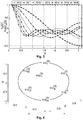
- the directional dispersion effect becomes obvious by comparing the case for an infinite order shown in equation (23) with the case for a finite order expressed by equation (27). It can be seen that for the latter case the Dirac delta function is replaced by the dispersion function ⁇ N ( ⁇ ), which is illustrated in Fig.
- dispersion means that a general plane wave is replaced by infinitely many general plane waves, of which the amplitudes are modelled by the dispersion function ⁇ N ( ⁇ ). Because the first zero of ⁇ N ( ⁇ ) is located approximately at ⁇ N for N ⁇ 4 (see [9]), the dispersion effect is reduced (and thus the spatial resolution is improved) with increasing Ambisonics order N. For N ⁇ ⁇ the dispersion function ⁇ N ( ⁇ ) converges to the Dirac delta function.
- Fig. 5 exemplarily shows the dispersion functions for the 9-th and 11-th virtual loudspeaker signal in Fig. 5a and Fig. 5b , respectively.
- Fig. 5 exemplarily shows the dispersion functions for the 9-th and 11-th virtual loudspeaker signal in Fig. 5a and Fig. 5b , respectively.
- the direction-dependent dispersion of the contribution of the resulting virtual loudspeaker signal is shown for two different choices of weights in Fig. 6 in order to exemplarily demonstrate the effect of the weighting.
- HOA Higher Order Ambisonics
- j n ( ⁇ ) denote the spherical Bessel functions of the first kind and S n m ⁇ ⁇ denote the real valued Spherical Harmonics of order n and degree m, which are defined in below section Definition of real valued Spherical Harmonics.
- the expansion coefficients depend only on the angular wave number k . Note that it has been implicitly assumed that sound pressure is spatially band-limited. Thus the series is truncated with respect to the order index n at an upper limit N, which is called the order of the HOA representation.
- the position index of an HOA coefficient sequence c n m t within the vector c ( t ) is given by n ( n + 1) + 1 + m .
- the described processing can be carried out by a single processor or electronic circuit, or by several processors or electronic circuits operating in parallel and/or operating on different parts of the complete processing.
- the instructions for operating the processor or the processors according to the described processing can be stored in one or more memories.
- the at least one processor is configured to carry out these instructions.
Landscapes
- Engineering & Computer Science (AREA)
- Physics & Mathematics (AREA)
- Acoustics & Sound (AREA)
- Signal Processing (AREA)
- Mathematical Physics (AREA)
- Multimedia (AREA)
- Audiology, Speech & Language Pathology (AREA)
- Health & Medical Sciences (AREA)
- Computational Linguistics (AREA)
- Human Computer Interaction (AREA)
- Algebra (AREA)
- General Physics & Mathematics (AREA)
- Mathematical Analysis (AREA)
- Mathematical Optimization (AREA)
- Pure & Applied Mathematics (AREA)
- Theoretical Computer Science (AREA)
- Stereophonic System (AREA)
Abstract
Description
- This application is a European divisional application of Euro-
PCT patent application EP 16747764.5 - The invention relates to a method and to an apparatus for generating from an HOA signal representation a mezzanine HOA signal representation having an arbitrary non-quadratic number of virtual loudspeaker signals, and to the corresponding reverse processing.
- There are a variety of representations of three dimensional sound including channel-based approaches like 22.2, object based approaches and sound field oriented approaches like Higher Order Ambisonics (HOA). In general, each representation offers its special advantages, be it at recording, modification or rendering. For instance, rendering of an HOA representation offers the advantage over channel based methods of being independent of a specific loudspeaker set-up. This flexibility, however, is at the expense of a rendering process which is required for the playback of the HOA representation on a particular loudspeaker set-up. Regarding the modification of three dimensional sound, object-based approaches allow a very simple selective manipulation of individual sound objects, which may comprise changes of object positions or the complete exchange of sound objects by others. Such modifications are very complicated to be accomplished with channel-based or HOA-based sound field representations.
- HOA is based on the idea of equivalently representing the sound pressure in a sound source-free listening area by a composition of contributions from general plane waves from all possible directions of incidence. Evaluating the contributions of all general plane waves to the sound pressure in the centre of the listening area, i.e. the coordinate origin of the used system, provides a time and direction dependent function, which is then for each time instant expanded into a series of Spherical Harmonics functions. The weights of the expansion, regarded as functions over time, are referred to as HOA coefficient sequences, which constitute the actual HOA representation. The HOA coefficient sequences are conventional time domain signals with the specialty of having different value ranges among themselves. In general, the series of Spherical Harmonics functions comprises an infinite number of summands, whose knowledge theoretically allows a perfect reconstruction of the represented sound field. In practice, for arriving at a manageable finite amount of signals, that series is truncated, resulting in a representation of a certain order N, which determines the number O of summands for the expansion given by O = (N + 1)2. The truncation affects the spatial resolution of the HOA representation, which obviously improves with a growing order N. Typical HOA representations using order N = 4 consist of O = 25 HOA coefficient sequences.
- In the context of video and audio production the traditionally used sound field representations have been purely channel-based (with a relatively low number of channels) for a long time. One prominent interface for the transport, processing and storage of video and accompanying audio signals in uncompressed or lightly compressed form has been the Serial Digital Interface (SDI), where the audio part is typically represented by 16 channels in Pulse Code Modulation (PCM) format. In order to profit from the previously mentioned advantages of individual sound field representations of three-dimensional sound, there is a trend to use a combination of them already at the production stage. For instance, the Dolby Atmos system uses a combination of channel- and object-based sound representations. Especially for financial reasons, it is greatly desired to reuse the existing infrastructure and interfaces, and in particular the SDI, for the transport and storage of the combination of the individual sound field representations. If HOA is desired to be part of the combined sound field representations, there arises the need for a mezzanine HOA format, where in contrast to the conventional HOA format the sound field is not represented by a square of an integer number of HOA coefficient sequences with different value ranges, but rather by a limited number I of conventional time domain signals, all of which having the same value range (typically [-1,1[) and where I is not necessarily a square of an integer number. A further requirement on such HOA mezzanine representation is that it is to be computable from the conventional one (i.e. the representation consisting of HOA coefficient sequences) sample-wise without any latency, in order to allow cutting and joining of audio files at arbitrary time positions. This is relevant for broadcasting scenarios for allowing the instantaneous insertion of commercials consisting of video and audio into the running broadcast.
Fig. 1 illustrates the embedding of an object-basedsound field representation 10 and a conventional HOA sound field representation c (t) into a multi-channel PCM signal representation consisting of I TRANSP transport channels. In the SDI system the value of I TRANSP is equal to 16. The object-basedsound field representation 10 is assumed to be already given in a multi-channel PCM format consisting of I OBJ ≥ 0 channels. The conventional HOA representation c (t) consisting of O coefficient sequences (see the definition in section Basics of Higher Order Ambisonics) is first transformed in a transforming step orstage 11 into a mezzanine HOA representation w MEZZ(t) consisting of I = I TRANSP - I OBJ PCM signals. Finally, both the object basedsound field representation 10 and the mezzanine HOA representation are multiplexed in a multiplexer step orstage 12, which outputs the multi-channel PCM signal representation consisting of I TRANSP transport channels. - The reverse operation, i.e. the reconstruction of a combination of object based and HOA sound field representation from a multi-channel PCM representation consisting of I TRANSP channels, is exemplarily shown in
Fig. 2 . The multi-channel PCM signal representation is de-multiplexed in a de-multiplexer step orstage 22 in order to provide a mezzanine HOA representation consisting of I = I TRANSP - I OBJ PCM signals and an object based sound field basedrepresentation 20 in a multi-channel PCM format consisting of I OBJ ≥ 0 channels. The mezzanine HOA representation is then transformed back in an inverse-transforming step orstage 21 to the conventional HOA representation c (t) consisting of O HOA coefficient sequences.
Instead of an object based sound field based representation any other representations can be used, e.g. a channel based representation or a combination of sound field based and channel based representation. - Advantageously, the processing or circuitry in
Fig. 1 and Fig. 2 can be used for converting the sound field representations to the appropriate format as required by already existing audio infrastructure and interfaces.
In the following, the transform from conventional HOA representation to the HOA mezzanine representation inFig. 1 and the corresponding inverse transform inFig. 2 are described in detail. - A kind of mezzanine HOA format is obtained by applying to the conventional HOA coefficient sequences a 'spatial' HOA encoding, which is an intermediate processing step in the compression of HOA sound field representations used in MPEG-H 3D audio, cf. section C.5.3 in [1]. The idea of spatial HOA encoding, which was initially proposed in [8], [6], [7], is to perform a sound field analysis and decompose a given HOA representation into a directional component and a residual ambient component. On one hand, this intermediate representation is assumed to consist of conventional time-domain signals representing e.g. general plane wave functions and of relevant coefficient sequences of the ambient HOA component. Both types of time domain signals are ensured to have the value range [-1,1[ by the application of a gain control processing unit. On the other hand, this intermediate representation will comprise additional side information which is necessary for the reconstruction of the HOA representation from the time-domain signals.
- In general, the spatial HOA encoding is a lossy transform, and the quality of the resulting representation highly depends on the number of time-domain signals used and on the complexity of the sound field. The sound field analysis is carried out frame-wise, and for the decomposition overlap-add processing is employed in order to obtain continuous signals. However, both operations create a latency of a least one frame, which is not in accordance with the above mentioned requirement of without-latency. A further disadvantage of this format is that side information cannot be directly transported over the SDI, but has to be converted somehow to the PCM format. Since the side information is frame-based, its converted PCM representation obviously cannot be cut at arbitrary sample positions, which severely complicates a cutting and joining of audio files.
- A further mezzanine format is represented by 'equivalent spatial domain representation', which is obtained by rendering the original HOA representation c (t) (see section Basics of Higher Order Ambisonics for definition, in particular equation (35)) consisting of O HOA coefficient sequences to the same number O of virtual loudspeaker signals wj (t), 1 ≤ j ≤ 0 representing general plane wave signals. The order dependent directions of incidence

For describing the rendering process in detail, initially all virtual loudspeaker signals are summarised in a vector as


The rendering is accomplished sample-wise, and hence it does not introduce any latency. Further, it is a lossless transform, and the original HOA representation may be computed from the virtual loudspeaker signals by
This transform has been proposed in [4] as a pre-processing step for the compression of HOA representations. Also, the spatial domain has been recommended for the normalisation of HOA representations as a pre-processing step for the compression according to the MPEG-H 3D audio standard [1] in section C.5.1, and in [5] where it is explicitly desired to have the same value range of [-1,1[ for all virtual loudspeaker signals.
A main disadvantage of the spatial transform is that the number of virtual loudspeaker signals is restricted to squares of integers, i.e. to O = (N + 1)2 with
- A problem to be solved by the invention is to provide a mezzanine HOA format computed by a modified version of a conventional HOA representation consisting of O coefficient sequences to an arbitrary number I of virtual loudspeaker signals. This problem is solved by embodiments of the invention.
- A method for transforming an HOA signal representation into a mezzanine HOA signal representation is disclosed in
claim 1. A computer program product configured to perform said method is disclosed inclaim 5. A transform processing unit that performs said method is disclosed in claim 6. - A method for inverse transforming a mezzanine HOA signal representation into an HOA signal representation is disclosed in claim 7. A computer program product configured to perform said method is disclosed in
claim 10. An inverse transform processing unit for performing said method is disclosed inclaim 11. - Advantageous additional embodiments of the invention are disclosed in the respective dependent claims.
- From an HOA signal representation c (t) of a sound field having an order of N and a number O = (N + 1)2 of coefficient sequences a mezzanine HOA signal representation w MEZZ(t) is generated that consists of an arbitrary number I < O of virtual loudspeaker signals w MEZZ,1(t), w MEZZ,2(t),... , w MEZZ,I (t). O directions are computed, or looked-up from a stored table, which are nearly uniformly distributed on the unit sphere. The mode vectors with respect to these directions are linearly weighted for constructing a matrix, of which the pseudo-inverse is used for multiplying the HOA signal representation c (t) in order to form the mezzanine HOA signal representation w MEZZ(t).
- In principle, the method is adapted for generating, from an HOA signal representation c (t) of a sound field having an order of N and a number O = (N + 1)2 of coefficient sequences, a mezzanine HOA signal representation w MEZZ(t) consisting of an arbitrary number I < O of virtual loudspeaker signals w MEZZ,1(t), w MEZZ,2(t),...,w MEZZ, I (t), said method including:
- determining a desired number I of virtual loudspeaker signals in said mezzanine HOA signal representation with I < O;
- taking O directions
 , i = 1,...,I of neighbouring directions;
- linearly combining mode vectors Sn :=

 , resulting in vectors

- constructing from said vectors V i a matrix

- calculating from said matrix V a matrix V + which is the Moore-Penrose pseudoinverse of matrix V;
- computing for a current section of c(t) said mezzanine HOA representation w MEZZ(t) by w MEZZ(t) = V + · c (t),
- computing a reconstructed version of said HOA signal representation ĉ(t) by ĉ(t) = V · w MEZZ(t).
- In principle, the apparatus is adapted for generating, from an HOA signal representation c(t) of a sound field having an order of N and a number O = (N + 1)2 of coefficient sequences, a mezzanine HOA signal representation w MEZZ(t) consisting of an arbitrary number I < O of virtual loudspeaker signals w MEZZ,1(t), w MEZZ,2(t),..., w MEZZ,I (t), said apparatus including means adapted to:
- determine a desired number I of virtual loudspeaker signals in said mezzanine HOA signal representation with I < O;
- take O directions
 , i = 1,...,I of neighbouring directions;
- linearly combine mode vectors Sn :=

 , resulting in vectors

- construct from said vectors V i a matrix

- calculate from said matrix V a matrix V + which is the Moore-Penrose pseudoinverse of matrix V;
- compute for a current section of c (t) said mezzanine HOA representation w MEZZ(t) by w MEZZ(t) = V + · c (t),
- compute a reconstructed version of said HOA signal representation ĉ(t) by ĉ(t) = V · w MEZZ(t).
- Exemplary embodiments of the invention are described with reference to the accompanying drawings, which show in:
- Fig. 1
- Conversion of a combination of object based and HOA sound field representations to a multi-channel PCM format;
- Fig. 2
- Reconstruction of a combination of object based and HOA sound field representations from a multi-channel PCM format;
- Fig. 3
- Normalised dispersion function ξN (Θ) for different Ambisonics orders N and for angles Θ ∈ [0,π];
- Fig. 4
- Illustration of directions

- Fig. 5
- Dispersion functions ξN (Θ) for 9-th and 11-th virtual loudspeaker signal computed according to the conventional spatial transform using
directions 
- Fig. 6
- Dispersion functions resulting from the combination of the mode vectors for 9-th and 11-th virtual loud-speaker directions computed according to the conventional spatial transform using
directions 
- Fig. 7
- Spherical coordinate system.
- Even if not explicitly described, the following embodiments may be employed in any combination or sub-combination.
In the following a mezzanine HOA format is described that is computed by a modified spatial transform of a conventional HOA representation consisting of O coefficient sequences to an arbitrary and non-quadratic number I of virtual loudspeaker signals.
Without loss of generality, it is further assumed in the following that I < O, since for the opposite case it is always possible to artificially extend the number of coefficient sequences of the original HOA representation by appending an appropriate number of zero coefficient sequences. - A first optional step is to reduce the order N of the original HOA representation to a smaller order N R such that the resulting number O R = (N R + 1)2 of coefficient sequences is the next upper square integer number to the desired number I of virtual loudspeaker signals, i.e. the reduced number O R of coefficient sequences is the smallest integer number square that is greater than the number I. The rationale behind this step is the fact that is not reasonable to represent an HOA representation of an order greater than N R by a
number 1 < O R of virtual loudspeaker signals, of which the directions cover the sphere as uniformly as possible. This means that in the following the transform of a conventional HOA representation consisting of O R (rather than O) coefficient sequences to an arbitrary number I of virtual loudspeaker signals is considered. Nevertheless, it is also possible to set O R = O and to ignore this optional order reduction. - In case this first optional step is not carried out, in the following N R is replaced by N, O R by O, c R(t) by c(t), S n,R by S n , Ψ R by Ψ ,

- The next step is to consider the conventional spatial transform for an HOA representation of order N R (described in section Spatial transform), and to sub-divide the virtual speaker directions
 , i = 1,...,I, which contain the indices of the virtual directions grouped into the i-th group.
Subsequently, the mode vectors


The vectors V i are finally used to construct the matrix
The mezzanine HOA representation w MEZZ(t) is then computed from the order reduced HOA representation, denoted by c R(t), through
- The inverse transform for computing a recovered conventional HOA representation ĉ R(t) of order N R from the mezzanine HOA representation is given by


Note that, in general, the transform is not lossless such that ĉ(t) ≠ c(t). This is due to the order reduction on one hand, and the fact that the rank of the transform matrix V is I at most on the other hand. The latter can be expressed by a spatially selective reduction of spatial resolution resulting from the grouping of virtual speaker directions, which will be illustrated in the next section.
A somewhat different computation of the mezzanine HOA representation compared to equation (9) is obtained by expressing matrix


- In practice, it is possible to pre-compute the matrices V and corresponding matrices V + (or, for the alternative embodiment processing, the matrices A + and Ψ R -1, or their product A + · Ψ R -1) for different desired numbers I of virtual loudspeaker signals and for corresponding reduced orders N R of input HOA representations. Storing the resulting matrices V within an inverse transform processing unit and storing the resulting matrices V + (or for the alternative processing the matrices A + and Ψ R -1, or their product A + · Ψ R -1) within the transform processing unit, will define the behaviour of the transform processing unit and the inverse transform processing unit for different desired numbers I of virtual loudspeaker signals and corresponding reduced orders N R of input HOA representations.
- The weights can be used for controlling the reduction of the spatial resolution in the region covered by the directions


An alternative exemplary choice is
- To understand the effects of the proposed modified spatial transform, it is reasonable to first understand the conventional spatial transform.
For HOA the sound pressure p(t,x ) at time t and position x in a sound source free listening area can be represented by a superposition of an infinite number of general plane waves arriving from all possible directions Ω = (θ,φ), i.e. indicates the unit sphere in the three-dimensional space and p GPW( t,x,Ω) denotes the contribution of the general plane wave from direction Ω to the pressure at time t and position x . The time and direction dependent function


Assuming an infinite order of the expansion (22), the function c(t, Ω ) for a single general plane wave y(t) from direction Ω 0 can be factored into a time dependent and a direction dependent component according to


- The truncation of the expansion (22) to a finite order N, however, introduces a spatial dispersion on the direction dependent component. This can be seen by plugging the expression (25) for the HOA coefficients into the expansion (22), resulting in


Now, the directional dispersion effect becomes obvious by comparing the case for an infinite order shown in equation (23) with the case for a finite order expressed by equation (27). It can be seen that for the latter case the Dirac delta function is replaced by the dispersion function ξN (Θ), which is illustrated inFig. 3 after having been normalised by its maximum value for different Ambisonics orders N, whereby the vertical scale is
Because the first zero of ξN (Θ) is located approximately at
Having the dispersion effect in mind, the conventional spatial transform is considered again and the relation (5) between the conventional HOA coefficient sequences and the virtual loudspeaker signals is reformulated using below equation (35) and equations (1), (2) and (3) to
- It appears that the contribution due to each j-th virtual loudspeaker has the same form as in expression (25) with K =

To illustrate this, the conventional spatial transform for a third order HOA representation (i.e. for N = 3) is considered, where the directions for the virtual loudspeakers
Fig. 4 . - In
Fig. 5 exemplarily shows the dispersion functions for the 9-th and 11-th virtual loudspeaker signal inFig. 5a and Fig. 5b , respectively. To further illustrate the effect of virtual directions grouping for the modified spatial transform, it is assumed that the corresponding directions

Fig. 6 in order to exemplarily demonstrate the effect of the weighting.
ForFig. 6a an equal weighting of α 9 = α 11 = 1 is assumed, such that the resulting dispersion function is a pure sum of the dispersion functions for the 9-th and 11-th virtual loudspeaker signal. InFig. 6b the weighting for the dispersion function for the 9-th virtual loudspeaker is reduced to α 9 = 0.3, resulting in a more concentrated dispersion function and making its maximum move closer to thedirection 
- Higher Order Ambisonics (HOA) is based on the description of a sound field within a compact spatial area of interest, which is assumed to be free of sound sources. The spatiotemporal behaviour of the sound pressure p(t,x ) at time t and position x within the spatial area of interest is physically fully determined by the homogeneous wave equation. In the following, a spherical coordinate system is assumed as shown in
Fig. 7 . In this coordinate system the x axis points to the frontal position, the y axis points to the left, and the z axis points to the top. A position in space x = (r,θ,φ) T is represented by a radius r ≥ 0 (i.e. the distance to the coordinate origin), an inclination angle θ ∈ [0,π] measured from the polar axis z and an azimuth angle φ ∈ [0,2π[ measured counter-clockwise in the x - y plane from the x axis. Further, (·) T denotes a transposition. - It can be shown (see [10]) that the Fourier transform of the sound pressure with respect to time denoted by, i.e.


- In equation (31), c s denotes the speed of sound and k denotes the angular wave number, which is related to the angular frequency ω by


- Because the spatial area of interest is assumed to be free of sound sources, the sound field can be represented by a superposition of an infinite number of general plane waves arriving from all possible directions Ω = (θ,φ), i.e.
 indicates the unit sphere in the three-dimensional space and p GPW (t,x,Ω) denotes the contribution of the general plane wave from direction Ω to the pressure at time t and position x .
- Evaluating the contribution of each general plane wave to the pressure in the coordinate origin x ORIG = (0 0 0) T provides a time and direction dependent function


- The weights


- The position index of an HOA coefficient sequence

- The knowledge of the continuous-time HOA coefficient sequences is theoretically sufficient for perfect reconstruction of the sound pressure within the spatial area of interest, since it can be shown that their Fourier transforms with respect to time, i.e.


- The real-valued spherical harmonics


- The associated Legendre functions Pn,m (x) are defined as

There are also alternative definitions of 'spherical harmonics'. In such case the transformation described is also valid. - The described processing can be carried out by a single processor or electronic circuit, or by several processors or electronic circuits operating in parallel and/or operating on different parts of the complete processing.
The instructions for operating the processor or the processors according to the described processing can be stored in one or more memories. The at least one processor is configured to carry out these instructions.
Various aspects of the present invention may be appreciated from the following enumerated example embodiments (EEEs): - EEE1. Method for generating, from an HOA signal representation c(t) of a sound field having an order of N and a number O = (N + 1)2 of coefficient sequences, a mezzanine HOA signal representation w MEZZ(t) consisting of an arbitrary number I < O of virtual loudspeaker signals w MEZZ,1(t), w MEZZ,2(t), ..., w MEZZ,I (t), said method including:
- determining a desired number I of virtual loudspeaker signals in said mezzanine HOA signal representation with I < O;
- taking O directions
 , i = 1, ...,I of neighbouring directions;
- linearly combining mode vectors S n :=

 , resulting in vectors
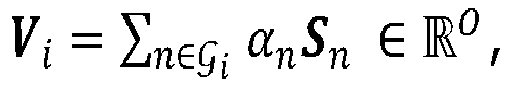
- constructing from said vectors V i a matrix

- calculating from said matrix V a matrix V + which is the Moore-Penrose pseudoinverse of matrix V;
- computing (11) for a current section of c (t) said mezzanine HOA representation w MEZZ(t) by w MEZZ(t) = V + · c (t).
- EEE2. Apparatus for generating, from an HOA signal representation c(t) of a sound field having an order of N and a number O = (N + 1)2 of coefficient sequences, a mezzanine HOA signal representation w MEZZ(t) consisting of an arbitrary number I < O of virtual loudspeaker signals w MEZZ,1(t), w MEZZ,2(t),... , w MEZZ,I (t), said apparatus including means adapted to:
- determine a desired number I of virtual loudspeaker signals in said mezzanine HOA signal representation with I < O;
- take O directions
 , i = 1, ...,I of neighbouring directions;
- linearly combine mode vectors S n :=

 , resulting in vectors

- construct from said vectors V i a matrix

- calculate from said matrix V a matrix V + which is the Moore-Penrose pseudoinverse of matrix V;
- compute (11) for a current section of c(t) said mezzanine HOA representation w MEZZ(t) by w MEZZ(t) = V + · c(t).
- EEE3. Method for generating, from an HOA signal representation c(t) of a sound field having an order of N and a number O = (N + 1)2 of coefficient sequences, a mezzanine HOA signal representation w MEZZ(t) consisting of an arbitrary number I < O of virtual loudspeaker signals w MEZZ,1(t), w MEZZ,2(t),..., wMEZZ,I(t), said method including:
- determining a desired number I of virtual loudspeaker signals in said mezzanine HOA signal representation with I < O;
- taking O directions
 , i = 1,...,I of neighbouring directions;
- determining from mode vectors S n :=

for said directions
- linearly combining said mode vectors S n for said directions
 , resulting in vectors V i =

- constructing from said vectors V i a matrix

- reformulating V by V = Ψ · A, wherein

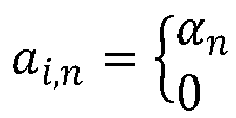 ; else
- calculating from said weighting factor matrix A a matrix A + which is the Moore-Penrose pseudoinverse of matrix A, and from said mode matrix Ψ the inverse mode matrix Ψ -1;
- computing (11) for a current section of c(t) said mezzanine HOA representation w MEZZ(t) by w MEZZ(t) = A + · Ψ -1 · c(t).
- EEE4. Apparatus for generating, from an HOA signal representation c(t) of a sound field having an order of N and a number O = (N + 1)2 of coefficient sequences, a mezzanine HOA signal representation w MEZZ(t) consisting of an arbitrary number I < O of virtual loudspeaker signals wMEZZ,1 (t), w MEZZ,2(t),..., w MEZZ,I (t), said apparatus including means adapted to:
- determine a desired number I of virtual loudspeaker signals in said mezzanine HOA signal representation with I < O;
- take O directions
 , i = 1, ...,I of neighbouring directions;
- determine from mode vectors S n :=


- linearly combine said mode vectors S n for said directions
 , resulting in vectors V i =

- construct from said vectors V i a matrix

- reformulate V by V = Ψ · A, wherein

 ; else
- calculate from said weighting factor matrix A a matrix A + which is the Moore-Penrose pseudoinverse of matrix A, and from said mode matrix Ψ the inverse mode matrix Ψ -1;
- compute (11) for a current section of c(t) said mezzanine HOA representation w MEZZ(t) by w MEZZ(t) = A + · c(t)Ψ -1 · c(t).
- EEE5. Method for generating, from a mezzanine HOA signal representation w MEZZ(t) and a matrix V that were generated according to
EEE - computing (21) a current section of a reconstructed version ĉ (t) of said HOA signal representation by ĉ(t) = V · w MEZZ(t).
- EEE6. Apparatus for generating, from a mezzanine HOA signal representation w MEZZ(t) and a matrix V that were generated according to
EEE - compute (21) a current section of a reconstructed version ĉ(t) of said HOA signal representation by ĉ(t) = V · w MEZZ(t).
- EEE7. Method according to
EEE EEE 2 or 4, wherein for an initial order reduction of c(t) a reduced-order version c R(t) thereof is formed, for which N is replaced by N R, O is replaced by O R, and S n is replaced by S n,R , I < OR, O R = (N R + 1)2, N R being a reduced order smaller than order N, such that the resulting number O R of coefficient sequences is the smallest integer number square that is greater than said desired number I, and wherein, if dependent onEEE 1, w MEZZ(t) = V + · c R(t). and wherein, if dependent onEEE 3, Ψ is replaced by Ψ R, Ψ -1 by

- EEE8. Method for generating, from a mezzanine HOA signal representation w MEZZ(t) that was generated according to the method of
EEEs - computing (21) a current section of a reconstructed reduced-order version ĉ R(t) with order N R of said HOA signal representation by ĉ R(t) = V · w MEZZ(t);
- optionally reconstructing from ĉ R(t) a reconstructed HOA signal representation ĉ (t) having order N by zero-padding ĉ R(t) according to
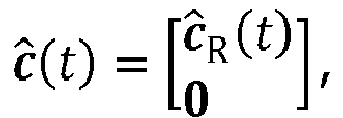
- EEE9. Apparatus for generating, from a mezzanine HOA signal representation w MEZZ(t) that was generated according to the method of
EEEs - compute (21) a current section of a reconstructed reduced-order version ĉ R(t) with order N R of said HOA signal representation by ĉR(t) = V · w MEZZ(t);
- optionally reconstruct from ĉ R(t) a reconstructed HOA signal representation ĉ(t) having order N by zero-padding ĉ R(t) according to

- EEE10. Method according to
EEE EEE 2 or 4, wherein said weights are αn = 1 or
- EEE11. Method according to the method of one of
EEEs 1 and- if dependent on EEE 1 - 5, 7, 8 and 10, or apparatus according to the apparatus of one of
EEEs 2 and - if dependent on EEE 2 - 6, 7, 9 and 10, wherein said matrices V + and V are calculated initially and are stored.
- if dependent on EEE 1 - 5, 7, 8 and 10, or apparatus according to the apparatus of one of
- EEE12. Method according to the method of one of
EEEs 3 and- if dependent on EEE 3 - 5, 7, 8 and 10, or apparatus according to the apparatus of one of EEEs 4 and - if dependent on EEE 4 - 6, 7, 9 and 10, wherein said matrices V + and


- if dependent on EEE 3 - 5, 7, 8 and 10, or apparatus according to the apparatus of one of EEEs 4 and - if dependent on EEE 4 - 6, 7, 9 and 10, wherein said matrices V + and
- EEE13. Digital audio signal that is encoded according to the method of one of
EEEs - EEE14. Storage medium, for example an optical disc or a pre-recorded memory, that contains or stores, or has recorded on it, a digital audio signal according to EEE 13.
- EEE15. Computer program product comprising instructions which, when carried out on a computer, perform the method according to one of
EEEs -
- [1] ISO/IEC JTC1/SC29/WG11 DIS 23008-3, "Information technology - High efficiency coding and media delivery in heterogeneous environments - Part 3: 3D Audio", July 2014
- [2] J. Daniel, "Representation de champs acoustiques, application à la transmission et à la reproduction de scènes sonores complexes dans un contexte multimedia", PhD thesis, Université Paris 6, 2001
- [3] J. Fliege, U. Maier, "A two-stage approach for computing cubature formulae for the sphere", Technical report, Section Mathematics, University of Dortmund, 1999. Node numbers are found at http://www.mathematik.uni-dortmund.de/ lsx/research/projects/fliege/nodes/nodes.html
- [4]
EP 2469742 A2 - [5]
PCT/EP2015/063912 - [6]
WO 2014/090660 A1 - [7]
WO 2014/177455 A1 - [8]
WO 2013/171083 A1 - [9] B. Rafaely, "Plane-wave decomposition of the sound field on a sphere by spherical convolution", J. Acoust. Soc. Am., 4(116), pages 2149-2157, October 2004
- [10] E.G. Williams, "Fourier Acoustics", Applied Mathematical Sciences, vol. 93, 1999, Academic Press
for generating, from a mezzanine HOA signal representation w MEZZ(t) that was generated like above, a reconstructed HOA signal representation ĉ (t) of a sound field having an order of N and a number O = (N + 1)2 of coefficient sequences, said method including:
for generating, from a mezzanine HOA signal representation w MEZZ(t) that was generated like above, a reconstructed HOA signal representation ĉ(t) of a sound field having an order of N and a number O = (N + 1)2 of coefficient sequences, said apparatus including means adapted to:
Claims (11)
- A method for transforming an HOA signal representation c(t) of a sound field having an order of N and a number O = (N + 1)2 of coefficient sequences into a mezzanine HOA signal representation w MEZZ(t) consisting of a desired number I < O of virtual loudspeaker signals w MEZZ,1(t), w MEZZ,2(t),... , w MEZZ, I (t), said method including:multiplying the HOA signal representation c(t) with a pre-computed matrix V + to form said mezzanine HOA signal representation w MEZZ(t),wherein the pre-computed matrix V+ relates to the pseudo inverse of a matrix V whose coefficients relate to I groups of linear combinations of O directions Ω which are nearly uniformly distributed on the unit sphere.
- The method according to claim 1, wherein the matrix V + is pre-computed for different desired numbers I of virtual loudspeaker signals.
- The method according to claim 1, wherein the pseudo-inverse is a Moore-Penrose pseudo inverse.
- The method according to claim 1, wherein the linear combinations are weighted to control a reduction of spatial resolution in a region covered by each group.
- A computer program product comprising instructions which, when carried out on a computer, perform the method according to one of claims 1 - 4.
- A transform processing unit for transforming an HOA signal representation c(t) of a sound field having an order of N and a number O = ( N + 1)2 of coefficient sequences into a mezzanine HOA signal representation w MEZZ(t) consisting of a desired number I < O of virtual loudspeaker signals w MEZZ,1(t), w MEZZ,2(t),..., w MEZZ,I (t), said processing unit
comprising:storage means for storing a pre-computed matrix V +, wherein the matrix V + relates to the pseudo inverse of a matrix V whose coefficients relate to I groups of linear combinations of O directions Ω which are nearly uniformly distributed on the unit sphere,calculating means for calculating said mezzanine HOA signal representation w MEZZ(t) by multiplying the HOA signal representation c(t) with said stored pre-computed matrix V +. - A method for inverse transforming a mezzanine HOA signal representation w MEZZ(t) consisting of a number I < O of virtual loudspeaker signals w MEZZ,1(t), w MEZZ,2(t),..., w MEZZ,I (t) into a recovered HOA signal representation c(t) of a sound field having an order of N and a number O = (N + 1)2 of coefficient sequences, said method comprising:multiplying the mezzanine HOA signal representation w MEZZ(t) with a pre-computed matrix V to form said recovered HOA signal representation c(t),wherein the coefficients of the pre-computed matrix V relate to I groups of linear combinations of O directions Ω which are nearly uniformly distributed on the unit sphere.
- The method according to claim 7, wherein the matrix V is pre-computed for different desired numbers I of virtual loudspeaker signals.
- The method according to claim 7, wherein the linear combinations are weighted to control a reduction of spatial resolution in a region covered by each group.
- A computer program product comprising instructions which, when carried out on a computer, perform the method according to one of claims 7-9.
- An inverse transform processing unit for inverse transforming a mezzanine HOA signal representation w MEZZ(t) consisting of a number I < O of virtual loudspeaker signals w MEZZ,1(t), w MEZZ,2(t),..., w MEZZ,I (t) into a recovered HOA signal representation c(t) of a sound field having an order of N and a number O = (N + 1)2 of coefficient sequences, said processing unit comprising:storage means for storing a pre-computed matrix V relating to I groups of linear combinations of O directions Ω which are nearly uniformly distributed on the unit sphere,calculating means for calculating said recovered HOA signal representation c(t) by multiplying the mezzanine HOA signal representation w MEZZ(t) with said pre-computed matrix V.
Applications Claiming Priority (3)
| Application Number | Priority Date | Filing Date | Title |
|---|---|---|---|
| EP15306236 | 2015-07-30 | ||
| PCT/EP2016/068203 WO2017017262A1 (en) | 2015-07-30 | 2016-07-29 | Method and apparatus for generating from an hoa signal representation a mezzanine hoa signal representation |
| EP16747764.5A EP3329486B1 (en) | 2015-07-30 | 2016-07-29 | Method and apparatus for generating from an hoa signal representation a mezzanine hoa signal representation |
Related Parent Applications (2)
| Application Number | Title | Priority Date | Filing Date |
|---|---|---|---|
| EP16747764.5A Division-Into EP3329486B1 (en) | 2015-07-30 | 2016-07-29 | Method and apparatus for generating from an hoa signal representation a mezzanine hoa signal representation |
| EP16747764.5A Division EP3329486B1 (en) | 2015-07-30 | 2016-07-29 | Method and apparatus for generating from an hoa signal representation a mezzanine hoa signal representation |
Publications (1)
| Publication Number | Publication Date |
|---|---|
| EP3739578A1 true EP3739578A1 (en) | 2020-11-18 |
Family
ID=53776531
Family Applications (2)
| Application Number | Title | Priority Date | Filing Date |
|---|---|---|---|
| EP16747764.5A Active EP3329486B1 (en) | 2015-07-30 | 2016-07-29 | Method and apparatus for generating from an hoa signal representation a mezzanine hoa signal representation |
| EP20179680.2A Pending EP3739578A1 (en) | 2015-07-30 | 2016-07-29 | Method and apparatus for generating from an hoa signal representation a mezzanine hoa signal representation |
Family Applications Before (1)
| Application Number | Title | Priority Date | Filing Date |
|---|---|---|---|
| EP16747764.5A Active EP3329486B1 (en) | 2015-07-30 | 2016-07-29 | Method and apparatus for generating from an hoa signal representation a mezzanine hoa signal representation |
Country Status (3)
| Country | Link |
|---|---|
| US (3) | US10468037B2 (en) |
| EP (2) | EP3329486B1 (en) |
| WO (1) | WO2017017262A1 (en) |
Families Citing this family (5)
| Publication number | Priority date | Publication date | Assignee | Title |
|---|---|---|---|---|
| US12087311B2 (en) * | 2015-07-30 | 2024-09-10 | Dolby Laboratories Licensing Corporation | Method and apparatus for encoding and decoding an HOA representation |
| US20180338212A1 (en) * | 2017-05-18 | 2018-11-22 | Qualcomm Incorporated | Layered intermediate compression for higher order ambisonic audio data |
| US10264386B1 (en) * | 2018-02-09 | 2019-04-16 | Google Llc | Directional emphasis in ambisonics |
| CN112468931B (en) * | 2020-11-02 | 2022-06-14 | 武汉大学 | Sound field reconstruction optimization method and system based on spherical harmonic selection |
| CN115376529B (en) * | 2021-05-17 | 2024-10-11 | 华为技术有限公司 | Three-dimensional audio signal encoding method, device and encoder |
Citations (6)
| Publication number | Priority date | Publication date | Assignee | Title |
|---|---|---|---|---|
| EP2469741A1 (en) * | 2010-12-21 | 2012-06-27 | Thomson Licensing | Method and apparatus for encoding and decoding successive frames of an ambisonics representation of a 2- or 3-dimensional sound field |
| WO2013171083A1 (en) | 2012-05-14 | 2013-11-21 | Thomson Licensing | Method and apparatus for compressing and decompressing a higher order ambisonics signal representation |
| WO2014012945A1 (en) * | 2012-07-16 | 2014-01-23 | Thomson Licensing | Method and device for rendering an audio soundfield representation for audio playback |
| WO2014090660A1 (en) | 2012-12-12 | 2014-06-19 | Thomson Licensing | Method and apparatus for compressing and decompressing a higher order ambisonics representation for a sound field |
| WO2014177455A1 (en) | 2013-04-29 | 2014-11-06 | Thomson Licensing | Method and apparatus for compressing and decompressing a higher order ambisonics representation |
| EP2824661A1 (en) * | 2013-07-11 | 2015-01-14 | Thomson Licensing | Method and Apparatus for generating from a coefficient domain representation of HOA signals a mixed spatial/coefficient domain representation of said HOA signals |
Family Cites Families (9)
| Publication number | Priority date | Publication date | Assignee | Title |
|---|---|---|---|---|
| GB201211512D0 (en) * | 2012-06-28 | 2012-08-08 | Provost Fellows Foundation Scholars And The Other Members Of Board Of The | Method and apparatus for generating an audio output comprising spartial information |
| US9473870B2 (en) * | 2012-07-16 | 2016-10-18 | Qualcomm Incorporated | Loudspeaker position compensation with 3D-audio hierarchical coding |
| CN104471641B (en) * | 2012-07-19 | 2017-09-12 | 杜比国际公司 | Method and device for improving the rendering of multi-channel audio signals |
| FR2995754A1 (en) * | 2012-09-18 | 2014-03-21 | France Telecom | OPTIMIZED CALIBRATION OF A MULTI-SPEAKER SOUND RESTITUTION SYSTEM |
| US9913064B2 (en) * | 2013-02-07 | 2018-03-06 | Qualcomm Incorporated | Mapping virtual speakers to physical speakers |
| US9769586B2 (en) * | 2013-05-29 | 2017-09-19 | Qualcomm Incorporated | Performing order reduction with respect to higher order ambisonic coefficients |
| US9847087B2 (en) * | 2014-05-16 | 2017-12-19 | Qualcomm Incorporated | Higher order ambisonics signal compression |
| US9847088B2 (en) * | 2014-08-29 | 2017-12-19 | Qualcomm Incorporated | Intermediate compression for higher order ambisonic audio data |
| US9767618B2 (en) * | 2015-01-28 | 2017-09-19 | Samsung Electronics Co., Ltd. | Adaptive ambisonic binaural rendering |
-
2016
- 2016-07-29 WO PCT/EP2016/068203 patent/WO2017017262A1/en not_active Ceased
- 2016-07-29 EP EP16747764.5A patent/EP3329486B1/en active Active
- 2016-07-29 US US15/747,022 patent/US10468037B2/en active Active
- 2016-07-29 EP EP20179680.2A patent/EP3739578A1/en active Pending
-
2019
- 2019-06-28 US US16/457,501 patent/US10515645B2/en active Active
- 2019-12-10 US US16/709,519 patent/US11043224B2/en active Active
Patent Citations (7)
| Publication number | Priority date | Publication date | Assignee | Title |
|---|---|---|---|---|
| EP2469741A1 (en) * | 2010-12-21 | 2012-06-27 | Thomson Licensing | Method and apparatus for encoding and decoding successive frames of an ambisonics representation of a 2- or 3-dimensional sound field |
| EP2469742A2 (en) | 2010-12-21 | 2012-06-27 | Thomson Licensing | Method and apparatus for encoding and decoding successive frames of an ambisonics representation of a 2- or 3-dimensional sound field |
| WO2013171083A1 (en) | 2012-05-14 | 2013-11-21 | Thomson Licensing | Method and apparatus for compressing and decompressing a higher order ambisonics signal representation |
| WO2014012945A1 (en) * | 2012-07-16 | 2014-01-23 | Thomson Licensing | Method and device for rendering an audio soundfield representation for audio playback |
| WO2014090660A1 (en) | 2012-12-12 | 2014-06-19 | Thomson Licensing | Method and apparatus for compressing and decompressing a higher order ambisonics representation for a sound field |
| WO2014177455A1 (en) | 2013-04-29 | 2014-11-06 | Thomson Licensing | Method and apparatus for compressing and decompressing a higher order ambisonics representation |
| EP2824661A1 (en) * | 2013-07-11 | 2015-01-14 | Thomson Licensing | Method and Apparatus for generating from a coefficient domain representation of HOA signals a mixed spatial/coefficient domain representation of said HOA signals |
Non-Patent Citations (5)
| Title |
|---|
| "Information technology - High efficiency coding and media delivery in heterogeneous environments - Part 3: 3D Audio", ISO/IEC JTC1/SC29/WG11 DIS 23008-3, July 2014 (2014-07-01) |
| B. RAFAELY: "Plane-wave decomposition of the sound field on a sphere by spherical convolution", J. ACOUST. SOC. AM., vol. 4, no. 116, October 2004 (2004-10-01), pages 2149 - 2157 |
| E.G. WILLIAMS: "Applied Mathematical Sciences", vol. 93, 1999, ACADEMIC PRESS, article "Fourier Acoustics" |
| J. DANIEL: "PhD thesis", vol. 6, UNIVERSITE PARIS, article "Representation de champs acoustiques, application a la transmission et a la reproduction de scenes sonores complexes dans un contexte multimedia", pages: 2001 |
| J. FLIEGEU. MAIER: "Technical report, Section Mathematics", 1999, UNIVERSITY OF DORTMUND, article "A two-stage approach for computing cubature formulae for the sphere" |
Also Published As
| Publication number | Publication date |
|---|---|
| US20180218741A1 (en) | 2018-08-02 |
| EP3329486A1 (en) | 2018-06-06 |
| EP3329486B1 (en) | 2020-07-29 |
| US11043224B2 (en) | 2021-06-22 |
| US20190325881A1 (en) | 2019-10-24 |
| US10468037B2 (en) | 2019-11-05 |
| WO2017017262A1 (en) | 2017-02-02 |
| US10515645B2 (en) | 2019-12-24 |
| US20200118574A1 (en) | 2020-04-16 |
Similar Documents
| Publication | Publication Date | Title |
|---|---|---|
| US10306393B2 (en) | Method and device for rendering an audio soundfield representation | |
| EP3860154B1 (en) | Method for decoding a compressed hoa dataframe representation of a sound field. | |
| US10515645B2 (en) | Method and apparatus for transforming an HOA signal representation | |
| EP3162087B1 (en) | Coded hoa data frame representation that includes non-differential gain values associated with channel signals of specific ones of the data frames of an hoa data frame representation | |
| US20250095661A1 (en) | Method and apparatus for encoding and decoding an hoa representation | |
| EP3161820B1 (en) | Method and apparatus for determining for the compression of an hoa data frame representation a lowest integer number of bits required for representing non-differential gain values | |
| EP3161821B1 (en) | Method for determining for the compression of an hoa data frame representation a lowest integer number of bits required for representing non-differential gain values | |
| HK1248914A1 (en) | Method and apparatus for generating from an hoa signal representation a mezzanine hoa signal representation | |
| HK1248914B (en) | Method and apparatus for generating from an hoa signal representation a mezzanine hoa signal representation | |
| HK40051749B (en) | Method for decoding a compressed hoa dataframe representation of a sound field | |
| HK40052738A (en) | Coded hoa data frame representation that includes non-differential gain values associated with channel signals of specific ones of the data frames of an hoa data frame representation |
Legal Events
| Date | Code | Title | Description |
|---|---|---|---|
| PUAI | Public reference made under article 153(3) epc to a published international application that has entered the european phase |
Free format text: ORIGINAL CODE: 0009012 |
|
| STAA | Information on the status of an ep patent application or granted ep patent |
Free format text: STATUS: THE APPLICATION HAS BEEN PUBLISHED |
|
| AC | Divisional application: reference to earlier application |
Ref document number: 3329486 Country of ref document: EP Kind code of ref document: P |
|
| AK | Designated contracting states |
Kind code of ref document: A1 Designated state(s): AL AT BE BG CH CY CZ DE DK EE ES FI FR GB GR HR HU IE IS IT LI LT LU LV MC MK MT NL NO PL PT RO RS SE SI SK SM TR |
|
| STAA | Information on the status of an ep patent application or granted ep patent |
Free format text: STATUS: REQUEST FOR EXAMINATION WAS MADE |
|
| 17P | Request for examination filed |
Effective date: 20210518 |
|
| RBV | Designated contracting states (corrected) |
Designated state(s): AL AT BE BG CH CY CZ DE DK EE ES FI FR GB GR HR HU IE IS IT LI LT LU LV MC MK MT NL NO PL PT RO RS SE SI SK SM TR |
|
| STAA | Information on the status of an ep patent application or granted ep patent |
Free format text: STATUS: EXAMINATION IS IN PROGRESS |
|
| RAP3 | Party data changed (applicant data changed or rights of an application transferred) |
Owner name: DOLBY INTERNATIONAL AB |
|
| 17Q | First examination report despatched |
Effective date: 20220509 |
|
| RAP3 | Party data changed (applicant data changed or rights of an application transferred) |
Owner name: DOLBY INTERNATIONAL AB |
|
| P01 | Opt-out of the competence of the unified patent court (upc) registered |
Effective date: 20230418 |
|
| GRAP | Despatch of communication of intention to grant a patent |
Free format text: ORIGINAL CODE: EPIDOSNIGR1 |
|
| STAA | Information on the status of an ep patent application or granted ep patent |
Free format text: STATUS: GRANT OF PATENT IS INTENDED |
|
| INTG | Intention to grant announced |
Effective date: 20260220 |