EP3739450A1 - Data processing method and apparatus, and computing device - Google Patents
Data processing method and apparatus, and computing device Download PDFInfo
- Publication number
- EP3739450A1 EP3739450A1 EP19738475.3A EP19738475A EP3739450A1 EP 3739450 A1 EP3739450 A1 EP 3739450A1 EP 19738475 A EP19738475 A EP 19738475A EP 3739450 A1 EP3739450 A1 EP 3739450A1
- Authority
- EP
- European Patent Office
- Prior art keywords
- data
- metadata
- stored
- target
- memory
- Prior art date
- Legal status (The legal status is an assumption and is not a legal conclusion. Google has not performed a legal analysis and makes no representation as to the accuracy of the status listed.)
- Granted
Links
Images


Classifications
-
- G—PHYSICS
- G06—COMPUTING OR CALCULATING; COUNTING
- G06F—ELECTRIC DIGITAL DATA PROCESSING
- G06F3/00—Input arrangements for transferring data to be processed into a form capable of being handled by the computer; Output arrangements for transferring data from processing unit to output unit, e.g. interface arrangements
- G06F3/06—Digital input from, or digital output to, record carriers, e.g. RAID, emulated record carriers or networked record carriers
- G06F3/0601—Interfaces specially adapted for storage systems
- G06F3/0628—Interfaces specially adapted for storage systems making use of a particular technique
- G06F3/0629—Configuration or reconfiguration of storage systems
- G06F3/0631—Configuration or reconfiguration of storage systems by allocating resources to storage systems
-
- G—PHYSICS
- G06—COMPUTING OR CALCULATING; COUNTING
- G06F—ELECTRIC DIGITAL DATA PROCESSING
- G06F9/00—Arrangements for program control, e.g. control units
- G06F9/06—Arrangements for program control, e.g. control units using stored programs, i.e. using an internal store of processing equipment to receive or retain programs
- G06F9/46—Multiprogramming arrangements
- G06F9/50—Allocation of resources, e.g. of the central processing unit [CPU]
- G06F9/5005—Allocation of resources, e.g. of the central processing unit [CPU] to service a request
- G06F9/5011—Allocation of resources, e.g. of the central processing unit [CPU] to service a request the resources being hardware resources other than CPUs, Servers and Terminals
- G06F9/5016—Allocation of resources, e.g. of the central processing unit [CPU] to service a request the resources being hardware resources other than CPUs, Servers and Terminals the resource being the memory
-
- G—PHYSICS
- G06—COMPUTING OR CALCULATING; COUNTING
- G06F—ELECTRIC DIGITAL DATA PROCESSING
- G06F3/00—Input arrangements for transferring data to be processed into a form capable of being handled by the computer; Output arrangements for transferring data from processing unit to output unit, e.g. interface arrangements
- G06F3/06—Digital input from, or digital output to, record carriers, e.g. RAID, emulated record carriers or networked record carriers
- G06F3/0601—Interfaces specially adapted for storage systems
- G06F3/0602—Interfaces specially adapted for storage systems specifically adapted to achieve a particular effect
- G06F3/0604—Improving or facilitating administration, e.g. storage management
-
- G—PHYSICS
- G06—COMPUTING OR CALCULATING; COUNTING
- G06F—ELECTRIC DIGITAL DATA PROCESSING
- G06F3/00—Input arrangements for transferring data to be processed into a form capable of being handled by the computer; Output arrangements for transferring data from processing unit to output unit, e.g. interface arrangements
- G06F3/06—Digital input from, or digital output to, record carriers, e.g. RAID, emulated record carriers or networked record carriers
- G06F3/0601—Interfaces specially adapted for storage systems
- G06F3/0628—Interfaces specially adapted for storage systems making use of a particular technique
- G06F3/0638—Organizing or formatting or addressing of data
- G06F3/064—Management of blocks
-
- G—PHYSICS
- G06—COMPUTING OR CALCULATING; COUNTING
- G06F—ELECTRIC DIGITAL DATA PROCESSING
- G06F3/00—Input arrangements for transferring data to be processed into a form capable of being handled by the computer; Output arrangements for transferring data from processing unit to output unit, e.g. interface arrangements
- G06F3/06—Digital input from, or digital output to, record carriers, e.g. RAID, emulated record carriers or networked record carriers
- G06F3/0601—Interfaces specially adapted for storage systems
- G06F3/0628—Interfaces specially adapted for storage systems making use of a particular technique
- G06F3/0653—Monitoring storage devices or systems
-
- G—PHYSICS
- G06—COMPUTING OR CALCULATING; COUNTING
- G06F—ELECTRIC DIGITAL DATA PROCESSING
- G06F3/00—Input arrangements for transferring data to be processed into a form capable of being handled by the computer; Output arrangements for transferring data from processing unit to output unit, e.g. interface arrangements
- G06F3/06—Digital input from, or digital output to, record carriers, e.g. RAID, emulated record carriers or networked record carriers
- G06F3/0601—Interfaces specially adapted for storage systems
- G06F3/0628—Interfaces specially adapted for storage systems making use of a particular technique
- G06F3/0655—Vertical data movement, i.e. input-output transfer; data movement between one or more hosts and one or more storage devices
- G06F3/0656—Data buffering arrangements
-
- G—PHYSICS
- G06—COMPUTING OR CALCULATING; COUNTING
- G06F—ELECTRIC DIGITAL DATA PROCESSING
- G06F3/00—Input arrangements for transferring data to be processed into a form capable of being handled by the computer; Output arrangements for transferring data from processing unit to output unit, e.g. interface arrangements
- G06F3/06—Digital input from, or digital output to, record carriers, e.g. RAID, emulated record carriers or networked record carriers
- G06F3/0601—Interfaces specially adapted for storage systems
- G06F3/0628—Interfaces specially adapted for storage systems making use of a particular technique
- G06F3/0655—Vertical data movement, i.e. input-output transfer; data movement between one or more hosts and one or more storage devices
- G06F3/0659—Command handling arrangements, e.g. command buffers, queues, command scheduling
-
- G—PHYSICS
- G06—COMPUTING OR CALCULATING; COUNTING
- G06F—ELECTRIC DIGITAL DATA PROCESSING
- G06F3/00—Input arrangements for transferring data to be processed into a form capable of being handled by the computer; Output arrangements for transferring data from processing unit to output unit, e.g. interface arrangements
- G06F3/06—Digital input from, or digital output to, record carriers, e.g. RAID, emulated record carriers or networked record carriers
- G06F3/0601—Interfaces specially adapted for storage systems
- G06F3/0668—Interfaces specially adapted for storage systems adopting a particular infrastructure
- G06F3/0671—In-line storage system
- G06F3/0673—Single storage device
-
- G—PHYSICS
- G06—COMPUTING OR CALCULATING; COUNTING
- G06F—ELECTRIC DIGITAL DATA PROCESSING
- G06F3/00—Input arrangements for transferring data to be processed into a form capable of being handled by the computer; Output arrangements for transferring data from processing unit to output unit, e.g. interface arrangements
- G06F3/06—Digital input from, or digital output to, record carriers, e.g. RAID, emulated record carriers or networked record carriers
- G06F3/0601—Interfaces specially adapted for storage systems
- G06F3/0668—Interfaces specially adapted for storage systems adopting a particular infrastructure
- G06F3/0671—In-line storage system
- G06F3/0683—Plurality of storage devices
-
- Y—GENERAL TAGGING OF NEW TECHNOLOGICAL DEVELOPMENTS; GENERAL TAGGING OF CROSS-SECTIONAL TECHNOLOGIES SPANNING OVER SEVERAL SECTIONS OF THE IPC; TECHNICAL SUBJECTS COVERED BY FORMER USPC CROSS-REFERENCE ART COLLECTIONS [XRACs] AND DIGESTS
- Y02—TECHNOLOGIES OR APPLICATIONS FOR MITIGATION OR ADAPTATION AGAINST CLIMATE CHANGE
- Y02D—CLIMATE CHANGE MITIGATION TECHNOLOGIES IN INFORMATION AND COMMUNICATION TECHNOLOGIES [ICT], I.E. INFORMATION AND COMMUNICATION TECHNOLOGIES AIMING AT THE REDUCTION OF THEIR OWN ENERGY USE
- Y02D10/00—Energy efficient computing, e.g. low power processors, power management or thermal management
Definitions
- the present application relates to the field of data processing technologies, and particularly to data processing methods, apparatuses, and systems.
- a storage system When storing data, a storage system usually adds metadata describing relevant attributes (which is also known as data metadata) of data to be stored at the end of the data to be stored in order to ensure data security, so that the data to be stored and the data metadata can be written to a storage device at one time.
- metadata describing relevant attributes (which is also known as data metadata) of data to be stored at the end of the data to be stored in order to ensure data security, so that the data to be stored and the data metadata can be written to a storage device at one time.
- a storing end When receiving data to be stored that is sent by a requesting end, a storing end will passively allocate a piece of memory having a data size that is the same as that of the data to be stored to cache the data to be stored.
- an implementation method of existing technologies is to reapply for a piece of write disk memory, a size of the write disk memory being a data size of data to be stored plus a data size of data metadata, and then to copy the data to be stored to the write disk memory and splice the data metadata in the write disk memory, so that the data to be stored and the data metadata are organized together.
- only one write operation needs to be performed, i.e., the data to be stored and the data metadata in the write disk memory can be written to the storage device as a whole.
- Embodiments of the present application provide data processing method, apparatus, and computing device to solve the technical problems of low efficiency of data storage in the existing technologies.
- the embodiments of the present application provide a data processing method, which includes:
- the embodiments of the present application provide a data processing method, which includes:
- the embodiments of the present application provide a data processing apparatus, which includes:
- the embodiments of the present application provide a data processing apparatus, which includes:
- the embodiments of the present application provide a computing device, which includes a storage component and a processing component, the storage component being configured to store one or more computer instructions, wherein the one or more computer instructions are provided to the processing component for calling and execution; and the processing component being configured to:
- a requesting end adds a reserved field to data to be stored to construct the data to be stored as target data.
- a data size of the target data is a sum of a data size of the data to be stored and a data size occupied by the reserved field.
- the requesting end sends the target data to a storing end.
- the storing end allocates a memory to cache the target data. Since the reserved field is reserved in the target data, a memory space corresponding to the reserved field can be enough for writing data metadata, so the storing end does not need to allocate new memory, which will not cause a waste of memory and avoid data copying. Therefore, the efficiency of data storage and the performance of an associated system are improved.
- the technical solutions of the embodiments of the present application are mainly applied to a storage system.
- the storage system may be a conventional storage system or a distributed storage system.
- Storing end Responsible for data access operations; a conventional storage system uses a centralized storage server for storing data, and a storing end can be referred to as a storage server; a distributed storage system stores data in multiple data storage nodes, and a storing end can be referred to as one or more data storage nodes.
- Data storage node A node responsible for data storage in a distributed storage system, and is usually a physical server.
- Requesting end Responsible for sending read/write requests, and an upper-level service system accesses or updates data of a storing end through the requesting end.
- Request metadata Data guidance information of data to be stored sent by a requesting end to a storing end, which may include a data length and/or a data location of the data to be stored, and storage indication information; storage indication information which is also referred to as indicating a storage device to which the data to be stored is written; the requested metadata is not written to the stored data.
- Data Metadata Metadata used for describing relevant attributes of data to be stored, which may include a data length, a data checksum, a storage location, a file name to which it belongs, etc; the data metadata is written to a storage device with the data to be stored.
- Multi-copy technology A data redundancy technology in a distributed storage system, which normally makes a number of copies of original data in order to prevent a data loss due to a failure of a data storage node; each copy of the data being stored in a different data storage node, and each copy of the original data is called copy data.
- Storage device A hardware device used for storing data in a storage system; data eventually needs to be written to the storage device, which may be a storage medium such as a magnetic disk.
- a storing end in order to write data to be stored and data metadata to a storage device, a storing end needs to allocate an additional write disk memory. Upon receiving data to be stored, the storing end will passively allocate a piece of memory to cache the data to be stored. Therefore, it is necessary to copy the data to be stored to the write disk memory again. The data to be stored needs to be copied once, and copying the data will affect the efficiency of data storage and affect the performance of an associated system.
- a requesting end adds a reserved field to data to be stored to construct the data to be stored as a target data.
- a data size of the target data is a sum of a data size of the data to be stored and a data size corresponding to the reserved field.
- the requesting end sends the target data to a storing end.
- the storing end allocates a piece of memory to cache the target data. Since the target data includes the reserved field, a memory space corresponding to the reserved field would be enough for writing data metadata. Therefore, the storing end does not need to allocate additional and new memory, which will not cause a waste of memory, and at the same time avoid data copying. Therefore, the efficiency of data storage and the system performance can be improved.
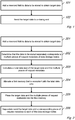
- FIG. 1 is a flowchart of an exemplary data processing method according to the present application.
- the technical solutions of the present embodiment are applied to a requesting end, and the requesting end is responsible for execution.
- the method may include the following steps: 101: Add a reserved field to data to be stored to obtain target data.
- a requesting end when constructing a write request, adds a reserved field to data to be stored, the reserved field occupying a certain data length.
- the data to be stored together with the reserved field form a new data format, and constitute target data.
- a data size of the target data is equal to a sum of a data size of the data to be stored and a data size occupied by the reserved field.
- the reserved field may be located at the end of the data to be stored, and the data size occupied thereby is defined in advance, which may be set in conjunction with a data size of data metadata.
- the data size occupied by the reserved field needs to be greater than or equal to the data size of the data metadata.
- the data size occupied by the reserved field may be equal to the data size of the data metadata.
- the data metadata refers to data metadata of the data to be stored, and is generated based on the data to be stored. Since the data metadata contains information that is usually fixed, sizes of data metadata of different data are usually the same, and the data size occupied by the reserved field may be set accordingly.
- a data size involved in the embodiments of the present application is expressed in units of bytes (English: Byte, abbreviation: B) or kilobytes (English: Kbytes, abbreviation: K), and the data size may also be called as a data length.
- a predetermined character string of a preset size may be added as a reserved field at the end of the data to be stored to obtain target data.
- the predetermined character string may be an empty character string or a character string that has been agreed upon.
- the requesting end may send a write request that includes the target data to a storing end, and the target data acting as data to be written is sent to the storing end.
- the storing end After obtaining the target data, the storing end will passively allocate a piece of memory to cache the target data.
- the memory that is passively allocated by the storing end to cache the target data is named as "second memory".
- the storing end may read the data to be stored from the target data and generate data metadata based thereupon. Since the reserved field has been reserved in the target data, the reserved field is sufficient for the data metadata that is to be written. Therefore, the storing end can write the data metadata to a memory location corresponding to the reserved field in the second memory.
- the reserved field is used for writing the data metadata of the data to be stored in a corresponding memory location in the storing end.
- the requesting end adds a reserved field to data to be stored to reconstruct as target data. Since a data size of the target data is equal to a sum of a data size of the data to be stored and a data size occupied by the reserved field, a second memory that is passively allocated by the storing end is sufficient for data metadata to be written. As such, there is no need to apply for additional disk write memory, and no data copy is required, thereby achieving zero copying. Therefore, the system performance and the efficiency of data storage can be improved without causing any waste of memory.
- sending the target data to the storing end may include:
- the first memory is referred to as a memory allocated for storing the target data that is sent to the storing end, which is named as "first memory” for convenience of differentiation in the description.
- first memory a memory allocated for storing the target data that is sent to the storing end
- second memory a memory allocated for storing the target data that is sent to the storing end
- the requesting end and the storing end can agree on a location of the reserved field in the target data and a location of the data to be stored, for example, the last 32 bytes in the target data as a reserved field.
- the storing end can follow an agreed-upon rule to read the data to be stored from the target data, and determine the reserved field.
- the requesting end may also send request metadata to the storing end, and the storing end may determine the data to be stored in the target data according to a data length and/or a data location of the data to be stored in the request metadata.
- the request metadata may also indicate to which storage device the storing end stores the data to be stored, etc.
- the request metadata can also be put into the memory, so that the data to be stored and the request metadata can be sent together.
- sending the target data to the storing end may include:
- the technical solutions of the present application can be applied to a distributed storage system.
- a distributed storage system in order to avoid a data loss caused by a failure of a certain data storage node, a multi-copy technology is usually adopted to make a number of copies of original data, and each copy of the data is stored in a different data storage node.
- Each copy data of the original data is copy data. Therefore, the data to be stored may be referred to as copy data.
- a distributed storage system is formed by a number of data storage nodes forming a cluster system, there is a need to send data to be stored to multiple data storage nodes for storage.
- the data to be stored is copy data
- the copy data needs to be sent separately to multiple data storage nodes.
- the request metadata that is separately sent to multiple data storage nodes may include a data length of the data to be stored and a data location, etc., and may also include differentiated information corresponding to different data storage nodes, such as storage indication information.
- the data to be stored may have different requirements for storage in storage devices associated with different data storage nodes.
- the storing end in the embodiments of the present application may include multiple data storage nodes.
- sending the target data to the storing end includes sending the target data and corresponding request metadata to multiple data storage nodes.
- the requesting end may first calculate a total data size of the target data and one piece of request metadata, allocate a first memory that is consistent with the total data size, and place the target data into the first memory. If the data to be stored is needed to be sent to any one of the data storage nodes, request metadata corresponding to the any data storage node is stitched in the first memory, and the target data and the request metadata is then sent to the any data storage node. If the data to be stored is needed to be sent to another data storage node, request metadata corresponding to the other data storage node is copied into the first memory to overwrite the previous request metadata, and is then sent.
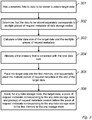
- FIG. 2 is a flowchart of another exemplary data processing method according to the present application. The method may include the following steps.
- a memory size of the first memory may be equal to the total data size.
- the target data may be placed into the first memory first, and the multiple pieces of request metadata may then be sequentially placed into the first memory, and spliced at the end of the target data.
- a requesting end may separately send write requests to multiple data storage nodes, in order to include target data and a respective piece of request metadata corresponding to each of the multiple data storage nodes.
- the target data and request data corresponding to the any data storage node in the first memory is sent to the any data storage node.
- the multiple pieces of request metadata can be sequentially placed into the first memory according to a sending order of the multiple data storage nodes. For example, a piece of request metadata of a first data storage node which is located as the first one in the sending order is located at the end of the target data, a piece of request data of a second data storage node which is located as the second one in the sending order is located at the end of the piece of request metadata of the first data storage node, and so on.
- the multiple pieces of request metadata can be sequentially placed into the first memory.
- any data storage node After any data storage node obtains received data sent by the requesting end, the any data storage node can read a piece of request metadata that it needs from the end of the received data, and can determine data to be stored and a reserved field, etc., from the target data based on the piece of request metadata.
- the first memory that is allocated can be written with multiple pieces of request metadata, without the need of specializing a piece of request data for each data storage node. An execution of a single operation can then lead to data being sent to different data storage nodes. The operation is simpler, and the efficiency of transmission is improved. As such, the efficiency of data storage and the system performance can be improved.
- the data processing method may include:
- a memory size of the first memory may be equal to the total data size.
- the multiple pieces of request metadata can be sequentially placed into the first memory according to a sending order of the data storage nodes. For example, a piece of request metadata of a first data storage node that is the first in the sending order is located at the end of the target data, and a piece of request data of a second data storage node that is the second in the sending order is located at the end of the piece of request metadata of the first data storage node, and so on.
- the multiple pieces of request metadata can be sequentially placed into the first memory.
- sequentially placing the multiple pieces of request metadata at the end of the target data includes: sequentially placing the multiple pieces of request metadata corresponding to the multiple data storage nodes respectively at the end of the target data according to a sending order of the multiple data storage nodes.
- the requesting end may send a write request to any data storage node, in order to carry the target data, a piece of request metadata corresponding to the any data storage node, and piece(s) of request metadata located before the piece of request metadata corresponding to the any data storage node.
- the any data storage node is used to read a corresponding piece of request metadata from the end of the received data.
- a respective piece of request metadata corresponding to each of the multiple data storage nodes is sequentially placed at the end of the target data.
- step 306 may include: For the any data storage node, sending the target data, the piece of request metadata corresponding to a sending order of the any data storage node and the piece(s) of request metadata located before the piece of request metadata corresponding to the sending order of the any data storage node in the first memory to the any storage node.
- a data storage node can parse and obtain a corresponding piece of request metadata from the end of received data.
- the piece of request metadata includes a data size and/or a data location of the data to be stored, based on the piece of request metadata, data of the data size indicated by the piece of request metadata can be read from the head of the received data, i.e., the data to be stored can be obtained, or the data to be stored can be located and obtained from the received data according to the data location.
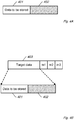
- FIG. 4a is a schematic diagram of a data structure of target data.
- the target data is composed of data to be stored 401 and a reserved field 402.
- FIG. 4b is a schematic diagram of a data structure in a first memory, which consists of target data 403 and three pieces of request metadata m1, m2, and m3 that are sequentially placed at the end of the target data 403.
- the three pieces of request metadata can be placed in order according to a sending order of the three data storage nodes, a piece of request metadata m1 corresponds to a first data storage node, a piece of request metadata m2 corresponds to a second data storage node, and a piece of request metadata m3 corresponds to a third data storage node.
- a requesting end when performing a write operation to the first data storage node, may send the target data 403 and the piece of request metadata m1 to the first data storage node.
- the requesting end When performing a write operation to the second data storage node, the requesting end may send the target data 303 and the piece of request metadata m2 to the second data storage node.
- the requesting end When performing a write operation to the third data storage node, the requesting end may send the target data 403 and the piece of request metadata m3 to the third data storage node.
- a requesting end when performing a write operation to the first data storage node, may send the target data 403 and the piece of request metadata m1 to the first data storage node.
- the requesting end When performing a write operation to the second data storage node, the requesting end may send the target data 403, the piece of request metadata m1, and the piece of request metadata m2 to the second data storage node.
- the requesting end When performing a write operation to the third data storage node, the requesting end may send the target data 403, the piece of request metadata m1, the piece of request metadata m2 and the piece of request metadata m3 to the third data storage node.
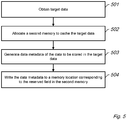
- FIG. 5 is a flowchart of another exemplary data processing method provided by the present application.
- the technical solutions of the present embodiment are applied to a storing end.
- a storage server may execute the method.
- any data storage node may execute the method.
- the method may include the following steps.
- the target data is formed by adding a reserved field to data to be stored by a requesting end.
- the target data may be included in a write request of the requesting end, and the storing end may obtain the target data from the write requesting end.
- the storing end passively allocates a second memory to temporarily store the target data.
- a memory size of the second memory is consistent with a data size of the target data.
- the storing end may write the data to be stored in the second memory as a piece of data metadata into a storage device.
- a data size occupied by the reserved field is greater than or equal to a data size of the data metadata. Therefore, the second memory has a sufficient space to allow the data metadata to be written.
- the storing end does not need to allocate additional write disk memory in order to write the data to be stored to the storage device as data metadata. No data copying is needed to be performed, and zero copying is achieved. Therefore, the system performance and the efficiency of data storage can be improved without causing any memory waste.
- the requesting end and the storing end can agree upon a location of the reserved field in the target data and a location of the data to be stored. For example, the last 32 bytes in the target data correspond to the reserved field.
- the storing end can read the data to be stored, and determine the reserved field based on the agreed-upon rule.
- the reserved field may be located at the end of the data to be stored.
- Generating the data metadata of the data to be stored in the target data may include:
- the storing end can generate the data metadata based on the data to be stored.
- the requesting end may also send request metadata to the storing end, and the storing end may determine the data to be stored in the target data according to a data length and/or a data location of the data to be stored in the request metadata.
- the request metadata may also indicate to which storage device the storing end stores the data to be stored, etc.
- the data metadata may be generated based on the request metadata and the data to be stored.
- target data and at least one piece of request metadata may be included in data that is sent by a requesting end to a storing end.
- obtaining the target data may include:
- Generating the data metadata of the data to be stored in the target data includes:
- the target request metadata may include a data size of the data to be stored, and the data size of the data to be stored may be used as information of the data metadata.
- Other information included in the data metadata such as a data checksum, can be generated based on the data to be stored.
- the data checksum can be implemented using a CRC (Cyclic Redundancy Check, Cyclic Redundancy Check) algorithm, which is the same as an existing technology which is not repeated herein.
- the write request of the requesting end may include the target data requested to be sent by the requesting end, the target request metadata, and request metadata that is located before the target request metadata in the first memory.
- determining the target request metadata may include: reading the target request metadata from the end of data of the write request based on a data size of the request metadata.
- the data to be stored can be read from the sent data.
- a requesting end 60 first constructs target data 601, and adds a reserved field 602 at the end of copy data 602.
- the reserved field may be formed by adding an empty character string of a preset size at the end of the copy data.
- Three data storage nodes are assumed to receive the copy data, including a first data storage node 61, a second data storage node 62, and a third data storage node 63 respectively.
- the requesting end needs to send the copy data to the three data storage nodes.
- the requesting end separately determines respective pieces of request metadata corresponding to each of the three data storage nodes that are needed.
- a piece of request metadata corresponding to the first data storage node 61 is assumed to be m1.
- a piece of request metadata corresponding to the second data storage node 62 is assumed to be m2.
- a piece of request metadata corresponding to the third data storage node 63 is assumed to be m3.
- the requesting end applies for a first memory, writes the target data 601 into the first memory, and sequentially places three pieces of request metadata at the end of the target data 601 according to a sending order of the three data storage nodes (assuming that the sending order is: the first data storage node 61, the second data storage node 62, and the third data storage node 63) and, with an order of arrangement of the three pieces of request metadata as: m1, m2, and m3.
- the requesting end can read the copy data and a piece of request metadata corresponding to the any storage node and any piece of request metadata before the piece of request metadata corresponding to the any storage node from the first memory, and send a write request to the any data storage node.
- the requesting end 60 sends the target data 601 and m1 to the first data storage node 61, sends the target data 601, m1, and m2 to the second data storage node, and sends the target data 601, m1, m2, and m3 to the third data storage node.
- any data storage node After any data storage node receives a write request, the any data storage node can read and obtain target request metadata that is different from other data storage nodes from the end of the write request.
- Each data storage node can determine the target data from a write request based on a number of pieces of request metadata and a data size of the request metadata, and allocate a second memory to temporarily store the target data.
- each data storage node can determine the copy data from the target data based on target request metadata, generate data metadata accordingly, and then write the data metadata into a second memory.
- Each data storage node can write the copy data written in the second memory and the data metadata to a respective storage device 64.
- a requesting end applies for a first memory and places pieces of request metadata of three data storage nodes into the first memory at one time, thereby simplifying operations and ensuring the efficiency of data transmission.
- the requesting end adds a reserved field in copy data to form target data, so that a second memory passively allocated by a data storage node for temporary storage of the target data has an enough space for writing data metadata. Therefore, data storage can be achieved without the need of reapplying for a write disk memory, and performing an operation of data copying.
- the system performance and the efficiency of data storage are improved. Furthermore, there is no need to apply for additional memory, thus reducing the problem of a waste of memory.
- FIG. 7 is a schematic structural diagram of an exemplary data processing apparatus according to the present application.
- the data processing apparatus may be configured in a requesting end.
- the apparatus may include: a data construction module 701 configured to add a reserved field to data to be stored to obtain target data.
- the data construction module may specifically add a predetermined character string of a preset size as the reserved field at the end of the data to be stored to obtain the target data.
- a data sending module 702 is configured to send the target data to a storing end, wherein the reserved field is used for writing data metadata of the data to be stored in a corresponding memory location in the storing end.
- a reserved field is added to data to be stored to construct target data. Since a data size of the target data is equal to a sum of a data size of the data to be stored and a data size occupied by the reserved field, a second memory passively allocated by a storing end is large enough for writing data metadata. Therefore, there is no need to apply for additional write disk memory, and no data copy is needed, thus achieving zero copying. This can thus improve the system performance and the efficiency of data storage without causing a waste of memory.
- the data sending module may be specifically configured to: allocate a first memory that is consistent with a data size of the target data, place the target data into the first memory, send the target data in the first memory to the storing end.
- Request metadata may also be sent to the storing end, and the storing end may determine the data to be stored in the target data according to a data length and/or a data position of the data to be stored in the request metadata.
- the request metadata may also indicate to which storage device the storing end stores the data to be stored.
- the request metadata can also be placed into the memory, so that the data to be stored and the request metadata can be sent together.
- the data sending module may be specifically configured to:
- the technical solutions of the present application can be applied to a distributed storage system.
- a distributed storage system in order to avoid a data loss caused by a failure of a certain data storage node, a multi-copy technology is usually adopted to make a number of copies of original data, and each copy of the data is stored in a different data storage node.
- Each copy data of the original data is copy data. Therefore, the data to be stored may be referred to as copy data.
- a distributed storage system is formed by a number of data storage nodes forming a cluster system, there is a need to send data to be stored to multiple data storage nodes for storage.
- the data to be stored is copy data
- the copy data needs to be sent separately to multiple data storage nodes.
- the storing end may include multiple data storage nodes.
- the data sending module may be specifically configured to:
- the data sending module may be specifically configured to:
- the data sending module sequentially placing the multiple pieces of request metadata at the end of the target data may specifically include: sequentially placing respective pieces of request metadata corresponding to the multiple data storage nodes at the end of the target data according to a sending order of the multiple data storage nodes.
- the data sending module sending, for any data storage node, the target data, the piece of request metadata corresponding to the any data storage node, and the piece(s) of request metadata located before the piece of request metadata corresponding to the any data storage node in the first memory to the any storage node may specifically include: sending, for the any data storage node, the target data, the piece of request metadata corresponds to a sending order of the any data storage node, and the piece(s) of request metadata located before the piece of request metadata corresponding to the sending order of the any data storage node from the first memory to the any storage node.
- the data processing apparatus of the embodiments shown in FIG. 7 may be implemented as a computing device.
- the computing device is deployed at a requesting end, which may be a request server.
- the computing device may include a storage component 801 and a processing component 802.
- the storage component 801 is configured to store one or more computer instructions, wherein the one or more computer instructions are provided to the processing component for calling and execution.
- the processing component 802 is configured to:
- the processing component 802 may apply a first memory for caching the target data and/or request metadata in the storage component 801.
- processing component 802 may also be configured to execute the data processing method(s) described in any one of the embodiments as shown in FIGS. 1 to 3 above.
- the processing component 802 may include one or more processors to execute computer instructions to complete all or part of the steps in the above method(s).
- the processing component may also be one or more of an application specific integrated circuit (ASIC), a digital signal processor (DSP), a digital signal processing device (DSPD), a programmable logic device (PLD), a field programmable gate array (FPGA), a controller, a microcontroller, a microprocessor or other electronic components to implement the above method(s).
- ASIC application specific integrated circuit
- DSP digital signal processor
- DSPD digital signal processing device
- PLD programmable logic device
- FPGA field programmable gate array
- controller a microcontroller, a microprocessor or other electronic components to implement the above method(s).
- the storage component 801 is configured to store various types of data to support operations on the computing device.
- the memory can be implemented by any type of volatile or non-volatile storage device or a combination thereof, such as a static random access memory (SRAM), an electrically erasable programmable read-only memory (EEPROM), an erasable and programmable Read only memory (EPROM), a programmable read only memory (PROM), a read only memory (ROM), a magnetic storage device, a flash memory, a magnetic disk or optical disk.
- SRAM static random access memory
- EEPROM electrically erasable programmable read-only memory
- EPROM erasable and programmable Read only memory
- PROM programmable read only memory
- ROM read only memory
- magnetic storage device a magnetic storage device
- flash memory a magnetic disk or optical disk.
- the computing device may also necessarily include other components, such as input/output interfaces, communication components, etc.
- embodiments of the present application also provide a computer-readable storage medium that stores a computer program, and the computer program, when executed by a computer, can implement the monitoring method as shown in any one of the embodiments in FIGS. 1-3 .
- FIG. 9 is a schematic structural diagram of another exemplary data processing apparatus provided by the present application.
- the apparatus may be configured on a storing end, and the apparatus may include:
- a data size occupied by the reserved field is greater than or equal to a data size of the data metadata. Therefore, there is sufficient space in the second memory for writing the data metadata, and the storing end does not need to allocate additional write disk memory.
- the data metadata is written to a storage device without data copying, thus achieving zero copying. Therefore, the system performance and the efficiency of data storage can be improved without causing a waste of memory.
- a location of the reserved field in the target data and a location of the data to be stored can be agreed upon with the requesting end. For example, the last 32 bytes in the target data correspond to the reserved field.
- the storing end can read the data to be stored from the target data and determine the reserved field based on such agreed-upon rule.
- the reserved field may be located at the end of the data to be stored.
- the data generation module may be specifically configured to determine the data to be stored and the reserved field in the target data based on a preset size of the reserved field; and generate the data metadata of the data to be stored.
- the requesting end may also send request metadata to the storing end. Therefore, in some embodiments, the data acquisition module may be specifically configured to:
- the data generation module may be specifically configured to: read the data to be stored from the sent data based on the target request metadata; and generate the data metadata based on the target request metadata and the data to be stored.
- the write request may include the target data, the target request metadata, and request metadata before the target request metadata that the requesting end requests to send from a first memory.
- the data acquisition module determining the target request metadata may specifically include: reading the target request metadata from the end of the write request based on a data size of the request metadata.
- the data processing apparatus of the embodiments shown in FIG. 9 may be implemented as a computing device.
- the computing device may be a storage server in a conventional storage system or a data storage node in a distributed storage system, which may be a physical server.
- the computing device may include a storage component 1001 and a processing component 1002.
- the storage component 1001 is configured to store one or more computer instructions, wherein the one or more computer instructions are provided to the processing component for calling and execution.
- the processing component 1002 is configured to:
- processing component 1002 may also be used to execute the data processing method(s) described in any of the above embodiments.
- the processing component 1002 may include one or more processors to execute computer instructions to complete all or part of the steps in the above method(s).
- the processing component may also be one or more of an application specific integrated circuit (ASIC), a digital signal processor (DSP), a digital signal processing device (DSPD), a programmable logic device (PLD), a field programmable gate array (FPGA), a controller, a microcontroller, a microprocessor or other electronic components to implement the above method(s).
- ASIC application specific integrated circuit
- DSP digital signal processor
- DSPD digital signal processing device
- PLD programmable logic device
- FPGA field programmable gate array
- the storage component 1001 is configured to store various types of data to support operations on the computing device.
- the memory can be implemented by any type of volatile or non-volatile storage device or a combination thereof, such as a static random access memory (SRAM), an electrically erasable programmable read-only memory (EEPROM), an erasable and programmable Read only memory (EPROM), a programmable read only memory (PROM), a read only memory (ROM), a magnetic storage device, a flash memory, a magnetic disk or optical disk.
- SRAM static random access memory
- EEPROM electrically erasable programmable read-only memory
- EPROM erasable and programmable Read only memory
- PROM programmable read only memory
- ROM read only memory
- magnetic storage device a magnetic storage device
- flash memory a magnetic disk or optical disk.
- the computing device may also necessarily include other components, such as input/output interfaces, communication components, etc.
- embodiments of the present application also provide a computer-readable storage medium that stores a computer program, and the computer program, when executed by a computer, can implement the monitoring method as shown in any one of the embodiments in FIG. 4 .
- the apparatus embodiments described above are only schematic, in which the units that are described as separate components may or may not be physically separated.
- the components that are displayed as units may or may not be physical units, i.e., may be located in a single place, or may be distributed among multiple network units. Some or all of the modules may be selected according to actual needs to achieve the purpose of the solutions of the present embodiment.
- One of ordinary skill in the art can understand and implement thereof without making any creative effort.
- each embodiment can be implemented by means of software plus a necessary general hardware platform, and apparently can also be implemented by hardware.
- Such computer software product can be stored in a computer-readable storage media, such as ROM/RAM, a magnetic disk, an optical disk, etc., and include a number of instructions to enable a computing device (which may be a personal computer, a server, or a network device, etc.) to perform the method(s) described in various embodiments or certain parts of the embodiments.
Landscapes
- Engineering & Computer Science (AREA)
- Theoretical Computer Science (AREA)
- Physics & Mathematics (AREA)
- General Engineering & Computer Science (AREA)
- General Physics & Mathematics (AREA)
- Human Computer Interaction (AREA)
- Software Systems (AREA)
- Information Retrieval, Db Structures And Fs Structures Therefor (AREA)
Abstract
Description
- The present application claims priority to Chinese Application No.
201810020121.0, filed on 9 January 2018 - The present application relates to the field of data processing technologies, and particularly to data processing methods, apparatuses, and systems.
- When storing data, a storage system usually adds metadata describing relevant attributes (which is also known as data metadata) of data to be stored at the end of the data to be stored in order to ensure data security, so that the data to be stored and the data metadata can be written to a storage device at one time.
- When receiving data to be stored that is sent by a requesting end, a storing end will passively allocate a piece of memory having a data size that is the same as that of the data to be stored to cache the data to be stored. In order to ensure that the data to be stored and data metadata can be written to a storage device at one time, an implementation method of existing technologies is to reapply for a piece of write disk memory, a size of the write disk memory being a data size of data to be stored plus a data size of data metadata, and then to copy the data to be stored to the write disk memory and splice the data metadata in the write disk memory, so that the data to be stored and the data metadata are organized together. As such, only one write operation needs to be performed, i.e., the data to be stored and the data metadata in the write disk memory can be written to the storage device as a whole.
- However, as can be seen from the above description, in the existing technologies, data to be stored needs to be first copied into a write disk memory by means of data copying, which will affect the efficiency of data storage.
- Embodiments of the present application provide data processing method, apparatus, and computing device to solve the technical problems of low efficiency of data storage in the existing technologies.
- In a first aspect, the embodiments of the present application provide a data processing method, which includes:
- adding a reserved field to data to be stored to obtain target data; and
- sending the target data to a storing end, wherein the reserved field is used for writing data metadata of the data to be stored in a corresponding memory location in the storing end, so that the data to be stored and the data metadata are written into a storage device as a whole.
- In a second aspect, the embodiments of the present application provide a data processing method, which includes:
- obtaining target data, the target data including a reserved field added by a requesting end to data to be stored;
- allocating a second memory to cache the target data;
- generating data metadata of the data to be stored in the target data; and
- writing the data metadata to a memory location corresponding to the reserved field in the second memory.
- In a third aspect, the embodiments of the present application provide a data processing apparatus, which includes:
- a data construction module configured to add a reserved field to data to be stored to obtain target data; and
- a data sending module configured to send the target data to a storing end, wherein the reserved field is used for writing data metadata of the data to be stored in a corresponding memory location in the storing end, so that the data to be stored and the data metadata are written into a storage device as a whole.
- According to a fourth aspect, the embodiments of the present application provide a data processing apparatus, which includes:
- a data acquisition module configured to obtain target data, the target data including a reserved field added by a requesting end to data to be stored;
- a memory allocation module configured to allocate a second memory to cache the target data;
- a data generation module configured to generate data metadata of the data to be stored in the target data; and
- a data writing module configured to write the data metadata to a memory location corresponding to the reserved field in the second memory.
- In a fifth aspect, the embodiments of the present application provide a computing device, which includes a storage component and a processing component,
the storage component being configured to store one or more computer instructions, wherein the one or more computer instructions are provided to the processing component for calling and execution; and
the processing component being configured to: - add a reserved field to data to be stored to obtain target data; and
- send the target data to a storing end, wherein the reserved field is used for writing data metadata of the data to be stored in a corresponding memory location in the storing end, so that the data to be stored and the data metadata are written into a storage device as a whole.
- In a sixth aspect, the embodiments of the present application provide a computing device, which includes a storage component and a processing component,
- the storage component being configured to store one or more computer instructions, wherein the one or more computer instructions are provided to the processing component for calling and execution; and
- the processing component being configured to:
- obtain target data, the target data including a reserved field added by a requesting end to data to be stored;
- allocate a second memory to cache the target data;
- generate data metadata of the data to be stored in the target data; and
- write the data metadata to a memory location corresponding to the reserved field in the second memory.
- In the embodiments of the present application, a requesting end adds a reserved field to data to be stored to construct the data to be stored as target data. A data size of the target data is a sum of a data size of the data to be stored and a data size occupied by the reserved field. The requesting end sends the target data to a storing end. The storing end allocates a memory to cache the target data. Since the reserved field is reserved in the target data, a memory space corresponding to the reserved field can be enough for writing data metadata, so the storing end does not need to allocate new memory, which will not cause a waste of memory and avoid data copying. Therefore, the efficiency of data storage and the performance of an associated system are improved.
- These aspects of the present application or other aspects of the present application will become more clear and easier to understand in the description of the following embodiments.
- In order to more clearly explain the embodiments of the present application or the technical solutions in the existing technologies, accompanying drawings that are needed in the description of the embodiments or the existing technologies are briefly described herein. Apparently, the described drawings represent some embodiments of the present application. One of ordinary skill in the art can obtain other drawings based on these drawings without making any creative effort.
-
FIG. 1 shows a flowchart of an exemplary data processing method provided by the present application. -
FIG. 2 shows a flowchart of another exemplary data processing method provided by the present application. -
FIG. 3 shows a flowchart of an exemplary data processing method provided by the present application. -
FIG. 4a shows a schematic diagram of a data structure provided by the embodiments of the present application. -
FIG. 4b shows a schematic diagram of another data structure provided by the embodiments of the present application. -
FIG. 5 shows a flowchart of another exemplary data processing method provided by the present application. -
FIG. 6 shows a schematic diagram of a data processing interaction in a practical application provided by the embodiments of the present application. -
FIG. 7 is a schematic structural diagram of an exemplary data processing apparatus provided by the present application. -
FIG. 8 is a schematic structural diagram of an exemplary computing device provided by the present application. -
FIG. 9 shows a schematic structural diagram of another exemplary data processing apparatus provided by the present application. -
FIG. 10 shows a schematic structural diagram of another exemplary computing device apparatus provided by the present application. - In order to enable one skilled in the art to better understand the solutions of the present application, the technical solutions in the embodiments of the present application will be described clearly and completely hereinafter in conjunction with the drawings in the embodiments of the present application.
- Some processes described in the specification and claims of the present application and the above drawings include multiple operations that appear according to a specific order. However, it should be clearly understood that these operations may not need to be executed in an order in which they appear in the present text or may be executed in parallel. Sequence numbers of operations, such as 101 and 102, etc., are only used for distinguishing between different operations, and the sequence numbers themselves do not represent any sequence of execution. In addition, these processes may include more or fewer operations, and these operations may be performed sequentially or in parallel. It should be noted that descriptions, such as "first" and "second", etc., in the present text, are used for distinguishing different pieces of information, devices, modules, etc., and do not represent an order, nor "first" and "second" are limited to different types.
- The technical solutions of the embodiments of the present application are mainly applied to a storage system. The storage system may be a conventional storage system or a distributed storage system.
- To facilitate understanding, technical terms that may appear in the embodiments of the present application are first explained as follows.
- Storing end: Responsible for data access operations; a conventional storage system uses a centralized storage server for storing data, and a storing end can be referred to as a storage server; a distributed storage system stores data in multiple data storage nodes, and a storing end can be referred to as one or more data storage nodes.
- Data storage node: A node responsible for data storage in a distributed storage system, and is usually a physical server.
- Requesting end: Responsible for sending read/write requests, and an upper-level service system accesses or updates data of a storing end through the requesting end.
- Request metadata: Data guidance information of data to be stored sent by a requesting end to a storing end, which may include a data length and/or a data location of the data to be stored, and storage indication information; storage indication information which is also referred to as indicating a storage device to which the data to be stored is written; the requested metadata is not written to the stored data.
- Data Metadata (DataMeta): Metadata used for describing relevant attributes of data to be stored, which may include a data length, a data checksum, a storage location, a file name to which it belongs, etc; the data metadata is written to a storage device with the data to be stored.
- Multi-copy technology: A data redundancy technology in a distributed storage system, which normally makes a number of copies of original data in order to prevent a data loss due to a failure of a data storage node; each copy of the data being stored in a different data storage node, and each copy of the original data is called copy data.
- Storage device: A hardware device used for storing data in a storage system; data eventually needs to be written to the storage device, which may be a storage medium such as a magnetic disk.
- In the existing technologies, in order to write data to be stored and data metadata to a storage device, a storing end needs to allocate an additional write disk memory. Upon receiving data to be stored, the storing end will passively allocate a piece of memory to cache the data to be stored. Therefore, it is necessary to copy the data to be stored to the write disk memory again. The data to be stored needs to be copied once, and copying the data will affect the efficiency of data storage and affect the performance of an associated system.
- In order to improve the system performance and ensure the efficiency of data storage, the inventors proposed the technical solutions of the present application through a series of studies. In the embodiments of the present application, a requesting end adds a reserved field to data to be stored to construct the data to be stored as a target data. A data size of the target data is a sum of a data size of the data to be stored and a data size corresponding to the reserved field. The requesting end sends the target data to a storing end. The storing end allocates a piece of memory to cache the target data. Since the target data includes the reserved field, a memory space corresponding to the reserved field would be enough for writing data metadata. Therefore, the storing end does not need to allocate additional and new memory, which will not cause a waste of memory, and at the same time avoid data copying. Therefore, the efficiency of data storage and the system performance can be improved.
- The technical solutions in the embodiments of the present application will be described clearly and completely hereinafter in conjunction with the drawings in the embodiments of the present application. Apparently, the described embodiments represent only a part and not all of the embodiments of the present application. Based on the embodiments in the present application, all other embodiments that are obtained by one skilled in the art without making any creative effort will fall within the scope of protection of the present application.
-
FIG. 1 is a flowchart of an exemplary data processing method according to the present application. The technical solutions of the present embodiment are applied to a requesting end, and the requesting end is responsible for execution. - The method may include the following steps:
101: Add a reserved field to data to be stored to obtain target data. - In the embodiments of the present application, when constructing a write request, a requesting end adds a reserved field to data to be stored, the reserved field occupying a certain data length. The data to be stored together with the reserved field form a new data format, and constitute target data. A data size of the target data is equal to a sum of a data size of the data to be stored and a data size occupied by the reserved field.
- The reserved field may be located at the end of the data to be stored, and the data size occupied thereby is defined in advance, which may be set in conjunction with a data size of data metadata. The data size occupied by the reserved field needs to be greater than or equal to the data size of the data metadata.
- Optionally, the data size occupied by the reserved field may be equal to the data size of the data metadata.
- The data metadata refers to data metadata of the data to be stored, and is generated based on the data to be stored. Since the data metadata contains information that is usually fixed, sizes of data metadata of different data are usually the same, and the data size occupied by the reserved field may be set accordingly.
- It should be noted that a data size involved in the embodiments of the present application is expressed in units of bytes (English: Byte, abbreviation: B) or kilobytes (English: Kbytes, abbreviation: K), and the data size may also be called as a data length.
- As an optional method, a predetermined character string of a preset size may be added as a reserved field at the end of the data to be stored to obtain target data.
- The predetermined character string may be an empty character string or a character string that has been agreed upon.
- 102: Send the target data to a storing end.
- The requesting end may send a write request that includes the target data to a storing end, and the target data acting as data to be written is sent to the storing end.
- After obtaining the target data, the storing end will passively allocate a piece of memory to cache the target data. For convenience of differentiation in the description, the memory that is passively allocated by the storing end to cache the target data is named as "second memory". The storing end may read the data to be stored from the target data and generate data metadata based thereupon. Since the reserved field has been reserved in the target data, the reserved field is sufficient for the data metadata that is to be written. Therefore, the storing end can write the data metadata to a memory location corresponding to the reserved field in the second memory.
- Specifically, the reserved field is used for writing the data metadata of the data to be stored in a corresponding memory location in the storing end.
- In the present embodiment, the requesting end adds a reserved field to data to be stored to reconstruct as target data. Since a data size of the target data is equal to a sum of a data size of the data to be stored and a data size occupied by the reserved field, a second memory that is passively allocated by the storing end is sufficient for data metadata to be written. As such, there is no need to apply for additional disk write memory, and no data copy is required, thereby achieving zero copying. Therefore, the system performance and the efficiency of data storage can be improved without causing any waste of memory.
- Since the data to be stored needs to be temporarily stored in the memory before being sent, in some embodiments, sending the target data to the storing end may include:
- allocating a first memory that is consistent with a data size of the target data;
- placing the target data into the first memory; and
- sending the target data from the first memory to the storing end.
- In the embodiments of the present application, the first memory is referred to as a memory allocated for storing the target data that is sent to the storing end, which is named as "first memory" for convenience of differentiation in the description. One skilled in the art can understand that the "first" and "second" in the "first memory" and the "second memory" are merely used for the purpose of differentiation in the description, and do not represent any relationships such as delivery and inclusion.
- The requesting end and the storing end can agree on a location of the reserved field in the target data and a location of the data to be stored, for example, the last 32 bytes in the target data as a reserved field. As such, the storing end can follow an agreed-upon rule to read the data to be stored from the target data, and determine the reserved field.
- In addition, the requesting end may also send request metadata to the storing end, and the storing end may determine the data to be stored in the target data according to a data length and/or a data location of the data to be stored in the request metadata.
- The request metadata may also indicate to which storage device the storing end stores the data to be stored, etc.
- Since the data to be stored needs to be temporarily stored in the memory before being sent, the request metadata can also be put into the memory, so that the data to be stored and the request metadata can be sent together.
- Therefore, sending the target data to the storing end may include:
- calculating a total data size of the target data and the request metadata;
- allocating a first memory that is consistent with the total data size;
- placing the target memory and the request metadata into the first memory; and
- sending the target data from the first memory to the storing end.
- In a practical application, the technical solutions of the present application can be applied to a distributed storage system. In a distributed storage system, in order to avoid a data loss caused by a failure of a certain data storage node, a multi-copy technology is usually adopted to make a number of copies of original data, and each copy of the data is stored in a different data storage node. Each copy data of the original data is copy data. Therefore, the data to be stored may be referred to as copy data.
- Since a distributed storage system is formed by a number of data storage nodes forming a cluster system, there is a need to send data to be stored to multiple data storage nodes for storage. For example, when the data to be stored is copy data, the copy data needs to be sent separately to multiple data storage nodes.
- If the data to be stored needs to be sent to multiple data storage nodes, the requesting end needs to send corresponding request metadata for each data storage node. The request metadata that is separately sent to multiple data storage nodes may include a data length of the data to be stored and a data location, etc., and may also include differentiated information corresponding to different data storage nodes, such as storage indication information. The data to be stored may have different requirements for storage in storage devices associated with different data storage nodes.
- In a distributed storage system, the storing end in the embodiments of the present application may include multiple data storage nodes.
- Therefore, sending the target data to the storing end includes sending the target data and corresponding request metadata to multiple data storage nodes.
- At present, when a requesting end sends target data and corresponding request metadata to multiple data storage nodes, the requesting end may first calculate a total data size of the target data and one piece of request metadata, allocate a first memory that is consistent with the total data size, and place the target data into the first memory. If the data to be stored is needed to be sent to any one of the data storage nodes, request metadata corresponding to the any data storage node is stitched in the first memory, and the target data and the request metadata is then sent to the any data storage node. If the data to be stored is needed to be sent to another data storage node, request metadata corresponding to the other data storage node is copied into the first memory to overwrite the previous request metadata, and is then sent.
- As can be seen from the above description, at present, when sending data to be stored to multiple data storage nodes in this type of method, multiple tedious operations of copying request metadata are needed. This also affects the efficiency of transmission and thus affects the efficiency of data storage.
- Therefore, after further consideration, the inventors propose another embodiment of the technical solutions of the present application.
-
FIG. 2 is a flowchart of another exemplary data processing method according to the present application. The method may include the following steps. - 201: Add a reserved field to data to be stored to obtain target data.
- 202: Determine that the data to be stored separately corresponds to multiple pieces of request metadata of data storage nodes.
- 203: Calculate a total data size of the target data and the multiple pieces of request metadata.
- 204: Allocate a first memory that is consistent with the total data size.
- In other words, a memory size of the first memory may be equal to the total data size.
- 205: Place the target data and the multiple pieces of request metadata into the first memory.
- The target data may be placed into the first memory first, and the multiple pieces of request metadata may then be sequentially placed into the first memory, and spliced at the end of the target data.
- 206: Separately send the target data and a corresponding piece of request metadata to each of the data storage nodes.
- A requesting end may separately send write requests to multiple data storage nodes, in order to include target data and a respective piece of request metadata corresponding to each of the multiple data storage nodes.
- Specifically, for any data storage node, the target data and request data corresponding to the any data storage node in the first memory is sent to the any data storage node.
- In the first memory, the multiple pieces of request metadata can be sequentially placed into the first memory according to a sending order of the multiple data storage nodes. For example, a piece of request metadata of a first data storage node which is located as the first one in the sending order is located at the end of the target data, a piece of request data of a second data storage node which is located as the second one in the sending order is located at the end of the piece of request metadata of the first data storage node, and so on. In other words, the multiple pieces of request metadata can be sequentially placed into the first memory. When a write request needs to be sent to any data storage node, since a data size of request metadata is known, a corresponding piece of request metadata can be found according to a sending order associated with the any data storage node.
- After any data storage node obtains received data sent by the requesting end, the any data storage node can read a piece of request metadata that it needs from the end of the received data, and can determine data to be stored and a reserved field, etc., from the target data based on the piece of request metadata.
- In the present embodiment, the first memory that is allocated can be written with multiple pieces of request metadata, without the need of specializing a piece of request data for each data storage node. An execution of a single operation can then lead to data being sent to different data storage nodes. The operation is simpler, and the efficiency of transmission is improved. As such, the efficiency of data storage and the system performance can be improved.
- In addition, in order to facilitate operations of a requesting end and each data storage node, in yet another embodiment as shown in
FIG. 3 , the data processing method may include: - 301: Add a reserved field to data to be stored to obtain target data.
- 302: Determine that the data to be stored separately corresponds to multiple pieces of request metadata of data storage nodes.
- 303: Calculate a total data size of the target data and the multiple pieces of request metadata.
- 304: Allocate a first memory that is consistent with the total data size.
- In other words, a memory size of the first memory may be equal to the total data size.
- 305: Place the target data into the first memory, and sequentially place the multiple pieces of request metadata at the end of the target data.
- The multiple pieces of request metadata can be sequentially placed into the first memory according to a sending order of the data storage nodes. For example, a piece of request metadata of a first data storage node that is the first in the sending order is located at the end of the target data, and a piece of request data of a second data storage node that is the second in the sending order is located at the end of the piece of request metadata of the first data storage node, and so on. In other words, the multiple pieces of request metadata can be sequentially placed into the first memory.
- Therefore, as yet another embodiment, sequentially placing the multiple pieces of request metadata at the end of the target data includes:
sequentially placing the multiple pieces of request metadata corresponding to the multiple data storage nodes respectively at the end of the target data according to a sending order of the multiple data storage nodes. - 306: Send, for any data storage node, the target data, a piece of request metadata corresponding to the any data storage node and piece(s) of request metadata located before the piece of request metadata corresponding to the any data storage node in the first memory to the any storage node.
- The requesting end may send a write request to any data storage node, in order to carry the target data, a piece of request metadata corresponding to the any data storage node, and piece(s) of request metadata located before the piece of request metadata corresponding to the any data storage node.
- The any data storage node is used to read a corresponding piece of request metadata from the end of the received data.
- According to a sending order of the multiple data storage nodes, a respective piece of request metadata corresponding to each of the multiple data storage nodes is sequentially placed at the end of the target data.
- Optionally, the operation of
step 306 may include:
For the any data storage node, sending the target data, the piece of request metadata corresponding to a sending order of the any data storage node and the piece(s) of request metadata located before the piece of request metadata corresponding to the sending order of the any data storage node in the first memory to the any storage node. - Using the method of the present embodiment, based on a data size of a piece of request metadata, a data storage node can parse and obtain a corresponding piece of request metadata from the end of received data.
- Since the piece of request metadata includes a data size and/or a data location of the data to be stored, based on the piece of request metadata, data of the data size indicated by the piece of request metadata can be read from the head of the received data, i.e., the data to be stored can be obtained, or the data to be stored can be located and obtained from the received data according to the data location.
- For the ease of understanding, three data storage nodes are used as an example below.
FIG. 4a is a schematic diagram of a data structure of target data. As can be seen, the target data is composed of data to be stored 401 and areserved field 402. -
FIG. 4b is a schematic diagram of a data structure in a first memory, which consists oftarget data 403 and three pieces of request metadata m1, m2, and m3 that are sequentially placed at the end of thetarget data 403. - The three pieces of request metadata can be placed in order according to a sending order of the three data storage nodes, a piece of request metadata m1 corresponds to a first data storage node, a piece of request metadata m2 corresponds to a second data storage node, and a piece of request metadata m3 corresponds to a third data storage node.
- As an optional method, when performing a write operation to the first data storage node, a requesting end may send the
target data 403 and the piece of request metadata m1 to the first data storage node. When performing a write operation to the second data storage node, the requesting end may send thetarget data 303 and the piece of request metadata m2 to the second data storage node. When performing a write operation to the third data storage node, the requesting end may send thetarget data 403 and the piece of request metadata m3 to the third data storage node. - As another optional method, when performing a write operation to the first data storage node, a requesting end may send the
target data 403 and the piece of request metadata m1 to the first data storage node. When performing a write operation to the second data storage node, the requesting end may send thetarget data 403, the piece of request metadata m1, and the piece of request metadata m2 to the second data storage node. When performing a write operation to the third data storage node, the requesting end may send thetarget data 403, the piece of request metadata m1, the piece of request metadata m2 and the piece of request metadata m3 to the third data storage node. -
FIG. 5 is a flowchart of another exemplary data processing method provided by the present application. The technical solutions of the present embodiment are applied to a storing end. In a conventional storage system, a storage server may execute the method. In a distributed storage system, any data storage node may execute the method. - The method may include the following steps.
- 501: Obtain target data.
- The target data is formed by adding a reserved field to data to be stored by a requesting end.
- The target data may be included in a write request of the requesting end, and the storing end may obtain the target data from the write requesting end.
- 502: Allocate a second memory to cache the target data.
- After obtaining the target data, the storing end passively allocates a second memory to temporarily store the target data. A memory size of the second memory is consistent with a data size of the target data.
- 503: Generate data metadata of the data to be stored in the target data.
- 504: Write the data metadata to a memory location corresponding to the reserved field in the second memory.
- After that, the storing end may write the data to be stored in the second memory as a piece of data metadata into a storage device.
- A data size occupied by the reserved field is greater than or equal to a data size of the data metadata. Therefore, the second memory has a sufficient space to allow the data metadata to be written. The storing end does not need to allocate additional write disk memory in order to write the data to be stored to the storage device as data metadata. No data copying is needed to be performed, and zero copying is achieved. Therefore, the system performance and the efficiency of data storage can be improved without causing any memory waste.
- The requesting end and the storing end can agree upon a location of the reserved field in the target data and a location of the data to be stored. For example, the last 32 bytes in the target data correspond to the reserved field. The storing end can read the data to be stored, and determine the reserved field based on the agreed-upon rule.
- Therefore, in some embodiments, the reserved field may be located at the end of the data to be stored.
- Generating the data metadata of the data to be stored in the target data may include:
- determining the data to be stored and the reserved field in the target data based on a preset size of the reserved field; and
- generating the data metadata of the data to be stored.
- Therefore, the storing end can generate the data metadata based on the data to be stored.
- In addition, the requesting end may also send request metadata to the storing end, and the storing end may determine the data to be stored in the target data according to a data length and/or a data location of the data to be stored in the request metadata.
- The request metadata may also indicate to which storage device the storing end stores the data to be stored, etc.
- The data metadata may be generated based on the request metadata and the data to be stored.
- In a distributed storage system, a situation in which data to be stored is sent to multiple data storage nodes for storage (for example, when the data to be stored is copy data) exists. Based on the description in the foregoing embodiments, target data and at least one piece of request metadata may be included in data that is sent by a requesting end to a storing end.
- Therefore, in some embodiments, obtaining the target data may include:
- receiving a write request sent by a requesting end, the write request including the target data and at least one piece of request metadata; and
- determining target request metadata.
- Generating the data metadata of the data to be stored in the target data includes:
- reading the data to be stored based on the target request metadata; and
- generating the data metadata based on the target request metadata and the data to be stored.
- For example, the target request metadata may include a data size of the data to be stored, and the data size of the data to be stored may be used as information of the data metadata. Other information included in the data metadata, such as a data checksum, can be generated based on the data to be stored. The data checksum can be implemented using a CRC (Cyclic Redundancy Check, Cyclic Redundancy Check) algorithm, which is the same as an existing technology which is not repeated herein.
- If the requesting end sends the target data according to the embodiments shown in
FIG. 3 , the write request of the requesting end may include the target data requested to be sent by the requesting end, the target request metadata, and request metadata that is located before the target request metadata in the first memory. - Therefore, determining the target request metadata may include:
reading the target request metadata from the end of data of the write request based on a data size of the request metadata. - Therefore, based on the target request metadata, the data to be stored can be read from the sent data.
- By taking data to be stored in a distributed storage system as copy data as an example, the technical solutions of the embodiments of the present application will be described below. In distributed storage systems, multi-copy technology is usually used to solve the problems of losses of original data due to failures.
- As shown in
FIG. 6 , a requestingend 60 firstconstructs target data 601, and adds areserved field 602 at the end ofcopy data 602. The reserved field may be formed by adding an empty character string of a preset size at the end of the copy data. - Three data storage nodes are assumed to receive the copy data, including a first
data storage node 61, a seconddata storage node 62, and a thirddata storage node 63 respectively. In other words, the requesting end needs to send the copy data to the three data storage nodes. The requesting end separately determines respective pieces of request metadata corresponding to each of the three data storage nodes that are needed. A piece of request metadata corresponding to the firstdata storage node 61 is assumed to be m1. A piece of request metadata corresponding to the seconddata storage node 62 is assumed to be m2. A piece of request metadata corresponding to the thirddata storage node 63 is assumed to be m3. - The requesting end applies for a first memory, writes the
target data 601 into the first memory, and sequentially places three pieces of request metadata at the end of thetarget data 601 according to a sending order of the three data storage nodes (assuming that the sending order is: the firstdata storage node 61, the seconddata storage node 62, and the third data storage node 63) and, with an order of arrangement of the three pieces of request metadata as: m1, m2, and m3. - For any data storage node, the requesting end can read the copy data and a piece of request metadata corresponding to the any storage node and any piece of request metadata before the piece of request metadata corresponding to the any storage node from the first memory, and send a write request to the any data storage node.
- As shown in
FIG. 6 , the requestingend 60 sends thetarget data 601 and m1 to the firstdata storage node 61, sends thetarget data 601, m1, and m2 to the second data storage node, and sends thetarget data 601, m1, m2, and m3 to the third data storage node. - Therefore, after any data storage node receives a write request, the any data storage node can read and obtain target request metadata that is different from other data storage nodes from the end of the write request.
- Each data storage node can determine the target data from a write request based on a number of pieces of request metadata and a data size of the request metadata, and allocate a second memory to temporarily store the target data.
- After that, each data storage node can determine the copy data from the target data based on target request metadata, generate data metadata accordingly, and then write the data metadata into a second memory.
- Each data storage node can write the copy data written in the second memory and the data metadata to a
respective storage device 64. - As can be seen from the above description, a requesting end applies for a first memory and places pieces of request metadata of three data storage nodes into the first memory at one time, thereby simplifying operations and ensuring the efficiency of data transmission. Moreover, the requesting end adds a reserved field in copy data to form target data, so that a second memory passively allocated by a data storage node for temporary storage of the target data has an enough space for writing data metadata. Therefore, data storage can be achieved without the need of reapplying for a write disk memory, and performing an operation of data copying. By using a scheme of zero copying, the system performance and the efficiency of data storage are improved. Furthermore, there is no need to apply for additional memory, thus reducing the problem of a waste of memory.
-
FIG. 7 is a schematic structural diagram of an exemplary data processing apparatus according to the present application. The data processing apparatus may be configured in a requesting end. The apparatus may include:
adata construction module 701 configured to add a reserved field to data to be stored to obtain target data. - Optionally, the data construction module may specifically add a predetermined character string of a preset size as the reserved field at the end of the data to be stored to obtain the target data.
- A
data sending module 702 is configured to send the target data to a storing end, wherein the reserved field is used for writing data metadata of the data to be stored in a corresponding memory location in the storing end. - In the present embodiment, a reserved field is added to data to be stored to construct target data. Since a data size of the target data is equal to a sum of a data size of the data to be stored and a data size occupied by the reserved field, a second memory passively allocated by a storing end is large enough for writing data metadata. Therefore, there is no need to apply for additional write disk memory, and no data copy is needed, thus achieving zero copying. This can thus improve the system performance and the efficiency of data storage without causing a waste of memory.
- Since the data to be stored needs to be temporarily stored in the memory before being sent, in some embodiments, the data sending module may be specifically configured to: allocate a first memory that is consistent with a data size of the target data, place the target data into the first memory, send the target data in the first memory to the storing end.
- Request metadata may also be sent to the storing end, and the storing end may determine the data to be stored in the target data according to a data length and/or a data position of the data to be stored in the request metadata.
- The request metadata may also indicate to which storage device the storing end stores the data to be stored.
- Since the data to be stored needs to be temporarily stored in the memory before being sent, the request metadata can also be placed into the memory, so that the data to be stored and the request metadata can be sent together.
- Therefore, in some embodiments, the data sending module may be specifically configured to:
- calculate a total data size of the target data and the request metadata;
- allocate a first memory consistent with the total data size;
- place the target memory and the request metadata into the first memory; and
- send the target data from the first memory to the storing end.
- In a practical application, the technical solutions of the present application can be applied to a distributed storage system. In a distributed storage system, in order to avoid a data loss caused by a failure of a certain data storage node, a multi-copy technology is usually adopted to make a number of copies of original data, and each copy of the data is stored in a different data storage node. Each copy data of the original data is copy data. Therefore, the data to be stored may be referred to as copy data.
- Since a distributed storage system is formed by a number of data storage nodes forming a cluster system, there is a need to send data to be stored to multiple data storage nodes for storage. For example, when the data to be stored is copy data, the copy data needs to be sent separately to multiple data storage nodes.
- Therefore, in some embodiments, the storing end may include multiple data storage nodes.
- As an optional method, the data sending module may be specifically configured to:
- determine multiple pieces of request metadata of the multiple data storage nodes separately corresponding to the data to be stored;
- calculate a total data size of the target data and the multiple pieces of request metadata;
- allocate a first memory consistent with the total data size;
- place the target memory and the multiple pieces of request metadata into the first memory; and
- separately send the target data and a corresponding piece of request metadata to the multiple data storage nodes.
- As another optional method, the data sending module may be specifically configured to:
- determine multiple pieces of request metadata of the multiple data storage nodes separately corresponding to the data to be stored;
- calculate a total data size of the target data and the multiple pieces of request metadata;
- allocate a first memory consistent with the total data size;
- place the target data into the first memory, and sequentially place the multiple pieces of request metadata at the end of the target data; and
- send, for any data storage node, the target data, a piece of request metadata corresponding to the any data storage node, and piece(s) of request metadata located before the piece of request metadata corresponding to the any data storage node in the first memory to the any storage node, the any data storage node being configured to read a corresponding piece of request metadata from the end of received data.
- Optionally, the data sending module sequentially placing the multiple pieces of request metadata at the end of the target data may specifically include: sequentially placing respective pieces of request metadata corresponding to the multiple data storage nodes at the end of the target data according to a sending order of the multiple data storage nodes.
- The data sending module sending, for any data storage node, the target data, the piece of request metadata corresponding to the any data storage node, and the piece(s) of request metadata located before the piece of request metadata corresponding to the any data storage node in the first memory to the any storage node may specifically include: sending, for the any data storage node, the target data, the piece of request metadata corresponds to a sending order of the any data storage node, and the piece(s) of request metadata located before the piece of request metadata corresponding to the sending order of the any data storage node from the first memory to the any storage node.
- In a possible design, the data processing apparatus of the embodiments shown in
FIG. 7 may be implemented as a computing device. The computing device is deployed at a requesting end, which may be a request server. As shown inFIG. 8 , the computing device may include astorage component 801 and aprocessing component 802. - The
storage component 801 is configured to store one or more computer instructions, wherein the one or more computer instructions are provided to the processing component for calling and execution. - The
processing component 802 is configured to: - add a reserved field to data to be stored to obtain target data; and
- send the target data to a storing end, wherein the reserved field is used for writing data metadata of the data to be stored in a corresponding memory location in the storing end.
- The
processing component 802 may apply a first memory for caching the target data and/or request metadata in thestorage component 801. - In addition, the
processing component 802 may also be configured to execute the data processing method(s) described in any one of the embodiments as shown inFIGS. 1 to 3 above. - The
processing component 802 may include one or more processors to execute computer instructions to complete all or part of the steps in the above method(s). Apparently, the processing component may also be one or more of an application specific integrated circuit (ASIC), a digital signal processor (DSP), a digital signal processing device (DSPD), a programmable logic device (PLD), a field programmable gate array (FPGA), a controller, a microcontroller, a microprocessor or other electronic components to implement the above method(s). - The
storage component 801 is configured to store various types of data to support operations on the computing device. The memory can be implemented by any type of volatile or non-volatile storage device or a combination thereof, such as a static random access memory (SRAM), an electrically erasable programmable read-only memory (EEPROM), an erasable and programmable Read only memory (EPROM), a programmable read only memory (PROM), a read only memory (ROM), a magnetic storage device, a flash memory, a magnetic disk or optical disk. - Apparently, the computing device may also necessarily include other components, such as input/output interfaces, communication components, etc.
- In addition, the embodiments of the present application also provide a computer-readable storage medium that stores a computer program, and the computer program, when executed by a computer, can implement the monitoring method as shown in any one of the embodiments in
FIGS. 1-3 . -
FIG. 9 is a schematic structural diagram of another exemplary data processing apparatus provided by the present application. The apparatus may be configured on a storing end, and the apparatus may include: - a
data acquisition module 901 configured to obtain target data, the target data including a reserved field added by a requesting end to data to be stored; - a
memory allocation module 902 configured to allocate a second memory to cache the target data; - a
data generation module 903 configured to generate data metadata of the data to be stored in the target data; and - a
data writing module 904 configured to write the data metadata to a memory location corresponding to the reserved field in the second memory. - A data size occupied by the reserved field is greater than or equal to a data size of the data metadata. Therefore, there is sufficient space in the second memory for writing the data metadata, and the storing end does not need to allocate additional write disk memory. The data metadata is written to a storage device without data copying, thus achieving zero copying. Therefore, the system performance and the efficiency of data storage can be improved without causing a waste of memory.
- In some embodiments, a location of the reserved field in the target data and a location of the data to be stored can be agreed upon with the requesting end. For example, the last 32 bytes in the target data correspond to the reserved field. The storing end can read the data to be stored from the target data and determine the reserved field based on such agreed-upon rule.
- Therefore, in some embodiments, the reserved field may be located at the end of the data to be stored.
- The data generation module may be specifically configured to determine the data to be stored and the reserved field in the target data based on a preset size of the reserved field; and generate the data metadata of the data to be stored.
- In addition, the requesting end may also send request metadata to the storing end. Therefore, in some embodiments, the data acquisition module may be specifically configured to:
- receive a write request sent by the requesting end, the write request including the target data and at least one piece of request metadata; and
- determine target request metadata.
- The data generation module may be specifically configured to: read the data to be stored from the sent data based on the target request metadata; and generate the data metadata based on the target request metadata and the data to be stored.
- In some embodiments, the write request may include the target data, the target request metadata, and request metadata before the target request metadata that the requesting end requests to send from a first memory.
- The data acquisition module determining the target request metadata may specifically include: reading the target request metadata from the end of the write request based on a data size of the request metadata.
- In a possible design, the data processing apparatus of the embodiments shown in
FIG. 9 may be implemented as a computing device. The computing device may be a storage server in a conventional storage system or a data storage node in a distributed storage system, which may be a physical server. As shown inFIG. 10 , the computing device may include astorage component 1001 and aprocessing component 1002. - The
storage component 1001 is configured to store one or more computer instructions, wherein the one or more computer instructions are provided to the processing component for calling and execution. - The
processing component 1002 is configured to: - obtain target data, the target data including a reserved field added by a requesting end to data to be stored;
- allocate a second memory in the
storage component 1001 to cache the target data; - generate data metadata of the data to be stored in the target data; and
- write the data metadata to a memory location corresponding to the reserved field in the second memory.
- In addition, the
processing component 1002 may also be used to execute the data processing method(s) described in any of the above embodiments. - The
processing component 1002 may include one or more processors to execute computer instructions to complete all or part of the steps in the above method(s). Apparently, the processing component may also be one or more of an application specific integrated circuit (ASIC), a digital signal processor (DSP), a digital signal processing device (DSPD), a programmable logic device (PLD), a field programmable gate array (FPGA), a controller, a microcontroller, a microprocessor or other electronic components to implement the above method(s). - The
storage component 1001 is configured to store various types of data to support operations on the computing device. The memory can be implemented by any type of volatile or non-volatile storage device or a combination thereof, such as a static random access memory (SRAM), an electrically erasable programmable read-only memory (EEPROM), an erasable and programmable Read only memory (EPROM), a programmable read only memory (PROM), a read only memory (ROM), a magnetic storage device, a flash memory, a magnetic disk or optical disk. - Apparently, the computing device may also necessarily include other components, such as input/output interfaces, communication components, etc.
- In addition, the embodiments of the present application also provide a computer-readable storage medium that stores a computer program, and the computer program, when executed by a computer, can implement the monitoring method as shown in any one of the embodiments in
FIG. 4 . - One skilled in the art can clearly understand that specific working process of the systems, apparatuses and units described above can be referenced to corresponding processes in the foregoing method embodiments, which are not repeated herein, for the convenience and simplicity of description.
- The apparatus embodiments described above are only schematic, in which the units that are described as separate components may or may not be physically separated. The components that are displayed as units may or may not be physical units, i.e., may be located in a single place, or may be distributed among multiple network units. Some or all of the modules may be selected according to actual needs to achieve the purpose of the solutions of the present embodiment. One of ordinary skill in the art can understand and implement thereof without making any creative effort.
- Through the description of the above embodiments, one skilled in the art can clearly understand that each embodiment can be implemented by means of software plus a necessary general hardware platform, and apparently can also be implemented by hardware. Based on such understanding, the essence of above technical solutions or the part that contributes to the existing technologies can be embodied in a form of software products. Such computer software product can be stored in a computer-readable storage media, such as ROM/RAM, a magnetic disk, an optical disk, etc., and include a number of instructions to enable a computing device (which may be a personal computer, a server, or a network device, etc.) to perform the method(s) described in various embodiments or certain parts of the embodiments.
- Finally, it should be noted that the above embodiments are only used to illustrate, but not limit, the technical solutions of the present application. Although the present application has been described in detail with reference to the foregoing embodiments, one of ordinary skill in the art should understand that modifications can be performed on the technical solutions described in the foregoing embodiments, or some of the technical features can be equivalently replaced. These modifications or replacements do not deviate the essence of corresponding technical solutions from the spirit and scope of the technical solutions of the embodiments of the present application.
Claims (14)
- A data processing method comprising:adding a reserved field to data to be stored to obtain target data; andsending the target data to a storing end, wherein the reserved field is used for writing data metadata of the data to be stored in a corresponding memory location in the storing end, so that the data to be stored and the data metadata are written into a storage device as a whole.
- The method of claim 1, wherein the storing end comprises multiple storage nodes, and sending the target data to the storing end comprises:determining multiple pieces of request metadata of the multiple data storage nodes separately corresponding to the data to be stored;calculating a total data size of the target data and the multiple pieces of request metadata;allocating a first memory that is consistent with the total data size;placing the target data and the multiple pieces of request metadata into the first memory; andseparately sending the target data and a corresponding piece of request metadata to each of the data storage nodes.
- The method of claim 1, wherein the storing end comprises multiple storage nodes, and sending the target data to the storing end comprises:determining multiple pieces of request metadata of the multiple data storage nodes separately corresponding to the data to be stored;calculating a total data size of the target data and the multiple pieces of request metadata;allocating a first memory that is consistent with the total data size;placing the target data into the first memory, and sequentially placing the multiple pieces of request metadata at an end of the target data; andsending, for any data storage node, the target data, a piece of request metadata corresponding to the any data storage node, and piece(s) of request metadata located before the piece of request metadata corresponding to the any data storage node in the first memory to the any storage node, the any data storage node being configured to read a corresponding piece of request metadata from the end of received data.
- The method of claim 3, wherein:sequentially placing the multiple pieces of request metadata at the end of the target data comprises:
sequentially placing respective pieces of request metadata corresponding to the multiple data storage nodes at the end of the target data according to a sending order of the multiple data storage nodes; andsending, for the any data storage node, the target data, the piece of request metadata corresponding to the any data storage node, and the piece(s) of request metadata located before the piece of request metadata corresponding to the any data storage node in the first memory to the any storage node comprises:
sending, for the any data storage node, the target data, the piece of request metadata corresponds to the sending order of the any data storage node, and the piece(s) of request metadata located before the piece of request metadata corresponding to the sending order of the any data storage node from the first memory to the any storage node. - The method of claim 1, wherein adding the reserved field to the data to be stored to obtain the target data comprises:
adding a predetermined character string of a preset size as the reserved field at an end of the data to be stored to obtain the target data. - The method of claim 1, wherein sending the target data to the storing end comprises:allocating a first memory that is consistent with a data size of the target data;placing the target data into the first memory; andsending the target data from the first memory to the storing end.
- A data processing method comprising:obtaining target data, the target data including a reserved field added by a requesting end to data to be stored;allocating a second memory to cache the target data;generating data metadata of the data to be stored in the target data; andwriting the data metadata to a memory location corresponding to the reserved field in the second memory.
- The method of claim 7, wherein the reserved field is located at an end of the data to be stored, and generating the data metadata of the data to be stored in the target data comprises:determining the data to be stored in the target data based on a preset size of the reserved field; andgenerating the data metadata of the data to be stored.
- The method of claim 7, wherein:obtaining the target data comprises:receiving a write request sent by a requesting end, the write request including the target data and at least one piece of request metadata; anddetermining target request metadata;generating the data metadata of the data to be stored in the target data comprises:reading the data to be stored based on the target request metadata; andgenerating the data metadata based on the target request metadata and the data to be stored.
- The method of claim 9, wherein the write request of the requesting end comprises the target data requested to be sent by the requesting end, the target request metadata, and request metadata that is located before the target request metadata in the first memory; and determining the target request metadata comprises:
reading the target request metadata from an end of the write request based on a data size of the request metadata. - A data processing apparatus comprising:a data construction module configured to add a reserved field to data to be stored to obtain target data; anda data sending module configured to send the target data to a storing end, wherein the reserved field is used for writing data metadata of the data to be stored in a corresponding memory location in the storing end, so that the data to be stored and the data metadata are written into a storage device as a whole.
- A data processing apparatus comprising:a data acquisition module configured to obtain target data, the target data including a reserved field added by a requesting end to data to be stored;a memory allocation module configured to allocate a second memory to cache the target data;a data generation module configured to generate data metadata of the data to be stored in the target data; anda data writing module configured to write the data metadata to a memory location corresponding to the reserved field in the second memory.
- A computing device comprising: a storage component and a processing component,
the storage component being configured to store one or more computer instructions, wherein the one or more computer instructions are provided to the processing component for calling and execution; and
the processing component being configured to:add a reserved field to data to be stored to obtain target data; andsend the target data to a storing end, wherein the reserved field is used for writing data metadata of the data to be stored in a corresponding memory location in the storing end, so that the data to be stored and the data metadata are written into a storage device as a whole. - A computing device comprising: a storage component and a processing component,
the storage component being configured to store one or more computer instructions, wherein the one or more computer instructions are provided to the processing component for calling and execution; and
the processing component being configured to:obtain target data, the target data including a reserved field added by a requesting end to data to be stored;allocate a second memory to cache the target data;generate data metadata of the data to be stored in the target data; andwrite the data metadata to a memory location corresponding to the reserved field in the second memory.
Applications Claiming Priority (2)
| Application Number | Priority Date | Filing Date | Title |
|---|---|---|---|
| CN201810020121.0A CN110018897B (en) | 2018-01-09 | 2018-01-09 | Data processing method, device and computing device |
| PCT/CN2019/070580 WO2019137321A1 (en) | 2018-01-09 | 2019-01-07 | Data processing method and apparatus, and computing device |
Publications (3)
| Publication Number | Publication Date |
|---|---|
| EP3739450A1 true EP3739450A1 (en) | 2020-11-18 |
| EP3739450A4 EP3739450A4 (en) | 2021-10-27 |
| EP3739450B1 EP3739450B1 (en) | 2026-03-04 |
Family
ID=67187831
Family Applications (1)
| Application Number | Title | Priority Date | Filing Date |
|---|---|---|---|
| EP19738475.3A Active EP3739450B1 (en) | 2018-01-09 | 2019-01-07 | Data processing method and apparatus, and computing device |
Country Status (5)
| Country | Link |
|---|---|
| US (1) | US11354050B2 (en) |
| EP (1) | EP3739450B1 (en) |
| JP (1) | JP7378403B2 (en) |
| CN (1) | CN110018897B (en) |
| WO (1) | WO2019137321A1 (en) |
Families Citing this family (8)
| Publication number | Priority date | Publication date | Assignee | Title |
|---|---|---|---|---|
| CA3109862A1 (en) * | 2020-02-20 | 2021-08-20 | Comcast Cable Communications, Llc | Systems, methods, and apparatuses for storage management |
| CN111800353B (en) * | 2020-06-30 | 2022-04-12 | 翱捷科技股份有限公司 | Method and device for zero copy of memory of embedded system |
| CN113886294A (en) * | 2020-07-02 | 2022-01-04 | 北京瀚海云星科技有限公司 | RDMA (remote direct memory Access) -based low-delay data transmission method and related device |
| CN113965627A (en) * | 2020-07-02 | 2022-01-21 | 北京瀚海云星科技有限公司 | Data sending method, low-delay data receiving method and related device |
| CN112148795B (en) * | 2020-09-27 | 2021-06-15 | 上海依图网络科技有限公司 | A data processing method, device, equipment and medium |
| CN114780014B (en) * | 2021-01-22 | 2025-07-18 | 伊姆西Ip控股有限责任公司 | Method, electronic device and computer program product for managing metadata storage units |
| CN113918584A (en) * | 2021-09-30 | 2022-01-11 | 北京鲸鹳科技有限公司 | Metadata updating method and device, electronic equipment and storage medium |
| CN114546261B (en) * | 2022-01-07 | 2023-08-08 | 苏州浪潮智能科技有限公司 | Object movement optimization method and system in distributed object storage |
Family Cites Families (30)
| Publication number | Priority date | Publication date | Assignee | Title |
|---|---|---|---|---|
| US6826650B1 (en) | 2000-08-22 | 2004-11-30 | Qlogic Corporation | Disk controller configured to perform out of order execution of write operations |
| JP4186509B2 (en) * | 2002-05-10 | 2008-11-26 | 株式会社日立製作所 | Disk system and its cache control method |
| US7877543B2 (en) * | 2004-12-03 | 2011-01-25 | Hewlett-Packard Development Company, L.P. | System and method for writing data and a time value to an addressable unit of a removable storage medium |
| KR101257848B1 (en) | 2005-07-13 | 2013-04-24 | 삼성전자주식회사 | Data storing apparatus comprising complex memory and method of operating the same |
| JP2008027383A (en) | 2006-07-25 | 2008-02-07 | Toshiba Corp | Information recording apparatus and control method thereof |
| TWI326028B (en) | 2006-11-20 | 2010-06-11 | Silicon Motion Inc | Method for flash memory data management |
| JP4282733B1 (en) | 2007-12-13 | 2009-06-24 | 株式会社東芝 | Disk storage device and data writing method |
| JP5023003B2 (en) * | 2008-06-27 | 2012-09-12 | 株式会社東芝 | Metadata management method and data recording apparatus |
| US8732388B2 (en) * | 2008-09-16 | 2014-05-20 | Micron Technology, Inc. | Embedded mapping information for memory devices |
| CN101382948A (en) * | 2008-10-14 | 2009-03-11 | 成都市华为赛门铁克科技有限公司 | File memory method, apparatus and system |
| US8533397B2 (en) * | 2009-01-06 | 2013-09-10 | International Business Machines Corporation | Improving performance in a cache mechanism by way of destaging data in partial strides |
| JP4706029B2 (en) | 2009-03-19 | 2011-06-22 | 富士通株式会社 | Storage device, data writing method, and data writing program |
| US8327076B2 (en) | 2009-05-13 | 2012-12-04 | Seagate Technology Llc | Systems and methods of tiered caching |
| JP4621794B1 (en) | 2009-07-22 | 2011-01-26 | 株式会社東芝 | Cache memory control method and information storage device including cache memory |
| KR101662827B1 (en) | 2010-07-02 | 2016-10-06 | 삼성전자주식회사 | Memory system selecting write mode of data block and data write method thereof |
| US8352685B2 (en) | 2010-08-20 | 2013-01-08 | Apple Inc. | Combining write buffer with dynamically adjustable flush metrics |
| KR101739556B1 (en) | 2010-11-15 | 2017-05-24 | 삼성전자주식회사 | Data storage device, user device and data write method thereof |
| US8484408B2 (en) | 2010-12-29 | 2013-07-09 | International Business Machines Corporation | Storage system cache with flash memory in a raid configuration that commits writes as full stripes |
| JP5853899B2 (en) | 2012-03-23 | 2016-02-09 | ソニー株式会社 | Storage control device, storage device, information processing system, and processing method therefor |
| KR20140128824A (en) * | 2013-04-29 | 2014-11-06 | 삼성전자주식회사 | Method for managing data using attribute data |
| KR102074329B1 (en) | 2013-09-06 | 2020-02-06 | 삼성전자주식회사 | Storage device and data porcessing method thereof |
| CN103559143A (en) * | 2013-11-08 | 2014-02-05 | 华为技术有限公司 | Data copying management device and data copying method of data copying management device |
| US10423339B2 (en) * | 2015-02-02 | 2019-09-24 | Western Digital Technologies, Inc. | Logical block address mapping for hard disk drives |
| CN106294193B (en) * | 2015-06-03 | 2019-10-15 | 杭州海康威视系统技术有限公司 | Store equipment and the piecemeal storage method based on the storage equipment |
| CN105159607A (en) * | 2015-08-28 | 2015-12-16 | 浪潮(北京)电子信息产业有限公司 | Discrete storage based high-speed writing method |
| US20170123991A1 (en) | 2015-10-28 | 2017-05-04 | Sandisk Technologies Inc. | System and method for utilization of a data buffer in a storage device |
| CN105389128B (en) * | 2015-11-06 | 2019-04-19 | 成都华为技术有限公司 | A kind of solid state hard disk date storage method and storage control |
| CN107656939A (en) * | 2016-07-26 | 2018-02-02 | 南京中兴新软件有限责任公司 | File wiring method and device |
| CN107122140A (en) * | 2017-05-02 | 2017-09-01 | 郑州云海信息技术有限公司 | A kind of file intelligent storage method based on metadata information |
| CN109582599B (en) * | 2017-09-29 | 2023-12-22 | 上海宝存信息科技有限公司 | Data storage device and non-volatile memory operation method |
-
2018
- 2018-01-09 CN CN201810020121.0A patent/CN110018897B/en active Active
-
2019
- 2019-01-07 EP EP19738475.3A patent/EP3739450B1/en active Active
- 2019-01-07 JP JP2020537757A patent/JP7378403B2/en active Active
- 2019-01-07 WO PCT/CN2019/070580 patent/WO2019137321A1/en not_active Ceased
-
2020
- 2020-07-08 US US16/924,028 patent/US11354050B2/en active Active
Also Published As
| Publication number | Publication date |
|---|---|
| WO2019137321A1 (en) | 2019-07-18 |
| US11354050B2 (en) | 2022-06-07 |
| JP7378403B2 (en) | 2023-11-13 |
| CN110018897B (en) | 2023-05-26 |
| EP3739450A4 (en) | 2021-10-27 |
| CN110018897A (en) | 2019-07-16 |
| JP2021510222A (en) | 2021-04-15 |
| EP3739450B1 (en) | 2026-03-04 |
| US20200341661A1 (en) | 2020-10-29 |
Similar Documents
| Publication | Publication Date | Title |
|---|---|---|
| US11354050B2 (en) | Data processing method, apparatus, and computing device | |
| CN110531940B (en) | Video file processing method and device | |
| US10983955B2 (en) | Data unit cloning in memory-based file systems | |
| CN112000627A (en) | A data storage method, system, electronic device and storage medium | |
| CN108733311B (en) | Method and apparatus for managing storage system | |
| JP2016513306A (en) | Data storage method, data storage device, and storage device | |
| CN111309523A (en) | Data reading and writing method, data remote copying method and device and distributed storage system | |
| CN109445687A (en) | A kind of date storage method and protocol server | |
| CN110413694A (en) | Metadata management method and relevant apparatus | |
| WO2019215532A1 (en) | Host aware update write | |
| US10963177B2 (en) | Deduplication using fingerprint tries | |
| CN110989934B (en) | Block chain link point data storage method, block chain system and block chain node | |
| CN111930315A (en) | Data access method, data access device and storage medium | |
| CN116521091A (en) | Data reading method, device, equipment, data transmission system and storage medium | |
| CN115964002A (en) | Electric energy meter terminal file management method, device, equipment and medium | |
| CN117149447B (en) | Bandwidth adjustment method, device, equipment and storage medium | |
| CN119200985A (en) | Method, device, computer-readable medium and program product for writing data to a bare device | |
| CN118466841A (en) | Qcow2 mirror image storage dynamic pre-allocation method, device and computer readable medium | |
| US11640339B2 (en) | Creating a backup data set | |
| CN115202589A (en) | Placement group member selection method, device, equipment and readable storage medium | |
| CN114490540A (en) | Data storage method, medium, device and computing equipment | |
| JP2023532138A (en) | Image distribution method, electronic device and storage medium | |
| CN117056294B (en) | A WAL processing method, apparatus, electronic device, and storage medium | |
| CN119166176B (en) | Physical machine service upgrade method, system, device and computer-readable medium | |
| US12332773B2 (en) | System and method for simulating large capacity configurations in storage systems |
Legal Events
| Date | Code | Title | Description |
|---|---|---|---|
| STAA | Information on the status of an ep patent application or granted ep patent |
Free format text: STATUS: THE INTERNATIONAL PUBLICATION HAS BEEN MADE |
|
| PUAI | Public reference made under article 153(3) epc to a published international application that has entered the european phase |
Free format text: ORIGINAL CODE: 0009012 |
|
| STAA | Information on the status of an ep patent application or granted ep patent |
Free format text: STATUS: REQUEST FOR EXAMINATION WAS MADE |
|
| 17P | Request for examination filed |
Effective date: 20200706 |
|
| AK | Designated contracting states |
Kind code of ref document: A1 Designated state(s): AL AT BE BG CH CY CZ DE DK EE ES FI FR GB GR HR HU IE IS IT LI LT LU LV MC MK MT NL NO PL PT RO RS SE SI SK SM TR |
|
| AX | Request for extension of the european patent |
Extension state: BA ME |
|
| DAV | Request for validation of the european patent (deleted) | ||
| DAX | Request for extension of the european patent (deleted) | ||
| A4 | Supplementary search report drawn up and despatched |
Effective date: 20210923 |
|
| RIC1 | Information provided on ipc code assigned before grant |
Ipc: G06F 3/06 20060101ALI20210917BHEP Ipc: G06F 9/50 20060101AFI20210917BHEP |
|
| P01 | Opt-out of the competence of the unified patent court (upc) registered |
Effective date: 20230418 |
|
| STAA | Information on the status of an ep patent application or granted ep patent |
Free format text: STATUS: EXAMINATION IS IN PROGRESS |
|
| 17Q | First examination report despatched |
Effective date: 20231207 |
|
| GRAP | Despatch of communication of intention to grant a patent |
Free format text: ORIGINAL CODE: EPIDOSNIGR1 |
|
| STAA | Information on the status of an ep patent application or granted ep patent |
Free format text: STATUS: GRANT OF PATENT IS INTENDED |
|
| INTG | Intention to grant announced |
Effective date: 20251107 |
|
| GRAS | Grant fee paid |
Free format text: ORIGINAL CODE: EPIDOSNIGR3 |
|
| GRAA | (expected) grant |
Free format text: ORIGINAL CODE: 0009210 |
|
| STAA | Information on the status of an ep patent application or granted ep patent |
Free format text: STATUS: THE PATENT HAS BEEN GRANTED |
|
| AK | Designated contracting states |
Kind code of ref document: B1 Designated state(s): AL AT BE BG CH CY CZ DE DK EE ES FI FR GB GR HR HU IE IS IT LI LT LU LV MC MK MT NL NO PL PT RO RS SE SI SK SM TR |
|
| REG | Reference to a national code |
Ref country code: CH Ref legal event code: F10 Free format text: ST27 STATUS EVENT CODE: U-0-0-F10-F00 (AS PROVIDED BY THE NATIONAL OFFICE) Effective date: 20260304 Ref country code: GB Ref legal event code: FG4D |
|
| REG | Reference to a national code |
Ref country code: IE Ref legal event code: FG4D |
|
| REG | Reference to a national code |
Ref country code: DE Ref legal event code: R096 Ref document number: 602019082065 Country of ref document: DE |