EP3739291B1 - Vollautomatisches positions- und orientierungsbestimmungsverfahren für einen terrestrischen laserscanner - Google Patents
Vollautomatisches positions- und orientierungsbestimmungsverfahren für einen terrestrischen laserscanner Download PDFInfo
- Publication number
- EP3739291B1 EP3739291B1 EP19175241.9A EP19175241A EP3739291B1 EP 3739291 B1 EP3739291 B1 EP 3739291B1 EP 19175241 A EP19175241 A EP 19175241A EP 3739291 B1 EP3739291 B1 EP 3739291B1
- Authority
- EP
- European Patent Office
- Prior art keywords
- image
- scan
- images
- panoramic
- stored
- Prior art date
- Legal status (The legal status is an assumption and is not a legal conclusion. Google has not performed a legal analysis and makes no representation as to the accuracy of the status listed.)
- Active
Links
Images


Classifications
-
- G—PHYSICS
- G01—MEASURING; TESTING
- G01C—MEASURING DISTANCES, LEVELS OR BEARINGS; SURVEYING; NAVIGATION; GYROSCOPIC INSTRUMENTS; PHOTOGRAMMETRY OR VIDEOGRAMMETRY
- G01C15/00—Surveying instruments or accessories not provided for in groups G01C1/00 - G01C13/00
- G01C15/002—Active optical surveying means
-
- G—PHYSICS
- G01—MEASURING; TESTING
- G01C—MEASURING DISTANCES, LEVELS OR BEARINGS; SURVEYING; NAVIGATION; GYROSCOPIC INSTRUMENTS; PHOTOGRAMMETRY OR VIDEOGRAMMETRY
- G01C1/00—Measuring angles
- G01C1/02—Theodolites
- G01C1/04—Theodolites combined with cameras
-
- G—PHYSICS
- G01—MEASURING; TESTING
- G01C—MEASURING DISTANCES, LEVELS OR BEARINGS; SURVEYING; NAVIGATION; GYROSCOPIC INSTRUMENTS; PHOTOGRAMMETRY OR VIDEOGRAMMETRY
- G01C11/00—Photogrammetry or videogrammetry, e.g. stereogrammetry; Photographic surveying
- G01C11/02—Picture taking arrangements specially adapted for photogrammetry or photographic surveying, e.g. controlling overlapping of pictures
-
- G—PHYSICS
- G01—MEASURING; TESTING
- G01C—MEASURING DISTANCES, LEVELS OR BEARINGS; SURVEYING; NAVIGATION; GYROSCOPIC INSTRUMENTS; PHOTOGRAMMETRY OR VIDEOGRAMMETRY
- G01C21/00—Navigation; Navigational instruments not provided for in groups G01C1/00 - G01C19/00
- G01C21/20—Instruments for performing navigational calculations
-
- G—PHYSICS
- G06—COMPUTING OR CALCULATING; COUNTING
- G06T—IMAGE DATA PROCESSING OR GENERATION, IN GENERAL
- G06T7/00—Image analysis
- G06T7/20—Analysis of motion
- G06T7/246—Analysis of motion using feature-based methods, e.g. the tracking of corners or segments
-
- G—PHYSICS
- G06—COMPUTING OR CALCULATING; COUNTING
- G06T—IMAGE DATA PROCESSING OR GENERATION, IN GENERAL
- G06T7/00—Image analysis
- G06T7/30—Determination of transform parameters for the alignment of images, i.e. image registration
- G06T7/33—Determination of transform parameters for the alignment of images, i.e. image registration using feature-based methods
- G06T7/337—Determination of transform parameters for the alignment of images, i.e. image registration using feature-based methods involving reference images or patches
-
- G—PHYSICS
- G06—COMPUTING OR CALCULATING; COUNTING
- G06T—IMAGE DATA PROCESSING OR GENERATION, IN GENERAL
- G06T7/00—Image analysis
- G06T7/70—Determining position or orientation of objects or cameras
- G06T7/73—Determining position or orientation of objects or cameras using feature-based methods
- G06T7/74—Determining position or orientation of objects or cameras using feature-based methods involving reference images or patches
-
- G—PHYSICS
- G06—COMPUTING OR CALCULATING; COUNTING
- G06V—IMAGE OR VIDEO RECOGNITION OR UNDERSTANDING
- G06V20/00—Scenes; Scene-specific elements
- G06V20/10—Terrestrial scenes
-
- G—PHYSICS
- G06—COMPUTING OR CALCULATING; COUNTING
- G06T—IMAGE DATA PROCESSING OR GENERATION, IN GENERAL
- G06T2200/00—Indexing scheme for image data processing or generation, in general
- G06T2200/04—Indexing scheme for image data processing or generation, in general involving 3D image data
-
- G—PHYSICS
- G06—COMPUTING OR CALCULATING; COUNTING
- G06T—IMAGE DATA PROCESSING OR GENERATION, IN GENERAL
- G06T2207/00—Indexing scheme for image analysis or image enhancement
- G06T2207/10—Image acquisition modality
- G06T2207/10024—Color image
-
- G—PHYSICS
- G06—COMPUTING OR CALCULATING; COUNTING
- G06T—IMAGE DATA PROCESSING OR GENERATION, IN GENERAL
- G06T2207/00—Indexing scheme for image analysis or image enhancement
- G06T2207/10—Image acquisition modality
- G06T2207/10028—Range image; Depth image; 3D point clouds
Definitions
- the invention relates to a position and orientation determination method for a terrestrial surveying device with scanning functionality according to claim 1, to such a surveying device according to claim 14 and to such a computer program product according to claim 15.
- 3D scanning is a highly effective technology for producing millions of spatial measurement points of objects within minutes or seconds.
- Typical measurement tasks include recording objects and their surfaces, such as industrial facilities, house facades, or historic buildings, as well as accident and crime scenes.
- Surveying devices with scanning functionality include laser scanners such as the Leica P20 or total stations or multi-stations such as the Leica Multi Station 50, which are used to measure or create 3D coordinates of surfaces. For this purpose, they must be able to guide the measuring beam of a distance measuring device across a surface and simultaneously record the direction and distance to the measurement point.
- a so-called 3D point cloud is generated from the distance and the correlated directional information for each point using data processing.
- such terrestrial scanners are designed to measure the distance to an object point using a rangefinder, usually electro-optical and laser-based.
- a directional deflection unit is also provided, which is designed such that the measuring beam of the rangefinder is deflected in at least two independent spatial directions, whereby a spatial measuring range can be recorded.
- the rangefinder can be designed, for example, according to the principles of time-of-flight (TOF), phase, waveform digitizer (WFD), or interferometric measurement.
- TOF time-of-flight
- WFD waveform digitizer
- interferometric measurement For example, distance accuracy in the ⁇ m range or below with measurement times for individual points in the sub-microsecond to millisecond range.
- the measurement range extends from a few centimeters to several kilometers.
- the deflection unit can be implemented in the form of a moving mirror or, alternatively, by other elements suitable for controlled angular deflection of optical radiation, such as rotatable prisms, movable light guides, deformable optical components, etc.
- the measurement is usually carried out by determining distance and angles, i.e., in spherical coordinates, which can also be transformed into Cartesian coordinates for display and further processing.
- the location of the surveying device In order to relate the measured object point coordinates to a known reference coordinate system, or in other words, to obtain absolute point coordinates, the location of the surveying device must be absolutely known.
- the station coordinates of the surveying device can be determined on-site as a so-called free stationing by recording points that have already been absolutely referenced. For example, several target points of known position present in the measurement environment are recorded during the scan, which also determines the orientation or alignment of the device. can be determined.
- referencing usually requires at least partial manual execution, which is time-consuming and error-prone.
- the live position of the surveying device can be determined using a GNSS receiver attached to the surveying device, using individual satellites as reference points.
- the disadvantage is the lower resolution, particularly with regard to height determination, compared to referencing using geodetic surveying.
- determining the scanner's orientation is only possible with multiple receivers, and this with even lower resolution.
- the process is dependent on the reception of GNSS signals, which is rarely or nonexistent, especially indoors or in narrow, winding measurement environments.
- Image-based referencing methods are also known.
- EP 2199828 A2 For example, a method within the framework of mobile scanning proposes that uses two 3D images of an environmental area taken at different angular positions to determine the position of the surveying device relative to a (movement) reference system. The disadvantage of this, however, is that creating at least two 3D images from different angular positions still requires a considerable amount of effort.
- a generic laser scanner which has an inertial measurement unit (IMU) for the purpose of tracking a position change between two measurements in a measurement environment.
- IMU inertial measurement unit
- the disadvantages of this solution are the necessity to integrate a correspondingly sensitive inertial measurement unit into the laser scanner, as well as the limitation that it only the time-uninterrupted change between two locations can be tracked, but not a determination of the current position in the measuring environment, if, for example, scanning is to be carried out again in the measuring environment after a longer period of time such as hours, days, weeks or longer.
- the US 2016/0187130 A1 discloses a method for precisely determining the position offset and orientation offset of a second stationing to a first stationing of a surveying device using image-based determined directions and a laser-optically measured distance to measurement environment points, which are depicted in both a second and a first environment image of the measurement environment.
- the US 2016/146604 A1 teaches a method for determining the position data of a surveying device by comparing a reference data set extracted from the data of an image of the environment of the surveying device position with position-referenced data sets and determining the position data based on the position reference of that selected position-referenced data set which has a comparatively significant degree of agreement with the reference data set.
- the US 2017/301132 A1 concerns a method for rendering 3D laser scan data with so-called cube maps.
- the US 2018/158200 A1 discloses a point cloud registration method using a SLAM process.
- the object of the present invention is therefore to provide a simplified, fully automatic Position determination method for a terrestrial scanning surveying device.
- the present invention relates to a fully automatic method for determining the current georeferenced position and orientation of a terrestrial surveying device with scanning functionality at the current location based on a set of stored georeferenced 3D scanned panoramic images, i.e., panoramic images that also represent 3D coordinate data by scanning.
- the 3D scanned panoramic images are stored, for example, in a computer memory of the surveying device itself or on an external storage medium, e.g., a cloud, from which they are retrieved by the surveying device, e.g., via Bluetooth, the Internet, or Wi-Fi.
- the method is preferably carried out on a computer of the surveying device itself; however, processing can also take place externally, e.g., on an external computer or in a cloud, from where the calculated data is transmitted to the surveying device.
- the process involves taking a panoramic image from the current location using the surveying device, with a multitude of object points being depicted in the captured panoramic image.
- a panoramic image can be captured, for example, using a super wide-angle lens, created by panning the camera around the area, or composed of several individual images taken in different directions.
- image matching for example, using feature or keypoint matching or using machine or deep learning, is used to identify at least one 3D scanned panoramic image with object points that match the captured panoramic image.
- Matching object points are optionally determined using feature matching algorithms, in particular using SIFT, SURF, ORB, or FAST algorithms.
- the next step is to determine (e.g., retrieve or calculate) the respective georeferenced 3D coordinates of the matching object points based on the identified 3D scan panoramic image and to calculate, e.g., by means of backslicing, the current georeferenced position and orientation of the surveying device based on the positions of the matching object points in the captured panoramic image and their determined georeferenced 3D coordinates.
- the stored 3D scan panoramic images represent embedded or linked 3D point clouds in respective 2D panoramic images, for example color images with a "resolution" of 360*180 pixels, whereby the 2D panoramic images can also be designed as individual 2D images, which e.g. Stitched together to create the panoramic view.
- the stored 3D scanned panoramic images are stored in the form of cube or spherical projections, e.g., with a color channel and a combined depth channel.
- the panoramic image captured at the current location is preferably a "simple" 2D (digital camera) image, which enables comparatively simple, fast, and inexpensive image acquisition with the on-site surveying equipment.
- the set of stored 3D scan panoramic images are spatially linked images representing a coherent/unified environmental area, where the environmental area is, for example, an industrial facility, a building, or a building complex.
- the set of 3D scan panoramic images thus represents a coherent collection of reference images, all of which relate to a specific environment or object, e.g., a factory, a building cluster, a building floor, or a contiguous site.
- the stored 3D panoramic images can be retrieved, for example, from a database—e.g., stored in a cloud—which is specifically assigned to the current measurement environment or object.
- the method involves moving the surveying device from its current location along a path to another location, whereby during the movement of the surveying device a series of images is continuously recorded as part of a SLAM (Simultaneous Localization And Mapping) process, whereby the identified 3D scan panoramic image is used as one, in particular the first, image of the series of images.
- SLAM Simultaneous Localization And Mapping
- Completion of the SLAM The process at the next location is carried out by capturing a final image from the series, capturing a 3D point cloud at the next location, and registering the 3D point cloud based on the SLAM process relative to the identified 3D scan panoramic image.
- the point cloud generated by laser scanning at a next station is registered to the 3D scan panoramic image using camera images linked using a SLAM algorithm.
- Using the 3D scan panoramic image as part of the SLAM process offers the advantage, among other things, of having image points linked to 3D data from the outset.
- the number of stored (and identified) 3D scan panoramic images to be used for location determination is adapted to the current measurement situation.
- the number of stored 3D scan panoramic images to be used for location determination can be set as part of the adjustment, depending on a similarity measure between the captured panoramic image and the identified 3D scan panoramic image.
- the similarity measure can be based on a number of matching object points.
- the similarity measure represents, for example, a measure of a positional difference between the current location and the recording location of the identified 3D scan panoramic image.
- the number of stored 3D scan panoramic images to be used for location determination is set as part of the situational adaptation depending on the nature of the location's surroundings determined on the basis of the recorded panoramic image, in particular a minimum distance or average distance to object points.
- the number of stored 3D scan panoramic images to be used for location determination can be set as part of the adjustment, depending on a desired level of precision for the current location.
- the number of reference images on which the position or orientation determination is based is thus adjusted to a required level of accuracy.
- the invention further relates to a terrestrial surveying device with scanning functionality with a control and evaluation unit which is designed in such a way that the method according to the invention can be carried out.
- the invention relates to a computer program product stored on a machine-readable carrier, in particular a terrestrial surveying device with scanning functionality, or computer data signal embodied by an electromagnetic wave, with program code suitable for carrying out the method according to the invention.
- the method according to the invention offers the advantage of a simple method with which the position and orientation of a scanning surveying device can be determined fully automatically, directly on site, in real time and even before the start of the actual scanning process, when re-stationing in a measuring environment that has already been at least partially scanned.
- the method makes it possible to calculate one's own location using only a panoramic image taken on site, e.g. with a conventional digital camera of the scanner. This allows, among other things, staggering setups on site, even if the measuring activity is interrupted between two setups. Also advantageous is an exact Location determination possible inside buildings or, for example, in tunnels.
- the on-site effort can be kept to a minimum by tapping into a particularly rich data source with georeferenced 3D scanned panoramic images, which enables a robust and precise determination of the current position and orientation based on a simple live image, such as a digital camera panoramic image.
- a simple live image such as a digital camera panoramic image.
- the data "load” is shifted to the database to be consulted, and the laser scanner itself advantageously only needs to capture a "light" image of the measurement environment.
- a scaling is given or provided from the outset, which advantageously means that no additional effort is required to determine a scaling factor, e.g. by measuring, scanning or capturing an object of known size (e.g. a measuring rod).
- the option of fully automatic adaptation of the method to the specific measurement situation, such as accuracy requirements, type of measurement environment, or proximity to a reference location, allows the method to be tailored to actual needs. This results in customized optimization of process effort and results without requiring user intervention. This allows, for example, the method to be kept as lean as possible.
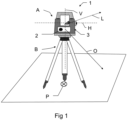
- Figure 1 shows a terrestrial surveying device of the generic type, which can be designed, for example, as a total station with scanning functionality or scanning module or, as shown, as a laser scanner 1, for recording (scanning) object surfaces from a stationing, with a position P and an alignment or orientation O, which can be determined by means of the method explained below.
- the device 1 has a radiation source (not shown), for example intensity-modulated, e.g. pulsed, such as a laser source, and an optics (not shown) such that a measuring beam L can be emitted into free space onto a target object in an emission direction, wherein the emission direction defines a measurement axis, and one or more position/angle detectors (not shown) measure the respective direction of the emission or the measurement axis in the internal reference system of the scanner 1 (i.e., relative to an internal zero direction).
- the optics are designed, for example, as a combined transmitting and receiving optics or have separate transmitting and receiving optics.
- Light pulses reflected from the target object are received by the measuring device 1 and detected by an optoelectronic detector (not shown). For example, up to one million or more light pulses per second, and thus sampling points 98, can be detected.
- the measuring radiation L or emission direction is continuously swiveled and measured and at least one measured value per object point is recorded successively at short time intervals, including in any case a distance value to the respective scan point in the internal reference system, so that a plurality of scan points is generated, which form a three-dimensional point cloud, a 3D image of the object or the measurement environment.
- Scan data is thus generated for each object point, which contains at least angle, direction, and distance information.
- the surveying device 1 has an electronic control system (not shown), which includes an evaluation function for measuring the respective distance value, e.g., according to the transit time principle (evaluation according to the time-of-flight method).
- the pivoting is carried out by means of a beam deflector 3, as shown, for example, by an attachment or upper part A of the measuring device 1 being rotated stepwise or continuously relative to a base B - relatively slowly - around a first, vertical axis V, so that the measuring radiation L is pivoted horizontally and the plurality of emission directions differ from one another in their horizontal alignment, and by a pivotable optical component, e.g., a pivoting or rotating mirror, being rotated relatively quickly around a horizontal axis H, so that the measuring radiation L is pivoted vertically and the plurality of emission directions additionally differ from one another in their vertical alignment.
- a pivotable optical component e.g., a pivoting or rotating mirror
- Scanning takes place within a predetermined angular range, the limits of which are defined by a horizontal and vertical pivoting width.
- the angular range is 360° horizontally and 270° vertically, for example, so that a spherical scanning area which maps almost the entire surrounding area in all spatial directions.
- any other angular ranges are also possible.
- the vertical resolution is not achieved by an additional rotation axis, but rather by several simultaneously operating transmitting and receiving units that have a certain constant angular offset in the vertical direction.
- the laser scanner 1 has at least one image camera 2, with which optical images of the object or the measurement environment can be captured, preferably color images in RGB format.
- a (2D) panoramic image can be generated using the camera 2.
- a panoramic image can be generated, for example, by capturing and combining multiple images while pivoting the pivoting device 3 through 360°.
- the laser scanner 1 has multiple cameras 2 directed in different viewing directions, the respective images of which can be combined to form a panoramic image.
- a georeferenced 3D scan panoramic image which according to the invention serves as a basis for subsequent position and orientation determination during re-stationing, is created by combining the result of the 360° scan or the generated 3D point cloud and the camera-based 360° (2D) panoramic image of a georeferenced stationing, so that a 3D scan panoramic image or a textured 3D point cloud is created, whereby optionally, for example, a brightness or intensity value (e.g. a grayscale value) of the measuring radiation L itself is recorded during scanning and taken into account when creating the image.
- a brightness or intensity value e.g. a grayscale value
- the Figure 2 shows an example of a 3D scanned panoramic image 4.
- panoramic image 4 is saved as a so-called cube map, i.e., as a cube representation with six partial images, for example, partial image C1 or D1.
- the six partial images represent the forward, backward, right, left, top, and bottom views.
- Alternative examples of image formats or such image maps are spherical or dome views or projections.
- the cube representation is preferably distortion-free, so that a geometrically correct representation of the scan and image data is achieved.
- the 3D scan panoramic image 4 is divided into the color image portion C obtained by the camera (in the Figure 2 above) and the 3D component D obtained by scanning (in the figure below).
- the respective cube surfaces belong together, for example, the cube surface C1 of the color component and the cube surface D1 of the 3D component.
- the 3D scan panoramic image 4 is described by four image channels: red, green, blue (C), and depth (D). Such a 4-channel image format can be stored and processed with comparatively little effort.
- Such a 3D scan panoramic image 4 thus represents an information-rich image of measuring objects or an information-rich panoramic view of a measuring environment, which not only provides optical image data, but also location- or point-accurately linked distance data, which also provides automatic and immediate scaling.
- Such a 3D scan panoramic image 4 or a set of such images thus also represents a very "powerful" referencing library, which, as shown below, is advantageously used to determine the position and orientation of a scanning surveying device at an unknown, new location or during re-stationing.
- Figure 3 shows a measurement environment 100, e.g., a building complex or a factory site. Further examples of such a connected environmental area are industrial facilities such as refineries or factory halls, a demarcated terrain, or even a single building or a single floor.
- the building complex 100 is scanned from three locations S1-S3 as described above, with panoramic images being taken in each case using the camera of the laser scanner 1.
- 3D scan panoramic images are generated as described, so that in the example, three 3D scan panoramic images 4a-4c are available, which are stored, for example, in a database.
- the 3D scanned panoramic images 4a-4c are also georeferenced, i.e., they are related to an external coordinate system.
- the referenced coordinate system can be a local system, which is defined, for example, by the setup/stationing of the laser scanner 1, or a global, higher-level system, e.g., a geodetic coordinate system such as WGS 84.
- This georeferencing can be carried out using methods known from the state of the art for a Locations S1-S3 are performed by scanning several known reference objects in the measurement environment 100.
- a method is proposed that optimally utilizes the information obtained from the 3D scanned panoramic images and the georeference of existing locations (reference locations) to determine the position and orientation of the laser scanner 1 at a new location or upon re-stationing in a measurement environment 100. This is described with reference to the following figures.
- Figure 4 shows a bird's eye view of a measurement environment 100. It shows the three reference locations S1-S3, to which the three stored georeferenced 3D scan panoramic images 4a-4c belong. These are panoramic images (360°), form an image reference set for the measurement environment 100, and can be retrieved from the laser scanner, for example, in a database via WLAN, etc.
- the laser scanner is now positioned at the new or to-be-determined location S, which will serve as the stationing point for a subsequent scan.
- a 360° panoramic image I is captured in this position and orientation using the device camera.
- the panoramic image I can be a monochrome image (1-channel) or, by performing an on-site scan S1 and combining the scan data with the camera image data, a 3D scan panoramic image (RGBD image).
- the current panoramic image is an image that—in contrast to the 3D scan panoramic image— not a full circle, but "only" a large viewing or image angle of at least 90° (e.g., 180°), or at least in the form of a super-wide-angle image with a typically 92°-122° diagonal image angle or similar.
- camera 2 for example, has a correspondingly wide field of view, e.g., using a super-wide-angle lens or fisheye lens, or the current image is composed of several individual images taken from different viewing directions.
- panoramic images 4a-4 as a comparison/referencing basis — i.e., panoramic images with depth information — allows the effort required to create data to be compared (on-site image or live image) and the requirements for the data to be referenced to be minimized to a large extent.
- the current camera image I is matched with the set of stored 3D scan images 4a-4c.
- image matching can be used to identify one or more of the stored 3D scan images 4a-4c that have matching surrounding object points P1, P2, P3.
- the matching of the 3D scan images 4a-4c with the panoramic image I can be based, for example, on "classic" feature or keypoint matching, in particular by applying a bag-of-words approach.
- machine or deep learning is used, in particular to learn a latent representation of the image or the image features, e.g., an encoding.
- An image is the input for a neural network, which delivers a so-called encoding (vector with n elements) as output.
- Image similarity is determined based on the difference between the respective vectors/encoding. A match exists if the difference is small.
- image similarity can be determined using a so-called Siamese network, in which the images are the input and a similarity measure is the output.
- At least one of the stored images 4a-4c is determined which is similar or has corresponding object points P1, P2, P3.
- the identification of matching points P1, P2, P3 can be based on feature matching, e.g. by applying a SIFT, SURF, ORB and/or FAST algorithm and/or on a deep learning based feature encoding.
- the aforementioned image encoding vectors or also enlargements/reductions (thumbnails) of the images 4a-4c or I used optionally form the image pool for matching instead of the "original" image files.
- the use of Downscaled or coarsened image representations have the advantage of a smaller data volume, which enables faster data transfer and/or processing.
- This smaller data volume is utilized, for example, by storing the database of 3D scan panoramic images in the memory of the surveying device in the form of small image files, and by storing the uncompressed reference images (only) on an external storage device (so that a relatively small amount of storage space on the device itself is sufficient), from which individual matched images (based on the small 3D scan panoramic images) are then downloaded in their original format/size.
- the matching can also be performed as a multi-stage process, first using such small-format images to make an initial selection from the stored 3D panoramic images (4a-c). Then, using the complete, uncompressed 3D panoramic images (4a-c) of the selection, a further matching is performed, eliminating mismatches. In other words, an initial coarse matching is performed with the entire set of reduced-size images to create a subset of preselected images, followed by a fine matching with the "original" images of this subset.
- two images 4a, 4b are identified which have matching object points P1, P2, P3.
- the image matching is carried out as described above, e.g. via image encoding, and thus corresponding object points P1, P2, P3 have not already been determined by or for the image matching, the corresponding object points P1, P2, P3 are determined - e.g. by means of Feature matching - as an additional step (only) for the images 4a, 4b that have already been identified as matching.
- the matches between images 4a, 4b and the captured image I are found, for example, using a Siamese network, matching points P1-P3 between the matched images 4a and I or image 4b and I are identified based on feature detection and matching.
- the matching object points P1-P3 are then used to calculate position and orientation at location S as described below.
- Figure 6 schematically shows the current location S with the 2D panoramic image I recorded there, as well as the two reference locations S1 and S2, for which the reference 3D scan panoramic images 4a and 4b are available. Also shown are object points P1-P3 corresponding to the current image I, with the reference image 4a having three object points P1-P3 corresponding to the current image I, and the reference image 4b having one point P1.
- the 3D coordinates of all object points P1-P3 can be determined from the respective image data. For example, the horizontal and vertical angles are calculated from the position of a respective point P1-P3 in image 4a. Together with the distance value from the depth channel and taking into account the position and orientation of image 4a, the (georeferenced) 3D coordinates (X, Y, Z) of the respective point P1-P3 are then calculated (in the Figure 6 indicated by the arrows 5).
- the respective georeferenced 3D point coordinates can be determined, for example, by looking up a table in which, for example, the 3D coordinates are assigned to a respective image point.
- the position and orientation of the laser scanner are then calculated. This calculation is performed, for example, by backslicing, as shown in the Figure 6 indicated by arrows 6.
- the position and orientation of the laser scanner or location S are determined only using the one reference S1, without using the also identified second 3D scan image 4b of the further reference location S2.
- all identified 3D scan panoramic images 4a, 4b or the available corresponding points P1-P3 of all identified reference images 4a, 4b are used for the position or orientation calculation, for example, up to a defined maximum number.
- the number of 3D scan panoramic images 4a, 4b or references S1, S2 used for location calculation is automatically adjusted depending on the situation.
- the current location S is close to the reference location S1.
- a comparatively large number of matching points is determined, e.g., one hundred or more points, especially since panoramic images are available from both locations S, S1.
- the large number of points, of which three P1-P3 are shown as examples, allows already a robust and accurate calculation of the current position and orientation, especially since points can be selected whose 3D coordinates are significantly different.
- One advantage of automatically adapting the reference data set used for location determination to the circumstances or requirements is that the effort is optimally adjusted. In other words, this ensures that as much (process) effort is expended as necessary, while at the same time as little as possible (which is particularly advantageous for mobile devices such as laser scanners with limited electrical and computing capacity).
- Exactly as many 3D scan panoramic images are used as required given the measurement situation.
- the process can be adapted to whether the position and orientation of the scanner takes place in narrow, winding spaces or in open, spacious halls or open terrain.
- the Figure 7 explains the procedure with the automatic adjustment of the number of stored 3D scan panoramic images to be used for location determination to the current measurement situation, as described above.
- a panoramic image is captured at the current location to be determined, with the current position and current orientation.
- this captured panoramic image is matched with the set of stored 3D scan panoramic images 4.
- several of the stored 3D scan panoramic images are identified (step 9) that have matching points or image features to the captured image.
- step 10 the number of reference images to be used for the actual position determination is determined based on a given first criterion K1 as an adaptation to the specific measurement situation.
- Criterion K1 is a measure of the similarity of the current panoramic image to one or more of the stored panoramic images. If, for example, a high degree of similarity is determined, the number of reference images used for location determination is kept small, e.g., limited to one image. If, on the other hand, a low degree of similarity is determined, a comparatively large number of reference images is used, e.g., the maximum available number of matches.
- the similarity measure is based, for example, on the number of corresponding object points in a respective reference image that match the captured image.
- the type of matching features is used as a criterion to determine similarity.
- image descriptors that describe, for example, dominant lines in the image can be used.
- a measure of similarity can also be determined based on properties that describe the respective images as a whole or statistical image properties, e.g., grayscale or color histograms or gradients or functions of brightness or surface normals.
- the similarity measure K1 can be based on a deep-learning-based encoding of the image or on a similarity measure determined using a Siamese network.
- Such a similarity measure K1 - or, seen the other way around, a difference measure - can also be a measure for a Difference in position between the current location and the reference position.
- the similarity measure K1 is then specified in such a way that it can be used to at least roughly classify whether the current location is close to a (respective) reference location or not. If proximity is present, the number of 3D scan images to be used can be limited; for example, only the image (or the associated identified 3D point coordinates) of the nearby reference location can be used to calculate the location. If, on the other hand, the similarity measure K1 determines that no nearby reference location is available, the number of reference images to be used is set to 3, 5, or 10, for example.
- step 11 After adapting the number of reference images in step 10, in step 11 the position and orientation of the current stationing is calculated as described above based on the 3D coordinates of the object points of the selected reference image(s) and their positions in the images and the process is terminated (step 13; for step 12 see below).
- an adaptation criterion K1 is a property of the location environment, i.e., a criterion K1 that describes a condition of the measurement environment.
- the distance to object points is checked (e.g., the shortest measured distance or an average distance), and for large distances, a larger number of reference images is set than for short distances.
- the distances to the scan points or scan objects can, for example, be an indicator of whether the measurement environment is open terrain or a wide space where a relatively large number of identified images are possible or necessary for referencing; or whether The terrain is complex or the space is narrow, requiring only a few images for reference.
- the characteristics of the respective site environment may already be connoted in a respective 3D scanned panoramic image and be directly accessible, e.g., as metadata.
- Distances to object points can also be related to the current location and, for example, taken into account after calculating the current position and orientation, so that an adaptation of the number of reference images may only take place after step 11 if it is determined based on criterion K1 that an optimal result with regard to the nature of the measurement environment is only possible with an increased number of reference images.
- Such a regulation of the number of reference images, which is used for location calculation, can - as in the Figure 7 shown - optionally also based on a further criterion K2.
- a further criterion K2 is, for example, a measure of the precision of the position and/or orientation calculated in step 11. If it is determined that the accuracy does not meet criterion K2 (step 12), the system goes back to step 10 and increases the number of images to be used, thus adjusting it. With this option, at least a second 3D scan panoramic image is used if necessary. If the current location is determined with sufficient precision based on the use of another reference location or additional 3D object point coordinates, the location determination process is terminated with step 13, so that, for example, A scan can then be carried out automatically from the now known location.
- Figure 8 shows a further development of the method according to the invention.
- a 3D scan panoramic image 4a identified for location S is used as a starting point to register a point cloud PC at a further location S' by means of a SLAM process (Simultaneous Localization And Mapping).
- the laser scanner 1 is moved from the current location S, for which at least one 3D scan panoramic image 4a has been identified as described above, along a path (symbolized by arrow 15) to the further location S'.
- a series of images 14 are recorded using the camera 2 of the surveying device 1, e.g., by continuous photography or in the form of a video.
- the 3D scan panoramic image 4a is integrated as part of the image series 14.
- the image data of the image series 14 are processed in a manner known per se using a SLAM algorithm in such a way that a spatial link is created between them, whereby - starting from the 3D scan panoramic image 4a as the starting image - the last image taken at the further location S' can finally be put into spatial relation (position and orientation) to the starting image 4a.
- points P1-P3 of the 3D scan panoramic image 4a which are also detected in the first subsequent camera image, are used for the SLAM process, as well as points V1-V3, which correspond in subsequent images, and finally points C1-C3.
- points C1-C3 in addition to correspondences within the image series 14, also have correspondences in the point cloud PC, which is recorded at location S'—in addition to the camera image—by means of a scan (symbolized by lines 16).
- the point cloud PC can ultimately also be spatially related to the 3D scanned panoramic image 4a or registered relative to it.
- a 3D scan panoramic image 4a simultaneously and linked contains a camera image and a 3D point cloud is therefore advantageously used to register two point clouds by using the camera image in a SLAM process as the first "pillar" of a "bridge” (image series 14), with which the new point cloud PC is connected to the known 3D point cloud of the 3D scan panoramic image 4a created by some previous scan.
- the correspondences between the images of image series 14, including the 3D scan panorama image 4a are determined, for example, using feature matching.
- the assignment of points C1-C3 of the point cloud PC to the camera image of the last image series can also be performed more simply without image matching, if camera 2 is calibrated to the scan module of surveying device 1, which is usually the case.
Landscapes
- Engineering & Computer Science (AREA)
- Physics & Mathematics (AREA)
- General Physics & Mathematics (AREA)
- Radar, Positioning & Navigation (AREA)
- Remote Sensing (AREA)
- Theoretical Computer Science (AREA)
- Multimedia (AREA)
- Computer Vision & Pattern Recognition (AREA)
- Automation & Control Theory (AREA)
- Length Measuring Devices By Optical Means (AREA)
- Image Processing (AREA)
Description
- Die Erfindung betrifft ein Positions- und Orientierungsbestimmungsverfahren für ein terrestrisches Vermessungsgerät mit Scanfunktionalität nach Anspruchs 1, ein ebensolches Vermessungsgerät nach Anspruch 14 und ein ebensolches Computerprogrammprodukt nach Anspruch 15.
- 3D-Scannen ist eine sehr wirkungsvolle Technologie um innerhalb von Minuten oder Sekunden Millionen von räumlichen Messpunkten von Objekten zu produzieren. Typische Messaufgaben sind die Aufnahme von Objekten bzw. deren Oberflächen wie Industrieanlagen, Häuserfassaden oder historischen Gebäuden aber auch von Unfallorten und Verbrechensszenen. Vermessungsgeräte mit Scanfunktionalität sind beispielsweise Laserscanner wie der Leica P20 oder eine Total- oder Multistation wie z.B. die Leica Multi Station 50, welche verwendet werden, um 3D-Koordinaten von Oberflächen zu messen bzw. zu erstellen. Zu diesem Zweck müssen sie in der Lage sein, den Messstrahl einer Entfernungsmessvorrichtung über eine Oberfläche zu führen und dabei gleichzeitig Richtung und Entfernung zum Messpunkt zu erfassen. Aus der Entfernung und der damit korrelierten Richtungsinformation für jeden Punkt wird mittels Datenverarbeitung eine sogenannte 3D-Punktwolke generiert.
- Vom prinzipiellen Aufbau her sind derartige terrestrische Scanner also ausgebildet, um mit einem, meist elektrooptischen und laserbasierten, Entfernungsmesser eine Distanz zu einem Objektpunkt als Messpunkt zu erfassen. Eine ebenfalls vorhandene Richtungs-Ablenkeinheit ist dabei derart ausgebildet, dass der Messstrahl des Entfernungsmessers in zumindest zwei unabhängige Raumrichtungen abgelenkt wird, wodurch ein räumlicher Messbereich aufgenommen werden kann.
- Der Entfernungsmesser kann beispielsweise nach den Prinzipien der Time-Of-Flight- (TOF), Phasen-, Wave-Form-Digitizer- (WFD) oder interferometrischen Messung ausgeführt sein. Für schnelle und genaue Scanner ist insbesondere eine kurze Messzeit bei gleichzeitig hoher Messgenauigkeit gefordert, beispielsweise eine Distanzgenauigkeit im µm-Bereich oder darunter bei Messzeiten der Einzelpunkte im Bereich von Sub-Mikrosekunden bis Millisekunden. Der Messbereich reicht dabei von wenigen Zentimetern bis hin zu einigen Kilometern.
- Die Ablenkeinheit kann in Form eines bewegten Spiegels oder alternativ auch durch andere, zur gesteuerten Winkelablenkung von optischer Strahlung geeignete Elemente, wie beispielsweise verdrehbare Prismen, bewegliche Lichtleiter, verformbare optische Komponenten etc. realisiert werden. Die Messung erfolgt meist unter Bestimmung von Entfernung und Winkeln, also in Kugelkoordinaten, welche zur Darstellung und Weiterverarbeitung auch in kartesische Koordinaten transformiert werden können.
- Um die gemessenen Objektpunktkoordinaten in Bezug zu einem bekannten Referenzkoordinatensystem zu setzen oder anders gesagt, absolute Punktkoordinaten zu erhalten, muss der Standort des Vermessungsgeräts absolut bekannt sein. Grundsätzlich können die Stationskoordinaten des Vermessungsgeräts vor Ort als sogenannte freie Stationierung durch Erfassen von bereits absolut referenzierten Punkten ermittelt werden. Beispielsweise werden mehrere in der Messumgebung vorhandene Zielpunkte bekannter Position beim Scan erfasst, wodurch auch die Orientierung oder Ausrichtung des Geräts ermittelbar ist. Eine derartige Referenzierung erfordert jedoch üblicherweise zumindest eine teilweise manuelle Durchführung, was zeitaufwändig und fehleranfällig ist.
- Die Live-Position des Vermessungsgeräts ist alternativ mittels einen am Vermessungsgerät angebrachten GNSS-Empfänger über einzelne Satelliten als Referenzpunkte bestimmbar. Nachteilig ist allerdings das geringere Auflösungsvermögen, insbesondere hinsichtlich der Höhenbestimmung, verglichen mit einer Referenzierung mittels geodätischer Vermessung. Zudem ist eine Bestimmung der Ausrichtung des Scanners nur mit mehreren Empfängern möglich und dies zudem mit noch geringerem Auflösungsvermögen. Vor allem ist der Vorgang an den Empfang von GNSS-Signalen gebunden, der vor allem im Innenbereich oder in engen, verwinkelten Messumgebungen kaum oder nicht gegeben ist.
- Auch sind bildbasierte Referenzierungsverfahren bekannt. Die
EP 2199828 A2 beispielsweise schlägt ein Verfahren im Rahmen von Mobile Scanning vor, mit welchem aus zwei unter verschiedenen Winkelstellungen aufgenommenen 3D-Abbildern eines Umgebungsbereichs die Lage des Vermessungsgeräts relativ zu einem (Bewegungs-)Referenzsystem bestimmt wird. Nachteilig hierbei ist jedoch, dass mit dem Erstellen von mindestens zwei 3D-Abbildern aus unterschiedlichen Winkelstellungen immer noch ein recht hoher Aufwand vonnöten ist. - In der
DE 102013110581 A1 wird ein gattungsgemässer Laserscanner beschrieben, der zum Zwecke der Verfolgung eines Positionswechsels zwischen zwei Messungen in einer Messumgebung eine Inertialmesseinheit (IMU) aufweist. Nachteilig an dieser Lösung sind die Notwendigkeit, eine entsprechend empfindliche Inertialmesseinheit in den Laserscanner einzubauen, sowie die Einschränkung, dass damit nur der zeitlich unterbrechungsfreie Wechsel zwischen zwei Standorten verfolgt werden können, nicht jedoch eine Bestimmung der aktuellen Position in der Messumgebung, wenn z.B. nach einer längeren Zeit wie Stunden, Tage, Wochen oder länger erneut in der Messumgebung ein Scannen erfolgen soll. - Die
US 2016/0187130 A1 offenbart ein Verfahren zum präzisen Bestimmen des Positionsversatzes und Orientierungsversatzes einer zweiten Stationierung zu einer ersten Stationierung eines Vermessungsgeräts anhand von abbildbasiert bestimmten Richtungen und einer laseroptisch gemessenen Entfernung zu Messumgebungspunkten, welche sowohl in einem zweiten als auch in einem ersten Umgebungsabbild der Messumgebung abgebildet sind. - Die
US 2016/146604 A1 lehrt ein Verfahren zum Bestimmen der Positionsdaten eines Vermessungsgeräts durch Abgleichen einer aus den Daten eines Abbildes der Umgebung der Vermessungsgerätposition extrahierten Bezugsdatenmenge mit positionsreferenzierten Datenmengen und Ermitteln der Positionsdaten anhand von Positionsreferenz derjenigen ausgewählten positionsreferenzierten Datenmenge, die ein vergleichsweise bedeutendes Mass an Übereinstimmung mit der Bezugsdatenmenge aufweist. - Die
US 2017/301132 A1 betrifft ein Verfahren zum Rendern von 3D-Laserscandaten mit sog. cube maps. - Die
US 2018/158200 A1 offenbart ein Punktwolkenregistrierungsverfahren unter Verwendung eines SLAM-Prozesses. - Die Aufgabe der vorliegenden Erfindung besteht daher in der Bereitstellung eines vereinfachten, vollautomatischen Positionsbestimmungsverfahrens für ein terrestrisches Scan-Vermessungsgerät.
- Diese Aufgabe wird erfindungsgemäss durch die kennzeichnenden Merkmale der unabhängigen Ansprüche oder durch Merkmale der abhängigen Ansprüche gelöst bzw. diese Lösungen weitergebildet.
- Die vorliegende Erfindung betrifft ein vollautomatisches Verfahren zum Bestimmen der aktuellen georeferenzierten Position und Ausrichtung eines terrestrischen Vermessungsgeräts mit Scanfunktionalität am aktuellen Standort anhand eines Satzes von hinterlegten georeferenzierten 3D-Scan-Panoramabildern, also von Panoramabildern, die mittels Scan auch 3D-Koordinatendaten repräsentieren. Die 3D-Scan-Panoramabildern sind beispielsweise in einem Computerspeicher des Vermessungsgeräts selbst hinterlegt oder auf einem externen Speichermedium, -z.B. einer Cloud- von welchem sie vom Vermessungsgerät beispielsweise mittels Bluetooth, Internet oder WLAN abgerufen werden. Die Durchführung des Verfahrens erfolgt vorzugsweise auf einem Rechner des Vermessungsgeräts selbst; das Prozessieren kann aber auch extern erfolgen, z.B. auf einem externen Computer oder in einer Cloud, von wo aus die berechneten Daten an das Vermessungsgerät übertragen werden.
- Das Verfahren beinhaltet ein Aufnehmen eines Panoramabilds mit dem Vermessungsgerät vom aktuellen Standort aus, wobei im aufgenommenen Panoramabild eine Vielzahl von Objektpunkten abgebildet ist. Ein Panoramabild kann dabei beispielsweise mittels eines Superweitwinkelobjektivs aufgenommen oder durch einen Rundumkameraschwenk erstellt bzw. aus mehreren in verschiedene Richtungen aufgenommenen Einzelbildern zusammengesetzt werden.
- Weiter erfolgt mittels image matching, beispielsweise mittels feature oder keypoint matching oder unter Anwendung von machine oder deep learning, ein Identifizieren wenigstens eines 3D-Scan-Panoromabilds mit zum aufgenommenen Panoramabild übereinstimmenden Objektpunkten. Übereinstimmenende Objektpunkte werden optional mittels feature matching-Algorithmen, insbesondere anhand von SIFT-, SURF-, ORB- oder FAST-Algorithmen, ermittelt.
- Als weiterer Schritt erfolgt ein Bestimmen (z.B. Abrufen oder Berechnen) der jeweiligen georeferenzierten 3D-Koordinaten der übereinstimmenden Objektpunkte anhand des identifizierten 3D-Scan-Panoramabilds und Berechnen, z.B. mittels Rückwärtsschnitt, der aktuellen georeferenzierten Position und Ausrichtung des Vermessungsgeräts anhand der Positionen der übereinstimmenden Objektpunkte im aufgenommenen Panoramabild und deren bestimmten georeferenzierten 3D-Koordinaten.
- Optional stellen die hinterlegten 3D-Scan-Panoramabilder in jeweilige 2D-Panoramabilder, beispielsweise Farbbilder mit einer "Auflösung" von 360*180 Pixeln, eingebettete oder verknüpfte 3D-Punktwolken dar, wobei die 2D-Panoramabilder auch als einzelne 2D-Bilder ausgebildet sein können, die z.B. mittels Stitching zusammengesetzt die Panoramaansicht ergeben. Alternativ oder zusätzlich sind die hinterlegten 3D-Scan-Panoramabilder in Form von Würfel- oder Kugelprojektionen, z.B. mit Farbkanal und kombiniertem Tiefenkanal, hinterlegt. Beim am aktuellen Standort aufgenommenen Panoramabild hingegen handelt es sich vorzugsweise um ein "einfaches" 2D-(Digitalkamera-)Bild, was eine vergleichsweise einfache, schnelle und unaufwändige Bildakquirierung mit dem Vermessungsgerät vor Ort ermöglicht.
- Bevorzugt handelt es sich bei dem Satz hinterlegter 3D-Scan-Panoramabilder um räumlich untereinander verknüpfte und einen zusammengehörigen/eine Einheit bildenden Umgebungsbereich darstellende Bilder, wobei es sich bei dem Umgebungsbereich z.B. um eine Industrieanlage, ein Gebäude oder einen Gebäudekomplex handelt. Der Satz der 3D-Scan-Panoramabilder stellt also eine zusammengehörige Sammlung von Referenzbildern dar, die alle auf eine bestimmte Umgebung oder ein bestimmtes Objekt bezogen sind, z.B. auf ein Werk, ein Gebäudecluster, ein Gebäudestockwerk oder ein zusammenhängendes Gelände. Die hinterlegten 3D-Panoramabilder sind beispielsweise aus einer -z.B. in einer Cloud hinterlegten- Datenbank abrufbar, welche spezifisch der vorliegenden Messumgebung bzw. dem vorliegenden Objekt zugeordnet ist.
- Als Option erfolgt im Rahmen des Verfahrens eine Bewegung des Vermessungsgeräts vom aktuellen Standort aus entlang eines Pfades zu einem weiteren Standort, wobei während der Bewegung mit dem Vermessungsgerät im Rahmen eines SLAM-Prozesses (Simultaneous Localization And Mapping) kontinuierlich eine Serie von Bildern aufgenommen wird, wobei das identifizierte 3D-Scan-Panoramabild als ein, insbesondere erstes, Bild der Bilderserie herangezogen wird, Fertigstellen des SLAM Prozesses am weiteren Standort durch Aufnehmen eines letzten Bilds der Bilderserie, Aufnehmen einer 3D-Punktwolke am weiteren Standort und Registrieren der 3D-Punktwolke basierend auf dem SLAM Prozess relativ zum identifizierten 3D-Scan-Panoramabild. Es wird also die Punktwolke, welche an einer weiteren Stationierung durch Laserscan erzeugt wird, unter Verwendung von mittels eines SLAM-Algorithmus verknüpften Kamerabildern zum 3D-Scan-Panoramabild registriert. Das Heranziehen des 3D-Scan-Panoramabilds im Rahmen des SLAM-Prozesses bietet dabei u.a. den Vorteil, dass von vorneherein mit 3D-Daten verknüpfte Bildpunkte vorliegen.
- In einer Fortbildung des Verfahrens wird die Anzahl der zur Standortbestimmung heranzuziehenden hinterlegten (und identifizierten) 3D-Scan-Panoromabilder an die vorliegende Messsituation angepasst.
- Optional wird im Rahmen der Anpassung die Anzahl der zur Standortbestimmung heranzuziehenden hinterlegten 3D-Scan-Panoromabilder eingestellt abhängig von einem Ähnlichkeitsmass zwischen aufgenommenem Panoramabild und identifiziertem 3D-Scan-Panoromabild, wobei das Ähnlichkeitsmass auf einer Zahl an übereinstimmenden Objektpunkten basieren kann. Das Ähnlichkeitsmass stellt beispielsweise ein Mass für einen Lageunterschied zwischen aktuellem Standort und Aufnahmestandort des identifizierten 3D-Scan-Panoromabilds dar.
- Als weitere Option wird im Rahmen der situativen Anpassung die Anzahl der zur Standortbestimmung heranzuziehenden hinterlegten 3D-Scan-Panoromabilder eingestellt abhängig von einer anhand des aufgenommenen Panoramabilds bestimmten Beschaffenheit der Umgebung des Standorts, insbesondere eine Mindestdistanz oder mittlere Distanz zu Objektpunkten.
- Optional wird im Rahmen der Anpassung die Anzahl der zur Standortbestimmung heranzuziehenden hinterlegten 3D-Scan-Panoromabilder eingestellt abhängig von einem gewünschten Präzisionsmass für den aktuellen Standort. Die Anzahl der Referenzbilder, auf der die Positions- bzw. Ausrichtungsbestimmung basiert, wird also an ein gefordertes Genauigkeitslevel angepasst.
- Die Erfindung betrifft weiter ein terrestrisches Vermessungsgerät mit Scanfunktionalität mit einer Steuer- und Auswerteeinheit welche derart ausgebildet ist, dass damit das erfindungsgemässe Verfahren ausführbar ist.
- Zudem betrifft die Erfindung ein Computerprogrammprodukt, das auf einem maschinenlesbaren Träger, insbesondere eines terrestrischen Vermessungsgeräts mit Scanfunktionalität, gespeichert ist, oder Computer-Datensignal, verkörpert durch eine elektromagnetische Welle, mit Programmcode, der geeignet ist zur Durchführung des erfindungsgemässen Verfahrens.
- Das erfindungsgemässe Verfahren bietet den Vorteil eines einfachen Verfahrens, mit dem vollautomatisch direkt am Standort, in Echtzeit und bereits vor Start des eigentlichen Scanvorgangs Position und Orientierung eines scannenden Vermessungsgeräts bei Neustationierung in einer bereits wenigstens zum Teil scantechnisch erfassten Messumgebung bestimmt werden kann. Beispielsweise ist mittels des Verfahrens ermöglicht, den eigenen Standort zu berechnen, lediglich anhand eines, z.B. mit einer gewöhnlichen Digitalkamera des Scanners vor Ort aufgenommenen Panoramabilds. Damit ist u.a. eine Staffelung von Setups noch vor Ort auch bei Unterbrechung der Messtätigkeit zwischen zwei Setups möglich. Auch ist vorteilhaft eine genaue Standortbestimmung im Innern von Gebäuden oder z.B. in Tunneln möglich.
- Der Aufwand vor Ort kann dabei insbesondere dadurch gering gehalten werden, dass mit den georeferenzierten 3D-Scan-Panoramabildern eine besonders reichhaltige Datenquelle "angezapft" wird, welche bereits auf Grundlage eines einfachen Live-Bilds, wie z.B. ein digitales Kamera-Panoramabild, ein robustes und durch Berechnen präzises Ermitteln der aktuellen Position und zudem noch der Ausrichtung ermöglicht. Mit anderen Worten ist die Daten-"Last" in die heranzuziehende Datenbank verlagert und mit dem Laserscanner selbst muss vorteilhaft nur noch ein "light"-Bild der Messumgebung aufgenommen werden.
- Aufgrund der vorhandenen dreidimensionalen Punktdaten ist dabei von vorneherein eine Skalierung gegeben oder bereitgestellt, wodurch vorteilhaft auch kein zusätzlicher Aufwand zur Ermittlung eines Skalierungsfaktors, z.B. durch Vermessen, Scannen oder Erfassen eines Objekts bekannter Grösse (z.B. eine Messlatte), erforderlich ist.
- Mittels der Option der ebenfalls vollautomatischen Anpassung des Verfahrens an die konkret vorliegende Messsituation, z.B. Genauigkeitserfordernisse, Art der Messumgebung oder Nähe zu einem Referenzstandort, kann das Verfahren auf den tatsächlichen Bedarf zugeschnitten werden. Dadurch ergibt sich eine massgeschneiderte Optimierung des Prozessaufwands und -ergebnisses, ohne dass hierbei Benutzereingriffe notwendig wären. Beispielsweise lässt sich damit das Verfahren so schlank wie möglich halten.
- Das erfindungsgemässe Positions- und Ausrichtungsbestimmungsverfahren sowie der erfindungsgemässe Scanner werden nachfolgend anhand von in der Zeichnung schematisch dargestellten Ausführungsbeispielen rein beispielhaft näher beschrieben.
- Im Einzelnen zeigen
- Fig.1
- ein terrestrisches gattungsgemässen Vermessungsgerät, ausgebildet als Laserscanner,
- Fig.2
- ein Beispiel für ein erfindungsgemässes 3D-Scan-Panoramabild,
- Fig.3
- ein Beispiel für Anwendung des erfindungsgemässen Verfahrens in einer Messumgebung,
- Fig.4
- ein weiteres Beispiel für Anwendung des erfindungsgemässen Verfahrens in einer Messumgebung,
- Fig.5
- ein Beispiel für einen weiteren Verlauf erfindungsgemässen Verfahrens,
- Fig.6
- ein weiteres Beispiel für einen weiteren Verlauf erfindungsgemässen Verfahrens,
- Fig.7
- ein schematisches Beispiel für eine erfindungsgemässe Fortbildung des Verfahrens, und
- Fig. 8
- ein Beispiel für eine Fortbildung des erfindungsgemässen Verfahrens zur Registrierung einer Punktwolke an einem weiteren Standort.
-
Figur 1 zeigt einen terrestrisches gattungsgemässes Vermessungsgerät, welches ausgebildet sein kann z.B. als Totalstation mit Scanfunktionalität bzw. Scanmodul oder wie dargestellt als Laserscanner 1, zum Aufnehmen (Scannen) von Objektoberflächen von einer Stationierung aus, mit einer Position P und einer Ausrichtung oder Orientierung O, welche mittels des weiter unten erläuterten Verfahrens bestimmt werden können. - Das Gerät 1 weist eine, beispielsweise intensitätsmodulierte, z.B. gepulste, Strahlungsquelle auf (nicht dargestellt), z.B. eine Laserquelle, und eine Optik (nicht dargestellt), so dass ein Messstrahls L in den freien Raum auf ein Zielobjekt in eine Emissionsrichtung emittierbar ist, wobei die Emissionsrichtung eine Messachse definiert und durch einen oder mehrere Positions-/Winkeldetektoren (nicht dargestellt) die jeweils vorliegende Richtung der Emission bzw. der Messachse im internen Bezugssystem des Scanners 1 gemessen wird (also relativ zu einer internen Nullrichtung). Die Optik ist beispielsweise als eine kombinierte Sende- und Empfangsoptik ausgeführt oder weist je eine separate Sendeoptik und Empfangsoptik auf. Hierbei werden vom Zielobjekt reflektierte Lichtpulse vom Vermessungsgerät 1 empfangen und von einem opto-elektronischen Detektor (nicht dargestellt) erfasst. Hierbei können beispielsweise bis zu einer Million oder mehr Lichtpulse pro Sekunde und damit Abtastpunkte 98 erfasst werden.
- Zum scannenden Abtasten des Objekts wird die Messstrahlung L bzw. Emissionsrichtung fortlaufend verschwenkt und gemessen sowie sukzessive in kurzen Zeitabständen jeweils wenigstens ein Messwert pro Objektpunkt aufgenommen, darunter jedenfalls ein Entfernungswert zum jeweiligen Scanpunkt im internen Bezugssystem, so dass eine Vielzahl von Scanpunkten erzeugt wird, welche als dreidimensionale Punktwolke ein 3D-Abbild des Objekts bzw. der Messumgebung bilden. Es werden also zu einem jeweiligen Objektpunkt Scandaten generiert, welche zumindest Winkel- bzw. Richtungs- und Distanzinformation enthalten. Zum Messen des Entfernungswerts weist das Vermessungsgerät 1 eine elektronische Steuerung auf (nicht dargestellt), welche eine Auswertefunktionalität umfasst zur Messung des jeweiligen Entfernungswerts z.B. nach dem Laufzeitprinzip (Auswertung nach der Time-of-Flight-Methode).
- Das Verschwenken erfolgt dabei mittels eines Strahlumlenkers 3, wie dargestellt beispielsweise, indem ein Aufsatz- oder Oberteil A des Vermessungsgeräts 1 gegenüber einer Basis B - relativ langsam- um eine erste, vertikale Achse V schrittweise oder kontinuierlich rotiert wird, so dass die Messstrahlung L in der Horizontalen verschwenkt wird und sich die Vielzahl von Emissionsrichtungen untereinander in der horizontalen Ausrichtung unterscheiden, und indem ein verschwenkbares optisches Bauteil, z.B. ein Schwenk- oder Drehspiegel, -relativ schnell- um eine horizontale Achse H rotiert wird, so dass die Messstrahlung L in der Vertikalen verschwenkt wird und sich die Vielzahl von Emissionsrichtungen untereinander zusätzlich in der vertikalen Ausrichtung unterscheiden. Dadurch wird die Objektoberfläche z.B. mit einem Linienraster zeilenweise gescannt. Das Scannen erfolgt innerhalb eines vorbestimmten Winkelbereichs, dessen Grenzen durch eine horizontale und vertikale Verschwenkungsbreite festgelegt ist. Dabei beträgt der Winkelbereich in der Horizontalen 360°, und in der Vertikalen z.B. 270°, so dass ein kugelförmiger Scanbereich vorliegt, welcher beinahe den gesamten Umgebungsbereich in alle Raumrichtungen abbildet. Es sind aber auch beliebige andere Winkelbereiche möglich. Ebenso gibt es Realisierungsformen bei der die vertikale Auflösung nicht durch eine zusätzliche Drehachse realisiert wird, sondern durch mehrere, simultan arbeitende Sende- und Empfangseinheiten, die einen bestimmten konstanten Winkelversatz in vertikaler Richtung besitzen.
- Daneben weist der Laserscanner 1 wenigstens eine Bildkamera 2 auf, mit der optische Bilder des Objekts bzw. der Messumgebung aufgenommen werden können, vorzugsweise Farbbilder im RGB-Format. Mittels der Kamera 2 ist ein (2D-)Panoramabild erzeugbar. Ein Panoramabild kann z.B. erzeugt werden, indem mehrere Bilder bei Verschwenken mit der Verschwenkvorrichtung 3 um 360° aufgenommen und zusammengefügt werden. Alternativ weist der Laserscanner 1 mehrere in verschiedene Blickrichtungen ausgerichtete Kameras 2 auf, deren jeweilige Bilder zu einem Panoramabild zusammensetzbar sind.
- Ein georeferenziertes 3D-Scan-Panoramabild, welches erfindungsgemäss für nachfolgende Positions- und Ausrichtungsbestimmung bei Neustationierung als Grundlage dient, entsteht dadurch, dass das Ergebnis des 360°-Scans bzw. die erzeugte 3D-Punktwolke und das kamerabasierte 360°-(2D-)Panoramabild einer georeferenzierten Stationierung kombiniert werden, so dass ein 3D-Scan-Panoramabild oder eine texturierte 3D-Punktwolke entsteht, wobei optional auch beispielsweise ein Helligkeits- oder Intensitätswert (z.B. ein Graustufenwert) der Messstrahlung L selbst beim Scannen aufgenommen und bei der Bilderstellung berücksichtigt wird. Durch das punktgetreue Verknüpfen der Kamerabilddaten und der Scandaten liegt somit also ein dreidimensionales Abbild des Objekts vor, das zusätzlich auch Farbinformation über das Objekt beinhaltet bzw. ein Panoramabild, welches mittels der Scandaten zusätzlich Tiefeninformation aufweist. Durch Verknüpfen des 3D-Scan-Panoramabilds mit einer Rauminformation, also durch Vorliegen eines Ortsbezugs liegt zudem eine Georeferenz vor.
- Die
Figur 2 zeigt ein Beispiel für ein 3D-Scan-Panoramabild 4. Im Beispiel ist das Panoramabild 4 als sog. cube map gespeichert, d.h. als Würfeldarstellung mit sechs Teilbildern, beispielsweise das Teilbild C1 bzw. D1. Die sechs Teilbilder repräsentieren die Vorwärts-, Rückwärts, Rechts-, Links-, Auf- und Untersicht. Alternative Beispiele für Bildformate bzw. derartige image maps sind Kugel- oder Kuppelansichten bzw. -projektionen. Die Würfeldarstellung ist dabei vorzugsweise verzerrungsfrei, so dass eine geometrisch korrekte Darstellung der Scan- und Bilddaten erfolgt. - Im Beispiel ist das 3D-Scan-Panoramabild 4 in den mittels der Kamera gewonnenen Farbbildanteil C (in der
Figur 2 oben) und den durch das Scannen gewonnenen 3D-Anteil D (in der Figur unten) aufgeteilt. Die jeweiligen Würfelflächen sind zusammengehörig, beispielsweise die Würfelfläche C1 des Farbanteils und die Würfelfläche D1 des 3D-Anteils. Das 3D-Scan-Panoramabild 4 wird dabei durch vier Bildkanäle beschrieben: rot, grün, blau (C) und Tiefe (D). Ein derartiges 4-Kanal-Bildformat lässt sich mit vergleichsweise geringem Aufwand speichern und prozessieren. - Ein solches 3D-Scan-Panoramabild 4 stellt somit ein informationsreiches Abbild von Messobjekten bzw. eine informationsreiche Rundumansicht einer Messumgebung dar, das nicht nur optische Bilddaten bereitstellt, sondern auch orts- bzw. punktgetreu verknüpfte Entfernungsdaten, wodurch auch automatisch und unmittelbar eine Skalierung gegeben bzw. verfügbar ist. Ein derartiges 3D-Scan-Panoramabild 4 bzw. ein Satz derartiger Bilder stellt somit auch eine sehr "mächtige" Referenzierungsbibliothek dar, welche wie im Folgenden dargestellt zur Positions- und Ausrichtungsbestimmung eines scannenden Vermessungsgeräts an einem unbekannten, neuen Standort bzw. bei einer erneuten Stationierung vorteilhaft verwendet wird.
-
Figur 3 zeigt eine Messumgebung 100, z.B. einen Gebäudekomplex oder ein Fabrikgelände. Weitere Beispiele für einen derartigen zusammengehörigen Umgebungsbereich sind Industrieanlagen wie z.B. Raffinerien oder Werkshallen, ein abgegrenztes Terrain oder auch ein einzelnes Gebäude oder ein einzelnes Stockwerk. Der Gebäudekomplex 100 wird wie oben beschrieben von drei Standorten S1-S3 aus gescannt, wobei jeweils auch mit der Kamera des Laserscanners 1 Panoramabilder aufgenommen werden. Durch Verknüpfen der jeweiligen Scandaten mit den jeweiligen Panoramabildern werden wie beschrieben 3D-Scan-Panoramabilder erzeugt, so dass im Beispiel drei 3D-Scan-Panoramabilder 4a-4c vorliegen, welche z.B. in einer Datenbank abgelegt sind. - Die 3D-Scan-Panoramabilder 4a-4c sind dabei ausserdem georeferenziert, d.h. in Bezug gesetzt zu einem äusseren Koordinatensystem. Bei dem Koordinatensystem, zu dem Bezug genommen wird, kann es sich um ein lokales System handeln, welches z.B. durch eine Aufstellung/Stationierung des Laserscanners 1 definiert ist, oder auch ein globales übergeordnetes System, z.B. ein geodätisches Koordinatensystem wie WGS 84. Diese Georeferenzierung kann nach aus dem Stand der Technik bekannten Methoden für einen Standort S1-S3 erfolgen durch Scannen von mehreren bekannten Referenzobjekten in der Messumgebung 100.
- Ein derartiges Referenzieren mit den bekannten Verfahren ist allerdings aufwändig und fehleranfällig. Deshalb wird im Rahmen der Erfindung ein Verfahren vorgeschlagen, mit dem die Information, die mit den 3D-Scan-Panoramabildern und der Georeferenz bereits vorhandener Standorte (Referenzstandorte), optimal genutzt wird, um damit die Position und Ausrichtung des Laserscanners 1 an einem neuen Standort bzw. bei erneuter Stationierung in einer Messumgebung 100 zu bestimmen. Dies wird anhand der nachfolgenden Figuren beschrieben.
-
Figur 4 zeigt in Vogelperspektive eine Messumgebung 100. Darin sind die drei Referenzstandorte S1-S3 zu sehen, zu denen die drei hinterlegten georeferenzierten 3D-Scan-Panoramabilder 4a-4c gehörig sind, welche Rundumbilder sind (360°), einen Bilderreferenzsatz zur Messumgebung 100 bilden und beispielsweise in einer Datenbank per WLAN etc. vom Laserscanner abrufbar sind. Der Laserscanner wird nun am neuen bzw. zu bestimmenden Standort S positioniert, welcher als Stationierung für einen weiteren Scan dienen soll. - Um die unbekannte Position und Ausrichtung des Scanners am aktuellen Ort S zu ermitteln, wird in dieser Position und Ausrichtung mittels der Gerätekamera ein 360°-Panoramabild I aufgenommen. Bei dem Panoramabild I kann es sich um ein Monochrombild (1-Kanal) handeln oder auch durch Durchführen eines Scans vor Ort S1 und Kombination der Scandaten mit den Kamerabilddaten um ein 3D-Scan-Panoramabild (RGBD-Bild). Als weitere Alternative handelt es sich bei dem aktuellen Panoramabild um ein Bild, das -im Unterschied zum 3D-Scan-Panoramabild- nicht den Vollkreis, sondern "nur" einen grossen Betrachtungs- oder Bildwinkel von mindestens 90° abdeckt (z.B. 180°) oder mindestens in Form eines Superweitwinkelbilds vorliegt mit typisch 92°-122° diagonalem Bildwinkel oder ähnlich. Die Kamera 2 weist hierzu beispielsweise ein entsprechend weites Blickfeld auf, z.B. mittels eines Superweitwinkelobjektivs oder Fischaugenobjektiv, oder das aktuelle Bild wird aus mehreren in unterschiedlichen Blickrichtungen aufgenommenen Einzelbildern zusammengesetzt.
- Im Beispiel handelt es sich jedoch um ein einfaches Kamerafarbbild (zur Unterscheidung der 3D-Scan-Bilder 4a-4c vom einfachen Kamerabild I sind in der Zeichnung 4 die 3D-Scan-Bilder 4a-4c mit einem die Scanpunkte indizierenden grafischen Muster versehen). Ein derartiges einfaches 2D-Kamerabild hat den Vorteil einer einfachen und schnellen Erstellung, wobei damit -aufgrund der Heranziehung der 3D-Scan-Panoramabilder 4a-4c als Referenz- dennoch für die weiteren Verfahrensschritte ausreichende Information über das aktuelle Setup zur robusten und ausreichend präzisen Positions- und Ausrichtungsbestimmung bereitgestellt wird. Mit anderen Worten ermöglichen die Verwendung von 3D-Scan-Panoramabilder 4a-4 als Abgleichs-/Referenzierungsgrundlage -also von Panoramabildern mit Tiefeninformation- den Aufwand zur Erstellung von abzugleichenden Daten (vor-Ort-Bild oder Live-Bild) bzw. die Anforderungen an die zu referenzierenden Daten weitgehend zu minimieren.
- Basierend auf an sich bekannten Bildverarbeitungsverfahren bzw. Computer-Vision-Algorithmen erfolgt ein Matchen des aktuellen Kamerabilds I mit dem Satz von hinterlegten 3D-Scan-Bildern 4a-4c.
- Wie in
Figur 5 dargestellt, können durch das image matching ein oder mehrere der hinterlegten 3D-Scan-Bildern 4a-4c identifiziert werden, welche übereinstimmende Umgebungsobjektpunkte P1, P2, P3 aufweisen. Das matchen der 3D-Scan-Bilder 4a-4c mit dem Panoramabild I kann z.B. auf "klassischem" feature oder keypoint-matching, im Besonderen durch die Anwendung eines bag of words Ansatzes, basieren. Alternativ oder zusätzlich erfolgt eine Anwendung von machine oder deep learning, im Besonderen zum Erlernen einer latenten Repräsentation des Bildes oder der Bildmerkmale, z.B. einem Encoding. Dabei ist ein Bild der Input für ein neuronales Netzwerk, welches als Output ein sog. encoding (Vektor mit n Elementen) liefert. Eine Bildähnlichkeit wird anhand der Differenz der jeweiligen Vektoren/Encoding bestimmt. Ein Match liegt bei einer kleinen Differenz vor. Alternativ dazu kann die Bildähnlichkeit durch die Anwendung eines sog. siamese network bestimmt werden, bei welchem die Bilder Input sind und als Output ein Ähnlichkeitsmass erfolgt. - Es wird zumindest eines der hinterlegten Bilder 4a-4c ermittelt, welches ähnlich ist bzw. korrespondierende Objektpunkte P1, P2, P3 aufweist.
- Die Identifikation übereinstimmender Punkte P1, P2, P3 kann dabei auf feature matching basieren, z.B. durch Anwendung eines SIFT-, SURF-, ORB- und/oder FAST-Algorithmus und/oder auf ein deep-learning basierendes feature encoding.
- Besagte image-encoding-Vektoren oder auch Vergröberungen/Verkleinerungen (Thumbnails) der herangezogenen Bilder 4a-4c bzw. I bilden optional anstelle der "Original"-Bilddateien den Bildfundus zum Matching. Das Verwenden von heruntergerechneten oder vergröberten Bilddarstellungen hat den Vorteil eines geringeren Datenaufkommens, was schnellere Datenübertragung und/oder Prozessierung ermöglicht. Das geringere Datenaufkommen wird beispielsweise derart genutzt, das im Speicher des Vermessungsgeräts die Datenbank der 3D-Scan-Panoramabilder in Form der kleinen Bilddateien gespeichert ist und die unkomprimierten Referenzbilder (nur) auf einem externen Speicher (so dass ein relativ kleiner Speicherplatz auf dem Gerät selbst ausreichend ist), woher dann gezielt einzelne (anhand der kleinen 3D-Scan-Panoramabilder) gematchte Bilder in Originalformat/-grösse heruntergeladen werden.
- Das Matching kann dabei auch als mehrstufiger Prozess erfolgen, indem zuerst unter Verwendung derartiger Bilder geringer Datengrösse eine erste Auswahl aus den hinterlegten 3D-Panoramabildern 4a-c erfolgt, und dann anhand der vollständigen, unkomprimierten 3D-Panoramabildern 4a-c der Auswahl ein weiteres Matching erfolgt, bei dem Miss-Matches aussortiert werden. Mit anderen Worten erfolgt ein erstes grobes Matchen mit der Gesamtmenge der verkleinerten Bildern zum Erstellen einer Untermenge an vorausgewählten Bildern und dann ein feines Matchen mit den "Original"-Bildern dieser Untermenge.
- Im Beispiel nach
Figur 5 werden aus den drei vorhandenen Bildern zwei Bilder 4a, 4b identifiziert, die übereinstimmende Objektpunkte P1, P2, P3 aufweisen. Falls das image matching wie oben als eine Möglichkeit beschrieben z.B. über image encoding erfolgt und somit nicht bereits durch bzw. für das image matching korrespondierende Objektpunkte P1, P2, P3 ermittelt sind, erfolgt ein Ermitteln korrespondierender Objektpunkte P1, P2, P3 -z.B. mittels feature matching- als zusätzlicher Schritt (nur) für die bereits als passend ermittelten Bilder 4a, 4b. Sind die Matches der Bilder 4a, 4b mit dem aufgenommenen Bild I also beispielsweise unter Verwendung eines siamese network gefunden, werden übereinstimmende Punkte P1-P3 zwischen den gematchten Bildern 4a und I bzw. Bild 4b und I basierend auf feature detection und matching identifiziert. - Die übereinstimmenden Objektpunkte P1-P3 werden jedenfalls wie nachfolgend beispielhaft beschrieben anschliessend zur Berechnung von Position und Ausrichtung am Standort S verwendet
-
Figur 6 zeigt schematisch die den aktuellen Standort S mit dem dort aufgenommenen 2D-Panoramabild I sowie die beiden Referenzstandort S1 und S2, zu denen die Referenz-3D-Scan-Panoramabilder 4a und 4b vorliegen. Ebenfalls dargestellt sind zum aktuellen Bild I übereinstimmenden Objektpunkte P1-P3, wobei das Referenzbild 4a drei mit dem aktuellen Bild I korrespondierende Objektpunkte P1-P3 aufweist und das Referenzbild 4b einen Punkt P1. - Da die Referenzbilder 4a-4c 3D-Scan-Bilder sind, können für alle Objektpunkte P1-P3 aus den jeweiligen Bilddaten deren 3D-Koordinaten bestimmt werden. Beispielsweise werden aus der Position eines jeweiligen Punkts P1-P3 im Bild 4a der horizontale und der vertikale Winkel berechnet. Zusammen mit dem Entfernungswert aus dem Tiefenkanal und unter Berücksichtigung der Position und Ausrichtung des Bilds 4a werden dann die (georeferenzierten) 3D-Koordinaten (X,Y,Z) des jeweiligen Punkts P1-P3 berechnet (in der
Figur 6 andeutet durch die Pfeile 5). Je nach Art der Hinterlegung der 3D-Scan-Panoramabilder 4a, 4b bzw. je nach deren Typ kann alternativ ein Bestimmen der jeweiligen georeferenzierten 3D-Punktkoordinaten z.B. auch durch Nachschlagen in einer Tabelle erfolgen, in der beispielsweise zu einem jeweiligen Bildpunkt die 3D-Koordinaten zugeordnet sind. - Anhand der georeferenzierten 3D-Punktkoordinaten und anhand der Bildposition der jeweiligen (korrespondierenden) Punkte P1-P3 im aktuellen Bild I werden dann Position und Orientierung des Laserscanners berechnet. Diese Berechnung erfolgt beispielsweise durch Rückwärtsschnitt, wie in der
Figur 6 beispielhaft durch die Pfeile 6 angedeutet. - Wie in der
Figur 6 dargestellt, erfolgt im Beispiel das Bestimmen von Position und Ausrichtung des Laserscanners bzw. des Standorts S nur anhand der einen Referenz S1, ohne Heranziehung des ebenfalls identifizierten zweiten 3D-Scan-Bilds 4b des weiteren Referenzstandorts S2. Optional werden abweichend von der Darstellung alle identifizierten 3D-Scan-Panoramabilder 4a, 4b bzw. die verfügbaren korrespondierenden Punkte P1-P3 aller identifizierten Referenzbilder 4a, 4b zur Positions- bzw. Orientierungsberechnung herangezogen, beispielsweise bis zu einer definierten Maximalanzahl. - Als weitere, bevorzugte Option erfolgt automatisch eine situative Anpassung der zur Standortberechnung herangezogenen Anzahl an 3D-Scan-Panoromabildern 4a, 4b bzw. Referenzen S1, S2. Im vorliegenden Beispiel liegt die Situation vor, dass der aktuelle Standort S nahe am Referenzstandort S1 ist. In beiden gematchten Bildern I, 4a wird eine vergleichsweise grosse Anzahl an übereinstimmenden Punkten ermittelt, z.B. hundert oder mehr Punkte, zumal von beiden Standorten S, S1 aus Rundumbilder vorliegen. Die grosse Anzahl an Punkten, von denen beispielhaft drei P1-P3 dargestellt sind, erlaubt bereits ein robustes und genaues Berechnen der aktuellen Position und Ausrichtung, zumal Punkte auswählbar sind, deren 3D-Koordinaten deutlich unterschiedlich sind.
- Ein Vorteil einer automatischen Adaption der zur Standortbestimmung herangezogenen Referenzdatenmenge an die Gegebenheiten bzw. Erfordernisse ist, dass ein optimal angepasster Aufwand betrieben wird. Anders formuliert, kann somit sichergestellt werden, dass so viel (Prozess-)Aufwand betrieben wird wie nötig und gleichzeitig so wenig wie möglich (was besonders für mobile Geräte wie einen Laserscanner mit beschränkter elektrischer und rechnerischer Kapazität von Vorteil ist). Es werden genau soviele 3D-Scan-Panoramabilder wie angesichts der Messsituation erforderlich herangezogen. Beispielsweise lässt sich somit das Verfahren daran anpassen, ob die Position und Orientierung des Scanners in engen, verwinkelten Räumen oder in freien, weiten Hallen oder offenem Gelände erfolgt.
- Die
Figur 7 erläutert das Verfahren mit der oben beschriebenen automatischen Anpassung der Anzahl der zur Standortbestimmung heranzuziehenden hinterlegten 3D-Scan-Panoromabilder an die aktuelle Messsituation weiter. - Gemäss des Verfahrens wird im Schritt 7 am aktuellen, zu bestimmenden Standort mit der aktuellen Position und der aktuellen Ausrichtung ein Panoramabild aufgenommen. Im Schritt 8 erfolgt ein Matchen dieses aufgenommenen Panoramabilds mit dem Satz hinterlegter 3D-Scan-Panoramabilder 4, wobei im Beispiel mehrere der gespeicherten 3D-Scan-Panoramabildern identifiziert werden (Schritt 9), welche zum aufgenommenen Bild übereinstimmende Punkte bzw. Bildmerkmale aufweisen.
- Im Schritt 10 wird anhand eines vorgegebenen ersten Kriteriums K1 die Anzahl der zur eigentlichen Positionsbestimmung heranzuziehenden Referenzbilder als Anpassung an die konkrete Messsituation ermittelt.
- Das Kriterium K1 ist beispielsweise ein Mass für die Ähnlichkeit des aktuellen Panoramabilds mit einem oder mehreren der hinterlegten Panoramabilder. Wird z.B. ein hohes Mass an Ähnlichkeit festgestellt, wird die Anzahl der zur Standortbestimmung heranzuziehenden Referenzbilder klein gehalten, z.B. auf ein Bild beschränkt. Wird dagegen ein geringes Mass an Übereinstimmung festgestellt, wird eine vergleichsweise grosse Zahl an Referenzbildern herangezogen, z.B. die maximal verfügbare Anzahl an Matches.
- Das Ähnlichkeitsmass basiert beispielsweise auf der Zahl an korrespondierenden Objektpunkten, welche in einem jeweiligen Referenzbild mit dem aufgenommenen Bild übereinstimmen. Alternativ oder zusätzlich wird zur Ermittlung der Ähnlichkeit die Art der übereinstimmenden features als Kriterium herangezogen. Beispielsweise kann anhand von Bild-Deskriptoren, die z.B. dominante Linien im Bild beschreiben, herangezogen werden. Auch kann ein Mass an Ähnlichkeit anhand von Eigenschaften ermittelt werden, welche die jeweiligen Bilder als Ganzes beschreiben bzw. statistische Bildeigenschaften, z.B. Grauwert- oder Farbhistogramme oder Gradienten oder Funktionen von Helligkeit oder Flächennormalen. Weiters kann das Ähnlichkeitsmass K1 auf ein deep-learning basierendes encoding des Bildes oder auf einem mit siamese network ermittelten Ähnlichkeitsmass basieren.
- Ein solches Ähnlichkeitsmass K1 -oder anders herum gesehen Unterschiedsmass- kann auch ein Mass sein für einen Lageunterschied zwischen aktuellem Standort und Referenzposition. Das Ähnlichkeitsmass K1 ist dann derart vorgegeben, dass damit zumindest grob eingeordnet werden kann, ob der aktuelle Standort nahe an einem (jeweiligen) Referenzstandort liegt oder nicht. Bei einer Nähe kann wiederum die Anzahl der heranzuziehenden 3D-Scan-Bilder begrenzt werden, z.B. kann nur das Bild (bzw. die zugehörigen identifizierten 3D-Punktkoordinaten) des nahen Referenzstandorts zur Standortberechnung herangezogen werden. Wird hingegen anhand des Ähnlichkeitsmass K1 ermittelt, dass kein naher Referenzstandort verfügbar ist, wird die Anzahl der heranzuziehenden Referenzbilder z.B. auf 3, 5 oder 10 eingestellt.
- Nach Adaption der Referenzbilderanzahl im Schritt 10 wird im Schritt 11 anhand der 3D-Koordinaten der Objektpunkte des oder der ausgewählten Referenzbilder und deren Lagen in den Bildern die Position und Ausrichtung der aktuellen Stationierung wir oben beschrieben berechnet und das Verfahren beendet (Schritt 13; zu Schritt 12 siehe unten).
- Ein weiteres Beispiel für ein Adaptionskriterium K1 ist eine Eigenschaft der Standortumgebung, also ein Kriterium K1, welches eine Beschaffenheit der Messumgebung beschreibt. Beispielsweise wird die Distanz zu Objektpunkten überprüft (z.B. geringste vorkommende gemessene Entfernung oder eine mittlere Entfernung) und bei grossen Distanzen eine grössere Anzahl an heranzuziehenden Referenzbilder eingestellt als bei kleinen Distanzen. Die Entfernungen zu den Scanpunkten bzw. zu Scanobjekten kann beispielsweise Indikator dafür sein, ob es sich bei der Messumgebung um ein freies Gelände oder einen weiten Raum handelt, bei dem relativ viele identifizierte Bilder zur Referenzierung möglich bzw. nötig sind; oder ob es sich um ein verwinkeltes Gelände oder einen engen Raum handelt, bei dem wenige Bilder zur Referenzierung möglich bzw. nötig sind. Eine Beschaffenheit der jeweiligen Standortumgebung kann alternativ oder zusätzlich bereits in einem jeweiligen 3D-Scan-Panoramabild konnotiert und direkt abrufbar sein, z.B. als Meta-Daten.
- Auch können Entfernungen zu Objektpunkten auch auf den aktuellen Standort bezogen sein und beispielsweise nach Berechnung der aktuellen Position und Ausrichtung berücksichtigt werden, so dass ggf. erst nach Schritt 11 eine Adaption der Referenzbilderanzahl erfolgt, falls anhand des Kriteriums K1 festgestellt wird, dass für ein hinsichtlich der Messumgebungsbeschaffenheit optimales Ergebnis erst mit einer erhöhten Anzahl an Referenzbildern möglich ist.
- Eine derartige Regelung der Referenzbilderanzahl, welche zur Standortberechnung dient, kann -wie in der
Figur 7 dargestellt- optional auch anhand eines weiteren Kriteriums K2 erfolgen. Bei einem solchen zweiten Kriterium handelt es sich beispielsweise um ein Mass für die Präzision der im Schritt 11 berechneten Position und/oder Ausrichtung. Wird festgestellt, dass die Genauigkeit nicht das Kriterium K2 erfüllt (Schritt 12), wird zurück zu Schritt 10 gegangen und die Anzahl der heranzuziehenden Bilder erhöht und damit angepasst. Es werden bei dieser Option also falls erforderlich noch mindestens ein zweites 3D-Scan-Panoramabild herangezogen. Wird aufgrund der Heranziehung eines weiteren Referenzstandorts bzw. von weiteren 3D-Objektpunktkoordinaten der aktuelle Standort ausreichend präzise bestimmt, ist mit Schritt 13 das Standortbestimmungsverfahren beendet, so dass z.B. anschliessend automatisch ein Scanvorgang vom nun bekannten Standort erfolgen kann. -
Figur 8 zeigt eine Weiterbildung des erfindungsgemässen Verfahrens. In dieser Fortbildung wird anhand ein für den Standort S identifiziertes 3D-Scan-Panoramabild 4a als Ausgangspunkt genutzt, um mittels eines SLAM-Prozesses (Simultaneous Localization And Mapping) eine Punktwolke PC an einem weiteren Standort S' zu registrieren. Hierbei wird der Laserscanner 1 vom aktuellen Standort S, für den wenigstens ein 3D-Scan-Panoramabild 4a wie zuvor beschrieben identifiziert ist, entlang eines Pfades (symbolisiert durch Pfeil 15) zum weiteren Standort S' bewegt. Entlang des Pfades 15 bis zum Endort S' werden mittels der Kamera 2 des Vermessungsgeräts 1 eine Serie von Bildern 14 aufgenommen, z.B. durch fortlaufendes Fotografieren oder auch in Form eines Videos. Das 3D-Scan-Panoramabild 4a wird hierbei als Teil der Bilderserie 14 integriert. Die Bilddaten der Bilderserie 14 werden in an sich bekannter Weise mittels eines SLAM-Algorithmus derart verarbeitet, dass eine räumliche Verknüpfung untereinander erfolgt, wodurch - ausgehend vom 3D-Scan-Panormabild 4a als Startbildschliesslich das letzte, am weiteren Standort S' aufgenommene Bild in räumlichen Bezug (Position und Orientierung) zum Startbild 4a gesetzt werden kann. - Wie in
Figur 8 beispielhaft angedeutet, werden beispielsweise Punkte P1-P3 des 3D-Scan-Panoramabilds 4a, welche im ersten nachfolgenden Kamerabild ebenfalls erkannt werden, für den SLAM-Prozess herangezogen sowie Punkte V1-V3, die jeweils in nachfolgenden Bildern korrespondieren als auch schliesslich Punkte C1-C3. - Diese letztgenannten Punkte C1-C3 haben neben Korrespondenzen innerhalb der Bilderserie 14 zudem Korrespondenzen in der Punktwolke PC, die am Standort S' -zusätzlich zum Kamerabild - mittels Scan aufgenommen wird (symbolisiert durch Striche 16). Somit lässt sich letztendlich auch die Punktwolke PC in räumlichen Bezug zum 3D-Scan-Panoramabild 4a setzen bzw. relativ zu diesem registrieren.
- Dass mit einem 3D-Scan-Panoramabild 4a gleichzeitig und verknüpft ein Kamerabild und eine 3D-Punktwolke vorliegt, wird also vorteilhaft zur Registrierung zweier Punktwolken genutzt, indem das Kamerabild in einem SLAM-Prozess als erster "Pfeiler" einer "Brücke" (Bilderserie 14) verwendet wird, mit welcher die neue Punktwolke PC mit der bekannten, durch irgendeinen vergangenen Scan erstellten, 3D-Punktwolke des 3D-Scan-Panoramabilds 4a verbunden wird.
- Die Korrespondenzen zwischen den Bildern der Bilderserie 14 inklusive des 3D-Scan-Panoramabils 4a werden dabei beispielsweise mittels feature matching ermittelt. Dagegen kann die Zuordnung der Punkte C1-C3 der Punktwolke PC zum Kamerabild des letzten Bilderserienbilds (Kamerabild des Standorts S') auch "einfacher" ohne image matching erfolgen, wenn eine Kalibrierung von Kamera 2 zum Scanmodul des Vermessungsgeräts 1 vorliegt, was normalerweise der Fall ist.
- Es versteht sich, dass diese dargestellten Figuren nur mögliche Ausführungsbeispiele schematisch darstellen. Die verschiedenen Ansätze können erfindungsgemäss ebenso miteinander sowie mit Geräten und Verfahren des Stands der Technik kombiniert werden.
Claims (15)
- Vollautomatisches Verfahren zum Bestimmen der aktuellen georeferenzierten Position und Ausrichtung eines terrestrischen Vermessungsgeräts mit Scanfunktionalität (1) am aktuellen Standort (S) anhand eines Satzes von hinterlegten georeferenzierten 3D-Scan-Panoramabildern (4, 4a-c), also Panoramabilder, die mittels Scan auch 3D-Koordinatendaten repräsentieren und optische Bilddaten und mit den Bilddaten punktgetreu verknüpfte Entfernungsdaten bereitstellen, mit• Aufnehmen (7) eines Panoramabilds (I) mit dem Vermessungsgerät vom aktuellen Standort (S) aus, wobei im aufgenommenen Panoramabild (I) eine Vielzahl von Objektpunkten abgebildet ist,• Identifizieren (9) wenigstens eines 3D-Scan-Panoramabilds (4a, b) mit zum aufgenommenen Panoramabild (I) übereinstimmenden Objektpunkten (P1, P2, P3) mittels image matching (8) mit dem Satz hinterlegter georeferenzierten 3D-Scan-Panoramabildern (4, 4a-c),• Bestimmen der jeweiligen georeferenzierten 3D-Koordinaten der übereinstimmenden Objektpunkte (P1, P2, P3) anhand des identifizierten 3D-Scan-Panoramabilds (4a, b) aus dessen Bilddaten und• Berechnen (11) der aktuellen georeferenzierten Position und Ausrichtung des Vermessungsgeräts (1) anhand der Positionen der übereinstimmenden Objektpunkte (P1, P2, P3) im aufgenommenen Panoramabild (I) und deren bestimmten georeferenzierten 3D-Koordinaten.
- Verfahren nach Anspruch 1,
dadurch gekennzeichnet, dass
die hinterlegten 3D-Scan-Panoramabilder (4, 4a-c) jeweils auf 2D- Panoramabildern und zugehörigen 3D-Punktwolken basieren und/oder das aufgenommene Panoramabild (I) ein 2D-Bild ist. - Verfahren nach Anspruch 1 oder 2,
dadurch gekennzeichnet, dass
die hinterlegten 3D-Scan-Panoramabilder (4, 4a-c) jeweils auf Digitalfotografie basierende Farbkanäle (C) und einen auf Laserscan basierenden Tiefenkanal (D) aufweisen. - Verfahren nach einem der vorherigen Ansprüche,
dadurch gekennzeichnet, dass
die hinterlegten 3D-Scan-Panoramabilder (4, 4a-c) in Form von Würfel- oder Kugelprojektionen vorliegen. - Verfahren nach einem der vorherigen Ansprüche,
dadurch gekennzeichnet, dass
es sich bei dem Satz hinterlegter 3D-Scan-Panoramabilder (4, 4a-c) um räumlich untereinander verknüpfte Abbildungen eines eine Einheit bildenden Umgebungsbereichs (100), insbesondere eine Industrieanlage, ein Gebäude oder ein Gebäudekomplex, handelt. - Verfahren nach einem der vorherigen Ansprüche,
dadurch gekennzeichnet, dass
im Rahmen des Verfahrens• vom aktuellen Standort (S) aus das Vermessungsgerät (1) entlang eines Pfades (15) zu einem weiteren Standort (S') bewegt wird,• während der Bewegung (15) mit dem Vermessungsgerät (1) im Rahmen eines SLAM-Prozesses kontinuierlich eine Serie (14) von Bildern aufgenommen wird, wobei das identifizierte 3D-Scan-Panoramabild (4a, b) als ein, insbesondere das erste, Bild der Bilderserie (14) herangezogen wird,• die Bilderserie (14) des SLAM Prozesses durch Aufnehmen eines letzten Bilds am weiteren Standort (S') abgeschlossen wird,• eine 3D-Punktwolke (PC) am weiteren Standort (S') mittels des Vermessungsgeräts (1) aufgenommen wird,• die 3D-Punktwolke (PC) basierend auf dem SLAM Prozess relativ zum identifizierten 3D-Scan-Panoramabild (4a, b) registriert wird. - Verfahren nach einem der vorherigen Ansprüche,
dadurch gekennzeichnet, dass
automatisch die Anzahl der zur Standortberechnung heranzuziehenden hinterlegten 3D-Scan-Panoramabilder (4, 4a-c) situativ an die vorliegende Messsituation angepasst wird (10). - Verfahren nach Anspruch 7,
dadurch gekennzeichnet, dass
im Rahmen der Anpassung die Anzahl der zur Standortberechnung heranzuziehenden hinterlegten 3D-Scan-Panoromabilder (4, 4a-c) eingestellt wird abhängig von einem Ähnlichkeitsmass (K1) zwischen aufgenommenem Panoramabild (I) und identifiziertem 3D-Scan-Panoromabild (4a, b), insbesondere wobei das Ähnlichkeitsmass (K1) auf einer Anzahl an übereinstimmenden Objektpunkten (P1, P2, P3) basiert. - Verfahren nach Anspruch 8,
dadurch gekennzeichnet, dass
das Ähnlichkeitsmass (K1) ein Mass für die Nähe zwischen aktuellem Standort (S) und Aufnahmestandort (S1, S2) des jeweiligen identifizierten 3D-Scan-Panoramabilds (4a, b) darstellt. - Verfahren nach einem der Ansprüche 7 bis 9,
dadurch gekennzeichnet, dass
im Rahmen der Anpassung die Anzahl der zur Standortberechnung heranzuziehenden hinterlegten 3D-Scan-Panoramabilder (4, 4a-c) eingestellt wird abhängig von einer anhand des aufgenommenen Panoramabilds (I) bestimmten Mindestdistanz oder mittlere Distanz zu Objektpunkten und/oder Beschaffenheit der Umgebung des aktuellen Standorts (S), welche in einem jeweiligen 3D-Scan-Panoramabild als direkt abrufbare Meta-Daten konnotiert ist. - Verfahren nach einem der Ansprüche 7 bis 10,
dadurch gekennzeichnet, dass
im Rahmen der Anpassung die Anzahl der zur Standortberechnung heranzuziehenden hinterlegten 3D-Scan-Panoramabilder (4, 4a-c) eingestellt wird abhängig von einem gewünschten Präzisionsmass (K2) für die zu bestimmende Position und/oder Ausrichtung (12). - Verfahren nach einem der vorherigen Ansprüche,
dadurch gekennzeichnet, dass
das image matching (8) auf machine learning und oder deep learning basiert und/oder im Rahmen des Verfahrens übereinstimmende Objektpunkte mittels feature matching-Algorithmen, insbesondere anhand von SIFT-, SURF-, ORB oder FAST-Algorithmen, ermittelt werden. - Verfahren nach einem der vorherigen Ansprüche,
dadurch gekennzeichnet, dass
das Berechnen des aktuellen Standorts (S) mittels Rückwärtsschnitt erfolgt. - Terrestrisches Vermessungsgerät (1) mit Scanfunktionalität und einer Steuer- und Auswerteeinheit welche derart ausgebildet ist, dass damit das Verfahren nach einem der Ansprüche 1 bis 13 ausführbar ist.
- Computerprogrammprodukt, das auf einem maschinenlesbaren Träger, insbesondere eines terrestrischen Vermessungsgeräts (1), gespeichert ist, oder Computer-Datensignal, verkörpert durch eine elektromagnetische Welle, mit Programmcode, wobei das Computerprogrammprodukt bzw. der Programmcode geeignet ist zur Durchführung des Verfahrens nach einem der Ansprüche 1 bis 13.
Priority Applications (3)
| Application Number | Priority Date | Filing Date | Title |
|---|---|---|---|
| EP19175241.9A EP3739291B1 (de) | 2019-05-17 | 2019-05-17 | Vollautomatisches positions- und orientierungsbestimmungsverfahren für einen terrestrischen laserscanner |
| US16/876,041 US11604065B2 (en) | 2019-05-17 | 2020-05-16 | Fully automatic position and alignment determination method for a terrestrial laser scanner and method for ascertaining the suitability of a position for a deployment for surveying |
| US17/857,758 US11740086B2 (en) | 2019-05-17 | 2022-07-05 | Method for ascertaining the suitability of a position for a deployment for surveying |
Applications Claiming Priority (1)
| Application Number | Priority Date | Filing Date | Title |
|---|---|---|---|
| EP19175241.9A EP3739291B1 (de) | 2019-05-17 | 2019-05-17 | Vollautomatisches positions- und orientierungsbestimmungsverfahren für einen terrestrischen laserscanner |
Publications (2)
| Publication Number | Publication Date |
|---|---|
| EP3739291A1 EP3739291A1 (de) | 2020-11-18 |
| EP3739291B1 true EP3739291B1 (de) | 2025-05-07 |
Family
ID=66625016
Family Applications (1)
| Application Number | Title | Priority Date | Filing Date |
|---|---|---|---|
| EP19175241.9A Active EP3739291B1 (de) | 2019-05-17 | 2019-05-17 | Vollautomatisches positions- und orientierungsbestimmungsverfahren für einen terrestrischen laserscanner |
Country Status (1)
| Country | Link |
|---|---|
| EP (1) | EP3739291B1 (de) |
Families Citing this family (2)
| Publication number | Priority date | Publication date | Assignee | Title |
|---|---|---|---|---|
| CN114332402B (zh) * | 2021-12-23 | 2024-04-02 | 中交第二公路勘察设计研究院有限公司 | 融合地面式、手持式激光扫描的钢桥模拟预拼装方法 |
| CN117274830B (zh) * | 2023-08-24 | 2025-11-18 | 清华大学 | 地理视图定位方法、装置、电子设备及存储介质 |
Family Cites Families (6)
| Publication number | Priority date | Publication date | Assignee | Title |
|---|---|---|---|---|
| AT507618B1 (de) | 2008-11-26 | 2012-01-15 | Riegl Laser Measurement Sys | Verfahren zum bestimmen der relativlage eines laserscanners zu einem referenzsystem |
| EP2821750A1 (de) * | 2013-07-04 | 2015-01-07 | Hexagon Technology Center GmbH | Positionsbestimmungsverfahren für ein Vermessungsgerät und ebensolches Vermessungsgerät |
| DE102013110581B4 (de) | 2013-09-24 | 2018-10-11 | Faro Technologies, Inc. | Verfahren zum optischen Abtasten und Vermessen einer Umgebung und Vorrichtung hierzu |
| GB2520822B (en) * | 2014-10-10 | 2016-01-13 | Aveva Solutions Ltd | Image rendering of laser scan data |
| EP3034995B1 (de) * | 2014-12-19 | 2024-02-28 | Leica Geosystems AG | Verfahren zum bestimmen eines position- und orientierungsversatzes eines geodätischen vermessungsgeräts und ebensolches vermessungsgerät |
| EP3333538B1 (de) * | 2016-12-07 | 2020-09-09 | Hexagon Technology Center GmbH | Vis-scanner |
-
2019
- 2019-05-17 EP EP19175241.9A patent/EP3739291B1/de active Active
Also Published As
| Publication number | Publication date |
|---|---|
| EP3739291A1 (de) | 2020-11-18 |
Similar Documents
| Publication | Publication Date | Title |
|---|---|---|
| EP3017275B1 (de) | Positionsbestimmungsverfahren für ein vermessungsgerät und ein ebensolches vermessungsgerät | |
| DE112010004767B4 (de) | Punktwolkedaten-Verarbeitungsvorrichtung, Punktwolkedaten-Verarbeitungsverfahren und Punktwolkedaten-Verarbeitungsprogramm | |
| DE69635101T2 (de) | Verfahren zur Extraktion von Gegenständen und dieses Verfahren verwendendes Bildaufnahmegerät | |
| EP3034995B1 (de) | Verfahren zum bestimmen eines position- und orientierungsversatzes eines geodätischen vermessungsgeräts und ebensolches vermessungsgerät | |
| DE69624550T2 (de) | Gerät und Verfahren zur Extraktion von dreidimensionalen Formen | |
| DE102015011914B4 (de) | Konturlinienmessvorrichtung und Robotersystem | |
| DE102012112322B4 (de) | Verfahren zum optischen Abtasten und Vermessen einer Umgebung | |
| DE102012112321B4 (de) | Vorrichtung zum optischen Abtasten und Vermessen einer Umgebung | |
| EP1842382B1 (de) | Verfahren, Vorrichtung, Computersoftware und entsprechender Datenträger zum Bestimmen einer Objekteigenschaft eines Objekts mit Hilfe von Bildern, die mit Hilfe einer Kamera erfasst werden | |
| WO2002103385A1 (de) | Verfahren zur bereitstellung von bildinformationen | |
| EP2918972A2 (de) | Verfahren und handhaltbares Entfernungsmessgerät zum Erzeugen eines Raummodells | |
| DE112007003284T5 (de) | Optisches Instrument und Verfahren zum Erhalten von Abstands- und Bildinformation | |
| DE10308525A1 (de) | Vermessungssystem | |
| DE112011102132T5 (de) | Verfahren und Vorrichtung für eine imagebasierte Positionierung | |
| DE202012104890U1 (de) | Vorrichtung zum optischen Abtasten und Vermessen einer Umgebung | |
| DE102019134324A1 (de) | Ein Verfahren zum Messen der Topografie einer Umgebung | |
| DE102019216548A1 (de) | Verfahren und mobile Erfassungsvorrichtung zur Erfassung von Infrastrukturelementen eines unterirdischen Leitungsnetzwerks | |
| WO2005026767A1 (de) | Verfahren zur richtungsbestimmung zu einem zu vermessenden objekt | |
| DE102010011528A1 (de) | Anordnung und Verfahren zur Aufnahme geometrischer und photometrischer Objektdaten im Raum | |
| EP4436758A1 (de) | Mobile vorrichtung und verfahren zum erfassen eines objektraums | |
| CN116778094A (zh) | 一种基于优选视角拍摄的建筑物变形监测方法及装置 | |
| AT511460B1 (de) | Verfahren zur bestimmung der position eines luftfahrzeugs | |
| EP3739291A1 (de) | Vollautomatisches positions- und orientierungsbestimmungsverfahren für einen terrestrischen laserscanner | |
| EP2831839B1 (de) | Verfahren zum automatischen betreiben einer überwachungsanlage | |
| DE202010017899U1 (de) | Anordnung zur Aufnahme geometrischer und photometrischer Objektdaten im Raum |
Legal Events
| Date | Code | Title | Description |
|---|---|---|---|
| PUAI | Public reference made under article 153(3) epc to a published international application that has entered the european phase |
Free format text: ORIGINAL CODE: 0009012 |
|
| STAA | Information on the status of an ep patent application or granted ep patent |
Free format text: STATUS: THE APPLICATION HAS BEEN PUBLISHED |
|
| AK | Designated contracting states |
Kind code of ref document: A1 Designated state(s): AL AT BE BG CH CY CZ DE DK EE ES FI FR GB GR HR HU IE IS IT LI LT LU LV MC MK MT NL NO PL PT RO RS SE SI SK SM TR |
|
| AX | Request for extension of the european patent |
Extension state: BA ME |
|
| STAA | Information on the status of an ep patent application or granted ep patent |
Free format text: STATUS: REQUEST FOR EXAMINATION WAS MADE |
|
| 17P | Request for examination filed |
Effective date: 20210517 |
|
| RBV | Designated contracting states (corrected) |
Designated state(s): AL AT BE BG CH CY CZ DE DK EE ES FI FR GB GR HR HU IE IS IT LI LT LU LV MC MK MT NL NO PL PT RO RS SE SI SK SM TR |
|
| STAA | Information on the status of an ep patent application or granted ep patent |
Free format text: STATUS: EXAMINATION IS IN PROGRESS |
|
| 17Q | First examination report despatched |
Effective date: 20221207 |
|
| RIC1 | Information provided on ipc code assigned before grant |
Ipc: G06V 20/10 20220101ALI20241202BHEP Ipc: G06T 7/73 20170101ALI20241202BHEP Ipc: G06T 7/33 20170101ALI20241202BHEP Ipc: G06T 7/246 20170101ALI20241202BHEP Ipc: G06T 7/20 20170101ALI20241202BHEP Ipc: G06T 7/30 20170101ALI20241202BHEP Ipc: G01C 1/04 20060101ALI20241202BHEP Ipc: G01C 11/02 20060101ALI20241202BHEP Ipc: G01C 21/20 20060101ALI20241202BHEP Ipc: G01C 15/00 20060101AFI20241202BHEP |
|
| GRAP | Despatch of communication of intention to grant a patent |
Free format text: ORIGINAL CODE: EPIDOSNIGR1 |
|
| STAA | Information on the status of an ep patent application or granted ep patent |
Free format text: STATUS: GRANT OF PATENT IS INTENDED |
|
| INTG | Intention to grant announced |
Effective date: 20250121 |
|
| GRAS | Grant fee paid |
Free format text: ORIGINAL CODE: EPIDOSNIGR3 |
|
| GRAA | (expected) grant |
Free format text: ORIGINAL CODE: 0009210 |
|
| STAA | Information on the status of an ep patent application or granted ep patent |
Free format text: STATUS: THE PATENT HAS BEEN GRANTED |
|
| AK | Designated contracting states |
Kind code of ref document: B1 Designated state(s): AL AT BE BG CH CY CZ DE DK EE ES FI FR GB GR HR HU IE IS IT LI LT LU LV MC MK MT NL NO PL PT RO RS SE SI SK SM TR |
|
| REG | Reference to a national code |
Ref country code: GB Ref legal event code: FG4D Free format text: NOT ENGLISH |
|
| REG | Reference to a national code |
Ref country code: CH Ref legal event code: EP |
|
| REG | Reference to a national code |
Ref country code: DE Ref legal event code: R096 Ref document number: 502019013309 Country of ref document: DE |
|
| REG | Reference to a national code |
Ref country code: IE Ref legal event code: FG4D Free format text: LANGUAGE OF EP DOCUMENT: GERMAN |
|
| PGFP | Annual fee paid to national office [announced via postgrant information from national office to epo] |
Ref country code: DE Payment date: 20250521 Year of fee payment: 7 |
|
| PGFP | Annual fee paid to national office [announced via postgrant information from national office to epo] |
Ref country code: GB Payment date: 20250618 Year of fee payment: 7 |
|
| REG | Reference to a national code |
Ref country code: NL Ref legal event code: MP Effective date: 20250507 |
|
| PG25 | Lapsed in a contracting state [announced via postgrant information from national office to epo] |
Ref country code: PT Free format text: LAPSE BECAUSE OF FAILURE TO SUBMIT A TRANSLATION OF THE DESCRIPTION OR TO PAY THE FEE WITHIN THE PRESCRIBED TIME-LIMIT Effective date: 20250908 Ref country code: ES Free format text: LAPSE BECAUSE OF FAILURE TO SUBMIT A TRANSLATION OF THE DESCRIPTION OR TO PAY THE FEE WITHIN THE PRESCRIBED TIME-LIMIT Effective date: 20250507 Ref country code: FI Free format text: LAPSE BECAUSE OF FAILURE TO SUBMIT A TRANSLATION OF THE DESCRIPTION OR TO PAY THE FEE WITHIN THE PRESCRIBED TIME-LIMIT Effective date: 20250507 |
|
| REG | Reference to a national code |
Ref country code: LT Ref legal event code: MG9D |
|
| PG25 | Lapsed in a contracting state [announced via postgrant information from national office to epo] |
Ref country code: NO Free format text: LAPSE BECAUSE OF FAILURE TO SUBMIT A TRANSLATION OF THE DESCRIPTION OR TO PAY THE FEE WITHIN THE PRESCRIBED TIME-LIMIT Effective date: 20250807 Ref country code: GR Free format text: LAPSE BECAUSE OF FAILURE TO SUBMIT A TRANSLATION OF THE DESCRIPTION OR TO PAY THE FEE WITHIN THE PRESCRIBED TIME-LIMIT Effective date: 20250808 |
|
| PG25 | Lapsed in a contracting state [announced via postgrant information from national office to epo] |
Ref country code: PL Free format text: LAPSE BECAUSE OF FAILURE TO SUBMIT A TRANSLATION OF THE DESCRIPTION OR TO PAY THE FEE WITHIN THE PRESCRIBED TIME-LIMIT Effective date: 20250507 Ref country code: NL Free format text: LAPSE BECAUSE OF FAILURE TO SUBMIT A TRANSLATION OF THE DESCRIPTION OR TO PAY THE FEE WITHIN THE PRESCRIBED TIME-LIMIT Effective date: 20250507 |
|
| PG25 | Lapsed in a contracting state [announced via postgrant information from national office to epo] |
Ref country code: BG Free format text: LAPSE BECAUSE OF FAILURE TO SUBMIT A TRANSLATION OF THE DESCRIPTION OR TO PAY THE FEE WITHIN THE PRESCRIBED TIME-LIMIT Effective date: 20250507 |
|
| PG25 | Lapsed in a contracting state [announced via postgrant information from national office to epo] |
Ref country code: HR Free format text: LAPSE BECAUSE OF FAILURE TO SUBMIT A TRANSLATION OF THE DESCRIPTION OR TO PAY THE FEE WITHIN THE PRESCRIBED TIME-LIMIT Effective date: 20250507 |
|
| PGFP | Annual fee paid to national office [announced via postgrant information from national office to epo] |
Ref country code: FR Payment date: 20250701 Year of fee payment: 7 |
|
| PG25 | Lapsed in a contracting state [announced via postgrant information from national office to epo] |
Ref country code: RS Free format text: LAPSE BECAUSE OF FAILURE TO SUBMIT A TRANSLATION OF THE DESCRIPTION OR TO PAY THE FEE WITHIN THE PRESCRIBED TIME-LIMIT Effective date: 20250807 |
|
| PG25 | Lapsed in a contracting state [announced via postgrant information from national office to epo] |
Ref country code: IS Free format text: LAPSE BECAUSE OF FAILURE TO SUBMIT A TRANSLATION OF THE DESCRIPTION OR TO PAY THE FEE WITHIN THE PRESCRIBED TIME-LIMIT Effective date: 20250907 |
|
| PG25 | Lapsed in a contracting state [announced via postgrant information from national office to epo] |
Ref country code: LV Free format text: LAPSE BECAUSE OF FAILURE TO SUBMIT A TRANSLATION OF THE DESCRIPTION OR TO PAY THE FEE WITHIN THE PRESCRIBED TIME-LIMIT Effective date: 20250507 |
|
| REG | Reference to a national code |
Ref country code: CH Ref legal event code: H13 Free format text: ST27 STATUS EVENT CODE: U-0-0-H10-H13 (AS PROVIDED BY THE NATIONAL OFFICE) Effective date: 20251223 |
|
| PG25 | Lapsed in a contracting state [announced via postgrant information from national office to epo] |
Ref country code: SM Free format text: LAPSE BECAUSE OF FAILURE TO SUBMIT A TRANSLATION OF THE DESCRIPTION OR TO PAY THE FEE WITHIN THE PRESCRIBED TIME-LIMIT Effective date: 20250507 Ref country code: DK Free format text: LAPSE BECAUSE OF FAILURE TO SUBMIT A TRANSLATION OF THE DESCRIPTION OR TO PAY THE FEE WITHIN THE PRESCRIBED TIME-LIMIT Effective date: 20250507 |
|
| REG | Reference to a national code |
Ref country code: DE Ref legal event code: R081 Ref document number: 502019013309 Country of ref document: DE Owner name: HEXAGON INNOVATION HUB GMBH, CH Free format text: FORMER OWNER: HEXAGON TECHNOLOGY CENTER GMBH, HEERBRUGG, CH |
|
| PG25 | Lapsed in a contracting state [announced via postgrant information from national office to epo] |
Ref country code: LU Free format text: LAPSE BECAUSE OF NON-PAYMENT OF DUE FEES Effective date: 20250517 |
|
| PG25 | Lapsed in a contracting state [announced via postgrant information from national office to epo] |
Ref country code: CH Free format text: LAPSE BECAUSE OF NON-PAYMENT OF DUE FEES Effective date: 20250531 |
|
| PG25 | Lapsed in a contracting state [announced via postgrant information from national office to epo] |
Ref country code: CZ Free format text: LAPSE BECAUSE OF FAILURE TO SUBMIT A TRANSLATION OF THE DESCRIPTION OR TO PAY THE FEE WITHIN THE PRESCRIBED TIME-LIMIT Effective date: 20250507 |
|
| PG25 | Lapsed in a contracting state [announced via postgrant information from national office to epo] |
Ref country code: EE Free format text: LAPSE BECAUSE OF FAILURE TO SUBMIT A TRANSLATION OF THE DESCRIPTION OR TO PAY THE FEE WITHIN THE PRESCRIBED TIME-LIMIT Effective date: 20250507 |
|
| PG25 | Lapsed in a contracting state [announced via postgrant information from national office to epo] |
Ref country code: RO Free format text: LAPSE BECAUSE OF FAILURE TO SUBMIT A TRANSLATION OF THE DESCRIPTION OR TO PAY THE FEE WITHIN THE PRESCRIBED TIME-LIMIT Effective date: 20250507 Ref country code: SK Free format text: LAPSE BECAUSE OF FAILURE TO SUBMIT A TRANSLATION OF THE DESCRIPTION OR TO PAY THE FEE WITHIN THE PRESCRIBED TIME-LIMIT Effective date: 20250507 |
|
| PG25 | Lapsed in a contracting state [announced via postgrant information from national office to epo] |
Ref country code: IT Free format text: LAPSE BECAUSE OF FAILURE TO SUBMIT A TRANSLATION OF THE DESCRIPTION OR TO PAY THE FEE WITHIN THE PRESCRIBED TIME-LIMIT Effective date: 20250507 |
|
| REG | Reference to a national code |
Ref country code: BE Ref legal event code: MM Effective date: 20250531 |
|
| REG | Reference to a national code |
Ref country code: DE Ref legal event code: R097 Ref document number: 502019013309 Country of ref document: DE |
|
| PG25 | Lapsed in a contracting state [announced via postgrant information from national office to epo] |
Ref country code: MC Free format text: LAPSE BECAUSE OF FAILURE TO SUBMIT A TRANSLATION OF THE DESCRIPTION OR TO PAY THE FEE WITHIN THE PRESCRIBED TIME-LIMIT Effective date: 20250507 |
|
| PLBE | No opposition filed within time limit |
Free format text: ORIGINAL CODE: 0009261 |
|
| STAA | Information on the status of an ep patent application or granted ep patent |
Free format text: STATUS: NO OPPOSITION FILED WITHIN TIME LIMIT |
|
| REG | Reference to a national code |
Ref country code: CH Ref legal event code: L10 Free format text: ST27 STATUS EVENT CODE: U-0-0-L10-L00 (AS PROVIDED BY THE NATIONAL OFFICE) Effective date: 20260318 |
|
| REG | Reference to a national code |
Ref country code: GB Ref legal event code: 732E Free format text: REGISTERED BETWEEN 20260305 AND 20260311 |
|
| PG25 | Lapsed in a contracting state [announced via postgrant information from national office to epo] |
Ref country code: IE Free format text: LAPSE BECAUSE OF NON-PAYMENT OF DUE FEES Effective date: 20250517 |
|
| 26N | No opposition filed |
Effective date: 20260210 |
|
| PG25 | Lapsed in a contracting state [announced via postgrant information from national office to epo] |
Ref country code: BE Free format text: LAPSE BECAUSE OF NON-PAYMENT OF DUE FEES Effective date: 20250531 |