EP3738963A1 - Method for preparing parp inhibitor and intermediate thereof - Google Patents
Method for preparing parp inhibitor and intermediate thereof Download PDFInfo
- Publication number
- EP3738963A1 EP3738963A1 EP19738775.6A EP19738775A EP3738963A1 EP 3738963 A1 EP3738963 A1 EP 3738963A1 EP 19738775 A EP19738775 A EP 19738775A EP 3738963 A1 EP3738963 A1 EP 3738963A1
- Authority
- EP
- European Patent Office
- Prior art keywords
- acid
- formula
- compound represented
- heterocyclyl
- alkyl
- Prior art date
- Legal status (The legal status is an assumption and is not a legal conclusion. Google has not performed a legal analysis and makes no representation as to the accuracy of the status listed.)
- Withdrawn
Links
- 238000000034 method Methods 0.000 title claims abstract description 38
- 239000012661 PARP inhibitor Substances 0.000 title description 6
- 229940121906 Poly ADP ribose polymerase inhibitor Drugs 0.000 title description 6
- 150000001875 compounds Chemical class 0.000 claims description 61
- KFZMGEQAYNKOFK-UHFFFAOYSA-N Isopropanol Chemical compound CC(C)O KFZMGEQAYNKOFK-UHFFFAOYSA-N 0.000 claims description 40
- XEKOWRVHYACXOJ-UHFFFAOYSA-N Ethyl acetate Chemical compound CCOC(C)=O XEKOWRVHYACXOJ-UHFFFAOYSA-N 0.000 claims description 36
- OKKJLVBELUTLKV-UHFFFAOYSA-N Methanol Chemical compound OC OKKJLVBELUTLKV-UHFFFAOYSA-N 0.000 claims description 36
- 125000000217 alkyl group Chemical group 0.000 claims description 36
- 125000000623 heterocyclic group Chemical group 0.000 claims description 35
- 125000001072 heteroaryl group Chemical group 0.000 claims description 33
- 125000003118 aryl group Chemical group 0.000 claims description 31
- LFQSCWFLJHTTHZ-UHFFFAOYSA-N Ethanol Chemical compound CCO LFQSCWFLJHTTHZ-UHFFFAOYSA-N 0.000 claims description 30
- 125000000753 cycloalkyl group Chemical group 0.000 claims description 30
- IAZDPXIOMUYVGZ-UHFFFAOYSA-N Dimethylsulphoxide Chemical compound CS(C)=O IAZDPXIOMUYVGZ-UHFFFAOYSA-N 0.000 claims description 28
- CSCPPACGZOOCGX-UHFFFAOYSA-N Acetone Chemical compound CC(C)=O CSCPPACGZOOCGX-UHFFFAOYSA-N 0.000 claims description 27
- WEVYAHXRMPXWCK-UHFFFAOYSA-N Acetonitrile Chemical compound CC#N WEVYAHXRMPXWCK-UHFFFAOYSA-N 0.000 claims description 27
- YMWUJEATGCHHMB-UHFFFAOYSA-N Dichloromethane Chemical compound ClCCl YMWUJEATGCHHMB-UHFFFAOYSA-N 0.000 claims description 27
- RTZKZFJDLAIYFH-UHFFFAOYSA-N Diethyl ether Chemical compound CCOCC RTZKZFJDLAIYFH-UHFFFAOYSA-N 0.000 claims description 27
- YXFVVABEGXRONW-UHFFFAOYSA-N Toluene Chemical compound CC1=CC=CC=C1 YXFVVABEGXRONW-UHFFFAOYSA-N 0.000 claims description 27
- 125000003545 alkoxy group Chemical group 0.000 claims description 23
- 238000002360 preparation method Methods 0.000 claims description 21
- 239000002904 solvent Substances 0.000 claims description 20
- 229910052736 halogen Inorganic materials 0.000 claims description 19
- 150000002367 halogens Chemical group 0.000 claims description 19
- HEDRZPFGACZZDS-UHFFFAOYSA-N Chloroform Chemical compound ClC(Cl)Cl HEDRZPFGACZZDS-UHFFFAOYSA-N 0.000 claims description 18
- WYURNTSHIVDZCO-UHFFFAOYSA-N Tetrahydrofuran Chemical compound C1CCOC1 WYURNTSHIVDZCO-UHFFFAOYSA-N 0.000 claims description 18
- ZMXDDKWLCZADIW-UHFFFAOYSA-N N,N-Dimethylformamide Chemical compound CN(C)C=O ZMXDDKWLCZADIW-UHFFFAOYSA-N 0.000 claims description 15
- 125000002887 hydroxy group Chemical group [H]O* 0.000 claims description 15
- 239000002253 acid Substances 0.000 claims description 14
- VEXZGXHMUGYJMC-UHFFFAOYSA-N Hydrochloric acid Chemical compound Cl VEXZGXHMUGYJMC-UHFFFAOYSA-N 0.000 claims description 13
- 238000000746 purification Methods 0.000 claims description 13
- 125000001424 substituent group Chemical group 0.000 claims description 13
- 125000003178 carboxy group Chemical group [H]OC(*)=O 0.000 claims description 11
- 238000006243 chemical reaction Methods 0.000 claims description 11
- BZLVMXJERCGZMT-UHFFFAOYSA-N Methyl tert-butyl ether Chemical compound COC(C)(C)C BZLVMXJERCGZMT-UHFFFAOYSA-N 0.000 claims description 10
- NBIIXXVUZAFLBC-UHFFFAOYSA-N Phosphoric acid Chemical compound OP(O)(O)=O NBIIXXVUZAFLBC-UHFFFAOYSA-N 0.000 claims description 10
- RYHBNJHYFVUHQT-UHFFFAOYSA-N 1,4-Dioxane Chemical compound C1COCCO1 RYHBNJHYFVUHQT-UHFFFAOYSA-N 0.000 claims description 9
- QTBSBXVTEAMEQO-UHFFFAOYSA-N Acetic acid Chemical compound CC(O)=O QTBSBXVTEAMEQO-UHFFFAOYSA-N 0.000 claims description 9
- ZAFNJMIOTHYJRJ-UHFFFAOYSA-N Diisopropyl ether Chemical compound CC(C)OC(C)C ZAFNJMIOTHYJRJ-UHFFFAOYSA-N 0.000 claims description 9
- OFOBLEOULBTSOW-UHFFFAOYSA-N Propanedioic acid Natural products OC(=O)CC(O)=O OFOBLEOULBTSOW-UHFFFAOYSA-N 0.000 claims description 9
- KRKNYBCHXYNGOX-UHFFFAOYSA-N citric acid Chemical compound OC(=O)CC(O)(C(O)=O)CC(O)=O KRKNYBCHXYNGOX-UHFFFAOYSA-N 0.000 claims description 9
- YLQBMQCUIZJEEH-UHFFFAOYSA-N tetrahydrofuran Natural products C=1C=COC=1 YLQBMQCUIZJEEH-UHFFFAOYSA-N 0.000 claims description 9
- 125000004093 cyano group Chemical group *C#N 0.000 claims description 8
- 238000005984 hydrogenation reaction Methods 0.000 claims description 8
- VZCYOOQTPOCHFL-UHFFFAOYSA-N trans-butenedioic acid Natural products OC(=O)C=CC(O)=O VZCYOOQTPOCHFL-UHFFFAOYSA-N 0.000 claims description 7
- MUBZPKHOEPUJKR-UHFFFAOYSA-N Oxalic acid Chemical compound OC(=O)C(O)=O MUBZPKHOEPUJKR-UHFFFAOYSA-N 0.000 claims description 6
- 229910052739 hydrogen Inorganic materials 0.000 claims description 6
- 239000001257 hydrogen Substances 0.000 claims description 6
- 125000004435 hydrogen atom Chemical group [H]* 0.000 claims description 6
- 238000006722 reduction reaction Methods 0.000 claims description 6
- SECXISVLQFMRJM-UHFFFAOYSA-N N-Methylpyrrolidone Chemical compound CN1CCCC1=O SECXISVLQFMRJM-UHFFFAOYSA-N 0.000 claims description 5
- QAOWNCQODCNURD-UHFFFAOYSA-N Sulfuric acid Chemical compound OS(O)(=O)=O QAOWNCQODCNURD-UHFFFAOYSA-N 0.000 claims description 5
- 229910000147 aluminium phosphate Inorganic materials 0.000 claims description 5
- 125000001797 benzyl group Chemical group [H]C1=C([H])C([H])=C(C([H])=C1[H])C([H])([H])* 0.000 claims description 5
- 125000005842 heteroatom Chemical group 0.000 claims description 5
- VZCYOOQTPOCHFL-UPHRSURJSA-N maleic acid Chemical compound OC(=O)\C=C/C(O)=O VZCYOOQTPOCHFL-UPHRSURJSA-N 0.000 claims description 5
- 239000011976 maleic acid Substances 0.000 claims description 5
- 150000003839 salts Chemical class 0.000 claims description 5
- XLYOFNOQVPJJNP-UHFFFAOYSA-N water Substances O XLYOFNOQVPJJNP-UHFFFAOYSA-N 0.000 claims description 5
- RGHNJXZEOKUKBD-SQOUGZDYSA-N D-gluconic acid Chemical compound OC[C@@H](O)[C@@H](O)[C@H](O)[C@@H](O)C(O)=O RGHNJXZEOKUKBD-SQOUGZDYSA-N 0.000 claims description 4
- VZCYOOQTPOCHFL-OWOJBTEDSA-N Fumaric acid Chemical compound OC(=O)\C=C\C(O)=O VZCYOOQTPOCHFL-OWOJBTEDSA-N 0.000 claims description 4
- DTQVDTLACAAQTR-UHFFFAOYSA-N Trifluoroacetic acid Chemical compound OC(=O)C(F)(F)F DTQVDTLACAAQTR-UHFFFAOYSA-N 0.000 claims description 4
- JVTAAEKCZFNVCJ-UHFFFAOYSA-N lactic acid Chemical compound CC(O)C(O)=O JVTAAEKCZFNVCJ-UHFFFAOYSA-N 0.000 claims description 4
- BDAGIHXWWSANSR-UHFFFAOYSA-N methanoic acid Natural products OC=O BDAGIHXWWSANSR-UHFFFAOYSA-N 0.000 claims description 4
- 229910052760 oxygen Inorganic materials 0.000 claims description 4
- 235000015165 citric acid Nutrition 0.000 claims description 3
- 150000007522 mineralic acids Chemical class 0.000 claims description 3
- 229910052757 nitrogen Inorganic materials 0.000 claims description 3
- 150000007524 organic acids Chemical class 0.000 claims description 3
- 125000004043 oxo group Chemical group O=* 0.000 claims description 3
- BJEPYKJPYRNKOW-REOHCLBHSA-N (S)-malic acid Chemical compound OC(=O)[C@@H](O)CC(O)=O BJEPYKJPYRNKOW-REOHCLBHSA-N 0.000 claims description 2
- BMYNFMYTOJXKLE-UHFFFAOYSA-N 3-azaniumyl-2-hydroxypropanoate Chemical compound NCC(O)C(O)=O BMYNFMYTOJXKLE-UHFFFAOYSA-N 0.000 claims description 2
- OSWFIVFLDKOXQC-UHFFFAOYSA-N 4-(3-methoxyphenyl)aniline Chemical compound COC1=CC=CC(C=2C=CC(N)=CC=2)=C1 OSWFIVFLDKOXQC-UHFFFAOYSA-N 0.000 claims description 2
- LSNNMFCWUKXFEE-UHFFFAOYSA-M Bisulfite Chemical compound OS([O-])=O LSNNMFCWUKXFEE-UHFFFAOYSA-M 0.000 claims description 2
- RGHNJXZEOKUKBD-UHFFFAOYSA-N D-gluconic acid Natural products OCC(O)C(O)C(O)C(O)C(O)=O RGHNJXZEOKUKBD-UHFFFAOYSA-N 0.000 claims description 2
- FEWJPZIEWOKRBE-JCYAYHJZSA-N Dextrotartaric acid Chemical compound OC(=O)[C@H](O)[C@@H](O)C(O)=O FEWJPZIEWOKRBE-JCYAYHJZSA-N 0.000 claims description 2
- KDYFGRWQOYBRFD-UHFFFAOYSA-N Succinic acid Natural products OC(=O)CCC(O)=O KDYFGRWQOYBRFD-UHFFFAOYSA-N 0.000 claims description 2
- FEWJPZIEWOKRBE-UHFFFAOYSA-N Tartaric acid Natural products [H+].[H+].[O-]C(=O)C(O)C(O)C([O-])=O FEWJPZIEWOKRBE-UHFFFAOYSA-N 0.000 claims description 2
- BJEPYKJPYRNKOW-UHFFFAOYSA-N alpha-hydroxysuccinic acid Natural products OC(=O)C(O)CC(O)=O BJEPYKJPYRNKOW-UHFFFAOYSA-N 0.000 claims description 2
- KDYFGRWQOYBRFD-NUQCWPJISA-N butanedioic acid Chemical compound O[14C](=O)CC[14C](O)=O KDYFGRWQOYBRFD-NUQCWPJISA-N 0.000 claims description 2
- 235000019253 formic acid Nutrition 0.000 claims description 2
- 239000001530 fumaric acid Substances 0.000 claims description 2
- 235000011087 fumaric acid Nutrition 0.000 claims description 2
- 239000000174 gluconic acid Substances 0.000 claims description 2
- 235000012208 gluconic acid Nutrition 0.000 claims description 2
- 239000004310 lactic acid Substances 0.000 claims description 2
- 235000014655 lactic acid Nutrition 0.000 claims description 2
- 239000001630 malic acid Substances 0.000 claims description 2
- 235000011090 malic acid Nutrition 0.000 claims description 2
- 125000004433 nitrogen atom Chemical group N* 0.000 claims description 2
- 235000006408 oxalic acid Nutrition 0.000 claims description 2
- 239000011975 tartaric acid Substances 0.000 claims description 2
- 235000002906 tartaric acid Nutrition 0.000 claims description 2
- 229920000776 Poly(Adenosine diphosphate-ribose) polymerase Polymers 0.000 abstract description 5
- 102000012338 Poly(ADP-ribose) Polymerases Human genes 0.000 abstract description 3
- 108010061844 Poly(ADP-ribose) Polymerases Proteins 0.000 abstract description 3
- 238000009776 industrial production Methods 0.000 abstract description 2
- 230000002349 favourable effect Effects 0.000 abstract 1
- 239000003112 inhibitor Substances 0.000 abstract 1
- -1 1-ethyl-2-methylpropyl Chemical group 0.000 description 51
- 239000007787 solid Substances 0.000 description 14
- KDLHZDBZIXYQEI-UHFFFAOYSA-N Palladium Chemical compound [Pd] KDLHZDBZIXYQEI-UHFFFAOYSA-N 0.000 description 10
- 229940125782 compound 2 Drugs 0.000 description 10
- 239000000203 mixture Substances 0.000 description 10
- 125000004432 carbon atom Chemical group C* 0.000 description 8
- VLKZOEOYAKHREP-UHFFFAOYSA-N n-Hexane Chemical compound CCCCCC VLKZOEOYAKHREP-UHFFFAOYSA-N 0.000 description 6
- 125000000449 nitro group Chemical group [O-][N+](*)=O 0.000 description 6
- 238000003756 stirring Methods 0.000 description 6
- 0 *c1n[n](ccnc2)c2n1 Chemical compound *c1n[n](ccnc2)c2n1 0.000 description 5
- 239000012065 filter cake Substances 0.000 description 5
- 239000012467 final product Substances 0.000 description 5
- 125000006413 ring segment Chemical group 0.000 description 5
- 125000003342 alkenyl group Chemical group 0.000 description 4
- 125000003282 alkyl amino group Chemical group 0.000 description 4
- 125000004414 alkyl thio group Chemical group 0.000 description 4
- 125000000304 alkynyl group Chemical group 0.000 description 4
- 239000003054 catalyst Substances 0.000 description 4
- 238000007796 conventional method Methods 0.000 description 4
- 125000000000 cycloalkoxy group Chemical group 0.000 description 4
- 125000005366 cycloalkylthio group Chemical group 0.000 description 4
- 125000000592 heterocycloalkyl group Chemical group 0.000 description 4
- 238000002955 isolation Methods 0.000 description 4
- 238000011282 treatment Methods 0.000 description 4
- 206010028980 Neoplasm Diseases 0.000 description 3
- KWYUFKZDYYNOTN-UHFFFAOYSA-M Potassium hydroxide Chemical compound [OH-].[K+] KWYUFKZDYYNOTN-UHFFFAOYSA-M 0.000 description 3
- HEMHJVSKTPXQMS-UHFFFAOYSA-M Sodium hydroxide Chemical compound [OH-].[Na+] HEMHJVSKTPXQMS-UHFFFAOYSA-M 0.000 description 3
- 230000008901 benefit Effects 0.000 description 3
- 201000011510 cancer Diseases 0.000 description 3
- 238000004440 column chromatography Methods 0.000 description 3
- 230000000694 effects Effects 0.000 description 3
- 238000001914 filtration Methods 0.000 description 3
- 238000004519 manufacturing process Methods 0.000 description 3
- 125000003367 polycyclic group Chemical group 0.000 description 3
- 239000000047 product Substances 0.000 description 3
- 125000003226 pyrazolyl group Chemical group 0.000 description 3
- 238000001953 recrystallisation Methods 0.000 description 3
- 125000000335 thiazolyl group Chemical group 0.000 description 3
- 125000005918 1,2-dimethylbutyl group Chemical group 0.000 description 2
- 125000006176 2-ethylbutyl group Chemical group [H]C([H])([H])C([H])([H])C([H])(C([H])([H])*)C([H])([H])C([H])([H])[H] 0.000 description 2
- 125000004493 2-methylbut-1-yl group Chemical group CC(C*)CC 0.000 description 2
- 125000005916 2-methylpentyl group Chemical group 0.000 description 2
- 125000003542 3-methylbutan-2-yl group Chemical group [H]C([H])([H])C([H])(*)C([H])(C([H])([H])[H])C([H])([H])[H] 0.000 description 2
- 125000005917 3-methylpentyl group Chemical group 0.000 description 2
- 230000005778 DNA damage Effects 0.000 description 2
- 231100000277 DNA damage Toxicity 0.000 description 2
- 102000004190 Enzymes Human genes 0.000 description 2
- 108090000790 Enzymes Proteins 0.000 description 2
- 101710179684 Poly [ADP-ribose] polymerase Proteins 0.000 description 2
- 102100023712 Poly [ADP-ribose] polymerase 1 Human genes 0.000 description 2
- 239000002246 antineoplastic agent Substances 0.000 description 2
- 229940044683 chemotherapy drug Drugs 0.000 description 2
- 229940126214 compound 3 Drugs 0.000 description 2
- 231100000433 cytotoxic Toxicity 0.000 description 2
- 230000001472 cytotoxic effect Effects 0.000 description 2
- 125000001495 ethyl group Chemical group [H]C([H])([H])C([H])([H])* 0.000 description 2
- 238000004128 high performance liquid chromatography Methods 0.000 description 2
- 150000002430 hydrocarbons Chemical group 0.000 description 2
- 125000002883 imidazolyl group Chemical group 0.000 description 2
- 239000012535 impurity Substances 0.000 description 2
- 125000000959 isobutyl group Chemical group [H]C([H])([H])C([H])(C([H])([H])[H])C([H])([H])* 0.000 description 2
- 125000004491 isohexyl group Chemical group C(CCC(C)C)* 0.000 description 2
- 125000001972 isopentyl group Chemical group [H]C([H])([H])C([H])(C([H])([H])[H])C([H])([H])C([H])([H])* 0.000 description 2
- 125000001449 isopropyl group Chemical group [H]C([H])([H])C([H])(*)C([H])([H])[H] 0.000 description 2
- 230000007246 mechanism Effects 0.000 description 2
- 125000002496 methyl group Chemical group [H]C([H])([H])* 0.000 description 2
- 125000002950 monocyclic group Chemical group 0.000 description 2
- 125000004108 n-butyl group Chemical group [H]C([H])([H])C([H])([H])C([H])([H])C([H])([H])* 0.000 description 2
- 125000001280 n-hexyl group Chemical group C(CCCCC)* 0.000 description 2
- 125000000740 n-pentyl group Chemical group [H]C([H])([H])C([H])([H])C([H])([H])C([H])([H])C([H])([H])* 0.000 description 2
- 125000004123 n-propyl group Chemical group [H]C([H])([H])C([H])([H])C([H])([H])* 0.000 description 2
- 125000001971 neopentyl group Chemical group [H]C([*])([H])C(C([H])([H])[H])(C([H])([H])[H])C([H])([H])[H] 0.000 description 2
- 229910052763 palladium Inorganic materials 0.000 description 2
- 125000003538 pentan-3-yl group Chemical group [H]C([H])([H])C([H])([H])C([H])(*)C([H])([H])C([H])([H])[H] 0.000 description 2
- 125000001997 phenyl group Chemical group [H]C1=C([H])C([H])=C(*)C([H])=C1[H] 0.000 description 2
- 125000003386 piperidinyl group Chemical group 0.000 description 2
- 230000035755 proliferation Effects 0.000 description 2
- 125000000714 pyrimidinyl group Chemical group 0.000 description 2
- 125000000719 pyrrolidinyl group Chemical group 0.000 description 2
- 229920006395 saturated elastomer Polymers 0.000 description 2
- 125000002914 sec-butyl group Chemical group [H]C([H])([H])C([H])([H])C([H])(*)C([H])([H])[H] 0.000 description 2
- 125000003003 spiro group Chemical group 0.000 description 2
- 239000000126 substance Substances 0.000 description 2
- 229910052717 sulfur Inorganic materials 0.000 description 2
- 125000000999 tert-butyl group Chemical group [H]C([H])([H])C(*)(C([H])([H])[H])C([H])([H])[H] 0.000 description 2
- 125000001973 tert-pentyl group Chemical group [H]C([H])([H])C([H])([H])C(*)(C([H])([H])[H])C([H])([H])[H] 0.000 description 2
- 210000004881 tumor cell Anatomy 0.000 description 2
- 125000003562 2,2-dimethylpentyl group Chemical group [H]C([H])([H])C([H])([H])C([H])([H])C(C([H])([H])[H])(C([H])([H])[H])C([H])([H])* 0.000 description 1
- 125000003660 2,3-dimethylpentyl group Chemical group [H]C([H])([H])C([H])([H])C([H])(C([H])([H])[H])C([H])(C([H])([H])[H])C([H])([H])* 0.000 description 1
- 125000003764 2,4-dimethylpentyl group Chemical group [H]C([H])([H])C([H])(C([H])([H])[H])C([H])([H])C([H])(C([H])([H])[H])C([H])([H])* 0.000 description 1
- 125000003229 2-methylhexyl group Chemical group [H]C([H])([H])C([H])([H])C([H])([H])C([H])([H])C([H])(C([H])([H])[H])C([H])([H])* 0.000 description 1
- 125000004336 3,3-dimethylpentyl group Chemical group [H]C([H])([H])C([H])([H])C(C([H])([H])[H])(C([H])([H])[H])C([H])([H])C([H])([H])* 0.000 description 1
- 125000004337 3-ethylpentyl group Chemical group [H]C([H])([H])C([H])([H])C([H])(C([H])([H])C([H])([H])[H])C([H])([H])C([H])([H])* 0.000 description 1
- 125000003469 3-methylhexyl group Chemical group [H]C([H])([H])C([H])([H])C([H])([H])C([H])(C([H])([H])[H])C([H])([H])C([H])([H])* 0.000 description 1
- ZCYVEMRRCGMTRW-UHFFFAOYSA-N 7553-56-2 Chemical compound [I] ZCYVEMRRCGMTRW-UHFFFAOYSA-N 0.000 description 1
- VHUUQVKOLVNVRT-UHFFFAOYSA-N Ammonium hydroxide Chemical compound [NH4+].[OH-] VHUUQVKOLVNVRT-UHFFFAOYSA-N 0.000 description 1
- WKBOTKDWSSQWDR-UHFFFAOYSA-N Bromine atom Chemical compound [Br] WKBOTKDWSSQWDR-UHFFFAOYSA-N 0.000 description 1
- FOECYGNKRZBEDD-UHFFFAOYSA-N CC(C)(C=C1)C=CC(O2)=C1NC2=O Chemical compound CC(C)(C=C1)C=CC(O2)=C1NC2=O FOECYGNKRZBEDD-UHFFFAOYSA-N 0.000 description 1
- XXQRKPKEVUDMDP-UHFFFAOYSA-N CC(C)(C=C1)C=CC2=C1NCO2 Chemical compound CC(C)(C=C1)C=CC2=C1NCO2 XXQRKPKEVUDMDP-UHFFFAOYSA-N 0.000 description 1
- VXCMFPWVADIDAL-UHFFFAOYSA-N CC1(C)C=Cc([o]cc2)c2C=C1 Chemical compound CC1(C)C=Cc([o]cc2)c2C=C1 VXCMFPWVADIDAL-UHFFFAOYSA-N 0.000 description 1
- ZAMOUSCENKQFHK-UHFFFAOYSA-N Chlorine atom Chemical compound [Cl] ZAMOUSCENKQFHK-UHFFFAOYSA-N 0.000 description 1
- 230000005971 DNA damage repair Effects 0.000 description 1
- 230000033616 DNA repair Effects 0.000 description 1
- 230000008265 DNA repair mechanism Effects 0.000 description 1
- PXGOKWXKJXAPGV-UHFFFAOYSA-N Fluorine Chemical compound FF PXGOKWXKJXAPGV-UHFFFAOYSA-N 0.000 description 1
- 208000031448 Genomic Instability Diseases 0.000 description 1
- XJGXCBHXFWBOTN-UHFFFAOYSA-N O=C(c(cc(CC(c1c2cccc1)=NNC2=O)cc1)c1F)N1Cc2nc(C(F)(F)F)n[n]2CC1 Chemical compound O=C(c(cc(CC(c1c2cccc1)=NNC2=O)cc1)c1F)N1Cc2nc(C(F)(F)F)n[n]2CC1 XJGXCBHXFWBOTN-UHFFFAOYSA-N 0.000 description 1
- VJMAITQRABEEKP-UHFFFAOYSA-N [6-(phenylmethoxymethyl)-1,4-dioxan-2-yl]methyl acetate Chemical class O1C(COC(=O)C)COCC1COCC1=CC=CC=C1 VJMAITQRABEEKP-UHFFFAOYSA-N 0.000 description 1
- 125000001931 aliphatic group Chemical group 0.000 description 1
- 239000000908 ammonium hydroxide Substances 0.000 description 1
- 229940041181 antineoplastic drug Drugs 0.000 description 1
- 125000004429 atom Chemical group 0.000 description 1
- 230000031018 biological processes and functions Effects 0.000 description 1
- GDTBXPJZTBHREO-UHFFFAOYSA-N bromine Substances BrBr GDTBXPJZTBHREO-UHFFFAOYSA-N 0.000 description 1
- 229910052794 bromium Inorganic materials 0.000 description 1
- 229910052799 carbon Inorganic materials 0.000 description 1
- 230000030833 cell death Effects 0.000 description 1
- 239000003795 chemical substances by application Substances 0.000 description 1
- 238000002512 chemotherapy Methods 0.000 description 1
- 229910052801 chlorine Inorganic materials 0.000 description 1
- 239000000460 chlorine Substances 0.000 description 1
- 210000000349 chromosome Anatomy 0.000 description 1
- 150000001860 citric acid derivatives Chemical class 0.000 description 1
- 229940125904 compound 1 Drugs 0.000 description 1
- 239000012141 concentrate Substances 0.000 description 1
- 125000001995 cyclobutyl group Chemical group [H]C1([H])C([H])([H])C([H])(*)C1([H])[H] 0.000 description 1
- 125000002188 cycloheptatrienyl group Chemical group C1(=CC=CC=CC1)* 0.000 description 1
- 125000000582 cycloheptyl group Chemical group [H]C1([H])C([H])([H])C([H])([H])C([H])([H])C([H])(*)C([H])([H])C1([H])[H] 0.000 description 1
- 125000003678 cyclohexadienyl group Chemical group C1(=CC=CCC1)* 0.000 description 1
- 125000000596 cyclohexenyl group Chemical group C1(=CCCCC1)* 0.000 description 1
- 125000000113 cyclohexyl group Chemical group [H]C1([H])C([H])([H])C([H])([H])C([H])(*)C([H])([H])C1([H])[H] 0.000 description 1
- 125000000640 cyclooctyl group Chemical group [H]C1([H])C([H])([H])C([H])([H])C([H])([H])C([H])(*)C([H])([H])C([H])([H])C1([H])[H] 0.000 description 1
- 125000002433 cyclopentenyl group Chemical group C1(=CCCC1)* 0.000 description 1
- 125000001511 cyclopentyl group Chemical group [H]C1([H])C([H])([H])C([H])([H])C([H])(*)C1([H])[H] 0.000 description 1
- 125000001559 cyclopropyl group Chemical group [H]C1([H])C([H])([H])C1([H])* 0.000 description 1
- 230000001086 cytosolic effect Effects 0.000 description 1
- 230000006378 damage Effects 0.000 description 1
- 238000010511 deprotection reaction Methods 0.000 description 1
- 125000004852 dihydrofuranyl group Chemical group O1C(CC=C1)* 0.000 description 1
- 125000005047 dihydroimidazolyl group Chemical group N1(CNC=C1)* 0.000 description 1
- 125000005052 dihydropyrazolyl group Chemical group N1(NCC=C1)* 0.000 description 1
- 125000005054 dihydropyrrolyl group Chemical group [H]C1=C([H])C([H])([H])C([H])([H])N1* 0.000 description 1
- 229940079593 drug Drugs 0.000 description 1
- 239000003814 drug Substances 0.000 description 1
- 239000000706 filtrate Substances 0.000 description 1
- 229910052731 fluorine Inorganic materials 0.000 description 1
- 239000011737 fluorine Substances 0.000 description 1
- 125000002541 furyl group Chemical group 0.000 description 1
- 231100000086 high toxicity Toxicity 0.000 description 1
- IXCSERBJSXMMFS-UHFFFAOYSA-N hydrogen chloride Substances Cl.Cl IXCSERBJSXMMFS-UHFFFAOYSA-N 0.000 description 1
- 229910000041 hydrogen chloride Inorganic materials 0.000 description 1
- 239000005457 ice water Substances 0.000 description 1
- 125000002632 imidazolidinyl group Chemical group 0.000 description 1
- 125000001841 imino group Chemical group [H]N=* 0.000 description 1
- 150000007529 inorganic bases Chemical class 0.000 description 1
- 239000011630 iodine Substances 0.000 description 1
- 229910052740 iodine Inorganic materials 0.000 description 1
- 230000005865 ionizing radiation Effects 0.000 description 1
- 231100000053 low toxicity Toxicity 0.000 description 1
- 150000002688 maleic acid derivatives Chemical class 0.000 description 1
- 238000012986 modification Methods 0.000 description 1
- 230000004048 modification Effects 0.000 description 1
- 125000002757 morpholinyl group Chemical group 0.000 description 1
- 125000003136 n-heptyl group Chemical group [H]C([H])([H])C([H])([H])C([H])([H])C([H])([H])C([H])([H])C([H])([H])C([H])([H])* 0.000 description 1
- 125000001624 naphthyl group Chemical group 0.000 description 1
- 210000004940 nucleus Anatomy 0.000 description 1
- 238000011275 oncology therapy Methods 0.000 description 1
- 150000007530 organic bases Chemical class 0.000 description 1
- 125000002971 oxazolyl group Chemical group 0.000 description 1
- 150000003013 phosphoric acid derivatives Chemical class 0.000 description 1
- 125000004193 piperazinyl group Chemical group 0.000 description 1
- 125000002924 primary amino group Chemical group [H]N([H])* 0.000 description 1
- 238000012545 processing Methods 0.000 description 1
- 230000006916 protein interaction Effects 0.000 description 1
- 102000004169 proteins and genes Human genes 0.000 description 1
- 108090000623 proteins and genes Proteins 0.000 description 1
- 125000003373 pyrazinyl group Chemical group 0.000 description 1
- 125000004076 pyridyl group Chemical group 0.000 description 1
- 125000000168 pyrrolyl group Chemical group 0.000 description 1
- 238000001959 radiotherapy Methods 0.000 description 1
- 230000001105 regulatory effect Effects 0.000 description 1
- 230000008263 repair mechanism Effects 0.000 description 1
- 230000008439 repair process Effects 0.000 description 1
- 238000011160 research Methods 0.000 description 1
- 150000003467 sulfuric acid derivatives Chemical class 0.000 description 1
- LMBFAGIMSUYTBN-MPZNNTNKSA-N teixobactin Chemical compound C([C@H](C(=O)N[C@@H]([C@@H](C)CC)C(=O)N[C@@H](CO)C(=O)N[C@H](CCC(N)=O)C(=O)N[C@H]([C@@H](C)CC)C(=O)N[C@@H]([C@@H](C)CC)C(=O)N[C@@H](CO)C(=O)N[C@H]1C(N[C@@H](C)C(=O)N[C@@H](C[C@@H]2NC(=N)NC2)C(=O)N[C@H](C(=O)O[C@H]1C)[C@@H](C)CC)=O)NC)C1=CC=CC=C1 LMBFAGIMSUYTBN-MPZNNTNKSA-N 0.000 description 1
- 125000003718 tetrahydrofuranyl group Chemical group 0.000 description 1
- 125000005958 tetrahydrothienyl group Chemical group 0.000 description 1
- 125000003831 tetrazolyl group Chemical group 0.000 description 1
- 229940126585 therapeutic drug Drugs 0.000 description 1
- 125000001113 thiadiazolyl group Chemical group 0.000 description 1
- 125000001544 thienyl group Chemical group 0.000 description 1
- 125000004568 thiomorpholinyl group Chemical group 0.000 description 1
Classifications
-
- C—CHEMISTRY; METALLURGY
- C07—ORGANIC CHEMISTRY
- C07D—HETEROCYCLIC COMPOUNDS
- C07D487/00—Heterocyclic compounds containing nitrogen atoms as the only ring hetero atoms in the condensed system, not provided for by groups C07D451/00 - C07D477/00
- C07D487/02—Heterocyclic compounds containing nitrogen atoms as the only ring hetero atoms in the condensed system, not provided for by groups C07D451/00 - C07D477/00 in which the condensed system contains two hetero rings
- C07D487/04—Ortho-condensed systems
-
- A—HUMAN NECESSITIES
- A61—MEDICAL OR VETERINARY SCIENCE; HYGIENE
- A61K—PREPARATIONS FOR MEDICAL, DENTAL OR TOILETRY PURPOSES
- A61K31/00—Medicinal preparations containing organic active ingredients
- A61K31/33—Heterocyclic compounds
- A61K31/395—Heterocyclic compounds having nitrogen as a ring hetero atom, e.g. guanethidine or rifamycins
- A61K31/495—Heterocyclic compounds having nitrogen as a ring hetero atom, e.g. guanethidine or rifamycins having six-membered rings with two or more nitrogen atoms as the only ring heteroatoms, e.g. piperazine or tetrazines
- A61K31/4985—Pyrazines or piperazines ortho- or peri-condensed with heterocyclic ring systems
-
- A—HUMAN NECESSITIES
- A61—MEDICAL OR VETERINARY SCIENCE; HYGIENE
- A61K—PREPARATIONS FOR MEDICAL, DENTAL OR TOILETRY PURPOSES
- A61K31/00—Medicinal preparations containing organic active ingredients
- A61K31/33—Heterocyclic compounds
- A61K31/395—Heterocyclic compounds having nitrogen as a ring hetero atom, e.g. guanethidine or rifamycins
- A61K31/495—Heterocyclic compounds having nitrogen as a ring hetero atom, e.g. guanethidine or rifamycins having six-membered rings with two or more nitrogen atoms as the only ring heteroatoms, e.g. piperazine or tetrazines
- A61K31/50—Pyridazines; Hydrogenated pyridazines
- A61K31/502—Pyridazines; Hydrogenated pyridazines ortho- or peri-condensed with carbocyclic ring systems, e.g. cinnoline, phthalazine
-
- A—HUMAN NECESSITIES
- A61—MEDICAL OR VETERINARY SCIENCE; HYGIENE
- A61P—SPECIFIC THERAPEUTIC ACTIVITY OF CHEMICAL COMPOUNDS OR MEDICINAL PREPARATIONS
- A61P35/00—Antineoplastic agents
Definitions
- the present disclosure pertains to pharmaceutical field, specifically relates to a preparation method for a PARP inhibitor and an intermediate thereof.
- PARPs Poly(ADP-ribose) polymerases), characterized by polyadenosine diphosphate-ribosylation activity, constitute a superfamily of 18 nucleus enzymes and cytoplasmic enzymes. Such poly polyadenosine diphosphate-ribosylation effect can adjust the activity of the targeted proteins and the interaction between proteins, and regulate many fundamental biological processes, including DNA repair and cell death. In addition, it is also relevant to genomic stability (see D'Amours et al. Biochem. J, 1999, 342, 249 ). Since DNA damage repair mechanism is the main mechanism that tumor cells develop tolerance to chemotherapeutic drugs and ionizing radiation treatment, PARP is considered to be an effective target to explore new methods of cancer therapy.
- CN102686591A discloses an effective PARP inhibitor represented by formula I and a preparation method thereof.
- the compound has significant advantages in drug efficacy.
- WO2004032836 discloses a preparation method for the compound represented by formula II.
- column chromatography is employed for post-treatment with low efficiency, and additionally the obtained compound of formula II still contains some impurities which are difficult to be removed and would be introduced into the reaction of the final product to affect the purity of the final product.
- purification was performed through protecting the imino group with BOC followed by deprotection, but this method has numerous reaction steps and a low yield.
- the above methods have a low reaction yield, time-consuming post-treatment and high cost when used in industrial production, and additionally the palladium catalyst used in the hydrogenation reaction cannot be completely removed, which further affects the purity of the product. Therefore, there is an urgent need for an industrial method for preparing the compound represented by formula II with a high yield, good product purity and simple post-treatment.
- the purpose of the present disclosure is to provide a novel preparation method for a PARP inhibitor and an intermediate thereof.
- the method comprises a step of reacting a compound represented by formula II with a corresponding acid.
- R 1 is -CF 3 .
- the solvent used in the step of reacting a compound represented by formula II with a corresponding acid can be a conventional solvent, for example, one or more solvents selected from dimethylformamide, 1-methyl-2-pyrrolidone, dimethyl sulfoxide, tetrahydrofuran, ethyl acetate, dioxane, toluene, dimethyl sulfoxide, diethyl ether, isopropyl ether, methyl tert -butyl ether, dichloromethane, chloroform, acetone, acetonitrile, methanol, ethanol, isopropanol and water, preferably one or more solvents selected from tetrahydrofuran, ethyl acetate, dioxane, toluene, dimethyl sulfoxide, diethyl ether, isopropyl ether, dichloromethane, chloroform, acetone, acetonitrile, methanol, ethanol
- the molar ratio of the compound represented by formula II to the corresponding acid can be 1:1 to 1:10.
- the compound represented by formula II' can be subjected to isolation.
- the isolation method can be a conventional method, such as filtration, solvent removal and the like.
- a purification such as recrystallization, slurrying, column chromatography and the like, can be optionally carried out.
- the method comprises a step of carrying out a hydrogenation reduction reaction of a compound represented by formula III to obtain the compound represented by formula II;
- the solvent used in the step of carrying out a hydrogenation reduction reaction of a compound represented by formula III to obtain the compound represented by formula II can be a conventional solvent, such as one or more solvents selected from dimethylformamide, 1-methyl-2-pyrrolidone, dimethyl sulfoxide, tetrahydrofuran, ethyl acetate, dioxane, toluene, dimethyl sulfoxide, diethyl ether, isopropyl ether, methyl tert -butyl ether, dichloromethane, chloroform, acetone, acetonitrile, methanol, ethanol, isopropanol and water, preferably one or more solvents selected from methanol, ethanol and isopropanol.
- a conventional solvent such as one or more solvents selected from dimethylformamide, 1-methyl-2-pyrrolidone, dimethyl sulfoxide, tetrahydrofuran, ethyl acetate, dio
- the hydrogenation reduction reaction is preferably carried out in the presence of a catalyst;
- the catalyst can be a palladium-containing catalyst, such as palladium on carbon.
- the present disclosure also provides a preparation method for a compound represented by formula I or a pharmaceutically acceptable salt thereof, wherein the method comprises a step of the preparation method for the compound represented by formula II' as described herein;
- the method comprises a step of reacting a compound represented by formula II' with a compound represented by formula IV, wherein R a is selected from hydroxyl, halogen or alkoxy.
- the present disclosure also provides a purification method for a compound represented by formula II, wherein the method comprises carrying out a reaction of a compound represented by formula II and a corresponding acid to obtain a compound represented by formula II', isolating the compound represented by formula II', and converting the compound represented by formula II' to the compound represented by formula II.
- R 1 is -CF 3 .
- the solvent used in the reaction can be a conventional solvent, for example, one or more solvents selected from dimethylformamide, 1-methyl-2-pyrrolidone, dimethyl sulfoxide, tetrahydrofuran, ethyl acetate, dioxane, toluene, dimethyl sulfoxide, diethyl ether, isopropyl ether, methyl tert -butyl ether, dichloromethane, chloroform, acetone, acetonitrile, methanol, ethanol, isopropanol and water, preferably one or more solvents selected from tetrahydrofuran, ethyl acetate, dioxane, toluene, dimethyl sulfoxide, diethyl ether, isopropyl ether, dichloromethane, chloroform, acetone, acetonitrile, methanol, ethanol and isopropanol.
- solvents selected from dimethyl
- the molar ratio of the compound represented by formula II to the corresponding acid can be 1:1 to 1:10.
- the isolation method can be a conventional method, such as filtration, solvent removal and the like. Before or after isolating the compound represented by formula II', a purification, such as recrystallization, slurrying, column chromatography and the like, can be optionally carried out.
- the conversion method can be a conventional method, for example, reacting the compound represented by formula II' with a base, and the base can be an inorganic base or an organic base, such as sodium hydroxide, potassium hydroxide, ammonium hydroxide and the like.
- the compound represented by formula II is obtained from the hydrogenation reduction reaction of the compound represented by formula III.
- the present disclosure also provides a preparation method for a compound represented by formula I or a pharmaceutically acceptable salt thereof, wherein the method comprises a step of the purification method for the compound represented by formula II as described herein.
- the method comprises a step of reacting the compound represented by formula II with the compound represented by formula IV, wherein R a is selected from hydroxyl, halogen or alkoxy.
- the reaction yield and purity are improved greatly, the product processing time in the production process is shortened and the production efficiency is greatly increased.
- the intermediate after forming a salt is in solid form and has a suitable solubility so that it can be purified by a conventional method such as recrystallization and slurrying to improve the purity thereof and effectively prevent the introduction of impurities originated from the reactions to the final product, and therefore the method has advantages in the reaction and purification of the final product.
- alkyl refers to a saturated aliphatic hydrocarbon group, which is a straight or branched chain group comprising 1 to 20 carbon atoms, preferably an alkyl comprising 1 to 12 carbon atoms.
- Non-limiting examples include methyl, ethyl, n -propyl, isopropyl, n -butyl, isobutyl, tert-butyl, sec -butyl, n -pentyl, 1,1-dimethylpropyl, 1,2-dimethylpropyl, 2,2-dimethylpropyl, 1-ethylpropyl, 2-methylbutyl, 3-methylbutyl, n -hexyl, 1-ethyl-2-methylpropyl, 1,1,2-trimethylpropyl, 1,1-dimethylbutyl, 1,2-dimethylbutyl, 2,2-dimethylbutyl, 1,3-dimethylbutyl, 2-ethylbutyl, 2-methylpenty
- the alkyl is more preferably a lower alkyl comprising 1 to 6 carbon atoms
- non-limiting examples include methyl, ethyl, n -propyl, isopropyl, n -butyl, isobutyl, tert-butyl, sec -butyl, n -pentyl, 1,1-dimethylpropyl, 1,2-dimethylpropyl, 2,2-dimethylpropyl, 1-ethylpropyl, 2-methylbutyl, 3-methylbutyl, n -hexyl, 1-ethyl-2-methylpropyl, 1,1,2-trimethylpropyl, 1,1-dimethylbutyl, 1,2-dimethylbutyl, 2,2-dimethylbutyl, 1,3-dimethylbutyl, 2-ethylbutyl, 2-methylpentyl, 3-methylpentyl, 4-methylpentyl, 2,3-dimethylbutyl, and the like.
- the alkyl can be substituted or unsubstituted, and when the alkyl is substituted, the substituent can be substituted at any available connection site, and the substituent is preferably one or more groups independently selected from alkyl, alkenyl, alkynyl, alkoxy, alkylthio, alkylamino, halogen, mercapto, hydroxyl, nitro, cyano, cycloalkyl, heterocycloalkyl, aryl, heteroaryl, cycloalkoxy, heterocycloalkoxy, cycloalkylthio, heterocycloalkylthio, oxo, carboxyl and carboxylate ester group.
- cycloalkyl refers to a saturated or partially unsaturated monocyclic or polycyclic hydrocarbon substituent group comprising 3 to 20 carbon atoms, preferably 3 to 12 carbon atoms, more preferably 3 to 6 carbon atoms.
- monocyclic cycloalkyl include cyclopropyl, cyclobutyl, cyclopentyl, cyclopentenyl, cyclohexyl, cyclohexenyl, cyclohexadienyl, cycloheptyl, cycloheptatrienyl, cyclooctyl and the like.
- Polycyclic cycloalkyl includes a cycloalkyl comprising a spiro ring, a fused ring or a bridged ring.
- heterocyclyl refers to a saturated or partially unsaturated monocyclic or polycyclic hydrocarbon substituent group containing 3 to 20 ring atoms, wherein one or more ring atoms are heteroatoms selected from N, O and S(O) m (wherein m is an integer of 0 to 2), but excluding -O-O-, -O-S- or -S-S- in the ring, and the remaining ring atoms are carbon atoms.
- the heterocyclyl contains 3 to 12 ring atoms wherein 1 to 4 atoms are heteroatoms; more preferably, the heterocyclyl contains 3 to 6 ring atoms.
- Non-limiting examples of monocyclic heterocyclyl include pyrrolidinyl, imidazolidinyl, tetrahydrofuranyl, tetrahydrothienyl, dihydroimidazolyl, dihydrofuryl, dihydropyrazolyl, dihydropyrrolyl, piperidinyl, piperazinyl, morpholinyl, thiomorpholinyl, homopiperazinyl and the like, and preferably piperidinyl or pyrrolidinyl.
- Polycyclic heterocyclyl includes heterocyclyl comprising a spiro ring, a fused ring or a bridged ring.
- aryl refers to a 6 to 14 membered all-carbon monocyclic ring or fused polycyclic ring (that is, ring shares an adjacent pair of carbon atoms) having a conjugated ⁇ -electron system, preferably 6 to 10 membered aryl, for example, phenyl and naphthyl.
- the aryl ring can be fused to a heteroaryl ring, a heterocyclyl ring or a cycloalkyl ring, wherein the ring connected to the parent structure is an aryl ring, and non-limiting examples of aryl include:
- the aryl can be substituted or unsubstituted, and when substituted, the substituent is preferably one or more groups independently selected from alkyl, alkenyl, alkynyl, alkoxy, alkylthio, alkylamino, halogen, mercapto, hydroxyl, nitro, cyano, cycloalkyl, heterocycloalkyl, aryl, heteroaryl, cycloalkoxy, heterocycloalkoxy, cycloalkylthio, heterocycloalkylthio, carboxyl and carboxylate ester group, preferably phenyl.
- heteroaryl refers to a 5 to 14 membered heteroaromatic system comprising 1 to 4 heteroatoms selected from O, S and N.
- the heteroaryl is preferably 5 to 12 membered heteroaryl, for example, imidazolyl, furyl, thienyl, thiazolyl, pyrazolyl, oxazolyl, pyrrolyl, tetrazolyl, pyridyl, pyrimidinyl, thiadiazolyl , pyrazinyl and the like, preferably imidazolyl, pyrazolyl, pyrimidinyl or thiazolyl; more preferably pyrazolyl or thiazolyl.
- the heteroaryl ring can be fused to an aryl ring, a heterocyclyl ring or a cycloalkyl ring, wherein the ring connected to the parent structure is a heteroaryl ring and non-limiting examples of heteroaryl include:
- the heteroaryl can be optionally substituted or unsubstituted, and when substituted, the substituent is preferably one or more groups independently selected from alkyl, alkenyl, alkynyl, alkoxy, alkylthio, alkylamino, halogen, mercapto, hydroxyl, nitro, cyano, cycloalkyl, heterocycloalkyl, aryl, heteroaryl, cycloalkoxy, heterocycloalkoxy, cycloalkylthio, heterocycloalkylthio, carboxyl and carboxylate ester group.
- alkoxy refers to -O-(alkyl) or -O-(unsubstituted cycloalkyl), wherein the alkyl is as defined above.
- alkoxy include: methoxy, ethoxy, propoxy, butoxy, cyclopropyloxy, cyclobutyloxy, cyclopentyloxy, cyclohexyloxy.
- the alkoxy can be optionally substituted or unsubstituted, and when substituted, the substituent is preferably one or more groups independently selected from alkyl, alkenyl, alkynyl, alkoxy, alkylthio, alkylamino, halogen, mercapto, hydroxyl, nitro, cyano, cycloalkyl, heterocycloalkyl, aryl, heteroaryl, cycloalkoxy, heterocycloalkoxy, cycloalkylthio, heterocycloalkylthio, carboxyl and carboxylate ester group.
- halogen refers to fluorine, chlorine, bromine or iodine.
- hydroxyl refers to -OH group.
- amino refers to -NH 2 .
- cyano refers to -CN.
- nitro refers to -NO 2 .
- benzyl refers to -CH 2 -phenyl.
- carboxylate ester refers to -C(O)O(alkyl) or -C(O)O(cycloalkyl).
- heterocyclyl optionally substituted by alkyl means that alkyl can, but does not have to exist, and such a description includes the situation that the heterocyclyl is substituted by alkyl and the situation that the heterocyclyl is not substituted by alkyl.
- the bond " " does not specify a configuration, that is, if configurational isomerism exists in the chemical structure, the bond " " can be “ “ or “ “, or it can contain both “ “ and “ “ configuration.
- the filter cake was slurried with 20 L of ethyl acetate at room temperature for 3 to 4 hours. The mixture was filtered and the filter cake was dried under vacuum at 45 °C for 6-8 hours to obtain 5.5 kg of Compound 3 as a solid with a yield of 91.7% and a HPLC purity of 99.69%.
Landscapes
- Chemical & Material Sciences (AREA)
- Organic Chemistry (AREA)
- Health & Medical Sciences (AREA)
- Life Sciences & Earth Sciences (AREA)
- General Health & Medical Sciences (AREA)
- Veterinary Medicine (AREA)
- Public Health (AREA)
- Pharmacology & Pharmacy (AREA)
- Medicinal Chemistry (AREA)
- Animal Behavior & Ethology (AREA)
- Chemical Kinetics & Catalysis (AREA)
- General Chemical & Material Sciences (AREA)
- Nuclear Medicine, Radiotherapy & Molecular Imaging (AREA)
- Epidemiology (AREA)
- Pharmaceuticals Containing Other Organic And Inorganic Compounds (AREA)
- Organic Low-Molecular-Weight Compounds And Preparation Thereof (AREA)
- Plural Heterocyclic Compounds (AREA)
- Preparation Of Compounds By Using Micro-Organisms (AREA)
- Nitrogen Condensed Heterocyclic Rings (AREA)
Abstract
Description
- The present application claims the benefits of Chinese Patent Application No.
CN201810019736.1 filed on January 9, 2018 CN201811547590.4 filed on December 18, 2018 - The present disclosure pertains to pharmaceutical field, specifically relates to a preparation method for a PARP inhibitor and an intermediate thereof.
- In recent years, the cancer mortality in our country was clearly on the rise. People's life and quality of life were threatened seriously with cancer. For the proliferation of malignant tumors, chemotherapy with traditional chemotherapy drugs or radiotherapy has high toxicity and low specificity. Thus, it is a challenging and significant project to develop anticancer drugs with high efficacy and low toxicity in the life sciences nowadays. Scientific research shows that tumor cells have specific DNA repair mechanisms, which can respond quickly and repair damages to the chromosome relevant to proliferation regulation, thereby saving them from cytotoxic effects of some therapeutic drugs and keeping them alive. The cytotoxic effect of DNA damage agents can be improved by way of tumor cell-specificity through regulating the repair mechanism for DNA damage. PARPs (Poly(ADP-ribose) polymerases), characterized by polyadenosine diphosphate-ribosylation activity, constitute a superfamily of 18 nucleus enzymes and cytoplasmic enzymes. Such poly polyadenosine diphosphate-ribosylation effect can adjust the activity of the targeted proteins and the interaction between proteins, and regulate many fundamental biological processes, including DNA repair and cell death. In addition, it is also relevant to genomic stability (see D'Amours et al. Biochem. J, 1999, 342, 249). Since DNA damage repair mechanism is the main mechanism that tumor cells develop tolerance to chemotherapeutic drugs and ionizing radiation treatment, PARP is considered to be an effective target to explore new methods of cancer therapy.
- At present, a series of PARP inhibitors have been disclosed. Among them,
CN102686591A discloses an effective PARP inhibitor represented by formula I and a preparation method thereof. The compound has significant advantages in drug efficacy.
- In the preparation process of the compound represented by formula I, a compound represented by formula II was employed as a key intermediate, and the yield and purity of the intermediate directly affected the yield and purification difficulty of the final product.

- The existing preparation methods for this intermediate have some drawbacks.
WO2004032836 discloses a preparation method for the compound represented by formula II. In some methods, column chromatography is employed for post-treatment with low efficiency, and additionally the obtained compound of formula II still contains some impurities which are difficult to be removed and would be introduced into the reaction of the final product to affect the purity of the final product. In some methods, purification was performed through protecting the imino group with BOC followed by deprotection, but this method has numerous reaction steps and a low yield. In addition, the above methods have a low reaction yield, time-consuming post-treatment and high cost when used in industrial production, and additionally the palladium catalyst used in the hydrogenation reaction cannot be completely removed, which further affects the purity of the product. Therefore, there is an urgent need for an industrial method for preparing the compound represented by formula II with a high yield, good product purity and simple post-treatment. - In order to overcome the drawback existing in prior art, the purpose of the present disclosure is to provide a novel preparation method for a PARP inhibitor and an intermediate thereof.
- The present disclosure provides a preparation method for a compound represented by formula II',

- R1 is selected from hydrogen, alkyl, halogen, hydroxyl, cyano, alkoxy, cycloalkyl, heterocyclyl, aryl, heteroaryl, benzyl, -C(O)OR2, -OC(O)R2, -O(CH2)nC(O)OR2, - (CH2)nNR3R4, -C(O)R2, -NHC(O)R2, -NR3R4, -OC(O)NR3R4 or -C(O)NR3R4, wherein each of the alkyl, alkoxy, cycloalkyl, heterocyclyl, aryl, heteroaryl and benzyl is independently optionally substituted by one or more substituents selected from alkyl, halogen, hydroxyl, alkoxy, cycloalkyl, heterocyclyl, aryl, heteroaryl, oxo, -C(O)OR2, -OC(O)R2, - O(CH2)nC(O)OR2, -C(O)R2, -NHC(O)R2, -N3R4, -OC(O)NR3R4 or -C(O)NR3R4;
- R2 is selected from hydrogen, alkyl, cycloalkyl, heterocyclyl, aryl or heteroaryl, wherein each of the alkyl, cycloalkyl, heterocyclyl, aryl and heteroaryl is independently optionally substituted by one or more substituents selected from alkyl, halogen, hydroxyl, alkoxy, cycloalkyl, heterocyclyl, aryl, heteroaryl, carboxyl or carboxylate ester group;
- each of R3 and R4 is independently selected from hydrogen, alkyl, cycloalkyl, heterocyclyl, aryl or heteroaryl, wherein each of the alkyl, cycloalkyl, heterocyclyl, aryl and heteroaryl is independently optionally substituted by one or more substituents selected from alkyl, halogen, hydroxyl, alkoxy, cycloalkyl, heterocyclyl, aryl, heteroaryl, carboxyl or carboxylate ester group;
- or, R3 and R4 together with the nitrogen atom to which they are attached form heterocyclyl, wherein the heterocyclyl contains one or more heteroatoms selected from N, O, or S(O)m, and the heterocyclyl is optionally substituted by one or more substituents selected from alkyl, halogen, hydroxyl, alkoxy, cycloalkyl, heterocyclyl, aryl, heteroaryl, carboxyl or carboxylate ester group;
- m is selected from 0, 1 or 2;
- n is selected from 0, 1 or 2;
- X is an acid, which can be an inorganic acid or an organic acid; the inorganic acid can be hydrochloric acid, sulfuric acid, phosphoric acid, hydrobromic acid, trifluoroacetic acid and the like, and the organic acid can be formic acid, acetic acid, sulfonic acid, optionally substituted alkylsulfonic acid, succinic acid, maleic acid, tartaric acid, citric acid, lactic acid, oxalic acid, gluconic acid, fumaric acid, malonic acid, malic acid and the like, preferably hydrochloric acid, phosphoric acid and maleic acid, more preferably hydrochloric acid.
- The method comprises a step of reacting a compound represented by formula II with a corresponding acid.
- In some embodiments, R1 is -CF3.
- The solvent used in the step of reacting a compound represented by formula II with a corresponding acid can be a conventional solvent, for example, one or more solvents selected from dimethylformamide, 1-methyl-2-pyrrolidone, dimethyl sulfoxide, tetrahydrofuran, ethyl acetate, dioxane, toluene, dimethyl sulfoxide, diethyl ether, isopropyl ether, methyl tert-butyl ether, dichloromethane, chloroform, acetone, acetonitrile, methanol, ethanol, isopropanol and water, preferably one or more solvents selected from tetrahydrofuran, ethyl acetate, dioxane, toluene, dimethyl sulfoxide, diethyl ether, isopropyl ether, dichloromethane, chloroform, acetone, acetonitrile, methanol, ethanol and isopropanol.
- The molar ratio of the compound represented by formula II to the corresponding acid can be 1:1 to 1:10.
- In some embodiments, the compound represented by formula II' can be subjected to isolation. The isolation method can be a conventional method, such as filtration, solvent removal and the like. Before or after the isolation of the compound represented by formula II', a purification, such as recrystallization, slurrying, column chromatography and the like, can be optionally carried out.
- In some embodiments, the method comprises a step of carrying out a hydrogenation reduction reaction of a compound represented by formula III to obtain the compound represented by formula II;

- The solvent used in the step of carrying out a hydrogenation reduction reaction of a compound represented by formula III to obtain the compound represented by formula II can be a conventional solvent, such as one or more solvents selected from dimethylformamide, 1-methyl-2-pyrrolidone, dimethyl sulfoxide, tetrahydrofuran, ethyl acetate, dioxane, toluene, dimethyl sulfoxide, diethyl ether, isopropyl ether, methyl tert-butyl ether, dichloromethane, chloroform, acetone, acetonitrile, methanol, ethanol, isopropanol and water, preferably one or more solvents selected from methanol, ethanol and isopropanol.
- The hydrogenation reduction reaction is preferably carried out in the presence of a catalyst; the catalyst can be a palladium-containing catalyst, such as palladium on carbon.
- The present disclosure also provides a preparation method for a compound represented by formula I or a pharmaceutically acceptable salt thereof, wherein the method comprises a step of the preparation method for the compound represented by formula II' as described herein;

- In some embodiments, the method comprises a step of reacting a compound represented by formula II' with a compound represented by formula IV,

- The present disclosure also provides a purification method for a compound represented by formula II, wherein the method comprises carrying out a reaction of a compound represented by formula II and a corresponding acid to obtain a compound represented by formula II', isolating the compound represented by formula II', and converting the compound represented by formula II' to the compound represented by formula II.
- In some embodiments, R1 is -CF3.
- The solvent used in the reaction can be a conventional solvent, for example, one or more solvents selected from dimethylformamide, 1-methyl-2-pyrrolidone, dimethyl sulfoxide, tetrahydrofuran, ethyl acetate, dioxane, toluene, dimethyl sulfoxide, diethyl ether, isopropyl ether, methyl tert-butyl ether, dichloromethane, chloroform, acetone, acetonitrile, methanol, ethanol, isopropanol and water, preferably one or more solvents selected from tetrahydrofuran, ethyl acetate, dioxane, toluene, dimethyl sulfoxide, diethyl ether, isopropyl ether, dichloromethane, chloroform, acetone, acetonitrile, methanol, ethanol and isopropanol.
- The molar ratio of the compound represented by formula II to the corresponding acid can be 1:1 to 1:10.
- The isolation method can be a conventional method, such as filtration, solvent removal and the like. Before or after isolating the compound represented by formula II', a purification, such as recrystallization, slurrying, column chromatography and the like, can be optionally carried out.
- The conversion method can be a conventional method, for example, reacting the compound represented by formula II' with a base, and the base can be an inorganic base or an organic base, such as sodium hydroxide, potassium hydroxide, ammonium hydroxide and the like.
- In some embodiments, the compound represented by formula II is obtained from the hydrogenation reduction reaction of the compound represented by formula III.
- The present disclosure also provides a preparation method for a compound represented by formula I or a pharmaceutically acceptable salt thereof, wherein the method comprises a step of the purification method for the compound represented by formula II as described herein.
- In some embodiments, the method comprises a step of reacting the compound represented by formula II with the compound represented by formula IV, wherein Ra is selected from hydroxyl, halogen or alkoxy.
- In the preparation method for the intermediate of PARP inhibitor of the present disclosure, it is unexpected that, by employing a salt-forming purification method, the reaction yield and purity are improved greatly, the product processing time in the production process is shortened and the production efficiency is greatly increased. The intermediate after forming a salt is in solid form and has a suitable solubility so that it can be purified by a conventional method such as recrystallization and slurrying to improve the purity thereof and effectively prevent the introduction of impurities originated from the reactions to the final product, and therefore the method has advantages in the reaction and purification of the final product.
- Unless stated to the contrary, the terms used in the specification and the claims have the meanings described below.
- The term "alkyl" refers to a saturated aliphatic hydrocarbon group, which is a straight or branched chain group comprising 1 to 20 carbon atoms, preferably an alkyl comprising 1 to 12 carbon atoms. Non-limiting examples include methyl, ethyl, n-propyl, isopropyl, n-butyl, isobutyl, tert-butyl, sec-butyl, n-pentyl, 1,1-dimethylpropyl, 1,2-dimethylpropyl, 2,2-dimethylpropyl, 1-ethylpropyl, 2-methylbutyl, 3-methylbutyl, n-hexyl, 1-ethyl-2-methylpropyl, 1,1,2-trimethylpropyl, 1,1-dimethylbutyl, 1,2-dimethylbutyl, 2,2-dimethylbutyl, 1,3-dimethylbutyl, 2-ethylbutyl, 2-methylpentyl, 3-methylpentyl, 4-methylpentyl, 2,3-dimethylbutyl, n-heptyl, 2-methylhexyl, 3-methylhexyl, 4-methylhexyl, 5-methylhexyl, 2,3-dimethylpentyl, 2,4-dimethylpentyl, 2,2-dimethylpentyl, 3,3-dimethylpentyl, 2-ethylpentyl, 3-ethylpentyl, n-octyl, 2,3-dimethylhexyl, 2,4-dimethylhexyl, 2,5-dimethylhexyl, 2,2-dimethylhexyl, 3,3-dimethylhexyl, 4,4-dimethylhexyl, 2-ethylhexyl, 3-ethylhexyl, 4-ethylhexyl, 2-methyl-2-ethylpentyl, 2-methyl-3-ethylpentyl, n-nonyl, 2-methyl-2-ethylhexyl, 2-methyl-3-ethylhexyl, 2,2-diethylpentyl, n-decyl, 3,3-diethylhexyl, 2,2-diethylhexyl, and various branched isomers thereof. The alkyl is more preferably a lower alkyl comprising 1 to 6 carbon atoms, non-limiting examples include methyl, ethyl, n-propyl, isopropyl, n-butyl, isobutyl, tert-butyl, sec-butyl, n-pentyl, 1,1-dimethylpropyl, 1,2-dimethylpropyl, 2,2-dimethylpropyl, 1-ethylpropyl, 2-methylbutyl, 3-methylbutyl, n-hexyl, 1-ethyl-2-methylpropyl, 1,1,2-trimethylpropyl, 1,1-dimethylbutyl, 1,2-dimethylbutyl, 2,2-dimethylbutyl, 1,3-dimethylbutyl, 2-ethylbutyl, 2-methylpentyl, 3-methylpentyl, 4-methylpentyl, 2,3-dimethylbutyl, and the like. The alkyl can be substituted or unsubstituted, and when the alkyl is substituted, the substituent can be substituted at any available connection site, and the substituent is preferably one or more groups independently selected from alkyl, alkenyl, alkynyl, alkoxy, alkylthio, alkylamino, halogen, mercapto, hydroxyl, nitro, cyano, cycloalkyl, heterocycloalkyl, aryl, heteroaryl, cycloalkoxy, heterocycloalkoxy, cycloalkylthio, heterocycloalkylthio, oxo, carboxyl and carboxylate ester group.
- The term "cycloalkyl" refers to a saturated or partially unsaturated monocyclic or polycyclic hydrocarbon substituent group comprising 3 to 20 carbon atoms, preferably 3 to 12 carbon atoms, more preferably 3 to 6 carbon atoms. Non-limiting examples of monocyclic cycloalkyl include cyclopropyl, cyclobutyl, cyclopentyl, cyclopentenyl, cyclohexyl, cyclohexenyl, cyclohexadienyl, cycloheptyl, cycloheptatrienyl, cyclooctyl and the like. Polycyclic cycloalkyl includes a cycloalkyl comprising a spiro ring, a fused ring or a bridged ring.
- The term "heterocyclyl" refers to a saturated or partially unsaturated monocyclic or polycyclic hydrocarbon substituent group containing 3 to 20 ring atoms, wherein one or more ring atoms are heteroatoms selected from N, O and S(O)m (wherein m is an integer of 0 to 2), but excluding -O-O-, -O-S- or -S-S- in the ring, and the remaining ring atoms are carbon atoms. Preferably, the heterocyclyl contains 3 to 12 ring atoms wherein 1 to 4 atoms are heteroatoms; more preferably, the heterocyclyl contains 3 to 6 ring atoms. Non-limiting examples of monocyclic heterocyclyl include pyrrolidinyl, imidazolidinyl, tetrahydrofuranyl, tetrahydrothienyl, dihydroimidazolyl, dihydrofuryl, dihydropyrazolyl, dihydropyrrolyl, piperidinyl, piperazinyl, morpholinyl, thiomorpholinyl, homopiperazinyl and the like, and preferably piperidinyl or pyrrolidinyl. Polycyclic heterocyclyl includes heterocyclyl comprising a spiro ring, a fused ring or a bridged ring.
- The term "aryl" refers to a 6 to 14 membered all-carbon monocyclic ring or fused polycyclic ring (that is, ring shares an adjacent pair of carbon atoms) having a conjugated π-electron system, preferably 6 to 10 membered aryl, for example, phenyl and naphthyl. The aryl ring can be fused to a heteroaryl ring, a heterocyclyl ring or a cycloalkyl ring, wherein the ring connected to the parent structure is an aryl ring, and non-limiting examples of aryl include:


- The aryl can be substituted or unsubstituted, and when substituted, the substituent is preferably one or more groups independently selected from alkyl, alkenyl, alkynyl, alkoxy, alkylthio, alkylamino, halogen, mercapto, hydroxyl, nitro, cyano, cycloalkyl, heterocycloalkyl, aryl, heteroaryl, cycloalkoxy, heterocycloalkoxy, cycloalkylthio, heterocycloalkylthio, carboxyl and carboxylate ester group, preferably phenyl.
- The term "heteroaryl" refers to a 5 to 14 membered heteroaromatic system comprising 1 to 4 heteroatoms selected from O, S and N. The heteroaryl is preferably 5 to 12 membered heteroaryl, for example, imidazolyl, furyl, thienyl, thiazolyl, pyrazolyl, oxazolyl, pyrrolyl, tetrazolyl, pyridyl, pyrimidinyl, thiadiazolyl , pyrazinyl and the like, preferably imidazolyl, pyrazolyl, pyrimidinyl or thiazolyl; more preferably pyrazolyl or thiazolyl. The heteroaryl ring can be fused to an aryl ring, a heterocyclyl ring or a cycloalkyl ring, wherein the ring connected to the parent structure is a heteroaryl ring and non-limiting examples of heteroaryl include:

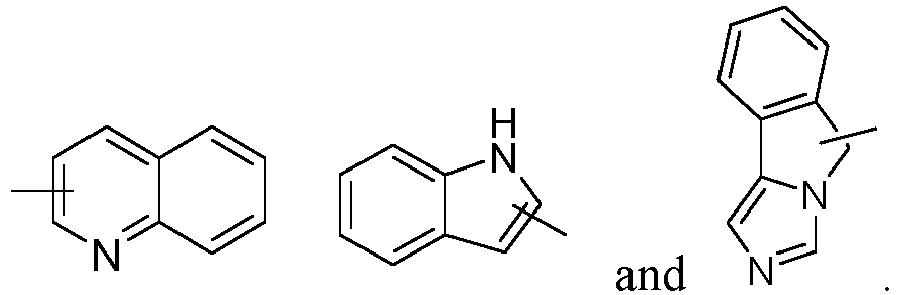
- The heteroaryl can be optionally substituted or unsubstituted, and when substituted, the substituent is preferably one or more groups independently selected from alkyl, alkenyl, alkynyl, alkoxy, alkylthio, alkylamino, halogen, mercapto, hydroxyl, nitro, cyano, cycloalkyl, heterocycloalkyl, aryl, heteroaryl, cycloalkoxy, heterocycloalkoxy, cycloalkylthio, heterocycloalkylthio, carboxyl and carboxylate ester group.
- The term "alkoxy" refers to -O-(alkyl) or -O-(unsubstituted cycloalkyl), wherein the alkyl is as defined above. Non-limiting examples of alkoxy include: methoxy, ethoxy, propoxy, butoxy, cyclopropyloxy, cyclobutyloxy, cyclopentyloxy, cyclohexyloxy. The alkoxy can be optionally substituted or unsubstituted, and when substituted, the substituent is preferably one or more groups independently selected from alkyl, alkenyl, alkynyl, alkoxy, alkylthio, alkylamino, halogen, mercapto, hydroxyl, nitro, cyano, cycloalkyl, heterocycloalkyl, aryl, heteroaryl, cycloalkoxy, heterocycloalkoxy, cycloalkylthio, heterocycloalkylthio, carboxyl and carboxylate ester group.
- The term "halogen" refers to fluorine, chlorine, bromine or iodine.
- The term "hydroxyl" refers to -OH group.
- The term "amino" refers to -NH2.
- The term "cyano" refers to -CN.
- The term "nitro" refers to -NO2.
- The term "benzyl" refers to -CH2-phenyl.
- The term "oxo" refers to =O.
- The term "carboxyl" refers to -C(O)OH.
- The term "carboxylate ester" refers to -C(O)O(alkyl) or -C(O)O(cycloalkyl).
- "Optional" or "optionally" means that the event or circumstance described subsequently can, but does not have to occur, and such a description includes the situation in which the event or circumstance occurs or does not occur. For example, "heterocyclyl optionally substituted by alkyl" means that alkyl can, but does not have to exist, and such a description includes the situation that the heterocyclyl is substituted by alkyl and the situation that the heterocyclyl is not substituted by alkyl.
- In the chemical structure of the compound of the present disclosure, the bond "" does not specify a configuration, that is, if configurational isomerism exists in the chemical structure, the bond "
 " can be "" or "
 ", or it can contain both "
 " and "" configuration.
 - The following will explain the present disclosure in detail with specific embodiments, so that those skilled in the art can more fully understand the present disclosure. The specific embodiments are only intended for illustrating the technical solutions of the present disclosure, but the present disclosure is not limited thereto.
-

- To a reactor were added 5.0 kg of Compound 1, 250 g of 10% palladium on carbon and 80 L of methanol, and the hydrogenation reaction was carried out under 0.4MPa at 25 °C for 24 hours. The palladium on carbon was removed by filtration and the filter cake was washed with methanol. The filtrate was collected and evaporated to dryness under reduced pressure, followed by addition of 20 L of ethyl acetate to the obtained concentrate. After the solid was dissolved by stirring, the mixture was cooled to 0 °C in an ice-water bath, adjusted to pH of 2-3 with 4 M hydrogen chloride in ethyl acetate, stirred and filtered. The filter cake was slurried with 20 L of ethyl acetate at room temperature for 3 to 4 hours. The mixture was filtered and the filter cake was dried under vacuum at 45 °C for 6-8 hours to obtain 5.5 kg of Compound 3 as a solid with a yield of 91.7% and a HPLC purity of 99.69%.
-
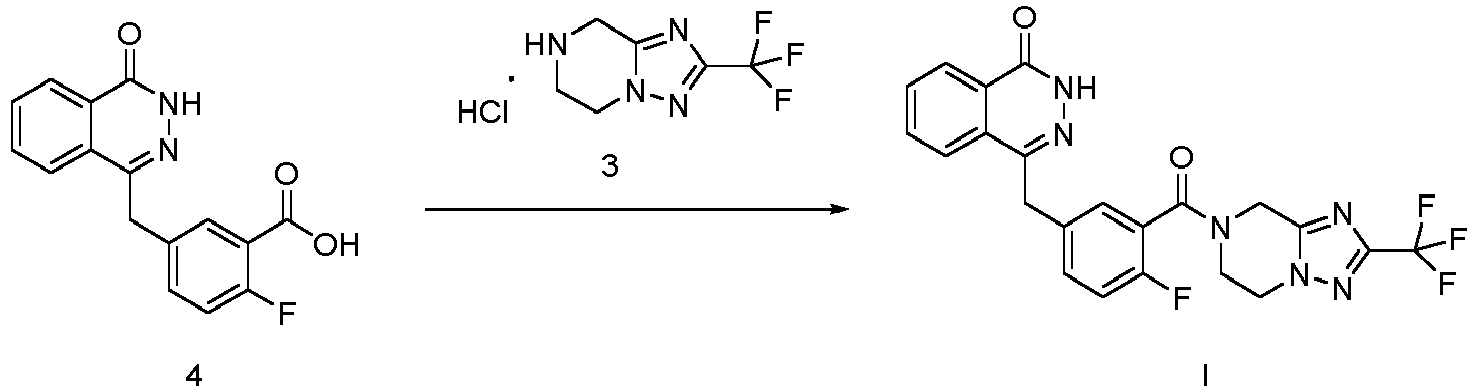
- According to the method of Embodiment 19 in
CN102686591A , 2 g of the obtained Compound 3 and 2.79 g of Compound 4 were reacted to obtain 3.6 g of the compound represented by formula I with a yield of 87.8%. - At room temperature, 2.0 g of Compound 2 (prepared according to the method disclosed in
WO2009025784 ) was dissolved in 30 mL of isopropanol, followed by dropwise addition of concentrated sulfuric acid to adjust the pH to 3 while stirring. The resulting mixture was stirred at room temperature, and no solid was precipitated out. The mixture was then poured into 150 mL of n-hexane, and further stirred at room temperature. No solid was precipitated out, and Compound 2 sulfate salt in solid form could not be obtained. - At room temperature, 1.11 g of Compound 2 was dissolved in 10 mL of isopropanol, followed by dropwise addition of 15% phosphoric acid/isopropanol solution to adjust the pH to 3 while stirring. The resulting mixture was stirred at room temperature and filtered. The filter cake was washed with isopropanol and dried under vacuum to obtain 1.46 g of Compound 2 phosphate salt in solid form with a yield 87.1% and a HPLC purity of 99.72%.
- At room temperature, 1.28 g of Compound 2 was dissolved in 10 mL of isopropanol, followed by dropwise addition of 20% acetic acid/isopropanol solution to adjust the pH to 3 while stirring. The resulting mixture was stirred at room temperature, and no solid was precipitated out. The mixture was poured into 100 mL of n-hexane, and further stirred at room temperature. No solid was precipitated out, and Compound 2 acetate salt in solid form could not be obtained.
- At room temperature, 1.05 g of Compound 2 was dissolved in 10 mL of isopropanol, followed by dropwise addition of 15% citric acid/isopropanol solution to adjust the pH to 3 while stirring. The resulting mixture was stirred at room temperature and no solid was precipitated out. The mixture was poured into 100 mL of n-hexane, and further stirred at room temperature. No solid was precipitated out, and Compound 2 citrate salt in solid form could not be obtained.
- At room temperature, 1.12 g of Compound 2 was dissolved in 10 mL of isopropanol, followed by addition of 0.74 g of maleic acid while stirring. The resulting mixture was stirred at room temperature and filtered. The filter cake was washed with isopropanol and dried under vacuum to obtain 1.51 g of Compound 2 maleate salt in solid form with a yield 84.6%.
- Since the present disclosure has been described according to its particular embodiments, certain modifications and equivalent variations will be apparent to those skilled in the art and are included within the scope of the present disclosure.
Claims (15)
- A preparation method for a compound represented by formula II',
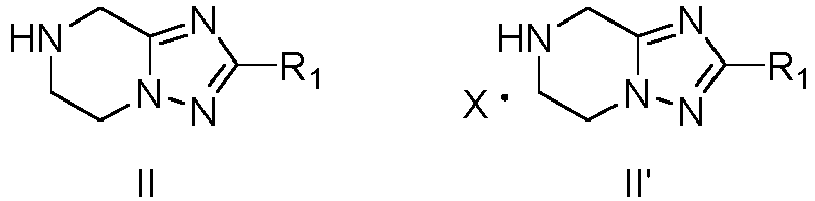 R1 is selected from hydrogen, alkyl, halogen, hydroxyl, cyano, alkoxy, cycloalkyl, heterocyclyl, aryl, heteroaryl, benzyl, -C(O)OR2, -OC(O)R2, -O(CH2)nC(O)OR2, - (CH2)nNR3R4, -C(O)R2, -NHC(O)R2, -NR3R4, -OC(O)NR3R4 or -C(O)NR3R4, wherein each of the alkyl, alkoxy, cycloalkyl, heterocyclyl, aryl, heteroaryl and benzyl is independently optionally substituted by one or more substituents selected from alkyl, halogen, hydroxyl, alkoxy, cycloalkyl, heterocyclyl, aryl, heteroaryl, oxo, -C(O)OR2, -OC(O)R2, - O(CH2)nC(O)OR2, -C(O)R2, -NHC(O)R2, -N3R4, -OC(O)NR3R4 or -C(O)NR3R4;R2 is selected from hydrogen, alkyl, cycloalkyl, heterocyclyl, aryl or heteroaryl, wherein each of the alkyl, cycloalkyl, heterocyclyl, aryl and heteroaryl is independently optionally substituted by one or more substituents selected from alkyl, halogen, hydroxyl, alkoxy, cycloalkyl, heterocyclyl, aryl, heteroaryl, carboxyl or carboxylate ester group;each of R3 and R4 is independently selected from hydrogen, alkyl, cycloalkyl, heterocyclyl, aryl or heteroaryl, wherein each of the alkyl, cycloalkyl, heterocyclyl, aryl and heteroaryl is independently optionally substituted by one or more substituents selected from alkyl, halogen, hydroxyl, alkoxy, cycloalkyl, heterocyclyl, aryl, heteroaryl, carboxyl or carboxylate ester group;or, R3 and R4 together with the nitrogen atom to which they are attached form heterocyclyl, wherein the heterocyclyl contains one or more heteroatoms selected from N, O, or S(O)m, and the heterocyclyl is optionally substituted by one or more substituents selected from alkyl, halogen, hydroxyl, alkoxy, cycloalkyl, heterocyclyl, aryl, heteroaryl, carboxyl or carboxylate ester group;m is selected from 0, 1 or 2;n is selected from 0, 1 or 2;X is an acid selected from an inorganic acid and an organic acid; preferably hydrochloric acid, sulfuric acid, phosphoric acid, hydrobromic acid, trifluoroacetic acid, formic acid, acetic acid, sulfonic acid, optionally substituted alkylsulfonic acid, succinic acid, maleic acid, tartaric acid, citric acid, lactic acid, oxalic acid, gluconic acid, fumaric acid, malonic acid and malic acid, more preferably hydrochloric acid, phosphoric acid and maleic acid, most preferably hydrochloric acid;the method comprises a step of reacting a compound represented by formula II with a corresponding acid.
 - The preparation method as defined in claim 1, wherein R1 is -CF3.
- The preparation method as defined in claim 1, wherein the solvent used in the step of reacting a compound represented by formula II with a corresponding acid is one or more solvents selected from dimethylformamide, 1-methyl-2-pyrrolidone, dimethyl sulfoxide, tetrahydrofuran, ethyl acetate, dioxane, toluene, dimethyl sulfoxide, diethyl ether, isopropyl ether, methyl tert-butyl ether, dichloromethane, chloroform, acetone, acetonitrile, methanol, ethanol, isopropanol and water, preferably one or more solvents selected from tetrahydrofuran, ethyl acetate, dioxane, toluene, dimethyl sulfoxide, diethyl ether, isopropyl ether, dichloromethane, chloroform, acetone, acetonitrile, methanol, ethanol and isopropanol.
- The preparation method as defined in claim 1, wherein the molar ratio of the compound represented by formula II to the corresponding acid is 1:1 to 1:10.
- The preparation method as defined in claim 1, wherein the method comprises a step of isolating the compound represented by formula II'.
- The preparation method as defined in claim 1, wherein the method comprises a step of carrying out a hydrogenation reduction reaction of a compound represented by formula III to obtain the compound represented by formula II;

- A preparation method for a compound represented by formula I or a pharmaceutically acceptable salt thereof, wherein the method comprises a step of preparing a compound represented by formula II' according to the method as defined in any one of claims 1-6;

- The preparation method as defined in claim 7, wherein the method comprises a step of reacting a compound represented by formula II' with a compound represented by formula IV,

- A purification method for a compound represented by formula II, wherein the method comprises carrying out a reaction of a compound represented by formula II and a corresponding acid to obtain a compound represented by formula II', isolating the compound represented by formula II', and converting the compound represented by formula II' to the compound represented by formula II, wherein R1 and X are as defined in claim 1;

- The purification method as defined in claim 9, wherein R1 is -CF3.
- The purification method as defined in claim 9, wherein the solvent used in the reaction is one or more solvents selected from dimethylformamide, 1-methyl-2-pyrrolidone, dimethyl sulfoxide, tetrahydrofuran, ethyl acetate, dioxane, toluene, dimethyl sulfoxide, diethyl ether, isopropyl ether, methyl tert-butyl ether, dichloromethane, chloroform, acetone, acetonitrile, methanol, ethanol, isopropanol and water, preferably one or more solvents selected from tetrahydrofuran, ethyl acetate, dioxane, toluene, dimethyl sulfoxide, diethyl ether, isopropyl ether, dichloromethane, chloroform, acetone, acetonitrile, methanol, ethanol and isopropanol.
- The purification method as defined in claim 9, wherein the molar ratio of the compound represented by formula II to the corresponding acid is 1:1 to 1:10.
- The purification method as defined in claim 9, wherein the method comprises a step of carrying out a hydrogenation reduction reaction of a compound represented by formula III to obtain the compound represented by formula II;

- A preparation method for a compound represented by formula I or a pharmaceutically acceptable salt thereof, wherein the method comprises a step of purifying a compound represented by formula II according to the method as defined in any one of claims 9-13;

- The preparation method as defined in claim 14, wherein the method comprises a step of reacting a compound represented by formula II with a compound represented by formula IV, wherein Ra is selected from hydroxyl, halogen or alkoxy;

Applications Claiming Priority (3)
| Application Number | Priority Date | Filing Date | Title |
|---|---|---|---|
| CN201810019736 | 2018-01-09 | ||
| CN201811547590 | 2018-12-18 | ||
| PCT/CN2019/070797 WO2019137358A1 (en) | 2018-01-09 | 2019-01-08 | Method for preparing parp inhibitor and intermediate thereof |
Publications (2)
| Publication Number | Publication Date |
|---|---|
| EP3738963A1 true EP3738963A1 (en) | 2020-11-18 |
| EP3738963A4 EP3738963A4 (en) | 2021-12-01 |
Family
ID=67218500
Family Applications (1)
| Application Number | Title | Priority Date | Filing Date |
|---|---|---|---|
| EP19738775.6A Withdrawn EP3738963A4 (en) | 2018-01-09 | 2019-01-08 | Method for preparing parp inhibitor and intermediate thereof |
Country Status (9)
| Country | Link |
|---|---|
| US (1) | US11345709B2 (en) |
| EP (1) | EP3738963A4 (en) |
| JP (1) | JP2021509906A (en) |
| KR (1) | KR20200108021A (en) |
| CN (1) | CN111278830B (en) |
| AU (1) | AU2019207072A1 (en) |
| BR (1) | BR112020013449A2 (en) |
| CA (1) | CA3085660A1 (en) |
| WO (1) | WO2019137358A1 (en) |
Families Citing this family (5)
| Publication number | Priority date | Publication date | Assignee | Title |
|---|---|---|---|---|
| CN111635407B (en) * | 2020-06-28 | 2021-08-06 | 上海再启生物技术有限公司 | Synthesis process of PARP inhibitor fluxaparide intermediate |
| CN111732594B (en) * | 2020-08-18 | 2022-03-04 | 苏州富士莱医药股份有限公司 | Preparation method of fluxaparide |
| CN114605320B (en) * | 2022-04-06 | 2023-12-29 | 南京艾康生物科技有限公司 | Synthesis method of 5-nitro-6-methylnicotinic acid ethyl ester |
| CN114957263A (en) * | 2022-06-10 | 2022-08-30 | 苏州敬业医药化工有限公司 | Preparation method of drug intermediate |
| CN115650988B (en) * | 2022-10-27 | 2024-09-13 | 江苏恒瑞医药股份有限公司 | Preparation method of PARP inhibitor |
Family Cites Families (6)
| Publication number | Priority date | Publication date | Assignee | Title |
|---|---|---|---|---|
| ATE370141T1 (en) * | 2002-10-07 | 2007-09-15 | Merck & Co Inc | ANTIDIABETIC HETEROCYCLIC BETA-AMINO COMPOUNDS AS INHIBITORS OF DIPEPTIDYLPEPTIDASE |
| AR043443A1 (en) * | 2003-03-07 | 2005-07-27 | Merck & Co Inc | PROCEDURE FOR THE PREPARATION OF TETRAHYDROTRIAZOLOPIRAZINS AND INTERMEDIATE PRODUCTS |
| JP2008063256A (en) * | 2006-09-06 | 2008-03-21 | Astellas Pharma Inc | β-amino acid derivatives |
| US8653059B2 (en) | 2007-08-21 | 2014-02-18 | Merck Sharp & Dohme Corp. | Heterocyclic compounds as dipeptidyl peptidase-IV inhibitors for the treatment or prevention of diabetes |
| CN102372716A (en) * | 2010-08-09 | 2012-03-14 | 江苏恒瑞医药股份有限公司 | Phthalazone derivative, its preparation method and application in medicine thereof |
| AR108396A1 (en) | 2016-05-06 | 2018-08-15 | Incyte Corp | HETEROCYCLIC COMPOUNDS AS IMMUNOMODULATORS |
-
2019
- 2019-01-08 JP JP2020537491A patent/JP2021509906A/en not_active Withdrawn
- 2019-01-08 WO PCT/CN2019/070797 patent/WO2019137358A1/en not_active Ceased
- 2019-01-08 EP EP19738775.6A patent/EP3738963A4/en not_active Withdrawn
- 2019-01-08 BR BR112020013449-0A patent/BR112020013449A2/en not_active Application Discontinuation
- 2019-01-08 US US16/960,117 patent/US11345709B2/en active Active
- 2019-01-08 CA CA3085660A patent/CA3085660A1/en active Pending
- 2019-01-08 CN CN201980005431.8A patent/CN111278830B/en active Active
- 2019-01-08 AU AU2019207072A patent/AU2019207072A1/en not_active Abandoned
- 2019-01-08 KR KR1020207022785A patent/KR20200108021A/en not_active Withdrawn
Also Published As
| Publication number | Publication date |
|---|---|
| CN111278830B (en) | 2022-10-25 |
| CN111278830A (en) | 2020-06-12 |
| US11345709B2 (en) | 2022-05-31 |
| BR112020013449A2 (en) | 2020-12-01 |
| CA3085660A1 (en) | 2019-07-18 |
| KR20200108021A (en) | 2020-09-16 |
| AU2019207072A1 (en) | 2020-07-16 |
| WO2019137358A1 (en) | 2019-07-18 |
| JP2021509906A (en) | 2021-04-08 |
| RU2020122776A (en) | 2022-01-10 |
| EP3738963A4 (en) | 2021-12-01 |
| US20210070760A1 (en) | 2021-03-11 |
| RU2020122776A3 (en) | 2022-01-21 |
Similar Documents
| Publication | Publication Date | Title |
|---|---|---|
| EP3738963A1 (en) | Method for preparing parp inhibitor and intermediate thereof | |
| ES2398934T3 (en) | Production process of 1- (3- (2- (1-benzothiophene-5-yl) ethoxy) propyl) acetidinol or salts thereof | |
| EP0370236B1 (en) | Indolocarbazole derivatives, processes for their preparation and their use as medicaments | |
| CN111233870A (en) | Method for rapidly preparing remdesivir pharmaceutical intermediates | |
| RU2777597C2 (en) | Method for production of parp inhibitor and its intermediate compound | |
| EP0376624A1 (en) | 4,5,6,7-Tetrahydrobenzimidazole derivatives and their preparation | |
| CN102432553B (en) | Preparation method and intermediate of quinazoline derivative | |
| Fonte et al. | Improved synthesis of antiplasmodial 4-aminoacridines and 4, 9-diaminoacridines | |
| HK40032576A (en) | Method for preparing parp inhibitor and intermediate thereof | |
| TWI691495B (en) | Preparation method for tyrosine kinase inhibitor and intermediates thereof | |
| Komarova et al. | Synthesis of derivatives of a new heterocyclic system pyrazolo [3, 4-b] pyrido [1′, 2′: 1, 2] imidazo [4, 5-d] pyridine | |
| FI77653B (en) | FRAME FOR THE PREPARATION OF THERAPEUTIC ANALYTICAL PRODUCTS 2-AMINO-3-CYANO-5-PHENYL-INDOLDERIVAT. | |
| Schober et al. | Pyridazines with heteroatom substituents in positions 3 and 5. 6. SN reactions in position 5 of 2‐aryl‐5‐hydroxypyridazin‐3 (2H)‐ones | |
| JP4138883B2 (en) | Method for producing acridone derivative and 8-hydroxyimidazoacridinone derivative | |
| CA2328903C (en) | Compounds capable of cleaving double-stranded dna and method of utilization of the same | |
| JPH06501272A (en) | Method for producing 17β-substituted-4-aza-5α-androstan-3-one derivative | |
| RU2777675C2 (en) | Method for production of tyrosine kinase inhibitor and its intermediate compound | |
| WO2019072005A1 (en) | Azacitidine disaccharide impurity, preparation method therefor and use thereof | |
| MXPA04008944A (en) | Process for producing triterpene derivative. | |
| CN117062809B (en) | Bicyclic heterocyclic FGFR4 inhibitors, pharmaceutical compositions and formulations containing them, and their applications. | |
| CN121930185A (en) | A method for preparing gadoterol isomers | |
| JP2840796B2 (en) | Novel condensed indane derivative and pharmaceutically acceptable salt thereof | |
| CN118900917A (en) | Bicyclic heterocycles and their ligands for targeted delivery of therapeutic agents | |
| CN120682241A (en) | Tricyclic skeleton compounds and their application in the preparation of anti-tumor drugs | |
| CN120112512A (en) | Method for preparing (Z)-3-(2-(5-bromo-1H-indol-3-yl)-2-cyanovinyl)-4-methoxybenzonitrile |
Legal Events
| Date | Code | Title | Description |
|---|---|---|---|
| STAA | Information on the status of an ep patent application or granted ep patent |
Free format text: STATUS: THE INTERNATIONAL PUBLICATION HAS BEEN MADE |
|
| PUAI | Public reference made under article 153(3) epc to a published international application that has entered the european phase |
Free format text: ORIGINAL CODE: 0009012 |
|
| STAA | Information on the status of an ep patent application or granted ep patent |
Free format text: STATUS: REQUEST FOR EXAMINATION WAS MADE |
|
| 17P | Request for examination filed |
Effective date: 20200703 |
|
| AK | Designated contracting states |
Kind code of ref document: A1 Designated state(s): AL AT BE BG CH CY CZ DE DK EE ES FI FR GB GR HR HU IE IS IT LI LT LU LV MC MK MT NL NO PL PT RO RS SE SI SK SM TR |
|
| AX | Request for extension of the european patent |
Extension state: BA ME |
|
| DAV | Request for validation of the european patent (deleted) | ||
| DAX | Request for extension of the european patent (deleted) | ||
| RIC1 | Information provided on ipc code assigned before grant |
Ipc: C07D 487/04 20060101AFI20210726BHEP Ipc: A61K 31/4985 20060101ALI20210726BHEP Ipc: A61P 35/00 20060101ALI20210726BHEP |
|
| A4 | Supplementary search report drawn up and despatched |
Effective date: 20211104 |
|
| RIC1 | Information provided on ipc code assigned before grant |
Ipc: A61P 35/00 20060101ALI20211028BHEP Ipc: A61K 31/4985 20060101ALI20211028BHEP Ipc: C07D 487/04 20060101AFI20211028BHEP |
|
| STAA | Information on the status of an ep patent application or granted ep patent |
Free format text: STATUS: EXAMINATION IS IN PROGRESS |
|
| 17Q | First examination report despatched |
Effective date: 20230209 |
|
| STAA | Information on the status of an ep patent application or granted ep patent |
Free format text: STATUS: THE APPLICATION IS DEEMED TO BE WITHDRAWN |
|
| 18D | Application deemed to be withdrawn |
Effective date: 20230620 |