EP3738959A1 - Preparation of 6-phenoxy-2-(haloalkyl)-3-acylpyridines and intermediates therefor - Google Patents
Preparation of 6-phenoxy-2-(haloalkyl)-3-acylpyridines and intermediates therefor Download PDFInfo
- Publication number
- EP3738959A1 EP3738959A1 EP19174826.8A EP19174826A EP3738959A1 EP 3738959 A1 EP3738959 A1 EP 3738959A1 EP 19174826 A EP19174826 A EP 19174826A EP 3738959 A1 EP3738959 A1 EP 3738959A1
- Authority
- EP
- European Patent Office
- Prior art keywords
- formula
- compound
- process according
- alkyl
- haloalkyl
- Prior art date
- Legal status (The legal status is an assumption and is not a legal conclusion. Google has not performed a legal analysis and makes no representation as to the accuracy of the status listed.)
- Withdrawn
Links
- 239000000543 intermediate Substances 0.000 title description 8
- 238000002360 preparation method Methods 0.000 title description 7
- 150000001875 compounds Chemical class 0.000 claims abstract description 99
- 239000000460 chlorine Substances 0.000 claims abstract description 31
- 229910052801 chlorine Inorganic materials 0.000 claims abstract description 28
- 125000004178 (C1-C4) alkyl group Chemical group 0.000 claims abstract description 25
- 229910052794 bromium Chemical group 0.000 claims abstract description 23
- 150000002681 magnesium compounds Chemical class 0.000 claims abstract description 14
- 125000001309 chloro group Chemical group Cl* 0.000 claims abstract description 13
- 125000004765 (C1-C4) haloalkyl group Chemical group 0.000 claims abstract description 12
- 229910052736 halogen Inorganic materials 0.000 claims abstract description 12
- 125000000882 C2-C6 alkenyl group Chemical group 0.000 claims abstract description 11
- 125000003601 C2-C6 alkynyl group Chemical group 0.000 claims abstract description 11
- 125000004767 (C1-C4) haloalkoxy group Chemical group 0.000 claims abstract description 10
- 125000000229 (C1-C4)alkoxy group Chemical group 0.000 claims abstract description 10
- WKBOTKDWSSQWDR-UHFFFAOYSA-N Bromine atom Chemical group [Br] WKBOTKDWSSQWDR-UHFFFAOYSA-N 0.000 claims abstract description 10
- GDTBXPJZTBHREO-UHFFFAOYSA-N bromine Chemical group BrBr GDTBXPJZTBHREO-UHFFFAOYSA-N 0.000 claims abstract description 10
- 125000000449 nitro group Chemical group [O-][N+](*)=O 0.000 claims abstract description 10
- OFOBLEOULBTSOW-UHFFFAOYSA-L Malonate Chemical compound [O-]C(=O)CC([O-])=O OFOBLEOULBTSOW-UHFFFAOYSA-L 0.000 claims abstract description 7
- 125000001797 benzyl group Chemical group [H]C1=C([H])C([H])=C(C([H])=C1[H])C([H])([H])* 0.000 claims abstract description 7
- 150000002367 halogens Chemical group 0.000 claims abstract description 7
- 150000003852 triazoles Chemical class 0.000 claims abstract description 7
- 125000004169 (C1-C6) alkyl group Chemical group 0.000 claims abstract description 6
- 125000006552 (C3-C8) cycloalkyl group Chemical group 0.000 claims abstract description 6
- 238000004519 manufacturing process Methods 0.000 claims abstract description 6
- 239000000203 mixture Substances 0.000 claims description 58
- 238000000034 method Methods 0.000 claims description 54
- YXFVVABEGXRONW-UHFFFAOYSA-N Toluene Chemical compound CC1=CC=CC=C1 YXFVVABEGXRONW-UHFFFAOYSA-N 0.000 claims description 39
- -1 trimethylsulfoxonium halide Chemical class 0.000 claims description 35
- XLYOFNOQVPJJNP-UHFFFAOYSA-N water Substances O XLYOFNOQVPJJNP-UHFFFAOYSA-N 0.000 claims description 29
- XEKOWRVHYACXOJ-UHFFFAOYSA-N Ethyl acetate Chemical compound CCOC(C)=O XEKOWRVHYACXOJ-UHFFFAOYSA-N 0.000 claims description 27
- WEVYAHXRMPXWCK-UHFFFAOYSA-N Acetonitrile Chemical compound CC#N WEVYAHXRMPXWCK-UHFFFAOYSA-N 0.000 claims description 24
- ZMANZCXQSJIPKH-UHFFFAOYSA-N Triethylamine Chemical compound CCN(CC)CC ZMANZCXQSJIPKH-UHFFFAOYSA-N 0.000 claims description 21
- 239000008096 xylene Substances 0.000 claims description 17
- GQHTUMJGOHRCHB-UHFFFAOYSA-N 2,3,4,6,7,8,9,10-octahydropyrimido[1,2-a]azepine Chemical compound C1CCCCN2CCCN=C21 GQHTUMJGOHRCHB-UHFFFAOYSA-N 0.000 claims description 16
- 125000002496 methyl group Chemical group [H]C([H])([H])* 0.000 claims description 15
- 239000003960 organic solvent Substances 0.000 claims description 15
- FYSNRJHAOHDILO-UHFFFAOYSA-N thionyl chloride Chemical compound ClS(Cl)=O FYSNRJHAOHDILO-UHFFFAOYSA-N 0.000 claims description 14
- 238000006243 chemical reaction Methods 0.000 claims description 13
- TWRXJAOTZQYOKJ-UHFFFAOYSA-L Magnesium chloride Chemical compound [Mg+2].[Cl-].[Cl-] TWRXJAOTZQYOKJ-UHFFFAOYSA-L 0.000 claims description 12
- 125000001495 ethyl group Chemical group [H]C([H])([H])C([H])([H])* 0.000 claims description 11
- ANXKZXRDXAZQJT-UHFFFAOYSA-M methyl sulfate;trimethylsulfanium Chemical compound C[S+](C)C.COS([O-])(=O)=O ANXKZXRDXAZQJT-UHFFFAOYSA-M 0.000 claims description 10
- 125000001997 phenyl group Chemical group [H]C1=C([H])C([H])=C(*)C([H])=C1[H] 0.000 claims description 10
- XHXFXVLFKHQFAL-UHFFFAOYSA-N phosphoryl trichloride Chemical compound ClP(Cl)(Cl)=O XHXFXVLFKHQFAL-UHFFFAOYSA-N 0.000 claims description 10
- GETQZCLCWQTVFV-UHFFFAOYSA-N trimethylamine Chemical compound CN(C)C GETQZCLCWQTVFV-UHFFFAOYSA-N 0.000 claims description 10
- 229940093499 ethyl acetate Drugs 0.000 claims description 9
- 235000019439 ethyl acetate Nutrition 0.000 claims description 9
- 125000001449 isopropyl group Chemical group [H]C([H])([H])C([H])(*)C([H])([H])[H] 0.000 claims description 9
- JLTDJTHDQAWBAV-UHFFFAOYSA-N N,N-dimethylaniline Chemical compound CN(C)C1=CC=CC=C1 JLTDJTHDQAWBAV-UHFFFAOYSA-N 0.000 claims description 8
- CTQNGGLPUBDAKN-UHFFFAOYSA-N O-Xylene Chemical compound CC1=CC=CC=C1C CTQNGGLPUBDAKN-UHFFFAOYSA-N 0.000 claims description 7
- 239000003795 chemical substances by application Substances 0.000 claims description 7
- 238000006114 decarboxylation reaction Methods 0.000 claims description 7
- SGUVLZREKBPKCE-UHFFFAOYSA-N 1,5-diazabicyclo[4.3.0]-non-5-ene Chemical compound C1CCN=C2CCCN21 SGUVLZREKBPKCE-UHFFFAOYSA-N 0.000 claims description 6
- NSPMIYGKQJPBQR-UHFFFAOYSA-N 4H-1,2,4-triazole Chemical compound C=1N=CNN=1 NSPMIYGKQJPBQR-UHFFFAOYSA-N 0.000 claims description 6
- 229910006124 SOCl2 Inorganic materials 0.000 claims description 6
- 150000002118 epoxides Chemical class 0.000 claims description 6
- 125000000959 isobutyl group Chemical group [H]C([H])([H])C([H])(C([H])([H])[H])C([H])([H])* 0.000 claims description 6
- 229910001629 magnesium chloride Inorganic materials 0.000 claims description 6
- BGWWCDUWQVLSFN-UHFFFAOYSA-M trimethyloxosulphonium methyl sulphate Chemical compound C[S+](C)(C)=O.COS([O-])(=O)=O BGWWCDUWQVLSFN-UHFFFAOYSA-M 0.000 claims description 6
- CPLXHLVBOLITMK-UHFFFAOYSA-N Magnesium oxide Chemical compound [Mg]=O CPLXHLVBOLITMK-UHFFFAOYSA-N 0.000 claims description 5
- JGFZNNIVVJXRND-UHFFFAOYSA-N N,N-Diisopropylethylamine (DIPEA) Chemical compound CCN(C(C)C)C(C)C JGFZNNIVVJXRND-UHFFFAOYSA-N 0.000 claims description 5
- 229910019213 POCl3 Inorganic materials 0.000 claims description 5
- 125000004108 n-butyl group Chemical group [H]C([H])([H])C([H])([H])C([H])([H])C([H])([H])* 0.000 claims description 5
- 125000004123 n-propyl group Chemical group [H]C([H])([H])C([H])([H])C([H])([H])* 0.000 claims description 5
- IMFACGCPASFAPR-UHFFFAOYSA-N tributylamine Chemical compound CCCCN(CCCC)CCCC IMFACGCPASFAPR-UHFFFAOYSA-N 0.000 claims description 5
- IMNIMPAHZVJRPE-UHFFFAOYSA-N triethylenediamine Chemical compound C1CN2CCN1CC2 IMNIMPAHZVJRPE-UHFFFAOYSA-N 0.000 claims description 5
- YFTHZRPMJXBUME-UHFFFAOYSA-N tripropylamine Chemical compound CCCN(CCC)CCC YFTHZRPMJXBUME-UHFFFAOYSA-N 0.000 claims description 5
- XBPCUCUWBYBCDP-UHFFFAOYSA-N Dicyclohexylamine Chemical compound C1CCCCC1NC1CCCCC1 XBPCUCUWBYBCDP-UHFFFAOYSA-N 0.000 claims description 4
- SVYKKECYCPFKGB-UHFFFAOYSA-N N,N-dimethylcyclohexylamine Chemical compound CN(C)C1CCCCC1 SVYKKECYCPFKGB-UHFFFAOYSA-N 0.000 claims description 4
- YGYAWVDWMABLBF-UHFFFAOYSA-N Phosgene Chemical compound ClC(Cl)=O YGYAWVDWMABLBF-UHFFFAOYSA-N 0.000 claims description 4
- XXBDWLFCJWSEKW-UHFFFAOYSA-N dimethylbenzylamine Chemical compound CN(C)CC1=CC=CC=C1 XXBDWLFCJWSEKW-UHFFFAOYSA-N 0.000 claims description 4
- 239000011777 magnesium Substances 0.000 claims description 4
- OTCKOJUMXQWKQG-UHFFFAOYSA-L magnesium bromide Chemical compound [Mg+2].[Br-].[Br-] OTCKOJUMXQWKQG-UHFFFAOYSA-L 0.000 claims description 4
- 229910001623 magnesium bromide Inorganic materials 0.000 claims description 4
- XRKQMIFKHDXFNQ-UHFFFAOYSA-N n-cyclohexyl-n-ethylcyclohexanamine Chemical compound C1CCCCC1N(CC)C1CCCCC1 XRKQMIFKHDXFNQ-UHFFFAOYSA-N 0.000 claims description 4
- HCUYBXPSSCRKRF-UHFFFAOYSA-N diphosgene Chemical compound ClC(=O)OC(Cl)(Cl)Cl HCUYBXPSSCRKRF-UHFFFAOYSA-N 0.000 claims description 3
- 238000010438 heat treatment Methods 0.000 claims description 3
- UCPYLLCMEDAXFR-UHFFFAOYSA-N triphosgene Chemical compound ClC(Cl)(Cl)OC(=O)OC(Cl)(Cl)Cl UCPYLLCMEDAXFR-UHFFFAOYSA-N 0.000 claims description 3
- 229910020667 PBr3 Inorganic materials 0.000 claims description 2
- 229910006024 SO2Cl2 Inorganic materials 0.000 claims description 2
- 229910006121 SOBr2 Inorganic materials 0.000 claims description 2
- MGNCLNQXLYJVJD-UHFFFAOYSA-N cyanuric chloride Chemical compound ClC1=NC(Cl)=NC(Cl)=N1 MGNCLNQXLYJVJD-UHFFFAOYSA-N 0.000 claims description 2
- VTHJTEIRLNZDEV-UHFFFAOYSA-L magnesium dihydroxide Chemical compound [OH-].[OH-].[Mg+2] VTHJTEIRLNZDEV-UHFFFAOYSA-L 0.000 claims description 2
- 239000000347 magnesium hydroxide Substances 0.000 claims description 2
- 229910001862 magnesium hydroxide Inorganic materials 0.000 claims description 2
- YIXJRHPUWRPCBB-UHFFFAOYSA-N magnesium nitrate Inorganic materials [Mg+2].[O-][N+]([O-])=O.[O-][N+]([O-])=O YIXJRHPUWRPCBB-UHFFFAOYSA-N 0.000 claims description 2
- UHZYTMXLRWXGPK-UHFFFAOYSA-N phosphorus pentachloride Chemical compound ClP(Cl)(Cl)(Cl)Cl UHZYTMXLRWXGPK-UHFFFAOYSA-N 0.000 claims description 2
- IPNPIHIZVLFAFP-UHFFFAOYSA-N phosphorus tribromide Chemical compound BrP(Br)Br IPNPIHIZVLFAFP-UHFFFAOYSA-N 0.000 claims description 2
- FAIAAWCVCHQXDN-UHFFFAOYSA-N phosphorus trichloride Chemical compound ClP(Cl)Cl FAIAAWCVCHQXDN-UHFFFAOYSA-N 0.000 claims description 2
- RAHZWNYVWXNFOC-UHFFFAOYSA-N sulfur dioxide Inorganic materials O=S=O RAHZWNYVWXNFOC-UHFFFAOYSA-N 0.000 claims description 2
- YBBRCQOCSYXUOC-UHFFFAOYSA-N sulfuryl dichloride Chemical compound ClS(Cl)(=O)=O YBBRCQOCSYXUOC-UHFFFAOYSA-N 0.000 claims description 2
- HFRXJVQOXRXOPP-UHFFFAOYSA-N thionyl bromide Chemical compound BrS(Br)=O HFRXJVQOXRXOPP-UHFFFAOYSA-N 0.000 claims description 2
- 230000000911 decarboxylating effect Effects 0.000 abstract 1
- KWYUFKZDYYNOTN-UHFFFAOYSA-M Potassium hydroxide Chemical compound [OH-].[K+] KWYUFKZDYYNOTN-UHFFFAOYSA-M 0.000 description 24
- QMMFVYPAHWMCMS-UHFFFAOYSA-N Dimethyl sulfide Chemical compound CSC QMMFVYPAHWMCMS-UHFFFAOYSA-N 0.000 description 21
- 239000002585 base Substances 0.000 description 21
- HEMHJVSKTPXQMS-UHFFFAOYSA-M Sodium hydroxide Chemical compound [OH-].[Na+] HEMHJVSKTPXQMS-UHFFFAOYSA-M 0.000 description 18
- 125000002023 trifluoromethyl group Chemical group FC(F)(F)* 0.000 description 17
- BZLVMXJERCGZMT-UHFFFAOYSA-N Methyl tert-butyl ether Chemical compound COC(C)(C)C BZLVMXJERCGZMT-UHFFFAOYSA-N 0.000 description 16
- 239000011541 reaction mixture Substances 0.000 description 16
- ZMXDDKWLCZADIW-UHFFFAOYSA-N N,N-Dimethylformamide Chemical compound CN(C)C=O ZMXDDKWLCZADIW-UHFFFAOYSA-N 0.000 description 15
- QAOWNCQODCNURD-UHFFFAOYSA-N Sulfuric acid Chemical compound OS(O)(=O)=O QAOWNCQODCNURD-UHFFFAOYSA-N 0.000 description 13
- ZHNUHDYFZUAESO-UHFFFAOYSA-N Formamide Chemical compound NC=O ZHNUHDYFZUAESO-UHFFFAOYSA-N 0.000 description 10
- 125000005843 halogen group Chemical group 0.000 description 10
- BWHMMNNQKKPAPP-UHFFFAOYSA-L potassium carbonate Chemical compound [K+].[K+].[O-]C([O-])=O BWHMMNNQKKPAPP-UHFFFAOYSA-L 0.000 description 10
- 150000003738 xylenes Chemical class 0.000 description 10
- YMWUJEATGCHHMB-UHFFFAOYSA-N Dichloromethane Chemical compound ClCCl YMWUJEATGCHHMB-UHFFFAOYSA-N 0.000 description 9
- VEXZGXHMUGYJMC-UHFFFAOYSA-N Hydrochloric acid Chemical compound Cl VEXZGXHMUGYJMC-UHFFFAOYSA-N 0.000 description 9
- 125000001559 cyclopropyl group Chemical group [H]C1([H])C([H])([H])C1([H])* 0.000 description 9
- 239000012074 organic phase Substances 0.000 description 9
- 150000003254 radicals Chemical class 0.000 description 9
- 150000004945 aromatic hydrocarbons Chemical class 0.000 description 8
- MVPPADPHJFYWMZ-UHFFFAOYSA-N chlorobenzene Chemical compound ClC1=CC=CC=C1 MVPPADPHJFYWMZ-UHFFFAOYSA-N 0.000 description 8
- 239000012071 phase Substances 0.000 description 8
- 239000000047 product Substances 0.000 description 8
- IAZDPXIOMUYVGZ-UHFFFAOYSA-N Dimethylsulphoxide Chemical compound CS(C)=O IAZDPXIOMUYVGZ-UHFFFAOYSA-N 0.000 description 7
- 230000015572 biosynthetic process Effects 0.000 description 7
- 239000002904 solvent Substances 0.000 description 7
- 238000003786 synthesis reaction Methods 0.000 description 7
- 125000000876 trifluoromethoxy group Chemical group FC(F)(F)O* 0.000 description 7
- LRHPLDYGYMQRHN-UHFFFAOYSA-N N-Butanol Chemical compound CCCCO LRHPLDYGYMQRHN-UHFFFAOYSA-N 0.000 description 6
- CDBYLPFSWZWCQE-UHFFFAOYSA-L Sodium Carbonate Chemical group [Na+].[Na+].[O-]C([O-])=O CDBYLPFSWZWCQE-UHFFFAOYSA-L 0.000 description 6
- 239000008346 aqueous phase Substances 0.000 description 6
- FJDQFPXHSGXQBY-UHFFFAOYSA-L caesium carbonate Chemical compound [Cs+].[Cs+].[O-]C([O-])=O FJDQFPXHSGXQBY-UHFFFAOYSA-L 0.000 description 6
- SCVFZCLFOSHCOH-UHFFFAOYSA-M potassium acetate Chemical compound [K+].CC([O-])=O SCVFZCLFOSHCOH-UHFFFAOYSA-M 0.000 description 6
- KFZMGEQAYNKOFK-UHFFFAOYSA-N Isopropanol Chemical compound CC(C)O KFZMGEQAYNKOFK-UHFFFAOYSA-N 0.000 description 5
- 239000003054 catalyst Substances 0.000 description 5
- 239000003153 chemical reaction reagent Substances 0.000 description 5
- 238000001704 evaporation Methods 0.000 description 5
- 230000008020 evaporation Effects 0.000 description 5
- 229910000027 potassium carbonate Inorganic materials 0.000 description 5
- 238000000746 purification Methods 0.000 description 5
- 239000003039 volatile agent Substances 0.000 description 5
- PAMIQIKDUOTOBW-UHFFFAOYSA-N 1-methylpiperidine Chemical compound CN1CCCCC1 PAMIQIKDUOTOBW-UHFFFAOYSA-N 0.000 description 4
- 238000005160 1H NMR spectroscopy Methods 0.000 description 4
- HWWYDZCSSYKIAD-UHFFFAOYSA-N 3,5-dimethylpyridine Chemical compound CC1=CN=CC(C)=C1 HWWYDZCSSYKIAD-UHFFFAOYSA-N 0.000 description 4
- VHYFNPMBLIVWCW-UHFFFAOYSA-N 4-Dimethylaminopyridine Chemical compound CN(C)C1=CC=NC=C1 VHYFNPMBLIVWCW-UHFFFAOYSA-N 0.000 description 4
- AXUCDERQOZNKKB-UHFFFAOYSA-N BrC1=CC=C(OC2=CC=C(C(=N2)C(F)(F)F)C(C)=O)C=C1 Chemical compound BrC1=CC=C(OC2=CC=C(C(=N2)C(F)(F)F)C(C)=O)C=C1 AXUCDERQOZNKKB-UHFFFAOYSA-N 0.000 description 4
- IAZDPXIOMUYVGZ-WFGJKAKNSA-N Dimethyl sulfoxide Chemical compound [2H]C([2H])([2H])S(=O)C([2H])([2H])[2H] IAZDPXIOMUYVGZ-WFGJKAKNSA-N 0.000 description 4
- OKKJLVBELUTLKV-UHFFFAOYSA-N Methanol Chemical compound OC OKKJLVBELUTLKV-UHFFFAOYSA-N 0.000 description 4
- FXHOOIRPVKKKFG-UHFFFAOYSA-N N,N-Dimethylacetamide Chemical compound CN(C)C(C)=O FXHOOIRPVKKKFG-UHFFFAOYSA-N 0.000 description 4
- SECXISVLQFMRJM-UHFFFAOYSA-N N-Methylpyrrolidone Chemical compound CN1CCCC1=O SECXISVLQFMRJM-UHFFFAOYSA-N 0.000 description 4
- JUJWROOIHBZHMG-UHFFFAOYSA-N Pyridine Chemical compound C1=CC=NC=C1 JUJWROOIHBZHMG-UHFFFAOYSA-N 0.000 description 4
- PMZURENOXWZQFD-UHFFFAOYSA-L Sodium Sulfate Chemical compound [Na+].[Na+].[O-]S([O-])(=O)=O PMZURENOXWZQFD-UHFFFAOYSA-L 0.000 description 4
- WYURNTSHIVDZCO-UHFFFAOYSA-N Tetrahydrofuran Chemical compound C1CCOC1 WYURNTSHIVDZCO-UHFFFAOYSA-N 0.000 description 4
- 150000004996 alkyl benzenes Chemical class 0.000 description 4
- 150000008422 chlorobenzenes Chemical class 0.000 description 4
- 238000004587 chromatography analysis Methods 0.000 description 4
- 239000012043 crude product Substances 0.000 description 4
- VAYGXNSJCAHWJZ-UHFFFAOYSA-N dimethyl sulfate Chemical compound COS(=O)(=O)OC VAYGXNSJCAHWJZ-UHFFFAOYSA-N 0.000 description 4
- 238000004128 high performance liquid chromatography Methods 0.000 description 4
- AUHZEENZYGFFBQ-UHFFFAOYSA-N mesitylene Substances CC1=CC(C)=CC(C)=C1 AUHZEENZYGFFBQ-UHFFFAOYSA-N 0.000 description 4
- 125000001827 mesitylenyl group Chemical group [H]C1=C(C(*)=C(C([H])=C1C([H])([H])[H])C([H])([H])[H])C([H])([H])[H] 0.000 description 4
- 229910000104 sodium hydride Inorganic materials 0.000 description 4
- 229910052938 sodium sulfate Inorganic materials 0.000 description 4
- 125000000999 tert-butyl group Chemical group [H]C([H])([H])C(*)(C([H])([H])[H])C([H])([H])[H] 0.000 description 4
- BHNZJZNEQSYYBL-UHFFFAOYSA-N BrC1=CC=C(OC2=CC=C(C(=N2)C(F)(F)F)C(=O)O)C=C1 Chemical compound BrC1=CC=C(OC2=CC=C(C(=N2)C(F)(F)F)C(=O)O)C=C1 BHNZJZNEQSYYBL-UHFFFAOYSA-N 0.000 description 3
- VTYYLEPIZMXCLO-UHFFFAOYSA-L Calcium carbonate Chemical compound [Ca+2].[O-]C([O-])=O VTYYLEPIZMXCLO-UHFFFAOYSA-L 0.000 description 3
- RTZKZFJDLAIYFH-UHFFFAOYSA-N Diethyl ether Chemical compound CCOCC RTZKZFJDLAIYFH-UHFFFAOYSA-N 0.000 description 3
- LFQSCWFLJHTTHZ-UHFFFAOYSA-N Ethanol Chemical compound CCO LFQSCWFLJHTTHZ-UHFFFAOYSA-N 0.000 description 3
- JNCMHMUGTWEVOZ-UHFFFAOYSA-N F[CH]F Chemical compound F[CH]F JNCMHMUGTWEVOZ-UHFFFAOYSA-N 0.000 description 3
- DGAQECJNVWCQMB-PUAWFVPOSA-M Ilexoside XXIX Chemical compound C[C@@H]1CC[C@@]2(CC[C@@]3(C(=CC[C@H]4[C@]3(CC[C@@H]5[C@@]4(CC[C@@H](C5(C)C)OS(=O)(=O)[O-])C)C)[C@@H]2[C@]1(C)O)C)C(=O)O[C@H]6[C@@H]([C@H]([C@@H]([C@H](O6)CO)O)O)O.[Na+] DGAQECJNVWCQMB-PUAWFVPOSA-M 0.000 description 3
- WMFOQBRAJBCJND-UHFFFAOYSA-M Lithium hydroxide Chemical compound [Li+].[OH-] WMFOQBRAJBCJND-UHFFFAOYSA-M 0.000 description 3
- 239000007832 Na2SO4 Substances 0.000 description 3
- VMHLLURERBWHNL-UHFFFAOYSA-M Sodium acetate Chemical compound [Na+].CC([O-])=O VMHLLURERBWHNL-UHFFFAOYSA-M 0.000 description 3
- WEVYAHXRMPXWCK-FIBGUPNXSA-N acetonitrile-d3 Chemical compound [2H]C([2H])([2H])C#N WEVYAHXRMPXWCK-FIBGUPNXSA-N 0.000 description 3
- 239000002253 acid Substances 0.000 description 3
- 229910052783 alkali metal Inorganic materials 0.000 description 3
- 150000001340 alkali metals Chemical class 0.000 description 3
- 229910052784 alkaline earth metal Inorganic materials 0.000 description 3
- KVNRLNFWIYMESJ-UHFFFAOYSA-N butyronitrile Chemical compound CCCC#N KVNRLNFWIYMESJ-UHFFFAOYSA-N 0.000 description 3
- 229910000024 caesium carbonate Inorganic materials 0.000 description 3
- VSGNNIFQASZAOI-UHFFFAOYSA-L calcium acetate Chemical compound [Ca+2].CC([O-])=O.CC([O-])=O VSGNNIFQASZAOI-UHFFFAOYSA-L 0.000 description 3
- 239000001639 calcium acetate Substances 0.000 description 3
- 235000011092 calcium acetate Nutrition 0.000 description 3
- 229960005147 calcium acetate Drugs 0.000 description 3
- 239000013078 crystal Substances 0.000 description 3
- 238000004821 distillation Methods 0.000 description 3
- VUWZPRWSIVNGKG-UHFFFAOYSA-N fluoromethane Chemical compound F[CH2] VUWZPRWSIVNGKG-UHFFFAOYSA-N 0.000 description 3
- 125000001188 haloalkyl group Chemical group 0.000 description 3
- 150000002690 malonic acid derivatives Chemical class 0.000 description 3
- 150000002897 organic nitrogen compounds Chemical class 0.000 description 3
- 125000002524 organometallic group Chemical group 0.000 description 3
- 235000011056 potassium acetate Nutrition 0.000 description 3
- 239000000376 reactant Substances 0.000 description 3
- 125000003548 sec-pentyl group Chemical group [H]C([H])([H])C([H])([H])C([H])([H])C([H])(*)C([H])([H])[H] 0.000 description 3
- 239000011734 sodium Substances 0.000 description 3
- 229910052708 sodium Inorganic materials 0.000 description 3
- 239000001632 sodium acetate Substances 0.000 description 3
- 235000017281 sodium acetate Nutrition 0.000 description 3
- 229910000029 sodium carbonate Inorganic materials 0.000 description 3
- 239000000725 suspension Substances 0.000 description 3
- AVQQQNCBBIEMEU-UHFFFAOYSA-N 1,1,3,3-tetramethylurea Chemical compound CN(C)C(=O)N(C)C AVQQQNCBBIEMEU-UHFFFAOYSA-N 0.000 description 2
- 125000006002 1,1-difluoroethyl group Chemical group 0.000 description 2
- 125000005918 1,2-dimethylbutyl group Chemical group 0.000 description 2
- 125000004776 1-fluoroethyl group Chemical group [H]C([H])([H])C([H])(F)* 0.000 description 2
- MCTWTZJPVLRJOU-UHFFFAOYSA-N 1-methyl-1H-imidazole Chemical compound CN1C=CN=C1 MCTWTZJPVLRJOU-UHFFFAOYSA-N 0.000 description 2
- 125000000453 2,2,2-trichloroethyl group Chemical group [H]C([H])(*)C(Cl)(Cl)Cl 0.000 description 2
- 125000004206 2,2,2-trifluoroethyl group Chemical group [H]C([H])(*)C(F)(F)F 0.000 description 2
- 125000004781 2,2-dichloro-2-fluoroethyl group Chemical group [H]C([H])(*)C(F)(Cl)Cl 0.000 description 2
- 125000004778 2,2-difluoroethyl group Chemical group [H]C([H])(*)C([H])(F)F 0.000 description 2
- QCBWUXVEKBGXGM-UHFFFAOYSA-N 2-[6-(4-bromophenoxy)-2-(trifluoromethyl)pyridin-3-yl]-1-(1,2,4-triazol-1-yl)propan-2-ol Chemical compound BrC1=CC=C(OC2=CC=C(C(=N2)C(F)(F)F)C(CN2N=CN=C2)(C)O)C=C1 QCBWUXVEKBGXGM-UHFFFAOYSA-N 0.000 description 2
- 125000004780 2-chloro-2,2-difluoroethyl group Chemical group [H]C([H])(*)C(F)(F)Cl 0.000 description 2
- 125000004779 2-chloro-2-fluoroethyl group Chemical group [H]C([H])(*)C([H])(F)Cl 0.000 description 2
- 125000004777 2-fluoroethyl group Chemical group [H]C([H])(F)C([H])([H])* 0.000 description 2
- 125000004493 2-methylbut-1-yl group Chemical group CC(C*)CC 0.000 description 2
- SDTMFDGELKWGFT-UHFFFAOYSA-N 2-methylpropan-2-olate Chemical compound CC(C)(C)[O-] SDTMFDGELKWGFT-UHFFFAOYSA-N 0.000 description 2
- JWUJQDFVADABEY-UHFFFAOYSA-N 2-methyltetrahydrofuran Chemical compound CC1CCCO1 JWUJQDFVADABEY-UHFFFAOYSA-N 0.000 description 2
- MEAAWTRWNWSLPF-UHFFFAOYSA-N 2-phenoxypyridine Chemical class C=1C=CC=NC=1OC1=CC=CC=C1 MEAAWTRWNWSLPF-UHFFFAOYSA-N 0.000 description 2
- 125000005917 3-methylpentyl group Chemical group 0.000 description 2
- NTSLROIKFLNUIJ-UHFFFAOYSA-N 5-Ethyl-2-methylpyridine Chemical compound CCC1=CC=C(C)N=C1 NTSLROIKFLNUIJ-UHFFFAOYSA-N 0.000 description 2
- KNCHDRLWPAKSII-UHFFFAOYSA-N 5-ethyl-2-methylpyridine Natural products CCC1=CC=NC(C)=C1 KNCHDRLWPAKSII-UHFFFAOYSA-N 0.000 description 2
- FVACQYXQWXKUAW-UHFFFAOYSA-N BrC1=CC=C(OC2=CC=C(C(=N2)C(F)(F)F)C(=O)Cl)C=C1 Chemical compound BrC1=CC=C(OC2=CC=C(C(=N2)C(F)(F)F)C(=O)Cl)C=C1 FVACQYXQWXKUAW-UHFFFAOYSA-N 0.000 description 2
- VFQIYOXZUIXURH-UHFFFAOYSA-N BrC1=CC=C(OC2=CC=C(C(=N2)C(F)(F)F)C2(OC2)C)C=C1 Chemical compound BrC1=CC=C(OC2=CC=C(C(=N2)C(F)(F)F)C2(OC2)C)C=C1 VFQIYOXZUIXURH-UHFFFAOYSA-N 0.000 description 2
- VFYASSIYUUHWNF-UHFFFAOYSA-N C(C)OC(=O)C=1C(=NC(=CC=1)OC1=CC=C(C=C1)Br)C(F)(F)F Chemical compound C(C)OC(=O)C=1C(=NC(=CC=1)OC1=CC=C(C=C1)Br)C(F)(F)F VFYASSIYUUHWNF-UHFFFAOYSA-N 0.000 description 2
- 0 CC[C@](C1*CC1)(C1CCCC1)*=C(C1C2CC1)C2C1CCCC1 Chemical compound CC[C@](C1*CC1)(C1CCCC1)*=C(C1C2CC1)C2C1CCCC1 0.000 description 2
- CURLTUGMZLYLDI-UHFFFAOYSA-N Carbon dioxide Chemical compound O=C=O CURLTUGMZLYLDI-UHFFFAOYSA-N 0.000 description 2
- ZAMOUSCENKQFHK-UHFFFAOYSA-N Chlorine atom Chemical compound [Cl] ZAMOUSCENKQFHK-UHFFFAOYSA-N 0.000 description 2
- IYXGSMUGOJNHAZ-UHFFFAOYSA-N Ethyl malonate Chemical compound CCOC(=O)CC(=O)OCC IYXGSMUGOJNHAZ-UHFFFAOYSA-N 0.000 description 2
- CSNNHWWHGAXBCP-UHFFFAOYSA-L Magnesium sulfate Chemical compound [Mg+2].[O-][S+2]([O-])([O-])[O-] CSNNHWWHGAXBCP-UHFFFAOYSA-L 0.000 description 2
- MZRVEZGGRBJDDB-UHFFFAOYSA-N N-Butyllithium Chemical compound [Li]CCCC MZRVEZGGRBJDDB-UHFFFAOYSA-N 0.000 description 2
- PVNIIMVLHYAWGP-UHFFFAOYSA-N Niacin Chemical compound OC(=O)C1=CC=CN=C1 PVNIIMVLHYAWGP-UHFFFAOYSA-N 0.000 description 2
- 229920002565 Polyethylene Glycol 400 Polymers 0.000 description 2
- UIIMBOGNXHQVGW-UHFFFAOYSA-M Sodium bicarbonate Chemical compound [Na+].OC([O-])=O UIIMBOGNXHQVGW-UHFFFAOYSA-M 0.000 description 2
- WQDUMFSSJAZKTM-UHFFFAOYSA-N Sodium methoxide Chemical compound [Na+].[O-]C WQDUMFSSJAZKTM-UHFFFAOYSA-N 0.000 description 2
- RDOXTESZEPMUJZ-UHFFFAOYSA-N anisole Chemical compound COC1=CC=CC=C1 RDOXTESZEPMUJZ-UHFFFAOYSA-N 0.000 description 2
- 239000000010 aprotic solvent Substances 0.000 description 2
- 239000011260 aqueous acid Substances 0.000 description 2
- 239000007864 aqueous solution Substances 0.000 description 2
- 125000000484 butyl group Chemical group [H]C([*])([H])C([H])([H])C([H])([H])C([H])([H])[H] 0.000 description 2
- 235000010216 calcium carbonate Nutrition 0.000 description 2
- 239000007795 chemical reaction product Substances 0.000 description 2
- 125000004775 chlorodifluoromethyl group Chemical group FC(F)(Cl)* 0.000 description 2
- 125000004773 chlorofluoromethyl group Chemical group [H]C(F)(Cl)* 0.000 description 2
- 125000004218 chloromethyl group Chemical group [H]C([H])(Cl)* 0.000 description 2
- 125000004774 dichlorofluoromethyl group Chemical group FC(Cl)(Cl)* 0.000 description 2
- 125000004772 dichloromethyl group Chemical group [H]C(Cl)(Cl)* 0.000 description 2
- 125000001028 difluoromethyl group Chemical group [H]C(F)(F)* 0.000 description 2
- 229960001760 dimethyl sulfoxide Drugs 0.000 description 2
- GUVUOGQBMYCBQP-UHFFFAOYSA-N dmpu Chemical compound CN1CCCN(C)C1=O GUVUOGQBMYCBQP-UHFFFAOYSA-N 0.000 description 2
- HHFAWKCIHAUFRX-UHFFFAOYSA-N ethoxide Chemical compound CC[O-] HHFAWKCIHAUFRX-UHFFFAOYSA-N 0.000 description 2
- 125000004216 fluoromethyl group Chemical group [H]C([H])(F)* 0.000 description 2
- 230000000855 fungicidal effect Effects 0.000 description 2
- 125000004051 hexyl group Chemical group [H]C([H])([H])C([H])([H])C([H])([H])C([H])([H])C([H])([H])C([H])([H])* 0.000 description 2
- 238000011065 in-situ storage Methods 0.000 description 2
- 238000002955 isolation Methods 0.000 description 2
- 125000001972 isopentyl group Chemical group [H]C([H])([H])C([H])(C([H])([H])[H])C([H])([H])C([H])([H])* 0.000 description 2
- ZCSHNCUQKCANBX-UHFFFAOYSA-N lithium diisopropylamide Chemical compound [Li+].CC(C)[N-]C(C)C ZCSHNCUQKCANBX-UHFFFAOYSA-N 0.000 description 2
- NZMAJUHVSZBJHL-UHFFFAOYSA-N n,n-dibutylformamide Chemical compound CCCCN(C=O)CCCC NZMAJUHVSZBJHL-UHFFFAOYSA-N 0.000 description 2
- 125000000740 n-pentyl group Chemical group [H]C([H])([H])C([H])([H])C([H])([H])C([H])([H])C([H])([H])* 0.000 description 2
- 125000006340 pentafluoro ethyl group Chemical group FC(F)(F)C(F)(F)* 0.000 description 2
- 125000003538 pentan-3-yl group Chemical group [H]C([H])([H])C([H])([H])C([H])(*)C([H])([H])C([H])([H])[H] 0.000 description 2
- XAEFZNCEHLXOMS-UHFFFAOYSA-M potassium benzoate Chemical compound [K+].[O-]C(=O)C1=CC=CC=C1 XAEFZNCEHLXOMS-UHFFFAOYSA-M 0.000 description 2
- BDAWXSQJJCIFIK-UHFFFAOYSA-N potassium methoxide Chemical compound [K+].[O-]C BDAWXSQJJCIFIK-UHFFFAOYSA-N 0.000 description 2
- LPNYRYFBWFDTMA-UHFFFAOYSA-N potassium tert-butoxide Chemical compound [K+].CC(C)(C)[O-] LPNYRYFBWFDTMA-UHFFFAOYSA-N 0.000 description 2
- BDERNNFJNOPAEC-UHFFFAOYSA-N propan-1-ol Chemical compound CCCO BDERNNFJNOPAEC-UHFFFAOYSA-N 0.000 description 2
- 125000001436 propyl group Chemical group [H]C([*])([H])C([H])([H])C([H])([H])[H] 0.000 description 2
- UMJSCPRVCHMLSP-UHFFFAOYSA-N pyridine Natural products COC1=CC=CN=C1 UMJSCPRVCHMLSP-UHFFFAOYSA-N 0.000 description 2
- 150000003222 pyridines Chemical class 0.000 description 2
- 238000001953 recrystallisation Methods 0.000 description 2
- 239000000243 solution Substances 0.000 description 2
- 238000003756 stirring Methods 0.000 description 2
- 229940042055 systemic antimycotics triazole derivative Drugs 0.000 description 2
- 125000003866 trichloromethyl group Chemical group ClC(Cl)(Cl)* 0.000 description 2
- 125000006643 (C2-C6) haloalkenyl group Chemical group 0.000 description 1
- 125000005919 1,2,2-trimethylpropyl group Chemical group 0.000 description 1
- QVCUKHQDEZNNOC-UHFFFAOYSA-N 1,2-diazabicyclo[2.2.2]octane Chemical compound C1CC2CCN1NC2 QVCUKHQDEZNNOC-UHFFFAOYSA-N 0.000 description 1
- CYSGHNMQYZDMIA-UHFFFAOYSA-N 1,3-Dimethyl-2-imidazolidinon Chemical compound CN1CCN(C)C1=O CYSGHNMQYZDMIA-UHFFFAOYSA-N 0.000 description 1
- POYMFKJUYZDXAT-UHFFFAOYSA-N 1-(4-iodophenyl)pyrrolidine Chemical compound C1=CC(I)=CC=C1N1CCCC1 POYMFKJUYZDXAT-UHFFFAOYSA-N 0.000 description 1
- 125000006073 1-ethyl-1-butenyl group Chemical group 0.000 description 1
- 125000006218 1-ethylbutyl group Chemical group [H]C([H])([H])C([H])([H])C([H])([H])C([H])(*)C([H])([H])C([H])([H])[H] 0.000 description 1
- ARXJGSRGQADJSQ-UHFFFAOYSA-N 1-methoxypropan-2-ol Chemical compound COCC(C)O ARXJGSRGQADJSQ-UHFFFAOYSA-N 0.000 description 1
- 125000006019 1-methyl-1-propenyl group Chemical group 0.000 description 1
- 238000001644 13C nuclear magnetic resonance spectroscopy Methods 0.000 description 1
- ZFFBIQMNKOJDJE-UHFFFAOYSA-N 2-bromo-1,2-diphenylethanone Chemical compound C=1C=CC=CC=1C(Br)C(=O)C1=CC=CC=C1 ZFFBIQMNKOJDJE-UHFFFAOYSA-N 0.000 description 1
- 125000006176 2-ethylbutyl group Chemical group [H]C([H])([H])C([H])([H])C([H])(C([H])([H])*)C([H])([H])C([H])([H])[H] 0.000 description 1
- 125000005916 2-methylpentyl group Chemical group 0.000 description 1
- 125000003542 3-methylbutan-2-yl group Chemical group [H]C([H])([H])C([H])(*)C([H])(C([H])([H])[H])C([H])([H])[H] 0.000 description 1
- CSDQQAQKBAQLLE-UHFFFAOYSA-N 4-(4-chlorophenyl)-4,5,6,7-tetrahydrothieno[3,2-c]pyridine Chemical compound C1=CC(Cl)=CC=C1C1C(C=CS2)=C2CCN1 CSDQQAQKBAQLLE-UHFFFAOYSA-N 0.000 description 1
- GZFGOTFRPZRKDS-UHFFFAOYSA-N 4-bromophenol Chemical compound OC1=CC=C(Br)C=C1 GZFGOTFRPZRKDS-UHFFFAOYSA-N 0.000 description 1
- ZCYVEMRRCGMTRW-UHFFFAOYSA-N 7553-56-2 Chemical compound [I] ZCYVEMRRCGMTRW-UHFFFAOYSA-N 0.000 description 1
- AEPUBZOCSWSHOG-UHFFFAOYSA-N BrC1=CC=C(OC2=CC=C(C(=N2)C(F)(F)F)C(=O)C(C(=O)OC)C(=O)OC)C=C1 Chemical compound BrC1=CC=C(OC2=CC=C(C(=N2)C(F)(F)F)C(=O)C(C(=O)OC)C(=O)OC)C=C1 AEPUBZOCSWSHOG-UHFFFAOYSA-N 0.000 description 1
- OKTJSMMVPCPJKN-UHFFFAOYSA-N Carbon Chemical group [C] OKTJSMMVPCPJKN-UHFFFAOYSA-N 0.000 description 1
- UGFAIRIUMAVXCW-UHFFFAOYSA-N Carbon monoxide Chemical compound [O+]#[C-] UGFAIRIUMAVXCW-UHFFFAOYSA-N 0.000 description 1
- XDTMQSROBMDMFD-UHFFFAOYSA-N Cyclohexane Chemical compound C1CCCCC1 XDTMQSROBMDMFD-UHFFFAOYSA-N 0.000 description 1
- PXGOKWXKJXAPGV-UHFFFAOYSA-N Fluorine Chemical compound FF PXGOKWXKJXAPGV-UHFFFAOYSA-N 0.000 description 1
- SUAKHGWARZSWIH-UHFFFAOYSA-N N,N‐diethylformamide Chemical compound CCN(CC)C=O SUAKHGWARZSWIH-UHFFFAOYSA-N 0.000 description 1
- ZLMJMSJWJFRBEC-UHFFFAOYSA-N Potassium Chemical compound [K] ZLMJMSJWJFRBEC-UHFFFAOYSA-N 0.000 description 1
- VYPSYNLAJGMNEJ-UHFFFAOYSA-N Silicium dioxide Chemical compound O=[Si]=O VYPSYNLAJGMNEJ-UHFFFAOYSA-N 0.000 description 1
- KEAYESYHFKHZAL-UHFFFAOYSA-N Sodium Chemical compound [Na] KEAYESYHFKHZAL-UHFFFAOYSA-N 0.000 description 1
- 150000001263 acyl chlorides Chemical class 0.000 description 1
- 150000004703 alkoxides Chemical class 0.000 description 1
- 150000005224 alkoxybenzenes Chemical class 0.000 description 1
- HSFWRNGVRCDJHI-UHFFFAOYSA-N alpha-acetylene Natural products C#C HSFWRNGVRCDJHI-UHFFFAOYSA-N 0.000 description 1
- 150000001408 amides Chemical class 0.000 description 1
- 239000007844 bleaching agent Substances 0.000 description 1
- NKWPZUCBCARRDP-UHFFFAOYSA-L calcium bicarbonate Chemical compound [Ca+2].OC([O-])=O.OC([O-])=O NKWPZUCBCARRDP-UHFFFAOYSA-L 0.000 description 1
- 229910000020 calcium bicarbonate Inorganic materials 0.000 description 1
- 229910000019 calcium carbonate Inorganic materials 0.000 description 1
- AXCZMVOFGPJBDE-UHFFFAOYSA-L calcium dihydroxide Chemical compound [OH-].[OH-].[Ca+2] AXCZMVOFGPJBDE-UHFFFAOYSA-L 0.000 description 1
- 239000000920 calcium hydroxide Substances 0.000 description 1
- 229910001861 calcium hydroxide Inorganic materials 0.000 description 1
- BWKDLDWUVLGWFC-UHFFFAOYSA-N calcium;azanide Chemical compound [NH2-].[NH2-].[Ca+2] BWKDLDWUVLGWFC-UHFFFAOYSA-N 0.000 description 1
- 239000001569 carbon dioxide Substances 0.000 description 1
- 229910002092 carbon dioxide Inorganic materials 0.000 description 1
- 229910002091 carbon monoxide Inorganic materials 0.000 description 1
- BVKZGUZCCUSVTD-UHFFFAOYSA-N carbonic acid Chemical class OC(O)=O BVKZGUZCCUSVTD-UHFFFAOYSA-N 0.000 description 1
- 150000004649 carbonic acid derivatives Chemical class 0.000 description 1
- 238000012512 characterization method Methods 0.000 description 1
- 239000003610 charcoal Substances 0.000 description 1
- 125000001995 cyclobutyl group Chemical group [H]C1([H])C([H])([H])C([H])(*)C1([H])[H] 0.000 description 1
- 125000000582 cycloheptyl group Chemical group [H]C1([H])C([H])([H])C([H])([H])C([H])([H])C([H])(*)C([H])([H])C1([H])[H] 0.000 description 1
- 125000000113 cyclohexyl group Chemical group [H]C1([H])C([H])([H])C([H])([H])C([H])(*)C([H])([H])C1([H])[H] 0.000 description 1
- 125000000640 cyclooctyl group Chemical group [H]C1([H])C([H])([H])C([H])([H])C([H])([H])C([H])(*)C([H])([H])C([H])([H])C1([H])[H] 0.000 description 1
- 125000001511 cyclopentyl group Chemical group [H]C1([H])C([H])([H])C([H])([H])C([H])(*)C1([H])[H] 0.000 description 1
- 239000012973 diazabicyclooctane Substances 0.000 description 1
- 229960004132 diethyl ether Drugs 0.000 description 1
- 125000000118 dimethyl group Chemical group [H]C([H])([H])* 0.000 description 1
- BEPAFCGSDWSTEL-UHFFFAOYSA-N dimethyl malonate Chemical compound COC(=O)CC(=O)OC BEPAFCGSDWSTEL-UHFFFAOYSA-N 0.000 description 1
- 238000001035 drying Methods 0.000 description 1
- FKJHSTUAWOVLMR-UHFFFAOYSA-N ethyl 6-chloro-2-(trifluoromethyl)pyridine-3-carboxylate Chemical compound CCOC(=O)C1=CC=C(Cl)N=C1C(F)(F)F FKJHSTUAWOVLMR-UHFFFAOYSA-N 0.000 description 1
- 125000002534 ethynyl group Chemical group [H]C#C* 0.000 description 1
- 238000001914 filtration Methods 0.000 description 1
- 239000011737 fluorine Substances 0.000 description 1
- 229910052731 fluorine Inorganic materials 0.000 description 1
- 239000000417 fungicide Substances 0.000 description 1
- 125000006038 hexenyl group Chemical group 0.000 description 1
- 125000005980 hexynyl group Chemical group 0.000 description 1
- 150000004678 hydrides Chemical class 0.000 description 1
- 125000001183 hydrocarbyl group Chemical group 0.000 description 1
- 229910052739 hydrogen Inorganic materials 0.000 description 1
- 239000001257 hydrogen Substances 0.000 description 1
- 150000002431 hydrogen Chemical class 0.000 description 1
- 150000004679 hydroxides Chemical class 0.000 description 1
- 229910052740 iodine Inorganic materials 0.000 description 1
- 239000011630 iodine Substances 0.000 description 1
- 125000004491 isohexyl group Chemical group C(CCC(C)C)* 0.000 description 1
- 125000000555 isopropenyl group Chemical group [H]\C([H])=C(\*)C([H])([H])[H] 0.000 description 1
- AFRJJFRNGGLMDW-UHFFFAOYSA-N lithium amide Chemical compound [Li+].[NH2-] AFRJJFRNGGLMDW-UHFFFAOYSA-N 0.000 description 1
- YNESATAKKCNGOF-UHFFFAOYSA-N lithium bis(trimethylsilyl)amide Chemical compound [Li+].C[Si](C)(C)[N-][Si](C)(C)C YNESATAKKCNGOF-UHFFFAOYSA-N 0.000 description 1
- SIAPCJWMELPYOE-UHFFFAOYSA-N lithium hydride Chemical compound [LiH] SIAPCJWMELPYOE-UHFFFAOYSA-N 0.000 description 1
- 229910000103 lithium hydride Inorganic materials 0.000 description 1
- UBJFKNSINUCEAL-UHFFFAOYSA-N lithium;2-methylpropane Chemical compound [Li+].C[C-](C)C UBJFKNSINUCEAL-UHFFFAOYSA-N 0.000 description 1
- WGOPGODQLGJZGL-UHFFFAOYSA-N lithium;butane Chemical compound [Li+].CC[CH-]C WGOPGODQLGJZGL-UHFFFAOYSA-N 0.000 description 1
- 229910052943 magnesium sulfate Inorganic materials 0.000 description 1
- 235000019341 magnesium sulphate Nutrition 0.000 description 1
- UZKWTJUDCOPSNM-UHFFFAOYSA-N methoxybenzene Substances CCCCOC=C UZKWTJUDCOPSNM-UHFFFAOYSA-N 0.000 description 1
- ZUVAACFIEPYYOP-UHFFFAOYSA-N methoxycyclopropane Chemical compound COC1CC1 ZUVAACFIEPYYOP-UHFFFAOYSA-N 0.000 description 1
- 150000004702 methyl esters Chemical class 0.000 description 1
- 238000002156 mixing Methods 0.000 description 1
- 125000002950 monocyclic group Chemical group 0.000 description 1
- UNBDDZDKBWPHAX-UHFFFAOYSA-N n,n-di(propan-2-yl)formamide Chemical compound CC(C)N(C=O)C(C)C UNBDDZDKBWPHAX-UHFFFAOYSA-N 0.000 description 1
- 125000001280 n-hexyl group Chemical group C(CCCCC)* 0.000 description 1
- 125000001971 neopentyl group Chemical group [H]C([*])([H])C(C([H])([H])[H])(C([H])([H])[H])C([H])([H])[H] 0.000 description 1
- 235000001968 nicotinic acid Nutrition 0.000 description 1
- 239000011664 nicotinic acid Substances 0.000 description 1
- 229960003512 nicotinic acid Drugs 0.000 description 1
- 150000002825 nitriles Chemical class 0.000 description 1
- 239000008188 pellet Substances 0.000 description 1
- JLFNLZLINWHATN-UHFFFAOYSA-N pentaethylene glycol Chemical compound OCCOCCOCCOCCOCCO JLFNLZLINWHATN-UHFFFAOYSA-N 0.000 description 1
- 125000002255 pentenyl group Chemical group C(=CCCC)* 0.000 description 1
- 125000001147 pentyl group Chemical group C(CCCC)* 0.000 description 1
- 125000005981 pentynyl group Chemical group 0.000 description 1
- 229910052700 potassium Inorganic materials 0.000 description 1
- 239000011591 potassium Substances 0.000 description 1
- 229960003975 potassium Drugs 0.000 description 1
- 239000011736 potassium bicarbonate Substances 0.000 description 1
- 235000015497 potassium bicarbonate Nutrition 0.000 description 1
- 229910000028 potassium bicarbonate Inorganic materials 0.000 description 1
- 235000011181 potassium carbonates Nutrition 0.000 description 1
- NTTOTNSKUYCDAV-UHFFFAOYSA-N potassium hydride Chemical compound [KH] NTTOTNSKUYCDAV-UHFFFAOYSA-N 0.000 description 1
- 229910000105 potassium hydride Inorganic materials 0.000 description 1
- TYJJADVDDVDEDZ-UHFFFAOYSA-M potassium hydrogencarbonate Chemical compound [K+].OC([O-])=O TYJJADVDDVDEDZ-UHFFFAOYSA-M 0.000 description 1
- 229940086066 potassium hydrogencarbonate Drugs 0.000 description 1
- 239000000843 powder Substances 0.000 description 1
- FVSKHRXBFJPNKK-UHFFFAOYSA-N propionitrile Chemical compound CCC#N FVSKHRXBFJPNKK-UHFFFAOYSA-N 0.000 description 1
- 230000035484 reaction time Effects 0.000 description 1
- 125000002914 sec-butyl group Chemical group [H]C([H])([H])C([H])([H])C([H])(*)C([H])([H])[H] 0.000 description 1
- ODZPKZBBUMBTMG-UHFFFAOYSA-N sodium amide Chemical compound [NH2-].[Na+] ODZPKZBBUMBTMG-UHFFFAOYSA-N 0.000 description 1
- 235000017557 sodium bicarbonate Nutrition 0.000 description 1
- 229910000030 sodium bicarbonate Inorganic materials 0.000 description 1
- 235000017550 sodium carbonate Nutrition 0.000 description 1
- 239000012312 sodium hydride Substances 0.000 description 1
- 235000011152 sodium sulphate Nutrition 0.000 description 1
- 239000007787 solid Substances 0.000 description 1
- 238000001228 spectrum Methods 0.000 description 1
- 125000001424 substituent group Chemical group 0.000 description 1
- 238000006467 substitution reaction Methods 0.000 description 1
- 229910052717 sulfur Inorganic materials 0.000 description 1
- 125000001973 tert-pentyl group Chemical group [H]C([H])([H])C([H])([H])C(*)(C([H])([H])[H])C([H])([H])[H] 0.000 description 1
- YLQBMQCUIZJEEH-UHFFFAOYSA-N tetrahydrofuran Natural products C=1C=COC=1 YLQBMQCUIZJEEH-UHFFFAOYSA-N 0.000 description 1
- OWUGVJBQKGQQKJ-UHFFFAOYSA-M trimethylsulfanium;chloride Chemical compound [Cl-].C[S+](C)C OWUGVJBQKGQQKJ-UHFFFAOYSA-M 0.000 description 1
- NRZWQKGABZFFKE-UHFFFAOYSA-N trimethylsulfonium Chemical compound C[S+](C)C NRZWQKGABZFFKE-UHFFFAOYSA-N 0.000 description 1
- 125000000391 vinyl group Chemical group [H]C([*])=C([H])[H] 0.000 description 1
- 238000010626 work up procedure Methods 0.000 description 1
Classifications
-
- C—CHEMISTRY; METALLURGY
- C07—ORGANIC CHEMISTRY
- C07D—HETEROCYCLIC COMPOUNDS
- C07D213/00—Heterocyclic compounds containing six-membered rings, not condensed with other rings, with one nitrogen atom as the only ring hetero atom and three or more double bonds between ring members or between ring members and non-ring members
- C07D213/02—Heterocyclic compounds containing six-membered rings, not condensed with other rings, with one nitrogen atom as the only ring hetero atom and three or more double bonds between ring members or between ring members and non-ring members having three double bonds between ring members or between ring members and non-ring members
- C07D213/04—Heterocyclic compounds containing six-membered rings, not condensed with other rings, with one nitrogen atom as the only ring hetero atom and three or more double bonds between ring members or between ring members and non-ring members having three double bonds between ring members or between ring members and non-ring members having no bond between the ring nitrogen atom and a non-ring member or having only hydrogen or carbon atoms directly attached to the ring nitrogen atom
- C07D213/60—Heterocyclic compounds containing six-membered rings, not condensed with other rings, with one nitrogen atom as the only ring hetero atom and three or more double bonds between ring members or between ring members and non-ring members having three double bonds between ring members or between ring members and non-ring members having no bond between the ring nitrogen atom and a non-ring member or having only hydrogen or carbon atoms directly attached to the ring nitrogen atom with hetero atoms or with carbon atoms having three bonds to hetero atoms with at the most one bond to halogen, e.g. ester or nitrile radicals, directly attached to ring carbon atoms
- C07D213/62—Oxygen or sulfur atoms
- C07D213/63—One oxygen atom
- C07D213/64—One oxygen atom attached in position 2 or 6
- C07D213/643—2-Phenoxypyridines; Derivatives thereof
-
- C—CHEMISTRY; METALLURGY
- C07—ORGANIC CHEMISTRY
- C07D—HETEROCYCLIC COMPOUNDS
- C07D401/00—Heterocyclic compounds containing two or more hetero rings, having nitrogen atoms as the only ring hetero atoms, at least one ring being a six-membered ring with only one nitrogen atom
- C07D401/02—Heterocyclic compounds containing two or more hetero rings, having nitrogen atoms as the only ring hetero atoms, at least one ring being a six-membered ring with only one nitrogen atom containing two hetero rings
- C07D401/06—Heterocyclic compounds containing two or more hetero rings, having nitrogen atoms as the only ring hetero atoms, at least one ring being a six-membered ring with only one nitrogen atom containing two hetero rings linked by a carbon chain containing only aliphatic carbon atoms
Definitions
- the present invention relates to a process for preparing 6-phenoxy-2-(haloalkyl)-3-acylpyridines, and optionally further reacting such pyridines to triazole derivatives showing fungicidal activity. It further relates to key intermediates of said process.
- 6-phenoxy-2-(haloalkyl)-3-acylpyridines are known to be valuable intermediates in the synthesis of compounds useful in the field of crop protection.
- WO 2017/029179 A1 discloses fungicidal triazole compounds and several routes to synthesize those. The routes referred to in WO 2017/029179 A1 as processes A, B, D, and E, respectively, comprise synthesis of 6-phenoxy-2-(haloalkyl)-3-acylpyridines which can be converted to the desired triazole derivatives.
- Said processes A, B, and E require conversion of suitable halogenated phenoxypyridine derivatives into Grignard compounds and reacting such Grignard compounds with acyl chlorides to the desired 6-phenoxy-2-(haloalkyl)-3-acylpyridines.
- a dihalogenated pyridine is reacted with carbon dioxide or carbon monoxide.
- process D also uses Grignard compounds to arrive at the desired products.
- Object of the invention is provision of a further process for the synthesis of 6-phenoxy-2-(haloalkyl)-3-acylpyridines that avoids the drawbacks of the known methods and provides the desired compounds in excellent yield.
- 6-phenoxy-2-(haloalkyl)-3-acylpyridines can be synthesized in high yield starting from certain 6-phenoxynicotinic acid halides by reacting those with malonic ester, followed by decarboxylation. This process avoids the need of employing organometallic reagents and the drawbacks associated therewith.
- subject of this invention is a process for preparing a compound of formula (I) wherein
- Formula (I) provides a general definition of the compounds obtainable by the process according to the invention.
- Preferred radical definitions for formula (I) shown above and below are given below. These definitions apply to compounds of formula (I) and likewise to all educts, intermediates and products bearing the respective radical(s).
- Formula (II) and (III) provide a general definition of the educts used in step A1) of the process according to the invention.
- R R' and m the definitions given with regard to formula (I) apply mutatis mutandis.
- R 1 the definitions given with regard to formula (III) apply mutatis mutandis.
- Formulae (IVa) and (IVb) represent tautomeric forms of compounds resulting from step A1) of the process according to the invention. Those compounds can be present as tautomer of formula (IVa), tautomer of formula (IVb) and as mixtures of both isomeric forms in any ratio. They can also be present in any other isomeric, in particular tautomeric, form and as mixture of tautomers of formulae (IVa) and/or (IVb) and any further isomer thereof.
- a process for preparing a compound of formula (Ia) wherein R a ' represents Br or Cl characterized in that a compound of formula (IIa) wherein R a ' is defined as in formula (Ia); is reacted in a first step A1) with the malonate of formula (IIIa) in presence of a base and a magnesium compound; and in a second step A2) the resulting compound is decarboxylated.
- C 1 -C 6 -alkyl comprises the largest range defined here for an alkyl radical. Specifically, this definition comprises the meanings methyl, ethyl, n-, isopropyl, n-, iso-, sec-, tert-butyl, and also in each case all isomeric pentyls and hexyls, such as methyl, ethyl, propyl, 1-methylethyl, butyl, 1-methylpropyl, 2-methylpropyl, 1,1-dimethylethyl, n-pentyl, 1-methylbutyl, 2-methylbutyl, 3-methylbutyl, 1,2-dimethylpropyl, 1,1-dimethylpropyl, 2,2-dimethylpropyl, 1-ethylpropyl, n-hexyl, 1-methylpentyl, 2-methyl
- a preferred range is C 1 -C 4 -alkyl, such as methyl, ethyl, n-, isopropyl, n-, iso-, sec-, tert-butyl.
- the definition C 1 -C 2 -alkyl comprises methyl and ethyl.
- halogen comprises fluorine, chlorine, bromine and iodine.
- Halogen-substitution is generally indicated by the prefix halo, halogen or halogeno.
- Halogen-substituted alkyl - e.g. referred to as halogenalkyl, halogenoalkyl or haloalkyl, e.g. C 1 -C 4 -haloalkyl or C 1 -C 2 -haloalkyl - represents, for example, C 1 -C 4 -alkyl or C 1 -C 2 -alkyl as defined above substituted by one or more halogen substituents which can be the same or different.
- C 1 -C 4 -haloalkyl represents chloromethyl, dichloromethyl, trichloromethyl, fluoromethyl, difluoromethyl, trifluoromethyl, chlorofluoromethyl, dichlorofluoromethyl, chlorodifluoromethyl, 1-fluoroethyl, 2-fluoroethyl, 2,2-difluoroethyl, 2,2,2-trifluoroethyl, 2-chloro-2-fluoroethyl, 2-chloro-2,2-difluoroethyl, 2,2-dichloro-2-fluoroethyl, 2,2,2-trichloroethyl, 1,1-difluoroethyl, pentafluoroethyl, 1-fluoro-1-methylethyl, 2-fluoro-1,1-dimethylethyl, 2-fluoro-1-fluoromethyl-1-methylethyl, 2-fluoro-1,1-dimethyle
- C 1 -C 2 -haloalkyl represents chloromethyl, dichloromethyl, trichloromethyl, fluoromethyl, difluoromethyl, trifluoromethyl, chlorofluoromethyl, dichlorofluoromethyl, chlorodifluoromethyl, 1-fluoroethyl, 2-fluoroethyl, 2,2-difluoroethyl, 2,2,2-trifluoroethyl, 2-chloro-2-fluoroethyl, 2-chloro-2,2-difluoroethyl, 2,2-dichloro-2-fluoroethyl, 2,2,2-trichloroethyl, 1,1-difluoroethyl, pentafluoroethyl.
- C 2 -C 6 -alkenyl comprises the largest range defined here for an alkenyl radical. Specifically, this definition comprises the meanings ethenyl, n-, isopropenyl, n-, iso-, sec-, tert-butenyl, and also in each case all isomeric pentenyls, hexenyls, 1-methyl-1-propenyl, 1-ethyl-1-butenyl.
- Halogen-substituted alkenyl - referred to as C 2 -C 6 -haloalkenyl - represents, for example, C 2 -C 6 -alkenyl as defined above substituted by one or more halogen substituents which can be the same or different.
- C 2 -C 6 -alkynyl comprises the largest range defined here for an alkynyl radical. Specifically, this definition comprises the meanings ethynyl, n-, isopropynyl, n-, iso-, sec-, tert-butynyl, and also in each case all isomeric pentynyls, hexynyls.
- Halogen-substituted alkynyl - referred to as C 2 -C 6 -haloalkynyl - represents, for example, C 2 -C 6 -alkynyl as defined above substituted by one or more halogen substituents which can be the same or different.
- C 3 -C 8 -cycloalkyl comprises monocyclic saturated hydrocarbyl groups having 3 to 8 carbon ring members, such as cyclopropyl, cyclobutyl, cyclopentyl, cyclohexyl, cycloheptyl and cyclooctyl.
- step A1) of the process according to the present invention a compound of formula (II) is reacted with a malonate of formula (III) in presence of a base and a magnesium compound.
- step A2) of the process according to the present invention the compound resulting from step A1) is decarboxylated.
- step A1) the malonate of formula (III) is added in a molar amount to arrive at a molar ratio of compound of formula (II) to malonate of formula (III) of 1 : 0.9 to 1 : 3, preferably 1 : 0.95 to 1 : 2, more preferred 1 : 1 to 1 : 1.5, more preferred 1 : 1 to 1 : 1.2, most preferred 1 : 1 to 1 : 1.1.
- any reference to a molar amount of a compound or a molar ratio of two reactants is based on the total amount of the compound and reactants, respectively. Therefore, in case a mixture of a particular compound or reactant is present, the molar amount and molar ratio is based on the total amount of all members of this mixture. For example, if a mixture of two or more malonates of formula (III) is present in step A1), the molar ratio is to be calculated based on the total amount of all present malonates of formula (III). This applies mutatis mutandis for any reference to an amount by weight or volume and any weight or volume ratios.
- the base present in step A1) is selected from alkali metal or alkaline earth metal acetates, preferably sodium acetate, potassium acetate and calcium acetate, and basic organic nitrogen compounds, preferably trimethylamine, triethylamine, tripropylamine, tributylamine, ethyldiisopropylamine, N,N-dimethylcyclohexylamine, dicyclohexylamine, ethyldicyclohexylamine, N,N-dimethylaniline, N,N-dimethylbenzylamine, pyridine, 2-methyl-, 3-methyl-, 4-methyl-, 2,4-dimethyl-, 2,6-dimethyl-, 3,4-dimethyl- and 3,5-dimethylpyridine, 5-ethyl-2-methylpyridine, 4-dimethylaminopyridine, N-methylpiperidine, 1,4-diazabicyclo[2.2.2]-octane (DABCO), 1,5-d
- the base is selected from basic organic nitrogen compounds, preferably trimethylamine, triethylamine, tripropylamine, tributylamine, ethyldiisopropylamine, N,N-dimethylcyclohexylamine, dicyclohexylamine, ethyldicyclohexylamine, N,N-dimethylaniline, N,N-dimethylbenzylamine, 1,4-diazabicyclo[2.2.2]-octane (DABCO), 1,5-diazabicyclo[4.3.0]-non-5-ene (DBN), 1,8-diazabicyclo[5.4.0]-undec-7-ene (DBU) and mixtures thereof, more preferably from trimethylamine, triethylamine, tripropylamine, tributylamine, ethyldiisopropylamine, and mixtures thereof. Most preferred the base is triethylamine.
- the base is present in a molar amount to arrive at a molar ratio of magnesium compound to base of 1 : 1 to 1 : 5, preferably 1 : 1.5 to 1 : 4, more preferred 1 : 2 to 1 : 3.5.
- the magnesium compound present in step A1) is selected from MgCl 2 , MgBr 2 , Mg(OH) 2 , Mg(OMe) 2 , Mg(OEt) 2 , MgO, Mg(NO 3 ) 2 and mixtures thereof, more preferably from MgCl 2 , MgBr 2 , MgO and mixtures thereof, more preferably from MgCl 2 , MgBr 2 and mixtures thereof.
- the magnesium compound present in step A1) is MgCl 2 .
- the magnesium compound present in step A1) is MgO and the base is selected from alkali metal or alkaline earth metal acetates, preferably sodium acetate, potassium acetate, calcium acetate and mixtures thereof.
- the magnesium compound is present in a molar amount to arrive at a molar ratio of compound of formula (II) to magnesium compound of 1 : 0.2 to 1 : 1.5, preferably 1 : 0.3 to 1 : 1.4, more preferred 1 : 0.35 to 1 : 1, more preferred 1 : 0.4 to 1 : 0.8, most preferred 1 : 0.5 to 1 : 0.75.
- step A1) is carried out in the presence of an aprotic solvent, preferably selected from acetonitrile, ethylacetate, aromatic hydrocarbons, chlorinated aromatic hydrocarbons and mixtures thereof, more preferably selected from acetonitrile, ethylacetate, alkylbenzenes, chlorobenzenes and mixtures thereof, more preferably selected from acetonitrile, ethylacetate, toluene, xylenes, mesitylene, chlorobenzene and mixtures thereof, most preferred selected from toluene, xylenes, mixtures thereof, and mixtures thereof with acetonitrile or ethylacetate.
- an aprotic solvent preferably selected from acetonitrile, ethylacetate, aromatic hydrocarbons, chlorinated aromatic hydrocarbons and mixtures thereof, more preferably selected from acetonitrile, ethylacetate, alkylbenzenes, chlorobenzenes and mixtures
- step A1) is carried out at a temperature of -20°C to 50°C, preferably 0°C to 40°C, more preferred 10°C to 30°C.
- the reaction mixture resulting from step A1) is preferably treated with an aqueous acid, preferably an aqueous hydrochloric acid or aqueous sulfuric acid, more preferably aqueous sulfuric acid, most preferably aqueous sulfuric acid having a concentration of 10 to 30 % by weight.
- an aqueous acid preferably an aqueous hydrochloric acid or aqueous sulfuric acid, more preferably aqueous sulfuric acid, most preferably aqueous sulfuric acid having a concentration of 10 to 30 % by weight.
- the aqueous acid is added in such amount to adjust the pH of the resulting aqueous phase to 1-6, preferably 1-3.
- any reference to a pH value in this specification refers to the value at room temperature (21°C).
- organic and aqueous phases are separated and the aqueous phase is extracted with an organic solvent, preferably selected from aromatic hydrocarbons, chlorinated aromatic hydrocarbons and mixtures thereof, more preferably selected from alkylbenzenes, chlorobenzenes and mixtures thereof, more preferably selected from toluene, xylenes, mesitylene, chlorobenzene and mixtures thereof, most preferred from toluene and/or xylenes.
- organic solvent preferably selected from aromatic hydrocarbons, chlorinated aromatic hydrocarbons and mixtures thereof, more preferably selected from alkylbenzenes, chlorobenzenes and mixtures thereof, more preferably selected from toluene, xylenes, mesitylene, chlorobenzene and mixtures thereof, most preferred from toluene and/or xylenes.
- the combined organic phases can be used for the decarboxylation step A2) without any further purification.
- the resulting compound may be further purified by known techniques, for example chromatography.
- step A2) the product resulting from step A1) is decarboxylated to arrive at the desired compound of formula (I).
- Decarboxylation is preferably performed by heating the product resulting from step A1) to at least 50°C, preferably 50°C to 180°C, more preferred 80°C to 170°C, more preferred 85°C to 160°C, most preferred 90°C to 150°C in the presence of water.
- water is added in an amount of 1 to 30 mol, preferably 2 to 20 mol, more preferred 2 to 10 mol per mol of compound of formula (IVa) and/or (IVb).
- step A2 Since at the elevated temperature used in step A2) some of the water may evaporate from the reaction mixture, it is preferred to add the desired amount of water in several, e.g. 2 to 10, portions or continuously during stirring of the heated reaction mixture.
- step A2) is performed in the presence of an acid, preferably an aqueous hydrochloric acid or aqueous sulfuric acid, more preferably aqueous sulfuric acid, most preferably aqueous sulfuric acid having a concentration of 10 to 30 % by weight.
- an acid preferably an aqueous hydrochloric acid or aqueous sulfuric acid, more preferably aqueous sulfuric acid, most preferably aqueous sulfuric acid having a concentration of 10 to 30 % by weight.
- step A2) is carried out in the presence of an organic solvent, preferably selected from dimethylsulfoxide (DMSO), N,N -dimethylformamide (DMF), N,N -dimethylacetamide (DMA), acetonitrile, aromatic hydrocarbons, chlorinated aromatic hydrocarbons and mixtures thereof, more preferably selected from alkylbenzenes, chlorobenzenes and mixtures thereof, more preferably selected from toluene, xylenes, mesitylene, chlorobenzene and mixtures thereof, most preferred in the presence of toluene and/or xylenes. More preferably, the same kind of solvent that is present in step A1), if any, is also used in step A2).
- organic solvent preferably selected from dimethylsulfoxide (DMSO), N,N -dimethylformamide (DMF), N,N -dimethylacetamide (DMA), acetonitrile, aromatic hydrocarbons, chlorinated aromatic hydrocarbons and mixtures
- step A2) is carried out in the absence of an organic solvent, i.e. organic solvent present in step A1), if any, is removed from the reaction mixture as outlined above and the decarboxylation is preferably performed in the presence of water and optionally an acid only.
- organic solvent i.e. organic solvent present in step A1
- steps A1) and A2) are performed under standard pressure (1 atm) or under elevated pressure (> 1 atm), more preferably at least step A2) is performed under elevated pressure, preferably at a pressure of 1.2 to 10 bar, more preferred 1.4 to 8 bar, most preferred 1.5 to 5 bar.
- Working at elevated pressure allows high rection temperatures, like 110 to 130°C, when the reaction is performed in a mixture of organic solvent and water forming an azeotropic mixture, for example toluene/water or xylene/water.
- step A2 The compound of formula (I) or solution thereof resulting from step A2) can be directly used in step C) of the process outlined below. It is also possible to isolate the compound of formula (I), preferably by evaporation of the organic solvent, preferably under reduced pressure. The process according to the invention yields the compounds of formula (I) in sufficient purity. However, if desired, the compounds of formula (I) may be further purified by known techniques, for example distillation or chromatography. Preferably, the compounds of formula (I) are purified by distillation before use thereof in step C).
- the malonates of formula (III), the bases and magnesium compounds used in step A1) are well-known compounds being commercially available or readily obtainable by established synthesis routes.
- the compound of formula (II) is prepared by reacting a compound of formula (V) wherein
- step B In the following this reaction step is referred to as step B).
- the dehydroxyhalogenation agent used in step B) is selected from POCl 3 , COCl 2 , diphosgene, triphosgene and SOCl 2 , more preferably from POCl 3 , COCl 2 and SOCl 2 , more preferably the dehydroxyhalogenation agent is POCl 3 or SOCl 2 , most preferably the dehydroxyhalogenation agent is SOCl 2 .
- Step B) can be conducted in presence or absence of a formamide catalyst.
- the formamide catalyst is preferably selected from N,N -Dimethylformamide, N,N -Diethylformamide, N,N- Diisopropylformamide, N,N -Di-n-butylformamide and mixtures thereof, more preferably the formamide catalyst is N,N -Di-n-butylformamide.
- step B) is conducted in absence of a formamide catalyst.
- the amount of formamide catalyst in step B) is preferably 0.1 to 10 mole %, more preferably 0.5 to 8 mole %, more preferably 1 to 6 mole %, more preferably 1.5 to 5 mole %, most preferably 2 to 4 mole %, each based on the molar amount of compound of formula (II).
- step B) is carried out in the presence of an aprotic solvent, preferably selected from nitriles, aromatic hydrocarbons, chlorinated or alkoxylated aromatic hydrocarbons and mixtures thereof, more preferably selected from butyronitrile, alkylbenzenes, alkoxybenzenes, chlorobenzenes and mixtures thereof, more preferably selected from butyronitrile, toluene, xylenes, mesitylene, methoxybenzene, chlorobenzene and mixtures thereof, more preferred in the presence of toluene and/or xylenes, most preferred in the presence of xylenes.
- an aprotic solvent preferably selected from nitriles, aromatic hydrocarbons, chlorinated or alkoxylated aromatic hydrocarbons and mixtures thereof, more preferably selected from butyronitrile, alkylbenzenes, alkoxybenzenes, chlorobenzenes and mixtures thereof, more preferably selected from butyronitrile
- step B) is carried out at a temperature of 20°C to 150°C, preferably 50°C to 145°C.
- the compound of formula (II) and the dehydroxyhalogenation agent are reacted in a molar ratio of 1 : 1.5 to 1 : 30, preferably 1 : 2 to 1 : 20, more preferred 1 : 2.2 to 1 : 19, even more preferred 1 : 2.5 to 1 : 4.5.
- step B) is performed under standard pressure (1 atm). However, it is also possible to work under elevated or reduced pressure.
- reaction mixture resulting from step B) may be worked-up by procedures generally known in the art.
- the reaction mixture can be purified by evaporation of volatile components, in particular excess dehydroxyhalogenation agent, preferably under reduced pressure.
- step A1 does not require the compound of formula (II) to be of particular purity. Therefore, it is neither necessary to work-up the reaction mixture resulting from step B), nor to isolate and further purify the compound of formula (II).
- reaction mixture resulting from step B) is directly used in step A1) without isolation or purification of the resulting compound of formula (II).
- step B) and step A1) are conducted without isolation or purification of the reaction product resulting from step B).
- step B the reaction mixture is quenched with water at a temperature of 0°C to 30°C, preferably 5°C to 25°C, the resulting phases are separated and the organic phase is used in step A1).
- compounds of formula (I) are valuable intermediates in the synthesis of compounds useful in the field of crop protection, in particular the triazole compounds disclosed in WO 2017/029179 A1 .
- the present invention refers furthermore to a process, wherein a compound of formula (I) is synthesized as outlined above and is further reacted to a triazole derivative of formula (VI) wherein R, R' and m are defined as in formula (I); wherein the reaction of the compound of formula (I) to the triazole derivative of formula (VI) comprises the following steps :
- step C) compounds of formula (I) are converted into epoxides of formula (VII) by reaction with a trimethylsulfoxonium halide, a trimethylsulfonium halide, trimethylsulfoxonium methylsulfate or trimethylsulfonium methylsulfate, preferably trimethylsulfoxonium chloride, trimethylsulfonium chloride, trimethylsulfoxonium methylsulfate or trimethylsulfonium methylsulfate and a base, such as sodium hydroxide or potassium hydroxide.
- a trimethylsulfoxonium halide a trimethylsulfonium halide, trimethylsulfoxonium methylsulfate or trimethylsulfonium methylsulfate, preferably trimethylsulfoxonium chloride, trimethylsulfonium chloride, trimethylsulfoxonium methylsulfate or trimethylsulfonium methylsulfate and a
- trimethylsulfoxonium halide, trimethylsulfonium halide, trimethylsulfoxonium methylsulfate or trimethylsulfonium methylsulfate separately before using it in step C).
- said reagents in situ e.g. trimethylsulfonium methylsulfate from a mixture of dimethylsulfide and dimethylsulfate, preferably in the presence of water.
- the trimethylsulfoxonium halide, trimethylsulfonium halide, trimethylsulfoxonium methylsulfate or trimethylsulfonium methylsulfate is preferably used in an amount of 1.1 to 2.5, in particular 1.2 to 2, more preferred 1.3 to 1.6 mole equivalents per 1 mole of compound of formula (I).
- trimethylsulfonium methylsulfate is used.
- an aqueous solution of trimethylsulfonium methylsulfate is used, preferably an aqueous solution containing 38 to 40 wt%, preferably 38 to 39.5 wt%, more preferred 38 to 39.0 wt% of trimethylsulfonium cation.
- said trimethylsulfonium methylsulfate is prepared in situ, preferably by mixing dimethylsulfide and water and adding dimethylsulfate to said mixture.
- dimethylsulfide is used in excess, more preferred in an amount resulting in a molar ratio of dimethylsulfate to dimethylsulfide of 1 : 1.5 to 1 : 100, preferably 1 : 2 to 1 : 100, more preferred 1 : 3 to 1 : 90, more preferred 1 : 3.5 to 1 : 80, most preferred 1 : 3.5 to 1 : 5.
- step C) is carried out at a temperature of -30°C to 50°C, preferably -10°C to 40°C, particularly preferred 20°C to 40°C.
- Step C) is preferably conducted in the presence of water, dimethylsulfide, acetonitrile, xylenes, toluene or a mixture thereof, more preferably in the presence of water, dimethylsulfide or a mixture thereof.
- the base is selected from Na 2 CO 3 , K 2 CO 3 , Cs 2 CO 3 , NaOH, KOH, KOtBu, NaH and mixtures thereof, more preferably the base is KOH.
- the reaction mixture resulting from step C) can be worked-up by procedures generally known in the art.
- the reaction mixture is quenched by addition of water.
- resulting organic and aqueous phases are separated, the aqueous phase is extracted with an organic solvent, preferably tert-butyl methyl ether.
- the resulting solution of the compound of formula (VII) or the crude product obtained by evaporation of the organic solvent and other volatile components can be directly used in step D) of the process according to the invention.
- the compounds of formula (VII) may be further purified by known techniques, for example recrystallization or chromatography.
- step D) the epoxide of formula (VII) and 1H-1,2,4-triazole are reacted in a molar ratio of 1 : 1 to 1 : 10, preferably 1 : 1 to 1 : 5, more preferred 1 : 1 to 1 : 3, even more preferred 1 : 1 to 1 : 1.8, most preferred 1 : 1.1 to 1 : 1.2.
- Step D) is carried out in the presence of a base.
- a base preferably include alkali metal or alkaline earth metal acetates, amides, carbonates, hydrogencarbonates, hydrides, hydroxides or alkoxides, for example sodium acetate, potassium acetate or calcium acetate, lithium amide, sodium amide, potassium amide or calcium amide, sodium carbonate, potassium carbonate or calcium carbonate, sodium hydrogencarbonate, potassium hydrogencarbonate or calcium hydrogencarbonate, lithium hydride, sodium hydride, potassium hydride or calcium hydride, lithium hydroxide, sodium hydroxide, potassium hydroxide or calcium hydroxide, n-butyllithium, sec-butyllithium, tert-butyllithium, lithium diisopropylamide, lithium bis(trimethylsilyl)amide, sodium methoxide, ethoxide, n- or i-propoxide, n-, i-, s- or t-butoxide or potassium meth
- the base is selected from Na 2 CO 3 , K 2 CO 3 , Cs 2 CO 3 , NaOH, KOH, KOtBu, NaH and mixtures thereof, more preferably from KOH, K 2 CO 3 , Cs 2 CO 3 and mixtures thereof.
- a sodium or potassium salt of 1H-1,2,4-triazole is used as base.
- Said sodium or potassium salt can be prepared by reacting 1H-1,2,4-triazole and a sodium or potassium base, preferably selected from NaOH, NaH and Na-alcoholates or KOH and K-alcoholates, respectively.
- the base is used in at most stoichiometric amount with respect to the epoxide of formula (VII). More preferred, the epoxide of formula (VII) and the base are reacted in a molar ratio of 1 : 1 to 1 : 0.05, preferably 1 : 0.8 to 1 : 0.05, more preferred 1 : 0.5 to 1 : 0.05, even more preferred 1 : 0.3 to 1 : 0.05.
- step D) is carried out in the presence of an organic solvent, preferably selected from tetrahydrofuran, methyltetrahydrofuran, in particular 2-methyltetrahydrofuran, diethylether, cyclopropyl methyl ether, tert-butyl methyl ether, toluene, C 1 -C 6 -alcohols, preferably n-butanol, n-propanol, isopropanol, ethanol and methanol, C 1 -C 4 -alkoxy-C 1 -C 6 -alcohols, preferably 1-methoxy-propan-2-ol, N-methylpyrrolidinone (NMP), dimethylformamide (DMF), dimethylacetamide (DMAc), dimethylsulphoxide (DMSO), dimethylpropyleneurea (DMPU), dimethylethyleneurea (DMI), tetramethylurea (TMU), N-methylimidazole (NMI),
- organic solvent
- step D) is carried out at a temperature of 20°C to 150°C, preferably 120°C to 150°C, particularly preferred 100°C to 120°C.
- the reaction mixture resulting from step D) can be worked-up by procedures generally known in the art.
- a suitable organic solvent like dichloromethane or ethyl acetate.
- Water is added and, if needed, the pH (room temperature) is adjusted to about 6 by introduction of a strong acid like concentrated aqueous hydrochloric acid.
- the aqueous phase is preferably extracted with a suitable organic solvent like dichloromethane or ethyl acetate.
- the combined organic phases are dried, preferably over magnesium sulfate or sodium sulfate.
- the organic solvent used is dichloromethane drying of the organic phases is not necessary.
- the organic solvent is removed by evaporation and the resulting crude product further purified by known techniques, for example recrystallization or chromatography.
- reaction time of each of the steps of the process according to the invention varies depending on the scale of the reaction and the reaction temperature, but is generally between a few, e.g. 5, minutes and 48 hours.
- process steps according to the invention are generally performed under standard pressure (1 atm). However, it is also possible to work under elevated or reduced pressure.
- the amount of any solvent present in any process step according to the invention can vary within wide limits, e.g. from 1 to 99 % by weight, based on the total weight of the respective reaction mixture.
- the amount of any solvent present in any process step according to the invention is from 1 to 95 % by weight, more preferably from 2 to 90 % by weight, more preferably from 3 to 85 % by weight, more preferably from 4 to 85 % by weight, more preferably from 5 to 80 % by weight, more preferably from 10 to 80 % by weight, more preferably from 15 to 70 % by weight, more preferably from 20 to 70 % by weight, each based on the total weight of the respective reaction mixture.
- the invention further relates to compounds of formula (IVa) and (IVb) wherein
- formulae (IVa) and (IVb) do not only encompass the depicted tautomeric forms, but also mixtures thereof, as well as any mixtures with any other isomeric, in particular tautomeric form, such as, for example, tautomers of formula (IVc) wherein R, R', m and R 1 are defined as in formulae (IVa) and (IVb).
- R represents C 1 -haloalkyl, preferably CF 3 , CF 2 Cl, CHF 2 or CH 2 F, more preferably CF 3 .
- R' represents halogen, CN, nitro, C 1 -C 4 -alkyl, C 1 -C 4 -haloalkyl, C 1 -C 4 -alkoxy, C 1 -C 4 -haloalkoxy or pentafluoro- ⁇ 6 -sulfanyl, preferably represents CF 3 , OCF 3 , Br, Cl or pentafluoro- ⁇ 6 -sulfanyl, more preferably represents CF 3 , OCF 3 , Br, Cl or pentafluoro- ⁇ 6 -sulfanyl in the 4-position of the phenyl moiety, most preferably represents Br or Cl, preferably in the 4-position of the phenyl moiety.
- R 1 represents C 1 -C 4 -alkyl, C 2 -C 6 -alkenyl, C 2 -C 6 -alkynyl, cyclopropyl or benzyl, preferably C 1 -C 4 -alkyl, C 2 -C 6 -alkenyl, C 2 -C 6 -alkynyl or cyclopropyl, more preferably C 1 -C 4 -alkyl or cyclopropyl, more preferably methyl, ethyl, n-propyl, isopropyl, n-butyl, isobutyl, tert.-butyl or cyclopropyl, more preferably methyl, ethyl, n-propyl, isopropyl, n-butyl, isobutyl or tert.-butyl, more preferably methyl or ethyl,
- the invention further relates to compounds of formula (II) wherein
- R represents C 1 -haloalkyl, preferably CF 3 , CF 2 Cl, CHF 2 or CH 2 F, more preferably CF 3 .
- R' represents halogen, CN, nitro, C 1 -C 4 -alkyl, C 1 -C 4 -haloalkyl, C 1 -C 4 -alkoxy, C 1 -C 4 -haloalkoxy or pentafluoro- ⁇ 6 -sulfanyl, preferably represents CF 3 , OCF 3 , Br, Cl or pentafluoro- ⁇ 6 -sulfanyl, more preferably represents CF 3 , OCF 3 , Br, Cl or pentafluoro- ⁇ 6 -sulfanyl in the 4-position of the phenyl moiety, most preferably represents Br or Cl, preferably in the 4-position of the phenyl moiety.
- 1 H NMR (400 MHz; DMSO-d6): ⁇ 7.23 (m, 2H), 7.43 (d,1H), 7.64 (m,2H), 8.4 (d, 1H) ppm.
- Step C 6-(4-bromophenoxy)-3-(2-methyloxiran-2-yl)-2-(trifluoromethyl)pyridine
- the mixture was diluted with 400 mL water and 500 mL methyl tert-butyl ether (MTBE), filtered through a plug of Celite®, the phases were separated and the organic phase was dried over Na 2 SO 4 and evaporated.
- MTBE methyl tert-butyl ether
- the crude product was redissolved in 450 mL MTBE and the remaining volatiles were evaporated to obtain 121 g of a redbrown oil of 94.3 a/a-% HPLC purity that crystallizes upon standing (89.3 % yield).
- Step D 2- [6-(4-bromophenoxy)-2-(trifluoromethyl)pyridin-3-yl]-1-(1H-1,2,4-triazol-1-yl)propan-2-ol
- the suspension was further cooled down to 10-15 °C, filtered and washed with 800 mL of water.
- the product was dried under vacuum at 50 °C to obtain 202 g of light-beige crystals of 97.9 a/a-% HPLC purity (77.6% yield).
Landscapes
- Chemical & Material Sciences (AREA)
- Organic Chemistry (AREA)
- Organic Low-Molecular-Weight Compounds And Preparation Thereof (AREA)
Abstract
The present invention relates to a process for preparing compounds of formula (I)

wherein R represents C1-C2-haloalkyl, R' represents halogen, CN, nitro, C1-C4-alkyl, C1-C4-haloalkyl, C1-C4-alkoxy, C1-C4-haloalkoxy, C1-C4-alkylcarbonyl, hydroxy-substituted C1-C4-alkyl or pentafluoro-λ6-sulfanyl and m is an integer and is 0, 1, 2, 3, 4 or 5, by reacting a compound of formula (II)
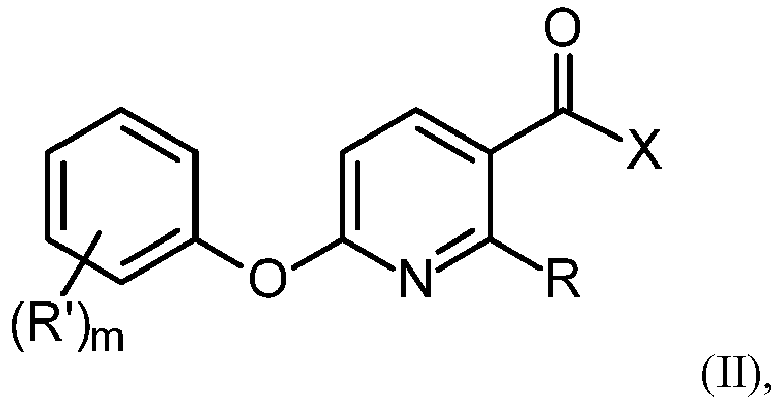
wherein R, R' and m are defined as in formula (I) and X represents chlorine or bromine, in a first step A1) with a malonate of formula (III)
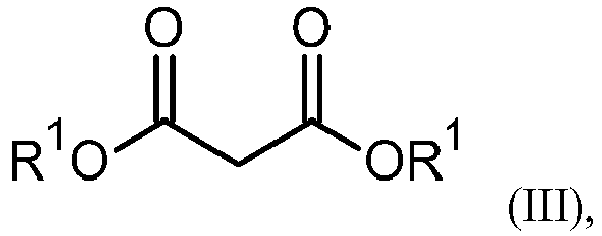
wherein R1 represents C1-C6-alkyl, C2-C6-alkenyl, C2-C6-alkynyl, C3-C8-cycloalkyl or benzyl, in presence of a base and a magnesium compound, and decarboxylating the resulting compound in a second step A2). Optionally the resulting compound of formula (I) is further reacted to a triazole derivative of formula (VI)
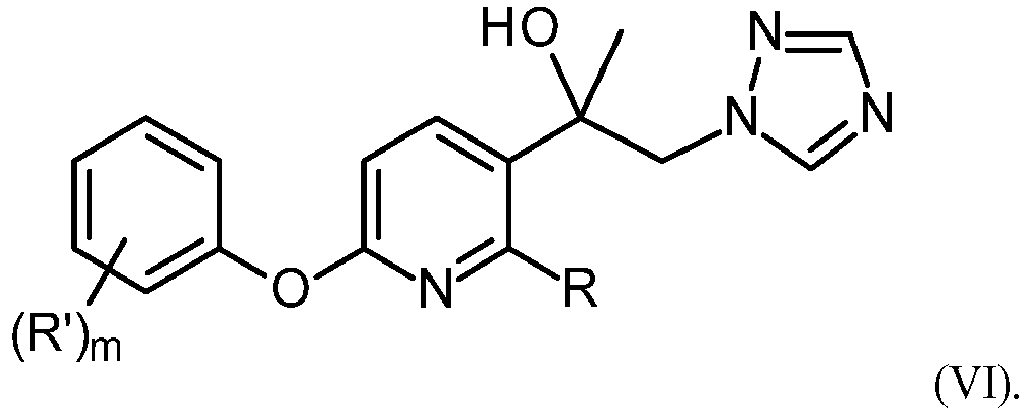
It further relates to the compounds of formula (II), as well as compounds of formulae (IVa) and (IVb).
Description
- The present invention relates to a process for preparing 6-phenoxy-2-(haloalkyl)-3-acylpyridines, and optionally further reacting such pyridines to triazole derivatives showing fungicidal activity. It further relates to key intermediates of said process.
- 6-phenoxy-2-(haloalkyl)-3-acylpyridines are known to be valuable intermediates in the synthesis of compounds useful in the field of crop protection.
WO 2017/029179 A1 discloses fungicidal triazole compounds and several routes to synthesize those. The routes referred to inWO 2017/029179 A1 as processes A, B, D, and E, respectively, comprise synthesis of 6-phenoxy-2-(haloalkyl)-3-acylpyridines which can be converted to the desired triazole derivatives. Said processes A, B, and E require conversion of suitable halogenated phenoxypyridine derivatives into Grignard compounds and reacting such Grignard compounds with acyl chlorides to the desired 6-phenoxy-2-(haloalkyl)-3-acylpyridines. According to said process D a dihalogenated pyridine is reacted with carbon dioxide or carbon monoxide. In the further procedure process D also uses Grignard compounds to arrive at the desired products. Although such procedures provide access to the target phenoxypyridines they have certain drawbacks, in particular necessity to use an organometallic reagent. In the not prepublished European patent application18211222.7 - Object of the invention is provision of a further process for the synthesis of 6-phenoxy-2-(haloalkyl)-3-acylpyridines that avoids the drawbacks of the known methods and provides the desired compounds in excellent yield.
- Surprisingly, it has been found that 6-phenoxy-2-(haloalkyl)-3-acylpyridines can be synthesized in high yield starting from certain 6-phenoxynicotinic acid halides by reacting those with malonic ester, followed by decarboxylation. This process avoids the need of employing organometallic reagents and the drawbacks associated therewith.
- Reaction of certain nicotinic acid halogenides with malonic ester and decarboxylation of the resulting compounds is known from Tetrahedron Vol. 48, No. 42, pp. 9233-9236, 1992 and
EP 0 341 478 A2 . However, said references do not disclose synthesis of any 2-(haloalkyl)-3-acylpyridines, nor deal with the production of fungicides or intermediates thereof. - Accordingly, subject of this invention is a process for preparing a compound of formula (I)

- R
- represents C1-C2-haloalkyl;
- R'
- represents halogen, CN, nitro, C1-C4-alkyl, C1-C4-haloalkyl, C1-C4-alkoxy, C1-C4-haloalkoxy, C1-C4-alkylcarbonyl, hydroxy-substituted C1-C4-alkyl or pentafluoro-λ6-sulfanyl; and
- m
- is an integer and is 0, 1, 2, 3, 4 or 5;
- R, R'
- and m are defined as in formula (I); and
- X
- represents chlorine or bromine;
- R1 represents C1-C6-alkyl, C2-C6-alkenyl, C2-C6-alkynyl, C3-C8-cycloalkyl or benzyl;
- in presence of a base and a magnesium compound; and
- in a second step A2) the resulting compound is decarboxylated.
- Formula (I) provides a general definition of the compounds obtainable by the process according to the invention. Preferred radical definitions for formula (I) shown above and below are given below. These definitions apply to compounds of formula (I) and likewise to all educts, intermediates and products bearing the respective radical(s).
- R
- preferably represents C1-haloalkyl.
- R
- more preferably represents CF3, CF2Cl, CHF2 or CH2F.
- R
- most preferably represents CF3.
- R'
- preferably represents halogen, CN, nitro, C1-C4-alkyl, C1-C4-haloalkyl, C1-C4-alkoxy, C1-C4-haloalkoxy or pentafluoro-λ6-sulfanyl.
- R'
- more preferably represents CF3, OCF3, Br, Cl or pentafluoro-λ6-sulfanyl.
- R'
- more preferably represents CF3, OCF3, Br, Cl or pentafluoro-λ6-sulfanyl, wherein the CF3, OCF3, Br, Cl or pentafluoro-λ6-sulfanyl is attached to the phenyl moiety in the 4-position.
- R'
- most preferably represents Br or Cl, wherein the Br or Cl is preferably attached to the phenyl moiety in the 4-position.
- m
- preferably is 1, 2 or 3.
- m
- more preferably is 1 or 2.
- m
- most preferably is 1.
- Formula (II) and (III) provide a general definition of the educts used in step A1) of the process according to the invention.
- Regarding R, R' and m the definitions given with regard to formula (I) apply mutatis mutandis.
- X
- most preferably represents chlorine.
- R1
- preferably represents C1-C4-alkyl, C2-C6-alkenyl, C2-C6-alkynyl, cyclopropyl or benzyl.
- R1
- more preferably represents C1-C4-alkyl, C2-C6-alkenyl, C2-C6-alkynyl or cyclopropyl.
- R1
- more preferably represents C1-C4-alkyl or cyclopropyl.
- R1
- more preferably represents methyl, ethyl, n-propyl, isopropyl, n-butyl, isobutyl, tert.-butyl or cyclopropyl.
- R1
- more preferably represents methyl, ethyl, n-propyl, isopropyl, n-butyl, isobutyl or tert.-butyl.
- R1
- more preferably represents methyl or ethyl.
- R1
- most preferably represents methyl.
- The compounds resulting from step A1) of the process according to the invention can be depicted by formulae (IVa) and/or (IVb)


- Regarding R, R' and m the definitions given with regard to formula (I) apply mutatis mutandis. Regarding R1 the definitions given with regard to formula (III) apply mutatis mutandis.
- Formulae (IVa) and (IVb) represent tautomeric forms of compounds resulting from step A1) of the process according to the invention. Those compounds can be present as tautomer of formula (IVa), tautomer of formula (IVb) and as mixtures of both isomeric forms in any ratio. They can also be present in any other isomeric, in particular tautomeric, form and as mixture of tautomers of formulae (IVa) and/or (IVb) and any further isomer thereof.
- The radical definitions and explanations given above in general terms or stated within preferred ranges can also be combined with one another as desired, i.e. including between the particular ranges and preferred ranges. They apply both to the end products and correspondingly to educts and intermediates. In addition, individual definitions may not apply.
- Preference is given to those cases in which each of the radicals have the abovementioned preferred definitions.
- Particular preference is given to those cases in which each of the radicals have the abovementioned more and/or most preferred definitions.
- Hence, particular preferred is a process for preparing a compound of formula (Ia)

Ra' represents Br or Cl;
characterized in that a compound of formula (IIa)
Ra' is defined as in formula (Ia);
is reacted in a first step A1) with the malonate of formula (IIIa)
- In the definitions of the symbols given in the above and below formulae, collective terms were used which are generally representative of the following substituents:
The definition C1-C6-alkyl comprises the largest range defined here for an alkyl radical. Specifically, this definition comprises the meanings methyl, ethyl, n-, isopropyl, n-, iso-, sec-, tert-butyl, and also in each case all isomeric pentyls and hexyls, such as methyl, ethyl, propyl, 1-methylethyl, butyl, 1-methylpropyl, 2-methylpropyl, 1,1-dimethylethyl, n-pentyl, 1-methylbutyl, 2-methylbutyl, 3-methylbutyl, 1,2-dimethylpropyl, 1,1-dimethylpropyl, 2,2-dimethylpropyl, 1-ethylpropyl, n-hexyl, 1-methylpentyl, 2-methylpentyl, 3-methylpentyl, 4-methylpentyl, 1,2-dimethylbutyl, 1,3-dimethylbutyl, 2,3-dimethylbutyl, 1,1-dimethylbutyl, 2,2-dimethylbutyl, 3,3-dimethylbutyl, 1,1,2-trimethylpropyl, 1,2,2-trimethylpropyl, 1-ethylbutyl, 2-ethylbutyl, 1-ethyl-3-methylpropyl, in particular propyl, 1-methylethyl, butyl, 1-methylbutyl, 2-methylbutyl, 3-methylbutyl, 1,1-dimethylethyl, 1,2-dimethylbutyl, 1,3-dimethylbutyl, n-pentyl, 1-methylbutyl, 1-ethylpropyl, hexyl, 3-methylpentyl. A preferred range is C1-C4-alkyl, such as methyl, ethyl, n-, isopropyl, n-, iso-, sec-, tert-butyl. The definition C1-C2-alkyl comprises methyl and ethyl. - The definition halogen comprises fluorine, chlorine, bromine and iodine. Halogen-substitution is generally indicated by the prefix halo, halogen or halogeno.
- Halogen-substituted alkyl - e.g. referred to as halogenalkyl, halogenoalkyl or haloalkyl, e.g. C1-C4-haloalkyl or C1-C2-haloalkyl - represents, for example, C1-C4-alkyl or C1-C2-alkyl as defined above substituted by one or more halogen substituents which can be the same or different. Preferably C1-C4-haloalkyl represents chloromethyl, dichloromethyl, trichloromethyl, fluoromethyl, difluoromethyl, trifluoromethyl, chlorofluoromethyl, dichlorofluoromethyl, chlorodifluoromethyl, 1-fluoroethyl, 2-fluoroethyl, 2,2-difluoroethyl, 2,2,2-trifluoroethyl, 2-chloro-2-fluoroethyl, 2-chloro-2,2-difluoroethyl, 2,2-dichloro-2-fluoroethyl, 2,2,2-trichloroethyl, 1,1-difluoroethyl, pentafluoroethyl, 1-fluoro-1-methylethyl, 2-fluoro-1,1-dimethylethyl, 2-fluoro-1-fluoromethyl-1-methylethyl, 2-fluoro-1,1-di(fluoromethyl)-ethyl, 1-chlorobutyl. Preferably C1-C2-haloalkyl represents chloromethyl, dichloromethyl, trichloromethyl, fluoromethyl, difluoromethyl, trifluoromethyl, chlorofluoromethyl, dichlorofluoromethyl, chlorodifluoromethyl, 1-fluoroethyl, 2-fluoroethyl, 2,2-difluoroethyl, 2,2,2-trifluoroethyl, 2-chloro-2-fluoroethyl, 2-chloro-2,2-difluoroethyl, 2,2-dichloro-2-fluoroethyl, 2,2,2-trichloroethyl, 1,1-difluoroethyl, pentafluoroethyl.
- The definition C2-C6-alkenyl comprises the largest range defined here for an alkenyl radical. Specifically, this definition comprises the meanings ethenyl, n-, isopropenyl, n-, iso-, sec-, tert-butenyl, and also in each case all isomeric pentenyls, hexenyls, 1-methyl-1-propenyl, 1-ethyl-1-butenyl. Halogen-substituted alkenyl - referred to as C2-C6-haloalkenyl - represents, for example, C2-C6-alkenyl as defined above substituted by one or more halogen substituents which can be the same or different.
- The definition C2-C6-alkynyl comprises the largest range defined here for an alkynyl radical. Specifically, this definition comprises the meanings ethynyl, n-, isopropynyl, n-, iso-, sec-, tert-butynyl, and also in each case all isomeric pentynyls, hexynyls. Halogen-substituted alkynyl - referred to as C2-C6-haloalkynyl - represents, for example, C2-C6-alkynyl as defined above substituted by one or more halogen substituents which can be the same or different.
- The definition C3-C8-cycloalkyl comprises monocyclic saturated hydrocarbyl groups having 3 to 8 carbon ring members, such as cyclopropyl, cyclobutyl, cyclopentyl, cyclohexyl, cycloheptyl and cyclooctyl.
- In step A1) of the process according to the present invention a compound of formula (II) is reacted with a malonate of formula (III) in presence of a base and a magnesium compound.
- In step A2) of the process according to the present invention the compound resulting from step A1) is decarboxylated.
- Decarboxylation as used throughout this specification is to be understood as replacing each of the two C(O)OR1 moieties present in the compound resulting from step A1) by hydrogen, thereby forming the respective compound of formula (I).
- Preferably, in step A1) the malonate of formula (III) is added in a molar amount to arrive at a molar ratio of compound of formula (II) to malonate of formula (III) of 1 : 0.9 to 1 : 3, preferably 1 : 0.95 to 1 : 2, more preferred 1 : 1 to 1 : 1.5, more preferred 1 : 1 to 1 : 1.2, most preferred 1 : 1 to 1 : 1.1.
- Throughout this specification any reference to a molar amount of a compound or a molar ratio of two reactants is based on the total amount of the compound and reactants, respectively. Therefore, in case a mixture of a particular compound or reactant is present, the molar amount and molar ratio is based on the total amount of all members of this mixture. For example, if a mixture of two or more malonates of formula (III) is present in step A1), the molar ratio is to be calculated based on the total amount of all present malonates of formula (III). This applies mutatis mutandis for any reference to an amount by weight or volume and any weight or volume ratios.
- Preferably, the base present in step A1) is selected from alkali metal or alkaline earth metal acetates, preferably sodium acetate, potassium acetate and calcium acetate, and basic organic nitrogen compounds, preferably trimethylamine, triethylamine, tripropylamine, tributylamine, ethyldiisopropylamine, N,N-dimethylcyclohexylamine, dicyclohexylamine, ethyldicyclohexylamine, N,N-dimethylaniline, N,N-dimethylbenzylamine, pyridine, 2-methyl-, 3-methyl-, 4-methyl-, 2,4-dimethyl-, 2,6-dimethyl-, 3,4-dimethyl- and 3,5-dimethylpyridine, 5-ethyl-2-methylpyridine, 4-dimethylaminopyridine, N-methylpiperidine, 1,4-diazabicyclo[2.2.2]-octane (DABCO), 1,5-diazabicyclo[4.3.0]-non-5-ene (DBN) and 1,8-diazabicyclo[5.4.0]-undec-7-ene (DBU).
- More preferably, the base is selected from basic organic nitrogen compounds, preferably trimethylamine, triethylamine, tripropylamine, tributylamine, ethyldiisopropylamine, N,N-dimethylcyclohexylamine, dicyclohexylamine, ethyldicyclohexylamine, N,N-dimethylaniline, N,N-dimethylbenzylamine, 1,4-diazabicyclo[2.2.2]-octane (DABCO), 1,5-diazabicyclo[4.3.0]-non-5-ene (DBN), 1,8-diazabicyclo[5.4.0]-undec-7-ene (DBU) and mixtures thereof, more preferably from trimethylamine, triethylamine, tripropylamine, tributylamine, ethyldiisopropylamine, and mixtures thereof. Most preferred the base is triethylamine.
- Preferably, in step A1) the base is present in a molar amount to arrive at a molar ratio of magnesium compound to base of 1 : 1 to 1 : 5, preferably 1 : 1.5 to 1 : 4, more preferred 1 : 2 to 1 : 3.5.
- Preferably, the magnesium compound present in step A1) is selected from MgCl2, MgBr2, Mg(OH)2, Mg(OMe)2, Mg(OEt)2, MgO, Mg(NO3)2 and mixtures thereof, more preferably from MgCl2, MgBr2, MgO and mixtures thereof, more preferably from MgCl2, MgBr2 and mixtures thereof. Most preferably, the magnesium compound present in step A1) is MgCl2.
- In one particular embodiment of the process according to the invention the magnesium compound present in step A1) is MgO and the base is selected from alkali metal or alkaline earth metal acetates, preferably sodium acetate, potassium acetate, calcium acetate and mixtures thereof.
- Preferably, in step A1) the magnesium compound is present in a molar amount to arrive at a molar ratio of compound of formula (II) to magnesium compound of 1 : 0.2 to 1 : 1.5, preferably 1 : 0.3 to 1 : 1.4, more preferred 1 : 0.35 to 1 : 1, more preferred 1 : 0.4 to 1 : 0.8, most preferred 1 : 0.5 to 1 : 0.75.
- Preferably, step A1) is carried out in the presence of an aprotic solvent, preferably selected from acetonitrile, ethylacetate, aromatic hydrocarbons, chlorinated aromatic hydrocarbons and mixtures thereof, more preferably selected from acetonitrile, ethylacetate, alkylbenzenes, chlorobenzenes and mixtures thereof, more preferably selected from acetonitrile, ethylacetate, toluene, xylenes, mesitylene, chlorobenzene and mixtures thereof, most preferred selected from toluene, xylenes, mixtures thereof, and mixtures thereof with acetonitrile or ethylacetate.
- Preferably, step A1) is carried out at a temperature of -20°C to 50°C, preferably 0°C to 40°C, more preferred 10°C to 30°C.
- After completion of the reaction, the reaction mixture resulting from step A1) is preferably treated with an aqueous acid, preferably an aqueous hydrochloric acid or aqueous sulfuric acid, more preferably aqueous sulfuric acid, most preferably aqueous sulfuric acid having a concentration of 10 to 30 % by weight. Preferably, the aqueous acid is added in such amount to adjust the pH of the resulting aqueous phase to 1-6, preferably 1-3.
- If not defined otherwise, any reference to a pH value in this specification refers to the value at room temperature (21°C).
- Preferably, resulting organic and aqueous phases are separated and the aqueous phase is extracted with an organic solvent, preferably selected from aromatic hydrocarbons, chlorinated aromatic hydrocarbons and mixtures thereof, more preferably selected from alkylbenzenes, chlorobenzenes and mixtures thereof, more preferably selected from toluene, xylenes, mesitylene, chlorobenzene and mixtures thereof, most preferred from toluene and/or xylenes.
- The combined organic phases can be used for the decarboxylation step A2) without any further purification.
- If, however, it is desired to isolate the resulting compound, this can be achieved by simply removing any organic solvent and volatiles by evaporation in vacuum. If desired, the resulting compounds may be further purified by known techniques, for example chromatography.
- In step A2) the product resulting from step A1) is decarboxylated to arrive at the desired compound of formula (I).
- Decarboxylation is preferably performed by heating the product resulting from step A1) to at least 50°C, preferably 50°C to 180°C, more preferred 80°C to 170°C, more preferred 85°C to 160°C, most preferred 90°C to 150°C in the presence of water.
- Preferably, water is added in an amount of 1 to 30 mol, preferably 2 to 20 mol, more preferred 2 to 10 mol per mol of compound of formula (IVa) and/or (IVb).
- Since at the elevated temperature used in step A2) some of the water may evaporate from the reaction mixture, it is preferred to add the desired amount of water in several, e.g. 2 to 10, portions or continuously during stirring of the heated reaction mixture.
- Optionally, step A2) is performed in the presence of an acid, preferably an aqueous hydrochloric acid or aqueous sulfuric acid, more preferably aqueous sulfuric acid, most preferably aqueous sulfuric acid having a concentration of 10 to 30 % by weight.
- Optionally, step A2) is carried out in the presence of an organic solvent, preferably selected from dimethylsulfoxide (DMSO), N,N-dimethylformamide (DMF), N,N-dimethylacetamide (DMA), acetonitrile, aromatic hydrocarbons, chlorinated aromatic hydrocarbons and mixtures thereof, more preferably selected from alkylbenzenes, chlorobenzenes and mixtures thereof, more preferably selected from toluene, xylenes, mesitylene, chlorobenzene and mixtures thereof, most preferred in the presence of toluene and/or xylenes. More preferably, the same kind of solvent that is present in step A1), if any, is also used in step A2).
- However, preferably step A2) is carried out in the absence of an organic solvent, i.e. organic solvent present in step A1), if any, is removed from the reaction mixture as outlined above and the decarboxylation is preferably performed in the presence of water and optionally an acid only.
- Preferably, steps A1) and A2) are performed under standard pressure (1 atm) or under elevated pressure (> 1 atm), more preferably at least step A2) is performed under elevated pressure, preferably at a pressure of 1.2 to 10 bar, more preferred 1.4 to 8 bar, most preferred 1.5 to 5 bar. Working at elevated pressure allows high rection temperatures, like 110 to 130°C, when the reaction is performed in a mixture of organic solvent and water forming an azeotropic mixture, for example toluene/water or xylene/water.
- The compound of formula (I) or solution thereof resulting from step A2) can be directly used in step C) of the process outlined below. It is also possible to isolate the compound of formula (I), preferably by evaporation of the organic solvent, preferably under reduced pressure. The process according to the invention yields the compounds of formula (I) in sufficient purity. However, if desired, the compounds of formula (I) may be further purified by known techniques, for example distillation or chromatography. Preferably, the compounds of formula (I) are purified by distillation before use thereof in step C).
- The malonates of formula (III), the bases and magnesium compounds used in step A1) are well-known compounds being commercially available or readily obtainable by established synthesis routes.
- Compounds of formula (II) used in step A1) can be synthesized from respective compounds of formula (V)

R, R' and m are defined as in formula (II). - Preferably the compound of formula (II) is prepared by reacting a compound of formula (V)
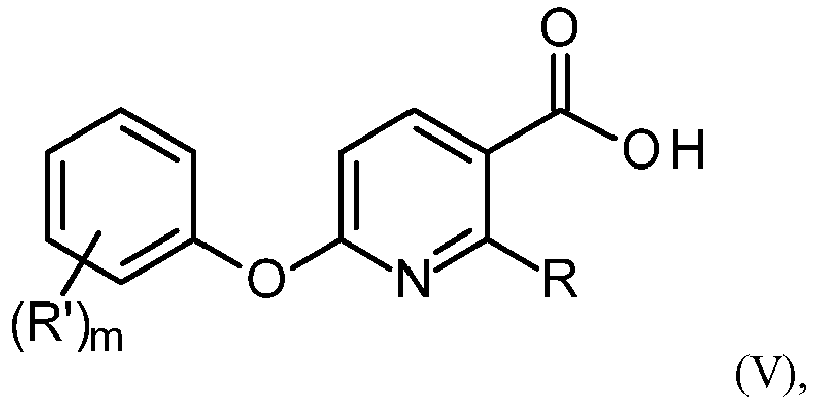
- R, R' and m are defined as in formula (II);
- with a dehydroxyhalogenation agent selected from COCl2, diphosgene, triphosgene, cyanuric chloride, SOCl2, SO2Cl2, PCl3, PCl5, POCl3, PBr3, SOBr2 and SO2Br2.
- In the following this reaction step is referred to as step B).
- Preferably, the dehydroxyhalogenation agent used in step B) is selected from POCl3, COCl2, diphosgene, triphosgene and SOCl2, more preferably from POCl3, COCl2 and SOCl2, more preferably the dehydroxyhalogenation agent is POCl3 or SOCl2, most preferably the dehydroxyhalogenation agent is SOCl2.
- Step B) can be conducted in presence or absence of a formamide catalyst. If present, the formamide catalyst is preferably selected from N,N-Dimethylformamide, N,N-Diethylformamide, N,N-Diisopropylformamide, N,N-Di-n-butylformamide and mixtures thereof, more preferably the formamide catalyst is N,N-Di-n-butylformamide. However, preferably, step B) is conducted in absence of a formamide catalyst.
- If present, the amount of formamide catalyst in step B) is preferably 0.1 to 10 mole %, more preferably 0.5 to 8 mole %, more preferably 1 to 6 mole %, more preferably 1.5 to 5 mole %, most preferably 2 to 4 mole %, each based on the molar amount of compound of formula (II).
- Preferably, step B) is carried out in the presence of an aprotic solvent, preferably selected from nitriles, aromatic hydrocarbons, chlorinated or alkoxylated aromatic hydrocarbons and mixtures thereof, more preferably selected from butyronitrile, alkylbenzenes, alkoxybenzenes, chlorobenzenes and mixtures thereof, more preferably selected from butyronitrile, toluene, xylenes, mesitylene, methoxybenzene, chlorobenzene and mixtures thereof, more preferred in the presence of toluene and/or xylenes, most preferred in the presence of xylenes.
- Preferably, step B) is carried out at a temperature of 20°C to 150°C, preferably 50°C to 145°C.
- Preferably, the compound of formula (II) and the dehydroxyhalogenation agent are reacted in a molar ratio of 1 : 1.5 to 1 : 30, preferably 1 : 2 to 1 : 20, more preferred 1 : 2.2 to 1 : 19, even more preferred 1 : 2.5 to 1 : 4.5.
- Preferably, step B) is performed under standard pressure (1 atm). However, it is also possible to work under elevated or reduced pressure.
- The reaction mixture resulting from step B) may be worked-up by procedures generally known in the art. For example, after completion of step B) the reaction mixture can be purified by evaporation of volatile components, in particular excess dehydroxyhalogenation agent, preferably under reduced pressure.
- If desired to further purify the compound of formula (II), this is possible by known techniques, for example by distillation or treatment with active charcoal and subsequent filtration.
- However, a huge advantage of the process according to the invention is that step A1) does not require the compound of formula (II) to be of particular purity. Therefore, it is neither necessary to work-up the reaction mixture resulting from step B), nor to isolate and further purify the compound of formula (II).
- Therefore, preferably the reaction mixture resulting from step B) is directly used in step A1) without isolation or purification of the resulting compound of formula (II).
- In other words, preferably step B) and step A1) are conducted without isolation or purification of the reaction product resulting from step B).
- More preferred, after completion of step B) the reaction mixture is quenched with water at a temperature of 0°C to 30°C, preferably 5°C to 25°C, the resulting phases are separated and the organic phase is used in step A1).
- Compounds of formula (V) are accessible by established synthesis routes, for example process D disclosed in
WO 2017/029179 A1 . - As outlined above, compounds of formula (I) are valuable intermediates in the synthesis of compounds useful in the field of crop protection, in particular the triazole compounds disclosed in
WO 2017/029179 A1 . - Therefore, the present invention refers furthermore to a process, wherein a compound of formula (I) is synthesized as outlined above and is further reacted to a triazole derivative of formula (VI)

R, R' and m are defined as in formula (I);
wherein the reaction of the compound of formula (I) to the triazole derivative of formula (VI) comprises the following steps : - step C):
reacting the compound of formula (I) with a trimethylsulfoxonium halide, a trimethylsulfonium halide, trimethylsulfoxonium methylsulfate or trimethylsulfonium methylsulfate to an epoxide of formula (VII)
R, R' and m are defined as in formula (VI); and - step D):
reacting the compound of formula (VII) with 1H-1,2,4-triazole in the presence of a base to the triazole derivative of formula (VI). - Regarding R, R' and m the definitions given with regard to formula (I) apply mutatis mutandis.
- In step C) compounds of formula (I) are converted into epoxides of formula (VII) by reaction with a trimethylsulfoxonium halide, a trimethylsulfonium halide, trimethylsulfoxonium methylsulfate or trimethylsulfonium methylsulfate, preferably trimethylsulfoxonium chloride, trimethylsulfonium chloride, trimethylsulfoxonium methylsulfate or trimethylsulfonium methylsulfate and a base, such as sodium hydroxide or potassium hydroxide. It is possible to prepare the trimethylsulfoxonium halide, trimethylsulfonium halide, trimethylsulfoxonium methylsulfate or trimethylsulfonium methylsulfate separately before using it in step C). However, it is preferred to prepare said reagents in situ, e.g. trimethylsulfonium methylsulfate from a mixture of dimethylsulfide and dimethylsulfate, preferably in the presence of water.
- The trimethylsulfoxonium halide, trimethylsulfonium halide, trimethylsulfoxonium methylsulfate or trimethylsulfonium methylsulfate is preferably used in an amount of 1.1 to 2.5, in particular 1.2 to 2, more preferred 1.3 to 1.6 mole equivalents per 1 mole of compound of formula (I).
- Preferably, trimethylsulfonium methylsulfate is used. Particularly preferred an aqueous solution of trimethylsulfonium methylsulfate is used, preferably an aqueous solution containing 38 to 40 wt%, preferably 38 to 39.5 wt%, more preferred 38 to 39.0 wt% of trimethylsulfonium cation. Preferably, said trimethylsulfonium methylsulfate is prepared in situ, preferably by mixing dimethylsulfide and water and adding dimethylsulfate to said mixture. Preferably, dimethylsulfide is used in excess, more preferred in an amount resulting in a molar ratio of dimethylsulfate to dimethylsulfide of 1 : 1.5 to 1 : 100, preferably 1 : 2 to 1 : 100, more preferred 1 : 3 to 1 : 90, more preferred 1 : 3.5 to 1 : 80, most preferred 1 : 3.5 to 1 : 5.
- Preferably, step C) is carried out at a temperature of -30°C to 50°C, preferably -10°C to 40°C, particularly preferred 20°C to 40°C.
- Step C) is preferably conducted in the presence of water, dimethylsulfide, acetonitrile, xylenes, toluene or a mixture thereof, more preferably in the presence of water, dimethylsulfide or a mixture thereof.
- It is preferably carried out in the presence of a base. Preferably the base is selected from Na2CO3, K2CO3, Cs2CO3, NaOH, KOH, KOtBu, NaH and mixtures thereof, more preferably the base is KOH.
- The reaction mixture resulting from step C) can be worked-up by procedures generally known in the art. Preferably, after completion of the reaction, the reaction mixture is quenched by addition of water. Preferably, resulting organic and aqueous phases are separated, the aqueous phase is extracted with an organic solvent, preferably tert-butyl methyl ether. The resulting solution of the compound of formula (VII) or the crude product obtained by evaporation of the organic solvent and other volatile components can be directly used in step D) of the process according to the invention. However, if desired, the compounds of formula (VII) may be further purified by known techniques, for example recrystallization or chromatography.
- Preferably, in step D) the epoxide of formula (VII) and 1H-1,2,4-triazole are reacted in a molar ratio of 1 : 1 to 1 : 10, preferably 1 : 1 to 1 : 5, more preferred 1 : 1 to 1 : 3, even more preferred 1 : 1 to 1 : 1.8, most preferred 1 : 1.1 to 1 : 1.2.
- Step D) is carried out in the presence of a base. These preferably include alkali metal or alkaline earth metal acetates, amides, carbonates, hydrogencarbonates, hydrides, hydroxides or alkoxides, for example sodium acetate, potassium acetate or calcium acetate, lithium amide, sodium amide, potassium amide or calcium amide, sodium carbonate, potassium carbonate or calcium carbonate, sodium hydrogencarbonate, potassium hydrogencarbonate or calcium hydrogencarbonate, lithium hydride, sodium hydride, potassium hydride or calcium hydride, lithium hydroxide, sodium hydroxide, potassium hydroxide or calcium hydroxide, n-butyllithium, sec-butyllithium, tert-butyllithium, lithium diisopropylamide, lithium bis(trimethylsilyl)amide, sodium methoxide, ethoxide, n- or i-propoxide, n-, i-, s- or t-butoxide or potassium methoxide, ethoxide, n- or i-propoxide, n-, i-, s- or t-butoxide; and also basic organic nitrogen compounds, for example trimethylamine, triethylamine, tripropylamine, tributylamine, ethyldiisopropylamine, N,N-dimethylcyclohexylamine, dicyclohexylamine, ethyldicyclohexylamine, N,N-dimethylaniline, N,N-dimethylbenzylamine, pyridine, 2-methyl-, 3-methyl-, 4-methyl-, 2,4-dimethyl-, 2,6-dimethyl-, 3,4-dimethyl- and 3,5-dimethylpyridine, 5-ethyl-2-methylpyridine, 4-dimethylaminopyridine, N-methylpiperidine, 1,4-diazabicyclo[2.2.2]-octane (DABCO), 1,5-diazabicyclo[4.3.0]-non-5-ene (DBN) or 1,8-diazabicyclo[5.4.0]-undec-7-ene (DBU).
- Preferably the base is selected from Na2CO3, K2CO3, Cs2CO3, NaOH, KOH, KOtBu, NaH and mixtures thereof, more preferably from KOH, K2CO3, Cs2CO3 and mixtures thereof.
- In a particular embodiment of this step, a sodium or potassium salt of 1H-1,2,4-triazole is used as base. Said sodium or potassium salt can be prepared by reacting 1H-1,2,4-triazole and a sodium or potassium base, preferably selected from NaOH, NaH and Na-alcoholates or KOH and K-alcoholates, respectively.
- Preferably, the base is used in at most stoichiometric amount with respect to the epoxide of formula (VII). More preferred, the epoxide of formula (VII) and the base are reacted in a molar ratio of 1 : 1 to 1 : 0.05, preferably 1 : 0.8 to 1 : 0.05, more preferred 1 : 0.5 to 1 : 0.05, even more preferred 1 : 0.3 to 1 : 0.05.
- Preferably, step D) is carried out in the presence of an organic solvent, preferably selected from tetrahydrofuran, methyltetrahydrofuran, in particular 2-methyltetrahydrofuran, diethylether, cyclopropyl methyl ether, tert-butyl methyl ether, toluene, C1-C6-alcohols, preferably n-butanol, n-propanol, isopropanol, ethanol and methanol, C1-C4-alkoxy-C1-C6-alcohols, preferably 1-methoxy-propan-2-ol, N-methylpyrrolidinone (NMP), dimethylformamide (DMF), dimethylacetamide (DMAc), dimethylsulphoxide (DMSO), dimethylpropyleneurea (DMPU), dimethylethyleneurea (DMI), tetramethylurea (TMU), N-methylimidazole (NMI), acetonitrile, propionitrile, butyronitrile and mixtures thereof, more preferably in the presence of n-butanol.
- Preferably, step D) is carried out at a temperature of 20°C to 150°C, preferably 120°C to 150°C, particularly preferred 100°C to 120°C.
- The reaction mixture resulting from step D) can be worked-up by procedures generally known in the art. Preferably, after completion of the reaction, all volatile compounds are evaporated under reduced pressure and the residue is re-dissolved in a suitable organic solvent like dichloromethane or ethyl acetate. Water is added and, if needed, the pH (room temperature) is adjusted to about 6 by introduction of a strong acid like concentrated aqueous hydrochloric acid. The aqueous phase is preferably extracted with a suitable organic solvent like dichloromethane or ethyl acetate. Optionally, the combined organic phases are dried, preferably over magnesium sulfate or sodium sulfate. In case the organic solvent used is dichloromethane drying of the organic phases is not necessary. Preferably, the organic solvent is removed by evaporation and the resulting crude product further purified by known techniques, for example recrystallization or chromatography.
- The reaction time of each of the steps of the process according to the invention varies depending on the scale of the reaction and the reaction temperature, but is generally between a few, e.g. 5, minutes and 48 hours.
- If not defined otherwise, the process steps according to the invention are generally performed under standard pressure (1 atm). However, it is also possible to work under elevated or reduced pressure.
- If not defined otherwise, the amount of any solvent present in any process step according to the invention can vary within wide limits, e.g. from 1 to 99 % by weight, based on the total weight of the respective reaction mixture. Preferrably, the amount of any solvent present in any process step according to the invention is from 1 to 95 % by weight, more preferably from 2 to 90 % by weight, more preferably from 3 to 85 % by weight, more preferably from 4 to 85 % by weight, more preferably from 5 to 80 % by weight, more preferably from 10 to 80 % by weight, more preferably from 15 to 70 % by weight, more preferably from 20 to 70 % by weight, each based on the total weight of the respective reaction mixture.
- The invention further relates to compounds of formula (IVa) and (IVb)


- R
- represents C1-C2-haloalkyl;
- R'
- represents halogen, CN, nitro, C1-C4-alkyl, C1-C4-haloalkyl, C1-C4-alkoxy, C1-C4-haloalkoxy, C1-C4-alkylcarbonyl, hydroxy-substituted C1-C4-alkyl or pentafluoro-λ6-sulfanyl;
- m
- is an integer and is 0, 1, 2, 3, 4 or 5; and
- R1
- represents C1-C6-alkyl, C2-C6-alkenyl, C2-C6-alkynyl, C3-C8-cycloalkyl or benzyl.
- As outlined above, formulae (IVa) and (IVb) do not only encompass the depicted tautomeric forms, but also mixtures thereof, as well as any mixtures with any other isomeric, in particular tautomeric form, such as, for example, tautomers of formula (IVc)

- Preferred are compounds of formula (IVa) and (IVb), wherein R represents C1-haloalkyl, preferably CF3, CF2Cl, CHF2 or CH2F, more preferably CF3.
- Preferred are also compounds of formula (IVa) and (IVb), wherein R' represents halogen, CN, nitro, C1-C4-alkyl, C1-C4-haloalkyl, C1-C4-alkoxy, C1-C4-haloalkoxy or pentafluoro-λ6-sulfanyl, preferably represents CF3, OCF3, Br, Cl or pentafluoro-λ6-sulfanyl, more preferably represents CF3, OCF3, Br, Cl or pentafluoro-λ6-sulfanyl in the 4-position of the phenyl moiety, most preferably represents Br or Cl, preferably in the 4-position of the phenyl moiety.
- Preferred are also compounds of formula (IVa) and (IVb), wherein m is 1, 2 or 3, preferably is 1 or 2, most preferably is 1.
- Preferred are also compounds of formula (IVa) and (IVb), wherein R1 represents C1-C4-alkyl, C2-C6-alkenyl, C2-C6-alkynyl, cyclopropyl or benzyl, preferably C1-C4-alkyl, C2-C6-alkenyl, C2-C6-alkynyl or cyclopropyl, more preferably C1-C4-alkyl or cyclopropyl, more preferably methyl, ethyl, n-propyl, isopropyl, n-butyl, isobutyl, tert.-butyl or cyclopropyl, more preferably methyl, ethyl, n-propyl, isopropyl, n-butyl, isobutyl or tert.-butyl, more preferably methyl or ethyl, most preferably methyl.
- Preference is given to those compounds of formula (IVa) and (IVb) in which each of the radicals have the abovementioned preferred definitions.
- Particular preference is given to those compounds of formula (IVa) and (IVb) in which each of the radicals have the abovementioned more and/or most preferred definitions.
- Hence, particular preferred are the compounds of formula (IVa) and (IVb), wherein
- R
- represents CF3;
- R'
- represents chlorine or bromine in the 4-position of the phenyl ring;
- m
- is 1; and
- R1
- represents CH3.
- Compounds of formula (IVa) and (IVb) are obtainable by step A1) of the process according to the invention as outlined above and are key intermediates in said process.
- The invention further relates to compounds of formula (II)

- R
- represents C1-C2-haloalkyl;
- R'
- represents halogen, CN, nitro, C1-C4-alkyl, C1-C4-haloalkyl, C1-C4-alkoxy, C1-C4-haloalkoxy, C1-C4-alkylcarbonyl, hydroxy-substituted C1-C4-alkyl or pentafluoro-λ6-sulfanyl;
- m
- is an integer and is 0, 1, 2, 3, 4 or 5; and
- X
- represents chlorine or bromine.
- Preferred are compounds of formula (II), wherein R represents C1-haloalkyl, preferably CF3, CF2Cl, CHF2 or CH2F, more preferably CF3.
- Preferred are also compounds of formula (II), wherein R' represents halogen, CN, nitro, C1-C4-alkyl, C1-C4-haloalkyl, C1-C4-alkoxy, C1-C4-haloalkoxy or pentafluoro-λ6-sulfanyl, preferably represents CF3, OCF3, Br, Cl or pentafluoro-λ6-sulfanyl, more preferably represents CF3, OCF3, Br, Cl or pentafluoro-λ6-sulfanyl in the 4-position of the phenyl moiety, most preferably represents Br or Cl, preferably in the 4-position of the phenyl moiety.
- Preferred are also compounds of formula (II), wherein m is 1, 2 or 3, preferably is 1 or 2, most preferably is 1.
- Preferred are also compounds of formula (II), wherein X represents chlorine.
- Preference is given to those compounds of formula (II) in which each of the radicals have the abovementioned preferred definitions.
- Particular preference is given to those compounds of formula (II) in which each of the radicals have the abovementioned more and/or most preferred definitions.
- Hence, particular preferred are the compounds of formula (II), wherein
- R
- represents CF3;
- R'
- represents chlorine or bromine in the 4-position of the phenyl ring;
- m
- is 1; and
- X
- represents chlorine.
- Compounds of formula (II) are obtainable by step B) of the process according to the invention as outlined above.
- The invention is illustrated by the examples below. However, the invention is not limited to the examples.
-

- 6.65 g (0.07 mol) water free MgCl2, 13.8 g (0.105 mol) dimethylmalonate and 22 g (0.22 mol) triethylamine in 100 ml xylene were stirred 1 h at room temperature (21°C) to form a white suspension. 38 g (0.1 mol) 6-(4-bromophenoxy)-2-(trifluoromethyl)pyridine-3-carbonyl chloride dissolved in 10 ml of xylene was added to the suspension at 20-22°C within 1-2 h and the mixture was stirred additionally for 1 h. The mixture was acidified with 140 g of 20 % by weight H2SO4 and stirred for 20 minutes at room temperature before the phases were separated. The resulting water phase was extracted with 20 ml of xylene and the combined organic extract (110 ml) was used for the decarbolkoxylation step (example 2, step A2)) without purification.
- To isolate and characterize the product, a sample of the xylene phase was evaporated in vacuum to give a pale brown oil, being a mixture of two components. Yield: 98 %.
- m/e: 476
Interpretation ofNMR spectra (1H-NMR, 600.13 MHz, CD3CN; 13C-NMR, 150.95 MHz, CD3CN):
H/C δH/ppm Mult. rel. No. H δC/ppm Mult. rel. No. C 1 - - - 164.0 S 1 1a - - - 164.3 S 1 2 - - - 142.7 S(Q) 1 2a - - - 143.7 S(Q) 1 3 - - - 125.1 S(Q) 1 3a - - - 129.3 S 1 4 7.87 D 1 142.9 D 1 4a 8.14 D 1 142.1 D 1 5 7.25 D 1 115.7 D 1 5a 7.26 D 1 115.5 D 1 6 - - - 153.3 S 1 6a - - - 153.1 S 1 7 7.16 M 2 124.5 D 2 7a 7.16 M 2 124.5 D 1 8 7.60 M 2 133.7 D 2 8a 7.60 M 2 133.8 D 2 9 - - - 118.8 S 1 9a - - - 118.9 S 1 10 - - - 121.9 S(Q) 1 10a - - - 121.6 S(Q) 1 11 - - - 175.0 S 1 11a - - - 191.2 S 1 12 13.52 S, br 1 - - - 13 - - - 103.2 S 1 13a 5.31 S 1 64.8 D 1 14 - - - 172.0 S 1 14a - - - 165.5 S 2 15 3.87 S 3 53.7 Q 1 15a 3.74 S 6 54.0 Q 2 16 - - - 165.3 S 1 17 3.45 S 3 52.6 Q 1 -

- 47.6 g of the compound mixture obtained according to example 1 and 250 ml water were heated at 100°C for 20 h. Thereafter the mixture was cooled and the product extracted with ethylacetate. The solvent was removed in vacuum to yield 46.6 g (98 %) of 1-[6-(4-bromophenoxy)-2-(trifluoromethyl)-3-pyridyl]ethanone.
-

- 3.62 g (0.01 mol) 6-(4-bromophenoxy)-2-(trifluoromethyl)pyridine-3-carboxylic acid and 1.78 g (0.015 mol) thionyl chloride were heated in 30 ml xylene for 2 h at 100°C. The solvent was removed in vacuo to give 3.8 g of a brown oil (yield = 100 %).
m/e: 375 (analyzed as methylester). -

- 6-(4-bromophenoxy)-2-(trifluoromethyl)pyridine-3-carboxylic acid was prepared from ethyl-6-(4-bromophenoxy)-2-(trifluoromethyl)pyridine-3-carboxylate and aqueous sodium hydroxide (45 w/w%, 2 equivalents) by heating both reagents in THF for 24 h at 60 °C. Thereafter, aqueous HCl (32 w/w%) was added dropwise at room temperature until pH = 2 was reached. The reaction mixture was extracted with methyl tert-butyl ether (MTBE) and washed with water. The volatiles were removed to yield an off-white solid. Yield 100 %.
m/e: 360.
1H NMR (400 MHz; DMSO-d6): δ = 7.23 (m, 2H), 7.43 (d,1H), 7.64 (m,2H), 8.4 (d, 1H) ppm. -
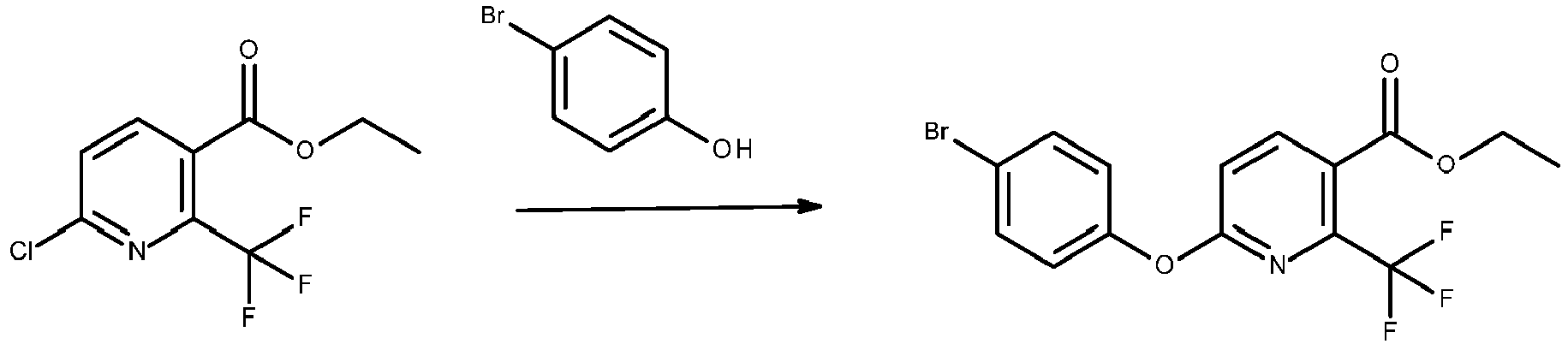
- 2.5 g (0.015 mol) p-bromophenol and 1.05 g potassium methanolate in 30 ml of toluene were heated to 75°C and the volatiles (CH3OH) were removed in vacuum at 700 mbar. 2.53 g ethyl 6-chloro-2-(trifluoromethyl)pyridine-3-carboxylate, (0,01 mol), 0.12 g DABCO (diazabicyclo(2,2,2)octane) and 1 ml PEG 400 were added and the reaction mixture was heated at 90°C for 12 h . Afterwards 100 ml of water were added, the phases separated and the resulting water phase extracted with 100 ml methyl tert-butyl ether (MTBE). The combined organic fractions were washed with water, dried over Na2SO4 and the volatiles were evaporated. The crude product 3.5 g (90 %) was used for the next step without any purification.
m/e: 389.
1H NMR (400 MHz; DMSO-d6): δ = 1.3 (t, 3H), 4.4 (q, 2H), 7.2 (m, 2H), 7.4 (d,1H), 7.6 (m,2H), 8.3 (d, 1H) ppm. - In a 2 L reactor equipped with an overhead-stirrer, dropping funnel, thermometer and several bleach containing scrubbers 128.6 g dimethylsulfide (2.05 mol, 6.0 equiv) and 6.2 mL water were introduced and heated to 32 °C inner temperature. 65.3 g dimethylsulfate (0.51 mol, 1.5 equiv) was added within 30 minutes. The temperature rose to 39.5 °C and the mixture turned cloudy. The mixture was stirred at 37.5 °C inner temperature for 4 h. The mixture was cooled to room temperature and 124.0 g 1-[6-(4-bromophenoxy)-2-(trifluoromethyl)-3-pyridyl]ethanone (0.34 mol, 1.0 equiv) was added at room temperature. The mixture was stirred 20 minutes before being heated to an inner temperature of 38-40 °C at which 57.5 g KOH pellets (1.03 mol, 3.0 equiv) were added. The mixture was further stirred at 42 °C for 4 h and afterwards cooled to room temperature and kept overnight. HPLC analysis showed full conversion. The mixture was diluted with 400 mL water and 500 mL methyl tert-butyl ether (MTBE), filtered through a plug of Celite®, the phases were separated and the organic phase was dried over Na2SO4 and evaporated. The crude product was redissolved in 450 mL MTBE and the remaining volatiles were evaporated to obtain 121 g of a redbrown oil of 94.3 a/a-% HPLC purity that crystallizes upon standing (89.3 % yield).
1H NMR (600 MHz; CD3CN): δ =8.09, d, (1H); 7.60, d, (2H); 7.22, d, (1H); 7.14, d, (2H); 3.05, d, (1H); 2.90, d, (1H); 1.62 s (3H) ppm. - 225 g of 6-(4-bromophenoxy)-3-(2-methyloxiran-2-yl)-2-(trifluoromethyl)pyridine (0.575 mol, 1 equiv) was added to a mixture of 608 mL of n-butanol and 68 mL of PEG400. 60.6 g of 1H-1,2,4-triazole (0.862 mol, 1.5 equiv) and 15.2 g of K2CO3 powder (0.23 mol, 0.4 equiv) were added and the mixture was heated to 100 °C for 13 h. The solvent was removed under reduced pressure until a viscous light-brown oil remained. 3 L of ethyl acetate were added together with 1.5 L of water and 18 mL of concentrated aqueous hydrochloric acid. The phases were separated and the organic phase was washed with water. The organic phase was dried over Na2SO4 and the solvent was removed under reduced pressure. The remaining oily residue crystallized quickly and was triturated 3 times with cyclohexane. The wet product was filtered and dried, yielding 240 g of beige crystals of 90 a/a-% HPLC purity (84.7% yield). The crystals were dissolved in 760 mL of 2-propanol at 82 °C. 1170 mL of water were added and after stirring at 80 °C for 5 minutes, the mixture was let cool down to room temperature overnight. The suspension was further cooled down to 10-15 °C, filtered and washed with 800 mL of water. The product was dried under vacuum at 50 °C to obtain 202 g of light-beige crystals of 97.9 a/a-% HPLC purity (77.6% yield).


Claims (16)
- Process for preparing a compound of formula (I)
 R represents C1-C2-haloalkyl;R' represents halogen, CN, nitro, C1-C4-alkyl, C1-C4-haloalkyl, C1-C4-alkoxy, C1-C4-haloalkoxy, C1-C4-alkylcarbonyl, hydroxy-substituted C1-C4-alkyl or pentafluoro-λ6-sulfanyl; andm is an integer and is 0, 1, 2, 3, 4 or 5;characterized in that a compound of formula (II)
 R, R' and m are defined as in formula (I); andX represents chlorine or bromine;is reacted in a first step A1) with a malonate of formula (III)
 R1 represents C1-C6-alkyl, C2-C6-alkenyl, C2-C6-alkynyl, C3-C8-cycloalkyl or benzyl; in presence of a base and a magnesium compound; and in a second step A2) the resulting compound is decarboxylated.
 - Process according to claim 1, wherein R represents CF3.
- Process according to at least one of claims 1 to 2, wherein R' represents Br or Cl and/or m is 1.
- Process according to at least one of claims 1 to 3, wherein X represents chlorine.
- Process according to at least one of claims 1 to 4, wherein R1 represents methyl, ethyl, n-propyl, isopropyl, n-butyl, isobutyl or tert.-butyl.
- Process according to at least one of claims 1 to 5, wherein the base present in step A1) is selected from trimethylamine, triethylamine, tripropylamine, tributylamine, ethyldiisopropylamine, N,N-dimethylcyclohexylamine, dicyclohexylamine, ethyldicyclohexylamine, N,N-dimethylaniline, N,N-dimethylbenzylamine, 1,4-diazabicyclo[2.2.2]-octane (DABCO), 1,5-diazabicyclo[4.3.0]-non-5-ene (DBN), 1,8-diazabicyclo[5.4.0]-undec-7-ene (DBU) and mixtures thereof.
- Process according to at least one of claims 1 to 6, wherein the magnesium compound present in step A1) is selected from MgCl2, MgBr2, Mg(OH)2, Mg(OMe)2, Mg(OEt)2, MgO, Mg(NO3)2 and mixtures thereof.
- Process according to at least one of claims 1 to 7, wherein in step A1) the molar ratio of compound of formula (II) and magnesium compound is 1 : 0.4 to 1 : 0.8.
- Process according to at least one of claims 1 to 8, wherein decarboxylation is performed by heating the compound resulting from step A1) in the presence of water to 50 to 180°C.
- Process according to at least one of claims 1 to 9, wherein step A1) is conducted in the presence of an organic solvent selected from toluene, xylene, mixtures thereof, and mixtures thereof with acetonitrile or ethylacetate.
- Process according to at least one of claims 1 to 10, wherein the compound of formula (II) is prepared by reacting a compound of formula (V)

R, R' and m are defined as in formula (II);
in a step B) with a dehydroxyhalogenation agent selected from COCl2, diphosgene, triphosgene, cyanuric chloride, SOCl2, SO2Cl2, PCl3, PCl5, POCl3, PBr3, SOBr2 and SO2Br2. - Process according to at least one of claims 1 to 11, wherein compound of formula (I) is further reacted to a triazole derivative of formula (VI)

R, R' and m are defined as in formula (I);
characterized in that
the reaction of the compound of formula (I) to the triazole derivative of formula (VI) comprises the following steps :step C):
reacting the compound of formula (I) with a trimethylsulfoxonium halide, a trimethylsulfonium halide, trimethylsulfoxonium methylsulfate or trimethylsulfonium methylsulfate to an epoxide of formula (VII)
R, R' and m are defined as in formula (VI); andstep D):
reacting the compound of formula (VII) with 1H-1,2,4-triazole in the presence of a base to the triazole derivative of formula (VI). - Compound of formula (IVa) or (IVb)

 R represents C1-C2-haloalkyl;R' represents halogen, CN, nitro, C1-C4-alkyl, C1-C4-haloalkyl, C1-C4-alkoxy, C1-C4-haloalkoxy, C1-C4-alkylcarbonyl, hydroxy-substituted C1-C4-alkyl or pentafluoro-λ6-sulfanyl;m is an integer and is 0, 1, 2, 3, 4 or 5; andR1 represents C1-C6-alkyl, C2-C6-alkenyl, C2-C6-alkynyl, C3-C8-cycloalkyl or benzyl.
 - Compound according to claim 13, whereinR represents CF3;R' represents chlorine or bromine in the 4-position of the phenyl ring;m is 1; andR1 represents CH3.
- Compound of formula (II)
 R represents C1-C2-haloalkyl;R' represents halogen, CN, nitro, C1-C4-alkyl, C1-C4-haloalkyl, C1-C4-alkoxy, C1-C4-haloalkoxy, C1-C4-alkylcarbonyl, hydroxy-substituted C1-C4-alkyl or pentafluoro-λ6-sulfanyl;m is an integer and is 0, 1, 2, 3, 4 or 5; andX represents chlorine or bromine.
 - Compound according to claim 15, whereinR represents CF3;R' represents chlorine or bromine in the 4-position of the phenyl ring;m is 1; andX represents chlorine.
Priority Applications (1)
| Application Number | Priority Date | Filing Date | Title |
|---|---|---|---|
| EP19174826.8A EP3738959A1 (en) | 2019-05-16 | 2019-05-16 | Preparation of 6-phenoxy-2-(haloalkyl)-3-acylpyridines and intermediates therefor |
Applications Claiming Priority (1)
| Application Number | Priority Date | Filing Date | Title |
|---|---|---|---|
| EP19174826.8A EP3738959A1 (en) | 2019-05-16 | 2019-05-16 | Preparation of 6-phenoxy-2-(haloalkyl)-3-acylpyridines and intermediates therefor |
Publications (1)
| Publication Number | Publication Date |
|---|---|
| EP3738959A1 true EP3738959A1 (en) | 2020-11-18 |
Family
ID=66589283
Family Applications (1)
| Application Number | Title | Priority Date | Filing Date |
|---|---|---|---|
| EP19174826.8A Withdrawn EP3738959A1 (en) | 2019-05-16 | 2019-05-16 | Preparation of 6-phenoxy-2-(haloalkyl)-3-acylpyridines and intermediates therefor |
Country Status (1)
| Country | Link |
|---|---|
| EP (1) | EP3738959A1 (en) |
Citations (2)
| Publication number | Priority date | Publication date | Assignee | Title |
|---|---|---|---|---|
| EP0341478A2 (en) | 1988-05-07 | 1989-11-15 | Bayer Ag | Method for the preparation of 2,3-dichloro-5-acetyl pyridine |
| WO2017029179A1 (en) | 2015-08-14 | 2017-02-23 | Bayer Cropscience Aktiengesellschaft | Triazole derivatives, intermediates thereof and their use as fungicides |
-
2019
- 2019-05-16 EP EP19174826.8A patent/EP3738959A1/en not_active Withdrawn
Patent Citations (2)
| Publication number | Priority date | Publication date | Assignee | Title |
|---|---|---|---|---|
| EP0341478A2 (en) | 1988-05-07 | 1989-11-15 | Bayer Ag | Method for the preparation of 2,3-dichloro-5-acetyl pyridine |
| WO2017029179A1 (en) | 2015-08-14 | 2017-02-23 | Bayer Cropscience Aktiengesellschaft | Triazole derivatives, intermediates thereof and their use as fungicides |
Non-Patent Citations (2)
| Title |
|---|
| BRITT-MARIE SWAHN ET AL: "Two non-racemic preparations of a piperidine-based NMDA antagonist with analgesic activity", BIOORGANIC & MEDICINAL CHEMISTRY, vol. 5, no. 7, 1 July 1997 (1997-07-01), pages 1293 - 1299, XP055597217, ISSN: 0968-0896, DOI: 10.1016/S0968-0896(97)00057-6 * |
| TETRAHEDRON, vol. 48, no. 42, 1992, pages 9233 - 9236 |
Similar Documents
| Publication | Publication Date | Title |
|---|---|---|
| KR101537880B1 (en) | Process for the preparation of 4-amino-5-fluoro-3-halo-6-(substituted)picolinates | |
| TWI609005B (en) | Procedure for the decarboxylation of 3,5-bis(haloalkyl)-pyrazole-4-carboxylic acid derivatives | |
| KR20130121949A (en) | Process for the preparation of 4-amino-5-fluoro-3-halo-6-(substituted)picolinates | |
| EA016615B1 (en) | Method for the production of n-substituted (3-dihalomethyl-1-methyl-pyrazole-4-yl) carboxamides | |
| CN104245676A (en) | Process for the preparation of 3,5-bis(fluoroalkyl)pyrazole-4-carboxylic acid derivatives and 3,5-bis(fluoroalkyl)pyrazoles | |
| DK2981519T3 (en) | Process for the preparation of amides from inhibited anilines containing a perhaloalkyl group | |
| EP3738959A1 (en) | Preparation of 6-phenoxy-2-(haloalkyl)-3-acylpyridines and intermediates therefor | |
| EP3348554B1 (en) | Method for producing triazole compound | |
| TW201607928A (en) | Process for preparing 3,5-bis(haloalkyl)pyrazole derivatives from [alpha],[alpha]-dihaloamines | |
| WO2020025574A1 (en) | Process for the preparation of 6-(haloalkyl)-2-halo-5-acylpyridines and intermediates for this process | |
| CA2488828C (en) | Method for the production of 1,2,4-triazolylmethyl-oxiranes | |
| TW202012372A (en) | Process for producing 2-(fluoroalkyl) nicotinic acids | |
| JP4954409B2 (en) | Process for producing aryltriazolinones and novel intermediates thereof | |
| ES2849960T3 (en) | Process for the preparation of 3-fluoroalkyl-5-pyrazolecarboxylates and 3-fluoroalkyl-5-pyrazolecarboxylic acids | |
| EP3666759A1 (en) | Preparation of 6-halo-2-(haloalkyl)-3-acylpyridines and intermediates therefor | |
| EP1858878B1 (en) | Conversion of 2-pyrazolines to pyrazoles using bromine | |
| WO2019048526A1 (en) | Process for the preparation of 1-[6-halogeno-3-pyridyl]ketones | |
| CN106458918A (en) | Process for the preparation of 3,5-bis(haloalkyl)pyrazoles via acylation of ketimines | |
| TWI491597B (en) | Novel process for preparing enaminocarbonyl compounds | |
| US20150376135A1 (en) | Process for the preparation of bis-dihaloalkyl pyrazoles | |
| WO2019012161A1 (en) | Process for the preparation of substituted (1h-1,2,4-triazol-1-yl)alcohols | |
| JP2649122B2 (en) | 4,5-Dihalogeno-6- (α-substituted ethyl) pyrimidine and process for producing the same | |
| CN112351972A (en) | Disubstituted 5(3) -pyrazole carboxylic acid esters and methods of making same from enol esters and Fluoroalkylamino (FAR) reagents | |
| JPH05194417A (en) | 4,5-Dihalogeno-6- (α-halogenoethyl) pyrimidine and process for producing the same |
Legal Events
| Date | Code | Title | Description |
|---|---|---|---|
| PUAI | Public reference made under article 153(3) epc to a published international application that has entered the european phase |
Free format text: ORIGINAL CODE: 0009012 |
|
| STAA | Information on the status of an ep patent application or granted ep patent |
Free format text: STATUS: THE APPLICATION HAS BEEN PUBLISHED |
|
| AK | Designated contracting states |
Kind code of ref document: A1 Designated state(s): AL AT BE BG CH CY CZ DE DK EE ES FI FR GB GR HR HU IE IS IT LI LT LU LV MC MK MT NL NO PL PT RO RS SE SI SK SM TR |
|
| AX | Request for extension of the european patent |
Extension state: BA ME |
|
| STAA | Information on the status of an ep patent application or granted ep patent |
Free format text: STATUS: THE APPLICATION IS DEEMED TO BE WITHDRAWN |
|
| 18D | Application deemed to be withdrawn |
Effective date: 20210519 |