EP3738889B1 - Lighting device, aircraft comprising such lighting device, and method for manufacturing a lighting device - Google Patents
Lighting device, aircraft comprising such lighting device, and method for manufacturing a lighting device Download PDFInfo
- Publication number
- EP3738889B1 EP3738889B1 EP19175028.0A EP19175028A EP3738889B1 EP 3738889 B1 EP3738889 B1 EP 3738889B1 EP 19175028 A EP19175028 A EP 19175028A EP 3738889 B1 EP3738889 B1 EP 3738889B1
- Authority
- EP
- European Patent Office
- Prior art keywords
- circuit board
- optical element
- led
- lighting device
- light
- Prior art date
- Legal status (The legal status is an assumption and is not a legal conclusion. Google has not performed a legal analysis and makes no representation as to the accuracy of the status listed.)
- Active
Links
Images





Classifications
-
- F—MECHANICAL ENGINEERING; LIGHTING; HEATING; WEAPONS; BLASTING
- F21—LIGHTING
- F21S—NON-PORTABLE LIGHTING DEVICES; SYSTEMS THEREOF; VEHICLE LIGHTING DEVICES SPECIALLY ADAPTED FOR VEHICLE EXTERIORS
- F21S41/00—Illuminating devices specially adapted for vehicle exteriors, e.g. headlamps
- F21S41/10—Illuminating devices specially adapted for vehicle exteriors, e.g. headlamps characterised by the light source
- F21S41/14—Illuminating devices specially adapted for vehicle exteriors, e.g. headlamps characterised by the light source characterised by the type of light source
- F21S41/141—Light emitting diodes [LED]
- F21S41/143—Light emitting diodes [LED] the main emission direction of the LED being parallel to the optical axis of the illuminating device
-
- B—PERFORMING OPERATIONS; TRANSPORTING
- B64—AIRCRAFT; AVIATION; COSMONAUTICS
- B64D—EQUIPMENT FOR FITTING IN OR TO AIRCRAFT; FLIGHT SUITS; PARACHUTES; ARRANGEMENT OR MOUNTING OF POWER PLANTS OR PROPULSION TRANSMISSIONS IN AIRCRAFT
- B64D45/00—Aircraft indicators or protectors not otherwise provided for
- B64D45/04—Landing aids; Safety measures to prevent collision with earth's surface
- B64D45/08—Landing aids; Safety measures to prevent collision with earth's surface optical
-
- B—PERFORMING OPERATIONS; TRANSPORTING
- B60—VEHICLES IN GENERAL
- B60Q—ARRANGEMENT OF SIGNALLING OR LIGHTING DEVICES, THE MOUNTING OR SUPPORTING THEREOF OR CIRCUITS THEREFOR, FOR VEHICLES IN GENERAL
- B60Q3/00—Arrangement of lighting devices for vehicle interiors; Lighting devices specially adapted for vehicle interiors
- B60Q3/40—Arrangement of lighting devices for vehicle interiors; Lighting devices specially adapted for vehicle interiors specially adapted for specific vehicle types
- B60Q3/41—Arrangement of lighting devices for vehicle interiors; Lighting devices specially adapted for vehicle interiors specially adapted for specific vehicle types for mass transit vehicles, e.g. buses
- B60Q3/44—Spotlighting, e.g. reading lamps
-
- B—PERFORMING OPERATIONS; TRANSPORTING
- B64—AIRCRAFT; AVIATION; COSMONAUTICS
- B64D—EQUIPMENT FOR FITTING IN OR TO AIRCRAFT; FLIGHT SUITS; PARACHUTES; ARRANGEMENT OR MOUNTING OF POWER PLANTS OR PROPULSION TRANSMISSIONS IN AIRCRAFT
- B64D11/00—Passenger or crew accommodation; Flight-deck installations not otherwise provided for
-
- B—PERFORMING OPERATIONS; TRANSPORTING
- B64—AIRCRAFT; AVIATION; COSMONAUTICS
- B64D—EQUIPMENT FOR FITTING IN OR TO AIRCRAFT; FLIGHT SUITS; PARACHUTES; ARRANGEMENT OR MOUNTING OF POWER PLANTS OR PROPULSION TRANSMISSIONS IN AIRCRAFT
- B64D47/00—Equipment not otherwise provided for
- B64D47/02—Arrangements or adaptations of signal or lighting devices
-
- B—PERFORMING OPERATIONS; TRANSPORTING
- B64—AIRCRAFT; AVIATION; COSMONAUTICS
- B64D—EQUIPMENT FOR FITTING IN OR TO AIRCRAFT; FLIGHT SUITS; PARACHUTES; ARRANGEMENT OR MOUNTING OF POWER PLANTS OR PROPULSION TRANSMISSIONS IN AIRCRAFT
- B64D47/00—Equipment not otherwise provided for
- B64D47/02—Arrangements or adaptations of signal or lighting devices
- B64D47/04—Arrangements or adaptations of signal or lighting devices the lighting devices being primarily intended to illuminate the way ahead
-
- F—MECHANICAL ENGINEERING; LIGHTING; HEATING; WEAPONS; BLASTING
- F21—LIGHTING
- F21S—NON-PORTABLE LIGHTING DEVICES; SYSTEMS THEREOF; VEHICLE LIGHTING DEVICES SPECIALLY ADAPTED FOR VEHICLE EXTERIORS
- F21S41/00—Illuminating devices specially adapted for vehicle exteriors, e.g. headlamps
- F21S41/10—Illuminating devices specially adapted for vehicle exteriors, e.g. headlamps characterised by the light source
- F21S41/19—Attachment of light sources or lamp holders
- F21S41/192—Details of lamp holders, terminals or connectors
-
- F—MECHANICAL ENGINEERING; LIGHTING; HEATING; WEAPONS; BLASTING
- F21—LIGHTING
- F21S—NON-PORTABLE LIGHTING DEVICES; SYSTEMS THEREOF; VEHICLE LIGHTING DEVICES SPECIALLY ADAPTED FOR VEHICLE EXTERIORS
- F21S41/00—Illuminating devices specially adapted for vehicle exteriors, e.g. headlamps
- F21S41/20—Illuminating devices specially adapted for vehicle exteriors, e.g. headlamps characterised by refractors, transparent cover plates, light guides or filters
- F21S41/285—Refractors, transparent cover plates, light guides or filters not provided in groups F21S41/24 - F21S41/2805
-
- F—MECHANICAL ENGINEERING; LIGHTING; HEATING; WEAPONS; BLASTING
- F21—LIGHTING
- F21S—NON-PORTABLE LIGHTING DEVICES; SYSTEMS THEREOF; VEHICLE LIGHTING DEVICES SPECIALLY ADAPTED FOR VEHICLE EXTERIORS
- F21S41/00—Illuminating devices specially adapted for vehicle exteriors, e.g. headlamps
- F21S41/20—Illuminating devices specially adapted for vehicle exteriors, e.g. headlamps characterised by refractors, transparent cover plates, light guides or filters
- F21S41/29—Attachment thereof
-
- F—MECHANICAL ENGINEERING; LIGHTING; HEATING; WEAPONS; BLASTING
- F21—LIGHTING
- F21S—NON-PORTABLE LIGHTING DEVICES; SYSTEMS THEREOF; VEHICLE LIGHTING DEVICES SPECIALLY ADAPTED FOR VEHICLE EXTERIORS
- F21S41/00—Illuminating devices specially adapted for vehicle exteriors, e.g. headlamps
- F21S41/30—Illuminating devices specially adapted for vehicle exteriors, e.g. headlamps characterised by reflectors
- F21S41/32—Optical layout thereof
- F21S41/321—Optical layout thereof the reflector being a surface of revolution or a planar surface, e.g. truncated
-
- F—MECHANICAL ENGINEERING; LIGHTING; HEATING; WEAPONS; BLASTING
- F21—LIGHTING
- F21S—NON-PORTABLE LIGHTING DEVICES; SYSTEMS THEREOF; VEHICLE LIGHTING DEVICES SPECIALLY ADAPTED FOR VEHICLE EXTERIORS
- F21S41/00—Illuminating devices specially adapted for vehicle exteriors, e.g. headlamps
- F21S41/30—Illuminating devices specially adapted for vehicle exteriors, e.g. headlamps characterised by reflectors
- F21S41/39—Attachment thereof
-
- F—MECHANICAL ENGINEERING; LIGHTING; HEATING; WEAPONS; BLASTING
- F21—LIGHTING
- F21V—FUNCTIONAL FEATURES OR DETAILS OF LIGHTING DEVICES OR SYSTEMS THEREOF; STRUCTURAL COMBINATIONS OF LIGHTING DEVICES WITH OTHER ARTICLES, NOT OTHERWISE PROVIDED FOR
- F21V17/00—Fastening of component parts of lighting devices, e.g. shades, globes, refractors, reflectors, filters, screens, grids or protective cages
- F21V17/10—Fastening of component parts of lighting devices, e.g. shades, globes, refractors, reflectors, filters, screens, grids or protective cages characterised by specific fastening means or way of fastening
- F21V17/105—Fastening of component parts of lighting devices, e.g. shades, globes, refractors, reflectors, filters, screens, grids or protective cages characterised by specific fastening means or way of fastening using magnets
-
- F—MECHANICAL ENGINEERING; LIGHTING; HEATING; WEAPONS; BLASTING
- F21—LIGHTING
- F21V—FUNCTIONAL FEATURES OR DETAILS OF LIGHTING DEVICES OR SYSTEMS THEREOF; STRUCTURAL COMBINATIONS OF LIGHTING DEVICES WITH OTHER ARTICLES, NOT OTHERWISE PROVIDED FOR
- F21V5/00—Refractors for light sources
- F21V5/04—Refractors for light sources of lens shape
-
- F—MECHANICAL ENGINEERING; LIGHTING; HEATING; WEAPONS; BLASTING
- F21—LIGHTING
- F21V—FUNCTIONAL FEATURES OR DETAILS OF LIGHTING DEVICES OR SYSTEMS THEREOF; STRUCTURAL COMBINATIONS OF LIGHTING DEVICES WITH OTHER ARTICLES, NOT OTHERWISE PROVIDED FOR
- F21V7/00—Reflectors for light sources
- F21V7/04—Optical design
- F21V7/06—Optical design with parabolic curvature
-
- H—ELECTRICITY
- H05—ELECTRIC TECHNIQUES NOT OTHERWISE PROVIDED FOR
- H05K—PRINTED CIRCUITS; CASINGS OR CONSTRUCTIONAL DETAILS OF ELECTRIC APPARATUS; MANUFACTURE OF ASSEMBLAGES OF ELECTRICAL COMPONENTS
- H05K3/00—Apparatus or processes for manufacturing printed circuits
- H05K3/0011—Working of insulating substrates or insulating layers
- H05K3/0044—Mechanical working of the substrate, e.g. drilling or punching
- H05K3/0047—Drilling of holes
-
- B—PERFORMING OPERATIONS; TRANSPORTING
- B64—AIRCRAFT; AVIATION; COSMONAUTICS
- B64D—EQUIPMENT FOR FITTING IN OR TO AIRCRAFT; FLIGHT SUITS; PARACHUTES; ARRANGEMENT OR MOUNTING OF POWER PLANTS OR PROPULSION TRANSMISSIONS IN AIRCRAFT
- B64D11/00—Passenger or crew accommodation; Flight-deck installations not otherwise provided for
- B64D2011/0053—Cabin passenger reading lights
-
- B—PERFORMING OPERATIONS; TRANSPORTING
- B64—AIRCRAFT; AVIATION; COSMONAUTICS
- B64D—EQUIPMENT FOR FITTING IN OR TO AIRCRAFT; FLIGHT SUITS; PARACHUTES; ARRANGEMENT OR MOUNTING OF POWER PLANTS OR PROPULSION TRANSMISSIONS IN AIRCRAFT
- B64D2203/00—Aircraft or airfield lights using LEDs
-
- F—MECHANICAL ENGINEERING; LIGHTING; HEATING; WEAPONS; BLASTING
- F21—LIGHTING
- F21S—NON-PORTABLE LIGHTING DEVICES; SYSTEMS THEREOF; VEHICLE LIGHTING DEVICES SPECIALLY ADAPTED FOR VEHICLE EXTERIORS
- F21S41/00—Illuminating devices specially adapted for vehicle exteriors, e.g. headlamps
- F21S41/10—Illuminating devices specially adapted for vehicle exteriors, e.g. headlamps characterised by the light source
- F21S41/14—Illuminating devices specially adapted for vehicle exteriors, e.g. headlamps characterised by the light source characterised by the type of light source
- F21S41/141—Light emitting diodes [LED]
- F21S41/151—Light emitting diodes [LED] arranged in one or more lines
- F21S41/153—Light emitting diodes [LED] arranged in one or more lines arranged in a matrix
-
- F—MECHANICAL ENGINEERING; LIGHTING; HEATING; WEAPONS; BLASTING
- F21—LIGHTING
- F21W—INDEXING SCHEME ASSOCIATED WITH SUBCLASSES F21K, F21L, F21S and F21V, RELATING TO USES OR APPLICATIONS OF LIGHTING DEVICES OR SYSTEMS
- F21W2106/00—Interior vehicle lighting devices
-
- F—MECHANICAL ENGINEERING; LIGHTING; HEATING; WEAPONS; BLASTING
- F21—LIGHTING
- F21W—INDEXING SCHEME ASSOCIATED WITH SUBCLASSES F21K, F21L, F21S and F21V, RELATING TO USES OR APPLICATIONS OF LIGHTING DEVICES OR SYSTEMS
- F21W2107/00—Use or application of lighting devices on or in particular types of vehicles
- F21W2107/30—Use or application of lighting devices on or in particular types of vehicles for aircraft
-
- F—MECHANICAL ENGINEERING; LIGHTING; HEATING; WEAPONS; BLASTING
- F21—LIGHTING
- F21Y—INDEXING SCHEME ASSOCIATED WITH SUBCLASSES F21K, F21L, F21S and F21V, RELATING TO THE FORM OR THE KIND OF THE LIGHT SOURCES OR OF THE COLOUR OF THE LIGHT EMITTED
- F21Y2115/00—Light-generating elements of semiconductor light sources
- F21Y2115/10—Light-emitting diodes [LED]
-
- H—ELECTRICITY
- H05—ELECTRIC TECHNIQUES NOT OTHERWISE PROVIDED FOR
- H05K—PRINTED CIRCUITS; CASINGS OR CONSTRUCTIONAL DETAILS OF ELECTRIC APPARATUS; MANUFACTURE OF ASSEMBLAGES OF ELECTRICAL COMPONENTS
- H05K2201/00—Indexing scheme relating to printed circuits covered by H05K1/00
- H05K2201/10—Details of components or other objects attached to or integrated in a printed circuit board
- H05K2201/10007—Types of components
- H05K2201/10106—Light emitting diode [LED]
-
- H—ELECTRICITY
- H05—ELECTRIC TECHNIQUES NOT OTHERWISE PROVIDED FOR
- H05K—PRINTED CIRCUITS; CASINGS OR CONSTRUCTIONAL DETAILS OF ELECTRIC APPARATUS; MANUFACTURE OF ASSEMBLAGES OF ELECTRICAL COMPONENTS
- H05K2201/00—Indexing scheme relating to printed circuits covered by H05K1/00
- H05K2201/10—Details of components or other objects attached to or integrated in a printed circuit board
- H05K2201/10007—Types of components
- H05K2201/10121—Optical component, e.g. opto-electronic component
-
- H—ELECTRICITY
- H05—ELECTRIC TECHNIQUES NOT OTHERWISE PROVIDED FOR
- H05K—PRINTED CIRCUITS; CASINGS OR CONSTRUCTIONAL DETAILS OF ELECTRIC APPARATUS; MANUFACTURE OF ASSEMBLAGES OF ELECTRICAL COMPONENTS
- H05K2201/00—Indexing scheme relating to printed circuits covered by H05K1/00
- H05K2201/10—Details of components or other objects attached to or integrated in a printed circuit board
- H05K2201/10431—Details of mounted components
- H05K2201/10507—Involving several components
- H05K2201/10522—Adjacent components
Definitions
- the present invention is in the field of lighting devices.
- the present invention is in the field of lighting devices for aircraft and aircraft equipped with such lighting devices.
- the present invention is also in the field of manufacturing lighting devices.
- Modern aircraft such as large commercial passenger airplanes, have a vast range of lighting devices.
- a variety of exterior aircraft lights such as headlights, navigation lights, anti-collision lights, wing / engine scan lights, etc. are typically provided.
- a variety of interior aircraft lights such as cabin illumination lights, reading lights, exit sign lights, etc. are also typically provided.
- Modern commercial passenger airplanes have a very large number of lighting devices.
- LEDs light emitting diodes
- US 2013/044501 A1 discloses a lighting system which comprises a lighting module, a lighting fixture, and a magnetic connection between the lighting module and the lighting fixture, wherein the electricity is delivered to the lighting module when the lighting module is connected to the lighting fixture via the magnetic connection
- US9080741 B2 discloses a light device which includes a light engine having light emitting device, an optical device, and at least a first magnetic element disposed between the light emitting device and the optical device.
- US10197242 B2 discloses a light-emitting diode module includes a printed circuit board with a light-emitting diode array mounted on first surface.
- a secondary lens array is positioned over the light-emitting diode array and includes a secondary lens element for each light-emitting diode element in the light-emitting diode array.
- a lens holder is mounted to the printed circuit board and configured to retain each secondary lens element of the secondary lens array in alignment in an x-y plane with respect to each light-emitting diode element of the light-emitting diode array.
- the present invention relates to a lighting device in accordance with claim 1, to a lighting device in accordance with claim 2, to an aircraft in accordance with claim 6, to a method for manufacturing an exterior aircraft light in accordance with claim 7, and to a method for manufacturing an exterior aircraft light in accordance with claim 8. Further embodiments of the invention are given in the dependent claims.
- the lighting device is an exterior aircraft light, and comprises a circuit board; an LED, soldered to the circuit board; an optical element, supported by the circuit board and positioned for re-directing at least part of the light, in operation emitted by the LED; and a magnetic coupling between the circuit board and the optical element.
- the lighting device additionally comprises at least one positioning LED, soldered to the circuit board and extending from the circuit board, wherein the optical element has at least one recess, with each of the at least one positioning LED being arranged in an associated one of the at least one recess.
- the lighting device additionally comprises an optical element comprising a self-aligning hinge mechanism arranged around the LED.
- the invention alllows for a strong mechanical attachment between the circuit board and the optical element, while providing a framework for accurately positioning the optical element with respect to the LED and, thus, for achieving a highly accurate light output of the lighting device.
- the magnetic coupling provides for a strong attachment between the circuit board and the optic element.
- the magnetic coupling may be embodied in such a way that large forces would have to be applied in the z-direction of the circuit board, in order to separate the optical element from the circuit board.
- the strength of the magnetic coupling may be conveniently dimensioned in accordance with the expected mechanical loads during operation of the lighting device.
- the magnetic coupling may provide some wiggle room between the optical element and the circuit board in the x-y-plane of the circuit board, such that separate positioning mechanisms may align the optical element and the LED with high accuracy. In this way, a highly accurate light output may be achieved, without compromising the strong mechanical attachment between the circuit board and the optical element, effected by the magnetic coupling.
- the lighting device comprises a magnetic coupling between the circuit board and the optical element.
- the magnetic coupling is provided for attaching the optical element to the circuit board.
- the magnetic coupling may provide the main attachment between the optical element and the circuit board. It may be the strongest component of the overall attachment between the optical element and the circuit board.
- the optical element is supported by the circuit board and positioned for re-directing at least part of the light, in operation emitted by the LED.
- the LED and the optical element have a geometric relationship/arrangement that allows for the optical element to affect the light emitted by the LED and to contribute to shaping the light output of the lighting device.
- the optical element may be configured to affect part of the light in operation emitted by the LED or all of the light in operation emitted by the LED.
- the optical element may have an extension and a position that allows for affecting all of the light in operation emitted by the LED or part of the light in operation emitted by the LED.
- the LED and the optical element jointly form a design unit, also referred to as structural unit or building block herein, with the designs and relative positioning of the LED and the optical element determining the contribution of this design unit to the light output.
- exemplary embodiments of the invention allow for such structural units, consisting of an LED and an optical element, to work at or very closely to their design specifications. This in turn contributes to a high accuracy of the light output of the lighting device.
- the beneficial effects of the magnetic coupling of the optical elements to the circuit board may be made use of to a particularly high degree.
- the lighting device comprises a circuit board.
- the LED is soldered to the circuit board, and the optical element is attached to the circuit board via the magnetic coupling.
- the circuit board may be a printed circuit board (PCB).
- the circuit board may be a pre-produced circuit board, having a pad for the LED to be soldered to.
- the magnetic coupling between the circuit board and the optical element allows for a quick and little complex attachment of the optical element to the circuit board during manufacture.
- the magnetic coupling is less labor intensive and less time consuming. Further, it may require less complex tooling and less post-operation.
- the optical element is a reflector.
- the reflector may be effectively attached to the circuit board via the magnetic coupling.
- the reflector may be arranged around the LED and may have a collimating effect on the light, in operation emitted by the LED.
- the reflector is a parabolic reflector.
- the reflector may be a substantially rotationally symmetric reflector.
- the LED may be positioned substantially on the center axis of the parabolic reflector.
- the degree of collimation by the parabolic reflector may be affected by the extension of the parabolic reflector above the circuit board.
- the parabolic reflector may collimate light in a z-direction of the circuit board, i.e. in a direction normal to the circuit board.
- the optical element is a lens.
- the optical element may be a collimating lens.
- the lens may collimate light from the LED in a z-direction of the circuit board.
- the lens may also be effectively attached to the circuit board via the magnetic coupling.
- the term lens refers to a refractive optical element, re-directing light from the LED via refraction.
- the magnetic coupling comprises a permanent magnet at the optical element and a ferromagnetic element at the circuit board.
- the magnetic coupling comprises a ferromagnetic element at the optical element and a permanent magnet at the circuit board.
- the magnetic coupling comprises a first permanent magnet at the optical element and a second permanent magnet at the circuit board. In the case of a first permanent magnet being provided at the optical element and second permanent magnet being provided at the circuit board, the first and second permanent magnets have opposite polarities. This results in an attractive force between the first permanent magnet and the second permanent magnet.
- the permanent magnet may have any polarity.
- the permanent magnet and the ferromagnetic element may be press-fit into the optical element and the circuit board, respectively.
- the first permanent magnet and the second permanent magnet may be press-fit into the optical element and the circuit board, respectively.
- the optical element comprises at least one surface mounted device pin (SMD pin), soldered to the circuit board.
- SMD pin surface mounted device pin
- the soldered connection between the optical element and the circuit board may provide for an accurate positioning between the circuit board and the optical element.
- the circuit board may have soldering pads for the LED and the optical element, which can be provided with high accuracy.
- potential swimming or shifting of the surface mounted device pin(s) of the optical element and the pin(s) of the LED may affect both components in the same or substantially the same manner. In this way, the relative positioning between the optical element and the LED may be very accurate, despite potential shifts during the soldering process.
- the lighting device further comprises at least one positioning component, soldered to the circuit board and extending from the circuit board, wherein the optical element has at least one recess, with each of the at least one positioning component being arranged in an associated one of the at least one recess.
- the positioning between the optical element and the circuit board may be achieved via the geometric matching of the positioning component(s), extending from the circuit board, and the recess(es) in the optical element.
- the attaching of the optical element to the circuit board may be carried out at a later point in time than the soldering of the LED and the at least one positioning component to the circuit board. In this way, the provision of the framework for accurately positioning the optical element and the attaching of the optical element may be de-coupled in time.
- the at least one positioning component is at least one positioning LED.
- the at least one positioning component is at least one positioning LED.
- the LED whose light emission contributes to the light output of the lighting device, and the positioning LED(s) may be achieved due to the use of the same kind of components.
- a very high precision in the relative positioning of the LED and the optical element may be achieved.
- the dimensions of the at least one positioning component and the at least one recess may be closely matched, providing for a very accurate positioning of the optical element with respect to the circuit board.
- the optical element comprises at least one protrusion and the circuit board comprises at least one drilled hole, with each of the at least one protrusion being arranged in an associated one of the at least one drilled hole.
- the provision of the protrusion(s) and the drilled hole(s) is a further effective means of achieving a highly accurate positioning between the optical element and the circuit board.
- the dimensions of the protrusion(s) and the drilled hole(s) may be closely matched, such that a high precision in the positioning of the optical element may be achieved.
- the at least one drilled hole may be drilled, after the LED is soldered to the circuit board.
- the at least one drilled hole may be drilled, taking the LED position as a reference.
- a highly accurate relative positioning between the optical element and the LED may be achieved, taking into account potential swimming or shifting of the LED during the soldering to the circuit board.
- the optical element comprises a self-aligning hinge mechanism arranged around the LED.
- the optical element may comprise two or more hinges arranged around the LED.
- the hinges may be configured to close around the LED when the optical element is pressed towards the circuit board. In this way, the optical element will come to lie in a fixed relative position with respect to the LED during manufacture of the lighting device. A very accurate positioning of the optical element may be achieved, with the provision of the optical element on the circuit board being de-coupled from the soldering of the LED to the circuit board.
- the lighting device comprises a plurality of design units, with each of the plurality of design units are comprising an LED and an optical element, as described above.
- the additional features, modifications and effects, described above with respect to a single design unit, consisting of an LED and an optical element, may apply to each of the plurality of design units in an analogues manner.
- the beneficial effects described above may be made use of to a particularly high degree.
- the plurality of design units may be substantially aligned, such that a very bright output in a particular light output direction may be achieved with high accuracy.
- a high light intensity and a high degree of collimation may be achieved at the same time.
- the lighting device is a lighting device for an aircraft.
- the magnetic coupling between the circuit board and the optical element may have sufficient mechanical strength to withstand impacts and vibrations, typically encountered in an aircraft environment, such as for example at touch-down of the aircraft.
- the strong mechanical attachment between the circuit board and the optical element via the magnetic coupling and the accurate relative positioning between the optical element and the LED are particularly beneficial in the field of aircraft lighting, with the resulting aircraft lights working reliably and working closely to the specification. In this way, the maintenance efforts for the aircraft lights and, thus, the downtime of the aircraft may be kept particularly low.
- the lighting device may also be provided for other applications.
- the lighting devices described herein are well-suited for applications where high mechanical robustness and/or a highly accurate light output is desired.
- the lighting devices described herein are well-suited for applications where high manufacturing numbers are to be achieved and where efficient manufacturing is of high importance.
- the lighting device is an exterior aircraft light, in particular an aircraft headlight.
- the high mechanical strength of the attachment between the circuit board, the optical element, and the LED as well as the accurate relative positioning between the LED and the optical element are particularly beneficial in the field of exterior aircraft lighting. High accuracy in the light output and high mechanical reliability may be achieved simultaneously.
- the lighting device is one of a helicopter search light, an aircraft taxi light, an aircraft take-off light, an aircraft landing light, an aircraft runway turn-off light, and a multi-purpose aircraft head light having at least two functionalities of an aircraft taxi light, an aircraft take-off light, an aircraft landing light, and an aircraft runway turn-off light.
- the multi-purpose aircraft headlight may have any subset or all of the functionalities of an aircraft taxi light, an aircraft take-off light, an aircraft landing light, and an aircraft runway turn-off light.
- the lighting device is an interior aircraft light.
- the interior aircraft light is a personal reading light for being provided in an aircraft cabin. With the high accuracy of the light output of the personal reading light, a sufficient illumination of the passenger's personal space may be achieved in an efficient manner, without disturbing passengers in adjacent seats.
- Exemplary embodiments of the invention further include an aircraft, comprising at least one lighting device in accordance with any of the embodiments described above.
- the additional features, modifications and effects, described above with respect to the exemplary embodiments of the lighting device, apply to the aircraft in an analogous manner.
- the aircraft may be an airplane or a rotorcraft, such a helicopter, or an unmanned aerial vehicle.
- Exemplary embodiments of the invention further include a method for manufacturing a lighting device, comprising: soldering an LED to a circuit board; positioning an optical element on the circuit board for re-directing at least part of the light in operation emitted by the LED; and attaching the optical element to the circuit board via a magnetic coupling between the optical element and the circuit board.
- portions of the positioning of the optical element to the circuit board may take place before or after the attaching of the optical element to the circuit board.
- the positioning of the optical element on the circuit board comprises soldering the optical element to the circuit board via at least one surface mounted device pin.
- all of the soldering of the LED to the circuit board, the positioning of the optical element on the circuit board, and the attaching of the optical element to the circuit board may take place in the same manufacturing step, i.e. substantially at the same time.
- the positioning of the optical element on the circuit board comprises: soldering at least one positioning component, in form of at least one positioning LED, to the circuit board; and inserting the at least one positioning component into at least one corresponding recess in the optical element.
- the soldering of the LED to the circuit board and part of the positioning of the optical element on the circuit board namely the provision of the positioning framework via the at least one positioning component, may take place at the same time.
- the engaging of the optical element and the circuit board as well as the attaching of the optical element to the circuit board via the magnetic coupling may take place in a later manufacturing step.
- the positioning of the optical element on the circuit board comprises: drilling at least one hole into the circuit board; and inserting at least one protrusion of the optical element into the at least one hole in the circuit board.
- the drilling of the at least one hole into the circuit board may take place, after the LED has been soldered to the circuit board.
- the LED may function as a positional reference for drilling the at least one hole into the circuit board.
- the engaging of the optical element and the circuit board as well as the attaching of the optical element to the circuit board via the magnetic coupling may thus take place after the soldering of the LED to the circuit board and after the drilling of the at least one hole into the circuit board.
- the positioning of the optical element on the circuit board comprises aligning the optical element with the LED via a hinge mechanism in the optical element.
- the aligning of the optical element with the LED via the hinge mechanism may take place in the same manufacturing step as the attaching of the optical element to the circuit board via the magnetic coupling, i.e. substantially at the same time.
- the hinge mechanism may comprise two or more hinges that are arranged around and engage with the LED in the course of the aligning of the optical element with the LED.
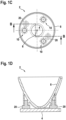
- Fig. 1 shows a lighting device 2 in accordance with an example not covered by the presently claimed invention in various views.
- Fig. 1A shows the lighting device 2 in a schematic top view.
- Fig. 1B shows the lighting device 2 in a schematic vertical cross-sectional view, with the cross-section being indicated by line A-A in Fig. 1A .
- Fig. 1C shows the lighting device 2 in the same schematic top view as Fig. 1A .
- Fig. 1D shows the lighting device 2 in another schematic vertical cross-sectional view, with the cross-section being indicated by line B-B in Fig. 1C .
- the lighting device 2 of Fig. 1 comprises a circuit board 4, which is a printed circuit board in the exemplary embodiment of Fig. 1 , an LED 6, soldered to the circuit board 4, and a reflector 8.
- the reflector 8 is an optical element associated with the LED 6 for conditioning the light emitted by the LED 6.
- the reflector 8 is a parabolic reflector.
- the reflective surface of the reflector 8 is substantially rotationally symmetric around the LED 6, with the LED 6 being positioned on the center axis of the reflector 8.
- the reflector 8 is arranged for collimating part of the light emitted by the LED 6 in a main light output direction, which is towards the observer in the viewing direction of Fig. 1A and upwards in the viewing direction of Fig. 1B .
- the reflector 8 is referred to as a parabolic reflector, because vertical cross-sections through the reflector 8 result in parabolic curves of the reflective surface.
- the reflector 8 may also be spherical or have any other suitable shape for affecting the light from the LED 6 in a desired manner.
- the reflector 8 may have any other suitable concave shape, as seen from the LED 6.
- the lighting device 2 further comprises three magnetic couplings 10 between the reflector 8 and the circuit board 4.
- the magnetic couplings 10 are blocked from view by the reflector 8.
- the magnetic couplings 10 are shown in phantom.
- the magnetic couplings 10 are uniformly distributed around the circumference of the reflector 8. When seen from the LED 6, the magnetic couplings 10 are spaced by 120° angles, respectively.
- the reflector 8 comprises two surface mounted device pins (SMD pins) 20, which are soldered to the circuit board 4.
- SMD pins surface mounted device pins
- the SMD pins 20 are blocked from view by the reflector 8. However, in order to show their presence and positions, the SMD pins 20 are shown in phantom.
- Fig. 1B shows a schematic vertical cross-sectional view of the lighting device 2.
- the view of Fig. 1B is considered vertical, because the circuit board 4 is considered a horizontal structure, because it is generally oriented horizontally during manufacture of the lighting device 2.
- the circuit board 4 may have any suitable orientation in operation of the lighting device 2 and that the depicted cross-section of Fig. 1B does not have to be vertical in operation of the lighting device 2.
- the cross-section of Fig. 1B is indicated by line A-A in Fig. 1A .
- Line A-A is not a straight line, but includes two 90° angles, when cutting through the lighting device 2.
- the cross-sectional view of Fig. 1B illustrates two magnetic couplings 10 as well as the position of the LED 6.
- Each of the magnetic couplings 10 comprises a first permanent magnet 12 and a second permanent magnet 14.
- the first permanent magnets 12 are provided at the reflector 8.
- the first permanent magnets 12 are provided in corresponding recesses 13 of the reflector 8.
- the reflector 8 may have cylindrical protrusions on its lower side, i.e. on the side opposite the reflective surface, with channels within those cylindrical protrusions forming the recesses 13 for receiving the first permanent magnets 12.
- the first permanent magnets 12 are press-fit into the corresponding recesses 13.
- the first permanent magnets 12 fill out only a portion of the corresponding recesses 13. However, it is also possible that the first permanent magnets 12 fill out a larger portion or all of the corresponding recesses 13.
- the second permanent magnets 14 are provided at the circuit board 4.
- the second permanent magnets 14 are press-fit into corresponding holes in the circuit board 4.
- the second permanent magnets 14 extend substantially through the entire thickness of the circuit board 4.
- the first permanent magnets 12 and the second permanent magnets 14 are of opposite polarities. In this way, an attractive force exists between the first permanent magnet 12 and the second permanent 14 of each magnetic coupling scene.
- the attractive forces of the magnetic couplings 10 combine to provide a firm attachment between the reflector 8 and the circuit board 4.
- the magnet contact surfaces of the first permanent magnets 12 on the one hand and the second permanent magnets 14 on the other hand are substantially co-extensive. However, it is also possible that the magnet contact surfaces differ among the first permanent magnets 12 and the second permanent magnets 14.
- each of the magnetic couplings 10 comprises a first permanent magnet 12 and a second permanent magnet 14. It is also possible that the second permanent magnets 14 are replaced by ferromagnetic elements. These ferromagnetic elements are attracted to the first permanent magnets 12, therefore also resulting in a firm attachment between the reflector 8 and the circuit board 4. Alternatively, it is also possible that the first permanent magnets 12 are replaced by ferromagnetic elements. These ferromagnetic elements are attracted to the second permanent magnets 14, therefore also resulting in a firm attachment between the reflector 8 and the circuit board 4. These three alternatives for the magnetic couplings 10 may be employed in all of the embodiments described herein.
- Fig. 1C shows the lighting device 2 of Figs. 1A and 1B in the same schematic top view as Fig. 1A .
- Fig. 1C indicates the vertical cross-section of Fig. 1D via line B-B.
- Line B-B does not run straight through the lighting device 2, but has two 90° angles along its way.
- the vertical cross-sectional view of Fig. 1D runs through both SMD pins 20, briefly introduced above with respect to Fig. 1A .
- the reflector 8 comprises two SMD pins 20.
- the SMD pins 20 are provided on the side of the reflector 8 facing the circuit board 4.
- the SMD pins 20 are soldered to the circuit board 4.
- the SMD pins 20 provide for a fixed positioning of the reflector 8 with respect to the circuit board 4. While the magnetic couplings 10, as described above, prevent the reflector 8 from disengaging from the circuit board 4 in the z-direction of the circuit board 4.
- the SMD pins 20 prevent for a shifting of the reflector 8 along the circuit board 4.
- the position of the reflector 8 with respect to the circuit board 4 is fixed, which in turn also fixes the relative position between the LED 6 and the reflector 8.
- the LED 6 is soldered to the circuit board 4 and the SMD pins 20 are soldered to the circuit board 4.
- the LED 6 and the SMD pins 20 may be soldered to the circuit board 4 in the same manufacturing step. In this way, the LED 6 and the SMD pins 20 may swim or shift in the same or substantially the same manner, while the solder is still liquid. This in turn will ensure that a very accurate relative positioning between the reflector 8 and the LED 6 is maintained.
- Fig. 2 shows a lighting device 2 in accordance with a first alternative embodiment of the presently claimed invention in various views.
- Fig. 2A shows the lighting device 2 in a schematic top view.
- Fig. 2B shows the lighting device 2 in a schematic vertical cross-sectional view.
- the lighting device 2 of Fig. 2 also comprises a circuit board 4, an LED 6, a reflector 8, and three magnetic couplings 10.
- the circuit board 4, the LED 6, and the magnetic couplings 10 of the lighting device 2 of Fig. 2 correspond to the according components of the lighting device 2 of Fig. 1 . They are not discussed in detail again, and reference is made to their description above.
- the positioning between the reflector 8 and the circuit board 4 of the lighting device 2 of Fig. 2 is different, as compared to the positioning between those components in the lighting device 2 of Fig. 1 .
- the lighting device 2 of Fig. 2 comprises two positioning LEDs 22.
- the positioning LEDs 22 are soldered to the circuit board 4. In the top view of Fig. 2A , the positioning LEDs 22 are blocked from view by the reflector 8, and they are shown in phantom in Fig. 2A .
- the cross-sectional plane of Fig. 2B is indicated by line C-C in Fig. 2A , and this cross-sectional plane runs through the two positioning LEDs 22.
- the reflector 8 has two recesses 24 for receiving the two positioning LEDs 22.
- the two recesses 24 are channels within cylindrical protrusions extending from the side of the reflector 8 facing the circuit board 4.
- the lateral extensions of the recesses 24 substantially correspond to the lateral extensions of the positioning LEDs 22.
- the reflector 8 also has an opening on its center axis, whose dimensions substantially correspond to the dimensions of the LED 6.
- the two positioning LEDs 22 are received in the corresponding recesses 24 of the reflector 8 and the LED 6 is received in the corresponding hole in the center portion of the reflector 8.
- the LED 6 and the positioning LEDs 22 are soldered to the circuit board 4.
- the LED 6 and the positioning LEDs 22 may be soldered to the circuit board 4 in the same manufacturing step.
- the positions of the LED 6 and of the positioning LEDs 22 may be affected in the same or substantially the same manner, when swimming or shifting while the solder is still liquid. Accordingly, a very accurate relative positioning between the LED 6 and the reflector 8 may be achieved.
- Fig. 3 shows a lighting device 2 in accordance with an example not covered by the presently claimed invention in various views.
- Fig. 3A shows the lighting device 2 in a schematic top view.
- Fig. 3B shows the lighting device 2 in a schematic vertical cross-sectional view.
- the lighting device 2 of Fig. 3 also comprises a circuit board 4, an LED 6, a reflector 8, and three magnetic couplings 10.
- the LED 6 and the magnetic couplings 10 of the lighting device 2 correspond to the according components of the lighting device 2 of Fig. 1 . They are not discussed in detail again, and reference is made to their description above.
- the circuit board 4 of the lighting device 2 of Fig. 3 corresponds to the circuit board 4 of the lighting device 2 of Fig. 1 , with the exception of drilled holes 28 discussed below.
- the reflector 8 comprises two protrusions 26, extending towards and into the circuit board 4.
- each of the two protrusions 26 extends into a corresponding drilled hole 28 in the circuit board 4.
- Line D-D indicates the cross-sectional plane of Fig. 3B in Fig. 3A .
- the cross-sectional plane of Fig. 3B runs through the two protrusions 26 of the reflector 8.
- the protrusions 26 are provided around a lower end of the reflector 8, i.e. around a region of the reflector 8 where the reflective surface comes close to the circuit board 4. However, it is pointed that the protrusions 26 may also be arranged at different portions of the reflector 8. In the assembled state, the protrusions 26 are received by the corresponding drilled holes 28 in the circuit board 4. In this way, the positioning between the reflector 8 and the circuit board 4 is fixed. This in turn means that the relative positioning between the reflector 8 and the LED 6 is also fixed.
- the LED 6 may be soldered to the circuit board 4 in a particular manufacturing step.
- the drilled holes 28 may be drilled into the circuit board 4, taking the position of the LED 6 as a reference.
- the reflector 8 may be positioned with respect to the circuit board 4 by inserting the protrusions 26 into the drilled holes 28. In this way, an accurate relative positioning between the LED 6 and the reflector 8 may be achieved.
- the drilled holes 28 being created after the soldering of the LED 6 to the circuit board 4, the relative positioning between the LED 6 and the reflector 8 may be made independent from the LED 6 swimming or shifting on the circuit board 4 during soldering.
- the magnetic attachment between the reflector 8 and the circuit board 4 via the magnetic couplings 10 is effected.
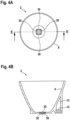
- Fig. 4 shows a lighting device 2 in accordance with a second alternative embodiment of the presently claimed invention in various views.
- Fig. 4A shows the lighting device 2 in a schematic top view, with the hinge mechanism discussed below being open.
- Fig. 4B shows the lighting device 2 in a schematic vertical cross-sectional view.
- Fig. 4C shows the lighting device 2 in a schematic top view, with the hinge mechanism being closed.
- the lighting device 2 of Fig. 4 also comprises a circuit board, and LED 6, a reflector 8, and three magnetic couplings.
- the circuit board, the LED 6, and the magnetic couplings of the lighting device 2 of Fig. 4 corresponds to the according components of the lighting device 2 of Fig. 1 . They are not discussed in detail again, and reference is made to the description above. Also, for a clearer illustration, the circuit board, including the second permanent magnet of the magnetic coupling, is not depicted in Fig. 4 . Also, the magnetic couplings are not shown in phantom in the schematic top views of Figs. 4A and 4C .
- the positioning between the reflector 8 and the circuit board of the lighting device 2 of Fig. 2 is different, as compared to the positioning between those components in the lighting device 2 of Fig. 1 .
- the reflector 8 of the lighting device 2 of Fig. 4 comprises a hinge mechanism, having four hinges 30.
- the four hinges 30 are provided in the lower portion of the reflector 8 around its center axis.
- the four hinges 30 are substantially triangular flaps.
- the long sides of the triangular flaps are attached to the reflector 8 and form a square around the center axis of the reflector 8.
- the two shorter sides of the triangular flaps extend substantially from the corners of said square towards substantially the center axis of the reflector 8.
- the reflector 8 is pressed down onto the circuit board. During this procedure, the LED 6 is positioned in the opening between the four hinges 30. The engagement between the reflector 8 and the circuit board pushes the hinges 30 upwards. As a consequence, the hinges 30 tighten around the LED 6 and, thus, self-align the reflector 8 with the LED 6.
- the closed position of the hinges 30 with respect to the LED 6 is illustrated in the top view of Fig. 4C .
- Figs. 1 to 4 show different ways of positioning the reflector 8 with respect to the circuit board 4. It is pointed out that these different ways are not mutually exclusive. Rather, the positioning mechanisms of the lighting devices 2 of Figs. 1 to 4 may be combined. In particular, any subset of the positioning via SMD pins, via protrusions of the reflector extending into the circuit board, may be present, additionally to either positioning based on positioning LEDs soldered on the circuit board and associated recesses of the optical element, or to positioning based on a hinge mechanism.
- Fig. 5 shows a lighting device 2 in accordance with an example not covered by the presently claimed invention in a schematic vertical cross-sectional view.
- the lighting device 2 of Fig. 5 comprises a circuit board 4, in particular a printed circuit board, an LED 6, an optical element in the form of lens 9, and a magnetic coupling 10 having a first permanent magnet 12 at the lens 9 and a second permanent magnet 14 at the circuit board 4.
- the lens 9 is a refractive optical element that is arranged over the LED 6 for re-directing the light emitted by the LED 6.
- a magnetic coupling 10 is provided between the lens 9 and the circuit board 4.
- a first permanent magnet 12 is press-fit into the lens 9
- a second permanent magnet 14 is press-fit into the circuit board 4.
- the lens 9 comprises a protrusion 26, which is received by a drilled hole 28 in the circuit board 4. The lens 9 is firmly attached and accurately positioned with respect to the circuit board 4 and, thus, with respect to the LED 6. Multiple magnetic couplings 10 and multiple protrusions / drilled holes may be present.
- Fig. 5 illustrates that the concepts of attachment and positioning, as described with respect to the combination of a reflector 8 and a circuit board 4 with respect to Fig. 1 to 4 above, also apply to the combination of a lens 9 and a circuit board 4. While a positioning similar to the positioning of Fig. 3 is described in Fig. 5 , it is explicitly stated that the other positioning mechanisms, as described with respect to Figs. 1 , 2 , and 4 are applicable as well.
- Fig. 6 shows a lighting device 2 in accordance with an exemplary embodiment of the invention in various views.
- Fig. 6A shows the lighting device 2 in a schematic top view.
- Fig. 6B shows the lighting device 2 in a schematic vertical cross-sectional view. The cross-sectional plane of Fig. 6B is indicated by line F-F in Fig. 6A .
- the lighting device 2 of Fig. 6 has a plurality of design units, also referred to as structural units or building blocks, each comprising an LED 6 and an optical element, which is a reflector 8 in the exemplary embodiment of Fig. 6 .
- the plurality of design units are arranged on a common circuit board 4, which is a printed circuit board in the exemplary embodiment of Fig. 6 .
- a common circuit board 4 which is a printed circuit board in the exemplary embodiment of Fig. 6 .
- one or more magnetic couplings between the circuit board 4 and the reflector 8 may be provided.
- three magnetic couplings 10 are provided per design unit for attaching the reflector 8 to the circuit board 4, as described above with respect to Fig. 1 .
- two positioning components in the form of positioning LEDs 22 are provided for positioning the reflector 8 with respect to the circuit board 4, as described above with respect to Fig. 2 .
- each reflector 8 being associated with one LED 6, are provided.
- the seven structural units, consisting of an LED 6 and a reflector 8 each, are arranged in a very dense manner, with one structural unit being arranged at the center and the six other structural units being arranged therearound.
- the light outputs of the structural units may re-inforce each other.
- the lighting device 2 has a very bright light output towards the observer in the viewing direction of Fig. 6A and towards the top in the viewing direction of Fig. 6B .
- the collimation via the reflectors 8 may have high accuracy due to the accurate positioning of the reflectors 8 with respect to the LEDs 6, such that a highly collimated light output may be achieved.
- all reflectors 8 being attached to the circuit board 4 via magnetic couplings 10, a strong attachment between the reflectors 8 and the circuit board 4 is also achieved.
- Fig. 7 shows a helicopter 100 in accordance with an exemplary embodiment of the invention, equipped with a lighting device 2 in accordance with an exemplary embodiment of the invention, in a side view.
- the helicopter 100 is depicted as flying at a height H above ground 200.
- the helicopter 100 is equipped with a helicopter search light 2, mounted to a front bottom portion of the helicopter 100 and generating a light beam 150, which is directed downwards in front of the helicopter 100.
- the helicopter search light 2 may be embodied in accordance with any of the embodiments of lighting devices 2, described herein.
- the helicopter search light 2 may also be arranged at a different location of the helicopter 100, such as at the front running gear.
- Fig. 8 shows an airplane 110 in accordance with an exemplary embodiment of the invention, equipped with a lighting device 2 in accordance with an exemplary embodiment of the invention, in a side view.
- the airplane 110 is depicted as flying at a height H above ground 200.
- the airplane 110 is equipped with an aircraft headlight 2, which is an aircraft landing light 2 in the exemplary embodiment of Fig. 8 .
- the aircraft headlight 2 is mounted to a front bottom portion of the airplane 110 and generates a light beam 150, which is directed downwards in front of the airplane 110.
- the aircraft headlight 2 may be embodied in accordance with any of the embodiments of lighting devices 2, described herein.
- the aircraft headlight 2 may also be arranged at a different location of the airplane 110, such as at the front running gear.
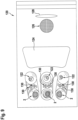
- Fig. 9 shows an overhead passenger service unit 120, as it may be installed in the passenger cabin of an aircraft, in a schematic view from the point of view of a passenger sitting below the overhead passenger service unit 120, according to an example not covered by the presently claimed invention.
- the overhead passenger service unit 120 comprises a row of three adjustable personal reading lights 2, arranged next to each other in a lateral direction.
- Each of the personal reading lights 2 may be embodied in accordance with any of the embodiments of lighting devices 2, described herein.
- Six electrical switches 130 are provided to the right side of the personal reading lights 2, a pair of two switches 130 next to each of the personal reading lights 2.
- One of the switches 130 of each pair may be configured for switching the adjacent personal reading light 2, while the second switch of each pair may be configured for triggering a signal for calling cabin service personnel.
- the overhead passenger service unit 120 further comprises a loudspeaker 126, a display panel 128, and a covered cavity 124 for housing at least one oxygen mask (not shown).
Landscapes
- Engineering & Computer Science (AREA)
- General Engineering & Computer Science (AREA)
- Aviation & Aerospace Engineering (AREA)
- Microelectronics & Electronic Packaging (AREA)
- Physics & Mathematics (AREA)
- Manufacturing & Machinery (AREA)
- Optics & Photonics (AREA)
- Mechanical Engineering (AREA)
- Fastening Of Light Sources Or Lamp Holders (AREA)
- Non-Portable Lighting Devices Or Systems Thereof (AREA)
- Mathematical Physics (AREA)
Description
- The present invention is in the field of lighting devices. In particular, the present invention is in the field of lighting devices for aircraft and aircraft equipped with such lighting devices. The present invention is also in the field of manufacturing lighting devices.
- Modern aircraft, such as large commercial passenger airplanes, have a vast range of lighting devices. On the one hand, a variety of exterior aircraft lights, such as headlights, navigation lights, anti-collision lights, wing / engine scan lights, etc. are typically provided. On the other hand, a variety of interior aircraft lights, such as cabin illumination lights, reading lights, exit sign lights, etc. are also typically provided. Modern commercial passenger airplanes have a very large number of lighting devices.
- In recent years, lighting devices with traditional light sources have increasingly been replaced by lighting devices with light emitting diodes (LEDs) as light sources. This has led to lighting devices where LEDs and optical elements are arranged on and supported by circuit boards. With LEDs being small light sources, lighting devices have been developed that have a small space envelope. The LEDs and the optical elements are arranged in close proximity to the circuit boards, leading to low overall space requirements. However, such lighting devices are not always satisfactory in terms of mechanical stability and accuracy of the light output.
-
US 2013/044501 A1 discloses a lighting system which comprises a lighting module, a lighting fixture, and a magnetic connection between the lighting module and the lighting fixture, wherein the electricity is delivered to the lighting module when the lighting module is connected to the lighting fixture via the magnetic connection -
US9080741 B2 - According to its abstract,
US10197242 B2 - The present invention relates to a lighting device in accordance with claim 1, to a lighting device in accordance with
claim 2, to an aircraft in accordance withclaim 6, to a method for manufacturing an exterior aircraft light in accordance with claim 7, and to a method for manufacturing an exterior aircraft light in accordance withclaim 8. Further embodiments of the invention are given in the dependent claims. - The lighting device according to the presently claimed invention is an exterior aircraft light, and comprises a circuit board; an LED, soldered to the circuit board; an optical element, supported by the circuit board and positioned for re-directing at least part of the light, in operation emitted by the LED; and a magnetic coupling between the circuit board and the optical element.
- According to a first alternative embodiment of the presently claimed invention, the lighting device additionally comprises at least one positioning LED, soldered to the circuit board and extending from the circuit board, wherein the optical element has at least one recess, with each of the at least one positioning LED being arranged in an associated one of the at least one recess.
- According to a second alternative embodiment of the presently claimed invention, the lighting device additionally comprises an optical element comprising a self-aligning hinge mechanism arranged around the LED.
- The invention alllows for a strong mechanical attachment between the circuit board and the optical element, while providing a framework for accurately positioning the optical element with respect to the LED and, thus, for achieving a highly accurate light output of the lighting device. The magnetic coupling provides for a strong attachment between the circuit board and the optic element. In particular, the magnetic coupling may be embodied in such a way that large forces would have to be applied in the z-direction of the circuit board, in order to separate the optical element from the circuit board. The strength of the magnetic coupling may be conveniently dimensioned in accordance with the expected mechanical loads during operation of the lighting device. Further, the magnetic coupling may provide some wiggle room between the optical element and the circuit board in the x-y-plane of the circuit board, such that separate positioning mechanisms may align the optical element and the LED with high accuracy. In this way, a highly accurate light output may be achieved, without compromising the strong mechanical attachment between the circuit board and the optical element, effected by the magnetic coupling.
- The lighting device comprises a magnetic coupling between the circuit board and the optical element. The magnetic coupling is provided for attaching the optical element to the circuit board. In particular, the magnetic coupling may provide the main attachment between the optical element and the circuit board. It may be the strongest component of the overall attachment between the optical element and the circuit board. However, it is possible that other ancillary forms of attachment between the optical element and the circuit board are provided, as will be described below.
- The optical element is supported by the circuit board and positioned for re-directing at least part of the light, in operation emitted by the LED. The LED and the optical element have a geometric relationship/arrangement that allows for the optical element to affect the light emitted by the LED and to contribute to shaping the light output of the lighting device. The optical element may be configured to affect part of the light in operation emitted by the LED or all of the light in operation emitted by the LED. In particular, the optical element may have an extension and a position that allows for affecting all of the light in operation emitted by the LED or part of the light in operation emitted by the LED. The LED and the optical element jointly form a design unit, also referred to as structural unit or building block herein, with the designs and relative positioning of the LED and the optical element determining the contribution of this design unit to the light output. Exemplary embodiments of the invention allow for such structural units, consisting of an LED and an optical element, to work at or very closely to their design specifications. This in turn contributes to a high accuracy of the light output of the lighting device. In case a lighting device has a plurality of such structural units, consisting of an LED and an optical element, the beneficial effects of the magnetic coupling of the optical elements to the circuit board may be made use of to a particularly high degree.
- The lighting device comprises a circuit board. The LED is soldered to the circuit board, and the optical element is attached to the circuit board via the magnetic coupling. The circuit board may be a printed circuit board (PCB). The circuit board may be a pre-produced circuit board, having a pad for the LED to be soldered to.
- The magnetic coupling between the circuit board and the optical element allows for a quick and little complex attachment of the optical element to the circuit board during manufacture. As compared to previous approaches, which involved screwing, gluing, hot stamping, snap fitting, etc., the magnetic coupling is less labor intensive and less time consuming. Further, it may require less complex tooling and less post-operation.
- According to a further embodiment, the optical element is a reflector. The reflector may be effectively attached to the circuit board via the magnetic coupling. In particular, the reflector may be arranged around the LED and may have a collimating effect on the light, in operation emitted by the LED. In a particular embodiment, the reflector is a parabolic reflector. In particular, the reflector may be a substantially rotationally symmetric reflector. The LED may be positioned substantially on the center axis of the parabolic reflector. The degree of collimation by the parabolic reflector may be affected by the extension of the parabolic reflector above the circuit board. The parabolic reflector may collimate light in a z-direction of the circuit board, i.e. in a direction normal to the circuit board.
- According to a further embodiment, the optical element is a lens. In particular, the optical element may be a collimating lens. Further in particular, the lens may collimate light from the LED in a z-direction of the circuit board. The lens may also be effectively attached to the circuit board via the magnetic coupling. The term lens refers to a refractive optical element, re-directing light from the LED via refraction.
- According to a further embodiment, the magnetic coupling comprises a permanent magnet at the optical element and a ferromagnetic element at the circuit board. According to an alternative embodiment, the magnetic coupling comprises a ferromagnetic element at the optical element and a permanent magnet at the circuit board. According to a further alternative embodiment, the magnetic coupling comprises a first permanent magnet at the optical element and a second permanent magnet at the circuit board. In the case of a first permanent magnet being provided at the optical element and second permanent magnet being provided at the circuit board, the first and second permanent magnets have opposite polarities. This results in an attractive force between the first permanent magnet and the second permanent magnet. In case of a permanent magnet being provided at either the optical element or the circuit board and a ferromagnetic element being provided at the other one of the optical element and the circuit board, the permanent magnet may have any polarity. The permanent magnet and the ferromagnetic element may be press-fit into the optical element and the circuit board, respectively. Also, the first permanent magnet and the second permanent magnet may be press-fit into the optical element and the circuit board, respectively.
- According to a further embodiment, the optical element comprises at least one surface mounted device pin (SMD pin), soldered to the circuit board. The soldered connection between the optical element and the circuit board may provide for an accurate positioning between the circuit board and the optical element. In particular, with the LED and the optical element both being soldered to the circuit board, a highly accurate relative positioning between the LED and the optical element may be achieved. In particular, the circuit board may have soldering pads for the LED and the optical element, which can be provided with high accuracy. With the LED and the optical element both being soldered to the circuit board, potential swimming or shifting of the surface mounted device pin(s) of the optical element and the pin(s) of the LED may affect both components in the same or substantially the same manner. In this way, the relative positioning between the optical element and the LED may be very accurate, despite potential shifts during the soldering process.
- According to the first alternative embodiment of the presently claimed invention, the lighting device further comprises at least one positioning component, soldered to the circuit board and extending from the circuit board, wherein the optical element has at least one recess, with each of the at least one positioning component being arranged in an associated one of the at least one recess. In this way, the positioning between the optical element and the circuit board may be achieved via the geometric matching of the positioning component(s), extending from the circuit board, and the recess(es) in the optical element. With the at least one positioning component being soldered to the circuit board, above described maintenance of the relative positioning between the LED and the optical element during the soldering process may also be achieved. Further, the attaching of the optical element to the circuit board may be carried out at a later point in time than the soldering of the LED and the at least one positioning component to the circuit board. In this way, the provision of the framework for accurately positioning the optical element and the attaching of the optical element may be de-coupled in time.
- According to the first alternative embodiment of the presently claimed invention, the at least one positioning component is at least one positioning LED. At first glance, it seems to be a waste to use one or more LEDs for positioning, without using their light emission capacities. However, a highly similar swimming and/or shift of the LED, whose light emission contributes to the light output of the lighting device, and the positioning LED(s) may be achieved due to the use of the same kind of components. Accordingly, a very high precision in the relative positioning of the LED and the optical element may be achieved. Further, the dimensions of the at least one positioning component and the at least one recess may be closely matched, providing for a very accurate positioning of the optical element with respect to the circuit board.
- According to a further embodiment, the optical element comprises at least one protrusion and the circuit board comprises at least one drilled hole, with each of the at least one protrusion being arranged in an associated one of the at least one drilled hole. The provision of the protrusion(s) and the drilled hole(s) is a further effective means of achieving a highly accurate positioning between the optical element and the circuit board. The dimensions of the protrusion(s) and the drilled hole(s) may be closely matched, such that a high precision in the positioning of the optical element may be achieved. Further, during manufacturing of the lighting device, the at least one drilled hole may be drilled, after the LED is soldered to the circuit board. In particular, the at least one drilled hole may be drilled, taking the LED position as a reference. In this way, a highly accurate relative positioning between the optical element and the LED may be achieved, taking into account potential swimming or shifting of the LED during the soldering to the circuit board.
- According to the second alternative embodiment of the presently claimed invention, the optical element comprises a self-aligning hinge mechanism arranged around the LED. In particular, the optical element may comprise two or more hinges arranged around the LED. The hinges may be configured to close around the LED when the optical element is pressed towards the circuit board. In this way, the optical element will come to lie in a fixed relative position with respect to the LED during manufacture of the lighting device. A very accurate positioning of the optical element may be achieved, with the provision of the optical element on the circuit board being de-coupled from the soldering of the LED to the circuit board.
- According to a further embodiment, the lighting device comprises a plurality of design units, with each of the plurality of design units are comprising an LED and an optical element, as described above. The additional features, modifications and effects, described above with respect to a single design unit, consisting of an LED and an optical element, may apply to each of the plurality of design units in an analogues manner. In this way, the beneficial effects described above may be made use of to a particularly high degree. For example, the plurality of design units may be substantially aligned, such that a very bright output in a particular light output direction may be achieved with high accuracy. For example, a high light intensity and a high degree of collimation may be achieved at the same time.
- According to the presently claimed invention, the lighting device is a lighting device for an aircraft. The magnetic coupling between the circuit board and the optical element may have sufficient mechanical strength to withstand impacts and vibrations, typically encountered in an aircraft environment, such as for example at touch-down of the aircraft. The strong mechanical attachment between the circuit board and the optical element via the magnetic coupling and the accurate relative positioning between the optical element and the LED are particularly beneficial in the field of aircraft lighting, with the resulting aircraft lights working reliably and working closely to the specification. In this way, the maintenance efforts for the aircraft lights and, thus, the downtime of the aircraft may be kept particularly low. It is pointed out that the lighting device may also be provided for other applications. In particular, the lighting devices described herein are well-suited for applications where high mechanical robustness and/or a highly accurate light output is desired. Also, the lighting devices described herein are well-suited for applications where high manufacturing numbers are to be achieved and where efficient manufacturing is of high importance.
- According to the presently claimed invention, the lighting device is an exterior aircraft light, in particular an aircraft headlight. The high mechanical strength of the attachment between the circuit board, the optical element, and the LED as well as the accurate relative positioning between the LED and the optical element are particularly beneficial in the field of exterior aircraft lighting. High accuracy in the light output and high mechanical reliability may be achieved simultaneously.
- According to a further embodiment, the lighting device is one of a helicopter search light, an aircraft taxi light, an aircraft take-off light, an aircraft landing light, an aircraft runway turn-off light, and a multi-purpose aircraft head light having at least two functionalities of an aircraft taxi light, an aircraft take-off light, an aircraft landing light, and an aircraft runway turn-off light. The multi-purpose aircraft headlight may have any subset or all of the functionalities of an aircraft taxi light, an aircraft take-off light, an aircraft landing light, and an aircraft runway turn-off light. With the strong mechanical attachment between the optical element and the circuit board, the lighting device is very well-suited for the demanding environment of aircraft headlights, such as well-suited for strong headwinds and heavy impacts / vibrations, e.g. when mounted to a running gear of an aircraft. Also, a high accuracy of the light output allows for the pilot(s) of the aircraft to have good visibility of the aircraft environment, such as a good visibility of the landing runway in case of a landing light.
- According to an example not covered by the presently claimed invention, the lighting device is an interior aircraft light. In a particular example, the interior aircraft light is a personal reading light for being provided in an aircraft cabin. With the high accuracy of the light output of the personal reading light, a sufficient illumination of the passenger's personal space may be achieved in an efficient manner, without disturbing passengers in adjacent seats.
- Exemplary embodiments of the invention further include an aircraft, comprising at least one lighting device in accordance with any of the embodiments described above. The additional features, modifications and effects, described above with respect to the exemplary embodiments of the lighting device, apply to the aircraft in an analogous manner. The aircraft may be an airplane or a rotorcraft, such a helicopter, or an unmanned aerial vehicle.
- Exemplary embodiments of the invention further include a method for manufacturing a lighting device, comprising: soldering an LED to a circuit board; positioning an optical element on the circuit board for re-directing at least part of the light in operation emitted by the LED; and attaching the optical element to the circuit board via a magnetic coupling between the optical element and the circuit board. The additional features, modifications and effects, described above with respect to the first alternative embodiment, the second alternative embodiment and the additional examples of the lighting device, apply to the method for manufacturing a lighting device in an analogous manner. The positioning of the optical element on the circuit board and the attaching of the optical element to the circuit board may take place at substantially the same time. It is also possible that portions of the positioning of the optical element to the circuit board, such as providing a framework for reliably positioning the optical element on the circuit board and/or fine-tuning the position of the optical element on the circuit board, may take place before or after the attaching of the optical element to the circuit board.
- According to a further embodiment, the positioning of the optical element on the circuit board comprises soldering the optical element to the circuit board via at least one surface mounted device pin. In this case, all of the soldering of the LED to the circuit board, the positioning of the optical element on the circuit board, and the attaching of the optical element to the circuit board may take place in the same manufacturing step, i.e. substantially at the same time.
- According to the first alternative embodiment of the presently claimed invention, the positioning of the optical element on the circuit board comprises: soldering at least one positioning component, in form of at least one positioning LED, to the circuit board; and inserting the at least one positioning component into at least one corresponding recess in the optical element. In this case, the soldering of the LED to the circuit board and part of the positioning of the optical element on the circuit board, namely the provision of the positioning framework via the at least one positioning component, may take place at the same time. The engaging of the optical element and the circuit board as well as the attaching of the optical element to the circuit board via the magnetic coupling may take place in a later manufacturing step.
- According to a further embodiment, the positioning of the optical element on the circuit board comprises: drilling at least one hole into the circuit board; and inserting at least one protrusion of the optical element into the at least one hole in the circuit board. The drilling of the at least one hole into the circuit board may take place, after the LED has been soldered to the circuit board. In particular, the LED may function as a positional reference for drilling the at least one hole into the circuit board. The engaging of the optical element and the circuit board as well as the attaching of the optical element to the circuit board via the magnetic coupling may thus take place after the soldering of the LED to the circuit board and after the drilling of the at least one hole into the circuit board.
- According to the second alternative embodiment of the presently claimed invention, the positioning of the optical element on the circuit board comprises aligning the optical element with the LED via a hinge mechanism in the optical element. The aligning of the optical element with the LED via the hinge mechanism may take place in the same manufacturing step as the attaching of the optical element to the circuit board via the magnetic coupling, i.e. substantially at the same time. The hinge mechanism may comprise two or more hinges that are arranged around and engage with the LED in the course of the aligning of the optical element with the LED.
- Further exemplary embodiments of the invention will be described with respect to the accompanying drawings, wherein:
-
Fig. 1 shows a lighting device in accordance with an example not covered by the presently claimed invention in various views; -
Fig. 2 shows a lighting device in accordance with the first alternative embodiment of the presently claimed invention in various views; -
Fig. 3 shows a lighting device in accordance with an example not covered by the presently claimed invention in various views; -
Fig. 4 shows a lighting device in accordance with the second alternative embodiment of the presently claimed invention in various views; -
Fig. 5 shows a lighting device in accordance with an example not covered by the presently claimed invention in a schematic cross-sectional view; -
Fig. 6 shows a lighting device in accordance with an exemplary embodiment of the invention in various views; -
Fig. 7 shows a helicopter in accordance with an exemplary embodiment of the invention in a side view, the helicopter being equipped with a helicopter search light in accordance with an exemplary embodiment of the invention; -
Fig. 8 shows a airplane in accordance with an exemplary embodiment of the invention in a side view, the airplane being equipped with an aircraft headlight in accordance with an exemplary embodiment of the invention; -
Fig. 9 shows an overhead passenger service unit, comprising reading lights in accordance with an example not covered by the presently claimed invention, in a schematic view. -
Fig. 1 shows alighting device 2 in accordance with an example not covered by the presently claimed invention in various views.Fig. 1A shows thelighting device 2 in a schematic top view.Fig. 1B shows thelighting device 2 in a schematic vertical cross-sectional view, with the cross-section being indicated by line A-A inFig. 1A .Fig. 1C shows thelighting device 2 in the same schematic top view asFig. 1A .Fig. 1D shows thelighting device 2 in another schematic vertical cross-sectional view, with the cross-section being indicated by line B-B inFig. 1C . - The
lighting device 2 ofFig. 1 comprises acircuit board 4, which is a printed circuit board in the exemplary embodiment ofFig. 1 , anLED 6, soldered to thecircuit board 4, and areflector 8. Thereflector 8 is an optical element associated with theLED 6 for conditioning the light emitted by theLED 6. Thereflector 8 is a parabolic reflector. The reflective surface of thereflector 8 is substantially rotationally symmetric around theLED 6, with theLED 6 being positioned on the center axis of thereflector 8. Thereflector 8 is arranged for collimating part of the light emitted by theLED 6 in a main light output direction, which is towards the observer in the viewing direction ofFig. 1A and upwards in the viewing direction ofFig. 1B . Thereflector 8 is referred to as a parabolic reflector, because vertical cross-sections through thereflector 8 result in parabolic curves of the reflective surface. Thereflector 8 may also be spherical or have any other suitable shape for affecting the light from theLED 6 in a desired manner. In particular, thereflector 8 may have any other suitable concave shape, as seen from theLED 6. - The
lighting device 2 further comprises threemagnetic couplings 10 between thereflector 8 and thecircuit board 4. In the top view ofFig. 1A , themagnetic couplings 10 are blocked from view by thereflector 8. However, in order to illustrate their presence and positions in the top view ofFig. 1A , themagnetic couplings 10 are shown in phantom. Themagnetic couplings 10 are uniformly distributed around the circumference of thereflector 8. When seen from theLED 6, themagnetic couplings 10 are spaced by 120° angles, respectively. - The
reflector 8 comprises two surface mounted device pins (SMD pins) 20, which are soldered to thecircuit board 4. In the top view ofFig. 1A , the SMD pins 20 are blocked from view by thereflector 8. However, in order to show their presence and positions, the SMD pins 20 are shown in phantom. - As stated above,
Fig. 1B shows a schematic vertical cross-sectional view of thelighting device 2. The view ofFig. 1B is considered vertical, because thecircuit board 4 is considered a horizontal structure, because it is generally oriented horizontally during manufacture of thelighting device 2. However, it is understood that thecircuit board 4 may have any suitable orientation in operation of thelighting device 2 and that the depicted cross-section ofFig. 1B does not have to be vertical in operation of thelighting device 2. The cross-section ofFig. 1B is indicated by line A-A inFig. 1A . Line A-A is not a straight line, but includes two 90° angles, when cutting through thelighting device 2. In this way, the cross-sectional view ofFig. 1B illustrates twomagnetic couplings 10 as well as the position of theLED 6. - Each of the
magnetic couplings 10 comprises a firstpermanent magnet 12 and a secondpermanent magnet 14. The firstpermanent magnets 12 are provided at thereflector 8. In particular, the firstpermanent magnets 12 are provided incorresponding recesses 13 of thereflector 8. Thereflector 8 may have cylindrical protrusions on its lower side, i.e. on the side opposite the reflective surface, with channels within those cylindrical protrusions forming therecesses 13 for receiving the firstpermanent magnets 12. In the exemplary embodiment ofFig. 1 , the firstpermanent magnets 12 are press-fit into the corresponding recesses 13. In the exemplary embodiment ofFig. 1 , the firstpermanent magnets 12 fill out only a portion of the corresponding recesses 13. However, it is also possible that the firstpermanent magnets 12 fill out a larger portion or all of the corresponding recesses 13. - The second
permanent magnets 14 are provided at thecircuit board 4. In particular, the secondpermanent magnets 14 are press-fit into corresponding holes in thecircuit board 4. In the exemplary embodiment ofFig. 1 , the secondpermanent magnets 14 extend substantially through the entire thickness of thecircuit board 4. However, it is also possible that the secondpermanent magnets 14 extend through only a portion of the thickness of thecircuit board 4. - The first
permanent magnets 12 and the secondpermanent magnets 14 are of opposite polarities. In this way, an attractive force exists between the firstpermanent magnet 12 and the second permanent 14 of each magnetic coupling scene. The attractive forces of themagnetic couplings 10 combine to provide a firm attachment between thereflector 8 and thecircuit board 4. In the exemplary embodiment ofFig. 1 , the magnet contact surfaces of the firstpermanent magnets 12 on the one hand and the secondpermanent magnets 14 on the other hand are substantially co-extensive. However, it is also possible that the magnet contact surfaces differ among the firstpermanent magnets 12 and the secondpermanent magnets 14. - In the example of
Fig. 1 , each of themagnetic couplings 10 comprises a firstpermanent magnet 12 and a secondpermanent magnet 14. It is also possible that the secondpermanent magnets 14 are replaced by ferromagnetic elements. These ferromagnetic elements are attracted to the firstpermanent magnets 12, therefore also resulting in a firm attachment between thereflector 8 and thecircuit board 4. Alternatively, it is also possible that the firstpermanent magnets 12 are replaced by ferromagnetic elements. These ferromagnetic elements are attracted to the secondpermanent magnets 14, therefore also resulting in a firm attachment between thereflector 8 and thecircuit board 4. These three alternatives for themagnetic couplings 10 may be employed in all of the embodiments described herein. -
Fig. 1C shows thelighting device 2 ofFigs. 1A and 1B in the same schematic top view asFig. 1A . However,Fig. 1C indicates the vertical cross-section ofFig. 1D via line B-B. Line B-B does not run straight through thelighting device 2, but has two 90° angles along its way. The vertical cross-sectional view ofFig. 1D runs through both SMD pins 20, briefly introduced above with respect toFig. 1A . - As stated above, the
reflector 8 comprises two SMD pins 20. The SMD pins 20 are provided on the side of thereflector 8 facing thecircuit board 4. The SMD pins 20 are soldered to thecircuit board 4. The SMD pins 20 provide for a fixed positioning of thereflector 8 with respect to thecircuit board 4. While themagnetic couplings 10, as described above, prevent thereflector 8 from disengaging from thecircuit board 4 in the z-direction of thecircuit board 4. The SMD pins 20 prevent for a shifting of thereflector 8 along thecircuit board 4. The position of thereflector 8 with respect to thecircuit board 4 is fixed, which in turn also fixes the relative position between theLED 6 and thereflector 8. - During manufacture of the
lighting device 2, theLED 6 is soldered to thecircuit board 4 and the SMD pins 20 are soldered to thecircuit board 4. In particular, theLED 6 and the SMD pins 20 may be soldered to thecircuit board 4 in the same manufacturing step. In this way, theLED 6 and the SMD pins 20 may swim or shift in the same or substantially the same manner, while the solder is still liquid. This in turn will ensure that a very accurate relative positioning between thereflector 8 and theLED 6 is maintained. -
Fig. 2 shows alighting device 2 in accordance with a first alternative embodiment of the presently claimed invention in various views.Fig. 2A shows thelighting device 2 in a schematic top view.Fig. 2B shows thelighting device 2 in a schematic vertical cross-sectional view. - The
lighting device 2 ofFig. 2 also comprises acircuit board 4, anLED 6, areflector 8, and threemagnetic couplings 10. Thecircuit board 4, theLED 6, and themagnetic couplings 10 of thelighting device 2 ofFig. 2 correspond to the according components of thelighting device 2 ofFig. 1 . They are not discussed in detail again, and reference is made to their description above. - The positioning between the
reflector 8 and thecircuit board 4 of thelighting device 2 ofFig. 2 is different, as compared to the positioning between those components in thelighting device 2 ofFig. 1 . Thelighting device 2 ofFig. 2 comprises two positioningLEDs 22. Thepositioning LEDs 22 are soldered to thecircuit board 4. In the top view ofFig. 2A , thepositioning LEDs 22 are blocked from view by thereflector 8, and they are shown in phantom inFig. 2A . The cross-sectional plane ofFig. 2B is indicated by line C-C inFig. 2A , and this cross-sectional plane runs through the twopositioning LEDs 22. - The
reflector 8 has tworecesses 24 for receiving the twopositioning LEDs 22. - The two
recesses 24 are channels within cylindrical protrusions extending from the side of thereflector 8 facing thecircuit board 4. The lateral extensions of therecesses 24 substantially correspond to the lateral extensions of the positioningLEDs 22. In the exemplary embodiment ofFig. 2 , thereflector 8 also has an opening on its center axis, whose dimensions substantially correspond to the dimensions of theLED 6. In the assembled state of thelighting device 2, the twopositioning LEDs 22 are received in the correspondingrecesses 24 of thereflector 8 and theLED 6 is received in the corresponding hole in the center portion of thereflector 8. - During manufacture of the
lighting device 2, theLED 6 and thepositioning LEDs 22 are soldered to thecircuit board 4. In particular, theLED 6 and thepositioning LEDs 22 may be soldered to thecircuit board 4 in the same manufacturing step. In this way, the positions of theLED 6 and of thepositioning LEDs 22 may be affected in the same or substantially the same manner, when swimming or shifting while the solder is still liquid. Accordingly, a very accurate relative positioning between theLED 6 and thereflector 8 may be achieved. -
Fig. 3 shows alighting device 2 in accordance with an example not covered by the presently claimed invention in various views.Fig. 3A shows thelighting device 2 in a schematic top view.Fig. 3B shows thelighting device 2 in a schematic vertical cross-sectional view. - The
lighting device 2 ofFig. 3 also comprises acircuit board 4, anLED 6, areflector 8, and threemagnetic couplings 10. TheLED 6 and themagnetic couplings 10 of thelighting device 2 correspond to the according components of thelighting device 2 ofFig. 1 . They are not discussed in detail again, and reference is made to their description above. Thecircuit board 4 of thelighting device 2 ofFig. 3 corresponds to thecircuit board 4 of thelighting device 2 ofFig. 1 , with the exception of drilledholes 28 discussed below. - The positioning of the
reflector 8 with respect to thecircuit board 4 is different in thelighting device 2 ofFig. 3 , as compared to the positioning of those components in thelighting device 2 ofFig. 1 . In the exemplary embodiment ofFig. 3 , thereflector 8 comprises twoprotrusions 26, extending towards and into thecircuit board 4. In particular, each of the twoprotrusions 26 extends into a corresponding drilledhole 28 in thecircuit board 4. As theprotrusions 26 are on the side of thereflector 8 facing thecircuit board 4, they are blocked from view in the top view ofFig. 3A . They are therefore shown in phantom inFig. 3A . Line D-D indicates the cross-sectional plane ofFig. 3B inFig. 3A . The cross-sectional plane ofFig. 3B runs through the twoprotrusions 26 of thereflector 8. - The
protrusions 26 are provided around a lower end of thereflector 8, i.e. around a region of thereflector 8 where the reflective surface comes close to thecircuit board 4. However, it is pointed that theprotrusions 26 may also be arranged at different portions of thereflector 8. In the assembled state, theprotrusions 26 are received by the corresponding drilledholes 28 in thecircuit board 4. In this way, the positioning between thereflector 8 and thecircuit board 4 is fixed. This in turn means that the relative positioning between thereflector 8 and theLED 6 is also fixed. - During manufacture, the
LED 6 may be soldered to thecircuit board 4 in a particular manufacturing step. In a subsequent manufacturing step, the drilledholes 28 may be drilled into thecircuit board 4, taking the position of theLED 6 as a reference. In a further manufacturing step, thereflector 8 may be positioned with respect to thecircuit board 4 by inserting theprotrusions 26 into the drilled holes 28. In this way, an accurate relative positioning between theLED 6 and thereflector 8 may be achieved. With the drilledholes 28 being created after the soldering of theLED 6 to thecircuit board 4, the relative positioning between theLED 6 and thereflector 8 may be made independent from theLED 6 swimming or shifting on thecircuit board 4 during soldering. At the same time as inserting theprotrusions 26 into the drilledholes 28, the magnetic attachment between thereflector 8 and thecircuit board 4 via themagnetic couplings 10 is effected. -
Fig. 4 shows alighting device 2 in accordance with a second alternative embodiment of the presently claimed invention in various views.Fig. 4A shows thelighting device 2 in a schematic top view, with the hinge mechanism discussed below being open.Fig. 4B shows thelighting device 2 in a schematic vertical cross-sectional view.Fig. 4C shows thelighting device 2 in a schematic top view, with the hinge mechanism being closed. - The
lighting device 2 ofFig. 4 also comprises a circuit board, andLED 6, areflector 8, and three magnetic couplings. The circuit board, theLED 6, and the magnetic couplings of thelighting device 2 ofFig. 4 corresponds to the according components of thelighting device 2 ofFig. 1 . They are not discussed in detail again, and reference is made to the description above. Also, for a clearer illustration, the circuit board, including the second permanent magnet of the magnetic coupling, is not depicted inFig. 4 . Also, the magnetic couplings are not shown in phantom in the schematic top views ofFigs. 4A and4C . - The positioning between the
reflector 8 and the circuit board of thelighting device 2 ofFig. 2 is different, as compared to the positioning between those components in thelighting device 2 ofFig. 1 . Thereflector 8 of thelighting device 2 ofFig. 4 comprises a hinge mechanism, having four hinges 30. The four hinges 30 are provided in the lower portion of thereflector 8 around its center axis. The four hinges 30 are substantially triangular flaps. The long sides of the triangular flaps are attached to thereflector 8 and form a square around the center axis of thereflector 8. The two shorter sides of the triangular flaps extend substantially from the corners of said square towards substantially the center axis of thereflector 8. - In the absence of any force acting on the
hinges 30, the described triangular flaps dangle from thereflector 8 in the direction of the circuit board. With thehinges 30 dangling in the direction of the circuit board, the opening between thehinges 30 is larger than theLED 6 of thelighting device 2. This is illustrated inFigs. 4A and 4B , withFig. 4B showing the cross-sectional plane indicated by line E-E inFig. 4A . - During the manufacture of the
lighting device 2, thereflector 8 is pressed down onto the circuit board. During this procedure, theLED 6 is positioned in the opening between the four hinges 30. The engagement between thereflector 8 and the circuit board pushes thehinges 30 upwards. As a consequence, thehinges 30 tighten around theLED 6 and, thus, self-align thereflector 8 with theLED 6. The closed position of thehinges 30 with respect to theLED 6 is illustrated in the top view ofFig. 4C . - As described above,
Figs. 1 to 4 show different ways of positioning thereflector 8 with respect to thecircuit board 4. It is pointed out that these different ways are not mutually exclusive. Rather, the positioning mechanisms of thelighting devices 2 ofFigs. 1 to 4 may be combined. In particular, any subset of the positioning via SMD pins, via protrusions of the reflector extending into the circuit board, may be present, additionally to either positioning based on positioning LEDs soldered on the circuit board and associated recesses of the optical element, or to positioning based on a hinge mechanism. -
Fig. 5 shows alighting device 2 in accordance with an example not covered by the presently claimed invention in a schematic vertical cross-sectional view. Thelighting device 2 ofFig. 5 comprises acircuit board 4, in particular a printed circuit board, anLED 6, an optical element in the form oflens 9, and amagnetic coupling 10 having a firstpermanent magnet 12 at thelens 9 and a secondpermanent magnet 14 at thecircuit board 4. Thelens 9 is a refractive optical element that is arranged over theLED 6 for re-directing the light emitted by theLED 6. - As stated above, a
magnetic coupling 10 is provided between thelens 9 and thecircuit board 4. In particular, a firstpermanent magnet 12 is press-fit into thelens 9, and a secondpermanent magnet 14 is press-fit into thecircuit board 4. Further, thelens 9 comprises aprotrusion 26, which is received by a drilledhole 28 in thecircuit board 4. Thelens 9 is firmly attached and accurately positioned with respect to thecircuit board 4 and, thus, with respect to theLED 6. Multiplemagnetic couplings 10 and multiple protrusions / drilled holes may be present. -
Fig. 5 illustrates that the concepts of attachment and positioning, as described with respect to the combination of areflector 8 and acircuit board 4 with respect toFig. 1 to 4 above, also apply to the combination of alens 9 and acircuit board 4. While a positioning similar to the positioning ofFig. 3 is described inFig. 5 , it is explicitly stated that the other positioning mechanisms, as described with respect toFigs. 1 ,2 , and4 are applicable as well. -
Fig. 6 shows alighting device 2 in accordance with an exemplary embodiment of the invention in various views.Fig. 6A shows thelighting device 2 in a schematic top view.Fig. 6B shows thelighting device 2 in a schematic vertical cross-sectional view. The cross-sectional plane ofFig. 6B is indicated by line F-F inFig. 6A . - The
lighting device 2 ofFig. 6 has a plurality of design units, also referred to as structural units or building blocks, each comprising anLED 6 and an optical element, which is areflector 8 in the exemplary embodiment ofFig. 6 . The plurality of design units are arranged on acommon circuit board 4, which is a printed circuit board in the exemplary embodiment ofFig. 6 . For each of the design units, one or more magnetic couplings between thecircuit board 4 and thereflector 8 may be provided. In the exemplary embodiment ofFig. 6 , threemagnetic couplings 10 are provided per design unit for attaching thereflector 8 to thecircuit board 4, as described above with respect toFig. 1 . Further, for each design unit, two positioning components in the form ofpositioning LEDs 22 are provided for positioning thereflector 8 with respect to thecircuit board 4, as described above with respect toFig. 2 . - In the exemplary embodiment of
Fig. 6 , sevenLEDs 6 and sevenreflectors 8, eachreflector 8 being associated with oneLED 6, are provided. The seven structural units, consisting of anLED 6 and areflector 8 each, are arranged in a very dense manner, with one structural unit being arranged at the center and the six other structural units being arranged therearound. - The light outputs of the structural units may re-inforce each other. As a result, the
lighting device 2 has a very bright light output towards the observer in the viewing direction ofFig. 6A and towards the top in the viewing direction ofFig. 6B . The collimation via thereflectors 8 may have high accuracy due to the accurate positioning of thereflectors 8 with respect to theLEDs 6, such that a highly collimated light output may be achieved. With allreflectors 8 being attached to thecircuit board 4 viamagnetic couplings 10, a strong attachment between thereflectors 8 and thecircuit board 4 is also achieved. -
Fig. 7 shows ahelicopter 100 in accordance with an exemplary embodiment of the invention, equipped with alighting device 2 in accordance with an exemplary embodiment of the invention, in a side view. Thehelicopter 100 is depicted as flying at a height H aboveground 200. Thehelicopter 100 is equipped with ahelicopter search light 2, mounted to a front bottom portion of thehelicopter 100 and generating alight beam 150, which is directed downwards in front of thehelicopter 100. For generating thelight beam 150, thehelicopter search light 2 may be embodied in accordance with any of the embodiments oflighting devices 2, described herein. Thehelicopter search light 2 may also be arranged at a different location of thehelicopter 100, such as at the front running gear. -
Fig. 8 shows anairplane 110 in accordance with an exemplary embodiment of the invention, equipped with alighting device 2 in accordance with an exemplary embodiment of the invention, in a side view. Theairplane 110 is depicted as flying at a height H aboveground 200. Theairplane 110 is equipped with anaircraft headlight 2, which is anaircraft landing light 2 in the exemplary embodiment ofFig. 8 . Theaircraft headlight 2 is mounted to a front bottom portion of theairplane 110 and generates alight beam 150, which is directed downwards in front of theairplane 110. For generating thelight beam 150, theaircraft headlight 2 may be embodied in accordance with any of the embodiments oflighting devices 2, described herein. Theaircraft headlight 2 may also be arranged at a different location of theairplane 110, such as at the front running gear. -
Fig. 9 shows an overheadpassenger service unit 120, as it may be installed in the passenger cabin of an aircraft, in a schematic view from the point of view of a passenger sitting below the overheadpassenger service unit 120, according to an example not covered by the presently claimed invention. - On the side depicted to the left in
Fig. 9 , the overheadpassenger service unit 120 comprises a row of three adjustablepersonal reading lights 2, arranged next to each other in a lateral direction. Each of thepersonal reading lights 2 may be embodied in accordance with any of the embodiments oflighting devices 2, described herein. - Six
electrical switches 130 are provided to the right side of thepersonal reading lights 2, a pair of twoswitches 130 next to each of the personal reading lights 2. One of theswitches 130 of each pair may be configured for switching the adjacentpersonal reading light 2, while the second switch of each pair may be configured for triggering a signal for calling cabin service personnel. - A row of three
adjacent gaspers 122 arranged in the lateral direction is provided next to theswitches 130. The overheadpassenger service unit 120 further comprises aloudspeaker 126, adisplay panel 128, and a coveredcavity 124 for housing at least one oxygen mask (not shown). - While the invention has been described with reference to exemplary embodiments, it will be understood by those skilled in the art that various changes may be made without departing from the scope of the invention, which is defined by the appended claims.
Claims (8)
- Lighting device (2), comprising:a circuit board (4);an LED (6), soldered to the circuit board (4);an optical element (8; 9), supported by the circuit board (4) and positioned for re-directing at least part of the light in operation emitted by the LED (6),a magnetic coupling (10) between the circuit board (4) and the optical element (8; 9),at least one positioning LED (22), soldered to the circuit board (4) and extending from the circuit board (4),wherein the optical element (8; 9) has at least one recess (24), with each of the at least one positioning LED (22) being arranged in an associated one of the at least one recess (24),and wherein the lighting device is an exterior aircraft light.
- Lighting device (2), comprising:a circuit board (4);an LED (6), soldered to the circuit board (4);an optical element (8; 9), supported by the circuit board (4) and positioned for re-directing at least part of the light in operation emitted by the LED (6),a magnetic coupling (10) between the circuit board (4) and the optical element (8; 9),wherein the optical element (8; 9) comprises a self-aligning hinge mechanism (30) arranged around the LED (6),and wherein the lighting device is an exterior aircraft light.
- Lighting device (2) according to claim 1 or 2, wherein the optical element is one of a reflector (8), in particular a parabolic reflector, and a lens (9).
- Lighting device (2) according to any of preceding claims, wherein the magnetic coupling (10) comprises one of:- a permanent magnet at the optical element (8; 9) and a ferromagnetic element at the circuit board (4);- a ferromagnetic element at the optical element (8; 9) and a permanent magnet at the circuit board (4);- a first permanent magnet (12) at the optical element (8; 9) and a second permanent magnet (14) at the circuit board (4).
- Lighting device (2) according to any of the preceding claims, wherein the lighting device (2) is an aircraft headlight, in particular one of a helicopter search light, an aircraft taxi light, an aircraft take-off light, an aircraft landing light, an aircraft runway turn-off light, and a multi-purpose aircraft headlight having at least two functionalities of an aircraft taxi light, an aircraft take-off light, an aircraft landing light, and an aircraft runway turn-off light.
- Aircraft, such as an airplane (100) or a rotorcraft (110), comprising at least one lighting device (2) in accordance with any of the preceding claims.
- Method for manufacturing an exterior aircraft light (2), comprising:soldering an LED (6) to a circuit board (4);positioning an optical element (8; 9) on the circuit board (4) for re-directing at least part of the light in operation emitted by the LED (6),attaching the optical element (8; 9) to the circuit board (4) via a magnetic coupling (10) between the optical element (8; 9) and the circuit board (4),wherein the positioning of the optical element (8; 9) on the circuit board (4) comprises:soldering at least one positioning LED (22), to the circuit board (4), andinserting the at least one positioning LED (22) into at least one corresponding recess (24) in the optical element (8; 9).
- Method for manufacturing an exterior aircraft light (2), comprising:soldering an LED (6) to a circuit board (4);positioning an optical element (8; 9) on the circuit board (4) for re-directing at least part of the light in operation emitted by the LED (6),attaching the optical element (8; 9) to the circuit board (4) via a magnetic coupling (10) between the optical element (8; 9) and the circuit board (4),wherein the positioning of the optical element (8; 9) on the circuit board (4) comprises aligning the optical element (8; 9) with the LED (6) via a hinge mechanism (30) in the optical element (8; 9).
Priority Applications (2)
| Application Number | Priority Date | Filing Date | Title |
|---|---|---|---|
| EP19175028.0A EP3738889B1 (en) | 2019-05-17 | 2019-05-17 | Lighting device, aircraft comprising such lighting device, and method for manufacturing a lighting device |
| US16/702,605 US10989382B2 (en) | 2019-05-17 | 2019-12-04 | Aircraft lighting device having optical element magnetically coupled to LED circuit board |
Applications Claiming Priority (1)
| Application Number | Priority Date | Filing Date | Title |
|---|---|---|---|
| EP19175028.0A EP3738889B1 (en) | 2019-05-17 | 2019-05-17 | Lighting device, aircraft comprising such lighting device, and method for manufacturing a lighting device |
Publications (2)
| Publication Number | Publication Date |
|---|---|
| EP3738889A1 EP3738889A1 (en) | 2020-11-18 |
| EP3738889B1 true EP3738889B1 (en) | 2024-08-07 |
Family
ID=66589397
Family Applications (1)
| Application Number | Title | Priority Date | Filing Date |
|---|---|---|---|
| EP19175028.0A Active EP3738889B1 (en) | 2019-05-17 | 2019-05-17 | Lighting device, aircraft comprising such lighting device, and method for manufacturing a lighting device |
Country Status (2)
| Country | Link |
|---|---|
| US (1) | US10989382B2 (en) |
| EP (1) | EP3738889B1 (en) |
Families Citing this family (8)
| Publication number | Priority date | Publication date | Assignee | Title |
|---|---|---|---|---|
| US11255520B2 (en) * | 2019-09-04 | 2022-02-22 | AAC Enterprises LLC | Lighting fixture comprising magnetic base connected to lighting element |
| US11226083B2 (en) * | 2020-05-18 | 2022-01-18 | Abl Ip Holding Llc | Toroidal non-glary luminaire |
| CA3130380C (en) | 2020-09-10 | 2026-04-21 | Saco Technologies Inc. | Light shaping assembly having light sources mounted on a pcb via supporting pins bent for orienting light toward a projector lens |
| US11490484B1 (en) | 2021-10-15 | 2022-11-01 | Aircraft Lighting International Inc. | Retrofit light-emitting diode lamp and circuit thereof |
| EP4230530B1 (en) | 2022-02-18 | 2025-05-21 | Goodrich Lighting Systems GmbH & Co. KG | Aircraft light and aircraft comprising the same |
| EP4234412B1 (en) * | 2022-02-23 | 2025-04-30 | Goodrich Lighting Systems GmbH & Co. KG | Aircraft light, aircraft, and method of assembling an aircraft light |
| EP4542107A1 (en) * | 2023-10-17 | 2025-04-23 | Goodrich Lighting Systems GmbH & Co. KG | Optics support system for an aircraft light, aircraft light comprising optics support system, and aircraft comprising the same |
| US12422128B1 (en) * | 2024-09-30 | 2025-09-23 | Tulip Goods Co. | Decorative assembly for a light fixture |
Family Cites Families (17)
| Publication number | Priority date | Publication date | Assignee | Title |
|---|---|---|---|---|
| US2147482A (en) * | 1936-12-01 | 1939-02-14 | Gen Electric | Luminaire |
| US2953970A (en) * | 1957-09-26 | 1960-09-27 | Indiana General Corp | Mount for optical system component |
| NL6404943A (en) * | 1964-05-05 | 1965-11-08 | ||
| DE3319466C1 (en) * | 1983-05-28 | 1984-03-01 | C. Reichert Optische Werke AG, 1170 Wien | Magnetic coupling for parts of an optical device |
| US7145179B2 (en) * | 2004-10-12 | 2006-12-05 | Gelcore Llc | Magnetic attachment method for LED light engines |
| US20080247160A1 (en) * | 2007-04-04 | 2008-10-09 | Conservation Technology, Llc | Puck light with magnetic cover |
| EP1998105A1 (en) * | 2007-05-29 | 2008-12-03 | Martin Professional A/S | Light fixture with replaceable optics |
| US8651711B2 (en) * | 2009-02-02 | 2014-02-18 | Apex Technologies, Inc. | Modular lighting system and method employing loosely constrained magnetic structures |
| WO2010127217A1 (en) | 2009-05-01 | 2010-11-04 | PerkinElmer LED Solutions, Inc. | Staggered led based high intensity light |
| WO2011083386A1 (en) * | 2010-01-05 | 2011-07-14 | Koninklijke Philips Electronics N.V. | Removable light engine |
| EP2587121A1 (en) | 2011-10-28 | 2013-05-01 | Hella KGaA Hueck & Co. | LED-based lighting with reflector mounted on PCB |
| US8858045B2 (en) * | 2011-12-05 | 2014-10-14 | Xicato, Inc. | Reflector attachment to an LED-based illumination module |
| DE202013101823U1 (en) | 2013-04-26 | 2014-07-29 | Zumtobel Lighting Gmbh | Plate-shaped reflector element for LED board |
| US9696008B2 (en) * | 2013-07-02 | 2017-07-04 | Cooper Technologies Company | Reflector for directed beam LED illumination |
| US20150091031A1 (en) | 2013-09-30 | 2015-04-02 | Goodrich Corporation | Locating optical structures to leds |
| RS56061B1 (en) * | 2015-01-26 | 2017-10-31 | Schreder | IMPROVEMENTS IN OR RELATING TO LENS LEVELS |
| US10578267B2 (en) | 2016-10-26 | 2020-03-03 | North American Lighting, Inc. | Vehicle lamp light assembly |
-
2019
- 2019-05-17 EP EP19175028.0A patent/EP3738889B1/en active Active
- 2019-12-04 US US16/702,605 patent/US10989382B2/en active Active
Also Published As
| Publication number | Publication date |
|---|---|
| US10989382B2 (en) | 2021-04-27 |
| EP3738889A1 (en) | 2020-11-18 |
| US20200363031A1 (en) | 2020-11-19 |
Similar Documents
| Publication | Publication Date | Title |
|---|---|---|
| EP3738889B1 (en) | Lighting device, aircraft comprising such lighting device, and method for manufacturing a lighting device | |
| EP1692040B1 (en) | Multi-platform aircraft forward position light utilizing led-based light source | |
| US7434970B2 (en) | Multi-platform LED-based aircraft rear position light | |
| US11077959B2 (en) | Combined forward navigation and anti-collision light for an aircraft and aircraft comprising the same | |
| EP2586709B1 (en) | Modular led based aircraft rear position light | |
| US8475009B2 (en) | Tailored side-emitter perimeter beacon | |
| EP2985228B1 (en) | Exterior aircraft light unit and aircraft comprising the same | |
| US12078326B2 (en) | Aircraft light with support board and kinematic coupling fixture and aircraft comprising the same | |
| EP3428072B1 (en) | Lens structure for a light unit, light unit, aircraft comprising such a light unit and method of producing such a lens structure | |
| US10301040B2 (en) | Dual mode aircraft light assembly | |
| GB2540264A (en) | Navigation lights | |
| EP4530201A1 (en) | Aircraft light, aircraft comprising an aircraft light, and method of assembling an aircraft light | |
| NL2035509B1 (en) | Beacon light assembly and method for manufacturing the same | |
| US12467603B2 (en) | Optics support system for an aircraft light, aircraft light comprising optics support system, and aircraft comprising the same | |
| US12129047B2 (en) | Aircraft lighting unit with lens that splits light of single light-emitting element in different directions | |
| EP4403473A1 (en) | Aircraft headlight, aircraft comprising an aircraft headlight and method of manufacturing an aircraft headlight | |
| US20250257858A1 (en) | Exterior aircraft light, aircraft comprising an exterior aircraft light, and method of manufacturing an exterior aircraft light | |
| JP2024122748A (en) | Lighting equipment |
Legal Events
| Date | Code | Title | Description |
|---|---|---|---|
| PUAI | Public reference made under article 153(3) epc to a published international application that has entered the european phase |
Free format text: ORIGINAL CODE: 0009012 |
|
| STAA | Information on the status of an ep patent application or granted ep patent |
Free format text: STATUS: THE APPLICATION HAS BEEN PUBLISHED |
|
| AK | Designated contracting states |
Kind code of ref document: A1 Designated state(s): AL AT BE BG CH CY CZ DE DK EE ES FI FR GB GR HR HU IE IS IT LI LT LU LV MC MK MT NL NO PL PT RO RS SE SI SK SM TR |
|
| AX | Request for extension of the european patent |
Extension state: BA ME |
|
| STAA | Information on the status of an ep patent application or granted ep patent |
Free format text: STATUS: REQUEST FOR EXAMINATION WAS MADE |
|
| 17P | Request for examination filed |
Effective date: 20210517 |
|
| RBV | Designated contracting states (corrected) |
Designated state(s): AL AT BE BG CH CY CZ DE DK EE ES FI FR GB GR HR HU IE IS IT LI LT LU LV MC MK MT NL NO PL PT RO RS SE SI SK SM TR |
|
| STAA | Information on the status of an ep patent application or granted ep patent |
Free format text: STATUS: EXAMINATION IS IN PROGRESS |
|
| 17Q | First examination report despatched |
Effective date: 20211021 |
|
| REG | Reference to a national code |
Ref country code: DE Ref legal event code: R079 Ipc: F21V0005040000 Ref country code: DE Ref legal event code: R079 Ref document number: 602019056441 Country of ref document: DE Free format text: PREVIOUS MAIN CLASS: B64D0045080000 Ipc: F21V0005040000 |
|
| RIC1 | Information provided on ipc code assigned before grant |
Ipc: F21Y 115/10 20160101ALN20240116BHEP Ipc: B64D 45/08 20060101ALI20240116BHEP Ipc: B64D 47/02 20060101ALI20240116BHEP Ipc: F21V 17/10 20060101ALI20240116BHEP Ipc: F21V 7/06 20060101ALI20240116BHEP Ipc: F21V 5/04 20060101AFI20240116BHEP |
|
| RIC1 | Information provided on ipc code assigned before grant |
Ipc: F21Y 115/10 20160101ALN20240119BHEP Ipc: B64D 45/08 20060101ALI20240119BHEP Ipc: B64D 47/02 20060101ALI20240119BHEP Ipc: F21V 17/10 20060101ALI20240119BHEP Ipc: F21V 7/06 20060101ALI20240119BHEP Ipc: F21V 5/04 20060101AFI20240119BHEP |
|
| GRAP | Despatch of communication of intention to grant a patent |
Free format text: ORIGINAL CODE: EPIDOSNIGR1 |
|
| STAA | Information on the status of an ep patent application or granted ep patent |
Free format text: STATUS: GRANT OF PATENT IS INTENDED |
|
| RIC1 | Information provided on ipc code assigned before grant |
Ipc: F21Y 115/10 20160101ALN20240208BHEP Ipc: B64D 45/08 20060101ALI20240208BHEP Ipc: B64D 47/02 20060101ALI20240208BHEP Ipc: F21V 17/10 20060101ALI20240208BHEP Ipc: F21V 7/06 20060101ALI20240208BHEP Ipc: F21V 5/04 20060101AFI20240208BHEP |
|
| INTG | Intention to grant announced |
Effective date: 20240304 |
|
| GRAS | Grant fee paid |
Free format text: ORIGINAL CODE: EPIDOSNIGR3 |
|
| GRAA | (expected) grant |
Free format text: ORIGINAL CODE: 0009210 |
|
| STAA | Information on the status of an ep patent application or granted ep patent |
Free format text: STATUS: THE PATENT HAS BEEN GRANTED |
|
| AK | Designated contracting states |
Kind code of ref document: B1 Designated state(s): AL AT BE BG CH CY CZ DE DK EE ES FI FR GB GR HR HU IE IS IT LI LT LU LV MC MK MT NL NO PL PT RO RS SE SI SK SM TR |
|
| REG | Reference to a national code |
Ref country code: GB Ref legal event code: FG4D |
|
| REG | Reference to a national code |
Ref country code: DE Ref legal event code: R081 Ref document number: 602019056441 Country of ref document: DE Owner name: GOODRICH LIGHTING SYSTEMS GMBH & CO. KG, DE Free format text: FORMER OWNER: ANMELDERANGABEN UNKLAR / UNVOLLSTAENDIG, 80297 MUENCHEN, DE |
|
| REG | Reference to a national code |
Ref country code: CH Ref legal event code: EP |
|
| REG | Reference to a national code |
Ref country code: IE Ref legal event code: FG4D |
|
| REG | Reference to a national code |
Ref country code: DE Ref legal event code: R096 Ref document number: 602019056441 Country of ref document: DE |
|
| REG | Reference to a national code |
Ref country code: LT Ref legal event code: MG9D |
|
| REG | Reference to a national code |
Ref country code: NL Ref legal event code: MP Effective date: 20240807 |
|
| PG25 | Lapsed in a contracting state [announced via postgrant information from national office to epo] |
Ref country code: NO Free format text: LAPSE BECAUSE OF FAILURE TO SUBMIT A TRANSLATION OF THE DESCRIPTION OR TO PAY THE FEE WITHIN THE PRESCRIBED TIME-LIMIT Effective date: 20241107 |
|
| REG | Reference to a national code |
Ref country code: AT Ref legal event code: MK05 Ref document number: 1711306 Country of ref document: AT Kind code of ref document: T Effective date: 20240807 |
|
| PG25 | Lapsed in a contracting state [announced via postgrant information from national office to epo] |
Ref country code: NL Free format text: LAPSE BECAUSE OF FAILURE TO SUBMIT A TRANSLATION OF THE DESCRIPTION OR TO PAY THE FEE WITHIN THE PRESCRIBED TIME-LIMIT Effective date: 20240807 Ref country code: GR Free format text: LAPSE BECAUSE OF FAILURE TO SUBMIT A TRANSLATION OF THE DESCRIPTION OR TO PAY THE FEE WITHIN THE PRESCRIBED TIME-LIMIT Effective date: 20241108 Ref country code: PT Free format text: LAPSE BECAUSE OF FAILURE TO SUBMIT A TRANSLATION OF THE DESCRIPTION OR TO PAY THE FEE WITHIN THE PRESCRIBED TIME-LIMIT Effective date: 20241209 Ref country code: FI Free format text: LAPSE BECAUSE OF FAILURE TO SUBMIT A TRANSLATION OF THE DESCRIPTION OR TO PAY THE FEE WITHIN THE PRESCRIBED TIME-LIMIT Effective date: 20240807 Ref country code: PL Free format text: LAPSE BECAUSE OF FAILURE TO SUBMIT A TRANSLATION OF THE DESCRIPTION OR TO PAY THE FEE WITHIN THE PRESCRIBED TIME-LIMIT Effective date: 20240807 |
|
| PG25 | Lapsed in a contracting state [announced via postgrant information from national office to epo] |
Ref country code: BG Free format text: LAPSE BECAUSE OF FAILURE TO SUBMIT A TRANSLATION OF THE DESCRIPTION OR TO PAY THE FEE WITHIN THE PRESCRIBED TIME-LIMIT Effective date: 20240807 |
|
| PG25 | Lapsed in a contracting state [announced via postgrant information from national office to epo] |
Ref country code: LV Free format text: LAPSE BECAUSE OF FAILURE TO SUBMIT A TRANSLATION OF THE DESCRIPTION OR TO PAY THE FEE WITHIN THE PRESCRIBED TIME-LIMIT Effective date: 20240807 |
|
| PG25 | Lapsed in a contracting state [announced via postgrant information from national office to epo] |
Ref country code: AT Free format text: LAPSE BECAUSE OF FAILURE TO SUBMIT A TRANSLATION OF THE DESCRIPTION OR TO PAY THE FEE WITHIN THE PRESCRIBED TIME-LIMIT Effective date: 20240807 Ref country code: IS Free format text: LAPSE BECAUSE OF FAILURE TO SUBMIT A TRANSLATION OF THE DESCRIPTION OR TO PAY THE FEE WITHIN THE PRESCRIBED TIME-LIMIT Effective date: 20241207 |
|
| PG25 | Lapsed in a contracting state [announced via postgrant information from national office to epo] |
Ref country code: HR Free format text: LAPSE BECAUSE OF FAILURE TO SUBMIT A TRANSLATION OF THE DESCRIPTION OR TO PAY THE FEE WITHIN THE PRESCRIBED TIME-LIMIT Effective date: 20240807 |
|
| PG25 | Lapsed in a contracting state [announced via postgrant information from national office to epo] |
Ref country code: ES Free format text: LAPSE BECAUSE OF FAILURE TO SUBMIT A TRANSLATION OF THE DESCRIPTION OR TO PAY THE FEE WITHIN THE PRESCRIBED TIME-LIMIT Effective date: 20240807 Ref country code: RS Free format text: LAPSE BECAUSE OF FAILURE TO SUBMIT A TRANSLATION OF THE DESCRIPTION OR TO PAY THE FEE WITHIN THE PRESCRIBED TIME-LIMIT Effective date: 20241107 |
|
| PG25 | Lapsed in a contracting state [announced via postgrant information from national office to epo] |
Ref country code: RS Free format text: LAPSE BECAUSE OF FAILURE TO SUBMIT A TRANSLATION OF THE DESCRIPTION OR TO PAY THE FEE WITHIN THE PRESCRIBED TIME-LIMIT Effective date: 20241107 Ref country code: PT Free format text: LAPSE BECAUSE OF FAILURE TO SUBMIT A TRANSLATION OF THE DESCRIPTION OR TO PAY THE FEE WITHIN THE PRESCRIBED TIME-LIMIT Effective date: 20241209 Ref country code: PL Free format text: LAPSE BECAUSE OF FAILURE TO SUBMIT A TRANSLATION OF THE DESCRIPTION OR TO PAY THE FEE WITHIN THE PRESCRIBED TIME-LIMIT Effective date: 20240807 Ref country code: NO Free format text: LAPSE BECAUSE OF FAILURE TO SUBMIT A TRANSLATION OF THE DESCRIPTION OR TO PAY THE FEE WITHIN THE PRESCRIBED TIME-LIMIT Effective date: 20241107 Ref country code: NL Free format text: LAPSE BECAUSE OF FAILURE TO SUBMIT A TRANSLATION OF THE DESCRIPTION OR TO PAY THE FEE WITHIN THE PRESCRIBED TIME-LIMIT Effective date: 20240807 Ref country code: LV Free format text: LAPSE BECAUSE OF FAILURE TO SUBMIT A TRANSLATION OF THE DESCRIPTION OR TO PAY THE FEE WITHIN THE PRESCRIBED TIME-LIMIT Effective date: 20240807 Ref country code: IS Free format text: LAPSE BECAUSE OF FAILURE TO SUBMIT A TRANSLATION OF THE DESCRIPTION OR TO PAY THE FEE WITHIN THE PRESCRIBED TIME-LIMIT Effective date: 20241207 Ref country code: HR Free format text: LAPSE BECAUSE OF FAILURE TO SUBMIT A TRANSLATION OF THE DESCRIPTION OR TO PAY THE FEE WITHIN THE PRESCRIBED TIME-LIMIT Effective date: 20240807 Ref country code: GR Free format text: LAPSE BECAUSE OF FAILURE TO SUBMIT A TRANSLATION OF THE DESCRIPTION OR TO PAY THE FEE WITHIN THE PRESCRIBED TIME-LIMIT Effective date: 20241108 Ref country code: FI Free format text: LAPSE BECAUSE OF FAILURE TO SUBMIT A TRANSLATION OF THE DESCRIPTION OR TO PAY THE FEE WITHIN THE PRESCRIBED TIME-LIMIT Effective date: 20240807 Ref country code: ES Free format text: LAPSE BECAUSE OF FAILURE TO SUBMIT A TRANSLATION OF THE DESCRIPTION OR TO PAY THE FEE WITHIN THE PRESCRIBED TIME-LIMIT Effective date: 20240807 Ref country code: BG Free format text: LAPSE BECAUSE OF FAILURE TO SUBMIT A TRANSLATION OF THE DESCRIPTION OR TO PAY THE FEE WITHIN THE PRESCRIBED TIME-LIMIT Effective date: 20240807 Ref country code: AT Free format text: LAPSE BECAUSE OF FAILURE TO SUBMIT A TRANSLATION OF THE DESCRIPTION OR TO PAY THE FEE WITHIN THE PRESCRIBED TIME-LIMIT Effective date: 20240807 |
|
| PG25 | Lapsed in a contracting state [announced via postgrant information from national office to epo] |
Ref country code: RO Free format text: LAPSE BECAUSE OF FAILURE TO SUBMIT A TRANSLATION OF THE DESCRIPTION OR TO PAY THE FEE WITHIN THE PRESCRIBED TIME-LIMIT Effective date: 20240807 Ref country code: DK Free format text: LAPSE BECAUSE OF FAILURE TO SUBMIT A TRANSLATION OF THE DESCRIPTION OR TO PAY THE FEE WITHIN THE PRESCRIBED TIME-LIMIT Effective date: 20240807 Ref country code: SM Free format text: LAPSE BECAUSE OF FAILURE TO SUBMIT A TRANSLATION OF THE DESCRIPTION OR TO PAY THE FEE WITHIN THE PRESCRIBED TIME-LIMIT Effective date: 20240807 |
|
| PG25 | Lapsed in a contracting state [announced via postgrant information from national office to epo] |
Ref country code: EE Free format text: LAPSE BECAUSE OF FAILURE TO SUBMIT A TRANSLATION OF THE DESCRIPTION OR TO PAY THE FEE WITHIN THE PRESCRIBED TIME-LIMIT Effective date: 20240807 |
|
| PG25 | Lapsed in a contracting state [announced via postgrant information from national office to epo] |
Ref country code: CZ Free format text: LAPSE BECAUSE OF FAILURE TO SUBMIT A TRANSLATION OF THE DESCRIPTION OR TO PAY THE FEE WITHIN THE PRESCRIBED TIME-LIMIT Effective date: 20240807 |
|
| PG25 | Lapsed in a contracting state [announced via postgrant information from national office to epo] |
Ref country code: SK Free format text: LAPSE BECAUSE OF FAILURE TO SUBMIT A TRANSLATION OF THE DESCRIPTION OR TO PAY THE FEE WITHIN THE PRESCRIBED TIME-LIMIT Effective date: 20240807 |
|
| REG | Reference to a national code |
Ref country code: DE Ref legal event code: R097 Ref document number: 602019056441 Country of ref document: DE |
|
| PLBE | No opposition filed within time limit |
Free format text: ORIGINAL CODE: 0009261 |
|
| STAA | Information on the status of an ep patent application or granted ep patent |
Free format text: STATUS: NO OPPOSITION FILED WITHIN TIME LIMIT |
|
| PGFP | Annual fee paid to national office [announced via postgrant information from national office to epo] |
Ref country code: DE Payment date: 20250423 Year of fee payment: 7 |
|
| PGFP | Annual fee paid to national office [announced via postgrant information from national office to epo] |
Ref country code: GB Payment date: 20250423 Year of fee payment: 7 |
|
| 26N | No opposition filed |
Effective date: 20250508 |
|
| PGFP | Annual fee paid to national office [announced via postgrant information from national office to epo] |
Ref country code: FR Payment date: 20250423 Year of fee payment: 7 |
|
| PG25 | Lapsed in a contracting state [announced via postgrant information from national office to epo] |
Ref country code: SE Free format text: LAPSE BECAUSE OF FAILURE TO SUBMIT A TRANSLATION OF THE DESCRIPTION OR TO PAY THE FEE WITHIN THE PRESCRIBED TIME-LIMIT Effective date: 20240807 |
|
| REG | Reference to a national code |
Ref country code: CH Ref legal event code: H13 Free format text: ST27 STATUS EVENT CODE: U-0-0-H10-H13 (AS PROVIDED BY THE NATIONAL OFFICE) Effective date: 20251223 |
|
| PG25 | Lapsed in a contracting state [announced via postgrant information from national office to epo] |
Ref country code: LU Free format text: LAPSE BECAUSE OF NON-PAYMENT OF DUE FEES Effective date: 20250517 |
|
| PG25 | Lapsed in a contracting state [announced via postgrant information from national office to epo] |
Ref country code: CH Free format text: LAPSE BECAUSE OF NON-PAYMENT OF DUE FEES Effective date: 20250531 |
|
| PG25 | Lapsed in a contracting state [announced via postgrant information from national office to epo] |
Ref country code: IT Free format text: LAPSE BECAUSE OF FAILURE TO SUBMIT A TRANSLATION OF THE DESCRIPTION OR TO PAY THE FEE WITHIN THE PRESCRIBED TIME-LIMIT Effective date: 20240807 |
|
| REG | Reference to a national code |
Ref country code: BE Ref legal event code: MM Effective date: 20250531 |
|
| PG25 | Lapsed in a contracting state [announced via postgrant information from national office to epo] |
Ref country code: MC Free format text: LAPSE BECAUSE OF FAILURE TO SUBMIT A TRANSLATION OF THE DESCRIPTION OR TO PAY THE FEE WITHIN THE PRESCRIBED TIME-LIMIT Effective date: 20240807 |
|
| PG25 | Lapsed in a contracting state [announced via postgrant information from national office to epo] |
Ref country code: IE Free format text: LAPSE BECAUSE OF NON-PAYMENT OF DUE FEES Effective date: 20250517 |
|
| PG25 | Lapsed in a contracting state [announced via postgrant information from national office to epo] |
Ref country code: BE Free format text: LAPSE BECAUSE OF NON-PAYMENT OF DUE FEES Effective date: 20250531 |