EP3737192A1 - Method for link reconfiguration and terminal device - Google Patents
Method for link reconfiguration and terminal device Download PDFInfo
- Publication number
- EP3737192A1 EP3737192A1 EP18904531.3A EP18904531A EP3737192A1 EP 3737192 A1 EP3737192 A1 EP 3737192A1 EP 18904531 A EP18904531 A EP 18904531A EP 3737192 A1 EP3737192 A1 EP 3737192A1
- Authority
- EP
- European Patent Office
- Prior art keywords
- terminal device
- contention
- request
- prach resource
- target signal
- Prior art date
- Legal status (The legal status is an assumption and is not a legal conclusion. Google has not performed a legal analysis and makes no representation as to the accuracy of the status listed.)
- Granted
Links
Images


Classifications
-
- H—ELECTRICITY
- H04—ELECTRIC COMMUNICATION TECHNIQUE
- H04W—WIRELESS COMMUNICATION NETWORKS
- H04W76/00—Connection management
- H04W76/10—Connection setup
- H04W76/19—Connection re-establishment
-
- H—ELECTRICITY
- H04—ELECTRIC COMMUNICATION TECHNIQUE
- H04L—TRANSMISSION OF DIGITAL INFORMATION, e.g. TELEGRAPHIC COMMUNICATION
- H04L5/00—Arrangements affording multiple use of the transmission path
- H04L5/003—Arrangements for allocating sub-channels of the transmission path
- H04L5/0048—Allocation of pilot signals, i.e. of signals known to the receiver
- H04L5/0051—Allocation of pilot signals, i.e. of signals known to the receiver of dedicated pilots, i.e. pilots destined for a single user or terminal
-
- H—ELECTRICITY
- H04—ELECTRIC COMMUNICATION TECHNIQUE
- H04B—TRANSMISSION
- H04B17/00—Monitoring; Testing
- H04B17/30—Monitoring; Testing of propagation channels
- H04B17/309—Measuring or estimating channel quality parameters
-
- H—ELECTRICITY
- H04—ELECTRIC COMMUNICATION TECHNIQUE
- H04B—TRANSMISSION
- H04B7/00—Radio transmission systems, i.e. using radiation field
- H04B7/02—Diversity systems; Multi-antenna system, i.e. transmission or reception using multiple antennas
- H04B7/04—Diversity systems; Multi-antenna system, i.e. transmission or reception using multiple antennas using two or more spaced independent antennas
- H04B7/06—Diversity systems; Multi-antenna system, i.e. transmission or reception using multiple antennas using two or more spaced independent antennas at the transmitting station
- H04B7/0613—Diversity systems; Multi-antenna system, i.e. transmission or reception using multiple antennas using two or more spaced independent antennas at the transmitting station using simultaneous transmission
- H04B7/0615—Diversity systems; Multi-antenna system, i.e. transmission or reception using multiple antennas using two or more spaced independent antennas at the transmitting station using simultaneous transmission of weighted versions of same signal
- H04B7/0619—Diversity systems; Multi-antenna system, i.e. transmission or reception using multiple antennas using two or more spaced independent antennas at the transmitting station using simultaneous transmission of weighted versions of same signal using feedback from receiving side
- H04B7/0621—Feedback content
- H04B7/0626—Channel coefficients, e.g. channel state information [CSI]
-
- H—ELECTRICITY
- H04—ELECTRIC COMMUNICATION TECHNIQUE
- H04B—TRANSMISSION
- H04B7/00—Radio transmission systems, i.e. using radiation field
- H04B7/02—Diversity systems; Multi-antenna system, i.e. transmission or reception using multiple antennas
- H04B7/04—Diversity systems; Multi-antenna system, i.e. transmission or reception using multiple antennas using two or more spaced independent antennas
- H04B7/06—Diversity systems; Multi-antenna system, i.e. transmission or reception using multiple antennas using two or more spaced independent antennas at the transmitting station
- H04B7/0686—Hybrid systems, i.e. switching and simultaneous transmission
- H04B7/0695—Hybrid systems, i.e. switching and simultaneous transmission using beam selection
- H04B7/06952—Selecting one or more beams from a plurality of beams, e.g. beam training, management or sweeping
- H04B7/06964—Re-selection of one or more beams after beam failure
-
- H—ELECTRICITY
- H04—ELECTRIC COMMUNICATION TECHNIQUE
- H04W—WIRELESS COMMUNICATION NETWORKS
- H04W16/00—Network planning, e.g. coverage or traffic planning tools; Network deployment, e.g. resource partitioning or cells structures
- H04W16/24—Cell structures
- H04W16/28—Cell structures using beam steering
-
- H—ELECTRICITY
- H04—ELECTRIC COMMUNICATION TECHNIQUE
- H04W—WIRELESS COMMUNICATION NETWORKS
- H04W56/00—Synchronisation arrangements
- H04W56/001—Synchronization between nodes
-
- H—ELECTRICITY
- H04—ELECTRIC COMMUNICATION TECHNIQUE
- H04W—WIRELESS COMMUNICATION NETWORKS
- H04W72/00—Local resource management
- H04W72/30—Resource management for broadcast services
-
- H—ELECTRICITY
- H04—ELECTRIC COMMUNICATION TECHNIQUE
- H04W—WIRELESS COMMUNICATION NETWORKS
- H04W74/00—Wireless channel access
- H04W74/002—Transmission of channel access control information
- H04W74/004—Transmission of channel access control information in the uplink, i.e. towards network
-
- H—ELECTRICITY
- H04—ELECTRIC COMMUNICATION TECHNIQUE
- H04W—WIRELESS COMMUNICATION NETWORKS
- H04W74/00—Wireless channel access
- H04W74/02—Hybrid access
-
- H—ELECTRICITY
- H04—ELECTRIC COMMUNICATION TECHNIQUE
- H04W—WIRELESS COMMUNICATION NETWORKS
- H04W74/00—Wireless channel access
- H04W74/08—Non-scheduled access, e.g. ALOHA
- H04W74/0833—Random access procedures, e.g. with 4-step access
-
- H—ELECTRICITY
- H04—ELECTRIC COMMUNICATION TECHNIQUE
- H04W—WIRELESS COMMUNICATION NETWORKS
- H04W74/00—Wireless channel access
- H04W74/08—Non-scheduled access, e.g. ALOHA
- H04W74/0833—Random access procedures, e.g. with 4-step access
- H04W74/0838—Random access procedures, e.g. with 4-step access using contention-free random access [CFRA]
Definitions
- the disclosure relates to the field of communications, and more particularly to a method for link reconfiguration and a terminal device.
- Beamforming refers to an antenna-array-based signal preprocessing technology and generates a directional beam by regulating a weight of a signal transmitted on each antenna array element.
- a network device may transmit different signal sets using different beams.
- a terminal device may measure a received signal set to determine whether a link for transmission of the signal set is too bad to be available, namely determining whether the transmission beam for the signal set is available. That is, whether a beam failure occurs is determined.
- the terminal device may select a signal with better quality from another signal set. How a terminal device reports a selected signal with better quality to a network device is a problem to be solved.
- the embodiments of the disclosure provide a method for link reconfiguration and a terminal device, which are favorable for improving signal transmission performance.
- a first aspect provides a method for link reconfiguration, which includes that: when quality of a signal in a first signal set is bad enough to satisfy a first condition, a terminal device selects a target signal from a second signal set, quality of the target signal being good enough to satisfy a second condition; the terminal device determines at least one of a Physical Random Access Channel (PRACH) sequence or PRACH resource corresponding to the target signal according to an association between the second signal set and at least one of a PRACH sequence or PRACH resource; and the terminal device sends a first request to a network device through the at least one of the PRACH sequence or the PRACH resource corresponding to the target signal, the first request being used to notify the network device of information about the target signal selected by the terminal device.
- PRACH Physical Random Access Channel
- the target signal may be only associated with a contention-based PRACH resource
- the operation that the terminal device sends the first request to the network device through the at least one of the PRACH sequence or the PRACH resource corresponding to the target signal may include that: the terminal device sends the first request through the contention-based PRACH resource corresponding to the target signal.
- the target signal may be only associated with a contention-free PRACH resource
- the operation that the terminal device sends the first request to the network device through the PRACH resource corresponding to the target signal may include that: the terminal device sends the first request through the contention-free PRACH resource corresponding to the target signal.
- the target signal may be associated with both the contention-based PRACH resource and the contention-free PRACH resource
- the operation that the terminal device sends the first request to the network device through the at least one of the PRACH sequence or the PRACH resource corresponding to the target signal may include that: the terminal device sends the first request through at least one of the contention-based PRACH resource corresponding to the target signal or the contention-free PRACH resource corresponding to the target signal.
- the operation that the terminal device sends the first request through the contention-based PRACH resource corresponding to the target signal and the contention-free PRACH resource corresponding to the target signal may include that: the terminal device sends the first request through the contention-based PRACH resource corresponding to the target signal; and when the terminal device satisfies a first transmission condition and does not receive a first response from the network device, the terminal device sends the first request through the contention-free PRACH resource corresponding to the target signal, the first response being a response to the first request sent through the contention-based PRACH resource.
- the operation that the terminal device sends the first request through the contention-based PRACH resource corresponding to the target signal and the contention-free PRACH resource corresponding to the target signal may include that: the terminal device sends the first request through the contention-free PRACH resource corresponding to the target signal; and when the terminal device satisfies a second transmission condition and does not receive a first response from the network device, the terminal device sends the first request through the contention-based PRACH resource corresponding to the target signal, the first response being a response to the first request sent through the contention-free PRACH resource.
- the method may further include that: the terminal device receives first indication information from the network device, the first indication information being used to indicate that the first request is not allowed to be sent by use of the contention-based PRACH resource; and the operation that the terminal device sends the first request through at least one of the contention-based PRACH resource corresponding to the target signal or the contention-free PRACH resource corresponding to the target signal may include that:
- the terminal device sends the first request by use of only the contention-free PRACH resource corresponding to the target signal.
- the target signal may be a synchronization signal (SS)/physical broadcast channel (PBCH) block
- the method may further include that: the terminal device acquires an association between the SS/PBCH block and a contention-based PRACH resource from a system message or a broadcast message; and the operation that the terminal device sends the first request through the at least one of the contention-based PRACH resource corresponding to the target signal or the contention-free PRACH resource corresponding to the target signal may include that: the terminal device sends the first request through a contention-free PRACH resource corresponding to the SS/PBCH block.
- SS synchronization signal
- PBCH physical broadcast channel
- the method may further include that: the terminal device receives second indication information from the network device, the second indication information being used to indicate that the first request is allowed to be sent by use of the contention-based PRACH resource.
- the second signal set may include at least one of: one or more Channel State Information-Reference Signal (CSI-RS); or, one or more SS/PBCH blocks.
- CSI-RS Channel State Information-Reference Signal
- SS/PBCH blocks one or more SS/PBCH blocks.
- the second signal set may include the CSI-RSs
- the method may further include that: the terminal device receives first configuration information from the network device, the first configuration information being used to indicate at least one of associations between at least part of the CSI-RSs in the second signal set and contention-based PRACH resources or associations between the at least part of the CSI-RSs in the second signal set and contention-free PRACH resources.
- the second signal set may include the SS/PBCH block
- the method may further include that: the terminal device receives second configuration information from the network device, the second configuration information being used to indicate at least one of associations between at least part of the SS/PBCH blocks in the second signal set and contention-free PRACH resources or associations between the at least part of the SS/PBCH blocks in the second signal set and contention-based PRACH resources.
- the method may further include that: the terminal device acquires associations between at least part of the SS/PBCH blocks in the second signal set and contention-based PRACH resources from a system message or a broadcast message.
- the method may further include that: when a first timer expires and the terminal device does not receive any response to the first request from the network device, the terminal device stops sending the first request to the network device.
- the method may further include that: before the first timer expires and when the terminal device receives a response to the first request from the network device, the terminal device stops sending the first request to the network device.
- the method may further include that: when a number of times for which the terminal device sends the first request to the network device is greater than or equal to a first threshold, the terminal device stops sending the first request to the network device.
- a second aspect provides a terminal device, which is configured to execute the method in the first aspect or any possible implementation of the first aspect.
- the terminal device includes units configured to execute the method in the first aspect or any possible implementation of the first aspect.
- a third aspect provides a terminal device, which includes a memory, a processor, an input interface and an output interface.
- the memory, the processor, the input interface and the output interface are connected through a bus system.
- the memory is configured to store instructions.
- the processor is configured to execute the instructions stored in the memory to perform the method in the first aspect or any possible implementation of the first aspect.
- GSM Global System of Mobile communication
- CDMA Code Division Multiple Access
- WCDMA Wideband Code Division Multiple Access
- GPRS General Packet Radio Service
- LTE Long Term Evolution
- FDD Frequency Division Duplex
- TDD Time Division Duplex
- UMTS Universal Mobile Telecommunication System
- WiMAX Worldwide Interoperability for Microwave Access
- NR New Radio
- the technical solutions of the embodiments of the disclosure may be applied to various non-orthogonal multiple access technology-based communication systems, for example, a Sparse Code Multiple Access (SCMA) system, a Low Density Signature (LDS) system and the like.
- SCMA Sparse Code Multiple Access
- LDS Low Density Signature
- the SCMA system and the LDS system may also have other names in the field of communications.
- the technical solutions of the embodiments of the disclosure may be applied to multi-carrier transmission systems adopting non-orthogonal multiple access technologies, for example, Orthogonal Frequency Division Multiplexing (OFDM), Filter Bank Multi-Carrier (FBMC), Generalized Frequency Division Multiplexing (GFDM) and Filtered-OFDM (F-OFDM) systems adopting the non-orthogonal multiple access technologies.
- OFDM Orthogonal Frequency Division Multiplexing
- FBMC Filter Bank Multi-Carrier
- GFDM Generalized Frequency Division Multiplexing
- F-OFDM
- a terminal device may refer to User Equipment (UE), an access terminal, a user unit, a user station, a mobile station, a mobile radio station, a remote station, a remote terminal, a mobile device, a user terminal, a terminal, a wireless communication device, a user agent or a user device.
- UE User Equipment
- the access terminal may be a cell phone, a cordless phone, a Session Initiation Protocol (SIP) phone, a Wireless Local Loop (WLL) station, a Personal Digital Assistant (PDA), a handheld device with a wireless communication function, a computing device or another processing device connected to a wireless modem, a vehicle-mounted device, a wearable device, UE in a future 5G network, UE in a future evolved Public Land Mobile Network (PLMN) or the like.
- SIP Session Initiation Protocol
- WLL Wireless Local Loop
- PDA Personal Digital Assistant
- PDA Personal Digital Assistant
- the network device may be a device used to communicate with the terminal device.
- the network device may be a Base Transceiver Station (BTS) in the GSM or the CDMA, may also be a NodeB (NB) in the WCDMA system, may also be an Evolutional Node B (eNB or eNodeB) in the LTE system and may further be a wireless controller in a Cloud Radio Access Network (CRAN) scenario.
- the network device may be a relay station, an access point, a vehicle device, a wearable device, a network device in the future 5G network, a network device in the future evolved PLMN or the like. There are no limits made in the embodiments of the disclosure.
- FIG. 1 is a schematic diagram of an application scenario according to an embodiment of the disclosure.
- a communication system illustrated in FIG. 1 may include a terminal device 10 and a network device 20.
- the network device 20 is used to provide communication service for the terminal device 10 for access to a core network.
- the terminal device 10 accesses the network by searching for a Synchronization Signal (SS), a broadcast signal and the like sent by the network device 20, thereby communicating with the network.
- Arrows illustrated in FIG. 1 may represent uplink/downlink transmission implemented through a cellular link between the terminal device 10 and the network device 20.
- SS Synchronization Signal
- FIG. 2 is a schematic block diagram of a method for link reconfiguration 100 according to an embodiment of the disclosure. As illustrated in FIG. 2 , the method 100 includes part or all of the following contents.
- a terminal device selects a target signal from a second signal set, quality of the target signal being good enough to satisfy a second condition.
- the terminal device determines a PRACH sequence and/or resource corresponding to the target signal according to an association between the second signal set and a PRACH sequence and/or resource.
- the terminal device sends a first request to a network device through the PRACH sequence and/or resource corresponding to the target signal, the first request being used to notify the network device of information about the target signal selected by the terminal device.
- the terminal device may measure the signals in the signal set, thereby determining quality of a link for transmission of these signals. That is, whether a transmission beam for the signals in the signal set is available or not is determined. For example, whether quality of the signals in the signal set is lower than a threshold or not may be determined. When the quality of all the signals in the signal set is lower than the threshold during a measurement, it may be determined that the beam for the signal set is unavailable.
- the terminal device may select a signal with better quality from another signal set and reports the selected signal to the network device such that the network device may use a transmission beam for the signal reported by the terminal device for subsequent signal transmission.
- the network device may configure an association between a signal and a PRACH sequence and/or resource in advance, and then the terminal device may determine the PRACH sequence and/or resource corresponding to the selected signal, so that the terminal device may send information about the signal selected by the terminal device to the network device through the selected PRACH sequence and/or resource.
- the network device may determine the signal selected by the terminal device, so that the network device may send a subsequent signal to the terminal device by use of the transmission beam for the signal reported by the terminal device.
- the method for link reconfiguration according to the embodiment of the disclosure is favorable for improving signal transmission performance.
- PRACH resources may usually be divided into contention-based PRACH resources and contention-free PRACH resources.
- contention-based PRACH resources can be considered as a resource pool, and different terminal devices may use the same resource, thereby causing resource contention.
- a contention-free PRACH resource is specific to a terminal device, that is, it may be allocated exclusively to a terminal device by the network device at a moment.
- signals in the first signal set and the second signal set may include at least one of a CSI-RS or an SS/PBCH block.
- the target signal selected by the terminal device from the second signal set may be only associated with a contention-based PRACH resource.
- the terminal device selects the contention-based PRACH resource corresponding to the target signal according to the association between the signal in the second signal set and the PRACH sequence and/or resource, so that the terminal device may send the first request to the network device through the selected contention-based PRACH resource.
- the target signal selected by the terminal device from the second signal set may be only associated with a contention-free PRACH resource.
- the terminal device may select the contention-free PRACH resource corresponding to the target signal according to the association between the signal in the second signal set and the PRACH sequence and/or resource to send the first request to the network device.
- the target signal selected by the terminal device from the second signal set may not only be associated with the contention-based PRACH resource but also be associated with the contention-free PRACH resource.
- the terminal device may send the first request to the network device in the following four manners.
- the terminal device may send the first request to the network device only according to the contention-based PRACH resource associated with the target signal. For example, the terminal device sends the first request to the network device for the first time according to the contention-based PRACH resource associated with the target signal, and if the terminal device does not receive a response to the first request sent for the first time from the network device in a time window, the terminal device may send the first request to the network device for the second time according to the contention-based PRACH resource associated with the target signal until the number of times for which the terminal device sends the first request to the network device reaches a threshold.
- the terminal device may send the first request to the network device only according to the contention-free PRACH resource associated with the target signal. For example, the terminal device sends the first request to the network device for the first time according to the contention-free PRACH resource associated with the target signal, and if the terminal device does not receive a response to the first request sent for the first time from the network device in a time window, the terminal device may send the first request to the network device for the second time according to the contention-free PRACH resource associated with the target signal until the number of times for which the terminal device sends the first request to the network device reaches a threshold.
- the terminal device may send the first request through the contention-based PRACH resource associated with the target signal at first, and when the terminal device satisfies a first transmission condition and does not receive a first response from the network device, the terminal device sends the first request through the contention-free PRACH resource corresponding to the target signal, the first response being a response to the first request sent through the contention-based PRACH resource.
- the terminal device may continuously send the first request through the contention-based PRACH resource associated with the target signal, and if the terminal device still does not receive any response to the first request when the number of times for which the first request is sent reaches a threshold, the terminal device may send the first request through the contention-free PRACH resource associated with the target signal.
- the terminal device may send the first request through the contention-free PRACH resource associated with the target signal at first, and when the terminal device satisfies a second transmission condition and does not receive the first response from the network device, the terminal device sends the first request through the contention-based PRACH resource corresponding to the target signal, the first response being a response to the first request sent through the contention-free PRACH resource.
- the terminal device may continuously send the first request through the contention-free PRACH resource associated with the target signal, and if the terminal device still does not receive any response to the first request when the number of times for which the first request is sent reaches a threshold, the terminal device may send the first request through the contention-based PRACH resource associated with the target signal.
- satisfying at least one of the first transmission condition or the second transmission condition may refer to that the number of times for which the terminal device continuously sends the first request reaches a threshold.
- the threshold for the first transmission condition and the threshold for the second transmission condition may be the same or different.
- satisfying at least one of the first transmission condition or the second transmission condition may also refer to that a timer stops or a timer expires.
- the timer duration for the first transmission condition and the timer duration for the second transmission condition may be the same or different.
- the network device may further send first indication information to the terminal device.
- the first indication information is used to indicate that it is not allowed to use the contention-based PRACH resource to send the first request.
- the terminal device after receiving the first indication information, the terminal device sends the first request by use of only the contention-free PRACH resource associated with the target signal.
- the network device may further send second indication information to the terminal device.
- the second indication information is used to indicate that it is allowed to use the contention-based PRACH resource to send the first request.
- the terminal device after receiving the second indication information, may send the first request to the network device through the above four solutions.
- the second signal set may include part of CSI-RSs.
- the network device may configure only associated contention-based PRACH resources for the part of the CSI-RSs, and if the target signal belongs to the part of the CSI-RSs, the terminal device may send the first request by use of the contention-based PRACH resource associated with the target CSI-RS.
- the network device may also configure only associated contention-free PRACH resources for the part of the CSI-RSs, and if the target signal belongs to the part of the CSI-RSs, the terminal device may send the first request by use of the contention-free PRACH resource associated with the target CSI-RS.
- the network device may not only configure the associated contention-based PRACH resources for the part of the CSI-RSs but also configure the associated contention-free PRACH resources for the part of the CSI-RSs, and if the target signal belongs to the part of the CSI-RSs, the terminal device may send the first request by use of at least one of the contention-based PRACH resource associated with the target CSI-RS or the contention-free PRACH resource associated with the target CSI-RS and may specifically send the first request to the network device through the above four solutions.
- the second signal set may include part of SS/PBCH blocks.
- the network device may configure only associated contention-based PRACH resources for the part of the SS/PBCK blocks, or the network device does not configure any associated contention-based PRACH resource for the part of the SS/PBCH blocks but the terminal device acquires associations between the part of the SS/PBCH blocks and the contention-based PRACH resources from a system message or a network message, and if the target signal belongs to the part of the SS/PBCH blocks, the terminal device may send the first request by use of the contention-based PRACH resource associated with the target SS/PBCH block.
- the network device may configure only associated contention-free PRACH resources for the part of the SS/PBCH blocks, and if the target signal belongs to the part of the SS/PBCH blocks, the terminal device may send the first request by use of the contention-free PRACH resource associated with the target SS/PBCH block.
- the network device may configure associated contention-based PRACH resources for the part of the SS/PBCH blocks or the terminal device acquires the associations between the part of the SS/PBCH blocks and the contention-based PRACH resources from the system message or a broadcast message, the network device also configures associated contention-free PRACH resources for the part of the SS/PBCH blocks, and if the target signal belongs to the part of the SS/PBCH blocks, the terminal device may send the first request by use of at least one of the contention-based PRACH resource associated with the target SS/PBCH block or the contention-free PRACH resource associated with the target SS/PBCH block and may specifically send the first request to the network device through the above four solutions.
- the terminal device may acquire an association between the SS/PBCH block and a contention-based PRACH resource from a system message or a broadcast message, and when the network device also configures an association between the SS/PBCH block and a contention-free PRACH resource for the SS/PBCH block, the terminal device may send the first request by use of the contention-free PRACH resource corresponding to the SS/PBCH block.
- the terminal device even if the terminal device has obtained the association between the SS/PBCH block and the contention-based PRACH resource, the terminal device also needs the network device to configure the association between the SS/PBCH block and the contention-free PRACH resource.
- the terminal device does not use the association, acquired from the system message or the broadcast message, between the SS/PBCH block and the contention-based PRACH resource, but uses the association, configured by the network device, between the SS/PBCH block and the contention-free PRACH resource.
- the terminal device may start a timer. If the terminal device does not receive a response to the first request within the duration of the timer or when the timer expires, the terminal device may stop transmission of the first request to the network device. Or, if the terminal device receives the response to the first request within the duration of the timer, namely before the timer expires, the terminal device may also stop transmission of the first request to the network device. Or, the terminal device may stop transmission of the first request to the network device when the number of times for which the terminal device sends the first request to the network device reaches a threshold.
- a value range of a certain comparison object may be larger than, or equal to or more than or equal to.
- the first request is stopped to be sent if the number of times for which the first request is sent reaches a certain value, or the quality of the signal is compared with a threshold and the target signal in the second signal set is determined if the quality of the signal in the first signal set is more than or equal to a certain value.
- a magnitude of a sequence number of each process does not mean an execution sequence and the execution sequence of each process should be determined by its function and an internal logic and should not constitute any limit to an implementation process of the embodiments of the disclosure.
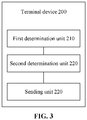
- FIG. 3 is a schematic block diagram of a terminal device 200 according to an embodiment of the disclosure. As illustrated in FIG. 3 , the terminal device 200 includes a first determination unit 210, a second determination unit 220 and a sending unit 230.
- the first determination unit 210 is configured to, when quality of a signal in a first signal set is bad enough to satisfy a first condition, select a target signal from a second signal set, quality of the target signal being good enough to satisfy a second condition.
- the second determination unit 220 is configured to determine a PRACH sequence and/or resource corresponding to the target signal according to an association between the second signal set and a PRACH sequence and/or resource.
- the sending unit 230 is configured to send a first request to a network device through the PRACH sequence and/or resource corresponding to the target signal, the first request being used to notify the network device of information about the target signal selected by the terminal device.
- the terminal device of the embodiment of the disclosure is favorable for improving signal transmission performance.
- the target signal is only associated with a contention-based PRACH resource
- the sending unit is specifically configured to send the first request through the contention-based PRACH resource corresponding to the target signal.
- the target signal is only associated with a contention-free PRACH resource
- the sending unit is specifically configured to send the first request through the contention-free PRACH resource corresponding to the target signal.
- the target signal is associated with both the contention-based PRACH resource and the contention-free PRACH resource
- the sending unit is specifically configured to send the first request through at least one of the contention-based PRACH resource corresponding to the target signal or the contention-free PRACH resource corresponding to the target signal.
- the sending unit is specifically configured to send the first request through the contention-based PRACH resource corresponding to the target signal and, when a first transmission condition is met and a first response sent by the network device is not received, send the first request through the contention-free PRACH resource corresponding to the target signal, the first response being a response to the first request sent through the contention-based PRACH resource.
- the sending unit is specifically configured to send the first request through the contention-free PRACH resource corresponding to the target signal and, when a second transmission condition is met and the first response sent by the network device is not received, send the first request through the contention-based PRACH resource corresponding to the target signal, the first response being a response to the first request sent through the contention-free PRACH resource.
- the terminal device further includes: a first receiving unit, configured to, before the sending unit sends the first request, receive first indication information from the network device, the first indication information being used to indicate that it is not allowed to use the contention-based PRACH resource to send the first request.
- a first receiving unit configured to, before the sending unit sends the first request, receive first indication information from the network device, the first indication information being used to indicate that it is not allowed to use the contention-based PRACH resource to send the first request.
- the sending unit is specifically configured to send the first request by use of the contention-free PRACH resource corresponding to the target signal only.
- the target signal is an SS/PBCH block
- the terminal device further includes: an acquisition unit, configured to acquire an association between the SS/PBCH block and a contention-based PRACH resource from a system message or a broadcast message.
- the sending unit is specifically configured to send the first request through the contention-free PRACH resource corresponding to the SS/PBCH block.
- the terminal device before the terminal device sends the first request, further includes: a second receiving unit, configured to, before the sending unit sends the first request, receiving second indication information from the network device, the second indication information being used to indicate that the first request is allowed to be sent by use of the contention-based PRACH resource.
- a second receiving unit configured to, before the sending unit sends the first request, receiving second indication information from the network device, the second indication information being used to indicate that the first request is allowed to be sent by use of the contention-based PRACH resource.
- the second signal set includes at least one of: one or more CSI-RSs; or, one or more SS/PBCH blocks.
- the second signal set includes the CSI-RSs
- the terminal device further includes: a third receiving unit, configured to receive first configuration information from the network device.
- the first configuration information is used to indicate at least one of: associations between at least part of the CSI-RSs in the second signal set and contention-based PRACH resources; or, associations between the at least part of the CSI-RSs in the second signal set and contention-free PRACH resources.
- the second signal set includes the SS/PBCH blocks
- the terminal device further includes: a fourth receiving unit, configured to receive second configuration information from the network device.
- the second configuration information is used to indicate at least one of: associations between at least part of the SS/PBCH blocks in the second signal set and contention-free PRACH resources; or, associations between the at least part of the SS/PBCH blocks in the second signal set and contention-based PRACH resources.
- the terminal device further includes: a second acquisition unit, configured to acquire associations between the at least part of the SS/PBCH blocks in the second signal set and the contention-based PRACH resources from the system message or the broadcast message.
- a second acquisition unit configured to acquire associations between the at least part of the SS/PBCH blocks in the second signal set and the contention-based PRACH resources from the system message or the broadcast message.
- the terminal device further includes: a first processing unit, configured to, when a first timer expires and no response to the first request is received from the network device, stop transmission of the first request to the network device.
- a first processing unit configured to, when a first timer expires and no response to the first request is received from the network device, stop transmission of the first request to the network device.
- the terminal device further includes: a second processing unit, configured to, before the first timer expires and when the response to the first request is received from the network device, stop transmission of the first request to the network device.
- a second processing unit configured to, before the first timer expires and when the response to the first request is received from the network device, stop transmission of the first request to the network device.
- the terminal device further includes: a third processing unit, configured to, when a number of times for which the first request is sent to the network device is greater than or equal to a first threshold, stop transmission of the first request to the network device.
- a third processing unit configured to, when a number of times for which the first request is sent to the network device is greater than or equal to a first threshold, stop transmission of the first request to the network device.
- terminal device 200 may correspond to the terminal device in the method embodiment of the disclosure and the abovementioned and other operations and/or functions of each unit in the terminal device 200 are adopted to implement the corresponding flows executed by the terminal device in the method in FIG. 2 respectively and will not be elaborated herein for simplicity.
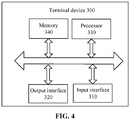
- an embodiment of the disclosure also provides a terminal device 300.
- the terminal device 300 may be the terminal device 200 in FIG. 3 , and may be configured to execute functions of the terminal device corresponding to the method 100 in FIG. 2 .
- the terminal device 300 includes an input interface 310, an output interface 320, a processor 330 and a memory 340.
- the input interface 310, the output interface 320, the processor 330 and the memory 340 may be connected through a bus system.
- the memory 340 is configured to store a program, instructions or codes.
- the processor 330 is configured to execute the program, instructions or codes in the memory 340 to control the input interface 310 to receive a signal, control the output interface 320 to send a signal and complete operations in the method embodiment.
- the terminal device of the embodiment of the disclosure is favorable for improving signal transmission performance.
- the processor 330 may be a central processing unit (CPU), and the processor 330 may also be another universal processor, a digital signal processor (DSP), an application specific integrated circuit (ASIC), a field programmable gate array (FPGA) or another programmable logic device, discrete gate or transistor logic device and discrete hardware component and the like.
- the universal processor may be a microprocessor or the processor may also be any conventional processor and the like.
- the memory 340 may include a read-only memory (ROM) and a random access memory (RAM) and provides instructions and data for the processor 330. A part of the memory 340 may further include a nonvolatile RAM. For example, the memory 340 may further store information of a device type.
- ROM read-only memory
- RAM random access memory
- each operation of the method may be completed by an integrated logic circuit of hardware in the processor 330 or instructions in a software form.
- the contents of the method disclosed in combination with the embodiments of the disclosure may be directly embodied to be executed and completed by a hardware processor or executed and completed by a combination of hardware and software modules in the processor.
- the software module may be located in a mature storage medium in this field such as a RAM, a flash memory, a ROM, a programmable ROM or electrically erasable programmable ROM and a register.
- the storage medium is located in the memory 340.
- the processor 330 reads information from the memory 340 and completes the contents of the method in combination with hardware. No more detailed descriptions will be made herein to avoid repetitions.
- the determination units, acquisition units and processing units in the terminal device 200 may be implemented by the processor 330 in FIG. 4
- the receiving units in the terminal device 200 may be implemented by the input interface 310 in FIG. 4
- the sending unit of the terminal device 200 may be implemented by the output interface 320 in FIG. 4 .
- the disclosed system, device and method may be implemented in another manner.
- the device embodiment described above is only schematic, and for example, division of the units is only logic function division, and other division manners may be adopted during practical implementation.
- multiple units or components may be combined or integrated into another system, or some characteristics may be neglected or not executed.
- coupling or direct coupling or communication connection between each displayed or discussed component may be indirect coupling or communication connection, implemented through some interfaces, of the device or the units, and may be electrical and mechanical or adopt other forms.
- the units described as separate parts may or may not be physically separated, and parts displayed as units may or may not be physical units, and namely may be located in the same place, or may also be distributed to multiple network units. Part or all of the units may be selected to achieve the purpose of the solutions of the embodiments according to a practical requirement.
- each functional unit in each embodiment of the disclosure may be integrated into a processing unit, each unit may also physically exist independently, and two or more than two units may also be integrated into a unit.
- the function may also be stored in a computer-readable storage medium.
- the technical solutions of the disclosure substantially or parts making contributions to the conventional art or part of the technical solutions may be embodied in form of software product, and the computer software product is stored in a storage medium, including a plurality of instructions configured to enable a computer device (which may be a personal computer, a server, a network device or the like) to execute all or part of the steps of each embodiment of the disclosure.
- the storage medium includes: various media capable of storing program codes such as a U disk, a mobile hard disk, a ROM, a RAM, a magnetic disk or an optical disk.
Landscapes
- Engineering & Computer Science (AREA)
- Signal Processing (AREA)
- Computer Networks & Wireless Communication (AREA)
- Quality & Reliability (AREA)
- Physics & Mathematics (AREA)
- Electromagnetism (AREA)
- Mobile Radio Communication Systems (AREA)
Abstract
Description
- The disclosure relates to the field of communications, and more particularly to a method for link reconfiguration and a terminal device.
- In researches on 5th-Generation (5G) mobile communication technologies, a beamforming technology is an important technology for improving coverage and spectrum efficiency. Beamforming refers to an antenna-array-based signal preprocessing technology and generates a directional beam by regulating a weight of a signal transmitted on each antenna array element.
- A network device may transmit different signal sets using different beams. A terminal device may measure a received signal set to determine whether a link for transmission of the signal set is too bad to be available, namely determining whether the transmission beam for the signal set is available. That is, whether a beam failure occurs is determined. In case of a beam failure, the terminal device may select a signal with better quality from another signal set. How a terminal device reports a selected signal with better quality to a network device is a problem to be solved.
- In view of this, the embodiments of the disclosure provide a method for link reconfiguration and a terminal device, which are favorable for improving signal transmission performance.
- A first aspect provides a method for link reconfiguration, which includes that: when quality of a signal in a first signal set is bad enough to satisfy a first condition, a terminal device selects a target signal from a second signal set, quality of the target signal being good enough to satisfy a second condition; the terminal device determines at least one of a Physical Random Access Channel (PRACH) sequence or PRACH resource corresponding to the target signal according to an association between the second signal set and at least one of a PRACH sequence or PRACH resource; and the terminal device sends a first request to a network device through the at least one of the PRACH sequence or the PRACH resource corresponding to the target signal, the first request being used to notify the network device of information about the target signal selected by the terminal device.
- In a possible implementation, the target signal may be only associated with a contention-based PRACH resource, and the operation that the terminal device sends the first request to the network device through the at least one of the PRACH sequence or the PRACH resource corresponding to the target signal may include that: the terminal device sends the first request through the contention-based PRACH resource corresponding to the target signal.
- In a possible implementation, the target signal may be only associated with a contention-free PRACH resource, and the operation that the terminal device sends the first request to the network device through the PRACH resource corresponding to the target signal may include that: the terminal device sends the first request through the contention-free PRACH resource corresponding to the target signal.
- In a possible implementation, the target signal may be associated with both the contention-based PRACH resource and the contention-free PRACH resource, and the operation that the terminal device sends the first request to the network device through the at least one of the PRACH sequence or the PRACH resource corresponding to the target signal may include that: the terminal device sends the first request through at least one of the contention-based PRACH resource corresponding to the target signal or the contention-free PRACH resource corresponding to the target signal.
- In a possible implementation, the operation that the terminal device sends the first request through the contention-based PRACH resource corresponding to the target signal and the contention-free PRACH resource corresponding to the target signal may include that: the terminal device sends the first request through the contention-based PRACH resource corresponding to the target signal; and when the terminal device satisfies a first transmission condition and does not receive a first response from the network device, the terminal device sends the first request through the contention-free PRACH resource corresponding to the target signal, the first response being a response to the first request sent through the contention-based PRACH resource.
- In a possible implementation, the operation that the terminal device sends the first request through the contention-based PRACH resource corresponding to the target signal and the contention-free PRACH resource corresponding to the target signal may include that: the terminal device sends the first request through the contention-free PRACH resource corresponding to the target signal; and when the terminal device satisfies a second transmission condition and does not receive a first response from the network device, the terminal device sends the first request through the contention-based PRACH resource corresponding to the target signal, the first response being a response to the first request sent through the contention-free PRACH resource.
- In a possible implementation, before the operation that the terminal device sends the first request, the method may further include that: the terminal device receives first indication information from the network device, the first indication information being used to indicate that the first request is not allowed to be sent by use of the contention-based PRACH resource; and the operation that the terminal device sends the first request through at least one of the contention-based PRACH resource corresponding to the target signal or the contention-free PRACH resource corresponding to the target signal may include that:
- the terminal device sends the first request by use of only the contention-free PRACH resource corresponding to the target signal.
- In a possible implementation, the target signal may be a synchronization signal (SS)/physical broadcast channel (PBCH) block, and the method may further include that: the terminal device acquires an association between the SS/PBCH block and a contention-based PRACH resource from a system message or a broadcast message; and the operation that the terminal device sends the first request through the at least one of the contention-based PRACH resource corresponding to the target signal or the contention-free PRACH resource corresponding to the target signal may include that: the terminal device sends the first request through a contention-free PRACH resource corresponding to the SS/PBCH block.
- In a possible implementation, before the operation that the terminal device sends the first request, the method may further include that: the terminal device receives second indication information from the network device, the second indication information being used to indicate that the first request is allowed to be sent by use of the contention-based PRACH resource.
- In a possible implementation, the second signal set may include at least one of: one or more Channel State Information-Reference Signal (CSI-RS); or, one or more SS/PBCH blocks.
- In a possible implementation, the second signal set may include the CSI-RSs, and the method may further include that: the terminal device receives first configuration information from the network device, the first configuration information being used to indicate at least one of associations between at least part of the CSI-RSs in the second signal set and contention-based PRACH resources or associations between the at least part of the CSI-RSs in the second signal set and contention-free PRACH resources.
- In a possible implementation, the second signal set may include the SS/PBCH block, and the method may further include that: the terminal device receives second configuration information from the network device, the second configuration information being used to indicate at least one of associations between at least part of the SS/PBCH blocks in the second signal set and contention-free PRACH resources or associations between the at least part of the SS/PBCH blocks in the second signal set and contention-based PRACH resources.
- In a possible implementation, the method may further include that: the terminal device acquires associations between at least part of the SS/PBCH blocks in the second signal set and contention-based PRACH resources from a system message or a broadcast message.
- In a possible implementation, the method may further include that: when a first timer expires and the terminal device does not receive any response to the first request from the network device, the terminal device stops sending the first request to the network device.
- In a possible implementation, the method may further include that: before the first timer expires and when the terminal device receives a response to the first request from the network device, the terminal device stops sending the first request to the network device.
- In a possible implementation, the method may further include that: when a number of times for which the terminal device sends the first request to the network device is greater than or equal to a first threshold, the terminal device stops sending the first request to the network device.
- A second aspect provides a terminal device, which is configured to execute the method in the first aspect or any possible implementation of the first aspect. Specifically, the terminal device includes units configured to execute the method in the first aspect or any possible implementation of the first aspect.
- A third aspect provides a terminal device, which includes a memory, a processor, an input interface and an output interface. The memory, the processor, the input interface and the output interface are connected through a bus system. The memory is configured to store instructions. The processor is configured to execute the instructions stored in the memory to perform the method in the first aspect or any possible implementation of the first aspect.
- These aspects or other aspects of the disclosure will become clearer and easier to understand through the following descriptions about the embodiments.
-
-
FIG. 1 is a schematic diagram of an application scenario according to an embodiment of the disclosure. -
FIG. 2 is a schematic block diagram of a method for link reconfiguration according to an embodiment of the disclosure. -
FIG. 3 is a schematic block diagram of a terminal device according to an embodiment of the disclosure. -
FIG. 4 is another schematic block diagram of a terminal device according to an embodiment of the disclosure. - The technical solutions in the embodiments of the disclosure will be clearly and completely described below in combination with the drawings in the embodiments of the disclosure.
- It is to be understood that the technical solutions of the embodiments of the disclosure may be applied to various communication systems, for example, a Global System of Mobile communication (GSM), a Code Division Multiple Access (CDMA) system, a Wideband Code Division Multiple Access (WCDMA) system, a General Packet Radio Service (GPRS), a Long Term Evolution (LTE) system, an LTE Frequency Division Duplex (FDD) system, LTE Time Division Duplex (TDD) system, a Universal Mobile Telecommunication System (UMTS), a Worldwide Interoperability for Microwave Access (WiMAX) communication system, New Radio (NR) system or a future 5G system.
- Particularly, the technical solutions of the embodiments of the disclosure may be applied to various non-orthogonal multiple access technology-based communication systems, for example, a Sparse Code Multiple Access (SCMA) system, a Low Density Signature (LDS) system and the like. Of course, the SCMA system and the LDS system may also have other names in the field of communications. Furthermore, the technical solutions of the embodiments of the disclosure may be applied to multi-carrier transmission systems adopting non-orthogonal multiple access technologies, for example, Orthogonal Frequency Division Multiplexing (OFDM), Filter Bank Multi-Carrier (FBMC), Generalized Frequency Division Multiplexing (GFDM) and Filtered-OFDM (F-OFDM) systems adopting the non-orthogonal multiple access technologies.
- In the embodiments of the disclosure, a terminal device may refer to User Equipment (UE), an access terminal, a user unit, a user station, a mobile station, a mobile radio station, a remote station, a remote terminal, a mobile device, a user terminal, a terminal, a wireless communication device, a user agent or a user device. The access terminal may be a cell phone, a cordless phone, a Session Initiation Protocol (SIP) phone, a Wireless Local Loop (WLL) station, a Personal Digital Assistant (PDA), a handheld device with a wireless communication function, a computing device or another processing device connected to a wireless modem, a vehicle-mounted device, a wearable device, UE in a future 5G network, UE in a future evolved Public Land Mobile Network (PLMN) or the like. There are no limits made in the embodiments of the disclosure.
- In the embodiments of the disclosure, the network device may be a device used to communicate with the terminal device. The network device may be a Base Transceiver Station (BTS) in the GSM or the CDMA, may also be a NodeB (NB) in the WCDMA system, may also be an Evolutional Node B (eNB or eNodeB) in the LTE system and may further be a wireless controller in a Cloud Radio Access Network (CRAN) scenario. Or the network device may be a relay station, an access point, a vehicle device, a wearable device, a network device in the future 5G network, a network device in the future evolved PLMN or the like. There are no limits made in the embodiments of the disclosure.
-
FIG. 1 is a schematic diagram of an application scenario according to an embodiment of the disclosure. A communication system illustrated inFIG. 1 may include a terminal device 10 and anetwork device 20. Thenetwork device 20 is used to provide communication service for the terminal device 10 for access to a core network. The terminal device 10 accesses the network by searching for a Synchronization Signal (SS), a broadcast signal and the like sent by thenetwork device 20, thereby communicating with the network. Arrows illustrated inFIG. 1 may represent uplink/downlink transmission implemented through a cellular link between the terminal device 10 and thenetwork device 20. -
FIG. 2 is a schematic block diagram of a method forlink reconfiguration 100 according to an embodiment of the disclosure. As illustrated inFIG. 2 , themethod 100 includes part or all of the following contents. - In S I 10, when quality of a signal in a first signal set is bad enough to satisfy a first condition, a terminal device selects a target signal from a second signal set, quality of the target signal being good enough to satisfy a second condition.
- In S120, the terminal device determines a PRACH sequence and/or resource corresponding to the target signal according to an association between the second signal set and a PRACH sequence and/or resource.
- In S130, the terminal device sends a first request to a network device through the PRACH sequence and/or resource corresponding to the target signal, the first request being used to notify the network device of information about the target signal selected by the terminal device.
- Specifically, after the terminal device receives signals of a signal set sent by the network device, the terminal device may measure the signals in the signal set, thereby determining quality of a link for transmission of these signals. That is, whether a transmission beam for the signals in the signal set is available or not is determined. For example, whether quality of the signals in the signal set is lower than a threshold or not may be determined. When the quality of all the signals in the signal set is lower than the threshold during a measurement, it may be determined that the beam for the signal set is unavailable. When the terminal device determines that the transmission beam for the signal set is really unavailable, the terminal device may select a signal with better quality from another signal set and reports the selected signal to the network device such that the network device may use a transmission beam for the signal reported by the terminal device for subsequent signal transmission. The network device may configure an association between a signal and a PRACH sequence and/or resource in advance, and then the terminal device may determine the PRACH sequence and/or resource corresponding to the selected signal, so that the terminal device may send information about the signal selected by the terminal device to the network device through the selected PRACH sequence and/or resource. After the network device receives a request sent by the terminal device through the selected PRACH sequence and/or resource, the network device may determine the signal selected by the terminal device, so that the network device may send a subsequent signal to the terminal device by use of the transmission beam for the signal reported by the terminal device.
- Therefore, the method for link reconfiguration according to the embodiment of the disclosure is favorable for improving signal transmission performance.
- Optionally, PRACH resources may usually be divided into contention-based PRACH resources and contention-free PRACH resources. For a terminal device, contention-based PRACH resources can be considered as a resource pool, and different terminal devices may use the same resource, thereby causing resource contention. A contention-free PRACH resource is specific to a terminal device, that is, it may be allocated exclusively to a terminal device by the network device at a moment.
- In the embodiment of the disclosure, signals in the first signal set and the second signal set may include at least one of a CSI-RS or an SS/PBCH block.
- Optionally, the target signal selected by the terminal device from the second signal set may be only associated with a contention-based PRACH resource. In such case, the terminal device selects the contention-based PRACH resource corresponding to the target signal according to the association between the signal in the second signal set and the PRACH sequence and/or resource, so that the terminal device may send the first request to the network device through the selected contention-based PRACH resource.
- Optionally, the target signal selected by the terminal device from the second signal set may be only associated with a contention-free PRACH resource. In such case, the terminal device may select the contention-free PRACH resource corresponding to the target signal according to the association between the signal in the second signal set and the PRACH sequence and/or resource to send the first request to the network device.
- Optionally, the target signal selected by the terminal device from the second signal set may not only be associated with the contention-based PRACH resource but also be associated with the contention-free PRACH resource. In such case, the terminal device may send the first request to the network device in the following four manners.
- First manner: The terminal device may send the first request to the network device only according to the contention-based PRACH resource associated with the target signal. For example, the terminal device sends the first request to the network device for the first time according to the contention-based PRACH resource associated with the target signal, and if the terminal device does not receive a response to the first request sent for the first time from the network device in a time window, the terminal device may send the first request to the network device for the second time according to the contention-based PRACH resource associated with the target signal until the number of times for which the terminal device sends the first request to the network device reaches a threshold.
- Second manner: The terminal device may send the first request to the network device only according to the contention-free PRACH resource associated with the target signal. For example, the terminal device sends the first request to the network device for the first time according to the contention-free PRACH resource associated with the target signal, and if the terminal device does not receive a response to the first request sent for the first time from the network device in a time window, the terminal device may send the first request to the network device for the second time according to the contention-free PRACH resource associated with the target signal until the number of times for which the terminal device sends the first request to the network device reaches a threshold.
- Third manner: The terminal device may send the first request through the contention-based PRACH resource associated with the target signal at first, and when the terminal device satisfies a first transmission condition and does not receive a first response from the network device, the terminal device sends the first request through the contention-free PRACH resource corresponding to the target signal, the first response being a response to the first request sent through the contention-based PRACH resource. For example, the terminal device may continuously send the first request through the contention-based PRACH resource associated with the target signal, and if the terminal device still does not receive any response to the first request when the number of times for which the first request is sent reaches a threshold, the terminal device may send the first request through the contention-free PRACH resource associated with the target signal.
- Fourth manner: The terminal device may send the first request through the contention-free PRACH resource associated with the target signal at first, and when the terminal device satisfies a second transmission condition and does not receive the first response from the network device, the terminal device sends the first request through the contention-based PRACH resource corresponding to the target signal, the first response being a response to the first request sent through the contention-free PRACH resource. For example, the terminal device may continuously send the first request through the contention-free PRACH resource associated with the target signal, and if the terminal device still does not receive any response to the first request when the number of times for which the first request is sent reaches a threshold, the terminal device may send the first request through the contention-based PRACH resource associated with the target signal.
- Optionally, in the embodiment of the disclosure, satisfying at least one of the first transmission condition or the second transmission condition may refer to that the number of times for which the terminal device continuously sends the first request reaches a threshold. Here, the threshold for the first transmission condition and the threshold for the second transmission condition may be the same or different.
- Optionally, in the embodiment of the disclosure, satisfying at least one of the first transmission condition or the second transmission condition may also refer to that a timer stops or a timer expires. Here, the timer duration for the first transmission condition and the timer duration for the second transmission condition may be the same or different.
- Optionally, when the target signal is associated with both the contention-based PRACH resource and the contention-free PRACH resource, before the terminal device sends the first request, the network device may further send first indication information to the terminal device. The first indication information is used to indicate that it is not allowed to use the contention-based PRACH resource to send the first request. In such case, after receiving the first indication information, the terminal device sends the first request by use of only the contention-free PRACH resource associated with the target signal.
- Optionally, when the target signal is associated with both the contention-based PRACH resource and the contention-free PRACH resource, before the terminal device sends the first request, the network device may further send second indication information to the terminal device. The second indication information is used to indicate that it is allowed to use the contention-based PRACH resource to send the first request. In such case, the terminal device, after receiving the second indication information, may send the first request to the network device through the above four solutions.
- Optionally, the second signal set may include part of CSI-RSs. In such case, the network device may configure only associated contention-based PRACH resources for the part of the CSI-RSs, and if the target signal belongs to the part of the CSI-RSs, the terminal device may send the first request by use of the contention-based PRACH resource associated with the target CSI-RS.
- Or, the network device may also configure only associated contention-free PRACH resources for the part of the CSI-RSs, and if the target signal belongs to the part of the CSI-RSs, the terminal device may send the first request by use of the contention-free PRACH resource associated with the target CSI-RS.
- Or, the network device may not only configure the associated contention-based PRACH resources for the part of the CSI-RSs but also configure the associated contention-free PRACH resources for the part of the CSI-RSs, and if the target signal belongs to the part of the CSI-RSs, the terminal device may send the first request by use of at least one of the contention-based PRACH resource associated with the target CSI-RS or the contention-free PRACH resource associated with the target CSI-RS and may specifically send the first request to the network device through the above four solutions.
- Optionally, the second signal set may include part of SS/PBCH blocks. In such case, the network device may configure only associated contention-based PRACH resources for the part of the SS/PBCK blocks, or the network device does not configure any associated contention-based PRACH resource for the part of the SS/PBCH blocks but the terminal device acquires associations between the part of the SS/PBCH blocks and the contention-based PRACH resources from a system message or a network message, and if the target signal belongs to the part of the SS/PBCH blocks, the terminal device may send the first request by use of the contention-based PRACH resource associated with the target SS/PBCH block.
- Or, the network device may configure only associated contention-free PRACH resources for the part of the SS/PBCH blocks, and if the target signal belongs to the part of the SS/PBCH blocks, the terminal device may send the first request by use of the contention-free PRACH resource associated with the target SS/PBCH block.
- Or, the network device may configure associated contention-based PRACH resources for the part of the SS/PBCH blocks or the terminal device acquires the associations between the part of the SS/PBCH blocks and the contention-based PRACH resources from the system message or a broadcast message, the network device also configures associated contention-free PRACH resources for the part of the SS/PBCH blocks, and if the target signal belongs to the part of the SS/PBCH blocks, the terminal device may send the first request by use of at least one of the contention-based PRACH resource associated with the target SS/PBCH block or the contention-free PRACH resource associated with the target SS/PBCH block and may specifically send the first request to the network device through the above four solutions.
- Optionally, if the target signal is an SS/PBCH block, the terminal device may acquire an association between the SS/PBCH block and a contention-based PRACH resource from a system message or a broadcast message, and when the network device also configures an association between the SS/PBCH block and a contention-free PRACH resource for the SS/PBCH block, the terminal device may send the first request by use of the contention-free PRACH resource corresponding to the SS/PBCH block. In other words, even if the terminal device has obtained the association between the SS/PBCH block and the contention-based PRACH resource, the terminal device also needs the network device to configure the association between the SS/PBCH block and the contention-free PRACH resource. The terminal device does not use the association, acquired from the system message or the broadcast message, between the SS/PBCH block and the contention-based PRACH resource, but uses the association, configured by the network device, between the SS/PBCH block and the contention-free PRACH resource.
- Optionally, after determining the PRACH resource corresponding to the target signal, the terminal device may start a timer. If the terminal device does not receive a response to the first request within the duration of the timer or when the timer expires, the terminal device may stop transmission of the first request to the network device. Or, if the terminal device receives the response to the first request within the duration of the timer, namely before the timer expires, the terminal device may also stop transmission of the first request to the network device. Or, the terminal device may stop transmission of the first request to the network device when the number of times for which the terminal device sends the first request to the network device reaches a threshold.
- It is to be understood that being more than or equal to in the embodiment of the disclosure refers to that a value range of a certain comparison object may be larger than, or equal to or more than or equal to. For example, the first request is stopped to be sent if the number of times for which the first request is sent reaches a certain value, or the quality of the signal is compared with a threshold and the target signal in the second signal set is determined if the quality of the signal in the first signal set is more than or equal to a certain value.
- It is to be understood that interaction between the network device and the terminal device and related properties, functions and the like described from the network device correspond to related properties and functions of the terminal device. Moreover, the related contents have been described in detail in the
method 100 and, for simplicity, will not be elaborated herein. - It is also to be understood that, in various embodiments of the disclosure, a magnitude of a sequence number of each process does not mean an execution sequence and the execution sequence of each process should be determined by its function and an internal logic and should not constitute any limit to an implementation process of the embodiments of the disclosure.
- The method for link configuration according to the embodiments of the disclosure is described above in detail and a device for link reconfiguration according to the embodiments of the disclosure will be described below in combination with
FIG. 3 andFIG. 4 . The technical characteristics described in the method embodiment are applied to the following device embodiment. -
FIG. 3 is a schematic block diagram of aterminal device 200 according to an embodiment of the disclosure. As illustrated inFIG. 3 , theterminal device 200 includes afirst determination unit 210, asecond determination unit 220 and a sending unit 230. - The
first determination unit 210 is configured to, when quality of a signal in a first signal set is bad enough to satisfy a first condition, select a target signal from a second signal set, quality of the target signal being good enough to satisfy a second condition. - The
second determination unit 220 is configured to determine a PRACH sequence and/or resource corresponding to the target signal according to an association between the second signal set and a PRACH sequence and/or resource. - The sending unit 230 is configured to send a first request to a network device through the PRACH sequence and/or resource corresponding to the target signal, the first request being used to notify the network device of information about the target signal selected by the terminal device.
- Therefore, the terminal device of the embodiment of the disclosure is favorable for improving signal transmission performance.
- Optionally, in the embodiment of the disclosure, the target signal is only associated with a contention-based PRACH resource, and the sending unit is specifically configured to send the first request through the contention-based PRACH resource corresponding to the target signal.
- Optionally, in the embodiment of the disclosure, the target signal is only associated with a contention-free PRACH resource, and the sending unit is specifically configured to send the first request through the contention-free PRACH resource corresponding to the target signal.
- Optionally, in the embodiment of the disclosure, the target signal is associated with both the contention-based PRACH resource and the contention-free PRACH resource, and the sending unit is specifically configured to send the first request through at least one of the contention-based PRACH resource corresponding to the target signal or the contention-free PRACH resource corresponding to the target signal.
- Optionally, in the embodiment of the disclosure, the sending unit is specifically configured to send the first request through the contention-based PRACH resource corresponding to the target signal and, when a first transmission condition is met and a first response sent by the network device is not received, send the first request through the contention-free PRACH resource corresponding to the target signal, the first response being a response to the first request sent through the contention-based PRACH resource.
- Optionally, in the embodiment of the disclosure, the sending unit is specifically configured to send the first request through the contention-free PRACH resource corresponding to the target signal and, when a second transmission condition is met and the first response sent by the network device is not received, send the first request through the contention-based PRACH resource corresponding to the target signal, the first response being a response to the first request sent through the contention-free PRACH resource.
- Optionally, in the embodiment of the disclosure, the terminal device further includes: a first receiving unit, configured to, before the sending unit sends the first request, receive first indication information from the network device, the first indication information being used to indicate that it is not allowed to use the contention-based PRACH resource to send the first request.
- The sending unit is specifically configured to send the first request by use of the contention-free PRACH resource corresponding to the target signal only.
- Optionally, in the embodiment of the disclosure, the target signal is an SS/PBCH block, and the terminal device further includes: an acquisition unit, configured to acquire an association between the SS/PBCH block and a contention-based PRACH resource from a system message or a broadcast message.
- The sending unit is specifically configured to send the first request through the contention-free PRACH resource corresponding to the SS/PBCH block.
- Optionally, in the embodiment of the disclosure, before the terminal device sends the first request, the terminal device further includes: a second receiving unit, configured to, before the sending unit sends the first request, receiving second indication information from the network device, the second indication information being used to indicate that the first request is allowed to be sent by use of the contention-based PRACH resource.
- Optionally, in the embodiment of the disclosure, the second signal set includes at least one of: one or more CSI-RSs; or, one or more SS/PBCH blocks.
- Optionally, in the embodiment of the disclosure, the second signal set includes the CSI-RSs, and the terminal device further includes: a third receiving unit, configured to receive first configuration information from the network device. Herein, the first configuration information is used to indicate at least one of: associations between at least part of the CSI-RSs in the second signal set and contention-based PRACH resources; or, associations between the at least part of the CSI-RSs in the second signal set and contention-free PRACH resources.
- Optionally, in the embodiment of the disclosure, the second signal set includes the SS/PBCH blocks, and the terminal device further includes: a fourth receiving unit, configured to receive second configuration information from the network device. The second configuration information is used to indicate at least one of: associations between at least part of the SS/PBCH blocks in the second signal set and contention-free PRACH resources; or, associations between the at least part of the SS/PBCH blocks in the second signal set and contention-based PRACH resources.
- Optionally, in the embodiment of the disclosure, the terminal device further includes: a second acquisition unit, configured to acquire associations between the at least part of the SS/PBCH blocks in the second signal set and the contention-based PRACH resources from the system message or the broadcast message.
- Optionally, in the embodiment of the disclosure, the terminal device further includes: a first processing unit, configured to, when a first timer expires and no response to the first request is received from the network device, stop transmission of the first request to the network device.
- Optionally, in the embodiment of the disclosure, the terminal device further includes: a second processing unit, configured to, before the first timer expires and when the response to the first request is received from the network device, stop transmission of the first request to the network device.
- Optionally, in the embodiment of the disclosure, the terminal device further includes: a third processing unit, configured to, when a number of times for which the first request is sent to the network device is greater than or equal to a first threshold, stop transmission of the first request to the network device.
- It is to be understood that the
terminal device 200 according to the embodiment of the disclosure may correspond to the terminal device in the method embodiment of the disclosure and the abovementioned and other operations and/or functions of each unit in theterminal device 200 are adopted to implement the corresponding flows executed by the terminal device in the method inFIG. 2 respectively and will not be elaborated herein for simplicity. - As illustrated in
FIG. 4 , an embodiment of the disclosure also provides aterminal device 300. Theterminal device 300 may be theterminal device 200 inFIG. 3 , and may be configured to execute functions of the terminal device corresponding to themethod 100 inFIG. 2 . Theterminal device 300 includes aninput interface 310, anoutput interface 320, aprocessor 330 and amemory 340. Theinput interface 310, theoutput interface 320, theprocessor 330 and thememory 340 may be connected through a bus system. Thememory 340 is configured to store a program, instructions or codes. Theprocessor 330 is configured to execute the program, instructions or codes in thememory 340 to control theinput interface 310 to receive a signal, control theoutput interface 320 to send a signal and complete operations in the method embodiment. - Therefore, the terminal device of the embodiment of the disclosure is favorable for improving signal transmission performance.
- It is to be understood that, in the embodiment of the disclosure, the
processor 330 may be a central processing unit (CPU), and theprocessor 330 may also be another universal processor, a digital signal processor (DSP), an application specific integrated circuit (ASIC), a field programmable gate array (FPGA) or another programmable logic device, discrete gate or transistor logic device and discrete hardware component and the like. The universal processor may be a microprocessor or the processor may also be any conventional processor and the like. - The
memory 340 may include a read-only memory (ROM) and a random access memory (RAM) and provides instructions and data for theprocessor 330. A part of thememory 340 may further include a nonvolatile RAM. For example, thememory 340 may further store information of a device type. - In an implementation process, each operation of the method may be completed by an integrated logic circuit of hardware in the
processor 330 or instructions in a software form. The contents of the method disclosed in combination with the embodiments of the disclosure may be directly embodied to be executed and completed by a hardware processor or executed and completed by a combination of hardware and software modules in the processor. The software module may be located in a mature storage medium in this field such as a RAM, a flash memory, a ROM, a programmable ROM or electrically erasable programmable ROM and a register. The storage medium is located in thememory 340. Theprocessor 330 reads information from thememory 340 and completes the contents of the method in combination with hardware. No more detailed descriptions will be made herein to avoid repetitions. - In a specific implementation, the determination units, acquisition units and processing units in the
terminal device 200 may be implemented by theprocessor 330 inFIG. 4 , and the receiving units in theterminal device 200 may be implemented by theinput interface 310 inFIG. 4 . The sending unit of theterminal device 200 may be implemented by theoutput interface 320 inFIG. 4 . - Those of ordinary skill in the art may realize that the units and algorithm steps of each example described in combination with the embodiments disclosed in the disclosure may be implemented by electronic hardware or a combination of computer software and the electronic hardware. Whether these functions are executed in a hardware or software manner depends on specific applications and design constraints of the technical solutions. Professionals may realize the described functions for each specific application by use of different methods, but such realization shall fall within the scope of the disclosure.
- Those skilled in the art may clearly learn about that specific working processes of the system, device and unit described above may refer to the corresponding processes in the method embodiment and will not be elaborated herein for convenient and brief description.
- In some embodiments provided by the disclosure, it is to be understood that the disclosed system, device and method may be implemented in another manner. For example, the device embodiment described above is only schematic, and for example, division of the units is only logic function division, and other division manners may be adopted during practical implementation. For example, multiple units or components may be combined or integrated into another system, or some characteristics may be neglected or not executed. In addition, coupling or direct coupling or communication connection between each displayed or discussed component may be indirect coupling or communication connection, implemented through some interfaces, of the device or the units, and may be electrical and mechanical or adopt other forms.
- The units described as separate parts may or may not be physically separated, and parts displayed as units may or may not be physical units, and namely may be located in the same place, or may also be distributed to multiple network units. Part or all of the units may be selected to achieve the purpose of the solutions of the embodiments according to a practical requirement.
- In addition, each functional unit in each embodiment of the disclosure may be integrated into a processing unit, each unit may also physically exist independently, and two or more than two units may also be integrated into a unit.
- When being realized in form of software functional unit and sold or used as an independent product, the function may also be stored in a computer-readable storage medium. Based on such an understanding, the technical solutions of the disclosure substantially or parts making contributions to the conventional art or part of the technical solutions may be embodied in form of software product, and the computer software product is stored in a storage medium, including a plurality of instructions configured to enable a computer device (which may be a personal computer, a server, a network device or the like) to execute all or part of the steps of each embodiment of the disclosure. The storage medium includes: various media capable of storing program codes such as a U disk, a mobile hard disk, a ROM, a RAM, a magnetic disk or an optical disk.
- The above is only the specific implementation of the disclosure and not intended to limit the scope of protection of the disclosure. Any variations or replacements apparent to those skilled in the art within the technical scope disclosed by the disclosure shall fall within the scope of protection of the disclosure. Therefore, the scope of protection of the disclosure shall be subject to the scope of protection of the claims.
Claims (32)
- A method for link reconfiguration, comprising:when quality of a signal in a first signal set is bad enough to satisfy a first condition, selecting, by a terminal device, a target signal from a second signal set, wherein quality of the target signal is good enough to satisfy a second condition;determining, by the terminal device, as least one of a physical random access channel (PRACH) sequence or PRACH resource corresponding to the target signal according to an association between the second signal set and as least one of a PRACH sequence or PRACH resource; andsending, by the terminal device, a first request to a network device through the at least one of the PRACH sequence or the PRACH resource corresponding to the target signal, wherein the first request is used to notify the network device of information about the target signal selected by the terminal device.
- The method of claim 1, wherein the target signal is only associated with a contention-based PRACH resource, and
sending, by the terminal device, the first request to the network device through the at least one of the PRACH sequence or the PRACH resource corresponding to the target signal comprises:
sending, by the terminal device, the first request through the contention-based PRACH resource corresponding to the target signal. - The method of claim 1, wherein the target signal is only associated with a contention-free PRACH resource, and
sending, by the terminal device, the first request to the network device through the PRACH resource corresponding to the target signal comprises:
sending, by the terminal device, the first request through the contention-free PRACH resource corresponding to the target signal. - The method of claim 1, wherein the target signal is associated with both a contention-based PRACH resource and a contention-free PRACH resource, and
sending, by the terminal device, the first request to the network device through the at least one of the PRACH sequence or the PRACH resource corresponding to the target signal comprises:
sending, by the terminal device, the first request through at least one of the contention-based PRACH resource corresponding to the target signal or the contention-free PRACH resource corresponding to the target signal. - The method of claim 4, wherein sending, by the terminal device, the first request through the contention-based PRACH resource corresponding to the target signal and the contention-free PRACH resource corresponding to the target signal comprises:sending, by the terminal device, the first request through the contention-based PRACH resource corresponding to the target signal; andwhen the terminal device satisfies a first transmission condition and does not receive a first response from the network device, sending, by the terminal device, the first request through the contention-free PRACH resource corresponding to the target signal, wherein the first response is a response to the first request sent through the contention-based PRACH resource.
- The method of claim 4, wherein sending, by the terminal device, the first request through the contention-based PRACH resource corresponding to the target signal and the contention-free PRACH resource corresponding to the target signal comprises:sending, by the terminal device, the first request through the contention-free PRACH resource corresponding to the target signal; andwhen the terminal device satisfies a second transmission condition and does not receive a first response from the network device, sending, by the terminal device, the first request through the contention-based PRACH resource corresponding to the target signal, wherein the first response is a response to the first request sent through the contention-free PRACH resource.
- The method of claim 4, further comprising: before sending, by the terminal device, the first request,
receiving, by the terminal device, first indication information from the network device, wherein the first indication information is used to indicate that the first request is not allowed to be sent by use of the contention-based PRACH resource,
wherein sending, by the terminal device, the first request through the at least one of the contention-based PRACH resource corresponding to the target signal or the contention-free PRACH resource corresponding to the target signal comprises:
sending, by the terminal device, the first request by use of only the contention-free PRACH resource corresponding to the target signal. - The method of claim 4, wherein the target signal is a synchronization signal (SS)/physical broadcast channel (PBCH) block, and
the method further comprises: acquiring, by the terminal device, an association between the SS/PBCH block and a contention-based PRACH resource from a system message or a broadcast message; and
wherein sending, by the terminal device, the first request through the at least one of the contention-based PRACH resource corresponding to the target signal or the contention-free PRACH resource corresponding to the target signal comprises:
sending, by the terminal device, the first request through a contention-free PRACH resource corresponding to the SS/PBCH block. - The method of any one of claims 4-6, further comprising: before sending, by the terminal device, the first request,
receiving, by the terminal device, second indication information from the network device, wherein the second indication information is used to indicate that the first request is allowed to be sent by use of the contention-based PRACH resource. - The method of any one of claims 1-9, wherein the second signal set comprises at least one of:one or more channel state information-reference signals (CSI-RSs); or,one or more SS/PBCH blocks.
- The method of claim 10, wherein the second signal set comprises the CSI-RSs, and
the method further comprises: receiving, by the terminal device, first configuration information from the network device,
wherein the first configuration information is used to indicate at least one of:associations between at least part of the CSI-RSs in the second signal set and contention-based PRACH resources; or,associations between the at least part of the CSI-RSs in the second signal set and contention-free PRACH resources. - The method of claim 10 or 11, wherein the second signal set comprises the SS/PBCH blocks, and
the method further comprises: receiving, by the terminal device, second configuration information from the network device,
wherein the second configuration information is used to indicate at least one of:associations between at least part of the SS/PBCH blocks in the second signal set and contention-free PRACH resources; or,associations between the at least part of the SS/PBCH blocks in the second signal set and contention-based PRACH resources. - The method of any one of claims 10-12, further comprising:
acquiring, by the terminal device, associations between at least part of the SS/PBCH blocks in the second signal set and contention-based PRACH resources from a system message or a broadcast message. - The method of any one of claims 1-13, further comprising:
when a first timer expires and the terminal device does not receive any response to the first request from the network device, stopping, by the terminal device, transmission of the first request to the network device. - The method of any one of claims 1-13, further comprising:
before a first timer expires and when the terminal device receives a response to the first request from the network device, stopping, by the terminal device, transmission of the first request to the network device. - The method of any one of claims 1-13, further comprising:
when a number of times for which the terminal device sends the first request to the network device is greater than or equal to a first threshold, stopping, by the terminal device, transmission of the first request to the network device. - A terminal device, comprising:a first determination unit, configured to, when quality of a signal in a first signal set is bad enough to satisfy a first condition, select a target signal from a second signal set, wherein quality of the target signal is good enough to satisfy a second condition;a second determination unit, configured to determine at least one of a physical random access channel (PRACH) sequence or PRACH resource corresponding to the target signal according to an association between the second signal set and at least one of a PRACH sequence or PRACH resource; anda sending unit, configured to send a first request to a network device through the at least one of the PRACH sequence or the PRACH resource corresponding to the target signal, wherein the first request is used to notify the network device of information about the target signal selected by the terminal device.
- The terminal device of claim 17, wherein the target signal is only associated with a contention-based PRACH resource, and
the sending unit is specifically configured to:
send the first request through the contention-based PRACH resource corresponding to the target signal. - The terminal device of claim 17, wherein the target signal is only associated with a contention-free PRACH resource, and
the sending unit is specifically configured to:
send the first request through the contention-free PRACH resource corresponding to the target signal. - The terminal device of claim 17, wherein the target signal is associated with both a contention-based PRACH resource and a contention-free PRACH resource, and
the sending unit is specifically configured to:
send the first request through at least one of the contention-based PRACH resource corresponding to the target signal or the contention-free PRACH resource corresponding to the target signal. - The terminal device of claim 20, wherein the sending unit is specifically configured to:send the first request through the contention-based PRACH resource corresponding to the target signal; andwhen a first transmission condition is met and a first response sent by the network device is not received, send the first request through the contention-free PRACH resource corresponding to the target signal, wherein the first response is a response to the first request sent through the contention-based PRACH resource.
- The terminal device of claim 20, wherein the sending unit is specifically configured to:send the first request through the contention-free PRACH resource corresponding to the target signal; andwhen a second transmission condition is met and a first response sent by the network device is not received, send the first request through the contention-based PRACH resource corresponding to the target signal, wherein the first response is a response to the first request sent through the contention-free PRACH resource.
- The terminal device of claim 20, further comprising:a first receiving unit, configured to receive first indication information from the network device before the sending unit sends the first request, wherein the first indication information is used to indicate that the first request is not allowed to be sent by use of the contention-based PRACH resource,wherein the sending unit is specifically configured to:
send the first request by use of only the contention-free PRACH resource corresponding to the target signal. - The terminal device of claim 20, wherein the target signal is a synchronization signal (SS)/physical broadcast channel (PBCH) block, and
the terminal device further comprises: an acquisition unit, configured to acquire an association between the SS/PBCH block and a contention-based PRACH resource from a system message or a broadcast message; and
wherein the sending unit is specifically configured to:
send the first request through a contention-free PRACH resource corresponding to the SS/PBCH block. - The terminal device of any one of claims 20-22, further comprising:
a second receiving unit, configured to receive second indication information from the network device before the sending unit sends the first request, wherein the second indication information is used to indicate that the first request is allowed to be sent by use of the contention-based PRACH resource. - The terminal device of any one of claims 17-25, wherein the second signal set comprises at least one of:one or more channel state information-reference signals (CSI-RSs); or,one or more SS/PBCH blocks.
- The terminal device of claim 26, wherein the second signal set comprises the CSI-RSs, and
the terminal device further comprises: a third receiving unit, configured to receive first configuration information from the network device,
wherein the first configuration information is used to indicate at least one of:associations between at least part of the CSI-RSs in the second signal set and contention-based PRACH resources; or,associations between the at least part of the CSI-RSs in the second signal set and contention-free PRACH resources. - The terminal device of claim 26 or 27, wherein the second signal set comprises the SS/PBCH blocks, and
the terminal device further comprises: a fourth receiving unit, configured to receive second configuration information from the network device,
wherein the second configuration information is used to indicate at least one of:associations between at least part of the SS/PBCH blocks in the second signal set and contention-free PRACH resources; or,associations between the at least part of the SS/PBCH blocks in the second signal set and contention-based PRACH resources. - The terminal device of any one of claims 26-28, further comprising:
a second acquisition unit, configured to acquire associations between at least part of the SS/PBCH blocks in the second signal set and contention-based PRACH resources from a system message or a broadcast message. - The terminal device of any one of claims 17-29, further comprising:
a first processing unit, configured to, when a first timer expires and no response to the first request is received from the network device, stop transmission of the first request to the network device. - The terminal device of any one of claims 17-29, further comprising:
a second processing unit, configured to, before a first timer expires and when a response to the first request is received from the network device, stop transmission of the first request to the network device. - The terminal device of any one of claims 17-29, further comprising:
a third processing unit, configured to, when a number of times for which the terminal device sends the first request to the network device is greater than or equal to a first threshold, stop transmission of the first request to the network device.
Applications Claiming Priority (1)
| Application Number | Priority Date | Filing Date | Title |
|---|---|---|---|
| PCT/CN2018/075673 WO2019153155A1 (en) | 2018-02-07 | 2018-02-07 | Method for link reconfiguration and terminal device |
Publications (3)
| Publication Number | Publication Date |
|---|---|
| EP3737192A1 true EP3737192A1 (en) | 2020-11-11 |
| EP3737192A4 EP3737192A4 (en) | 2020-12-02 |
| EP3737192B1 EP3737192B1 (en) | 2023-10-25 |
Family
ID=67548123
Family Applications (1)
| Application Number | Title | Priority Date | Filing Date |
|---|---|---|---|
| EP18904531.3A Active EP3737192B1 (en) | 2018-02-07 | 2018-02-07 | Method for link reconfiguration and terminal device |
Country Status (7)
| Country | Link |
|---|---|
| US (1) | US11425759B2 (en) |
| EP (1) | EP3737192B1 (en) |
| JP (1) | JP2021516887A (en) |
| KR (1) | KR20200116938A (en) |
| CN (2) | CN111226491A (en) |
| AU (1) | AU2018407142A1 (en) |
| WO (1) | WO2019153155A1 (en) |
Families Citing this family (4)
| Publication number | Priority date | Publication date | Assignee | Title |
|---|---|---|---|---|
| EP3494726B1 (en) * | 2017-09-27 | 2021-03-10 | Guangdong Oppo Mobile Telecommunications Corp., Ltd. | Information indication method and terminal device |
| US11540346B1 (en) * | 2020-04-15 | 2022-12-27 | Sprint Spectrum L.P. | Use of threshold RAB-modification rate as basis to control configuration of dual connectivity |
| CN119136218A (en) * | 2024-08-09 | 2024-12-13 | 华为技术有限公司 | Communication method and communication device |
| WO2026039988A1 (en) * | 2024-08-20 | 2026-02-26 | Oppo广东移动通信有限公司 | Data transmission method and apparatus, device, chip, and storage medium |
Family Cites Families (46)
| Publication number | Priority date | Publication date | Assignee | Title |
|---|---|---|---|---|
| CA2667275C (en) | 2006-10-23 | 2016-12-06 | Interdigital Technology Corporation | Method and apparatus for sending and receiving a measurement report via a shared channel |
| CN101946424B (en) | 2008-02-25 | 2013-08-28 | Lg电子株式会社 | Method of performing random access procedure in wireless communication system |
| CN101932044B (en) | 2009-06-26 | 2013-04-24 | 华为技术有限公司 | Method for acquiring system information of different systems, equipment and communication system thereof |
| KR102073027B1 (en) | 2011-04-05 | 2020-02-04 | 삼성전자 주식회사 | Method and appratus of operating multiple time alignment timer in mobile communication system using carrier aggregation |
| US20120300715A1 (en) * | 2011-05-10 | 2012-11-29 | Interdigital Patent Holdings, Inc. | Method and apparatus for obtaining uplink timing alignment on a secondary cell |
| CN106572543B (en) | 2012-02-15 | 2020-10-23 | 华为技术有限公司 | Random access method, base station and user equipment |
| WO2014110767A1 (en) | 2013-01-17 | 2014-07-24 | 华为技术有限公司 | Method and device for acquiring corresponding relationship between random access parameter and resource |
| US9838901B2 (en) | 2013-10-23 | 2017-12-05 | Lg Electronics Inc. | Method for reporting a radio link problem and a device therefor |
| WO2016048870A1 (en) | 2014-09-25 | 2016-03-31 | Sharp Laboratories Of America, Inc. | Latency reduction for mode switching in sidelink communications |
| US20160100360A1 (en) | 2014-10-07 | 2016-04-07 | Qualcomm Incorporated | Methods and apparatus for using enhancements for diverse data applications (edda)/power preference indication (ppi) |
| CN107534925B (en) * | 2015-03-28 | 2024-02-09 | 华为技术有限公司 | Wireless access method, device, communication system and terminal |
| CN105828394B (en) | 2015-05-20 | 2018-02-02 | 维沃移动通信有限公司 | A kind of link selecting method, device and the communication equipment of multichain pipeline equipment |
| CN107079459A (en) * | 2015-08-11 | 2017-08-18 | 瑞典爱立信有限公司 | Recover from wave beam failure |
| WO2017026455A1 (en) | 2015-08-13 | 2017-02-16 | 株式会社Nttドコモ | Information transmission method, information processing method, base station, and mobile station |
| WO2017123060A1 (en) * | 2016-01-14 | 2017-07-20 | Samsung Electronics Co., Ltd. | System, method, and apparatus of beam-tracking and beam feedback operation in a beam-forming based system |
| KR20230128391A (en) | 2016-03-03 | 2023-09-04 | 인터디지탈 패튼 홀딩스, 인크 | Methods and apparatus for beam control in beamformed systems |
| US11791882B2 (en) * | 2016-04-13 | 2023-10-17 | Qualcomm Incorporated | System and method for beam management |
| US10205571B2 (en) * | 2016-06-16 | 2019-02-12 | Lg Electronics Inc. | Method and apparatus for performing communication based on hybrid beamforming in wireless communication system |
| CN107567038B (en) * | 2016-07-01 | 2021-04-27 | 华硕电脑股份有限公司 | Method and apparatus for managing communications when a serving beam is inactive in wireless communications |
| EP3488646B1 (en) | 2016-07-20 | 2021-04-21 | Convida Wireless, LLC | Mobility for radio devices using beamforming and selection |
| WO2018128218A1 (en) * | 2017-01-03 | 2018-07-12 | 엘지전자 주식회사 | Method for performing random access process and user equipment |
| CN109246743B (en) | 2017-04-28 | 2021-10-15 | 华为技术有限公司 | A beam management method, terminal device, and network device |
| CN108810922B (en) | 2017-05-03 | 2021-02-23 | 华为技术有限公司 | Communication method, terminal and base station |
| US10728823B2 (en) * | 2017-05-14 | 2020-07-28 | FG Innovation Company Limited | Methods, devices, and systems for beam refinement during handover |
| US11251848B2 (en) | 2017-06-15 | 2022-02-15 | Motorola Mobility Llc | Transmitting a beam recovery request |
| CN107342801B (en) | 2017-06-15 | 2021-04-02 | 宇龙计算机通信科技(深圳)有限公司 | A beam processing method, user equipment and base station |
| WO2019028734A1 (en) | 2017-08-10 | 2019-02-14 | Mediatek Singapore Pte. Ltd. | Apparatus and mechanism to perform beam management and beam failure recovery in nr system |
| US10841970B2 (en) * | 2017-08-11 | 2020-11-17 | Qualcomm Incorporated | Beam management for beam-swept wakeup signals |
| CN107612602B (en) | 2017-08-28 | 2020-04-21 | 清华大学 | Beam recovery method and device for millimeter wave communication system |
| WO2019048932A2 (en) * | 2017-09-11 | 2019-03-14 | Lenovo (Singapore) Pte. Ltd. | Methods and devices for transmitting device capability information |
| EP4243325B1 (en) | 2017-11-15 | 2026-02-18 | InterDigital Patent Holdings, Inc. | Beam management in a wireless network |
| JP7333324B2 (en) | 2017-12-22 | 2023-08-24 | 中興通訊股▲ふん▼有限公司 | Method and wireless communication apparatus for performing beam failure recovery |
| JP2021511710A (en) | 2018-01-11 | 2021-05-06 | テレフオンアクチーボラゲット エルエム エリクソン(パブル) | Contention-based random access for beam failure recovery |
| US10893431B2 (en) * | 2018-01-19 | 2021-01-12 | Asustek Computer Inc. | Method and apparatus for beam failure reporting under multicell configuration in a wireless communication system |
| CN110062462B (en) | 2018-01-19 | 2022-02-08 | 维沃移动通信有限公司 | Beam failure recovery method and terminal |
| BR112020014392A2 (en) | 2018-01-22 | 2020-12-01 | Nokia Technologies Oy | top layer beam management |
| US11316798B2 (en) | 2018-02-06 | 2022-04-26 | Apple Inc. | Control signaling of beam failure detection |
| CN110149179B (en) | 2018-02-12 | 2021-01-15 | 维沃移动通信有限公司 | Method and equipment for recovering beam failure |
| ES2882908T3 (en) * | 2018-02-14 | 2021-12-03 | Guangdong Oppo Mobile Telecommunications Corp Ltd | Wireless communication device and method |
| EP3777323A4 (en) | 2018-04-05 | 2022-01-26 | Nokia Technologies Oy | USER EQUIPMENT RECEIVER SPATIAL FILTER CONFIGURATION DURING SECONDARY CELL BEAM FAILURE RECOVERY |
| EP3606272B1 (en) | 2018-08-03 | 2023-10-04 | Comcast Cable Communications, LLC | Uplink and downlink synchronization procedures |
| EP4550885A3 (en) | 2018-09-25 | 2025-07-23 | Ofinno, LLC | Beam configuration for secondary cells |
| CA3060803A1 (en) | 2018-10-31 | 2020-04-30 | Comcast Cable Communications, Llc | Beam management for cells in wireless communications |
| US11283674B2 (en) | 2018-11-01 | 2022-03-22 | Comcast Cable Communications, Llc | Beam failure recovery in carrier aggregation |
| WO2020197214A1 (en) | 2019-03-22 | 2020-10-01 | Samsung Electronics Co., Ltd. | Method and device for recovering connection failure to network in next generation mobile communication system |
| US11303345B2 (en) | 2019-05-02 | 2022-04-12 | Ofinno, Llc | Beam failure recovery procedure in carrier aggregation |
-
2018
- 2018-02-07 CN CN201880067210.9A patent/CN111226491A/en active Pending
- 2018-02-07 KR KR1020207023317A patent/KR20200116938A/en not_active Withdrawn
- 2018-02-07 JP JP2020542644A patent/JP2021516887A/en active Pending
- 2018-02-07 AU AU2018407142A patent/AU2018407142A1/en not_active Abandoned
- 2018-02-07 WO PCT/CN2018/075673 patent/WO2019153155A1/en not_active Ceased
- 2018-02-07 CN CN202010479531.9A patent/CN111642028B/en active Active
- 2018-02-07 EP EP18904531.3A patent/EP3737192B1/en active Active
-
2020
- 2020-07-30 US US16/944,100 patent/US11425759B2/en active Active
Also Published As
| Publication number | Publication date |
|---|---|
| KR20200116938A (en) | 2020-10-13 |
| JP2021516887A (en) | 2021-07-08 |
| CN111642028A (en) | 2020-09-08 |
| US11425759B2 (en) | 2022-08-23 |
| EP3737192B1 (en) | 2023-10-25 |
| WO2019153155A1 (en) | 2019-08-15 |
| CN111642028B (en) | 2021-11-09 |
| CN111226491A (en) | 2020-06-02 |
| US20200359424A1 (en) | 2020-11-12 |
| AU2018407142A1 (en) | 2020-09-03 |
| EP3737192A4 (en) | 2020-12-02 |
Similar Documents
| Publication | Publication Date | Title |
|---|---|---|
| US11736250B2 (en) | Method for transmitting reference signal, and communication device | |
| US11539483B2 (en) | Wireless communication method and apparatus | |
| US12574950B2 (en) | Method for configuring resources for physical downlink control channel transmission, terminal device and network device | |
| CA3066296C (en) | Data transmission method and terminal device | |
| US11425759B2 (en) | Method for link reconfiguration and terminal device | |
| US10880846B2 (en) | Method for signal transmission, network device and terminal device | |
| US20200322942A1 (en) | Method for use in transmitting signal, terminal device, and network device | |
| TW201907684A (en) | Wireless communication method and device | |
| EP3637629B1 (en) | Channel state information (csi) measurement method, terminal device and network device | |
| US11711823B2 (en) | Wireless communication method, network device, and terminal device | |
| EP3562059B1 (en) | Information transmission method, network device and terminal device | |
| US20210051725A1 (en) | Random access method, network device and terminal device | |
| US10952223B2 (en) | Wireless communication method and device | |
| EP3627879B1 (en) | Method for detecting link quality and terminal device |
Legal Events
| Date | Code | Title | Description |
|---|---|---|---|
| STAA | Information on the status of an ep patent application or granted ep patent |
Free format text: STATUS: THE INTERNATIONAL PUBLICATION HAS BEEN MADE |
|
| PUAI | Public reference made under article 153(3) epc to a published international application that has entered the european phase |
Free format text: ORIGINAL CODE: 0009012 |
|
| STAA | Information on the status of an ep patent application or granted ep patent |
Free format text: STATUS: REQUEST FOR EXAMINATION WAS MADE |
|
| 17P | Request for examination filed |
Effective date: 20200805 |
|
| AK | Designated contracting states |
Kind code of ref document: A1 Designated state(s): AL AT BE BG CH CY CZ DE DK EE ES FI FR GB GR HR HU IE IS IT LI LT LU LV MC MK MT NL NO PL PT RO RS SE SI SK SM TR |
|
| AX | Request for extension of the european patent |
Extension state: BA ME |
|
| A4 | Supplementary search report drawn up and despatched |
Effective date: 20201030 |
|
| RIC1 | Information provided on ipc code assigned before grant |
Ipc: H04W 74/08 20090101AFI20201026BHEP Ipc: H04W 76/19 20180101ALI20201026BHEP Ipc: H04B 7/06 20060101ALI20201026BHEP |
|
| DAV | Request for validation of the european patent (deleted) | ||
| DAX | Request for extension of the european patent (deleted) | ||
| STAA | Information on the status of an ep patent application or granted ep patent |
Free format text: STATUS: EXAMINATION IS IN PROGRESS |
|
| 17Q | First examination report despatched |
Effective date: 20210608 |
|
| GRAP | Despatch of communication of intention to grant a patent |
Free format text: ORIGINAL CODE: EPIDOSNIGR1 |
|
| STAA | Information on the status of an ep patent application or granted ep patent |
Free format text: STATUS: GRANT OF PATENT IS INTENDED |
|
| INTG | Intention to grant announced |
Effective date: 20230704 |
|
| RAP3 | Party data changed (applicant data changed or rights of an application transferred) |
Owner name: GUANGDONG OPPO MOBILE TELECOMMUNICATIONS CORP., LTD. |
|
| GRAS | Grant fee paid |
Free format text: ORIGINAL CODE: EPIDOSNIGR3 |
|
| GRAA | (expected) grant |
Free format text: ORIGINAL CODE: 0009210 |
|
| STAA | Information on the status of an ep patent application or granted ep patent |
Free format text: STATUS: THE PATENT HAS BEEN GRANTED |
|
| AK | Designated contracting states |
Kind code of ref document: B1 Designated state(s): AL AT BE BG CH CY CZ DE DK EE ES FI FR GB GR HR HU IE IS IT LI LT LU LV MC MK MT NL NO PL PT RO RS SE SI SK SM TR |
|
| REG | Reference to a national code |
Ref country code: GB Ref legal event code: FG4D |
|
| REG | Reference to a national code |
Ref country code: CH Ref legal event code: EP |
|
| REG | Reference to a national code |
Ref country code: DE Ref legal event code: R096 Ref document number: 602018060190 Country of ref document: DE |
|
| REG | Reference to a national code |
Ref country code: IE Ref legal event code: FG4D |
|
| REG | Reference to a national code |
Ref country code: LT Ref legal event code: MG9D |
|
| P01 | Opt-out of the competence of the unified patent court (upc) registered |
Effective date: 20240110 |
|
| REG | Reference to a national code |
Ref country code: NL Ref legal event code: MP Effective date: 20231025 |
|
| REG | Reference to a national code |
Ref country code: AT Ref legal event code: MK05 Ref document number: 1626026 Country of ref document: AT Kind code of ref document: T Effective date: 20231025 |
|
| PG25 | Lapsed in a contracting state [announced via postgrant information from national office to epo] |
Ref country code: NL Free format text: LAPSE BECAUSE OF FAILURE TO SUBMIT A TRANSLATION OF THE DESCRIPTION OR TO PAY THE FEE WITHIN THE PRESCRIBED TIME-LIMIT Effective date: 20231025 |
|
| PG25 | Lapsed in a contracting state [announced via postgrant information from national office to epo] |
Ref country code: GR Free format text: LAPSE BECAUSE OF FAILURE TO SUBMIT A TRANSLATION OF THE DESCRIPTION OR TO PAY THE FEE WITHIN THE PRESCRIBED TIME-LIMIT Effective date: 20240126 |
|
| PG25 | Lapsed in a contracting state [announced via postgrant information from national office to epo] |
Ref country code: IS Free format text: LAPSE BECAUSE OF FAILURE TO SUBMIT A TRANSLATION OF THE DESCRIPTION OR TO PAY THE FEE WITHIN THE PRESCRIBED TIME-LIMIT Effective date: 20240225 |
|
| PG25 | Lapsed in a contracting state [announced via postgrant information from national office to epo] |
Ref country code: LT Free format text: LAPSE BECAUSE OF FAILURE TO SUBMIT A TRANSLATION OF THE DESCRIPTION OR TO PAY THE FEE WITHIN THE PRESCRIBED TIME-LIMIT Effective date: 20231025 |
|
| PG25 | Lapsed in a contracting state [announced via postgrant information from national office to epo] |
Ref country code: AT Free format text: LAPSE BECAUSE OF FAILURE TO SUBMIT A TRANSLATION OF THE DESCRIPTION OR TO PAY THE FEE WITHIN THE PRESCRIBED TIME-LIMIT Effective date: 20231025 |
|
| PG25 | Lapsed in a contracting state [announced via postgrant information from national office to epo] |
Ref country code: ES Free format text: LAPSE BECAUSE OF FAILURE TO SUBMIT A TRANSLATION OF THE DESCRIPTION OR TO PAY THE FEE WITHIN THE PRESCRIBED TIME-LIMIT Effective date: 20231025 |
|
| PG25 | Lapsed in a contracting state [announced via postgrant information from national office to epo] |
Ref country code: LT Free format text: LAPSE BECAUSE OF FAILURE TO SUBMIT A TRANSLATION OF THE DESCRIPTION OR TO PAY THE FEE WITHIN THE PRESCRIBED TIME-LIMIT Effective date: 20231025 Ref country code: IS Free format text: LAPSE BECAUSE OF FAILURE TO SUBMIT A TRANSLATION OF THE DESCRIPTION OR TO PAY THE FEE WITHIN THE PRESCRIBED TIME-LIMIT Effective date: 20240225 Ref country code: GR Free format text: LAPSE BECAUSE OF FAILURE TO SUBMIT A TRANSLATION OF THE DESCRIPTION OR TO PAY THE FEE WITHIN THE PRESCRIBED TIME-LIMIT Effective date: 20240126 Ref country code: ES Free format text: LAPSE BECAUSE OF FAILURE TO SUBMIT A TRANSLATION OF THE DESCRIPTION OR TO PAY THE FEE WITHIN THE PRESCRIBED TIME-LIMIT Effective date: 20231025 Ref country code: BG Free format text: LAPSE BECAUSE OF FAILURE TO SUBMIT A TRANSLATION OF THE DESCRIPTION OR TO PAY THE FEE WITHIN THE PRESCRIBED TIME-LIMIT Effective date: 20240125 Ref country code: AT Free format text: LAPSE BECAUSE OF FAILURE TO SUBMIT A TRANSLATION OF THE DESCRIPTION OR TO PAY THE FEE WITHIN THE PRESCRIBED TIME-LIMIT Effective date: 20231025 Ref country code: PT Free format text: LAPSE BECAUSE OF FAILURE TO SUBMIT A TRANSLATION OF THE DESCRIPTION OR TO PAY THE FEE WITHIN THE PRESCRIBED TIME-LIMIT Effective date: 20240226 |
|
| PG25 | Lapsed in a contracting state [announced via postgrant information from national office to epo] |
Ref country code: SE Free format text: LAPSE BECAUSE OF FAILURE TO SUBMIT A TRANSLATION OF THE DESCRIPTION OR TO PAY THE FEE WITHIN THE PRESCRIBED TIME-LIMIT Effective date: 20231025 Ref country code: RS Free format text: LAPSE BECAUSE OF FAILURE TO SUBMIT A TRANSLATION OF THE DESCRIPTION OR TO PAY THE FEE WITHIN THE PRESCRIBED TIME-LIMIT Effective date: 20231025 Ref country code: PL Free format text: LAPSE BECAUSE OF FAILURE TO SUBMIT A TRANSLATION OF THE DESCRIPTION OR TO PAY THE FEE WITHIN THE PRESCRIBED TIME-LIMIT Effective date: 20231025 Ref country code: NO Free format text: LAPSE BECAUSE OF FAILURE TO SUBMIT A TRANSLATION OF THE DESCRIPTION OR TO PAY THE FEE WITHIN THE PRESCRIBED TIME-LIMIT Effective date: 20240125 Ref country code: LV Free format text: LAPSE BECAUSE OF FAILURE TO SUBMIT A TRANSLATION OF THE DESCRIPTION OR TO PAY THE FEE WITHIN THE PRESCRIBED TIME-LIMIT Effective date: 20231025 Ref country code: HR Free format text: LAPSE BECAUSE OF FAILURE TO SUBMIT A TRANSLATION OF THE DESCRIPTION OR TO PAY THE FEE WITHIN THE PRESCRIBED TIME-LIMIT Effective date: 20231025 |
|
| PG25 | Lapsed in a contracting state [announced via postgrant information from national office to epo] |
Ref country code: DK Free format text: LAPSE BECAUSE OF FAILURE TO SUBMIT A TRANSLATION OF THE DESCRIPTION OR TO PAY THE FEE WITHIN THE PRESCRIBED TIME-LIMIT Effective date: 20231025 |
|
| PG25 | Lapsed in a contracting state [announced via postgrant information from national office to epo] |
Ref country code: CZ Free format text: LAPSE BECAUSE OF FAILURE TO SUBMIT A TRANSLATION OF THE DESCRIPTION OR TO PAY THE FEE WITHIN THE PRESCRIBED TIME-LIMIT Effective date: 20231025 |
|
| REG | Reference to a national code |
Ref country code: DE Ref legal event code: R097 Ref document number: 602018060190 Country of ref document: DE |
|
| PG25 | Lapsed in a contracting state [announced via postgrant information from national office to epo] |
Ref country code: SK Free format text: LAPSE BECAUSE OF FAILURE TO SUBMIT A TRANSLATION OF THE DESCRIPTION OR TO PAY THE FEE WITHIN THE PRESCRIBED TIME-LIMIT Effective date: 20231025 |
|
| PG25 | Lapsed in a contracting state [announced via postgrant information from national office to epo] |
Ref country code: SM Free format text: LAPSE BECAUSE OF FAILURE TO SUBMIT A TRANSLATION OF THE DESCRIPTION OR TO PAY THE FEE WITHIN THE PRESCRIBED TIME-LIMIT Effective date: 20231025 Ref country code: SK Free format text: LAPSE BECAUSE OF FAILURE TO SUBMIT A TRANSLATION OF THE DESCRIPTION OR TO PAY THE FEE WITHIN THE PRESCRIBED TIME-LIMIT Effective date: 20231025 Ref country code: RO Free format text: LAPSE BECAUSE OF FAILURE TO SUBMIT A TRANSLATION OF THE DESCRIPTION OR TO PAY THE FEE WITHIN THE PRESCRIBED TIME-LIMIT Effective date: 20231025 Ref country code: IT Free format text: LAPSE BECAUSE OF FAILURE TO SUBMIT A TRANSLATION OF THE DESCRIPTION OR TO PAY THE FEE WITHIN THE PRESCRIBED TIME-LIMIT Effective date: 20231025 Ref country code: EE Free format text: LAPSE BECAUSE OF FAILURE TO SUBMIT A TRANSLATION OF THE DESCRIPTION OR TO PAY THE FEE WITHIN THE PRESCRIBED TIME-LIMIT Effective date: 20231025 Ref country code: DK Free format text: LAPSE BECAUSE OF FAILURE TO SUBMIT A TRANSLATION OF THE DESCRIPTION OR TO PAY THE FEE WITHIN THE PRESCRIBED TIME-LIMIT Effective date: 20231025 Ref country code: CZ Free format text: LAPSE BECAUSE OF FAILURE TO SUBMIT A TRANSLATION OF THE DESCRIPTION OR TO PAY THE FEE WITHIN THE PRESCRIBED TIME-LIMIT Effective date: 20231025 |
|
| PLBE | No opposition filed within time limit |
Free format text: ORIGINAL CODE: 0009261 |
|
| STAA | Information on the status of an ep patent application or granted ep patent |
Free format text: STATUS: NO OPPOSITION FILED WITHIN TIME LIMIT |
|
| PG25 | Lapsed in a contracting state [announced via postgrant information from national office to epo] |
Ref country code: MC Free format text: LAPSE BECAUSE OF FAILURE TO SUBMIT A TRANSLATION OF THE DESCRIPTION OR TO PAY THE FEE WITHIN THE PRESCRIBED TIME-LIMIT Effective date: 20231025 |
|
| REG | Reference to a national code |
Ref country code: CH Ref legal event code: PL |
|
| 26N | No opposition filed |
Effective date: 20240726 |
|
| PG25 | Lapsed in a contracting state [announced via postgrant information from national office to epo] |
Ref country code: LU Free format text: LAPSE BECAUSE OF NON-PAYMENT OF DUE FEES Effective date: 20240207 |
|
| PG25 | Lapsed in a contracting state [announced via postgrant information from national office to epo] |
Ref country code: CH Free format text: LAPSE BECAUSE OF NON-PAYMENT OF DUE FEES Effective date: 20240229 |
|
| PG25 | Lapsed in a contracting state [announced via postgrant information from national office to epo] |
Ref country code: SI Free format text: LAPSE BECAUSE OF FAILURE TO SUBMIT A TRANSLATION OF THE DESCRIPTION OR TO PAY THE FEE WITHIN THE PRESCRIBED TIME-LIMIT Effective date: 20231025 |
|
| PG25 | Lapsed in a contracting state [announced via postgrant information from national office to epo] |
Ref country code: SI Free format text: LAPSE BECAUSE OF FAILURE TO SUBMIT A TRANSLATION OF THE DESCRIPTION OR TO PAY THE FEE WITHIN THE PRESCRIBED TIME-LIMIT Effective date: 20231025 Ref country code: LU Free format text: LAPSE BECAUSE OF NON-PAYMENT OF DUE FEES Effective date: 20240207 Ref country code: CH Free format text: LAPSE BECAUSE OF NON-PAYMENT OF DUE FEES Effective date: 20240229 |
|
| REG | Reference to a national code |
Ref country code: BE Ref legal event code: MM Effective date: 20240229 |
|
| PG25 | Lapsed in a contracting state [announced via postgrant information from national office to epo] |
Ref country code: BE Free format text: LAPSE BECAUSE OF NON-PAYMENT OF DUE FEES Effective date: 20240229 |
|
| PG25 | Lapsed in a contracting state [announced via postgrant information from national office to epo] |
Ref country code: IE Free format text: LAPSE BECAUSE OF NON-PAYMENT OF DUE FEES Effective date: 20240207 |
|
| PG25 | Lapsed in a contracting state [announced via postgrant information from national office to epo] |
Ref country code: IE Free format text: LAPSE BECAUSE OF NON-PAYMENT OF DUE FEES Effective date: 20240207 Ref country code: BE Free format text: LAPSE BECAUSE OF NON-PAYMENT OF DUE FEES Effective date: 20240229 |
|
| PG25 | Lapsed in a contracting state [announced via postgrant information from national office to epo] |
Ref country code: CY Free format text: LAPSE BECAUSE OF FAILURE TO SUBMIT A TRANSLATION OF THE DESCRIPTION OR TO PAY THE FEE WITHIN THE PRESCRIBED TIME-LIMIT; INVALID AB INITIO Effective date: 20180207 |
|
| PG25 | Lapsed in a contracting state [announced via postgrant information from national office to epo] |
Ref country code: HU Free format text: LAPSE BECAUSE OF FAILURE TO SUBMIT A TRANSLATION OF THE DESCRIPTION OR TO PAY THE FEE WITHIN THE PRESCRIBED TIME-LIMIT; INVALID AB INITIO Effective date: 20180207 |
|
| PG25 | Lapsed in a contracting state [announced via postgrant information from national office to epo] |
Ref country code: FI Free format text: LAPSE BECAUSE OF FAILURE TO SUBMIT A TRANSLATION OF THE DESCRIPTION OR TO PAY THE FEE WITHIN THE PRESCRIBED TIME-LIMIT Effective date: 20231025 |
|
| PG25 | Lapsed in a contracting state [announced via postgrant information from national office to epo] |
Ref country code: TR Free format text: LAPSE BECAUSE OF FAILURE TO SUBMIT A TRANSLATION OF THE DESCRIPTION OR TO PAY THE FEE WITHIN THE PRESCRIBED TIME-LIMIT Effective date: 20231025 |
|
| PGFP | Annual fee paid to national office [announced via postgrant information from national office to epo] |
Ref country code: GB Payment date: 20260224 Year of fee payment: 9 |
|
| PGFP | Annual fee paid to national office [announced via postgrant information from national office to epo] |
Ref country code: DE Payment date: 20260223 Year of fee payment: 9 |
|
| PGFP | Annual fee paid to national office [announced via postgrant information from national office to epo] |
Ref country code: FR Payment date: 20260224 Year of fee payment: 9 |