EP3736933B1 - Method and apparatus for distributing dc bus voltage and control voltage over common conductors in a distributed dc bus system - Google Patents
Method and apparatus for distributing dc bus voltage and control voltage over common conductors in a distributed dc bus system Download PDFInfo
- Publication number
- EP3736933B1 EP3736933B1 EP20171494.6A EP20171494A EP3736933B1 EP 3736933 B1 EP3736933 B1 EP 3736933B1 EP 20171494 A EP20171494 A EP 20171494A EP 3736933 B1 EP3736933 B1 EP 3736933B1
- Authority
- EP
- European Patent Office
- Prior art keywords
- bus
- voltage
- control
- motor drive
- rectifier
- Prior art date
- Legal status (The legal status is an assumption and is not a legal conclusion. Google has not performed a legal analysis and makes no representation as to the accuracy of the status listed.)
- Active
Links
Images



Classifications
-
- H—ELECTRICITY
- H02—GENERATION; CONVERSION OR DISTRIBUTION OF ELECTRIC POWER
- H02J—ELECTRIC POWER NETWORKS; CIRCUIT ARRANGEMENTS OR SYSTEMS FOR SUPPLYING OR DISTRIBUTING ELECTRIC POWER; SYSTEMS FOR STORING ELECTRIC ENERGY
- H02J1/00—Circuit arrangements for DC mains or DC distribution networks
- H02J1/08—Three-wire DC power distribution systems; Systems having more than three wires
- H02J1/082—DC supplies with two or more different DC voltage levels
-
- H—ELECTRICITY
- H02—GENERATION; CONVERSION OR DISTRIBUTION OF ELECTRIC POWER
- H02J—ELECTRIC POWER NETWORKS; CIRCUIT ARRANGEMENTS OR SYSTEMS FOR SUPPLYING OR DISTRIBUTING ELECTRIC POWER; SYSTEMS FOR STORING ELECTRIC ENERGY
- H02J1/00—Circuit arrangements for DC mains or DC distribution networks
- H02J1/08—Three-wire DC power distribution systems; Systems having more than three wires
-
- H—ELECTRICITY
- H02—GENERATION; CONVERSION OR DISTRIBUTION OF ELECTRIC POWER
- H02J—ELECTRIC POWER NETWORKS; CIRCUIT ARRANGEMENTS OR SYSTEMS FOR SUPPLYING OR DISTRIBUTING ELECTRIC POWER; SYSTEMS FOR STORING ELECTRIC ENERGY
- H02J1/00—Circuit arrangements for DC mains or DC distribution networks
- H02J1/10—Parallel operation of DC sources
- H02J1/108—Parallel operation of DC sources having arrangements for blocking reverse current flow, e.g. using diodes
-
- H—ELECTRICITY
- H02—GENERATION; CONVERSION OR DISTRIBUTION OF ELECTRIC POWER
- H02M—APPARATUS FOR CONVERSION BETWEEN AC AND AC, BETWEEN AC AND DC, OR BETWEEN DC AND DC, AND FOR USE WITH MAINS OR SIMILAR POWER SUPPLY SYSTEMS; CONVERSION OF DC OR AC INPUT POWER INTO SURGE OUTPUT POWER; CONTROL OR REGULATION THEREOF
- H02M7/00—Conversion of AC power input into DC power output; Conversion of DC power input into AC power output
- H02M7/02—Conversion of AC power input into DC power output without possibility of reversal
- H02M7/04—Conversion of AC power input into DC power output without possibility of reversal by static converters
- H02M7/12—Conversion of AC power input into DC power output without possibility of reversal by static converters using discharge tubes with control electrode or semiconductor devices with control electrode
-
- H—ELECTRICITY
- H02—GENERATION; CONVERSION OR DISTRIBUTION OF ELECTRIC POWER
- H02M—APPARATUS FOR CONVERSION BETWEEN AC AND AC, BETWEEN AC AND DC, OR BETWEEN DC AND DC, AND FOR USE WITH MAINS OR SIMILAR POWER SUPPLY SYSTEMS; CONVERSION OF DC OR AC INPUT POWER INTO SURGE OUTPUT POWER; CONTROL OR REGULATION THEREOF
- H02M1/00—Details of apparatus for conversion
- H02M1/0003—Details of control, feedback or regulation circuits
- H02M1/0006—Arrangements for supplying an adequate voltage to the control circuit of converters
-
- H—ELECTRICITY
- H02—GENERATION; CONVERSION OR DISTRIBUTION OF ELECTRIC POWER
- H02M—APPARATUS FOR CONVERSION BETWEEN AC AND AC, BETWEEN AC AND DC, OR BETWEEN DC AND DC, AND FOR USE WITH MAINS OR SIMILAR POWER SUPPLY SYSTEMS; CONVERSION OF DC OR AC INPUT POWER INTO SURGE OUTPUT POWER; CONTROL OR REGULATION THEREOF
- H02M1/00—Details of apparatus for conversion
- H02M1/0067—Converter structures employing plural converter units, other than for parallel operation of the units on a single load
- H02M1/007—Plural converter units in cascade
-
- H—ELECTRICITY
- H02—GENERATION; CONVERSION OR DISTRIBUTION OF ELECTRIC POWER
- H02M—APPARATUS FOR CONVERSION BETWEEN AC AND AC, BETWEEN AC AND DC, OR BETWEEN DC AND DC, AND FOR USE WITH MAINS OR SIMILAR POWER SUPPLY SYSTEMS; CONVERSION OF DC OR AC INPUT POWER INTO SURGE OUTPUT POWER; CONTROL OR REGULATION THEREOF
- H02M3/00—Conversion of DC power input into DC power output
- H02M3/22—Conversion of DC power input into DC power output with intermediate conversion into AC
- H02M3/24—Conversion of DC power input into DC power output with intermediate conversion into AC by static converters
- H02M3/28—Conversion of DC power input into DC power output with intermediate conversion into AC by static converters using discharge tubes with control electrode or semiconductor devices with control electrode to produce the intermediate AC
- H02M3/325—Conversion of DC power input into DC power output with intermediate conversion into AC by static converters using discharge tubes with control electrode or semiconductor devices with control electrode to produce the intermediate AC using devices of a triode or a transistor type requiring continuous application of a control signal
- H02M3/335—Conversion of DC power input into DC power output with intermediate conversion into AC by static converters using discharge tubes with control electrode or semiconductor devices with control electrode to produce the intermediate AC using devices of a triode or a transistor type requiring continuous application of a control signal using semiconductor devices only
- H02M3/33507—Conversion of DC power input into DC power output with intermediate conversion into AC by static converters using discharge tubes with control electrode or semiconductor devices with control electrode to produce the intermediate AC using devices of a triode or a transistor type requiring continuous application of a control signal using semiconductor devices only with automatic control of the output voltage or current, e.g. flyback converters
-
- H—ELECTRICITY
- H02—GENERATION; CONVERSION OR DISTRIBUTION OF ELECTRIC POWER
- H02P—CONTROL OR REGULATION OF ELECTRIC MOTORS, ELECTRIC GENERATORS OR DYNAMO-ELECTRIC CONVERTERS; CONTROLLING TRANSFORMERS, REACTORS OR CHOKE COILS
- H02P2201/00—Indexing scheme relating to controlling arrangements characterised by the converter used
- H02P2201/03—AC-DC converter stage controlled to provide a defined DC link voltage
Definitions
- the subject matter disclosed herein relates to a method of delivering power and control voltages in a distributed DC bus system. More specifically, a system of delivering power and control voltages over common conductors in a distributed DC bus system is disclosed.
- a distributed DC bus system supplies DC power to multiple loads from a single DC source.
- a controlled machine or process may have multiple axes of motion, where each axis is controlled by a motor.
- a single rectifier front end is provided to convert, for example, a three-phase AC voltage from a utility supply to a DC voltage.
- the three-phase AC voltage may be, for example, 230 VAC or 460 VAC and the resulting DC voltage supplied on the distributed DC bus may be 325 VDC or 650 VDC, respectively.
- the power rating of the rectifier front end is sufficient to supply enough current at the corresponding DC voltage level to multiple motor drives via the distributed DC bus.
- a first set of conductors is provided to supply the DC bus voltage from the rectifier front end to each motor drive in the system.
- Each motor drive receives the DC voltage and supplies a controlled AC voltage, having a variable amplitude and variable frequency, to a motor connected to the motor drive to achieve desired operation of the motor.
- each motor drive requires a control voltage to supply power to control circuits such as a microprocessor executing within the motor drive, logic circuits, gate drive circuits, analog-to-digital converters, digital-to-analog converters, communication circuits, and the like.
- the control voltage is commonly at or below 50 VDC, which is considered a safe voltage that does not require further guarding against accidental contact, and is similarly distributed to the motor drives.
- the control voltage is required to enable a technician to set parameters on the motor drive that will define how the motor controlled by the motor drive will operate.
- control voltage is supplied independently of the DC bus voltage.
- a second set of conductors is provided to connect the control voltage to each of the motor drives.
- the size of the wires utilized for distributing control power to the motor drives is correspondingly less than the size of the wires or than the bus cross-section utilized for distributing DC bus voltage to the motor drives..
- a motor may require external devices connected to the motor which, in turn, require control power to operate.
- the motor may include a brake and/or a fan which operate from the control power to the motor.
- a brake requires a significant current to energize the brake coil to release the brake.
- the system must be configured to supply the current required during operation if each brake coil is energized in tandem.
- the current required by the brakes may limit the number of brakes and, therefore, limit the number of motors that may be connected to a single power supply.
- the total power drawn from the control power supply is equal to the amplitude of the voltage times the amplitude of the current.
- the power supply must be able to supply power to control components within the motor drive as well as to supply power to external components connected to the motor, the number of motors receiving control power from a single power supply is reduced. Additional power supplies may, therefore, be required either within a central control cabinet or distributed around the controlled machine or process to provide the required control power.
- a first cable supplies the DC bus voltage
- a second cable provides the control power
- a third cable transmits data packets between the devices.
- the first cable includes three conductors and may include a shield within a jacket or housing, where the three conductors are for the positive DC bus voltage, the negative DC bus voltage, and a ground connection.
- the second cable includes two conductors and a shield within a jacket or housing, where the two conductors are for the positive control voltage and the negative control voltage.
- the third cable includes a pair of transmit conductors, a pair of receive conductors, and a shield within a jacket or housing. Each of the three cables must be routed between the rectifier front end and a motor drive.
- the DC bus voltage cable and the control power cable are bundled into a single cable, and the communication cable is routed separately.
- the bundled DC bus voltage and control power cable includes the five conductors within the jacket, where two conductors are provided for DC bus voltage, one conductor is a ground conductor and two conductors are provided for the control voltage such that both the DC bus voltage and the control power and included within a single cable.
- all three of the previously discussed cables e.g., DC bus voltage cable, control power cable, and communication cable
- the single bundled cable includes nine conductors where each of the three separate cables similarly require nine conductors total between the three cables.
- the number of connections is not reduced, the weight per unit length of the cable increases, and the flexibility of the cable decreases as an increased number of conductors must be bent at the same time.
- WO 2019/011444 A1 discloses that a rectifier stage is used to charge a DC link stage to a first (low) voltage.
- the main SMPS circuit is started.
- the voltage output by the rectifier stage in the step must be sufficient to enable the SMPS circuit to function.
- the control 34 is turned on.
- the main SMPS circuit needs to be outputting a sufficient voltage.
- the rectifier is used to charge the DC link voltage to a second, higher level. This second higher level is the normal operating level of the system.
- pages 1 - 456 discloses on pages 136 and 149 a smart line module and an the active line module, respectively, each of which comprise an internal power supply powered by 24 Volt DC Line to provide power to a braking module over the DC bus in cases when the main power is interrupted.
- US 2014/320048 A1 discloses an exemplary embodiment of a distributed motor control system 10 including a power interface module, a pair of 14 , and a pair of integrated motor drives.
- a first communication cable is connected between the power interface module and a first communication connector on the first integrated motor drive.
- a second communication cable connects a second communication connector from the first integrated motor drive to the first communication connector on the second integrated motor drive.
- a first power cable is connected between the power interface module and a first power connector on the first integrated motor drive.
- a second power cable connects a second power connector from the first integrated motor drive to the first power connector on the second integrated motor drive.
- PLC Powerline Communication
- COBEP/SPEC "Powerline Communication
- 01-11-2015 relates to an applicability assessment regarding power line communication through power converter's DC bus.
- a rectifier front end receives AC voltage as an input and converts the AC voltage to a DC bus voltage.
- the rectifier front end also receives a control voltage which it may first convert to a desired DC control voltage or pass directly on to other devices if the control voltage received is at the desired DC control voltage.
- Both the DC bus voltage and the DC control voltage are distributed via a common set of conductors. Consequently, the system distributes DC bus voltage and control power without incurring the disadvantages of bundled cables.
- Diodes are operatively connected between the DC control voltage and the DC bus such that the diodes are forward biased when the DC control voltage is present and the DC bus voltage is not present, and the diodes are reverse biased when the DC control voltage is present and the DC bus voltage is present.
- the diodes allow forward conduction of the DC control voltage and distribution of control power to distributed devices when the DC bus voltage is not present. Once the DC bus voltage is present, the diodes block conduction of the DC control voltage.
- Each of the distributed devices are configured with an internal power supply that is operative to generate an internal control voltage from either the DC control voltage or the DC bus voltage. Because the external devices on the motor are not required to operate without DC bus voltage present, the distributed device may draw DC bus voltage to power the external devices, and the system no longer requires control power for operation of external devices on the motor.
- a distributed DC bus system includes a first input configured to receive an AC input voltage, a rectifier section operative to convert the AC input voltage to a DC bus voltage having a first amplitude, a DC bus electrically connected to the rectifier section and operative to receive the DC bus voltage, and a pair of diodes operatively connected between a DC control voltage and the DC bus.
- the DC control voltage is less than the DC bus voltage, and at least one motor drive is operatively connected to the DC bus.
- the pair of diodes are operatively connected to be forward biased when the DC control voltage is present in the distributed DC bus system and the DC bus voltage is not present on the DC bus, and the pair of diodes are operatively connected to be reverse biased when the DC control voltage is present in the distributed DC bus system and the DC bus voltage is present on the DC bus.
- Each motor drive includes an inverter section electrically connected to the DC bus to receive the DC bus voltage as an input and to provide an AC voltage as an output and a power supply electrically connected to the DC bus. The power supply is operative to output a motor drive control voltage from either the DC bus voltage or the DC control voltage present on the DC bus.
- a distributed DC bus system includes a first input configured to receive an AC input voltage, a rectifier section operative to convert the AC input voltage to a DC voltage having a first amplitude, a DC bus electrically connected to the rectifier section and operative to receive the DC bus voltage, and a pair of diodes operatively connected between a DC control voltage and the DC bus, where the DC control voltage is less than the DC bus voltage.
- the pair of diodes are operatively connected to be forward biased when the DC control voltage is present in the distributed DC bus system and the DC bus voltage is not present on the DC bus, and the pair of diodes are operatively connected to be reverse biased when the DC control voltage is present in the distributed DC bus system and the DC bus voltage is present on the DC bus.
- the DC bus is configured to be electrically connected between the rectifier section and at least one motor drive.
- Each motor drive includes an inverter section operative to output an AC output voltage from the DC bus voltage received as an input, and each motor drive includes a power supply operative to output a motor drive control voltage from either the DC bus voltage or the DC control voltage present on the DC bus.
- a distributed DC bus system includes a DC bus electrically connected to a rectifier front end and operative to selectively receive either a DC bus voltage or a DC control voltage and at least one motor drive operatively connected to the DC bus.
- Each motor drive includes an inverter section electrically connected to the DC bus to receive the DC bus voltage as an input and to provide an AC voltage as an output and a power supply electrically connected to the DC bus.
- the power supply is operative to output a motor drive control voltage from either the DC bus voltage or the DC control voltage present on the DC bus.
- the motor control system 10 includes a front-end rectifier 20 and a motor drive 11. Although illustrated as separate components, it is contemplated that some embodiments will include a front-end rectifier and motor drive as a single component.
- the front-end rectifier 20 is configured to receive a three-phase AC voltage 15 at an input to a rectifier section 21.
- the rectifier section 21 may include any electronic device suitable for passive or active rectification as is understood in the art.
- the illustrated rectifier section 21 includes a set of diodes 22 forming a diode bridge that rectifies the three-phase AC voltage to a DC voltage on the DC bus 25.
- the rectifier section 21 may include other solid-state devices including, but not limited to, thyristors, silicon-controlled rectifiers (SCRs), insulated-gate bipolar transistors (IGBTs), power metal-oxide semiconductor field-effect transistors (MOSFETs), or other transistors or solid-state devices to convert the input power 15 to a DC voltage for the DC bus 25.
- the DC voltage is present between a positive rail 27 and a negative rail 29 of the DC bus 25.
- the front-end rectifier 20 also includes a DC bus capacitance 24 connected between the positive and negative rails, 27 and 29, to reduce the magnitude of the ripple voltage resulting from converting the AC voltage to a DC voltage.
- the DC bus capacitance 24 may be a single capacitor or multiple capacitors connected in parallel, in series, or a combination thereof.
- the positive rail 27 is at a voltage potential generally equal to or boosted above the magnitude of the peak of the AC input voltage and the negative rail 29 is at a voltage potential at zero volts, where the negative rail 29 may be a floating common or tied to an earth ground.
- the DC bus capacitance 24 may be arranged in a split-bus configuration, such that a first portion of the DC bus capacitance 24 is connected between the positive rail 27 and a ground connection, and a second portion of the DC bus capacitance 24 is connected in series with the first portion of the DC bus capacitance between the ground connection and the negative rail 29.
- the total voltage potential across the DC bus 25 in the split bus configuration remains generally equal to or boosted above the magnitude of the peak of the AC input voltage, but the voltage potential across each portion of the capacitance 24 is one-half of the total DC bus voltage.
- the front-end rectifier 20 may also receive a control voltage 17 for distribution to each of the motor drives 11.
- the control voltage is a 24 VDC input voltage.
- the front-end rectifier 20 includes a control power supply 130, which is a switched mode power supply.
- a switch 131 which may be implemented by a transistor, is selectively opened and closed to establish conduction through a transformer 132.
- the inductive nature of the transformer, in combination with the diode 133 and capacitor 134 work in combination with the switch 131 to boost the 24 VDC at the input 17 to a 48 VDC control voltage at the output of the control power supply 130.
- the transformer 132 provides electrical isolation between the control voltage at the input 17 and the control voltage at the output of the power supply 130.
- a pair of diodes 140, 142 are connected between the output of the control power supply 130 and the DC bus 25. As will be discussed in more detail below, the pair of diodes 140, 142 allow the 48 VDC control voltage to be present on the DC bus 25 when the DC bus voltage output from the rectifier section 21 is not present and disconnect the control power supply 130 from the DC bus 25 when the DC bus voltage output from the rectifier section 21 is present.
- the control voltage 17 is a single-phase AC input, such as 115 VAC.
- the front-end rectifier 20 may further include a voltage regulator 144 that converts the AC input to the 48 VDC control voltage.
- a capacitor 146 is provided at the output of the voltage regulator 144 to help smooth any ripple of the DC voltage and/or to provide some ride through due to the loss of the AC input.
- the capacitor 146 may be incorporated within the voltage regulator 144.
- a pair of diodes 140, 142 are connected between the output of the voltage regulator 144 and the DC bus 25.
- the pair of diodes 140, 142 allow the 48 VDC control voltage to be present on the DC bus 25 when the DC bus voltage output from the rectifier section 21 is not present and disconnect the voltage regulator 144 from the DC bus 25 when the DC bus voltage output from the rectifier section 21 is present.
- a 48 VDC voltage may be supplied as a control voltage 17 input to the rectifier 20.
- the front-end rectifier 20 may include just the pair of diodes 140, 142 to selectively connect the control voltage input 17 to the DC bus 25 as a function of whether the DC bus voltage output from the rectifier section 21 is present.
- an isolation transformer 132 may be provided which provides a one-to-one turns ratio while also establishing electrical isolation between the control voltage input and the control voltage output. The output of the isolation transformer is then connected to the pair of diodes 140, 142 to selectively connect the 48 VDC to the DC bus 25.
- control voltage may be provided for selectively connecting to the DC bus 25 via the diodes 140, 142 without deviating from the scope of the invention.
- control voltage may be selected at other DC voltage levels, such as 24VDC, where the magnitude of the control voltage is less than the magnitude of the DC bus voltage level, without deviating from the scope of the invention.
- the front-end rectifier 20 further includes a control circuit used to control operation of the rectifier.
- the control circuit includes a processor 120 and a memory 122.
- One or more modules are used to control operation of the front-end rectifier 20.
- the modules may be programs stored in the memory 122 and executed on the processor 120, logic circuits, or a combination thereof.
- the memory 122 is configured to store data and programs, which include a series of instructions executable by the processor 120. It is contemplated that the memory 122 may be a single device, multiple devices, or incorporated, for example, as a portion of another device such as an application specific integrated circuit (ASIC).
- ASIC application specific integrated circuit
- the processor 120 is in communication with the memory 122 to read the instructions and data as required to control operation of the front-end rectifier 20.
- the processor 120 receives input signals from input terminals, communication circuits, such as an industrial network, and the like, which include, for example, an enable signal, a disable signal, or other command signals defining desired operation of the rectifier 20.
- the processor 120 similarly receives feedback signals from sensors indicating the present operation of the rectifier 20.
- the feedback signals may include, but are not limited to, the magnitude of voltage and/or current present at the input power 15, the control voltage input 17, or on the DC bus 25.
- the processor 120 executes a control module responsive to command signal(s) and the feedback signals to generate control signals, if necessary, for an active rectifier or for the switched mode control power supply 130.
- a single motor drive 11 is connected to the front-end rectifier 20 to receive the DC voltage present on the DC bus 25.
- a pair of bus bars 26, 28 conduct the voltages present on the positive and negative rails 27, 29 between the rectifier 20 and the drive 11.
- still additional motor drives 11, may be mounted adjacent to the illustrated motor drive and the bus bars 26, 28 may extend from the front-end rectifier 20 to each of the adjacent motor drives, extending the DC bus 25 to the additional motor drives 11.
- Each motor drive 11 connected to the DC bus 25 receives the DC voltage present on the bus and uses the DC voltage to control one or motors 40 connected to the corresponding motor drive 11. According to the embodiment illustrated in Figs.
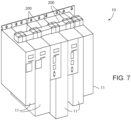
- a DC bus connection member 200 includes a housing 202 in which the bus bars 26, 28 are mounted. Terminals 206 on the upper surface of each motor drive 11 are configured to receive the bus bars 26, 28. Each pair of terminals 206 on one motor drive 11 are connected to the positive rail 27 and negative rail 29 of the DC bus 25 within the corresponding drive. DC bus connection members 200 of varying length may be supplied to connect terminals 206 between adjacent motor drives 11 according to the width of the corresponding drives 11.
- the motor drive 11 may also include a DC bus capacitance 56 connected between the positive and negative rails, 27 and 29, to reduce the magnitude of the ripple voltage resulting from converting the AC voltage to a DC voltage and to provide some ride through in the event of variation in the voltage level present on the DC bus 25.
- the DC bus capacitance 56 in the motor drive 11 may be a single capacitor or multiple capacitors connected in parallel, in series, or a combination thereof.
- all or a portion of the DC bus capacitance 56 may be provided in the front-end rectifier 20.
- the DC bus 25 is connected in the motor drive 11 to an inverter section 51. Referring also to Fig.
- the inverter section 51 consists of switching elements, such as transistors, thyristors, or SCRs as is known in the art.
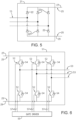
- the illustrated inverter section 51 includes IGBTs 52 and a free-wheeling diode 54 connected in pairs between the positive rail 27 and each phase of the output voltage as well as between the negative rail 29 and each phase of the output voltage.
- Each of the IGBTs 52 receives gating signals 57 to selectively enable the transistors 52 and to convert the DC voltage from the DC bus 25 into a controlled three phase output voltage to the motor 40.
- each transistor 52 connects the respective rail 27, 29 of the DC bus 25 to an electrical conductor 53 connected between the transistor 52 and the output of the motor drive 11.
- the electrical conductor 53 is selected according to the application requirements (e.g., the rating of the motor drive 11) and may be, for example, a conductive surface on a circuit board to which the transistors 52 are mounted or a bus bar connected to a terminal from a power module in which the transistors 52 are contained.
- the output of the motor drive 11 may be connected to the motor 40 via a cable 37 including electrical conductors connected to each of the output terminals 35.
- One or more modules are used to control operation of the motor drive 11.
- the modules may be stored programs executed on a processor, logic circuits, or a combination thereof.
- the modules used to control operation of the motor drive 11 will be referred to herein generally as a control circuit.
- the control circuit of the illustrated motor drive 11 includes a motor interface circuit 154, a non-transitory storage device, or memory 150, a processor 152, and a switch mode power supply (SMPS) 160. It is contemplated that the control circuit may include additional devices, such as a dedicated processor or gate driver circuit 55 (as shown in Fig. 6 ) to generate gate signals 57, buffers, analog-to-digital converters, and the like as may be needed to control operation of the motor drive.
- a dedicated processor or gate driver circuit 55 as shown in Fig. 6
- the non-transitory storage device, or memory 150 is configured to store data and programs, which include a series of instructions executable by the processor 152. It is contemplated that the memory 150 may be a single device, multiple devices, or incorporated, for example, as a portion of another device such as an application specific integrated circuit (ASIC).
- the processor 152 is in communication with the memory 150 to read the instructions and data as required to control operation of the motor drive 11.
- the processor 152 receives feedback signals from sensors indicating the present operation of the motor drive 11.
- the feedback signals may include, but are not limited to, the magnitude of voltage and/or current present on the DC bus 25 or at the output 53 of the inverter section 51, as supplied to the motor 40.
- the feedback signals may also include position feedback, temperature feedback, or brake status signals from the motor 40 received at the motor interface circuit 154.
- the motor drive 11 may also transmit, for example, a brake release signal via the motor interface circuit 154 to the motor 40. It is contemplated that the motor drive 11 may utilize one of many various methods of controlling operation of the motor 40 as is understood in the art without deviating from the scope of the invention,
- the SMPS 160 is configured to operate over a wide range of input voltages.
- the SMPS 160 may receive the control voltage, for example at 48VDC from the control power supply 130 or, alternately, may receive DC bus voltage at 680 VDC or greater.
- the SMPS 160 converts the input voltage to control voltages such as 5 VDC, 3.3 VDC, or any other DC voltage required by control circuits within the motor drive 11.
- the SMPS includes a switch 161, which may be implemented by a transistor that is selectively opened and closed to establish conduction through a transformer 162.
- the transformer 162 includes a primary winding 164 and at least one secondary winding 166. The transformer provides electrical isolation between the primary winding 164 and each secondary winding 166.
- the switch 161 may be controlled and operative in combination with a turns-ratio between the primary 164 and one of the secondary windings 166 to supply each of the desired control voltages (e.g., 5 VDC or 3.3 VDC) within the motor drive 11.
- the control voltages are used to power, for example, the memory 150, the processor 152, and other logic, control, or electronic elements within the control circuit.
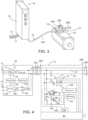
- Figs. 3 and 4 a second exemplary motor control system 10, which may be used in conjunction with the various embodiments of the invention disclosed herein, is illustrated.
- the motor control system 10 in Fig. 3 includes a front-end rectifier 20 and a motor drive 111.
- the front-end rectifier 20 is configured to receive a three-phase AC voltage 15 at an input to the rectifier 20, and to provide a DC voltage on a DC bus 25 as an output of the rectifier 20.
- the rectifier 20 may include any electronic device suitable for passive or active rectification as is understood in the art.
- the magnitude of the DC voltage between the negative and positive rails, 29 and 27, is generally equal to or boosted above the magnitude of the peak of the AC input voltage.
- One or more motor drives 111 may be connected to the DC bus 25 to receive the DC voltage present on the bus and to use the DC voltage to control one or motors connected to each motor drive 111.
- the motor drive 111 illustrated in Fig. 3 is mounted to the motor 40.
- a single motor drive 111 is shown in Fig. 3 being connected to the front-end rectifier 20.
- a DC bus cable 50A extends between the front-end rectifier 20 and the integrated motor drive 111.
- the DC bus cable 50 includes a first conductor 220 and a second conductor 222 which serve as the positive and negative rails 27, 29 of the DC bus 25.
- a third conductor 224 may also be provided which establishes a ground connection between the front-end rectifier 20 and each motor drive 111.
- the DC bus cable 50 include an outer jacket 228 to insulate the cable 50 and may include a shield 226 surrounding the conductors.
- the first and second conductors 220, 222 provide the positive and negative rails 27, 29 of the DC bus 25 from the rectifier 20 to the motor drive 111.
- an additional DC bus cable 50B may connected to the motor drive 111 to form a daisy chain connection and pass the DC bus 25 on to an additional motor drive 111, not shown.
- the motor drive 111 is configured in a manner similar to the motor drive shown and discussed above with respect to Figs. 1 and 2 . Because the motor drive 111 is mounted to the motor 40, connections between the motor drive 111 and the motor 40 may be made via short leads or bus bars internal to the housings of the drive and motor.
- the DC bus 25 is operative to provide either control voltage or DC bus voltage from a source, such as the front-end rectifier 20, to one or more loads, such as the motor drives 11 or 111 over a shared set of conductors.
- a source such as the front-end rectifier 20
- loads such as the motor drives 11 or 111
- the total wire count is reduced, which, in turn, simplifies the interconnection between devices, cost of materials, and reduces the potential for errors in wiring.
- the weight of the cable is reduced and the flexibility of the cable is increased, which again simplifies the interconnection between devices and may improve routing of cables.
- the front-end rectifier 20 supplies control power to each of the motor drives 11 or 111 without having the DC bus voltage present. This may be desirable, for example, during installation or commissioning.
- the motor drive 11 requires control power to energize the processor 152 and memory 150.
- the interface similarly requires control power.
- a technician is able to configure operation of the motor drive 11 via the interface, for example, by pressing buttons to directly adjust parameters displayed on a user interface, by downloading a set of parameters, or by interacting with an application executing on a mobile computing device connected to or located proximate the motor drive 11.
- a technician may be in a location or facility remotely located from the motor drive 11 and connected via one or more suitable networks, such as the Internet, an intranet, or a dedicated industrial network.
- the control power enables the processor 152 to execute instructions stored in the memory 150 and to read and/or adjust parameter settings stored in memory 150.
- the motor drive 11 may initially power-up with just control power present prior to having DC bus voltage present on the DC bus 25.
- the motor drive 11 may perform initial diagnostic tests on the motor drive 11 to verify that the motor drive is properly configured or that the electronic components of the motor drive 11 are operating normally. After completing the initial diagnostic tests, the motor drive 11 may set a flag or transmit a message to the front-end rectifier 20 indicating it is ready to receive the DC bus voltage. In either event, the control power is required to power the control circuit and other control elements present in the motor drive 11.
- the control power supply 130 or voltage regulator 144 receives the control voltage 17 and is operative to provide the control voltage at its respective output.
- a 48 VDC voltage will be output from the control power supply 130 or voltage regulator 144.
- an external power supply may provide the 48 VDC control voltage directly to the input 17 of the front-end rectifier.
- various other control voltages such as 24 VDC may be output from the power supply 130 or voltage regulator 144 without deviating from the scope of the invention.
- the positive output terminal from the power supply 130 or regulator 144 is connected via a first diode 140 to the positive rail 27 of the DC bus 25.
- the first diode 140 is connected such that it is forward biased when the 48 VDC is present on the positive output terminal of the control power supply 130 or voltage regulator 144 and no DC bus voltage is present on the DC bus 25.
- the anode of the first diode 140 is connected to the power supply, voltage regulator 144, or directly to the input control voltage 17 and the cathode of the first diode 140 is connected to the positive rail 27 of the DC bus 25.
- the negative terminal from the power supply 130 or regulator 144 is connected via a second diode 142 to the negative rail 29 of the DC bus 25.
- the second diode 142 is connected such that is also forward biased when the 48 VDC is present on the positive output terminal of the control power supply 130 or voltage regulator 144 and no DC bus voltage is present on the DC bus 25.
- the anode of the second 140 is connected to the negative rail 29 of the DC bus 25 and the cathode of the second diode 140 is connected to the power supply, voltage regulator 144, or directly to the input control voltage 17. With no DC bus voltage present, the first and second diodes 140, 142 are forward biased and allow the power supply 130 or voltage regulator 144 to supply control power to each motor drive 11 connected via the DC bus 25.
- each motor drive 11 requires only sufficient power to energize the control circuits within the motor drive 11. Because there is no DC bus voltage present, the motor drives 11 will not be controlling operation of their respective motors. As a result, external devices mounted on the motors, such as motor brakes and/or fans, will not need power for operation either. For example, the opening and holding current required to energize a brake coil is not necessary, reducing the power requirements of each node connected to the DC bus 25, where the node includes a motor drive 11, a corresponding motor 40, and external devices connected to the motor. The reduced power requirements of each node allow more nodes to be connected to a single front-end rectifier than if the control power is required to energize motor brakes and the like.
- control power is supplied via the DC bus 25 connection between the front-end rectifier 20 and each motor drive 11.
- this connection may be made via a DC bus connection member 200 which includes a pair of bus bars 26, 28 as shown in Fig. 9 .
- this connection may be made via a DC bus cable 50A or 50B, as shown in Fig. 3 , where the DC bus cable 50, as shown in Fig. 10 , includes a pair of conductors 220, 222.
- the cross section of the bus bars 26, 28 or the wire size for the conductors 220, 222 is selected appropriately to handle the current rating required to supply power to each motor 40 and motor drive 11 combination that is connected for the DC bus 25.
- the power requirements for the motor 40 are substantially greater than the requirements for control power and, therefore, the cross-section or the size of the wire are selected accordingly.
- the cross-section of the bus bars 26, 28 or the size of the wire required for the conductors 220, 222 is substantially greater than a corresponding conductor that previously would have been selected if the conductor were dedicated to conducting control power.
- the value of the resistance per unit length of these bus bars 26, 28 or conductors 220, 222 is similarly reduced in comparison to a corresponding conductor that previously would have been selected if the conductor were dedicated to conducting control power.
- the voltage drop along the DC bus bars 26, 28 or conductors 220, 222 sized to conduct the current for operation of the motors 40 is less than conductors that previously would have been selected just to conduct current for the control power and, therefore, this also allows additional nodes to be connected to the DC bus 25 and to receive control power from the front-end rectifier 20.
- the AC voltage 15 is present at the front-end rectifier 20 and the rectifier section 21 is operative to supply DC bus voltage on the DC bus 25.
- the magnitude of the DC bus voltage between the negative and positive rails, 29 and 27, is generally equal to or boosted above the magnitude of the peak of the AC input voltage. If passive rectification occurs in the rectifier section 21, the magnitude of the DC bus voltage is approximately equal to the peak value of the AC input voltage. For example, a 230 VAC input voltage yields a DC bus voltage of about 325 VDC and a 460 VAC input voltage yields a DC bus voltage of about 650 VDC.
- the rectifier section 21 has an active rectifier, it may be desirable to boost the DC bus voltage slightly above the peak value of the AC input voltage, such that the DC bus voltage may be, for example, 350 VDC or 700 VDC for a 230 VAC or 460 VAC input voltage, respectively.
- the amplitude of the DC bus voltage is substantially greater than the 48 VDC output from the control power supply 130 or voltage regulator 144.
- the first and second diodes 140, 142 become reverse biased, preventing current flow through the control power supply 130 or voltage regulator 144.
- each motor drive 11 must be able to utilize the DC bus voltage at, for example, 325 VDC or 650 VDC in addition to the control voltage at 48 VDC to generate internal motor drive control voltages within the motor drive 11.
- Each motor drive includes a SMPS 160 configured to operate over a wide range of input voltages. The SMPS provides the internal control voltages, such as 3.3 VDC or 5 VDC, for the motor drive 11 to power the processor 152, memory 150, and the like.
- the input of the SMPS 160 is connected to the DC bus 25 and, therefore, during the first operating mode, the SMPS 160 receives the 48 VDC control voltage and in the second operating mode, the SMPS 160 receives the 325 VDC or 650 VDC bus voltage. In either operating mode, the SMPS is configured to supply the necessary control voltage (e.g., 3.3 VDC or 5 VDC) for operation of the motor drive 11.
- the necessary control voltage e.g., 3.3 VDC or 5 VDC
- both the front-end rectifier 20 and the motor drive 11 may include a transceiver in their respective control circuits, where the transceiver is configured to communicate via a power line.
- the transceiver may, for example, modulate a carrier signal on top of the control voltage or on top of the DC bus voltage at a transmitting device and the receiving device is configured to receive and decode the modulated signal.
- Data packets may be passed between the two devices via the DC bus conductors, thereby further reducing the wiring between the front-end rectifier 20 and each motor drive 11.
Landscapes
- Engineering & Computer Science (AREA)
- Power Engineering (AREA)
- Inverter Devices (AREA)
Description
- The subject matter disclosed herein relates to a method of delivering power and control voltages in a distributed DC bus system. More specifically, a system of delivering power and control voltages over common conductors in a distributed DC bus system is disclosed.
- A distributed DC bus system supplies DC power to multiple loads from a single DC source. One application for a distributed DC bus is found in industrial control. A controlled machine or process may have multiple axes of motion, where each axis is controlled by a motor. A single rectifier front end is provided to convert, for example, a three-phase AC voltage from a utility supply to a DC voltage. The three-phase AC voltage may be, for example, 230 VAC or 460 VAC and the resulting DC voltage supplied on the distributed DC bus may be 325 VDC or 650 VDC, respectively. The power rating of the rectifier front end is sufficient to supply enough current at the corresponding DC voltage level to multiple motor drives via the distributed DC bus. A first set of conductors is provided to supply the DC bus voltage from the rectifier front end to each motor drive in the system. Each motor drive receives the DC voltage and supplies a controlled AC voltage, having a variable amplitude and variable frequency, to a motor connected to the motor drive to achieve desired operation of the motor.
- However, in addition to the DC bus voltage required to generate the AC voltage used to control rotation of the motor, each motor drive requires a control voltage to supply power to control circuits such as a microprocessor executing within the motor drive, logic circuits, gate drive circuits, analog-to-digital converters, digital-to-analog converters, communication circuits, and the like. The control voltage is commonly at or below 50 VDC, which is considered a safe voltage that does not require further guarding against accidental contact, and is similarly distributed to the motor drives. In many applications, it is desirable to have the control voltage present without having the DC Bus voltage present. During commissioning, for example, the control voltage is required to enable a technician to set parameters on the motor drive that will define how the motor controlled by the motor drive will operate. Consequently, the control voltage is supplied independently of the DC bus voltage. Either a separate power supply generates the control voltage or the rectifier front end is configured to supply the control voltage via an output separate from the DC bus voltage. A second set of conductors is provided to connect the control voltage to each of the motor drives. However, because the current and power rating of the control voltage is much less than the current and power rating required to supply power to control rotation of the motor, the size of the wires utilized for distributing control power to the motor drives is correspondingly less than the size of the wires or than the bus cross-section utilized for distributing DC bus voltage to the motor drives..
- Use of the smaller size wire to distribute control power to motor drives is not without certain drawbacks. Smaller wire has a greater resistance per unit length than a larger wire. Thus, wire used to distribute control power has a greater resistance than wire used to distribute the DC bus voltage when run the same distance. If the control power is also distributed from the rectifier front end to each motor drive, this resistance per unit length can generate a voltage drop on the control power conductors that may limit the distance that a motor drive may be located from the rectifier front end.
- Thus, it would be desirable to provide a system for distributing DC bus voltage and control power to multiple motors with an increased distance that the motor drive may be positioned from the rectifier front end.
- Additionally, a motor may require external devices connected to the motor which, in turn, require control power to operate. The motor may include a brake and/or a fan which operate from the control power to the motor. A brake requires a significant current to energize the brake coil to release the brake. The system must be configured to supply the current required during operation if each brake coil is energized in tandem. The current required by the brakes may limit the number of brakes and, therefore, limit the number of motors that may be connected to a single power supply. The total power drawn from the control power supply is equal to the amplitude of the voltage times the amplitude of the current. If the power supply must be able to supply power to control components within the motor drive as well as to supply power to external components connected to the motor, the number of motors receiving control power from a single power supply is reduced. Additional power supplies may, therefore, be required either within a central control cabinet or distributed around the controlled machine or process to provide the required control power.
- Thus, it would be desirable to provide a system capable of supplying control power to an increased number of motor drives, reducing the number of power supplies required within an application.
- In order to supply both DC bus voltage and control power from the rectifier front end, cables are required for each. Additionally, the rectifier front end commonly requires communication with the motor drive, requiring still another cable for communication. One method of providing the DC bus voltage, control power, and communications between the rectifier front end and each motor drive is to supply three separate cables. A first cable supplies the DC bus voltage, a second cable provides the control power, and a third cable transmits data packets between the devices. The first cable includes three conductors and may include a shield within a jacket or housing, where the three conductors are for the positive DC bus voltage, the negative DC bus voltage, and a ground connection. The second cable includes two conductors and a shield within a jacket or housing, where the two conductors are for the positive control voltage and the negative control voltage. The third cable includes a pair of transmit conductors, a pair of receive conductors, and a shield within a jacket or housing. Each of the three cables must be routed between the rectifier front end and a motor drive.
- Routing three cables, however, requires additional cost, space, and wiring time during assembly of the controlled machine or process. To facilitate assembly, it is known to provide a bundled cable. In one option, the DC bus voltage cable and the control power cable are bundled into a single cable, and the communication cable is routed separately. The bundled DC bus voltage and control power cable includes the five conductors within the jacket, where two conductors are provided for DC bus voltage, one conductor is a ground conductor and two conductors are provided for the control voltage such that both the DC bus voltage and the control power and included within a single cable. In another option, all three of the previously discussed cables (e.g., DC bus voltage cable, control power cable, and communication cable) may be bundled into a single cable. While the number of cables that must be routed and assembled is decreased, the number of conductors remains the same. The single bundled cable includes nine conductors where each of the three separate cables similarly require nine conductors total between the three cables. The number of connections is not reduced, the weight per unit length of the cable increases, and the flexibility of the cable decreases as an increased number of conductors must be bent at the same time.
- Thus, it would be desirable to provide a system for distributing DC voltage and control power in a distributed DC bus system that simplifies wiring without incurring the disadvantages of the bundled cables.
WO 2019/011444 A1 discloses that a rectifier stage is used to charge a DC link stage to a first (low) voltage. Next, the main SMPS circuit is started. Thus, the voltage output by the rectifier stage in the step must be sufficient to enable the SMPS circuit to function. Then the control 34 is turned on. In order for the control module to be turned on, the main SMPS circuit needs to be outputting a sufficient voltage. Finally, the rectifier is used to charge the DC link voltage to a second, higher level. This second higher level is the normal operating level of the system.
Anonymous, "SINAMICS S120 Cabinet Modules", Equipment Manual, DE, (2008-10-01), pages 1 - 456 discloses on pages 136 and 149 a smart line module and an the active line module, respectively, each of which comprise an internal power supply powered by 24 Volt DC Line to provide power to a braking module over the DC bus in cases when the main power is interrupted.
US 2014/320048 A1 discloses an exemplary embodiment of a distributedmotor control system 10 including a power interface module, a pair of 14 , and a pair of integrated motor drives. A first communication cable is connected between the power interface module and a first communication connector on the first integrated motor drive. A second communication cable connects a second communication connector from the first integrated motor drive to the first communication connector on the second integrated motor drive. A first power cable is connected between the power interface module and a first power connector on the first integrated motor drive. A second power cable connects a second power connector from the first integrated motor drive to the first power connector on the second integrated motor drive.
G. I. C LOBATO ET AL, "Powerline Communication (PLC) through power converter's DC bus: Applicability assessment", 2015 IEEE 13TH BRAZILIAN POWER ELECTRONICS CONFERENCE AND 1ST SOUTHERN POWER ELECTRONICS CONFERENCE (COBEP/SPEC), 01-11-2015, relates to an applicability assessment regarding power line communication through power converter's DC bus. An analysis is provided of the applicability of Power Line Communication, when used for data transmission between the supervisory system and remote systems, in an application based on static frequency converters, using the converter's DC link as a transmission medium.
It is the object of the present invention to provide an improved system for distributing a DC bus voltage and a control voltage.
This object is solved by the subject matter ofclaim 1.
Preferred embodiments are defined by the dependent claims. - The subject matter disclosed herein describes a system for distributing DC bus voltage and control power to multiple motors that is not limited in length by a smaller control wire. A rectifier front end receives AC voltage as an input and converts the AC voltage to a DC bus voltage. The rectifier front end also receives a control voltage which it may first convert to a desired DC control voltage or pass directly on to other devices if the control voltage received is at the desired DC control voltage. Both the DC bus voltage and the DC control voltage are distributed via a common set of conductors. Consequently, the system distributes DC bus voltage and control power without incurring the disadvantages of bundled cables. Diodes are operatively connected between the DC control voltage and the DC bus such that the diodes are forward biased when the DC control voltage is present and the DC bus voltage is not present, and the diodes are reverse biased when the DC control voltage is present and the DC bus voltage is present. The diodes allow forward conduction of the DC control voltage and distribution of control power to distributed devices when the DC bus voltage is not present. Once the DC bus voltage is present, the diodes block conduction of the DC control voltage. Each of the distributed devices are configured with an internal power supply that is operative to generate an internal control voltage from either the DC control voltage or the DC bus voltage. Because the external devices on the motor are not required to operate without DC bus voltage present, the distributed device may draw DC bus voltage to power the external devices, and the system no longer requires control power for operation of external devices on the motor.
- According to a first embodiment of the invention, a distributed DC bus system includes a first input configured to receive an AC input voltage, a rectifier section operative to convert the AC input voltage to a DC bus voltage having a first amplitude, a DC bus electrically connected to the rectifier section and operative to receive the DC bus voltage, and a pair of diodes operatively connected between a DC control voltage and the DC bus. The DC control voltage is less than the DC bus voltage, and at least one motor drive is operatively connected to the DC bus. The pair of diodes are operatively connected to be forward biased when the DC control voltage is present in the distributed DC bus system and the DC bus voltage is not present on the DC bus, and the pair of diodes are operatively connected to be reverse biased when the DC control voltage is present in the distributed DC bus system and the DC bus voltage is present on the DC bus. Each motor drive includes an inverter section electrically connected to the DC bus to receive the DC bus voltage as an input and to provide an AC voltage as an output and a power supply electrically connected to the DC bus. The power supply is operative to output a motor drive control voltage from either the DC bus voltage or the DC control voltage present on the DC bus.
- According to another embodiment of the invention, a distributed DC bus system includes a first input configured to receive an AC input voltage, a rectifier section operative to convert the AC input voltage to a DC voltage having a first amplitude, a DC bus electrically connected to the rectifier section and operative to receive the DC bus voltage, and a pair of diodes operatively connected between a DC control voltage and the DC bus, where the DC control voltage is less than the DC bus voltage. The pair of diodes are operatively connected to be forward biased when the DC control voltage is present in the distributed DC bus system and the DC bus voltage is not present on the DC bus, and the pair of diodes are operatively connected to be reverse biased when the DC control voltage is present in the distributed DC bus system and the DC bus voltage is present on the DC bus. The DC bus is configured to be electrically connected between the rectifier section and at least one motor drive. Each motor drive includes an inverter section operative to output an AC output voltage from the DC bus voltage received as an input, and each motor drive includes a power supply operative to output a motor drive control voltage from either the DC bus voltage or the DC control voltage present on the DC bus.
- According to still another embodiment of the invention, a distributed DC bus system includes a DC bus electrically connected to a rectifier front end and operative to selectively receive either a DC bus voltage or a DC control voltage and at least one motor drive operatively connected to the DC bus. Each motor drive includes an inverter section electrically connected to the DC bus to receive the DC bus voltage as an input and to provide an AC voltage as an output and a power supply electrically connected to the DC bus. The power supply is operative to output a motor drive control voltage from either the DC bus voltage or the DC control voltage present on the DC bus.
- These and other advantages and features of the invention will become apparent to those skilled in the art from the detailed description and the accompanying drawings. It should be understood, however, that the detailed description and accompanying drawings are given by way of illustration and not of limitation, the scope of the invention being defined by the appended claims.
- Various exemplary embodiments of the subject matter disclosed herein are illustrated in the accompanying drawings in which like reference numerals represent like parts throughout, and in which:
-
FIG. 1 is an exemplary motor, panel mounted motor drive, and front-end rectifier incorporating one embodiment of the present invention; -
FIG. 2 is a block diagram representation of the motor, motor drive, and front-end rectifier ofFig. 1 ; -
FIG. 3 is an exemplary motor, integrated motor drive, and front-end rectifier incorporating another embodiment of the present invention; -
FIG. 4 is a block diagram representation of the motor, motor drive, and front-end rectifier ofFig. 3 ; -
FIG. 5 is a schematic representation of a passive rectifier that may be incorporated into the front-end rectifier ofFigs. 1 or3 ; -
FIG. 6 . is a schematic representation of a inverter section that may be incorporated into the motor drive ofFigs. 1 or3 ; -
FIG. 7 is a perspective view of multiple motor drives and a DC bus connector supplying a DC bus to each of the motor drives according to one embodiment of the invention; -
FIG. 8 is a top plan view of the motor drives ofFig. 7 ; -
FIG. 9 is a perspective view of the DC bus connector ofFig. 7 ; and -
FIG. 10 is a sectional view of a DC bus cable used inFig. 3 . - In describing the various embodiments of the invention which are illustrated in the drawings, specific terminology will be resorted to for the sake of clarity. However, it is not intended that the invention be limited to the specific terms so selected and it is understood that each specific term includes all technical equivalents which operate in a similar manner to accomplish a similar purpose. For example, the word "connected," "attached," or terms similar thereto are often used. They are not limited to direct connection but include connection through other elements where such connection is recognized as being equivalent by those skilled in the art.
- The various features and advantageous details of the subject matter disclosed herein are explained more fully with reference to the non-limiting embodiments described in detail in the following description.
- Turning initially to
Figs. 1 and 2 , an exemplarymotor control system 10, which may be used in conjunction with the various embodiments of the invention disclosed herein, is illustrated. According to the exemplary embodiment, themotor control system 10 includes a front-end rectifier 20 and amotor drive 11. Although illustrated as separate components, it is contemplated that some embodiments will include a front-end rectifier and motor drive as a single component. The front-end rectifier 20 is configured to receive a three-phase AC voltage 15 at an input to arectifier section 21. Therectifier section 21 may include any electronic device suitable for passive or active rectification as is understood in the art. With reference also toFig. 5 , the illustratedrectifier section 21 includes a set ofdiodes 22 forming a diode bridge that rectifies the three-phase AC voltage to a DC voltage on theDC bus 25. Optionally, therectifier section 21 may include other solid-state devices including, but not limited to, thyristors, silicon-controlled rectifiers (SCRs), insulated-gate bipolar transistors (IGBTs), power metal-oxide semiconductor field-effect transistors (MOSFETs), or other transistors or solid-state devices to convert theinput power 15 to a DC voltage for theDC bus 25. The DC voltage is present between apositive rail 27 and anegative rail 29 of theDC bus 25. - The front-
end rectifier 20 also includes aDC bus capacitance 24 connected between the positive and negative rails, 27 and 29, to reduce the magnitude of the ripple voltage resulting from converting the AC voltage to a DC voltage. It is understood that theDC bus capacitance 24 may be a single capacitor or multiple capacitors connected in parallel, in series, or a combination thereof. According to one embodiment of the invention, thepositive rail 27 is at a voltage potential generally equal to or boosted above the magnitude of the peak of the AC input voltage and thenegative rail 29 is at a voltage potential at zero volts, where thenegative rail 29 may be a floating common or tied to an earth ground. According to the another embodiment of the invention, theDC bus capacitance 24 may be arranged in a split-bus configuration, such that a first portion of theDC bus capacitance 24 is connected between thepositive rail 27 and a ground connection, and a second portion of theDC bus capacitance 24 is connected in series with the first portion of the DC bus capacitance between the ground connection and thenegative rail 29. The total voltage potential across theDC bus 25 in the split bus configuration remains generally equal to or boosted above the magnitude of the peak of the AC input voltage, but the voltage potential across each portion of thecapacitance 24 is one-half of the total DC bus voltage. - Similarly, the front-
end rectifier 20 may also receive acontrol voltage 17 for distribution to each of the motor drives 11. According to the embodiment illustrated inFig. 2 , the control voltage is a 24 VDC input voltage. The front-end rectifier 20 includes acontrol power supply 130, which is a switched mode power supply. Aswitch 131, which may be implemented by a transistor, is selectively opened and closed to establish conduction through a transformer 132. The inductive nature of the transformer, in combination with the diode 133 and capacitor 134 work in combination with theswitch 131 to boost the 24 VDC at theinput 17 to a 48 VDC control voltage at the output of thecontrol power supply 130. In addition, the transformer 132 provides electrical isolation between the control voltage at theinput 17 and the control voltage at the output of thepower supply 130. A pair ofdiodes control power supply 130 and theDC bus 25. As will be discussed in more detail below, the pair ofdiodes DC bus 25 when the DC bus voltage output from therectifier section 21 is not present and disconnect thecontrol power supply 130 from theDC bus 25 when the DC bus voltage output from therectifier section 21 is present. - According to another embodiment of the invention, as shown in
Fig. 4 , it is contemplated that thecontrol voltage 17 is a single-phase AC input, such as 115 VAC. The front-end rectifier 20 may further include avoltage regulator 144 that converts the AC input to the 48 VDC control voltage. Acapacitor 146 is provided at the output of thevoltage regulator 144 to help smooth any ripple of the DC voltage and/or to provide some ride through due to the loss of the AC input. Optionally, thecapacitor 146 may be incorporated within thevoltage regulator 144. Once again, a pair ofdiodes voltage regulator 144 and theDC bus 25. As will be discussed in more detail below, the pair ofdiodes DC bus 25 when the DC bus voltage output from therectifier section 21 is not present and disconnect thevoltage regulator 144 from theDC bus 25 when the DC bus voltage output from therectifier section 21 is present. - According to still another embodiment of the invention (not shown) it is contemplated that a 48 VDC voltage may be supplied as a
control voltage 17 input to therectifier 20. If the 48 VDC voltage is referenced to the negative potential on the DC bus voltage, the front-end rectifier 20 may include just the pair ofdiodes control voltage input 17 to theDC bus 25 as a function of whether the DC bus voltage output from therectifier section 21 is present. Alternately, an isolation transformer 132 may be provided which provides a one-to-one turns ratio while also establishing electrical isolation between the control voltage input and the control voltage output. The output of the isolation transformer is then connected to the pair ofdiodes DC bus 25. Various other sources of 48 VDC as a control voltage may be provided for selectively connecting to theDC bus 25 via thediodes - The front-
end rectifier 20 further includes a control circuit used to control operation of the rectifier. According to the illustrated embodiment, the control circuit includes aprocessor 120 and amemory 122. One or more modules are used to control operation of the front-end rectifier 20. The modules may be programs stored in thememory 122 and executed on theprocessor 120, logic circuits, or a combination thereof. Thememory 122 is configured to store data and programs, which include a series of instructions executable by theprocessor 120. It is contemplated that thememory 122 may be a single device, multiple devices, or incorporated, for example, as a portion of another device such as an application specific integrated circuit (ASIC). Theprocessor 120 is in communication with thememory 122 to read the instructions and data as required to control operation of the front-end rectifier 20. Theprocessor 120 receives input signals from input terminals, communication circuits, such as an industrial network, and the like, which include, for example, an enable signal, a disable signal, or other command signals defining desired operation of therectifier 20. Theprocessor 120 similarly receives feedback signals from sensors indicating the present operation of therectifier 20. The feedback signals may include, but are not limited to, the magnitude of voltage and/or current present at theinput power 15, thecontrol voltage input 17, or on theDC bus 25. Theprocessor 120 executes a control module responsive to command signal(s) and the feedback signals to generate control signals, if necessary, for an active rectifier or for the switched modecontrol power supply 130. - As illustrated in
Fig. 1 , asingle motor drive 11 is connected to the front-end rectifier 20 to receive the DC voltage present on theDC bus 25. A pair of bus bars 26, 28 conduct the voltages present on the positive andnegative rails rectifier 20 and thedrive 11. It is understood that still additional motor drives 11, may be mounted adjacent to the illustrated motor drive and the bus bars 26, 28 may extend from the front-end rectifier 20 to each of the adjacent motor drives, extending theDC bus 25 to the additional motor drives 11. Eachmotor drive 11 connected to theDC bus 25 receives the DC voltage present on the bus and uses the DC voltage to control one ormotors 40 connected to thecorresponding motor drive 11. According to the embodiment illustrated inFigs. 7-9 , a DCbus connection member 200 includes ahousing 202 in which the bus bars 26, 28 are mounted.Terminals 206 on the upper surface of eachmotor drive 11 are configured to receive the bus bars 26, 28. Each pair ofterminals 206 on onemotor drive 11 are connected to thepositive rail 27 andnegative rail 29 of theDC bus 25 within the corresponding drive. DCbus connection members 200 of varying length may be supplied to connectterminals 206 between adjacent motor drives 11 according to the width of the corresponding drives 11. - The
motor drive 11 may also include aDC bus capacitance 56 connected between the positive and negative rails, 27 and 29, to reduce the magnitude of the ripple voltage resulting from converting the AC voltage to a DC voltage and to provide some ride through in the event of variation in the voltage level present on theDC bus 25. It is understood that theDC bus capacitance 56 in themotor drive 11 may be a single capacitor or multiple capacitors connected in parallel, in series, or a combination thereof. Optionally, all or a portion of theDC bus capacitance 56 may be provided in the front-end rectifier 20. TheDC bus 25 is connected in themotor drive 11 to aninverter section 51. Referring also toFig. 6 , theinverter section 51 consists of switching elements, such as transistors, thyristors, or SCRs as is known in the art. The illustratedinverter section 51 includesIGBTs 52 and a free-wheelingdiode 54 connected in pairs between thepositive rail 27 and each phase of the output voltage as well as between thenegative rail 29 and each phase of the output voltage. Each of theIGBTs 52 receives gating signals 57 to selectively enable thetransistors 52 and to convert the DC voltage from theDC bus 25 into a controlled three phase output voltage to themotor 40. When enabled, eachtransistor 52 connects therespective rail DC bus 25 to anelectrical conductor 53 connected between thetransistor 52 and the output of themotor drive 11. Theelectrical conductor 53 is selected according to the application requirements (e.g., the rating of the motor drive 11) and may be, for example, a conductive surface on a circuit board to which thetransistors 52 are mounted or a bus bar connected to a terminal from a power module in which thetransistors 52 are contained. The output of themotor drive 11 may be connected to themotor 40 via acable 37 including electrical conductors connected to each of the output terminals 35. - One or more modules are used to control operation of the
motor drive 11. The modules may be stored programs executed on a processor, logic circuits, or a combination thereof. The modules used to control operation of themotor drive 11 will be referred to herein generally as a control circuit. According to the illustrated embodiment, the control circuit of the illustratedmotor drive 11 includes amotor interface circuit 154, a non-transitory storage device, ormemory 150, aprocessor 152, and a switch mode power supply (SMPS) 160. It is contemplated that the control circuit may include additional devices, such as a dedicated processor or gate driver circuit 55 (as shown inFig. 6 ) to generate gate signals 57, buffers, analog-to-digital converters, and the like as may be needed to control operation of the motor drive. The non-transitory storage device, ormemory 150, is configured to store data and programs, which include a series of instructions executable by theprocessor 152. It is contemplated that thememory 150 may be a single device, multiple devices, or incorporated, for example, as a portion of another device such as an application specific integrated circuit (ASIC). Theprocessor 152 is in communication with thememory 150 to read the instructions and data as required to control operation of themotor drive 11. Theprocessor 152 receives feedback signals from sensors indicating the present operation of themotor drive 11. The feedback signals may include, but are not limited to, the magnitude of voltage and/or current present on theDC bus 25 or at theoutput 53 of theinverter section 51, as supplied to themotor 40. The feedback signals may also include position feedback, temperature feedback, or brake status signals from themotor 40 received at themotor interface circuit 154. Optionally, themotor drive 11 may also transmit, for example, a brake release signal via themotor interface circuit 154 to themotor 40. It is contemplated that themotor drive 11 may utilize one of many various methods of controlling operation of themotor 40 as is understood in the art without deviating from the scope of the invention, - The
SMPS 160 is configured to operate over a wide range of input voltages. TheSMPS 160 may receive the control voltage, for example at 48VDC from thecontrol power supply 130 or, alternately, may receive DC bus voltage at 680 VDC or greater. TheSMPS 160 converts the input voltage to control voltages such as 5 VDC, 3.3 VDC, or any other DC voltage required by control circuits within themotor drive 11. The SMPS includes aswitch 161, which may be implemented by a transistor that is selectively opened and closed to establish conduction through atransformer 162. Thetransformer 162 includes a primary winding 164 and at least one secondary winding 166. The transformer provides electrical isolation between the primary winding 164 and each secondary winding 166. Theswitch 161 may be controlled and operative in combination with a turns-ratio between the primary 164 and one of thesecondary windings 166 to supply each of the desired control voltages (e.g., 5 VDC or 3.3 VDC) within themotor drive 11. The control voltages are used to power, for example, thememory 150, theprocessor 152, and other logic, control, or electronic elements within the control circuit. Turning next toFigs. 3 and 4 , a second exemplarymotor control system 10, which may be used in conjunction with the various embodiments of the invention disclosed herein, is illustrated. In a manner similar to the motor control system illustrated inFig. 1 , themotor control system 10 inFig. 3 includes a front-end rectifier 20 and amotor drive 111. The front-end rectifier 20 is configured to receive a three-phase AC voltage 15 at an input to therectifier 20, and to provide a DC voltage on aDC bus 25 as an output of therectifier 20. Therectifier 20 may include any electronic device suitable for passive or active rectification as is understood in the art. The magnitude of the DC voltage between the negative and positive rails, 29 and 27, is generally equal to or boosted above the magnitude of the peak of the AC input voltage. One or more motor drives 111 may be connected to theDC bus 25 to receive the DC voltage present on the bus and to use the DC voltage to control one or motors connected to eachmotor drive 111. - Unlike the
motor control system 10 illustrated inFig. 1 , themotor drive 111 illustrated inFig. 3 is mounted to themotor 40. Just as withFig. 1 , asingle motor drive 111 is shown inFig. 3 being connected to the front-end rectifier 20. ADC bus cable 50A extends between the front-end rectifier 20 and theintegrated motor drive 111. With reference also toFig. 10 , theDC bus cable 50 includes afirst conductor 220 and asecond conductor 222 which serve as the positive andnegative rails DC bus 25. Athird conductor 224 may also be provided which establishes a ground connection between the front-end rectifier 20 and eachmotor drive 111. TheDC bus cable 50 include anouter jacket 228 to insulate thecable 50 and may include ashield 226 surrounding the conductors. The first andsecond conductors negative rails DC bus 25 from therectifier 20 to themotor drive 111. Optionally, an additionalDC bus cable 50B may connected to themotor drive 111 to form a daisy chain connection and pass theDC bus 25 on to anadditional motor drive 111, not shown. Other than the mounting location, themotor drive 111 is configured in a manner similar to the motor drive shown and discussed above with respect toFigs. 1 and 2 . Because themotor drive 111 is mounted to themotor 40, connections between themotor drive 111 and themotor 40 may be made via short leads or bus bars internal to the housings of the drive and motor. - In operation, the
DC bus 25 is operative to provide either control voltage or DC bus voltage from a source, such as the front-end rectifier 20, to one or more loads, such as the motor drives 11 or 111 over a shared set of conductors. By providing both control voltage and DC bus voltage over a single set of conductors, the total wire count is reduced, which, in turn, simplifies the interconnection between devices, cost of materials, and reduces the potential for errors in wiring. Further, because the number of conductors within the cable is reduced, the weight of the cable is reduced and the flexibility of the cable is increased, which again simplifies the interconnection between devices and may improve routing of cables. - In a first operating mode, the front-
end rectifier 20 supplies control power to each of the motor drives 11 or 111 without having the DC bus voltage present. This may be desirable, for example, during installation or commissioning. Themotor drive 11 requires control power to energize theprocessor 152 andmemory 150. Similarly, if a user interface, network interface, or other communication interface is present, the interface similarly requires control power. A technician is able to configure operation of themotor drive 11 via the interface, for example, by pressing buttons to directly adjust parameters displayed on a user interface, by downloading a set of parameters, or by interacting with an application executing on a mobile computing device connected to or located proximate themotor drive 11. Optionally, a technician may be in a location or facility remotely located from themotor drive 11 and connected via one or more suitable networks, such as the Internet, an intranet, or a dedicated industrial network. The control power enables theprocessor 152 to execute instructions stored in thememory 150 and to read and/or adjust parameter settings stored inmemory 150. - Similarly, it may be desirable for the
motor drive 11 to initially power-up with just control power present prior to having DC bus voltage present on theDC bus 25. At power-up, themotor drive 11 may perform initial diagnostic tests on themotor drive 11 to verify that the motor drive is properly configured or that the electronic components of themotor drive 11 are operating normally. After completing the initial diagnostic tests, themotor drive 11 may set a flag or transmit a message to the front-end rectifier 20 indicating it is ready to receive the DC bus voltage. In either event, the control power is required to power the control circuit and other control elements present in themotor drive 11. - During this first operating mode, the
control power supply 130 orvoltage regulator 144 receives thecontrol voltage 17 and is operative to provide the control voltage at its respective output. For discussion purposes, a 48 VDC voltage will be output from thecontrol power supply 130 orvoltage regulator 144. Optionally, an external power supply may provide the 48 VDC control voltage directly to theinput 17 of the front-end rectifier. It is contemplated that various other control voltages, such as 24 VDC may be output from thepower supply 130 orvoltage regulator 144 without deviating from the scope of the invention. The positive output terminal from thepower supply 130 orregulator 144 is connected via afirst diode 140 to thepositive rail 27 of theDC bus 25. Thefirst diode 140 is connected such that it is forward biased when the 48 VDC is present on the positive output terminal of thecontrol power supply 130 orvoltage regulator 144 and no DC bus voltage is present on theDC bus 25. The anode of thefirst diode 140 is connected to the power supply,voltage regulator 144, or directly to theinput control voltage 17 and the cathode of thefirst diode 140 is connected to thepositive rail 27 of theDC bus 25. The negative terminal from thepower supply 130 orregulator 144 is connected via asecond diode 142 to thenegative rail 29 of theDC bus 25. Thesecond diode 142 is connected such that is also forward biased when the 48 VDC is present on the positive output terminal of thecontrol power supply 130 orvoltage regulator 144 and no DC bus voltage is present on theDC bus 25. The anode of the second 140 is connected to thenegative rail 29 of theDC bus 25 and the cathode of thesecond diode 140 is connected to the power supply,voltage regulator 144, or directly to theinput control voltage 17. With no DC bus voltage present, the first andsecond diodes power supply 130 orvoltage regulator 144 to supply control power to eachmotor drive 11 connected via theDC bus 25. - During this first operating mode, it is anticipated that each
motor drive 11 requires only sufficient power to energize the control circuits within themotor drive 11. Because there is no DC bus voltage present, the motor drives 11 will not be controlling operation of their respective motors. As a result, external devices mounted on the motors, such as motor brakes and/or fans, will not need power for operation either. For example, the opening and holding current required to energize a brake coil is not necessary, reducing the power requirements of each node connected to theDC bus 25, where the node includes amotor drive 11, a correspondingmotor 40, and external devices connected to the motor. The reduced power requirements of each node allow more nodes to be connected to a single front-end rectifier than if the control power is required to energize motor brakes and the like. - Additionally, the control power is supplied via the
DC bus 25 connection between the front-end rectifier 20 and eachmotor drive 11. As shown inFig. 7 , this connection may be made via a DCbus connection member 200 which includes a pair of bus bars 26, 28 as shown inFig. 9 . Alternately, this connection may be made via aDC bus cable Fig. 3 , where theDC bus cable 50, as shown inFig. 10 , includes a pair ofconductors conductors motor 40 andmotor drive 11 combination that is connected for theDC bus 25. The power requirements for themotor 40 are substantially greater than the requirements for control power and, therefore, the cross-section or the size of the wire are selected accordingly. As a result, during the first operating mode, the cross-section of the bus bars 26, 28 or the size of the wire required for theconductors conductors conductors motors 40 is less than conductors that previously would have been selected just to conduct current for the control power and, therefore, this also allows additional nodes to be connected to theDC bus 25 and to receive control power from the front-end rectifier 20. - In a second operating mode, the
AC voltage 15 is present at the front-end rectifier 20 and therectifier section 21 is operative to supply DC bus voltage on theDC bus 25. The magnitude of the DC bus voltage between the negative and positive rails, 29 and 27, is generally equal to or boosted above the magnitude of the peak of the AC input voltage. If passive rectification occurs in therectifier section 21, the magnitude of the DC bus voltage is approximately equal to the peak value of the AC input voltage. For example, a 230 VAC input voltage yields a DC bus voltage of about 325 VDC and a 460 VAC input voltage yields a DC bus voltage of about 650 VDC. If therectifier section 21 has an active rectifier, it may be desirable to boost the DC bus voltage slightly above the peak value of the AC input voltage, such that the DC bus voltage may be, for example, 350 VDC or 700 VDC for a 230 VAC or 460 VAC input voltage, respectively. Regardless of whether the DC bus voltage is supplied via passive or active rectification, the amplitude of the DC bus voltage is substantially greater than the 48 VDC output from thecontrol power supply 130 orvoltage regulator 144. When the DC bus voltage is present on theDC bus 25, therefore, the first andsecond diodes control power supply 130 orvoltage regulator 144. - Because the control power is no longer supplied via the
DC bus 25 to the motor drives 11, eachmotor drive 11 must be able to utilize the DC bus voltage at, for example, 325 VDC or 650 VDC in addition to the control voltage at 48 VDC to generate internal motor drive control voltages within themotor drive 11. Each motor drive includes aSMPS 160 configured to operate over a wide range of input voltages. The SMPS provides the internal control voltages, such as 3.3 VDC or 5 VDC, for themotor drive 11 to power theprocessor 152,memory 150, and the like. The input of theSMPS 160 is connected to theDC bus 25 and, therefore, during the first operating mode, theSMPS 160 receives the 48 VDC control voltage and in the second operating mode, theSMPS 160 receives the 325 VDC or 650 VDC bus voltage. In either operating mode, the SMPS is configured to supply the necessary control voltage (e.g., 3.3 VDC or 5 VDC) for operation of themotor drive 11. - According to still another aspect of the invention, it is contemplated that communication between the front-
end rectifier 20 and eachmotor drive 11 may additional be performed via the DC bus conductors. Both the front-end rectifier 20 and themotor drive 11 may include a transceiver in their respective control circuits, where the transceiver is configured to communicate via a power line. The transceiver may, for example, modulate a carrier signal on top of the control voltage or on top of the DC bus voltage at a transmitting device and the receiving device is configured to receive and decode the modulated signal. Data packets may be passed between the two devices via the DC bus conductors, thereby further reducing the wiring between the front-end rectifier 20 and eachmotor drive 11. - It should be understood that the invention is not limited in its application to the details of construction and arrangements of the components set forth herein. The invention is capable of other embodiments and of being practiced or carried out in various ways, so that variations and modifications of the foregoing are within the scope of the present invention if they do not contradict the appended claims (i.e. if they comprise, at least, all features of the independent claim). It also being understood that the invention disclosed and defined herein extends to all alternative combinations of two or more of the individual features mentioned or evident from the text and/or drawings, all of these different combinations constituting various alternative aspects which similarly belong to the present invention if they do not contradict the appended claims. The embodiments described herein explain the best modes known for practicing the invention and will enable others skilled in the art to utilize the invention.
Claims (6)
- A distributed DC bus system, comprising:a first input (15) configured to receive an AC input voltage;a rectifier section (21) operative to convert the AC input voltage to a DC bus voltage having a first amplitude;a DC bus (26, 28; 50A) electrically connected to the rectifier section and operative to receive the DC bus voltage;a control power supply configured to output a DC control voltage, wherein the DC control voltage is less than the DC bus voltage;a pair of diodes (140, 142) operatively connected between the output of the control power supply andthe DC bus, wherein:the pair of diodes are operatively connected to be forward biased when the DC control voltage is present in the distributed DC bus system and the DC bus voltage is not present on the DC bus to provide the DC control voltage to the DC bus, andthe pair of diodes are operatively connected to be reverse biased when the DC control voltage is present in the distributed DC bus system and the DC bus voltage is present on the DC bus to prevent the DC control voltage from being provided to the DC bus; andat least one motor drive (11) operatively connected to the DC bus, wherein each motor drive includes:an inverter section (51) electrically connected to the DC bus to receive the DC bus voltage as an input and to provide an AC voltage as an output; anda power supply (160) electrically connected to the DC bus, wherein the power supply is operative to output a motor drive control voltage from either the DC bus voltage or the DC control voltage present on the DC bus.
- The distributed DC bus system of claim 1 further comprising a second input (17), wherein:the control power supply is an external power supply,the second input is configured to receive the DC control voltage from the external power supply andthe pair of diodes are operatively connected between the second input and the DC bus.
- The distributed DC bus system of claim 1 further comprising:a second input (17), wherein the second input is configured to receive a second input voltage; andthe control power supply (130) is operatively connected to the second input to receive the second input voltage at an input to the control power supply and to generate the DC control voltage as an output from the control power supply, wherein the pair of diodes are operatively connected between the output from the control power supply and the DC bus.
- The distributed DC bus system of one of claims 1 to 3 further comprising:
a rectifier front end (20), wherein the rectifier front end includes the first input, the rectifier section, and the pair of diodes, the rectifier section further comprising:a first conductor (27) and a second conductor (29), wherein the first and second conductors are electrically connected between an output of the rectifier section and the DC bus; anda third conductor and a fourth conductor, wherein the third and fourth conductors are electrically connected between the pair of diodes and the DC bus. - The distributed DC bus system of claim 4 wherein the at least one motor drive is mounted adjacent to the rectifier front end, the distributed DC bus system further comprising a first DC bus bar (26) and a second DC bus bar (28), wherein the first and second DC bus bars define the DC bus and are electrically connected between a first pair of DC bus connectors on the rectifier front end and a second pair of DC bus connectors on the at least one motor drive.
- The distributed DC bus system of claim 4 wherein the at least one motor drive is mounted remotely from the rectifier front end, the DC bus system further comprising a DC bus cable (50A), wherein the DC bus cable includes at least two conductors defining the DC bus and the DC bus cable is electrically connected between a first pair of DC terminals on the rectifier front end and a second pair of DC bus terminals on the at least one motor drive; or
wherein the rectifier front end further comprises a communication circuit (120, 122) operative to generate a plurality of data packets, wherein an output of the communication circuit is operatively connected to the DC bus to transmit the plurality of data packets to the at least one motor drive via the DC bus.
Applications Claiming Priority (1)
| Application Number | Priority Date | Filing Date | Title |
|---|---|---|---|
| US16/408,804 US11404869B2 (en) | 2019-05-10 | 2019-05-10 | Apparatus for distributing DC bus power and control power over common conductors in a distributed DC bus system |
Publications (2)
| Publication Number | Publication Date |
|---|---|
| EP3736933A1 EP3736933A1 (en) | 2020-11-11 |
| EP3736933B1 true EP3736933B1 (en) | 2024-10-23 |
Family
ID=70470849
Family Applications (1)
| Application Number | Title | Priority Date | Filing Date |
|---|---|---|---|
| EP20171494.6A Active EP3736933B1 (en) | 2019-05-10 | 2020-04-27 | Method and apparatus for distributing dc bus voltage and control voltage over common conductors in a distributed dc bus system |
Country Status (2)
| Country | Link |
|---|---|
| US (2) | US11404869B2 (en) |
| EP (1) | EP3736933B1 (en) |
Families Citing this family (1)
| Publication number | Priority date | Publication date | Assignee | Title |
|---|---|---|---|---|
| US12548953B2 (en) | 2023-10-09 | 2026-02-10 | Rockwell Automation Technologies, Inc. | Hybrid cable for reducing common mode noise in a distributed dc bus system |
Family Cites Families (4)
| Publication number | Priority date | Publication date | Assignee | Title |
|---|---|---|---|---|
| US7738266B2 (en) * | 2006-05-26 | 2010-06-15 | Cambridge Semiconductor Limited | Forward power converter controllers |
| US20140320048A1 (en) | 2013-04-25 | 2014-10-30 | Rockwell Automation Technologies, Inc. | System and Method for Reducing Radiated Emissions in an Integrated Motor Drive |
| US9912151B2 (en) * | 2015-01-23 | 2018-03-06 | General Electric Company | Direct current power system |
| CN110710090B (en) | 2017-07-14 | 2022-01-14 | 丹佛斯电力电子有限公司 | DC link capacitor protection |
-
2019
- 2019-05-10 US US16/408,804 patent/US11404869B2/en active Active
-
2020
- 2020-04-27 EP EP20171494.6A patent/EP3736933B1/en active Active
-
2022
- 2022-06-28 US US17/809,497 patent/US11936182B2/en active Active
Also Published As
| Publication number | Publication date |
|---|---|
| US11404869B2 (en) | 2022-08-02 |
| US11936182B2 (en) | 2024-03-19 |
| US20220329065A1 (en) | 2022-10-13 |
| EP3736933A1 (en) | 2020-11-11 |
| US20200358285A1 (en) | 2020-11-12 |
Similar Documents
| Publication | Publication Date | Title |
|---|---|---|
| US5886422A (en) | Universal electric power controller | |
| US9908489B2 (en) | Power distribution in aircraft | |
| US8860335B2 (en) | System for managing DC link switching harmonics | |
| US8289736B2 (en) | Conversion of AC lines to HVDC lines | |
| EP3282573A1 (en) | Power conversion device | |
| US10186992B2 (en) | Centralized control mechanism for multi-motor drive | |
| JP2010284029A (en) | Power supply circuit for driving inverter | |
| US20140320048A1 (en) | System and Method for Reducing Radiated Emissions in an Integrated Motor Drive | |
| US9479077B1 (en) | Three-phase power supply system | |
| US11936182B2 (en) | Apparatus for distributing DC bus power and control power over common conductors in a distributed DC bus system | |
| JPH10135681A (en) | Variable speed drive | |
| US12206334B2 (en) | Networked automation system for start-up of a switch mode power supply | |
| WO2008154958A1 (en) | A control system for controlling at least one industrial robot | |
| KR102615836B1 (en) | Isolated multi-input regulator and Isolated Multi-Input Regulating Method | |
| US20250149909A1 (en) | Charging system and charging system control device | |
| US20210057981A1 (en) | Floating-ground isolated power supply for an electronic converter | |
| JP2021010249A (en) | AC power converter | |
| US12548953B2 (en) | Hybrid cable for reducing common mode noise in a distributed dc bus system | |
| US12531496B2 (en) | System and method for reducing energy loss from multiple inverters utilizing a shared DC bus | |
| US12308774B2 (en) | Electric motor system | |
| JP2839661B2 (en) | Control device of AC / DC converter | |
| US11975616B2 (en) | Electric vehicle drive system and method for protecting electric vehicle control apparatuses | |
| JP2003299390A (en) | Electric power unit for driving three-phase ac motor | |
| CN101401274B (en) | System for supplying power and data to electrical consumers | |
| WO2025022497A1 (en) | Motor drive system |
Legal Events
| Date | Code | Title | Description |
|---|---|---|---|
| PUAI | Public reference made under article 153(3) epc to a published international application that has entered the european phase |
Free format text: ORIGINAL CODE: 0009012 |
|
| STAA | Information on the status of an ep patent application or granted ep patent |
Free format text: STATUS: THE APPLICATION HAS BEEN PUBLISHED |
|
| AK | Designated contracting states |
Kind code of ref document: A1 Designated state(s): AL AT BE BG CH CY CZ DE DK EE ES FI FR GB GR HR HU IE IS IT LI LT LU LV MC MK MT NL NO PL PT RO RS SE SI SK SM TR |
|
| AX | Request for extension of the european patent |
Extension state: BA ME |
|
| STAA | Information on the status of an ep patent application or granted ep patent |
Free format text: STATUS: REQUEST FOR EXAMINATION WAS MADE |
|
| 17P | Request for examination filed |
Effective date: 20210511 |
|
| RBV | Designated contracting states (corrected) |
Designated state(s): AL AT BE BG CH CY CZ DE DK EE ES FI FR GB GR HR HU IE IS IT LI LT LU LV MC MK MT NL NO PL PT RO RS SE SI SK SM TR |
|
| STAA | Information on the status of an ep patent application or granted ep patent |
Free format text: STATUS: EXAMINATION IS IN PROGRESS |
|
| 17Q | First examination report despatched |
Effective date: 20210914 |
|
| GRAP | Despatch of communication of intention to grant a patent |
Free format text: ORIGINAL CODE: EPIDOSNIGR1 |
|
| STAA | Information on the status of an ep patent application or granted ep patent |
Free format text: STATUS: GRANT OF PATENT IS INTENDED |
|
| INTG | Intention to grant announced |
Effective date: 20240531 |
|
| GRAS | Grant fee paid |
Free format text: ORIGINAL CODE: EPIDOSNIGR3 |
|
| GRAA | (expected) grant |
Free format text: ORIGINAL CODE: 0009210 |
|
| STAA | Information on the status of an ep patent application or granted ep patent |
Free format text: STATUS: THE PATENT HAS BEEN GRANTED |
|
| AK | Designated contracting states |
Kind code of ref document: B1 Designated state(s): AL AT BE BG CH CY CZ DE DK EE ES FI FR GB GR HR HU IE IS IT LI LT LU LV MC MK MT NL NO PL PT RO RS SE SI SK SM TR |
|
| REG | Reference to a national code |
Ref country code: GB Ref legal event code: FG4D |
|
| REG | Reference to a national code |
Ref country code: CH Ref legal event code: EP |
|
| REG | Reference to a national code |
Ref country code: DE Ref legal event code: R096 Ref document number: 602020039784 Country of ref document: DE |
|
| REG | Reference to a national code |
Ref country code: IE Ref legal event code: FG4D |
|
| REG | Reference to a national code |
Ref country code: LT Ref legal event code: MG9D |
|
| REG | Reference to a national code |
Ref country code: NL Ref legal event code: MP Effective date: 20241023 |
|
| REG | Reference to a national code |
Ref country code: AT Ref legal event code: MK05 Ref document number: 1735638 Country of ref document: AT Kind code of ref document: T Effective date: 20241023 |
|
| PG25 | Lapsed in a contracting state [announced via postgrant information from national office to epo] |
Ref country code: NL Free format text: LAPSE BECAUSE OF FAILURE TO SUBMIT A TRANSLATION OF THE DESCRIPTION OR TO PAY THE FEE WITHIN THE PRESCRIBED TIME-LIMIT Effective date: 20241023 |
|
| PG25 | Lapsed in a contracting state [announced via postgrant information from national office to epo] |
Ref country code: NL Free format text: LAPSE BECAUSE OF FAILURE TO SUBMIT A TRANSLATION OF THE DESCRIPTION OR TO PAY THE FEE WITHIN THE PRESCRIBED TIME-LIMIT Effective date: 20241023 |
|
| PG25 | Lapsed in a contracting state [announced via postgrant information from national office to epo] |
Ref country code: PT Free format text: LAPSE BECAUSE OF FAILURE TO SUBMIT A TRANSLATION OF THE DESCRIPTION OR TO PAY THE FEE WITHIN THE PRESCRIBED TIME-LIMIT Effective date: 20250224 Ref country code: HR Free format text: LAPSE BECAUSE OF FAILURE TO SUBMIT A TRANSLATION OF THE DESCRIPTION OR TO PAY THE FEE WITHIN THE PRESCRIBED TIME-LIMIT Effective date: 20241023 Ref country code: IS Free format text: LAPSE BECAUSE OF FAILURE TO SUBMIT A TRANSLATION OF THE DESCRIPTION OR TO PAY THE FEE WITHIN THE PRESCRIBED TIME-LIMIT Effective date: 20250223 |
|
| PG25 | Lapsed in a contracting state [announced via postgrant information from national office to epo] |
Ref country code: FI Free format text: LAPSE BECAUSE OF FAILURE TO SUBMIT A TRANSLATION OF THE DESCRIPTION OR TO PAY THE FEE WITHIN THE PRESCRIBED TIME-LIMIT Effective date: 20241023 |
|
| PG25 | Lapsed in a contracting state [announced via postgrant information from national office to epo] |
Ref country code: BG Free format text: LAPSE BECAUSE OF FAILURE TO SUBMIT A TRANSLATION OF THE DESCRIPTION OR TO PAY THE FEE WITHIN THE PRESCRIBED TIME-LIMIT Effective date: 20241023 |
|
| PG25 | Lapsed in a contracting state [announced via postgrant information from national office to epo] |
Ref country code: ES Free format text: LAPSE BECAUSE OF FAILURE TO SUBMIT A TRANSLATION OF THE DESCRIPTION OR TO PAY THE FEE WITHIN THE PRESCRIBED TIME-LIMIT Effective date: 20241023 |
|
| PG25 | Lapsed in a contracting state [announced via postgrant information from national office to epo] |
Ref country code: NO Free format text: LAPSE BECAUSE OF FAILURE TO SUBMIT A TRANSLATION OF THE DESCRIPTION OR TO PAY THE FEE WITHIN THE PRESCRIBED TIME-LIMIT Effective date: 20250123 |
|
| PG25 | Lapsed in a contracting state [announced via postgrant information from national office to epo] |
Ref country code: LV Free format text: LAPSE BECAUSE OF FAILURE TO SUBMIT A TRANSLATION OF THE DESCRIPTION OR TO PAY THE FEE WITHIN THE PRESCRIBED TIME-LIMIT Effective date: 20241023 Ref country code: GR Free format text: LAPSE BECAUSE OF FAILURE TO SUBMIT A TRANSLATION OF THE DESCRIPTION OR TO PAY THE FEE WITHIN THE PRESCRIBED TIME-LIMIT Effective date: 20250124 Ref country code: AT Free format text: LAPSE BECAUSE OF FAILURE TO SUBMIT A TRANSLATION OF THE DESCRIPTION OR TO PAY THE FEE WITHIN THE PRESCRIBED TIME-LIMIT Effective date: 20241023 |
|
| PG25 | Lapsed in a contracting state [announced via postgrant information from national office to epo] |
Ref country code: PL Free format text: LAPSE BECAUSE OF FAILURE TO SUBMIT A TRANSLATION OF THE DESCRIPTION OR TO PAY THE FEE WITHIN THE PRESCRIBED TIME-LIMIT Effective date: 20241023 |
|
| PG25 | Lapsed in a contracting state [announced via postgrant information from national office to epo] |
Ref country code: RS Free format text: LAPSE BECAUSE OF FAILURE TO SUBMIT A TRANSLATION OF THE DESCRIPTION OR TO PAY THE FEE WITHIN THE PRESCRIBED TIME-LIMIT Effective date: 20250123 |
|
| PG25 | Lapsed in a contracting state [announced via postgrant information from national office to epo] |
Ref country code: SM Free format text: LAPSE BECAUSE OF FAILURE TO SUBMIT A TRANSLATION OF THE DESCRIPTION OR TO PAY THE FEE WITHIN THE PRESCRIBED TIME-LIMIT Effective date: 20241023 |
|
| PGFP | Annual fee paid to national office [announced via postgrant information from national office to epo] |
Ref country code: DE Payment date: 20250319 Year of fee payment: 6 |
|
| PG25 | Lapsed in a contracting state [announced via postgrant information from national office to epo] |
Ref country code: DK Free format text: LAPSE BECAUSE OF FAILURE TO SUBMIT A TRANSLATION OF THE DESCRIPTION OR TO PAY THE FEE WITHIN THE PRESCRIBED TIME-LIMIT Effective date: 20241023 |
|
| PG25 | Lapsed in a contracting state [announced via postgrant information from national office to epo] |
Ref country code: EE Free format text: LAPSE BECAUSE OF FAILURE TO SUBMIT A TRANSLATION OF THE DESCRIPTION OR TO PAY THE FEE WITHIN THE PRESCRIBED TIME-LIMIT Effective date: 20241023 |
|
| PG25 | Lapsed in a contracting state [announced via postgrant information from national office to epo] |
Ref country code: RO Free format text: LAPSE BECAUSE OF FAILURE TO SUBMIT A TRANSLATION OF THE DESCRIPTION OR TO PAY THE FEE WITHIN THE PRESCRIBED TIME-LIMIT Effective date: 20241023 |
|
| REG | Reference to a national code |
Ref country code: DE Ref legal event code: R097 Ref document number: 602020039784 Country of ref document: DE |
|
| PG25 | Lapsed in a contracting state [announced via postgrant information from national office to epo] |
Ref country code: SK Free format text: LAPSE BECAUSE OF FAILURE TO SUBMIT A TRANSLATION OF THE DESCRIPTION OR TO PAY THE FEE WITHIN THE PRESCRIBED TIME-LIMIT Effective date: 20241023 |
|
| PG25 | Lapsed in a contracting state [announced via postgrant information from national office to epo] |
Ref country code: CZ Free format text: LAPSE BECAUSE OF FAILURE TO SUBMIT A TRANSLATION OF THE DESCRIPTION OR TO PAY THE FEE WITHIN THE PRESCRIBED TIME-LIMIT Effective date: 20241023 |
|
| PG25 | Lapsed in a contracting state [announced via postgrant information from national office to epo] |
Ref country code: IT Free format text: LAPSE BECAUSE OF FAILURE TO SUBMIT A TRANSLATION OF THE DESCRIPTION OR TO PAY THE FEE WITHIN THE PRESCRIBED TIME-LIMIT Effective date: 20241023 |
|
| PLBE | No opposition filed within time limit |
Free format text: ORIGINAL CODE: 0009261 |
|
| STAA | Information on the status of an ep patent application or granted ep patent |
Free format text: STATUS: NO OPPOSITION FILED WITHIN TIME LIMIT |
|
| PG25 | Lapsed in a contracting state [announced via postgrant information from national office to epo] |
Ref country code: SE Free format text: LAPSE BECAUSE OF FAILURE TO SUBMIT A TRANSLATION OF THE DESCRIPTION OR TO PAY THE FEE WITHIN THE PRESCRIBED TIME-LIMIT Effective date: 20241023 |
|
| 26N | No opposition filed |
Effective date: 20250724 |
|
| REG | Reference to a national code |
Ref country code: CH Ref legal event code: H13 Free format text: ST27 STATUS EVENT CODE: U-0-0-H10-H13 (AS PROVIDED BY THE NATIONAL OFFICE) Effective date: 20251125 |
|
| PG25 | Lapsed in a contracting state [announced via postgrant information from national office to epo] |
Ref country code: LU Free format text: LAPSE BECAUSE OF NON-PAYMENT OF DUE FEES Effective date: 20250427 |
|
| PG25 | Lapsed in a contracting state [announced via postgrant information from national office to epo] |
Ref country code: MC Free format text: LAPSE BECAUSE OF FAILURE TO SUBMIT A TRANSLATION OF THE DESCRIPTION OR TO PAY THE FEE WITHIN THE PRESCRIBED TIME-LIMIT Effective date: 20241023 |
|
| REG | Reference to a national code |
Ref country code: BE Ref legal event code: MM Effective date: 20250430 |
|
| PG25 | Lapsed in a contracting state [announced via postgrant information from national office to epo] |
Ref country code: BE Free format text: LAPSE BECAUSE OF NON-PAYMENT OF DUE FEES Effective date: 20250430 |
|
| PG25 | Lapsed in a contracting state [announced via postgrant information from national office to epo] |
Ref country code: CH Free format text: LAPSE BECAUSE OF NON-PAYMENT OF DUE FEES Effective date: 20250430 |
|
| PGFP | Annual fee paid to national office [announced via postgrant information from national office to epo] |
Ref country code: GB Payment date: 20260319 Year of fee payment: 7 |
|
| PG25 | Lapsed in a contracting state [announced via postgrant information from national office to epo] |
Ref country code: IE Free format text: LAPSE BECAUSE OF NON-PAYMENT OF DUE FEES Effective date: 20250427 |
|
| PGFP | Annual fee paid to national office [announced via postgrant information from national office to epo] |
Ref country code: FR Payment date: 20260320 Year of fee payment: 7 |