EP3736150B1 - Locking mechanism for a battery pack - Google Patents
Locking mechanism for a battery pack Download PDFInfo
- Publication number
- EP3736150B1 EP3736150B1 EP18898925.5A EP18898925A EP3736150B1 EP 3736150 B1 EP3736150 B1 EP 3736150B1 EP 18898925 A EP18898925 A EP 18898925A EP 3736150 B1 EP3736150 B1 EP 3736150B1
- Authority
- EP
- European Patent Office
- Prior art keywords
- snap
- cavity
- fit portion
- locking
- locking mechanism
- Prior art date
- Legal status (The legal status is an assumption and is not a legal conclusion. Google has not performed a legal analysis and makes no representation as to the accuracy of the status listed.)
- Active
Links
Images

Classifications
-
- H—ELECTRICITY
- H01—ELECTRIC ELEMENTS
- H01M—PROCESSES OR MEANS, e.g. BATTERIES, FOR THE DIRECT CONVERSION OF CHEMICAL ENERGY INTO ELECTRICAL ENERGY
- H01M50/00—Constructional details or processes of manufacture of the non-active parts of electrochemical cells other than fuel cells, e.g. hybrid cells
- H01M50/20—Mountings; Secondary casings or frames; Racks, modules or packs; Suspension devices; Shock absorbers; Transport or carrying devices; Holders
- H01M50/204—Racks, modules or packs for multiple batteries or multiple cells
-
- B—PERFORMING OPERATIONS; TRANSPORTING
- B60—VEHICLES IN GENERAL
- B60K—ARRANGEMENT OR MOUNTING OF PROPULSION UNITS OR OF TRANSMISSIONS IN VEHICLES; ARRANGEMENT OR MOUNTING OF PLURAL DIVERSE PRIME-MOVERS IN VEHICLES; AUXILIARY DRIVES FOR VEHICLES; INSTRUMENTATION OR DASHBOARDS FOR VEHICLES; ARRANGEMENTS IN CONNECTION WITH COOLING, AIR INTAKE, GAS EXHAUST OR FUEL SUPPLY OF PROPULSION UNITS IN VEHICLES
- B60K1/00—Arrangement or mounting of electrical propulsion units
- B60K1/04—Arrangement or mounting of electrical propulsion units of the electric storage means for propulsion
-
- H—ELECTRICITY
- H01—ELECTRIC ELEMENTS
- H01M—PROCESSES OR MEANS, e.g. BATTERIES, FOR THE DIRECT CONVERSION OF CHEMICAL ENERGY INTO ELECTRICAL ENERGY
- H01M50/00—Constructional details or processes of manufacture of the non-active parts of electrochemical cells other than fuel cells, e.g. hybrid cells
- H01M50/20—Mountings; Secondary casings or frames; Racks, modules or packs; Suspension devices; Shock absorbers; Transport or carrying devices; Holders
- H01M50/244—Secondary casings; Racks; Suspension devices; Carrying devices; Holders characterised by their mounting method
-
- H—ELECTRICITY
- H01—ELECTRIC ELEMENTS
- H01M—PROCESSES OR MEANS, e.g. BATTERIES, FOR THE DIRECT CONVERSION OF CHEMICAL ENERGY INTO ELECTRICAL ENERGY
- H01M50/00—Constructional details or processes of manufacture of the non-active parts of electrochemical cells other than fuel cells, e.g. hybrid cells
- H01M50/20—Mountings; Secondary casings or frames; Racks, modules or packs; Suspension devices; Shock absorbers; Transport or carrying devices; Holders
- H01M50/249—Mountings; Secondary casings or frames; Racks, modules or packs; Suspension devices; Shock absorbers; Transport or carrying devices; Holders specially adapted for aircraft or vehicles, e.g. cars or trains
-
- H—ELECTRICITY
- H01—ELECTRIC ELEMENTS
- H01M—PROCESSES OR MEANS, e.g. BATTERIES, FOR THE DIRECT CONVERSION OF CHEMICAL ENERGY INTO ELECTRICAL ENERGY
- H01M50/00—Constructional details or processes of manufacture of the non-active parts of electrochemical cells other than fuel cells, e.g. hybrid cells
- H01M50/20—Mountings; Secondary casings or frames; Racks, modules or packs; Suspension devices; Shock absorbers; Transport or carrying devices; Holders
- H01M50/262—Mountings; Secondary casings or frames; Racks, modules or packs; Suspension devices; Shock absorbers; Transport or carrying devices; Holders with fastening means, e.g. locks
-
- B—PERFORMING OPERATIONS; TRANSPORTING
- B60—VEHICLES IN GENERAL
- B60K—ARRANGEMENT OR MOUNTING OF PROPULSION UNITS OR OF TRANSMISSIONS IN VEHICLES; ARRANGEMENT OR MOUNTING OF PLURAL DIVERSE PRIME-MOVERS IN VEHICLES; AUXILIARY DRIVES FOR VEHICLES; INSTRUMENTATION OR DASHBOARDS FOR VEHICLES; ARRANGEMENTS IN CONNECTION WITH COOLING, AIR INTAKE, GAS EXHAUST OR FUEL SUPPLY OF PROPULSION UNITS IN VEHICLES
- B60K1/00—Arrangement or mounting of electrical propulsion units
- B60K1/04—Arrangement or mounting of electrical propulsion units of the electric storage means for propulsion
- B60K2001/0405—Arrangement or mounting of electrical propulsion units of the electric storage means for propulsion characterised by their position
- B60K2001/0438—Arrangement under the floor
-
- B—PERFORMING OPERATIONS; TRANSPORTING
- B60—VEHICLES IN GENERAL
- B60K—ARRANGEMENT OR MOUNTING OF PROPULSION UNITS OR OF TRANSMISSIONS IN VEHICLES; ARRANGEMENT OR MOUNTING OF PLURAL DIVERSE PRIME-MOVERS IN VEHICLES; AUXILIARY DRIVES FOR VEHICLES; INSTRUMENTATION OR DASHBOARDS FOR VEHICLES; ARRANGEMENTS IN CONNECTION WITH COOLING, AIR INTAKE, GAS EXHAUST OR FUEL SUPPLY OF PROPULSION UNITS IN VEHICLES
- B60K1/00—Arrangement or mounting of electrical propulsion units
- B60K1/04—Arrangement or mounting of electrical propulsion units of the electric storage means for propulsion
- B60K2001/0455—Removal or replacement of the energy storages
-
- B—PERFORMING OPERATIONS; TRANSPORTING
- B60—VEHICLES IN GENERAL
- B60K—ARRANGEMENT OR MOUNTING OF PROPULSION UNITS OR OF TRANSMISSIONS IN VEHICLES; ARRANGEMENT OR MOUNTING OF PLURAL DIVERSE PRIME-MOVERS IN VEHICLES; AUXILIARY DRIVES FOR VEHICLES; INSTRUMENTATION OR DASHBOARDS FOR VEHICLES; ARRANGEMENTS IN CONNECTION WITH COOLING, AIR INTAKE, GAS EXHAUST OR FUEL SUPPLY OF PROPULSION UNITS IN VEHICLES
- B60K1/00—Arrangement or mounting of electrical propulsion units
- B60K1/04—Arrangement or mounting of electrical propulsion units of the electric storage means for propulsion
- B60K2001/0455—Removal or replacement of the energy storages
- B60K2001/0472—Removal or replacement of the energy storages from below
-
- B—PERFORMING OPERATIONS; TRANSPORTING
- B60—VEHICLES IN GENERAL
- B60Y—INDEXING SCHEME RELATING TO ASPECTS CROSS-CUTTING VEHICLE TECHNOLOGY
- B60Y2410/00—Constructional features of vehicle sub-units
- B60Y2410/113—Mount clips, snap-fit, e.g. quick fit with elastic members
-
- H—ELECTRICITY
- H01—ELECTRIC ELEMENTS
- H01M—PROCESSES OR MEANS, e.g. BATTERIES, FOR THE DIRECT CONVERSION OF CHEMICAL ENERGY INTO ELECTRICAL ENERGY
- H01M2220/00—Batteries for particular applications
- H01M2220/20—Batteries in motive systems, e.g. vehicle, ship, plane
-
- Y—GENERAL TAGGING OF NEW TECHNOLOGICAL DEVELOPMENTS; GENERAL TAGGING OF CROSS-SECTIONAL TECHNOLOGIES SPANNING OVER SEVERAL SECTIONS OF THE IPC; TECHNICAL SUBJECTS COVERED BY FORMER USPC CROSS-REFERENCE ART COLLECTIONS [XRACs] AND DIGESTS
- Y02—TECHNOLOGIES OR APPLICATIONS FOR MITIGATION OR ADAPTATION AGAINST CLIMATE CHANGE
- Y02E—REDUCTION OF GREENHOUSE GAS [GHG] EMISSIONS, RELATED TO ENERGY GENERATION, TRANSMISSION OR DISTRIBUTION
- Y02E60/00—Enabling technologies; Technologies with a potential or indirect contribution to GHG emissions mitigation
- Y02E60/10—Energy storage using batteries
-
- Y—GENERAL TAGGING OF NEW TECHNOLOGICAL DEVELOPMENTS; GENERAL TAGGING OF CROSS-SECTIONAL TECHNOLOGIES SPANNING OVER SEVERAL SECTIONS OF THE IPC; TECHNICAL SUBJECTS COVERED BY FORMER USPC CROSS-REFERENCE ART COLLECTIONS [XRACs] AND DIGESTS
- Y02—TECHNOLOGIES OR APPLICATIONS FOR MITIGATION OR ADAPTATION AGAINST CLIMATE CHANGE
- Y02T—CLIMATE CHANGE MITIGATION TECHNOLOGIES RELATED TO TRANSPORTATION
- Y02T10/00—Road transport of goods or passengers
- Y02T10/60—Other road transportation technologies with climate change mitigation effect
- Y02T10/70—Energy storage systems for electromobility, e.g. batteries
-
- Y—GENERAL TAGGING OF NEW TECHNOLOGICAL DEVELOPMENTS; GENERAL TAGGING OF CROSS-SECTIONAL TECHNOLOGIES SPANNING OVER SEVERAL SECTIONS OF THE IPC; TECHNICAL SUBJECTS COVERED BY FORMER USPC CROSS-REFERENCE ART COLLECTIONS [XRACs] AND DIGESTS
- Y02—TECHNOLOGIES OR APPLICATIONS FOR MITIGATION OR ADAPTATION AGAINST CLIMATE CHANGE
- Y02T—CLIMATE CHANGE MITIGATION TECHNOLOGIES RELATED TO TRANSPORTATION
- Y02T10/00—Road transport of goods or passengers
- Y02T10/60—Other road transportation technologies with climate change mitigation effect
- Y02T10/7072—Electromobility specific charging systems or methods for batteries, ultracapacitors, supercapacitors or double-layer capacitors
Definitions
- the invention relates to a locking mechanism for a battery pack, an assembly comprising a battery pack and the locking mechanism and a vehicle.
- a battery pack locking mechanism for fastening an electric vehicle and a battery pack is generally arranged between the electric vehicle and the replaceable battery pack, and the advantages and disadvantages of the specific structure of the locking mechanism greatly influence the battery swap efficiency.
- Most of the existing battery pack locking mechanisms use bolt tightening mechanisms to fasten the battery pack to the automobile, and when the battery pack with this structure is swapped, the battery swap process is relatively time-consuming, and the battery swap operation is also relatively complicated.
- CN patent No. CN 206031346 U discloses a locking mechanism, which comprises a fixing assembly 10 and a lock body assembly 20.
- the fixing assembly 10 is adapted to be connected to the body of a new energy vehicle
- the lock body assembly 20 is adapted to be connected to the housing of a power battery.
- the lock body assembly 20 has a central pulling shaft 22 having external threads on its locking section.
- the central pulling shaft 22 can slide into a threaded hole 122 on a locking plate 12 of the fixing assembly 10 and be threaded therein.
- the invention aims to overcome the defects of the existing locking mechanisms for battery packs of electric vehicles, provide a new locking mechanism for a battery pack, an assembly comprising a battery pack and the locking mechanism and a vehicle, and particularly provide a battery pack locking mechanism good in stability and quick to assemble and disassemble, a battery pack and a vehicle to address the technical problems to be solved by the invention.
- the following technical solutions are used to achieve the objective of the invention and address the technical problems to be solved.
- the invention is defined by the locking mechanism for a battery pack that is subject-matter of the independent claim 1.
- the invention has at least the following advantages and beneficial effects:
- Locking member 200 Locking fitting member 110: Housing 120: Snap-fit portion 210: First cavity 111: Second cavity 112: Through hole 211: Step 130: Transmission portion 131: First push rod 132: Elastic element 133: Second push rod 134: Permanent magnet 140: End face 141: First positioning groove 142: Second positioning groove 135: Positioning element 150: Bottom case 160: Driving fitting groove 310: Flange 311: Third cavity
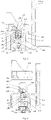
- Fig. 1 is an exploded perspective schematic view of a battery pack locking mechanism according to an embodiment of the invention.
- the battery pack locking mechanism mainly comprises: a locking member 100 and a locking fitting member 200, wherein one of the locking member 100 and the locking fitting member 200 is fixedly provided in a battery pack, and the other is fixedly arranged in a position at which the battery pack is fixed, and through interlocking or unlocking between the locking member and the locking fitting member, the battery pack can be mounted or dismounted on a vehicle.
- the manner in which the locking fitting member 200 is fixedly arranged on the vehicle and the locking member 100 is fixedly arranged on the battery pack is exemplified.
- the locking member 100 comprises a housing 110 and a snap-fit portion 120.
- the housing 110 is fixedly arranged on the battery pack.
- the snap-fit portion 120 can move between a first position and a second position relative to the housing 110. In the first position, part of the snap-fit portion 120 extends out of the housing 110 to be interlocked with the locking fitting member 200. In the second position, the snap-fit portion 120 is retracted into the housing 110 to be unlocked with the locking fitting member 200.
- Fig. 2 is a cross-sectional view showing that the locking member 100 and the locking fitting member 200 are in an interlocked state according to an embodiment of the invention.
- Fig. 3 is a cross-sectional view showing that the locking member 100 and the locking fitting member 200 are in an unlocked state.
- the locking fitting member 200 is provided with a first cavity 210; and the housing 110 of the locking member 100 is provided with a head, and the head of the housing 110 is capable of extending into or being retracted from the first cavity 210 when the housing 110 and the locking fitting member 200 move relative to each other in a dismounting/mounting direction.
- the dismounting/mounting direction is in a vertical direction, the upward direction is for mounting, and the downward direction is for dismounting.
- the housing 110 is provided with a second cavity 111 extending to the head of the housing 110 and used for accommodating the snap-fit portion 120.
- a side wall of the housing 110 is provided with a through hole 112 in communication with the second cavity 111, and the through hole 112 is used for allowing at least part of the snap-fit portion 120 to extend out of the housing 110 from the through hole 112.
- the radial width and the axial length of the through hole 112 are not limited, and the through hole 112 may be configured to allow the snap-fit portion 120 as a whole to pass out of the housing 110 through the through hole 112, or the through hole 112 may also be configured to allow only part of the snap-fit portion 120 to be exposed out of the housing 110.
- the head of the housing 110 extends into the first cavity 210, and the snap-fit portion 120 moves to the first position (extending from the second cavity 111 via the through hole 112), and a pretightening force is formed among an inner wall of the first cavity 210, the snap-fit portion 120 and an inner wall of the housing 110 by using the gravity of the battery pack, so that the snap-fit portion 120 is clamped between the inner wall of the first cavity 210 and the inner wall of the housing 110.
- the inner wall of the housing 110 is an inner wall of the second cavity 111 and/or an inner wall of the through hole 112, and "and/or" as used herein means that the snap-fit portion 120 may be in contact with the inner wall of the second cavity 111, or may be in contact with the inner wall of the through hole 112, or may also be in contact with both the inner wall of the second cavity 111 and the inner wall of the through hole 112.
- the snap-fit portion 120 moves to the second position (retracted into the second cavity 111), and the head of the housing 110 is retracted from the first cavity 210.
- a step 211 is arranged in the first cavity 210.
- the head of the housing 110 extends into the first cavity 210, at least part of the snap-fit portion 120 can move from the through hole 112 to the step 211 or from the step to the through hole 112.
- the surface of the step 211 is in communication with a wall surface of the through hole 112 (the step 211 is flush with the inner wall of the through hole 112), so that the movement of the snap-fit portion 120 between the through hole 112 and the step 211 is smoother.
- the snap-fit portion 120 is in contact with the step 211 and is clamped between the step 211 and the inner wall of the through hole 112.
- the snap-fit portion 120 is spherical, and further, the snap-fit portion 120 may be a metal ball made of a high-strength alloy steel material.
- the through hole 112 is in the shape of a cylinder having the same diameter as the spherical snap-fit portion 120, and the snap-fit portion 120 can move between the first position and the second position in an axial direction (lengthwise direction) of the through hole 112.
- the snap-fit portion 120 is configured to be spherical so as to facilitate the movement of the snap-fit portion 120, and point contact between the snap-fit portion 120 and components such as the surface of the step 211, the inner wall of the first cavity 210 or the inner wall of the second cavity 111 can be realized, so that friction between the components can be reduced, and then abrasion of the locking mechanism can be reduced.
- the axial direction of the through hole 112 may extend in a thickness direction of the side wall of the housing 110; alternatively, the axial direction of the through hole 112 may form an included angle with the thickness direction of the side wall in which the through hole is formed, and an inclining direction of the step 211 is consistent with the axial direction of the through hole 112; and the surface of the step 211 is smoothly connected with the wall surface of the through hole 112 when the head of the housing 110 extends into the first cavity 210 (the step 211 is flush with the inner wall of the through hole 112).
- the snap-fit portion 120 can move more smoothly along the inclined through hole 112 and the step 211.
- the locking member 100 further comprises a transmission portion 130 located in the second cavity 111 and used for driving the snap-fit portion 120 to move between the first position and the second position.
- the transmission portion 130 comprises a first push rod 131, an elastic element 132 and a second push rod 133 arranged in the dismounting/mounting direction.
- the first push rod 131 is in contact with the snap-fit portion 120 to support the snap-fit portion 120.
- the snap-fit portion 120 comprises metal parts (in fact, the snap-fit portion 120 may be partly metal parts or entirely metal parts, for example, the aforementioned snap-fit portion 120 is a metal ball as an example), and the first push rod 131 may be provided with a permanent magnet 134 for attracting the snap-fit portion 120 so as to drive the snap-fit portion 120.
- the permanent magnet 134 may be bolted to a body of the first push rod 131.
- Two ends of the elastic element 132 in the dismounting/mounting direction are respectively arranged on the first push rod 131 and the second push rod 133 in an abutting or fixed connection manner and used for supporting the first push rod 131 and performing transmission between the first push rod 131 and the second push rod 133.
- the elastic element 132 may be a heavy spring.
- an opening is formed in the end, where the second push rod 133 is located, of the second cavity 111, so that an external driving part is capable of extending through the opening, driving the second push rod 133 to move towards or away from the first push rod 131, and thus driving the snap-fit portion 120 to move between the first position and the second position.
- an annular end face 140 is arranged in the second cavity 111, the end face 140 is perpendicular to the dismounting/mounting direction, and the end face 140 faces the through hole 112.
- the aforementioned expression "the end face 140 faces the through hole 112" is not intended to mean that the end face 140 must directly face the through hole 112, but means only that the end face 140 does not face away from the through hole 112.
- the expression "the end face 140 faces the through hole 112" refers to that the end face 140 is arranged upwards.
- the end face 140 is provided with a first positioning groove 141 and a second positioning groove 142 which are arranged spaced apart from each other in a circumferential direction, the first positioning groove 141 and the second positioning groove 142 are different in depth in the dismounting/mounting direction. It may as well be that the depth of the first positioning groove 141 in the dismounting/mounting direction is smaller than that of the second positioning groove 142 in the dismounting/mounting direction, namely the bottom of the second positioning groove 142 is closer to the opening of the second cavity 111 relative to the bottom of the first positioning groove 141.
- the transmission portion 130 is provided with a positioning element 135.
- the positioning element 135 may be arranged on the second push rod 133.
- the positioning element 135 may be a positioning pin and radially and fixedly penetrates into the second push rod 133; alternatively, the positioning element may be a convex block integrally formed with the second push rod 133.
- the positioning element 135 is switchably accommodated in the first positioning groove 141 and the second positioning groove 142. As shown in Fig. 2 , when the positioning element 135 is located at the bottom of the first positioning groove 141, the snap-fit portion 120 is kept at the first position. As shown in Fig. 3 , when the positioning element 135 is located at the bottom of the second positioning groove 142, the snap-fit portion 120 is kept at the second position.
- the snap-fit portion 120 is stabilized in the interlocked or unlocked state by positioning the second push rod 133 at different axial positions.
- the positioning element 135 is capable of disengaging from the first positioning groove 141 or the second positioning groove 142, which the positioning element is located, along with the movement of the transmission portion 130 in the dismounting/mounting direction and moving into the other one of the first positioning groove 141 and the second positioning groove 142 along with the rotation of the transmission portion 130.
- the end face 140 is not limited to be integrated with the inner wall of the second cavity 111.
- the locking member 100 further comprises a bottom case 150, the bottom case 150 being hollow, and the bottom case 150 extends into the second cavity 111 and is arranged outside at least part of the transmission portion 130 in a sleeved manner, for example, the bottom case can be arranged outside the second push rod 133 in a sleeved manner.
- the end face 140 is arranged at the end, close to the through hole 112, of the bottom case 150, and meanwhile, the first positioning groove 141 and the second positioning groove 142 are also formed in the bottom case 150.
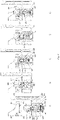
- Fig. 4 is a schematic view showing switching of the battery pack locking mechanism between the unlocked state and the locked state. Referring to Fig. 4 , the locking process of the battery pack locking mechanism is shown in the sequence of ABCDE.
- the locking member 100 is separated from the locking fitting member 200, the positioning unit 135 is located at the bottom of the second positioning groove 142, and the snap-fit portion 120 is maintained at the second position for retracting into the housing 110.
- the battery pack locking mechanism switches from the state A to the state B by moving the locking member 100 (or moving the battery pack) in a mounting direction (upward in the figures): as the locking member 100 moves upwards, the head of the housing 110 extends into the first cavity 210.
- the battery pack locking mechanism switches from the state B to the state C: as the second push rod 133 moves upwards, the positioning element 135 moves away from the second positioning groove 142 and is beyond the end face 140, and the elastic element 132 is compressed to push the first push rod 131 to move upwards, thereby pushing the snap-fit portion 120 to move to the first position for extending out of the housing 110 and to be clamped between the inner wall of the housing 110 and the inner wall of the first cavity 210.
- the battery pack locking mechanism switches from the state C to the state D by rotating the second push rod 133 in the circumferential direction: as the second push rod 133 rotates, the positioning element 135 rotates at an angle in the circumferential direction and is aligned with the first positioning groove 141.
- the battery pack locking mechanism switches from the state D to the state E by downward movement of the second push rod 133 (in fact, just releasing the second push rod 133 due to the arrangement of the elastic element 132): as the second push rod 133 moves downwards, the positioning element 135 moves to the bottom of the first positioning groove 141, so that the snap-fit portion 120 is kept at the first position, and the locking member 100 and the locking fitting member 200 are stably interlocked; and in this situation, the elastic element 132 performs a certain relaxation.
- the end face 140 is not limited to a plane, but may be inclined.
- the portion of the end face 140 between the first positioning groove 141 and the second positioning groove 142 may have a slope (not shown in the figures), and the fitting structure between the transmission portion 130 and the positioning grooves may be configured to be a structure similar to that of an existing automatic pen, so that the transmission portion 130 moves only in the dismounting/mounting direction (without rotating the transmission portion 130), and the positioning element 135 switches between a state of being clamped in the first positioning groove 141 and a state of being clamped in the second positioning groove 142.
- a driving fitting groove 160 which may be, for example, an inner octagonal groove, is formed in the end, facing the opening of the second cavity 111, of the second push rod 133 for mutual engagement with the external driving part, so that the external driving part drives the second push rod 133 to move or rotate circumferentially in a dismounting direction.
- the driving fitting groove 160 is not limited to be in the shape of an inner octagon, but may be of other groove types compatible with external driving parts; and it is also possible, for example, to provide a bottom end of the second push rod 133 as a regular prism structure so as to be fit with a battery swap mechanism, instead of being limited to providing the driving fitting groove 160 in the transmission portion 130 for fitting with the battery swap mechanism.
- a battery swap mechanism for automatic battery swapping
- a sleeve capable of cooperating with the driving fitting groove 160 can also be used for manual battery swapping.
- the locking member 100 may comprise a plurality of snap-fit portions 120, and a plurality of through holes 112 are correspondingly provided; and the snap-fit portions 120 are driven by the transmission portion 130 to move synchronously so that the snap-fit portions 120 can be simultaneously located at the first positions and can be simultaneously located at the second positions, thereby enabling the engagement of the locking member 100 with the locking fitting member 200 to be more stable.
- the snap-fit portions 120 are metal balls made of an alloy steel material
- each locking member 100 is provided with three snap-fit portions 120, and the housing 110 is provided with three through holes 112 spaced apart from one another (one end of each of the three through holes 112 inside the second cavity 111 is in communication with the second cavity 111).
- the three snap-fit portions 120 can synchronously move in the through holes 112 where the three snap-fit portions are located under the driving of the transmission portion 130, so that the three snap-fit portions 120 can be simultaneously located in the first positions and the second positions.
- a battery pack having a flange 310 is also disclosed.
- the flange 310 is provided with a third cavity 311, the locking member 100 as described in any one of the above embodiments fixedly penetrates into the third cavity 311, and the locking member 100 is fixed in the third cavity 311 of the flange 310 by welding, threaded connection, integral molding or other methods. It should be noted that the locking member 100 may be partially disposed within the third cavity 311. For example, in an example shown in Fig.
- the head of the housing 110 may be exposed; and the locking member 100 may also be disposed entirely within the third cavity 311, the end where the head of the housing 110 of the third cavity 311 is located may be configured to receive the locking fitting member 200 at the moment, such that the locking member 100 is interlocked with the locking fitting member 200 within the third cavity 311.
- a vehicle comprising the locking mechanism according to the invention or according to any of the optional embodiments is also being disclosed.
- the locking fitting member 200 is fixed to the vehicle and can be generally fixed to the bottom of a vehicle body, for example, mounting holes can be formed in the locking fitting member 200, and the locking fitting member 200 is screwed to the bottom of the vehicle body through bolts.
- a plurality of battery pack locking mechanisms may be provided, for example, a plurality of locking members 100 may be arranged at intervals on the flanges 310 on both sides of the battery pack, and a plurality of locking fitting members 200 may be correspondingly arranged at the bottom of the vehicle body so that the battery pack can be more stably locked to the vehicle body.
- the locking fitting member 200 is not limited to being arranged on a vehicle, but may be arranged in any apparatus or location where a battery pack needs to be fixed.
- the locking fitting member 200 may be fixed to the battery swap platform.
Landscapes
- Chemical & Material Sciences (AREA)
- Chemical Kinetics & Catalysis (AREA)
- Electrochemistry (AREA)
- General Chemical & Material Sciences (AREA)
- Engineering & Computer Science (AREA)
- Combustion & Propulsion (AREA)
- Transportation (AREA)
- Mechanical Engineering (AREA)
- Aviation & Aerospace Engineering (AREA)
- Battery Mounting, Suspending (AREA)
- Lock And Its Accessories (AREA)
Description
- The invention relates to a locking mechanism for a battery pack, an assembly comprising a battery pack and the locking mechanism and a vehicle.
- In recent years, as an energy source convenient to replace, batteries have been widely used in the field of automobiles. In the development process of electric vehicles, there are still some technical problems to be solved urgently, these obstacles restrict the large-scale promotion of the electric vehicles, and the charging problem is one of the significant obstacles. An electric vehicle requires a special charging facility and takes a large amount of time for each charge, compared with the situation where an internal combustion engine vehicle can be rapidly refueled at a gas station. For this reason, more and more attention has been paid to battery pack replacement (for short, battery swapping) as a fast way of electric vehicle energy supplement.
- A battery pack locking mechanism for fastening an electric vehicle and a battery pack is generally arranged between the electric vehicle and the replaceable battery pack, and the advantages and disadvantages of the specific structure of the locking mechanism greatly influence the battery swap efficiency. Most of the existing battery pack locking mechanisms use bolt tightening mechanisms to fasten the battery pack to the automobile, and when the battery pack with this structure is swapped, the battery swap process is relatively time-consuming, and the battery swap operation is also relatively complicated.
- CN patent No.
CN 206031346 U discloses a locking mechanism, which comprises a fixing assembly 10 and a lock body assembly 20. The fixing assembly 10 is adapted to be connected to the body of a new energy vehicle, and the lock body assembly 20 is adapted to be connected to the housing of a power battery. The lock body assembly 20 has a central pulling shaft 22 having external threads on its locking section. The central pulling shaft 22 can slide into a threaded hole 122 on a locking plate 12 of the fixing assembly 10 and be threaded therein. When the lock body assembly 20 is connected to the fixing assembly 10 through its central pulling shaft 22, the locking mechanism fastens the power battery to the vehicle. - The invention aims to overcome the defects of the existing locking mechanisms for battery packs of electric vehicles, provide a new locking mechanism for a battery pack, an assembly comprising a battery pack and the locking mechanism and a vehicle, and particularly provide a battery pack locking mechanism good in stability and quick to assemble and disassemble, a battery pack and a vehicle to address the technical problems to be solved by the invention.
- The following technical solutions are used to achieve the objective of the invention and address the technical problems to be solved. The invention is defined by the locking mechanism for a battery pack that is subject-matter of the independent claim 1.
- Potential additional embodiments of the invention form the subject-matter of the dependent claims.
- By virtue of the above technical solutions, the invention has at least the following advantages and beneficial effects:
- (1) the battery pack locking mechanism is provided with the snap-fit portions with the first positions (interlocked state) and the second positions (unlocked state), and the transmission portion used for driving the snap-fit portions to switch between the first positions and the second positions. When the external driving part drives the transmission portion, the battery pack can be efficiently and rapidly dismounted and mounted, so that the dismounting time is shortened;
- (2) according to the invention, by utilizing the self weight of the battery pack, a stable pretightening force is provided for the engagement between the locking member and the locking fitting member, and firm and stable locking between the battery pack and a vehicle body structure is realized;
- (3) due to the fact that the snap-fit portions of the locking member are arranged to be spherical, the snap-fit portions can be in point contact with the inner wall of the first cavity so as to reduce friction between the parts and thus reduce abrasion; and
- (4) the battery pack locking mechanism is compact in structure and light in weight.
- The aforementioned description is only an overview of the technical solutions of the invention. In order to clearly understand the technical means of the invention, the invention can be implemented according to the contents of the description; and in order to make the aforementioned and other objectives, features and advantages of the invention more obvious and understandable, preferred embodiments are described in detail below with reference to the accompanying drawings.
-
-
Fig. 1 is an exploded perspective view of a battery pack locking mechanism. -
Fig. 2 is a cross-sectional view of the battery pack locking mechanism with a locking member and a locking fitting member in an interlocked state. -
Fig. 3 is a cross-sectional view of the battery pack locking mechanism with the locking member and the locking fitting member in an unlocked state. -
Fig. 4 is a schematic view of the battery pack locking mechanism switching between the unlocked state and the interlocked state. -
100: Locking member 200: Locking fitting member 110: Housing 120: Snap-fit portion 210: First cavity 111: Second cavity 112: Through hole 211: Step 130: Transmission portion 131: First push rod 132: Elastic element 133: Second push rod 134: Permanent magnet 140: End face 141: First positioning groove 142: Second positioning groove 135: Positioning element 150: Bottom case 160: Driving fitting groove 310: Flange 311: Third cavity - In order to further illustrate the technical means used to achieve the intended purpose of the invention and the technical effects of the invention, the implementation, structure and features of a battery pack locking mechanism, a battery pack and a vehicle proposed according to the invention and the effects thereof are described in detail hereinafter in conjunction with the accompanying drawings and the preferred embodiments.
-
Fig. 1 is an exploded perspective schematic view of a battery pack locking mechanism according to an embodiment of the invention. Referring toFig. 1 , the battery pack locking mechanism according to an example of the invention mainly comprises: alocking member 100 and alocking fitting member 200, wherein one of thelocking member 100 and thelocking fitting member 200 is fixedly provided in a battery pack, and the other is fixedly arranged in a position at which the battery pack is fixed, and through interlocking or unlocking between the locking member and the locking fitting member, the battery pack can be mounted or dismounted on a vehicle. In the following description, the manner in which the locking fittingmember 200 is fixedly arranged on the vehicle and thelocking member 100 is fixedly arranged on the battery pack is exemplified. - The
locking member 100 comprises ahousing 110 and a snap-fit portion 120. Thehousing 110 is fixedly arranged on the battery pack. The snap-fit portion 120 can move between a first position and a second position relative to thehousing 110. In the first position, part of the snap-fit portion 120 extends out of thehousing 110 to be interlocked with thelocking fitting member 200. In the second position, the snap-fit portion 120 is retracted into thehousing 110 to be unlocked with thelocking fitting member 200. -
Fig. 2 is a cross-sectional view showing that thelocking member 100 and thelocking fitting member 200 are in an interlocked state according to an embodiment of the invention.Fig. 3 is a cross-sectional view showing that thelocking member 100 and thelocking fitting member 200 are in an unlocked state. - As shown in
Figs. 2 and 3 , thelocking fitting member 200 is provided with afirst cavity 210; and thehousing 110 of thelocking member 100 is provided with a head, and the head of thehousing 110 is capable of extending into or being retracted from thefirst cavity 210 when thehousing 110 and thelocking fitting member 200 move relative to each other in a dismounting/mounting direction. InFig. 2 or 3 , the dismounting/mounting direction is in a vertical direction, the upward direction is for mounting, and the downward direction is for dismounting. Thehousing 110 is provided with asecond cavity 111 extending to the head of thehousing 110 and used for accommodating the snap-fit portion 120. A side wall of thehousing 110 is provided with athrough hole 112 in communication with thesecond cavity 111, and thethrough hole 112 is used for allowing at least part of the snap-fit portion 120 to extend out of thehousing 110 from thethrough hole 112. It should be noted that the radial width and the axial length of thethrough hole 112 are not limited, and thethrough hole 112 may be configured to allow the snap-fit portion 120 as a whole to pass out of thehousing 110 through the throughhole 112, or the throughhole 112 may also be configured to allow only part of the snap-fit portion 120 to be exposed out of thehousing 110. - In the interlocked state, as shown in
Fig. 2 , the head of thehousing 110 extends into thefirst cavity 210, and the snap-fit portion 120 moves to the first position (extending from thesecond cavity 111 via the through hole 112), and a pretightening force is formed among an inner wall of thefirst cavity 210, the snap-fit portion 120 and an inner wall of thehousing 110 by using the gravity of the battery pack, so that the snap-fit portion 120 is clamped between the inner wall of thefirst cavity 210 and the inner wall of thehousing 110. The inner wall of thehousing 110 is an inner wall of thesecond cavity 111 and/or an inner wall of the throughhole 112, and "and/or" as used herein means that the snap-fit portion 120 may be in contact with the inner wall of thesecond cavity 111, or may be in contact with the inner wall of thethrough hole 112, or may also be in contact with both the inner wall of thesecond cavity 111 and the inner wall of the throughhole 112. - In the unlocked state, as shown in
Fig. 3 , the snap-fit portion 120 moves to the second position (retracted into the second cavity 111), and the head of thehousing 110 is retracted from thefirst cavity 210. - Optionally, a
step 211 is arranged in thefirst cavity 210. When the head of thehousing 110 extends into thefirst cavity 210, at least part of the snap-fit portion 120 can move from the throughhole 112 to thestep 211 or from the step to the throughhole 112. Further, when the head of thehousing 110 extends into thefirst cavity 210, the surface of thestep 211 is in communication with a wall surface of the through hole 112 (thestep 211 is flush with the inner wall of the through hole 112), so that the movement of the snap-fit portion 120 between the throughhole 112 and thestep 211 is smoother. When moving to the first position, the snap-fit portion 120 is in contact with thestep 211 and is clamped between thestep 211 and the inner wall of the throughhole 112. - Optionally, the snap-
fit portion 120 is spherical, and further, the snap-fit portion 120 may be a metal ball made of a high-strength alloy steel material. In addition, thethrough hole 112 is in the shape of a cylinder having the same diameter as the spherical snap-fit portion 120, and the snap-fit portion 120 can move between the first position and the second position in an axial direction (lengthwise direction) of thethrough hole 112. The snap-fit portion 120 is configured to be spherical so as to facilitate the movement of the snap-fit portion 120, and point contact between the snap-fit portion 120 and components such as the surface of thestep 211, the inner wall of thefirst cavity 210 or the inner wall of thesecond cavity 111 can be realized, so that friction between the components can be reduced, and then abrasion of the locking mechanism can be reduced. - It should be noted that the axial direction of the
through hole 112 may extend in a thickness direction of the side wall of thehousing 110; alternatively, the axial direction of the throughhole 112 may form an included angle with the thickness direction of the side wall in which the through hole is formed, and an inclining direction of thestep 211 is consistent with the axial direction of thethrough hole 112; and the surface of thestep 211 is smoothly connected with the wall surface of the throughhole 112 when the head of thehousing 110 extends into the first cavity 210 (thestep 211 is flush with the inner wall of the through hole 112). Thus, the snap-fit portion 120 can move more smoothly along the inclined throughhole 112 and thestep 211. - In some embodiments, the
locking member 100 further comprises atransmission portion 130 located in thesecond cavity 111 and used for driving the snap-fit portion 120 to move between the first position and the second position. - As an optional embodiment, the
transmission portion 130 comprises afirst push rod 131, anelastic element 132 and asecond push rod 133 arranged in the dismounting/mounting direction. - The
first push rod 131 is in contact with the snap-fit portion 120 to support the snap-fit portion 120. Optionally, the snap-fit portion 120 comprises metal parts (in fact, the snap-fit portion 120 may be partly metal parts or entirely metal parts, for example, the aforementioned snap-fit portion 120 is a metal ball as an example), and thefirst push rod 131 may be provided with apermanent magnet 134 for attracting the snap-fit portion 120 so as to drive the snap-fit portion 120. Thepermanent magnet 134 may be bolted to a body of thefirst push rod 131. - Two ends of the
elastic element 132 in the dismounting/mounting direction are respectively arranged on thefirst push rod 131 and thesecond push rod 133 in an abutting or fixed connection manner and used for supporting thefirst push rod 131 and performing transmission between thefirst push rod 131 and thesecond push rod 133. Optionally, theelastic element 132 may be a heavy spring. - In the dismounting/mounting direction, an opening is formed in the end, where the
second push rod 133 is located, of thesecond cavity 111, so that an external driving part is capable of extending through the opening, driving thesecond push rod 133 to move towards or away from thefirst push rod 131, and thus driving the snap-fit portion 120 to move between the first position and the second position. - In an embodiment, an
annular end face 140 is arranged in thesecond cavity 111, theend face 140 is perpendicular to the dismounting/mounting direction, and theend face 140 faces the throughhole 112. It should be noted that the aforementioned expression "theend face 140 faces the throughhole 112" is not intended to mean that theend face 140 must directly face the throughhole 112, but means only that theend face 140 does not face away from the throughhole 112. For example, as shown inFig. 2 , the expression "theend face 140 faces the throughhole 112" refers to that theend face 140 is arranged upwards. Theend face 140 is provided with afirst positioning groove 141 and asecond positioning groove 142 which are arranged spaced apart from each other in a circumferential direction, thefirst positioning groove 141 and thesecond positioning groove 142 are different in depth in the dismounting/mounting direction. It may as well be that the depth of thefirst positioning groove 141 in the dismounting/mounting direction is smaller than that of thesecond positioning groove 142 in the dismounting/mounting direction, namely the bottom of thesecond positioning groove 142 is closer to the opening of thesecond cavity 111 relative to the bottom of thefirst positioning groove 141. In addition, thetransmission portion 130 is provided with apositioning element 135. Optionally, thepositioning element 135 may be arranged on thesecond push rod 133. For instance, thepositioning element 135 may be a positioning pin and radially and fixedly penetrates into thesecond push rod 133; alternatively, the positioning element may be a convex block integrally formed with thesecond push rod 133. Thepositioning element 135 is switchably accommodated in thefirst positioning groove 141 and thesecond positioning groove 142. As shown inFig. 2 , when thepositioning element 135 is located at the bottom of thefirst positioning groove 141, the snap-fit portion 120 is kept at the first position. As shown inFig. 3 , when thepositioning element 135 is located at the bottom of thesecond positioning groove 142, the snap-fit portion 120 is kept at the second position. Accordingly, the snap-fit portion 120 is stabilized in the interlocked or unlocked state by positioning thesecond push rod 133 at different axial positions. Thepositioning element 135 is capable of disengaging from thefirst positioning groove 141 or thesecond positioning groove 142, which the positioning element is located, along with the movement of thetransmission portion 130 in the dismounting/mounting direction and moving into the other one of thefirst positioning groove 141 and thesecond positioning groove 142 along with the rotation of thetransmission portion 130. - It should be noted that the
end face 140 is not limited to be integrated with the inner wall of thesecond cavity 111. For example, in an optional example, the lockingmember 100 further comprises abottom case 150, thebottom case 150 being hollow, and thebottom case 150 extends into thesecond cavity 111 and is arranged outside at least part of thetransmission portion 130 in a sleeved manner, for example, the bottom case can be arranged outside thesecond push rod 133 in a sleeved manner. Theend face 140 is arranged at the end, close to the throughhole 112, of thebottom case 150, and meanwhile, thefirst positioning groove 141 and thesecond positioning groove 142 are also formed in thebottom case 150. -
Fig. 4 is a schematic view showing switching of the battery pack locking mechanism between the unlocked state and the locked state. Referring toFig. 4 , the locking process of the battery pack locking mechanism is shown in the sequence of ABCDE. - Specifically, in the shown state A: the locking
member 100 is separated from thelocking fitting member 200, thepositioning unit 135 is located at the bottom of thesecond positioning groove 142, and the snap-fit portion 120 is maintained at the second position for retracting into thehousing 110. - The battery pack locking mechanism switches from the state A to the state B by moving the locking member 100 (or moving the battery pack) in a mounting direction (upward in the figures): as the locking
member 100 moves upwards, the head of thehousing 110 extends into thefirst cavity 210. - By upward movement of the
second push rod 133, the battery pack locking mechanism switches from the state B to the state C: as thesecond push rod 133 moves upwards, thepositioning element 135 moves away from thesecond positioning groove 142 and is beyond theend face 140, and theelastic element 132 is compressed to push thefirst push rod 131 to move upwards, thereby pushing the snap-fit portion 120 to move to the first position for extending out of thehousing 110 and to be clamped between the inner wall of thehousing 110 and the inner wall of thefirst cavity 210. - The battery pack locking mechanism switches from the state C to the state D by rotating the
second push rod 133 in the circumferential direction: as thesecond push rod 133 rotates, thepositioning element 135 rotates at an angle in the circumferential direction and is aligned with thefirst positioning groove 141. - The battery pack locking mechanism switches from the state D to the state E by downward movement of the second push rod 133 (in fact, just releasing the
second push rod 133 due to the arrangement of the elastic element 132): as thesecond push rod 133 moves downwards, thepositioning element 135 moves to the bottom of thefirst positioning groove 141, so that the snap-fit portion 120 is kept at the first position, and the lockingmember 100 and thelocking fitting member 200 are stably interlocked; and in this situation, theelastic element 132 performs a certain relaxation. - Similar to the locking process described above, the unlocking process of the battery pack locking mechanism is shown in the sequence of EDCBA in
Fig. 4 . - It should also be noted that the
end face 140 is not limited to a plane, but may be inclined. In fact, the portion of theend face 140 between thefirst positioning groove 141 and thesecond positioning groove 142 may have a slope (not shown in the figures), and the fitting structure between thetransmission portion 130 and the positioning grooves may be configured to be a structure similar to that of an existing automatic pen, so that thetransmission portion 130 moves only in the dismounting/mounting direction (without rotating the transmission portion 130), and thepositioning element 135 switches between a state of being clamped in thefirst positioning groove 141 and a state of being clamped in thesecond positioning groove 142. - Optionally, as shown in
Figs. 2 and 3 , a drivingfitting groove 160, which may be, for example, an inner octagonal groove, is formed in the end, facing the opening of thesecond cavity 111, of thesecond push rod 133 for mutual engagement with the external driving part, so that the external driving part drives thesecond push rod 133 to move or rotate circumferentially in a dismounting direction. It should be noted that the drivingfitting groove 160 is not limited to be in the shape of an inner octagon, but may be of other groove types compatible with external driving parts; and it is also possible, for example, to provide a bottom end of thesecond push rod 133 as a regular prism structure so as to be fit with a battery swap mechanism, instead of being limited to providing the drivingfitting groove 160 in thetransmission portion 130 for fitting with the battery swap mechanism. In addition, it is not limited to using the battery swap mechanism for automatic battery swapping, and a sleeve capable of cooperating with the drivingfitting groove 160 can also be used for manual battery swapping. - Optionally, the locking
member 100 may comprise a plurality of snap-fit portions 120, and a plurality of throughholes 112 are correspondingly provided; and the snap-fit portions 120 are driven by thetransmission portion 130 to move synchronously so that the snap-fit portions 120 can be simultaneously located at the first positions and can be simultaneously located at the second positions, thereby enabling the engagement of the lockingmember 100 with thelocking fitting member 200 to be more stable. For example, in an example in which the snap-fit portions 120 are metal balls made of an alloy steel material, each lockingmember 100 is provided with three snap-fit portions 120, and thehousing 110 is provided with three throughholes 112 spaced apart from one another (one end of each of the three throughholes 112 inside thesecond cavity 111 is in communication with the second cavity 111). The three snap-fit portions 120 can synchronously move in the throughholes 112 where the three snap-fit portions are located under the driving of thetransmission portion 130, so that the three snap-fit portions 120 can be simultaneously located in the first positions and the second positions. - A battery pack having a
flange 310 is also disclosed. Theflange 310 is provided with athird cavity 311, the lockingmember 100 as described in any one of the above embodiments fixedly penetrates into thethird cavity 311, and the lockingmember 100 is fixed in thethird cavity 311 of theflange 310 by welding, threaded connection, integral molding or other methods. It should be noted that the lockingmember 100 may be partially disposed within thethird cavity 311. For example, in an example shown inFig. 3 , the head of thehousing 110 may be exposed; and the lockingmember 100 may also be disposed entirely within thethird cavity 311, the end where the head of thehousing 110 of thethird cavity 311 is located may be configured to receive thelocking fitting member 200 at the moment, such that the lockingmember 100 is interlocked with thelocking fitting member 200 within thethird cavity 311. By arranging at least part of the lockingmember 100 within theflange 310, the overall height of the battery pack to which the lockingmember 100 is fixed can be reduced. - A vehicle comprising the locking mechanism according to the invention or according to any of the optional embodiments is also being disclosed. The locking
fitting member 200 is fixed to the vehicle and can be generally fixed to the bottom of a vehicle body, for example, mounting holes can be formed in thelocking fitting member 200, and thelocking fitting member 200 is screwed to the bottom of the vehicle body through bolts. - It should be noted that, depending on the size and weight of the battery pack, a plurality of battery pack locking mechanisms may be provided, for example, a plurality of locking
members 100 may be arranged at intervals on theflanges 310 on both sides of the battery pack, and a plurality of lockingfitting members 200 may be correspondingly arranged at the bottom of the vehicle body so that the battery pack can be more stably locked to the vehicle body. - It should also be noted that the
locking fitting member 200 is not limited to being arranged on a vehicle, but may be arranged in any apparatus or location where a battery pack needs to be fixed. For example, when the battery pack locking mechanism of the invention is applied to a battery swap platform, thelocking fitting member 200 may be fixed to the battery swap platform. - The foregoing descriptions are merely preferred embodiments of the invention, and are not intended to limit the invention in any form. Although the invention has been disclosed as above by means of the preferred embodiments, these embodiments are not for the purpose of limiting the invention. Those skilled in the art can make alterations or modifications to the technical contents disclosed above without departing from the scope of the invention as defined by the subject-matter of the appended claims.
Claims (14)
- A locking mechanism for a battery pack, characterized by comprising:a locking member (100) and a locking fitting member (200), wherein the locking member (100) comprises a housing (110) and a snap-fit portion (120);one of the housing (110) and the locking fitting member (200) is fixedly provided in the battery pack, and the other is fixedly arranged in a position at which the battery pack is fixed;the snap-fit portion (120) is movable between a first position and a second position with respect to the housing (110); in the first position, part of the snap-fit portion (120) extends out of the housing (110) to be interlocked with the locking fitting member (200); and in the second position, the snap-fit portion (120) is retracted into the housing (110) to be unlocked with the locking fitting member (200);the locking fitting member (200) is provided with a first cavity (210); the housing (110) is provided with a head which is capable of extending into or being retracted from the first cavity (210) when the housing and the locking fitting member (200) move relative to each other in a dismounting/mounting direction;the housing (110) is provided with a second cavity (111) extending to the head for accommodating the snap-fit portion (120); a side wall of the housing (110) is provided with a through hole (112) in communication with the second cavity (111);in an interlocked state, the head extends into the first cavity (210), and the snap-fit portion (120) moves to the first position and is clamped between an inner wall of the first cavity (210) and an inner wall of the housing (110); andin an unlocked state, the snap-fit portion (120) moves to the second position, and the head is retracted from the first cavity (210).
- The locking mechanism according to claim 1, characterized in that,a step (211) is arranged in the first cavity (210); andin the first position, the snap-fit portion (120) is in contact with the step (211), and is clamped between the step (211) and an inner wall of the through hole (112).
- The locking mechanism according to claim 2, characterized in that,the snap-fit portion (120) is spherical, and the through hole (112) is a cylindrical through hole having the same diameter as the snap-fit portion (120); andwhen the head of the housing (110) extends into the first cavity (210), the snap-fit portion (120) is movable between the first position and the second position in an axial direction of the through hole (112).
- The locking mechanism according to claim 3, characterized in that,
an included angle is formed between the axial direction of the through hole (112) and a thickness direction of the side wall, and an inclining direction of the step (211) is consistent with the axial direction of the through hole (112). - The locking mechanism according to claim 1, characterized in that,
the locking member (100) further comprises a transmission portion (130) located in the second cavity (111) and used for driving the snap-fit portion (120) to move between the first position and the second position. - The locking mechanism according to claim 5, characterized in that, the transmission portion (130) comprises: a first push rod (131), an elastic element (132) and a second push rod (133) arranged in the dismounting/mounting direction;the first push rod (131) is used for supporting the snap-fit portion (120);two ends of the elastic element (132) in the dismounting/mounting direction are respectively arranged on the first push rod (131) and the second push rod (133); andin the dismounting/mounting direction, an opening is formed in the end, where the second push rod (133) is located, of the second cavity (111), so that an external driving part is capable of extending through the opening, driving the second push rod (133) to move towards or away from the first push rod (131), and thus driving the snap-fit portion (120) to move between the first position and the second position.
- The locking mechanism according to claim 6, characterized in that,the snap-fit portion (120) comprises a metal part; andthe first push rod (131) is provided with a permanent magnet (134) for attracting the snap-fit portion (120) so as to drive the snap-fit portion (120) to move.
- The locking mechanism according to claim 6, characterized in that,an annular end face (140) is arranged in the second cavity (111), the end face (140) is perpendicular to the dismounting/mounting direction, and the end face (140) faces the through hole (112);the end face (140) is provided with a first positioning groove (141) and a second positioning groove (142) which are arranged spaced apart from each other in a circumferential direction, and the depth of the first positioning groove (141) in the dismounting/mounting direction is smaller than that of the second positioning groove (142) in the dismounting/mounting direction;the transmission portion (130) is provided with a positioning element (135); the positioning element (135) is switchably accommodated in the first positioning groove (141) and the second positioning groove (142); when the positioning element (135) is located at the bottom of the first positioning groove (141), the snap-fit portion (120) is kept at the first position; when the positioning element (135) is located at the bottom of the second positioning groove (142), the snap-fit portion (120) is kept at the second position; andthe positioning element (135) is capable of disengaging from the positioning groove along with the movement of the transmission portion (130) in the dismounting/mounting direction and moving into the other positioning groove along with the rotation of the transmission portion (130).
- The locking mechanism according to claim 8, characterized in that,the locking member (100) further comprises a hollow bottom case (150) which extends into the second cavity (111) and is arranged outside at least part of the transmission portion (130) in a sleeved manner; andthe end face (140) is arranged at the end, close to the through hole (112), of the bottom case (150).
- The locking mechanism according to claim 8, characterized in that,
the positioning element (135) is a positioning pin or a convex block and arranged on the second push rod (133). - The locking mechanism according to claim 6, characterized in that,
the end, facing the opening, of the second push rod (133) is provided with a driving fitting groove (160) for mutual engagement with the external driving part. - The locking mechanism according to claim 5, characterized in that,
the locking member (100) is provided with a plurality of snap-fit portions (120), and the housing (110) is provided with a plurality of corresponding through holes (112); and the plurality of snap-fit portions (120) are driven by the transmission portion (130) to move synchronously, so that the plurality of snap-fit portions (120) are locatable at the first positions and the second positions simultaneously. - An assembly comprising a battery pack and the locking mechanism as claimed in any of claims 1 to 12, characterized in that the battery pack is provided with a flange (310), the flange (310) has a third cavity (311) through which penetrates the locking member (100) of the locking mechanism.
- A vehicle, characterized by comprising the locking mechanism as claimed in any one of claims 1 to 12; and the locking fitting member (200) is fixedly arranged on the vehicle.
Applications Claiming Priority (2)
| Application Number | Priority Date | Filing Date | Title |
|---|---|---|---|
| CN201810008473.4A CN109501569B (en) | 2018-01-04 | 2018-01-04 | Battery package locking mechanism, battery package and vehicle |
| PCT/CN2018/125490 WO2019134621A1 (en) | 2018-01-04 | 2018-12-29 | Battery pack locking mechanism, battery pack, and vehicle |
Publications (3)
| Publication Number | Publication Date |
|---|---|
| EP3736150A1 EP3736150A1 (en) | 2020-11-11 |
| EP3736150A4 EP3736150A4 (en) | 2021-08-11 |
| EP3736150B1 true EP3736150B1 (en) | 2022-06-15 |
Family
ID=65745390
Family Applications (1)
| Application Number | Title | Priority Date | Filing Date |
|---|---|---|---|
| EP18898925.5A Active EP3736150B1 (en) | 2018-01-04 | 2018-12-29 | Locking mechanism for a battery pack |
Country Status (4)
| Country | Link |
|---|---|
| EP (1) | EP3736150B1 (en) |
| CN (1) | CN109501569B (en) |
| TW (1) | TWI786253B (en) |
| WO (1) | WO2019134621A1 (en) |
Families Citing this family (37)
| Publication number | Priority date | Publication date | Assignee | Title |
|---|---|---|---|---|
| CN112060895B (en) * | 2019-06-11 | 2025-07-08 | 浙江吉智新能源汽车科技有限公司 | Locking mechanism and battery fixing device |
| CN111667640A (en) * | 2019-09-30 | 2020-09-15 | 杭州友电科技有限公司 | Mobile power access device and battery compartment module |
| CN112659958A (en) * | 2019-10-15 | 2021-04-16 | 广州汽车集团股份有限公司 | Quick-change locking device and vehicle |
| CN112838316A (en) * | 2019-11-01 | 2021-05-25 | 爱驰汽车有限公司 | Battery pack assembly and method of using same |
| CN112776653B (en) * | 2019-11-01 | 2022-11-15 | 爱驰汽车有限公司 | Battery quick-change system and electric vehicle |
| CN112838304B (en) * | 2019-11-01 | 2022-12-02 | 爱驰汽车有限公司 | Battery pack quick-release assembly and use method thereof |
| CN113199928B (en) * | 2020-01-15 | 2022-05-20 | 北京新能源汽车股份有限公司 | Power battery installation device and electric automobile |
| CN113629340B (en) * | 2020-05-08 | 2023-06-13 | 帝亚一维新能源汽车有限公司 | Quick-swappable power battery pack and battery disassembly method for portable battery-swappable electric vehicles |
| CN113733884B (en) * | 2020-05-13 | 2023-07-25 | 帝亚一维新能源汽车有限公司 | Battery pack quick-change fixing structure of portable battery-change electric vehicle |
| CN119705362A (en) * | 2020-05-25 | 2025-03-28 | 奥动新能源汽车科技有限公司 | Disassembly and assembly mechanism and multifunctional battery replacement equipment and battery replacement station including the same |
| CN113910883B (en) * | 2020-06-23 | 2023-08-11 | 帝亚一维新能源汽车有限公司 | Portable installation structure of power battery pack |
| CN111688467B (en) * | 2020-06-28 | 2025-05-06 | 深圳高度创新技术有限公司 | UAV battery automatic pick-and-place device |
| US11618521B2 (en) * | 2020-07-09 | 2023-04-04 | Zhejiang CFMOTO Power Co., Ltd. | Quick connect and disconnect latch mechanism for mounting accessories on offroad vehicles |
| TWI747502B (en) * | 2020-09-16 | 2021-11-21 | 大陸商昆山廣興電子有限公司 | Circuit assembly with heat dissipation module, heat dissipation module and assembly positioning unit for heat dissipation module |
| CN112193046B (en) * | 2020-10-30 | 2024-11-15 | 深圳精智机器有限公司 | Locking mechanism, electric vehicle and locking method |
| CN114523834B (en) * | 2020-11-23 | 2024-08-06 | 奥动新能源汽车科技有限公司 | Battery bracket, battery pack, electric automobile, locking method and unlocking method |
| CN112490576B (en) * | 2020-11-30 | 2023-05-23 | 浙江吉利控股集团有限公司 | Battery pack and car body connecting mechanism and car |
| CN114583375B (en) * | 2020-12-01 | 2024-07-12 | 浙江动一新能源动力科技股份有限公司 | Battery pack |
| CN114683878A (en) * | 2020-12-28 | 2022-07-01 | 常州大连理工大学智能装备研究院 | A rechargeable battery for a new energy vehicle and its power management method |
| CN112590610A (en) * | 2020-12-28 | 2021-04-02 | 国网智慧能源交通技术创新中心(苏州)有限公司 | Battery box locking mechanism |
| CN112622688A (en) * | 2020-12-30 | 2021-04-09 | 国网智慧能源交通技术创新中心(苏州)有限公司 | Quick-change battery box |
| DE102021106877A1 (en) | 2021-03-19 | 2022-09-22 | Volkswagen Aktiengesellschaft | Locking device for a traction battery in a motor vehicle and battery assembly and disassembly device for a traction battery in a motor vehicle |
| CN113320373B (en) * | 2021-06-30 | 2022-07-22 | 东风柳州汽车有限公司 | Fixing assembly, battery pack assembly and vehicle |
| CN113715679A (en) * | 2021-08-31 | 2021-11-30 | 北京胜能能源科技有限公司 | Quick-change locking mechanism assembly for battery replacement and electric automobile |
| CN114103717A (en) * | 2021-11-13 | 2022-03-01 | 安徽江淮汽车集团股份有限公司 | Connecting mechanism for fixing battery pack |
| CN115284950B (en) * | 2021-11-30 | 2024-10-18 | 奥动新能源汽车科技有限公司 | Battery swap tray for electric vehicle and electric vehicle |
| CN115431734B (en) * | 2021-12-26 | 2026-04-03 | 奥动新能源股份有限公司 | Vehicle body brackets for mounting battery packs and electric vehicles |
| CN114312463A (en) * | 2022-01-10 | 2022-04-12 | 浙江吉智新能源汽车科技有限公司 | Battery replacing system and replacing method |
| CN115450993B (en) * | 2022-04-02 | 2026-03-13 | 奥动新能源股份有限公司 | Unlock Components |
| CN115000613B (en) * | 2022-06-10 | 2023-09-22 | 中国第一汽车股份有限公司 | Nut type quick-mounting device and method for power battery |
| CN114954119B (en) * | 2022-06-22 | 2024-06-14 | 中国第一汽车股份有限公司 | Battery connecting device |
| CN114795134B (en) * | 2022-06-29 | 2022-09-27 | 北京择天众康科技有限公司 | Wearable intelligent detection sleep system |
| CN116533740B (en) * | 2023-04-20 | 2023-11-14 | 上海理工大学 | New energy automobile battery quick replacement assembly and application thereof |
| CN117227443A (en) * | 2023-05-31 | 2023-12-15 | 奥动新能源汽车科技有限公司 | A vehicle battery pack locking device and electric vehicle |
| CN117944510B (en) * | 2024-03-11 | 2025-02-07 | 江苏众如金属科技有限公司 | A detachable electric heavy truck battery compartment locking device |
| CN118367286B (en) * | 2024-06-19 | 2024-09-10 | 广东东博智能装备股份有限公司 | Power battery shell structure convenient to handle swell |
| CN118763181B (en) * | 2024-07-18 | 2025-03-07 | 智泰新能源(东台)有限公司 | Lithium ion battery pack with protection system |
Family Cites Families (16)
| Publication number | Priority date | Publication date | Assignee | Title |
|---|---|---|---|---|
| US4962682A (en) * | 1988-05-09 | 1990-10-16 | Rose Stephen T | Wrench extension and socket coupler |
| DE20209159U1 (en) * | 2002-06-12 | 2002-08-29 | Eduard Wille GmbH & Co, 42349 Wuppertal | Quick lock for extensions of plug-in tools |
| US7543666B2 (en) * | 2006-10-06 | 2009-06-09 | Chrysler Llc | Battery mount |
| KR100828847B1 (en) * | 2007-07-06 | 2008-05-09 | 현대자동차주식회사 | Battery fixing structure |
| FR2946572A1 (en) * | 2009-06-16 | 2010-12-17 | Renault Sas | ARRANGEMENT FOR LOCKING A BATTERY COMPRISING A MOBILE PEN |
| FR2954594B1 (en) * | 2009-12-21 | 2012-01-13 | Renault Sa | DEVICE FOR REMOVABLE FASTENING OF A BATTERY OF A MOTOR VEHICLE |
| FR2962943B1 (en) * | 2010-07-26 | 2013-04-12 | Renault Sa | DEVICE FOR REMOVABLE FASTENING OF A BATTERY OF A MOTOR VEHICLE. |
| TWM470439U (en) * | 2013-07-11 | 2014-01-11 | Chun-Chuan Liu | Detachable battery |
| CN104724079B (en) * | 2013-12-20 | 2017-06-30 | 国家电网公司 | Battery case locking system |
| JP6106655B2 (en) * | 2014-12-05 | 2017-04-05 | 本田技研工業株式会社 | Locking device |
| CN105083233B (en) * | 2015-05-29 | 2017-08-29 | 谢子聪 | Locking system for replacing power battery of electric passenger vehicle |
| CN106080159B (en) * | 2016-05-25 | 2019-03-22 | 上海蔚来汽车有限公司 | Lock body component, power battery, its lockable mechanism and application method, the vehicles |
| CN206031346U (en) * | 2016-06-23 | 2017-03-22 | 蔚来汽车有限公司 | Lock body assembly, power battery, its locking mechanism, vehicle |
| CN105946812B (en) * | 2016-06-23 | 2017-12-19 | 蔚来汽车有限公司 | Lock body assembly, power battery, locking mechanism of power battery, use method of locking mechanism and vehicle |
| CN206558585U (en) * | 2017-03-15 | 2017-10-13 | 常州格力博有限公司 | Double cell bag discharges structure |
| CN207790296U (en) * | 2018-01-04 | 2018-08-31 | 蔚来汽车有限公司 | Battery Pack Locking Mechanism |
-
2018
- 2018-01-04 CN CN201810008473.4A patent/CN109501569B/en active Active
- 2018-12-29 WO PCT/CN2018/125490 patent/WO2019134621A1/en not_active Ceased
- 2018-12-29 EP EP18898925.5A patent/EP3736150B1/en active Active
-
2019
- 2019-01-03 TW TW108100249A patent/TWI786253B/en not_active IP Right Cessation
Also Published As
| Publication number | Publication date |
|---|---|
| WO2019134621A1 (en) | 2019-07-11 |
| TWI786253B (en) | 2022-12-11 |
| EP3736150A1 (en) | 2020-11-11 |
| TW201930104A (en) | 2019-08-01 |
| CN109501569A (en) | 2019-03-22 |
| EP3736150A4 (en) | 2021-08-11 |
| CN109501569B (en) | 2022-03-29 |
Similar Documents
| Publication | Publication Date | Title |
|---|---|---|
| EP3736150B1 (en) | Locking mechanism for a battery pack | |
| CN207790296U (en) | Battery Pack Locking Mechanism | |
| CN106058109B (en) | Battery locking system, the new energy vehicles and the method for assembling and disassembling power battery | |
| WO2018129855A1 (en) | Rapid locking and unlocking suit | |
| US20240229838A1 (en) | Quick-change lock assembly and locking device using same | |
| CN209675342U (en) | Battery pack quick change retaining mechanism | |
| CN112477677B (en) | Battery quick change mechanism and automobile | |
| CN209756839U (en) | Locking mechanism, battery pack, battery locking device and vehicle | |
| CN111114374A (en) | Locking mechanism, battery pack, battery locking device, vehicle and battery replacement method | |
| CN115431817B (en) | Unlocking linkage device, battery pack assembly and electric vehicle | |
| CN209795246U (en) | Locking device | |
| CN210234708U (en) | locking mechanism | |
| CN221233459U (en) | Locking mechanism, power conversion device and engineering machinery | |
| CN116135578B (en) | Energy-saving cruising control mechanism of electric vehicle | |
| CN215752025U (en) | Quick locking mechanism of car battery package | |
| CN113580908B (en) | Fixing mechanism for battery box of electric vehicle | |
| CN209795247U (en) | Fixing guide for a locking part of a locking device and locking device having the same | |
| CN221113503U (en) | Battery pack fixing device | |
| CN209795153U (en) | Driving module for locking device and driving device with same | |
| CN221292943U (en) | Locking device, battery pack and vehicle | |
| CN220318589U (en) | Self-locking anti-drop well cover | |
| CN220682130U (en) | Locking mechanism and electric vehicle | |
| CN220076119U (en) | Battery pack locking device and electric vehicle | |
| CN110510304B (en) | Push head device, push plate type feeding machine and mounting and dismounting method of push oil cylinder | |
| CN222813836U (en) | Locking mechanism, battery and vehicle |
Legal Events
| Date | Code | Title | Description |
|---|---|---|---|
| STAA | Information on the status of an ep patent application or granted ep patent |
Free format text: STATUS: THE INTERNATIONAL PUBLICATION HAS BEEN MADE |
|
| PUAI | Public reference made under article 153(3) epc to a published international application that has entered the european phase |
Free format text: ORIGINAL CODE: 0009012 |
|
| STAA | Information on the status of an ep patent application or granted ep patent |
Free format text: STATUS: REQUEST FOR EXAMINATION WAS MADE |
|
| 17P | Request for examination filed |
Effective date: 20200804 |
|
| AK | Designated contracting states |
Kind code of ref document: A1 Designated state(s): AL AT BE BG CH CY CZ DE DK EE ES FI FR GB GR HR HU IE IS IT LI LT LU LV MC MK MT NL NO PL PT RO RS SE SI SK SM TR |
|
| AX | Request for extension of the european patent |
Extension state: BA ME |
|
| RAP1 | Party data changed (applicant data changed or rights of an application transferred) |
Owner name: NIO (ANHUI) HOLDING CO., LTD |
|
| DAV | Request for validation of the european patent (deleted) | ||
| DAX | Request for extension of the european patent (deleted) | ||
| A4 | Supplementary search report drawn up and despatched |
Effective date: 20210708 |
|
| RIC1 | Information provided on ipc code assigned before grant |
Ipc: B60K 1/04 20190101AFI20210702BHEP Ipc: B60R 16/04 20060101ALI20210702BHEP Ipc: B60S 5/06 20190101ALI20210702BHEP Ipc: B60L 53/80 20190101ALI20210702BHEP Ipc: H01M 50/20 20210101ALN20210702BHEP |
|
| RIC1 | Information provided on ipc code assigned before grant |
Ipc: H01M 50/262 20210101ALN20211220BHEP Ipc: H01M 50/249 20210101ALN20211220BHEP Ipc: H01M 50/244 20210101ALN20211220BHEP Ipc: H01M 50/204 20210101ALN20211220BHEP Ipc: H01M 50/20 20210101ALN20211220BHEP Ipc: B60L 53/80 20190101ALI20211220BHEP Ipc: B60S 5/06 20190101ALI20211220BHEP Ipc: B60R 16/04 20060101ALI20211220BHEP Ipc: B60K 1/04 20190101AFI20211220BHEP |
|
| GRAP | Despatch of communication of intention to grant a patent |
Free format text: ORIGINAL CODE: EPIDOSNIGR1 |
|
| RIC1 | Information provided on ipc code assigned before grant |
Ipc: H01M 50/262 20210101ALN20220210BHEP Ipc: H01M 50/249 20210101ALN20220210BHEP Ipc: H01M 50/244 20210101ALN20220210BHEP Ipc: H01M 50/204 20210101ALN20220210BHEP Ipc: H01M 50/20 20210101ALN20220210BHEP Ipc: B60L 53/80 20190101ALI20220210BHEP Ipc: B60S 5/06 20190101ALI20220210BHEP Ipc: B60R 16/04 20060101ALI20220210BHEP Ipc: B60K 1/04 20190101AFI20220210BHEP |
|
| STAA | Information on the status of an ep patent application or granted ep patent |
Free format text: STATUS: GRANT OF PATENT IS INTENDED |
|
| INTG | Intention to grant announced |
Effective date: 20220317 |
|
| GRAS | Grant fee paid |
Free format text: ORIGINAL CODE: EPIDOSNIGR3 |
|
| GRAA | (expected) grant |
Free format text: ORIGINAL CODE: 0009210 |
|
| STAA | Information on the status of an ep patent application or granted ep patent |
Free format text: STATUS: THE PATENT HAS BEEN GRANTED |
|
| AK | Designated contracting states |
Kind code of ref document: B1 Designated state(s): AL AT BE BG CH CY CZ DE DK EE ES FI FR GB GR HR HU IE IS IT LI LT LU LV MC MK MT NL NO PL PT RO RS SE SI SK SM TR |
|
| REG | Reference to a national code |
Ref country code: CH Ref legal event code: EP Ref country code: GB Ref legal event code: FG4D |
|
| REG | Reference to a national code |
Ref country code: IE Ref legal event code: FG4D |
|
| REG | Reference to a national code |
Ref country code: DE Ref legal event code: R096 Ref document number: 602018036896 Country of ref document: DE |
|
| REG | Reference to a national code |
Ref country code: AT Ref legal event code: REF Ref document number: 1498170 Country of ref document: AT Kind code of ref document: T Effective date: 20220715 |
|
| REG | Reference to a national code |
Ref country code: LT Ref legal event code: MG9D |
|
| REG | Reference to a national code |
Ref country code: NL Ref legal event code: MP Effective date: 20220615 |
|
| PG25 | Lapsed in a contracting state [announced via postgrant information from national office to epo] |
Ref country code: SE Free format text: LAPSE BECAUSE OF FAILURE TO SUBMIT A TRANSLATION OF THE DESCRIPTION OR TO PAY THE FEE WITHIN THE PRESCRIBED TIME-LIMIT Effective date: 20220615 Ref country code: NO Free format text: LAPSE BECAUSE OF FAILURE TO SUBMIT A TRANSLATION OF THE DESCRIPTION OR TO PAY THE FEE WITHIN THE PRESCRIBED TIME-LIMIT Effective date: 20220915 Ref country code: LT Free format text: LAPSE BECAUSE OF FAILURE TO SUBMIT A TRANSLATION OF THE DESCRIPTION OR TO PAY THE FEE WITHIN THE PRESCRIBED TIME-LIMIT Effective date: 20220615 Ref country code: HR Free format text: LAPSE BECAUSE OF FAILURE TO SUBMIT A TRANSLATION OF THE DESCRIPTION OR TO PAY THE FEE WITHIN THE PRESCRIBED TIME-LIMIT Effective date: 20220615 Ref country code: GR Free format text: LAPSE BECAUSE OF FAILURE TO SUBMIT A TRANSLATION OF THE DESCRIPTION OR TO PAY THE FEE WITHIN THE PRESCRIBED TIME-LIMIT Effective date: 20220916 Ref country code: FI Free format text: LAPSE BECAUSE OF FAILURE TO SUBMIT A TRANSLATION OF THE DESCRIPTION OR TO PAY THE FEE WITHIN THE PRESCRIBED TIME-LIMIT Effective date: 20220615 Ref country code: BG Free format text: LAPSE BECAUSE OF FAILURE TO SUBMIT A TRANSLATION OF THE DESCRIPTION OR TO PAY THE FEE WITHIN THE PRESCRIBED TIME-LIMIT Effective date: 20220915 |
|
| REG | Reference to a national code |
Ref country code: AT Ref legal event code: MK05 Ref document number: 1498170 Country of ref document: AT Kind code of ref document: T Effective date: 20220615 |
|
| PG25 | Lapsed in a contracting state [announced via postgrant information from national office to epo] |
Ref country code: RS Free format text: LAPSE BECAUSE OF FAILURE TO SUBMIT A TRANSLATION OF THE DESCRIPTION OR TO PAY THE FEE WITHIN THE PRESCRIBED TIME-LIMIT Effective date: 20220615 Ref country code: LV Free format text: LAPSE BECAUSE OF FAILURE TO SUBMIT A TRANSLATION OF THE DESCRIPTION OR TO PAY THE FEE WITHIN THE PRESCRIBED TIME-LIMIT Effective date: 20220615 |
|
| PG25 | Lapsed in a contracting state [announced via postgrant information from national office to epo] |
Ref country code: NL Free format text: LAPSE BECAUSE OF FAILURE TO SUBMIT A TRANSLATION OF THE DESCRIPTION OR TO PAY THE FEE WITHIN THE PRESCRIBED TIME-LIMIT Effective date: 20220615 |
|
| PG25 | Lapsed in a contracting state [announced via postgrant information from national office to epo] |
Ref country code: SM Free format text: LAPSE BECAUSE OF FAILURE TO SUBMIT A TRANSLATION OF THE DESCRIPTION OR TO PAY THE FEE WITHIN THE PRESCRIBED TIME-LIMIT Effective date: 20220615 Ref country code: SK Free format text: LAPSE BECAUSE OF FAILURE TO SUBMIT A TRANSLATION OF THE DESCRIPTION OR TO PAY THE FEE WITHIN THE PRESCRIBED TIME-LIMIT Effective date: 20220615 Ref country code: RO Free format text: LAPSE BECAUSE OF FAILURE TO SUBMIT A TRANSLATION OF THE DESCRIPTION OR TO PAY THE FEE WITHIN THE PRESCRIBED TIME-LIMIT Effective date: 20220615 Ref country code: PT Free format text: LAPSE BECAUSE OF FAILURE TO SUBMIT A TRANSLATION OF THE DESCRIPTION OR TO PAY THE FEE WITHIN THE PRESCRIBED TIME-LIMIT Effective date: 20221017 Ref country code: ES Free format text: LAPSE BECAUSE OF FAILURE TO SUBMIT A TRANSLATION OF THE DESCRIPTION OR TO PAY THE FEE WITHIN THE PRESCRIBED TIME-LIMIT Effective date: 20220615 Ref country code: EE Free format text: LAPSE BECAUSE OF FAILURE TO SUBMIT A TRANSLATION OF THE DESCRIPTION OR TO PAY THE FEE WITHIN THE PRESCRIBED TIME-LIMIT Effective date: 20220615 Ref country code: CZ Free format text: LAPSE BECAUSE OF FAILURE TO SUBMIT A TRANSLATION OF THE DESCRIPTION OR TO PAY THE FEE WITHIN THE PRESCRIBED TIME-LIMIT Effective date: 20220615 Ref country code: AT Free format text: LAPSE BECAUSE OF FAILURE TO SUBMIT A TRANSLATION OF THE DESCRIPTION OR TO PAY THE FEE WITHIN THE PRESCRIBED TIME-LIMIT Effective date: 20220615 |
|
| PG25 | Lapsed in a contracting state [announced via postgrant information from national office to epo] |
Ref country code: PL Free format text: LAPSE BECAUSE OF FAILURE TO SUBMIT A TRANSLATION OF THE DESCRIPTION OR TO PAY THE FEE WITHIN THE PRESCRIBED TIME-LIMIT Effective date: 20220615 Ref country code: IS Free format text: LAPSE BECAUSE OF FAILURE TO SUBMIT A TRANSLATION OF THE DESCRIPTION OR TO PAY THE FEE WITHIN THE PRESCRIBED TIME-LIMIT Effective date: 20221015 |
|
| REG | Reference to a national code |
Ref country code: DE Ref legal event code: R097 Ref document number: 602018036896 Country of ref document: DE |
|
| PG25 | Lapsed in a contracting state [announced via postgrant information from national office to epo] |
Ref country code: AL Free format text: LAPSE BECAUSE OF FAILURE TO SUBMIT A TRANSLATION OF THE DESCRIPTION OR TO PAY THE FEE WITHIN THE PRESCRIBED TIME-LIMIT Effective date: 20220615 |
|
| PLBE | No opposition filed within time limit |
Free format text: ORIGINAL CODE: 0009261 |
|
| STAA | Information on the status of an ep patent application or granted ep patent |
Free format text: STATUS: NO OPPOSITION FILED WITHIN TIME LIMIT |
|
| PG25 | Lapsed in a contracting state [announced via postgrant information from national office to epo] |
Ref country code: DK Free format text: LAPSE BECAUSE OF FAILURE TO SUBMIT A TRANSLATION OF THE DESCRIPTION OR TO PAY THE FEE WITHIN THE PRESCRIBED TIME-LIMIT Effective date: 20220615 |
|
| 26N | No opposition filed |
Effective date: 20230316 |
|
| PG25 | Lapsed in a contracting state [announced via postgrant information from national office to epo] |
Ref country code: SI Free format text: LAPSE BECAUSE OF FAILURE TO SUBMIT A TRANSLATION OF THE DESCRIPTION OR TO PAY THE FEE WITHIN THE PRESCRIBED TIME-LIMIT Effective date: 20220615 |
|
| REG | Reference to a national code |
Ref country code: CH Ref legal event code: PL |
|
| REG | Reference to a national code |
Ref country code: BE Ref legal event code: MM Effective date: 20221231 |
|
| PG25 | Lapsed in a contracting state [announced via postgrant information from national office to epo] |
Ref country code: LU Free format text: LAPSE BECAUSE OF NON-PAYMENT OF DUE FEES Effective date: 20221229 |
|
| PG25 | Lapsed in a contracting state [announced via postgrant information from national office to epo] |
Ref country code: LI Free format text: LAPSE BECAUSE OF NON-PAYMENT OF DUE FEES Effective date: 20221231 Ref country code: IE Free format text: LAPSE BECAUSE OF NON-PAYMENT OF DUE FEES Effective date: 20221229 Ref country code: CH Free format text: LAPSE BECAUSE OF NON-PAYMENT OF DUE FEES Effective date: 20221231 |
|
| PG25 | Lapsed in a contracting state [announced via postgrant information from national office to epo] |
Ref country code: BE Free format text: LAPSE BECAUSE OF NON-PAYMENT OF DUE FEES Effective date: 20221231 |
|
| PG25 | Lapsed in a contracting state [announced via postgrant information from national office to epo] |
Ref country code: IT Free format text: LAPSE BECAUSE OF FAILURE TO SUBMIT A TRANSLATION OF THE DESCRIPTION OR TO PAY THE FEE WITHIN THE PRESCRIBED TIME-LIMIT Effective date: 20220615 |
|
| PG25 | Lapsed in a contracting state [announced via postgrant information from national office to epo] |
Ref country code: CY Free format text: LAPSE BECAUSE OF FAILURE TO SUBMIT A TRANSLATION OF THE DESCRIPTION OR TO PAY THE FEE WITHIN THE PRESCRIBED TIME-LIMIT Effective date: 20220615 |
|
| PG25 | Lapsed in a contracting state [announced via postgrant information from national office to epo] |
Ref country code: MK Free format text: LAPSE BECAUSE OF FAILURE TO SUBMIT A TRANSLATION OF THE DESCRIPTION OR TO PAY THE FEE WITHIN THE PRESCRIBED TIME-LIMIT Effective date: 20220615 Ref country code: HU Free format text: LAPSE BECAUSE OF FAILURE TO SUBMIT A TRANSLATION OF THE DESCRIPTION OR TO PAY THE FEE WITHIN THE PRESCRIBED TIME-LIMIT; INVALID AB INITIO Effective date: 20181229 |
|
| PG25 | Lapsed in a contracting state [announced via postgrant information from national office to epo] |
Ref country code: MC Free format text: LAPSE BECAUSE OF FAILURE TO SUBMIT A TRANSLATION OF THE DESCRIPTION OR TO PAY THE FEE WITHIN THE PRESCRIBED TIME-LIMIT Effective date: 20220615 |
|
| PG25 | Lapsed in a contracting state [announced via postgrant information from national office to epo] |
Ref country code: TR Free format text: LAPSE BECAUSE OF FAILURE TO SUBMIT A TRANSLATION OF THE DESCRIPTION OR TO PAY THE FEE WITHIN THE PRESCRIBED TIME-LIMIT Effective date: 20220615 Ref country code: MC Free format text: LAPSE BECAUSE OF FAILURE TO SUBMIT A TRANSLATION OF THE DESCRIPTION OR TO PAY THE FEE WITHIN THE PRESCRIBED TIME-LIMIT Effective date: 20220615 |
|
| PG25 | Lapsed in a contracting state [announced via postgrant information from national office to epo] |
Ref country code: MT Free format text: LAPSE BECAUSE OF FAILURE TO SUBMIT A TRANSLATION OF THE DESCRIPTION OR TO PAY THE FEE WITHIN THE PRESCRIBED TIME-LIMIT Effective date: 20220615 |
|
| PG25 | Lapsed in a contracting state [announced via postgrant information from national office to epo] |
Ref country code: BG Free format text: LAPSE BECAUSE OF FAILURE TO SUBMIT A TRANSLATION OF THE DESCRIPTION OR TO PAY THE FEE WITHIN THE PRESCRIBED TIME-LIMIT Effective date: 20220615 |
|
| PG25 | Lapsed in a contracting state [announced via postgrant information from national office to epo] |
Ref country code: BG Free format text: LAPSE BECAUSE OF FAILURE TO SUBMIT A TRANSLATION OF THE DESCRIPTION OR TO PAY THE FEE WITHIN THE PRESCRIBED TIME-LIMIT Effective date: 20220615 |
|
| PGFP | Annual fee paid to national office [announced via postgrant information from national office to epo] |
Ref country code: DE Payment date: 20251211 Year of fee payment: 8 |
|
| PGFP | Annual fee paid to national office [announced via postgrant information from national office to epo] |
Ref country code: GB Payment date: 20251219 Year of fee payment: 8 |
|
| PGFP | Annual fee paid to national office [announced via postgrant information from national office to epo] |
Ref country code: FR Payment date: 20251229 Year of fee payment: 8 |