EP3735000A1 - Wireless communication method, terminal device and network device - Google Patents
Wireless communication method, terminal device and network device Download PDFInfo
- Publication number
- EP3735000A1 EP3735000A1 EP18896874.7A EP18896874A EP3735000A1 EP 3735000 A1 EP3735000 A1 EP 3735000A1 EP 18896874 A EP18896874 A EP 18896874A EP 3735000 A1 EP3735000 A1 EP 3735000A1
- Authority
- EP
- European Patent Office
- Prior art keywords
- type carrier
- carrier system
- terminal device
- transmission parameter
- network device
- Prior art date
- Legal status (The legal status is an assumption and is not a legal conclusion. Google has not performed a legal analysis and makes no representation as to the accuracy of the status listed.)
- Granted
Links
Images


Classifications
-
- H—ELECTRICITY
- H04—ELECTRIC COMMUNICATION TECHNIQUE
- H04W—WIRELESS COMMUNICATION NETWORKS
- H04W72/00—Local resource management
- H04W72/20—Control channels or signalling for resource management
-
- H—ELECTRICITY
- H04—ELECTRIC COMMUNICATION TECHNIQUE
- H04W—WIRELESS COMMUNICATION NETWORKS
- H04W72/00—Local resource management
- H04W72/04—Wireless resource allocation
- H04W72/044—Wireless resource allocation based on the type of the allocated resource
- H04W72/0453—Resources in frequency domain, e.g. a carrier in FDMA
-
- H—ELECTRICITY
- H04—ELECTRIC COMMUNICATION TECHNIQUE
- H04W—WIRELESS COMMUNICATION NETWORKS
- H04W28/00—Network traffic management; Network resource management
- H04W28/16—Central resource management; Negotiation of resources or communication parameters, e.g. negotiating bandwidth or QoS [Quality of Service]
-
- H—ELECTRICITY
- H04—ELECTRIC COMMUNICATION TECHNIQUE
- H04W—WIRELESS COMMUNICATION NETWORKS
- H04W4/00—Services specially adapted for wireless communication networks; Facilities therefor
- H04W4/30—Services specially adapted for particular environments, situations or purposes
- H04W4/40—Services specially adapted for particular environments, situations or purposes for vehicles, e.g. vehicle-to-pedestrians [V2P]
- H04W4/44—Services specially adapted for particular environments, situations or purposes for vehicles, e.g. vehicle-to-pedestrians [V2P] for communication between vehicles and infrastructures, e.g. vehicle-to-cloud [V2C] or vehicle-to-home [V2H]
-
- H—ELECTRICITY
- H04—ELECTRIC COMMUNICATION TECHNIQUE
- H04W—WIRELESS COMMUNICATION NETWORKS
- H04W4/00—Services specially adapted for wireless communication networks; Facilities therefor
- H04W4/30—Services specially adapted for particular environments, situations or purposes
- H04W4/40—Services specially adapted for particular environments, situations or purposes for vehicles, e.g. vehicle-to-pedestrians [V2P]
- H04W4/46—Services specially adapted for particular environments, situations or purposes for vehicles, e.g. vehicle-to-pedestrians [V2P] for vehicle-to-vehicle communication [V2V]
-
- H—ELECTRICITY
- H04—ELECTRIC COMMUNICATION TECHNIQUE
- H04W—WIRELESS COMMUNICATION NETWORKS
- H04W72/00—Local resource management
- H04W72/04—Wireless resource allocation
-
- H—ELECTRICITY
- H04—ELECTRIC COMMUNICATION TECHNIQUE
- H04W—WIRELESS COMMUNICATION NETWORKS
- H04W72/00—Local resource management
- H04W72/12—Wireless traffic scheduling
- H04W72/1215—Wireless traffic scheduling for collaboration of different radio technologies
-
- H—ELECTRICITY
- H04—ELECTRIC COMMUNICATION TECHNIQUE
- H04W—WIRELESS COMMUNICATION NETWORKS
- H04W72/00—Local resource management
- H04W72/20—Control channels or signalling for resource management
- H04W72/23—Control channels or signalling for resource management in the downlink direction of a wireless link, i.e. towards a terminal
-
- H—ELECTRICITY
- H04—ELECTRIC COMMUNICATION TECHNIQUE
- H04W—WIRELESS COMMUNICATION NETWORKS
- H04W72/00—Local resource management
- H04W72/20—Control channels or signalling for resource management
- H04W72/25—Control channels or signalling for resource management between terminals via a wireless link, e.g. sidelink
-
- H—ELECTRICITY
- H04—ELECTRIC COMMUNICATION TECHNIQUE
- H04W—WIRELESS COMMUNICATION NETWORKS
- H04W92/00—Interfaces specially adapted for wireless communication networks
- H04W92/04—Interfaces between hierarchically different network devices
- H04W92/10—Interfaces between hierarchically different network devices between terminal device and access point, i.e. wireless air interface
-
- H—ELECTRICITY
- H04—ELECTRIC COMMUNICATION TECHNIQUE
- H04W—WIRELESS COMMUNICATION NETWORKS
- H04W92/00—Interfaces specially adapted for wireless communication networks
- H04W92/16—Interfaces between hierarchically similar devices
- H04W92/18—Interfaces between hierarchically similar devices between terminal devices
-
- H—ELECTRICITY
- H04—ELECTRIC COMMUNICATION TECHNIQUE
- H04W—WIRELESS COMMUNICATION NETWORKS
- H04W76/00—Connection management
- H04W76/10—Connection setup
- H04W76/14—Direct-mode setup
-
- H—ELECTRICITY
- H04—ELECTRIC COMMUNICATION TECHNIQUE
- H04W—WIRELESS COMMUNICATION NETWORKS
- H04W84/00—Network topologies
- H04W84/02—Hierarchically pre-organised networks, e.g. paging networks, cellular networks, WLAN [Wireless Local Area Network] or WLL [Wireless Local Loop]
- H04W84/04—Large scale networks; Deep hierarchical networks
- H04W84/042—Public Land Mobile systems, e.g. cellular systems
Definitions
- the present application relates to the field of communications, and more particularly, to a wireless communication method, a terminal device and a network device.
- a terminal device for example, a vehicle terminal
- the terminal device transmit data on the Uu carrier and the PC5 carrier respectively according to independent transmission parameters, so the transmission parameters for the Uu carrier and the PC5 carrier are required to be configured respectively.
- a waste of resources is caused, and there is a lot of signaling overhead, which cannot meet data transmission requirements for Release 15 and subsequent releases.
- the present application provides a wireless communication method, a terminal device and a network device.
- the terminal device may transmit data on the PC5 carrier according to a transmission parameter corresponding to the Uu system, thereby saving resource and reducing signaling overhead.
- the present application provides a wireless communication method, terminal device and network device, the method includes:
- the terminal device determines, according to the configuration information that indicates the correspondence between the at least one second type carrier and the at least one first type carrier system, to transmit data on the at least one second type carrier according to the transmission parameter corresponding to the at least one first type carrier system, thereby saving resources and reducing signaling overhead.
- an attribute of the first type carrier system includes the at least one first type carrier.
- the attribute of the first type carrier system further includes at least one of public land mobile network (PLMN) information, radio access technology (RAT) information, or geographic location information.
- PLMN public land mobile network
- RAT radio access technology
- the RAT information is for a long term evolution (LTE) communication network, or for a fifth generation new radio (5G NR) communication network.
- LTE long term evolution
- 5G NR fifth generation new radio
- the at least one second type carrier includes a second type carrier X and a second type carrier Y
- the at least one first type carrier system includes a first type carrier system Z
- the second type carrier X and the second type carrier Y correspond to the first type carrier system Z
- the determining, by a terminal device, according to configuration information, to transmit data on at least one second type carrier according to a transmission parameter corresponding to at least one first type carrier system includes: transmitting, by the terminal device, data on the second type carrier X and the second type carrier Y according to a transmission parameter corresponding to the first type carrier system Z.
- the method further includes: determining, by the terminal device, whether it is within the coverage of the first type carrier system Z according to at least one of PLMN information, RAT information, or geographic location information.
- the transmitting, by the terminal device, data on the second type carrier X and the second type carrier Y according to a transmission parameter corresponding to the first type carrier system Z includes:
- the transmitting, by the terminal device, data on the second type carrier X and the second type carrier Y according to a transmission parameter corresponding to the first type carrier system Z includes:
- the at least one second type carrier includes a second type carrier M and a second type carrier N
- the at least one first type carrier system includes a first type carrier system U and a first type carrier system V
- the second type carrier M corresponds to the first type carrier system U
- the second type carrier N corresponds to the first type carrier system V
- the determining, by a terminal device, according to configuration information, to transmit data on at least one second type carrier according to a transmission parameter corresponding to at least one first type carrier system includes: transmitting, by the terminal device, data on the second type carrier M according to a transmission parameter corresponding to the first type carrier system U, and data on the second type carrier N according to a transmission parameter corresponding to the first type carrier system V.
- the method further includes: determining, by the terminal device, according to at least one of PLMN information, RAT information, or geographic location information, whether it is within coverage of the first type carrier system U, and whether it is within the coverage of the first type carrier system V.
- transmitting, by the terminal device, data on the second type carrier M according to a transmission parameter corresponding to the first type carrier system U, and transmitting data on the second type carrier N according to a transmission parameter corresponding to the first type carrier system V includes:
- the transmitting, by the terminal device, data on the second type carrier M according to a transmission parameter corresponding to the first type carrier system U and on the second type carrier N according to a transmission parameter corresponding to the first type carrier system V includes:
- the transmitting, by the terminal device, data on the second type carrier M according to a transmission parameter corresponding to the first type carrier system U and data on the second type carrier N according to a transmission parameter corresponding to the first type carrier system V includes:
- the at least one second type carrier includes a second type carrier M
- the at least one first type carrier system includes a first type carrier system U and a first type carrier system V
- the second type carrier M corresponds to the first type carrier system U and the first type carrier system V
- the determining, by a terminal device, according to configuration information, to transmit data on at least one second type carrier according to a transmission parameter corresponding to at least one first type carrier system includes: transmitting, by the terminal device, data on the second type carrier M according to a transmission parameter corresponding to the first type carrier system U.
- the method further includes: determining, by the terminal device, according to at least one of PLMN information, RAT information, or geographic location information, whether it is within coverage of the first type carrier system U and whether it is within coverage of the first type carrier system V.
- the transmitting, by the terminal device, data on the second type carrier M according to a transmission parameter corresponding to the first type carrier system U includes: determining, by the terminal device, that it is within coverage of the first type carrier system U and is not within coverage of the first type carrier system V.
- the transmitting, by the terminal device, data on the second type carrier M according to a transmission parameter corresponding to the first type carrier system U includes: determining, by the terminal device, that it is within both coverage of the first type carrier system U and coverage of the first type carrier system V.
- the method further includes: selecting, by the terminal device, the first type carrier system U according to first indication information.
- the first indication information is carried in the configuration information.
- the first indication information is configured by a network device.
- the method further includes: if the first type carrier system U and the first type carrier system V belonging to different network devices, determining, by the terminal device, the first indication information through signaling interaction between the network devices.
- the first type carrier system U corresponds to a first network device
- the first type carrier system V corresponds to a second network device
- the determining, by the terminal device, the first indication information according to signaling interaction between the network devices includes:
- the terminal device is an access layer of the terminal device, and before determining, by the terminal device, according to the configuration information, to transmit data on the at least one second type carrier according to the transmission parameter corresponding to the at least one first type carrier system, the method further includes: receiving, by the access layer of the terminal device, the configuration information from a higher layer of the terminal device.
- the method before determining, by the terminal device, according to the configuration information, to transmit data on the at least one second type carrier according to the transmission parameter corresponding to the at least one first type carrier system, the method further includes: receiving, by the terminal device, the configuration information from the network device.
- the present application provides a wireless communication method that is applied to device to device communication, where the method includes:
- the network device configures the configuration information that indicates the correspondence between the at least one second type carrier and the at least one first type carrier system, so that the terminal device may determine to transmit data on the at least one second type carrier according to the transmission parameter corresponding to the at least one first type carrier system, thereby saving resources and reducing signaling overhead.
- an attribute of the first type carrier system includes the at least one first type carrier.
- the attribute of the first type carrier system further includes at least one of PLMN information, RAT information, or geographic location information.
- the RAT information is for an LTE communication network, or for a 5G NR communication network.
- the at least one second type carrier includes a second type carrier M
- the at least one first type carrier system includes a first type carrier system U and a first type carrier V
- the second type carrier M corresponds to the first type carrier system U and the first type carrier V
- the terminal device transmits data on the at least one second type carrier M according to a transmission parameter corresponding to the at least one first type carrier system U.
- the first type carrier system U is determined by the terminal device according to first indication information.
- the method further includes: transmitting, by the network device, the first indication information to the terminal device.
- the first indication information is carried in the configuration information.
- the first type carrier system U corresponds to the first network device
- the first type carrier system V corresponds to the second network device
- the method further includes: receiving, by the first network device, first signaling transmitted by the second network device to determine the first type carrier system U.
- the first type carrier system U corresponds to the first network device
- the first type carrier system V corresponds to the second network device
- the method further includes: transmitting, by the first network device, to the second network device, second signaling for determining the first type carrier system U.
- the first type carrier system U corresponds to the first network device
- the first type carrier system V corresponds to the second network device
- the method further includes: transmitting, by the first network device or the second network device, a first message to the terminal device, where the first message is configured to determine the first indication information.
- a terminal device is provided to execute the method according to both the first aspect and various implementation forms of the first aspect.
- the terminal device includes a functional module for executing the method according to the first aspect or the method according to implementation forms of the first aspect.
- a network device is provided to execute the method according to both the second aspect and various implementation forms of the second aspect.
- the network device includes a functional module for executing the method according to the second aspect or the method according to various implementation forms of the second aspect.
- a terminal device including a processor and a memory.
- the memory is used to store a computer program
- the processor is used to call and run the computer program stored in the memory, so as to execute the method according to the first aspect or the method according to various implementation forms of the first aspect.
- a network device including a processor and a memory.
- the memory is used to store a computer program
- the processor is used to call and run the computer program stored in the memory, so as to execute the method according to the second aspect or the method according to various implementation forms of the second aspect.
- a chip is provided to implement the method according to any one of the first aspect to the second aspect or the method according to various implementation forms thereof of any one of the first aspect to the second aspect.
- the chip includes a processor for calling and running a computer program from a memory, so that a device installed with the chip executes the method according to any one of the first aspect to the second aspect or the method according to various implementation forms of any one of the first aspect to the second aspect.
- a computer-readable storage medium for storing a computer program that causes a computer to execute the method in any one of the first aspect to the second aspect described above or the method according to various implementation forms of any one of the first aspect to the second aspect.
- a computer program product including computer program instructions that cause a computer to execute the method according to any one of the first aspect to the second aspect described above or the method according to various implementation forms of any one of the first aspect to the second aspect.
- a computer program that, when run on a computer, causes a computer to execute the method according to any one of the first aspect to the second aspect described above or the method according to various implementation forms of any one of the first aspect to the second aspect.
- D2D device to device
- LTE long term evolution
- the internet of vehicle system adopts a device to device direct communication mode, so it has higher spectrum efficiency and lower transmission delay.
- the internet of vehicle system on which the communication system is based may be a global system of mobile communication (GSM) system, a code division multiple access (CDMA) system, a wideband code division multiple access (WCDMA) system, a general packet radio service (GPRS), an LTE system, an LTE frequency division duplex (FDD) system, an LTE time division duplex (TDD), a universal mobile telecommunication system (UMTS), a worldwide interoperability for microwave access (WiMAX) communication system, 5G new radio (NR) system, etc.
- GSM global system of mobile communication
- CDMA code division multiple access
- WCDMA wideband code division multiple access
- GPRS general packet radio service
- LTE LTE frequency division duplex
- FDD frequency division duplex
- TDD LTE time division duplex
- UMTS universal mobile telecommunication system
- WiMAX worldwide interoperability for microwave access
- 5G new radio (NR) system etc.
- the terminal device in the embodiment of the present application may be a terminal device capable of implementing the D2D communication.
- the terminal device may be an in-vehicle terminal device, a terminal device in a 5G network, or a terminal device in a public land mobile network (PLMN), which are not limited in embodiments of the present application.
- PLMN public land mobile network
- FIG 1 and FIG. 2 are schematic diagrams of application scenarios according to the embodiment of the present application.
- FIG. 1 exemplarily shows one network device and two terminal devices.
- the wireless communication system in the embodiment of the present application may include multiple network devices and the coverage of each network device may include other numbers of terminal devices, which are not limited in the embodiments of the present application.
- the wireless communication system may further include other network entities, such as a mobile management entity (MME), a serving gateway (S-GW), a packet data network gateway (P-GW); or, the wireless communication system may further include other network entities such as a session management function (SMF), a unified data management (UDM), a authentication server function (AUSF), which are not limited in the embodiments of the present application.
- MME mobile management entity
- S-GW serving gateway
- P-GW packet data network gateway
- AUSF authentication server function
- the terminal device 20 and the terminal device 30 can communicate through a D2D communication mode.
- the terminal device 20 and the terminal device 30 directly communicate through a D2D link, that is, a sidelink (SL).
- a sidelink SL
- the terminal device 20 and the terminal device 30 directly communicate through a sidelink.
- the terminal device 20 and the terminal device 30 communicate through a sidelink, and the transmission resources thereof are allocated by the network device;
- the terminal device 20 and the terminal device 30 communicate through a sidelink, and the transmission resources are independently selected by the terminal device, and no network device is required to allocate transmission resources.
- D2D communication can refer to the Vehicle to Vehicle (V2V) communication or the Vehicle to Everything (V2X) communication.
- V2V Vehicle to Vehicle
- V2X Vehicle to Everything
- X can refer to any device with wireless reception and transmission capabilities, for example, but not limited to, slow-moving wireless devices, fast-moving vehicle-mounted devices, or network control nodes with wireless reception and transmission capabilities. It should be understood that the embodiments of the present invention are mainly applied to the scenario of V2X communication, but can also be applied to any other D2D communication scenario, which are not limited in the embodiments of the present application.
- VUE Vehicle User Equipment
- PUE Pedestrian User Equipment
- PUE the terminal device without the interception capability
- VUE has higher processing power and is usually powered by batteries in the vehicle, while PUE has low processing power, and the reduction of power consumption is also a major factor to be considered in PUE. Therefore, in the existing internet of vehicle system, VUE is considered to have complete receiving and interception capabilities, while PUE is considered to have partial or no receiving and interception capabilities. If PUE has partial interception capability, its resources can be selected using a similar interception method as VUE, so as to select available resources on the part of resources that can be intercepted. If PUE does not have the interception capability, it randomly selects transmission resources in the resource pool.
- VUE Vehicle User Equipment
- PUE Pedestrian User Equipment
- various aspects or features of the present application may be implemented as methods, devices or article of manufacture using standard programming and/or engineering techniques.
- article of manufacture covers computer programs accessible from any computer-readable device, carrier or medium.
- computer readable medium can include, but are not limited to: magnetic storage devices (for example, hard disks, floppy disks, or magnetic tapes, etc.), optical disks (for example, Compact Discs (CDs), Digital Versatile Discs (DVDs) etc.), smart cards and flash memory devices (for example, Erasable Programmable Read-Only Memory (EPROM), cards, sticks or key drives, etc.).
- magnetic storage devices for example, hard disks, floppy disks, or magnetic tapes, etc.
- optical disks for example, Compact Discs (CDs), Digital Versatile Discs (DVDs) etc.
- smart cards and flash memory devices for example, Erasable Programmable Read-Only Memory (EPROM), cards, sticks or key drives, etc.
- various storage media described herein may represent one or more devices and/or other machine-readable media used to store information.
- machine-readable medium may include, but is not limited to, various media capable of storing, containing, and/or carrying the instruction and/or data.
- system and “network” are used interchangeably herein.
- the term “and/or” is only used to describe an association relationship of associated objects, indicating that there can be three kinds of relationships: A exists alone, A and B exist simultaneously, and B exists alone.
- the character “/” used herein generally indicates that the associated objects are of an "or” relationship.
- FIG. 3 is a schematic flowchart of a wireless communication method 200 according to an embodiment of the present application. As shown in FIG. 3 , the method 200 is applied to device to device communication. The method 200 can be executed by a terminal device, which can be the terminal device shown in FIG. 1 or FIG. 2 . The method 200 includes the following.
- the terminal device determines, according to configuration information, to transmit data on at least one second type carrier according to a transmission parameter corresponding to at least one first type carrier system, where, the configuration information indicates a correspondence between the at least one second type carrier and the at least one first type carrier system, the first type carrier is configured to transmit the transmission parameter over downlink, and the second type carrier is configured to transmit data over sidelink.
- the first type carrier may be a Uu carrier
- the second type carrier may be a PC5 carrier.
- the transmission parameter may be a time-frequency resource parameter, an air interface parameter, or a beam parameter, which is not limited in the embodiment of the present application.
- an attribute of the first type carrier system includes the at least one first type carrier.
- Uu carrier 1 and Uu carrier 2 both belong to Uu carrier system a.
- the attribute of the first type carrier system further includes at least one of PLMN information, RAT information, or geographic location information.
- the PLMN information corresponding to the Uu carrier system a is a mobile network
- the PLMN information corresponding to the Uu carrier system b is a Unicom network.
- the RAT information is RAT information for a LTE communication network, or RAT information for a 5G NR communication network.
- terminal devices at different geographic locations correspond to different Uu carrier systems.
- the terminal device in China corresponds to the Uu carrier system a
- the terminal device in the United States corresponds to the Uu carrier system b.
- the at least one second type carrier includes a second type carrier X and a second type carrier Y
- the at least one first type carrier system includes a first type carrier system Z
- the second type carrier X and the second type carrier Y correspond to the first type carrier system Z
- the terminal device transmits data on the second type carrier X and the second type carrier Y according to a transmission parameter corresponding to the first type carrier system Z.
- the terminal device determines whether it is within the coverage of the first type carrier system Z according to at least one of the PLMN information, RAT information, or geographic location information.
- the terminal device determines that it is within the coverage of the first type carrier system Z, the terminal device transmits data on the second type carrier X and the second type carrier Y according to the transmission parameter corresponding to the first type carrier system Z.
- the terminal device determines that it is not within the coverage of the first type carrier system Z, the terminal device transmits data on the second type carrier X and the second type carrier Y according to a pre-configured transmission parameter for the second type carrier; or, the terminal device transmits data on the second type carrier X according to a pre-configured transmission parameter for the second type carrier X and on the second type carrier Y according to a pre-configured transmission parameter for the second type carrier Y.
- the transmission parameter can be pre-configured for all second type carriers or for a specific second type carrier.
- the at least one second type carrier includes a second type carrier M and a second type carrier N
- the at least one first type carrier system includes a first type carrier system U and a first type carrier system V
- the second type carrier M corresponds to the first type carrier system U
- the second type carrier N corresponds to the first type carrier system V
- the terminal device transmits data on the second type carrier M according to a transmission parameter corresponding to the first type carrier system U, and on the second type carrier N according to the transmission parameter corresponding to the first type carrier system V.
- the terminal device determines, according to at least one of PLMN information, RAT information, or geographic location information, whether it is within the coverage of the first type carrier system U, and whether it is within the coverage of the first type carrier system V.
- the terminal device determines that it is within the coverage of the first type carrier system U, and is not within the coverage of the first type carrier system V; the terminal device transmits data on the second type carrier M according to the transmission parameter corresponding to the first type carrier system U and transmit data on the second type carrier N according to a pre-configured transmission parameter for the second type carrier; or, the terminal device transmits data on the second type carrier N according to a pre-configured transmission parameter for the second type carrier N.
- the transmission parameter can be preconfigured for all second type carriers or for a specific second type carrier.
- the terminal device determines that it is neither within the coverage of the first type carrier system U, nor within the coverage of the first type carrier system V; the terminal device transmits data on the second type carrier M and on the second type carrier N according to a pre-configured transmission parameter for the second type carrier; or, the terminal device transmits data on both the second type carrier M according to a pre-configured transmission parameter for the second type carrier M and data on the second type carrier N according to a pre-configured transmission parameter for the second type carrier N.
- the terminal device determines that it is within both the coverage of the first type carrier system U and the coverage of the first type carrier system V;
- the terminal device transmits data on the second type carrier M according to the transmission parameter corresponding to the first type carrier system U and on the second type carrier N according to the transmission parameter corresponding to the first type carrier system V.
- the at least one second type carrier includes the second type carrier M
- the at least one first type carrier system includes the first type carrier system U and the first type carrier system V
- the second type carrier M corresponds to the first type carrier system U and the first type carrier system V.
- the terminal device transmits on the second type carrier M according to the transmission parameter corresponding to the first type carrier system U.
- the terminal device determines, according to at least one of the PLMN information, the RAT information, or the geographic location information, whether it is within the coverage of the first type carrier system U and whether it is within the coverage of the first type carrier system V.
- the terminal device determines that it is within the coverage of the first type carrier system U and is not within the coverage of the first type carrier system V.
- the terminal device determines that it is within both the coverage of the first type carrier system U and the coverage of the first type carrier system V.
- the terminal device selects the first type carrier system U according to first indication information.
- the first indication information is carried in the configuration information.
- the first indication information is configured by a network device.
- the terminal device determines the first indication information according to signaling interaction between network devices.
- the first type carrier system U corresponds to a first network device
- the first type carrier system V corresponds to a second network device
- the terminal device receives a first message sent by the first network device or the second network device, and the first message is configured to determine the first indication information, where the first message is determined through signaling interaction between the first network device and the second network device; the terminal device determines the first indication information according to the first message.
- the signaling for interactions between network devices is different from the first message.
- the access layer of the terminal device receives the configuration information from a higher layer of the terminal device.
- the configuration information may be pre-configured or may be dynamically configured at a higher layer of the terminal device.
- the terminal device receives the configuration information from the network device.
- the terminal device transmits data on the at least one second type carrier according to the transmission parameter corresponding to the at least one first type carrier system, thereby saving resources and reducing signaling overhead.
- FIG. 4 is a schematic flowchart of a wireless communication method 300 according to an embodiment of the present application. As shown in FIG. 4 , the method 300 is applied to device to device communication. The method 300 can be executed by a network device, which can be the network device shown in FIG. 1 . The method 300 includes the following:
- the network device transmits configuration information to a terminal device to enable the terminal device to determine, according to the configuration information, to transmit data on at least one second type carrier according to a transmission parameter corresponding to at least one first type carrier system, where, the configuration information indicates a correspondence between the at least one second type carrier and the at least one first type carrier system, the first type carrier is configured to transmit the transmission parameter over downlink, and the second type carrier is configured to transmit data over sidelink.
- the first type carrier may be a Uu carrier
- the second type carrier may be a PC5 carrier.
- the transmission parameter may be a time-frequency resource parameter, an air interface parameter, or a beam parameter, which is not limited in the embodiment of the present application.
- an attribute of the first type carrier system includes the at least one first type carrier.
- the attribute of the first type carrier system further includes at least one of PLMN information, RAT information, or geographic location information.
- the RAT information is for a LTE communication network, or for a 5G NR communication network.
- the at least one second type carrier includes a second type carrier M
- the at least one first type carrier system includes a first type carrier system U and a first type carrier system V
- the second type carrier M corresponds to the first type carrier system U and the first type carrier system V
- the terminal device transmits data on the second type carrier M according to a transmission parameter corresponding to the first type carrier system U.
- the first type carrier system U is determined by the terminal device according to first indication information.
- the first indication information is transmitted by the network device.
- the network device transmits the first indication information to the terminal device.
- the first indication information is carried in the configuration information.
- the first type carrier system U corresponds to a first network device
- the first type carrier system V corresponds to a second network device
- the network device receives a first signaling that is transmitted by the second network device and is configured to determine the first type carrier system U.
- this process can be understood as: the second network device actively negotiates with the first network device to determine the first type carrier system U.
- the first type carrier system U corresponds to the first network device
- the first type carrier system V corresponds to the second network device
- the first network device transmits, to the second network device, the second signaling for determining the first type carrier system U.
- this process can be understood as: the first network device actively negotiates with the second network device to determine the first type carrier system U.
- the first type carrier system U corresponds to the first network device
- the first type carrier system V corresponds to the second network device
- the first network device or the second network device transmits the first message to the terminal device
- the first message is configured to determine the first indication information
- the network device configures the configuration information indicating the correspondence between the at least one second type carrier and at least one first type carrier system, so that the terminal device may transmit data on the at least one second type carrier according to the transmission parameter corresponding to the at least one first type carrier system, thereby saving resources and reducing signaling overhead.
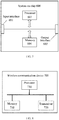
- FIG. 5 is a schematic block diagram of a terminal device 400 according to an embodiment of the present application. As shown in FIG. 5 , the terminal device 400 is applied to device to device communication.
- the terminal device 400 includes:
- an attribute of the first type carrier system include the at least one first type carrier.
- the attribute of the first type carrier system further includes at least one of PLMN information, RAT information, or geographic location information.
- the RAT information is for a LTE communication network, or for a 5G NR communication network.
- the at least one second type carrier includes a second type carrier X and a second type carrier Y
- the at least one first type carrier system includes a first type carrier system Z
- the second type carrier X and the second type carrier Y correspond to the first type carrier system Z
- the processing unit 410 is specifically configured to: transmit data on the second type carrier X and the second type carrier Y according to a transmission parameter corresponding to the first type carrier system Z.
- the processing unit 410 is further configured to determine whether it is within the coverage of the first type carrier system Z according to at least one of the PLMN information, the RAT information, or the geographic location information.
- processing unit 410 is specifically configured to:
- processing unit 410 is specifically configured to:
- the at least one second type carrier includes a second type carrier M and a second type carrier N
- the at least one first type carrier system includes a first type carrier system U and a first type carrier system V
- the second type carrier M corresponds to the first type carrier system U
- the second type carrier N corresponds to the first type carrier system V
- the processing unit 410 is specifically configured to: transmit data on the second type carrier M according to the transmission parameter corresponding to the first type carrier system U, and data on the second type carrier N according to the transmission parameter corresponding to the first type carrier system V.
- the processing unit 410 is further configured to determine, according to at least one of the PLMN information, RAT information, or geographic location information, whether it is within the coverage of the first type carrier system U, and whether it is within the coverage of the first type carrier system V.
- processing unit 410 is specifically configured to:
- processing unit 410 is specifically configured to:
- processing unit 410 is specifically configured to:
- the at least one second type carrier includes the second type carrier M
- the at least one first type carrier system includes the first type carrier system U and the first type carrier system V
- the second type carrier M corresponds to the first type carrier system U and the first type carrier system V
- the processing unit 410 is specifically configured to: transmit data on the second type carrier M according to the transmission parameter corresponding to the first type carrier system U.
- the processing unit 410 is further configured to determine, according to at least one of the PLMN information, RAT information, or geographic location information, whether it is within the coverage of the first type carrier system U and whether it is within the coverage of the first type carrier system V.
- the processing unit 410 is specifically configured to: determine that it is within the coverage of the first type carrier system U and is not within the coverage of the first type carrier system V.
- the processing unit 410 is specifically configured to: determine that it is within both the coverage of the first type carrier system U and the coverage of the first type carrier system V.
- the processing unit 410 is further configured to select the first type carrier system U according to first indication information.
- the first indication information is carried in the configuration information.
- the first indication information is configured by a network device.
- the processing unit 410 is further configured to determine the first indication information through signaling interaction between the network devices.
- the terminal device 400 further includes:
- the terminal device 400 is the access layer of the terminal device, before the processing unit 410 determines, according to the configuration information, to transmit data on the at least one second type carrier according to the transmission parameter corresponding to the at least one first type carrier system, the terminal device 400 further includes: the receiving unit 420, configured to receive the configuration information from a higher layer of the terminal device.
- the terminal device 400 further includes: the receiving unit 420, configured to receive the configuration information from the network device.
- terminal device 400 may correspond to the terminal device in the method embodiment and implement the corresponding operations implemented by the terminal device in the method embodiment, which will not be repeated herein for brevity.
- FIG. 6 is a schematic block diagram of a network device 500 according to an embodiment of the present application. As shown in FIG. 6 , the network device 500 is applied to device to device communication.
- the terminal device 500 includes:
- an attribute of the first type carrier system includes the at least one first type carrier.
- attribute of the first type carrier system further includes at least one of PLMN information, RAT information, or geographic location information.
- the RAT information is for an LTE communication network, or for a 5G NR communication network.
- the at least one second type carrier includes a second type carrier M
- the at least one first type carrier system includes a first type carrier system U and a first type carrier V
- the second type carrier M corresponds to the first type carrier system U and the first type carrier V
- the terminal device transmits data on the at least one second type carrier M according to a transmission parameter corresponding to the at least one first type carrier system U.
- the first type carrier system U is determined by the terminal device according to first indication information.
- the transmitting unit is further configured to transmit the first indication information to the terminal device.
- the first indication information is carried in the configuration information.
- the first type carrier system U corresponds to the first network device
- the first type carrier system V corresponds to the second network device
- the first network device includes a first receiving unit 520, where, the first receiving unit 520 is configured to receive first signaling transmitted by the second network device to determine the first type carrier system U.
- the first type carrier system U corresponds to the first network device
- the first type carrier system V corresponds to the second network device
- the first network device includes a first transmitting unit 530, where, the first transmitting unit 530 transmits second signaling to the second network device to determine the first type carrier system U.
- the first type carrier system U corresponds to the first network device
- the first type carrier system V corresponds to the second network device
- the first network device includes a first transmitting unit 540
- the second network device includes a second transmitting unit 550
- the first transmitting unit 540 or the second transmitting unit 550 transmits a first message to the terminal device, where the first message is used to determine the first indication information.
- the network device 500 may correspond to the network device in the method embodiment and implement the corresponding operations implemented by the network device in the method embodiment, which will not be repeated herein for brevity.
- FIG. 7 is a schematic structural diagram of a system on chip 600 according to an embodiment of the present application.
- the system on chip 600 of FIG. 7 includes an input interface 601, an output interface 602, a processor 603 and a memory 604, which may be connected by an internal communication connection line, and the processor 603 is used to execute the code in the memory 604.
- the processor 603 implements the method implemented by the terminal device in the method embodiment, which will not be repeated herein for brevity.
- the processor 603 implements the method implemented by the network device in the method embodiment, which will not be repeated herein for brevity.
- FIG. 8 illustrates a schematic block diagram of a wireless communication device 700 according to an embodiment of the present application.
- the communication device 700 includes a processor 710 and a memory 720.
- the memory 720 may store the program code, and the processor 710 may execute the program code stored in the memory 720.
- the wireless communication device 700 may include a transceiver 730, and the processor 710 may control external communication of the transceiver 730.
- the processor 710 may call the program code stored in the memory 720 to perform corresponding operations of the terminal device in the method embodiment, which will not be repeated herein for brevity.
- the processor 710 may call the program code stored in the memory 720 to perform corresponding operations of the network device in the method embodiment, which will not be repeated herein for brevity.
- the processor of the embodiment of the present application may be an integrated circuit chip with the signal processing capability.
- each step of the above method embodiment may be completed by an integrated logic circuit of hardware in a processor or by an instruction in software form.
- the above processor may be a general processor, a digital signal processor (DSP), an application specific integrated circuit (ASIC), a field programmable gate array (FPGA) or other programmable logic devices, a discrete gate or a transistor logic device, a discrete hardware component, etc.
- DSP digital signal processor
- ASIC application specific integrated circuit
- FPGA field programmable gate array
- Each method, step and logic block diagram disclosed in the embodiment of the present application can be implemented or performed.
- the general processor may be a microprocessor, or any conventional processor or the like.
- Steps of the method disclosed with reference to the embodiment of the present application may be directly embodied as being performed and completed by a hardware decoding processor, or may be performed and completed by a combination of hardware and software modules in the decoding processor.
- the software module can be located in a mature storage medium in the art such as a random access memory, a flash memory, a read only memory, a programmable read only memory or an electrically erasable programmable memory, a registers.
- the storage medium is located in the memory, and the processor reads information in the memory and completes steps of the above method by combining its hardware.
- the memory in the embodiment of the present application may be a volatile memory or a non-volatile memory, or may include both the volatile memory and the non-volatile memory.
- the non-volatile memory may be a read-only memory (ROM), a programmable read only memory (PROM), an erasable PROM (EPROM), or an electrically EPROM (EEPROM) or a flash memory.
- the volatile memory may be a random access memory (RAM) that acts as an external cache.
- RAM direct Rambus RAM
- SRAM static random access memory
- DRAM dynamic random access memory
- SDRAM synchronous DRAM
- DDR SDRAM double data rate SDRAM
- ESDRAM enhanced synchronous dynamic random access memory
- SLDRAM Synchlink DRAM
- DR RAM direct Rambus RAM
- the units described as separate components may be or may not be physically separated, and the components displayed as units may be or may not be physical units, that is, they may be located in one place, or may be distributed onto multiple network units. Some or all of the units may be selected according to actual needs for the purpose of the solution of the present embodiment.
- each functional unit in each embodiment of the present application may be integrated into one processing unit, or each unit may physically exist, or two or more units may be integrated into one unit.
- the functions may be stored in a computer readable storage medium if implemented in the form of a software functional unit, and sold or used as a standalone product.
- the technical solution of the present application in essence, or the part contributing to the existing technology or the part of the technical solution can be embodied in the form of a software product, which is stored in a storage medium and includes instructions for enabling a computer device (which may be a personal computer, a server, or a network device, etc.) to perform all or part of the steps described in methods in each embodiment of the present application.
- the above storage medium includes various media that can store program code, such as a U disk, a mobile hard disk, a read-only memory (ROM), a random access memory (RAM), a magnetic disk, or an optical disk.
Landscapes
- Engineering & Computer Science (AREA)
- Computer Networks & Wireless Communication (AREA)
- Signal Processing (AREA)
- Quality & Reliability (AREA)
- Mobile Radio Communication Systems (AREA)
Abstract
Description
- The present application claims priority to the International Application No.
PCT/CN2017/119589, filed on December 28, 2017 - The present application relates to the field of communications, and more particularly, to a wireless communication method, a terminal device and a network device.
- In Release 14, a terminal device (for example, a vehicle terminal) can perform data transmission with the network device through the Uu carrier on the uplink (Uplink) and data transmission with other terminal through the PC5 carrier on the sidelink (Sidelink). However, at present, the terminal device transmit data on the Uu carrier and the PC5 carrier respectively according to independent transmission parameters, so the transmission parameters for the Uu carrier and the PC5 carrier are required to be configured respectively. As a result, a waste of resources is caused, and there is a lot of signaling overhead, which cannot meet data transmission requirements for Release 15 and subsequent releases.
- The present application provides a wireless communication method, a terminal device and a network device. The terminal device may transmit data on the PC5 carrier according to a transmission parameter corresponding to the Uu system, thereby saving resource and reducing signaling overhead.
- In a first aspect, the present application provides a wireless communication method, terminal device and network device, the method includes:
- determining, by a terminal device, according to configuration information, to transmit data on at least one second type carrier according to a transmission parameter corresponding to at least one first type carrier system, where
- the configuration information indicates a correspondence between the at least one second type carrier and the at least one first type carrier system, the first type carrier is configured to transmit the transmission parameter over downlink, and the second type carrier is configured to transmit data over sidelink.
- Therefore, in the wireless communication method in the embodiment of the present application, the terminal device determines, according to the configuration information that indicates the correspondence between the at least one second type carrier and the at least one first type carrier system, to transmit data on the at least one second type carrier according to the transmission parameter corresponding to the at least one first type carrier system, thereby saving resources and reducing signaling overhead.
- Optionally, in an implementation form of the first aspect, an attribute of the first type carrier system includes the at least one first type carrier.
- Optionally, in an implementation form of the first aspect, the attribute of the first type carrier system further includes at least one of public land mobile network (PLMN) information, radio access technology (RAT) information, or geographic location information.
- Optionally, in an implementation form of the first aspect, the RAT information is for a long term evolution (LTE) communication network, or for a fifth generation new radio (5G NR) communication network.
- Optionally, in an implementation form of the first aspect, the at least one second type carrier includes a second type carrier X and a second type carrier Y, the at least one first type carrier system includes a first type carrier system Z, and the second type carrier X and the second type carrier Y correspond to the first type carrier system Z;
the determining, by a terminal device, according to configuration information, to transmit data on at least one second type carrier according to a transmission parameter corresponding to at least one first type carrier system, includes:
transmitting, by the terminal device, data on the second type carrier X and the second type carrier Y according to a transmission parameter corresponding to the first type carrier system Z. - Optionally, in an implementation form of the first aspect, the method further includes:
determining, by the terminal device, whether it is within the coverage of the first type carrier system Z according to at least one of PLMN information, RAT information, or geographic location information. - Optionally, in an implementation form of the first aspect, the transmitting, by the terminal device, data on the second type carrier X and the second type carrier Y according to a transmission parameter corresponding to the first type carrier system Z, includes:
- determining, by the terminal device, that it is within the coverage of the first type carrier system Z;
- transmitting, by the terminal device, data on the second type carrier X and the second type carrier Y according to the transmission parameter corresponding to the first type carrier system Z.
- Optionally, in an implementation form of the first aspect, the transmitting, by the terminal device, data on the second type carrier X and the second type carrier Y according to a transmission parameter corresponding to the first type carrier system Z, includes:
- determining, by the terminal device, that it is not within the coverage of the first type carrier system Z;
- transmitting, by the terminal device, data on the second type carrier X and the second type carrier Y according to a pre-configured transmission parameter for the second type carrier; or, transmitting, by the terminal device, data on the second type carrier X according to a pre-configured transmission parameter for the second type carrier X and on the second type carrier Y according to a pre-configured transmission parameter for the second type carrier Y.
- Optionally, in an implementation form of the first aspect, the at least one second type carrier includes a second type carrier M and a second type carrier N, and the at least one first type carrier system includes a first type carrier system U and a first type carrier system V, the second type carrier M corresponds to the first type carrier system U, and the second type carrier N corresponds to the first type carrier system V;
the determining, by a terminal device, according to configuration information, to transmit data on at least one second type carrier according to a transmission parameter corresponding to at least one first type carrier system, includes:
transmitting, by the terminal device, data on the second type carrier M according to a transmission parameter corresponding to the first type carrier system U, and data on the second type carrier N according to a transmission parameter corresponding to the first type carrier system V. - Optionally, in an implementation form of the first aspect, the method further includes:
determining, by the terminal device, according to at least one of PLMN information, RAT information, or geographic location information, whether it is within coverage of the first type carrier system U, and whether it is within the coverage of the first type carrier system V. - Optionally, in an implementation form of the first aspect, transmitting, by the terminal device, data on the second type carrier M according to a transmission parameter corresponding to the first type carrier system U, and transmitting data on the second type carrier N according to a transmission parameter corresponding to the first type carrier system V, includes:
- determining, by the terminal device, that it is within the coverage of the first type carrier system U, and is not within the coverage of the first type carrier system V;
- transmitting, by the terminal device, data on the second type carrier M according to the transmission parameter corresponding to the first type carrier system U and on the second type carrier N according to a pre-configured transmission parameter for the second type carrier; or, transmitting, by the terminal device, data on the second type carrier N according to a pre-configured transmission parameter for the second type carrier N.
- Optionally, in an implementation form of the first aspect, the transmitting, by the terminal device, data on the second type carrier M according to a transmission parameter corresponding to the first type carrier system U and on the second type carrier N according to a transmission parameter corresponding to the first type carrier system V, includes:
- determining, by the terminal device, that it is neither within the coverage of the first type carrier system U, nor within the coverage of the first type carrier system V;
- transmitting, by the terminal device, data on the second type carrier M and on the second type carrier N according to a pre-configured transmission parameter for the second type carrier; or, transmitting, by the terminal device, data on the second type carrier M according to a pre-configured transmission parameter for the second type carrier M and data on the second type carrier N according to a pre-configured transmission parameter for the second type carrier N.
- Optionally, in an implementation form of the first aspect, the transmitting, by the terminal device, data on the second type carrier M according to a transmission parameter corresponding to the first type carrier system U and data on the second type carrier N according to a transmission parameter corresponding to the first type carrier system V, includes:
- determining, by the terminal device, that it is within both the coverage of the first type carrier system U and the coverage of the first type carrier system V;
- transmitting, by the terminal device, data on the second type carrier M according to the transmission parameter corresponding to the first type carrier system U and on the second type carrier N according to the transmission parameter corresponding to the first type carrier system V.
- Optionally, in an implementation form of the first aspect, the at least one second type carrier includes a second type carrier M, the at least one first type carrier system includes a first type carrier system U and a first type carrier system V, and the second type carrier M corresponds to the first type carrier system U and the first type carrier system V;
the determining, by a terminal device, according to configuration information, to transmit data on at least one second type carrier according to a transmission parameter corresponding to at least one first type carrier system, includes:
transmitting, by the terminal device, data on the second type carrier M according to a transmission parameter corresponding to the first type carrier system U. - Optionally, in an implementation form of the first aspect, the method further includes:
determining, by the terminal device, according to at least one of PLMN information, RAT information, or geographic location information, whether it is within coverage of the first type carrier system U and whether it is within coverage of the first type carrier system V. - Optionally, in an implementation form of the first aspect, the transmitting, by the terminal device, data on the second type carrier M according to a transmission parameter corresponding to the first type carrier system U, includes:
determining, by the terminal device, that it is within coverage of the first type carrier system U and is not within coverage of the first type carrier system V. - Optionally, in an implementation form of the first aspect, the transmitting, by the terminal device, data on the second type carrier M according to a transmission parameter corresponding to the first type carrier system U, includes:
determining, by the terminal device, that it is within both coverage of the first type carrier system U and coverage of the first type carrier system V. - Optionally, in an implementation form of the first aspect, the method further includes:
selecting, by the terminal device, the first type carrier system U according to first indication information. - Optionally, in an implementation form of the first aspect, the first indication information is carried in the configuration information.
- Optionally, in an implementation form of the first aspect, the first indication information is configured by a network device.
- Optionally, in an implementation form of the first aspect, the method further includes:
if the first type carrier system U and the first type carrier system V belonging to different network devices, determining, by the terminal device, the first indication information through signaling interaction between the network devices. - Optionally, in an implementation form of the first aspect, the first type carrier system U corresponds to a first network device, and the first type carrier system V corresponds to a second network device,
the determining, by the terminal device, the first indication information according to signaling interaction between the network devices, includes: - receiving, by the terminal device, a first message sent by the first network device or the second network device, and the first message is configured to determine the first indication information, where the first message is determined through signaling interaction between the first network device and the second network device;
- determining, by the terminal device, the first indication information according to the first message.
- Optionally, in an implementation form of the first aspect, the terminal device is an access layer of the terminal device, and before determining, by the terminal device, according to the configuration information, to transmit data on the at least one second type carrier according to the transmission parameter corresponding to the at least one first type carrier system, the method further includes:
receiving, by the access layer of the terminal device, the configuration information from a higher layer of the terminal device. - Optionally, in an implementation form of the first aspect, before determining, by the terminal device, according to the configuration information, to transmit data on the at least one second type carrier according to the transmission parameter corresponding to the at least one first type carrier system, the method further includes:
receiving, by the terminal device, the configuration information from the network device. - In a second aspect, the present application provides a wireless communication method that is applied to device to device communication, where the method includes:
- transmitting, by the network device, configuration information to a terminal device, to enable the terminal device to determine, according to the configuration information, to transmit data on at least one second type carrier according to a transmission parameter corresponding to at least one first type carrier system, where,
- the configuration information indicates a correspondence between the at least one second type carrier and the at least one first type carrier system, the first type carrier is configured to transmit the transmission parameter over downlink, and the second type carrier is configured to transmit data over sidelink.
- Therefore, in the wireless communication method in the embodiment of the present application, the network device configures the configuration information that indicates the correspondence between the at least one second type carrier and the at least one first type carrier system, so that the terminal device may determine to transmit data on the at least one second type carrier according to the transmission parameter corresponding to the at least one first type carrier system, thereby saving resources and reducing signaling overhead.
- Optionally, in an implementation form of the second aspect, an attribute of the first type carrier system includes the at least one first type carrier.
- Optionally, in an implementation form of the second aspect, the attribute of the first type carrier system further includes at least one of PLMN information, RAT information, or geographic location information.
- Optionally, in an implementation form of the second aspect, the RAT information is for an LTE communication network, or for a 5G NR communication network.
- Optionally, in an implementation form of the second aspect, the at least one second type carrier includes a second type carrier M, the at least one first type carrier system includes a first type carrier system U and a first type carrier V, and the second type carrier M corresponds to the first type carrier system U and the first type carrier V, where the terminal device transmits data on the at least one second type carrier M according to a transmission parameter corresponding to the at least one first type carrier system U.
- Optionally, in an implementation form of the second aspect, the first type carrier system U is determined by the terminal device according to first indication information.
- Optionally, in an implementation form of the second aspect, the method further includes:
transmitting, by the network device, the first indication information to the terminal device. - Optionally, in an implementation form of the second aspect, the first indication information is carried in the configuration information.
- Optionally, in an implementation form of the second aspect, the first type carrier system U corresponds to the first network device, and the first type carrier system V corresponds to the second network device, and the method further includes:
receiving, by the first network device, first signaling transmitted by the second network device to determine the first type carrier system U. - Optionally, in an implementation form of the second aspect, the first type carrier system U corresponds to the first network device, and the first type carrier system V corresponds to the second network device, and the method further includes:
transmitting, by the first network device, to the second network device, second signaling for determining the first type carrier system U. - Optionally, in an implementation form of the second aspect, the first type carrier system U corresponds to the first network device, and the first type carrier system V corresponds to the second network device, and the method further includes:
transmitting, by the first network device or the second network device, a first message to the terminal device, where the first message is configured to determine the first indication information. - In a third aspect, a terminal device is provided to execute the method according to both the first aspect and various implementation forms of the first aspect.
- Specifically, the terminal device includes a functional module for executing the method according to the first aspect or the method according to implementation forms of the first aspect.
- In a fourth aspect, a network device is provided to execute the method according to both the second aspect and various implementation forms of the second aspect.
- Specifically, the network device includes a functional module for executing the method according to the second aspect or the method according to various implementation forms of the second aspect.
- In a fifth aspect, a terminal device is provided, including a processor and a memory. The memory is used to store a computer program, and the processor is used to call and run the computer program stored in the memory, so as to execute the method according to the first aspect or the method according to various implementation forms of the first aspect.
- In a sixth aspect, a network device is provided, including a processor and a memory. The memory is used to store a computer program, and the processor is used to call and run the computer program stored in the memory, so as to execute the method according to the second aspect or the method according to various implementation forms of the second aspect.
- In a seventh aspect, a chip is provided to implement the method according to any one of the first aspect to the second aspect or the method according to various implementation forms thereof of any one of the first aspect to the second aspect.
- Specifically, the chip includes a processor for calling and running a computer program from a memory, so that a device installed with the chip executes the method according to any one of the first aspect to the second aspect or the method according to various implementation forms of any one of the first aspect to the second aspect.
- In an eighth aspect, a computer-readable storage medium is provided for storing a computer program that causes a computer to execute the method in any one of the first aspect to the second aspect described above or the method according to various implementation forms of any one of the first aspect to the second aspect.
- In a ninth aspect, a computer program product is provided, including computer program instructions that cause a computer to execute the method according to any one of the first aspect to the second aspect described above or the method according to various implementation forms of any one of the first aspect to the second aspect.
- In a tenth aspect, a computer program is provided that, when run on a computer, causes a computer to execute the method according to any one of the first aspect to the second aspect described above or the method according to various implementation forms of any one of the first aspect to the second aspect.
-
-
FIG. 1 is a schematic diagram of an application scenario according to an embodiment of the present application. -
FIG. 2 is a schematic diagram of another application scenario according to an embodiment of the present application. -
FIG. 3 is a schematic flowchart of a wireless communication method according to an embodiment of the present application. -
FIG. 4 is a schematic flowchart of a wireless communication method according to another embodiment of the present application. -
FIG. 5 is a schematic block diagram of a terminal device according to an embodiment of the present application. -
FIG. 6 is a schematic block diagram of a network device according to an embodiment of the present application. -
FIG. 7 is a schematic structural diagram of a system on chip according to an embodiment of the present application. -
FIG. 8 illustrates a schematic block diagram of a wireless communication device according to an embodiment of the present application. - A clear and complete description of the technical solution in an embodiment of the present application will be provided below in conjunction with the accompanying drawings.
- It should be understood that the technical solution of the embodiments of the present application may be applied to a device to device (D2D) communication system, for example, an internet of vehicle system for D2D communication based on long term evolution (LTE). Different from the traditional LTE system, in which communication data between terminals is received or transmitted through the network device (for example, a base station), the internet of vehicle system adopts a device to device direct communication mode, so it has higher spectrum efficiency and lower transmission delay.
- Optionally, the internet of vehicle system on which the communication system is based may be a global system of mobile communication (GSM) system, a code division multiple access (CDMA) system, a wideband code division multiple access (WCDMA) system, a general packet radio service (GPRS), an LTE system, an LTE frequency division duplex (FDD) system, an LTE time division duplex (TDD), a universal mobile telecommunication system (UMTS), a worldwide interoperability for microwave access (WiMAX) communication system, 5G new radio (NR) system, etc.
- The terminal device in the embodiment of the present application may be a terminal device capable of implementing the D2D communication. For example, the terminal device may be an in-vehicle terminal device, a terminal device in a 5G network, or a terminal device in a public land mobile network (PLMN), which are not limited in embodiments of the present application.
-
FIG 1 and FIG. 2 are schematic diagrams of application scenarios according to the embodiment of the present application.FIG. 1 exemplarily shows one network device and two terminal devices. Optionally, the wireless communication system in the embodiment of the present application may include multiple network devices and the coverage of each network device may include other numbers of terminal devices, which are not limited in the embodiments of the present application. - Optionally, the wireless communication system may further include other network entities, such as a mobile management entity (MME), a serving gateway (S-GW), a packet data network gateway (P-GW); or, the wireless communication system may further include other network entities such as a session management function (SMF), a unified data management (UDM), a authentication server function (AUSF), which are not limited in the embodiments of the present application.
- Specifically, the
terminal device 20 and theterminal device 30 can communicate through a D2D communication mode. During the D2D communication, theterminal device 20 and theterminal device 30 directly communicate through a D2D link, that is, a sidelink (SL). For example, as shown inFIG. 1 or FIG. 2 , theterminal device 20 and theterminal device 30 directly communicate through a sidelink. InFIG. 1 , theterminal device 20 and theterminal device 30 communicate through a sidelink, and the transmission resources thereof are allocated by the network device; InFIG. 2 , theterminal device 20 and theterminal device 30 communicate through a sidelink, and the transmission resources are independently selected by the terminal device, and no network device is required to allocate transmission resources. - D2D communication can refer to the Vehicle to Vehicle (V2V) communication or the Vehicle to Everything (V2X) communication. In the V2X communication, X can refer to any device with wireless reception and transmission capabilities, for example, but not limited to, slow-moving wireless devices, fast-moving vehicle-mounted devices, or network control nodes with wireless reception and transmission capabilities. It should be understood that the embodiments of the present invention are mainly applied to the scenario of V2X communication, but can also be applied to any other D2D communication scenario, which are not limited in the embodiments of the present application.
- In the internet of vehicle system, there can be two types of terminal devices, namely, the terminal device with an interception capability, such as Vehicle User Equipment (VUE) or Pedestrian User Equipment (PUE), and the terminal device without the interception capability, such as PUE. VUE has higher processing power and is usually powered by batteries in the vehicle, while PUE has low processing power, and the reduction of power consumption is also a major factor to be considered in PUE. Therefore, in the existing internet of vehicle system, VUE is considered to have complete receiving and interception capabilities, while PUE is considered to have partial or no receiving and interception capabilities. If PUE has partial interception capability, its resources can be selected using a similar interception method as VUE, so as to select available resources on the part of resources that can be intercepted. If PUE does not have the interception capability, it randomly selects transmission resources in the resource pool.
- In addition, various aspects or features of the present application may be implemented as methods, devices or article of manufacture using standard programming and/or engineering techniques. The term "article of manufacture" as used in the present application covers computer programs accessible from any computer-readable device, carrier or medium. For example, computer readable medium can include, but are not limited to: magnetic storage devices (for example, hard disks, floppy disks, or magnetic tapes, etc.), optical disks (for example, Compact Discs (CDs), Digital Versatile Discs (DVDs) etc.), smart cards and flash memory devices (for example, Erasable Programmable Read-Only Memory (EPROM), cards, sticks or key drives, etc.). In addition, the various storage media described herein may represent one or more devices and/or other machine-readable media used to store information. The term "machine-readable medium" may include, but is not limited to, various media capable of storing, containing, and/or carrying the instruction and/or data.
- It should be understood that terms "system" and "network" are used interchangeably herein. The term "and/or" is only used to describe an association relationship of associated objects, indicating that there can be three kinds of relationships: A exists alone, A and B exist simultaneously, and B exists alone. In addition, the character "/" used herein generally indicates that the associated objects are of an "or" relationship.
-
FIG. 3 is a schematic flowchart of awireless communication method 200 according to an embodiment of the present application. As shown inFIG. 3 , themethod 200 is applied to device to device communication. Themethod 200 can be executed by a terminal device, which can be the terminal device shown inFIG. 1 or FIG. 2 . Themethod 200 includes the following. - 210, the terminal device determines, according to configuration information, to transmit data on at least one second type carrier according to a transmission parameter corresponding to at least one first type carrier system, where,
the configuration information indicates a correspondence between the at least one second type carrier and the at least one first type carrier system, the first type carrier is configured to transmit the transmission parameter over downlink, and the second type carrier is configured to transmit data over sidelink. - Optionally, the first type carrier may be a Uu carrier, and the second type carrier may be a PC5 carrier.
- Optionally, the transmission parameter may be a time-frequency resource parameter, an air interface parameter, or a beam parameter, which is not limited in the embodiment of the present application.
- Optionally, an attribute of the first type carrier system includes the at least one first type carrier.
- For example, Uu carrier 1 and Uu carrier 2 both belong to Uu carrier system a.
- Optionally, the attribute of the first type carrier system further includes at least one of PLMN information, RAT information, or geographic location information.
- For example, the PLMN information corresponding to the Uu carrier system a is a mobile network, and the PLMN information corresponding to the Uu carrier system b is a Unicom network.
- Optionally, the RAT information is RAT information for a LTE communication network, or RAT information for a 5G NR communication network.
- Optionally, terminal devices at different geographic locations correspond to different Uu carrier systems.
- For example, the terminal device in China corresponds to the Uu carrier system a, while the terminal device in the United States corresponds to the Uu carrier system b.
- Optionally, the at least one second type carrier includes a second type carrier X and a second type carrier Y, the at least one first type carrier system includes a first type carrier system Z, and the second type carrier X and the second type carrier Y correspond to the first type carrier system Z; the terminal device transmits data on the second type carrier X and the second type carrier Y according to a transmission parameter corresponding to the first type carrier system Z.
- Optionally, the terminal device determines whether it is within the coverage of the first type carrier system Z according to at least one of the PLMN information, RAT information, or geographic location information.
- Specifically, if the terminal device determines that it is within the coverage of the first type carrier system Z, the terminal device transmits data on the second type carrier X and the second type carrier Y according to the transmission parameter corresponding to the first type carrier system Z.
- Specifically, if the terminal device determines that it is not within the coverage of the first type carrier system Z, the terminal device transmits data on the second type carrier X and the second type carrier Y according to a pre-configured transmission parameter for the second type carrier; or, the terminal device transmits data on the second type carrier X according to a pre-configured transmission parameter for the second type carrier X and on the second type carrier Y according to a pre-configured transmission parameter for the second type carrier Y.
- That is, the transmission parameter can be pre-configured for all second type carriers or for a specific second type carrier.
- Optionally, the at least one second type carrier includes a second type carrier M and a second type carrier N, and the at least one first type carrier system includes a first type carrier system U and a first type carrier system V, the second type carrier M corresponds to the first type carrier system U, and the second type carrier N corresponds to the first type carrier system V; the terminal device transmits data on the second type carrier M according to a transmission parameter corresponding to the first type carrier system U, and on the second type carrier N according to the transmission parameter corresponding to the first type carrier system V.
- Optionally, the terminal device determines, according to at least one of PLMN information, RAT information, or geographic location information, whether it is within the coverage of the first type carrier system U, and whether it is within the coverage of the first type carrier system V.
- Optionally, the terminal device determines that it is within the coverage of the first type carrier system U, and is not within the coverage of the first type carrier system V;
the terminal device transmits data on the second type carrier M according to the transmission parameter corresponding to the first type carrier system U and transmit data on the second type carrier N according to a pre-configured transmission parameter for the second type carrier; or, the terminal device transmits data on the second type carrier N according to a pre-configured transmission parameter for the second type carrier N. - That is, the transmission parameter can be preconfigured for all second type carriers or for a specific second type carrier.
- Optionally, the terminal device determines that it is neither within the coverage of the first type carrier system U, nor within the coverage of the first type carrier system V;
the terminal device transmits data on the second type carrier M and on the second type carrier N according to a pre-configured transmission parameter for the second type carrier; or, the terminal device transmits data on both the second type carrier M according to a pre-configured transmission parameter for the second type carrier M and data on the second type carrier N according to a pre-configured transmission parameter for the second type carrier N. - The terminal device determines that it is within both the coverage of the first type carrier system U and the coverage of the first type carrier system V;
The terminal device transmits data on the second type carrier M according to the transmission parameter corresponding to the first type carrier system U and on the second type carrier N according to the transmission parameter corresponding to the first type carrier system V. - Optionally, in the embodiment of the present application, the at least one second type carrier includes the second type carrier M, the at least one first type carrier system includes the first type carrier system U and the first type carrier system V, and the second type carrier M corresponds to the first type carrier system U and the first type carrier system V. At this point, the terminal device transmits on the second type carrier M according to the transmission parameter corresponding to the first type carrier system U.
- Further, the terminal device determines, according to at least one of the PLMN information, the RAT information, or the geographic location information, whether it is within the coverage of the first type carrier system U and whether it is within the coverage of the first type carrier system V.
- Optionally, the terminal device determines that it is within the coverage of the first type carrier system U and is not within the coverage of the first type carrier system V.
- Optionally, the terminal device determines that it is within both the coverage of the first type carrier system U and the coverage of the first type carrier system V.
- Optionally, the terminal device selects the first type carrier system U according to first indication information.
- For example, the first indication information is carried in the configuration information.
- As another example, the first indication information is configured by a network device.
- For another example, if the first type carrier system U and the first type carrier system V belong to different network devices, the terminal device determines the first indication information according to signaling interaction between network devices.
- Specifically, as an example,
the first type carrier system U corresponds to a first network device, and the first type carrier system V corresponds to a second network device,
the terminal device receives a first message sent by the first network device or the second network device, and the first message is configured to determine the first indication information, where the first message is determined through signaling interaction between the first network device and the second network device;
the terminal device determines the first indication information according to the first message. - It should be noted that the signaling for interactions between network devices is different from the first message.
- Optionally, the access layer of the terminal device receives the configuration information from a higher layer of the terminal device.
- Optionally, the configuration information may be pre-configured or may be dynamically configured at a higher layer of the terminal device.
- Optionally, the terminal device receives the configuration information from the network device.
- Therefore, in the wireless communication method in the embodiment of the present application, the terminal device, according to the configuration information indicating the correspondence between the at least one second type carrier and at least one first type carrier system, transmits data on the at least one second type carrier according to the transmission parameter corresponding to the at least one first type carrier system, thereby saving resources and reducing signaling overhead.
-
FIG. 4 is a schematic flowchart of awireless communication method 300 according to an embodiment of the present application. As shown inFIG. 4 , themethod 300 is applied to device to device communication. Themethod 300 can be executed by a network device, which can be the network device shown inFIG. 1 . Themethod 300 includes the following: - 310, the network device transmits configuration information to a terminal device to enable the terminal device to determine, according to the configuration information, to transmit data on at least one second type carrier according to a transmission parameter corresponding to at least one first type carrier system, where,
the configuration information indicates a correspondence between the at least one second type carrier and the at least one first type carrier system, the first type carrier is configured to transmit the transmission parameter over downlink, and the second type carrier is configured to transmit data over sidelink. - Optionally, the first type carrier may be a Uu carrier, and the second type carrier may be a PC5 carrier.
- Optionally, the transmission parameter may be a time-frequency resource parameter, an air interface parameter, or a beam parameter, which is not limited in the embodiment of the present application.
- Optionally, an attribute of the first type carrier system includes the at least one first type carrier.
- Optionally, the attribute of the first type carrier system further includes at least one of PLMN information, RAT information, or geographic location information.
- Optionally, the RAT information is for a LTE communication network, or for a 5G NR communication network.
- Optionally, in the embodiment of the present application, the at least one second type carrier includes a second type carrier M, the at least one first type carrier system includes a first type carrier system U and a first type carrier system V, and the second type carrier M corresponds to the first type carrier system U and the first type carrier system V, where the terminal device transmits data on the second type carrier M according to a transmission parameter corresponding to the first type carrier system U.
- Optionally, the first type carrier system U is determined by the terminal device according to first indication information.
- Optionally, the first indication information is transmitted by the network device.
- For example, the network device transmits the first indication information to the terminal device.
- Optionally, the first indication information is carried in the configuration information.
- Optionally, the first type carrier system U corresponds to a first network device, the first type carrier system V corresponds to a second network device, and the network device receives a first signaling that is transmitted by the second network device and is configured to determine the first type carrier system U.
- It should be noted that this process can be understood as: the second network device actively negotiates with the first network device to determine the first type carrier system U.
- Optionally, the first type carrier system U corresponds to the first network device, the first type carrier system V corresponds to the second network device, and the first network device transmits, to the second network device, the second signaling for determining the first type carrier system U.
- It should be noted that this process can be understood as: the first network device actively negotiates with the second network device to determine the first type carrier system U.
- Optionally, the first type carrier system U corresponds to the first network device, the first type carrier system V corresponds to the second network device, the first network device or the second network device transmits the first message to the terminal device, and the first message is configured to determine the first indication information.
- Therefore, in the wireless communication method in the embodiment of the present application, the network device configures the configuration information indicating the correspondence between the at least one second type carrier and at least one first type carrier system, so that the terminal device may transmit data on the at least one second type carrier according to the transmission parameter corresponding to the at least one first type carrier system, thereby saving resources and reducing signaling overhead.
-
FIG. 5 is a schematic block diagram of aterminal device 400 according to an embodiment of the present application. As shown inFIG. 5 , theterminal device 400 is applied to device to device communication. Theterminal device 400 includes: - a
processing unit 410, configured to determine, according to configuration information, to transmit data on at least one second type carrier according to a transmission parameter corresponding to at least one first type carrier system, where, - the configuration information indicates a correspondence between the at least one second type carrier and the at least one first type carrier system, the first type carrier is configured to transmit the transmission parameter over downlink, and the second type carrier is configured to transmit data over sidelink.
- Optionally, an attribute of the first type carrier system include the at least one first type carrier.
- Optionally, the attribute of the first type carrier system further includes at least one of PLMN information, RAT information, or geographic location information.
- Optionally, the RAT information is for a LTE communication network, or for a 5G NR communication network.
- Optionally, the at least one second type carrier includes a second type carrier X and a second type carrier Y, the at least one first type carrier system includes a first type carrier system Z, and the second type carrier X and the second type carrier Y correspond to the first type carrier system Z;
theprocessing unit 410 is specifically configured to:
transmit data on the second type carrier X and the second type carrier Y according to a transmission parameter corresponding to the first type carrier system Z. - Optionally, the
processing unit 410 is further configured to determine whether it is within the coverage of the first type carrier system Z according to at least one of the PLMN information, the RAT information, or the geographic location information. - Optionally, the
processing unit 410 is specifically configured to: - determine that it is within the coverage of the first type carrier system Z;
- transmit data on the second type carrier X and the second type carrier Y according to the transmission parameter corresponding to the first type carrier system Z.
- Optionally, the
processing unit 410 is specifically configured to: - determine that it is not within the coverage of the first type carrier system Z;
- transmit data on the second type carrier X and the second type carrier Y according to a pre-configured transmission parameter for the second type carrier; or, transmit data on the second type carrier X according to a pre-configured transmission parameter for the second type carrier X and transmit data on the second type carrier Y according to a pre-configured transmission parameter for the second type carrier Y.
- Optionally, the at least one second type carrier includes a second type carrier M and a second type carrier N, and the at least one first type carrier system includes a first type carrier system U and a first type carrier system V. The second type carrier M corresponds to the first type carrier system U, and the second type carrier N corresponds to the first type carrier system V;
theprocessing unit 410 is specifically configured to:
transmit data on the second type carrier M according to the transmission parameter corresponding to the first type carrier system U, and data on the second type carrier N according to the transmission parameter corresponding to the first type carrier system V. - Optionally, the
processing unit 410 is further configured to determine, according to at least one of the PLMN information, RAT information, or geographic location information, whether it is within the coverage of the first type carrier system U, and whether it is within the coverage of the first type carrier system V. - Optionally, the
processing unit 410 is specifically configured to: - determine that it is within the coverage of the first type carrier system U, and is not within the coverage of the first type carrier system V;
- transmit data on the second type carrier M according to the transmission parameter corresponding to the first type carrier system U and transmit data on the second type carrier N according to a pre-configured transmission parameter for the second type carrier; or, transmit data on the second type carrier N according to a pre-configured transmission parameter for the second type carrier N.
- Optionally, the
processing unit 410 is specifically configured to: - determine that it is neither within the coverage of the first type carrier system U, nor within the coverage of the first type carrier system V;
- transmit data on the second type carrier M and on the second type carrier N according to a pre-configured transmission parameter for the second type carrier; or, transmit data on the second type carrier M according to a pre-configured transmission parameter for the second type carrier M and data on the second type carrier N according to a pre-configured transmission parameter for the second type carrier N.
- Optionally, the
processing unit 410 is specifically configured to: - determines that it is within both the coverage of the first type carrier system U and the coverage of the first type carrier system V;
- transmit data on both the second type carrier M according to the transmission parameter corresponding to the first type carrier system U and the second type carrier N according to the transmission parameter corresponding to the first type carrier system V.
- Optionally, the at least one second type carrier includes the second type carrier M, the at least one first type carrier system includes the first type carrier system U and the first type carrier system V, and the second type carrier M corresponds to the first type carrier system U and the first type carrier system V;
theprocessing unit 410 is specifically configured to:
transmit data on the second type carrier M according to the transmission parameter corresponding to the first type carrier system U. - Optionally, the
processing unit 410 is further configured to determine, according to at least one of the PLMN information, RAT information, or geographic location information, whether it is within the coverage of the first type carrier system U and whether it is within the coverage of the first type carrier system V. - Optionally, the
processing unit 410 is specifically configured to:
determine that it is within the coverage of the first type carrier system U and is not within the coverage of the first type carrier system V. - Optionally, the
processing unit 410 is specifically configured to:
determine that it is within both the coverage of the first type carrier system U and the coverage of the first type carrier system V. - Optionally, the
processing unit 410 is further configured to select the first type carrier system U according to first indication information. - Optionally, the first indication information is carried in the configuration information.
- Optionally, the first indication information is configured by a network device.
- Optionally, if the first type carrier system U and the first type carrier system V belong to different network devices, the
processing unit 410 is further configured to determine the first indication information through signaling interaction between the network devices. - Optionally, the first type carrier system U corresponds to the first network device, the first type carrier system V corresponds to the second network device, and the
terminal device 400 further includes: - a receiving unit 420, configured to receive a first message sent by the first network device or the second network device, and the first message is configured to determine the first indication information, where the first message is determined through signaling interaction between the first network device and the second network device;
- the
processing unit 410 is further configured to determine the first indication information according to the first message. - Optionally, the
terminal device 400 is the access layer of the terminal device, before theprocessing unit 410 determines, according to the configuration information, to transmit data on the at least one second type carrier according to the transmission parameter corresponding to the at least one first type carrier system, theterminal device 400 further includes:
the receiving unit 420, configured to receive the configuration information from a higher layer of the terminal device. - Optionally, before the
processing unit 410 determines, according to the configuration information, determining to transmit data on the at least one second type carrier according to the transmission parameter corresponding to the at least one first type carrier system, theterminal device 400 further includes:
the receiving unit 420, configured to receive the configuration information from the network device. - It should be understood that the
terminal device 400 may correspond to the terminal device in the method embodiment and implement the corresponding operations implemented by the terminal device in the method embodiment, which will not be repeated herein for brevity. -
FIG. 6 is a schematic block diagram of anetwork device 500 according to an embodiment of the present application. As shown inFIG. 6 , thenetwork device 500 is applied to device to device communication. Theterminal device 500 includes: - a transmitting
unit 510, configured to transmit configuration to the terminal device to enable the terminal device determines, according to the configuration information, to transmit data on at least one second type carrier according to a transmission parameter corresponding to at least one first type carrier system, where, - the configuration information indicates a correspondence between the at least one second type carrier and the at least one first type carrier system, the first type carrier is configured to transmit the transmission parameter over downlink, and the second type carrier is configured to transmit data over sidelink.
- Optionally, an attribute of the first type carrier system includes the at least one first type carrier.
- Optionally, attribute of the first type carrier system further includes at least one of PLMN information, RAT information, or geographic location information.
- Optionally, the RAT information is for an LTE communication network, or for a 5G NR communication network.
- Optionally, the at least one second type carrier includes a second type carrier M, the at least one first type carrier system includes a first type carrier system U and a first type carrier V, and the second type carrier M corresponds to the first type carrier system U and the first type carrier V, where the terminal device transmits data on the at least one second type carrier M according to a transmission parameter corresponding to the at least one first type carrier system U.
- Optionally, the first type carrier system U is determined by the terminal device according to first indication information.
- Optionally, the transmitting unit is further configured to transmit the first indication information to the terminal device.
- Optionally, the first indication information is carried in the configuration information.
- Optionally, the first type carrier system U corresponds to the first network device, and the first type carrier system V corresponds to the second network device,
the first network device includes a first receiving unit 520, where,
the first receiving unit 520 is configured to receive first signaling transmitted by the second network device to determine the first type carrier system U. - Optionally, the first type carrier system U corresponds to the first network device, and the first type carrier system V corresponds to the second network device,
the first network device includes a first transmitting unit 530, where,
the first transmitting unit 530 transmits second signaling to the second network device to determine the first type carrier system U. - Optionally, the first type carrier system U corresponds to the first network device, and the first type carrier system V corresponds to the second network device,
the first network device includes a first transmitting unit 540, the second network device includes a second transmitting unit 550, where,
the first transmitting unit 540 or the second transmitting unit 550 transmits a first message to the terminal device, where the first message is used to determine the first indication information. - It should be understood that the
network device 500 may correspond to the network device in the method embodiment and implement the corresponding operations implemented by the network device in the method embodiment, which will not be repeated herein for brevity. -
FIG. 7 is a schematic structural diagram of a system onchip 600 according to an embodiment of the present application. The system onchip 600 ofFIG. 7 includes aninput interface 601, anoutput interface 602, aprocessor 603 and amemory 604, which may be connected by an internal communication connection line, and theprocessor 603 is used to execute the code in thememory 604. - Optionally, when the code is executed, the
processor 603 implements the method implemented by the terminal device in the method embodiment, which will not be repeated herein for brevity. - Optionally, when the code is executed, the
processor 603 implements the method implemented by the network device in the method embodiment, which will not be repeated herein for brevity. -
FIG. 8 illustrates a schematic block diagram of awireless communication device 700 according to an embodiment of the present application. As shown inFIG. 8 , thecommunication device 700 includes aprocessor 710 and amemory 720. Thememory 720 may store the program code, and theprocessor 710 may execute the program code stored in thememory 720. - Optionally, as shown in
FIG. 8 , thewireless communication device 700 may include atransceiver 730, and theprocessor 710 may control external communication of thetransceiver 730. - Optionally, the
processor 710 may call the program code stored in thememory 720 to perform corresponding operations of the terminal device in the method embodiment, which will not be repeated herein for brevity. - Optionally, the
processor 710 may call the program code stored in thememory 720 to perform corresponding operations of the network device in the method embodiment, which will not be repeated herein for brevity. - It should be understood that the processor of the embodiment of the present application may be an integrated circuit chip with the signal processing capability. In the implementation process, each step of the above method embodiment may be completed by an integrated logic circuit of hardware in a processor or by an instruction in software form. The above processor may be a general processor, a digital signal processor (DSP), an application specific integrated circuit (ASIC), a field programmable gate array (FPGA) or other programmable logic devices, a discrete gate or a transistor logic device, a discrete hardware component, etc. Each method, step and logic block diagram disclosed in the embodiment of the present application can be implemented or performed. The general processor may be a microprocessor, or any conventional processor or the like. Steps of the method disclosed with reference to the embodiment of the present application may be directly embodied as being performed and completed by a hardware decoding processor, or may be performed and completed by a combination of hardware and software modules in the decoding processor. The software module can be located in a mature storage medium in the art such as a random access memory, a flash memory, a read only memory, a programmable read only memory or an electrically erasable programmable memory, a registers. The storage medium is located in the memory, and the processor reads information in the memory and completes steps of the above method by combining its hardware.
- It is to be understood that the memory in the embodiment of the present application may be a volatile memory or a non-volatile memory, or may include both the volatile memory and the non-volatile memory. Where the non-volatile memory may be a read-only memory (ROM), a programmable read only memory (PROM), an erasable PROM (EPROM), or an electrically EPROM (EEPROM) or a flash memory. The volatile memory may be a random access memory (RAM) that acts as an external cache. By way of example rather than limiting illustration, many forms of RAM are available, such as a static random access memory (SRAM), a dynamic random access memory (DRAM), a synchronous DRAM (SDRAM), a double data rate SDRAM (DDR SDRAM), an enhanced synchronous dynamic random access memory (ESDRAM), a Synchlink DRAM, (SLDRAM) ) and a direct Rambus RAM (DR RAM). It should be noted that memories of the systems and methods described herein are intended to include, but not limited to, these and any other suitable types of memory.
- Those of ordinary skill in the art will appreciate that units and algorithm steps of each example described with reference to the embodiment disclosed herein can be implemented in electronic hardware or a combination of computer software and electronic hardware. Whether these functions are executed in hardware or software depends on the specific application and design constraints of the solution. A person skilled in the art can use different methods for implementing the described functions for each specific application, but such implementation should not be considered to be beyond the scope of the present application.
- A person skilled in the art can clearly understand that for convenience and brevity of the description, the specific working process of the system, the device and the unit described above may refer to corresponding processes in the above method embodiments, and will not be repeated herein.
- In the several embodiments provided by the present application, it should be understood that the disclosed systems, devices, and methods may be implemented in other ways. For example, the device embodiments described above are merely illustrative. For example, the division of the unit is only a logical function division, and there may be other division ways in actual implementation, for example, multiple units or components may be combined or be integrated into another system, or some features may be ignored or not executed. In addition, coupling or direct coupling or communication connection shown or discussed herein may be an indirect coupling or communication connection through some interfaces, devices or units, and may be electrical, mechanical or otherwise.
- The units described as separate components may be or may not be physically separated, and the components displayed as units may be or may not be physical units, that is, they may be located in one place, or may be distributed onto multiple network units. Some or all of the units may be selected according to actual needs for the purpose of the solution of the present embodiment.
- In addition, each functional unit in each embodiment of the present application may be integrated into one processing unit, or each unit may physically exist, or two or more units may be integrated into one unit.
- The functions may be stored in a computer readable storage medium if implemented in the form of a software functional unit, and sold or used as a standalone product. Based on such understanding, the technical solution of the present application, in essence, or the part contributing to the existing technology or the part of the technical solution can be embodied in the form of a software product, which is stored in a storage medium and includes instructions for enabling a computer device (which may be a personal computer, a server, or a network device, etc.) to perform all or part of the steps described in methods in each embodiment of the present application. The above storage medium includes various media that can store program code, such as a U disk, a mobile hard disk, a read-only memory (ROM), a random access memory (RAM), a magnetic disk, or an optical disk.
- The above is only a specific implementation form of the present application, the scope of protection of the present application is not limited thereto, and changes or substitutions that can easily be thought of by those skilled in the art within the technical scope disclosed in the present application should be covered by the scope of protection of the present application. Therefore, the scope of protection of the present application should be subject to the scope of protection of the claims.
Claims (80)
- A wireless communication method, wherein the method is applied to device to device communication, comprising:determining, by a terminal device, according to configuration information, to transmit data on at least one second type carrier according to a transmission parameter corresponding to at least one first type carrier system,wherein the configuration information indicates a correspondence between the at least one second type carrier and the at least one first type carrier system, the first type carrier is configured to transmit the transmission parameter over downlink, and the second type carrier is configured to transmit data over sidelink.
- The method according to claim 1, wherein an attribute of the first type carrier system comprises the at least one first type carrier.
- The method according to claim 2, wherein the attribute of the first type carrier system further comprises at least one of public land mobile network PLMN information, radio access technology RAT information, or geographic location information.
- The method according to claim 2, wherein the RAT information is for a long term evolution LTE communication network, or for a fifth generation new radio 5G NR communication network.
- The method according to any one of claims 1 to 4, wherein the at least one second type carrier comprises a second type carrier X and a second type carrier Y, the at least one first type carrier system comprises a first type carrier system Z, and the second type carrier X and the second type carrier Y correspond to the first type carrier system Z;
the determining, by a terminal device, according to configuration information, to transmit data on at least one second type carrier according to a transmission parameter corresponding to at least one first type carrier system, comprises:
transmitting, by the terminal device, data on the second type carrier X and the second type carrier Y according to a transmission parameter corresponding to the first type carrier system Z. - The method according to claim 5, wherein the method further comprises:
determining, by the terminal device, whether it is within coverage of the first type carrier system Z according to at least one of PLMN information, RAT information, or geographic location information. - The method according to claim 6, wherein the transmitting, by the terminal device, data on the second type carrier X and the second type carrier Y according to a transmission parameter corresponding to the first type carrier system Z, comprises:determining, by the terminal device, that it is within the coverage of the first type carrier system Z;transmitting, by the terminal device, data on the second type carrier X and the second type carrier Y according to the transmission parameter corresponding to the first type carrier system Z.
- The method according to claim 6, wherein the transmitting, by the terminal device, data on the second type carrier X and the second type carrier Y according to a transmission parameter corresponding to the first type carrier system Z, comprises:determining, by the terminal device, that it is not within the coverage of the first type carrier system Z;transmitting, by the terminal device, data on the second type carrier X and the second type carrier Y according to a pre-configured transmission parameter for the second type carrier; or, transmitting, by the terminal device, data on the second type carrier X according to a pre-configured transmission parameter for the second type carrier X and on the second type carrier Y according to a pre-configured transmission parameter for the second type carrier Y.
- The method according to any one of claims 1 to 4, wherein the at least one second type carrier comprises a second type carrier M and a second type carrier N, and the at least one first type carrier system comprises a first type carrier system U and a first type carrier system V, the second type carrier M corresponds to the first type carrier system U, and the second type carrier N corresponds to the first type carrier system V;
the determining, by a terminal device, according to configuration information, to transmit data on at least one second type carrier according to a transmission parameter corresponding to at least one first type carrier system, comprises:
transmitting, by the terminal device, data on the second type carrier M according to a transmission parameter corresponding to the first type carrier system U, and data on the second type carrier N according to a transmission parameter corresponding to the first type carrier system V. - The method according to claim 9, wherein the method further comprises:
determining, by the terminal device, according to at least one of PLMN information, RAT information, or geographic location information, whether it is within coverage of the first type carrier system U and whether it is within coverage of the first type carrier system V. - The method according to claim 10, wherein the transmitting, by the terminal device, data on the second type carrier M according to a transmission parameter corresponding to the first type carrier system U, and data on the second type carrier N according to a transmission parameter corresponding to the first type carrier system V, comprises:determining, by the terminal device, that it is within the coverage of the first type carrier system U, and is not within the coverage of the first type carrier system V;transmitting, by the terminal device, data on the second type carrier M according to the transmission parameter corresponding to the first type carrier system U and on the second type carrier N according to a pre-configured transmission parameter for the second type carrier; or, transmitting, by the terminal device, data on the second type carrier N according to a pre-configured transmission parameter for the second type carrier N.
- The method according to claim 10, wherein the transmitting, by the terminal device, data on the second type carrier M according to a transmission parameter corresponding to the first type carrier system U, and data on the second type carrier N according to a transmission parameter corresponding to the first type carrier system V, comprises:determining, by the terminal device, that it is neither within the coverage of the first type carrier system U, nor within the coverage of the first type carrier system V;transmitting, by the terminal device, data on the second type carrier M and on the second type carrier N according to a pre-configured transmission parameter for the second type carrier; or, transmitting, by the terminal device, data on the second type carrier M according to a pre-configured transmission parameter for the second type carrier M, and data on the second type carrier N according to a pre-configured transmission parameter for the second type carrier N.
- The method according to claim 10, wherein the transmitting, by the terminal device, data on the second type carrier M according to a transmission parameter corresponding to the first type carrier system U, and data on the second type carrier N according to a transmission parameter corresponding to the first type carrier system V, comprises:determining, by the terminal device, that it is within both the coverage of the first type carrier system U and the coverage of the first type carrier system V;transmitting, by the terminal device, data on the second type carrier M according to the transmission parameter corresponding to the first type carrier system U and on the second type carrier N according to the transmission parameter corresponding to the first type carrier system V.
- The method according to any one of claims 1 to 4, wherein the at least one second type carrier comprises a second type carrier M, the at least one first type carrier system comprises a first type carrier system U and a first type carrier system V, and the second type carrier M corresponds to the first type carrier system U and the first type carrier system V;
the determining, by a terminal device, according to configuration information, to transmit data on at least one second type carrier according to a transmission parameter corresponding to at least one first type carrier system, comprises:
transmitting, by the terminal device, data on the second type carrier M according to a transmission parameter corresponding to the first type carrier system U. - The method according to claim 14, wherein the method further comprises:
determining, by the terminal device, according to at least one of PLMN information, RAT information, or geographic location information, whether it is within coverage of the first type carrier system U and whether it is within coverage of the first type carrier system V. - The method according to claim 14 or 15, wherein the transmitting, by the terminal device, data on the second type carrier M according to a transmission parameter corresponding to the first type carrier system U, comprises:
determining, by the terminal device, that it is within coverage of the first type carrier system U and is not within coverage of the first type carrier system V. - The method according to claim 14 or 15, wherein the transmitting, by the terminal device, data on the second type carrier M according to a transmission parameter corresponding to the first type carrier system U, comprises:
determining, by the terminal device, that it is within both coverage of the first type carrier system U and coverage of the first type carrier system V. - The method according to any one of claims 14 to 17, wherein the method further comprises:
selecting, by the terminal device, the first type carrier system U according to first indication information. - The method according to claim 18, wherein,
the first indication information is carried in the configuration information. - The method according to claim 18, wherein,
the first indication information is configured by a network device. - The method according to claim 18, wherein the method further comprises:
if the first type carrier system U and the first type carrier system V belonging to different network devices, determining, by the terminal device, the first indication information through signaling interaction between the network devices. - The method according to claim 21, wherein the first type carrier system U corresponds to a first network device, and the first type carrier system V corresponds to a second network device,
the determining, by the terminal device, the first indication information through signaling interaction between the network devices, comprises:receiving, by the terminal device, a first message sent by the first network device or the second network device, and the first message is configured to determine the first indication information, wherein the first message is determined through signaling interaction between the first network device and the second network device;determining, by the terminal device, the first indication information according to the first message. - The method according to any one of claims 1 to 22, wherein the terminal device is an access layer of the terminal device, and before determining, by the terminal device, according to the configuration information, to transmit data on the at least one second type carrier according to the transmission parameter corresponding to the at least one first type carrier system, the method further comprises:
receiving, by the access layer of the terminal device, the configuration information from a higher layer of the terminal device. - The method according to any one of claims 1 to 22, wherein before determining, by the terminal device, according to the configuration information, to transmit data on the at least one second type carrier according to the transmission parameter corresponding to the at least one first type carrier system, the method further comprises:
receiving, by the terminal device, the configuration information from the network device. - A wireless communication method, wherein the method is applied to device to device communication, comprising:transmitting, by a network device, configuration information to a terminal device to enable the terminal device to determine, according to the configuration information, to transmit data on at least one second type carrier according to a transmission parameter corresponding to at least one first type carrier system,wherein the configuration information indicates a correspondence between the at least one second type carrier and the at least one first type carrier system, the first type carrier is configured to transmit the transmission parameter over downlink, and the second type carrier is configured to transmit data over sidelink.
- The method according to claim 25, wherein an attribute of the first type carrier system comprises the at least one first type carrier.
- The method according to claim 26, wherein the attribute of the first type carrier system further comprises at least one of public land mobile network PLMN information, radio access technology RAT information, or geographic location information.
- The method according to claim 27, wherein the RAT information is for a long term evolution LTE communication network or for a fifth generation new radio 5G NR communication network.
- The method according to any one of claims 25 to 28, wherein the at least one second type carrier comprises a second type carrier M, the at least one first type carrier system comprises a first type carrier system U and a first type carrier V, and the second type carrier M corresponds to the first type carrier system U and the first type carrier V, wherein the terminal device transmits data on the at least one second type carrier M according to a transmission parameter corresponding to the at least one first type carrier system U.
- The method according to claim 29, wherein the first type carrier system U is determined by the terminal device according to first indication information.
- The method according to claim 30, wherein the method further comprises:
transmitting, by the network device, the first indication information to the terminal device. - The method according to claim 30, wherein the first indication information is carried in the configuration information.
- The method according to claim 30, wherein the first type carrier system U corresponds to the first network device, and the first type carrier system V corresponds to the second network device, and the method further comprises:
receiving, by the first network device, first signaling transmitted by the second network device to determine the first type carrier system U. - The method according to claim 30 or 33, wherein the first type carrier system U corresponds to the first network device, and the first type carrier system V corresponds to the second network device, and the method further comprises:
transmitting, by the first network device, to the second network device, second signaling for determining the first type carrier system U. - The method according to claim 30, 33 or 34, wherein the first type carrier system U corresponds to the first network device, and the first type carrier system V corresponds to the second network device, and the method further comprises:
transmitting, by the first network device or the second network device, a first message to the terminal device, wherein the first message is configured determine the first indication information. - A terminal device, wherein the terminal device is applied to device to device communication, and the terminal device comprises:a processing unit, configured to determine, according to configuration information, to transmit data on at least one second type carrier according to a transmission parameter corresponding to at least one first type carrier system,wherein the configuration information indicates a correspondence between the at least one second type carrier and the at least one first type carrier system, the first type carrier is configured to transmit the transmission parameter over downlink, and the second type carrier is configured to transmit data over sidelink.
- The terminal device according to claim 36, wherein an attribute of the first type carrier system comprises the at least one first type carrier.
- The terminal device according to claim 37, wherein the attribute of the first type carrier system further comprises at least one of public land mobile network PLMN information, radio access technology RAT information, or geographic location information.
- The terminal device according to claim 38, wherein the RAT information is for a long term evolution LTE communication network, or for a fifth generation new radio 5G NR communication network.
- The terminal device according to any one of claims 36 to 39, wherein the at least one second type carrier comprises a second type carrier X and a second type carrier Y, the at least one first type carrier system comprises a first type carrier system Z, and the second type carrier X and the second type carrier Y correspond to the first type carrier system Z;
the processing unit is specifically configured to:
transmit data on the second type carrier X and the second type carrier Y according to a transmission parameter corresponding to the first type carrier system Z. - The terminal device according to claim 40, wherein the processing unit is further configured to determine whether it is within coverage of the first type carrier system Z according to at least one of PLMN information, RAT information, or geographic location information, and determine that it is within the coverage of the first type carrier system Z.
- The terminal device according to claim 41, wherein the processing unit is specifically configured to:determine that it is within the coverage of the first type carrier system Z;transmit data on the second type carrier X and the second type carrier Y according to the transmission parameter corresponding to the first type carrier system Z.
- The terminal device according to claim 41, wherein the processing unit is specifically configured to:determine that it is not within the coverage of the first type carrier system Z;transmit data on the second type carrier X and the second type carrier Y according to a pre-configured transmission parameter for the second type carrier; or, transmit data on the second type carrier X according to a pre-configured transmission parameter for the second type carrier X and transmit data on the second type carrier Y according to a pre-configured transmission parameter for the second type carrier Y.
- The terminal device according to any one of claims 36 to 39, wherein the at least one second type carrier comprises a second type carrier M and a second type carrier N, and the at least one first type carrier system comprises a first type carrier system U and a first type carrier system V, and the second type carrier M corresponds to the first type carrier system U, and the second type carrier N corresponds to the first type carrier system V;
the processing unit is specifically configured to:
transmit data on the second type carrier M according to a transmission parameter corresponding to the first type carrier system U, and data on the second type carrier N according to a transmission parameter corresponding to the first type carrier system V. - The terminal device according to claim 44, wherein the processing unit is further configured to determine, according to at least one of PLMN information, RAT information, or geographic location information, whether it is within coverage of the first type carrier system U and whether it is within coverage of the first type carrier system V.
- The terminal device according to claim 45, wherein the processing unit is further configured to:determine that it is within the coverage of the first type carrier system U, and is not within the coverage of the first type carrier system V;transmit data on the second type carrier M according to the transmission parameter corresponding to the first type carrier system U and transmit data on the second type carrier N according to a pre-configured transmission parameter for the second type carrier; or, transmit data on the second type carrier N according to a pre-configured transmission parameter for the second type carrier N.
- The terminal device according to claim 45, wherein the processing unit is specifically configured to:determine that it is neither within the coverage of the first type carrier system U, nor within the coverage of the first type carrier system V;transmit data on the second type carrier M and on the second type carrier N according to a pre-configured transmission parameter for the second type carrier; or, transmit data on the second type carrier M according to a pre-configured transmission parameter for the second type carrier M and data on the second type carrier N according to a pre-configured transmission parameter for the second type carrier N.
- The terminal device according to claim 45, wherein the processing unit is specifically configured to:determine that it is within both the coverage of the first type carrier system U and the coverage of the first type carrier system V;transmit data on the second type carrier M according to the transmission parameter corresponding to the first type carrier system U and on the second type carrier N according to the transmission parameter corresponding to the first type carrier system V.
- The terminal device according to any one of claims 36 to 39, wherein the at least one second type carrier comprises a second type carrier M, the at least one first type carrier system comprises a first type carrier system U and a first type carrier system V, and the second type carrier M corresponds to the first type carrier system U and the first type carrier system V;
the processing unit is specifically configured to:
transmit data on the second type carrier M according to a transmission parameter corresponding to the first type carrier system U. - The terminal device according to claim 49, wherein the processing unit is further configured to determine, according to at least one of PLMN information, RAT information, or geographic location information, whether it is within coverage of the first type carrier system U and whether it is within coverage of the first type carrier system V.
- The terminal device according to claim 49 or 50, wherein the processing unit is specifically configured to:
determine that it is within coverage of the first type carrier system U and is not within coverage of the first type carrier system V. - The terminal device according to claim 49 or 50, wherein the processing unit is specifically configured to:
determine that it is within both coverage of the first type carrier system U and coverage of the first type carrier system V. - The terminal device according to any one of claims 49 to 52, wherein the processing unit is further configured to select the first type carrier system U according to first indication information.
- The terminal device according to claim 53, wherein,
the first indication information is carried in the configuration information. - The terminal device according to claim 53, wherein,
the first indication information is configured by a network device. - The terminal device according to claim 53, wherein,
if the first type carrier system U and the first type carrier system V belong to different network devices, the processing unit is further configured to determine the first indication information through signaling interaction between the network devices. - The terminal device according to claim 56, wherein the first type carrier system U corresponds to a first network device, and the first type carrier system V corresponds to a second network device, and the terminal device further comprises:a receiving unit, configured to receive a first message sent by the first network device or the second network device, and the first message is configured to determine the first indication information, wherein the first message is determined through signaling interaction between the first network device and the second network device;the processing unit is further configured to determine the first indication information according to the first message.
- The terminal device according to any one of claims 36 to 57, wherein the terminal device is an access layer of the terminal device, and before the processing unit determines, according to the configuration information, to transmit data on the at least one second type carrier according to the transmission parameter corresponding to the at least one first type carrier system, the terminal device further comprises:
the receiving unit, configured to receive the configuration information from a higher layer of the terminal device. - The terminal device according to any one of claims 36 to 57, wherein before the processing unit determines, according to the configuration information, to transmit data on the at least one second type carrier according to the transmission parameter corresponding to the at least one first type carrier system, the terminal device further comprises:
the receiving unit, configured to receive the configuration information from the network device. - A network device, wherein the network device is applied to device to device communication, and the network device comprises:a transmitting unit, configured to transmit configuration information to a terminal device to enable the terminal device to determine, according to the configuration information, to transmit data on at least one second type carrier according to a transmission parameter corresponding to at least one first type carrier system, wherein,the configuration information indicates a correspondence between the at least one second type carrier and the at least one first type carrier system, the first type carrier is configured to transmit the transmission parameter over downlink, and the second type carrier is configured to transmit data over sidelink.
- The network device according to claim 60, wherein an attribute of the first type carrier system comprises the at least one first type carrier.
- The network device according to claim 61, wherein the attribute of the first type carrier system further comprises at least one of public land mobile network PLMN information, radio access technology RAT information, or geographic location information.
- The network device according to claim 62, wherein the RAT information is for a long term evolution LTE communication network or for a fifth generation new radio 5G NR communication network.
- The network device according to any one of claims 60 to 63, wherein the at least one second type carrier comprises a second type carrier M, the at least one first type carrier system comprises a first type carrier system U and a first type carrier V, and the second type carrier M corresponds to the first type carrier system U and the first type carrier V, wherein the terminal device transmits data on the at least one second type carrier M according to a transmission parameter corresponding to the at least one first type carrier system U.
- The network device according to claim 64, wherein the first type carrier system U is determined by the terminal device according to first indication information.
- The network device according to claim 64, wherein the transmitting unit is further configured to transmit the first indication information to the terminal device.
- The network device according to claim 64, wherein the first indication information is carried in the configuration information.
- The network device according to claim 64, wherein the first type carrier system U corresponds to the first network device, and the first type carrier system V corresponds to the second network device,
the first network device comprises a first receiving unit,
wherein the first receiving unit is configured to receive first signaling transmitted by the second network device to determine the first type carrier system U. - The network device according to claim 64 or 68, wherein the first type carrier system U corresponds to the first network device, and the first type carrier system V corresponds to the second network device,
the first network device comprises a first transmitting unit,
wherein the first transmitting unit is configured to transmit second signaling to the second network device to determine the first type carrier system U. - The network device according to claim 64, 68 or 69, wherein the first type carrier system U corresponds to the first network device, and the first type carrier system V corresponds to the second network device,
the first network device comprises a first transmitting unit, and the second network device comprises a second transmitting unit, wherein,
the first transmitting unit or the second transmitting unit transmits a first message to the terminal device, wherein the first message is used to determine the first indication information. - A terminal device, comprising a processor and a memory, wherein the memory is configured to store a computer program, and the processor is used to call and run the computer program stored in the memory, so as to execute the method according to any one of claims 1 to 24.
- A network device, comprising a processor and a memory, wherein the memory is configured to store a computer program, and the processor is used to call and run the computer program stored in the memory, so as to execute the method according to any one of claims 25 to 35.
- A chip, comprising a processor, wherein the processor is configured to call and run the computer program stored in a memory, to enable a device installing with the chip to execute the method according to any one of claims 1 to 24.
- A chip, comprising a processor, wherein the processor is configured to call and run the computer program stored in a memory, to enable a device installing with the chip to execute the method according to any one of claims 25 to 35.
- A computer-readable storage medium, wherein the computer-readable storage medium is configured to store a computer program that causes a computer to execute the method according to any one of claims 1 to 24.
- A computer-readable storage medium, wherein the computer-readable storage medium is configured to store a computer program that causes a computer to execute the method according to any one of claims 25 to 35.
- A computer program product, comprising computer program instructions that cause a computer to execute the method according to any one of claims 1 to 24.
- A computer program product, comprising computer program instructions that cause a computer to execute the method according to any one of claims 25 to 35.
- A computer program, wherein the computer program causes a computer to execute the method according to any one of claims 1 to 24.
- A computer program, wherein the computer program causes a computer to execute the method according to any one of claims 25 to 35.
Applications Claiming Priority (2)
| Application Number | Priority Date | Filing Date | Title |
|---|---|---|---|
| PCT/CN2017/119589 WO2019127283A1 (en) | 2017-12-28 | 2017-12-28 | Wireless communication method, terminal device and network device |
| PCT/CN2018/106541 WO2019128328A1 (en) | 2017-12-28 | 2018-09-19 | Wireless communication method, terminal device and network device |
Publications (3)
| Publication Number | Publication Date |
|---|---|
| EP3735000A4 EP3735000A4 (en) | 2020-11-04 |
| EP3735000A1 true EP3735000A1 (en) | 2020-11-04 |
| EP3735000B1 EP3735000B1 (en) | 2022-11-02 |
Family
ID=67064433
Family Applications (1)
| Application Number | Title | Priority Date | Filing Date |
|---|---|---|---|
| EP18896874.7A Active EP3735000B1 (en) | 2017-12-28 | 2018-09-19 | Wireless communication method, terminal device and network device |
Country Status (9)
| Country | Link |
|---|---|
| US (1) | US11510199B2 (en) |
| EP (1) | EP3735000B1 (en) |
| JP (1) | JP7366904B2 (en) |
| KR (1) | KR102569531B1 (en) |
| CN (2) | CN112004267B (en) |
| AU (1) | AU2018396636B2 (en) |
| MX (1) | MX2020006870A (en) |
| SG (1) | SG11202006143VA (en) |
| WO (2) | WO2019127283A1 (en) |
Families Citing this family (1)
| Publication number | Priority date | Publication date | Assignee | Title |
|---|---|---|---|---|
| WO2019127283A1 (en) * | 2017-12-28 | 2019-07-04 | Oppo广东移动通信有限公司 | Wireless communication method, terminal device and network device |
Family Cites Families (24)
| Publication number | Priority date | Publication date | Assignee | Title |
|---|---|---|---|---|
| US9185690B2 (en) * | 2012-02-29 | 2015-11-10 | Sharp Kabushiki Kaisha | Allocating and determining resources for a device-to-device link |
| KR20130109781A (en) * | 2012-03-28 | 2013-10-08 | 한국전자통신연구원 | Method of allocating radio resources for device-to-device communication in cellular telecommunication system |
| CN102917372A (en) * | 2012-10-18 | 2013-02-06 | 北京理工大学 | Internet of vehicles hierarchical model design method orienting to multi-scene data exchange |
| CN103874205B (en) * | 2012-12-12 | 2019-01-08 | 中兴通讯股份有限公司 | Transmission, method of reseptance and the device of data |
| JP6407304B2 (en) * | 2014-05-08 | 2018-10-17 | シャープ株式会社 | Device-to-device communication apparatus and method |
| CN106797534B (en) * | 2014-10-14 | 2020-09-01 | Lg电子株式会社 | Device-to-device (D2D) operation method of user equipment in wireless communication system and user equipment using the same |
| CN107432011A (en) | 2015-03-31 | 2017-12-01 | 株式会社Ntt都科摩 | User device and control information transmission method |
| US10477527B2 (en) * | 2015-07-14 | 2019-11-12 | Qualcomm Incorporated | Semi-persistent scheduling mechanisms for vehicle-to-vehicle communication |
| CN106455086B (en) * | 2015-08-05 | 2019-06-21 | 电信科学技术研究院 | A kind of method and apparatus carried out data transmission |
| EP3313132B1 (en) * | 2015-08-12 | 2020-05-27 | Huawei Technologies Co., Ltd. | User equipment, network equipment, and data transmission method |
| WO2017039735A1 (en) * | 2015-09-03 | 2017-03-09 | Intel IP Corporation | User equipment, and evolved node bs supporting layer-2 relaying and route switching |
| WO2017052451A1 (en) * | 2015-09-25 | 2017-03-30 | Telefonaktiebolaget Lm Ericsson (Publ) | Methods of operating wireless terminals and related wireless terminals |
| WO2017061913A1 (en) * | 2015-10-08 | 2017-04-13 | Telefonaktiebolaget Lm Ericsson (Publ) | Device to device operation in out of network coverage |
| CN105282257B (en) * | 2015-11-05 | 2019-06-11 | 东莞酷派软件技术有限公司 | Data transmission method and device, terminal and roadside unit for vehicle communication |
| CN106961704B (en) * | 2016-01-12 | 2020-05-26 | 电信科学技术研究院 | Method and equipment for converting communication mode |
| CN105681439A (en) * | 2016-01-29 | 2016-06-15 | 宇龙计算机通信科技(深圳)有限公司 | Resource scheduling method and device used for vehicle communication, terminal and base station |
| EP3402246B1 (en) * | 2016-02-05 | 2021-08-18 | Huawei Technologies Co., Ltd. | Methods and devices for communication resource allocation |
| ES2827398T3 (en) * | 2016-04-01 | 2021-05-21 | Samsung Electronics Co Ltd | Procedure and apparatus for wireless communication in wireless communication system |
| CN107295669B (en) * | 2016-04-11 | 2022-12-02 | 中兴通讯股份有限公司 | Communication interval configuration method and device |
| CN107466115B (en) * | 2016-06-06 | 2020-07-24 | 华为技术有限公司 | Wireless bearer configuration method and device for wearable device |
| EP3451570B1 (en) * | 2016-06-12 | 2021-02-24 | Huawei Technologies Co., Ltd. | Method and device for downlink data transmission |
| CN110278606B (en) * | 2016-08-11 | 2020-07-24 | 华为技术有限公司 | Method, apparatus and computer-readable storage medium for transmitting data |
| EP4344325A3 (en) * | 2017-05-04 | 2024-12-11 | Koninklijke Philips N.V. | Intra-group communication |
| WO2019127283A1 (en) * | 2017-12-28 | 2019-07-04 | Oppo广东移动通信有限公司 | Wireless communication method, terminal device and network device |
-
2017
- 2017-12-28 WO PCT/CN2017/119589 patent/WO2019127283A1/en not_active Ceased
-
2018
- 2018-09-19 KR KR1020207021955A patent/KR102569531B1/en active Active
- 2018-09-19 CN CN202010996940.6A patent/CN112004267B/en active Active
- 2018-09-19 EP EP18896874.7A patent/EP3735000B1/en active Active
- 2018-09-19 AU AU2018396636A patent/AU2018396636B2/en active Active
- 2018-09-19 MX MX2020006870A patent/MX2020006870A/en unknown
- 2018-09-19 WO PCT/CN2018/106541 patent/WO2019128328A1/en not_active Ceased
- 2018-09-19 CN CN201880083219.9A patent/CN111543102A/en active Pending
- 2018-09-19 JP JP2020535510A patent/JP7366904B2/en active Active
- 2018-09-19 SG SG11202006143VA patent/SG11202006143VA/en unknown
-
2020
- 2020-06-26 US US16/913,142 patent/US11510199B2/en active Active
Also Published As
| Publication number | Publication date |
|---|---|
| AU2018396636A1 (en) | 2020-08-13 |
| US20200337052A1 (en) | 2020-10-22 |
| SG11202006143VA (en) | 2020-07-29 |
| CN112004267A (en) | 2020-11-27 |
| JP2021508972A (en) | 2021-03-11 |
| EP3735000A4 (en) | 2020-11-04 |
| US11510199B2 (en) | 2022-11-22 |
| KR20200104385A (en) | 2020-09-03 |
| CN112004267B (en) | 2022-04-19 |
| WO2019127283A1 (en) | 2019-07-04 |
| KR102569531B1 (en) | 2023-08-22 |
| CN111543102A (en) | 2020-08-14 |
| WO2019128328A1 (en) | 2019-07-04 |
| EP3735000B1 (en) | 2022-11-02 |
| AU2018396636B2 (en) | 2023-11-16 |
| MX2020006870A (en) | 2020-08-24 |
| JP7366904B2 (en) | 2023-10-23 |
Similar Documents
| Publication | Publication Date | Title |
|---|---|---|
| US11490433B2 (en) | Method and system for conflict resolution using a terminal device | |
| US11395302B2 (en) | Resource reporting method, terminal device, and network device | |
| CA3088035A1 (en) | Signal transmission method and device | |
| CN112703710A (en) | Data transmission method, transmitting terminal equipment and receiving terminal equipment | |
| US11979808B2 (en) | Wireless communication method and terminal device | |
| US11178526B2 (en) | Service transmission method, terminal device, and network device | |
| US11510199B2 (en) | Wireless communication method, terminal device and network device | |
| US11284296B2 (en) | Method of supporting data replication, transmitting terminal device and receiving terminal device | |
| JP2021508972A5 (en) |
Legal Events
| Date | Code | Title | Description |
|---|---|---|---|
| STAA | Information on the status of an ep patent application or granted ep patent |
Free format text: STATUS: THE INTERNATIONAL PUBLICATION HAS BEEN MADE |
|
| PUAI | Public reference made under article 153(3) epc to a published international application that has entered the european phase |
Free format text: ORIGINAL CODE: 0009012 |
|
| STAA | Information on the status of an ep patent application or granted ep patent |
Free format text: STATUS: REQUEST FOR EXAMINATION WAS MADE |
|
| 17P | Request for examination filed |
Effective date: 20200728 |
|
| A4 | Supplementary search report drawn up and despatched |
Effective date: 20200929 |
|
| AK | Designated contracting states |
Kind code of ref document: A1 Designated state(s): AL AT BE BG CH CY CZ DE DK EE ES FI FR GB GR HR HU IE IS IT LI LT LU LV MC MK MT NL NO PL PT RO RS SE SI SK SM TR |
|
| AX | Request for extension of the european patent |
Extension state: BA ME |
|
| DAV | Request for validation of the european patent (deleted) | ||
| DAX | Request for extension of the european patent (deleted) | ||
| STAA | Information on the status of an ep patent application or granted ep patent |
Free format text: STATUS: EXAMINATION IS IN PROGRESS |
|
| 17Q | First examination report despatched |
Effective date: 20210514 |
|
| REG | Reference to a national code |
Ref country code: DE Ref legal event code: R079 Ref document number: 602018042724 Country of ref document: DE Free format text: PREVIOUS MAIN CLASS: H04W0004000000 Ipc: H04W0004460000 |
|
| GRAP | Despatch of communication of intention to grant a patent |
Free format text: ORIGINAL CODE: EPIDOSNIGR1 |
|
| STAA | Information on the status of an ep patent application or granted ep patent |
Free format text: STATUS: GRANT OF PATENT IS INTENDED |
|
| RIC1 | Information provided on ipc code assigned before grant |
Ipc: H04W 76/14 20180101ALN20220415BHEP Ipc: H04W 72/04 20090101ALI20220415BHEP Ipc: H04W 28/16 20090101ALI20220415BHEP Ipc: H04W 4/46 20180101AFI20220415BHEP |
|
| INTG | Intention to grant announced |
Effective date: 20220511 |
|
| GRAS | Grant fee paid |
Free format text: ORIGINAL CODE: EPIDOSNIGR3 |
|
| GRAA | (expected) grant |
Free format text: ORIGINAL CODE: 0009210 |
|
| STAA | Information on the status of an ep patent application or granted ep patent |
Free format text: STATUS: THE PATENT HAS BEEN GRANTED |
|
| AK | Designated contracting states |
Kind code of ref document: B1 Designated state(s): AL AT BE BG CH CY CZ DE DK EE ES FI FR GB GR HR HU IE IS IT LI LT LU LV MC MK MT NL NO PL PT RO RS SE SI SK SM TR |
|
| REG | Reference to a national code |
Ref country code: GB Ref legal event code: FG4D |
|
| REG | Reference to a national code |
Ref country code: CH Ref legal event code: EP Ref country code: AT Ref legal event code: REF Ref document number: 1529650 Country of ref document: AT Kind code of ref document: T Effective date: 20221115 |
|
| REG | Reference to a national code |
Ref country code: DE Ref legal event code: R096 Ref document number: 602018042724 Country of ref document: DE |
|
| REG | Reference to a national code |
Ref country code: IE Ref legal event code: FG4D |
|
| REG | Reference to a national code |
Ref country code: LT Ref legal event code: MG9D |
|
| REG | Reference to a national code |
Ref country code: NL Ref legal event code: MP Effective date: 20221102 |
|
| REG | Reference to a national code |
Ref country code: AT Ref legal event code: MK05 Ref document number: 1529650 Country of ref document: AT Kind code of ref document: T Effective date: 20221102 |
|
| PG25 | Lapsed in a contracting state [announced via postgrant information from national office to epo] |
Ref country code: SE Free format text: LAPSE BECAUSE OF FAILURE TO SUBMIT A TRANSLATION OF THE DESCRIPTION OR TO PAY THE FEE WITHIN THE PRESCRIBED TIME-LIMIT Effective date: 20221102 Ref country code: PT Free format text: LAPSE BECAUSE OF FAILURE TO SUBMIT A TRANSLATION OF THE DESCRIPTION OR TO PAY THE FEE WITHIN THE PRESCRIBED TIME-LIMIT Effective date: 20230302 Ref country code: NO Free format text: LAPSE BECAUSE OF FAILURE TO SUBMIT A TRANSLATION OF THE DESCRIPTION OR TO PAY THE FEE WITHIN THE PRESCRIBED TIME-LIMIT Effective date: 20230202 Ref country code: LT Free format text: LAPSE BECAUSE OF FAILURE TO SUBMIT A TRANSLATION OF THE DESCRIPTION OR TO PAY THE FEE WITHIN THE PRESCRIBED TIME-LIMIT Effective date: 20221102 Ref country code: FI Free format text: LAPSE BECAUSE OF FAILURE TO SUBMIT A TRANSLATION OF THE DESCRIPTION OR TO PAY THE FEE WITHIN THE PRESCRIBED TIME-LIMIT Effective date: 20221102 Ref country code: ES Free format text: LAPSE BECAUSE OF FAILURE TO SUBMIT A TRANSLATION OF THE DESCRIPTION OR TO PAY THE FEE WITHIN THE PRESCRIBED TIME-LIMIT Effective date: 20221102 Ref country code: AT Free format text: LAPSE BECAUSE OF FAILURE TO SUBMIT A TRANSLATION OF THE DESCRIPTION OR TO PAY THE FEE WITHIN THE PRESCRIBED TIME-LIMIT Effective date: 20221102 |
|
| PG25 | Lapsed in a contracting state [announced via postgrant information from national office to epo] |
Ref country code: RS Free format text: LAPSE BECAUSE OF FAILURE TO SUBMIT A TRANSLATION OF THE DESCRIPTION OR TO PAY THE FEE WITHIN THE PRESCRIBED TIME-LIMIT Effective date: 20221102 Ref country code: PL Free format text: LAPSE BECAUSE OF FAILURE TO SUBMIT A TRANSLATION OF THE DESCRIPTION OR TO PAY THE FEE WITHIN THE PRESCRIBED TIME-LIMIT Effective date: 20221102 Ref country code: LV Free format text: LAPSE BECAUSE OF FAILURE TO SUBMIT A TRANSLATION OF THE DESCRIPTION OR TO PAY THE FEE WITHIN THE PRESCRIBED TIME-LIMIT Effective date: 20221102 Ref country code: IS Free format text: LAPSE BECAUSE OF FAILURE TO SUBMIT A TRANSLATION OF THE DESCRIPTION OR TO PAY THE FEE WITHIN THE PRESCRIBED TIME-LIMIT Effective date: 20230302 Ref country code: HR Free format text: LAPSE BECAUSE OF FAILURE TO SUBMIT A TRANSLATION OF THE DESCRIPTION OR TO PAY THE FEE WITHIN THE PRESCRIBED TIME-LIMIT Effective date: 20221102 Ref country code: GR Free format text: LAPSE BECAUSE OF FAILURE TO SUBMIT A TRANSLATION OF THE DESCRIPTION OR TO PAY THE FEE WITHIN THE PRESCRIBED TIME-LIMIT Effective date: 20230203 |
|
| P01 | Opt-out of the competence of the unified patent court (upc) registered |
Effective date: 20230412 |
|
| PG25 | Lapsed in a contracting state [announced via postgrant information from national office to epo] |
Ref country code: NL Free format text: LAPSE BECAUSE OF FAILURE TO SUBMIT A TRANSLATION OF THE DESCRIPTION OR TO PAY THE FEE WITHIN THE PRESCRIBED TIME-LIMIT Effective date: 20221102 |
|
| PG25 | Lapsed in a contracting state [announced via postgrant information from national office to epo] |
Ref country code: SM Free format text: LAPSE BECAUSE OF FAILURE TO SUBMIT A TRANSLATION OF THE DESCRIPTION OR TO PAY THE FEE WITHIN THE PRESCRIBED TIME-LIMIT Effective date: 20221102 Ref country code: RO Free format text: LAPSE BECAUSE OF FAILURE TO SUBMIT A TRANSLATION OF THE DESCRIPTION OR TO PAY THE FEE WITHIN THE PRESCRIBED TIME-LIMIT Effective date: 20221102 Ref country code: EE Free format text: LAPSE BECAUSE OF FAILURE TO SUBMIT A TRANSLATION OF THE DESCRIPTION OR TO PAY THE FEE WITHIN THE PRESCRIBED TIME-LIMIT Effective date: 20221102 Ref country code: DK Free format text: LAPSE BECAUSE OF FAILURE TO SUBMIT A TRANSLATION OF THE DESCRIPTION OR TO PAY THE FEE WITHIN THE PRESCRIBED TIME-LIMIT Effective date: 20221102 Ref country code: CZ Free format text: LAPSE BECAUSE OF FAILURE TO SUBMIT A TRANSLATION OF THE DESCRIPTION OR TO PAY THE FEE WITHIN THE PRESCRIBED TIME-LIMIT Effective date: 20221102 |
|
| REG | Reference to a national code |
Ref country code: DE Ref legal event code: R097 Ref document number: 602018042724 Country of ref document: DE |
|
| PG25 | Lapsed in a contracting state [announced via postgrant information from national office to epo] |
Ref country code: SK Free format text: LAPSE BECAUSE OF FAILURE TO SUBMIT A TRANSLATION OF THE DESCRIPTION OR TO PAY THE FEE WITHIN THE PRESCRIBED TIME-LIMIT Effective date: 20221102 Ref country code: AL Free format text: LAPSE BECAUSE OF FAILURE TO SUBMIT A TRANSLATION OF THE DESCRIPTION OR TO PAY THE FEE WITHIN THE PRESCRIBED TIME-LIMIT Effective date: 20221102 |
|
| PLBE | No opposition filed within time limit |
Free format text: ORIGINAL CODE: 0009261 |
|
| STAA | Information on the status of an ep patent application or granted ep patent |
Free format text: STATUS: NO OPPOSITION FILED WITHIN TIME LIMIT |
|
| 26N | No opposition filed |
Effective date: 20230803 |
|
| PG25 | Lapsed in a contracting state [announced via postgrant information from national office to epo] |
Ref country code: SI Free format text: LAPSE BECAUSE OF FAILURE TO SUBMIT A TRANSLATION OF THE DESCRIPTION OR TO PAY THE FEE WITHIN THE PRESCRIBED TIME-LIMIT Effective date: 20221102 |
|
| REG | Reference to a national code |
Ref country code: CH Ref legal event code: PL |
|
| PG25 | Lapsed in a contracting state [announced via postgrant information from national office to epo] |
Ref country code: LU Free format text: LAPSE BECAUSE OF NON-PAYMENT OF DUE FEES Effective date: 20230919 |
|
| REG | Reference to a national code |
Ref country code: BE Ref legal event code: MM Effective date: 20230930 |
|
| PG25 | Lapsed in a contracting state [announced via postgrant information from national office to epo] |
Ref country code: LU Free format text: LAPSE BECAUSE OF NON-PAYMENT OF DUE FEES Effective date: 20230919 Ref country code: IT Free format text: LAPSE BECAUSE OF FAILURE TO SUBMIT A TRANSLATION OF THE DESCRIPTION OR TO PAY THE FEE WITHIN THE PRESCRIBED TIME-LIMIT Effective date: 20221102 Ref country code: MC Free format text: LAPSE BECAUSE OF FAILURE TO SUBMIT A TRANSLATION OF THE DESCRIPTION OR TO PAY THE FEE WITHIN THE PRESCRIBED TIME-LIMIT Effective date: 20221102 |
|
| REG | Reference to a national code |
Ref country code: IE Ref legal event code: MM4A |
|
| PG25 | Lapsed in a contracting state [announced via postgrant information from national office to epo] |
Ref country code: IE Free format text: LAPSE BECAUSE OF NON-PAYMENT OF DUE FEES Effective date: 20230919 |
|
| PG25 | Lapsed in a contracting state [announced via postgrant information from national office to epo] |
Ref country code: CH Free format text: LAPSE BECAUSE OF NON-PAYMENT OF DUE FEES Effective date: 20230930 |
|
| PG25 | Lapsed in a contracting state [announced via postgrant information from national office to epo] |
Ref country code: IE Free format text: LAPSE BECAUSE OF NON-PAYMENT OF DUE FEES Effective date: 20230919 Ref country code: CH Free format text: LAPSE BECAUSE OF NON-PAYMENT OF DUE FEES Effective date: 20230930 |
|
| PG25 | Lapsed in a contracting state [announced via postgrant information from national office to epo] |
Ref country code: BE Free format text: LAPSE BECAUSE OF NON-PAYMENT OF DUE FEES Effective date: 20230930 |
|
| PG25 | Lapsed in a contracting state [announced via postgrant information from national office to epo] |
Ref country code: BG Free format text: LAPSE BECAUSE OF FAILURE TO SUBMIT A TRANSLATION OF THE DESCRIPTION OR TO PAY THE FEE WITHIN THE PRESCRIBED TIME-LIMIT Effective date: 20221102 |
|
| PG25 | Lapsed in a contracting state [announced via postgrant information from national office to epo] |
Ref country code: BG Free format text: LAPSE BECAUSE OF FAILURE TO SUBMIT A TRANSLATION OF THE DESCRIPTION OR TO PAY THE FEE WITHIN THE PRESCRIBED TIME-LIMIT Effective date: 20221102 |
|
| PG25 | Lapsed in a contracting state [announced via postgrant information from national office to epo] |
Ref country code: CY Free format text: LAPSE BECAUSE OF FAILURE TO SUBMIT A TRANSLATION OF THE DESCRIPTION OR TO PAY THE FEE WITHIN THE PRESCRIBED TIME-LIMIT; INVALID AB INITIO Effective date: 20180919 |
|
| PG25 | Lapsed in a contracting state [announced via postgrant information from national office to epo] |
Ref country code: HU Free format text: LAPSE BECAUSE OF FAILURE TO SUBMIT A TRANSLATION OF THE DESCRIPTION OR TO PAY THE FEE WITHIN THE PRESCRIBED TIME-LIMIT; INVALID AB INITIO Effective date: 20180919 |
|
| PGFP | Annual fee paid to national office [announced via postgrant information from national office to epo] |
Ref country code: DE Payment date: 20250923 Year of fee payment: 8 |
|
| PGFP | Annual fee paid to national office [announced via postgrant information from national office to epo] |
Ref country code: GB Payment date: 20250915 Year of fee payment: 8 |
|
| PGFP | Annual fee paid to national office [announced via postgrant information from national office to epo] |
Ref country code: FR Payment date: 20250915 Year of fee payment: 8 |
|
| PG25 | Lapsed in a contracting state [announced via postgrant information from national office to epo] |
Ref country code: TR Free format text: LAPSE BECAUSE OF FAILURE TO SUBMIT A TRANSLATION OF THE DESCRIPTION OR TO PAY THE FEE WITHIN THE PRESCRIBED TIME-LIMIT Effective date: 20221102 |