EP3734983A1 - Media information processing method and apparatus - Google Patents
Media information processing method and apparatus Download PDFInfo
- Publication number
- EP3734983A1 EP3734983A1 EP19738221.1A EP19738221A EP3734983A1 EP 3734983 A1 EP3734983 A1 EP 3734983A1 EP 19738221 A EP19738221 A EP 19738221A EP 3734983 A1 EP3734983 A1 EP 3734983A1
- Authority
- EP
- European Patent Office
- Prior art keywords
- sub
- bitstream
- information
- indication information
- bitstream data
- Prior art date
- Legal status (The legal status is an assumption and is not a legal conclusion. Google has not performed a legal analysis and makes no representation as to the accuracy of the status listed.)
- Ceased
Links
- 230000010365 information processing Effects 0.000 title claims abstract description 43
- 238000003672 processing method Methods 0.000 title claims abstract description 32
- 238000000034 method Methods 0.000 claims abstract description 78
- 238000012545 processing Methods 0.000 claims abstract description 62
- 230000005540 biological transmission Effects 0.000 abstract description 11
- 238000005516 engineering process Methods 0.000 abstract description 7
- 238000010586 diagram Methods 0.000 description 19
- 101150035983 str1 gene Proteins 0.000 description 14
- 238000004891 communication Methods 0.000 description 9
- 238000005538 encapsulation Methods 0.000 description 9
- 238000004590 computer program Methods 0.000 description 8
- 230000006870 function Effects 0.000 description 6
- 101150002402 Smcp gene Proteins 0.000 description 4
- 230000006399 behavior Effects 0.000 description 4
- 230000000153 supplemental effect Effects 0.000 description 4
- 238000013519 translation Methods 0.000 description 4
- 101100311330 Schizosaccharomyces pombe (strain 972 / ATCC 24843) uap56 gene Proteins 0.000 description 3
- 230000003044 adaptive effect Effects 0.000 description 3
- 101150018444 sub2 gene Proteins 0.000 description 3
- 230000006978 adaptation Effects 0.000 description 2
- 230000033228 biological regulation Effects 0.000 description 2
- 238000004364 calculation method Methods 0.000 description 2
- 238000001914 filtration Methods 0.000 description 2
- 230000003068 static effect Effects 0.000 description 2
- 238000012546 transfer Methods 0.000 description 2
- 230000000007 visual effect Effects 0.000 description 2
- 230000007423 decrease Effects 0.000 description 1
- 239000011521 glass Substances 0.000 description 1
- OSWPMRLSEDHDFF-UHFFFAOYSA-N methyl salicylate Chemical compound COC(=O)C1=CC=CC=C1O OSWPMRLSEDHDFF-UHFFFAOYSA-N 0.000 description 1
- 230000003287 optical effect Effects 0.000 description 1
- 238000007781 pre-processing Methods 0.000 description 1
- 238000009877 rendering Methods 0.000 description 1
- 238000000638 solvent extraction Methods 0.000 description 1
Images




Classifications
-
- H—ELECTRICITY
- H04—ELECTRIC COMMUNICATION TECHNIQUE
- H04N—PICTORIAL COMMUNICATION, e.g. TELEVISION
- H04N21/00—Selective content distribution, e.g. interactive television or video on demand [VOD]
- H04N21/40—Client devices specifically adapted for the reception of or interaction with content, e.g. set-top-box [STB]; Operations thereof
- H04N21/43—Processing of content or additional data, e.g. demultiplexing additional data from a digital video stream; Elementary client operations, e.g. monitoring of home network or synchronising decoder's clock; Client middleware
- H04N21/44—Processing of video elementary streams, e.g. splicing a video clip retrieved from local storage with an incoming video stream or rendering scenes according to encoded video stream scene graphs
- H04N21/44016—Processing of video elementary streams, e.g. splicing a video clip retrieved from local storage with an incoming video stream or rendering scenes according to encoded video stream scene graphs involving splicing one content stream with another content stream, e.g. for substituting a video clip
-
- H—ELECTRICITY
- H04—ELECTRIC COMMUNICATION TECHNIQUE
- H04N—PICTORIAL COMMUNICATION, e.g. TELEVISION
- H04N21/00—Selective content distribution, e.g. interactive television or video on demand [VOD]
- H04N21/20—Servers specifically adapted for the distribution of content, e.g. VOD servers; Operations thereof
- H04N21/23—Processing of content or additional data; Elementary server operations; Server middleware
- H04N21/234—Processing of video elementary streams, e.g. splicing of video streams or manipulating encoded video stream scene graphs
-
- H—ELECTRICITY
- H04—ELECTRIC COMMUNICATION TECHNIQUE
- H04N—PICTORIAL COMMUNICATION, e.g. TELEVISION
- H04N21/00—Selective content distribution, e.g. interactive television or video on demand [VOD]
- H04N21/20—Servers specifically adapted for the distribution of content, e.g. VOD servers; Operations thereof
- H04N21/23—Processing of content or additional data; Elementary server operations; Server middleware
- H04N21/235—Processing of additional data, e.g. scrambling of additional data or processing content descriptors
-
- H—ELECTRICITY
- H04—ELECTRIC COMMUNICATION TECHNIQUE
- H04N—PICTORIAL COMMUNICATION, e.g. TELEVISION
- H04N21/00—Selective content distribution, e.g. interactive television or video on demand [VOD]
- H04N21/20—Servers specifically adapted for the distribution of content, e.g. VOD servers; Operations thereof
- H04N21/23—Processing of content or additional data; Elementary server operations; Server middleware
- H04N21/236—Assembling of a multiplex stream, e.g. transport stream, by combining a video stream with other content or additional data, e.g. inserting a URL [Uniform Resource Locator] into a video stream, multiplexing software data into a video stream; Remultiplexing of multiplex streams; Insertion of stuffing bits into the multiplex stream, e.g. to obtain a constant bit-rate; Assembling of a packetised elementary stream
- H04N21/2362—Generation or processing of Service Information [SI]
-
- H—ELECTRICITY
- H04—ELECTRIC COMMUNICATION TECHNIQUE
- H04N—PICTORIAL COMMUNICATION, e.g. TELEVISION
- H04N21/00—Selective content distribution, e.g. interactive television or video on demand [VOD]
- H04N21/80—Generation or processing of content or additional data by content creator independently of the distribution process; Content per se
- H04N21/81—Monomedia components thereof
- H04N21/816—Monomedia components thereof involving special video data, e.g 3D video
-
- H—ELECTRICITY
- H04—ELECTRIC COMMUNICATION TECHNIQUE
- H04N—PICTORIAL COMMUNICATION, e.g. TELEVISION
- H04N21/00—Selective content distribution, e.g. interactive television or video on demand [VOD]
- H04N21/80—Generation or processing of content or additional data by content creator independently of the distribution process; Content per se
- H04N21/83—Generation or processing of protective or descriptive data associated with content; Content structuring
- H04N21/84—Generation or processing of descriptive data, e.g. content descriptors
-
- H—ELECTRICITY
- H04—ELECTRIC COMMUNICATION TECHNIQUE
- H04N—PICTORIAL COMMUNICATION, e.g. TELEVISION
- H04N21/00—Selective content distribution, e.g. interactive television or video on demand [VOD]
- H04N21/80—Generation or processing of content or additional data by content creator independently of the distribution process; Content per se
- H04N21/85—Assembly of content; Generation of multimedia applications
- H04N21/854—Content authoring
-
- H—ELECTRICITY
- H04—ELECTRIC COMMUNICATION TECHNIQUE
- H04N—PICTORIAL COMMUNICATION, e.g. TELEVISION
- H04N21/00—Selective content distribution, e.g. interactive television or video on demand [VOD]
- H04N21/80—Generation or processing of content or additional data by content creator independently of the distribution process; Content per se
- H04N21/85—Assembly of content; Generation of multimedia applications
- H04N21/858—Linking data to content, e.g. by linking an URL to a video object, by creating a hotspot
- H04N21/8586—Linking data to content, e.g. by linking an URL to a video object, by creating a hotspot by using a URL
-
- H—ELECTRICITY
- H04—ELECTRIC COMMUNICATION TECHNIQUE
- H04N—PICTORIAL COMMUNICATION, e.g. TELEVISION
- H04N21/00—Selective content distribution, e.g. interactive television or video on demand [VOD]
- H04N21/20—Servers specifically adapted for the distribution of content, e.g. VOD servers; Operations thereof
- H04N21/21—Server components or server architectures
- H04N21/218—Source of audio or video content, e.g. local disk arrays
- H04N21/21805—Source of audio or video content, e.g. local disk arrays enabling multiple viewpoints, e.g. using a plurality of cameras
Definitions
- Embodiments of this application relate to the field of streaming media transmission technologies, and in particular, to a media information processing method and apparatus.
- VR Virtual Reality
- a virtual reality (Virtual Reality, VR) video such as a 360-degree video
- This new video viewing application brings a new technical challenge while bringing a new video viewing mode and new visual experience to the users.
- a spatial area of the VR video is 360-degree panoramic space, which exceeds a normal visual range of human eyes. Therefore, a user's viewing angle (or a viewport) is changed at any time during viewing the video. The user sees different video pictures in different viewports. Therefore, content presented in the video needs to change with the viewport of the user.
- a client does not need to display all picture regions, but only needs to obtain a part of the entire picture to render and present the part of the entire picture on the client.
- the client may splice sub-bitstreams required for presentation to obtain a conforming bitstream.
- the sub-bitstreams can be spliced only when a specific condition is met.
- an additional metadata track is transmitted, and a track ID of a sub-bitstream that can be spliced and a splicing method are marked in the track, the client instructs, by using information about the track, a corresponding sub-bitstream to complete a splicing process according to an agreed arrangement.
- the conforming codec decodes a spliced picture bitstream (that is, a conforming bitstream), and renders and presents a decoded picture.
- a spliced picture bitstream that is, a conforming bitstream
- a video picture is split into eight sub-pictures (that is, eight tiles) and requesting viewports of a client include 1, 2, 5, and 6 (four tiles) is used for description, and t0 to tN represent different time sequences.
- the metadata track transmitted in the foregoing method requires an additional bandwidth.
- there are a relatively large quantity of tracks in a sub-picture bitstream there are a relatively large quantity of track combinations that may be spliced into the conforming bitstream, and therefore different metadata tracks need to be constructed, and therefore stream management is relatively complex.
- Embodiments of this application provide a media information processing method and apparatus.
- Information about an amount of tile data included in a bitstream or indication information about whether a bitstream can be used for splicing is added to substream data, to determine, based on the indication information, whether the bitstream can be used for splicing. This resolves a problem in the prior art that additional track information is required during bitstream splicing, saves transmission bandwidth, and lowers complexity of stream management.
- a media information processing method includes: obtaining sub-bitstream data, where the sub-bitstream data includes indication information, and the indication information is used to indicate an amount of tile data included in the sub-bitstream data, or the indication information is used to indicate whether the sub-bitstream data can be used for splicing; and processing the sub-bitstream data based on the indication information.
- a method embodiment of this application may be performed by a device that has a video or picture decoding function, for example, a wearable device (such as an AR/VR helmet or AR/VR glasses), an intelligent terminal (such as a mobile phone or a tablet computer), a television, or a set-top box.
- a wearable device such as an AR/VR helmet or AR/VR glasses
- an intelligent terminal such as a mobile phone or a tablet computer
- a television or a set-top box.
- a request may be obtained by sending media data, and then the media data is received, where the media data includes sub-bitstream data.
- a terminal may construct a uniform resource locator (Uniform Resource Locator, URL) by using a related attribute and address information in a media presentation description file, then send an HTTP request to the URL, and receive corresponding media data.
- URL Uniform Resource Locator
- the media data may be obtained in a push manner, and the media data includes the sub-bitstream data.
- the media data in this embodiment of this application may mainly be data obtained after encoding and encapsulation are performed on a video or a picture.
- the media data in this embodiment of this application may alternatively be data obtained after encoding and encapsulation are performed on audio.
- the video includes a series of pictures.
- the media data for a related example of the media data, refer to related regulations of media data in the ISO/IEC 23090-2 standard specification.
- the ISO/IEC 23090-2 standard specification is also referred to as an omnidirectional media format (omnidirectional media format, OMAF) standard specification.
- omnidirectional media format omnidirectional media format, OMAF
- the specification defines a media application format that can implement omnidirectional media presentation on an application.
- Omnidirectional media mainly refers to an omnidirectional video (360-degree video) and related audio.
- the OMAF specification first specifies a list of projection methods that may be used to convert a spherical video into a two-dimensional video, followed by how to use an ISO base media file format (ISO base media file format, ISOBMFF) to store the omnidirectional media and metadata associated with the media, and how to encapsulate and transmit data of the omnidirectional media in a streaming media system, for example, by using dynamic adaptive streaming over hypertext transfer protocol (hypertext transfer protocol, HTTP) (dynamic adaptive streaming over HTTP, DASH) or dynamic adaptive streaming specified in the ISO/IEC 23009-1 standard.
- ISO base media file format ISO base media file format
- ISOBMFF ISO base media file format
- HTTP hypertext transfer protocol
- DASH dynamic adaptive streaming over HTTP
- the picture in this embodiment of this application may be a complete picture captured by a capture device (such as a camera), or may be a picture obtained after a complete picture is split.
- a resolution of a picture captured by the capture device is 1024 x 1024.
- the picture in this embodiment of this application may be a 1024 x 1024 picture, a 512 x 512 picture, a 1024 x 512 picture, a 512 x 1024 picture, or the like. This is not specifically limited in this application.
- picture data (for example, a video bitstream or an original bitstream) described in this embodiment of this application is data obtained after a picture is encoded based on a video coding technology, for example, may be picture data obtained after a picture is encoded by using ITU H.264, or picture data obtained after a picture is encoded by using ITU H.265, or may be data obtained after a picture is encoded by using another standard or a proprietary technology.
- the indication information of the sub-bitstream data may be encapsulated in supplemental enhancement information (supplementary enhancement information, SEI).
- SEI Supplemental Enhancement information
- the indication information of the sub-bitstream data may be encapsulated in a box (box) of a track (track).
- the indication information of the sub-bitstream data may be encapsulated in a media presentation description (media presentation description, MPD) file.
- the media presentation description file includes some metadata files of the picture.
- the metadata refers to some attribute information, for example, duration, a bit rate, a frame rate, and a location in a spherical coordinate system.
- the media presentation description file may refer to a related regulation and example in the ISO/IEC 23009-1.
- the indication information of the sub-bitstream data may be carried in a sample entry type of a track (track).
- a sample entry type (sample entry type): 'onti' is added to the track.
- a sample entry name is 'onti', it indicates that a sub-bitstream in a current track includes one piece of tile data, to indicate that the sub-bitstream can be used for splicing.
- the indication information includes at least one identifier, and the identifier is used to indicate an amount of the tile data included in the sub-bitstream data.
- the indication information may be a flag of one bit, and whether the amount of the tile data is 1 is indicated based on a value of the flag.
- the indication information may also be an indicator.
- the indication information may be a flag of two or more bits, and a value of the flag is directly used to indicate the amount of the tile data.
- the sub-bitstream data further includes video parameter set (video parameter set, VPS) information
- the processing the sub-bitstream data based on the indication information includes: processing the sub-bitstream data based on the indication information and the VPS information.
- the sub-bitstream data further includes sequence parameter set (sequence parameter set, SPS) information
- the processing the sub-bitstream data based on the indication information includes: processing the sub-bitstream data based on the indication information and the SPS information.
- the sub-bitstream data further includes picture parameter set (picture parameter set, PPS) information
- the processing the sub-bitstream data based on the indication information includes: processing the sub-bitstream data based on the indication information and the PPS information.
- the sub-bitstream data further includes slice segment (slice segment, SS) information
- the processing the sub-bitstream data based on the indication information includes: processing the sub-bitstream data based on the indication information and the SS information.
- the sub-bitstream data further includes resolution information. If there are sub-bitstreams with different resolutions, the sub-bitstreams may be spliced in a manner that a tile includes a plurality of slices.
- a plurality of low-resolution sub-bitstreams may be used as slices to form one piece of tile data.
- one piece of tile data in the spliced bitstream may include a plurality of slices. For example, if there are sub-bitstreams with two resolutions and same content, and the two resolutions are respectively 1024 x 1024 and 512 x 512, two 512 x 512 sub-bitstreams may be used as slices to form tile data.
- the sub-bitstream when it is determined that a sub-bitstream cannot be used for splicing, the sub-bitstream may be directly decoded, and a decoded picture and a picture obtained after a spliced bitstream is decoded are spliced, to obtain a final display picture. Therefore, compared with discarding a sub-bitstream that cannot be used for splicing, this method can improve utilization of the sub-bitstream.
- information about an amount of tile data included in the sub-bitstream or indication information used to indicate whether the sub-bitstream data can be used for splicing is added to each sub-bitstream, so that whether the sub-bitstream can be used for splicing may be determined based on the indication information, and a plurality of sub-bitstreams that can be used for splicing are spliced.
- a media information processing method includes: obtaining sub-bitstream data of an original image; determining indication information of the sub-bitstream data based on an amount of tile data included in the sub-bitstream data, where the sub-bitstream data includes indication information, and the indication information is used to indicate the amount of the tile data included in the sub-bitstream data, or the indication information is used to indicate whether the sub-bitstream data can be used for splicing; and sending the sub-bitstream data to a terminal, where the sub-bitstream data includes the indication information.
- indication information of a sub-bitstream may be encapsulated in supplemental enhancement information (supplementary enhancement information, SEI).
- SEI Supplemental Enhancement information
- the indication information of the sub-bitstream may be encapsulated in a box (box) of a track (track).
- the indication information of the sub-bitstream may be encapsulated in a sample entry type of a track (track).
- the indication information of the sub-bitstream may be encapsulated in a media presentation description (media presentation description, MPD) file.
- a media presentation description media presentation description, MPD
- the sub-bitstream data further includes video parameter set (video parameter set, VPS) information
- the processing the sub-bitstream data based on the indication information includes: processing the sub-bitstream data based on the indication information and the VPS information.
- the sub-bitstream data further includes sequence parameter set (sequence parameter set, SPS) information
- the processing the sub-bitstream data based on the indication information includes: processing the sub-bitstream data based on the indication information and the SPS information.
- the sub-bitstream data further includes picture parameter set (picture parameter set, PPS) information
- the processing the sub-bitstream data based on the indication information includes: processing the sub-bitstream data based on the indication information and the PPS information.
- the sub-bitstream data further includes slice segment (slice segment, SS) information
- the processing the sub-bitstream data based on the indication information includes: processing the sub-bitstream data based on the indication information and the SS information.
- the sub-bitstream data further includes resolution information.
- a media information processing apparatus includes: an obtaining module, configured to obtain sub-bitstream data, where the sub-bitstream data includes indication information, and the indication information is used to indicate an amount of tile data included in the sub-bitstream data, or the indication information is used to indicate whether the sub-bitstream data can be used for splicing; and a processing module, configured to process the sub-bitstream data based on the indication information.
- the indication information is carried in supplemental enhancement information (supplementary enhancement information, SEI).
- SEI Supplemental Enhancement information
- the indication information is carried in a box (box) of a track (track).
- the indication information is carried in a sample entry type of a track (track).
- the indication information is carried in a media presentation description (media presentation description, MPD) file.
- media presentation description media presentation description, MPD
- the sub-bitstream data further includes video parameter set (video parameter set, VPS) information
- the processing module is further configured to: process the sub-bitstream data based on the indication information and the VPS information.
- the sub-bitstream data further includes sequence parameter set (sequence parameter set, SPS) information
- the processing module is further configured to: process the sub-bitstream data based on the indication information and the SPS information.
- the sub-bitstream data further includes picture parameter set (picture parameter set, PPS) information
- the processing module is further configured to: process the sub-bitstream data based on the indication information and the PPS information.
- the sub-bitstream data further includes slice segment (slice segment, SS) information
- the processing module is further configured to: process the sub-bitstream data based on the indication information and the SS information.
- the sub-bitstream data further includes resolution information.
- a media information processing apparatus includes: an obtaining module, configured to obtain sub-bitstream data of an original image; a processing module, configured to determine indication information of the sub-bitstream data based on an amount of tile data included in the sub-bitstream data, where the sub-bitstream data includes indication information, and the indication information is used to indicate the amount of the tile data included in the sub-bitstream data, or the indication information is used to indicate whether the sub-bitstream data can be used for splicing; and a sending module, configured to send the sub-bitstream data to a terminal, where the sub-bitstream data includes the indication information.
- the indication information is carried in supplemental enhancement information (supplementary enhancement information, SEI).
- SEI Supplemental Enhancement information
- the indication information is carried in a box (box) of a track (track).
- the indication information is carried in a sample entry type of a track (track).
- the indication information is carried in a media presentation description (media presentation description, MPD) file.
- media presentation description media presentation description, MPD
- the sub-bitstream data further includes video parameter set (video parameter set, VPS) information
- the processing module is further configured to: process the sub-bitstream data based on the indication information and the VPS information.
- the sub-bitstream data further includes sequence parameter set (sequence parameter set, SPS) information
- the processing module is further configured to: process the sub-bitstream data based on the indication information and the SPS information.
- the sub-bitstream data further includes picture parameter set (picture parameter set, PPS) information
- the processing module is further configured to: process the sub-bitstream data based on the indication information and the PPS information.
- the sub-bitstream data further includes slice segment (slice segment, SS) information
- the processing module is further configured to: process the sub-bitstream data based on the indication information and the SS information.
- the sub-bitstream data further includes resolution information.
- a media information processing apparatus includes one or more processors and a memory.
- the memory is coupled to the one or more processors.
- the memory is configured to store computer program code, the computer program code includes an instruction, and when the one or more processors execute the instruction, the processing apparatus performs the media information processing method provided in any one of the first aspect or the possible implementations of the first aspect, or perform the media information processing method provided in the second aspect and any possible implementation of the second aspect.
- a processor is provided.
- the processor is configured to perform the media information processing method according to any one of the first aspect or the possible implementations of the first aspect, or perform the media information processing method according to any one of the second aspect or the possible implementations of the second aspect.
- a computer-readable storage medium stores an instruction, and when the instruction is run on a device, the device is enabled to perform the media information processing method according to any one of the first aspect or the possible implementations of the first aspect.
- a computer-readable storage medium stores an instruction, and when the instruction is run on a device, the device is enabled to perform the media information processing method provided in any one of the second aspect or the possible implementations of the second aspect.
- a computer program product including an instruction is provided.
- the computer program product runs on a computer, the computer is enabled to perform the media information processing method according to any one of the first aspect or the possible implementations of the first aspect.
- a computer program product including an instruction is provided.
- the computer program product runs on a computer, the computer is enabled to perform the media information processing method according to any one of the second aspect or the possible implementations of the second aspect.
- Video decoding is a processing process of restoring a bitstream to a reconstructed picture according to a specific syntax rule and processing method.
- Video encoding is a processing process of compressing a picture sequence into a bitstream.
- Video coding is an umbrella term of video encoding and video decoding.
- the translated Chinese term of video coding is the same as that of video encoding.
- Panoramic video A panoramic video is also referred to as a virtual reality (virtual reality, VR) panoramic video, or referred to as a 360-degree panoramic video or a 360-degree video, and is a video shot by using a plurality of cameras in omnidirectional 360 degrees.
- VR virtual reality
- a user may randomly adjust a viewport of the user for viewing.
- a tile is a square tile, in the HEVC video coding standard, obtained after a to-be-coded picture is split.
- a frame of picture may be split into a plurality of tiles, and the tiles jointly form the frame of picture.
- Each tile may be independently encoded.
- Sub-picture A picture is split to obtain a part of the original picture, and the part of the original picture is referred to as a sub-picture of the picture.
- the sub-picture is square in shape.
- the sub-picture may be a part of a frame of picture.
- a motion-constrained tile set (motion-constrained tile set, MCTS) is an encoding technology for tiles, and in this technology, a motion vector inside the tile is constrained during encoding, so that tiles at a same location in a picture sequence do not refer to picture pixels outside the tile location in time domain. Therefore, each tile in time domain can be independently decoded.
- Picture sub-region For ease of description of this application, the picture sub-region is used as an umbrella term of tiles or sub-pictures. It may be understood that the sub-picture in this application may also include a picture split in a tile encoding scheme.
- Track A track is defined in the ISO/IEC 14496-12 standard as a "timed sequence of related samples (q.v.) in an ISO base media file. Note: For media data, a track corresponds to a sequence of images or sampled audio; for hint tracks, a track corresponds to a streaming channel”. Translation: A "timed sequence of related samples (q.v.) in an ISO base media file.
- a track corresponds to a sequence of images or sampled audio; for hint tracks, a track corresponds to a streaming channel.”
- the track is a series of timed samples that are encapsulated in an ISOBMFF encapsulation manner, for example, in a video track, a video sample is a bitstream generated after a video encoder encodes each frame, and each video sample is encapsulated according to the ISOBMFF standard to generate a sample.
- Box (box) A box is defined in the ISO/IEC 14496-12 standard as an "object-oriented building block defined by a unique type identifier and length. Note: Called 'atom' in some specifications, including the first definition of MP4.” Translation: An "object-oriented building block defined by a unique type identifier and length. Note: Called 'atom' in some specifications, including the first definition of MP4.”
- the box is a basic unit that constitutes an ISOBMFF file, and the box may include another box.
- Supplementary enhancement information (supplementary enhancement information, SEI) is a type of a network access unit (Network Abstract Layer Unit, NALU) defined in a video coding standard (H.264, H.265).
- NALU Network Abstract Layer Unit
- a media presentation description (Media presentation description, MPD) is a document specified in the ISO/IEC 23009-1 standard.
- the document includes metadata that is used by a client to construct an HTTP-URL.
- the MPD includes one or more period (period) elements.
- Each period element includes one or more adaptation sets (adaptationset).
- Each adaptation set includes one or more representations (representation).
- Each representation includes one or more segments. The client selects the representation based on information in the MPD, and constructs an HTTP-URL of the segment.
- FIG. 2 a block diagram of sub-bitstream-based video coding and transmission is shown in FIG. 2 .
- a video or a picture is obtained by a video capture apparatus.
- the video capture apparatus may be a video or picture capture apparatus such as a camera, or may be a receiving apparatus that receives data of a video or a picture from another device.
- a coding preprocessor is configured to perform some coding pre-processing on the video or the picture.
- the coding preprocessor module may perform sub-region partitioning (or splitting) on the video or the picture. It may be understood that the coding preprocessor may alternatively be a part of a video encoder, or the video encoder performs the foregoing functions of the coding preprocessor.
- the video encoder is configured to encode the video or the picture according to a specific encoding rule.
- a coding scheme specified in the H.264 or the H.265 may be used, or the video or the picture may be encoded based on another private encoding technology.
- a bitstream encapsulation apparatus may perform bitstream encapsulation on the bitstream according to a specific encapsulation format.
- the specific encapsulation format may be an encapsulation format of an MPEG-2 TS stream or another encapsulation format. Then, a sending and transmission apparatus sends the encapsulated bitstream to a terminal.
- a receiving apparatus On a terminal side, a receiving apparatus is configured to receive the bitstream from the server side, and then after a bitstream decapsulation apparatus decapsulates the bitstream, a plurality of sub-bitstreams may be obtained and sent to a video decoder.
- the video decoder decodes the sub-bitstreams, to generate a decoded video or picture, and finally the decoded video or picture is displayed by a display apparatus.
- the server and the terminal shown in FIG. 2 are representations relative to a sender and a receiver of the bitstream.
- the server may be a device such as a smartphone or a tablet computer
- the terminal may also be a device such as a smartphone or a tablet computer. This is not specifically limited in this embodiment of this application.
- sub-bitstream in this embodiment of this application is described relative to a spliced bitstream.
- the obtained sub-bitstream may be a separately transmitted bitstream.
- the sub-bitstream in this embodiment of this application may also be referred to as sub-bitstream data, and the sub-bitstream and the sub-bitstream data may be replaced with each other.
- an embodiment of one aspect of this application provides a media information processing method S30.
- the method S30 includes the following steps.
- S301 A terminal obtains sub-bitstream data, where the sub-bitstream data includes indication information, and the indication information is used to indicate an amount of tile data included in the sub-bitstream data.
- S302 The terminal processes the sub-bitstream data based on the indication information.
- an embodiment of one aspect of this application provides a media information processing apparatus 40.
- the apparatus 40 includes: an obtaining module 401 and a processing module 402.
- the obtaining module 401 is configured to obtain sub-bitstream data, where the sub-bitstream data includes indication information, and the indication information is used to indicate an amount of tile data included in the sub-bitstream data.
- the processing module 402 is configured to process the sub-bitstream based on the indication information.
- an embodiment of one aspect of this application provides another media information processing method S50.
- the method S50 includes the following steps.
- S501 A server obtains sub-bitstream data of an original image.
- S502 The server determines indication information of the sub-bitstream data based on an amount of tile data included in the sub-bitstream data.
- S503 The server sends the sub-bitstream data to a terminal, where the sub-bitstream data includes the indication information.
- an embodiment of one aspect of this application provides a media information processing apparatus S60.
- the apparatus S60 includes: an obtaining module 601, a processing module 602, and a sending module 603.
- the obtaining module 601 is configured to obtain sub-bitstream data of an original image.
- the processing module 602 is configured to determine indication information of the sub-bitstream data based on an amount of tile data included in the sub-bitstream data.
- the sending module 603 is configured to send the sub-bitstream data to a terminal, where the sub-bitstream data includes the indication information.
- an embodiment of this application provides a sub-bitstream-based splicing processing method, a corresponding encoding transmission manner, and a corresponding decoding presentation manner.
- An entire system processing process in this embodiment of this application is shown in FIG. 7 , and implementation steps of the system processing process are described in detail as follows:
- An input video picture (which may be referred to as an original image) is split into regions (each region may be referred to as a tile), and is encoded in an MCTS form, to generate a conforming video bitstream.
- the MCTS refers to limiting an interframe/intra-frame prediction motion vector in time domain and space domain, and a predicted pixel does not exceed a picture boundary.
- Setting when the server performs encoding in the MCTS form may include: disabling cross-tile deblocking filtering and SAO filtering, to ensure independent decoding of tile data.
- the server splits the video bitstream to obtain a plurality of sub-bitstreams.
- One sub-bitstream may include coded data of one tile, or may include coded data of a plurality of tiles.
- the coded data of the tile is coded data obtained after a tile in the original image is encoded. In this embodiment of this application, the coded data of the tile may also be referred to as tile data.
- a process in which the server splits the video bitstream to obtain a plurality of sub-bitstreams may include: detecting, by the server, a NALU start code in the video bitstream, and splitting the video bitstream into different NALUs, where each NALU includes one piece of tile data or a plurality of pieces of tile data; and determining, by the server, a coding parameter set corresponding to one or more pieces of tile data included in different NALUs (that is, determining a coding parameter set of a sub-bitstream), copying the tile data included in each NALU from the video bitstream, and adding a NALU start code to the copied tile data and the coding parameter set.
- a sub-bitstream is formed.
- a header (Header) type in each NALU may be used to indicate coding parameter set information of the video bitstream and tile data included in the NLAU.
- the coding parameter set may include video parameter set (video parameter set, VPS) information, sequence parameter set (sequence parameter set, SPS) information, picture parameter set (picture parameter set, PPS) information, slice segment (slice segment, SS) information, and the like.
- a resolution of an original image is 3840 x 1920
- a size of each split tile is 640 x 640
- one NALU that is, one sub-bitstream
- the server may continue to use the coding parameter set in the video bitstream, and modify only some parameters in the coding parameter set. Details are as follows.
- the server may modify an encoding specification level set in the VPS information, for example, change a level from 5.1 to 4.1.
- the server may modify parameters indicating a picture width and a picture height in the SPS information, that is, pic_width_in_luma_ samples and pic_height_in_luma_sample. For example, when an amount of the tile data included in the sub-bitstream is 1 (that is, a sub-picture corresponding to the sub-bitstream includes one tile), values of pic_width_in_luma_samples and pic_height_in_luma_samples are 640 and 640 respectively.
- the server may set tile splitting related parameters such as tiles_enabled_flag (a tile enabled flag), num_tile_columns_minus1 (a tile column number flag), num_tile_rows_minus1 (a tile row number flag), and uniform_spacing_flag (a uniform spacing flag) in the PPS information based on the amount of the tile data included in the sub-bitstream (that is, a quantity of tiles included in the sub-picture corresponding to the sub-bitstream). For example, when the sub-picture corresponding to the sub-bitstream includes one tile, a value of tiles_enabled_flag is set to 0.
- tiles_enabled_flag a tile enabled flag
- num_tile_columns_minus1 a tile column number flag
- num_tile_rows_minus1 a tile row number flag
- uniform_spacing_flag a uniform spacing flag
- a value of tiles_enabled_flag is set to 1
- a value of num_tile_columns_minus1 may be set to 1
- a value of num_tile_rows_minus1 may be set to 0, and a value of uniform_spacing_flag may be set to 1.
- the server may construct in a splitting manner of using each piece of tile data included in the sub-bitstream as a slice, and the server may set header (header) information in an SS parameter, such as first_slice_segment_in_pic_flag (a first slice segment flag) and slice_segment_address (a slice segment address).
- first_slice_segment_in_pic_flag a first slice segment flag
- slice_segment_address a slice segment address
- a value of corresponding first_slice_segment_in_pic_flag is set to 1
- a value of slice_segment_address is set to 0
- a second tile of each frame is used as a second slice
- a value of corresponding first_slice_segment_in_pic_flag is set to 1
- a value of slice_segment_address is set to 10 (as shown in FIG.
- a picture is split into 64 x 64 CTUs, the entire picture is scanned in a zig-zag manner, and a first CTU label of a current slice is the value of slice_segment_address of the current slice).
- the server may alternatively construct in a splitting manner of using every two pieces of tile data or more than two pieces of tile data as a slice.
- a splitting manner in which one piece of tile data is used as a slice is used for description, and this does not constitute a limitation on this embodiment of this application.
- the server may write information about an amount of tile data included in a sub-bitstream into an SEI message of a bitstream.
- the information about the amount of the tile data may be used to indicate whether the sub-bitstream can be used for splicing. When the amount of the tile data is 1, the information may be used to indicate that the sub-bitstream can be used for splicing. When the amount of the tile data is greater than 1, the information may be used to indicate that the sub-bitstream cannot be used for splicing.
- the SEI message may be represented by using the following syntax elements.
- a new type 156 is added for an SEI type and is used to indicate whether a current sub-bitstream can be used for splicing, and information sub_picture_info_aggregate (payloadSize) is added. Meanings of syntax elements included in sub_picture_stream_aggregate are as follows.
- sub_pic_str_only_one_tile A value 1 indicates that the sub-bitstream includes no more than one piece of tile data (that is, a sub-picture corresponding to the sub-bitstream includes no more than one tile), and a value 0 indicates that the sub-bitstream includes two or more than two pieces of tile data (that is, a sub-picture corresponding to the sub-bitstream includes two or more tiles).
- Table 1.3 SEI message syntax for an amount of tile data included in a sub-bitstream sub_picture _info_aggregate ( payloadSize ) ⁇ Descriptor Tile_num_subpicture ue(v) ⁇
- the SEI may be a type in Table 1.3, and a value of Tile_num_subpicture indicates the amount of the tile data included in the sub-bitstream.
- a specific method for obtaining a plurality of sub-bitstreams is as follows, but this application is not limited to this method.
- each sub-bitstream may be encapsulated and stored in a server.
- a terminal Based on user behavior, a terminal requests a required bitstream from the server, and decapsulates the received bitstream.
- An SEI message sub_picture_info_aggregate (payloadSize) of each sub-bitstream is parsed, and whether each sub-bitstream can be used for bitstream splicing are determined based on values of the syntax elements in Table 1.1 and Table 1.2. That a value of sub_pic_str_only_one_tile is 1 indicates that the sub-bitstream can be used for splicing. That a value of sub_pic_stronly_one_tile is not 1 indicates that the sub-bitstream cannot be used for splicing, therefore, the sub-bitstream is discarded and is not involved in subsequent processing. Sub-bitstreams whose sub_pic_str_only_one_tile values are 1 are spliced.
- one of the sub-bitstreams may be copied and filled, and the copied sub-bitstream may not participate in decoding, rendering, and displaying.
- sub0 to sub15 are 16 tiles of a video picture
- str0 is a sub-bitstream obtained after four tiles such as sub0, sub1, sub4, and sub5 are encoded
- str1 to str16 are respectively sub-bitstreams obtained after sub0 to sub15 are encoded (that is, each sub-bitstream includes one tile).
- a value of only_one_tile_flag corresponding to the sub-bitstream str0 is equal to 0
- values of only_one_tile_flag corresponding to the sub-bitstreams str1, str2, str3, str5, str6, and str7 are all equal to 1 indicates that str0 cannot be used for splicing ( ⁇ in FIG.
- str1, str2, str3, str5, str6, and str7 can be used for splicing ( ⁇ in FIG. 7 indicates that str1, str2, str3, str5, str6, and str7 cannot be used for splicing).
- ⁇ in FIG. 7 indicates that str1, str2, str3, str5, str6, and str7 cannot be used for splicing.
- the terminal detects NALU start codes in the sub-bitstreams str1, str2, str3, str5, str6, and str7, and splits the sub-bitstreams into different NALUs; determine a coding parameter set and coded data of each sub-bitstream according to a header type in an NALU.
- the terminal may select one of the sub-bitstreams str1, str2, str3, str5, str6, and str7 as a reference for constructing a coding parameter set. For example, the terminal selects str1 as a reference for constructing a coding parameter set, and determines a coding parameter set of a new bitstream (that is, a conforming bitstream spliced by sub-bitstreams) based on coding parameter set information of str1.
- coded data of a corresponding tile is copied from the sub-bitstreams str1, str2, str3, str5, str6, and str7 respectively as coded data of a position corresponding to a tile of the new bitstream, the NALU start codes are added to the coding parameter set of the new bitstream and the coded data of the new bitstream, and the coded data is spliced into a conforming bitstream in a certain sequence.
- a resolution of an original image is 3840 x 1920
- a size of each split tile is 640 x 640.
- the terminal may continue to use the coding parameter set of str1, and modify only some parameters in the coding parameter set. Details are as follows.
- the terminal may modify an encoding specification level set in the VPS information, for example, change a level from 4.1 to 5.1.
- the terminal may modify parameters indicating a picture width and a picture height in the SPS information, that is, pic_width_in_luma_samples and pic_height_in_luma_sample. For example, in FIG. 7 , if a sub-picture requested by the terminal includes 3 x 2 tiles (that is, sub0 to sub2 and sub4 to sub6), values of pic_width_in_luma_samples and pic_height_in_luma_samples are 1920 (that is, 640 x 3) and 1280 (that is, 640 x 2) respectively.
- the terminal may set tile splitting related parameters such as tiles_enabled_flag (a tile enabled flag), num_tile_columns_minus1 (a tile column number flag), num_tile_rows_minus1 (a tile row number flag), and uniform _spacing_flag (a uniform spacing flag) in the PPS information based on a quantity of tiles included in the sub-picture. For example, in FIG.
- the terminal may set a value of tiles_enabled_flag to 1, set a value of num_tile_columns_minus1 to 2 (the sub-picture includes three columns and the three columns are represented by starting from 0), set num_tile_rows_minus1 to 1 (the sub-picture includes two rows and the two rows are represented by starting from 0), and set a value of uniform_spacing_flag to 1 (that is, the tiles are uniformly spaced).
- the terminal may construct in a splitting manner of using each piece of tile data included in each sub-bitstream as a slice, and the terminal may set header (header) information in an SS parameter, such as first_slice_segment_in_pic_flag (a first slice segment flag) and slice_segment_address (a slice segment address).
- first_slice_segment_in_pic_flag a first slice segment flag
- slice_segment_address a slice segment address
- a value of slice_segment_address corresponding to the coded data of str1, str2, str3, str5, str6, and str7 in the header information in the SS parameter of each frame can be determined through calculation, and values of slice_segment_address in FIG. 7 are respectively set to 0, 10, 20, 300, 310, and 320 (as shown in FIG. 9 , a picture is split into 64 x 64 CTUs, the entire picture is scanned in a zig-zag manner, and a first CTU label of a current slice is the value of slice_segment_address of the current slice).
- a first sub-bitstream is A
- a second sub-bitstream is B
- the sub-bitstream A includes data of four frames (frame) (that is, A0 to A3) and the data is encapsulated in a track 1
- the sub-bitstream B also includes data of four frames (B0 to B3) and the data is encapsulated in a track 2
- a bitstream structure obtained after the substream A and the substream B are spliced may be shown as a bitstream C in FIG. 10 .
- SSH indicates the header information in the SS parameter.
- a specific method for splicing a plurality of sub-bitstreams is as follows, but this application is not limited to this method.
- the terminal decodes the spliced bitstream, and renders and displays the spliced bitstream on a display device.
- the server may also add, to each sub-bitstream, indication information indicating whether the sub-bitstream can be used for splicing.
- the terminal may directly determine, based on the indication information, whether the sub-bitstream can be used for splicing.
- the indication information is used to indicate whether the sub-bitstream can be used for splicing, or the indication information is used to indicate an amount of tile data included in the sub-bitstream, in a specific implementation process of the server side and the terminal side, only content of added and obtained indication information is different, other corresponding operation processes are the same, and details are not described herein in this embodiment of this application.
- tile encoding is performed on an original image to obtain a video bitstream, a plurality of sub-bitstreams are obtained from the video bitstream, and information about the amount of the tile data included in the sub-bitstream or about whether the sub-bitstream can be used for splicing is added to each sub-bitstream, so that the terminal can determine sub-bitstreams that can be used for splicing, and a plurality of sub-bitstreams that can be used for splicing are spliced.
- an embodiment of this application provides another sub-bitstream-based splicing processing method, a corresponding encoding transmission manner, and a corresponding decoding presentation manner.
- An entire system processing process in this embodiment of this application is shown in FIG. 11 , and implementation steps of the system processing process are described in detail as follows:
- An input video picture is split into sub-pictures, and each sub-picture is encoded, to generate a plurality of sub-bitstreams.
- the original image may be split according to a same width and a same height (herein, it means that widths and heights of different sub-pictures obtained after splitting are the same, instead of that widths and heights of a same sub-picture are the same, and widths and heights of a same sub-picture may be the same or may be different), to obtain a plurality of square sub-pictures.
- a predicted motion vector limitation may be performed on the sub-picture, so that a predicted pixel of the sub-picture does not exceed one or some boundaries of four boundaries of the sub-picture.
- the information about the amount of the tile data included in the sub-bitstream may be written into the SEI message of the sub-bitstream in the manner in the foregoing embodiment.
- a syntax element is the same as that in the foregoing embodiment. For details, refer to descriptions of syntax elements in the foregoing embodiment. Details are not described herein again in this application.
- sub_pic_str_only_one_tile A value 1 indicates that the sub-bitstream includes no more than one piece of tile data (that is, a sub-picture corresponding to the sub-bitstream includes no more than one tile), and a value 0 indicates that the sub-bitstream includes two or more than two pieces of tile data (that is, a sub-picture corresponding to the sub-bitstream includes two or more tiles).
- sub0 to sub15 are 16 tiles of a video picture
- str0 is a sub-bitstream obtained after sub-pictures of four tiles such as sub0, sub1, sub4, and sub5 are encoded
- str1 to str16 are respectively sub-bitstreams obtained after sub-pictures sub0 to sub15 are encoded (that is, each sub-picture includes one tile).
- a value of only_one_tile_flag corresponding to str0 is equal to 0, and values of only_one_tile_flag corresponding to str1 to str16 are all equal to 1.
- ⁇ is used to indicate that the sub-bitstreams cannot be used for splicing
- ⁇ is used to indicate that the sub-bitstreams can be used for splicing.
- each sub-bitstream is encapsulated and stored in a server.
- the server side performs tile encoding on an original image, only one encoder is required, one video bitstream is obtained after the encoding, and a plurality of sub-bitstreams need to be re-obtained from the video bitstream, however, in this embodiment, the server side splits an original image into sub-pictures, each sub-picture is encoded by an independent encoder, and the coded bitstream is a plurality of sub-bitstreams.
- sub-picture splitting is performed on an original image, and each sub-picture is encoded to obtain a plurality of sub-bitstreams.
- Information about an amount of tile data included in each sub-bitstream is added to each sub-bitstream, so that the terminal can determine sub-bitstreams that can be used for splicing, and a plurality of sub-bitstreams that can be used for splicing are spliced.
- the sub-bitstreams may be spliced in a manner that a tile includes a plurality of slices.
- An implementation process on the server side is consistent with the process in the foregoing embodiment.
- a plurality of low-resolution sub-bitstreams may be used as slices to form one piece of tile data.
- one piece of tile data in the spliced bitstream may include a plurality of slices.
- the terminal may use two 512 x 512 sub-bitstreams as slices to form tile data.
- sub-bitstreams with a resolution of 1024 x 1024 include b1 to b8, and sub-bitstreams with a resolution of 512 x 512 include m1 to m8.
- a process of splicing the sub-bitstreams by the terminal is described in detail by using the sub-bitstreams b2, m3, and m4 as an example.
- the terminal detects NALU start codes in the sub-bitstreams b2, m3, and m4, and splits the sub-bitstreams into different NALUs; determine a coding parameter set and coded data of each sub-bitstream according to a header type in an NALU.
- the terminal may select one of the sub-bitstreams b2, m3, and m4 as a reference for constructing a coding parameter set. For example, the terminal selects b2 as a reference for constructing a coding parameter set, and determines a coding parameter set of a new bitstream (that is, a conforming bitstream spliced by sub-bitstreams) based on coding parameter set information of b2.
- coded data of a corresponding tile is copied from the sub-bitstreams b2, m3, and m4 respectively as coded data of a position corresponding to a tile of the new bitstream, the NALU start codes are added to the coding parameter set of the new bitstream and the coded data of the new bitstream, and the coded data is spliced into a conforming bitstream in a certain sequence.
- the terminal may continue to use the coding parameter set of b2, and modify only some parameters in the coding parameter set. Details are as follows.
- the terminal may modify a coding specification level set in the VPS information, for example, change a level from 4.1 to 5.1.
- the terminal may modify parameters indicating a picture width and a picture height in the SPS information, that is, pic_width_in_luma_samples and pic_height_in_luma_sample.
- pic_width_in_luma_samples and pic_height_in_luma_samples may be set to 1536 (that is, 1024 + 512) and 1024 respectively.
- the terminal may set tile splitting related parameters such as tiles_enabled_flag (a tile enabled flag), num_tile_columns_minus1 (a tile column number flag), num_tile_rows_minus1 (a tile row number flag), uniform_spacing_flag (a uniform spacing flag), and column_width_minus1[i] (a column sequence number flag) in the PPS information based on a quantity of tiles included in the decoded picture, where i ranges from 0 to (num_tile_columns_minus1) - 1, and when a value of num_tile_columns_minus1 is 0, there is no column_width_minus1[i]. For example, in FIG.
- the terminal may set a value of tiles_enabled_flag to 1, set a value of num_tile_columns_minus1 to 1, set num_tile_rows_minus1 to 0, set a value of uniform_spacing_flag to 0 (that is, tiles are not evenly allocated), and a value of set column_width_minus1[0] to 16.
- the terminal may use a plurality of low-resolution sub-bitstreams as slices to form one piece of tile data, and splice the tile data with high-resolution tile data.
- Each piece of tile data is constructed in a slice splitting manner.
- the terminal may set SS parameters such as header (header) information first_slice_segment_in_pic_flag (a first slice segment flag) and slice_segment_address (a slice segment address).
- header header
- first_slice_segment_in_pic_flag a first slice segment flag
- slice_segment_address a slice segment address
- a value of first_slice_segment _in_pic _flag in the header information in the SS parameter of b2 of each frame is set to 1, and other values of first_slice_segment_in_pic_flag are set to 0.
- a value of slice_segment_address corresponding to the coded data of b2, m3, and m4 in the header information of the SS parameter of each frame can be determined through calculation, and values of slice_segment_address in FIG. 12 are respectively set to 0, 16, and 208.
- a sub-bitstream of 1024 x 1024 is b2
- two sub-bitstreams of 512 x 512 are m3 and m4 respectively
- the sub-bitstream b2 includes four frames (frame) of data (that is, A0 to A3) and is encapsulated in a track b2
- the sub-bitstreams m3 and m4 also include four frames of data (B0 to B3) and are encapsulated in a track m3 and a track m4
- a bitstream structure obtained after the sub-bitstreams b2, m3, and m4 are spliced may be shown as a bitstream C in FIG. 13 .
- SSH indicates the header information in the SS parameter.
- information about an amount of tile data included in the sub-bitstream is added to a sub-bitstream, so that the terminal can determine sub-bitstreams that can be used for splicing.
- the sub-bitstreams that can be used for splicing include a plurality of different resolutions
- a plurality of low-resolution sub-bitstreams may be used as slices to form one piece of tile data, and the tile data may be spliced with high-resolution tile data, so that splicing between a plurality of sub-bitstreams with different resolutions can be implemented.
- the terminal side may also request the server side to download all bitstreams, select a required bitstream on the terminal side based on user behavior, and decapsulate the bitstream. Then, according to the bitstream splicing method provided in the foregoing embodiment, sub-bitstreams are spliced to obtain a conforming bitstream.
- this embodiment is an extension of adding the information about the amount of the tile data included in the sub-bitstream to the SEI message in the foregoing embodiment, and makes some changes to a processing manner of sub-bitstreams that cannot be used for splicing.
- a terminal Based on user behavior, a terminal requests a required bitstream from the server, and decapsulates the received bitstream.
- An SEI message sub_picture_info_aggregate (payloadSize) of each sub-bitstream is parsed, and whether each sub-bitstream can be used for bitstream splicing are determined based on values of the syntax elements in Table 1.1 and Table 1.2. That a value of sub_pic_str_only_one_tile is 1 indicates that the sub-bitstream can be used for splicing. That a value of sub_pic_str_only_one tile is not 1 indicates that the sub-bitstream cannot be used for splicing, the sub-bitstream is directly decoded, and picture splicing is performed on a decoded picture and a picture obtained after a spliced bitstream is decoded, to obtain a final display picture.
- str0 is a sub-bitstream that cannot be used for splicing.
- Pictures obtained by the terminal by decoding the sub-bitstream str0 include sub0, sub1, sub4, and sub5, and pictures obtained after the spliced bitstream is decoded include sub2 and sub6, display pictures obtained after picture splicing is performed on the two pictures include sub0 to sub2 and sub4 to sub6.
- the sub-bitstream when it is determined that a sub-bitstream cannot be used for splicing, the sub-bitstream may be directly decoded, and picture splicing is performed on a decoded picture and a picture obtained after a spliced bitstream is decoded, to obtain a final display picture. Therefore, compared with discarding a sub-bitstream that cannot be used for splicing, this method can improve utilization of the sub-bitstream.
- this embodiment provides a syntax element and semantics that are in an OMAF file format and that are used to indicate information about an amount of tile data included in a sub-bitstream.
- a change includes: generation, by the server side, information about an amount of tile data included in a sub-bitstream, and parsing, by the terminal, the information about the amount of the tile data included in the sub-bitstream.
- each sub-bitstream is encapsulated, and each sub-bitstream may be independently encapsulated into a track, for example, a sub-picture track.
- Syntax description information about the amount of the tile data included in the sub-bitstream may be added to the sub-picture track. An example is as follows:
- Semantics are as follows: only_one_tile_presence_flag: A value 1 indicates that a bitstream in a current track may be involved in splicing, and a value 0 indicates that a bitstream in a current track cannot be involved in splicing.
- a value of tile_num_subpicture indicates a quantity of tiles in a bitstream in a track.
- a terminal requests a required bitstream from the server, and decapsulates the bitstream.
- SubPictureCompositionBox in the spco box is parsed to obtain syntax information about an amount of tile data included in a sub-bitstream, to obtain information about whether each sub-bitstream can be used for splicing, and a track whose only_one_tile_presence_flag is 1 is selected for subsequent processing.
- the information about the amount of the tile data included in the sub-bitstream is described in a file format specified by an ISOBMFF.
- a sample entry type (sample entry type): 'onti' is added to the track.
- a sample entry name is 'onti', it indicates that a sub-bitstream in a current track includes one piece of tile data, to indicate that the sub-bitstream can be used for splicing.
- the information about the amount of the tile data included in the sub-bitstream is described in an MPD file.
- a new EssentialProperty attribute onti@value is specified, which is used to describe the information about the amount of the tile data included in the substream.
- Descriptions of the onti@value attribute are shown in Table 4.
- the element is parsed to obtain the information about the amount of the tile data included in the sub-bitstream.
- the amount is greater than 1, the tile data can be involved in splicing; otherwise, the tile data cannot be involved in splicing.
- Mcsp@value Description Tile_num_subpicture specifies the number of tiles
- Tile_num_subpicture indicates a quantity of tiles in the track.
- the information about the amount of the tile data included in the sub-bitstream may also be added.
- flag information may also be used to identify whether the sub-bitstream can participate in bitstream splicing.
- Descriptions of the onti@value attribute are shown in Table 5.
- the terminal requests video content, the element is parsed to obtain the information about whether the sub-bitstream can participate in bitstream splicing.
- Mcsp@value Description only_one_tile_flag specifies whether the track could be aggregated into new bitstream
- Semantics of the syntactic elements are as follows: only_one_tile_flag: A value 1 indicates that the track can be used for bitstream splicing, and a value 0 indicates that the track cannot be used for bitstream splicing.
- only_one_tile_flag in this embodiment of this application may be replaced with merge_enable_flag, and merge_enable_flag is used to indicate indication information indicating whether a sub-bitstream can be used for splicing.
- merge_enable_flag is used as an example for description.
- the information about the amount of the tile data included in the sub-bitstream may also be added.
- a value "mcc" of a codecs field is added. After a terminal side obtains the information, it indicates that a predicted motion vector of a current sub-bitstream is constrained, and a predicted pixel does not exceed one or more boundaries of a sub-picture.
- FIG. 15 shows an example of how MCTS-based sub-picture tracks of the same resolution can be reconstructed to form a HEVC conforming bitstream.
- a 2 x 2 tile grid has been used in the tile sets and each motion-constrained tile set sequence is included in one sub-picture track.
- Each tile set originated from sub-picture bitstream is treated as a slice in the reconstructed bitstream and slice segment header of each slice in the reconstructed bitstream should be modified accordingly.
- initialization data such as sequence parameter set and picture parameter set should be regenerated.
- slice segment header paramters and initialization paramters involved are as follows: 1.
- first_slice_segment_in_pic_flag and slice_segment_address should be set accordingly.
- slice_segment_header() Descriptor first_ slice_segment _ in_pic_flag u(1) ... if( !first_slice_segment_in_pic_flag) ⁇ ... slice_segment_address u(v) ⁇ ... ⁇ 2.
- profile _tier_level should be set accordingly.
- video_parameter_set_rbsp() ⁇ Descriptor ...
- profile_tier_level(1, vps_max_sub_layers_minus1) ... ⁇ profile_tier_level(profilePresentFlag, maxNumSubLayersMinus1) ⁇ Descriptor ... general_level_idc u(8) ... for(i 0; i ⁇ maxNumSubLayersMinus1; i++ ) ⁇ if( sub _layer_level_present_ flag[i]) sub_layer_level_idc[i] u(8) ⁇ ⁇ 3.
- sequence parameter set SPS
- pic_width_in_luma samples and pic_height_in_luma_samples should be recalculated and set accordingly.
- tiles_enabled_flag should be set to 1
- num_tile_columns_minus1 and num_tile_rows_minus1 should be set to 1
- uniform_spacing_flag should be set to 1
- loop_filter_across_tiles_enabled_flag and pps loop filter across _slices_enabled_flag should be set to 0.
- FIG. 15 shows an example of how MCTS-based sub-picture tracks of the same resolution can be reconstructed to form a HEVC conforming bitstream.
- a 2 x 2 tile grid has been used in the tile sets and each motion-constrained tile set sequence is included in one sub-picture track.
- Each tile set originated from sub-picture bitstream is treated as a slice in the reconstructed bitstream and slice segment header of each slice in the reconstructed bitstream should be modified accordingly.
- a tile boundary line and a slice boundary line in FIG. 15 are the same.
- initialization data such as sequence parameter set and picture parameter set should be regenerated.
- tiles_enabled_flag should be set to 1
- num_tile_columns_minus1 and num_tile_rows_minus1 should be set to 1
- uniform_spacing_flag should be set to 1
- loop_filter_across_tiles_enabled_flag and pps loop filter across_slices_enabled_flag should be set to 0.
- the reconstructed bitstream should comply with HEVC tile and slice syntax.
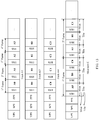
- FIG. 16 gives an example of how to reconstruct from tracks with different resolutions.
- bitstreams from sub-picture track 3 and 4 are reconstructed to form one tile with two slices.
- bitstreams from different resolutions might not be able to form HEVC conforming bitstream in anyway, then in such cases, an OMAF player may choose to do reconstruction from same resolution and enable two HEVC decoders for different resolutions.
- FIG. 16 gives an example of how to reconstruct from tracks with different resolutions.
- bitstreams from sub-picture track 3 and 4 are reconstructed to form one tile with two slices.
- bitstreams from different resolutions might not be able to form HEVC conforming bitstream in anyway, then in such cases, an OMAF player may choose to do reconstruction from same resolution and enable two HEVC decoders for different resolutions.
- this embodiment provides a server apparatus.
- the server is a server that generates information about an amount of tile data included in the sub-bitstream described in this application, or information used to indicate whether the sub-bitstream can be used for splicing.
- the information is written into SEI of a bitstream, or the information is written into a file in the manner described in this application.
- the server may not be responsible for original bitstream encoding, for example, the server may be a transcoding server, or a server that only generates the information, and is configured to store a bitstream or a file that carries the information described in this application.
- bitstream splicing processing enables a single decoder to decode all sub-bitstreams in one decoding operation after a plurality of sub-bitstreams are spliced, and no additional track information needs to be transmitted, thereby saving bandwidth and reducing complexity of system layer stream management.
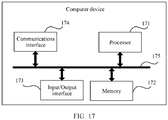
- FIG. 17 is a schematic structural diagram of hardware of a computer device according to an embodiment of this application.
- the computer device may be used as an implementation of a media information processing apparatus or an implementation of a media information processing method.
- the computer device includes a processor 171, a memory 172, an input/output interface 173, and a bus 175, and may further include a communications interface 174.
- the processor 171, the memory 172, the input/output interface 173, and the communications interface 174 implement a mutual communication connection by using the bus 175.
- the processor 171 may use a central processing unit (central processing unit, CPU), a microprocessor, an application specific integrated circuit (application specific integrated circuit, ASIC), or one or more integrated circuits, and is configured to execute a related program, to implement a function that needs to be executed by a module in the streaming media information processing apparatus provided in the embodiments of the present invention, or perform the streaming media information processing method corresponding to the method embodiments of the present invention.
- the processor 171 may be an integrated circuit chip and has a signal processing capability. In an implementation process, steps in the foregoing methods can be implemented by using a hardware integrated logical circuit in the processor 171, or by using instructions in a form of software.
- the processor 171 may be a general purpose processor, a digital signal processor (DSP), an application specific integrated circuit (ASIC), a field programmable gate array (FPGA) or another programmable logic device, a discrete gate or a transistor logic device, or a discrete hardware component. It may implement or perform the methods, the steps, and logical block diagrams that are disclosed in the embodiments of the present invention.
- the general purpose processor may be a microprocessor, or the processor may be any conventional processor or the like. Steps of the methods disclosed with reference to the embodiments of this application may be directly executed and accomplished by means of a hardware decoding processor, or may be executed and accomplished by using a combination of hardware and software modules in the decoding processor.
- a software module may be located in a mature storage medium in the art, such as a random access memory, a flash memory, a read-only memory, a programmable read-only memory, an electrically erasable programmable memory, or a register.
- the storage medium is located in the memory 172.
- the processor 171 reads information in the memory 172, and completes, with reference to hardware of the processor 171, a function that needs to be executed by a module included in the media information processing apparatus provided in the embodiments of this application, or performs the media information processing method provided in the method embodiments of this application.
- the memory 172 may be a read-only memory (read only memory, ROM), a static storage device, a dynamic storage device, or a random access memory (random access memory, RAM).
- the memory 172 may store an operating system and another application program.
- program code used to implement the technical solutions provided in the embodiments of this application is stored in the memory 172, and the processor 171 executes an operation that needs to be executed by a module included in the media information processing apparatus, or performs the media information processing method provided in the method embodiments of this application.
- the input/output interface 173 is configured to receive input data and information, and output data such as an operation result.
- the communications interface 174 uses a transceiver apparatus, for example, but not limited to, a transceiver, to implement communication between the computer device and another device or a communications network.
- the communications interface 174 may be used as an obtaining module or a sending module in a processing apparatus.
- the bus 175 may include a channel for transferring information between components (such as the processor 171, the memory 172, the input/output interface 173, and the communications interface 174) of the computer device.
- the computer device further includes another component required for normal operation, for example, a display configured to display to-be-played video data.
- the computer device may further include hardware components for implementing other additional functions.
- the computer device may include only components essential for implementing the embodiments of this application, but not necessarily include all the components shown in FIG. 17 .
- a readable storage medium stores a computer-executable instruction.
- a device which may be a single-chip microcomputer, a chip, or the like
- a processor performs some or all steps in the media information processing method provided in the foregoing method embodiments.
- the foregoing readable storage medium may include: any medium that can store program code, such as a USB flash drive, a removable hard disk, a read-only memory, a random access memory, a magnetic disk, or an optical disc.
- a computer program product is further provided.
- the computer program product includes a computer-executable instruction.
- the computer-executable instruction is stored in a computer-readable storage medium.
- At least one processor of a device may read the computer-executable instruction from the computer-readable storage medium.
- the at least one processor executes the computer-executable instruction to enable the device to perform some or all steps in the media information processing method provided in the foregoing method embodiments.
Landscapes
- Engineering & Computer Science (AREA)
- Multimedia (AREA)
- Signal Processing (AREA)
- Databases & Information Systems (AREA)
- Computer Security & Cryptography (AREA)
- Compression Or Coding Systems Of Tv Signals (AREA)
- Two-Way Televisions, Distribution Of Moving Picture Or The Like (AREA)
Abstract
Description
- This application claims priority to Chinese Patent Application No.
201810032638.1 - Embodiments of this application relate to the field of streaming media transmission technologies, and in particular, to a media information processing method and apparatus.
- Currently, with increasing popularity of an application for watching a virtual reality (Virtual Reality, VR) video such as a 360-degree video, more users participate in a team to experience watching a VR video in a large viewport. This new video viewing application brings a new technical challenge while bringing a new video viewing mode and new visual experience to the users. During viewing a video in a large viewport such as 360 degrees, a spatial area of the VR video is 360-degree panoramic space, which exceeds a normal visual range of human eyes. Therefore, a user's viewing angle (or a viewport) is changed at any time during viewing the video. The user sees different video pictures in different viewports. Therefore, content presented in the video needs to change with the viewport of the user.
- In a current video application scenario, especially in a current 360-degree panoramic video application and multi-channel video application, sometimes a user is interested only in a part of an entire picture. In this case, a client does not need to display all picture regions, but only needs to obtain a part of the entire picture to render and present the part of the entire picture on the client. In this application scenario, the client may splice sub-bitstreams required for presentation to obtain a conforming bitstream. In addition, to be compatible with an existing conforming codec, the sub-bitstreams can be spliced only when a specific condition is met.
- As shown in
FIG. 1 , in an existing omnidirectional media application format (omnidirectional media format, OMAF) standard, an additional metadata track is transmitted, and a track ID of a sub-bitstream that can be spliced and a splicing method are marked in the track, the client instructs, by using information about the track, a corresponding sub-bitstream to complete a splicing process according to an agreed arrangement. Finally, the conforming codec decodes a spliced picture bitstream (that is, a conforming bitstream), and renders and presents a decoded picture. InFIG. 1 , an example in which a video picture is split into eight sub-pictures (that is, eight tiles) and requesting viewports of a client include 1, 2, 5, and 6 (four tiles) is used for description, and t0 to tN represent different time sequences. - However, the metadata track transmitted in the foregoing method requires an additional bandwidth. In addition, when there are a relatively large quantity of tracks in a sub-picture bitstream, there are a relatively large quantity of track combinations that may be spliced into the conforming bitstream, and therefore different metadata tracks need to be constructed, and therefore stream management is relatively complex.
- Embodiments of this application provide a media information processing method and apparatus. Information about an amount of tile data included in a bitstream or indication information about whether a bitstream can be used for splicing is added to substream data, to determine, based on the indication information, whether the bitstream can be used for splicing. This resolves a problem in the prior art that additional track information is required during bitstream splicing, saves transmission bandwidth, and lowers complexity of stream management.
- To achieve the foregoing objective, the following technical solutions are used in the embodiments of this application.
- According to a first aspect, a media information processing method is provided. The method includes: obtaining sub-bitstream data, where the sub-bitstream data includes indication information, and the indication information is used to indicate an amount of tile data included in the sub-bitstream data, or the indication information is used to indicate whether the sub-bitstream data can be used for splicing; and processing the sub-bitstream data based on the indication information.
- A method embodiment of this application may be performed by a device that has a video or picture decoding function, for example, a wearable device (such as an AR/VR helmet or AR/VR glasses), an intelligent terminal (such as a mobile phone or a tablet computer), a television, or a set-top box.
- In a possible implementation of the first aspect, a request may be obtained by sending media data, and then the media data is received, where the media data includes sub-bitstream data. For example, a terminal may construct a uniform resource locator (Uniform Resource Locator, URL) by using a related attribute and address information in a media presentation description file, then send an HTTP request to the URL, and receive corresponding media data.
- In a possible implementation of the first aspect, the media data may be obtained in a push manner, and the media data includes the sub-bitstream data. The media data in this embodiment of this application may mainly be data obtained after encoding and encapsulation are performed on a video or a picture. In some possible implementations, the media data in this embodiment of this application may alternatively be data obtained after encoding and encapsulation are performed on audio. The video includes a series of pictures.
- In a possible implementation of the first aspect, for a related example of the media data, refer to related regulations of media data in the ISO/IEC 23090-2 standard specification.
- The ISO/IEC 23090-2 standard specification is also referred to as an omnidirectional media format (omnidirectional media format, OMAF) standard specification. The specification defines a media application format that can implement omnidirectional media presentation on an application. Omnidirectional media mainly refers to an omnidirectional video (360-degree video) and related audio. The OMAF specification first specifies a list of projection methods that may be used to convert a spherical video into a two-dimensional video, followed by how to use an ISO base media file format (ISO base media file format, ISOBMFF) to store the omnidirectional media and metadata associated with the media, and how to encapsulate and transmit data of the omnidirectional media in a streaming media system, for example, by using dynamic adaptive streaming over hypertext transfer protocol (hypertext transfer protocol, HTTP) (dynamic adaptive streaming over HTTP, DASH) or dynamic adaptive streaming specified in the ISO/IEC 23009-1 standard.
- In a possible implementation of the first aspect, the picture in this embodiment of this application may be a complete picture captured by a capture device (such as a camera), or may be a picture obtained after a complete picture is split. For example, a resolution of a picture captured by the capture device is 1024 x 1024. In this case, the picture in this embodiment of this application may be a 1024 x 1024 picture, a 512 x 512 picture, a 1024 x 512 picture, a 512 x 1024 picture, or the like. This is not specifically limited in this application.
- In a possible implementation of the first aspect, picture data (for example, a video bitstream or an original bitstream) described in this embodiment of this application is data obtained after a picture is encoded based on a video coding technology, for example, may be picture data obtained after a picture is encoded by using ITU H.264, or picture data obtained after a picture is encoded by using ITU H.265, or may be data obtained after a picture is encoded by using another standard or a proprietary technology.
- In a possible implementation of the first aspect, the indication information of the sub-bitstream data may be encapsulated in supplemental enhancement information (supplementary enhancement information, SEI).
- In a possible implementation of the first aspect, the indication information of the sub-bitstream data may be encapsulated in a box (box) of a track (track).
- In a possible implementation of the first aspect, the indication information of the sub-bitstream data may be encapsulated in a media presentation description (media presentation description, MPD) file. The media presentation description file includes some metadata files of the picture. The metadata refers to some attribute information, for example, duration, a bit rate, a frame rate, and a location in a spherical coordinate system. In an example, the media presentation description file may refer to a related regulation and example in the ISO/IEC 23009-1.
- In a possible implementation of the first aspect, the indication information of the sub-bitstream data may be carried in a sample entry type of a track (track). Optionally, for the information about the amount of the tile data included in the sub-bitstream, a sample entry type (sample entry type): 'onti' is added to the track. When a sample entry name is 'onti', it indicates that a sub-bitstream in a current track includes one piece of tile data, to indicate that the sub-bitstream can be used for splicing.
- In a possible implementation of the first aspect, the indication information includes at least one identifier, and the identifier is used to indicate an amount of the tile data included in the sub-bitstream data. For example, the indication information may be a flag of one bit, and whether the amount of the tile data is 1 is indicated based on a value of the flag. The indication information may also be an indicator. Alternatively, the indication information may be a flag of two or more bits, and a value of the flag is directly used to indicate the amount of the tile data.
- In a possible implementation of the first aspect, the sub-bitstream data further includes video parameter set (video parameter set, VPS) information, and the processing the sub-bitstream data based on the indication information includes: processing the sub-bitstream data based on the indication information and the VPS information.
- In a possible implementation of the first aspect, the sub-bitstream data further includes sequence parameter set (sequence parameter set, SPS) information, and the processing the sub-bitstream data based on the indication information includes: processing the sub-bitstream data based on the indication information and the SPS information.
- In a possible implementation of the first aspect, the sub-bitstream data further includes picture parameter set (picture parameter set, PPS) information, and the processing the sub-bitstream data based on the indication information includes: processing the sub-bitstream data based on the indication information and the PPS information.
- In a possible implementation of the first aspect, the sub-bitstream data further includes slice segment (slice segment, SS) information, and the processing the sub-bitstream data based on the indication information includes: processing the sub-bitstream data based on the indication information and the SS information.
- In a possible implementation of the first aspect, the sub-bitstream data further includes resolution information. If there are sub-bitstreams with different resolutions, the sub-bitstreams may be spliced in a manner that a tile includes a plurality of slices. Optionally, a plurality of low-resolution sub-bitstreams may be used as slices to form one piece of tile data. In other words, one piece of tile data in the spliced bitstream may include a plurality of slices. For example, if there are sub-bitstreams with two resolutions and same content, and the two resolutions are respectively 1024 x 1024 and 512 x 512, two 512 x 512 sub-bitstreams may be used as slices to form tile data.
- In a possible implementation of the first aspect, when it is determined that a sub-bitstream cannot be used for splicing, the sub-bitstream may be directly decoded, and a decoded picture and a picture obtained after a spliced bitstream is decoded are spliced, to obtain a final display picture. Therefore, compared with discarding a sub-bitstream that cannot be used for splicing, this method can improve utilization of the sub-bitstream.
- In the media information processing method provided in the first aspect, information about an amount of tile data included in the sub-bitstream or indication information used to indicate whether the sub-bitstream data can be used for splicing is added to each sub-bitstream, so that whether the sub-bitstream can be used for splicing may be determined based on the indication information, and a plurality of sub-bitstreams that can be used for splicing are spliced. When a required bitstream is spliced and then decoded, only a single decoder is required to implement decoding in a sequence of a plurality of sub-pictures, and no additional track information needs to be transmitted, thereby saving bandwidth and simplifying complexity of stream management.
- According to a second aspect, a media information processing method is provided. The method includes: obtaining sub-bitstream data of an original image; determining indication information of the sub-bitstream data based on an amount of tile data included in the sub-bitstream data, where the sub-bitstream data includes indication information, and the indication information is used to indicate the amount of the tile data included in the sub-bitstream data, or the indication information is used to indicate whether the sub-bitstream data can be used for splicing; and sending the sub-bitstream data to a terminal, where the sub-bitstream data includes the indication information.
- In a possible implementation of the second aspect, indication information of a sub-bitstream may be encapsulated in supplemental enhancement information (supplementary enhancement information, SEI).
- In a possible implementation of the second aspect, the indication information of the sub-bitstream may be encapsulated in a box (box) of a track (track).
- In a possible implementation of the second aspect, the indication information of the sub-bitstream may be encapsulated in a sample entry type of a track (track).
- In a possible implementation of the second aspect, the indication information of the sub-bitstream may be encapsulated in a media presentation description (media presentation description, MPD) file.
- In a possible implementation of the second aspect, the sub-bitstream data further includes video parameter set (video parameter set, VPS) information, and the processing the sub-bitstream data based on the indication information includes: processing the sub-bitstream data based on the indication information and the VPS information.
- In a possible implementation of the second aspect, the sub-bitstream data further includes sequence parameter set (sequence parameter set, SPS) information, and the processing the sub-bitstream data based on the indication information includes: processing the sub-bitstream data based on the indication information and the SPS information.
- In a possible implementation of the second aspect, the sub-bitstream data further includes picture parameter set (picture parameter set, PPS) information, and the processing the sub-bitstream data based on the indication information includes: processing the sub-bitstream data based on the indication information and the PPS information.
- In a possible implementation of the second aspect, the sub-bitstream data further includes slice segment (slice segment, SS) information, and the processing the sub-bitstream data based on the indication information includes: processing the sub-bitstream data based on the indication information and the SS information.
- In a possible implementation of the second aspect, the sub-bitstream data further includes resolution information. Optionally, there are sub-bitstreams with different resolutions. For example, if there are sub-bitstreams with two resolutions and same content, and the two resolutions are respectively 1024 x 1024 and 512 x 512, two 512 x 512 sub-bitstreams may be used as slices to form tile data.
- According to a third aspect, a media information processing apparatus is provided. The apparatus includes: an obtaining module, configured to obtain sub-bitstream data, where the sub-bitstream data includes indication information, and the indication information is used to indicate an amount of tile data included in the sub-bitstream data, or the indication information is used to indicate whether the sub-bitstream data can be used for splicing; and a processing module, configured to process the sub-bitstream data based on the indication information.
- In a possible implementation of the third aspect, the indication information is carried in supplemental enhancement information (supplementary enhancement information, SEI).
- In a possible implementation of the third aspect, the indication information is carried in a box (box) of a track (track).
- In a possible implementation of the third aspect, the indication information is carried in a sample entry type of a track (track).
- In a possible implementation of the third aspect, the indication information is carried in a media presentation description (media presentation description, MPD) file.
- In a possible implementation of the third aspect, the sub-bitstream data further includes video parameter set (video parameter set, VPS) information, and the processing module is further configured to: process the sub-bitstream data based on the indication information and the VPS information.
- In a possible implementation of the third aspect, the sub-bitstream data further includes sequence parameter set (sequence parameter set, SPS) information, and the processing module is further configured to: process the sub-bitstream data based on the indication information and the SPS information.
- In a possible implementation of the third aspect, the sub-bitstream data further includes picture parameter set (picture parameter set, PPS) information, and the processing module is further configured to: process the sub-bitstream data based on the indication information and the PPS information.
- In a possible implementation of the third aspect, the sub-bitstream data further includes slice segment (slice segment, SS) information, and the processing module is further configured to: process the sub-bitstream data based on the indication information and the SS information.
- In a possible implementation of the third aspect, the sub-bitstream data further includes resolution information.
- According to a fourth aspect, a media information processing apparatus is provided. The apparatus includes: an obtaining module, configured to obtain sub-bitstream data of an original image; a processing module, configured to determine indication information of the sub-bitstream data based on an amount of tile data included in the sub-bitstream data, where the sub-bitstream data includes indication information, and the indication information is used to indicate the amount of the tile data included in the sub-bitstream data, or the indication information is used to indicate whether the sub-bitstream data can be used for splicing; and a sending module, configured to send the sub-bitstream data to a terminal, where the sub-bitstream data includes the indication information.
- In a possible implementation of the fourth aspect, the indication information is carried in supplemental enhancement information (supplementary enhancement information, SEI).
- In a possible implementation of the fourth aspect, the indication information is carried in a box (box) of a track (track).
- In a possible implementation of the fourth aspect, the indication information is carried in a sample entry type of a track (track).
- In a possible implementation of the fourth aspect, the indication information is carried in a media presentation description (media presentation description, MPD) file.
- In a possible implementation of the fourth aspect, the sub-bitstream data further includes video parameter set (video parameter set, VPS) information, and the processing module is further configured to: process the sub-bitstream data based on the indication information and the VPS information.
- In a possible implementation of the fourth aspect, the sub-bitstream data further includes sequence parameter set (sequence parameter set, SPS) information, and the processing module is further configured to: process the sub-bitstream data based on the indication information and the SPS information.
- In a possible implementation of the fourth aspect, the sub-bitstream data further includes picture parameter set (picture parameter set, PPS) information, and the processing module is further configured to: process the sub-bitstream data based on the indication information and the PPS information.
- In a possible implementation of the fourth aspect, the sub-bitstream data further includes slice segment (slice segment, SS) information, and the processing module is further configured to: process the sub-bitstream data based on the indication information and the SS information.
- In a possible implementation of the fourth aspect, the sub-bitstream data further includes resolution information.
- It should be noted that for specific examples and implementations of the method or apparatus embodiments in the second aspect to the fourth aspect of this application, refer to related examples in the method embodiment in the first aspect. Details are not described herein again.
- According to a fifth aspect, a media information processing apparatus is provided. The apparatus includes one or more processors and a memory. The memory is coupled to the one or more processors. The memory is configured to store computer program code, the computer program code includes an instruction, and when the one or more processors execute the instruction, the processing apparatus performs the media information processing method provided in any one of the first aspect or the possible implementations of the first aspect, or perform the media information processing method provided in the second aspect and any possible implementation of the second aspect.
- According to a sixth aspect, a processor is provided. The processor is configured to perform the media information processing method according to any one of the first aspect or the possible implementations of the first aspect, or perform the media information processing method according to any one of the second aspect or the possible implementations of the second aspect.
- According to still another aspect of this application, a computer-readable storage medium is provided. The computer-readable storage medium stores an instruction, and when the instruction is run on a device, the device is enabled to perform the media information processing method according to any one of the first aspect or the possible implementations of the first aspect.
- According to still another aspect of this application, a computer-readable storage medium is provided. The computer-readable storage medium stores an instruction, and when the instruction is run on a device, the device is enabled to perform the media information processing method provided in any one of the second aspect or the possible implementations of the second aspect.
- According to still another aspect of this application, a computer program product including an instruction is provided. When the computer program product runs on a computer, the computer is enabled to perform the media information processing method according to any one of the first aspect or the possible implementations of the first aspect.
- According to still another aspect of this application, a computer program product including an instruction is provided. When the computer program product runs on a computer, the computer is enabled to perform the media information processing method according to any one of the second aspect or the possible implementations of the second aspect.
-
-
FIG. 1 is a schematic diagram of video coding and transmission of a sub-bitstream; -
FIG. 2 is a schematic structural diagram of a video coding and transmission system according to an embodiment of this application; -
FIG. 3 is a schematic flowchart of a media information processing method according to an embodiment of this application; -
FIG. 4 is a schematic structural diagram of a media information processing apparatus according to an embodiment of this application; -
FIG. 5 is a schematic structural diagram of another media information processing method according to an embodiment of this application; -
FIG. 6 is a schematic structural diagram of another media information processing apparatus according to an embodiment of this application; -
FIG. 7 is a schematic diagram of first bitstream splicing according to an embodiment of this application; -
FIG. 8 is a schematic diagram of slice arrangement in a bitstream according to an embodiment of this application; -
FIG. 9 is a schematic diagram of slice arrangement in another bitstream according to an embodiment of this application; -
FIG. 10 is a schematic diagram of second bitstream splicing according to an embodiment of this application; -
FIG. 11 is a schematic diagram of third bitstream splicing according to an embodiment of this application; -
FIG. 12 is a schematic diagram of fourth bitstream splicing according to an embodiment of this application; -
FIG. 13 is a schematic diagram of fifth bitstream splicing according to an embodiment of this application; -
FIG. 14 is a schematic diagram of sixth bitstream splicing according to an embodiment of this application; -
FIG. 15 is a schematic diagram of seventh bitstream splicing according to an embodiment of this application; -
FIG. 16 is a schematic diagram of eighth bitstream splicing according to an embodiment of this application; and -
FIG. 17 is a schematic structural diagram of a computer device according to an embodiment of this application. - Prior to description of embodiments of this application, related technical terms in this application are first explained and described.
- Video decoding (video decoding): Video decoding is a processing process of restoring a bitstream to a reconstructed picture according to a specific syntax rule and processing method.
- Video encoding (video encoding): Video encoding is a processing process of compressing a picture sequence into a bitstream.
- Video coding (video coding): Video coding is an umbrella term of video encoding and video decoding. The translated Chinese term of video coding is the same as that of video encoding.
- Panoramic video: A panoramic video is also referred to as a virtual reality (virtual reality, VR) panoramic video, or referred to as a 360-degree panoramic video or a 360-degree video, and is a video shot by using a plurality of cameras in omnidirectional 360 degrees. When viewing the video, a user may randomly adjust a viewport of the user for viewing.
- Tile: A tile is a square tile, in the HEVC video coding standard, obtained after a to-be-coded picture is split. A frame of picture may be split into a plurality of tiles, and the tiles jointly form the frame of picture. Each tile may be independently encoded.
- Sub-picture (sub-picture): A picture is split to obtain a part of the original picture, and the part of the original picture is referred to as a sub-picture of the picture. In some embodiments, the sub-picture is square in shape. The sub-picture may be a part of a frame of picture.
- A motion-constrained tile set (motion-constrained tile set, MCTS) is an encoding technology for tiles, and in this technology, a motion vector inside the tile is constrained during encoding, so that tiles at a same location in a picture sequence do not refer to picture pixels outside the tile location in time domain. Therefore, each tile in time domain can be independently decoded.
- Picture sub-region: For ease of description of this application, the picture sub-region is used as an umbrella term of tiles or sub-pictures. It may be understood that the sub-picture in this application may also include a picture split in a tile encoding scheme.
- Track (track): A track is defined in the ISO/IEC 14496-12 standard as a "timed sequence of related samples (q.v.) in an ISO base media file. Note: For media data, a track corresponds to a sequence of images or sampled audio; for hint tracks, a track corresponds to a streaming channel". Translation: A "timed sequence of related samples (q.v.) in an ISO base media file. Note: For media data, a track corresponds to a sequence of images or sampled audio; for hint tracks, a track corresponds to a streaming channel." Explanation: The track is a series of timed samples that are encapsulated in an ISOBMFF encapsulation manner, for example, in a video track, a video sample is a bitstream generated after a video encoder encodes each frame, and each video sample is encapsulated according to the ISOBMFF standard to generate a sample.
- Box (box): A box is defined in the ISO/IEC 14496-12 standard as an "object-oriented building block defined by a unique type identifier and length. Note: Called 'atom' in some specifications, including the first definition of MP4." Translation: An "object-oriented building block defined by a unique type identifier and length. Note: Called 'atom' in some specifications, including the first definition of MP4." The box is a basic unit that constitutes an ISOBMFF file, and the box may include another box.
- Supplementary enhancement information (supplementary enhancement information, SEI) is a type of a network access unit (Network Abstract Layer Unit, NALU) defined in a video coding standard (H.264, H.265).
- A media presentation description (Media presentation description, MPD) is a document specified in the ISO/IEC 23009-1 standard. The document includes metadata that is used by a client to construct an HTTP-URL. The MPD includes one or more period (period) elements. Each period element includes one or more adaptation sets (adaptationset). Each adaptation set includes one or more representations (representation). Each representation includes one or more segments. The client selects the representation based on information in the MPD, and constructs an HTTP-URL of the segment.
- The embodiments of this application are applied to a video coding and transmission system. In an embodiment, a block diagram of sub-bitstream-based video coding and transmission is shown in
FIG. 2 . - Referring to
FIG. 2 , on a server side, a video or a picture is obtained by a video capture apparatus. The video capture apparatus may be a video or picture capture apparatus such as a camera, or may be a receiving apparatus that receives data of a video or a picture from another device. A coding preprocessor is configured to perform some coding pre-processing on the video or the picture. The coding preprocessor module may perform sub-region partitioning (or splitting) on the video or the picture. It may be understood that the coding preprocessor may alternatively be a part of a video encoder, or the video encoder performs the foregoing functions of the coding preprocessor. The video encoder is configured to encode the video or the picture according to a specific encoding rule. For example, a coding scheme specified in the H.264 or the H.265 may be used, or the video or the picture may be encoded based on another private encoding technology. For a coded bitstream, a bitstream encapsulation apparatus may perform bitstream encapsulation on the bitstream according to a specific encapsulation format. For example, the specific encapsulation format may be an encapsulation format of an MPEG-2 TS stream or another encapsulation format. Then, a sending and transmission apparatus sends the encapsulated bitstream to a terminal. - On a terminal side, a receiving apparatus is configured to receive the bitstream from the server side, and then after a bitstream decapsulation apparatus decapsulates the bitstream, a plurality of sub-bitstreams may be obtained and sent to a video decoder. The video decoder decodes the sub-bitstreams, to generate a decoded video or picture, and finally the decoded video or picture is displayed by a display apparatus.
- It may be understood that the server and the terminal shown in
FIG. 2 are representations relative to a sender and a receiver of the bitstream. In actual product implementation, the server may be a device such as a smartphone or a tablet computer, and the terminal may also be a device such as a smartphone or a tablet computer. This is not specifically limited in this embodiment of this application. - It may be understood that the sub-bitstream in this embodiment of this application is described relative to a spliced bitstream. The obtained sub-bitstream may be a separately transmitted bitstream. The sub-bitstream in this embodiment of this application may also be referred to as sub-bitstream data, and the sub-bitstream and the sub-bitstream data may be replaced with each other.
- As shown in
FIG. 3 , an embodiment of one aspect of this application provides a media information processing method S30. The method S30 includes the following steps. - S301: A terminal obtains sub-bitstream data, where the sub-bitstream data includes indication information, and the indication information is used to indicate an amount of tile data included in the sub-bitstream data.
- S302: The terminal processes the sub-bitstream data based on the indication information.
- As shown in
FIG. 4 , an embodiment of one aspect of this application provides a media information processing apparatus 40. The apparatus 40 includes: an obtainingmodule 401 and aprocessing module 402. The obtainingmodule 401 is configured to obtain sub-bitstream data, where the sub-bitstream data includes indication information, and the indication information is used to indicate an amount of tile data included in the sub-bitstream data. Theprocessing module 402 is configured to process the sub-bitstream based on the indication information. - As shown in
FIG. 5 , an embodiment of one aspect of this application provides another media information processing method S50. The method S50 includes the following steps. - S501: A server obtains sub-bitstream data of an original image.
- S502: The server determines indication information of the sub-bitstream data based on an amount of tile data included in the sub-bitstream data.
- S503: The server sends the sub-bitstream data to a terminal, where the sub-bitstream data includes the indication information.
- As shown in
FIG. 6 , an embodiment of one aspect of this application provides a media information processing apparatus S60. The apparatus S60 includes: an obtainingmodule 601, aprocessing module 602, and a sendingmodule 603. The obtainingmodule 601 is configured to obtain sub-bitstream data of an original image. Theprocessing module 602 is configured to determine indication information of the sub-bitstream data based on an amount of tile data included in the sub-bitstream data. The sendingmodule 603 is configured to send the sub-bitstream data to a terminal, where the sub-bitstream data includes the indication information. - In a possible implementation of this application, an embodiment of this application provides a sub-bitstream-based splicing processing method, a corresponding encoding transmission manner, and a corresponding decoding presentation manner. An entire system processing process in this embodiment of this application is shown in
FIG. 7 , and implementation steps of the system processing process are described in detail as follows: - An input video picture (which may be referred to as an original image) is split into regions (each region may be referred to as a tile), and is encoded in an MCTS form, to generate a conforming video bitstream. The MCTS refers to limiting an interframe/intra-frame prediction motion vector in time domain and space domain, and a predicted pixel does not exceed a picture boundary. Setting when the server performs encoding in the MCTS form may include: disabling cross-tile deblocking filtering and SAO filtering, to ensure independent decoding of tile data. Then, the server splits the video bitstream to obtain a plurality of sub-bitstreams. One sub-bitstream may include coded data of one tile, or may include coded data of a plurality of tiles. The coded data of the tile is coded data obtained after a tile in the original image is encoded. In this embodiment of this application, the coded data of the tile may also be referred to as tile data.
- Specifically, a process in which the server splits the video bitstream to obtain a plurality of sub-bitstreams may include: detecting, by the server, a NALU start code in the video bitstream, and splitting the video bitstream into different NALUs, where each NALU includes one piece of tile data or a plurality of pieces of tile data; and determining, by the server, a coding parameter set corresponding to one or more pieces of tile data included in different NALUs (that is, determining a coding parameter set of a sub-bitstream), copying the tile data included in each NALU from the video bitstream, and adding a NALU start code to the copied tile data and the coding parameter set. In this way, a sub-bitstream is formed.
- A header (Header) type in each NALU may be used to indicate coding parameter set information of the video bitstream and tile data included in the NLAU. The coding parameter set may include video parameter set (video parameter set, VPS) information, sequence parameter set (sequence parameter set, SPS) information, picture parameter set (picture parameter set, PPS) information, slice segment (slice segment, SS) information, and the like.
- For ease of understanding, it is assumed herein that a resolution of an original image is 3840 x 1920, a size of each split tile is 640 x 640, and one NALU (that is, one sub-bitstream) in the video bitstream is used as an example for detailed description. When the server determines a coding parameter set of the sub-bitstream, the server may continue to use the coding parameter set in the video bitstream, and modify only some parameters in the coding parameter set. Details are as follows.
- For the VPS information, optionally, because a resolution of the sub-bitstream decreases, the server may modify an encoding specification level set in the VPS information, for example, change a level from 5.1 to 4.1.
- For the SPS information, the server may modify parameters indicating a picture width and a picture height in the SPS information, that is, pic_width_in_luma_ samples and pic_height_in_luma_sample. For example, when an amount of the tile data included in the sub-bitstream is 1 (that is, a sub-picture corresponding to the sub-bitstream includes one tile), values of pic_width_in_luma_samples and pic_height_in_luma_samples are 640 and 640 respectively. When an amount of the tile data included in the sub-bitstream is 2 (that is, a sub-picture corresponding to the sub-bitstream includes two tiles), if the two tiles are adjacent to each other on the left and right, values of pic_width_in_luma_samples and pic_height_in_luma_samples are 1280 and 640 respectively. If the two tiles are adjacent to each other on the top and bottom, values of pic_width_in_luma_samples and pic_height_in_luma_samples are 640 and 1280 respectively.
- For the PPS information, the server may set tile splitting related parameters such as tiles_enabled_flag (a tile enabled flag), num_tile_columns_minus1 (a tile column number flag), num_tile_rows_minus1 (a tile row number flag), and uniform_spacing_flag (a uniform spacing flag) in the PPS information based on the amount of the tile data included in the sub-bitstream (that is, a quantity of tiles included in the sub-picture corresponding to the sub-bitstream). For example, when the sub-picture corresponding to the sub-bitstream includes one tile, a value of tiles_enabled_flag is set to 0. When the sub-picture corresponding to the sub-bitstream includes two tiles that are adjacent to each other on the left and right and have a same resolution, a value of tiles_enabled_flag is set to 1, a value of num_tile_columns_minus1 may be set to 1, a value of num_tile_rows_minus1 may be set to 0, and a value of uniform_spacing_flag may be set to 1.
- For the SS information, the server may construct in a splitting manner of using each piece of tile data included in the sub-bitstream as a slice, and the server may set header (header) information in an SS parameter, such as first_slice_segment_in_pic_flag (a first slice segment flag) and slice_segment_address (a slice segment address). For example, when the sub-bitstream includes one piece of tile data, a value of first_slice_segment_in_pic_flag may be set to 1, and a value of slice_segment_address may be set to 0. When the sub-bitstream includes two pieces of tile data, and a first tile of each frame is used as a first slice, a value of corresponding first_slice_segment_in_pic_flag is set to 1, a value of slice_segment_address is set to 0, and a second tile of each frame is used as a second slice, a value of corresponding first_slice_segment_in_pic_flag is set to 1, and a value of slice_segment_address is set to 10 (as shown in
FIG. 8 , a picture is split into 64 x 64 CTUs, the entire picture is scanned in a zig-zag manner, and a first CTU label of a current slice is the value of slice_segment_address of the current slice). - It should be noted that the server may alternatively construct in a splitting manner of using every two pieces of tile data or more than two pieces of tile data as a slice. In this embodiment of this application, only a splitting manner in which one piece of tile data is used as a slice is used for description, and this does not constitute a limitation on this embodiment of this application.
- In this embodiment of this application, the server may write information about an amount of tile data included in a sub-bitstream into an SEI message of a bitstream. The information about the amount of the tile data may be used to indicate whether the sub-bitstream can be used for splicing. When the amount of the tile data is 1, the information may be used to indicate that the sub-bitstream can be used for splicing. When the amount of the tile data is greater than 1, the information may be used to indicate that the sub-bitstream cannot be used for splicing. Specifically, the SEI message may be represented by using the following syntax elements.
Table 1.1 SEI syntax sei_payload( payloadType, payloadSize ) { Descriptor if( nal_unit_type = = PREFIX_SEI_NUT ) if( payloadType = = 0) buffering_period( payloadSize ) ... else if(payloadType = = 156) sub_picture _info_aggregate ( payloadSize ) ... else if( payloadType = = 160) layers_not_present(payloadSize ) /* specified in Annex F */ } } Table 1.2 SEI message syntax for sub-bitstream splicing sub_picture _info_aggregate ( payloadSize ) { Descriptor sub_pic_str_only_one_tile u(1) } - In Table 1.1, a new type 156 is added for an SEI type and is used to indicate whether a current sub-bitstream can be used for splicing, and information sub_picture_info_aggregate (payloadSize) is added. Meanings of syntax elements included in sub_picture_stream_aggregate are as follows.
- sub_pic_str_only_one_tile: A
value 1 indicates that the sub-bitstream includes no more than one piece of tile data (that is, a sub-picture corresponding to the sub-bitstream includes no more than one tile), and avalue 0 indicates that the sub-bitstream includes two or more than two pieces of tile data (that is, a sub-picture corresponding to the sub-bitstream includes two or more tiles).Table 1.3 SEI message syntax for an amount of tile data included in a sub-bitstream sub_picture _info_aggregate ( payloadSize ) { Descriptor Tile_num_subpicture ue(v) } - Alternatively, the SEI may be a type in Table 1.3, and a value of Tile_num_subpicture indicates the amount of the tile data included in the sub-bitstream.
- A specific method for obtaining a plurality of sub-bitstreams is as follows, but this application is not limited to this method.
- 1. Perform tile splitting on an original image, and encode a split tile, to obtain a video bitstream.
- 2. Obtain each NALU in the video bitstream, and parse a coding parameter set (including VPS information, SPS information, PPS information, and SS information) of the video bitstream and make coding parameter sets of a plurality of sub-bitstreams based on the tile data included in each NALU and the coding parameter set of the video bitstream.
- 3. Copy coded data of each sub-bitstream in the plurality of sub-bitstreams from the video bitstream, and form the plurality of sub-bitstreams based on the coding parameter sets of the plurality of sub-bitstreams.
- 4. Set an SEI message sub_picture_info_aggregate for each sub-bitstream.
- Then, each sub-bitstream may be encapsulated and stored in a server.
- Based on user behavior, a terminal requests a required bitstream from the server, and decapsulates the received bitstream.
- An SEI message sub_picture_info_aggregate (payloadSize) of each sub-bitstream is parsed, and whether each sub-bitstream can be used for bitstream splicing are determined based on values of the syntax elements in Table 1.1 and Table 1.2. That a value of sub_pic_str_only_one_tile is 1 indicates that the sub-bitstream can be used for splicing. That a value of sub_pic_stronly_one_tile is not 1 indicates that the sub-bitstream cannot be used for splicing, therefore, the sub-bitstream is discarded and is not involved in subsequent processing. Sub-bitstreams whose sub_pic_str_only_one_tile values are 1 are spliced. Optionally, if sub-bitstreams requested to be downloaded are not enough to be spliced into a complete rectangle, one of the sub-bitstreams may be copied and filled, and the copied sub-bitstream may not participate in decoding, rendering, and displaying.
- For example, in
FIG. 7 , sub0 to sub15 are 16 tiles of a video picture, str0 is a sub-bitstream obtained after four tiles such as sub0, sub1, sub4, and sub5 are encoded, and str1 to str16 are respectively sub-bitstreams obtained after sub0 to sub15 are encoded (that is, each sub-bitstream includes one tile). Correspondingly, that a value of only_one_tile_flag corresponding to the sub-bitstream str0 is equal to 0, and that values of only_one_tile_flag corresponding to the sub-bitstreams str1, str2, str3, str5, str6, and str7 are all equal to 1 indicates that str0 cannot be used for splicing (× inFIG. 7 indicates that str0 cannot be used for splicing), and str1, str2, str3, str5, str6, and str7 can be used for splicing (√ inFIG. 7 indicates that str1, str2, str3, str5, str6, and str7 cannot be used for splicing). A process of splicing sub-bitstreams by the terminal is described in detail. - The terminal detects NALU start codes in the sub-bitstreams str1, str2, str3, str5, str6, and str7, and splits the sub-bitstreams into different NALUs; determine a coding parameter set and coded data of each sub-bitstream according to a header type in an NALU. The terminal may select one of the sub-bitstreams str1, str2, str3, str5, str6, and str7 as a reference for constructing a coding parameter set. For example, the terminal selects str1 as a reference for constructing a coding parameter set, and determines a coding parameter set of a new bitstream (that is, a conforming bitstream spliced by sub-bitstreams) based on coding parameter set information of str1. Then, coded data of a corresponding tile is copied from the sub-bitstreams str1, str2, str3, str5, str6, and str7 respectively as coded data of a position corresponding to a tile of the new bitstream, the NALU start codes are added to the coding parameter set of the new bitstream and the coded data of the new bitstream, and the coded data is spliced into a conforming bitstream in a certain sequence.
- For ease of understanding, it is assumed herein that a resolution of an original image is 3840 x 1920, and a size of each split tile is 640 x 640. When determining the coding parameter set (for example, including VPS information, SPS information, PPS information, and SS information) of the new bitstream, the terminal may continue to use the coding parameter set of str1, and modify only some parameters in the coding parameter set. Details are as follows.
- For the VPS information, optionally, because a resolution of the new bitstream increases, the terminal may modify an encoding specification level set in the VPS information, for example, change a level from 4.1 to 5.1.
- For the SPS information, the terminal may modify parameters indicating a picture width and a picture height in the SPS information, that is, pic_width_in_luma_samples and pic_height_in_luma_sample. For example, in
FIG. 7 , if a sub-picture requested by the terminal includes 3 x 2 tiles (that is, sub0 to sub2 and sub4 to sub6), values of pic_width_in_luma_samples and pic_height_in_luma_samples are 1920 (that is, 640 x 3) and 1280 (that is, 640 x 2) respectively. - For the PPS information, the terminal may set tile splitting related parameters such as tiles_enabled_flag (a tile enabled flag), num_tile_columns_minus1 (a tile column number flag), num_tile_rows_minus1 (a tile row number flag), and uniform _spacing_flag (a uniform spacing flag) in the PPS information based on a quantity of tiles included in the sub-picture. For example, in
FIG. 7 , if the sub-picture requested by the terminal includes 3 x 2 tiles, the terminal may set a value of tiles_enabled_flag to 1, set a value of num_tile_columns_minus1 to 2 (the sub-picture includes three columns and the three columns are represented by starting from 0), set num_tile_rows_minus1 to 1 (the sub-picture includes two rows and the two rows are represented by starting from 0), and set a value of uniform_spacing_flag to 1 (that is, the tiles are uniformly spaced). - For the SS information, the terminal may construct in a splitting manner of using each piece of tile data included in each sub-bitstream as a slice, and the terminal may set header (header) information in an SS parameter, such as first_slice_segment_in_pic_flag (a first slice segment flag) and slice_segment_address (a slice segment address). For example, in an arrangement form in
FIG. 7 , a value of first_slice_segment_in_pic_flag in the header information in the SS parameter of str1 of each frame is set to 1, and other values of first_slice_segment_in_pic_flag are set to 0. A value of slice_segment_address corresponding to the coded data of str1, str2, str3, str5, str6, and str7 in the header information in the SS parameter of each frame can be determined through calculation, and values of slice_segment_address inFIG. 7 are respectively set to 0, 10, 20, 300, 310, and 320 (as shown inFIG. 9 , a picture is split into 64 x 64 CTUs, the entire picture is scanned in a zig-zag manner, and a first CTU label of a current slice is the value of slice_segment_address of the current slice). - For example, as shown in
FIG. 10 , assuming that a first sub-bitstream is A, a second sub-bitstream is B, the sub-bitstream A includes data of four frames (frame) (that is, A0 to A3) and the data is encapsulated in atrack 1, the sub-bitstream B also includes data of four frames (B0 to B3) and the data is encapsulated in atrack 2, a bitstream structure obtained after the substream A and the substream B are spliced may be shown as a bitstream C inFIG. 10 . SSH indicates the header information in the SS parameter. - A specific method for splicing a plurality of sub-bitstreams is as follows, but this application is not limited to this method.
- 1. Parse an SEI message of sub_picture_info_aggregate of each sub-bitstream, obtain an amount of tile data included in each sub-bitstream, and determine a sub-bitstream whose amount of tile data is 1 as a sub-bitstream that can be used for splicing.
- 2. Parse a parameter set (including VPS information, SPS information, PPS information, and SS information) of each sub-bitstream, combine width and height information of a decoded picture, and make a new coding parameter set as a coding parameter set of a new bitstream (a spliced bitstream).
- 3. Copy, based on a location of a tile in the decoded picture, coded data of a corresponding tile in each substream that can be used for splicing, add NALU start codes to the copied coded data and a new coding parameter set, and splice the coded data and the new coding parameter set into a conforming bitstream in a specific sequence, to obtain the spliced bitstream.
- Finally, the terminal decodes the spliced bitstream, and renders and displays the spliced bitstream on a display device.
- It should be noted that the server may also add, to each sub-bitstream, indication information indicating whether the sub-bitstream can be used for splicing. Correspondingly, after obtaining the sub-bitstream, the terminal may directly determine, based on the indication information, whether the sub-bitstream can be used for splicing. When the indication information is used to indicate whether the sub-bitstream can be used for splicing, or the indication information is used to indicate an amount of tile data included in the sub-bitstream, in a specific implementation process of the server side and the terminal side, only content of added and obtained indication information is different, other corresponding operation processes are the same, and details are not described herein in this embodiment of this application.
- In this embodiment of this application, tile encoding is performed on an original image to obtain a video bitstream, a plurality of sub-bitstreams are obtained from the video bitstream, and information about the amount of the tile data included in the sub-bitstream or about whether the sub-bitstream can be used for splicing is added to each sub-bitstream, so that the terminal can determine sub-bitstreams that can be used for splicing, and a plurality of sub-bitstreams that can be used for splicing are spliced. After a required bitstream is spliced and then decoded, only a single decoder is required to implement decoding in a sequence of a plurality of sub-pictures, and no additional track information needs to be transmitted, thereby saving bandwidth and simplifying complexity of system layer stream management.
- In a possible implementation of this application, an embodiment of this application provides another sub-bitstream-based splicing processing method, a corresponding encoding transmission manner, and a corresponding decoding presentation manner. An entire system processing process in this embodiment of this application is shown in
FIG. 11 , and implementation steps of the system processing process are described in detail as follows: - An input video picture is split into sub-pictures, and each sub-picture is encoded, to generate a plurality of sub-bitstreams. For example, the original image may be split according to a same width and a same height (herein, it means that widths and heights of different sub-pictures obtained after splitting are the same, instead of that widths and heights of a same sub-picture are the same, and widths and heights of a same sub-picture may be the same or may be different), to obtain a plurality of square sub-pictures. When a sub-picture is encoded, a predicted motion vector limitation may be performed on the sub-picture, so that a predicted pixel of the sub-picture does not exceed one or some boundaries of four boundaries of the sub-picture. For each sub-picture bitstream, the information about the amount of the tile data included in the sub-bitstream may be written into the SEI message of the sub-bitstream in the manner in the foregoing embodiment. A syntax element is the same as that in the foregoing embodiment. For details, refer to descriptions of syntax elements in the foregoing embodiment. Details are not described herein again in this application.
- Therefore, for each sub-bitstream, sub_pic_str_only_one_tile: A
value 1 indicates that the sub-bitstream includes no more than one piece of tile data (that is, a sub-picture corresponding to the sub-bitstream includes no more than one tile), and avalue 0 indicates that the sub-bitstream includes two or more than two pieces of tile data (that is, a sub-picture corresponding to the sub-bitstream includes two or more tiles). - For example, in
FIG. 11 , sub0 to sub15 are 16 tiles of a video picture, str0 is a sub-bitstream obtained after sub-pictures of four tiles such as sub0, sub1, sub4, and sub5 are encoded, and str1 to str16 are respectively sub-bitstreams obtained after sub-pictures sub0 to sub15 are encoded (that is, each sub-picture includes one tile). Correspondingly, a value of only_one_tile_flag corresponding to str0 is equal to 0, and values of only_one_tile_flag corresponding to str1 to str16 are all equal to 1. InFIG. 11 , × is used to indicate that the sub-bitstreams cannot be used for splicing, and √ is used to indicate that the sub-bitstreams can be used for splicing. - Then, each sub-bitstream is encapsulated and stored in a server.
- It should be noted that, a difference between this embodiment and the foregoing embodiment lies in that: in the foregoing embodiment, the server side performs tile encoding on an original image, only one encoder is required, one video bitstream is obtained after the encoding, and a plurality of sub-bitstreams need to be re-obtained from the video bitstream, however, in this embodiment, the server side splits an original image into sub-pictures, each sub-picture is encoded by an independent encoder, and the coded bitstream is a plurality of sub-bitstreams.
- In addition, a method for requesting, by a terminal side, a bitstream from a server, de-capsulating the bitstream, and splicing a plurality of substreams is consistent with the process in the foregoing embodiment. For details, refer to the descriptions in the foregoing embodiment. Details are not described in this embodiment of this application again.
- In this embodiment of this application, sub-picture splitting is performed on an original image, and each sub-picture is encoded to obtain a plurality of sub-bitstreams. Information about an amount of tile data included in each sub-bitstream is added to each sub-bitstream, so that the terminal can determine sub-bitstreams that can be used for splicing, and a plurality of sub-bitstreams that can be used for splicing are spliced. After a required bitstream is spliced and then decoded, only a single decoder is required to implement decoding in a sequence of a plurality of sub-pictures, and no additional track information needs to be transmitted, thereby saving bandwidth and simplifying complexity of stream management.
- In a possible implementation of this application, if there are sub-bitstreams with different resolutions in a server, the sub-bitstreams may be spliced in a manner that a tile includes a plurality of slices. An implementation process on the server side is consistent with the process in the foregoing embodiment. On the terminal side, when sub-bitstreams that can be used for splicing are obtained and the sub-bitstreams can be spliced, a plurality of low-resolution sub-bitstreams may be used as slices to form one piece of tile data. In other words, one piece of tile data in the spliced bitstream may include a plurality of slices. For example, if the server includes sub-bitstreams with two resolutions and same content, and the two resolutions are respectively 1024 x 1024 and 512 x 512, the terminal may use two 512 x 512 sub-bitstreams as slices to form tile data.
- For example, as shown in
FIG. 12 , sub-bitstreams with a resolution of 1024 x 1024 include b1 to b8, and sub-bitstreams with a resolution of 512 x 512 include m1 to m8. A process of splicing the sub-bitstreams by the terminal is described in detail by using the sub-bitstreams b2, m3, and m4 as an example. The terminal detects NALU start codes in the sub-bitstreams b2, m3, and m4, and splits the sub-bitstreams into different NALUs; determine a coding parameter set and coded data of each sub-bitstream according to a header type in an NALU. The terminal may select one of the sub-bitstreams b2, m3, and m4 as a reference for constructing a coding parameter set. For example, the terminal selects b2 as a reference for constructing a coding parameter set, and determines a coding parameter set of a new bitstream (that is, a conforming bitstream spliced by sub-bitstreams) based on coding parameter set information of b2. Then, coded data of a corresponding tile is copied from the sub-bitstreams b2, m3, and m4 respectively as coded data of a position corresponding to a tile of the new bitstream, the NALU start codes are added to the coding parameter set of the new bitstream and the coded data of the new bitstream, and the coded data is spliced into a conforming bitstream in a certain sequence. - When determining the coding parameter set (for example, including VPS information, SPS information, PPS information, and SS information) of the new bitstream, the terminal may continue to use the coding parameter set of b2, and modify only some parameters in the coding parameter set. Details are as follows.
- For the VPS information, optionally, because a resolution of the new bitstream increases, the terminal may modify a coding specification level set in the VPS information, for example, change a level from 4.1 to 5.1.
- For the SPS information, the terminal may modify parameters indicating a picture width and a picture height in the SPS information, that is, pic_width_in_luma_samples and pic_height_in_luma_sample. For example, for width and height information of the decoded picture in
FIG. 12 , values of pic_width_in_luma_samples and pic_height_in_luma_samples may be set to 1536 (that is, 1024 + 512) and 1024 respectively. - For the PPS information, the terminal may set tile splitting related parameters such as tiles_enabled_flag (a tile enabled flag), num_tile_columns_minus1 (a tile column number flag), num_tile_rows_minus1 (a tile row number flag), uniform_spacing_flag (a uniform spacing flag), and column_width_minus1[i] (a column sequence number flag) in the PPS information based on a quantity of tiles included in the decoded picture, where i ranges from 0 to (num_tile_columns_minus1) - 1, and when a value of num_tile_columns_minus1 is 0, there is no column_width_minus1[i]. For example, in
FIG. 12 , the terminal may set a value of tiles_enabled_flag to 1, set a value of num_tile_columns_minus1 to 1, set num_tile_rows_minus1 to 0, set a value of uniform_spacing_flag to 0 (that is, tiles are not evenly allocated), and a value of set column_width_minus1[0] to 16. - For the SS information, the terminal may use a plurality of low-resolution sub-bitstreams as slices to form one piece of tile data, and splice the tile data with high-resolution tile data. Each piece of tile data is constructed in a slice splitting manner. The terminal may set SS parameters such as header (header) information first_slice_segment_in_pic_flag (a first slice segment flag) and slice_segment_address (a slice segment address). For example, in an arrangement form in
FIG. 12 , a value of first_slice_segment _in_pic _flag in the header information in the SS parameter of b2 of each frame is set to 1, and other values of first_slice_segment_in_pic_flag are set to 0. A value of slice_segment_address corresponding to the coded data of b2, m3, and m4 in the header information of the SS parameter of each frame can be determined through calculation, and values of slice_segment_address inFIG. 12 are respectively set to 0, 16, and 208. - For example, as shown in
FIG. 13 , it is assumed that a sub-bitstream of 1024 x 1024 is b2, two sub-bitstreams of 512 x 512 are m3 and m4 respectively, and the sub-bitstream b2 includes four frames (frame) of data (that is, A0 to A3) and is encapsulated in a track b2, the sub-bitstreams m3 and m4 also include four frames of data (B0 to B3) and are encapsulated in a track m3 and a track m4, a bitstream structure obtained after the sub-bitstreams b2, m3, and m4 are spliced may be shown as a bitstream C inFIG. 13 . SSH indicates the header information in the SS parameter. - In this embodiment of this application, information about an amount of tile data included in the sub-bitstream is added to a sub-bitstream, so that the terminal can determine sub-bitstreams that can be used for splicing. In addition, when the sub-bitstreams that can be used for splicing include a plurality of different resolutions, a plurality of low-resolution sub-bitstreams may be used as slices to form one piece of tile data, and the tile data may be spliced with high-resolution tile data, so that splicing between a plurality of sub-bitstreams with different resolutions can be implemented.
- Optionally, the terminal side may also request the server side to download all bitstreams, select a required bitstream on the terminal side based on user behavior, and decapsulate the bitstream. Then, according to the bitstream splicing method provided in the foregoing embodiment, sub-bitstreams are spliced to obtain a conforming bitstream.
- In another possible implementation of this application, this embodiment is an extension of adding the information about the amount of the tile data included in the sub-bitstream to the SEI message in the foregoing embodiment, and makes some changes to a processing manner of sub-bitstreams that cannot be used for splicing.
- Based on user behavior, a terminal requests a required bitstream from the server, and decapsulates the received bitstream.
- An SEI message sub_picture_info_aggregate (payloadSize) of each sub-bitstream is parsed, and whether each sub-bitstream can be used for bitstream splicing are determined based on values of the syntax elements in Table 1.1 and Table 1.2. That a value of sub_pic_str_only_one_tile is 1 indicates that the sub-bitstream can be used for splicing. That a value of sub_pic_str_only_one tile is not 1 indicates that the sub-bitstream cannot be used for splicing, the sub-bitstream is directly decoded, and picture splicing is performed on a decoded picture and a picture obtained after a spliced bitstream is decoded, to obtain a final display picture.
- For example, as shown in
FIG. 14 , str0 is a sub-bitstream that cannot be used for splicing. Pictures obtained by the terminal by decoding the sub-bitstream str0 include sub0, sub1, sub4, and sub5, and pictures obtained after the spliced bitstream is decoded include sub2 and sub6, display pictures obtained after picture splicing is performed on the two pictures include sub0 to sub2 and sub4 to sub6. - In this embodiment of this application, when it is determined that a sub-bitstream cannot be used for splicing, the sub-bitstream may be directly decoded, and picture splicing is performed on a decoded picture and a picture obtained after a spliced bitstream is decoded, to obtain a final display picture. Therefore, compared with discarding a sub-bitstream that cannot be used for splicing, this method can improve utilization of the sub-bitstream.
- In an optional manner of this embodiment of this application, this embodiment provides a syntax element and semantics that are in an OMAF file format and that are used to indicate information about an amount of tile data included in a sub-bitstream. Specifically, a change includes: generation, by the server side, information about an amount of tile data included in a sub-bitstream, and parsing, by the terminal, the information about the amount of the tile data included in the sub-bitstream.
- Each sub-bitstream is encapsulated, and each sub-bitstream may be independently encapsulated into a track, for example, a sub-picture track. Syntax description information about the amount of the tile data included in the sub-bitstream may be added to the sub-picture track. An example is as follows:
- The following syntax is added to a spco box:
           aligned(8) class SubPictureCompositionBox extends
 TrackGroupTypeBox('spco'){
             unsigned int(1) only_onetile_presence_flag;
                 bit(7) reserved=0;
                 unsigned int(16) track x;
                 unsigned int(16) track_y;
                 unsigned int(16) track width;
                 unsigned int(16) track height;
                 unsigned int(16) composition_width;
                 unsigned int(16) composition_height;
             }
only_one_tile_presence_flag: A
           aligned(8) class SubPictureCompositionBox extends
 TrackGroupTypeBox('spco'){
             unsigned int(8) tile_num_subpicture;
                 unsigned int(16) track x;
                 unsigned int(16) track_y;
                 unsigned int(16) track_width;
                 unsigned int(16) track_height;
                 unsigned int(16) composition_width;
                 unsigned int(16) composition_height;
             }
A value of tile_num_subpicture indicates a quantity of tiles in a bitstream in a track.
           <?xml version=" 1.0" encoding="UTF-8"?>
           <MPD
             xmlns="urn:mpeg:dash:schema:mpd:2011"
             type=" static"
             mediaPresentationDuration="PT10S"
             minBufferTime="PT1S"
             profiles="urn:mpeg:dash:profile:isoff-on-demand:2011">
             <Period>
           <AdaptationSet segmentAlignment="true" subsegmentAlignment="true"
 subsegmentStartsWithSAP=" 1 ">
                  <EssentialProperty schemeIdUri="urn:mpeg:dash:onti:2014"
                  value=" 1 "/>
                  <Representation mimeType="video/mp4" codecs="mcc"
                  width="640" height="640" bandwidth="79707" startWithSAP="1">
                             <BaseURL> src.mp4</BaseURL>
                    <SegmentBase indexRangeExact="true" indexRange="837-
 988"/>
                  </Representation>
               </AdaptationSet>
           ...
             </Period>
           </MPD>
| Mcsp@value | Description |
| Tile_num_subpicture | specifies the number of tiles |
Tile_num_subpicture indicates a quantity of tiles in the track.
| Mcsp@value | Description |
| only_one_tile_flag | specifies whether the track could be aggregated into new bitstream |
only_one_tile_flag: A
1. In the slice segment header of each slice in reconstructed bitstream, first_slice_segment_in_pic_flag and slice_segment_address should be set accordingly.
| slice_segment_header() { | Descriptor |
| first_ slice_segment_ in_pic_flag | u(1) |
| ... | |
| if( !first_slice_segment_in_pic_flag) { | |
| ... | |
| slice_segment_address | u(v) |
| } | |
| ... | |
| } |
2. In video parameter set (VPS), profile _tier_level should be set accordingly.
| video_parameter_set_rbsp() { | Descriptor |
| ... | |
| profile_tier_level(1, vps_max_sub_layers_minus1) | |
| ... | |
| } |
| profile_tier_level(profilePresentFlag, maxNumSubLayersMinus1) { | Descriptor |
| ... | |
| general_level_idc | u(8) |
| ... | |
| for(i = 0; i < maxNumSubLayersMinus1; i++ ) { | |
| if( sub _layer_level_present_ flag[i]) | |
| sub_layer_level_idc[i] | u(8) |
| } | |
| } |
3. In sequence parameter set (SPS), pic_width_in_luma samples and pic_height_in_luma_samples should be recalculated and set accordingly.
| seq_parameter_set_ rbsp( ) { | Descriptor |
| ... | |
| pic_width_in_luma_samples | ue(v) |
| pic_height_in_luma_samples | ue(v) |
| ... |
| seq_parameter_set rbsp( ) { | Descriptor |
| } |
4. In picture parameter set (PPS), parameters involved are as follows:
| pic_parameter_set_rbsp() { | Descriptor |
| ... | |
| tiles_enabled_flag | u(1) |
| ... | |
| if( tiles_enabled_flag) { | |
| num_tile_columns_minus1 | ue(v) |
| num_tile_rows_minus1 | ue(v) |
| uniform_spacing_flag | u(1) |
| if( !uniform_spacing_flag) { | |
| for(i = 0; i < num_tile_columns_minus1; i++ ) | |
| column_width_minus1[i] | ue(v) |
| for(i = 0; i < num_tile_rows_minus1; i++ ) | |
| row_height_minus1[i] | ue(v) |
| } | |
| loop_filter_across_tiles_enabled_flag | u(1) |
| } | |
| pps_loop_filter_across_slices_enabled_flag | u(1) |
| ... | |
| } |
For sub-picture tracks with several resolutions, the reconstructed bitstream should comply with HEVC tile and slice syntax.
For sub-picture tracks with several resolutions, the reconstructed bitstream should comply with HEVC tile and slice syntax.
Claims (30)
- A media information processing method, wherein the method comprises:obtaining sub-bitstream data, wherein the sub-bitstream data comprises indication information, and the indication information is used to indicate an amount of tile data comprised in the sub-bitstream data, or the indication information is used to indicate whether the sub-bitstream data can be used for splicing; andprocessing the sub-bitstream data based on the indication information.
- The method according to claim 1, wherein the indication information is carried in supplementary enhancement information (supplementary enhancement information, SEI).
- The method according to claim 1, wherein the indication information is carried in a box (box) of a track (track).
- The method according to claim 1, wherein the indication information is carried in a sample entry type of a track (track).
- The method according to claim 1, wherein the indication information is carried in a media presentation description (media presentation description, MPD) file.
- The method according to any one of claims 1 to 5, wherein the sub-bitstream data further comprises video parameter set (video parameter set, VPS) information, and the processing the sub-bitstream data based on the indication information comprises:
processing the sub-bitstream data based on the indication information and the VPS information. - The method according to any one of claims 1 to 5, wherein the sub-bitstream data further comprises sequence parameter set (sequence parameter set, SPS) information, and the processing the sub-bitstream data based on the indication information comprises:
processing the sub-bitstream data based on the indication information and the SPS information. - The method according to any one of claims 1 to 7, wherein the sub-bitstream data further comprises picture parameter set (picture parameter set, PPS) information, and the processing the sub-bitstream data based on the indication information comprises:
processing the sub-bitstream data based on the indication information and the PPS information. - The method according to any one of claims 1 to 8, wherein the sub-bitstream data further comprises slice segment (slice segment, SS) information, and the processing the sub-bitstream data based on the indication information comprises:
processing the sub-bitstream data based on the indication information and the SS information. - The method according to any one of claims 1 to 9, wherein the sub-bitstream data further comprises resolution information.
- A media information processing method, wherein the method comprises:obtaining sub-bitstream data of an original image;determining indication information of the sub-bitstream based on an amount of tile data comprised in the sub-bitstream, wherein the indication information is used to indicate the amount of the tile data comprised in the sub-bitstream data, or the indication information is used to indicate whether the sub-bitstream data can be used for splicing; andsending the sub-bitstream data to a terminal, wherein the sub-bitstream data comprises the indication information.
- The method according to claim 11, wherein the indication information is carried in supplementary enhancement information (supplementary enhancement information, SEI).
- The method according to claim 11, wherein the indication information is carried in a box (box) of a track (track).
- The method according to claim 11, wherein the indication information is carried in a sample entry type of a track (track).
- The method according to claim 11, wherein the indication information is carried in a media presentation description (media presentation description, MPD) file.
- A media information processing apparatus, wherein the apparatus comprises:an obtaining module, configured to obtain sub-bitstream data, wherein the sub-bitstream data comprises indication information, and the indication information is used to indicate an amount of tile data comprised in the sub-bitstream data, or the indication information is used to indicate whether the sub-bitstream data can be used for splicing; anda processing module, configured to process the sub-bitstream data based on the indication information.
- The apparatus according to claim 16, wherein the indication information is carried in supplementary enhancement information (supplementary enhancement information, SEI).
- The apparatus according to claim 16, wherein the indication information is carried in a box (box) of a track (track).
- The apparatus according to claim 16, wherein the indication information is carried in a sample entry type of a track (track).
- The apparatus according to claim 16, wherein the indication information is carried in a media presentation description (media presentation description, MPD) file.
- The apparatus according to any one of claims 16 to 20, wherein the sub-bitstream data further comprises video parameter set (video parameter set, VPS) information, and the processing module is further configured to:
process the sub-bitstream data based on the indication information and the VPS information. - The apparatus according to any one of claims 16 to 20, wherein the sub-bitstream data further comprises sequence parameter set (sequence parameter set, SPS) information, and the processing module is further configured to:
process the sub-bitstream data based on the indication information and the SPS information. - The apparatus according to any one of claims 16 to 20, wherein the sub-bitstream data further comprises picture parameter set (picture parameter set, PPS) information, and the processing module is further configured to:
process the sub-bitstream data based on the indication information and the PPS information. - The apparatus according to any one of claims 16 to 20, wherein the sub-bitstream data further comprises slice segment (slice segment, SS) information, and the processing module is further configured to:
process the sub-bitstream data based on the indication information and the SS information. - The apparatus according to any one of claims 16 to 20, wherein the sub-bitstream data further comprises resolution information.
- A media information processing apparatus, wherein the apparatus comprises:an obtaining module, configured to obtain sub-bitstream data of an original image;a processing module, configured to determine indication information of the sub-bitstream based on an amount of tile data comprised in the sub-bitstream, wherein the indication information is used to indicate the amount of the tile data comprised in the sub-bitstream data, or the indication information is used to indicate whether the sub-bitstream data can be used for splicing; anda sending module, configured to send the sub-bitstream data to a terminal, wherein the sub-bitstream data comprises the indication information.
- The apparatus according to claim 26, wherein the indication information is carried in supplementary enhancement information (supplementary enhancement information, SEI).
- The apparatus according to claim 26, wherein the indication information is carried in a box (box) of a track (track).
- The apparatus according to claim 26, wherein the indication information is carried in a sample entry type of a track (track).
- The apparatus according to claim 26, wherein the indication information is carried in a media presentation description (media presentation description, MPD) file.
Applications Claiming Priority (2)
| Application Number | Priority Date | Filing Date | Title |
|---|---|---|---|
| CN201810032638.1A CN110035331B (en) | 2018-01-12 | 2018-01-12 | Method and device for processing media information |
| PCT/CN2019/070480 WO2019137313A1 (en) | 2018-01-12 | 2019-01-04 | Media information processing method and apparatus |
Publications (2)
| Publication Number | Publication Date |
|---|---|
| EP3734983A1 true EP3734983A1 (en) | 2020-11-04 |
| EP3734983A4 EP3734983A4 (en) | 2020-12-16 |
Family
ID=67218893
Family Applications (1)
| Application Number | Title | Priority Date | Filing Date |
|---|---|---|---|
| EP19738221.1A Ceased EP3734983A4 (en) | 2018-01-12 | 2019-01-04 | Media information processing method and apparatus |
Country Status (4)
| Country | Link |
|---|---|
| US (1) | US11172239B2 (en) |
| EP (1) | EP3734983A4 (en) |
| CN (1) | CN110035331B (en) |
| WO (1) | WO2019137313A1 (en) |
Families Citing this family (10)
| Publication number | Priority date | Publication date | Assignee | Title |
|---|---|---|---|---|
| KR102154407B1 (en) * | 2018-11-15 | 2020-09-09 | 한국전자기술연구원 | Motion-Constrained AV1 Encoding Method and Apparatus forTiled Streaming |
| KR102942431B1 (en) | 2018-12-04 | 2026-03-20 | 인터디지털 브이씨 홀딩스 인코포레이티드 | Tile group splitting |
| MY207067A (en) * | 2019-01-02 | 2025-01-28 | Apple Inc | Image signal encoding/decoding method and device for same |
| US11172232B2 (en) * | 2019-09-06 | 2021-11-09 | Sharp Kabushiki Kaisha | Systems and methods for signaling level information in video coding |
| GB2590632B (en) | 2019-12-20 | 2023-07-26 | Canon Kk | Video coding and decoding |
| CN119893116B (en) * | 2020-02-28 | 2025-11-28 | 华为技术有限公司 | Simplified encoders, decoders, and corresponding methods for strip header syntax element indicators |
| EP4144090A4 (en) | 2020-05-22 | 2023-06-21 | Beijing Bytedance Network Technology Co., Ltd. | Subpicture sub-bitstream extraction improvements |
| WO2022059495A1 (en) * | 2020-09-15 | 2022-03-24 | ソニーグループ株式会社 | Information processing device and method |
| CN113660529A (en) * | 2021-07-19 | 2021-11-16 | 镕铭微电子(济南)有限公司 | Video splicing, encoding and decoding method and device based on Tile encoding |
| CN114268835B (en) * | 2021-11-23 | 2022-11-01 | 北京航空航天大学 | VR panoramic video space-time slicing method with low transmission flow |
Family Cites Families (12)
| Publication number | Priority date | Publication date | Assignee | Title |
|---|---|---|---|---|
| US9161039B2 (en) * | 2012-09-24 | 2015-10-13 | Qualcomm Incorporated | Bitstream properties in video coding |
| JP6074509B2 (en) * | 2012-09-29 | 2017-02-01 | 華為技術有限公司Huawei Technologies Co.,Ltd. | Video encoding and decoding method, apparatus and system |
| CN103780920B (en) | 2012-10-17 | 2018-04-27 | 华为技术有限公司 | Handle the method and device of video code flow |
| KR20140112909A (en) * | 2013-03-14 | 2014-09-24 | 삼성전자주식회사 | Electronic device and method for generating panorama image |
| US9749627B2 (en) | 2013-04-08 | 2017-08-29 | Microsoft Technology Licensing, Llc | Control data for motion-constrained tile set |
| GB2516424A (en) * | 2013-07-15 | 2015-01-28 | Nokia Corp | A method, an apparatus and a computer program product for video coding and decoding |
| EP3162074A1 (en) * | 2014-06-27 | 2017-05-03 | Koninklijke KPN N.V. | Determining a region of interest on the basis of a hevc-tiled video stream |
| GB2531271A (en) * | 2014-10-14 | 2016-04-20 | Nokia Technologies Oy | An apparatus, a method and a computer program for image sequence coding and decoding |
| US9554186B2 (en) * | 2014-10-29 | 2017-01-24 | Spotify Ab | Method and an electronic device for playback of video |
| WO2017029400A1 (en) * | 2015-08-20 | 2017-02-23 | Koninklijke Kpn N.V. | Forming one or more tile streams on the basis of one or more video streams |
| CN107318008A (en) * | 2016-04-27 | 2017-11-03 | 深圳看到科技有限公司 | Panoramic video player method and playing device |
| CN106331480B (en) * | 2016-08-22 | 2020-01-10 | 北京交通大学 | Video image stabilization method based on image splicing |
-
2018
- 2018-01-12 CN CN201810032638.1A patent/CN110035331B/en active Active
-
2019
- 2019-01-04 WO PCT/CN2019/070480 patent/WO2019137313A1/en not_active Ceased
- 2019-01-04 EP EP19738221.1A patent/EP3734983A4/en not_active Ceased
-
2020
- 2020-07-10 US US16/926,080 patent/US11172239B2/en active Active
Also Published As
| Publication number | Publication date |
|---|---|
| US11172239B2 (en) | 2021-11-09 |
| WO2019137313A1 (en) | 2019-07-18 |
| US20200344499A1 (en) | 2020-10-29 |
| CN110035331B (en) | 2021-02-09 |
| EP3734983A4 (en) | 2020-12-16 |
| CN110035331A (en) | 2019-07-19 |
Similar Documents
| Publication | Publication Date | Title |
|---|---|---|
| US11172239B2 (en) | Media information processing method and apparatus | |
| US12425571B2 (en) | Apparatus, a method and a computer program for video coding and decoding | |
| US12088847B2 (en) | Apparatus, a method and a computer program for video encoding and decoding | |
| JP6150011B2 (en) | Extension of motion constrained tileset SEI messages for interactivity | |
| US20180176468A1 (en) | Preferred rendering of signalled regions-of-interest or viewports in virtual reality video | |
| CN113678457B (en) | Video encoding and decoding method, computer system and electronic equipment | |
| US20200228837A1 (en) | Media information processing method and apparatus | |
| JP7712032B2 (en) | Signaling the size and position of a picture-in-picture area | |
| WO2020183053A1 (en) | Method and apparatus for late binding in media content | |
| JP2022553599A (en) | Video encoding that supports subpictures, slices, and tiles | |
| JP7460693B2 (en) | Signaling the purpose of preselection | |
| KR20240049610A (en) | Methods, devices and media for video processing | |
| CN114270329A (en) | In-manifest update events | |
| KR102960178B1 (en) | Method, device, and media for video processing | |
| HK40055142B (en) | Video encoding and decoding methods, computer system, and electronic device | |
| HK40055142A (en) | Video encoding and decoding methods, computer system, and electronic device | |
| HK40061734B (en) | An apparatus, a method and a computer program for video coding and decoding | |
| HK40056287A (en) | Method for decoding substream of encoded video stream and computer device | |
| HK40061734A (en) | An apparatus, a method and a computer program for video coding and decoding |
Legal Events
| Date | Code | Title | Description |
|---|---|---|---|
| STAA | Information on the status of an ep patent application or granted ep patent |
Free format text: STATUS: THE INTERNATIONAL PUBLICATION HAS BEEN MADE |
|
| PUAI | Public reference made under article 153(3) epc to a published international application that has entered the european phase |
Free format text: ORIGINAL CODE: 0009012 |
|
| STAA | Information on the status of an ep patent application or granted ep patent |
Free format text: STATUS: REQUEST FOR EXAMINATION WAS MADE |
|
| 17P | Request for examination filed |
Effective date: 20200729 |
|
| AK | Designated contracting states |
Kind code of ref document: A1 Designated state(s): AL AT BE BG CH CY CZ DE DK EE ES FI FR GB GR HR HU IE IS IT LI LT LU LV MC MK MT NL NO PL PT RO RS SE SI SK SM TR |
|
| AX | Request for extension of the european patent |
Extension state: BA ME |
|
| A4 | Supplementary search report drawn up and despatched |
Effective date: 20201118 |
|
| RIC1 | Information provided on ipc code assigned before grant |
Ipc: H04N 21/858 20110101AFI20201112BHEP |
|
| DAV | Request for validation of the european patent (deleted) | ||
| DAX | Request for extension of the european patent (deleted) | ||
| STAA | Information on the status of an ep patent application or granted ep patent |
Free format text: STATUS: EXAMINATION IS IN PROGRESS |
|
| 17Q | First examination report despatched |
Effective date: 20220419 |
|
| STAA | Information on the status of an ep patent application or granted ep patent |
Free format text: STATUS: THE APPLICATION HAS BEEN REFUSED |
|
| 18R | Application refused |
Effective date: 20240404 |