EP3733921A1 - Zinc alloy plated steel material having excellent surface quality and corrosion resistance, and method for manufacturing same - Google Patents
Zinc alloy plated steel material having excellent surface quality and corrosion resistance, and method for manufacturing same Download PDFInfo
- Publication number
- EP3733921A1 EP3733921A1 EP18896858.0A EP18896858A EP3733921A1 EP 3733921 A1 EP3733921 A1 EP 3733921A1 EP 18896858 A EP18896858 A EP 18896858A EP 3733921 A1 EP3733921 A1 EP 3733921A1
- Authority
- EP
- European Patent Office
- Prior art keywords
- steel material
- zinc alloy
- plated steel
- corrosion resistance
- phase
- Prior art date
- Legal status (The legal status is an assumption and is not a legal conclusion. Google has not performed a legal analysis and makes no representation as to the accuracy of the status listed.)
- Granted
Links
Images


Classifications
-
- C—CHEMISTRY; METALLURGY
- C23—COATING METALLIC MATERIAL; COATING MATERIAL WITH METALLIC MATERIAL; CHEMICAL SURFACE TREATMENT; DIFFUSION TREATMENT OF METALLIC MATERIAL; COATING BY VACUUM EVAPORATION, BY SPUTTERING, BY ION IMPLANTATION OR BY CHEMICAL VAPOUR DEPOSITION, IN GENERAL; INHIBITING CORROSION OF METALLIC MATERIAL OR INCRUSTATION IN GENERAL
- C23C—COATING METALLIC MATERIAL; COATING MATERIAL WITH METALLIC MATERIAL; SURFACE TREATMENT OF METALLIC MATERIAL BY DIFFUSION INTO THE SURFACE, BY CHEMICAL CONVERSION OR SUBSTITUTION; COATING BY VACUUM EVAPORATION, BY SPUTTERING, BY ION IMPLANTATION OR BY CHEMICAL VAPOUR DEPOSITION, IN GENERAL
- C23C2/00—Hot-dipping or immersion processes for applying the coating material in the molten state without affecting the shape; Apparatus therefor
- C23C2/04—Hot-dipping or immersion processes for applying the coating material in the molten state without affecting the shape; Apparatus therefor characterised by the coating material
- C23C2/06—Zinc or cadmium or alloys based thereon
-
- C—CHEMISTRY; METALLURGY
- C23—COATING METALLIC MATERIAL; COATING MATERIAL WITH METALLIC MATERIAL; CHEMICAL SURFACE TREATMENT; DIFFUSION TREATMENT OF METALLIC MATERIAL; COATING BY VACUUM EVAPORATION, BY SPUTTERING, BY ION IMPLANTATION OR BY CHEMICAL VAPOUR DEPOSITION, IN GENERAL; INHIBITING CORROSION OF METALLIC MATERIAL OR INCRUSTATION IN GENERAL
- C23C—COATING METALLIC MATERIAL; COATING MATERIAL WITH METALLIC MATERIAL; SURFACE TREATMENT OF METALLIC MATERIAL BY DIFFUSION INTO THE SURFACE, BY CHEMICAL CONVERSION OR SUBSTITUTION; COATING BY VACUUM EVAPORATION, BY SPUTTERING, BY ION IMPLANTATION OR BY CHEMICAL VAPOUR DEPOSITION, IN GENERAL
- C23C2/00—Hot-dipping or immersion processes for applying the coating material in the molten state without affecting the shape; Apparatus therefor
- C23C2/14—Removing excess of molten coatings; Controlling or regulating the coating thickness
- C23C2/16—Removing excess of molten coatings; Controlling or regulating the coating thickness using fluids under pressure, e.g. air knives
- C23C2/18—Removing excess of molten coatings from elongated material
- C23C2/20—Strips; Plates
-
- B—PERFORMING OPERATIONS; TRANSPORTING
- B32—LAYERED PRODUCTS
- B32B—LAYERED PRODUCTS, i.e. PRODUCTS BUILT-UP OF STRATA OF FLAT OR NON-FLAT, e.g. CELLULAR OR HONEYCOMB, FORM
- B32B15/00—Layered products comprising a layer of metal
- B32B15/01—Layered products comprising a layer of metal all layers being exclusively metallic
- B32B15/013—Layered products comprising a layer of metal all layers being exclusively metallic one layer being formed of an iron alloy or steel, another layer being formed of a metal other than iron or aluminium
-
- B—PERFORMING OPERATIONS; TRANSPORTING
- B32—LAYERED PRODUCTS
- B32B—LAYERED PRODUCTS, i.e. PRODUCTS BUILT-UP OF STRATA OF FLAT OR NON-FLAT, e.g. CELLULAR OR HONEYCOMB, FORM
- B32B15/00—Layered products comprising a layer of metal
- B32B15/04—Layered products comprising a layer of metal comprising metal as the main or only constituent of a layer, which is next to another layer of the same or of a different material
-
- B—PERFORMING OPERATIONS; TRANSPORTING
- B32—LAYERED PRODUCTS
- B32B—LAYERED PRODUCTS, i.e. PRODUCTS BUILT-UP OF STRATA OF FLAT OR NON-FLAT, e.g. CELLULAR OR HONEYCOMB, FORM
- B32B15/00—Layered products comprising a layer of metal
- B32B15/04—Layered products comprising a layer of metal comprising metal as the main or only constituent of a layer, which is next to another layer of the same or of a different material
- B32B15/043—Layered products comprising a layer of metal comprising metal as the main or only constituent of a layer, which is next to another layer of the same or of a different material of metal
-
- B—PERFORMING OPERATIONS; TRANSPORTING
- B32—LAYERED PRODUCTS
- B32B—LAYERED PRODUCTS, i.e. PRODUCTS BUILT-UP OF STRATA OF FLAT OR NON-FLAT, e.g. CELLULAR OR HONEYCOMB, FORM
- B32B15/00—Layered products comprising a layer of metal
- B32B15/18—Layered products comprising a layer of metal comprising iron or steel
-
- C—CHEMISTRY; METALLURGY
- C22—METALLURGY; FERROUS OR NON-FERROUS ALLOYS; TREATMENT OF ALLOYS OR NON-FERROUS METALS
- C22C—ALLOYS
- C22C18/00—Alloys based on zinc
-
- C—CHEMISTRY; METALLURGY
- C22—METALLURGY; FERROUS OR NON-FERROUS ALLOYS; TREATMENT OF ALLOYS OR NON-FERROUS METALS
- C22C—ALLOYS
- C22C18/00—Alloys based on zinc
- C22C18/04—Alloys based on zinc with aluminium as the next major constituent
-
- C—CHEMISTRY; METALLURGY
- C22—METALLURGY; FERROUS OR NON-FERROUS ALLOYS; TREATMENT OF ALLOYS OR NON-FERROUS METALS
- C22C—ALLOYS
- C22C38/00—Ferrous alloys, e.g. steel alloys
-
- C—CHEMISTRY; METALLURGY
- C22—METALLURGY; FERROUS OR NON-FERROUS ALLOYS; TREATMENT OF ALLOYS OR NON-FERROUS METALS
- C22C—ALLOYS
- C22C38/00—Ferrous alloys, e.g. steel alloys
- C22C38/002—Ferrous alloys, e.g. steel alloys containing In, Mg, or other elements not provided for in one single group C22C38/001 - C22C38/60
-
- C—CHEMISTRY; METALLURGY
- C22—METALLURGY; FERROUS OR NON-FERROUS ALLOYS; TREATMENT OF ALLOYS OR NON-FERROUS METALS
- C22C—ALLOYS
- C22C38/00—Ferrous alloys, e.g. steel alloys
- C22C38/02—Ferrous alloys, e.g. steel alloys containing silicon
-
- C—CHEMISTRY; METALLURGY
- C22—METALLURGY; FERROUS OR NON-FERROUS ALLOYS; TREATMENT OF ALLOYS OR NON-FERROUS METALS
- C22C—ALLOYS
- C22C38/00—Ferrous alloys, e.g. steel alloys
- C22C38/04—Ferrous alloys, e.g. steel alloys containing manganese
-
- C—CHEMISTRY; METALLURGY
- C23—COATING METALLIC MATERIAL; COATING MATERIAL WITH METALLIC MATERIAL; CHEMICAL SURFACE TREATMENT; DIFFUSION TREATMENT OF METALLIC MATERIAL; COATING BY VACUUM EVAPORATION, BY SPUTTERING, BY ION IMPLANTATION OR BY CHEMICAL VAPOUR DEPOSITION, IN GENERAL; INHIBITING CORROSION OF METALLIC MATERIAL OR INCRUSTATION IN GENERAL
- C23C—COATING METALLIC MATERIAL; COATING MATERIAL WITH METALLIC MATERIAL; SURFACE TREATMENT OF METALLIC MATERIAL BY DIFFUSION INTO THE SURFACE, BY CHEMICAL CONVERSION OR SUBSTITUTION; COATING BY VACUUM EVAPORATION, BY SPUTTERING, BY ION IMPLANTATION OR BY CHEMICAL VAPOUR DEPOSITION, IN GENERAL
- C23C18/00—Chemical coating by decomposition of either liquid compounds or solutions of the coating forming compounds, without leaving reaction products of surface material in the coating; Contact plating
-
- C—CHEMISTRY; METALLURGY
- C23—COATING METALLIC MATERIAL; COATING MATERIAL WITH METALLIC MATERIAL; CHEMICAL SURFACE TREATMENT; DIFFUSION TREATMENT OF METALLIC MATERIAL; COATING BY VACUUM EVAPORATION, BY SPUTTERING, BY ION IMPLANTATION OR BY CHEMICAL VAPOUR DEPOSITION, IN GENERAL; INHIBITING CORROSION OF METALLIC MATERIAL OR INCRUSTATION IN GENERAL
- C23C—COATING METALLIC MATERIAL; COATING MATERIAL WITH METALLIC MATERIAL; SURFACE TREATMENT OF METALLIC MATERIAL BY DIFFUSION INTO THE SURFACE, BY CHEMICAL CONVERSION OR SUBSTITUTION; COATING BY VACUUM EVAPORATION, BY SPUTTERING, BY ION IMPLANTATION OR BY CHEMICAL VAPOUR DEPOSITION, IN GENERAL
- C23C18/00—Chemical coating by decomposition of either liquid compounds or solutions of the coating forming compounds, without leaving reaction products of surface material in the coating; Contact plating
- C23C18/02—Chemical coating by decomposition of either liquid compounds or solutions of the coating forming compounds, without leaving reaction products of surface material in the coating; Contact plating by thermal decomposition
- C23C18/04—Pretreatment of the material to be coated
-
- C—CHEMISTRY; METALLURGY
- C23—COATING METALLIC MATERIAL; COATING MATERIAL WITH METALLIC MATERIAL; CHEMICAL SURFACE TREATMENT; DIFFUSION TREATMENT OF METALLIC MATERIAL; COATING BY VACUUM EVAPORATION, BY SPUTTERING, BY ION IMPLANTATION OR BY CHEMICAL VAPOUR DEPOSITION, IN GENERAL; INHIBITING CORROSION OF METALLIC MATERIAL OR INCRUSTATION IN GENERAL
- C23C—COATING METALLIC MATERIAL; COATING MATERIAL WITH METALLIC MATERIAL; SURFACE TREATMENT OF METALLIC MATERIAL BY DIFFUSION INTO THE SURFACE, BY CHEMICAL CONVERSION OR SUBSTITUTION; COATING BY VACUUM EVAPORATION, BY SPUTTERING, BY ION IMPLANTATION OR BY CHEMICAL VAPOUR DEPOSITION, IN GENERAL
- C23C2/00—Hot-dipping or immersion processes for applying the coating material in the molten state without affecting the shape; Apparatus therefor
- C23C2/04—Hot-dipping or immersion processes for applying the coating material in the molten state without affecting the shape; Apparatus therefor characterised by the coating material
- C23C2/12—Aluminium or alloys based thereon
-
- C—CHEMISTRY; METALLURGY
- C23—COATING METALLIC MATERIAL; COATING MATERIAL WITH METALLIC MATERIAL; CHEMICAL SURFACE TREATMENT; DIFFUSION TREATMENT OF METALLIC MATERIAL; COATING BY VACUUM EVAPORATION, BY SPUTTERING, BY ION IMPLANTATION OR BY CHEMICAL VAPOUR DEPOSITION, IN GENERAL; INHIBITING CORROSION OF METALLIC MATERIAL OR INCRUSTATION IN GENERAL
- C23C—COATING METALLIC MATERIAL; COATING MATERIAL WITH METALLIC MATERIAL; SURFACE TREATMENT OF METALLIC MATERIAL BY DIFFUSION INTO THE SURFACE, BY CHEMICAL CONVERSION OR SUBSTITUTION; COATING BY VACUUM EVAPORATION, BY SPUTTERING, BY ION IMPLANTATION OR BY CHEMICAL VAPOUR DEPOSITION, IN GENERAL
- C23C2/00—Hot-dipping or immersion processes for applying the coating material in the molten state without affecting the shape; Apparatus therefor
- C23C2/14—Removing excess of molten coatings; Controlling or regulating the coating thickness
- C23C2/16—Removing excess of molten coatings; Controlling or regulating the coating thickness using fluids under pressure, e.g. air knives
-
- C—CHEMISTRY; METALLURGY
- C23—COATING METALLIC MATERIAL; COATING MATERIAL WITH METALLIC MATERIAL; CHEMICAL SURFACE TREATMENT; DIFFUSION TREATMENT OF METALLIC MATERIAL; COATING BY VACUUM EVAPORATION, BY SPUTTERING, BY ION IMPLANTATION OR BY CHEMICAL VAPOUR DEPOSITION, IN GENERAL; INHIBITING CORROSION OF METALLIC MATERIAL OR INCRUSTATION IN GENERAL
- C23C—COATING METALLIC MATERIAL; COATING MATERIAL WITH METALLIC MATERIAL; SURFACE TREATMENT OF METALLIC MATERIAL BY DIFFUSION INTO THE SURFACE, BY CHEMICAL CONVERSION OR SUBSTITUTION; COATING BY VACUUM EVAPORATION, BY SPUTTERING, BY ION IMPLANTATION OR BY CHEMICAL VAPOUR DEPOSITION, IN GENERAL
- C23C2/00—Hot-dipping or immersion processes for applying the coating material in the molten state without affecting the shape; Apparatus therefor
- C23C2/26—After-treatment
-
- C—CHEMISTRY; METALLURGY
- C23—COATING METALLIC MATERIAL; COATING MATERIAL WITH METALLIC MATERIAL; CHEMICAL SURFACE TREATMENT; DIFFUSION TREATMENT OF METALLIC MATERIAL; COATING BY VACUUM EVAPORATION, BY SPUTTERING, BY ION IMPLANTATION OR BY CHEMICAL VAPOUR DEPOSITION, IN GENERAL; INHIBITING CORROSION OF METALLIC MATERIAL OR INCRUSTATION IN GENERAL
- C23C—COATING METALLIC MATERIAL; COATING MATERIAL WITH METALLIC MATERIAL; SURFACE TREATMENT OF METALLIC MATERIAL BY DIFFUSION INTO THE SURFACE, BY CHEMICAL CONVERSION OR SUBSTITUTION; COATING BY VACUUM EVAPORATION, BY SPUTTERING, BY ION IMPLANTATION OR BY CHEMICAL VAPOUR DEPOSITION, IN GENERAL
- C23C2/00—Hot-dipping or immersion processes for applying the coating material in the molten state without affecting the shape; Apparatus therefor
- C23C2/26—After-treatment
- C23C2/261—After-treatment in a gas atmosphere, e.g. inert or reducing atmosphere
-
- C—CHEMISTRY; METALLURGY
- C23—COATING METALLIC MATERIAL; COATING MATERIAL WITH METALLIC MATERIAL; CHEMICAL SURFACE TREATMENT; DIFFUSION TREATMENT OF METALLIC MATERIAL; COATING BY VACUUM EVAPORATION, BY SPUTTERING, BY ION IMPLANTATION OR BY CHEMICAL VAPOUR DEPOSITION, IN GENERAL; INHIBITING CORROSION OF METALLIC MATERIAL OR INCRUSTATION IN GENERAL
- C23C—COATING METALLIC MATERIAL; COATING MATERIAL WITH METALLIC MATERIAL; SURFACE TREATMENT OF METALLIC MATERIAL BY DIFFUSION INTO THE SURFACE, BY CHEMICAL CONVERSION OR SUBSTITUTION; COATING BY VACUUM EVAPORATION, BY SPUTTERING, BY ION IMPLANTATION OR BY CHEMICAL VAPOUR DEPOSITION, IN GENERAL
- C23C2/00—Hot-dipping or immersion processes for applying the coating material in the molten state without affecting the shape; Apparatus therefor
- C23C2/26—After-treatment
- C23C2/28—Thermal after-treatment, e.g. treatment in oil bath
- C23C2/29—Cooling or quenching
-
- C—CHEMISTRY; METALLURGY
- C23—COATING METALLIC MATERIAL; COATING MATERIAL WITH METALLIC MATERIAL; CHEMICAL SURFACE TREATMENT; DIFFUSION TREATMENT OF METALLIC MATERIAL; COATING BY VACUUM EVAPORATION, BY SPUTTERING, BY ION IMPLANTATION OR BY CHEMICAL VAPOUR DEPOSITION, IN GENERAL; INHIBITING CORROSION OF METALLIC MATERIAL OR INCRUSTATION IN GENERAL
- C23C—COATING METALLIC MATERIAL; COATING MATERIAL WITH METALLIC MATERIAL; SURFACE TREATMENT OF METALLIC MATERIAL BY DIFFUSION INTO THE SURFACE, BY CHEMICAL CONVERSION OR SUBSTITUTION; COATING BY VACUUM EVAPORATION, BY SPUTTERING, BY ION IMPLANTATION OR BY CHEMICAL VAPOUR DEPOSITION, IN GENERAL
- C23C2/00—Hot-dipping or immersion processes for applying the coating material in the molten state without affecting the shape; Apparatus therefor
- C23C2/34—Hot-dipping or immersion processes for applying the coating material in the molten state without affecting the shape; Apparatus therefor characterised by the shape of the material to be treated
- C23C2/36—Elongated material
- C23C2/40—Plates; Strips
-
- C—CHEMISTRY; METALLURGY
- C23—COATING METALLIC MATERIAL; COATING MATERIAL WITH METALLIC MATERIAL; CHEMICAL SURFACE TREATMENT; DIFFUSION TREATMENT OF METALLIC MATERIAL; COATING BY VACUUM EVAPORATION, BY SPUTTERING, BY ION IMPLANTATION OR BY CHEMICAL VAPOUR DEPOSITION, IN GENERAL; INHIBITING CORROSION OF METALLIC MATERIAL OR INCRUSTATION IN GENERAL
- C23C—COATING METALLIC MATERIAL; COATING MATERIAL WITH METALLIC MATERIAL; SURFACE TREATMENT OF METALLIC MATERIAL BY DIFFUSION INTO THE SURFACE, BY CHEMICAL CONVERSION OR SUBSTITUTION; COATING BY VACUUM EVAPORATION, BY SPUTTERING, BY ION IMPLANTATION OR BY CHEMICAL VAPOUR DEPOSITION, IN GENERAL
- C23C2/00—Hot-dipping or immersion processes for applying the coating material in the molten state without affecting the shape; Apparatus therefor
- C23C2/50—Controlling or regulating the coating processes
-
- C—CHEMISTRY; METALLURGY
- C23—COATING METALLIC MATERIAL; COATING MATERIAL WITH METALLIC MATERIAL; CHEMICAL SURFACE TREATMENT; DIFFUSION TREATMENT OF METALLIC MATERIAL; COATING BY VACUUM EVAPORATION, BY SPUTTERING, BY ION IMPLANTATION OR BY CHEMICAL VAPOUR DEPOSITION, IN GENERAL; INHIBITING CORROSION OF METALLIC MATERIAL OR INCRUSTATION IN GENERAL
- C23C—COATING METALLIC MATERIAL; COATING MATERIAL WITH METALLIC MATERIAL; SURFACE TREATMENT OF METALLIC MATERIAL BY DIFFUSION INTO THE SURFACE, BY CHEMICAL CONVERSION OR SUBSTITUTION; COATING BY VACUUM EVAPORATION, BY SPUTTERING, BY ION IMPLANTATION OR BY CHEMICAL VAPOUR DEPOSITION, IN GENERAL
- C23C2/00—Hot-dipping or immersion processes for applying the coating material in the molten state without affecting the shape; Apparatus therefor
- C23C2/50—Controlling or regulating the coating processes
- C23C2/52—Controlling or regulating the coating processes with means for measuring or sensing
- C23C2/522—Temperature of the bath
-
- C—CHEMISTRY; METALLURGY
- C23—COATING METALLIC MATERIAL; COATING MATERIAL WITH METALLIC MATERIAL; CHEMICAL SURFACE TREATMENT; DIFFUSION TREATMENT OF METALLIC MATERIAL; COATING BY VACUUM EVAPORATION, BY SPUTTERING, BY ION IMPLANTATION OR BY CHEMICAL VAPOUR DEPOSITION, IN GENERAL; INHIBITING CORROSION OF METALLIC MATERIAL OR INCRUSTATION IN GENERAL
- C23C—COATING METALLIC MATERIAL; COATING MATERIAL WITH METALLIC MATERIAL; SURFACE TREATMENT OF METALLIC MATERIAL BY DIFFUSION INTO THE SURFACE, BY CHEMICAL CONVERSION OR SUBSTITUTION; COATING BY VACUUM EVAPORATION, BY SPUTTERING, BY ION IMPLANTATION OR BY CHEMICAL VAPOUR DEPOSITION, IN GENERAL
- C23C2/00—Hot-dipping or immersion processes for applying the coating material in the molten state without affecting the shape; Apparatus therefor
- C23C2/50—Controlling or regulating the coating processes
- C23C2/52—Controlling or regulating the coating processes with means for measuring or sensing
- C23C2/525—Speed of the substrate
-
- C—CHEMISTRY; METALLURGY
- C23—COATING METALLIC MATERIAL; COATING MATERIAL WITH METALLIC MATERIAL; CHEMICAL SURFACE TREATMENT; DIFFUSION TREATMENT OF METALLIC MATERIAL; COATING BY VACUUM EVAPORATION, BY SPUTTERING, BY ION IMPLANTATION OR BY CHEMICAL VAPOUR DEPOSITION, IN GENERAL; INHIBITING CORROSION OF METALLIC MATERIAL OR INCRUSTATION IN GENERAL
- C23C—COATING METALLIC MATERIAL; COATING MATERIAL WITH METALLIC MATERIAL; SURFACE TREATMENT OF METALLIC MATERIAL BY DIFFUSION INTO THE SURFACE, BY CHEMICAL CONVERSION OR SUBSTITUTION; COATING BY VACUUM EVAPORATION, BY SPUTTERING, BY ION IMPLANTATION OR BY CHEMICAL VAPOUR DEPOSITION, IN GENERAL
- C23C28/00—Coating for obtaining at least two superposed coatings either by methods not provided for in a single one of groups C23C2/00 - C23C26/00 or by combinations of methods provided for in subclasses C23C and C25C or C25D
- C23C28/02—Coating for obtaining at least two superposed coatings either by methods not provided for in a single one of groups C23C2/00 - C23C26/00 or by combinations of methods provided for in subclasses C23C and C25C or C25D only coatings only including layers of metallic material
- C23C28/021—Coating for obtaining at least two superposed coatings either by methods not provided for in a single one of groups C23C2/00 - C23C26/00 or by combinations of methods provided for in subclasses C23C and C25C or C25D only coatings only including layers of metallic material including at least one metal alloy layer
-
- C—CHEMISTRY; METALLURGY
- C23—COATING METALLIC MATERIAL; COATING MATERIAL WITH METALLIC MATERIAL; CHEMICAL SURFACE TREATMENT; DIFFUSION TREATMENT OF METALLIC MATERIAL; COATING BY VACUUM EVAPORATION, BY SPUTTERING, BY ION IMPLANTATION OR BY CHEMICAL VAPOUR DEPOSITION, IN GENERAL; INHIBITING CORROSION OF METALLIC MATERIAL OR INCRUSTATION IN GENERAL
- C23C—COATING METALLIC MATERIAL; COATING MATERIAL WITH METALLIC MATERIAL; SURFACE TREATMENT OF METALLIC MATERIAL BY DIFFUSION INTO THE SURFACE, BY CHEMICAL CONVERSION OR SUBSTITUTION; COATING BY VACUUM EVAPORATION, BY SPUTTERING, BY ION IMPLANTATION OR BY CHEMICAL VAPOUR DEPOSITION, IN GENERAL
- C23C28/00—Coating for obtaining at least two superposed coatings either by methods not provided for in a single one of groups C23C2/00 - C23C26/00 or by combinations of methods provided for in subclasses C23C and C25C or C25D
- C23C28/02—Coating for obtaining at least two superposed coatings either by methods not provided for in a single one of groups C23C2/00 - C23C26/00 or by combinations of methods provided for in subclasses C23C and C25C or C25D only coatings only including layers of metallic material
- C23C28/023—Coating for obtaining at least two superposed coatings either by methods not provided for in a single one of groups C23C2/00 - C23C26/00 or by combinations of methods provided for in subclasses C23C and C25C or C25D only coatings only including layers of metallic material only coatings of metal elements only
-
- C—CHEMISTRY; METALLURGY
- C23—COATING METALLIC MATERIAL; COATING MATERIAL WITH METALLIC MATERIAL; CHEMICAL SURFACE TREATMENT; DIFFUSION TREATMENT OF METALLIC MATERIAL; COATING BY VACUUM EVAPORATION, BY SPUTTERING, BY ION IMPLANTATION OR BY CHEMICAL VAPOUR DEPOSITION, IN GENERAL; INHIBITING CORROSION OF METALLIC MATERIAL OR INCRUSTATION IN GENERAL
- C23C—COATING METALLIC MATERIAL; COATING MATERIAL WITH METALLIC MATERIAL; SURFACE TREATMENT OF METALLIC MATERIAL BY DIFFUSION INTO THE SURFACE, BY CHEMICAL CONVERSION OR SUBSTITUTION; COATING BY VACUUM EVAPORATION, BY SPUTTERING, BY ION IMPLANTATION OR BY CHEMICAL VAPOUR DEPOSITION, IN GENERAL
- C23C28/00—Coating for obtaining at least two superposed coatings either by methods not provided for in a single one of groups C23C2/00 - C23C26/00 or by combinations of methods provided for in subclasses C23C and C25C or C25D
- C23C28/02—Coating for obtaining at least two superposed coatings either by methods not provided for in a single one of groups C23C2/00 - C23C26/00 or by combinations of methods provided for in subclasses C23C and C25C or C25D only coatings only including layers of metallic material
- C23C28/023—Coating for obtaining at least two superposed coatings either by methods not provided for in a single one of groups C23C2/00 - C23C26/00 or by combinations of methods provided for in subclasses C23C and C25C or C25D only coatings only including layers of metallic material only coatings of metal elements only
- C23C28/025—Coating for obtaining at least two superposed coatings either by methods not provided for in a single one of groups C23C2/00 - C23C26/00 or by combinations of methods provided for in subclasses C23C and C25C or C25D only coatings only including layers of metallic material only coatings of metal elements only with at least one zinc-based layer
-
- C—CHEMISTRY; METALLURGY
- C23—COATING METALLIC MATERIAL; COATING MATERIAL WITH METALLIC MATERIAL; CHEMICAL SURFACE TREATMENT; DIFFUSION TREATMENT OF METALLIC MATERIAL; COATING BY VACUUM EVAPORATION, BY SPUTTERING, BY ION IMPLANTATION OR BY CHEMICAL VAPOUR DEPOSITION, IN GENERAL; INHIBITING CORROSION OF METALLIC MATERIAL OR INCRUSTATION IN GENERAL
- C23C—COATING METALLIC MATERIAL; COATING MATERIAL WITH METALLIC MATERIAL; SURFACE TREATMENT OF METALLIC MATERIAL BY DIFFUSION INTO THE SURFACE, BY CHEMICAL CONVERSION OR SUBSTITUTION; COATING BY VACUUM EVAPORATION, BY SPUTTERING, BY ION IMPLANTATION OR BY CHEMICAL VAPOUR DEPOSITION, IN GENERAL
- C23C30/00—Coating with metallic material characterised only by the composition of the metallic material, i.e. not characterised by the coating process
-
- C—CHEMISTRY; METALLURGY
- C23—COATING METALLIC MATERIAL; COATING MATERIAL WITH METALLIC MATERIAL; CHEMICAL SURFACE TREATMENT; DIFFUSION TREATMENT OF METALLIC MATERIAL; COATING BY VACUUM EVAPORATION, BY SPUTTERING, BY ION IMPLANTATION OR BY CHEMICAL VAPOUR DEPOSITION, IN GENERAL; INHIBITING CORROSION OF METALLIC MATERIAL OR INCRUSTATION IN GENERAL
- C23C—COATING METALLIC MATERIAL; COATING MATERIAL WITH METALLIC MATERIAL; SURFACE TREATMENT OF METALLIC MATERIAL BY DIFFUSION INTO THE SURFACE, BY CHEMICAL CONVERSION OR SUBSTITUTION; COATING BY VACUUM EVAPORATION, BY SPUTTERING, BY ION IMPLANTATION OR BY CHEMICAL VAPOUR DEPOSITION, IN GENERAL
- C23C30/00—Coating with metallic material characterised only by the composition of the metallic material, i.e. not characterised by the coating process
- C23C30/005—Coating with metallic material characterised only by the composition of the metallic material, i.e. not characterised by the coating process on hard metal substrates
-
- Y—GENERAL TAGGING OF NEW TECHNOLOGICAL DEVELOPMENTS; GENERAL TAGGING OF CROSS-SECTIONAL TECHNOLOGIES SPANNING OVER SEVERAL SECTIONS OF THE IPC; TECHNICAL SUBJECTS COVERED BY FORMER USPC CROSS-REFERENCE ART COLLECTIONS [XRACs] AND DIGESTS
- Y10—TECHNICAL SUBJECTS COVERED BY FORMER USPC
- Y10T—TECHNICAL SUBJECTS COVERED BY FORMER US CLASSIFICATION
- Y10T428/00—Stock material or miscellaneous articles
- Y10T428/12—All metal or with adjacent metals
- Y10T428/12493—Composite; i.e., plural, adjacent, spatially distinct metal components [e.g., layers, joint, etc.]
- Y10T428/12771—Transition metal-base component
- Y10T428/12785—Group IIB metal-base component
- Y10T428/12792—Zn-base component
- Y10T428/12799—Next to Fe-base component [e.g., galvanized]
-
- Y—GENERAL TAGGING OF NEW TECHNOLOGICAL DEVELOPMENTS; GENERAL TAGGING OF CROSS-SECTIONAL TECHNOLOGIES SPANNING OVER SEVERAL SECTIONS OF THE IPC; TECHNICAL SUBJECTS COVERED BY FORMER USPC CROSS-REFERENCE ART COLLECTIONS [XRACs] AND DIGESTS
- Y10—TECHNICAL SUBJECTS COVERED BY FORMER USPC
- Y10T—TECHNICAL SUBJECTS COVERED BY FORMER US CLASSIFICATION
- Y10T428/00—Stock material or miscellaneous articles
- Y10T428/12—All metal or with adjacent metals
- Y10T428/12493—Composite; i.e., plural, adjacent, spatially distinct metal components [e.g., layers, joint, etc.]
- Y10T428/12771—Transition metal-base component
- Y10T428/12861—Group VIII or IB metal-base component
- Y10T428/12951—Fe-base component
-
- Y—GENERAL TAGGING OF NEW TECHNOLOGICAL DEVELOPMENTS; GENERAL TAGGING OF CROSS-SECTIONAL TECHNOLOGIES SPANNING OVER SEVERAL SECTIONS OF THE IPC; TECHNICAL SUBJECTS COVERED BY FORMER USPC CROSS-REFERENCE ART COLLECTIONS [XRACs] AND DIGESTS
- Y10—TECHNICAL SUBJECTS COVERED BY FORMER USPC
- Y10T—TECHNICAL SUBJECTS COVERED BY FORMER US CLASSIFICATION
- Y10T428/00—Stock material or miscellaneous articles
- Y10T428/12—All metal or with adjacent metals
- Y10T428/12493—Composite; i.e., plural, adjacent, spatially distinct metal components [e.g., layers, joint, etc.]
- Y10T428/12771—Transition metal-base component
- Y10T428/12861—Group VIII or IB metal-base component
- Y10T428/12951—Fe-base component
- Y10T428/12958—Next to Fe-base component
-
- Y—GENERAL TAGGING OF NEW TECHNOLOGICAL DEVELOPMENTS; GENERAL TAGGING OF CROSS-SECTIONAL TECHNOLOGIES SPANNING OVER SEVERAL SECTIONS OF THE IPC; TECHNICAL SUBJECTS COVERED BY FORMER USPC CROSS-REFERENCE ART COLLECTIONS [XRACs] AND DIGESTS
- Y10—TECHNICAL SUBJECTS COVERED BY FORMER USPC
- Y10T—TECHNICAL SUBJECTS COVERED BY FORMER US CLASSIFICATION
- Y10T428/00—Stock material or miscellaneous articles
- Y10T428/12—All metal or with adjacent metals
- Y10T428/12493—Composite; i.e., plural, adjacent, spatially distinct metal components [e.g., layers, joint, etc.]
- Y10T428/12771—Transition metal-base component
- Y10T428/12861—Group VIII or IB metal-base component
- Y10T428/12951—Fe-base component
- Y10T428/12972—Containing 0.01-1.7% carbon [i.e., steel]
-
- Y—GENERAL TAGGING OF NEW TECHNOLOGICAL DEVELOPMENTS; GENERAL TAGGING OF CROSS-SECTIONAL TECHNOLOGIES SPANNING OVER SEVERAL SECTIONS OF THE IPC; TECHNICAL SUBJECTS COVERED BY FORMER USPC CROSS-REFERENCE ART COLLECTIONS [XRACs] AND DIGESTS
- Y10—TECHNICAL SUBJECTS COVERED BY FORMER USPC
- Y10T—TECHNICAL SUBJECTS COVERED BY FORMER US CLASSIFICATION
- Y10T428/00—Stock material or miscellaneous articles
- Y10T428/12—All metal or with adjacent metals
- Y10T428/12493—Composite; i.e., plural, adjacent, spatially distinct metal components [e.g., layers, joint, etc.]
- Y10T428/12771—Transition metal-base component
- Y10T428/12861—Group VIII or IB metal-base component
- Y10T428/12951—Fe-base component
- Y10T428/12972—Containing 0.01-1.7% carbon [i.e., steel]
- Y10T428/12979—Containing more than 10% nonferrous elements [e.g., high alloy, stainless]
-
- Y—GENERAL TAGGING OF NEW TECHNOLOGICAL DEVELOPMENTS; GENERAL TAGGING OF CROSS-SECTIONAL TECHNOLOGIES SPANNING OVER SEVERAL SECTIONS OF THE IPC; TECHNICAL SUBJECTS COVERED BY FORMER USPC CROSS-REFERENCE ART COLLECTIONS [XRACs] AND DIGESTS
- Y10—TECHNICAL SUBJECTS COVERED BY FORMER USPC
- Y10T—TECHNICAL SUBJECTS COVERED BY FORMER US CLASSIFICATION
- Y10T428/00—Stock material or miscellaneous articles
- Y10T428/24—Structurally defined web or sheet [e.g., overall dimension, etc.]
- Y10T428/24942—Structurally defined web or sheet [e.g., overall dimension, etc.] including components having same physical characteristic in differing degree
- Y10T428/2495—Thickness [relative or absolute]
-
- Y—GENERAL TAGGING OF NEW TECHNOLOGICAL DEVELOPMENTS; GENERAL TAGGING OF CROSS-SECTIONAL TECHNOLOGIES SPANNING OVER SEVERAL SECTIONS OF THE IPC; TECHNICAL SUBJECTS COVERED BY FORMER USPC CROSS-REFERENCE ART COLLECTIONS [XRACs] AND DIGESTS
- Y10—TECHNICAL SUBJECTS COVERED BY FORMER USPC
- Y10T—TECHNICAL SUBJECTS COVERED BY FORMER US CLASSIFICATION
- Y10T428/00—Stock material or miscellaneous articles
- Y10T428/24—Structurally defined web or sheet [e.g., overall dimension, etc.]
- Y10T428/24942—Structurally defined web or sheet [e.g., overall dimension, etc.] including components having same physical characteristic in differing degree
- Y10T428/2495—Thickness [relative or absolute]
- Y10T428/24959—Thickness [relative or absolute] of adhesive layers
-
- Y—GENERAL TAGGING OF NEW TECHNOLOGICAL DEVELOPMENTS; GENERAL TAGGING OF CROSS-SECTIONAL TECHNOLOGIES SPANNING OVER SEVERAL SECTIONS OF THE IPC; TECHNICAL SUBJECTS COVERED BY FORMER USPC CROSS-REFERENCE ART COLLECTIONS [XRACs] AND DIGESTS
- Y10—TECHNICAL SUBJECTS COVERED BY FORMER USPC
- Y10T—TECHNICAL SUBJECTS COVERED BY FORMER US CLASSIFICATION
- Y10T428/00—Stock material or miscellaneous articles
- Y10T428/24—Structurally defined web or sheet [e.g., overall dimension, etc.]
- Y10T428/24942—Structurally defined web or sheet [e.g., overall dimension, etc.] including components having same physical characteristic in differing degree
- Y10T428/2495—Thickness [relative or absolute]
- Y10T428/24967—Absolute thicknesses specified
-
- Y—GENERAL TAGGING OF NEW TECHNOLOGICAL DEVELOPMENTS; GENERAL TAGGING OF CROSS-SECTIONAL TECHNOLOGIES SPANNING OVER SEVERAL SECTIONS OF THE IPC; TECHNICAL SUBJECTS COVERED BY FORMER USPC CROSS-REFERENCE ART COLLECTIONS [XRACs] AND DIGESTS
- Y10—TECHNICAL SUBJECTS COVERED BY FORMER USPC
- Y10T—TECHNICAL SUBJECTS COVERED BY FORMER US CLASSIFICATION
- Y10T428/00—Stock material or miscellaneous articles
- Y10T428/26—Web or sheet containing structurally defined element or component, the element or component having a specified physical dimension
-
- Y—GENERAL TAGGING OF NEW TECHNOLOGICAL DEVELOPMENTS; GENERAL TAGGING OF CROSS-SECTIONAL TECHNOLOGIES SPANNING OVER SEVERAL SECTIONS OF THE IPC; TECHNICAL SUBJECTS COVERED BY FORMER USPC CROSS-REFERENCE ART COLLECTIONS [XRACs] AND DIGESTS
- Y10—TECHNICAL SUBJECTS COVERED BY FORMER USPC
- Y10T—TECHNICAL SUBJECTS COVERED BY FORMER US CLASSIFICATION
- Y10T428/00—Stock material or miscellaneous articles
- Y10T428/26—Web or sheet containing structurally defined element or component, the element or component having a specified physical dimension
- Y10T428/263—Coating layer not in excess of 5 mils thick or equivalent
-
- Y—GENERAL TAGGING OF NEW TECHNOLOGICAL DEVELOPMENTS; GENERAL TAGGING OF CROSS-SECTIONAL TECHNOLOGIES SPANNING OVER SEVERAL SECTIONS OF THE IPC; TECHNICAL SUBJECTS COVERED BY FORMER USPC CROSS-REFERENCE ART COLLECTIONS [XRACs] AND DIGESTS
- Y10—TECHNICAL SUBJECTS COVERED BY FORMER USPC
- Y10T—TECHNICAL SUBJECTS COVERED BY FORMER US CLASSIFICATION
- Y10T428/00—Stock material or miscellaneous articles
- Y10T428/26—Web or sheet containing structurally defined element or component, the element or component having a specified physical dimension
- Y10T428/263—Coating layer not in excess of 5 mils thick or equivalent
- Y10T428/264—Up to 3 mils
-
- Y—GENERAL TAGGING OF NEW TECHNOLOGICAL DEVELOPMENTS; GENERAL TAGGING OF CROSS-SECTIONAL TECHNOLOGIES SPANNING OVER SEVERAL SECTIONS OF THE IPC; TECHNICAL SUBJECTS COVERED BY FORMER USPC CROSS-REFERENCE ART COLLECTIONS [XRACs] AND DIGESTS
- Y10—TECHNICAL SUBJECTS COVERED BY FORMER USPC
- Y10T—TECHNICAL SUBJECTS COVERED BY FORMER US CLASSIFICATION
- Y10T428/00—Stock material or miscellaneous articles
- Y10T428/26—Web or sheet containing structurally defined element or component, the element or component having a specified physical dimension
- Y10T428/263—Coating layer not in excess of 5 mils thick or equivalent
- Y10T428/264—Up to 3 mils
- Y10T428/265—1 mil or less
Definitions
- the present disclosure relates to a plated steel material that can be used in an automobile, a household appliance, a building material, and the like, and more particularly, to a zinc alloy plated steel material having excellent surface quality and corrosion resistance, and a method for manufacturing the same.
- a zinc plating method for inhibiting the corrosion of iron by a cathode process has been widely used to manufacture a steel material having high corrosion resistance, due to its excellent corrosion resistance performance and economic efficiency.
- a hot-dip galvanized steel material forming a plating layer by immersing a steel material into molten zinc, has a relatively simple manufacturing process and relatively low product costs, compared to an electro-galvanized steel material, and, thus, demand for such hot-dip galvanized steel material for automobiles, household appliances, building materials, and the like, is increasing.
- the hot-dip galvanized steel material may have characteristics of sacrificial corrosion protection, in which zinc having relatively low oxidation-reduction potential is first corroded to inhibit corrosion of the steel material, compared to iron, when exposed to a corrosive environment.
- the hot-dip galvanized steel material may improve corrosion resistance of the steel material, since the zinc of a plating layer is oxidized to form a dense corrosion product on a surface of the steel material, to block the steel material from an oxidizing environment.
- Patent Document 1 As a representative zinc alloy-based plated steel material, studies have been actively conducted into a technology of manufacturing a Zn-Al-Mg-based plated steel material in which Mg is additionally added to a Zn-Al plating composition system (Patent Document 1).
- cut surfaces or processed surfaces may have problems in that corrosion resistance may be deteriorated due to exposure of a base iron or damage to the plating layer.
- processed surfaces may be more vulnerable because the plating layer may be more brittle, compared to a conventional zinc plating.
- Patent Document 1 Japanese Patent Publication No. 2002-332555
- An aspect of the present disclosure is to provide a zinc alloy plated steel material having excellent surface quality and excellent corrosion resistance in a cross-sectional portion, as well as excellent corrosion resistance in a processed portion, and a method of manufacturing the same.
- a zinc alloy plated steel material having excellent surface quality and corrosion resistance includes: a base iron; a zinc alloy plating layer formed on the base iron; and an inhibition layer formed between the base iron and the zinc alloy plating layer, wherein a Zn phase of a surface of the zinc alloy plating layer comprises 15 to 90 area%, and the inhibition layer includes a ternary alloy phase layer of Zn/MgZn 2 /Al having a thickness of 2 ⁇ m or less on the inhibition layer, wherein the ternary alloy phase layer comprises 30 to 90 area% of a surface of the inhibition layer.
- a method of manufacturing a zinc alloy plated steel material having excellent surface quality and corrosion resistance includes: preparing a base iron; immersing the base iron into a zinc alloy plating bath containing Mg and Al to plate the base iron; and wiping the plated base iron, and then cooling, wherein the cooling satisfies the following relationship 1: 0.7 Vc ⁇ Vc ′ ⁇ 1.5 Vc where Vc is an average cooling rate until end of solidification of a plating layer immediately after wiping, and Vc' is an average cooling rate until the start of solidification of the plating layer immediately after wiping.
- a zinc alloy plated steel material having excellent surface characteristics by preventing discoloration of a surface of a plating layer, and having excellent corrosion resistance not only in a cross-sectional portion but also in a processed portion, and a method for manufacturing the same, may be provided. Therefore, there is an advantage in that it a usage area may be broadened to an area to which a conventional usage is limited.
- a conventional zinc plating is solidified in a single Zn phase, whereas a Zn-Al-Mg-based zinc alloy plating coexist with a Zn phase, an alloy phase of Mg and Zn, and an Al phase.
- a plating structure may form a very complex plating structure, depending on physical and chemical conditions of a surface of a base iron in accordance with trace elements, manufacturing processes, or the like, in a plating bath.
- a Zn-Mg alloy phase in a plating structure of a Zn-Al-Mg-based zinc alloy plating layer may be made of various intermetallic compounds such as MgZn 2 , Mg 2 Zn 11 , and the like, and hardness thereof may be Hv 250 to 300.
- an inhibition layer made of intermetallic compounds of Fe and Al may be formed at an interface between the plating layer and the base iron.
- the intermetallic compounds of Fe and Al may include Fe 4 Al 13 , Fe 2 Al 5 , and the like. Since the intermetallic compounds also have relatively high brittleness, cracks in the plating layer may be likely to occur during physical deformation.
- a zinc alloy plated steel material of the present disclosure may include a base iron, a zinc alloy plating layer formed on the base iron, and an inhibition layer formed between the base iron and the zinc alloy plating layer.
- a composition of the zinc alloy plating layer is not particularly limited, but as a preferred example, may include, by weight, Mg: 0.5 to 3.5%, Al: 0.5 to 20.0%, Zn as a residual component, and inevitable impurities.
- Magnesium (Mg) plays a very important role for improving corrosion resistance of a zinc-based plated steel material, and may effectively form a zinc hydroxide-based corrosion product on a surface of a plating layer under a corrosive environment, to effectively prevent corrosion of the zinc-based plated steel material.
- the content thereof may be 0.5% by weight or more, and more preferably 0.8% by weight or more.
- the Mg may be 3.5% by weight or less, and more preferably 2.0% by weight or less.
- Aluminum (Al) suppresses the formation of the Mg oxide dross in the plating bath, and may react with Zn and Mg in the plating bath to form a Zn-Al-Mg-based intermetallic compound, to improve corrosion resistance of the plated steel material.
- the content thereof may be 0.5% by weight or more, and more preferably 0.8% by weight or more.
- the Al may be 20.0% by weight or less, and preferably 6.0% by weight or less.
- the Al may be more preferable 3.0% by weight or less.
- Zn as a residual component and inevitable impurities may be included.
- An inhibition layer may be formed between the zinc alloy plating layer and the base iron in the zinc alloy plated steel sheet.
- the inhibition layer may be composed of an intermetallic compound of Fe and Al (ex., Fe 4 Al 13 , Fe 2 Al 5 , and the like).
- the inhibition layer may be composed of fine grains, but may have brittleness when the grains have relatively coarse shape. Therefore, when an external stress is added to the steel sheet, the inhibition layer may be destroyed, to deteriorate corrosion resistance due to peeling or cracking in processing of the plating layer. Therefore, a grain size of the inhibition layer may be 300nm or less, and an average grain size of the inhibition layer may be 100nm or less.
- a ternary alloy phase layer of Zn, MgZn 2 , and Al formed to have a thickness of 2 ⁇ m or less may be formed on the inhibition layer.
- a sacrificial cathodic reaction may primarily initiate at an interface between the base iron and the zinc alloy plating layer under a corrosive environment.
- the ternary alloy phase is formed around the interface between the base iron and the zinc alloy plating layer, when a cross-section of a product is exposed to the corrosive environment, effects by a sacrificial process may increase at the interface, and may be then continuously maintained.
- the ternary alloy phase layer may be formed on the inhibition layer, and may be formed at least 30 area%, based on the total area of the inhibition layer. However, when the ternary alloy phase layer is excessively formed, hardness of an upper portion of the plating layer may be reduced to deteriorate frictional properties of the plating layer. Therefore, the ternary alloy phase layer may be not to exceed 90 area%.
- a method of confirming the ternary alloy phase layer there may be a method of confirming by using a scanning electron microscope (SEM) or a transmission electron microscope (TEM), enlarging a cross-section in magnification.
- SEM scanning electron microscope
- TEM transmission electron microscope
- Another example of the above method may include dissolving the plating layer with hydrochloric acid (HCl) aqueous solution, observing a surface of the plating layer, and observing the ternary alloy phase layer remaining in an upper portion of the inhibition layer.
- HCl hydrochloric acid
- a length of the ternary phase formed on the inhibition layer may be measured from the entire length of the inhibition layer.
- the ternary alloy phase layer of Zn, MgZn 2 , and Al is formed to have a thickness exceeding 2 ⁇ m on the inhibition layer, effects by the sacrificial process around the interface between the base iron and the zinc alloy plating layer may be reduced, and effects of improving corrosion resistance of the cross-section may be also reduced. Therefore, it may be important to control a material state or cooling conditions such that a thickness of the ternary alloy phase layer does not exceed 2 ⁇ m.
- the zinc alloy plating layer may include a Zn phase, an alloy phase of Mg and Zn (ex., MgZn 2 , Mg 2 Zn 11 , and the like), an Al phase, and the like.
- the Zn phase may include 15 to 90 area% of the surface of the zinc alloy plating layer.
- the microstructure appearing in the surface of the plating layer may be very closely related to surface properties of the plating layer.
- the Zn phase in the surface of the plating layer may be 15 area% or more.
- a ratio of the Zn phase exceeds 90 area%, excessive cooling may be required so that productivity may be deteriorated, which is not preferable.
- the zinc alloy plating layer may include various phases as described above, and the Zn phase and the MgZn 2 phase thereamong may include a binary phase having a lamellar structure.
- an average thickness of each of the Zn phase and the MgZn 2 phase in a width direction, in the lamellar structure of the Zn phase and the MgZn 2 phase included in the zinc alloy plating layer may be 1.5 ⁇ m or less. Since the MgZn 2 phase may be more brittle, compared to the Zn phase, when the lamellar structure is formed to be coarse, there may be relatively high possibility of destruction by external stress.
- the average thickness of each of the Zn phase and the MgZn 2 phase in the width direction may be 1.5 ⁇ m or less (excluding 0).
- the lamellar structure of the Zn phase and the MgZn 2 phase included in the zinc alloy plating layer may be a lamellar structure present up to 70 area% of the plating layer on the surface of the zinc alloy plating layer.
- the thickness in the width direction may be determined by measuring at least 10 locations of the lamella structure present in the plating layer, and calculating an average value thereof.
- the method for manufacturing the zinc alloy plated steel material of the present disclosure may include preparing a base iron; immersing the prepared base iron into a plating bath to plate the base iron; and wiping to control a thickness a plating layer and then cooling.
- An average grain size of the hot rolled steel material may be 1 to 100 ⁇ m.
- a grain of the hot rolled steel material may be in a surface layer portion (within 1/8 or less of the total thickness from the surface) .
- uniform formation of the inhibition layer may be difficult, due to diffusion of non-uniformity of a surface shape during cold rolling and diffusion of non-uniformity of Fe from the base iron required for formation of the inhibition layer.
- the ternary phase to be formed in an upper portion of the inhibition layer may be also formed non-uniformly to deteriorate corrosion resistance in a cross-section.
- the average grain size of the hot rolled steel material may be 1 to 100pm.
- the grain size of the hot rolled steel material may be preferably 1 to 50pm, and more preferably 5 to 30pm.
- An example of a method for obtaining the grain size of the hot rolled steel material may include maintaining hot rolling temperature at least 800°C or higher, or increasing coiling temperature to 550°C or higher after hot rolling.
- surface roughness (Ra) of the cold rolled steel material may be 0.2 to 1.0 ⁇ m, and steepness may be 0.2 to 1.2.
- the surface roughness may be determined according to pressure of a roll and a surface shape of the roll, when the roll rolls the material.
- a non-uniform inhibition layer may be formed when forming the plating layer, and non-uniformity formation between phases in the plating layer may increase.
- surface friction coefficient may decrease to slip the steel material into the roll.
- the measurement of the steepness may be a method of measuring a degree of bending of a steel material having a width of 1m or more and a length of 2m or more, after placing the steel material, to closely adhere a surface of the steel material to a surface plate having a flat surface.
- a height (H) of the bending is divided by a wavelength (P) of the bending, and, the divided value is then expressed as the product of 100. That is, the steepness may be expressed by a formula of height (H)/wavelength (P) x 100. The lower the steepness, the higher the flatness of the steel material.
- the degree of bending of the steel material may be relatively large, which causes a deviation in surface flow when the steel material passes through the plating bath. Therefore, formation of the inhibition layer and homogenization of the plating layer may be adversely affected.
- a method for controlling surface roughness and steepness in an appropriate range is not limited thereto.
- a reduction ratio may be set to be within a range of 2 to 5% in a last rolling operation of cold rolling.
- appropriate tension may be added to the steel sheet during rolling.
- plasma treatment may be performed on a surface of the steel.
- the reduction ratio may be 5% or less.
- the reduction ratio may be set to be 2% or more, to reduce overload of shear rolling.
- the cold rolled steel material as described above may be annealed at a temperature of 600 to 850°C, as necessary.
- a gas containing 1 to 10% by volume of hydrogen (H 2 ) in nitrogen (N 2 ) may be used.
- H 2 hydrogen
- N 2 nitrogen
- the hydrogen may be 1 to 10% by volume of the gas.
- the dew point temperature in an atmosphere of the annealing differs, not only proportions of components constituting an oxide film formed on the surface of the base iron may be different, but also an internal oxidation rate may be different. Therefore, the dew point temperature may be managed in a range of -60 to -10°C. When the dew point temperature is less than -60°C, it is not preferable because excessive costs in managing purity of a raw gas may be incurred. When the dew point temperature exceeds -10°C, reduction of contaminants on the surface of the base iron may not be achieved well, and an oxide film such as B, Mn, or the like, which may be a trace element or impurity contained in the steel, may be formed to deteriorate plating wettability.
- a zinc alloy plated steel material may be manufactured by a plating process in which the base iron prepared as above is immersed into and withdrawn from a plating bath.
- the plating bath may include, by weight, Al: 0.5 to 20.0%, Mg: 0.5 to 3.5%, Fe as a residual component, and inevitable impurities.
- Each of the components may be not different from those described in the zinc alloy plating layer described above.
- An inhibition layer of Fe and Al may be formed on the surface of the base iron immersed in the plating bath, a plating layer including components, similar to the components of the plating bath, may be formed on the inhibition layer, and a steel sheet may be withdrawn from the plating bath.
- temperature of the plating bath may be within a range of 430 to 500°C.
- the temperature of the plating bath is less than 430°C, even though the base iron is immersed into the plating bath, decomposition of the oxide on the surface of the base iron may be not smoothly performed, which may be disadvantageous in the formation of the inhibition layer.
- the temperature of the plating bath exceeds 500°C, it is not preferable because dross on the surface of the plating bath may occur and Mg oxidation may occur significantly.
- the plating process may use a process of depositing components individually in the plating bath, and a continuous hot dip plating process in which a steel material (particularly, a steel sheet) is continuously passed through the plating bath to form a plating layer.
- a velocity of passing of the steel material may be 60 to 200MPM (a passing distance per minute, meter per minute). When the velocity of the passing is less than 60MPM, product productivity may decrease. When the velocity of the passing exceeds 200MPM, non-uniformity between the inhibition layer and the plating layer may occur.
- a thickness of the plating layer may be adjusted by a wiping nozzle, called an air knife, in an upper portion of the plating bath, and a cooling operation may be then performed.
- the wiping nozzle may spray air or an inert gas to adjust the thickness of the plating layer.
- temperature of the plating layer and the steel material, and adjustment of the wiping nozzle may affect structure formation of the plating layer.
- FIG. 4 is a schematic view illustrating a plated steel material and a wiping nozzle.
- the present disclosure may satisfy a working index of 0.5 to 40 determined by the following relationship 3, defining gas injection pressure in the wiping nozzle (P), a distance between the wiping nozzle and the steel sheet (D), a slot thickness of the wiping nozzle (t), a velocity of a passing of the steel material (S), and temperature of a plating bath (T) :
- Working index P D ⁇ t S ⁇ T ⁇ 400
- KPa a pressure of a wiping gas
- D denotes a distance between the wiping nozzle and a plated steel material (mm)
- t denotes a thickness of the wiping nozzle (mm)
- S denotes a velocity of a passing of the steel material (MPM)
- T denotes a temperature of the plating bath (°C).
- the working index may be a shape factor of the base iron before plating, and may be suitable for forming a desirable plating structure, when a plating layer is prepared, in a state in which surface roughness (Ra) is 0.2 to 1.0 ⁇ m and steepness is 0.2 to 1.2. That is, a fine lamellar structure in the plating layer fine may be made, and at the same time, formation of a ternary alloy phase directly in the inhibition layer may be facilitated at an interface between the plating layer and the base iron.
- the working index is 0.5 or less, a fraction of the Zn phase of the surface of the plating may be reduced to easily discolor the surface of the plating, and the lamellar structure may be coarse to occur cracking of the plating during processing.
- the working index exceeds 40, defects such as flow patterns may occur on a surface of the plating layer. Therefore, the working index defined by the relationship 2 may be 0.5 to 40.
- the plated steel material may be cooled, and the cooling operation may satisfy the following relationship 1: 0.7 Vc ⁇ Vc ′ ⁇ 1.5 Vc where Vc is an average cooling rate until end of solidification of a plating layer immediately after wiping, and Vc' is an average cooling rate until start of solidification of the plating layer immediately after wiping.
- a ratio (Vc'/Vc) of an average cooling rate until start of solidification of the plating layer immediately after wiping (Vc') to an average cooling rate until end of solidification of a plating layer immediately after wiping (Vc), may be 0.7 to 1.5.
- Cold rolled steel sheets having a thickness of 0.8mm were used as base irons to prepare base steel sheets for an automotive exterior including, by weight, 0.03% of C, 0.2% of Si, 0.15% of Mn, 0.01% of P, and 0.01% of S.
- values for surface roughness (Ra) and steepness of each of the base steel sheets are shown in Table 1.
- Cold rolled steel coils were continuously immersed in and withdrawn from a Zn-Al-Mg alloy plating bath, and were subject to wiping and cooling operations to prepare zinc alloy plated steel sheets. Specific conditions used in this case are shown in Table 1.
- Components of a plating layer of each of the prepared zinc alloy plated steel sheets, spraying pressure of a wiping nozzle (P), a distance between the wiping nozzle and the steel sheet (D), a slot thickness of the wiping nozzle (t), a velocity of passing of the steel material (S), and plating bath temperature (T) are reflected in the conditions shown in Table 1 below, to calculate values for a working index defined by relationship 2 above, and show the calculated values for working index in Table 1 together.
- FIG. 1 is a photograph showing a cross-section of a plating layer of Inventive Example 3. As shown in FIG. 1 , it can be seen that a plating layer was provided on a base steel plate 11, a Zn single phase 12 and a lamella structure 13 was formed in the plating layer, and the lamella structure 13 was finely formed to reduce occurrence of cracks during processing.
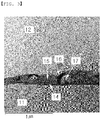
- FIG. 3 shows an interface between the base steel sheet 11 and the Zn single phase 12, shown in FIG. 1 , and it can be seen that an inhibition layer 14 and a ternary alloy phase of Zn/MgZn 2 /Al were formed. Specifically, it can be seen that an MgZn 2 phase 15, an Al phase 16, and a Zn phase 17 were formed.
- FIG. 2 is a photograph showing a cross-section of a plating layer of Comparative Example 2, and it can be seen that a lamellar structure 23 was formed to be coarse. Therefore, it can be seen that cracks may be easy occurred during processing.
Landscapes
- Chemical & Material Sciences (AREA)
- Organic Chemistry (AREA)
- Engineering & Computer Science (AREA)
- Materials Engineering (AREA)
- Mechanical Engineering (AREA)
- Metallurgy (AREA)
- Chemical Kinetics & Catalysis (AREA)
- Physics & Mathematics (AREA)
- Thermal Sciences (AREA)
- General Chemical & Material Sciences (AREA)
- Oil, Petroleum & Natural Gas (AREA)
- Coating With Molten Metal (AREA)
- Electroplating Methods And Accessories (AREA)
Abstract
Description
- The present disclosure relates to a plated steel material that can be used in an automobile, a household appliance, a building material, and the like, and more particularly, to a zinc alloy plated steel material having excellent surface quality and corrosion resistance, and a method for manufacturing the same.
- A zinc plating method for inhibiting the corrosion of iron by a cathode process has been widely used to manufacture a steel material having high corrosion resistance, due to its excellent corrosion resistance performance and economic efficiency. In particular, a hot-dip galvanized steel material, forming a plating layer by immersing a steel material into molten zinc, has a relatively simple manufacturing process and relatively low product costs, compared to an electro-galvanized steel material, and, thus, demand for such hot-dip galvanized steel material for automobiles, household appliances, building materials, and the like, is increasing.
- The hot-dip galvanized steel material may have characteristics of sacrificial corrosion protection, in which zinc having relatively low oxidation-reduction potential is first corroded to inhibit corrosion of the steel material, compared to iron, when exposed to a corrosive environment. In addition, the hot-dip galvanized steel material may improve corrosion resistance of the steel material, since the zinc of a plating layer is oxidized to form a dense corrosion product on a surface of the steel material, to block the steel material from an oxidizing environment.
- However, air pollution and deterioration of a corrosive environment are increasing due to the advancement of industry, and a need for the development of a steel material having better corrosion resistance, compared to conventional galvanized steel, is increasing, due to strict regulations on resource and energy saving. As a part of these issues, various studies into a technology of manufacturing a zinc alloy-based plated steel material have been conducted to improve the corrosion resistance of the steel material by adding elements such as aluminum (Al) and magnesium (Mg) to a zinc plating bath. As a representative zinc alloy-based plated steel material, studies have been actively conducted into a technology of manufacturing a Zn-Al-Mg-based plated steel material in which Mg is additionally added to a Zn-Al plating composition system (Patent Document 1).
- Many of the plated steel materials used in the industry may be often subjected to various processes such as cutting, bending, tensioning, and the like, to be manufactured as final products. In this case, cut surfaces or processed surfaces may have problems in that corrosion resistance may be deteriorated due to exposure of a base iron or damage to the plating layer. In particular, in a Zn-Al-Mg-based alloy plating, processed surfaces may be more vulnerable because the plating layer may be more brittle, compared to a conventional zinc plating. Previously, there have not been many studies into improvement of the corrosion resistance of a processed portion.
- (Patent Document 1) Japanese Patent Publication No.
2002-332555 - An aspect of the present disclosure is to provide a zinc alloy plated steel material having excellent surface quality and excellent corrosion resistance in a cross-sectional portion, as well as excellent corrosion resistance in a processed portion, and a method of manufacturing the same.
- The problems to be solved by the present disclosure are not limited to the problems mentioned above, and other problems not mentioned will be clearly understood by those skilled in the art from the following description.
- According to an aspect of the present disclosure, a zinc alloy plated steel material having excellent surface quality and corrosion resistance, includes: a base iron; a zinc alloy plating layer formed on the base iron; and an inhibition layer formed between the base iron and the zinc alloy plating layer, wherein a Zn phase of a surface of the zinc alloy plating layer comprises 15 to 90 area%, and the inhibition layer includes a ternary alloy phase layer of Zn/MgZn2/Al having a thickness of 2µm or less on the inhibition layer, wherein the ternary alloy phase layer comprises 30 to 90 area% of a surface of the inhibition layer.
- According to another aspect of the present disclosure, a method of manufacturing a zinc alloy plated steel material having excellent surface quality and corrosion resistance, includes: preparing a base iron; immersing the base iron into a zinc alloy plating bath containing Mg and Al to plate the base iron; and wiping the plated base iron, and then cooling, wherein the cooling satisfies the following relationship 1:

- According to an aspect of the present disclosure, a zinc alloy plated steel material having excellent surface characteristics by preventing discoloration of a surface of a plating layer, and having excellent corrosion resistance not only in a cross-sectional portion but also in a processed portion, and a method for manufacturing the same, may be provided. Therefore, there is an advantage in that it a usage area may be broadened to an area to which a conventional usage is limited.
-
-
FIG. 1 is a photograph showing a cross-section of a plating layer of Inventive Example 3, among Examples of the present disclosure. -
FIG. 2 is a photograph showing a cross-section of a plating layer of Comparative Example 2, among Examples of the present disclosure. -
FIG. 3 is a photograph showing a ternary alloy phase layer of Zn/MgZn2/Al formed on an inhibition layer in the photograph ofFIG. 1 . -
FIG. 4 is a schematic view illustrating a plated steel material and a wiping knife. - A conventional zinc plating is solidified in a single Zn phase, whereas a Zn-Al-Mg-based zinc alloy plating coexist with a Zn phase, an alloy phase of Mg and Zn, and an Al phase. A plating structure may form a very complex plating structure, depending on physical and chemical conditions of a surface of a base iron in accordance with trace elements, manufacturing processes, or the like, in a plating bath.
- A Zn-Mg alloy phase in a plating structure of a Zn-Al-Mg-based zinc alloy plating layer (hereinafter, a zinc alloy plating layer or a plating layer) may be made of various intermetallic compounds such as MgZn2, Mg2Zn11, and the like, and hardness thereof may be Hv 250 to 300. In addition, an inhibition layer made of intermetallic compounds of Fe and Al may be formed at an interface between the plating layer and the base iron. The intermetallic compounds of Fe and Al may include Fe4Al13, Fe2Al5, and the like. Since the intermetallic compounds also have relatively high brittleness, cracks in the plating layer may be likely to occur during physical deformation.
- A zinc alloy plated steel material of the present disclosure may include a base iron, a zinc alloy plating layer formed on the base iron, and an inhibition layer formed between the base iron and the zinc alloy plating layer.
- A composition of the zinc alloy plating layer is not particularly limited, but as a preferred example, may include, by weight, Mg: 0.5 to 3.5%, Al: 0.5 to 20.0%, Zn as a residual component, and inevitable impurities.
- Magnesium (Mg) plays a very important role for improving corrosion resistance of a zinc-based plated steel material, and may effectively form a zinc hydroxide-based corrosion product on a surface of a plating layer under a corrosive environment, to effectively prevent corrosion of the zinc-based plated steel material. In order to obtain the above effects, the content thereof may be 0.5% by weight or more, and more preferably 0.8% by weight or more. However, when the content thereof is excessively high, there may be a problem that Mg oxidizing dross on a surface of a plating bath rapidly increases. In order to prevent the problem, the Mg may be 3.5% by weight or less, and more preferably 2.0% by weight or less.
- Aluminum (Al) suppresses the formation of the Mg oxide dross in the plating bath, and may react with Zn and Mg in the plating bath to form a Zn-Al-Mg-based intermetallic compound, to improve corrosion resistance of the plated steel material. In order to obtain the above effects, the content thereof may be 0.5% by weight or more, and more preferably 0.8% by weight or more. However, when the content thereof is excessively high, weldability and phosphatizing property of the plated steel material can be deteriorated. In order to prevent the problem, the Al may be 20.0% by weight or less, and preferably 6.0% by weight or less. In addition, in order to promote solidification behavior of the bath, the Al may be more preferable 3.0% by weight or less.
- Zn as a residual component and inevitable impurities may be included.
- An inhibition layer may be formed between the zinc alloy plating layer and the base iron in the zinc alloy plated steel sheet. The inhibition layer may be composed of an intermetallic compound of Fe and Al (ex., Fe4Al13, Fe2Al5, and the like). The inhibition layer may be composed of fine grains, but may have brittleness when the grains have relatively coarse shape. Therefore, when an external stress is added to the steel sheet, the inhibition layer may be destroyed, to deteriorate corrosion resistance due to peeling or cracking in processing of the plating layer. Therefore, a grain size of the inhibition layer may be 300nm or less, and an average grain size of the inhibition layer may be 100nm or less.
- A ternary alloy phase layer of Zn, MgZn2, and Al formed to have a thickness of 2µm or less may be formed on the inhibition layer. A sacrificial cathodic reaction may primarily initiate at an interface between the base iron and the zinc alloy plating layer under a corrosive environment. In a case in which the ternary alloy phase is formed around the interface between the base iron and the zinc alloy plating layer, when a cross-section of a product is exposed to the corrosive environment, effects by a sacrificial process may increase at the interface, and may be then continuously maintained. This may be because Zn, Mg, which are mainly involved in the sacrificial process, and Al, advantageous for forming a passivation film, may be concentrated on around the interface between the plating layer and the base iron. The ternary alloy phase layer may be formed on the inhibition layer, and may be formed at least 30 area%, based on the total area of the inhibition layer. However, when the ternary alloy phase layer is excessively formed, hardness of an upper portion of the plating layer may be reduced to deteriorate frictional properties of the plating layer. Therefore, the ternary alloy phase layer may be not to exceed 90 area%. As an example of a method of confirming the ternary alloy phase layer, there may be a method of confirming by using a scanning electron microscope (SEM) or a transmission electron microscope (TEM), enlarging a cross-section in magnification. Another example of the above method may include dissolving the plating layer with hydrochloric acid (HCl) aqueous solution, observing a surface of the plating layer, and observing the ternary alloy phase layer remaining in an upper portion of the inhibition layer. When observing the cross-section, along a boundary of the cross-section, a length of the ternary phase formed on the inhibition layer may be measured from the entire length of the inhibition layer.
- When the ternary alloy phase layer of Zn, MgZn2, and Al is formed to have a thickness exceeding 2µm on the inhibition layer, effects by the sacrificial process around the interface between the base iron and the zinc alloy plating layer may be reduced, and effects of improving corrosion resistance of the cross-section may be also reduced. Therefore, it may be important to control a material state or cooling conditions such that a thickness of the ternary alloy phase layer does not exceed 2µm.
- The zinc alloy plating layer may include a Zn phase, an alloy phase of Mg and Zn (ex., MgZn2, Mg2Zn11, and the like), an Al phase, and the like. In a microstructure observed in the surface of the zinc alloy plating layer of the present disclosure, the Zn phase may include 15 to 90 area% of the surface of the zinc alloy plating layer. The microstructure appearing in the surface of the plating layer may be very closely related to surface properties of the plating layer. When a ratio of the Zn phase in the surface of the plating layer is relatively small, there may be a problem that color of a plated surface becomes relatively dark due to Mg oxidation during long-term storage of the plated steel sheet. Therefore, the Zn phase in the surface of the plating layer may be 15 area% or more. When a ratio of the Zn phase exceeds 90 area%, excessive cooling may be required so that productivity may be deteriorated, which is not preferable.
- The zinc alloy plating layer may include various phases as described above, and the Zn phase and the MgZn2 phase thereamong may include a binary phase having a lamellar structure. In the zinc alloy plating layer of the present disclosure, an average thickness of each of the Zn phase and the MgZn2 phase in a width direction, in the lamellar structure of the Zn phase and the MgZn2 phase included in the zinc alloy plating layer, may be 1.5µm or less. Since the MgZn2 phase may be more brittle, compared to the Zn phase, when the lamellar structure is formed to be coarse, there may be relatively high possibility of destruction by external stress. Therefore, in the lamellar structure of the Zn phase and the MgZn2 phase formed from the surface of the plating layer, the average thickness of each of the Zn phase and the MgZn2 phase in the width direction may be 1.5µm or less (excluding 0). The lamellar structure of the Zn phase and the MgZn2 phase included in the zinc alloy plating layer may be a lamellar structure present up to 70 area% of the plating layer on the surface of the zinc alloy plating layer. The thickness in the width direction may be determined by measuring at least 10 locations of the lamella structure present in the plating layer, and calculating an average value thereof.
- Hereinafter, an embodiment of a method for manufacturing a zinc alloy plated steel material of the present disclosure will be described in detail. The method for manufacturing the zinc alloy plated steel material of the present disclosure may include preparing a base iron; immersing the prepared base iron into a plating bath to plate the base iron; and wiping to control a thickness a plating layer and then cooling.
- In the preparing the base iron, it is desired to first make a metal structure of a hot rolled steel material uniform. An average grain size of the hot rolled steel material may be 1 to 100µm. In this case, a grain of the hot rolled steel material may be in a surface layer portion (within 1/8 or less of the total thickness from the surface) . In a case in which non-uniformity of a structure of the hot rolled steel material, especially a surface structure of the hot rolled steel material is generated, uniform formation of the inhibition layer may be difficult, due to diffusion of non-uniformity of a surface shape during cold rolling and diffusion of non-uniformity of Fe from the base iron required for formation of the inhibition layer. The ternary phase to be formed in an upper portion of the inhibition layer may be also formed non-uniformly to deteriorate corrosion resistance in a cross-section. To this end, the average grain size of the hot rolled steel material may be 1 to 100pm. The grain size of the hot rolled steel material may be preferably 1 to 50pm, and more preferably 5 to 30pm.
- When the grain size of the hot rolled steel material is less than 1pm, it may be advantageous for securing strength, but surface roughness due to the grain during cold rolling may be increased. Further, when the grain size exceeds 100pm, it may be advantageous in terms of shape homogenization, but an excessive increase in hot rolling temperature may cause scale defects, and product manufacturing costs may increase. An example of a method for obtaining the grain size of the hot rolled steel material may include maintaining hot rolling temperature at least 800°C or higher, or increasing coiling temperature to 550°C or higher after hot rolling.
- In preparing a cold rolled steel material by cold rolling the hot rolled steel material, surface roughness (Ra) of the cold rolled steel material may be 0.2 to 1.0µm, and steepness may be 0.2 to 1.2.
- The surface roughness may be determined according to pressure of a roll and a surface shape of the roll, when the roll rolls the material. When the surface roughness exceeds 1.0µm, a non-uniform inhibition layer may be formed when forming the plating layer, and non-uniformity formation between phases in the plating layer may increase. When the surface roughness is less than 0.2µm, surface friction coefficient may decrease to slip the steel material into the roll.
- The measurement of the steepness may be a method of measuring a degree of bending of a steel material having a width of 1m or more and a length of 2m or more, after placing the steel material, to closely adhere a surface of the steel material to a surface plate having a flat surface. A height (H) of the bending is divided by a wavelength (P) of the bending, and, the divided value is then expressed as the product of 100. That is, the steepness may be expressed by a formula of height (H)/wavelength (P) x 100. The lower the steepness, the higher the flatness of the steel material. When the steepness exceeds 1.2, the degree of bending of the steel material may be relatively large, which causes a deviation in surface flow when the steel material passes through the plating bath. Therefore, formation of the inhibition layer and homogenization of the plating layer may be adversely affected. The lower the steepness is, the more advantageous. As an example, in order to manage the steepness to less than 0.2, there may be a proposed method to slow down a speed of cold rolling, but the proposed method is not preferable due to its excessive process costs.
- A method for controlling surface roughness and steepness in an appropriate range is not limited thereto. A reduction ratio may be set to be within a range of 2 to 5% in a last rolling operation of cold rolling. Also, appropriate tension may be added to the steel sheet during rolling. In addition, as an example for imparting surface roughness, plasma treatment may be performed on a surface of the steel. For example, in the cold rolling, since a final shape may be determined by a roll in the last rolling operation, the reduction ratio may be 5% or less. In a case of a sheet having a thickness of 0.5mm, the reduction ratio may be set to be 2% or more, to reduce overload of shear rolling.
- Meanwhile, the cold rolled steel material as described above may be annealed at a temperature of 600 to 850°C, as necessary. At the time of the annealing, a gas containing 1 to 10% by volume of hydrogen (H2) in nitrogen (N2) may be used. When a concentration of the hydrogen is less than 1% by volume, it may be difficult to reduction an oxide in a surface of the steel. When a concentration of the hydrogen exceeds 10% by volume, its manufacturing costs may increase. Therefore, the hydrogen may be 1 to 10% by volume of the gas.
- As dew point temperature in an atmosphere of the annealing differs, not only proportions of components constituting an oxide film formed on the surface of the base iron may be different, but also an internal oxidation rate may be different. Therefore, the dew point temperature may be managed in a range of -60 to -10°C. When the dew point temperature is less than -60°C, it is not preferable because excessive costs in managing purity of a raw gas may be incurred. When the dew point temperature exceeds -10°C, reduction of contaminants on the surface of the base iron may not be achieved well, and an oxide film such as B, Mn, or the like, which may be a trace element or impurity contained in the steel, may be formed to deteriorate plating wettability.
- A zinc alloy plated steel material may be manufactured by a plating process in which the base iron prepared as above is immersed into and withdrawn from a plating bath. The plating bath may include, by weight, Al: 0.5 to 20.0%, Mg: 0.5 to 3.5%, Fe as a residual component, and inevitable impurities. Each of the components may be not different from those described in the zinc alloy plating layer described above.
- An inhibition layer of Fe and Al may be formed on the surface of the base iron immersed in the plating bath, a plating layer including components, similar to the components of the plating bath, may be formed on the inhibition layer, and a steel sheet may be withdrawn from the plating bath. In this case, temperature of the plating bath may be within a range of 430 to 500°C. When the temperature of the plating bath is less than 430°C, even though the base iron is immersed into the plating bath, decomposition of the oxide on the surface of the base iron may be not smoothly performed, which may be disadvantageous in the formation of the inhibition layer. When the temperature of the plating bath exceeds 500°C, it is not preferable because dross on the surface of the plating bath may occur and Mg oxidation may occur significantly.
- The plating process may use a process of depositing components individually in the plating bath, and a continuous hot dip plating process in which a steel material (particularly, a steel sheet) is continuously passed through the plating bath to form a plating layer. In the continuous hot dip plating process, a velocity of passing of the steel material may be 60 to 200MPM (a passing distance per minute, meter per minute). When the velocity of the passing is less than 60MPM, product productivity may decrease. When the velocity of the passing exceeds 200MPM, non-uniformity between the inhibition layer and the plating layer may occur.
- In the zinc alloy plated steel material withdrawn from the plating bath, a thickness of the plating layer may be adjusted by a wiping nozzle, called an air knife, in an upper portion of the plating bath, and a cooling operation may be then performed. The wiping nozzle may spray air or an inert gas to adjust the thickness of the plating layer. When passing through the wiping nozzle, temperature of the plating layer and the steel material, and adjustment of the wiping nozzle may affect structure formation of the plating layer.
-
FIG. 4 is a schematic view illustrating a plated steel material and a wiping nozzle. Referring toFIG. 4 , the present disclosure may satisfy a working index of 0.5 to 40 determined by the following relationship 3, defining gas injection pressure in the wiping nozzle (P), a distance between the wiping nozzle and the steel sheet (D), a slot thickness of the wiping nozzle (t), a velocity of a passing of the steel material (S), and temperature of a plating bath (T) :
- The working index may be a shape factor of the base iron before plating, and may be suitable for forming a desirable plating structure, when a plating layer is prepared, in a state in which surface roughness (Ra) is 0.2 to 1.0µm and steepness is 0.2 to 1.2. That is, a fine lamellar structure in the plating layer fine may be made, and at the same time, formation of a ternary alloy phase directly in the inhibition layer may be facilitated at an interface between the plating layer and the base iron. When the working index is 0.5 or less, a fraction of the Zn phase of the surface of the plating may be reduced to easily discolor the surface of the plating, and the lamellar structure may be coarse to occur cracking of the plating during processing. When the working index exceeds 40, defects such as flow patterns may occur on a surface of the plating layer. Therefore, the working index defined by the relationship 2 may be 0.5 to 40.
- After the wiping process, the plated steel material may be cooled, and the cooling operation may satisfy the following relationship 1:

- As a factor influencing structures and growths of phases in the plating layer, in order to obtain a desirable structure, a ratio (Vc'/Vc) of an average cooling rate until start of solidification of the plating layer immediately after wiping (Vc') to an average cooling rate until end of solidification of a plating layer immediately after wiping (Vc), may be 0.7 to 1.5.
- Hereinafter, examples of the present disclosure will be described in detail. The following examples are only for understanding the present disclosure and are not intended to limit a scope of the present disclosure. This is because the scope of the present disclosure may be determined by contents described in the claims and contents reasonably inferred therefrom.
- Cold rolled steel sheets having a thickness of 0.8mm were used as base irons to prepare base steel sheets for an automotive exterior including, by weight, 0.03% of C, 0.2% of Si, 0.15% of Mn, 0.01% of P, and 0.01% of S. In this case, values for surface roughness (Ra) and steepness of each of the base steel sheets are shown in Table 1. Cold rolled steel coils were continuously immersed in and withdrawn from a Zn-Al-Mg alloy plating bath, and were subject to wiping and cooling operations to prepare zinc alloy plated steel sheets. Specific conditions used in this case are shown in Table 1.
- Components of a plating layer of each of the prepared zinc alloy plated steel sheets, spraying pressure of a wiping nozzle (P), a distance between the wiping nozzle and the steel sheet (D), a slot thickness of the wiping nozzle (t), a velocity of passing of the steel material (S), and plating bath temperature (T) are reflected in the conditions shown in Table 1 below, to calculate values for a working index defined by relationship 2 above, and show the calculated values for working index in Table 1 together.
- An area fraction of a Zn phase observed in a surface of the zinc alloy plated steel sheets prepared as described above, a distance between Zn and MgZn2 phases of a lamellar structure in a width direction, present up to 70% of a thickness of a plating layer from the surface of the plating layer, and area fraction of a ternary alloy phase layer of Zn/MgZn2/Al having a thickness of 2µm or less, included in an inhibition layer, were measured, and the measured values were shown in Table 2 together.
- In addition, in order to confirm properties of each of the zinc alloy plated steel sheets, surface properties, and corrosion resistance of cross-sectional and processed portions of each of the zinc alloy plated steel sheets were evaluated, and the evaluated results were shown in Table 3. Regarding the surface properties, a flow pattern and a degree of surface discoloration were measured, the degree of surface discoloration was evaluated by measuring a color difference of a surface of each samples, standing each of the samples at a temperature of 50°C and humidity (95%) for 24 hours, and measuring then the color difference of each of the samples again, to evaluate values (dE) with reduced respective brightness value. Regarding corrosion resistance of each of the cross-sectional and processed portions, Cyclic Corrosion Test specified in ISO TC 156 was performed for each of the samples. The number of cycling occurrence of red rust (cycle number) in the cross-sectional portion of each of the samples, determined by the corrosion test, and the number of cycling occurrence of red rust (cycle number) in the processed portion of each of the samples, determined by bending each of the samples to 180° and performing the corrosion test to measure the number of cycling occurrence of red rust in the bent area, were recorded.
[Table 1] Class ifica tion Plating Layer Components (wt%) Steel Sheet Ra (µm) Steel Sheet Steep ness Velocity of Passing of the steel (MPM) Plating Bath Temp. (°C) Air Knife Pressure (Kpa) Air Knife-Steel Sheet Distance (mm) Nozzle Slot Thickness (mm) Working Index Value Average Cooling Rate (Vc'/Vc) Mg Al *IE1 1.2 1 0.4 0.2 170 455 35 15 2 1.5 0.7 IE2 1.6 2.5 0.3 0.7 120 455 65 10 1.5 4.5 1.1 IE3 1.5 1.5 0.5 0.8 80 430 75 7 2 8.0 1.3 IE4 3 2.5 0.8 1.0 65 470 70 5 2.5 37.7 1.0 IE5 3 6 0. 6 1.2 65 425 65 12 1.5 3.1 1.2 IE6 3 20 0.3 0.4 80 490 55 12 2 10.3 1.5 **CE1 1.6 1.6 0.4 1.3 55 470 90 4 1.5 43.0 0.8 CE2 1.3 1.6 1.3 1.5 180 450 20 20 0.8 0.2 0.5 CE3 3 3 0.8 1.3 160 410 40 17 1.5 0.2 0.4 CE4 3 6 1.1 1.4 75 460 90 6 3 36.0 1.8 *IE: Inventive Example, **CE: Comparative Example [Table 2] Class ifica tion The presence of Flow Pattern Defect (○/×) Plating Layer Structure Evaluation of Properties Surface Zn Phase (area%) Distance between Zn-MgZn2 Phases (Width, µm) Zn/MgZn2/Al Tertiary Alloy Phase Layer (area%) Color Difference (dE) Number of cycling Occurrence of Red Rust in Cross-Sectional Portion (Cycle No.) Number of cycling Occurrence of Red Rust in Processed Portion (Cycle No.) *IE1 × 75 0.5 65 3 55 35 IE2 × 56 0.7 30 3 60 35 IE3 × 15 1.4 45 2 65 45 IE4 × 30 1.0 55 2 50 40 IE5 × 45 0.8 35 2 65 35 IE6 × 60 0.4 38 2 50 45 **CE1 ○ 13 1.8 25 5 45 20 CE2 × 7 1.7 30 6 35 25 CE3 × 10 2.0 15 5 45 25 CE4 ○ 12 2.2 5 5 30 25 *IE: Inventive Example, **CE: Comparative Example -
FIG. 1 is a photograph showing a cross-section of a plating layer of Inventive Example 3. As shown inFIG. 1 , it can be seen that a plating layer was provided on abase steel plate 11, a Znsingle phase 12 and a lamella structure 13 was formed in the plating layer, and the lamella structure 13 was finely formed to reduce occurrence of cracks during processing.FIG. 3 shows an interface between thebase steel sheet 11 and the Znsingle phase 12, shown inFIG. 1 , and it can be seen that aninhibition layer 14 and a ternary alloy phase of Zn/MgZn2/Al were formed. Specifically, it can be seen that an MgZn2 phase 15, anAl phase 16, and aZn phase 17 were formed.FIG. 2 is a photograph showing a cross-section of a plating layer of Comparative Example 2, and it can be seen that alamellar structure 23 was formed to be coarse. Therefore, it can be seen that cracks may be easy occurred during processing. - From the results of Table 2 and
FIGS. 1 to 3 , in the Inventive Examples satisfying the defined conditions of the present disclosure, excellent surface properties may be secured and excellent corrosion resistance may be secured, even in the cross-sectional and processed portions. - While example embodiments have been shown and described above, it will be apparent to those skilled in the art that modifications and variations could be made without departing from the scope of the present disclosure as defined by the appended claims.
Claims (10)
- A zinc alloy plated steel material having excellent surface quality and corrosion resistance, comprising:a base iron;a zinc alloy plating layer formed on the base iron; andan inhibition layer formed between the base iron and the zinc alloy plating layer,wherein a Zn phase of a surface of the zinc alloy plating layer comprises 15 to 90 area%, andthe inhibition layer includes a ternary alloy phase layer of Zn/MgZn2/Al having a thickness of 2µm or less on the inhibition layer, wherein the ternary alloy phase layer comprises 30 to 90 area% of a surface of the inhibition layer.
- The zinc alloy plated steel material having excellent surface quality and corrosion resistance according to claim 1, wherein the zinc alloy plating layer comprises a lamellar structure of the Zn phase and an MgZn2 phase,
wherein an average thickness of each of the Zn phase and the MgZn2 phase in a width direction is 1.5µm or less. - The zinc alloy plated steel material having excellent surface quality and corrosion resistance according to claim 1, wherein a grain size of a Fe-Al based intermetallic compound in the inhibition layer is 300nm or less.
- The zinc alloy plated steel material having excellent surface quality and corrosion resistance according to claim 1, wherein the zinc alloy plating layer comprises, by weight, Mg: 0.5 to 3.5%, Al: 0.5 to 20.0%, Zn as a residual component, and inevitable impurities.
- A method of manufacturing a zinc alloy plated steel material having excellent surface quality and corrosion resistance, comprising:preparing a base iron;immersing the base iron into a zinc alloy plating bath containing Mg and Al to plate the base iron; andwiping the plated base iron, and then cooling,wherein the cooling satisfies the following relationship 1:

- The method of manufacturing a zinc alloy plated steel material having excellent surface quality and corrosion resistance according to claim 5, wherein the preparing the base iron comprises:preparing a hot rolled steel material having a surface layer portion having a grain size of 1 to 100µm; andcold rolling the hot rolled steel material to prepare a cold rolled steel material having a surface roughness of 0.2 to 1.0µm and a steepness of 0.2 to 1.2µm.
- The method of manufacturing a zinc alloy plated steel material having excellent surface quality and corrosion resistance according to claim 5, wherein a composition of the plating bath comprises, by weight, Mg: 0.5 to 3.5%, Al: 0.5 to 20.0%, Zn as a residual component, and inevitable impurities.
- The method according to claim 5, wherein the plating and wiping satisfy a working index of 0.5 to 40 represented by the following relationship 2:

- The method of manufacturing a zinc alloy plated steel material having excellent surface quality and corrosion resistance according to claim 5, wherein a temperature of the plating bath is 430 to 500°C.
- The method of manufacturing a zinc alloy plated steel material having excellent surface quality and corrosion resistance according to claim 5, wherein in the plating process, a velocity of a passing plate is 60 to 200 MPM (meters per minute).
Applications Claiming Priority (2)
| Application Number | Priority Date | Filing Date | Title |
|---|---|---|---|
| KR1020170180329A KR102031466B1 (en) | 2017-12-26 | 2017-12-26 | Zinc alloy coated steel having excellent surface property and corrosion resistance, and method for manufacturing the same |
| PCT/KR2018/015833 WO2019132337A1 (en) | 2017-12-26 | 2018-12-13 | Zinc alloy plated steel material having excellent surface quality and corrosion resistance, and method for manufacturing same |
Publications (3)
| Publication Number | Publication Date |
|---|---|
| EP3733921A1 true EP3733921A1 (en) | 2020-11-04 |
| EP3733921A4 EP3733921A4 (en) | 2020-12-30 |
| EP3733921B1 EP3733921B1 (en) | 2023-03-01 |
Family
ID=67063946
Family Applications (1)
| Application Number | Title | Priority Date | Filing Date |
|---|---|---|---|
| EP18896858.0A Active EP3733921B1 (en) | 2017-12-26 | 2018-12-13 | Zinc alloy plated steel material having excellent surface quality and corrosion resistance, and method for manufacturing same |
Country Status (8)
| Country | Link |
|---|---|
| US (2) | US11332816B2 (en) |
| EP (1) | EP3733921B1 (en) |
| JP (1) | JP7579142B2 (en) |
| KR (1) | KR102031466B1 (en) |
| CN (1) | CN111542640B (en) |
| ES (1) | ES2943861T3 (en) |
| MX (1) | MX2020006644A (en) |
| WO (1) | WO2019132337A1 (en) |
Cited By (3)
| Publication number | Priority date | Publication date | Assignee | Title |
|---|---|---|---|---|
| WO2022101872A1 (en) * | 2020-11-16 | 2022-05-19 | Arcelormittal | A method for manufacturing a steel sheet with a znalmg coating, corresponding coated steel sheet, part and vehicle |
| WO2022139367A1 (en) | 2020-12-21 | 2022-06-30 | 주식회사 포스코 | Plated steel sheet having excellent sealer adhesion and method for manufacturing same |
| RU2816325C1 (en) * | 2020-11-16 | 2024-03-28 | Арселормиттал | ZnAlMg COATED STEEL SHEET MANUFACTURING METHOD, CORRESPONDING COATED STEEL SHEET, PART AND VEHICLE |
Families Citing this family (18)
| Publication number | Priority date | Publication date | Assignee | Title |
|---|---|---|---|---|
| EP4036270A1 (en) * | 2019-09-24 | 2022-08-03 | Posco | Plated steel sheet having excellent corrosion resistance, galling resistance, workability and surface property and method for manufacturing same |
| KR102384674B1 (en) * | 2019-09-24 | 2022-04-11 | 주식회사 포스코 | Plated steel sheet having excellent corrosion resistance, galling resistance, workability and surface property and method for manufacturing the same |
| KR102305753B1 (en) | 2019-12-18 | 2021-09-27 | 주식회사 포스코 | Zn-Al-Mg BASED HOT DIP ALLOY COATED STEEL MATERIAL HAVING EXCELLENT CORROSION RESISTANCE OF PROCESSED PARTS AND METHOD OF MANUFACTURING THE SAME |
| DE102020105375A1 (en) * | 2020-02-28 | 2021-09-02 | Thyssenkrupp Steel Europe Ag | Hot-dip coated steel product with zinc-aluminum-magnesium coating as well as manufacturing process and use of a device for hot-dip coating of steel strip |
| KR102738107B1 (en) * | 2020-10-20 | 2024-12-05 | 닛폰세이테츠 가부시키가이샤 | Galvanized steel plate |
| KR102381828B1 (en) * | 2020-12-18 | 2022-04-01 | 주식회사 포스코 | Plated steel sheet having excellent corrosion resistance and surface property and method for manufacturing the same |
| KR102453010B1 (en) * | 2020-12-21 | 2022-10-12 | 주식회사 포스코 | Plated steel sheet having excellent corrosion resistance and surface property and method for manufacturing the same |
| KR102453009B1 (en) * | 2020-12-21 | 2022-10-12 | 주식회사 포스코 | Plated steel sheet having excellent corrosion resistance and surface property and method for manufacturing the same |
| DE102021107873A1 (en) | 2021-03-29 | 2022-09-29 | Thyssenkrupp Steel Europe Ag | Hot-dip coated sheet steel |
| KR102529740B1 (en) * | 2021-06-18 | 2023-05-08 | 주식회사 포스코 | Plated steel sheet having excellent corrosion resistance and surface property and method for manufacturing the same |
| KR102513354B1 (en) * | 2021-09-30 | 2023-03-23 | 주식회사 포스코 | Plated steel sheet having excellent corrosion resistance and bendability and method for manufacturing the same |
| JP7787395B2 (en) * | 2021-11-18 | 2025-12-17 | 日本製鉄株式会社 | Hot-dip Zn-Al-Mg plated steel sheet, automotive parts, and manufacturing method thereof |
| CN114635101B (en) * | 2022-02-16 | 2024-06-28 | 唐山钢铁集团有限责任公司 | Production method of zinc-aluminum-magnesium coated steel plate |
| KR102712249B1 (en) * | 2022-04-29 | 2024-10-04 | 현대제철 주식회사 | Method of fabricating a galvanizing steel having excellent bendability and corrosion resistance |
| KR102871473B1 (en) * | 2023-12-20 | 2025-10-15 | 현대제철 주식회사 | Zinc alloy plated steel and its manufacturing method |
| WO2025169615A1 (en) * | 2024-02-06 | 2025-08-14 | Jfeスチール株式会社 | Zn-Al-Mg-BASED PLATED STEEL SHEET |
| CN118880209B (en) * | 2024-06-27 | 2026-03-03 | 马鞍山钢铁有限公司 | Hot-base galvanized aluminum magnesium product and method for controlling zinc flow line defect |
| KR20260017840A (en) * | 2024-07-30 | 2026-02-06 | 현대제철 주식회사 | Plated steel and manufacturing method thereof |
Family Cites Families (46)
| Publication number | Priority date | Publication date | Assignee | Title |
|---|---|---|---|---|
| US4330574A (en) * | 1979-04-16 | 1982-05-18 | Armco Inc. | Finishing method for conventional hot dip coating of a ferrous base metal strip with a molten coating metal |
| DE3684454D1 (en) | 1985-08-29 | 1992-04-23 | Nisshin Steel Co Ltd | HOT-GALVANIZED STEEL PLATE AND THEIR PRODUCTION METHOD. |
| US6159622A (en) | 1996-02-22 | 2000-12-12 | Sumitomo Metal Industries, Ltd. | Galvannealed steel sheet and manufacturing method thereof |
| JP3179401B2 (en) | 1996-12-13 | 2001-06-25 | 日新製鋼株式会社 | Hot-dip Zn-Al-Mg plated steel sheet with good corrosion resistance and surface appearance and method for producing the same |
| CN1193113C (en) * | 1996-12-13 | 2005-03-16 | 日新制钢株式会社 | Molten Zn-Al-Mg electroplated steel sheet with good corrosion resistance and surface appearance and its preparation method |
| JP2001295015A (en) | 2000-02-09 | 2001-10-26 | Nisshin Steel Co Ltd | HOT DIP HIGH Al-CONTAINING Zn-Al-Mg BASE METAL COATED STEEL SHEET |
| KR100625952B1 (en) | 2000-12-26 | 2006-09-20 | 주식회사 포스코 | Method for manufacturing hot-dip galvanized steel sheet with excellent surface appearance and gloss |
| KR20020053514A (en) | 2000-12-27 | 2002-07-05 | 이구택 | Thickness variation control system of cold rolled steel plate |
| JP4064634B2 (en) | 2001-02-02 | 2008-03-19 | 日新製鋼株式会社 | Hot-dip Zn-based plated steel sheet with good gloss retention and method for producing the same |
| JP4683764B2 (en) | 2001-05-14 | 2011-05-18 | 日新製鋼株式会社 | Hot-dip Zn-Al-Mg alloy-plated steel with excellent corrosion resistance |
| ES2350921T3 (en) | 2002-07-24 | 2011-01-28 | Nisshin Steel Co., Ltd. | STEEL SHEET GALVANIZED BY HOT IMMERSION BASED ON EXCELLENT CINC IN THE BRIGHTNESS RETENTION. |
| JP2004156111A (en) * | 2002-11-07 | 2004-06-03 | Sumitomo Metal Ind Ltd | Alloyed hot-dip galvanized steel sheet and method for producing the same |
| JP2004277839A (en) * | 2003-03-18 | 2004-10-07 | Nippon Steel Corp | Zinc-based metal-coated steel |
| KR100817735B1 (en) | 2003-09-16 | 2008-03-31 | 닛신 세이코 가부시키가이샤 | Manufacturing method of hot dip galvanized steel sheet with good gloss retention |
| CN103320738A (en) | 2004-06-29 | 2013-09-25 | 塔塔钢铁艾默伊登有限责任公司 | Steel sheet with hot dip galvanized zinc alloy coating and process to produce it |
| DE102004052482A1 (en) | 2004-10-28 | 2006-05-11 | Thyssenkrupp Steel Ag | Method for producing a corrosion-protected steel sheet |
| EP1693477A1 (en) | 2005-02-22 | 2006-08-23 | ThyssenKrupp Steel AG | Coated steel plate |
| JP4528187B2 (en) | 2005-04-01 | 2010-08-18 | 新日本製鐵株式会社 | Hot-dip steel sheet with good appearance |
| EP2388353B1 (en) | 2009-01-16 | 2014-11-12 | Nippon Steel & Sumitomo Metal Corporation | HOT-DIP Zn-Al-Mg-Si-Cr ALLOY COATED STEEL MATERIAL WITH EXCELLENT CORROSION RESISTANCE |
| WO2010130883A1 (en) | 2009-05-14 | 2010-11-18 | Arcelormittal Investigacion Y Desarrollo Sl | Method for producing a coated metal band having an improved appearance |
| JP5814048B2 (en) | 2010-09-15 | 2015-11-17 | 日新製鋼株式会社 | Method for producing black-plated steel sheet and method for producing molded body of black-plated steel sheet |
| KR20120075235A (en) * | 2010-12-28 | 2012-07-06 | 주식회사 포스코 | Hot dip zn alloy plated steel sheet having excellent anti-corrosion and method for manufacturing the steel sheet using the same |
| EP2474649A1 (en) | 2011-01-05 | 2012-07-11 | Voestalpine Stahl GmbH | Method for treating the surface of a substrate with a protective coating |
| CN103476961B (en) * | 2011-07-20 | 2016-04-06 | 新日铁住金株式会社 | plate |
| CA2870532C (en) | 2012-04-17 | 2016-12-13 | Arcelormittal Investigacion Y Desarrollo Sl | Steel sheet provided with a coating offering sacrificial cathodic protection, method for the production of a part using such a sheet, and resulting part |
| WO2013160565A1 (en) | 2012-04-25 | 2013-10-31 | Arcelormittal Investigacion Y Desarrollo, S.L. | Method for producing a metal sheet having zn-al-mg coatings, comprising the application of an acid surface treatment solution, and corresponding metal sheet |
| JP5097305B1 (en) | 2012-04-25 | 2012-12-12 | 日新製鋼株式会社 | Black plated steel plate |
| KR101417304B1 (en) | 2012-07-23 | 2014-07-08 | 주식회사 포스코 | HOT DIP Zn ALLOY PLATED STEEL SHEET HAVING EXCELLENT ANTI-CORROSION AND SURFACE APPEARANCE AND METHOD FOR MANUFACTURING THE STEEL SHEET USING THE SAME |
| JP5356616B1 (en) | 2012-11-27 | 2013-12-04 | 日新製鋼株式会社 | Method for producing hot-dip Zn alloy-plated steel sheet |
| KR20140074231A (en) * | 2012-12-07 | 2014-06-17 | 동부제철 주식회사 | Hot dip alloy coated steel sheet having excellent corrosion resistance, high formability and good appearance and method for production thereof |
| WO2015052546A1 (en) | 2013-10-09 | 2015-04-16 | ArcelorMittal Investigación y Desarrollo, S.L. | Sheet metal having a znaimg coating and improved flexibility and corresponding production method |
| KR101568474B1 (en) | 2013-10-30 | 2015-11-11 | 주식회사 포스코 | HOT DIP Zn ALLOY PLATED STEEL SHEET HAVING EXCELLENT BLACKENING-RESISTANCE AND SURFACE APPEARANCE AND METHOD FOR MANUFACTURING THE SAME |
| JP5748829B2 (en) | 2013-12-03 | 2015-07-15 | 日新製鋼株式会社 | Hot-dip Zn alloy-plated steel sheet and method for producing the same |
| US10138538B2 (en) | 2013-12-20 | 2018-11-27 | Arcelormittal | ZnAlMg-coated metal sheet produced by optimized wiping |
| KR101568508B1 (en) | 2013-12-21 | 2015-11-11 | 주식회사 포스코 | HOT DIP Zn-BASED ALLOY COATING BATH COMPRISING CALCIUM OXIDE, HOT DIP Zn-BASED ALLOY COATED STEEL SHEET AND METHOD FOR PREPARING THE SAME |
| KR101568509B1 (en) * | 2013-12-21 | 2015-11-20 | 주식회사 포스코 | HOT DIP Zn-Al-Mg ALLOY PLATED STEEL SHEET HAVING EXCELLENT CORROSION RESISTANCE AND METHOD FOR MANUFACTURING THE SAME |
| KR101639844B1 (en) | 2013-12-24 | 2016-07-14 | 주식회사 포스코 | Zinc alloy plating steel sheet having excellent weldability and method for manufacturing the same |
| EP3205741B1 (en) | 2014-10-08 | 2023-04-05 | JFE Steel Corporation | Continuous hot-dip metal plating method and continuous hot-dip metal plating equipment |
| MX370648B (en) | 2014-10-17 | 2019-12-19 | Jfe Steel Corp | High-strength hot-dip-galvanized steel sheet. |
| KR101758529B1 (en) | 2014-12-24 | 2017-07-17 | 주식회사 포스코 | Zn ALLOY PLATED STEEL SHEET HAVING EXCELLENT PHOSPHATABILITY AND SPOT WELDABILITY AND METHOD FOR MANUFACTURING SAME |
| WO2016105157A1 (en) * | 2014-12-24 | 2016-06-30 | 주식회사 포스코 | Zinc alloy plated steel sheet having excellent phosphatability and spot weldability and method for manufacturing same |
| EP3282040B1 (en) | 2015-03-31 | 2019-12-18 | Nippon Steel Nisshin Co., Ltd. | Use of a plated steel sheet as heat-absorbing and radiating steel sheet |
| JP6394578B2 (en) * | 2015-12-04 | 2018-09-26 | Jfeスチール株式会社 | Manufacturing method of molten metal plating steel strip and continuous molten metal plating equipment |
| KR102075182B1 (en) * | 2015-12-24 | 2020-02-10 | 주식회사 포스코 | Hot dip zinc alloy plated high strength steel material having excellent plating property and method for manufacturing same |
| JP6443467B2 (en) * | 2016-02-18 | 2018-12-26 | Jfeスチール株式会社 | Fused Zn-Al-Mg plated steel sheet with coating and method for producing the same |
| KR101665912B1 (en) * | 2016-03-22 | 2016-10-13 | 주식회사 포스코 | HOT DIP Zn ALLOY PLATED STEEL SHEET HAVING EXCELLENT ANTI-CORROSION AND METHOD FOR MANUFACTURING THE STEEL SHEET USING THE SAME |
-
2017
- 2017-12-26 KR KR1020170180329A patent/KR102031466B1/en active Active
-
2018
- 2018-12-13 MX MX2020006644A patent/MX2020006644A/en unknown
- 2018-12-13 CN CN201880084534.3A patent/CN111542640B/en active Active
- 2018-12-13 EP EP18896858.0A patent/EP3733921B1/en active Active
- 2018-12-13 JP JP2020535192A patent/JP7579142B2/en active Active
- 2018-12-13 ES ES18896858T patent/ES2943861T3/en active Active
- 2018-12-13 WO PCT/KR2018/015833 patent/WO2019132337A1/en not_active Ceased
- 2018-12-13 US US16/769,397 patent/US11332816B2/en active Active
-
2022
- 2022-04-26 US US17/729,491 patent/US11643714B2/en active Active
Cited By (8)
| Publication number | Priority date | Publication date | Assignee | Title |
|---|---|---|---|---|
| WO2022101872A1 (en) * | 2020-11-16 | 2022-05-19 | Arcelormittal | A method for manufacturing a steel sheet with a znalmg coating, corresponding coated steel sheet, part and vehicle |
| WO2022101667A1 (en) * | 2020-11-16 | 2022-05-19 | Arcelormittal | A method for manufacturing a steel sheet with a znalmg coating, corresponding coated steel sheet, part and vehicle |
| JP2023549255A (en) * | 2020-11-16 | 2023-11-22 | アルセロールミタル | Manufacturing method of steel plate having ZnAlMg coating, corresponding coated steel plate, parts and vehicle |
| RU2816325C1 (en) * | 2020-11-16 | 2024-03-28 | Арселормиттал | ZnAlMg COATED STEEL SHEET MANUFACTURING METHOD, CORRESPONDING COATED STEEL SHEET, PART AND VEHICLE |
| US12325893B2 (en) | 2020-11-16 | 2025-06-10 | Arcelormittal | Method for manufacturing a steel sheet with a ZnAlMg coating, corresponding coated steel sheet, part and vehicle |
| WO2022139367A1 (en) | 2020-12-21 | 2022-06-30 | 주식회사 포스코 | Plated steel sheet having excellent sealer adhesion and method for manufacturing same |
| EP4265812A4 (en) * | 2020-12-21 | 2023-10-25 | POSCO Co., Ltd | PLATED STEEL SHEET HAVING EXCELLENT ADHESION TO SEALANTS AND METHOD FOR MANUFACTURING SAME |
| US12351919B2 (en) | 2020-12-21 | 2025-07-08 | Posco Co., Ltd | Plated steel sheet having excellent sealer adhesion and method for manufacturing same |
Also Published As
| Publication number | Publication date |
|---|---|
| JP2021508777A (en) | 2021-03-11 |
| US11332816B2 (en) | 2022-05-17 |
| CN111542640A (en) | 2020-08-14 |
| JP7579142B2 (en) | 2024-11-07 |
| US11643714B2 (en) | 2023-05-09 |
| US20220251696A1 (en) | 2022-08-11 |
| ES2943861T3 (en) | 2023-06-16 |
| KR102031466B1 (en) | 2019-10-11 |
| EP3733921B1 (en) | 2023-03-01 |
| EP3733921A4 (en) | 2020-12-30 |
| KR20190078435A (en) | 2019-07-04 |
| MX2020006644A (en) | 2020-09-14 |
| WO2019132337A1 (en) | 2019-07-04 |
| CN111542640B (en) | 2022-06-28 |
| US20210010123A1 (en) | 2021-01-14 |
Similar Documents
| Publication | Publication Date | Title |
|---|---|---|
| EP3733921B1 (en) | Zinc alloy plated steel material having excellent surface quality and corrosion resistance, and method for manufacturing same | |
| JP7798753B2 (en) | Zinc alloy plated steel material with excellent corrosion resistance after processing and its manufacturing method | |
| EP4036270A1 (en) | Plated steel sheet having excellent corrosion resistance, galling resistance, workability and surface property and method for manufacturing same | |
| EP4265812A1 (en) | Plated steel sheet having excellent sealer adhesion and method for manufacturing same | |
| EP3578679B1 (en) | High-strength molten zinc plating hot-rolled steel sheet, and production method therefor | |
| US12270108B2 (en) | Plated steel sheet having excellent corrosion resistance, workability and surface quality and method for manufacturing same | |
| EP4411017A1 (en) | Plated steel sheet having excellent corrosion resistance and whiteness and method for manufacturing same | |
| EP4411014A1 (en) | Plated steel sheet having excellent corrosion resistance and bendability and method for manufacturing same | |
| KR102453009B1 (en) | Plated steel sheet having excellent corrosion resistance and surface property and method for manufacturing the same | |
| EP3561136A1 (en) | Alloy-plated steel material having excellent crack resistance, and method for manufacturing same | |
| EP4411015A1 (en) | Plated steel sheet having excellent corrosion resistance and surface appearance and method for manufacturing same | |
| JP4506672B2 (en) | Hot-dip galvanized steel sheet and manufacturing method thereof | |
| EP4299786B1 (en) | Hot-dip plated steel material | |
| WO2018181392A1 (en) | HOT-DIPPED Al COATED STEEL SHEET AND METHOD FOR PRODUCING SAME | |
| US6030714A (en) | Zinc and zinc-alloy hot-dip-coated steel sheet having decreased bare spots and excellent coating adhesion and a method for manufacturing the same | |
| KR102453008B1 (en) | Plated steel sheet having excellent corrosion resistance and surface property and method for manufacturing the same | |
| EP4474516A1 (en) | Plated steel sheet for hot press forming having excellent surface properties and method for manufacturing same | |
| KR20230081133A (en) | Plated steel sheet having excellent corrosion resistance and surface property and method for manufacturing the same | |
| CN118510933A (en) | Plated steel sheet |
Legal Events
| Date | Code | Title | Description |
|---|---|---|---|
| STAA | Information on the status of an ep patent application or granted ep patent |
Free format text: STATUS: THE INTERNATIONAL PUBLICATION HAS BEEN MADE |
|
| PUAI | Public reference made under article 153(3) epc to a published international application that has entered the european phase |
Free format text: ORIGINAL CODE: 0009012 |
|
| STAA | Information on the status of an ep patent application or granted ep patent |
Free format text: STATUS: REQUEST FOR EXAMINATION WAS MADE |
|
| 17P | Request for examination filed |
Effective date: 20200715 |
|
| AK | Designated contracting states |
Kind code of ref document: A1 Designated state(s): AL AT BE BG CH CY CZ DE DK EE ES FI FR GB GR HR HU IE IS IT LI LT LU LV MC MK MT NL NO PL PT RO RS SE SI SK SM TR |
|
| AX | Request for extension of the european patent |
Extension state: BA ME |
|
| A4 | Supplementary search report drawn up and despatched |
Effective date: 20201127 |
|
| RIC1 | Information provided on ipc code assigned before grant |
Ipc: C23C 18/04 20060101ALI20201123BHEP Ipc: C23C 18/00 20060101ALI20201123BHEP Ipc: C23C 2/14 20060101ALI20201123BHEP Ipc: C23C 2/06 20060101AFI20201123BHEP Ipc: C23C 2/26 20060101ALI20201123BHEP |
|
| RIN1 | Information on inventor provided before grant (corrected) |
Inventor name: JUNG, JONG-UN Inventor name: AN, KYUNG-JIN Inventor name: SOHN, IL-RYOUNG Inventor name: PARK, JIN-SEO Inventor name: KIM, JUNG-KUK Inventor name: KIM, JUNG-HOON Inventor name: KIM, TAE-CHUL |
|
| DAV | Request for validation of the european patent (deleted) | ||
| DAX | Request for extension of the european patent (deleted) | ||
| STAA | Information on the status of an ep patent application or granted ep patent |
Free format text: STATUS: EXAMINATION IS IN PROGRESS |
|
| 17Q | First examination report despatched |
Effective date: 20220304 |
|
| GRAP | Despatch of communication of intention to grant a patent |
Free format text: ORIGINAL CODE: EPIDOSNIGR1 |
|
| STAA | Information on the status of an ep patent application or granted ep patent |
Free format text: STATUS: GRANT OF PATENT IS INTENDED |
|
| INTG | Intention to grant announced |
Effective date: 20220927 |
|
| RAP3 | Party data changed (applicant data changed or rights of an application transferred) |
Owner name: POSCO HOLDINGS INC. |
|
| GRAS | Grant fee paid |
Free format text: ORIGINAL CODE: EPIDOSNIGR3 |
|
| GRAA | (expected) grant |
Free format text: ORIGINAL CODE: 0009210 |
|
| STAA | Information on the status of an ep patent application or granted ep patent |
Free format text: STATUS: THE PATENT HAS BEEN GRANTED |
|
| RAP1 | Party data changed (applicant data changed or rights of an application transferred) |
Owner name: POSCO CO., LTD |
|
| AK | Designated contracting states |
Kind code of ref document: B1 Designated state(s): AL AT BE BG CH CY CZ DE DK EE ES FI FR GB GR HR HU IE IS IT LI LT LU LV MC MK MT NL NO PL PT RO RS SE SI SK SM TR |
|
| REG | Reference to a national code |
Ref country code: GB Ref legal event code: FG4D |
|
| REG | Reference to a national code |
Ref country code: CH Ref legal event code: EP Ref country code: AT Ref legal event code: REF Ref document number: 1551027 Country of ref document: AT Kind code of ref document: T Effective date: 20230315 |
|
| REG | Reference to a national code |
Ref country code: DE Ref legal event code: R096 Ref document number: 602018046825 Country of ref document: DE |
|
| REG | Reference to a national code |
Ref country code: IE Ref legal event code: FG4D |
|
| REG | Reference to a national code |
Ref country code: ES Ref legal event code: FG2A Ref document number: 2943861 Country of ref document: ES Kind code of ref document: T3 Effective date: 20230616 |
|
| REG | Reference to a national code |
Ref country code: LT Ref legal event code: MG9D |
|
| REG | Reference to a national code |
Ref country code: NL Ref legal event code: MP Effective date: 20230301 |
|
| PG25 | Lapsed in a contracting state [announced via postgrant information from national office to epo] |
Ref country code: RS Free format text: LAPSE BECAUSE OF FAILURE TO SUBMIT A TRANSLATION OF THE DESCRIPTION OR TO PAY THE FEE WITHIN THE PRESCRIBED TIME-LIMIT Effective date: 20230301 Ref country code: NO Free format text: LAPSE BECAUSE OF FAILURE TO SUBMIT A TRANSLATION OF THE DESCRIPTION OR TO PAY THE FEE WITHIN THE PRESCRIBED TIME-LIMIT Effective date: 20230601 Ref country code: LV Free format text: LAPSE BECAUSE OF FAILURE TO SUBMIT A TRANSLATION OF THE DESCRIPTION OR TO PAY THE FEE WITHIN THE PRESCRIBED TIME-LIMIT Effective date: 20230301 Ref country code: LT Free format text: LAPSE BECAUSE OF FAILURE TO SUBMIT A TRANSLATION OF THE DESCRIPTION OR TO PAY THE FEE WITHIN THE PRESCRIBED TIME-LIMIT Effective date: 20230301 Ref country code: HR Free format text: LAPSE BECAUSE OF FAILURE TO SUBMIT A TRANSLATION OF THE DESCRIPTION OR TO PAY THE FEE WITHIN THE PRESCRIBED TIME-LIMIT Effective date: 20230301 |
|
| REG | Reference to a national code |
Ref country code: AT Ref legal event code: MK05 Ref document number: 1551027 Country of ref document: AT Kind code of ref document: T Effective date: 20230301 |
|
| PG25 | Lapsed in a contracting state [announced via postgrant information from national office to epo] |
Ref country code: SE Free format text: LAPSE BECAUSE OF FAILURE TO SUBMIT A TRANSLATION OF THE DESCRIPTION OR TO PAY THE FEE WITHIN THE PRESCRIBED TIME-LIMIT Effective date: 20230301 Ref country code: PL Free format text: LAPSE BECAUSE OF FAILURE TO SUBMIT A TRANSLATION OF THE DESCRIPTION OR TO PAY THE FEE WITHIN THE PRESCRIBED TIME-LIMIT Effective date: 20230301 Ref country code: NL Free format text: LAPSE BECAUSE OF FAILURE TO SUBMIT A TRANSLATION OF THE DESCRIPTION OR TO PAY THE FEE WITHIN THE PRESCRIBED TIME-LIMIT Effective date: 20230301 Ref country code: GR Free format text: LAPSE BECAUSE OF FAILURE TO SUBMIT A TRANSLATION OF THE DESCRIPTION OR TO PAY THE FEE WITHIN THE PRESCRIBED TIME-LIMIT Effective date: 20230602 Ref country code: FI Free format text: LAPSE BECAUSE OF FAILURE TO SUBMIT A TRANSLATION OF THE DESCRIPTION OR TO PAY THE FEE WITHIN THE PRESCRIBED TIME-LIMIT Effective date: 20230301 |
|
| PG25 | Lapsed in a contracting state [announced via postgrant information from national office to epo] |
Ref country code: SM Free format text: LAPSE BECAUSE OF FAILURE TO SUBMIT A TRANSLATION OF THE DESCRIPTION OR TO PAY THE FEE WITHIN THE PRESCRIBED TIME-LIMIT Effective date: 20230301 Ref country code: RO Free format text: LAPSE BECAUSE OF FAILURE TO SUBMIT A TRANSLATION OF THE DESCRIPTION OR TO PAY THE FEE WITHIN THE PRESCRIBED TIME-LIMIT Effective date: 20230301 Ref country code: PT Free format text: LAPSE BECAUSE OF FAILURE TO SUBMIT A TRANSLATION OF THE DESCRIPTION OR TO PAY THE FEE WITHIN THE PRESCRIBED TIME-LIMIT Effective date: 20230703 Ref country code: EE Free format text: LAPSE BECAUSE OF FAILURE TO SUBMIT A TRANSLATION OF THE DESCRIPTION OR TO PAY THE FEE WITHIN THE PRESCRIBED TIME-LIMIT Effective date: 20230301 Ref country code: CZ Free format text: LAPSE BECAUSE OF FAILURE TO SUBMIT A TRANSLATION OF THE DESCRIPTION OR TO PAY THE FEE WITHIN THE PRESCRIBED TIME-LIMIT Effective date: 20230301 Ref country code: AT Free format text: LAPSE BECAUSE OF FAILURE TO SUBMIT A TRANSLATION OF THE DESCRIPTION OR TO PAY THE FEE WITHIN THE PRESCRIBED TIME-LIMIT Effective date: 20230301 |
|
| REG | Reference to a national code |
Ref country code: DE Ref legal event code: R026 Ref document number: 602018046825 Country of ref document: DE |
|
| PG25 | Lapsed in a contracting state [announced via postgrant information from national office to epo] |
Ref country code: SK Free format text: LAPSE BECAUSE OF FAILURE TO SUBMIT A TRANSLATION OF THE DESCRIPTION OR TO PAY THE FEE WITHIN THE PRESCRIBED TIME-LIMIT Effective date: 20230301 Ref country code: IS Free format text: LAPSE BECAUSE OF FAILURE TO SUBMIT A TRANSLATION OF THE DESCRIPTION OR TO PAY THE FEE WITHIN THE PRESCRIBED TIME-LIMIT Effective date: 20230701 |
|
| PLBI | Opposition filed |
Free format text: ORIGINAL CODE: 0009260 |
|
| PLAX | Notice of opposition and request to file observation + time limit sent |
Free format text: ORIGINAL CODE: EPIDOSNOBS2 |
|
| 26 | Opposition filed |
Opponent name: ARCELORMITTAL Effective date: 20231129 |
|
| PG25 | Lapsed in a contracting state [announced via postgrant information from national office to epo] |
Ref country code: SI Free format text: LAPSE BECAUSE OF FAILURE TO SUBMIT A TRANSLATION OF THE DESCRIPTION OR TO PAY THE FEE WITHIN THE PRESCRIBED TIME-LIMIT Effective date: 20230301 Ref country code: DK Free format text: LAPSE BECAUSE OF FAILURE TO SUBMIT A TRANSLATION OF THE DESCRIPTION OR TO PAY THE FEE WITHIN THE PRESCRIBED TIME-LIMIT Effective date: 20230301 |
|
| PLBB | Reply of patent proprietor to notice(s) of opposition received |
Free format text: ORIGINAL CODE: EPIDOSNOBS3 |
|
| PG25 | Lapsed in a contracting state [announced via postgrant information from national office to epo] |
Ref country code: IT Free format text: LAPSE BECAUSE OF FAILURE TO SUBMIT A TRANSLATION OF THE DESCRIPTION OR TO PAY THE FEE WITHIN THE PRESCRIBED TIME-LIMIT Effective date: 20230301 |
|
| REG | Reference to a national code |
Ref country code: CH Ref legal event code: PL |
|
| PG25 | Lapsed in a contracting state [announced via postgrant information from national office to epo] |
Ref country code: LU Free format text: LAPSE BECAUSE OF NON-PAYMENT OF DUE FEES Effective date: 20231213 |
|
| PG25 | Lapsed in a contracting state [announced via postgrant information from national office to epo] |
Ref country code: MC Free format text: LAPSE BECAUSE OF FAILURE TO SUBMIT A TRANSLATION OF THE DESCRIPTION OR TO PAY THE FEE WITHIN THE PRESCRIBED TIME-LIMIT Effective date: 20230301 |
|
| REG | Reference to a national code |
Ref country code: BE Ref legal event code: MM Effective date: 20231231 |
|
| PG25 | Lapsed in a contracting state [announced via postgrant information from national office to epo] |
Ref country code: MC Free format text: LAPSE BECAUSE OF FAILURE TO SUBMIT A TRANSLATION OF THE DESCRIPTION OR TO PAY THE FEE WITHIN THE PRESCRIBED TIME-LIMIT Effective date: 20230301 Ref country code: LU Free format text: LAPSE BECAUSE OF NON-PAYMENT OF DUE FEES Effective date: 20231213 |
|
| REG | Reference to a national code |
Ref country code: IE Ref legal event code: MM4A |
|
| PG25 | Lapsed in a contracting state [announced via postgrant information from national office to epo] |
Ref country code: IE Free format text: LAPSE BECAUSE OF NON-PAYMENT OF DUE FEES Effective date: 20231213 |
|
| PG25 | Lapsed in a contracting state [announced via postgrant information from national office to epo] |
Ref country code: BE Free format text: LAPSE BECAUSE OF NON-PAYMENT OF DUE FEES Effective date: 20231231 |
|
| PG25 | Lapsed in a contracting state [announced via postgrant information from national office to epo] |
Ref country code: CH Free format text: LAPSE BECAUSE OF NON-PAYMENT OF DUE FEES Effective date: 20231231 |
|
| PG25 | Lapsed in a contracting state [announced via postgrant information from national office to epo] |
Ref country code: IE Free format text: LAPSE BECAUSE OF NON-PAYMENT OF DUE FEES Effective date: 20231213 Ref country code: CH Free format text: LAPSE BECAUSE OF NON-PAYMENT OF DUE FEES Effective date: 20231231 Ref country code: BE Free format text: LAPSE BECAUSE OF NON-PAYMENT OF DUE FEES Effective date: 20231231 |
|
| PG25 | Lapsed in a contracting state [announced via postgrant information from national office to epo] |
Ref country code: BG Free format text: LAPSE BECAUSE OF FAILURE TO SUBMIT A TRANSLATION OF THE DESCRIPTION OR TO PAY THE FEE WITHIN THE PRESCRIBED TIME-LIMIT Effective date: 20230301 |
|
| PG25 | Lapsed in a contracting state [announced via postgrant information from national office to epo] |
Ref country code: BG Free format text: LAPSE BECAUSE OF FAILURE TO SUBMIT A TRANSLATION OF THE DESCRIPTION OR TO PAY THE FEE WITHIN THE PRESCRIBED TIME-LIMIT Effective date: 20230301 |
|
| REG | Reference to a national code |
Ref country code: DE Ref legal event code: R100 Ref document number: 602018046825 Country of ref document: DE |
|
| PLCK | Communication despatched that opposition was rejected |
Free format text: ORIGINAL CODE: EPIDOSNREJ1 |
|
| PG25 | Lapsed in a contracting state [announced via postgrant information from national office to epo] |
Ref country code: CY Free format text: LAPSE BECAUSE OF FAILURE TO SUBMIT A TRANSLATION OF THE DESCRIPTION OR TO PAY THE FEE WITHIN THE PRESCRIBED TIME-LIMIT; INVALID AB INITIO Effective date: 20181213 |
|
| PG25 | Lapsed in a contracting state [announced via postgrant information from national office to epo] |
Ref country code: HU Free format text: LAPSE BECAUSE OF FAILURE TO SUBMIT A TRANSLATION OF THE DESCRIPTION OR TO PAY THE FEE WITHIN THE PRESCRIBED TIME-LIMIT; INVALID AB INITIO Effective date: 20181213 |
|
| PLBN | Opposition rejected |
Free format text: ORIGINAL CODE: 0009273 |
|
| STAA | Information on the status of an ep patent application or granted ep patent |
Free format text: STATUS: OPPOSITION REJECTED |
|
| 27O | Opposition rejected |
Effective date: 20250403 |
|
| PG25 | Lapsed in a contracting state [announced via postgrant information from national office to epo] |
Ref country code: TR Free format text: LAPSE BECAUSE OF FAILURE TO SUBMIT A TRANSLATION OF THE DESCRIPTION OR TO PAY THE FEE WITHIN THE PRESCRIBED TIME-LIMIT Effective date: 20230301 |
|
| PGFP | Annual fee paid to national office [announced via postgrant information from national office to epo] |
Ref country code: DE Payment date: 20251208 Year of fee payment: 8 |
|
| PGFP | Annual fee paid to national office [announced via postgrant information from national office to epo] |
Ref country code: GB Payment date: 20251208 Year of fee payment: 8 |
|
| PGFP | Annual fee paid to national office [announced via postgrant information from national office to epo] |
Ref country code: FR Payment date: 20251209 Year of fee payment: 8 |
|
| PGFP | Annual fee paid to national office [announced via postgrant information from national office to epo] |
Ref country code: ES Payment date: 20260122 Year of fee payment: 8 |