EP3733780A1 - Silicone rubber composition and composite obtained using same - Google Patents
Silicone rubber composition and composite obtained using same Download PDFInfo
- Publication number
- EP3733780A1 EP3733780A1 EP18896672.5A EP18896672A EP3733780A1 EP 3733780 A1 EP3733780 A1 EP 3733780A1 EP 18896672 A EP18896672 A EP 18896672A EP 3733780 A1 EP3733780 A1 EP 3733780A1
- Authority
- EP
- European Patent Office
- Prior art keywords
- component
- silicone rubber
- groups
- mass
- rubber composition
- Prior art date
- Legal status (The legal status is an assumption and is not a legal conclusion. Google has not performed a legal analysis and makes no representation as to the accuracy of the status listed.)
- Pending
Links
- 239000000203 mixture Substances 0.000 title claims abstract description 109
- 229920002379 silicone rubber Polymers 0.000 title claims abstract description 100
- 239000004945 silicone rubber Substances 0.000 title claims abstract description 100
- 239000002131 composite material Substances 0.000 title claims description 12
- VYPSYNLAJGMNEJ-UHFFFAOYSA-N Silicium dioxide Chemical compound O=[Si]=O VYPSYNLAJGMNEJ-UHFFFAOYSA-N 0.000 claims abstract description 42
- 239000011347 resin Substances 0.000 claims abstract description 41
- 229920005989 resin Polymers 0.000 claims abstract description 41
- 125000004435 hydrogen atom Chemical group [H]* 0.000 claims abstract description 33
- XUIMIQQOPSSXEZ-UHFFFAOYSA-N Silicon Chemical group [Si] XUIMIQQOPSSXEZ-UHFFFAOYSA-N 0.000 claims abstract description 32
- 125000003342 alkenyl group Chemical group 0.000 claims abstract description 27
- 229910052710 silicon Inorganic materials 0.000 claims abstract description 27
- 239000010703 silicon Substances 0.000 claims abstract description 27
- 125000005375 organosiloxane group Chemical group 0.000 claims abstract description 21
- 239000000377 silicon dioxide Substances 0.000 claims abstract description 19
- 239000000945 filler Substances 0.000 claims abstract description 18
- 229920001296 polysiloxane Polymers 0.000 claims abstract description 12
- 239000007809 chemical reaction catalyst Substances 0.000 claims abstract description 6
- 239000012756 surface treatment agent Substances 0.000 claims abstract description 6
- 239000002318 adhesion promoter Substances 0.000 claims abstract description 5
- 238000006459 hydrosilylation reaction Methods 0.000 claims abstract description 5
- -1 acrylic compound Chemical class 0.000 claims description 87
- 125000003118 aryl group Chemical group 0.000 claims description 26
- 125000004432 carbon atom Chemical group C* 0.000 claims description 21
- 125000000217 alkyl group Chemical group 0.000 claims description 16
- 150000001875 compounds Chemical class 0.000 claims description 16
- 229920001577 copolymer Polymers 0.000 claims description 16
- FFUAGWLWBBFQJT-UHFFFAOYSA-N hexamethyldisilazane Chemical compound C[Si](C)(C)N[Si](C)(C)C FFUAGWLWBBFQJT-UHFFFAOYSA-N 0.000 claims description 12
- 125000002496 methyl group Chemical group [H]C([H])([H])* 0.000 claims description 12
- 125000001931 aliphatic group Chemical group 0.000 claims description 11
- 150000003961 organosilicon compounds Chemical class 0.000 claims description 7
- PPBRXRYQALVLMV-UHFFFAOYSA-N Styrene Natural products C=CC1=CC=CC=C1 PPBRXRYQALVLMV-UHFFFAOYSA-N 0.000 claims description 6
- NIXOWILDQLNWCW-UHFFFAOYSA-N acrylic acid group Chemical group C(C=C)(=O)O NIXOWILDQLNWCW-UHFFFAOYSA-N 0.000 claims description 5
- 125000005395 methacrylic acid group Chemical group 0.000 claims description 5
- 238000004438 BET method Methods 0.000 claims description 4
- KAKZBPTYRLMSJV-UHFFFAOYSA-N Butadiene Chemical compound C=CC=C KAKZBPTYRLMSJV-UHFFFAOYSA-N 0.000 claims description 4
- 239000004593 Epoxy Substances 0.000 claims description 3
- 125000003710 aryl alkyl group Chemical group 0.000 claims description 3
- 239000004973 liquid crystal related substance Substances 0.000 claims description 3
- 125000005359 phenoxyalkyl group Chemical group 0.000 claims description 3
- 125000000843 phenylene group Chemical group C1(=C(C=CC=C1)*)* 0.000 claims description 3
- NLHHRLWOUZZQLW-UHFFFAOYSA-N Acrylonitrile Chemical compound C=CC#N NLHHRLWOUZZQLW-UHFFFAOYSA-N 0.000 claims description 2
- 229920000877 Melamine resin Polymers 0.000 claims description 2
- 239000004952 Polyamide Substances 0.000 claims description 2
- 239000004698 Polyethylene Substances 0.000 claims description 2
- 239000004642 Polyimide Substances 0.000 claims description 2
- 229920000265 Polyparaphenylene Polymers 0.000 claims description 2
- 239000004721 Polyphenylene oxide Substances 0.000 claims description 2
- 239000004734 Polyphenylene sulfide Substances 0.000 claims description 2
- 239000004743 Polypropylene Substances 0.000 claims description 2
- 239000004793 Polystyrene Substances 0.000 claims description 2
- 229920001807 Urea-formaldehyde Polymers 0.000 claims description 2
- 229920000180 alkyd Polymers 0.000 claims description 2
- 230000003197 catalytic effect Effects 0.000 claims description 2
- 239000003822 epoxy resin Substances 0.000 claims description 2
- 229920002313 fluoropolymer Polymers 0.000 claims description 2
- 239000004811 fluoropolymer Substances 0.000 claims description 2
- LNEPOXFFQSENCJ-UHFFFAOYSA-N haloperidol Chemical compound C1CC(O)(C=2C=CC(Cl)=CC=2)CCN1CCCC(=O)C1=CC=C(F)C=C1 LNEPOXFFQSENCJ-UHFFFAOYSA-N 0.000 claims description 2
- 229920001778 nylon Polymers 0.000 claims description 2
- 239000005011 phenolic resin Substances 0.000 claims description 2
- 229920002492 poly(sulfone) Polymers 0.000 claims description 2
- 229920002401 polyacrylamide Polymers 0.000 claims description 2
- 229920000058 polyacrylate Polymers 0.000 claims description 2
- 229920002647 polyamide Polymers 0.000 claims description 2
- 229920001707 polybutylene terephthalate Polymers 0.000 claims description 2
- 239000004417 polycarbonate Substances 0.000 claims description 2
- 229920000515 polycarbonate Polymers 0.000 claims description 2
- 229920000647 polyepoxide Polymers 0.000 claims description 2
- 229920000728 polyester Polymers 0.000 claims description 2
- 229920001601 polyetherimide Polymers 0.000 claims description 2
- 229920000573 polyethylene Polymers 0.000 claims description 2
- 229920000139 polyethylene terephthalate Polymers 0.000 claims description 2
- 229920001721 polyimide Polymers 0.000 claims description 2
- 229920000193 polymethacrylate Polymers 0.000 claims description 2
- 229920006380 polyphenylene oxide Polymers 0.000 claims description 2
- 229920000069 polyphenylene sulfide Polymers 0.000 claims description 2
- 229920001155 polypropylene Polymers 0.000 claims description 2
- 229920002223 polystyrene Polymers 0.000 claims description 2
- 239000004814 polyurethane Substances 0.000 claims description 2
- 229920002635 polyurethane Polymers 0.000 claims description 2
- 229920006395 saturated elastomer Polymers 0.000 claims description 2
- BUEPLEYBAVCXJE-UHFFFAOYSA-N [ethenyl-methyl-(trimethylsilylamino)silyl]ethene Chemical compound C(=C)[Si](N[Si](C)(C)C)(C=C)C BUEPLEYBAVCXJE-UHFFFAOYSA-N 0.000 claims 1
- 125000004429 atom Chemical group 0.000 claims 1
- 238000000465 moulding Methods 0.000 abstract description 10
- 230000001747 exhibiting effect Effects 0.000 abstract description 7
- BASFCYQUMIYNBI-UHFFFAOYSA-N platinum Chemical compound [Pt] BASFCYQUMIYNBI-UHFFFAOYSA-N 0.000 description 26
- 235000013870 dimethyl polysiloxane Nutrition 0.000 description 10
- 229910052697 platinum Inorganic materials 0.000 description 10
- 229920000435 poly(dimethylsiloxane) Polymers 0.000 description 10
- 239000004205 dimethyl polysiloxane Substances 0.000 description 9
- 238000010438 heat treatment Methods 0.000 description 8
- QYLFHLNFIHBCPR-UHFFFAOYSA-N 1-ethynylcyclohexan-1-ol Chemical compound C#CC1(O)CCCCC1 QYLFHLNFIHBCPR-UHFFFAOYSA-N 0.000 description 7
- 125000001997 phenyl group Chemical group [H]C1=C([H])C([H])=C(*)C([H])=C1[H] 0.000 description 7
- 239000003054 catalyst Substances 0.000 description 6
- BITPLIXHRASDQB-UHFFFAOYSA-N ethenyl-[ethenyl(dimethyl)silyl]oxy-dimethylsilane Chemical compound C=C[Si](C)(C)O[Si](C)(C)C=C BITPLIXHRASDQB-UHFFFAOYSA-N 0.000 description 6
- 229910020485 SiO4/2 Inorganic materials 0.000 description 5
- 238000000034 method Methods 0.000 description 5
- 229920004482 WACKER® Polymers 0.000 description 4
- WYUIWUCVZCRTRH-UHFFFAOYSA-N [[[ethenyl(dimethyl)silyl]amino]-dimethylsilyl]ethene Chemical compound C=C[Si](C)(C)N[Si](C)(C)C=C WYUIWUCVZCRTRH-UHFFFAOYSA-N 0.000 description 4
- 239000002253 acid Substances 0.000 description 4
- 125000001246 bromo group Chemical group Br* 0.000 description 4
- 125000000484 butyl group Chemical group [H]C([*])([H])C([H])([H])C([H])([H])C([H])([H])[H] 0.000 description 4
- 125000001309 chloro group Chemical group Cl* 0.000 description 4
- 125000000113 cyclohexyl group Chemical group [H]C1([H])C([H])([H])C([H])([H])C([H])(*)C([H])([H])C1([H])[H] 0.000 description 4
- 125000002704 decyl group Chemical group [H]C([H])([H])C([H])([H])C([H])([H])C([H])([H])C([H])([H])C([H])([H])C([H])([H])C([H])([H])C([H])([H])C([H])([H])* 0.000 description 4
- 125000003438 dodecyl group Chemical group [H]C([H])([H])C([H])([H])C([H])([H])C([H])([H])C([H])([H])C([H])([H])C([H])([H])C([H])([H])C([H])([H])C([H])([H])C([H])([H])C([H])([H])* 0.000 description 4
- 125000001495 ethyl group Chemical group [H]C([H])([H])C([H])([H])* 0.000 description 4
- 125000001153 fluoro group Chemical group F* 0.000 description 4
- 125000005843 halogen group Chemical group 0.000 description 4
- 125000003187 heptyl group Chemical group [H]C([*])([H])C([H])([H])C([H])([H])C([H])([H])C([H])([H])C([H])([H])C([H])([H])[H] 0.000 description 4
- 125000004051 hexyl group Chemical group [H]C([H])([H])C([H])([H])C([H])([H])C([H])([H])C([H])([H])C([H])([H])* 0.000 description 4
- 125000002887 hydroxy group Chemical group [H]O* 0.000 description 4
- 125000000959 isobutyl group Chemical group [H]C([H])([H])C([H])(C([H])([H])[H])C([H])([H])* 0.000 description 4
- 125000001449 isopropyl group Chemical group [H]C([H])([H])C([H])(*)C([H])([H])[H] 0.000 description 4
- 125000001624 naphthyl group Chemical group 0.000 description 4
- 125000001971 neopentyl group Chemical group [H]C([*])([H])C(C([H])([H])[H])(C([H])([H])[H])C([H])([H])[H] 0.000 description 4
- 125000001400 nonyl group Chemical group [H]C([*])([H])C([H])([H])C([H])([H])C([H])([H])C([H])([H])C([H])([H])C([H])([H])C([H])([H])C([H])([H])[H] 0.000 description 4
- 125000002347 octyl group Chemical group [H]C([*])([H])C([H])([H])C([H])([H])C([H])([H])C([H])([H])C([H])([H])C([H])([H])C([H])([H])[H] 0.000 description 4
- 125000001147 pentyl group Chemical group C(CCCC)* 0.000 description 4
- 229920001843 polymethylhydrosiloxane Polymers 0.000 description 4
- 125000001436 propyl group Chemical group [H]C([*])([H])C([H])([H])C([H])([H])[H] 0.000 description 4
- 125000003944 tolyl group Chemical group 0.000 description 4
- 125000002948 undecyl group Chemical group [H]C([*])([H])C([H])([H])C([H])([H])C([H])([H])C([H])([H])C([H])([H])C([H])([H])C([H])([H])C([H])([H])C([H])([H])C([H])([H])[H] 0.000 description 4
- 125000000391 vinyl group Chemical group [H]C([*])=C([H])[H] 0.000 description 4
- XLYOFNOQVPJJNP-UHFFFAOYSA-N water Substances O XLYOFNOQVPJJNP-UHFFFAOYSA-N 0.000 description 4
- 125000005023 xylyl group Chemical group 0.000 description 4
- 229910020388 SiO1/2 Inorganic materials 0.000 description 3
- 238000004458 analytical method Methods 0.000 description 3
- 230000000052 comparative effect Effects 0.000 description 3
- 229910021485 fumed silica Inorganic materials 0.000 description 3
- 230000001771 impaired effect Effects 0.000 description 3
- 238000004898 kneading Methods 0.000 description 3
- 238000002156 mixing Methods 0.000 description 3
- 239000002683 reaction inhibitor Substances 0.000 description 3
- 102220206292 rs1057521851 Human genes 0.000 description 3
- 125000003903 2-propenyl group Chemical group [H]C([*])([H])C([H])=C([H])[H] 0.000 description 2
- 229910002012 Aerosil® Inorganic materials 0.000 description 2
- 238000005033 Fourier transform infrared spectroscopy Methods 0.000 description 2
- VZCYOOQTPOCHFL-OWOJBTEDSA-N Fumaric acid Chemical compound OC(=O)\C=C\C(O)=O VZCYOOQTPOCHFL-OWOJBTEDSA-N 0.000 description 2
- OAKJQQAXSVQMHS-UHFFFAOYSA-N Hydrazine Chemical compound NN OAKJQQAXSVQMHS-UHFFFAOYSA-N 0.000 description 2
- 238000005481 NMR spectroscopy Methods 0.000 description 2
- KDLHZDBZIXYQEI-UHFFFAOYSA-N Palladium Chemical compound [Pd] KDLHZDBZIXYQEI-UHFFFAOYSA-N 0.000 description 2
- XYFCBTPGUUZFHI-UHFFFAOYSA-N Phosphine Chemical compound P XYFCBTPGUUZFHI-UHFFFAOYSA-N 0.000 description 2
- HSFWRNGVRCDJHI-UHFFFAOYSA-N alpha-acetylene Natural products C#C HSFWRNGVRCDJHI-UHFFFAOYSA-N 0.000 description 2
- 125000004369 butenyl group Chemical group C(=CCC)* 0.000 description 2
- IJOOHPMOJXWVHK-UHFFFAOYSA-N chlorotrimethylsilane Chemical compound C[Si](C)(C)Cl IJOOHPMOJXWVHK-UHFFFAOYSA-N 0.000 description 2
- 125000004122 cyclic group Chemical group 0.000 description 2
- 125000003493 decenyl group Chemical group [H]C([*])=C([H])C([H])([H])C([H])([H])C([H])([H])C([H])([H])C([H])([H])C([H])([H])C([H])([H])C([H])([H])[H] 0.000 description 2
- 230000009189 diving Effects 0.000 description 2
- 125000005066 dodecenyl group Chemical group C(=CCCCCCCCCCC)* 0.000 description 2
- 230000000694 effects Effects 0.000 description 2
- 150000002148 esters Chemical class 0.000 description 2
- LYCAIKOWRPUZTN-UHFFFAOYSA-N ethylene glycol Natural products OCCO LYCAIKOWRPUZTN-UHFFFAOYSA-N 0.000 description 2
- 230000002349 favourable effect Effects 0.000 description 2
- 238000005227 gel permeation chromatography Methods 0.000 description 2
- 125000006038 hexenyl group Chemical group 0.000 description 2
- WGCNASOHLSPBMP-UHFFFAOYSA-N hydroxyacetaldehyde Natural products OCC=O WGCNASOHLSPBMP-UHFFFAOYSA-N 0.000 description 2
- 238000001746 injection moulding Methods 0.000 description 2
- 239000007788 liquid Substances 0.000 description 2
- 238000002844 melting Methods 0.000 description 2
- 230000008018 melting Effects 0.000 description 2
- 210000002445 nipple Anatomy 0.000 description 2
- 125000005187 nonenyl group Chemical group C(=CCCCCCCC)* 0.000 description 2
- 125000004365 octenyl group Chemical group C(=CCCCCCC)* 0.000 description 2
- 125000002255 pentenyl group Chemical group C(=CCCC)* 0.000 description 2
- 239000010409 thin film Substances 0.000 description 2
- VZCYOOQTPOCHFL-UHFFFAOYSA-N trans-butenedioic acid Natural products OC(=O)C=CC(O)=O VZCYOOQTPOCHFL-UHFFFAOYSA-N 0.000 description 2
- 125000005065 undecenyl group Chemical group C(=CCCCCCCCCC)* 0.000 description 2
- WYTZZXDRDKSJID-UHFFFAOYSA-N (3-aminopropyl)triethoxysilane Chemical compound CCO[Si](OCC)(OCC)CCCN WYTZZXDRDKSJID-UHFFFAOYSA-N 0.000 description 1
- KWEKXPWNFQBJAY-UHFFFAOYSA-N (dimethyl-$l^{3}-silanyl)oxy-dimethylsilicon Chemical compound C[Si](C)O[Si](C)C KWEKXPWNFQBJAY-UHFFFAOYSA-N 0.000 description 1
- HMVBQEAJQVQOTI-SOFGYWHQSA-N (e)-3,5-dimethylhex-3-en-1-yne Chemical compound CC(C)\C=C(/C)C#C HMVBQEAJQVQOTI-SOFGYWHQSA-N 0.000 description 1
- GRGVQLWQXHFRHO-AATRIKPKSA-N (e)-3-methylpent-3-en-1-yne Chemical compound C\C=C(/C)C#C GRGVQLWQXHFRHO-AATRIKPKSA-N 0.000 description 1
- WGGNJZRNHUJNEM-UHFFFAOYSA-N 2,2,4,4,6,6-hexamethyl-1,3,5,2,4,6-triazatrisilinane Chemical compound C[Si]1(C)N[Si](C)(C)N[Si](C)(C)N1 WGGNJZRNHUJNEM-UHFFFAOYSA-N 0.000 description 1
- VMAWODUEPLAHOE-UHFFFAOYSA-N 2,4,6,8-tetrakis(ethenyl)-2,4,6,8-tetramethyl-1,3,5,7,2,4,6,8-tetraoxatetrasilocane Chemical compound C=C[Si]1(C)O[Si](C)(C=C)O[Si](C)(C=C)O[Si](C)(C=C)O1 VMAWODUEPLAHOE-UHFFFAOYSA-N 0.000 description 1
- WZJUBBHODHNQPW-UHFFFAOYSA-N 2,4,6,8-tetramethyl-1,3,5,7,2$l^{3},4$l^{3},6$l^{3},8$l^{3}-tetraoxatetrasilocane Chemical compound C[Si]1O[Si](C)O[Si](C)O[Si](C)O1 WZJUBBHODHNQPW-UHFFFAOYSA-N 0.000 description 1
- CEBKHWWANWSNTI-UHFFFAOYSA-N 2-methylbut-3-yn-2-ol Chemical compound CC(C)(O)C#C CEBKHWWANWSNTI-UHFFFAOYSA-N 0.000 description 1
- KSLSOBUAIFEGLT-UHFFFAOYSA-N 2-phenylbut-3-yn-2-ol Chemical compound C#CC(O)(C)C1=CC=CC=C1 KSLSOBUAIFEGLT-UHFFFAOYSA-N 0.000 description 1
- 125000000094 2-phenylethyl group Chemical group [H]C1=C([H])C([H])=C(C([H])=C1[H])C([H])([H])C([H])([H])* 0.000 description 1
- NECRQCBKTGZNMH-UHFFFAOYSA-N 3,5-dimethylhex-1-yn-3-ol Chemical compound CC(C)CC(C)(O)C#C NECRQCBKTGZNMH-UHFFFAOYSA-N 0.000 description 1
- SJECZPVISLOESU-UHFFFAOYSA-N 3-trimethoxysilylpropan-1-amine Chemical compound CO[Si](OC)(OC)CCCN SJECZPVISLOESU-UHFFFAOYSA-N 0.000 description 1
- UUEWCQRISZBELL-UHFFFAOYSA-N 3-trimethoxysilylpropane-1-thiol Chemical compound CO[Si](OC)(OC)CCCS UUEWCQRISZBELL-UHFFFAOYSA-N 0.000 description 1
- XDLMVUHYZWKMMD-UHFFFAOYSA-N 3-trimethoxysilylpropyl 2-methylprop-2-enoate Chemical compound CO[Si](OC)(OC)CCCOC(=O)C(C)=C XDLMVUHYZWKMMD-UHFFFAOYSA-N 0.000 description 1
- KBQVDAIIQCXKPI-UHFFFAOYSA-N 3-trimethoxysilylpropyl prop-2-enoate Chemical compound CO[Si](OC)(OC)CCCOC(=O)C=C KBQVDAIIQCXKPI-UHFFFAOYSA-N 0.000 description 1
- 0 C*C(C(*1)=C)=*(C)[C@]1C(C)(C)C1=*CC=C(*)C=*1C Chemical compound C*C(C(*1)=C)=*(C)[C@]1C(C)(C)C1=*CC=C(*)C=*1C 0.000 description 1
- LFQSCWFLJHTTHZ-UHFFFAOYSA-N Ethanol Chemical compound CCO LFQSCWFLJHTTHZ-UHFFFAOYSA-N 0.000 description 1
- MHAJPDPJQMAIIY-UHFFFAOYSA-N Hydrogen peroxide Chemical compound OO MHAJPDPJQMAIIY-UHFFFAOYSA-N 0.000 description 1
- LSDPWZHWYPCBBB-UHFFFAOYSA-N Methanethiol Chemical compound SC LSDPWZHWYPCBBB-UHFFFAOYSA-N 0.000 description 1
- OFOBLEOULBTSOW-UHFFFAOYSA-N Propanedioic acid Natural products OC(=O)CC(O)=O OFOBLEOULBTSOW-UHFFFAOYSA-N 0.000 description 1
- 229910020487 SiO3/2 Inorganic materials 0.000 description 1
- 239000000853 adhesive Substances 0.000 description 1
- 230000001070 adhesive effect Effects 0.000 description 1
- 230000032683 aging Effects 0.000 description 1
- 150000001408 amides Chemical class 0.000 description 1
- 125000001797 benzyl group Chemical group [H]C1=C([H])C([H])=C(C([H])=C1[H])C([H])([H])* 0.000 description 1
- 239000011203 carbon fibre reinforced carbon Substances 0.000 description 1
- 238000006243 chemical reaction Methods 0.000 description 1
- 238000000576 coating method Methods 0.000 description 1
- 238000000748 compression moulding Methods 0.000 description 1
- 239000003431 cross linking reagent Substances 0.000 description 1
- DDJSWKLBKSLAAZ-UHFFFAOYSA-N cyclotetrasiloxane Chemical compound O1[SiH2]O[SiH2]O[SiH2]O[SiH2]1 DDJSWKLBKSLAAZ-UHFFFAOYSA-N 0.000 description 1
- 230000007423 decrease Effects 0.000 description 1
- DIXBSCZRIZDQGC-UHFFFAOYSA-N diaziridine Chemical compound C1NN1 DIXBSCZRIZDQGC-UHFFFAOYSA-N 0.000 description 1
- 150000005690 diesters Chemical class 0.000 description 1
- LIKFHECYJZWXFJ-UHFFFAOYSA-N dimethyldichlorosilane Chemical compound C[Si](C)(Cl)Cl LIKFHECYJZWXFJ-UHFFFAOYSA-N 0.000 description 1
- 125000005388 dimethylhydrogensiloxy group Chemical group 0.000 description 1
- 229920001971 elastomer Polymers 0.000 description 1
- 230000002708 enhancing effect Effects 0.000 description 1
- FWDBOZPQNFPOLF-UHFFFAOYSA-N ethenyl(triethoxy)silane Chemical compound CCO[Si](OCC)(OCC)C=C FWDBOZPQNFPOLF-UHFFFAOYSA-N 0.000 description 1
- NKSJNEHGWDZZQF-UHFFFAOYSA-N ethenyl(trimethoxy)silane Chemical compound CO[Si](OC)(OC)C=C NKSJNEHGWDZZQF-UHFFFAOYSA-N 0.000 description 1
- MBGQQKKTDDNCSG-UHFFFAOYSA-N ethenyl-diethoxy-methylsilane Chemical compound CCO[Si](C)(C=C)OCC MBGQQKKTDDNCSG-UHFFFAOYSA-N 0.000 description 1
- WOXXJEVNDJOOLV-UHFFFAOYSA-N ethenyl-tris(2-methoxyethoxy)silane Chemical compound COCCO[Si](OCCOC)(OCCOC)C=C WOXXJEVNDJOOLV-UHFFFAOYSA-N 0.000 description 1
- HDHNZSRTYGCHOA-UHFFFAOYSA-N ethyl 3-trimethoxysilylpropanoate Chemical compound CCOC(=O)CC[Si](OC)(OC)OC HDHNZSRTYGCHOA-UHFFFAOYSA-N 0.000 description 1
- SBRXLTRZCJVAPH-UHFFFAOYSA-N ethyl(trimethoxy)silane Chemical compound CC[Si](OC)(OC)OC SBRXLTRZCJVAPH-UHFFFAOYSA-N 0.000 description 1
- 238000011156 evaluation Methods 0.000 description 1
- 239000001530 fumaric acid Substances 0.000 description 1
- 125000000524 functional group Chemical group 0.000 description 1
- CZWLNMOIEMTDJY-UHFFFAOYSA-N hexyl(trimethoxy)silane Chemical compound CCCCCC[Si](OC)(OC)OC CZWLNMOIEMTDJY-UHFFFAOYSA-N 0.000 description 1
- 239000011261 inert gas Substances 0.000 description 1
- 239000012948 isocyanate Substances 0.000 description 1
- 150000002513 isocyanates Chemical class 0.000 description 1
- VZCYOOQTPOCHFL-UPHRSURJSA-N maleic acid Chemical compound OC(=O)\C=C/C(O)=O VZCYOOQTPOCHFL-UPHRSURJSA-N 0.000 description 1
- 239000011976 maleic acid Substances 0.000 description 1
- 229940127554 medical product Drugs 0.000 description 1
- 229910052751 metal Inorganic materials 0.000 description 1
- 239000002184 metal Substances 0.000 description 1
- BFXIKLCIZHOAAZ-UHFFFAOYSA-N methyltrimethoxysilane Chemical compound CO[Si](C)(OC)OC BFXIKLCIZHOAAZ-UHFFFAOYSA-N 0.000 description 1
- PHQOGHDTIVQXHL-UHFFFAOYSA-N n'-(3-trimethoxysilylpropyl)ethane-1,2-diamine Chemical compound CO[Si](OC)(OC)CCCNCCN PHQOGHDTIVQXHL-UHFFFAOYSA-N 0.000 description 1
- 150000002825 nitriles Chemical class 0.000 description 1
- 239000000615 nonconductor Substances 0.000 description 1
- 150000002897 organic nitrogen compounds Chemical class 0.000 description 1
- BMJZXPSSNRVNBU-UHFFFAOYSA-N oxiran-2-ylmethyl 2-methylprop-2-eneperoxoate Chemical class CC(=C)C(=O)OOCC1CO1 BMJZXPSSNRVNBU-UHFFFAOYSA-N 0.000 description 1
- 229910052763 palladium Inorganic materials 0.000 description 1
- 125000004344 phenylpropyl group Chemical group 0.000 description 1
- 229910000073 phosphorus hydride Inorganic materials 0.000 description 1
- 229920001225 polyester resin Polymers 0.000 description 1
- 239000004645 polyester resin Substances 0.000 description 1
- 239000000843 powder Substances 0.000 description 1
- 238000002360 preparation method Methods 0.000 description 1
- 230000003014 reinforcing effect Effects 0.000 description 1
- 239000010948 rhodium Substances 0.000 description 1
- 229910052703 rhodium Inorganic materials 0.000 description 1
- MHOVAHRLVXNVSD-UHFFFAOYSA-N rhodium atom Chemical compound [Rh] MHOVAHRLVXNVSD-UHFFFAOYSA-N 0.000 description 1
- 150000004756 silanes Chemical class 0.000 description 1
- 239000000243 solution Substances 0.000 description 1
- 229910001220 stainless steel Inorganic materials 0.000 description 1
- 239000010935 stainless steel Substances 0.000 description 1
- 238000004381 surface treatment Methods 0.000 description 1
- 150000003852 triazoles Chemical class 0.000 description 1
- CPUDPFPXCZDNGI-UHFFFAOYSA-N triethoxy(methyl)silane Chemical compound CCO[Si](C)(OCC)OCC CPUDPFPXCZDNGI-UHFFFAOYSA-N 0.000 description 1
- GFKCWAROGHMSTC-UHFFFAOYSA-N trimethoxy(6-trimethoxysilylhexyl)silane Chemical compound CO[Si](OC)(OC)CCCCCC[Si](OC)(OC)OC GFKCWAROGHMSTC-UHFFFAOYSA-N 0.000 description 1
- NMEPHPOFYLLFTK-UHFFFAOYSA-N trimethoxy(octyl)silane Chemical compound CCCCCCCC[Si](OC)(OC)OC NMEPHPOFYLLFTK-UHFFFAOYSA-N 0.000 description 1
- ZNOCGWVLWPVKAO-UHFFFAOYSA-N trimethoxy(phenyl)silane Chemical compound CO[Si](OC)(OC)C1=CC=CC=C1 ZNOCGWVLWPVKAO-UHFFFAOYSA-N 0.000 description 1
- LFRDHGNFBLIJIY-UHFFFAOYSA-N trimethoxy(prop-2-enyl)silane Chemical compound CO[Si](OC)(OC)CC=C LFRDHGNFBLIJIY-UHFFFAOYSA-N 0.000 description 1
- DQZNLOXENNXVAD-UHFFFAOYSA-N trimethoxy-[2-(7-oxabicyclo[4.1.0]heptan-4-yl)ethyl]silane Chemical compound C1C(CC[Si](OC)(OC)OC)CCC2OC21 DQZNLOXENNXVAD-UHFFFAOYSA-N 0.000 description 1
- BPSIOYPQMFLKFR-UHFFFAOYSA-N trimethoxy-[3-(oxiran-2-ylmethoxy)propyl]silane Chemical compound CO[Si](OC)(OC)CCCOCC1CO1 BPSIOYPQMFLKFR-UHFFFAOYSA-N 0.000 description 1
- JPPHEZSCZWYTOP-UHFFFAOYSA-N trimethoxysilylmethyl prop-2-enoate Chemical compound CO[Si](OC)(OC)COC(=O)C=C JPPHEZSCZWYTOP-UHFFFAOYSA-N 0.000 description 1
- 239000005051 trimethylchlorosilane Substances 0.000 description 1
- 229930195735 unsaturated hydrocarbon Natural products 0.000 description 1
Classifications
-
- C—CHEMISTRY; METALLURGY
- C08—ORGANIC MACROMOLECULAR COMPOUNDS; THEIR PREPARATION OR CHEMICAL WORKING-UP; COMPOSITIONS BASED THEREON
- C08K—Use of inorganic or non-macromolecular organic substances as compounding ingredients
- C08K9/00—Use of pretreated ingredients
- C08K9/04—Ingredients treated with organic substances
- C08K9/06—Ingredients treated with organic substances with silicon-containing compounds
-
- C—CHEMISTRY; METALLURGY
- C08—ORGANIC MACROMOLECULAR COMPOUNDS; THEIR PREPARATION OR CHEMICAL WORKING-UP; COMPOSITIONS BASED THEREON
- C08G—MACROMOLECULAR COMPOUNDS OBTAINED OTHERWISE THAN BY REACTIONS ONLY INVOLVING UNSATURATED CARBON-TO-CARBON BONDS
- C08G77/00—Macromolecular compounds obtained by reactions forming a linkage containing silicon with or without sulfur, nitrogen, oxygen or carbon in the main chain of the macromolecule
- C08G77/48—Macromolecular compounds obtained by reactions forming a linkage containing silicon with or without sulfur, nitrogen, oxygen or carbon in the main chain of the macromolecule in which at least two but not all the silicon atoms are connected by linkages other than oxygen atoms
- C08G77/54—Nitrogen-containing linkages
-
- C—CHEMISTRY; METALLURGY
- C08—ORGANIC MACROMOLECULAR COMPOUNDS; THEIR PREPARATION OR CHEMICAL WORKING-UP; COMPOSITIONS BASED THEREON
- C08K—Use of inorganic or non-macromolecular organic substances as compounding ingredients
- C08K3/00—Use of inorganic substances as compounding ingredients
- C08K3/34—Silicon-containing compounds
- C08K3/36—Silica
-
- C—CHEMISTRY; METALLURGY
- C08—ORGANIC MACROMOLECULAR COMPOUNDS; THEIR PREPARATION OR CHEMICAL WORKING-UP; COMPOSITIONS BASED THEREON
- C08K—Use of inorganic or non-macromolecular organic substances as compounding ingredients
- C08K5/00—Use of organic ingredients
- C08K5/04—Oxygen-containing compounds
- C08K5/10—Esters; Ether-esters
- C08K5/101—Esters; Ether-esters of monocarboxylic acids
-
- C—CHEMISTRY; METALLURGY
- C08—ORGANIC MACROMOLECULAR COMPOUNDS; THEIR PREPARATION OR CHEMICAL WORKING-UP; COMPOSITIONS BASED THEREON
- C08K—Use of inorganic or non-macromolecular organic substances as compounding ingredients
- C08K5/00—Use of organic ingredients
- C08K5/54—Silicon-containing compounds
- C08K5/541—Silicon-containing compounds containing oxygen
- C08K5/5415—Silicon-containing compounds containing oxygen containing at least one Si—O bond
-
- C—CHEMISTRY; METALLURGY
- C08—ORGANIC MACROMOLECULAR COMPOUNDS; THEIR PREPARATION OR CHEMICAL WORKING-UP; COMPOSITIONS BASED THEREON
- C08K—Use of inorganic or non-macromolecular organic substances as compounding ingredients
- C08K9/00—Use of pretreated ingredients
- C08K9/04—Ingredients treated with organic substances
-
- C—CHEMISTRY; METALLURGY
- C08—ORGANIC MACROMOLECULAR COMPOUNDS; THEIR PREPARATION OR CHEMICAL WORKING-UP; COMPOSITIONS BASED THEREON
- C08L—COMPOSITIONS OF MACROMOLECULAR COMPOUNDS
- C08L101/00—Compositions of unspecified macromolecular compounds
-
- C—CHEMISTRY; METALLURGY
- C08—ORGANIC MACROMOLECULAR COMPOUNDS; THEIR PREPARATION OR CHEMICAL WORKING-UP; COMPOSITIONS BASED THEREON
- C08L—COMPOSITIONS OF MACROMOLECULAR COMPOUNDS
- C08L83/00—Compositions of macromolecular compounds obtained by reactions forming in the main chain of the macromolecule a linkage containing silicon with or without sulfur, nitrogen, oxygen or carbon only; Compositions of derivatives of such polymers
- C08L83/04—Polysiloxanes
-
- C—CHEMISTRY; METALLURGY
- C08—ORGANIC MACROMOLECULAR COMPOUNDS; THEIR PREPARATION OR CHEMICAL WORKING-UP; COMPOSITIONS BASED THEREON
- C08G—MACROMOLECULAR COMPOUNDS OBTAINED OTHERWISE THAN BY REACTIONS ONLY INVOLVING UNSATURATED CARBON-TO-CARBON BONDS
- C08G77/00—Macromolecular compounds obtained by reactions forming a linkage containing silicon with or without sulfur, nitrogen, oxygen or carbon in the main chain of the macromolecule
- C08G77/04—Polysiloxanes
- C08G77/12—Polysiloxanes containing silicon bound to hydrogen
-
- C—CHEMISTRY; METALLURGY
- C08—ORGANIC MACROMOLECULAR COMPOUNDS; THEIR PREPARATION OR CHEMICAL WORKING-UP; COMPOSITIONS BASED THEREON
- C08G—MACROMOLECULAR COMPOUNDS OBTAINED OTHERWISE THAN BY REACTIONS ONLY INVOLVING UNSATURATED CARBON-TO-CARBON BONDS
- C08G77/00—Macromolecular compounds obtained by reactions forming a linkage containing silicon with or without sulfur, nitrogen, oxygen or carbon in the main chain of the macromolecule
- C08G77/04—Polysiloxanes
- C08G77/20—Polysiloxanes containing silicon bound to unsaturated aliphatic groups
-
- C—CHEMISTRY; METALLURGY
- C08—ORGANIC MACROMOLECULAR COMPOUNDS; THEIR PREPARATION OR CHEMICAL WORKING-UP; COMPOSITIONS BASED THEREON
- C08L—COMPOSITIONS OF MACROMOLECULAR COMPOUNDS
- C08L2205/00—Polymer mixtures characterised by other features
- C08L2205/02—Polymer mixtures characterised by other features containing two or more polymers of the same C08L -group
- C08L2205/025—Polymer mixtures characterised by other features containing two or more polymers of the same C08L -group containing two or more polymers of the same hierarchy C08L, and differing only in parameters such as density, comonomer content, molecular weight, structure
Definitions
- the present invention relates to a silicone rubber composition and a composite produced from the silicone rubber composition.
- Silicone rubber compositions which exhibit adhesion with respect to organic resins in contact during curing while simultaneously exhibiting mold releasability with respect to molds used for the molding thereof, are well known.
- the specification of U.S. Patent Application Publication No. 2002/0032270 discloses a silicone rubber composition comprising: a heat-curable organopolysiloxane composition, a reinforcing fine silica powder, an adhesion promoter, and an organosilicon compound having a functional group that is reactive with the organopolysiloxane composition and having a siloxane skeleton that is incompatible with the organopolysiloxane composition.
- 2007/0100072 discloses a silicone rubber composition
- a silicone rubber composition comprising: an organopolysiloxane having at least two silicon atom-bonded alkenyl groups in each molecule, an organopolysiloxane having at least two silicon atom-bonded hydrogen atoms in each molecule, an alkylene glycol diacrylic acid ester or alkylene glycol dimethacrylic acid ester, and a hydrosilylation reaction catalyst.
- the former silicone rubber composition forms a silicone rubber having a poor appearance, the uses thereof are limited. Further, the former silicone rubber composition has insufficient adhesion to various organic resins in contact during curing. In addition, the latter silicone rubber composition has insufficient adhesion to various organic resins in contact during curing, while at the same time, the mold releasability with respect to a mold used for the molding thereof is also insufficient.
- An object of the present invention is to provide a silicone rubber composition exhibiting excellent adhesion to various organic resins in contact during curing while simultaneously exhibiting excellent mold releasability with respect to a mold used for the molding thereof.
- Another object of the present invention is to provide a composite material in which a silicone rubber is sufficiently adhered to at least one type of organic resin.
- the silicone rubber composition of the present invention comprises:
- the composite material of the present invention comprises: a silicone rubber formed by curing the silicone rubber composition of the present invention and an organic resin, wherein the silicone rubber is adhered to the organic resin.
- the silicone rubber composition of the present invention exhibits excellent adhesion to various organic resins in contact during curing while simultaneously exhibiting excellent mold releasability with respect to a mold used for the molding thereof.
- a silicone rubber is sufficiently adhered to at least one type of organic resin.
- Component (A) is an organopolysiloxane having at least two alkenyl groups in each molecule.
- alkenyl groups in component (A) include alkenyl groups having 2 to 12 carbon atoms, such as vinyl groups, allyl groups, butenyl groups, pentenyl groups, hexenyl groups, heptenyl groups, octenyl groups, nonenyl groups, decenyl groups, undecenyl groups, and dodecenyl groups, among which vinyl groups are preferable.
- Examples of silicon atom-bonded groups other than alkenyl groups in component (A) include alkyl groups having from 1 to 12 carbon atoms such as methyl groups, ethyl groups, propyl groups, isopropyl groups, butyl groups, isobutyl groups, terbutyl groups, pentyl groups, neopentyl groups, hexyl groups, cyclohexyl groups, heptyl groups, octyl groups, nonyl groups, decyl groups, undecyl groups, and dodecyl groups; aryl groups having from 6 to 12 carbon atoms such as phenyl groups, tolyl groups, xylyl groups, and naphthyl groups; and groups in which some or all of the hydrogen atoms of these alkyl groups are substituted with halogen atoms such as fluorine atoms, chlorine atoms, or bromine atoms.
- a small amount of hydroxyl groups may be bonded
- component (A) is not particularly limited, examples thereof include a linear structure, partially branched linear structure, branched structure, cyclic structure, and three-dimensional network structure.
- Component (A) may be one type of organopolysiloxane having these molecular structures or a mixture of two or more types of organopolysiloxanes having these molecular structures.
- a viscosity of component (A) at 25°C is not limited, it is preferably within a range of from 100 to 100,000 mPa ⁇ s. This is because, when the viscosity is greater than or equal to the lower limit of the range described above, the present composition forms a silicone rubber having good mechanical characteristics, while when the viscosity is less than or equal to the upper limit of the range described above, the handleability of the present composition is favorable.
- This viscosity can be measured using a B-type viscometer in accordance with JIS K 7117-1:1999.
- Component (B) is a silica filler for enhancing mechanical strength of a silicone rubber obtained by curing the present composition, having excellent adhesion with respect to various organic resins in contact with the present composition during curing, and simultaneously exhibiting an effect of having mold releasability with respect to a mold used for the molding thereof.
- Component (B) is a silica filler formed by surface-treating at least 30 parts by mass of (E) a surface treatment agent with respect to 100 parts by mass of a silica filler having at specific surface area of at least 50 m 2 /g according to a BET method in the presence of part or all of component (A).
- the silica filler of component (B) prior to surface treatment with component (E) has a specific surface area of at least 50 m 2 /g according to the BET method, and preferably at least 100 m 2 /g, alternatively at least 200 m 2 /g.
- Such a silica filler may be untreated or surface-treated in advance, and is preferably an untreated silica filler.
- HDK registered trademark
- AEROSIL registered trademark
- Examples of the surface treatment agent of component (E) include organohalosilanes such as trimethylchlorosilane and dimethyldichlorosilane; organosilazanes such as hexamethyldisilazane, 1,1,3,3-tetramethyl-1,3-divinyldisilazane, and hexamethylcyclotrisilazane; and organoalkoxysilanes such as methyltrimethoxysilane, ethyltrimethoxysilane, methyltriethoxysilane, hexyltrimethoxysilane, and octyltrimethoxysilane.
- Organosilazanes are preferable, and it is even more preferable to use hexamethyldisilazane and 1,1,3-3-tetramethyl-1,3-divinyldisilazane in combination.
- Component (E) is treated with in an amount of at least 30 parts by mass and preferably at least 35 parts by mass per 100 parts by mass of the silica filler in the presence of part or all of component (A). This is because, when the treated amount of component (E) is within the range described above, excellent adhesion to various organic resins is achieved, and the viscosity of the present composition decreases so that the moldability is enhanced.
- the preparation method for component (B) is not particularly limited, and the method preferably includes charging some or all of component (A) that is present, the silica filler, and component (E) into a kneading device that is hermetically sealed at normal pressure, kneading at room temperature or while heating in the presence of an inert gas as necessary, and then kneading while heating under reduced pressure.
- a kneading device that is hermetically sealed at normal pressure, kneading at room temperature or while heating in the presence of an inert gas as necessary, and then kneading while heating under reduced pressure.
- water or a reaction catalyst may be added as necessary to facilitate the treatment of the silica filler by the surface treatment agent.
- Component (C) is a crosslinking agent for the present composition and is an organopolysiloxane having at least two silicon atom-bonded hydrogen atoms in each molecule and not having alkenyl groups.
- silicon atom-bonded groups other than hydrogen atoms in component (C) include alkyl groups having from 1 to 12 carbon atoms such as methyl groups, ethyl groups, propyl groups, isopropyl groups, butyl groups, isobutyl groups, terbutyl groups, pentyl groups, neopentyl groups, hexyl groups, cyclohexyl groups, heptyl groups, octyl groups, nonyl groups, decyl groups, undecyl groups, and dodecyl groups; aryl groups having from 6 to 12 carbon atoms such as phenyl groups, tolyl groups, xylyl groups, and naphthyl groups; and groups in which some or all of the hydrogen
- a molecular structure of component (C) is not limited, and examples include straight chain, partially branched straight chain, branched chain, cyclic, and three-dimensional network structures.
- a partially branched straight chain, branched chain, or three-dimensional network structure is preferable.
- a viscosity of component (C) at 25°C is not limited, it is preferably not greater than 10,000 mPa ⁇ s, alternatively within a range of from 1 to 5,000 mPa ⁇ s, or alternatively within a range of from 1 to 1,000 mPa ⁇ s. This is because, when the viscosity is greater than or equal to the lower limit of the range described above, the present composition forms a silicone rubber having good mechanical characteristics, while when the viscosity is less than or equal to the upper limit of the range described above, the handleability of the present composition is favorable.
- This viscosity can be measured using a B-type viscometer in accordance with JIS K 7117-1:1999.
- component (C) examples include 1,1,3,3-tetramethyldisiloxane, 1,3,5,7-tetramethylcyclotetrasiloxane, methylhydrogenpolysiloxane capped at both molecular chain terminals with trimethylsiloxy groups, dimethylsiloxane/methylhydrogensiloxane copolymers capped at both molecular chain terminals with trimethylsiloxy groups, dimethylsiloxane/methylhydrogensiloxane copolymers capped at both molecular chain terminals with dimethylhydrogensiloxy groups, copolymers including a (CH 3 ) 2 HSiO 1/2 unit and a SiO 4/2 unit, copolymers including a (CH 3 ) 2 HSiO 1/2 unit, a SiO 4/2 unit, and a (C 6 H 5 )SiO 3/2 unit, and mixtures of two or more types thereof.
- Component (C) is compounded in an amount such that the silicon atom-bonded hydrogen atoms in the component are within a range of from 0.5 to 5 mol, alternatively within a range of from 0.8 to 2.5 mol, per 1 mol of the total of aliphatic unsaturated bonds in the present composition - for example, the alkenyl groups in component (A), alkenyl groups in component (G-2), and aliphatic carbon-carbon double bonds in component (F).
- a content of silicon atom-bonded hydrogen atoms in component (C) can be determined by an analytical method such as Fourier transform infrared spectroscopy (FT-IR), nuclear magnetic resonance analysis (NMR), or gel permeation chromatography analysis (GPC).
- FT-IR Fourier transform infrared spectroscopy
- NMR nuclear magnetic resonance analysis
- GPC gel permeation chromatography analysis
- Component (D) is a hydrosilylation reaction catalyst for accelerating curing of the present composition, with examples thereof including platinum based catalysts, rhodium based catalysts, and palladium based catalysts.
- component (D) is preferably a platinum based catalyst since it can noticeably accelerate the curing of the present composition.
- platinum based catalysts include finely powdered platinum, chloroplatinic acid, an alcohol solution of chloroplatinic acid, platinum-alkenyl siloxane complexes, platinum-olefin complexes, and platinum-carbonyl complexes, among which platinum-alkenyl siloxane complexes are preferable.
- the compounded amount of component (D) in the present composition is not particularly limited as long as the compounded amount is an amount effective to accelerate the curing of the present composition, however, the compounded amount is preferably such that the amount of the catalyst metal in component (D) is within a range of from 1 to 1,000 ppm, alternatively within a range of from 1 to 500 ppm, or alternatively within a range of from 1 to 300 ppm in mass units relative to the present composition. This is because, when the compounded amount of component (D) is within the range described above, the curing reaction of the obtained composition is accelerated.
- Component (F) is an adhesion promoter for improving the adhesion of the obtained silicone rubber.
- component (F) include acrylic compounds, methacrylic compounds, epoxy compounds, organosilicon compounds having at least one phenylene skeleton in each molecule, and organosilicon compounds having at least one silicon atom-bonded hydrolyzable group in each molecule.
- acrylic compounds or methacrylic compounds having an ester bond in each molecule are preferable.
- the acrylic compound or methacrylic compound of component (F) is not limited, but is preferably at least one type of acrylic compounds or methacrylic compounds selected from a compound represented by the following general formula (1): a compound represented by the following general formula (2): a compound represented by the following general formula (3): and a compound represented by the following general formula (4):
- each R 1 is independently a hydrogen atom or a methyl group and is preferably a hydrogen atom.
- R 2 is an aralkyl group, a phenoxyalkyl group, or a phenoxyhydroxyalkyl group having from 7 to 20 carbon atoms.
- Examples of the aralkyl group in component (C) include benzyl groups, phenethyl groups, and phenylpropyl groups.
- Examples of the phenoxyalkyl group in component (C) include phenoxyethyl groups and phenoxypropyl groups.
- Examples of the phenoxyhydroxyalkyl group in component (C) include phenoxyhydroxypropyl groups.
- a is an integer from 1 to 4, alternatively an integer from 2 to 4, or alternatively an integer of 3 or 4.
- each "b” is independently an integer from 1 to 3, alternatively an integer of 2 or 3.
- p is an integer from 4 to 12, alternatively an integer from 1 to 10, alternatively an integer from 6 to 12, or alternatively an integer from 6 to 10.
- the epoxy compound of component (F) is not limited, but preferable examples thereof include glycidoxy methacrylates, a chain siloxane compound represented by the following formula: a cyclic siloxane compound represented by the following formula: and a chain siloxane compound represented by the following formula:
- the organosilicon compound having at least one phenylene skeleton in each molecule of component (F) is not limited, but preferable examples include a compound represented by the following formula: a compound represented by the following formula: a compound represented by the following formula: and a compound represented by the following formula:
- the organosilicon compound having at least one silicon atom-bonded hydrolyzable group in each molecule of component (F) is not particularly limited, but preferable examples thereof include vinyltrimethoxysilane, vinyltriethoxysilane, vinyl tris(2-methoxyethoxy)silane, vinyldiethoxymethylsilane, allyltrimethoxysilane, phenyltrimethoxysilane, 3-glycidoxypropyltrimethoxysilane, 2-(3,4-epoxycyclohexyl)ethyltrimethoxysilane, 3-aminopropyltrimethoxysilane, 3-aminopropyltriethoxysilane, N-(2-aminoethyl)-3-aminopropyltrimethoxysilane, acryloyloxymethyltrimethoxysilane, 3-methacryloxypropyltrimethoxysilane, 3-acryloxypropyltrimethoxysilane, 1,6
- the content of component (F) is within a range of from 0.01 to 20 parts by mass, preferably within a range of from 0.05 to 10 parts by mass, alternatively within a range of from 0.1 to 5 parts by mass, per 100 parts by mass of component (A). This is because, when the compounded amount of component (F) is greater than or equal to the lower limit of the range described above, the present composition forms a silicone rubber having good adhesion with respect to various organic resins, while when the compounded amount is less than or equal to the upper limit of the range described above, the present composition forms a silicone rubber having good mechanical characteristics.
- the silicone rubber composition of the present invention may further comprise (G) (G-1) an organosiloxane having at least one aryl group and at least one silicon atom-bonded hydrogen atom in each molecule; or a mixture of component (G-1) and (G-2) an organosiloxane having at least one aryl group and at least one alkenyl group in each molecule.
- Component (G-1) is an organosiloxane having at least one silicon atom-bonded hydrogen atom in each molecule and not having an alkenyl group.
- aryl group in component (G-1) include aryl groups having from 6 to 12 carbon atoms such as phenyl groups, tolyl groups, xylyl groups, and naphthyl groups, and phenyl groups are preferable.
- Examples of groups bonded to silicon atoms other than aryl groups in component (G-1) include alkyl groups having from 1 to 12 carbon atoms such as methyl groups, ethyl groups, propyl groups, isopropyl groups, butyl groups, isobutyl groups, terbutyl groups, pentyl groups, neopentyl groups, hexyl groups, cyclohexyl groups, heptyl groups, octyl groups, nonyl groups, decyl groups, undecyl groups, and dodecyl groups; and groups in which some or all of the hydrogen atoms of these alkyl groups are substituted with halogen atoms such as fluorine atoms, chlorine atoms, or bromine atoms.
- a small amount of hydroxyl groups may be bonded to the silicon atoms in component (G-1) to an extent that the object of the present invention is not impaired.
- component (G-1) is not limited, but component (G-1) is preferably an organosiloxane represented by the following general formula (4):
- each R 3 is independently a hydrogen atom, an alkyl group having from 1 to 12 carbon atoms, or an aryl group having from 6 to 12 carbon atoms.
- alkyl groups include the same alkyl groups as described above.
- aryl groups include the same aryl groups as described above.
- at least one R 3 is the hydrogen atom, and preferably at least two R 3 are the hydrogen atoms. Further, at least one R 3 is the aryl group in general formula (4) above.
- m is an integer from 1 to 20, alternatively an integer from 1 to 10, or alternatively an integer from 1 to 5. This is because, when "m” is within the range described above, the present composition forms a silicone rubber having good adhesion with respect to organic resins.
- Component (G-2) is an organosiloxane having at least one aryl group and at least one alkenyl group in each molecule.
- aryl group in component (G-2) include aryl groups having from 6 to 12 carbon atoms such as phenyl groups, tolyl groups, xylyl groups, and naphthyl groups, and phenyl groups are preferable.
- alkenyl group in component (G-2) examples include alkenyl groups having from 2 to 12 carbon atoms such as vinyl groups, allyl groups, butenyl groups, pentenyl groups, hexenyl groups, heptenyl groups, octenyl groups, nonenyl groups, decenyl groups, undecenyl groups, and dodecenyl groups, and vinyl groups are preferable.
- Examples of silicon atom-bonded groups other than aryl groups and alkenyl groups in component (G-2) include alkyl groups having from 1 to 12 carbon atoms such as methyl groups, ethyl groups, propyl groups, isopropyl groups, butyl groups, isobutyl groups, terbutyl groups, pentyl groups, neopentyl groups, hexyl groups, cyclohexyl groups, heptyl groups, octyl groups, nonyl groups, decyl groups, undecyl groups, and dodecyl groups; and groups in which some or all of the hydrogen atoms of these alkyl groups are substituted with halogen atoms such as fluorine atoms, chlorine atoms, or bromine atoms.
- a small amount of hydroxyl groups may be bonded to the silicon atoms in component (G-2) to an extent that does not impair the object of the present invention.
- component (G-2) is not limited, but component (G-2) is preferably an organosiloxane represented by the following general formula (5):
- each R 4 is independently an alkenyl group having from 2 to 12 carbon atoms, an alkyl group having from 1 to 12 carbon atoms, or an aryl group having from 6 to 12 carbon atoms.
- alkenyl groups include the same alkenyl groups as described above.
- alkyl groups include the same alkyl groups as described above.
- aryl groups include the same aryl groups as described above.
- at least one R 4 is the alkenyl group, or at least two R 4 are the alkenyl groups.
- at least one R 4 in general formula (5) above is the aryl group.
- n is an integer from 0 to 20, alternatively an integer from 0 to 10, or alternatively an integer from 0 to 5. This is because, when "n" is less than or equal to the upper limit of the range described above, the present composition forms a silicone rubber having good adhesion with respect to organic resins.
- Component (G) is preferably a mixture of component (G-1) and component (G-2).
- the mass ratio of component (G-1) and component (G-2) is not limited, but is preferably within a range of from 1:10 to 10:1, alternatively within a range of from 1:5 to 5:1. This is because, when the mass ratio is within the range described above, the present composition forms a silicone rubber having good adhesion with respect to various organic resins.
- Component (G) is compounded in an amount within a range of from 0.1 to 5 parts by mass, alternatively within a range of from 0.5 to 5 parts by mass, or alternatively within a range of from 1 to 5 parts by mass, per 100 parts by mass of component (A). This is because, when the compounded amount of component (G) is greater than or equal to the lower limit of the range described above, the present composition forms a silicone rubber having good adhesion with respect to various organic resins, while when the compounded amount is less than or equal to the upper limit of the range described above, the present composition forms a silicone rubber having good mechanical characteristics.
- the present composition may contain a reaction inhibitor.
- this reaction inhibitor include alkyne alcohols such as 1-ethynyl-cyclohexan-1-ol, 2-methyl-3-butyn-2-ol, 3,5-dimethyl-1-hexyn-3-ol, and 2-phenyl-3-butyn-2-ol; ene-yne compounds such as 3-methyl-3-penten-1-yne and 3,5-dimethyl-3-hexen-1-yne; alkenyl siloxane oligomers such as 1,3,5,7-tetramethyl-1,3,5,7-tetravinyl cyclotetrasiloxane and 1,3,5,7-tetramethyl-1,3,5,7-tetrahexenyl cyclotetrasiloxane; as well as hydrazine, triazole, phosphine, mercaptan, organic nitrogen compounds, acetylene alcohol, silylated acetylene alcohol, maleic acid
- the silicone rubber composition of the present invention is suitable for obtaining an integral mold with an organic resin.
- Examples of methods for integrally molding a silicone rubber composition on an organic resin include: (i) a method of placing a silicone rubber composition formed into a desired shape on an organic resin and then heating to a temperature below the melting point of the organic resin; (ii) a method of placing a silicone rubber composition on an organic resin and then compression-molding at a temperature below the melting point of the organic resin; and (iii) a method of injection-molding an organic resin into a mold using an injection molding machine in advance, and then injecting a silicone rubber composition into the mold while heating.
- This silicone rubber composition may be a liquid, a putty, or a paste, but is preferably a liquid or a paste in that it is easy to mold.
- Curing conditions of the silicone rubber composition include a temperature and time at which the shape or quality does not change in order to achieve strong adhesion to the organic resin.
- the conditions depend on the type of the organic resin, but an integral mold can be obtained under conditions including a temperature of from 80 to 180°C and a molding time of from 0.2 to 30 minutes.
- a silicone rubber obtained from the silicone rubber composition described above preferably has a Shore A hardness (durometer) of not greater than 80, alternatively not greater than 60.
- the composite of the present invention comprises: a silicone rubber formed by curing the silicone rubber composition described above; and an organic resin, wherein the silicone rubber is adhered to the organic resin.
- organic resins include acrylonitrile/butadiene/styrene copolymers, polyphenylene/styrene mixtures, polystyrenes, polycarbonates, polyurethanes, polyethylenes, polypropylenes, polyacrylates, polymethacrylates, polyacrylamides, polyesters, polyethylene terephthalates, polybutylene terephthalates, polyphenylene oxides, polyphenylene sulfides, polysulfones, nylons, polyamides, polyimides, fluoropolymers, liquid crystal resins, polyether imides, phenol resins, epoxy resins, urea resins, melamine resins, alkyd resins, derivatives of these organic resins, and mixtures of two or more types thereof.
- Such a composite material has a structure in which the silicone rubber and the organic resin are used as an integral part.
- Examples of such composite materials include mobile telephones, portable telecommunications devices, gaming devices, watches, receivers, DVD devices, MD devices, CD devices, precision electronics, electrical insulators, single-wire coatings, microwaves, refrigerators, electronic cookers, cathodic TVs, thin-film displays such as liquid crystal TVs or plasma TVs, various household devices, copying machines, printers, facsimile machines, office devices, connector seals, spark plug caps, various sensor parts, automotive parts, sports products, diving masks, diving equipment, respirator masks, ventilator bellows, balloon catheters, rubber nipples, thin films, switch covers, medical products or devices, tubes or valves, pacifiers, and feeding bottle nipples.
- the silicone rubber composition and composite of the present invention will be described in further detail hereinafter using examples and comparative examples. Note that the present invention is not limited by the descriptions of the following examples.
- the viscosity was measured at 25°C.
- a silicone rubber sheet having a thickness of 2 mm was produced by heating the silicone rubber composition for 10 minutes at 120°C using a 50-ton hot press. The hardness of the silicone rubber sheet at 25°C was measured using a Shore A hardness meter.
- the silicone rubber composition was applied to a test piece and then placed in a preheated stainless steel mold. With the exception of polyester resins, the test pieces were molded for 4 minutes at 120°C using a 50-ton hot press. The test pieces were stored overnight in an aging chamber (25°C, 50% RH) prior to a peel test. The rate of a 90° peel test at 25°C was 50 mm/min. In addition, after the peel test, the proportion of the area of the silicone rubber that had failed to aggregate with respect to the adhesive area of the silicone rubber was measured and indicated as CF (%).
- a dimethylpolysiloxane capped at both molecular chain terminals with dimethylvinylsiloxy groups and having a viscosity of 40,000 mPa ⁇ s 10.5 parts by mass of a dimethylsiloxane/methylvinylsiloxane copolymer capped at both molecular chain terminals with dimethylvinylsiloxy groups and having a viscosity of 370 mPa ⁇ s
- a dimethylpolysiloxane capped at both molecular chain terminals with dimethylvinylsiloxy groups and having a viscosity of 40,000 mPa ⁇ s 10.5 parts by mass of a dimethylsiloxane/methylvinylsiloxane copolymer capped at both molecular chain terminals with dimethylvinylsiloxy groups and having a viscosity of 370 mPa ⁇ s
- the silicone rubber composition of the present invention exhibits excellent adhesion to various organic resins in contact during curing while simultaneously exhibiting excellent mold releasability with respect to a mold used for the molding thereof. Therefore, this silicone rubber composition is suitable as a silicone rubber composition for integral molding with an organic resin.
Landscapes
- Chemical & Material Sciences (AREA)
- Health & Medical Sciences (AREA)
- Chemical Kinetics & Catalysis (AREA)
- Medicinal Chemistry (AREA)
- Polymers & Plastics (AREA)
- Organic Chemistry (AREA)
- Compositions Of Macromolecular Compounds (AREA)
Abstract
Description
- The present invention relates to a silicone rubber composition and a composite produced from the silicone rubber composition.
- Silicone rubber compositions, which exhibit adhesion with respect to organic resins in contact during curing while simultaneously exhibiting mold releasability with respect to molds used for the molding thereof, are well known. For example, the specification of
U.S. Patent Application Publication No. 2002/0032270 discloses a silicone rubber composition comprising: a heat-curable organopolysiloxane composition, a reinforcing fine silica powder, an adhesion promoter, and an organosilicon compound having a functional group that is reactive with the organopolysiloxane composition and having a siloxane skeleton that is incompatible with the organopolysiloxane composition. In addition, the specification ofU.S. Patent Application Publication No. 2007/0100072 discloses a silicone rubber composition comprising: an organopolysiloxane having at least two silicon atom-bonded alkenyl groups in each molecule, an organopolysiloxane having at least two silicon atom-bonded hydrogen atoms in each molecule, an alkylene glycol diacrylic acid ester or alkylene glycol dimethacrylic acid ester, and a hydrosilylation reaction catalyst. - However, since the former silicone rubber composition forms a silicone rubber having a poor appearance, the uses thereof are limited. Further, the former silicone rubber composition has insufficient adhesion to various organic resins in contact during curing. In addition, the latter silicone rubber composition has insufficient adhesion to various organic resins in contact during curing, while at the same time, the mold releasability with respect to a mold used for the molding thereof is also insufficient.
-
- Patent Document 1:
U.S. Patent Application Publication No. 2002/0032270 Specification - Patent Document 2:
U.S. Patent Application Publication No. 2007/0100072 Specification - An object of the present invention is to provide a silicone rubber composition exhibiting excellent adhesion to various organic resins in contact during curing while simultaneously exhibiting excellent mold releasability with respect to a mold used for the molding thereof. Another object of the present invention is to provide a composite material in which a silicone rubber is sufficiently adhered to at least one type of organic resin.
- The silicone rubber composition of the present invention comprises:
- (A) 100 parts by mass of an organopolysiloxane having at least two alkenyl groups in each molecule;
- (B) from 1 to 100 parts by mass of a silica filler;
- (C) an organosiloxane having at least two silicon atom-bonded hydrogen atoms in each molecule and not having an alkenyl group, in an amount such that the silicon atom-bonded hydrogen atoms in the component are from 0.5 to 5 mol per 1 mol of the total of aliphatic saturated bonds in the composition;
- (D) a catalytic amount of a hydrosilylation reaction catalyst; and
- (F) from 0.01 to 20 parts by mass of an adhesion promoter;
- The composite material of the present invention comprises: a silicone rubber formed by curing the silicone rubber composition of the present invention and an organic resin, wherein the silicone rubber is adhered to the organic resin.
- The silicone rubber composition of the present invention exhibits excellent adhesion to various organic resins in contact during curing while simultaneously exhibiting excellent mold releasability with respect to a mold used for the molding thereof. In addition, in the composite material of the present invention, a silicone rubber is sufficiently adhered to at least one type of organic resin.
- Component (A) is an organopolysiloxane having at least two alkenyl groups in each molecule. Exemplary alkenyl groups in component (A) include alkenyl groups having 2 to 12 carbon atoms, such as vinyl groups, allyl groups, butenyl groups, pentenyl groups, hexenyl groups, heptenyl groups, octenyl groups, nonenyl groups, decenyl groups, undecenyl groups, and dodecenyl groups, among which vinyl groups are preferable. Examples of silicon atom-bonded groups other than alkenyl groups in component (A) include alkyl groups having from 1 to 12 carbon atoms such as methyl groups, ethyl groups, propyl groups, isopropyl groups, butyl groups, isobutyl groups, terbutyl groups, pentyl groups, neopentyl groups, hexyl groups, cyclohexyl groups, heptyl groups, octyl groups, nonyl groups, decyl groups, undecyl groups, and dodecyl groups; aryl groups having from 6 to 12 carbon atoms such as phenyl groups, tolyl groups, xylyl groups, and naphthyl groups; and groups in which some or all of the hydrogen atoms of these alkyl groups are substituted with halogen atoms such as fluorine atoms, chlorine atoms, or bromine atoms. A small amount of hydroxyl groups may be bonded to the silicon atoms in component (A) to an extent that the object of the present invention is not impaired.
- While a molecular structure of component (A) is not particularly limited, examples thereof include a linear structure, partially branched linear structure, branched structure, cyclic structure, and three-dimensional network structure. Component (A) may be one type of organopolysiloxane having these molecular structures or a mixture of two or more types of organopolysiloxanes having these molecular structures. Examples of such component (A) include dimethylpolysiloxanes capped at both molecular chain terminals with dimethylvinylsiloxy groups, dimethylsiloxane/methylphenylsiloxane copolymers capped at both molecular chain terminals with dimethylvinylsiloxy groups, dimethylsiloxane/methylvinylsiloxane copolymers capped at both molecular chain terminals with dimethylvinylsiloxy groups, dimethylsiloxane/methylvinylsiloxane copolymers capped at both molecular chain terminals with trimethylsiloxy groups, dimethylsiloxane/methylphenylsiloxane/methylvinylsiloxane copolymers capped at both molecular chain terminals with trimethylsiloxy groups, copolymers including a (CH3)3SiO1/2 unit, a (CH3)2(CH2=CH)SiO1/2, and a SiO4/2 unit, copolymers including a (CH3)2(CH2=CH)SiO1/2 unit and a SiO4/2 unit, and mixtures of two or more types thereof.
- While a viscosity of component (A) at 25°C is not limited, it is preferably within a range of from 100 to 100,000 mPa·s. This is because, when the viscosity is greater than or equal to the lower limit of the range described above, the present composition forms a silicone rubber having good mechanical characteristics, while when the viscosity is less than or equal to the upper limit of the range described above, the handleability of the present composition is favorable. This viscosity can be measured using a B-type viscometer in accordance with JIS K 7117-1:1999.
- Component (B) is a silica filler for enhancing mechanical strength of a silicone rubber obtained by curing the present composition, having excellent adhesion with respect to various organic resins in contact with the present composition during curing, and simultaneously exhibiting an effect of having mold releasability with respect to a mold used for the molding thereof. Component (B) is a silica filler formed by surface-treating at least 30 parts by mass of (E) a surface treatment agent with respect to 100 parts by mass of a silica filler having at specific surface area of at least 50 m2/g according to a BET method in the presence of part or all of component (A).
- The silica filler of component (B) prior to surface treatment with component (E) has a specific surface area of at least 50 m2/g according to the BET method, and preferably at least 100 m2/g, alternatively at least 200 m2/g. Such a silica filler may be untreated or surface-treated in advance, and is preferably an untreated silica filler. HDK (registered trademark) manufactured by Wacker, AEROSIL (registered trademark) manufactured by Nippon Aerosil Co., Ltd., and the like are available as such untreated silica fillers.
- Examples of the surface treatment agent of component (E) include organohalosilanes such as trimethylchlorosilane and dimethyldichlorosilane; organosilazanes such as hexamethyldisilazane, 1,1,3,3-tetramethyl-1,3-divinyldisilazane, and hexamethylcyclotrisilazane; and organoalkoxysilanes such as methyltrimethoxysilane, ethyltrimethoxysilane, methyltriethoxysilane, hexyltrimethoxysilane, and octyltrimethoxysilane. Organosilazanes are preferable, and it is even more preferable to use hexamethyldisilazane and 1,1,3-3-tetramethyl-1,3-divinyldisilazane in combination.
- Component (E) is treated with in an amount of at least 30 parts by mass and preferably at least 35 parts by mass per 100 parts by mass of the silica filler in the presence of part or all of component (A). This is because, when the treated amount of component (E) is within the range described above, excellent adhesion to various organic resins is achieved, and the viscosity of the present composition decreases so that the moldability is enhanced.
- The preparation method for component (B) is not particularly limited, and the method preferably includes charging some or all of component (A) that is present, the silica filler, and component (E) into a kneading device that is hermetically sealed at normal pressure, kneading at room temperature or while heating in the presence of an inert gas as necessary, and then kneading while heating under reduced pressure. Note that water or a reaction catalyst may be added as necessary to facilitate the treatment of the silica filler by the surface treatment agent.
- Component (C) is a crosslinking agent for the present composition and is an organopolysiloxane having at least two silicon atom-bonded hydrogen atoms in each molecule and not having alkenyl groups. Examples of silicon atom-bonded groups other than hydrogen atoms in component (C) include alkyl groups having from 1 to 12 carbon atoms such as methyl groups, ethyl groups, propyl groups, isopropyl groups, butyl groups, isobutyl groups, terbutyl groups, pentyl groups, neopentyl groups, hexyl groups, cyclohexyl groups, heptyl groups, octyl groups, nonyl groups, decyl groups, undecyl groups, and dodecyl groups; aryl groups having from 6 to 12 carbon atoms such as phenyl groups, tolyl groups, xylyl groups, and naphthyl groups; and groups in which some or all of the hydrogen atoms of these alkyl groups are substituted with halogen atoms such as fluorine atoms, chlorine atoms, or bromine atoms. A small amount of hydroxyl groups may be bonded to the silicon atoms in component (C) to an extent that the object of the present invention is not impaired.
- A molecular structure of component (C) is not limited, and examples include straight chain, partially branched straight chain, branched chain, cyclic, and three-dimensional network structures. A partially branched straight chain, branched chain, or three-dimensional network structure is preferable.
- While a viscosity of component (C) at 25°C is not limited, it is preferably not greater than 10,000 mPa·s, alternatively within a range of from 1 to 5,000 mPa·s, or alternatively within a range of from 1 to 1,000 mPa·s. This is because, when the viscosity is greater than or equal to the lower limit of the range described above, the present composition forms a silicone rubber having good mechanical characteristics, while when the viscosity is less than or equal to the upper limit of the range described above, the handleability of the present composition is favorable. This viscosity can be measured using a B-type viscometer in accordance with JIS K 7117-1:1999.
- Examples of such component (C) include 1,1,3,3-tetramethyldisiloxane, 1,3,5,7-tetramethylcyclotetrasiloxane, methylhydrogenpolysiloxane capped at both molecular chain terminals with trimethylsiloxy groups, dimethylsiloxane/methylhydrogensiloxane copolymers capped at both molecular chain terminals with trimethylsiloxy groups, dimethylsiloxane/methylhydrogensiloxane copolymers capped at both molecular chain terminals with dimethylhydrogensiloxy groups, copolymers including a (CH3)2HSiO1/2 unit and a SiO4/2 unit, copolymers including a (CH3)2HSiO1/2 unit, a SiO4/2 unit, and a (C6H5)SiO3/2 unit, and mixtures of two or more types thereof.
- Component (C) is compounded in an amount such that the silicon atom-bonded hydrogen atoms in the component are within a range of from 0.5 to 5 mol, alternatively within a range of from 0.8 to 2.5 mol, per 1 mol of the total of aliphatic unsaturated bonds in the present composition - for example, the alkenyl groups in component (A), alkenyl groups in component (G-2), and aliphatic carbon-carbon double bonds in component (F). This is because, when the compounded amount of component (C) is greater than or equal to the lower limit of the range described above, the present composition forms a silicone rubber having good adhesion with respect to various organic resins, while when the compounded amount is less than or equal to the upper limit of the range described above, the present composition forms a silicone rubber having good mechanical characteristics. Note that a content of silicon atom-bonded hydrogen atoms in component (C) can be determined by an analytical method such as Fourier transform infrared spectroscopy (FT-IR), nuclear magnetic resonance analysis (NMR), or gel permeation chromatography analysis (GPC).
- Component (D) is a hydrosilylation reaction catalyst for accelerating curing of the present composition, with examples thereof including platinum based catalysts, rhodium based catalysts, and palladium based catalysts. In particular, component (D) is preferably a platinum based catalyst since it can noticeably accelerate the curing of the present composition. Exemplary platinum based catalysts include finely powdered platinum, chloroplatinic acid, an alcohol solution of chloroplatinic acid, platinum-alkenyl siloxane complexes, platinum-olefin complexes, and platinum-carbonyl complexes, among which platinum-alkenyl siloxane complexes are preferable.
- The compounded amount of component (D) in the present composition is not particularly limited as long as the compounded amount is an amount effective to accelerate the curing of the present composition, however, the compounded amount is preferably such that the amount of the catalyst metal in component (D) is within a range of from 1 to 1,000 ppm, alternatively within a range of from 1 to 500 ppm, or alternatively within a range of from 1 to 300 ppm in mass units relative to the present composition. This is because, when the compounded amount of component (D) is within the range described above, the curing reaction of the obtained composition is accelerated.
- Component (F) is an adhesion promoter for improving the adhesion of the obtained silicone rubber. Examples of such component (F) include acrylic compounds, methacrylic compounds, epoxy compounds, organosilicon compounds having at least one phenylene skeleton in each molecule, and organosilicon compounds having at least one silicon atom-bonded hydrolyzable group in each molecule. Among these, the acrylic compounds or methacrylic compounds having an ester bond in each molecule are preferable.
- The acrylic compound or methacrylic compound of component (F) is not limited, but is preferably at least one type of acrylic compounds or methacrylic compounds selected from a compound represented by the following general formula (1):


- In general formulas (1) to (4) above, each R1 is independently a hydrogen atom or a methyl group and is preferably a hydrogen atom.
- In general formula (4) above, R2 is an aralkyl group, a phenoxyalkyl group, or a phenoxyhydroxyalkyl group having from 7 to 20 carbon atoms. Examples of the aralkyl group in component (C) include benzyl groups, phenethyl groups, and phenylpropyl groups. Examples of the phenoxyalkyl group in component (C) include phenoxyethyl groups and phenoxypropyl groups. Examples of the phenoxyhydroxyalkyl group in component (C) include phenoxyhydroxypropyl groups.
- In general formula (2) above, "a" is an integer from 1 to 4, alternatively an integer from 2 to 4, or alternatively an integer of 3 or 4.
- In general formula (3) above, each "b" is independently an integer from 1 to 3, alternatively an integer of 2 or 3.
- In general formula (2) above, "p" is an integer from 4 to 12, alternatively an integer from 1 to 10, alternatively an integer from 6 to 12, or alternatively an integer from 6 to 10.
- The epoxy compound of component (F) is not limited, but preferable examples thereof include glycidoxy methacrylates, a chain siloxane compound represented by the following formula:


- The organosilicon compound having at least one phenylene skeleton in each molecule of component (F) is not limited, but preferable examples include a compound represented by the following formula:


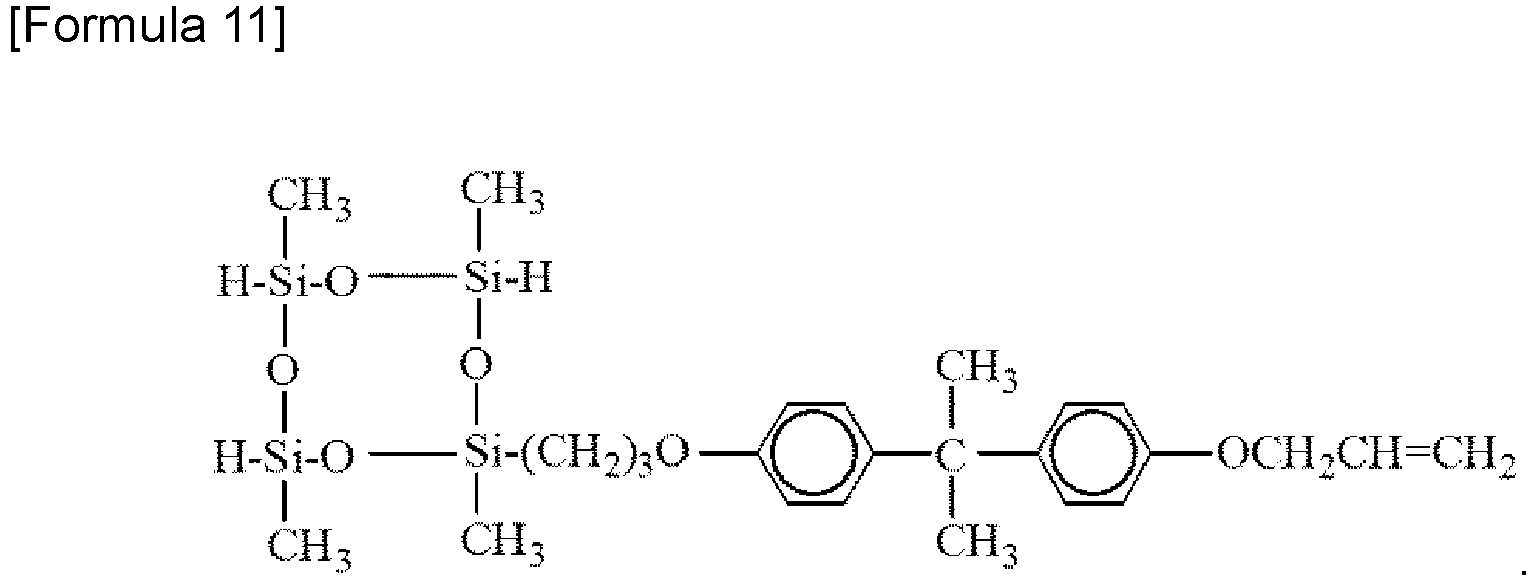
- The organosilicon compound having at least one silicon atom-bonded hydrolyzable group in each molecule of component (F) is not particularly limited, but preferable examples thereof include vinyltrimethoxysilane, vinyltriethoxysilane, vinyl tris(2-methoxyethoxy)silane, vinyldiethoxymethylsilane, allyltrimethoxysilane, phenyltrimethoxysilane, 3-glycidoxypropyltrimethoxysilane, 2-(3,4-epoxycyclohexyl)ethyltrimethoxysilane, 3-aminopropyltrimethoxysilane, 3-aminopropyltriethoxysilane, N-(2-aminoethyl)-3-aminopropyltrimethoxysilane, acryloyloxymethyltrimethoxysilane, 3-methacryloxypropyltrimethoxysilane, 3-acryloxypropyltrimethoxysilane, 1,6-bis(trimethoxysilyl)hexane, 3-mercaptopropyltrimethoxysilane, 2-(ethoxycarbonyl)ethyltrimethoxysilane, a cyclic siloxane compound represented by the following formula:


- The content of component (F) is within a range of from 0.01 to 20 parts by mass, preferably within a range of from 0.05 to 10 parts by mass, alternatively within a range of from 0.1 to 5 parts by mass, per 100 parts by mass of component (A). This is because, when the compounded amount of component (F) is greater than or equal to the lower limit of the range described above, the present composition forms a silicone rubber having good adhesion with respect to various organic resins, while when the compounded amount is less than or equal to the upper limit of the range described above, the present composition forms a silicone rubber having good mechanical characteristics.
- In order to further enhance the adhesion of the obtained silicone rubber, the silicone rubber composition of the present invention may further comprise (G) (G-1) an organosiloxane having at least one aryl group and at least one silicon atom-bonded hydrogen atom in each molecule; or a mixture of component (G-1) and (G-2) an organosiloxane having at least one aryl group and at least one alkenyl group in each molecule.
- Component (G-1) is an organosiloxane having at least one silicon atom-bonded hydrogen atom in each molecule and not having an alkenyl group. Examples of the aryl group in component (G-1) include aryl groups having from 6 to 12 carbon atoms such as phenyl groups, tolyl groups, xylyl groups, and naphthyl groups, and phenyl groups are preferable. Examples of groups bonded to silicon atoms other than aryl groups in component (G-1) include alkyl groups having from 1 to 12 carbon atoms such as methyl groups, ethyl groups, propyl groups, isopropyl groups, butyl groups, isobutyl groups, terbutyl groups, pentyl groups, neopentyl groups, hexyl groups, cyclohexyl groups, heptyl groups, octyl groups, nonyl groups, decyl groups, undecyl groups, and dodecyl groups; and groups in which some or all of the hydrogen atoms of these alkyl groups are substituted with halogen atoms such as fluorine atoms, chlorine atoms, or bromine atoms. A small amount of hydroxyl groups may be bonded to the silicon atoms in component (G-1) to an extent that the object of the present invention is not impaired.
- A molecular structure of component (G-1) is not limited, but component (G-1) is preferably an organosiloxane represented by the following general formula (4):
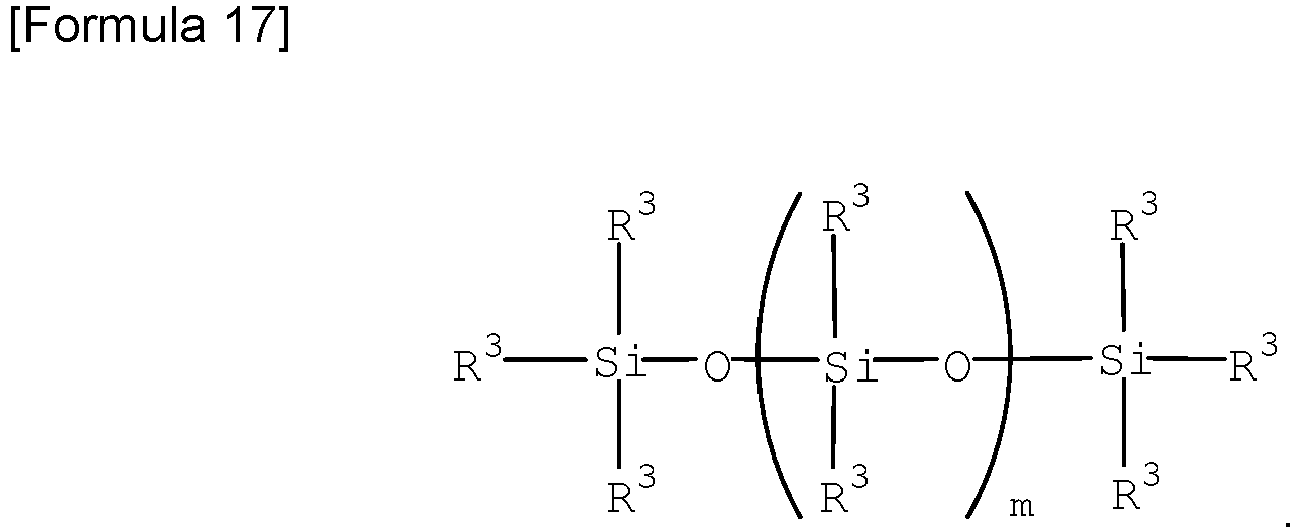
- In general formula (4) above, each R3 is independently a hydrogen atom, an alkyl group having from 1 to 12 carbon atoms, or an aryl group having from 6 to 12 carbon atoms. Examples of alkyl groups include the same alkyl groups as described above. Examples of aryl groups include the same aryl groups as described above. However, in general formula (4) above, at least one R3 is the hydrogen atom, and preferably at least two R3 are the hydrogen atoms. Further, at least one R3 is the aryl group in general formula (4) above.
- In general formula (4) above, "m" is an integer from 1 to 20, alternatively an integer from 1 to 10, or alternatively an integer from 1 to 5. This is because, when "m" is within the range described above, the present composition forms a silicone rubber having good adhesion with respect to organic resins.
- Component (G-2) is an organosiloxane having at least one aryl group and at least one alkenyl group in each molecule. Examples of the aryl group in component (G-2) include aryl groups having from 6 to 12 carbon atoms such as phenyl groups, tolyl groups, xylyl groups, and naphthyl groups, and phenyl groups are preferable. Examples of the alkenyl group in component (G-2) include alkenyl groups having from 2 to 12 carbon atoms such as vinyl groups, allyl groups, butenyl groups, pentenyl groups, hexenyl groups, heptenyl groups, octenyl groups, nonenyl groups, decenyl groups, undecenyl groups, and dodecenyl groups, and vinyl groups are preferable. Examples of silicon atom-bonded groups other than aryl groups and alkenyl groups in component (G-2) include alkyl groups having from 1 to 12 carbon atoms such as methyl groups, ethyl groups, propyl groups, isopropyl groups, butyl groups, isobutyl groups, terbutyl groups, pentyl groups, neopentyl groups, hexyl groups, cyclohexyl groups, heptyl groups, octyl groups, nonyl groups, decyl groups, undecyl groups, and dodecyl groups; and groups in which some or all of the hydrogen atoms of these alkyl groups are substituted with halogen atoms such as fluorine atoms, chlorine atoms, or bromine atoms. A small amount of hydroxyl groups may be bonded to the silicon atoms in component (G-2) to an extent that does not impair the object of the present invention.
- A molecular structure of component (G-2) is not limited, but component (G-2) is preferably an organosiloxane represented by the following general formula (5):

- In the general formula (5) above, each R4 is independently an alkenyl group having from 2 to 12 carbon atoms, an alkyl group having from 1 to 12 carbon atoms, or an aryl group having from 6 to 12 carbon atoms. Examples of alkenyl groups include the same alkenyl groups as described above. Examples of alkyl groups include the same alkyl groups as described above. Examples of aryl groups include the same aryl groups as described above. However, in the general formula (5) above, at least one R4 is the alkenyl group, or at least two R4 are the alkenyl groups. Further, at least one R4 in general formula (5) above is the aryl group.
- In the general formula (5) above, "n" is an integer from 0 to 20, alternatively an integer from 0 to 10, or alternatively an integer from 0 to 5. This is because, when "n" is less than or equal to the upper limit of the range described above, the present composition forms a silicone rubber having good adhesion with respect to organic resins.
- Component (G) is preferably a mixture of component (G-1) and component (G-2). In this case, the mass ratio of component (G-1) and component (G-2) is not limited, but is preferably within a range of from 1:10 to 10:1, alternatively within a range of from 1:5 to 5:1. This is because, when the mass ratio is within the range described above, the present composition forms a silicone rubber having good adhesion with respect to various organic resins.
- Component (G) is compounded in an amount within a range of from 0.1 to 5 parts by mass, alternatively within a range of from 0.5 to 5 parts by mass, or alternatively within a range of from 1 to 5 parts by mass, per 100 parts by mass of component (A). This is because, when the compounded amount of component (G) is greater than or equal to the lower limit of the range described above, the present composition forms a silicone rubber having good adhesion with respect to various organic resins, while when the compounded amount is less than or equal to the upper limit of the range described above, the present composition forms a silicone rubber having good mechanical characteristics.
- Further, the present composition may contain a reaction inhibitor. Examples of this reaction inhibitor include alkyne alcohols such as 1-ethynyl-cyclohexan-1-ol, 2-methyl-3-butyn-2-ol, 3,5-dimethyl-1-hexyn-3-ol, and 2-phenyl-3-butyn-2-ol; ene-yne compounds such as 3-methyl-3-penten-1-yne and 3,5-dimethyl-3-hexen-1-yne; alkenyl siloxane oligomers such as 1,3,5,7-tetramethyl-1,3,5,7-tetravinyl cyclotetrasiloxane and 1,3,5,7-tetramethyl-1,3,5,7-tetrahexenyl cyclotetrasiloxane; as well as hydrazine, triazole, phosphine, mercaptan, organic nitrogen compounds, acetylene alcohol, silylated acetylene alcohol, maleic acid, fumaric acid, ethylenic or aromatic unsaturated amides, ethylenic unsaturated isocyanates, olefinic silanes, olefinic siloxanes, unsaturated hydrocarbon monoesters and diesters, hydroperoxide, nitriles, and diaziridine. The compounded amount of the reaction inhibitor is not particularly limited, but is preferably within the range of from 0.0001 to 5 parts by mass per 100 parts by mass of component (A).
- The silicone rubber composition of the present invention is suitable for obtaining an integral mold with an organic resin.
- Examples of methods for integrally molding a silicone rubber composition on an organic resin include: (i) a method of placing a silicone rubber composition formed into a desired shape on an organic resin and then heating to a temperature below the melting point of the organic resin; (ii) a method of placing a silicone rubber composition on an organic resin and then compression-molding at a temperature below the melting point of the organic resin; and (iii) a method of injection-molding an organic resin into a mold using an injection molding machine in advance, and then injecting a silicone rubber composition into the mold while heating. This silicone rubber composition may be a liquid, a putty, or a paste, but is preferably a liquid or a paste in that it is easy to mold. Curing conditions of the silicone rubber composition include a temperature and time at which the shape or quality does not change in order to achieve strong adhesion to the organic resin. The conditions depend on the type of the organic resin, but an integral mold can be obtained under conditions including a temperature of from 80 to 180°C and a molding time of from 0.2 to 30 minutes.
- A silicone rubber obtained from the silicone rubber composition described above preferably has a Shore A hardness (durometer) of not greater than 80, alternatively not greater than 60.
- The composite of the present invention comprises: a silicone rubber formed by curing the silicone rubber composition described above; and an organic resin, wherein the silicone rubber is adhered to the organic resin.
- Examples of organic resins include acrylonitrile/butadiene/styrene copolymers, polyphenylene/styrene mixtures, polystyrenes, polycarbonates, polyurethanes, polyethylenes, polypropylenes, polyacrylates, polymethacrylates, polyacrylamides, polyesters, polyethylene terephthalates, polybutylene terephthalates, polyphenylene oxides, polyphenylene sulfides, polysulfones, nylons, polyamides, polyimides, fluoropolymers, liquid crystal resins, polyether imides, phenol resins, epoxy resins, urea resins, melamine resins, alkyd resins, derivatives of these organic resins, and mixtures of two or more types thereof.
- Such a composite material has a structure in which the silicone rubber and the organic resin are used as an integral part. Examples of such composite materials include mobile telephones, portable telecommunications devices, gaming devices, watches, receivers, DVD devices, MD devices, CD devices, precision electronics, electrical insulators, single-wire coatings, microwaves, refrigerators, electronic cookers, cathodic TVs, thin-film displays such as liquid crystal TVs or plasma TVs, various household devices, copying machines, printers, facsimile machines, office devices, connector seals, spark plug caps, various sensor parts, automotive parts, sports products, diving masks, diving equipment, respirator masks, ventilator bellows, balloon catheters, rubber nipples, thin films, switch covers, medical products or devices, tubes or valves, pacifiers, and feeding bottle nipples.
- The silicone rubber composition and composite of the present invention will be described in further detail hereinafter using examples and comparative examples. Note that the present invention is not limited by the descriptions of the following examples. The viscosity was measured at 25°C.
- A silicone rubber sheet having a thickness of 2 mm was produced by heating the silicone rubber composition for 10 minutes at 120°C using a 50-ton hot press. The hardness of the silicone rubber sheet at 25°C was measured using a Shore A hardness meter.
- The silicone rubber composition was applied to a test piece and then placed in a preheated stainless steel mold. With the exception of polyester resins, the test pieces were molded for 4 minutes at 120°C using a 50-ton hot press. The test pieces were stored overnight in an aging chamber (25°C, 50% RH) prior to a peel test. The rate of a 90° peel test at 25°C was 50 mm/min. In addition, after the peel test, the proportion of the area of the silicone rubber that had failed to aggregate with respect to the adhesive area of the silicone rubber was measured and indicated as CF (%).
- First, 100.0 parts by mass of a dimethylpolysiloxane capped at both molecular chain terminals with dimethylvinylsiloxy groups and having a viscosity of 40,000 mPa·s, 48 parts by mass of fumed silica having a BET specific surface area of 300 m2/g (HDK T30P manufactured by Wacker); 18.0 parts by mass of hexamethyldisilazane, 0.5 parts by mass of 1,1,3,3-tetramethyl-1,3-divinyldisilazane, and 6.0 parts by mass of water were kneaded at room temperature using a Ross mixer. Next, a silicone rubber base (1) having a viscosity of 520 mPa·s was prepared by heating and mixing at 150°C for one hour under reduced pressure.
- First, 100.0 parts by mass of a dimethylpolysiloxane capped at both molecular chain terminals with dimethylvinylsiloxy groups and having a viscosity of 40,000 mPa·s, 48 parts by mass of fumed silica having a BET specific surface area of 300 m2/g (HDK T30P manufactured by Wacker); 22.5 parts by mass of hexamethyldisilazane, 0.5 parts by mass of 1,1,3,3-tetramethyl-1,3-divinyldisilazane, and 7.5 parts by mass of water were kneaded at room temperature using a Ross mixer. Next, a silicone rubber base (2) having a viscosity of 567 mPa·s was prepared by heating and mixing at 150°C for one hour under reduced pressure.
- First, 100.0 parts by mass of a dimethylpolysiloxane capped at both molecular chain terminals with dimethylvinylsiloxy groups and having a viscosity of 40,000 mPa·s, 48 parts by mass of fumed silica having a BET specific surface area of 300 m2/g (HDK T30P manufactured by Wacker); 9.0 parts by mass of hexamethyldisilazane, 0.5 parts by mass of 1,1,3,3-tetramethyl-1,3-divinyldisilazane, and 3.0 parts by mass of water were kneaded at room temperature using a Ross mixer. Next, a silicone rubber base (3) having a viscosity of 745 mPa·s was prepared by heating and mixing at 150°C for one hour under reduced pressure.
- First, 6.5 parts by mass of a dimethylpolysiloxane capped at both molecular chain terminals with dimethylvinylsiloxy groups and having a viscosity of 40,000 mPa·s, 10.5 parts by mass of a dimethylsiloxane/methylvinylsiloxane copolymer capped at both molecular chain terminals with dimethylvinylsiloxy groups and having a viscosity of 370 mPa·s, 2.0 parts by mass of a diacrylic acid ester represented by the following formula:

- First, 6.5 parts by mass of a dimethylpolysiloxane capped at both molecular chain terminals with dimethylvinylsiloxy groups and having a viscosity of 40,000 mPa·s, 10.5 parts by mass of a dimethylsiloxane/methylvinylsiloxane copolymer capped at both molecular chain terminals with dimethylvinylsiloxy groups and having a viscosity of 370 mPa·s, 2.0 parts by mass of a diacrylic acid ester represented by the following formula:

- First, 15.6 parts by mass of a dimethylpolysiloxane capped at both molecular chain terminals with dimethylvinylsiloxy groups and having a viscosity of 40,000 mPa·s, 10.5 parts by mass of a dimethylsiloxane/methylvinylsiloxane copolymer capped at both molecular chain terminals with dimethylvinylsiloxy groups and having a viscosity of 370 mPa·s, 2.0 parts by mass of a diacrylic acid ester represented by the following formula:


- First, 15.6 parts by mass of a dimethylpolysiloxane capped at both molecular chain terminals with dimethylvinylsiloxy groups and having a viscosity of 40,000 mPa·s, 10.5 parts by mass of a dimethylsiloxane/methylvinylsiloxane copolymer capped at both molecular chain terminals with dimethylvinylsiloxy groups and having a viscosity of 370 mPa·s, 2.0 parts by mass of a diacrylic acid ester represented by the following formula:


- First, 15.6 parts by mass of a dimethylpolysiloxane capped at both molecular chain terminals with dimethylvinylsiloxy groups and having a viscosity of 40,000 mPa·s, 10.5 parts by mass of a dimethylsiloxane/methylvinylsiloxane copolymer capped at both molecular chain terminals with dimethylvinylsiloxy groups and having a viscosity of 370 mPa·s, 2.0 parts by mass of a diacrylic acid ester represented by the following formula:


- First, 5.9 parts by mass of a dimethylpolysiloxane capped at both molecular chain terminals with dimethylvinylsiloxy groups and having a viscosity of 40,000 mPa·s, 10.2 parts by mass of a dimethylsiloxane/methylvinylsiloxane copolymer capped at both molecular chain terminals with dimethylvinylsiloxy groups and having a viscosity of 370 mPa·s, 0.5 parts by mass of a diacrylic acid ester represented by the following formula:


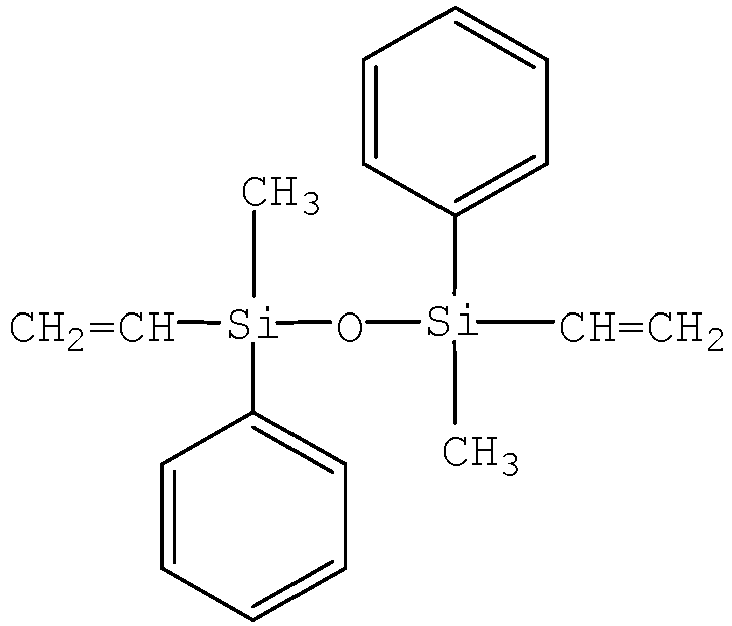

- The silicone rubber composition of the present invention exhibits excellent adhesion to various organic resins in contact during curing while simultaneously exhibiting excellent mold releasability with respect to a mold used for the molding thereof. Therefore, this silicone rubber composition is suitable as a silicone rubber composition for integral molding with an organic resin.
Claims (12)
- A silicone rubber composition comprising:(A) 100 parts by mass of an organopolysiloxane having at least two alkenyl groups in each molecule;(B) from 1 to 100 parts by mass of a silica filler;(C) an organosiloxane having at least two silicon atom-bonded hydrogen atoms in each molecule and not having an alkenyl group, in an amount such that the silicon atom-bonded hydrogen atoms in the component are from 0.5 to 5 mol per 1 mol of the total of aliphatic saturated bonds in the composition;(D) a catalytic amount of a hydrosilylation reaction catalyst; and(F) from 0.01 to 20 parts by mass of an adhesion promoter;wherein component (B) is a silica filler formed by surface-treating at least 30 parts by mass of (E) a surface treatment agent with respect to 100 parts by mass of a silica filler having at specific surface area of at least 50 m2/g according to a BET method in the presence of part or all of component (A).
- The silicone rubber composition according to claim 1, wherein component (E) is at least one type of silazane compound.
- The silicone rubber composition according to claim 2, wherein component (E) is hexamethyldisilazane and/or tetramethyldivinyldisilazane.
- The silicone rubber composition according to any one of claims 1 to 3, wherein component (F) is at least one type of compound selected from acrylic compounds, methacrylic compounds, epoxy compounds, organosilicon compounds having at least one phenylene skeleton in each molecule, and organosilicon compounds having at least one silicon atom-bonded hydrolyzable group in each molecule.
- The silicone rubber composition according to claim 4, wherein component (F) is an acrylic compound or a methyacrylic compound having an ester bond in each molecule.
- The silicone rubber composition according to claim 4, wherein component (F) is at least one type of acrylic compounds or methacrylic compounds selected from compounds represented by the following general formulas.


- The silicone rubber composition according to claim 1, further comprising: (G) (G-1) an organosiloxane having at least one aryl group and at least one silicon atom-bonded hydrogen atom in each molecule; or a mixture of component (G-1) and (G-2) an organosiloxane having at least one aryl group and at least one alkenyl group in each molecule, in an amount of from 0.1 to 5 parts by mass per 100 parts by mass of component (A).
- The silicone rubber composition according to claim 7, wherein component (G-1) is an organosiloxane represented by the following general formula:

- The silicone rubber composition according to claim 7, wherein component (G-2) is an organosiloxane represented by the following general formula:


- The silicone rubber composition according to claim 7, wherein component (G) is a mixture of component (G-1) and component (G-2) having a mass ratio of from 1:10 to 10:1 of component (G-1) and component (G-2).
- A composite material comprising: a silicone rubber formed by curing the silicone rubber composition according to any one of claims 1 to 10; and an organic resin, wherein the silicone rubber is adhered to the organic resin.
- The composite material according to claim 11, wherein the organic resin is at least one type of organic resin selected from acrylonitrile/butadiene/styrene copolymers, polyphenylene/styrene mixtures, polystyrenes, polycarbonates, polyurethanes, polyethylenes, polypropylenes, polyacrylates, polymethacrylates, polyacrylamides, polyesters, polyethylene terephthalates, polybutylene terephthalates, polyphenylene oxides, polyphenylene sulfides, polysulfones, nylons, polyamides, polyimides, fluoropolymers, liquid crystal resins, polyether imides, phenol resins, epoxy resins, urea resins, melamine resins, alkyd resins, and derivatives of these organic resins.
Applications Claiming Priority (2)
| Application Number | Priority Date | Filing Date | Title |
|---|---|---|---|
| JP2017248503 | 2017-12-25 | ||
| PCT/JP2018/045255 WO2019131081A1 (en) | 2017-12-25 | 2018-12-10 | Silicone rubber composition and composite obtained using same |
Publications (2)
| Publication Number | Publication Date |
|---|---|
| EP3733780A1 true EP3733780A1 (en) | 2020-11-04 |
| EP3733780A4 EP3733780A4 (en) | 2021-10-06 |
Family
ID=67067226
Family Applications (1)
| Application Number | Title | Priority Date | Filing Date |
|---|---|---|---|
| EP18896672.5A Pending EP3733780A4 (en) | 2017-12-25 | 2018-12-10 | Silicone rubber composition and composite obtained using same |
Country Status (7)
| Country | Link |
|---|---|
| US (1) | US11492490B2 (en) |
| EP (1) | EP3733780A4 (en) |
| JP (1) | JP7131883B2 (en) |
| KR (1) | KR102664519B1 (en) |
| CN (1) | CN111417687B (en) |
| TW (1) | TW201930475A (en) |
| WO (1) | WO2019131081A1 (en) |
Families Citing this family (6)
| Publication number | Priority date | Publication date | Assignee | Title |
|---|---|---|---|---|
| JP7103416B2 (en) * | 2018-06-28 | 2022-07-20 | 信越化学工業株式会社 | Organopolysiloxane composition for release paper or release film |
| CN114174454B (en) * | 2019-07-17 | 2024-10-18 | 信越化学工业株式会社 | Ultraviolet curable organopolysiloxane composition |
| JP2023532407A (en) * | 2020-06-24 | 2023-07-28 | ダウ グローバル テクノロジーズ エルエルシー | silicone rubber composition |
| EP4251402B1 (en) * | 2020-11-30 | 2024-06-19 | Dow Silicones Corporation | Hydrosilylation cure inhibitors and use thereof |
| CN113897153B (en) * | 2021-10-15 | 2023-10-31 | 东莞市曦晨启明新材料科技有限公司 | A kind of flame retardant, silicone potting glue and preparation method and application thereof |
| KR20240018238A (en) * | 2022-08-02 | 2024-02-13 | 주식회사 엘지화학 | Light Modulating Device |
Family Cites Families (32)
| Publication number | Priority date | Publication date | Assignee | Title |
|---|---|---|---|---|
| JP3944681B2 (en) | 2000-07-11 | 2007-07-11 | 信越化学工業株式会社 | Silicone rubber adhesive composition and integral molded body of adhesive composition and thermoplastic resin |
| KR20060041284A (en) | 2003-07-25 | 2006-05-11 | 다우 코닝 코포레이션 | Silicone rubber composition |
| DE102004055690A1 (en) | 2004-11-18 | 2006-05-24 | Wacker Chemie Ag | Crosslinkable silicone compounds with long processing time and storage stability |
| PL2053160T3 (en) * | 2006-08-14 | 2013-03-29 | Dow Corning Toray Co Ltd | Silicone rubber composition for coating of woven fabric, and coated woven fabric |
| JP4704987B2 (en) * | 2006-09-11 | 2011-06-22 | 信越化学工業株式会社 | Silicone rubber composition for extrusion molding |
| CN102112556B (en) * | 2008-07-31 | 2014-01-01 | 道康宁东丽株式会社 | Multi-component sponge-forming liquid silicone rubber composition and silicone rubber sponge manufacturing method |
| KR101801265B1 (en) * | 2009-12-30 | 2017-11-27 | 다우 코닝 코포레이션 | Silicone coating on air bags |
| WO2011137121A1 (en) * | 2010-04-30 | 2011-11-03 | Dow Corning Toray Co., Ltd. | Liquid curable silicone rubber composition and woven fabric coated with cured product of the same composition |
| JP2012001673A (en) | 2010-06-18 | 2012-01-05 | Yokohama Rubber Co Ltd:The | Addition-curable silicone composition and capacitor using the same |
| WO2012115139A1 (en) * | 2011-02-23 | 2012-08-30 | 住友ベークライト株式会社 | Silicone rubber-based curable composition, molded article, and medical tube |
| JP5748512B2 (en) | 2011-03-07 | 2015-07-15 | 信越化学工業株式会社 | Addition-curing self-adhesive silicone rubber composition |
| CN102190908A (en) | 2011-03-16 | 2011-09-21 | 中国科学院化学研究所 | Surface-modified silicon dioxide, and preparation method and application thereof |
| JP5788839B2 (en) | 2012-08-03 | 2015-10-07 | 信越化学工業株式会社 | Curable resin composition, cured product thereof and optical semiconductor device using the same |
| US8822593B2 (en) * | 2012-06-22 | 2014-09-02 | Shin-Etsu Chemical Co., Ltd. | Curable resin composition, hardened material thereof, and optical semiconductor apparatus |
| CN102827479A (en) * | 2012-08-20 | 2012-12-19 | 中昊晨光化工研究院有限公司 | Liquid silicone rubber |
| JP6047345B2 (en) * | 2012-09-05 | 2016-12-21 | 東レ・ダウコーニング株式会社 | Process for producing conductive sponge-forming liquid silicone rubber composition, conductive silicone rubber sponge and process for producing the same |
| EP2915853B1 (en) * | 2012-11-05 | 2021-04-28 | Momentive Performance Materials Japan LLC | Thermosetting silicone rubber composition |
| JP5983566B2 (en) | 2013-09-05 | 2016-08-31 | 信越化学工業株式会社 | Addition-curable liquid silicone rubber composition and cured silicone rubber |
| KR20160140775A (en) * | 2014-03-31 | 2016-12-07 | 다우 코닝 도레이 캄파니 리미티드 | Silicone rubber composition for mold surface release treatment, and method for forming cured silicone |
| JP2016145301A (en) | 2015-02-09 | 2016-08-12 | 信越化学工業株式会社 | Addition reaction curable liquid silicone rubber composition |
| WO2016132690A1 (en) * | 2015-02-16 | 2016-08-25 | Dow Corning Toray Co., Ltd. | Sponge-formable silicone rubber composition and silicone rubber sponge |
| JP2016199680A (en) | 2015-04-10 | 2016-12-01 | 信越化学工業株式会社 | Liquid silicone rubber coating composition for curtain airbag and method for producing the same |
| JP6384437B2 (en) * | 2015-09-17 | 2018-09-05 | 信越化学工業株式会社 | Silicone rubber composition and power cable |
| JP6524901B2 (en) * | 2015-12-08 | 2019-06-05 | 信越化学工業株式会社 | Silicone rubber composition and cured product thereof |
| WO2017147061A1 (en) * | 2016-02-23 | 2017-08-31 | Dow Corning Corporation | Selective adhesion silicone rubber |
| KR102352921B1 (en) * | 2016-06-29 | 2022-01-20 | 듀폰 도레이 스페셜티 머티리얼즈 가부시키가이샤 | Silicone rubber composition and composite material prepared therefrom |
| JP6108015B2 (en) | 2016-07-19 | 2017-04-05 | 信越化学工業株式会社 | Method for reducing modulus of cured silicone rubber, and silicone rubber composition |
| JP6634988B2 (en) * | 2016-09-20 | 2020-01-22 | 信越化学工業株式会社 | Transparent liquid silicone rubber composition |
| WO2018097125A1 (en) * | 2016-11-28 | 2018-05-31 | 東レ・ダウコーニング株式会社 | Sponge-forming liquid silicone rubber composition and silicone rubber sponge |
| CN110651010A (en) * | 2017-06-02 | 2020-01-03 | 美国陶氏有机硅公司 | Curable silicone composition with reduced mold fouling |
| JP7378199B2 (en) * | 2017-07-05 | 2023-11-13 | モメンティブ・パフォーマンス・マテリアルズ・ジャパン合同会社 | Photocurable polyorganosiloxane composition |
| JP2019031601A (en) * | 2017-08-07 | 2019-02-28 | 信越化学工業株式会社 | Addition-curable silicone composition and silicone rubber cured product |
-
2018
- 2018-12-10 KR KR1020207017932A patent/KR102664519B1/en active Active
- 2018-12-10 WO PCT/JP2018/045255 patent/WO2019131081A1/en not_active Ceased
- 2018-12-10 CN CN201880076379.0A patent/CN111417687B/en active Active
- 2018-12-10 JP JP2019562932A patent/JP7131883B2/en active Active
- 2018-12-10 EP EP18896672.5A patent/EP3733780A4/en active Pending
- 2018-12-10 US US16/957,634 patent/US11492490B2/en active Active
- 2018-12-17 TW TW107145439A patent/TW201930475A/en unknown
Also Published As
| Publication number | Publication date |
|---|---|
| CN111417687B (en) | 2022-06-03 |
| KR102664519B1 (en) | 2024-05-16 |
| KR20200093587A (en) | 2020-08-05 |
| EP3733780A4 (en) | 2021-10-06 |
| TW201930475A (en) | 2019-08-01 |
| CN111417687A (en) | 2020-07-14 |
| US11492490B2 (en) | 2022-11-08 |
| JPWO2019131081A1 (en) | 2020-12-10 |
| WO2019131081A1 (en) | 2019-07-04 |
| JP7131883B2 (en) | 2022-09-06 |
| US20210054199A1 (en) | 2021-02-25 |
Similar Documents
| Publication | Publication Date | Title |
|---|---|---|
| EP3478770B1 (en) | Silicone rubber composition and composite made therefrom | |
| US11492490B2 (en) | Silicone rubber composition and composite obtained using the same | |
| US8937123B2 (en) | Addition curable self-adhesive silicone rubber composition | |
| EP1945716B1 (en) | Curable silicone composition | |
| US8895678B2 (en) | Cross-linkable silicone composition and cross-linked product thereof | |
| CN115181426A (en) | Curable organopolysiloxane composition and protective agent or adhesive composition for electrical and electronic components | |
| US7781560B2 (en) | Curable organopolysiloxane composition | |
| EP1836260B1 (en) | Bonded composite of silicone resin and epoxy resin and a method for manufacturing thereof | |
| US12378414B2 (en) | Curable organopolysiloxane composition, cured product, and electric/electronic equipment | |
| KR101295434B1 (en) | Self-adhesive organopolysiloxane composition | |
| TW202449071A (en) | Siloxane composition for lower temperature adhesion | |
| TW202424119A (en) | Liquid addition-curable fluorosilicone composition, fluorosilicone rubber, and molded article |
Legal Events
| Date | Code | Title | Description |
|---|---|---|---|
| STAA | Information on the status of an ep patent application or granted ep patent |
Free format text: STATUS: THE INTERNATIONAL PUBLICATION HAS BEEN MADE |
|
| PUAI | Public reference made under article 153(3) epc to a published international application that has entered the european phase |
Free format text: ORIGINAL CODE: 0009012 |
|
| STAA | Information on the status of an ep patent application or granted ep patent |
Free format text: STATUS: REQUEST FOR EXAMINATION WAS MADE |
|
| 17P | Request for examination filed |
Effective date: 20200710 |
|
| AK | Designated contracting states |
Kind code of ref document: A1 Designated state(s): AL AT BE BG CH CY CZ DE DK EE ES FI FR GB GR HR HU IE IS IT LI LT LU LV MC MK MT NL NO PL PT RO RS SE SI SK SM TR |
|
| AX | Request for extension of the european patent |
Extension state: BA ME |
|
| DAV | Request for validation of the european patent (deleted) | ||
| DAX | Request for extension of the european patent (deleted) | ||
| A4 | Supplementary search report drawn up and despatched |
Effective date: 20210908 |
|
| RIC1 | Information provided on ipc code assigned before grant |
Ipc: C08L 83/04 20060101ALI20210902BHEP Ipc: C08K 9/06 20060101ALI20210902BHEP Ipc: C08L 83/05 20060101ALI20210902BHEP Ipc: C08K 9/04 20060101ALI20210902BHEP Ipc: C08K 5/54 20060101ALI20210902BHEP Ipc: C08K 5/101 20060101ALI20210902BHEP Ipc: C08L 83/07 20060101AFI20210902BHEP |
|
| P01 | Opt-out of the competence of the unified patent court (upc) registered |
Effective date: 20230526 |
|
| STAA | Information on the status of an ep patent application or granted ep patent |
Free format text: STATUS: EXAMINATION IS IN PROGRESS |
|
| 17Q | First examination report despatched |
Effective date: 20240604 |