EP3733753A1 - Film usable for roll-to-roll processing of flexible electronic devices comprising a composite material of a polymer and boron nitride - Google Patents
Film usable for roll-to-roll processing of flexible electronic devices comprising a composite material of a polymer and boron nitride Download PDFInfo
- Publication number
- EP3733753A1 EP3733753A1 EP19172431.9A EP19172431A EP3733753A1 EP 3733753 A1 EP3733753 A1 EP 3733753A1 EP 19172431 A EP19172431 A EP 19172431A EP 3733753 A1 EP3733753 A1 EP 3733753A1
- Authority
- EP
- European Patent Office
- Prior art keywords
- film
- boron nitride
- hexagonal boron
- nitride particles
- plane thermal
- Prior art date
- Legal status (The legal status is an assumption and is not a legal conclusion. Google has not performed a legal analysis and makes no representation as to the accuracy of the status listed.)
- Withdrawn
Links
Images

Classifications
-
- B—PERFORMING OPERATIONS; TRANSPORTING
- B29—WORKING OF PLASTICS; WORKING OF SUBSTANCES IN A PLASTIC STATE IN GENERAL
- B29C—SHAPING OR JOINING OF PLASTICS; SHAPING OF MATERIAL IN A PLASTIC STATE, NOT OTHERWISE PROVIDED FOR; AFTER-TREATMENT OF THE SHAPED PRODUCTS, e.g. REPAIRING
- B29C43/00—Compression moulding, i.e. applying external pressure to flow the moulding material; Apparatus therefor
- B29C43/32—Component parts, details or accessories; Auxiliary operations
- B29C43/44—Compression means for making articles of indefinite length
-
- B—PERFORMING OPERATIONS; TRANSPORTING
- B29—WORKING OF PLASTICS; WORKING OF SUBSTANCES IN A PLASTIC STATE IN GENERAL
- B29C—SHAPING OR JOINING OF PLASTICS; SHAPING OF MATERIAL IN A PLASTIC STATE, NOT OTHERWISE PROVIDED FOR; AFTER-TREATMENT OF THE SHAPED PRODUCTS, e.g. REPAIRING
- B29C43/00—Compression moulding, i.e. applying external pressure to flow the moulding material; Apparatus therefor
- B29C43/006—Pressing and sintering powders, granules or fibres
-
- B—PERFORMING OPERATIONS; TRANSPORTING
- B29—WORKING OF PLASTICS; WORKING OF SUBSTANCES IN A PLASTIC STATE IN GENERAL
- B29C—SHAPING OR JOINING OF PLASTICS; SHAPING OF MATERIAL IN A PLASTIC STATE, NOT OTHERWISE PROVIDED FOR; AFTER-TREATMENT OF THE SHAPED PRODUCTS, e.g. REPAIRING
- B29C43/00—Compression moulding, i.e. applying external pressure to flow the moulding material; Apparatus therefor
- B29C43/02—Compression moulding, i.e. applying external pressure to flow the moulding material; Apparatus therefor of articles of definite length, i.e. discrete articles
- B29C43/027—Compression moulding, i.e. applying external pressure to flow the moulding material; Apparatus therefor of articles of definite length, i.e. discrete articles having an axis of symmetry
-
- B—PERFORMING OPERATIONS; TRANSPORTING
- B29—WORKING OF PLASTICS; WORKING OF SUBSTANCES IN A PLASTIC STATE IN GENERAL
- B29D—PRODUCING PARTICULAR ARTICLES FROM PLASTICS OR FROM SUBSTANCES IN A PLASTIC STATE
- B29D7/00—Producing flat articles, e.g. films or sheets
- B29D7/01—Films or sheets
-
- C—CHEMISTRY; METALLURGY
- C08—ORGANIC MACROMOLECULAR COMPOUNDS; THEIR PREPARATION OR CHEMICAL WORKING-UP; COMPOSITIONS BASED THEREON
- C08J—WORKING-UP; GENERAL PROCESSES OF COMPOUNDING; AFTER-TREATMENT NOT COVERED BY SUBCLASSES C08B, C08C, C08F, C08G or C08H
- C08J3/00—Processes of treating or compounding macromolecular substances
- C08J3/20—Compounding polymers with additives, e.g. colouring
- C08J3/203—Solid polymers with solid and/or liquid additives
-
- C—CHEMISTRY; METALLURGY
- C08—ORGANIC MACROMOLECULAR COMPOUNDS; THEIR PREPARATION OR CHEMICAL WORKING-UP; COMPOSITIONS BASED THEREON
- C08J—WORKING-UP; GENERAL PROCESSES OF COMPOUNDING; AFTER-TREATMENT NOT COVERED BY SUBCLASSES C08B, C08C, C08F, C08G or C08H
- C08J5/00—Manufacture of articles or shaped materials containing macromolecular substances
- C08J5/18—Manufacture of films or sheets
-
- C—CHEMISTRY; METALLURGY
- C08—ORGANIC MACROMOLECULAR COMPOUNDS; THEIR PREPARATION OR CHEMICAL WORKING-UP; COMPOSITIONS BASED THEREON
- C08K—Use of inorganic or non-macromolecular organic substances as compounding ingredients
- C08K3/00—Use of inorganic substances as compounding ingredients
- C08K3/38—Boron-containing compounds
-
- C—CHEMISTRY; METALLURGY
- C08—ORGANIC MACROMOLECULAR COMPOUNDS; THEIR PREPARATION OR CHEMICAL WORKING-UP; COMPOSITIONS BASED THEREON
- C08K—Use of inorganic or non-macromolecular organic substances as compounding ingredients
- C08K7/00—Use of ingredients characterised by shape
-
- C—CHEMISTRY; METALLURGY
- C08—ORGANIC MACROMOLECULAR COMPOUNDS; THEIR PREPARATION OR CHEMICAL WORKING-UP; COMPOSITIONS BASED THEREON
- C08L—COMPOSITIONS OF MACROMOLECULAR COMPOUNDS
- C08L23/00—Compositions of homopolymers or copolymers of unsaturated aliphatic hydrocarbons having only one carbon-to-carbon double bond; Compositions of derivatives of such polymers
- C08L23/26—Compositions of homopolymers or copolymers of unsaturated aliphatic hydrocarbons having only one carbon-to-carbon double bond; Compositions of derivatives of such polymers modified by chemical after-treatment
- C08L23/28—Compositions of homopolymers or copolymers of unsaturated aliphatic hydrocarbons having only one carbon-to-carbon double bond; Compositions of derivatives of such polymers modified by chemical after-treatment by reaction with halogens or halogen-containing compounds
- C08L23/283—Iso-olefin halogenated homopolymers or copolymers
-
- C—CHEMISTRY; METALLURGY
- C08—ORGANIC MACROMOLECULAR COMPOUNDS; THEIR PREPARATION OR CHEMICAL WORKING-UP; COMPOSITIONS BASED THEREON
- C08L—COMPOSITIONS OF MACROMOLECULAR COMPOUNDS
- C08L27/00—Compositions of homopolymers or copolymers of compounds having one or more unsaturated aliphatic radicals, each having only one carbon-to-carbon double bond, and at least one being terminated by a halogen; Compositions of derivatives of such polymers
- C08L27/02—Compositions of homopolymers or copolymers of compounds having one or more unsaturated aliphatic radicals, each having only one carbon-to-carbon double bond, and at least one being terminated by a halogen; Compositions of derivatives of such polymers not modified by chemical after-treatment
- C08L27/12—Compositions of homopolymers or copolymers of compounds having one or more unsaturated aliphatic radicals, each having only one carbon-to-carbon double bond, and at least one being terminated by a halogen; Compositions of derivatives of such polymers not modified by chemical after-treatment containing fluorine atoms
- C08L27/18—Homopolymers or copolymers or tetrafluoroethene
-
- H—ELECTRICITY
- H05—ELECTRIC TECHNIQUES NOT OTHERWISE PROVIDED FOR
- H05K—PRINTED CIRCUITS; CASINGS OR CONSTRUCTIONAL DETAILS OF ELECTRIC APPARATUS; MANUFACTURE OF ASSEMBLAGES OF ELECTRICAL COMPONENTS
- H05K1/00—Printed circuits
- H05K1/02—Details
- H05K1/03—Use of materials for the substrate
- H05K1/0313—Organic insulating material
- H05K1/0353—Organic insulating material consisting of two or more materials, e.g. two or more polymers, polymer + filler, + reinforcement
- H05K1/0373—Organic insulating material consisting of two or more materials, e.g. two or more polymers, polymer + filler, + reinforcement containing additives, e.g. fillers
-
- H—ELECTRICITY
- H05—ELECTRIC TECHNIQUES NOT OTHERWISE PROVIDED FOR
- H05K—PRINTED CIRCUITS; CASINGS OR CONSTRUCTIONAL DETAILS OF ELECTRIC APPARATUS; MANUFACTURE OF ASSEMBLAGES OF ELECTRICAL COMPONENTS
- H05K1/00—Printed circuits
- H05K1/02—Details
- H05K1/03—Use of materials for the substrate
- H05K1/0393—Flexible materials
-
- B—PERFORMING OPERATIONS; TRANSPORTING
- B29—WORKING OF PLASTICS; WORKING OF SUBSTANCES IN A PLASTIC STATE IN GENERAL
- B29C—SHAPING OR JOINING OF PLASTICS; SHAPING OF MATERIAL IN A PLASTIC STATE, NOT OTHERWISE PROVIDED FOR; AFTER-TREATMENT OF THE SHAPED PRODUCTS, e.g. REPAIRING
- B29C43/00—Compression moulding, i.e. applying external pressure to flow the moulding material; Apparatus therefor
- B29C43/02—Compression moulding, i.e. applying external pressure to flow the moulding material; Apparatus therefor of articles of definite length, i.e. discrete articles
- B29C43/027—Compression moulding, i.e. applying external pressure to flow the moulding material; Apparatus therefor of articles of definite length, i.e. discrete articles having an axis of symmetry
- B29C2043/029—Compression moulding, i.e. applying external pressure to flow the moulding material; Apparatus therefor of articles of definite length, i.e. discrete articles having an axis of symmetry using axial compression along a longitudinal axis
-
- B—PERFORMING OPERATIONS; TRANSPORTING
- B29—WORKING OF PLASTICS; WORKING OF SUBSTANCES IN A PLASTIC STATE IN GENERAL
- B29K—INDEXING SCHEME ASSOCIATED WITH SUBCLASSES B29B, B29C OR B29D, RELATING TO MOULDING MATERIALS OR TO MATERIALS FOR MOULDS, REINFORCEMENTS, FILLERS OR PREFORMED PARTS, e.g. INSERTS
- B29K2023/00—Use of polyalkenes or derivatives thereof as moulding material
- B29K2023/04—Polymers of ethylene
- B29K2023/06—PE, i.e. polyethylene
- B29K2023/0658—PE, i.e. polyethylene characterised by its molecular weight
- B29K2023/0683—UHMWPE, i.e. ultra high molecular weight polyethylene
-
- B—PERFORMING OPERATIONS; TRANSPORTING
- B29—WORKING OF PLASTICS; WORKING OF SUBSTANCES IN A PLASTIC STATE IN GENERAL
- B29K—INDEXING SCHEME ASSOCIATED WITH SUBCLASSES B29B, B29C OR B29D, RELATING TO MOULDING MATERIALS OR TO MATERIALS FOR MOULDS, REINFORCEMENTS, FILLERS OR PREFORMED PARTS, e.g. INSERTS
- B29K2027/00—Use of polyvinylhalogenides or derivatives thereof as moulding material
- B29K2027/12—Use of polyvinylhalogenides or derivatives thereof as moulding material containing fluorine
- B29K2027/18—PTFE, i.e. polytetrafluoroethylene, e.g. ePTFE, i.e. expanded polytetrafluoroethylene
-
- B—PERFORMING OPERATIONS; TRANSPORTING
- B29—WORKING OF PLASTICS; WORKING OF SUBSTANCES IN A PLASTIC STATE IN GENERAL
- B29K—INDEXING SCHEME ASSOCIATED WITH SUBCLASSES B29B, B29C OR B29D, RELATING TO MOULDING MATERIALS OR TO MATERIALS FOR MOULDS, REINFORCEMENTS, FILLERS OR PREFORMED PARTS, e.g. INSERTS
- B29K2105/00—Condition, form or state of moulded material or of the material to be shaped
- B29K2105/06—Condition, form or state of moulded material or of the material to be shaped containing reinforcements, fillers or inserts
- B29K2105/16—Fillers
-
- B—PERFORMING OPERATIONS; TRANSPORTING
- B29—WORKING OF PLASTICS; WORKING OF SUBSTANCES IN A PLASTIC STATE IN GENERAL
- B29K—INDEXING SCHEME ASSOCIATED WITH SUBCLASSES B29B, B29C OR B29D, RELATING TO MOULDING MATERIALS OR TO MATERIALS FOR MOULDS, REINFORCEMENTS, FILLERS OR PREFORMED PARTS, e.g. INSERTS
- B29K2105/00—Condition, form or state of moulded material or of the material to be shaped
- B29K2105/06—Condition, form or state of moulded material or of the material to be shaped containing reinforcements, fillers or inserts
- B29K2105/16—Fillers
- B29K2105/18—Fillers oriented
-
- B—PERFORMING OPERATIONS; TRANSPORTING
- B29—WORKING OF PLASTICS; WORKING OF SUBSTANCES IN A PLASTIC STATE IN GENERAL
- B29K—INDEXING SCHEME ASSOCIATED WITH SUBCLASSES B29B, B29C OR B29D, RELATING TO MOULDING MATERIALS OR TO MATERIALS FOR MOULDS, REINFORCEMENTS, FILLERS OR PREFORMED PARTS, e.g. INSERTS
- B29K2509/00—Use of inorganic materials not provided for in groups B29K2503/00 - B29K2507/00, as filler
-
- C—CHEMISTRY; METALLURGY
- C08—ORGANIC MACROMOLECULAR COMPOUNDS; THEIR PREPARATION OR CHEMICAL WORKING-UP; COMPOSITIONS BASED THEREON
- C08J—WORKING-UP; GENERAL PROCESSES OF COMPOUNDING; AFTER-TREATMENT NOT COVERED BY SUBCLASSES C08B, C08C, C08F, C08G or C08H
- C08J2323/00—Characterised by the use of homopolymers or copolymers of unsaturated aliphatic hydrocarbons having only one carbon-to-carbon double bond; Derivatives of such polymers
- C08J2323/02—Characterised by the use of homopolymers or copolymers of unsaturated aliphatic hydrocarbons having only one carbon-to-carbon double bond; Derivatives of such polymers not modified by chemical after treatment
- C08J2323/04—Homopolymers or copolymers of ethene
- C08J2323/06—Polyethene
-
- C—CHEMISTRY; METALLURGY
- C08—ORGANIC MACROMOLECULAR COMPOUNDS; THEIR PREPARATION OR CHEMICAL WORKING-UP; COMPOSITIONS BASED THEREON
- C08J—WORKING-UP; GENERAL PROCESSES OF COMPOUNDING; AFTER-TREATMENT NOT COVERED BY SUBCLASSES C08B, C08C, C08F, C08G or C08H
- C08J2327/00—Characterised by the use of homopolymers or copolymers of compounds having one or more unsaturated aliphatic radicals, each having only one carbon-to-carbon double bond, and at least one being terminated by a halogen; Derivatives of such polymers
- C08J2327/02—Characterised by the use of homopolymers or copolymers of compounds having one or more unsaturated aliphatic radicals, each having only one carbon-to-carbon double bond, and at least one being terminated by a halogen; Derivatives of such polymers not modified by chemical after-treatment
- C08J2327/12—Characterised by the use of homopolymers or copolymers of compounds having one or more unsaturated aliphatic radicals, each having only one carbon-to-carbon double bond, and at least one being terminated by a halogen; Derivatives of such polymers not modified by chemical after-treatment containing fluorine atoms
-
- C—CHEMISTRY; METALLURGY
- C08—ORGANIC MACROMOLECULAR COMPOUNDS; THEIR PREPARATION OR CHEMICAL WORKING-UP; COMPOSITIONS BASED THEREON
- C08J—WORKING-UP; GENERAL PROCESSES OF COMPOUNDING; AFTER-TREATMENT NOT COVERED BY SUBCLASSES C08B, C08C, C08F, C08G or C08H
- C08J2327/00—Characterised by the use of homopolymers or copolymers of compounds having one or more unsaturated aliphatic radicals, each having only one carbon-to-carbon double bond, and at least one being terminated by a halogen; Derivatives of such polymers
- C08J2327/02—Characterised by the use of homopolymers or copolymers of compounds having one or more unsaturated aliphatic radicals, each having only one carbon-to-carbon double bond, and at least one being terminated by a halogen; Derivatives of such polymers not modified by chemical after-treatment
- C08J2327/12—Characterised by the use of homopolymers or copolymers of compounds having one or more unsaturated aliphatic radicals, each having only one carbon-to-carbon double bond, and at least one being terminated by a halogen; Derivatives of such polymers not modified by chemical after-treatment containing fluorine atoms
- C08J2327/18—Homopolymers or copolymers of tetrafluoroethylene
-
- C—CHEMISTRY; METALLURGY
- C08—ORGANIC MACROMOLECULAR COMPOUNDS; THEIR PREPARATION OR CHEMICAL WORKING-UP; COMPOSITIONS BASED THEREON
- C08J—WORKING-UP; GENERAL PROCESSES OF COMPOUNDING; AFTER-TREATMENT NOT COVERED BY SUBCLASSES C08B, C08C, C08F, C08G or C08H
- C08J2367/00—Characterised by the use of polyesters obtained by reactions forming a carboxylic ester link in the main chain; Derivatives of such polymers
-
- C—CHEMISTRY; METALLURGY
- C08—ORGANIC MACROMOLECULAR COMPOUNDS; THEIR PREPARATION OR CHEMICAL WORKING-UP; COMPOSITIONS BASED THEREON
- C08J—WORKING-UP; GENERAL PROCESSES OF COMPOUNDING; AFTER-TREATMENT NOT COVERED BY SUBCLASSES C08B, C08C, C08F, C08G or C08H
- C08J2379/00—Characterised by the use of macromolecular compounds obtained by reactions forming in the main chain of the macromolecule a linkage containing nitrogen with or without oxygen, or carbon only, not provided for in groups C08J2361/00 - C08J2377/00
- C08J2379/04—Polycondensates having nitrogen-containing heterocyclic rings in the main chain; Polyhydrazides; Polyamide acids or similar polyimide precursors
- C08J2379/08—Polyimides; Polyester-imides; Polyamide-imides; Polyamide acids or similar polyimide precursors
-
- C—CHEMISTRY; METALLURGY
- C08—ORGANIC MACROMOLECULAR COMPOUNDS; THEIR PREPARATION OR CHEMICAL WORKING-UP; COMPOSITIONS BASED THEREON
- C08K—Use of inorganic or non-macromolecular organic substances as compounding ingredients
- C08K3/00—Use of inorganic substances as compounding ingredients
- C08K3/38—Boron-containing compounds
- C08K2003/382—Boron-containing compounds and nitrogen
- C08K2003/385—Binary compounds of nitrogen with boron
-
- C—CHEMISTRY; METALLURGY
- C08—ORGANIC MACROMOLECULAR COMPOUNDS; THEIR PREPARATION OR CHEMICAL WORKING-UP; COMPOSITIONS BASED THEREON
- C08K—Use of inorganic or non-macromolecular organic substances as compounding ingredients
- C08K2201/00—Specific properties of additives
- C08K2201/002—Physical properties
- C08K2201/005—Additives being defined by their particle size in general
-
- C—CHEMISTRY; METALLURGY
- C08—ORGANIC MACROMOLECULAR COMPOUNDS; THEIR PREPARATION OR CHEMICAL WORKING-UP; COMPOSITIONS BASED THEREON
- C08K—Use of inorganic or non-macromolecular organic substances as compounding ingredients
- C08K2201/00—Specific properties of additives
- C08K2201/016—Additives defined by their aspect ratio
-
- H—ELECTRICITY
- H05—ELECTRIC TECHNIQUES NOT OTHERWISE PROVIDED FOR
- H05K—PRINTED CIRCUITS; CASINGS OR CONSTRUCTIONAL DETAILS OF ELECTRIC APPARATUS; MANUFACTURE OF ASSEMBLAGES OF ELECTRICAL COMPONENTS
- H05K2201/00—Indexing scheme relating to printed circuits covered by H05K1/00
- H05K2201/01—Dielectrics
- H05K2201/0137—Materials
- H05K2201/015—Fluoropolymer, e.g. polytetrafluoroethylene [PTFE]
-
- H—ELECTRICITY
- H05—ELECTRIC TECHNIQUES NOT OTHERWISE PROVIDED FOR
- H05K—PRINTED CIRCUITS; CASINGS OR CONSTRUCTIONAL DETAILS OF ELECTRIC APPARATUS; MANUFACTURE OF ASSEMBLAGES OF ELECTRICAL COMPONENTS
- H05K2201/00—Indexing scheme relating to printed circuits covered by H05K1/00
- H05K2201/02—Fillers; Particles; Fibers; Reinforcement materials
- H05K2201/0203—Fillers and particles
- H05K2201/0206—Materials
- H05K2201/0209—Inorganic, non-metallic particles
-
- H—ELECTRICITY
- H05—ELECTRIC TECHNIQUES NOT OTHERWISE PROVIDED FOR
- H05K—PRINTED CIRCUITS; CASINGS OR CONSTRUCTIONAL DETAILS OF ELECTRIC APPARATUS; MANUFACTURE OF ASSEMBLAGES OF ELECTRICAL COMPONENTS
- H05K2201/00—Indexing scheme relating to printed circuits covered by H05K1/00
- H05K2201/06—Thermal details
- H05K2201/068—Thermal details wherein the coefficient of thermal expansion is important
-
- H—ELECTRICITY
- H05—ELECTRIC TECHNIQUES NOT OTHERWISE PROVIDED FOR
- H05K—PRINTED CIRCUITS; CASINGS OR CONSTRUCTIONAL DETAILS OF ELECTRIC APPARATUS; MANUFACTURE OF ASSEMBLAGES OF ELECTRICAL COMPONENTS
- H05K2203/00—Indexing scheme relating to apparatus or processes for manufacturing printed circuits covered by H05K3/00
- H05K2203/15—Position of the PCB during processing
- H05K2203/1545—Continuous processing, i.e. involving rolls moving a band-like or solid carrier along a continuous production path
-
- H—ELECTRICITY
- H10—SEMICONDUCTOR DEVICES; ELECTRIC SOLID-STATE DEVICES NOT OTHERWISE PROVIDED FOR
- H10W—GENERIC PACKAGES, INTERCONNECTIONS, CONNECTORS OR OTHER CONSTRUCTIONAL DETAILS OF DEVICES COVERED BY CLASS H10
- H10W40/00—Arrangements for thermal protection or thermal control
- H10W40/20—Arrangements for cooling
- H10W40/25—Arrangements for cooling characterised by their materials
- H10W40/251—Organics
-
- H—ELECTRICITY
- H10—SEMICONDUCTOR DEVICES; ELECTRIC SOLID-STATE DEVICES NOT OTHERWISE PROVIDED FOR
- H10W—GENERIC PACKAGES, INTERCONNECTIONS, CONNECTORS OR OTHER CONSTRUCTIONAL DETAILS OF DEVICES COVERED BY CLASS H10
- H10W70/00—Package substrates; Interposers; Redistribution layers [RDL]
- H10W70/60—Insulating or insulated package substrates; Interposers; Redistribution layers
- H10W70/67—Insulating or insulated package substrates; Interposers; Redistribution layers characterised by their insulating layers or insulating parts
- H10W70/688—Flexible insulating substrates
-
- H—ELECTRICITY
- H10—SEMICONDUCTOR DEVICES; ELECTRIC SOLID-STATE DEVICES NOT OTHERWISE PROVIDED FOR
- H10W—GENERIC PACKAGES, INTERCONNECTIONS, CONNECTORS OR OTHER CONSTRUCTIONAL DETAILS OF DEVICES COVERED BY CLASS H10
- H10W70/00—Package substrates; Interposers; Redistribution layers [RDL]
- H10W70/60—Insulating or insulated package substrates; Interposers; Redistribution layers
- H10W70/67—Insulating or insulated package substrates; Interposers; Redistribution layers characterised by their insulating layers or insulating parts
- H10W70/69—Insulating materials thereof
- H10W70/695—Organic materials
Definitions
- the present disclosure relates to a film usable for roll-to-roll processing of flexible electronic devices, comprising a composite material of a polymer and hexagonal boron nitride particles.
- Polymer based films are used in many applications for reasons of electrical insulation, for example for flexible electronic devices such as printed circuit boards.
- Flexible electronic devices can be produced by roll-to-roll processing which is a manufacturing technique of creating flexible electronic devices on a roll of flexible plastic foil. By this manufacturing technique, a polymer based film is transferred between two moving rolls of material. Roll-to-roll processing plays an increasingly important role in the high-throughput fabrication of flexible electronic devices. As used herein, films usable for roll-to-roll processing of flexible electronic devices may also be referred to as roll-to-roll films.
- a major drawback of the polymer films is their low thermal conductivity, which leads to an undesired high temperature level of the electronic device, thus reducing its efficiency factor and lifetime.
- thermally conductive fillers can be used such as hexagonal boron nitride.
- Hexagonal boron nitride is an electrically insulating and highly heat-conductive filler having a platelet-shaped particle morphology and highly anisotropic thermal conductivity properties.
- a polymer fine powder can be dry blended with filler with help of a lubricant such as aliphatic hydrocarbons.
- WO2015029385 discloses another way of blending by co-agglomerating polymer microparticles and filler in an aqueous dispersion, separating the agglomerates from liquid and drying the agglomerates. After blending, the dry blended mixture or the mixed agglomerates are extruded into a profile and processed into a film using a calender, and the film is dried, stretched and sintered.
- polymer granulate is processed by film extrusion.
- the molten polymer is pushed through a slot or die, followed by blow or cast extrusion. While for cast extrusion the polymer is extruded onto a polished chill roll, for blown film the polymer is extruded into a cylindrical die, inflated and formed into a bubble which then is cooled and collapsed. Additionally, a stretching step can be added.
- polyimide roll-to-roll films an intermediate product of the polymerization process is casted onto a flat surface and polymerized by polycondensation at high temperatures.
- boron nitride platelets are oriented parallelly to the plane of the film, resulting in a high in-plane thermal conductivity and a low through-plane thermal conductivity.
- US 2010/0200801 A1 discloses a thermal interface material comprising a base matrix comprising a polymer and 5 to 90 wt.% of boron nitride filler having a platelet structure, wherein the platelet structure of the boron nitride particles is substantially aligned for the thermal interface material to have a bulk thermal conductivity of at least 1 W/m*K.
- the thermal interface material is extruded into sheets.
- the sheets may be stacked, pressed, cured and sliced in a direction perpendicular to the stacking direction, or the sheet may be compression rolled into a roll, cured and sliced into a plurality of circular pads in a direction perpendicular to the rolling direction.
- the method disclosed in US 2010/0200801 A1 does not allow to produce a roll-to-roll film, that is a film usable for roll-to-roll processing of flexible electronic devices.
- US 2011/0223427 A1 discloses a method of producing a thermally conductive sheet comprising the steps of (i) preparing a plurality of sheet materials consisting essentially of a fluororesin containing polytetrafluoroethylene, thermally conductive inorganic particles, and a forming aid; (ii) stacking the plurality of sheet materials on one another and rolling the stacked sheet materials together; and (iii) removing the forming aid.
- the in-plane thermal conductivity of the sheet is higher than the through-plane thermal conductivity.
- the method disclosed in US 2011/0223427 A1 does not allow to produce a roll-to-roll film, that is a film usable for roll-to-roll processing of flexible electronic devices.
- US 2011/0192588 A1 discloses a heat conducting sheet comprising boron nitride platelets being oriented along the thickness direction of the sheet.
- the heat conducting sheet is manufactured by forming a primary sheet in which the boron nitride platelets are oriented substantially parallel to the main surfaces of the sheet.
- the primary sheet is laminated onto each other, thereby forming a formed body having a multilayered structure, and the formed body is sliced at an angle of 0 to 30 degrees to any normal line extending from main surfaces of the formed body.
- the method disclosed in US 2011/0192588 A1 does not allow to produce a roll-to-roll film, that is a film usable for roll-to-roll processing of flexible electronic devices.
- the present disclosure relates to a film usable for roll-to-roll processing of flexible electronic devices, the film comprising a composite material comprising a polymer and hexagonal boron nitride particles, wherein the hexagonal boron nitride particles comprise platelet-shaped hexagonal boron nitride particles, and wherein the platelet-shaped hexagonal boron nitride particles have a preferred orientation perpendicular to the direction of the plane of the film.
- the present disclosure also relates to a process for producing a film as disclosed herein, the process comprising
- the present disclosure relates to the use of a film as disclosed herein for producing flexible electronic devices.
- the film disclosed herein comprises highly oriented boron nitride platelet-shaped particles and has consequently highly anisotropic properties, particularly highly anisotropic thermal conductivity properties.
- the film disclosed herein comprises boron nitride platelet-shaped particles oriented perpendicularly to the plane of the film and has a high through-plane thermal conductivity.
- Boron nitride filled polymer films as disclosed herein allow to remove heat faster and more efficiently, due to the high through-plane thermal conductivity. Compared to other polymer films filled with boron nitride, the films disclosed herein have a higher through-plane thermal conductivity than in-plane thermal conductivity.
- Films as disclosed herein can be used for roll-to-roll processing of flexible electronic devices.
- the films can be used in applications where most conventional films such as polyethylene terephthalate (PET) cannot be used, due to the excellent thermal stability of PTFE.
- PET polyethylene terephthalate
- the film disclosed herein has a low through-plane thermal expansion coefficient.
- the through-plane thermal expansion coefficient of the film is even lower than the in-plane thermal expansion coefficient.
- the low through-plane thermal expansion coefficient is especially important during manufacturing of printed circuit boards when using vertical interconnect access (VIA).
- Printed circuit boards (PCB) often fail due to the different expansion coefficient between the copper plating and the PCB substrate perpendicular to the plane of the film.
- the film disclosed herein has low dielectric properties, specifically low permittivity and low loss factor, due to the use of boron nitride as thermally conductive filler.
- the film as disclosed herein is usable for roll-to-roll processing of flexible electronic devices, such as printed circuit boards.
- roll-to-roll processing a polymer based film is transferred between two moving rolls of material.
- the film as disclosed herein is provided as a film wound up to a roll, and in roll-to-roll processing the film is transferred and wound up to another roll.
- the film as disclosed herein comprises a composite material comprising hexagonal boron nitride particles.
- the hexagonal boron nitride particles comprise platelet-shaped hexagonal boron nitride particles.
- Platelet-shaped hexagonal boron nitride particles may also be referred to as flake-shaped or scale-like hexagonal boron nitride particles.
- the platelet-shaped hexagonal boron nitride particles have a basal plane.
- the basal plane of the platelet-shaped hexagonal boron nitride particles is oriented perpendicularly to the direction of the plane of the film.
- the platelet-shaped hexagonal boron nitride particles have a preferred orientation, the preferred orientation being perpendicular to the direction of the plane of the film.
- the film as disclosed herein comprises a composite material comprising a polymer.
- the polymer may be a fluoropolymer or a polyimide or a polyester or ultra-high-molecular-weight polyethylene (UHMWPE).
- the fluoropolymer used for the film may be selected from the group consisting of polytetrafluoroethylene (PTFE), perfluoroalkoxy alkanes (PFA) and fluorinated ethylene propylene (FEP).
- PTFE polytetrafluoroethylene
- PFA perfluoroalkoxy alkanes
- FEP fluorinated ethylene propylene
- TFMTM polytetrafluoroethylene
- a polyester used for the film may be polyethylene terephthalate (PET).
- the degree of orientation of the platelet-shaped hexagonal boron nitride particles in the film can be characterized by the texture index, measured on a film sample.
- the texture index of hexagonal boron nitride with isotropic orientation of the platelet-shaped hexagonal boron nitride particles, thus without preferred orientation, has a value of 1.
- the texture index increases with the degree of parallel orientation in the film sample and has values greater than 1.
- the texture index decreases with the degree of perpendicular orientation in the film sample and has values less than 1.
- the texture index of the film as disclosed herein is at most 0.8. In some embodiments, the texture index of the film is at most 0.5. In some embodiments, the texture index of the film is at most 0.3. The texture index of the film is measured in a direction perpendicular to the plane of the film.
- the texture index is determined by X-ray diffractometry. For this, the ratio of the intensities of the (002) and of the (100) reflection of hexagonal boron nitride (hBN) measured on X-ray diffraction diagrams of a film sample is determined and is divided by the corresponding ratio for an ideal, untextured hBN sample. This ideal ratio can be determined from the JCPDS data and is 7.29.
- the intensity of the (002) reflection is measured within a 2 ⁇ range from 25.8 to 27.6 degrees and that of the (100) reflection within a 2 ⁇ range from 41.0 to 42.2 degrees.
- the intensity of the (100) reflection should be at least 1.0. If the intensity of the (100) reflection is below 1.0, the measurement speed in the 2 ⁇ ranges from 25.8 to 27.6 degrees and from 41.0 to 42.2 degrees can be decreased to obtain a sufficient intensity of the (100) reflection.
- the mean particle size (d 50 ) of the hexagonal boron nitride particles used for the film disclosed herein may be from 0.5 to 100 ⁇ m.
- the mean particle size (d 50 ) of the hexagonal boron nitride particles is at least 5 ⁇ m, more preferably at least 10 ⁇ m.
- the mean particle size (d 50 ) is from 5 to 50 ⁇ m or from 5 to 30 ⁇ m.
- the mean particle size (d 50 ) can be measured by laser diffraction.
- the mean aspect ratio of the platelet-shaped hexagonal boron nitride particles typically is at least 5.
- the aspect ratio is the ratio of the diameter to the thickness of the platelet-shaped hexagonal boron nitride particles.
- the platelet-shaped hexagonal boron nitride particles are also referred to as boron nitride platelets.
- the aspect ratio of the boron nitride platelets may be at least 10, or at least 15, or at least 20.
- the mean aspect ratio of the boron nitride platelets may also be up to 40, or up to 100.
- the mean aspect ratio of the boron nitride platelets may be from 7 to 20, or from 20 to 40, or from 7 to 40, or from 10 to 40, or from 50 to 100. Typically, the mean aspect ratio of the boron nitride platelets is at most 500.
- the mean aspect ratio can be measured by scanning electron microscopy (SEM), by determining the aspect ratio of 20 particles, and calculating the mean value of the 20 individual values determined for the aspect ratio.
- SEM scanning electron microscopy
- the aspect ratio of an individual boron nitride platelet is determined by measuring the diameter and the thickness of the boron nitride platelet and calculating the ratio of the diameter to the thickness.
- Magnification should be at least 1000x, preferably at least 2000x. Where appropriate, i.e. for smaller platelets with a mean particle size (d 50 ) of 5 to 10 ⁇ m, a magnification of 5000x should be used.
- a portion of the hexagonal boron nitride platelets may be agglomerated to form boron nitride agglomerates.
- the mean particle size (d 50 ) of the boron nitride agglomerates may be at most 500 ⁇ m and more specifically at most 250 ⁇ m, at most 150 ⁇ m or at most 100 ⁇ m.
- the mean particle size (d 50 ) of the boron nitride agglomerates may be at least 30 ⁇ m or at least 50 ⁇ m.
- the mean particle size (d 50 ) can be measured by laser diffraction. Also mixtures of agglomerates and non-agglomerated primary particles may be used.
- the boron nitride agglomerates may be spherical, irregularly shaped or flake-shaped. The flake-shaped agglomerates may have an aspect ratio of from 1 to 20.
- the composite material may comprise from 10 to 60 percent by volume of hexagonal boron nitride particles, based on the total amount of the composite material. In some embodiments, the composite material comprises from 20 to 50 percent by volume of hexagonal boron nitride particles, based on the total amount of the composite material.
- all hexagonal boron nitride particles are platelet-shaped. In some embodiments, all hexagonal boron nitride particles are non-agglomerated.
- the thickness of the film disclosed herein may be from 0.010 mm to 6 mm. Preferably, the film thickness is from 50 to 500 ⁇ m.
- the size of the hexagonal boron nitride particles may be selected depending on the film thickness.
- the through-plane thermal conductivity of the film disclosed herein is at least 0.7 W/m*K. In some embodiments, the through-plane thermal conductivity of the film is at least 1 W/m*K, or at least 2 W/m*K, or at least 5 W/m*K.
- the in-plane thermal conductivity of the film disclosed herein is at least 0.4 W/m*K. In some embodiments, the in-plane thermal conductivity of the film is at least 0.7 W/m*K, or at least 1 W/m*K, or at least 2 W/m*K.
- the through-plane thermal conductivity and the in-plane thermal conductivity can be measured on samples cut from a sintered body from which the film is skived.
- the through-plane thermal conductivity of the film disclosed herein is higher than the in-plane thermal conductivity of the film.
- the ratio of the through-plane thermal conductivity to the in-plane thermal conductivity is from 1.4 to 4.0. In some embodiments, the ratio of the through-plane thermal conductivity to the in-plane thermal conductivity is from 2.0 to 3.5.
- the through-plane thermal expansion coefficient of the film disclosed herein is lower than the in-plane thermal expansion coefficient of the film.
- the through-plane thermal expansion coefficient and the in-plane thermal expansion coefficient may be measured in the temperature range from 100 to 200 °C.
- the through-plane thermal expansion coefficient is lower than 130 ⁇ 10 -6 K -1 , measured in a temperature range from 100 °C to 200 °C.
- the through-plane thermal expansion coefficient is lower than 50 ⁇ 10 -6 K -1 , measured in a temperature range from 100 °C to 200 °C.
- the in-plane thermal expansion coefficient typically is lower than 200 ⁇ 10 -6 K -1 .
- the ratio of the through-plane thermal expansion coefficient to the in-plane thermal expansion coefficient is from 0.9 to 0.2, the through-plane thermal expansion coefficient and the in-plane thermal expansion coefficient being measured in the temperature range from 100 to 200 °C. In some embodiments, the ratio of the through-plane thermal expansion to the in-plane thermal expansion is from 0.7 to 0.2, the through-plane thermal expansion coefficient and the in-plane thermal expansion coefficient being measured in the temperature range from 100 to 200 °C.
- the through-plane thermal expansion of the film disclosed herein is lower than the through-plane thermal expansion of a polymer film produced without filler particles.
- the composite material may further comprise fillers for improvement of the mechanical properties, such as glass fibers or carbon fibers, and further thermal conductive fillers, such as alumina or graphite.
- the composite material may further comprise hollow glass microspheres for achieving even lower dielectric properties or for further lowering coefficient of thermal expansion.
- the film as disclosed herein may be metallized or surface-treated. Suitable surface treatments are plasma treatments and etching processes, for example with sodium naphthalene.
- the film as disclosed herein can be produced by a process comprising
- hexagonal boron nitride particles comprising boron nitride platelets and a polymer as described above more in detail may be used.
- the hexagonal boron nitride particles used for producing the film as disclosed herein have a specific surface area (BET) of at most 20 m 2 /g, preferably at most 10 m 2 /g. In some embodiments, the specific surface area of the hexagonal boron nitride particles is at most 5 m 2 /g. Typically, the specific surface area of the hexagonal boron nitride particles is at least 1 m 2 /g.
- the hexagonal boron nitride particles and the polymer may be mixed using conventional mixing aggregates such as intensive mixers or ploughshare mixers.
- the obtained powder mixture is formed into a cylindrical shape, resulting in a shaped cylindrical body having a central axis.
- the platelet-shaped hexagonal boron nitride particles have a preferred orientation perpendicular to the central axis of the shaped cylindrical body.
- the forming of the powder mixture into a cylindrical shape may be carried out by pressing, preferably by uniaxial pressing.
- the applied pressure may be from 15 MPa to 90 MPa. Pressing may be carried out at room temperature (20 °C), or at higher temperatures up to the sintering temperature.
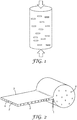
- FIG. 1 the shaping of the cylindrical body by uniaxial pressing is represented schematically.
- the arrows indicate the uniaxial pressing of the powder mixture.
- platelet-shaped hexagonal boron nitride particles are oriented perpendicular to the central axis of the shaped cylindrical body.
- the shaped cylindrical body is sintered, whereby a sintered body having a central axis is obtained.
- the platelet-shaped hexagonal boron nitride particles have a preferred orientation perpendicular to the central axis of the sintered body.
- the sintering of the shaped cylindrical body may be carried out at a temperature of from 135 °C to 430 °C, depending on the polymer system.
- the sintering of the shaped cylindrical body may be carried out at a temperature of from 327 °C to 430 °C, preferably from 365 °C to 390 °C.
- the sintering of the shaped cylindrical body may be carried out at a temperature of about 260 °C or of from 250 °C to 270 °C.
- the sintering may be carried out at a temperature above 350 °C and up to 380 °C.
- UHMWPE ultra-high-molecular-weight polyethylene
- the sintering may be carried out at a temperature of 135 °C to 138 °C.
- the sintered body has a density of at least 80% of theoretical density, preferably of at least 90% of theoretical density.
- the density can be determined by using the Archimedes method.
- the theoretical density of the sintered body is calculated from the powder density of hexagonal boron nitride which is 2.27 g/cm 3 , the density of the respective polymer and from the fractions of hexagonal boron nitride and the polymer in the composition of the sintered body.
- the sintered body produced by the process as disclosed herein is made of a composite material comprising a polymer and hexagonal boron nitride particles, the hexagonal boron nitride particles comprising platelet-shaped hexagonal boron nitride particles.
- the platelet-shaped hexagonal boron nitride particles have a preferred orientation perpendicular to the central axis of the sintered body.
- the sintered body After sintering, the sintered body is rotated around its central axis and a film is skived from the sintered body in radial direction.
- the boron nitride platelets maintain their orientation. Therefore, the boron nitride platelets have a preferred orientation in the film disclosed herein perpendicular to the direction of the plane of the film.
- the preferred orientation can be measured by the texture index which has values below 1.
- FIG. 2 schematically shows the skiving of the film from the sintered cylindrical body.
- the sintered cylindrical body comprises platelet-shaped hexagonal boron nitride particles (2) having a preferred orientation perpendicular to the central axis of the sintered body, i.e. the basal plane of the platelet-shaped hexagonal boron nitride particles is oriented perpendicularly to the central axis of the sintered body.
- a skiving blade (1) is used for skiving.
- Figure 2 also shows a film (3) as disclosed herein, after skiving.
- the film comprises platelet-shaped hexagonal boron nitride particles (2) having a preferred orientation perpendicular to the direction of the plane of the film, i.e. the basal plane of the platelet-shaped hexagonal boron nitride particles is oriented perpendicularly to the direction of the plane of the film.
- a cross-sectional view (4) of the film is also shown in Figure 2 .
- Figures 3A and 3B show scanning electron micrographs (SEM) of a cross-section (4) of the skived film as disclosed herein.
- Figure 3A has a magnification of 20x
- Figure 3B has a magnification of 500x.
- the orientation of the section of Figure 3B is the same as the orientation of the film section of Figure 3A.
- Figure 3B shows platelet-shaped hexagonal boron nitride particles in the film with an orientation perpendicular to the direction of the plane.
- the film as disclosed herein can be used for producing flexible electronic devices, specifically printed circuit boards (PCB).
- PCB printed circuit boards
- the film as disclosed herein can also be used for producing non-flexible electronic devices, specifically non-flexible printed circuit boards (PCB), by laminating several layers of flexible film.
- PCB printed circuit boards
- the film as disclosed herein may be used for electrical insulation of electromotors and for cable insulation, and for all applications that require a high through-plane thermal conductivity of the film.
- the film as disclosed herein has electrically insulating properties and can be used for all applications that require a high through-plane thermal conductivity in combination with electrically insulating properties.
- PTFE polytetrafluoroethylene
- TF 1750 polytetrafluoroethylene
- CFP015 hexagonal boron nitride particles
- the CFP015 particles comprise platelet-shaped hexagonal boron nitride particles.
- the specific surface area (BET) of the CFP015 particles is 2.4 m 2 /g, the mean particle size (d 50 ) is 14.5 ⁇ m and the aspect ratio is 31.
- the mixing was carried out in an Eirich mixer for 2.5 min at 300 rpm.
- the temperature during mixing was kept below 21 °C.
- the boron nitride platelets have a preferred orientation perpendicular to the pressing direction, i.e. perpendicular to the central axis of the cylindrical formed block.
- the sintered block had a diameter of 95 mm and a height of 100 mm.
- the density of the sintered block was 2.18 g/cm 3 corresponding to 96.6% of theoretical density.
- the block After sintering, the block was fixed in a turning lathe. A blade was placed at a distance corresponding to the desired thickness of the film. By rotating the block, a film was skived in radial direction from the block.
- the thermal diffusivity a and the thermal capacity c p are measured using a Nanoflash LFA 447 (Netzsch, Selb, Germany) on samples having the dimensions 10 x 10 x 2 mm 3 .
- Samples were prepared by cutting cuboids 10 x 10 x 15 mm 3 , one in a direction parallel and one in a direction perpendicular to the central axis of the cylindrical formed block. The cuboid was then cut into 3 samples for thermal conductivity measurement, having the dimensions 10 x 10 x 2 mm 3 . Density is calculated by weighing and determining the geometrical dimensions of the precisely shaped samples.
- the standard Pyroceram 9606 is used for calibration of the measurement.
- CTE coefficient of thermal expansion
- films with a size of 1.5 x 1.5 cm were fixed on a silicon single crystal with a diameter of 24.5 mm, and the XRD measurement was carried out as described above.
- Table 1 The test results are shown in Table 1.
- Table 1 Filler content [vol.%] Filler d 50 [ ⁇ m] TP-TC [W/m*K] IP-TC [W/m*K] Ratio TP-TC/ IP-TC TP-CTE [10 -6 K -1 ] IP-CTE [10 -6 K -1 ] Texture Index CEX 0 - 0.28 0.28 1 145 145 - EX1 10 14.5 0.69 0.45 1.5 128 155 0.71 EX2 30 14.5 3.33 1.48 2.3 77 151 0.30 EX3 50 14.5 8.10 2.98 2.7 39 111 0.20 EX4 10 7.9 0.76 0.52 1.5 122 164 0.60 EX5 30 7.9 3.87 1.70 2.3 72 157 0.25 EX6 50 7.9 7.2 2.51 2.9 40 119 0.20 TP-TC: through-plane thermal conductivity IP-TC: in-plane thermal conductivity TP-CTE: through-plane coefficient of thermal expansion 100 - 200
- Example 1 was repeated, with the exception that 30% by volume of boron nitride powder and 70% by volume of PTFE were used.
- the density of the sintered block was 2.17 g/cm 3 corresponding to 95.9% of theoretical density.
- Example 1 was repeated, with the exception that 50% by volume of boron nitride powder and 50% by volume of PTFE were used.
- the density of the sintered block was 2.00 g/cm 3 corresponding to 88.5% of theoretical density.
- Cooling Filler Platelets CFP0075 available from 3M Technical Ceramics, Zweigniedermik der 3M Kunststoff GmbH, Kempten, Germany
- the CFP0075 particles comprise platelet-shaped hexagonal boron nitride particles.
- the specific surface area (BET) of the CFP0075 particles is 5.6 m 2 /g
- the mean particle size (d 50 ) is 7.9 ⁇ m
- the aspect ratio is 17.
- the density of the sintered block was 2.15 g/cm 3 corresponding to 94.9% of theoretical density for Example 4; 2.16 g/cm 3 corresponding to 95.3% of theoretical density for Example 5; and 1.94 g/cm 3 corresponding to 85.4% of theoretical density for Example 6.
- Example 1 was repeated, with the exception that no boron nitride particles were added to the PTFE powder and a sample of 100% by volume of PTFE was pressed and sintered as described in Example 1.
- the density of the sintered block was 2.16 g/cm 3 .
- the examples show that the platelet-shaped hexagonal boron nitride particles are aligned in the film disclosed herein perpendicular to the film direction, resulting in a high through-plane thermal conductivity.
Landscapes
- Chemical & Material Sciences (AREA)
- Engineering & Computer Science (AREA)
- Mechanical Engineering (AREA)
- Health & Medical Sciences (AREA)
- Chemical Kinetics & Catalysis (AREA)
- Medicinal Chemistry (AREA)
- Polymers & Plastics (AREA)
- Organic Chemistry (AREA)
- Manufacturing & Machinery (AREA)
- Microelectronics & Electronic Packaging (AREA)
- Materials Engineering (AREA)
- General Chemical & Material Sciences (AREA)
- Manufacture Of Macromolecular Shaped Articles (AREA)
- Color Television Systems (AREA)
- Compression Or Coding Systems Of Tv Signals (AREA)
- Compositions Of Macromolecular Compounds (AREA)
- Laminated Bodies (AREA)
Abstract


Description
- The present disclosure relates to a film usable for roll-to-roll processing of flexible electronic devices, comprising a composite material of a polymer and hexagonal boron nitride particles.
- Polymer based films are used in many applications for reasons of electrical insulation, for example for flexible electronic devices such as printed circuit boards.
- Flexible electronic devices can be produced by roll-to-roll processing which is a manufacturing technique of creating flexible electronic devices on a roll of flexible plastic foil. By this manufacturing technique, a polymer based film is transferred between two moving rolls of material. Roll-to-roll processing plays an increasingly important role in the high-throughput fabrication of flexible electronic devices. As used herein, films usable for roll-to-roll processing of flexible electronic devices may also be referred to as roll-to-roll films.
- A major drawback of the polymer films is their low thermal conductivity, which leads to an undesired high temperature level of the electronic device, thus reducing its efficiency factor and lifetime.
- To increase thermal conductivity of these films, thermally conductive fillers can be used such as hexagonal boron nitride. Hexagonal boron nitride is an electrically insulating and highly heat-conductive filler having a platelet-shaped particle morphology and highly anisotropic thermal conductivity properties.
- When producing fluoropolymer roll-to-roll films filled with thermally conductive inorganic particles such as hexagonal boron nitride, a polymer fine powder can be dry blended with filler with help of a lubricant such as aliphatic hydrocarbons.
WO2015029385 discloses another way of blending by co-agglomerating polymer microparticles and filler in an aqueous dispersion, separating the agglomerates from liquid and drying the agglomerates. After blending, the dry blended mixture or the mixed agglomerates are extruded into a profile and processed into a film using a calender, and the film is dried, stretched and sintered. When producing polyether ether ketone (PEEK) or polyethylene terephthalate (PET) roll-to-roll films, polymer granulate is processed by film extrusion. The molten polymer is pushed through a slot or die, followed by blow or cast extrusion. While for cast extrusion the polymer is extruded onto a polished chill roll, for blown film the polymer is extruded into a cylindrical die, inflated and formed into a bubble which then is cooled and collapsed. Additionally, a stretching step can be added. When producing polyimide roll-to-roll films an intermediate product of the polymerization process is casted onto a flat surface and polymerized by polycondensation at high temperatures. By the described production processes for roll-to-roll films, boron nitride platelets are oriented parallelly to the plane of the film, resulting in a high in-plane thermal conductivity and a low through-plane thermal conductivity. -
US 2010/0200801 A1 discloses a thermal interface material comprising a base matrix comprising a polymer and 5 to 90 wt.% of boron nitride filler having a platelet structure, wherein the platelet structure of the boron nitride particles is substantially aligned for the thermal interface material to have a bulk thermal conductivity of at least 1 W/m*K. The thermal interface material is extruded into sheets. As a second step, the sheets may be stacked, pressed, cured and sliced in a direction perpendicular to the stacking direction, or the sheet may be compression rolled into a roll, cured and sliced into a plurality of circular pads in a direction perpendicular to the rolling direction. The method disclosed inUS 2010/0200801 A1 does not allow to produce a roll-to-roll film, that is a film usable for roll-to-roll processing of flexible electronic devices. -
US 2011/0223427 A1 discloses a method of producing a thermally conductive sheet comprising the steps of (i) preparing a plurality of sheet materials consisting essentially of a fluororesin containing polytetrafluoroethylene, thermally conductive inorganic particles, and a forming aid; (ii) stacking the plurality of sheet materials on one another and rolling the stacked sheet materials together; and (iii) removing the forming aid. The in-plane thermal conductivity of the sheet is higher than the through-plane thermal conductivity. Furthermore, the method disclosed inUS 2011/0223427 A1 does not allow to produce a roll-to-roll film, that is a film usable for roll-to-roll processing of flexible electronic devices.US 2011/0192588 A1 discloses a heat conducting sheet comprising boron nitride platelets being oriented along the thickness direction of the sheet. The heat conducting sheet is manufactured by forming a primary sheet in which the boron nitride platelets are oriented substantially parallel to the main surfaces of the sheet. The primary sheet is laminated onto each other, thereby forming a formed body having a multilayered structure, and the formed body is sliced at an angle of 0 to 30 degrees to any normal line extending from main surfaces of the formed body. The method disclosed inUS 2011/0192588 A1 does not allow to produce a roll-to-roll film, that is a film usable for roll-to-roll processing of flexible electronic devices. - Therefore, there is still a need for films usable for roll-to-roll processing of flexible electronic devices and having a high through-plane thermal conductivity.
- As used herein, "a", "an", "the", "at least one" and "one or more" are used interchangeably. The term "comprise" shall include also the terms "consist essentially of" and "consists of".
- In a first aspect, the present disclosure relates to a film usable for roll-to-roll processing of flexible electronic devices, the film comprising a composite material comprising a polymer and hexagonal boron nitride particles, wherein the hexagonal boron nitride particles comprise platelet-shaped hexagonal boron nitride particles, and wherein the platelet-shaped hexagonal boron nitride particles have a preferred orientation perpendicular to the direction of the plane of the film.
- In another aspect, the present disclosure also relates to a process for producing a film as disclosed herein, the process comprising
- providing hexagonal boron nitride particles comprising platelet-shaped hexagonal boron nitride particles and a polymer,
- mixing the hexagonal boron nitride particles and the polymer, thereby obtaining a powder mixture,
- forming the powder mixture into a cylindrical shape, thereby obtaining a shaped cylindrical body having a central axis, wherein the platelet-shaped hexagonal boron nitride particles have a preferred orientation perpendicular to the central axis of the shaped cylindrical body,
- sintering the shaped cylindrical body, thereby obtaining a sintered body having a central axis, wherein the platelet-shaped hexagonal boron nitride particles have a preferred orientation perpendicular to the central axis of the sintered body, and
- rotating the sintered body around its central axis and skiving a film from the sintered body in radial direction.
- In yet a further aspect, the present disclosure relates to the use of a film as disclosed herein for producing flexible electronic devices.
- The film disclosed herein comprises highly oriented boron nitride platelet-shaped particles and has consequently highly anisotropic properties, particularly highly anisotropic thermal conductivity properties.
- The film disclosed herein comprises boron nitride platelet-shaped particles oriented perpendicularly to the plane of the film and has a high through-plane thermal conductivity.
- Boron nitride filled polymer films as disclosed herein allow to remove heat faster and more efficiently, due to the high through-plane thermal conductivity. Compared to other polymer films filled with boron nitride, the films disclosed herein have a higher through-plane thermal conductivity than in-plane thermal conductivity.
- Films as disclosed herein can be used for roll-to-roll processing of flexible electronic devices.
- In some embodiments, for example when polytetrafluoroethylene (PTFE) is used as polymer, the films can be used in applications where most conventional films such as polyethylene terephthalate (PET) cannot be used, due to the excellent thermal stability of PTFE.
- Furthermore, the film disclosed herein has a low through-plane thermal expansion coefficient. The through-plane thermal expansion coefficient of the film is even lower than the in-plane thermal expansion coefficient. The low through-plane thermal expansion coefficient is especially important during manufacturing of printed circuit boards when using vertical interconnect access (VIA). Printed circuit boards (PCB) often fail due to the different expansion coefficient between the copper plating and the PCB substrate perpendicular to the plane of the film.
- In addition, the film disclosed herein has low dielectric properties, specifically low permittivity and low loss factor, due to the use of boron nitride as thermally conductive filler.
- The present disclosure is explained in more detail on the basis of the drawings, in which
-
Figure 1 schematically shows the shaping of a cylindrical body by uniaxial pressing; -
Figure 2 schematically shows the skiving of a film as disclosed herein from the sintered cylindrical body; and -
Figures 3A and 3B show scanning electron micrographs of a cross-section of a film as disclosed herein. - The film as disclosed herein is usable for roll-to-roll processing of flexible electronic devices, such as printed circuit boards. By roll-to-roll processing, a polymer based film is transferred between two moving rolls of material. For roll-to-roll processing, the film as disclosed herein is provided as a film wound up to a roll, and in roll-to-roll processing the film is transferred and wound up to another roll.
- The film as disclosed herein comprises a composite material comprising hexagonal boron nitride particles. The hexagonal boron nitride particles comprise platelet-shaped hexagonal boron nitride particles. Platelet-shaped hexagonal boron nitride particles may also be referred to as flake-shaped or scale-like hexagonal boron nitride particles.
- The platelet-shaped hexagonal boron nitride particles have a basal plane. The basal plane of the platelet-shaped hexagonal boron nitride particles is oriented perpendicularly to the direction of the plane of the film. In other words, in the film as disclosed herein, the platelet-shaped hexagonal boron nitride particles have a preferred orientation, the preferred orientation being perpendicular to the direction of the plane of the film.
- The film as disclosed herein comprises a composite material comprising a polymer. The polymer may be a fluoropolymer or a polyimide or a polyester or ultra-high-molecular-weight polyethylene (UHMWPE).
- The fluoropolymer used for the film may be selected from the group consisting of polytetrafluoroethylene (PTFE), perfluoroalkoxy alkanes (PFA) and fluorinated ethylene propylene (FEP). An example for a suitable polytetrafluoroethylene is TFM™, available from Dyneon GmbH, Burgkirchen, Germany. A polyester used for the film may be polyethylene terephthalate (PET).
- The degree of orientation of the platelet-shaped hexagonal boron nitride particles in the film can be characterized by the texture index, measured on a film sample. The texture index of hexagonal boron nitride with isotropic orientation of the platelet-shaped hexagonal boron nitride particles, thus without preferred orientation, has a value of 1. For platelet-shaped hexagonal boron nitride particles being oriented parallelly to the plane of the film, the texture index increases with the degree of parallel orientation in the film sample and has values greater than 1. For platelet-shaped hexagonal boron nitride particles being oriented perpendicularly to the plane of the film, the texture index decreases with the degree of perpendicular orientation in the film sample and has values less than 1.
- The texture index of the film as disclosed herein is at most 0.8. In some embodiments, the texture index of the film is at most 0.5. In some embodiments, the texture index of the film is at most 0.3. The texture index of the film is measured in a direction perpendicular to the plane of the film.
- The texture index is determined by X-ray diffractometry. For this, the ratio of the intensities of the (002) and of the (100) reflection of hexagonal boron nitride (hBN) measured on X-ray diffraction diagrams of a film sample is determined and is divided by the corresponding ratio for an ideal, untextured hBN sample. This ideal ratio can be determined from the JCPDS data and is 7.29. The intensity of the (002) reflection is measured within a 2Θ range from 25.8 to 27.6 degrees and that of the (100) reflection within a 2Θ range from 41.0 to 42.2 degrees. The texture index (TI) can be determined from the formula:

- The intensity of the (100) reflection should be at least 1.0. If the intensity of the (100) reflection is below 1.0, the measurement speed in the 2Θ ranges from 25.8 to 27.6 degrees and from 41.0 to 42.2 degrees can be decreased to obtain a sufficient intensity of the (100) reflection.
- The mean particle size (d50) of the hexagonal boron nitride particles used for the film disclosed herein may be from 0.5 to 100 µm. Preferably, the mean particle size (d50) of the hexagonal boron nitride particles is at least 5 µm, more preferably at least 10 µm. In some embodiments, the mean particle size (d50) is from 5 to 50 µm or from 5 to 30 µm. The mean particle size (d50) can be measured by laser diffraction.
- The mean aspect ratio of the platelet-shaped hexagonal boron nitride particles typically is at least 5. The aspect ratio is the ratio of the diameter to the thickness of the platelet-shaped hexagonal boron nitride particles. As used herein, the platelet-shaped hexagonal boron nitride particles are also referred to as boron nitride platelets. The aspect ratio of the boron nitride platelets may be at least 10, or at least 15, or at least 20. The mean aspect ratio of the boron nitride platelets may also be up to 40, or up to 100. The mean aspect ratio of the boron nitride platelets may be from 7 to 20, or from 20 to 40, or from 7 to 40, or from 10 to 40, or from 50 to 100. Typically, the mean aspect ratio of the boron nitride platelets is at most 500. The mean aspect ratio can be measured by scanning electron microscopy (SEM), by determining the aspect ratio of 20 particles, and calculating the mean value of the 20 individual values determined for the aspect ratio. The aspect ratio of an individual boron nitride platelet is determined by measuring the diameter and the thickness of the boron nitride platelet and calculating the ratio of the diameter to the thickness. Required magnification of the SEM images used to measure diameter and thickness of boron nitride platelets depends on the size of the platelets. Magnification should be at least 1000x, preferably at least 2000x. Where appropriate, i.e. for smaller platelets with a mean particle size (d50) of 5 to 10 µm, a magnification of 5000x should be used.
- A portion of the hexagonal boron nitride platelets may be agglomerated to form boron nitride agglomerates. The mean particle size (d50) of the boron nitride agglomerates may be at most 500 µm and more specifically at most 250 µm, at most 150 µm or at most 100 µm. The mean particle size (d50) of the boron nitride agglomerates may be at least 30 µm or at least 50 µm. The mean particle size (d50) can be measured by laser diffraction. Also mixtures of agglomerates and non-agglomerated primary particles may be used. The boron nitride agglomerates may be spherical, irregularly shaped or flake-shaped. The flake-shaped agglomerates may have an aspect ratio of from 1 to 20.
- The composite material may comprise from 10 to 60 percent by volume of hexagonal boron nitride particles, based on the total amount of the composite material. In some embodiments, the composite material comprises from 20 to 50 percent by volume of hexagonal boron nitride particles, based on the total amount of the composite material.
- In some embodiments, all hexagonal boron nitride particles are platelet-shaped. In some embodiments, all hexagonal boron nitride particles are non-agglomerated.
- The thickness of the film disclosed herein may be from 0.010 mm to 6 mm. Preferably, the film thickness is from 50 to 500 µm. The size of the hexagonal boron nitride particles may be selected depending on the film thickness.
- The through-plane thermal conductivity of the film disclosed herein is at least 0.7 W/m*K. In some embodiments, the through-plane thermal conductivity of the film is at least 1 W/m*K, or at least 2 W/m*K, or at least 5 W/m*K.
- The in-plane thermal conductivity of the film disclosed herein is at least 0.4 W/m*K. In some embodiments, the in-plane thermal conductivity of the film is at least 0.7 W/m*K, or at least 1 W/m*K, or at least 2 W/m*K.
- For films used for the production of flexible electronic devices such as printed circuit boards, a high through-plane thermal conductivity is desired, whereas the in-plane thermal conductivity should also be as high as possible.
- The through-plane thermal conductivity and the in-plane thermal conductivity can be measured on samples cut from a sintered body from which the film is skived.
- Surprisingly, the through-plane thermal conductivity of the film disclosed herein is higher than the in-plane thermal conductivity of the film. Typically, the ratio of the through-plane thermal conductivity to the in-plane thermal conductivity is from 1.4 to 4.0. In some embodiments, the ratio of the through-plane thermal conductivity to the in-plane thermal conductivity is from 2.0 to 3.5.
- The through-plane thermal expansion coefficient of the film disclosed herein is lower than the in-plane thermal expansion coefficient of the film. The through-plane thermal expansion coefficient and the in-plane thermal expansion coefficient may be measured in the temperature range from 100 to 200 °C. Typically, the through-plane thermal expansion coefficient is lower than 130 ∗ 10-6 K-1, measured in a temperature range from 100 °C to 200 °C. In some embodiments, the through-plane thermal expansion coefficient is lower than 50 ∗ 10-6 K-1, measured in a temperature range from 100 °C to 200 °C. The in-plane thermal expansion coefficient typically is lower than 200 ∗ 10-6 K-1. Typically, the ratio of the through-plane thermal expansion coefficient to the in-plane thermal expansion coefficient is from 0.9 to 0.2, the through-plane thermal expansion coefficient and the in-plane thermal expansion coefficient being measured in the temperature range from 100 to 200 °C. In some embodiments, the ratio of the through-plane thermal expansion to the in-plane thermal expansion is from 0.7 to 0.2, the through-plane thermal expansion coefficient and the in-plane thermal expansion coefficient being measured in the temperature range from 100 to 200 °C.
- The through-plane thermal expansion of the film disclosed herein is lower than the through-plane thermal expansion of a polymer film produced without filler particles.
- The composite material may further comprise fillers for improvement of the mechanical properties, such as glass fibers or carbon fibers, and further thermal conductive fillers, such as alumina or graphite. The composite material may further comprise hollow glass microspheres for achieving even lower dielectric properties or for further lowering coefficient of thermal expansion.
- The film as disclosed herein may be metallized or surface-treated. Suitable surface treatments are plasma treatments and etching processes, for example with sodium naphthalene.
- The film as disclosed herein can be produced by a process comprising
- providing hexagonal boron nitride particles comprising platelet-shaped hexagonal boron nitride particles and a polymer,
- mixing the hexagonal boron nitride particles and the polymer, thereby obtaining a powder mixture,
- forming the powder mixture into a cylindrical shape, thereby obtaining a shaped cylindrical body having a central axis, wherein the platelet-shaped hexagonal boron nitride particles have a preferred orientation perpendicular to the central axis of the shaped cylindrical body,
- sintering the shaped cylindrical body, thereby obtaining a sintered body having a central axis, wherein the platelet-shaped hexagonal boron nitride particles have a preferred orientation perpendicular to the central axis of the sintered body, and
- rotating the sintered body around its central axis and skiving a film from the sintered body in radial direction.
- For producing the film as disclosed herein, hexagonal boron nitride particles comprising boron nitride platelets and a polymer as described above more in detail may be used.
- The hexagonal boron nitride particles used for producing the film as disclosed herein have a specific surface area (BET) of at most 20 m2/g, preferably at most 10 m2/g. In some embodiments, the specific surface area of the hexagonal boron nitride particles is at most 5 m2/g. Typically, the specific surface area of the hexagonal boron nitride particles is at least 1 m2/g.
- The hexagonal boron nitride particles and the polymer may be mixed using conventional mixing aggregates such as intensive mixers or ploughshare mixers.
- The obtained powder mixture is formed into a cylindrical shape, resulting in a shaped cylindrical body having a central axis. In the shaped cylindrical body, the platelet-shaped hexagonal boron nitride particles have a preferred orientation perpendicular to the central axis of the shaped cylindrical body.
- The forming of the powder mixture into a cylindrical shape may be carried out by pressing, preferably by uniaxial pressing. The applied pressure may be from 15 MPa to 90 MPa. Pressing may be carried out at room temperature (20 °C), or at higher temperatures up to the sintering temperature.
- In
Figure 1 , the shaping of the cylindrical body by uniaxial pressing is represented schematically. The arrows indicate the uniaxial pressing of the powder mixture. After pressing, platelet-shaped hexagonal boron nitride particles are oriented perpendicular to the central axis of the shaped cylindrical body. - After forming, the shaped cylindrical body is sintered, whereby a sintered body having a central axis is obtained. In the sintered body, the platelet-shaped hexagonal boron nitride particles have a preferred orientation perpendicular to the central axis of the sintered body.
- The sintering of the shaped cylindrical body may be carried out at a temperature of from 135 °C to 430 °C, depending on the polymer system. For polytetrafluoroetylene, the sintering of the shaped cylindrical body may be carried out at a temperature of from 327 °C to 430 °C, preferably from 365 °C to 390 °C. For polyethyleneterephthalate, the sintering of the shaped cylindrical body may be carried out at a temperature of about 260 °C or of from 250 °C to 270 °C. For polyimide, the sintering may be carried out at a temperature above 350 °C and up to 380 °C. For ultra-high-molecular-weight polyethylene (UHMWPE), the sintering may be carried out at a temperature of 135 °C to 138 °C.
- The sintered body has a density of at least 80% of theoretical density, preferably of at least 90% of theoretical density. The density can be determined by using the Archimedes method. The theoretical density of the sintered body is calculated from the powder density of hexagonal boron nitride which is 2.27 g/cm3, the density of the respective polymer and from the fractions of hexagonal boron nitride and the polymer in the composition of the sintered body.
- The sintered body produced by the process as disclosed herein is made of a composite material comprising a polymer and hexagonal boron nitride particles, the hexagonal boron nitride particles comprising platelet-shaped hexagonal boron nitride particles. The platelet-shaped hexagonal boron nitride particles have a preferred orientation perpendicular to the central axis of the sintered body.
- After sintering, the sintered body is rotated around its central axis and a film is skived from the sintered body in radial direction. In the skiving step, the boron nitride platelets maintain their orientation. Therefore, the boron nitride platelets have a preferred orientation in the film disclosed herein perpendicular to the direction of the plane of the film. The preferred orientation can be measured by the texture index which has values below 1.
-
Figure 2 schematically shows the skiving of the film from the sintered cylindrical body. The sintered cylindrical body comprises platelet-shaped hexagonal boron nitride particles (2) having a preferred orientation perpendicular to the central axis of the sintered body, i.e. the basal plane of the platelet-shaped hexagonal boron nitride particles is oriented perpendicularly to the central axis of the sintered body. For skiving, a skiving blade (1) is used. -
Figure 2 also shows a film (3) as disclosed herein, after skiving. The film comprises platelet-shaped hexagonal boron nitride particles (2) having a preferred orientation perpendicular to the direction of the plane of the film, i.e. the basal plane of the platelet-shaped hexagonal boron nitride particles is oriented perpendicularly to the direction of the plane of the film. A cross-sectional view (4) of the film is also shown inFigure 2 . -
Figures 3A and 3B show scanning electron micrographs (SEM) of a cross-section (4) of the skived film as disclosed herein.Figure 3A has a magnification of 20x,Figure 3B has a magnification of 500x. The orientation of the section ofFigure 3B is the same as the orientation of the film section ofFigure 3A. Figure 3B shows platelet-shaped hexagonal boron nitride particles in the film with an orientation perpendicular to the direction of the plane. - The film as disclosed herein can be used for producing flexible electronic devices, specifically printed circuit boards (PCB).
- The film as disclosed herein can also be used for producing non-flexible electronic devices, specifically non-flexible printed circuit boards (PCB), by laminating several layers of flexible film.
- The film as disclosed herein may be used for electrical insulation of electromotors and for cable insulation, and for all applications that require a high through-plane thermal conductivity of the film.
- If no additional fillers are used that have electrically conductive properties such as graphite, the film as disclosed herein has electrically insulating properties and can be used for all applications that require a high through-plane thermal conductivity in combination with electrically insulating properties.
- 25 kg of a mixture of polytetrafluoroethylene (PTFE) powder grade TF 1750 (available from Dyneon GmbH, Burgkirchen, Germany) and hexagonal boron nitride particles (Cooling Filler Platelets CFP015, available from 3M Technical Ceramics, Zweigniederlassung der 3M Deutschland GmbH, Kempten, Germany) were prepared, with 10% by volume of boron nitride powder and 90% by volume of PTFE. The CFP015 particles comprise platelet-shaped hexagonal boron nitride particles. The specific surface area (BET) of the CFP015 particles is 2.4 m2/g, the mean particle size (d50) is 14.5 µm and the aspect ratio is 31.
- The mixing was carried out in an Eirich mixer for 2.5 min at 300 rpm. The temperature during mixing was kept below 21 °C.
- Then, 1.5 kg of the powder mixture was placed into a cylindrical pressing mold and the material was uniaxially pressed in a direction parallel to the central axis of the pressing mold, at a pressure of 50 MPa and a temperature of 23 °C. In the obtained formed block, the boron nitride platelets have a preferred orientation perpendicular to the pressing direction, i.e. perpendicular to the central axis of the cylindrical formed block.
- Sintering of the obtained formed BN/PTFE block was carried out at a temperature of 387 °C in air. The sintered block had a diameter of 95 mm and a height of 100 mm. The density of the sintered block was 2.18 g/cm3 corresponding to 96.6% of theoretical density.
- After sintering, the block was fixed in a turning lathe. A blade was placed at a distance corresponding to the desired thickness of the film. By rotating the block, a film was skived in radial direction from the block.
- For measuring thermal conductivity, the laser-flash method is used and carried out with the Nanoflash LFA 447 (Netzsch, Selb, Germany) according to ISO 22007-4:2017. Measurements are taken at 25 °C. Thermal conductivity (TC) is determined by measuring the values for thermal diffusivity a, specific thermal capacity cp and density D, and is calculated from these values according to the equation

- The thermal diffusivity a and the thermal capacity cp are measured using a Nanoflash LFA 447 (Netzsch, Selb, Germany) on samples having the dimensions 10 x 10 x 2 mm3. Samples were prepared by cutting cuboids 10 x 10 x 15 mm3, one in a direction parallel and one in a direction perpendicular to the central axis of the cylindrical formed block. The cuboid was then cut into 3 samples for thermal conductivity measurement, having the dimensions 10 x 10 x 2 mm3. Density is calculated by weighing and determining the geometrical dimensions of the precisely shaped samples. The standard Pyroceram 9606 is used for calibration of the measurement.
- The coefficient of thermal expansion (CTE) was measured using a thermomechanical analyzer (TMA 2940, TA Instruments), applying a heating rate of 5°/min. The CTE was determined from the slope of the curve of thermal expansion versus temperature between 100 and 200 °C. To determine directional dependence, cylindrical specimens with a diameter of 5 mm and a height of 8 mm were prepared, one in a direction parallel and one in a direction perpendicular to the central axis of the cylindrical formed block.
- For measuring of the texture index, films with a size of 1.5 x 1.5 cm were fixed on a silicon single crystal with a diameter of 24.5 mm, and the XRD measurement was carried out as described above.
- The test results are shown in Table 1.
Table 1: Filler content [vol.%] Filler d50 [µm] TP-TC [W/m*K] IP-TC [W/m*K] Ratio TP-TC/ IP-TC TP-CTE [10-6 K-1] IP-CTE [10-6 K-1] Texture Index CEX 0 - 0.28 0.28 1 145 145 - EX1 10 14.5 0.69 0.45 1.5 128 155 0.71 EX2 30 14.5 3.33 1.48 2.3 77 151 0.30 EX3 50 14.5 8.10 2.98 2.7 39 111 0.20 EX4 10 7.9 0.76 0.52 1.5 122 164 0.60 EX5 30 7.9 3.87 1.70 2.3 72 157 0.25 EX6 50 7.9 7.2 2.51 2.9 40 119 0.20 TP-TC: through-plane thermal conductivity
IP-TC: in-plane thermal conductivity
TP-CTE: through-plane coefficient of thermal expansion 100 - 200 °C
IP-CTE: in-plane coefficient of thermal expansion 100 - 200 °C - Example 1 was repeated, with the exception that 30% by volume of boron nitride powder and 70% by volume of PTFE were used. The density of the sintered block was 2.17 g/cm3 corresponding to 95.9% of theoretical density.
- The test results are shown in Table 1.
- Example 1 was repeated, with the exception that 50% by volume of boron nitride powder and 50% by volume of PTFE were used. The density of the sintered block was 2.00 g/cm3 corresponding to 88.5% of theoretical density.
- The test results are shown in Table 1.
- Examples 1 to 3 were repeated, with the exception that Cooling Filler Platelets CFP0075 (available from 3M Technical Ceramics, Zweigniederlassung der 3M Deutschland GmbH, Kempten, Germany) were used as hexagonal boron nitride particles. The CFP0075 particles comprise platelet-shaped hexagonal boron nitride particles. The specific surface area (BET) of the CFP0075 particles is 5.6 m2/g, the mean particle size (d50) is 7.9 µm and the aspect ratio is 17.
- The density of the sintered block was 2.15 g/cm3 corresponding to 94.9% of theoretical density for Example 4; 2.16 g/cm3 corresponding to 95.3% of theoretical density for Example 5; and 1.94 g/cm3 corresponding to 85.4% of theoretical density for Example 6.
- The test results are shown in Table 1.
- Example 1 was repeated, with the exception that no boron nitride particles were added to the PTFE powder and a sample of 100% by volume of PTFE was pressed and sintered as described in Example 1.
- The density of the sintered block was 2.16 g/cm3.
- The test results are shown in Table 1.
- The examples show that the platelet-shaped hexagonal boron nitride particles are aligned in the film disclosed herein perpendicular to the film direction, resulting in a high through-plane thermal conductivity.
Claims (15)
- A film usable for roll-to-roll processing of flexible electronic devices, the film comprising a composite material comprising a polymer and hexagonal boron nitride particles, wherein the hexagonal boron nitride particles comprise platelet-shaped hexagonal boron nitride particles, and wherein the platelet-shaped hexagonal boron nitride particles have a preferred orientation, and wherein the preferred orientation is perpendicular to the direction of the plane of the film.
- The film according to claim 1, wherein the polymer is a fluoropolymer or a polyimide or a polyester or ultra-high-molecular-weight polyethylene (UHMWPE).
- The film according to claim 1 or 2, wherein the polymer is a fluoropolymer, and wherein the fluoropolymer is selected from the group consisting of polytetrafluoroethylene (PTFE), perfluoroalkoxy alkanes (PFA) and fluorinated ethylene propylene (FEP).
- The film according to any one of claims 1 to 3, wherein the texture index of the film is at most 0.8, and wherein the texture index is measured in a direction perpendicular to the plane of the film.
- The film according to any one of claims 1 to 4, wherein the mean particle size (d50) of the hexagonal boron nitride particles is from 0.5 to 100 µm.
- The film according to any one of claims 1 to 5, wherein the aspect ratio of the platelet-shaped hexagonal boron nitride particles is at least 5.
- The film according to any one of claims 1 to 6, wherein the composite material comprises from 10 to 60 percent by volume of hexagonal boron nitride particles, based on the total amount of the composite material.
- The film according to any one of claims 1 to 7, wherein the thickness of the film is from 0.010 mm to 6 mm.
- The film according to any one of claims 1 to 8, wherein the through-plane thermal conductivity of the film is at least 0.7 W/m*K, and wherein the in-plane thermal conductivity of the film is at least 0.4 W/m*K.
- The film according to any one of claims 1 to 9, wherein the through-plane thermal conductivity of the film is higher than the in-plane thermal conductivity of the film, and wherein the ratio of the through-plane thermal conductivity to the in-plane thermal conductivity is from 1.4 to 4.0.
- The film according to any one of claims 1 to 10, wherein the through-plane thermal expansion coefficient of the film is lower than the in-plane thermal expansion coefficient of the film, and wherein the through-plane thermal expansion coefficient and in-plane thermal expansion coefficient are measured in the temperature range from 100 to 200 °C, and wherein the ratio of the through-plane thermal expansion coefficient to the in-plane thermal expansion coefficient is from 0.9 to 0.2.
- A process for producing a film according to claim 1, the process comprising
providing hexagonal boron nitride particles comprising platelet-shaped hexagonal boron nitride particles and a polymer,
mixing the hexagonal boron nitride particles and the polymer, thereby obtaining a powder mixture,
forming the powder mixture into a cylindrical shape, thereby obtaining a shaped cylindrical body having a central axis, wherein the platelet-shaped hexagonal boron nitride particles have a preferred orientation perpendicular to the central axis of the shaped cylindrical body,
sintering the shaped cylindrical body, thereby obtaining a sintered body having a central axis, wherein the platelet-shaped hexagonal boron nitride particles have a preferred orientation perpendicular to the central axis of the sintered body, and
rotating the sintered body around its central axis and skiving a film from the sintered body in radial direction. - The process according to claim 12, wherein the forming of the powder mixture into a cylindrical shape is carried out by pressing, preferably by uniaxial pressing, at a pressure of from 15 MPa to 90 MPa, and wherein the sintering of the shaped cylindrical body is carried out at a temperature of from 130 °C to 430 °C.
- The process according to claim 12 or 13, wherein the hexagonal boron nitride particles have a specific surface area (BET) of at most 20 m2/g.
- Use of a film according to any of claims 1 to 11 for producing flexible electronic devices.
Priority Applications (5)
| Application Number | Priority Date | Filing Date | Title |
|---|---|---|---|
| EP19172431.9A EP3733753A1 (en) | 2019-05-03 | 2019-05-03 | Film usable for roll-to-roll processing of flexible electronic devices comprising a composite material of a polymer and boron nitride |
| US17/608,541 US20220219357A1 (en) | 2019-05-03 | 2020-04-30 | Film usable for roll-to-roll processing of flexible electronic devices comprising a composite material of a polymer and boron nitride |
| KR1020217036545A KR20210143920A (en) | 2019-05-03 | 2020-04-30 | Films Usable for Roll-to-Roll Processing of Flexible Electronic Devices Containing Composite Materials of Polymer and Boron Nitride |
| JP2021564937A JP7083477B2 (en) | 2019-05-03 | 2020-04-30 | A film that can be used for roll-to-roll processing of flexible electronic devices containing polymer and boron nitride composites. |
| PCT/IB2020/054115 WO2020225678A1 (en) | 2019-05-03 | 2020-04-30 | Film usable for roll-to-roll processing of flexible electronic devices comprising a composite material of a polymer and boron nitride |
Applications Claiming Priority (1)
| Application Number | Priority Date | Filing Date | Title |
|---|---|---|---|
| EP19172431.9A EP3733753A1 (en) | 2019-05-03 | 2019-05-03 | Film usable for roll-to-roll processing of flexible electronic devices comprising a composite material of a polymer and boron nitride |
Publications (1)
| Publication Number | Publication Date |
|---|---|
| EP3733753A1 true EP3733753A1 (en) | 2020-11-04 |
Family
ID=66647007
Family Applications (1)
| Application Number | Title | Priority Date | Filing Date |
|---|---|---|---|
| EP19172431.9A Withdrawn EP3733753A1 (en) | 2019-05-03 | 2019-05-03 | Film usable for roll-to-roll processing of flexible electronic devices comprising a composite material of a polymer and boron nitride |
Country Status (5)
| Country | Link |
|---|---|
| US (1) | US20220219357A1 (en) |
| EP (1) | EP3733753A1 (en) |
| JP (1) | JP7083477B2 (en) |
| KR (1) | KR20210143920A (en) |
| WO (1) | WO2020225678A1 (en) |
Cited By (2)
| Publication number | Priority date | Publication date | Assignee | Title |
|---|---|---|---|---|
| CN114031871A (en) * | 2021-11-01 | 2022-02-11 | 温州大学新材料与产业技术研究院 | High-thermal-conductivity polytetrafluoroethylene film and preparation method and application thereof |
| EP4499736A4 (en) * | 2022-03-24 | 2026-03-18 | 3M Innovative Properties Company | Film comprising a composite material of a polymer and hexagonal boron nitride particles and method for its production |
Families Citing this family (4)
| Publication number | Priority date | Publication date | Assignee | Title |
|---|---|---|---|---|
| JP7367088B2 (en) * | 2022-01-31 | 2023-10-23 | ニチアス株式会社 | Thermal conductive sheet and method for manufacturing the thermally conductive sheet |
| US20230317592A1 (en) * | 2022-04-01 | 2023-10-05 | Intel Corporation | Substrate with low-permittivity core and buildup layers |
| TR2022018041A1 (en) | 2022-11-28 | 2024-06-21 | Eurotec Muehendislik Plastikleri Sanayi Ve Ticaret Anonim Sirketi | Polymer-based composite materials with increased thermal conductivity. |
| CN120641475A (en) * | 2023-02-01 | 2025-09-12 | 大金工业株式会社 | Resin sheet, method for producing the same, copper-clad laminate, and circuit board |
Citations (4)
| Publication number | Priority date | Publication date | Assignee | Title |
|---|---|---|---|---|
| WO2008085999A1 (en) * | 2007-01-10 | 2008-07-17 | Momentive Performance Materials Inc. | Thermal interface materials and methods for making thereof |
| US20110192588A1 (en) | 2008-10-21 | 2011-08-11 | Hitachi Chemical Company, Ltd. | Heat conducting sheet, manufacturing method thereof, and heat radiator that utilizes the same |
| US20110223427A1 (en) | 2008-11-12 | 2011-09-15 | Nitto Denko Corporation | Method of producing electrically insulating thermally conductive sheet, electrically insulating thermally conductive sheet, and heat dissipating member |
| WO2015029385A1 (en) | 2013-08-27 | 2015-03-05 | 日東電工株式会社 | Method for manufacturing thermally conductive sheet and thermally conductive sheet |
Family Cites Families (7)
| Publication number | Priority date | Publication date | Assignee | Title |
|---|---|---|---|---|
| US5791397A (en) * | 1995-09-22 | 1998-08-11 | Suzuki Motor Corporation | Processes for producing Mg-based composite materials |
| JP2002114575A (en) * | 2000-10-04 | 2002-04-16 | Denki Kagaku Kogyo Kk | Hexagonal boron nitride plate, method for manufacturing the same and application of the same |
| JP4610106B2 (en) * | 2001-02-28 | 2011-01-12 | スリーエム イノベイティブ プロパティズ カンパニー | Manufacturing method and manufacturing apparatus for thermal conductive sheet |
| JP2012214562A (en) * | 2011-03-31 | 2012-11-08 | Nippon Valqua Ind Ltd | Insulating resin composition, insulation film, and method of producing the insulation film |
| WO2013030998A1 (en) * | 2011-08-31 | 2013-03-07 | 日立化成工業株式会社 | Resin composition, resin sheet, resin sheet with metal foil, hardened resin sheet, structure, and semiconductor device for power or light source |
| CN108568926B (en) * | 2017-11-21 | 2020-05-15 | 中国科学院金属研究所 | Method for efficiently preparing highly-oriented and highly-compact two-dimensional material film |
| US10811187B2 (en) * | 2018-09-18 | 2020-10-20 | Toyota Motor Engineering & Manufacturing North America, Inc. | Methods of fabricating thermal composites having specifically designed particle distributions |
-
2019
- 2019-05-03 EP EP19172431.9A patent/EP3733753A1/en not_active Withdrawn
-
2020
- 2020-04-30 JP JP2021564937A patent/JP7083477B2/en not_active Expired - Fee Related
- 2020-04-30 WO PCT/IB2020/054115 patent/WO2020225678A1/en not_active Ceased
- 2020-04-30 US US17/608,541 patent/US20220219357A1/en not_active Abandoned
- 2020-04-30 KR KR1020217036545A patent/KR20210143920A/en not_active Abandoned
Patent Citations (5)
| Publication number | Priority date | Publication date | Assignee | Title |
|---|---|---|---|---|
| WO2008085999A1 (en) * | 2007-01-10 | 2008-07-17 | Momentive Performance Materials Inc. | Thermal interface materials and methods for making thereof |
| US20100200801A1 (en) | 2007-01-10 | 2010-08-12 | Ramamoorthy Ramasamy | Thermal interface materials and methods for making thereof |
| US20110192588A1 (en) | 2008-10-21 | 2011-08-11 | Hitachi Chemical Company, Ltd. | Heat conducting sheet, manufacturing method thereof, and heat radiator that utilizes the same |
| US20110223427A1 (en) | 2008-11-12 | 2011-09-15 | Nitto Denko Corporation | Method of producing electrically insulating thermally conductive sheet, electrically insulating thermally conductive sheet, and heat dissipating member |
| WO2015029385A1 (en) | 2013-08-27 | 2015-03-05 | 日東電工株式会社 | Method for manufacturing thermally conductive sheet and thermally conductive sheet |
Non-Patent Citations (4)
| Title |
|---|
| CHEN PAN ET AL: "Investigation of the through-plane thermal conductivity of polymer composites with in-plane oriented hexagonal boron nitride", INTERNATIONAL JOURNAL OF HEAT AND MASS TRANSFER., vol. 120, 9 December 2017 (2017-12-09), GB, pages 1 - 8, XP055633054, ISSN: 0017-9310, DOI: 10.1016/j.ijheatmasstransfer.2017.12.015 * |
| LAURENCE W. MC KEEN: "Fluorinated Coatings and Finishes Handbook: The Definitive User`s Guide", vol. 2, 11 October 2015, WILLIAM ANDREW INC. (MATHEW DEANS), Oxford, ISBN: 978-0-323-37126-1, article "Powder Coating and Films", pages: 204, XP002795150, DOI: http://dx.doi.org/10.1016/B978-0-323-37126-1.00001-1 * |
| MIZUKA TANIMOTO ET AL: "Anisotropic Thermal Diffusivity of Hexagonal Boron Nitride-Filled Polyimide Films: Effects of Filler Particle Size, Aggregation, Orientation, and Polymer Chain Rigidity", ACS APPLIED MATERIALS & INTERFACES, vol. 5, no. 10, 9 May 2013 (2013-05-09), US, pages 4374 - 4382, XP055633318, ISSN: 1944-8244, DOI: 10.1021/am400615z * |
| RALF DAMASCH: "417 5.4 Bornitrid als multifunktioneller F?llstoff in Polymersystemen", 7 May 2007 (2007-05-07), XP055109849, Retrieved from the Internet <URL:http://www.keramverband.de/keramik/pdf/07/sem07-13.pdf> [retrieved on 20140325] * |
Cited By (3)
| Publication number | Priority date | Publication date | Assignee | Title |
|---|---|---|---|---|
| CN114031871A (en) * | 2021-11-01 | 2022-02-11 | 温州大学新材料与产业技术研究院 | High-thermal-conductivity polytetrafluoroethylene film and preparation method and application thereof |
| CN114031871B (en) * | 2021-11-01 | 2024-02-27 | 温州大学新材料与产业技术研究院 | High-heat-conductivity polytetrafluoroethylene film and preparation method and application thereof |
| EP4499736A4 (en) * | 2022-03-24 | 2026-03-18 | 3M Innovative Properties Company | Film comprising a composite material of a polymer and hexagonal boron nitride particles and method for its production |
Also Published As
| Publication number | Publication date |
|---|---|
| WO2020225678A1 (en) | 2020-11-12 |
| KR20210143920A (en) | 2021-11-29 |
| JP2022522238A (en) | 2022-04-14 |
| JP7083477B2 (en) | 2022-06-13 |
| US20220219357A1 (en) | 2022-07-14 |
Similar Documents
| Publication | Publication Date | Title |
|---|---|---|
| EP3733753A1 (en) | Film usable for roll-to-roll processing of flexible electronic devices comprising a composite material of a polymer and boron nitride | |
| TWI538802B (en) | Insulating sheet, circuit board and method of producing insulating sheet | |
| EP3668283B1 (en) | Substrate for high-frequency printed wiring board | |
| EP2871205B1 (en) | Method for producing thermally conductive sheet | |
| JPH0779056A (en) | Fluoropolymer electric substrate material showing low permittivity heat coefficient | |
| US11884796B2 (en) | Plate-like composite material containing polytetrafluoroethylene and filler | |
| EP3761355B1 (en) | Insulating heat dissipation sheet | |
| JP6720014B2 (en) | Hexagonal boron nitride primary particle aggregate, resin composition and use thereof | |
| CN114600567B (en) | Heat sink and preparation method thereof | |
| US20220204830A1 (en) | Boron nitride powder, method for producing same, composite material, and heat dissipation member | |
| US20200385625A1 (en) | Powder Composition Comprising First and Second Agglomerates of Inorganic Particles and Polymer Composition Comprising a Polymer and the Powder Composition | |
| Fu et al. | High-performance thermal interface materials enabled by vertical alignment of lightweight and soft graphene foams | |
| JP7571040B2 (en) | Plate-shaped composite material | |
| Li et al. | Modified poly (phenylene oxide)/(CaSr) TiO3 composites with ultrahigh permittivity and low loss for microwave substrates | |
| EP3632980A1 (en) | Plate-like composite material containing polytetrafluoroethylene and filler | |
| Filak et al. | Fluorinated ethylene propylene (FEP)/graphene nanoplatelet (GNP) nanocomposites as outstanding EMI shielding and heat dissipation material | |
| Danilov et al. | Temperature Dependencies of Thermal Properties of Dielectric Polymer Composite Materials Based on Hexagonal Boron Nitride and Phenol-Formaldehyde Resin | |
| KR20250005406A (en) | Resin composition and alumina powder used therein | |
| Li et al. | Anisotropic mPPO/TiO2 composites with enhanced permittivity and thermal conductivity via planar and uniaxial orientation strategies | |
| JP3572692B2 (en) | α-Alumina powder-containing resin composition and rubber composition | |
| EP4617304A1 (en) | Fluororesin sheet, method for producing same, and metal-clad fluororesin substrate containing same | |
| JP2021054876A (en) | Thermal conductive sheet | |
| JP7599354B2 (en) | Insulating heat conductive sheet and method for producing same | |
| Wang et al. | High-performance thermal interface materials enabled by vertical alignment of lightweight and soft graphene foams | |
| JP2025129462A (en) | Resin sheet, composite molded body and semiconductor device |
Legal Events
| Date | Code | Title | Description |
|---|---|---|---|
| PUAI | Public reference made under article 153(3) epc to a published international application that has entered the european phase |
Free format text: ORIGINAL CODE: 0009012 |
|
| STAA | Information on the status of an ep patent application or granted ep patent |
Free format text: STATUS: THE APPLICATION HAS BEEN PUBLISHED |
|
| AK | Designated contracting states |
Kind code of ref document: A1 Designated state(s): AL AT BE BG CH CY CZ DE DK EE ES FI FR GB GR HR HU IE IS IT LI LT LU LV MC MK MT NL NO PL PT RO RS SE SI SK SM TR |
|
| AX | Request for extension of the european patent |
Extension state: BA ME |
|
| STAA | Information on the status of an ep patent application or granted ep patent |
Free format text: STATUS: REQUEST FOR EXAMINATION WAS MADE |
|
| 17P | Request for examination filed |
Effective date: 20210428 |
|
| RBV | Designated contracting states (corrected) |
Designated state(s): AL AT BE BG CH CY CZ DE DK EE ES FI FR GB GR HR HU IE IS IT LI LT LU LV MC MK MT NL NO PL PT RO RS SE SI SK SM TR |
|
| STAA | Information on the status of an ep patent application or granted ep patent |
Free format text: STATUS: THE APPLICATION HAS BEEN WITHDRAWN |
|
| 18W | Application withdrawn |
Effective date: 20220818 |