EP3733650B1 - Method for preparing elagolix intermediate and composition thereof - Google Patents
Method for preparing elagolix intermediate and composition thereof Download PDFInfo
- Publication number
- EP3733650B1 EP3733650B1 EP18895688.2A EP18895688A EP3733650B1 EP 3733650 B1 EP3733650 B1 EP 3733650B1 EP 18895688 A EP18895688 A EP 18895688A EP 3733650 B1 EP3733650 B1 EP 3733650B1
- Authority
- EP
- European Patent Office
- Prior art keywords
- formula
- compound
- stirred
- added
- reaction
- Prior art date
- Legal status (The legal status is an assumption and is not a legal conclusion. Google has not performed a legal analysis and makes no representation as to the accuracy of the status listed.)
- Active
Links
Classifications
-
- C—CHEMISTRY; METALLURGY
- C07—ORGANIC CHEMISTRY
- C07D—HETEROCYCLIC COMPOUNDS
- C07D239/00—Heterocyclic compounds containing 1,3-diazine or hydrogenated 1,3-diazine rings
- C07D239/02—Heterocyclic compounds containing 1,3-diazine or hydrogenated 1,3-diazine rings not condensed with other rings
- C07D239/24—Heterocyclic compounds containing 1,3-diazine or hydrogenated 1,3-diazine rings not condensed with other rings having three or more double bonds between ring members or between ring members and non-ring members
- C07D239/28—Heterocyclic compounds containing 1,3-diazine or hydrogenated 1,3-diazine rings not condensed with other rings having three or more double bonds between ring members or between ring members and non-ring members with hetero atoms or with carbon atoms having three bonds to hetero atoms with at the most one bond to halogen, directly attached to ring carbon atoms
- C07D239/46—Two or more oxygen, sulphur or nitrogen atoms
- C07D239/52—Two oxygen atoms
- C07D239/54—Two oxygen atoms as doubly bound oxygen atoms or as unsubstituted hydroxy radicals
-
- Y—GENERAL TAGGING OF NEW TECHNOLOGICAL DEVELOPMENTS; GENERAL TAGGING OF CROSS-SECTIONAL TECHNOLOGIES SPANNING OVER SEVERAL SECTIONS OF THE IPC; TECHNICAL SUBJECTS COVERED BY FORMER USPC CROSS-REFERENCE ART COLLECTIONS [XRACs] AND DIGESTS
- Y02—TECHNOLOGIES OR APPLICATIONS FOR MITIGATION OR ADAPTATION AGAINST CLIMATE CHANGE
- Y02P—CLIMATE CHANGE MITIGATION TECHNOLOGIES IN THE PRODUCTION OR PROCESSING OF GOODS
- Y02P20/00—Technologies relating to chemical industry
- Y02P20/50—Improvements relating to the production of bulk chemicals
- Y02P20/55—Design of synthesis routes, e.g. reducing the use of auxiliary or protecting groups
Definitions
- the present invention belongs to the field of pharmaceutical chemistry, in particular relates to a method for preparing an intermediate of elagolix.
- Endometriosis is a common and frequently-occurring gynecological disease, which is a common benign infiltrative disease common to women in childbearing age and is one of the gynecological intractable diseases.
- the prevalence rate of middle-aged women is about 15%. The disease usually begins mostly between 30-49 years old. Women in childbearing age suffering from this disease account for 70%-80% of infertility patients, which seriously affects women's physical and mental health, work and fertility.
- Elagolix is an orally active non-peptide gonadotropin-releasing hormone receptor (GnRH) antagonist developed by AbbVie and Neurocrine Biosciences Inc. (NBIX) for the treatment of endometriosis.
- GnRH gonadotropin-releasing hormone receptor
- NBIX Neurocrine Biosciences Inc.
- the route uses toxic and explosive diketene, which has high safety risks and is not suitable for industrial production.
- the yield of this synthetic route is only 62%, and we repeated this route with a yield of only 57%.
- the yield of this synthetic route is relatively low, resulting in a large amount of material waste and an increase in cost.
- the post-treatment needs to be stirred overnight and the process time is long, which is not suitable for industrial production.
- a large amount of impurity exists along with the compound of Formula IV, which make the purification difficult.
- the present invention is accomplished, in order to overcome the defects of using toxic reagents, low yield, troublesome post-treatment and the like during the process for preparing the compound of Formula IV of the intermediate of elagolix in the prior art.
- the present invention mainly relates to a method for preparing an intermediate of sodium elagolix, which is represented by Formula IV.
- the first aspect of the present invention is to provide a method for preparing a compound of Formula IV comprising steps of: carrying out ammonolysis reaction of a compound of Formula I and a compound of Formula II in a mixed solvent of organic solvent and water, and then carrying out cyclization reaction catalyzed by acid to obtain the compound of Formula IV.
- R is selected from a group consisting of linear or branched C 1 -C 4 substituents or benzyl.
- the linear or branched C 1 -C 4 substituent is alkyl or alkenyl.
- the alkyl is preferably methyl, ethyl, isopropyl or tert-butyl.
- the alkenyl group is preferably allyl.
- the organic solvent is an aprotic organic solvent.
- the aprotic organic solvent is one or more selected from a group consisting of toluene, chlorobenzene, xylene, N,N-dimethylformamide (DMF) and dimethyl sulfoxide (DMSO). More preferably, the organic solvent is toluene.
- the method for preparing the compound of Formula IV comprises steps of:
- the volume ratio of the organic solvent to water is 1: 0.001-2; and more preferably 1: 0.1-1.0.
- the mass ratio of the compound of Formula I to the compound of Formula II is 1: 0.66-4, more preferably 1: 1.5-2.0.
- the ratio of the mass of the compound of Formula II to the volume of the mixed solvent is 1: 8 to 1: 20 (g/ml).
- the reaction temperature of the ammonolysis reaction is 80 °C to 150 °C, preferably 100 °C to 120 °C.
- the reaction temperature of the cyclization reaction catalyzed by acid is 40 °C to 150°C, preferably 60 °C to 120 °C, and the time for reaction is 0.5h to 6h, preferably 1h to 3h.
- the acid is selected from a group consisting of p-toluenesulfonic acid, methanesulfonic acid, and sodium dihydrogen phosphate; more preferably the acid is p-toluenesulfonic acid.
- the mass ratio of the compound of Formula II to the acid is 1: 0.5 ⁇ 1.5.
- the inventors of the present invention found that the impurities of Formula III-imp produced in the reaction can be re-converted into the raw materials of Formula I and Formula II (instead of almost all of them being converted into Formula IV-imp) in the presence of water when the mixed solvent of organic solvent and water is used as the reaction solvent in the synthesis of the compound of Formula III, so that the raw materials can be further fully converted into Formulas III and IV.
- the production of the impurities of Formula IV-imp is reduced, the utilization rate of the raw materials is improved, and the yield is obviously further improved.
- the reaction solvent, water and the organic solvent is easy to be recovered, thus reducing the treatment cost of the wastes.
- the reaction condition is mild, and the method has the advantages of simple post-treatment, high yield, and suitability for industrialization and the like.
- the reaction mechanism is shown as follows:
- Embodiments of the present invention include, but are not limited to, the following examples, which should not be considered as limiting the protection scope of the present invention.
- Example 1 Comparison of results obtained from different batches of examples Batch Content of the compound of Formula IV (%) Content of the compound of Formula IV-imp (%) Yield (%) Example 1 99.77% 0.02% 82% Example 2 99.57% 0.01% 81% Example 3 99.68% 0.03% 81% Example 4 99.64% 0.21% 78% Example 5 99.58% 0.19% 77% Example 6 99.61% 0.08% 76% Example 7 99.57% 0.17% 77% Example 8 99.74% 0.03% 81% Example 9 99.54% 0.24% 77% Example 10 99.63% 0.27% 78% Example 11 99.57% 0.17% 77% Example 12 99.64% 0.28% 76% Example 13 99.58% 0.33% 76% Comparative Example 1 93.46% 6.10% 57%
Landscapes
- Chemical & Material Sciences (AREA)
- Organic Chemistry (AREA)
- Nitrogen Condensed Heterocyclic Rings (AREA)
- Organic Low-Molecular-Weight Compounds And Preparation Thereof (AREA)
- Pharmaceuticals Containing Other Organic And Inorganic Compounds (AREA)
- Low-Molecular Organic Synthesis Reactions Using Catalysts (AREA)
Description
- The present invention belongs to the field of pharmaceutical chemistry, in particular relates to a method for preparing an intermediate of elagolix.
- Endometriosis is a common and frequently-occurring gynecological disease, which is a common benign infiltrative disease common to women in childbearing age and is one of the gynecological intractable diseases. The prevalence rate of middle-aged women is about 15%. The disease usually begins mostly between 30-49 years old. Women in childbearing age suffering from this disease account for 70%-80% of infertility patients, which seriously affects women's physical and mental health, work and fertility. Elagolix is an orally active non-peptide gonadotropin-releasing hormone receptor (GnRH) antagonist developed by AbbVie and Neurocrine Biosciences Inc. (NBIX) for the treatment of endometriosis. At present, the drug has submitted an application to FDA. Its structural formula is shown by Formula I:

- There are only a few reports about the compound of Formula IV as a key intermediate for preparing the elagolix.
- A synthesis route reported by
CN200480019502 
- The route uses toxic and explosive diketene, which has high safety risks and is not suitable for industrial production.
- Another synthetic route reported in
WO 2009062087 A1 is as follows.
- The yield of this synthetic route is only 62%, and we repeated this route with a yield of only 57%. The yield of this synthetic route is relatively low, resulting in a large amount of material waste and an increase in cost. Moreover, the post-treatment needs to be stirred overnight and the process time is long, which is not suitable for industrial production. And a large amount of impurity exists along with the compound of Formula IV, which make the purification difficult.
- Therefore, it is of great significance to develop a new method for preparing intermediate of elagolix.
- The present invention is accomplished, in order to overcome the defects of using toxic reagents, low yield, troublesome post-treatment and the like during the process for preparing the compound of Formula IV of the intermediate of elagolix in the prior art. The present invention mainly relates to a method for preparing an intermediate of sodium elagolix, which is represented by Formula IV.
- The first aspect of the present invention is to provide a method for preparing a compound of Formula IV comprising steps of: carrying out ammonolysis reaction of a compound of Formula I and a compound of Formula II in a mixed solvent of organic solvent and water, and then carrying out cyclization reaction catalyzed by acid to obtain the compound of Formula IV.
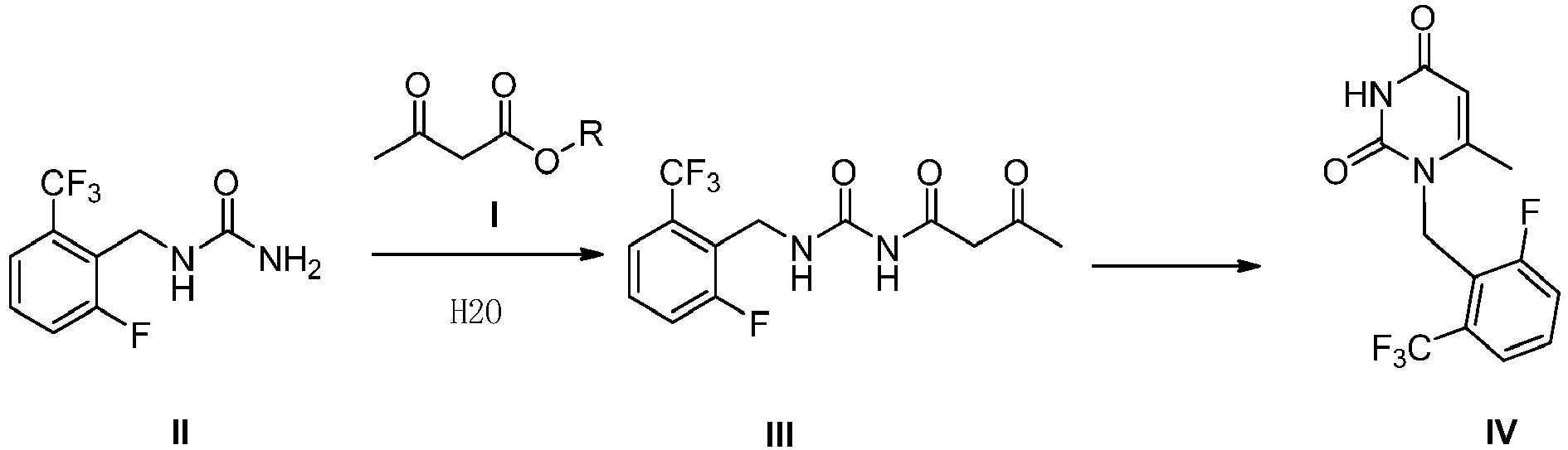
- The linear or branched C1-C4 substituent is alkyl or alkenyl. The alkyl is preferably methyl, ethyl, isopropyl or tert-butyl. The alkenyl group is preferably allyl.
- The organic solvent is an aprotic organic solvent. Preferably, the aprotic organic solvent is one or more selected from a group consisting of toluene, chlorobenzene, xylene, N,N-dimethylformamide (DMF) and dimethyl sulfoxide (DMSO). More preferably, the organic solvent is toluene.
- Specifically, the method for preparing the compound of Formula IV comprises steps of:
- (1) mixing a compound of Formula I, a compound of Formula II, organic solvent and water, performing reflux reaction, stratifying the reaction system after the reaction, and keeping an organic layer;
- (2) adding acid into the organic layer to continue the reaction, and performing separation and purification after the reaction to obtain the compound of Formula IV.
- Preferably, the volume ratio of the organic solvent to water is 1: 0.001-2; and more preferably 1: 0.1-1.0.
- Preferably, the mass ratio of the compound of Formula I to the compound of Formula II is 1: 0.66-4, more preferably 1: 1.5-2.0.
- Preferably, the ratio of the mass of the compound of Formula II to the volume of the mixed solvent is 1: 8 to 1: 20 (g/ml).
- Preferably, the reaction temperature of the ammonolysis reaction is 80 °C to 150 °C, preferably 100 °C to 120 °C.
- Preferably, the reaction temperature of the cyclization reaction catalyzed by acid is 40 °C to 150°C, preferably 60 °C to 120 °C, and the time for reaction is 0.5h to 6h, preferably 1h to 3h.
- Preferably, the acid is selected from a group consisting of p-toluenesulfonic acid, methanesulfonic acid, and sodium dihydrogen phosphate; more preferably the acid is p-toluenesulfonic acid.
- Preferably, the mass ratio of the compound of Formula II to the acid is 1: 0.5 ~ 1.5.
- Studies have found that during the process for synthesizing the compound of Formula III according to the method in
WO 2009062087 A1 , when toluene is used as a reaction solvent then acidification reaction is carried out, a large amount of impurities of Formula IV-imp are generated, and the polarity of the impurities is relatively similar to that of the compound of Formula IV. Several times of crystallization are needed to remove the impurities, but these impurities cannot be completely removed, which results in that the post-treatment is troublesome and available materials are wasted. - After repeated experiments, the inventors of the present invention found that the impurities of Formula III-imp produced in the reaction can be re-converted into the raw materials of Formula I and Formula II (instead of almost all of them being converted into Formula IV-imp) in the presence of water when the mixed solvent of organic solvent and water is used as the reaction solvent in the synthesis of the compound of Formula III, so that the raw materials can be further fully converted into Formulas III and IV. Thus the production of the impurities of Formula IV-imp is reduced, the utilization rate of the raw materials is improved, and the yield is obviously further improved. The reaction solvent, water and the organic solvent, is easy to be recovered, thus reducing the treatment cost of the wastes. The reaction condition is mild, and the method has the advantages of simple post-treatment, high yield, and suitability for industrialization and the like. The reaction mechanism is shown as follows:

-
- 1. Compared with the prior art, the present invention avoids further generation of the impurity compound of Formula IV-imp in case that the compound of Formula III-imp is generated, thereby reducing the presence of the impurity compound of Formula IV-imp in the compound of the Formula IV. The present invention not only improves the yield, but also solves the problems that the impurity is difficult to be removed and the post-treatment is troublesome. Further, in the present invention, the operation is simple and convenient, and the manufacturing cost is reduced.
- 2. In the present invention, the reaction solvent, water and the organic solvent, is easy to be recovered, the reaction conditions are mild, and the method has the advantages of simple post-treatment, suitability for industrialization and the like.
- Hereinafter, embodiments of the present invention will be described in detail with reference to examples. Embodiments of the present invention include, but are not limited to, the following examples, which should not be considered as limiting the protection scope of the present invention.
- The synthesis of the raw material, a compound of Formula II can refer to the prior art
CN100424078C , the entire content of which is incorporated herein by reference. - HPLC analysis conditions for measuring the content of the compound of Formula IV and the compound of Formula IV-imp are shown as follows.
Column: Waters Xbridge-Phenyl 4.6*150 mm 3.5µm
Eluent A: 1.0 ml of perfluorobutyric acid in 1L of water (%V/V)
Eluent B: MEOH:ACN=1:1(%V/V)
Gradient:Time (min) Eluent A Eluent B 0.00 60 40 17 30 70 20 30 70 20.1 60 40 30 60 40
Flow rate: 1.0mL/min
Running time: 30min
Sample volume: 10 µL
Detector: 265nm
Column temperature: 30°C -

- Compound of Formula II 1-[2-fluoro-6-(trifluoromethyl)]benzyl urea (100g), tert-butyl acetoacetate (194.2g), toluene (1000ml) and purified water (100ml) were added to a 2L flask and stirred for reflux reaction for 6h. The reaction system was stratified and the upper organic layer was retained. P-toluenesulfonic acid monohydrate (104g) was added to the obtained organic layer, and thus obtained mixture was stirred and reacted at 60°C for 2h. Then, the mixture was cooled to room temperature and was stirred. Purified water (300ml) was added thereto under stirring. The mixture was stratified, the upper organic layer was retained and concentrated, and crystallized in isopropanol to obtain 104.9g of the compound of Formula IV with a yield of 82%. The results were shown in Table 1. 1H NMR (400 MHz, CDCl3) δ 2.15(s, 3H), 5.37 (s, 2H), 5.60 (s, 2H), 7.23~7.56 (m, 3H), 9.02(s, 1H). MS(ESI) m/z 303.0([M+H]+).
- Compound of Formula II 1-[2-fluoro-6-(trifluoromethyl)]benzyl urea (30g), tert-butyl acetoacetate (58.3g), toluene (300ml) and purified water (50ml) were added to a 1L flask and stirred for reflux reaction for 6h. The reaction system was stratified and the upper organic layer was retained. P-toluenesulfonic acid monohydrate (31.2g) was added to the obtained organic layer, and thus obtained mixture was stirred and reacted at 60 °C for 2h. Then, the mixture was cooled to room temperature and was stirred. Purified water (90ml) was added thereto under stirring. The mixture was stratified, the upper organic layer was retained and concentrated, and thus obtained product was crystallized in isopropanol to obtain 31.1g of the compound of Formula IV with a yield of 81%. MS(ESI) m/z 303.0([M+H]+). The results were shown in table 1.
- Compound of Formula II 1-[2-fluoro-6-(trifluoromethyl)]benzyl urea (50g), tert-butyl acetoacetate (94.1g), toluene (500ml) and purified water (500ml) were added to a 1L flask and stirred for reflux reaction for 6h. The reaction system was stratified and the upper organic layer was retained. P-toluenesulfonic acid monohydrate (52g) was added to the obtained organic layer, and thus obtained mixture was stirred and reacted at 60 °C for 2h. Then, the mixture was cooled to room temperature and was stirred. Purified water (150ml) was added thereto under stirring. The mixture was stratified, the upper organic layer was retained and concentrated, and thus obtained product was crystallized in isopropanol to obtain 60.9g of the compound of Formula IV with a yield of 81%. MS(ESI) m/z 303.0([M+H]+). The results were shown in table 1.
- Compound of Formula II 1-[2-fluoro-6-(trifluoromethyl)]benzyl urea (50g), tert-butyl acetoacetate (94.1g), chlorobenzene (500ml) and purified water (100ml) were added to a 1L flask and stirred for reflux reaction for 6h. The reaction system was stratified and the upper organic layer was retained. P-toluenesulfonic acid monohydrate (52g) was added to the obtained organic layer, and thus obtained mixture was stirred and reacted at 60°C for 2h. Then, the mixture was cooled to room temperature and was stirred. Purified water (150ml) was added thereto under stirring. The mixture was stratified, the upper organic layer was retained and concentrated, and thus obtained product was crystallized in isopropanol to obtain 49.9g of the compound of Formula IV with a yield of 78%. MS(ESI) m/z 303.0([M+H]+). The results were shown in table 1.
- Compound of Formula II 1-[2-fluoro-6-(trifluoromethyl)]benzyl urea (25g), tert-butyl acetoacetate (47g), xylene (250ml) and purified water (200ml) were added to a 1L flask and stirred for reflux reaction for 6h. The reaction system was stratified and the upper organic layer was retained. P-toluenesulfonic acid monohydrate (27g) was added to the obtained organic layer, and thus obtained mixture was stirred and reacted at 60 °C for 2h. Then, the mixture was cooled to room temperature and was stirred. Purified water (75ml) was added thereto under stirring. The mixture was stratified, the organic layer was retained and concentrated, and thus obtained product was crystallized in isopropanol to obtain 24.6g of the compound of Formula IV with a yield of 77%. MS(ESI) m/z 303.0([M+H]+). The results were shown in table 1.
- Compound of Formula II 1-[2-fluoro-6-(trifluoromethyl)]benzyl urea (30g), tert-butyl acetoacetate (58.3g), N,N-dimethylformamiade (300ml) and purified water (300ml) were added to a 1L flask and stirred at 120 °C to react for 4h. The reaction system was cooled and concentrated. Toluene (300ml), p-toluenesulfonic acid monohydrate (31g) were added to the obtained concentrate. The mixture was stirred and reacted at 60 °C for 2h. Then, the mixture was cooled to room temperature and was stirred. Purified water (75ml) was added thereto under stirring. The mixture was stratified, the upper organic layer was retained and concentrated, and thus obtained product was crystallized in isopropanol to obtain 29.1g of the compound of Formula IV with a yield of 76%. MS(ESI) m/z 303.0([M+H]+). The results were shown in table 1.
- Compound of Formula II 1-[2-fluoro-6-(trifluoromethyl)]benzyl urea (30g), tert-butyl acetoacetate (58.3g), dimethyl sulfoxide (300ml) and purified water (150ml) were added to a 1L flask and stirred at 120 °C to react for 4h. The reaction system was cooled, and p-toluenesulfonic acid monohydrate (31g) was added thereto and stirred. The mixture was reacted at 60 °C for 2h. Then, the mixture was cooled to room temperature and was stirred. Purified water (150ml) was added thereto, and the obtained mixture was extracted with ethyl acetate. The organic layer was washed with saline, dried over anhydrous sodium sulfate and filtered. The filtrate was concentrated, and thus obtained product was crystallized in isopropanol to obtain 29.6g of the compound of Formula IV with a yield of 77%. MS(ESI) m/z 303.0([M+H]+). The results were shown in table 1.
- Compound of Formula II 1-[2-fluoro-6-(trifluoromethyl)]benzyl urea (25g), tert-butyl acetoacetate (47g), toluene (250ml) and purified water (150ml) were added to a 1L flask and stirred for reflux reaction for 6h. The reaction system was stratified and the upper organic layer was retained. P-toluenesulfonic acid monohydrate (27g) was added to the obtained organic layer, and thus obtained mixture was stirred and reacted at 60 °C for 2h. Then, the mixture was cooled to room temperature and was stirred. Purified water (75ml) was added thereto under stirring. The mixture was stratified, the upper organic layer was retained and concentrated, and thus obtained product was recrystallized in isopropanol to obtain 31.1g of the compound of Formula IV with a yield of 81%. MS(ESI) m/z 303.0([M+H]+). The results were shown in table 1.
-

- Compound of Formula II 1-[2-fluoro-6-(trifluoromethyl)]benzyl urea (50g), ethyl acetoacetate (63.9g), toluene (500ml) and purified water (200ml) were added to a 1L flask and stirred for reflux reaction for 6h. The reaction system was stratified and the upper organic layer was retained. P-toluenesulfonic acid monohydrate (52g) was added to the obtained organic layer, and thus obtained mixture was stirred and reacted at 60 °C for 2h. Then, the mixture was cooled to room temperature and was stirred. Purified water (150ml) was added thereto under stirring. The mixture was stratified, the upper organic layer was retained and concentrated, and thus obtained product was crystallized in isopropanol to obtain 48.5g of the compound of Formula IV with a yield of 77%. MS(ESI) m/z 303.0([M+H]+). The results were shown in table 1.
-

- Compound of Formula II 1-[2-fluoro-6-(trifluoromethyl)]benzyl urea (50g), methyl acetoacetate (71.3g), toluene (500ml) and purified water (150ml) were added to a 1L flask and stirred for reflux reaction for 6h. The reaction system was stratified and the upper organic layer was retained. P-toluenesulfonic acid monohydrate (52g) was added to the obtained organic layer, and thus obtained mixture was stirred and reacted at 60 °C for 2h. Then, the mixture was cooled to room temperature and was stirred. Purified water (150ml) was added thereto under stirring. The mixture was stratified, the upper organic layer was retained and concentrated, and thus obtained product was crystallized in isopropanol to obtain 49.0g of the compound of Formula IV with a yield of 78%. MS(ESI) m/z 303.0([M+H]+). The results were shown in table 1.
-

- Compound of Formula II 1-[2-fluoro-6-(trifluoromethyl)]benzyl urea (50g), isopropyl acetoacetate (88.5g), toluene (500ml) and purified water (4.5g) were added to a 1L flask and stirred for reflux reaction for 6h. The reaction system was stratified and the upper organic layer was retained. P-toluenesulfonic acid monohydrate (52g) was added to the obtained organic layer, and thus obtained mixture was stirred and reacted at 60 °C for 2h. Then, the mixture was cooled to room temperature and was stirred. Purified water (150ml) was added thereto under stirring. The mixture was stratified, the upper organic layer was retained and concentrated, and thus obtained product was crystallized in isopropanol to obtain 49.2g of the compound of Formula IV with a yield of 77%. MS(ESI) m/z 303.0([M+H]+). The results were shown in table 1.
-

- Compound of Formula II 1-[2-fluoro-6-(trifluoromethyl)]benzyl urea (30g), allyl acetoacetate (52.4g), toluene (300ml) and purified water (150ml) were added to a 1L flask and stirred at 120 °C to react for 4h. The reaction system was cooled, and p-toluenesulfonic acid monohydrate (31g) was added thereto and stirred. The mixture was reacted at 60 °C for 2h. Then, the mixture was cooled to room temperature and was stirred. Purified water (150ml) was added thereto, and the obtained mixture was extracted with ethyl acetate. The organic layer was washed with saline, dried over anhydrous sodium sulfate and filtered. The filtrate was concentrated, and thus obtained product was crystallized in isopropanol to obtain 29.1g of the compound of Formula IV with a yield of 76%. MS(ESI) m/z 303.0([M+H]+). The results were shown in table 1.
-

- Compound of Formula II 1-[2-fluoro-6-(trifluoromethyl)]benzyl urea (50g), benzyl acetoacetate (118g), toluene (500ml) and purified water (4.5g) were added to a 1L flask and stirred for reflux reaction for 6h. The reaction system was stratified and the upper organic layer was retained. P-toluenesulfonic acid monohydrate (52g) was added to the obtained organic layer, and thus obtained mixture was stirred and reacted at 60 °C for 2h. Then, the mixture was cooled to room temperature and was stirred. Purified water (150ml) was added thereto under stirring. The mixture was stratified, the upper organic layer was retained and concentrated, and thus obtained product was crystallized in isopropanol to obtain 48.5g of the product with a yield of 76%. MS(ESI) m/z 303.0([M+H]+). The results were shown in table 1.
- 1H NMR data of the compound of Formula IV prepared in the Examples 2 to 13 were the same as those of Example 1.
- Compound of Formula II 1-[2-fluoro-6-(trifluoromethyl)]benzyl urea (2.568g) and toluene (125ml) were added to a 1L flask and stirred for reflux, and then tert-butyl acetoacetate (5.0g) was added thereto for reflux reaction for 4h. P-toluenesulfonic acid monohydrate (2.82g) was added to the reflux system to continue the reaction for 1h. The obtained mixture was distilled to completely remove toluene, and then 30ml of isopropanol was added thereto and stirred overnight. Thus obtained mixture was filtered, and the filter cake was washed with isopropanol to obtain the compound of Formula IV 1.81g with a yield of 57%. MS(ESI) m/z 303.0([M+H]+). The results were shown in table 1.
Table 1: Comparison of results obtained from different batches of examples Batch Content of the compound of Formula IV (%) Content of the compound of Formula IV-imp (%) Yield (%) Example 1 99.77% 0.02% 82% Example 2 99.57% 0.01% 81% Example 3 99.68% 0.03% 81% Example 4 99.64% 0.21% 78% Example 5 99.58% 0.19% 77% Example 6 99.61% 0.08% 76% Example 7 99.57% 0.17% 77% Example 8 99.74% 0.03% 81% Example 9 99.54% 0.24% 77% Example 10 99.63% 0.27% 78% Example 11 99.57% 0.17% 77% Example 12 99.64% 0.28% 76% Example 13 99.58% 0.33% 76% Comparative Example 1 93.46% 6.10% 57% - The method for preparing the intermediate of elagolix according to the present invention is described in connection with examples, and those skilled in the art can obviously realize the present invention by modifying or appropriately changing and combining with the method for preparing the intermediate of elagolix described herein without departing from the content, spirit and scope of the invention. In particular, it should be understood that all similar substitutions and changes will be obvious to those skilled in the art, and they are all considered to be included in the spirit, scope and content of the present invention.
Claims (11)
- A method for preparing a compound of Formula IV, an intermediate of elagolix, comprising steps of: carrying out ammonolysis reaction of a compound of Formula I and a compound of Formula II in mixed solvent of organic solvent and water, and then carrying out cyclization reaction catalyzed by acid to obtain the compound of Formula IV;
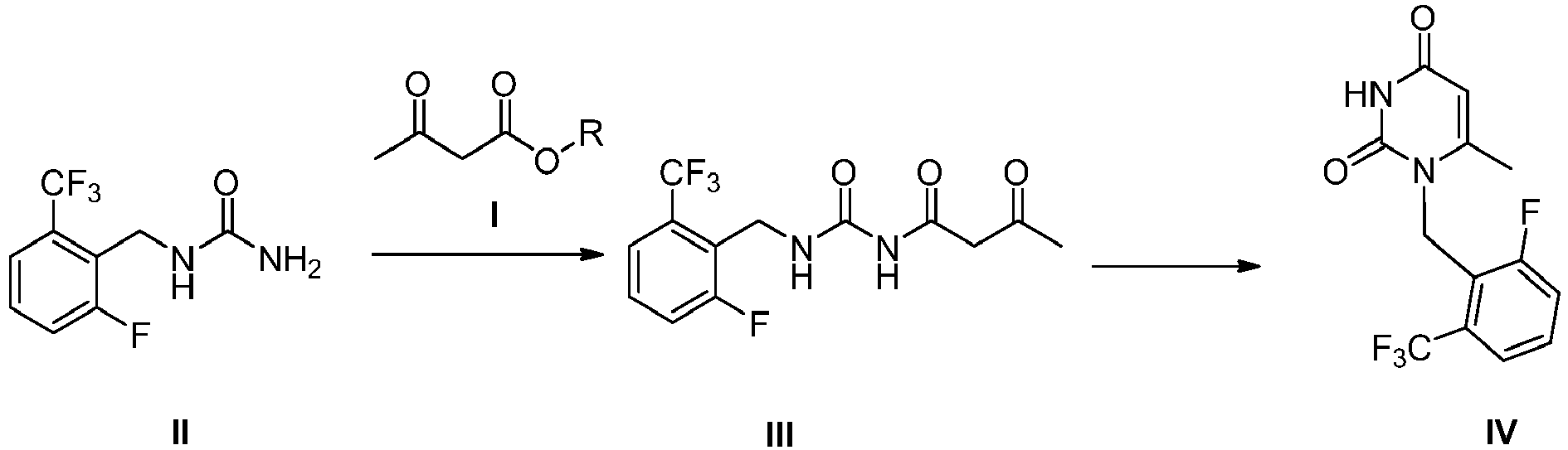
- The method according to claim 1, wherein the linear or branched C1-C4 substituents is alkyl or alkenyl; the alkyl is preferably methyl, ethyl, isopropyl or tert-butyl; and the alkenyl is preferably allyl.
- The method according to claim 1 or 2, wherein the organic solvent is an aprotic organic solvent; preferably, the organic solvent is one or more selected from a group consisting of toluene, chlorobenzene, xylene, N,N-dimethylformamide (DMF) and dimethyl
- The method according to any one of claims 1 to 3, wherein the organic solvent is toluene.
- The method according to any one of claims 1 to 4, wherein the volume ratio of the organic solvent to water is 1: 0.001-2; and more preferably 1: 0.1-1.0.
- The method according to any one of claims 1 to 5, wherein the mass ratio of the compound of Formula I to the compound of Formula II is 1: 0.66-4, more preferably 1: 1.5-2.0.
- The method according to any one of claims 1 to 6, wherein the ratio of the mass of the compound of Formula II to the volume of the mixed solvent is 1: 8 to 1: 20 with a unit of g/ml.
- The method according to any one of claims 1 to 7, wherein the reaction temperature of the ammonolysis reaction is 80 °C to 150 °C, preferably 100 °C to 120 °C.
- The method according to any one of claims 1 to 8, wherein the reaction temperature of the cyclization reaction catalyzed by the acid to prepare the compound of Formula IV is 40 °C to 150°C, preferably 60 °C to 120 °C.
- The method according to any one of claims 1 to 9, wherein the acid is selected from a group consisting of p-toluenesulfonic acid, methanesulfonic acid, and sodium dihydrogen phosphate; preferably the acid is p-toluenesulfonic acid.
- The method according to any one of claims 1 to 10, wherein the mass ratio of the compound of Formula II to the acid is 1: 0.5-1.5.
Applications Claiming Priority (2)
| Application Number | Priority Date | Filing Date | Title |
|---|---|---|---|
| CN201711445252.5A CN109970663B (en) | 2017-12-27 | 2017-12-27 | Method for preparing oxa-goril intermediate |
| PCT/CN2018/123468 WO2019128983A1 (en) | 2017-12-27 | 2018-12-25 | Method for preparing elagolix intermediate and composition thereof |
Publications (4)
| Publication Number | Publication Date |
|---|---|
| EP3733650A1 EP3733650A1 (en) | 2020-11-04 |
| EP3733650A4 EP3733650A4 (en) | 2021-09-29 |
| EP3733650B1 true EP3733650B1 (en) | 2024-08-28 |
| EP3733650C0 EP3733650C0 (en) | 2024-08-28 |
Family
ID=67063139
Family Applications (1)
| Application Number | Title | Priority Date | Filing Date |
|---|---|---|---|
| EP18895688.2A Active EP3733650B1 (en) | 2017-12-27 | 2018-12-25 | Method for preparing elagolix intermediate and composition thereof |
Country Status (4)
| Country | Link |
|---|---|
| US (1) | US11365178B2 (en) |
| EP (1) | EP3733650B1 (en) |
| CN (2) | CN109970663B (en) |
| WO (1) | WO2019128983A1 (en) |
Families Citing this family (10)
| Publication number | Priority date | Publication date | Assignee | Title |
|---|---|---|---|---|
| CN109970663B (en) * | 2017-12-27 | 2023-04-11 | 上海科胜药物研发有限公司 | Method for preparing oxa-goril intermediate |
| CN110501446B (en) * | 2019-08-28 | 2021-12-17 | 江苏海岸药业有限公司 | Analysis method of oxa-goril sodium raw material and synthetic intermediate thereof |
| CN110938038A (en) * | 2019-11-14 | 2020-03-31 | 上海星酶生物科技有限公司 | Preparation process of C13H10F4N2O2 |
| CN111333586A (en) * | 2020-02-19 | 2020-06-26 | 诚达药业股份有限公司 | Preparation method of compound containing 6-methyl uracil structure |
| CN111333548B (en) * | 2020-04-10 | 2022-04-26 | 江苏海悦康医药科技有限公司 | Preparation method of 1-(2-fluoro-6-(trifluoromethyl)benzyl)urea |
| CN113880773A (en) * | 2020-07-02 | 2022-01-04 | 南京药石科技股份有限公司 | Preparation method of oxalagogri intermediate |
| CN111995584B (en) * | 2020-09-01 | 2022-03-29 | 常州工学院 | The preparation method of elaglix intermediate |
| CN112159358B (en) * | 2020-10-26 | 2023-08-18 | 上海朴颐化学科技有限公司 | A kind of preparation method of elagolime intermediate |
| CN115677598B (en) * | 2022-11-11 | 2024-11-01 | 南通常佑药业科技有限公司 | Preparation method for synthesizing pyrimidinedione compound |
| CN116425684A (en) * | 2023-04-18 | 2023-07-14 | 安徽联创生物医药股份有限公司 | A kind of synthetic method of elagolix sodium intermediate |
Family Cites Families (3)
| Publication number | Priority date | Publication date | Assignee | Title |
|---|---|---|---|---|
| CA2531508C (en) | 2003-07-07 | 2013-10-08 | Neurocrine Biosciences, Inc. | Pyrimidine-2, 4-dione derivatives as gonadotropin-releasing hormone receptor antagonists |
| US8765948B2 (en) * | 2007-11-07 | 2014-07-01 | Neurocrine Biosciences, Inc. | Processes for the preparation of uracil derivatives |
| CN109970663B (en) | 2017-12-27 | 2023-04-11 | 上海科胜药物研发有限公司 | Method for preparing oxa-goril intermediate |
-
2017
- 2017-12-27 CN CN201711445252.5A patent/CN109970663B/en active Active
-
2018
- 2018-12-25 CN CN201880081586.5A patent/CN111511722B/en active Active
- 2018-12-25 EP EP18895688.2A patent/EP3733650B1/en active Active
- 2018-12-25 US US16/957,685 patent/US11365178B2/en active Active
- 2018-12-25 WO PCT/CN2018/123468 patent/WO2019128983A1/en not_active Ceased
Also Published As
| Publication number | Publication date |
|---|---|
| EP3733650A1 (en) | 2020-11-04 |
| US11365178B2 (en) | 2022-06-21 |
| CN109970663B (en) | 2023-04-11 |
| CN109970663A (en) | 2019-07-05 |
| WO2019128983A1 (en) | 2019-07-04 |
| CN111511722B (en) | 2022-01-18 |
| EP3733650A4 (en) | 2021-09-29 |
| CN111511722A (en) | 2020-08-07 |
| US20200369625A1 (en) | 2020-11-26 |
| EP3733650C0 (en) | 2024-08-28 |
Similar Documents
| Publication | Publication Date | Title |
|---|---|---|
| EP3733650A1 (en) | Method for preparing elagolix intermediate and composition thereof | |
| US11542245B2 (en) | Preparative process | |
| US10689349B2 (en) | Method for producing intermediate of biotin and method for producing biotin | |
| CN112047888B (en) | Method for synthesizing enzalutamide | |
| EP4464692A1 (en) | Method for preparing pyrrole compound and intermediate thereof | |
| SU1021342A3 (en) | Process for preparing derivatives of piperidine propyl or their pharmacologically acceptable salts | |
| US6825214B2 (en) | Substantially pure cilostazol and processes for making same | |
| EP0138492A2 (en) | Process for preparing substituted 4-alkyl-2(1H) quinazolinone-1-alkanoic acid derivatives | |
| KR101806782B1 (en) | Method for the preparation of high purity Bazedoxifene Acetate | |
| EP1873151B1 (en) | Improved process for producing moxonidine | |
| JP3221874B2 (en) | Process for producing clausenamide and neoclausenamide and their derivatives | |
| US11932614B2 (en) | Method for preparing diazoxide | |
| CN114437169B (en) | Synthesis method of drospirenone key intermediate bromide | |
| CN113698409B (en) | Multipurpose diazabicyclo compound, preparation method and application in synthetic drugs | |
| CN112851730B (en) | Synthesis method of NMN intermediate NR chloride | |
| JP6963435B2 (en) | Method for producing intermediate of biotin and method for producing biotin | |
| CN114539337A (en) | Preparation method of Sofosbuvir impurity | |
| KR20220018486A (en) | 4-phenyl-5-alkoxycarbonyl-2-thiazol-2-yl-1,4-dihydropyrimidin-6-yl]methyl]-3-oxo-5,6,8,8a-tetrahydro- Alternative method for preparing 1H-imidazo[1,5-a]pyrazin-2-yl]-carboxylic acid | |
| CN117510471B (en) | A kind of synthetic method of abemaciclib | |
| CN113045574B (en) | Process for preparing diazapine derivatives and intermediates therefor | |
| US20250320199A1 (en) | Method for preparing glucopyranosyl-containing compound | |
| JP2018108978A (en) | Method for producing biotin intermediate and method for producing biotin | |
| CN106588833B (en) | A kind of synthetic method of Lafutidine oxidation impurities | |
| WO2023100110A1 (en) | Process for preparing brivaracetam | |
| CN121342806A (en) | A method for preparing tandospirone citrate |
Legal Events
| Date | Code | Title | Description |
|---|---|---|---|
| STAA | Information on the status of an ep patent application or granted ep patent |
Free format text: STATUS: THE INTERNATIONAL PUBLICATION HAS BEEN MADE |
|
| PUAI | Public reference made under article 153(3) epc to a published international application that has entered the european phase |
Free format text: ORIGINAL CODE: 0009012 |
|
| STAA | Information on the status of an ep patent application or granted ep patent |
Free format text: STATUS: REQUEST FOR EXAMINATION WAS MADE |
|
| 17P | Request for examination filed |
Effective date: 20200723 |
|
| AK | Designated contracting states |
Kind code of ref document: A1 Designated state(s): AL AT BE BG CH CY CZ DE DK EE ES FI FR GB GR HR HU IE IS IT LI LT LU LV MC MK MT NL NO PL PT RO RS SE SI SK SM TR |
|
| AX | Request for extension of the european patent |
Extension state: BA ME |
|
| DAV | Request for validation of the european patent (deleted) | ||
| DAX | Request for extension of the european patent (deleted) | ||
| A4 | Supplementary search report drawn up and despatched |
Effective date: 20210830 |
|
| RIC1 | Information provided on ipc code assigned before grant |
Ipc: C07D 239/54 20060101AFI20210824BHEP |
|
| GRAP | Despatch of communication of intention to grant a patent |
Free format text: ORIGINAL CODE: EPIDOSNIGR1 |
|
| STAA | Information on the status of an ep patent application or granted ep patent |
Free format text: STATUS: GRANT OF PATENT IS INTENDED |
|
| INTG | Intention to grant announced |
Effective date: 20240320 |
|
| GRAS | Grant fee paid |
Free format text: ORIGINAL CODE: EPIDOSNIGR3 |
|
| GRAA | (expected) grant |
Free format text: ORIGINAL CODE: 0009210 |
|
| STAA | Information on the status of an ep patent application or granted ep patent |
Free format text: STATUS: THE PATENT HAS BEEN GRANTED |
|
| AK | Designated contracting states |
Kind code of ref document: B1 Designated state(s): AL AT BE BG CH CY CZ DE DK EE ES FI FR GB GR HR HU IE IS IT LI LT LU LV MC MK MT NL NO PL PT RO RS SE SI SK SM TR |
|
| REG | Reference to a national code |
Ref country code: GB Ref legal event code: FG4D |
|
| REG | Reference to a national code |
Ref country code: CH Ref legal event code: EP |
|
| REG | Reference to a national code |
Ref country code: DE Ref legal event code: R096 Ref document number: 602018073801 Country of ref document: DE |
|
| REG | Reference to a national code |
Ref country code: IE Ref legal event code: FG4D |
|
| U01 | Request for unitary effect filed |
Effective date: 20240927 |
|
| U07 | Unitary effect registered |
Designated state(s): AT BE BG DE DK EE FI FR IT LT LU LV MT NL PT RO SE SI Effective date: 20241024 |
|
| U20 | Renewal fee for the european patent with unitary effect paid |
Year of fee payment: 7 Effective date: 20241127 |
|
| PG25 | Lapsed in a contracting state [announced via postgrant information from national office to epo] |
Ref country code: NO Free format text: LAPSE BECAUSE OF FAILURE TO SUBMIT A TRANSLATION OF THE DESCRIPTION OR TO PAY THE FEE WITHIN THE PRESCRIBED TIME-LIMIT Effective date: 20241128 |
|
| PG25 | Lapsed in a contracting state [announced via postgrant information from national office to epo] |
Ref country code: PL Free format text: LAPSE BECAUSE OF FAILURE TO SUBMIT A TRANSLATION OF THE DESCRIPTION OR TO PAY THE FEE WITHIN THE PRESCRIBED TIME-LIMIT Effective date: 20240828 Ref country code: GR Free format text: LAPSE BECAUSE OF FAILURE TO SUBMIT A TRANSLATION OF THE DESCRIPTION OR TO PAY THE FEE WITHIN THE PRESCRIBED TIME-LIMIT Effective date: 20241129 |
|
| PG25 | Lapsed in a contracting state [announced via postgrant information from national office to epo] |
Ref country code: IS Free format text: LAPSE BECAUSE OF FAILURE TO SUBMIT A TRANSLATION OF THE DESCRIPTION OR TO PAY THE FEE WITHIN THE PRESCRIBED TIME-LIMIT Effective date: 20241228 |
|
| PG25 | Lapsed in a contracting state [announced via postgrant information from national office to epo] |
Ref country code: HR Free format text: LAPSE BECAUSE OF FAILURE TO SUBMIT A TRANSLATION OF THE DESCRIPTION OR TO PAY THE FEE WITHIN THE PRESCRIBED TIME-LIMIT Effective date: 20240828 |
|
| PG25 | Lapsed in a contracting state [announced via postgrant information from national office to epo] |
Ref country code: RS Free format text: LAPSE BECAUSE OF FAILURE TO SUBMIT A TRANSLATION OF THE DESCRIPTION OR TO PAY THE FEE WITHIN THE PRESCRIBED TIME-LIMIT Effective date: 20241128 Ref country code: ES Free format text: LAPSE BECAUSE OF FAILURE TO SUBMIT A TRANSLATION OF THE DESCRIPTION OR TO PAY THE FEE WITHIN THE PRESCRIBED TIME-LIMIT Effective date: 20240828 |
|
| PG25 | Lapsed in a contracting state [announced via postgrant information from national office to epo] |
Ref country code: RS Free format text: LAPSE BECAUSE OF FAILURE TO SUBMIT A TRANSLATION OF THE DESCRIPTION OR TO PAY THE FEE WITHIN THE PRESCRIBED TIME-LIMIT Effective date: 20241128 Ref country code: PL Free format text: LAPSE BECAUSE OF FAILURE TO SUBMIT A TRANSLATION OF THE DESCRIPTION OR TO PAY THE FEE WITHIN THE PRESCRIBED TIME-LIMIT Effective date: 20240828 Ref country code: NO Free format text: LAPSE BECAUSE OF FAILURE TO SUBMIT A TRANSLATION OF THE DESCRIPTION OR TO PAY THE FEE WITHIN THE PRESCRIBED TIME-LIMIT Effective date: 20241128 Ref country code: IS Free format text: LAPSE BECAUSE OF FAILURE TO SUBMIT A TRANSLATION OF THE DESCRIPTION OR TO PAY THE FEE WITHIN THE PRESCRIBED TIME-LIMIT Effective date: 20241228 Ref country code: HR Free format text: LAPSE BECAUSE OF FAILURE TO SUBMIT A TRANSLATION OF THE DESCRIPTION OR TO PAY THE FEE WITHIN THE PRESCRIBED TIME-LIMIT Effective date: 20240828 Ref country code: GR Free format text: LAPSE BECAUSE OF FAILURE TO SUBMIT A TRANSLATION OF THE DESCRIPTION OR TO PAY THE FEE WITHIN THE PRESCRIBED TIME-LIMIT Effective date: 20241129 Ref country code: ES Free format text: LAPSE BECAUSE OF FAILURE TO SUBMIT A TRANSLATION OF THE DESCRIPTION OR TO PAY THE FEE WITHIN THE PRESCRIBED TIME-LIMIT Effective date: 20240828 |
|
| PG25 | Lapsed in a contracting state [announced via postgrant information from national office to epo] |
Ref country code: SM Free format text: LAPSE BECAUSE OF FAILURE TO SUBMIT A TRANSLATION OF THE DESCRIPTION OR TO PAY THE FEE WITHIN THE PRESCRIBED TIME-LIMIT Effective date: 20240828 |
|
| PG25 | Lapsed in a contracting state [announced via postgrant information from national office to epo] |
Ref country code: CZ Free format text: LAPSE BECAUSE OF FAILURE TO SUBMIT A TRANSLATION OF THE DESCRIPTION OR TO PAY THE FEE WITHIN THE PRESCRIBED TIME-LIMIT Effective date: 20240828 |
|
| PG25 | Lapsed in a contracting state [announced via postgrant information from national office to epo] |
Ref country code: SK Free format text: LAPSE BECAUSE OF FAILURE TO SUBMIT A TRANSLATION OF THE DESCRIPTION OR TO PAY THE FEE WITHIN THE PRESCRIBED TIME-LIMIT Effective date: 20240828 |
|
| PLBE | No opposition filed within time limit |
Free format text: ORIGINAL CODE: 0009261 |
|
| STAA | Information on the status of an ep patent application or granted ep patent |
Free format text: STATUS: NO OPPOSITION FILED WITHIN TIME LIMIT |
|
| PG25 | Lapsed in a contracting state [announced via postgrant information from national office to epo] |
Ref country code: MC Free format text: LAPSE BECAUSE OF FAILURE TO SUBMIT A TRANSLATION OF THE DESCRIPTION OR TO PAY THE FEE WITHIN THE PRESCRIBED TIME-LIMIT Effective date: 20240828 |
|
| REG | Reference to a national code |
Ref country code: CH Ref legal event code: PL |
|
| 26N | No opposition filed |
Effective date: 20250530 |
|
| GBPC | Gb: european patent ceased through non-payment of renewal fee |
Effective date: 20241225 |
|
| PG25 | Lapsed in a contracting state [announced via postgrant information from national office to epo] |
Ref country code: GB Free format text: LAPSE BECAUSE OF NON-PAYMENT OF DUE FEES Effective date: 20241225 |
|
| PG25 | Lapsed in a contracting state [announced via postgrant information from national office to epo] |
Ref country code: CH Free format text: LAPSE BECAUSE OF NON-PAYMENT OF DUE FEES Effective date: 20241231 |
|
| PG25 | Lapsed in a contracting state [announced via postgrant information from national office to epo] |
Ref country code: IE Free format text: LAPSE BECAUSE OF NON-PAYMENT OF DUE FEES Effective date: 20241225 |
|
| U20 | Renewal fee for the european patent with unitary effect paid |
Year of fee payment: 8 Effective date: 20251110 |