EP3733373A1 - Plant and process for producing a plastic stretch film - Google Patents
Plant and process for producing a plastic stretch film Download PDFInfo
- Publication number
- EP3733373A1 EP3733373A1 EP19172289.1A EP19172289A EP3733373A1 EP 3733373 A1 EP3733373 A1 EP 3733373A1 EP 19172289 A EP19172289 A EP 19172289A EP 3733373 A1 EP3733373 A1 EP 3733373A1
- Authority
- EP
- European Patent Office
- Prior art keywords
- stretch film
- chill roll
- extrusion head
- temperature
- flat extrusion
- Prior art date
- Legal status (The legal status is an assumption and is not a legal conclusion. Google has not performed a legal analysis and makes no representation as to the accuracy of the status listed.)
- Granted
Links
Images

Classifications
-
- B—PERFORMING OPERATIONS; TRANSPORTING
- B29—WORKING OF PLASTICS; WORKING OF SUBSTANCES IN A PLASTIC STATE IN GENERAL
- B29C—SHAPING OR JOINING OF PLASTICS; SHAPING OF MATERIAL IN A PLASTIC STATE, NOT OTHERWISE PROVIDED FOR; AFTER-TREATMENT OF THE SHAPED PRODUCTS, e.g. REPAIRING
- B29C48/00—Extrusion moulding, i.e. expressing the moulding material through a die or nozzle which imparts the desired form; Apparatus therefor
- B29C48/25—Component parts, details or accessories; Auxiliary operations
- B29C48/92—Measuring, controlling or regulating
-
- B—PERFORMING OPERATIONS; TRANSPORTING
- B29—WORKING OF PLASTICS; WORKING OF SUBSTANCES IN A PLASTIC STATE IN GENERAL
- B29C—SHAPING OR JOINING OF PLASTICS; SHAPING OF MATERIAL IN A PLASTIC STATE, NOT OTHERWISE PROVIDED FOR; AFTER-TREATMENT OF THE SHAPED PRODUCTS, e.g. REPAIRING
- B29C48/00—Extrusion moulding, i.e. expressing the moulding material through a die or nozzle which imparts the desired form; Apparatus therefor
- B29C48/03—Extrusion moulding, i.e. expressing the moulding material through a die or nozzle which imparts the desired form; Apparatus therefor characterised by the shape of the extruded material at extrusion
- B29C48/07—Flat, e.g. panels
- B29C48/08—Flat, e.g. panels flexible, e.g. films
-
- B—PERFORMING OPERATIONS; TRANSPORTING
- B29—WORKING OF PLASTICS; WORKING OF SUBSTANCES IN A PLASTIC STATE IN GENERAL
- B29C—SHAPING OR JOINING OF PLASTICS; SHAPING OF MATERIAL IN A PLASTIC STATE, NOT OTHERWISE PROVIDED FOR; AFTER-TREATMENT OF THE SHAPED PRODUCTS, e.g. REPAIRING
- B29C48/00—Extrusion moulding, i.e. expressing the moulding material through a die or nozzle which imparts the desired form; Apparatus therefor
- B29C48/25—Component parts, details or accessories; Auxiliary operations
- B29C48/30—Extrusion nozzles or dies
- B29C48/305—Extrusion nozzles or dies having a wide opening, e.g. for forming sheets
-
- B—PERFORMING OPERATIONS; TRANSPORTING
- B29—WORKING OF PLASTICS; WORKING OF SUBSTANCES IN A PLASTIC STATE IN GENERAL
- B29C—SHAPING OR JOINING OF PLASTICS; SHAPING OF MATERIAL IN A PLASTIC STATE, NOT OTHERWISE PROVIDED FOR; AFTER-TREATMENT OF THE SHAPED PRODUCTS, e.g. REPAIRING
- B29C48/00—Extrusion moulding, i.e. expressing the moulding material through a die or nozzle which imparts the desired form; Apparatus therefor
- B29C48/25—Component parts, details or accessories; Auxiliary operations
- B29C48/36—Means for plasticising or homogenising the moulding material or forcing it through the nozzle or die
- B29C48/49—Means for plasticising or homogenising the moulding material or forcing it through the nozzle or die using two or more extruders to feed one die or nozzle
-
- B—PERFORMING OPERATIONS; TRANSPORTING
- B29—WORKING OF PLASTICS; WORKING OF SUBSTANCES IN A PLASTIC STATE IN GENERAL
- B29C—SHAPING OR JOINING OF PLASTICS; SHAPING OF MATERIAL IN A PLASTIC STATE, NOT OTHERWISE PROVIDED FOR; AFTER-TREATMENT OF THE SHAPED PRODUCTS, e.g. REPAIRING
- B29C48/00—Extrusion moulding, i.e. expressing the moulding material through a die or nozzle which imparts the desired form; Apparatus therefor
- B29C48/25—Component parts, details or accessories; Auxiliary operations
- B29C48/88—Thermal treatment of the stream of extruded material, e.g. cooling
- B29C48/911—Cooling
- B29C48/9135—Cooling of flat articles, e.g. using specially adapted supporting means
- B29C48/914—Cooling drums
-
- B—PERFORMING OPERATIONS; TRANSPORTING
- B29—WORKING OF PLASTICS; WORKING OF SUBSTANCES IN A PLASTIC STATE IN GENERAL
- B29C—SHAPING OR JOINING OF PLASTICS; SHAPING OF MATERIAL IN A PLASTIC STATE, NOT OTHERWISE PROVIDED FOR; AFTER-TREATMENT OF THE SHAPED PRODUCTS, e.g. REPAIRING
- B29C2948/00—Indexing scheme relating to extrusion moulding
- B29C2948/92—Measuring, controlling or regulating
- B29C2948/92009—Measured parameter
- B29C2948/92114—Dimensions
- B29C2948/92152—Thickness
-
- B—PERFORMING OPERATIONS; TRANSPORTING
- B29—WORKING OF PLASTICS; WORKING OF SUBSTANCES IN A PLASTIC STATE IN GENERAL
- B29C—SHAPING OR JOINING OF PLASTICS; SHAPING OF MATERIAL IN A PLASTIC STATE, NOT OTHERWISE PROVIDED FOR; AFTER-TREATMENT OF THE SHAPED PRODUCTS, e.g. REPAIRING
- B29C2948/00—Indexing scheme relating to extrusion moulding
- B29C2948/92—Measuring, controlling or regulating
- B29C2948/92009—Measured parameter
- B29C2948/92209—Temperature
-
- B—PERFORMING OPERATIONS; TRANSPORTING
- B29—WORKING OF PLASTICS; WORKING OF SUBSTANCES IN A PLASTIC STATE IN GENERAL
- B29C—SHAPING OR JOINING OF PLASTICS; SHAPING OF MATERIAL IN A PLASTIC STATE, NOT OTHERWISE PROVIDED FOR; AFTER-TREATMENT OF THE SHAPED PRODUCTS, e.g. REPAIRING
- B29C2948/00—Indexing scheme relating to extrusion moulding
- B29C2948/92—Measuring, controlling or regulating
- B29C2948/92504—Controlled parameter
- B29C2948/92514—Pressure
-
- B—PERFORMING OPERATIONS; TRANSPORTING
- B29—WORKING OF PLASTICS; WORKING OF SUBSTANCES IN A PLASTIC STATE IN GENERAL
- B29C—SHAPING OR JOINING OF PLASTICS; SHAPING OF MATERIAL IN A PLASTIC STATE, NOT OTHERWISE PROVIDED FOR; AFTER-TREATMENT OF THE SHAPED PRODUCTS, e.g. REPAIRING
- B29C2948/00—Indexing scheme relating to extrusion moulding
- B29C2948/92—Measuring, controlling or regulating
- B29C2948/92504—Controlled parameter
- B29C2948/9258—Velocity
- B29C2948/926—Flow or feed rate
-
- B—PERFORMING OPERATIONS; TRANSPORTING
- B29—WORKING OF PLASTICS; WORKING OF SUBSTANCES IN A PLASTIC STATE IN GENERAL
- B29C—SHAPING OR JOINING OF PLASTICS; SHAPING OF MATERIAL IN A PLASTIC STATE, NOT OTHERWISE PROVIDED FOR; AFTER-TREATMENT OF THE SHAPED PRODUCTS, e.g. REPAIRING
- B29C2948/00—Indexing scheme relating to extrusion moulding
- B29C2948/92—Measuring, controlling or regulating
- B29C2948/92819—Location or phase of control
- B29C2948/92923—Calibration, after-treatment or cooling zone
-
- B—PERFORMING OPERATIONS; TRANSPORTING
- B29—WORKING OF PLASTICS; WORKING OF SUBSTANCES IN A PLASTIC STATE IN GENERAL
- B29C—SHAPING OR JOINING OF PLASTICS; SHAPING OF MATERIAL IN A PLASTIC STATE, NOT OTHERWISE PROVIDED FOR; AFTER-TREATMENT OF THE SHAPED PRODUCTS, e.g. REPAIRING
- B29C55/00—Shaping by stretching, e.g. drawing through a die; Apparatus therefor
- B29C55/02—Shaping by stretching, e.g. drawing through a die; Apparatus therefor of plates or sheets
- B29C55/04—Shaping by stretching, e.g. drawing through a die; Apparatus therefor of plates or sheets uniaxial, e.g. oblique
- B29C55/06—Shaping by stretching, e.g. drawing through a die; Apparatus therefor of plates or sheets uniaxial, e.g. oblique parallel with the direction of feed
Definitions
- the present invention concerns a plant and process for producing a plastic stretch film.
- the plants for producing plastic stretch films are known in the art.
- these plants are equipped with one or more extruders which feed a flat extrusion head.
- the melted plastic material comes out of the flat extrusion head and is deposited on a chill roll so as to solidify the material and thus produce the stretch film which will then be wound on bobbins in the subsequent stations of the plant.
- a plant of this type comprises a device for detecting the thickness of the cooled stretch film.
- the thickness is the main parameter which must be continuously controlled throughout the entire production cycle so as to avoid, or at least limit, the waste of material that does not comply with the desired final product.
- a suitably programmed control unit intervenes to correct possible deviations from the desired thickness by adjusting, for example, the speed of the extruders, in particular the rotation speed of the screws of the extruders, and/or the rotation speed of the chill roll, and/or the adjustable opening of the flat extrusion head.
- Other parameters are monitored by suitable sensors, such as for example temperature sensors, which transmit signals to the control unit to intervene, for example, on the temperature of the heat exchange fluid that is circulated inside the chill roll.
- the Patent Application US-A1-2017355122 suggests a method and a plant for detecting the qualitative characteristics of a stretch film in terms of stretchability of the film produced.
- This document correlates the qualitative characteristics of stretchability with the transverse solidification profile, identified in this document as "frost line,” of the stretch film during its transit on the chill roll.
- the search of the transverse solidification profile is achieved by means of a mobile temperature sensor which is displaced angularly with respect to the flat extrusion head so as to detect the temperature at which the film deposited on the chill roll solidifies.
- the stretchability of the film is not the only qualitative characteristic of a stretch film. Further characteristics are often determined for different applications, for example, the containment force and/or the puncture resistance, which must thus be achieved for the final product according to the requirements of each producer who uses a plant for producing stretch films.
- an object of the present invention is to propose a plant and a process which are able to ensure the production of stretch films having the same qualitative characteristics for the same thermoplastic material used.
- a further object of the present invention is to propose a plant and a process for producing stretch films by using a set of production parameters which can be set in the production plant of the stretch films, also in repeated production cycles.
- a further object of the present invention is to propose a plant and a process of the aforesaid type which allow to automatically regulate the production of stretch films such as to ensure the desired qualitative characteristics of the stretch films produced.
- a plant for producing a plastic stretch film comprises:
- the plant comprises a mobile temperature sensor arranged in a fixed angular position with respect to the flat extrusion head and the control unit is programmed to regulate the depression generated by the vacuum box at least depending on the temperature detected by the mobile temperature sensor.
- the position of the solidification profile of the plastic material on the chill roll is regulated. This way, by detecting the temperature in any fixed angular position with respect to the flat extrusion head, the position at which the solidification of the stretch film occurs can be modified without having to find such position around the chill roll.
- the mobile temperature sensor is mounted on a support which moves in a linear direction parallel to the axis of the chill roll to detect the temperature of the stretch film detected by the mobile temperature sensor.
- the vacuum box comprises fans rotated by electric motors equipped, for example, with encoders or the like.
- the rotation speed of the electric motor of each fan is controlled by a respective inverter independently of the rotation speed of the other motors, which are each also controlled by a respective inverter and which rotate the other fans inside the vacuum box.
- the vacuum box can extend, for example, over the entire axial length of the chill roll and comprises at least two separate chambers axially extending over the entire length of the vacuum box.
- At least one fan is arranged inside each of the at least two separate chambers.
- the plant can further comprise at least one fixed temperature sensor which is arranged near the flat extrusion head, for example at the center of the casting or at another predetermined point, to detect the temperature of the melted plastic material coming out of the flat extrusion head.
- the invention further concerns a process for producing a plastic stretch film in a plant according to the invention.
- the plant thus comprises one or more extruders which feed a flat extrusion head, at least one chill roll to cool the melted plastic material coming out of the flat extrusion head, a vacuum box arranged near the flat extrusion head, a device to detect the thickness of the cooled stretch film, and a control unit equipped with a memory and programmed to regulate the production parameters of the plastic stretch film at least depending on the signals provided by the device for detecting the thickness of the cooled stretch film and by one or more sensors for detecting the physical characteristics of the stretch film deposited on the chill roll.
- the process comprises the steps of:
- the process according to the present invention further comprises the steps of:
- the mobile temperature sensor is mounted on a support which is moved in a linear direction parallel to the axis of the chill roll to detect the temperature of the stretch film along a direction transverse to the forward direction of the stretch film deposited on the chill roll.
- the temperature of the stretch film deposited on the chill roll can also be regulated, for example, by varying the temperature of the heat exchange fluid fed to the chill roll.
- stretch film samples Prior to starting up the production of relevant quantities of stretch films, or also during the production cycle, stretch film samples can be subjected to tests. If the stretch film samples meet the desired qualitative characteristics, the data relative to the set production parameters are saved, for example, in the memory of the control unit, or anyhow in a separate memory from which it is then possible to upload it to the memory of the control unit.
- the production parameters that are saved and/or uploaded to the memory of the control unit can include one or more among the type of plastic material fed to the extruders, the speed of extrusion of the melted plastic material from the flat extrusion head, the rotation speed of the chill roll, the thickness of the stretch film, the temperature of the heat exchange fluid fed to the chill roll, the temperature of the melted plastic material at the outlet of the flat extrusion head and the temperature of the stretch film detected by the mobile temperature sensor.
- the qualitative characteristics of the stretch film can include, for example, at least the containment force of the stretch film and the puncture resistance of the stretch film.
- a plant for producing a plastic stretch film is schematically depicted in Figure 1 .
- the plant comprises extruders 10 which feed a flat extrusion head 20 through which the melted plastic material is deposited on a chill roll 30.
- the chill roll 30 has cylindrical shape and is rotated around its axis A.
- the cooled stretch film P is thus led towards a device 40, of known type, for detecting the thickness of the film P before it is directed towards the successive stages of the plant, for example the cutting and trimming stages and the stages for winding the film P on bobbins.
- a vacuum box 50 able to produce a depression zone between the outlet of the flat extrusion head 20 and the surface of the chill roll 30 is also arranged near the flat extrusion head 20.
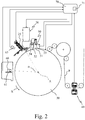
- the plant according to the present invention is equipped with a mobile temperature sensor 60 arranged in a fixed angular position ⁇ ( Fig. 2 ) with respect to the flat extrusion head 20.
- the mobile temperature sensor 60 is mounted on a support 61 which moves in a linear direction parallel to the axis A of the chill roll 30 to detect the temperature of the stretch film P along a transverse direction, denoted by the arrows S, with respect to the forward direction, denoted by the arrow R, of the stretch film P deposited on the chill roll 30.
- a fixed temperature sensor 65 is arranged near the flat extrusion head 20, for example at the centerline of the head 20, to detect the temperature of the melted plastic material.
- edge-fixing devices 25 of known type, which are used to solidify in advance the melted plastic material at the edges of the mass coming out of the flat extrusion head 20, are also depicted in the view of Figure 1 .
- the edge-fixing devices 25 can be movable in a controlled way along at least three axes to adjust their position with respect to the chill roll 30.
- the operation of the plant is controlled by a control unit 70 equipped with a memory 71 to which the data relative to the production parameters is uploaded.
- the control unit 70 is programmed to regulate the production parameters of the stretch film P at least depending on the signals provided by the device 40 for detecting the thickness of the stretch film P and by the various sensors for detecting the physical characteristics of the stretch film deposited on the chill roll 30, such as for example the temperature sensors 60 and 65.
- control unit 70 is programmed to regulate the depression generated by the vacuum box 50 at least depending on the temperature detected by the mobile temperature sensor 60.
- the vacuum box 50 comprises at least two separate chambers 51 and 52 axially extending over the entire length of the vacuum box 50.
- At least one fan 53 and 54 respectively, rotated by an electric motor, for example a motor equipped with an encoder or the like, whose rotation speed is controlled by a respective inverter, is arranged in each chamber 51 and 52.
- Each inverter is controlled by the control unit 70 independently of the others to independently regulate the rotation speed of the motors driving the fans 53 and 54.
- control unit 70 can concern, for example: the temperature of the heat exchange fluid fed to the chill roll 30 to regulate the temperature of the stretch film P deposited on the chill roll 20 depending on the temperatures detected by the sensors 60 and 65; the rotation speed of the chill roll 30, or the speed of the screws of the extruders 10, or also the opening of the extrusion head 20 to adjust the thickness of the film P depending on the thickness detected by the device 40; and also the position of the edge-fixing devices 25, as well as of other adjustable devices being in the plant.
- the process for the production of a plastic stretch film P provides to deposit the plastic material extruded at the melted state on the chill roll 30 and to detect some physical parameters of the production cycle, for example the thickness of the cooled stretch film P by means of the device 40 and the temperature of the stretch film P by means of the temperature sensors 60 and 65.
- the data relative to the production parameters of the stretch film P is uploaded to the memory 71 of the control unit 70.
- the control unit 70 can regulate the depression generated by the vacuum box 50 to vary the position of the solidification profile of the plastic material on the chill roll 30.
- the mobile temperature sensor 60 is mounted on the support 61 which is continuously moved in both directions along a linear direction parallel to the axis A of the chill roll. The temperature of the stretch film P is thus detected along a transverse direction S with respect to the forward direction R of the stretch film P deposited on the chill roll 30.
- the production cycle provides that some samples of the so-obtained stretch film are subjected to tests. If the samples meet the desired qualitative characteristics, the data relative to the production parameters of the stretch film are saved in the memory 71 of the control unit 70, or in a separate memory, for example a removable memory unit, to allow them to be subsequently uploaded to the same memory 71.
- the desired qualitative characteristics of the stretch film P evaluated during the testing of the stretch film samples can include, for example, at least the containment force of the stretch film P and its puncture resistance.
- the data of the production parameters that are saved and/or uploaded to the memory 71 of the control unit 70 can include for example one or more among: the type of plastic material fed to the extruders 10, the speed of extrusion of the melted plastic material from the flat extrusion head 20, the rotation speed of the chill roll 30, the thickness of the stretch film P, the temperature of the heat exchange fluid fed to the chill roll 30, the temperature of the melted plastic material at the outlet of the flat extrusion head 20 and the temperature of the stretch film detected by the mobile temperature sensor 60.
- a humidity sensor can be installed on the mobile support 61, as well as other types of sensors can be installed in the plant and used to ensure further qualitative characteristics of the stretch film produced.
Landscapes
- Engineering & Computer Science (AREA)
- Mechanical Engineering (AREA)
- Physics & Mathematics (AREA)
- Thermal Sciences (AREA)
- Manufacturing & Machinery (AREA)
- Extrusion Moulding Of Plastics Or The Like (AREA)
Abstract
Description
- The present invention concerns a plant and process for producing a plastic stretch film.
- The plants for producing plastic stretch films are known in the art. In some embodiments, these plants are equipped with one or more extruders which feed a flat extrusion head. The melted plastic material comes out of the flat extrusion head and is deposited on a chill roll so as to solidify the material and thus produce the stretch film which will then be wound on bobbins in the subsequent stations of the plant. Generally, a plant of this type comprises a device for detecting the thickness of the cooled stretch film. In fact, the thickness is the main parameter which must be continuously controlled throughout the entire production cycle so as to avoid, or at least limit, the waste of material that does not comply with the desired final product. A suitably programmed control unit intervenes to correct possible deviations from the desired thickness by adjusting, for example, the speed of the extruders, in particular the rotation speed of the screws of the extruders, and/or the rotation speed of the chill roll, and/or the adjustable opening of the flat extrusion head. Other parameters are monitored by suitable sensors, such as for example temperature sensors, which transmit signals to the control unit to intervene, for example, on the temperature of the heat exchange fluid that is circulated inside the chill roll.
- It is also well known that the qualitative characteristics of the stretch film depend on the type of plastic material used, for example a mixture of thermoplastic polymers. In practice, it is not possible to ensure the same final product quality when using the same productive parameters for different types of plastic materials or for different mixtures of plastic materials.
- The Patent Application
US-A1-2017355122 suggests a method and a plant for detecting the qualitative characteristics of a stretch film in terms of stretchability of the film produced. This document correlates the qualitative characteristics of stretchability with the transverse solidification profile, identified in this document as "frost line," of the stretch film during its transit on the chill roll. The search of the transverse solidification profile is achieved by means of a mobile temperature sensor which is displaced angularly with respect to the flat extrusion head so as to detect the temperature at which the film deposited on the chill roll solidifies. - The stretchability of the film is not the only qualitative characteristic of a stretch film. Further characteristics are often determined for different applications, for example, the containment force and/or the puncture resistance, which must thus be achieved for the final product according to the requirements of each producer who uses a plant for producing stretch films.
- There is thus a need to always ensure, for each type of thermoplastic material used, the same qualitative characteristics for each stretch film produced.
- Given the above, an object of the present invention is to propose a plant and a process which are able to ensure the production of stretch films having the same qualitative characteristics for the same thermoplastic material used.
- A further object of the present invention is to propose a plant and a process for producing stretch films by using a set of production parameters which can be set in the production plant of the stretch films, also in repeated production cycles.
- A further object of the present invention is to propose a plant and a process of the aforesaid type which allow to automatically regulate the production of stretch films such as to ensure the desired qualitative characteristics of the stretch films produced. These objects are achieved by the present invention thanks to a plant for producing stretch films according to claim 1. Further peculiar characteristics of the present invention are set forth in the respective dependent claims.
- A plant for producing a plastic stretch film comprises:
- one or more extruders which feed a flat extrusion head;
- at least one chill roll to cool the melted plastic material coming out of the flat extrusion head, the chill roll having cylindrical shape and being rotated around its axis;
- a vacuum box arranged near the flat extrusion head;
- a device for detecting the thickness of the cooled stretch film;
- and a control unit equipped with a memory and programmed to regulate the production parameters of the plastic stretch film at least depending on the signals provided by the device for detecting the thickness of the cooled stretch film and by one or more sensors for detecting the physical characteristics of the stretch film deposited on the chill roll.
- According to an embodiment of the present invention, the plant comprises a mobile temperature sensor arranged in a fixed angular position with respect to the flat extrusion head and the control unit is programmed to regulate the depression generated by the vacuum box at least depending on the temperature detected by the mobile temperature sensor.
- It was surprisingly noted that, by varying the depression exerted by the vacuum box, the position of the solidification profile of the plastic material on the chill roll is regulated. This way, by detecting the temperature in any fixed angular position with respect to the flat extrusion head, the position at which the solidification of the stretch film occurs can be modified without having to find such position around the chill roll.
- The mobile temperature sensor is mounted on a support which moves in a linear direction parallel to the axis of the chill roll to detect the temperature of the stretch film detected by the mobile temperature sensor.
- The vacuum box comprises fans rotated by electric motors equipped, for example, with encoders or the like. The rotation speed of the electric motor of each fan is controlled by a respective inverter independently of the rotation speed of the other motors, which are each also controlled by a respective inverter and which rotate the other fans inside the vacuum box.
- The vacuum box can extend, for example, over the entire axial length of the chill roll and comprises at least two separate chambers axially extending over the entire length of the vacuum box.
- In an embodiment, at least one fan is arranged inside each of the at least two separate chambers.
- The plant can further comprise at least one fixed temperature sensor which is arranged near the flat extrusion head, for example at the center of the casting or at another predetermined point, to detect the temperature of the melted plastic material coming out of the flat extrusion head.
- The invention further concerns a process for producing a plastic stretch film in a plant according to the invention. The plant thus comprises one or more extruders which feed a flat extrusion head, at least one chill roll to cool the melted plastic material coming out of the flat extrusion head, a vacuum box arranged near the flat extrusion head, a device to detect the thickness of the cooled stretch film, and a control unit equipped with a memory and programmed to regulate the production parameters of the plastic stretch film at least depending on the signals provided by the device for detecting the thickness of the cooled stretch film and by one or more sensors for detecting the physical characteristics of the stretch film deposited on the chill roll.
- The process comprises the steps of:
- a) depositing the extruded plastic material at the melted state on the chill roll;
- b) detecting the thickness of the cooled stretch film;
- c) detecting the temperature of the stretch film at one or more points along the path of the stretch film deposited on the chill roll.
- The process according to the present invention further comprises the steps of:
- d) uploading the data relative to the production parameters of the stretch film to the memory of the control unit before step a);
- e) detecting the temperature along the path of the stretch film deposited on the chill roll by a mobile temperature sensor arranged in a fixed angular position with respect to the flat extrusion head; and
- f) regulating the depression generated by the vacuum box at least depending on the temperature detected by the mobile temperature sensor to vary the position of the solidification profile of the plastic material on the chill roll.
- The mobile temperature sensor is mounted on a support which is moved in a linear direction parallel to the axis of the chill roll to detect the temperature of the stretch film along a direction transverse to the forward direction of the stretch film deposited on the chill roll.
- The temperature of the stretch film deposited on the chill roll can also be regulated, for example, by varying the temperature of the heat exchange fluid fed to the chill roll.
- Prior to starting up the production of relevant quantities of stretch films, or also during the production cycle, stretch film samples can be subjected to tests. If the stretch film samples meet the desired qualitative characteristics, the data relative to the set production parameters are saved, for example, in the memory of the control unit, or anyhow in a separate memory from which it is then possible to upload it to the memory of the control unit.
- The production parameters that are saved and/or uploaded to the memory of the control unit can include one or more among the type of plastic material fed to the extruders, the speed of extrusion of the melted plastic material from the flat extrusion head, the rotation speed of the chill roll, the thickness of the stretch film, the temperature of the heat exchange fluid fed to the chill roll, the temperature of the melted plastic material at the outlet of the flat extrusion head and the temperature of the stretch film detected by the mobile temperature sensor.
- This set of parameters is used to evaluate the desired qualitative characteristics of the stretch film during the testing of the stretch film samples. The qualitative characteristics of the stretch film can include, for example, at least the containment force of the stretch film and the puncture resistance of the stretch film.
- Further characteristics and advantages of the present invention will become clear in the following description, made with reference to the accompanying drawings by way of example and without limitations, in which:
-
Figure 1 is a front schematic view of a plant for producing a plastic stretch film according to an embodiment of the present invention; and -
Figure 2 is a schematic side view of a part of the plant infigure 1 . - A plant for producing a plastic stretch film is schematically depicted in
Figure 1 . The plant comprisesextruders 10 which feed aflat extrusion head 20 through which the melted plastic material is deposited on achill roll 30. Thechill roll 30 has cylindrical shape and is rotated around its axis A. - The cooled stretch film P is thus led towards a
device 40, of known type, for detecting the thickness of the film P before it is directed towards the successive stages of the plant, for example the cutting and trimming stages and the stages for winding the film P on bobbins. - A
vacuum box 50 able to produce a depression zone between the outlet of theflat extrusion head 20 and the surface of thechill roll 30 is also arranged near theflat extrusion head 20. - The plant according to the present invention is equipped with a
mobile temperature sensor 60 arranged in a fixed angular position α (Fig. 2 ) with respect to theflat extrusion head 20. Themobile temperature sensor 60 is mounted on asupport 61 which moves in a linear direction parallel to the axis A of thechill roll 30 to detect the temperature of the stretch film P along a transverse direction, denoted by the arrows S, with respect to the forward direction, denoted by the arrow R, of the stretch film P deposited on thechill roll 30. - A fixed
temperature sensor 65 is arranged near theflat extrusion head 20, for example at the centerline of thehead 20, to detect the temperature of the melted plastic material. - Moreover, edge-fixing
devices 25 of known type, which are used to solidify in advance the melted plastic material at the edges of the mass coming out of theflat extrusion head 20, are also depicted in the view ofFigure 1 . The edge-fixingdevices 25 can be movable in a controlled way along at least three axes to adjust their position with respect to thechill roll 30. - The operation of the plant is controlled by a
control unit 70 equipped with amemory 71 to which the data relative to the production parameters is uploaded. Thecontrol unit 70 is programmed to regulate the production parameters of the stretch film P at least depending on the signals provided by thedevice 40 for detecting the thickness of the stretch film P and by the various sensors for detecting the physical characteristics of the stretch film deposited on thechill roll 30, such as for example thetemperature sensors - In particular, the
control unit 70 is programmed to regulate the depression generated by thevacuum box 50 at least depending on the temperature detected by themobile temperature sensor 60. - Also with reference to
Figure 2 , thevacuum box 50 comprises at least twoseparate chambers vacuum box 50. At least onefan chamber control unit 70 independently of the others to independently regulate the rotation speed of the motors driving thefans - Further regulations applied by the
control unit 70 can concern, for example: the temperature of the heat exchange fluid fed to thechill roll 30 to regulate the temperature of the stretch film P deposited on thechill roll 20 depending on the temperatures detected by thesensors chill roll 30, or the speed of the screws of theextruders 10, or also the opening of theextrusion head 20 to adjust the thickness of the film P depending on the thickness detected by thedevice 40; and also the position of the edge-fixingdevices 25, as well as of other adjustable devices being in the plant. - The process for the production of a plastic stretch film P provides to deposit the plastic material extruded at the melted state on the
chill roll 30 and to detect some physical parameters of the production cycle, for example the thickness of the cooled stretch film P by means of thedevice 40 and the temperature of the stretch film P by means of thetemperature sensors - At the start of each productive cycle, the data relative to the production parameters of the stretch film P is uploaded to the
memory 71 of thecontrol unit 70. After the production cycle has been started, in particular the temperature of the stretch film P deposited on thechill roll 30 is detected by themobile temperature sensor 60 arranged in a fixed angular position with respect to theflat extrusion head 20. Depending on at least the temperature detected by themobile sensor 60, thecontrol unit 70 can regulate the depression generated by thevacuum box 50 to vary the position of the solidification profile of the plastic material on thechill roll 30. - The
mobile temperature sensor 60 is mounted on thesupport 61 which is continuously moved in both directions along a linear direction parallel to the axis A of the chill roll. The temperature of the stretch film P is thus detected along a transverse direction S with respect to the forward direction R of the stretch film P deposited on thechill roll 30. - The production cycle provides that some samples of the so-obtained stretch film are subjected to tests. If the samples meet the desired qualitative characteristics, the data relative to the production parameters of the stretch film are saved in the
memory 71 of thecontrol unit 70, or in a separate memory, for example a removable memory unit, to allow them to be subsequently uploaded to thesame memory 71. - The desired qualitative characteristics of the stretch film P evaluated during the testing of the stretch film samples can include, for example, at least the containment force of the stretch film P and its puncture resistance.
- The data of the production parameters that are saved and/or uploaded to the
memory 71 of thecontrol unit 70 can include for example one or more among: the type of plastic material fed to theextruders 10, the speed of extrusion of the melted plastic material from theflat extrusion head 20, the rotation speed of thechill roll 30, the thickness of the stretch film P, the temperature of the heat exchange fluid fed to thechill roll 30, the temperature of the melted plastic material at the outlet of theflat extrusion head 20 and the temperature of the stretch film detected by themobile temperature sensor 60. - Various modifications may be made to the embodiments described herein without departing from the scope of the present invention. For example, a humidity sensor can be installed on the
mobile support 61, as well as other types of sensors can be installed in the plant and used to ensure further qualitative characteristics of the stretch film produced.
Claims (12)
- A plant for producing a plastic stretch film, comprising:one or more extruders which feed a flat extrusion head;at least one chill roll to cool the melted plastic material coming out of the flat extrusion head, said chill roll having cylindrical shape and being rotated around its axis;a vacuum box arranged near the flat extrusion head;a device for detecting the thickness of the cooled stretch film;and a control unit equipped with a memory and programmed to regulate the production parameters of the plastic stretch film at least depending on the signals provided by said device for detecting the thickness of the cooled stretch film and by one or more sensors for detecting the physical characteristics of the stretch film deposited on the chill roll,characterized in that it comprises a mobile temperature sensor arranged in a fixed angular position with respect to the flat extrusion head, and in that said control unit is programmed to regulate the depression generated by the vacuum box at least depending on the temperature detected by said mobile temperature sensor.
- The plant according to claim 1, wherein said mobile temperature sensor is mounted on a support which moves in a linear direction parallel to the axis of the chill roll to detect the temperature of the stretch film along a direction transverse to the forward direction of the stretch film deposited on the chill roll.
- The plant according to claim 1, wherein said vacuum box comprises fans rotated by electric motors, and wherein the rotation speed of the motor of each fan is controlled by a respective inverter independently of the rotation speed of the motors, each one controlled by a respective inverter, which rotate the other fans of the vacuum box.
- The plant according to claim 1, wherein said vacuum box extends at least over the entire axial length of the chill roll and comprises at least two separate chambers axially extending over the entire length of the vacuum box.
- The plant according to claim 3 or 4, wherein at least one fan is arranged in each of said at least two separate chambers.
- The plant according to claim 1, wherein at least one fixed temperature sensor is arranged near the flat extrusion head to detect the temperature of the melted plastic material coming out of the flat extrusion head.
- A process for producing a plastic stretch film in a plant comprising one or more extruders which feed a flat extrusion head, at least one chill roll to cool the melted plastic material coming out of the flat extrusion head, a vacuum box arranged near the flat extrusion head, a device to detect the thickness of the cooled stretch film, and a control unit equipped with a memory and programmed to regulate the production parameters of the plastic stretch film at least depending on the signals provided by said device for detecting the thickness of the cooled stretch film and by one or more sensors for detecting the physical characteristics of the stretch film deposited on the chill roll, the process comprising the steps of:a) depositing the extruded plastic material at the melted state on the chill roll;b) detecting the thickness of the cooled stretch film;c) detecting the temperature of the stretch film at one or more points along the path of the stretch film deposited on the chill roll,characterized by comprising the steps of:d) uploading the data relative to the production parameters of the stretch film to the memory of the control unit before step a);e) detecting the temperature along the path of the stretch film deposited on the chill roll by a mobile temperature sensor arranged in a fixed angular position with respect to the flat extrusion head; andf) regulating the depression generated by the vacuum box at least depending on the temperature detected by said mobile temperature sensor to vary the position of the solidification profile of the plastic material on the chill roll.
- The process according to claim 7, wherein said mobile temperature sensor is mounted on a support which is moved in a linear direction parallel to the axis of the chill roll to detect the temperature of the stretch film along a direction transverse to the forward direction of the stretch film deposited on the chill roll.
- The process according to claim 7, wherein the step of regulating the temperature of the stretch film deposited on the chill roll is further provided by regulating the temperature of the heat exchange fluid fed to the chill roll.
- The process according to claim 7, wherein there are further provided the steps of:- subjecting samples of the so-obtained stretch film to tests;- saving the data of the production parameters for the stretch film samples, which meet the desired qualitative characteristics, in the memory of said control unit.
- The process according to claim 10, wherein the data of the production parameters saved and/or uploaded to the memory of said control unit include one or more among:- the type of plastic material fed to the extruders;- the speed of extrusion of the melted plastic material from the flat extrusion head;- the rotation speed of the chill roll;- the thickness of the stretch film;- the temperature of the heat exchange fluid fed to the chill roll;- the temperature of the melted plastic material at the outlet of the flat extrusion head; and- the temperature of the stretch film, detected by said mobile temperature sensor.
- The process according to claim 10, wherein all the desired qualitative characteristics of the stretch film, which are evaluated during the stretch film sample tests, include at least the containment force of the stretch film and the puncture resistance of the stretch film.
Priority Applications (4)
| Application Number | Priority Date | Filing Date | Title |
|---|---|---|---|
| PL19172289.1T PL3733373T3 (en) | 2019-05-02 | 2019-05-02 | Plant and process for producing a plastic stretch film |
| EP19172289.1A EP3733373B1 (en) | 2019-05-02 | 2019-05-02 | Plant and process for producing a plastic stretch film |
| HRP20231122TT HRP20231122T1 (en) | 2019-05-02 | 2019-05-02 | Plant and process for producing a plastic stretch film |
| RS20230818A RS64609B1 (en) | 2019-05-02 | 2019-05-02 | Plant and process for producing a plastic stretch film |
Applications Claiming Priority (1)
| Application Number | Priority Date | Filing Date | Title |
|---|---|---|---|
| EP19172289.1A EP3733373B1 (en) | 2019-05-02 | 2019-05-02 | Plant and process for producing a plastic stretch film |
Publications (3)
| Publication Number | Publication Date |
|---|---|
| EP3733373A1 true EP3733373A1 (en) | 2020-11-04 |
| EP3733373C0 EP3733373C0 (en) | 2023-06-21 |
| EP3733373B1 EP3733373B1 (en) | 2023-06-21 |
Family
ID=66793748
Family Applications (1)
| Application Number | Title | Priority Date | Filing Date |
|---|---|---|---|
| EP19172289.1A Active EP3733373B1 (en) | 2019-05-02 | 2019-05-02 | Plant and process for producing a plastic stretch film |
Country Status (4)
| Country | Link |
|---|---|
| EP (1) | EP3733373B1 (en) |
| HR (1) | HRP20231122T1 (en) |
| PL (1) | PL3733373T3 (en) |
| RS (1) | RS64609B1 (en) |
Citations (3)
| Publication number | Priority date | Publication date | Assignee | Title |
|---|---|---|---|---|
| EP0879691A2 (en) * | 1997-04-21 | 1998-11-25 | Mitsubishi Heavy Industries, Ltd. | Casting apparatus for formation of resin-made membrane |
| EP0925897A2 (en) * | 1997-12-26 | 1999-06-30 | Mitsubishi Heavy Industries, Ltd. | Casting apparatus for formation of resin-made membrane |
| US20170355122A1 (en) | 2014-12-19 | 2017-12-14 | Windmöller & Hölscher Kg | Method and measurement device for monitoring stretchability in the production of stretch films in a cast film method |
-
2019
- 2019-05-02 PL PL19172289.1T patent/PL3733373T3/en unknown
- 2019-05-02 EP EP19172289.1A patent/EP3733373B1/en active Active
- 2019-05-02 RS RS20230818A patent/RS64609B1/en unknown
- 2019-05-02 HR HRP20231122TT patent/HRP20231122T1/en unknown
Patent Citations (3)
| Publication number | Priority date | Publication date | Assignee | Title |
|---|---|---|---|---|
| EP0879691A2 (en) * | 1997-04-21 | 1998-11-25 | Mitsubishi Heavy Industries, Ltd. | Casting apparatus for formation of resin-made membrane |
| EP0925897A2 (en) * | 1997-12-26 | 1999-06-30 | Mitsubishi Heavy Industries, Ltd. | Casting apparatus for formation of resin-made membrane |
| US20170355122A1 (en) | 2014-12-19 | 2017-12-14 | Windmöller & Hölscher Kg | Method and measurement device for monitoring stretchability in the production of stretch films in a cast film method |
Also Published As
| Publication number | Publication date |
|---|---|
| PL3733373T3 (en) | 2023-11-20 |
| RS64609B1 (en) | 2023-10-31 |
| EP3733373C0 (en) | 2023-06-21 |
| HRP20231122T1 (en) | 2023-12-22 |
| EP3733373B1 (en) | 2023-06-21 |
Similar Documents
| Publication | Publication Date | Title |
|---|---|---|
| EP0017871B1 (en) | Control system for an elastomer extrusion and applicator apparatus | |
| KR101762209B1 (en) | System For Controlling Cutter Hub Position In Underfluid Pelletizer | |
| EP2514580B1 (en) | Method for regulating the thickness profile of blow films | |
| CH641401A5 (en) | METHOD FOR OPTIMIZING THE OUTPUT POWER OF A blown film USING A COMPUTER PROCESS. | |
| US20100109180A1 (en) | Process for cooling flat plastic products | |
| US20110274923A1 (en) | Extrusion system comprising a back pressure controlling brake device | |
| JP2005531429A (en) | Apparatus and method for continuously producing reinforcement-reinforced hose-like structures | |
| EP3643473B1 (en) | Method and apparatus for forming an uncured rubber component | |
| EP3733373B1 (en) | Plant and process for producing a plastic stretch film | |
| CN117301590B (en) | Production process of regenerated environment-friendly polyester film and regenerated PETG heat-shrinkable film | |
| US11090851B2 (en) | Method and measurement device for monitoring stretchability in the production of stretch films in a cast film method | |
| JP5989387B2 (en) | Method for forming cylindrical rubber member | |
| JP2021070302A (en) | Resin pellet manufacturing device and method | |
| US20200238587A1 (en) | Method and device for the production control of an extruded plastic product and extrusion system for extruding such a plastic product | |
| JP7524621B2 (en) | Apparatus and method for producing sheet-shaped rubber material | |
| CN108016027B (en) | A kind of control method of BOPP bidirectional stretching system | |
| JP2014193604A (en) | Manufacturing method of a sheet and manufacturing apparatus of a sheet | |
| EP4540044A1 (en) | Systems and approaches for manufacturing parts | |
| CN101001732A (en) | Apparatus and methods for producing articles | |
| KR101807992B1 (en) | Chamfering apparatus | |
| KR102950951B1 (en) | Extrusion molding equipment and systems | |
| JP2007313797A (en) | Temperature control method of extrusion material of extruder and temperature control apparatus therefor | |
| JP2021084383A (en) | Strand guide control device and pellet manufacturing system | |
| US12179404B2 (en) | Device and method for deaerating a flattened tubular film | |
| KR102392906B1 (en) | Hybrid extruder |
Legal Events
| Date | Code | Title | Description |
|---|---|---|---|
| PUAI | Public reference made under article 153(3) epc to a published international application that has entered the european phase |
Free format text: ORIGINAL CODE: 0009012 |
|
| STAA | Information on the status of an ep patent application or granted ep patent |
Free format text: STATUS: THE APPLICATION HAS BEEN PUBLISHED |
|
| AK | Designated contracting states |
Kind code of ref document: A1 Designated state(s): AL AT BE BG CH CY CZ DE DK EE ES FI FR GB GR HR HU IE IS IT LI LT LU LV MC MK MT NL NO PL PT RO RS SE SI SK SM TR |
|
| AX | Request for extension of the european patent |
Extension state: BA ME |
|
| STAA | Information on the status of an ep patent application or granted ep patent |
Free format text: STATUS: REQUEST FOR EXAMINATION WAS MADE |
|
| 17P | Request for examination filed |
Effective date: 20210414 |
|
| RBV | Designated contracting states (corrected) |
Designated state(s): AL AT BE BG CH CY CZ DE DK EE ES FI FR GB GR HR HU IE IS IT LI LT LU LV MC MK MT NL NO PL PT RO RS SE SI SK SM TR |
|
| GRAP | Despatch of communication of intention to grant a patent |
Free format text: ORIGINAL CODE: EPIDOSNIGR1 |
|
| STAA | Information on the status of an ep patent application or granted ep patent |
Free format text: STATUS: GRANT OF PATENT IS INTENDED |
|
| RIC1 | Information provided on ipc code assigned before grant |
Ipc: B29C 55/06 20060101ALN20221102BHEP Ipc: B29C 48/08 20190101AFI20221102BHEP |
|
| INTG | Intention to grant announced |
Effective date: 20221118 |
|
| GRAS | Grant fee paid |
Free format text: ORIGINAL CODE: EPIDOSNIGR3 |
|
| GRAA | (expected) grant |
Free format text: ORIGINAL CODE: 0009210 |
|
| STAA | Information on the status of an ep patent application or granted ep patent |
Free format text: STATUS: THE PATENT HAS BEEN GRANTED |
|
| AK | Designated contracting states |
Kind code of ref document: B1 Designated state(s): AL AT BE BG CH CY CZ DE DK EE ES FI FR GB GR HR HU IE IS IT LI LT LU LV MC MK MT NL NO PL PT RO RS SE SI SK SM TR |
|
| REG | Reference to a national code |
Ref country code: CH Ref legal event code: EP |
|
| REG | Reference to a national code |
Ref country code: DE Ref legal event code: R096 Ref document number: 602019031240 Country of ref document: DE |
|
| REG | Reference to a national code |
Ref country code: AT Ref legal event code: REF Ref document number: 1580606 Country of ref document: AT Kind code of ref document: T Effective date: 20230715 |
|
| REG | Reference to a national code |
Ref country code: IE Ref legal event code: FG4D |
|
| U01 | Request for unitary effect filed |
Effective date: 20230720 |
|
| U07 | Unitary effect registered |
Designated state(s): AT BE BG DE DK EE FI FR IT LT LU LV MT NL PT SE SI Effective date: 20230727 |
|
| REG | Reference to a national code |
Ref country code: RO Ref legal event code: EPE |
|
| REG | Reference to a national code |
Ref country code: LT Ref legal event code: MG9D |
|
| PG25 | Lapsed in a contracting state [announced via postgrant information from national office to epo] |
Ref country code: NO Free format text: LAPSE BECAUSE OF FAILURE TO SUBMIT A TRANSLATION OF THE DESCRIPTION OR TO PAY THE FEE WITHIN THE PRESCRIBED TIME-LIMIT Effective date: 20230921 |
|
| PG25 | Lapsed in a contracting state [announced via postgrant information from national office to epo] |
Ref country code: GR Free format text: LAPSE BECAUSE OF FAILURE TO SUBMIT A TRANSLATION OF THE DESCRIPTION OR TO PAY THE FEE WITHIN THE PRESCRIBED TIME-LIMIT Effective date: 20230922 |
|
| REG | Reference to a national code |
Ref country code: HR Ref legal event code: T1PR Ref document number: P20231122 Country of ref document: HR |
|
| PG25 | Lapsed in a contracting state [announced via postgrant information from national office to epo] |
Ref country code: SK Free format text: LAPSE BECAUSE OF FAILURE TO SUBMIT A TRANSLATION OF THE DESCRIPTION OR TO PAY THE FEE WITHIN THE PRESCRIBED TIME-LIMIT Effective date: 20230621 |
|
| PG25 | Lapsed in a contracting state [announced via postgrant information from national office to epo] |
Ref country code: ES Free format text: LAPSE BECAUSE OF FAILURE TO SUBMIT A TRANSLATION OF THE DESCRIPTION OR TO PAY THE FEE WITHIN THE PRESCRIBED TIME-LIMIT Effective date: 20230621 |
|
| PG25 | Lapsed in a contracting state [announced via postgrant information from national office to epo] |
Ref country code: IS Free format text: LAPSE BECAUSE OF FAILURE TO SUBMIT A TRANSLATION OF THE DESCRIPTION OR TO PAY THE FEE WITHIN THE PRESCRIBED TIME-LIMIT Effective date: 20231021 |
|
| PG25 | Lapsed in a contracting state [announced via postgrant information from national office to epo] |
Ref country code: SM Free format text: LAPSE BECAUSE OF FAILURE TO SUBMIT A TRANSLATION OF THE DESCRIPTION OR TO PAY THE FEE WITHIN THE PRESCRIBED TIME-LIMIT Effective date: 20230621 Ref country code: SK Free format text: LAPSE BECAUSE OF FAILURE TO SUBMIT A TRANSLATION OF THE DESCRIPTION OR TO PAY THE FEE WITHIN THE PRESCRIBED TIME-LIMIT Effective date: 20230621 Ref country code: IS Free format text: LAPSE BECAUSE OF FAILURE TO SUBMIT A TRANSLATION OF THE DESCRIPTION OR TO PAY THE FEE WITHIN THE PRESCRIBED TIME-LIMIT Effective date: 20231021 Ref country code: ES Free format text: LAPSE BECAUSE OF FAILURE TO SUBMIT A TRANSLATION OF THE DESCRIPTION OR TO PAY THE FEE WITHIN THE PRESCRIBED TIME-LIMIT Effective date: 20230621 Ref country code: CZ Free format text: LAPSE BECAUSE OF FAILURE TO SUBMIT A TRANSLATION OF THE DESCRIPTION OR TO PAY THE FEE WITHIN THE PRESCRIBED TIME-LIMIT Effective date: 20230621 |
|
| REG | Reference to a national code |
Ref country code: DE Ref legal event code: R097 Ref document number: 602019031240 Country of ref document: DE |
|
| PLBE | No opposition filed within time limit |
Free format text: ORIGINAL CODE: 0009261 |
|
| STAA | Information on the status of an ep patent application or granted ep patent |
Free format text: STATUS: NO OPPOSITION FILED WITHIN TIME LIMIT |
|
| REG | Reference to a national code |
Ref country code: HR Ref legal event code: ODRP Ref document number: P20231122 Country of ref document: HR Payment date: 20240429 Year of fee payment: 6 |
|
| 26N | No opposition filed |
Effective date: 20240322 |
|
| U20 | Renewal fee for the european patent with unitary effect paid |
Year of fee payment: 6 Effective date: 20240429 |
|
| REG | Reference to a national code |
Ref country code: CH Ref legal event code: PL |
|
| PG25 | Lapsed in a contracting state [announced via postgrant information from national office to epo] |
Ref country code: MC Free format text: LAPSE BECAUSE OF FAILURE TO SUBMIT A TRANSLATION OF THE DESCRIPTION OR TO PAY THE FEE WITHIN THE PRESCRIBED TIME-LIMIT Effective date: 20230621 |
|
| GBPC | Gb: european patent ceased through non-payment of renewal fee |
Effective date: 20240502 |
|
| PG25 | Lapsed in a contracting state [announced via postgrant information from national office to epo] |
Ref country code: MC Free format text: LAPSE BECAUSE OF FAILURE TO SUBMIT A TRANSLATION OF THE DESCRIPTION OR TO PAY THE FEE WITHIN THE PRESCRIBED TIME-LIMIT Effective date: 20230621 Ref country code: CH Free format text: LAPSE BECAUSE OF NON-PAYMENT OF DUE FEES Effective date: 20240531 |
|
| PG25 | Lapsed in a contracting state [announced via postgrant information from national office to epo] |
Ref country code: IE Free format text: LAPSE BECAUSE OF NON-PAYMENT OF DUE FEES Effective date: 20240502 |
|
| PGFP | Annual fee paid to national office [announced via postgrant information from national office to epo] |
Ref country code: PL Payment date: 20250321 Year of fee payment: 7 |
|
| PG25 | Lapsed in a contracting state [announced via postgrant information from national office to epo] |
Ref country code: GB Free format text: LAPSE BECAUSE OF NON-PAYMENT OF DUE FEES Effective date: 20240502 |
|
| PGFP | Annual fee paid to national office [announced via postgrant information from national office to epo] |
Ref country code: RS Payment date: 20250319 Year of fee payment: 7 |
|
| REG | Reference to a national code |
Ref country code: HR Ref legal event code: ODRP Ref document number: P20231122 Country of ref document: HR Payment date: 20250411 Year of fee payment: 7 |
|
| U20 | Renewal fee for the european patent with unitary effect paid |
Year of fee payment: 7 Effective date: 20250507 |
|
| PGFP | Annual fee paid to national office [announced via postgrant information from national office to epo] |
Ref country code: HR Payment date: 20250411 Year of fee payment: 7 |
|
| PGFP | Annual fee paid to national office [announced via postgrant information from national office to epo] |
Ref country code: RO Payment date: 20250430 Year of fee payment: 7 |
|
| PG25 | Lapsed in a contracting state [announced via postgrant information from national office to epo] |
Ref country code: CY Free format text: LAPSE BECAUSE OF FAILURE TO SUBMIT A TRANSLATION OF THE DESCRIPTION OR TO PAY THE FEE WITHIN THE PRESCRIBED TIME-LIMIT; INVALID AB INITIO Effective date: 20190502 |
|
| PG25 | Lapsed in a contracting state [announced via postgrant information from national office to epo] |
Ref country code: HU Free format text: LAPSE BECAUSE OF FAILURE TO SUBMIT A TRANSLATION OF THE DESCRIPTION OR TO PAY THE FEE WITHIN THE PRESCRIBED TIME-LIMIT; INVALID AB INITIO Effective date: 20190502 |