Field of Invention
-
The present invention relates to smoking articles, and more specifically to smoke guards for smoking articles.
Background
-
Smoking articles such as traditional cigarettes include a tobacco rod which is lit at one end, whilst being held, and drawn on via inhalation, at an opposite end. During smoking, smoke from the lit end can flow along an external length of the cigarette as side stream smoke, and interact with the fingers of a person holding the cigarette. This smoke can leave the fingers discoloured and smelling of smoke.
-
It is therefore an aim of the present invention to reduce finger contamination by side stream smoke.
Summary
-
The foregoing aim of the invention, as well as other aspects, is addressed by the claims.
-
According to an aspect of the disclosure, there is provided a smoke guard for a smoking article, comprising a barrier member having a deformable aperture configured to deform and thereby receive a smoking article therein such that part of the smoking article extends through the aperture whereby the barrier member inhibits the passage of smoke along the exterior length of the smoking article.
-
In this way, the smoke guard provides a barrier that can be added on to a conventional smoking article, by a consumer of the smoking article, in a simple sliding manner, to inhibit side stream smoke from reaching the fingers holding the smoking article during smoking so as to inhibit contamination of the fingers by the smoke and improve hygiene. This effect is particularly increased for longer smoking articles such as 100 mm cigarettes.
-
Preferably, the aperture is resiliently deformable. In this way, the aperture can deform to receive a smoking article through the aperture, and secure the smoke guard to the received smoking article by virtue of the resilience.
-
Preferably, the aperture comprises at least one slit. In this way, a simple and easy produce aperture arrangement can be realised.
-
Preferably, said at least one slit is a plurality of slits that extend radially from a point in the barrier member, the slits defining deformable sectors of the barrier member, wherein the deformable sectors are arranged to deform around a smoking article received through the slits to retain the smoking article therein. In this way, the deformable sectors provide a mechanism by which the smoke guard can easily receive the smoking article in the aperture, whilst also securely fastening the smoke guard to the smoking article in a single motion by a consumer of the smoke guard. Moreover, the deformable sectors allow for the smoke guard to be substantially flat before receipt of the smoking article, which is beneficial for compact storage, whilst providing the securing effect of an outwardly projected collar when the smoking article is received through the slits.
-
Advantageously, the deformable aperture, for example the resilient biasing of sectors provided by a plurality of slits, allows for the cigarette to be held more securely, and with a closer fit, than a standard circular aperture or collar. If the cigarette is not perfectly circular in cross section, for example if it has been partly squashed, there would be gaps between the cigarette and a standard circular aperture. This is overcome by the deformable aperture. For example, the sectors discussed above can individually deform by greater or smaller amounts thereby accounting for squashed areas on the cigarette that is not perfectly circular in cross-section. A deformable aperture can therefore provide a closer fit for the entire surface of the cigarette than simply a circular aperture, for example, which improves the effectiveness of the barrier.
-
Preferably, said point is a hole having a radius less than the radius of a smoking article. In this way, the smoking article is guided through the aperture.
-
Preferably, said point is substantially central to the barrier member. In this way, an equal shielding of side stream smoke is provided around the smoking article.
-
Preferably, the barrier member is substantially planar. In this way, one or more smoke guards can be compactly stored, using minimal space in, for example, a smoking article container.
-
Preferably, the barrier member has opposing first and second sides, wherein at least a portion of at least one of said first and second sides is convexly curved. In this way, the aerodynamic flow of side stream smoke can be controlled.
-
Preferably, a cross-sectional dimension of the aperture is approximately equal to a cross-sectional dimension of a smoking article to be received through the aperture. In this way, a smoking article can be received through the aperture with a snug fit so as to not allow side stream smoke to pass therethrough.
-
Preferably, the barrier member has a cross-sectional dimension, extending from an edge of the aperture to an edge of the barrier member, that is at least equal to a cross-sectional dimension of a smoking article to be received through the aperture. In this way, the fingers of a consumer of the smoke guard are protected from side stream smoke.
-
Preferably, the barrier member comprises paper, cardboard, moulded paper foam, a natural or synthetic polymer or a combination thereof. In this way, the material properties of the smoke guard can be selected depending on the specifics of the use. For example, paper and cardboard are thin and can therefore be compactly stored. Paper, cardboard and moulded paper foam are biodegradable and therefore well-suited to application in single use smoke guards. Polymers are robust and are therefore well-suited to re-usable smoke guards.
-
Preferably, at least one side of the barrier member is provided with a scented and/or flavoured coating. In this way, the effects of smoke contamination on the fingers of a consumer can be further reduced.
-
According to another aspect of the disclosure, there is provided a kit of parts comprising a plurality of smoking articles, one or more smoke guards according to any preceding claim, and a container arranged to contain said plurality of smoking articles and said one or more smoke guards.
-
In this way, smoke guards are provided with the smoking articles so that they can readily be used to provide a barrier to inhibit side stream smoke from reaching fingers holding a smoking article during smoking. Preferably, the container is configured such that two or more smoke guards are stacked together inside the container and are arranged adjacent the smoking articles. In this way, the smoke guards can be compactly and efficiently stored with the smoking articles.
-
Preferably, the number of smoking articles is equal to the number of smoke guards. In this way, a new and fresh smoke guard is provided for use with each smoking article.
-
It will be understood that the present invention is described herein purely by way of example, and modifications of detail can be made within the scope of the invention.
Brief Description of the Drawings
-
Embodiments of the invention are now described, by way of example, with reference to the drawings, in which:
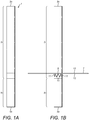
- Figure 1A shows a side view of a standard smoking article (or cigarette);
- Figure 1B shows a side view of a standard cigarette received in a smoke guard;
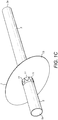
- Figure 1C shows a perspective view of a standard cigarette received in a smoke guard;
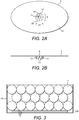
- Figure 2A shows a plan view of a smoke guard;
- Figure 2B shows a side view of a smoke guard; and
- Figure 3 shows diagram plan view of a container or packet housing a plurality of cigarettes and smoke guards.
Detailed Description
-
Figure 1A shows a diagram of smoking article 1, such as a paper-wrapped tobacco rod, or standard cigarette. For simplicity, the smoking article will be referred to as a "cigarette" from hereon in, although it will be understood that the invention may be used with other smoking articles.
-
The cigarette 1 has a tobacco portion 3 joined to a filter portion 5. In typical use, a consumer of the cigarette 1 lights a distal end 3a of the tobacco portion 3 and draws (i.e. sucks or inhales) on the distal end 5a of the filter portion 5, while holding the filter portion 5, to inhale the generated smoke. In between draws, smoke exiting the distal end 3a of the tobacco portion 3 of the cigarette 1 has a tendency to travel along the external length of the cigarette 1 as side stream smoke toward the fingers holding the cigarette 1; this smoke can interact with the fingers holding the cigarette 1 resulting in a smoke smell and discolouration.
-
Figures 1B and 1C show the cigarette 1 of Figure 1A in combination with a smoke guard 7. The smoke guard 7 is a barrier arranged to inhibit the interaction of side stream smoke with the hand of a cigarette consumer. The smoke guard 7 is coupled to the cigarette 1 by way of an aperture 9 in the smoke guard 7 through which the cigarette 1 is received. The arrangement of the smoke guard 7, and the aperture 9, is described in more detail with respect to Figures 2A and 2B subsequently.
-
As shown in Figures 1B and 1C, the smoke guard 7 can be positioned at a point along the length of the cigarette 1. Ideally, the smoke guard 7 can be arranged to be positioned in a region where the tobacco portion 3 and filter portion 5 meet, that is a junction between the tobacco portion 3 and the filter portion 5 such that the filter portion 5 of the cigarette 1 extends from one major face 13 of the smoke guard 7 and the tobacco portion 3 extends from another major face 13 of the smoke guard 7. By positioning the smoke guard 7 along the length of the cigarette 1, smoke travelling along the external length of the cigarette 1 is inhibited from reaching the hand holding the cigarette 1.
-
As shown in Figure 2A, the smoke guard 7 has a disc-like shape with two major faces 13, the major faces 13 being opposite sides of the disc. In Figure 2A the major faces 13 are shown to be ellipsoidal in shape, however in other arrangements the major faces 13 may be substantially circular, squared, rectangular or any other shape suitable for providing a barrier to inhibit the flow or passage of side stream smoke along the exterior of the cigarette from the lit end toward the fingers of a consumer. The smoke guard 7 can be made from a disposable, biodegradable material such as paper or cardboard. Preferably, the material has 'food safe' properties. Example materials from which the smoke guard 7 is made from include paper, cardboard, injection moulded paper foam, a natural or synthetic polymer or a combination thereof.
-
The major faces 13 of the smoke guard 7 have a radial distance from the centre of the major faces 13 to an edge of the smoke guard 7 that is suitable to cover and protect the fingers of a consumer holding the cigarette 1 from side stream smoke interaction. For example, the radial distance may be approximately 15mm to 35 mm, preferably 20mm to 30 mm.
-
An aperture 9 is arranged through the centre of the smoke guard 7 so that a smoking article, such as a cigarette 1, can be positioned therethrough.
-
The aperture 9 is formed from a plurality of slits 15 cut through the major faces 13 of the smoke guard 7, and extending radially outwardly toward an edge of the smoke guard 7 from a point 17 substantially at the centre of the smoke guard 7.
-
Optionally, the point 17 at the centre can be a hole 17 with a diameter less than the diameter of the cross-section of a cigarette 1.
-
The slits 15 together define deformable sectors 11 of a circle region 19 that forms the overall aperture 9; that is, the deformable sectors 11 form the shape of the overall aperture 9. In other examples, the slits can define deformable sectors of an aperture of a different shape, such as a square or ellipse, or any other suitable shape. The circle 19 defining the overall aperture 9 has a diameter 21 approximately equal the cross-sectional diameter of a cigarette 1 to be received through the aperture 9. In other words, the aperture 9 is substantially circular in shape and comprises a plurality of slits 15 extending radially outwardly from a central point 17 of the circle 19 (i.e. the slits extend outwardly toward the edges of the smoke guard 7), the slits 15 defining a plurality of deformable sectors 11.
-
The aperture 9, including the slits 15 and point 17 (e.g. a central hole 17) is formed in the smoke guard 7 by die cutting. Other suitable processing steps for forming the slits 15 (and hole 17) can be used as appropriate.
-
In use, when a cigarette 1 is inserted through the aperture 9, the cigarette 1 presses against the sectors 11 of the circle 19 defined by the slits 15, causing the slits 15 to be deformed, or bent, and pushed in the direction of motion of the cigarette 1. A resilient biasing in the sectors 11, provided by the material properties of the smoke guard 7, causes the deformed sectors 11 to press against the cigarette 1 as they attempt to return to their non-deformed state thereby forming a collar that holds the smoke guard 7 in place. This pressing of the sectors 11 against the cigarette 1 serves to secure the cigarette 1 in the aperture 9.
-
In another example the aperture may be a single slit, which deforms to open and receive a cigarette there through. The material properties of the smoke guard cause the deformable slit to be biased toward a closed position, thereby pressing against the cigarette to hold it cigarette in place, and providing a substantial sealing effect around the cigarette to inhibit the flow of side stream smoke.
-
In some embodiments, the major faces 13 of the smoke guard 7 can be provided with a flavoured and/or scented coating. The major faces 13 also allow for information, such as branding information, to be presented thereon.
-
Figure 2B shows a side view of the smoke guard 7 described with reference to Figure 2A. The sectors 11 are shown in the deformed arrangement, as they would be upon the insertion of a cigarette 1 through the aperture 9; the cigarette 1 is not shown for the purposes of clarity. When a cigarette 1 is not inserted through the aperture 9, the sectors 11 are arranged in the same plane as the main faces of the smoke guard 7, thereby resulting in a substantially flat disc.
-
The smoke guard 7 shown is substantially flat in shape, preferably being formed as a planar disc. This allows for particularly compact stacking of a number of smoke guards 7, in a cigarette pack for example, when the sectors 11 of the aperture 9 are not deformed.
-
In an alternative arrangement, the major face(s) of the smoke guard 7 can be curved. In another alterative arrangement, the smoke guard 7 can be of a domed shape with one convexly curved major face 13 and one substantially flat major face 13, wherein the centre of the smoke guard 7 has a greater thickness than an edge portion, and the thickness decreases over a gradient between the centre portion and the edge portion.
-
In use, a consumer of a smoke guard 7 presses an end of the cigarette 1 against the deformable sectors 11 of the aperture 9 to insert the cigarette 1 through the aperture 9. In the arrangement shown in Figures 1B and 1C, the filter end 5a of the cigarette 1 has been pressed against the deformable sectors 11, it is however also possible to press the tobacco end 3a of the cigarette 1 against the deformable sectors 11. The force applied by pressing the cigarette 1 against the deformable sectors 11 causes the sectors 11 to deform, or bend, in the direction of movement of the cigarette 1 as it is received in the aperture 9. The consumer of the smoke guard 7 can then slide the smoke guard 7 along the length of the cigarette 1. Preferably the consumer slides the smoke guard 7 to a position approximately corresponding to the junction between the tobacco portion 3 and the filter portion 5; this position is advantageous as it allows for the full length of the tobacco portion 3 to be combusted without interfering with the smoke guard 7, whilst also maximising the space on the filter portion 5 at which the consumer can hold the cigarette 1.
-
It will, however, be readily apparent that the smoke guard 7 can be arranged at any position along the length of the cigarette 1. When the cigarette 1 is lit, the consumer can draw on the filter end 5a of the cigarette 1 to inhale smoke. Side stream smoke, which travels along the outer length of the cigarette 1, reaches the smoke guard 7; the smoke guard 7 acts as a barrier and inhibits this smoke from interacting with the hand of the consumer holding the cigarette 1, thereby physically shielding the fingers from the smoke. When the cigarette 1 expires, a single-use smoke guard 7, preferably made from a disposable, biodegradable material such as paper or cardboard, can be disposed of with the cigarette 1. A reusable smoke guard 7 can be removed from the cigarette 1 and stored for use with a subsequent cigarette 1.
-
Figure 3 shows a container 23, such as a cigarette carton or box, containing a plurality of cigarettes 1 and a plurality of smoke guards 7 in a stacked arrangement 25. The smoke guards 7 in the stacked arrangement 25 are arranged adjacent to the cigarettes 1 in the container 23. The smoke guards 7 can be arranged between the cigarettes 1 and a side of the container 23 with a widest width, such as the front side or rear side of the container 23.
-
Substantially flat smoke guards 7, as shown in, and as described with reference to, Figures 1B, 1C, 2A and 2B are particularly advantageous in that they can be compactly stacked and nested alongside the cigarettes 1 in the container 23. This ability for compact stacking is further enhanced by virtue of the deformable sectors 11 being arranged in the same plane as the major faces 13 of the smoke guard 7 before a cigarette 1 is inserted through the aperture 9. That is, rather than having a permanently outwardly projected collar arranged to secure the smoke guard 7 to a cigarette 1, the collar formed by the deformable sectors 11 is packed flat (and subsequently brought about when a cigarette 1 is inserted into the aperture 9). Obviating the need for a permanently outwardly projected collar allows for the smoke guards 7 to be more compactly stacked in the stacked arrangement 25 in a container 23, thereby using less space inside the container 23, and allowing for an overall smaller container size.
-
The smoke guards 7 can be for single use, and a number of smoke guards 7 provided in the container 23 can be equal to the number of cigarettes 1 provided in the container 23. For example, twenty cigarettes 1 can be included with a stacked arrangement 25 of twenty smoke guards 7. It is noted that twenty cigarettes and, for ease of visualisation only, four smoke guards 7 are shown in stacked arrangement 25 of Figure 3; the invention is not however intended to be limited to these numbers. In an alternative arrangement, the smoke-guard can be re-usable, and fewer smoke guards 7 can be provided in the container 23 than a number of cigarettes 1 provided in the container 23. In a further alternative, any desired number of smoke guards 7 can be arranged in the stacked arrangement 25 with any number of cigarettes 1 in the container 23, provided that the container 23 is dimensioned appropriately.
-
Different types of cigarette can have different cross-sectional diameters. The aperture size of the smoke guards 7 is selected to match the cross-sectional diameter of the cigarettes 1 arranged in the container 23.
-
It will be understood to the skilled person that features from the various examples described herein can be readily substituted with one another, where appropriate.