EP3732931B1 - Methods and network nodes for handling baseband processing - Google Patents
Methods and network nodes for handling baseband processing Download PDFInfo
- Publication number
- EP3732931B1 EP3732931B1 EP17832108.9A EP17832108A EP3732931B1 EP 3732931 B1 EP3732931 B1 EP 3732931B1 EP 17832108 A EP17832108 A EP 17832108A EP 3732931 B1 EP3732931 B1 EP 3732931B1
- Authority
- EP
- European Patent Office
- Prior art keywords
- type
- traffic signals
- baseband processing
- network node
- gpp
- Prior art date
- Legal status (The legal status is an assumption and is not a legal conclusion. Google has not performed a legal analysis and makes no representation as to the accuracy of the status listed.)
- Active
Links
Images


Classifications
-
- H—ELECTRICITY
- H04—ELECTRIC COMMUNICATION TECHNIQUE
- H04W—WIRELESS COMMUNICATION NETWORKS
- H04W28/00—Network traffic management; Network resource management
- H04W28/02—Traffic management, e.g. flow control or congestion control
- H04W28/0252—Traffic management, e.g. flow control or congestion control per individual bearer or channel
- H04W28/0263—Traffic management, e.g. flow control or congestion control per individual bearer or channel involving mapping traffic to individual bearers or channels, e.g. traffic flow template [TFT]
-
- H—ELECTRICITY
- H04—ELECTRIC COMMUNICATION TECHNIQUE
- H04W—WIRELESS COMMUNICATION NETWORKS
- H04W88/00—Devices specially adapted for wireless communication networks, e.g. terminals, base stations or access point devices
- H04W88/08—Access point devices
- H04W88/10—Access point devices adapted for operation in multiple networks, e.g. multi-mode access points
-
- H—ELECTRICITY
- H04—ELECTRIC COMMUNICATION TECHNIQUE
- H04W—WIRELESS COMMUNICATION NETWORKS
- H04W28/00—Network traffic management; Network resource management
- H04W28/02—Traffic management, e.g. flow control or congestion control
- H04W28/0231—Traffic management, e.g. flow control or congestion control based on communication conditions
- H04W28/0236—Traffic management, e.g. flow control or congestion control based on communication conditions radio quality, e.g. interference, losses or delay
-
- H—ELECTRICITY
- H04—ELECTRIC COMMUNICATION TECHNIQUE
- H04W—WIRELESS COMMUNICATION NETWORKS
- H04W76/00—Connection management
- H04W76/10—Connection setup
- H04W76/15—Setup of multiple wireless link connections
Definitions
- the present disclosure relates generally to a first network node, a second network node and methods therein, for handling baseband processing of signals communicated with wireless devices in a wireless network.
- network nodes including base stations such as eNBs for 4G networks, access points such as WiFi access points, have functionality for baseband processing of both incoming and outgoing signals used for communication with wireless devices.
- Operations related to baseband processing may e.g. include signal modulation/demodulation, detection, encoding/decoding, radio frequency shifting and Fast Fourier Transform operations, as well as layer 2 operations such as scheduling.
- DSPs Digital Signal Processors
- dedicated hardware chipsets such as Application-Specific Integrated circuits, ASICs, or by Field Programmable Gate Arrays, FPGAs.
- the hardware chipsets are hardcoded and thus not possible to re-program, meaning that only predefined configurations are available. If a function on the chipset needs to modified, deleted or added, it is basically necessary to replace the chipset by a new one.
- DSP-based systems are programmable such that DSP software can be modified, e.g. to add new functionalities.
- DSP programming and DSP software testing is quite difficult, complex and time consuming to perform, using low level programming languages such as C and/or Assembler. Therefore, the development costs for a DSP system are typically very high. Further, the code compatibility is usually limited between a new generation and older generations of the DSPs, even for the same DSP "families". Consequently, modification of the DSP software is required in order to migrate from older generations to a new generation, resulting in substantial migration costs.
- the FPGA firmware can be reprogrammable using hardware description languages (HDL).
- HDL hardware description languages
- RATs Radio Access Technologies
- some RATs include LTE for mobile phones, WiFi for enterprise applications, NB-loT (Narrow Band Internet-of-Things) , CAT-M1 (LTE-M) and LoRa for low-power in wide-area MTC (Machine Type Communication), BLE (Bluetooth Low Energy) and IEEE 802.15.4, such as Zigbee, for short-range communications.
- LTE Long Band Internet-of-Things
- CAT-M1 LTE-M
- LoRa for low-power in wide-area MTC (Machine Type Communication)
- BLE Bluetooth Low Energy
- IEEE 802.15.4 such as Zigbee
- the technology in this field is currently developed so that a single network node should be able to communicate and handle baseband processing according to multiple RATs, which can be accomplished by employing a dedicated chipset for each RAT in the network node.
- multiple RATs are packaged into one multi-radio chipset which may be integrated with both WiFi and LTE.
- Fig. 1 illustrates such a multi-RAT network node 100 which is capable of communicating with a first type of wireless devices 102 using a first RAT, RAT1, and also with a second type of wireless devices 104 using a second RAT, RAT2.
- the first type of wireless devices 102 may include NB-loT devices which are only capable of short-range communication and the second type of wireless devices 104 may include an LTE device which is capable of communication over greater distance.
- the network node 100 thus needs to be capable of using both RAT1 and RAT2 to serve both types of devices 102, 104.
- DSP digital signal processor
- HW accelerators for complex baseband processing tasks which may include FFT (Fast Fourier Transform), turbo coder and some GPP (General-Purpose Processor) cores for higher layer handling such as layer 3 and above, management and control.
- FFT Fast Fourier Transform
- turbo coder Turbo coder
- GPP General-Purpose Processor cores for higher layer handling such as layer 3 and above, management and control.
- GPP General-Purpose Processor
- the only possible way to increase the processing capacity is to redesign the DSP system hardware, such as a DSP board, by adding more parallel DSPs.
- DSP system hardware such as a DSP board
- a new generation of DSPs is needed to support new standards since the existing DSPs may become a limitation for the overall design and development.
- the life cycle for different DSP generations is usually quite long, meaning that each generation of DSP is used for a quite long time.
- the DSP software development is complex, time consuming and costly.
- the existing DSP platform may also limit the scalability for the new RAT. For example, when implementing NB-loT technology on an existing eNB, the scalability of the existing DSP platform is designed for MBB (mobile broadband) technology which is not optimized for the scalability required by the loT use cases, as the number of the loT devices are expected much larger than the number of mobile phones.
- MBB mobile broadband
- the chipset, DSP and FPGA based designs for a network node have a drawback of limited flexibility for updated functionality and adaption to increased traffic, also referred to as scalability.
- the required hardware and software development is thus both costly and time consuming.
- MTC or loT devices will be much larger than the number of handheld mobile phones, and the former type of devices should further consume as little power as possible to reduce the need for battery recharging or replacement.
- MTC or loT devices e.g. using short-range communication technologies like BLE and Zigbee, can only be located close to their serving network node and they also communicate relatively seldom, e.g. to send brief messages such as measurement reports at regular intervals, thus typically having very low throughput.
- a great number of network nodes are needed to serve such MTC or loT devices at short distance and to upgrade their hardware processors, basically by replacing the exiting network nodes with new network nodes, would be very costly.
- SDR Software Defined Radio
- GPP Global System for Mobile Communications
- X86 CPUs Central Processing Units
- GPP processors are designed for executing variable tasks for a general purpose, but they are not fully optimized for digital signal processing. Therefore, GPP processors have limited capacity for baseband processing which may not be sufficient for communications using complex and sophisticated protocols such as 4G and 5G as defined by the 3rd Generation Partnership Project, 3GPP.
- US2017188412 discusses a method for partitioning an access node in a front end unit and a back end unit.
- the front end unit performs physical layer and media access layer (MAC) sublayer processing
- the back end unit includes a plurality of GPP to provide data link layer and network layer processing.
- MAC media access layer
- WO2016099369 discusses a method for allocating resources for network functions based on whether or not the network functions are synchronous or asynchronous.
- a non-GPP based network architecture can be kept unchanged in the first network node for delay-sensitive traffic types while maintaining a high network performance. Further, an existing non-GPP based network node design can be reused as more delay-tolerant traffic types are offloaded to a GPP-based system/platform in the second network node.
- a solution is provided to enable flexibility in a network node without causing excessive costs by employing a non-GPP implemented processor in a first network node and a GPP implemented processor in a second network node for baseband processing of one type of traffic which may be relatively tolerant to delays, and by employing the non-GPP implemented processor only for baseband processing of another type of traffic which may be more delay-sensitive.
- the above two traffic types may use different RATs with different computational demands and latency requirements.
- the non-GPP implemented processor in the first network node can be off-loaded by not having to perform all baseband processing tasks for both types of traffic.
- Scalability and new functionalities can also be easily provided by means of the GPP based system or platform in the second network node which is less complex and costly to re-program and test, compared to the non-GPP based system or platform.
- the GPP implemented processor in the second network node could be accessed and obtained from a pool of processing resources, while the somewhat less flexible non-GPP implemented processor in the first network node can be utilized for more computational-intensive and delay-sensitive types of traffic.
- non-GPP implemented processor will be denoted non-GPP processor for short
- GPP implemented processor will be denoted GPP processor for short
- processor should be understood in a logic sense and could also be replaced by “processing device” or similar.
- the non-GPP based network architecture in the first network node can be kept unchanged for delay-sensitive traffic types and the network performance can also remain very high for such traffic types which may use RATs such as LTE, 5G NR and WiFi.
- the existing non-GPP based network node design e.g. BBU, eNB
- BBU, eNB can be reused and any DSP software or FPGA firmware changes are minimized to offload more delay-tolerant traffic types to a GPP-based system/platform in the second network node.
- These delay-tolerant traffic types may use RATs such as NB-loT, CAT-M1 (LTE-M), BLE and IEEE 802.15.4.
- a redesign of the ASIC will require very little changes, e.g. adding an interface between the first and second network nodes to exchange baseband signals over that interface for baseband processing.
- loT traffic may e.g. be for loT such as NB-loT, CAT-M1 (LTE-M), BLE or IEEE 802.15.4, or for legacy 3GPP such as GSM and WCDMA, where the performance requirements are generally lower.
- loT traffic can be regarded as "best effort" traffic providing non-critical services to end-users. It is sufficient to use a GPP for baseband processing to reduce system costs while achieving sufficiently good performance and better scalability than non-GPP.
- non-GPP implemented processor represents a processor or processing device that is designed for digital signal processing using a processing platform other than the GPP platform.
- a non-GPP implemented processor include a HW (hardware) based processor such as an ASIC or chipset, a DSP (Digital Signal Processor), and an FPGA (Field Programmable Gate Array).
- HW hardware
- DSP Digital Signal Processor
- FPGA Field Programmable Gate Array
- the term “GPP implemented processor” further represents a processor or processing device that is designed for a general purpose (mainly for control tasks), which is commonly also referred to as CPU (Central Processing Unit) such as Intel X86, ARM, MIPS CPUs, which are typically used in PCs, workstations, servers and data centers.
- CPU Central Processing Unit
- the solution will be described herein in terms of functionality of a first network node using a non-GPP processor for baseband processing and a second network node using a GPP processor for baseband processing.
- the non-GPP processor may reside in a base station or similar while the GPP processor may reside in a node other than the base station such as a dedicated node in the network or a pool or center with available processing resources, e.g. a data center.
- the second network node as described herein could be implemented in any of a server, a cluster of servers and a pool of processors, which may reside in a data center or the like.
- the first and second network nodes may communicate with each other using optical fibers or any other suitable communication links.
- the term "network node" should thus be understood as a logic entity having the functionality described herein, regardless of physical implementation.
- the embodiments herein may for example be used to extend the current conventional base station design with a GPP-based platform to support baseband processing for multiple RATs.
- the baseband processing for any highly computational intensive (e.g. wideband, high throughput) technologies and for technologies requiring low latency can be processed on the non-GPP-based base station, while the baseband processing for any less computational intensive (narrowband, low throughput) technologies and technologies tolerating high latency can be partly processed on the GPP-based platform.
- an additional FH (Fronthaul) interface may be used between the non-GPP-based base station and the GPP-based platform. This FH interface and the backhaul interface of the base station may share the same network port.
- the embodiments herein may further be used when operation of the first network node is split into an RRU (Remote Radio Unit) and a central BBU (Baseband Unit) where baseband processing is performed in the BBU.
- the non-GPP-based base station may in this case basically appear as the RRU for those RATs while the GPP-based platform may basically act as the BBU.
- the non-GPP-based base station can be employed to perform partial processing, like performing certain baseband functional split where some baseband functions are in one node and the rest are in another node, e.g. PHY-RF split, Intra-PHY split, FH compression to reduce the FH bit rate, etc., for the RATs supported by the GPP platform.
- the non-GPP-based base station can act as a "master node” controlling where the RATs are processed and the GPP-based platform can act as a "slave node” to support some RATs to offload the baseband processing in the non-GPP-based base station.
- Fig. 2 illustrates a communication scenario where the solution is employed in a first network node 200 to serve both a wireless device 204 using a first traffic type and also a wireless device 206 using a second traffic type. Even though the arrows in this figure indicate uplink communication, it should be understood that the scenario is also applicable for downlink communication.
- “communicate signals" with any wireless device means either receive signals or transmit signals over the air.
- the wireless device 204 could be an NB-loT device and communicates a first type of traffic signals, either in uplink or downlink.
- the wireless device 206 is illustrated as a mobile phone and communicates a first type of traffic signals, likewise either in uplink or downlink.
- traffic signals may carry any information which can be generally referred to as "data”, and the embodiments and examples herein are not limited to any particular information or data in the traffic signals.
- the first network node 200 includes a non-GPP processor 200A which may reside in a non-GPP-based base station.
- the second network node 202 includes a GPP processor 202A which may reside in a server, a cluster of servers, or a pool of processors of a data center, e.g. in a cloud-like environment.
- the terms GPP processor and non-GPP processor have been explained above and although only one non-GPP processor 200A and one GPP processor 202A are mentioned and shown for simplicity, it should be noted that any number of non-GPP processors and GPP processors could be used in the procedures described herein.
- the non-GPP processor 200A and the GPP processor 202A can be used for performing different parts of baseband processing depending on the type of traffic signals, to be described in more detail below.
- the first type of traffic signals may be relatively tolerant to delays in baseband processing, while the second type of traffic signals may be more sensitive to delays in baseband processing.
- a predefined delay threshold in terms of baseband processing time may be used to distinguish the first and second types of traffic signals as follows:
- the total delay in baseband processing may include a bus delay, a processing delay, and a scheduling delay.
- a delay threshold to distinguish the first and second traffic types in terms of delay requirements, makes it possible to control the distribution of traffic load to the processors 200A, 202A by adjusting the delay threshold. For example, if the GPP processor 202B is upgraded to achieve shorter processing delay, e.g. by upgrading the server with fast CPUs, improving the baseband software implementation, and/or OS upgrade, the delay threshold could be reduced to increase the amount of first type traffic with delay requirements above the threshold which would distribute more traffic to the GPP processor 202B. For example, BLE communications require about 150 microsecond round-trip delay. If the GPP based platform is upgraded to fulfil the delay requirement of BLE, then the BLE traffic can be offloaded to the GPP based platform.
- the first type of traffic signals may also require less complex baseband processing, e.g. narrow band and low throughput, while the second type of traffic signals may require more complex baseband processing, e.g. wideband and high throughput.
- the processing complexity may be dependent on the communication protocols used for the respective traffic signal types.
- Fig. 2 further illustrates that the non-GPP processor 200A performs a first part (part 1) of the baseband processing for the first traffic type, as schematically indicated by a block 200C.
- the signals of the first traffic type are then transferred from the first network node 200 to the second network node 202 and the GPP processor 202A which performs a second part (part 2) of the baseband processing for the first traffic type, as schematically indicated by a block 202B.
- data from the first traffic type are sent from the GPP processor 202B to a core network 208 for further handling of the data traffic, which lies outside the scope of the embodiments herein.
- the non-GPP capability and/or the existing software functionality on the non-GPP system or platform can be reused for the first traffic type.
- the first part of the baseband processing may include operations of pre-processing the signals such as Fast Fourier Transform and/or Filterbank, and the second part of baseband processing would in this case include one or more baseband operations other than said signal pre-processing operation such as modulation/demodulation, channel estimation, FEC coding/decoding, scheduling etc.
- the majority of the baseband processing of the first type of traffic is moved to the GPP system or platform to offload the baseband processing of the non-GPP system, as well as requiring very little change and development of the non-GPP system.
- Fig. 2 also illustrates that the non-GPP processor 200A performs both the first part and the second part of the baseband processing for the second traffic type, as schematically indicated by a block 200B. After that, the data of the second traffic type are sent from the non-GPP processor 200A to the core network 208 for further handling of the signals.
- the first network node 200 may in practice include more than one non-GPP processor.
- the first part of the baseband processing could be performed by one non-GPP processor in the first network node for the first traffic type, while the first and second parts of the baseband processing could be performed by another non-GPP processor in the first network node for the second traffic type.
- the non-GPP processor 200A can be off-loaded by distributing the second part of baseband processing to the GPP processor 202A for the first traffic type.
- the overall processing delay of the GPP platform determines which RATs can be offloaded to the GPP.
- the second traffic type has strict latency requirements, e.g. requiring that baseband processing delays must not exceed a delay threshold, it can be ensured that these requirements are fulfilled by letting all baseband processing of the second traffic type, i.e. both the first and second parts, be performed by the non-GPP processor 200A which is associated with shorter processing delays compared to the GPP processor 202A.
- FIG. 3A An example will now be described with reference to the flow chart in Fig. 3A , of how the solution may be employed in terms of actions performed by a first network node such as the above-described first network node 200.
- Fig. 3 is described below with further reference to Fig. 2 although without limitation to such a communication scenario involving the first network node 200.
- Some optional example embodiments that could be used in this procedure will also be described below.
- the actions shown in Fig. 3A are thus performed by a first network node 200 for handling baseband processing of signals communicated with wireless devices in a wireless network.
- the first network node 200 may in some non-limiting examples be implemented in a base station or a WiFi access point, and the solution is not limited in this respect.
- a first action 300 illustrates that the first network node 200 communicates a first type of traffic signals with a first wireless device 204.
- the first network node 200 performs a first part of baseband processing of the first type of traffic signals using a non-GPP implemented processor 200A, e.g. as illustrated in block 200C.
- the first network node 200 communicates the first type of traffic signals with a second network node 202 for performing a second part of baseband processing of the first type of traffic signals using a GPP implemented processor 202A, e.g. as illustrated in block 202B.
- a further action 306 illustrates that the first network node 200 also communicates a second type of traffic signals with a second wireless device 206.
- the first network node 200 performs both of said first and second parts of baseband processing of the second type of traffic signals using the non-GPP implemented processor 200A, e.g. as illustrated in block 200B.
- actions 300-304 may occur before or after, or even at the same time, as actions 306-308, meaning basically that the first and second types of traffic signals may be communicated and processed at any time independent of one another.
- the actions in this figure could basically be performed in the shown order for uplink communication with the wireless devices where the first and second types of signals are received from the wireless devices in actions 300, 306 before the baseband processing.
- the actions could basically be performed in a reverse order for downlink communication with the wireless devices, where the first and second types of signals are transmitted to the wireless devices in actions 300, 306 after the baseband processing.
- the alternatives of uplink and downlink communication are indicated by two-way arrows between the actions.
- the first type of traffic signals may tolerate a certain baseband processing delay while the second type of traffic signals may not tolerate said baseband processing delay.
- another example embodiment may be that the first type of traffic signals is tolerant to baseband processing delays above a predefined delay threshold, and that the second type of traffic signals requires that baseband processing delays do not exceed the predefined delay threshold.
- the traffic signals of the first type may be communicated using a first Radio Access Technology, RAT
- traffic signals of the second type may be communicated using a second RAT.
- the first RAT involves any of: Low-Power Wide-Area radio, Narrow Band radio and short-range radio such as NB-loT, CAT-M1 (LTE-M), BLE, IEEE 802. 15.4 for Machine Type Communication, MTC
- the second RAT involves wideband or high throughput radio such as LTE, 5G or WiFi for wireless broadband applications.
- the first part of baseband processing may include a signal pre-processing operation such as Fast Fourier Transform and/or Filterbank, and the second part of baseband processing may then include one or more baseband operations other than said signal pre-processing operation such as modulation/demodulation, channel estimation, FEC coding/decoding and scheduling.
- a signal pre-processing operation such as Fast Fourier Transform and/or Filterbank
- the second part of baseband processing may then include one or more baseband operations other than said signal pre-processing operation such as modulation/demodulation, channel estimation, FEC coding/decoding and scheduling.
- the non-GPP implemented processor may comprise any of an Application-Specific Integrated Circuit, ASIC, a Digital Signal Processor, DSP, and an FPGA.
- the GPP implemented processor in the second network node may be accessed from a pool of processing resources.
- the traffic signals of the first type may be communicated on a first antenna carrier stream, and the traffic signals of the second type may in that case communicated on a second antenna carrier stream separate from the first antenna carrier stream.
- the traffic signals of the first type and the traffic signals of the second type may be communicated on a common antenna carrier stream.
- another example embodiment may be that the traffic signals of the first type could be communicated in-band in one or more resource blocks of a carrier used for the traffic signals of the second type or in a guard band between adjacent carriers used for the traffic signals of the second type.
- FIG. 3B An example will now be described with reference to the flow chart in Fig. 3B , of how the solution may be employed in terms of actions performed by a second network node such as the above-described second network node 202, and the procedure in Fig. 3B is associated with the procedure in Fig. 3A as follows.
- Fig. 3B is described below likewise with further reference to Fig. 2 although without limitation to such a communication scenario involving the second network node 202.
- a second network node 202 for handling baseband processing of signals communicated with wireless devices in a wireless network.
- the second network node 202 may be implemented in a server, a cluster of servers or in a pool of processing resources, and the solution is not limited in this respect.
- An action 310 illustrates that the second network node 202 communicates a first type of traffic signals with a first network node 200 where a first part of baseband processing of the first type of traffic signals is performed using a non-GPP implemented processor 200A. This action is thus performed after action 306 in the case of uplink communication with the first wireless device, or before action 306 in the case of downlink communication with the first wireless device.
- the second network node 202 performs a second part of baseband processing of the communicated first type of traffic signals using a GPP implemented processor 202A. Similar to Fig. 3A , the actions in Fig. 3B could be performed in the shown order for uplink communication where the first type of traffic signals are received from the first network node in action 310 before the baseband processing in action 312, or in a reverse order for downlink communication where the first type of traffic signals are sent to the first network node in action 310 after the baseband processing in action 312.
- the alternatives of uplink and downlink communication are indicated by a two-way arrows between actions 310 and 312.
- FIG. 4 Another example of how the embodiments herein may be used in practice, is illustrated in Fig. 4 where a network node 400 is split into one or more remote radio units 400A, denoted RRUs, and a central baseband unit 400B denoted BBU.
- RRUs remote radio units
- BBU central baseband unit
- FIG. 4 illustrates only one RRU for simplicity although such as network node may have any number of RRUs.
- Each RRU of such a split configuration could support one or more RATs.
- a so-called CPRI interface is implemented on the link between the RRU 400A and the BBU 400B in a conventional manner.
- the above-described non-GPP implemented processor operates on a non-GPP platform residing in the BBU 400B
- GPP implemented processor operates on a GPP platform 402.
- the RRU 400A is capable of communicating traffic signals of at least two different RATs denoted RAT1, RAT2, as processed by the BBU 400B and the GPP platform 402.
- two RRUs may be used to support RAT1 and RAT2 where one RRU supports RAT1 while the other RRU supports RAT2, or both RRUs may support both RAT1 and RAT2.
- Fig. 4 may be used when the first type of traffic is NB-loT traffic and the second type of traffic is LTE traffic, as a non-limiting practical example.
- the BBU side 400B has an added FH interface to the GPP-based platform 402, while the RRU 400A and the CPRI interface can remain unchanged.
- the FH data carried by CPRI contains both LTE FH data and NB-loT FH data, while the added second FH interface between the BBU 400B and the GPP-based platform 402 carries FH data for the NB-loT traffic.
- NB-loT traffic may use one or more resource blocks in an LTE carrier or may use a guard-band between adjacent LTE carriers.
- the FH data of the LTE antenna-carrier stream in CPRI include both LTE and NB-loT components.
- the FH data of the antenna-carrier stream is extracted and sent to a LTE module in the BBU 400B for processing.
- the data of NB-loT subcarriers are obtained. This data can be compressed further and is sent to the GPP-based platform 402 via the second FH interface. This data may also be referred to as "frequency domain FH data".
- the GPP-based platform 402 further performs the second part of the baseband processing (e.g. demodulation, decoding, etc.) of the NB-loT FH data and sends traffic data via the backhaul interface to the core network 210.
- a similar procedure can be employed in downlink such that the traffic data of NB-loT from the core network 210 is modulated by the GPP-based platform 402 to frequency domain FH data.
- the frequency domain FH data (e.g. compressed) is sent by the GPP-based platform 402 to the BBU 400B via the second FH interface.
- the BBU 400B maps the NB-loT FH data in frequency domain multiplexed with the LTE FH data and modulates them to a LTE antenna-carrier baseband signal via an IFFT operation.
- the signal is then encapsulated as a CPRI antenna-carrier stream and sent to the RRU 400A via the CPRI interface.
- the RRU 400A performs baseband-to-RF conversion and sends the RF signal to one or more wireless devices from the antennas.
- CPRI has separate NB-loT antenna-carrier and LTE antenna-carrier streams.
- the NB-loT FH data may not be processed in the LTE module in the BBU 400B.
- the NB-loT FH data extracted from CPRI may be compressed and is then sent to the GPP-based platform 402 via the second FH interface.
- the NB-loT data received by the BBU 400B from the GPP-based platform 402 may be decompressed, and is then encapsulated as NB-loT antenna-carrier streams multiplexed with other LTE antenna-carrier streams in CPRI, and sent to the RRU 400A for transmission.
- Fig. 5A illustrates an example where a non-GPP processor 500A resides in a first network node 500 and a GPP processor 502A resides in a second network node 502.
- uplink and downlink traffic of the first type flows through the non-GPP processor 500A only, as illustrated by full two-way arrows
- uplink and downlink traffic of the second type flows through the non-GPP processor 500A for the first part of baseband processing and through the GPP processor 502A for the second part of baseband processing, as illustrated by dashed two-way arrows.
- Fig. 5B illustrates another example where a non-GPP processor 500A resides in a first network node 500 and a GPP processor 502A resides in a pool of processing resources 502 corresponding to the above-described second network node.
- uplink and downlink traffic of the first type flows through the non-GPP processor 500A only, as illustrated by full two-way arrows
- uplink and downlink traffic of the second type flows through a non-GPP processor 500A in the network node 500 for the first part of baseband processing and through the GPP processor 502A in the pool 502 for the second part of baseband processing, as illustrated by dashed two-way arrows.
- two different non-GPP processors or the same non-GPP processor may be employed in the first network node 500 for both traffic types and the solution is not limited in this respect.
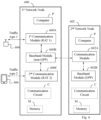
- FIG. 6 illustrates a detailed but non-limiting example of how a first network node 600 and a second network node 602 may be structured to bring about the above-described solution and embodiments thereof.
- the first network node 600 may be configured to operate according to any of the examples and embodiments for employing the solution as described herein, where appropriate and as follows.
- the first network node 600 is shown to comprise a computer P and a memory M, said memory comprising computer instructions executable by the computer P so that the first network node 600 is operable as described herein.
- the first network node 600 also comprises a communication circuit C with suitable equipment for sending and receiving traffic signals in the manner described herein.
- the communication circuit C may be configured for communication with wireless devices 604 and 606, corresponding to the wireless devices 204 and 206 in Fig. 2 . Such communication may be performed using different RATs as described above.
- the communication circuit C may also be configured for communication with a second network node 602 corresponding to the second network node 202 in Fig. 2 .
- the first network node 600 comprises means configured or arranged to basically perform the actions in Fig. 3A , and more or less as described above for the first network node 200 or 500 in various examples.
- the first network node 600 is arranged or configured to handle baseband processing of signals communicated with wireless devices in a wireless network, as follows.
- the first network node 600 is configured to communicate a first type of traffic signals with a first wireless device 604. This operation may be performed by a first communication module 600A in the network node 600, e.g. in the manner described above for action 300.
- the network node 600 is further configured to perform a first part of baseband processing of the first type of traffic signals using a non-GPP implemented processor. This operation may be performed by a baseband module 600B in the network node 600, e.g. as described above for action 302.
- the network node 600 is also configured to communicate the first type of traffic signals with a second network node 602 for a second part of baseband processing of the first type of traffic signals using a GPP implemented processor. This operation may be performed by the communication circuit C, depending on the implementation, basically as described above for action 304.
- the network node 600 is further configured to communicate a second type of traffic signals with a second wireless device 606. This operation may be performed by a second communication module 600C in the network node 600, e.g. in the manner described above for action 306.
- the network node 600 is further configured to perform both of said first and second parts of baseband processing of the second type of traffic signals using the non-GPP implemented processor. This operation may be performed by the baseband module 600B, e.g. as described above for action 308.
- the second network node 602 may be configured to operate according to any of the examples and embodiments for employing the solution as described herein, where appropriate and as follows.
- the second network node 602 is likewise shown to comprise a computer P and a memory M, said memory comprising computer instructions executable by the computer P so that the second network node 602 is operable as described herein.
- the second network node 602 also comprises a communication circuit C with suitable equipment for sending and receiving traffic signals in the manner described herein.
- the communication circuit C may be configured for communication with a first network node 600 corresponding to the first network node 600 in Fig. 2 .
- the second network node 602 comprises means configured or arranged to basically perform the actions in Fig. 3A , and more or less as described above for the second network node 202 or 502 in various examples.
- the second network node 602 is arranged or configured to handle baseband processing of signals communicated with wireless devices in a wireless network, as follows.
- the second network node 602 is configured to communicate a first type of traffic signals with a first network node 600 where a first part of baseband processing of the first type of traffic signals is performed using a non-GPP implemented processor. This operation may be performed by a communication module 602A in the second network node 602, e.g. in the manner described above for action 310.
- the second network node 602 is also configured to perform a second part of baseband processing of the communicated first type of traffic signals using a GPP implemented processor. This operation may be performed by a baseband module 602B in the second network node 602, e.g. in the manner described above for action 312.
- Fig. 6 illustrates various functional modules or units in the first network node 600 and the second network node 602, respectively, and the skilled person is able to implement these functional modules in practice using suitable software and hardware.
- the solution is generally not limited to the shown structures of the first network node 600 and the second network node 602, and the functional modules or units 600A-C and 602A-B therein may be configured to operate according to any of the features and embodiments described in this disclosure, where appropriate.
- the functional modules or units 600A-C and 602A-B described above could thus be implemented in the first network node 600 and the second network node 602, respectively, by means of hardware and program modules of a computer program comprising code means which, when run by the computer P causes the first network node 600 and the second network node 602, respectively, to perform at least some of the above-described actions and procedures.
- Each computer program may be carried by a computer program product in the first network node 600 and the second network node 602, respectively, in the form of a memory having a computer readable medium and being connected to the processor P.
- the computer program product or memory in the first network node 600 and the second network node 602, respectively, may thus comprise a computer readable medium on which the computer program is stored e.g. in the form of computer program modules or the like.
- the memory may be a flash memory, a Random-Access Memory (RAM), a Read-Only Memory (ROM), an Electrically Erasable Programmable ROM (EEPROM) or Hard Drive storage (HDD), and the program modules could in alternative embodiments be distributed on different computer program products in the form of memories within the first network node 600 and the second network node 602, respectively.
- RAM Random-Access Memory
- ROM Read-Only Memory
- EEPROM Electrically Erasable Programmable ROM
- HDD Hard Drive storage
- the solution described herein may thus be implemented in the first network node 600 and the second network node 602, respectively, by a computer program comprising instructions which, when executed on at least one computer, cause the at least one computer to carry out the actions according to any of the above embodiments and examples, where appropriate.
- the solution may also be implemented in a carrier containing the above computer program, wherein the carrier is one of an electronic signal, an optical signal, a radio signal, or a computer readable storage product or computer program product.
Landscapes
- Engineering & Computer Science (AREA)
- Computer Networks & Wireless Communication (AREA)
- Signal Processing (AREA)
- Mobile Radio Communication Systems (AREA)
Description
- The present disclosure relates generally to a first network node, a second network node and methods therein, for handling baseband processing of signals communicated with wireless devices in a wireless network.
- In wireless networks of today, network nodes including base stations such as eNBs for 4G networks, access points such as WiFi access points, have functionality for baseband processing of both incoming and outgoing signals used for communication with wireless devices. Operations related to baseband processing may e.g. include signal modulation/demodulation, detection, encoding/decoding, radio frequency shifting and Fast Fourier Transform operations, as well as
layer 2 operations such as scheduling. These baseband operations and others are typically executed by Digital Signal Processors, DSPs or dedicated hardware chipsets such as Application-Specific Integrated circuits, ASICs, or by Field Programmable Gate Arrays, FPGAs. - For ASIC-based systems, the hardware chipsets are hardcoded and thus not possible to re-program, meaning that only predefined configurations are available. If a function on the chipset needs to modified, deleted or added, it is basically necessary to replace the chipset by a new one.
- DSP-based systems are programmable such that DSP software can be modified, e.g. to add new functionalities. However, DSP programming and DSP software testing is quite difficult, complex and time consuming to perform, using low level programming languages such as C and/or Assembler. Therefore, the development costs for a DSP system are typically very high. Further, the code compatibility is usually limited between a new generation and older generations of the DSPs, even for the same DSP "families". Consequently, modification of the DSP software is required in order to migrate from older generations to a new generation, resulting in substantial migration costs.
- For an FPGA-based design, the FPGA firmware can be reprogrammable using hardware description languages (HDL). However, it is often even more complex and time consuming than DSP programming.
- In future networks, it can be foreseen that several different Radio Access Technologies, RATs, will be used for different types of wireless devices, and some RATs that can be expected include LTE for mobile phones, WiFi for enterprise applications, NB-loT (Narrow Band Internet-of-Things) , CAT-M1 (LTE-M) and LoRa for low-power in wide-area MTC (Machine Type Communication), BLE (Bluetooth Low Energy) and IEEE 802.15.4, such as Zigbee, for short-range communications. For some complex scenarios such as "smart factory", it is necessary to support several RATs at the same location which can be done by employing multiple network nodes at the same site, one for each RAT.
- The technology in this field is currently developed so that a single network node should be able to communicate and handle baseband processing according to multiple RATs, which can be accomplished by employing a dedicated chipset for each RAT in the network node. Sometimes multiple RATs are packaged into one multi-radio chipset which may be integrated with both WiFi and LTE.
-
Fig. 1 illustrates such amulti-RAT network node 100 which is capable of communicating with a first type ofwireless devices 102 using a first RAT, RAT1, and also with a second type ofwireless devices 104 using a second RAT, RAT2. The first type ofwireless devices 102 may include NB-loT devices which are only capable of short-range communication and the second type ofwireless devices 104 may include an LTE device which is capable of communication over greater distance. Thenetwork node 100 thus needs to be capable of using both RAT1 and RAT2 to serve both types ofdevices - One way to support multi-RATs is to use a sophisticated DSP-based platform for baseband processing. Such DSPs are often integrated with HW accelerators for complex baseband processing tasks which may include FFT (Fast Fourier Transform), turbo coder and some GPP (General-Purpose Processor) cores for higher layer handling such as layer 3 and above, management and control. These DSPs are often customized and highly optimized for implementing specific standards, e.g. in terms of required processing capability, memory and storage capacity.
- The only possible way to increase the processing capacity, is to redesign the DSP system hardware, such as a DSP board, by adding more parallel DSPs. Usually, a new generation of DSPs is needed to support new standards since the existing DSPs may become a limitation for the overall design and development. The life cycle for different DSP generations is usually quite long, meaning that each generation of DSP is used for a quite long time. As stated before, the DSP software development is complex, time consuming and costly.
- To support a new RAT on a DSP-based system, this further increases the implementation difficulties and costs to develop the new DSP software on the existing DSPs which are not adapted and optimized for the new RAT. Some limited hardware resources, e.g. memory, need to be shared between two implementations. This may also limit the implementation of some advanced features of the new RAT. The existing DSP platform may also limit the scalability for the new RAT. For example, when implementing NB-loT technology on an existing eNB, the scalability of the existing DSP platform is designed for MBB (mobile broadband) technology which is not optimized for the scalability required by the loT use cases, as the number of the loT devices are expected much larger than the number of mobile phones.
- As discussed above, the chipset, DSP and FPGA based designs for a network node have a drawback of limited flexibility for updated functionality and adaption to increased traffic, also referred to as scalability. The required hardware and software development is thus both costly and time consuming.
- Moreover, it can be foreseen that the number of autonomous MTC or loT devices will be much larger than the number of handheld mobile phones, and the former type of devices should further consume as little power as possible to reduce the need for battery recharging or replacement. Further, such MTC or loT devices, e.g. using short-range communication technologies like BLE and Zigbee, can only be located close to their serving network node and they also communicate relatively seldom, e.g. to send brief messages such as measurement reports at regular intervals, thus typically having very low throughput. As a result, a great number of network nodes are needed to serve such MTC or loT devices at short distance and to upgrade their hardware processors, basically by replacing the exiting network nodes with new network nodes, would be very costly.
- It has also been proposed to employ Software Defined Radio, SDR, which is a concept to fully "softwarize" various baseband processing operations on GPP-based platforms, e.g. based on X86 CPUs (Central Processing Units). However, using GPP would increase delays in the baseband processing which may not be acceptable for some types of traffic. The total delay include several factors such as bus delay, processing delay, and scheduling delay in the operating system. As indicated by its name, GPP processors are designed for executing variable tasks for a general purpose, but they are not fully optimized for digital signal processing. Therefore, GPP processors have limited capacity for baseband processing which may not be sufficient for communications using complex and sophisticated protocols such as 4G and 5G as defined by the 3rd Generation Partnership Project, 3GPP.
-
US2017188412 discusses a method for partitioning an access node in a front end unit and a back end unit. The front end unit performs physical layer and media access layer (MAC) sublayer processing, and the back end unit includes a plurality of GPP to provide data link layer and network layer processing.WO2016099369 discusses a method for allocating resources for network functions based on whether or not the network functions are synchronous or asynchronous. - It is an object of embodiments described herein to address at least some of the problems and issues outlined above. It is possible to achieve this object and others by using methods and network nodes as defined in the attached independent claims.
- When employing the methods and network nodes, it is an advantage that a non-GPP based network architecture can be kept unchanged in the first network node for delay-sensitive traffic types while maintaining a high network performance. Further, an existing non-GPP based network node design can be reused as more delay-tolerant traffic types are offloaded to a GPP-based system/platform in the second network node.
- The solution will now be described in more detail by means of exemplary embodiments and with reference to the accompanying drawings, in which:
-
Fig. 1 is a communication scenario illustrating a network node capable of multiple RATs, according to the prior art. -
Fig. 2 is a communication scenario illustrating an example of how the solution may be employed, according to some example embodiments. -
Fig. 3A is a flow chart illustrating a procedure in a first network node, according to further example embodiments. -
Fig. 3B is a flow chart illustrating a procedure in a second network node, according to further example embodiments. -
Fig. 4 is a block diagram illustrating an example of how the solution may be employed in a first network node that is split into one or more remote radio units and a central baseband unit, according to further example embodiments. -
Fig. 5A is a block diagram illustrating a first example of how a GPP implemented processor may be employed by a first network node and a second network node, according to further example embodiments. -
Fig. 5B is a block diagram illustrating a second example of how a GPP implemented processor may be employed by a first network node and a second network node, according to further example embodiments. -
Fig. 6 is a block diagram illustrating another example of how a first network node and a second network node may be structured, according to further example embodiments. - Briefly described, a solution is provided to enable flexibility in a network node without causing excessive costs by employing a non-GPP implemented processor in a first network node and a GPP implemented processor in a second network node for baseband processing of one type of traffic which may be relatively tolerant to delays, and by employing the non-GPP implemented processor only for baseband processing of another type of traffic which may be more delay-sensitive. The above two traffic types may use different RATs with different computational demands and latency requirements.
- Thereby, the non-GPP implemented processor in the first network node can be off-loaded by not having to perform all baseband processing tasks for both types of traffic. Scalability and new functionalities can also be easily provided by means of the GPP based system or platform in the second network node which is less complex and costly to re-program and test, compared to the non-GPP based system or platform. The GPP implemented processor in the second network node could be accessed and obtained from a pool of processing resources, while the somewhat less flexible non-GPP implemented processor in the first network node can be utilized for more computational-intensive and delay-sensitive types of traffic. In the following description, the non-GPP implemented processor will be denoted non-GPP processor for short, and the GPP implemented processor will be denoted GPP processor for short. Throughout this disclosure, the term "processor" should be understood in a logic sense and could also be replaced by "processing device" or similar.
- It is an advantage that the non-GPP based network architecture in the first network node can be kept unchanged for delay-sensitive traffic types and the network performance can also remain very high for such traffic types which may use RATs such as LTE, 5G NR and WiFi. At the same time, the existing non-GPP based network node design (e.g. BBU, eNB) can be reused and any DSP software or FPGA firmware changes are minimized to offload more delay-tolerant traffic types to a GPP-based system/platform in the second network node. These delay-tolerant traffic types may use RATs such as NB-loT, CAT-M1 (LTE-M), BLE and IEEE 802.15.4. For an ASIC-based system, a redesign of the ASIC will require very little changes, e.g. adding an interface between the first and second network nodes to exchange baseband signals over that interface for baseband processing.
- One type of traffic may e.g. be for loT such as NB-loT, CAT-M1 (LTE-M), BLE or IEEE 802.15.4, or for legacy 3GPP such as GSM and WCDMA, where the performance requirements are generally lower. For example, loT traffic can be regarded as "best effort" traffic providing non-critical services to end-users. It is sufficient to use a GPP for baseband processing to reduce system costs while achieving sufficiently good performance and better scalability than non-GPP.
- In this description, the term "non-GPP implemented processor" represents a processor or processing device that is designed for digital signal processing using a processing platform other than the GPP platform. Examples of a non-GPP implemented processor include a HW (hardware) based processor such as an ASIC or chipset, a DSP (Digital Signal Processor), and an FPGA (Field Programmable Gate Array). For completeness, the term "GPP implemented processor" further represents a processor or processing device that is designed for a general purpose (mainly for control tasks), which is commonly also referred to as CPU (Central Processing Unit) such as Intel X86, ARM, MIPS CPUs, which are typically used in PCs, workstations, servers and data centers.
- The solution will be described herein in terms of functionality of a first network node using a non-GPP processor for baseband processing and a second network node using a GPP processor for baseband processing. For example, the non-GPP processor may reside in a base station or similar while the GPP processor may reside in a node other than the base station such as a dedicated node in the network or a pool or center with available processing resources, e.g. a data center. In other words, the second network node as described herein could be implemented in any of a server, a cluster of servers and a pool of processors, which may reside in a data center or the like. The first and second network nodes may communicate with each other using optical fibers or any other suitable communication links. The term "network node" should thus be understood as a logic entity having the functionality described herein, regardless of physical implementation.
- The embodiments herein may for example be used to extend the current conventional base station design with a GPP-based platform to support baseband processing for multiple RATs. Basically, the baseband processing for any highly computational intensive (e.g. wideband, high throughput) technologies and for technologies requiring low latency can be processed on the non-GPP-based base station, while the baseband processing for any less computational intensive (narrowband, low throughput) technologies and technologies tolerating high latency can be partly processed on the GPP-based platform. To accomplish this, an additional FH (Fronthaul) interface may be used between the non-GPP-based base station and the GPP-based platform. This FH interface and the backhaul interface of the base station may share the same network port.
- The embodiments herein may further be used when operation of the first network node is split into an RRU (Remote Radio Unit) and a central BBU (Baseband Unit) where baseband processing is performed in the BBU. For RATs processed on the GPP-based platform, the non-GPP-based base station may in this case basically appear as the RRU for those RATs while the GPP-based platform may basically act as the BBU. The non-GPP-based base station can be employed to perform partial processing, like performing certain baseband functional split where some baseband functions are in one node and the rest are in another node, e.g. PHY-RF split, Intra-PHY split, FH compression to reduce the FH bit rate, etc., for the RATs supported by the GPP platform. In this way, the non-GPP-based base station can act as a "master node" controlling where the RATs are processed and the GPP-based platform can act as a "slave node" to support some RATs to offload the baseband processing in the non-GPP-based base station.
-
Fig. 2 illustrates a communication scenario where the solution is employed in afirst network node 200 to serve both a wireless device 204 using a first traffic type and also awireless device 206 using a second traffic type. Even though the arrows in this figure indicate uplink communication, it should be understood that the scenario is also applicable for downlink communication. Throughout this disclosure, it should further be understood that that "communicate signals" with any wireless device means either receive signals or transmit signals over the air. The wireless device 204 could be an NB-loT device and communicates a first type of traffic signals, either in uplink or downlink. In this example, thewireless device 206 is illustrated as a mobile phone and communicates a first type of traffic signals, likewise either in uplink or downlink. Throughout this description, it should be understood that traffic signals may carry any information which can be generally referred to as "data", and the embodiments and examples herein are not limited to any particular information or data in the traffic signals. - The
first network node 200 includes anon-GPP processor 200A which may reside in a non-GPP-based base station. Thesecond network node 202 includes aGPP processor 202A which may reside in a server, a cluster of servers, or a pool of processors of a data center, e.g. in a cloud-like environment. The terms GPP processor and non-GPP processor have been explained above and although only onenon-GPP processor 200A and oneGPP processor 202A are mentioned and shown for simplicity, it should be noted that any number of non-GPP processors and GPP processors could be used in the procedures described herein. Thenon-GPP processor 200A and theGPP processor 202A can be used for performing different parts of baseband processing depending on the type of traffic signals, to be described in more detail below. - The first type of traffic signals may be relatively tolerant to delays in baseband processing, while the second type of traffic signals may be more sensitive to delays in baseband processing. A predefined delay threshold in terms of baseband processing time may be used to distinguish the first and second types of traffic signals as follows:
- The first type of traffic signals (type 1) is tolerant to baseband processing delays above the predefined delay threshold. In other words,
type 1 traffic has delay requirements above the delay threshold. - The second type of traffic signals (type 2) requires that baseband processing delays do not exceed the predefined delay threshold. In other words,
type 2 traffic has delay requirements below the delay threshold. - As mentioned above, the total delay in baseband processing may include a bus delay, a processing delay, and a scheduling delay. Using such a delay threshold to distinguish the first and second traffic types in terms of delay requirements, makes it possible to control the distribution of traffic load to the
processors GPP processor 202B is upgraded to achieve shorter processing delay, e.g. by upgrading the server with fast CPUs, improving the baseband software implementation, and/or OS upgrade, the delay threshold could be reduced to increase the amount of first type traffic with delay requirements above the threshold which would distribute more traffic to theGPP processor 202B. For example, BLE communications require about 150 microsecond round-trip delay. If the GPP based platform is upgraded to fulfil the delay requirement of BLE, then the BLE traffic can be offloaded to the GPP based platform. - The first type of traffic signals may also require less complex baseband processing, e.g. narrow band and low throughput, while the second type of traffic signals may require more complex baseband processing, e.g. wideband and high throughput. The processing complexity may be dependent on the communication protocols used for the respective traffic signal types.
-
Fig. 2 further illustrates that thenon-GPP processor 200A performs a first part (part 1) of the baseband processing for the first traffic type, as schematically indicated by ablock 200C. The signals of the first traffic type are then transferred from thefirst network node 200 to thesecond network node 202 and theGPP processor 202A which performs a second part (part 2) of the baseband processing for the first traffic type, as schematically indicated by ablock 202B. After that, data from the first traffic type are sent from theGPP processor 202B to acore network 208 for further handling of the data traffic, which lies outside the scope of the embodiments herein. - It is an advantage that the non-GPP capability and/or the existing software functionality on the non-GPP system or platform can be reused for the first traffic type. For example, the first part of the baseband processing may include operations of pre-processing the signals such as Fast Fourier Transform and/or Filterbank, and the second part of baseband processing would in this case include one or more baseband operations other than said signal pre-processing operation such as modulation/demodulation, channel estimation, FEC coding/decoding, scheduling etc. As a result, the majority of the baseband processing of the first type of traffic is moved to the GPP system or platform to offload the baseband processing of the non-GPP system, as well as requiring very little change and development of the non-GPP system.
-
Fig. 2 also illustrates that thenon-GPP processor 200A performs both the first part and the second part of the baseband processing for the second traffic type, as schematically indicated by ablock 200B. After that, the data of the second traffic type are sent from thenon-GPP processor 200A to thecore network 208 for further handling of the signals. It was indicated above that thefirst network node 200 may in practice include more than one non-GPP processor. It should also be noted that the first part of the baseband processing could be performed by one non-GPP processor in the first network node for the first traffic type, while the first and second parts of the baseband processing could be performed by another non-GPP processor in the first network node for the second traffic type. - Thereby, the
non-GPP processor 200A can be off-loaded by distributing the second part of baseband processing to theGPP processor 202A for the first traffic type. As mentioned above, the overall processing delay of the GPP platform determines which RATs can be offloaded to the GPP. When the second traffic type has strict latency requirements, e.g. requiring that baseband processing delays must not exceed a delay threshold, it can be ensured that these requirements are fulfilled by letting all baseband processing of the second traffic type, i.e. both the first and second parts, be performed by thenon-GPP processor 200A which is associated with shorter processing delays compared to theGPP processor 202A. - An example will now be described with reference to the flow chart in
Fig. 3A , of how the solution may be employed in terms of actions performed by a first network node such as the above-describedfirst network node 200.Fig. 3 is described below with further reference toFig. 2 although without limitation to such a communication scenario involving thefirst network node 200. Some optional example embodiments that could be used in this procedure will also be described below. - The actions shown in
Fig. 3A are thus performed by afirst network node 200 for handling baseband processing of signals communicated with wireless devices in a wireless network. In this procedure, thefirst network node 200 may in some non-limiting examples be implemented in a base station or a WiFi access point, and the solution is not limited in this respect. - A
first action 300 illustrates that thefirst network node 200 communicates a first type of traffic signals with a first wireless device 204. In anotheraction 302, thefirst network node 200 performs a first part of baseband processing of the first type of traffic signals using a non-GPP implementedprocessor 200A, e.g. as illustrated inblock 200C. In anotheraction 304, thefirst network node 200 communicates the first type of traffic signals with asecond network node 202 for performing a second part of baseband processing of the first type of traffic signals using a GPP implementedprocessor 202A, e.g. as illustrated inblock 202B. It should be noted here that in this action "communicates" means either to send the signals to thesecond network node 202 in the case of uplink communication with the first wireless device, or to receive the signals from thesecond network node 202 in the case of downlink communication with the first wireless device. - A
further action 306 illustrates that thefirst network node 200 also communicates a second type of traffic signals with asecond wireless device 206. In anotheraction 308, thefirst network node 200 performs both of said first and second parts of baseband processing of the second type of traffic signals using the non-GPP implementedprocessor 200A, e.g. as illustrated inblock 200B. It should be noted that actions 300-304 may occur before or after, or even at the same time, as actions 306-308, meaning basically that the first and second types of traffic signals may be communicated and processed at any time independent of one another. - It should further be noted that the actions in this figure could basically be performed in the shown order for uplink communication with the wireless devices where the first and second types of signals are received from the wireless devices in
actions actions - Some optional and non-limiting example embodiments that could be used in this procedure will now be described.
- In one example embodiment, the first type of traffic signals may tolerate a certain baseband processing delay while the second type of traffic signals may not tolerate said baseband processing delay. In this case, another example embodiment may be that the first type of traffic signals is tolerant to baseband processing delays above a predefined delay threshold, and that the second type of traffic signals requires that baseband processing delays do not exceed the predefined delay threshold.
- In another example embodiment, the traffic signals of the first type may be communicated using a first Radio Access Technology, RAT, and traffic signals of the second type may be communicated using a second RAT. In this case, further example embodiments may be that the first RAT involves any of: Low-Power Wide-Area radio, Narrow Band radio and short-range radio such as NB-loT, CAT-M1 (LTE-M), BLE, IEEE 802. 15.4 for Machine Type Communication, MTC, and the second RAT involves wideband or high throughput radio such as LTE, 5G or WiFi for wireless broadband applications.
- In further example embodiments, the first part of baseband processing may include a signal pre-processing operation such as Fast Fourier Transform and/or Filterbank, and the second part of baseband processing may then include one or more baseband operations other than said signal pre-processing operation such as modulation/demodulation, channel estimation, FEC coding/decoding and scheduling.
- In further example embodiments, the non-GPP implemented processor may comprise any of an Application-Specific Integrated Circuit, ASIC, a Digital Signal Processor, DSP, and an FPGA.
- In another example embodiment, the GPP implemented processor in the second network node may be accessed from a pool of processing resources.
- In another example embodiment, the traffic signals of the first type may be communicated on a first antenna carrier stream, and the traffic signals of the second type may in that case communicated on a second antenna carrier stream separate from the first antenna carrier stream.
- In another example embodiment, the traffic signals of the first type and the traffic signals of the second type may be communicated on a common antenna carrier stream. In that case, another example embodiment may be that the traffic signals of the first type could be communicated in-band in one or more resource blocks of a carrier used for the traffic signals of the second type or in a guard band between adjacent carriers used for the traffic signals of the second type.
- An example will now be described with reference to the flow chart in
Fig. 3B , of how the solution may be employed in terms of actions performed by a second network node such as the above-describedsecond network node 202, and the procedure inFig. 3B is associated with the procedure inFig. 3A as follows.Fig. 3B is described below likewise with further reference toFig. 2 although without limitation to such a communication scenario involving thesecond network node 202. - The actions shown in
Fig. 3B are thus performed by asecond network node 202 for handling baseband processing of signals communicated with wireless devices in a wireless network. In this procedure, thesecond network node 202 may be implemented in a server, a cluster of servers or in a pool of processing resources, and the solution is not limited in this respect. - An
action 310 illustrates that thesecond network node 202 communicates a first type of traffic signals with afirst network node 200 where a first part of baseband processing of the first type of traffic signals is performed using a non-GPP implementedprocessor 200A. This action is thus performed afteraction 306 in the case of uplink communication with the first wireless device, or beforeaction 306 in the case of downlink communication with the first wireless device. - In another
action 312, thesecond network node 202 performs a second part of baseband processing of the communicated first type of traffic signals using a GPP implementedprocessor 202A. Similar toFig. 3A , the actions inFig. 3B could be performed in the shown order for uplink communication where the first type of traffic signals are received from the first network node inaction 310 before the baseband processing inaction 312, or in a reverse order for downlink communication where the first type of traffic signals are sent to the first network node inaction 310 after the baseband processing inaction 312. The alternatives of uplink and downlink communication are indicated by a two-way arrows betweenactions - Another example of how the embodiments herein may be used in practice, is illustrated in
Fig. 4 where anetwork node 400 is split into one or moreremote radio units 400A, denoted RRUs, and acentral baseband unit 400B denoted BBU. This figure illustrates only one RRU for simplicity although such as network node may have any number of RRUs. Each RRU of such a split configuration could support one or more RATs. A so-called CPRI interface is implemented on the link between theRRU 400A and theBBU 400B in a conventional manner. In this case, the above-described non-GPP implemented processor operates on a non-GPP platform residing in theBBU 400B, while the above-described GPP implemented processor operates on aGPP platform 402. In this example, theRRU 400A is capable of communicating traffic signals of at least two different RATs denoted RAT1, RAT2, as processed by theBBU 400B and theGPP platform 402. In further examples, two RRUs may be used to support RAT1 and RAT2 where one RRU supports RAT1 while the other RRU supports RAT2, or both RRUs may support both RAT1 and RAT2. - It will now be described how the split configuration of
Fig. 4 may be used when the first type of traffic is NB-loT traffic and the second type of traffic is LTE traffic, as a non-limiting practical example. - The
BBU side 400B has an added FH interface to the GPP-basedplatform 402, while theRRU 400A and the CPRI interface can remain unchanged. The FH data carried by CPRI contains both LTE FH data and NB-loT FH data, while the added second FH interface between theBBU 400B and the GPP-basedplatform 402 carries FH data for the NB-loT traffic. - For an in-band or guard-band deployment, NB-loT traffic may use one or more resource blocks in an LTE carrier or may use a guard-band between adjacent LTE carriers. Then the FH data of the LTE antenna-carrier stream in CPRI include both LTE and NB-loT components. In uplink, the FH data of the antenna-carrier stream is extracted and sent to a LTE module in the
BBU 400B for processing. After FFT, the data of NB-loT subcarriers are obtained. This data can be compressed further and is sent to the GPP-basedplatform 402 via the second FH interface. This data may also be referred to as "frequency domain FH data". - Then the GPP-based
platform 402 further performs the second part of the baseband processing (e.g. demodulation, decoding, etc.) of the NB-loT FH data and sends traffic data via the backhaul interface to thecore network 210. A similar procedure can be employed in downlink such that the traffic data of NB-loT from thecore network 210 is modulated by the GPP-basedplatform 402 to frequency domain FH data. Then the frequency domain FH data (e.g. compressed) is sent by the GPP-basedplatform 402 to theBBU 400B via the second FH interface. TheBBU 400B maps the NB-loT FH data in frequency domain multiplexed with the LTE FH data and modulates them to a LTE antenna-carrier baseband signal via an IFFT operation. The signal is then encapsulated as a CPRI antenna-carrier stream and sent to theRRU 400A via the CPRI interface. TheRRU 400A performs baseband-to-RF conversion and sends the RF signal to one or more wireless devices from the antennas. - For a "stand-alone" deployment, CPRI has separate NB-loT antenna-carrier and LTE antenna-carrier streams. In this case, the NB-loT FH data may not be processed in the LTE module in the
BBU 400B. In uplink, the NB-loT FH data extracted from CPRI may be compressed and is then sent to the GPP-basedplatform 402 via the second FH interface. In downlink, the NB-loT data received by theBBU 400B from the GPP-basedplatform 402 may be decompressed, and is then encapsulated as NB-loT antenna-carrier streams multiplexed with other LTE antenna-carrier streams in CPRI, and sent to theRRU 400A for transmission. - It was mentioned above that the non-GPP processor may reside in a base station or similar while the GPP processor may reside either in a server, pool or data center with available processing resources.
Fig. 5A illustrates an example where anon-GPP processor 500A resides in afirst network node 500 and aGPP processor 502A resides in asecond network node 502. In this configuration, uplink and downlink traffic of the first type flows through thenon-GPP processor 500A only, as illustrated by full two-way arrows, while uplink and downlink traffic of the second type flows through thenon-GPP processor 500A for the first part of baseband processing and through theGPP processor 502A for the second part of baseband processing, as illustrated by dashed two-way arrows. -
Fig. 5B illustrates another example where anon-GPP processor 500A resides in afirst network node 500 and aGPP processor 502A resides in a pool of processingresources 502 corresponding to the above-described second network node. In this configuration, uplink and downlink traffic of the first type flows through thenon-GPP processor 500A only, as illustrated by full two-way arrows, while uplink and downlink traffic of the second type flows through anon-GPP processor 500A in thenetwork node 500 for the first part of baseband processing and through theGPP processor 502A in thepool 502 for the second part of baseband processing, as illustrated by dashed two-way arrows. In practice, two different non-GPP processors or the same non-GPP processor may be employed in thefirst network node 500 for both traffic types and the solution is not limited in this respect. - The block diagram in
Fig. 6 illustrates a detailed but non-limiting example of how afirst network node 600 and asecond network node 602 may be structured to bring about the above-described solution and embodiments thereof. - The
first network node 600 may be configured to operate according to any of the examples and embodiments for employing the solution as described herein, where appropriate and as follows. Thefirst network node 600 is shown to comprise a computer P and a memory M, said memory comprising computer instructions executable by the computer P so that thefirst network node 600 is operable as described herein. Thefirst network node 600 also comprises a communication circuit C with suitable equipment for sending and receiving traffic signals in the manner described herein. - The communication circuit C may be configured for communication with
wireless devices wireless devices 204 and 206 inFig. 2 . Such communication may be performed using different RATs as described above. The communication circuit C may also be configured for communication with asecond network node 602 corresponding to thesecond network node 202 inFig. 2 . - The
first network node 600 comprises means configured or arranged to basically perform the actions inFig. 3A , and more or less as described above for thefirst network node Fig. 6 , thefirst network node 600 is arranged or configured to handle baseband processing of signals communicated with wireless devices in a wireless network, as follows. - The
first network node 600 is configured to communicate a first type of traffic signals with afirst wireless device 604. This operation may be performed by afirst communication module 600A in thenetwork node 600, e.g. in the manner described above foraction 300. - The
network node 600 is further configured to perform a first part of baseband processing of the first type of traffic signals using a non-GPP implemented processor. This operation may be performed by abaseband module 600B in thenetwork node 600, e.g. as described above foraction 302. - The
network node 600 is also configured to communicate the first type of traffic signals with asecond network node 602 for a second part of baseband processing of the first type of traffic signals using a GPP implemented processor. This operation may be performed by the communication circuit C, depending on the implementation, basically as described above foraction 304. - The
network node 600 is further configured to communicate a second type of traffic signals with asecond wireless device 606. This operation may be performed by asecond communication module 600C in thenetwork node 600, e.g. in the manner described above foraction 306. - The
network node 600 is further configured to perform both of said first and second parts of baseband processing of the second type of traffic signals using the non-GPP implemented processor. This operation may be performed by thebaseband module 600B, e.g. as described above foraction 308. - The
second network node 602 may be configured to operate according to any of the examples and embodiments for employing the solution as described herein, where appropriate and as follows. Thesecond network node 602 is likewise shown to comprise a computer P and a memory M, said memory comprising computer instructions executable by the computer P so that thesecond network node 602 is operable as described herein. Thesecond network node 602 also comprises a communication circuit C with suitable equipment for sending and receiving traffic signals in the manner described herein. The communication circuit C may be configured for communication with afirst network node 600 corresponding to thefirst network node 600 inFig. 2 . - The
second network node 602 comprises means configured or arranged to basically perform the actions inFig. 3A , and more or less as described above for thesecond network node Fig. 6 , thesecond network node 602 is arranged or configured to handle baseband processing of signals communicated with wireless devices in a wireless network, as follows. - The
second network node 602 is configured to communicate a first type of traffic signals with afirst network node 600 where a first part of baseband processing of the first type of traffic signals is performed using a non-GPP implemented processor. This operation may be performed by acommunication module 602A in thesecond network node 602, e.g. in the manner described above foraction 310. - The
second network node 602 is also configured to perform a second part of baseband processing of the communicated first type of traffic signals using a GPP implemented processor. This operation may be performed by abaseband module 602B in thesecond network node 602, e.g. in the manner described above foraction 312. - It should be noted that
Fig. 6 illustrates various functional modules or units in thefirst network node 600 and thesecond network node 602, respectively, and the skilled person is able to implement these functional modules in practice using suitable software and hardware. Thus, the solution is generally not limited to the shown structures of thefirst network node 600 and thesecond network node 602, and the functional modules orunits 600A-C and 602A-B therein may be configured to operate according to any of the features and embodiments described in this disclosure, where appropriate. - The functional modules or
units 600A-C and 602A-B described above could thus be implemented in thefirst network node 600 and thesecond network node 602, respectively, by means of hardware and program modules of a computer program comprising code means which, when run by the computer P causes thefirst network node 600 and thesecond network node 602, respectively, to perform at least some of the above-described actions and procedures. - Each computer program may be carried by a computer program product in the
first network node 600 and thesecond network node 602, respectively, in the form of a memory having a computer readable medium and being connected to the processor P. The computer program product or memory in thefirst network node 600 and thesecond network node 602, respectively, may thus comprise a computer readable medium on which the computer program is stored e.g. in the form of computer program modules or the like. For example, the memory may be a flash memory, a Random-Access Memory (RAM), a Read-Only Memory (ROM), an Electrically Erasable Programmable ROM (EEPROM) or Hard Drive storage (HDD), and the program modules could in alternative embodiments be distributed on different computer program products in the form of memories within thefirst network node 600 and thesecond network node 602, respectively. - The solution described herein may thus be implemented in the
first network node 600 and thesecond network node 602, respectively, by a computer program comprising instructions which, when executed on at least one computer, cause the at least one computer to carry out the actions according to any of the above embodiments and examples, where appropriate. The solution may also be implemented in a carrier containing the above computer program, wherein the carrier is one of an electronic signal, an optical signal, a radio signal, or a computer readable storage product or computer program product. - While the solution has been described with reference to specific exemplifying embodiments, the description is generally only intended to illustrate the inventive concept and should not be taken as limiting the scope of the solution. For example, the terms "network node", "wireless device", "non-GPP implemented processor", "GPP implemented processor", "type of traffic signals", "remote radio unit", "central baseband unit" and "Radio Access Technology, RAT" have been used throughout this disclosure, although any other corresponding entities, functions, and/or parameters could also be used having the features and characteristics described here. The solution is defined by the appended claims.
Claims (15)
- A method performed by a network comprising a first network node (200) and a second network node (202) for handling baseband processing of signals communicated with wireless devices in a wireless network, the method comprising:- communicating (300) by the first network node (200), a first type of traffic signals with a first wireless device (204), wherein the first type of traffic signals tolerates a certain baseband processing delay,- performing (302) by the first network node (200), a first part of baseband processing (200C) of the first type of traffic signals using a non-GPP implemented processor (200A), wherein the first part of baseband processing comprises a signal pre-processing operation including as Fast Fourier Transform and/or Filterbank,- communicating (304) the first type of traffic signals with the second network node (202) for a second part of baseband processing (202B) of the first type of traffic signals, wherein the second network node (202) uses a GPP implemented processor (202A) for the second part of the baseband processing, and wherein the second part of baseband processing comprises one or more baseband operations other than said signal pre-processing operation, the one or more baseband operations including any one or more out of: modulation/demodulation, channel estimation, FEC coding/decoding and scheduling,- communicating (306) by the first network node (200), a second type of traffic signals with a second wireless device (206), wherein the second type of traffic signals does not tolerate said baseband processing delay, and- performing (308) by the first network node (200), both of said first and second parts of baseband processing (200B) of the second type of traffic signals using the non-GPP implemented processor.
- A method according to claim 1, wherein the first type of traffic signals is tolerant to baseband processing delays above a predefined delay threshold, and the second type of traffic signals requires that baseband processing delays do not exceed the predefined delay threshold.
- A method according to any of claims 1-2, wherein traffic signals of the first type are communicated using a first Radio Access Technology, RAT, and traffic signals of the second type are communicated using a second RAT.
- A method according to claim 3, wherein the first RAT involves any of: Low-Power Wide-Area radio, Narrow Band radio and short-range radio such as NB-loT, CAT-M1 (LTE-M), BLE, IEEE 802. 15.4 for Machine Type Communication, MTC, and the second RAT involves wideband or high throughput radio such as LTE, 5G or WiFi for wireless broadband applications.
- A method according to any of claims 1-4, wherein the non-GPP implemented processor comprises any of an Application-Specific Integrated Circuit, ASIC, a Digital Signal Processor, DSP, and an FPGA.
- A method according to any of claims 1-5, wherein the GPP implemented processor in the second network node is accessed from a pool of processing resources (500C).
- A method according to any of claims 1-6, wherein the traffic signals of the first type are communicated on a first antenna carrier stream, and the traffic signals of the second type are communicated on a second antenna carrier stream separate from the first antenna carrier stream.
- A method according to any of claims 1-6, wherein the traffic signals of the first type and the traffic signals of the second type are communicated on a common antenna carrier stream.
- A method according to claim 8, wherein the traffic signals of the first type are communicated in-band in one or more resource blocks of a carrier used for the traffic signals of the second type or in a guard band between adjacent carriers used for the traffic signals of the second type.
- A network comprising a first network node (600) and a second network node (602) arranged to handle baseband processing of signals communicated with wireless devices in a wireless network, wherein the network is configured to:- communicate (600A) by the first network node (600) a first type of traffic signals with a first wireless device (604), wherein the first type of traffic signals tolerates a certain baseband processing delay,- perform (600B) by the first network node (600) a first part of baseband processing of the first type of traffic signals using a non-GPP implemented processor, wherein the first part of baseband processing comprises a signal pre-processing operation including Fast Fourier Transform and/or Filterbank,- communicate the first type of traffic signals with the second network node (602) for a second part of baseband processing of the first type of traffic signals, wherein the second network node (602) uses a GPP implemented processor for the second part of baseband processing, and wherein the second part of baseband processing comprises one or more baseband operations other than said signal pre-processing operation, the one or more baseband operations including any one or more out of: modulation/demodulation, channel estimation, FEC coding/decoding and scheduling,- communicate (600C) by the first network node (600) a second type of traffic signals with a second wireless device (606), wherein the second type of traffic signals does not tolerate said baseband processing delay, and- perform (600B) by the first network node (600) both of said first and second parts of baseband processing of the second type of traffic signals using the non-GPP implemented processor.
- A network according to claim 10, wherein the first type of traffic signals is tolerant to baseband processing delays above a predefined delay threshold, and the second type of traffic signals requires that baseband processing delays do not exceed the predefined delay threshold.
- A computer program comprising instructions which, when executed on at least one computer, cause the at least one computer to carry out the method according to any one of claims 1-9.
- A carrier containing the computer program of claim 12, wherein the carrier is one of an electronic signal, optical signal, radio signal, or computer readable storage medium.
- A method performed by a first network node (200) for handling baseband processing of signals communicated with wireless devices in a wireless network, the method comprising:- communicating (300) a first type of traffic signals with a first wireless device (204), wherein the first type of traffic signals tolerates a certain baseband processing delay,- performing (302) a first part of baseband processing (200C) of the first type of traffic signals using a non-GPP implemented processor (200A), wherein the first part of baseband processing comprises a signal pre-processing operation including as Fast Fourier Transform and/or Filterbank,- communicating (304) the first type of traffic signals with a second network node (202) for a second part of baseband processing (202B) of the first type of traffic signals,- communicating (306) a second type of traffic signals with a second wireless device (206), wherein the second type of traffic signals does not tolerate said baseband processing delay, and- performing (308) both of said first and second parts of baseband processing (200B) of the second type of traffic signals using the non-GPP implemented processor, wherein the second part of baseband processing comprises one or more baseband operations other than said signal pre-processing operation, the one or more baseband operations including any one or more out of: modulation/demodulation, channel estimation, FEC coding/decoding and scheduling.
- A first network node (600) arranged to handle baseband processing of signals communicated with wireless devices in a wireless network, wherein the first network node is configured to:- communicate (600A) a first type of traffic signals with a first wireless device (604), wherein the first type of traffic signals tolerates a certain baseband processing delay,- perform (600B) by the first network node (600) a first part of baseband processing of the first type of traffic signals using a non-GPP implemented processor, wherein the first part of baseband processing comprises a signal pre-processing operation including Fast Fourier Transform and/or Filterbank,- communicate the first type of traffic signals with a second network node (602) for a second part of baseband processing of the first type of traffic signals,- communicate (600C) a second type of traffic signals with a second wireless device (606), wherein the second type of traffic signals does not tolerate said baseband processing delay, and- perform (600B) both of said first and second parts of baseband processing of the second type of traffic signals using the non-GPP implemented processor, wherein the second part of baseband processing comprises one or more baseband operations other than said signal pre-processing operation, the one or more baseband operations including any one or more out of: modulation/demodulation, channel estimation, FEC coding/decoding and scheduling.
Applications Claiming Priority (1)
| Application Number | Priority Date | Filing Date | Title |
|---|---|---|---|
| PCT/SE2017/051358 WO2019132745A1 (en) | 2017-12-29 | 2017-12-29 | Methods and network nodes for handling baseband processing |
Publications (3)
| Publication Number | Publication Date |
|---|---|
| EP3732931A1 EP3732931A1 (en) | 2020-11-04 |
| EP3732931B1 true EP3732931B1 (en) | 2023-08-16 |
| EP3732931C0 EP3732931C0 (en) | 2023-08-16 |
Family
ID=61003353
Family Applications (1)
| Application Number | Title | Priority Date | Filing Date |
|---|---|---|---|
| EP17832108.9A Active EP3732931B1 (en) | 2017-12-29 | 2017-12-29 | Methods and network nodes for handling baseband processing |
Country Status (3)
| Country | Link |
|---|---|
| US (4) | US11595843B2 (en) |
| EP (1) | EP3732931B1 (en) |
| WO (1) | WO2019132745A1 (en) |
Families Citing this family (7)
| Publication number | Priority date | Publication date | Assignee | Title |
|---|---|---|---|---|
| US11652730B2 (en) * | 2016-08-23 | 2023-05-16 | Telefonaktiebolaget Lm Ericsson (Publ) | Selective processing of traffic flows based on latency requirements |
| JP7428518B2 (en) * | 2020-01-07 | 2024-02-06 | パナソニックホールディングス株式会社 | Master station device, slave station device, and communication control method |
| WO2021204212A1 (en) * | 2020-04-07 | 2021-10-14 | Guangdong Oppo Mobile Telecommunications Corp., Ltd. | Method and user equipment for adjusting cell measurement |
| CN111865358B (en) * | 2020-08-10 | 2023-03-24 | 锐迪科创微电子(北京)有限公司 | Communication chip |
| US12501499B2 (en) * | 2022-03-24 | 2025-12-16 | Mavenir Systems, Inc. | Method to extend ORAN fronthaul specifications to support NBIOT |
| EP4250869A1 (en) * | 2022-03-24 | 2023-09-27 | Mavenir Systems, Inc. | Method to extend oran fronthaul specifications to support nbiot |
| CN116360498B (en) * | 2023-04-19 | 2024-02-02 | 广州爱浦路网络技术有限公司 | Unmanned aerial vehicle route planning method and device and electronic equipment |
Family Cites Families (15)
| Publication number | Priority date | Publication date | Assignee | Title |
|---|---|---|---|---|
| US7053824B2 (en) * | 2001-11-06 | 2006-05-30 | Global Locate, Inc. | Method and apparatus for receiving a global positioning system signal using a cellular acquisition signal |
| CN102984098B (en) * | 2006-10-05 | 2016-11-23 | 科达无线私人有限公司 | For improving the system and method for the receiver performance in communication network |
| WO2016060823A1 (en) | 2014-10-15 | 2016-04-21 | Intel IP Corporation | Uplink traffic control method in tightly integrated wifi/lte |
| US20160124899A1 (en) * | 2014-11-04 | 2016-05-05 | Easic Corporation | Multi-chip packaged function including a programmable device and a fixed function die and use for application acceleration |
| US20160174187A1 (en) * | 2014-12-15 | 2016-06-16 | Qualcomm Incorporated | System and Methods for Enhancing Data Throughput and Page Performance in a Multi-SIM Wireless Communication Device |
| US10313208B2 (en) * | 2014-12-17 | 2019-06-04 | Telefonaktiebolaget Lm Ericsson (Publ) | Flexible assignment of network functions for radio access |
| US9769873B2 (en) * | 2015-12-29 | 2017-09-19 | At&T Intellectual Property I, L.P. | Access node architecture for 5G radio and other access networks |
| US10079755B2 (en) | 2016-03-14 | 2018-09-18 | Nokia Of America Corporation | Programmable system architecture for routing data packets in virtual base stations |
| TWI655870B (en) * | 2016-03-15 | 2019-04-01 | 鴻海精密工業股份有限公司 | Method and device for controlling network traffic |
| US10235207B2 (en) * | 2016-09-30 | 2019-03-19 | Nimbix, Inc. | Method and system for preemptible coprocessing |
| US20180121753A1 (en) * | 2016-11-02 | 2018-05-03 | U.S.A. As Represented By The Administrator Of The National Aeronautics And Space Administration | Method for radio frequency interference direct detection and data recovery based on the hilbert-huang transformation for 2-d |
| US10382558B2 (en) * | 2016-11-17 | 2019-08-13 | Nokia Of America Corporation | Edge resource sharing |
| CN107333282B (en) * | 2017-06-05 | 2021-02-19 | 惠州Tcl移动通信有限公司 | 5G terminal universal platform optimization method and system based on GPP |
| CN111052795B (en) * | 2017-09-28 | 2022-03-04 | 中兴通讯股份有限公司 | Method and system for exchanging messages in a wireless network |
| US10547977B2 (en) * | 2017-10-26 | 2020-01-28 | Qualcomm Incorporated | Method and apparatus for crowdsourcing the location of mobile terrestrial transports |
-
2017
- 2017-12-29 US US16/958,096 patent/US11595843B2/en active Active
- 2017-12-29 EP EP17832108.9A patent/EP3732931B1/en active Active
- 2017-12-29 WO PCT/SE2017/051358 patent/WO2019132745A1/en not_active Ceased
-
2023
- 2023-02-21 US US18/172,301 patent/US11856443B2/en active Active
- 2023-12-15 US US18/542,489 patent/US12238569B2/en active Active
-
2025
- 2025-01-17 US US19/026,561 patent/US20250159541A1/en active Pending
Also Published As
| Publication number | Publication date |
|---|---|
| US11856443B2 (en) | 2023-12-26 |
| US11595843B2 (en) | 2023-02-28 |
| WO2019132745A1 (en) | 2019-07-04 |
| US20200344635A1 (en) | 2020-10-29 |
| US20250159541A1 (en) | 2025-05-15 |
| US20230209392A1 (en) | 2023-06-29 |
| EP3732931C0 (en) | 2023-08-16 |
| EP3732931A1 (en) | 2020-11-04 |
| US20240121654A1 (en) | 2024-04-11 |
| US12238569B2 (en) | 2025-02-25 |
Similar Documents
| Publication | Publication Date | Title |
|---|---|---|
| US12238569B2 (en) | Methods and network nodes for handling baseband processing | |
| JP7080338B2 (en) | How to get the resource display value and device | |
| US20210212033A1 (en) | Downlink control channel signaling for an aperiodic channel state information trigger | |
| US10575232B2 (en) | Communication control device and communication control method | |
| EP3091686B1 (en) | Measurement gap configuration method, terminal and network device | |
| CA3066690C (en) | Transmission configuration method and related product | |
| CN115428505B (en) | Activating and deactivating periodic reference signals | |
| WO2015010484A1 (en) | Multimode wireless terminal | |
| WO2012059125A1 (en) | Apparatus and method for communication | |
| JP2017515438A (en) | Cloud-based access network | |
| EP4193633B1 (en) | Resource coordination among multiple integrated access backhaul (iab) parent nodes | |
| KR20230070314A (en) | Carrier aggregation configuration in 5G wireless network | |
| CN103959895A (en) | Method, device and system for wireless access | |
| CN115039451A (en) | Network node in a communication network and method performed therein | |
| EP3725120B1 (en) | Transmission power management | |
| CN106416372A (en) | Methods, devices and systems | |
| US10944625B2 (en) | Bearer configuration method and related products | |
| CN121037994A (en) | An information transmission method and communication device | |
| JP2021522751A (en) | Reference signal transmission method and communication equipment | |
| US12309812B2 (en) | Radio communication apparatus, method, program, and recording medium | |
| US12219384B1 (en) | Control plane overload mitigation capability | |
| EP3235335B1 (en) | Apparatus and method for radio interface switching | |
| KR102468867B1 (en) | Communication method and communication device | |
| WO2025193002A1 (en) | Methods and apparatus for managing non-terrestrial network configuration in wireless communication system | |
| CN108141479A (en) | A kind of cloud wireless access network system, data processing method and device |
Legal Events
| Date | Code | Title | Description |
|---|---|---|---|
| STAA | Information on the status of an ep patent application or granted ep patent |
Free format text: STATUS: UNKNOWN |
|
| STAA | Information on the status of an ep patent application or granted ep patent |
Free format text: STATUS: THE INTERNATIONAL PUBLICATION HAS BEEN MADE |
|
| PUAI | Public reference made under article 153(3) epc to a published international application that has entered the european phase |
Free format text: ORIGINAL CODE: 0009012 |
|
| STAA | Information on the status of an ep patent application or granted ep patent |
Free format text: STATUS: REQUEST FOR EXAMINATION WAS MADE |
|
| 17P | Request for examination filed |
Effective date: 20200403 |
|
| AK | Designated contracting states |
Kind code of ref document: A1 Designated state(s): AL AT BE BG CH CY CZ DE DK EE ES FI FR GB GR HR HU IE IS IT LI LT LU LV MC MK MT NL NO PL PT RO RS SE SI SK SM TR |
|
| AX | Request for extension of the european patent |
Extension state: BA ME |
|
| DAV | Request for validation of the european patent (deleted) | ||
| DAX | Request for extension of the european patent (deleted) | ||
| STAA | Information on the status of an ep patent application or granted ep patent |
Free format text: STATUS: EXAMINATION IS IN PROGRESS |
|
| 17Q | First examination report despatched |
Effective date: 20220329 |
|
| GRAP | Despatch of communication of intention to grant a patent |
Free format text: ORIGINAL CODE: EPIDOSNIGR1 |
|
| STAA | Information on the status of an ep patent application or granted ep patent |
Free format text: STATUS: GRANT OF PATENT IS INTENDED |
|
| INTG | Intention to grant announced |
Effective date: 20230531 |
|
| GRAS | Grant fee paid |
Free format text: ORIGINAL CODE: EPIDOSNIGR3 |
|
| GRAA | (expected) grant |
Free format text: ORIGINAL CODE: 0009210 |
|
| STAA | Information on the status of an ep patent application or granted ep patent |
Free format text: STATUS: THE PATENT HAS BEEN GRANTED |
|
| AK | Designated contracting states |
Kind code of ref document: B1 Designated state(s): AL AT BE BG CH CY CZ DE DK EE ES FI FR GB GR HR HU IE IS IT LI LT LU LV MC MK MT NL NO PL PT RO RS SE SI SK SM TR |
|
| REG | Reference to a national code |
Ref country code: GB Ref legal event code: FG4D |
|
| REG | Reference to a national code |
Ref country code: CH Ref legal event code: EP |
|
| REG | Reference to a national code |
Ref country code: DE Ref legal event code: R096 Ref document number: 602017072884 Country of ref document: DE |
|
| REG | Reference to a national code |
Ref country code: IE Ref legal event code: FG4D |
|
| U01 | Request for unitary effect filed |
Effective date: 20230906 |
|
| U07 | Unitary effect registered |
Designated state(s): AT BE BG DE DK EE FI FR IT LT LU LV MT NL PT SE SI Effective date: 20230913 |
|
| PG25 | Lapsed in a contracting state [announced via postgrant information from national office to epo] |
Ref country code: GR Free format text: LAPSE BECAUSE OF FAILURE TO SUBMIT A TRANSLATION OF THE DESCRIPTION OR TO PAY THE FEE WITHIN THE PRESCRIBED TIME-LIMIT Effective date: 20231117 |
|
| PG25 | Lapsed in a contracting state [announced via postgrant information from national office to epo] |
Ref country code: IS Free format text: LAPSE BECAUSE OF FAILURE TO SUBMIT A TRANSLATION OF THE DESCRIPTION OR TO PAY THE FEE WITHIN THE PRESCRIBED TIME-LIMIT Effective date: 20231216 |
|
| PG25 | Lapsed in a contracting state [announced via postgrant information from national office to epo] |
Ref country code: RS Free format text: LAPSE BECAUSE OF FAILURE TO SUBMIT A TRANSLATION OF THE DESCRIPTION OR TO PAY THE FEE WITHIN THE PRESCRIBED TIME-LIMIT Effective date: 20230816 Ref country code: NO Free format text: LAPSE BECAUSE OF FAILURE TO SUBMIT A TRANSLATION OF THE DESCRIPTION OR TO PAY THE FEE WITHIN THE PRESCRIBED TIME-LIMIT Effective date: 20231116 Ref country code: IS Free format text: LAPSE BECAUSE OF FAILURE TO SUBMIT A TRANSLATION OF THE DESCRIPTION OR TO PAY THE FEE WITHIN THE PRESCRIBED TIME-LIMIT Effective date: 20231216 Ref country code: HR Free format text: LAPSE BECAUSE OF FAILURE TO SUBMIT A TRANSLATION OF THE DESCRIPTION OR TO PAY THE FEE WITHIN THE PRESCRIBED TIME-LIMIT Effective date: 20230816 Ref country code: GR Free format text: LAPSE BECAUSE OF FAILURE TO SUBMIT A TRANSLATION OF THE DESCRIPTION OR TO PAY THE FEE WITHIN THE PRESCRIBED TIME-LIMIT Effective date: 20231117 |
|
| U20 | Renewal fee for the european patent with unitary effect paid |
Year of fee payment: 7 Effective date: 20231227 |
|
| PG25 | Lapsed in a contracting state [announced via postgrant information from national office to epo] |
Ref country code: PL Free format text: LAPSE BECAUSE OF FAILURE TO SUBMIT A TRANSLATION OF THE DESCRIPTION OR TO PAY THE FEE WITHIN THE PRESCRIBED TIME-LIMIT Effective date: 20230816 |
|
| PG25 | Lapsed in a contracting state [announced via postgrant information from national office to epo] |
Ref country code: ES Free format text: LAPSE BECAUSE OF FAILURE TO SUBMIT A TRANSLATION OF THE DESCRIPTION OR TO PAY THE FEE WITHIN THE PRESCRIBED TIME-LIMIT Effective date: 20230816 |
|
| PG25 | Lapsed in a contracting state [announced via postgrant information from national office to epo] |
Ref country code: SM Free format text: LAPSE BECAUSE OF FAILURE TO SUBMIT A TRANSLATION OF THE DESCRIPTION OR TO PAY THE FEE WITHIN THE PRESCRIBED TIME-LIMIT Effective date: 20230816 Ref country code: RO Free format text: LAPSE BECAUSE OF FAILURE TO SUBMIT A TRANSLATION OF THE DESCRIPTION OR TO PAY THE FEE WITHIN THE PRESCRIBED TIME-LIMIT Effective date: 20230816 Ref country code: ES Free format text: LAPSE BECAUSE OF FAILURE TO SUBMIT A TRANSLATION OF THE DESCRIPTION OR TO PAY THE FEE WITHIN THE PRESCRIBED TIME-LIMIT Effective date: 20230816 Ref country code: CZ Free format text: LAPSE BECAUSE OF FAILURE TO SUBMIT A TRANSLATION OF THE DESCRIPTION OR TO PAY THE FEE WITHIN THE PRESCRIBED TIME-LIMIT Effective date: 20230816 Ref country code: SK Free format text: LAPSE BECAUSE OF FAILURE TO SUBMIT A TRANSLATION OF THE DESCRIPTION OR TO PAY THE FEE WITHIN THE PRESCRIBED TIME-LIMIT Effective date: 20230816 |
|
| REG | Reference to a national code |
Ref country code: DE Ref legal event code: R097 Ref document number: 602017072884 Country of ref document: DE |
|
| PLBE | No opposition filed within time limit |
Free format text: ORIGINAL CODE: 0009261 |
|
| STAA | Information on the status of an ep patent application or granted ep patent |
Free format text: STATUS: NO OPPOSITION FILED WITHIN TIME LIMIT |
|
| 26N | No opposition filed |
Effective date: 20240517 |
|
| REG | Reference to a national code |
Ref country code: CH Ref legal event code: PL |
|
| PG25 | Lapsed in a contracting state [announced via postgrant information from national office to epo] |
Ref country code: MC Free format text: LAPSE BECAUSE OF FAILURE TO SUBMIT A TRANSLATION OF THE DESCRIPTION OR TO PAY THE FEE WITHIN THE PRESCRIBED TIME-LIMIT Effective date: 20230816 |
|
| PG25 | Lapsed in a contracting state [announced via postgrant information from national office to epo] |
Ref country code: MC Free format text: LAPSE BECAUSE OF FAILURE TO SUBMIT A TRANSLATION OF THE DESCRIPTION OR TO PAY THE FEE WITHIN THE PRESCRIBED TIME-LIMIT Effective date: 20230816 |
|
| REG | Reference to a national code |
Ref country code: IE Ref legal event code: MM4A |
|
| PG25 | Lapsed in a contracting state [announced via postgrant information from national office to epo] |
Ref country code: IE Free format text: LAPSE BECAUSE OF NON-PAYMENT OF DUE FEES Effective date: 20231229 |
|
| PG25 | Lapsed in a contracting state [announced via postgrant information from national office to epo] |
Ref country code: CH Free format text: LAPSE BECAUSE OF NON-PAYMENT OF DUE FEES Effective date: 20231231 |
|
| PG25 | Lapsed in a contracting state [announced via postgrant information from national office to epo] |
Ref country code: IE Free format text: LAPSE BECAUSE OF NON-PAYMENT OF DUE FEES Effective date: 20231229 Ref country code: CH Free format text: LAPSE BECAUSE OF NON-PAYMENT OF DUE FEES Effective date: 20231231 |
|
| U20 | Renewal fee for the european patent with unitary effect paid |
Year of fee payment: 8 Effective date: 20241227 |
|
| PG25 | Lapsed in a contracting state [announced via postgrant information from national office to epo] |
Ref country code: CY Free format text: LAPSE BECAUSE OF FAILURE TO SUBMIT A TRANSLATION OF THE DESCRIPTION OR TO PAY THE FEE WITHIN THE PRESCRIBED TIME-LIMIT; INVALID AB INITIO Effective date: 20171229 |
|
| PG25 | Lapsed in a contracting state [announced via postgrant information from national office to epo] |
Ref country code: HU Free format text: LAPSE BECAUSE OF FAILURE TO SUBMIT A TRANSLATION OF THE DESCRIPTION OR TO PAY THE FEE WITHIN THE PRESCRIBED TIME-LIMIT; INVALID AB INITIO Effective date: 20171229 |
|
| PG25 | Lapsed in a contracting state [announced via postgrant information from national office to epo] |
Ref country code: TR Free format text: LAPSE BECAUSE OF FAILURE TO SUBMIT A TRANSLATION OF THE DESCRIPTION OR TO PAY THE FEE WITHIN THE PRESCRIBED TIME-LIMIT Effective date: 20230816 |
|
| PGFP | Annual fee paid to national office [announced via postgrant information from national office to epo] |
Ref country code: GB Payment date: 20251229 Year of fee payment: 9 |
|
| U20 | Renewal fee for the european patent with unitary effect paid |
Year of fee payment: 9 Effective date: 20251229 |