EP3732633B1 - Universal transformers - Google Patents
Universal transformers Download PDFInfo
- Publication number
- EP3732633B1 EP3732633B1 EP19728839.2A EP19728839A EP3732633B1 EP 3732633 B1 EP3732633 B1 EP 3732633B1 EP 19728839 A EP19728839 A EP 19728839A EP 3732633 B1 EP3732633 B1 EP 3732633B1
- Authority
- EP
- European Patent Office
- Prior art keywords
- sequence
- representations
- input
- encoder
- attention
- Prior art date
- Legal status (The legal status is an assumption and is not a legal conclusion. Google has not performed a legal analysis and makes no representation as to the accuracy of the status listed.)
- Active
Links
Images


Classifications
-
- G—PHYSICS
- G06—COMPUTING OR CALCULATING; COUNTING
- G06N—COMPUTING ARRANGEMENTS BASED ON SPECIFIC COMPUTATIONAL MODELS
- G06N3/00—Computing arrangements based on biological models
- G06N3/02—Neural networks
- G06N3/04—Architecture, e.g. interconnection topology
- G06N3/044—Recurrent networks, e.g. Hopfield networks
-
- G—PHYSICS
- G06—COMPUTING OR CALCULATING; COUNTING
- G06N—COMPUTING ARRANGEMENTS BASED ON SPECIFIC COMPUTATIONAL MODELS
- G06N3/00—Computing arrangements based on biological models
- G06N3/02—Neural networks
- G06N3/04—Architecture, e.g. interconnection topology
- G06N3/045—Combinations of networks
- G06N3/0455—Auto-encoder networks; Encoder-decoder networks
-
- G—PHYSICS
- G06—COMPUTING OR CALCULATING; COUNTING
- G06F—ELECTRIC DIGITAL DATA PROCESSING
- G06F17/00—Digital computing or data processing equipment or methods, specially adapted for specific functions
- G06F17/10—Complex mathematical operations
- G06F17/14—Fourier, Walsh or analogous domain transformations, e.g. Laplace, Hilbert, Karhunen-Loeve, transforms
-
- G—PHYSICS
- G06—COMPUTING OR CALCULATING; COUNTING
- G06N—COMPUTING ARRANGEMENTS BASED ON SPECIFIC COMPUTATIONAL MODELS
- G06N3/00—Computing arrangements based on biological models
- G06N3/02—Neural networks
- G06N3/04—Architecture, e.g. interconnection topology
-
- G—PHYSICS
- G06—COMPUTING OR CALCULATING; COUNTING
- G06N—COMPUTING ARRANGEMENTS BASED ON SPECIFIC COMPUTATIONAL MODELS
- G06N3/00—Computing arrangements based on biological models
- G06N3/02—Neural networks
- G06N3/04—Architecture, e.g. interconnection topology
- G06N3/044—Recurrent networks, e.g. Hopfield networks
- G06N3/0442—Recurrent networks, e.g. Hopfield networks characterised by memory or gating, e.g. long short-term memory [LSTM] or gated recurrent units [GRU]
-
- G—PHYSICS
- G06—COMPUTING OR CALCULATING; COUNTING
- G06N—COMPUTING ARRANGEMENTS BASED ON SPECIFIC COMPUTATIONAL MODELS
- G06N3/00—Computing arrangements based on biological models
- G06N3/02—Neural networks
- G06N3/08—Learning methods
- G06N3/0895—Weakly supervised learning, e.g. semi-supervised or self-supervised learning
-
- G—PHYSICS
- G06—COMPUTING OR CALCULATING; COUNTING
- G06N—COMPUTING ARRANGEMENTS BASED ON SPECIFIC COMPUTATIONAL MODELS
- G06N3/00—Computing arrangements based on biological models
- G06N3/02—Neural networks
- G06N3/08—Learning methods
- G06N3/09—Supervised learning
-
- G—PHYSICS
- G06—COMPUTING OR CALCULATING; COUNTING
- G06N—COMPUTING ARRANGEMENTS BASED ON SPECIFIC COMPUTATIONAL MODELS
- G06N3/00—Computing arrangements based on biological models
- G06N3/02—Neural networks
- G06N3/08—Learning methods
- G06N3/0985—Hyperparameter optimisation; Meta-learning; Learning-to-learn
Definitions
- Self-attentive feed-forward sequence models such as the Transformer have been shown to achieve impressive results on sequence modeling tasks including machine translation, image generation and constituency parsing, presenting a compelling alternative to recurrent neural networks, the de facto standard architecture for many sequence modeling problems.
- the Transformer fails to generalize in some tasks recurrent models handle with ease. This includes copying strings or simple logical inference when the string or formula lengths exceed those observed at training time.
- WO2018/058046 describes systems for neural machine translation, one of the systems including an encoder neural network with an input forward LSTM layer, an input backward LSTM layer, and a plurality of hidden LSTM layers, as well as a decoder subsystem.
- Universal Transformers address, among others, the shortcomings described in the Background, above. Instead of the common sequence-aligned recurrence, the Universal Transformer is recurrent in depth, while employing self-attention to combine information from different parts of sequences.
- the Universal Transformer combines the desirable parallelizability of self-attentive feed-forward models with an inductive bias well suited to a range of algorithmic and natural language problems. By tying parameters across layers (depth), the Universal Transformer can be seen as iteratively refining its encoding of the sequence by applying a recurrent transformation in parallel over all symbols in the sequence for several steps (in depth).
- the Universal Transformer has additional computationally advantageous features.
- the Universal Transformer is computationally universal, meaning that the model can be used to simulate any Turing machine.
- number of computational steps of the Universal Transformer can be varied dynamically after training because the model shares weights across its sequential computational steps.
- the depth employed by the model can be scaled dynamically to the size and/or complexity of the input sequence.
- the Universal Transformer consistently improves significantly over both a feed-forward Transformer and an LSTM (Long short-term memory) recurrent neural network.
- An adaptive variant of the Universal Transformer employs an adaptive computation time mechanism per position in the sequence. When running for a fixed number of steps the Universal Transformer is equivalent to a Transformer whose parameters are tied across layers. In its adaptive form, however, the Universal Transformer can effectively interpolate between the feed-forward, fixed depth Transformer and a gated, recurrent architecture running for a number of steps dependent on the input data. In experiments, the adaptive variant achieves state of the art results on multiple language understanding tasks.
- the Universal Transformer optionally applies a dynamic Adaptive Computation Time (ACT) halting mechanism at each position of the sequence.
- ACT mechanisms are described in Graves, Adaptive computation time for recurrent neural networks, arXiv preprint arXiv: 1603.08983, 2016, available at https://arxiv.org/pdf/1603.08983.pdf.
- a Universal Transformer system of the type described can be used to implement autoregressive sequence-to-sequence models wherever such models are used to generate outputs.
- applications of autoregressive models include machine translation of one natural language to another, summarization of natural language text, in which the outputs are sequences of words in sentences, speech to text, and text to speech, involving sequences of words and phonemes.
- Other example applications include image generation, language modeling, and parsing, e.g., constituency parsing.
- Other examples include applications based on sequences of images, including applications in self-driving cars and robotics control. For example, from a sequence of inputs, e.g., images, of or from a physical system, real or virtual, that includes such model, can output a sequence of actions for controlling a machine operating in or with the physical system.
- the techniques can be implemented advantageously in computer systems with GPUs and other accelerator hardware to exploit the parallel computational structure of the Universal Transformer.
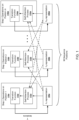
- FIG. 1 is a diagram that illustrates the operations of an example Universal Transformer on a sequence.
- the computational structure illustrated in FIG. 1 can be used to implement an encoder or a decoder on an encoder computer system or a decoder computer system having one or more computers in one or more locations.
- the example will be described as being implemented on a system of one or more computers.
- the computational structure of the Universal Transformer can be implemented on parallel processing systems, with each computational resource of a parallel processing system performing the operations of one or more positions in the sequence.
- the system can perform a same series of encoding or decoding operations over M sequence positions, possibly in parallel, for T iterations. As will be described in more detail below, in some implementations the system can adaptively devote more computing resources to some positions and less resources to other positions. In some implementations, the system uses the same parameter values across all positions and all time steps.
- each time step at each position can include at least a self-attention process and a transition function.
- the system can process the first element in the sequence, the hi representation 105a, using a self-attention process 112a and a transition function 114a. The system can then update the hi representation 105a and repeat the same steps for T iterations.
- the system can process the second element in the sequence, the h 2 representation 105b, for T iterations using a self-attention process 112b followed by a transition function 114b and an update of the h 2 representation 105b.
- the system can process the last element in the sequence, the h m representation 105m, for T iterations using a self-attention process 112m followed by a transition function 114m and an update of the h m representation 105m.
- each of the step operations can be implemented by different streaming multiprocessors of a GPU or different processing cores of a multicore CPU.
- each of the step operations can be performed by different computers in a distributed system.
- the self-attention processes 112a-m for each sequence position can use as input the current representations of other sequence positions.
- the system can condition the output for a particular position on the representations so far generated for one or more other positions.
- the representations can be stored in a centrally accessible location or broadcasted after each step to all processors performing the operations.
- the self-attention process for the decoder can also include a second stage attention process that uses as input the final representations generated by the encoder.
- FIG. 2 is a flowchart of an example process for encoding a source sequence.
- the example process can be performed by an appropriately programmed system of one or more computers in one or more locations.
- the process will be described as being performed by a system of one or more computers.
- the system receives an input sequence (210).
- the Universal Transformer is widely applicable to a large collection of sequence-to-sequence learning tasks.
- the input sequence can be any appropriate input sequence of elements in a sequence-to-sequence learning task.
- Common sequence-to-sequence learning tasks include question-answering tasks, in which case the input sequence is words in a question sentence; subject-verb agreement tasks, in which case the input sequence is words a natural language sentence; predicting missing target words, in which case the input sequence is one or more preceding natural language sentences; algorithmic tasks, in which case the input sequence can be a sequence of symbols, e.g., integers; program evaluation and memorization tasks, in which case the input is symbols in a computer program; machine-translation tasks, in which case the input is words of a natural language sentence in a first language.
- question-answering tasks in which case the input sequence is words in a question sentence
- subject-verb agreement tasks in which case the input sequence is words a natural language sentence
- predicting missing target words in which case the input sequence is one or more preceding natural language sentences
- algorithmic tasks in which case the input sequence can be a sequence of symbols, e.g., integers
- program evaluation and memorization tasks in which case the input is symbols
- the system generates respective initial representations of elements in the input sequence (220). For example, the system can generate a vector representation for each element in the input sequence.
- the system can initialize a matrix H 0 ⁇ R m ⁇ d , with m rows, one for each item of the input sequence, with the d elements of the representation of the item in the d columns of the matrix in the row.
- the system can generate the input representations that are respective word embeddings of the words in which the word embeddings are vector representations of the words.
- the system then repeatedly revises the representations using a self-attention process and a transition function for multiple steps.
- the system revises the representations (230), and determines whether a stop-encoding condition is reached for each input element (240).
- the stop-encoding condition for each input element is a minimum number of revision steps T.
- the system can dynamically determine to allocate more processing resources to these more ambiguous symbols.
- the system can use Adaptive Computation Time as a mechanism for dynamically modulating the number of computational steps needed to process each input element.
- a Universal Transformer with dynamic halting thus modulates the number of computational steps needed to process each input symbol dynamically.
- the number of steps can be based on a scalar pondering value that is predicted by the model at each step. The pondering values are in a sense the model's estimation of how much further computation is required for the input symbols at each processing step.
- the system performs another revision step (branch to 230).
- the system can apply the same series of operations iteratively on every step by recursively applying the same series of operations.
- the system also uses the same learned parameter values for each step.
- the system can compute an updated representation H t .
- the system can apply a multihead dot product self-attention mechanism followed by a recurrent transition function.
- the system also uses residual connections around each of these computations and applies dropout and layer normalization.
- the system computes the updated representation of Ht according to: where where the P t terms are two-dimensional (position, time) coordinate embeddings, obtained by computing vertically and horizontally the sinusoidal position embedding vectors according to: for the position and the time step separately (pos) for each dimension (i). The system can then sum these component-wise before applying the self-attention process.
- the self-attention process can be computed as a multihead self-attention with k heads according to: where the projections are the following learned parameter matrices: and the attention is a scaled dot product attention computed according to: where d is the number of columns of Q, K and V and the dimension of the symbol representations.
- the system can tailor the transition function to the particular task.
- the system can use a separable convolution or a fully-connected neural network having a single rectified-linear activation function between two linear transformations, applied position-wise, e.g., individually to each row of A t .
- the system After the stop-encoding condition is reached, e.g., after T steps, the system provides final representations to the decoder (250).
- the final output is a matrix of vector representations H T for the input sequence.
- FIG. 3 is a flowchart of an example process for decoding a target sequence.
- the decoding process can share the same basic structure in depth as the encoder process, but performs an additional self-attention stage that uses the final encoder representations.
- the system can implement the Universal Transformer by running the encoder process with T steps once, followed by running the decoder process with N steps each autoregressively multiple times for each element in the target sequence.
- the example process can be performed by an appropriately programmed system of one or more computers in one or more locations. The process will be described as being performed by a system of one or more computers.
- the system receives an initial target sequence (310).
- the system can generate the initial target sequence according to the task at hand. For example, tasks related to natural language processing and machine translation, the system can initialize an answer sequence. For tasks relating to algorithmic process and program evaluation, the system can initialize a sequence of symbols.
- the system revises a representation of the next predicted element in the target sequence using two-stage self-attention and a transition function (320).
- the system can use the same structure as the encoder, with a first self-attention stage.
- the system can additionally apply a second self-attention stage using the final encoder representations of the input sequence using a multihead dot product attention function.
- the system can use queries Q obtained from projecting the decoder representations and keys K and values V obtained from projecting the encoder representations.
- the system can autoregressively determine each next symbol in the sequence, which means that each output in the target sequence is conditioned on all of the previously generated outputs in the target sequence.
- the system determines whether a stop-decoding condition is met for the next element in the target sequence (330).
- the system uses a fixed number of steps N, which may or may not be equal to the number of steps T used by the encoder process.
- the system can adaptively alter the number of steps in the decoding process for the next symbol depending on the position of the next symbol. For example, the system can apply the Adaptive Computation Time (ACT) halting mechanism at each position and copy the state to the next step after a block is halted, until all blocks are halted or the predetermined maximum number of steps have been performed.
- ACT Adaptive Computation Time
- the system again performs another step of revisions for the next element in the target sequence (branch to 320).
- the system determines whether there are more elements to decode (branch to 340).
- the model is trained to generate a special end-of-sequence symbol when there are no more output elements to be decoded. Therefore, the system can continue the process until the decoder generates the end-of-sequence symbol.
- the system begins revising a representation of the next element in the target sequence (branch to 320).
- the system provides a final transformed output sequence (branch to 350).
- the system can apply an affine transformation O from the final state to an output vocabulary size, followed by the following softmax function: p y pos
- y 1 : pos ⁇ 1 , H T softmax OH T .
- the system can perform teacher-forced training in which the decoder input is the target output shifted to the right by one position.
- the system can further mask the decoder self-attention distributions so that the model can only attend to positions to the left of any predicted symbol.
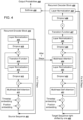
- FIG. 4 illustrates an example architecture of a Universal Transformer.
- the Universal Transformer includes a recurrent encoder block 410 and a recurrent decoder block 420.
- Each of these blocks can be implemented using respective computing resources, and, as described above, the blocks can have multiple instances for each element in an input sequence.
- the encoder block 410 is illustrated in FIG. 4 as receiving a source sequence 401.
- a system can use multiple instances of the encoder block for each element in the source sequence 401, which can be executed for T steps in parallel.
- the representation of the source sequence 401 in FIG. 4 can be interpreted as a matrix with each row being a different representation of a different element in the source sequence 401.
- the encoder block 401 can receive the source sequence 401 and add position and timestep embeddings.
- the encoder block 410 can then perform a multihead self-attention process 411, followed by layers of dropout 412 and layer normalization 413.
- the encoder block 410 can then perform a transition function 414 followed by another layer of dropout 415 and layer normalization 416.
- the encoder block then repeats these operations for T steps, each time revising the representation of each element in the source sequence 401.
- the encoder block 410 provides the final representations of the elements in the source sequence 401 to the decoder block 420.
- the number of steps for each input element can differ. For elements whose encoding block has halted, the system can simply copy the halted representation to the next step.
- the decoder block 420 is illustrated in FIG. 4 as receiving a target sequence 402.
- a system can use multiple instances of the decoder block for multiple steps for each element so far generated in the target sequence.
- the number of decoder blocks can grow as more elements are generated in the target sequence.
- the system can execute each of the decoder blocks for each of the elements in the target sequence in parallel.
- the decoder block 420 can receive the target sequence 402 and add position and timestep embeddings. The decoder block 420 can then perform a multihead self-attention process 421, followed by layers of dropout 422 and layer normalization 423. The decoder block 420 can then perform a second stage of attention, with a multihead attention process 424 conditioned on the final representations generated by the encoder block 410.
- the decoder block 420 can then perform additional layers of dropout 425 and layer normalization 426 before performing a transition function 427.
- the decoder block 420 can perform final layers of dropout 428 and layer normalization 429.
- the decoder block 420 can repeat these operations for multiple steps for each element in the target sequence. As described above, the number of steps can be dynamically selected by the model for each position to be decoded.
- the system applies a final softmax layer 430 to generate final output probabilities 440.
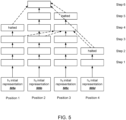
- FIG. 5 illustrates dynamic selection of a number of processing steps per element in a sequence. As shown, the sequence has four elements, each with a respective initial representation 505a, 505b, 505c, and 505d.
- the system can generate in parallel four revised representations using respective encoder or decoder blocks for each position.
- step 2 the block for position 4 halts, while the system generates three revised representations for the other positions.
- the system generates three revised representations for the three positions that have not yet halted.
- step 5 the block for position 3 halts, and the system generates a revised representation only for position 2.
- step 6 the system generates a revised representation for position 2 using representations generated on three different steps: the representation from step 5 for position 3, the representation from step 4 for position 1, and the representation from step 2 for position 4.
- the final output of the process is then the collection of the final halted representations at each position.
- the goal is to answer a question given a number of English sentences that encode potentially multiple supporting facts.
- the goal is to measure various forms of language understanding by requiring a certain type of reasoning over the linguistic facts presented in each story.
- a standard Transformer does not achieve good results on this type of task.
- the system can first encode each fact in the story by applying a learned multiplicative positional mask to each word's embedding, and summing up all embeddings. Models can either be trained on each task separately (“train single") or jointly on all tasks (“train joint”). The system can embed the question in the same way, and then feed the Universal Transformer with these embeddings of the facts and questions.
- the goal is to predict number-agreement between subjects and verbs in English.
- This task acts as a proxy for measuring the ability of a model to capture hierarchical dependency structure in natural language sentences.
- the system can use a language modeling training setup, i.e., a next word prediction objective, followed by calculating the ranking accuracy of the target verb at test time.
- the Universal Transformer was evaluated on subsets of the test data with different task difficulty, measured in terms of agreement attractors - the number of intervening nouns with the opposite number from the subject (meant to confuse the model). For example, given the sentence," The keys to the cabinet,” the objective during training is to predict the verb are (plural).
- the ranking accuracy of the agreement attractors is evaluated: i.e.
- the goal is to predict missing target words, in which case the input sequence is one or more preceding natural language sentences.
- the dataset was specifically designed so that humans are able to accurately predict the target word when shown the full context, but not when only shown the target sentence in which it appears. It therefore goes beyond language modeling and tests the ability of a model to incorporate broader discourse and longer term context when predicting the target word.
- the task was evaluated in two settings: as language modeling (the standard setup) and as reading comprehension. In the former (more challenging) case, a model was simply trained for nextword prediction on the training data, and evaluated on the target words at test time. In other words, the model was trained to predict all words, not specifically challenging target words.
- the Universal Transformer For learning-to-execute tasks, e.g., program evaluation and memorization, the Universal Transformer was evaluated on tasks indicating the ability of a model to learn to execute computer programs. These tasks include program evaluation tasks (program, control, and addition), and memorization tasks (copy, double, and reverse). Without using any curriculum learning strategy during training and without using target sequences at test time, the Universal Transformer achieves perfect scores in all the memorization tasks and also outperforms both LSTMs and Transformers in all program evaluation tasks by a wide margin.
- the Universal Transformer can also be adapted for use on other sequence-to-sequence tasks.
- One example application is speech-to-text conversion, in which case the input sequence is representations of sound waves and the output sequence is text in a particular language.
- Another example is text-to-speech conversion, in which case the input sequence is text, and the output sequence is representations of sound waves.
- Another example application is image generation.
- Another example application is robotic control.
- the sequence of inputs may comprise images (e.g. images comprising pixel data), for instance images of or from a physical system, and the corresponding output may include a sequence of actions for controlling a machine or robot, which may operate in or with the physical system.
- Embodiments of the subject matter and the actions and operations described in this specification can be implemented in digital electronic circuitry, in tangibly-embodied computer software or firmware, in computer hardware, including the structures disclosed in this specification and their structural equivalents, or in combinations of one or more of them.
- Embodiments of the subject matter described in this specification can be implemented as one or more computer programs, i.e., one or more modules of computer program instructions encoded on a tangible non-transitory storage medium for execution by, or to control the operation of, data processing apparatus.
- the program instructions can be encoded on an artificially-generated propagated signal, e.g., a machinegenerated electrical, optical, or electromagnetic signal, that is generated to encode information for transmission to suitable receiver apparatus for execution by a data processing apparatus.
- the computer storage medium can be or be part of a machine-readable storage device, a machine-readable storage substrate, a random or serial access memory device, or a combination of one or more of them.
- a computer storage medium is not a propagated signal.
- data processing apparatus encompasses all kinds of apparatus, devices, and machines for processing data, including by way of example a programmable processor, a computer, or multiple processors or computers.
- Data processing apparatus can include special-purpose logic circuitry, e.g., an FPGA (field programmable gate array), an ASIC (application-specific integrated circuit), or a GPU (graphics processing unit).
- the apparatus can also include, in addition to hardware, code that creates an execution environment for computer programs, e.g., code that constitutes processor firmware, a protocol stack, a database management system, an operating system, or a combination of one or more of them.
- a computer program may, but need not, correspond to a file in a file system.
- a computer program can be stored in a portion of a file that holds other programs or data, e.g., one or more scripts stored in a markup language document, in a single file dedicated to the program in question, or in multiple coordinated files, e.g., files that store one or more modules, sub-programs, or portions of code.
- the processes and logic flows described in this specification can be performed by one or more computers executing one or more computer programs to perform operations by operating on input data and generating output.
- the processes and logic flows can also be performed by special-purpose logic circuitry, e.g., an FPGA, an ASIC, or a GPU, or by a combination of special-purpose logic circuitry and one or more programmed computers.
- Computers suitable for the execution of a computer program can be based on general or special-purpose microprocessors or both, or any other kind of central processing unit.
- a central processing unit will receive instructions and data from a read-only memory or a random access memory or both.
- the essential elements of a computer are a central processing unit for executing instructions and one or more memory devices for storing instructions and data.
- the central processing unit and the memory can be supplemented by, or incorporated in, special-purpose logic circuitry.
- a computer will also include, or be operatively coupled to receive data from or transfer data to one or more mass storage devices.
- the mass storage devices can be, for example, magnetic, magneto-optical, or optical disks, or solid state drives.
- a computer need not have such devices.
- a computer can be embedded in another device, e.g., a mobile telephone, a personal digital assistant (PDA), a mobile audio or video player, a game console, a Global Positioning System (GPS) receiver, or a portable storage device, e.g., a universal serial bus (USB) flash drive, to name just a few.
- PDA personal digital assistant
- GPS Global Positioning System
- USB universal serial bus
- embodiments of the subject matter described in this specification can be implemented on, or configured to communicate with, a computer having a display device, e.g., a LCD (liquid crystal display) monitor, for displaying information to the user, and an input device by which the user can provide input to the computer, e.g., a keyboard and a pointing device, e.g., a mouse, a trackball or touchpad.
- a display device e.g., a LCD (liquid crystal display) monitor
- an input device by which the user can provide input to the computer e.g., a keyboard and a pointing device, e.g., a mouse, a trackball or touchpad.
- Other kinds of devices can be used to provide for interaction with a user as well; for example, feedback provided to the user can be any form of sensory feedback, e.g., visual feedback, auditory feedback, or tactile feedback; and input from the user can be received in any form, including acoustic, speech, or tactile input.
- a computer can interact with a user by sending documents to and receiving documents from a device that is used by the user; for example, by sending web pages to a web browser on a user's device in response to requests received from the web browser, or by interacting with an app running on a user device, e.g., a smartphone or electronic tablet.
- a computer can interact with a user by sending text messages or other forms of message to a personal device, e.g., a smartphone that is running a messaging application, and receiving responsive messages from the user in return.
Landscapes
- Engineering & Computer Science (AREA)
- Physics & Mathematics (AREA)
- Theoretical Computer Science (AREA)
- Mathematical Physics (AREA)
- General Physics & Mathematics (AREA)
- Data Mining & Analysis (AREA)
- Software Systems (AREA)
- General Engineering & Computer Science (AREA)
- Computing Systems (AREA)
- Health & Medical Sciences (AREA)
- General Health & Medical Sciences (AREA)
- Molecular Biology (AREA)
- Computational Linguistics (AREA)
- Biophysics (AREA)
- Biomedical Technology (AREA)
- Artificial Intelligence (AREA)
- Life Sciences & Earth Sciences (AREA)
- Evolutionary Computation (AREA)
- Computational Mathematics (AREA)
- Mathematical Analysis (AREA)
- Mathematical Optimization (AREA)
- Pure & Applied Mathematics (AREA)
- Algebra (AREA)
- Databases & Information Systems (AREA)
- Machine Translation (AREA)
Description
- Self-attentive feed-forward sequence models such as the Transformer have been shown to achieve impressive results on sequence modeling tasks including machine translation, image generation and constituency parsing, presenting a compelling alternative to recurrent neural networks, the de facto standard architecture for many sequence modeling problems. Despite these successes, however, the Transformer fails to generalize in some tasks recurrent models handle with ease. This includes copying strings or simple logical inference when the string or formula lengths exceed those observed at training time.
-
WO2018/058046 describes systems for neural machine translation, one of the systems including an encoder neural network with an input forward LSTM layer, an input backward LSTM layer, and a plurality of hidden LSTM layers, as well as a decoder subsystem. - The Transformer model is described in Vaswani et al., Attention Is All You Need, 31st Conference on Neural Information Processing Systems (NIPS 2017), Long Beach, CA, USA, available at https://papers.nips.cc/paper/7181-attention-is-all-you-need.pdf.
- This specification describes systems that implement a Universal Transformer. The invention is defined by the independent claims. Preferred embodiments are defined by the dependent claims.
- Universal Transformers address, among others, the shortcomings described in the Background, above. Instead of the common sequence-aligned recurrence, the Universal Transformer is recurrent in depth, while employing self-attention to combine information from different parts of sequences.
- The Universal Transformer combines the desirable parallelizability of self-attentive feed-forward models with an inductive bias well suited to a range of algorithmic and natural language problems. By tying parameters across layers (depth), the Universal Transformer can be seen as iteratively refining its encoding of the sequence by applying a recurrent transformation in parallel over all symbols in the sequence for several steps (in depth).
- The Universal Transformer has additional computationally advantageous features. For example, unlike the Transformer model, the Universal Transformer is computationally universal, meaning that the model can be used to simulate any Turing machine. In addition, number of computational steps of the Universal Transformer can be varied dynamically after training because the model shares weights across its sequential computational steps. Thus, the depth employed by the model can be scaled dynamically to the size and/or complexity of the input sequence.
- In experiments on several tasks, the Universal Transformer consistently improves significantly over both a feed-forward Transformer and an LSTM (Long short-term memory) recurrent neural network.
- An adaptive variant of the Universal Transformer employs an adaptive computation time mechanism per position in the sequence. When running for a fixed number of steps the Universal Transformer is equivalent to a Transformer whose parameters are tied across layers. In its adaptive form, however, the Universal Transformer can effectively interpolate between the feed-forward, fixed depth Transformer and a gated, recurrent architecture running for a number of steps dependent on the input data. In experiments, the adaptive variant achieves state of the art results on multiple language understanding tasks.
- The Universal Transformer optionally applies a dynamic Adaptive Computation Time (ACT) halting mechanism at each position of the sequence. ACT mechanisms are described in Graves, Adaptive computation time for recurrent neural networks, arXiv preprint arXiv: 1603.08983, 2016, available at https://arxiv.org/pdf/1603.08983.pdf.
- The subject matter described in this specification can be implemented in particular embodiments so as to realize one or more of the following advantages.
- A Universal Transformer system of the type described can be used to implement autoregressive sequence-to-sequence models wherever such models are used to generate outputs. Examples of applications of autoregressive models include machine translation of one natural language to another, summarization of natural language text, in which the outputs are sequences of words in sentences, speech to text, and text to speech, involving sequences of words and phonemes. Other example applications include image generation, language modeling, and parsing, e.g., constituency parsing. Other examples include applications based on sequences of images, including applications in self-driving cars and robotics control. For example, from a sequence of inputs, e.g., images, of or from a physical system, real or virtual, that includes such model, can output a sequence of actions for controlling a machine operating in or with the physical system.
- The techniques can be implemented advantageously in computer systems with GPUs and other accelerator hardware to exploit the parallel computational structure of the Universal Transformer.
- The details of one or more embodiments of the subject matter of this specification are set forth in the accompanying drawings and the description below. Other features, aspects, and advantages of the subject matter will become apparent from the description, the drawings, and the claims.
-
-
FIG. 1 is a diagram that illustrates the operations of an example Universal Transformer on a sequence. -
FIG. 2 is a flowchart of an example process for encoding a source sequence. -
FIG. 3 is a flowchart of an example process for decoding a target sequence. -
FIG. 4 illustrates an example architecture of a Universal Transformer. -
FIG. 5 illustrates dynamic selection of a number of processing steps per element in a sequence. - Like reference numbers and designations in the various drawings indicate like elements.
-
FIG. 1 is a diagram that illustrates the operations of an example Universal Transformer on a sequence. The computational structure illustrated inFIG. 1 can be used to implement an encoder or a decoder on an encoder computer system or a decoder computer system having one or more computers in one or more locations. For simplicity, the example will be described as being implemented on a system of one or more computers. As described above, the computational structure of the Universal Transformer can be implemented on parallel processing systems, with each computational resource of a parallel processing system performing the operations of one or more positions in the sequence. - In general, to implement either an encoder or a decoder, the system can perform a same series of encoding or decoding operations over M sequence positions, possibly in parallel, for T iterations. As will be described in more detail below, in some implementations the system can adaptively devote more computing resources to some positions and less resources to other positions. In some implementations, the system uses the same parameter values across all positions and all time steps.
- The operations of each time step at each position can include at least a self-attention process and a transition function. For example, at step t, the system can process the first element in the sequence, the
hi representation 105a, using a self-attention process 112a and a transition function 114a. The system can then update thehi representation 105a and repeat the same steps for T iterations. Similarly, the system can process the second element in the sequence, the h2 representation 105b, for T iterations using a self-attention process 112b followed by a transition function 114b and an update of the h2 representation 105b. Likewise, the system can process the last element in the sequence, the hm representation 105m, for T iterations using a self-attention process 112m followed by a transition function 114m and an update of the hm representation 105m. - Although the computations for only three sequence positions are shown in
FIG. 1 , the sequence can have any arbitrary length. Therefore, to improve computational performance the system can implement the computations on any appropriate parallel processing hardware. For example, each of the step operations can be implemented by different streaming multiprocessors of a GPU or different processing cores of a multicore CPU. Alternatively or in addition, each of the step operations can be performed by different computers in a distributed system. - As shown in
FIG. 1 , the self-attention processes 112a-m for each sequence position can use as input the current representations of other sequence positions. In other words, at each step, the system can condition the output for a particular position on the representations so far generated for one or more other positions. When the operations are being performed with parallel processing, the representations can be stored in a centrally accessible location or broadcasted after each step to all processors performing the operations. - As will be described in more detail below, the self-attention process for the decoder can also include a second stage attention process that uses as input the final representations generated by the encoder.
-
FIG. 2 is a flowchart of an example process for encoding a source sequence. The example process can be performed by an appropriately programmed system of one or more computers in one or more locations. The process will be described as being performed by a system of one or more computers. - The system receives an input sequence (210). As described above, the Universal Transformer is widely applicable to a large collection of sequence-to-sequence learning tasks. Thus, the input sequence can be any appropriate input sequence of elements in a sequence-to-sequence learning task.
- Common sequence-to-sequence learning tasks include question-answering tasks, in which case the input sequence is words in a question sentence; subject-verb agreement tasks, in which case the input sequence is words a natural language sentence; predicting missing target words, in which case the input sequence is one or more preceding natural language sentences; algorithmic tasks, in which case the input sequence can be a sequence of symbols, e.g., integers; program evaluation and memorization tasks, in which case the input is symbols in a computer program; machine-translation tasks, in which case the input is words of a natural language sentence in a first language.
- The system generates respective initial representations of elements in the input sequence (220). For example, the system can generate a vector representation for each element in the input sequence. Thus, if the input sequence is of length m and the representations are d-dimensional, the system can initialize a matrix

- The system then repeatedly revises the representations using a self-attention process and a transition function for multiple steps. Thus, the system revises the representations (230), and determines whether a stop-encoding condition is reached for each input element (240). In some implementations, the stop-encoding condition for each input element is a minimum number of revision steps T.
- However, in sequence processing systems, certain symbols, e.g. some words or phonemes, are usually more ambiguous than others. Therefore, the system can dynamically determine to allocate more processing resources to these more ambiguous symbols. For example, the system can use Adaptive Computation Time as a mechanism for dynamically modulating the number of computational steps needed to process each input element. A Universal Transformer with dynamic halting thus modulates the number of computational steps needed to process each input symbol dynamically. The number of steps can be based on a scalar pondering value that is predicted by the model at each step. The pondering values are in a sense the model's estimation of how much further computation is required for the input symbols at each processing step.
- Once the per-element recurrent block halts (indicating a sufficient number of revisions for that element), its representation is simply copied to the next step until all blocks halt or until a maximum number of steps is reached.
- If the stop-encoding condition has not been met, the system performs another revision step (branch to 230).
- The system can apply the same series of operations iteratively on every step by recursively applying the same series of operations. In some implementations, the system also uses the same learned parameter values for each step.
- For example, at each revision step t from 1 to T, the system can compute an updated representation Ht. To do so, the system can apply a multihead dot product self-attention mechanism followed by a recurrent transition function. In some implementations, the system also uses residual connections around each of these computations and applies dropout and layer normalization. In some implementations, the system computes the updated representation of Ht according to:


- The self-attention process can be computed as a multihead self-attention with k heads according to:


- The system can tailor the transition function to the particular task. For example, the system can use a separable convolution or a fully-connected neural network having a single rectified-linear activation function between two linear transformations, applied position-wise, e.g., individually to each row of At.
- After the stop-encoding condition is reached, e.g., after T steps, the system provides final representations to the decoder (250). In some implementations, the final output is a matrix of vector representations HT for the input sequence.
-
FIG. 3 is a flowchart of an example process for decoding a target sequence. As described above, the decoding process can share the same basic structure in depth as the encoder process, but performs an additional self-attention stage that uses the final encoder representations. As shown byFIGS. 2 and3 , the system can implement the Universal Transformer by running the encoder process with T steps once, followed by running the decoder process with N steps each autoregressively multiple times for each element in the target sequence. The example process can be performed by an appropriately programmed system of one or more computers in one or more locations. The process will be described as being performed by a system of one or more computers. - The system receives an initial target sequence (310). The system can generate the initial target sequence according to the task at hand. For example, tasks related to natural language processing and machine translation, the system can initialize an answer sequence. For tasks relating to algorithmic process and program evaluation, the system can initialize a sequence of symbols.
- The system revises a representation of the next predicted element in the target sequence using two-stage self-attention and a transition function (320). The system can use the same structure as the encoder, with a first self-attention stage. The system can additionally apply a second self-attention stage using the final encoder representations of the input sequence using a multihead dot product attention function. In the second self-attention stage, the system can use queries Q obtained from projecting the decoder representations and keys K and values V obtained from projecting the encoder representations. The system can autoregressively determine each next symbol in the sequence, which means that each output in the target sequence is conditioned on all of the previously generated outputs in the target sequence.
- The system determines whether a stop-decoding condition is met for the next element in the target sequence (330). In some implementations, the system uses a fixed number of steps N, which may or may not be equal to the number of steps T used by the encoder process.
- Alternatively or in addition, the system can adaptively alter the number of steps in the decoding process for the next symbol depending on the position of the next symbol. For example, the system can apply the Adaptive Computation Time (ACT) halting mechanism at each position and copy the state to the next step after a block is halted, until all blocks are halted or the predetermined maximum number of steps have been performed.
- If the stop-decoding condition is not met, the system again performs another step of revisions for the next element in the target sequence (branch to 320).
- Otherwise, the system determines whether there are more elements to decode (branch to 340). In some implementations, the model is trained to generate a special end-of-sequence symbol when there are no more output elements to be decoded. Therefore, the system can continue the process until the decoder generates the end-of-sequence symbol.
- If there are more elements to decode, the system begins revising a representation of the next element in the target sequence (branch to 320).
- If there are no more elements to decode, the system provides a final transformed output sequence (branch to 350). To obtain the per-symbol target distributions at
positions 1 through n, the system can apply an affine transformation O from the final state to an output vocabulary size, followed by the following softmax function:
- During the training process, the system can perform teacher-forced training in which the decoder input is the target output shifted to the right by one position. The system can further mask the decoder self-attention distributions so that the model can only attend to positions to the left of any predicted symbol.
-
FIG. 4 illustrates an example architecture of a Universal Transformer. As described above, the Universal Transformer includes arecurrent encoder block 410 and arecurrent decoder block 420. Each of these blocks can be implemented using respective computing resources, and, as described above, the blocks can have multiple instances for each element in an input sequence. - For ease of illustration the
encoder block 410 is illustrated inFIG. 4 as receiving asource sequence 401. However, as described above, a system can use multiple instances of the encoder block for each element in thesource sequence 401, which can be executed for T steps in parallel. Thus, the representation of thesource sequence 401 inFIG. 4 can be interpreted as a matrix with each row being a different representation of a different element in thesource sequence 401. - In operation, the
encoder block 401 can receive thesource sequence 401 and add position and timestep embeddings. Theencoder block 410 can then perform a multihead self-attention process 411, followed by layers ofdropout 412 andlayer normalization 413. Theencoder block 410 can then perform atransition function 414 followed by another layer ofdropout 415 andlayer normalization 416. - The encoder block then repeats these operations for T steps, each time revising the representation of each element in the
source sequence 401. After T steps, theencoder block 410 provides the final representations of the elements in thesource sequence 401 to thedecoder block 420. As described above, the number of steps for each input element can differ. For elements whose encoding block has halted, the system can simply copy the halted representation to the next step. - For ease of illustration, the
decoder block 420 is illustrated inFIG. 4 as receiving a target sequence 402. However, as described above, a system can use multiple instances of the decoder block for multiple steps for each element so far generated in the target sequence. In other words, the number of decoder blocks can grow as more elements are generated in the target sequence. The system can execute each of the decoder blocks for each of the elements in the target sequence in parallel. - In operation, the
decoder block 420 can receive the target sequence 402 and add position and timestep embeddings. Thedecoder block 420 can then perform a multihead self-attention process 421, followed by layers ofdropout 422 andlayer normalization 423. Thedecoder block 420 can then perform a second stage of attention, with amultihead attention process 424 conditioned on the final representations generated by theencoder block 410. - The
decoder block 420 can then perform additional layers ofdropout 425 andlayer normalization 426 before performing atransition function 427. Thedecoder block 420 can perform final layers ofdropout 428 andlayer normalization 429. - The
decoder block 420 can repeat these operations for multiple steps for each element in the target sequence. As described above, the number of steps can be dynamically selected by the model for each position to be decoded. - After the N steps of decoding have completed, the system applies a
final softmax layer 430 to generatefinal output probabilities 440. -
FIG. 5 illustrates dynamic selection of a number of processing steps per element in a sequence. As shown, the sequence has four elements, each with a respectiveinitial representation - At
step 1, the system can generate in parallel four revised representations using respective encoder or decoder blocks for each position. - At
step 2, the block forposition 4 halts, while the system generates three revised representations for the other positions. - At
step 3, the system generates three revised representations for the three positions that have not yet halted. - At
step 4, the block forposition 1 halts. The system generates two revised representations for the other positions that have not halted atposition 2 andposition 3. - The dashed lines in
FIG. 5 represent the inputs to the self-attention process used to generate the revised representations. Thus, atstep 4, the system generates the revised representation forposition 3 by using the representations of the other positions as input to the self-attention process. Notably, as shown inFIG. 5 the system uses the halted representation forposition 4 fromstep 2, while using representations fromstep 3 forpositions - At
step 5, the block forposition 3 halts, and the system generates a revised representation only forposition 2. - Similarly, at
step 6, the system generates a revised representation forposition 2 using representations generated on three different steps: the representation fromstep 5 forposition 3, the representation fromstep 4 forposition 1, and the representation fromstep 2 forposition 4. - The final output of the process is then the collection of the final halted representations at each position.
- As described above, systems and methods described herein may be applied to a variety of technical tasks, a few of which will now be described in more detail.
- For example, for question-answering tasks the goal is to answer a question given a number of English sentences that encode potentially multiple supporting facts. The goal is to measure various forms of language understanding by requiring a certain type of reasoning over the linguistic facts presented in each story. A standard Transformer does not achieve good results on this type of task. To encode the input, the system can first encode each fact in the story by applying a learned multiplicative positional mask to each word's embedding, and summing up all embeddings. Models can either be trained on each task separately ("train single") or jointly on all tasks ("train joint"). The system can embed the question in the same way, and then feed the Universal Transformer with these embeddings of the facts and questions. Over 10 runs with different initializations and using the best model based on performance on the validation set, both the Universal Transformer and Universal Transformer with dynamic halting achieve state-of-the-art results on all tasks in terms of average error and number of failed tasks. TABLE 1 summarizes the results.
TABLE 1 Model 10K examples 1K examples Previous Best Results QRNet (Seo et al., 2016) 0.3 (0/20) Sparse DNC (Rae et al., 2016) 2.9 (1/20) GA+MAGE (Dhingra et al. 2017) 8.7 (5/20) MemN2N (Sukhbaatar et al. 2015) 12.4 (11/20) Transformer (Vaswani et al., 2017) 15.2 (10/20) 22.1 (12/20) 21.8 (5/20) 26.8 (14/20) Universal Transformer Results Universal Transformer 0.23 (0/20) 0.47 (0/20) 5.31 (5/20) 8.50 (8/20) Universal Transformer with dynamic halting 0.21 (0/20) 0.29 (0/20) 4.55 (3/20) 7.78 (5/20) - For subject-verb agreement tasks, the goal is to predict number-agreement between subjects and verbs in English. This task acts as a proxy for measuring the ability of a model to capture hierarchical dependency structure in natural language sentences. The system can use a language modeling training setup, i.e., a next word prediction objective, followed by calculating the ranking accuracy of the target verb at test time. The Universal Transformer was evaluated on subsets of the test data with different task difficulty, measured in terms of agreement attractors - the number of intervening nouns with the opposite number from the subject (meant to confuse the model). For example, given the sentence," The keys to the cabinet," the objective during training is to predict the verb are (plural). At test time, the ranking accuracy of the agreement attractors is evaluated: i.e. the goal is to rank "are" higher than is in this case. The best LSTM with attention from the literature achieves 99.18% on this task, which outperforms a regular Transformer. The Universal Transformer significantly outperforms standard Transformers and achieves an average result comparable to the current state of the art (99.2%). However, the Universal Transformers (and particularly with dynamic halting) perform progressively better than all other models as the number of attractors increases. TABLE 2 summarizes the results.
TABLE 2 Model Number of Attractors 0 1 2 3 4 5 Total Previous best results (Yogatama et al., 2018) Best Stack-RNN 0.994 0.979 0.965 0.935 0.916 0.880 0.992 Best LSTM 0.993 0.972 0.950 0.922 0.900 0.842 0.991 Best Attention 0.994 0.977 0.959 0.929 0.907 0.842 0.992 Universal Transformer Universal Transformer 0.993 0.971 0.969 0.940 0.921 0.892 0.992 Universal Transformer with dynamic halting 0.994 0.969 0.967 0.944 0.932 0.907 0.992 - For language modeling tasks, the goal is to predict missing target words, in which case the input sequence is one or more preceding natural language sentences. The dataset was specifically designed so that humans are able to accurately predict the target word when shown the full context, but not when only shown the target sentence in which it appears. It therefore goes beyond language modeling and tests the ability of a model to incorporate broader discourse and longer term context when predicting the target word. The task was evaluated in two settings: as language modeling (the standard setup) and as reading comprehension. In the former (more challenging) case, a model was simply trained for nextword prediction on the training data, and evaluated on the target words at test time. In other words, the model was trained to predict all words, not specifically challenging target words. In the latter setting, the target sentence (minus the last word) was used as query for selecting the target word from the context sentences. In this task, the Universal Transformer achieves state-of-the-art results in both the language modeling and reading comprehension setup, outperforming both LSTMs and normal Transformers. In this experiment, the control set was constructed similar to the language modeling development and test sets, but without filtering them in any way, so achieving good results on this set shows a model's strength in standard language modeling.
- For algorithmic tasks, the goal is to perform a symbol transformation from one sequence to another, e.g. Copy, Reverse, and integer Addition. In an experiment in which the model was trained with sequences of length 40 and evaluated on sequences of length 400, the system trained Universal Transformers using positions starting with randomized offsets to further encourage the model to learn position-relative transformations. The Universal Transformer outperformed both LSTM and the normal Transformer by a wide margin on all three tasks.
- For learning-to-execute tasks, e.g., program evaluation and memorization, the Universal Transformer was evaluated on tasks indicating the ability of a model to learn to execute computer programs. These tasks include program evaluation tasks (program, control, and addition), and memorization tasks (copy, double, and reverse). Without using any curriculum learning strategy during training and without using target sequences at test time, the Universal Transformer achieves perfect scores in all the memorization tasks and also outperforms both LSTMs and Transformers in all program evaluation tasks by a wide margin.
- For machine translation, the Universal Transformer was evaluated by training an English-German translation task. The Universal Transformer with a fully-connected recurrent transition function (instead of separable convolution) and without ACT improves by 0.9 BLEU over a Transformer and 0.5 BLEU over a Weighted Transformer with approximately the same number of parameters.
- The Universal Transformer can also be adapted for use on other sequence-to-sequence tasks. One example application is speech-to-text conversion, in which case the input sequence is representations of sound waves and the output sequence is text in a particular language. Another example is text-to-speech conversion, in which case the input sequence is text, and the output sequence is representations of sound waves. Another example application is image generation. Another example application is robotic control. For example, in some implementations, the sequence of inputs may comprise images (e.g. images comprising pixel data), for instance images of or from a physical system, and the corresponding output may include a sequence of actions for controlling a machine or robot, which may operate in or with the physical system.
- Embodiments of the subject matter and the actions and operations described in this specification can be implemented in digital electronic circuitry, in tangibly-embodied computer software or firmware, in computer hardware, including the structures disclosed in this specification and their structural equivalents, or in combinations of one or more of them. Embodiments of the subject matter described in this specification can be implemented as one or more computer programs, i.e., one or more modules of computer program instructions encoded on a tangible non-transitory storage medium for execution by, or to control the operation of, data processing apparatus. Alternatively or in addition, the program instructions can be encoded on an artificially-generated propagated signal, e.g., a machinegenerated electrical, optical, or electromagnetic signal, that is generated to encode information for transmission to suitable receiver apparatus for execution by a data processing apparatus. The computer storage medium can be or be part of a machine-readable storage device, a machine-readable storage substrate, a random or serial access memory device, or a combination of one or more of them. A computer storage medium is not a propagated signal.
- The term "data processing apparatus" encompasses all kinds of apparatus, devices, and machines for processing data, including by way of example a programmable processor, a computer, or multiple processors or computers. Data processing apparatus can include special-purpose logic circuitry, e.g., an FPGA (field programmable gate array), an ASIC (application-specific integrated circuit), or a GPU (graphics processing unit). The apparatus can also include, in addition to hardware, code that creates an execution environment for computer programs, e.g., code that constitutes processor firmware, a protocol stack, a database management system, an operating system, or a combination of one or more of them.
- A computer program, which may also be referred to or described as a program, software, a software application, an app, a module, a software module, an engine, a script, or code, can be written in any form of programming language, including compiled or interpreted languages, or declarative or procedural languages; and it can be deployed in any form, including as a stand-alone program or as a module, component, engine, subroutine, or other unit suitable for executing in a computing environment, which environment may include one or more computers interconnected by a data communication network in one or more locations.
- A computer program may, but need not, correspond to a file in a file system. A computer program can be stored in a portion of a file that holds other programs or data, e.g., one or more scripts stored in a markup language document, in a single file dedicated to the program in question, or in multiple coordinated files, e.g., files that store one or more modules, sub-programs, or portions of code.
- The processes and logic flows described in this specification can be performed by one or more computers executing one or more computer programs to perform operations by operating on input data and generating output. The processes and logic flows can also be performed by special-purpose logic circuitry, e.g., an FPGA, an ASIC, or a GPU, or by a combination of special-purpose logic circuitry and one or more programmed computers.
- Computers suitable for the execution of a computer program can be based on general or special-purpose microprocessors or both, or any other kind of central processing unit. Generally, a central processing unit will receive instructions and data from a read-only memory or a random access memory or both. The essential elements of a computer are a central processing unit for executing instructions and one or more memory devices for storing instructions and data. The central processing unit and the memory can be supplemented by, or incorporated in, special-purpose logic circuitry.
- Generally, a computer will also include, or be operatively coupled to receive data from or transfer data to one or more mass storage devices. The mass storage devices can be, for example, magnetic, magneto-optical, or optical disks, or solid state drives. However, a computer need not have such devices. Moreover, a computer can be embedded in another device, e.g., a mobile telephone, a personal digital assistant (PDA), a mobile audio or video player, a game console, a Global Positioning System (GPS) receiver, or a portable storage device, e.g., a universal serial bus (USB) flash drive, to name just a few.
- To provide for interaction with a user, embodiments of the subject matter described in this specification can be implemented on, or configured to communicate with, a computer having a display device, e.g., a LCD (liquid crystal display) monitor, for displaying information to the user, and an input device by which the user can provide input to the computer, e.g., a keyboard and a pointing device, e.g., a mouse, a trackball or touchpad. Other kinds of devices can be used to provide for interaction with a user as well; for example, feedback provided to the user can be any form of sensory feedback, e.g., visual feedback, auditory feedback, or tactile feedback; and input from the user can be received in any form, including acoustic, speech, or tactile input. In addition, a computer can interact with a user by sending documents to and receiving documents from a device that is used by the user; for example, by sending web pages to a web browser on a user's device in response to requests received from the web browser, or by interacting with an app running on a user device, e.g., a smartphone or electronic tablet. Also, a computer can interact with a user by sending text messages or other forms of message to a personal device, e.g., a smartphone that is running a messaging application, and receiving responsive messages from the user in return.
- This specification uses the term "configured to" in connection with systems, apparatus, and computer program components. For a system of one or more computers to be configured to perform particular operations or actions means that the system has installed on it software, firmware, hardware, or a combination of them that in operation cause the system to perform the operations or actions. For one or more computer programs to be configured to perform particular operations or actions means that the one or more programs include instructions that, when executed by data processing apparatus, cause the apparatus to perform the operations or actions. For special-purpose logic circuitry to be configured to perform particular operations or actions means that the circuitry has electronic logic that performs the operations or actions.
- While this specification contains many specific implementation details, these should not be construed as limitations, but rather as descriptions of features that may be specific to particular embodiments of particular inventions.
- Similarly, while operations are depicted in the drawings in a particular order, this should not be understood as requiring that such operations be performed in the particular order shown or in sequential order, or that all illustrated operations be performed, to achieve desirable results. In certain circumstances, multitasking and parallel processing may be advantageous. Moreover, the separation of various system modules and components in the embodiments described above should not be understood as requiring such separation in all embodiments, and it should be understood that the described program components and systems can generally be integrated together in a single software product or packaged into multiple software products.
- Particular embodiments of the subject matter have been described. The Other embodiments are within the scope of the following claims. Generally, multitasking and parallel processing may be advantageous.
Claims (13)
- A system implemented by one or more computers, the system comprising:an encoder configured to receive an input sequence of elements each having a respective initial input representation and to revise the input representations by iteratively applying a same series of operations to all the elements of the sequence, wherein the encoder is configured to apply the same series of operations iteratively by recursively applying the same series of operations, the operations applied to each element in parallel to the other elements of the sequence, revising the representations of the elements with each step in the recursion, for at most a predetermined maximum number of steps; anda decoder configured to decode a target sequence of symbols y = (y1, ..., yn) autoregressively while at every step conditioning on the previously generated symbols and a final output of the encoder for the sequence.
- The system of claim 1, wherein each of the input representations corresponds to a respective input element, and optionally wherein the input elements comprise words and the input representations comprise respective word embeddings of the words, wherein word embeddings are vector representations of words.
- The system of any one of claims 1-2, wherein:the input sequence is of a length m and the representations are d-dimensional; andthe encoder is configured:to initialize a matrix
 to compute representations Ht at step t, for steps t from 1 through T, a depth of iteration, iteratively, by applying a multihead dot product self-attention mechanism followed by a transition function.
 - The system of claim 3, wherein:
 where
where

 the multihead self-attention is computed with k heads as
 the projections are the following learned parameter matrices:
 and the attention is a scaled dot product attention according to
- The system of claim 4, wherein the transition function is a fully-connected neural network that consists of a single rectified-linear activation function in-between two linear transformations, applied individually to each row of At.
- The system of any one of claims 3-4, wherein the transition function is a separable convolution.
- The system of any one of claims 3-6, wherein:
after the T steps of iteration, the encoder yields a matrix of vector representations HT for the input sequence as the final output of the encoder for the sequence. - The system of claim 7, wherein the decoder is configured:
to attend to the encoder representation of the input sequence using a multihead dot product attention function with queries Q obtained from projecting the decoder representations and keys K and values and V obtained from projecting the encoder representations. - The system of any one of claims 7-8, wherein the decoder is configured to obtain the per-symbol target distribution at position 1 ≤ pos ≤ n by applying an affine transformation O from the final state to an output vocabulary size, followed by the softmax:

- The system of any one of claims 7-9, wherein the decoder is configured during training with the decoder self-attention distributions masked so that the decoder can only observe symbols to the left of any predicted symbol.
- The system of any one of claims 7-10, wherein the system applies an Adaptive Computation Time (ACT) halting mechanism at each position and copies the state to the next step after a block is halted, until all blocks are halted or the predetermined maximum number of steps have been performed.
- A computer implemented method comprising:receiving, by an encoder, an input sequence of elements each having a respective initial input representation;revising, by the encoder, the input representations by iteratively applying a same series of operations to all the elements of the sequence by recursively applying the same series of operations, the operations applied to each element in parallel to the other elements of the sequence, and revising the representations of the elements with each step in the recursion, for at most a predetermined maximum number of steps; anddecoding, by a decoder, a target sequence of symbols y = (y1, ..., yn) autoregressively while at every step conditioning on the previously generated symbols and a final output of the encoder for the sequence.
- A computer storage medium encoded with instructions that, when executed by one or more computers, cause the one or more computers to implement the method of claim 12.
Applications Claiming Priority (2)
| Application Number | Priority Date | Filing Date | Title |
|---|---|---|---|
| US201862673831P | 2018-05-18 | 2018-05-18 | |
| PCT/US2019/033156 WO2019222751A1 (en) | 2018-05-18 | 2019-05-20 | Universal transformers |
Publications (2)
| Publication Number | Publication Date |
|---|---|
| EP3732633A1 EP3732633A1 (en) | 2020-11-04 |
| EP3732633B1 true EP3732633B1 (en) | 2024-11-20 |
Family
ID=66770601
Family Applications (1)
| Application Number | Title | Priority Date | Filing Date |
|---|---|---|---|
| EP19728839.2A Active EP3732633B1 (en) | 2018-05-18 | 2019-05-20 | Universal transformers |
Country Status (4)
| Country | Link |
|---|---|
| US (3) | US10740433B2 (en) |
| EP (1) | EP3732633B1 (en) |
| CN (1) | CN111727444A (en) |
| WO (1) | WO2019222751A1 (en) |
Families Citing this family (31)
| Publication number | Priority date | Publication date | Assignee | Title |
|---|---|---|---|---|
| CN111727444A (en) * | 2018-05-18 | 2020-09-29 | 谷歌有限责任公司 | Universal converter |
| EP3690752A1 (en) * | 2019-01-31 | 2020-08-05 | Avatar Cognition Barcelona, SL | Fractal cognitive computing node and computer-implemented method for learning procedures |
| US11366969B2 (en) * | 2019-03-04 | 2022-06-21 | Salesforce.Com, Inc. | Leveraging language models for generating commonsense explanations |
| CN113614754A (en) * | 2019-03-27 | 2021-11-05 | 松下知识产权经营株式会社 | Information processing system, computer system, information processing method, and program |
| CN110414012B (en) * | 2019-07-29 | 2022-12-09 | 腾讯科技(深圳)有限公司 | An artificial intelligence-based encoder construction method and related equipment |
| US12608586B2 (en) * | 2019-11-04 | 2026-04-21 | Oracle International Corporation | Parameter sharing decoder pair for auto composing |
| US12271800B2 (en) * | 2019-11-14 | 2025-04-08 | Qualcomm Incorporated | Conditional computation for continual learning |
| US11748356B2 (en) | 2019-12-06 | 2023-09-05 | Nec Corporation | Answering complex queries in knowledge graphs with bidirectional sequence encoders |
| KR102785402B1 (en) * | 2019-12-06 | 2025-03-21 | 삼성전자주식회사 | Apparatus and method for performing matrix multiplication operation of neural network |
| CN111353315B (en) * | 2020-01-21 | 2023-04-25 | 沈阳雅译网络技术有限公司 | A Deep Neural Machine Translation System Based on Random Residual Algorithm |
| US12008486B2 (en) * | 2020-03-03 | 2024-06-11 | Cisco Technology, Inc. | Cognitive automation for networking, security, IoT, and collaboration |
| CN111427932B (en) * | 2020-04-02 | 2022-10-04 | 南方科技大学 | Travel prediction method, travel prediction device, travel prediction equipment and storage medium |
| US11640295B2 (en) * | 2020-06-26 | 2023-05-02 | Intel Corporation | System to analyze and enhance software based on graph attention networks |
| CN111881279B (en) * | 2020-07-28 | 2024-07-02 | 平安科技(深圳)有限公司 | Transformer model-based question answering method, question answering device and storage device |
| US12086708B2 (en) * | 2020-09-11 | 2024-09-10 | Naver Corporation | Methods and systems for producing neural sequential models |
| CN116250022A (en) * | 2020-10-02 | 2023-06-09 | 渊慧科技有限公司 | Neural Networks Implementing Attention on Object Embeddings for Object-Centric Visual Reasoning |
| CN112257572B (en) * | 2020-10-20 | 2022-02-01 | 神思电子技术股份有限公司 | Behavior identification method based on self-attention mechanism |
| EP4079384A1 (en) | 2021-04-22 | 2022-10-26 | Morai Sp. z o.o. | A method of creating ranking, a system for creating ranking and a ranking |
| US12072955B2 (en) * | 2021-05-27 | 2024-08-27 | Salesforce, Inc. | Parameter utilization for language pre-training |
| US12026198B2 (en) * | 2021-07-23 | 2024-07-02 | Lemon Inc. | Identifying music attributes based on audio data |
| US12547890B2 (en) * | 2021-08-24 | 2026-02-10 | Gdm Holding Llc | Autoregressively generating sequences of data elements defining actions to be performed by an agent |
| CN113887666A (en) * | 2021-10-28 | 2022-01-04 | 中国人民解放军空军工程大学 | Defect detection method and system for composite material based on Transformer |
| KR20230069607A (en) | 2021-11-12 | 2023-05-19 | 삼성전자주식회사 | Method and apparatus of image recognition based on self attention |
| KR20240057422A (en) * | 2021-12-07 | 2024-05-02 | 딥마인드 테크놀로지스 리미티드 | Control interactive agents using multi-mode input |
| CN115510876A (en) * | 2022-09-20 | 2022-12-23 | 南京烽火天地通信科技有限公司 | A transformer-based Uyghur-Chinese machine translation method |
| US20240338032A1 (en) * | 2023-04-05 | 2024-10-10 | Perrone Robotics, Inc. | General pre-trained transformer service for a general-purpose robotics operating system |
| US12079587B1 (en) | 2023-04-18 | 2024-09-03 | OpenAI Opco, LLC | Multi-task automatic speech recognition system |
| CN117113063B (en) * | 2023-10-19 | 2024-02-02 | 北京齐碳科技有限公司 | Encoding and decoding system for nanopore signals |
| US12335379B1 (en) | 2025-01-17 | 2025-06-17 | K2 Network Labs, Inc. | Privacy-preserving transformer model with encrypted dimensionality reduction |
| US12316753B1 (en) | 2025-02-03 | 2025-05-27 | K2 Network Labs, Inc. | Secure multi-agent system for privacy-preserving distributed computation |
| US12437113B1 (en) | 2025-05-10 | 2025-10-07 | K2 Network Labs, Inc. | Data processing orchestrator utilizing semantic type inference and privacy preservation |
Family Cites Families (12)
| Publication number | Priority date | Publication date | Assignee | Title |
|---|---|---|---|---|
| US10275704B2 (en) * | 2014-06-06 | 2019-04-30 | Google Llc | Generating representations of input sequences using neural networks |
| CN116229981A (en) | 2015-11-12 | 2023-06-06 | 谷歌有限责任公司 | Generate a target sequence from an input sequence using partial conditions |
| US9799327B1 (en) * | 2016-02-26 | 2017-10-24 | Google Inc. | Speech recognition with attention-based recurrent neural networks |
| US10706351B2 (en) | 2016-08-30 | 2020-07-07 | American Software Safety Reliability Company | Recurrent encoder and decoder |
| EP3516591B1 (en) * | 2016-09-26 | 2024-07-31 | Google LLC | Neural machine translation systems |
| US10558750B2 (en) * | 2016-11-18 | 2020-02-11 | Salesforce.Com, Inc. | Spatial attention model for image captioning |
| CN107038159B (en) * | 2017-03-09 | 2019-07-12 | 清华大学 | A kind of neural network machine interpretation method based on unsupervised domain-adaptive |
| EP4273757A3 (en) | 2017-06-05 | 2024-02-14 | DeepMind Technologies Limited | Selecting actions using multi-modal inputs |
| US11928600B2 (en) * | 2017-10-27 | 2024-03-12 | Salesforce, Inc. | Sequence-to-sequence prediction using a neural network model |
| US11604956B2 (en) * | 2017-10-27 | 2023-03-14 | Salesforce.Com, Inc. | Sequence-to-sequence prediction using a neural network model |
| US11170158B2 (en) | 2018-03-08 | 2021-11-09 | Adobe Inc. | Abstractive summarization of long documents using deep learning |
| CN111727444A (en) * | 2018-05-18 | 2020-09-29 | 谷歌有限责任公司 | Universal converter |
-
2019
- 2019-05-20 CN CN201980013453.9A patent/CN111727444A/en active Pending
- 2019-05-20 EP EP19728839.2A patent/EP3732633B1/en active Active
- 2019-05-20 WO PCT/US2019/033156 patent/WO2019222751A1/en not_active Ceased
- 2019-05-20 US US16/417,587 patent/US10740433B2/en active Active
-
2020
- 2020-08-10 US US16/989,455 patent/US11860969B2/en active Active
-
2023
- 2023-12-18 US US18/544,245 patent/US12536408B2/en active Active
Also Published As
| Publication number | Publication date |
|---|---|
| CN111727444A (en) | 2020-09-29 |
| WO2019222751A1 (en) | 2019-11-21 |
| US11860969B2 (en) | 2024-01-02 |
| EP3732633A1 (en) | 2020-11-04 |
| US12536408B2 (en) | 2026-01-27 |
| US20240143691A1 (en) | 2024-05-02 |
| US20210056162A1 (en) | 2021-02-25 |
| US20190354567A1 (en) | 2019-11-21 |
| US10740433B2 (en) | 2020-08-11 |
Similar Documents
| Publication | Publication Date | Title |
|---|---|---|
| US12536408B2 (en) | Universal transformers | |
| US12373695B2 (en) | Auto-regressive neural network systems with a soft attention mechanism using support data patches | |
| JP7408574B2 (en) | Multitask learning as question answering | |
| JP6722789B2 (en) | System and method for interactive language acquisition | |
| US11501076B2 (en) | Multitask learning as question answering | |
| US11507800B2 (en) | Semantic class localization digital environment | |
| US11417235B2 (en) | Listen, interact, and talk: learning to speak via interaction | |
| US12050983B2 (en) | Attention neural networks with parallel attention and feed-forward layers | |
| EP3596663B1 (en) | Neural network system | |
| WO2018213841A1 (en) | Multi-task multi-modal machine learning model | |
| US12165032B2 (en) | Neural networks with area attention | |
| CN110457718B (en) | A text generation method, device, computer equipment and storage medium | |
| US20250139431A1 (en) | Attention neural networks with gated attention units | |
| CN120937017A (en) | Multimodal neural network with decoder-only language model | |
| CN121094099A (en) | Generative AI using logical reasoning | |
| KR20250111316A (en) | Score interpolation diffusion model | |
| US20250131254A1 (en) | Composable function-preserving expansions of neural networks | |
| US20240386267A1 (en) | Interleaved transformers | |
| US12530585B1 (en) | Model merging via riemannian barycenters of high-dimensional transformer weights | |
| US20260050795A1 (en) | Visual retrieval augmented generation for multimodal large language models | |
| US20260093982A1 (en) | Efficient decoding of output sequences using parameter sharing | |
| CN121236813A (en) | A method and related apparatus for generating motion | |
| Valecha et al. | Educationbert: Leveraging Lime for Transparent and Accurate Visual Question Answering in Education |
Legal Events
| Date | Code | Title | Description |
|---|---|---|---|
| STAA | Information on the status of an ep patent application or granted ep patent |
Free format text: STATUS: UNKNOWN |
|
| STAA | Information on the status of an ep patent application or granted ep patent |
Free format text: STATUS: THE INTERNATIONAL PUBLICATION HAS BEEN MADE |
|
| PUAI | Public reference made under article 153(3) epc to a published international application that has entered the european phase |
Free format text: ORIGINAL CODE: 0009012 |
|
| STAA | Information on the status of an ep patent application or granted ep patent |
Free format text: STATUS: REQUEST FOR EXAMINATION WAS MADE |
|
| 17P | Request for examination filed |
Effective date: 20200730 |
|
| AK | Designated contracting states |
Kind code of ref document: A1 Designated state(s): AL AT BE BG CH CY CZ DE DK EE ES FI FR GB GR HR HU IE IS IT LI LT LU LV MC MK MT NL NO PL PT RO RS SE SI SK SM TR |
|
| AX | Request for extension of the european patent |
Extension state: BA ME |
|
| DAV | Request for validation of the european patent (deleted) | ||
| DAX | Request for extension of the european patent (deleted) | ||
| STAA | Information on the status of an ep patent application or granted ep patent |
Free format text: STATUS: EXAMINATION IS IN PROGRESS |
|
| 17Q | First examination report despatched |
Effective date: 20220818 |
|
| REG | Reference to a national code |
Ref country code: DE Ref legal event code: R079 Free format text: PREVIOUS MAIN CLASS: G06N0005040000 Ipc: G06N0003045500 Ref document number: 602019062210 Country of ref document: DE |
|
| GRAP | Despatch of communication of intention to grant a patent |
Free format text: ORIGINAL CODE: EPIDOSNIGR1 |
|
| STAA | Information on the status of an ep patent application or granted ep patent |
Free format text: STATUS: GRANT OF PATENT IS INTENDED |
|
| RIC1 | Information provided on ipc code assigned before grant |
Ipc: G06N 3/0985 20230101ALI20240612BHEP Ipc: G06N 3/0895 20230101ALI20240612BHEP Ipc: G06N 3/044 20230101ALI20240612BHEP Ipc: G06N 3/0455 20230101AFI20240612BHEP |
|
| INTG | Intention to grant announced |
Effective date: 20240624 |
|
| GRAJ | Information related to disapproval of communication of intention to grant by the applicant or resumption of examination proceedings by the epo deleted |
Free format text: ORIGINAL CODE: EPIDOSDIGR1 |
|
| STAA | Information on the status of an ep patent application or granted ep patent |
Free format text: STATUS: EXAMINATION IS IN PROGRESS |
|
| INTC | Intention to grant announced (deleted) | ||
| GRAP | Despatch of communication of intention to grant a patent |
Free format text: ORIGINAL CODE: EPIDOSNIGR1 |
|
| STAA | Information on the status of an ep patent application or granted ep patent |
Free format text: STATUS: GRANT OF PATENT IS INTENDED |
|
| INTG | Intention to grant announced |
Effective date: 20240903 |
|
| GRAS | Grant fee paid |
Free format text: ORIGINAL CODE: EPIDOSNIGR3 |
|
| GRAA | (expected) grant |
Free format text: ORIGINAL CODE: 0009210 |
|
| STAA | Information on the status of an ep patent application or granted ep patent |
Free format text: STATUS: THE PATENT HAS BEEN GRANTED |
|
| AK | Designated contracting states |
Kind code of ref document: B1 Designated state(s): AL AT BE BG CH CY CZ DE DK EE ES FI FR GB GR HR HU IE IS IT LI LT LU LV MC MK MT NL NO PL PT RO RS SE SI SK SM TR |
|
| REG | Reference to a national code |
Ref country code: GB Ref legal event code: FG4D |
|
| REG | Reference to a national code |
Ref country code: CH Ref legal event code: EP |
|
| REG | Reference to a national code |
Ref country code: DE Ref legal event code: R096 Ref document number: 602019062210 Country of ref document: DE |
|
| REG | Reference to a national code |
Ref country code: IE Ref legal event code: FG4D |
|
| P01 | Opt-out of the competence of the unified patent court (upc) registered |
Free format text: CASE NUMBER: APP_61787/2024 Effective date: 20241119 |
|
| REG | Reference to a national code |
Ref country code: LT Ref legal event code: MG9D |
|
| REG | Reference to a national code |
Ref country code: NL Ref legal event code: MP Effective date: 20241120 |
|
| PG25 | Lapsed in a contracting state [announced via postgrant information from national office to epo] |
Ref country code: IS Free format text: LAPSE BECAUSE OF FAILURE TO SUBMIT A TRANSLATION OF THE DESCRIPTION OR TO PAY THE FEE WITHIN THE PRESCRIBED TIME-LIMIT Effective date: 20250320 Ref country code: HR Free format text: LAPSE BECAUSE OF FAILURE TO SUBMIT A TRANSLATION OF THE DESCRIPTION OR TO PAY THE FEE WITHIN THE PRESCRIBED TIME-LIMIT Effective date: 20241120 Ref country code: PT Free format text: LAPSE BECAUSE OF FAILURE TO SUBMIT A TRANSLATION OF THE DESCRIPTION OR TO PAY THE FEE WITHIN THE PRESCRIBED TIME-LIMIT Effective date: 20250320 |
|
| PG25 | Lapsed in a contracting state [announced via postgrant information from national office to epo] |
Ref country code: FI Free format text: LAPSE BECAUSE OF FAILURE TO SUBMIT A TRANSLATION OF THE DESCRIPTION OR TO PAY THE FEE WITHIN THE PRESCRIBED TIME-LIMIT Effective date: 20241120 Ref country code: NL Free format text: LAPSE BECAUSE OF FAILURE TO SUBMIT A TRANSLATION OF THE DESCRIPTION OR TO PAY THE FEE WITHIN THE PRESCRIBED TIME-LIMIT Effective date: 20241120 |
|
| REG | Reference to a national code |
Ref country code: AT Ref legal event code: MK05 Ref document number: 1744240 Country of ref document: AT Kind code of ref document: T Effective date: 20241120 |
|
| PG25 | Lapsed in a contracting state [announced via postgrant information from national office to epo] |
Ref country code: BG Free format text: LAPSE BECAUSE OF FAILURE TO SUBMIT A TRANSLATION OF THE DESCRIPTION OR TO PAY THE FEE WITHIN THE PRESCRIBED TIME-LIMIT Effective date: 20241120 |
|
| PG25 | Lapsed in a contracting state [announced via postgrant information from national office to epo] |
Ref country code: ES Free format text: LAPSE BECAUSE OF FAILURE TO SUBMIT A TRANSLATION OF THE DESCRIPTION OR TO PAY THE FEE WITHIN THE PRESCRIBED TIME-LIMIT Effective date: 20241120 |
|
| PG25 | Lapsed in a contracting state [announced via postgrant information from national office to epo] |
Ref country code: NO Free format text: LAPSE BECAUSE OF FAILURE TO SUBMIT A TRANSLATION OF THE DESCRIPTION OR TO PAY THE FEE WITHIN THE PRESCRIBED TIME-LIMIT Effective date: 20250220 |
|
| PG25 | Lapsed in a contracting state [announced via postgrant information from national office to epo] |
Ref country code: GR Free format text: LAPSE BECAUSE OF FAILURE TO SUBMIT A TRANSLATION OF THE DESCRIPTION OR TO PAY THE FEE WITHIN THE PRESCRIBED TIME-LIMIT Effective date: 20250221 Ref country code: AT Free format text: LAPSE BECAUSE OF FAILURE TO SUBMIT A TRANSLATION OF THE DESCRIPTION OR TO PAY THE FEE WITHIN THE PRESCRIBED TIME-LIMIT Effective date: 20241120 Ref country code: LV Free format text: LAPSE BECAUSE OF FAILURE TO SUBMIT A TRANSLATION OF THE DESCRIPTION OR TO PAY THE FEE WITHIN THE PRESCRIBED TIME-LIMIT Effective date: 20241120 |
|
| PG25 | Lapsed in a contracting state [announced via postgrant information from national office to epo] |
Ref country code: PL Free format text: LAPSE BECAUSE OF FAILURE TO SUBMIT A TRANSLATION OF THE DESCRIPTION OR TO PAY THE FEE WITHIN THE PRESCRIBED TIME-LIMIT Effective date: 20241120 |
|
| PG25 | Lapsed in a contracting state [announced via postgrant information from national office to epo] |
Ref country code: RS Free format text: LAPSE BECAUSE OF FAILURE TO SUBMIT A TRANSLATION OF THE DESCRIPTION OR TO PAY THE FEE WITHIN THE PRESCRIBED TIME-LIMIT Effective date: 20250220 |
|
| PG25 | Lapsed in a contracting state [announced via postgrant information from national office to epo] |
Ref country code: SM Free format text: LAPSE BECAUSE OF FAILURE TO SUBMIT A TRANSLATION OF THE DESCRIPTION OR TO PAY THE FEE WITHIN THE PRESCRIBED TIME-LIMIT Effective date: 20241120 |
|
| PGFP | Annual fee paid to national office [announced via postgrant information from national office to epo] |
Ref country code: DE Payment date: 20250529 Year of fee payment: 7 |
|
| PG25 | Lapsed in a contracting state [announced via postgrant information from national office to epo] |
Ref country code: DK Free format text: LAPSE BECAUSE OF FAILURE TO SUBMIT A TRANSLATION OF THE DESCRIPTION OR TO PAY THE FEE WITHIN THE PRESCRIBED TIME-LIMIT Effective date: 20241120 |
|
| PGFP | Annual fee paid to national office [announced via postgrant information from national office to epo] |
Ref country code: GB Payment date: 20250527 Year of fee payment: 7 |
|
| PG25 | Lapsed in a contracting state [announced via postgrant information from national office to epo] |
Ref country code: EE Free format text: LAPSE BECAUSE OF FAILURE TO SUBMIT A TRANSLATION OF THE DESCRIPTION OR TO PAY THE FEE WITHIN THE PRESCRIBED TIME-LIMIT Effective date: 20241120 |
|
| PG25 | Lapsed in a contracting state [announced via postgrant information from national office to epo] |
Ref country code: RO Free format text: LAPSE BECAUSE OF FAILURE TO SUBMIT A TRANSLATION OF THE DESCRIPTION OR TO PAY THE FEE WITHIN THE PRESCRIBED TIME-LIMIT Effective date: 20241120 |
|
| PG25 | Lapsed in a contracting state [announced via postgrant information from national office to epo] |
Ref country code: SK Free format text: LAPSE BECAUSE OF FAILURE TO SUBMIT A TRANSLATION OF THE DESCRIPTION OR TO PAY THE FEE WITHIN THE PRESCRIBED TIME-LIMIT Effective date: 20241120 |
|
| PG25 | Lapsed in a contracting state [announced via postgrant information from national office to epo] |
Ref country code: CZ Free format text: LAPSE BECAUSE OF FAILURE TO SUBMIT A TRANSLATION OF THE DESCRIPTION OR TO PAY THE FEE WITHIN THE PRESCRIBED TIME-LIMIT Effective date: 20241120 |
|
| PG25 | Lapsed in a contracting state [announced via postgrant information from national office to epo] |
Ref country code: IT Free format text: LAPSE BECAUSE OF FAILURE TO SUBMIT A TRANSLATION OF THE DESCRIPTION OR TO PAY THE FEE WITHIN THE PRESCRIBED TIME-LIMIT Effective date: 20241120 |
|
| REG | Reference to a national code |
Ref country code: DE Ref legal event code: R097 Ref document number: 602019062210 Country of ref document: DE |
|
| PG25 | Lapsed in a contracting state [announced via postgrant information from national office to epo] |
Ref country code: SE Free format text: LAPSE BECAUSE OF FAILURE TO SUBMIT A TRANSLATION OF THE DESCRIPTION OR TO PAY THE FEE WITHIN THE PRESCRIBED TIME-LIMIT Effective date: 20241120 |
|
| PLBE | No opposition filed within time limit |
Free format text: ORIGINAL CODE: 0009261 |
|
| STAA | Information on the status of an ep patent application or granted ep patent |
Free format text: STATUS: NO OPPOSITION FILED WITHIN TIME LIMIT |
|
| 26N | No opposition filed |
Effective date: 20250821 |
|
| REG | Reference to a national code |
Ref country code: CH Ref legal event code: H13 Free format text: ST27 STATUS EVENT CODE: U-0-0-H10-H13 (AS PROVIDED BY THE NATIONAL OFFICE) Effective date: 20251223 |
|
| PG25 | Lapsed in a contracting state [announced via postgrant information from national office to epo] |
Ref country code: LU Free format text: LAPSE BECAUSE OF NON-PAYMENT OF DUE FEES Effective date: 20250520 |
|
| PG25 | Lapsed in a contracting state [announced via postgrant information from national office to epo] |
Ref country code: CH Free format text: LAPSE BECAUSE OF NON-PAYMENT OF DUE FEES Effective date: 20250531 |
|
| REG | Reference to a national code |
Ref country code: BE Ref legal event code: MM Effective date: 20250531 |
|
| PG25 | Lapsed in a contracting state [announced via postgrant information from national office to epo] |
Ref country code: MC Free format text: LAPSE BECAUSE OF FAILURE TO SUBMIT A TRANSLATION OF THE DESCRIPTION OR TO PAY THE FEE WITHIN THE PRESCRIBED TIME-LIMIT Effective date: 20241120 |
|
| PG25 | Lapsed in a contracting state [announced via postgrant information from national office to epo] |
Ref country code: IE Free format text: LAPSE BECAUSE OF NON-PAYMENT OF DUE FEES Effective date: 20250520 |
|
| PG25 | Lapsed in a contracting state [announced via postgrant information from national office to epo] |
Ref country code: BE Free format text: LAPSE BECAUSE OF NON-PAYMENT OF DUE FEES Effective date: 20250531 |
|
| PG25 | Lapsed in a contracting state [announced via postgrant information from national office to epo] |
Ref country code: FR Free format text: LAPSE BECAUSE OF NON-PAYMENT OF DUE FEES Effective date: 20250531 |