EP3731507B1 - Surface detection for mobile devices - Google Patents
Surface detection for mobile devices Download PDFInfo
- Publication number
- EP3731507B1 EP3731507B1 EP19212320.6A EP19212320A EP3731507B1 EP 3731507 B1 EP3731507 B1 EP 3731507B1 EP 19212320 A EP19212320 A EP 19212320A EP 3731507 B1 EP3731507 B1 EP 3731507B1
- Authority
- EP
- European Patent Office
- Prior art keywords
- mobile device
- predefined
- model
- server
- type
- Prior art date
- Legal status (The legal status is an assumption and is not a legal conclusion. Google has not performed a legal analysis and makes no representation as to the accuracy of the status listed.)
- Active
Links
Images



Classifications
-
- G—PHYSICS
- G01—MEASURING; TESTING
- G01B—MEASURING LENGTH, THICKNESS OR SIMILAR LINEAR DIMENSIONS; MEASURING ANGLES; MEASURING AREAS; MEASURING IRREGULARITIES OF SURFACES OR CONTOURS
- G01B17/00—Measuring arrangements characterised by the use of infrasonic, sonic or ultrasonic vibrations
- G01B17/08—Measuring arrangements characterised by the use of infrasonic, sonic or ultrasonic vibrations for measuring roughness or irregularity of surfaces
-
- G—PHYSICS
- G01—MEASURING; TESTING
- G01C—MEASURING DISTANCES, LEVELS OR BEARINGS; SURVEYING; NAVIGATION; GYROSCOPIC INSTRUMENTS; PHOTOGRAMMETRY OR VIDEOGRAMMETRY
- G01C21/00—Navigation; Navigational instruments not provided for in groups G01C1/00 - G01C19/00
- G01C21/10—Navigation; Navigational instruments not provided for in groups G01C1/00 - G01C19/00 by using measurements of speed or acceleration
- G01C21/12—Navigation; Navigational instruments not provided for in groups G01C1/00 - G01C19/00 by using measurements of speed or acceleration executed aboard the object being navigated; Dead reckoning
- G01C21/16—Navigation; Navigational instruments not provided for in groups G01C1/00 - G01C19/00 by using measurements of speed or acceleration executed aboard the object being navigated; Dead reckoning by integrating acceleration or speed, i.e. inertial navigation
- G01C21/165—Navigation; Navigational instruments not provided for in groups G01C1/00 - G01C19/00 by using measurements of speed or acceleration executed aboard the object being navigated; Dead reckoning by integrating acceleration or speed, i.e. inertial navigation combined with non-inertial navigation instruments
-
- G—PHYSICS
- G01—MEASURING; TESTING
- G01H—MEASUREMENT OF MECHANICAL VIBRATIONS OR ULTRASONIC, SONIC OR INFRASONIC WAVES
- G01H1/00—Measuring characteristics of vibrations in solids by using direct conduction to the detector
-
- G—PHYSICS
- G01—MEASURING; TESTING
- G01N—INVESTIGATING OR ANALYSING MATERIALS BY DETERMINING THEIR CHEMICAL OR PHYSICAL PROPERTIES
- G01N29/00—Investigating or analysing materials by the use of ultrasonic, sonic or infrasonic waves; Visualisation of the interior of objects by transmitting ultrasonic or sonic waves through the object
- G01N29/04—Analysing solids
-
- G—PHYSICS
- G06—COMPUTING OR CALCULATING; COUNTING
- G06N—COMPUTING ARRANGEMENTS BASED ON SPECIFIC COMPUTATIONAL MODELS
- G06N20/00—Machine learning
-
- G—PHYSICS
- G06—COMPUTING OR CALCULATING; COUNTING
- G06N—COMPUTING ARRANGEMENTS BASED ON SPECIFIC COMPUTATIONAL MODELS
- G06N3/00—Computing arrangements based on biological models
- G06N3/02—Neural networks
- G06N3/04—Architecture, e.g. interconnection topology
- G06N3/0499—Feedforward networks
-
- G—PHYSICS
- G06—COMPUTING OR CALCULATING; COUNTING
- G06N—COMPUTING ARRANGEMENTS BASED ON SPECIFIC COMPUTATIONAL MODELS
- G06N3/00—Computing arrangements based on biological models
- G06N3/02—Neural networks
- G06N3/08—Learning methods
-
- G—PHYSICS
- G06—COMPUTING OR CALCULATING; COUNTING
- G06N—COMPUTING ARRANGEMENTS BASED ON SPECIFIC COMPUTATIONAL MODELS
- G06N3/00—Computing arrangements based on biological models
- G06N3/02—Neural networks
- G06N3/08—Learning methods
- G06N3/09—Supervised learning
-
- H—ELECTRICITY
- H04—ELECTRIC COMMUNICATION TECHNIQUE
- H04L—TRANSMISSION OF DIGITAL INFORMATION, e.g. TELEGRAPHIC COMMUNICATION
- H04L69/00—Network arrangements, protocols or services independent of the application payload and not provided for in the other groups of this subclass
- H04L69/16—Implementation or adaptation of Internet protocol [IP], of transmission control protocol [TCP] or of user datagram protocol [UDP]
- H04L69/161—Implementation details of TCP/IP or UDP/IP stack architecture; Specification of modified or new header fields
- H04L69/162—Implementation details of TCP/IP or UDP/IP stack architecture; Specification of modified or new header fields involving adaptations of sockets based mechanisms
-
- H—ELECTRICITY
- H04—ELECTRIC COMMUNICATION TECHNIQUE
- H04M—TELEPHONIC COMMUNICATION
- H04M1/00—Substation equipment, e.g. for use by subscribers
- H04M1/72—Mobile telephones; Cordless telephones, i.e. devices for establishing wireless links to base stations without route selection
- H04M1/724—User interfaces specially adapted for cordless or mobile telephones
- H04M1/72448—User interfaces specially adapted for cordless or mobile telephones with means for adapting the functionality of the device according to specific conditions
-
- H—ELECTRICITY
- H04—ELECTRIC COMMUNICATION TECHNIQUE
- H04M—TELEPHONIC COMMUNICATION
- H04M1/00—Substation equipment, e.g. for use by subscribers
- H04M1/72—Mobile telephones; Cordless telephones, i.e. devices for establishing wireless links to base stations without route selection
- H04M1/724—User interfaces specially adapted for cordless or mobile telephones
- H04M1/72448—User interfaces specially adapted for cordless or mobile telephones with means for adapting the functionality of the device according to specific conditions
- H04M1/72454—User interfaces specially adapted for cordless or mobile telephones with means for adapting the functionality of the device according to specific conditions according to context-related or environment-related conditions
-
- H—ELECTRICITY
- H04—ELECTRIC COMMUNICATION TECHNIQUE
- H04M—TELEPHONIC COMMUNICATION
- H04M19/00—Current supply arrangements for telephone systems
- H04M19/02—Current supply arrangements for telephone systems providing ringing current or supervisory tones, e.g. dialling tone or busy tone
- H04M19/04—Current supply arrangements for telephone systems providing ringing current or supervisory tones, e.g. dialling tone or busy tone the ringing-current being generated at the substations
- H04M19/047—Vibrating means for incoming calls
-
- G—PHYSICS
- G06—COMPUTING OR CALCULATING; COUNTING
- G06N—COMPUTING ARRANGEMENTS BASED ON SPECIFIC COMPUTATIONAL MODELS
- G06N20/00—Machine learning
- G06N20/10—Machine learning using kernel methods, e.g. support vector machines [SVM]
-
- G—PHYSICS
- G06—COMPUTING OR CALCULATING; COUNTING
- G06N—COMPUTING ARRANGEMENTS BASED ON SPECIFIC COMPUTATIONAL MODELS
- G06N3/00—Computing arrangements based on biological models
- G06N3/12—Computing arrangements based on biological models using genetic models
- G06N3/126—Evolutionary algorithms, e.g. genetic algorithms or genetic programming
-
- G—PHYSICS
- G06—COMPUTING OR CALCULATING; COUNTING
- G06N—COMPUTING ARRANGEMENTS BASED ON SPECIFIC COMPUTATIONAL MODELS
- G06N7/00—Computing arrangements based on specific mathematical models
- G06N7/01—Probabilistic graphical models, e.g. probabilistic networks
-
- H—ELECTRICITY
- H04—ELECTRIC COMMUNICATION TECHNIQUE
- H04M—TELEPHONIC COMMUNICATION
- H04M1/00—Substation equipment, e.g. for use by subscribers
- H04M1/72—Mobile telephones; Cordless telephones, i.e. devices for establishing wireless links to base stations without route selection
- H04M1/724—User interfaces specially adapted for cordless or mobile telephones
- H04M1/72403—User interfaces specially adapted for cordless or mobile telephones with means for local support of applications that increase the functionality
-
- H—ELECTRICITY
- H04—ELECTRIC COMMUNICATION TECHNIQUE
- H04M—TELEPHONIC COMMUNICATION
- H04M2250/00—Details of telephonic subscriber devices
- H04M2250/12—Details of telephonic subscriber devices including a sensor for measuring a physical value, e.g. temperature or motion
Definitions
- a sensor with "increased” sensitivity can refer to a sensor in a sensor array which has a lower level or threshold of detection than one or more other sensors in the array. A number of factors can cause such increased sensitivity, including materials, configurations, architecture, connections, etc.
- the term “substantially” refers to the complete or nearly complete extent or degree of an action, characteristic, property, state, structure, item, or result.
- an object that is “substantially” enclosed would mean that the object is either completely enclosed or nearly completely enclosed.
- the exact allowable degree of deviation from absolute completeness may in some cases depend on the specific context. However, generally speaking the nearness of completion will be so as to have the same overall result as if absolute and total completion were obtained.
- the use of “substantially” is equally applicable when used in a negative connotation to refer to the complete or near complete lack of an action, characteristic, property, state, structure, item, or result.
- Numerical amounts and data may be expressed or presented herein in a range format. It is to be understood that such a range format is used merely for convenience and brevity and thus should be interpreted flexibly to include not only the numerical values explicitly recited as the limits of the range, but also to include all the individual numerical values or sub-ranges encompassed within that range as if each numerical value and sub-range is explicitly recited. As an illustration, a numerical range of "about 1 to about 5" should be interpreted to include not only the explicitly recited values of about 1 to about 5, but also include individual values and sub-ranges within the indicated range. Thus, included in this numerical range are individual values such as 2, 3, and 4 and sub-ranges such as from 1-3, from 2-4, and from 3-5, etc., as well as 1, 1.5, 2, 2.3, 3, 3.8, 4, 4.6, 5, and 5.1 individually.
- Mobile devices can act and react depending on a situation, an environment or a context of the environment.
- Providing mobile devices, such as smart phones, with a capability to sense the environment context can be a desirable feature in order to better understand user behavior, and create an improved user experience to his or her preferences.
- Mobile devices are known to include sensors for location (e.g., global positioning system (GPS)), orientation (e.g., gyroscope), and movement (e.g., accelerometer).
- GPS global positioning system
- orientation e.g., gyroscope
- movement e.g., accelerometer
- the mobile device since information about a mobile device's immediate surroundings can also be useful, it would be beneficial for the mobile device to include a sensor or technique for detecting characteristics of a surface that supports the mobile device (e.g., a surface on which the mobile device resides). This is particularly true when the mobile device is in an idle state.
- the ability to determine a type of material of the surface on which the mobile device resides, a position of the mobile device on the surface (e.g., a table), whether the mobile device is currently being held in a user's hand, whether the mobile device is inside of a bag or in a pocket, could be very useful.
- a mobile device can automatically modify its configurations based on the mobile device's location, e.g., home, work, city park, etc.
- the mobile device can use signals from cell towers, Wi-Fi networks and/or GPS coordinates to configure its settings.
- This auto configuration can include performing various functions, such as turning on/off a Wi-Fi card according to a geographical position using GPS, opening an application such as a music player depending on a time of day, adjusting volume setting according to a Bluetooth paring, turning off Wi-Fi and Bluetooth at work to save battery, muting the mobile device in a particular location (e.g., a library), turning off data roaming when the mobile device reaches a particular location (e.g., an airport), etc.
- These previous solutions can be based on the geographical location of the mobile device and not based on the mobile device's relative position.
- these previous solutions for modifying a mobile device's configurations based on the location of the mobile device can depend on external signals received from cell towers, Wi-Fi networks and/or GPS coordinates.
- the mobile device When the mobile device is not in reach of those external signals, the mobile device does not know its location.
- Cell towers can be built by carrier companies and an end user is generally agnostic as to which tower is connected and its physical location.
- Wi-Fi can be controlled by users, often times those signals are private and not open for public access.
- Some Wi-Fi modems may not be connected to an external network such as the Internet, and it can be difficult to fetch location data without an external connection.
- GPS suffers from various disadvantages, such as an inability to be reliably used indoors in cities with a high density of buildings. Thus, GPS can be useful outdoors and with a certain error margin.
- these external signals only provide the mobile device with an ability to know its location according to a geographical position, but cannot provide information on where the mobile device is according to its own position.
- the previous solutions cannot collect additional information that can be useful for certain applications, such as determining whether a mobile device is in a women's bag, over a table, in a car, in a back pocket of a user's jeans, etc.
- the previous solutions cannot collect additional information (e.g. about the device's immediate environment) that can be used for determining a surface on which the mobile device resides.
- a mobile device can include a vibration motor (or unbalance motor) (e.g., to generate vibrations used as feedback to a user for notifications of incoming calls, messages, alerts, etc.), an accelerometer to detect a movement of the mobile device, and a gyroscope to determine an orientation of the mobile device.
- the mobile device can generate a vibration using the vibration motor.
- the mobile device can capture resulting signals using the accelerometer.
- the accelerometer can be used to capture resulting signals that reflect or measure how the mobile device reacts to the vibration stimuli.
- the vibration motor can generate the vibration stimuli and the effect produced on the mobile device can be captured using the accelerometer.
- the mobile device propagation of vibration modes can react differently depending on the surface on which the mobile device is touching, e.g., soft surfaces can produce a different pattern as compared to solid surfaces.
- additional information can be connected to infer a context of a possible location of the user's mobile device.
- a surface on which the mobile device resides e.g., soft surface, solid surface, table, inside a bag
- the mobile device can be provided with an ability of understanding the user's usage when being left on a table, being carried inside a bag or a pocket, being left in a car, etc.
- an ability or capability of a mobile device to perform a contextual surface detection can enable new functionalities in terms of personalization and content preferences. For example, a display of the mobile device may not be turned off or the mobile device may not be locked when the mobile device is determined to be residing on a user's hand (i.e., the mobile device is currently being held by the user).
- a notification volume e.g., a ring volume
- the mobile device can vibrate, but not produce an audible notification when the mobile device is determined to be residing on a user's hand.
- the surface context awareness enables various applications that can expand to gaming.
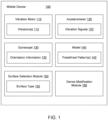
- FIG. 1 illustrates an example of a mobile device 100 operable to determine a surface type 152 on which the mobile device 100 resides.
- the surface type 152 on which the mobile device 100 resides can be determined when the mobile device 100 is idle or is currently being unused by a user.
- the mobile device 100 can include a vibration motor 110 (or unbalance motor) operable to generate vibration(s) 112, which can be used as feedback to a user for notifications of incoming calls, messages, alerts, etc.
- the mobile device 100 can include an accelerometer 120 to detect a movement of the mobile device 100.
- the accelerometer 120 can capture vibration signals 122 that result from the vibration 112 generated by the vibration motor 110.
- the vibration 112 can cause the mobile device 100 to move, and the accelerometer 120 can detect that movement of the mobile device 100 and produce the vibration signals 122 (which correspond with or characterize the mobile device's movement).
- the mobile device 100 can include a gyroscope 130 to collect orientation information 132 for the mobile device 100.
- the mobile device 100 can include a smart phone or a tablet computer. In another example, the mobile device 100 can include a smart watch or another type of handheld or mobile computing device.
- the mobile device 100 can include a surface detection module 150.
- the surface detection module 150 can receive a plurality of vibration signals 122 from the accelerometer 120, and the vibration signals 122 can correspond with or characterize the movement of the mobile device 100 due to the vibration 112 produced by the vibration motor 110.
- the surface detection module 150 can provide the vibration signals 122 to a model 140 running on the mobile device 100.
- the model 140 can include a plurality of predefined patterns 142 that correspond to vibration signals produced by mobile devices residing on different surfaces.
- the plurality of predefined patterns 142 can correspond to different surfaces on which the mobile device 100 is potentially residing and can account for whether the mobile device 100 includes or does not include a case.
- the surface detection module 150 can identify, using the model 140, a predefined pattern 142 in the plurality of predefined patterns 142 that substantially corresponds to the plurality of vibration signals 122.
- the corresponding predefined pattern 142 that is identified can be associated with a specific type of surface or a predefined type of surface (e.g., a laptop surface).
- the surface detection module 150 can determine a surface type 152 (e.g., a laptop surface) on which the mobile device 100 resides based on the predefined pattern 142 identified using the model 140.
- the surface detection module 150 can receive the orientation information 132 from the gyroscope 130.
- the surface detection module 150 can provide the orientation information 132 to the model 140.
- the surface detection module 150 can identify, using the orientation information 132 provided to the model 140, the predefined pattern 142 that substantially corresponds to the vibration signals 122.
- the orientation information 132 can be used along with the vibration signals 122 in identifying the predefined pattern 142 that substantially corresponds to the vibration signals 122.
- the predefined pattern 142 that is identified can be associated with a predefined type or orientation, which can correspond with the orientation information 132 received from the gyroscope 130.
- the mobile device 100 can include a device modification module 160 to modify a functionality of the mobile device 100 based on the detected surface type 152 on which the mobile device 100 resides.
- the device modification module 160 can also modify a user preference or setting based on the detected surface type 152 on which the mobile device 100 resides. For example, the device modification module 160 can determine to not turn off a display of the mobile device 100 when the surface type 152 is a user's hand (i.e., the mobile device is currently being held by the user). In another example, the device modification module 160 can determine to not lock the mobile device 100 when the surface type 152 is the user's hand.
- the device modification module 160 can increase a notification volume (e.g., a ring volume) of the mobile device 100 when the surface type 152 is an inside of a bag.
- the device modification module 160 can determine to vibrate but not produce an audible notification when the surface type 152 is the user's hand.
- the device modification module 160 can determine to produce an audible notification but not vibrate when the surface type 152 is concrete to avoid scratching the mobile device 100. Therefore, depending on the surface type 152 detected for the mobile device 100, the device modification module 160 can modify a functionality of the mobile device 100 or a user preference/setting.
- the surface detection module 150 can identify, using the model 140, one or more predefined patterns 142 in the plurality of predefined patterns 142 that correspond to the vibration signals 122.
- the surface detection module 150 can assign a confidence level to each of the identified one or more predefined patterns 142.
- the surface detection module 150 can select a predefined pattern 142 with a highest confidence level among the one or identified more predefined patterns 142.
- a smart phone can be inside a user's coat pocket, but the smart phone is initially not aware of its location inside the user's coat pocket.
- the smart phone can generate a vibration using a vibration motor, and an accelerometer within the smart phone can capture vibration signals resulting from the smart phone's movement due to the vibration.
- the vibration signals can be compared with a database of patterns.
- the database can include a first pattern that corresponds to a surface representing an inside of a coat, a second pattern that corresponds to a surface representing an inside of a bag, a third pattern that corresponds to a foam surface, a fourth pattern that corresponds a hand surface, a fifth pattern that corresponds to a leather surface, a sixth pattern that corresponds to a laptop surface, a seventh pattern that corresponds to a wood surface, an eight pattern that corresponds to a paper surface, and so on.
- the first pattern that corresponds to the surface representing an inside of a coat can be identified as most closely matching the vibration signals. As a result, a determination can be made that the smart phone is inside the user's coat pocket.
- the model 140 can be generated and trained using training data.
- the training data can include the predefined patterns 142.
- the model 140 can be trained to identify different surface types for the mobile device 100.
- the model 140 can continue to receive additional training data (or additional predefined patterns 142) over time, in order to recognize new types of surface types on which the mobile device 100 can potentially reside (e.g., a grass surface, a concrete surface). Therefore, the model 140 can continually mature and improve over time, and enable the surface detection module 150 to accurately determine the surface type 152 for the mobile device 100.
- the model 140 can be generated and trained using a server (not shown), and the model 140 can be downloaded to the mobile device 100.
- the model 140 can run locally on the mobile device 100.
- the model 140 can be periodically updated by downloading a new version of the model 140 from the server, where the new version of the model 140 can incorporate additional types of surfaces.
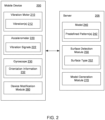
- FIG. 2 illustrates an example of a server 205 operable to determine a surface type 252 on which a mobile device 200 resides.
- the mobile device 200 can include a vibration motor 210 for generating vibration(s) 212, an accelerometer 220 for capturing vibration signals 222, and a gyroscope 230 for determining orientation information 232 of the mobile device 200.
- the mobile device 200 can include a device modification module 260 for modifying a functionality or a user preference/setting of the mobile device 200 based on the detected surface type 252 on which the mobile device 200 resides.
- the identified predefined pattern 242 may substantially correspond to the vibration signals 222 when a confidence level of the match exceeds a defined threshold.
- the predefined pattern 242 can be associated with a predefined type of surface (e.g., a metallic surface).
- the surface detection module 250 can determine the surface type 252 on which the mobile device 200 resides based on the predefined pattern 242 identified using the model 240.
- the surface detection module 250 can receive the orientation information 232 from the mobile device 200 via the transceiver in the mobile device 200.
- the orientation information 232 can indicate, whether the mobile device 200 is lying face down (i.e. on a side that has a screen in contact with the surface), or the mobile device 200 is lying face up (i.e. back side of the phone is in contact with the surface).
- Many mobile devices have different shapes or configurations between the front and back sides.
- the front side of the device may be flat or substantially flat, while the back side of the device may include a bump or other protrusion to accommodate a camera lens. Such a protrusion may cause the device to lie at an angle.
- the back side may have a curved shape, such that a small amount of material is in contact with the underlying surface when the device is face up as compared to when the device is face down and a flat screen is in contact with the surface.
- the vibration signals 222 can differ for the mobile device 200.
- the surface detection module 250 can provide the orientation information 232 to the model 240 running on the server 205.
- the surface detection module 250 can identify, using the orientation information 232 provided to the model 240, the predefined pattern 242 in the plurality of predefined patterns 242 that substantially corresponds to the vibration signals 222.
- both the vibration signals 222 and the orientation information 232 can be used to identify the predefined pattern 242 that substantially corresponds with the vibration signals 222.
- the device modification module 260 can determine to not lock the mobile device 200 when the surface type 252 is the user's hand. In another example, the device modification module 260 can increase a notification volume (e.g., a ring volume) of the mobile device 200 when the surface type 252 is an inside of a bag. In another example, the device modification module 260 can determine to vibrate but not produce an audible notification when the surface type 252 is the user's hand. In another example, the device modification module 260 can determine to produce an audible notification but not vibrate when the surface type 252 is hard and potentially abrasive (e.g. concrete) to avoid scratching the mobile device 200.
- abrasive e.g. concrete
- the surface detection module 250 can determine the surface type 252 of the mobile device 200 when the mobile device 200 is in an idle mode and/or when the mobile device 200 is not currently in use by the user. For example, when the mobile device 200 is being held and used by the user (e.g., for making a phone call or sending a text message or browsing the internet), the surface detection module 250 may not determine the surface type 252 of the mobile device 200. The surface detection module 250 can determine the surface type 252 of the mobile device 200 after the user stops using the mobile device 200 (e.g., after the mobile device 200 is placed on a surface).
- the surface detection module 250 can determine the surface type 252 of the mobile device 200 using a vibration signal 222 that is not specifically derived from a vibration 212 generated for the purpose of determining the surface type 252.
- the mobile device 200 can generate the vibration 212 when the mobile device 200 receives a phone call, text message, electronic message, etc.
- the mobile device 200 can generate the vibration 212 based on an event (e.g. a non-sensory event) that triggers the vibration 212.
- the vibration 212 can be taken advantage of by sending, the resulting vibration signals 222 from the mobile device 200 to the server 205, and the surface detection module 250 can determine the surface type 252 using the vibration signals 222.
- the model generation module 270 can repeat this process for a plurality of predefined surface types (e.g., inside a bag, inside a coat, foam, hand, leather, laptop, wood, paper and so on). In other words, the model generation module 270 can generate a predefined pattern 242 for each surface type 252. In addition, the model generation module 270 can train and test the model 240 using the predefined patterns 242 that corresponds to the different surface types.
- predefined surface types e.g., inside a bag, inside a coat, foam, hand, leather, laptop, wood, paper and so on.
- the surface type 252 of the mobile device 200 can be determined at the server 205 rather than at the mobile device 200 itself, as shown in FIG. 1 . This can reduce an amount of computation performed at the mobile device 200.
- the server 205 can generate and maintain the model 240, and the server 205 can update the model 240 over time. In this configuration, the model 240 may not be provided to the mobile device 200, but rather remain on the server 205.
- the mobile device 200 can execute an application to determine a composition of an object.
- the mobile device 200 can be placed on the object, and the application can trigger a series of vibrations 212 to be generated at the mobile device 200. Based on vibration signals 222 resulting from the vibrations 212, the application can provide a suggestion of the object's composition.
- the application can be used to determine whether the composition of the object on which the mobile device 200 resides (or otherwise contacts) is metal, wood, fabric, etc. based on the vibration signal 222 resulting from the vibrations 212 of the mobile device 200.
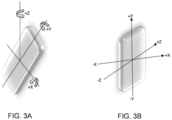
- FIG. 3A illustrates an example of gyroscope orientation movements.
- a gyroscope is a device that uses Earth's gravity to accurately measure orientation.
- the gyroscope's design can include a freely-rotating disk referred to as a rotor, mounted onto a spinning axis in the center of a larger and more stable wheel. As the axis turns, the rotor can remain stationary to indicate the central gravitational pull, and thus which way is "down".
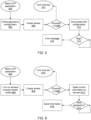
- FIG. 5 illustrates an example of functionality of a server collecting sensor information.
- the server can start an application (e.g., a UDP application) that creates a network socket and receives sensor information via the network socket.
- a UDP application can be started at the server (block 502), an arguments configuration can be parsed (block 504), and the network socket can be created by the server (bock 506).
- FD file descriptor
- the UDP application can generate an error and the UDP application can be exited or closed (block 510).
- the UDP application can bind the network socket with the arguments configuration (block 512).
- a message is received via the network socket (block 514), such as a message that includes sensor information, the message can be printed at the server (block 516).
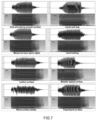
- differences among the different obtained patterns can be visible.
- the collected patterns can be used to train a NN with a topology of an input layer of 4,356 neurons, two hidden layers of 20 neurons each, and 8 neurons at the output representing each one of the obtained patterns (corresponding to the different surfaces).
- an optimization technique used to find the weights can be gradient descent.
Landscapes
- Engineering & Computer Science (AREA)
- Physics & Mathematics (AREA)
- General Physics & Mathematics (AREA)
- Theoretical Computer Science (AREA)
- Signal Processing (AREA)
- Software Systems (AREA)
- Computer Networks & Wireless Communication (AREA)
- Artificial Intelligence (AREA)
- General Engineering & Computer Science (AREA)
- Data Mining & Analysis (AREA)
- Evolutionary Computation (AREA)
- Mathematical Physics (AREA)
- Computing Systems (AREA)
- Human Computer Interaction (AREA)
- Life Sciences & Earth Sciences (AREA)
- General Health & Medical Sciences (AREA)
- Health & Medical Sciences (AREA)
- Remote Sensing (AREA)
- Radar, Positioning & Navigation (AREA)
- Biomedical Technology (AREA)
- Biophysics (AREA)
- Computational Linguistics (AREA)
- Molecular Biology (AREA)
- Environmental & Geological Engineering (AREA)
- Medical Informatics (AREA)
- Computer Vision & Pattern Recognition (AREA)
- Immunology (AREA)
- Pathology (AREA)
- Biochemistry (AREA)
- Analytical Chemistry (AREA)
- Automation & Control Theory (AREA)
- Computer Security & Cryptography (AREA)
- Chemical & Material Sciences (AREA)
- Acoustics & Sound (AREA)
- Telephone Function (AREA)
- User Interface Of Digital Computer (AREA)
Description
- Mobile devices, such as smart phones, can be used for performing a wide variety of functions. For example, phone functions (such as voice calls and text messaging), as well as internet (including web browsing) and multimedia functionalities (including music, video, cameras and gaming), can be performed. Additionally, mobile devices can include various sensors that can be leveraged by software resident on the device or remotely connected, such as a magnetometer, proximity sensors, barometer, gyroscope, thermometer, and accelerometer, and can also support various wireless communication protocols, such as Bluetooth, Wi-Fi and satellite navigation.
- Given the extremely wide variety of uses for mobile devices, it can be helpful to provide a user with focused functionality or operation predicted to be particularly relevant in a given environment or context. As such, it can be useful for a mobile device to have a degree of awareness of its immediate surroundings.
-
WO 2013/165627A1 describes a mobile device which uses sensor data related to the type of surface in contact with the mobile device to determine an action to perform. The soneors may be one or more of a microphone and noise generator, a light based proximity sensor, and pressure sensors, such as dielectric elastomers, configured to detect a texture of the surface, and/or pressure waves produced by setting the mobile device down or by a noise generator and reflected by the surface. The mobile device may identify te type of surface and perform the action based on the type of surface. The mobile device may further determine its location based on the sensor data and use that location to identify the acitno to be performed. The location may be determined using additional data, e.g. data not related to determining the type of surface with which the mobile device is in contact. Additional data might be general position fix, detected wireless devices, environmental sounds, and time. -
WO 2016/171848A1 describes a method and apparatus for determining an environment for a mobile device including determining a vibration signature of the environment of the mobile device, matching the vibration signature with a profile retrieved from a vibration signature database, selecting a response associated with the profile and selecting an alert based on the selected response. Also described are a method and apparatus for configuring a vibration signature database including actuating a vibrator, accepting observations from an accelerometer, the observations being generated in reponse to actuation of the vibrator, recording the accelerometer observation, clustering the accelerometer observations, recording the clustered accelerometer observations, creating vibration signature profiles of the clusteres accelerometer profiles and recording the vibration signature profiles. -
US 2014/0270202A1 describes a method which includes detecting a surface in proximity to a mobile device using sensor data and determining an acoustic reflectivity or acoustic absorptivity of the surface using the sensor data. The method may further compensate for the acoustic reflectivity or absorptivity by controlling a configurable group of microphones of the mobile device. Compensating for the surface acoustic reflectivity or absorptivity may include beamforming the outputs of the configurable group of microphones o obtain one of a omnidirectional beamform pattern or a directional beamform pattern. An apparatus that performs the method include a configurable group of microphones, a signal conditioner, and a surface compensator. The surface compensator is operative to detect a surface in proximity to the apparatus and determine a surface acoustic reflectivity or absorptivity. - Darbar Rajkumar ET AL: "SurfaceSense: Smartphone Can Recognize Where It Is Kept", Proceedings of the 7th International Conference on HCI, IndiaHCI 2015, 17 December 2015 (2015-12-17), pages 39-46, JUNGCHAN CHO ET AL: "Vibration-Based Surface Recognition for Smartphones", EMBEDDED AND REAL-TIME COMPUTING SYSTEMS AND APPLICATIONS (RTCSA), 2012 IEEE 18TH INTERNATIONAL CONFERENCE ON, IEEE, 19 August 2012 (2012-08-19), pages 459-464, and Shafer llari: "Learning Location from Vibration", 13 February 2013 (2013-02-13) describe methods pertaining to the detection of surfaces by mobile device.
- The present invention is defined in claim 1. Preferred features are recited in the dependent claims. In the following description, any embodiment referred to and not falling within the scope of the claims is merely an example useful to the understanding of the invention.
- Features and advantages of technology embodiments will be apparent from the detailed description which follows, taken in conjunction with the accompanying drawings, which together illustrate, by way of example, various technology features; and, wherein:
-
FIG. 1 illustrates a mobile device operable to determine a type of surface on which the mobile device resides in accordance with an example embodiment; -
FIG. 2 illustrates a server operable to determine a type of surface on which a mobile device resides in accordance with an example embodiment; -
FIG. 3A illustrates gyroscope orientation movements in accordance with an example embodiment; -
FIG. 3B illustrates accelerometer linear acceleration movements in accordance with an example embodiment; -
FIG. 4 illustrates a client-server model for data collection in accordance with an example embodiment; -
FIG. 5 illustrates functionality of a server collecting sensor information in accordance with an example embodiment; -
FIG. 6 illustrates functionality of a mobile device sending sensor information in accordance with an example embodiment; -
FIG. 7 illustrates predefined patterns that correspond to different surfaces and orientations in accordance with an example embodiment; -
FIG. 8 illustrates a mobile device in communication with a server in accordance with an example embodiment; -
FIG. 9 is a flowchart illustrating operations for determining a type of surface on which a mobile device resides in accordance with an example embodiment; -
FIG. 10 is a flowchart illustrating operations for determining a type of surface on which a mobile device resides in accordance with an example embodiment; and -
FIG. 11 illustrates a computing system that includes a data storage device in accordance with an example embodiment. - Reference will now be made to the exemplary embodiments illustrated, and specific language will be used herein to describe the same. It will nevertheless be understood that no limitation on technology scope is thereby intended.
- Before the disclosed technology embodiments are described, it is to be understood that this disclosure is not limited to the particular structures, process steps, or materials disclosed herein, but is extended to equivalents thereof as would be recognized by those ordinarily skilled in the relevant arts. It should also be understood that terminology employed herein is used for the purpose of describing particular examples or embodiments only and is not intended to be limiting. The same reference numerals in different drawings represent the same element. Numbers provided in flow charts and processes are provided for clarity in illustrating steps and operations and do not necessarily indicate a particular order or sequence.
- Furthermore, the described features, structures, or characteristics can be combined in any suitable manner in one or more embodiments. In the following description, numerous specific details are provided, such as examples of layouts, distances, network examples, etc., to provide a thorough understanding of various technology embodiments. One skilled in the relevant art will recognize, however, that such detailed embodiments do not limit the overall technological concepts articulated herein, but are merely representative thereof.
- As used in this written description, the singular forms "a," "an" and "the" include express support for plural referents unless the context clearly dictates otherwise. Thus, for example, reference to "a motor" includes a plurality of such motors.
- Reference throughout this specification to "an example" means that a particular feature, structure, or characteristic described in connection with the example is included in at least one embodiment of the present invention. Thus, appearances of the phrases "in an example" or "an embodiment" in various places throughout this specification are not necessarily all referring to the same embodiment.
- As used herein, a plurality of items, structural elements, compositional elements, and/or materials can be presented in a common list for convenience. However, these lists should be construed as though each member of the list is individually identified as a separate and unique member. Thus, no individual member of such list should be construed as a de facto equivalent of any other member of the same list solely based on their presentation in a common group without indications to the contrary. In addition, various embodiments and example of the present invention can be referred to herein along with alternatives for the various components thereof. It is understood that such embodiments, examples, and alternatives are not to be construed as defacto equivalents of one another, but are to be considered as separate and autonomous representations under the present disclosure.
- Furthermore, the described features, structures, or characteristics can be combined in any suitable manner in one or more embodiments. In the following description, numerous specific details are provided, such as examples of layouts, distances, network examples, etc., to provide a thorough understanding of invention embodiments. One skilled in the relevant art will recognize, however, that the technology can be practiced without one or more of the specific details, or with other methods, components, layouts, etc. In other instances, well-known structures, materials, or operations may not be shown or described in detail to avoid obscuring aspects of the disclosure.
- In this disclosure, "comprises," "comprising," "containing" and "having" and the like can mean "includes," "including," and the like, and are generally interpreted to be open ended terms. The terms "consisting of' or "consists of' are closed terms, and include only the components, structures, steps, or the like specifically listed in conjunction with such terms. "Consisting essentially of' or "consists essentially of" are generally closed terms, with the exception of allowing inclusion of additional items, materials, components, steps, or elements, that do not materially affect the basic and novel characteristics or function of the item(s) used in connection therewith. For example, trace elements present in a composition, but not affecting the compositions nature or characteristics would be permissible if present under the "consisting essentially of' language, even though not expressly recited in a list of items following such terminology. When using an open ended term in this written description, like "comprising" or "including," it is understood that direct support should be afforded also to "consisting essentially of" language as well as "consisting of" language as if stated explicitly and vice versa.
- The terms "first," "second," "third," "fourth," and the like in the description and in the claims, if any, are used for distinguishing between similar elements and not necessarily for describing a particular sequential or chronological order. It is to be understood that any terms so used are interchangeable under appropriate circumstances such that the embodiments described herein are, for example, capable of operation in sequences other than those illustrated or otherwise described herein. Similarly, if a method is described herein as comprising a series of steps, the order of such steps as presented herein is not necessarily the only order in which such steps may be performed, and certain of the stated steps may possibly be omitted and/or certain other steps not described herein may possibly be added to the method.
- As used herein, comparative terms such as "increased," "decreased," "better," "worse," "higher," "lower," "enhanced," "maximized," "minimized," and the like refer to a property of a device, component, or activity that is measurably different from other devices, components, or activities in a surrounding or adjacent area, in a single device or in multiple comparable devices, in a group or class, in multiple groups or classes, or as compared to the known state of the art. For example, a sensor with "increased" sensitivity can refer to a sensor in a sensor array which has a lower level or threshold of detection than one or more other sensors in the array. A number of factors can cause such increased sensitivity, including materials, configurations, architecture, connections, etc.
- As used herein, the term "substantially" refers to the complete or nearly complete extent or degree of an action, characteristic, property, state, structure, item, or result. For example, an object that is "substantially" enclosed would mean that the object is either completely enclosed or nearly completely enclosed. The exact allowable degree of deviation from absolute completeness may in some cases depend on the specific context. However, generally speaking the nearness of completion will be so as to have the same overall result as if absolute and total completion were obtained. The use of "substantially" is equally applicable when used in a negative connotation to refer to the complete or near complete lack of an action, characteristic, property, state, structure, item, or result. For example, a composition that is "substantially free of' particles would either completely lack particles, or so nearly completely lack particles that the effect would be the same as if it completely lacked particles. In other words, a composition that is "substantially free of" an ingredient or element may still actually contain such item as long as there is no measurable effect thereof.
- As used herein, the term "about" is used to provide flexibility to a numerical range endpoint by providing that a given value may be "a little above" or "a little below" the endpoint. However, it is to be understood that even when the term "about" is used in the present specification in connection with a specific numerical value, that support for the exact numerical value recited apart from the "about" terminology is also provided.
- Numerical amounts and data may be expressed or presented herein in a range format. It is to be understood that such a range format is used merely for convenience and brevity and thus should be interpreted flexibly to include not only the numerical values explicitly recited as the limits of the range, but also to include all the individual numerical values or sub-ranges encompassed within that range as if each numerical value and sub-range is explicitly recited. As an illustration, a numerical range of "about 1 to about 5" should be interpreted to include not only the explicitly recited values of about 1 to about 5, but also include individual values and sub-ranges within the indicated range. Thus, included in this numerical range are individual values such as 2, 3, and 4 and sub-ranges such as from 1-3, from 2-4, and from 3-5, etc., as well as 1, 1.5, 2, 2.3, 3, 3.8, 4, 4.6, 5, and 5.1 individually.
- This same principle applies to ranges reciting only one numerical value as a minimum or a maximum. Furthermore, such an interpretation should apply regardless of the breadth of the range or the characteristics being described.
- An initial overview of technology embodiments is provided below and then specific technology embodiments are described in further detail later. This initial summary is intended to aid readers in understanding the technology more quickly, but is not intended to identify key or essential technological features nor is it intended to limit the scope of the claimed subject matter. Unless defined otherwise, all technical and scientific terms used herein have the same meaning as commonly understood by one of ordinary skill in the art to which this disclosure belongs.
- Humans can act and react depending on a situation, an environment or a context of the environment. Providing mobile devices, such as smart phones, with a capability to sense the environment context can be a desirable feature in order to better understand user behavior, and create an improved user experience to his or her preferences. Mobile devices are known to include sensors for location (e.g., global positioning system (GPS)), orientation (e.g., gyroscope), and movement (e.g., accelerometer). However, since information about a mobile device's immediate surroundings can also be useful, it would be beneficial for the mobile device to include a sensor or technique for detecting characteristics of a surface that supports the mobile device (e.g., a surface on which the mobile device resides). This is particularly true when the mobile device is in an idle state. For example, the ability to determine a type of material of the surface on which the mobile device resides, a position of the mobile device on the surface (e.g., a table), whether the mobile device is currently being held in a user's hand, whether the mobile device is inside of a bag or in a pocket, could be very useful.
- Accordingly, in one example, with the aid of existing third-party applications and services, a mobile device can automatically modify its configurations based on the mobile device's location, e.g., home, work, city park, etc. The mobile device can use signals from cell towers, Wi-Fi networks and/or GPS coordinates to configure its settings. This auto configuration can include performing various functions, such as turning on/off a Wi-Fi card according to a geographical position using GPS, opening an application such as a music player depending on a time of day, adjusting volume setting according to a Bluetooth paring, turning off Wi-Fi and Bluetooth at work to save battery, muting the mobile device in a particular location (e.g., a library), turning off data roaming when the mobile device reaches a particular location (e.g., an airport), etc. These previous solutions can be based on the geographical location of the mobile device and not based on the mobile device's relative position.
- In one example, these previous solutions for modifying a mobile device's configurations based on the location of the mobile device can depend on external signals received from cell towers, Wi-Fi networks and/or GPS coordinates. When the mobile device is not in reach of those external signals, the mobile device does not know its location. Cell towers can be built by carrier companies and an end user is generally agnostic as to which tower is connected and its physical location. While Wi-Fi can be controlled by users, often times those signals are private and not open for public access. Some Wi-Fi modems may not be connected to an external network such as the Internet, and it can be difficult to fetch location data without an external connection. GPS suffers from various disadvantages, such as an inability to be reliably used indoors in cities with a high density of buildings. Thus, GPS can be useful outdoors and with a certain error margin. However, these external signals only provide the mobile device with an ability to know its location according to a geographical position, but cannot provide information on where the mobile device is according to its own position.
- Thus, the previous solutions cannot collect additional information that can be useful for certain applications, such as determining whether a mobile device is in a women's bag, over a table, in a car, in a back pocket of a user's jeans, etc. In other words, the previous solutions cannot collect additional information (e.g. about the device's immediate environment) that can be used for determining a surface on which the mobile device resides.
- In the present technology, a mobile device can include a vibration motor (or unbalance motor) (e.g., to generate vibrations used as feedback to a user for notifications of incoming calls, messages, alerts, etc.), an accelerometer to detect a movement of the mobile device, and a gyroscope to determine an orientation of the mobile device. The mobile device can generate a vibration using the vibration motor. The mobile device can capture resulting signals using the accelerometer. In other words, the accelerometer can be used to capture resulting signals that reflect or measure how the mobile device reacts to the vibration stimuli. The vibration motor can generate the vibration stimuli and the effect produced on the mobile device can be captured using the accelerometer. The mobile device propagation of vibration modes can react differently depending on the surface on which the mobile device is touching, e.g., soft surfaces can produce a different pattern as compared to solid surfaces. Based on this knowledge along with orientation information extracted from a gyroscope of the mobile device, additional information can be connected to infer a context of a possible location of the user's mobile device. In other words, based on the signals produced when the mobile device vibrates and knowledge about different patterns for different surfaces, a surface on which the mobile device resides (e.g., soft surface, solid surface, table, inside a bag) can be detected.
- In the present technology, inherent sensors embedded in mobile devices can be used to extract and process data that can be used to enable the mobile device with capabilities of context understanding, which are not possible with traditional network and/or GPS location services. Therefore, the mobile device can be provided with an ability of understanding the user's usage when being left on a table, being carried inside a bag or a pocket, being left in a car, etc.
- In one example, an ability or capability of a mobile device to perform a contextual surface detection can enable new functionalities in terms of personalization and content preferences. For example, a display of the mobile device may not be turned off or the mobile device may not be locked when the mobile device is determined to be residing on a user's hand (i.e., the mobile device is currently being held by the user). In another example, a notification volume (e.g., a ring volume) of the mobile device can be increased when the mobile device is determined to be residing inside of a bag, purse, or other container. In another example, the mobile device can vibrate, but not produce an audible notification when the mobile device is determined to be residing on a user's hand. In addition, the surface context awareness enables various applications that can expand to gaming.
-
FIG. 1 illustrates an example of amobile device 100 operable to determine asurface type 152 on which themobile device 100 resides. Thesurface type 152 on which themobile device 100 resides can be determined when themobile device 100 is idle or is currently being unused by a user. Themobile device 100 can include a vibration motor 110 (or unbalance motor) operable to generate vibration(s) 112, which can be used as feedback to a user for notifications of incoming calls, messages, alerts, etc. Themobile device 100 can include anaccelerometer 120 to detect a movement of themobile device 100. For example, theaccelerometer 120 can capture vibration signals 122 that result from thevibration 112 generated by thevibration motor 110. In other words, thevibration 112 can cause themobile device 100 to move, and theaccelerometer 120 can detect that movement of themobile device 100 and produce the vibration signals 122 (which correspond with or characterize the mobile device's movement). In addition, themobile device 100 can include agyroscope 130 to collectorientation information 132 for themobile device 100. - In one example, the
mobile device 100 can include a smart phone or a tablet computer. In another example, themobile device 100 can include a smart watch or another type of handheld or mobile computing device. - In one configuration, the
mobile device 100 can include asurface detection module 150. Thesurface detection module 150 can receive a plurality ofvibration signals 122 from theaccelerometer 120, and the vibration signals 122 can correspond with or characterize the movement of themobile device 100 due to thevibration 112 produced by thevibration motor 110. Thesurface detection module 150 can provide the vibration signals 122 to amodel 140 running on themobile device 100. Themodel 140 can include a plurality ofpredefined patterns 142 that correspond to vibration signals produced by mobile devices residing on different surfaces. The plurality ofpredefined patterns 142 can correspond to different surfaces on which themobile device 100 is potentially residing and can account for whether themobile device 100 includes or does not include a case. Thesurface detection module 150 can identify, using themodel 140, apredefined pattern 142 in the plurality ofpredefined patterns 142 that substantially corresponds to the plurality of vibration signals 122. The correspondingpredefined pattern 142 that is identified can be associated with a specific type of surface or a predefined type of surface (e.g., a laptop surface). Thesurface detection module 150 can determine a surface type 152 (e.g., a laptop surface) on which themobile device 100 resides based on thepredefined pattern 142 identified using themodel 140. - In one example, the
surface detection module 150 can receive theorientation information 132 from thegyroscope 130. Thesurface detection module 150 can provide theorientation information 132 to themodel 140. Thesurface detection module 150 can identify, using theorientation information 132 provided to themodel 140, thepredefined pattern 142 that substantially corresponds to the vibration signals 122. In other words, theorientation information 132 can be used along with the vibration signals 122 in identifying thepredefined pattern 142 that substantially corresponds to the vibration signals 122. Thepredefined pattern 142 that is identified can be associated with a predefined type or orientation, which can correspond with theorientation information 132 received from thegyroscope 130. - In one example, the
model 140 can incorporate thepredefined patterns 142 that correspond to the different surfaces, and the different surfaces can include, but are not limited to, a clothing surface, a container surface, a soft surface, a rigid surface, a hand surface, a leather surface, a wood surface or a paper surface. Thepredefined patterns 142 can be previously generated for each of the different types of surfaces. For example, a first predefined pattern can be created for a clothing surface, a second predefined pattern can be created for a soft surface, and so on. Thepredefined patterns 142 can include vibration signals that are produced for each of the particular surfaces when a mobile device is residing on the particular surface. - In one example, the
mobile device 100 can include adevice modification module 160 to modify a functionality of themobile device 100 based on the detectedsurface type 152 on which themobile device 100 resides. Thedevice modification module 160 can also modify a user preference or setting based on the detectedsurface type 152 on which themobile device 100 resides. For example, thedevice modification module 160 can determine to not turn off a display of themobile device 100 when thesurface type 152 is a user's hand (i.e., the mobile device is currently being held by the user). In another example, thedevice modification module 160 can determine to not lock themobile device 100 when thesurface type 152 is the user's hand. In another example, thedevice modification module 160 can increase a notification volume (e.g., a ring volume) of themobile device 100 when thesurface type 152 is an inside of a bag. In another example, thedevice modification module 160 can determine to vibrate but not produce an audible notification when thesurface type 152 is the user's hand. In another example, thedevice modification module 160 can determine to produce an audible notification but not vibrate when thesurface type 152 is concrete to avoid scratching themobile device 100. Therefore, depending on thesurface type 152 detected for themobile device 100, thedevice modification module 160 can modify a functionality of themobile device 100 or a user preference/setting. - In one configuration, the
surface detection module 150 can identify, using themodel 140, one or morepredefined patterns 142 in the plurality ofpredefined patterns 142 that correspond to the vibration signals 122. Thesurface detection module 150 can assign a confidence level to each of the identified one or morepredefined patterns 142. Thesurface detection module 150 can select apredefined pattern 142 with a highest confidence level among the one or identified morepredefined patterns 142. In other words, as an example, if thesurface detection module 150 identifies four predefined patterns that correspond to the vibration signals 122 with confidence ratings of 88%, 86%, 90% and 89%, respectively, thesurface detection module 150 can select thepredefined pattern 142 that corresponds to the confidence rating of 90%, and the specific type of surface associated with the selectedpredefined pattern 142 can indicate thesurface type 152 of themobile device 100. - As a non-limiting example, a smart phone can be inside a user's coat pocket, but the smart phone is initially not aware of its location inside the user's coat pocket. In order to determine the smart phone's location, the smart phone can generate a vibration using a vibration motor, and an accelerometer within the smart phone can capture vibration signals resulting from the smart phone's movement due to the vibration. The vibration signals can be compared with a database of patterns. For example, the database can include a first pattern that corresponds to a surface representing an inside of a coat, a second pattern that corresponds to a surface representing an inside of a bag, a third pattern that corresponds to a foam surface, a fourth pattern that corresponds a hand surface, a fifth pattern that corresponds to a leather surface, a sixth pattern that corresponds to a laptop surface, a seventh pattern that corresponds to a wood surface, an eight pattern that corresponds to a paper surface, and so on. Based on the comparison between the vibration signals and the database, the first pattern that corresponds to the surface representing an inside of a coat can be identified as most closely matching the vibration signals. As a result, a determination can be made that the smart phone is inside the user's coat pocket.
- In one example, the
model 140 used by thesurface detection module 150 to determine thesurface type 152 associated with themobile device 100 can be a neural network or a machine learning model. In another example, themodel 140 can include, but is not limited to, an artificial intelligence (AI) model, a support vector machine, a Bayesian network, a genetic algorithm, etc. Themodel 140 can use predictive analytics, supervised learning, semi-supervised learning, unsupervised learning, reinforcement learning, etc. - In one configuration, the
model 140 can be generated and trained using training data. The training data can include thepredefined patterns 142. Themodel 140 can be trained to identify different surface types for themobile device 100. In addition, themodel 140 can continue to receive additional training data (or additional predefined patterns 142) over time, in order to recognize new types of surface types on which themobile device 100 can potentially reside (e.g., a grass surface, a concrete surface). Therefore, themodel 140 can continually mature and improve over time, and enable thesurface detection module 150 to accurately determine thesurface type 152 for themobile device 100. - In one example, the
model 140 can be generated and trained using a server (not shown), and themodel 140 can be downloaded to themobile device 100. Themodel 140 can run locally on themobile device 100. Themodel 140 can be periodically updated by downloading a new version of themodel 140 from the server, where the new version of themodel 140 can incorporate additional types of surfaces. -
FIG. 2 illustrates an example of aserver 205 operable to determine asurface type 252 on which amobile device 200 resides. Themobile device 200 can include avibration motor 210 for generating vibration(s) 212, anaccelerometer 220 for capturingvibration signals 222, and agyroscope 230 for determiningorientation information 232 of themobile device 200. In addition, themobile device 200 can include adevice modification module 260 for modifying a functionality or a user preference/setting of themobile device 200 based on the detectedsurface type 252 on which themobile device 200 resides. - In one example, the
server 205 can include asurface detection module 250. Thesurface detection module 250 can receive the vibration signals 222 from themobile device 200 via a transceiver (not shown) in themobile device 200, where the vibration signals 222 correspond to thevibration 212 generated at themobile device 200. Thesurface detection module 250 can provide the vibration signals 222 to a model 240 (e.g., a neural network or a machine learning model) running on theserver 205. Themodel 240 can include a pluralitypredefined patterns 242 that correspond to vibration signals produced by mobile devices residing on different surfaces. Thesurface detection module 250 can identify, using themodel 240, apredefined pattern 242 in the plurality ofpredefined patterns 242 that substantially corresponds to the vibration signals 222. For example, the identifiedpredefined pattern 242 may substantially correspond to the vibration signals 222 when a confidence level of the match exceeds a defined threshold. Thepredefined pattern 242 can be associated with a predefined type of surface (e.g., a metallic surface). Thesurface detection module 250 can determine thesurface type 252 on which themobile device 200 resides based on thepredefined pattern 242 identified using themodel 240. - In one example, the
surface detection module 250 can receive theorientation information 232 from themobile device 200 via the transceiver in themobile device 200. For example, when resting on a horizontal surface, theorientation information 232 can indicate, whether themobile device 200 is lying face down (i.e. on a side that has a screen in contact with the surface), or themobile device 200 is lying face up (i.e. back side of the phone is in contact with the surface). Many mobile devices have different shapes or configurations between the front and back sides. For example, the front side of the device may be flat or substantially flat, while the back side of the device may include a bump or other protrusion to accommodate a camera lens. Such a protrusion may cause the device to lie at an angle. Alternatively, the back side may have a curved shape, such that a small amount of material is in contact with the underlying surface when the device is face up as compared to when the device is face down and a flat screen is in contact with the surface. Depending on which side of themobile device 200 is in contact with an underlying surface, the vibration signals 222 can differ for themobile device 200. Thesurface detection module 250 can provide theorientation information 232 to themodel 240 running on theserver 205. Thesurface detection module 250 can identify, using theorientation information 232 provided to themodel 240, thepredefined pattern 242 in the plurality ofpredefined patterns 242 that substantially corresponds to the vibration signals 222. In other words, both the vibration signals 222 and theorientation information 232 can be used to identify thepredefined pattern 242 that substantially corresponds with the vibration signals 222. - In one example, the
server 205 can send an indication of thesurface type 252 to themobile device 200. Themobile device 200 can receive the notification, and thedevice modification module 260 can modify a functionality of themobile device 200 accordingly. - In one example, the
device modification module 260 can modify a functionality of themobile device 200 based on the indication of thesurface type 252 received from theserver 205. Thedevice modification module 260 can also modify a user preference or setting based on thesurface type 252 on which themobile device 200 resides. For example, thedevice modification module 260 can determine to turn off a Wi-Fi module in themobile device 200 when thesurface type 252 is a user's back pocket or bag. In another example, thedevice modification module 260 can determine to leave functionalities on when thesurface type 252 is a table, since the user can likely pick up themobile device 200 periodically from the table to use themobile device 200. In another example, thedevice modification module 260 can determine to not lock themobile device 200 when thesurface type 252 is the user's hand. In another example, thedevice modification module 260 can increase a notification volume (e.g., a ring volume) of themobile device 200 when thesurface type 252 is an inside of a bag. In another example, thedevice modification module 260 can determine to vibrate but not produce an audible notification when thesurface type 252 is the user's hand. In another example, thedevice modification module 260 can determine to produce an audible notification but not vibrate when thesurface type 252 is hard and potentially abrasive (e.g. concrete) to avoid scratching themobile device 200. - In one example, the
surface detection module 250 can determine thesurface type 252 of themobile device 200 when themobile device 200 is in an idle mode and/or when themobile device 200 is not currently in use by the user. For example, when themobile device 200 is being held and used by the user (e.g., for making a phone call or sending a text message or browsing the internet), thesurface detection module 250 may not determine thesurface type 252 of themobile device 200. Thesurface detection module 250 can determine thesurface type 252 of themobile device 200 after the user stops using the mobile device 200 (e.g., after themobile device 200 is placed on a surface). - In one example, the
surface detection module 250 can determine thesurface type 252 of themobile device 200 using avibration signal 222 that is not specifically derived from avibration 212 generated for the purpose of determining thesurface type 252. For example, themobile device 200 can generate thevibration 212 when themobile device 200 receives a phone call, text message, electronic message, etc. In other words, themobile device 200 can generate thevibration 212 based on an event (e.g. a non-sensory event) that triggers thevibration 212. While originating for a different purpose, thevibration 212 can be taken advantage of by sending, the resulting vibration signals 222 from themobile device 200 to theserver 205, and thesurface detection module 250 can determine thesurface type 252 using the vibration signals 222. - In one example, the
server 205 can include amodel generation module 270 to generate themodel 240 to include thepredefined patterns 242. For example, themodel generation module 270 can receive a plurality of training vibration signals when a training vibration is generated for a predefined type of surface (e.g., a leather surface). Themodel generation module 270 can apply linear predictive coding (LPC) to the plurality of training vibration signals. Themodel generation module 270 can generate apredefined pattern 242 that corresponds to the predefined type of surface (e.g., the leather surface) using the plurality of training vibration signals. Themodel generation module 270 can repeat this process for a plurality of predefined surface types (e.g., inside a bag, inside a coat, foam, hand, leather, laptop, wood, paper and so on). In other words, themodel generation module 270 can generate apredefined pattern 242 for eachsurface type 252. In addition, themodel generation module 270 can train and test themodel 240 using thepredefined patterns 242 that corresponds to the different surface types. - In one configuration, the
surface type 252 of themobile device 200 can be determined at theserver 205 rather than at themobile device 200 itself, as shown inFIG. 1 . This can reduce an amount of computation performed at themobile device 200. In addition, theserver 205 can generate and maintain themodel 240, and theserver 205 can update themodel 240 over time. In this configuration, themodel 240 may not be provided to themobile device 200, but rather remain on theserver 205. - In one configuration, the
mobile device 200 can execute an application to determine a composition of an object. For example, themobile device 200 can be placed on the object, and the application can trigger a series ofvibrations 212 to be generated at themobile device 200. Based onvibration signals 222 resulting from thevibrations 212, the application can provide a suggestion of the object's composition. The application can be used to determine whether the composition of the object on which themobile device 200 resides (or otherwise contacts) is metal, wood, fabric, etc. based on thevibration signal 222 resulting from thevibrations 212 of themobile device 200. -
FIG. 3A illustrates an example of gyroscope orientation movements. A gyroscope is a device that uses Earth's gravity to accurately measure orientation. The gyroscope's design can include a freely-rotating disk referred to as a rotor, mounted onto a spinning axis in the center of a larger and more stable wheel. As the axis turns, the rotor can remain stationary to indicate the central gravitational pull, and thus which way is "down". -
FIG. 3B illustrates an example of accelerometer linear acceleration movements. An accelerometer is a compact device designed to measure non-gravitational acceleration. When an object containing the accelerometer changes from idle to movement, the accelerometer can be designed to respond to the changes in acceleration associated with such rapid changes. -
FIG. 4 illustrates an example of a client-server model for data collection. A mobile device 410 (or client) can send data to aserver 430 over aninternet 420. The data can include accelerometer data and/or gyroscope data. For example, themobile device 410 can capture the accelerometer data and the gyroscope data using an accelerometer and a gyroscope, respectively, that is onboard themobile device 410, and then send that data to theserver 430 over theinternet 420. In one example, theserver 430 can be a user datagram protocol (UDP) server. UDP can be used for establishing low-latency and loss-tolerating connections between applications on theinternet 420. -
FIG. 5 illustrates an example of functionality of a server collecting sensor information. For example, the server can start an application (e.g., a UDP application) that creates a network socket and receives sensor information via the network socket. More specifically, a UDP application can be started at the server (block 502), an arguments configuration can be parsed (block 504), and the network socket can be created by the server (bock 506). When a file descriptor (FD) of the network socket is less than zero (block 508), the UDP application can generate an error and the UDP application can be exited or closed (block 510). When the FD of the network socket is not less than zero, the UDP application can bind the network socket with the arguments configuration (block 512). When a message is received via the network socket (block 514), such as a message that includes sensor information, the message can be printed at the server (block 516). -
FIG. 6 illustrates an example of functionality of a mobile device sending sensor information. For example, the mobile device can start an application (e.g., a UDP application) that turns on the mobile device's sensors (while the mobile device is in a vibrate mode) and creates a network socket. The mobile device can read current sensor information and send that information via the network socket. More specifically, a UDP application can be started at the mobile device (block 602), one or more sensors can be turned on at the mobile device including a vibrate mode (block 604), and the network socket can be created at the mobile device (bock 606). When a file descriptor (FD) of the network socket is less than zero (block 608), the UDP application can generate an error and the UDP application can be exited or closed (block 610). When the FD of the network socket is not less than zero, the UDP application can read current information on the sensors (i.e., sensor information) (block 612). When the UDP application is stopped at the mobile device (block 514), the application on the mobile device can send the sensor information via the network socket (block 616). - In one example, as a reference, additional data was collected during experimentation using an external accelerometer at 16 kilohertz (Khz), under the six different environments. The six different environments corresponded to six different experimental set ups used for data collection, where different surfaces and orientations where explored. The surfaces included a laptop surface, a hand surface, a leather surface, a semi-soft surface, a soft surface and a bag surface (i.e., inside a bag). For each surface, data was collected and features in the form of linear predictive coding (LPC) descriptors were computed. These features were provided into a neural network training procedure, as described below.
- In one example, LPC is a widely used technique in signal processing to analyze, restore, or reproduce physical time series signals. Certain types of Linear Time-Invariant (LTI) signals can benefit from LPC. The type of signals best suited for LPC are slow-varying, and produced in short intervals or infrequent briefs pulses. LPC provides a small but accurate representation of a source signal spectral magnitude. The human voice is a typical candidate for LPC analysis, used in different speech applications. The basic principle of LPC consists of modeling a signal as a linear combination of its past and present values. In the frequency domain, it is similar to taking the signal spectrum by a pole-zero spectrum. One of the preconditions to use LPC is to have a base model to allow reconstruction. This model can be used in order to be the closer to the source signal representation. The LPC model can consider a signal sn to be an output of some unknown input un so that the following holds:

- In the frequency domain, applying a Z transform to both sides of Equation 1 and assuming H(z) is the transfer function results in the following:


- In one example, Equation 3 is the S(z) transform of sn, and U(z) is z transform of un. H(z) is the general pole-zero model. For LPC, there is a special case of having bl =0, 1≤1≤q , and this is also known as an all pole model.
- In one example, one concern with the linear predictive model is calculating the coefficients ak and G (gain). One technique that can be used for calculating the coefficients in LPC is a least squares technique. The least squares technique assumes that the predicted signal s(n) can be approximated from a linearly weighted summation of past samples. The residual or error can be the subtraction of the actual signal from the predicted signal. The parameter ak can be obtained from the minimization of the mean. Other techniques for estimating the coefficients include autocorrelation and covariance techniques. In addition, regarding G (gain), LPC assumes that G can be determined by matching the signal energy to the energy of the linear predicted outputs.
- In one example, LPC can provide several advantages. For example, LPC can remove redundancy of the signal, and the coefficient can provide a model for unknown samples. In addition, LPC can provide a prediction of future points by estimating future samples of a discrete signal based on a linear prediction of previous samples.
- In one configuration, LPC can be applied to each of the six different environments corresponded to six different experimental set ups used for data collection, including a laptop surface, a hand surface, a leather surface, a semi-soft surface, a soft surface and a bag surface (i.e., inside a bag). By applying LPC to each of the six different surfaces, a database of patterns can be generated, and the database of patterns can be used to perform training of a neural network (NN).
-
FIG. 7 illustrates an example of patterns (or predefined patterns) that correspond to different surfaces and orientations on which a mobile device resides. The patterns can correspond to a coat simulating a smooth surface, an inside of a soft bag, melamine foam (semi-rigid), a hand (i.e., the surface is a user's hand), a leather surface, a metallic laptop surface, a wood surface (table) and a paperboard surface. In other words, a mobile device in an idle state was placed in each of the different surfaces, and the corresponding pattern for each of the different surfaces was generated. As previously explained, the patterns can be generated by applying LPC to each of the different surfaces. - In one example, differences among the different obtained patterns can be visible. The collected patterns can be used to train a NN with a topology of an input layer of 4,356 neurons, two hidden layers of 20 neurons each, and 8 neurons at the output representing each one of the obtained patterns (corresponding to the different surfaces). In one example, an optimization technique used to find the weights can be gradient descent.
- In one example, for experimentation, 60% of the collected patterns can be used for training, and the remaining 40% can be used for evaluation of the trained NN model. The surface recognition results (e.g., percentage of correct surfaces detected) are shown below:
Surface Training Testing 1 100% 100% 2 100% 100% 3 100% 80% 4 100% 100% 5 100% 100% 6 100% 100% 7 100% 100% 8 100% 100% - In the above table, #1 corresponds to an inside of a coat, #2 corresponds to an inside of a bag, #3 corresponds to a foam surface, #4 corresponds to a hand (i.e., the surface is a user's hand), #5 corresponds to a leather surface, #6 corresponds to a laptop surface, #7 corresponds to a wood surface, and #8 corresponds to a paperboard surface. Based on these results, it can be feasible to use an embedded sensor (e.g., an accelerometer) in a mobile device to detect surfaces on which the mobile device is placed or resides when the mobile device is idle, which can be used to infer a situation context. A similar approach can be used with access to data collected from a gyroscope and/or a magnetometer to use orientation data.
-
FIG. 8 illustrates an example of amobile device 810 in communication with aserver 830. Themobile device 810 can include avibration motor 812 operable to generate a vibration. Themobile device 810 can include anaccelerometer 814 operable to capture a plurality of vibration signals that result from the vibration. Themobile device 810 can include agyroscope 816 operable to capture orientation information for themobile device 810. Themobile device 810 can include acontroller 818. Thecontroller 818 can provide the plurality of vibration signals to a model running on themobile device 810. The model can include a plurality of predefined patterns that correspond to vibration signals produced by mobile devices residing on different surfaces. Thecontroller 818 can identify, using the model, a predefined pattern in the plurality of predefined patterns that substantially corresponds to the plurality of vibration signals based on a confidence level that exceeds a threshold. Thecontroller 818 can determine a type of surface on which themobile device 810 resides based on the predefined pattern identified using the model. - In an alternative configuration, the
mobile device 810 can include atransceiver 820 operable to transmit the plurality of vibration signals to theserver 830. One ormore processors 832 in theserver 830 can receive the plurality of vibration signals from themobile device 810. The one ormore processors 832 can provide the plurality of vibration signals to a model running on theserver 830. The model can include a plurality of predefined patterns that correspond to vibration signals produced by mobile devices residing on different surfaces. The one ormore processors 832 can identify, using the model, a predefined pattern in the plurality of predefined patterns that substantially corresponds to the plurality of vibration signals based on a confidence level that exceeds a threshold. The predefined pattern can correspond to a predefined type of surface. The one ormore processors 832 can determine the type of surface on which themobile device 810 resides based on the predefined pattern identified using the model. The one ormore processors 832 can send an indication of the type of surface to themobile device 810. - Another example provides a
method 900 for determining a type of surface on which a mobile device resides, as shown in the flow chart inFIG. 9 . The method can be executed as instructions on a machine, where the instructions are included on at least one computer readable medium or one non-transitory machine readable storage medium. The method can include the operation of receiving a plurality of vibration signals that correspond to a vibration, as inblock 910. The method can include the operation of providing the plurality of vibration signals to a model, wherein the model includes a plurality of predefined patterns that correspond to vibration signals produced by mobile devices residing on different surfaces, as inblock 920. The method can include the operation of identifying, using the model, a predefined pattern in the plurality of predefined patterns that substantially corresponds to the plurality of vibration signals, wherein the predefined pattern corresponds to a predefined type of surface, as inblock 930. The method can include the operation of determining a type of surface on which the mobile device resides based on the predefined pattern identified using the model, as inblock 940. - Another example provides a
method 1000 for determining a type of surface on which a mobile device resides, as shown in the flow chart inFIG. 10 . The method can be executed as instructions on a machine, where the instructions are included on at least one computer readable medium or one non-transitory machine readable storage medium. The method can include the operation of receiving a plurality of vibration signals from a mobile device, wherein the plurality of vibration signals correspond to a vibration generated at the mobile device, as inblock 1010. The method can include the operation of providing the plurality of vibration signals to a model running on the server, wherein the model includes a plurality of predefined patterns that correspond to vibration signals produced by mobile devices residing on different surfaces, as inblock 1020. The method can include the operation of identifying, using the model, a predefined pattern in the plurality of predefined patterns that substantially corresponds to the plurality of vibration signals based on a confidence level that exceeds a threshold, wherein the predefined pattern corresponds to a predefined type of surface, as inblock 1030. The method can include the operation of determining the type of surface on which the mobile device resides based on the predefined pattern identified using the model, as inblock 1040. The method can include the operation of sending an indication of the type of surface to the mobile device, as inblock 1050. -
FIG. 11 illustrates a general computing system ordevice 1100 that can be employed in the present technology. Thecomputing system 1100 can include aprocessor 1102 in communication with amemory 1104. Thememory 1104 can include any device, combination of devices, circuitry, and the like that is capable of storing, accessing, organizing, and/or retrieving data. Non-limiting examples include SANs (Storage Area Network), cloud storage networks, volatile or non-volatile RAM, phase change memory, optical media, hard-drive type media, and the like, including combinations thereof. - The computing system or
device 1100 additionally includes alocal communication interface 1106 for connectivity between the various components of the system. For example, thelocal communication interface 1106 can be a local data bus and/or any related address or control busses as may be desired. - The computing system or
device 1100 can also include an I/O (input/output)interface 1108 for controlling the I/O functions of the system, as well as for I/O connectivity to devices outside of thecomputing system 1100. Anetwork interface 1110 can also be included for network connectivity. Thenetwork interface 1110 can control network communications both within the system and outside of the system. The network interface can include a wired interface, a wireless interface, a Bluetooth interface, optical interface, and the like, including appropriate combinations thereof. Furthermore, thecomputing system 1100 can additionally include auser interface 1112, adisplay device 1114, as well as various other components that would be beneficial for such a system. - The
processor 1102 can be a single or multiple processors, and thememory 1104 can be a single or multiple memories. Thelocal communication interface 1106 can be used as a pathway to facilitate communication between any of a single processor, multiple processors, a single memory, multiple memories, the various interfaces, and the like, in any useful combination. - Various techniques, or certain aspects or portions thereof, can take the form of program code (i.e., instructions) embodied in tangible media, such as floppy diskettes, CD-ROMs, hard drives, non-transitory computer readable storage medium, or any other machine-readable storage medium wherein, when the program code is loaded into and executed by a machine, such as a computer, the machine becomes an apparatus for practicing the various techniques. Circuitry can include hardware, firmware, program code, executable code, computer instructions, and/or software. A non-transitory computer readable storage medium can be a computer readable storage medium that does not include signal. In the case of program code execution on programmable computers, the computing device can include a processor, a storage medium readable by the processor (including volatile and non-volatile memory and/or storage elements), at least one input device, and at least one output device. The volatile and non-volatile memory and/or storage elements can be a RAM, EPROM, flash drive, optical drive, magnetic hard drive, solid state drive, or other medium for storing electronic data. The node and wireless device can also include a transceiver module, a counter module, a processing module, and/or a clock module or timer module. One or more programs that can implement or utilize the various techniques described herein can use an application programming interface (API), reusable controls, and the like. Such programs can be implemented in a high level procedural or object oriented programming language to communicate with a computer system. However, the program(s) can be implemented in assembly or machine language, if desired. In any case, the language can be a compiled or interpreted language, and combined with hardware implementations. Exemplary systems or devices can include without limitation, laptop computers, tablet computers, desktop computers, smart phones, computer terminals and servers, storage databases, and other electronics which utilize circuitry and programmable memory, such as household appliances, smart televisions, digital video disc (DVD) players, heating, ventilating, and air conditioning (HVAC) controllers, light switches, and the like.
- While the forgoing examples are illustrative of the principles of invention embodiments in one or more particular applications, it will be apparent to those of ordinary skill in the art that numerous modifications in form, usage and details of implementation can be made without the exercise of inventive faculty, and without departing from the principles and concepts of the disclosure.
Claims (8)
- A server (205) operable to determine a type of surface (252) on which a mobile device (200) resides, the server (205) comprising:memory; andone or more processors configured to:receive a plurality of vibration signals (222) from the mobile device, wherein the plurality of vibration signals (222) corresponds to a vibration (212) generated at the mobile device;provide the plurality of vibration signals (222) to a model (240) running on the server, wherein the model (240) includes a plurality of predefined patterns (242) that correspond to vibration signals produced by mobile devices (200) residing on different surfaces;identify, using the model (240), a predefined pattern in the plurality of predefined patterns (242) that substantially corresponds to the plurality of vibration signals (222) based on a confidence level that exceeds a threshold, wherein the predefined pattern corresponds to a predefined type of surface (252);determine the type of surface (252) on which the mobile device (200) resides based on the predefined pattern identified using the model (240); andsend an indication of the type of surface (252) to the mobile device (200)wherein the one or more processors are further configured to:receive a plurality of training vibration signals when a training vibration is generated for a predefined type of surface;apply linear predictive coding, LPC, to the plurality of training vibration signals to generate a predefined pattern that corresponds to the predefined type of surface using the plurality of training vibration signals; andtrain or test the model using the predefined pattern that corresponds to the predefined type of surface.
- The server (205) of claim 1, wherein the one or more processors are further configured to generate the model (240) to include the predefined pattern that corresponds to the predefined type of surface (252).
- The server (205) of claim 1 or 2, wherein the plurality of predefined patterns (242) correspond to different surfaces on which the mobile device (200) is potentially residing and account for whether the mobile device (200) includes a case, the different surfaces including one or more of: a clothing surface, a container surface, a soft surface, a rigid surface, a hand surface, a leather surface, a wood surface or a paper surface.
- The server (205) of any preceding claim, wherein the plurality of vibration signals (222) corresponds to an orientation (232) and a position of the mobile device (205).
- The server (205) of any preceding claim, wherein the processor further comprises logic to determine the type of surface (252) on which the mobile device (200) resides when the mobile device (200) is in an idle mode.
- The server (205) of any preceding claim, wherein the one or more processors are configured to receive the plurality of vibration signals in response to a trigger event, wherein the trigger event includes an incoming voice call at the mobile device or an incoming electronic message at the mobile device.
- The server (205) of any preceding claim, wherein the model (240) is a neural network or a machine learning model.
- The server (205) of any preceding claim, wherein the one or more processors further comprising logic to determine the type of surface (252) on which the mobile device (200) resides when the mobile device (200) is not being used by a user.
Applications Claiming Priority (1)
| Application Number | Priority Date | Filing Date | Title |
|---|---|---|---|
| US16/235,733 US10609205B2 (en) | 2018-12-28 | 2018-12-28 | Surface detection for mobile devices |
Publications (2)
| Publication Number | Publication Date |
|---|---|
| EP3731507A1 EP3731507A1 (en) | 2020-10-28 |
| EP3731507B1 true EP3731507B1 (en) | 2024-07-03 |
Family
ID=67983277
Family Applications (1)
| Application Number | Title | Priority Date | Filing Date |
|---|---|---|---|
| EP19212320.6A Active EP3731507B1 (en) | 2018-12-28 | 2019-11-28 | Surface detection for mobile devices |
Country Status (3)
| Country | Link |
|---|---|
| US (3) | US10609205B2 (en) |
| EP (1) | EP3731507B1 (en) |
| CN (1) | CN111385412A (en) |
Families Citing this family (5)
| Publication number | Priority date | Publication date | Assignee | Title |
|---|---|---|---|---|
| US10917180B2 (en) | 2018-07-24 | 2021-02-09 | Comcast Cable Communications, Llc | Controlling vibration output from a computing device |
| US10609205B2 (en) | 2018-12-28 | 2020-03-31 | Intel Corporation | Surface detection for mobile devices |
| CN111027601B (en) * | 2019-11-25 | 2023-10-17 | 歌尔股份有限公司 | Plane detection method and device based on laser sensor |
| US12546752B2 (en) * | 2021-11-18 | 2026-02-10 | Caterpillar Trimble Control Technologies Llc | Material identification using vibration signals |
| CN115454161B (en) * | 2022-09-13 | 2024-02-27 | 联想(北京)有限公司 | Vibration control method and device |
Family Cites Families (7)
| Publication number | Priority date | Publication date | Assignee | Title |
|---|---|---|---|---|
| US8996767B2 (en) * | 2012-05-02 | 2015-03-31 | Qualcomm Incorporated | Mobile device control based on surface material detection |
| US20140260642A1 (en) * | 2013-03-15 | 2014-09-18 | Samsung Electronics Co., Ltd. | Electronic system with surface detection mechanism and method of operation thereof |
| US9294859B2 (en) * | 2013-03-12 | 2016-03-22 | Google Technology Holdings LLC | Apparatus with adaptive audio adjustment based on surface proximity, surface type and motion |
| US9575508B2 (en) * | 2014-04-21 | 2017-02-21 | Apple Inc. | Impact and contactless gesture inputs for docking stations |
| WO2016171848A1 (en) * | 2015-04-23 | 2016-10-27 | Thomson Licensing | Vibration signatures for intelligent alerts |
| US9836931B1 (en) * | 2016-06-07 | 2017-12-05 | Ciena Corporation | Haptic strength responsive to motion detection |
| US10609205B2 (en) * | 2018-12-28 | 2020-03-31 | Intel Corporation | Surface detection for mobile devices |
-
2018
- 2018-12-28 US US16/235,733 patent/US10609205B2/en active Active
-
2019
- 2019-11-28 CN CN201911190237.XA patent/CN111385412A/en active Pending
- 2019-11-28 EP EP19212320.6A patent/EP3731507B1/en active Active
-
2020
- 2020-03-31 US US16/836,379 patent/US10938977B2/en not_active Expired - Fee Related
-
2021
- 2021-02-18 US US17/179,097 patent/US11516336B2/en active Active
Non-Patent Citations (3)
| Title |
|---|
| DARBAR RAJKUMAR ET AL: "SurfaceSense : Smartphone Can Recognize Where It Is Kept", PROCEEDINGS OF THE 7TH INTERNATIONAL CONFERENCE ON HCI, INDIAHCI 2015, 17 December 2015 (2015-12-17), New York, NY, USA, pages 39 - 46, XP055960636, ISBN: 978-1-4503-4053-3, Retrieved from the Internet <URL:https://dl.acm.org/doi/pdf/10.1145/2835966.2835971> [retrieved on 20220914], DOI: 10.1145/2835966.2835971 * |
| JUNGCHAN CHO ET AL: "Vibration-Based Surface Recognition for Smartphones", EMBEDDED AND REAL-TIME COMPUTING SYSTEMS AND APPLICATIONS (RTCSA), 2012 IEEE 18TH INTERNATIONAL CONFERENCE ON, IEEE, 19 August 2012 (2012-08-19), pages 459 - 464, XP032236885, ISBN: 978-1-4673-3017-6, [retrieved on 20220914], DOI: 10.1109/RTCSA.2012.42 * |
| SHAFER ILARI: "Learning Location from Vibration", 13 February 2013 (2013-02-13), XP055960986, Retrieved from the Internet <URL:http://www.mrcaps.com/proj/LocationVibration/files/vibration-ishafer-paper.pdf> [retrieved on 20220914] * |
Also Published As
| Publication number | Publication date |
|---|---|
| US20190297182A1 (en) | 2019-09-26 |
| US11516336B2 (en) | 2022-11-29 |
| US20210203769A1 (en) | 2021-07-01 |
| CN111385412A (en) | 2020-07-07 |
| US10938977B2 (en) | 2021-03-02 |
| EP3731507A1 (en) | 2020-10-28 |
| US20200228644A1 (en) | 2020-07-16 |
| US10609205B2 (en) | 2020-03-31 |
Similar Documents
| Publication | Publication Date | Title |
|---|---|---|
| EP3731507B1 (en) | Surface detection for mobile devices | |
| US11467180B2 (en) | Context awareness of a smart device through sensing transient and continuous events | |
| CN110288979B (en) | A kind of speech recognition method and device | |
| EP2433416B1 (en) | Context recognition in mobile devices | |
| US11217246B2 (en) | Communication robot and method for operating the same | |
| Tarzia et al. | Indoor localization without infrastructure using the acoustic background spectrum | |
| US9159324B2 (en) | Identifying people that are proximate to a mobile device user via social graphs, speech models, and user context | |
| US10063965B2 (en) | Sound source estimation using neural networks | |
| WO2021135577A9 (en) | Audio signal processing method and apparatus, electronic device, and storage medium | |
| Dorfan et al. | Tree-based recursive expectation-maximization algorithm for localization of acoustic sources | |
| CN111796979B (en) | Method, device, storage medium and electronic device for determining data acquisition strategy | |
| WO2014070304A1 (en) | Managing a context model in a mobile device by assigning context labels for data clusters | |
| EP2531935A1 (en) | Method and apparatus for modelling personalized contexts | |
| KR20240030037A (en) | Apparatus for sound recognition and method for controlling thereof | |
| CN107832848B (en) | Application management method and device, storage medium and electronic equipment | |
| CN120372454A (en) | Automatic identification method and system for multi-mode remote controller equipment | |
| CN113448536B (en) | Equipment interaction method and device | |
| CN111797298A (en) | Data collection method, device, storage medium and electronic device | |
| CN111797878B (en) | Data processing method, device, storage medium and electronic device | |
| Ranjan et al. | Surroundsense: Event-driven user personalization with ambient context using ultra-wideband radar | |
| US20250292766A1 (en) | Wake-up model with auto enrollment and on-device training | |
| CN111797346A (en) | Data processing method, device, storage medium, electronic device and server | |
| Liang et al. | Public scene recognition using mobile phone sensors | |
| CN115578842A (en) | Automatic alarm method and device for mobile phone | |
| HK40084314A (en) | Horn monomer detection method, audio detection method and related device |
Legal Events
| Date | Code | Title | Description |
|---|---|---|---|
| PUAI | Public reference made under article 153(3) epc to a published international application that has entered the european phase |
Free format text: ORIGINAL CODE: 0009012 |
|
| STAA | Information on the status of an ep patent application or granted ep patent |
Free format text: STATUS: THE APPLICATION HAS BEEN PUBLISHED |
|
| AK | Designated contracting states |
Kind code of ref document: A1 Designated state(s): AL AT BE BG CH CY CZ DE DK EE ES FI FR GB GR HR HU IE IS IT LI LT LU LV MC MK MT NL NO PL PT RO RS SE SI SK SM TR |
|
| AX | Request for extension of the european patent |
Extension state: BA ME |
|
| STAA | Information on the status of an ep patent application or granted ep patent |
Free format text: STATUS: REQUEST FOR EXAMINATION WAS MADE |
|
| 17P | Request for examination filed |
Effective date: 20210428 |
|
| RBV | Designated contracting states (corrected) |
Designated state(s): AL AT BE BG CH CY CZ DE DK EE ES FI FR GB GR HR HU IE IS IT LI LT LU LV MC MK MT NL NO PL PT RO RS SE SI SK SM TR |
|
| STAA | Information on the status of an ep patent application or granted ep patent |
Free format text: STATUS: EXAMINATION IS IN PROGRESS |
|
| 17Q | First examination report despatched |
Effective date: 20220923 |
|
| GRAP | Despatch of communication of intention to grant a patent |
Free format text: ORIGINAL CODE: EPIDOSNIGR1 |
|
| STAA | Information on the status of an ep patent application or granted ep patent |
Free format text: STATUS: GRANT OF PATENT IS INTENDED |
|
| INTG | Intention to grant announced |
Effective date: 20240202 |
|
| GRAS | Grant fee paid |
Free format text: ORIGINAL CODE: EPIDOSNIGR3 |
|
| GRAA | (expected) grant |
Free format text: ORIGINAL CODE: 0009210 |
|
| STAA | Information on the status of an ep patent application or granted ep patent |
Free format text: STATUS: THE PATENT HAS BEEN GRANTED |
|
| AK | Designated contracting states |
Kind code of ref document: B1 Designated state(s): AL AT BE BG CH CY CZ DE DK EE ES FI FR GB GR HR HU IE IS IT LI LT LU LV MC MK MT NL NO PL PT RO RS SE SI SK SM TR |
|
| REG | Reference to a national code |
Ref country code: CH Ref legal event code: EP |
|
| REG | Reference to a national code |
Ref country code: DE Ref legal event code: R096 Ref document number: 602019054504 Country of ref document: DE |
|
| P01 | Opt-out of the competence of the unified patent court (upc) registered |
Free format text: CASE NUMBER: APP_39191/2024 Effective date: 20240702 |
|
| REG | Reference to a national code |
Ref country code: NL Ref legal event code: FP |
|
| REG | Reference to a national code |
Ref country code: LT Ref legal event code: MG9D |
|
| PGFP | Annual fee paid to national office [announced via postgrant information from national office to epo] |
Ref country code: NL Payment date: 20241024 Year of fee payment: 6 |
|
| PG25 | Lapsed in a contracting state [announced via postgrant information from national office to epo] |
Ref country code: PT Free format text: LAPSE BECAUSE OF FAILURE TO SUBMIT A TRANSLATION OF THE DESCRIPTION OR TO PAY THE FEE WITHIN THE PRESCRIBED TIME-LIMIT Effective date: 20241104 |
|
| REG | Reference to a national code |
Ref country code: AT Ref legal event code: MK05 Ref document number: 1700972 Country of ref document: AT Kind code of ref document: T Effective date: 20240703 |
|
| PG25 | Lapsed in a contracting state [announced via postgrant information from national office to epo] |
Ref country code: PT Free format text: LAPSE BECAUSE OF FAILURE TO SUBMIT A TRANSLATION OF THE DESCRIPTION OR TO PAY THE FEE WITHIN THE PRESCRIBED TIME-LIMIT Effective date: 20241104 |
|
| PG25 | Lapsed in a contracting state [announced via postgrant information from national office to epo] |
Ref country code: NO Free format text: LAPSE BECAUSE OF FAILURE TO SUBMIT A TRANSLATION OF THE DESCRIPTION OR TO PAY THE FEE WITHIN THE PRESCRIBED TIME-LIMIT Effective date: 20241003 |
|
| PG25 | Lapsed in a contracting state [announced via postgrant information from national office to epo] |
Ref country code: FI Free format text: LAPSE BECAUSE OF FAILURE TO SUBMIT A TRANSLATION OF THE DESCRIPTION OR TO PAY THE FEE WITHIN THE PRESCRIBED TIME-LIMIT Effective date: 20240703 Ref country code: GR Free format text: LAPSE BECAUSE OF FAILURE TO SUBMIT A TRANSLATION OF THE DESCRIPTION OR TO PAY THE FEE WITHIN THE PRESCRIBED TIME-LIMIT Effective date: 20241004 Ref country code: PL Free format text: LAPSE BECAUSE OF FAILURE TO SUBMIT A TRANSLATION OF THE DESCRIPTION OR TO PAY THE FEE WITHIN THE PRESCRIBED TIME-LIMIT Effective date: 20240703 |
|
| PGFP | Annual fee paid to national office [announced via postgrant information from national office to epo] |
Ref country code: GB Payment date: 20241017 Year of fee payment: 6 |
|
| PG25 | Lapsed in a contracting state [announced via postgrant information from national office to epo] |
Ref country code: BG Free format text: LAPSE BECAUSE OF FAILURE TO SUBMIT A TRANSLATION OF THE DESCRIPTION OR TO PAY THE FEE WITHIN THE PRESCRIBED TIME-LIMIT Effective date: 20240703 |
|
| PG25 | Lapsed in a contracting state [announced via postgrant information from national office to epo] |
Ref country code: LV Free format text: LAPSE BECAUSE OF FAILURE TO SUBMIT A TRANSLATION OF THE DESCRIPTION OR TO PAY THE FEE WITHIN THE PRESCRIBED TIME-LIMIT Effective date: 20240703 |
|
| PG25 | Lapsed in a contracting state [announced via postgrant information from national office to epo] |
Ref country code: AT Free format text: LAPSE BECAUSE OF FAILURE TO SUBMIT A TRANSLATION OF THE DESCRIPTION OR TO PAY THE FEE WITHIN THE PRESCRIBED TIME-LIMIT Effective date: 20240703 Ref country code: IS Free format text: LAPSE BECAUSE OF FAILURE TO SUBMIT A TRANSLATION OF THE DESCRIPTION OR TO PAY THE FEE WITHIN THE PRESCRIBED TIME-LIMIT Effective date: 20241103 |
|
| PGFP | Annual fee paid to national office [announced via postgrant information from national office to epo] |
Ref country code: FR Payment date: 20241021 Year of fee payment: 6 |
|
| PG25 | Lapsed in a contracting state [announced via postgrant information from national office to epo] |
Ref country code: HR Free format text: LAPSE BECAUSE OF FAILURE TO SUBMIT A TRANSLATION OF THE DESCRIPTION OR TO PAY THE FEE WITHIN THE PRESCRIBED TIME-LIMIT Effective date: 20240703 Ref country code: CZ Free format text: LAPSE BECAUSE OF FAILURE TO SUBMIT A TRANSLATION OF THE DESCRIPTION OR TO PAY THE FEE WITHIN THE PRESCRIBED TIME-LIMIT Effective date: 20240703 |
|
| PG25 | Lapsed in a contracting state [announced via postgrant information from national office to epo] |
Ref country code: ES Free format text: LAPSE BECAUSE OF FAILURE TO SUBMIT A TRANSLATION OF THE DESCRIPTION OR TO PAY THE FEE WITHIN THE PRESCRIBED TIME-LIMIT Effective date: 20240703 Ref country code: RS Free format text: LAPSE BECAUSE OF FAILURE TO SUBMIT A TRANSLATION OF THE DESCRIPTION OR TO PAY THE FEE WITHIN THE PRESCRIBED TIME-LIMIT Effective date: 20241003 |
|
| PG25 | Lapsed in a contracting state [announced via postgrant information from national office to epo] |
Ref country code: RS Free format text: LAPSE BECAUSE OF FAILURE TO SUBMIT A TRANSLATION OF THE DESCRIPTION OR TO PAY THE FEE WITHIN THE PRESCRIBED TIME-LIMIT Effective date: 20241003 Ref country code: PL Free format text: LAPSE BECAUSE OF FAILURE TO SUBMIT A TRANSLATION OF THE DESCRIPTION OR TO PAY THE FEE WITHIN THE PRESCRIBED TIME-LIMIT Effective date: 20240703 Ref country code: NO Free format text: LAPSE BECAUSE OF FAILURE TO SUBMIT A TRANSLATION OF THE DESCRIPTION OR TO PAY THE FEE WITHIN THE PRESCRIBED TIME-LIMIT Effective date: 20241003 Ref country code: LV Free format text: LAPSE BECAUSE OF FAILURE TO SUBMIT A TRANSLATION OF THE DESCRIPTION OR TO PAY THE FEE WITHIN THE PRESCRIBED TIME-LIMIT Effective date: 20240703 Ref country code: IS Free format text: LAPSE BECAUSE OF FAILURE TO SUBMIT A TRANSLATION OF THE DESCRIPTION OR TO PAY THE FEE WITHIN THE PRESCRIBED TIME-LIMIT Effective date: 20241103 Ref country code: HR Free format text: LAPSE BECAUSE OF FAILURE TO SUBMIT A TRANSLATION OF THE DESCRIPTION OR TO PAY THE FEE WITHIN THE PRESCRIBED TIME-LIMIT Effective date: 20240703 Ref country code: GR Free format text: LAPSE BECAUSE OF FAILURE TO SUBMIT A TRANSLATION OF THE DESCRIPTION OR TO PAY THE FEE WITHIN THE PRESCRIBED TIME-LIMIT Effective date: 20241004 Ref country code: FI Free format text: LAPSE BECAUSE OF FAILURE TO SUBMIT A TRANSLATION OF THE DESCRIPTION OR TO PAY THE FEE WITHIN THE PRESCRIBED TIME-LIMIT Effective date: 20240703 Ref country code: ES Free format text: LAPSE BECAUSE OF FAILURE TO SUBMIT A TRANSLATION OF THE DESCRIPTION OR TO PAY THE FEE WITHIN THE PRESCRIBED TIME-LIMIT Effective date: 20240703 Ref country code: CZ Free format text: LAPSE BECAUSE OF FAILURE TO SUBMIT A TRANSLATION OF THE DESCRIPTION OR TO PAY THE FEE WITHIN THE PRESCRIBED TIME-LIMIT Effective date: 20240703 Ref country code: BG Free format text: LAPSE BECAUSE OF FAILURE TO SUBMIT A TRANSLATION OF THE DESCRIPTION OR TO PAY THE FEE WITHIN THE PRESCRIBED TIME-LIMIT Effective date: 20240703 Ref country code: AT Free format text: LAPSE BECAUSE OF FAILURE TO SUBMIT A TRANSLATION OF THE DESCRIPTION OR TO PAY THE FEE WITHIN THE PRESCRIBED TIME-LIMIT Effective date: 20240703 |
|
| REG | Reference to a national code |
Ref country code: DE Ref legal event code: R097 Ref document number: 602019054504 Country of ref document: DE |
|
| PG25 | Lapsed in a contracting state [announced via postgrant information from national office to epo] |
Ref country code: DK Free format text: LAPSE BECAUSE OF FAILURE TO SUBMIT A TRANSLATION OF THE DESCRIPTION OR TO PAY THE FEE WITHIN THE PRESCRIBED TIME-LIMIT Effective date: 20240703 Ref country code: SM Free format text: LAPSE BECAUSE OF FAILURE TO SUBMIT A TRANSLATION OF THE DESCRIPTION OR TO PAY THE FEE WITHIN THE PRESCRIBED TIME-LIMIT Effective date: 20240703 Ref country code: RO Free format text: LAPSE BECAUSE OF FAILURE TO SUBMIT A TRANSLATION OF THE DESCRIPTION OR TO PAY THE FEE WITHIN THE PRESCRIBED TIME-LIMIT Effective date: 20240703 |
|
| PG25 | Lapsed in a contracting state [announced via postgrant information from national office to epo] |
Ref country code: EE Free format text: LAPSE BECAUSE OF FAILURE TO SUBMIT A TRANSLATION OF THE DESCRIPTION OR TO PAY THE FEE WITHIN THE PRESCRIBED TIME-LIMIT Effective date: 20240703 |
|
| PG25 | Lapsed in a contracting state [announced via postgrant information from national office to epo] |
Ref country code: SK Free format text: LAPSE BECAUSE OF FAILURE TO SUBMIT A TRANSLATION OF THE DESCRIPTION OR TO PAY THE FEE WITHIN THE PRESCRIBED TIME-LIMIT Effective date: 20240703 Ref country code: IT Free format text: LAPSE BECAUSE OF FAILURE TO SUBMIT A TRANSLATION OF THE DESCRIPTION OR TO PAY THE FEE WITHIN THE PRESCRIBED TIME-LIMIT Effective date: 20240703 |
|
| PLBE | No opposition filed within time limit |
Free format text: ORIGINAL CODE: 0009261 |
|
| STAA | Information on the status of an ep patent application or granted ep patent |
Free format text: STATUS: NO OPPOSITION FILED WITHIN TIME LIMIT |
|
| 26N | No opposition filed |
Effective date: 20250404 |
|
| REG | Reference to a national code |
Ref country code: CH Ref legal event code: PL |
|
| PG25 | Lapsed in a contracting state [announced via postgrant information from national office to epo] |
Ref country code: MC Free format text: LAPSE BECAUSE OF FAILURE TO SUBMIT A TRANSLATION OF THE DESCRIPTION OR TO PAY THE FEE WITHIN THE PRESCRIBED TIME-LIMIT Effective date: 20240703 |
|
| PG25 | Lapsed in a contracting state [announced via postgrant information from national office to epo] |
Ref country code: LU Free format text: LAPSE BECAUSE OF NON-PAYMENT OF DUE FEES Effective date: 20241128 |
|
| REG | Reference to a national code |
Ref country code: CH Ref legal event code: PL |
|
| PG25 | Lapsed in a contracting state [announced via postgrant information from national office to epo] |
Ref country code: CH Free format text: LAPSE BECAUSE OF NON-PAYMENT OF DUE FEES Effective date: 20241130 |
|
| REG | Reference to a national code |
Ref country code: BE Ref legal event code: MM Effective date: 20241130 |
|
| PG25 | Lapsed in a contracting state [announced via postgrant information from national office to epo] |
Ref country code: SE Free format text: LAPSE BECAUSE OF FAILURE TO SUBMIT A TRANSLATION OF THE DESCRIPTION OR TO PAY THE FEE WITHIN THE PRESCRIBED TIME-LIMIT Effective date: 20240703 |
|
| PG25 | Lapsed in a contracting state [announced via postgrant information from national office to epo] |
Ref country code: BE Free format text: LAPSE BECAUSE OF NON-PAYMENT OF DUE FEES Effective date: 20241130 |
|
| PG25 | Lapsed in a contracting state [announced via postgrant information from national office to epo] |
Ref country code: IE Free format text: LAPSE BECAUSE OF NON-PAYMENT OF DUE FEES Effective date: 20241128 |
|
| PGFP | Annual fee paid to national office [announced via postgrant information from national office to epo] |
Ref country code: DE Payment date: 20250930 Year of fee payment: 7 |
|
| PG25 | Lapsed in a contracting state [announced via postgrant information from national office to epo] |
Ref country code: HU Free format text: LAPSE BECAUSE OF FAILURE TO SUBMIT A TRANSLATION OF THE DESCRIPTION OR TO PAY THE FEE WITHIN THE PRESCRIBED TIME-LIMIT; INVALID AB INITIO Effective date: 20191128 |
|
| PG25 | Lapsed in a contracting state [announced via postgrant information from national office to epo] |
Ref country code: CY Free format text: LAPSE BECAUSE OF FAILURE TO SUBMIT A TRANSLATION OF THE DESCRIPTION OR TO PAY THE FEE WITHIN THE PRESCRIBED TIME-LIMIT; INVALID AB INITIO Effective date: 20191128 |