EP3730640A1 - Thick steel plate having excellent low-temperature toughness and manufacturing method therefor - Google Patents
Thick steel plate having excellent low-temperature toughness and manufacturing method therefor Download PDFInfo
- Publication number
- EP3730640A1 EP3730640A1 EP18890536.8A EP18890536A EP3730640A1 EP 3730640 A1 EP3730640 A1 EP 3730640A1 EP 18890536 A EP18890536 A EP 18890536A EP 3730640 A1 EP3730640 A1 EP 3730640A1
- Authority
- EP
- European Patent Office
- Prior art keywords
- steel plate
- less
- temperature
- thick steel
- present disclosure
- Prior art date
- Legal status (The legal status is an assumption and is not a legal conclusion. Google has not performed a legal analysis and makes no representation as to the accuracy of the status listed.)
- Pending
Links
Images

Classifications
-
- C—CHEMISTRY; METALLURGY
- C22—METALLURGY; FERROUS OR NON-FERROUS ALLOYS; TREATMENT OF ALLOYS OR NON-FERROUS METALS
- C22C—ALLOYS
- C22C38/00—Ferrous alloys, e.g. steel alloys
- C22C38/04—Ferrous alloys, e.g. steel alloys containing manganese
-
- C—CHEMISTRY; METALLURGY
- C21—METALLURGY OF IRON
- C21D—MODIFYING THE PHYSICAL STRUCTURE OF FERROUS METALS; GENERAL DEVICES FOR HEAT TREATMENT OF FERROUS OR NON-FERROUS METALS OR ALLOYS; MAKING METAL MALLEABLE, e.g. BY DECARBURISATION OR TEMPERING
- C21D6/00—Heat treatment of ferrous alloys
- C21D6/005—Heat treatment of ferrous alloys containing Mn
-
- C—CHEMISTRY; METALLURGY
- C21—METALLURGY OF IRON
- C21D—MODIFYING THE PHYSICAL STRUCTURE OF FERROUS METALS; GENERAL DEVICES FOR HEAT TREATMENT OF FERROUS OR NON-FERROUS METALS OR ALLOYS; MAKING METAL MALLEABLE, e.g. BY DECARBURISATION OR TEMPERING
- C21D8/00—Modifying the physical properties of ferrous metals or ferrous alloys by deformation combined with, or followed by, heat treatment
- C21D8/02—Modifying the physical properties of ferrous metals or ferrous alloys by deformation combined with, or followed by, heat treatment during manufacturing of plates or strips
-
- C—CHEMISTRY; METALLURGY
- C21—METALLURGY OF IRON
- C21D—MODIFYING THE PHYSICAL STRUCTURE OF FERROUS METALS; GENERAL DEVICES FOR HEAT TREATMENT OF FERROUS OR NON-FERROUS METALS OR ALLOYS; MAKING METAL MALLEABLE, e.g. BY DECARBURISATION OR TEMPERING
- C21D8/00—Modifying the physical properties of ferrous metals or ferrous alloys by deformation combined with, or followed by, heat treatment
- C21D8/02—Modifying the physical properties of ferrous metals or ferrous alloys by deformation combined with, or followed by, heat treatment during manufacturing of plates or strips
- C21D8/0221—Modifying the physical properties of ferrous metals or ferrous alloys by deformation combined with, or followed by, heat treatment during manufacturing of plates or strips characterised by the working steps
- C21D8/0226—Hot rolling
-
- C—CHEMISTRY; METALLURGY
- C21—METALLURGY OF IRON
- C21D—MODIFYING THE PHYSICAL STRUCTURE OF FERROUS METALS; GENERAL DEVICES FOR HEAT TREATMENT OF FERROUS OR NON-FERROUS METALS OR ALLOYS; MAKING METAL MALLEABLE, e.g. BY DECARBURISATION OR TEMPERING
- C21D9/00—Heat treatment, e.g. annealing, hardening, quenching or tempering, adapted for particular articles; Furnaces therefor
- C21D9/46—Heat treatment, e.g. annealing, hardening, quenching or tempering, adapted for particular articles; Furnaces therefor for sheet metals
-
- C—CHEMISTRY; METALLURGY
- C22—METALLURGY; FERROUS OR NON-FERROUS ALLOYS; TREATMENT OF ALLOYS OR NON-FERROUS METALS
- C22C—ALLOYS
- C22C38/00—Ferrous alloys, e.g. steel alloys
-
- C—CHEMISTRY; METALLURGY
- C22—METALLURGY; FERROUS OR NON-FERROUS ALLOYS; TREATMENT OF ALLOYS OR NON-FERROUS METALS
- C22C—ALLOYS
- C22C38/00—Ferrous alloys, e.g. steel alloys
- C22C38/001—Ferrous alloys, e.g. steel alloys containing N
-
- C—CHEMISTRY; METALLURGY
- C22—METALLURGY; FERROUS OR NON-FERROUS ALLOYS; TREATMENT OF ALLOYS OR NON-FERROUS METALS
- C22C—ALLOYS
- C22C38/00—Ferrous alloys, e.g. steel alloys
- C22C38/02—Ferrous alloys, e.g. steel alloys containing silicon
-
- C—CHEMISTRY; METALLURGY
- C22—METALLURGY; FERROUS OR NON-FERROUS ALLOYS; TREATMENT OF ALLOYS OR NON-FERROUS METALS
- C22C—ALLOYS
- C22C38/00—Ferrous alloys, e.g. steel alloys
- C22C38/06—Ferrous alloys, e.g. steel alloys containing aluminium
-
- C—CHEMISTRY; METALLURGY
- C22—METALLURGY; FERROUS OR NON-FERROUS ALLOYS; TREATMENT OF ALLOYS OR NON-FERROUS METALS
- C22C—ALLOYS
- C22C38/00—Ferrous alloys, e.g. steel alloys
- C22C38/08—Ferrous alloys, e.g. steel alloys containing nickel
-
- C—CHEMISTRY; METALLURGY
- C22—METALLURGY; FERROUS OR NON-FERROUS ALLOYS; TREATMENT OF ALLOYS OR NON-FERROUS METALS
- C22C—ALLOYS
- C22C38/00—Ferrous alloys, e.g. steel alloys
- C22C38/12—Ferrous alloys, e.g. steel alloys containing tungsten, tantalum, molybdenum, vanadium, or niobium
-
- C—CHEMISTRY; METALLURGY
- C22—METALLURGY; FERROUS OR NON-FERROUS ALLOYS; TREATMENT OF ALLOYS OR NON-FERROUS METALS
- C22C—ALLOYS
- C22C38/00—Ferrous alloys, e.g. steel alloys
- C22C38/14—Ferrous alloys, e.g. steel alloys containing titanium or zirconium
-
- C—CHEMISTRY; METALLURGY
- C21—METALLURGY OF IRON
- C21D—MODIFYING THE PHYSICAL STRUCTURE OF FERROUS METALS; GENERAL DEVICES FOR HEAT TREATMENT OF FERROUS OR NON-FERROUS METALS OR ALLOYS; MAKING METAL MALLEABLE, e.g. BY DECARBURISATION OR TEMPERING
- C21D2211/00—Microstructure comprising significant phases
- C21D2211/003—Cementite
-
- C—CHEMISTRY; METALLURGY
- C21—METALLURGY OF IRON
- C21D—MODIFYING THE PHYSICAL STRUCTURE OF FERROUS METALS; GENERAL DEVICES FOR HEAT TREATMENT OF FERROUS OR NON-FERROUS METALS OR ALLOYS; MAKING METAL MALLEABLE, e.g. BY DECARBURISATION OR TEMPERING
- C21D2211/00—Microstructure comprising significant phases
- C21D2211/005—Ferrite
Definitions
- the present disclosure relates to a thick steel plate used in steel for offshore wind power monopiles and structural steel for infrastructure industries such as construction, or the like, and a method for manufacturing the same. More specifically, the present disclosure is directed to a thick steel plate having high strength and excellent low-temperature impact toughness and a method for manufacturing the same.
- renewable energy generally refers to combination of new energy (hydrogen, fuel cells, and the like) and renewable energy (solar energy, wind power, bio, and the like) .
- new energy hydrogen, fuel cells, and the like
- renewable energy solar energy, wind power, bio, and the like
- Wind power generation is classified into onshore wind power generation and offshore wind power generation. Since onshore wind power generation has disadvantages such as noise and a limitation in an optimal wind generation sites, offshore wind power generation is growing rapidly, mostly in Europe.
- a structure of such offshore wind power generation includes a monopile section stuck into the seabed, a transition piece section connecting the monopile section and a tower section to each other, and the tower section supporting electricity production equipment.
- the monopile section and the transition piece section support offshore power generation and are formed of an ultra-thick steel plate and a thick steel plate capable of guaranteeing low-temperature toughness. More specifically, there is a need for steel able to secure a maximum thickness of 120 mm and impact toughness at a temperature of -50°C and satisfy yield strength of 350 MPa.
- Patent Document 1 Korean Patent Publication No. 10-2017-0075867
- An aspect of the present disclosure is to provide a thick steel plate having high strength and excellent low-temperature impact toughness.
- Another aspect of the present disclosure is to provide a method for manufacturing a thick steel plate having high strength and excellent low-temperature impact toughness.
- a thick steel plate having excellent low-temperature toughness includes, by weight percentage (wt%), 0.03 to 0.06% of carbon (C), 0.1 to 0.2% of silicon (Si), 1.0 to 2.0% of manganese (Mn), 0.01 to 0.035% of aluminum (Al), 0.015 to 0.03% of niobium (Nb), 0.001 to 0.02% of titanium (Ti), 0.1 to 0.2% of nickel (Ni), 0.002 to 0.006% of nitrogen (N), 0.01% or less (excluding 0%) of phosphorus (P), 0.003% or less of sulfur (S), and a balance of iron (Fe) and other inevitable impurities, and satisfies Relational Expressions 1 and 2.
- the thick steel plate has a microstructure including, by area fraction, 50 to 70% of polygonal ferrite and 30 to 50% of acicular ferrite, and the polygonal ferrite has an average grain size of 20 ⁇ m or less. 0.23 ⁇ C + Si + 10 ⁇ A 1 ⁇ 0.61 where [C], [Si], and [Al] refer to contents (wt%) of respective alloy components, and 1.35 ⁇ Mn + 2 * Ni + 10 * Nb ⁇ 2.7 where [Mn], [Ni], and [Nb] refer to contents (wt%) of respective alloy components.
- the microstructure may further include one or two of cementite and MA phases, and a fraction of the one or two of the cementite and MA phases may be 5% or less (including 0%) by area fraction.
- Yield strength of the thick steel plate may be 355 MPa or more, and impact toughness of the thick steel plate at a temperature of -50°C may be 100 J or more.
- Tensile strength of the thick steel plate may be 450 MPa or more.
- a method for manufacturing a thick steel plate having excellent low-temperature toughness includes heating a steel slab to a temperature within a range of 1020 to 1100°C, the steel slab comprising, by weight percentage (wt%), 0.03 to 0.06% of carbon (C), 0.1 to 0.2% of silicon (Si), 1.0 to 2.0% of manganese (Mn), 0.01 to 0.035% of aluminum (Al), 0.015 to 0.03% of niobium (Nb), 0.001 to 0.02% of titanium (Ti), 0.1 to 0.2% of nickel (Ni), 0.002 to 0.006% of nitrogen (N), 0.01% or less (excluding 0%) of phosphorus (P), 0.003% or less of sulfur (S), and a balance of iron (Fe) and other inevitable impurities, and satisfying Relational Expressions 1 and 2, hot rolling the heated steel slab to obtain hot-rolled steel, and cooling the hot-rolled steel to a cooling end temperature within a range of 450°C or less.
- the hot rolling includes recrystallization region rolling and non-recrystallization region rolling. 0.23 ⁇ C + Si + 10 * Al ⁇ 0.61 where [C], [Si], and [Al] refer to contents (wt%) of respective alloy components, and 1.35 ⁇ Mn + 2 * Ni + 10 * Nb ⁇ 2.7 where [Mn], [Ni], and [Nb] refer to contents (wt%) of respective alloy components.
- the recrystallization region rolling may be performed at a temperature of 900°C or higher by setting a reduction ratio of each of final two passes to 15 to 20%.
- the non-recrystallization rolling may be finished at a temperature of 750°C or higher.
- a cumulative reduction ratio of the non-recrystallization rolling may be 30 to 40%.
- the cooling end temperature may be 300°C or less.
- a cooling rate of the cooling may be 1 to 8°C/sec.
- the cooling rate of the cooling may be 2 to 4°C/sec.
- a thick steel plate securing excellent low-temperature toughness characteristics and yield strength of 350 MPa or more while having a thickness of about 120 mm and a method for manufacturing the same.
- a thick steel plate especially appropriate to an offshore wind power industry by improving resistance to deformation and destruction of a structure, caused by continuous waves and impacts by fish, tidal currents, ships, and the like, and method for manufacturing the same.
- Application of the steel according to an aspect of the present disclosure may effectively contribute to securing stability of an offshore structure and life extension.
- FIG. 1 is an image, captured at 200x magnification using an optical microscope, illustrating a microstructure of Inventive Example 1.
- the present disclosure relates to a thick steel plate having excellent hydrogen-induced cracking resistance and a method for manufacturing the same.
- Examples of the present disclosure may be modified in various forms, and the scope of the present disclosure should not be construed as being limited to these examples set forth herein.
- the examples are provided to explain the present disclosure so that the present disclosure will be thorough and complete, and will fully convey the scope of the present disclosure to those skilled in the art.
- a thick steel plate having excellent low-temperature toughness includes, by weight percentage (wt%), 0.03 to 0.06% of carbon (C), 0.1 to 0.2% of silicon (Si), 1.0 to 2.0% of manganese (Mn), 0.01 to 0.035% of aluminum (Al), 0.015 to 0.03% of niobium (Nb), 0.001 to 0.02% of titanium (Ti), 0.1 to 0.2% of nickel (Ni), 0.002 to 0.006% of nitrogen (N), 0.01% or less (excluding 0%) of phosphorus (P), 0.003% or less of sulfur (S), and a balance of iron (Fe) and other inevitable impurities, and satisfies Relational Expressions 1 and 2.
- Carbon (C) is an element for solid solution strengthening, binds to niobium (Nb), or the like, to be present as a carbonitride, and is added to secure tensile strength. Therefore, in the present disclosure, a lower limit the content of carbon (C) may be limited to 0.03 or less. However, when carbon (C) is added excessively, not only formation of MA is promoted but also formation of pearlite is done, which may deteriorate impact characteristics at a low temperature. For this reason, in the present disclosure, an upper limit of the content of carbon (C) may be limited to 0.06%. Therefore, the content of carbon (C) may be in the range of 0.03 to 0.06%. The content of carbon (C) may be in the range of, in detail, 0.032 to 0.06% and, in more detail, 0.032 to 0.058%.
- silicon (Si) serves to deoxidize molten steel by supporting aluminum (Al) and is an element required to secure yield strength and tensile strength
- a lower limit of the content of silicon (Si) may be limited to 0.1% in the present disclosure.
- silicon (Si) is added excessively, diffusion of carbon (C) is prevented to promote formation of MA. Accordingly, it may be difficult to secure impact characteristics at a low temperature, so that an upper limit of silicon (Si) may be limited to 0.2%. Therefore, in the present disclosure, the content of silicon (Si) may be in the range of 0.1 to 0.2%.
- the content of silicon (Si) may be in the range of, in detail, 0.1 to 0.18% and, in more detail, 0.12 to 0.18%.
- manganese (Mn) is an element contributing to an increase in strength due to solid solution strengthening
- a lower limit of the content of manganese (Mn) may be limited to 1.0% to achieve such an effect.
- an upper limit of the content of manganese (Mn) may be limited to 2.0%. Therefore, the content of manganese (Mn) may be in the range of 1.0 to 2.0%.
- the content of manganese (Mn) be in the range of, in detail, 1.2 to 1.8% and, in more detail, 1.4 to 1.8%.
- Al (Al) functions as a main deoxidizer of steel, it is necessary to add at least 0.01% of aluminum (Al) based on a dissolved state.
- aluminum (Al) is added excessively, a fraction and a size of an Al 2 O 3 inclusion may be increased to deteriorate low-temperature toughness.
- silicon (Si) formation of an MA phase of a base metal and a welding heat-affected zone may be promoted to deteriorate the low-temperature toughness.
- the content of aluminum (Al) may be limited to 0.035% or less, based on the dissolved state. Therefore, the content of aluminum (Al) may be in the range of 0.01 to 0.035%.
- the content of aluminum (Al) may be in the range of, in detail, 0.02 to 0.035% and, in more detail, 0.02 to 0.03%.
- Niobium (Nb) is an element suppressing recrystallization during rolling or cooling by precipitating a carbonitride to refine a structure and to increase structure.
- a lower limit of the content of niobium (Nb) is limited to 0.015% to achieve such an effect.
- concentration of carbon (C) is caused by affinity of niobium (Nb) to carbon (C) to promote the formation of the MA phase, and thus, toughness and fracture characteristics at a low temperature may be deteriorated.
- an upper limit of the content of niobium (Nb) may be limited to 0.03%.
- the content of niobium (Nb) may be in the range of 0.015 to 0.03%.
- the content of niobium (Nb) may be in the range of, in detail, 0.018 to 0.03% and, in more detail, 0.018 to 0.025%.
- Titanium (Ti) binds to oxygen (O) or nitrogen (N) to form a precipitate, and the precipitate suppresses coarseness of a structure to contribute to refinement and to serve to improve toughness.
- a lower limit of the content of titanium (Ti) may be limited to 0.001% to achieve such an effect.
- an upper limit of the content of titanium (Ti) may be limited to 0.02%. Therefore, the content of titanium (Ti) may be in the range of 0.001 to 0.02%.
- the content of titanium (Ti) may be in the range of, in detail, 0.005 to 0.02% and, in more detail, 0.005 to 0.015%.
- Nickel (Ni) is an element effective in improving strength without deterioration of impact toughness.
- nickel (Ni) is also an element promoting formation of acicular ferrite.
- a lower limit of the content of nickel (Ni) may be limited to 0.1% to achieve such an effect.
- an upper limit of the content of nickel (Ni) may be limited to 0.2%. This is because when bainite is formed, impact toughness may be deteriorated in an ultra-thick steel plate. Therefore, the content of nickel (Ni) may be in the range of 0.1 to 0.2%.
- the content of nickel (Ni) may be in the range of, in detail, 0.11 to 0.2% and, in more detail, 0.11 to 0.19%.
- Nitrogen (N) is an element useful for improving strength and toughness by forming a precipitate, together with titanium (Ti), niobium (Nb), and aluminum (Al) to refine an austenite structure during reheating.
- a lower limit of the content of nitrogen (N) may be limited to 0.002% to achieve such an effect.
- nitrogen (N) when nitrogen (N) is added excessively, surface cracking may occur at a high temperature and residual nitrogen (N) is present in an atomic state to reduce the toughness. For this reason, in the present disclosure, the content of nitrogen (N) may be limited to 0.006%. Therefore, the content of nitrogen (N) may be in the range of 0.002 to 0.006%.
- the content of nitrogen (N) may be in the range of, in detail, 0.003 to 0.006% and, in more detail, 0.003 to 0.005%.
- Phosphorus (P) is an element causing steel to be embrittled by grain boundary segregation. Therefore, in the present disclosure, an upper limit of the content of phosphorus (P) may be limited to 0.01%. However, phosphorus (P) is a representative impurity element introduced in a steelmaking process, and complete removal of phosphorus (P) in the steel is not preferable in terms of costs and time. Therefore, 0% may be excluded from a lower limit of the content of phosphorus (P) .
- Sulfur (S) mainly binds to manganese (Mn) to form an MnS inclusion deteriorating low-temperature toughness. Therefore, in the present disclosure, an upper limit of the content of sulfur (S) may be limited to 0.003% to secure low-temperature toughness and low-temperature fatigue characteristics.
- sulfur (S) is also a representative impurity element introduced in the steelmaking process, and complete removal of sulfur (S) in the steel is not preferable in terms of costs and time. Therefore, 0% may be excluded from a lower limit of the content of sulfur (S).
- Copper (Cu) is a component which does not significantly deteriorate impact characteristics but does not significantly contribute to an improvement in strength of steel.
- copper (Cu) is added excessively, surface cracking of the steel sheet may occur due to thermal impact. Therefore, the addition of copper (Cu) may be excluded for a low-cost component system.
- Chromium (Cr) and molybdenum (Mo) are components allowing strength to be easily improved by forming carbide.
- chromium (Cr) and molybdenum (Mo) may form coarse carbide depending on a cooling rate of a plate to deteriorate impact toughness. Therefore, the addition of chromium (Cr) and molybdenum (Mo) may be excluded in the present disclosure. 0.23 ⁇ C + Si + 10 * Al ⁇ 0.61 where [C], [Si], and [Al] refer to contents (wt%) of respective alloy components.
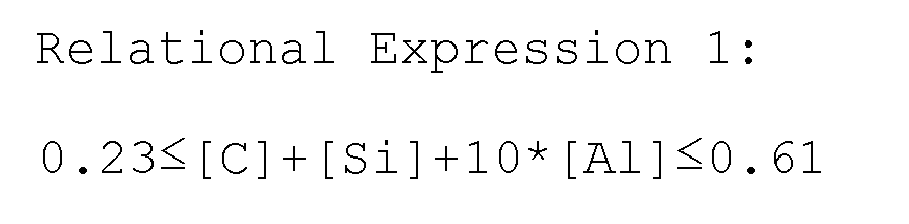
- Relational Expression 1 When a value calculated by Relational Expression 1 is less than 0.23, yield strength of the steel is less than 350 MPa. When the value calculated by Relational Expression 1 is greater than 0.61, the formation of MA may be promoted to have an MA fraction of several percent, and thus, impact characteristics may be deteriorated. Therefore, relative content ranges of carbon (C), silicon (Si), and aluminum (Al) may be adjusted such that the value calculated by Relational Expression 1 satisfies the range of 0.23 to 0.61. 1.35 ⁇ Mn + 2 * Ni + 10 * Nb ⁇ 2.7 where [Mn], [Ni], and [Nb] refer to contents (wt%) of respective alloy components.
- Relational Expression 2 relates to securing a fraction of acicular ferrite useful for securing strength. For example, to secure 30 to 50 area% of the acicular ferrite, relative content ranges of manganese (Mn), nickel (Ni), and niobium (Nb) may be adjusted such that a value calculated by Relational Expression 2 satisfies a range of 1.35 to 2.7.
- iron (Fe) and other inevitable impurities may be included as a remainder.
- the inevitable impurities may be unintentionally incorporated in a common steel manufacturing process, and cannot be entirely excluded.
- the meanings of the inevitable impurities will be readily understood by those skilled in the art of steel manufacturing.
- addition of another composition, other than the above-described steel composition, may not be completely excluded.
- a thick steel plate having excellent low-temperature toughness may include 50 to 70% of polygonal ferrite and 30 to 50% of cyclic circular ferrite as a microstructure.
- a grain size, dislocation density, and the like, of ferrite are important, and it is important to significantly reduce MA and cementite. Since fine polygonal ferrite improves impact toughness absorption energy and acicular ferrite increases strength, a combination of two microstructures is an important factor in securing impact toughness and strength.
- a fraction of the polygonal ferrite When a fraction of the polygonal ferrite is less than 50 area%, it may be difficult to secure impact toughness at a temperature of -50°C due to an increase in fractions of acicular ferrite and a hard secondary phase. When the fraction of the polygonal ferrite is greater than 70 area%, the securing of strength may be insufficient due to a decrease in the fraction of the acicular ferrite.
- the fraction of the polygonal ferrite is less than 30 area%, it may be difficult to secure a desired level of strength.
- the fraction of the acicular ferrite is greater than 50 area%, a desired level of low-temperature toughness may not be secured.
- a fraction of one or two of cementite and MA phases is may be 5% or less (including 0%) by area fraction. Since the cementite and MA phases are not preferable to secure low-temperature impact toughness, formation of the cementite and MA phases may be actively suppressed.
- the fraction of one or two of the cementite and MA phases may be, in detail, 3% or less (including 0%) by area fraction and, more detail, 1% or less (including 0%) by area fraction.
- An average grain size of the ferrite may be 20 ⁇ m or less. This is because when the average grain size of ferrite is greater than 20 ⁇ m, strength and low-temperature toughness may be simultaneously decreased due to grain growth.
- a thick steel plate having excellent low-temperature toughness according to an aspect of the present disclosure may have a thickness of 20 to 120 mm.
- the thick steel plate having excellent low-temperature toughness according to an aspect of the present disclosure may have yield strength of 355 MPa or more and impact toughness of 100 J or more at a temperature of -50°C, and may have tensile strength of 450 MPa or more.
- a method for manufacturing a thick steel plate having excellent low-temperature toughness includes heating a steel slab to a temperature within a range of 1020 to 1100°C, the steel slab comprising, by weight percentage (wt%), 0.03 to 0.06% of carbon (C), 0.1 to 0.2% of silicon (Si), 1.0 to 2.0% of manganese (Mn), 0.01 to 0.035% of aluminum (Al), 0.015 to 0.03% of niobium (Nb), 0.001 to 0.02% of titanium (Ti), 0.1 to 0.2% of nickel (Ni), 0.002 to 0.006% of nitrogen (N), 0.01% or less (excluding 0%) of phosphorus (P), 0.003% or less of sulfur (S), and a balance of iron (Fe) and other inevitable impurities, and satisfying Relational Expressions 1 and 2, hot rolling the heated steel slab to obtain hot-rolled steel, and cooling the hot-rolled steel to a cooling end temperature within a range of 450°C or less.
- the hot rolling includes recrystallization region rolling and non-recrystallization region rolling. 0.23 ⁇ C + Si + 10 * Al ⁇ 0.61 where [C], [Si], and [Al] refer to contents (wt%) of respective alloy components, and 1.35 ⁇ Mn + 2 * Ni + 10 * Nb ⁇ 2.7 where [Mn], [Ni], and [Nb] refer to contents (wt%) of respective alloy components.
- a steel slab having the above composition is heated to a temperature within a range of 1020 to 1100°C. Since a slab alloy composition of the present disclosure corresponds to the above-described alloy composition of the thick steel plate, the description of the slab alloy composition of the present disclosure is replaced with the description of the above-described alloy composition of the thick steel plate.
- the slab heating temperature may be limited to a range of 1020 to 1100°C.
- the heated steel slab is hot rolled to obtain hot-rolled steel.
- the hot rolling includes recrystallization region rolling and non-recrystallization region rolling.
- the recrystallization region rolling may be performed at a temperature of 900 to 1050°C.
- the recrystallization region rolling may be performed at a temperature of, in detail, 900°C or higher by setting a reduction ratio of each of final two passes to, in detail, 15 to 20%. This is aimed at completely recrystallizing austenite and to suppress refinement and growth of the austenite.
- the non-recrystallization region rolling may start at a temperature of, in detail, 830°C to an Ar 3 temperature and may be finished at a temperature higher than the Ar 3 temperature, in detail, about 750°C or higher.
- thick steel having a thickness of 100 to 120 mm may have a cumulative reduction ratio of, in detail, 30 to 40%.
- the hot-rolled steel may have a thickness of 20 to 120 mm.
- the hot-rolled steel obtained by the hot rolling is cooled to a cooling end temperature within a range of 450°C or less.
- the hot-rolled steel may be cooled by water cooling to implement strength and a microstructure of final steel.
- the hot-rolled steel may be cooled to a cooling end temperature within a range of 450°C or less at a cooling rate of 1 to 8°C/sec. This is aimed at suppressing a difference in physical properties caused by a difference in cooling rates between the surface and the center.
- the cooling end temperature is higher than 450°C, formation of MA may be promoted to deteriorate impact toughness.
- the cooling end temperature may be, in more detail, 300°C or less and the cooling rate may be, in more detail, 2 to 4°C/sec.
- the hot-rolled steel may be cooled to a room temperature.
- the thick steel plate manufactured by the manufacturing method according to one aspect of the present disclosure may include 50 to 70 area% of polygonal ferrite and 30 to 50 area% of acicular ferrite as a microstructure, and may further include at least one of 5 area% or less (including 0%) cementite and MA phases.
- an average grain size of ferrite may be 20 ⁇ m or less.
- the thick steel plate manufactured by the manufacturing method according to an aspect of the present disclosure may have yield strength of 355 MPa or more and impact toughness of 100 J or more at a temperature of -50°C, and may have tensile strength of 450 MPa or more.
- molten steel having a component composition of Table 1 and having a component relational expression of Table 3
- a slab was prepared by continuously casting the molten steel.
- the slab was hot-rolled and then cooled under manufacturing conditions of Table 2 to manufacture hot-rolled steel.
- a unit of the content of each element is weight percentage (wt%).
- Inventive Steels A, B, and C are steels satisfying the component range specified in the present disclosure
- Comparative Steels D, E, F, and G are steels, not satisfying the component range specified in the present disclosure.
- Comparative Steel D the content of [C]+[Si]+10 ⁇ [Al] is less than the component range.
- Comparative Steel E the content of [C]+[Si]+10 ⁇ [Al] is greater than the component range.
- Comparative Steel F the content of [Mn]+2 ⁇ [Ni]+10 ⁇ [Nb] is less than the component range.
- Comparative Steel G the content of [Mn]+2 ⁇ [Ni]+10 ⁇ [Nb] is greater than the component range.
- a reduction ratio of final two passes was 19% in recrystallization region rolling at a temperature of 900°C, and a cumulative reduction ratio was 37% in non-crystallization region rolling.
- a microstructure and mechanical physical properties of the hot-rolled steel manufactured as described above were measured, and results thereof are listed in Table 3.
- Inventive Example 1 a microstructure was observed and a result thereof was illustrated in FIG. 1 .
- Inventive Examples 1 to 3 satisfying both an alloy composition and manufacturing conditions proposed in the present disclosure may secure yield strength of 350 MPa and tensile strength of 450 MPa or higher, and may have impact toughness of 100 J or more at a temperature of -50°C.
- an average grain size was 20 ⁇ m or less and polygonal ferrite and acicular ferrite were uniformly distributed at an appropriate ratio, which is important in securing strength and toughness of an ultra-thick plate to be achieved in the present disclosure.
- Comparative Example 1 had poor impact characteristics at a temperature of -50°C because it satisfied the alloy composition proposed in the present disclosure but did not satisfy a cooling end temperature among the manufacturing conditions, which is determined to result from a large amount of MA production.
- Comparative Examples 2, 3, 4, and 5 did not secure strength characteristics or sufficient impact toughness because it satisfied the manufacturing conditions proposed in the present disclosure but did not satisfy alloy composition proposed in the present disclosure.
- Comparative Example 2 the content of [C]+[Si]+10 ⁇ [Al] was less than the component range, and thus, a fraction of acicular ferrite was reduced to result in lowered strength.
- Comparative Example 3 the content of [C]+[Si]+10 ⁇ [Al] was greater than the component range, and thus, formation of MA was promoted and a fraction of the MA was increased to result in poor impact toughness.
- Comparative Examples 4 and 5 the content of [Mn]+2 ⁇ [Ni]+10 ⁇ [Nb] was less or greater than the component range. When the content was less than the component range, strength was lowered. When the content was greater than the component range, acicular ferrite was increased to lower impact toughness.
Landscapes
- Chemical & Material Sciences (AREA)
- Engineering & Computer Science (AREA)
- Mechanical Engineering (AREA)
- Materials Engineering (AREA)
- Metallurgy (AREA)
- Organic Chemistry (AREA)
- Physics & Mathematics (AREA)
- Thermal Sciences (AREA)
- Crystallography & Structural Chemistry (AREA)
- Heat Treatment Of Steel (AREA)
Abstract
Description
- The present disclosure relates to a thick steel plate used in steel for offshore wind power monopiles and structural steel for infrastructure industries such as construction, or the like, and a method for manufacturing the same. More specifically, the present disclosure is directed to a thick steel plate having high strength and excellent low-temperature impact toughness and a method for manufacturing the same.
- Since the 2000s, attention has focused on renewable energy for reducing environmental issues and greenhouse gas emissions. The term "renewable energy" generally refers to combination of new energy (hydrogen, fuel cells, and the like) and renewable energy (solar energy, wind power, bio, and the like) . Especially, wind power generation is in the spotlight as a next-generation energy source because it is eco-friendly power generation with no waste and no pollution.
- Wind power generation is classified into onshore wind power generation and offshore wind power generation. Since onshore wind power generation has disadvantages such as noise and a limitation in an optimal wind generation sites, offshore wind power generation is growing rapidly, mostly in Europe.
- Such offshore wind power generation was activated later than onshore wind power generation, but has advantages such as high wind speeds, low concern for noise generation, and ability to secure a large area. For this reason, as the technology level rises, the relative superiority of offshore wind power generation over onshore wind power generation is receiving more and more attention.
- A structure of such offshore wind power generation includes a monopile section stuck into the seabed, a transition piece section connecting the monopile section and a tower section to each other, and the tower section supporting electricity production equipment. The monopile section and the transition piece section support offshore power generation and are formed of an ultra-thick steel plate and a thick steel plate capable of guaranteeing low-temperature toughness. More specifically, there is a need for steel able to secure a maximum thickness of 120 mm and impact toughness at a temperature of -50°C and satisfy yield strength of 350 MPa.
- (Patent Document 1) Korean Patent Publication No.
10-2017-0075867 - An aspect of the present disclosure is to provide a thick steel plate having high strength and excellent low-temperature impact toughness.
- Another aspect of the present disclosure is to provide a method for manufacturing a thick steel plate having high strength and excellent low-temperature impact toughness.
- According to an aspect of the present disclosure, a thick steel plate having excellent low-temperature toughness includes, by weight percentage (wt%), 0.03 to 0.06% of carbon (C), 0.1 to 0.2% of silicon (Si), 1.0 to 2.0% of manganese (Mn), 0.01 to 0.035% of aluminum (Al), 0.015 to 0.03% of niobium (Nb), 0.001 to 0.02% of titanium (Ti), 0.1 to 0.2% of nickel (Ni), 0.002 to 0.006% of nitrogen (N), 0.01% or less (excluding 0%) of phosphorus (P), 0.003% or less of sulfur (S), and a balance of iron (Fe) and other inevitable impurities, and satisfies Relational Expressions 1 and 2. The thick steel plate has a microstructure including, by area fraction, 50 to 70% of polygonal ferrite and 30 to 50% of acicular ferrite, and the polygonal ferrite has an average grain size of 20 µm or less.

- The microstructure may further include one or two of cementite and MA phases, and a fraction of the one or two of the cementite and MA phases may be 5% or less (including 0%) by area fraction.
- Yield strength of the thick steel plate may be 355 MPa or more, and impact toughness of the thick steel plate at a temperature of -50°C may be 100 J or more.
- Tensile strength of the thick steel plate may be 450 MPa or more.
- According to an aspect of the present disclosure, a method for manufacturing a thick steel plate having excellent low-temperature toughness includes heating a steel slab to a temperature within a range of 1020 to 1100°C, the steel slab comprising, by weight percentage (wt%), 0.03 to 0.06% of carbon (C), 0.1 to 0.2% of silicon (Si), 1.0 to 2.0% of manganese (Mn), 0.01 to 0.035% of aluminum (Al), 0.015 to 0.03% of niobium (Nb), 0.001 to 0.02% of titanium (Ti), 0.1 to 0.2% of nickel (Ni), 0.002 to 0.006% of nitrogen (N), 0.01% or less (excluding 0%) of phosphorus (P), 0.003% or less of sulfur (S), and a balance of iron (Fe) and other inevitable impurities, and satisfying Relational Expressions 1 and 2, hot rolling the heated steel slab to obtain hot-rolled steel, and cooling the hot-rolled steel to a cooling end temperature within a range of 450°C or less. The hot rolling includes recrystallization region rolling and non-recrystallization region rolling.


- The recrystallization region rolling may be performed at a temperature of 900°C or higher by setting a reduction ratio of each of final two passes to 15 to 20%.
- The non-recrystallization rolling may be finished at a temperature of 750°C or higher.
- A cumulative reduction ratio of the non-recrystallization rolling may be 30 to 40%.
- The cooling end temperature may be 300°C or less.
- A cooling rate of the cooling may be 1 to 8°C/sec.
- The cooling rate of the cooling may be 2 to 4°C/sec.
- The technical solutions to the above-mentioned problems do not fully enumerate all features of the present disclosure. Various features of the present disclosure and the resulting advantages and effects will be understood in more detail with reference to the following detailed examples.
- According to an aspect of the present disclosure, a thick steel plate securing excellent low-temperature toughness characteristics and yield strength of 350 MPa or more while having a thickness of about 120 mm and a method for manufacturing the same.
- According to an aspect of the present disclosure, a thick steel plate especially appropriate to an offshore wind power industry by improving resistance to deformation and destruction of a structure, caused by continuous waves and impacts by fish, tidal currents, ships, and the like, and method for manufacturing the same.
- Application of the steel according to an aspect of the present disclosure may effectively contribute to securing stability of an offshore structure and life extension.
-
FIG. 1 is an image, captured at 200x magnification using an optical microscope, illustrating a microstructure of Inventive Example 1. - The present disclosure relates to a thick steel plate having excellent hydrogen-induced cracking resistance and a method for manufacturing the same. Examples of the present disclosure may be modified in various forms, and the scope of the present disclosure should not be construed as being limited to these examples set forth herein. The examples are provided to explain the present disclosure so that the present disclosure will be thorough and complete, and will fully convey the scope of the present disclosure to those skilled in the art.
- Hereinafter, a steel composition of the present disclosure will be described in detail. Hereinafter, percentage (%) denotes weight percentage (wt%) unless otherwise specified.
- A thick steel plate having excellent low-temperature toughness, the thick steel plate according to an aspect of the present disclosure includes, by weight percentage (wt%), 0.03 to 0.06% of carbon (C), 0.1 to 0.2% of silicon (Si), 1.0 to 2.0% of manganese (Mn), 0.01 to 0.035% of aluminum (Al), 0.015 to 0.03% of niobium (Nb), 0.001 to 0.02% of titanium (Ti), 0.1 to 0.2% of nickel (Ni), 0.002 to 0.006% of nitrogen (N), 0.01% or less (excluding 0%) of phosphorus (P), 0.003% or less of sulfur (S), and a balance of iron (Fe) and other inevitable impurities, and satisfies Relational Expressions 1 and 2.


- Carbon (C) is an element for solid solution strengthening, binds to niobium (Nb), or the like, to be present as a carbonitride, and is added to secure tensile strength. Therefore, in the present disclosure, a lower limit the content of carbon (C) may be limited to 0.03 or less. However, when carbon (C) is added excessively, not only formation of MA is promoted but also formation of pearlite is done, which may deteriorate impact characteristics at a low temperature. For this reason, in the present disclosure, an upper limit of the content of carbon (C) may be limited to 0.06%. Therefore, the content of carbon (C) may be in the range of 0.03 to 0.06%. The content of carbon (C) may be in the range of, in detail, 0.032 to 0.06% and, in more detail, 0.032 to 0.058%.
- Since silicon (Si) serves to deoxidize molten steel by supporting aluminum (Al) and is an element required to secure yield strength and tensile strength, a lower limit of the content of silicon (Si) may be limited to 0.1% in the present disclosure. However, when silicon (Si) is added excessively, diffusion of carbon (C) is prevented to promote formation of MA. Accordingly, it may be difficult to secure impact characteristics at a low temperature, so that an upper limit of silicon (Si) may be limited to 0.2%. Therefore, in the present disclosure, the content of silicon (Si) may be in the range of 0.1 to 0.2%. The content of silicon (Si) may be in the range of, in detail, 0.1 to 0.18% and, in more detail, 0.12 to 0.18%.
- Since manganese (Mn) is an element contributing to an increase in strength due to solid solution strengthening, a lower limit of the content of manganese (Mn) may be limited to 1.0% to achieve such an effect. However, when the manganese (Mn) is added excessively, an MnS inclusion may be formed and toughness may be reduced due to centerline segregation. For this reason, in the present disclosure, an upper limit of the content of manganese (Mn) may be limited to 2.0%. Therefore, the content of manganese (Mn) may be in the range of 1.0 to 2.0%. The content of manganese (Mn) be in the range of, in detail, 1.2 to 1.8% and, in more detail, 1.4 to 1.8%.
- Since aluminum (Al) functions as a main deoxidizer of steel, it is necessary to add at least 0.01% of aluminum (Al) based on a dissolved state. However, when aluminum (Al) is added excessively, a fraction and a size of an Al2O3 inclusion may be increased to deteriorate low-temperature toughness. Similarly to silicon (Si), formation of an MA phase of a base metal and a welding heat-affected zone may be promoted to deteriorate the low-temperature toughness. For this reason, in the present disclosure, the content of aluminum (Al) may be limited to 0.035% or less, based on the dissolved state. Therefore, the content of aluminum (Al) may be in the range of 0.01 to 0.035%. The content of aluminum (Al) may be in the range of, in detail, 0.02 to 0.035% and, in more detail, 0.02 to 0.03%.
- Niobium (Nb) is an element suppressing recrystallization during rolling or cooling by precipitating a carbonitride to refine a structure and to increase structure. In the present disclosure, a lower limit of the content of niobium (Nb) is limited to 0.015% to achieve such an effect. However, when niobium (Nb) is added excessively, concentration of carbon (C) is caused by affinity of niobium (Nb) to carbon (C) to promote the formation of the MA phase, and thus, toughness and fracture characteristics at a low temperature may be deteriorated. For this reason, in the present disclosure, an upper limit of the content of niobium (Nb) may be limited to 0.03%. Therefore, the content of niobium (Nb) may be in the range of 0.015 to 0.03%. The content of niobium (Nb) may be in the range of, in detail, 0.018 to 0.03% and, in more detail, 0.018 to 0.025%.
- Titanium (Ti) binds to oxygen (O) or nitrogen (N) to form a precipitate, and the precipitate suppresses coarseness of a structure to contribute to refinement and to serve to improve toughness. In the present disclosure, a lower limit of the content of titanium (Ti) may be limited to 0.001% to achieve such an effect. However, when titanium (Ti) is added excessively, a Ti-based precipitate may be coarsened to provide a cause of steel fracture. For this reason, in the present disclosure, an upper limit of the content of titanium (Ti) may be limited to 0.02%. Therefore, the content of titanium (Ti) may be in the range of 0.001 to 0.02%. The content of titanium (Ti) may be in the range of, in detail, 0.005 to 0.02% and, in more detail, 0.005 to 0.015%.
- Nickel (Ni) is an element effective in improving strength without deterioration of impact toughness. In addition, nickel (Ni) is also an element promoting formation of acicular ferrite. In the present disclosure, a lower limit of the content of nickel (Ni) may be limited to 0.1% to achieve such an effect. However, when nickel (Ni) is added excessively, an Ar3 temperature is decreased to form bainite. For this reason, in the present disclosure, an upper limit of the content of nickel (Ni) may be limited to 0.2%. This is because when bainite is formed, impact toughness may be deteriorated in an ultra-thick steel plate. Therefore, the content of nickel (Ni) may be in the range of 0.1 to 0.2%. The content of nickel (Ni) may be in the range of, in detail, 0.11 to 0.2% and, in more detail, 0.11 to 0.19%.
- Nitrogen (N) is an element useful for improving strength and toughness by forming a precipitate, together with titanium (Ti), niobium (Nb), and aluminum (Al) to refine an austenite structure during reheating. In the present disclosure, a lower limit of the content of nitrogen (N) may be limited to 0.002% to achieve such an effect. However, when nitrogen (N) is added excessively, surface cracking may occur at a high temperature and residual nitrogen (N) is present in an atomic state to reduce the toughness. For this reason, in the present disclosure, the content of nitrogen (N) may be limited to 0.006%. Therefore, the content of nitrogen (N) may be in the range of 0.002 to 0.006%. The content of nitrogen (N) may be in the range of, in detail, 0.003 to 0.006% and, in more detail, 0.003 to 0.005%.
- Phosphorus (P) is an element causing steel to be embrittled by grain boundary segregation. Therefore, in the present disclosure, an upper limit of the content of phosphorus (P) may be limited to 0.01%. However, phosphorus (P) is a representative impurity element introduced in a steelmaking process, and complete removal of phosphorus (P) in the steel is not preferable in terms of costs and time. Therefore, 0% may be excluded from a lower limit of the content of phosphorus (P) .
- Sulfur (S) mainly binds to manganese (Mn) to form an MnS inclusion deteriorating low-temperature toughness. Therefore, in the present disclosure, an upper limit of the content of sulfur (S) may be limited to 0.003% to secure low-temperature toughness and low-temperature fatigue characteristics. However, sulfur (S) is also a representative impurity element introduced in the steelmaking process, and complete removal of sulfur (S) in the steel is not preferable in terms of costs and time. Therefore, 0% may be excluded from a lower limit of the content of sulfur (S).
- Copper (Cu) is a component which does not significantly deteriorate impact characteristics but does not significantly contribute to an improvement in strength of steel. In addition, when copper (Cu) is added excessively, surface cracking of the steel sheet may occur due to thermal impact. Therefore, the addition of copper (Cu) may be excluded for a low-cost component system.
- Chromium (Cr) and molybdenum (Mo) are components allowing strength to be easily improved by forming carbide. However, in ultra-thick steel material, chromium (Cr) and molybdenum (Mo) may form coarse carbide depending on a cooling rate of a plate to deteriorate impact toughness. Therefore, the addition of chromium (Cr) and molybdenum (Mo) may be excluded in the present disclosure.

- When a value calculated by Relational Expression 1 is less than 0.23, yield strength of the steel is less than 350 MPa. When the value calculated by Relational Expression 1 is greater than 0.61, the formation of MA may be promoted to have an MA fraction of several percent, and thus, impact characteristics may be deteriorated. Therefore, relative content ranges of carbon (C), silicon (Si), and aluminum (Al) may be adjusted such that the value calculated by Relational Expression 1 satisfies the range of 0.23 to 0.61.

- Relational Expression 2 relates to securing a fraction of acicular ferrite useful for securing strength. For example, to secure 30 to 50 area% of the acicular ferrite, relative content ranges of manganese (Mn), nickel (Ni), and niobium (Nb) may be adjusted such that a value calculated by Relational Expression 2 satisfies a range of 1.35 to 2.7.
- In addition to the above-described steel composition, iron (Fe) and other inevitable impurities may be included as a remainder. The inevitable impurities may be unintentionally incorporated in a common steel manufacturing process, and cannot be entirely excluded. The meanings of the inevitable impurities will be readily understood by those skilled in the art of steel manufacturing. Moreover, addition of another composition, other than the above-described steel composition, may not be completely excluded.
- Hereinafter, a microstructure of the present disclosure will be described in more detail.
- A thick steel plate having excellent low-temperature toughness according to an aspect of the present disclosure may include 50 to 70% of polygonal ferrite and 30 to 50% of cyclic circular ferrite as a microstructure.
- To implement central impact toughness at a temperature of -50°C and fatigue characteristics at a temperature of -60°C in the thick steel plate of the present disclosure, a grain size, dislocation density, and the like, of ferrite are important, and it is important to significantly reduce MA and cementite. Since fine polygonal ferrite improves impact toughness absorption energy and acicular ferrite increases strength, a combination of two microstructures is an important factor in securing impact toughness and strength.
- When a fraction of the polygonal ferrite is less than 50 area%, it may be difficult to secure impact toughness at a temperature of -50°C due to an increase in fractions of acicular ferrite and a hard secondary phase. When the fraction of the polygonal ferrite is greater than 70 area%, the securing of strength may be insufficient due to a decrease in the fraction of the acicular ferrite.
- When the fraction of the polygonal ferrite is less than 30 area%, it may be difficult to secure a desired level of strength. When the fraction of the acicular ferrite is greater than 50 area%, a desired level of low-temperature toughness may not be secured.
- A fraction of one or two of cementite and MA phases is may be 5% or less (including 0%) by area fraction. Since the cementite and MA phases are not preferable to secure low-temperature impact toughness, formation of the cementite and MA phases may be actively suppressed. The fraction of one or two of the cementite and MA phases may be, in detail, 3% or less (including 0%) by area fraction and, more detail, 1% or less (including 0%) by area fraction.
- An average grain size of the ferrite may be 20 µm or less. This is because when the average grain size of ferrite is greater than 20 µm, strength and low-temperature toughness may be simultaneously decreased due to grain growth.
- A thick steel plate having excellent low-temperature toughness according to an aspect of the present disclosure may have a thickness of 20 to 120 mm. In addition, the thick steel plate having excellent low-temperature toughness according to an aspect of the present disclosure may have yield strength of 355 MPa or more and impact toughness of 100 J or more at a temperature of -50°C, and may have tensile strength of 450 MPa or more.
- Hereinafter, the manufacturing method of the present disclosure will be described in more detail.
- A method for manufacturing a thick steel plate having excellent low-temperature toughness according to an aspect of the present disclosure includes heating a steel slab to a temperature within a range of 1020 to 1100°C, the steel slab comprising, by weight percentage (wt%), 0.03 to 0.06% of carbon (C), 0.1 to 0.2% of silicon (Si), 1.0 to 2.0% of manganese (Mn), 0.01 to 0.035% of aluminum (Al), 0.015 to 0.03% of niobium (Nb), 0.001 to 0.02% of titanium (Ti), 0.1 to 0.2% of nickel (Ni), 0.002 to 0.006% of nitrogen (N), 0.01% or less (excluding 0%) of phosphorus (P), 0.003% or less of sulfur (S), and a balance of iron (Fe) and other inevitable impurities, and satisfying Relational Expressions 1 and 2, hot rolling the heated steel slab to obtain hot-rolled steel, and cooling the hot-rolled steel to a cooling end temperature within a range of 450°C or less. The hot rolling includes recrystallization region rolling and non-recrystallization region rolling.


- A steel slab having the above composition is heated to a temperature within a range of 1020 to 1100°C. Since a slab alloy composition of the present disclosure corresponds to the above-described alloy composition of the thick steel plate, the description of the slab alloy composition of the present disclosure is replaced with the description of the above-described alloy composition of the thick steel plate.
- When the heating temperature is too high during heating of the steel slab, grains of austenite are coarsened to increase hardenability, and thus, a bainite structure may be manifested to deteriorate toughness. When the heating temperature is too low during heating of the steel slab, titanium (Ti), niobium (Nb), or the like, may be insufficiently solid-solubilized to decrease strength. Therefore, in the present disclosure, the slab heating temperature may be limited to a range of 1020 to 1100°C.
- The heated steel slab is hot rolled to obtain hot-rolled steel. The hot rolling includes recrystallization region rolling and non-recrystallization region rolling.
- The recrystallization region rolling may be performed at a temperature of 900 to 1050°C. In the hot rolling, the recrystallization region rolling may be performed at a temperature of, in detail, 900°C or higher by setting a reduction ratio of each of final two passes to, in detail, 15 to 20%. This is aimed at completely recrystallizing austenite and to suppress refinement and growth of the austenite.
- The non-recrystallization region rolling may start at a temperature of, in detail, 830°C to an Ar3 temperature and may be finished at a temperature higher than the Ar3 temperature, in detail, about 750°C or higher. In the non-recrystallization region rolling, for example, thick steel having a thickness of 100 to 120 mm may have a cumulative reduction ratio of, in detail, 30 to 40%.
- After the hot rolling, the hot-rolled steel may have a thickness of 20 to 120 mm.
- As described above, the hot-rolled steel obtained by the hot rolling is cooled to a cooling end temperature within a range of 450°C or less.
- The hot-rolled steel may be cooled by water cooling to implement strength and a microstructure of final steel. For example, the hot-rolled steel may be cooled to a cooling end temperature within a range of 450°C or less at a cooling rate of 1 to 8°C/sec. This is aimed at suppressing a difference in physical properties caused by a difference in cooling rates between the surface and the center. When the cooling end temperature is higher than 450°C, formation of MA may be promoted to deteriorate impact toughness. The cooling end temperature may be, in more detail, 300°C or less and the cooling rate may be, in more detail, 2 to 4°C/sec. The hot-rolled steel may be cooled to a room temperature.
- The thick steel plate manufactured by the manufacturing method according to one aspect of the present disclosure may include 50 to 70 area% of polygonal ferrite and 30 to 50 area% of acicular ferrite as a microstructure, and may further include at least one of 5 area% or less (including 0%) cementite and MA phases. In this case, an average grain size of ferrite may be 20 µm or less.
- The thick steel plate manufactured by the manufacturing method according to an aspect of the present disclosure may have yield strength of 355 MPa or more and impact toughness of 100 J or more at a temperature of -50°C, and may have tensile strength of 450 MPa or more.
- Hereinafter, embodiments of the present disclosure will be described more specifically through examples. However, the examples are for clearly explaining the embodiments of the present disclosure and are not intended to limit the scope of the present invention.
- After preparing molten steel having a component composition of Table 1 and having a component relational expression of Table 3, a slab was prepared by continuously casting the molten steel. The slab was hot-rolled and then cooled under manufacturing conditions of Table 2 to manufacture hot-rolled steel.
- In Table 1, a unit of the content of each element is weight percentage (wt%). Inventive Steels A, B, and C are steels satisfying the component range specified in the present disclosure, and Comparative Steels D, E, F, and G are steels, not satisfying the component range specified in the present disclosure. In Comparative Steel D, the content of [C]+[Si]+10∗[Al] is less than the component range. In Comparative Steel E, the content of [C]+[Si]+10∗[Al] is greater than the component range. In Comparative Steel F, the content of [Mn]+2∗[Ni]+10∗[Nb] is less than the component range. In Comparative Steel G, the content of [Mn]+2∗[Ni]+10∗[Nb] is greater than the component range.
- Among process conditions, a reduction ratio of final two passes was 19% in recrystallization region rolling at a temperature of 900°C, and a cumulative reduction ratio was 37% in non-crystallization region rolling. A microstructure and mechanical physical properties of the hot-rolled steel manufactured as described above were measured, and results thereof are listed in Table 3. In Inventive Example 1, a microstructure was observed and a result thereof was illustrated in
FIG. 1 .


- As can be seen from Tables 1 to 3, Inventive Examples 1 to 3 satisfying both an alloy composition and manufacturing conditions proposed in the present disclosure may secure yield strength of 350 MPa and tensile strength of 450 MPa or higher, and may have impact toughness of 100 J or more at a temperature of -50°C. As can be seen from
FIG. 1 , in Inventive Example 1, an average grain size was 20 µm or less and polygonal ferrite and acicular ferrite were uniformly distributed at an appropriate ratio, which is important in securing strength and toughness of an ultra-thick plate to be achieved in the present disclosure. - Comparative Example 1 had poor impact characteristics at a temperature of -50°C because it satisfied the alloy composition proposed in the present disclosure but did not satisfy a cooling end temperature among the manufacturing conditions, which is determined to result from a large amount of MA production.
- Comparative Examples 2, 3, 4, and 5 did not secure strength characteristics or sufficient impact toughness because it satisfied the manufacturing conditions proposed in the present disclosure but did not satisfy alloy composition proposed in the present disclosure.
- Specifically, in Comparative Example 2, the content of [C]+[Si]+10∗[Al] was less than the component range, and thus, a fraction of acicular ferrite was reduced to result in lowered strength. In Comparative Example 3, the content of [C]+[Si]+10∗[Al] was greater than the component range, and thus, formation of MA was promoted and a fraction of the MA was increased to result in poor impact toughness. In Comparative Examples 4 and 5, the content of [Mn]+2∗[Ni]+10∗[Nb] was less or greater than the component range. When the content was less than the component range, strength was lowered. When the content was greater than the component range, acicular ferrite was increased to lower impact toughness.
- While example embodiments have been shown and described above, the scope of the present disclosure is not limited thereto, and it will be apparent to those skilled in the art that modifications and variations could be made without departing from the scope of the present invention as defined by the appended claims.
Claims (11)
- A thick steel plate having excellent low-temperature toughness, the thick steel plate comprising, by weight percentage (wt%), 0.03 to 0.06% of carbon (C), 0.1 to 0.2% of silicon (Si), 1.0 to 2.0% of manganese (Mn), 0.01 to 0.035% of aluminum (Al), 0.015 to 0.03% of niobium (Nb), 0.001 to 0.02% of titanium (Ti), 0.1 to 0.2% of nickel (Ni), 0.002 to 0.006% of nitrogen (N), 0.01% or less (excluding 0%) of phosphorus (P), 0.003% or less of sulfur (S), and a balance of iron (Fe) and other inevitable impurities, and satisfying Relational Expressions 1 and 2,
wherein the thick steel plate has a microstructure comprising, by area fraction, 50 to 70% of polygonal ferrite and 30 to 50% of acicular ferrite, and the polygonal ferrite has an average grain size of 20 µm or less,

- The thick steel plate of claim 1, wherein the microstructure further comprises one or two of cementite and MA phases, and
a fraction of the one or two of the cementite and MA phases is 5% or less (including 0%) by area fraction. - The thick steel plate of claim 1, wherein yield strength of the thick steel plate is 355 MPa or more, and
impact toughness of the thick steel plate at a temperature of -50°C is 100 J or more. - The thick steel plate of claim 1, wherein tensile strength of the thick steel plate is 450 MPa or more.
- A method for manufacturing a thick steel plate having excellent low-temperature toughness, the method comprising:heating a steel slab to a temperature within a range of 1020 to 1100°C, the steel slab comprising, by weight percentage (wt%), 0.03 to 0.06% of carbon (C), 0.1 to 0.2% of silicon (Si), 1.0 to 2.0% of manganese (Mn), 0.01 to 0.035% of aluminum (Al), 0.015 to 0.03% of niobium (Nb), 0.001 to 0.02% of titanium (Ti), 0.1 to 0.2% of nickel (Ni), 0.002 to 0.006% of nitrogen (N), 0.01% or less (excluding 0%) of phosphorus (P), 0.003% or less of sulfur (S), and a balance of iron (Fe) and other inevitable impurities, and satisfying Relational Expressions 1 and 2;hot rolling the heated steel slab to obtain hot-rolled steel; andcooling the hot-rolled steel to a cooling end temperature within a range of 450°C or less,wherein the hot rolling comprises recrystallization region rolling and non-recrystallization region rolling,


- The method of claim 5, wherein the recrystallization region rolling is performed at a temperature of 900°C or higher by setting a reduction ratio of each of final two passes to 15 to 20%.
- The method of claim 5, wherein the non-recrystallization rolling is finished at a temperature of 750°C or higher.
- The method of claim 5, wherein a cumulative reduction ratio of the non-recrystallization rolling is 30 to 40%.
- The method of claim 5, wherein the cooling end temperature is 300°C or less.
- The method of claim 5, wherein a cooling rate of the cooling is 1 to 8°C/sec.
- The method of claim 10, wherein the cooling rate of the cooling is 2 to 4°C/sec.
Applications Claiming Priority (2)
| Application Number | Priority Date | Filing Date | Title |
|---|---|---|---|
| KR1020170178949A KR101999018B1 (en) | 2017-12-24 | 2017-12-24 | Thick steel plate with excellent low-temperature toughness and method for manufacturing the same |
| PCT/KR2018/015950 WO2019124890A1 (en) | 2017-12-24 | 2018-12-14 | Thick steel plate having excellent low-temperature toughness and manufacturing method therefor |
Publications (2)
| Publication Number | Publication Date |
|---|---|
| EP3730640A4 EP3730640A4 (en) | 2020-10-28 |
| EP3730640A1 true EP3730640A1 (en) | 2020-10-28 |
Family
ID=66994972
Family Applications (1)
| Application Number | Title | Priority Date | Filing Date |
|---|---|---|---|
| EP18890536.8A Pending EP3730640A1 (en) | 2017-12-24 | 2018-12-14 | Thick steel plate having excellent low-temperature toughness and manufacturing method therefor |
Country Status (5)
| Country | Link |
|---|---|
| EP (1) | EP3730640A1 (en) |
| JP (1) | JP7064597B2 (en) |
| KR (1) | KR101999018B1 (en) |
| CN (1) | CN111511950A (en) |
| WO (1) | WO2019124890A1 (en) |
Cited By (1)
| Publication number | Priority date | Publication date | Assignee | Title |
|---|---|---|---|---|
| US12559813B2 (en) | 2019-08-23 | 2026-02-24 | Posco | Thin steel plate having excellent low-temperature toughness and CTOD properties, and method for manufacturing same |
Families Citing this family (5)
| Publication number | Priority date | Publication date | Assignee | Title |
|---|---|---|---|---|
| JP7184210B2 (en) * | 2020-03-13 | 2022-12-06 | 日本製鉄株式会社 | Steel plate for wind power generation facilities and method for manufacturing the same |
| KR102397583B1 (en) * | 2020-09-25 | 2022-05-13 | 주식회사 포스코 | High Strength Hot Rolled Steel Sheet with Excellent Elongation and Method of Manufacturing Thereof |
| CN113201691B (en) * | 2021-04-28 | 2022-03-22 | 攀钢集团攀枝花钢铁研究院有限公司 | Hot rolled steel plate for 590 MPa-level hydraulic bulging and preparation method thereof |
| CN114686776B (en) * | 2022-03-31 | 2022-10-18 | 鞍钢股份有限公司 | A 460MPa grade high toughness extra-thick plate and its manufacturing method |
| CN116162855B (en) * | 2023-02-28 | 2024-01-30 | 马鞍山钢铁股份有限公司 | A 600MPa thick specification phosphorus-containing hot-rolled weather-resistant steel plate and its manufacturing method |
Family Cites Families (23)
| Publication number | Priority date | Publication date | Assignee | Title |
|---|---|---|---|---|
| JPH0649898B2 (en) * | 1986-01-24 | 1994-06-29 | 株式会社神戸製鋼所 | Method for producing low yielding high yield point steel with excellent toughness in the heat affected zone |
| JPS62256916A (en) * | 1986-04-28 | 1987-11-09 | Kobe Steel Ltd | Production of low-temperature extra-thick steel plate having excellent uniformity in thickness direction |
| KR100660230B1 (en) * | 2005-12-26 | 2006-12-21 | 주식회사 포스코 | Extreme thick steel sheet for welded structure with excellent strength and toughness at the center of thickness and manufacturing method |
| JP4976749B2 (en) * | 2006-06-02 | 2012-07-18 | 株式会社神戸製鋼所 | Steel sheet with excellent fatigue crack growth resistance |
| KR100957970B1 (en) * | 2007-12-27 | 2010-05-17 | 주식회사 포스코 | High strength high toughness steel plate and manufacturing method thereof |
| CN101705439B (en) * | 2009-12-18 | 2011-12-21 | 江苏省沙钢钢铁研究院有限公司 | Low-temperature high-toughness F460 grade ultra-high-strength shipbuilding steel plate and manufacturing method thereof |
| KR101185336B1 (en) * | 2010-07-28 | 2012-09-21 | 현대제철 주식회사 | STEEL PLATE WITH HIGH STRENGTH OF 500MPa GRADE AND LOW TEMPERATURE TOUGHNESS AND METHOD FOR MANUFACTURING THE SAME |
| JP5423737B2 (en) * | 2010-08-10 | 2014-02-19 | Jfeスチール株式会社 | High-strength hot-rolled steel sheet excellent in workability and manufacturing method thereof |
| JP5612532B2 (en) * | 2011-04-26 | 2014-10-22 | 株式会社神戸製鋼所 | Steel sheet excellent in low temperature toughness and weld joint fracture toughness and method for producing the same |
| KR101403224B1 (en) * | 2011-12-28 | 2014-06-02 | 주식회사 포스코 | Thick steel plate having excellent low yield ratio property and low temperature toughness and method for manufacturing the steel plate |
| JP5833964B2 (en) * | 2012-03-29 | 2015-12-16 | 株式会社神戸製鋼所 | Steel sheet excellent in bending workability, impact property and tensile property, and method for producing the same |
| JP6232045B2 (en) * | 2012-03-30 | 2017-11-15 | フォエスタルピネ スタール ゲゼルシャフト ミット ベシュレンクテル ハフツングVoestalpine Stahl Gmbh | High-strength cold-rolled steel sheet and method for producing such a steel sheet |
| JP5811032B2 (en) * | 2012-05-23 | 2015-11-11 | 新日鐵住金株式会社 | Steel sheet for LPG tank |
| KR20150002956A (en) * | 2013-06-27 | 2015-01-08 | 현대제철 주식회사 | Steel sheet for line pipe and method of manufacturing the same |
| KR20160078624A (en) * | 2014-12-24 | 2016-07-05 | 주식회사 포스코 | Hot rolled steel sheet for steel pipe having excellent low-temperature toughness and strength and method for manufacturing the same |
| KR101647226B1 (en) * | 2014-12-24 | 2016-08-10 | 주식회사 포스코 | Steel plate having excellent fracture resistance and yield ratio, and method for manufacturing the same |
| JP6763141B2 (en) * | 2015-02-10 | 2020-09-30 | 日本製鉄株式会社 | Manufacturing method of steel plate for LPG tank |
| KR20160147153A (en) * | 2015-06-12 | 2016-12-22 | 동국제강주식회사 | Manufacturing method of high strength steel plate for line pipe and high strength steel plate for line pipe |
| KR20160150190A (en) * | 2015-06-18 | 2016-12-29 | 현대제철 주식회사 | Manufacturing mehtod for thick steel plate and thick steel plate thereof |
| KR101786258B1 (en) | 2015-12-23 | 2017-10-18 | 주식회사 포스코 | The steel sheet having high-strength and excellent heat affected zone toughness and method for manufacturing the same |
| KR101767778B1 (en) * | 2015-12-23 | 2017-08-14 | 주식회사 포스코 | Low yield ratio high strength steel having excellent resistance for stress corrosion cracking and low temperature toughness, and method for manufacturing the same |
| KR101758520B1 (en) * | 2015-12-23 | 2017-07-17 | 주식회사 포스코 | High strength structural steel sheet having excellent heat treatment resistance and method of manufacturing the same |
| CN107502821B (en) * | 2017-08-29 | 2019-06-25 | 江阴兴澄特种钢铁有限公司 | The economical X 70 pipeline steel plate and its manufacturing method used under a kind of spy's think gauge ultra-low temperature surroundings |
-
2017
- 2017-12-24 KR KR1020170178949A patent/KR101999018B1/en active Active
-
2018
- 2018-12-14 CN CN201880082930.2A patent/CN111511950A/en active Pending
- 2018-12-14 EP EP18890536.8A patent/EP3730640A1/en active Pending
- 2018-12-14 WO PCT/KR2018/015950 patent/WO2019124890A1/en not_active Ceased
- 2018-12-14 JP JP2020534887A patent/JP7064597B2/en active Active
Cited By (1)
| Publication number | Priority date | Publication date | Assignee | Title |
|---|---|---|---|---|
| US12559813B2 (en) | 2019-08-23 | 2026-02-24 | Posco | Thin steel plate having excellent low-temperature toughness and CTOD properties, and method for manufacturing same |
Also Published As
| Publication number | Publication date |
|---|---|
| EP3730640A4 (en) | 2020-10-28 |
| KR20190077196A (en) | 2019-07-03 |
| WO2019124890A1 (en) | 2019-06-27 |
| JP7064597B2 (en) | 2022-05-10 |
| CN111511950A (en) | 2020-08-07 |
| JP2021507118A (en) | 2021-02-22 |
| KR101999018B1 (en) | 2019-07-10 |
Similar Documents
| Publication | Publication Date | Title |
|---|---|---|
| JP7576630B2 (en) | Controlled yield ratio steel and method for producing same | |
| EP3730640A1 (en) | Thick steel plate having excellent low-temperature toughness and manufacturing method therefor | |
| KR101253890B1 (en) | Ultra thick steel sheet for pressure vessel having excellent central properties and hydrogen induced cracking resistance, and method for manufacturing the same | |
| KR20210002621A (en) | High-strength double-sided stainless steel clad sheet and its manufacturing method | |
| CN112011727A (en) | Ultrahigh-strength low-temperature-toughness steel, ultrahigh-strength low-temperature-toughness bar and manufacturing method thereof | |
| JP2010070845A (en) | Weldable ultra-high strength steel having excellent low-temperature toughness and method for producing the same | |
| CN102277540A (en) | igh temperature PWHT softening and production method thereof | |
| EP3733904A1 (en) | Steel material showing excellent hydrogen-induced cracking resistance and method for preparing same | |
| JP2005320624A (en) | Thick high-strength steel sheet with excellent low-temperature toughness in the heat affected zone by high heat input welding | |
| CN103695776A (en) | Thick steel plate with low carbon equivalent and excellent welding heat affected zone toughness and manufacturing method of same | |
| CN102517494B (en) | Rolled steel for wind-power flange and preparation method thereof | |
| CN118792585A (en) | A wide and thick steel plate for high-performance offshore oil and gas production riser and its preparation method | |
| KR20070116561A (en) | Steel plate with good HAZ toughness and small strength drop by heat treatment after welding | |
| US20220403479A1 (en) | Normalizing heat-treated steel sheet having good low-temperature impact toughness and method for manufacturing same | |
| KR101465088B1 (en) | Low carbon high strength steel plates with good low temperature toughness and manufacturing method for the same | |
| EP4455351A1 (en) | Steel plate having high strength and excellent low-temperature impact toughness, and method for manufacturing same | |
| CN116815046A (en) | FH36 marine steel with excellent hydrogen induced cracking resistance and manufacturing method thereof | |
| CN111154963A (en) | Welding heat influence region-resistant softened submarine pipeline steel and preparation method thereof | |
| KR20090121822A (en) | Composite bainite steels containing copper and manufacturing method thereof | |
| US12612674B2 (en) | Steel plate having high strength and excellent impact toughness after deformation, and method for manufacturing same | |
| KR101359082B1 (en) | Thick steel sheet with excellent low temperature dwtt property and method for producing same | |
| CN116815047A (en) | 460 MPa-grade marine steel with excellent hydrogen induced cracking resistance and manufacturing method thereof | |
| CN116904861A (en) | Cu-containing high-strength ship plate steel and preparation method thereof | |
| CN118685711B (en) | 460 MPa-grade marine steel with excellent fracture resistance and preparation method thereof | |
| KR102275814B1 (en) | Ultra thick steel plate and manufacturing method for offshore structure having ultra-high strength and high toughness |
Legal Events
| Date | Code | Title | Description |
|---|---|---|---|
| STAA | Information on the status of an ep patent application or granted ep patent |
Free format text: STATUS: THE INTERNATIONAL PUBLICATION HAS BEEN MADE |
|
| PUAI | Public reference made under article 153(3) epc to a published international application that has entered the european phase |
Free format text: ORIGINAL CODE: 0009012 |
|
| STAA | Information on the status of an ep patent application or granted ep patent |
Free format text: STATUS: REQUEST FOR EXAMINATION WAS MADE |
|
| 17P | Request for examination filed |
Effective date: 20200721 |
|
| A4 | Supplementary search report drawn up and despatched |
Effective date: 20200909 |
|
| AK | Designated contracting states |
Kind code of ref document: A1 Designated state(s): AL AT BE BG CH CY CZ DE DK EE ES FI FR GB GR HR HU IE IS IT LI LT LU LV MC MK MT NL NO PL PT RO RS SE SI SK SM TR |
|
| AX | Request for extension of the european patent |
Extension state: BA ME |
|
| DAV | Request for validation of the european patent (deleted) | ||
| DAX | Request for extension of the european patent (deleted) | ||
| RAP3 | Party data changed (applicant data changed or rights of an application transferred) |
Owner name: POSCO HOLDINGS INC. |
|
| RAP1 | Party data changed (applicant data changed or rights of an application transferred) |
Owner name: POSCO CO., LTD |