EP3726252A1 - Gnss device control method and system - Google Patents
Gnss device control method and system Download PDFInfo
- Publication number
- EP3726252A1 EP3726252A1 EP19898335.5A EP19898335A EP3726252A1 EP 3726252 A1 EP3726252 A1 EP 3726252A1 EP 19898335 A EP19898335 A EP 19898335A EP 3726252 A1 EP3726252 A1 EP 3726252A1
- Authority
- EP
- European Patent Office
- Prior art keywords
- movement means
- gnss device
- estimated value
- error factor
- device control
- Prior art date
- Legal status (The legal status is an assumption and is not a legal conclusion. Google has not performed a legal analysis and makes no representation as to the accuracy of the status listed.)
- Granted
Links
Images




Classifications
-
- G—PHYSICS
- G01—MEASURING; TESTING
- G01C—MEASURING DISTANCES, LEVELS OR BEARINGS; SURVEYING; NAVIGATION; GYROSCOPIC INSTRUMENTS; PHOTOGRAMMETRY OR VIDEOGRAMMETRY
- G01C21/00—Navigation; Navigational instruments not provided for in groups G01C1/00 - G01C19/00
- G01C21/26—Navigation; Navigational instruments not provided for in groups G01C1/00 - G01C19/00 specially adapted for navigation in a road network
- G01C21/28—Navigation; Navigational instruments not provided for in groups G01C1/00 - G01C19/00 specially adapted for navigation in a road network with correlation of data from several navigational instruments
- G01C21/30—Map- or contour-matching
-
- G—PHYSICS
- G01—MEASURING; TESTING
- G01C—MEASURING DISTANCES, LEVELS OR BEARINGS; SURVEYING; NAVIGATION; GYROSCOPIC INSTRUMENTS; PHOTOGRAMMETRY OR VIDEOGRAMMETRY
- G01C21/00—Navigation; Navigational instruments not provided for in groups G01C1/00 - G01C19/00
- G01C21/10—Navigation; Navigational instruments not provided for in groups G01C1/00 - G01C19/00 by using measurements of speed or acceleration
- G01C21/12—Navigation; Navigational instruments not provided for in groups G01C1/00 - G01C19/00 by using measurements of speed or acceleration executed aboard the object being navigated; Dead reckoning
- G01C21/16—Navigation; Navigational instruments not provided for in groups G01C1/00 - G01C19/00 by using measurements of speed or acceleration executed aboard the object being navigated; Dead reckoning by integrating acceleration or speed, i.e. inertial navigation
- G01C21/165—Navigation; Navigational instruments not provided for in groups G01C1/00 - G01C19/00 by using measurements of speed or acceleration executed aboard the object being navigated; Dead reckoning by integrating acceleration or speed, i.e. inertial navigation combined with non-inertial navigation instruments
-
- G—PHYSICS
- G01—MEASURING; TESTING
- G01S—RADIO DIRECTION-FINDING; RADIO NAVIGATION; DETERMINING DISTANCE OR VELOCITY BY USE OF RADIO WAVES; LOCATING OR PRESENCE-DETECTING BY USE OF THE REFLECTION OR RERADIATION OF RADIO WAVES; ANALOGOUS ARRANGEMENTS USING OTHER WAVES
- G01S19/00—Satellite radio beacon positioning systems; Determining position, velocity or attitude using signals transmitted by such systems
- G01S19/01—Satellite radio beacon positioning systems transmitting time-stamped messages, e.g. GPS [Global Positioning System], GLONASS [Global Orbiting Navigation Satellite System] or GALILEO
- G01S19/13—Receivers
- G01S19/14—Receivers specially adapted for specific applications
-
- G—PHYSICS
- G01—MEASURING; TESTING
- G01S—RADIO DIRECTION-FINDING; RADIO NAVIGATION; DETERMINING DISTANCE OR VELOCITY BY USE OF RADIO WAVES; LOCATING OR PRESENCE-DETECTING BY USE OF THE REFLECTION OR RERADIATION OF RADIO WAVES; ANALOGOUS ARRANGEMENTS USING OTHER WAVES
- G01S19/00—Satellite radio beacon positioning systems; Determining position, velocity or attitude using signals transmitted by such systems
- G01S19/01—Satellite radio beacon positioning systems transmitting time-stamped messages, e.g. GPS [Global Positioning System], GLONASS [Global Orbiting Navigation Satellite System] or GALILEO
- G01S19/13—Receivers
- G01S19/34—Power consumption
-
- G—PHYSICS
- G01—MEASURING; TESTING
- G01S—RADIO DIRECTION-FINDING; RADIO NAVIGATION; DETERMINING DISTANCE OR VELOCITY BY USE OF RADIO WAVES; LOCATING OR PRESENCE-DETECTING BY USE OF THE REFLECTION OR RERADIATION OF RADIO WAVES; ANALOGOUS ARRANGEMENTS USING OTHER WAVES
- G01S19/00—Satellite radio beacon positioning systems; Determining position, velocity or attitude using signals transmitted by such systems
- G01S19/38—Determining a navigation solution using signals transmitted by a satellite radio beacon positioning system
- G01S19/39—Determining a navigation solution using signals transmitted by a satellite radio beacon positioning system the satellite radio beacon positioning system transmitting time-stamped messages, e.g. GPS [Global Positioning System], GLONASS [Global Orbiting Navigation Satellite System] or GALILEO
- G01S19/42—Determining position
- G01S19/45—Determining position by combining measurements of signals from the satellite radio beacon positioning system with a supplementary measurement
- G01S19/47—Determining position by combining measurements of signals from the satellite radio beacon positioning system with a supplementary measurement the supplementary measurement being an inertial measurement, e.g. tightly coupled inertial
-
- G—PHYSICS
- G01—MEASURING; TESTING
- G01S—RADIO DIRECTION-FINDING; RADIO NAVIGATION; DETERMINING DISTANCE OR VELOCITY BY USE OF RADIO WAVES; LOCATING OR PRESENCE-DETECTING BY USE OF THE REFLECTION OR RERADIATION OF RADIO WAVES; ANALOGOUS ARRANGEMENTS USING OTHER WAVES
- G01S19/00—Satellite radio beacon positioning systems; Determining position, velocity or attitude using signals transmitted by such systems
- G01S19/38—Determining a navigation solution using signals transmitted by a satellite radio beacon positioning system
- G01S19/39—Determining a navigation solution using signals transmitted by a satellite radio beacon positioning system the satellite radio beacon positioning system transmitting time-stamped messages, e.g. GPS [Global Positioning System], GLONASS [Global Orbiting Navigation Satellite System] or GALILEO
- G01S19/42—Determining position
- G01S19/48—Determining position by combining or switching between position solutions derived from the satellite radio beacon positioning system and position solutions derived from a further system
- G01S19/49—Determining position by combining or switching between position solutions derived from the satellite radio beacon positioning system and position solutions derived from a further system whereby the further system is an inertial position system, e.g. loosely-coupled
-
- G—PHYSICS
- G01—MEASURING; TESTING
- G01S—RADIO DIRECTION-FINDING; RADIO NAVIGATION; DETERMINING DISTANCE OR VELOCITY BY USE OF RADIO WAVES; LOCATING OR PRESENCE-DETECTING BY USE OF THE REFLECTION OR RERADIATION OF RADIO WAVES; ANALOGOUS ARRANGEMENTS USING OTHER WAVES
- G01S19/00—Satellite radio beacon positioning systems; Determining position, velocity or attitude using signals transmitted by such systems
- G01S19/38—Determining a navigation solution using signals transmitted by a satellite radio beacon positioning system
- G01S19/39—Determining a navigation solution using signals transmitted by a satellite radio beacon positioning system the satellite radio beacon positioning system transmitting time-stamped messages, e.g. GPS [Global Positioning System], GLONASS [Global Orbiting Navigation Satellite System] or GALILEO
- G01S19/52—Determining velocity
Definitions
- the present invention relates to method and system for controlling a GNSS device installed in a movement means, and more specifically, to GNSS device control method and system that can reduce power consumption by acquiring information through a GNSS device only at a necessary point in time.
- the bike computers are electronic devices that collect and calculate various types of information on riding such as speed and display the information on screens.
- the bike computers have mostly a navigation function for guiding a rider to a current position or a path to a destination, and an activity path tracking and recording function.
- GNSS global navigation satellite system
- GPS global positioning system
- a GNSS device has a problem that power consumption is very large. In particular, it is very important to reduce power consumption in mobile devices that have limited battery capacity unlike devices that are constantly powered, and there is no exception for the bike computers.
- the present invention is to provide a system and a method capable of minimizing power consumption of a GNSS device.
- the step of calculating of the predicted position and the predicted movement direction of the movement means based on the measured data and the speed data can include correcting the measured data by using an estimated value of a first error factor included in the inertial measurement device, correcting the speed data by using an estimated value of a second error factor included in the speed sensor, and calculating the predicted position and the predicted movement direction of the movement means based on the corrected measured data and the corrected speed data.
- the step of determining whether or not the movement means deviates from the travel road based on the map data and the predicted position and the predicted movement direction of the movement means can include temporarily determining whether or not the movement means deviates from the travel road based on the map data and the calculated estimated position and the calculated predicted movement direction of the movement means, attempting to correct the estimated value of the first error factor and the estimated value of the second error factor when determined temporarily that the movement means deviates from the travel road, determining that the movement means does not deviate from the travel road when correction of the estimated value of the first error factor and the estimated value of the second error factor is successful, and determining that the movement means deviates from the travel road when correction of the estimated value of the first error factor and the estimated value of the second error factor fails.
- the step of attempting to correct the estimated value of the first error factor and the estimated value of the second error factor can include finding a corrected estimated value of the first error factor and a corrected estimated value of the second error factor that satisfy a predetermined high-level condition, wherein the high-level condition is that [each past data acquired by the inertial measurement device and the speed sensor will satisfy a predetermined low-level condition after the GNSS device is deactivated most recently], wherein the low-level condition is that [when a past predicted position and a past predicted movement direction of the movement means are recalculated based on the past data corrected by using the corrected estimated value of the first error factor and the corrected estimated value of the second error factor, the movement means will be determined not to deviate from the travel road by the recalculated past predicted position and the recalculated past predicted movement direction of the movement means].
- the high-level condition is that [each past data acquired by the inertial measurement device and the speed sensor will satisfy a predetermined low-level condition after the GNSS device is
- the step of determining whether or not the movement means deviates from the travel road based on the map data and the predicted position and predicted movement direction of the movement means can further include recalculating a past predicted position and a past predicted movement direction of the movement means based on the past data corrected by using the corrected estimated value of the first error factor and the corrected estimated value of the second error factor, for each of all the past data acquired by the inertial measurement device and the speed sensor after the GNSS device is deactivated most recently when the correction of the estimated value of the first error factor and the estimated value of the second error factor is successful.
- the step of temporarily determining whether or not the movement means deviates from the travel road based on the map data and the predicted position and predicted movement direction of the movement means can include determining temporarily whether or not the movement means deviates from the travel road by using a predetermined function defined by a distance between the predicted position of the movement means and the travel road and by an angle between the predicted movement direction of the movement means and the movement direction of the travel roads.
- the first process can further include correcting the estimated value of the first error factor and the estimated value of the second error factor so as to minimize a difference between a final estimated position of the moving means finally calculated in the second process performed most recently and a position of the movement means first acquired from the GNSS device after the GNSS device is activated most recently, when the GNSS device is switched from an inactive state to an active state.
- a computer program that is installed in a data processing device and stored in a recording medium, includes the method described above.
- a GNSS device control system includes a processor, and a memory that stores a computer program executed by the processor, wherein the computer program causes the GNSS device control system to perform the method described above when executed by the processor.
- a GNSS device in a situation in which a travel road on which a movement means is in travel can be conclusively determined, a GNSS device is deactivated and it is determined to deviate the travel road, and in a situation in which information collected from the GNSS device is absolutely necessary, the GNSS device is activated, and thus, there is an advantage in that power consumed by the GNSS device can be minimized.
- FIG. 1 is a block diagram illustrating a drive environment of a GNSS device control system 100 according to an embodiment of the present invention.
- the GNSS device control system 100 may be an information processing device or a combination of the information processing device and software installed in the information processing device.
- the GNSS device control system 100 may be an independent device or a subsystem mounted in another system.
- the GNSS device control system 100 may be a bike computer or a subsystem mounted on the bike computer.
- the GNSS device control system 100 may be a subsystem mounted in a mobile device, such as a smartphone or a tablet PC.
- the GNSS device control system 100 can communicate with a mobile device, such as a smartphone or a tablet PC, to perform the technical idea of the present invention.
- a mobile device such as a smartphone or a tablet PC
- the GNSS device control system 100 can receive map data from the mobile device.
- the GNSS device control system 100 can control a GNSS device 210 as illustrated in FIG. 1 . More specifically, the GNSS device control system 100 can activate or deactivate the GNSS device 210 and acquire position information, speed information, and/or direction information from the activated GNSS device 210.
- the GNSS device 210 can receive a signal from a GNSS satellite.
- GNSS means a system that enables positioning by using a satellite and can include, for example, a global positioning system (GPS) of the United States, a global navigation satellite system (GLONASS) of Russia, Galileo of Europe, BeiDu-2 of China,. QZSS of Japan, and so on.
- GPS global positioning system
- GLONASS global navigation satellite system
- Galileo Galileo of Europe
- BeiDu-2 BeiDu-2 of China
- QZSS Japan
- the GNSS device 210 can calculate a position, a speed, and/or a movement direction of the GNSS device 210 or a device mounted with the GNSS device 210 through a signal received from a GNSS satellite.
- the fact that the GNSS device 210 is activated can indicate a state in which the GNSS device 210 is capable of receiving a signal from the GNSS satellite and calculating a position thereof
- the fact that the GNSS device 210 is deactivated can indicate a state in which the GNSS device 210 cannot receive a signal from the GNSS satellite or the GNSS device 210 cannot output a speed, a position, and/or direction information to the outside.
- the GNSS device control system 100 can receive Information, signals, and/or data, which can be controlled as necessary, required to implement technical idea of the present invention from an inertial measurement unit (IMU) 220, a speed sensor 230, and/or a map DB 240.
- IMU inertial measurement unit
- the IMU 220 can measure an inertia force or measure information on inclination of a body and can include an acceleration sensor for measuring gravity and a gyro sensor for measuring angular acceleration. In some cases, the IMU 220 can also further include a geomagnetic sensor.
- the speed sensor 230 can measure a speed of the speed sensor 230 or a device mounted with the speed sensor 230. Alternatively, the speed sensor 230 can measure data for calculating a speed.
- the speed sensor 230 may be a sensor (for example, a tachometer) that measures the number of revolutions of a wheel of a movement means.
- the speed sensor 230 can measure a movement distance. In this case, the speed can be obtained by dividing the movement distance during a measurement time by the measurement time.
- the map DB 240 may be means (for example, a memory device) for storing map data.
- the GNSS device control system 100 can acquire at least a part of map data stored in the map DB 240 to be used to perform a GNSS device control method according to the technical idea of the present invention.
- the map data can include road information on the map.
- the map data can include information on a length or a width of a road on a map, information on a name or identification of a road, information on a connection relationship between roads, and/or other information that can define a position and a shape of a road.
- the road can vary depending on a movement means in which the GNSS device 210 is installed.
- the road may be a road through which the vehicle can pass. If the movement means is a bicycle, the road can also further include a bicycle road.
- the GNSS device control system 100 can be implemented in the form of a subsystem included in a predetermined mother system 10.
- the mother system 10 may be a bike computer but is not limited thereto and may be a computing system including a processor and a memory.
- the mother system 10 can include the GNSS device 210, the IMU 220, the speed sensor 230 and/or the map DB 240.
- the GNSS device control system 100 may be an independent system unlike FIG. 1 .
- FIG. 1 illustrates an embodiment in which the GNSS device 210, the IMU 220, the speed sensor 230, and the map DB 240 are included in the mother system 10
- the GNSS device (210), the IMU 220, the speed sensor 230, at least a portion of the map DB 240 can be included in the GNSS device control system 100.
- at least some of the GNSS device 210, the IMU 220, the speed sensor 230, and the map DB 240 are located outside the mother system 10.
- the GNSS device 210, the IMU 220, the speed sensor 230, and the map DB 240 can be included in a predetermined external device (for example, the mobile device 20 such as a smartphone or a tablet PC) and the other can be included in the GNSS device control system 100.
- the external device may be a device installed in the movement means or the mobile device 20 carried by a passenger (for example, a rider) of the movement means.
- the GNSS device control system 100 or the mother system 10 can perform wireless communication with the mobile device 20 and can transmit and receive various types of information, data and/or signals necessary to implement the technical idea of the present invention.
- the GNSS device control system 100 or the mother system 10 can receive map data from the mobile device 20.
- the GNSS device control system 100 or the mother system (for example, a bike computer) 10 can be installed in a movement means.
- the movement means may be a bicycle, a motorcycle, an electric wheel, a Segway, a vehicle, a kickboard, or the like.
- any movable means capable of measuring a speed and a movement distance may be a movement means to which the technical idea of the present invention can be applied.
- the movement means may be shoes.
- FIG. 2 is a diagram illustrating concept of a GNSS device control method performed by the GNSS device control system 100 according to an embodiment of the present invention.
- the GNSS device control system 100 can repeatedly or periodically perform a predetermined first process P1 while the GNSS device 210 is in an active state, and when a predetermined deactivation condition is satisfied while the first process P1 is performed, the GNSS device 210 can be switched from an active state to a inactive state. Meanwhile, while the GNSS device 220 is in a inactive state, the GNSS device control system 100 can repeatedly or periodically perform a second process P2 different from the first process P1, and the GNSS device 210 can be switched from the inactive state to the active state again when a predetermined activation condition is satisfied while the second process P2 is performed.
- the GNSS device 210 can be switched between the active state and the inactive state and have a structure in which a process corresponding to each state is performed.
- a term "process" in the present specification can indicate a series of steps performed by the GNSS device control system 100 or a part of a method performed by the GNSS device control system 100.
- the GNSS device control system 100 can acquire map data before or while the first process P1 and the second process P2 are performed for the first time, and the acquired map data can be used to perform the first process P1 and the second process P2.
- FIG. 3 is a diagram illustrating in detail the first process P1 and the second process P2 of the GNSS device control method according to the embodiment of the present invention.
- the GNSS device control system 100 can perform the first process P1.
- the GNSS device control system 100 can acquire position information and movement direction information of a movement means from the activated GNSS device 210 (S100).
- the GNSS device control system 100 can attempt to conclusively determine a road on which the movement means travels, based on the map data and the position information and movement direction information of the movement means. That is, the GNSS device control system 100 can determine whether or not the road on which the movement means travels can be conclusively determined.
- the GNSS device control system 100 can compare a position of the movement means with a position of each road on the map data, and compare a movement direction of the movement means and a movement direction on each road on the map data.
- the GNSS device control system 100 can receive the map data or road information on the map data, and the position information and the movement direction information of the movement means so as to use as a predetermined function (hereinafter, referred to as a "road determination function F") for determining whether or not the movement means is located on a specific road.
- a road determination function F for determining whether or not the movement means is located on a specific road.
- FIG. 4 is referenced to describe an example of the road determination function F.
- the road determination function F may be a function defined by using d and ⁇ .
- the GNSS device control system 100 can determine conclusively or temporarily a road on which a movement means is located by calculating an F value for each road on a map data or each road within a certain range around the movement means. For example, when a road with the F value less than or equal to a predetermined threshold is found, the GNSS device control system 100 can determine that a road having the smallest F value as a road on which a movement means is in travel. Alternatively, the GNSS device control system 100 temporarily determines that the road having the smallest F value is the road on which the movement means is in travel, and when it is temporarily determined that the movement means is continuously located on the road a predetermined number of times or for a certain period, the corresponding road is displayed. the GNSS device control system 100 can conclusively determine that the road is a road on which the movement means is in travel.
- a speed of the movement means can also be further considered.
- the travel road can be conclusively determined only when the speed of the movement means is greater than or equal to a predetermined numeral value.
- the GNSS device control system 100 can deactivate the activated GNSS device 210 to cause the second process P2 to be performed (S120 and S130).
- the GNSS device control system 100 can repeat the first process P1 (see S120 and S100).
- the first process P1 can be repeatedly performed every predetermined cycle (for example, a GPS measurement cycle).
- the GNSS device control system 100 can perform the second process P2.
- the GNSS device control system 100 can acquire measured data from the IMU 220 acquire speed data from the speed sensor 230 (S200).
- the GNSS device control system 100 can calculate a predicted position and a predicted movement direction of the movement means based on the measured data and the speed data (S210). For example, the GNSS device control system 100 can calculate the predicted position and the predicted movement direction of the movement means by reflecting the measured data and the speed data in the position information and the movement direction information received most recently from GNSS device 210 (S210).
- the GNSS device control system 100 can determine whether or not the movement means deviates from the travel road based on the map data, and the predicted position and the predicted movement direction of the movement means (S220). In one embodiment, the GNSS device control system 100 can determine whether or not the movement means deviates from the travel road by using the above-described road determination function F. The GNSS device control system 100 can calculate an F value based on the shortest distance between the travel road and the predicted position of the movement means, and a difference between the travel road and the predicted movement direction of the movement means, and can determine that the movement means deviates from the road temporarily or conclusively when the F value is greater than or equal to a predetermined threshold.
- the GNSS device control system 100 can determine whether or not the movement means deviates from the travel road by using a deviation determination function F' similar to the road determination function F.
- the deviation determination function F' may be a function defined by using the shortest distance between the travel road and the predicted position of the movement means, and the difference between the movement direction of the travel road and the predicted movement direction of the movement means in the same manner as the road determination function F.
- the number of deviations or the number of consecutive deviations can be further required to define this function.
- the shortest distance between the travel road and the predicted position of the movement means and the difference between the movement direction of the travel road and the predicted movement direction of the movement means exceeds a predetermined numeral value, it is not determined immediately to deviate, but when the shortest distance and the difference exceed the predetermined numeral value by a predetermined number of times (or a predetermined consecutive number of times), it can be determined to deviate.
- the GNSS device control system 100 can activate the deactivated GNSS device 210 and enable the first process P1 to be performed (S230 and S240).
- the GNSS device control system 100 can repeatedly perform the second process P2 (see S230 and S200).
- the second process P2 can be repeatedly performed every predetermined cycle.
- the IMU 220 and/or the speed sensor 230 can include a factor that causes an error.
- a factor that causes an error For example, if some (for example, a gyro sensor) of the sensors included in the IMU 220 are biased to one side, an error occurs in the measured value due to this.
- the GNSS device control system 100 can estimate a value of the error factor included in the IMU 220 and/or the speed sensor 230, can correct the measured data and/or the speed data by using the estimated value of the error factor, and can use the corrected value.
- step 210 of FIG. 3 can be configured with detailed steps illustrated in FIG. 5 .
- the GNSS device control system 100 can correct the measured data output by the IMU 220 by reflecting an estimated value of an error factor (hereinafter, referred to as a "first error factor") included in the IMU 220 (S211), and can correct the speed data output by the speed sensor 230 by using an estimated value of an error factor (hereinafter, referred to as a "second error factor”) inherent in the speed sensor 230 (S212).
- first error factor an error factor included in the IMU 220
- second error factor an estimated value of an error factor
- the GNSS device control system 100 can calculate a predicted position and a predicted movement direction of the movement means based on the corrected measured data and the corrected speed data (S213).
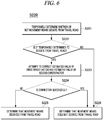
- the GNSS device 210 does not immediately deactivates the GNSS device 210 and can attempt to correct the first error factor and/or the second error factor, and if the correction fails, it can be conclusively determined that the movement means deviates from the travel road, and in this embodiment, step S220 of FIG. 3 can be configured with detailed steps as illustrated in FIG. 6 .
- the GNSS device control system 100 can temporarily determine whether or not the movement means deviates from the travel road based on the map data and the calculated predicted position and the calculated predicted movement direction of the movement means (S21).
- the GNSS device control system 100 can conclusively determine that the movement means deviates from the travel road (S222 and S226).
- the GNSS device control system 100 does not determine immediately and conclusively that the movement means deviates from the travel road, and can attempt to correct an estimated value of the first error factor and an estimated value of the second error factor (S222 and S223). A method of correcting the estimated value of the first error factor and the estimated value of the second error factor will be described below.
- the GNSS device control system 100 can determine (conclusively determine) that the movement means does not deviate from the travel road (S224 and S226).
- the GNSS device control system 100 can determine (conclusively determine) that the movement means deviates from the travel road (S224 and S225).
- a method of correcting the estimated value of the first error factor and the estimated value of the second error factor may be as follows.
- the corrected estimated value (that is, a correction value of the estimated value of the first error factor) of the first error factor that satisfies the following [condition 1] which is a high-level condition and the corrected estimated value (that is, the corrected value of the estimated value of the second error factor) are found.
- [Condition 1] can satisfy the following [Condition 2] in which each past data acquired by the IMU 220 and the speed sensor 230 after the GNSS device 210 has been deactivated most recently is a low-level condition.
- [Condition 2] is that [when the past predicted position and the past predicted movement direction of the movement means are recalculated based on the past data corrected by using the corrected estimated value of the first error factor and the corrected estimated value of the second error factor, it will be determined, by the recalculated past predicted position and past predicted movement direction of the movement means, that the movement means does not deviate from the travel road].
- the GNSS device control system 100 can recalculate the past predicted position and past predicted movement direction of the movement means, based on the past data corrected by using the corrected estimated value of the first error factor and the corrected estimated value of the second error factor, for each of all the past data acquired by the inertial measurement device and the speed sensor after the GNSS device has been deactivated most recently.
- FIG. 7 it is assumed to be temporarily determined that the movement means deviates from the travel road when a predicted position of the movement means during a deactivation period of the GNSS device 210 deviates from a certain region M of the travel road, for the sake of convenience of understanding. That is, in FIG. 7 , only the position of the movement means is considered without considering the movement direction of the movement means in determining whether or not to deviate, for the sake of convenience of understanding.
- the estimated value of the first error factor and/or estimated value of the second error factor will be referred to as an "estimated value of an error factor".
- FIG. 7(a) and FIG. 7(c) illustrate the predicted position of the movement means
- FIG. 7(b) and FIG. 7(d) mean the predicted position of the movement illustrate the predicted position of the movement means recalculated by the corrected value after the correction of the estimated value of the error factor
- FIG. 7(a) and FIG. 7(c) illustrate the predicted position of the movement means calculated before the correction of the estimated value of the error factor.
- FIG. 8(a) illustrates the predicted position of the movement means
- FIG. 8(b) illustrates the predicted position of the movement means recalculated by the corrected value after the correction of the estimated value of the error factor
- ⁇ indicates the predicted position of the movement means calculated before the estimated value of the error factor is corrected.
- the GNSS device control system 100 can select the most optimal value of the possible correction values. At this time, the GNSS device control system 100 can select an optimal correction value through a method such as convex optimization. Alternatively, according to embodiments, an optimal correction value can be selected through regression analysis.
- the estimated value of the error factor can also be corrected by a value acquired from the GNSS device 210 in the first process P1. That is, when an inactive state is switched to an active state, the GNSS device control system 100 can correct the estimated value of the first error factor and the estimated value of the second error factor so as to minimize a difference between the final estimated position of the movement means finally calculated in the second process P2 performed most recently and the position of the movement means first acquired from the GNSS device after the GNSS device is activated most recently.
- the GNSS device control method can also employ only one of the estimated value of the first error factor and the estimated value of the second error factor, and detailed description thereof will be omitted because those skilled in the art will readily understand the embodiments from the description made above.
- the GNSS device control system 100 can activate the GNSS device 210.
- the GNSS device control system 100 can determine whether or not the movement means enters a predetermined region of interest based on the predicted position of the movement means, and can activate the GNSS device 210 when it is determined that the movement means enters the predetermined region of interest.
- the region of interest can be a previously designated region and may be an important region required to know an exact position by the GNSS device 210.
- the previously designated region of interest may be a region that occupies an important role in path guidance, such as near an intersection, near a roundabout, near a crosswalk, near an interchange, near region of an object having predetermined geographic/topographic characteristics.
- the region of interest can be designated as a region within a predetermined distance from a previously designated point of interest.
- the GNSS device 210 in a situation in which the travel road on which the movement means is in travel can be conclusively determined, the GNSS device 210 is deactivated and it is determined to deviate, and in a situation in which information collected from the GNSS device 210 is absolutely necessary, the GNSS device 210 is activated, and thus, there is an advantage in that power consumed by the GNSS device 210 can be minimized. In addition, there is an effect of reducing an expected error while minimizing power consumption.
- the GNSS device control system 100 can include hardware resources and/or software necessary to implement the technical idea of the present invention and does not mean one physical configuration element or one device. That is, the GNSS device control system 100 can mean a logical combination of hardware and/or software provided to implement the technical idea of the present invention, and can be implemented by a set of logical configurations for implementing the technical idea of the present invention by being installed in devices spaced apart from each other to perform each function if necessary. In addition, the GNSS device control system 100 can also mean a set of configurations that are separately implemented for each function or role for implementing the technical idea of the present invention.
- a module can mean a functional and structural combination of hardware for performing the technical idea of the present invention and software for driving the hardware.
- the module can mean a logical unit of a predetermined code and a hardware resource for performing the predetermined code, and it can be easily deduced from an average expert in the technical field of the present invention that the module does not necessarily mean physically connected codes or a type of hardware.
- the GNSS device control system 100 can include a processor and a memory for storing a program executed by the processor.
- the processor can include a single-core CPU or a multicore CPU.
- the memory can include a high-speed random access memory and can also include non-volatile memories such as one or more magnetic disk storage devices, flash memory devices, or other non-volatile solid-state memory devices. Access to a memory made by a processor and other configuration elements can be controlled by a memory controller.
- the GNSS device control system 100 when a program is executed by a processor, the GNSS device control system 100 according to the present embodiment can perform the GNSS device control method described above.
- the GNSS device control method can be implemented in the form of a computer-readable program command and stored in a computer-readable recording medium, and a control program and a target program according to an embodiment of the present invention can also be stored in a computer-readable recording medium.
- the computer-readable recording medium includes all kinds of recording devices in which data readable by a computer system are stored.
- Program commands recorded in the recording medium can be specially designed and configured for the present invention or can be known and used by those skilled in the software art.
- Examples of computer-readable recording media include magnetic media such as a hard disk, a floppy disk, and a magnetic tape, optical media such as a CD-ROM and a DVD, magneto-optical media such as floptical disks, and a hardware device specifically configured to store and perform program commands, such as a ROM, a RAM, and a flash memory.
- the computer-readable recording media can be distributed in computer systems connected to each other via a network such that computer-readable codes can be stored and executed in a distributed manner.
- Examples of the program commands include not only machine language codes made by a compiler but also high-level language codes that can be executed by a device for processing information electronically by using an interpreter or the like, for example, a computer.
- the hardware device described above can be configured to operate as one or more software modules to perform the operation of the present invention, and vice versa.
- the present invention can be used in GNSS device control method and system.
Landscapes
- Engineering & Computer Science (AREA)
- Radar, Positioning & Navigation (AREA)
- Remote Sensing (AREA)
- Physics & Mathematics (AREA)
- General Physics & Mathematics (AREA)
- Computer Networks & Wireless Communication (AREA)
- Automation & Control Theory (AREA)
- Navigation (AREA)
Abstract
Description
- The present invention relates to method and system for controlling a GNSS device installed in a movement means, and more specifically, to GNSS device control method and system that can reduce power consumption by acquiring information through a GNSS device only at a necessary point in time.
- Recently, a market for bicycles has advanced, and thus, there is an increasing demand for bicycle computers which are attached to movement means such as vehicles and provide various convenient functions. The bike computers are electronic devices that collect and calculate various types of information on riding such as speed and display the information on screens.
- Recently, the bike computers have mostly a navigation function for guiding a rider to a current position or a path to a destination, and an activity path tracking and recording function. In order to accurately implement the functions, it is necessary to accurately understand the current position information, and most of the position information is obtained through a global navigation satellite system (GNSS) such as a global positioning system (GPS).
- However, a GNSS device has a problem that power consumption is very large. In particular, it is very important to reduce power consumption in mobile devices that have limited battery capacity unlike devices that are constantly powered, and there is no exception for the bike computers.
- Therefore, a technical idea is required to minimize power consumption and to accurately grasp current position information through a GNSS device.
- The present invention is to provide a system and a method capable of minimizing power consumption of a GNSS device.
- According to an aspect of the present invention, a GNSS device control method for controlling a global navigation satellite system (GNSS) device installed in a movement means, includes by a GNSS device control system, acquiring map data; by a GNSS device control system, periodically performing a predetermined first process while the GNSS device is active; and by a GNSS device control system, periodically performing a predetermined second process while the GNSS device is deactivated, wherein the first process includes: acquiring position information and movement direction information of the movement means from the activated GNSS device; attempting to determine a road on which the movement means is traveling based on the map data and the position information and movement direction information of the movement means; and deactivating the activated GNSS device when a travel road on which the movement means is in travel is determined, and wherein the second process includes: acquiring measured data from an inertial measurement unit (IMU); acquiring speed data from a speed sensor; calculating a predicted position and a predicted movement direction of the movement means based on the measured data and the speed data; determining whether or not the movement means deviates from the travel road based on the map data and the predicted position and the predicted movement direction of the movement means; and activating the deactivated GNSS device when determined to deviate.
- In one embodiment, the step of calculating of the predicted position and the predicted movement direction of the movement means based on the measured data and the speed data can include correcting the measured data by using an estimated value of a first error factor included in the inertial measurement device, correcting the speed data by using an estimated value of a second error factor included in the speed sensor, and calculating the predicted position and the predicted movement direction of the movement means based on the corrected measured data and the corrected speed data.
- In one embodiment, the step of determining whether or not the movement means deviates from the travel road based on the map data and the predicted position and the predicted movement direction of the movement means can include temporarily determining whether or not the movement means deviates from the travel road based on the map data and the calculated estimated position and the calculated predicted movement direction of the movement means, attempting to correct the estimated value of the first error factor and the estimated value of the second error factor when determined temporarily that the movement means deviates from the travel road, determining that the movement means does not deviate from the travel road when correction of the estimated value of the first error factor and the estimated value of the second error factor is successful, and determining that the movement means deviates from the travel road when correction of the estimated value of the first error factor and the estimated value of the second error factor fails.
- In one embodiment, the step of attempting to correct the estimated value of the first error factor and the estimated value of the second error factor can include finding a corrected estimated value of the first error factor and a corrected estimated value of the second error factor that satisfy a predetermined high-level condition, wherein the high-level condition is that [each past data acquired by the inertial measurement device and the speed sensor will satisfy a predetermined low-level condition after the GNSS device is deactivated most recently], wherein the low-level condition is that [when a past predicted position and a past predicted movement direction of the movement means are recalculated based on the past data corrected by using the corrected estimated value of the first error factor and the corrected estimated value of the second error factor, the movement means will be determined not to deviate from the travel road by the recalculated past predicted position and the recalculated past predicted movement direction of the movement means].
- In one embodiment, the step of determining whether or not the movement means deviates from the travel road based on the map data and the predicted position and predicted movement direction of the movement means can further include recalculating a past predicted position and a past predicted movement direction of the movement means based on the past data corrected by using the corrected estimated value of the first error factor and the corrected estimated value of the second error factor, for each of all the past data acquired by the inertial measurement device and the speed sensor after the GNSS device is deactivated most recently when the correction of the estimated value of the first error factor and the estimated value of the second error factor is successful.
- In one embodiment, the step of temporarily determining whether or not the movement means deviates from the travel road based on the map data and the predicted position and predicted movement direction of the movement means can include determining temporarily whether or not the movement means deviates from the travel road by using a predetermined function defined by a distance between the predicted position of the movement means and the travel road and by an angle between the predicted movement direction of the movement means and the movement direction of the travel roads.
- In one embodiment, the first process can further include correcting the estimated value of the first error factor and the estimated value of the second error factor so as to minimize a difference between a final estimated position of the moving means finally calculated in the second process performed most recently and a position of the movement means first acquired from the GNSS device after the GNSS device is activated most recently, when the GNSS device is switched from an inactive state to an active state.
- According to another aspect of the present invention, a computer program that is installed in a data processing device and stored in a recording medium, includes the method described above.
- According to another aspect of the present invention, a GNSS device control system includes a processor, and a memory that stores a computer program executed by the processor, wherein the computer program causes the GNSS device control system to perform the method described above when executed by the processor.
- According to an embodiment of the present invention, it is possible to provide a system and a method of minimizing power consumption of a GNSS device.
- According to an embodiment of the present invention, in a situation in which a travel road on which a movement means is in travel can be conclusively determined, a GNSS device is deactivated and it is determined to deviate the travel road, and in a situation in which information collected from the GNSS device is absolutely necessary, the GNSS device is activated, and thus, there is an advantage in that power consumed by the GNSS device can be minimized.
- In addition, according to an embodiment of the present invention, it is possible to provide a method of efficiently estimating an error factor included in the an IMU or a speed sensor. Accordingly, there is an effect of preventing inaccurate prediction of a position, a speed, and a movement direction of a movement means that can occur due to accumulation of errors due to error factors.
- In order to better understand the drawings cited in the detailed description of the present invention, brief description of each drawing is provided.
-
FIG. 1 is a block diagram illustrating a drive environment of a GNSS device control system according to an embodiment of the present invention. -
FIG. 2 is a diagram illustrating concept of a GNSS device control method performed by the GNSS device control system according to an embodiment of the present invention. -
FIG. 3 is a flowchart illustrating in more detail a the GNSS device control method according to the embodiment of the present invention. -
FIG. 4 is a diagram illustrating a road determination function used in the GNSS device control method according to the embodiment of the present invention. -
FIG. 5 illustrates an example of detailed steps ofstep 210 ofFIG. 3 . -
FIG. 6 illustrates an example of a detailed step of step S220 ofFIG. 3 . -
FIGS. 7 and8 are diagrams illustrating a method of correcting an error factor estimation value performed in the GNSS device control method according to the embodiment of the present invention. - The present invention can be variously changed and have various embodiments, and thus, specific embodiments will be illustrated in the drawings and described in detail in the specification. However, this is not intended to limit the present invention to specific embodiments, and it should be understood that the present invention includes all changes, equivalents, and substitutes included in the idea and scope of the present invention. In describing the present invention, when it is determined that detailed descriptions on related well-known technologies can obscure the subject matter of the present invention, detailed descriptions thereof will be omitted.
- Terms "first", "second", and so on can be used to describe various configuration elements, but the configuration elements should not be limited to the terms. The terms are used only for the purpose of distinguishing one configuration element from another configuration element.
- The terms used in the present application are only used to describe specific embodiments and are not intended to limit the present invention. Singular expressions include plural expressions unless the context clearly indicates otherwise.
- In the present specification, terms "include", "have", and so on are intended to indicate that features, numbers, steps, operations, configuration elements, components, or a combination thereof described in the specification exist, and it should be understood that existence and addition possibility of one or more other features or numbers, steps, operations, configuration elements, components, or a combination thereof are not excluded in advance.
- In addition, in the present specification, when data is "transmitted" from one configuration element to another configuration element, it means that the data can be directly transmitted to another configuration element, or the data can be transmitted to another configuration element via at least one configuration element. In contrast to this, when data is "directly transmitted" from one configuration element to another configuration element, it means that the data is transmitted from one configuration element to another configuration element without passing through other configuration elements.
- Hereinafter, the present invention will be described in detail with reference to the accompanying drawings by mainly using embodiments of the present invention. The same symbols or reference numerals in each drawing denote the same members.
- A GNSS device control method according to an embodiment of the present invention can be performed by a GNSS device control system.
FIG. 1 is a block diagram illustrating a drive environment of a GNSSdevice control system 100 according to an embodiment of the present invention. - The GNSS
device control system 100 may be an information processing device or a combination of the information processing device and software installed in the information processing device. - In one embodiment, the GNSS
device control system 100 may be an independent device or a subsystem mounted in another system. For example, the GNSSdevice control system 100 may be a bike computer or a subsystem mounted on the bike computer. Alternatively, the GNSSdevice control system 100 may be a subsystem mounted in a mobile device, such as a smartphone or a tablet PC. - In another embodiment, the GNSS
device control system 100 can communicate with a mobile device, such as a smartphone or a tablet PC, to perform the technical idea of the present invention. For example, the GNSSdevice control system 100 can receive map data from the mobile device. - The GNSS
device control system 100 can control aGNSS device 210 as illustrated inFIG. 1 . More specifically, the GNSSdevice control system 100 can activate or deactivate theGNSS device 210 and acquire position information, speed information, and/or direction information from the activatedGNSS device 210. - The GNSS
device 210 can receive a signal from a GNSS satellite. GNSS means a system that enables positioning by using a satellite and can include, for example, a global positioning system (GPS) of the United States, a global navigation satellite system (GLONASS) of Russia, Galileo of Europe, BeiDu-2 of China,. QZSS of Japan, and so on. - The GNSS
device 210 can calculate a position, a speed, and/or a movement direction of theGNSS device 210 or a device mounted with theGNSS device 210 through a signal received from a GNSS satellite. - The fact that the GNSS
device 210 is activated can indicate a state in which the GNSSdevice 210 is capable of receiving a signal from the GNSS satellite and calculating a position thereof, and the fact that theGNSS device 210 is deactivated can indicate a state in which theGNSS device 210 cannot receive a signal from the GNSS satellite or theGNSS device 210 cannot output a speed, a position, and/or direction information to the outside. When theGNSS device 210 is deactivated, power can be disconnected, and thus, power cannot be consumed. Alternatively, when being deactivated, theGNSS device 210 can enter a standby state, thus, consuming only a minimum amount of power. In order to include this case, "deactivation" can include concept of "less activation" in the present specification. - As illustrated in
FIG. 1 , the GNSSdevice control system 100 can receive Information, signals, and/or data, which can be controlled as necessary, required to implement technical idea of the present invention from an inertial measurement unit (IMU) 220, aspeed sensor 230, and/or amap DB 240. - The
IMU 220 can measure an inertia force or measure information on inclination of a body and can include an acceleration sensor for measuring gravity and a gyro sensor for measuring angular acceleration. In some cases, theIMU 220 can also further include a geomagnetic sensor. - The
speed sensor 230 can measure a speed of thespeed sensor 230 or a device mounted with thespeed sensor 230. Alternatively, thespeed sensor 230 can measure data for calculating a speed. For example, thespeed sensor 230 may be a sensor (for example, a tachometer) that measures the number of revolutions of a wheel of a movement means. Alternatively, thespeed sensor 230 can measure a movement distance. In this case, the speed can be obtained by dividing the movement distance during a measurement time by the measurement time. - The
map DB 240 may be means (for example, a memory device) for storing map data. The GNSSdevice control system 100 can acquire at least a part of map data stored in themap DB 240 to be used to perform a GNSS device control method according to the technical idea of the present invention. - The map data can include road information on the map. For example, the map data can include information on a length or a width of a road on a map, information on a name or identification of a road, information on a connection relationship between roads, and/or other information that can define a position and a shape of a road. The road can vary depending on a movement means in which the
GNSS device 210 is installed. When the movement means is a vehicle, the road may be a road through which the vehicle can pass. If the movement means is a bicycle, the road can also further include a bicycle road. - As illustrated in
FIG. 1 , the GNSSdevice control system 100 can be implemented in the form of a subsystem included in apredetermined mother system 10. Themother system 10 may be a bike computer but is not limited thereto and may be a computing system including a processor and a memory. In one embodiment, themother system 10 can include theGNSS device 210, theIMU 220, thespeed sensor 230 and/or themap DB 240. - Meanwhile, according to embodiments, the GNSS
device control system 100 may be an independent system unlikeFIG. 1 . - In addition, although
FIG. 1 illustrates an embodiment in which theGNSS device 210, theIMU 220, thespeed sensor 230, and themap DB 240 are included in themother system 10, the GNSS device (210), theIMU 220, thespeed sensor 230, at least a portion of themap DB 240 can be included in the GNSSdevice control system 100. Also, there may be an embodiment in which at least some of theGNSS device 210, theIMU 220, thespeed sensor 230, and themap DB 240 are located outside themother system 10. - Alternatively, at least some of the
GNSS device 210, theIMU 220, thespeed sensor 230, and themap DB 240 can be included in a predetermined external device (for example, themobile device 20 such as a smartphone or a tablet PC) and the other can be included in the GNSSdevice control system 100. At this time, the external device may be a device installed in the movement means or themobile device 20 carried by a passenger (for example, a rider) of the movement means. - Meanwhile, according to embodiments, the GNSS
device control system 100 or themother system 10 can perform wireless communication with themobile device 20 and can transmit and receive various types of information, data and/or signals necessary to implement the technical idea of the present invention. For example, the GNSSdevice control system 100 or themother system 10 can receive map data from themobile device 20. - The GNSS
device control system 100 or the mother system (for example, a bike computer) 10 can be installed in a movement means. The movement means may be a bicycle, a motorcycle, an electric wheel, a Segway, a vehicle, a kickboard, or the like. However, this is only an example, and any movable means capable of measuring a speed and a movement distance may be a movement means to which the technical idea of the present invention can be applied. For example, the movement means may be shoes. -
FIG. 2 is a diagram illustrating concept of a GNSS device control method performed by the GNSSdevice control system 100 according to an embodiment of the present invention. - Referring to
FIG. 2 , the GNSSdevice control system 100 can repeatedly or periodically perform a predetermined first process P1 while theGNSS device 210 is in an active state, and when a predetermined deactivation condition is satisfied while the first process P1 is performed, theGNSS device 210 can be switched from an active state to a inactive state. Meanwhile, while theGNSS device 220 is in a inactive state, the GNSSdevice control system 100 can repeatedly or periodically perform a second process P2 different from the first process P1, and theGNSS device 210 can be switched from the inactive state to the active state again when a predetermined activation condition is satisfied while the second process P2 is performed. That is, while the GNSS device control method according to the embodiment of the present invention is performed, theGNSS device 210 can be switched between the active state and the inactive state and have a structure in which a process corresponding to each state is performed. Meanwhile, a term "process" in the present specification can indicate a series of steps performed by the GNSSdevice control system 100 or a part of a method performed by the GNSSdevice control system 100. - Meanwhile, the GNSS
device control system 100 can acquire map data before or while the first process P1 and the second process P2 are performed for the first time, and the acquired map data can be used to perform the first process P1 and the second process P2. -
FIG. 3 is a diagram illustrating in detail the first process P1 and the second process P2 of the GNSS device control method according to the embodiment of the present invention. - Referring to
FIG. 3 , when theGNSS device 210 is in an active state, the GNSSdevice control system 100 can perform the first process P1. - In the first process P1, the GNSS
device control system 100 can acquire position information and movement direction information of a movement means from the activated GNSS device 210 (S100). - Thereafter, the GNSS
device control system 100 can attempt to conclusively determine a road on which the movement means travels, based on the map data and the position information and movement direction information of the movement means. That is, the GNSSdevice control system 100 can determine whether or not the road on which the movement means travels can be conclusively determined. - To this end, the GNSS
device control system 100 can compare a position of the movement means with a position of each road on the map data, and compare a movement direction of the movement means and a movement direction on each road on the map data. - In one embodiment, the GNSS
device control system 100 can receive the map data or road information on the map data, and the position information and the movement direction information of the movement means so as to use as a predetermined function (hereinafter, referred to as a "road determination function F") for determining whether or not the movement means is located on a specific road.FIG. 4 is referenced to describe an example of the road determination function F. As illustrated inFIG. 4 , when a shortest distance between a road R and a movement means B is referred to as d and a difference between a movement direction of the road R and a movement direction of the movement means B is referred to as φ, the road determination function F according to the embodiment of the present invention may be a function defined by using d and φ. - The GNSS
device control system 100 can determine conclusively or temporarily a road on which a movement means is located by calculating an F value for each road on a map data or each road within a certain range around the movement means. For example, when a road with the F value less than or equal to a predetermined threshold is found, the GNSSdevice control system 100 can determine that a road having the smallest F value as a road on which a movement means is in travel. Alternatively, the GNSSdevice control system 100 temporarily determines that the road having the smallest F value is the road on which the movement means is in travel, and when it is temporarily determined that the movement means is continuously located on the road a predetermined number of times or for a certain period, the corresponding road is displayed. the GNSSdevice control system 100 can conclusively determine that the road is a road on which the movement means is in travel. - Meanwhile, in determining a travel road, a speed of the movement means can also be further considered. For example, the travel road can be conclusively determined only when the speed of the movement means is greater than or equal to a predetermined numeral value.
- The above description is only made for easy understanding of concept of a method of conclusively determining a road on which a movement means is in travel, and a method for the GNSS
device control system 100 to conclusively determine a road on which the movement mans is in travel can be various. - Referring back to
FIG. 3 , when the road (hereinafter referred to as a "travel road") on which the movement means is in travel is conclusively determined, the GNSSdevice control system 100 can deactivate the activatedGNSS device 210 to cause the second process P2 to be performed (S120 and S130). - When the travel road on which the movement means is in travel is not conclusively determined, the GNSS
device control system 100 can repeat the first process P1 (see S120 and S100). The first process P1 can be repeatedly performed every predetermined cycle (for example, a GPS measurement cycle). - Meanwhile, when the
GNSS device 210 is in an active state, the GNSSdevice control system 100 can perform the second process P2. - In the second process P1, the GNSS
device control system 100 can acquire measured data from theIMU 220 acquire speed data from the speed sensor 230 (S200). - Thereafter, the GNSS
device control system 100 can calculate a predicted position and a predicted movement direction of the movement means based on the measured data and the speed data (S210). For example, the GNSSdevice control system 100 can calculate the predicted position and the predicted movement direction of the movement means by reflecting the measured data and the speed data in the position information and the movement direction information received most recently from GNSS device 210 (S210). - Meanwhile, the GNSS
device control system 100 can determine whether or not the movement means deviates from the travel road based on the map data, and the predicted position and the predicted movement direction of the movement means (S220). In one embodiment, the GNSSdevice control system 100 can determine whether or not the movement means deviates from the travel road by using the above-described road determination function F. The GNSSdevice control system 100 can calculate an F value based on the shortest distance between the travel road and the predicted position of the movement means, and a difference between the travel road and the predicted movement direction of the movement means, and can determine that the movement means deviates from the road temporarily or conclusively when the F value is greater than or equal to a predetermined threshold. - Alternatively, the GNSS
device control system 100 can determine whether or not the movement means deviates from the travel road by using a deviation determination function F' similar to the road determination function F. When the deviation determination function F' is used, the deviation determination function F' may be a function defined by using the shortest distance between the travel road and the predicted position of the movement means, and the difference between the movement direction of the travel road and the predicted movement direction of the movement means in the same manner as the road determination function F. According to embodiments, the number of deviations or the number of consecutive deviations can be further required to define this function. For example, even when the shortest distance between the travel road and the predicted position of the movement means and the difference between the movement direction of the travel road and the predicted movement direction of the movement means exceeds a predetermined numeral value, it is not determined immediately to deviate, but when the shortest distance and the difference exceed the predetermined numeral value by a predetermined number of times (or a predetermined consecutive number of times), it can be determined to deviate. - If it is determined that the movement means deviates from the travel road, the GNSS
device control system 100 can activate the deactivatedGNSS device 210 and enable the first process P1 to be performed (S230 and S240). - If it is determined that the movement means does not deviate from the travel road, the GNSS
device control system 100 can repeatedly perform the second process P2 (see S230 and S200). The second process P2 can be repeatedly performed every predetermined cycle. - Meanwhile, the
IMU 220 and/or thespeed sensor 230 can include a factor that causes an error. For example, if some (for example, a gyro sensor) of the sensors included in theIMU 220 are biased to one side, an error occurs in the measured value due to this. Accordingly, the GNSSdevice control system 100 according to the embodiment of the present invention can estimate a value of the error factor included in theIMU 220 and/or thespeed sensor 230, can correct the measured data and/or the speed data by using the estimated value of the error factor, and can use the corrected value. In this embodiment, step 210 ofFIG. 3 can be configured with detailed steps illustrated inFIG. 5 . - Referring to
FIG. 5 , instep 210, the GNSSdevice control system 100 can correct the measured data output by theIMU 220 by reflecting an estimated value of an error factor (hereinafter, referred to as a "first error factor") included in the IMU 220 (S211), and can correct the speed data output by thespeed sensor 230 by using an estimated value of an error factor (hereinafter, referred to as a "second error factor") inherent in the speed sensor 230 (S212). - Thereafter, the GNSS
device control system 100 can calculate a predicted position and a predicted movement direction of the movement means based on the corrected measured data and the corrected speed data (S213). - Meanwhile, in one embodiment, even if it is determined that the movement means deviates from the travel road based on the map data and the calculated predicted position and the calculated predicted movement direction of the movement means, the
GNSS device 210 does not immediately deactivates theGNSS device 210 and can attempt to correct the first error factor and/or the second error factor, and if the correction fails, it can be conclusively determined that the movement means deviates from the travel road, and in this embodiment, step S220 ofFIG. 3 can be configured with detailed steps as illustrated inFIG. 6 . - Referring to
FIG. 6 , the GNSSdevice control system 100 can temporarily determine whether or not the movement means deviates from the travel road based on the map data and the calculated predicted position and the calculated predicted movement direction of the movement means (S21). - If it is temporarily determined that the movement means does not deviate from the travel road, the GNSS
device control system 100 can conclusively determine that the movement means deviates from the travel road (S222 and S226). - Meanwhile, when it is temporarily determined that the movement means deviates from the travel road, the GNSS
device control system 100 does not determine immediately and conclusively that the movement means deviates from the travel road, and can attempt to correct an estimated value of the first error factor and an estimated value of the second error factor (S222 and S223). A method of correcting the estimated value of the first error factor and the estimated value of the second error factor will be described below. - If the correction of the estimated value of the first error factor and the estimated value of the second error factor is successful, the GNSS
device control system 100 can determine (conclusively determine) that the movement means does not deviate from the travel road (S224 and S226). - If the correction of the estimated value of the first error factor and the estimated value of the second error factor fails, the GNSS
device control system 100 can determine (conclusively determine) that the movement means deviates from the travel road (S224 and S225). - Meanwhile, a method of correcting the estimated value of the first error factor and the estimated value of the second error factor may be as follows.
- The corrected estimated value (that is, a correction value of the estimated value of the first error factor) of the first error factor that satisfies the following [condition 1] which is a high-level condition and the corrected estimated value (that is, the corrected value of the estimated value of the second error factor) are found.
- At this time, [Condition 1] can satisfy the following [Condition 2] in which each past data acquired by the
IMU 220 and thespeed sensor 230 after theGNSS device 210 has been deactivated most recently is a low-level condition. - Here, [Condition 2] is that [when the past predicted position and the past predicted movement direction of the movement means are recalculated based on the past data corrected by using the corrected estimated value of the first error factor and the corrected estimated value of the second error factor, it will be determined, by the recalculated past predicted position and past predicted movement direction of the movement means, that the movement means does not deviate from the travel road].
- Meanwhile, when the correction of the estimated value of the first error factor and the estimated value of the second error factor is successful, the GNSS
device control system 100 can recalculate the past predicted position and past predicted movement direction of the movement means, based on the past data corrected by using the corrected estimated value of the first error factor and the corrected estimated value of the second error factor, for each of all the past data acquired by the inertial measurement device and the speed sensor after the GNSS device has been deactivated most recently. - Hereinafter, a method of correcting the estimated value of the first error factor and/or the estimated value of the second error factor will be described in more detail with reference to
FIG. 7 . InFIG. 7 , it is assumed to be temporarily determined that the movement means deviates from the travel road when a predicted position of the movement means during a deactivation period of theGNSS device 210 deviates from a certain region M of the travel road, for the sake of convenience of understanding. That is, inFIG. 7 , only the position of the movement means is considered without considering the movement direction of the movement means in determining whether or not to deviate, for the sake of convenience of understanding. In addition, the estimated value of the first error factor and/or estimated value of the second error factor will be referred to as an "estimated value of an error factor". -
FIG. 7(a) and FIG. 7(c) illustrate the predicted position of the movement means, andFIG. 7(b) and FIG. 7(d) mean the predicted position of the movement illustrate the predicted position of the movement means recalculated by the corrected value after the correction of the estimated value of the error factor, and inFIG. 7(a) and FIG. 7(c) illustrate the predicted position of the movement means calculated before the correction of the estimated value of the error factor. - If during a deactivation period a trajectory of the movement means is predicted as illustrated in
FIG. 7(a) , and finally, if the predicted position of the movement means is referred to as y1, the predicted position y1 deviates from the region M, it will be temporarily determined that the movement means deviates from the travel road. However, if all the predicted positions illustrated inFIG. 7(a) can be recalculated, as illustrated inFIG. 7(b) , by a specific correction value of the estimated value of the error factor, the estimated value of the error factor is corrected with a corresponding correction value, all the predicted positions illustrated inFIG. 7(a) are denoted by • inFIG. 7(b) , and it will be determined that the movement means still does not deviate the travel road. - Thereafter, if a next predicted position of the movement means is calculated as y2 as illustrated in
FIG. 7(c) , it will be temporarily determined that the movement means deviates from the travel road because the predicted position y2 deviates from the region M. However, as illustrated inFIG. 7(d) , if all the predicted positions illustrated inFIG. 7(c) cannot be located inside the region M by any correction value of the estimated value of the error factor (that is, there is no suitable estimated value of the error factor), it is set that correction of the estimated value of the error factor fails, and it will be determined that the movement means deviates from the travel road. - Even when a predicted position of a middle point on the past path of the movement means is not inside the region M even by the optimal correction value of the estimated value of the error factor, it is determined that correction of the estimated value of the error factor fails and it can be determined that the movement means deviates from the travel road, which are illustrated in
FIG. 8 . -
FIG. 8(a) illustrates the predicted position of the movement means,FIG. 8(b) illustrates the predicted position of the movement means recalculated by the corrected value after the correction of the estimated value of the error factor, and ○ indicates the predicted position of the movement means calculated before the estimated value of the error factor is corrected. If the predicted position of the movement means is calculated as y3 as illustrated inFIG. 8(a) , it will be temporarily determined that the movement means deviates from the travel road because the predicted position y3 deviates the region M. However, as illustrated inFIG. 8(b) , if all the predicted positions illustrated inFIG. 8(b) cannot be located in the region M even by any correction value of the estimated value of the error factor (for example, if there is no suitable estimated value of the error factor), it is set that correction of the estimated value of the error factor fails, and it will be determined that the movement means deviates from the travel road. - Meanwhile, if the estimated value of the error factor can be corrected with multiple values, the GNSS
device control system 100 can select the most optimal value of the possible correction values. At this time, the GNSSdevice control system 100 can select an optimal correction value through a method such as convex optimization. Alternatively, according to embodiments, an optimal correction value can be selected through regression analysis. - Meanwhile, according to embodiments, the estimated value of the error factor can also be corrected by a value acquired from the
GNSS device 210 in the first process P1. That is, when an inactive state is switched to an active state, the GNSSdevice control system 100 can correct the estimated value of the first error factor and the estimated value of the second error factor so as to minimize a difference between the final estimated position of the movement means finally calculated in the second process P2 performed most recently and the position of the movement means first acquired from the GNSS device after the GNSS device is activated most recently. - Meanwhile, according to embodiments, the GNSS device control method can also employ only one of the estimated value of the first error factor and the estimated value of the second error factor, and detailed description thereof will be omitted because those skilled in the art will readily understand the embodiments from the description made above.
- Meanwhile, according to embodiments, other activation conditions of the
GNSS device 210 can also be further reflected in addition to the case in which it is determined to deviate the travel road. - For example, if it is determined that too long period of time (for example, a previously defined maximum deactivation period) elapses after the
GNSS device 210 is deactivated, the GNSSdevice control system 100 can activate theGNSS device 210. - Alternatively, the GNSS
device control system 100 can determine whether or not the movement means enters a predetermined region of interest based on the predicted position of the movement means, and can activate theGNSS device 210 when it is determined that the movement means enters the predetermined region of interest. At this time, the region of interest can be a previously designated region and may be an important region required to know an exact position by theGNSS device 210. For example, the previously designated region of interest may be a region that occupies an important role in path guidance, such as near an intersection, near a roundabout, near a crosswalk, near an interchange, near region of an object having predetermined geographic/topographic characteristics. In one embodiment, the region of interest can be designated as a region within a predetermined distance from a previously designated point of interest. - In addition to this, various activation conditions can be further reflected.
- As described above, according to the technical idea of the present invention, in a situation in which the travel road on which the movement means is in travel can be conclusively determined, the
GNSS device 210 is deactivated and it is determined to deviate, and in a situation in which information collected from theGNSS device 210 is absolutely necessary, theGNSS device 210 is activated, and thus, there is an advantage in that power consumed by theGNSS device 210 can be minimized. In addition, there is an effect of reducing an expected error while minimizing power consumption. - In addition, it is possible to provide a method of efficiently estimating an error factor included in the an IMU or a speed sensor. Accordingly, there is an effect of preventing inaccurate prediction of a position, a speed, and a movement direction of a movement means that can occur due to accumulation of errors due to error factors.
- The GNSS
device control system 100 can include hardware resources and/or software necessary to implement the technical idea of the present invention and does not mean one physical configuration element or one device. That is, the GNSSdevice control system 100 can mean a logical combination of hardware and/or software provided to implement the technical idea of the present invention, and can be implemented by a set of logical configurations for implementing the technical idea of the present invention by being installed in devices spaced apart from each other to perform each function if necessary. In addition, the GNSSdevice control system 100 can also mean a set of configurations that are separately implemented for each function or role for implementing the technical idea of the present invention. - In addition, in the specification, a module can mean a functional and structural combination of hardware for performing the technical idea of the present invention and software for driving the hardware. For example, the module can mean a logical unit of a predetermined code and a hardware resource for performing the predetermined code, and it can be easily deduced from an average expert in the technical field of the present invention that the module does not necessarily mean physically connected codes or a type of hardware.
- Meanwhile, according to implementation examples, the GNSS
device control system 100 can include a processor and a memory for storing a program executed by the processor. The processor can include a single-core CPU or a multicore CPU. The memory can include a high-speed random access memory and can also include non-volatile memories such as one or more magnetic disk storage devices, flash memory devices, or other non-volatile solid-state memory devices. Access to a memory made by a processor and other configuration elements can be controlled by a memory controller. Here, when a program is executed by a processor, the GNSSdevice control system 100 according to the present embodiment can perform the GNSS device control method described above. - Meanwhile, the GNSS device control method according to an embodiment of the present invention can be implemented in the form of a computer-readable program command and stored in a computer-readable recording medium, and a control program and a target program according to an embodiment of the present invention can also be stored in a computer-readable recording medium. The computer-readable recording medium includes all kinds of recording devices in which data readable by a computer system are stored.
- Program commands recorded in the recording medium can be specially designed and configured for the present invention or can be known and used by those skilled in the software art.
- Examples of computer-readable recording media include magnetic media such as a hard disk, a floppy disk, and a magnetic tape, optical media such as a CD-ROM and a DVD, magneto-optical media such as floptical disks, and a hardware device specifically configured to store and perform program commands, such as a ROM, a RAM, and a flash memory. In addition, the computer-readable recording media can be distributed in computer systems connected to each other via a network such that computer-readable codes can be stored and executed in a distributed manner.
- Examples of the program commands include not only machine language codes made by a compiler but also high-level language codes that can be executed by a device for processing information electronically by using an interpreter or the like, for example, a computer.
- The hardware device described above can be configured to operate as one or more software modules to perform the operation of the present invention, and vice versa.
- The above description of the present invention is for illustration only, and those skilled in the technical field to which the present invention belongs can understand that the description can be easily modified to other specific forms without changing the technical idea or essential features of the present invention. Therefore, it should be understood that the embodiments described above are illustrative in all respects and not restrictive. For example, each configuration element described in a single type can be implemented in a distributed manner, and similarly, configuration elements described in a distributed manner can be implemented in a combined form.
- The scope of the present invention is indicated by the claims described below rather than the specification described above, and it should be construed that all changes or modifications derived from the meaning and scope of the claims and equivalent concepts thereof are included in the scope of the present invention.
- The present invention can be used in GNSS device control method and system.
Claims (9)
- A GNSS device control method for controlling a global navigation satellite system (GNSS) device installed in a movement means, the method comprising:by a GNSS device control system, acquiring map data;by a GNSS device control system, periodically performing a predetermined first process while the GNSS device is active; andby a GNSS device control system, periodically performing a predetermined second process while the GNSS device is deactivated,wherein the first process includes:acquiring position information and movement direction information of the movement means from the activated GNSS device;attempting to determine a road on which the movement means is traveling based on the map data and the position information and movement direction information of the movement means; anddeactivating the activated GNSS device when a travel road on which the movement means is in travel is determined, andwherein the second process includes:acquiring measured data from an inertial measurement unit (IMU);acquiring speed data from a speed sensor;calculating a predicted position and a predicted movement direction of the movement means based on the measured data and the speed data;determining whether or not the movement means deviates from the travel road based on the map data and the predicted position and the predicted movement direction of the movement means; andactivating the deactivated GNSS device when determined to deviate.
- The GNSS device control method of claim 1, wherein the step of calculating of the predicted position and the predicted movement direction of the movement means based on the measured data and the speed data includes:correcting the measured data by using an estimated value of a first error factor included in the inertial measurement device;correcting the speed data by using an estimated value of a second error factor included in the speed sensor; andcalculating the predicted position and the predicted movement direction of the movement means based on the corrected measured data and the corrected speed data.
- The GNSS device control method of claim 2, wherein the step of determining whether or not the movement means deviates from the travel road based on the map data and the predicted position and the predicted movement direction of the movement means includes:temporarily determining whether or not the movement means deviates from the travel road based on the map data and the calculated estimated position and the calculated predicted movement direction of the movement means;attempting to correct the estimated value of the first error factor and the estimated value of the second error factor when determined temporarily that the movement means deviates from the travel road;determining that the movement means does not deviate from the travel road when correction of the estimated value of the first error factor and the estimated value of the second error factor is successful; anddetermining that the movement means deviates from the travel road when correction of the estimated value of the first error factor and the estimated value of the second error factor fails.
- The GNSS device control method of claim 3,
wherein attempting to correct the estimated value of the first error factor and the estimated value of the second error factor includes:finding a corrected estimated value of the first error factor and a corrected estimated value of the second error factor that satisfy a predetermined high-level condition,wherein the high-level condition is that [each past data acquired by the inertial measurement device and the speed sensor will satisfy a predetermined low-level condition after the GNSS device is deactivated most recently], andwherein the low-level condition is that [when a past predicted position and a past predicted movement direction of the movement means are recalculated based on the past data corrected by using the corrected estimated value of the first error factor and the corrected estimated value of the second error factor, the movement means will be determined not to deviate from the travel road by the recalculated past predicted position and the recalculated past predicted movement direction of the movement means]. - The GNSS device control method of claim 3, wherein the step of determining whether or not the movement means deviates from the travel road based on the map data and the predicted position and predicted movement direction of the movement means further includes:
recalculating a past predicted position and a past predicted movement direction of the movement means based on the past data corrected by using the corrected estimated value of the first error factor and the corrected estimated value of the second error factor, for each of all the past data acquired by the inertial measurement device and the speed sensor after the GNSS device is deactivated most recently when the correction of the estimated value of the first error factor and the estimated value of the second error factor is successful. - The GNSS device control method of claim 3, wherein the step of temporarily determining whether or not the movement means deviates from the travel road based on the map data and the predicted position and predicted movement direction of the movement means includes:
determining temporarily whether or not the movement means deviates from the travel road by using a predetermined function defined by a distance between the predicted position of the movement means and the travel road and by an angle between the predicted movement direction of the movement means and the movement direction of the travel roads. - The GNSS device control method of claim 2, wherein the first process further includes:
correcting the estimated value of the first error factor and the estimated value of the second error factor so as to minimize a difference between a final estimated position of the moving means finally calculated in the second process performed most recently and a position of the movement means first acquired from the GNSS device after the GNSS device is activated most recently, when the GNSS device is switched from an inactive state to an active state. - A computer program that is installed in a data processing device and stored in a recording medium, the program comprising:
the method according to any one of claims 1 to 7. - A GNSS device control system comprising:a processor; anda memory that stores a computer program executed by the processor,wherein the computer program causes the GNSS device control system to perform the method according to any one of claims 1 to 7 when executed by the processor.
Applications Claiming Priority (3)
| Application Number | Priority Date | Filing Date | Title |
|---|---|---|---|
| KR20180111825 | 2018-09-18 | ||
| KR1020180165154A KR102101376B1 (en) | 2018-09-18 | 2018-12-19 | Method and system for controlling GNSS device |
| PCT/KR2019/015260 WO2020130352A1 (en) | 2018-09-18 | 2019-11-11 | Gnss device control method and system |
Publications (3)
| Publication Number | Publication Date |
|---|---|
| EP3726252A1 true EP3726252A1 (en) | 2020-10-21 |
| EP3726252A4 EP3726252A4 (en) | 2021-11-10 |
| EP3726252B1 EP3726252B1 (en) | 2023-05-03 |
Family
ID=69958474
Family Applications (1)
| Application Number | Title | Priority Date | Filing Date |
|---|---|---|---|
| EP19898335.5A Active EP3726252B1 (en) | 2018-09-18 | 2019-11-11 | Gnss device control method and system |
Country Status (3)
| Country | Link |
|---|---|
| EP (1) | EP3726252B1 (en) |
| KR (1) | KR102101376B1 (en) |
| WO (1) | WO2020130352A1 (en) |
Cited By (1)
| Publication number | Priority date | Publication date | Assignee | Title |
|---|---|---|---|---|
| WO2024023724A1 (en) * | 2022-07-26 | 2024-02-01 | Pitpatpet Ltd | Method and device for positional tracking |
Family Cites Families (7)
| Publication number | Priority date | Publication date | Assignee | Title |
|---|---|---|---|---|
| US8072379B2 (en) * | 2008-05-12 | 2011-12-06 | Qualcomm Incorporated | GPS power savings using low power sensors |
| US20110071759A1 (en) | 2009-09-22 | 2011-03-24 | Texas Instruments Incorporated | Performance of a Navigation Receiver Operating in a Power-Save Mode with the Aid of Sensors |
| TWI399521B (en) * | 2010-02-23 | 2013-06-21 | Htc Corp | Mobile navigation device |
| JP5586994B2 (en) | 2010-03-11 | 2014-09-10 | 三菱電機株式会社 | POSITIONING DEVICE, POSITIONING METHOD OF POSITIONING DEVICE, AND POSITIONING PROGRAM |
| JP5654336B2 (en) * | 2010-12-14 | 2015-01-14 | アルパイン株式会社 | Method and apparatus for efficiently using a battery in a smartphone having a navigation system |
| KR101485694B1 (en) | 2013-08-21 | 2015-01-22 | 한양대학교 에리카산학협력단 | GPS Reception Method for Location-Based Eco Navigation |
| KR20150121816A (en) * | 2014-04-22 | 2015-10-30 | 삼성전자주식회사 | Method and apparatus for selecting satellite system |
-
2018
- 2018-12-19 KR KR1020180165154A patent/KR102101376B1/en active Active
-
2019
- 2019-11-11 WO PCT/KR2019/015260 patent/WO2020130352A1/en not_active Ceased
- 2019-11-11 EP EP19898335.5A patent/EP3726252B1/en active Active
Cited By (1)
| Publication number | Priority date | Publication date | Assignee | Title |
|---|---|---|---|---|
| WO2024023724A1 (en) * | 2022-07-26 | 2024-02-01 | Pitpatpet Ltd | Method and device for positional tracking |
Also Published As
| Publication number | Publication date |
|---|---|
| EP3726252A4 (en) | 2021-11-10 |
| EP3726252B1 (en) | 2023-05-03 |
| KR102101376B1 (en) | 2020-04-24 |
| KR20200032622A (en) | 2020-03-26 |
| WO2020130352A1 (en) | 2020-06-25 |
Similar Documents
| Publication | Publication Date | Title |
|---|---|---|
| US11104336B2 (en) | Method for planning a trajectory for a self-driving vehicle | |
| US11555705B2 (en) | Localization using dynamic landmarks | |
| JP6395771B2 (en) | Vehicle position detection device, automatic steering control device, vehicle position detection method, and automatic steering control method | |
| US10549752B2 (en) | Deceleration curb-based direction checking and lane keeping system for autonomous driving vehicles | |
| US20160377437A1 (en) | Unit and method for improving positioning accuracy | |
| CN109932738B (en) | Method and apparatus for determining the position of an object | |
| JP6982430B2 (en) | Vehicle lane identification device | |
| KR20190044988A (en) | Apparatus for compensating sensing value of gyroscope sensor, system having the same and method thereof | |
| KR100870091B1 (en) | Method and apparatus for judging rotation state using sensor | |
| EP3726252B1 (en) | Gnss device control method and system | |
| US11158193B2 (en) | Position estimation apparatus, position estimation method, and computer readable medium | |
| EP3697656B1 (en) | A mutual nudge algorithm for self-reverse lane of autonomous driving | |
| JP2016105257A (en) | Map information providing apparatus | |
| JP4931113B2 (en) | Own vehicle position determination device | |
| JP7136050B2 (en) | Vehicle position estimation device | |
| CN108733050B (en) | Information processing method and information processing apparatus | |
| JP2018189462A (en) | Travel lane specifying device | |
| CN108204810A (en) | Navigation data sharing method, car-mounted device, mobile terminal and mobile terminal navigation system | |
| EP3819595B1 (en) | Method for rendering map screen from map data and data processing apparatus performing the same | |
| JP2006317287A (en) | Vehicle current position determination device | |
| KR20130057114A (en) | Dead-reckoning system using education and the method thereof | |
| US10222464B2 (en) | Low power wireless RFID based sensory system for vehicle navigation | |
| JP2006250659A (en) | Navigation device |
Legal Events
| Date | Code | Title | Description |
|---|---|---|---|
| STAA | Information on the status of an ep patent application or granted ep patent |
Free format text: STATUS: THE INTERNATIONAL PUBLICATION HAS BEEN MADE |
|
| PUAI | Public reference made under article 153(3) epc to a published international application that has entered the european phase |
Free format text: ORIGINAL CODE: 0009012 |
|
| STAA | Information on the status of an ep patent application or granted ep patent |
Free format text: STATUS: REQUEST FOR EXAMINATION WAS MADE |
|
| 17P | Request for examination filed |
Effective date: 20200713 |
|
| AK | Designated contracting states |
Kind code of ref document: A1 Designated state(s): AL AT BE BG CH CY CZ DE DK EE ES FI FR GB GR HR HU IE IS IT LI LT LU LV MC MK MT NL NO PL PT RO RS SE SI SK SM TR |
|
| AX | Request for extension of the european patent |
Extension state: BA ME |
|
| REG | Reference to a national code |
Ref country code: DE Ref legal event code: R079 Ref document number: 602019028545 Country of ref document: DE Free format text: PREVIOUS MAIN CLASS: G01S0019340000 Ipc: G01C0021300000 |
|
| A4 | Supplementary search report drawn up and despatched |
Effective date: 20211011 |
|
| RIC1 | Information provided on ipc code assigned before grant |
Ipc: G01S 19/14 20100101ALI20211005BHEP Ipc: G01S 19/47 20100101ALI20211005BHEP Ipc: G01S 19/34 20100101ALI20211005BHEP Ipc: G01S 19/49 20100101ALI20211005BHEP Ipc: G01C 21/16 20060101ALI20211005BHEP Ipc: G01C 21/30 20060101AFI20211005BHEP |
|
| DAV | Request for validation of the european patent (deleted) | ||
| DAX | Request for extension of the european patent (deleted) | ||
| GRAP | Despatch of communication of intention to grant a patent |
Free format text: ORIGINAL CODE: EPIDOSNIGR1 |
|
| STAA | Information on the status of an ep patent application or granted ep patent |
Free format text: STATUS: GRANT OF PATENT IS INTENDED |
|
| INTG | Intention to grant announced |
Effective date: 20221202 |
|
| GRAS | Grant fee paid |
Free format text: ORIGINAL CODE: EPIDOSNIGR3 |
|
| GRAA | (expected) grant |
Free format text: ORIGINAL CODE: 0009210 |
|
| STAA | Information on the status of an ep patent application or granted ep patent |
Free format text: STATUS: THE PATENT HAS BEEN GRANTED |
|
| AK | Designated contracting states |
Kind code of ref document: B1 Designated state(s): AL AT BE BG CH CY CZ DE DK EE ES FI FR GB GR HR HU IE IS IT LI LT LU LV MC MK MT NL NO PL PT RO RS SE SI SK SM TR |
|
| REG | Reference to a national code |
Ref country code: GB Ref legal event code: FG4D |
|
| REG | Reference to a national code |
Ref country code: DE Ref legal event code: R096 Ref document number: 602019028545 Country of ref document: DE |
|
| REG | Reference to a national code |
Ref country code: AT Ref legal event code: REF Ref document number: 1564949 Country of ref document: AT Kind code of ref document: T Effective date: 20230515 Ref country code: CH Ref legal event code: EP |
|
| REG | Reference to a national code |
Ref country code: IE Ref legal event code: FG4D |
|
| REG | Reference to a national code |
Ref country code: LT Ref legal event code: MG9D |
|
| REG | Reference to a national code |
Ref country code: NL Ref legal event code: MP Effective date: 20230503 |
|
| REG | Reference to a national code |
Ref country code: AT Ref legal event code: MK05 Ref document number: 1564949 Country of ref document: AT Kind code of ref document: T Effective date: 20230503 |
|
| PG25 | Lapsed in a contracting state [announced via postgrant information from national office to epo] |
Ref country code: SE Free format text: LAPSE BECAUSE OF FAILURE TO SUBMIT A TRANSLATION OF THE DESCRIPTION OR TO PAY THE FEE WITHIN THE PRESCRIBED TIME-LIMIT Effective date: 20230503 Ref country code: PT Free format text: LAPSE BECAUSE OF FAILURE TO SUBMIT A TRANSLATION OF THE DESCRIPTION OR TO PAY THE FEE WITHIN THE PRESCRIBED TIME-LIMIT Effective date: 20230904 Ref country code: NO Free format text: LAPSE BECAUSE OF FAILURE TO SUBMIT A TRANSLATION OF THE DESCRIPTION OR TO PAY THE FEE WITHIN THE PRESCRIBED TIME-LIMIT Effective date: 20230803 Ref country code: NL Free format text: LAPSE BECAUSE OF FAILURE TO SUBMIT A TRANSLATION OF THE DESCRIPTION OR TO PAY THE FEE WITHIN THE PRESCRIBED TIME-LIMIT Effective date: 20230503 Ref country code: ES Free format text: LAPSE BECAUSE OF FAILURE TO SUBMIT A TRANSLATION OF THE DESCRIPTION OR TO PAY THE FEE WITHIN THE PRESCRIBED TIME-LIMIT Effective date: 20230503 Ref country code: AT Free format text: LAPSE BECAUSE OF FAILURE TO SUBMIT A TRANSLATION OF THE DESCRIPTION OR TO PAY THE FEE WITHIN THE PRESCRIBED TIME-LIMIT Effective date: 20230503 |
|
| PG25 | Lapsed in a contracting state [announced via postgrant information from national office to epo] |
Ref country code: RS Free format text: LAPSE BECAUSE OF FAILURE TO SUBMIT A TRANSLATION OF THE DESCRIPTION OR TO PAY THE FEE WITHIN THE PRESCRIBED TIME-LIMIT Effective date: 20230503 Ref country code: PL Free format text: LAPSE BECAUSE OF FAILURE TO SUBMIT A TRANSLATION OF THE DESCRIPTION OR TO PAY THE FEE WITHIN THE PRESCRIBED TIME-LIMIT Effective date: 20230503 Ref country code: LV Free format text: LAPSE BECAUSE OF FAILURE TO SUBMIT A TRANSLATION OF THE DESCRIPTION OR TO PAY THE FEE WITHIN THE PRESCRIBED TIME-LIMIT Effective date: 20230503 Ref country code: LT Free format text: LAPSE BECAUSE OF FAILURE TO SUBMIT A TRANSLATION OF THE DESCRIPTION OR TO PAY THE FEE WITHIN THE PRESCRIBED TIME-LIMIT Effective date: 20230503 Ref country code: IS Free format text: LAPSE BECAUSE OF FAILURE TO SUBMIT A TRANSLATION OF THE DESCRIPTION OR TO PAY THE FEE WITHIN THE PRESCRIBED TIME-LIMIT Effective date: 20230903 Ref country code: HR Free format text: LAPSE BECAUSE OF FAILURE TO SUBMIT A TRANSLATION OF THE DESCRIPTION OR TO PAY THE FEE WITHIN THE PRESCRIBED TIME-LIMIT Effective date: 20230503 Ref country code: GR Free format text: LAPSE BECAUSE OF FAILURE TO SUBMIT A TRANSLATION OF THE DESCRIPTION OR TO PAY THE FEE WITHIN THE PRESCRIBED TIME-LIMIT Effective date: 20230804 |
|
| PG25 | Lapsed in a contracting state [announced via postgrant information from national office to epo] |
Ref country code: FI Free format text: LAPSE BECAUSE OF FAILURE TO SUBMIT A TRANSLATION OF THE DESCRIPTION OR TO PAY THE FEE WITHIN THE PRESCRIBED TIME-LIMIT Effective date: 20230503 |
|
| PG25 | Lapsed in a contracting state [announced via postgrant information from national office to epo] |
Ref country code: SK Free format text: LAPSE BECAUSE OF FAILURE TO SUBMIT A TRANSLATION OF THE DESCRIPTION OR TO PAY THE FEE WITHIN THE PRESCRIBED TIME-LIMIT Effective date: 20230503 |
|
| PG25 | Lapsed in a contracting state [announced via postgrant information from national office to epo] |
Ref country code: SM Free format text: LAPSE BECAUSE OF FAILURE TO SUBMIT A TRANSLATION OF THE DESCRIPTION OR TO PAY THE FEE WITHIN THE PRESCRIBED TIME-LIMIT Effective date: 20230503 Ref country code: SK Free format text: LAPSE BECAUSE OF FAILURE TO SUBMIT A TRANSLATION OF THE DESCRIPTION OR TO PAY THE FEE WITHIN THE PRESCRIBED TIME-LIMIT Effective date: 20230503 Ref country code: RO Free format text: LAPSE BECAUSE OF FAILURE TO SUBMIT A TRANSLATION OF THE DESCRIPTION OR TO PAY THE FEE WITHIN THE PRESCRIBED TIME-LIMIT Effective date: 20230503 Ref country code: EE Free format text: LAPSE BECAUSE OF FAILURE TO SUBMIT A TRANSLATION OF THE DESCRIPTION OR TO PAY THE FEE WITHIN THE PRESCRIBED TIME-LIMIT Effective date: 20230503 Ref country code: DK Free format text: LAPSE BECAUSE OF FAILURE TO SUBMIT A TRANSLATION OF THE DESCRIPTION OR TO PAY THE FEE WITHIN THE PRESCRIBED TIME-LIMIT Effective date: 20230503 Ref country code: CZ Free format text: LAPSE BECAUSE OF FAILURE TO SUBMIT A TRANSLATION OF THE DESCRIPTION OR TO PAY THE FEE WITHIN THE PRESCRIBED TIME-LIMIT Effective date: 20230503 |
|
| REG | Reference to a national code |
Ref country code: DE Ref legal event code: R097 Ref document number: 602019028545 Country of ref document: DE |
|
| PLBE | No opposition filed within time limit |
Free format text: ORIGINAL CODE: 0009261 |
|
| STAA | Information on the status of an ep patent application or granted ep patent |
Free format text: STATUS: NO OPPOSITION FILED WITHIN TIME LIMIT |
|
| 26N | No opposition filed |
Effective date: 20240206 |
|
| PG25 | Lapsed in a contracting state [announced via postgrant information from national office to epo] |
Ref country code: SI Free format text: LAPSE BECAUSE OF FAILURE TO SUBMIT A TRANSLATION OF THE DESCRIPTION OR TO PAY THE FEE WITHIN THE PRESCRIBED TIME-LIMIT Effective date: 20230503 |
|
| PG25 | Lapsed in a contracting state [announced via postgrant information from national office to epo] |
Ref country code: SI Free format text: LAPSE BECAUSE OF FAILURE TO SUBMIT A TRANSLATION OF THE DESCRIPTION OR TO PAY THE FEE WITHIN THE PRESCRIBED TIME-LIMIT Effective date: 20230503 Ref country code: IT Free format text: LAPSE BECAUSE OF FAILURE TO SUBMIT A TRANSLATION OF THE DESCRIPTION OR TO PAY THE FEE WITHIN THE PRESCRIBED TIME-LIMIT Effective date: 20230503 |
|
| REG | Reference to a national code |
Ref country code: CH Ref legal event code: PL |
|
| PG25 | Lapsed in a contracting state [announced via postgrant information from national office to epo] |
Ref country code: MC Free format text: LAPSE BECAUSE OF FAILURE TO SUBMIT A TRANSLATION OF THE DESCRIPTION OR TO PAY THE FEE WITHIN THE PRESCRIBED TIME-LIMIT Effective date: 20230503 |
|
| PG25 | Lapsed in a contracting state [announced via postgrant information from national office to epo] |
Ref country code: LU Free format text: LAPSE BECAUSE OF NON-PAYMENT OF DUE FEES Effective date: 20231111 |
|
| PG25 | Lapsed in a contracting state [announced via postgrant information from national office to epo] |
Ref country code: CH Free format text: LAPSE BECAUSE OF NON-PAYMENT OF DUE FEES Effective date: 20231130 |
|
| GBPC | Gb: european patent ceased through non-payment of renewal fee |
Effective date: 20231111 |
|
| PG25 | Lapsed in a contracting state [announced via postgrant information from national office to epo] |
Ref country code: MC Free format text: LAPSE BECAUSE OF FAILURE TO SUBMIT A TRANSLATION OF THE DESCRIPTION OR TO PAY THE FEE WITHIN THE PRESCRIBED TIME-LIMIT Effective date: 20230503 Ref country code: LU Free format text: LAPSE BECAUSE OF NON-PAYMENT OF DUE FEES Effective date: 20231111 Ref country code: CH Free format text: LAPSE BECAUSE OF NON-PAYMENT OF DUE FEES Effective date: 20231130 |
|
| REG | Reference to a national code |
Ref country code: BE Ref legal event code: MM Effective date: 20231130 |
|
| REG | Reference to a national code |
Ref country code: IE Ref legal event code: MM4A |
|
| PG25 | Lapsed in a contracting state [announced via postgrant information from national office to epo] |
Ref country code: IE Free format text: LAPSE BECAUSE OF NON-PAYMENT OF DUE FEES Effective date: 20231111 |
|
| PG25 | Lapsed in a contracting state [announced via postgrant information from national office to epo] |
Ref country code: GB Free format text: LAPSE BECAUSE OF NON-PAYMENT OF DUE FEES Effective date: 20231111 |
|
| PG25 | Lapsed in a contracting state [announced via postgrant information from national office to epo] |
Ref country code: BE Free format text: LAPSE BECAUSE OF NON-PAYMENT OF DUE FEES Effective date: 20231130 |
|
| PG25 | Lapsed in a contracting state [announced via postgrant information from national office to epo] |
Ref country code: IE Free format text: LAPSE BECAUSE OF NON-PAYMENT OF DUE FEES Effective date: 20231111 Ref country code: GB Free format text: LAPSE BECAUSE OF NON-PAYMENT OF DUE FEES Effective date: 20231111 Ref country code: BE Free format text: LAPSE BECAUSE OF NON-PAYMENT OF DUE FEES Effective date: 20231130 |
|
| PG25 | Lapsed in a contracting state [announced via postgrant information from national office to epo] |
Ref country code: BG Free format text: LAPSE BECAUSE OF FAILURE TO SUBMIT A TRANSLATION OF THE DESCRIPTION OR TO PAY THE FEE WITHIN THE PRESCRIBED TIME-LIMIT Effective date: 20230503 |
|
| PG25 | Lapsed in a contracting state [announced via postgrant information from national office to epo] |
Ref country code: BG Free format text: LAPSE BECAUSE OF FAILURE TO SUBMIT A TRANSLATION OF THE DESCRIPTION OR TO PAY THE FEE WITHIN THE PRESCRIBED TIME-LIMIT Effective date: 20230503 |
|
| PGFP | Annual fee paid to national office [announced via postgrant information from national office to epo] |
Ref country code: FR Payment date: 20241128 Year of fee payment: 6 |
|
| PGFP | Annual fee paid to national office [announced via postgrant information from national office to epo] |
Ref country code: DE Payment date: 20250128 Year of fee payment: 6 |
|
| PG25 | Lapsed in a contracting state [announced via postgrant information from national office to epo] |
Ref country code: CY Free format text: LAPSE BECAUSE OF FAILURE TO SUBMIT A TRANSLATION OF THE DESCRIPTION OR TO PAY THE FEE WITHIN THE PRESCRIBED TIME-LIMIT; INVALID AB INITIO Effective date: 20191111 |
|
| PG25 | Lapsed in a contracting state [announced via postgrant information from national office to epo] |
Ref country code: HU Free format text: LAPSE BECAUSE OF FAILURE TO SUBMIT A TRANSLATION OF THE DESCRIPTION OR TO PAY THE FEE WITHIN THE PRESCRIBED TIME-LIMIT; INVALID AB INITIO Effective date: 20191111 |
|
| PG25 | Lapsed in a contracting state [announced via postgrant information from national office to epo] |
Ref country code: TR Free format text: LAPSE BECAUSE OF FAILURE TO SUBMIT A TRANSLATION OF THE DESCRIPTION OR TO PAY THE FEE WITHIN THE PRESCRIBED TIME-LIMIT Effective date: 20230503 |