EP3725835B1 - Cellulose resin composition, molded body and product using same - Google Patents
Cellulose resin composition, molded body and product using same Download PDFInfo
- Publication number
- EP3725835B1 EP3725835B1 EP18889911.6A EP18889911A EP3725835B1 EP 3725835 B1 EP3725835 B1 EP 3725835B1 EP 18889911 A EP18889911 A EP 18889911A EP 3725835 B1 EP3725835 B1 EP 3725835B1
- Authority
- EP
- European Patent Office
- Prior art keywords
- resin composition
- cellulose
- cellulose resin
- mass
- composition according
- Prior art date
- Legal status (The legal status is an assumption and is not a legal conclusion. Google has not performed a legal analysis and makes no representation as to the accuracy of the status listed.)
- Active
Links
Classifications
-
- C—CHEMISTRY; METALLURGY
- C08—ORGANIC MACROMOLECULAR COMPOUNDS; THEIR PREPARATION OR CHEMICAL WORKING-UP; COMPOSITIONS BASED THEREON
- C08K—Use of inorganic or non-macromolecular organic substances as compounding ingredients
- C08K5/00—Use of organic ingredients
- C08K5/16—Nitrogen-containing compounds
- C08K5/20—Carboxylic acid amides
-
- C—CHEMISTRY; METALLURGY
- C08—ORGANIC MACROMOLECULAR COMPOUNDS; THEIR PREPARATION OR CHEMICAL WORKING-UP; COMPOSITIONS BASED THEREON
- C08B—POLYSACCHARIDES; DERIVATIVES THEREOF
- C08B3/00—Preparation of cellulose esters of organic acids
- C08B3/06—Cellulose acetate, e.g. mono-acetate, di-acetate or tri-acetate
-
- C—CHEMISTRY; METALLURGY
- C08—ORGANIC MACROMOLECULAR COMPOUNDS; THEIR PREPARATION OR CHEMICAL WORKING-UP; COMPOSITIONS BASED THEREON
- C08B—POLYSACCHARIDES; DERIVATIVES THEREOF
- C08B3/00—Preparation of cellulose esters of organic acids
- C08B3/08—Preparation of cellulose esters of organic acids of monobasic organic acids with three or more carbon atoms, e.g. propionate or butyrate
-
- C—CHEMISTRY; METALLURGY
- C08—ORGANIC MACROMOLECULAR COMPOUNDS; THEIR PREPARATION OR CHEMICAL WORKING-UP; COMPOSITIONS BASED THEREON
- C08K—Use of inorganic or non-macromolecular organic substances as compounding ingredients
- C08K3/00—Use of inorganic substances as compounding ingredients
- C08K3/02—Elements
- C08K3/04—Carbon
-
- C—CHEMISTRY; METALLURGY
- C08—ORGANIC MACROMOLECULAR COMPOUNDS; THEIR PREPARATION OR CHEMICAL WORKING-UP; COMPOSITIONS BASED THEREON
- C08K—Use of inorganic or non-macromolecular organic substances as compounding ingredients
- C08K5/00—Use of organic ingredients
- C08K5/0008—Organic ingredients according to more than one of the "one dot" groups of C08K5/01 - C08K5/59
- C08K5/0016—Plasticisers
-
- C—CHEMISTRY; METALLURGY
- C08—ORGANIC MACROMOLECULAR COMPOUNDS; THEIR PREPARATION OR CHEMICAL WORKING-UP; COMPOSITIONS BASED THEREON
- C08K—Use of inorganic or non-macromolecular organic substances as compounding ingredients
- C08K5/00—Use of organic ingredients
- C08K5/04—Oxygen-containing compounds
- C08K5/09—Carboxylic acids; Metal salts thereof; Anhydrides thereof
- C08K5/098—Metal salts of carboxylic acids
-
- C—CHEMISTRY; METALLURGY
- C08—ORGANIC MACROMOLECULAR COMPOUNDS; THEIR PREPARATION OR CHEMICAL WORKING-UP; COMPOSITIONS BASED THEREON
- C08K—Use of inorganic or non-macromolecular organic substances as compounding ingredients
- C08K5/00—Use of organic ingredients
- C08K5/04—Oxygen-containing compounds
- C08K5/10—Esters; Ether-esters
- C08K5/101—Esters; Ether-esters of monocarboxylic acids
-
- C—CHEMISTRY; METALLURGY
- C08—ORGANIC MACROMOLECULAR COMPOUNDS; THEIR PREPARATION OR CHEMICAL WORKING-UP; COMPOSITIONS BASED THEREON
- C08K—Use of inorganic or non-macromolecular organic substances as compounding ingredients
- C08K5/00—Use of organic ingredients
- C08K5/16—Nitrogen-containing compounds
- C08K5/21—Urea; Derivatives thereof, e.g. biuret
-
- C—CHEMISTRY; METALLURGY
- C08—ORGANIC MACROMOLECULAR COMPOUNDS; THEIR PREPARATION OR CHEMICAL WORKING-UP; COMPOSITIONS BASED THEREON
- C08K—Use of inorganic or non-macromolecular organic substances as compounding ingredients
- C08K5/00—Use of organic ingredients
- C08K5/54—Silicon-containing compounds
-
- C—CHEMISTRY; METALLURGY
- C08—ORGANIC MACROMOLECULAR COMPOUNDS; THEIR PREPARATION OR CHEMICAL WORKING-UP; COMPOSITIONS BASED THEREON
- C08L—COMPOSITIONS OF MACROMOLECULAR COMPOUNDS
- C08L1/00—Compositions of cellulose, modified cellulose or cellulose derivatives
- C08L1/08—Cellulose derivatives
- C08L1/10—Esters of organic acids, i.e. acylates
-
- C—CHEMISTRY; METALLURGY
- C08—ORGANIC MACROMOLECULAR COMPOUNDS; THEIR PREPARATION OR CHEMICAL WORKING-UP; COMPOSITIONS BASED THEREON
- C08L—COMPOSITIONS OF MACROMOLECULAR COMPOUNDS
- C08L1/00—Compositions of cellulose, modified cellulose or cellulose derivatives
- C08L1/08—Cellulose derivatives
- C08L1/10—Esters of organic acids, i.e. acylates
- C08L1/12—Cellulose acetate
-
- Y—GENERAL TAGGING OF NEW TECHNOLOGICAL DEVELOPMENTS; GENERAL TAGGING OF CROSS-SECTIONAL TECHNOLOGIES SPANNING OVER SEVERAL SECTIONS OF THE IPC; TECHNICAL SUBJECTS COVERED BY FORMER USPC CROSS-REFERENCE ART COLLECTIONS [XRACs] AND DIGESTS
- Y02—TECHNOLOGIES OR APPLICATIONS FOR MITIGATION OR ADAPTATION AGAINST CLIMATE CHANGE
- Y02W—CLIMATE CHANGE MITIGATION TECHNOLOGIES RELATED TO WASTEWATER TREATMENT OR WASTE MANAGEMENT
- Y02W90/00—Enabling technologies or technologies with a potential or indirect contribution to greenhouse gas [GHG] emissions mitigation
- Y02W90/10—Bio-packaging, e.g. packing containers made from renewable resources or bio-plastics
Definitions
- the present invention relates to a cellulose resin composition, a molded body formed of the resin composition, and a product using the molded body.
- Bioplastics made from vegetable law materials can contribute to countermeasures against petroleum depletion and global warming, and has been started being used in general products such as packaging, containers and fibers but also in durable products such as electronic equipment and automobiles.
- bioplastics such as polylactic acid, polyhydroxyalkanates, modified starch
- starch-based materials i.e., edible parts. Therefore, in view of concerns about food shortages in the future, the development of new bioplastics using non-edible parts as raw materials is required.
- cellulose which is a main component of wood and vegetation, is typical, and various bioplastics using the cellulose have been developed and commercialized.
- Patent Literature 1 discloses a resin composition containing a cellulose derivative having groups formed by substituting hydrogen atoms of hydroxyl groups included in a cellulose with a hydrocarbon group and an acyl group, and a lubricant.
- the literature discloses that a molded body formed of this composition is excellent in thermoplasticity, moldability, impact resistance, and the like.
- Patent Literature 2 discloses a cellulose derivative obtained by substituting at least a part of hydrogen atoms of hydroxyl groups included in cellulose with short-chain acyl groups and long-chain acyl groups.
- the literature discloses that a molded body formed of the composition containing this cellulose derivative is excellent in thermoplasticity, moldability, impact resistance, and the like, and that the cellulose derivative has a low water absorption coefficient and is excellent in thermoplasticity, strength, fracture elongation, and formability.
- Patent Literature 3 describes a thermoplastic resin composition containing a graft copolymer formed of a rubber polymer, a copolymer formed of a predetermined vinyl monomer, a predetermined polyester, and carbon black and/or a dye serving as a colorant in a predetermined ratio.
- the literature also states that an injection molding obtained by injection-molding the composition has high impact resistance and high external-appearance quality (glossy and jet-black color).
- Patent Literature 4 describes a black resin composition containing a predetermined copolymerized polycarbonate resin, a colorant (carbon black and/or black organic dye) and a hindered amine based stabilizer and having specific properties (pencil hardness, low-temperature impact resistance, brittle fracture rate, glossiness, brightness).
- the literature also states that the black molding of the black resin composition has an excellent jet-black color and excellent low-temperature impact resistance, weather resistance, abrasion-resistance and heat-resistance.
- Patent Literature 5 describes a black resin composition containing a predetermined copolymerized polycarbonate resin, a styrene resin, an impact modifier (rubber-modified resin) and carbon black in a predetermined blending ratio.
- the literature also states that a molding of the black resin composition has excellent jet-black color and excellent impact resistance, flowability, abrasion-resistance and heat-resistance.
- Patent Literature 6 describes a thermoplastic resin composition containing a predetermined graft copolymer (1 to 99 parts by mass), a vinyl copolymer (99 to 1 part by mass), and other thermoplastic resins (0 to 80 parts by mass) and also containing a predetermined organic dye.
- the literature also states that a molded body of the composition is excellent in impact resistance, weather resistance, jet-black color, surface smoothness and abrasion-resistance.
- the literature also states that the thermoplastic resin composition of Comparative Example 3, which contains a pigment (carbon black: Mitsubishi carbon #2600 (trade name) manufactured by Mitsubishi Chemical Corporation) in place of an organic dye, is unsatisfactory in jet-black color and surface smoothness.
- An object of the present invention is to provide a cellulose resin composition capable of forming a molded body having a high-quality appearance and scratch resistance, a molded body formed by using the resin composition, and a product using the molded body.
- a cellulose resin composition comprising a cellulose derivative (A) and a lubricant (B), wherein the cellulose derivative (A) is an acylated cellulose obtained by substituting at least a part of hydrogen atoms of hydroxy groups of a cellulose with an acyl group having 2 to 4 carbon atoms, and a content of the lubricant (B) is in a range of 0.1 to 10% by mass, wherein the lubricant (B) is a fatty acid metal salt, wherein the cellulose resin composition further comprises a plasticizing component (C),wherein the plasticizing component (C) is an aliphatic polyester, and a content of the aliphatic polyester is in a range of 7 to 30 parts by mass with respect to 100 parts by mass of the cellulose derivative (A), or the plasticizing component (C) is an aliphatic adipic acid ester, and a content of the aliphatic adipic acid ester is in a range of
- a cellulose resin composition capable of forming a molded body having a high-quality appearance and scratch resistance, a molded body formed by using the resin composition, and a product using the molded body.
- the cellulose resin composition according to the present exemplary embodiment includes a cellulose derivative (A) and a lubricant (B), and the cellulose derivative (A) is an acylated cellulose in which at least a part of hydrogen atoms of hydroxy groups of cellulose are substituted with an acyl group having 2 to 4 carbon atoms, as stated in the claims.
- the content of the lubricant (B) in the cellulose resin composition is in the range of 0.1 to 10 % by mass.
- the content of the lubricant (B) is 0.1% by mass or more, preferably 0.5% by mass or more, more preferably 1% by mass or more, and particularly preferably 2% by mass or more from the viewpoint of sufficiently obtaining the scratch resistance (friction resistance) due to the addition effect of the lubricant (B).
- the content of the lubricant (B) is 10% by mass or less, preferably 8% by mass or less, and still more preferably 6% by mass or less from the viewpoint of suppressing bleeding and maintaining a high-quality appearance.
- the content of the lubricant (B) in the cellulose resin composition is a content with respect to the cellulose resin composition.
- a molded body having a high-quality appearance and scratch resistance can be obtained.
- a black colorant is included, the lower the brightness, the higher the jet-blackness can be obtained, and accordingly the higher the appearance quality can be obtained.
- the cellulose derivative (A) is an acylated cellulose in which at least a part of hydrogen atoms of hydroxy groups of cellulose is substituted with an acyl group having 2 to 4 carbon atoms.
- the acyl group is at least one acyl group selected from acyl groups having 2 to 4 carbon atoms (acetyl group, propionyl group, butyryl group), and acetyl group or/and propionyl group are preferable.
- the cellulose derivative (A) may be a mixture of two or more kinds of these acylated celluloses.
- cellulose acetate (CA) can be mixed with cellulose acetate propionate (CAP) or cellulose acetate butyrate (CAB).
- CAP cellulose acetate propionate
- CAB cellulose acetate butyrate
- the lubricant (B) is a fatty acid metal salt.
- the melting point is preferably 60°C or higher, more preferably 80°C or higher, still more preferably 100°C or higher, and also preferably 200°C or less, more preferably 180°C or less, still more preferably 170°C or less. It is preferable that the melting point of these lubricants is high from the viewpoint of suppressing bleed-out from the surface of the molded body to obtain a high-quality appearance, and it is preferable that the melting point of these lubricants is lower than the kneading temperature and the molding temperature from the viewpoint of easiness of melt mixing at the time of manufacturing the cellulose resin composition and moldability.
- the molecular weight of the fatty acid metal salt is preferably at least 200, more preferably at least 300, and still more preferably at least 500. If the molecular weight is too low, it becomes easy to bleed out from the surface of the molded body, which may adversely affect the appearance.
- a fatty acid metal salt is used and in particular calcium stearate.
- the content of the lubricant (B) in the cellulose resin composition is in the aforementioned range, but a range of 1 to 4% by mass is preferable.
- the cellulose resin composition contains the plasticizing component (C).
- the plasticizing component (C) is advantageous.
- the cellulose derivative (A) having an acyl group other than an acetyl group such as acetylpropionylcellulose or acetylbutyrylcellulose
- the necessity of the plasticizing component (C) is lowered in accordance with the degree of substitution by the acyl group and the increase in the carbon number of the acyl group, but it is advantageous that the cellulose derivative (A) contains the plasticizing component (C) when injection molding or thermal press molding is performed.
- an aliphatic polyester or an aliphatic adipic acid ester plasticizer are used, particularly aliphatic polyesters such as polybutylene succinate and polybutylene succinate adipate, and aliphatic adipic acid esters such as bis(2-ethylhexyl) adipate are preferable, and particularly polybutylene succinate and bis(2-ethylhexyl) adipate are preferable.
- the plasticizing component (C) is an aliphatic polyester, its content is in a range of 7 to 30 parts by mass with respect to 100 parts by mass of the cellulose derivative (A).
- the plasticizing component (C) is an aliphatic adipic acid ester, its content is in a range of 5 to 15 parts by mass with respect to 100 parts by mass of the cellulose derivative (A).
- the cellulose resin composition according to the present exemplary embodiment may further include a colorant, and preferably includes a black colorant.
- a black colorant carbon black is preferable.
- the molded body obtained using the cellulose resin composition according to the present exemplary embodiment including the black colorant has a high glossiness and a low brightness (high jet-blackness) and can have a high quality appearance.
- the content of the colorant such as the black colorant in the cellulose resin composition can be set in the range of 0.01 to 10 % by mass.
- cellulose derivative (A) included in the cellulose resin composition according to the exemplary embodiment of the present invention a cellulose derivative in which an acyl group having 2 to 4 carbon atoms is introduced into at least a part of hydroxy groups of cellulose used as a raw material can be used.
- Cellulose is a straight-chain polymer obtained by polymerizing ⁇ -D-glucose molecules ( ⁇ -D-glucopyranose) represented by the following formula (1) via a ⁇ (1 ⁇ 4) glycoside bond.
- ⁇ -D-glucose molecules ⁇ -D-glucopyranose
- Each of glucose units constituting cellulose has three hydroxy groups (in the formula, n represents a natural number).
- an acyl group is introduced into such cellulose by using these hydroxy groups.
- Cellulose is a main component of a plant and can be obtained by a separation treatment for removing other components such as lignin from a plant.
- cotton for example, cotton linters
- pulp for example, wood pulp
- shape, size and form of the cellulose or a derivative thereof to be used as a raw material a powder form cellulose or a derivative thereof having an appropriate particle size and particle shape is preferably used in view of reactivity, solid-liquid separation and handling.
- a fibrous or powdery cellulose or a derivative thereof having a diameter of 1 to 100 ⁇ m (preferably 10 to 50 ⁇ m) and a length of 10 ⁇ m to 100 mm (preferably 100 ⁇ m to 10 mm) can be used.
- the polymerization degree of a cellulose in terms of polymerization degree (average polymerization degree) of glucose preferably falls within the range of 50 to 5000, more preferably 100 to 3000 and further preferably 100 to 3000. If the polymerization degree is extremely low, the strength and heat resistance of the produced resin may not be sufficient in some cases. Conversely, if the polymerization degree is extremely high, the melt viscosity of the produced resin is extremely high, interfering with molding in some cases.
- the cellulose derivative (A) (cellulose resin) used in the exemplary embodiment can be obtained by introducing an acyl group having 2 to 4 carbon atoms by use of hydroxy groups of a cellulose.
- a single type or two types or more of acyl groups may be introduced as the acyl group.
- the above acyl group can be introduced by reacting a hydroxy group of a cellulose and an acylating agent.
- the acyl group corresponds to an organic group portion introduced in place of a hydrogen atom of a hydroxy group of a cellulose.
- the acylating agent is a compound having at last one functional group reactive to a hydroxy group of a cellulose; for example, compounds having a carboxyl group, a carboxylic halide group or a carboxylic anhydride group, can be mentioned.
- Specific examples of the compound include aliphatic monocarboxylic acid, an acid halide and acid anhydride thereof.
- an acyl group having 2 to 4 carbon atoms examples include an acetyl group, a propionyl group, a butyryl group and an isobutyryl group. Of them, an acyl group (acetyl group, propionyl group) having 2 or 3 carbon atoms is preferable.
- a single type or two types or more of acyl groups can be introduced into a cellulose. More specifically, the cellulose resin in the exemplary embodiment is obtained by substituting the hydrogen atom of a hydroxy group of a cellulose with an acyl group having 2 to 4 carbon atoms.
- the acyl group an acetyl group or/and propionyl group are preferably used.
- the cellulose resin examples include acetyl cellulose, propionyl cellulose and acetyl propionyl cellulose.
- the average number of acyl groups to be introduced per glucose unit of a cellulose (DS AC ) (an acyl group introduction ratio); in other words, the average number of hydroxyl groups substituted with acyl groups per glucose unit (degree of substitution of a hydroxyl group) can be set to fall within the range of 0.1 to 3.0.
- DS AC is preferably 2.0 or more, more preferably 2.2 or more and further preferably 2.4 or more.
- DS AC is preferably 2.9 or less and more preferably 2.8 or less.
- the degree of substitution with acetyl group (DS AC ) is preferably from 2.0 to 3.0, more preferably from 2.2 to 2.9, and still more preferably from 2.4 to 2.8.
- the degree of substitution with propionyl group (DS AC ) is, for example, preferably from 2.0 to 2.9, more preferably from 2.2 to 2.8, and still more preferably from 2.4 to 2.6.
- the degree of substitution with the acetyl group (DS AC ) is preferably from 0.05 to 0.5, more preferably from 0.1 to 0.3, and the degree of substitution with the propionyl group (DS AC ) is, for example, preferably from 2.0 to 2.9, more preferably from 2.2 to 2.8, and still preferably from 2.4 to 2.6.
- the conversion rate of hydroxy groups can be appropriately set.
- the average number of the remaining hydroxy groups per glucose unit of a cellulose resin can be set to fall within the range of 0 to 2.9.
- hydroxy groups may remain.
- the hydroxy group remaining degree may be 0.01 or more and further 0.1 or more.
- the hydroxy group remaining degree of a final cellulose resin is preferably 1.0 or less, more preferably 0.8 or less and particularly preferably 0.6 or less.
- the hydroxy group remaining degree is preferably 0.6 or less, more preferably 0.5 or less, further preferably 0.4 or less, and particularly preferably 0.2 or less.
- the molecular weight of a cellulose resin falls within the range of preferably 10000 to 200000, more preferably, 50000 to 200000 and further preferably 50000 to 150000. If the molecular weight is excessively large, flowability becomes low. As a result, it becomes difficult to not only process the cellulose resin but also uniformly mix it. In contrast, if the molecular weight is excessively small, physical properties thereof such as impact resistance decrease.
- the weight average molecular weight can be determined by gel permeation chromatography (GPC) (commercially available standard polystyrene can be used as a reference sample).
- the lubricant used in the present invention is selected from fatty acid metal salt lubricants (metal soaps).
- fatty acid metal salt lubricants include compounds of higher fatty acids having 12 or more carbon atoms such as stearic acid, behenic acid, lauric acid, succinic acid, hydroxystearic acid, ricinoleic acid, oleic acid, palmitic acid, erucic acid, montanic acid, and the like, with metals such as Li, Na, Mg, Ca, Sr, Ba, Zn, Cd, Al, Sn, Pb, Cd, and the like.
- Suitable fatty acid metal salt lubricants include calcium stearate, zinc stearate, magnesium stearate, sodium stearate, aluminum stearate, zinc laurate, calcium oleate, zinc oleate, magnesium oleate, and the like.
- the fatty acid metal salt lubricant metal soap
- at least one kind selected from calcium stearate, zinc stearate, magnesium stearate, aluminum monostearate, aluminum distearate, aluminum tristearate, and zinc laurate is preferable, in particular, calcium stearate and zinc stearate are preferable, and calcium stearate is more preferable.
- the lubricant used in the present invention is the fatty acid metal salt, from the viewpoint of bleed-out resistance of the obtained molding material.
- the molecular weight of the lubricant (other than the silicone-based lubricant and the polymer lubricant) is preferably 400 or more, more preferably 500 or more
- the melting point of the lubricant is preferably 100°C or more, more preferably 110°C or more, and still more preferably 120°C or more.
- the melting point of the lubricant is preferably 200°C or less, more preferably 180°C or less, and still more preferably 170°C or less.
- the lubricant used in the present invention from the yiewpoint of the brightness of the obtained molded body, the fatty acid metal salt is used.
- the cellulose resin composition according to an exemplary embodiment of the present invention includes a plasticizing component as defined in the claims.
- the plasticizing component is a polymer or a small molecule compound.
- Plasticizing Component (C) examples include a polyester composed of an acid component such as succinic acid, adipic acid, sebatic acid, and a diol component such as propylene glycol, 1,3-butanediol, 1,4-butanediol, 1,6-hexanediol, ethylene glycol, and diethylene glycol; and a polyester composed of a hydroxycarboxylic acid such as polycaprolactone. These polyesters may be terminated with monofunctional carboxylic acids or monofunctional alcohols. Also, the polyesters may be terminated with an epoxy compound or the like.
- an acid component such as succinic acid, adipic acid, sebatic acid, and a diol component
- a diol component such as propylene glycol, 1,3-butanediol, 1,4-butanediol, 1,6-hexanediol, ethylene glycol, and diethylene glycol
- polyester-based plasticizing components aliphatic polyesters such as polybutylene succinate, polybutylene succinate adipate, polycaprolactone, polyhydroxybutyrate, polyhydroxybutyrate hexanate, and the like are used, and polybutylene succinate is preferable.
- Plasticizing Component (C) examples include adipic acid esters such as dibutyl adipate, dioctyl adipate, butoxyethylbenzyl adipate, dibutoxyethyl adipate, bis (2-ethylhexyl) adipate, diisodecyl adipate and n-octyl-n-decyl adipate.
- adipic acid esters such as dibutyl adipate, dioctyl adipate, butoxyethylbenzyl adipate, dibutoxyethyl adipate, bis (2-ethylhexyl) adipate, diisodecyl adipate and n-octyl-n-decyl adipate.
- plasticizing component from the viewpoint of scratch resistance, aliphatic polyesters and adipic acid esters are used and polybutylene succinate and bis(2-ethylhexyl)adipate are preferable.
- the content of the plasticizing component (C) is 7 to 30 parts by mass, and preferably 10 to 25 parts by mass, with respect to 100 parts by mass of the cellulose derivative (A).
- the plasticizing component is a small molecule which is an aliphatic adipic acid ester such as bis(2-ethylhexyl)adipate
- the content of the plasticizing component (C) is 5 to 15 parts by mass, with respect to 100 parts by mass of the cellulose derivative (A).
- the cellulose resin composition according to the exemplary embodiment of the present invention may include a colorant such as a black colorant.
- the content of the colorant such as the black colorant can be set in the range of 0.01 to 10% by mass.
- the content of the black colorant is preferably 0.05% by mass or more, preferably 0.1% by mass or more, and more preferably 0.2% by mass or more.
- the content is preferably 5% by mass or less, more preferably 3% by mass or less, still more preferably 2% by mass or less, and for example, 1.5% by mass or less can be set.
- the content of the colorant in the cellulose resin composition can be the content with respect to the cellulose derivative (A), which is an essential component, or when other components such as a plasticizing component are included, it is preferable to be the content with respect to the cellulose resin composition.
- the content of the black colorant is preferably 1% by mass or less, more preferably 0.3% by mass or less, still more preferably 0.2% by mass or less, and particularly preferably 0.1% by mass or less.
- the plasticizing component when a volatile low molecular weight plasticizer is used as the plasticizing component, the fluidity of the resin composition can be ensured at the time of molding by reducing the content of the black colorant, and the resin composition can be satisfactorily transferred to a mold after the volatile component such as the plasticizer escapes.
- carbon black is preferable.
- the average particle size of the carbon black is preferably from 1 to 20nm, more preferably from 5 to 20nm, and still more preferably from 8 to 18nm.
- the average particle diameter is an arithmetic average diameter of particles obtained by observing particles of carbon black with an electron microscope.
- the specific surface area of the carbon black is preferably not less than 140m 2 /g, and more preferably not less than 180m 2 /g from the viewpoint of jet blackness and the like of the molded product. From the viewpoint of dispersibility, the carbon black of 1000 m 2 /g or less can be used, the carbon black of 700 m 2 /g or less can be used, and the carbon black of 500 m 2 /g or less can be used. Relation between particle diameter and specific surface area, generally the smaller the particle diameter, the larger the specific surface area. From the viewpoint of the brightness and appearance of the molded product and the dispersibility of the particles, it is preferable to use carbon black having a BET specific surface area in the above range.
- This specific surface area is the BET specific surface area (JIS K6217) obtained by S-BET equation from the nitrogen-adsorbed amount.
- the carbon black is preferably acidic, specifically preferably has pH5 or less, more preferably pH4 or less, and still more preferably pH3.5 or less.
- an acidic carbon black having a low pH value
- carbon blacks of preferably pH2.5 to 4, more preferably pH2.5 to 3.5 can be suitably used.
- the pH value is obtained by measuring a mixed solution of carbon black and distilled water by a glass-electrode pH meter and specifically, measured in accordance with the following method A pure water (100 ml) boiled and degassed is added to a sample (10 g). The mixture is boiled on a hot plate for 15 minutes and cooled to room temperature. Thereafter, the supernatant is removed and pH of the resultant muddy substance is measured by a glass-electrode pH meter.
- organic or inorganic pigments or dyes can be used, and concretely, iron (III) oxide, chromium (III) oxide, and the like can be mentioned.
- the cellulose resin composition according to the exemplary embodiment of the present invention includes a cellulose derivative (A), a lubricant (B), and a plasticizing component (C), as defined in the claims.
- the content of the lubricant (B) in the cellulose resin composition is in the range of 0.1 to 10% by mass as the mass ratio of the lubricant (B) to the cellulose derivative (A).
- the content of the lubricant (B) is more preferably 0.5% by mass or more, more preferably 1% by mass or more, and particularly preferably 2% by mass or more from the viewpoint of sufficiently obtaining the scratch resistance (friction resistance) due to the addition effect of the lubricant (B).
- the content of the lubricant (B) is 10% by mass or less, more preferably 8% by mass or less, and still more preferably 6% by mass or less from the viewpoint of suppressing bleeding out and maintaining a high-quality appearance.
- the cellulose resin composition according to the exemplary embodiment of the present invention may contain other components as long as the desired appearance and characteristics are not impaired when it is formed into a molded body, but from the viewpoint of obtaining a molded body having a high-quality appearance, it is preferable that the total content of the cellulose derivative (A), the lubricant (B), and the plasticizing component (C) is larger.
- the total amount of the cellulose derivative (A), the lubricant (B), and the plasticizing component (C) can be set in the range of 90 to 100% by mass with respect to the entire cellulose resin composition, but is preferably 95% by mass or more, more preferably 98% by mass or more, and still more preferably 99% by mass or more.
- additives usually used in common resin materials for molding may be contained.
- the additives include an antioxidant such as a phenol-based compound and phosphorous compound, a colorant, a light stabilizer, an ultraviolet absorber, an antistatic agent, an antibacterial/antifungal agent, and a flame retardant.
- additives usually used in common cellulose resins may be contained.
- the additives include a plasticizer, a flame retardant and ultraviolet absorber.
- a method for producing the cellulose resin composition according to the exemplary embodiment of the present invention is not particularly limited, and for example, the cellulose resin composition can be obtained by melting and mixing a cellulose resin, a lubricant, and, if necessary, a plasticizing component or/and other additives in a usual mixer.
- a mixer for example, a tumbler mixer, a ribbon blender, a single screw and a multi-screw extruder, a kneader or a compounding apparatus such as a kneading roll, can be used.
- granulation into an appropriate shape can be carried out; for example, pellets can be formed by a pelletizer.
- the molded body formed using the cellulose resin composition according to the exemplary embodiment of the present invention can be formed into a desired shape by a usual molding method, and the shape is not limited and the thickness of the molded body is not limited. From the viewpoint of the strength of the molded body, the thickness is preferably 0.5mm or more, and more preferably 0.8mm or more. However, in the case of manufacturing a film or the like by hot press molding or the like, the thickness is preferable to be 0.1mm or more, and the thickness may be 0.3mm or more. Also, the upper limit of the thickness of the molded body is not particularly limited and can be appropriately set depending on a desired e.g., shape and strength. Even if the thickness is set, for example, 10 mm or less and further 5 mm or less, high external-appearance quality as well as sufficient mechanical strength can be obtained.
- a molded body having a desired shape and high external-appearance quality can be obtained even if e.g., coating or a decorative film is not applied.
- the cellulose resin composition according to the exemplary embodiment of the present invention can be formed into a molded body in accordance with an intended use by a common molding method such as injection molding, injection compression molding, injection blow molding, extrusion molding, blow molding, and hot press molding, or the like.
- the molded body formed of the cellulose resin composition according to the exemplary embodiment of the present invention has high external-appearance quality and excellent mechanical characteristics
- the molded body can be applied to a housing, an exterior package, a decorative plate, and a decorative film, and can be used in place of, for example, members used in electronic devices, home appliances, various containers, building materials, furniture, writing materials, automobiles and household articles.
- the molded body can be used in, for example, housing and exterior parts of electronic devices or home appliances, various storage cases, dishes, interior members of building materials, interior materials of automobiles and other daily necessities.
- Examples of use for electronic devices or home appliances include housing for personal computers, fixed phones, mobile phone terminals, smart phones, tablets, POS terminals, routers, projectors, speakers, lighting fixtures, calculators, remote controllers, refrigerators, washing machines, humidifiers, dehumidifiers, video recorders/players, vacuum cleaners, air conditioners, rice cookers, electric shavers, electric toothbrushes, dishwashers, and broadcast equipment; dial plates and outer packages for timepieces; and cases for mobile terminals such as smart phones.
- Examples of use for automobiles include interior parts such as instrument panels, dashboards, cup holders, door trims, armrests, door handles, door locks, handles, brake levers, ventilators and shift levers.
- Examples of use for building materials include interior members such as wall materials, floor materials, tiles, window frames and doorknobs.
- Examples of use for furniture include packaging of drawers, bookshelves, tables and chairs.
- Examples of use for writing materials include packaging of pens, pen cases, book covers, scissors, and cutters.
- Examples of use for daily necessities include glass frames, containers for cosmetics, cosmetic boxes for commodities, main bodies of jewelries or exterior packages therefor, decorative parts for clothing such as buttons, exterior packages for earphones, main bodies of cards or exterior packages therefor, and business card dishes.
- a golf tee or a golf marker can be mentioned.
- Cellulose derivatives, plasticizing components, lubricants, and carbon black shown in Tables 1 to 3 were prepared as constituent materials of a desired cellulose resin composition. The constituent materials were then mixed thoroughly by hand mixing at the blending ratios shown in Tables 1-3. The resin material was dried at 80°C for 5 hours in advance.
- a resin composition was formed using the obtained mixture in accordance with the following kneading method, and a molded body (sample for evaluation) was formed using the resin composition in accordance with the following molding method 1 or 2.
- the glossiness and brightness of the obtained molded bodies were evaluated, and a friction test and a bleed-out test were conducted, in accordance with the following measurement methods.
- the evaluation results of the molded bodies produced by the molding method 1 are shown in Tables 1 to 3.
- Cellulose derivatives, plasticizing components, lubricants, and colorants shown in Tables 4 and 5 were prepared as constituent materials of a desired cellulose-based resin composition. The constituent materials were then mixed thoroughly by hand mixing at the blending ratios shown in Tables 4 and 5. The resin material was dried at 80°C for 5 hours in advance.
- a resin composition was formed using the obtained mixture in accordance with the following kneading method, and a molded body (sample for evaluation) was formed using the resin composition in accordance with the following molding method 1.
- the glossiness of the obtained molded body was evaluated, and a friction test and a bleed-out test were conducted, in accordance with the following measurement methods.
- the evaluation results of the molded bodies produced by the molding method 1 are shown in Tables 4 and 5.
- Cellulose derivatives, plasticizing components, lubricants, and carbon black shown in Table 6 were prepared as constituent materials of a desired cellulose-based resin composition.
- the constituent materials were then mixed thoroughly by hand mixing at the blending ratios shown in Table 6.
- the resin material was dried at 80°C for 5 hours in advance.
- the constituent materials and the composition ratio of Example 60 correspond to Example 38.
- a resin composition was formed using the obtained mixture in accordance with the following kneading method, and a molded body (sample for evaluation) was formed using the resin composition in accordance with the following molding method 1.
- the glossiness and brightness of the obtained molded bodies were evaluated, and a friction test, a bleed-out test, a bending test, and an impact test were conducted, in accordance with the following measurement methods. Evaluation results are shown in Table 6.
- the obtained mixture was put into a small twin-screw continuous-type kneader (manufactured by KURIMOTO, LTD., product name: S1 KRC Kneader), kneaded at a kneading temperature of 210°C and a rotational speed of 140 to 150m/min, and water-cooled, recovered and pelletized.
- the resulting pellet was dried at 80°C for 5 hours.
- the resulting pellets were again dried at 80°C for 5 hours immediately before molding and then put in use, and molded by an injection molding machine (manufactured by Shibaura Machine Co., Ltd., product name: EC20P), to produce a molded body having the following shapes (evaluation sample 1).
- a mold having a surface roughness Ra 1nm prepared by mirror polishing treatment (surface roughness was evaluated by a laser microscopy OLS4100 (product name) manufactured by OLYMPUS Corporation) was used.
- the obtained pellets were molded into a multi-purpose test piece A conforming to JIS K7139 under the same molding condition as described above. However, the injection pressure was 70-90 MPa.
- the gripping portions at both ends were cut out from this multi-purpose test piece A to prepare a molded body (sample 2 for evaluation) having the following shape. Size of the molded body: thickness: 4 mm, width: 10 mm, length: 80 mm
- the obtained pellets were again dried at 110°C for 2 hours immediately before molding and then put in use, and molded by a hot press molding machine (manufactured by TESTER SANGYO Co., Ltd., product name: SA-303-II-S Tabletop Test Press) at 190°C, to produce a press molded film having a circular shape with a thickness of 0.3mm and a diameter of 100mm.
- a mold having a surface roughness Ra 1nm prepared by mirror polishing treatment (surface roughness was evaluated by a laser microscopy OLS4100 (product name) manufactured by OLYMPUS Corporation) was used.
- the 20° specular gloss (GS20°) of the evaluation sample 1 obtained was measured by a gloss meter (product name: Gloss meter GM-268Plus, manufactured by Konica Minolta, Inc., compatible specifications: ISO 2813, ISO 7668, ASTM D 523, ASTM D 2457, DIN 67 530, JIS Z 8741, BS 3900, BS 6161 (Part12)).
- Brightness was measured by determining the reflection of the evaluation sample 1 obtained above in accordance with the SCE mode (regular reflection is excluded) by a spectrophotometer (product name: spectrophotometer CM-3700A, manufactured by Konica Minolta, Inc., in accordance with JIS Z 8722 condition c, ISO7724/1, CIE No.15, ASTM E1164, DIN5033 Part7).
- Measurement diameter/illumination diameter was SAV: 3 ⁇ 5 mm/5 ⁇ 7 mm; reflection measurement conditions were di: 8° and de: 8° (diffused illumination ⁇ 8° direction light receiving); viewing field: 10°; light source: D65 light source; and UV conditions: 100% Full.
- the brightness herein refers to L* of CIE1976L*a*b* color space.
- a change in glossiness was evaluated by adding friction to the obtained evaluation sample 1 using the friction tester (manufactured by Yasuda Seiki Seisakusho, Ltd., product name: crock meter (friction tester I type)), as follows.
- the number of times of friction was set to 90 in the case of the molding method 1 and set to 200 in the case of the molding method 2.
- the obtained evaluation sample 1 was placed in a thermo-hygrostat chamber at 60°C and 95%RH, and the presence or absence of bleed out after 60 hours was visually evaluated.
- the case in which bleed out is not observed is designated as "o”
- the case in which bleed out is observed but is small is designated as " ⁇ ”
- the case in which bleed out is frequently observed is designated as " ⁇ ”.
- the fatty acid metal salt is preferable as the lubricant from the viewpoints of friction resistance, bleed-out resistance, and appearance (in particular, brightness).
- Examples 1 and 2 using calcium stearate as a lubricant and Examples 5 and 6 using magnesium stearate are excellent in friction resistance and bleed-out resistance as compared with Example 19 (the lubricant is glycerin monostearate), and are excellent in bleed-out resistance with respect to Example 20 (the lubricant is stearamide).
- calcium stearate is preferable.
- Examples 1 and 2 using calcium stearate have excellent friction resistance as compared with the examples (Examples 3 to 4, 7 to 12, and 13 to 14) using zinc stearate, aluminum stearate, and zinc laurate.
- Examples 1 and 2 using calcium stearate have low brightness and excellent appearance as compared with Examples 5 to 6 using magnesium stearate, Examples 15 to 16 using fatty acid amide lubricant, Example 17 using aliphatic urea lubricant, and Example 18 using silicone-based lubricant.
- the evaluation results shown in Tables 1 to 3 are the evaluation results of the molded bodies molded by the molding method 1, and for the compositions of Example 17 and Comparative Example 1, molded bodies were further produced by the molding method 2, and the evaluation thereof was carried out. Specifically, the same composition as in Example 17 was molded by the molding method 2 to produce a molded body A, and the same composition as in Comparative Example 1 was molded by the molding method 2 to produce a molded body B, and they were evaluated; and as the results, the molded body A containing the lubricant had excellent friction resistance as compared with the molded body B containing no lubricant.
- the brightness of the molded body A was 4.9, the glossiness was 80, the evaluation of bleed-out resistance was ⁇ , the brightness of the molded body B was 2.0, the glossiness was 79, and the evaluation of bleed-out resistance was ⁇ .
- the molded bodies obtained by using the resin compositions of the examples have good friction resistance and bleed-out resistance without greatly impairing the appearance (brightness and glossiness), and further has good mechanical properties (bending strength and impact strength).
- Examples 58, 60 and 61 were superior to Examples 57 and 59 in terms of impact strength.
- Examples 58 and 60 deformation of the evaluation sample after the bleed-out test at high humidity was not observed, and the examples were superior to Example 61 in terms of moisture resistance, in which slight deformation was observed.
Landscapes
- Chemical & Material Sciences (AREA)
- Health & Medical Sciences (AREA)
- Chemical Kinetics & Catalysis (AREA)
- Medicinal Chemistry (AREA)
- Polymers & Plastics (AREA)
- Organic Chemistry (AREA)
- Life Sciences & Earth Sciences (AREA)
- Engineering & Computer Science (AREA)
- Biochemistry (AREA)
- Materials Engineering (AREA)
- Compositions Of Macromolecular Compounds (AREA)
Description
- The present invention relates to a cellulose resin composition, a molded body formed of the resin composition, and a product using the molded body.
- Bioplastics made from vegetable law materials can contribute to countermeasures against petroleum depletion and global warming, and has been started being used in general products such as packaging, containers and fibers but also in durable products such as electronic equipment and automobiles.
- However, conventional bioplastics, such as polylactic acid, polyhydroxyalkanates, modified starch, are all made of starch-based materials, i.e., edible parts. Therefore, in view of concerns about food shortages in the future, the development of new bioplastics using non-edible parts as raw materials is required.
- As a raw material of the non-edible part, cellulose, which is a main component of wood and vegetation, is typical, and various bioplastics using the cellulose have been developed and commercialized.
- Patent Literature 1 discloses a resin composition containing a cellulose derivative having groups formed by substituting hydrogen atoms of hydroxyl groups included in a cellulose with a hydrocarbon group and an acyl group, and a lubricant. The literature discloses that a molded body formed of this composition is excellent in thermoplasticity, moldability, impact resistance, and the like.
- Patent Literature 2 discloses a cellulose derivative obtained by substituting at least a part of hydrogen atoms of hydroxyl groups included in cellulose with short-chain acyl groups and long-chain acyl groups. The literature discloses that a molded body formed of the composition containing this cellulose derivative is excellent in thermoplasticity, moldability, impact resistance, and the like, and that the cellulose derivative has a low water absorption coefficient and is excellent in thermoplasticity, strength, fracture elongation, and formability.
- On another front, it has been recently desired to develop a resin molding having high external-appearance quality without coating. If a resin molding is not coated, cost for discharging volatile organic compounds (VOC) during a production process and coating cost can be saved. As for the molding obtained, a negative change in appearance caused by removal and degradation of coating can be overcome.
- For example, Patent Literature 3 describes a thermoplastic resin composition containing a graft copolymer formed of a rubber polymer, a copolymer formed of a predetermined vinyl monomer, a predetermined polyester, and carbon black and/or a dye serving as a colorant in a predetermined ratio. The literature also states that an injection molding obtained by injection-molding the composition has high impact resistance and high external-appearance quality (glossy and jet-black color).
- Patent Literature 4 describes a black resin composition containing a predetermined copolymerized polycarbonate resin, a colorant (carbon black and/or black organic dye) and a hindered amine based stabilizer and having specific properties (pencil hardness, low-temperature impact resistance, brittle fracture rate, glossiness, brightness). The literature also states that the black molding of the black resin composition has an excellent jet-black color and excellent low-temperature impact resistance, weather resistance, abrasion-resistance and heat-resistance.
- Patent Literature 5 describes a black resin composition containing a predetermined copolymerized polycarbonate resin, a styrene resin, an impact modifier (rubber-modified resin) and carbon black in a predetermined blending ratio. The literature also states that a molding of the black resin composition has excellent jet-black color and excellent impact resistance, flowability, abrasion-resistance and heat-resistance.
- Patent Literature 6 describes a thermoplastic resin composition containing a predetermined graft copolymer (1 to 99 parts by mass), a vinyl copolymer (99 to 1 part by mass), and other thermoplastic resins (0 to 80 parts by mass) and also containing a predetermined organic dye. The literature also states that a molded body of the composition is excellent in impact resistance, weather resistance, jet-black color, surface smoothness and abrasion-resistance. The literature also states that the thermoplastic resin composition of Comparative Example 3, which contains a pigment (carbon black: Mitsubishi carbon #2600 (trade name) manufactured by Mitsubishi Chemical Corporation) in place of an organic dye, is unsatisfactory in jet-black color and surface smoothness.
-
- Patent Literature 1:
JP2011-132453A - Patent Literature 2:
JP2010-121121A - Patent Literature 3:
WO2013/147143A1 - Patent Literature 4:
JP2015-172150A - Patent Literature 5:
JP2013-112781A - Patent Literature 6:
JP2005-132970A - An object of the present invention is to provide a cellulose resin composition capable of forming a molded body having a high-quality appearance and scratch resistance, a molded body formed by using the resin composition, and a product using the molded body.
- According to an aspect of the present invention, there is provided a cellulose resin composition comprising a cellulose derivative (A) and a lubricant (B), wherein the cellulose derivative (A) is an acylated cellulose obtained by substituting at least a part of hydrogen atoms of hydroxy groups of a cellulose with an acyl group having 2 to 4 carbon atoms, and a content of the lubricant (B) is in a range of 0.1 to 10% by mass, wherein the lubricant (B) is a fatty acid metal salt, wherein the cellulose resin composition further comprises a plasticizing component (C),wherein the plasticizing component (C) is an aliphatic polyester, and a content of the aliphatic polyester is in a range of 7 to 30 parts by mass with respect to 100 parts by mass of the cellulose derivative (A), or the plasticizing component (C) is an aliphatic adipic acid ester, and a content of the aliphatic adipic acid ester is in a range of 5 to 15 parts by mass with respect to 100 parts by mass of the cellulose derivative (A).
- According to another aspect of the present invention, there is provided a molded body formed by using the above cellulose resin composition
- According to another aspect of the present invention, there is provided a product using the above molded body.
- According to exemplary embodiments of the present invention, it is possible to provide a cellulose resin composition capable of forming a molded body having a high-quality appearance and scratch resistance, a molded body formed by using the resin composition, and a product using the molded body.
- Preferred exemplary embodiments of the present invention will be described below.
- The cellulose resin composition according to the present exemplary embodiment includes a cellulose derivative (A) and a lubricant (B), and the cellulose derivative (A) is an acylated cellulose in which at least a part of hydrogen atoms of hydroxy groups of cellulose are substituted with an acyl group having 2 to 4 carbon atoms, as stated in the claims.
- The content of the lubricant (B) in the cellulose resin composition is in the range of 0.1 to 10 % by mass. The content of the lubricant (B) is 0.1% by mass or more, preferably 0.5% by mass or more, more preferably 1% by mass or more, and particularly preferably 2% by mass or more from the viewpoint of sufficiently obtaining the scratch resistance (friction resistance) due to the addition effect of the lubricant (B). The content of the lubricant (B) is 10% by mass or less, preferably 8% by mass or less, and still more preferably 6% by mass or less from the viewpoint of suppressing bleeding and maintaining a high-quality appearance. The content of the lubricant (B) in the cellulose resin composition is a content
with respect to the cellulose resin composition. - By using the cellulose resin composition according to the present exemplary embodiment, a molded body having a high-quality appearance and scratch resistance can be obtained The higher the glossiness of the molded body, the higher the appearance quality can be obtained. When a black colorant is included, the lower the brightness, the higher the jet-blackness can be obtained, and accordingly the higher the appearance quality can be obtained.
- The cellulose derivative (A) is an acylated cellulose in which at least a part of hydrogen atoms of hydroxy groups of cellulose is substituted with an acyl group having 2 to 4 carbon atoms. The acyl group is at least one acyl group selected from acyl groups having 2 to 4 carbon atoms (acetyl group, propionyl group, butyryl group), and acetyl group or/and propionyl group are preferable.
- The cellulose derivative (A) may be a mixture of two or more kinds of these acylated celluloses. For example, cellulose acetate (CA) can be mixed with cellulose acetate propionate (CAP) or cellulose acetate butyrate (CAB). In this case, it is possible to obtain a high elastic modulus mainly derived from CA and a high formability and flexibility mainly derived from CAP and CAB.
- The lubricant (B) is a fatty acid metal salt. The
melting point is preferably 60°C or higher, more preferably 80°C or higher, still more preferably 100°C or higher, and also preferably 200°C or less, more preferably 180°C or less, still more preferably 170°C or less. It is preferable that the melting point of these lubricants is high from the viewpoint of suppressing bleed-out from the surface of the molded body to obtain a high-quality appearance, and it is preferable that the melting point of these lubricants is lower than the kneading temperature and the molding temperature from the viewpoint of easiness of melt mixing at the time of manufacturing the cellulose resin composition and moldability. - The molecular weight of the fatty acid metal salt
is preferably at least 200, more preferably at least 300, and still more preferably at least 500. If the molecular weight is too low, it becomes easy to bleed out from the surface of the molded body, which may adversely affect the appearance. - As the lubricant (B), a fatty acid metal salt is used and in particular calcium stearate.
- The content of the lubricant (B) in the cellulose resin composition is in the aforementioned range, but a range of 1 to 4% by mass is preferable.
- In light of easiness of production and moldability of the cellulose resin composition, it contains the plasticizing component (C). In particular, when acetyl cellulose having a high melting point is used as the cellulose derivative (A) and injection molding or hot press molding is performed, the fact that the cellulose resin composition contains the plasticizing component (C) is advantageous.
- In addition, when using the cellulose derivative (A) having an acyl group other than an acetyl group, such as acetylpropionylcellulose or acetylbutyrylcellulose, the necessity of the plasticizing component (C) is lowered in accordance with the degree of substitution by the acyl group and the increase in the carbon number of the acyl group, but it is advantageous that the cellulose derivative (A) contains the plasticizing component (C) when injection molding or thermal press molding is performed.
- As the plasticizing component (C), an aliphatic polyester or an aliphatic adipic acid ester plasticizer are used, particularly aliphatic polyesters such as polybutylene succinate and polybutylene succinate adipate, and aliphatic adipic acid esters such as bis(2-ethylhexyl) adipate are preferable, and particularly polybutylene succinate and bis(2-ethylhexyl) adipate are preferable.
- When the plasticizing component (C) is an aliphatic polyester, its content is in a range of 7 to 30 parts by mass with respect to 100 parts by mass of the cellulose derivative (A). When the plasticizing component (C) is an aliphatic adipic acid ester, its content is in a range of 5 to 15 parts by mass with respect to 100 parts by mass of the cellulose derivative (A).
- The cellulose resin composition according to the present exemplary embodiment may further include a colorant, and preferably includes a black colorant. As the black colorant, carbon black is preferable. The molded body obtained using the cellulose resin composition according to the present exemplary embodiment including the black colorant has a high glossiness and a low brightness (high jet-blackness) and can have a high quality appearance.
- The content of the colorant such as the black colorant in the cellulose resin composition can be set in the range of 0.01 to 10 % by mass.
- Hereinafter, exemplary embodiments of the present invention will be described in more detail.
- As the cellulose derivative (A) included in the cellulose resin composition according to the exemplary embodiment of the present invention, a cellulose derivative in which an acyl group having 2 to 4 carbon atoms is introduced into at least a part of hydroxy groups of cellulose used as a raw material can be used.
- Cellulose is a straight-chain polymer obtained by polymerizing β-D-glucose molecules (β-D-glucopyranose) represented by the following formula (1) via a β (1→4) glycoside bond. Each of glucose units constituting cellulose has three hydroxy groups (in the formula, n represents a natural number). In the exemplary embodiment, an acyl group is introduced into such cellulose by using these hydroxy groups.

- Cellulose is a main component of a plant and can be obtained by a separation treatment for removing other components such as lignin from a plant. Other than those thus obtained, cotton (for example, cotton linters) having a high cellulose content and pulp (for example, wood pulp) can be used directly or after they are purified. As the shape, size and form of the cellulose or a derivative thereof to be used as a raw material, a powder form cellulose or a derivative thereof having an appropriate particle size and particle shape is preferably used in view of reactivity, solid-liquid separation and handling. For example, a fibrous or powdery cellulose or a derivative thereof having a diameter of 1 to 100 µm (preferably 10 to 50 µm) and a length of 10 µm to 100 mm (preferably 100 µm to 10 mm) can be used.
- The polymerization degree of a cellulose in terms of polymerization degree (average polymerization degree) of glucose preferably falls within the range of 50 to 5000, more preferably 100 to 3000 and further preferably 100 to 3000. If the polymerization degree is extremely low, the strength and heat resistance of the produced resin may not be sufficient in some cases. Conversely, if the polymerization degree is extremely high, the melt viscosity of the produced resin is extremely high, interfering with molding in some cases.
- The cellulose derivative (A) (cellulose resin) used in the exemplary embodiment can be obtained by introducing an acyl group having 2 to 4 carbon atoms by use of hydroxy groups of a cellulose. A single type or two types or more of acyl groups may be introduced as the acyl group.
- The above acyl group can be introduced by reacting a hydroxy group of a cellulose and an acylating agent. The acyl group corresponds to an organic group portion introduced in place of a hydrogen atom of a hydroxy group of a cellulose. The acylating agent is a compound having at last one functional group reactive to a hydroxy group of a cellulose; for example, compounds having a carboxyl group, a carboxylic halide group or a carboxylic anhydride group, can be mentioned. Specific examples of the compound include aliphatic monocarboxylic acid, an acid halide and acid anhydride thereof.
- Examples of an acyl group having 2 to 4 carbon atoms include an acetyl group, a propionyl group, a butyryl group and an isobutyryl group. Of them, an acyl group (acetyl group, propionyl group) having 2 or 3 carbon atoms is preferable. A single type or two types or more of acyl groups can be introduced into a cellulose. More specifically, the cellulose resin in the exemplary embodiment is obtained by substituting the hydrogen atom of a hydroxy group of a cellulose with an acyl group having 2 to 4 carbon atoms. As the acyl group, an acetyl group or/and propionyl group are preferably used. Examples of the cellulose resin include acetyl cellulose, propionyl cellulose and acetyl propionyl cellulose.
- The average number of acyl groups to be introduced per glucose unit of a cellulose (DSAC) (an acyl group introduction ratio); in other words, the average number of hydroxyl groups substituted with acyl groups per glucose unit (degree of substitution of a hydroxyl group) can be set to fall within the range of 0.1 to 3.0. In order to obtain an introduction effect of an acyl group sufficiently, particularly, in view of e.g., water resistance and flowability, DSAC is preferably 2.0 or more, more preferably 2.2 or more and further preferably 2.4 or more. In order to obtain the effect of other groups (e.g., hydroxy group) while obtaining the introduction effect of an acyl group sufficiently, DSAC is preferably 2.9 or less and more preferably 2.8 or less.
- For acetyl cellulose, the degree of substitution with acetyl group (DSAC) is preferably from 2.0 to 3.0, more preferably from 2.2 to 2.9, and still more preferably from 2.4 to 2.8. For propionyl cellulose, the degree of substitution with propionyl group (DSAC) is, for example, preferably from 2.0 to 2.9, more preferably from 2.2 to 2.8, and still more preferably from 2.4 to 2.6. For acetyl propionyl cellulose, the degree of substitution with the acetyl group (DSAC) is preferably from 0.05 to 0.5, more preferably from 0.1 to 0.3, and the degree of substitution with the propionyl group (DSAC) is, for example, preferably from 2.0 to 2.9, more preferably from 2.2 to 2.8, and still preferably from 2.4 to 2.6.
- By introducing an acyl group as mentioned above into a cellulose, it is possible to reduce intermolecular force (intramolecular bond) of the cellulose and plasticity thereof can be improved.
- As the residual amount of hydroxy groups increases, the maximum strength and heat-resistance of the cellulose resin tend to increase; whereas water absorbability tends to increase. In contrast, as the conversion rate (degree of substitution) of hydroxy groups increases, water absorbability tends to decrease, plasticity and breaking strain tend to increase; whereas, maximum strength and heat resistance tend to decrease. In consideration of these tendencies etc., the conversion rate of hydroxy groups can be appropriately set.
- The average number of the remaining hydroxy groups per glucose unit of a cellulose resin (hydroxy group remaining degree) can be set to fall within the range of 0 to 2.9. In view of e.g., maximum strength and heat-resistance, hydroxy groups may remain. For example, the hydroxy group remaining degree may be 0.01 or more and further 0.1 or more. Particularly, in view of flowability, the hydroxy group remaining degree of a final cellulose resin is preferably 1.0 or less, more preferably 0.8 or less and particularly preferably 0.6 or less. Further, in view of, e.g., water resistance and impact resistance in addition to flowability, the hydroxy group remaining degree is preferably 0.6 or less, more preferably 0.5 or less, further preferably 0.4 or less, and particularly preferably 0.2 or less.
- The molecular weight of a cellulose resin, more specifically, the weight average molecular weight thereof falls within the range of preferably 10000 to 200000, more preferably, 50000 to 200000 and further preferably 50000 to 150000. If the molecular weight is excessively large, flowability becomes low. As a result, it becomes difficult to not only process the cellulose resin but also uniformly mix it. In contrast, if the molecular weight is excessively small, physical properties thereof such as impact resistance decrease. The weight average molecular weight can be determined by gel permeation chromatography (GPC) (commercially available standard polystyrene can be used as a reference sample).
- The lubricant used in the present invention is selected from fatty acid metal salt lubricants (metal soaps).
- Examples of the fatty acid metal salt lubricants (metal soaps) include compounds of higher fatty acids having 12 or more carbon atoms such as stearic acid, behenic acid, lauric acid, succinic acid, hydroxystearic acid, ricinoleic acid, oleic acid, palmitic acid, erucic acid, montanic acid, and the like, with metals such as Li, Na, Mg, Ca, Sr, Ba, Zn, Cd, Al, Sn, Pb, Cd, and the like. Suitable fatty acid metal salt lubricants include calcium stearate, zinc stearate, magnesium stearate, sodium stearate, aluminum stearate, zinc laurate, calcium oleate, zinc oleate, magnesium oleate, and the like. In the fatty acid metal salt lubricant (metal soap), at least one kind selected from calcium stearate, zinc stearate, magnesium stearate, aluminum monostearate, aluminum distearate, aluminum tristearate, and zinc laurate is preferable, in particular, calcium stearate and zinc stearate are preferable, and calcium stearate is more preferable.
- The lubricant used in the present invention is the fatty acid metal salt, from the viewpoint of bleed-out resistance of the obtained molding material. In addition, from the viewpoint of bleed-out resistance, the molecular weight of the lubricant (other than the silicone-based lubricant and the polymer lubricant) is preferably 400 or more, more preferably 500 or more, the melting point of the lubricant is preferably 100°C or more, more preferably 110°C or more, and still more preferably 120°C or more. On the other hand, from the viewpoint of moldability, the melting point of the lubricant is preferably 200°C or less, more preferably 180°C or less, and still more preferably 170°C or less.
- Further, as the lubricant used in the present invention, from the yiewpoint of the brightness of the obtained molded body, the fatty acid metal salt is used.
- The cellulose resin composition according to an exemplary embodiment of the present invention includes a plasticizing component as defined in the claims. The plasticizing component is a polymer or a small molecule compound.
- Examples of the Plasticizing Component (C) include a polyester composed of an acid component such as succinic acid, adipic acid, sebatic acid, and a diol component such as propylene glycol, 1,3-butanediol, 1,4-butanediol, 1,6-hexanediol, ethylene glycol, and diethylene glycol; and a polyester composed of a hydroxycarboxylic acid such as polycaprolactone. These polyesters may be terminated with monofunctional carboxylic acids or monofunctional alcohols. Also, the polyesters may be terminated with an epoxy compound or the like.
- As the polyester-based plasticizing components, aliphatic polyesters such as polybutylene succinate, polybutylene succinate adipate, polycaprolactone, polyhydroxybutyrate, polyhydroxybutyrate hexanate, and the like are used, and polybutylene succinate is preferable.
- Examples of the Plasticizing Component (C) include adipic acid esters such as dibutyl adipate, dioctyl adipate, butoxyethylbenzyl adipate, dibutoxyethyl adipate, bis (2-ethylhexyl) adipate, diisodecyl adipate and n-octyl-n-decyl adipate.
- In the plasticizing component, from the viewpoint of scratch resistance, aliphatic polyesters and adipic acid esters are used and polybutylene succinate and bis(2-ethylhexyl)adipate are preferable.
- When the plasticizing component is a polymer which is an aliphatic polyester such as polybutylene succinate, the content of the plasticizing component (C) is 7 to 30 parts by mass, and preferably 10 to 25 parts by mass, with respect to 100 parts by mass of the cellulose derivative (A).
- When the plasticizing component is a small molecule which is an aliphatic adipic acid ester such as bis(2-ethylhexyl)adipate, the content of the plasticizing component (C) is 5 to 15 parts by mass, with respect to 100 parts by mass of the cellulose derivative (A).
- The cellulose resin composition according to the exemplary embodiment of the present invention may include a colorant such as a black colorant.
- The content of the colorant such as the black colorant can be set in the range of 0.01 to 10% by mass. From the viewpoint of obtaining a sufficient coloring effect, the content of the black colorant is preferably 0.05% by mass or more, preferably 0.1% by mass or more, and more preferably 0.2% by mass or more. From the viewpoint of suppressing the excess amount of the black colorant while obtaining a sufficient coloring effect, the content is preferably 5% by mass or less, more preferably 3% by mass or less, still more preferably 2% by mass or less, and for example, 1.5% by mass or less can be set. The content of the colorant in the cellulose resin composition can be the content with respect to the cellulose derivative (A), which is an essential component, or when other components such as a plasticizing component are included, it is preferable to be the content with respect to the cellulose resin composition.
- In addition, from the viewpoint of appearance such as glossiness, the content of the black colorant is preferably 1% by mass or less, more preferably 0.3% by mass or less, still more preferably 0.2% by mass or less, and particularly preferably 0.1% by mass or less. In particular, when a volatile low molecular weight plasticizer is used as the plasticizing component, the fluidity of the resin composition can be ensured at the time of molding by reducing the content of the black colorant, and the resin composition can be satisfactorily transferred to a mold after the volatile component such as the plasticizer escapes.
- As the black colorant, carbon black is preferable.
- The average particle size of the carbon black is preferably from 1 to 20nm, more preferably from 5 to 20nm, and still more preferably from 8 to 18nm. The smaller the average particle diameter, the lower the brightness of the molded body, and accordingly the high appearance of black (jet black color) is likely to be obtained. Conversely, the larger the average particle diameter, the higher the dispersibility tends to be. From these viewpoints, it is preferable to use a carbon black having a particle diameter in the above range.
- The average particle diameter is an arithmetic average diameter of particles obtained by observing particles of carbon black with an electron microscope.
- The specific surface area of the carbon black is preferably not less than 140m2/g, and more preferably not less than 180m2/g from the viewpoint of jet blackness and the like of the molded product. From the viewpoint of dispersibility, the carbon black of 1000 m2/g or less can be used, the carbon black of 700 m2/g or less can be used, and the carbon black of 500 m2/g or less can be used. Relation between particle diameter and specific surface area, generally the smaller the particle diameter, the larger the specific surface area. From the viewpoint of the brightness and appearance of the molded product and the dispersibility of the particles, it is preferable to use carbon black having a BET specific surface area in the above range.
- This specific surface area is the BET specific surface area (JIS K6217) obtained by S-BET equation from the nitrogen-adsorbed amount.
- Further, the carbon black is preferably acidic, specifically preferably has pH5 or less, more preferably pH4 or less, and still more preferably pH3.5 or less. By using such an acidic carbon black (having a low pH value), the brightness of the molded body can be lowered. For example, carbon blacks of preferably pH2.5 to 4, more preferably pH2.5 to 3.5 can be suitably used.
- The pH value is obtained by measuring a mixed solution of carbon black and distilled water by a glass-electrode pH meter and specifically, measured in accordance with the following method A pure water (100 ml) boiled and degassed is added to a sample (10 g). The mixture is boiled on a hot plate for 15 minutes and cooled to room temperature. Thereafter, the supernatant is removed and pH of the resultant muddy substance is measured by a glass-electrode pH meter.
- Due to interaction or binding of an acidic group (for example, carboxylic acid group) on the surface of such acidic carbon black and a polar group (for example, hydroxy group) of a cellulose resin, affinity thereof is improved and high dispersion of carbon black occurs, which presumably contributes to reduction in brightness.
- As colorants other than the black colorant, organic or inorganic pigments or dyes can be used, and concretely, iron (III) oxide, chromium (III) oxide, and the like can be mentioned.
- The cellulose resin composition according to the exemplary embodiment of the present invention includes a cellulose derivative (A), a lubricant (B), and a plasticizing component (C), as defined in the claims.
- The content of the lubricant (B) in the cellulose resin composition is in the range of 0.1 to 10% by mass as the mass ratio of the lubricant (B) to the cellulose derivative (A). The content of the lubricant (B) is more preferably 0.5% by mass or more, more preferably 1% by mass or more, and particularly preferably 2% by mass or more from the viewpoint of sufficiently obtaining the scratch resistance (friction resistance) due to the addition effect of the lubricant (B). The content of the lubricant (B) is 10% by mass or less, more preferably 8% by mass or less, and still more preferably 6% by mass or less from the viewpoint of suppressing bleeding out and maintaining a high-quality appearance.
- The cellulose resin composition according to the exemplary embodiment of the present invention may contain other components as long as the desired appearance and characteristics are not impaired when it is formed into a molded body, but from the viewpoint of obtaining a molded body having a high-quality appearance, it is preferable that the total content of the cellulose derivative (A), the lubricant (B), and the plasticizing component (C) is larger. For example, the total amount of the cellulose derivative (A), the lubricant (B), and the plasticizing component (C) can be set in the range of 90 to 100% by mass with respect to the entire cellulose resin composition, but is preferably 95% by mass or more, more preferably 98% by mass or more, and still more preferably 99% by mass or more.
- As the other components, additives usually used in common resin materials for molding may be contained. Examples of the additives include an antioxidant such as a phenol-based compound and phosphorous compound, a colorant, a light stabilizer, an ultraviolet absorber, an antistatic agent, an antibacterial/antifungal agent, and a flame retardant. In particular, additives usually used in common cellulose resins may be contained. Examples of the additives include a plasticizer, a flame retardant and ultraviolet absorber.
- A method for producing the cellulose resin composition according to the exemplary embodiment of the present invention is not particularly limited, and for example, the cellulose resin composition can be obtained by melting and mixing a cellulose resin, a lubricant, and, if necessary, a plasticizing component or/and other additives in a usual mixer. As the mixer, for example, a tumbler mixer, a ribbon blender, a single screw and a multi-screw extruder, a kneader or a compounding apparatus such as a kneading roll, can be used. After the melt-mixing, if necessary, granulation into an appropriate shape can be carried out; for example, pellets can be formed by a pelletizer.
- The molded body formed using the cellulose resin composition according to the exemplary embodiment of the present invention can be formed into a desired shape by a usual molding method, and the shape is not limited and the thickness of the molded body is not limited. From the viewpoint of the strength of the molded body, the thickness is preferably 0.5mm or more, and more preferably 0.8mm or more. However, in the case of manufacturing a film or the like by hot press molding or the like, the thickness is preferable to be 0.1mm or more, and the thickness may be 0.3mm or more. Also, the upper limit of the thickness of the molded body is not particularly limited and can be appropriately set depending on a desired e.g., shape and strength. Even if the thickness is set, for example, 10 mm or less and further 5 mm or less, high external-appearance quality as well as sufficient mechanical strength can be obtained.
- Since the additive is distributed over the entire molded body (all directions including thickness direction), a molded body having a desired shape and high external-appearance quality can be obtained even if e.g., coating or a decorative film is not applied.
- The cellulose resin composition according to the exemplary embodiment of the present invention can be formed into a molded body in accordance with an intended use by a common molding method such as injection molding, injection compression molding, injection blow molding, extrusion molding, blow molding, and hot press molding, or the like.
- Since the molded body formed of the cellulose resin composition according to the exemplary embodiment of the present invention has high external-appearance quality and excellent mechanical characteristics, the molded body can be applied to a housing, an exterior package, a decorative plate, and a decorative film, and can be used in place of, for example, members used in electronic devices, home appliances, various containers, building materials, furniture, writing materials, automobiles and household articles. The molded body can be used in, for example, housing and exterior parts of electronic devices or home appliances, various storage cases, dishes, interior members of building materials, interior materials of automobiles and other daily necessities.
- According to the exemplary embodiment of the present invention, it is possible to provide products containing a molded body formed of the resin composition of the present invention, such as electronic devices or home appliances, automobiles, building materials, furniture, writing materials and household articles.
- Examples of use for electronic devices or home appliances include housing for personal computers, fixed phones, mobile phone terminals, smart phones, tablets, POS terminals, routers, projectors, speakers, lighting fixtures, calculators, remote controllers, refrigerators, washing machines, humidifiers, dehumidifiers, video recorders/players, vacuum cleaners, air conditioners, rice cookers, electric shavers, electric toothbrushes, dishwashers, and broadcast equipment; dial plates and outer packages for timepieces; and cases for mobile terminals such as smart phones.
- Examples of use for automobiles include interior parts such as instrument panels, dashboards, cup holders, door trims, armrests, door handles, door locks, handles, brake levers, ventilators and shift levers.
- Examples of use for building materials include interior members such as wall materials, floor materials, tiles, window frames and doorknobs.
- Examples of use for furniture include packaging of drawers, bookshelves, tables and chairs.
- Examples of use for writing materials include packaging of pens, pen cases, book covers, scissors, and cutters.
- Examples of use for daily necessities include glass frames, containers for cosmetics, cosmetic boxes for commodities, main bodies of jewelries or exterior packages therefor, decorative parts for clothing such as buttons, exterior packages for earphones, main bodies of cards or exterior packages therefor, and business card dishes.
- In addition, for example, as a sports-related article, a golf tee or a golf marker can be mentioned.
- Hereinafter, the present invention will be described in more detail with reference to examples.
- Cellulose derivatives, plasticizing components, lubricants, and carbon black shown in Tables 1 to 3 were prepared as constituent materials of a desired cellulose resin composition. The constituent materials were then mixed thoroughly by hand mixing at the blending ratios shown in Tables 1-3. The resin material was dried at 80°C for 5 hours in advance.
- A resin composition was formed using the obtained mixture in accordance with the following kneading method, and a molded body (sample for evaluation) was formed using the resin composition in accordance with the following molding method 1 or 2. The glossiness and brightness of the obtained molded bodies were evaluated, and a friction test and a bleed-out test were conducted, in accordance with the following measurement methods. The evaluation results of the molded bodies produced by the molding method 1 are shown in Tables 1 to 3.
- Cellulose derivatives, plasticizing components, lubricants, and colorants shown in Tables 4 and 5 were prepared as constituent materials of a desired cellulose-based resin composition. The constituent materials were then mixed thoroughly by hand mixing at the blending ratios shown in Tables 4 and 5. The resin material was dried at 80°C for 5 hours in advance.
- A resin composition was formed using the obtained mixture in accordance with the following kneading method, and a molded body (sample for evaluation) was formed using the resin composition in accordance with the following molding method 1. The glossiness of the obtained molded body was evaluated, and a friction test and a bleed-out test were conducted, in accordance with the following measurement methods. The evaluation results of the molded bodies produced by the molding method 1 are shown in Tables 4 and 5.
- Cellulose derivatives, plasticizing components, lubricants, and carbon black shown in Table 6 were prepared as constituent materials of a desired cellulose-based resin composition. The constituent materials were then mixed thoroughly by hand mixing at the blending ratios shown in Table 6. The resin material was dried at 80°C for 5 hours in advance. The constituent materials and the composition ratio of Example 60 correspond to Example 38.
- A resin composition was formed using the obtained mixture in accordance with the following kneading method, and a molded body (sample for evaluation) was formed using the resin composition in accordance with the following molding method 1. The glossiness and brightness of the obtained molded bodies were evaluated, and a friction test, a bleed-out test, a bending test, and an impact test were conducted, in accordance with the following measurement methods. Evaluation results are shown in Table 6.
- The constituent materials used in the Examples and Comparative Examples are as follows.
- Cellulose derivatives: cellulose acetate propionate, introduction ratio (degree of substitution) of propionyl group DS=2.49, introduction ratio (degree of substitution) of acetyl group DS=0.18 (manufactured by Eastman Chemical Company, trade name: CAP-482-20), weight average molecular weight 120,000 (in terms of standard polystyrene), number average molecular weight=39,000 (in terms of standard polystyrene)
- PBS resin: polybutylene succinate (manufactured by PTTMCC Biochem Co., Ltd., trade name: FZ71PM), weight average molecular weight 110,000 (in terms of standard polystyrene), number average molecular weight=53,000 (in terms of standard polystyrene)
- Adipic acid ester plasticizer: Bis(2-ethylhexyl)adipate (manufactured by Daihachi Chemical Industry Co., Ltd., product name: DOA)
- Carbon Black 1: Acidic carbon black (average particle size: 13nm, pH3) (manufactured by Mitsubishi Chemical Corporation, trade name: Mitsubishi Carbon Black #2650)
- Carbon Black 2: Neutral carbon black (average particle size: 13nm, pH6.5) (manufactured by Mitsubishi Chemical Corporation, trade name: Mitsubishi Carbon Black #2600)
- Red Iron Oxide 1: Ryuka #100 (product name) manufactured by Mie Color Techno
- Red Iron Oxide 2: Ryuka #300 (product name) manufactured by Mie Color Techno
- Chromium Oxide (III): COLORTHERM Green GN-M (product name) manufactured by Lanxess
- Calcium Stearate: Calcium stearate S (product name) manufactured by NOF Corporation
- Zinc Stearate: NISSAN ELECTOL MZ-2 (trade name) manufactured by NOF Corporation
- Magnesium stearate: Magnesium stearate GP (product name) manufactured by NOF Corporation
- Aluminum monostearate: Aluminum stearate 300 (product name) manufactured by NOF Corporation
- Aluminum distearate: Aluminum stearate 600 (product name) manufactured by NOF Corporation
- Aluminum tristearate: Aluminum stearate 900 (product name) manufactured by NOF Corporation
- Zinc laurate: Zinc laurate GP (product name) manufactured by NOF Corporation
- Stearamide: Fatty acid amide S (product name) manufactured by Kao Corporation
- Ethylene bis stearamide: Kao Wax EB-FF (product name) manufactured by Kao Corporation
- Silicone-based lubricant: GENIOPLAST PELLET S (trade name) manufactured by Wacker Asahikasei Silicone Co., Ltd.
- Glycerin Monostearate: RIKEMAR S-100 (trade name) manufactured by Riken Vitamin Co., Ltd.
- Bis stearyl urea: a compound prepared by the following synthesis example 1.
- After 200g of octadecyl isocyanate was dissolved in 200g of 1,4-dioxane, 0.40g of dibutyltin dilaurate and 10mL of water were added thereto, and the mixture was stirred at room temperature overnight to obtain a clouded solution. Thereafter, a white solid was collected by suction filtration of the clouded solution, and an unreacted substance was removed by dispersing the white solid in chloroform and conducting suction filtration. The washed white solid was dried under vacuum at 105°C for 2 hours to obtain a urea compound represented by the following formula (melting point=110°C).

- The obtained mixture was put into a small twin-screw continuous-type kneader (manufactured by KURIMOTO, LTD., product name: S1 KRC Kneader), kneaded at a kneading temperature of 210°C and a rotational speed of 140 to 150m/min, and water-cooled, recovered and pelletized. The resulting pellet was dried at 80°C for 5 hours.
- The resulting pellets were again dried at 80°C for 5 hours immediately before molding and then put in use, and molded by an injection molding machine (manufactured by Shibaura Machine Co., Ltd., product name: EC20P), to produce a molded body having the following shapes (evaluation sample 1).
- Size of the molded body: thickness 2.0mm, width 70mm, length 70mm
- The molding conditions were set as follows.
- Cylinder temperature of the molding machine: 210°C,
- Mold temperature :65°C,
- Injection pressure :50-60 MPa,
- Pressure keeping: 50 MPa,
- A mold having a surface roughness Ra = 1nm prepared by mirror polishing treatment (surface roughness was evaluated by a laser microscopy OLS4100 (product name) manufactured by OLYMPUS Corporation) was used.
- The obtained pellets were molded into a multi-purpose test piece A conforming to JIS K7139 under the same molding condition as described above. However, the injection pressure was 70-90 MPa. The gripping portions at both ends were cut out from this multi-purpose test piece A to prepare a molded body (sample 2 for evaluation) having the following shape.
Size of the molded body: thickness: 4 mm, width: 10 mm, length: 80 mm - The obtained pellets were again dried at 110°C for 2 hours immediately before molding and then put in use, and molded by a hot press molding machine (manufactured by TESTER SANGYO Co., Ltd., product name: SA-303-II-S Tabletop Test Press) at 190°C, to produce a press molded film having a circular shape with a thickness of 0.3mm and a diameter of 100mm. A mold having a surface roughness Ra = 1nm prepared by mirror polishing treatment (surface roughness was evaluated by a laser microscopy OLS4100 (product name) manufactured by OLYMPUS Corporation) was used.
- The 20° specular gloss (GS20°) of the evaluation sample 1 obtained was measured by a gloss meter (product name: Gloss meter GM-268Plus, manufactured by Konica Minolta, Inc., compatible specifications: ISO 2813, ISO 7668, ASTM D 523, ASTM D 2457, DIN 67 530, JIS Z 8741, BS 3900, BS 6161 (Part12)).
- Brightness was measured by determining the reflection of the evaluation sample 1 obtained above in accordance with the SCE mode (regular reflection is excluded) by a spectrophotometer (product name: spectrophotometer CM-3700A, manufactured by Konica Minolta, Inc., in accordance with JIS Z 8722 condition c, ISO7724/1, CIE No.15, ASTM E1164, DIN5033 Teil7). Measurement diameter/illumination diameter was SAV: 3 × 5 mm/5 × 7 mm; reflection measurement conditions were di: 8° and de: 8° (diffused illumination · 8° direction light receiving); viewing field: 10°; light source: D65 light source; and UV conditions: 100% Full. The brightness herein refers to L* of CIE1976L*a*b* color space.
- A change in glossiness was evaluated by adding friction to the obtained evaluation sample 1 using the friction tester (manufactured by Yasuda Seiki Seisakusho, Ltd., product name: crock meter (friction tester I type)), as follows.
- First, two sheets of general medical device medical gauze type I that is 100% cotton gauze were stacked and fixed to the frictional element of the friction tester. The two evaluation samples were arranged side by side on the friction tester so that one side was in close contact with each other. The load of the frictional element was 8.83N (900gf), the diameter of the frictional element was 16mm, the friction distance was 100mm, the friction speed was 60 times/min.
- As friction resistance, the case in which the retention rate of glossiness after friction (glossiness after friction/glossiness before friction × 100) is 90% or more is designated as "∘", the case in which the retention rate is 70% or more and less than 90% is designated as "△", and the case in which the retention rate is less than 70% is designated as "×".
- The number of times of friction was set to 90 in the case of the molding method 1 and set to 200 in the case of the molding method 2.
- The obtained evaluation sample 1 was placed in a thermo-hygrostat chamber at 60°C and 95%RH, and the presence or absence of bleed out after 60 hours was visually evaluated. The case in which bleed out is not observed is designated as "o", the case in which bleed out is observed but is small (uniformly whitened color) is designated as "△", and the case in which bleed out is frequently observed (a granular aggregate is generated in a mottled state) is designated as "×".
- Using the obtained evaluation sample 2, a bending test was performed in accordance with JIS K7171.
- Using the obtained evaluation sample 2, an impact test was performed in accordance with JIS K7111-1, and notched Charpy impact strength was evaluated.
- Regarding results of evaluating mechanical properties, the case in which bending strength is 45MPa or more and impact strength is 9kJ/m2 or more is designated as "⊚", and the case in which bending strength is 45MPa or more and impact strength is 5kJ/m2 or more and less than 9kJ/m2 is designated as "o".


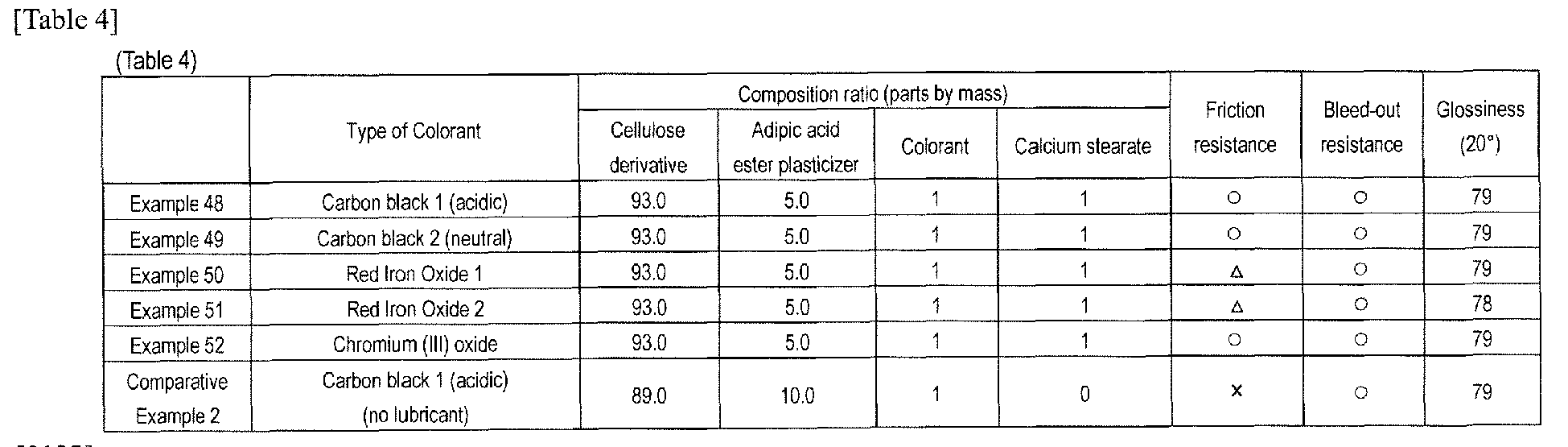


- From Tables 1, 2, and 3, it can be seen that the molded bodies obtained by using the resin compositions of the examples has good friction resistance and bleed-out resistance without greatly impairing the appearance (brightness and glossiness) as compared with the comparative examples. From Tables 4 and 5, it can be seen that the molded bodies obtained by using the resin compositions of the examples has good friction resistance and bleed-out resistance without greatly impairing the appearance (glossiness) as compared with the comparative example.
- From Table 1, it can be seen that the fatty acid metal salt is preferable as the lubricant from the viewpoints of friction resistance, bleed-out resistance, and appearance (in particular, brightness). For example, Examples 1 and 2 using calcium stearate as a lubricant and Examples 5 and 6 using magnesium stearate are excellent in friction resistance and bleed-out resistance as compared with Example 19 (the lubricant is glycerin monostearate), and are excellent in bleed-out resistance with respect to Example 20 (the lubricant is stearamide). Also, it can be seen that, among the fatty acid metal salts, calcium stearate is preferable. For example, Examples 1 and 2 using calcium stearate have excellent friction resistance as compared with the examples (Examples 3 to 4, 7 to 12, and 13 to 14) using zinc stearate, aluminum stearate, and zinc laurate. In addtiion, it can be seen that, when calcium stearate is used, the brightness is low and the jet-blackness is excellent. For example, Examples 1 and 2 using calcium stearate have low brightness and excellent appearance as compared with Examples 5 to 6 using magnesium stearate, Examples 15 to 16 using fatty acid amide lubricant, Example 17 using aliphatic urea lubricant, and Example 18 using silicone-based lubricant.
- The evaluation results shown in Tables 1 to 3 are the evaluation results of the molded bodies molded by the molding method 1, and for the compositions of Example 17 and Comparative Example 1, molded bodies were further produced by the molding method 2, and the evaluation thereof was carried out. Specifically, the same composition as in Example 17 was molded by the molding method 2 to produce a molded body A, and the same composition as in Comparative Example 1 was molded by the molding method 2 to produce a molded body B, and they were evaluated; and as the results, the molded body A containing the lubricant had excellent friction resistance as compared with the molded body B containing no lubricant. In addition, the brightness of the molded body A was 4.9, the glossiness was 80, the evaluation of bleed-out resistance was ∘, the brightness of the molded body B was 2.0, the glossiness was 79, and the evaluation of bleed-out resistance was ∘.
- From Table 6, it can be seen that the molded bodies obtained by using the resin compositions of the examples have good friction resistance and bleed-out resistance without greatly impairing the appearance (brightness and glossiness), and further has good mechanical properties (bending strength and impact strength). In particular, Examples 58, 60 and 61 were superior to Examples 57 and 59 in terms of impact strength. Further, in Examples 58 and 60, deformation of the evaluation sample after the bleed-out test at high humidity was not observed, and the examples were superior to Example 61 in terms of moisture resistance, in which slight deformation was observed.
Claims (14)
- A cellulose resin composition comprising a cellulose derivative (A) and a lubricant (B),wherein the cellulose derivative (A) is an acylated cellulose obtained by substituting at least a part of hydrogen atoms of hydroxy groups of a cellulose with an acyl group having 2 to 4 carbon atoms, anda content of the lubricant (B) is in a range of 0.1 to 10% by mass, wherein the lubricant (B) is a fatty acid metal salt,wherein the cellulose resin composition further comprises a plasticizing component (C),wherein the plasticizing component (C) is an aliphatic polyester, and a content of the aliphatic polyester is in a range of 7 to 30 parts by mass with respect to 100 parts by mass of the cellulose derivative (A), orthe plasticizing component (C) is an aliphatic adipic acid ester, and a content of the aliphatic adipic acid ester is in a range of 5 to 15 parts by mass with respect to 100 parts by mass of the cellulose derivative (A).
- The cellulose resin composition according to claim 1, wherein the lubricant (B) is at least one selected from the group consisting of calcium stearate, zinc stearate, magnesium stearate, aluminum monostearate, aluminum distearate, aluminum tristearate, and zinc laurate.
- The cellulose resin composition according to claim 1, wherein a content of the fatty acid metal salt is in a range of 0.5 to 6% by mass.
- The cellulose resin composition according to claim 3, wherein the fatty acid metal salt is calcium stearate.
- The cellulose resin composition according to any one of claims 1 to 3, wherein the plasticizing component (C) is an aliphatic polyester.
- The cellulose resin composition according to claim 5, wherein the aliphatic polyester is polybutylene succinate.
- The cellulose resin composition according to any one of claims 1 to 3, wherein the plasticizing component (C) is an aliphatic adipic acid ester.
- The cellulose resin composition according to any one of claims 1 to 7, wherein in the cellulose derivative (A), a degree of substitution of the acyl group is 2.0 or more.
- The cellulose resin composition according to any one of claims 1 to 7, wherein the cellulose derivative (A) has at least propionyl group as the acyl group, and a degree of substitution of the propionyl group is 2.0 or more.
- The cellulose resin composition according to any one of claims 1 to 9, further comprising a colorant.
- The cellulose resin composition according to claim 10, wherein the colorant comprises a carbon black, and a content of the carbon black in the cellulose resin composition is in a range of 0.05 to 5% by mass.
- The cellulose resin composition according to claim 10, wherein the colorant comprises a carbon black, and a content of the carbon black in the cellulose resin composition is in a range of 0.05 to 0.3% by mass.
- A molded body formed by using the cellulose resin composition according to any one of claims 1 to 12.
- A product using the molded body according to claim 13.
Applications Claiming Priority (3)
| Application Number | Priority Date | Filing Date | Title |
|---|---|---|---|
| JP2017241068 | 2017-12-15 | ||
| JP2018087095 | 2018-04-27 | ||
| PCT/JP2018/046431 WO2019117316A1 (en) | 2017-12-15 | 2018-12-17 | Cellulose-based resin composition, molded body, and product obtained using same |
Publications (4)
| Publication Number | Publication Date |
|---|---|
| EP3725835A1 EP3725835A1 (en) | 2020-10-21 |
| EP3725835A4 EP3725835A4 (en) | 2021-02-24 |
| EP3725835C0 EP3725835C0 (en) | 2025-02-19 |
| EP3725835B1 true EP3725835B1 (en) | 2025-02-19 |
Family
ID=66819314
Family Applications (1)
| Application Number | Title | Priority Date | Filing Date |
|---|---|---|---|
| EP18889911.6A Active EP3725835B1 (en) | 2017-12-15 | 2018-12-17 | Cellulose resin composition, molded body and product using same |
Country Status (4)
| Country | Link |
|---|---|
| US (1) | US11505681B2 (en) |
| EP (1) | EP3725835B1 (en) |
| JP (1) | JP6973505B2 (en) |
| WO (1) | WO2019117316A1 (en) |
Families Citing this family (6)
| Publication number | Priority date | Publication date | Assignee | Title |
|---|---|---|---|---|
| JP7310888B2 (en) * | 2019-06-14 | 2023-07-19 | 日本電気株式会社 | Cellulose resin composition, molded article and product using the same |
| US20230220186A1 (en) * | 2020-06-08 | 2023-07-13 | Eastman Chemical Company | Low-haze and low-color plasticized cellulose ester compositions with improved melt strength and articles formed therefrom |
| WO2022040074A1 (en) * | 2020-08-19 | 2022-02-24 | Eastman Chemical Company | Calendered cellulose esters with low acid generation |
| CA3213125A1 (en) * | 2021-03-12 | 2022-09-15 | Daicel Corporation | Thermoplastic resin composition |
| JP2024515242A (en) * | 2021-04-08 | 2024-04-08 | イーストマン ケミカル カンパニー | Ophthalmic articles made from cellulose ester compositions having high toughness and dimensional stability - Patents.com |
| WO2024106419A1 (en) * | 2022-11-15 | 2024-05-23 | 日本電気株式会社 | Cellulose-based resin composition and molded article using same |
Family Cites Families (24)
| Publication number | Priority date | Publication date | Assignee | Title |
|---|---|---|---|---|
| US5296423A (en) * | 1992-01-03 | 1994-03-22 | Corning Incorporated | Cordierite substrates |
| JP4524820B2 (en) | 1999-10-25 | 2010-08-18 | Nok株式会社 | Surface treatment agent |
| JP4766796B2 (en) | 2001-08-14 | 2011-09-07 | 藤森工業株式会社 | Release film |
| JP4954441B2 (en) | 2003-10-30 | 2012-06-13 | ユーエムジー・エービーエス株式会社 | Thermoplastic resin composition |
| JP2009073102A (en) | 2007-09-21 | 2009-04-09 | Ricoh Co Ltd | Thermal transfer recording medium |
| JP2010121121A (en) | 2008-10-22 | 2010-06-03 | Fujifilm Corp | Cellulose derivative, resin composition, molded body obtained from cellulose derivative, and enclosure for electric/electronic device composed of the molded body |
| JP2011132453A (en) | 2009-12-25 | 2011-07-07 | Fujifilm Corp | Molding material, molding, and method for producing the same, and housing for electrical and electronic equipment |
| JP2011201961A (en) | 2010-03-24 | 2011-10-13 | Nagase & Co Ltd | Resin colorant and resin composition |
| JP2011225786A (en) * | 2010-04-22 | 2011-11-10 | Fujifilm Corp | Cellulose derivative, resin composition, molding material, molded body, method for manufacturing molded body, and housing for electric/electronic device |
| JP2011241236A (en) * | 2010-05-13 | 2011-12-01 | Fujifilm Corp | Resin composition, resin composition for injection molding, and housing for electric/electronic device |
| JP5879157B2 (en) * | 2011-03-07 | 2016-03-08 | 富士フイルム株式会社 | Optical film, laminate, retardation film, polarizing plate and optical film manufacturing method |
| JP5796393B2 (en) * | 2011-07-29 | 2015-10-21 | 富士ゼロックス株式会社 | Resin composition and resin molded body |
| JP5888925B2 (en) * | 2011-10-04 | 2016-03-22 | ダイセルポリマー株式会社 | Resin composition |
| JP5749635B2 (en) | 2011-11-30 | 2015-07-15 | 帝人株式会社 | Black resin composition and resin molded body |
| CN104245833A (en) | 2012-03-30 | 2014-12-24 | 旭化成化学株式会社 | Resin composition and molded body thereof |
| JPWO2014119657A1 (en) | 2013-01-30 | 2017-01-26 | 日本電気株式会社 | Cellulosic resin composition, molding material and molded article |
| JP2015063615A (en) * | 2013-09-25 | 2015-04-09 | 凸版印刷株式会社 | Barrier molding |
| SG10201810330XA (en) * | 2013-12-23 | 2018-12-28 | Arlanxeo Singapore Pte Ltd | Rubbers with tunable levels of metal containing anti-agglomerants |
| JP6309792B2 (en) | 2014-03-12 | 2018-04-11 | 帝人株式会社 | Black resin composition and black molded product |
| JP2016152005A (en) * | 2015-02-19 | 2016-08-22 | アズビル株式会社 | Method and device for designating data adoption section |
| KR102374256B1 (en) * | 2015-02-23 | 2022-03-15 | 삼성전기주식회사 | Circuit board and manufacturing method thereof |
| JP2018087095A (en) | 2015-04-01 | 2018-06-07 | 旭硝子株式会社 | Double glazing and manufacturing method of the same |
| JP6874294B2 (en) * | 2016-08-02 | 2021-05-19 | 三菱ケミカル株式会社 | A polyester resin composition, a film formed by molding the resin composition, and a bag formed by molding the film. |
| JP6880597B2 (en) * | 2016-08-10 | 2021-06-02 | 三菱ケミカル株式会社 | A resin composition, a film formed by molding the resin composition, and a bag formed by molding the film. |
-
2018
- 2018-12-17 JP JP2019559241A patent/JP6973505B2/en active Active
- 2018-12-17 EP EP18889911.6A patent/EP3725835B1/en active Active
- 2018-12-17 US US16/772,580 patent/US11505681B2/en active Active
- 2018-12-17 WO PCT/JP2018/046431 patent/WO2019117316A1/en not_active Ceased
Also Published As
| Publication number | Publication date |
|---|---|
| JP6973505B2 (en) | 2021-12-01 |
| US20200385548A1 (en) | 2020-12-10 |
| EP3725835C0 (en) | 2025-02-19 |
| EP3725835A1 (en) | 2020-10-21 |
| WO2019117316A1 (en) | 2019-06-20 |
| EP3725835A4 (en) | 2021-02-24 |
| US11505681B2 (en) | 2022-11-22 |
| JPWO2019117316A1 (en) | 2020-12-03 |
Similar Documents
| Publication | Publication Date | Title |
|---|---|---|
| EP3725834B1 (en) | Cellulose resin composition, molded body and product using same, and method for producing cellulose resin composition | |
| US11505681B2 (en) | Cellulose resin composition, molded body and product using same | |
| CN110168004B (en) | Cellulose-derived polymer-based resin compositions and articles made using these compositions | |
| CN110168005B (en) | Cellulose ester and impact modifier compositions and articles made using these compositions | |
| JP7310888B2 (en) | Cellulose resin composition, molded article and product using the same | |
| JP2013028771A (en) | Resin composition and resin-molded product | |
| JP7201086B2 (en) | Cellulose resin composition, molded article and product using the same | |
| US10941282B2 (en) | Cellulose resin composition, molded body and product using same | |
| JP6939782B2 (en) | Cellulose-based resin composition, molded product and products using it | |
| JP7793596B2 (en) | thermoplastic resin composition | |
| US11028186B2 (en) | Cellulose derivative, cellulose resin composition, molded body and product using same | |
| CN106009060A (en) | Resin composition and resin molded article | |
| JP7670387B2 (en) | Cellulose-based resin composition and molded article using the same | |
| CN106009052A (en) | Resin composition and resin molded article | |
| WO2024106426A1 (en) | Cellulose resin composition and molded body using same | |
| JP7670388B2 (en) | Cellulose-based resin composition and molded article using the same | |
| JP3372648B2 (en) | Method for producing molded article of thermoplastic cellulose derivative composition having biodegradability | |
| WO2024106419A1 (en) | Cellulose-based resin composition and molded article using same |
Legal Events
| Date | Code | Title | Description |
|---|---|---|---|
| STAA | Information on the status of an ep patent application or granted ep patent |
Free format text: STATUS: THE INTERNATIONAL PUBLICATION HAS BEEN MADE |
|
| PUAI | Public reference made under article 153(3) epc to a published international application that has entered the european phase |
Free format text: ORIGINAL CODE: 0009012 |
|
| STAA | Information on the status of an ep patent application or granted ep patent |
Free format text: STATUS: REQUEST FOR EXAMINATION WAS MADE |
|
| 17P | Request for examination filed |
Effective date: 20200715 |
|
| AK | Designated contracting states |
Kind code of ref document: A1 Designated state(s): AL AT BE BG CH CY CZ DE DK EE ES FI FR GB GR HR HU IE IS IT LI LT LU LV MC MK MT NL NO PL PT RO RS SE SI SK SM TR |
|
| AX | Request for extension of the european patent |
Extension state: BA ME |
|
| A4 | Supplementary search report drawn up and despatched |
Effective date: 20210125 |
|
| RIC1 | Information provided on ipc code assigned before grant |
Ipc: C08L 1/12 20060101ALI20210119BHEP Ipc: C08K 5/098 20060101ALI20210119BHEP Ipc: C08B 3/06 20060101ALI20210119BHEP Ipc: C08K 5/21 20060101ALI20210119BHEP Ipc: C08K 5/20 20060101ALI20210119BHEP Ipc: C08L 1/10 20060101AFI20210119BHEP Ipc: C08B 3/08 20060101ALI20210119BHEP Ipc: C08K 5/54 20060101ALI20210119BHEP Ipc: C08K 5/00 20060101ALI20210119BHEP Ipc: C08K 5/101 20060101ALI20210119BHEP Ipc: C08K 3/04 20060101ALI20210119BHEP |
|
| DAV | Request for validation of the european patent (deleted) | ||
| DAX | Request for extension of the european patent (deleted) | ||
| STAA | Information on the status of an ep patent application or granted ep patent |
Free format text: STATUS: EXAMINATION IS IN PROGRESS |
|
| 17Q | First examination report despatched |
Effective date: 20230329 |
|
| GRAP | Despatch of communication of intention to grant a patent |
Free format text: ORIGINAL CODE: EPIDOSNIGR1 |
|
| STAA | Information on the status of an ep patent application or granted ep patent |
Free format text: STATUS: GRANT OF PATENT IS INTENDED |
|
| INTG | Intention to grant announced |
Effective date: 20240425 |
|
| GRAJ | Information related to disapproval of communication of intention to grant by the applicant or resumption of examination proceedings by the epo deleted |
Free format text: ORIGINAL CODE: EPIDOSDIGR1 |
|
| STAA | Information on the status of an ep patent application or granted ep patent |
Free format text: STATUS: EXAMINATION IS IN PROGRESS |
|
| GRAP | Despatch of communication of intention to grant a patent |
Free format text: ORIGINAL CODE: EPIDOSNIGR1 |
|
| STAA | Information on the status of an ep patent application or granted ep patent |
Free format text: STATUS: GRANT OF PATENT IS INTENDED |
|
| INTC | Intention to grant announced (deleted) | ||
| INTG | Intention to grant announced |
Effective date: 20240903 |
|
| GRAS | Grant fee paid |
Free format text: ORIGINAL CODE: EPIDOSNIGR3 |
|
| GRAA | (expected) grant |
Free format text: ORIGINAL CODE: 0009210 |
|
| STAA | Information on the status of an ep patent application or granted ep patent |
Free format text: STATUS: THE PATENT HAS BEEN GRANTED |
|
| AK | Designated contracting states |
Kind code of ref document: B1 Designated state(s): AL AT BE BG CH CY CZ DE DK EE ES FI FR GB GR HR HU IE IS IT LI LT LU LV MC MK MT NL NO PL PT RO RS SE SI SK SM TR |
|
| REG | Reference to a national code |
Ref country code: GB Ref legal event code: FG4D |
|
| REG | Reference to a national code |
Ref country code: CH Ref legal event code: EP |
|
| REG | Reference to a national code |
Ref country code: IE Ref legal event code: FG4D |
|
| REG | Reference to a national code |
Ref country code: DE Ref legal event code: R096 Ref document number: 602018079443 Country of ref document: DE |
|
| U01 | Request for unitary effect filed |
Effective date: 20250228 |
|
| U07 | Unitary effect registered |
Designated state(s): AT BE BG DE DK EE FI FR IT LT LU LV MT NL PT RO SE SI Effective date: 20250310 |
|
| PG25 | Lapsed in a contracting state [announced via postgrant information from national office to epo] |
Ref country code: RS Free format text: LAPSE BECAUSE OF FAILURE TO SUBMIT A TRANSLATION OF THE DESCRIPTION OR TO PAY THE FEE WITHIN THE PRESCRIBED TIME-LIMIT Effective date: 20250519 |
|
| PG25 | Lapsed in a contracting state [announced via postgrant information from national office to epo] |
Ref country code: PL Free format text: LAPSE BECAUSE OF FAILURE TO SUBMIT A TRANSLATION OF THE DESCRIPTION OR TO PAY THE FEE WITHIN THE PRESCRIBED TIME-LIMIT Effective date: 20250219 |
|
| PG25 | Lapsed in a contracting state [announced via postgrant information from national office to epo] |
Ref country code: ES Free format text: LAPSE BECAUSE OF FAILURE TO SUBMIT A TRANSLATION OF THE DESCRIPTION OR TO PAY THE FEE WITHIN THE PRESCRIBED TIME-LIMIT Effective date: 20250219 |
|
| PG25 | Lapsed in a contracting state [announced via postgrant information from national office to epo] |
Ref country code: IS Free format text: LAPSE BECAUSE OF FAILURE TO SUBMIT A TRANSLATION OF THE DESCRIPTION OR TO PAY THE FEE WITHIN THE PRESCRIBED TIME-LIMIT Effective date: 20250619 Ref country code: NO Free format text: LAPSE BECAUSE OF FAILURE TO SUBMIT A TRANSLATION OF THE DESCRIPTION OR TO PAY THE FEE WITHIN THE PRESCRIBED TIME-LIMIT Effective date: 20250519 |
|
| PG25 | Lapsed in a contracting state [announced via postgrant information from national office to epo] |
Ref country code: HR Free format text: LAPSE BECAUSE OF FAILURE TO SUBMIT A TRANSLATION OF THE DESCRIPTION OR TO PAY THE FEE WITHIN THE PRESCRIBED TIME-LIMIT Effective date: 20250219 |
|
| PG25 | Lapsed in a contracting state [announced via postgrant information from national office to epo] |
Ref country code: GR Free format text: LAPSE BECAUSE OF FAILURE TO SUBMIT A TRANSLATION OF THE DESCRIPTION OR TO PAY THE FEE WITHIN THE PRESCRIBED TIME-LIMIT Effective date: 20250520 |
|
| PG25 | Lapsed in a contracting state [announced via postgrant information from national office to epo] |
Ref country code: SM Free format text: LAPSE BECAUSE OF FAILURE TO SUBMIT A TRANSLATION OF THE DESCRIPTION OR TO PAY THE FEE WITHIN THE PRESCRIBED TIME-LIMIT Effective date: 20250219 |
|
| PG25 | Lapsed in a contracting state [announced via postgrant information from national office to epo] |
Ref country code: CZ Free format text: LAPSE BECAUSE OF FAILURE TO SUBMIT A TRANSLATION OF THE DESCRIPTION OR TO PAY THE FEE WITHIN THE PRESCRIBED TIME-LIMIT Effective date: 20250219 |
|
| PG25 | Lapsed in a contracting state [announced via postgrant information from national office to epo] |
Ref country code: SK Free format text: LAPSE BECAUSE OF FAILURE TO SUBMIT A TRANSLATION OF THE DESCRIPTION OR TO PAY THE FEE WITHIN THE PRESCRIBED TIME-LIMIT Effective date: 20250219 |
|
| PLBE | No opposition filed within time limit |
Free format text: ORIGINAL CODE: 0009261 |
|
| STAA | Information on the status of an ep patent application or granted ep patent |
Free format text: STATUS: NO OPPOSITION FILED WITHIN TIME LIMIT |
|
| REG | Reference to a national code |
Ref country code: CH Ref legal event code: L10 Free format text: ST27 STATUS EVENT CODE: U-0-0-L10-L00 (AS PROVIDED BY THE NATIONAL OFFICE) Effective date: 20251231 |
|
| 26N | No opposition filed |
Effective date: 20251120 |
|
| U20 | Renewal fee for the european patent with unitary effect paid |
Year of fee payment: 8 Effective date: 20251230 |
|
| PG25 | Lapsed in a contracting state [announced via postgrant information from national office to epo] |
Ref country code: MC Free format text: LAPSE BECAUSE OF FAILURE TO SUBMIT A TRANSLATION OF THE DESCRIPTION OR TO PAY THE FEE WITHIN THE PRESCRIBED TIME-LIMIT Effective date: 20250219 |
|
| REG | Reference to a national code |
Ref country code: CH Ref legal event code: H13 Free format text: ST27 STATUS EVENT CODE: U-0-0-H10-H13 (AS PROVIDED BY THE NATIONAL OFFICE) Effective date: 20260723 |