EP3725571A1 - System for managing tires for construction and mining vehicles, and method for managing tires for construction and mining vehicles - Google Patents
System for managing tires for construction and mining vehicles, and method for managing tires for construction and mining vehicles Download PDFInfo
- Publication number
- EP3725571A1 EP3725571A1 EP18889566.8A EP18889566A EP3725571A1 EP 3725571 A1 EP3725571 A1 EP 3725571A1 EP 18889566 A EP18889566 A EP 18889566A EP 3725571 A1 EP3725571 A1 EP 3725571A1
- Authority
- EP
- European Patent Office
- Prior art keywords
- tires
- fatigue degree
- tire
- group
- construction
- Prior art date
- Legal status (The legal status is an assumption and is not a legal conclusion. Google has not performed a legal analysis and makes no representation as to the accuracy of the status listed.)
- Granted
Links
Images



Classifications
-
- B—PERFORMING OPERATIONS; TRANSPORTING
- B60—VEHICLES IN GENERAL
- B60C—VEHICLE TYRES; TYRE INFLATION; TYRE CHANGING; CONNECTING VALVES TO INFLATABLE ELASTIC BODIES IN GENERAL; DEVICES OR ARRANGEMENTS RELATED TO TYRES
- B60C11/00—Tyre tread bands; Tread patterns; Anti-skid inserts
- B60C11/24—Wear-indicating arrangements
- B60C11/246—Tread wear monitoring systems
-
- B—PERFORMING OPERATIONS; TRANSPORTING
- B60—VEHICLES IN GENERAL
- B60C—VEHICLE TYRES; TYRE INFLATION; TYRE CHANGING; CONNECTING VALVES TO INFLATABLE ELASTIC BODIES IN GENERAL; DEVICES OR ARRANGEMENTS RELATED TO TYRES
- B60C23/00—Devices for measuring, signalling, controlling, or distributing tyre pressure or temperature, specially adapted for mounting on vehicles; Arrangement of tyre inflating devices on vehicles, e.g. of pumps or of tanks; Tyre cooling arrangements
- B60C23/20—Devices for measuring or signalling tyre temperature only
-
- B—PERFORMING OPERATIONS; TRANSPORTING
- B60—VEHICLES IN GENERAL
- B60S—SERVICING, CLEANING, REPAIRING, SUPPORTING, LIFTING, OR MANOEUVRING OF VEHICLES, NOT OTHERWISE PROVIDED FOR
- B60S5/00—Servicing, maintaining, repairing, or refitting of vehicles
-
- G—PHYSICS
- G01—MEASURING; TESTING
- G01B—MEASURING LENGTH, THICKNESS OR SIMILAR LINEAR DIMENSIONS; MEASURING ANGLES; MEASURING AREAS; MEASURING IRREGULARITIES OF SURFACES OR CONTOURS
- G01B11/00—Measuring arrangements characterised by the use of optical techniques
- G01B11/22—Measuring arrangements characterised by the use of optical techniques for measuring depth
-
- G—PHYSICS
- G01—MEASURING; TESTING
- G01M—TESTING STATIC OR DYNAMIC BALANCE OF MACHINES OR STRUCTURES; TESTING OF STRUCTURES OR APPARATUS, NOT OTHERWISE PROVIDED FOR
- G01M17/00—Testing of vehicles
- G01M17/007—Wheeled or endless-tracked vehicles
- G01M17/02—Tyres
-
- G—PHYSICS
- G07—CHECKING-DEVICES
- G07C—TIME OR ATTENDANCE REGISTERS; REGISTERING OR INDICATING THE WORKING OF MACHINES; GENERATING RANDOM NUMBERS; VOTING OR LOTTERY APPARATUS; ARRANGEMENTS, SYSTEMS OR APPARATUS FOR CHECKING NOT PROVIDED FOR ELSEWHERE
- G07C5/00—Registering or indicating the working of vehicles
- G07C5/08—Registering or indicating performance data other than driving, working, idle, or waiting time, with or without registering driving, working, idle or waiting time
- G07C5/0808—Diagnosing performance data
-
- G—PHYSICS
- G01—MEASURING; TESTING
- G01L—MEASURING FORCE, STRESS, TORQUE, WORK, MECHANICAL POWER, MECHANICAL EFFICIENCY, OR FLUID PRESSURE
- G01L17/00—Devices or apparatus for measuring tyre pressure or the pressure in other inflated bodies
Definitions
- the present disclosure relates to a management system for tires for construction and mine vehicles and a management method for tires for construction and mine vehicles.
- the following technique is used: When the measured fatigue degrees of the front wheels reach a predetermined fatigue degree, the front tires are rotated to the rear, and new tires are mounted as the front tires.
- the fatigue degree of a tire can be measured by various methods (for example, see PTL 1).
- a management system for tires for construction and mine vehicles comprises: a fatigue degree calculation section configured to calculate a fatigue degree of each of a plurality of front tires installed in a plurality of vehicles; a grouping processing section configured to group the plurality of front tires into a plurality of fatigue degree groups depending on calculated fatigue degrees; and an assignment processing section configured to assign, from among the plurality of front tires grouped, front tires belonging to a fatigue degree group as rear tires of a vehicle after rotation.
- FIG. 1 is a block diagram of a management system for tires for construction and mine vehicles (hereafter also simply referred to as "tire management system") according to one of the disclosed embodiments.
- a tire management system 100 includes a fatigue degree calculation section 1, an installation history acquisition section 2, an information processing section 3, a grouping processing section 4, and an assignment processing section 5.
- the fatigue degree calculation section 1 is configured to calculate a fatigue degree of each of a plurality of front tires, and includes a processor capable of calculating the fatigue degree.
- the fatigue degree calculation section 1 includes a tire running parameter measurement section 11, a state characteristic value measurement section 12, and a fatigue degree characteristic value calculation section 13, as illustrated in FIG. 1 .
- the tire running parameter measurement section 11 is configured to measure a tire running parameter.
- the tire running parameter include the running time, running distance (for example, GPS records are used), remaining groove depth (remaining tread depth: RTD), and number of revolutions of the tire.
- the tire running parameter is preferably the running time or running distance of the tire.
- the tire running parameter measurement section 11 may be, for example, a known device capable of measuring the running time and/or distance of the tire by detecting revolutions of the tire.
- the state characteristic value measurement section 12 is configured to measure a state characteristic value indicating the state of each tire constituent member.
- tire constituent members include a bead, a carcass, a belt, and a tread rubber.
- the state characteristic value indicating the state of each tire constituent member is, for example, the temperature of the tire constituent member.
- the temperature of the tire constituent member can be obtained as follows:
- the state characteristic value measurement section 12 (for example, a known thermometer) is installed inside the chamber (the space between the tire inner surface and the rim wheel), the temperature inside the chamber is measured, and the temperature of the tire constituent member is calculated by converting the measured temperature inside the chamber.
- the temperature of each of the tread, the belt, the bead, etc. can be calculated by adding a predetermined constant based on past data and the like to the measured temperature inside the chamber.
- measuring means that the tire running parameter or the state characteristic value can be obtained directly or indirectly. That is, the term “measuring” includes obtaining the tire running parameter or the state characteristic value as a result of performing some kind of calculation on a directly measured parameter or the like.
- the fatigue degree characteristic value calculation section 13 is configured to calculate a fatigue degree characteristic value corresponding to the fatigue degree of each tire constituent member, based on the tire running parameter measured by the tire running parameter measurement section 11 and the state characteristic value measured by the state characteristic value measurement section 12.
- the fatigue degree characteristic value calculation section 13 calculates, as the fatigue degree characteristic value, a thermal history by integrating the temperature measured by the state characteristic value measurement section 12 with the tire running time measured by the tire running parameter measurement section 11. The reason that the thermal history is used as the fatigue degree characteristic value corresponding to the fatigue degree of the tire constituent member is because the thermal history is a good index when predicting the failure risk of the tire constituent member.
- the present disclosure is not limited to such.
- the fatigue degree may be, for example, TKPH (the multiplication value of the load (average load) on the tire and the speed (average speed)) or T 2 KPH (the multiplication value of the square of the load (average load square) on the tire and the speed (average speed)).
- the fatigue degree calculation section 1 may include a measuring instrument configured to measure the load on the tire and a storage section configured to store the load on the tire, and a measuring instrument configured to measure the speed and a storage section configured to store the speed.
- the installation history acquisition section 2 is configured to acquire, for each of a plurality of front tires installed at respective positions in a plurality of vehicles, information of the vehicle and the position at which the front tire is installed.
- the installation history acquisition section 2 acquires, for each tire, information of a combination of: a tire serial number; and an installation vehicle ID and an installation position ID.
- position means, for example in the case of two front wheels and four rear wheels, any of the following positions: front left wheel, front right wheel, rear left outer wheel, rear left inner wheel, rear right inner wheel, and rear right outer wheel.
- the installation history acquisition section 2 may include a storage section, and store a position ID upon tire replacement.
- the installation history acquisition section 2 may include a communication section such as GPS, and acquire information of the vehicle and the position by the communication section and store the information in a storage section.
- the information processing section 3 is a processor configured to perform a process of associating the calculated fatigue degree and the acquired information of the vehicle and the position.
- information of the fatigue degree of a tire installed at a specific position in a vehicle used in a specific use condition can be obtained.
- the fatigue degree e.g. thermal history
- a severe (e.g. high speed) use condition can be obtained.
- the grouping processing section 4 is configured to group the plurality of front tires into a plurality of fatigue degree groups depending on the calculated fatigue degrees. For tires for construction and mine vehicles, the tire life on the front wheels tends to be short. Accordingly, front tires are subjected to grouping. For example, a predetermined fatigue degree threshold may be set to group the plurality of front tires into a group of tires each having a fatigue degree greater than or equal to the threshold and a group of tires each having a fatigue degree less than the threshold. Two or more thresholds may be set to group the plurality of front tires into three or more groups.
- the assignment processing section 5 is configured to assign, from among the plurality of front tires grouped, front tires belonging to a fatigue degree group as rear tires of a vehicle after rotation.
- the assignment processing section 5 is further configured to assign new tires as all front tires of the vehicle after the rotation.
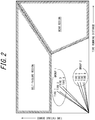
- FIG. 2 is a diagram illustrating the relationship between the tire running distance (an example of the tire running parameter) and the tire fatigue degree on the one hand, and a belt failure region and a wear region on the other hand, before rotation.
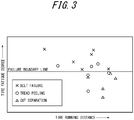
- FIG. 3 is a diagram illustrating the relationship between the tire running distance (an example of the tire running parameter) and the tire fatigue degree on the one hand, and each type of failure on the other hand. For example, a failure boundary line can be set at a region in which the risk of belt failures arises, as illustrated in FIG. 3 .
- FIG. 4 is a diagram illustrating the relationship between the tire running distance and the tire fatigue degree of the tires of each of groups 1 and 2 illustrated in FIG. 2 .
- the plurality of front tires are grouped into a group (group 1) of front tires each having a high fatigue degree and a group (group 2) of front tires each having a lower fatigue degree than the group 1.
- group 1 the tires of the group 1 are higher in fatigue degree than the tires of the group 2 at the same running distance (in this example, at a given tire running distance, the index of the fatigue degree of the group 1 reaches 60 whereas the index of the fatigue degree of the group 2 reaches only 40).
- the tires of the group 2 are likely to reach the wear region (the region in which tires can be used up safely) after being rotated from the front wheels to the rear wheels, but the tires of the group 1 are likely to reach the belt failure region (the region in which the risk of belt failures arises) without reaching the wear region after being rotated from the front wheels to the rear wheels and consequently, for example, need to be replaced.
- the tires of the group 2 are likely to reach the wear region with an excessive allowance (for example, the use of the tires in a mild (e.g. low speed) condition more than necessary is continued). Thus, the tires are not used sufficiently effectively.
- the tire management system includes: the fatigue degree calculation section 1 configured to calculate the fatigue degree of each of a plurality of front tires installed in a plurality of vehicles; the grouping processing section 4 configured to group the plurality of front tires into a plurality of fatigue degree groups depending on the calculated fatigue degrees; and the assignment processing section 5 configured to assign, from among the plurality of front tires grouped, front tires belonging to a fatigue degree group as rear tires of a vehicle after rotation. Therefore, for example, the use condition of the vehicle can be determined depending on the fatigue degree of the front tires belonging to the fatigue degree group (for example, in the case where the fatigue degree is high, the tires are used in a milder condition such as lower speed or lower load after rotation).
- FIG. 5 is a diagram illustrating the relationship between the tire running distance (an example of the tire running parameter) and the tire fatigue degree on the one hand, and the belt failure region and the wear region on the other hand, before and after rotation.
- the tires of the group 1 and the tires of the group 2 can both reach the wear region without reaching the belt failure region after being rotated from the front wheels to the rear wheels, and also the tires of the group 1 and the tires of the group 2 can both reach the wear region near the boundary between the belt failure region and the wear region. The tires can thus be used effectively.
- the management system for tires for construction and mine vehicles enables long-term efficient use of tires.
- the rotation processing section 5 is preferably further configured to assign new tires as all front tires of the vehicle after the rotation, as in this embodiment.
- the use condition of the front wheels is more severe than the use condition of the rear wheels, as mentioned earlier.
- assigning and using new tires as the front wheels after the rotation can further contribute to long-term efficient use of tires.
- FIG. 6 is a schematic diagram for explaining tire management (tire rotation) according to one of the disclosed embodiments.
- FIG. 6 illustrates the case where rotation is performed twice.
- tires are installed at respective positions (front left tire, front right tire, rear left outer tire, rear left inner tire, rear right outer tire, and rear right inner tire) in each of sixteen vehicles.
- the fatigue degree calculation section 1 groups sixteen front tires as a fatigue degree group having a high fatigue degree and the remaining sixteen front tires as a fatigue degree group having a low fatigue degree, as illustrated in FIG. 6 .
- the tires grouped as the fatigue degree group having a high fatigue degree are assigned as the rear wheels of vehicles (a total of sixteen rear wheels of four vehicles) after the first rotation (before the second rotation). Then, for example, the use condition can be determined as mild (low speed, low load, etc.). Meanwhile, the tires grouped as the fatigue degree group having a low fatigue degree are assigned as the rear wheels of vehicles (a total of sixteen rear wheels of four vehicles) after the first rotation (before the second rotation). Then, for example, the use condition can be determined as severe (high speed, high load, etc.). In this example, the front wheels are all replaced with new tires.
- the fatigue degree calculation section 1 groups eight front tires as a fatigue degree group having a high fatigue degree, and the remaining eight front tires as a fatigue degree group having a low fatigue degree.
- the tires grouped as the fatigue degree group having a high fatigue degree are assigned as the rear wheels of vehicles (eight rear wheels of two vehicles) after the second rotation.
- the use condition can be determined as mild (low speed, low load, etc.).
- the tires grouped as the fatigue degree group having a low fatigue degree are assigned as the rear wheels of vehicles (eight rear wheels of two vehicles) after the second rotation.
- the use condition can be determined as severe (high speed, high load, etc.).
- the front wheels are all replaced with new tires.
- FIG. 7 is a flowchart of a management method for tires for construction and mine vehicles (hereafter also simply referred to as "tire management method") according to one of the disclosed embodiments.
- a fatigue degree of each of a plurality of front tires installed in a plurality of vehicles is calculated first (fatigue degree calculation step: step S101).
- the fatigue degree calculation step can be performed by the fatigue degree calculation section 1, as described above.
- any of various indexes such as the foregoing thermal history, product of temperature and running distance, TKPH, and T 2 KPH may be used, as mentioned earlier.
- the fatigue degree calculation step may include: a step of measuring the foregoing tire running parameter by the tire running parameter measurement section 11; a step of measuring the foregoing state characteristic value indicating the state of each tire constituent member by the state characteristic value measurement section 12; and a step of calculating, by the fatigue degree characteristic value calculation section 13, a fatigue degree characteristic value corresponding to the fatigue degree of each tire constituent member based on the tire running parameter measured by the tire running parameter measurement section 11 and the state characteristic value measured by the state characteristic value measurement section 12.
- the plurality of front tires are grouped into a plurality of fatigue degree groups depending on the calculated fatigue degrees (grouping step: step S102).
- the grouping step can be performed by the grouping processing section 4, as described above.
- a predetermined fatigue degree threshold may be set to group the plurality of front tires into a group of tires each having a fatigue degree greater than or equal to the threshold and a group of tires each having a fatigue degree less than the threshold, as mentioned earlier.
- Two or more thresholds may be set to group the plurality of front tires into three or more groups.
- step S103 From among the plurality of front tires grouped, front tires belonging to a fatigue degree group are assigned as rear tires of a vehicle after rotation (assignment step: step S103).
- the assignment step can be performed by the assignment processing section 5, as described above.
- the assignment step (step S103) includes assigning new tires as all front tires of the vehicle after the rotation.
- the tire management method comprises: the fatigue degree calculation step (step S101) of calculating the fatigue degree of each of a plurality of front tires installed in a plurality of vehicles; the grouping step (step S 102) of grouping the plurality of front tires into a plurality of fatigue degree groups depending on the calculated fatigue degrees; and the assignment step (step S103) of assigning, from among the plurality of front tires grouped, front tires belonging to a fatigue degree group as rear tires of a vehicle after rotation. Therefore, for example, the use condition of the vehicle can be determined depending on the fatigue degree of the front tires belonging to the fatigue degree group (for example, in the case where the fatigue degree is high, the tires are used in a milder condition such as lower speed or lower load after rotation).
- the tires of the group 1 and the tires of the group 2 can both reach the wear region without reaching the belt failure region after being rotated from the front wheels to the rear wheels, and also the tires of the group 1 and the tires of the group 2 can both reach the wear region near the boundary between the belt failure region and the wear region.
- the tires can thus be used effectively.
- the management method for tires for construction and mine vehicles enables long-term efficient use of tires.
- the assignment step (step S103) preferably includes assigning new tires as all front tires of the vehicle after the rotation.
- the use condition of the front wheels is more severe than the use condition of the rear wheels, as mentioned earlier.
- assigning and using new tires as the front wheels after the rotation can further contribute to long-term efficient use of tires.
- the management system for tires for construction and mine vehicles and the management method for tires for construction and mine vehicles according to the present disclosure are not limited to the foregoing embodiment.
- various indexes can be used as the fatigue degree, as mentioned earlier.
- the temperature may be measured by any known thermometer, and the calculation may be performed using any known calculator.
- the tire running parameter e.g. the running time, running distance, remaining groove depth (remaining tread depth: RTD), and number of revolutions of the tire
- the tire running parameter may be obtained using, for example, any known measuring instrument described above.
- the number of groups may be two or more.
- the assignment processing section 5 may assign, from among the plurality of front tires grouped into the five groups, front tires belonging to a fatigue degree group as rear tires of a vehicle after rotation.
- tires assigned as a group having the highest fatigue degree of the five groups may be used in the mildest use condition after rotation
- tires assigned as a group having the second highest fatigue degree may be used in the second mildest use condition after rotation
- tires assigned as a group having the third highest fatigue degree may be used in the third mildest use condition after rotation
- tires assigned as a group having the fourth highest fatigue degree may be used in the fourth mildest use condition after rotation
- tires assigned as a group having the lowest fatigue degree may be used in the most severe use condition after rotation.
- steps S101 to S103 may be repeated depending on the number of rotations.
Landscapes
- Engineering & Computer Science (AREA)
- Mechanical Engineering (AREA)
- Physics & Mathematics (AREA)
- General Physics & Mathematics (AREA)
- Tires In General (AREA)
- Management, Administration, Business Operations System, And Electronic Commerce (AREA)
- Vehicle Cleaning, Maintenance, Repair, Refitting, And Outriggers (AREA)
Abstract
Description
- The present disclosure relates to a management system for tires for construction and mine vehicles and a management method for tires for construction and mine vehicles.
- For tires for construction and mine vehicles, given heavy loads on the front wheels, the following technique is used: When the measured fatigue degrees of the front wheels reach a predetermined fatigue degree, the front tires are rotated to the rear, and new tires are mounted as the front tires. The fatigue degree of a tire can be measured by various methods (for example, see PTL 1).
- PTL 1:
JP 2010-506787 A - With the foregoing technique, however, there are instances where some tires fail early after rotation and thus long-term efficient use of tires cannot be achieved.
- It could therefore be helpful to provide a management system for tires for construction and mine vehicles and a management method for tires for construction and mine vehicles that enable long-term efficient use of tires.
- We provide the following:
A management system for tires for construction and mine vehicles according to the present disclosure comprises: a fatigue degree calculation section configured to calculate a fatigue degree of each of a plurality of front tires installed in a plurality of vehicles; a grouping processing section configured to group the plurality of front tires into a plurality of fatigue degree groups depending on calculated fatigue degrees; and an assignment processing section configured to assign, from among the plurality of front tires grouped, front tires belonging to a fatigue degree group as rear tires of a vehicle after rotation. - It is therefore possible to provide a management system for tires for construction and mine vehicles and a management method for tires for construction and mine vehicles that enable long-term efficient use of tires.
- In the accompanying drawings:
-
FIG. 1 is a block diagram of a management system for tires for construction and mine vehicles according to one of the disclosed embodiments; -
FIG. 2 is a diagram illustrating the relationship between the tire running distance and the tire fatigue degree on the one hand, and a belt failure region and a wear region on the other hand, before rotation; -
FIG. 3 is a diagram illustrating the relationship between the tire running distance and the tire fatigue degree on the one hand, and each type of failure on the other hand; -
FIG. 4 is a diagram illustrating the relationship between the tire running distance and the tire fatigue degree of the tires of each ofgroups FIG. 2 ; -
FIG. 5 is a diagram illustrating the relationship between the tire running distance and the tire fatigue degree on the one hand, and the belt failure region and the wear region on the other hand, before and after rotation; -
FIG. 6 is a schematic diagram for explaining tire management (tire rotation) according to one of the disclosed embodiments; and -
FIG. 7 is a flowchart of a management method for tires for construction and mine vehicles according to one of the disclosed embodiments. - One of the disclosed embodiments will be described in detail below, with reference to the drawings.
-
FIG. 1 is a block diagram of a management system for tires for construction and mine vehicles (hereafter also simply referred to as "tire management system") according to one of the disclosed embodiments. As illustrated inFIG. 1 , atire management system 100 includes a fatiguedegree calculation section 1, an installationhistory acquisition section 2, aninformation processing section 3, agrouping processing section 4, and anassignment processing section 5. - The fatigue
degree calculation section 1 is configured to calculate a fatigue degree of each of a plurality of front tires, and includes a processor capable of calculating the fatigue degree. In this embodiment, the fatiguedegree calculation section 1 includes a tire runningparameter measurement section 11, a state characteristicvalue measurement section 12, and a fatigue degree characteristicvalue calculation section 13, as illustrated inFIG. 1 . - The tire running
parameter measurement section 11 is configured to measure a tire running parameter. Examples of the tire running parameter include the running time, running distance (for example, GPS records are used), remaining groove depth (remaining tread depth: RTD), and number of revolutions of the tire. The tire running parameter is preferably the running time or running distance of the tire. The tire runningparameter measurement section 11 may be, for example, a known device capable of measuring the running time and/or distance of the tire by detecting revolutions of the tire. - The state characteristic
value measurement section 12 is configured to measure a state characteristic value indicating the state of each tire constituent member. Examples of tire constituent members include a bead, a carcass, a belt, and a tread rubber. The state characteristic value indicating the state of each tire constituent member is, for example, the temperature of the tire constituent member. For example, the temperature of the tire constituent member can be obtained as follows: The state characteristic value measurement section 12 (for example, a known thermometer) is installed inside the chamber (the space between the tire inner surface and the rim wheel), the temperature inside the chamber is measured, and the temperature of the tire constituent member is calculated by converting the measured temperature inside the chamber. For example, the temperature of each of the tread, the belt, the bead, etc. can be calculated by adding a predetermined constant based on past data and the like to the measured temperature inside the chamber. - Herein, "measuring" means that the tire running parameter or the state characteristic value can be obtained directly or indirectly. That is, the term "measuring" includes obtaining the tire running parameter or the state characteristic value as a result of performing some kind of calculation on a directly measured parameter or the like.
- The fatigue degree characteristic
value calculation section 13 is configured to calculate a fatigue degree characteristic value corresponding to the fatigue degree of each tire constituent member, based on the tire running parameter measured by the tire runningparameter measurement section 11 and the state characteristic value measured by the state characteristicvalue measurement section 12. In this embodiment, the fatigue degree characteristicvalue calculation section 13 calculates, as the fatigue degree characteristic value, a thermal history by integrating the temperature measured by the state characteristicvalue measurement section 12 with the tire running time measured by the tire runningparameter measurement section 11. The reason that the thermal history is used as the fatigue degree characteristic value corresponding to the fatigue degree of the tire constituent member is because the thermal history is a good index when predicting the failure risk of the tire constituent member. - Although the foregoing thermal history is used as an index of the fatigue degree in this embodiment, the present disclosure is not limited to such. For example, not the integral but the product of the temperature measured by the state characteristic
value measurement section 12 at one point in time and the running distance at the point in time may be used as the fatigue degree. Alternatively, the fatigue degree may be, for example, TKPH (the multiplication value of the load (average load) on the tire and the speed (average speed)) or T2KPH (the multiplication value of the square of the load (average load square) on the tire and the speed (average speed)). In this case, the fatiguedegree calculation section 1 may include a measuring instrument configured to measure the load on the tire and a storage section configured to store the load on the tire, and a measuring instrument configured to measure the speed and a storage section configured to store the speed. - The installation
history acquisition section 2 is configured to acquire, for each of a plurality of front tires installed at respective positions in a plurality of vehicles, information of the vehicle and the position at which the front tire is installed. For example, the installationhistory acquisition section 2 acquires, for each tire, information of a combination of: a tire serial number; and an installation vehicle ID and an installation position ID. Herein, the term "position" means, for example in the case of two front wheels and four rear wheels, any of the following positions: front left wheel, front right wheel, rear left outer wheel, rear left inner wheel, rear right inner wheel, and rear right outer wheel. For example, the installationhistory acquisition section 2 may include a storage section, and store a position ID upon tire replacement. Alternatively, the installationhistory acquisition section 2 may include a communication section such as GPS, and acquire information of the vehicle and the position by the communication section and store the information in a storage section. - The
information processing section 3 is a processor configured to perform a process of associating the calculated fatigue degree and the acquired information of the vehicle and the position. By this information processing, information of the fatigue degree of a tire installed at a specific position in a vehicle used in a specific use condition can be obtained. For example, the fatigue degree (e.g. thermal history) of a tire installed on the front left wheel of a specific vehicle used in a severe (e.g. high speed) use condition can be obtained. - The
grouping processing section 4 is configured to group the plurality of front tires into a plurality of fatigue degree groups depending on the calculated fatigue degrees. For tires for construction and mine vehicles, the tire life on the front wheels tends to be short. Accordingly, front tires are subjected to grouping. For example, a predetermined fatigue degree threshold may be set to group the plurality of front tires into a group of tires each having a fatigue degree greater than or equal to the threshold and a group of tires each having a fatigue degree less than the threshold. Two or more thresholds may be set to group the plurality of front tires into three or more groups. - The
assignment processing section 5 is configured to assign, from among the plurality of front tires grouped, front tires belonging to a fatigue degree group as rear tires of a vehicle after rotation. - In the
tire management system 100 according to this embodiment, theassignment processing section 5 is further configured to assign new tires as all front tires of the vehicle after the rotation. - The effects of this embodiment will be described below.
-
FIG. 2 is a diagram illustrating the relationship between the tire running distance (an example of the tire running parameter) and the tire fatigue degree on the one hand, and a belt failure region and a wear region on the other hand, before rotation.FIG. 3 is a diagram illustrating the relationship between the tire running distance (an example of the tire running parameter) and the tire fatigue degree on the one hand, and each type of failure on the other hand. For example, a failure boundary line can be set at a region in which the risk of belt failures arises, as illustrated inFIG. 3 .FIG. 4 is a diagram illustrating the relationship between the tire running distance and the tire fatigue degree of the tires of each ofgroups FIG. 2 . - In the example illustrated in
FIG. 2 , the plurality of front tires are grouped into a group (group 1) of front tires each having a high fatigue degree and a group (group 2) of front tires each having a lower fatigue degree than thegroup 1. As illustrated inFIG. 4 , too, the tires of thegroup 1 are higher in fatigue degree than the tires of thegroup 2 at the same running distance (in this example, at a given tire running distance, the index of the fatigue degree of thegroup 1 reaches 60 whereas the index of the fatigue degree of thegroup 2 reaches only 40). Without the foregoing assignment, the tires of thegroup 2 are likely to reach the wear region (the region in which tires can be used up safely) after being rotated from the front wheels to the rear wheels, but the tires of thegroup 1 are likely to reach the belt failure region (the region in which the risk of belt failures arises) without reaching the wear region after being rotated from the front wheels to the rear wheels and consequently, for example, need to be replaced. Besides, the tires of thegroup 2 are likely to reach the wear region with an excessive allowance (for example, the use of the tires in a mild (e.g. low speed) condition more than necessary is continued). Thus, the tires are not used sufficiently effectively. - In view of this, the tire management system according to this embodiment includes: the fatigue
degree calculation section 1 configured to calculate the fatigue degree of each of a plurality of front tires installed in a plurality of vehicles; thegrouping processing section 4 configured to group the plurality of front tires into a plurality of fatigue degree groups depending on the calculated fatigue degrees; and theassignment processing section 5 configured to assign, from among the plurality of front tires grouped, front tires belonging to a fatigue degree group as rear tires of a vehicle after rotation. Therefore, for example, the use condition of the vehicle can be determined depending on the fatigue degree of the front tires belonging to the fatigue degree group (for example, in the case where the fatigue degree is high, the tires are used in a milder condition such as lower speed or lower load after rotation). -
FIG. 5 is a diagram illustrating the relationship between the tire running distance (an example of the tire running parameter) and the tire fatigue degree on the one hand, and the belt failure region and the wear region on the other hand, before and after rotation. As illustrated inFIG. 5 , the tires of thegroup 1 and the tires of thegroup 2 can both reach the wear region without reaching the belt failure region after being rotated from the front wheels to the rear wheels, and also the tires of thegroup 1 and the tires of thegroup 2 can both reach the wear region near the boundary between the belt failure region and the wear region. The tires can thus be used effectively. - As described above, the management system for tires for construction and mine vehicles according to this embodiment enables long-term efficient use of tires.
- In the management system for tires for construction and mine vehicles according to the present disclosure, the
rotation processing section 5 is preferably further configured to assign new tires as all front tires of the vehicle after the rotation, as in this embodiment. - For tires for construction and mine vehicles, the use condition of the front wheels is more severe than the use condition of the rear wheels, as mentioned earlier. Hence, assigning and using new tires as the front wheels after the rotation can further contribute to long-term efficient use of tires.
-
FIG. 6 is a schematic diagram for explaining tire management (tire rotation) according to one of the disclosed embodiments.FIG. 6 illustrates the case where rotation is performed twice. Before the first rotation, tires are installed at respective positions (front left tire, front right tire, rear left outer tire, rear left inner tire, rear right outer tire, and rear right inner tire) in each of sixteen vehicles. In this example, the fatiguedegree calculation section 1 groups sixteen front tires as a fatigue degree group having a high fatigue degree and the remaining sixteen front tires as a fatigue degree group having a low fatigue degree, as illustrated inFIG. 6 . - As illustrated in
FIG. 6 , the tires grouped as the fatigue degree group having a high fatigue degree are assigned as the rear wheels of vehicles (a total of sixteen rear wheels of four vehicles) after the first rotation (before the second rotation). Then, for example, the use condition can be determined as mild (low speed, low load, etc.). Meanwhile, the tires grouped as the fatigue degree group having a low fatigue degree are assigned as the rear wheels of vehicles (a total of sixteen rear wheels of four vehicles) after the first rotation (before the second rotation). Then, for example, the use condition can be determined as severe (high speed, high load, etc.). In this example, the front wheels are all replaced with new tires. - Before the second rotation, fatigue degree calculation and grouping are performed again. In this example, the fatigue
degree calculation section 1 groups eight front tires as a fatigue degree group having a high fatigue degree, and the remaining eight front tires as a fatigue degree group having a low fatigue degree. The tires grouped as the fatigue degree group having a high fatigue degree are assigned as the rear wheels of vehicles (eight rear wheels of two vehicles) after the second rotation. Then, for example, the use condition can be determined as mild (low speed, low load, etc.). Meanwhile, the tires grouped as the fatigue degree group having a low fatigue degree are assigned as the rear wheels of vehicles (eight rear wheels of two vehicles) after the second rotation. Then, for example, the use condition can be determined as severe (high speed, high load, etc.). In this example, the front wheels are all replaced with new tires. - By repeating this, long-term efficient use of tires can be achieved.
-
FIG. 7 is a flowchart of a management method for tires for construction and mine vehicles (hereafter also simply referred to as "tire management method") according to one of the disclosed embodiments. - As illustrated in
FIG. 7 , in this embodiment, a fatigue degree of each of a plurality of front tires installed in a plurality of vehicles is calculated first (fatigue degree calculation step: step S101). The fatigue degree calculation step can be performed by the fatiguedegree calculation section 1, as described above. As the fatigue degree, any of various indexes such as the foregoing thermal history, product of temperature and running distance, TKPH, and T2KPH may be used, as mentioned earlier. As an example, in the case where the thermal history is used as an index of the fatigue degree, the fatigue degree calculation step may include: a step of measuring the foregoing tire running parameter by the tire runningparameter measurement section 11; a step of measuring the foregoing state characteristic value indicating the state of each tire constituent member by the state characteristicvalue measurement section 12; and a step of calculating, by the fatigue degree characteristicvalue calculation section 13, a fatigue degree characteristic value corresponding to the fatigue degree of each tire constituent member based on the tire running parameter measured by the tire runningparameter measurement section 11 and the state characteristic value measured by the state characteristicvalue measurement section 12. - Next, as illustrated in
FIG. 7 , the plurality of front tires are grouped into a plurality of fatigue degree groups depending on the calculated fatigue degrees (grouping step: step S102). The grouping step can be performed by thegrouping processing section 4, as described above. For example, in this step, a predetermined fatigue degree threshold may be set to group the plurality of front tires into a group of tires each having a fatigue degree greater than or equal to the threshold and a group of tires each having a fatigue degree less than the threshold, as mentioned earlier. Two or more thresholds may be set to group the plurality of front tires into three or more groups. - Next, as illustrated in
FIG. 7 , from among the plurality of front tires grouped, front tires belonging to a fatigue degree group are assigned as rear tires of a vehicle after rotation (assignment step: step S103). The assignment step can be performed by theassignment processing section 5, as described above. - In this embodiment, the assignment step (step S103) includes assigning new tires as all front tires of the vehicle after the rotation.
- The effects of the management method for tires for construction and mine vehicles according to this embodiment will be described below.
- The tire management method according to this embodiment comprises: the fatigue degree calculation step (step S101) of calculating the fatigue degree of each of a plurality of front tires installed in a plurality of vehicles; the grouping step (step S 102) of grouping the plurality of front tires into a plurality of fatigue degree groups depending on the calculated fatigue degrees; and the assignment step (step S103) of assigning, from among the plurality of front tires grouped, front tires belonging to a fatigue degree group as rear tires of a vehicle after rotation. Therefore, for example, the use condition of the vehicle can be determined depending on the fatigue degree of the front tires belonging to the fatigue degree group (for example, in the case where the fatigue degree is high, the tires are used in a milder condition such as lower speed or lower load after rotation).
- Thus, as illustrated in
FIG. 5 , the tires of thegroup 1 and the tires of thegroup 2 can both reach the wear region without reaching the belt failure region after being rotated from the front wheels to the rear wheels, and also the tires of thegroup 1 and the tires of thegroup 2 can both reach the wear region near the boundary between the belt failure region and the wear region. The tires can thus be used effectively. - As described above, the management method for tires for construction and mine vehicles according to this embodiment enables long-term efficient use of tires.
- In the management method for tires for construction and mine vehicles according to the present disclosure, the assignment step (step S103) preferably includes assigning new tires as all front tires of the vehicle after the rotation.
- For tires for construction and mine vehicles, the use condition of the front wheels is more severe than the use condition of the rear wheels, as mentioned earlier. Hence, assigning and using new tires as the front wheels after the rotation can further contribute to long-term efficient use of tires.
- While one of the disclosed embodiments has been described above, the management system for tires for construction and mine vehicles and the management method for tires for construction and mine vehicles according to the present disclosure are not limited to the foregoing embodiment. For example, various indexes can be used as the fatigue degree, as mentioned earlier. For example, in the case where temperature is used as an index or used in index calculation, the temperature may be measured by any known thermometer, and the calculation may be performed using any known calculator. In the case where the tire running parameter (e.g. the running time, running distance, remaining groove depth (remaining tread depth: RTD), and number of revolutions of the tire) is used as an index of the fatigue degree or used in index calculation, the tire running parameter may be obtained using, for example, any known measuring instrument described above.
- Although the foregoing embodiment describes the case where a plurality of front tires are grouped into two fatigue degree groups, the number of groups may be two or more. For example, in the case of grouping the plurality of front tires into five groups, the
assignment processing section 5 may assign, from among the plurality of front tires grouped into the five groups, front tires belonging to a fatigue degree group as rear tires of a vehicle after rotation. Then, for example, tires assigned as a group having the highest fatigue degree of the five groups may be used in the mildest use condition after rotation, tires assigned as a group having the second highest fatigue degree may be used in the second mildest use condition after rotation, tires assigned as a group having the third highest fatigue degree may be used in the third mildest use condition after rotation, tires assigned as a group having the fourth highest fatigue degree may be used in the fourth mildest use condition after rotation, and tires assigned as a group having the lowest fatigue degree may be used in the most severe use condition after rotation. - Moreover, in the present disclosure, steps S101 to S103 may be repeated depending on the number of rotations.
-
- 1
- fatigue degree calculation section
- 11
- tire running parameter measurement section
- 12
- state characteristic value measurement section
- 13
- fatigue degree characteristic value calculation section
- 2
- installation history acquisition section
- 3
- information processing section
- 4
- grouping processing section
- 5
- assignment processing section
- 100
- management system for tires for construction and mine vehicles
Claims (4)
- A management system for tires for construction and mine vehicles, comprising:a fatigue degree calculation section configured to calculate a fatigue degree of each of a plurality of front tires installed in a plurality of vehicles;a grouping processing section configured to group the plurality of front tires into a plurality of fatigue degree groups depending on calculated fatigue degrees; andan assignment processing section configured to assign, from among the plurality of front tires grouped, front tires belonging to a fatigue degree group as rear tires of a vehicle after rotation.
- The management system for tires for construction and mine vehicles according to claim 1, wherein the assignment processing section is further configured to assign new tires as all front tires of the vehicle after the rotation.
- A management method for tires for construction and mine vehicles, comprising:calculating, by a fatigue degree calculation section, a fatigue degree of each of a plurality of front tires installed in a plurality of vehicles;grouping, by a grouping processing section, the plurality of front tires into a plurality of fatigue degree groups depending on calculated fatigue degrees; andassigning, by an assignment processing section, from among the plurality of front tires grouped, front tires belonging to a fatigue degree group as rear tires of a vehicle after rotation.
- The management method for tires for construction and mine vehicles according to claim 3, wherein the assigning further includes assigning new tires as all front tires of the vehicle after the rotation.
Applications Claiming Priority (2)
| Application Number | Priority Date | Filing Date | Title |
|---|---|---|---|
| JP2017240072A JP6949698B2 (en) | 2017-12-14 | 2017-12-14 | Construction / mining vehicle tire management system and construction / mining vehicle tire management method |
| PCT/JP2018/027348 WO2019116624A1 (en) | 2017-12-14 | 2018-07-20 | System for managing tires for construction and mining vehicles, and method for managing tires for construction and mining vehicles |
Publications (3)
| Publication Number | Publication Date |
|---|---|
| EP3725571A1 true EP3725571A1 (en) | 2020-10-21 |
| EP3725571A4 EP3725571A4 (en) | 2021-07-14 |
| EP3725571B1 EP3725571B1 (en) | 2023-08-30 |
Family
ID=66819601
Family Applications (1)
| Application Number | Title | Priority Date | Filing Date |
|---|---|---|---|
| EP18889566.8A Active EP3725571B1 (en) | 2017-12-14 | 2018-07-20 | System for managing tires for construction and mining vehicles, and method for managing tires for construction and mining vehicles |
Country Status (6)
| Country | Link |
|---|---|
| US (1) | US11376894B2 (en) |
| EP (1) | EP3725571B1 (en) |
| JP (1) | JP6949698B2 (en) |
| AU (1) | AU2018383264B2 (en) |
| CL (1) | CL2020001435A1 (en) |
| WO (1) | WO2019116624A1 (en) |
Families Citing this family (2)
| Publication number | Priority date | Publication date | Assignee | Title |
|---|---|---|---|---|
| JP6949698B2 (en) * | 2017-12-14 | 2021-10-13 | 株式会社ブリヂストン | Construction / mining vehicle tire management system and construction / mining vehicle tire management method |
| US12552202B2 (en) * | 2021-04-09 | 2026-02-17 | Bridgestone Americas Tire Operations, Llc | System, method, and tire aging model for quantifying field usage severity of motor vehicle tires |
Family Cites Families (23)
| Publication number | Priority date | Publication date | Assignee | Title |
|---|---|---|---|---|
| JP2538833Y2 (en) * | 1990-10-31 | 1997-06-18 | 日本精機株式会社 | Detection display device such as inspection time |
| JP3971918B2 (en) | 2001-11-28 | 2007-09-05 | 株式会社ブリヂストン | Tire internal pressure sensor unit, rim assembly, tire, and tire management system |
| FR2857648A1 (en) * | 2003-07-17 | 2005-01-21 | Michelin Soc Tech | HEAVY VEHICLE |
| FR2857649A1 (en) * | 2003-07-17 | 2005-01-21 | Michelin Soc Tech | HEAVY VEHICLE |
| FR2857972B1 (en) * | 2003-07-21 | 2006-02-03 | Michelin Soc Tech | TIRE TREAD FOR PNEUMATIC. |
| FR2862920B1 (en) * | 2003-12-02 | 2006-02-03 | Michelin Soc Tech | HEAVY VEHICLE |
| JP4486420B2 (en) * | 2004-06-23 | 2010-06-23 | 株式会社ブリヂストン | Tire temporal change prediction method, apparatus, program, and medium |
| US7301445B2 (en) | 2004-12-28 | 2007-11-27 | Caterpillar Inc. | Tire maintenance system |
| JP3110243U (en) * | 2005-02-04 | 2005-06-16 | 啓二 森 | A system that manages the prediction and implementation of air pressure filling and tire replacement / rotation based on tire pressure inspection and tire groove inspection |
| FR2888163B1 (en) * | 2005-07-05 | 2007-09-14 | Michelin Soc Tech | TREAD BAND COMPRISING A SCULPTURE WITH INCISIONS. |
| FR2907375B1 (en) * | 2006-10-20 | 2009-01-16 | Michelin Soc Tech | METHOD FOR INDICATING THE AGING INDICATED BY A PNEUMATIC |
| JP2008114738A (en) * | 2006-11-06 | 2008-05-22 | Bridgestone Corp | Tire for heavy load and usage thereof |
| JP4914277B2 (en) * | 2007-04-12 | 2012-04-11 | 株式会社ブリヂストン | Pneumatic tire and pneumatic tire rotation method |
| FR2918034B3 (en) * | 2007-06-26 | 2011-10-28 | Yvan Philippe Gilles Pesenti | THERMAL ASSISTANCE FOR BICYCLES. |
| FR2941219B1 (en) * | 2009-01-16 | 2011-02-18 | Commercial Pour L Environnement B C E Bureau | VEHICLE EQUIPPED WITH HANDLING SYSTEM FOR REMOVABLE CONTAINERS |
| JP5494812B2 (en) * | 2010-09-28 | 2014-05-21 | トヨタ自動車株式会社 | Tire temperature control device |
| JP5898519B2 (en) | 2012-02-17 | 2016-04-06 | 株式会社ブリヂストン | Tire wear amount estimation method and tire wear amount estimation device |
| JP5347054B1 (en) | 2012-09-03 | 2013-11-20 | 株式会社ブリヂストン | Tire case life prediction system |
| AU2015351768B2 (en) * | 2014-11-28 | 2019-04-18 | Bridgestone Corporation | System for predicting tire failure location, and method for predicting tire failure location |
| US9552680B2 (en) * | 2015-02-24 | 2017-01-24 | Ford Global Technologies, Llc | Tire rotation warning |
| JP2017156295A (en) * | 2016-03-04 | 2017-09-07 | 三菱重工業株式会社 | Tire wear life estimation system |
| GB201616865D0 (en) * | 2016-10-04 | 2016-11-16 | Mclaren Applied Technologies Limited | Vehicle adjustment |
| JP6949698B2 (en) * | 2017-12-14 | 2021-10-13 | 株式会社ブリヂストン | Construction / mining vehicle tire management system and construction / mining vehicle tire management method |
-
2017
- 2017-12-14 JP JP2017240072A patent/JP6949698B2/en active Active
-
2018
- 2018-07-20 EP EP18889566.8A patent/EP3725571B1/en active Active
- 2018-07-20 US US16/771,217 patent/US11376894B2/en active Active
- 2018-07-20 WO PCT/JP2018/027348 patent/WO2019116624A1/en not_active Ceased
- 2018-07-20 AU AU2018383264A patent/AU2018383264B2/en active Active
-
2020
- 2020-05-29 CL CL2020001435A patent/CL2020001435A1/en unknown
Also Published As
| Publication number | Publication date |
|---|---|
| AU2018383264A1 (en) | 2020-06-04 |
| EP3725571A4 (en) | 2021-07-14 |
| AU2018383264B2 (en) | 2021-07-22 |
| CL2020001435A1 (en) | 2020-09-04 |
| JP2019104473A (en) | 2019-06-27 |
| US11376894B2 (en) | 2022-07-05 |
| JP6949698B2 (en) | 2021-10-13 |
| US20210146730A1 (en) | 2021-05-20 |
| WO2019116624A1 (en) | 2019-06-20 |
| EP3725571B1 (en) | 2023-08-30 |
Similar Documents
| Publication | Publication Date | Title |
|---|---|---|
| US12350975B2 (en) | Tire casing life management system and tire casing life management method | |
| US20210188017A1 (en) | Tread Wear Monitoring System and Method | |
| EP3376205B1 (en) | Tire managing method and tire managing apparatus | |
| CN111157911A (en) | Method, device and equipment for predicting excessive voltage difference of battery pack | |
| EP3225431B1 (en) | System for predicting tire failure location, and method for predicting tire failure location | |
| EP3725571B1 (en) | System for managing tires for construction and mining vehicles, and method for managing tires for construction and mining vehicles | |
| EP4124472A1 (en) | Cumulative tire damage estimation system, arithmetic model generation system, and cumulative tire damage estimation method | |
| EP3309527B1 (en) | Method for calculating tire life prediction | |
| US20230116159A1 (en) | Vehicle consumables management system and method | |
| CN118358589B (en) | Tire wear state evaluation method and system | |
| CN118849675B (en) | Tire pressure monitoring methods, devices, electronic equipment and storage media | |
| KR20260022407A (en) | How to estimate the tread depth of tires mounted on a vehicle | |
| CN108407812A (en) | Wheel footpath method for correcting error after tire changing and system | |
| JP7761474B2 (en) | Data processing device, data processing method and computational model generation system | |
| CN112748343A (en) | Power battery power boundary detection method and device and electric vehicle | |
| JP2023139631A (en) | Vehicle abnormality detection device | |
| US20240326519A1 (en) | Method for monitoring the wear of a motor vehicle tire and tire pressure monitoring module for implementing said method | |
| KR102877159B1 (en) | Tire life management device and method for manageing the tire life | |
| US20260054529A1 (en) | Method for determining a compensated dynamic radius of a wheel of a vehicle, method for estimating the depth of a tyre tread, and motor vehicle for implementing said methods | |
| EP4339866A1 (en) | Tire maintenance support apparatus and tire maintenance support system | |
| WO2025195582A1 (en) | Computer system for estimating a cooling parameter set for a vehicle tyre, vehicle, method, computer program and storage medium | |
| WO2026100292A1 (en) | Retread design device, retread design method, and retread design program | |
| JP2024064104A (en) | Tire maintenance support method | |
| JP2016205847A (en) | Tire portion temperature prediction system and tire portion temperature prediction method |
Legal Events
| Date | Code | Title | Description |
|---|---|---|---|
| STAA | Information on the status of an ep patent application or granted ep patent |
Free format text: STATUS: THE INTERNATIONAL PUBLICATION HAS BEEN MADE |
|
| PUAI | Public reference made under article 153(3) epc to a published international application that has entered the european phase |
Free format text: ORIGINAL CODE: 0009012 |
|
| STAA | Information on the status of an ep patent application or granted ep patent |
Free format text: STATUS: REQUEST FOR EXAMINATION WAS MADE |
|
| 17P | Request for examination filed |
Effective date: 20200604 |
|
| AK | Designated contracting states |
Kind code of ref document: A1 Designated state(s): AL AT BE BG CH CY CZ DE DK EE ES FI FR GB GR HR HU IE IS IT LI LT LU LV MC MK MT NL NO PL PT RO RS SE SI SK SM TR |
|
| AX | Request for extension of the european patent |
Extension state: BA ME |
|
| DAV | Request for validation of the european patent (deleted) | ||
| DAX | Request for extension of the european patent (deleted) | ||
| A4 | Supplementary search report drawn up and despatched |
Effective date: 20210615 |
|
| RIC1 | Information provided on ipc code assigned before grant |
Ipc: B60C 99/00 20060101AFI20210609BHEP Ipc: B60C 19/00 20060101ALI20210609BHEP Ipc: B60C 23/20 20060101ALI20210609BHEP Ipc: G01B 11/22 20060101ALI20210609BHEP Ipc: G01M 17/02 20060101ALI20210609BHEP Ipc: B60S 5/00 20060101ALI20210609BHEP Ipc: G01L 17/00 20060101ALI20210609BHEP |
|
| GRAP | Despatch of communication of intention to grant a patent |
Free format text: ORIGINAL CODE: EPIDOSNIGR1 |
|
| STAA | Information on the status of an ep patent application or granted ep patent |
Free format text: STATUS: GRANT OF PATENT IS INTENDED |
|
| INTG | Intention to grant announced |
Effective date: 20230213 |
|
| GRAS | Grant fee paid |
Free format text: ORIGINAL CODE: EPIDOSNIGR3 |
|
| P01 | Opt-out of the competence of the unified patent court (upc) registered |
Effective date: 20230526 |
|
| GRAA | (expected) grant |
Free format text: ORIGINAL CODE: 0009210 |
|
| STAA | Information on the status of an ep patent application or granted ep patent |
Free format text: STATUS: THE PATENT HAS BEEN GRANTED |
|
| AK | Designated contracting states |
Kind code of ref document: B1 Designated state(s): AL AT BE BG CH CY CZ DE DK EE ES FI FR GB GR HR HU IE IS IT LI LT LU LV MC MK MT NL NO PL PT RO RS SE SI SK SM TR |
|
| REG | Reference to a national code |
Ref country code: GB Ref legal event code: FG4D |
|
| REG | Reference to a national code |
Ref country code: CH Ref legal event code: EP |
|
| REG | Reference to a national code |
Ref country code: DE Ref legal event code: R096 Ref document number: 602018056730 Country of ref document: DE |
|
| REG | Reference to a national code |
Ref country code: IE Ref legal event code: FG4D |
|
| REG | Reference to a national code |
Ref country code: LT Ref legal event code: MG9D |
|
| REG | Reference to a national code |
Ref country code: NL Ref legal event code: MP Effective date: 20230830 |
|
| REG | Reference to a national code |
Ref country code: AT Ref legal event code: MK05 Ref document number: 1604995 Country of ref document: AT Kind code of ref document: T Effective date: 20230830 |
|
| PG25 | Lapsed in a contracting state [announced via postgrant information from national office to epo] |
Ref country code: GR Free format text: LAPSE BECAUSE OF FAILURE TO SUBMIT A TRANSLATION OF THE DESCRIPTION OR TO PAY THE FEE WITHIN THE PRESCRIBED TIME-LIMIT Effective date: 20231201 |
|
| PG25 | Lapsed in a contracting state [announced via postgrant information from national office to epo] |
Ref country code: IS Free format text: LAPSE BECAUSE OF FAILURE TO SUBMIT A TRANSLATION OF THE DESCRIPTION OR TO PAY THE FEE WITHIN THE PRESCRIBED TIME-LIMIT Effective date: 20231230 |
|
| PG25 | Lapsed in a contracting state [announced via postgrant information from national office to epo] |
Ref country code: SE Free format text: LAPSE BECAUSE OF FAILURE TO SUBMIT A TRANSLATION OF THE DESCRIPTION OR TO PAY THE FEE WITHIN THE PRESCRIBED TIME-LIMIT Effective date: 20230830 Ref country code: RS Free format text: LAPSE BECAUSE OF FAILURE TO SUBMIT A TRANSLATION OF THE DESCRIPTION OR TO PAY THE FEE WITHIN THE PRESCRIBED TIME-LIMIT Effective date: 20230830 Ref country code: NO Free format text: LAPSE BECAUSE OF FAILURE TO SUBMIT A TRANSLATION OF THE DESCRIPTION OR TO PAY THE FEE WITHIN THE PRESCRIBED TIME-LIMIT Effective date: 20231130 Ref country code: LV Free format text: LAPSE BECAUSE OF FAILURE TO SUBMIT A TRANSLATION OF THE DESCRIPTION OR TO PAY THE FEE WITHIN THE PRESCRIBED TIME-LIMIT Effective date: 20230830 Ref country code: LT Free format text: LAPSE BECAUSE OF FAILURE TO SUBMIT A TRANSLATION OF THE DESCRIPTION OR TO PAY THE FEE WITHIN THE PRESCRIBED TIME-LIMIT Effective date: 20230830 Ref country code: IS Free format text: LAPSE BECAUSE OF FAILURE TO SUBMIT A TRANSLATION OF THE DESCRIPTION OR TO PAY THE FEE WITHIN THE PRESCRIBED TIME-LIMIT Effective date: 20231230 Ref country code: HR Free format text: LAPSE BECAUSE OF FAILURE TO SUBMIT A TRANSLATION OF THE DESCRIPTION OR TO PAY THE FEE WITHIN THE PRESCRIBED TIME-LIMIT Effective date: 20230830 Ref country code: GR Free format text: LAPSE BECAUSE OF FAILURE TO SUBMIT A TRANSLATION OF THE DESCRIPTION OR TO PAY THE FEE WITHIN THE PRESCRIBED TIME-LIMIT Effective date: 20231201 Ref country code: FI Free format text: LAPSE BECAUSE OF FAILURE TO SUBMIT A TRANSLATION OF THE DESCRIPTION OR TO PAY THE FEE WITHIN THE PRESCRIBED TIME-LIMIT Effective date: 20230830 Ref country code: AT Free format text: LAPSE BECAUSE OF FAILURE TO SUBMIT A TRANSLATION OF THE DESCRIPTION OR TO PAY THE FEE WITHIN THE PRESCRIBED TIME-LIMIT Effective date: 20230830 |
|
| PG25 | Lapsed in a contracting state [announced via postgrant information from national office to epo] |
Ref country code: PL Free format text: LAPSE BECAUSE OF FAILURE TO SUBMIT A TRANSLATION OF THE DESCRIPTION OR TO PAY THE FEE WITHIN THE PRESCRIBED TIME-LIMIT Effective date: 20230830 Ref country code: NL Free format text: LAPSE BECAUSE OF FAILURE TO SUBMIT A TRANSLATION OF THE DESCRIPTION OR TO PAY THE FEE WITHIN THE PRESCRIBED TIME-LIMIT Effective date: 20230830 |
|
| PG25 | Lapsed in a contracting state [announced via postgrant information from national office to epo] |
Ref country code: ES Free format text: LAPSE BECAUSE OF FAILURE TO SUBMIT A TRANSLATION OF THE DESCRIPTION OR TO PAY THE FEE WITHIN THE PRESCRIBED TIME-LIMIT Effective date: 20230830 |
|
| PG25 | Lapsed in a contracting state [announced via postgrant information from national office to epo] |
Ref country code: SM Free format text: LAPSE BECAUSE OF FAILURE TO SUBMIT A TRANSLATION OF THE DESCRIPTION OR TO PAY THE FEE WITHIN THE PRESCRIBED TIME-LIMIT Effective date: 20230830 Ref country code: RO Free format text: LAPSE BECAUSE OF FAILURE TO SUBMIT A TRANSLATION OF THE DESCRIPTION OR TO PAY THE FEE WITHIN THE PRESCRIBED TIME-LIMIT Effective date: 20230830 Ref country code: ES Free format text: LAPSE BECAUSE OF FAILURE TO SUBMIT A TRANSLATION OF THE DESCRIPTION OR TO PAY THE FEE WITHIN THE PRESCRIBED TIME-LIMIT Effective date: 20230830 Ref country code: EE Free format text: LAPSE BECAUSE OF FAILURE TO SUBMIT A TRANSLATION OF THE DESCRIPTION OR TO PAY THE FEE WITHIN THE PRESCRIBED TIME-LIMIT Effective date: 20230830 Ref country code: DK Free format text: LAPSE BECAUSE OF FAILURE TO SUBMIT A TRANSLATION OF THE DESCRIPTION OR TO PAY THE FEE WITHIN THE PRESCRIBED TIME-LIMIT Effective date: 20230830 Ref country code: CZ Free format text: LAPSE BECAUSE OF FAILURE TO SUBMIT A TRANSLATION OF THE DESCRIPTION OR TO PAY THE FEE WITHIN THE PRESCRIBED TIME-LIMIT Effective date: 20230830 Ref country code: PT Free format text: LAPSE BECAUSE OF FAILURE TO SUBMIT A TRANSLATION OF THE DESCRIPTION OR TO PAY THE FEE WITHIN THE PRESCRIBED TIME-LIMIT Effective date: 20240102 Ref country code: SK Free format text: LAPSE BECAUSE OF FAILURE TO SUBMIT A TRANSLATION OF THE DESCRIPTION OR TO PAY THE FEE WITHIN THE PRESCRIBED TIME-LIMIT Effective date: 20230830 |
|
| PG25 | Lapsed in a contracting state [announced via postgrant information from national office to epo] |
Ref country code: IT Free format text: LAPSE BECAUSE OF FAILURE TO SUBMIT A TRANSLATION OF THE DESCRIPTION OR TO PAY THE FEE WITHIN THE PRESCRIBED TIME-LIMIT Effective date: 20230830 |
|
| REG | Reference to a national code |
Ref country code: DE Ref legal event code: R097 Ref document number: 602018056730 Country of ref document: DE |
|
| PLBE | No opposition filed within time limit |
Free format text: ORIGINAL CODE: 0009261 |
|
| STAA | Information on the status of an ep patent application or granted ep patent |
Free format text: STATUS: NO OPPOSITION FILED WITHIN TIME LIMIT |
|
| PG25 | Lapsed in a contracting state [announced via postgrant information from national office to epo] |
Ref country code: SI Free format text: LAPSE BECAUSE OF FAILURE TO SUBMIT A TRANSLATION OF THE DESCRIPTION OR TO PAY THE FEE WITHIN THE PRESCRIBED TIME-LIMIT Effective date: 20230830 |
|
| 26N | No opposition filed |
Effective date: 20240603 |
|
| PG25 | Lapsed in a contracting state [announced via postgrant information from national office to epo] |
Ref country code: BG Free format text: LAPSE BECAUSE OF FAILURE TO SUBMIT A TRANSLATION OF THE DESCRIPTION OR TO PAY THE FEE WITHIN THE PRESCRIBED TIME-LIMIT Effective date: 20230830 |
|
| PG25 | Lapsed in a contracting state [announced via postgrant information from national office to epo] |
Ref country code: BG Free format text: LAPSE BECAUSE OF FAILURE TO SUBMIT A TRANSLATION OF THE DESCRIPTION OR TO PAY THE FEE WITHIN THE PRESCRIBED TIME-LIMIT Effective date: 20230830 |
|
| PG25 | Lapsed in a contracting state [announced via postgrant information from national office to epo] |
Ref country code: MC Free format text: LAPSE BECAUSE OF FAILURE TO SUBMIT A TRANSLATION OF THE DESCRIPTION OR TO PAY THE FEE WITHIN THE PRESCRIBED TIME-LIMIT Effective date: 20230830 |
|
| REG | Reference to a national code |
Ref country code: CH Ref legal event code: PL |
|
| PG25 | Lapsed in a contracting state [announced via postgrant information from national office to epo] |
Ref country code: LU Free format text: LAPSE BECAUSE OF NON-PAYMENT OF DUE FEES Effective date: 20240720 |
|
| GBPC | Gb: european patent ceased through non-payment of renewal fee |
Effective date: 20240720 |
|
| PG25 | Lapsed in a contracting state [announced via postgrant information from national office to epo] |
Ref country code: LU Free format text: LAPSE BECAUSE OF NON-PAYMENT OF DUE FEES Effective date: 20240720 |
|
| PG25 | Lapsed in a contracting state [announced via postgrant information from national office to epo] |
Ref country code: BE Free format text: LAPSE BECAUSE OF NON-PAYMENT OF DUE FEES Effective date: 20240731 Ref country code: CH Free format text: LAPSE BECAUSE OF NON-PAYMENT OF DUE FEES Effective date: 20240731 |
|
| PG25 | Lapsed in a contracting state [announced via postgrant information from national office to epo] |
Ref country code: GB Free format text: LAPSE BECAUSE OF NON-PAYMENT OF DUE FEES Effective date: 20240720 |
|
| REG | Reference to a national code |
Ref country code: BE Ref legal event code: MM Effective date: 20240731 |
|
| PG25 | Lapsed in a contracting state [announced via postgrant information from national office to epo] |
Ref country code: IE Free format text: LAPSE BECAUSE OF NON-PAYMENT OF DUE FEES Effective date: 20240720 |
|
| PGFP | Annual fee paid to national office [announced via postgrant information from national office to epo] |
Ref country code: DE Payment date: 20250722 Year of fee payment: 8 |
|
| PGFP | Annual fee paid to national office [announced via postgrant information from national office to epo] |
Ref country code: FR Payment date: 20250725 Year of fee payment: 8 |
|
| PG25 | Lapsed in a contracting state [announced via postgrant information from national office to epo] |
Ref country code: CY Free format text: LAPSE BECAUSE OF FAILURE TO SUBMIT A TRANSLATION OF THE DESCRIPTION OR TO PAY THE FEE WITHIN THE PRESCRIBED TIME-LIMIT; INVALID AB INITIO Effective date: 20180720 |
|
| PG25 | Lapsed in a contracting state [announced via postgrant information from national office to epo] |
Ref country code: HU Free format text: LAPSE BECAUSE OF FAILURE TO SUBMIT A TRANSLATION OF THE DESCRIPTION OR TO PAY THE FEE WITHIN THE PRESCRIBED TIME-LIMIT; INVALID AB INITIO Effective date: 20180720 |
|
| PG25 | Lapsed in a contracting state [announced via postgrant information from national office to epo] |
Ref country code: TR Free format text: LAPSE BECAUSE OF FAILURE TO SUBMIT A TRANSLATION OF THE DESCRIPTION OR TO PAY THE FEE WITHIN THE PRESCRIBED TIME-LIMIT Effective date: 20230830 |