EP3725438A1 - Metal additive manufacturing method and article - Google Patents
Metal additive manufacturing method and article Download PDFInfo
- Publication number
- EP3725438A1 EP3725438A1 EP20170121.6A EP20170121A EP3725438A1 EP 3725438 A1 EP3725438 A1 EP 3725438A1 EP 20170121 A EP20170121 A EP 20170121A EP 3725438 A1 EP3725438 A1 EP 3725438A1
- Authority
- EP
- European Patent Office
- Prior art keywords
- metal
- article
- additive manufacturing
- layer
- cold working
- Prior art date
- Legal status (The legal status is an assumption and is not a legal conclusion. Google has not performed a legal analysis and makes no representation as to the accuracy of the status listed.)
- Pending
Links
Images



Classifications
-
- B—PERFORMING OPERATIONS; TRANSPORTING
- B23—MACHINE TOOLS; METAL-WORKING NOT OTHERWISE PROVIDED FOR
- B23K—SOLDERING OR UNSOLDERING; WELDING; CLADDING OR PLATING BY SOLDERING OR WELDING; CUTTING BY APPLYING HEAT LOCALLY, e.g. FLAME CUTTING; WORKING BY LASER BEAM
- B23K26/00—Working by laser beam, e.g. welding, cutting or boring
- B23K26/34—Laser welding for purposes other than joining
- B23K26/342—Build-up welding
-
- B—PERFORMING OPERATIONS; TRANSPORTING
- B33—ADDITIVE MANUFACTURING TECHNOLOGY
- B33Y—ADDITIVE MANUFACTURING, i.e. MANUFACTURING OF THREE-DIMENSIONAL [3D] OBJECTS BY ADDITIVE DEPOSITION, ADDITIVE AGGLOMERATION OR ADDITIVE LAYERING, e.g. BY 3D PRINTING, STEREOLITHOGRAPHY OR SELECTIVE LASER SINTERING
- B33Y10/00—Processes of additive manufacturing
-
- B—PERFORMING OPERATIONS; TRANSPORTING
- B22—CASTING; POWDER METALLURGY
- B22F—WORKING METALLIC POWDER; MANUFACTURE OF ARTICLES FROM METALLIC POWDER; MAKING METALLIC POWDER; APPARATUS OR DEVICES SPECIALLY ADAPTED FOR METALLIC POWDER
- B22F10/00—Additive manufacturing of workpieces or articles from metallic powder
- B22F10/20—Direct sintering or melting
- B22F10/25—Direct deposition of metal particles, e.g. direct metal deposition [DMD] or laser engineered net shaping [LENS]
-
- B—PERFORMING OPERATIONS; TRANSPORTING
- B22—CASTING; POWDER METALLURGY
- B22F—WORKING METALLIC POWDER; MANUFACTURE OF ARTICLES FROM METALLIC POWDER; MAKING METALLIC POWDER; APPARATUS OR DEVICES SPECIALLY ADAPTED FOR METALLIC POWDER
- B22F3/00—Manufacture of workpieces or articles from metallic powder characterised by the manner of compacting or sintering; Apparatus specially adapted therefor ; Presses and furnaces
- B22F3/22—Manufacture of workpieces or articles from metallic powder characterised by the manner of compacting or sintering; Apparatus specially adapted therefor ; Presses and furnaces for producing castings from a slip
-
- B—PERFORMING OPERATIONS; TRANSPORTING
- B22—CASTING; POWDER METALLURGY
- B22F—WORKING METALLIC POWDER; MANUFACTURE OF ARTICLES FROM METALLIC POWDER; MAKING METALLIC POWDER; APPARATUS OR DEVICES SPECIALLY ADAPTED FOR METALLIC POWDER
- B22F5/00—Manufacture of workpieces or articles from metallic powder characterised by the special shape of the product
- B22F5/10—Manufacture of workpieces or articles from metallic powder characterised by the special shape of the product of articles with cavities or holes, not otherwise provided for in the preceding subgroups
-
- B—PERFORMING OPERATIONS; TRANSPORTING
- B22—CASTING; POWDER METALLURGY
- B22F—WORKING METALLIC POWDER; MANUFACTURE OF ARTICLES FROM METALLIC POWDER; MAKING METALLIC POWDER; APPARATUS OR DEVICES SPECIALLY ADAPTED FOR METALLIC POWDER
- B22F7/00—Manufacture of composite layers, workpieces, or articles, comprising metallic powder, by sintering the powder, with or without compacting wherein at least one part is obtained by sintering or compression
- B22F7/06—Manufacture of composite layers, workpieces, or articles, comprising metallic powder, by sintering the powder, with or without compacting wherein at least one part is obtained by sintering or compression of composite workpieces or articles from parts, e.g. to form tipped tools
- B22F7/062—Manufacture of composite layers, workpieces, or articles, comprising metallic powder, by sintering the powder, with or without compacting wherein at least one part is obtained by sintering or compression of composite workpieces or articles from parts, e.g. to form tipped tools involving the connection or repairing of preformed parts
-
- B—PERFORMING OPERATIONS; TRANSPORTING
- B33—ADDITIVE MANUFACTURING TECHNOLOGY
- B33Y—ADDITIVE MANUFACTURING, i.e. MANUFACTURING OF THREE-DIMENSIONAL [3D] OBJECTS BY ADDITIVE DEPOSITION, ADDITIVE AGGLOMERATION OR ADDITIVE LAYERING, e.g. BY 3D PRINTING, STEREOLITHOGRAPHY OR SELECTIVE LASER SINTERING
- B33Y40/00—Auxiliary operations or equipment, e.g. for material handling
-
- B—PERFORMING OPERATIONS; TRANSPORTING
- B33—ADDITIVE MANUFACTURING TECHNOLOGY
- B33Y—ADDITIVE MANUFACTURING, i.e. MANUFACTURING OF THREE-DIMENSIONAL [3D] OBJECTS BY ADDITIVE DEPOSITION, ADDITIVE AGGLOMERATION OR ADDITIVE LAYERING, e.g. BY 3D PRINTING, STEREOLITHOGRAPHY OR SELECTIVE LASER SINTERING
- B33Y80/00—Products made by additive manufacturing
-
- B—PERFORMING OPERATIONS; TRANSPORTING
- B22—CASTING; POWDER METALLURGY
- B22F—WORKING METALLIC POWDER; MANUFACTURE OF ARTICLES FROM METALLIC POWDER; MAKING METALLIC POWDER; APPARATUS OR DEVICES SPECIALLY ADAPTED FOR METALLIC POWDER
- B22F10/00—Additive manufacturing of workpieces or articles from metallic powder
- B22F10/30—Process control
- B22F10/36—Process control of energy beam parameters
-
- B—PERFORMING OPERATIONS; TRANSPORTING
- B22—CASTING; POWDER METALLURGY
- B22F—WORKING METALLIC POWDER; MANUFACTURE OF ARTICLES FROM METALLIC POWDER; MAKING METALLIC POWDER; APPARATUS OR DEVICES SPECIALLY ADAPTED FOR METALLIC POWDER
- B22F10/00—Additive manufacturing of workpieces or articles from metallic powder
- B22F10/60—Treatment of workpieces or articles after build-up
- B22F10/64—Treatment of workpieces or articles after build-up by thermal means
-
- B—PERFORMING OPERATIONS; TRANSPORTING
- B22—CASTING; POWDER METALLURGY
- B22F—WORKING METALLIC POWDER; MANUFACTURE OF ARTICLES FROM METALLIC POWDER; MAKING METALLIC POWDER; APPARATUS OR DEVICES SPECIALLY ADAPTED FOR METALLIC POWDER
- B22F7/00—Manufacture of composite layers, workpieces, or articles, comprising metallic powder, by sintering the powder, with or without compacting wherein at least one part is obtained by sintering or compression
- B22F7/06—Manufacture of composite layers, workpieces, or articles, comprising metallic powder, by sintering the powder, with or without compacting wherein at least one part is obtained by sintering or compression of composite workpieces or articles from parts, e.g. to form tipped tools
- B22F7/062—Manufacture of composite layers, workpieces, or articles, comprising metallic powder, by sintering the powder, with or without compacting wherein at least one part is obtained by sintering or compression of composite workpieces or articles from parts, e.g. to form tipped tools involving the connection or repairing of preformed parts
- B22F2007/068—Manufacture of composite layers, workpieces, or articles, comprising metallic powder, by sintering the powder, with or without compacting wherein at least one part is obtained by sintering or compression of composite workpieces or articles from parts, e.g. to form tipped tools involving the connection or repairing of preformed parts repairing articles
-
- B—PERFORMING OPERATIONS; TRANSPORTING
- B22—CASTING; POWDER METALLURGY
- B22F—WORKING METALLIC POWDER; MANUFACTURE OF ARTICLES FROM METALLIC POWDER; MAKING METALLIC POWDER; APPARATUS OR DEVICES SPECIALLY ADAPTED FOR METALLIC POWDER
- B22F2998/00—Supplementary information concerning processes or compositions relating to powder metallurgy
- B22F2998/10—Processes characterised by the sequence of their steps
-
- B—PERFORMING OPERATIONS; TRANSPORTING
- B22—CASTING; POWDER METALLURGY
- B22F—WORKING METALLIC POWDER; MANUFACTURE OF ARTICLES FROM METALLIC POWDER; MAKING METALLIC POWDER; APPARATUS OR DEVICES SPECIALLY ADAPTED FOR METALLIC POWDER
- B22F2999/00—Aspects linked to processes or compositions used in powder metallurgy
-
- Y—GENERAL TAGGING OF NEW TECHNOLOGICAL DEVELOPMENTS; GENERAL TAGGING OF CROSS-SECTIONAL TECHNOLOGIES SPANNING OVER SEVERAL SECTIONS OF THE IPC; TECHNICAL SUBJECTS COVERED BY FORMER USPC CROSS-REFERENCE ART COLLECTIONS [XRACs] AND DIGESTS
- Y02—TECHNOLOGIES OR APPLICATIONS FOR MITIGATION OR ADAPTATION AGAINST CLIMATE CHANGE
- Y02P—CLIMATE CHANGE MITIGATION TECHNOLOGIES IN THE PRODUCTION OR PROCESSING OF GOODS
- Y02P10/00—Technologies related to metal processing
- Y02P10/25—Process efficiency
Definitions
- Exemplary embodiments of the present disclosure pertain to the art of metal additive manufacturing.
- Additive manufacturing was originally developed for rapid prototyping. Additive manufacturing has since evolved to a manufacturing process capable of producing articles having complex design.
- Disclosed is a method for making a metal article including repetitively depositing a layer of metal by additive manufacturing and directionally cold working each metal layer to form the metal article.
- the additive manufacturing method includes a melt pool or melted metal layer.
- the additive manufacturing method includes directed energy deposition.
- the additive manufacturing parameters are manipulated to control average grain size.
- the metal layer comprises nickel, cobalt, copper, titanium, aluminum, iron, alloys including one or more of the foregoing metals, and combinations thereof.
- the cold working direction ally applies energy in the form of compressive strain.
- cold working includes deep rolling, deep rolling with an ultrasonic head, high frequency electromagnetic hammer, pneumatic roller vibrator, and combinations thereof.
- Also disclosed is a method for repairing a metal article including repetitively depositing a layer of metal by additive manufacturing and cold working each deposited layer, wherein the depositing and directional cold working occurs over a damaged section of the metal article to form a repaired section.
- the additive manufacturing method includes a melt pool or melted metal layer.
- the additive manufacturing comprises directed energy deposition.
- the metal layer includes nickel, cobalt, copper, titanium, aluminum, iron, alloys including one or more of the foregoing metals, and combinations thereof.
- the additive manufacturing parameters are manipulated to control average grain size.
- cold working direction ally applies energy in the form of compressive strain.
- cold working includes deep rolling, deep rolling with an ultrasonic head, and high frequency electromagnetic hammer, pneumatic roller vibrator, and combinations thereof.
- a metal article in particular, an additively manufactured metal article, including customized local average grain size and grain crystallographic orientation.
- the local grain crystallographic orientation varies by region within the article based on design requirements.
- the article includes nickel, cobalt, titanium, aluminum, iron, alloys including one or more of the foregoing metals, and combinations thereof
- Additive manufacturing has resulted in metal parts with decreased weight, added functionality and new design possibilities. Additional advances are sought. For example, it would be desirable to tailor physical properties affected by grain size and orientation such as yield stress, tensile strength and modulus by region within a single article. Thus the article could have first tensile yield strength in a first region and a second tensile yield strength in a second region without changing the composition of the material. Stated another way, the composition of the alloy could remain consistent throughout the article but the physical properties would vary based on location.
- the method includes forming the article layer by layer by depositing a layer of metal and cold working each deposited layer.
- a layer of metal As is known in the art of additive manufacturing the shape of the desired article is sectioned and the form of these sections determines the deposition of the metal layers. The deposition of the metal layer adds stepwise to the layer below, ultimately forming the article overall.
- the metal layer may be deposited as a powder and then consolidated or the deposition and consolidation may be combined.
- Metal wire may be used in place of metal powder depending on the method used to form the metal layer. Any metal additive manufacturing method that involves a melt pool or melted metal layer can be used. Exemplary methods include directed energy deposition and wire arc additive manufacturing.
- the deposition method parameters may be selected to yield the desired average grain size.
- the average grain size is varied by location.
- the average grain size is consistent throughout.
- the thickness of the deposited layer can vary depending on the deposition method and desired average grain size.
- the deposited thickness (prior to cold working) may be 60 microns to several millimeters (mm). In some embodiments the deposited layer thickness is 0.25 to 0.75 mm.
- the laser power, toolpath speed and layer thickness can be selected to yield the desired average grain size. In general lower laser power and slower toolpath speed results in smaller average grain size and higher laser power and faster toolpath speed results in a larger average grain size.
- directed energy deposition was used to deposit Waspaloy a laser power of 250-400 Watts (W) and a toolpath speed of 25 inches/minute (1.1 cm/s) produced an average grain size less than 100 microns.
- a laser power of 700-1100 W and a toolpath speed of 11 inches/minute (0.47 cm/s) produced an average grain size greater than 1 millimeter.
- wire arc additive manufacturing the deposition parameters are chosen to yield the desired average grain size. For example the laser power, wire diameter, toolpath speed and layer thickness can be selected to yield the desired grain size.
- Exemplary metals include nickel, cobalt, copper, titanium, aluminum, iron, alloys including one or more of the foregoing metals, and combinations thereof.
- Exemplary alloys include Iconel 718, Iconel 625, stainless steel, Waspaloy and IN100.
- a powder the metal powder particle size and particle size distribution can be determined by one of skill in the art.
- a wire the size of the wire can be determined by one of skill in the art.
- Each deposited metal layer is subjected to cold working prior to the deposition of another layer of metal.
- Exemplary cold working methods include deep rolling, deep rolling with an ultrasonic head, and high frequency electromagnetic hammer, pneumatic roller vibrator, and combinations thereof. Deep rolling of more than one deposited layer failed to produce the desired result. Without being bound by theory it is believed that the cold working method directionally applies energy in the form of compressive strain which results in a grain crystallographic orientation. The parameters of the cold working method may be chosen to produce the desired amount and type of grain crystallographic orientation.
- the cold working force can be varied depending on the composition and thickness of the deposited layer.
- deep rolling Waspaloy having a layer thickness of 0.3 to 0.7 mm may use a force of 4,000 to 25,000 Newtons (N).
- a curved section of an article can be provided with a different grain size and orientation than a straight section. It is also contemplated that the grain crystallographic orientation may be layered to improve properties such as tensile strength in all directions.
- the article may be subjected to an optional heat treatment.
- the parameters of the heat treatment may vary to achieve crystallographic texture according to the required properties and applications.
- the laser power and toolpath speed can affect the grain size of the consolidated metal.
- Lower power and faster toolpath speed has been observed to create a finer grain structure in some materials such as the nickel alloy Waspaloy.
- Higher power and slower toolpath speed resulted in a coarser grain structure.
- a finer grain structure is desired as the material has higher tensile strength than a material with a coarser grain structure.
- tensile yield strength showed a 25% increase over wrought Waspaloy and the tensile strength showed 20% increase over the wrought Waspaloy, while the modulus was the same as wrought Waspaloy.
- Examples were made using directed energy deposition of Waspaloy followed by deep rolling. Each deposited layer had a thickness of 0.4 to 0.6 mm and was deposited using a laser power of 11,000 W and a toolpath speed of 11 inches per minute (0.47 cm/s).
- Each layer was deep rolled with a force of 7000 N.
- the material had an average grain size greater than 1 mm.
- After heat treating the material was tested for tensile yield strength.
- After tensile yield strength testing the grip section (not subjected to tensile yield strength testing) and the gage section (subjected to tensile yield strength testing) were analyzed by electron backscatter diffraction (EBSD).
- EBSD electron backscatter diffraction
- FIG. 1 shows the orientation of the axis of the tensile strength sample. Deep rolling occurred along the A2 axis.
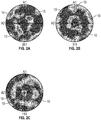
- FIGS 2A-C are inverse pole figures of the grip section of the tensile strength sample.
- FIG 2A corresponds to crystallographic orientation 001
- FIG 2B corresponds to 111
- FIG 2C corresponds to 110.
- the presence of significant areas of similarly oriented grains indicated a non-random grain crystallographic orientation. In a random grain crystallographic orientation the pattern would be diffuse without the areas of grey surrounded by white seen in FIGS 2A-C .
- FIG. 3 is an inverse pole figure map of the grip section which shows the large grain size of the sample.
- FIG. 4 is a Taylor Factor map. The presence of large areas (20) having a high Taylor Factor (shown in dark grey and labeled 20 indicates the material is resistant to deformation under uniaxial tension.
- FIGS 5A-C are similar to FIGS 2A-C except the sample is taken from the gage section of the sample.
- FIGS 5A-C shown more similarly oriented grains (10) and a more ordered microstructure than found in the grip section shown in FIGS 2A-C .
- FIG. 6 is similar to FIG, 3 but shows an increased grain size in the gage section compared to the grip section.
- FIG. 7 is a Taylor Factor map of the gage section sample and shows more area having a high Taylor Factor (20) than seen in FIG. 4 for the grip section.
- Various methods of metal additive manufacturing and cold working may be used to generate a library correlating grain size, grain direction and mechanical properties. Modeling of the combined processes may be used to guide development of this library. Process parameters to produce the desired grain size as well as the direction and normal load to induce the compressive strain are part of the modeling process and creation of the library. The creation of the library will provide a resource for fabrication of articles with customized properties.
- the combination of metal additive manufacturing and cold working can be used to fabricate new articles, repair existing damaged articles and repurpose existing articles. Damaged sections of existing articles can be replaced with or repaired by the method described herein. Existing articles can be modified to meet new design requirements (repurposed) by the methods described herein.
Landscapes
- Engineering & Computer Science (AREA)
- Manufacturing & Machinery (AREA)
- Chemical & Material Sciences (AREA)
- Materials Engineering (AREA)
- Mechanical Engineering (AREA)
- Physics & Mathematics (AREA)
- Optics & Photonics (AREA)
- Plasma & Fusion (AREA)
- Composite Materials (AREA)
- Powder Metallurgy (AREA)
- Other Surface Treatments For Metallic Materials (AREA)
Abstract
Description
- Exemplary embodiments of the present disclosure pertain to the art of metal additive manufacturing.
- Additive manufacturing was originally developed for rapid prototyping. Additive manufacturing has since evolved to a manufacturing process capable of producing articles having complex design.
- Despite advances in additive manufacturing there is additional progress to be made.
- Disclosed is a method for making a metal article including repetitively depositing a layer of metal by additive manufacturing and directionally cold working each metal layer to form the metal article.
- In addition to one or more of the features described above, or as an alternative to any of the foregoing embodiments, the additive manufacturing method includes a melt pool or melted metal layer.
- In addition to one or more of the features described above, or as an alternative to any of the foregoing embodiments, the additive manufacturing method includes directed energy deposition.
- In addition to one or more of the features described above, or as an alternative to any of the foregoing embodiments, the additive manufacturing parameters are manipulated to control average grain size.
- In addition to one or more of the features described above, or as an alternative to any of the foregoing embodiments, the metal layer comprises nickel, cobalt, copper, titanium, aluminum, iron, alloys including one or more of the foregoing metals, and combinations thereof.
- In addition to one or more of the features described above, or as an alternative to any of the foregoing embodiments, the cold working directionally applies energy in the form of compressive strain.
- In addition to one or more of the features described above, or as an alternative to any of the foregoing embodiments, cold working includes deep rolling, deep rolling with an ultrasonic head, high frequency electromagnetic hammer, pneumatic roller vibrator, and combinations thereof.
- Also disclosed is a method for repairing a metal article including repetitively depositing a layer of metal by additive manufacturing and cold working each deposited layer, wherein the depositing and directional cold working occurs over a damaged section of the metal article to form a repaired section.
- In addition to one or more of the features described above, or as an alternative to any of the foregoing embodiments, the additive manufacturing method includes a melt pool or melted metal layer.
- In addition to one or more of the features described above, or as an alternative to any of the foregoing embodiments, the additive manufacturing comprises directed energy deposition.
- In addition to one or more of the features described above, or as an alternative to any of the foregoing embodiments, the metal layer includes nickel, cobalt, copper, titanium, aluminum, iron, alloys including one or more of the foregoing metals, and combinations thereof.
- In addition to one or more of the features described above, or as an alternative to any of the foregoing embodiments, the additive manufacturing parameters are manipulated to control average grain size.
- In addition to one or more of the features described above, or as an alternative to any of the foregoing embodiments, cold working directionally applies energy in the form of compressive strain.
- In addition to one or more of the features described above, or as an alternative to any of the foregoing embodiments, cold working includes deep rolling, deep rolling with an ultrasonic head, and high frequency electromagnetic hammer, pneumatic roller vibrator, and combinations thereof.
- Also disclosed is a metal article, in particular, an additively manufactured metal article, including customized local average grain size and grain crystallographic orientation.
- In addition to one or more of the features described above, or as an alternative to any of the foregoing embodiments, the local grain crystallographic orientation varies by region within the article based on design requirements.
- In addition to one or more of the features described above, or as an alternative to any of the foregoing embodiments, the article includes nickel, cobalt, titanium, aluminum, iron, alloys including one or more of the foregoing metals, and combinations thereof
- The following descriptions should not be considered limiting but are provided by way of example only. With reference to the accompanying drawings, like elements are numbered alike:
-
FIG. 1 is picture of a tensile strength sample; -
FIGS 2A-C are inverse pole figures,FIG. 3 is an inverse pole figure map; -
FIG. 4 is a Taylor Factor map; -
FIGS 5A-C are inverse pole figures,FIG. 6 is an inverse pole figure map; and -
FIG 7 is a Taylor Factor map. - A detailed description of one or more embodiments of the disclosed apparatus and method are presented herein by way of exemplification and not limitation with reference to the Figures.
- Additive manufacturing has resulted in metal parts with decreased weight, added functionality and new design possibilities. Additional advances are sought. For example, it would be desirable to tailor physical properties affected by grain size and orientation such as yield stress, tensile strength and modulus by region within a single article. Thus the article could have first tensile yield strength in a first region and a second tensile yield strength in a second region without changing the composition of the material. Stated another way, the composition of the alloy could remain consistent throughout the article but the physical properties would vary based on location.
- Disclosed herein is an additive manufacturing method which can result in an article having locally different physical properties due to the ability to tailor the grain size and grain crystallographic orientation on a layer by layer basis. The method includes forming the article layer by layer by depositing a layer of metal and cold working each deposited layer. As is known in the art of additive manufacturing the shape of the desired article is sectioned and the form of these sections determines the deposition of the metal layers. The deposition of the metal layer adds stepwise to the layer below, ultimately forming the article overall.
- The metal layer may be deposited as a powder and then consolidated or the deposition and consolidation may be combined. Metal wire may be used in place of metal powder depending on the method used to form the metal layer. Any metal additive manufacturing method that involves a melt pool or melted metal layer can be used. Exemplary methods include directed energy deposition and wire arc additive manufacturing.
- The deposition method parameters may be selected to yield the desired average grain size. In some embodiments the average grain size is varied by location. In some embodiments the average grain size is consistent throughout. The thickness of the deposited layer can vary depending on the deposition method and desired average grain size. In some embodiments the deposited thickness (prior to cold working) may be 60 microns to several millimeters (mm). In some embodiments the deposited layer thickness is 0.25 to 0.75 mm.
- When directed energy deposition is used the laser power, toolpath speed and layer thickness can be selected to yield the desired average grain size. In general lower laser power and slower toolpath speed results in smaller average grain size and higher laser power and faster toolpath speed results in a larger average grain size. When directed energy deposition was used to deposit Waspaloy a laser power of 250-400 Watts (W) and a toolpath speed of 25 inches/minute (1.1 cm/s) produced an average grain size less than 100 microns. A laser power of 700-1100 W and a toolpath speed of 11 inches/minute (0.47 cm/s) produced an average grain size greater than 1 millimeter. Similarly, when wire arc additive manufacturing is used the deposition parameters are chosen to yield the desired average grain size. For example the laser power, wire diameter, toolpath speed and layer thickness can be selected to yield the desired grain size.
- Exemplary metals include nickel, cobalt, copper, titanium, aluminum, iron, alloys including one or more of the foregoing metals, and combinations thereof. Exemplary alloys include Iconel 718, Iconel 625, stainless steel, Waspaloy and IN100. When a powder is used the metal powder particle size and particle size distribution can be determined by one of skill in the art. Similarly, when a wire is used, the size of the wire can be determined by one of skill in the art.
- Each deposited metal layer is subjected to cold working prior to the deposition of another layer of metal. Exemplary cold working methods include deep rolling, deep rolling with an ultrasonic head, and high frequency electromagnetic hammer, pneumatic roller vibrator, and combinations thereof. Deep rolling of more than one deposited layer failed to produce the desired result. Without being bound by theory it is believed that the cold working method directionally applies energy in the form of compressive strain which results in a grain crystallographic orientation. The parameters of the cold working method may be chosen to produce the desired amount and type of grain crystallographic orientation.
- The cold working force can be varied depending on the composition and thickness of the deposited layer. For example, deep rolling Waspaloy having a layer thickness of 0.3 to 0.7 mm may use a force of 4,000 to 25,000 Newtons (N).
- Because cold working can be applied in a number of directions and the layers of the metal can be deposited to any portion of the article and the average grain size of the metal can be customized there is a nearly infinite design space for the creation of an article having regionally tailored properties. For example, a curved section of an article can be provided with a different grain size and orientation than a straight section. It is also contemplated that the grain crystallographic orientation may be layered to improve properties such as tensile strength in all directions.
- After the cold working the article may be subjected to an optional heat treatment. The parameters of the heat treatment may vary to achieve crystallographic texture according to the required properties and applications.
- As mentioned above, when directed energy deposition is employed the laser power and toolpath speed can affect the grain size of the consolidated metal. Lower power and faster toolpath speed has been observed to create a finer grain structure in some materials such as the nickel alloy Waspaloy. Higher power and slower toolpath speed resulted in a coarser grain structure. Generally, a finer grain structure is desired as the material has higher tensile strength than a material with a coarser grain structure. Unexpectedly it was found that a coarser grain structure in combination with cold working resulted in a material with a directional grain structure and superior physical properties such as tensile strength. The tensile yield strength showed a 25% increase over wrought Waspaloy and the tensile strength showed 20% increase over the wrought Waspaloy, while the modulus was the same as wrought Waspaloy.
- Examples were made using directed energy deposition of Waspaloy followed by deep rolling. Each deposited layer had a thickness of 0.4 to 0.6 mm and was deposited using a laser power of 11,000 W and a toolpath speed of 11 inches per minute (0.47 cm/s).
- Each layer was deep rolled with a force of 7000 N. The material had an average grain size greater than 1 mm. After heat treating the material was tested for tensile yield strength. After tensile yield strength testing the grip section (not subjected to tensile yield strength testing) and the gage section (subjected to tensile yield strength testing) were analyzed by electron backscatter diffraction (EBSD).
-
FIG. 1 shows the orientation of the axis of the tensile strength sample. Deep rolling occurred along the A2 axis.FIGS 2A-C are inverse pole figures of the grip section of the tensile strength sample.FIG 2A corresponds tocrystallographic orientation 001,FIG 2B corresponds to 111 andFIG 2C corresponds to 110. The presence of significant areas of similarly oriented grains (indicated by the grey areas that are surrounded by white and labeled 10) indicated a non-random grain crystallographic orientation. In a random grain crystallographic orientation the pattern would be diffuse without the areas of grey surrounded by white seen inFIGS 2A-C .FIG. 3 is an inverse pole figure map of the grip section which shows the large grain size of the sample.FIG. 4 is a Taylor Factor map. The presence of large areas (20) having a high Taylor Factor (shown in dark grey and labeled 20 indicates the material is resistant to deformation under uniaxial tension. -
FIGS 5A-C are similar toFIGS 2A-C except the sample is taken from the gage section of the sample.FIGS 5A-C shown more similarly oriented grains (10) and a more ordered microstructure than found in the grip section shown inFIGS 2A-C .FIG. 6 is similar toFIG, 3 but shows an increased grain size in the gage section compared to the grip section.FIG. 7 is a Taylor Factor map of the gage section sample and shows more area having a high Taylor Factor (20) than seen inFIG. 4 for the grip section. - Various methods of metal additive manufacturing and cold working may be used to generate a library correlating grain size, grain direction and mechanical properties. Modeling of the combined processes may be used to guide development of this library. Process parameters to produce the desired grain size as well as the direction and normal load to induce the compressive strain are part of the modeling process and creation of the library. The creation of the library will provide a resource for fabrication of articles with customized properties.
- The combination of metal additive manufacturing and cold working can be used to fabricate new articles, repair existing damaged articles and repurpose existing articles. Damaged sections of existing articles can be replaced with or repaired by the method described herein. Existing articles can be modified to meet new design requirements (repurposed) by the methods described herein.
- The terminology used herein is for the purpose of describing particular embodiments only and is not intended to be limiting of the present disclosure. As used herein, the singular forms "a", "an" and "the" are intended to include the plural forms as well, unless the context clearly indicates otherwise. It will be further understood that the terms "comprises" and/or "comprising," when used in this specification, specify the presence of stated features, integers, steps, operations, elements, and/or components, but do not preclude the presence or addition of one or more other features, integers, steps, operations, element components, and/or groups thereof.
- While the present disclosure has been described with reference to an exemplary embodiment or embodiments, it will be understood by those skilled in the art that various changes may be made and equivalents may be substituted for elements thereof without departing from the scope of the present disclosure. In addition, many modifications may be made to adapt a particular situation or material to the teachings of the present disclosure without departing from the scope thereof. Therefore, it is intended that the present disclosure not be limited to the particular embodiment disclosed as the best mode contemplated for carrying out this present disclosure, but that the present disclosure will include all embodiments falling within the scope of the claims.
Claims (11)
- A method for making a metal article comprising repetitively depositing a layer of metal by additive manufacturing and directionally cold working each metal layer to form the metal article.
- A method for repairing a metal article comprising repetitively depositing a layer of metal by additive manufacturing and directionally cold working each deposited layer, wherein the depositing and cold working occurs over a damaged section of the metal article to form a repaired section.
- The method of claim 1 or 2, wherein additive manufacturing method comprises a melt pool or melted metal layer.
- The method of claim 1, 2 or 3, wherein additive manufacturing comprises directed energy deposition.
- The method of any of claims 1 to 4, wherein the metal layer comprises nickel, cobalt, copper, titanium, aluminum, iron, alloys including one or more of the foregoing metals, and combinations thereof.
- The method of any preceding claim, wherein the additive manufacturing parameters are manipulated to control average grain size..
- The method of any preceding claim, wherein the cold working directionally applies energy in the form of compressive strain (A2).
- The method of any preceding claim, wherein cold working comprises deep rolling, deep rolling with an ultrasonic head, and high frequency electromagnetic hammer, pneumatic roller vibrator, and combinations thereof.
- A metal article comprising a customized local average grain size and grain crystallographic orientation.
- The metal article of claim 9, wherein the local grain crystallographic orientation varies by region within the article based on design requirements.
- The metal article of claim 9 or 10, wherein the article comprises nickel, cobalt, copper, titanium, aluminum, iron, alloys including one or more of the foregoing metals, and combinations thereof.
Applications Claiming Priority (1)
| Application Number | Priority Date | Filing Date | Title |
|---|---|---|---|
| US201962835818P | 2019-04-18 | 2019-04-18 |
Publications (1)
| Publication Number | Publication Date |
|---|---|
| EP3725438A1 true EP3725438A1 (en) | 2020-10-21 |
Family
ID=70295041
Family Applications (1)
| Application Number | Title | Priority Date | Filing Date |
|---|---|---|---|
| EP20170121.6A Pending EP3725438A1 (en) | 2019-04-18 | 2020-04-17 | Metal additive manufacturing method and article |
Country Status (2)
| Country | Link |
|---|---|
| US (1) | US11980969B2 (en) |
| EP (1) | EP3725438A1 (en) |
Cited By (1)
| Publication number | Priority date | Publication date | Assignee | Title |
|---|---|---|---|---|
| CN118768877A (en) * | 2024-09-11 | 2024-10-15 | 浙江大学湖州研究院 | Titanium alloy and preparation method and application thereof |
Families Citing this family (1)
| Publication number | Priority date | Publication date | Assignee | Title |
|---|---|---|---|---|
| US20260084211A1 (en) * | 2024-09-26 | 2026-03-26 | Rtx Corporation | Apparatus and related methods for repairing machine parts using a hybrid pre-heating system |
Citations (5)
| Publication number | Priority date | Publication date | Assignee | Title |
|---|---|---|---|---|
| US20130197683A1 (en) * | 2010-04-15 | 2013-08-01 | Huazhong University Of Science And Technology | Method for manufacturing metal parts and molds and micro-roller used therefor |
| US20140255198A1 (en) * | 2013-03-11 | 2014-09-11 | United Technologies Corporation | Turbine disk fabrication with in situ material property variation |
| EP2962788A1 (en) * | 2014-06-17 | 2016-01-06 | United Technologies Corporation | Hybrid additive manufacturing method |
| US20170129180A1 (en) * | 2014-06-09 | 2017-05-11 | Hybrid Manufacturing Technologies Limited | Material processing methods and related apparatus |
| US20170326681A1 (en) * | 2014-12-09 | 2017-11-16 | Bae Systems Plc | Additive manufacturing and integrated impact post-treatment |
Family Cites Families (2)
| Publication number | Priority date | Publication date | Assignee | Title |
|---|---|---|---|---|
| US20190128144A1 (en) * | 2017-11-02 | 2019-05-02 | United Technologies Corporation | Repair of components using additive manufacturing with in-situ cold working |
| US10682725B2 (en) * | 2017-11-30 | 2020-06-16 | The Boeing Company | Microstructure refinement methods by mechanical work for additive manufactured materials |
-
2020
- 2020-04-15 US US16/849,004 patent/US11980969B2/en active Active
- 2020-04-17 EP EP20170121.6A patent/EP3725438A1/en active Pending
Patent Citations (5)
| Publication number | Priority date | Publication date | Assignee | Title |
|---|---|---|---|---|
| US20130197683A1 (en) * | 2010-04-15 | 2013-08-01 | Huazhong University Of Science And Technology | Method for manufacturing metal parts and molds and micro-roller used therefor |
| US20140255198A1 (en) * | 2013-03-11 | 2014-09-11 | United Technologies Corporation | Turbine disk fabrication with in situ material property variation |
| US20170129180A1 (en) * | 2014-06-09 | 2017-05-11 | Hybrid Manufacturing Technologies Limited | Material processing methods and related apparatus |
| EP2962788A1 (en) * | 2014-06-17 | 2016-01-06 | United Technologies Corporation | Hybrid additive manufacturing method |
| US20170326681A1 (en) * | 2014-12-09 | 2017-11-16 | Bae Systems Plc | Additive manufacturing and integrated impact post-treatment |
Cited By (1)
| Publication number | Priority date | Publication date | Assignee | Title |
|---|---|---|---|---|
| CN118768877A (en) * | 2024-09-11 | 2024-10-15 | 浙江大学湖州研究院 | Titanium alloy and preparation method and application thereof |
Also Published As
| Publication number | Publication date |
|---|---|
| US20200331099A1 (en) | 2020-10-22 |
| US11980969B2 (en) | 2024-05-14 |
Similar Documents
| Publication | Publication Date | Title |
|---|---|---|
| Nicoletto | Anisotropic high cycle fatigue behavior of Ti–6Al–4V obtained by powder bed laser fusion | |
| Chi et al. | Combining manufacturing of titanium alloy through direct energy deposition and laser shock peening processes | |
| Dirisu et al. | Wire plus arc additive manufactured functional steel surfaces enhanced by rolling | |
| JP6548462B2 (en) | Additional manufacturing method | |
| Hönnige et al. | Improvement of microstructure and mechanical properties in wire+ arc additively manufactured Ti-6Al-4V with machine hammer peening | |
| EP2865465B1 (en) | Method for manufacturing a metallic component by additive laser manufacturing | |
| Casalino et al. | Experimental investigation and statistical optimisation of the selective laser melting process of a maraging steel | |
| EP3229994B1 (en) | Additive manufacturing and integrated impact post-treatment | |
| Sun et al. | Laser welding of electron beam melted Ti-6Al-4V to wrought Ti-6Al-4V: Effect of welding angle on microstructure and mechanical properties | |
| Rajeev et al. | Microstructure and high temperature mechanical properties of wire arc additively deposited Stellite 6 alloy | |
| Liu et al. | Fatigue properties of Ti-6.5 Al-3.5 Mo-l. 5Zr-0.3 Si alloy produced by direct laser deposition | |
| US11980969B2 (en) | Metal additive manufacturing method and article | |
| US20070122560A1 (en) | Solid-free-form fabrication process including in-process component deformation | |
| CN108472712A (en) | Method for producing forging product and other converted products | |
| Shim et al. | Bending strength of tool steel preheated to various temperatures and layered by direct energy deposition | |
| Brodin et al. | Mechanical behaviour and microstructure correlation in a selective laser melted superalloy | |
| Pan et al. | Two laser beam modulation of microstructure and residual stress field in cold sprayed Al alloy for recovering fatigue performance | |
| Bressan et al. | Cyclic plastic behavior of additively manufactured Ti-6Al-4V under uniaxial and multiaxial non-proportional loading | |
| Reddy et al. | Small scale mechanical testing for additively manufactured (direct metal laser sintered) monolithic and hybrid test samples | |
| Jafarzadeh et al. | Fabrication of ultra-fine grained aluminium tubes by RTES technique | |
| Barrionuevo et al. | Tensile/Compressive Response of 316L Stainless Steel Fabricated by Additive Manufacturing | |
| Vaz et al. | Heat treatment effect on microstructural evolution of cold spray additive manufacturing Ti6Al4V | |
| EP3492200A1 (en) | Microstructure refinement methods by mechanical work for additive manufactured materials | |
| Behera et al. | Fatigue and tensile performance of cold metal transfer-based wire arc additively manufactured 316L stainless steel | |
| Jang et al. | Energy-Assisted additive manufacturing for weldable and non-weldable Ni-based superalloys: a review |
Legal Events
| Date | Code | Title | Description |
|---|---|---|---|
| PUAI | Public reference made under article 153(3) epc to a published international application that has entered the european phase |
Free format text: ORIGINAL CODE: 0009012 |
|
| STAA | Information on the status of an ep patent application or granted ep patent |
Free format text: STATUS: THE APPLICATION HAS BEEN PUBLISHED |
|
| AK | Designated contracting states |
Kind code of ref document: A1 Designated state(s): AL AT BE BG CH CY CZ DE DK EE ES FI FR GB GR HR HU IE IS IT LI LT LU LV MC MK MT NL NO PL PT RO RS SE SI SK SM TR |
|
| AX | Request for extension of the european patent |
Extension state: BA ME |
|
| STAA | Information on the status of an ep patent application or granted ep patent |
Free format text: STATUS: REQUEST FOR EXAMINATION WAS MADE |
|
| 17P | Request for examination filed |
Effective date: 20210421 |
|
| RBV | Designated contracting states (corrected) |
Designated state(s): AL AT BE BG CH CY CZ DE DK EE ES FI FR GB GR HR HU IE IS IT LI LT LU LV MC MK MT NL NO PL PT RO RS SE SI SK SM TR |
|
| RAP3 | Party data changed (applicant data changed or rights of an application transferred) |
Owner name: RTX CORPORATION |
|
| STAA | Information on the status of an ep patent application or granted ep patent |
Free format text: STATUS: EXAMINATION IS IN PROGRESS |
|
| 17Q | First examination report despatched |
Effective date: 20240402 |