EP3724190B1 - Substituted bicyclic heterocyclic compounds as prmt5 inhibitors - Google Patents
Substituted bicyclic heterocyclic compounds as prmt5 inhibitors Download PDFInfo
- Publication number
- EP3724190B1 EP3724190B1 EP18836520.9A EP18836520A EP3724190B1 EP 3724190 B1 EP3724190 B1 EP 3724190B1 EP 18836520 A EP18836520 A EP 18836520A EP 3724190 B1 EP3724190 B1 EP 3724190B1
- Authority
- EP
- European Patent Office
- Prior art keywords
- amino
- pyrrolo
- pyrimidin
- compound
- chloro
- Prior art date
- Legal status (The legal status is an assumption and is not a legal conclusion. Google has not performed a legal analysis and makes no representation as to the accuracy of the status listed.)
- Active
Links
Classifications
-
- C—CHEMISTRY; METALLURGY
- C07—ORGANIC CHEMISTRY
- C07D—HETEROCYCLIC COMPOUNDS
- C07D487/00—Heterocyclic compounds containing nitrogen atoms as the only ring hetero atoms in the condensed system, not provided for by groups C07D451/00 - C07D477/00
- C07D487/02—Heterocyclic compounds containing nitrogen atoms as the only ring hetero atoms in the condensed system, not provided for by groups C07D451/00 - C07D477/00 in which the condensed system contains two hetero rings
- C07D487/04—Ortho-condensed systems
-
- A—HUMAN NECESSITIES
- A61—MEDICAL OR VETERINARY SCIENCE; HYGIENE
- A61K—PREPARATIONS FOR MEDICAL, DENTAL OR TOILETRY PURPOSES
- A61K31/00—Medicinal preparations containing organic active ingredients
- A61K31/33—Heterocyclic compounds
- A61K31/395—Heterocyclic compounds having nitrogen as a ring hetero atom, e.g. guanethidine or rifamycins
- A61K31/435—Heterocyclic compounds having nitrogen as a ring hetero atom, e.g. guanethidine or rifamycins having six-membered rings with one nitrogen as the only ring hetero atom
- A61K31/47—Quinolines; Isoquinolines
- A61K31/4709—Non-condensed quinolines and containing further heterocyclic rings
-
- A—HUMAN NECESSITIES
- A61—MEDICAL OR VETERINARY SCIENCE; HYGIENE
- A61K—PREPARATIONS FOR MEDICAL, DENTAL OR TOILETRY PURPOSES
- A61K31/00—Medicinal preparations containing organic active ingredients
- A61K31/33—Heterocyclic compounds
- A61K31/395—Heterocyclic compounds having nitrogen as a ring hetero atom, e.g. guanethidine or rifamycins
- A61K31/495—Heterocyclic compounds having nitrogen as a ring hetero atom, e.g. guanethidine or rifamycins having six-membered rings with two or more nitrogen atoms as the only ring heteroatoms, e.g. piperazine or tetrazines
- A61K31/505—Pyrimidines; Hydrogenated pyrimidines, e.g. trimethoprim
- A61K31/519—Pyrimidines; Hydrogenated pyrimidines, e.g. trimethoprim ortho- or peri-condensed with heterocyclic rings
-
- A—HUMAN NECESSITIES
- A61—MEDICAL OR VETERINARY SCIENCE; HYGIENE
- A61P—SPECIFIC THERAPEUTIC ACTIVITY OF CHEMICAL COMPOUNDS OR MEDICINAL PREPARATIONS
- A61P35/00—Antineoplastic agents
-
- C—CHEMISTRY; METALLURGY
- C07—ORGANIC CHEMISTRY
- C07D—HETEROCYCLIC COMPOUNDS
- C07D471/00—Heterocyclic compounds containing nitrogen atoms as the only ring hetero atoms in the condensed system, at least one ring being a six-membered ring with one nitrogen atom, not provided for by groups C07D451/00 - C07D463/00
- C07D471/02—Heterocyclic compounds containing nitrogen atoms as the only ring hetero atoms in the condensed system, at least one ring being a six-membered ring with one nitrogen atom, not provided for by groups C07D451/00 - C07D463/00 in which the condensed system contains two hetero rings
- C07D471/04—Ortho-condensed systems
-
- C—CHEMISTRY; METALLURGY
- C07—ORGANIC CHEMISTRY
- C07D—HETEROCYCLIC COMPOUNDS
- C07D519/00—Heterocyclic compounds containing more than one system of two or more relevant hetero rings condensed among themselves or condensed with a common carbocyclic ring system not provided for in groups C07D453/00 or C07D455/00
Definitions
- the invention relates to substituted bicyclic heterocyclic compounds of formula (I), pharmaceutically acceptable salts thereof and pharmaceutical compositions for treating diseases, disorders or conditions associated with the overexpression of PRMT5 enzyme.
- the invention also relates to said compounds of formula (I), pharmaceutically acceptable salts thereof and pharmaceutical compositions thereof for use in treating diseases, disorders or conditions associated with the overexpression of PRMT5 enzyme.
- Methylation of proteins is a common post-translational modification that affects the protein's activity and its interaction with other biological molecules.
- N-methylation typically occurs on the nitrogen atoms of arginine, lysine and histidine residues and there are different families of enzymes that catalyze the methylation reaction, each being specific to the amino acid residue that will be methylated.
- a family of 9 enzymes called Protein Arginine N-Methyl Transferases (PRMTs), are responsible for the methylation of the guanidinium group of arginine.
- the guanidinium group of arginine bears 2 terminal nitrogen atoms that undergo monomethylation or dimethylation.
- the enzymes are further classified as type I or type II.
- Type I PRMTs catalyse the monomethylation or the asymmetric dimethylation whereas type II enzymes catalyse the symmetric dimethylation.
- Some of the substrates that undergo methylation are histones, Sm ribonucleoproteins, MRE11 and p53 binding protein 1.
- the methylation of arginine side-chains has an important role to play in various cell functions that include transcription activation as well as transcription repression, mRNA translation, pre-mRNA splicing, protein trafficking and signal transduction. It also occurs on myriad substrates.
- the enzymatic activity of the PRMTs hence affects cellular processes like cell proliferation, repair of damaged DNA as well as cell cycle and cell death. It has been shown that PRMT enzyme-mediated hypermethylation leads to certain disease conditions like cancer ( Nature Reviews Cancer 2013, 13, p37 ; Cellular and Molecular Life Sciences 2015, 72, p2041 ; Trends in Biochemical Sciences 2011, 36, p633 ).
- PRMT5 the most studied type II enzyme is PRMT5, which is conserved across the eukaryotic organisms. Overexpression of PRMT5 is linked with carcinogenesis and decreased patient survival in several human malignancies ( Cell Mol Life Sci., 2015, 72, p2041 ). PRMT5 directly interacts with proteins often dysregulated or mutated in cancers, hence a putative oncogene ( Mol Cell Biol, 2008, 28, p6262 ). PRMT5 mediated transcriptional repression of tumor suppressor genes like p53, RB-1, ST7, or upregulation of Cyclin D1, CDK4, CDK6, eLF4E, MITF, FGFR3 associate with the oncogenesis in both solid tumors and hemaological malignancies.
- PRMT5 is located in the nucleus as well as the cytoplasm and its overexpression has been linked to a wide range of cancers including, but not limited to, glioblastoma multiforme ( Oncogene, 2017, 36, p263 ),, prostate cancer ( Oncogene, 2017, 36, p1223 ), and pancreatic cancer ( Science, 2016, 351, p1214 ), mantle cell lymphoma ( Nature Chemical Biology, 2015, 11, p432 ), non-Hodgkin's lymphomas and diffuse large B-cell lymphoma ( Journal of Biological Chemistry, 2013, 288, p35534 ), acute myeloid leukemia ( Leukemia, 2018, 32, p499 ), acute lymphoblastic leukemia (AACR; Cancer Research 2017;77(13 Suppl):Abstract nr 1128 ), multiple myeloma ( Leukemia, 2018, 32, p996 ), non-small cell lung cancer ( The Biochemical Journal, 2012, 446,
- Inhibitors of arginine methyl transferases were first disclosed in 2004 by Cheng et al in the Journal of Biological Chemistry - Vol. 279 (23), p.23892 . Since then, various other compounds and substances having greater selectivity towards either type I or type II arginine methyl transferases have been disclosed.
- the invention provides compound of general formula (I), a stereoisomer thereof, or a pharmaceutically acceptable salt thereof, wherein,
- the invention provides compounds having the structure of Formula (II), a stereoisomer thereof, or a pharmaceutically acceptable salt thereof, wherein, Ring A, L 1 , Z, R a , R b , R 2' , R, R 2a , R 3 , R 10 and 'n' are as defined herein above.
- the invention provides compounds having the structure of Formula (III), a stereoisomer thereof, or a pharmaceutically acceptable salt thereof, wherein, Ring A, L 1 , Z, R a , R b , R 2' , R, R 2a , R 3 , R 10 and 'n' are as defined herein above.
- the invention provides compounds having the structure of Formula (IV), a stereoisomer thereof, or a pharmaceutically acceptable salt thereof, wherein,
- R c and R d are independently selected from substituted or unsubstituted alkyl or R c and R d together with the carbon atom to which they are attached form a cyclobutyl ring.
- R c and R d are independently selected from methyl or R c and R d together with the carbon atom to which they are attached from a cyclobutyl ring.
- R a and R b are independently selected from hydrogen, methyl, and cyclopropyl.
- R 3 is selected from halogen, cyano, -OR 6 , -NR 7 R 8 , substituted or unsubstituted alkyl, and substituted or unsubstituted aryl.
- R 3 is independently selected from -F, Cl, Br, CN, -NH 2 , - NH(CH 3 ), -NHCH(CH 3 ) 2 , -CH 3 , cyclopropyl, -CH(CH 3 ) 2 , -CF 2 CH 3 , -OCH 3 , and
- R 2' and R 2a are independently selected from hydrogen and methyl.
- R is selected from hydrogen, halogen, -NR 4 R 5 , and substituted or unsubstituted alkyl, cycloalkyl and substituted or unsubstituted heteroaryl.
- R is selected from hydrogen, -NH 2 , methyl, Chloro, cyclopropyl, and
- R 4 and R 5 are independently selected from hydrogen.
- R 6 is selected from substituted and unsubstituted alkyl.
- R 6 is selected from methyl.
- R 7 and R 8 are independently selected from hydrogen, methyl, -CH(CH 3 ) 2 , -CH 2 -cyclopropyl, cyclopropyl, and cyclobutyl.
- R 10 is selected from hydrogen, -F, and methyl.
- n is selected from 1 to 3.
- L 1 is selected from -CH 2 -, -CH(CH 3 )-, -NH-, -N(CH 3 )- S, and O;
- ring A is selected from- and L1 is selected from -CH2-, -CH(CH3)-, -NH-, -N(CH3)-, S, and O;
- R 3 is selected from F, Cl, Br, CN, -NH 2 , -NH(CH 3 ), -NHCH(CH 3 ) 2 , -CH 3 , cyclopropyl, -CH(CH 3 ) 2 , -CF 2 CH 3 , - OCH 3 , CF 3 , ;
- Ris selected from hydrogen, -NH 2 , Cl, -CH(CH 3 ) 2 , methyl, ethyl, cyclopropyl and R a and R b are independently selected from hydrogen, methyl, and cyclopropyl;
- R 2' and R 2a are independently selected from hydrogen and methyl;
- R 10 is selected from hydrogen, -F, and methyl.
- a method of treating diseases, disorders or conditions is selected from glioblastoma multiforme, prostate cancer, and pancreatic cancer, mantle cell lymphoma, non-Hodgkin's lymphomas and diffuse large B-cell lymphoma, acute myeloid leukemia, acute lymphoblastic leukemia, multiple myeloma, non-small cell lung cancer, small cell lung cancer, breast cancer, triple negative breast cancer, gastric cancer, colorectal cancer, ovarian cancer, bladder cancer, hepatocellular cancer, melanoma, sarcoma, oropharyngeal squamous cell carcinoma, chronic myelogenous leukemia, epidermal squamous cell carcinoma, nasopharyngeal carcinoma, neuroblastoma, endometrial carcinoma,and cervical cancerby using a compound selected from formula (I) to (IV) is provided.
- the invention provides a pharmaceutical composition
- a pharmaceutical composition comprising at least one compound of formula (I) to (IV) or a pharmaceutically acceptable salt thereof and at least one pharmaceutically acceptable excipient.
- the invention provides a pharmaceutical composition comprising a therapeutically effective amount of compound of formula (I) to (IV) or a pharmaceutically acceptable salt thereof, for use in treating, the diseases, disorders or conditions associated with PRMT5 by administering to the subject in need thereof.
- the diseases, disorders, syndromes or conditions associated by inhibition of PRMT5 are selected from the group consisting of glioblastoma multiforme, prostate cancer, and pancreatic cancer, mantle cell lymphoma, non-Hodgkin's lymphomas and diffuse large B-cell lymphoma, acute myeloid leukemia, acute lymphoblastic leukemia, multiple myeloma, non-small cell lung cancer, small cell lung cancer, breast cancer, triple negative breast cancer, gastric cancer, colorectal cancer, ovarian cancer, bladder cancer, hepatocellular cancer, melanoma, sarcoma, oropharyngeal squamous cell carcinoma, chronic myelogenous leukemia, epidermal squamous cell carcinoma, nasopharyngeal carcinoma, neuroblastoma, endometrial carcinoma,and cervical cancer.
- mantle cell lymphoma non-Hodgkin's lymphomas and diffuse large B-cell lymphoma
- the invention provides a pharmaceutical composition comprising a therapeutically effective amount of compound of formula (I) to (IV) or a pharmaceutically acceptable salt thereof, for use in treating the diseases, disorders or conditions associated with PRMT5 by administering to the subject in need thereof.
- the compounds, their stereoisomer thereof, or a pharmaceutically acceptable salt thereof are selected from:
- the compounds, their stereoisomer thereof, or a pharmaceutically acceptable salt thereof are selected from:
- halogen or halo means fluorine, chlorine, bromine, or iodine.
- alkyl refers to an alkane derived hydrocarbon radical that includes solely carbon and hydrogen atoms in the backbone, contains no unsaturation, has from one to six carbon atoms, and is attached to the remainder of the molecule by a single bond, for example (C 1 -C 6 )alkyl or (C 1 -C 4 )alkyl, representative groups include e.g., methyl, ethyl, n-propyl, 1-methylethyl (isopropyl), n-butyl, n-pentyl and the like. Unless set forth or recited to the contrary, all alkyl groups described or claimed herein may be straight chain or branched.
- alkenyl refers to a hydrocarbon radical containing from 2 to 10 carbon atoms and including at least one carbon-carbon double bond.
- alkenyl groups include, for example (C 2 -C 6 )alkenyl, (C 2 -C 4 )alkenyl, ethenyl, 1-propenyl, 2-propenyl (allyl), iso -propenyl, 2-methyl-l- propenyl, 1-butenyl, 2-butenyl and the like. Unless set forth or recited to the contrary, all alkenyl groups described or claimed herein may be straight chain or branched.
- alkynyl refers to a hydrocarbon radical containing 2 to 10 carbon atoms and including at least one carbon- carbon triple bond.
- alkynyl groups include, for example (C 2 -C 6 )alkynyl, (C 2 -C 4 )alkynyl, ethynyl, propynyl, butynyl and the like. Unless set forth or recited to the contrary, all alkynyl groups described or claimed herein may be straight chain or branched.
- haloalkyl refers to an alkyl group as defined above that is substituted by one or more halogen atoms as defined above.
- the haloalkyl may be monohaloalkyl, dihaloalkyl or polyhaloalkyl including perhaloalkyl.
- a monohaloalkyl can have one iodine, bromine, chlorine or fluorine atom.
- Dihaloalkyl and polyhaloalkyl groups can be substituted with two or more of the same halogen atoms or a combination of different halogen atoms.
- a polyhaloalkyl is substituted with up to 12 halogen atoms.
- a haloalkyl include fluoromethyl, difluoromethyl, trifluoromethyl, chloromethyl, dichloromethyl, trichloromethyl, pentafluoroethyl, heptafluoropropyl, difluorochloromethyl, dichlorofluoromethyl, difluoroethyl, difluoropropyl, dichloroethyl, dichloropropyl and the like.
- a perhaloalkyl refers to an alkyl having all hydrogen atoms replaced with halogen atoms. Unless set forth or recited to the contrary, all haloalkyl groups described or claimed herein may be straight chain or branched.
- alkoxy denotes an alkyl group attached via an oxygen linkage to the rest of the molecule. Representative examples of such groups are -OCH 3 and -OC 2 H 5 . Unless set forth or recited to the contrary, all alkoxy groups described or claimed herein may be straight chain or branched.
- alkoxyalkyl refers to an alkoxy group as defined above directly bonded to an alkyl group as defined above, e.g., -CH 2 -O-CH 3 , -CH 2 -O-CH 2 CH 3 , - CH 2 CH 2 -O-CH 3 and the like.
- cycloalkyl refers to a non-aromatic mono or multicyclic ring system having 3 to 12 carbon atoms, such as (C 3 -C 10 )cycloalkyl, (C 3 -C 6 )cycloalkyl, cyclopropyl, cyclobutyl, cyclopentyl, cyclohexyl and the like.
- multicyclic cycloalkyl groups include, but are not limited to, perhydronaphththyl, adamantyl and norbornyl groups, bridged cyclic groups or spirobicyclic groups, e.g., spiro(4,4)non-2-yl and the like.
- aryl refers to an aromatic radical having 6- to 14- carbon atoms, including monocyclic, bicyclic and tricyclic aromatic systems, such as phenyl, naphthyl, tetrahydronaphthyl, indanyl, and biphenyl and the like.
- heterocyclic ring or “heterocyclyl ring” or “heterocyclyl”, unless otherwise specified, refers to substituted or unsubstituted non-aromatic 3- to 15-membered ring which consists of carbon atoms and with one or more heteroatom(s) independently selected from N, O or S.
- the heterocyclic ring may be a mono-, bi- or tricyclic ring system, which may include fused, bridged or spiro ring systems and the nitrogen, carbon, oxygen or sulfur atoms in the heterocyclic ring may be optionally oxidized to various oxidation states.
- the nitrogen atom may be optionally quaternized
- the heterocyclic ring or heterocyclyl may optionally contain one or more olefinic bond (S), and one or two carbon atoms (S) in the heterocyclic ring or heterocyclyl may be interrupted with -CF 2 -, -C(O)-, -S(O)-, S(O) 2 etc.
- heterocyclic ring may also be fused with aromatic ring.
- heterocyclic rings include azetidinyl, benzopyranyl, chromanyl, decahydroisoquinolyl, indolinyl, isoindolinyl, isochromanyl, isothiazolidinyl, isoxazolidinyl, morpholinyl, oxazolinyl, oxazolidinyl, 2-oxopiperazinyl, 2-oxopiperidinyl, 2-oxopyrrolidinyl, 2-oxoazepinyl, octahydroindolyl, octahydroisoindolyl, perhydroazepinyl, piperazinyl, 4-piperidonyl, pyrrolidinyl, piperidinyl, phenothiazinyl, phenoxazinyl, quinuclidinyl, tetrahydroisquinolyl, tetrahydrofuryl,
- heteroaryl refers to a substituted or unsubstituted 5- to 14- membered aromatic heterocyclic ring with one or more heteroatom (S) independently selected from N, O or S.
- the heteroaryl may be a mono-, bi- or tricyclic ring system.
- the heteroaryl ring may be attached by any atom of the heteroaryl ring that results in the creation of a stable structure.
- Non-limiting Examples of a heteroaryl ring include oxazolyl, isoxazolyl, imidazolyl, furyl, indolyl, isoindolyl, pyrrolyl, triazolyl, triazinyl, tetrazolyl, thienyl, thiazolyl, isothiazolyl, pyridyl, pyrimidinyl, pyrazinyl, pyridazinyl, benzofuranyl, benzothiazolyl, benzoxazolyl, benzimidazolyl, benzothienyl, carbazolyl, quinolinyl, isoquinolinyl, quinazolinyl, cinnolinyl, naphthyridinyl, pteridinyl, purinyl, quinoxalinyl, quinolyl, isoquinolyl, thiadiazolyl, indolizinyl, acridinyl
- the compounds of the present invention may have one or more chiral centers.
- the absolute stereochemistry at each chiral center may be 'R' or 'S'.
- the compounds of the invention include all diastereomers and enantiomers and mixtures thereof. Unless specifically mentioned otherwise, reference to one stereoisomer applies to any of the possible stereoisomers. Whenever the stereoisomeric composition is unspecified, it is to be understood that all possible stereoisomers are included.
- stereoisomer refers to a compound made up of the same atoms bonded by the same bonds but having different three-dimensional structures which are not interchangeable. The three-dimensional structures are called configurations.
- enantiomer refers to two stereoisomers whose molecules are non-superimposable mirror images of one another.
- chiral center refers to a carbon atom to which four different groups are attached.
- diastereomers refers to stereoisomers which are not enantiomers.
- racemate or “racemic mixture” refer to a mixture of equal parts of enantiomers.
- a “tautomer” refers to a compound that undergoes rapid proton shifts from one atom of the compound to another atom of the compound. Some of the compounds described herein may exist as tautomers with different points of attachment of hydrogen. The individual tautomers as well as mixture thereof are encompassed with compounds of formula (I).
- treating or “treatment” of a state, disorder or condition includes: (a) preventing or delaying the appearance of clinical symptoms of the state, disorder or condition developing in a subject that may be afflicted with or predisposed to the state, disorder or condition but does not yet experience or display clinical or subclinical symptoms of the state, disorder or condition; (b) inhibiting the state, disorder or condition, i.e., arresting or reducing the development of the disease or at least one clinical or subclinical symptom thereof; c) lessening the disease, disorder or condition or at least one of its clinical or subclinical symptoms or (d) relieving the disease, i.e., causing regression of the state, disorder or condition or at least one of its clinical or subclinical symptoms.
- inhibitor refers to a molecule that binds to an enzyme to inhibit the activity of the said enzyme either partially or completely.
- subject includes mammals (especially humans) and other animals, such as domestic animals (e.g., household pets including cats and dogs) and non-domestic animals (such as wildlife).
- domestic animals e.g., household pets including cats and dogs
- non-domestic animals such as wildlife.
- a “therapeutically effective amount” means the amount of a compound that, when administered to a subject for treating a disease, disorder or condition, is sufficient to cause the effect in the subject, which is the purpose of the administration.
- the “therapeutically effective amount” will vary depending on the compound, the disease and its severity and the age, weight, physical condition and responsiveness of the subject to be treated.
- the compounds of the invention may form salts with acid or base.
- the compounds of invention may be sufficiently basic or acidic to form stable nontoxic acid or base salts, administration of the compound as a pharmaceutically acceptable salt may be appropriate.
- Non-limiting Examples of pharmaceutically acceptable salts are inorganic, organic acid addition salts formed by addition of acids including hydrochloride salts.
- Non-limiting Examples of pharmaceutically acceptable salts are inorganic, organic base addition salts formed by addition of bases.
- the compounds of the invention may also form salts with amino acids. Pharmaceutically acceptable salts may be obtained using standard procedures well known in the art, for example by reacting sufficiently basic compound such as an amine with a suitable acid.
- the invention relates to pharmaceutical compositions containing the compounds of the formula (I), or pharmaceutically acceptable salts thereof disclosed herein.
- pharmaceutical compositions containing a therapeutically effective amount of at least one compound of formula (I) described herein and at least one pharmaceutically acceptable excipient (such as a carrier or diluent).
- the contemplated pharmaceutical compositions include the compound(s) described herein in an amount sufficient to inhibit PRMT5 to treat the diseases described herein when administered to a subject.
- the subjects contemplated include, for example, a living cell and a mammal, including human.
- the compound of the invention may be associated with a pharmaceutically acceptable excipient (such as a carrier or a diluent) or be diluted by a carrier, or enclosed within a carrier which can be in the form of a capsule, sachet, paper or other container.
- a pharmaceutically acceptable excipient includes pharmaceutical agent that does not itself induce the production of antibodies harmful to the individual receiving the composition, and which may be administered without undue toxicity.
- suitable carriers or excipients include, but are not limited to, water, salt solutions, alcohols, polyethylene glycols, polyhydroxyethoxylated castor oil, peanut oil, olive oil, gelatin, lactose, terra alba, sucrose, dextrin, magnesium carbonate, sugar, cyclodextrin, amylose, magnesium stearate, talc, gelatin, agar, pectin, acacia, stearic acid or lower alkyl ethers of cellulose, salicylic acid, fatty acids, fatty acid amines, fatty acid monoglycerides and diglycerides, pentaerytritol fatty acid esters, polyoxyethylene, hydroxymethylcellulose and polyvinylpyrrolidone.
- the pharmaceutical composition may also include one or more pharmaceutically acceptable auxiliary agents, wetting agents, emulsifying agents, suspending agents, preserving agents, salts for influencing osmotic pressure, buffers, sweetening agents, flavoring agents, colorants, or any combination of the foregoing.
- the pharmaceutical composition of the invention may be formulated so as to provide quick, sustained, or delayed release of the active ingredient after administration to the subject by employing procedures known in the art.
- the active compound can be mixed with a carrier, or diluted by a carrier, or enclosed within a carrier, which may be in the form of an ampoule, capsule, sachet, paper, or other container.
- a carrier which may be in the form of an ampoule, capsule, sachet, paper, or other container.
- the carrier serves as a diluent, it may be a solid, semi-solid, or liquid material that acts as a vehicle, excipient, or medium for the active compound.
- the active compound can be adsorbed on a granular solid container, for Example, in a sachet.
- compositions may be in conventional forms, for example, capsules, tablets, caplets, orally disintegrating tablets, aerosols, solutions, suspensions or products for topical application.
- the route of administration may be any route which effectively transports the active compound of the invention to the appropriate or desired site of action.
- Suitable routes of administration include, but are not limited to, oral, oral inhalation, nasal, pulmonary, buccal, subdermal, intradermal, transdermal, parenteral, rectal, depot, subcutaneous, intravenous, intraurethral, intramuscular, intranasal, ophthalmic (such as with an ophthalmic solution) or topical (such as with a topical ointment).
- Solid oral formulations include, but are not limited to, tablets, caplets, capsules (soft or hard gelatin), orally disintegrating tablets, dragees (containing the active ingredient in powder or pellet form), troches and lozenges. Tablets, dragees, or capsules having talc and/or a carbohydrate carrier or binder or the like are particularly suitable for oral application.
- Liquid formulations include, but are not limited to, syrups, emulsions, suspensions, solutions, soft gelatin and sterile injectable liquids, such as aqueous or nonaqueous liquid suspensions or solutions.
- injectable solutions or suspensions preferably aqueous solutions with the active compound dissolved in polyhydroxylated castor oil.
- the pharmaceutical preparation is preferably in unit dosage form.
- the preparation is subdivided into unit doses containing appropriate quantities of the active component.
- the unit dosage form can be a packaged preparation, the package containing discrete quantities of preparation, such as pocketed tablets, capsules, and powders in vials or ampoules.
- the unit dosage form can be a capsule, tablet, caplet, cachet, or lozenge itself, or it can be the appropriate number of any of these in packaged form.
- the total daily dose of the compounds of the invention depends, of course, on the mode of administration.
- oral administration may require a higher total daily dose, than an intravenous (direct into blood).
- the quantity of active component in a unit dose preparation may be varied or adjusted from 0.1 mg to 1000 mg by oral administration and 1 ⁇ g to 5000 ⁇ g by inhalation according to the potency of the active component or mode of administration.
- Therapeutic doses are generally identified through a dose ranging study in subject based on preliminary evidence derived from the animal studies. Doses must be sufficient to result in a desired therapeutic benefit without causing unwanted side effects for the patient.
- the daily dosage of the PRMT5 inhibitor can range from about 0.1 to about 30.0 mg/kg by oral administration. Mode of administration, dosage forms, suitable pharmaceutical excipients, diluents or carriers can also be well used and adjusted by those skilled in the art. All changes and modifications envisioned are within the scope of the invention.
- the invention provides compound of formula (I) and pharmaceutical compositions thereof as protein arginine methyl transferase-5 (PRMT5) inhibitors for in treating the diseases, disorders or conditions associated with overexpression of PRMT5.
- the disclosure further provides a method of treating diseases, disorders or conditions associated with overexpression of PRMT5 in a subject in need thereof by administering to the subject a therapeutically effective amount of a compound or a pharmaceutical composition of the invention.
- the disclosure relates to a method of treating diseases, disorders or conditions associated with the overexpression of PRMT5.
- a subject in need of such treatment is administered a therapeutically effective amount of a compound of formula (I) or a pharmaceutically acceptable salt thereof as described herein.
- the diseases, disorders, or conditions associated with the overexpression of PRMT5 are cancer.
- the disclosure provides a method of treating cancers, particularly, glioblastoma multiforme, prostate cancer, pancreatic cancer, mantle cell lymphoma, non-Hodgkin's lymphomas and diffuse large B-cell lymphoma, acute myeloid leukemia, acute lymphoblastic leukemia, multiple myeloma, non-small cell lung cancer, small cell lung cancer, breast cancer, triple negative breast cancer, gastric cancer, colorectal cancer, ovarian cancer, bladder cancer, hepatocellular cancer, melanoma, sarcoma, oropharyngeal squamous cell carcinoma, chronic myelogenous leukemia, epidermal squamous cell carcinoma, nasopharyngeal carcinoma, neuroblastoma, endometrial carcinoma,and cervical cancer.
- cancers particularly, glioblastoma multiforme, prostate cancer, pancreatic cancer, mantle cell lymphoma, non-Hodgkin's lymphomas and diffuse
- the invention encompasses the compounds of formula (I) or pharmaceutically acceptable salts thereof for use in the treatment of a disease or disorder mentioned herein.
- the compound of formula described herein may be prepared by techniques known in the art.
- the compound of formula described herein may be prepared by following the reaction sequence as depicted in Scheme-1 to Scheme-27.
- reaction sequence as depicted in Scheme-1 to Scheme-27.
- specific bases, acids, reagents, solvents, coupling agents, etc. are mentioned, it is understood that other bases, acids, reagents, solvents, coupling agents etc., known in the art may also be used and are therefore included within the scope of the present invention.
- Variations in reaction conditions for example, temperature and/or duration of the reaction, which may be used as known in the art, are also within the scope of the present invention. All the isomers of the compound of formula in described in these schemes, unless otherwise specified, are also encompassed within the scope of this invention.
- Scheme-1 illustrates the synthesis of compound of formula 10 (when Q 1 is N, CH or CX, where X can be Cl or Br).
- Compound of formula 4 is formed upon treatment of compound of formula 3 with fluoride ions such as but not limited to TBAF.
- Oxidation of compound of formula 4 with oxidising agents such as but not limited to Dess-Martin periodinane can furnish the compound of formula 5.
- Reagents such as but not limited to methyltriphenylphosphonium bromide in presence of a base such as but not limited to KO t Bu, NaO t Bu, LiHMDS, NaHMDS, or KHMDS when treated with compound of formula 5 affords compound of formula 6.
- Compound of formula 6a (where R 4 and R 5 are defined herein above) upon treatment with compound of formula 6 affords compound of formula 7.
- Acetonide deprotection of compound of formula 9 with acids such as but not limited to HCl or TFA affords compound of formula 10.
- Scheme-2 illustrates the synthesis of compound of formula 16. This can be achieved by Mitsunobu reaction of compound of formula 1a , which is prepared by following the procedure reported in Kenneth A. Jacobson et.al; Purinergic Signalling (2015) 11:371-387 , with compound of formula 2 using various azo dicarboxylate reagents such as but not limited to DIAD in presence of phosphine such as but not limited to PPh 3 to form the compound of formula 11, which can be further converted to compound of formula 12 upon treatment with fluoride ions such as but not limited to TBAF.
- azo dicarboxylate reagents such as but not limited to DIAD
- phosphine such as but not limited to PPh 3
- Scheme-3 illustrates the synthesis of compound of formula 21.
- Compound of formula 17 is formed upon treatment of compound of formula 12 with oxidising agents such as but not limited to Dess-Martin periodinane.
- Reagents such as but not limited to methyltriphenylphosphonium bromide in presence of a base such as but not limited to KO t Bu, NaO t Bu, LiHMDS, NaHMDS, or KHMDS when treated with compound of formula 17 affords compound of formula 18.
- suitable boranes such as but not limited to 9-BBN followed by addition of inorganic base such as but not limited to tripotassium phosphate or Cs 2 CO 3
- Pd catalyst such as but not limited to Pd(dppf)Cl 2 or Pd
- Scheme-4 illustrates the synthesis of compound of formula 27.
- Compound of formula 22 is formed upon treatment of compound of formula 5 with Grignard reagent such as but not limited to methylmagnesium bromide, ethylmagnesium bromide, cyclopropylmagnesium bromide etc.
- Compound of formula 22 on oxidation with oxidising agents such as but not limited to Dess-Martin periodinane gives compound of formula 23.
- Reagents such as but not limited to methyltriphenylphosphonium bromide in presence of base such as but not limited to KO t Bu, NaO t Bu, LiHMDS, NaHMDS, or KHMDS when treated with compound of formula 23 affords compound of formula 24.
- suitable boranes such as but not limited to 9-BBN followed by addition of inorganic base such as but not limited to tripotassium phosphate or Cs 2 CO 3
- Pd catalyst such as but not limited to Pd(dppf)Cl 2 or P
- Scheme-5 illustrates the synthesis of compound of formula 32.
- Compound of formula 28 is formed upon treatment of compound of formula 5 with Wittig reagents such as but not limited to (1-iodoethyl) triphenylphosphonium bromide.
- Compound of formula 51 can be achieved by hydroboration of compound of formula 50 with suitable boranes such as but not limited to 9-BBN followed by addition of inorganic base such as but not limited to K 3 PO 4 or Cs 2 CO 3 , in presence of Pd catalyst such as but not limited to Pd(dppf)Cl 2 or Pd(PPh 3 ) 2 Cl 2 and compound of formula 8.
- suitable boranes such as but not limited to 9-BBN followed by addition of inorganic base such as but not limited to K 3 PO 4 or Cs 2 CO 3
- Pd catalyst such as but not limited to Pd(dppf)Cl 2 or Pd(PPh 3 ) 2 Cl 2 and compound of formula 8.
- Compound of formula- 48 (compound of formula 48a can be synthesized from 48 by oxidation and Grignard reaction) when condensed with compound of formula-13 using Mitsunobu reaction affords compound of formula-54, which can be reacted with ammonia followed by treatment with trifluroacetic acid to provide a compound of formula 56.
- 6-Halo-oxindole on treatment with a base, and methyl iodide or diiodopropane or appropriately substituted dihalide provides compound of formula-57.
- Compound of formula 57 when treated with Lawesson's reagent in hydrocarbon solvent such as but not limited to toluene at 100°C for 3h gives compound of formula-58, which is then treated with sodium hydride followed by methyl iodide in THF to yield compound of formula 59.
- Compound of formula 59 on treating with 7N ammonia in methanol at 100°C for 16h provides compound of formula- 60 .
- the compound of formula-109 can be synthesized by Mitsunobu reaction of compound of formula 1a with compound of formula 108 using various azo dicarboxylate reagents such as but not limited to DIAD in presence of phosphine such as but not limited to PPh 3 .
- Compound of formula-109 can be further converted to compound of formula 110 upon treatment with fluoride ions such as but not limited to TBAF.
- Oxidation followed by Wittig reaction on compound of formula 110 gives compound of formula 112.
- the aromatic halogen of compound of formula 112 can be converted to alkyl groups such as a methyl group using Pd-118 or PdCl 2 dppf with trimethylboroxine to afford compound of formula 113.
- Mitsunobu reaction of compound of formula 4 (can be prepared from compound of formula 1 as described in scheme 1) with compound of formula 13 using various azo dicarboxylate reagents such as but not limited to DIAD in presence of phosphine such as but not limited to PPh 3 provides compound of formula 116.
- Compound of formula-116 on treating compound of formula 6a followed by treatment with trifluroacetic acid affords compound of formula-118.
- Scheme-22 illustrates the synthesis of compound of formula 126.
- Compound of formula 121 is formed upon treatment of compound of formula 120 with fluoride ions such as but not limited to TBAF. Oxidation of compound of formula 121 with oxidising agents such as but not limited to Dess-Martin periodinane can furnish the compound of formula 122.
- Reagents such as but not limited to methyltriphenylphosphonium bromide in presence of a base such as but not limited to KOtBu, NaOtBu, LiHMDS, NaHMDS, or KHMDS when treated with compound of formula 122 affords compound of formula 123.
- Amine of formula 6a upon treatment with compound of formula 123 affords compound of formula 124.
- Acetonide deprotection of compound of formula 125 with acids such as but not limited to HCl or TFA affords compound of formula 126.
- Suzuki coupling of compound of formula 10 with aryl or heteroaryl boronic acid or ester in presence of Pd(PPh 3 ) 4 or Pd-118 or PdCl 2 dppf in dioxane at 80-100°C for 5-16h affords compound of formula-127.
- Compound of formula-18 when treated with compound of formula-128 using Suzuki coupling affords compound of formula- 129 .
- Acetonide deprotection of compound of formula 130 with acids such as but not limited to HCl or TFA affords compound of formula 131.
- Compound of formula-4 is treated with TsCl/ MsCl in presence of a base to give a compound of formula 141.
- Compound of formula-141 is reacted with compound of formula-104 in presence of a base such as but not limited to cesium carbonate to afford a compound of formula -142.
- Substitution reaction of compound of formula-142 with compound of formula-6a followed by treatment with TFA affords compound of formula-144.
- the title compound was prepared by following an analogous reaction protocol as described in Cinelli, Maris A et al, Journal of Medicinal Chemistry, 2017, vol. 60, # 9, p. 3958 - 3978 .
- the title compound was prepared by following an analogous reaction protocol as described in Arnould, Jean-Claude et al, WO 2007/141473 A1 .
- the title compound was prepared by following same reaction protocol as described in Arnould, Jean-Claude et al, WO 2007/141473 A1 .
- the title compound was prepared by following an analogous reaction protocol as described in Arnould, Jean-Claude et al, WO 2007/141473 A1 .
- the title compound was prepared by following an analogous reaction protocol as described in Arnould, Jean-Claude et al, WO 2007/141473 A1 .
- the title compound was prepared by following analogous reaction protocol as described in Arnould, Jean-Claude et al, WO 2007/141473 A1 .
- the title compound was prepared by following same reaction protocol as described in Aciro, Caroline et al, WO2013/185103 A1 .
- the reaction mixture was diluted with ethyl acetate (20ml) and washed with 10% aq.NaOH (50ml), aq.sat.NaHCO 3 (50ml) successively. Layers were separated, organic layer was washed with brine (50ml) and was dried over anhydrous Na 2 SO 4 . The organic layer was filtered and concentrated in vacuo to give 3.1g of crude compound. This residue was purified by combiflash (R f 200, Teledyne/Isco) instrument onto a redisep ® R f column with petroleum ether as a eluent to afford the title compound (1.7g, 51.5%) of the title compound as an off-white solid.
- combiflash R f 200, Teledyne/Isco
- the title compound was prepared by an following analogous reaction protocol as described in Banka, Anna Lindsey et al, WO2012/037108 A1 .
- the title compound was prepared by following an analogous reaction protocol as described in Banka, Anna Lindsey et al, WO2012/037108 A1 .
- the title compound was prepared by following an analogous reaction protocol as described in Banka, Anna Lindsey et al, WO2012/037108 A1 .
- the title compound was prepared by following an analogous reaction protocol as described in Banka, Anna Lindsey et al, WO2012/037108 A1 .
- the title compound was prepared by following an analogous reaction protocol as was described in Dubois., Laurent et al, WO 2009/112679 A1 .
- the title compound was prepared by following an analogous reaction protocol as was described in Doherty, Elizabeth M. et.al, Journal of Medicinal Chemistry, 2007, vol. 50, # 15, p. 3515 -3527 .
- the title compound was prepared by following the same reaction protocol as was described in Kenneth A. Jacobson et.al; Purinergic Signalling (2015) 11:371-387 .
- reaction mixture was diluted with methylene chloride (50 ml) and washed with water (50 ml). Layers were separated, the organic layer was washed with brine (50 ml) and dried over anhydrous sodium sulphate. The organic layer was filtered and concentrated in vacuo to give a crude compound and this crude residue was purified by combiflash (Rf200, Teledyne/Isco) instrument onto a redisep ® Rf column with gradient elution (0 to 30%) of ethyl acetate in petroleum ether to afford the title compound (0.95g, 63.8%) as an off-white solid.
- combiflash Rf200, Teledyne/Isco
- the title compound was synthesized by following an analogous reaction protocol as was described in the preparation of 7-((3aS,4R,6aR)-2,2-dimethyl-6-(prop-1-en-2-yl)-4,6a-dihydro-3aH-cyclo penta[d][1,3] dioxol-4-yl)-4-methyl-7H-pyrrolo[2,3-d]pyrimidine.
- reaction mixture was diluted with methylene chloride (100 ml) and washed with a saturated aqueous sodium thiosulfate (100ml). Layers were separated, the organic layer was washed with brine (100 ml) and dried over anhydrous sodium sulphate. The organic layer was filtered and concentrated in vacuo to give 18g of crude compound.
- This crude residue was purified by combiflash (Rf200, Teledyne/Isco) instrument onto a redisep ® Rf column with gradient elution (0 to 20%) of ethyl acetate in petroleum ether to afford the title compound (15 g, 57.8%) as a colorless oil.
- the title compound was synthesized by following an analogous reaction protocol as was described in the preparation of 7-((3aS,4R,6aR)-6-(((tert-butyldiphenylsilyl)oxy)methyl)-2,2-dimethyl-3a,6a-dihydro-4H-cyclopenta[d][1,3]dioxol-4-yl)-4-methyl-7H-pyrrolo[2,3-d]pyrimidine.
- the title compound was synthesized by following an analogous reaction protocol as was described in the preparation of 1-((3aS,4R,6aR)-4-(4-chloro-7H-pyrrolo[2,3-d]pyrimidin-7-yl)-2,2-dimethyl-3a,6a-dihydro-4H-cyclopenta[d][1,3]dioxol-6-yl)ethan-1-ol.
- the title compound was synthesized by following an analogous reaction protocol as was described in the preparation of 7-((3aS,4R,6aR)-2,2-dimethyl-6-(prop-1-en-2-yl)-4,6a-dihydro-3aH-cyclo penta[d][1,3] dioxol-4-yl)-4-methyl-7H-pyrrolo[2,3-d]pyrimidine.
- the title compound was prepared by an analogous reaction protocol as described in WO2006/091905 A1 .
- Des chloro dompound i.e. 7-((3aR,3bS,4aS,5R,5aS)-2,2-dimethyl-3b-vinylhexahydro cyclo propa[3,4]cyclopenta[1,2-d] [1,3]dioxol-5-yl)-7H-pyrrolo[2,3-d]pyrimidine was also formed, which was separated at final step by reverse phase preparative HPLC.
- the title compound was synthesized by following an analogous reaction protocol as was described in the preparation of 1-((3aR,3bS,4aS,5R,5aS)-5-(4-chloro-7H-pyrrolo[2,3-d]pyrimidin-7-yl)-2,2-dimethyl tetrahydrocyclopropa[3,4]cyclopenta[1,2-d][1,3]dioxol-3b(3aH)-yl)ethan-1-one.
- the title compound was synthesized by following an analogous reaction protocol as was described in the preparation of 4-chloro-7-((3aR,3bS,4aS,5R,5aS)-2,2-dimethyl-3b-vinylhexahydro cyclopropa [3,4] cyclo penta[1,2-d][1,3]dioxol-5-yl)-7H-pyrrolo[2,3-d]pyrimidine.
- the title compound was synthesized by following an analogous reaction protocol as was described in the preparation of 7-((3aR,3bS,4aS,5R,5aS)-2,2-dimethyl-3b-vinylhexa hydrocyclopropa [3,4]cyclopenta [1,2-d][1,3]dioxol-5-yl)-7H-pyrrolo[2,3-d]pyrimidin-4-amine.
- the reaction was quenched by addition of sat. NH 4 Cl (15mL).
- the reaction mixture was concentrated under reduced pressure and the residue was diluted with ethyl acetate (40mL).
- the organic phase was washed with water (30ml), saturated aqueous sodium bicarbonate (30ml) and brine (30ml) successively. Dried the organic layer over anhydrous Na 2 SO 4 , filtered and concentrated under reduced pressure to give 0.2g of crude compound.
- Example-1 (1S,2R,5R)-3-(2-(2-Amino-3-bromoquinolin-7-yl)ethyl)-5-(4-amino-7H pyrrolo[2,3-d]pyrimidin-7-yl)cyclopent-3-ene-1,2-diol (Compound-1)
- Examples in table-13 were synthesized by following an analogous reaction protocol as was used for the preparation of (1S,2R,5R)-3-(2-(2-amino-3-bromoquinolin-7-yl)ethyl)-5-(4-amino-7H-pyrrolo[2,3-d]pyrimidin-7-yl)cyclopent-3-ene-1,2-diol using the appropriate starting materials (Instead of TFA, 3N HCl/MeOH could also be used).
- Example-2 (1S,2R,5R)-3-(2-(2-Amino-3-fluoroquinolin-7-yl)ethyl)-5-(4-amino-7H-pyrrolo[2,3-d]pyrimidin-7-yl)cyclopent-3-ene-1,2-diol (Compound-23)
- Examples in table-14 were synthesized by following an analogous reaction protocol as was used for the preparation of 1S,2R,5R)-3-(2-(2-amino-3-fluoroquinolin-7-yl)ethyl)-5-(4-amino-7H-pyrrolo[2,3-d]pyrimidin-7-yl)cyclopent-3-ene-1,2-diol using the appropriate starting materials (Instead of TFA, aq.TFA or FeCl 3 .DCM could also be used at appropriate temperature).
- Example-3 (1S,2R-5R)-3-(2-(2-Amino-6-fluoroquinolin-7-yl)ethyl)-5-(4-amino-7H-pyrrolo[2,3-d]pyrimidin-7-yl)cyclopent-3-ene-1,2-diol (Compound-46)
- Example-4 (1S,2R,5R)-3-(2-(2-amino-5-fluoroguinolin-7-yl)ethyl)-5-(4-amino-7H-pyrrolo[2,3-dl]pyrimidin-7-yl)cycylopent-3-ene-1,2-diol (Compound-47 )
- Compound-56 7-(2-((3aR,3bR,4aS,5R,5aS)-5-(4-Amino-7H-pyrrolo[2,3-d]pyrimidin-7-yl)-2,2-dimethyltetrahydrocyclo propa [3,4]cyclopenta[1,2-d][1,3]dioxol-3b(3aH)-yl)ethyl)-3-(1,1-difluoro ethyl)quinolin-2-amine.
- Compound-58 7-(2-((3aR,3bR,4aS,5R,5aS)-5-(4-Amino-7H-pyrrolo[2,3-d]pyrimidin-7-yl)-2,2-dimethyltetrahydrocyclo propa[3,4]cyclopenta[1,2-d][1,3]dioxol-3b(3aH)-yl)ethyl)-3-methoxyquinolin-2-amine.
- Compound-60 7-(2-((3aR,3bR,4aS,5R,5aS)-5-(4-Amino-7H-pyrrolo[2,3-d]pyrimidin-7-yl)-2,2-dimethyltetrahydrocyclo propa[3,4]cyclopenta[1,2-d][1,3]dioxol-3b(3aH)-yl)ethyl)-3-fluoroquinolin-2-amine.
- Compound-61 7-(2-((3aR,3bR,4aS,5R,5aS)-5-(4-Amino-7H-pyrrolo[2,3-d]pyrimidin-7-yl)-2,2-dimethyltetrahydrocyclo propa[3,4]cyclopenta[1,2-d] [1,3]dioxol-3b(3aH)-yl)ethyl)-3-chloroquinolin-2-amine.
- Compound-62 7-(2-((3aR,3bR,4aS,5R,5aS)-5-(4-Amino-7H-pyrrolo[2,3-d]pyrimidin-7-yl)-2,2-dimethyltetrahydrocyclo propa[3,4]cyclopenta[1,2-d][1,3]dioxol-3b(3aH)-yl)ethyl)-3-chloro-6-fluoroquinolin-2-amine.
- Compound-64 7-(2-((3aR,3bR,4aS,5R,5aS)-5-(4-Amino-7H-pyrrolo[2,3-d]pyrimidin-7-yl)-2,2-dimethyltetrahydrocyclo propa[3,4]cyclopenta[1,2-d][1,3]dioxol-3b(3aH)-yl)ethyl)-3-bromo-6-fluoroquinolin-2-amine.
- Compound-68 7-(2-((3aR,3bR,4aS,5R,5aS)-5-(4-Amino-6-methyl-7H-pyrrolo[2,3-d]pyrimidin-7-yl)-2,2-dimethyltetra hydrocyclo propa[3,4]cyclopenta[1,2-d][1,3]dioxol-3b(3aH)-yl)ethyl)-3-chloro-6-fluoroquinolin-2-amine.
- Examples in table-16 were synthesized by following an analogous reaction protocol as was used for the preparation of (1R,2R,3S,4R,5S)-1-(2-(2-amino-3-bromoquinolin-7-yl)ethyl)-4-(4-amino-7H-pyrrolo [2,3-d]pyrimidin-7-yl)bicyclo[3.1.0]hexane-2,3-diol using the appropriate starting materials.
- Diastereomeric mixture was separated by chiral preparative HPLC. Wavelength: 225 nm, Instrument Method: MeOH_0.1%DEA_ 100_1.0ML_12MIN Flow Rate: 1.00 ml/min (1S,2R,3S,4R,5S)-1-((S)-2-(2-Amino-3-chloro-5-fluoroquinolin-7-yl)-1-cyclopropylethyl)-4-(4-amino-7H-pyrrolo[2,3-d]pyrimidin-7-yl)bicyclo[3.1.0]hexane-2,3-diol.
- Diastereomeric mixture was separated by chiral preparative HPLC. Wavelength: 225 nm, Instrument Method: (1R,2R,3 S,4R,5 S)-4-(4-Amino-7H-pyrrolo[2,3-d]pyrimidin-7-yl)-1-(2-(2-aminoquinolin-7-yl)propyl) bicyclo[3.1.0]hexane-2,3-diol.
- Example-7 (1R,2R,3S,4R,5S)-1-(2-(2-Amino-3-(4-fluorophenyl)guinolin-7-yl)ethyl)-4-(4-amino-7H-pyrrolo[2.3-d]pyrimidin-7-yl)bicyclo[3.1.0]hexane-2,3-diol (Compound-82 )
- Examples in table-17 were synthesized by following an analogous reaction protocol as was used for the preparation of (1R,2R,3S,4R,5S)-1-(2-(2-amino-3-bromoquinolin-7-yl)ethyl)-4-(4-amino-7H-pyrrolo [2,3-d]pyrimidin-7-yl)bicyclo[3.1.0]hexane-2,3-diol using the appropriate starting materials.
- Inhibitory effect of compounds on PRMT5 was assessed using HTRF detection technology in biochemical assay.
- Biotinylated H4R3 (residues 1-21) was used as a substrate.
- Compounds were pre-incubated with 15-25 ng PRMT5:MEP50 per well of a 384-well plate for 30 min at room temperature in the assay buffer containing 20 mM Bicine, pH 7.6, 25 mM NaCl, 2 mM DTT, 0.01% Chicken albumin and 0.01% Tween-20. Reaction was initiated by adding 1 ⁇ M of SAM and 50 nM biotinylated H4R3. Total assay volume was 15 ⁇ L. Reaction was continued for 120 min at room temperature.
- Inhibitory effect of compounds on PRMT5 was assessed using HTRF detection technology in biochemical assay.
- Biotinylated H4R3 (residues 1-21) was used as a substrate.
- Compounds were pre-incubated with 2.5 ng PRMT5:MEP50 per well of a 384-well plate for 30 min at room temperature in the assay buffer containing 20 mM Bicine, pH 7.6, 25 mM NaCl, 2 mM DTT, 0.01% Chicken albumin and 0.01% Tween-20. Reaction was initiated by adding 1 ⁇ M of SAM and 50 nM biotinylated H4R3. Total assay volume was 15 ⁇ L. Reaction was continued for 4 h at room temperature.
- Z-138 cells (ATCC, CRL-3001 TM ) were seeded at a density of 1 million cells/well in transparent, flat bottomed tissue culture grade 48-well plates. Cells were treated with various concentration of test compounds for a period of 48 h. Cell lysate was prepared using 1X CST Lysis buffer (Cell Signaling Technology, USA) and 500 ng/well/50 ⁇ L of lysate in pH 9.6 carbonate buffer was coated on 96-well Maxisorb plate and incubated overnight at 4°C. The plate was washed twice in 1 x PBS containing 0.05% Tween 20 and blocked in 1% BSA for 1 h at ambient temperature. Further, the plate was incubated first with primary antibody (anti-SDMA antibody; CST# 13222s) at ambient temperature for 2 h and then with HRP-conjugated secondary antibody at ambient temperature for 1 h with 2 intermittent washing steps in between.
- primary antibody anti-SDMA antibody
- CST# 13222s HRP-conjugated secondary
- HRP substrates substrate A + substrate B in a 1:1 proportion
- lumiscence reading after 30 min in Synergy TM 2 reader (Biotek, USA).
- TMB substrate was added followed by addition of STOP solution (2N H 2 SO 4 ) post colour development and absorbance (excitation 450 nm and emission 540 nm) was measured in Synergy TM 2 reader (Biotek, USA).
- IC 50 values of individual compounds were calculated with Non Linear Regression Analysis using Graph Pad Prism (Graph Pad software, Inc, USA).
- Activity Range Compound numbers IC 50 1pM to 1nM 7b, 13, 37, 33b, 46, 76b, 23, 24, 2, 48, 1, 61, 73, 47, 38, 34b, 30, 41, 31, 72, 29, 34a, 21, 35a, 26, 43.
- IC 50 1. 1nM to 50nM 32, 64, 33a, 76a, 25, 62, 35b.
- Z-138 cells were seeded at a density of 2000-3000 cells per well in culture media (IMDM + 10% FBS).
- PANC-1 (ATCC, CRL-1469 TM ) and MIA PaCa-2 (ATCC, CRL-1420 TM ) cells were seeded at a density of 200-300 cells per well in culture media (DMEM + 10% FBS).
- Cells were seeded in opaque, flat bottomed tissue culture grade 96-well plates and Z-138 cells (suspension) were seeded and treated on the same day with various concentrations of test compounds.
- cells were treated with various concentrations of test compounds.
- Cells were treated with test compounds for a period of 96 h, 7 days and 10 days, for Z-138 cells, PANC-1 cells and MIA PaCa-2 cells, respectively.
- Cell viability was assessed using CellTiterGlo TM (Promega, USA) as per manufacturer's instructions.
- Relative Light Units (RLU) were read in Synergy TM 2 reader (Biotek, USA). The assay measures cellular ATP as an indicator of cell viability.
- RLU is proportional to the number of viable cells in the respective well.
- % inhibition of cell viability was calculated relative to the vehicle control samples containing media with 0.1% DMSO alone as per the formula below.
- IC 50 0.1pMto 100pM 43, 35a, 47, 21, 40, 38, 34a , 13, 37, 18, 33b,46, 76b, 24, 2, 48, 1, 54, 61, 73, 34b, 7a, 25, 33a, 44, 72.
- IC 50 101pM to 1nM 26 , 64, 39, 7b, 76a, 62, 20b Anti-cancer assay (Panc-1) Activity Range Compound numbers IC 50 300pM to 20nM 41, 47, 64, 40, 21, 38, 34b, 34a, 7b, 13, 37, 33b , 46 , 25 , 24, 48 , 61, 73, 18, 30, 7a, 2, 1, 54, 35a, 43 IC 50 20nM to 100nM 39, 29, 33a, 76b, 62 Anti-cancer assay (MiaPaCa-2) Activity Range Compound numbers IC 50 1pM to 40nM 21, 38, 34b, 34a, 13, 37, 33b, 25, 24, 2, 48, 1, 61, 73, 18, 30, 40 , 64 , 62, 33a, 35a, 43 , 26
- Tumor xenograft for mantle cell lymphoma was established by injection of cells into the right flank of female NOD.CB17-Prkdc ⁇ scid>/J mice with an age between 7- 11 weeks purchased from The Jackson Laboratory, USA. All animal study proposals were reviewed and approved by the Institutional Animal Ethics Committee (IAEC) prior to initiation of experimentation.
- IAEC Institutional Animal Ethics Committee
- Z-138 xenograft mouse model Z-138 cells (ATCC ® CRL-3001 TM ) were grown in IMDM medium supplemented with 10% FBS. Cells were incubated under standard conditions at 37°C and 5% CO 2 .
- Z-138 cells in IMDM medium were mixed with Matrigel (Corning ® Matrigel ® Basement Membrane Matrix) in a ratio of 1:1. 10 x 10 6 cells) in a volume of 200 ⁇ L were injected subcutaneously in each mouse to establish tumors.
- Mice were randomized into treatment groups of 8-10 mice, once tumors reached an average volume between 100 to 120 mm 3 . Treatment was initiated on day of randomization and continued until end of the study.
- the Vehicle and test compound treatment groups were administered respective treatments orally, using gavage tubing, at an application volume of 10 mL/kg per mouse twice a day.
- mice were housed in individually ventilated cages (IVC) at room temperature of 22+3 0 C, humidity 50+20% and 12/12 h light/dark cycle. All the experimental activities were carried-out inside the biosafety cabinets to ensure sterility.
- IVC individually ventilated cages
- Tumor size was measured with Digimatic Vernier caliper (Mitutoyo, Japan) when the tumors became palpable.
- % TGI Percent tumor growth inhibition
- Tf and Ti are the final and initial tumor volumes (test compound), and Cf and Ci are the final and initial mean tumor volumes (vehicle group), respectively.
- Percent tumor regression is calculated as: % TR : Ti ⁇ Tf / Ti ⁇ 100
- Tf and Ti are the final and initial tumor volumes, respectively.
- the compounds 24, 33b, and 13 were tested for tumor growth inhibition in Z-138 xenograft model using assay procedure given above; the % of tumor growth inhibition after 38 days at 1 mg/kg dose was found to be 100% and tumor regression was 67-74%.
- the compound-48 was tested at 5 mg/kg dose, it showed 100% tumor growth inhibition and 63% tumor regression.
Landscapes
- Chemical & Material Sciences (AREA)
- Organic Chemistry (AREA)
- Health & Medical Sciences (AREA)
- Veterinary Medicine (AREA)
- General Health & Medical Sciences (AREA)
- Medicinal Chemistry (AREA)
- Public Health (AREA)
- Pharmacology & Pharmacy (AREA)
- Life Sciences & Earth Sciences (AREA)
- Animal Behavior & Ethology (AREA)
- Epidemiology (AREA)
- General Chemical & Material Sciences (AREA)
- Nuclear Medicine, Radiotherapy & Molecular Imaging (AREA)
- Chemical Kinetics & Catalysis (AREA)
- Pharmaceuticals Containing Other Organic And Inorganic Compounds (AREA)
- Nitrogen Condensed Heterocyclic Rings (AREA)
- Nitrogen And Oxygen Or Sulfur-Condensed Heterocyclic Ring Systems (AREA)
Description
- The invention relates to substituted bicyclic heterocyclic compounds of formula (I), pharmaceutically acceptable salts thereof and pharmaceutical compositions for treating diseases, disorders or conditions associated with the overexpression of PRMT5 enzyme. The invention also relates to said compounds of formula (I), pharmaceutically acceptable salts thereof and pharmaceutical compositions thereof for use in treating diseases, disorders or conditions associated with the overexpression of PRMT5 enzyme.
- The present application claims the benefit of Indian Provisional Patent Applications Nos.
IN 201721044886 filed on December 13, 2017 IN 201821040029 filed on October 23, 2018 IN 201821024634 filed on July 02, 2018 - The subject-matter for which protection is sought is as defined by the claims. Any reference to a "disclosure" not falling under the scope of the claims serves explanatory purposes and does not form part of the invention. Any reference to a method of treatment is to be interpreted as a reference to the compounds, pharmaceutical compositions and medicaments of the present invention for use in a method for treatment of the human (or animal) body by therapy (or for diagnosis).
- Methylation of proteins is a common post-translational modification that affects the protein's activity and its interaction with other biological molecules. N-methylation typically occurs on the nitrogen atoms of arginine, lysine and histidine residues and there are different families of enzymes that catalyze the methylation reaction, each being specific to the amino acid residue that will be methylated.
- A family of 9 enzymes, called Protein Arginine N-Methyl Transferases (PRMTs), are responsible for the methylation of the guanidinium group of arginine. The guanidinium group of arginine bears 2 terminal nitrogen atoms that undergo monomethylation or dimethylation. Depending on the type of dimethylation, the enzymes are further classified as type I or type II. Type I PRMTs catalyse the monomethylation or the asymmetric dimethylation whereas type II enzymes catalyse the symmetric dimethylation. Some of the substrates that undergo methylation are histones, Sm ribonucleoproteins, MRE11 and p53 binding protein 1.
- The methylation of arginine side-chains has an important role to play in various cell functions that include transcription activation as well as transcription repression, mRNA translation, pre-mRNA splicing, protein trafficking and signal transduction. It also occurs on myriad substrates. The enzymatic activity of the PRMTs hence affects cellular processes like cell proliferation, repair of damaged DNA as well as cell cycle and cell death. It has been shown that PRMT enzyme-mediated hypermethylation leads to certain disease conditions like cancer (Nature Reviews Cancer 2013, 13, p37; Cellular and Molecular Life Sciences 2015, 72, p2041; Trends in Biochemical Sciences 2011, 36, p633).
- At present, the most studied type II enzyme is PRMT5, which is conserved across the eukaryotic organisms. Overexpression of PRMT5 is linked with carcinogenesis and decreased patient survival in several human malignancies (Cell Mol Life Sci., 2015, 72, p2041). PRMT5 directly interacts with proteins often dysregulated or mutated in cancers, hence a putative oncogene (Mol Cell Biol, 2008, 28, p6262). PRMT5 mediated transcriptional repression of tumor suppressor genes like p53, RB-1, ST7, or upregulation of Cyclin D1, CDK4, CDK6, eLF4E, MITF, FGFR3 associate with the oncogenesis in both solid tumors and hemaological malignancies. PRMT5 is located in the nucleus as well as the cytoplasm and its overexpression has been linked to a wide range of cancers including, but not limited to, glioblastoma multiforme (Oncogene, 2017, 36, p263),, prostate cancer (Oncogene, 2017, 36, p1223), and pancreatic cancer (Science, 2016, 351, p1214), mantle cell lymphoma (Nature Chemical Biology, 2015, 11, p432), non-Hodgkin's lymphomas and diffuse large B-cell lymphoma (Journal of Biological Chemistry, 2013, 288, p35534), acute myeloid leukemia (Leukemia, 2018, 32, p499), acute lymphoblastic leukemia (AACR; Cancer Research 2017;77(13 Suppl):Abstract nr 1128), multiple myeloma (Leukemia, 2018, 32, p996), non-small cell lung cancer (The Biochemical Journal, 2012, 446, p235), small cell lung cancer (AACR; Cancer Research 2017;77(13 Suppl):Abstract nr DDT02-04), breast cancer (Cell Reports, 2017, 21, p3498), triple negative breast cancer (AACR; Cancer Res 2015;75(15 Suppl):Abstract nr 4786), gastric cancer (International Journal of Oncology, 2016, 49, p1195), colorectal cancer (Oncotarget, 2015, 6, p22799), ovarian cancer (J Histochem Cytochem 2013, 61, p206), bladder cancer (Clinical Cancer Research, 2018, CCR-18-1270), hepatocellular cancer (Oncology Reports, 2018, 40, p536), melanoma (PLoS One, 2013, 8, e74710; J Clin Invest. 2018, 128, p517), sarcoma (Oncology Letters, 2018, 16, p2161), oropharyngeal squamous cell carcinoma (Oncotarget, 2017, 8, p14847), chronic myelogenous leukemia (J Clin Invest, 2016, 126, p3961), epidermal squamous cell carcinoma (Carcinogenesis, 2017, 38, p827), nasopharyngeal carcinoma (Oncology Reports, 2016, 35, p1703), neuroblastoma (Molecular Oncology, 2015, 9, p617), endometrial carcinoma (Gynecol Oncol., 2016, 140, p145), cervical cancer (Pharmazie, 2018, 73, p269).. These findings have led to further research which show that inhibiting PRMT5 reduces cell proliferation (Molecular and Cellular Biology 2008, 28, p6262, The Journal of Biological Chemistry 2013, 288, p35534).
- Inhibitors of arginine methyl transferases were first disclosed in 2004 by Cheng et al in the Journal of Biological Chemistry - Vol. 279 (23), p.23892. Since then, various other compounds and substances having greater selectivity towards either type I or type II arginine methyl transferases have been disclosed. Other publications that disclose small molecules as inhibitors in relation to PRMT5 are:
WO2011077133 ,WO2011079236 ,WO2014100695 ,WO2014100716 ,WO2014100719 ,WO2014100730 ,WO2014100734 ,WO2014128465 ,WO2014145214 ,WO2015200677 ,WO2015200680 ,WO2015198229 ,WO2016022605 ,WO2016034671 ,WO2016034673 ,WO2016034675 ,WO2016038550 ,WO2016135582 ,WO2016145150 ,WO2016178870 ,WO2017032840 and ACS Medicinal Chemistry Letters 2015, 6, p408. - In accordance with one aspect, the invention provides compound of general formula (I), a stereoisomer thereof, or a pharmaceutically acceptable salt thereof,

- L1 is selected from -CRaRb-, -NRa-, S, and O;
- Z=CH or N;
- Ra and Rb are independently selected at each occurrence from hydrogen, substituted or unsubstituted alkyl, and cycloalkyl;
- ring A is selected from,

- Rc and Rd are selected from substituted or unsubstituted alkyl or together with the carbon atoms to which they are attached form a C3-C6 cycloalkyl ring;
- R is selected from -NR4R5, hydrogen, halogen, substituted or unsubstituted alkyl, substituted or unsubstituted alkoxy, substituted or unsubstituted heteroaryl and cycloalkyl;
- R1 and R2 together with the carbon atoms to which they are attached form a bond in order to form a -C=C-; or R1 and R2 together with the carbon atoms to which they are attached form a cyclopropane ring;
- R2' and R2a which may be same or different and are independently selected from hydrogen and substituted or unsubstituted alkyl;
- R3 is independently selected at each occurrence from halogen, cyano, nitro, substituted or unsubstituted alkyl, -OR6, -NR7R8, cycloalkyl, -C(O)OH, -C(O)O-alkyl, -C(O)R9, -C(O)NR7R8, -NR7C(O)R9, substituted or unsubstituted aryl, substituted or unsubstituted heteroaryl, and substituted or unsubstituted heterocyclyl;
- R4 and R5 are independently selected from hydrogen, substituted or unsubstituted alkyl, and cycloalkyl;
- R6 is selected from hydrogen, substituted or unsubstituted alkyl, and cycloalkyl;
- R7 and R8 are independently selected from hydrogen, substituted or unsubstituted alkyl, and cycloalkyl;
- R9 is selected from substituted or unsubstituted alkyl and cycloalkyl;
- R10 is selected from hydrogen, halogen, and substituted or unsubstituted alkyl; 'n' is an integer ranging from 0 to 4, both inclusive;
- when an alkyl group is substituted, it is substituted with 1 to 4 substituents independently selected from oxo (=O), halogen, cyano, cycloalkyl, aryl, heteroaryl, heterocyclyl, -OR7a, -C(=O)OH, -C(=O)O(alkyl), -NR8aR8b, -NR8aC(=O)R9a, and -C(=O)NR8aR8b;
- when the heteroaryl group is substituted, it is substituted with 1 to 4 substituents independently selected from halogen, nitro, cyano, alkyl, haloalkyl, perhaloalkyl, cycloalkyl, heterocyclyl, aryl, heteroaryl, -OR7a, -NR8aR8b, -NR7aC(=O)R9a, -C(=O)R9a, - C(=O)NR8aR8b, -SO2-alkyl, -C(=O)OH, and -C(=O)O-alkyl;
- when the heterocycle group is substituted, it is substituted either on a ring carbon atom or on a ring hetero atom, and when it is substituted on a ring carbon atom, it is substituted with 1 to 4 substituents independently selected from oxo (=O), halogen, cyano, alkyl, cycloalkyl, perhaloalkyl, -OR7a, -C(=O)NR8aR8b, -C(=O)OH, -C(=O)O-alkyl, - N(H)C(=O)(alkyl), -N(H)R8a, and -N(alkyl)2; and when the heterocycle group is substituted on a ring nitrogen, it is substituted with substituents independently selected from alkyl, cycloalkyl, aryl, heteroaryl, -SO2(alkyl), -C(=O)R9a, and -C(=O)O(alkyl); when the heterocycle group is substituted on a ring sulfur, it is substituted with 1 or 2 oxo (=O) group(s);
- R7a is selected from hydrogen, alkyl, perhaloalkyl, and cycloalkyl;
- R8a and R8b are each independently selected from hydrogen, alkyl, and cycloalkyl; and
- R9a is selected from alkyl and cycloalkyl.
- The details of one or more embodiments of the invention set forth in below are only illustrative in nature and not intended to limit to the scope of the invention. Other features, objects and advantages of the inventions will be apparent from the description and claims.
- According to one embodiment, the invention provides compounds having the structure of Formula (II), a stereoisomer thereof, or a pharmaceutically acceptable salt thereof,

Ring A, L1, Z, Ra, Rb, R2', R, R2a, R3, R10 and 'n' are as defined herein above. - According to another embodiment, the invention provides compounds having the structure of Formula (III), a stereoisomer thereof, or a pharmaceutically acceptable salt thereof,
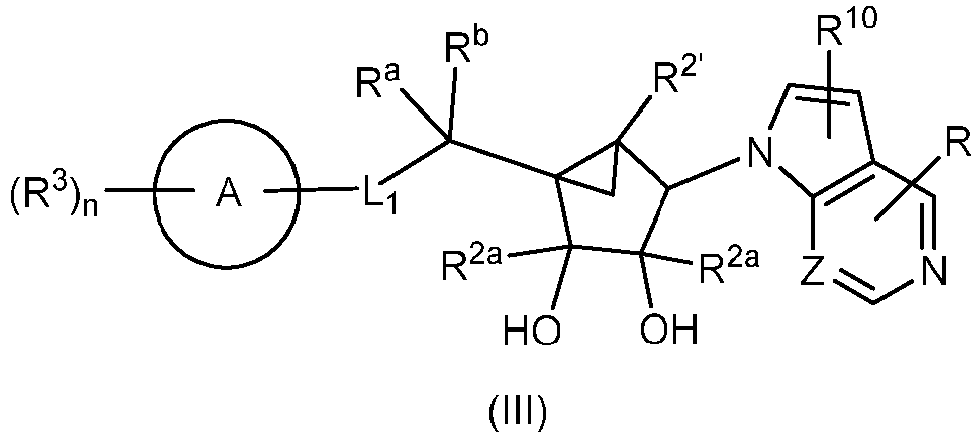
Ring A, L1, Z, Ra, Rb, R2', R, R2a, R3, R10 and 'n' are as defined herein above. - According to one embodiment, the invention provides compounds having the structure of Formula (IV), a stereoisomer thereof, or a pharmaceutically acceptable salt thereof,

- X2 is Br or Cl;
- L1, Ra, Rb, R1, R2', R2, R, R2a and R10 are as defined herein above.
- In accordance with an embodiment of the invention, Rc and Rd are independently selected from substituted or unsubstituted alkyl or Rc and Rd together with the carbon atom to which they are attached form a cyclobutyl ring.
- In certain embodiment, Rc and Rd are independently selected from methyl or Rc and Rd together with the carbon atom to which they are attached from a cyclobutyl ring.
- In any of above embodiments, Ra and Rb are independently selected from hydrogen, methyl, and cyclopropyl.
- In any of above embodiments, R3 is selected from halogen, cyano, -OR6, -NR7R8, substituted or unsubstituted alkyl, and substituted or unsubstituted aryl.
- In certain embodiments, R3 is independently selected from -F, Cl, Br, CN, -NH2, - NH(CH3), -NHCH(CH3)2, -CH3, cyclopropyl, -CH(CH3)2, -CF2CH3, -OCH3,


- In any of above embodiments, R2' and R2a are independently selected from hydrogen and methyl.
- In any of above embodiments, R is selected from hydrogen, halogen, -NR4R5, and substituted or unsubstituted alkyl, cycloalkyl and substituted or unsubstituted heteroaryl.
- In certain embodiments, R is selected from hydrogen, -NH2, methyl, Chloro, cyclopropyl, and

- In any of above embodiments, R4 and R5 are independently selected from hydrogen.
- In any of above embodiments, R6 is selected from substituted and unsubstituted alkyl.
- In certain embodiments, R6 is selected from methyl.
- In any of above embodiments, R7 and R8 are independently selected from hydrogen, methyl, -CH(CH3)2, -CH2-cyclopropyl, cyclopropyl, and cyclobutyl.
- In any of above embodiments, R10 is selected from hydrogen, -F, and methyl.
- In any of above embodiments, n is selected from 1 to 3.
- According to another embodiment, there are provided compounds having the structure of Formula (I) wherein L1 is selected from -CH2-, -CH(CH3)-, -NH-, -N(CH3)- S, and O;
- According to another embodiment, there are provided compounds having the structure of Formula (I) wherein ring A is

- According to another embodiment, there are provided compounds having the structure of Formula (I) wherein ring A is
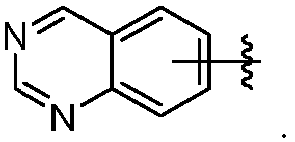
- According to another embodiment, there are provided compounds having the structure of Formula (I) wherein ring A is


- According to another embodiment, there are provided compounds having the structure of Formula (I), wherein ring A is selected from-


- The examples 1 to 84 given herein are representative compounds, which are only illustrative in nature and are not intended to limit to the scope of the invention.
- It should be understood that formula (I) structurally encompasses all tautomers, stereoisomers and isotopes wherever applicable and pharmaceutically acceptable salts that may be contemplated from the chemical structures generally described herein.
- According to one embodiment, there are provided compounds of formula (I) to (IV) wherein the compound is in the form of the free base or is a pharmaceutically acceptable salt thereof.
- In another aspect of the invention, there are provided compounds of formula (I) to (IV) or a pharmaceutically acceptable salt thereof for use in treating the diseases, disorders, syndromes or conditions associated with PRMT5 enzyme.
- In one embodiment of the present invention, there are provided compounds of formula (I) to (IV), or a pharmaceutically acceptable salt thereof for use in treating diseases, disorders, syndromes or conditions by inhibition of PRMT5 enzyme.
- In another aspect of the invention, there are provided compounds of formula (I) to (IV) or a pharmaceutically acceptable salt thereof for use as a medicament.
- In another aspect of the disclosure, there is provided a method of inhibiting PRMT5 by using a compound selected from formula (I) to (IV) or a pharmaceutically acceptable salt thereof.
- In another aspect of the disclosure, there is provided a method of treating diseases, disorders or conditions associated with PRMT5 by using a compound selected from formula (I) to (IV).
- In another aspect of the present disclosure, a method of treating diseases, disorders or conditions is selected from glioblastoma multiforme, prostate cancer, and pancreatic cancer, mantle cell lymphoma, non-Hodgkin's lymphomas and diffuse large B-cell lymphoma, acute myeloid leukemia, acute lymphoblastic leukemia, multiple myeloma, non-small cell lung cancer, small cell lung cancer, breast cancer, triple negative breast cancer, gastric cancer, colorectal cancer, ovarian cancer, bladder cancer, hepatocellular cancer, melanoma, sarcoma, oropharyngeal squamous cell carcinoma, chronic myelogenous leukemia, epidermal squamous cell carcinoma, nasopharyngeal carcinoma, neuroblastoma, endometrial carcinoma,and cervical cancerby using a compound selected from formula (I) to (IV) is provided.
- In another aspect of the disclosure, there is provided a use of a compound selected from formula (I) to (IV) or a pharmaceutically acceptable salt thereof, for the manufacture of a medicament for treating, the diseases, disorders or conditions associated with PRMT5.
- In another aspect, the invention provides a pharmaceutical composition comprising at least one compound of formula (I) to (IV) or a pharmaceutically acceptable salt thereof and at least one pharmaceutically acceptable excipient.
- In another aspect, the invention provides a pharmaceutical composition comprising a therapeutically effective amount of compound of formula (I) to (IV) or a pharmaceutically acceptable salt thereof, for use in treating, the diseases, disorders or conditions associated with PRMT5 by administering to the subject in need thereof.
- In another aspect of the present disclosure, the diseases, disorders, syndromes or conditions associated by inhibition of PRMT5 are selected from the group consisting of glioblastoma multiforme, prostate cancer, and pancreatic cancer, mantle cell lymphoma, non-Hodgkin's lymphomas and diffuse large B-cell lymphoma, acute myeloid leukemia, acute lymphoblastic leukemia, multiple myeloma, non-small cell lung cancer, small cell lung cancer, breast cancer, triple negative breast cancer, gastric cancer, colorectal cancer, ovarian cancer, bladder cancer, hepatocellular cancer, melanoma, sarcoma, oropharyngeal squamous cell carcinoma, chronic myelogenous leukemia, epidermal squamous cell carcinoma, nasopharyngeal carcinoma, neuroblastoma, endometrial carcinoma,and cervical cancer.
- In another aspect, the invention provides a pharmaceutical composition comprising a therapeutically effective amount of compound of formula (I) to (IV) or a pharmaceutically acceptable salt thereof, for use in treating the diseases, disorders or conditions associated with PRMT5 by administering to the subject in need thereof.
- In another embodiment of the invention the compounds, their stereoisomers or pharmaceutically acceptable salts thereof are:
- (1S,2R,5R)-3-(2-(2-Amino-3-bromoquinolin-7-yl)ethyl)-5-(4-amino-7H pyrrolo[2,3-d]pyrimidin-7-yl)cyclopent-3-ene-1,2-diol (Compound-1);
- (1S,2R,5R)-3-(2-(2-amino-3-chloroquinolin-7-yl)ethyl)-5-(4-amino-7H-pyrrolo[2,3-d]pyrimidin-7-yl)cyclopent-3-ene-1,2-diol (Compound-2);
- (1S,2R,5R)-3-(2-(2-amino-3-bromoquinolin-7-yl)ethyl)-5-(4-amino-5-fluoro-7H-pyrrolo[2,3-d]pyrimidin-7-yl)cyclopent-3-ene-1,2-diol (Compound-3);
- (1S,2R,5R)-5-(4-amino-7H-pyrrolo[2,3-d]pyrimidin-7-yl)-3-(((2-aminoquinolin-7-yl)thio)methyl)cyclopent-3-ene-1,2-diol (Compound-4);
- (1S,2R,5R)-3-(((2-amino-3-chloroquinolin-7-yl)thio)methyl)-5-(4-amino-7H-pyrrolo[2,3-d]pyrimidin-7-yl)cyclopent-3-ene-1,2-diol (Compound-5);
- (1S,2R,5R)-5-(4-amino-7H-pyrrolo[2,3-d]pyrimidin-7-yl)-3-(((2-aminoquinolin-7-yl)(methyl)amino)methyl)cyclopent-3-ene-1,2-diol (Compound-6);
- (1S,2R,5R)-3-(1-(2-Amino-3-bromoquinolin-7-yl)propan-2-yl)-5-(4-amino-7H-pyrrolo[2,3-d]pyriniidin-7-yl)cyclopent-3-ene-1,2-diol (Compound-7a and 7b);
- (1S,2R,5R)-5-(4-Amino-7H-pyrrolo[2,3-d]pyrimidin-7-yl)-3-(1-((2-(methylamino) quinolin-7-yl)oxy)ethyl)cyclopent-3-ene-1,2-diol (Compound-8a and 8b);
- (1S,2R,5R)-3-(((2-amino-3-chloro-5-fluoroquinolin-7-yl)oxy)methyl)-5-(4-amino-7H-pyrrolo[2,3-d]pyrimidin-7-yl)-2-methylcyclopent-3-ene-1,2-diol (Compound-9);
- (1S,2R,5R)-5-(4-amino-7H-pyrrolo[2,3-d]pyrimidin-7-yl)-3-(2-(2-(methylamino)quinolin-7-yl)ethyl)cyclopent-3 -ene-1,2-diol (Compound-10);
- (1S,2R,5R)-5-(4-amino-7H-pyrrolo[2,3-d]pyrimidin-7-yl)-3-(2-(3-methylimidazo[1,2-a]pyridin-7-yl)ethyl)cyclopent-3-ene-1,2-diol (Compound-11);
- (1S,2R,5R)-3-(((2-amino-3-chloro-5-fluoroquinolin-7-yl)oxy)methyl)-5-(4-amino-7H-pyrrolo[2,3-d]pynmidin-7-yl)-4-methylcyclopent-3-ene-1,2-diol (Compound-12);
- (1S,2R,5R)-3-(2-(2-arnino-3-chloro-5-fluoroquinolin-7-yl)ethyl)-5-(4-methyl-7H-pyrrolo[2,3-d]pyrimidin-7-yl)cyclopent-3-ene-1,2-diol (Compound-13);
- (1S,2R,5R)-3-(2-(2-amino-3-chloro-5-fluoroquinolin-7-yl)ethyl)-5-(4-methyl-1H-pyrrolo[3,2-c]pyridin-1-yl)cyclopent-3-ene-1,2-diol hydrochloride (Compound-14);
- (1S,2R,5R)-3-(2-(2-Amino-3-chloro-5-fluoroquinolin-7-yl)ethyl)-5-(1H-pyrrolo[3,2-c]pyridin-1-yl)cyclopent-3-ene-1,2-diol (Compound-15);
- (1S,2R,5R)-3-(2-(2-amino-3-chloro-5-fluoroquinolin-7-yl)ethyl)-5-(7H-pyrrolo[2,3-d]pyrimidin-7-yl)cyclopent-3-ene-1,2-diol (Compound-16);
- (1S,2R,5R)-5-(4-amino-7H-pyrrolo[2,3-d]pyrimidin-7-yl)-3-(((2-aminoquinolin-7-yl)amino)methyl)cyclopent-3-ene-1,2-diol (Compound-17);
- (lS,2R,5R)-3-(((2-amino-3-chloro-5-fluoroquinolin-7-yl)oxy)methyl)-5-(4-amino-7H-pyrrolo[2,3-d]pyrimidin-7-yl)cyclopent-3-ene-1,2-diol (Compound-18);
- (1S,2R,5R)-5-(4-amino-7H-pyrrolo[2,3-d]pyrimidin-7-yl)-3-(((2-(methylamino)quinolin-7-yl)oxy)methyl)cyclopent-3-ene-1,2-diol (Compound-19);
- (1S,2R,5R)-3-(1-((2-ammo-3-chloro-5-fluoroquinolin-7-yl)oxy)ethyl)-5-(4-amino-7H-pyrrolo[2,3-d]pyrimidin-7-yl)cyclopent-3-ene-1,2-diol (Compound-20a and 20b);
- (1S,2R,5R)-3-(2-(2-amino-3-chloroquinolin-7-yl)ethyl)-5-(4-methyl-7H-pyrrolo[2,3-d]pyrimidin-7-yl)cyclopent-3-ene-1,2-diol (Compound-21);
- (1S,2R,5R)-5-(4-Amino-7H-pyrrolo[2,3-d]pyrimidin-7-yl)-3-(2-(2-(cyclobutylamino) quinolin-7-yl)ethyl)cyclopent-3-ene-1,2-diol (Compound-22);
- (1S,2R,5R)-3-(2-(2-Amino-3-fluoroquinolin-7-yl)ethyl)-5-(4-amino-7H-pyrrolo[2,3-d]pyrimidin-7-yl)cyclopent-3-ene-1,2-diol (Compound-23);
- (1S,2R,5R)-3-(2-(2-amino-3-chloro-5-fluoroquinolin-7 -yl)ethyl)-5-(4-amino-7H-pyrrolo[2,3-d]pyrimidin-7-yl)cyclopent-3-ene-1,2-diol (Compound-24);
- (1S,2R,5R)-3-(2-(2-amino-3-chloro-6-fluoroquinolin-7-yl)ethyl)-5-(4-amino-7H-pyrrolo[2,3-d]pyrimidin-7-yl)cyclopent-3-ene-1,2-diol (Compound-25);
- (1S,2R,5R)-3-(2-(2-amino-3-chloro-8-fluoroquinolin-7-yl)ethyl)-5-(4-amino-7H-pyrrolo[2,3-d]pyrimidin-7-yl)cyclopent-3-ene-1,2-diol (Compound-26);
- (1S,2R,5R)-3-(2-(2-amino-3,3-dimethyl-3H-indol-6-yl)ethyl)-5-(4-amino-7H-pyrrolo[2,3-d]pyrimidin-7-yl)cyclopent-3-ene-1,2-diol (Compound-27);
- (1S,2R,5R)-5-(4-amino-7H-pyrrolo[2,3-d]pyrimidin-7-yl)-3-(2-(2'-aminospiro[cyclobutane-1,3'-indol]-6'-yl)ethyl)cyclopent-3-ene-1,2-diol (Compound-28);
- (1S,2R,5R)-3-(2-(2-amino-3,5-dichloroquinolin-7-yl)ethyl)-5-(4-amino-7H-pyrrolo[2,3-d]pyrimidin-7-yl)cyclopent-3-ene-1,2-diol (Compound-29);
- (1S,2R,SR)-3-(2-(2-amino-3-chloroquinolin-7-yl)ethyl)-5-(2-amino-7H-pyrrolo[2,3-d]pyrimidin-7-yl)cyclopent-3-ene-1,2-diol (Compound-30);
- (1S,2R,5R)-3-(2-(2-amino-3-chloro-5-fluoroquinolin-7 -yl)ethyl)-5-(4-isopropyl-7H-pyrrolo[2,3-d]pyrimidin-7-yl)cyclopent-3-ene-1,2-diol (Compound-31);
- (1S,2R,5R)-3-(2-(2-amino-3-chloro-5-fluoroquinolin-7-yl)ethyl)-5-(4-(1-methyl-1H-pyrazol-4-yl)-7H-pyrrolo [2,3 -d]pyrimidin-7-yl)cyclopent-3 -ene-1,2-diol (Compound-32);
- (1S,2R,5R)-3-(1-(2-ammo-3-chloro-5-fluoroquinolin-7-yl)propan-2-yl)-5-(4-amino-7H-pyrrolo[2,3-d]pyrimidin-7-yl)cyclopent-3-ene-1,2-diol(Compound-33a and 33b);
- (1S,2R,5R)-3-(1-(2-amino-3-chloroquinolin-7-yl)propan-2-yl)-5-(4-amino-7H-pyrrolo[2,3-d]pyrimidin-7-yl)cyclopent-3-ene-1,2-diol (Compound-34a and 34b);
- (1S,2R,5R)-3-(1-(2-Ammo-3-chloro-5-Huoroqumolm-7-yl)propan-2-yl)-5-(4-methyl-7H-pyrrolo[2,3-d]pyrimidin-7-yl)cyclopent-3-ene-1,2-diol (Compound-35a and 35b);
- (1S,2R,5R)-3-(1-(2-ammo-3-chloro-5-fluoroquinolin-7-yl)propan-2-yl)-2-methyl-5-(4-methyl-7H-pyrrolo[2,3-d]pyrimidin-7-yl)cyclopent-3-ene-1,2-diol (Compound-36a and 36b);
- (1S,2R,5R)-3-(2-(2-amino-3-chloro-5-fluoroquinolin-7-yl)ethyl)-5-(4-amino-7H-pyrrolo[2,3-d]pyrimidin-7-yl)-2-methylcyclopent-3-ene-1,2-diol (Compound-37);
- (1S,2R,5R)-3-(1-(2-ammo-3-chloro-5-fluoroquinolin-7-yl)propan-2-yl)-5-(4-ammo-7H-pyrrolo[2,3-d]pyrimidin-7-yl)-2-methylcyclopent-3-ene-1,2-diol (Compound-38);
- (1S,2R,5R)-3-(2-(2-ammo-3-chloro-5-Huoroquinolin-7-yl)ethyl)-2-methyl-5-(4-methyl-7H-pyrrolo[2,3-d]pyrimidin-7-yl)cyclopent-3-ene-1,2-diol (Compound-39);
- (1S,2R,5R)-3-(2-(2-amino-3-chloro-5-fluoroquinolin-7 -yl)ethyl)-5-(4-amino-7H-pyrrolo[2,3-d]pyrimidin-7-yl)-2-ethylcyclopent-3-ene-1,2-diol (Compound-40);
- (1S,2R,5R)-3-(2-(2-amino-3-chloro-5-fluoroquinolin-7 -yl)ethyl)-5-(4-ethyl-7H-pyrrolo[2,3-d]pyrimidin-7-yl)cyclopent-3-ene-1,2-diol (Compound-41);
- (1S,2R,5R)-3-(2-(2-ammo-3-chloro-5-fluoroquinolin-7-yl)ethyl)-5-(4-cyclopropyl-7H-pyrrolo[2,3-d]pyrimidin-7-yl)cyclopent-3-ene-1,2-diol (Compound-42);
- (1S,2R,5R)-3-(2-(2-Amino-3-bromo-5-fluoroquinolin-7 -yl)ethyl)-5-(4-amino-7H-pyrrolo[2,3-d]pyrimidin-7-yl)cyclopent-3-ene-1,2-diol (Compound-43);
- (1S,2R,5R)-3-(2-(2-Amino-3-bromo-5-fluoroquinolin-7-yl)ethyl)-5-(4-methyl-7H-pyrrolo[2,3-d]pyrimidin-7-yl)cyclopent-3-ene-1,2-diol (Compound-44);
- (1S,2R,5R)-3-(1-(2-Amino-3-bromo-5-fluoro quinolin-7-yl)propan-2-yl)-5-(4-amino-7H-pyrrolo[2,3-d]pyrimidin-7-yl)cyclopent-3-ene-1,2-diol (Compound-45a and 45b);
- (1S,2R,5R)-3-(2-(2-Amino-6-fluoroquinolin-7-yl)ethyl)-5-(4-amino-7H-pyrrolo[2,3-d]pyrimidin-7-yl)cyclopent-3-ene-1,2-diol (Compound-46);
- (1S,2R,5R)-3-(2-(2-amino-5-fluoroquinolin-7-yl)ethyl)-5-(4-amino-7H-pyrrolo[2,3-d]pyrimidin-7-yl)cyclopent-3-ene-1,2-diol (Compound-47);
- (1R,2R,3S,4R,5S)-1-(2-(2-Amino-3 -chloro-5 -fluoroquinolin-7-yl)ethyl)-4-(4-amino-7H-pyrrolo[2,3-d]pyrimidin-7-yl)bicyclo[3.1.0]hexane-2,3-diol (Compound-48);
- (1R2R3S,4R,5S)-4-(4-Amino-7H-pyrrolo[2,3-d]pyrimidin-7-yl)-1-(2-(2-(methylamino)quinolin-7-yl)ethyl)bicyclo [3.1.0] hexane-2,3-diol (Compound-49);
- (1R,2R,3S,4R,5S)-4-(4-Amino-7H-pyrrolo[2,3-d]pyrimidin-7-y1)-1-(2-(2-(isopropylamino)quinolin-7-yl)ethyl)bicyclo [3.1.0]hexane-2,3-diol (Compound-50);
- (1R,2R,3S,4R,5S)-4-(4-Amino-7H-pyrrolo[2,3-d]pyrimidin-7-y1)-1-(2-(2-(cyclobutylamino)quinolin-7-yl)ethyl)bicyclo [3.1.0]hexane-2,3-diol (Compound-51);
- (1R,2R,3S,4R,5S)-4-(4-Amino-7H-pyrrolo[2,3-d]pyrimidin-7-yl)-1-(2-(2-((cyclopropylmethyl)amino) quinolin-7-yl) ethyl)bicyclo[3.1.0]hexane-2,3-diol (Compound-52);
- (1R,2R,3S,4R,5S)-4-(4-Amino-7H-pyrrolo[2,3-d]pyrimidin-7-yl)-1-(2-(2-amino-8-fluoroquinolin-7-yl)ethyl)bicyclo [3.1.0]hexane-2,3-diol (Compound-53);
- (1R,2R,3S,4R,5S)-1-(2-(2-Amino-3-methylquinolin-7-yl)ethyl)-4-(4-amino-7H-pyrrolo[2,3-d]pyrimidin-7-yl) bicyclo[3.1.0]hexane-2,3-diol (Compound-54);
- (1R,2R,3S,4R,5S)-1-(2-(2-Amino-3-isopropyl quinolin-7-yl)ethyl)-4-(4-amino-7H-pyrrolo[2,3-d]pyrimidin-7-yl)bicyclo[3.1.0]hexane-2,3-diol (Compound-55);
- (1R,2R,3S,4R,5S)-1-(2-(2-Amino-3-(1,1-difluoroethyl) quinolin-7-yl)ethyl)-4-(4-amino-7H-pyrrolo [2,3-d] pyrimidin-7-yl)bicyclo[3.1.0]hexane-2,3-diol (Compound-56);
- (1R,2R,3S,4R,5S)-1-(2-(2-Amino-3-cyclopropylquinolin-7-yl)ethyl)-4-(4-amino-7H-pyrrolo[2,3-d]pyrimidin-7-yl) bicyclo[3.1.0]hexane-2,3-diol(Compound-57);
- (1R,2R,3S,4R,5S)-1-(2-(2-Amino-3-methoxyquinolin-7-yl)ethyl)-4-(4-amino-7H-pyrrolo[2,3-d]pyrimidin-7-yl)bicyclo[3.1.0]hexane-2,3-diol(Compound-58);
- 2-amino-7-(2-((1R,2R,3S,4R,5S)-4-(4-Amino-7H-pyrrolo[2,3-d]pyrimidin-7-yl)-2,3-dihydroxybicyclo [3.1.0]hexan-1-yl)ethyl)quinoline-3-carbonitrile(Compound-59);
- (1R,2R,3S,4R,5S)-1-(2-(2-Amino-3-fluoroquinolin-7-yl)ethyl)-4-(4-amino-7H-pyrrolo[2,3-d]pyrimidin-7-yl)bicyclo[3.1.0]hexane-2,3-diol(Compound-60);
- (1R,2R,3S,4R,5S)-1-(2-(2-Amino-3-chloroquinolin-7-yl)ethyl)-4-(4-amino-7H-pyrrolo[2,3-d]pyrimidin-7-yl)bicyclo[3.1.0]hexane-2,3-diol(Compound-61);
- (1R,2R,3S,4R,5S)-1-(2-(2-Amino-3-chloro-6-fluoroquinolin-7-yl)ethyl)-4-(4-amino-7H-pyrrolo[2,3-d]pyrimidin-7-yl) bicyclo[3.1.0]hexane-2,3-diol(Compound-62);
- (1R,2R,3S,4R,5S)-1-(2-(2-Amino-3-chloro-8-fluoroquinolin-7-yl)ethyl)-4-(4-amino-7H-pyrrolo[2,3-d]pyrimidin-7-yl)bicyclo[3.1.0]hexane-2,3-diol(Compound-63);
- (1R2R3S,4R,5S)-1-(2-(2-ammo-3-bromo-6-Huoroquinolm-7-yl)ethyl)-4-(4-ammo-7H-pyrrolo[2,3-d]pyrimidin-7-yl)bicyclo[3.1.0]hexane-2,3-diol(Compound-64);
- (1R,2R,3S,4R,5S)-4-(4-Amino-7H-pyrrolo[2,3-d]pyrimidin-7-yl)-1-(2-(3-methylimidazo[1,2-a]pyridin-7-yl)ethyl) bicyclo[3.1.0]hexane-2,3-diol (Compound-65);
- (1R,2R,3S,4R,5S)-1-(2-(2-Amino-3,3-dimethyl-3H-indol-6-yl)ethyl)-4-(4-amino-7H-pyrrolo[2,3-d]pyrimidin-7-yl) bicyclo[3.1.0]hexane-2,3-diol(Compound-66);
- (1R,2R,3S,4R,5S)-1-(2-(2-Amino-3 -chloro-5 -fluoroquinolin-7-yl)ethyl)-4-(4-amino-6-methyl-7H-pyrrolo[2,3-d] pyrimidin-7-yl)bicyclo[3.1.0]hexane-2,3-diol (Compound-67);
- (1R,2R,3S,4R,5S)-1-(2-(2-Amino-3 -chloro-6-fluoroquinolin-7-yl)ethyl)-4-(4-amino-6-methyl-7H-pyrrolo[2,3-d] pyrimidin-7-yl)bicyclo[3.1.0]hexane-2,3-diol (Compound-68);
- (1R,2R,3S,4R,5S)-1-(2-(2-amino-3-chloro-5-fluoroquinolin-7-yl)ethyl)-4-(4-methyl-7H-pyrrolo[2,3-d]pyrimidin-7-yl) bicyclo[3.1.0]hexane-2,3-diol (Compound-69);
- (1R,2R,3S,4R,5S)-1-(2-(2-Amino-3 -chloro-5 -fluoroquinolin-7-yl)ethyl)-4-(7H-pyrrolo[2,3-d]pyrimidin-7-yl)bicyclo [3.1.0]hexane-2,3-diol (Compound-70);
- (1R,2R,3S,4R,5S)-4-(4-Amino-7H-pyrrolo[2,3-d]pyrimidin-7-yl)-1-(2-(2'-aminospiro[cyclobutane-1,3'-indol]-6'-yl)ethyl)bicyclo[3.1.0]hexane-2,3-diol (Compound-71);
- (1R,2R,3S,4R,5S)-1-(2-(2-Amino-3-bromo-5-fluoroquinolin-7-yl)ethyl)-4-(4-amino-7H-pyrrolo[2,3-d]pyrimidin-7-yl)bicyclo[3.1.0]hexane-2,3-diol (Compound-72);
- (1R,2R,3S,4R,5S)-1-(2-(2-Amino-3-bromoquinolin-7-yl)ethyl)-4-(4-amino-7H-pyrrolo [2,3-d]pyrimidin-7-yl)bicyclo[3.1.0]hexane-2,3-diol (Compound-73);
- (1R,2R,3S,4R,5S)-4-(4-Amino-7H-pyrrolo[2,3-d]pyrimidin-7-y1)-1-(2-(2-aminoquinolin-7-yl)ethyl)bicyclo[3.1.0]hexane-2,3-diol (Compound-74);
- (1R,2R,3S,4R,5S)-4-(4-amino-7H-pyrrolo[2,3-d]pyrimidin-7-yl)-1-(2-(2-aminoquinazolin-7-yl)ethyl)bicyclo[3.1.0] hexane-2,3-diol (Compound-75);
- (1S,2R,3S,4R,5S)-1-((S)-1-(2-Amino-3-bromoquinolin-7-yl)propan-2-yl)-4-(4-amino-7H-pyrrolo[2,3-d]pyrimidin-7-yl)bicyclo[3.1.0]hexane-2,3-diol (Compound-76a and 76b);
- (1S,2R,3S,4R,5S)-1-((S)-2-(2-Amino-3-chloro-5-fluoroquinolin-7-yl)-1-cyclopropylethyl)-4-(4-amino-7H-pyrrolo[2,3-d]pyrimidin-7-yl)bicyclo[3.1.0]hexane-2,3-diol (Compound-77a and 77b);
- (1S,2R,3S,4R,5S)-1-(1-(2-Amino-3-chloro-5-fluoroquinolin-7-yl)propan-2-yl)-4-(4-amino-7H-pyrrolo[2,3-d]pyrimidin-7-yl)bicyclo[3.1.0]hexane-2,3-diol (Compound-78a and 78b);
- (1R,2R,3S,4R,5S)-4-(4-Amino-7H-pyrrolo[2,3-d]pyrimidin-7-yl)-1-(2-(2-aminoquinolin-7-yl)propyl) bicyclo[3.1.0]hexane-2,3-diol (Compound-79a and 79b);
- (1R,2R,3S,4R,5S)-1-(((2-Amino-3-bromoquinolin-7-yl)oxy)methyl)-4-(4-amino-7H-pyrrolo[2,3-d]pyrimidin-7-yl)bicyclo[3.1.0]hexane-2,3-diol (Compound-80);
- (1S,2R,3S,4R,5S)-4-(4-Amino-7H-pyrrolo[2,3-d]pyrimidin-7-yl)-1-(((2-aminoquinolin-7-yl)thio)methyl) bicyclo [3.1.0] hexane-2,3-diol (Compound-81);
- (1R,2R,3S,4R,5S)-1-(2-(2-Amino-3-(4-fluorophenyl)quinolin-7-yl)ethyl)-4-(4-amino-7H-pyrrolo[2,3-d]pyrimidin-7-yl)bicyclo[3.1.0]hexane-2,3-diol_ (Compound-82);
- (1R,2R,3S,4R,5S)-1-(2-(2-Amino-3-(pyridin-3-yl)quinolin-7-yl)ethyl)-4-(4-amino-7H-pyrrolo[2,3-d]pyrimidin-7-yl)bicyclo[3.1.0]hexane-2,3-diol (Compound-83); and
- (1R,2R,3S,4R,5S)-1-(2-(2-Amino-3-(3-methyl isoxazol-4-yl)quinolin-7-yl)ethyl)-4-(4-amino-7H-pyrrolo[2,3-d]pyrimidin-7-yl)bicyclo[3.1.0]hexane-2,3-diol (Compound-84).
- In another embodiment of the invention the compounds, their stereoisomer thereof, or a pharmaceutically acceptable salt thereof, are selected from:
- (1S,2R,5R)-3-(2-(2-Amino-3-bromoquinolin-7-yl)ethyl)-5-(4-ammo-7H pyrrolo[2,3-d]pyrimidin-7-yl)cyclopent-3-ene-1,2-diol (Compound-1);
- (1S,2R,5R)-3-(2-(2-amino-3-chloroquinolin-7-yl)ethyl)-5-(4-amino-7H-pyrrolo[2,3-d]pyrimidin-7-yl)cyclopent-3-ene-1,2-diol (Compound-2);
- (1S,2R,5R)-3-(1-(2-Amino-3-bromoquinolin-7-yl)propan-2-yl)-5-(4-amino-7H-pyrrolo[2,3-d]pyrimidin-7-yl)cyclopent-3-ene-1,2-diol (Compound-7a and 7b);
- (1S,2R,5R)-3-(((2-ammo-3-chloro-5-fluoroquinolin-7-yl)oxy)methyl)-5-(4-ammo-7H-pyrrolo[2,3-d]pyrimidin-7-yl)-2-methylcyclopent-3-ene-1,2-diol (Compound-9);
- (1S,2R,5R)-3-(2-(2-amino-3-chloro-5-fluoroquinolin-7-yl)ethyl)-5-(4-methyl-7H-pyrrolo[2,3-d]pyrimidin-7-yl)cyclopent-3-ene-1,2-diol (Compound-13);
- (1S,2R,5R)-3-(2-(2-amino-3-chloro-5-fluoroquinolin-7 -yl)ethyl)-5-(4-methyl-1H-pyrrolo[3,2-c]pyridin-1-yl)cyclopent-3-ene-1,2-diol hydrochloride (Compound-14);
- (1S,2R,5R)-3-(((2-ammo-3-chloro-5-fluoroquinolin-7-yl)oxy)methyl)-5-(4-ammo-7H-pyrrolo[2,3-d]pyrimidin-7-yl)cyclopent-3-ene-1,2-diol (Compound-18);
- (1S,2R,5R)-3-(1-((2-ammo-3-chloro-5-fluoroquinolin-7-yl)oxy)ethyl)-5-(4-amino-7H-pyrrolo[2,3-d]pyrimidin-7-yl)cyclopent-3-ene-1,2-diol (Compound-20a and 20b);
- (1S,2R,5R)-3-(2-(2-amino-3-chloroquinolin-7-yl)ethyl)-5-(4-methyl-7H-pyrrolo[2,3-d]pyrimidin-7-yl)cyclopent-3-ene-1,2-diol (Compound-21);
- (1S,2R,5R)-3-(2-(2-Amino-3-fluoroquinolin-7-yl)ethyl)-5-(4-amino-7H-pyrrolo[2,3-d]pyrimidin-7-yl)cyclopent-3-ene-1,2-diol (Compound-23);
- (1S,2R,5R)-3-(2-(2-amino-3-chloro-5-fluoroquinolin-7 -yl)ethyl)-5-(4-amino-7H-pyrrolo[2,3-d]pyrimidin-7-yl)cyclopent-3-ene-1,2-diol (Compound-24);
- (1S,2R,5R)-3-(2-(2-ammo-3-chloro-6-Huoroquinolin-7-yl)ethyl)-5-(4-ammo-7H-pyrrolo[2,3-d]pyrimidin-7-yl)cyclopent-3-ene-1,2-diol (Compound-25);
- (1S,2R,5R)-3-(2-(2-ammo-3-chloro-8-fluoroquinolin-7-yl)ethyl)-5-(4-ammo-7H-pyrrolo[2,3-d]pyrimidin-7-yl)cyclopent-3-ene-1,2-diol (Compound-26);
- (1S,2R,5R)-3-(2-(2-ammo-3,5-dichloroquinolin-7-yl)ethyl)-5-(4-amino-7H-pyrrolo[2,3-d]pyrimidin-7-yl)cyclopent-3-ene-1,2-diol (Compound-29);
- (1S,2R,5R)-3-(2-(2-amino-3-chloro-5-fluoroquinolin-7-yl)ethyl)-5-(4-isopropyl-7H-pyrrolo[2,3-d]pyrimidin-7-yl)cyclopent-3-ene-1,2-diol (Compound-31);
- (1S,2R,5R)-3-(2-(2-ammo-3-chloro-5-fluoroquinolin-7-yl)ethyl)-5-(4-(1-methyl-1H-pyrazol-4-yl)-7H-pyrrolo [2,3 -d]pyrimidin-7-yl)cyclopent-3 -ene-1,2-diol (Compound-32);
- (1S,2R,5R)-3-(1-(2-ammo-3-chloro-5-fluoroquinolin-7-yl)propan-2-yl)-5-(4-ammo-7H-pyrrolo[2,3-d]pyrimidin-7-yl)cyclopent-3-ene-1,2-diol(Compound-33a and 33b);
- (1S,2R,5R)-3-(1-(2-amino-3-chloroquinolin-7-yl)propan-2-yl)-5-(4-amino-7H-pyrrolo[2,3-d]pyrimidin-7-yl)cyclopent-3-ene-1,2-diol (Compound-34a and 34b);
- (1S,2R,5R)-3-(2-(2-amino-3-chloro-5-fluoroquinolin-7 -yl)ethyl)-5-(4-amino-7H-pyrrolo[2,3-d]pyrimidin-7-yl)-2-methylcyclopent-3-ene-1,2-diol (Compound-37);
- (1S,2R,5R)-3-(1-(2-ammo-3-chloro-5-fluoroquinolin-7-yl)propan-2-yl)-5-(4-ammo-7H-pyrrolo[2,3-d]pyrimidin-7-yl)-2-methylcyclopent-3-ene-1,2-diol (Compound-38);
- (1S,2R,5R)-3-(2-(2-amino-3-chloro-5-fluoroquinolin-7 -yl)ethyl)-5-(4-amino-7H-pyrrolo[2,3-d]pyrimidin-7-yl)-2-ethylcyclopent-3-ene-1,2-diol (Compound-40);
- (1S,2R,5R)-3-(2-(2-amino-3-chloro-5-fluoroquinolin-7 -yl)ethyl)-5-(4-ethyl-7H-pyrrolo[2,3-d]pyrimidin-7-yl)cyclopent-3-ene-1,2-diol (Compound-41);
- (1S,2R,5R)-3-(2-(2-ammo-3-chloro-5-fluoroquinolin-7-yl)ethyl)-5-(4-cyclopropyl-7H-pyrrolo[2,3-d]pyrimidin-7-yl)cyclopent-3-ene-1,2-diol (Compound-42);
- (1S,2R,5R)-3-(2-(2-Amino-3-bromo-5-fluoroquinolin-7 -yl)ethyl)-5-(4-amino-7H-pyrrolo[2,3-d]pyrimidin-7-yl)cyclopent-3-ene-1,2-diol (Compound-43);
- (1S,2R,5R)-3-(2-(2-Amino-3-bromo-5-fluoroquinolin-7 -yl)ethyl)-5-(4-methyl-7H-pyrrolo[2,3-d]pyrimidin-7-yl)cyclopent-3-ene-1,2-diol (Compound-44);
- (1S,2R,5R)-3-(1-(2-Amino-3-bromo-5-fluoro quinolin-7-yl)propan-2-yl)-5-(4-amino-7H-pyrrolo[2,3-d]pyrimidin-7-yl)cyclopent-3-ene-1,2-diol (Compound-45a and 45b);
- (1S,2R,5R)-3-(2-(2-Amino-6-fluoroquinolin-7-yl)ethyl)-5-(4-amino-7H-pyrrolo[2,3-d]pyrimidin-7-yl)cyclopent-3-ene-1,2-diol (Compound-46);
- (1S,2R,5R)-3-(2-(2-ammo-5-fluoroquinolin-7-yl)ethyl)-5-(4-ammo-7H-pyrrolo[2,3-d]pyrimidin-7-yl)cyclopent-3-ene-1,2-diol (Compound-47);
- (1R,2R,3S,4R,5S)-1-(2-(2-Amino-3 -chloro-5 -fluoroquinolin-7-yl)ethyl)-4-(4-amino-7H-pyrrolo[2,3-d]pyrimidin-7-yl)bicyclo[3.1.0]hexane-2,3-diol (Compound-48);
- (1R,2R,3S,4R,5S)-1-(2-(2-Amino-3-methylquinolin-7-yl)ethyl)-4-(4-amino-7H-pyrrolo[2,3-d]pyrimidin-7-yl) bicyclo[3.1.0]hexane-2,3-diol (Compound-54);
- (1R,2R,3S,4R,5S)-1-(2-(2-Amino-3-chloroquinolin-7-yl)ethyl)-4-(4-amino-7H-pyrrolo[2,3-d]pyrimidin-7-yl)bicyclo[3.1.0]hexane-2,3-diol(Compound-61);
- (1R,2R,3S,4R,5S)-1-(2-(2-Amino-3-chloro-6-fluoroquinolin-7-yl)ethyl)-4-(4-amino-7H-pyrrolo[2,3-d]pyrimidin-7-yl) bicyclo[3.1.0]hexane-2,3-diol(Compound-62);
- (1R,2R,3S,4R,5S)-1-(2-(2-amino-3-bromo-6-fluoroquinolin-7-yl)ethyl)-4-(4-amino-7H-pyrrolo[2,3-d]pyrimidin-7-yl)bicyclo[3.1.0]hexane-2,3-diol(Compound-64);
- (1R,2R,3S,4R,5S)-1-(2-(2-Amino-3-bromo-5-fluoroquinolin-7-yl)ethyl)-4-(4-amino-7H-pyrrolo[2,3-d]pyrimidin-7-yl)bicyclo[3.1.0]hexane-2,3-diol (Compound-72); and
- (1R,2R,3S,4R,5S)-1-(2-(2-Amino-3-bromoquinolin-7-yl)ethyl)-4-(4-amino-7H-pyrrolo [2,3-d]pyrimidin-7-yl)bicyclo[3.1.0]hexane-2,3-diol (Compound-73).
- In another embodiment of the invention the compounds, their stereoisomer thereof, or a pharmaceutically acceptable salt thereof, are selected from:
- (1S,2R,5R)-3-(2-(2-amino-3-chloro-5-fluoroquinolin-7 -yl)ethyl)-5-(4-methyl-7H-pyrrolo[2,3-d]pyrimidin-7-yl)cyclopent-3-ene-1,2-diol (Compound-13);
- (1S,2R,5R)-3-(2-(2-amino-3-chloro-5-fluoroquinolin-7 -yl)ethyl)-5-(4-amino-7H-pyrrolo[2,3-d]pyrimidin-7-yl)cyclopent-3-ene-1,2-diol (Compound-24);
- (1S,2R,5R)-3-(1-(2-amino-3-chloro-5-fluoroquinolin-7-yl)propan-2-yl)-5-(4-amino-7H-pyrrolo[2,3-d]pyrimidin-7-yl)cyclopent-3-ene-1,2-diol(Compound-33a and 33b);
- (1S,2R,5R)-3-(2-(2-amino-3-chloro-5-fluoroquinolin-7 -yl)ethyl)-5-(4-amino-7H-pyrrolo[2,3-d]pyrimidin-7-yl)-2-methylcyclopent-3-ene-1,2-diol (Compound-37);
- (1R,2R,3S,4R,5S)-1-(2-(2-Amino-3 -chloro-5 -fluoroquinolin-7-yl)ethyl)-4-(4-amino-7H-pyrrolo[2,3-d]pyrimidin-7-yl)bicyclo[3.1.0]hexane-2,3-diol (Compound-48);
- (1R,2R,3S,4R,5S)-1-(2-(2-Amino-3 -chloro-6-fluoroquinolin-7-yl)ethyl)-4-(4-amino-7H-pyrrolo[2,3-d]pyrimidin-7-yl) bicyclo[3.1.0]hexane-2,3-diol(Compound-62);
- (1R,2R,3S,4R,5S)-1-(2-(2-Amino-3-bromoquinolin-7-yl)ethyl)-4-(4-amino-7H-pyrrolo [2,3-d]pyrimidin-7-yl)bicyclo[3.1.0]hexane-2,3-diol (Compound-73);
- (1S,2R,5R)-3-(2-(2-Amino-3-bromoquinolin-7-yl)ethyl)-5-(4-amino-7H pyrrolo[2,3-d]pyrimidin-7-yl)cyclopent-3-ene-1,2-diol (Compound-1);
- (1S,2R,5R)-3-(2-(2-amino-3-chloro-6-fluoroquinolin-7-yl)ethyl)-5-(4-amino-7H-pyrrolo[2,3-d]pyrimidin-7-yl)cyclopent-3-ene-1,2-diol (Compound-25);
- (1S,2R,5R)-3-(((2-amino-3-chloro-5-fluoroquinolin-7-yl)oxy)methyl)-5-(4-amino-7H-pyrrolo[2,3-d]pyrimidin-7-yl)cyclopent-3-ene-1,2-diol (Compound-18);
- (1S,2R,5R)-3-(1-(2-amino-3-chloroquinolin-7-yl)propan-2-yl)-5-(4-amino-7H-pyrrolo[2,3-d]pyrimidin-7-yl)cyclopent-3-ene-1,2-diol (Compound-34a and 34b);
- (1S,2R,5R)-3-(1-(2-amino-3-chloro-5-fluoroquinolin-7-yl)propan-2-yl)-5-(4-amino-7H-pyrrolo[2,3-d]pyrimidin-7-yl)-2-methylcyclopent-3-ene-1,2-diol (Compound-38);
- (1R,2R,3S,4R,5S)-1-(2-(2-Amino-3-chloroquinolin-7-yl)ethyl)-4-(4-amino-7H-pyrrolo[2,3-d]pyrimidin-7-yl)bicyclo[3.1.0]hexane-2,3-diol(Compound-61);
- (1S,2R,5R)-3-(2-(2-Amino-3-bromo-5-fluoroquinolin-7 -yl)ethyl)-5-(4-amino-7H-pyrrolo[2,3-d]pyrimidin-7-yl)cyclopent-3-ene-1,2-diol (Compound-43);
- (1S,2R,5R)-3-(1-(2-Amino-3-bromo-5-fluoro quinolin-7-yl)propan-2-yl)-5-(4-amino-7H-pyrrolo[2,3-d]pyrimidin-7-yl)cyclopent-3-ene-1,2-diol (Compound-45a);
- (1S,2R,5R)-3-(2-(2-Amino-3-bromo-5-fluoroquinolin-7 -yl)ethyl)-5-(4-methyl-7H-pyrrolo[2,3-d]pyrimidin-7-yl)cyclopent-3-ene-1,2-diol (Compound-44);
- (1R,2R,3S,4R,5S)-1-(2-(2-Amino-3-bromo-5-fluoroquinolin-7-yl)ethyl)-4-(4-ammo-7H-pyrrolo[2,3-d]pyrimidin-7-yl)bicyclo[3.1.0]hexane-2,3-diol (Compound-72); and
- (1R,2R,3S,4R,5S)-1-(2-(2-amino-3-bromo-6-fluoroquinolin-7-yl)ethyl)-4-(4-amino-7H-pyrrolo[2,3-d]pyrimidin-7-yl)bicyclo[3.1.0]hexane-2,3-diol (Compound-64).
- Unless otherwise stated, the following terms used in the specification and claims have the meanings given below.
- For purposes of interpreting the specification, the following definitions will apply and whenever appropriate, terms used in the singular will also include the plural and vice versa.
- The terms "halogen" or "halo" means fluorine, chlorine, bromine, or iodine.
- The term "alkyl" refers to an alkane derived hydrocarbon radical that includes solely carbon and hydrogen atoms in the backbone, contains no unsaturation, has from one to six carbon atoms, and is attached to the remainder of the molecule by a single bond, for example (C1-C6)alkyl or (C1-C4)alkyl, representative groups include e.g., methyl, ethyl, n-propyl, 1-methylethyl (isopropyl), n-butyl, n-pentyl and the like. Unless set forth or recited to the contrary, all alkyl groups described or claimed herein may be straight chain or branched.
- The term "alkenyl" refers to a hydrocarbon radical containing from 2 to 10 carbon atoms and including at least one carbon-carbon double bond. Non-limiting Examples of alkenyl groups include, for example (C2-C6)alkenyl, (C2-C4)alkenyl, ethenyl, 1-propenyl, 2-propenyl (allyl), iso-propenyl, 2-methyl-l- propenyl, 1-butenyl, 2-butenyl and the like. Unless set forth or recited to the contrary, all alkenyl groups described or claimed herein may be straight chain or branched.
- The term "alkynyl" refers to a hydrocarbon radical containing 2 to 10 carbon atoms and including at least one carbon- carbon triple bond. Non- limiting Examples of alkynyl groups include, for example (C2-C6)alkynyl, (C2-C4)alkynyl, ethynyl, propynyl, butynyl and the like. Unless set forth or recited to the contrary, all alkynyl groups described or claimed herein may be straight chain or branched.
- The term "haloalkyl" refers to an alkyl group as defined above that is substituted by one or more halogen atoms as defined above. For example (C1-C6)haloalkyl or (C1-C4)haloalkyl. Suitably, the haloalkyl may be monohaloalkyl, dihaloalkyl or polyhaloalkyl including perhaloalkyl. A monohaloalkyl can have one iodine, bromine, chlorine or fluorine atom. Dihaloalkyl and polyhaloalkyl groups can be substituted with two or more of the same halogen atoms or a combination of different halogen atoms. Suitably, a polyhaloalkyl is substituted with up to 12 halogen atoms. Non-limiting Examples of a haloalkyl include fluoromethyl, difluoromethyl, trifluoromethyl, chloromethyl, dichloromethyl, trichloromethyl, pentafluoroethyl, heptafluoropropyl, difluorochloromethyl, dichlorofluoromethyl, difluoroethyl, difluoropropyl, dichloroethyl, dichloropropyl and the like. A perhaloalkyl refers to an alkyl having all hydrogen atoms replaced with halogen atoms. Unless set forth or recited to the contrary, all haloalkyl groups described or claimed herein may be straight chain or branched.
- The term "alkoxy" denotes an alkyl group attached via an oxygen linkage to the rest of the molecule. Representative examples of such groups are -OCH3 and -OC2H5. Unless set forth or recited to the contrary, all alkoxy groups described or claimed herein may be straight chain or branched.
- The term "alkoxyalkyl" refers to an alkoxy group as defined above directly bonded to an alkyl group as defined above, e.g., -CH2-O-CH3, -CH2-O-CH2CH3, - CH2CH2-O-CH3 and the like.
- The term "cycloalkyl" refers to a non-aromatic mono or multicyclic ring system having 3 to 12 carbon atoms, such as (C3-C10)cycloalkyl, (C3-C6)cycloalkyl, cyclopropyl, cyclobutyl, cyclopentyl, cyclohexyl and the like. Examples of multicyclic cycloalkyl groups include, but are not limited to, perhydronaphththyl, adamantyl and norbornyl groups, bridged cyclic groups or spirobicyclic groups, e.g., spiro(4,4)non-2-yl and the like.
- The term "aryl" refers to an aromatic radical having 6- to 14- carbon atoms, including monocyclic, bicyclic and tricyclic aromatic systems, such as phenyl, naphthyl, tetrahydronaphthyl, indanyl, and biphenyl and the like.
- The term "heterocyclic ring" or "heterocyclyl ring" or "heterocyclyl", unless otherwise specified, refers to substituted or unsubstituted non-aromatic 3- to 15-membered ring which consists of carbon atoms and with one or more heteroatom(s) independently selected from N, O or S. The heterocyclic ring may be a mono-, bi- or tricyclic ring system, which may include fused, bridged or spiro ring systems and the nitrogen, carbon, oxygen or sulfur atoms in the heterocyclic ring may be optionally oxidized to various oxidation states. In addition, the nitrogen atom may be optionally quaternized, the heterocyclic ring or heterocyclyl may optionally contain one or more olefinic bond(S), and one or two carbon atoms(S) in the heterocyclic ring or heterocyclyl may be interrupted with -CF2-, -C(O)-, -S(O)-, S(O)2 etc. In addition heterocyclic ring may also be fused with aromatic ring. Non-limiting Examples of heterocyclic rings include azetidinyl, benzopyranyl, chromanyl, decahydroisoquinolyl, indolinyl, isoindolinyl, isochromanyl, isothiazolidinyl, isoxazolidinyl, morpholinyl, oxazolinyl, oxazolidinyl, 2-oxopiperazinyl, 2-oxopiperidinyl, 2-oxopyrrolidinyl, 2-oxoazepinyl, octahydroindolyl, octahydroisoindolyl, perhydroazepinyl, piperazinyl, 4-piperidonyl, pyrrolidinyl, piperidinyl, phenothiazinyl, phenoxazinyl, quinuclidinyl, tetrahydroisquinolyl, tetrahydrofuryl, tetrahydropyranyl, thiazolinyl, thiazolidinyl, thiamorpholinyl, thiamorpholinylsulfoxide, thiamorpholinylsulfoneindoline, benzodioxole, tetrahydroquinoline, tetrahydrobenzopyran and the like. The heterocyclic ring may be attached by any atom of the heterocyclic ring that results in the creation of a stable structure.
- The term "heteroaryl" unless otherwise specified, refers to a substituted or unsubstituted 5- to 14- membered aromatic heterocyclic ring with one or more heteroatom(S) independently selected from N, O or S. The heteroaryl may be a mono-, bi- or tricyclic ring system. The heteroaryl ring may be attached by any atom of the heteroaryl ring that results in the creation of a stable structure. Non-limiting Examples of a heteroaryl ring include oxazolyl, isoxazolyl, imidazolyl, furyl, indolyl, isoindolyl, pyrrolyl, triazolyl, triazinyl, tetrazolyl, thienyl, thiazolyl, isothiazolyl, pyridyl, pyrimidinyl, pyrazinyl, pyridazinyl, benzofuranyl, benzothiazolyl, benzoxazolyl, benzimidazolyl, benzothienyl, carbazolyl, quinolinyl, isoquinolinyl, quinazolinyl, cinnolinyl, naphthyridinyl, pteridinyl, purinyl, quinoxalinyl, quinolyl, isoquinolyl, thiadiazolyl, indolizinyl, acridinyl, phenazinyl, phthalazinyl and the like.
- The compounds of the present invention may have one or more chiral centers. The absolute stereochemistry at each chiral center may be 'R' or 'S'. The compounds of the invention include all diastereomers and enantiomers and mixtures thereof. Unless specifically mentioned otherwise, reference to one stereoisomer applies to any of the possible stereoisomers. Whenever the stereoisomeric composition is unspecified, it is to be understood that all possible stereoisomers are included.
- The term "stereoisomer" refers to a compound made up of the same atoms bonded by the same bonds but having different three-dimensional structures which are not interchangeable. The three-dimensional structures are called configurations. As used herein, the term "enantiomer" refers to two stereoisomers whose molecules are non-superimposable mirror images of one another. The term "chiral center" refers to a carbon atom to which four different groups are attached. As used herein, the term "diastereomers" refers to stereoisomers which are not enantiomers. The terms "racemate" or "racemic mixture" refer to a mixture of equal parts of enantiomers.
- A "tautomer" refers to a compound that undergoes rapid proton shifts from one atom of the compound to another atom of the compound. Some of the compounds described herein may exist as tautomers with different points of attachment of hydrogen. The individual tautomers as well as mixture thereof are encompassed with compounds of formula (I).
- The term "treating" or "treatment" of a state, disorder or condition includes: (a) preventing or delaying the appearance of clinical symptoms of the state, disorder or condition developing in a subject that may be afflicted with or predisposed to the state, disorder or condition but does not yet experience or display clinical or subclinical symptoms of the state, disorder or condition; (b) inhibiting the state, disorder or condition, i.e., arresting or reducing the development of the disease or at least one clinical or subclinical symptom thereof; c) lessening the disease, disorder or condition or at least one of its clinical or subclinical symptoms or (d) relieving the disease, i.e., causing regression of the state, disorder or condition or at least one of its clinical or subclinical symptoms.
- The term "inhibitor" refers to a molecule that binds to an enzyme to inhibit the activity of the said enzyme either partially or completely.
- The term "subject" includes mammals (especially humans) and other animals, such as domestic animals (e.g., household pets including cats and dogs) and non-domestic animals (such as wildlife).
- A "therapeutically effective amount" means the amount of a compound that, when administered to a subject for treating a disease, disorder or condition, is sufficient to cause the effect in the subject, which is the purpose of the administration. The "therapeutically effective amount" will vary depending on the compound, the disease and its severity and the age, weight, physical condition and responsiveness of the subject to be treated.
- The compounds of the invention may form salts with acid or base. The compounds of invention may be sufficiently basic or acidic to form stable nontoxic acid or base salts, administration of the compound as a pharmaceutically acceptable salt may be appropriate. Non-limiting Examples of pharmaceutically acceptable salts are inorganic, organic acid addition salts formed by addition of acids including hydrochloride salts. Non-limiting Examples of pharmaceutically acceptable salts are inorganic, organic base addition salts formed by addition of bases. The compounds of the invention may also form salts with amino acids. Pharmaceutically acceptable salts may be obtained using standard procedures well known in the art, for example by reacting sufficiently basic compound such as an amine with a suitable acid.
- Screening of the compounds of invention for PRMT5 inhibitory activity can be achieved by using various in vitro and in vivo protocols mentioned herein below or methods known in the art.
- The invention relates to pharmaceutical compositions containing the compounds of the formula (I), or pharmaceutically acceptable salts thereof disclosed herein. In particular, pharmaceutical compositions containing a therapeutically effective amount of at least one compound of formula (I) described herein and at least one pharmaceutically acceptable excipient (such as a carrier or diluent). Preferably, the contemplated pharmaceutical compositions include the compound(s) described herein in an amount sufficient to inhibit PRMT5 to treat the diseases described herein when administered to a subject.
- The subjects contemplated include, for example, a living cell and a mammal, including human. The compound of the invention may be associated with a pharmaceutically acceptable excipient (such as a carrier or a diluent) or be diluted by a carrier, or enclosed within a carrier which can be in the form of a capsule, sachet, paper or other container. The pharmaceutically acceptable excipient includes pharmaceutical agent that does not itself induce the production of antibodies harmful to the individual receiving the composition, and which may be administered without undue toxicity.
- Examples of suitable carriers or excipients include, but are not limited to, water, salt solutions, alcohols, polyethylene glycols, polyhydroxyethoxylated castor oil, peanut oil, olive oil, gelatin, lactose, terra alba, sucrose, dextrin, magnesium carbonate, sugar, cyclodextrin, amylose, magnesium stearate, talc, gelatin, agar, pectin, acacia, stearic acid or lower alkyl ethers of cellulose, salicylic acid, fatty acids, fatty acid amines, fatty acid monoglycerides and diglycerides, pentaerytritol fatty acid esters, polyoxyethylene, hydroxymethylcellulose and polyvinylpyrrolidone.
- The pharmaceutical composition may also include one or more pharmaceutically acceptable auxiliary agents, wetting agents, emulsifying agents, suspending agents, preserving agents, salts for influencing osmotic pressure, buffers, sweetening agents, flavoring agents, colorants, or any combination of the foregoing. The pharmaceutical composition of the invention may be formulated so as to provide quick, sustained, or delayed release of the active ingredient after administration to the subject by employing procedures known in the art.
- The pharmaceutical compositions described herein may be prepared by conventional techniques known in the art. For example, the active compound can be mixed with a carrier, or diluted by a carrier, or enclosed within a carrier, which may be in the form of an ampoule, capsule, sachet, paper, or other container. When the carrier serves as a diluent, it may be a solid, semi-solid, or liquid material that acts as a vehicle, excipient, or medium for the active compound. The active compound can be adsorbed on a granular solid container, for Example, in a sachet.
- The pharmaceutical compositions may be in conventional forms, for example, capsules, tablets, caplets, orally disintegrating tablets, aerosols, solutions, suspensions or products for topical application.
- The route of administration may be any route which effectively transports the active compound of the invention to the appropriate or desired site of action. Suitable routes of administration include, but are not limited to, oral, oral inhalation, nasal, pulmonary, buccal, subdermal, intradermal, transdermal, parenteral, rectal, depot, subcutaneous, intravenous, intraurethral, intramuscular, intranasal, ophthalmic (such as with an ophthalmic solution) or topical (such as with a topical ointment).
- Solid oral formulations include, but are not limited to, tablets, caplets, capsules (soft or hard gelatin), orally disintegrating tablets, dragees (containing the active ingredient in powder or pellet form), troches and lozenges. Tablets, dragees, or capsules having talc and/or a carbohydrate carrier or binder or the like are particularly suitable for oral application. Liquid formulations include, but are not limited to, syrups, emulsions, suspensions, solutions, soft gelatin and sterile injectable liquids, such as aqueous or nonaqueous liquid suspensions or solutions. For parenteral application, particularly suitable are injectable solutions or suspensions, preferably aqueous solutions with the active compound dissolved in polyhydroxylated castor oil.
- The pharmaceutical preparation is preferably in unit dosage form. In such form the preparation is subdivided into unit doses containing appropriate quantities of the active component. The unit dosage form can be a packaged preparation, the package containing discrete quantities of preparation, such as pocketed tablets, capsules, and powders in vials or ampoules. Also, the unit dosage form can be a capsule, tablet, caplet, cachet, or lozenge itself, or it can be the appropriate number of any of these in packaged form.
- For administration to subject patients, the total daily dose of the compounds of the invention depends, of course, on the mode of administration. For example, oral administration may require a higher total daily dose, than an intravenous (direct into blood). The quantity of active component in a unit dose preparation may be varied or adjusted from 0.1 mg to 1000 mg by oral administration and 1 µg to 5000 µg by inhalation according to the potency of the active component or mode of administration.
- Those skilled in the relevant art can determine suitable doses of the compounds for use in treating the diseases and disorders described herein. Therapeutic doses are generally identified through a dose ranging study in subject based on preliminary evidence derived from the animal studies. Doses must be sufficient to result in a desired therapeutic benefit without causing unwanted side effects for the patient. For example, the daily dosage of the PRMT5 inhibitor can range from about 0.1 to about 30.0 mg/kg by oral administration. Mode of administration, dosage forms, suitable pharmaceutical excipients, diluents or carriers can also be well used and adjusted by those skilled in the art. All changes and modifications envisioned are within the scope of the invention.
- The invention provides compound of formula (I) and pharmaceutical compositions thereof as protein arginine methyl transferase-5 (PRMT5) inhibitors for in treating the diseases, disorders or conditions associated with overexpression of PRMT5. The disclosure further provides a method of treating diseases, disorders or conditions associated with overexpression of PRMT5 in a subject in need thereof by administering to the subject a therapeutically effective amount of a compound or a pharmaceutical composition of the invention.
- In another aspect, the disclosure relates to a method of treating diseases, disorders or conditions associated with the overexpression of PRMT5. In this method, a subject in need of such treatment is administered a therapeutically effective amount of a compound of formula (I) or a pharmaceutically acceptable salt thereof as described herein.
- In one embodiment of the present disclosure, the diseases, disorders, or conditions associated with the overexpression of PRMT5 are cancer.
- In another embodiment, the disclosure provides a method of treating cancers, particularly, glioblastoma multiforme, prostate cancer, pancreatic cancer, mantle cell lymphoma, non-Hodgkin's lymphomas and diffuse large B-cell lymphoma, acute myeloid leukemia, acute lymphoblastic leukemia, multiple myeloma, non-small cell lung cancer, small cell lung cancer, breast cancer, triple negative breast cancer, gastric cancer, colorectal cancer, ovarian cancer, bladder cancer, hepatocellular cancer, melanoma, sarcoma, oropharyngeal squamous cell carcinoma, chronic myelogenous leukemia, epidermal squamous cell carcinoma, nasopharyngeal carcinoma, neuroblastoma, endometrial carcinoma,and cervical cancer.
- It is to be understood that the invention encompasses the compounds of formula (I) or pharmaceutically acceptable salts thereof for use in the treatment of a disease or disorder mentioned herein.
- It is to be understood that the disclosure encompasses the compounds of formula (I) or pharmaceutically acceptable salts thereof in the manufacture of a medicament for treating a disease or disorder mentioned herein.
- The compound of formula described herein may be prepared by techniques known in the art. In addition, the compound of formula described herein may be prepared by following the reaction sequence as depicted in Scheme-1 to Scheme-27. Further, in the following schemes, where specific bases, acids, reagents, solvents, coupling agents, etc., are mentioned, it is understood that other bases, acids, reagents, solvents, coupling agents etc., known in the art may also be used and are therefore included within the scope of the present invention. Variations in reaction conditions, for example, temperature and/or duration of the reaction, which may be used as known in the art, are also within the scope of the present invention. All the isomers of the compound of formula in described in these schemes, unless otherwise specified, are also encompassed within the scope of this invention.
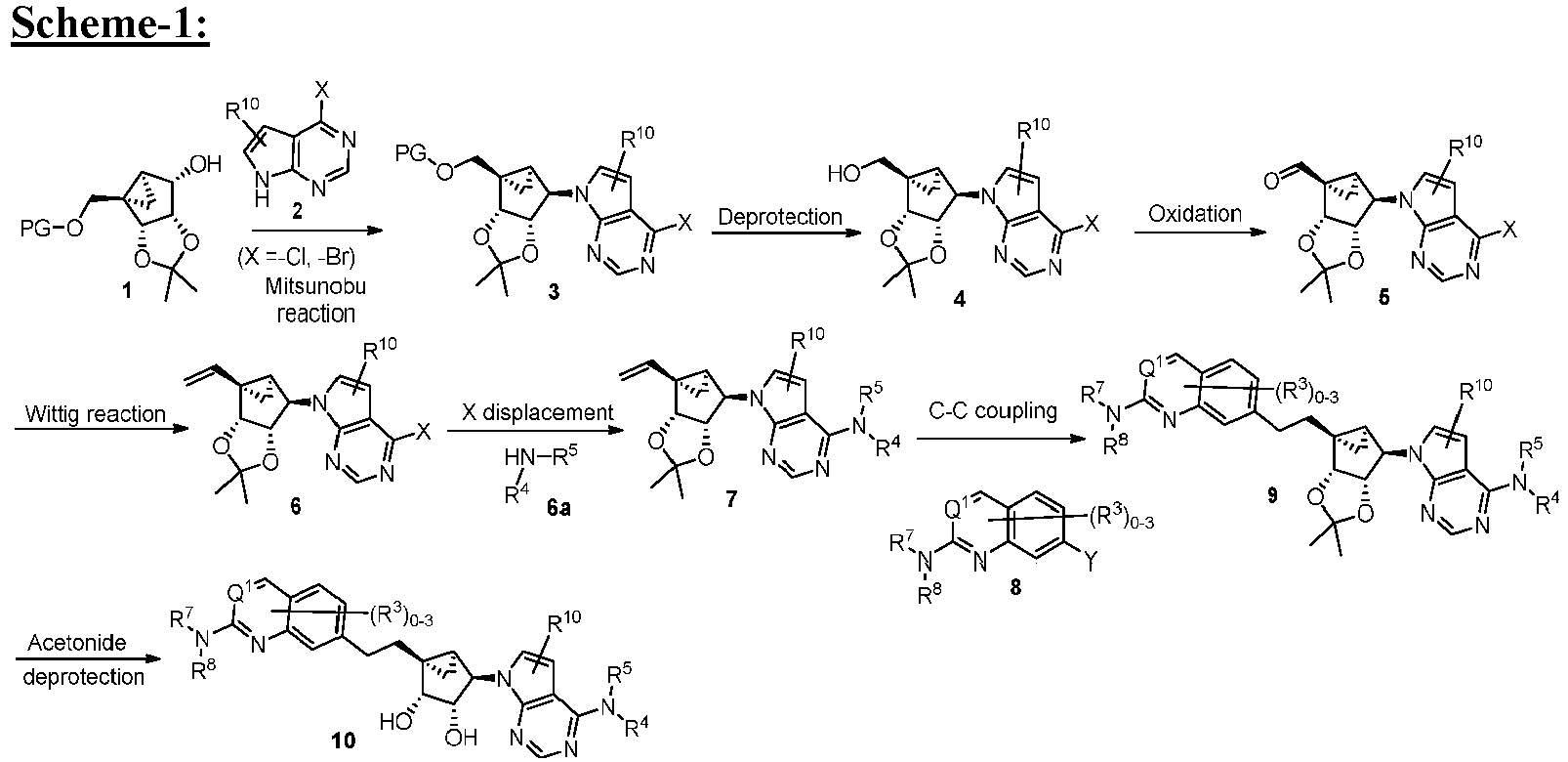
- Scheme-1 illustrates the synthesis of compound of formula 10 (when Q1 is N, CH or CX, where X can be Cl or Br). Compound of formula 1 (where PG = Protecting group), is prepared by following the procedure reported in Kenneth A. Jacobson et.al; Purinergic Signalling (2015) 11:371-387. Mitsunobu reaction of compound of formula 1 with compound of formula 2 (X = -Cl, -Br) using various azo dicarboxylate reagents such as but not limited to DEAD or DIAD in presence of phosphine such as but not limited to PPh3 to form the compound of formula 3. Compound of formula 4 is formed upon treatment of compound of formula 3 with fluoride ions such as but not limited to TBAF. Oxidation of compound of formula 4 with oxidising agents such as but not limited to Dess-Martin periodinane can furnish the compound of formula 5. Reagents such as but not limited to methyltriphenylphosphonium bromide in presence of a base such as but not limited to KOtBu, NaOtBu, LiHMDS, NaHMDS, or KHMDS when treated with compound of formula 5 affords compound of formula 6. Compound of formula 6a (where R4 and R5 are defined herein above) upon treatment with compound of formula 6 affords compound of formula 7. Compound of formula 9 can be achieved by hydroboration of compound of formula 7 with suitable boranes such as but not limited to 9-BBN followed by addition of inorganic base such as but not limited to K3PO4 or Cs2CO3, in presence of Pd catalyst such as but not limited to Pd(dppf)Cl2 or Pd(PPh3)2Cl2 and compound of formula 8 (Y = -Br, - I, which can be prepared by following the procedure reported J. Med. Chem., 2017, 60 (9), 3958-3978). Acetonide deprotection of compound of formula 9 with acids such as but not limited to HCl or TFA affords compound of formula 10.

- Scheme-2 illustrates the synthesis of compound of formula 16. This can be achieved by Mitsunobu reaction of compound of formula 1a, which is prepared by following the procedure reported in Kenneth A. Jacobson et.al; Purinergic Signalling (2015) 11:371-387, with compound of formula 2 using various azo dicarboxylate reagents such as but not limited to DIAD in presence of phosphine such as but not limited to PPh3 to form the compound of formula 11, which can be further converted to compound of formula 12 upon treatment with fluoride ions such as but not limited to TBAF. Mitsunobu reaction of compound of formula 12 with compound of formula 13 (commercially available or synthesized as per known literature, where Q1 = C or N, R3, R7 and R8 are defined herein above) using various azo dicarboxylate reagents such as but not limited to DIAD in presence of phosphine such as but not limited to PPh3 affords the compound of formula 14. Compound of formula 6a upon treatment with compound of formula 14 affords compound of formula 15. Acetonide deprotection of compound of formula 15 with acids such as but not limited to HCl or TFA affords compound of formula 16.

- Scheme-3 illustrates the synthesis of compound of formula 21. Compound of formula 17 is formed upon treatment of compound of formula 12 with oxidising agents such as but not limited to Dess-Martin periodinane. Reagents such as but not limited to methyltriphenylphosphonium bromide in presence of a base such as but not limited to KOtBu, NaOtBu, LiHMDS, NaHMDS, or KHMDS when treated with compound of formula 17 affords compound of formula 18. Compound of formula 19 can be synthesized by hydroboration of compound of formula 18 with suitable boranes such as but not limited to 9-BBN followed by addition of inorganic base such as but not limited to tripotassium phosphate or Cs2CO3, in presence of Pd catalyst such as but not limited to Pd(dppf)Cl2 or Pd(PPh3)2Cl2 and compound of formula 8 (Y = -Br, -I), which was synthesized by following the procedure reported in
WO2012002577 A1 , followed by N-oxide formation, chlorination with phosphoroxychloride and nucleophilic substitution with PMB-NH2 or J. Med. Chem, 2017, 60 (9), 3958-3978). Compound of formula 6a (where R4 and R5 are defined herein above) upon treatment with compound of formula 19 affords compound of formula 20. Acetonide deprotection of compound of formula 20 with acids such as but not limited to HCl or TFA affords compound of formula 21.
- Scheme-4 illustrates the synthesis of compound of formula 27. Compound of formula 22 is formed upon treatment of compound of formula 5 with Grignard reagent such as but not limited to methylmagnesium bromide, ethylmagnesium bromide, cyclopropylmagnesium bromide etc. Compound of formula 22 on oxidation with oxidising agents such as but not limited to Dess-Martin periodinane gives compound of formula 23. Reagents such as but not limited to methyltriphenylphosphonium bromide in presence of base such as but not limited to KOtBu, NaOtBu, LiHMDS, NaHMDS, or KHMDS when treated with compound of formula 23 affords compound of formula 24. Compound of formula 25 can be achieved by hydroboration of compound of formula 24 with suitable boranes such as but not limited to 9-BBN followed by addition of inorganic base such as but not limited to tripotassium phosphate or Cs2CO3, in presence of Pd catalyst such as but not limited to Pd(dppf)Cl2 or Pd(PPh3)2Cl2 and compound of formula 8 (Y = -Br, -I), which was synthesized by following the procedure reported in
WO2012002577 A1 , followed by N-oxide formation, chlorination with Phosphoroxychloride , and nucleophilic substitution with PMB-NH2 or J.Med.Chem, 2017, 60 (9), 3958-3978). Compound of formula 6a (where R4 and R5 are defined herein above) upon treatment with compound of formula 25 affords compound of formula 26. Acetonide deprotection of compound of formula 26 with acids such as but not limited to HCl or TFA affords compound of formula 27.
- Scheme-5 illustrates the synthesis of compound of formula 32. Compound of formula 28 is formed upon treatment of compound of formula 5 with Wittig reagents such as but not limited to (1-iodoethyl) triphenylphosphonium bromide. Compound of formula 29 can be achieved by Suzuki coupling of compound of formula 28 with suitable inorganic base such as but not limited to tripotassium phosphate or Cs2CO3, in presence of Pd catalyst such as but not limited to Pd(PPh3)4, Pd(dppf)Cl2 or Pd(PPh3)2Cl2 and compound of formula 8a (Y = -Br, -I). Compound of formula 6a (where R4 and R5 are defined herein above) upon treatment with compound of formula 29 affords compound of formula 30. Hydrogenation of compound of formula 30 affords compound of formula 31. Acetonide deprotection of compound of formula 31 with acids such as but not limited to HCl or TFA affords compound of formula 32.


- Compound of formula-33 (can be synthesized by following the protocol as mentioned in Med. Chem. Comm.; vol. 4; nb. 5; (2013); p. 822 - 826) upon treatment with iodine in presence of pyridine affords Compound of formula-34, which can be reduced by cerium chloride and sodium borohydride to get compound of formula-35. Mitsunobu reaction using compound of formula-2 with compound of formula-35 provides the compound of formula-36. Halogen of compound of formula-36 on substitution with PMB amine, followed by Suzuki reaction affords the compound of formula-38. TBDMS deprotection of compound of formula-38 followed by tosylation of compound of formula-39 provides compound of formula-40. The tosyl of compound of formula-40 is replaced with compound of formula-13 gives the compound of formula-41, which is further deprotected in acidic condition to get the final compound of formula -42.


- Reaction of compound of formula-43 [can be prepared by method reported in J. Org. Chem. 2014, 79, 8059-8066] with methyl magnesium bromide gives compound of formula-44, with only one stereoisomer with good yield. This when subjected to acetonide shuffling affords compound of formula-46. Mitsunobu reaction using compound of formula 2 with compound of formula-46 yields the compound of formula-47, which can be converted to compound of formula-48 on treating with TBAF. Compound of formula-48 can be oxidized with DMP to afford Compound of formula-49, which can undergo Witting reaction to give compound of formula-50. Compound of formula 51 can be achieved by hydroboration of compound of formula 50 with suitable boranes such as but not limited to 9-BBN followed by addition of inorganic base such as but not limited to K3PO4 or Cs2CO3, in presence of Pd catalyst such as but not limited to Pd(dppf)Cl2 or Pd(PPh3)2Cl2 and compound of formula 8. Compound of formula-51 on treating with aq. ammonia followed by treatment with trifluroacetic acid affords compound of formula-53.

- Compound of formula-48 (compound of formula 48a can be synthesized from 48 by oxidation and Grignard reaction) when condensed with compound of formula-13 using Mitsunobu reaction affords compound of formula-54, which can be reacted with ammonia followed by treatment with trifluroacetic acid to provide a compound of formula 56.

- 6-Halo-oxindole on treatment with a base, and methyl iodide or diiodopropane or appropriately substituted dihalide provides compound of formula-57. Compound of formula 57 when treated with Lawesson's reagent in hydrocarbon solvent such as but not limited to toluene at 100°C for 3h gives compound of formula-58, which is then treated with sodium hydride followed by methyl iodide in THF to yield compound of formula 59. Compound of formula 59 on treating with 7N ammonia in methanol at 100°C for 16h provides compound of formula-60.

- Hydroboration of compound of formula-18 with 9-BBN followed Suzuki coupling with compound of formula-59 in presence of Pd-118 or PdCl2dppf in THF/H2O at 50-70°C for 5-16h provide compound of formula-61, which is then treated with compound of formula-6a followed by TFA to give compound of formula 63.


- Hydroboration of compound of formula-7 with 9-BBN followed Suzuki coupling with compound of formula-59 in presence of Pd-118 or PdCl2dppf in THF/H2O at 50-70°C for 5-16h affords compound of formula-64, which is then treated with compound of formula-6a followed by TFA to afford compound of formula 66.

- Hydroboration of compound of formula-18 with 9-BBN followed Suzuki coupling with compound of formula-67 in presence of Pd-118 in THF/H2O at 50°C for 5-16h affords compound of formula-68, which is when treated with compound of formula-6a followed by TFA affords compound of formula-70. Hydroboration of compound of formula-7 with 9-BBN followed Suzuki coupling with compound of formula-67 in presence of Pd-118 or PdChdppf in THF/H2O at 50-70°C for 5-16h affords compound of formula-71, which is when treated with TFA affords compound of formula-72.


- Hydroboration of compound of formula-6 with 9-BBN followed by Suzuki coupling of compound of formula 8 in presence of Pd-118 or PdCl2dppf in THF/H2O at 50-70°C for 5-16h affords compound of formula 73, which is when treated with compound of formula-6a followed by treatment with TFA affords compound of formula 75.

- Compound of formula-17 when treated with methylmagnesium bromide in THF gives compound of formula-76, which can be oxidized by DMP in methylene chloride at 0°C to afford compound of formula-77. Addition of methylmagnesium bromide on compound of formula-77 provides compound of formula-78. Dehydration of compound of formula-78 with Martin Sulfurane gives compound of formula-79, which then treated with 9-BBN followed by Suzuki coupling with compound of formula-8 in presence of Pd-118 or PdCl2dppf in THF/H2O at 50-70°C for 5-16h affords compound of formula-80. Treating compound of formula-80 with compound of formula 6a followed by treatment with TFA affords compound of formula-82.


- Compound of formula-11 on treatment with trimethylboroxine in presence of tripotassium phosphate, and Pd-118 or PdChdppf gives mixture of compound of formula-83 and compound of formula-84. The PG of compound of formula-83 can be deprotected to afford compound of formula-85, which on oxidation with DMP gives compound of formula-86. Wittig reaction of compound of formula-86 provides compound of formula-87. Hydroboration of compound of formula-87 with 9-BBN followed by Suzuki coupling with compound of formula-8 in presence of Pd-118 or PdCl2dppf in THF/H2O at 50-70°C for 5-16h affords compound of formula-88, which when treated with TFA affords compound of formula-89.
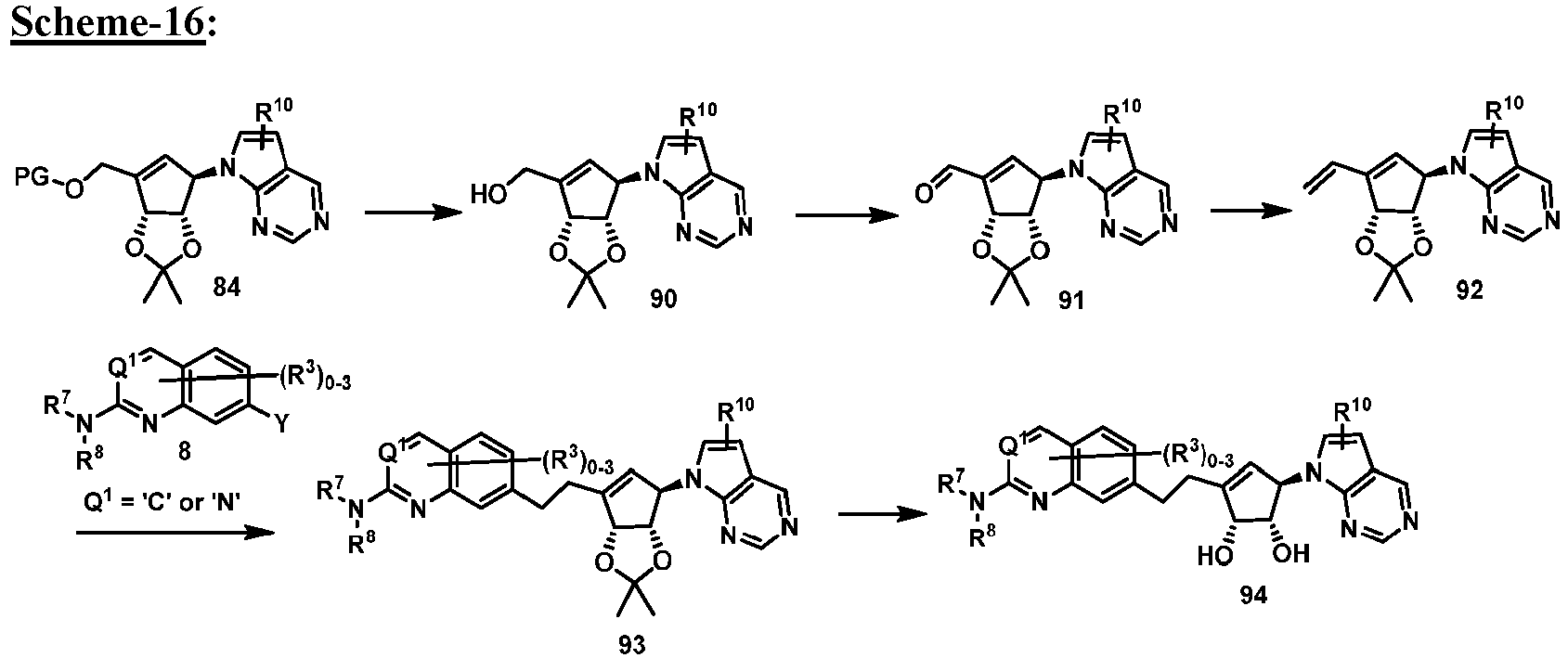
- The protecting group of compound of formula-84 can be deprotected to afford compound of formula-90, which on oxidation with DMP gives compound of formula-91. Wittig reaction of compound of formula-91 provides compound of formula-92. Hydroboration of compound of formula-92 with 9-BBN followed by Suzuki coupling with compound of formula-8 in presence of Pd-118 or PdCl2dppf in THF/H2O at 50-70°C for 5-16h affords compound of formula-93, which is then treated with TFA to afford compound of formula 94.

- Reductive amination of compound of formula-17 with compound of formula-95 affords compound of formula-96, which is then treated with compound of formula-6a followed by treatment with TFA to afford compound of formula-98.

- Compound of formula-12 is treated with TsCl/ MsCl in presence of a base to give a compound of formula -99, which is then reacted with compound of formula-100 to yield compound of formula -101. Reaction of compound of formula-101 with compound of formula-6a followed by treatment with TFA affords compound of formula-103.


- Compound of formula-99 is reacted with compound of formula-104 in presence of a base such as but not limited to cesium carbonate to afford a compound of formula-105. Substitution reaction of compound of formula-105 with compound of formula-6a followed by treatment with TFA affords compound of formula-107.

- The compound of formula-109 can be synthesized by Mitsunobu reaction of compound of formula 1a with compound of formula 108 using various azo dicarboxylate reagents such as but not limited to DIAD in presence of phosphine such as but not limited to PPh3. Compound of formula-109 can be further converted to compound of formula 110 upon treatment with fluoride ions such as but not limited to TBAF. Oxidation followed by Wittig reaction on compound of formula 110 gives compound of formula 112. The aromatic halogen of compound of formula 112 can be converted to alkyl groups such as a methyl group using Pd-118 or PdCl2dppf with trimethylboroxine to afford compound of formula 113. Hydroboration of compound of formula-113 with 9-BBN followed by Suzuki coupling with compound of formula-8 in presence of Pd-118 or PdCl2dppf in THF/H2O at 50-70°C for 5-16h affords compound of formula-114, which when treated with TFA or HCl/MeOH affords compound of formula-115.

- Mitsunobu reaction of compound of formula 4 (can be prepared from compound of formula 1 as described in scheme 1) with compound of formula 13 using various azo dicarboxylate reagents such as but not limited to DIAD in presence of phosphine such as but not limited to PPh3 provides compound of formula 116. Compound of formula-116 on treating compound of formula 6a followed by treatment with trifluroacetic acid affords compound of formula-118.

- Scheme-22 illustrates the synthesis of compound of formula 126. Compound of formula 119 (where PG = Protecting group), is prepared by Simmon Smith reaction. Mitsunobu reaction of compound of formula 119 with compound of formula 2 (X = -Cl, -Br) using various azo dicarboxylate reagents such as but not limited to DEAD or DIAD in presence of phosphine such as but not limited to PPh3 to form the compound of formula 120. Compound of formula 121 is formed upon treatment of compound of formula 120 with fluoride ions such as but not limited to TBAF. Oxidation of compound of formula 121 with oxidising agents such as but not limited to Dess-Martin periodinane can furnish the compound of formula 122. Reagents such as but not limited to methyltriphenylphosphonium bromide in presence of a base such as but not limited to KOtBu, NaOtBu, LiHMDS, NaHMDS, or KHMDS when treated with compound of formula 122 affords compound of formula 123. Amine of formula 6a (where R4 and R5 are defined herein above) upon treatment with compound of formula 123 affords compound of formula 124. Compound of formula 125 can be achieved by hydroboration of compound of formula 124 with suitable boranes such as but not limited to 9-BBN followed by addition of inorganic base such as but not limited to K3PO4 or Cs2CO3, in presence of Pd catalyst such as but not limited to Pd(dppf)Cl2 or Pd(PPh3)2Cl2 and compound of formula 8 (Y = - Br, -I, which can be prepared by following the procedure reported J. Med. Chem., 2017, 60 (9), 3958-3978). Acetonide deprotection of compound of formula 125 with acids such as but not limited to HCl or TFA affords compound of formula 126.

- Suzuki coupling of compound of formula 10 with aryl or heteroaryl boronic acid or ester in presence of Pd(PPh3)4 or Pd-118 or PdCl2dppf in dioxane at 80-100°C for 5-16h affords compound of formula-127.

- Compound of formula-18 when treated with compound of formula-128 using Suzuki coupling affords compound of formula-129. Compound of formula 130 can be achieved by hydroboration of compound of formula 129 with suitable boranes such as but not limited to 9-BBN followed by addition of inorganic base such as but not limited to K3PO4 or Cs2CO3, in presence of Pd catalyst such as but not limited to Pd(dppf)Cl2 or Pd(PPh3)2Cl2 and compound of formula 8 (Y = -Br, -I, which can be prepared by following the procedure reported J. Med. Chem., 2017, 60 (9), 3958-3978). Acetonide deprotection of compound of formula 130 with acids such as but not limited to HCl or TFA affords compound of formula 131.

- Compound of formula-76 when condensed with compound of formula-13 using Mitsunobu reaction affords compound of formula-132, which can be reacted with compound of formula-6a followed by treatment with trifluroacetic acid to provide a compound of formula-134.

- Compound of formula-48a when treated DMP in methylene chloride at 0°C to afford compound of formula -135, which when react with methylmagnesium bromide in THF gives compound of formula-136. Dehydration of compound of formula-136 with Martin Sulfurane gives compound of formula-137, which then treated with 9-BBN followed by Suzuki coupling with compound of formula-8 in presence of Pd-118 or PdChdppf in THF/H2O at 50-70°C for 5-16h affords compound of formula-138. Treating compound of formula-138 with compound of formula 6a followed by treatment with TFA affords compound of formula-140.

- Compound of formula-4 is treated with TsCl/ MsCl in presence of a base to give a compound of formula 141. Compound of formula-141 is reacted with compound of formula-104 in presence of a base such as but not limited to cesium carbonate to afford a compound of formula -142. Substitution reaction of compound of formula-142 with compound of formula-6a followed by treatment with TFA affords compound of formula-144.
- The following abbreviations may be used herein:
- AcOH = Acetic acid
- Aq.= aqueous
- ca = about or approximately
- NH4Cl = Ammonium chloride
- 9-BBN = 9-Borabicyclononane
- BINAP = 2,2'-Bis(diphenylphosphino)-1,1'-binaphthyl
- Boc = tert-Butoxycarbonyl
- t-Bu or tBu = tert-Butyl
- Cs2CO3 = Cesium Carbonate
- CHCl3 = Chloroform
- CDCl3 = Deuterated chloroform
- DAST = Diethylaminosulphur trifluoride
- dba = Dibenzylideneacetone
- CH2Cl2 or DCM = Dichloromethane
- DMP = Dess Martin Periodinane
- DEAD = Diethyl azodicarboxylate
- DIAD = Diisopropyl azodicarboxylate
- DIPEA = Diisopropylethylamine
- DMAP = 4-Dimethylaminopyridine
- DMF = N,N-Dimethylformamide
- DMSO = Dimethylsulphoxide
- DMSO-d6 = Deuterated dimethylsulphoxide
- Et = ethyl
- EtOH = Ethanol
- EtOAc = Ethyl acetate
- g = gram
- H2O2 = Hydrogen peroxide
- H2SO4 = Sulphuric acid
- K2CO3 = Potassium carbonate
- KOH = Potassium hydroxide
- KOtBu = Potassium tert-butoxide
- K3PO4 = Potassium phosphate
- KHMDS = Potassium bis(trimethylsilyl)amide
- LDA = Lithium diisopropylamide
- LHMDS = Lithium bis(trimethylsilyl)amide
- LCMS = Liquid chromatography mass spectrometry
- m-CPBA = meta-chloroperoxybenzoic acid
- mg = milligram
- Me = Methyl
- MeOH = Methanol
- MeOD = Deuterated methanol
- MS = Molecular sieves
- MsCl = Methanesulphonyl chloride
- MgSO4 = Magnesium sulphate
- NaH = Sodium hydride
- NaOtBu = Sodium tert-butoxide
- NaHCO3 = Sodium bicarbonate
- Na2SO4 = Sodium sulphate
- Na2S2O3 = Sodium thiosulphate
- Na2SO3 = Sodium sulphite
- NaHMDS = Sodium bis(trimethylsilyl)amide
- NMP = N-Methyl-2-pyrrolidone
- NBS = N-Bromosuccinimide
- NCS = N-Chlorosuccinimide
- NIS = N-Iodosuccinimide
- NMO = N-Methylmorpholine-N-oxide
- NMR = Nuclear magnetic resonance
- Ph = phenyl
- PDC = Pyridinium dichlorochromate
- Pd(OAc)2 = Palladium acetate
- Pd/C = Palladium on carbon
- Pd-118 = [1,1'-Bis(di-tert-butylphosphino)ferrocene]dichloropalladium(II)
- Pd(PPh3)4 = Tetrakis(triphenylphosphine)palladium(0)
- POCl3 = Phosphorous oxychloride
- PdCl2(dppf) = [1,1'-Bis(diphenylphosphino)ferrocene] dichloropalladium(II)
- Pd(PPh3)2Cl2 = Bis(triphenylphosphine)palladium(II) dichloride
- PCC = Pyridinium chlorochromate
- PMB = p-Methoxybenzyl
- PTSA = p-Toluenesulphonic acid
- Rt = Retention time
- rt = room temperature
- Sat.= saturated
- SFC = Supercritical fluid chromatography
- TLC = Thin layer chromatography
- TBAF = Tetrabutylammonium fluoride
- TsCl = p-Toluenesulphonyl chloride
- TBDMS = tert-Butyldimethylsilyl
- TBDPS = tert-Butyldiphenylsilyl
- Et3N or NEt3 or TEA = Triethylamine
- TFA = Trifluoroacetic acid
- THF = Tetrahydrofuran
- Ts = p-Toluenesulphonyl
- p-TsOH = p-Toluenesulphonic acid
-

- The title compound was prepared by following an analogous reaction protocol as described in Cinelli, Maris A et al, Journal of Medicinal Chemistry, 2017, vol. 60, # 9, p. 3958 - 3978.
-

- The title compound was prepared by following an analogous reaction protocol as described in
Arnould, Jean-Claude et al, WO 2007/141473 A1 . -

- The title compound was prepared by following same reaction protocol as described in
Arnould, Jean-Claude et al, WO 2007/141473 A1 . -

- The title compound was prepared by following an analogous reaction protocol as described in
Arnould, Jean-Claude et al, WO 2007/141473 A1 . -

- The title compound was prepared by following an analogous reaction protocol as described in
Arnould, Jean-Claude et al, WO 2007/141473 A1 . -

- The title compound was prepared by following analogous reaction protocol as described in
Arnould, Jean-Claude et al, WO 2007/141473 A1 . -

- The title compound was prepared by following same reaction protocol as described in
Aciro, Caroline et al, WO2013/185103 A1 . -

- The title compound was prepared by following same reaction protocol as described in
Vialard, Jorge Eduardo et al, WO2008/107478 A1 ; LCMS m/z= 284.1, 286.1 (M+, M+2; 100%). -

- To a stirred solution of 4-bromo-2-fluoro-6-nitrobenzaldehyde (prepared by following same reaction protocol as described in
Li, Liansheng et al, WO 2015/054572 A1 ; 4.15g, 16.73 mmol) in ethanol (20ml) & acetic acid (20ml) was added iron powder (2.80 g, 50.2 mmol) at 0°C and stirred the reaction mixture for 1h. The reaction mixture was diluted with ethyl acetate (70ml) and netralized with aq. sat. NaHCO3 (100 ml). The resulting emulsion was filtered through celite. Layers were separated, organic layer was washed with brine (100 ml) and dried over anhydrous Na2SO4. The organic layer was filtered and concentrated in vacuo to afford (3.36g, 92%) as a light green solid which was used for next step without purification. 1H NMR (400 MHz, DMSO-d6) δ 10.10 (s, 1H), 7.78 - 7.54 (m, 2H), 6.84 (t, J= 1.5 Hz, 1H), 6.64 (dd, J = 11.1, 1.8 Hz, 1H). -

- A solution of iodine (10.43g, 41.1mmol), potassium iodate (1.247g, 5.83mmol) in conc. H2SO4 (51.4g, 525mmol) was added to a solution of 1-chloro-2-methyl-3-nitrobenzene (5g, 29.1mmol) in conc. H2SO4 (51.4g, 525mmol) at 25°C. The resulting mixture was stirred at 25°C for 6h. The reaction mixture was added slowly onto crushed ice and extracted the product with ethyl acetate (75ml). The organic layer was washed with aq.sat.NaHCO3 (75ml), aq.sat.Na2S2O3 (75ml) and brine (75ml) successively. Dried the organic layer over anhydrous Na2SO4, filtered and concentrated in vacuo to give 9g of crude compound. This residue was purified by combiflash (Rf200, Teledyne/Isco) instrument onto a redisep® Rf column with elution of petroleum ether to afford the title compound (8.5g, 98%) as a pale yellow oil. 1H NMR (400 MHz, Chloroform-d) δ 8.02 (d, J = 1.4 Hz, 1H), 7.96 (d, J = 1.7 Hz, 1H), 2.50 (s, 3H).
-

- To a stirred solution of 1-chloro-5-iodo-2-methyl-3-nitrobenzene (27.5g, 92mmol) in CCl4 (280 ml) was added NBS (19.74g, 111mmol) and benzoyl peroxide (2.99g, 9.24 mmol) at 25°C. The resulting mixture was stirred at 80°C for 15h. The solvent was evaporated in vacuo and this residue was purified by combiflash (Rf200, Teledyne/Isco) instrument onto a redisep® Rf column with gradient elution of (0 to 1%) of ethyl acetate in petroleum ether to afford the title compound (12g, 34.5 %) as an off-white solid. 1H NMR (400 MHz, DMSO-d6) δ 8.37 - 8.33 (m, 2H), 4.72 (s, 2H).
-

- To a stirred solution of 2-(bromomethyl)-1-chloro-5-iodo-3-nitrobenzene (12 g, 31.9 mmol) in acetonitrile (150ml) was added 4-methylmorpholine-N-oxide (9.19 g, 78 mmol) and molecular sieves 4A° (30g) at 25°C. The resulting mixture was stirred at 25°C for 1.5h. Water (75ml) was added, pH was adjusted to 6 by adding IN HCl. Extracted the product with ethyl acetate (75ml). Layers were separated, organic layer was washed with brine (20ml) and dried over anhydrous Na2SO4. The organic layer was filtered and concentrated in vacuo to give 16.5g of crude compound. This residue was purified by combiflash (Rf200, Teledyne/Isco) instrument onto a redisep® Rf column with gradient elution (0 to 4%) of ethyl acetate in petroleum ether to afford the title compound (7g, 70.5%) as an off-white solid. 1H NMR (400 MHz, DMSO-d6) δ 10.22 (s, 1H), 8.46 (s, 2H).
-

- The title compound was prepared by following an analogous reaction protocol as described in the preparation of 2-amino-4-bromo-6-fluorobenzaldehyde. 1H NMR (400 MHz, DMSO-d6) δ 10.26 (s, 1H), 7.80 - 7.55 (m, 2H), 7.23 (d, J = 1.4 Hz, 1H), 6.99 (d, J = 1.5 Hz, 1H).
-

- To a stirred solution of 2-fluoro-4-methyl-5-nitroaniline (2.0 g, 11.75 mmol) in conc.HCl (6.15 ml, 73.8 mmol) was added a solution of sodium nitrite (0.884 g, 12.81 mmol) in water (4ml) in a dropwise manner at 0°C. After stirring for 15mins, the mixture was filtered through a cotton pad and slowly poured into a stirred solution of potassium iodide (6.83 g, 41.1mmol) in water (25ml) at 0°C. The resulting mixture was stirred at 25°C for 16h. The reaction mixture was diluted with ethyl acetate (20ml) and washed with 10% aq.NaOH (50ml), aq.sat.NaHCO3 (50ml) successively. Layers were separated, organic layer was washed with brine (50ml) and was dried over anhydrous Na2SO4. The organic layer was filtered and concentrated in vacuo to give 3.1g of crude compound. This residue was purified by combiflash (Rf200, Teledyne/Isco) instrument onto a redisep® Rf column with petroleum ether as a eluent to afford the title compound (1.7g, 51.5%) of the title compound as an off-white solid. 1H NMR (400 MHz, Chloroform-d) δ 8.45 (d, J = 5.7 Hz, 1H), 7.06 (d, 1H), 2.62 (d, J= 0.7 Hz, 3H); GCMS m/z= 281.03 (M+, 50%).
-

- The title compound was prepared by following an analogous reaction protocol as described in the preparation of 2-(bromomethyl)-1-chloro-5-iodo-3-nitrobenzene. 1H NMR (400 MHz, Chloroform-d) δ 8.53 (d, J= 5.6 Hz, 1H), 7.31 (d, J= 7.8 Hz, 1H), 4.80 (s, 2H).
-

- The title compound was prepared by following an analogous reaction protocol as described in the preparation of 2-chloro-4-iodo-6-nitrobenzaldehyde. 1H NMR (400 MHz, Chloroform-d) δ 10.42 (d, J = 2.3 Hz, 1H), 8.62 (d, J = 5.1 Hz, 1H), 7.60 (d, J = 7.2 Hz, 1H).
-

- The title compound was prepared by following an analogous reaction protocol as described in the preparation of 2-amino-4-bromo-6-fluorobenzaldehyde. 1H NMR (400 MHz, Chloroform-d) δ 9.78 (d, J = 0.6 Hz, 1H), 7.17 - 7.13 (m, 2H), 5.98 (s, 2H).
-

- To a stirred mixture of 2-amino-4-bromobenzaldehyde (2 g, 10.00 mmol) and 2-cyclopropylacetaldehyde (0.841 g, 10.00 mmol) in absolute ethanol (12ml) was added a solution of KOH (0.191 g, 3.40 mmol) in ethanol (12ml) in a dropwise manner under N2 atmosphere. The resulting mixture was stirred at 95°C for 5h. The volatiles were evaporated in vacuo and the residue was dissolved in dichloromethane (60 ml) and washed with water (40 ml). Layers were separated, organic layer was washed with brine (50 ml) and dried over anhydrous Na2SO4. The organic layer was filtered and concentrated in vacuo to give 2.5g of crude compound. This residue was purified by combiflash (Rf200, Teledyne/Isco) instrument onto a redisep® Rf column with gradient elution (0 to 6%) of ethyl acetate in petroleum ether to afford 7-bromo-3-cyclopropylquinoline (1g, 40.3%) as a pale yellow solid. 1H NMR (400 MHz, DMSO-d6) δ 8.80 (d, J= 2.3 Hz, 1H), 8.17 (d, J= 2.1 Hz, 1H), 8.00 (d, J = 2.4 Hz, 1H), 7.89 - 7.80 (m, 1H), 7.70 (dd, J = 8.8, 2.1 Hz, 1H), 2.15 (tt, J = 8.1, 5.1 Hz, 1H), 1.14 - 1.03 (m, 2H), 0.95 - 0.81 (m, 2H); LCMS m/z= 247.83, 249.83 (M+, M+2, 100%).
-

- A mixture of 1-(7-bromoquinolin-3-yl)ethan-1-one (synthesized by following same reaction protocol as described in
Alam, Muzaffar et al, US20120230951 A1 ; 2.4 g, 9.60 mmol) in diethylaminosulfur trifluoride (2.5 ml, 18.92 mmol) was stirred at 70°C for 16h. The resulting mixture was slowly poured into aq. sat. sodium bicarbonate (50ml) and extracted with dichloromethane (50ml). Layers were separated, organic layer was washed with brine (20ml) and dried over anhydrous Na2SO4. The organic layer was filtered and concentrated in vacuo to give 3.2g of crude compound. This residue was purified by combiflash (Rf200, Teledyne/Isco) instrument onto a redisep® Rf column with gradient elution (0 to 30%) of ethyl acetate in petroleum ether to afford the title compound (1.7g, 65.1 %) as a pale yellow solid. 1H NMR (400 MHz, DMSO-d6) δ 9.13 (d, J = 2.4 Hz, 1H), 8.71 (s, 1H), 8.34 (d, J = 2.1 Hz, 1H), 8.11 (d, J= 8.7 Hz, 1H), 7.88 (dd, J = 8.7, 2.0 Hz, 1H), 2.14 (t, J = 19.2 Hz, 3H), LCMS m/z= 271.90, 273.90 (M+1; 100%). -

- To a stirred solution of 7-bromo-8-fluoroquinoline (synthesized by following same reaction protocol as described in
Ghergurovich, Jonathan Michael et al, WO2013028447 A1 , 3.4 g, 15.04 mmol) in DMF (10ml) was added N-chlorosuccinimide (4.02g, 30.1mmol) at 25°C. The reaction mixture was stirred at 100°C for 16h. The reaction mixture was cooled to 25°C and poured onto ice cold water (100ml) and stirred for 30 minutes. The precipitate was collected by filtration and washed with water. The precipitate was dried in vacuo to afford the title compound (2g, 51%) as an off-white solid. 1H NMR (400 MHz, Chloroform-d) δ 8.90 (d, J = 2.3 Hz, 1H), 8.18 (t, J= 1.9 Hz, 1H), 7.72 (dd, J = 8.9, 6.1 Hz, 1H), 7.48 (dd, J = 8.8, 1.5 Hz, 1H); LCMS m/z= 261.71 (M+; 100%). -

- To a stirred solution of 2-amino-4-bromo-6-fluorobenzaldehyde (3.36 g, 15.41 mmol) in toluene (35 ml) was added 2-chloro-1,1-dimethoxyethane (2.304 g, 18.49 mmol) followed by p-toluene sulfonic acid monohydrate (2.93 g, 15.41 mmol) at 25°C. The resulting mixture was stirred at 110°C using Dean Stark apparatus for 4h under N2 atmosphere. The reaction mixture was diluted with ethyl acetate (100ml) and basified with aq.sat.NaHCO3 (75ml). Layers were separated, organic layer was washed with brine (20ml) and dried over anhydrous Na2SO4. The organic layer was filtered and concentrated in vacuo to give 1.1g of crude compound. This residue was purified by combiflash (Rf200, Teledyne/Isco) instrument onto a redisep® Rf column with gradient elution (0 to 2%) of ethyl acetate in petroleum ether to afford the title compound (1.64g, 40.9%) as a light green solid. 1H NMR (400 MHz, Chloroform-d) δ 8.88 (d, J= 2.4 Hz, 1H), 8.38 (d, J= 2.4 Hz, 1H), 8.15 (s, 1H), 7.45 (ddd, J= 9.0, 3.5, 1.8 Hz, 1H); LCMS m/z=261.76 (M+1, 100%).
- Intermediates in table-1 were synthesized by following an analogous reaction protocol as was used for the preparation of 7-bromo-3-chloro-5-fluoroquinoline using the appropriate starting materials.
Table-1: Intermediate's Structure Starting materials used 1H NMR and LCMS data 
2-Amino-4-bromo-5-fluorobenzaldehyde, which was synthesized as per US2014/200216 A1 .1H NMR (400 MHz, Chloroform-d) δ 8.81 (s, 1H), 8.43 - 8.38 (m, 1H), 8.12 - 8.08 (m, 1H), 7.47 (d, J = 8.4 Hz, 1H); LCMS m/z= 261.83 (M+1; 100%). 7-Bromo-3-chloro-6-fluoroquinoline 
2-Amino-6-chloro-4-iodobenzaldehyde 1H NMR (400 MHz, Chloroform-d) δ 8.85 (d, J = 2.3 Hz, 1H), 8.50 (dd, J = 2.3, 0.9 Hz, 1H), 8.48 - 8.45 (m, 1H), 7.96 (d, J = 1.6 Hz, 1H). 3,5-Dichloro-7-iodoquinoline 
2-Amino-4-bromo-6-fluorobenzaldehyde Crude was taken as such for the next step 3,7- Dibromo-5-fluoroquinoline 
2-Amino-5-fluoro-4-iodobenzaldehyde 1H NMR (400MHz, Chloroform-d) δ 8.88 (d, J = 2.2 Hz, 1H), 8.61 (d, J = 6.0 Hz, 1H), 8.27 (d, J = 2.3 Hz, 1H), 7.39 (d, J = 7.8 Hz, 1H); LCMS m/z= 351.03, 353.03 (M-1, M+1, 60%). 3-Bromo-6-fluoro-7-iodoquinoline -

- A mixture of 7-bromo-3-chloro-5-fluoroquinoline (1.64 g, 6.30 mmol) and m-CPBA (2.90 g, 12.59 mmol) in CHCl3 (30ml) was heated at 50°C for 16h. The reaction mixture was diluted with chloroform (50ml) and washed with aq.sat. Na2SO3 (50ml) followed by aq.sat.NaHCO3 (50ml). Layers were separated, organic layer was washed with brine (50ml) and dried over anhydrous Na2SO4. The organic layer was filtered and concentrated in vacuo to give 1.35g of crude compound. This residue was purified by combiflash (Rf200, Teledyne/Isco) instrument onto a redisep® Rf column with gradient elution (0 to 20%) of ethyl acetate in petroleum ether to afford the title compound (542mg, 31.1%) as a light brown solid. 1H NMR (400 MHz, DMSO-d6) δ 8.97 (d, J = 1.8 Hz, 1H), 8.46 (s, 1H), 8.17 - 8.10 (m, 1H), 8.03 (dd, J = 9.5, 1.9 Hz, 1H); LCMS m/z= 275.83, 277.83 (M+, M+2; 100%).
- Intermediates in table-2 were synthesized by following an analogous reaction protocol as was used for the preparation of 7-bromo-3-chloro-5-fluoroquinoline 1-oxide using the appropriate starting materials.
Table-2: Intermediate's Structure Starting materials used 1H NMR and LCMS data 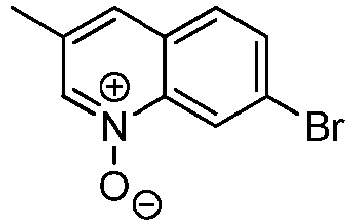
7-Bromo-3-methylquinoline 1H NMR (400 MHz, DMSO-d6) δ 8.60 (dd, J = 12.2, 1.7 Hz, 2H), 7.97 (d, J = 8.7 Hz, 1H), 7.85 (dd, J = 8.7, 2.0 Hz, 1H), 7.77 (q, J = 1.1 Hz, 1H), 2.40 (d, J = 1.0 Hz, 3H); LCMS m/z= 237.9, 239.9 (M+, M+2, 100%). 7-Bromo-3-methylquinoline 1-oxide 
7-Bromo-3-cyclopropylquinoline 1H NMR (400 MHz, DMSO-d6) δ 8.58 (dd, J = 13.9, 1.7 Hz, 2H), 7.93 (d, J = 8.7 Hz, 1H), 7.84 (dd, J = 8.7, 2.1 Hz, 1H), 7.66 (s, 1H), 2.08 (tt, J = 8.4, 5.0 Hz, 1H), 1.12 - 1.04 (m, 2H), 0.95 - 0.87 (m, 2H); LCMS m/z= 263.83, 265.83 (M+, M+2, 100%). 7-Bromo-3-cyclopropylquinoline 1-oxide 
7-Bromo-3-(1,1-difluoroethyl) quinoline LCMS m/z= 289.96 (M+1; 100%). 7-Bromo-3-(1,1-difluoroethyl)quinoline 1-oxide 
7-Bromo-3-methoxy quinoline, which was synthesized as per Adams, Nicholas David et al, WO2014/008223 A1 .Crude was taken as such for the next step 7-Bromo-3-methoxyquinoline 1-oxide 
7-Bromo-3-chloro-6-fluoroquinoline 1H NMR (400 MHz, DMSO-d6) δ 8.87 (d, J = 1.8 Hz, 1H), 8.75 (d, J = 6.6 Hz, 1H), 8.14-8.03 (m, 2H); LCMS m/z= 275.77 (M+1; 60%). 7-Bromo-3-chloro-6-fluoroquinoline 1-oxide 
7-Bromo-3-chloro-8-fluoroquinoline 1H NMR (400 MHz, DMSO-d6) δ 8.78 (d, J = 1.5 Hz, 1H), 8.17 (s, 1H), 7.99 (dd, J = 8.8, 5.7 Hz, 1H), 7.80 (dd, J = 8.8, 1.6 Hz, 1H); LCMS m/z= 277.83 (M+1; 100%). 7-Bromo-3-chloro-8-fluoroquinoline 1-oxide 
3,5-Dichloro-7-iodoquinoline 1H NMR (400 MHz, DMSO-d6) δ 8.95 (d, J = 1.7 Hz, 1H), 8.80 (t, J = 1.3 Hz, 1H), 8.33 (d, J = 1.6 Hz, 1H), 8.08 (t, J = 1.3 Hz, 1H). 3,5-Dichloro-7-iodoquinoline 1-oxide 
3,7-Dibromo-5-fluoroquinoline LCMS m/z= 322.0 (M+1; 100%). 3,7-Dibromo-5-fluoroquinoline 1-oxide 
3-Bromo-6-fluoro-7-iodoquinoline 1H NMR (400 MHz, DMSO-d6) δ 8.91 (d, J = 6.0 Hz, 1H), 8.87 (d, J = 1.5 Hz, 1H), 8.22 (t, J = 1.1 Hz, 1H), 7.92 (d, J = 8.3 Hz, 1H). 3-Bromo-6-fluoro-7-iodoquinoline 1-oxide -

- To a stirred solution of 7-bromo-3-chloro-5-fluoroquinoline 1-oxide (542 mg, 1.960 mmol) in CHCl3 (10 ml) was added POCl3 (1.867 ml, 20.03 mmol) at 25°C. The resulting mixture was stirred at 65°C for 2h under N2 atmosphere. The reaction mixture was poured onto ice cold water (50ml), carefully basified with solid NaHCO3 and extracted the product with dichloromethane (50ml). Layers were separated, organic layer was washed with brine (50ml) and was dried over anhydrous Na2SO4. The organic layer was filtered and concentrated in vacuo to give 1.2g of crude compound. This residue was purified by combiflash (Rf200, Teledyne/Isco) instrument onto a redisep® Rf column with gradient elution (0 to 10%) of ethyl acetate in petroleum ether to afford the title compound (410mg, 70.9%) as a white solid. 1H NMR (400 MHz, Chloroform-d) δ 8.49 - 8.43 (m, 1H), 8.04 (dt, J = 1.9, 1.0 Hz, 1H), 7.45 (dd, J = 8.9, 1.7 Hz, 1H); LCMS m/z= 296.19 (M+1; 100%). Intermediates in table-3 were synthesized by following an analogous reaction protocol as was used for the preparation of 7-bromo-2,3-dichloro-5-fluoroquinoline using the appropriate starting materials.
Table-3: Intermediate's Structure Starting materials used 1H NMR and LCMS data 
7-Bromo-3-methylquinoline 1-oxide 1H NMR (400 MHz, DMSO-d6) δ 8.40 (t, J = 1.0 Hz, 1H), 8.17 (d, J = 2.0 Hz, 1H), 7.94 (d, J = 8.7 Hz, 1H), 7.78 (dd, J = 8.7, 2.0 Hz, 1H), 2.48 (d, J = 1.0 Hz, 3H); LCMS m/z= 256, 258 (M+, M+2, 100%). 7-Bromo-2-chloro-3-methylquinoline 
7-Bromo-3-cyclopropylquinoline 1-oxide 1H NMR (400 MHz, DMSO-d6) δ 8.16 (d, J = 3.0 Hz, 2H), 7.92 (d, J = 8.7 Hz, 1H), 7.77 (dd, J = 8.7, 2.0 Hz, 1H), 2.21 (tt, J = 8.4, 5.3 Hz, 1H), 1.10 (dt, J = 8.5, 3.2 Hz, 2H), 0.92 - 0.81 (m, 2H); LCMS m/z= 281.90, 283.90 (M+, M+2, 100%). 7-Bromo-2-chloro-3-cyclopropyl quinoline 
7-Bromo-3-(1,1-difluoroethyl) quinoline 1-oxide LCMS m/z= 306, 308 (M+, M+2; 100%). 7- Bromo-2-chloro-3-(1,1-difluoro ethyl)quinoline 
7-Bromo-3-methoxyquinoline 1-oxide LCMS m/z= 271.69, 273.69 7-Bromo-2-chloro-3-methoxy quinoline 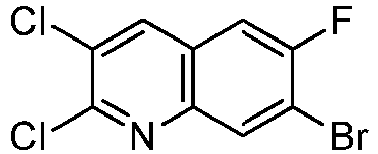
7-Bromo-3-chloro-6-fluoroquinoline 1-oxide 1H NMR (400 MHz, Chloroform-d) δ 8.31 (d, J = 6.3 Hz, 1H), 8.23 - 8.18 (m, 1H), 7.48 (d, J = 8.2 Hz, 1H). 7-Bromo-2,3-dichloro-6-fluoro quinoline 
7-Bromo-3-chloro-8-fluoroquinoline 1-oxide 1H NMR (400 MHz, DMSO-d6) δ 8.94 (d, J = 1.6 Hz, 1H), 7.97 (dd, J = 8.9, 6.3 Hz, 1H), 7.83 (dd, J = 8.9, 1.3 Hz, 1H), LCMS m/z= 295.65 (M+1; 100%). 7-Bromo-2,3-dichloro-8-fluoro quinoline 
3,5-Dichloro-7-iodoquinoline 1-oxide 1H NMR (400 MHz, Chloroform-d) δ 8.59 (d, J = 0.8 Hz, 1H), 8.38 (dd, J = 1.6, 0.8 Hz, 1H), 7.96 (d, J = 1.5 Hz, 1H). 2,3,5-Trichloro-7-iodoquinoline 
3,7-Dibromo-5-fluoroquinoline 1-oxide Crude was taken as such for the next step 3,7-Dibromo-2-chloro-5-fluoro quinoline 
3-Bromo-6-fluoro-7-iodoquinoline 1-oxide 1H NMR (400 MHz, Chloroform-d) δ 8.54 (dd, J = 5.9, 0.7 Hz, 1H), 8.38 (s, 1H), 7.40 (d, J = 7.6 Hz, 1H). 3-Bromo-2-chloro-6-fluoro-7-iodoquinoline -

- A mixture of 7-bromo-2,3-dichloro-5-fluoroquinoline (410mg, 1.390mmol), aqueous ammonia (9.74 ml, 250 mmol) in dioxane (10ml) was heated at 120°C in a steel bomb for 24h. The reaction mixture was diluted with ethyl acetate (20ml) and washed with water (20ml). Layers were separated, organic layer was washed with brine (20ml) and dried over anhydrous Na2SO4. The organic layer was filtered and concentrated in vacuo to give 1.15g of crude compound. This residue was purified by combiflash (Rf200, Teledyne/Isco) instrument onto a redisep® Rf column with gradient elution (0 to 30%) of ethyl acetate in petroleum ether to afford the title compound (297 mg, 78%) as a white solid. 1H NMR (400 MHz, DMSO-d6) δ 8.23 (s, 1H), 7.51 (d, J = 1.9 Hz, 1H), 7.32 (dd, J = 9.5, 1.9 Hz, 1H), 7.25 (s, 2H); LCMS m/z= 276.83 (M+1; 100%).
- Intermediates in table-4 were synthesized by following an analogous reaction protocol as was used for the preparation of 7-bromo-3-chloro-5-fluoroquinolin-2-amine using the appropriate starting materials.
Table-4: Intermediate's Structure Starting materials used 1H NMR and LCMS data 
7-Bromo-2-chloro-8-fluoroquinoline 1H NMR (400 MHz, DMSO-d6) δ 7.95 (dd, J = 8.9, 1.8 Hz, 1H), 7.42 (dd, J = 8.7, 1.4 Hz, 1H), 7.35 - 7.27 (m, 1H), 6.93 (s, 2H), 6.88 - 6.79 (m, 1H); LCMS m/z= 240.8 (M+; 100%) 7-Bromo-8-fluo roquinolin-2-amine 
7-Bromo-2-chloro-3-methylquinoline 1H NMR (400 MHz, DMSO-d6) δ 7.75 (t, J = 1.0 Hz, 1H), 7.60 (d, J = 2.0 Hz, 1H), 7.54 (d, J = 8.4 Hz, 1H), 7.25 (dd, J = 8.5, 2.0 Hz, 1H), 6.51 (s, 2H), 2. 19 (d, J = 1.1 Hz, 3H); LCMS m/z= 237, 239 (M+, M+2, 100%). 7-Bromo-3-methylquinolin-2-amine 
7-Bromo-2-chloro-3-isopropyl quinoline LCMS m/z= 265.1, 267.1 (M+, M+2; 100%). 7-Bromo-3-isopropylquinolin-2-amine 
7-Bromo-2-chloro-3-cyclopropyl quinoline 1H NMR (400 MHz, DMSO-d6) δ 7.63 (s, 1H), 7.59 (d, J = 2.0 Hz, 1H), 7.55 (d, J = 8.5 Hz, 1H), 7.24 (dd, J = 8.5, 2.0 Hz, 1H), 6.65 (s, 2H), 1.80 (tdd, J = 8.2, 4.6, 2.9 Hz, 1H), 1.01 - 0.92 (m, 2H), 0.69 - 0.62 (m, 2H); LCMS m/z= 262.83, 264.83 (M+, M+2, 100%). 7-Bromo-3-cyclopropylquinolin-2-amine 
7-Bromo-2-chloro-3-(1,1-difluoroethyl)quinoline LCMS m/z= 287.96 (M+1, 100%). 7-Bromo-3-(1,1-difluoroethyl ) quinolin-2-amine 
7-Bromo-2-chloro-3-methoxyquinoline LCMS m/z= 253, 255 (M+, M+2; 100%). 7-Bromo-3-methoxyquinolin- 2-amine 
7-Bromo-2,3-dichloro-6-fluoro quinoline 1H NMR (400 MHz, DMSO-d6) δ 8.23 (s, 1H), 7.79 (d, J = 6.7 Hz, 1H), 7.67 (dd, J = 9.3, 2.0 Hz, 1H), 6.97 (s, 2H); LCMS m/z= 276.83 (M+1; 100%). 7-Bromo-3-chloro-6-fluo roquinolin-2-amine 
7-Bromo-2,3-dichloro-8-fluoro quinoline 1H NMR (400 MHz, DMSO-d6) δ 8.32 (d, J = 1.7 Hz, 1H), 7.30 (s, 2H), 7.35 - 7.16 (m, 2H), LCMS m/z= 276.86 (M+1; 100%). 7-Bromo-3-chloro-8-fluo roquinolin-2-amine 
2,3,5-Trichloro-7-iodoquinoline 1H NMR (400 MHz, DMSO-d6) δ 8.22 (s, 1H), 7.94 - 7.81 (m, 1H), 7.67 (d, J = 1.6 Hz, 1H), 7.24 (s, 2H). 3,5-Dichloro-7-iodoquinolin-2-amine 
3,7-Dibromo-2-chloro-5-fluoro quinoline 1H NMR (400 MHz, DMSO-d6) δ 8.39 (d, J = 0.7 Hz, 1H), 7.50 (d, J = 1.7 Hz, 1H), 7.31 (dd, J = 9.5, 1.8 Hz, 1H), 7.14 (s, 2H); LCMS m/z= 318.96, 320.34, 322.34 (M-1, M+, M+2; 100%). 3,7-Dibromo-5-fluo roquinolin-2-amine 
3-Bromo-2-chloro-6-fluoro-7-iodoquinoline 1H NMR (400 MHz, DMSO-d6) δ 8.39 (s, 1H), 7.97 (d, J = 5.9 Hz, 1H), 7.55 (d, J = 8.5 Hz, 1H), 6.82 (s, 2H). 3-Bromo-6-fluoro-7-iodoquinolin-2-amine -

- The title compound was prepared by following an analogous reaction protocol as described in
Banka, Anna Lindsey et al, WO2012/037108 A1 using appropriate starting materials. 1H NMR (400 MHz, DMSO-d6) δ 8.22 (d, J = 0.8 Hz, 1H), 7.96 (t, J = 6.1 Hz, 1H), 7.58 (dd, J = 1.8, 1.0 Hz, 1H), 7.39 - 7.28 (m, 3H), 6.91 - 6.82 (m, 2H), 4.62 (d, J = 6.1 Hz, 2H), 3.71 (s, 3H); LCMS m/z= 397 (M+1; 100%).
- A mixture of 3,7-dibromo-5-fluoroquinolin-2-amine (2.05g, 6.41mmol), Et3N (2.68ml, 19.22mmol), DMAP (0.078g, 0.641mmol) and Boc anhydride (3.12 ml, 13.45 mmol) in THF (25ml) was stirred at 25°C for 16h. The reaction mixture was diluted with ethyl acetate (20ml) and washed with water (20ml). Layers were separated, organic layer was washed with brine (20ml) and dried over anhydrous Na2SO4. The organic layer was filtered and concentrated in vacuo to give 3.9g of crude compound. This residue was purified by combiflash (Rf200, Teledyne/Isco) instrument onto a redisep® Rf column with gradient elution (0 to 5%) of ethyl acetate in petroleum ether to afford the di-boc compound (2.5g, 75%) as an off-white solid. 1H NMR (400 MHz, Chloroform-d) δ 8.65 (d, J = 0.8 Hz, 1H), 8.08 (q, J = 1.2 Hz, 1H), 7.46 (dd, J = 8.9, 1.7 Hz, 1H), 1.42 (s, 18H).
-

- A mixture of 2-amino-4-bromobenzaldehyde (0.448 g, 2.240 mmol), malononitrile (0.222 g, 3.36 mmol) and piperidine (0.111ml, 1.120mmol) in ethanol (10ml) was stirred at 100 °C for 16h. The volatiles were evaporated in vacuo and the residue was purified by combiflash (Rf200, Teledyne/Isco) instrument onto a redisep® Rf column with gradient elution (0 to 10%) of ethyl acetate in petroleum ether to afford the title compound (0.343g, 61.7%) as an off-white solid. 1H NMR (400 MHz, DMSO-d6) δ 8.71 (s, 1H), 7.74 - 7.65 (m, 2H), 7.42 (dd, J = 8.6, 2.0 Hz, 1H), 7.20 (s, 2H); LCMS m/z= 248, 250 (M+, M+2, 100%).
-

- The title compound was prepared by following an analogous reaction protocol as described in
Li, Liansheng et al, WO2017/087528 A1 ; LCMS m/z= 344.1 (M+, 100%). -

- The title compound was prepared by an following analogous reaction protocol as described in
Banka, Anna Lindsey et al, WO2012/037108 A1 . -

- The title compound was prepared by following an analogous reaction protocol as described in
Banka, Anna Lindsey et al, WO2012/037108 A1 . -

- The title compound was prepared by following an analogous reaction protocol as described in
Banka, Anna Lindsey et al, WO2012/037108 A1 . -

- To a stirred suspension of 7-bromo-3-chloroquinolin-2-amine (2.0 g, 7.77 mmol) in DMF (20 ml) was added NaH (0.932 g, 23.30 mmol) at 0°C. The resulting miture was stirred at 0°C for 15 min. Then 1-(chloromethyl)-4-methoxybenzene (3.65 g, 23.30 mmol) was added dropwise under N2 atmosphere. The reactiohn mixture was then stirred for 16h at 25°C. The reaction mixture was poured into ice water (150 mL) and extarcted with ethyl acetate (150 ml). Layers were separated, organic layer was washed with brine (100ml) and dried over anhydrous Na2SO4. The organic layer was filtered and concentrated in vacuo to give 3.87g of crude compound. This residue was purified by combiflash (Rf200, Teledyne/Isco) instrument onto a redisep® Rf column with gradient elution (0 to 30%) of ethyl acetate in petroleum ether to afford the title compound (2.2g, 56.9%) as an off-white solid. 1H NMR (400 MHz, DMSO-d6) δ 8.45 (s, 1H), 7.89 (d, J = 1.9 Hz, 1H), 7.77 (d, J = 8.6 Hz, 1H), 7.56 (dd, J = 8.6, 2.0 Hz, 1H), 7.31 - 7.22 (m, 4H), 6.93 - 6.82 (m, 4H), 4.54 (s, 4H), 3.70 (s, 6H); LCMS m/z= 498.97 (M+1; 100%).
-

- The title compound was prepared by following an analogous reaction protocol as described in
Banka, Anna Lindsey et al, WO2012/037108 A1 . -
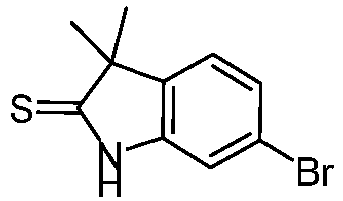
- The suspension of 6-bromo-3,3-dimethylindolin-2-one (3.5 g, 14.58 mmol), which was synthesized by following an analogous reaction protocol as was reported in
WO2015/177110 , A1 and Lawesson's reagent (7.66 g, 18.95 mmol) in toluene (15 ml) was heated at 100°C for 3h under N2 atmosphere. Solvent was evaporated in vacuo and this residue was purified by combiflash (Rf200, Teledyne/Isco) instrument onto a redisep® Rf column with gradient elution (0-20%) of ethyl acetate in petroleum ether to afford the title compound (3.3g, 88 %) as an off-white solid. 1H NMR (400 MHz, DMSO-d6) δ 12.67 (s, 1H), 7.40 (d, J = 7.9 Hz, 1H), 7.31 (dd, J = 7.9, 1.8 Hz, 1H), 7.15 (d, J = 1.7 Hz, 1H), 1.30 (s, 6H); LCMS m/z= 256.89 (M+1; 30%). -

- To a stirred suspension of 6-bromo-3,3-dimethylindoline-2-thione (3 g, 11.71 mmol) in THF (40ml) was added NaH (0.703g, 17.57mmol) at 0°C. The resulting mixture was stirred for 15 min at 0°C. Methyl iodide (1.098 ml, 17.57 mmol) was added and stirred the reaction mixture for 1h at 0°C under N2 atmosphere. The reaction mixture was diluted with ethyl acetate (50 ml) and washed with water (50 ml). Layers were separated, organic layer was washed with brine (50 ml) and dried over anhydrous sodium sulphate. The organic layer was filtered and concentrated in vacuo to give 3.5g of crude compound. This residue was purified by combiflash (Rf200, Teledyne/Isco) instrument onto a redisep® Rf column with gradient elution (0-5%) of ethyl acetate in petroleum ether to afford the title compound (3.1g, 98%) as a white solid. 1H NMR (400 MHz, DMSO-d6) δ 7.60 (d, J = 1.7 Hz, 1H), 7.41 (d, J = 7.9 Hz, 1H), 7.32 (dd, J = 7.9, 1.8 Hz, 1H), 2.60 (s, 3H), 1.29 (s, 6H); LCMS m/z= 269.90 (M+; 40%).
-

- The title compound was prepared by following an analogous reaction protocol as was described in the preparation of 6-bromo-3,3-dimethylindoline-2-thione. LCMS m/z= 267.65 (M+; 20%).
-

- The title compound was prepared by following an analogous reaction protocol as was described in the preparation of 6-bromo-3,3-dimethyl-2-(methylthio)-3H-indole. 1H NMR (400 MHz, Chloroform-d) δ 7.63 (d, J= 1.7 Hz, 1H), 7.44 (d, J = 7.9 Hz, 1H), 7.32 (dd, J = 7.9, 1.7 Hz, 1H), 2.73 (s, 3H), 2.61 - 2.46 (m, 4H), 2.37 - 2.30 (m, 2H); LCMS m/z= 281.78, 283.78 (M+, M+2; 100%).
-

- To stirred solution of 6'-bromo-2'-(methylthio)spiro[cyclobutane-1,3'-indole] (1.2 g, 4.25 mmol) in 7N ammonia in methanol (15ml, 371mmol) was heated at 100°C for 16 h. Solvent was evaporated in vacuo and this residue was purified by combiflash (Rf200, Teledyne/Isco) instrument onto a redisep® Rf column with gradient elution (0-10%) of methanol in dichloromethane to afford the title compound (650mg, 60.9%) as white solid. 1H NMR (400 MHz, DMSO-d6) δ 7.69 (s, 2H), 7.46 (d, J = 8.2 Hz, 1H), 7.01 (h, J = 1.8 Hz, 2H), 2.63 - 2.53 (m, 2H), 2.43 - 2.30 (m, 1H), 2.23 - 2.09 (m, 3H); LCMS m/z= 250.87 (M+; 100%).
-

- The title compound was prepared by following an analogous reaction protocol as was described in
Dubois., Laurent et al, WO 2009/112679 A1 . -

- The title compound was prepared by following an analogous reaction protocol as was described in Doherty, Elizabeth M. et.al, Journal of Medicinal Chemistry, 2007, vol. 50, # 15, p. 3515 -3527.
-

- A mixture of 3-bromo-7-iodo-N-(4-methoxybenzyl)quinolin-2-amine (1.5g, 3.20mmol), bispinacolotodiboron (0.974g, 3.84mmol), [1,1'-bis(diphenylphosphino) ferrocene] dichloropalladium(II), complex with dichloromethane (0.261g, 0.320mmol) and potassium acetate (0.533g, 5.44mmol) ) in DMSO (50ml) was heated at 80°C for 15min in a preheated oil bath. The reaction mixture was allowed to cool to 25°C, diluted with ethyl acetate (50ml) and poured onto ice-cold water (100ml). Layers were separated, organic layer was washed with brine (50 ml) and dried over anhydrous sodium sulphate. The organic layer was filtered and concentrated in vacuo to give 2.5g of crude compound. This residue was purified by combiflash (Rf200, Teledyne/Isco) instrument onto a redisep® Rf column with gradient elution (0-7%) of ethyl acetate in petroleum ether to afford the title compound (1.35g, 90%) as an off-white solid. 1H NMR (400 MHz, DMSO-d6) δ 8.42 (d, J = 0.7 Hz, 1H), 7.86 (d, J = 1.1 Hz, 1H), 7.65 (d, J = 7.9 Hz, 1H), 7.43 (dd, J = 7.9, 1.1 Hz, 1H), 7.40 - 7.32 (m, 3H), 6.99 - 6.74 (m, 2H), 4.62 (d, J = 6.0 Hz, 2H), 3.71 (s, 3H), 1.32 (s, 12H); LCMS m/z= 468.89 (M+; 100%).
-

- To a stirred solution of 3-bromo-N-(4-methoxybenzyl)-7-(4,4,5,5-tetramethyl-1,3,2-dioxaborolan-2-yl)quinolin-2-amine (0.35g, 0.746mmol) in THF (20 ml) was added AcOH (0.064ml, 1.119mmol) dropwise at 0°C and stirred for 1h. Aq. H2O2 (0.5ml, 1.492mmol) was added slowly at 0°C. The resulting mixture was stirred at 25°C for 5h. The reaction mixture was diluted with ethyl acetate (20ml) and washed with aq.sat.Na2SO3 (20ml). Layers were separated, organic layer was washed with brine (20ml) and dried over anhydrous sodium sulphate. The organic layer was filtered and concentrated in vacuo to give 0.41g of crude compound. This residue was purified by combiflash (Rf200, Teledyne/Isco) instrument onto a redisep® Rf column with gradient elution (0-25%) of ethyl acetate in petroleum ether to afford the title compound (0.13g, 48.5%) as an off-white solid. LCMS m/z= 359.22 (M+; 100%).
-

- The title compound was synthesized by following an analogous reaction protocol as was described in the preparation of 3-bromo-N-(4-methoxybenzyl)-7-(4,4,5,5-tetramethyl-1,3,2-dioxaborolan-2-yl)quinolin-2-amine. 1H NMR (400 MHz, Chloroform-d) δ 1H NMR (400 MHz, Chloroform-d) δ 8.17 (d, J = 0.9 Hz, 1H), 8.07 (s, 1H), 7.41 - 7.36 (m, 2H), 7.29 (dd, J = 10.0, 0.8 Hz, 1H), 6.94 - 6.89 (m, 2H), 5.69 (s, 1H), 4.77 (d, J = 5.4 Hz, 2H), 3.83 (s, 3H), 1.29 (s, 12H); LCMS m/z= 443.05 (M+; 100%).
-

- The title compound was synthesized by following an analogous reaction protocol as was described in the preparation of 3-bromo-2-((4-methoxybenzyl)amino)quinolin-7-ol. 1H NMR (400 MHz, DMSO-d6) δ 10.19 (d, J = 1.0 Hz, 1H), 8.02 (s, 1H), 7.55 (t, J = 6.2 Hz, 1H), 7.43 - 7.28 (m, 2H), 6.91 - 6.82 (m, 2H), 6.67 (d, J = 2.1 Hz, 1H), 6.57 (dd, J = 11.7, 2.2 Hz, 1H), 4.60 (d, J = 6.0 Hz, 2H), 3.71 (s, 3H); LCMS m/z= 333.15, 335.15 (M+, M+2; 30%).
-

- A mixture of 7-bromo-N-(4-methoxybenzyl)quinolin-2-amine (0.6 g, 1.748 mmol) , copper(I) iodide (0.033g, 0.175mmol), and N1,N1-dimethylethane-1,2-diamine (0.171ml, 1.748mmol) in AMMONIA (0.757 ml, 35.0 mmol) and DMSO (1ml) at 130°C for 15h. The resulting suspension was cooled to 25°C and saturated aqueous sodium sulphate solution (5mL) was added. The resulting mixture was extracted with ethyl acetate (20ml X 3). The organic layer was separated, dried over MgSO4, filtered and concentrated. This residue was purified by combiflash (Rf200, Teledyne/Isco) instrument onto a redisep® Rf column with gradient elution (0-5%) of methanol in dichloromethane to afford the title compound (0.18g, 36.9%) as a brown solid. 1H NMR (400 MHz, DMSO-d6) δ 7.55 (d, J = 8.7 Hz, 1H), 7.34 - 7.29 (m, 2H), 7.25 (d, J = 8.4 Hz, 1H), 7.07 (t, J = 5.8 Hz, 1H), 6.91 - 6.83 (m, 2H), 6.56 (d, J = 2.2 Hz, 1H), 6.52 (dd, J = 8.4, 2.2 Hz, 1H), 6.40 (d, J = 8.7 Hz, 1H), 5.32 (s, 2H), 4.49 (d, J = 5.8 Hz, 2H), 3.72 (s, 3H); LCMS m/z= 280.2 (M+1, 100%).
-

- A mixture of 7-bromo-N-(4-methoxybenzyl)quinolin-2-amine (0.5 g, 1.457 mmol), methanamine (7.54 ml, 7.28 mmol) and copper (0.046 g, 0.728 mmol) was stirred at 110°C in a sealed tube for 12h.. The reaction mixture was diluted with ethyl acetate (20ml) and washed with water (20ml). The organic layer was separated, dried over MgSO4, filtered and concentrated. This residue was purified by combiflash (Rf200, Teledyne/Isco) instrument onto a redisep® Rf column with gradient elution (0-5%) of methanol in dichloromethane to afford the title compound (0.4g, 94%) as a brown liquid. LCMS m/z= 294.09 (M+1; 100%).
-

- To a stirred solution of 7-bromo-N-(4-methoxybenzyl)quinolin-2-amine (2g, 5.83mmol), potassium thioacetate (1.331g, 11.65mmol), DIEA (2.035ml, 11.65mmol) and xantphos (0.337g, 0.583mmol) in 1,4-dioxane (20ml) was added Pd2(dba)3 (0.534g, 0.583mmol) at 25°C under N2 atmosphere. The resulting mixture was stirred at 110°C for 1.5h under microwave condition. The reaction mixture was diluted with ethyl acetate (20ml) and washed with water (20ml). The organic layer was separated, dried over MgSO4, filtered and concentrated. This residue was purified by combiflash (Rf200, Teledyne/Isco) instrument onto a redisep® Rf column with gradient elution (0-20%) of ethyl acetate in petroleum ether to afford the title compound (0.67g, 34%) as an off-white solid. 1H NMR (400 MHz, Chloroform-d) δ 7.87 - 7.80 (m, 2H), 7.63 (d, J = 8.3 Hz, 1H), 7.39 - 7.32 (m, 2H), 7.28 - 7.23 (m, 1H), 6.95 - 6.87 (m, 2H), 6.67 (d, J = 9.0 Hz, 1H), 5.21 (s, 1H), 4.67 (d, J = 5.4 Hz, 2H), 3.82 (s, 3H), 2.47 (s, 3H); LCMS m/z= 339.22 (M+1; 100%).
-

- To a stirred solution of S-(2-((4-methoxybenzyl)amino)quinolin-7-yl) ethanethioate (0.67g, 1.98 mmol) in 20 mL of ethanol was added KOH (0.33 g, 5.94 mmol) at 25°C. The resulting mixture was stirred at 25°C for 1h. The reaction mixture was quenched with sat.aqueous NH4Cl (20ml) and extracted with ethyl acetate (20ml). The organic layer was separated, dried over MgSO4, filtered and concentrated in vacuo to give the title compound (0.56g, 95%) as a brown solid. 1H NMR(400 MHz, Chloroform-d) δ 7.77 (d, J = 8.9 Hz, 1H), 7.64 (d, J = 1.8 Hz, 1H), 7.46 (d, J = 8.3 Hz, 1H), 7.37 - 7.32 (m, 2H), 7.10 (dd, J = 8.3, 1.9 Hz, 1H), 6.93 - 6.87 (m, 2H), 6.58 (d, J = 8.9 Hz, 1H), 5.58 (s, 1H), 4.64 (d, J = 5.3 Hz, 2H), 3.82 (s, 3H); LCMS m/z= 297.09 (M+; 100%).
-

- The title compound was synthesized by following an analogous reaction protocol as was described in the preparation of S-(2-((4-methoxybenzyl)amino)quinolin-7-yl) ethanethioate. LCMS m/z = 493.30 (M+; 100%).
-
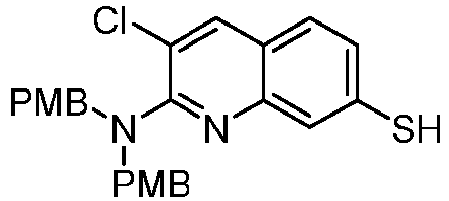
- To a solution of solution of S-(2-(bis(4-methoxybenzyl)amino)-3-chloroquinolin-7-yl) ethanethioate (300 mg, 0.608 mmol) in ethanol (9 ml) was added KOH (51.2 mg, 0.913 mmol) at 25°C. The mixture was heated at 50°C for 2h . The reaction solution was allowed to cool to 25°C, adjusted pH to 4 with HCl (1N) and concentrated in vacuo to get 0.4g of crude compound, which was triturated with diethyl ether (20ml) to get the title compound (200 mg, 72.9%) as an off-white solid. LCMS m/z = 450.42 (M+; 100%).
-

- The title compound was prepared by following the same reaction protocol as was described in Kenneth A. Jacobson et.al; Purinergic Signalling (2015) 11:371-387.
-

- To a stirred solution of ((3aS,4R,6aR)-4-(4-chloro-7H-pyrrolo[2,3-d]pyrimidin-7-yl)-2,2-dimethyl-3a,6a-dihydro-4H-cyclopenta[d][1,3]dioxol-6-yl)methanol (0.5 g, 1.554 mmol) in dichloromethane (10ml) was added TEA (0.651 ml, 4.66 mmol), DMAP (0.038 g, 0.311 mmol), followed by a slow addition of p-TsCl (0.355 g, 1.865 mmol) at 0°C and stirred for 10mins. The resulting mixture was stirred at 25°C for 2h. The reaction mixture was diluted with ethyl acetate (20ml) and washed with water (20ml). The organic layer was separated, dried over MgSO4, filtered and concentrated in vacuo to give 0.71g of crude compound. This residue was purified by combiflash (Rf200, Teledyne/Isco) instrument onto a redisep® Rf column with gradient elution (0-10%) of ethyl acetate in petroleum ether to afford the title compound (0.282g, 38.1%) as a pale yellow liquid. 1H NMR (400 MHz, Chloroform-d) δ 8.69 (t, J = 2.8 Hz, 1H), 7.89 - 7.81 (m, 2H), 7.42 - 7.34 (m, 2H), 7.12 (s, 1H), 6.64 (d, J = 3.8 Hz, 1H), 5.86 (d, J = 12.4 Hz, 2H), 5.36 (d, J = 5.6 Hz, 1H), 4.90 - 4.77 (m, 2H), 4.63 (t, J = 4.5 Hz, 1H), 2.52 - 2.45 (m, 3H), 1.45 (s, 3H), 1.34 (s, 3H); LCMS m/z = 476.17 (M+; 100%).
-
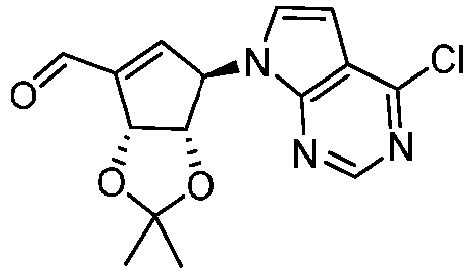
- To a stirred solution of ((3aS,4R,6aR)-4-(4-Chloro-7H-pyrrolo[2,3-d]pyrimidin-7-yl)-2,2-dimethyl-3a,6a-dihydro-4H-cyclopenta[d][1,3]dioxol-6-yl)methanol (2.50g, 7.77mmol) in CH2Cl2 (40ml) at 0°C, was added Dess-Martin Periodinane (3.95 g, 9.32 mmol) portionwise and stirred for 1h. The reaction mixture was diluted with dichloromethane (50ml) and washed with water (50ml). The organic layer was separated, dried over MgSO4, filtered and concentrated in vacuo to give 2.71g of crude compound. This residue was purified by combiflash (Rf200, Teledyne/Isco) instrument onto a redisep® Rf column with gradient elution (0-30%) of ethyl acetate in petroleum ether to afford the title compound (2.32g, 93%) as a colorless oil. 1H NMR (400 MHz, Chloroform-d) δ 10.00 (s, 1H), 8.67 (s, 1H), 7.12 (d, J = 3.6 Hz, 1H), 6.78 (dd, J = 2.6, 0.9 Hz, 1H), 6.69 (d, J = 3.7 Hz, 1H), 5.97 (dt, J = 2.8, 1.4 Hz, 1H), 5.76 (dd, J = 5.9, 1.5 Hz, 1H), 4.88 (dt, J = 5.9, 1.1 Hz, 1H), 1.54 (s, 3H), 1.40 (s, 3H); LCMS m/z = 320.2 (M+1, 100%).
-

- To a cooled suspension of methyl(triphenyl)phosphonium bromide (5.03g, 14.07mmol) in THF (30mL) at 0°C, was added 1M KHMDS in THF (14.07mL, 14.07mmol) slowly and stirred for 5 min. The reaction mixture was allowed to warm to 25°C and stirred for 10min. Cooled the reaction mixture to 0°C and slowly added a solution of (3aS,4R,6aR)-4-(4-Chloro-7H-pyrrolo[2,3-d]pyrimidin-7-yl)-2,2-dimethyl-3a,6a-dihydro-4H-cyclopenta [d][1,3]dioxole-6-carbaldehyde (1.8g, 5.63mmol) in THF (1ml). Stirred the reaction mixture at 25°C for 10min. The reaction mixture was quenched with sat.aqueous NH4Cl (50ml) and extracted with ethyl acetate (50ml). The organic layer was separated, dried over Na2SO4, filtered and concentrated in vacuo to give 2.1g of crude compound. This residue was purified by combiflash (Rf200, Teledyne/Isco) instrument onto a redisep® Rf column with gradient elution (0-7%) of ethyl acetate in petroleum ether to afford the title compound (0.81g, 45.3%) as an off-white solid. 1H NMR (400 MHz, Chloroform-d) δ 8.72 (s, 1H), 7.11 (d, J = 3.6 Hz, 1H), 6.66 - 6.57 (m, 2H), 5.94 (d, J = 2.6 Hz, 1H), 5.81 - 5.75 (m, 2H), 5.57 (dd, J = 6.0, 1.5 Hz, 1H), 5.49 (d, J = 10.9 Hz, 1H), 4.66 (dt, J = 6.0, 1.0 Hz, 1H), 1.52 (s, 3H), 1.40 (s, 3H); LCMS m/z =318.09 (M+1, 100%).
-

- To a stirred solution of 4-chloro-7-((3aS,4R,6aR)-2,2-dimethyl-6-vinyl-3a,6a-dihydro-4H-cyclopenta[d][1,3]dioxol-4-yl)-7H-pyrrolo[2,3-d]pyrimidine (500mg, 1.573mmol) in THF (1ml) and NMP (0.2ml) was added ferric acetylacetonate (55.6 mg, 0.157mmol) at 25°C. 2M Ethylmagnesium chloride in THF (1.573ml, 3.15mmol) was added dropwise and the reaction mixture was stirred for 4h. The reaction mixture was quenched with sat.aqueous NH4Cl (10ml) and extracted with ethyl acetate (10ml). The organic layer was separated, dried over Na2SO4, filtered and concentrated in vacuo to give 0.6g of crude compound. This residue was purified by combiflash (Rf200, Teledyne/Isco) instrument onto a redisep® Rf column with gradient elution (0-90%) of ethyl acetate in petroleum ether to afford the title compound (0.28g, 57.1%) as an off-white solid. 1H NMR (400 MHz, DMSO-d6) δ 8.71 (s, 1H), 7.35 (d, J = 3.6 Hz, 1H), 6.73 (d, J = 3.6 Hz, 1H), 6.60 (dd, J = 17.7, 10.8 Hz, 1H), 5.88 (d, J = 2.7 Hz, 1H), 5.83 - 5.74 (m, 1H), 5.66 - 5.56 (m, 2H), 5.45 - 5.37 (m, 1H), 4.67 (dd, J = 6.0, 1.1 Hz, 1H), 2.99 (q, J = 7.6 Hz, 2H), 1.40 (s, 3H), 1.30(s, 6H); LCMS m/z =312.21 (M+1, 100%).
-

- A solution of 4-chloro-7-((3aS,4R,6aR)-2,2-dimethyl-6-vinyl-3a,6a-dihydro-4H-cyclopenta[d][1,3]dioxol-4-yl)-7H-pyrrolo[2,3-d]pyrimidine (1g, 3.15mmol), 2M isopropyl magnesium bromide in THF (5.51 ml, 11.01 mmol) and PdCl2(dppf) (0.230 g, 0.315 mmol) in toluene (10 ml) was heated at 100°C for 30min. After completion of the reaction, the reaction mixture was quenched with methanol and concentrated. This residue was purified by combiflash (Rf200, Teledyne/Isco) instrument onto a redisep® Rf column with gradient elution (0-2%) of methanol in dichloromethane to afford the title compound (150mg, 14.65%) as an off-white solid. 1H NMR (400 MHz, Chloroform-d) δ 8.98 (s, 1H), 7.48 (d, J = 4.0 Hz, 1H), 7.11 (t, J = 1.6 Hz, 1H), 6.86 (d, J = 4.0 Hz, 1H), 3.98 (dt, J = 2.5, 1.2 Hz, 2H), 3.50 - 3.43 (m, 1H), 2.66 (s, 1H), 2.20 (d, J = 2.4 Hz, 1H), 2.00 (dd, J = 7.2, 1.0 Hz, 2H), 1.44 (dd, J = 6.9, 3.1 Hz, 6H), 1.28 (s, 6H).
-

- The title compound was synthesized by following an analogous reaction protocol as was described in the preparation of 7-((3aS,4R,6aR)-2,2-dimethyl-6-vinyl-4,6a-dihydro-3aH-cyclopenta [d] [1,3] dioxol-4-yl)-4-ethyl-7H-pyrrolo[2,3-d]pyrimidine. LCMS m/z = 323.90 (M+; 100%).
-

- To a stirred solution of (3aS,4R,6aR)-4-(4-chloro-7H-pyrrolo[2,3-d]pyrimidin-7-yl)-2,2-dimethyl-3a,6a-dihydro-4H-cyclopenta[d][1,3]dioxole-6-carbaldehyde (2.30 g, 7.19 mmol) in THF (120ml) at -78°C, was added methylmagnesium bromide (4.80 ml, 14.39 mmol) and the reaction mixture was stirred at same temperature for 3h. The reaction mixture was quenched with a sat. aqueous NH4Cl (50 ml) and extracted with ethyl acetate (50 ml). Layers were separated, the organic layer was washed with brine (50 ml) and dried over anhydrous sodium sulphate. The organic layer was filtered and concentrated in vacuo to give 2.2g of crude compound and this crude residue was purified by combiflash (Rf200, Teledyne/Isco) instrument onto a redisep® Rf column with gradient elution (0 to 20%) of ethyl acetate in petroleum ether to afford the title compound (1.82g, 75%) as a off-white solid. 1H NMR (400 MHz, Chloroform-d) δ 8.70 (s, 1H), 7.11 (d, J = 3.7 Hz, 1H), 6.63 (d, J = 3.7 Hz, 1H), 5.88 - 5.81 (m, 1H), 5.80 - 5.71 (m, 1H), 5.59-5.45 (m, 1H), 4.76-4.64 (m, 2H), 1.59 - 1.49 (m, 6H), 1.38 (d, J = 1.0 Hz, 3H), 1.32 - 1.23 (m, 1H); LCMS m/z = 336.2 (M+; 100%).
-

- To a stirred solution of 1-((3aS,4R,6aR)-4-(4-chloro-7H-pyrrolo[2,3-d]pyrimidin-7-yl)-2,2-dimethyl-3a,6a-dihydro-4H-cyclopenta[d][1,3]dioxol-6-yl)ethan-1-ol (4.75 g, 14.15 mmol) in dichloromethane (45 ml) at 0 °C, was added Dess-Martin Periodinane (7.20 g, 16.97 mmol) portion-wise and stirred for 30 min. Water (50ml) was added and filtered the reaction mixture through a celite bed, washed with dichloromethane (25ml X 2). Separated the layers and the organic layer was washed with brine (50ml), dried over anhydrous sodium sulphate and concentrated in vacuo to give 4.8g crude compound. This crude residue was purified by combiflash (Rf200, Teledyne/Isco) instrument onto a redisep® Rf column with gradient elution (0 to 50%) of ethyl acetate in petroleum ether to afford the title compound (3.8g, 80%) as an off-white solid. 1H NMR (400 MHz, Chloroform-d) δ 8.68 (s, 1H), 7.10 (d, J = 3.7 Hz, 1H), 6.68 (d, J = 3.6 Hz, 1H), 6.63 (dt, J = 2.7, 0.7 Hz, 1H), 5.96 (dt, J = 2.8, 1.5 Hz, 1H), 5.75 (dd, J = 5.9, 1.6 Hz, 1H), 4.82 (dt, J = 5.9, 1.1 Hz, 1H), 2.47 (s, 3H), 1.52 (s, 3H), 1.39(s, 3H); LCMS m/z = 334.09 (M+; 100%).
-

- To a stirred solution of 1-((3aS,4R,6aR)-4-(4-chloro-7H-pyrrolo[2,3-d]pyrimidin-7-yl)-2,2-dimethyl-3a,6a-dihydro-4H-cyclopenta[d][1,3]dioxol-6-yl)ethan-1-one (1.0 g, 3.00 mmol) ) in THF (10 ml) at -20 °C, was added dropwise methyl magnesium bromide (1.498 ml, 4.49 mmol) and stirred the reaction mixture for 30 min at the same temperature. The reaction mixture was quenched with a sat. aqueous NH4Cl (50 ml) and extracted with ethyl acetate (50 ml). Layers were separated, the organic layer was washed with brine (50 ml) and dried over anhydrous sodium sulphate. The organic layer was filtered and concentrated in vacuo to give 1.5g of crude compound and this crude residue was purified by combiflash (Rf200, Teledyne/Isco) instrument onto a redisep® Rf column with gradient elution (0 to 30%) of ethyl acetate in petroleum ether to afford the title compound (850 mg, 81%) as an off-white solid. 1H NMR (400 MHz, Chloroform-d) δ 8.69 (s, 1H), 7.09 (d, J = 3.6 Hz, 1H), 6.71 - 6.60 (m, 1H), 5.82 (s, 1H), 5.78 - 5.69 (m, 1H), 5.65 - 5.58 (m, 1H), 4.69 (dt, J = 5.8, 1.0 Hz, 1H), 1.59 - 1.53 (m, 9H), 1.38 (s, 3H); LCMS m/z = 350.2 (M+; 100%).
-

- To a stirred solution of 2-((3aS,4R,6aR)-4-(4-chloro-7H-pyrrolo[2,3-d]pyrimidin-7-yl)-2,2-dimethyl-3a,6a-dihydro-4H-cyclopenta[d][1,3]dioxol-6-yl)propan-2-ol (8.2 g, 23.44 mmol) in dichloromethane (80ml) at 0°C was added Martin's Sulfurane (17.34 g, 25.8 mmol) and the stirred the reaction mixture for 45 min at 25°C. The reaction mixture was quenched with an sat.aq. sodium bicarbonate (100ml), extracted with dichloromethane (100ml). Layers were separated, the organic layer was washed with brine (50 ml) and was dried over anhydrous sodium sulphate. The organic layer was filtered and concentrated in vacuo to give 8.5g of crude compound. This crude residue was purified by combiflash (Rf200, Teledyne/Isco) instrument onto a redisep® Rf column with gradient elution (0 to 30%) of ethyl acetate in petroleum ether to afford the title compound (4.2g, 54.0%) as an off-white solid. 1H NMR (400 MHz, Chloroform-d) δ 8.71 (s, 1H), 7.11 (d, J = 3.6 Hz, 1H), 6.63 (d, J = 3.6 Hz, 1H), 6.00 - 5.94 (m, 1H), 5.76 (d, J = 2.7 Hz, 1H), 5.62 - 5.52 (m, 2H), 5.33 (d, J = 1.7 Hz, 1H), 4.67 (dt, J = 6.0, 1.0 Hz, 1H), 2.03 (t, J = 1.0 Hz, 3H), 1.52 (s, 3H), 1.40 (s, 3H); LCMS m/z = 332.28 (M+; 100%).
-

- To a degassed solution of 4-chloro-7-((3aS,4R,6aR)-2,2-dimethyl-6-(prop-1-en-2-yl)-3a,6a-dihydro-4H-cyclopenta[d][1,3]dioxol-4-yl)-7H-pyrrolo[2,3d]pyrimidine (1.000 g, 3.01 mmol) in dioxane (10 ml) and water (1 ml), was added potassium phosphate, tribasic (1.575 g, 9.04 mmol), dichloro[1,1'-bis(di-t-butylphosphino)ferrocene]palladium(II) (0.196 g, 0.301 mmol) and 2,4,6-trimethyl-1,3,5,2,4,6-trioxatriborinane (4.21 ml, 30.1 mmol) at 25°C. The resulting mixture was stirred at 100°C for 50min under microwave condition. Solvent was removed and the crude residue was purified by combiflash (Rf200, Teledyne/Isco) instrument onto a redisep® Rf column with gradient elution (0 to 50%) of ethyl acetate in petroleum ether to afford the title compound (0.84g, 90%) as an off-white solid. LCMS m/z = 312.28 (M+1; 100%).
-

- To a degassed solution of 7-((3aS,4R,6aR)-6-(((tert-butyldiphenylsilyl)oxy)methyl)-2,2-dimethyl-3a,6a-dihydro-4H-cyclopenta[d][1,3]dioxol-4-yl)-4-chloro-7H-pyrrolo[2,3-d] pyrimidine (5g, 8.93 mmol) in dioxane (80 ml) and water (10ml), was added potassium phosphate tribasic (4.66 g, 26.8 mmol), dichloro[1,1'-bis(di-t-butylphosphino) ferrocene]palladium(II) (0.582 g, 0.893 mmol) and 2,4,6-trimethyl-1,3,5,2,4,6-trioxatriborinane (12.48 ml, 89 mmol) at 25°C. The reaction mixture was heated at 80°C for 8h. The reaction mixture was diluted with ethyl acetate (50 ml) and washed with water (50 ml). Layers were separated and the organic layer was washed with brine (50 ml) and dried over anhydrous sodium sulphate. The organic layer was filtered and concentrated in vacuo to give 4.3g of crude compound. This crude residue was purified by combiflash (Rf200, Teledyne/Isco) instrument onto a redisep® Rf column with gradient elution (0 to 20%) of ethyl acetate in petroleum ether to afford the title compound, A (3.2g, 66%) and B (0.75g, 15.98%) as an off-white solids. 1H NMR of A (400 MHz, Chloroform-d) δ 8.83 (s, 1H), 7.71 (tt, J = 6.6, 1.5 Hz, 4H), 7.48 - 7.37 (m, 6H), 6.91 (d, J = 3.6 Hz, 1H), 6.57 (d, J = 3.6 Hz, 1H), 5.88 (s, 2H), 5.25 (d, J = 5.7 Hz, 1H), 4.60 (d, J = 5.7 Hz, 1H), 4.55 - 4.45 (m, 2H), 2.77 (s, 3H), 1.45 (s, 3H), 1.32 (s, 3H), 1.11 (s, 9H); LCMS m/z = 540.4 (M+1; 100%); 1H NMR of B (400 MHz, Chloroform-d) δ 7.71 (tt, J = 6.6, 1.5 Hz, 4H), 7.53 - 7.35 (m, 6H), 6.98 (d, J = 3.6 Hz, 1H), 6.57 (d, J= 3.6 Hz, 1H), 5.90 (d, J= 14.5 Hz, 2H), 5.26 (d, J= 5.7 Hz, 1H), 4.61 (d, J = 5.7 Hz, 1H), 4.51 (d, J= 9.3 Hz, 2H), 1.46 (s, 3H), 1.33 (s, 3H), 1.28 (s, 2H), 1.11 (s, 9H); LCMS m/z = 526.44 (M+1; 100%).
-

- To a stirred solution of 7-((3aS,4R,6aR)-6-(((tert-butyldiphenylsilyl)oxy)methyl)-2,2-dimethyl-3a,6a-dihydro-4H-cyclopenta[d][1,3]dioxol-4-yl)-4-methyl-7H-pyrrolo[2,3-d]pyrimidine (3.20 g, 5.93 mmol) in THF (20 ml), was slowly added TBAF (8.89 ml, 8.89 mmol) at 25°C and stirred the reaction mixture at 25°C for 15h. Volatiles were removed in vacuo and the crude residue was purified by combiflash (Rf200, Teledyne/Isco) instrument onto a redisep® Rf column with gradient elution (0 to 100%) of ethyl acetate in petroleum ether to afford the title compound (1.5g, 84%) as an off-white solid. 1H NMR (400 MHz, Chloroform-d) δ 8.81 (s, 1H), 7.06 (d, J = 3.6 Hz, 1H), 6.55 (d, J = 3.6 Hz, 1H), 5.90 - 5.78 (m, 2H), 5.41 (ddd, J = 5.8, 1.7, 0.9 Hz, 1H), 4.65 (dt, J = 5.8, 0.9 Hz, 1H), 4.56 - 4.42 (m, 2H), 3.35 (d, J= 8.2 Hz, 1H), 2.74 (s, 3H), 1.53 (s, 3H), 1.37 (s, 3H); LCMS m/z = 302.21 (M+1; 100%) .
-

- To a stirred solution of 7-((3aS,4R,6aR)-6-(((tert-Butyldiphenylsilyl)oxy)methyl)-2,2-dimethyl-3a,6a-dihydro-4H-cyclopenta[d][1,3]dioxol-4-yl)-7H-pyrrolo[2,3-d]pyrimidine (1.50 g, 4.98 mmol) in dichloromethane (100 ml) at 0°C, was added Dess-Martin Periodinane (2.53 g, 5.97 mmol) portion-wise and stirred for 1h. The reaction mixture was diluted with methylene chloride (50 ml) and washed with water (50 ml). Layers were separated, the organic layer was washed with brine (50 ml) and dried over anhydrous sodium sulphate. The organic layer was filtered and concentrated in vacuo to give a crude compound and this crude residue was purified by combiflash (Rf200, Teledyne/Isco) instrument onto a redisep® Rf column with gradient elution (0 to 30%) of ethyl acetate in petroleum ether to afford the title compound (0.95g, 63.8%) as an off-white solid. 1H NMR (400 MHz, Chloroform-d) δ 10.00 (s, 1H), 8.80 (s, 1H), 7.02 (d, J = 3.6 Hz, 1H), 6.82 - 6.76 (m, 1H), 6.63 (d, J = 3.6 Hz, 1H), 6.00 (dt, J = 2.7, 1.4 Hz, 1H), 5.76 (dd, J = 5.9, 1.5 Hz, 1H), 4.87 (dt, J= 5.9, 1.1 Hz, 1H), 2.77 (s, 3H), 1.53 (s, 3H), 1.38 (s, 3H); LCMS m/z = 300.15 (M+1; 100%)
-

- The title compound was synthesized by following an analogous reaction protocol as was described in the preparation of 4-chloro-7-((3aS,4R,6aR)-2,2-dimethyl-6-vinyl-3a,6a-dihydro-4H-cyclopenta[d][1,3] dioxol-4-yl)-7H-pyrrolo[2,3-d]pyrimidine. 1H NMR (400 MHz, Chloroform-d) δ 8.83 (s, 1H), 7.01 (d, J = 3.6 Hz, 1H), 6.68 - 6.53 (m, 2H), 5.95 (d, J = 2.5 Hz, 1H), 5.80 - 5.71 (m, 2H), 5.56 (dd, J = 6.0, 1.4 Hz, 1H), 5.47 (d, J = 10.8 Hz, 1H), 4.65 (d, J = 5.8 Hz, 1H), 2.75 (s, 3H), 1.52 (s, 3H), 1.40 (s, 3H); LCMS m/z = 298.5 (M+1; 100%).
-

- The title compound was synthesized by following an analogous reaction protocol as was described in the preparation of 7-((3aS,4R,6aR)-6-(((tert-butyldiphenylsilyl)oxy)methyl)-2,2-dimethyl-3a,6a-dihydro-4H-cyclopenta[d][1,3]dioxol-4-yl)-7H-pyrrolo[2,3-d]pyrimidine. LCMS m/z = 287.90 (M+; 100%).
-

- The title compound was synthesized by following an analogous reaction protocol as was described in the preparation of (3aS,4R,6aR)-2,2-Dimethyl-4-(4-methyl-7H-pyrrolo[2,3-d]pyrimidin-7-yl)-3a,6a-dihydro-4H-cyclopenta[d] [1,3]dioxole-6-carbaldehyde. 1H NMR (400 MHz, Chloroform-d) δ 10.01 (s, 1H), 9.04 (s, 1H), 8.93 (s, 1H), 7.11 (d, J= 3.6 Hz, 1H), 6.83 - 6.77 (m, 1H), 6.67 (d, J= 3.7 Hz, 1H), 6.03 (dt, J= 2.8, 1.4 Hz, 1H), 5.77 (dd, J = 5.9, 1.5 Hz, 1H), 4.89 (dt, J = 6.0, 1.2 Hz, 1H), 1.54 (s, 3H), 1.41 (s, 3H); LCMS m/z = 286.09 (M+; 100%).
-

- The title compound was synthesized by following an analogous reaction protocol as was described in the preparation of 4-chloro-7-((3aS,4R,6aR)-2,2-dimethyl-6-vinyl-3a,6a-dihydro-4H-cyclopenta[d][1,3] dioxol-4-yl)-7H-pyrrolo[2,3-d]pyrimidine. 1H NMR (400 MHz, Chloroform-d) δ 8.97 (d, J= 15.8 Hz, 2H), 7.09 (d, J= 3.7 Hz, 1H), 6.68 - 6.56 (m, 2H), 5.98 (d, J = 2.7 Hz, 1H), 5.82 - 5.72 (m, 2H), 5.60 - 5.54 (m, 1H), 5.52 - 5.44 (m, 1H), 4.66 (dt, J= 5.8, 1.0 Hz, 1H), 1.52 (s, 3H), 1.40 (s, 3H); LCMS m/z = 284.04 (M+1; 100%).
-

- To a stirred solution of (3aS,4S,6aR)-6-(((tert-butyldiphenylsilyl)oxy)methyl)-2,2-dimethyl-3a,6a-dihydro-4H-cyclo penta[d][1,3]dioxol-4-ol (3.5 g, 8.24 mmol) in THF (50 ml) was added 4-chloro-5-fluoro-7H-pyrrolo[2,3-d]pyrimidine (3.54 g, 20.61 mmol, which was synthesized by following the same reaction protocol as was described in
WO2005/16878, A2 -

- The title compound was synthesized by following an analogous reaction protocol as was described in the preparation of 7-((3aS,4R,6aR)-6-(((tert-butyldiphenylsilyl)oxy)methyl)-2,2-dimethyl-3a,6a-dihydro-4H-cyclopenta[d][1,3]dioxol-4-yl)-7H-pyrrolo[2,3-d]pyrimidine. LCMS m/z = 340.03 (M+; 100%).
-

- The title compound was synthesized by following an analogous reaction protocol as was described in the preparation of (3aS,4R,6aR)-2,2-Dimethyl-4-(4-methyl-7H-pyrrolo[2,3-d]pyrimidin-7-yl)-3a,6a-dihydro-4H-cyclopenta[d][1,3]dioxole-6-carbaldehyde. 1H NMR (400 MHz, DMSO-d6) δ 9.90 (s, 1H), 8.73 (s, 1H), 7.80 (d, J = 2.0 Hz, 1H), 7.10 - 7.03 (m, 1H), 6.01 (dq, J = 2.7, 1.4 Hz, 1H), 5.57 (dd, J = 6.0, 1.5 Hz, 1H), 4.80 (dt, J = 6.0, 1.2 Hz, 1H), 1.39 (s, 3H), 1.28 (s, 3H); LCMS m/z = 338.03 (M+; 100%).
-

- The title compound was synthesized by following an analogous reaction protocol as was described in the preparation of 4-chloro-7-((3aS,4R,6aR)-2,2-dimethyl-6-vinyl-3a,6a-dihydro-4H-cyclopenta[d][1,3] dioxol-4-yl)-7H-pyrrolo[2,3-d]pyrimidine. 1H NMR (400 MHz, DMSO-d 6) δ 8.71 (s, 1H), 7.66 (d, J= 2.0 Hz, 1H), 6.66 - 6.52 (m, 1H), 5.90 - 5.78 (m, 2H), 5.67 - 5.55 (m, 2H), 5.47 - 5.36 (m, 1H), 4.71 (d, J= 6.0 Hz, 1H), 1.38 (s, 3H), 1.31 (s, 3H); LCMS m/z = 336.03 (M+; 100%).
-

- To a stirred solution of (3aS,4S,6aR)-6-(((tert-Butyldiphenylsilyl)oxy)methyl)-2,2-dimethyl-3a,6a-dihydro-4H-cyclopenta[d][1,3]dioxol-4-ol (1.2g, 2.83 mmol) in THF (15ml) was added 2-chloro-7H-pyrrolo[2,3-d]pyrimidine (0.738 g, 4.80 mmol), triphenylphosphine (2.59 g, 9.89 mmol) and DIAD (1.923 ml, 9.89 mmol) slowly at 0°C and stirred for 5mins. The reaction mixture was brought to 25°C and stirred for 1h. Volatiles were removed in vacuo and the crude residue was purified by combiflash (Rf200, Teledyne/Isco) instrument onto a redisep® Rf column with gradient elution (0 to 15%) of ethyl acetate in petroleum ether to afford the title compound (1.1g, 69.5%) as an off- white solid. 1H NMR (400 MHz, Chloroform-d) δ 8.84 (s, 1H), 7.70 (ddt, J = 6.6, 5.0, 1.5 Hz, 4H), 7.50 - 7.34 (m, 6H), 6.94 (d, J= 3.6 Hz, 1H), 6.59 (d, J = 3.6 Hz, 1H), 5.84 (dt, J = 19.8, 2.2 Hz, 2H), 5.30 (d, J= 5.7 Hz, 1H), 4.63 (d, J= 5.6 Hz, 1H), 4.57 - 4.42 (m, 2H), 1.43 (s, 3H), 1.33 (s, 3H), 1.10 (s, 9H); LCMS m/z = 560.3 (M+; 100).
-

- To a stirred solution of 7-((3aS,4R,6aR)-6-(((tert-butyldiphenylsilyl)oxy)methyl)-2,2-dimethyl-3a,6a-dihydro-4H-cyclopenta[d][1,3]dioxol-4-yl)-2-chloro-7H-pyrrolo[2,3-d]pyrimidine (500 mg, 0.893 mmol) in THF (5 ml) at 0 °C, was added TBAF (1.250 ml, 1.250 mmol) slowly and stirred the reaction mixture at the same temperature for 10 min.
- The reaction mixture was brought to 25°C and stirred for 30mins. Volatiles were removed in vacuo and the crude residue was purified by combiflash (Rf200, Teledyne/Isco) instrument onto a redisep® Rf column with gradient elution (0 to 40%) of ethyl acetate in petroleum etherto afford the title compound (0.27g, 94%) as a colourless oil. 1H NMR (400 MHz, Chloroform-d) δ 8.81 (s, 1H), 7.28 (s, 1H), 7.08 (d, J = 3.7 Hz, 1H), 6.57 (d, J = 3.7 Hz, 1H), 5.92 - 5.62 (m, 2H), 5.47 (d, J = 5.7 Hz, 1H), 4.69 (dt, J = 5.6, 0.9 Hz, 1H), 4.59 - 4.37 (m, 2H), 1.52 (s, 3H), 1.38 (s, 3H); LCMS m/z = 321.09 (M+; 100).
-

- The title compound was synthesized by following an analogous reaction protocol as was described in the preparation of (3aS,4R,6aR)-2,2-Dimethyl-4-(4-methyl-7H-pyrrolo[2,3-d]pyrimidin-7-yl)-3a,6a-dihydro-4H-cyclopenta[d][1,3]dioxole-6-carbaldehyde. 1H NMR (400 MHz, Chloroform-d) δ 9.99 (s, 1H), 8.86 (s, 1H), 7.04 (d, J = 3.7 Hz, 1H), 6.75 (dd, J = 2.6, 0.9 Hz, 1H), 6.65 (d, J = 3.7 Hz, 1H), 6.00 (dt, J = 2.7, 1.4 Hz, 1H), 5.77 (dd, J = 5.9, 1.5 Hz, 1H), 4.88 (dd, J= 5.9, 1.2 Hz, 1H), 1.53 (s, 3H), 1.40 (s, 3H); LCMS m/z = 319.90 (M+; 100).
-

- The title compound was synthesized by following an analogous reaction protocol as was described in the preparation of 4-chloro-7-((3aS,4R,6aR)-2,2-dimethyl-6-vinyl-3a,6a-dihydro-4H-cyclopenta[d][1,3] dioxol-4-yl)-7H-pyrrolo[2,3-d]pyrimidine. 1H NMR (400 MHz, Chloroform-d) δ 8.82 (s, 1H), 7.03 (d, J = 3.6 Hz, 1H), 6.64 - 6.53 (m, 2H), 5.93 (d, J= 2.6 Hz, 1H), 5.81 - 5.69 (m, 2H), 5.60 (dd, J= 5.8, 1.4 Hz, 1H), 5.53 - 5.44 (m, 1H), 4.68 (dd, J = 5.8, 1.1 Hz, 1H), 1.45 (s, 6H); LCMS m/z = 318.15 (M+; 100).
-

- To a stirred solution of (3aS,4S,6aR)-6-(((tert-butyldiphenylsilyl)oxy)methyl)-2,2-dimethyl-3a,6a-dihydro-4H-cyclo penta[d][1,3]dioxol-4-ol (0.5 g, 1.178 mmol) in THF (7 ml) at 0°C was added 4-chloro-1H-pyrrolo[3,2-c]pyridine (0.305 g, 2.002 mmol), triphenylphosphine (1.081 g, 4.12 mmol) and DIAD (0.801 ml, 4.12 mmol) slowly and stirred for 5min. The reaction mixture was stirred at 25°C for 16h. Volatiles were removed in vacuo and the crude residue was purified by combiflash (Rf200, Teledyne/Isco) instrument onto a redisep® Rf column with gradient elution (0 to 10%) of ethyl acetate in petroleum ether to afford the title compound (0.3g, 45.6%) as an off-white solid. LCMS m/z = 559.23 (M+; 100).
-

- To a stirred solution of 1-((3aS,4R,6aR)-6-(((tert-butyldiphenylsilyl)oxy)methyl)-2,2-dimethyl-3a,6a-dihydro-4H-cyclopenta[d][1,3]dioxol-4-yl)-4-chloro-1H-pyrrolo[3,2-c] pyridine (1.3 g, 2.325 mmol) in THF (13ml) was added TBAF (3.25 ml, 3.25 mmol) at 0°C and stirred for 5mins. The reaction mixture was brought to 25°C and stirred for 1h. Volatiles were removed in vacuo and the crude residue was purified by combiflash (Rf200, Teledyne/Isco) instrument onto a redisep® Rf column with gradient elution (0 to 45%) of ethyl acetate in petroleum ether to afford the title compound (0.5g, 67%) as an off-white solid. LCMS m/z = 319.71 (M-1; 100).
-

- The title compound was synthesized by following an analogous reaction protocol as was described in the preparation of (3aS,4R,6aR)-2,2-Dimethyl-4-(4-methyl-7H-pyrrolo[2,3-d]pyrimidin-7-yl)-3a,6a-dihydro-4H-cyclopenta[d][1,3]dioxole-6-carbaldehyde. 1H NMR (400 MHz, Chloroform-d) δ 10.05 (s, 1H), 8.19 (d, J = 5.8 Hz, 1H), 7.34 (dd, J = 5.9, 0.9 Hz, 1H), 6.99 (d, J = 3.3 Hz, 1H), 6.94 - 6.89 (m, 1H), 6.74 (dd, J = 3.3, 0.9 Hz, 1H), 5.73 - 5.58 (m, 2H), 4.67 (dt, J = 5.9, 1.2 Hz, 1H), 1.55 (s, 3H), 1.39 (s, 3H); LCMS m/z = 319.05 (M+; 100).
-

- The title compound was synthesized by following an analogous reaction protocol as was described in the preparation of 4-chloro-7-((3aS,4R,6aR)-2,2-dimethyl-6-vinyl-3a,6a-dihydro-4H-cyclopenta[d][1,3] dioxol-4-yl)-7H-pyrrolo[2,3-d]pyrimidine. 1H NMR (400 MHz, Chloroform-d) δ 8.14 (d, J= 5.8 Hz, 1H), 7.37 (dd, J= 5.9, 0.9 Hz, 1H), 7.06 (d, J= 3.3 Hz, 1H), 6.70 - 6.59 (m, 2H), 5.91 - 5.72 (m, 2H), 5.55 - 5.48 (m, 3H), 4.59 - 4.47 (m, 1H), 1.53 (s, 3H), 1.40 (s, 3H); LCMS m/z = 317.15 (M+; 100).
-

- The title compound was synthesized by following an analogous reaction protocol as was described in the preparation of 7-((3aS,4R,6aR)-2,2-dimethyl-6-(prop-1-en-2-yl)-4,6a-dihydro-3aH-cyclo penta[d][1,3] dioxol-4-yl)-4-methyl-7H-pyrrolo[2,3-d]pyrimidine.
- LCMS m/z = 297.21 (M+; 100). Des chloro dompound i.e. 1-((3aS,4R,6aR)-2,2-dimethyl-6-vinyl-3a,6a-dihydro-4H-cyclopenta[d] [1,3]dioxol-4-yl)-1H-pyrrolo[3,2-c]pyridine was also formed, which was separated after Suzuki coupling step (Table-6) by reverse phase preparative HPLC.
-

- To a stirred solution of (3aR,6aR)-6-(((tert-butyldiphenylsilyl)oxy)methyl)-2,2-dimethyl-3a,6a-dihydro-4H-cyclopenta[d][1,3]dioxol-4-one (20 g, 47.3 mmol) and iodine (14.41 g, 56.8 mmol) in dichloromethane (250 ml), was added pyridine (3.45 ml, 42.6 mmol) under nitrogen atmosphere at 0°C and stirred at 25°C for 4h. The reaction mixture was diluted with methylene chloride (100 ml) and washed with a saturated aqueous sodium thiosulfate (100ml). Layers were separated, the organic layer was washed with brine (100 ml) and dried over anhydrous sodium sulphate. The organic layer was filtered and concentrated in vacuo to give 18g of crude compound. This crude residue was purified by combiflash (Rf200, Teledyne/Isco) instrument onto a redisep® Rf column with gradient elution (0 to 20%) of ethyl acetate in petroleum ether to afford the title compound (15 g, 57.8%) as a colorless oil. 1H NMR (400 MHz, Chloroform-d) δ 7.74 (ddt, J = 17.2, 6.5, 1.6 Hz, 4H), 7.58 - 7.36 (m, 6H), 5.19 (d, J= 5.8 Hz, 1H), 4.79 (t, J= 5.6 Hz, 1H), 4.53 - 4.33 (m, 2H), 1.45 (s, 3H), 1.35 (s, 3H), 1.08 (s, 9H).
-

- To a stirred solution of (3aR,6aR)-6-(((tert-butyldiphenylsilyl)oxy)methyl)-5-iodo-2,2-dimethyl-3a,6a-dihydro-4H-cyclopenta[d][1,3]dioxol-4-one (13.7g, 24.98mmol) in methanol (130 ml), was added cerium (III) chloride heptahydrate (10.24 g, 27.5 mmol) at 0°C and the reaction mixture was stirred for 30min. Sodium borohydride (0.992 g, 26.2 mmol) was added portion-wise and the resulting mixture was stirred at 0°C for 2h under N2 atmosphere. The reaction mass was quenched with water (150 ml) and extracted with ethyl acetate (150 ml x 2). The combined organic layer was washed with brine (100 ml), dried over sodium sulfate & concentrated to give 8.5g of crude compound. This residue was purified by combiflash (Rf200, Teledyne/Isco) instrument onto a redisep® Rf column with gradient elution (0 to 20%) of ethyl acetate in petroleum ether to afford the title compound (6 g, 43.6%) as a colorless oil. 1H NMR (400 MHz, Chloroform-d) δ 7.84 - 7.62 (m, 4H), 7.48 - 7.39 (m, 6H), 5.19 (d, J = 5.8 Hz, 1H), 4.86 - 4.71 (m, 1H), 4.46 - 4.31 (m, 3H), 2.84 (d, J = 10.3 Hz, 1H), 1.45 (s, 3H), 1.38 - 1.33 (s, 3H), 1.08 (s 9H).
-

- The title compound was synthesized by following an analogous reaction protocol as was described in the preparation of 1-((3aS,4R,6aR)-6-(((tert-butyldiphenylsilyl)oxy)methyl)-2,2-dimethyl-4,6a-dihydro-3aH-cyclopenta[d][1,3]dioxol-4-yl)-4-chloro-1H-pyrrolo[3,2-c] pyridine. 1H NMR (400 MHz, Chloroform-d) δ 8.64 (s, 1H), 7.75 (ddt, J = 20.3, 6.8, 1.5 Hz, 4H), 7.53 - 7.31 (m, 6H), 6.96 (d, J = 3.7 Hz, 1H), 6.67 (d, J = 3.6 Hz, 1H), 5.74 - 5.62 (m, 2H), 4.86 - 4.80 (m, 1H), 4.54 - 4.42 (m, 2H), 1.48 (s, 3H), 1.42 (s, 3H), 1.13 (s, 9H). LCMS m/z = 686.33 (M+; 100).
-

- A mixture of 7-((3aS,4S,6aR)-6-(((tert-butyldiphenylsilyl)oxy)methyl)-5-iodo-2,2-dimethyl-3a,6a-dihydro-4H-cyclopenta[d][1,3]dioxol-4-yl)-4-chloro-7H-pyrrolo[2,3-d] pyrimidine (1.7 g, 2.478 mmol) and (4-methoxyphenyl)methanamine (3.40 g, 24.78 mmol) in ethanol (1.7 ml) was refluxed for 4h. The reaction mixture was quenched with water (150 ml) and extracted with ethyl acetate (150 ml). The combined organic layer was washed with brine (100 ml), dried over sodium sulfate and concentrated to give 8.5g of crude compound. This residue was purified by combiflash (Rf200, Teledyne/Isco) instrument onto a redisep® Rf column with gradient elution (0 to 40%) of ethyl acetate in petroleum ether to afford the title compound (1.8 g, 92%) as an off white solid. 1H NMR (400 MHz, Chloroform-d) δ 8.37 (d, J = 6.4 Hz, 1H), 7.76 (ddt, J = 19.4, 6.8, 1.4 Hz, 4H), 7.52 - 7.32 (m, 8H), 7.00 - 6.88 (m, 2H), 6.67 (d, J = 3.7 Hz, 1H), 6.42 (d, J = 3.6 Hz, 1H), 5.71 (s, 1H), 5.61 (d, J = 6.2 Hz, 1H), 4.80 (dd, J = 12.7, 5.8 Hz, 3H), 4.60 - 4.37 (m, 2H), 3.84 (s, 3H), 3.77 (s, 1H), 1.46 (s, 3H), 1.41 (s, 3H), 1.13 (s, 9H); LCMS m/z = 786.41 (M+; 100).
-

- A mixture of 7-((3aS,4S,6aR)-6-(((tert-butyldiphenylsilyl)oxy)methyl)-5-iodo-2,2-dimethyl-3a,6a-dihydro-4H-cyclopenta[d][1,3]dioxol-4-yl)-N-(4-methoxybenzyl)-7H-rrolo[2,3-d] pyrimidin-4-amine (3.2 g, 4.07 mmol), 2,4,6-trimethyl-1,3,5,2,4,6-trioxatriborinane (1.021 g, 8.13 mmol) and potassium Carbonate (2.53 g, 18.30 mmol) in DMF (10 ml) was purged with nitrogen for 10 min in a seal tube. Pd(PPh3)4(0.470 g, 0.407 mmol) was added to reaction mixture and stirred at 80°C for 8h. The reaction mixture was diluted with water (50 ml) and extracted with ethyl acetate (50 ml X 2). The combined organic layer was washed with brine (50 ml), dried over sodium sulfate, concentrated in vacuo to give 3.1g of crude compound. This residue was purified by combiflash (Rf200, Teledyne/Isco) instrument onto a redisep® Rf column with gradient elution (0 to 40%) of ethyl acetate in petroleum ether to afford the title compound (2.7 g" 98 %) as an off-white solid. LCMS m/z = 675.60 (M+; 100).
-

- To a stirred solution of 7-((3aS,4R,6aR)-6-(((tert-butyldiphenylsilyl)oxy)methyl)-2,2,5-trimethyl-3a,6a-dihydro-4H-cyclopenta[d][1,3]dioxol-4-yl)-N-(4-methoxybenzyl)-7H-pyrrolo [2,3-d]pyrimidin-4-amine (2.7 g, 4.00 mmol) in THF (40 ml) at 0 °C, was added TBAF (4.80 ml, 4.80 mmol) slowly and stirred for 2h at 25°C. The reaction mixture was diluted with water (50ml) and extracted with ethyl acetate (50 ml x 2). The combined organic layer was washed with brine (50ml), dried over sodium sulfate, filtered and concentrated in vacuo to give 2.2g of crude compound. This residue was purified by combiflash (Rf200, Teledyne/Isco) instrument onto a redisep® Rf column with gradient elution (0 to 100%) of ethyl acetate in petroleum ether to afford the title compound (1.7 g" 97 %) as a colorless oil. 1H NMR (400 MHz, Chloroform-d) δ 7.69 (ddd, J = 12.0, 8.3, 1.4 Hz, 1H), 7.62 - 7.41 (m, 1H), 7.41 - 7.30 (m, 2H), 6.99 - 6.80 (m, 2H), 6.70 (d, J = 3.6 Hz, 1H), 6.35 (d, J = 3.5 Hz, 1H), 5.67 (s, 1H), 5.51 (d, J = 5.9 Hz, 1H), 4.79 (d, J = 5.5 Hz, 2H), 4.60 (dd, J = 5.9, 0.9 Hz, 1H), 4.45 (s, 2H), 3.83 (s, 3H), 1.61 (t, J = 1.1 Hz, 3H), 1.51 (s, 3H), 1.37 (s, 3H). LCMS m/z = 437.17 (M+, 100%).
-

- To a mixture of ((3aS,4R,6aR)-4-(4-((4-methoxybenzyl)amino)-7H-pyrrolo[2,3-d]pyrimidin-7-yl)-2,2,5-trimethyl-3a,6a-dihydro-4H-cyclopenta[d][1,3]dioxol-6-yl)methanol (100mg, 0.229mmol), DMAP (5.60 mg, 0.046 mmol) and TEA (0.096 ml, 0.687 mmol) in CH2Cl2 (10 ml) at 0°C, was added a solution of p-toluene sulphonyl chloride (65.5 mg, 0.344 mmol) in CH2Cl2 (1ml) and stirred for 1h at 25°C. The reaction mixture was diluted with water (5 ml) and extracted with ethyl acetate (10 ml x 2). The combined organic layer was washed with brine (10 ml), dried over sodium sulfate, filtered and concentrated in vacuo to give 0.2g of crude compound. This residue was purified by combiflash (Rf200, Teledyne/Isco) instrument onto a redisep® Rf column with gradient elution (0 to 40%) of ethyl acetate in petroleum ether to afford the title compound (0.08 g, 59.1 %) as a colorless oil. Obtained product was used as such for next step without characterization.
-

- To a stirred solution of (3aS,6aS)-5-(((tert-butyldiphenylsilyl)oxy)methyl)-2,2-dimethyl-3a,6a-dihydro-4H-cyclopenta[d][1,3]dioxol-4-one (10.0 g, 23.66 mmol) [synthesized by following the same reaction protocol as was described in J. Org. Chem. 2014, 79, 8059-8066] in THF (100ml), was added 3M methyl magnesium bromide in THF (11.85 ml, 35.5 mmol) at 0°C. The reaction mixture was stirred at 0°C for 1h. The reaction mixture was quenched with a saturated aqueous ammonium chloride (100ml) and extracted with ethyl acetate (200ml x 2). The combined organic layer was washed with brine (50 ml), dried over sodium sulfate, filtered and concentrated in vacuo to give 9.8g of crude compound. This residue was purified by combiflash (Rf200, Teledyne/Isco) instrument onto a redisep® Rf column with gradient elution (0 to 20%) of ethyl acetate in petroleum ether to afford the title compound (8.50g, 82%) as a colorless oil. 1H NMR (400 MHz, Chloroform-d) δ 7.72 - 7.67 (m, 4H), 7.47 - 7.37 (m, 6H), 5.84 (q, J= 2.0 Hz, 1H), 5.11 - 5.00 (m, 1H), 4.46 - 4.28 (m, 3H), 3.51 (s, 1H), 1.47 (s, 3H), 1.42 (s, 3H), 1.26 (s, 3H), 1.09 (s, 9H).
-

- To a stirred solution of (3aS,4R,6aS)-5-(((tert-butyldiphenylsilyl)oxy)methyl)-2,2,4-trimethyl -3a,6a-dihydro-4H-cyclopenta[d][1,3]dioxol-4-ol (8.0 g, 18.24 mmol) in anhydrous acetone (80ml), was added p-TsOH-H2O (0.69 g, 3.65 mmol) at 25°C and stirred for 18h. TLC showed 50% conversion. The reaction mixture was then concentrated in vacuo, diluted with methylene chloride (100 ml) and washed with saturated NaHCO3 (50 ml). Layers were separated, the organic layer was washed with brine (50 ml) and dried over anhydrous sodium sulphate. The organic layer was filtered and concentrated in vacuo to give 4.5g of crude compound. This residue was purified by combiflash (Rf200, Teledyne/Isco) instrument onto a redisep® Rf column with gradient elution (0 to 30%) of ethyl acetate in petroleum ether to afford the title compound (3.5g, 43%) as an oil. 1H NMR (400 MHz, Chloroform-d) δ 7.74 - 7.65 (m, 4H), 7.48 - 7.35 (m, 6H), 5.81 (p, J = 1.6 Hz, 1H), 4.62 - 4.55 (m, 1H), 4.44 - 4.24 (m, 3H), 1.39 (s, 3H), 1.34 (s, 3H), 1.29 (s, 3H), 1.10 (s, 9H).
-

- The title compound was synthesized by following an analogous reaction protocol as was described in the preparation of 1-((3aS,4R,6aR)-6-(((tert-butyldiphenylsilyl)oxy)methyl)-2,2-dimethyl-4,6a-dihydro-3aH-cyclopenta[d][1,3]dioxol-4-yl)-4-chloro-1H-pyrrolo[3,2-c] pyridine. 1H NMR (400 MHz, Chloroform-d) δ 8.74 (s, 1H), 7.78 - 7.67 (m, 4H), 7.52 - 7.39 (m, 6H), 6.94 (d, J = 3.6 Hz, 1H), 6.61 (d, J = 3.6 Hz, 1H), 5.94 - 5.86 (m, 1H), 5.80 (q, J = 2.4 Hz, 1H), 4.62 - 4.48 (m, 2H), 4.13 (d, J = 1.2 Hz, 1H), 1.39 (s, 3H), 1.38 (s, 3H), 1.36 (s, 3H), 1.13 (s, 9H), LCMS m/z = 574.44 (M+; 100%).
-

- The title compound was synthesized by following an analogous reaction protocol as was described in the preparation of ((3aR,6R,6aS)-6-(2-chloro-7H-pyrrolo[2,3-d]pyrimidin-7-yl)-2,2-dimethyl-6,6a-dihydro-3aH-cyclopenta[d][1,3]dioxol-4-yl)methanol. 1H NMR (400 MHz, Chloroform-d) δ 8.73 (s, 1H), 7.16 (d, J = 3.6 Hz, 1H), 6.62 (d, J = 3.6 Hz, 1H), 5.87 - 5.78 (m, 2H), 4.62 - 4.44 (m, 2H), 4.25 - 4.20 (m, 1H), 1.56 (s, 3H), 1.49 (s, 3H), 1.42 (s, 3H); LCMS m/z = 336.15 (M+; 100%).
-

- The title compound was synthesized by following an analogous reaction protocol as was described in the preparation of (3aS,4R,6aR)-2,2-dimethyl-4-(4-methyl-7H-pyrrolo[2,3-d]pyrimidin-7-yl)-3a,6a-dihydro-4H-cyclopenta[d] [1,3]dioxole-6-carbaldehyde. 1H NMR (400 MHz, Chloroform-d) δ 10.01 (s, 1H), 8.73 (s, 1H), 7.09 (d, J = 3.6 Hz, 1H), 6.78 (dd, J = 2.8, 1.2 Hz, 1H), 6.69 (d, J = 3.6 Hz, 1H), 5.99 (dd, J = 2.8, 0.8 Hz, 1H), 4.34 (t, J = 0.8 Hz, 1H), 1.78 (s, 3H), 1.47 (s, 3H), 1.44 (s, 3H), LCMS m/z = 334.22 (M+1; 100%).
-

- The title compound was synthesized by following an analogous reaction protocol as was described in the preparation of 4-chloro-7-((3aS,4R,6aR)-2,2-dimethyl-6-vinyl-3a,6a-dihydro-4H-cyclopenta[d][1,3]dioxol-4-yl)-7H-pyrrolo[2,3-d]pyrimidine. 1H NMR (400 MHz, Chloroform-d) δ 8.74 (s, 1H), 7.16 (d, J = 3.6 Hz, 1H), 6.62 (d, J = 3.6 Hz, 1H), 6.49 (dd, J = 17.6, 11.2 Hz, 1H), 5.94 - 5.87 (m, 1H), 5.85 - 5.76 (m, 2H), 5.47 (dd, J = 11.2, 1.2 Hz, 1H), 4.15 (d, J = 1.1 Hz, 1H), 1.60 (s, 3H), 1.44 (s, 6H), LCMS m/z = 332.22 (M+1; 100%).
-

- The title compound was synthesized by following an analogous reaction protocol as was described in the preparation of 7-((3aS,4R,6aR)-6-(((tert-butyldiphenylsilyl)oxy)methyl)-2,2-dimethyl-3a,6a-dihydro-4H-cyclopenta[d][1,3]dioxol-4-yl)-4-methyl-7H-pyrrolo[2,3-d]pyrimidine. 1H NMR1 (400 MHz, Chloroform-d) δ 8.86 (s, 1H), 7.73 (ddt, J = 15.2, 6.7, 1.5 Hz, 4H), 7.52 - 7.39 (m, 6H), 6.90 (d, J = 3.6 Hz, 1H), 6.55 (dd, J = 3.7, 2.3 Hz, 1H), 5.90 (dt, J = 2.9, 1.5 Hz, 1H), 5.82 (q, J = 2.4 Hz, 1H), 4.54 (dq, J = 6.2, 1.8 Hz, 2H), 4.14 (dd, J = 6.7, 2.1 Hz, 1H), 1.64 (s, 6H), 1.39 (s, 3H), 1.36 (d, J = 2.1 Hz, 3H), 1.12 (s, 9H); LCMS m/z=554.32 (M+, 100%).
-

- The title compound was synthesized by following an analogous reaction protocol as was described in the preparation of ((3aR,6R,6aS)-6-(2-chloro-7H-pyrrolo[2,3-d]pyrimidin-7-yl)-2,2-dimethyl-6,6a-dihydro-3aH-cyclopenta[d][1,3]dioxol-4-yl)methanol.
- 1H NMR (400 MHz, Chloroform-d) δ 8.86 (s, 1H), 7.08 (d, J= 3.7 Hz, 1H), 6.57 (dd, J = 3.6, 1.1 Hz, 1H), 5.86 - 5.78 (m, 2H), 4.59 - 4.47 (m, 2H), 4.23 (dt, J = 6.9, 0.8 Hz, 1H), 2.77 (s, 3H), 1.56 (s, 3H), 1.50 (s, 3H), 1.42 (s, 3H); LCMS m/z=316.21 (M+, 100%).
-

- The title compound was synthesized by following an analogous reaction protocol as was described in the preparation of (3aS,4R,6aR)-2,2-dimethyl-4-(4-methyl-7H-pyrrolo[2,3-d]pyrimidin-7-yl)-3a,6a-dihydro-4H-cyclopenta[d][1,3]dioxole-6-carbaldehyde. 1H NMR (400 MHz, Chloroform-d) δ 10.01 (s, 1H), 8.87 (s, 1H), 7.03 (d, J = 3.7 Hz, 1H), 6.79 (td, J = 2.8, 1.1 Hz, 1H), 6.67 (d, J = 3.7 Hz, 1H), 6.02 (dd, J = 2.9, 0.7 Hz, 1H), 4.33 (d, J = 0.9 Hz, 1H), 2.82 (s, 3H), 1.78 (s, 3H), 1.47 (s, 3H), 1.44 (s, 3H); LCMS m/z=314.28 (M+, 100%).
-

- The title compound was synthesized by following an analogous reaction protocol as was described in the preparation of 4-chloro-7-((3aS,4R,6aR)-2,2-dimethyl-6-vinyl-3a,6a-dihydro-4H-cyclopenta[d][1,3] dioxol-4-yl)-7H-pyrrolo[2,3-d]pyrimidine. 1H NMR (400 MHz, Chloroform-d) δ 8.87 (s, 1H), 7.09 (d, J= 3.7 Hz, 1H), 6.60 - 6.44 (m, 2H), 5.94 - 5.75 (m, 3H), 5.45 (dd, J = 11.3, 1.5 Hz, 1H), 4.21 - 4.07 (m, 1H), 2.78 (s, 3H), 2.64 (s, 3H), 1.44 (s, 6H); LCMS m/z=312.28 (M+, 100%).
-

- The title compound was synthesized by following an analogous reaction protocol as was described in the preparation of 1-((3aS,4R,6aR)-4-(4-chloro-7H-pyrrolo[2,3-d]pyrimidin-7-yl)-2,2-dimethyl-3a,6a-dihydro-4H-cyclopenta[d][1,3]dioxol-6-yl)ethan-1-ol. 1H NMR (400 MHz, Chloroform-d) δ 8.73 (d, J= 2.0 Hz, 1H), 7.12 (dd, J= 31.8, 3.6 Hz, 1H), 6.62 (t, J = 3.3 Hz, 1H), 5.87 - 5.76 (m, 2H), 4.78 - 4.68 (m, 2H), 4.26 - 4.20 (m, 1H), 1.61 (d, J= 7.1 Hz, 3H), 1.54 (s, 6H), 1.43 (d, J= 3.5 Hz, 3H); LCMS m/z=350.22 (M+, 100%).
-

- The title compound was synthesized by following an analogous reaction protocol as was described in the preparation of 1-((3aS,4R,6aR)-4-(4-chloro-7H-pyrrolo[2,3-d]pyrimidin-7-yl)-2,2-dimethyl-3a,6a-dihydro-4H-cyclopenta[d] [1,3]dioxol-6-yl)ethan-1-one. 1H NMR (400 MHz, Chloroform-d) δ 8.74 (s, 1H), 7.10 (d, J = 3.7 Hz, 1H), 6.74 - 6.56 (m, 2H), 5.95 (d, J = 2.9 Hz, 1H), 4.27 (t, J = 0.9 Hz, 1H), 2.49 (s, 3H), 1.76 (s, 3H), 1.48 (s, 6H); LCMS m/z=348.16 (M+, 100%).
-

- The title compound was synthesized by following an analogous reaction protocol as was described in the preparation of 2-((3aS,4R,6aR)-4-(4-chloro-7H-pyrrolo[2,3-d]pyrimidin-7-yl)-2,2-dimethyl-3a,6a-dihydro-4H-cyclopenta[d] [1,3]dioxol-6-yl)propan-2-ol. LCMS m/z=364.22 (M+, 100%).
-

- The title compound was synthesized by following an analogous reaction protocol as was described in the preparation of 4-chloro-7-((3aS,4R,6aR)-2,2-dimethyl-6-(prop-1-en-2-yl)-3a,6a-dihydro-4H-cyclopenta[d][1,3]dioxol-4-yl)-7H-pyrrolo[2,3-d]pyrimidine. 1H NMR (400 MHz, Chloroform-d) δ 8.74 (s, 1H), 7.15 (d, J= 3.6 Hz, 1H), 6.62 (d, J= 3.7 Hz, 1H), 5.84 (d, J = 3.0 Hz, 1H), 5.76 (ddd, J = 12.2, 2.4, 1.0 Hz, 2H), 5.31 (t, J = 1.6 Hz, 1H), 4.15 - 4.13 (m, 1H), 2.05 (t, J = 1.0 Hz, 3H), 1.61 (s, 3H), 1.43 (s, 6H); LCMS m/z= 346.02 (M+, 100%).
-

- The title compound was synthesized by following an analogous reaction protocol as was described in the preparation of 7-((3aS,4R,6aR)-2,2-dimethyl-6-(prop-1-en-2-yl)-4,6a-dihydro-3aH-cyclo penta[d][1,3] dioxol-4-yl)-4-methyl-7H-pyrrolo[2,3-d]pyrimidine. 1H NMR (400 MHz, Chloroform-d) δ 8.87 (s, 1H), 7.06 (d, J = 3.6 Hz, 1H), 6.56 (d, J = 3.6 Hz, 1H), 5.89 - 5.67 (m, 3H), 5.29 (t, J = 1.6 Hz, 1H), 4.14 (d, J = 1.3 Hz, 1H), 2.76 (s, 3H), 2.05 (t, J = 1.0 Hz, 3H), 1.61 (s, 3H), 1.43 (s, 6H); LCMS m/z=326.28 (M+, 100%).
-

- The title compound was synthesized by following an analogous reaction protocol as was described in the preparation of 7-((3aS,4R,6aR)-2,2-dimethyl-6-(prop-l-en-2-yl)-4,6a-dihydro-3aH-cyclo penta[d][1,3] dioxol-4-yl)-4-methyl-7H-pyrrolo[2,3-d]pyrimidine. LCMS m/z=364.22 (M+, 100%).
-

- The title compound was synthesized by following an analogous reaction protocol as was described in the preparation of (3aS,4R,6aS)-5-(((tert-Butyldiphenylsilyl)oxy)methyl)-2,2,4-trimethyl-3a,6a-dihydro-4H-cyclopenta[d] [1,3]dioxol-4-ol. 1H NMR (400 MHz, Chloroform-d) δ 7.76 - 7.74 (m, 2H), 7.73 - 7.68 (m, 4H), 7.44 - 7.39 (m, 8H), 5.95 (d, J = 1.9 Hz, 1H), 5.01 (ddt, J= 5.5, 2.9, 1.5 Hz, 1H), 4.43 - 4.36 (m, 2H), 1.49 (s, 3H), 1.43 (s, 3H), 1.10 (s, 9H), 0.74 (t, J= 7.5 Hz, 3H).
-

- The title compound was synthesized by following an analogous reaction protocol as was described in the preparation of (3aS,4S,6aR)-6-(((tert-Butyldiphenylsilyl)oxy)methyl)-2,2,6a-trimethyl-3a,6a-dihydro-4H-cyclopenta[d][1,3]dioxol-4-ol. 1H NMR (400 MHz, Chloroform-d) δ 7.72 - 7.67 (m, 4H), 7.41 (dddt, J= 15.6, 7.9, 6.7, 2.1 Hz, 6H), 5.92 (p, J = 1.7 Hz, 1H), 4.52 (s, 1H), 4.43 - 4.35 (m, 2H), 4.22 (ddd, J = 15.6, 3.0, 2.0 Hz, 1H), 2.71 (s, 1H), 1.79 - 1.64 (m, 2H), 1.39 (s, 3H), 1.32 (s, 3H), 1.10 (s, 9H), 0.74 (t, J= 7.6 Hz, 3H).
-
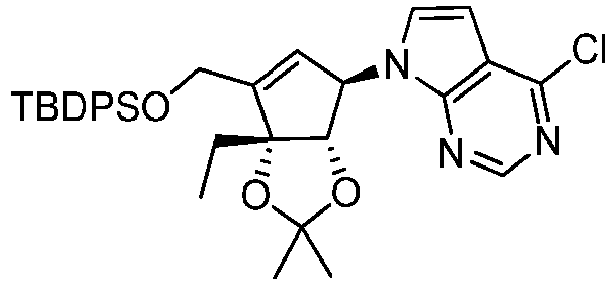
- The title compound was synthesized by following an analogous reaction protocol as was described in the preparation of 1-((3aS,4R,6aR)-6-(((tert-butyldiphenylsilyl)oxy)methyl)-2,2-dimethyl-4,6a-dihydro-3aH-cyclopenta[d][1,3]dioxol-4-yl)-4-chloro-1H-pyrrolo[3,2-c] pyridine. 1H NMR (400 MHz, Chloroform-d) δ 8.76 (s, 1H), 7.79 - 7.67 (m, 4H), 7.55 - 7.37 (m, 6H), 6.99 (d, J = 3.6 Hz, 1H), 6.60 (d, J = 3.6 Hz, 1H), 6.03 - 5.96 (m, 1H), 5.78 (q, J= 2.5 Hz, 1H), 4.61 - 4.43 (m, 2H), 4.25 (d, J= 0.9 Hz, 1H), 1.75 (q, J= 7.3 Hz, 1H), 1.55 (dq, J = 14.8, 7.4 Hz, 1H), 1.41 (s, 6H), 1.13 (s, 9H), 0.68 (t, J = 7.4 Hz, 3H); LCMS m/z= 588.21 (M+, 100%).
-

- The title compound was synthesized by following an analogous reaction protocol as was described in the preparation of ((3aR,6R,6aS)-6-(2-chloro-7H-pyrrolo[2,3-d]pyrimidin-7-yl)-2,2-dimethyl-6,6a-dihydro-3aH-cyclopenta[d][1,3]dioxol-4-yl)methanol. 1H NMR (400 MHz, Chloroform-d) δ 8.74 (s, 1H), 7.17 (d, J= 3.7 Hz, 1H), 6.60 (d, J= 3.6 Hz, 1H), 5.93 (dq, J= 2.7, 1.5 Hz, 1H), 5.79 (q, J= 2.2 Hz, 1H), 4.60 - 4.43 (m, 2H), 4.32 (t, J = 0.8 Hz, 1H), 1.94 (dq, J= 14.8, 7.4 Hz, 1H), 1.74 (dq, J = 14.7, 7.5 Hz, 1H), 1.51 (s, 3H), 1.41 (s, 3H), 0.83 (t, J= 7.5 Hz, 3H); LCMS m/z= 350.22 (M+, 100%).
-

- The title compound was synthesized by following an analogous reaction protocol as was described in the preparation of (3aS,4R,6aR)-2,2-dimethyl-4-(4-methyl-7H-pyrrolo[2,3-d]pyrimidin-7-yl)-3a,6a-dihydro-4H-cyclopenta[d][1,3]dioxole-6-carbaldehyde. 1H NMR (400 MHz, Chloroform-d) δ 10.02 (s, 1H), 8.75 (s, 1H), 7.09 (d, J = 3.7 Hz, 1H), 6.88 (dd, J = 2.8, 1.1 Hz, 1H), 6.68 (d, J = 3.6 Hz, 1H), 5.98 (dd, J = 2.8, 1.0 Hz, 1H), 4.43 (d, J = 1.0 Hz, 1H), 2.24 (dq, J= 14.9, 7.5 Hz, 1H), 1.97 (dq, J = 14.8, 7.4 Hz, 1H), 1.47 (s, 6H), 0.89 (t, J= 7.5 Hz, 3H); LCMS m/z= 348.22 (M+, 100%).
-

- The title compound was synthesized by following an analogous reaction protocol as was described in the preparation of 4-chloro-7-((3aS,4R,6aR)-2,2-dimethyl-6-vinyl-3a,6a-dihydro-4H-cyclopenta[d][1,3] dioxol-4-yl)-7H-pyrrolo[2,3-d]pyrimidine. 1H NMR (400 MHz, Chloroform-d) δ 8.75 (s, 1H), 7.16 (d, J= 3.7 Hz, 1H), 6.60 (d, J = 3.7 Hz, 1H), 6.56 - 6.36 (m, 1H), 5.99 - 5.69 (m, 3H), 5.44 (dd, J= 11.3, 1.5 Hz, 1H), 4.25 (d, J = 0.9 Hz, 1H), 2.15 - 1.99 (m, 1H), 1.76 (dq, J = 14.8, 7.5 Hz, 1H), 1.46 (s, 6H), 0.81 (t, J = 7.5 Hz, 3H). LCLCMS m/z= 346.22 (M+, 100%).
-

- The title compound was prepared by an analogous reaction protocol as described in
WO2006/091905 A1 . -
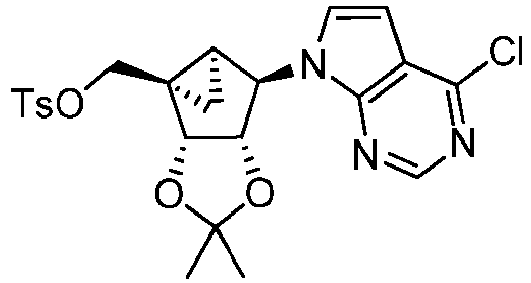
- To a stirred solution of ((3aR,3bR,4aS,5R,5aS)-5-(4-chloro-7H-pyrrolo[2,3-d]pyrimidin-7-yl)-2,2-dimethyltetrahydrocyclopropa[3,4]cyclopenta[1,2-d][1,3]dioxol-3b(3aH)-yl)methanol (2 g, 5.96 mmol) in CH2Cl2 (40 ml)at 0°C, was added TEA (2.494 ml, 17.87 mmol), DMAP (0.146 g, 1.191 mmol) and followed by p-TsCl (1.363 g, 7.15 mmol) slowly and stirred for 10 min. The reaction mixture was stirred at 25°C for 16h. The reaction mixture was diluted with methylene chloride (100 ml) and washed with water (100 ml). Layers were separated, organic layer was washed with brine (100 ml) and dried over anhydrous Na2SO4. The organic layer was filtered and concentrated in vacuo to give 12g of crude compound. This residue was purified by combiflash (Rf200, Teledyne/Isco) instrument onto a redisep® Rf column with gradient elution (0 to 7%) of ethyl acetate in petroleum ether to afford the title (0.267g, 9.15%) as an off-white solid. LCMS m/z= 490.17 (M+, 100%).
-

- The title compound was synthesized by following an analogous reaction protocol as was described in the preparation of (3aS,4R,6aR)-2,2-dimethyl-4-(4-methyl-7H-pyrrolo[2,3-d]pyrimidin-7-yl)-3a,6a-dihydro-4H-cyclopenta[d][1,3]dioxole-6-carbaldehyde. 1H NMR (400 MHz, Chloroform-d) δ 9.34 (s, 1H), 8.63 (s, 1H), 7.18 (d, J= 3.6 Hz, 1H), 6.66 (d, J = 3.6 Hz, 1H), 5.91 (dd, J = 7.1, 1.2 Hz, 1H), 5.11 (s, 1H), 4.82 (dd, J = 7.1, 1.6 Hz, 1H), 2.34 (ddd, J = 9.4, 6.1, 1.6 Hz, 1H), 1.89 - 1.77 (m, 2H), 1.58 (s, 3H), 1.30 (s, 3H); LCMS m/z =333.9 (M+, 100%).
-

- To a stirred suspension of methyltriphenylphosphonium bromide (24.62 g, 68.9 mmol) in THF (200 ml), was added 1M KHMDS in THF (68.9 ml, 68.9 mmol) at 25°C and stirred for 10 min. The resulting yellow suspension was cooled to 0°C and a solution of (3aR,3bS,4aS, 5R,5aS)-5-(4-Chloro-7H-pyrrolo[2,3-d]pyrimidin-7-yl)-2,2-dimethylhexahydrocyclopropa [3,4]cyclopenta[1,2-d][1,3]dioxole-3b-carbaldehyde (9.2 g, 27.6 mmol) in THF (80 ml) was added slowly. The reaction mixture was stirred at the same temperature for 1h. The reaction mixture was quenched with a saturated aq.NH4Cl (200ml) and extracted with ethyl acetate (200 ml). Layers were separated, organic layer was washed with brine (250 ml) and dried over anhydrous Na2SO4 The organic layer was filtered and concentrated in vacuo to give 11g of crude compound. This residue was purified by combiflash (Rf200, Teledyne/Isco) instrument onto a redisep® Rf column with gradient elution (0 to 20%) of ethyl acetate in petroleum ether to afford the title compound (7g, 77%) as a white solid. 1H NMR (400 MHz, Chloroform-d) δ 8.68 (s, 1H), 7.23 (d, J = 3.7 Hz, 1H), 6.67 (d, J = 3.6 Hz, 1H), 5.86 (dd, J = 17.3, 10.6 Hz, 1H), 5.39 - 5.32 (m, 2H), 5.29 (s, 1H), 5.18 (dd, J = 10.6, 0.9 Hz, 1H), 4.59 (dd, J = 7.1, 1.6 Hz, 1H), 1.77 (ddd, J = 9.3, 4.9, 1.6 Hz, 1H), 1.63 (s, 3H), 1.49 (t, J = 5.3 Hz, 1H), 1.27 (s, 3H), 1.18 (ddd, J= 9.3, 5.6, 1.6 Hz, 1H); LCMS m/z =332.28 (M+, 50%).
-

- A mixture of 4-chloro-7-((3aR,3bS,4aS,5R,5aS)-2,2-dimethyl-3b-vinylhexahydro cyclopropa [3,4] cyclo penta[1,2-d][1,3]dioxol-5-yl)-7H-pyrrolo[2,3-d]pyrimidine (3g, 9.04 mmol) and aq. ammonia (19.57 ml, 904 mmol) in dioxane (6ml) stirred at 130°C in a steel bomb for 16 h. The reaction mixture was diluted with ethyl acetate (20ml) and washed with water (20ml). Layers were separated, organic layer was washed with brine (20ml) and dried over anhydrous Na2SO4 The organic layer was filtered and concentrated in vacuo to give 4.1g of crude compound. This residue was purified by combiflash (Rf200, Teledyne/Isco) instrument onto a redisep® Rf column with gradient elution (0 to 3%) of methanol in dichloromethane to afford the title compound (2.45g, 87%) as a white solid. 1H NMR (400 MHz, DMSO-d 6) δ 8.07 (s, 1H), 7.02 (s, 2H), 6.96 (d, J= 3.5 Hz, 1H), 6.62 (d, J = 3.5 Hz, 1H), 5.86 (dd, J = 17.4, 10.7 Hz, 1H), 5.33 (dd, J = 7.2, 1.3 Hz, 1H), 5.23 (dd, J = 17.4, 1.3 Hz, 1H), 5.10 - 5.01 (m, 2H), 4.50 (dd, J= 7.1, 1.6 Hz, 1H), 1.70 (ddd, J = 9.3, 4.8, 1.6 Hz, 1H), 1.46 (s, 3H), 1.29 - 1.22 (m, 1H), 1.19 (s, 3H), 1.10 (ddd, J = 9.1, 5.1, 1.5 Hz, 1H); LCMS m/z =313 (M+1, 100%).
-
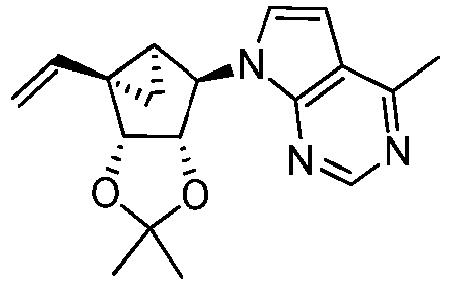
- To a degassed mixture dioxane (8ml) and water (1ml) in a microwave vial was added 4-chloro-7-((3aR,3bS,4aS,5R,5aS)-2,2-dimethyl-3b-vinylhexahydrocyclopropa[3,4]cyclopenta [1,2-d][1,3]dioxol-5-yl)-7H-pyrrolo[2,3-d]pyrimidine (1.00 g, 3.01 mmol, potassium phosphate, tribasic (1.575 g, 9.04 mmol), dichloro[1,1'-bis(di-t-butylphosphino)ferrocene] palladium(II) (0.196 g, 0.301 mmol) and 2,4,6-trimethyl-1,3,5,2,4,6-trioxatriborinane (2.107 ml, 15.07 mmol) at 25°C. Stirred the reaction mixture at 100°C for 1h. The reaction mixture was diluted with ethyl acetate (20ml) and washed with water (20ml). Layers were separated, organic layer was washed with brine (20ml) and dried over anhydrous Na2SO4. The organic layer was filtered and concentrated in vacuo to give 1.1g of crude compound. This residue was purified by combiflash (Rf200, Teledyne/Isco) instrument onto a redisep® Rf column with gradient elution (0 to 20%) of ethyl acetate in petroleum ether to afford the title compound (0.66g, 70.3%) as an off white solid. 1H NMR (400 MHz, Chloroform-d) δ 8.81 (s, 1H), 7.16 (d, J = 3.6 Hz, 1H), 6.63 (d, J = 3.6 Hz, 1H), 5.87 (dd, J = 17.3, 10.6 Hz, 1H), 5.37 - 5.31 (m, 3H), 5.17 (dd, J = 10.6, 0.9 Hz, 1H), 4.58 (dd, J = 7.1, 1.6 Hz, 1H), 2.78 (s, 3H), 1.78 (ddt, J= 9.3, 4.9, 1.8 Hz, 1H), 1.59 (d, J = 1.8 Hz, 3H), 1.50 (td, J = 5.2, 2.7 Hz, 1H), 1.27 (d, J= 2.2 Hz, 3H), 1.19 - 1.14 (m, 1H); LCMS m/z =312.21 (M+1, 100%).
- Des chloro dompound i.e. 7-((3aR,3bS,4aS,5R,5aS)-2,2-dimethyl-3b-vinylhexahydro cyclo propa[3,4]cyclopenta[1,2-d] [1,3]dioxol-5-yl)-7H-pyrrolo[2,3-d]pyrimidine was also formed, which was separated at final step by reverse phase preparative HPLC.
-

- To a solution of (3aR,3bS,4aS,5R,5aS)-5-(4-chloro-7H-pyrrolo[2,3-d]pyrimidin-7-yl)-2,2-dimethyltetrahydrocyclopropa[3,4]cyclopenta[1,2-d][1,3]dioxole-3b(3aH)-carbaldehyde (2.0 g, 5.99 mmol) in tetrahydrofuran (20 ml), was added 1M methyl magnesium bromide in THF (3.00 ml, 8.99 mmol) at 0°C. The reaction mixture was then stirred at 0°C for 2h. The reaction mixture was quenched with a sat. aq. ammonium chloride (50ml) and extracted with ethyl acetate (50ml × 2). The combined organic layer was washed with brine (50ml), dried over sodium sulfate, filtered and concentrated in vacuo to give 2.2g of crude compound. This residue was purified by combiflash (Rf200, Teledyne/Isco) instrument onto a redisep® Rf column with gradient elution (0 to 30%) of ethyl acetate in petroleum ether to afford the title compound (1.85g, 88%) as an off-white solid. LCMS m/z = 350.03 (M+1; 100%).
-

- The title compound was synthesized by following an analogous reaction protocol as was described in the preparation of (3aS,4R,6aR)-2,2-dimethyl-4-(4-methyl-7H-pyrrolo[2,3-d]pyrimidin-7-yl)-3a,6a-dihydro-4H-cyclopenta[d][1,3]dioxole-6-carbaldehyde. LCMS m/z = 348.03 (M+; 100%).
-

- To a stirred suspension of methyltriphenylphosphonium bromide (3.85 g, 10.78 mmol) in THF (40 ml) was added 1M KHMDS in THF (10.78 ml, 10.78 mmol) at 0°C and stirred for 10min. To this yellow suspension was added a solution of 1-((3aR,3bS,4aS,5R,5aS)-5-(4-chloro-7H-pyrrolo[2,3-d]pyrimidin-7-yl)-2,2-dimethyl tetra hydrocyclopropa [3,4] cyclopenta[1,2-d][1,3]dioxol-3b(3aH)-yl)ethan-1-one (1.5 g, 4.31 mmol) in THF (20 ml) was added slowly at 0°C. The reaction mixture was stirred at 25°C for 1h. The reaction mixture was quenched with a saturated aqueous ammonium chloride (50ml) and extracted with ethyl acetate (50 ml). Layers were separated, organic layer was washed with brine (50 ml) and dried over anhydrous sodium sulphate. The organic layer was filtered and concentrated in vacuo to give 2.2g of crude compound. This residue was purified by combiflash (Rf200, Teledyne/Isco) instrument onto a redisep® Rf column with gradient elution (0 to 20%) of ethyl acetate in petroleum ether to afford the title compound (0.7g, 46.9%) as a white solid. LCMS m/z = 346.03 (M+1; 100%).
-

- The title compound was synthesized by following an analogous reaction protocol as was described in the preparation of (S)-1-((3aR,3bR,4aS,5R,5aS)-5-(4-chloro-7H-pyrrolo[2,3-d]pyrimidin-7-yl)-2,2-dimethyltetrahydrocyclopropa[3,4]cyclopenta[1,2-d][1,3]dioxol-3b(3aH)-yl)ethan-1-ol. LCMS m/z = 375.91 (M+; 100%).
-

- The title compound was synthesized by following an analogous reaction protocol as was described in the preparation of 1-((3aR,3bS,4aS,5R,5aS)-5-(4-chloro-7H-pyrrolo[2,3-d]pyrimidin-7-yl)-2,2-dimethyl tetrahydrocyclopropa[3,4]cyclopenta[1,2-d][1,3]dioxol-3b(3aH)-yl)ethan-1-one. 1H NMR (400 MHz, DMSO-d6) δ 8.58 (s, 1H), 7.71 (d, J = 3.7 Hz, 1H), 6.72 (d, J = 3.6 Hz, 1H), 5.84 (dd, J = 7.3, 1.2 Hz, 1H), 5.21 (s, 1H), 4.79 (dd, J = 7.3, 1.5 Hz, 1H), 2.09 (s, 1H), 2.07 - 2.01 (m, 1H), 1.79 (ddd, J = 9.5, 5.3, 1.4 Hz, 1H), 1.51 (t, J = 5.5 Hz, 1H), 1.48 (s, 3H), 1.21 (s, 3H), 0.96 - 0.74 (m, 4H); LCMS m/z = 373.97 (M+; 100%).
-

- The title compound was synthesized by following an analogous reaction protocol as was described in the preparation of 4-chloro-7-((3aR,3bS,4aS,5R,5aS)-2,2-dimethyl-3b-vinylhexahydro cyclopropa[3,4] cyclopenta[1,2-d][1,3]dioxol-5-yl)-7H-pyrrolo[2,3-d]pyrimidine. 1H NMR (400 MHz, Chloroform-d) δ 8.67 (s, 1H), 7.29 (d, J = 3.6 Hz, 1H), 6.68 (d, J = 3.6 Hz, 1H), 5.37 - 5.35 (m, 2H), 4.98 (d, J = 0.8 Hz, 1H), 4.80 (s, 1H), 4.59 (dd, J = 7.5, 1.6 Hz, 1H), 2.04 (ddd, J = 9.3, 4.7, 1.6 Hz, 1H), 1.67 (s, 2H), 1.42 (t, J = 5.1 Hz, 1H), 1.27 (s, 6H), 0.75 - 0.69 (m, 2H), 0.56 - 0.52 (m, 2H); LCMS m/z = 372.2 (M+; 100%).
-

- To a suspension of (1-iodoethyl)triphenylphosphonium bromide (4.08 g, 7.49 mmol, synthesized by following same reaction protocol as was described in
WO2004/9574, A1 -

- The title compound was synthesized by following an analogous reaction protocol as was described in the preparation of 1-((3aS,4R,6aR)-6-(((tert-butyldiphenylsilyl)oxy)methyl)-2,2-dimethyl-4,6a-dihydro-3aH-cyclopenta[d][1,3]dioxol-4-yl)-4-chloro-1H-pyrrolo[3,2-c] pyridine. LCMS m/z = 587.82(M+; 100%).
-

- The title compound was synthesized by following an analogous reaction protocol as was described in the preparation of ((3aR,6R,6aS)-6-(2-chloro-7H-pyrrolo[2,3-d]pyrimidin-7-yl)-2,2-dimethyl-6,6a-dihydro-3aH-cyclopenta[d][1,3]dioxol-4-yl)methanol. 1H NMR (400 MHz, DMSO-d6) δ 8.57 (s, 1H), 6.48 (d, J = 1.1 Hz, 1H), 5.34 - 5.25 (m, 1H), 4.98 (s, 1H), 4.90 (dt, J = 7.4, 1.3 Hz, 1H), 4.66 (t, J = 5.7 Hz, 1H), 3.65 (q, J = 5.8, 5.3 Hz, 2H), 2.57 (s, 3H), 1.54 - 1.48 (m, 1H), 1.46 (s, 3H), 1.19 (s, 3H), 0.92 (ddd, J = 9.0, 5.0, 1.3 Hz, 1H), 0.85 (q, J = 4.7, 4.3 Hz, 1H); LCMS m/z = 350.03 (M+; 100%).
-

- The title compound was synthesized by following an analogous reaction protocol as was described in the preparation of (3aS,4R,6aR)-2,2-dimethyl-4-(4-methyl-7H-pyrrolo[2,3-d]pyrimidin-7-yl)-3a,6a-dihydro-4H-cyclopenta[d][1,3]dioxole-6-carbaldehyde. LCMS m/z = 348.03 (M+; 100%).
-

- The title compound was synthesized by following an analogous reaction protocol as was described in the preparation of 4-chloro-7-((3aR,3bS,4aS,5R,5aS)-2,2-dimethyl-3b-vinylhexahydro cyclopropa [3,4] cyclo penta[1,2-d][1,3]dioxol-5-yl)-7H-pyrrolo[2,3-d]pyrimidine. 1H NMR (400 MHz, Chloroform-d) δ 8.57 (s, 1H), 6.38 (q, J = 1.1 Hz, 1H), 5.88 (dd, J = 17.3, 10.6 Hz, 1H), 5.64 (dd, J = 7.2, 1.4 Hz, 1H), 5.34 - 5.23 (m, 1H), 5.10 (dd, J = 10.6, 1.1 Hz, 1H), 5.02 - 4.96 (m, 1H), 4.87 (s, 1H), 2.55 (s, 3H), 1.59 (s, 3H), 1.56 - 1.51 (m, 1H), 1.30 (s, 3H), 1.29 - 1.26 (m, 1H), 1.19 - 1.12 (m, 1H); LCMS m/z = 346.03 (M+; 100%).
-

- The title compound was synthesized by following an analogous reaction protocol as was described in the preparation of 7-((3aR,3bS,4aS,5R,5aS)-2,2-dimethyl-3b-vinylhexa hydrocyclopropa [3,4]cyclopenta [1,2-d][1,3]dioxol-5-yl)-7H-pyrrolo[2,3-d]pyrimidin-4-amine. 1H NMR (400 MHz, DMSO-d6) δ 7.99 (s, 1H), 6.83 (s, 2H), 6.29 (d, J = 1.2 Hz, 1H), 5.87 - 5.74 (m, 2H), 5.44 (d, J = 7.3 Hz, 1H), 5.19 (dd, J = 17.4, 1.4 Hz, 1H), 5.02 (dd, J = 10.7, 1.3 Hz, 1H), 4.80 (d, J = 7.3 Hz, 1H), 2.36 (s, 3H), 1.61 (dd, J = 9.0, 5.3 Hz, 1H), 1.46 (s, 3H), 1.21 (s, 3H), 1.15 - 1.08 (m, 2H); LCMS m/z = 327.1 (M+1; 100%).
-

- 4-Chloro-7-((3aS,4R,6aR)-2,2-dimethyl-6-vinyl-3a,6a-dihydro-4H-cyclo penta[d][1,3]dioxol-4-yl)-7H-pyrrolo[2,3-d]pyrimidine (0.25g, 0.787mmol) in 9-BBN (0.5 molar, 6.29ml, 3.15mmol) was heated at 70°C for 2h under N2 atmosphere. The reaction mixture was cooled to 25°C, then potassium phosphate tribasic (0.685g, 3.93mmol) in water (0.5ml) was added and stirred for 20mins. A solution of 3-bromo-7-iodo-N-(4-methoxybenzyl)quinolin-2-amine (0.369g, 0.787mmol) in THF (1ml) was added, followed by PdCl2(dppf) (0.058g, 0.079mmol). The resulting mixture was stirred at 70°C for 2h. The reaction mixture was diluted with ethyl acetate (10 ml) and washed with water (10 ml). Layers were separated, organic layer was washed with brine (10 ml) and dried over anhydrous Na2SO4. The organic layer was filtered and concentrated in vacuo to give 0.35g of crude compound. This residue was purified by combiflash (Rf200, Teledyne/Isco) instrument onto a redisep® Rf column with gradient elution (0 to 15%) of ethyl acetate in petroleum ether to afford the title compound (0.25g, 48.1%) as an off-white solid. 1H NMR (400 MHz, DMSO-d6) δ 8.65 (s, 1H), 8.37 (s, 1H), 7.60 (d, J = 8.2 Hz, 1H), 7.45 (s, 1H), 7.33 (d, J = 8.5 Hz, 2H), 7.28 - 7.14 (m, 2H), 6.98 (d, J = 3.7 Hz, 1H), 6.87 - 6.75 (m, 2H), 6.36 (d, J = 3.6 Hz, 1H), 5.66 (s, 1H), 5.52 (s, 1H), 5.35 (d, J = 5.7 Hz, 1H), 4.63 (d, J = 6.0 Hz, 2H), 4.49 (d, J = 5.7 Hz, 1H), 3.66 (s, 3H), 3.07 - 2.97 (m, 2H), 2.65 - 2.59 (m, 2H), 1.39 (s, 3H), 1.28 (s, 3H).LCMS m/z= 658.89, 661.64 (M-2, M+1, 100%).
- Intermediates in table-5 were synthesized by an analogous reaction protocol as was used for the preparation of 3-bromo-7-(2-((3aS,4R,6aR)-4-(4-chloro-7H-pyrrolo[2,3-d]pyrimidin-7-yl)-2,2-dimethyl -3a,6a-dihydro-4H-cyclopenta[d][1,3]dioxol-6-yl)ethyl)-N-(4-methoxy benzyl)quinolin-2-amine using the appropriate starting materials.
Table-5: Structure & IUPAC name- Intermediates used 1H NMR & LCMS data 
7-Bromo-N-methyl quinolin-2-amine and 4-Chloro-7-((3aS,4R, 6aR)-2,2-dimethyl-6-vinyl-3a,6a-dihydro-4H-cyclopenta[d][1,3] dioxol-4-yl)-7H-pyrrolo[2,3-d]pyrimidine LCMS m/z= 476.05 (M+, 100%) 7-(2-((3aS,4R,6aR)-4-(4-chloro-7H-pyrrolo[2,3-d]pyrimidin-7-yl)-2,2-dimethyl-3a,6a-dihydro-4H-cyclopenta[d][1,3]dioxol-6-yl)ethyl)-N-methylquinolin-2-amine 
4-Chloro-7-((3aS,4R ,6aR)-2,2-dimethyl-6-vinyl-4,6a-dihydro-3aH-cyclopenta [d] [1,3] dioxol-4-yl)-5-fluoro-7H-pyrrolo[2,3-d]pyrimidine and 3-Bromo-7-iodo-N-(4-methoxybenzyl)quinolin-2-amine LCMS m/z = 679.85 (M+1, 100%) 3-Bromo-7-(2-((3aS,4R,6aR)-4-(4-chloro-5-fluoro-7H-pyrrolo[2,3-d]pyrimidin-7-yl)-2,2-dimethyl-3a,6a-dihydro-4H-cyclopenta[d] [1,3 ]dioxol-6-yl)ethyl)-N-(4-methoxybenzyl) quino lin-2-amine 
7-Bromo-3-fluoro quinolin-2-amine and 4-Chloro-7-((3aS,4R, 6aR)-2,2-dimethyl-6-vinyl-3a,6a-dihydro-4H-cyclopenta[d][1,3] dioxol-4-yl)-7H-pyrrolo[2,3-d] pyrimidine 1H NMR (400 MHz, DMSO-d 6) δ 8.65 (s, 1H), 7.81 (d, J = 11.9 Hz,1H), 7.60 (d, J = 8.2 Hz, 1H), 7.41 (d, J = 1.6 Hz, 1H), 7.19 (dd, J = 8.2, 1.6 Hz, 1H), 6.95 (d, J = 3.7 Hz, 1H), 6.84 - 6.67 (m, 2H), 6.41 (d, J = 3.7 Hz, 1H), 5.66 (s, 1H), 5.52 (s, 1H), 5.34 (d, J = 5.7 Hz, 1H), 4.51 (dd, J = 15.1, 5.6 Hz, 1H), 3.18 - 2.98 (m, 2H), 2.80 - 2.56 (m, 2H), 1.39 (s, 3H), 1.28 (s,, 3H). LCMS m/z = 480.2 (M+, 100%) 7-(2-((3aS,4R,6aR)-4-(4-chloro-7H-pyrrolo[2,3-d]pyrimidin-7-yl)-2,2-dimethyl-3a,6a-dihydro-4H-cyclopenta[d][1,3]dioxol-6-yl)ethyl)-3-fluoroquinolin-2-amine 
4-Chloro-7-((3aS,4R, 6aR)-2,2-dimethyl-6-(prop-1-en-2-yl)-3a,6a-dihydro-4H-cyclopenta[d] [1,3] dioxol-4-yl)-7H-pyrrolo[2,3-d] pyrimidine and 3-Bromo-7-iodo-N-(4-methoxybenzyl)quinolin-2-amine LCMS m/z = 676.47 (M+1, 100%) 3-Bromo-7-(2-((3aS,4R,6aR)-4-(4-chloro-7H-pyrrolo[2,3-d]pyrimidin-7-yl)-2,2-dimethyl-3a,6a-dihydro-4H-cyclopenta[d][1,3]dioxol-6-yl)propyl)-N-(4-methoxybenzyl)quinolin-2-amine 
4-Chloro-7-((3aS,4R,6aR)-2,2-dimethyl-6-vinyl-3a,6a-dihydro-4H-cyclopenta[d][1,3] dioxol-4-yl)-7H-pyrrolo[2,3-d]pyrimidine and 7-Bromo-N-cyclobutylquinolin-2-amine 1H NMR (400 MHz, Chloroform-d) δ 8.65 (s, 1H), 7.89 (d, J = 8.9 Hz, 1H), 7.60 - 7.51 (m, 2H), 7.16 (dd, J = 8.1, 1.7 Hz, 1H), 6.65 (d, J = 8.9 Hz, 1H), 6.46 (d, J = 3.7 Hz, 1H), 6.25 (d, J = 3.7 Hz, 1H), 5.77 (s, 1H), 5.44 (t, J = 1.7 Hz, 1H), 5.32 - 5.28 (m, 2H), 4.48 - 4.41 (m, 2H), 3.22 - 3.02 (m, 2H), 2.83 - 2.77 (m, 2H), 2.58 - 2.46 (m, 2H), 2.07 - 1.96 (m, 2H), 1.85 (ddd, J = 10.6, 9.0, 6.4 Hz, 2H), 1.51 (s, 3H), 1.38 (s, 3H); LCMS m/z =515.19 (M-1, 100%) 7-(2-((3aS,4R,6aR)-4-(4-chloro-7H-pyrrolo[2,3-d]pyrimidin-7-yl)-2,2-dimethyl-3a,6a-dihydro-4H-cyclopenta[d][1,3]dioxol-6-yl)ethyl)-N-cyclobutylquinolin-2-amine 
7-((3aS,4R,6aR)-2,2-dimethyl-6-vinyl-3a,6a -dihydro-4H-cyclo penta[d][1,3]dioxol-4-yl)-4-methyl-7H-pyrrolo[2,3-d] pyrimidine & 7-bromo-3-chloro quinolin-2-amine LCMS m/z= 476.36 (M+, 60%) 3-Chloro-7-(2-((3aS,4R,6aR)-2,2-dimethyl-4-(4-methyl-7H-pyrrolo[2,3-d]pyrimidin-7-yl)-3a,6a-dihydro-4H-cyclopenta[d][1,3]dioxol-6-yl)ethyl)quinolin-2-amine 
4-Chloro-7-((3aS,4R, 6aR)-2,2-dimethyl-6-(prop-1-en-2-yl)-3a, 6a-dihydro-4H-cyclo penta[d][1,3]dioxol-4-yl)-7H-pyrrolo[2,3-d] pyrimidine & 7-bromo-3-chloro quinolin-2-amine LCMS m/z= 510.2 (M+, 100%) 3-Chloro-7-(2-((3aS,4R,6aR)-4-(4-chloro-7H-pyrrolo[2,3-d]pyrimidin-7-yl)-2,2-dimethyl-3a,6a-dihydro-4H-cyclopenta[d][1,3]dioxol-6-yl)propyl)quinolin-2-amine 

1H NMR (400 MHz, Chloroform-d) δ 8.76 - 8.62 (m, 2H), 7.76 (s, 1H), 7.25 (dd, J = 10.4, 1.5 Hz, 1H), 6.84 (d, J = 3.7 Hz, 1H), 6.54 (d, J = 3.6 Hz, 1H), 5.81 (s, 1H), 5.55 (s, 1H), 5.37 - 5.29 (m, 1H), 4.58 (d, J = 5.7 Hz, 1H), 3.25 - 3.12 (m, 2H), 2.89 - 2.72 (m, 2H), 1.51 (s, 3H), 1.45 (s, 9H), 1.43 (s, 9H), 1.38 (s, 3H); LCMS m/z = 760.41 (M+1, 40%). and 4-chloro-7-((3aS,4R ,6aR)-2,2-dimethyl-6-vinyl-3a,6a-dihydro-4H-cyclopenta[d] [1,3] dioxol-4-yl)-7H-pyrrolo[2,3-d] pyrimidine 

1H NMR (400 MHz, DMSO-d 6) δ 8.88 (s, 1H), 8.64 (s, 1H), 7.85 (s, 1H), 7.63 (dd, J = 11.0, 1.5 Hz, 1H), 6.80 (d, J = 3.6 Hz, 1H), 6.48 (d, J = 3.7 Hz, 1H), 5.65 (s, 1H), 5.56 (s, 1H), 5.37 (d, J = 5.6Hz, 1H), 4.44 (d, J = 5.7 Hz, 1H), 3.22 - 3.13 (m, 2H), 2.78 - 2.66 (m, 2H), 2.61 (s, 3H), 1.38 (s, 9H), 1.35 (s, 3H), 1.33 (s, 9H), 1.27 (s, 3H); LCMS m/z = 738.61 (M+, 90%), 740.61 (M+2, 100%). and 7-((3aS,4R,6aR)-2,2-dimethyl-6-vinyl-3a,6a -dihydro-4H-cyclo penta[d][1,3]dioxol-4-yl)-4-methyl-7H-pyrrolo[2,3-d]pyrimidine 
4-Chloro-7-((3aS,4R, 6aR)-2,2-dimethyl-6-(prop-1-en-2-yl)-3a, 6a-dihydro-4H-cyclo penta[d][1,3]dioxol-4-yl)-7H-pyrrolo[2,3-d] pyrimidine and LCMS m/z = 796.20 (M+23, 60%). 

4-Chloro-1-((3aS,4R, 6aR)-2,2-dimethyl-6-vinyl-4,6a-dihydro-3aH-cyclopenta[d][1,3]dioxol-4-yl)-1H-pyrrolo[3,2-c]pyrid ine & 7-Bromo-3-methylimidazo[1,2-a]pyridine LCMS m/z=450.04 (M+, 100%) 4-Chloro-7-((3aS,4R,6aR)-2,2-dimethyl-6-(2-(3 - methylimidazo[1,2-a]pyridin-7-yl)ethyl)-3a,6a-dihydro-4H-cyclopenta[d][1,3]dioxol-4-yl)-7H-pyrrolo[2,3-d]pyrimidine -

- 4-Chloro-7-((3aS,4R,6aR)-2,2-dimethyl-6-vinyl-3a,6a-dihydro-4H-cyclopenta[d][1,3]dioxol-4-yl)-7H-pyrrolo[2,3-d]pyrimidine (0.242g, 0.762mmol) in 9-BBN (0.5 molar, 4.36ml, 2.178mmol) was heated at 50°C for 1h under N2 atmosphere. The reaction mixture was cooled to 25°C, then potassium phosphate tribasic (0.578g, 2.72mmol) in water (0.5ml) was added and stirred for 20 mins. A solution of 7-bromo-3-chloro-5-fluoroquinolin-2-amine (0.150g, 0.544mmol) in THF (0.5ml) was added, followed by dichloro[1,1'-bis(di-t-butylphosphino)ferrocene]palladium(II) (0.035g, 0.054mmol). The resulting mixture was stirred at 50°C for 6h. The reaction mixture was diluted with water (10 ml) and extracted with ethyl acetate (10 ml). Layers were separated, organic layer was washed with brine (10 ml) and dried over anhydrous Na2SO4. The organic layer was filtered and concentrated in vacuo to give 0.345g of crude compound. This residue was purified by combiflash (Rf200, Teledyne/Isco) instrument onto a redisep® Rf column with gradient elution (0 to 35%) of ethyl acetate in petroleum ether to afford the title compound (0.16g, 57.5%) as an off-white solid. 1H NMR (400 MHz, DMSO-d6) δ 8.64 (s, 1H), 8.18 (s, 1H), 7.25 (s, 1H), 7.09 - 6.96 (m, 4H), 6.44 (d, J = 3.6 Hz, 1H), 5.67 (s, 1H), 5.56 - 5.51 (m, 1H), 5.35 (d, J = 5.7 Hz, 1H), 4.52 (d, J = 5.7 Hz, 1H), 3.05 - 2.98 (m, 2H), 2.74 - 2.56 (m, 2H), 1.38 (s, 3H), 1.28 (s, 3H); LCMS m/z = 514.2 (M+, 100%).
- Intermediates in table-6 were synthesized by an analogous reaction protocol as was used for the preparation of 3-chloro-7-(2-((3aS,4R,6aR)-4-(4-chloro-7H-pyrrolo[2,3-d]pyrimidin-7-yl)-2,2-dimethyl-3a,6a-dihydro-4H-cyclopenta[d][1,3]dioxol-6-yl)ethyl)-5-fluoroquinolin-2-amine using the appropriate starting materials.
Table-6: *Structure & IUPAC name Intermediates used 118 1H NMR & LCMS data 
4-Chloro-7-((3aS,4R, 6aR)-2,2-dimethyl-6-vinyl-3a,6a-dihydro-4H-cyclopenta [d][1,3] dioxol-4-yl)-7H-pyrrolo[2,3-d] pyrimidine and 7-Bromo-3-chloro-6-fluoroquinolin-2-amine 1H NMR (400 MHz, DMSO-d6) δ 8.65 (s, 1H), 8.18 (s, 1H), 7.56 - 7.44 (m, 2H), 7.14 (d, J = 3.7 Hz, 1H), 6.73 (s, 2H), 6.50 (d, J = 3.7 Hz, 1H), 5.69 (s, 1H), 5.60 - 5.52 (m, 1H), 5.42 - 5.31 (m, 1H), 4.53 (dd, J = 5.7, 2.8 Hz, 1H), 3.08 - 3.01 (m, 2H), 2.66 - 2.62 (m, 2H), 1.39 (s, 3H), 1.28 (s, 3H); LCMS m/z =515 (M+1, 100%). 3-Chloro-7-(2-((3aS,4R,6aR)-4-(4-chloro-7H-pyrrolo [2,3-d]pyrimidin-7-yl)-2,2-dimethyl-3a,6a-dihydro-4H-cyclopenta[d][1,3]dioxol-6-yl)ethyl)-6-fluoroquinolin-2-amine 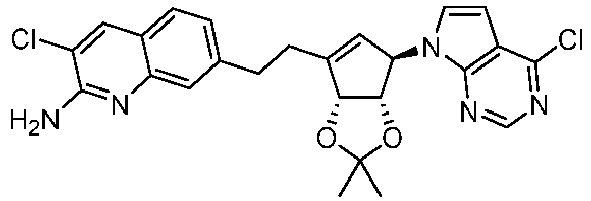
4-Chloro-7-((3aS,4R ,6aR)-2,2-dimethyl-6-vinyl-3a,6a-dihydro-4H-cyclopenta[d] [1,3] dioxol-4-yl)-7H-pyrrolo[2,3-d] pyrimidine and 7-Bromo-3-chloroquinolin-2-amine 1H NMR (400 MHz, DMSO-d6) δ 8.65 (s, 1H), 8.19 (s, 1H), 7.61 (d, J = 8.2 Hz, 1H), 7.40 (s, 1H), 7.19 (dd, J = 8.1, 1.7 Hz, 1H), 6.96 (d, J = 3.6 Hz, 1H), 6.72 (s, 2H), 6.41 (d, J = 3.6 Hz, 1H), 5.66 (s, 1H), 5.52 (s, 1H), 5.34 (d, J = 5.7 Hz, 1H), 4.49 (d, J = 5.6 Hz, 1H), 3.10 - 2.96 (m, 2H), 2.79 - 2.60 (m, 2H), 1.38 (s, 3H), 1.28 (s, 3H); LCMS m/z =496.05 (M+, 100%) 3-3-Chloro-7-(2-((3aS,4R,6aR)-4-(4-chloro-7H-pyrrolo[2,3-d]pyrimidin-7-yl)-2,2-dimethyl-3a,6a-dihydro-4H-cyclopenta[d][1,3]dioxol-6-yl)ethyl)quinolin-2-amine. 
4-Chloro-7-((3aS,4R,6aR)-2,2-dimethyl-6-(prop-1-en-2-yl)-3a,6a-dihydro-4H-cyclopenta[d][1,3]dio xol-4-yl)-7H-pyrrolo[2,3-d]pyrimidine and 7-Bromo-3-chloro-5-fluoroquinolin-2-amine 1H NMR (400 MHz, DMSO-d 6) δ 8.64 (d, J = 6.1 Hz, 1H), 8.22 - 8.16 (m, 1H), 7.29 - 7.14 (m, 2H), 7.00 - 6.95 (m, 3H), 6.56 (d, J = 3.6 Hz, 1H), 5.67 (d, J = 14.7 Hz, 1H), 5.57 (s, 1H), 5.40 - 5.34 (m, 1H), 4.54 (dd, J = 15.1, 5.7 Hz, 1H), 3.04 (q, J = 9.6, 7.8 Hz, 1H), 2.87 (s, 2H), 1.30 (d, J = 9.7 Hz, 3H), 1.19 (d, 6H); LCMS m/z =528.32 (M+, 100%) 3-Chloro-7-(2-((3aS,4R,6aR)-4-(4-chloro-7H-pyrrolo[2,3-d]pyrimidin-7-yl)-2,2-dimethyl-3a,6a-dihydro-4H-cyclopenta[d][1,3]dioxol-6-yl)propyl)-5-fluoroquinolin-2-amine 
7-((3aS,4R,6aR)-2,2-Dimethyl-6-vinyl-3a,6a-dihydro-4H-cyclopenta[d] [1,3] dioxol-4-yl)-4-methyl -7H-pyrrolo[2,3-d]pyrimidine and 7-Bromo-3-chloro- 5-fluoroquinolin-2-amine 1H NMR (400 MHz, Chloroform-d) δ 8.83 (s, 1H), 8.22 (d, J = 0.8 Hz, 1H), 7.34 (s, 1H), 6.92 (dd, J = 10.6, 1.5 Hz, 1H), 6.68 (d, J = 3.6 Hz, 1H), 6.38 (d, J = 3.6 Hz, 1H), 5.80 (s, 1H), 5.52 - 5.47 (m, 2H), 4.55 (d, J = 5.7 Hz, 1H), 3.12 - 3.06 (m, 2H), 2.77 - 2.74 (m, 2H), 2.74 (s, 3H), 1.51 (s, 3H), 1.38 (s, 3H); LCMS m/z =494.3 (M+, 80%) 3-Chloro-7-(2-((3aS,4R,6aR)-2,2-dimethyl-4-(4-methyl-7H-pyrrolo[2,3-d]pyrimidin-7-yl)-3a,6a-dihydro-4H-cyclopenta[d][1,3]dioxol-6-yl)ethyl)-5-fluoroquinolin-2-amine 
2-Chloro-7-((3aS,4R,6aR)-2,2-dimethyl-6-vinyl-4,6a-dihydro-3aH-cyclopenta[d][1,3]dio xol-4-yl)-7H-pyrrolo[2,3-d]pyrimidine and 7-Bromo-3-chloroquinolin-2-amine 1H NMR (400 MHz, Chloroform-d) δ 8.76 (s, 1H), 7.98 (s, 1H), 7.55 (d, J = 8.2 Hz, 2H), 7.22 (dd, J =8.1, 1.7 Hz, 1H), 6.52 (d, J = 3.6 Hz, 1H), 6.28 (d, J = 3.7 Hz, 1H), 5.75 (s, 1H), 5.42 (d, J = 2.4 Hz, 1H), 5.34 (d, J = 10.9 Hz, 3H), 4.52 (d, J = 5.6 Hz, 1H), 3.18 - 3.07 (m, 2H), 2.81 - 2.76 (m, 2H), 1.49 (s, 3H), 1.38 (s, 3H); LCMS m/z =496.24 (M+, 60%) 3-Chloro-7-(2-((3aS,4R,6aR)-4-(2-chloro-7H-pyrrolo[2,3-d]pyrimidin-7-yl)-2,2-dimethyl-3a,6a-dihydro-4H-cyclopenta[d][1,3]dioxol-6-yl)ethyl)quinolin-2-amine 
7-((3aS,4R,6aR)-2,2-Dimethyl-6-(prop-1-en-2-yl)-4,6a-dihydro -3aH-cyclo penta[d] [1,3]dioxol-4-yl)-4-methyl-7H-pyrrolo [2,3-d]pyrimidine and 7-Bromo-3-chloro-5-fluoroquinolin-2-amine LCMS m/z=508.31 (M+, 100%) 3-Chloro-7-(2-((3aS,4R,6aR)-2,2-dimethyl-4-(4-methyl-7H-pyrrolo[2,3-d]pyrimidin-7-yl)-3a,6a-dihydro-4H-cyclopenta[d][1,3]dioxol-6-yl)propyl)-5-fluoroquinolin-2-amine 
7-((3aS,4R, 6aR)-2,2-dimethyl-6-vinyl-3a,6a-dihydro-4H-cyclopenta[d][1,3]dio xol-4-yl)-7H-pyrrolo[2,3-d]pyrimidine and 7-Bromo-3-chloro-5-fluoroquinolin-2-amine 1H NMR (400 MHz, Chloroform-d) δ 8.93 (d, J = 10.4 Hz, 2H), 8.24 (s, 1H), 7.37 (s, 1H), 6.94 (dd, J = 10.8, 1.4 Hz, 1H), 6.71 (d, J = 3.6 Hz, 1H), 6.37 (d, J = 3.6 Hz, 1H), 5.83 (s, 1H), 5.72 (s, 2H), 5.50 (s, 1H), 5.31 (d, J = 5.7 Hz, 1H), 4.56 (d, J = 5.7 Hz, 1H), 3.16 - 3.04 (m, 2H), 2.78 - 2.76 (m, 2H), 1.52 (s, 3H), 1.38 (s, 3H); LCMS m/z=480.2 (M+, 70%) 3-Chloro-7-(2-((3aS,4R,6aR)-2,2-dimethyl-4-(7H-pyrrolo[2,3-d]pyrimidin-7-yl)-3a,6a-dihydro-4H-cyclopenta[d][1,3]dioxol-6-yl)ethyl)-5-fluoroquinolin-2-amine 
7-((3aS,4R,6aR)-2,2-dimethyl-6-vinyl-3a,6a-dihydro-4H-cyclopenta[d] [1,3]dio xol-4-yl)-4-isopropyl-7H-pyrrolo[2,3-d]pyrimidine & 7-Bromo- 3 -chloro- 5-fluoroquinolin-2-amine LCMS m/z= 522.32 (M+, 100%) 3-Chloro-5-fluoro-7-(2-((3aS,4R,6aR)-4-(4-isopropyl-7H-pyrrolo[2,3-d]pyrimidin-7-yl)-2,2-dimethyl-3a,6a-dihydro-4H-cyclopenta[d][1,3] dioxol-6-yl)ethyl)quinolin-2-amine 
7-((3aS,4R,6aR)-2,2-dimethyl-6-vinyl-3a,6a-dihydro-4H-cyclopenta[d][1,3]dio xol-4-yl)-4-ethyl-7H-pyrrolo[2,3-d]pyrimidine & 7-Bromo-3-chloro-5-fluoroquinolin-2-amine 1H NMR (400 MHz, DMSO-d6) δ 8.68 (s, 1H), 8.18 (s, 1H), 7.25 (s, 1H), 7.05 (dd, J = 11.0, 1.4 Hz, 1H), 6.96 (s, 2H), 6.85 (d, J = 3.6 Hz, 1H), 6.49 (d, J = 3.6 Hz, 1H), 5.66 (s, 1H), 5.52 (s, 1H), 5.34 (d, J = 5.7 Hz, 1H), 4.46 (d, J = 5.6 Hz, 1H), 3.05 - 2.93 (m, 4H), 2.66 - 2.59 (m, 2H), 1.38 (s, 3H), 1.31 - 1.24 (m, 6H); LCMS m/z =508.31 (M+, 100%) 3-Chloro-7-(2-((3aS,4R,6aR)-4-(4-ethyl-7H-pyrrolo[2,3-d]pyrimidin-7-yl)-2,2-dimethyl-3a,6a-dihydro-4H-cyclopenta[d][1,3]dioxol-6-yl)ethyl)-5-fluoroquinolin-2-amine 
7-((3aS,4R,6aR)-2,2-dimethyl-6-vinyl-3a,6a-dihydro-4H-cyclopenta[d][1,3]dio xol-4-yl)-4-(1-methyl-1H-pyrazol-4-yl)-7H-pyrrolo [2,3-d]pyrimidine & 7-Bromo- 3 -chloro- 5-fluoroquinolin-2-amine 1H NMR (400 MHz, DMSO-d6) δ 8.70 (s, 1H), 8.60 (s, 1H), 8.23 (s, 1H), 8.19 (s, 1H), 7.27 (s, 1H), 7.10 - 6.95 (m, 4H), 6.79 (d, J = 3.7 Hz, 1H), 5.70 (s, 1H), 5.55 (s, 1H), 5.36 (d, J = 5.6 Hz, 1H), 4.50 (d, J = 5.7 Hz, 1H), 3.97 (s, 3H), 3.10 - 2.94 (m, 2H), 2.71 - 2.60 (m, 2H), 1.39 (s, 3H), 1.29 (s, 3H); LCMS m/z =560.33 (M+, 100%) 3-Chloro-7-(2-((3aS,4R,6aR)-2,2-dimethyl-4-(4-(1-methyl-1H-pyrazol-4-yl)-7H-pyrrolo[2,3-d] pyrimidin-7-yl)-3a,6a-dihydro-4H-cyclopenta[d] [1,3]dioxol-6-yl)ethyl)-5-fluoroquinolin-2-amine 
4-chloro-7-((3aS,4R,6aR)-2,2-dimethyl-6-vinyl-3a,6a-dihydro-4H-cyclopenta[d][1,3]dio xol-4-yl)-7H-pyrrolo[2,3-d]pyrimidine & 7-Bromo-3-chloro-8-fluoroquinolin-2-amine 1H NMR (400 MHz, DMSO-d 6) δ 8.65 (s, 1H), 8.26 (d, J = 1.6 Hz, 1H), 7.62 (s, 1H), 7.45 (d, J = 8.3 Hz, 1H), 7.27 - 7.15 (m, 1H), 7.03 (s, 2H), 6.51 (d, J = 3.7 Hz, 1H), 5.69 (s, 1H), 5.55 (s, 1H), 5.36 (d, J = 5.7 Hz, 1H), 4.54 (d, J = 5.7 Hz, 1H), 3.12 - 3.0 (m, 2H), 2.66 - 2.58 (m, 2H), 1.29 (s, 3H), 1.24 (s, 3H); LCMS m/z =515.57 (M+1, 40%) 3-Chloro-7-(2-((3aS,4R,6aR)-4-(4-chloro-7H-pyrrolo [2,3-d]pyrimidin-7-yl)-2,2-dimethyl-3a,6a-dihydro-4H-cyclopenta[d][1,3]dioxol-6-yl)ethyl)-8-fluoroquinolin-2-amine 
4-chloro-7-((3aS,4R,6aR)-2,2-dimethyl-6-vinyl-3a,6a-dihydro-4H-cyclopenta[d][1,3]dio xol-4-yl)-7H-pyrrolo [2,3-d]pyrimidine & 6-Bromo- 3,3 -dimethyl-2-(methylthio)-3H-indole 1H NMR (400 MHz, DMSO-d 6) δ 8.67 (s, 1H), 7.42 - 7.28 (m, 2H), 7.17 - 6.99 (m, 2H), 6.51 (d, J = 3.6 Hz, 1H), 5.68 (s, 1H), 5.53 (s, 1H), 5.36 (d, J = 5.7 Hz, 1H), 4.52 (d, J = 5.6 Hz, 1H), 3.07 - 2.85 (m, 2H), 2.71 - 2.56 (m, 5H), 1.38 (s, 3H), 1.29 (d, J = 3.4 Hz, 9H); LCMS m/z =510.31 (M+1, 60%) 4-Chloro-7-((3aS,4R,6aR)-6-(2-(3,3-dimethyl-2-(methylthio)-3H-indol-6-yl)ethyl)-2,2-dimethyl-3a,6a-dihydro-4H-cyclopenta[d][1,3]dioxol-4-yl)-7H-pyrrolo [2,3 -d]pyrimidine 
4-Chloro-1-((3aS,4R,6aR)-2,2-dimethyl-6-vinyl-4,6a-dihydro-3aH-cyclopenta[d][1,3]dio xol-4-yl)-1H-pyrrolo[3,2-c]pyridine & 6'-Bromo-2'-(methylthio)spiro[cycl obutane-1,3'-indole] 1H NMR (400 MHz, DMSO-d 6) δ 8.66 (s, 1H), 7.61 (d, J = 7.5 Hz, 1H), 7.31 (d, J = 1.4 Hz, 1H), 7.09 (dd, J = 7.6, 1.5 Hz, 1H), 7.01 (d, J = 3.7 Hz, 1H), 6.46 (d, J = 3.6 Hz, 1H), 5.67 (s, 1H), 5.53 (s, 1H), 5.35 (d, J = 5.6 Hz, 1H), 4.52 (d, J = 5.6 Hz, 1H), 3.02 - 2.86 (m, 2H), 2.69 - 2.56 (m, 5H), 2.48 - 2.39 (m, 4H), 2.39 - 2.18 (m, 2H), 1.39 (s, 3H), 1.29 (s, 3H); LCMS m/z =521.19 (M+, 30%) 6'-(2-((3aS,4R,6aR)-4-(4-chloro-7H-pyrrolo[2,3-d]pyrimidin-7-yl)-2,2-dimethyl-3a,6a-dihydro-4H-cyclopenta[d][1,3]dioxol-6-yl)ethyl)-2'-(methylthio)spiro[cyclobutane-1,3'-indole] 
4-methyl-7-((3aS,4R,6aR)-2,2,6a-trimethyl-6-(prop-1-en-2-yl)-3a,6a-dihydro-4H-cyclopenta[d] [1,3]dio xol-4-yl)-7H-pyrrolo [2,3-d]pyrimidine and 7-bromo-3-chloro-5-fluoroquinolin-2-amine LCMS m/z =522.32 (M+, 100%) 3-Chloro-5-fluoro-7-(2-((3aS,4R,6aR)-2,2,6a-trimethyl-4-(4-methyl-7H-pyrrolo[2,3-d]pyrimidin-7-yl)-3a,6a-dihydro-4H-cyclopenta[d][1,3]dioxol-6-yl)propyl)quinolin-2-amine 
4-Cyclopropyl-7-((3aS,4R, 6aR)-2,2-dimethyl-6-vinyl-3a,6a-dihydro-4H-cyclopenta[d] [1,3] dioxol-4-yl)-7H-pyrrolo [2,3-d]pyrimidine and 7-Bromo-3-chloro- 5-fluoroquinolin-2-amine LCMS m/z=520.14 (M+, 100%) 3-Chloro-7-(2-((3aS,4R,6aR)-4-(4-cyclopropyl-7H-pyrrolo[2,3-d]pyrimidin-7-yl)-2,2-dimethyl-3a,6a-dihydro-4H-cyclopenta[d][1,3]dioxol-6-yl)ethyl)-5-fluoroquinolin-2-amine 
4-Chloro-7-((3aS,4R,6aR)-2,2,6a-trimethyl-6-vinyl-3a,6a-dihydro-4H-cyclopenta[d] [1,3]dioxol-4-yl)-7H-pyrrolo [2,3-d]pyrimidine & 7-Bromo-3-chloro-5-fluoroquinolin-2-amine 1H NMR (400 MHz, Chloroform-d) δ 8.72 (s, 1H), 8.22 (d, J = 0.8 Hz, 1H), 7.37 (s, 1H), 6.99 (d, J = 3.6 Hz, 1H), 6.96 - 6.89 (m, 1H), 6.55 (d, J = 3.7 Hz, 1H), 5.76 (s, 1H), 5.58 - 5.46 (m, 3H), 4.18 - 4.13 (m, 1H), 3.20 - 3.05 (m, 2H), 2.77 - 2.62 (m, 2H), 1.50 (s, 3H), 1.44 (s, 3H), 1.42 (s, 3H); LCMS m/z =528.19 (M+, 100%) 3-Chloro-7-(2-((3aS,4R,6aR)-4-(4-chloro-7H-pyrrolo[2,3-d]pyrimidin-7-yl)-2,2,6a-trimethyl-3a,6a-dihydro-4H-cyclopenta[d][1,3]dioxol-6-yl)ethyl)-5-fluoroquinolin-2-amine 
4-Methyl-7-((3aS,4R,6aR)-2,2,6a-trimethyl-6-vinyl-3a,6a-dihydro-4H-cyclopenta[d][1,3 ]dioxol-4-yl)-7H-pyrrolo[2,3-d]pynmidine & 7-Bromo-3-chloro-5-fluoroquinolin-2-amine 1H NMR (400 MHz, DMSO-d 6) δ 8.68 (s, 1H), 8.18 (s, 1H), 7.27 (s, 1H), 7.12 - 7.03 (m, 2H), 6.96 (s, 2H), 6.66 - 6.51 (m, 1H), 5.64 (s, 1H), 5.58 (s, 1H), 4.04 (s, 1H), 3.14 - 3.02 (m, 2H), 2.74 - 2.59 (m, 5H), 1.39 (s, 3H), 1.30 (d, J = 3.5 Hz, 6H) ; LCMS m/z =508.31 (M+, 100%) 3-Chloro-5-fluoro-7-(2-((3aS,4R,6aR)-2,2,6a-trimethyl-4-(4-methyl-7H-pyrrolo[2,3 - d]pyri midin-7-yl)-3a,6a-dihydro-4H-cyclopenta [d][1,3]dioxol-6-yl)ethyl)quinolin-2-amine 
4-chloro-7-((3aS,4R,6aR)-2,2-dimethyl-6-vinyl-3a,6a-dihydro-4H-cyclopenta[d][1,3]dio xol-4-yl)-7H-pyrrolo [2,3-d]pyrimidine & 3,5-Dichloro-7-iodoquin olin-2-amine LCMS m/z=532.19 (M+1, 90%) 3,5-Dichloro-7-(2-((3aS,4R,6aR)-4-(4-chloro-7H-pyrrolo[2,3-d]pyrimidin-7-yl)-2,2-dimethyl-3a,6a-dihydro-4H-cyclopenta[d][1,3]dioxol-6-yl)ethyl)quinolin-2-amine 
4-chloro-7-((3aS,4R,6aR)-2,2,6a-trimethyl-6-(prop-1-en-2-yl)-3a,6a-dihydro-4H-cyclopenta[d][1,3]dio xol-4-yl)-7H-pyrrolo[2,3-d]pyrimidine & 7-bromo-3-chloro-5-fluoroquinolin-2-amine 1H NMR (400 MHz, DMSO-d 6) δ 8.66 (s, 1H), 8.14 (s, 1H), 7.25 (s, 1H), 7.07 (dd, J = 11.1, 1.3 Hz, 1H), 7.01 (s, 2H), 6.69 (d, J = 3.7 Hz, 1H), 6.35 (d, J = 3.7 Hz, 1H), 5.77 (d, J = 2.7 Hz, 1H), 5.60 (d, J = 2.7 Hz, 1H), 4.01 (s, 1H), 3.10 - 2.93 (m, 2H), 2.92 - 2.80 (m, 1H), 1.37 (s, 3H), 1.27 (s, 3H), 1.25 (d, J = 6.0 Hz, 3H), 1.11 (s, 3H). LCMS m/z =542.20 (M+, 100%) 3-Chloro-7-(2-((3aS,4R,6aR)-4-(4-chloro-7H-pyrrolo[2,3-d]pyrimidin-7-yl)-2,2,6a-trimethyl-3a,6a-dihydro-4H-cyclopenta[d][1,3]dioxol-6-yl)propyl)-5-fluoroquinolin-2-amine 
1-((3aS,4R,6aR)-2,2-Dimethyl-6-vinyl-3a,6a-dihydro-4H-cyclopenta[d][1,3]dio xol-4-yl)-4-methyl-1H-pyrrolo[3,2-c]pyridine, 1-((3aS,4R,6aR)-2,2-dimethyl-6-vinyl-3a,6a-dihydro-4H-cyclopenta[d] [1,3]dioxol-4-yl)-1H-pyrrolo [3,2-c]pyridine and 7-bromo-3-chloro-5-fluoroquinolin-2-amine LCMS m/z =493.36 (M+, 100%) 3-chloro-7-(2-((3aS,4R,6aR)-2,2-dimethyl-4-(4-methyl-1H-pyrrolo[3,2-c]pyridin-1-yl)-3a,6a-dihydro-4H-cyclopenta[d][1,3]dioxol-6-yl)ethyl)-5-fluoroquinolin-2-amine 
1-((3aS,4R,6aR)-2,2-Dimethyl-6-vinyl-3a,6a-dihydro-4H-cyclopenta[d][1,3]dio xol-4-yl)-4-methyl-1H-pyrrolo[3,2-c]pyridine, 1-((3aS,4R,6aR)-2,2-dimethyl-6-vinyl-3a,6a-dihydro-4H-cyclopenta[d][1,3]dio xol-4-yl)-1H-pyrrolo[3,2-c]pyridine and 7-bromo-3-chloro-5-fluoroquinolin-2-amine LCMS m/z =479.30 (M+, 100%) 
4-Chloro-7-((3aS,4R, 6aR)-6a-ethyl-2,2-dimethyl-6-vinyl-4,6a-dihydro-3aH-cyclo penta[d] [1,3]dioxol-4-yl)-7H-pyrrolo[2,3-d] pyrimidine & 7-Bromo-3 -chloro-5 - fluoroquinolin-2-amine 1H NMR (400 MHz, DMSO-d 6) δ 8.70 (s, 1H), 8.18 (s, 1H), 7.34 (d, J = 3.7 Hz, 1H), 7.28 (s, 1H), 7.07 (dd, J = 11.1, 1.4 Hz, 1H), 6.96 (s, 2H), 6.60 (d, J = 3.7 Hz, 1H), 5.79 (s, 1H), 5.58 (d, J = 2.3 Hz, 1H), 4.23 (s, 1H), 3.18 - 2.98 (m, 2H), 2.67 - 2.53 (m, 2H), 1.68 - 1.52 (m, 2H), 1.31 (s, 3H), 1.28 (s, 3H), 0.70 - 0.61 (m, 3H); LCMS m/z = 542.3 (M+, 100%) 3-Chloro-7-(2-((3aS,4R,6aR)-4-(4-chloro-7H-pyrrolo [2,3-d]pyrimidin-7-yl)-6a-ethyl-2,2-dimethyl-3a,6a-dihydro-4H-cyclopenta[d][1,3] dioxol-6-yl)ethyl)-5-fluoroquinolin-2-amine 
4-methyl-7-((3aS,4R,6aR)-2,2,6a-trimethyl-6-(prop-1-en-2-yl)-3a,6a-dihydro-4H-cyclopenta[d][1,3]dio xol-4-yl)-7H-pyrrolo [2,3-d]pyrimidine & 7-bromo-3 -chloro-5 - fluoroquinolin-2-amine LCMS m/z = 522.32 (M+, 100%). Chemical Formula: C28H29ClFN5O2 3-chloro-5-fluoro-7-(2-((3aS,4R,6aR)-2,2,6a-trimethyl-4-(4-methyl-7H-pyrrolo[2,3-d]pyrimidin-7-yl)-3a,6a-dihydro-4H-cyclopenta[d][1,3]dioxol-6-yl)propyl)quinolin-2-amine -

- 7-((3aR,3bS,4aS,5R,5aS)-2,2-Dimethyl-3b-vinylhexahydrocyclopropa[3,4]cyclopenta[1,2-d][1,3]dioxol-5-yl)-7H-pyrrolo[2,3-d]pyrimidin-4-amine (1g, 3.20mmol) in 9-BBN (0.5 molar, 25.6 ml, 12.81 mmol) was heated at 60°C for 1h under N2 atmosphere. The reaction mixture was cooled to 25°C, then potassium phosphate tribasic (3.40g, 16.01mmol) in water (2 ml) was added and stirred for 30 mins. A solution of 7-bromo-3-chloro-5-fluoroquinolin-2-amine (0.882g, 3.20mmol) in THF (12 ml) was added, followed by PdCl2(dppf) (0.234g, 0.320mmol). The resulting mixture was stirred at 50°C for 6h. The reaction mixture was diluted with water (10 ml) and extracted with ethyl acetate (10 ml). Layers were separated, organic layer was washed with brine (10 ml) and dried over anhydrous Na2SO4. The organic layer was filtered and concentrated in vacuo to give 1.5g of crude compound. This residue was purified by combiflash (Rf200, Teledyne/Isco) instrument onto a redisep® Rf column with gradient elution (0 to 5%) of methanol in dichloromethane to afford the title compound (1.3g, 80%) as a pale yellow semisolid. 1H NMR (400 MHz, DMSO-d 6) δ 8.16 (s, 1H), 8.08 (s, 1H), 7.22 (s, 1H), 7.12 (d, J = 3.5 Hz, 1H), 7.05 (d, J = 1.4 Hz, 1H), 7.02 (s, 2H), 6.94 (s, 2H), 6.61 (d, J = 3.5 Hz, 1H), 5.20 (d, J = 7.2 Hz, 1H), 5.01 (s, 1H), 4.52 (dd, J = 7.3, 1.5 Hz, 1H), 2.85 - 2.80 (m, 2H), 2.32 - 2.26 (m, 1H), 1.72 - 1.56 (m, 1H), 1.48 (s, 3H), 1.46 - 1.41 (m, 1H), 1.19 (s, 3H), 0.94 - 0.92 (m, 1H), 0.77 - 0.68 (m, 1H); LCMS m/z =509.06 (M+, 20%).
- Intermediates in table-7 were synthesized by an analogous reaction protocol as was used for the preparation of 7-(2-((3aR,3bR,4aS,5R,5aS)-5-(4-amino-7H-pyrrolo[2,3-d]pyrimidin-7-yl)-2,2-dimethyltetrahydrocyclopropa[3,4]cyclopenta[1,2-d][1,3]dioxol-3b(3aH)-yl)ethyl)-3-chloro-5-fluoroquinolin-2-amine using the appropriate starting materials and at suitable temperature.
Table-7: Structure & IUPAC name- Intermediates used 1H NMR & LCMS data 
7-((3aR,3bS,4aS,5R,5aS)-2,2-Dimethyl-3b-vinylhexahydrocyclopro pa [3,4]cyclopenta[1,2-d][1,3]dioxol-5-yl)-7H-pyrrolo[2,3-d]pyrimidin-4-amine and 7-Bromo-3-chloro-6-fluoroquinolin-2-amine 1H NMR (400 MHz, DMSO-d 6) δ 8.16 (s, 1H), 8.07 (s, 1H), 7.50 - 7.40 (m, 2H), 7.14 (d, J = 3.5 Hz, 1H), 7.09 - 7.01 (m, 3H), 6.67 (s, 1H), 6.62 (dd, J = 6.0, 3.6 Hz, 1H), 5.20 (d, J = 7.2 Hz, 1H), 5.01 (s, 1H), 4.54 (d, J = 7.2 Hz, 1H), 2.97 - 2.76 (m, 2H), 2.30 - 2.20(m, 1H), 1.68 - 1.60 (m, 1H), 1.48 (s, 3H), 1.24 (s, 3H), 1.20 - 1.14 (m, 1H), 0.97 - 0.94 (m, 1H), 0.76 - 0.70 (m, 1H); LCMS m/z =509.06 (M+, 30%) 7-(2-((3aR,3bR,4aS,5R,5aS)-5-(4-amino-7H-pyrrolo[2,3-d]pyrimidin-7-yl)-2,2-dimethyltetra hydrocyclopropa[3,4]cyclopenta[1,2-d][1,3]dioxol-3b(3aH)-yl)ethyl)-3-chloro-6-fluoroquinolin-2-amine 
7-((3aR,3bS,4aS,5R,5aS)-2,2-Dimethyl-3b-vinylhexahydrocyclopro pa [3,4]cyclopenta[1,2-d][1,3]dioxol-5-yl)-7H-pyrrolo[2,3-d]pyrimidin-4-amine and 7-Bromo-3-chloroquinolin-2-amine 1H NMR (400 MHz, DMSO-d 6) δ 8.15 (s, 1H), 8.08 (s, 1H), 7.58 (d, J = 8.2 Hz, 1H), 7.37 (d, J= 1.6 Hz, 1H), 7.20 - 7.10 (m, 2H), 7.01 (s, 2H), 6.73 - 6.57 (m, 3H), 5.21 (dd, J = 7.1, 1.3 Hz, 1H), 5.01 (s, 1H), 4.52 (dd, J = 7.3, 1.5 Hz, 1H), 2.86- 2.81 (m, 2H), 2.32-2.21 (m, 1H), 1.69 - 1.65 (m, 1H), 1.48 (s, 3H), 1.47 - 1.42 (m, 1H), 1.20 (s, 3H), 0.97 - 0.91 (m, 1H), 0.80 - 0.72 (m, 1H); LCMS m/z =491.06 (M+, 100%) 7-(2-((3aR,3bR,4aS,5R,5aS)-5-(4-amino-7H-pyrrolo[2,3-d]pyrimidin-7-yl)-2,2-dimethyltetra hydrocyclopropa[3,4]cyclopenta[1,2-d][1,3]dioxol-3b(3aH)-yl)ethyl)-3-chloroquinolin-2-amine 
7-((3aR,3bS,4aS,5R,5aS)-2,2-Dimethyl-3b-vinylhexahydrocyclopro pa [3,4]cyclopenta[1,2-d][1,3]dioxol-5-yl)-7H-pyrrolo[2,3-d]pyrimidin-4-amine and 7-Bromo-3-methoxyquinolin-2-amine 1H NMR (400 MHz, DMSO-d 6) δ 8.08 (s, 1H), 7.50 (d, J = 8.1 Hz, 1H), 7.40 - 7.24 (m, 2H), 7.18 - 7.05 (m, 2H), 7.01 (s, 2H), 6.61 (d, J = 3.5 Hz, 1H), 6.29 (s, 2H), 5.21 (dd, J = 7.2, 1.3 Hz, 1H), 5.02 (s, 1H), 4.52 (dd, J = 7.3, 1.5 Hz, 1H), 3.89 (s, 3H), 2.88 - 2.74 (m, 2H), 2.30 - 2.18 (m, 1H), 1.72 - 1.60 (m, 1H), 1.48 (s, 3H), 1.46 - 1.41 (m, 1H), 1.20 (s, 3H), 0.98 - 0.91 (m, 1H), 0.79 - 0.73 (m, 1H); LCMS m/z = 487.2 (M+1, 50%) 7-(2-((3aR,3bR,4aS,5R,5aS)-5-(4-amino-7H-pyrrolo[2,3-d]pyrimidin-7-yl)-2,2-dimethyltetrah ydrocyclopropa[3,4]cyclopenta[1,2-d][1,3]dioxol-3b(3aH)-yl)ethyl)-3-methoxyquinolin-2-amine 
7-((3aR,3bS,4aS,5R,5aS)-2,2-Dimethyl- 3b-vinylhexahydrocyclopro pa [3,4]cyclopenta[1,2-d][1,3]dioxol-5-yl)-7H-pyrrolo[2,3-d]pyrimidin-4-amine and 7-Bromo-3-isopropylquinolin-2-amine 1H NMR (400 MHz, DMSO-d 6) δ 8.08 (s, 1H), 7.83 (s, 1H), 7.60 (d, J = 8.1 Hz, 1H), 7.34 (d, J = 1.5 Hz, 1H), 7.14 (dd, J = 7.6, 2.5 Hz, 2H), 7.02 (s, 2H), 6.69 - 6.59 (m, 3H), 5.27 - 5.16 (m, 1H), 5.01 (s, 1H), 4.53 (dd, J = 7.3, 1.5 Hz, 1H), 3.10 - 3.0 (m, 1H), 2.91 - 2.76 (m, 2H), 2.32 - 2.19 (m, 1H), 1.72 - 1.60 (m, 1H), 1.48 (s, 3H), 1.45 - 1.41 (m, 1H), 1.25 - 1.23 (m, 6H), 1.20 (s, 3H), 0.96 - 0.91 (m, 1H), 0.77 - 0.73 (m, 1H); LCMS m/z = 499.3 (M+1, 75%) 7-(2-((3aR,3bR,4aS,5R,5aS)-5-(4-amino-7H-pyrrolo[2,3-d]pyrimidin-7-yl)-2,2-dimethyltetra hydrocyclopropa[3,4]cyclopenta[1,2-d][1,3]dioxol-3b(3aH)-yl)ethyl)-3-isopropylquinolin-2-amine 
7-((3aR,3bS,4aS,5R,5aS)-2,2-Dimethyl- 3b-vinylhexahydrocyclopro pa [3,4]cyclopenta[1,2-d][1,3]dioxol-5-yl)-7H-pyrrolo[2,3-d]pyrimidin-4-amine and 7-Bromo-3-chloro-8-fluoroquinolin-2-amine LCMS m/z =509.12 (M+, 60%) 7-(2-((3aR,3bR,4aS,5R,5aS)-5-(4-amino-7H-pyrrolo[2,3-d]pyrimidin-7-yl)-2,2-dimethyltetra hydrocyclopropa[3,4]cyclopenta[1,2-d][1,3]dioxol-3b(3aH)-yl)ethyl)-3-chloro-8 - fl uoroquinolin -2 -amine 
7-((3aR,3bS,4aS,5R,5aS)-2,2-Dimethyl-3b-vinylhexahydrocyclopro pa [3,4]cyclopenta[1,2-d][1,3]dioxol-5-yl)-7H-pyrrolo[2,3-d]pyrimidin-4-amine and 7-Bromo-3-methylquinolin-2-amine 1H NMR (400 MHz, DMSO-d6) δ 8.08 (s, 1H), 7.73 (s, 1H), 7.51 (d, J = 8.1 Hz, 1H), 7.34 (d, J = 1.6 Hz, 1H), 7.13 - 7.07 (m, 2H), 7.01 (s, 2H), 6.61 (d, J = 3.5 Hz, 1H), 6.40 (s, 2H), 5.21 (d, J = 7.2 Hz, 1H), 5.01 (s, 1H), 4.53 (dd, J = 7.2, 1.4 Hz, 1H), 2.90 - 2.76 (m, 2H), 2.31 - 2.20 (m, 1H), 2.21 (s, 3H), 1.72 - 1.61 (m, 1H), 1.48 (s, 3H), 1.47 - 1.41 (m, 1H), 1.23 (s, 3H), 0.97 - 0.91 (m, 1H), 0.80 - 0.73 (m, 1H); LCMS m/z =471.3 (M+1, 90%) 7-(2-((3aR,3bR,4aS,5R,5aS)-5-(4-amino-7H-pyrrolo[2,3-d]pyrimidin-7-yl)-2,2-dimethyltetra hydrocyclopropa[3,4]cyclopenta[1,2-d][1,3]dioxol-3b(3aH)-yl)ethyl)-3-methylquinolin-2-amine 
7-((3aR,3bS,4aS,5R,5aS)-2,2-Dimethyl-3b-vinylhexahydrocyclopro pa [3,4]cyclopenta[1,2-d][1,3]dioxol-5-yl)-7H-pyrrolo[2,3-d]pyrimidin-4-amine and 7-Bromo-3-cyclopropylquinolin-2-amine 1H NMR (400 MHz, DMSO-d6) δ 8.07 (s, 1H), 7.59 (s, 1H), 7.52 (d, J= 8.1 Hz, 1H), 7.32 (d, J = 1.6 Hz, 1H), 7.17 - 7.05 (m, 2H), 7.02 (s, 1H), 6.61 (d, J = 3.5 Hz, 1H), 6.46 (s, 2H), 5.21 (d, J = 7.2 Hz, 1H), 5.01 (s, 1H), 4.52 (dd, J = 7.3, 1.5 Hz, 1H), 2.90 - 2.73 (m, 2H), 2.30 - 2.18 (m, 1H), 1.86 - 1.74 (m, 1H), 1.73 - 1.60 (m, 1H), 1.51 - 1.41 (m, 4H), 1.26 -1.22 (m, 4H), 1.00 - 0.90 (m, 3H), 0.79 - 0.71 (m, 1H), 0.68 - 0.60 (m, 2H); LCMS m/z = 497.11 (M+1, 15%) 7-(2-((3aR,3bR,4aS,5R,5aS)-5-(4-amino-7H-pyrrolo[2,3-d]pyrimidin-7-yl)-2,2-dimethyl tetrahydrocyclopropa[3,4]cyclopenta[ 1,2-d][1,3] dioxol-3b(3aH)-yl)ethyl)-3-cyclopropylquinolin-2-amine 
7-((3aR,3bS,4aS,5R,5aS)-2,2-Dimethyl- 3b-vinylhexahydrocyclopro pa [3,4]cyclopenta[1,2-d] [1,3]dioxol-5-yl)-7H-pyrrolo[2,3 -d]pyrimidin-4-amine and 2-Amino-7-bromoquinoline-3 - carbonitrile 1H NMR (400 MHz, DMSO-d6) δ 8.61 (s, 1H), 8.07 (s, 1H), 7.66 (d, J = 8.3 Hz, 1H), 7.38 (s, 1H), 7.29 - 7.19 (m, 1H), 7.12 (d, J = 3.5 Hz, 1H), 7.01 (s, 2H), 6.89 (s, 2H), 6.61 (dd, J = 8.7, 3.5 Hz, 1H), 5.21 (d, J = 7.1 Hz, 1H), 5.01 (s, 1H), 4.52 (dd, J = 7.0, 1.6 Hz, 1H), 2.89 - 2.83 (m, 2H), 2.31 - 2.22 (m, 1H), 1.72 - 1.60 (m, 1H), 1.48 (s, 3H), 1.45 - 1.40 (m, 1H), 1.20 (s, 3H), 0.97 - 0.90 (m, 1H), 0.80 - 0.60 (m, 1H); LCMS m/z =482.36 (M+1, 15%) 2-Amino-7-(2-((3aR,3bR,4aS,5R,5aS)-5-(4-amino-7H-pyrrolo[2,3-d]pyrimidin-7-yl)-2,2-dimethyl tetrahydrocyclopropa[3, 4]cyclopenta[ 1,2-d][1,3] dioxol-3b(3aH)-yl)ethyl)quinoline-3-carbonitrile 
7-((3aR,3bS,4aS,5R,5aS)-2,2-Dimethyl- 3b-vinylhexahydrocyclopro pa [3,4]cyclopenta[1,2-d][1,3]dioxol-5-yl)-7H-pyrrolo[2,3-d]pyrimidin-4-amine and 7-Bromo-3-fluoroquinolin-2-amine 1H NMR (400 MHz, DMSO-d6) δ 8.07 (s, 1H), 7.77 (d, J = 11.8 Hz, 1H), 7.57 (d, J = 8.2 Hz, 1H), 7.37 (d, J = 1.6 Hz, 1H), 7.20 - 7.09 (m, 2H), 7.01 (s, 2H), 6.71 (s, 2H), 6.60 (d, J = 3.5 Hz, 1H), 5.21 (dd, J = 7.2, 1.3 Hz, 1H), 5.02 (s, 1H), 4.52 (dd, J = 7.4, 1.5 Hz, 1H), 2.87 - 2.77 (m, 2H), 2.31 - 2.20 (m, 1H), 1.70 - 1.60 (m, 1H), 1.48 (s, 3H), 1.46 - 1.43 (m, 1H), 1.20 (s, 3H), 0.96 - 0.92 (m, 1H), 0.82 - 0.69 (m, 1H); LCMS m/z =475.3 (M+1, 100%) 7-(2-((3aR,3bR,4aS,5R,5aS)-5-(4-amino-7H-pyrrolo[2,3-d]pyrimidin-7-yl)-2,2-dimethyltetra hydrocyclopropa[3,4] cyclopenta[1,2-d][1,3]dioxol-3b(3aH)-yl)ethyl)-3-fluoroquinolin - 2-amine 
7-((3aR,3bS,4aS,5R,5aS)-2,2-Dimethyl- 3b-vinylhexahydrocyclopro pa [3,4]cyclopenta[1,2-d][1,3]dioxol-5-yl)-6-methyl-7H-pyrrolo[2,3-d]pyrimidin -4-amine and 7-Bromo-3-chloro-5-fluoroquinolin-2-amine LCMS m/z =522.94 (M+, 15%) 7-(2-((3aR,3bR,4aS,5R,5aS)-5-(4-amino-6-methyl-7H-pyrrolo[2,3-d]pyrimidin-7-yl)-2,2-dimethyltetra hydrocyclopropa[3,4]cyclopenta[1,2-d][1,3]dioxol-3b(3aH)-yl)ethyl)-3-chloro-5-fluoroquinolin-2-amine 
7-((3aR,3bS,4aS,5R,5aS)-2,2-Dimethyl- 3b-vinylhexahydrocyclopro pa [3,4]cyclopenta[1,2-d][1,3]dioxol-5-yl)-6-methyl-7H-pyrrolo[2,3-d]pyrimidin-4-amine & 7-Bromo-3-chloro-6-fluoroquinolin-2-amine LCMS m/z =522.94 (M+, 10%) 7-(2-((3aR,3bR,4aS,5R,5aS)-5-(4-amino-6-methyl-7H-pyrrolo[2,3-d]pyrimidin-7-yl)-2,2-dimethyl tetrahydrocyclopropa[3, 4]cyclopenta[ 1,2-d][1,3] dioxol-3b(3aH)-yl)ethyl)-3-chloro-6-fluoroquinolin-2-amine 
7-((3aR,3bS,4aS, 5R,5aS)-2,2-Di methyl-3b-vinyl hexahydrocyclopropa [3,4]cyclo penta[1,2-d][1,3] dioxol-5-yl)-7H-pyrrolo[2,3-d]pyr imidin-4-amine and 7-Bromo-3-methy limidazo[1,2-a]pyridine LCMS m/z=445.3 (M+1, 70%) 7-((3aR,3bR,4aS,5R,5aS)-2,2-dimethyl-3b-(2-(3-methylimidazo[1,2-a]pyridin-7-yl)ethyl)hexahydro cyclopropa[3,4]cyclopenta[1,2-d] [1,3]dioxol-5-yl)-7H-pyrrolo[2,3-d]pyrimidin-4-amine 
7-((3aR,3bS,4aS, 5R,5aS)-2,2-Di methyl-3b-vinyl hexahydrocyclopropa [3,4]cyclo penta[1,2-d][1,3] dioxol-5-yl)-7H-pyrrolo[2,3-d]pyri midin -4-amine and 3-Bromo-6-fluoro-7-iodoq uinolin-2-amine LCMS m/z= 553.20 (M+, 100%) 7-(2-((3aR,3bR,4aS,5R,5aS)-5-(4-amino-7H-pyrrolo[2,3-d]pyrimidin-7-yl)-2,2-dimethyltetra hydrocyclopropa[3,4]cyclopenta[1,2-d][1,3]dioxol-3b(3aH)-yl)ethyl)-3-bromo-6-fluoroquinolin-2-amine 
7-((3aR,3bS,4aS, 5R,5aS)-2,2-Di methyl-3b-vinyl hexahydrocyclopropa [3,4]cyclo penta[1,2-d][1,3] dioxol-5-yl)-7H-pyrrolo[2,3-d]pyri midin -4-amine LCMS m/z = 755.59 (M+2, 100%). -

- 7-((3aR,3bS,4aS,5R,5aS)-2,2-Dimethyl-3b-vinylhexahydrocyclopropa[3,4]cyclopenta[1,2-d][1,3]dioxol-5-yl)-7H-pyrrolo[2,3-d]pyrimidin-4-amine (150mg, 0.480mmol) in 9-BBN (0.5molar, 3.84ml, 1.921mmol) was heated at 50°C for 1h under N2 atmosphere. The reaction mixture was cooled to 25°C, then potassium phosphate tribasic (510 mg, 2.401 mmol) in water (0.5ml) was added and stirred for 30 mins. A solution of 7-bromo-N-isopropylquinolin-2-amine (0.127g, 0.480mmol) in THF (3ml) was added, followed by dichloro[1,1'-bis(di-t-butylphosphino)ferrocene]palladium(II) (6.26 mg, 9.60 µmol). The resulting mixture was stirred at 50°C for 6h. The reaction mixture was diluted with water (10 ml) and extracted with ethyl acetate (10 ml). Layers were separated, organic layer was washed with brine (10 ml) and dried over anhydrous Na2SO4. The organic layer was filtered and concentrated in vacuo to give 1.5g of crude compound. This residue was purified by combiflash (Rf200, Teledyne/Isco) instrument onto a redisep® Rf column with gradient elution (0 to 10%) of 50% 7N NH3/MeOH in dichloromethane to afford the title compound (0.12g, 50.1%) as a pale yellow semisolid. LCMS m/z=499.2 (M+1, 40%).
- Intermediates in table-8 were synthesized by an analogous reaction protocol as was used for the preparation of 7-(2-((3aR,3bR,4aS,5R,5aS)-5-(4-amino-7H-pyrrolo[2,3-d]pyrimidin-7-yl)-2,2-dimethyltetrahydrocyclopropa[3,4]cyclopenta[1,2-d][1,3]dioxol-3b(3aH)-yl)ethyl)-N-isopropylquinolin-2-amine using the appropriate starting materials and at suitable temperature.
Table-8: Structure & IUPAC name Intermediates used 1H NMR & LCMS data 
7-((3aR,3bS,4aS,5R, 5aS)-2,2-Dimethyl-3b-vinylhexahydrocyclopr opa [3,4]cyclopenta[1,2-d] [1,3]dioxol-5-yl)-7H-pyrrolo[2,3-d]pyrimidin-4-amine and 7-Bromo-N-cyclobutylquinolin-2-amine LCMS m/z=511.3 (M+1, 40%) 7-(2-((3aR,3bR,4aS,5R,5aS)-5-(4-amino-7H-pyrrolo[2,3-d]pyrimidin-7-yl)-2,2-dimethyltetra hydrocyclopropa[3,4]cyclopenta[1,2-d][1,3]dioxol-3b(3aH)-yl)ethyl)-N-cyclobutylquinolin-2-amine 
7-((3aR,3bS,4aS,5R,5aS) -2,2-Dimethyl-3b-vinylhexahydrocyclopr opa [3,4]cyclopenta[1,2-d] [1,3]dioxol-5-yl)-7H-pyrrolo[2,3-d]pyrimidin -4-amine and 7-Bromo-3-(1,1-difluoroethyl)quinolin-2-amine 1H NMR (400 MHz, DMSO-d 6) δ 8.15 (s, 1H), 8.08 (d, J = 1.4 Hz, 1H), 7.69 (d, J = 8.2 Hz, 1H), 7.38 (s, 1H), 7.22 - 7.11 (m, 2H), 7.01 (s, 2H), 6.61 (dd, J = 3.6, 1.4 Hz, 1H), 6.23 (s, 2H), 5.22 (d, J = 7.1 Hz, 1H), 5.02 (s, 1H), 4.53 (d, J = 7.1 Hz, 1H), 2.92 - 2.78 (m, 2H), 2.32 - 2.22 (m, 1H), 2.08 (t, J = 19.1 Hz, 3H), 1.74 - 1.60 (m, 1H), 1.48 (s, 3H), 1.46 - 1.41 (m, 1H), 1.24 (s, 3H), 0.97 - 0.92 (m, 1H), 0.79 - 0.71 (m, 1H); LCMS m/z =520.94 (M+, 50%) 7-(2-((3aR,3bR,4aS,5R,5aS)-5-(4-amino-7H-pyrrolo[2,3-d]pyrimidin-7-yl)-2,2-dimethyltetra hydrocyclopropa[3,4]cyclopenta[1,2-d][1,3]dioxol-3b(3aH)-yl)ethyl)-3-(1,1-difluoroethyl)quinolin-2-amine 
7-((3aR,3bS,4aS,5R,5aS) -2,2-Dimethyl-3b-vinylhexahydrocyclopr opa [3,4]cyclopenta[1,2-d] [1,3]dioxol-5-yl)-7H-pyrrolo[2,3-d]pyrimidin -4-amine and 7-Bromo-N-(cyclopropylmethyl)qui nolin-2-amine 1H NMR (400 MHz, DMSO-d6) δ 8.08 (s, 1H), 7.78 (d, J = 8.9 Hz, 1H), 7.51 (d, J = 8.1 Hz, 1H), 7.39 (d, J = 1.6 Hz, 1H), 7.19 - 7.05 (m, 3H), 7.02 (s, 2H), 6.73 (d, J = 8.9 Hz, 1H), 6.61 (d, J = 3.6 Hz, 1H), 5.21 (dd, J = 7.2, 1.3 Hz, 1H), 5.02 (s, 1H), 4.52 (dd, J = 7.3, 1.5 Hz, 1H), 3.26 (t, J = 6.1 Hz, 2H), 2.90 - 2.74 (m, 2H), 2.34 - 2.22 (m, 1H), 1.75 - 1.59 (m, 2H), 1.49 (s, 3H), 1.48 - 1.44 (m, 1H), 1.20 (s, 3H), 0.94 (t, J = 4.6 Hz, 1H), 0.77 - 0.70 (m, 1H), 0.51- 0.43 (m, 2H), 0.29 - 0.22 (m, 2H); LCMS m/z = 511.12 (M+1, 100%) 7-(2-((3aR,3bR,4aS,5R,5aS)-5-(4-amino-7H-pyrrolo[2,3-d]pyrimidin-7-yl)-2,2-dimethyltetra hydrocyclopropa[3,4]cyclopenta[1,2-d][1,3]dioxol-3b(3aH)-yl)ethyl)-N-(cyclopropylmethyl)quinolin- 2-amine 
7-((3aR,3bS,4aS,5R,5aS) -2,2-Dimethyl-3b-vinylhexahydrocyclopr opa [3,4]cyclopenta[1,2-d] [1,3]dioxol-5-yl)-7H-pyrrolo[2,3-d]pyrimidin -4-amine and 6-Bromo-3,3-dimethyl-2-(methylthio)-3H-indole 1H NMR (400 MHz, DMSO-d6) δ 8.08 (s, 1H), 7.34 - 7.26 (m, 2H), 7.12 (d, J = 3.5 Hz, 1H), 7.08 - 6.94 (m, 3H), 6.61 (d, J = 3.5 Hz, 1H), 5.22 - 5.15 (m, 1H), 5.02 (s, 1H), 4.52 (dd, J = 7.2, 1.5 Hz, 1H), 2.81 - 2.69 (m, 2H), 2.59 (s, 3H), 2.29 - 2.16 (m, 1H), 1.68 - 1.56 (m, 1H), 1.48 (s, 3H), 1.45 -1.41 (m, 1H), 1.27 (s, 6H), 1.20 (s, 3H), 0.94 (t, J = 4.7 Hz, 1H), 0.80 - 0.71 (m, 1H); LCMS m/z =504.31 (M+1, 100%) 7-((3aR,3bR,4aS,5R,5aS)-3b-(2-(3,3-dimethyl-2-(methylthio)-3H-indol-6-yl)ethyl)-2,2-dimethyl hexahydrocyclopropa[3,4]cyclopenta[1,2-d][1,3] dioxol-5-yl)-7H-pyrrolo[2,3-d]pyrimidin-4-amine 
7-((3aR,3bS,4aS,5R, 5aS)-2,2-Dimethyl- 3b-vinylhexahydrocyclopr opa [3,4]cyclopenta [1,2-d][1,3]dioxol-5-yl)-7H-pyrrolo[2,3-d]pyrimidin -4-amine and 6'-Bromospiro [cyclobutane-1,3'-indol]-2'-amine. LCMS m/z =485.3 (M+1, 70%) 6'-(2-((3aR,3bR,4aS,5R,5aS)-5-(4-amino-7H-pyrrolo[2,3-d]pyrimidin-7-yl)-2,2-dimethyltetra hydrocyclopropa[3,4]cyclopenta[1,2-d][1,3]dioxol-3b(3aH)-yl)ethyl)spiro[cyclobutane-1,3'-indol]-2'-amine -

- 4-Chloro-7-((3aR,3bS,4aS,5R,5aS)-2,2-dimethyl-3b-vinylhexahydrocyclopropa[3,4]cyclo penta[1,2-d][1,3]dioxol-5-yl)-7H-pyrrolo[2,3-d]pyrimidine (2.9g, 8.74mmol) in 9-BBN (0.5 molar, 87ml, 43.7mmol) was stirred at 70°C for 1h. The reaction mixture was cooled to 25°C, then potassium phosphate tribasic (5.57g, 26.2mmol) in water (45ml) was added and stirred for 30 mins. A solution of 3-bromo-7-iodo-N-(4-methoxybenzyl)quinolin-2-amine (4.72g, 10.05mmol) in THF (60ml) was added, followed by PdCl2(dppf)-CH2Cl2 (0.357g, 0.437mmol). The resulting mixture was stirred at 70°C for 3h. The reaction mixture was diluted with water (50 ml) and extracted with ethyl acetate (50 ml). Layers were separated, organic layer was washed with brine (50 ml) and dried over anhydrous Na2SO4. The organic layer was filtered and concentrated in vacuo to give 3.5g of crude compound. This residue was purified by combiflash (Rf200, Teledyne/Isco) instrument onto a redisep® Rf column with gradient elution (0 to 30%) of ethyl acetate in petroleum ether to afford the title compound (3.1 g, 52.5%) as an off-white solid. 1H NMR (400 MHz, DMSO-d 6) δ 8.68 (s, 1H), 8.33 (s, 1H), 7.73 (d, J = 3.7 Hz, 1H), 7.56 (d, J = 8.2 Hz, 1H), 7.43 (d, J = 1.6 Hz, 1H), 7.37 - 7.31 (m, 2H), 7.25 - 7.12 (m, 1H), 7.15 (dd, J= 8.2, 1.6 Hz, 1H), 6.90 - 6.83 (m, 2H), 6.70 (d, J = 3.7 Hz, 1H), 5.27 (dd, J = 7.2, 1.3 Hz, 1H), 5.12 (s, 1H), 4.71 - 4.56 (m, 3H), 3.70 (s, 3H), 2.90 - 2.75 (m, 2H), 2.38 - 2.26 (m, 1H), 1.63 - 1.58 (m, 1H), 1.55 - 1.51 (m, 1H), 1.49 (s, 3H), 1.20 (s, 3H), 0.95 (t, J= 4.7 Hz, 1H), 0.79 - 0.72 (m, 1H); LCMS m/z =674.1 (M-1, 100%).
- Intermediates in table-9 were synthesized by an analogous reaction protocol as was used for the preparation of 3-bromo-7-(2-((3aR,3bR,4aS,5R,5aS)-5-(4-chloro-7H-pyrrolo[2,3-d]pyrimidin-7-yl)-2,2-dimethyltetrahydrocyclopropa[3,4]cyclopenta[1,2-d][1,3]dioxol-3b(3aH)-yl)ethyl)-N-(4-methoxybenzyl)quinolin-2-amine using the appropriate starting materials.
Table-9: Structure & IUPAC name Intermediates used 1H NMR & LCMS data 
4-chloro-7-((3aR,3bR,4aS,5R,5aS)-2,2-dimethyl-3b-(prop-1-en-2-yl)hexahydrocyclo propa[3,4]cyclopenta[1,2 -d][1,3]dioxol-5-yl)-7H-pyrrolo [2,3 -d]pyrimidine and 7-Bromo-3-chloro-5-fluoro-N-(4-methoxybenzyl)quinolin-2-amine LCMS m/z =662.10 (M+, 100%) 3-Chloro-7-(2-((3aR,3bS,4aS,5R,5aS)-5-(4-chloro-7H-pyrrolo [2,3 -d]pyrimidin-7-yl)-2,2-dimethy ltetrahydrocyclopropa[3, 4] cyclopent a[1,2-d][1,3]dioxol-3b(3aH)-yl)propyl)-5-fluoro-N-(4-methoxybenzyl)quinolin-2-amine 
4-Chloro-7-((3aR,3bR,4aS,5R,5aS)-3b-(1-cyclopropylvinyl)-2,2-dimethylhexahydrocyclo propa[3,4]cyclopenta[1,2 -d] [1,3]dioxol-5-yl)-7H-pyrrolo [2,3 -d]pyrimidine and 7-Bromo-3-chloro-5-fluoro-N-(4-methoxybenzyl)quinolin-2-amine 1H NMR (400 MHz, DMSO-d 6) δ 8.62 (s, 1H), 8.16 (d, J = 3.6 Hz, 1H), 7.78 - 7.71 (m, 1H), 7.61 (dd, J = 10.1, 5.1 Hz, 1H), 7.40 - 7.30 (m, 3H), 7.09 - 7.03 (m, 1H), 6.86 (dd, J = 8.6, 3.2 Hz, 2H), 6.78 - 6.74(m, 1H), 5.53 (t, J = 7.2 Hz, 2H), 5.34 (d, J = 7.0 Hz, 1H), 5.16 (s, 1H), 4.63 (d, J= 6.5 Hz, 1H), 3.70 (s, 3H), 2.98 - 2.88 (m, 2H), 1.73 - 1.68 (m, 1H), 1.53 (d, J = 7.4 Hz, 4H), 1.26 - 1.22 (m, 4H), 0.91 - 0.86 (m, 1H), 0.63 - 0.55 (m, 1H), 0.43 - 0.33 (m, 2H), 0.22 - 0.12 (m, 2H). 3-Chloro-7-(2-((3aR,3bS,4aS,5R,5aS)-5-(4-chloro-7H-pyrrolo[2,3-d]pyrimidin-7-yl)-2,2-dimethyltetrahydrocyclopropa[3,4]cyclopent a[1,2-d][1,3]dioxol-3b(3aH)-yl)-2-cyclopropylethyl)-5-fluoro-N-(4-methoxybenzyl)quinolin-2-amine 
4-chloro-7-((3aR,3bR,4aS,5R,5aS)-2,2-dimethyl-3b-(prop-1-en-2-yl)hexahydrocyclo propa[3,4]cyclopenta[1,2 -d] [1,3]dioxol-5-yl)-7H-pyrrolo [2,3 -d]pyrimidine & 3-Bromo-7-iodo-N-(4-methoxybenzyl)quinolin-2-amine LCMS m/z = 687.98 (M-1, 80%); 689.98 (M+1, 100%) 3-Bromo-7-(2-((3aR,3bS,4aS,5R,5aS)-5-(4-chloro-7H-pyrrolo[2,3-d]pyrimidin-7 -yl)-2,2-dimethyltetra hydrocyclopropa[3,4]cyclopenta[1,2-d][1,3]dioxol-3b(3aH)-yl)propyl)-N-(4-methoxybenzyl)quinolin-2-amine -

- 4-chloro-7-((3aR,3bS,4aS,5R,5aS)-2,2-dimethyl-3b-vinylhexahydrocyclopropa[3,4] cyclo penta[1,2-d][1,3]dioxol-5-yl)-7H-pyrrolo[2,3-d]pyrimidine (0.38g, 1.145mmol) in 9-BBN (0.5 molar, 9.16 ml, 4.58 mmol) was stirred at 70°C for 8h. The reaction mixture was cooled to 25°C, then potassium phosphate tribasic (0.729g, 3.44mmol) in water (6ml) was added and stirred for 30mins. A solution of 7-bromo-8-fluoroquinolin-2-amine (0.304g, 1.26mmol) in THF (30ml) was added, followed by [1,1'-bis(di-tert-butylphosphino) ferrocene] dichloropalladium(II) (0.022g, 0.034mmol). The resulting mixture was stirred at 70°C for 7h. The reaction mixture was diluted with water (20 ml) and extracted with ethyl acetate (20 ml). Layers were separated, organic layer was washed with brine (20 ml) and dried over anhydrous Na2SO4. The organic layer was filtered and concentrated in vacuo to give 0.5g of crude compound. This residue was purified by combiflash (Rf200, Teledyne/Isco) instrument onto a redisep® Rf column with gradient elution (0 to 50%) of ethyl acetate in petroleum ether to afford the title compound (0.12g, 21.21%) as an off-white solid. 1H NMR (400 MHz, DMSO-d6) δ 8.67 (s, 1H), 7.87 (d, J = 8.8 Hz, 1H), 7.75 (d, J = 3.6 Hz, 1H), 7.36 (d, J = 8.1 Hz, 1H), 7.14 - 7.05 (m, 1H), 6.79 - 6.70 (m, 2H), 6.64 (s, 2H), 5.27 (d, J = 7.2 Hz, 1H), 5.13 (s, 1H), 4.69 (d, J = 7.2 Hz, 1H), 2.96 - 2.77 (m, 2H), 2.31 - 2.22 (m, 1H), 1.70 - 1.60 (m, 1H), 1.59 - 1.54 (m, 1H), 1.50 (s, 3H), 1.21 (s, 3H), 0.99 (t, J = 4.7 Hz, 1H), 0.83 - 0.77 (m, 1H); LCMS m/z =494 (M+, 100%)
- Intermediates in table-10 were synthesized by an analogous reaction protocol as was used for the preparation of 7-(2-((3aR,3bR,4aS,5R,5aS)-5-(4-chloro-7H-pyrrolo[2,3-d]pyrimidin-7-yl)-2,2-dimethyltetrahydrocyclopropa[3,4]cyclopenta[1,2-d][1,3]dioxol-3b(3aH)-yl)ethyl)-8-fluoroquinolin-2-amine using the appropriate starting materials and at suitable temperature.
Table-10: Structure & IUPAC name Intermediates used 1H NMR & LCMS data 
4-Chloro-7-((3aR,3bS,4aS,5R,5a S)-2,2-dimethyl-3b-vinylhexahydro cyclopropa[3,4]cyclo penta[1,2-d][1,3]dioxol-5-yl)-7H-pyrrolo[2,3-d]pyrimidine & 7-Bromo-N-(4-methoxybenzyl)quino lin-2-amine 1H NMR (400 MHz, Chloroform-d) δ 8.68 (s, 1H), 7.82 (d, J = 8.9 Hz, 1H), 7.60 (d, J = 1.5 Hz, 1H), 7.54 (d, J = 8.1 Hz, 1H), 7.41-7.33 (m, 2H), 7.21-7.14 (m, 2H), 6.97 - 6.84 (m, 2H), 6.65 - 6.57 (m, 2H), 5.23 (dd, J = 7.3, 1.4 Hz, 1H), 5.15 (s, 1H), 4.70 - 4.62 (m, 3H), 3.83 (s, 3H), 3.11-2.86 (m, 2H), 2.48 - 2.37 (m, 1H), 1.83 - 1.76 (m, 1H), 1.55 (s, 3H), 1.50 (dd, J = 4.8, 1.5 Hz, 1H), 1.28 (s, 3H), 1.16 (t, J = 5.0 Hz, 1H), 0.86 - 0.78 (m, 1H); LCMS m/z = 596.20 (M+, 100%) 7-(2-((3aR,3bR,4aS,5R,5aS)-5-(4-chloro-7H-pyrrolo[2,3-d]pyrimidin-7-yl)-2,2-dimethyltetrahydrocyclopropa[3,4] cyclopenta[1,2-d][1,3]dioxol-3b(3aH)-yl)ethyl)-N-(4-methoxybenzyl)quinolin-2-amine 
4-Chloro-7-((3aR,3bS,4aS,5R,5a S)-2,2-dimethyl-3b-vinylhexahydro cyclopropa[3,4]cyclo penta[1,2-d][1,3]dioxol-5-yl)-7H-pyrrolo[2,3-d]pyrimidine and 7-Bromo-N-methylquinolin-2-amine 1H NMR (400 MHz, DMSO-d 6) δ 8.69 (s, 1H), 7.77 (d, J = 8.9 Hz, 1H), 7.74 (d, J = 3.7 Hz, 1H), 7.51 (d, J = 8.1 Hz, 1H), 7.41 (d, J = 1.6 Hz, 1H), 7.07 (dd, J = 8.1, 1.7 Hz, 1H), 6.93 (d, J = 5.9 Hz, 1H), 6.71 (d, J = 3.6 Hz, 1H), 6.67 (d, J = 8.9 Hz, 1H), 5.27 (dd, J = 7.2, 1.3 Hz, 1H), 5.13 (s, 1H), 4.67 (dd, J = 7.3, 1.5 Hz, 1H), 2.88 (d,J= 4.7 Hz, 3H), 2.85 - 2.74 (m, 2H), 2.36 - 2.30 (m, 1H), 1.71 - 1.65 (m, 1H), 1.57 - 1.52 (m, 1H), 1.50 (s, 3H), 1.21 (s, 3H), 0.96 (t, J = 4.7 Hz, 1H), 0.82 - 0.76 (m, 1H); LCMS m/z=490.24 (M+, 60%) 7-(2-((3aR,3bR,4aS,5R,5aS)-5-(4-chloro-7H-pyrrolo[2,3-d]pyrimidin-7-yl)-2,2-dimethyltetrahydrocyclopropa [3,4]cyclopenta[1,2-d][1,3]dioxol-3b(3aH)-yl)ethyl)-N-methylquinolin-2-amine 
4-Chloro-7-((3aR,3bS,4aS,5R,5a S)-2,2-dimethyl-3b-vinylhexahydro cyclopropa[3,4]cyclo penta[1,2-d][1,3]dioxol-5-yl)-7H-pyrrolo[2,3-d]pyrimidine & 7-Bromo-N-(4-methoxybenzyl)quina zolin-2-amine 1H NMR (400 MHz, DMSO-d 6) δ 9.04 (s, 1H), 8.68 (s, 1H), 7.79 (s, 1H), 7.74 (d, J = 3.7 Hz, 1H), 7.69 (d, J = 8.2 Hz, 1H), 7.35 (s, 1H), 7.30 (d, J = 8.2 Hz, 2H), 7.17 (dd, J = 8.3, 1.6 Hz, 1H), 6.89 - 6.83 (m, 2H), 6.71 (d, J = 3.7 Hz, 1H), 5.27 (d, J = 7.1 Hz, 1H), 5.13 (s, 1H), 4.71 - 4.64 (m, 1H), 4.52 (d, J = 6.3 Hz, 2H), 3.71 (s, 3H), 2.90 - 2.80 (m, 2H), 2.37 - 2.27 (m, 1H), 1.67 - 1.62 (m, 1H), 1.56 - 1.52 (m, 1H), 1.49 (s, 3H), 1.20 (s, 3H), 0.95 (t, J = 4.6 Hz, 1H), 0.79 - 0.74 (m, 1H); LCMS m/z =597.3 (M+, 100%) 7-(2-((3aR,3bR,4aS,5R,5aS)-5-(4-chloro-7H-pyrrolo[2,3-d]pyrimidin-7-yl)-2,2-dimethyltetrahydrocyclo propa[3,4]cyclopenta[1,2-d][1,3]dioxol-3b(3aH)-yl)ethyl)-N-(4-methoxybenzyl)quinazolin-2-amine 
7-((3aR,3bS,4aS,5R,5a S)-2,2-Dimethyl-3b-vinylhexahydrocyclo propa [3,4]cyclopenta[1,2-d] [1,3]dioxol-5-yl)-4-methyl-7H-pyrrolo [2,3-d]pyrimidine and 7-Bromo-3 -chloro-5 - fluoroquinolin-2-amine LCMS m/z =508.19 (M+, 80%) 3-Chloro-7-(2-((3aR,3bR,4aS,5R,5aS)-2,2-dimethyl-5-(4-methyl-7H-pyrrolo [2,3 -d]pyrimidin-7-yl)tetrahydrocyclo propa[3,4]cyclopenta[1,2-d] [1,3]dioxol-3b(3aH)-yl)ethyl)-5-fluoroquinolin-2-amine -
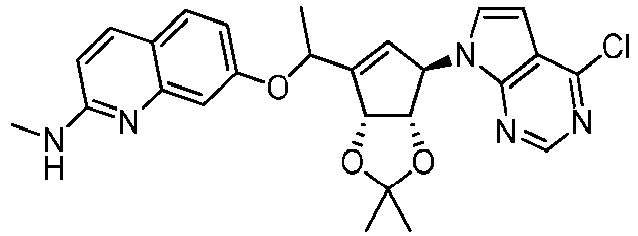
- To a stirred solution of 1-((3aS,4R,6aR)-4-(4-chloro-7H-pyrrolo[2,3-d]pyrimidin-7-yl)-2,2-dimethyl-3a,6a-dihydro-4H-cyclopenta[d][1,3]dioxol-6-yl)ethan-1-ol (0.2g, 0.596 mmol), 2-(methylamino)quinolin-7-ol (0.145g, 0.834mmol) and triphenylphosphine (0.469g, 1.787mmol) at 0°C was added DEAD (0.283ml, 1.787mmol) slowly and stirred for 30min. The resulting mixture was stirred at 25°C for 1h. The solvent was evaporated under reduced pressure and the residue was purified by combiflash (Rf200, Teledyne/Isco) instrument onto a redisep® Rf column with gradient elution (0 to 20%) of ethyl acetate in petroleum ether to afford the title compound (0.1g, 34.1%) as an off-white solid. LCMS m/z = 492.2 (M+, 100%).
-

- To a stirred solution of ((3aR,6R,6aS)-6-(4-chloro-7H-pyrrolo[2,3-d]pyrimidin-7-yl)-2,2-dimethyl-6,6a-dihydro-3aH-cyclopenta[d][1,3]dioxol-4-yl)methanol (0.25g, 0.777mmol), 2-(methylamino)quinolin-7-ol (0.338g, 1.942mmol) and triphenylphosphine (0.611g, 2.331mmol) in THF (20ml) was added DEAD (0.369ml, 2.331mmol) dropwise at 0°C. The resulting mixture was stirred at 25°C for 20h. The solvent was evaporated under reduced pressure and the residue was purified by combiflash (Rf200, Teledyne/Isco) instrument onto a redisep® Rf column with gradient elution (0 to 70%) of ethyl acetate in petroleum ether (0.2 g, 53.9 %) as an off-white solid. 1H NMR (400 MHz, DMSO-d6) δ 8.66 (s, 1H), 7.74 (d, J = 8.8 Hz, 1H), 7.53 (d, J = 1.7 Hz, 1H), 7.51 (d, J = 3.5 Hz, 1H), 7.07 (d, J = 2.5 Hz, 1H), 6.95 (d, J = 5.0 Hz, 1H), 6.85 (dd, J = 8.7, 2.5 Hz, 1H), 6.69 - 6.51 (m, 2H), 5.87 (s, 1H), 5.78 (s, 1H), 5.55 - 5.42 (m, 1H), 5.04 - 4.85 (m, 2H), 4.74 - 4.63 (m, 1H), 2.89 (d, J = 4.7 Hz, 3H), 1.49 (s, 3H), 1.24 (s, 3H); LCMS m/z = 479.3 (M+1, 100%).
-
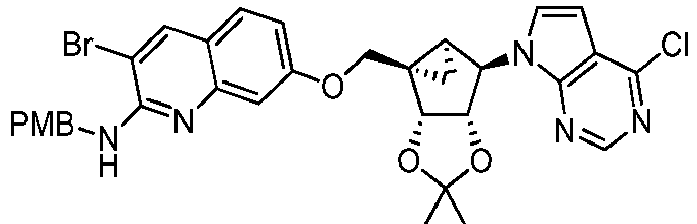
- To a stirred solution of ((3aR,3bR,4aS,5R,5aS)-5-(4-chloro-7H-pyrrolo[2,3-d]pyrimidin-7-yl)-2,2-dimethyltetrahydrocyclopropa[3,4]cyclopenta[1,2-d][1,3]dioxol-3b(3aH)-yl)methanol (0.09g, 0.268mmol), 3-bromo-2-((4-methoxybenzyl)amino)quinolin-7-ol (0.106g, 0.295mmol) and triphenylphosphine (0.176g, 0.670mmol) in THF (8 ml), was added DEAD (0.106ml, 0.670mmol) dropwise at 0°C and stirred for 30 min. The resulting mixture stirred for at 25°C for 14h. The solvent was evaporated under reduced pressure and the residue was purified by combiflash (Rf200, Teledyne/Isco) instrument onto a redisep® Rf column with gradient elution (0 to 60%) of ethyl acetate in petroleum ether (0.12g, 66.1%) as an off-white solid. LCMS m/z= 677.97 (M+1, 100%).
-

- A mixture of 4-chloro-7-((3aR,3bR,4aS,5R,5aS)-3b-((E)-2-iodoprop-1-en-1-yl)-2,2-dimethylhexahydro cyclopropa[3,4]cyclopenta[1,2-d][1,3]dioxol-5-yl)-7H-pyrrolo[2,3-d]pyrimidine (0.12g, 0.254mmol), triphenylphosphine (6.67mg, 0.025mmol), 3-bromo-N-(4-methoxybenzyl)-7-(4,4,5,5-tetramethyl-1,3,2-dioxaborolan-2-yl)quinolin-2-amine (0.179g, 0.382mmol), sodium carbonate (0.054g, 0.509mmol) and Pd(OAc)2 (2.86mg, 0.013mmol) in DMF (4ml) and water (1 ml) was stirred at 25°C for 16h. The reaction mixture was diluted with water (20 ml) and extracted with ethyl acetate (20 ml). Layers were separated, organic layer was washed with brine (20 ml) and dried over anhydrous Na2SO4. The organic layer was filtered and concentrated in vacuo to give 0.3g of crude compound. This residue was purified by combiflash (Rf200, Teledyne/Isco) instrument onto a redisep® Rf column with gradient elution (0 to 15%) of ethyl acetate in petroleum ether to afford the title compound (0.13g, 74.4%) as an off-white solid. LCMS m/z = 687.98 (M+1, 100%).
-

- To a stirred solution of (3aS,4R,6aR)-4-(4-chloro-7H-pyrrolo[2,3-d]pyrimidin-7-yl)-2,2-dimethyl-3a,6a-dihydro-4H-cyclopenta[d] [1,3]dioxole-6-carbaldehyde (0.18g, 0.563mmol) and N2-(4-methoxybenzyl)quinoline-2,7-diamine (0.157g, 0.563mmol) in methanol (5ml) was added acetic acid (0.1mL) at 25°C and stirred for 2h. Sodium cyanoborohydride (0.106g, 1.689mmol) was added stirred for 16h. The reaction was quenched by addition of sat. NH4Cl (15mL). The reaction mixture was concentrated under reduced pressure and the residue was diluted with ethyl acetate (40mL). The organic phase was washed with water (30ml), saturated aqueous sodium bicarbonate (30ml) and brine (30ml) successively. Dried the organic layer over anhydrous Na2SO4, filtered and concentrated under reduced pressure to give 0.2g of crude compound. This residue was purified by combiflash (Rf200, Teledyne/Isco) instrument onto a redisep® Rf column with gradient elution (0 to 15%) of methanol in dichloromethane to afford the title compound (0.15g, 45.7%) as a pale yellow solid. 1H NMR (400 MHz, DMSO-d6) δ 8.66 (s, 1H), 7.59 (d, J = 8.8 Hz, 1H), 7.48 (d, J = 3.7 Hz, 1H), 7.30 (m, 3H), 7.10 (t, J = 5.8 Hz, 1H), 6.92 - 6.86 (m, 2H), 6.65 (dd, J = 8.6, 2.3 Hz, 1H), 6.57 (d, J = 2.2 Hz, 1H), 6.51 (d, J = 3.7 Hz, 1H), 6.45 (d, J = 8.7 Hz, 1H), 5.72 (s, 1H), 5.69 (s, 1H), 5.38 (d, J = 5.7 Hz, 1H), 4.65 - 4.52 (m, 1H), 4.55 (d, J = 5.8 Hz, 2H), 4.13 - 3.93 (m, 3H), 3.72 (s, 3H), 1.48 (s, 3H), 1.30 (s, 3H); LCMS m/z = 583.4 (M+, 100%).
-

- To a stirred solution of N2-(4-methoxybenzyl)-N7-methylquinoline-2,7-diamine in DMF (2 ml) was added K2CO3 (0.058g, 0.420mmol) at 0°C slowly followed by ((3aS,4R,6aR)-4-(4-chloro-7H-pyrrolo[2,3-d]pyrimidin-7-yl)-2,2-dimethyl-3a,6a-dihydro-4H-cyclopenta[d][1,3] dioxol-6-yl)methyl 4-methylbenzenesulfonate (0.1g, 0.210mmol) and stirred the reaction mixture for 10 mins. The resulting mixture was stirred at 25°C for 16h. The reaction mixture was diluted with water (20ml) and extracted with ethyl acetate (20ml). Layers were separated, organic layer was washed with brine (20 ml) and dried over anhydrous Na2SO4. The organic layer was filtered and concentrated in vacuo to give 0.3g of crude compound. This residue was purified by combiflash (Rf200, Teledyne/Isco) instrument onto a redisep® Rf column with gradient elution (0 to 7%) of ethyl acetate in petroleum ether to afford the title compound (0.025g, 19.93%) as a colourless oil. LCMS m/z = 597.29 (M+, 80%).
-

- To a stirred solution of 2-((4-methoxybenzyl)amino)quinoline-7-thiol (125mg, 0.422mmol) in DMSO (3 ml) at 0°C was added Cs2CO3 (302mg, 0.928mmol) and ((3aS,4R,6aR)-4-(4-chloro-7H-pyrrolo[2,3-d]pyrimidin-7-yl)-2,2-dimethyl-3a,6a-dihydro-4H-cyclopenta[d][1,3] dioxol-6-yl)methyl 4-methylbenzenesulfonate (201mg, 0.422mmol). The resulting mixture was stirred at 25°C for 3h. The reaction mixture was diluted with water (20ml) and extracted with ethyl acetate (20ml). Layers were separated, organic layer was washed with brine (20 ml) and dried over anhydrous Na2SO4. The organic layer was filtered and concentrated in vacuo to give 0.3g of crude compound. This residue was purified by combiflash (Rf200, Teledyne/Isco) instrument onto a redisep® Rf column with gradient elution (0 to 20%) of ethyl acetate in petroleum ether to afford the title compound (0.112g, 44.3%) as an off-white solid. 1H NMR (400 MHz, DMSO-d6) δ 8.60 (s, 1H), 7.85 (d, J = 8.9 Hz, 1H), 7.60 - 7.48 (m, 3H), 7.33 - 7.26 (m, 2H), 7.19 (dd, J = 8.3, 1.9 Hz, 1H), 6.85 - 6.79 (m, 3H), 6.48 (d, J = 3.7 Hz, 1H), 6.06 (d, J = 3.6 Hz, 1H), 5.72 (s, 1H), 5.65 (s, 1H), 5.43 (d, J = 5.7 Hz, 1H), 4.54 (d, J = 5.7 Hz, 2H), 4.48 (d, J = 5.7 Hz, 1H), 4.22 (d, J = 15.3 Hz, 1H), 3.77 - 3.70 (m, 1H), 3.68 (s, 3H), 1.43 (s, 3H), 1.28 (s, 3H); LCMS m/z = 600.21 (M+, 100%).
-

- To a stirred solution of 1-((3aS,4R,6aR)-4-(4-chloro-7H-pyrrolo[2,3-d]pyrimidin-7-yl)-2,2-dimethyl-3a,6a-dihydro-4H-cyclopenta[d][1,3]dioxol-6-yl)ethan-1-ol (0.7g, 2.085mmol), 3-chloro-5-fluoro-2-((4-methoxybenzyl)amino)quinolin-7-ol (0.416g, 1.25 1mmol) and triphenylphosphine (1.640g, 6.25mmol) in THF (10ml), was added DEAD (0.990 ml, 6.25 mmol) dropwise at 0°C and stirred for 30mins. The resulting mixture stirred at 25°C for 16h. The solvent was evaporated under reduced pressure and this residue was purified by combiflash (Rf200, Teledyne/Isco) instrument onto a redisep® Rf column with gradient elution (0 to 15%) of ethyl acetate in petroleum ether to afford the title compound (0.5g, 36.9 % yield) as an off-white solid. LCMS m/z = 650.3 (M+, 100%).
-

- Cesium carbonate (558 mg, 1.713 mmol) was addd to a solution of ((3aS,4R,6aR)-4-(4-chloro-7H-pyrrolo[2,3-d]pyrimidin-7-yl)-2,2-dimethyl-3a,6a-dihydro-4H-cyclopenta[d] [1,3]dioxol-6-yl)methyl 4-methylbenzenesulfonate (272 mg, 0.571 mmol) and 3-chloro-5-fluoro-2-((4-methoxybenzyl)amino) quinolin-7-ol (190 mg, 0.571 mmol) in DMF (4 ml) at 0°C and stirred at 25°C for 1h. Ice cold water (20ml) was added to the reaction mixture and stirred for 10 minutes, precipitated solid was filtered, washed with water and dried under vacuum to afford the title compound (300 mg, 83%) as a brown solid. 1H NMR (400 MHz, DMSO-d6) δ 8.64 (s, 1H), 8.11 (s, 1H), 7.65 (t, J = 6.1 Hz, 1H), 7.50 (d, J = 3.7 Hz, 1H), 7.36 - 7.30 (m, 2H), 6.94 (d, J = 2.3 Hz, 1H), 6.89 - 6.79 (m, 3H), 6.60 (d, J = 3.7 Hz, 1H), 5.87 (s, 1H), 5.78 (s, 1H), 5.48 (d, J = 5.7 Hz, 1H), 5.05 - 4.89 (m, 2H), 4.70 (d, J = 5.7 Hz, 1H), 4.64 (d, J = 6.1 Hz, 2H), 3.71 (s, 3H), 1.45 (s, 3H), 1.30 (s, 3H); LCMS m/z =636.34 (M+, 100%).
- Intermediates in table-11 were synthesized by an analogous reaction protocol as was used for the preparation of 3-chloro-7-(((3aS,4R,6aR)-4-(4-chloro-7H-pyrrolo[2,3-d]pyrimidin-7-yl)-2,2-dimethyl-3a,6a-dihydro-4H-cyclopenta[d][1,3]dioxol-6-yl)methoxy)-5-fluoro-N-(4-methoxybenzyl)quinolin-2-amine using the appropriate starting materials and at suitable temperature.
Table-11: Structure & IUPAC name Intermediates used 1H NMR & LCMS data 
((3aS,4R,6aR)-4-(4-((4-methoxybenzyl)amino)-7H-pyrrolo[2,3-d]pyrimidin-7-yl)-2,2,5-trimethyl- 3a, 6a-dihydro-4H-cyclopenta[d][1,3]dioxol -6-yl)methyl 4-methylbenzenesulfonate & 3-chloro-5-fluoro-2-((4-methoxybenzyl)amino)q uinolin-7-ol LCMS m/z=751.61 (M+, 100%). 3-Chloro-5-fluoro-N-(4-methoxybenzyl)-7-(((3aS, 4R,6aR)-4-(4-((4-methoxybenzyl)amino)-7H-pyrrolo[2,3-d]pyrimidin-7-yl)-2,2,5-trimethyl-3a,6a-dihydro-4H-cyclopenta[d][1,3]dioxol-6-yl)methoxy)quinolin-2-amine 
((3aS,4R,6aR)-4-(4-chloro-7H-pyrrolo[2,3-d]pyrimidin-7-yl)-2,2-dimethyl-3a,6a-dihydro-4H-cyclopenta[d][1,3]dioxol -6-yl)methyl 4-methylbenzenesulfonate & 2-(bis(4-methoxybenzyl)amino)-3-chloroquinoline-7-thiol 1H NMR (400 MHz, DMSO-d6) δ 8.53 (s, 1H), 8.41 (s, 1H), 7.74 (d, J = 8.6 Hz, 1H), 7.67 (d, J = 1.8 Hz, 1H), 7.43 (dd, J = 8.5, 1.9 Hz, 1H), 7.26 - 7.20 (m, 4H), 6.81 - 6.75 (m, 4H), 6.38 (d, J = 3.7 Hz, 1H), 5.98 (d, J = 3.6 Hz, 1H), 5.72 (s, 1H), 5.63 (s, 1H), 5.44 (d, J = 5.7 Hz, 1H), 4.57 - 4.42 (m, 5H), 4.28 (d, J = 15.4 Hz, 1H), 3.82 - 3.76 (m, 1H), 3.64 (s, 6H), 1.42 (s, 3H), 1.28 (s, 3H); LCMS m/z =754.49 (M+, 100%) 3-Chloro-7-((((3aS,4R,6aR)-4-(4-chloro-7H-pyrrolo[2,3-d]pyrimidin-7-yl)-2,2-dimethyl-3a,6a-dihydro-4H-cyclopenta[d][1,3]dioxol-6-yl)methyl)thio)-N,N-bis(4-methoxybenzyl)quinolin-2-amine 
((3aR,3bR,4aS,5R,5aS)-5-(4-chloro-7H-pyrrolo [2,3 -d] pyrimidin-7-yl)-2,2-dimethyltetrahydrocyclo propa[3,4]cyclopenta[1, 2-d][1,3]dioxol-3b(3aH)-yl)methyl 4-methylbenzenesulfonate & 2-((4-methoxybenzyl)amino)q uinoline-7-thiol 1H NMR (400 MHz, Chloroform-d) δ 8.68 (s, 1H), 7.76 (d, J = 8.9 Hz, 1H), 7.64 (d, J = 1.8 Hz, 1H), 7.48 (d, J = 8.3 Hz, 1H), 7.39 (d, J = 3.6 Hz, 1H), 7.37 - 7.32 (m, 2H), 7.20 (dd, J = 8.4, 1.9 Hz, 1H), 6.93 - 6.87 (m, 2H), 6.59 (d, J = 8.8 Hz, 1H), 6.55 (d, J = 3.6 Hz, 1H), 5.39 (dd, J = 7.2, 1.5 Hz, 1H), 5.21 (s, 1H), 4.65 (d, J = 5.3 Hz, 2H), 4.64 - 4.60 (m, 1H), 3.82 (s, 3H), 3.62 (d, J = 13.3 Hz, 1H), 3.43 (d, J = 13.3 Hz, 1H), 1.76 - 1.73 (m, 1H), 1.60 (s, 3H), 1.33 - 1.30 (m, 1H), 1.26 (s, 3H), 1.12 - 1.06 (m, 1H); LCMS m/z = 614.21 (M+, 100%) 7-((((3aR,3bS,4aS,5R,5aS)-5-(4-chloro-7H-pyrrolo[2,3-d]pyrimidin-7-yl)-2,2-dimethyltetrahydrocyclopropa[3,4]cy clopenta[1,2-d][1,3]dioxol-3b(3aH)-yl)methyl)thio)-N-(4-methoxybenzyl)quinolin-2-amine -

- To a stirred solution of ((3aS,4R,6aR)-4-(4-chloro-7H-pyrrolo[2,3-d]pyrimidin-7-yl)-2,2,6a-trimethyl-3a,6a-dihydro-4H-cyclopenta[d][1,3]dioxol-6-yl) methanol (250 mg, 0.745 mmol) and 3-chloro-5-fluoro-2-((4-methoxybenzyl)amino)quinolin-7-ol (297 mg, 0.893 mmol) in toluene (2 ml) was added triphenyl phosphine (234 mg, 0.893 mmol) and stirred for 5 minutes then added DEAD (0.118 ml, 0.745 mmol) dropwise at 25°C and reaction mixture was stirred at 90°C for 2 hours. The volatiles were removed in vacuo and obtained residue was purified by combiflash (Rf200, Teledyne/Isco) instrument onto a redisep® Rf column with gradient elution (0 to 50%) of ethyl acetate in petroleum ether to afford the title compound (420mg, 87%) as a off-white solid. 1H NMR (400 MHz, DMSO-d6) δ 8.70 (s, 1H), 8.12 (s, 1H), 7.69 (t, J = 6.1 Hz, 1H), 7.48 (d, J = 3.7 Hz, 1H), 7.42 - 7.36 (m, 1H), 7.36 - 7.30 (m, 2H), 6.97 (d, J = 2.2 Hz, 1H), 6.88 - 6.86 (m, 2H), 6.62 (d, J = 3.6 Hz, 1H), 5.86 (d, J = 2.8 Hz, 1H), 5.68 (d, J = 2.5 Hz, 1H), 5.08 (d, J = 15.5 Hz, 1H), 4.89 (d, J = 15.5 Hz, 1H), 4.65 (d, J = 6.0 Hz, 2H), 4.25 (s, 1H), 3.70 (s, 3H), 1.55 (s, 3H), 1.41 (s, 3H), 1.34 (s, 3H); LCMS m/z =650.34 (M+, 100%).
-

- A mixture of 7-(2-((3aS,4R,6aR)-4-(4-chloro-7H-pyrrolo[2,3-d]pyrimidin-7-yl)-2,2-dimethyl-3a,6a-dihydro-4H-cyclopenta[d][1,3]dioxol-6-yl)ethyl)-N-methylquinolin-2-amine (0.100 g, 0.210 mmol) in dioxane (3 ml) was added aq. ammonia (0.227 ml, 10.50 mmol) at 25°C and stirred the reaction mixture at 130°C for 16h. The reaction mixture was diluted with brine (20ml) and extracted with ethyl acetate (20ml). Layers were separated, the organic layer was dried over anhydrous Na2SO4., filtered and concentrated in vacuo to give 0.15g of crude compound. The obtained residue was purified by combiflash (Rf200, Teledyne/Isco) instrument onto a redisep® Rf column with gradient elution (0 to 5%) of methanol in dicholomethane to afford the title compound (0.07g, 73%) as an off-white solid. LCMS m/z= 457.2 (M+1; 40%).
- Intermediates in table-12 were synthesized by an analogous reaction protocol as was used for the preparation of 7-(2-((3aS,4R,6aR)-4-(4-Amino-7H-pyrrolo[2,3-d]pyrimidin-7-yl)-2,2-dimethyl-3a,6a-dihydro-4H-cyclopenta[d] [1,3]dioxol-6-yl)ethyl)-N-methylquinolin-2-amine using the appropriate starting materials (Instead of aq.NH3, 7N NH3 in MeOH could also be used).
Table-12 Srtucture & IUPAC name Intermediate used 1H NMR & LCMS data 
7-(2-((3aS,4R,6aR)-4-(4- Chloro-7H-pyrrolo[2,3- d]pyrimidin-7-yl)-2,2- dimethyl-3a,6a-dihydro- 4H- cyclopenta[d][1,3]dioxol- 6-yl)ethyl)-N- cyclobutylquinolin-2- amine 1H NMR (400 MHz, Chloroform-d) δ 8.35 (s, 1H), 7.86 (d, J = 8.9 Hz, 1H), 7.58 - 7.53 (m, 2H), 7.15 (dd, J = 8.2, 1.7 Hz, 1H), 6.62 (d, J = 8.9 Hz, 1H), 6.31 (d, J = 3.6 Hz, 1H), 6.09 (d, J = 3.6 Hz, 1H), 5.75 (s, 1H), 5.51 - 5.45 (m, 2H), 5.26 (d, J = 6.0 Hz, 1H), 5.15 (s, 2H), 4.47 (d, J = 5.7 Hz, 1H), 4.45 - 4.37 (m, 1H), 3.19 - 3.01 (m, 2H), 2.87 - 2.68 (m, 2H), 2.57 - 2.46 (m, 2H), 2.02 - 1.93 (m, 2H), 1.89 - 1.79 (m, 2H), 1.50 (s, 3H), 1.37 (s, 3H); LCMS m/z= 497.3 (M+1; 70%). 7-(2-((3aS,4R,6aR)-4-(4-Amino- 7H-pyrrolo[2,3-d]pyrimidin-7-yl)- 2,2-dimethyl-3a,6a-dihydro-4H- cyclopenta[d][l,3]dioxol-6- yl)ethyl)-N-cyclobutylquinolin-2- amine 
7-(2-((3aS,4R,6aR)-4-(4-Chloro-7H-pyrrolo[2,3-d]pyrimidin-7-yl)-2,2-dimethyl-3a,6a-dihydro-4H-cyclopenta[d][1,3]dioxol-6-yl)ethyl)-3-fluoroquinolin-2-amine 1H NMR (400 MHz, DMSO-d6) δ 8.05 (s, 1H), 7.79 (d, J = 11.8 Hz, 1H), 7.60 (d, J = 8.2 Hz, 1H), 7.41 (s, 1H), 7.19 (d, J = 8.2 Hz, 1H), 6.96 (s, 2H), 6.72 (s, 2H), 6.35 - 6.31 (m, 2H), 5.54 (s, 1H), 5.50 (s, 1H), 5.29 (d, J = 5.9 Hz, 1H), 4.35 (d, J = 5.7 Hz, 1H), 3.10 - 2.93 (m, 2H), 2.70 - 2.60 (m, 2H), 1.37 (s, 3H), 1.24 (s, 3H); LCMS m/z= 461.3 (M+1; 60%). 7-(2-((3aS,4R,6aR)-4-(4-Amino-7H-pyrrolo[2,3-d]pyrimidin-7-yl)-2,2-dimethyl-3a,6a-dihydro-4H-cyclopenta[d][1,3]dioxol-6-yl)ethyl)-3-fluoroquinolin-2-amine 
3-Chloro-7-(2-((3aS,4R,6aR)-4-(4-chloro-7H-pyrrolo[2,3-d]pynmidin-7-yl)-2,2-dimethyl-3a,6a-dihydro-4H-cyclopenta[d][1,3]dioxol-6-yl)ethyl)quinolin-2-amine 1H NMR (400 MHz, DMSO-d6) δ 8.17 (s, 1H), 8.05 (s, 1H), 7.61 (d, J = 8.3 Hz, 1H), 7.41 (d, J = 1.6 Hz, 1H), 7.19 (dd, J = 8.2, 1.7 Hz, 1H), 6.98 (s, 2H), 6.69 (s, 2H), 6.41 (d, J = 3.6 Hz, 1H), 6.35 (d, J = 3.5 Hz, 1H), 5.55 (s, 1H), 5.51 (s, 1H), 5.29 (d, J = 5.7 Hz, 1H), 4.36 (d, J = 5.7 Hz, 1H), 3.09 - 2.94 (m, 2H), 2.72 - 2.56 (m, 2H), 1.37 (s, 3H), 1.28 (s, 3H); LCMS m/z= 477.05 (M+; 20%). 7-(2-((3aS,4R,6aR)-4-(4-Amino-7H-pyrrolo[2,3-d]pyrimidin-7-yl)-2,2-dimethyl-3a,6a-dihydro-4H-cyclopenta[d][1,3]dioxol-6-yl)ethyl)-3-chloroquinolin-2-amine 
3-Bromo-7-(2-((3aS,4R,6aR)-4-(4-chloro-7H-pyrrolo[2,3-d]pyrimidin-7-yl)-2,2-dimethyl-3a,6a-dihydro-4H-cyclopenta[d] [1,3]dioxol-6-yl)ethyl)-N-(4-methoxybenzyl)quinolin-2-amine 1H NMR (400 MHz, DMSO-d6) δ 8.35 (s, 1H), 8.07 (s, 1H), 7.60 (d, J = 8.2 Hz, 1H), 7.45 (s, 1H), 7.38 - 7.31 (m, 2H), 7.22 - 7.16 (m, 2H), 7.01 (s, 2H), 6.88 - 6.82 (m, 2H), 6.52 (d, J = 3.5 Hz, 1H), 6.40 (d, J = 3.6 Hz, 1H), 5.56 (s, 1H), 5.52 (s, 1H), 5.30 (d, J = 5.7 Hz, 1H), 4.66 - 4.61 (m, 2H), 4.38 (d, J = 5.6 Hz, 1H), 3.69 (s, 3H), 3.06 - 2.93 (m, 2H), 2.70 - 2.59 (m, 2H), 1.38 (s, 3H), 1.27 (s, 3H); LCMS m/z= 641.97 (M+; 60%). 7-(2-((3aS,4R,6aR)-4-(4-Amino-7H-pyrrolo[2,3-d]pyrimidin-7-yl)-2,2-dimethyl-3a,6a-dihydro-4H-cyclopenta[d][1,3]dioxol-6-yl)ethyl)-3-bromo-N-(4-methoxybenzyl)quinolin-2-amine 
3-Chloro-7-(2-((3aS,4R,6aR)-4-(4-chloro-7H-pyrrolo[2,3-d]pyrimidin-7-yl)-2,2-dimethyl-3a,6a-dihydro-4H-cyclopenta[d][1,3]dioxol-6-yl)ethyl)-5-fluoroquinolin-2-amine 1H NMR (400 MHz, DMSO-d6) δ 8.17 (d, J = 0.7 Hz, 1H), 8.05 (s, 1H), 7.26 (s, 1H), 7.05 (dd, J = 11.1, 1.4 Hz, 1H), 7.01-6.91 (m, 4H), 6.41 (d, J = 3.5 Hz, 1H), 6.35 (d, J = 3.5 Hz, 1H), 5.54 (s, 1H), 5.51 (s, 1H), 5.30 (d, J = 5.7 Hz, 1H), 4.37 (d, J = 5.7 Hz, 1H), 3.07 - 2.95 (m, 2H), 2.71 - 2.56 (m, 2H), 1.37 (s, 3H), 1.27 (s, 3H); LCMS m/z= 495.05 (M+; 40%). 7-(2-((3aS,4R,6aR)-4-(4-Amino-7H-pyrrolo[2,3-d]pyrimidin-7-yl)-2,2-dimethyl-3a,6a-dihydro-4H-cyclopenta[d][1,3]dioxol-6-yl)ethyl)-3-chloro-5-fluoroquinolin-2-amine 

1H NMR (400 MHz, DMSO-d6) δ 8.34 (s, 1H), 8.05 (s, 1H), 7.25 (s, 1H), 7.04 (dd, J = 11.0, 1.4 Hz, 1H), 6.97 (s, 2H), 6.86 (s, 2H), 6.43 (d, J = 3.5 Hz, 1H), 6.37 (d, J = 3.5 Hz, 1H), 5.55 (s, 1H), 5.51 (s, 1H), 5.30 (d, J = 5.7 Hz, 1H), 4.38 (d, J = 5.7 Hz, 1H), 3.08 - 2.95 (m, 2H), 2.71- 2.58 (m, 2H), 1.37 (s, 3H), 1.28 (s, 3H); LCMS m/z = 541.20 (M+2; 100%) 7-(2-((3aS,4R,6aR)-4-(4-Amino-7H-pyrrolo[2,3-d]pyrimidin-7-yl)-2,2-dimethyl-3a,6a-dihydro-4H-cyclopenta[d][1,3]dioxol-6-yl)ethyl)-3-bromo-5-fluoroquinolin-2-amine 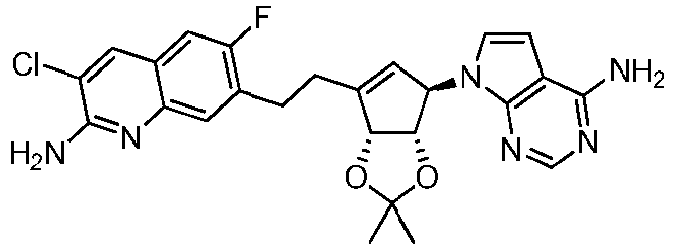
3-Chloro-7-(2-((3aS,4R,6aR)-4-(4-chloro-7H-pyrrolo[2,3-d]pyrimidin-7-yl)-2,2-dimethyl-3a,6a-dihydro-4H-cyclopenta[d][1,3]dioxol-6-y1)ethy1)-6-fluoroquinolin-2-amine 1H NMR (400 MHz, DMSO-d6) δ 8.17 (s, 1H), 8.06 (s, 1H), 7.53 - 7.44 (m, 2H), 6.99 (s, 2H), 6.71 (s, 2H), 6.52 (d, J = 3.5 Hz, 1H), 6.40 (d, J = 3.5 Hz, 1H), 5.57 (s, 1H), 5.55 (s, 1H), 5.32 (d, J = 5.7 Hz, 1H), 4.40 (d, J = 5.7 Hz, 1H), 3.12 - 2.99 (m, 2H), 2.70 - 2.56 (m, 2H), 1.36 (s, 3H), 1.28 (s, 3H); LCMS m/z= 494.99 (M+; 20%). 7-(2-((3aS,4R,6aR)-4-(4-Amino-7H-pyrrolo[2,3-d]pyrimidin-7-yl)-2,2-dimethyl-3a,6a-dihydro-4H-cyclopenta[d][1,3]dioxol-6-yl)ethyl)-3-chloro-6-fluoroquinolin-2-amine 
3-Chloro-7 -(2-((3aS, 4R,6aR)-4-(4-chloro-7H-pyrrolo[2,3-d]pyrimidin-7-yl)-2,2-dimethyl- 3a,6a-dihydro-4H-cyclopenta[d] [1,3]dioxol-6-yl)ethyl)-8-fluoroquinolin -2-amine LCMS m/z= 495.30 (M+; 70%). 7-(2-((3aS,4R,6aR)-4-(4-Amino-7H-pyrrolo [2,3 -d] pyrimidin-7-yl) - 2,2-dimethyl-3a,6a-dihydro-4H-cyclopenta[d][1,3]dioxo1-6-y1)ethyl)- 3 -chloro-8- fluoroquinolin - 2-amine 
3,5-Dichloro-7-(2-((3aS, 4R,6aR)-4-(4-chloro-7H-pyrrolo[2,3-d]pyrimidin-7-yl)-2,2-dimethyl- 3a,6a-dihydro-4H-cyclopenta[d] [1,3]dioxol-6-yl)ethyl)quinolin-2-amine LCMS m/z= 511.2 (M+; 100%). 7-(2-((3aS,4R,6aR)-4-( 4-Amino-7H-pyrrolo[2,3-d]pyrimidin-7 -yl)-2,2-dimethyl-3a,6a-dihydro-4H-cyclopenta[d][1,3]dioxol-6-yl)ethyl)-3,5-dichloroquinolin-2-amine 
4-Chloro-7-((3aS,4R,6aR)-2,2-dimethyl-6-(2-(3-methylimidazo[1,2-a]pyridin-7-yl)ethyl)-3a,6a-dihydro-4H-cyclopenta[d][1,3]dioxol-4-yl)-7H-pyrrolo[2,3-d]pyrimidine 1H NMR (400 MHz, DMSO-d6) δ 8.19 (d, J = 7.0 Hz, 1H), 8.04 (s, 1H), 7.43 (s, 1H), 7.31 (d, J = 1.1 Hz, 1H), 6.98 (s, 2H), 6.91 (dd, J = 7.1, 1.7 Hz, 1H), 6.44 (d, J = 3.5 Hz, 1H), 6.35 (d, J = 3.5 Hz, 1H), 5.55 (s, 1H), 5.50 (s, 1H), 5.32 (d, J = 5.6 Hz, 1H), 4.38 (d, J = 5.7 Hz, 1H), 3.02 - 2.91 (m, 2H), 2.71 - 2.57 (m, 2H), 2.45 (d, J = 1.0 Hz, 3H), 1.38 (s, 3H), 1.28 (s, 3H); LCMS m/z= 430.98 (M+; 30%). 7-((3aS,4R,6aR)-2,2-Dimethyl-6-(2-(3-methylimidazo[1,2-a]pyridin-7-yl)ethyl)-3a,6a-dihydro-4H-cyclopenta[d][1,3]dioxol-4-yl)-7H-pyrrolo[2,3-d]pyrimidin-4-amine 
4-chloro-7-((3aS,4R,6aR)-6-(2-(3,3-dimethyl-2-(methylthio)-3H-indol-6-yl)ethyl)-2,2-dimethyl-3a,6a-dihydro-4H-cyclopenta[d][1,3]dioxol-4-yl)-7H-pyrrolo[2,3-d]pyrimidine 1H NMR (400 MHz, DMSO-d6) δ 9.42 (s, 2H), 8.06 (s, 1H), 7.32 (d, J = 7.6 Hz, 1H), 7.10 - 6.95 (m, 4H), 6.45 (s, 2H), 5.56 (s, 1H), 5.51 (s, 1H), 5.28 (d, J = 5.6 Hz, 1H), 4.37 (d, J = 5.7 Hz, 1H), 3.02 - 2.84 (m, 2H), 2.65 - 2.54 (m, 2H), 1.46 (s, 6H), 1.36 (s, 3H), 1.28 (s, 3H); LCMS m/z= 459.36 (M+1; 20%). 7-((3aS,4R,6aR)-6-(2-(2-Amino-3,3-dimethyl-3H-indol-6-yl)ethyl)-2,2-dimethyl-3a,6a-dihydro-4H-cyclopenta[d][1,3]dioxol-4-yl)-7H-pyrrolo[2,3-d]pyrimidin-4-amine 
6'-(2-((3aS,4R,6aR)-4-(4-chloro-7H-pyrrolo[2,3-d]pyrimidin-7-yl)-2,2-dimethyl-3a,6a-dihydro-4H-cyclopenta[d][1,3] dioxol-6-yl)ethyl)-2'-(methylthio)spiro[cyclob utane-1,3'-indole] 1H NMR (400 MHz, DMSO-d6) δ 8.06 (s, 1H), 7.64 (d, J = 7.6 Hz, 1H), 7.09 - 6.97 (m, 4H), 6.47 - 6.40 (m, 2H), 5.55 (s, 1H), 5.50 (s, 1H), 5.28 (d, J = 5.7 Hz, 1H), 4.37 (d, J = 5.6 Hz, 1H), 2.99 - 2.87 (m, 2H), 2.83 - 2.71 (m, 2H), 2.64- 2.53 (m, 2H), 2.36 - 2.29 (m, 2H), 2.27 - 2.16 (m, 2H), 1.37 (s, 3H), 1.28 (s, 3H); LCMS m/z= 472.3 (M+2; 100%). 6'-(2-((3aS,4R,6aR)-4-(4-Amino-7H-pyrrolo[2,3-d]pyrimidin-7-yl)-2,2-dimethyl-3a,6a-dihydro-4H-cyclopenta[d][1,3]dioxol-6-yl)ethyl)spiro [cyclobutane-1,3'-indol]-2'-amine 
7-(((3aS,4R,6aR)-4-(4-Chloro-7H-pyrrolo[2,3-d]pyrimidin-7-yl)-2,2-dimethyl-3a,6a-dihydro-4H-cyclopenta[d][1,3] dioxol-6-yl)methoxy)-N-methylquinolin-2-amine 1H NMR (400 MHz, DMSO-d6) δ 8.08 (s, 1H), 7.80 (d, J = 8.9 Hz, 1H), 7.57 (d, J = 8.7 Hz, 1H), 7.15 (s, 1H), 7.06 (s, 2H), 6.90 (dd, J = 8.6, 2.4 Hz, 1H), 6.86 (d, J = 3.6 Hz, 1H), 6.64 (d, J = 8.9 Hz, 1H), 6.52 (d, J = 3.6 Hz, 1H), 5.84 (s, 1H), 5.65 (s, 1H), 5.42 (d, J = 5.6 Hz, 1H), 4.93 (s, 2H), 4.53 (d, J = 5.7 Hz, 1H), 2.93 (d, J = 4.8 Hz, 3H), 1.46 (s, 3H), 1.30 (s, 3H); LCMS m/z= 459.40 (M+1; 30%). 7-(((3aS,4R,6aR)-4-(4-Amino-7H-pyrrolo[2,3-d]pyrimidin-7-yl)-2,2-dimethyl-3a,6a-dihydro-4H-cyclopenta[d][1,3]dioxol-6-yl)methoxy)-N-methylquinolin-2-amine 
3-Chloro-7 - (((3aS,4R,6aR)-4-(4-chloro-7H-pyrrolo[2,3-d]pyrimidin-7-yl)-2,2-dimethyl- 3a,6a-dihydro-4H-cyclopenta[d] [1,3] dioxol-6-yl)methoxy)-5-fluoro-N-(4-methoxybenzyl )quinolin-2-amine 1H NMR (400 MHz, DMSO-d6) δ 8.11 (s, 1H), 8.07 (s, 1H), 7.67 (t, J = 6.2 Hz, 1H), 7.36 - 7.31 (m, 2H), 7.01 (s, 2H), 6.94 (d, J = 2.2 Hz, 1H), 6.90 - 6.81 (m, 4H), 6.51 (d, J = 3.6 Hz, 1H), 5.83 (s, 1H), 5.65 (s, 1H), 5.42 (d, J = 5.7 Hz, 1H), 4.94 (q, J = 15.3 Hz, 2H), 4.65 (d, J = 6.1 Hz, 2H), 4.55 (d, J = 5.7 Hz, 1H), 3.70 (s, 3H), 1.43 (s, 3H), 1.29 (s, 3H); LCMS m/z= 617.34 (M+; 100%). 7-(((3aS,4R,6aR)-4-( 4-Amino-7H-pyrrolo[2,3-d]pyrimidin-7-yl)-2,2-dimethyl-3a,6a-dihydro-4H-cyclopenta[d][1,3]dioxol-6-yl)methoxy)-3-chloro-5-fluoro-N-(4-methoxybenzyl)quinolin-2-amine 
N7-(((3aS,4R,6aR)-4-(4-Chloro-7H-pyrrolo[2,3-d]pyrimidin-7-yl)-2,2-dimethyl-3a,6a-dihydro-4H-cyclopenta[d] [1,3] dioxol-6-yl)methyl)-N2-(4-methoxybenzyl)quinoline -2,7-diamine LCMS m/z= 564.40 (M+1; 100%). N7-(((3aS,4R,6aR)-4-(4-Amino-7H-pyrrolo[2,3-d]pyrimidin-7-yl)-2,2-dimethyl-3a,6a-dihydro-4H-cyclopenta[d][1,3]dioxol-6-yl)methyl)-N2-(4-methoxybenzyl)quinoline-2,7-diamine 
N7-(((3aS,4R,6aR)-4-(4-Chloro-7H-pyrrolo[2,3-d]pyrimidin-7-yl)-2,2-dimethyl- 3a,6a-dihydro-4H-cyclopenta[d][1,3]dioxol-6-yl)methyl)-N2-(4-methoxybenzyl)-N7-methylquinoline-2,7-diamine LCMS m/z= 576.95 (M-1; 100%). N7-(((3aS,4R,6aR)-4-(4-Amino-7H-pyrrolo[2,3-d]pyrimidin-7-yl)-2,2-dimethyl-3a,6a-dihydro-4H-cyclopenta[d] [1,3]dioxol-6-yl)methyl)-N2-(4-methoxybenzyl)-N7 -methylquinoline-2, 7 -diamine 
7-((((3aS,4R,6aR)-4-(4-Chloro-7H-pyrrolo[2,3-d]pyrimidin-7-yl)-2,2-dimethyl-3a,6a-dihydro-4H-cyclopenta[d][1,3]dioxol-6-yl)methyl)thio)-N-(4-methoxybenzyl)quinolin-2-amine 1H NMR (400 MHz, DMSO-d6) δ 8.03 (s, 1H), 7.84 (d, J = 8.9 Hz, 1H), 7.57 (d, J = 8.3 Hz, 1H), 7.49 (s, 2H), 7.36 - 7.26 (m, 2H), 7.18 (d, J = 8.4 Hz, 1H), 6.96 (s, 2H), 6.84 (d, J = 8.2 Hz, 2H), 6.82 - 6.76 (m, 1H), 6.16 (s, 1H), 6.01 (s, 1H), 5.76 (s, 2H), 5.71 (s, 1H), 5.54 (s, 1H), 5.38 (s, 1H), 4.55 (s, 1H), 4.34 (d, J = 5.5 Hz, 1H), 4.19 (d, J = 15.2 Hz, 1H), 3.70 (s, 3H), 1.42 (s, 3H), 1.27 (s, 3H); LCMS m/z= 580.83 (M+; 100%). 7-((((3aS,4R,6aR)-4-(4-Amino-7H-pyrrolo[2,3-d]pyrimidin-7-yl)-2,2-dimethyl-3a,6a-dihydro-4H-cyclopenta[d][1,3]dioxol-6-yl)methyl)thio)-N-(4-methoxybenzyl)quinolin-2-amine 
3-Chloro-7-((((3aS,4R,6aR)-4-(4-chloro-7H-pyrrolo[2,3-d]pyrimidin-7-yl)-2,2-dimethyl-3a,6a-dihydro-4H-cyclopenta[d][1,3]dioxol-6-yl)methyl)thio)-N,N-bis(4-methoxybenzyl )quinolin-2-amine LCMS m/z= 735.61 (M+; 80%). 7-((((3aS,4R,6aR)-4-(4-Amino-7H-pyrrolo[2,3-d]pyrimidin-7-yl)-2,2-dimethyl-3a,6a-dihydro-4H-cyclopenta[d] [1,3]dioxol-6-yl)methyl)thio)-3 -chloro-N,N-bis(4-methoxybenzyl)quinolin-2-amine 
3-Chloro-7-(2-((3aS,4R,6aR)-4-(2-chloro-7H-pyrrolo[2,3-d]pyrimidin-7-yl)-2,2-dimethyl-3a,6a-dihydro-4H-cyclopenta[d][1,3]dioxol-6-yl)ethyl)quinolin-2-amine 1H NMR (400 MHz, DMSO-d6) δ 8.43 (s, 1H), 8.17 (s, 1H), 7.61 (d, J = 8.3 Hz, 1H), 7.40 (d, J = 1.5 Hz, 1H), 7.28 (s, 2H), 7.19 (dd, J = 8.3, 1.7 Hz, 1H), 6.69 (s, 2H), 6.23 (d, J = 3.7 Hz, 1H), 6.03 (d, J = 3.6 Hz, 1H), 5.46 (s, 1H), 5.43 (s, 1H), 5.33 (d, J = 5.7 Hz, 1H), 4.36 (d, J = 5.6 Hz, 1H), 3.10 - 2.93 (m, 2H), 2.67 - 2.56 (m, 2H), 1.36 (s, 3H), 1.28 (s, 3H); LCMS m/z= 476.98 (M+; 100%). 7-(2-((3aS,4R,6aR)-4-(2-Amino-7H-pyrrolo[2,3-d]pyrimidin-7-yl)-2,2-dimethyl-3a,6a-dihydro-4H-cyclopenta[d][1,3]dioxol-6-yl)ethyl)-3-chloroquinolin-2-amine 
3-Bromo-7-(2-((3aS,4R,6aR)-4-(4-chloro-5-fluoro-7H-pyrrolo [2,3 -d]pyrimidin-7-yl)-2,2-dimethyl-3a,6a-dihydro-4H-cyclopenta[d][1,3]dioxol-6-yl)ethyl)-N-(4-methoxybenzyl)quinolin-2-amine 1H NMR (400 MHz, DMSO-d6) δ 8.35 (s, 1H), 8.06 (s, 1H), 7.60 (d, J = 8.3 Hz, 1H), 7.45 (s, 1H), 7.36 - 7.31 (m, 2H), 7.21 - 7.16 (m, 2H), 6.95 (s, 2H), 6.86 - 6.82 (m, 2H), 6.35 (d, J = 2.1 Hz, 1H), 5.58 (s, 1H), 5.48 (s, 1H), 5.28 (d, J = 5.6 Hz, 1H), 4.37 (d, J = 5.6 Hz, 1H), 4.27 (d, J = 4.1 Hz, 2H), 3.68 (s, 3H), 3.05 - 2.97 (m, 2H), 2.67 - 2.57 (m, 2H), 1.36 (s, 3H), 1.27 (s, 3H); LCMS m/z= 660.97 (M+1; 25%). 7-(2-((3aS,4R,6aR)-4-(4-Amino-5-fluoro-7H-pyrrolo[2,3-d]pyrimidin-7-yl)-2,2-dimethyl-3a,6a-dihydro-4H-cyclopenta[d][1,3]dioxol-6-yl)ethyl)-3-bromo-N-(4-methoxybenzyl)quinolin-2-amine 
3-Chloro-7-(2-((3aS,4R,6aR)-4-(4-chloro-7H-pyrrolo[2,3-d]pyrimidin-7-yl)-2,2-dimethyl-3a,6a-dihydro-4H-cyclopenta[d][1,3]dioxol-6-yl)propyl)quinolin-2-amine Diastereomeric mixture was separated by chiral preparative HPLC. 7-(2-((3aS,4R,6aR)-4-(4-Amino-7H-pyrrolo[2,3-d]pyrimidin-7-yl)-2,2-dimethyl-3a,6a-dihydro-4H-cyclopenta[d][1,3]dioxol-6-yl)propyl)-3-chloroquinolin-2-amine Run Time (min): 10.00, Injection Volume: 5.00 µL Wavelength: 225nm HEX_0.1%DEA_IPA_DCM_60 _40_A_C_1.2ML_10MIN Flow Rate: 1.2 ml/min. Column CHIRALPAK IA CRL-027 OLD Column Temp: 25.0 °C Mobile Phase A: HEX_0.1%DEA Mobile Phase C: IPA:DCMMobile Phase B: NA Mobile Phase D: NA Diastereomer-1 1H NMR (400 MHz, DMSO-d6) δ 8.17 (s, 1H), 8.04 (s, 1H), 7.61 (d, J = 8.2 Hz, 1H), 7.38 (s, 1H), 7.16 (dd, J = 8.1, 1.6 Hz, 1H), 6.98 (s, 2H), 6.67 (s, 2H), 6.32 (d, J = 3.5 Hz, 1H), 6.29 (d, J = 3.6 Hz, 1H), 5.55 (s, 1H), 5.52 (s, 1H), 5.41 (d, J = 5.8 Hz, 1H), 4.35 (d, J = 5.8 Hz, 1H), 3.12 - 3.03 (m, 1H), 2.96 - 2.90 (m, 1H), 2.88 - 2.81 (m, 1H), 1.31 (s, 3H), 1.27 (s, 3H), 1.17 (d, J = 6.8 Hz, 3H); LCMS m/z= 491.36 (M+; 80%). Diastereomer-2 1H NMR (400 MHz, DMSO-d6) δ 8.17 (s, 1H), 8.06 (s, 1H), 7.61 (d, J = 8.2 Hz, 1H), 7.36 (s, 1H), 7.15 (dd, J = 8.3, 1.6 Hz, 1H), 6.97 (s, 2H), 6.67 (s, 2H), 6.56 (d, J = 3.6 Hz, 1H), 6.44 (d, J = 3.6 Hz, 1H), 5.60 - 5.56 (m, 1H), 5.52 (d, J = 2.5 Hz, 1H), 5.34 (d, J = 5.7 Hz, 1H), 4.40 (d, J = 5.7 Hz, 1H), 3.13 - 3.04 (m, 1H), 2.93 (q, J = 7.2 Hz, 1H), 2.83 (d, J = 10.0 Hz, 1H), 1.40 (s, 3H), 1.28 (s, 3H), 1.14 (d, J = 6.8 Hz, 3H); LCMS m/z= 491.36 (M+; 80%). 
3-Bromo-7-(2-((3aS,4R,6aR)-4-(4-chloro-7H-pyrrolo[2,3-d]pyrimidin-7-yl)-2,2-dimethyl-3a,6a-dihydro-4H-cyclopenta[d][1,3]dioxol-6-yl)propyl)-N-(4-methoxybenzyl)quinolin-2-amine Diastereomeric mixture was separated by chiral preparative HPLC. 7-(2-((3aS,4R,6aR)-4-(4-Amino-7H-pyrrolo[2,3-d]pyrimidin-7-yl)-2,2-dimethyl-3a,6a-dihydro-4H-cyclopenta[d][1,3]dioxol-6-yl)propyl)-3-bromo-N-(4-methoxybenzyl)quinolin-2-amine Run Time (min): 10.00 Injection Volume: 5.00 µL,Wavelength: 251nm, HEX _0.1%DEA _IPA-DCM_50_50_A_C_1.0ML_10M IN_251nm Flow Rate: 1.0 ml/min. Column : CHIRALPAK IG CRL-071 Column Temp: 25.0 °C. Mobile Phase A: HEX_0. 1%DEA Mobile Phase C: IPA-DCM_1-1, Mobile Phase B: NA Mobile Phase D: NA Diastereomer-1: 1H NMR (400 MHz, DMSO-d6) δ 8.36 (s, 1H), 8.07 (s, 1H), 7.60 (d, J = 8.2 Hz, 1H), 7.41 (d, J = 1.4 Hz, 1H), 7.37 - 7.33 (m, 2H), 7.19 - 7.13 (m, 2H), 6.99 (s, 2H), 6.87 - 6.83 (m, 2H), 6.63 (d, J = 3.6 Hz, 1H), 6.46 (d, J = 3.5 Hz, 1H), 5.59 (s, 1H), 5.53 (s, 1H), 5.32 (d, J = 5.7 Hz, 1H), 4.65 (d, J = 6.0 Hz, 2H), 4.40 (d, J = 5.8 Hz, 1H), 3.69 (s, 3H), 3.11 - 3.04 (m, 1H), 2.86 - 2.76 (m, 2H), 1.41 (s, 3H), 1.28 (s, 3H), 1.14 (d, J = 6.5 Hz, 3H); LCMS m/z= 657.47 (M+2; 45%). Diastereomer-2: 1H NMR (400 MHz, DMSO-d6) δ 8.35 (s, 1H), 8.05 (s, 1H), 7.60 (d, J = 8.1 Hz, 1H), 7.42 (s, 1H), 7.33 (d, J = 8.5 Hz, 2H), 7.18 - 7.13 (m, 2H), 7.00 (s, 2H), 6.84 (d, J = 8.6 Hz, 2H), 6.43 (d, J = 3.6 Hz, 1H), 6.38 (d, J = 3.5 Hz, 1H), 5.55 (s, 1H), 5.52 (s, 1H), 5.42 (d, J = 5.7 Hz, 1H), 4.63 (d, J = 6.0 Hz, 2H), 4.38 (d, J = 5.7 Hz, 1H), 3.69 (s, 3H), 3.10 - 3.05 (m, 1H), 2.96 - 2.90 (m, 2H), 1.32 (s, 3H), 1.27 (s, 3H), 1.16 (d, J = 6.8 Hz, 3H); LCMS m/z= 655.47 (M+; 35%). 
3-Chloro-7 -(2-((3aS, 4R,6aR)-4-(4-chloro-7H-pyrrolo[2,3-d]pyrimidin-7-yl)-2,2-dimethyl-3a,6a-dihydro-4H-cyclopenta[d][1,3]dioxol-6-yl)propyl)-5-fluoroquinolin-2-amine LCMS m/z= 509.3 (M+; 60%). 7-(2-((3aS,4R,6aR)-4-(4-Amino-7H-pyrrolo [2,3 -d]pyrimidin- 7 -yl)-2,2-dimethyl-3a,6a-dihydro-4H-cyclopenta[d] [1,3]dioxol-6-yl)propyl)-3-chloro-5-fluoroquinolin -2-amine 

Diastereomeric mixture was separated by chiral preparative HPLC. Run Time (min): 15.00, Injection Volume: 10.00 µL, Wavelength: 254nm, Flow Rate: 1.50 ml/min, Column Temp: 30.0 °C, Instrument Method: ACN_DEA_100_B_1.5ML_15M IN_254NM, Column CHIRALPAK OX-H CRL-061, Mobile Phase A: NA, Mobile Phase B: ACN_0.1%DEA Diastereomer-1: LCMS m/z = 553.20, 555.20 (M+;M+2; 100%) Diastereomer-2: 1H NMR (400 MHz, DMSO-d6) δ 8.35 (s, 1H), 8.06 (s, 1H), 7.20 (s, 1H), 7.00 - 6.96 (m, 3H), 6.86 (s, 2H), 6.57 (d, J = 3.5 Hz, 1H), 6.45 (d, J = 3.5 Hz, 1H), 5.57 (s, 1H), 5.53 (s, 1H), 5.34 (d, J = 5.8 Hz, 1H), 4.41 (d, J = 5.7 Hz, 1H), 3.09 - 3.01 (m, 2H), 2.85 - 2.83 (m, 1H), 1.40 (s, 3H), 1.28 (s, 3H), 1.15 (d, J = 6.0 Hz, 3H); LCMS m/z = 555.20 (M+2; 100%) 
7-(1-((3aS,4R,6aR)-4-(4-Chloro-7H-pyrrolo[2,3-d]pyrimidin-7-yl)-2,2-dimethyl-3a,6a-dihydro-4H-cyclopenta[d][1,3]dioxol-6-yl)ethoxy)-N-methylquinolin- 2-amine LCMS m/z= 473.11 (M+1; 20%). 7-(1-((3aS,4R,6aR)-4-(4-Amino-7H-pyrrolo[2,3-d]pyrimidin-7-yl)-2,2-dimethyl-3a,6a-dihydro-4H-cyclopenta[d][1,3]dioxol-6-yl)ethoxy)-N-methylquinolin-2-amine 
3-Chloro-7 -(2-((3aS,4R,6aR)-4-(4-chloro-7H-pyrrolo[2,3-d]pyrimidin-7-yl)-2,2,6a-trimethyl-3 a, 6a-dihydro-4H-cyclopenta[d][1,3]dioxol-6-yl)ethyl)-5-fluoroquinolin-2-amine 1H NMR (400 MHz, DMSO-d6) δ 8.17 (d, J = 0.7 Hz, 1H), 8.09 (s, 1H), 7.27 (s, 1H), 7.09-7.0 1 (m, 3H), 6.95 (s, 2H), 6.65 (d, J = 3.5 Hz, 1H), 6.47 (d, J = 3.5 Hz, 1H), 5.63 - 5.58 (m, 1H), 5.49 - 5.44 (m, 1H), 4.00 (d, J = 0.9 Hz, 1H), 3.06 (t, J = 7.6 Hz, 2H), 2.70 - 2.59 (m, 1H), 2.59 - 2.53 (m, 1H), 1.39 (s, 3H), 1.30 (s, 3H), 1.28 (s, 3H); LCMS m/z= 509.2 (M+; 90%). 7-(2-((3aS,4R,6aR)-4-(4-Amino-7H-pyrrolo[2,3-d]pyrimidin-7-yl)-2,2,6a-trimethyl-3a,6a-dihydro-4H-cyclopenta[d][1,3]dioxol-6-yl)ethyl)-3-chloro-5-fluoroquinolin-2-amine 
3-Chloro-7 -(2-((3aS,4R,6aR)-4-(4-chloro-7H-pyrrolo[2,3-d]pyrimidin-7-yl)-6a-ethyl- 2,2-dimethyl-3a,6a-dihydro-4H-cyclopenta[d][1,3]dioxol-6-yl)ethyl)-5-fluoroquinolin-2-amine 1H NMR (400 MHz, DMSO-d6) δ 8.18 (s, 1H), 8.09 (s, 1H), 7.28 (s, 1H), 7.06 (dd, J = 11.1, 1.4 Hz, 1H), 6.99 (s, 2H), 6.95 (s, 2H), 6.68 (d, J = 3.5 Hz, 1H), 6.45 (d, J = 3.5 Hz, 1H), 5.73 (d, J = 2.3 Hz, 1H), 5.47 - 5.43 (m, 1H), 4.09 (s, 1H), 3.07 (t, J = 7.6 Hz, 2H), 2.70 - 2.54 (m, 2H), 1.84 (dq, J = 14.9, 7.4 Hz, 1H), 1.59 (dq, J = 14.7, 7.4 Hz, 1H), 1.31 (s, 3H), 1.27 (s, 3H), 0.68 (t, J = 7.4 Hz, 3H); LCMS m/z= 523.44 (M+; 95%). 7-(2-((3aS,4R,6aR)-4-(4-Amino-7H-pyrrolo[2,3-d]pyrimidin-7-yl)-6a-ethyl- 2,2-dimethyl- 3a,6a-dihydro-4H-cyclopenta[d][1,3]dioxol-6-yl)ethyl)-3-chloro-5-fluoroquinolin-2-amine 
3-Chloro-7-(2-((3aS,4R,6aR)-4-(4-chloro-7H-pyrrolo[2,3-d]pyrimidin-7-yl)-2,2,6a-trimethyl-3a,6a-dihydro-4H-cyclopenta[d][1,3]dioxol-6-yl)propyl)-5-fluoroquinolin-2-amine Diastereomer-1: 1H NMR (400 MHz, DMSO-d6) δ 8.20 (s, 1H), 8.06 (s, 1H), 7.26 (s, 1H), 7.06 (dd, J = 11.1, 1.4 Hz, 1H), 6.96 (s, 4H), 6.21 (d, J = 3.5 Hz, 1H), 5.97 (d, J = 3.6 Hz, 1H), 5.69 (d, J = 2.6 Hz, 1H), 5.45 (d, J = 2.7 Hz, 1H), 3.86 (s, 1H), 3.10 - 2.97 (m, 2H), 2.93 - 2.84 (m, 1H), 1.36 (s, 3H), 1.27 (s, 3H), 1.24 (d, J = 3.0 Hz, 3H), 1.19 (s, 3H); LCMS m/z= 523.32 (M+; 50%). 7-(2-((3aS,4R,6aR)-4-(4-Amino-7H-pyrrolo[2,3-d]pyrimidin-7-yl)-2,2,6a-trimethyl-3a,6a-dihydro-4H-cyclopenta[d][1,3]dioxol-6-yl)propyl)-3-chloro-5-fluoroquinolin-2-amine Note- Only desired isomer was isolated 
3-Chloro-7-(((3aS,4R,6aR)-4-(4-chloro-7H-pyrrolo[2,3-d]pyrimidin-7-yl)-2,2,6a-trimethyl-3a,6a-dihydro-4H-cyclopenta[d][1,3]dioxol-6-yl)methoxy)-5-fluoro-N-(4-methoxybenzyl)quinolin-2-amine LCMS m/z= 631.30 (M+; 60%). 7-(((3aS,4R,6aR)-4-(4-Amino-7H-pyrrolo[2,3-d]pyrimidin-7-yl)-2,2,6a-trimethyl-3a,6a-dihydro-4H-cyclopenta[d][1,3]dioxol-6-yl)methoxy)-3-chloro-5-fluoro-N-(4-methoxybenzyl)quinolin-2-amine 
3-Chloro-7-(1-((3aS,4R,6aR)-4-(4-chloro-7H-pyrrolo[2,3-d]pyrimidin-7-yl)-2,2-dimethyl-3a,6a-dihydro-4H-cyclopenta[d][1,3]dioxol-6-yl)ethoxy)-5-fluoro-N-(4-methoxybenzyl)quinolin-2-amine Diastereomer-1 7-(1-((3aS,4R,6aR)-4-(4-Amino-7H-pyrrolo[2,3-d]pyrimidin-7-yl)-2,2-dimethyl-3a,6a-dihydro-4H-cyclopenta[d] [1,3]dioxol-6-yl)ethoxy)-3-chloro-5-fluoro-N-(4-methoxybenzyl)quinolin-2-amine LCMS m/z= 631.34 (M+; 100%). Diastereomer-2 LCMS m/z= 631.34 (M+; 100%). 
3-bromo-7-(2-((3aR,3bR,4aS,5R,5aS)-5-(4-chloro-7H-pyrrolo[2,3-d]pyrimidin-7-y1)-2,2-dimethylhexahydrocyclo propa[3,4]cyclopenta[1,2 -d][1,3]dioxol-3b-yl)ethyl)-N-(4-methoxybenzyl)quinolin-2-amine 1H NMR (400 MHz, DMSO-d6) δ 8.33 (s, 1H), 8.08 (s, 1H), 7.57 (d, J = 8.2 Hz, 1H), 7.43 (d, J = 1.6 Hz, 1H), 7.37 - 7.31 (m, 2H), 7.19 (t, J = 6.1 Hz, 1H), 7.16 (dd, J = 8.2, 1.6 Hz, 1H), 7.14 (d, J = 3.5 Hz, 1H), 7.03 (s, 2H), 6.90 - 6.84 (m, 2H), 6.61 (d, J = 3.5 Hz, 1H), 5.21 (d, J = 7.3 Hz, 1H), 5.01 (s, 1H), 4.62 (d, J = 6.1 Hz, 2H), 4.51 (dd, J = 7.4, 1.5 Hz, 1H), 3.71 (s, 3H), 2.88 - 2.79 (m, 2H), 2.36 - 2.24 (m, 1H), 1.67 - 1.58 (m, 1H), 1.48 (s, 3H), 1.46 - 1.41 (m, 1H), 1.19 (s, 3H), 0.92 (t, J = 4.7 Hz, 1H), 0.74 - 0.68 (m, 1H); LCMS m/z = 656.2 (M+1; 40%). 7-(2-((3aR,3bR,4aS,5R,5aS)-5-(4-amino-7H-pyrrolo[2,3-d]pyrimidin-7-yl)-2,2-dimethylhexahydrocyclopropa[3,4]c yclopenta[1,2-d][1,3]dioxol-3b-yl)ethyl)-3-bromo-N-(4-methoxybenzyl)quinolin-2-amine 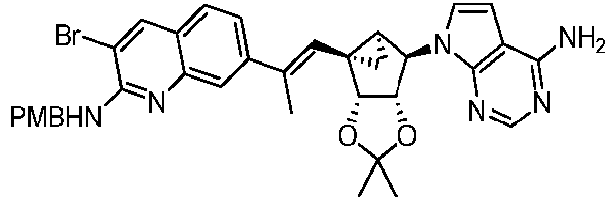
3-bromo-7-((E)-1-((3aR,3bS,4aS,5R,5aS)-5-(4-chloro-7H-pyrrolo [2,3 -d]pyrimidin-7-yl)-2,2-dimethyltetrahydrocyclo propa[3,4]cyclopenta[1,2 -d] [1,3]dioxol-3b(3aH)-yl)prop-1-en-2-yl)-N-(4-methoxybenzyl)quinolin-2-amine 1H NMR (400 MHz, DMSO-d6) δ 8.38 (s, 1H), 8.08 (s, 1H), 7.64 (s, 1H), 7.58 (d, J = 8.3 Hz, 1H), 7.45 - 7.40 (m, 1H), 7.33 (d, J = 8.4 Hz, 2H), 7.16 (d, J = 3.6 Hz, 1H), 7.12 (t, J = 6.0 Hz, 1H), 7.01 (s, 2H), 6.87 (d, J = 8.6 Hz, 2H), 6.63 (d, J = 3.5 Hz, 1H), 6.17 (s, 1H), 5.26 (d, J = 6.9 Hz, 1H), 4.94 (s, 1H), 4.70 (dd, J = 14.7, 6.0 Hz, 1H), 4.59 (dd, J = 14.7, 6.0 Hz, 1H), 4.48 (d, J = 6.9 Hz, 1H), 3.71 (s, 3H), 2.12 (s, 3H), 1.51 (s, 3H), 1.46 - 1.39 (m, 1H), 1.19 (s, 3H), 0.90 (t, J = 5.1 Hz, 1H), 0.26 - 0.18 (m, 1H); LCMS m/z = 668.97 (M+1; 30%). 7-((E)-1-((3aR,3bS,4aS,5R,5aS)-5-(4-amino-7H-pyrrolo [2,3-d]pyrimidin-7-yl)-2,2-dimethyltetrahydrocyclopropa[3,4]c yclopenta[1,2-d][1,3]dioxol-3b(3aH)-yl)prop-1-en-2-yl)-3-bromo-N-(4-methoxybenzyl)quinolin- 2-amine 
3-chloro-7 -(2-((3aR,3bS,4aS,5R,5aS)-5-(4-chloro-7H-pyrrolo [2,3 -d]pyrimidin-7-yl)-2,2-dimethyltetrahydrocyclo propa[3,4]cyclopenta[1,2 -d][1,3]dioxol-3b(3aH)-yl)propyl)-5-fluoro-N-(4-methoxybenzyl)quinolin-2-amine Diastereomeric mixture was separated by chiral preparative HPLC. 7-(2-((3aR,3bS,4aS,5R,5aS)-5-(4-amino-7H-pyrrolo[2,3-d]pyrimidin-7-yl)-2,2-dimethyltetrahydrocyclopropa[3,4]c yclopenta[1,2-d][1,3]dioxol-3b(3aH)-yl)propyl)-3-chloro-5-fluoro-N-(4-methoxybenzyl)quinolin- 2-amine Wavelength: 225nm, Instrument Method: HEX-0.1%DEA_IPA-DCM_50_50_ A_C_1.2ML_8MIN Flow Rate: 1.2 ml/min, Column CHIRALPAK IG CRL-071 Column Temp: 25°C, Mobile Phase A: HEX_0.1%DEA Mobile Phase C: IPA-DCM, Mobile Phase B: NA Mobile Phase D: NA First Diastereomer: LCMS m/z = 643.09(M+; 30%). Second Diastereomer: LCMS m/z = 643.09(M+; 30%). 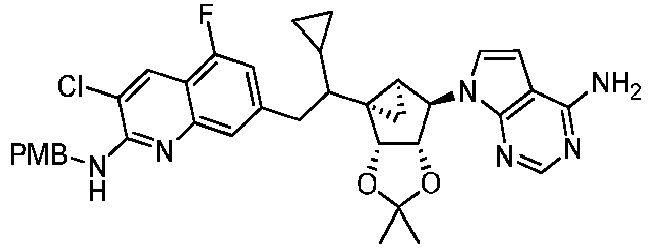
3-chloro-7-(2-((3aR,3bS,4aS,5R,5aS)-5-(4-chloro-7H-pyrrolo [2,3 -d]pyrimidin-7-yl)-2,2-dimethyltetrahydrocyclo propa[3,4]cyclopenta[1,2 -d][1,3]dioxol-3b(3aH)-yl)-2-cyclopropylethyl)-5-fluoro-N-(4-methoxybenzyl)quinolin-2-amine LCMS m/z = 669.10(M+; 20%). 7-(2-((3aR,3bS,4aS,5R,5aS)-5-(4-amino-7H-pyrrolo[2,3-d]pyrimidin-7-yl)-2,2-dimethyltetrahydrocyclopropa[3,4]c yclopenta[1,2-d] [1,3]dioxol-3b(3aH)-yl)-2-cyclopropylethyl)-3-chloro-5-fluoro-N-(4-methoxybenzyl)quinolin- 2-amine 
3-Bromo-7-(2-((3aR,3bS,4aS,5R,5aS)-5-(4-chloro-7H-pyrrolo [2,3 -d]pyrimidin-7-yl)-2,2-dimethyltetrahydrocyclo propa[3,4]cyclopenta[1,2 -d][1,3]dioxol-3b(3aH)-yl)propyl)-N-(4-methoxybenzyl)quinolin-2-amine LCMS m/z = 670.97(M+1; 20%). 7-(2-((3aR,3bS,4aS,5R,5aS)-5-(4-amino-7H-pyrrolo[2,3-d]pyrimidin-7-yl)-2,2-dimethyltetrahydrocyclopropa[3,4]c yclopenta[1,2-d][1,3]dioxol-3b(3aH)-yl)propyl)-3-bromo-N-(4-methoxybenzyl)quinolin-2-amine 
7-(2-((3aR,3bR,4aS,5R,5aS)-5-(4-chloro-7H-pyrrolo[2,3-d]pyrimidin-7-yl)-2,2-dimethyltetrahydrocyclo propa[3,4]cyclopenta[1,2 -d][1,3]dioxol-3b(3aH)-yl)ethyl)-N-(4-methoxybenzyl)quinazoli n-2-amine 1H NMR (400 MHz, DMSO-d6) δ 9.04 (s, 1H), 8.07 (s, 1H), 7.79 (t, J = 6.3 Hz, 1H), 7.69 (d, J = 8.2 Hz, 1H), 7.35 (s, 1H), 7.30 (d, J = 8.2 Hz, 2H), 7.17 (dd, J = 8.2, 1.6 Hz, 1H), 7.13 (d, J = 3.5 Hz, 1H), 7.01 (s, 2H), 6.90 - 6.84 (m, 2H), 6.61 (d, J = 3.5 Hz, 1H), 5.21 (d, J = 7.1 Hz, 1H), 5.01 (s, 1H), 4.57 - 4.48 (m, 3H), 3.71 (s, 3H), 2.91 - 2.80 (m, 2H), 2.35 - 2.24 (m, 1H), 1.69 - 1.58 (m, 1H), 1.48 (s, 3H), 1.47 - 1.42 (m, 1H), 1.20 (s, 3H), 0.93 (t, J = 4.7 Hz, 1H), 0.75 - 0.69 (m, 1H); LCMS m/z = 578.3 (M+1; 90%). 7-(2-((3aR,3bR,4aS,5R,5aS)-5-(4-amino-7H-pyrrolo[2,3-d]pyrimidin-7-yl)-2,2-dimethyltetrahydrocyclopropa[3,4]c yclopenta[1,2-d][1,3]dioxol-3b(3aH)-yl)ethyl)-N-(4-methoxybenzyl)quinazolin-2-amine 
7-(2-((3aR,3bR,4aS,5R,5aS)-5-(4-Chloro-7H-pyrrolo[2,3-d]pyrimidin-7-yl)-2,2-dimethyltetrahydrocyclo propa[3,4]cyclopenta[1,2-d][1,3]dioxol-3b(3aH)-yl)ethyl)-8-fluoroquinolin-2-amine 1H NMR (400 MHz, DMSO-d6) δ 8.07 (s, 1H), 7.88 (d, J = 8.9 Hz, 1H), 7.36 (d, J = 8.2 Hz, 1H), 7.13 (d, J = 3.7 Hz, 1H), 7.09 (t, J = 7.4 Hz, 1H), 7.00 (s, 2H), 6.75 (d, J = 8.9 Hz, 1H), 6.65 (s, 2H), 6.61 (d, J = 3.5 Hz, 1H), 5.21 (d, J = 7.2 Hz, 1H), 5.01 (s, 1H), 4.55 (d, J = 7.2 Hz, 1H), 2.93 - 2.79 (m, 2H), 2.29 - 2.20 (m, 1H), 1.68 - 1.58 (m, 1H), 1.49 (s, 3H), 1.47 - 1.43 (m, 1H), 1.21 (s, 3H), 0.96 (t, J = 4.8 Hz, 1H), 0.75 (dd, J = 9.0, 5.0 Hz, 1H); LCMS m/z = 475.2 (M+1; 30%). 7-(2-((3aR,3bR,4aS,5R,5aS)-5-(4-amino-7H-pyrrolo[2,3-d]pyrimidin-7-yl)-2,2-dimethyltetrahydrocyclopropa[3,4] cyclopenta[1,2-d][1,3]dioxol-3b(3aH)-yl)ethyl)-8-fluoroquinolin-2-amine 
7-(2-((3aR,3bR,4aS,5R,5aS)-5-(4-chloro-7H-pyrrolo [2,3 -d]pyrimidin-7-yl)-2,2-dimethylhexahydrocyclo propa[3,4]cyclopenta[1,2 -d] [1,3]dioxol-3b-yl)ethyl)-N-methylquinolin- 2-amine 1H NMR (400 MHz, DMSO-d6) δ 8.08 (s, 1H), 7.84 (d, J = 8.9 Hz, 1H), 7.55 (d, J = 8.1 Hz, 1H), 7.46 (s, 1H), 7.16 -7.10 (m, 2H), 7.06 (s, 2H), 6.72 (d, J = 8.9 Hz, 1H), 6.62 (d, J = 3.5 Hz, 1H), 5.22 (d, J = 7.2 Hz, 1H), 5.02 (s, 1H), 4.52 (dd, J = 7.3, 1.5 Hz, 1H), 2.91 (d, J = 4.7 Hz, 3H), 2.88 - 2.77 (m, 2H), 2.32 - 2.24 (m, 1H), 1.70 - 1.61 (m, 1H), 1.49 (s, 3H), 1.48 - 1.44 (m, 1H), 1.20 (s, 3H), 0.94 (t, J = 4.7 Hz, 1H), 0.74 (dd, J = 9.2, 5.0 Hz, 1H); LCMS m/z = 471.23 (M+1; 15%). 7-(2-((3aR,3bR,4aS,5R,5aS)-5-(4-amino-7H-pyrrolo[2,3-d]pyrimidin-7-yl)-2,2-dimethylhexahydrocyclopropa[3,4]c yclopenta[1,2-d]1,3]dioxol-3b-yl)ethyl)-N-methylquinolin-2-amine 
3-bromo-7-(((3aR,3bR,4aS,5R,5aS)-5-(4-chloro-7H-pyrrolo[2,3-d]pyrimidin-7-yl)-2,2-dimethyltetrahydrocyclo propa[3,4]cyclopenta[1,2 -d][1,3]dioxol-3b(3aH)-yl)methoxy)-N-(4-methoxybenzyl)quinolin-2-amine 1H NMR (400 MHz, DMSO-d6) δ 8.30 (s, 1H), 8.09 (s, 1H), 7.64 - 7.59 (m, 1H), 7.38 (d, J = 3.6 Hz, 1H), 7.37 - 7.31 (m, 2H), 7.16 (t, J = 5.9 Hz, 1H), 7.04 (s, 2H), 7.00 (d, J = 2.5 Hz, 1H), 6.97 - 6.92 (m, 1H), 6.91 - 6.84 (m, 2H), 6.65 (d, J = 3.6 Hz, 1H), 5.30 (d, J = 7.1 Hz, 1H), 5.14 (s, 1H), 4.63 (d, J = 6.0 Hz, 2H), 4.50 (d, J = 7.1 Hz, 1H), 4.35 (d, J = 10.5 Hz, 1H), 4.21 (d, J = 10.5 Hz, 1H), 3.71 (s, 3H), 1.78 - 1.71 (m, 1H), 1.48 (s, 3H), 1.18 (s, 3H), 1.11 - 1.06 (m, 1H), 0.88 - 0.83 (m, 1H); LCMS m/z = 659.3 (M+2; 100%). 7-(((3aR,3bR,4aS,5R,5aS)-5-(4-amino-7H-pyrrolo[2,3-d]pyrimidin-7-yl)-2,2-dimethyltetrahydrocyclopropa[3,4]c yclopenta[1,2-d][1,3]dioxol-3b(3aH)-yl)methoxy)-3-bromo-N-(4-methoxybenzyl)quinolin-2-amine 
7-((((3aR,3bS,4aS,5R,5aS) -5-(4-chloro-7H-pyrrolo[2,3-d]pyrimidin-7-yl)-2,2-dimethyltetrahydrocyclo propa[3,4]cyclopenta[1,2 -d][1,3]dioxol-3b(3aH)-yl)methyl)thio)-N-(4-methoxybenzyl)quinolin-2-amine 1H NMR (400 MHz, DMSO-d6) δ 8.09 (s, 1H), 7.80 (d, J = 8.9 Hz, 1H), 7.53 (d, J = 8.4 Hz, 1H), 7.46 (t, J = 5.7 Hz, 1H), 7.41 (d, J = 1.8 Hz, 1H), 7.35 - 7.30 (m, 2H), 7.23 (d, J = 3.5 Hz, 1H), 7.12 (dd, J = 8.3, 1.9 Hz, 1H), 7.01 (s, 2H), 6.91 - 6.86 (m, 2H), 6.75 (d, J = 8.9 Hz, 1H), 6.58 (d, J = 3.5 Hz, 1H), 5.23 (dd, J = 7.3, 1.4 Hz, 1H), 5.03 (s, 1H), 4.55 (d, J = 5.7 Hz, 2H), 4.51 (dd, J = 7.4, 1.5 Hz, 1H), 3.72 (s, 3H), 3.67 (d, J = 12.6 Hz, 1H), 3.32 (d, J = 12.7 Hz, 1H), 1.71- 1.63 (m, 1H), 1.47 (s, 3H), 1.17 (s, 3H), 1.06 (t, J = 4.8 Hz, 1H), 1.01 - 0.95 (m, 1H); LCMS m/z = 595.21 (M+;70%) 7-((((3aR,3bS,4aS,5R,5aS)-5-(4-amino-7H-pyrrolo[2,3-d]pyrimidin-7-yl)-2,2-dimethyltetrahydrocyclopropa[3,4]c yclopenta[1,2-d][1,3]dioxol-3b(3aH)-yl)methyl)thio)-N-(4-methoxybenzyl)quinolin-2-amine 
7-((3aR,3bR,4aS,5R,5aS)-3b-(2-(3,3 -dimethyl-2-(methylthio)-3H-indol-6-yl)ethyl)-2,2-dimethylhexahydrocyclo propa[3,4]cyclopenta[1,2 -d][1,3]dioxol-5-yl)-7H-pyrrolo [2,3 -d]pyrimidin-4-amine 1H NMR (400 MHz, DMSO-d6) δ 8.07 (s, 1H), 7.18 (d, J = 7.5 Hz, 1H), 7.11 (d, J = 3.6 Hz, 1H), 7.01 (s, 2H), 6.94 (s, 1H), 6.88 (d, J = 7.6 Hz, 1H), 6.61 (d, J = 3.5 Hz, 1H), 5.18 (d, J = 7.2 Hz, 1H), 5.00 (s, 1H), 4.52 (d, J = 7.1 Hz, 1H), 2.77 - 2.65 (m, 2H), 2.22-2.12 (m, 1H), 1.66 - 1.55 (m, 1H), 1.47 (s, 3H), 1.44 (dd, J = 9.2, 4.3 Hz, 1H), 1.36 (s, 3H), 1.24 (s, 3H), 1.19 (s, 3H), 0.93 (t, J = 4.7 Hz, 1H), 0.75 (dd, J = 9.1, 5.0 Hz, 1H); LCMS m/z = 473.4 (M+1; 80%) 7-((3aR,3bR,4aS,5R,5aS)-3b-(2-(2-amino-3,3-dimethyl-3H-indol-6-yl)ethyl)-2,2-dimethylhexahydrocyclopropa[3,4]c yclopenta[1,2-d][1,3]dloxol-5-yl)-7H-pyrrolo[2,3-d]pyrimidin-4-amine 
7-(2-((3aR,3bR,4aS,5R,5aS)-5-(4-chloro-7H-pyrrolo[2,3-d]pyrimidin-7-yl)-2,2-dimethylhexahydrocyclo propa[3,4]cyclopenta[1,2 -d][1,3]dioxol-3b-yl)ethyl)-N-(4-methoxybenzyl)quinolin-2-amine 1H NMR (400 MHz, Chloroform-d) δ 8.34 (s, 1H), 7.87 (d, J = 8.9 Hz, 1H), 7.63 (s, 1H), 7.55 (d, J = 8.0 Hz, 1H), 7.35 (d, J = 8.5 Hz, 2H), 7.22 (d, J = 8.1 Hz, 1H), 6.97 (d, J = 3.6 Hz, 1H), 6.91 (d, J = 8.7 Hz, 2H), 6.65 (d, J = 9.0 Hz, 1H), 6.39 (d, J = 3.6 Hz, 1H), 5.25 (s, 2H), 5.19 (d, J = 7.1 Hz, 1H), 5.14 (s, 1H), 4.67 - 4.62 (m, 3H), 3.82 (s, 3H), 3.06 - 2.93 (m, 2H), 2.41 - 2.36 (m, 1H), 2.06 - 2.01 (m, 1H), 1.60 (s, 3H), 1.51 (dd, J = 8.7, 4.2 Hz, 1H), 1.28 (s, 3H), 1.15 (t, J = 4.8 Hz, 1H), 0.78 (dd, J = 5.5, 3.2 Hz, 1H); LCMS m/z = 577.5 (M+1; 60%) 7-(2-((3aR,3bR,4aS,5R,5aS)-5-(4-amino-7H-pyrrolo[2,3-d]pyrimidin-7-yl)-2,2-dimethylhexahydrocyclopropa[3,4]c yclopenta[1,2-d][1,3]dioxol-3b-yl)ethyl)-N-(4-methoxybenzyl)quinolin-2-amine -

- A mixture of 7-((E)-1-((3aR,3bS,4aS,5R,5aS)-5-(4-amino-7H-pyrrolo[2,3-d]pyrimidin-7-yl)-2,2-dimethyltetrahydrocyclopropa[3,4]cyclopenta[1,2-d][1,3]dioxol-3b(3aH)-yl)prop-1-en-2-yl)-3-bromo-N-(4-methoxybenzyl)quinolin-2-amine (0.05g, 0.075 mmol), ammonium formate (0.331 g, 5.24 mmol) and Pd/C (0.024 g, 0.225 mmol) in EtOH ( 15 ml) was heated at 75°C for 8h. The reaction mixture was cooled 25°C, filtered through celite and concentrated in vacuo to get 0.06g of crude compound. The obtained residue was purified by combiflash (Rf200, Teledyne/Isco) instrument onto a redisep® Rf column with gradient elution (0 to 5%) of methanol in dichloromethane to afford the title compound (0.042g, 95%) as an off-white solid. LCMS m/z = 591.29 (M+1, 100%).
-

- The mixture of 7-(2-((3aS,4R,6aR)-4-(4-amino-7H-pyrrolo[2,3-d]pyrimidin-7-yl)-2,2-dimethyl-3a,6a-dihydro-4H-cyclopenta[d][1,3]dioxol-6-yl)ethyl)-3-bromo-N-(4-methoxy benzyl)quinolin-2-amine (0.220 g, 0.343 mmol) in TFA (3.96 ml, 51.4 mmol) was stirred at 50°C for 1.5h. The resulting mixture was concentrated in vacuo and obtained residue was dissolved in MeOH (5ml). K2CO3 (0.142 g, 1.029 mmol) was added and stirred the reaction mixture at 50°C for 1.5h. Reaction mixture was filtered and filtrate was concentrated under reduced pressure to get 0.27g of crude compound. This residue was purified by combiflash (Rf200, Teledyne/Isco) instrument onto a redisep® Rf column with gradient elution (0 to 7%) of methanol in dichloromethane to afford the title compound (0.03g, 18%) as an off-white solid. 1H NMR (400 MHz, DMSO-d6) δ 8.35 (s, 1H), 8.06 (s, 1H), 7.61 (d, J = 8.2 Hz, 1H), 7.36 (d, J = 1.6 Hz, 1H), 7.16 (dd, J = 8.2, 1.7 Hz, 1H), 7.08 (s, 2H), 6.67 (d, J = 3.5 Hz, 1H), 6.61 (s, 2H), 6.45 (d, J = 3.5 Hz, 1H), 5.50 (d, J = 4.4 Hz, 1H), 5.44 (t, J = 1.7 Hz, 1H), 4.98 (d, J = 6.4 Hz, 2H), 4.45 (t, J = 5.9 Hz, 1H), 3.97 (d, J = 5.0 Hz, 1H), 3.04 - 2.87 (m, 2H), 2.61 - 2.53 (m, 2H); LCMS m/z = 483.01 (M+2, 90%).
- Examples in table-13 were synthesized by following an analogous reaction protocol as was used for the preparation of (1S,2R,5R)-3-(2-(2-amino-3-bromoquinolin-7-yl)ethyl)-5-(4-amino-7H-pyrrolo[2,3-d]pyrimidin-7-yl)cyclopent-3-ene-1,2-diol using the appropriate starting materials (Instead of TFA, 3N HCl/MeOH could also be used).
Table-13 Structure & IUPAC name Intermediate used 1H NMR & LCMS data Compound-2 7-(2-((3aS,4R,6aR)-4-(4-amino-7H-pyrrolo[2,3-d]pyrimidin-7-yl)-2,2-dimethyl-3a,6a-dihydro-4H-cyclopenta[d][1,3]dioxol -6-yl)ethyl)-3-chloro-N-(4-methoxybenzyl)quinolin -2-amine 1H NMR (400 MHz, DMSO-d6) δ 8.17 (s, 1H), 8.09 (s, 1H), 7.61 (d, J = 8.2 Hz, 1H), 7.37 (s, 1H), 7.29 (s, 2H), 7.16 (dd, J = 8.3, 1.7 Hz, 1H), 6.75 - 6.66 (m, 3H), 6.49 (d, J = 3.6 Hz, 1H), 5.50 (d, J = 4.4 Hz, 1H), 5.43 (d, J = 1.9 Hz, 1H), 5.01 (d, J = 6.7 Hz, 2H), 4.45 (t, J = 5.9 Hz, 1H), 3.96 (d, J = 5.0 Hz, 1H), 2.94 (ddt, J = 21.4, 14.1, 7.2 Hz, 2H), 2.58 - 2.55 (m, 2H); LCMS m/z = 436.92 (M+, 20%) 
(1S,2F,5R)-3-(2-(2-amino-3-chloroquinolin-7-yl)ethyl)-5-(4-amino-7H-pyrrolo[2,3-d]pyrimidin-7-yl)cyclopent-3-ene-1,2-diol Compound-3 7-(2-((3aS,4R,6aR)-4-(4-amino-5-fluoro-7H-pyrrolo[2,3-d]pyrimidin-7-yl)-2,2-dimethyl-3a,6a-dihydro-4H-cyclopenta[d][1,3]dioxol -6-yl)ethyl)-3-bromo-N-(4-methoxybenzyl)quinolin -2-amine 1H NMR (400 MHz, DMSO-d6) δ 8.39 (s, 1H), 8.08 (s, 1H), 7.63 (d, J = 8.2 Hz, 1H), 7.37 (s, 1H), 7.18 (dd, J = 8.2, 1.6 Hz, 3H), 6.72 (d, J = 27.4 Hz, 2H), 6.55 (d, J = 2.1 Hz, 1H), 5.54 (s, 1H), 5.40 (q, J = 1.7 Hz, 1H), 5.10 - 4.91 (m, 2H), 4.43 (d, J = 5.7 Hz, 1H), 3.92 (q, J = 5.2 Hz, 1H), 3.04 - 2.87 (m, 2H) 2.65 - 2.52 (m, 2H),; LCMS m/z = 501 (M+1, 30%) 
(1S,2R5R)-3-(2-(2-amino-3-bromoquinolin-7-yl)ethyl)-5-(4-amino-5-fluoro-7H-pyrrolo[2,3-d]pyrimidin-7-yl)cyclopent-3-ene-1,2-diol Compound-4 7-((((3aS,4R,6aR)-4-(4-amino-7H-pyrrolo[2,3-d]pyrimidin-7-yl)-2,2-dimethyl-3a,6a-dihydro-4H-cyclopenta[d][1,3]dioxol -6-yl)methyl)thio)-N-(4-methoxybenzyl)quinolin -2-amine 1H NMR (400 MHz, DMSO-d6) δ 8.00 (s, 1H), 7.86 (d, J = 8.8 Hz, 1H), 7.56 (d, J = 8.3 Hz, 1H), 7.40 (d, J = 1.8 Hz, 1H), 7.15 (dd, J = 8.3, 1.9 Hz, 1H), 6.89 (s, 2H), 6.72 (d, J = 8.8 Hz, 1H), 6.48 (s, 2H), 6.26 (d, J = 3.5 Hz, 1H), 6.21 (d, J = 3.6 Hz, 1H), 5.57 (s, 1H), 5.49 (s, 1H), 5.11 (d, J = 5.5 Hz, 1H), 5.04 (d, J = 6.4 Hz, 1H), 4.58 (s, 1H), 4.01 (d, J = 14.7 Hz, 1H), 3.88 - 3.81 (m, 1H), 3.75 - 3.66 (m, 1H); LCMS m/z = 420.85 (M+, 100%) 
(1S,2R,5R)-5-(4-ammo-7H-pyrrolo[2,3-d]pyrimidin-7-yl)-3-(((2-aminoquinolin-7-yl)thio)methyl)cyclopent-3-ene-1,2-diol Compound-5 7-((((3aS,4R,6aR)-4-(4-amino-7H-pyrrolo[2,3-d]pyrimidin-7-yl)-2,2-dimethyl-3a,6a-dihydro-4H-cyclopenta[d][1,3]dioxol -6-yl)methyl)thio)-3-chloro-N,N-bis(4-methoxybenzyl)quinolin -2-amine 1H NMR (400 MHz, DMSO-d6) 8.19 (s, 1H), 8.00 (s, 1H), 7.62 (d, J = 8.4 Hz, 1H), 7.43 (s, 1H), 7.23 (dd, J = 8.4, 1.9 Hz, 1H), 6.94 (s, 2H), 6.82 (s, 2H), 6.28 (q, J = 3.5 Hz, 2H), 5.61 (s, 1H), 5.50 (s, 1H), 5.09 (dd, J = 24.6, 6.5 Hz, 2H), 4.57 (t, J = δ6.0 Hz, 1H), 4.04 (d, J = 14.9 Hz, 1H), 3.87 (q, J = 5.7 Hz, 1H), 3.74 (d, J = 15.0 Hz, 1H); LCMS m/z = 455.50 (M+, 50%) 
(1S,2R,5R)-3-(((2-amino-3-chloroquinolin-7-yl)thio)methyl)-5-(4-amino-7H-pyrrolo[2,3-d]pyrimidin-7-yl)cyclopent-3-ene-1,2-diol Compound-6 N7-(((3aS,4R,6aR)-4-(4-amino-7H-pyrrolo[2,3-d]pyrimidin-7-yl)-2,2-dimethyl-3a,6a-dihydro-4H-cyclopenta[d][1,3]dioxol -6-yl)methyl)-N2-(4-methoxybenzyl)-N7-methylquinoline-2,7-diamine 1H NMR (400 MHz, DMSO-d6) δ 8.02 (s, 1H), 7.65 (d, J = 8.7 Hz, 1H), 7.39 (d, J = 8.8 Hz, 1H), 6.95 - 6.86 (m, 3H), 6.81 (dd, J = 8.9, 2.6 Hz, 1H), 6.61 (d, J = 2.5 Hz, 1H), 6.49 (d, J = 3.5 Hz, 1H), 6.41 (d, J = 8.7 Hz, 1H), 6.09 (s, 2H), 5.51 (s, 1H), 5.41 (d, J = 1.9 Hz, 1H), 5.06 (dd, J = 6.5, 2.5 Hz, 2H), 4.44 (t, J = 6.0 Hz, 1H), 4.17 (d, J = 4.9 Hz, 2H), 4.11 - 4.04 (m, 1H), 3.05 (s, 3H); LCMS m/z = 417.10 (M+, 100%) 
(1S,2F,5R)-5-(4-amino-7H-pyrrolo[2,3-d]pyrimidin-7-yl)-3-(((2-aminoquinolin-7-yl)(methyl)amino)methyl)cyclope nt-3-ene-1,2-diol Compound-7a and 7b 7-(2-((3aS,4R,6aR)-4-(4-amino-7H-pyrrolo[2,3-d]pyrimidin-7-yl)-2,2-dimethyl-3a,6a-dihydro-4H-cyclopenta[d][1,3]dioxol -6-yl)propyl)-3-bromo-N-(4-methoxybenzyl) quinolin-2-amine First Diastereomer(Compound-7a): 1H NMR (400 MHz, DMSO-d6) δ 8.35 (s, 1H), 8.05 (s, 1H), 7.60 (d, J = 8.2 Hz, 1H), 7.33 (s, 1H), 7.13 (d, J = 8.4 Hz, 1H), 6.93 (s, 2H), 6.78 (d, J = 3.6 Hz, 1H), 6.59 (s, 2H), 6.49 (d, J = 3.6 Hz, 1H), 5.53 (d, J = 4.5 Hz, 1H), 5.42 (s, 1H), 5.01 - 4.88 (m, 2H), 4.46 (t, J = 5.8 Hz, 1H), 3.99 (t, J = 7.8 Hz, 1H), 3.03 (dd, J = 11.9, 4.4 Hz, 1H), 2.73 (q, J = 10.6, 8.9 Hz, 2H), 1.24 (s, 3H); LCMS m/z = 497.30 (M+2, 100%) Second Diastereomer(Compound-7b): 1H NMR (400 MHz, DMSO-d6) δ 8.36 (s, 1H), 8.05 (s, 1H), 7.61 (d, J = 8.2 Hz, 1H), 7.33 (s, 1H), 7.21 - 7.02 (m, 3H), 6.61 (s, 2H), 6.50 (d, J = 3.5 Hz, 1H), 6.43 (d, J = 3.6 Hz, 1H), 5.52 (d, J = 5.0 Hz, 1H), 5.35 (s, 1H), 5.00 (s, 1H), 4.91 (d, J = 6.4 Hz, 1H), 4.56 (s, 1H), 3.90 (d, J = 5.8 Hz, 1H), 3.07 - 2.99 (m, 1H), 2.83 - 2.74 (m, 2H) 1.09 (d, J = 5.8 Hz, 3H); LCMS m/z = 495.24 (M+, 40%) 
(1S,2R,5R)-3-(1-(2-Amino-3-bromoquinolin-7-yl)propan-2-yl)-5-(4-amino-7H-pyrrolo[2,3-d]pyrimidin-7-yl)cyclopent-3-ene-1,2-diol (Compound-8a and 8b) 7-(1-((3aS,4R,6aR)-4-(4-amino-7H-pyrrolo [2,3-d]pyrimidin-7-yl)-2,2-dimethyl-3a,6a-dihydro-4H-cyclopenta [d] [1,3] dioxol-6-yl)ethoxy)-N-methyl quinolin-2-amine Diastereomeric mixture was separated by chiral preparative HPLC. Wavelength: 225 nm, Instrument Method: IPA_0.1%DEA_MeOH_ 0.1%DEA_50_50_0.7ML_12M IN, Flow Rate: 0.70 ml/min Column : CHIRALPAK IB CRL-043 OLD, Column Temp: 30°C,Mobile Phase A: IPA_0.1%DEA, Mobile Phase B: MeOH _ 0.1%DEA First Diastereomer (Compound-8a): 1H NMR (400 MHz, DMSO-d6) δ 8.04 (s, 1H), 7.73 (d, J = 8.8 Hz, 1H), 7.49 (d, J 8.7 Hz, 1H), 7.00 (d, J = 2.5 Hz, 1H), 6.92 (d, J = 4.2 Hz, 2H), 6.84 - 6.80 (m, 2H), 6.57 (d, J = 8.8 Hz, 1H), 6.44 (d, J = 3.5 Hz, 1H), 5.70 (t, J = 1.7 Hz, 1H), 5.60-5.56 (m, 1H), 5.21 (d, J = 6.7 Hz, 1H), 5.14 - 5.08 (m, 1H), 5.04 - 4.99 (m, 1H), 4.62 4.58 (m, 1H), 4.15 - 4.11 (m, 1H), 3.19 - 3.16 (m, 1H), 2.90 (d, J = 4.7 Hz, 3H), 1.54 (d, J 6.3 Hz, 3H); LCMS m/z 433.04 (M+1, 30%) Second Diastereomer(Compound-8b): 1H NMR (400 MHz, DMSO-d6) δ 8.02 (s, 1H), 7.73 (d, J = 8.9 Hz, 1H), 7.49 (d, J = 8.7 Hz, 1H), 7.04 (d, J = 2.5Hz, 1H), 6.94 (d, J = 3.5 Hz, 3H), 6.81 (dd, J = 8.7, 2.5 Hz, 1H), 6.57 (d, J = 8.8 Hz, 1H), 6.54 (d, J 3.6 Hz, 1H),5.72 (t, J = 1.5 Hz, 1H), 5.57 (d, J = 5.0 Hz, 1H), 5.26 (d, J= 6.7 Hz, 1H), 5.15 (s, 1H), 5.10 (s, 1H), 4.48 (s, 1H),4.36 (d, J = 4.2 Hz, 1H), 3.94 (d, J = 5.8 Hz, 1H), 2.91 (d, J = 4.7 Hz, 3H), 1.57 (d, J = 6.5 Hz, 3H); LCMS (m/z) =433.04 (M+, 30%). 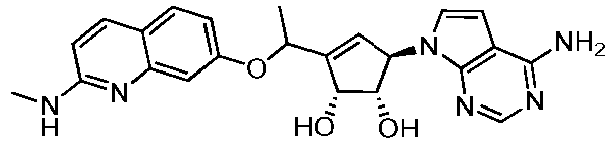
(1S,2R,5R)-5-(4-Amino-7H-pyrrolo[2,3-d]pyrimidin-7-yl)-3-(1-((2-(methylamino) quinolin-7-yl)oxy)ethyl)cyclopent-3-ene-1,2-diol Compound-9 7-(((3aS,4R,6aR)-4-(4-amino-7H-pyrrolo[2,3-d]pyrimidin-7-yl)-2,2,6a-trimethyl-3a,6a-dihydro-4H-cyclopenta[d][1,3]dioxol-6-yl)methoxy)-3-chloro-5-fluoro-N-(4-methoxybenzyl)quinolin-2-amine 1H NMR (400 MHz, DMSO-d6) δ 8.37 (s, 1H), 8.14 (s, 1H), 7.71 (d, J = 3.7 Hz, 1H), 7.07 (s, 2H), 6.97 (d, J = 3.6 Hz, 1H), 6.90 (d, J = 2.2 Hz, 1H), 6.79 (dd, J = 11.5, 2.2 Hz, 1H), 5.61 (s, 2H), 4.89 - 4.77 (m, 2H), 4.76 - 4.63 (m, 3H), 1.82 (s, 3H); LCMS m/z = 471.07 (M+, 100%) 
(1S,2R,5R)-3-(((2-ammo-3-chloro-5-fluoroquinolin-7-yl)oxy)methyl)-5-(4-amino-7H-pyrrolo[2,3-d]pyrimidin-7-yl)-2-methylcyclopent-3-ene-1,2-diol Compound-10 7-(2-((3aS,4R,6aR)-4-(4-amino-7H-pyrrolo[2,3-d]pyrimidin-7-yl)-2,2-dimethyl-3a,6a-dihydro-4H-cyclopenta[d][1,3]dioxol-6-yl)ethyl)-N-methylquinolin-2-amine 1H NMR (400 MHz, DMSO-d6) δ 8.03 (s, 1H), 7.79 (d, J = 8.9 Hz, 1H), 7.54 (d, J = 8.0 Hz, 1H), 7.39 (s, 1H), 7.07 (dd, J = 8.1, 1.6 Hz, 1H), 6.93 (s, 2H), 6.72 - 6.64 (m, 2H), 6.41 (d, J = 3.5 Hz, 1H), 5.51 (s, 1H), 5.43 (d, J = 1.9 Hz, 1H), 4.95 (dd, J = 10.7, 6.5 Hz, 2H), 4.45 (t, J = 6.0 Hz, 1H), 4.01 - 3.90 (m, 1H), 3.12 - 3.08 (m, 2H), 2.90 (d, J = 4.7 Hz, 3H), 2.60 - 2.52 (m, 2H); LCMS m/z= 416.48 (M+, 60%) 
(1S,2R,5R)-5-(4-amino-7H-pyrrolo[2,3-d]pyrimidin-7-yl)-3-(2-(2-(methylamino)quinolin-7-yl)ethyl)cyclopent-3-ene-1,2-diol Compound-11 7-((3aS,4R,6aR)-2,2-dimethyl-6-(2-(3-methylimidazo[1,2-a]pyridin-7-yl)ethyl)-3a,6a-dihydro-4H-cyclopenta[d][1,3]dioxol-4-yl)-7H-pyrrolo[2,3-d]pyrimidin-4-amine 1H NMR (400 MHz, DMSO-d6) δ 8.20 (d, J = 7.0 Hz, 1H), 8.03 (s, 1H), 7.39 (s, 1H), 7.32 (s, 1H), 7.00 - 6.86 (m, 3H), 6.66 (d, J = 3.5 Hz, 1H), 6.42 (d, J = 3.5 Hz, 1H), 5.53 - 5.41 (m, 2H), 4.98 (d, J = 6.4 Hz, 2H), 4.46 (t, J = 6.0 Hz, 1H), 3.98 (q, J = 5.5 Hz, 1H), 3.40 (d, J = 7.0 Hz, 2H), 2.99 - 2.82 (m, 2H), 2.45 (s, 3H); LCMS m/z= 390.91 (M+, 90%) 
(1S,2R,5R)-5-(4-amino-7H-pyrrolo[2,3-d]pyrimidin-7-yl)-3-(2-(3-methylimidazo[1,2-a]pyridin-7-yl)ethyl)cyclopent-3-ene-1,2-diol Compound-12 3-chloro-5-fluoro-N-(4-methoxybenzyl)-7-(((3aS,4R,6aR)-4-(4-((4-methoxybenzyl)amino)-7H-pyrrolo[2,3-d]pyrimidin-7-yl)-2,2,5-trimethyl-3a,6a-dihydro-4H-cyclopenta[d][1,3]dioxol-6-yl)methoxy)quinolin-2-amine LCMS m/z = 471.23 (M+, 60%) 
(1S,2R,5R)-3-(((2-amino-3-chloro-5-fluoroquinolin-7-yl)oxy)methyl)-5-(4-amino-7H-pyrrolo[2,3-d]pyrimidin-7-yl)-4-methylcyclopent-3 -ene-1 ,2-diol Compound-13 3-chloro-7-(2-((3aS,4R,6aR)-2,2-dimethyl-4-(4-methyl-7H-pyrrolo[2,3-d]pyrimidin-7-yl)-3a,6a-dihydro-4H-cyclopenta[d][1,3]dioxol-6-yl)ethyl)-5-fluoroquinolin-2-amine 1H NMR (400 MHz, DMSO-d6) δ 8.62 (s, 1H), 8.18 (s, 1H), 7.22 (s, 1H), 7.13 - 6.90 (m, 4H), 6.55 (d, J = 3.6 Hz, 1H), 5.61 (d, J = 4.4 Hz, 1H), 5.46 (t, J = 1.7 Hz, 1H), 5.02 (dd, J = 6.5, 4.3 Hz, 2H), 4.47 (t, J = 6.0 Hz, 1H), 4.08 - 3.98 (m, 1H), 3.04 - 2.85 (m, 2H), 2.63 (s, 3H), 2.60 - 2.54 (m, 2H); LCMS m/z = 454.17 (M+, 100%) 
(1S,2R5R)-3-(2-(2-amino-3-chloro-5-fluoroquinolin-7-yl)ethyl)-5-(4-methyl-7H-pyrrolo[2,3-d]pyrimidin-7-yl)cyclopent-3-ene-1,2-diol Compound-14 3-chloro-7-(2-((3aS,4R,6aR)-2,2-dimethyl-4-(4-methyl-1H-pyrrolo[3,2-c]pyridin-1-yl)-3a,6a-dihydro-4H-cyclopenta[d][1,3]dioxol-6-yl)ethyl)-5-fluoroquinolin-2-amine 1H NMR (400 MHz, DMSO-d6) δ 14.95 (s, 1H), 8.41 (s, 1H), 8.26 (t, J = 5.9 Hz, 1H), 7.94 (d, J = 6.9 Hz, 1H), 7.53 (d, J = 3.5 Hz, 1H), 7.43 - 7.29 (m, 2H), 7.29 - 7.03 (m, 3H), 5.64 (s, 1H), 5.58 (d, J = 5.3 Hz, 1H), 4.41 (d, J = 5.6 Hz, 1H), 3.88 (t, J = 5.6 Hz, 1H), 3.10-2.99 (m, 2H)), 2.93 (s, 3H), 2.62-2.50 (m, 2H); LCMS m/z= 453.11 (M+1, 100%) 
(1S,2R5R)-3-(2-(2-amino-3-chloro-5-fluoroquinolin-7-yl)ethyl)-5-(4-methyl-1H-pyrrolo[3,2-c]pyridin-1-yl)cyclopent-3-ene-1,2-diol hydrochloride Compound-15 3-Chloro-7-(2-((3aS,4R,6aR)-2,2-dimethyl-4-(1H-pyrrolo[3,2-c]pyridin-1-yl)-3a,6a-dihydro-4H-cyclopenta[d][1,3]dioxol-6-yl)ethyl)-5-fluoroquinolin-2-amine 1H NMR (400 MHz, DMSO-d6) δ 8.91 (s, 1H), 8.20 (s, 1H), 8.09 (d, J = 6.2 Hz, 1H), 7.49 (d, J = 6.1Hz, 1H), 7.24 (s, 1H), 7.11 (d, J = 3.3 Hz, 1H), 7.07 - 7.01 (m, 1H), 6.98 (s, 2H), 6.60 (d, J = 3.3 Hz,1H), 5.58 (d, J = 1.8 Hz, 1H), 5.39 (s, 1H), 5.18 (dd, J = 17.2, 6.7 Hz, 2H), 4.41 (t, J = 5.4 Hz, 1H), 3.84(q, J = 5.9 Hz, 1H), 3.11 - 2.91 (m, 2H), 2.68 - 2.58 (m, 2H); LCMS (m/z) =439.23 (M+, 100%). 
(1S,2R,5R)-3-(2-(2-Amino-3-chloro-5-fluoroquinolin-7 - yl)ethyl)-5-(1H-pyrrolo[3,2-c]pyridin-1-yl)cyclopent-3 -ene-1,2-diol Compound-16 3-chloro-7-(2-((3aS,4R,6aR)-2,2-dimethyl-4-(7H-pyrrolo[2,3-d]pyrimidin-7-yl)-3a,6a-dihydro-4H-cyclopenta[d][1,3]dioxol-6-yl)ethyl)-5-fluoroquinolin-2-amine 1H NMR (400 MHz, DMSO-d6) δ 8.98 (s, 1H), 8.76 (s, 1H), 8.18 (s, 1H), 7.22 (s, 1H), 7.11 (d, J = 3.6 Hz, 1H), 7.02 (dd, J = 11.1, 1.4 Hz, 1H), 6.96 (s, 2H), 6.49 (d, J = 3.6 Hz, 1H), 5.65 (s, 1H), 5.47 (d, J = 1.9 Hz, 1H), 5.03 (d, J = 6.4 Hz, 2H), 4.48 (t, J = 6.1 Hz, 1H), 4.06 - 4.02 (m, 1H), 3.02 - 2.93 (m, 2H), 2.60 - 2.55 (m, 2H) ; LCMS m/z= 440.17 (M+, 60%) 
(1S,2F,5R)-3-(2-(2-amino-3-chloro-5-fluoroquinolin-7-yl)ethyl)-5-(7H-pyrrolo[2,3-d]pyrimidin-7-yl)cyclopent-3-ene-1,2-diol Compound-17 N7-(((3aS,4R,6aR)-4-(4-amino-7H-pyrrolo[2,3-d]pyrimidin-7-yl)-2,2-dimethyl-3a,6a-dihydro-4H-cyclo penta[d][1,3]dioxol-6-yl)methyl) -N2-(4-methoxybenzyl) quinoline-2,7-diamine 1H NMR (400 MHz, DMSO-d6) δ 8.04 (s, 1H), 7.60 (d, J = 8.6 Hz, 1H), 7.29 (d, J = 8.6 Hz, 1H), 6.96 - 6.91 (m, 3H), 6.64 (dd, J = 8.7, 2.3 Hz, 1H), 6.51 (d, J = 3.5 Hz, 1H), 6.48 (d, J = 2.2 Hz, 1H), 6.37 (d, J = 8.6 Hz, 1H), 6.20 (t, J = 5.6 Hz, 1H), 6.08 (s, 2H), 5.61 (q, J = 1.8 Hz, 1H), 5.55 (s, 1H), 5.09 - 5.04 (m, 2H), 4.52 (t, J = 5.9 Hz, 1H), 4.11 (q, J = 5.8 Hz, 1H), 3.90 (s, 2H); LCMS m/z= 404.16 (M+, 100%) 
(1S,2R,5R)-5-(4-amino-7H-pyrrolo[2,3-d]pyrimidin-7-yl)-3-(((2-aminoquinolin-7-yl)amino)methyl)cyclopent-3-ene-1,2-diol Compound-18 7-(((3aS,4R,6aR)-4-(4-Amino-7H-pyrrolo[2,3-d]pyrimidin-7-yl)-2,2-dimethyl-3a,6a-dihydro-4H-cyclopenta[d] [1,3] dioxol-6-yl)methoxy)-3-chloro-5-fluoro-N-(4-methoxybenzyl)quinolin-2-amine 1H NMR (400 MHz, DMSO-d6) δ 8.58 (bs, 2H), 8.32 (s, 1H), 8.11 (s, 1H), 7.32 (d, J = 3.6 Hz, 1H), 6.99 (bs, 2H), 6.89 - 6.83 (m, 2H), 6.81 (d, J = 2.3 Hz, 1H), 5.82 (q, J = 1.8 Hz, 1H), 5.63 (d, J = 5.2 Hz, 1H), 5.27 (bs, 2H), 4.93 - 4.80 (m, 2H), 4.56 (d, J = 5.7 Hz, 1H), 4.21 (t, J = 5.6 Hz, 1H); LCMS m/z= 457.17 (M+, 70%) 
(1S,2R,5R)-3-(((2-amino-3-chloro-5-fluoroquinolin-7 - yl)oxy)methyl)-5-(4-amino-7H-pyrrolo[2,3-d]pyrimidin-7-yl)cyclopent-3-ene-1,2-diol Compound-19 7-(((3aR,6R,6aS)-6-(4-amino-7H-pyrrolo[2,3-d]pyrimidin-7-yl)-2,2-dimethyl-6,6a-dihydro-3aH-cyclopenta[d][1,3]dioxol-4-yl)methoxy)-N-methylquinolin- 2-amine 1H NMR (400 MHz, DMSO-d6) δ 8.12 (s, 1H), 8.00 (d, J = 8.9 Hz, 1H), 7.69 (d, J = 8.8 Hz, 1H), 7.40 (d, J = 13.8 Hz, 3H), 7.12 (d, J = 3.7 Hz, 1H), 7.03 (d, J = 8.9 Hz, 1H), 6.80 (d, J = 9.0 Hz, 1H), 6.64 (d, J = 3.5 Hz, 1H), 5.82 (d, J = 2.0 Hz, 1H), 5.61 (s, 1H), 5.30 - 5.08 (m, 2H), 4.86 (s, 2H), 4.60 (t, J = 5.6 Hz, 1H), 4.28 - 4.04 (m, 2H) 3.05 (d, J = 4.6 Hz, 3H); LCMS m/z= 419.16 (M+, 100%) 
(1S,2R,5R)-5-(4-amino-7H-pyrrolo[2,3-d]pyrimidin-7-yl)-3-(((2-(methylamino)quinolin-7-yl)oxy)methyl)cyclopent-3-ene-1,2-diol Compound-20a and 20b 7-(1-((3aS,4R,6aR)-4-(4-amino-7H-pyrrolo[2,3-d]pyrimidin-7-yl)-2,2-dimethyl-3a,6a-dihydro-4H-cyclopenta[d][1,3]dioxol-6-yl)ethoxy)-3-chloro-5-fluoro-N-(4-methoxybenzyl)quinolin-2-amine Diastereomeric mixture was separated by chiral preparative HPLC. First Diastereomer (Compound-20a): 1H NMR (400 MHz, DMSO-d6) δ 8.12 (s, 1H), 7.92 (s, 1H), 7.36 (d, J = 3.6 Hz, 1H), 7.16 (d, J = 3.5 Hz, 1H), 6.83 (s, 2H), 6.65 - 6.35 (m, 3H), 5.96 (t, J = 9.7 Hz, 1H), 5.82 - 5.54 (m, 2H), 5.07 - 4.91 (m, 2H), 4.61 - 4.36 (m, 2H), 4.18 (dd, J = 9.6, 4.8 Hz, 1H), 1.65 (ddd, J = 26.6, 6.9, 2.5 Hz, 3H); LCMS m/z= 471.23 (M+, 90%) Second Diastereomer (Compound-20b): 1H NMR (400 MHz, DMSO-d6) δ 8.08 (s, 1H), 8.01 (s, 1H), 6.93 (s, 5H), 6.87 - 6.75 (m, 2H), 6.54 (d, J = 3.6 Hz, 1H), 5.62 (d, J = 1.6 Hz, 1H), 5.53 - 5.49 (m, 1H), 5.26 (d, J = 5.9 Hz, 1H), 5.23 - 5.13 (m, 2H), 4.55 (t, J = 5.7 Hz, 1H), 4.15 - 4.00 (m, 1H), 1.57 (d, J = 6.5 Hz, 3H); LCMS m/z= 471.23 (M+, 80%) 
(1S,2R,5R)-3-(1-((2-amino-3-chloro-5-fluoroquinolin-7 - yl)oxy)ethyl)-5-(4-amino-7H-pyrrolo[2,3-d]pyrimidin-7-yl)cyclopent-3-ene-1,2-diol Compound-21 3-chloro-7-(2-((3aS,4R,6aR)-2,2-dimethyl-4-(4-methyl-7H-pyrrolo[2,3-d]pyrimidin-7-yl)-3a,6a-dihydro-4H-cyclopenta[d][1,3]dioxol-6-yl)ethyl)quinolin-2-amine 1H NMR (400 MHz, DMSO-d 6) δ 8.62 (s, 1H), 8.17 (s, 1H), 7.61 (d, J = 8.3 Hz, 1H), 7.44 (s, 1H), 7.37 (s, 1H), 7.17 (d, J = 8.2 Hz, 1H), 7.02 (d, J = 3.6 Hz, 1H), 6.70 (s, 2H), 5.62 (s, 1H), 5.45 (s, 1H), 5.04 (s, 2H), 4.47 (d, J = 5.5 Hz, 1H), 4.14 - 3.91 (m, 1H), 3.06 - 2.87 (m, 2H) 2.58 (d, J = 32.3 Hz, 5H); LCMS m/z= 436.23 (M+, 90%) 
(1S,2R,5R)-3-(2-(2-amino-3-chloroquinolin-7-yl)ethyl)-5-(4-methyl-7H-pyrrolo[2,3-d]pyrimidin-7-yl)cyclopent-3-ene-1,2-diol Compound-22 7-(2-((3aS,4R,6aR)-4-(4-Amino-7H-pyrrolo[2,3-d]pyrimidin-7-yl)-2,2-dimethyl-3a,6a-dihydro-4H-cyclo penta[d][1,3]dioxol-6-yl)ethyl)-N-cyclo butylquinolin-2-amine 1H NMR (400 MHz, DMSO-d6) δ 8.15 (s, 1H), 8.05 (d, J = 9.1 Hz, 1H), 7.77 - 7.51 (m, 4H), 7.24 (d, J = 8.1 Hz, 1H), 6.82 (dd, J = 17.2, 6.4 Hz, 2H), 6.57 (d, J = 3.6 Hz, 1H), 5.53 (s, 1H), 5.45 (s, 1H), 5.03 (s, 2H), 4.55 - 4.43 (m, 2H), 4.01 (t, J = 5.2 Hz, 1H), 3.06 - 2.87 (m, 2H), 2.59 - 2.54 (m, 2H), 2.41 (d, J = 8.7 Hz, 2H), 2.01 (q, J = 9.8 Hz, 2H), 1.76 (q, J = 9.4 Hz, 2H); LCMS m/z= 457.3 (M+, 90%) 
(1S,2R,5R)-5-(4-Amino-7H-pyrrolo[2,3-d]pyrimidin-7-yl)-3-(2-(2-(cyclobutylamino) quinolin-7-yl)ethyl)cyclopent-3-ene-1,2-diol -

- The mixture of 7-(2-((3aS,4R,6aR)-4-(4-amino-7H-pyrrolo[2,3-d]pyrimidin-7-yl)-2,2-dimethyl-3a,6a-dihydro-4H-cyclopenta[d][1,3]dioxol-6-yl)ethyl)-3-fluoroquinolin-2-amine (0.060 g, 0.130 mmol) in TFA (1.004 ml, 13.03 mmol) was stirred at 25°C for 6h under N2 atmosphere. The reaction mixture was basified with ice cold solution of aq.sat.NaHCO3 (20ml) and extracted with ethyl acetate (20 ml). Layers were separated, organic layer was washed with brine (20 ml) and dried over anhydrous Na2SO4. The organic layer was filtered and concentrated in vacuo to give 0.12g of crude compound. This residue was purified by combiflash (Rf200, Teledyne/Isco) instrument onto a redisep® Rf column with gradient elution (0 to 10%) of methanol in dichloromethane to afford the title compound (25 mg, 45.6 % yield) as an off-white solid. 1H NMR (400 MHz, DMSO-d6) δ 8.05 (d, J = 7.3 Hz, 1H), 7.79 (d, J = 11.8 Hz, 1H), 7.59 (d, J = 8.2 Hz, 1H), 7.37 (s, 1H), 7.16 (d, J = 8.3 Hz, 1H), 6.99 (s, 2H), 6.74 (s, 2H), 6.58 (d, J = 3.5 Hz, 1H), 6.40 (d, J = 3.5 Hz, 1H), 5.50 (d, J = 9.5 Hz, 1H), 5.42 (d, J = 1.9 Hz, 1H), 4.97 (dd, J = 6.6, 3.1 Hz, 2H), 4.45 (t, J = 6.0 Hz, 1H), 3.95 (q, J = 5.5 Hz, 1H), 3.04 - 2.85 (m, 2H), 2.60 - 2.53 (m, 2H); LCMS m/z= 420.92 (M+, 100%).
- Examples in table-14 were synthesized by following an analogous reaction protocol as was used for the preparation of 1S,2R,5R)-3-(2-(2-amino-3-fluoroquinolin-7-yl)ethyl)-5-(4-amino-7H-pyrrolo[2,3-d]pyrimidin-7-yl)cyclopent-3-ene-1,2-diol using the appropriate starting materials (Instead of TFA, aq.TFA or FeCl3.DCM could also be used at appropriate temperature).
Table-14 Structure & IUPAC name Intermediate used 1H NMR & LCMS data Compound-24 7-(2-((3aS,4R,6aR)-4-(4-amino-7H-pyrrolo[2,3-d]pyrimidin-7-yl)-2,2-dimethyl-3a,6a-dihydro-4H-cyclopenta[d][1,3]dioxo 1-6-yl)ethyl)-3-chloro-5-fluoroquinolin-2-amine 1H NMR (400 MHz, DMSO-d6) δ 8.17 (d, J = 0.8 Hz, 1H), 8.03 (s, 1H), 7.22 (s, 1H), 7.01 (dd, J = 11.0, 1.4 Hz, 1H), 6.95 (s, 2H), 6.92 (s, 2H), 6.63 (d, J = 3.5 Hz, 1H), 6.42 (d, J = 3.5 Hz, 1H), 5.50 (t, J = 3.2 Hz, 1H), 5.45 (t, J = 1.7 Hz, 1H), 4.96 (dd, J = 6.3, 3.0 Hz, 2H), 4.45 (t, J = 5.8 Hz, 1H), 3.97 (q, J = 5.5 Hz, 1H), 3.03 - 2.87 (m, 2H), 2.56 (t, J = 7.0 Hz, 2H); LCMS m/z= 454.98 (M+, 40%) 
(1S,2R,5R)-3-(2-(2-amino-3-chloro-5-fluoroquinolin-7-yl)ethyl)-5-(4-amino-7H-pyrrolo[2,3-d]pyrimidin-7-yl)cyclopent-3-ene-1,2-diol Compound-25 7-(2-((3aS,4R,6aR)-4-(4-amino-7H-pyrrolo[2,3-d]pyrimidin-7-yl)-2,2-dimethyl- 3a, 6a -dihydro-4H-cyclopenta[d][1,3]dioxo l-6-yl)ethyl)-3-chloro-6-fluoroquinolin - 2-amine 1H NMR (400 MHz, DMSO-d 6) δ 8.17 (s, 1H), 8.03 (s, 1H), 7.53 - 7.30 (m, 2H), 6.97 (s, 2H), 6.75 - 6.55 (m, 3H), 6.44 (d, J = 3.6Hz, 1H), 5.57 - 5.31 (m, 2H), 4.98 (dd, J = 6.4, 1.8 Hz, 2H), 4.45 (t, J = 6.0 Hz, 1H), 3.98 (q, J = 5.6 Hz, 1H), 2.98 (q, J = 6.7 Hz, 2H), 2.59 - 2.52 (m, 2H); LCMS m/z= 455.10 (M+, 90%) 
(1S,2R,5R)-3-(2-(2-amino-3-chloro-6-fluoroquinolin-7-yl)ethyl)-5-(4-amino-7H-pyrrolo [2,3 -d]pyrimidin-7-yl)cyclopent-3-ene-1,2-diol Compound-26 7-(2-((3aS,4R,6aR)-4-(4-amino-7H-pyrrolo[2,3-d]pyrimidin-7-yl)-2,2-dimethyl-3a,6a-dihydro-4H-cyclopenta[d][1,3]dioxo 1-6-yl)ethyl)-3-chloro-8-fluoroquinolin-2-amine 1H NMR (400 MHz, DMSO-d6) δ 8.24 (d, J = 1.6 Hz, 1H), 8.04 (s, 1H), 7.44 (d, J = 8.3 Hz, 1H), 7.17 (dd, J = 8.3, 6.5 Hz, 1H), 7.00 (bs, 4H), 6.66 (d, J = 3.6 Hz, 1H), 6.44 (d, J = 3.5 Hz, 1H), 5.51 (d, J = 4.5 Hz, 1H), 5.42 (d, J = 1.8 Hz, 1H), 4.96 (dd, J = 6.6, 4.8 Hz, 2H), 4.44 (t, J = 5.9 Hz, 1H), 3.98 (q, J = 5.6 Hz, 1H), 2.98 (d, J = 8.3 Hz, 2H), 2.49 - 2.40 (m, 2H); LCMS m/z= 455.05 (M+, 100%) 
(1S,2R,5R)-3-(2-(2-amino-3-chloro-8-fluoroquinolin-7-yl)ethyl)-5-(4-amino-7H-pyrrolo[2,3-d]pyrimidin-7-yl)cyclopent-3-ene-1,2-diol Compound-27 7-((3aS,4R,6aR)-6-(2-(2-amino-3,3-dimethyl-3H-indol-6-yl)ethyl)-2,2-dimethyl-3a,6a-dihydro-4H-cyclopenta[d][1,3]dioxo 1-4-yl)-7H-pyrrolo[2,3-d]pyrimidin-4-amine 1H NMR (400 MHz, DMSO-d6) δ 8.04 (s, 1H), 7.02 (d, J = 7.3 Hz, 1H), 6.97 - 6.85 (m, 4H), 6.81 (d, J = 1.4 Hz, 1H), 6.67 (dd, J = 7.4, 1.5 Hz, 1H), 6.63 (d, J = 3.5 Hz, 1H), 6.46 (d, J = 3.5 Hz, 1H), 5.55 - 5.46 (m, 1H), 5.42 (t, J = 1.7 Hz, 1H), 4.95 (s, 2H), 4.44 (d, J = 5.5 Hz, 1H), 3.93 (q, J = 4.8 Hz, 1H), 2.87 - 2.62 (m, 2H), 2.49 - 2.41 (m, 2H), 1.30 -1.17 (m, 6H); LCMS m/z= 418.41 (M+, 100%) 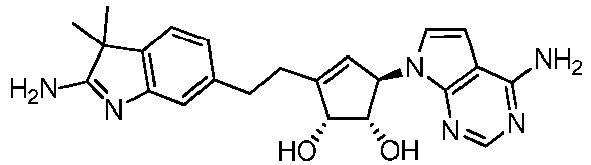
(1S,2R,5R)-3-(2-(2-amino-3,3-dimethyl-3H-indol-6-yl)ethyl)-5 -(4-amino-7H-pyrrolo [2,3 - d]pyrimidin-7-yl)cyclopent-3-ene-1,2-diol Compound-28 6'-(2-((3aS,4 R,6aR)-4-(4-amino-7H-pyrrolo[2,3-d]pyrimidin-7-yl)-2,2-dimethyl-3a,6a-dihydro-4H-cyclopenta[d] [1,3]dioxo 1-6-yl)ethyl)spiro[cyclobuta ne-1,3 '-indol] -2'-amine 1H NMR (400 MHz, DMSO-d6) δ 8.04 (s, 1H), 7.39 (d, J = 7.3 Hz, 1H), 7.07 (s, 2H), 6.92 (s, 2H), 6.77 (d, J = 1.4 Hz, 1H), 6.71 (dd, J = 7.5, 1.5 Hz, 1H), 6.62 (d, J = 3.5 Hz, 1H), 6.45 (d, J = 3.5 Hz, 1H), 5.49 (d, J = 4.3 Hz, 1H), 5.41 (d, J = 1.9 Hz, 1H), 4.93 (d, J = 5.9 Hz, 2H), 4.45 (d, J = 5.5 Hz, 1H), 3.93 (q, J = 5.3 Hz, 1H), 2.87 - 2.64 (m, 2H), 2.62 - 2.49 (m, 4H), 2.40 - 2.30 (m, 1H), 2.24 - 2.13 (m, 3H); LCMS m/z= 431.23 (M+, 50%) 
(1S,2R,5R)-5-(4-amino-7H-pyrrolo [2,3 -d]pyrimidin-7-yl)-3-(2-(2'-aminospiro[cyclobutane-1,3'-indol]-6'-yl)ethyl)cyclopent-3-ene-1,2-diol Compound-29 7-(2-((3aS,4R,6aR)-4-(4-amino-7H-pyrrolo[2,3-d]pyrimidin-7-yl)-2,2-dimethyl-3a,6a-dihydro-4H-cyclopenta[d] [1,3]dioxo 1-6-yl)ethyl)-3,5-dichloroquinolin-2-amine 1H NMR (400 MHz, DMSO-d6) δ 8.20 (s, 1H), 8.03 (s, 1H), 7.35 (d, J = 8.7 Hz, 2H), 7.14 - 6.88 (m, 4H), 6.62 (d, J = 3.5 Hz, 1H), 6.43 (d, J = 3.6 Hz, 1H), 5.49 (s, 1H), 5.43 (s, 1H), 4.98 (dd, J = 11.2, 6.4 Hz, 2H), 4.46 (t, J = 5.9 Hz, 1H), 3.96 (q, J = 5.5 Hz, 1H), 3.04 - 2.85 (m, 2H), 2.62 - 2.56 (m, 2H); LCMS m/z= 471.30 (M+, 50%) 
(1S,2F,5R)-3-(2-(2-amino-3,5-dichloroquinolin-7-yl)ethyl)-5-(4-amino-7H-pyrrolo[2,3-d]pyrimidin-7-yl)cyclopent-3-ene- 1,2-diol Compound-30 7-(2-((3aS,4R,6aR)-4-(2-amino-7H-pyrrolo[2,3-d]pyrimidin-7-yl)-2,2-dimethyl-3a,6a-dihydro-4H-cyclopenta[d] [1,3]dioxo 1-6-yl)ethyl)-3-chloroquinolin-2-amine 1H NMR (400 MHz, DMSO-d 6) δ 8.69 (s, 1H), 8.37 (s, 1H), 7.69 (d, J = 8.2 Hz, 1H), 7.42 (s, 1H), 7.26 (d, J = 8.3 Hz, 1H), 6.95 (d, J = 3.9 Hz, 1H), 6.46 (d, J = 3.8 Hz, 1H), 5.42 (dd, J = 10.5, 3.3 Hz, 2H), 5.30 - 4.81 (m, 2H), 4.47 (d, J = 5.5 Hz, 1H), 4.22 - 3.88 (m, 1H), 3.09 - 2.87 (m, 2H) 2.57 (d, J = 7.7 Hz, 2H); LCMS m/z= 437.21 (M+1, 70%) 
(1S,2R,5R)-3-(2-(2-amino-3-chloroquinolin-7-yl)ethyl)-5 - (2-amino-7H-pyrrolo[2,3-d]pyrimidin-7-yl)cyclopent-3-ene-1,2-diol Compound-31 3-chloro-5-fluoro-7-(2-((3aS,4R,6aR)-4-(4-isopropyl-7H-pyrrolo[2,3-d]pyrimidin-7-yl)-2,2-dimethyl-3a,6a-dihydro-4H-cyclopenta[d][1,3]dioxo 1-6-yl)ethyl)quinolin-2-amine 1H NMR (400 MHz, DMSO-d6) δ 8.68 (s, 1H), 8.18 (s, 1H), 7.22 (s, 1H), 7.05 (d, J = 3.7 Hz, 1H), 7.02 (dd, J = 11.0, 1.4 Hz, 1H), 6.96 (s, 2H), 6.57 (d, J = 3.6 Hz, 1H), 5.63 (d, J = 4.5 Hz, 1H), 5.46 (d, J = 1.8 Hz, 1H), 5.01 (d, J = 6.5 Hz, 2H), 4.47 (t, J = 6.1 Hz, 1H), 4.10 - 3.98 (m, 1H), 3.40 (dt, J = 13.9, 6.9 Hz, 1H), 3.04 - 2.89 (m, 2H), 2.57 (d, J = 8.3 Hz, 2H), 1.32 (d, J = 2.1 Hz, 3H), 1.30 (d, J = 2.1 Hz, 3H); LCMS m/z= 483.92 (M+, 30%) 
(1S,2R,5R)-3-(2-(2-amino-3-chloro-5-fluoroquinolin-7-yl)ethyl)-5-(4-isopropyl-7H-pyrrolo[2,3-d]pyrimidin-7-yl)cyclopent-3-ene-1,2-diol Compound-32 3-chloro-7-(2-((3aS,4R,6aR)-2,2-dimethyl-4-(4-(1-methyl-1H-pyrazol-4-yl)-7H-pyrrolo[2,3-d]pyrimidin-7-yl)-3a,6a-dihydro-4H-cyclopenta[d][l,3]dioxo 1-6-yl)ethyl)-5-fluoroquinolin-2-amine 1H NMR (400 MHz, DMSO-d6) δ 8.68 (s, 1H), 8.62 (s, 1H), 8.21 (d, J = 19.9 Hz, 2H), 7.26 - 7.17 (m, 2H), 7.03 (dd, J = 11.0, 1.4 Hz, 2H), 6.98 (s, 1H), 6.87 (d, J = 3.7 Hz, 1H), 5.66 (d, J = 4.6 Hz, 1H), 5.50 (t, J = 1.7 Hz, 1H), 5.04 (d, J = 6.1 Hz, 2H), 4.48 (s, 1H), 4.08 (d, J = 5.4 Hz, 1H), 3.97 (s, 3H), 3.06 - 2.88 (m, 2H), 2.60 - 2.55 (m, 2H); LCMS m/z= 520.32 (M+, 100%) 
(1S,2R,5R)-3-(2-(2-amino-3-chloro-5-fluoroquinolin-7-yl)ethyl)-5-(4-(1-methyl-1H-pyrazol-4-yl)-7H-pyrrolo [2,3-d]pyrimidin-7-yl)cyclopent-3-ene-1,2-diol Compound-33a and 33b 7-(2-((3aS,4R,6aR)-4-(4-amino-7H-pyrrolo[2,3-d]pyrimidin-7-yl)-2,2-dimethyl-3a,6a-dihydro-4H-cyclopenta[d][1,3]dioxo l-6-yl)propyl)-3-chloro-5-fluoroquinolin-2-amine Diastereomeric mixture was separated by chiral preparative HPLC. First Diastereomer(Compound-33a) : 1H NMR (400 MHz, DMSO-d6) δ 8.18 (s, 1H), 8.03 (s, 1H), 7.18 (s, 1H), 7.14 - 6.83 (m, 5H), 6.50 (d, J = 3.5 Hz, 1H), 6.42 (d, J = 3.5 Hz, 1H), 5.51 (d, J = 5.1 Hz, 1H), 5.36 (d, J = 1.8 Hz, 1H), 5.00 (d, J = 6.8 Hz, 1H), 4.89 (d, J = 6.2 Hz, 1H), 4.56 (t, J = 5.8 Hz, 1H), 3.91 (d, J = 5.5 Hz, 1H), 3.08 - 2.94 (m, 1H), 2.79 (d, J = 9.3 Hz, 2H), 1.09 (d, J = 6.7 Hz, 3H); LCMS m/z= 469.36 (M+, 30%) Second Diastereomer (Compound-33b) : 1H NMR (400 MHz, DMSO-d6) δ 8.18 (s, 1H), 8.05 (s, 1H), 7.19 (s, 1H), 7.08 - 6.86 (m, 5H), 6. 78 (d, J = 3.5 Hz, 1H), 6.50 (d, J = 3.5 Hz, 1H), 5.56 - 5.47 (m, 1H), 5.43 (t, J = 1.4 Hz, 1H), 4.97 (t, J = 5.5 Hz, 2H), 4.51- 4.42 (m, 1H), 3.98 (q, J= 6.1,5.3 Hz, 1H), 3.09-2.96 (m, 1H), 2.75 (s, 2H), 1.08 (d, J = 6.3 Hz, 3H); LCMS m/z= 469.36 (M+, 30%) 
(1S,2R,5R)-3-(1-(2-amino-3-chloro-5-fluoroquinolin-7-yl)propan-2-yl)-5 -(4-amino-7H-pyrrolo[2,3-d]pyrimidin-7-yl)cyclopent-3-ene-1,2-diol Compound-34a and 34b 7-(2-((3aS,4R,6aR)-4-(4-amino-7H-pyrrolo[2,3-d]pyrimidin-7-yl)-2,2-dimethyl-3a,6a-dihydro-4H-cyclopenta[d][1,3]dioxo 1-6-yl)propyl)-3-chloroquinolin-2-amine Diastereomeric mixture was separated by chiral preparative HPLC. 
First Diastereomer (Compound-34a) : 1H NMR (400 MHz, DMSO-d6) δ8.17 (s, 1H), 8.03 (s, 1H), 7.60 (d, J = 8.2 Hz, 1H), 7.33 (d, J= 1.5 Hz, 1H), 7.13 (dd, J = 8.2, 1.6 Hz, 1H), 6.94 (s, 2H), 6.67 (s, 2H), 6.47 (d, J = 3.5 Hz, 1H), 6.39 (d, J = 3.5 Hz, 1H), 5.56-5.46 (m, 1H), 5.35 (d, J = 1.8 Hz, 1H), 4.98 (d, J = 6.7 Hz, 1H), 4.88 (d, J = 6.3 Hz, 1H), 4.57 (t, J = 5.9 Hz, 1H), 3.90 (q, J = 5.7 Hz, 1H), 3.10-2.96 (m, 1H), 2.84 - 2.73 (m, 2H), 1.13 - 1.09 (m, 3H); LCMS m/z= 451.2 (M+, 100%) (1S,2R,5R)-3-(1-(2-amino-3-chloroquinolin-7-yl)propan-2-yl)-5-(4-amino-7H-pyrrolo[2,3-d]pyrimidin-7-yl)cyclopent-3-ene-1,2-diol Second Diastereomer(Compound-34b) : 1H NMR (400 MHz, DMSO-d6) δ 8.17 (s, 1H), 8.05 (s, 1H), 7.60 (d, J = 8.2 Hz, 1H), 7.34 (d, J = 1.6 Hz, 1H), 7.13 (dd, J = 8.2, 1.6 Hz, 1H), 6.94 (s, 2H), 6.77 (d, J = 3.6 Hz, 1H), 6.67 (s, 2H), 6.49 (d, J = 3.5 Hz, 1H), 5.59 - 5.49 (m, 1H), 5.47 - 5.38 (m, 1H), 4.95 (t, J = 7.2 Hz, 2H), 4.47 (t, J = 6.0 Hz, 1H), 3.98 (q, J = 5.5 Hz, 1H), 3.04 (dd, J = 12.0, 4.5 Hz, 1H), 2.82 - 2.64 (m, 2H), 1.07 (d, J = 6.3 Hz, 3H); LCMS m/z= 452.98 (M+1, 80%) Compound-35a and 35b 3-chloro-7-(2-((3aS,4R,6aR)-2,2-dimethyl-4-(4-methyl-7H-pyrrolo[2,3-d]pyrimidin-7-yl)-3a,6a-dihydro-4H-Cyclopenta[d][1,3]dioxo l-6-yl)propyl)-5-fluoroquinolin-2-amine Diastereomeric mixture was separated by chiral preparative HPLC. 
First Diastereomer (Compound-35a): 1H NMR (400 MHz, DMSO-d6) δ8.63 (s, 1H), 8.18 (s, 1H), 7.27 - 7.12 (m, 2H), 6.96 (s, 3H), 6.64 (d, J = 3.6 Hz, 1H), 5.64 (d, J = 4.9 Hz, 1H), 5.46 (d, J = 2.0 Hz, 1H), 5.01 (dd, J = 6.5, 3.4 Hz, 2H), 4.46 (t, J = 5.9 Hz, 1H), 4.03 (q, J = 5.7 Hz, 1H), 3.02 (q, J = 9.1 Hz, 1H), 2.86 - 2.68 (m, 2H), 2.64 (s, 3H), 1.09 (d, J = 7.0 Hz, 3H); LCMS m/z = 468.36 (M+, 80%) (1S,2R,5R)-3-(1-(2-Amino-3-chloro-5-fluoroquinolin-7-yl)propan-2-yl)-5 -(4-methyl-7H-pyrrolo[2,3-d]pyrimidin-7-yl)cyclopent-3-ene-1,2-diol Second Diastereomer (Compound-35b): 1H NMR (400 MHz, DMSO-d6) δ 8.60 (s, 1H), 8.19 (s, 1H), 7.19 (s, 1H), 7.04 - 6.89 (m, 4H), 6.52 (d, J = 3.6 Hz, 1H), 5.63 (d, J = 5.0 Hz, 1H), 5.39 (d, J = 1.8 Hz, 1H), 5.08 - 5.00 (m, 1H), 4.95 (d, J = 6.2 Hz, 1H), 4.58 (t, J = 5.9 Hz, 1H), 3.98 (dt, J = 6.8, 5.4 Hz, 1H), 3.03 (q, J = 10.1 Hz, 1H), 2.81 (s, 2H), 2.62 (s, 3H), 1.11 (d, J = 5.3 Hz, 3H); LCMS m/z = 468.36 (M+, 80%) Compound-36a and 36b 3-chloro-5-fluoro-7-(2-((3aS,4R,6aR)-2,2,6a-trimethyl-4-(4-methyl-7H-pyrrolo[2,3-d]pyrimidin-7-yl)-3a,6a-dihydro-4H-cyclopenta[d][1,3]dioxo1-6-yl)propyl)quinolin-2-amine Diastereomeric mixture was separated by chiral preparative HPLC. First Diastereomer(Compound 36a): 1H NMR (400 MHz, DMSO-d6) δ 8.63 (s, 1H), 8.19 (s, 1H), 7.22 - 7.12 (m, 2H), 7.03 - 6.90 (m, 3H), 6.66 (d, J = 3.7 Hz, 1H), 5.64 - 5.54 (m, 2H), 5.05 (d, J = 7.1 Hz, 1H), 4.49 (s, 1H), 3.66 (t, J = 6.5 Hz, 1H), 2.96 (dd, J = 13.2, 7.1 Hz, 1H), 2.85 - 2.68 (m, 2H), 2.65 (s, 3H), 1.24 (s, 3H), 1.13 (d, J = 6.5 Hz, 3H); LCMS m/z= 482.2 (M+, 40%) 
(1S,2R,5R)-3-(1-(2-amino-3-chloro-5-fluoroquinolin-7-yl)propan-2-yl)-2-methyl-5-(4-methyl-7H-pyrrolo[2,3-d]pyrimidin-7-yl)cyclopent-3-ene-1,2-diol Second Diastereomer (Compound 36b): 1H NMR (400 MHz, DMSO-d6) δ 8.64 (s, 1H), 8.17 (s, 1H), 7.43 (d, J = 3.6 Hz, 1H), 7.21 (s, 1H), 7.00 (dd, J = 11.1, 1.3 Hz, 1H), 6.95 (s, 2H), 6.69 (d, J = 3.6 Hz, 1H), 5.68 - 5.61 (m, 1H), 5.46 (d, J = 1.4 Hz, 1H), 5.18 (d, J = 7.3 Hz, 1H), 4.63 (s, 1H), 3.90 (t, J = 6.9 Hz, 1H), 3.23 - 3.16 (m, 1H), 2.73 (s, 2H), 2.65 (s, 3H), 1.42 (s, 3H), 0.99 (d, J = 6.6 Hz, 3H); LCMS m/z= 482.2 (M+, 40%). Compound-37 7-(2-((3aS,4R,6aR)-4-(4-amino-7H-pyrrolo[2,3-d]pyrimidin-7-yl)-2,2,6a-trimethyl-3a,6a-dihydro-4H-cyclopenta[d][l,3]dioxo 1-6-yl)ethyl)-3-chloro-5-fluoroquinolin-2-amine 1H NMR (400 MHz, DMSO-d6) δ 8.17 (s, 1H), 8.12 (s, 1H), 7.34 (s, 2H), 7.22 (s, 1H), 7.07 - 6.92 (m, 4H), 6.65 - 6.57 (m, 1H), 5.56-5.41 (m, 2H), 5.15 - 4.99 (m, 1H), 4.62 (s, 1H), 3.83 (d, J = 6.0 Hz, 1H), 2.99 - 2.86 (m, 2H), 2.46 - 2.31 (m, 2H), 1.27 (s, 3H); LCMS m/z= 469.30 (M+, 40%) 
(1S,2R,5R)-3-(2-(2-amino-3-chloro-5-fluoroquinolin-7-yl)ethyl)-5-( 4-amino-7H-pyrrolo [2,3 -d]pyrimidin-7-yl)-2-methylcyclopent-3-ene-1,2-diol Compound-38 7-(2-((3aS,4R,6aR)-4-(4-amino-7H-pyrrolo[2,3-d]pyrimidin-7-yl)-2,2,6a-trimethyl-3a,6a-dihydro-4H-cyclopenta[d][1,3]dioxo 1-6-yl)propyl)-3-chloro-5-fluoroquinolin-2-amine First Diastereomer: 1H NMR (400 MHz, DMSO-d6) δ 8.18 (s, 1H), 8.04 (s, 1H), 7.18 (s, 1H), 7.01 - 6.90 (m, 5H), 6.70 (d, J = 3.6 Hz, 1H), 6.47 (d, J = 3.5 Hz, 1H), 5.55 (d, J = 1.7 Hz, 1H), 5.47 (d, J = 5.9 Hz, 1H), 5.06 (d, J = 7.0 Hz, 1H), 4.44 (s, 1H), 3.63 (dd, J = 7.0, 5.8 Hz, 1H), 2.97 (dd, J = 12.9, 6.7 Hz, 1H), 2.82 - 2.68 (m, 2H), 1.24 (s, 3H), 1.11 (s, 3H); LCMS m/z= 482.67 (M+, 80%) 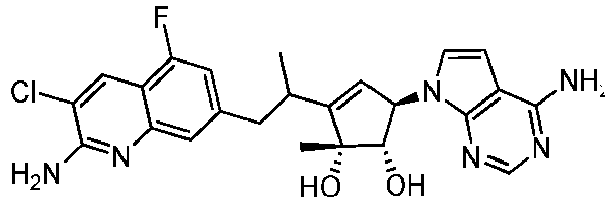
(1S,2R,5R)-3-(1-(2-amino-3-chloro-5-fluoroquinolin-7-yl)propan-2-yl)-5-(4-amino-7H-pyrrolo[2,3-d]pyrimidin-7-yl)-2-methylcyclopent-3-ene-1,2-diol Compound-39 3-chloro-5-fluoro-7-(2-((3aS,4R,6aR)-2,2,6a-trimethyl-4-(4-methyl-7H-pyrrolo[2,3-d]pyrimidin-7-yl)-3a,6a-dihydro-4H-cyclopenta[d][1,3]dioxo 1-6-yl)ethyl)quinolin-2-amine 1H NMR (400 MHz, DMSO-d6) δ 8.63 (s, 1H), 8.17 (s, 1H), 7.38 (d, J = 3.7 Hz, 1H), 7.22 (s, 1H), 7.02 (dd, J = 11.0, 1.5 Hz, 1H), 6.96 (s, 2H), 6.67 (d, J = 3.5 Hz, 1H), 5.64 - 5.57 (m, 1H), 5.50 - 5.45 (m, 1H), 5.07 (d, J = 7.3 Hz, 1H), 4.65 (s, 1H), 3.89 (dd, J = 7.4, 6.1 Hz, 1H), 2.94 (t, J = 7.8 Hz, 2H), 2.64 (s, 3H), 2.57 - 2.53 (m, 2H), 1.28 (s, 3H); LCMS m/z= 468.36 (M+, 60%) 
(1S,2R,5R)-3-(2-(2-amino-3-chloro-5-fluoroquinolin-7-yl)ethyl)-2-methyl-5-(4-methyl-7H-pyrrolo[2,3-d]pyrimidin-7-yl)cyclopent-3-ene-1,2-diol Compound-40 7-(2-((3aS,4R,6aR)-4-(4-amino-7H-pyrrolo[2,3-d]pyrimidin-7-yl)-6a-ethyl-2,2-dimethyl-3a,6a-dihydro-4H-cyclopenta[d][l,3]dioxo 1-6-yl)ethyl)-3-chloro-5-fluoroquinolin-2-amine 1H NMR (400 MHz, DMSO-d6) δ 8.16 (s, 1H), 8.05 (s, 1H), 7.22 (s, 1H), 7.07 - 6.89 (m, 6H), 6.56 (d, J = 3.6 Hz, 1H), 5.57 - 5.43 (m, 2H), 5.04 (d, J = 7.6 Hz, 1H), 4.56 (s, 1H), 3.95 (t, J = 6.4 Hz, 1H), 2.94 (t, J = 8.0 Hz, 2H), 2.48 - 2.42 (m, 2H), 1.69 (dq, J = 14.4, 7.2 Hz, 1H), 1.56 (dq, J = 14.4, 7.2 Hz, 1H), 0.85 (t, J = 7.2 Hz, 3H); LCMS m/z= 482.67 (M+, 80%) 
(1S,2R,5R)-3-(2-(2-amino-3-chloro-5-fluoroquinolin-7-yl)ethyl)-5-(4-amino-7H-pyrrolo[2,3-d]pyrimidin-7-yl)-2-ethylcyclopent-3-ene-1,2-diol Compound-41 3-chloro-7-(2-((3aS,4R,6aR)-4-(4-ethyl-7H-pyrrolo[2,3-d]pyrimidin-7-yl)-2,2-dimethyl-3a,6a-dihydro-4H-cyclopenta[d][1,3]dioxo 1-6-yl)ethyl)-5-fluoroquinolin-2-amine 1H NMR (400 MHz, DMSO-d6) δ 8.66 (s, 1H), 8.18 (s, 1H), 7.22 (s, 1H), 7.11 - 6.91 (m, 4H), 6.56 (d, J = 3.6 Hz, 1H), 5.63 (s, 1H), 5.46 (d, J = 1.9 Hz, 1H), 5.02 (dd, J = 6.5, 4.3 Hz, 2H), 4.47 (t, J = 6.0 Hz, 1H), 4.08 - 4.00 (m, 1H), 2.96 (q, J = 7.7 Hz, 4H), 2.57 (d, J = 7.2 Hz, 2H), 1.31 (d, J = 7.6 Hz, 3H); LCMS m/z= 468.08 (M+, 100%) 
(1S,2R,5R)-3-(2-(2-amino-3-chloro-5-fluoroquinolin-7-yl)ethyl)-5-(4-ethyl-7H-pyrrolo [2,3 -d]pyrimidin-7-yl)cyclopent-3-ene-1,2-diol Compound-42 3-Chloro-7-(2-((3aS,4R,6aR)-4-(4-cyclopropyl-7H-pyrrolo[2,3-d]pyrimi din-7-yl)-2,2-dimethyl-3a,6a-dihydro-4H-cyclopenta[d][1,3]dioxo 1-6-yl) ethyl)-5-fluoroquinolin-2-amine 1H NMR (400 MHz, DMSO-d6) δ 8.63 (s, 1H), 8.27 (s, 1H), 7.30 (d, J = 36.5 Hz, 3H), 7.18 (d, J= 3.7 Hz, 1H), 7.08 (d, J= 10.9 Hz, 1H), 6.76 (d, J = 3.7 Hz, 1H), 5.62 (d, J = 3.7 Hz, 1H), 5.47 (d, J = 1.9 Hz, 1H), 4.47 (d, J = 5.5 Hz, 1H), 4.06 (t, J = 5.2 Hz, 1H), 3.07 - 2.88 (m, 2H), 2.62 - 2.54 (m, 3H) 1.27 - 1.14 (m, 4H); LCMS m/z= 479.86 (M+, 100%) 
(1S,2R,5R)-3-(2-(2-amino-3-chloro-5-fluoroquinolin-7-yl)ethyl)-5-(4-cyclopropyl-7H-pyrrolo [2,3 -d]pyrimidin - 7-yl)cyclopent-3-ene-1,2-diol Compound-43 7-(2-((3aS,4R,6aR)-4-(4-amino-7H-pyrrolo[2,3-d]pyrimidin-7-yl)-2,2-dimethyl-3a,6a-dihydro-4H-cyclopenta[d][1,3]dioxo 1-6-yl)ethyl)-3-bromo-5-fluoroquinolin-2-amine 1H NMR (400 MHz, DMSO-d6) δ 8.34 (s, 1H), 8.04 (s, 1H), 7.21 (s, 1H), 7.06 - 6.94 (m, 3H), 6.86 (s, 2H), 6.65 (d, J = 3.5 Hz, 1H), 6.43 (d, J = 3.5 Hz, 1H), 5.49 (d, J = 4.4 Hz, 1H), 5.45 (t, J = 1.7 Hz, 1H), 4.96 (dd, J = 6.5, 2.1 Hz, 2H), 4.45 (t, J = 6.0 Hz, 1H), 3.97 (q, J = 5.5 Hz, 1H), 3.04 - 2.86 (m, J = 7.4 Hz, 2H), 2.55 (d, J = 6.4 Hz, 2H); LCMS m/z= 499.30,501.24 (M+, M+2, 100%) 
(1S,2R,5R)-3-(2-(2-Amino-3-bromo-5-fluoroquinolin-7-yl)ethyl)-5-(4-amino-7H-pyrrolo[2,3-d]pyrimidin-7-yl)cyclopent-3-ene-1,2-diol Compound-44 
1H NMR (400 MHz, DMSO-d6) δ 8.61 (s, 1H), 8.34 (s, 1H), 7.21 (s, 1H), 7.06 (d, J = 3.6 Hz, 1H), 7.02 - 6.98 (m, 1H), 6.87 (s, 2H), 6.54 (d, J = 3.6 Hz, 1H), 5.61 (t, J = 3.3 Hz, 1H), 5.46 (q, J = 1.6 Hz, 1H), 5.01 (dd, J = 6.5, 5.2 Hz, 2H), 4.47 (t, J = 6.0 Hz, 1H), 4.08 - 3.99 (m, 1H), 3.07 - 2.86 (m, 2H), 2.62 (s, 3H), 2.57 (t, J = 8.3 Hz, 2H); LCMS m/z= 498.24,500.24 (M+, M+2, 100%). 
(1S,2R,5R)-3-(2-(2-Amino-3-bromo-5-fluoroquinolin-7-yl)ethyl)-5-(4-methyl-7H-pyrrolo[2,3-d]pyrimidin-7-yl)cyclopent-3-ene-1,2-diol Compound-45a and 45b 7-(2-((3aS,4R,6aR)-4-(4-amino-7H-pyrrolo[2,3-d]pyrimidin-7-yl)-2,2-dimethyl-3a,6a-dihydro-4H-cyclopenta[d][l,3]dioxo 1-6-yl)propyl)-3-bromo-5-fluoroquinolin-2-amine First Diastereomer(Compound 45a): 1H NMR (400 MHz, DMSO-d6) δ 8.34 (s, 1H), 8.03 (s, 1H), 7.18 (s, 1H), 7.11 - 6.68 (m, 5H), 6.52 (d, J = 3.7 Hz, 1H), 6.41 (d, J = 3.4 Hz, 1H), 5.51 (d, J = 4.8 Hz, 1H), 5.37 (s, 1H), 5.00 (d, J = 7.1 Hz, 1H), 4.89 (d, J = 6.2 Hz, 1H), 4.56 (s, 1H), 3.91 (d, J = 6.2 Hz, 1H), 3.01 (d, J = 7.4 Hz, 1H), 2.88 - 2.71 (m, 2H), 1.10 (d, J = 7.1, Hz, 3H). LCMS m/z= 514.19 (M+1, 100%) 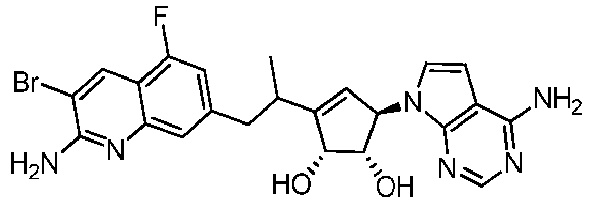
(1S,2R,5R)-3-(1-(2-Amino-3-bromo-5-fluoro quinolin-7-yl)propan-2-yl)-5 -(4-amino-7H-pyrrolo[2,3-d]pyrimidin-7-yl)cyclopent-3-ene-1,2-diol Second Diastereomer (Compound 45b): 1H NMR (400 MHz, DMSO-d6) δ 8.34 (s, 1H), 8.04 (s, 1H), 7.18 (s, 1H), 7.02 - 6.92 (m, 3H), 6.86 (s, 2H), 6.78 (d, J = 3.5 Hz, 1H), 6.50 (d, J = 3.5 Hz, 1H), 5.52 (d, J = 4.8 Hz, 1H), 5.43 (s, 1H), 4.97 (dd, J = 6.5, 3.6 Hz, 2H), 4.46 (t, J = 6.1 Hz, 1H), 3.98 (q, J = 5.6 Hz, 1H), 3.01 (d, J = 9.0 Hz, 1H), 2.84 - 2.65 (m, 2H), 1.07 (d, J = 5.9 Hz, 3H). LCMS m/z= 514.19 (M+1, 100%) -

- The mixture of (1S,2R,5R)-3-(2-(2-amino-3-chloro-6-fluoroquinolin-7-yl)ethyl)-5-(4-amino-7H-pyrrolo[2,3-d]pyrimidin-7-yl)cyclopent-3-ene-1,2-diol (311mg, 0.684mmol) and palladium hydroxide (168mg, 0.239mmol) in ethanol (40ml) was stirred at 25°C for 8h under hydrogen atmosphere (60 psi). The resulting mixture was filtered through celite and filtrate was concentrated in vacuo to give 0.32g of crude compound. Obtained residue was purified by combiflash (Rf200, Teledyne/Isco) instrument onto a redisep® Rf column with gradient elution (0 to 10%) of methanolic ammonia in dichloromethane to afford the title compound (7mg, 2.4% yield) as an off-white solid. 1H NMR (400 MHz, DMSO-d6) δ 8.03 (s, 1H), 7.85 (d, J = 8.8 Hz, 1H), 7.40 (t, J = 9.3 Hz, 2H), 6.91 (s, 2H), 6.75 (d, J = 8.8 Hz, 1H), 6.65 (d, J = 3.6 Hz, 1H), 6.43 (d, J = 3.6 Hz, 1H), 6.36 (s, 2H), 5.51 (s, 1H), 5.45 (s, 1H), 4.97 (d, J = 6.3 Hz, 2H), 4.46 (s, 1H), 3.97 (d, J = 5.7 Hz, 1H), 3.05 - 2.88 (m, 2H), 2.48 - 2.26 (m, 2H). LCMS m/z= 420.98 (M+, 50%).
-

- The mixture of (1S,2R,5R)-3-(2-(2-amino-3-chloro-5-fluoroqumolin-7-yl)ethyl)-5-(4-amino-7H-pyrrolo[2,3-d]pyrimidin-7-yl)cyclopent-3-ene-l,2-diol (30 mg, 0.066 mmol), Pd-C (1.755 mg, 1.649 µmol) and ammonium formate (16.63mg, 0.264mmol) in MeOH (2 ml) was stirred at 78°C for 8h. The resulting mixture was filtered through celite and filtrate was concentrated in vacuo to give 0.32g of crude compound. Obtained residue was purified by combiflash (Rf200, Teledyne/Isco) instrument onto a redisep® Rf column with gradient elution (0 to 10%) of methanolic ammonia in dichloromethane to afford the title compound (9mg, 32.5%) as an off-white solid. 1H NMR (400MHz, DMSO-d6) □ 8.03 (s, 1H), 7.97 (d, J = 9.0 Hz, 1H), 7.15 (s, 1H), 6.94 - 6.87 (m, 3H), 6.77 (d, J = 9.0 Hz, 1H), 6.64 - 6.59 (m, 3H), 6.41 (d, J = 3.5 Hz, 1H), 5.49 (d, J = 3.9 Hz, 1H), 5.44 (t, J = 1. 7 Hz, 1H), 4.97 (d, J = 5.5 Hz, 2H), 4.46 (s, 1H), 3.96 (q, J = 5.3 Hz, 1H), 3.00 - 2.86 (m, 2H), 2.54 (d, J = 10.1 Hz, 2H); LCMS m/z= 420.98 (M+, 90%).
-

- TFA (44.3 ml, 575 mmol) was added to 7-(2-((3aR,3bR,4aS,5R,5aS)-5-(4-amino-7H-pyrrolo[2,3-d]pyrimidin-7-yl)-2,2-dimethyl tetrahydrocyclopropa[3,4]cyclopenta[1,2-d][1,3]dioxol-3b(3aH)-yl)ethyl)-3-chloro-5-fluoro quinolin-2-amine (4.5g, 8.84 mmol) at 0°C. The resulting mixture was stirred at 25°C for 16h under N2 atmosphere. The solvent was removed in vacuo at 30°C. The obtained residue was dissolved with ethyl aceate (100ml) and basified with aq.sat. NaHCO3. Layers were separated, organic layer was washed with brine (50ml) and dried over anhydrous Na2SO4. The organic layer was filtered and concentrated in vacuo to give 5.1g of crude compound. This residue was purified by combiflash (Rf200, Teledyne/Isco) instrument onto a redisep® Rf column with gradient elution (0 to 10%) of methanol in dichloromethane to afford the title compound (2.8g, 67.5%) as a light Brown solid. 1H NMR (400 MHz, DMSO-d6) δ 8.16 (s, 1H), 8.07 (s, 1H), 7.21 (s, 1H), 7.04 (d, J = 3.6 Hz, 1H), 7.03 - 6.99 (m, 1H), 6.99 - 6.90 (m, 4H), 6.58 (d, J = 3.5 Hz, 1H), 5.12 (d, J = 3.8 Hz, 1H), 4.90 (s, 1H), 4.52 (d, J = 4.1 Hz, 2H), 3.72 (s, 1H), 2.96 - 2.80 (m, 2H), 2.14 (ddd, J = 16.1, 11.3, 5.3 Hz, 1H), 1.84 (ddd, J = 13.7, 11.2, 5.6 Hz, 1H), 1.24 (d, J = 5.3 Hz, 2H), 0.57 (q, J = 5.9 Hz, 1H); LCMS m/z= 469.23 (M+1, 50%).
- Examples in table-15 were synthesized by following an analogous reaction protocol as was used for the preparation of (1R,2R,3S,4R,5S)-4-(4-amino-7H-pyrrolo[2,3-d]pyrimidin-7-yl)-1-(2-(2-aminoquinolin-7-yl)ethyl)bicyclo[3.1.0]hexane-2,3-diol using the appropriate starting materials.
Table-: 15 Structure & IUPAC name Intermediate used 1H NMR & LCMS data Compound-49 7-(2-((3aR,3bR,4aS,5R,5aS)-5-(4-Amino-7H-pyrrolo[2,3-d]pyrimidin-7-yl)-2,2-dimethylhexahydrocyclop ropa [3,4]cyclopenta[1,2-d][1,3]dioxol-3b-yl)ethyl)-N-methylquinolin-2-amine 1H NMR (400 MHz, DMSO-d6) δ 8.09 (s, 1H), 7.91 (d, J = 9.0 Hz, 1H), 7.60 (d, J = 8.1 Hz, 1H), 7.52(s, 1H), 7.16 (d, J = 8.2 Hz, 1H), 7.12 - 7.03 (m, 2H), 6.77 (d, J = 9.0 Hz, 1H), 6.61 (d, J = 3.5 Hz, 1H), 5.12 (d, J = 4.5 Hz, 1H), 4.91 (s, 1H), 4.53 (d, J = 7.0 Hz, 2H), 3.74 (t, J = 5.0 Hz, 1H), 2.95 (d, J = 4.8 Hz, 3H), 2.87 - 2.84 (m, 2H), 2.21 - 2.05 (m, 1H), 1.88 (ddd, J = 13.7, 11.5, 5.5 Hz, 1H), 1.32 - 1.19 (m, 2H), 0.61 - 0.58 (m, 1H); ; LCMS m/z =431.06 (M+1; 60 %). 
(1R,2R,3S,4R,5S)-4-(4-Amino-7H-pyrrolo [2,3 -d]pyrimidin-7-yl)- 1 -(2-(2-(methylamino)quinolin-7-yl)ethyl)bicyclo [3.1.0] hexane-2,3-diol Compound-50 7-(2-((3aR,3bR,4aS,5R,5aS)-5-(4-Amino-7H-pyrrolo[2,3-d]pyrimidin-7-yl)-2,2-dimethyltetrahydrocyclopr opa [3,4]cyclopenta[1,2-d][1,3]dioxol-3b(3aH)-yl)ethyl)-N-isopropylquinolin-2-amine. 1H NMR (400 MHz, DMSO-d6) δ 8.13 (s, 1H), 7.99 (s, 1H), 7.70 - 7.53 (m, 2H), 7.27 (d, J = 38.6 Hz, 3H), 7.10 (d, J = 3.6 Hz, 1H), 6.83 (d, J = 9.0 Hz, 1H), 6.66 (d, J = 3.5 Hz, 1H), 5.14 (d, J = 4.4 Hz, 1H), 4.91 (d, J = 1.3 Hz, 1H), 4.54 (d, J = 3.2 Hz, 2H), 4.31 - 4.18 (m, 1H) 3.75 (s, 1H), 3.03 - 2.80 (m, 2H), 2.14 (ddd, J = 17.0, 11.9, 6.1 Hz, 1H), 1.94 - 1.79 (m, 1H), 1.27 - 1.23 (m, 8H), 0.64 - 0.54 (m, 1H); LCMS m/z = 459.3 (M+1; 100%). 
(1R,2R,3S,4R,5S)-4-(4-Amino-7H-pyrrolo[2,3-d]pyrimidin-7-yl)-1-(2-(2-(isopropylamino)quinolin-7-yl)ethyl)bicyclo [3.1.0]hexane-2,3-diol. Compound-51 7-(2-((3aR,3bR,4aS,5R,5aS)-5-(4-Amino-7H-pyrrolo[2,3-d]pyrimidin-7-yl)-2,2-dimethyltetrahydrocyclopr opa [3,4]cyclopenta[1,2-d][1,3]dioxol-3b(3aH)-yl)ethyl)-N-cyclobutyl quinolin-2-amine. 1H NMR (400 MHz, DMSO-d6) δ 8.13 (s, 1H), 7.96 (d, J = 9.2 Hz, 1H), 7.62 (d, J= 8.1 Hz, 1H), 7.52 (s, 1H), 7.29 (s, 1H), 7.19 (d, J = 8.4 Hz, 1H), 7.10 (d, J = 3.6 Hz, 1H), 6.77 (d, J = 9.1 Hz, 1H), 6.65 (d, J=3.5 Hz, 1H), 5.13 (d, J = 4.5 Hz, 1H), 4.91 (d, J = 1.3 Hz, 1H), 4.57 - 4.45 (m, 3H), 3.75 (s, 1H), 3.17 (s, 1H), 2.95 - 2.85 (m, 2H), 2.45 - 2.33 (m, 2H), 2.13 (ddd, J= 13.4, 11.3, 5.2 Hz, 1H), 2.06 - 1.81 (m, 2H), 1.74 (ddd, J = 15.3, 10.1, 7.1 Hz, 2H), 1.33 - 1.21 (m, 2H), 0.64 - 0.55 (m, 1H); LCMS m/z = 471.3 (M+1; 100%). 
(1R,2R,3S,4R,5S)-4-(4-Amino-7H-pyrrolo [2,3 -d]pyrimidin-7-yl)- 1 -(2-(2-(cyclobutylamino)quinolin-7-yl)ethyl)bicyclo [3.1.0]hexane-2,3-diol. Compound-52 7-(2-((3aR,3bR,4aS,5R,5aS)-5-(4-Amino-7H-pyrrolo[2,3-d]pyrimidin-7-yl)-2,2-dimethyltetrahydrocyclopropa [3,4]cyclopenta[1,2-d] [1,3]dioxol-3b(3aH)-yl)ethyl)-N-(cyclopropyl methyl)quinolin-2-amine. 1H NMR (400 MHz, DMSO-d6) δ 8.10 (s, 1H), 7.89 (d, J = 9.0 Hz, 1H), 7.58 (d, J = 8.1 Hz, 1H), 7.46 (s, 1H), 7.18 - 7.04 (m, 4H), 6.81 (d, J = 9.0 Hz, 1H), 6.61 (d, J = 3.5 Hz, 1H), 5.12 (d, J = 4.4 Hz, 1H), 4.91 (d, J = 1.2 Hz, 1H), 4.53 (d, J = 5.6 Hz, 2H), 3.74 (t, J = 4.8 Hz, 1H), 3.31 - 3.28 (m, 1H), 2.94 - 2.83 (m, 2H), 2.12 (ddd, J = 13.7, 11.5, 5.2 Hz, 1H), 1.88 (ddd, J = 13.7, 11.5, 5.4 Hz, 1H), 1.28 - 1.23 (m, 3H), 1.19 - 1.08 (m, 1H), 0.59 (q, J = 5.9 Hz, 1H), 0.53 - 0.45 (m, 2H), 0.33 - 0.22 (m,2H); LCMS m/z = 471.05(M+1; 90%). 
(1R,2R,3S,4R,5S)-4-(4-Amino-7H-pyrrolo[2,3-d]pyrimidin-7-yl)-1-(2-(2-((cyclopropylmethyl)amino) quinolin-7-yl) ethyl)bicyclo[3.1.0]hexane-2,3-diol Compound-53 7-(2-((3aR,3bR,4aS,5R,5aS)-5-(4-Amino-7H-pyrrolo[2,3-d]pyrimidin-7-yl)-2,2-dimethyltetrahydrocyclopr opa [3,4]cyclopenta[1,2-d][1,3]dioxol-3b(3aH)-yl)ethyl)-8-fluoroquinolin-2-amine. 1H NMR (400 MHz, DMSO-d6) δ 8.10 (s, 1H), 7.90 (dd, J = 9.0, 1.6 Hz, 1H), 7.38 (d, J = 8.2 Hz, 1H), 7.30 - 7.00 (m, 4H), 6.77 (d, J = 9.1 Hz, 3H), 6.62 (d, J = 3.6 Hz, 1H), 5.15 (d, J = 4.5 Hz, 1H),4.91 (s, 1H), 4.53 (d, J = 3.0 Hz, 2H), 3.75 (s, 1H), 2.97 (td, J = 12.6, 5.1 Hz, 1H), 2.84 (td, J = 12.6, 5.3 Hz, 1H), 2.19 - 2.01 (m, 1H), 1.82 (td, J = 12.7, 5.2 Hz, 1H), 1.28 (d, J = 3.5 Hz, 2H), 0.63 - 0.54 (m, 1H); LCMS m/z = 435.04 (M+1; 40 %). 
(1R,2R,3S,4R,5S)-4-(4-Amino-7H-pyrrolo[2,3-d]pyrimidin-7-yl)-1-(2-(2-amino-8-fluoroquinolin-7-yl)ethyl)bicyclo [3.1.0]hexane-2,3-diol. Compound-54 7-(2-((3aR,3bR,4aS,5R,5aS)-5-(4-Amino-7H-pyrrolo[2,3-d]pyrimidin-7-yl)-2,2-dimethyltetrahydrocyclopr opa [3,4]cyclopenta[1,2-d][1,3]dioxol-3b(3aH)-yl)ethyl)-3-methylquinolin-2-amine. 1H NMR (400 MHz, DMSO-d6) δ 8.07 (s, 1H), 7.71 (s, 1H), 7.51 (d, J = 8.2 Hz, 1H), 7.33 (d, J = 1.6 Hz, 1H), 7.08 (dd, J = 8.2, 1.7 Hz, 1H), 7.03 (d, J = 3.6 Hz, 1H), 6.98 (s, 2H), 6.58 (d, J = 3.5 Hz, 1H),6.36 (s, 2H), 5.12 (d, J = 4.5 Hz, 1H), 4.90 (d, J = 1.2 Hz, 1H), 4.59 - 4.46 (m, 2H), 3.72 (t, J = 5.2 Hz, 1H), 2.92 - 2.83 (m, 2H), 2.20 (d, J = 1.1 Hz, 3H), 2.10 (ddd, J = 12.7, 11.0, 5.2 Hz, 1H), 1.88 (ddd, J = 13.8, 11.5, 5.5 Hz, 1H), 1.23 (d, J = 3.5 Hz, 2H), 0.58 (q, J = 5.5 Hz, 1H); LCMS m/z = 431.08 (M+1; 100%). 
(1R,2R,3S,4R,5S)-1-(2-(2-Amino-3-methylquinolin-7-yl)ethyl)-4-(4-amino-7H-pyrrolo[2,3-d]pyrimidin-7-yl)bicyclo[3.1.0]hexane-2,3-diol. Compound-55 7-(2-((3aR,3bR,4aS,5R,5aS)-5-(4-amino-7H-pyrrolo[2,3-d]pyrimidin-7-yl)-2,2-dimethyltetrahydrocyclopr opa[3,4]cyclopenta[1,2-d][1,3]dioxol-3b(3aH)-yl)ethyl)-3-isopropylquinolin-2-amine 1H NMR (400 MHz, DMSO-d6) δ 8.09 (d, J = 6.3 Hz, 2H), 7.74 (d, J = 8.2 Hz, 3H), 7.45 (s, 1H), 7.30(dd, J = 8.1, 1.5 Hz, 1H), 7.07 (dd, J = 9.1, 3.6 Hz, 3H), 6.61 (d, J = 3.5 Hz, 1H), 5.16 (d, J = 4.5 Hz,1H), 4.90 (d, J = 1.2 Hz, 1H), 4.53 (d, J = 7.5 Hz, 2H), 3.74 (t, J = 5.1 Hz, 1H), 3.10 (p, J = 6.7 Hz, 1H), 3.01- 2.83 (m, 2H), 2.14 (ddd, J = 15.8, 12.1, 6.4 Hz, 1H), 1.85 (ddd, J = 13.6, 11.1, 5.9 Hz, 1H), 1.26 (d, J = 6.6 Hz, 8H), 0.56 (q, J = 6.0 Hz, 1H); LCMS m/z =459.3 (M+; 40%). 
(1R,2R,3S,4R,5S)-1-(2-(2-Amino-3-isopropyl quinolin-7-yl)ethyl)-4-(4-amino-7H-pyrrolo[2,3-d]pyrimidin-7-yl)bicyclo[3.1.0]hexane-2,3-diol. Compound-56 7-(2-((3aR,3bR,4aS,5R,5aS)-5-(4-Amino-7H-pyrrolo[2,3-d]pyrimidin-7-yl)-2,2-dimethyltetrahydrocyclo propa [3,4]cyclopenta[1,2-d][1,3]dioxol-3b(3aH)-yl)ethyl)-3-(1,1-difluoro ethyl)quinolin-2-amine. 1H NMR (400 MHz, DMSO-d6) δ 8.15 (s, 1H), 8.09 (s, 1H), 7.70 (d, J = 8.1 Hz, 1H), 7.38 (s, 1H), 7.21 - 7.15 (m, 1H), 7.10 - 7.00 (m, 3H), 6.61 (d, J = 3.6 Hz, 1H), 6.25 (s, 2H), 5.11 (d, J = 4.5 Hz, 1H), 4.91 (s, 1H), 4.53 (d, J = 7.5 Hz, 2H), 3.74 (t, J = 5.2 Hz, 1H), 2.83 - 2.91 (m, 2H), 2.18 - 1.98 (m, 4H), 1.88 (td, J = 12.4, 5.5 Hz, 1H), 1.28 - 1.25 (m, 2H), 0.58 (q, J = 5.9 Hz, 1H); LCMS m/z = 481.2 (M+1; 90%). 
(1R,2R,3S,4R,5S)-1-(2-(2-Amino-3-(1,1-difluoroethyl) quinolin-7-yl)ethyl)-4-(4-amino-7H-pyrrolo [2,3-d] pyrimidin-7-yl)bicyclo[3.1.0]hexane-2,3-diol. Compound-57 7-(2-((3aR,3bR,4aS,5R,5aS)-5-(4-Amino-7H-pyrrolo[2,3-d]pyrimidin-7-yl)-2,2-dimethyltetrahydrocyclo propa[3,4]cyclopenta[1,2-d][1,3]dioxol-3b(3aH)-yl)ethyl)-3-cyclopropyl quinolin-2-amine. 1H NMR (400 MHz, DMSO-d6) δ 8.09 (s, 1H), 7.91 (s, 1H), 7.80 (s, 2H), 7.67 (d, J = 8.2 Hz, 1H), 7.44 (s, 1H), 7.27 (dd, J = 8.2, 1.5 Hz, 1H), 7.11 (s, 2H), 7.06 (d, J = 3.5 Hz, 1H), 6.61 (d, J = 3.5 Hz, 1H), 5.17 (d, J = 4.5 Hz, 1H), 4.90 (d, J = 1.2 Hz, 1H), 4.53 (d, J = 4.3 Hz, 2H), 3.73 (s, 1H), 2.95 - 2.87 (m, 2H), 2.12 (ddd, J = 13.8, 11.0, 5.4 Hz, 1H), 1.90 - 1.74 (m, 2H), 1.23 (d, J = 3.4 Hz, 2H), 1.08 - 0.96 (m, 2H), 0.78 - 0.68 (m, 2H), 0.55 (q, J = 5.8 Hz, 1H); LCMS m/z = 457.13 (M+; 50%). 
(1R,R,2R,3S,4R,5S)-1-(2-(2-Amino-3-cyclopropylquinolin-7-yl)ethyl)-4-(4-amino-7H-pyrrolo[2,3-d]pyrimidin-7-yl) bicyclo[3.1.0]hexane-2,3-diol. Compound-58 7-(2-((3aR,3bR,4aS,5R,5aS)-5-(4-Amino-7H-pyrrolo[2,3-d]pyrimidin-7-yl)-2,2-dimethyltetrahydrocyclo propa[3,4]cyclopenta[1,2-d][1,3]dioxol-3b(3aH)-yl)ethyl)-3-methoxyquinolin-2-amine. 1H NMR (400 MHz, DMSO-d6) δ 8.08 (s, 1H), 7.54 (d, J = 8.1 Hz, 1H), 7.40 - 7.31 (m, 2H), 7.15 - 7.05 (m, 3H), 7.04 (d, J = 3.5 Hz, 1H), 6.67 (d, J = 18.5 Hz, 2H), 6.60 (d, J =3.5 Hz, 1H), 5.12 (d, J = 4.5 Hz, 1H), 4.90 (d, J = 1.3 Hz, 1H), 4.52 (d, J = 5.8 Hz, 2H), 3.91 (s, 3H), 3.79 - 3.66 (m, 1H), 2.90 - 2.80 (m, 2H), 2.09 (ddd, J = 13.7, 11.2, 5.4 Hz, 1H), 1.88 (ddd, J = 13.8, 11.5, 5.7 Hz, 1H), 1.24 (d, J = 5.2 Hz, 2H), 0.58 (q, J = 5.8 Hz, 1H). ); LCMS m/z = 447.01 (M+1; 90%). 
(1R,2R,3S,4R,5S)-1-(2-(2-Amino-3-methoxyquinolin-7-yl)ethyl)-4-(4-amino-7H-pyrrolo[2,3-d]pyrimidin-7-yl)bicyclo[3.1.0]hexane-2,3-diol. Compound-59 2-amino-7-(2-((3aR,3bR,4aS,5R,5aS)-5-(4-Amino-7H-pyrrolo[2,3-d]pyrimidin-7-yl)-2,2-dimethyltetra hydrocyclopropa[3,4]cycl openta[1,2-d][1,3]dioxol-3b(3aH)-yl)ethyl) quinoline-3-carbonitrile. 1H NMR (400 MHz, DMSO-d6) δ 8.62 (s, 1H), 8.06 (d, J = 2.3 Hz, 1H), 7.66 (d, J = 8.3 Hz, 1H), 7.37(s, 1H), 7.22 (dd, J = 8.3, 1.6 Hz, 1H), 7.03 (d, J = 3.6 Hz, 1H), 6.97 (s, 2H), 6.89 (s, 2H), 6.58 (d, J =3.5 Hz, 1H), 5.11 (d, J = 4.5 Hz, 1H), 4.90 (s, 1H), 4.57 - 4.48 (m, 2H), 3.73 (t, J = 5.3 Hz, 1H), 3.0 - 2.81 (m, 2H), 2.21 - 2.04 (m, 1H) 1.93 - 1.81 (m, 1H), 1.26 - 1.23 (m, 2H), 0.57 (q, J = 5.9 Hz, 1H); LCMS m/z = 442.23 (M+1; 80%). 
2-amino-7-(2-((1R,2R,3S,4R,5 S)-4-(4-Amino-7H-pyrrolo[2,3-d]pyrimidin-7-yl)-2,3-dihydroxybicyclo [3.1.0]hexan-1-yl)ethyl)quinoline-3-carbonitrile. Compound-60 7-(2-((3aR,3bR,4aS,5R,5aS)-5-(4-Amino-7H-pyrrolo[2,3-d]pyrimidin-7-yl)-2,2-dimethyltetrahydrocyclo propa[3,4]cyclopenta[1,2-d][1,3]dioxol-3b(3aH)-yl)ethyl)-3-fluoroquinolin-2-amine. 1H NMR (400 MHz, DMSO-d6) δ 8.15 (s, 1H), 7.78 (d, J = 11.8 Hz, 1H), 7.58 (d, J = 8.2 Hz, 1H), 7.49 (s, 2H), 7.37 (d, J = 1.6 Hz, 1H), 7.15 (dd, J = 8.2, 1.6 Hz, 1H), 7.11 (d, J = 3.6 Hz, 1H), 6.77 (s, 2H), 6.67 (d, J = 3.6 Hz, 1H), 5.14 (d, J = 4.3 Hz, 1H), 4.90 (d, J = 1.3 Hz, 1H), 4.54 (d, J = 8.9 Hz, 2H), 3.74 (d, J = 5.5 Hz, 1H), 2.92 - 2.82 (m, 2H), 2.10 (ddd, J = 13.8, 11.2, 5.4 Hz, 1H), 1.87 (ddd, J = 13.8, 11.6, 5.6 Hz, 1H), 1.27 - 1.23 (m, 2H), 0.63 - 0.55 (m, 1H). ); LCMS m/z = 435.3 (M+; 80%). 
(1R,R,2R,3S,4R,5S)-1-(2-(2-Amino-3-fluoroquinolin-7-yl)ethyl)-4-(4-amino-7H-pyrrolo [2,3 -d]pyrimidin-7-yl)bicyclo[3.1.0]hexane-2,3-diol. Compound-61 7-(2-((3aR,3bR,4aS,5R,5aS)-5-(4-Amino-7H-pyrrolo[2,3-d]pyrimidin-7-yl)-2,2-dimethyltetrahydrocyclo propa[3,4]cyclopenta[1,2-d] [1,3]dioxol-3b(3aH)-yl)ethyl)-3-chloroquinolin-2-amine. 1H NMR (400 MHz, DMSO-d6) δ 8.15 (s, 1H), 8.07 (s, 1H), 7.58 (d, J = 8.2 Hz, 1H), 7.36 (s, 1H), 7.15(dd, J = 8.2, 1.6 Hz, 1H), 7.08 - 6.89 (m, 3H), 6.66 (s, 2H), 6.58 (d, J = 3.5 Hz, 1H), 5.11 (d, J = 4.5 Hz, 1H), 4.90 (s, 1H), 4.55 - 4.50 (m, 2H), 3.73 (t, J = 5.3 Hz, 1H), 2.96 - 2.80 (m, 2H), 2.11 (ddd, J = 13.7, 11.3, 5.3 Hz, 1H), 1.87 (ddd, J = 13.9, 11.6, 5.6 Hz, 1H), 1.26 - 1.23 (m, 2H), 0.58 (q, J = 5.9 Hz, 1H); LCMS m/z = 451.3 (M+1; 80%). 
(1R,2R,3S,4R,5S)-1-(2-(2-Amino-3-chloroquinolin-7-yl)ethyl)-4-(4-amino-7H-pyrrolo [2,3 -d]pyrimidin-7-yl)bicyclo[3.1.0]hexane-2,3-diol. Compound-62 7-(2-((3aR,3bR,4aS,5R,5aS)-5-(4-Amino-7H-pyrrolo[2,3-d]pyrimidin-7-yl)-2,2-dimethyltetrahydrocyclo propa[3,4]cyclopenta[1,2-d][1,3]dioxol-3b(3aH)-yl)ethyl)-3-chloro-6-fluoroquinolin-2-amine. 1H NMR (400 MHz, DMSO-d6) δ 8.15 (d, J = 6.2 Hz, 2H), 7.56 - 7.35 (m, 4H), 7.13 (d, J = 3.6 Hz,1H), 6.68 (d, J = 3.1 Hz, 3H), 5.16 (s, 1H), 4.91 (s, 1H), 4.53 (d, J = 7.2 Hz, 2H), 3.75 (s, 1H), 2.98 (t, J= 12.0 Hz, 1H), 2.91 - 2.78 (m, 1H), 2.13 (q, J = 8.2, 4.7 Hz, 1H), 1.89 - 1.76 (m, 1H), 1.25 (d,J = 11.4 Hz, 2H), 0.59 (q, J = 6.0 Hz, 1H); LCMS m/z = 451.3 (M+1; 80%). 
(1R,2R,3S,4R,5S)-1-(2-(2-Amino-3-chloro-6-fluoroquinolin-7-yl)ethyl)-4-(4-amino-7H-pyrrolo[2,3-d]pyrimidin-7-yl) bicyclo[3.1.0]hexane-2,3-diol. Compound-63 7-(2-((3aR,3bR,4aS,5R,5aS)-5-(4-Amino-7H-pyrrolo[2,3-d]pyrimidin-7-yl)-2,2-dimethyltetrahydrocyclo propa[3,4]cyclopenta[1,2-d][1,3]dioxol-3b(3aH)-yl)ethyl)-3-chloro-8-fluoroquinolin-2-amine. 1H NMR (400 MHz, DMSO-d6) δ 8.23 (s, 1H), 8.07 (s, 1H), 7.42 (d, J = 8.3 Hz, 1H), 7.17 (t, J = 7.4 Hz, 1H), 7.04 (d, J = 3.6 Hz, 1H), 7.01 - 6.92 (m, 4H), 6.58 (d, J = 3.5 Hz, 1H), 5.16 (d, J = 4.6 Hz, 1H), 4.90 (s, 1H), 4.59 - 4.44 (m, 2H), 3.73 (t, J = 5.4 Hz, 1H), 3.09 - 2.92 (m, 1H), 2.92 - 2.77 (m, 1H) 2.13 (t, J = 7.2 Hz, 1H), 1.87-1.74 (m, 1H), 1.27 (t, J = 6.5 Hz, 2H), 0.58 (d, J = 5.6 Hz, 1H); LCMS m/z = 468.68 (M+; 80%). 
(1R,2R,3S,4R,5S)-1-(2-(2-Amino-3-chloro-8-fluoroquinolin-7-yl)ethyl)-4-(4-amino-7H-pyrrolo[2,3-d]pyrimidin-7-yl)bicyclo[3.1.0]hexane-2,3-diol. Compound-64 7-(2-((3aR,3bR,4aS,5R,5aS)-5-(4-Amino-7H-pyrrolo[2,3-d]pyrimidin-7-yl)-2,2-dimethyltetrahydrocyclo propa[3,4]cyclopenta[1,2-d][1,3]dioxol-3b(3aH)-yl)ethyl)-3-bromo-6-fluoroquinolin-2-amine. 1H NMR (400 MHz, DMSO-d6) δ 8.35 (s, 1H), 8.24 (s, 1H), 7.96 (d, J = 30.9 Hz, 2H), 7.45 (t, J = 8.4Hz, 1H), 7.24 (d, J = 3.6 Hz, 1H), 6.80 (d, J = 3.5 Hz, 1H), 6.60 (s, 1H), 5.17 (s, 1H), 4.91 (d, J = 4.0 Hz, 1H), 4.53 (s, 1H), 4.40 (d, J = 6.8 Hz, 1H), 3.78 (d, J = 6.4 Hz, 1H), 3.04 - 2.80(m, 2H), 2.15 (s, 1H), 1.82 (s, 1H), 1.30 - 1.27 (m, 2H), 0.60 - 0.55 (m, 1H); LCMS m/z = 514.19 (M+1; 80%). 
(1R,2R,3S,4R,5S)-1-(2-(2-amino-3-bromo-6-fluoroquinolin-7-yl)ethyl)-4-(4-amino-7H-pyrrolo[2,3-d]pyrimidin-7-yl)bicyclo[3.1.0]hexane-2,3-diol. Compound-65 7-((3aR,3bR,4aS,5R,5aS)-2,2-Dimethyl-3b-(2-(3-methylimidazo[1,2-a]pyridin-7-yl)ethyl)hexahydrocyclo propa[3,4]cyclopenta[1,2-d][1,3]dioxol-5-yl)-7H-pyrrolo[2,3-d]pyrimidin-4-amine. 1H NMR (400 MHz, DMSO-d6) δ 8.16 (d, J = 6.9 Hz, 1H), 8.07 (s, 1H), 7.36 (s, 1H), 7.28 (s, 1H), 7.08 - 6.85 (m, 4H), 6.58 (d, J = 3.4 Hz, 1H), 5.12 (d, J = 4.5 Hz, 1H), 4.90 (s, 1H), 4.52 (s, 2H), 3.72 (s, 1H), 3.29 (s, 1H), 2.95-2.75 (m, 2H), 2.61 - 2.53 (m, 1H), 2.44 (s, 3H), 2.21- 2.03 (m, 1H), 1.97 - 1.74 (m, 1H), 0.61 - 0.47 (m, 1H); LCMS m/z = 405.16 (M+1; 100%). 
(1R,2R,3S,4R,5S)-4-(4-Amino-7H-pyrrolo [2,3 -d]pyrimidin-7-yl)- 1 -(2-(3-methylimidazo[ 1,2-a]pyridin-7-yl)ethyl) bicyclo[3.1.0]hexane-2,3-diol. Compound-66 7-((3aR,3bR,4aS,5R,5aS)-3b-(2-(2-Amino-3,3-dimethyl-3H-indol-6-yl)ethyl)-2,2-dimethylhexahydrocyclo propa[3,4]cyclopenta[ 1,2-d] [1,3]dioxol-5-yl)-7H-pyrrolo [2,3 -d] pyrimidin-4-amine. 1H NMR (400 MHz, DMSO-d6) δ 8.06 (s, 1H), 7.09 (d, J = 7.4 Hz, 1H), 7.01 (d, J = 3.6 Hz, 1H), 6.98 (s, 2H), 6.87 (d, J = 1.4 Hz, 1H), 6.79 - 6.74 (m, 1H), 6.58 (d, J = 3.5 Hz, 1H), 5.11 (s, 1H), 4.90 (d, J = 1.2 Hz, 1H), 4.49 (s, 2H), 3.71 (s, 1H), 2.82 - 2.59 (m, 2H), 2.09-1.96 (m, 1H), 1.81 (td, J = 12.7, 5.3 Hz, 1H), 1.30 (s, 6H), 1.26 - 1.19 (m, 2H), 0.63 - 0.51 (m, 1H); LCMS m/z = 433.40 (M+1; 80%). 
(1R,2R,3S,4R,5S)-1-(2-(2-Amino-3,3-dimethyl-3H-indol-6-yl)ethyl)-4-(4-amino-7H-pyrrolo[2,3-d]pyrimidin-7-yl) bicyclo[3.1.0]hexane-2,3-diol. Compound-67 7-(2-((3aR,3bR,4aS,5R,5aS)-5-(4-Amino-6-methyl-7H-pyrrolo[2,3-d]pyrimidin-7-yl)-2,2-dimethyltetra hydrocyclopropa[3,4]cycl openta[1,2-d][1,3]dioxol-3b(3aH)-yl)ethyl)-3-chloro-5-fluoroquinolin-2-amine. 1H NMR (400 MHz, DMSO-d6) δ 8.15 (s, 1H), 8.03 (s, 1H), 7.18 (s, 1H), 7.06 - 6.87 (m, 5H), 6.36 -6.29 (m, 1H), 4.93 (d, J = 5.4 Hz, 1H), 4.74 (t, J = 6.7 Hz, 1H), 4.51 (d, J = 6.6 Hz, 1H), 4.41 (d, J = 3.4Hz, 1H), 4.28 (s, 1H), 2.95 (td, J = 12.6, 11.3, 4.9 Hz, 1H), 2.82 (td, J = 12.8, 12.1, 5.7 Hz, 1H), 2.38 (s,3H), 2.14 - 1.98 (m, 1H), 1.79 (ddd, J = 13.6, 11.3, 5.8 Hz, 1H), 0.99 - 0.79 (m, 2H), 0.58 (dd, J = 8.4,4.7 Hz, 1H); LCMS m/z = 485.05 (M+2; 40%). 
(1R,2R,3S,4R,5S)-1-(2-(2-Amino-3-chloro-5-fluoroquinolin-7-yl)ethyl)-4-(4-amino-6-methyl-7H-pyrrolo[2,3-d] pyrimidin-7-yl)bicyclo[3.1.0]hexane-2,3-diol. Compound-68 7-(2-((3aR,3bR,4aS,5R,5aS)-5-(4-Amino-6-methyl-7H-pyrrolo[2,3-d]pyrimidin-7-yl)-2,2-dimethyltetra hydrocyclo propa[3,4]cyclopenta[1,2-d][1,3]dioxol-3b(3aH)-yl)ethyl)-3-chloro-6-fluoroquinolin-2-amine. 1H NMR (400 MHz, DMSO-d6) δ 8.15 (s, 1H), 8.01 (s, 1H), 7.46 - 7.39 (m, 2H), 6.94 (s, 2H), 6.67 (s, 2H), 6.32 (d, J = 1.2 Hz, 1H), 4.98 - 4.91 (m, 1H),4.76 (t, J = 6.7 Hz, 1H), 4.53 (d, J = 6.6 Hz, 1H), 4.42 (d, J = 3.4 Hz, 1H), 4.28 (s, 1H), 3.08 - 2.94 (m, 1H), 2.84 (td, J = 13.3, 12.7, 5.3 Hz, 1H), 2.43 -2.37 (m, 3H), 2.04 (dq, J = 19.8, 7.7, 6.3 Hz, 1H), 1.86 - 1.72 (m, 1H), 1.32 - 1.26 (m, 2H), 0.59 (dd, J = 8.3, 4.7 Hz, 1H); LCMS m/z = 482.30 (M; 80%). 
(1R,2R,3S,4R,5S)-1-(2-(2-Amino-3-chloro-6-fluoroquinolin-7-yl)ethyl)-4-( 4-amino-6-methyl-7H-pyrrolo[2,3-d] pyrimidin-7-yl)bicyclo[3.1.0]hexane-2,3-diol. Compound-69 3-Chloro-7-(2-((3aR,3bR,4aS,5R,5aS)-2,2-dimethyl-5-(4-methyl-7H-pyrrolo [2,3-d]pyrimidin-7-yl)tetrahydrocyclo propa[3,4]cyclopenta[1,2-d][1,3]dioxol-3b(3aH)-yl)ethyl)-5-fluoroquinolin-2-amine. A mixture of two compound was separated by reverse phase HPLC to afford compound X and compound Y as shown below.1H NMR (400 MHz, DMSO-d6) δ 8.66 (s, 1H), 8.16 (s, 1H), 7.43 (d, J = 3.7 Hz, 1H), 7.2 1 (s, 1H), 7.00 (dd, J = 11.1, 1.4 Hz, 1H), 6.93(s, 2H), 6.70 (d, J = 3.6Hz, 1H), 5.16 (s, 1H), 4.99 (d, J = 1.4 Hz, 1H), 4.56 (d, J = 6.5 Hz, 2H), 3.80 (d, J = 5.8 Hz, 1H), 2.97 - 2.80 (m, 2H), 2.65 (s, 3H), 2.22 - 2.09 (m, 1H), 1.91 - 1.81 (m, 1H), 1.31 - 1.25 (m, 2H), 0.60 (q, J = 5.8 Hz, 1H) ); LCMS m/z = 468.2 (M+1; 80%). 
(1R,2R,3S,4R,5S)-1-(2-(2-amino-3-chloro-5 -fluoroquinolin-7-yl)ethyl) - 4-( 4-methyl-7H-pyrrolo[2,3-d]pyrimidin-7-yl) bicyclo[3.1.0]hexane-2,3-diol. Compound-70 3-Chloro-7 -(2-( (3aR,3bR,4aS,5R,5aS)-2,2-dimethyl-5-(7H-pyrrolo [2,3 -d]pyrimidin-7-yl)tetrahydrocyclo propa [3,4]cyclopenta[ 1,2-d] [1,3]dioxol-3b(3aH)-yl)ethyl) -5 -fluoroquinolin-2-amine. 1H NMR (400 MHz, DMSO-d6) δ 9.02 (s, 1H), 8.81 (s, 1H), 8.16 (s, 1H), 7.51 (d, J = 3.7 Hz, 1H), 7.22 (s, 1H), 7.03 - 6.98 (m,1H), 6.92 (bs, 2H), 6.67 (d, J = 3.6 Hz, 1H), 5.02 (d, J = 1.5 Hz, 1H), 4.56 (d, J = 6.7 Hz, 1H), 3.81 (d, J = 6.4 Hz, 1H), 2.87 (ddd,J = 19.0, 14.0, 8.5 Hz, 2H), 2.20 - 2.10 (m, 1H), 1.88 (d, J = 10.5 Hz, 1H), 1.32 - 1.26 (m, 2H), 0.64-0.58 (m, 1H); LCMS m/z = 454.11 (M+1; 40%). 
(1R,2R,3S,4R,5S)-1-(2-(2-Amino-3-chloro-5-fluoroquinolin-7-yl)ethyl)-4-(7H-pyrrolo[2,3-d]pyrimidin-7-yl)bicyclo [3.1.0]hexane-2,3-diol. Compound-71 6'-(2-( (3aR,3bR,4aS,5R,5aS)-5-( 4-Amino-7H-pyrrolo[2,3-d]pyrimidin-7-yl)-2,2-dimethyltetrahydrocyclopr opa [3,4]cyclopenta[1,2-d] [1,3]dioxol-3b(3aH)-yl)ethyl) spiro [cyclobutane -1,3 '-indol] -2'-amine. 1H NMR (400 MHz, DMSO-d6) δ 8.07 (s, 1H), 7.68 (d, J = 7.7 Hz, 1H), 7.22 - 7.07 (m, 4H), 7.07 - 6.96 (m, 3H) 6.59 (d, J = 3.5 Hz, 1H), 5.14 (d, J = 4.6Hz, 1H), 4.89 (s, 1H), 4.51 (d, J = 7.2 Hz, 1H), 3.74 (t, J = 5.4 Hz, 1H), 2.79 (dd, J = 24.0, 14.1 Hz, 3H), 2.35 (d, J = 12.3 Hz, 2H), 2.20 (d, J = 9.9 Hz, 1H), 2.04 (d, J = 17.8 Hz, 1H), 1.87-1.74 (m, 1H), 1.26-1.18 (m, 5H), 0.60 - 0.50 (m, 1H); LCMS m/z = 445.03 (M+1; 90%). 
(1R,2R,3S,4R,5S)-4-(4-Amino-7H-pyrrolo [2,3 -d]pyrimidin-7-yl)- 1 -(2-(2'-aminospiro[cyclobutane-1,3'-indol]-6'-yl) ethyl)bicyclo[3.1.0]hexane-2,3-diol. Compound-72 
1H NMR (400 MHz, DMSO-d6) d 8.33 (s, 1H), 8.08 (s, 1H), 7.20 (s, 2H), 7.17 - 6.96 (m, 3H), 6.84 (s, 2H), 6.60 (d, J = 3.5 Hz, 1H), 5.11 (d, J = 4.5 Hz, 1H), 4.90 (d, J = 1.2 Hz, 1H), 4.52 (d, J = 2.7 Hz, 2H), 3.72 (s, 1H), 3.00 - 2.74 (m, 2H), 2.14 (s, 1H), 1.90 - 1.76 (m, 1H), 1.42 -1.28 (m, 1H), 0.91- 0.75 (m, 1H), 0.57 (q, J = 5.9 Hz, 1H); LCMS m/z = 514.19, 516.19 (M+, M+2, 100%). 
(1R,2R,3S,4R,5S)-1-(2-(2-Amino-3-bromo-5-fluoroquinolin-7-yl)ethyl)-4-(4-amino-7H-pyrrolo[2,3-d]pyrimidin-7-yl)bicyclo[3.1.0]hexane-2,3-diol -

- 7-(2-((3aR,3bR,4aS,5R,5aS)-5-(4-Amino-7H-pyrrolo[2,3-d]pyrimidin-7-yl)-2,2-dimethyl hexahydrocyclopropa[3,4]cyclopenta[1,2-d][1,3]dioxol-3b-yl)ethyl)-3-bromo-N-(4-methoxy benzyl)quinolin-2-amine (2.6g, 3.97mmol) in TFA (55.0 ml, 714 mmol) was stirred at 50°C for 1h under N2 atmosphere. The resulting mixture was concentrated in vacuo and obtained residue was dissolved in MeOH (50ml). K2CO3 (0.982 g, 7.10mmol) was added and stirred the reaction mixture at 60°C for 1h. The reaction mixture was filtered, and filtrate was concentrated under reduced pressure to get 2.7g of crude compound. This residue was purified by combiflash (Rf200, Teledyne/Isco) instrument onto a redisep® Rf column with gradient elution (0 to 9%) of methanol in dichloromethane to afford the title compound (1.35g, 77%) as a white solid. 1H NMR (400 MHz, DMSO-d6): δ 8.34 (s, 1H), 8.12 (s, 1H), 7.58 (d, J = 8.3 Hz, 1H), 7.36 (d, J= 1.6 Hz, 1H), 7.26 (s, 2H), 7.15 (dd, J= 8.2, 1.7 Hz, 1H), 7.09 (d, J= 3.5 Hz, 1H), 6.64 (d, J= 3.5 Hz, 1H), 6.60 (s, 2H), 5.13 (d, J = 4.6 Hz, 1H), 4.97 - 4.83 (m, 1H), 4.53 (d, J= 3.9 Hz, 2H), 3.74 (s, 1H), 2.94 - 2.81 (m, 2H), 2.11 (dt, J= 11.2, 6.5 Hz, 1H), 1.87 (ddd, J= 13.9, 11.5, 5.6 Hz, 1H), 1.33- 1.12 (m, 2H); 0.60 - 0.57 (m, 1H). LCMS m/z= 494.99, 496.99 (M+, M+2; 100%).
- Examples in table-16 were synthesized by following an analogous reaction protocol as was used for the preparation of (1R,2R,3S,4R,5S)-1-(2-(2-amino-3-bromoquinolin-7-yl)ethyl)-4-(4-amino-7H-pyrrolo [2,3-d]pyrimidin-7-yl)bicyclo[3.1.0]hexane-2,3-diol using the appropriate starting materials.
Table-16: Srtucture & IUPAC name Intermediate used 1H NMR & LCMS data Compound-74 7-(2-((3aR,3bR,4aS,5R,5aS)-5-(4-Amino-7H-pyrrolo[2,3-d]pyrimidin-7-yl)-2,2-dimethyl hexahydrocyclopropa [3,4] cyclopenta[1,2-d][1,3]dioxol-3b-yl)ethyl)quinolin-2-amine 1H NMR (400 MHz, DMSO-d6) δ 8.07 (s, 1H), 7.82 (d, J = 8.8 Hz, 1H), 7.52 (d, J = 8.2 Hz, 1H), 7.30 (d, J = 1.6 Hz, 1H), 7.08 - 7.02 (m, 2H), 6.97 (s, 2H), 6.68 (d, J = 8.8 Hz, 1H), 6.58 (d, J = 3.5 Hz, 1H), 6.34 (s, 2H), 5.11 (d, J = 4.5 Hz, 1H), 4.91 (d, J = 1.2 Hz, 1H), 4.55 - 4.49 (m, 2H), 3.73 (t, J = 5.2 Hz, 1H), 2.91 - 2.78 (m, 2H), 2.10 (ddd, J = 13.6, 11.3, 5.3 Hz, 1H), 1.92 - 1.85 (m, 1H), 1.28 - 1.24 (m, 2H), 0.59 (td, J = 6.6, 3.2 Hz, 1H); LCMS m/z= 418.17 (M+2; 40%). 
(1R,2R,3 S,4R,5 S)-4-(4-Amino-7H-pyrrolo[2,3-d]pyrimidin-7-yl)-1-(2-(2-aminoquinolin-7-yl)ethyl)bicyclo[3.1.0]hexane-2,3-diol Compound-75 N-(7-(2-((1R,2R,3S,4R,5S)-4-(4-Amino-7H-pyrrolo[2,3-d]pyrimidin-7-yl)-2,3-dihydroxybicyclo[3.1.0]hexan-1-yl)ethyl)quinazolin-2-yl)-2,2,2-trifluoroacetamide. 1H NMR (400 MHz, DMSO-d6) δ 9.04 (s, 1H), 8.16 (s, 1H), 7.71 (d, J = 8.2 Hz, 1H), 7.53 (s, 2H), 7.28 (s, 1H), 7.15 (dd, J = 11.1, 5.8 Hz, 2H), 6.83 (s, 2H), 6.69 (d, J = 3.6 Hz, 1H), 5.14 (s, 1H), 4.90 (s, 1H), 4.55 (s, 2H), 3.75 (s, 1H), 2.99 - 2.79 (m, 2H), 2.11 (d, J = 15.9 Hz, 1H), 1.87 (q, J = 10.9, 8.1 Hz, 1H), 1.29 - 1.23 (m, 2H), 0.61 - 0.56 (m, 1H); LCMS m/z = 418.10 (M+1; 80%). 
(1R,2R,3 S,4R,5 S)-4-(4-amino-7H-pyrrolo[2,3-d]pyrimidin-7-yl)-1-(2-(2-aminoquinazolin-7-yl)ethyl)bicyclo[3.1.0] hexane-2,3-diol. Compound-76a and 76b 7 -(2-( (3aR,3bS,4aS,5R,5aS)-5 -(4-Amino-7H-pyrrolo [2,3-d]pyrimidin -7-yl)-2,2-dimethyltetrahydrocyclo propa[ 3,4] cyclopenta[ 1 ,2-d][1,3] dioxol-3b(3aH)-yl)propyl)- 3 -bromo-N -( 4-methoxybenzyl) quinolin-2-amine. Diastereomeric mixture was separated by chiral preparative HPLC. Wavelength: 225nm, Instrument Method: HEX-0.1%DEA _IPA-DCM_A_C_40_60_1.2ML_10MIN Flow Rate: 1.2 ml/min, Column . CHIRALPAK IA CRL-025 Column Temp: 25°C, Mobile Phase A: HEX_0.1%DEA Mobile Phase C: IPA-DCM_1-1, Mobile Phase B: NA Mobile Phase D: NA 
(1S,2R,3S,4R,5S)-1-((S)-1-(2-Amino-3-bromoquinolin-7-yl)propan-2-yl)-4-(4-amino-7H-pyrrolo[2,3-d]pyrimidin-7-yl)bicyclo[3.1.0]hexane-2,3-diol. First Diastereomer (Compound 76a): 1H NMR (400 MHz, DMSO-d6) δ 8.33 (s, 1H), 8.06 (s, 1H), 7.58 (d, J = 8.2 Hz, 1H), 7.33 (s, 1H), 7.12 (d, J = 8.4 Hz, 1H), 7.01 - 6.87 (m, 3H), 6.64 - 6.47 (m, 3H), 5.13 (d, J = 5.2 Hz, 1H), 4.80 (d, J = 2.9 Hz, 1H), 4.61 (t, J = 6.7 Hz, 1H), 4.47 (d, J = 7.2 Hz, 1H), 3.96 - 3.85 (m, 1H), 3.22 (dd, J = 13.2, 3.9 Hz, 1H), 2.94-2.88 (m, 1H), 1.97 - 1.83 (m, 1H), 1.31 - 1.21 (m, 2H), 0.79 (d, J = 6.8 Hz, 3H), 0.67 - 0.59 (m, 1H); LCMS m/z = 510.94 (M+2; 40%) Second Diastereomer (Compound 76b): 1H NMR (400 MHz, DMSO-d6) δ 8.32 (s, 1H), 8.06 (s, 1H), 7.57 (d, J = 8.2 Hz, 1H), 7.32 (s, 1H), 7.11 (dd, J = 8.2, 1.6 Hz,1H), 7.07 (d, J = 3.6 Hz, 1H), 6.97 (s, 2H), 6.58 (d, J = 3.5 Hz, 1H), 6.55 (s, 2H), 5.15 (d, J = 5.1 Hz, 1H), 4.80 (d, J = 2.6 Hz,1H), 4.64 (t, J = 7.0 Hz, 1H), 4.43 (d, J = 7.3 Hz, 1H), 3.97 - 3.88 (m, 1H), 3.07 - 2.97 (m, 1H), 2.97 - 2.88 (m, 1H), 1.70 - 1.55(m, 1H), 1.31 - 1.21 (m, 2H), 0.98 (d, J= 6.8 Hz, 3H), 0.61 - 0.52 (m, 1H); LCMS m/z = 510.94 (M+2; 40%) Compound-77a and 77b 7-(2-((3aR,3bS,4aS,5R,5aS)-5-(4-Amino-7H-pyrrolo[2,3-d]pyrimidin -7-yl)-2,2-dimethyltetrahydrocyclo propa[3,4]cyclopenta[1,2-d][1,3] dioxol-3b(3aH)-yl)-2-cyclopropyl ethyl)-3-chloro-5-fluoro-N-(4-methoxybenzyl)quinolin-2-amine. Diastereomeric mixture was separated by chiral preparative HPLC. Wavelength: 225 nm, Instrument Method: MeOH_0.1%DEA_ 100_1.0ML_12MIN Flow Rate: 1.00 ml/min 
(1S,2R,3S,4R,5S)-1-((S)-2-(2-Amino-3-chloro-5-fluoroquinolin-7-yl)-1-cyclopropylethyl)-4-(4-amino-7H-pyrrolo[2,3-d]pyrimidin-7-yl)bicyclo[3.1.0]hexane-2,3-diol. Column : CHIRALPAK IE CRL-042 Column Temp: 30°C, Mobile Phase A: MEOH_0.1%DEA, Mobile Phase B: NA First Diastereomer (Compound 77a): 1H NMR (400 MHz, DMSO-d6) δ 8.39 (s, 1H), 8.16 (s, 1H), 8.04 (s, 1H), 7.28 (s, 1H), 7.05 (dd, J = 11.3, 1.3 Hz, 1H), 6.93 (dd, J = 11.6, 8.0 Hz, 4H), 6.52 (d, J = 3.5 Hz, 1H), 5.28 - 5.08 (m, 1H), 4.82 (d, J = 2.8 Hz, 1H), 4.61 (d, J = 6.7 Hz, 1H), 3.86 (s, 1H), 2.90 (dd, J = 13.3, 8.5 Hz, 1H), 2.77 (q, J = 7.2 Hz, 2H), 2.68 (q, J = 1.8 Hz, 1H), 1.37 (dd, J = 8.8, 4.0 Hz, 1H), 1.27 - 1.01 (m, 3H), 0.66 (dd, J = 8.6, 4.9 Hz, 1H), 0.46 (s, 1H), 0.26 -0.17 (m, 1H), 0.16 - 0.01 (m, 1H), LCMS m/z = 509.4 (M+1; 50%) Second Diastereomer (Compound 77b): 1H NMR (400 MHz, DMSO-d6) δ 8.15 (s, 1H), 8.05 (s, 1H), 7.31 - 7.17 (m, 2H), 7.08 - 6.81 (m, 5H), 6.59 (d, J = 3.5 Hz, 1H), 5.18 (s, 1H), 4.82 (dd, J = 9.3, 4.6 Hz, 2H), 4.54 (s, 1H), 3.92 (d, J = 6.7 Hz, 1H), 3.16 (q, J = 6.5 Hz, 1H), 2.99 - 2.89 (m, 1H), 1.22 - 1.06 (m, 4H), 0.57 (q, J = 8.5, 7.9 Hz, 1H), 0.50 - 0.34 (m, 1H), 0.26 (ddd, J = 13.1, 8.4, 4.7 Hz, 2H), 0.06 (dd, J = 9.4, 4.7 Hz, 1H) ; LCMS m/z = 509.4 (M+1; 50%) Compound-78a and 78b N-(7-(2-((1S,2R,3S,4R,5S)-4-(4-Amino-7H-pyrrolo[2,3-d]pyrimidin -7-yl)-2,3-dihydroxybicyclo [3.1.0] hexan-1-yl)propyl)-3-chloro-5-fluoroquinolin-2-yl)-2,2,2-trifluoroacetamide. First Diastereomer(Compound-78a): 1H NMR (400 MHz, DMSO-d6) δ 8.15 (s, 2H), 8.06 (s, 1H), 7.17 (s, 1H), 7.07 (d, J = 3.6 Hz, 1H), 7.04 - 6.90 (m, 4H), 6.58 (d, J = 3.5 Hz, 1H), 5.16 (d, J = 5.1 Hz, 1H), 4.79 (d, J = 2.6 Hz, 1H), 4.63 (t, J = 7.1 Hz, 1H), 4.45 (d, J = 7.3 Hz, 1H), 3.93 (d, J = 6.9 Hz, 1H), 2.99 (dd, J = 13.3, 4.9 Hz, 1H), 2.61 (d, J = 11.2 Hz, 1H), 1.63 (s, 1H), 1.17 (d, J = 5.8 Hz, 2H), 0.99 (d, J = 6.7 Hz, 3H), 0.57 (d, J = 4.3 Hz, 1H); LCMS m/z = 485.03 (M+2; 40%) 
(1S,2R,3S,4R,5S)-1-(1-(2-Amino-3-chloro-5-fluoroquinolin-7-yl)propan-2-yl)-4-(4-amino-7H-pyrrolo[2,3-d]pyrimidin-7-yl)bicyclo[3.1.0]hexane-2,3-diol. Second Diastereomer (Compound-78b): 1H NMR (400 MHz, DMSO-d6) δ 8.16 (s, 1H), 8.08 (s, 1H), 7.19 (s, 1H), 7.10 (s, 2H), 6.98 (dd, J = 10.0, 2.2 Hz, 2H), 6.92 (s, 2H), 6.56 (d, J = 3.6 Hz, 1H), 5.13 (d, J = 5.3 Hz, 1H), 4.80 (d, J = 2.9 Hz, 1H), 4.61 (t, J = 6.7 Hz, 1H), 4.48 (d, J = 7.1 Hz, 1H), 3.90 (s, 1H), 3.21 (dd, J = 13.3, 4.1 Hz, 1H), 2.68 (p, J =1.9 Hz, 1H), 2.36 - 2.32 (m, 1H), 1.17 (t, J = 4.3 Hz, 2H), 0.79 (d, J = 6.8 Hz, 3H), 0.63 (dd, J = 8.6, 4.7 Hz, 1H); LCMS m/z = 483.02 (M+; 90%) Compound-79a and 79b 7-( 1-( (3aR,3bR,4aS,5R,5aS)-5 -(4-Amino-7H-pyrrolo [2,3-d]pyrimidin -7-yl)-2,2-dimethyltetrahydrocyclo propa[3,4]cyclopenta[1,2-d][1,3] dioxol-3b(3aH)-yl)propan-2-yl)-N -( 4-methoxybenzyl )quinolin - 2-amine. Diastereomeric mixture was separated by chiral preparative HPLC. Wavelength: 225 nm, Instrument Method: 
(1R,2R,3 S,4R,5 S)-4-(4-Amino-7H-pyrrolo[2,3-d]pyrimidin-7-yl)-1-(2-(2-aminoquinolin-7-yl)propyl) bicyclo[3.1.0]hexane-2,3-diol. MeOH _ 0.1%DEA _A _ 1.0ML_ 10MIN Flow Rate: 1.00 ml/min, Column : CHIRALPAK IB CRL-043 Column Temp: 30°C, Mobile Phase A: MeOH_0.1%DEA,Mobile Phase B: NA First Diastereomer(Compound 79a): 1H NMR (400 MHz, DMSO-d6) δ 8.13 - 8.03 (m, 2H), 7.66 (d, J = 8.2 Hz, 1H), 7.53 - 7.43 (m, 3H) 7.31 (d, J= 8.3 Hz, 1H), 7.03 (s, 2H), 6.93 (d, J = 3.5 Hz, 1H), 6.84 (d, J = 9.1 Hz, 1H), 6.56 (d, J = 3.5 Hz, 1H), 5.15 (d, J = 4.7 Hz, 1H), 4.76 (d, J = 1.4 Hz, 1H), 4.49 - 4.32 (m, 2H), 3.70 (t, J = 5.5 Hz, 1H), 3.30 - 3.18 (m, 1H), 2.25 (dd, J = 14.1, 4.8 Hz, 1H), 1.82 (dd, J = 14.2, 9.1 Hz, 1H), 1.31- 1.22 (m, 4H), 1.02 - 0.91 (m, 1H), 0.64 (dd, J = 8.5, 4.7 Hz, 1H); LCMS m/z = 430.92 (M+1; 90%). Second Diastereomer(Compound 79a): 1H NMR (400 MHz, DMSO-d6) δ 8.02 (d, J = 13.7 Hz, 2H), 7.64 (d, J = 8.2 Hz, 1H), 7.37 (d, J = 1.6 Hz, 1H), 7.21 (dd, J = 8.2, 1.6 Hz, 3H), 6.98 (s, 2H), 6.81 (d, J = 9.0 Hz, 1H), 6.69 (d, J = 3.6 Hz, 1H), 6.42 (d, J = 3.5 Hz, 1H), 5.16 (d, J = 4.8 Hz, 1H), 4.83 (d, J = 1.7 Hz, 1H), 4.47 (d, J = 2.4 Hz, 2H), 3.68 (s, 1H), 2.37 - 2.27 (m, 1H), 1.68 - 1.57 (m, 1H), 1.39 - 1.26 (m, 5H), 1.04 (dd, J = 8.6, 3.8 Hz, 1H), 0.69 - 0.60 (m, 1H); LCMS m/z = 430.98 (M+1; 90%) Compound-80 N-(7-(((1R,2R,3S,4R,5S)-4-(4-Amino-7H-pyrrolo[2,3-d]pyrimidin-7-yl)-2,3-dihydroxybicyclo[3.1.0]hexan-1-yl)methoxy)-3-bromoquinolin-2-yl)-2,2,2-trifluoroacetamide. 1H NMR (400 MHz, DMSO-d6) δ 9.39 (bs, 2H), 8.45 - 8.36 (m, 3H), 7.83 - 7.62 (m, 2H), 7.03-7.14 (m, 3H), 6.99 (d, J = 3.6 Hz, 1H), 5.28 (s, 1H), 5.05 (s, 1H), 4.86 (s, 1H), 4.71 - 4.57 (m, 2H),3.93 (d, J = 10.4 Hz, 1H), 3.72 (d, J = 6.4 Hz, 1H), 1.62 (d, J = 8.6 Hz, 1H), 1.53 (t, J = 4.4 Hz, 1H), 0.90- 0.82 (m, 1H); LCMS m/z = 499.2 (M+2; 40%). 
(1R,2R,3S,4R,5S)-1-(((2-Amino-3-bromoquinolin-7 -yl )oxy )methyl)-4-( 4-amino-7H-pyrrolo[2,3-d]pyrimidin-7-yl)bicyclo[3.1.0]hexane-2,3-diol. Compound-81 7 -( (( (3aR,3bS,4aS,5R,5aS)-5-(4-Amino-7H-pyrrolo [2,3 - d]pyrimidin-7-yl)-2,2-dimethyltetra hydrocyclo propa [3,4]cyclopenta[1,2-d] [1,3]dioxol-3b(3aH)-yl)methyl)thio )-N-( 4-methoxybenzyl )quinolin - 2-amine. 1H NMR (400 MHz, DMSO-d6) δ 8.05 (s, 1H), 7.82 (d, J = 8.8 Hz, 1H), 7.53 (d, J = 8.4 Hz, 1H), 7.38(d, J = 1.8 Hz, 1H), 7.16 (d, J = 3.5 Hz, 1H), 7.13 (dd, J = 8.4, 1.9 Hz, 1H), 6.96 (s, 2H), 6.67 (d, J = 8.8Hz, 1H), 6.52 (d, J = 3.5 Hz, 1H), 6.44 (s, 2H), 5.21 - 5.11 (m, 1H), 4.90 (s, 1H), 4.68 (d, J = 7.1 Hz,1H), 4.57 (s, 1H), 3.71 - 3.60 (m, 2H), 3.38 (d, J = 13.5 Hz, 1H), 1.43 - 1.38 (m, 2H), 0.84 - 0.77 (m,1H); LCMS m/z = 435.10 (M+2; 90%). 
(1 S,2R,3 S,4R,5 S)-4-(4-Amino-7H-pyrrolo[2,3-d]pyrimidin-7-yl)-1-(((2-aminoquinolin-7-yl)thio)methyl) bicyclo [3.1.0] hexane- 2,3 -diol. -

- In a sealed tube, the mixture of (1R,2R,3S,4R,5S)-1-(2-(2-amino-3-bromoquinolin-7-yl)ethyl)-4-(4-amino-7H-pyrrolo[2,3-d]pyrimidin-7-yl)bicyclo[3.1.0]hexane-2,3-diol (100 mg, 0.202 mmol), K2CO3 (84mg, 0.606mmol), (4-fluorophenyl)boronic acid (42.4mg, 0.303mmol) in dioxane (10ml) was deggassed for 10min with nitrogen at 25°C. PdCl2(dppf)-CH2Cl2 adduct (16.49mg, 0.020mmol) was added and stirred the reaction mixture at 100°C for 16h. The resulting mixture was filtered through cellite and filtrate was concentred in vacuo to get 0.15g of crude compound.. This residue was purified by combiflash (Rf200, Teledyne/Isco) instrument onto a redisep® Rf column with gradient elution (0 to 8%) of methanol in dichloromethane to afford the title compound (0.025g, 93.81%) as an off-white solid. 1H NMR (400 MHz, DMSO-d 6) δ 8.07 (s, 1H), 7.78 (s, 1H), 7.68 - 7.50 (m, 3H), 7.43 - 7.24 (m, 3H), 7.13 (dd, J = 8.2, 1.7 Hz, 1H), 7.05 (d, J = 3.6 Hz, 1H), 6.97 (s, 2H), 6.59 (d, J= 3.5 Hz, 1H), 5.96 (s, 2H), 5.11 (d, J = 4.5 Hz, 1H), 4.97 - 4.81 (m, 1H), 4.58 - 4.39 (m, 2H), 3.74 (t, J = 5.5 Hz, 1H), 3.04 - 2.72 (m, 2H), 2.18 - 2.09 (m, 1H), 1.90 (td, J = 12.5, 5.6 Hz, 1H), 1.34 - 1.16 (m, 2H), 0.64 - 0.54 (m, 1H); LCMS m/z= 511.09 (M+1; 90%).
- Examples in table-17 were synthesized by following an analogous reaction protocol as was used for the preparation of (1R,2R,3S,4R,5S)-1-(2-(2-amino-3-bromoquinolin-7-yl)ethyl)-4-(4-amino-7H-pyrrolo [2,3-d]pyrimidin-7-yl)bicyclo[3.1.0]hexane-2,3-diol using the appropriate starting materials.
Table-17 Srtucture & IUPAC name Intermediate used 1H NMR & LCMS data Compound-83 (1R,2R,3S,4R,5S)-1-(2-(2-Amino-3-bromoquinolin - 7-yl)ethyl)-4-( 4-amino-7H-pyrrolo [2,3 -d] pyrimidin-7yl)bicyclo[3 .1. 0] hexane-2,3-diol. 1H NMR (400 MHz, DMSO-d 6) δ 8.07 (s, 1H), 7.78 (s, 1H), 7.68 - 7.50 (m, 3H), 7.43 - 7.24 (m, 3H), 7.13 (dd, J = 8.2, 1.7 Hz, 1H), 7.05 (d, J = 3.6 Hz, 1H), 6.97 (s, 2H), 6.59 (d, J = 3.5 Hz, 1H), 5.96 (s, 2H), 5.11 (d,J =4.5 Hz, 1H), 4.97 - 4.81 (m, 1H), 4.58 - 4.39 (m, 2H), 3.74 (t, J = 5.5 Hz, 1H), 3.04 - 2.72 (m, 2H), 2.18 - 2.09 (m, 1H), 1.90 (td, J= 12.5, 5.6 Hz, 1H), 1.34 - 1.16 (m, 2H), 0.64 - 0.54 (m, 1H); LCMS m/z= 494.2(M+1;30%) 
(1R,2R,3S,4R,5S)-1-(2-(2-Amino-3-(pyridin-3-yl)quinolin-7-yl)ethyl)-4-(4-amino-7H-pyrrolo[2,3-d]pyrimidin-7-yl)bicyclo[3.1.0]hexane-2,3-diol. Compound-84 (1R,2R,3S,4R,5S)-1-(2-(2-Amino-3-bromoquinolin-7-yl)ethyl)-4-(4-amino-7H-pyrrolo[2,3-d]pyrimidin-7-yl)bicyclo[3.1.0]hexane-2,3-diol 1H NMR (400 MHz, DMSO-d6) δ 9.01 (s, 1H), 8.07 (s, 1H), 7.85 (s, 1H), 7.59 (d, J = 8.2 Hz, 1H), 7.37 (d, J = 1.5 Hz, 1H), 7.13 (dd, J = 8.2, 1.6 Hz, 1H), 7.04 (d, J = 3.6 Hz, 1H), 6.97 (s, 2H), 6.58 (d, J = 3.5 Hz, 1H), 6.15 (s, 2H), 5.12 (d, J = 4.1 Hz, 1H), 4.59 - 4.47 (m, 2H), 3.74 (d, J = 5.2 Hz, 1H), 3.00 - 2.77 (m, 3H), 2.22 (s, 3H), 1.89 (ddd, J = 13.9, 11.4, 5.7 Hz, 1H), 1.30 - 1.25 (m, 2H), 0.90 - 0.80 (m, 1H), 0.59 (q, J = 5.8 Hz, 1H); 498.07 (M+ 1;100%) 
(1R,2R,3S,4R,5S)-1-(2-(2-Amino-3-(3-methyl isoxazol-4-yl)quinolin-7-yl)ethyl)-4-(4-amino-7H-pyrrolo[2,3-d]pyrimidin-7-yl)bicyclo[3.1.0]hexane-2,3-diol. - Inhibitory effect of compounds on PRMT5 was assessed using HTRF detection technology in biochemical assay. Biotinylated H4R3 (residues 1-21) was used as a substrate. Compounds were pre-incubated with 15-25 ng PRMT5:MEP50 per well of a 384-well plate for 30 min at room temperature in the assay buffer containing 20 mM Bicine, pH 7.6, 25 mM NaCl, 2 mM DTT, 0.01% Chicken albumin and 0.01% Tween-20. Reaction was initiated by adding 1 µM of SAM and 50 nM biotinylated H4R3. Total assay volume was 15 µL. Reaction was continued for 120 min at room temperature. Then detection solution containing Streptavidin-Eu cryptate, anti-rabbit IgG-XL-665, Histone H4R3 Dimethyl Symmetric (H4R3me2s) Polyclonal Antibody, all prepared in HTRF detection buffer was added and further incubated for 30 min at room temperature. HTRF signal was recorded in PHERAStar microplate reader. Ratio of signal obtained at 665 nm and 620 nm was used to compute the percent inhibition of compound as follows

- Positive control = PRMT5 + SAM + H4R3
- Negative control = PRMT5 + H4R3
- Inhibitory effect of compounds on PRMT5 was assessed using HTRF detection technology in biochemical assay. Biotinylated H4R3 (residues 1-21) was used as a substrate. Compounds were pre-incubated with 2.5 ng PRMT5:MEP50 per well of a 384-well plate for 30 min at room temperature in the assay buffer containing 20 mM Bicine, pH 7.6, 25 mM NaCl, 2 mM DTT, 0.01% Chicken albumin and 0.01% Tween-20. Reaction was initiated by adding 1 µM of SAM and 50 nM biotinylated H4R3. Total assay volume was 15 µL. Reaction was continued for 4 h at room temperature. Then detection solution containing Streptavidin-Eu cryptate, anti-rabbit IgG-XL-665, Histone H4R3 Dimethyl Symmetric (H4R3me2s) Polyclonal Antibody, all prepared in HTRF detection buffer was added and further incubated for 30 min at room temperature. HTRF signal was recorded in PHERAStar microplate reader. Ratio of signal obtained at 665 nm and 620 nm was used to compute the percent inhibition of compound as follows

- Positive control = PRMT5 + SAM + H4R3
- Negative control = PRMT5 + H4R3
- Z-138 cells (ATCC, CRL-3001™) were seeded at a density of 1 million cells/well in transparent, flat bottomed tissue culture grade 48-well plates. Cells were treated with various concentration of test compounds for a period of 48 h. Cell lysate was prepared using 1X CST Lysis buffer (Cell Signaling Technology, USA) and 500 ng/well/50 µL of lysate in pH 9.6 carbonate buffer was coated on 96-well Maxisorb plate and incubated overnight at 4°C. The plate was washed twice in 1 x PBS containing 0.05% Tween 20 and blocked in 1% BSA for 1 h at ambient temperature. Further, the plate was incubated first with primary antibody (anti-SDMA antibody; CST# 13222s) at ambient temperature for 2 h and then with HRP-conjugated secondary antibody at ambient temperature for 1 h with 2 intermittent washing steps in between.
- For luminiscence based detection, HRP substrates (substrate A + substrate B in a 1:1 proportion) were added followed by luminiscence reading after 30 min in Synergy™ 2 reader (Biotek, USA).
- For absorbance based detection, TMB substrate was added followed by addition of STOP solution (2N H2SO4) post colour development and absorbance (excitation 450 nm and emission 540 nm) was measured in Synergy™ 2 reader (Biotek, USA).
- % inhibition of SDMA was calculated relative to the vehicle control samples containing media with 0.1% DMSO alone as per the formula below.

- The IC50 values of individual compounds were calculated with Non Linear Regression Analysis using Graph Pad Prism (Graph Pad software, Inc, USA).
Activity Range Compound numbers IC50 1pM to 1nM 7b, 13, 37, 33b, 46, 76b, 23, 24, 2, 48, 1, 61, 73, 47, 38, 34b, 30, 41, 31, 72, 29, 34a, 21, 35a, 26, 43. IC50 1. 1nM to 50nM 32, 64, 33a, 76a, 25, 62, 35b. - Z-138 cells were seeded at a density of 2000-3000 cells per well in culture media (IMDM + 10% FBS). PANC-1 (ATCC, CRL-1469™) and MIA PaCa-2 (ATCC, CRL-1420™) cells were seeded at a density of 200-300 cells per well in culture media (DMEM + 10% FBS). Cells were seeded in opaque, flat bottomed tissue culture grade 96-well plates and Z-138 cells (suspension) were seeded and treated on the same day with various concentrations of test compounds. PANC-1 and MIA PaCa-2 cells, being adherent, were kept for overnight settlement at standard cell culture conditions (37°C, 5% CO2). On the following day, cells were treated with various concentrations of test compounds. Cells were treated with test compounds for a period of 96 h, 7 days and 10 days, for Z-138 cells, PANC-1 cells and MIA PaCa-2 cells, respectively. Cell viability was assessed using CellTiterGlo™ (Promega, USA) as per manufacturer's instructions. Relative Light Units (RLU) were read in Synergy™ 2 reader (Biotek, USA). The assay measures cellular ATP as an indicator of cell viability. RLU is proportional to the number of viable cells in the respective well.
- % inhibition of cell viability was calculated relative to the vehicle control samples containing media with 0.1% DMSO alone as per the formula below.
- The IC50 values of individual compounds were calculated with Non Linear Regression Analysis using Graph Pad Prism (Graph Pad software, Inc, USA).
Anti-cancer Assay (Z-138) Activity Range Compound numbers IC500.1pMto 100pM 43, 35a, 47, 21, 40, 38, 34a , 13, 37, 18, 33b,46, 76b, 24, 2, 48, 1, 54, 61, 73, 34b, 7a, 25, 33a, 44, 72. IC50 101pM to 1nM 26 , 64, 39, 7b, 76a, 62, 20b Anti-cancer assay (Panc-1) Activity Range Compound numbers IC50 300pM to 20nM 41, 47, 64, 40, 21, 38, 34b, 34a, 7b, 13, 37, 33b , 46 , 25 , 24, 48 , 61, 73, 18, 30, 7a, 2, 1, 54, 35a, 43 IC50 20nM to 100nM 39, 29, 33a, 76b, 62 Anti-cancer assay (MiaPaCa-2) Activity Range Compound numbers IC50 1pM to 40nM 21, 38, 34b, 34a, 13, 37, 33b, 25, 24, 2, 48, 1, 61, 73, 18, 30, 40 , 64 , 62, 33a, 35a, 43 , 26 - Tumor xenograft for mantle cell lymphoma was established by injection of cells into the right flank of female NOD.CB17-Prkdc<scid>/J mice with an age between 7- 11 weeks purchased from The Jackson Laboratory, USA. All animal study proposals were reviewed and approved by the Institutional Animal Ethics Committee (IAEC) prior to initiation of experimentation.
- For Z-138 xenograft mouse model, Z-138 cells (ATCC® CRL-3001™) were grown in IMDM medium supplemented with 10% FBS. Cells were incubated under standard conditions at 37°C and 5% CO2. For generating tumors, Z-138 cells in IMDM medium were mixed with Matrigel (Corning® Matrigel® Basement Membrane Matrix) in a ratio of 1:1. 10 x 106 cells) in a volume of 200 µL were injected subcutaneously in each mouse to establish tumors. Mice were randomized into treatment groups of 8-10 mice, once tumors reached an average volume between 100 to 120 mm3. Treatment was initiated on day of randomization and continued until end of the study. The Vehicle and test compound treatment groups were administered respective treatments orally, using gavage tubing, at an application volume of 10 mL/kg per mouse twice a day.
- Mice were housed in individually ventilated cages (IVC) at room temperature of 22+30C, humidity 50+20% and 12/12 h light/dark cycle. All the experimental activities were carried-out inside the biosafety cabinets to ensure sterility.
- Tumor size was measured with Digimatic Vernier caliper (Mitutoyo, Japan) when the tumors became palpable. Tumor volume (T. V.) is calculated by using the formula:

- Percent tumor growth inhibition (% TGI) is calculated using the formula:

- Where, Tf and Ti, are the final and initial tumor volumes (test compound), and Cf and Ci are the final and initial mean tumor volumes (vehicle group), respectively.
- Percent tumor regression is calculated as:

- Where, Tf and Ti, are the final and initial tumor volumes, respectively.
- The compounds 24, 33b, and 13 were tested for tumor growth inhibition in Z-138 xenograft model using assay procedure given above; the % of tumor growth inhibition after 38 days at 1 mg/kg dose was found to be 100% and tumor regression was 67-74%. The compound-48 was tested at 5 mg/kg dose, it showed 100% tumor growth inhibition and 63% tumor regression.
| Activity Range | Compound numbers |
| IC50 300pM to 950pM | 43, 26, 35b, 47, 21, 38, 34b, 34a, 7a, 13, 37, 18, 33b, 33a, 76a, 23, 25, 24, 48, 1, 61, 73, 44, 2, 15, 36a, 45a, 45b, 35a |
Claims (17)
- A compound having the general formula (I), a stereoisomer thereof, or a pharmaceutically acceptable salt thereof,
 L1 is selected from -CRaRb-, -NRa-, S, and O;Z is selected from CH and N;Ra and Rb are independently selected at each occurrence from hydrogen, substituted or unsubstituted alkyl, and cycloalkyl;ring A is selected from,
 Rc and Rd are selected from substituted or unsubstituted alkyl or together with the carbon atoms to which they are attached form a C3-C6 cycloalkyl ring;R is selected from -NR4R5, hydrogen, halogen, substituted or unsubstituted alkyl, substituted or unsubstituted alkoxy, substituted or unsubstituted heteroaryl and cycloalkyl;R1 and R2 together with the carbon atoms to which they are attached form a bond in order to form a -C=C-; or R1 and R2 together with the carbon atoms to which they are attached form a cyclopropane ring;R2' and R2a which may be same or different and are independently selected from hydrogen and substituted or unsubstituted alkyl;R3 is independently selected at each occurrence from halogen, cyano, nitro, substituted or unsubstituted alkyl, -OR6, -NR7R8, cycloalkyl, -C(O)OH, - C(O)O-alkyl, -C(O)R9, -C(O)NR7R8, -NR7C(O)R9, substituted or unsubstituted aryl, substituted or unsubstituted heteroaryl, and substituted or unsubstituted heterocyclyl;R4 and R5 are independently selected from hydrogen, substituted or unsubstituted alkyl, and cycloalkyl;R6 is selected from hydrogen, substituted or unsubstituted alkyl, and cycloalkyl;R7 and R8 are independently selected from hydrogen, substituted or unsubstituted alkyl, and cycloalkyl;R9 is selected from substituted or unsubstituted alkyl and cycloalkyl;R10 is selected from hydrogen, halogen, and substituted or unsubstituted alkyl;'n' is an integer ranging from 0 to 4, both inclusive;when an alkyl group is substituted, it is substituted with 1 to 4 substituents independently selected from oxo (=O), halogen, cyano, cycloalkyl, aryl, heteroaryl, heterocyclyl, -OR7a, -C(=O)OH, -C(=O)O(alkyl), -NR8aR8b, -NR8aC(=O)R9a, and-C(=O)NR8aR8b;when the heteroaryl group is substituted, it is substituted with 1 to 4 substituents independently selected from halogen, nitro, cyano, alkyl, haloalkyl, perhaloalkyl, cycloalkyl, heterocyclyl, aryl, heteroaryl, -OR7a, -NR8aR8b, -NR7aC(=O)R9a, - C(=O)R9a, -C(=O)NR8aR8b, -SO2-alkyl, -C(=O)OH, and -C(=O)O-alkyl;when the heterocycle group is substituted, it is substituted either on a ring carbon atom or on a ring hetero atom, and when it is substituted on a ring carbon atom, it is substituted with 1 to 4 substituents independently selected from oxo (=O), halogen, cyano, alkyl, cycloalkyl, perhaloalkyl, -OR7a, -C(=O)NR8aR8b, -C(=O)OH, -C(=O)O-alkyl, -N(H)C(=O)(alkyl), -N(H)R8a, and -N(alkyl)2; and when the heterocycle group is substituted on a ring nitrogen, it is substituted with substituents independently selected from alkyl, cycloalkyl, aryl, heteroaryl, -SO2(alkyl), -C(=O)R9a, and - C(=O)O(alkyl); when the heterocycle group is substituted on a ring sulfur, it is substituted with 1 or 2 oxo (=O) group(s);R7a is selected from hydrogen, alkyl, perhaloalkyl, and cycloalkyl;R8a and R8b are each independently selected from hydrogen, alkyl, and cycloalkyl; andR9a is selected from alkyl and cycloalkyl.
 - The compound of claim 1 having the structure of Formula (II), a stereoisomer thereof, or a pharmaceutically acceptable salt thereof,

Ring A, Z, L1, Ra, Rb, R2', R, R2a, R3, R10 and 'n' are as defined herein above. - The compound of claim 1 having the structure of Formula (III), a stereoisomer thereof, or a pharmaceutically acceptable salt thereof,
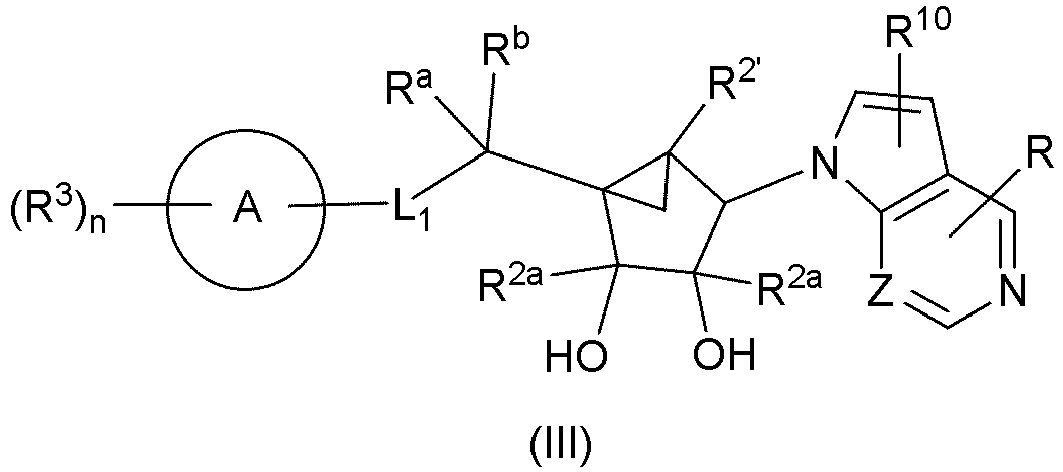
Ring A, Z, L1, Ra, Rb, R2', R, R2a, R3, R10 and 'n' are as defined herein above. - The compound of claim 1 having the structure of Formula (IV), a stereoisomer thereof, or a pharmaceutically acceptable salt thereof,
 X2 is Br or Cl;L1, Ra, Rb, R1 ,R2', R2, R, R2a and R10 are as defined herein above.
 - The compound of any one of claims 1 to 3, wherein ring A is selected from-

- The compound of any one of claims 1 to 4, wherein L1 is selected from -CH2-, - CH(CH3)-, -NH-, -N(CH3)-, S, and O.
- The compound of any one of claims 1 to 3, wherein R3 is selected from F, Cl, Br, CN, -NH2, -NH(CH3), -NHCH(CH3)2, -CH3, cyclopropyl, -CH(CH3)2, -CF2CH3, -OCH3, CF3,

- The compound of any one of claims 1 to 4, wherein R is selected from hydrogen, - NH2, Cl, -CH(CH3)2, methyl, ethyl, cyclopropyl and

- The compound of any one of claims 1 to 4, wherein Ra and Rb are independently selected from hydrogen, methyl, and cyclopropyl.
- The compound of any one of claims 1 to 4, wherein R2' and R2a are independently selected from hydrogen and methyl.
- The compound of any one of claims 1 to 4, wherein R10 is selected from hydrogen, -F, and methyl.
- The compound of claim 1, wherein ring A is selected from-
 L1 is selected from -CH2-, -CH(CH3)-, -NH-, -N(CH3)-, S, and O;R3 is selected from F, Cl, Br, CN, -NH2, -NH(CH3), -NHCH(CH3)2, -CH3, cyclopropyl, -CH(CH3)2, -CF2CH3, -OCH3, CF3,
 R is selected from hydrogen, -NH2, Cl, -CH(CH3)2, methyl, ethyl, cyclopropyl and
 Ra and Rb are independently selected from hydrogen, methyl, and cyclopropyl;R2' and R2a are independently selected from hydrogen and methyl;R10 is selected from hydrogen, -F, and methyl.
 - The compound of formula (I), a stereoisomer thereof, or a pharmaceutically acceptable salt thereof, as claimed in any one of preceding claims, wherein the compound is selected from:(1S,2R,5R)-3-(2-(2-Amino-3-bromoquinolin-7-yl)ethyl)-5-(4-amino-7H-pyrrolo[2,3-d]pyrimidin-7-yl)cyclopent-3-ene-1,2-diol;(1S,2R,5R)-3-(((2-amino-3-chloroquinolin-7-yl)thio)methyl)-5-(4-amino-7H-pyrrolo[2,3-d]pyrimidin-7-yl)cyclopent-3-ene-1,2-diol;(1S,2R,5R)-3-(1-(2-Amino-3-bromoquinolin-7-yl)propan-2-yl)-5-(4-amino-7H-pyrrolo[2,3-d]pyrimidin-7-yl)cyclopent-3-ene-1,2-diol;(1S,2R,5R)-3-(((2-amino-3-chloro-5-fluoroquinolin-7-yl)oxy)methyl)-5-(4-amino-7H-pyrrolo[2,3-d]pyrimidin-7-yl)-2-methylcyclopent-3-ene-1,2-diol (Compound-9);(1S,2R,5R)-3-(1-(2-Amino-3-chloro-5-fluoroquinolin-7-yl)propan-2-yl)-5-(4-methyl-7H-pyrrolo[2,3-d]pyrimidin-7-yl)cyclopent-3-ene-1,2-diol;(1S,2R,5R)-3-(2-(2-amino-3-chloro-5-fluoroquinolin-7-yl)ethyl)-5-(4-methyl-7H-pyrrolo[2,3-d]pyrimidin-7-yl)cyclopent-3-ene-1,2-diol;(1S,2R,5R)-3-(1-((2-amino-3-chloro-5-fluoroquinolin-7-yl)oxy)ethyl)-5-(4-amino-7H-pyrrolo[2,3-d]pyrimidin-7-yl)cyclopent-3-ene-1,2-diol;(1S,2R,5R)-3-(2-(2-amino-3-chloroquinolin-7-yl)ethyl)-5-(4-methyl-7H-pyrrolo[2,3-d]pyrimidin-7-yl)cyclopent-3-ene-1,2-diol;(2-(2-Amino-3-fluoroquinolin-7-yl)ethyl)-5-(4-amino-7H-pyrrolo[2,3-d]pyrimidin-7-yl)cyclopent-3-ene-1,2-diol;(1S,2R,5R)-3-(2-(2-amino-3-chloro-5-fluoroquinolin-7-yl)ethyl)-5-(4-amino-7H-pyrrolo[2,3-d]pyrimidin-7-yl)cyclopent-3-ene-1,2-diol;(1S,2R,5R)-3-(2-(2-amino-3-chloro-6-fluoroquinolin-7-yl)ethyl)-5-(4-amino-7H-pyrrolo[2,3-d]pyrimidin-7-yl)cyclopent-3-ene-1,2-diol;(1S,2R,5R)-3-(2-(2-amino-3-chloro-8-fluoroquinolin-7-yl)ethyl)-5-(4-amino-7H-pyrrolo[2,3-d]pyrimidin-7-yl)cyclopent-3-ene-1,2-diol;(1S,2R,5R)-3-(2-(2-amino-3,5-dichloroquinolin-7-yl)ethyl)-5-(4-amino-7H-pyrrolo[2,3-d]pyrimidin-7-yl)cyclopent-3-ene-1,2-diol;(1S,2R,5R)-3-(((2-amino-3-chloro-5-fluoroquinolin-7-yl)oxy)methyl)-5-(4-amino-7H-pyrrolo[2,3-d]pyrimidin-7-yl)cyclopent-3-ene-1,2-diol;(1S,2R,5R)-3-(2-(2-amino-3-chloro-5-fluoroquinolin-7-yl)ethyl)-5-(4-isopropyl-7H-pyrrolo[2,3-d]pyrimidin-7-yl)cyclopent-3-ene-1,2-diol;(1S,2R,5R)-3-(2-(2-amino-3-chloro-5-fluoroquinolin-7-yl)ethyl)-5-(4-(1-methyl-1 H-pyrazol-4-yl)-7H-pyrrolo[2,3-d]pyrimidin-7-yl)cyclopent-3-ene-1,2-diol;(1S,2R,5R)-3-(1-(2-amino-3-chloro-5-fluoroquinolin-7-yl)propan-2-yl)-5-(4-amino-7H-pyrrolo[2,3-d]pyrimidin-7-yl)cyclopent-3-ene-1,2-diol;(1S,2R,5R)-3-(1-(2-amino-3-chloroquinolin-7-yl)propan-2-yl)-5-(4-amino-7H-pyrrolo[2,3-d]pyrimidin-7-yl)cyclopent-3-ene-1,2-diol;(1S,2R,5R)-3-(2-(2-amino-3-chloro-5-fluoroquinolin-7-yl)ethyl)-5-(4-amino-7H-pyrrolo[2,3-d]pyrimidin-7-yl)-2-methylcyclopent-3-ene-1,2-diol;(1S,2R,5R)-3-(1-(2-amino-3-chloro-5-fluoroquinolin-7-yl)propan-2-yl)-5-(4-amino-7H-pyrrolo[2,3-d]pyrimidm-7-yl)-2-methylcyclopent-3-ene-1,2-diol;(1S,2R,5R)-3-(2-(2-amino-3-chloro-5-fluoroquinolin-7-yl)ethyl)-5-(4-amino-7H-pyrrolo[2,3-d]pyrimidin-7-yl)-2-ethylcyclopent-3-ene-1,2-diol;(1S,2R,5R)-3-(2-(2-amino-3-chloro-5-fluoroquinolin-7-yl)ethyl)-5-(4-ethyl-7H-pyrrolo[2,3-d]pyrimidin-7-yl)cyclopent-3-ene-1,2-diol;(1S,2R,5R)-3-(2-(2-amino-3-chloro-5-fluoroquinolin-7-yl)ethyl)-5-(4-cyclopropyl-7H-pyrrolo[2,3-d]pyrimidin-7-yl)cyclopent-3-ene-1,2-diol;(1S,2R,5R)-3-(2-(2-Amino-3-bromo-5-fluoroquinolin-7-yl)ethyl)-5-(4-amino-7H-pyrrolo[2,3-d]pyrimidin-7-yl)cyclopent-3-ene-1,2-diol;(1S,2R,5R)-3-(2-(2-Amino-3-bromo-5-fluoroquinolin-7-yl)ethyl)-5-(4-methyl-7H-pyrrolo[2,3-d]pyrimidin-7-yl)cyclopent-3-ene-1,2-diol;(1S,2R,5R)-3-(1-(2-Amino-3-bromo-5-fluoroquinolin-7-yl)propan-2-yl)-5-(4-amino-7H-pyrrolo[2,3-d]pyrimidin-7-yl)cyclopent-3-ene-1,2-diol;(1S,2R,5R)-3-(2-(2-Amino-3-chloro-5-fluoroquinolin-7-yl)ethyl)-5-(4-methyl-1H-pyrrolo[3,2-c]pyridin-1-yl)cyclopent-3-ene-1,2-diol;(1S,2R,5R)-3-(2-(2-Amino-6-fluoroquinolin-7-yl)ethyl)-5-(4-amino-7H-pyrrolo[2,3-d]pyrimidin-7-yl)cyclopent-3-ene-1,2-diol;(1S,2R,5R)-3-(2-(2-amino-5-fluoroquinolin-7-yl)ethyl)-5-(4-amino-7H-pyrrolo[2,3-d]pyrimidin-7-yl)cyclopent-3-ene-1,2-diol;(1R,2R,3S,4R,5S)-1-(2-(2-Amino-3-methylquinolin-7-yl)ethyl)-4-(4-amino-7H-pyrrolo[2,3-d]pyrimidin-7-yl) bicyclo[3.1.0]hexane-2,3-diol;(1R,2R,3S,4R,5S)-1-(2-(2-Amino-3-chloroquinolin-7-yl)ethyl)-4-(4-amino-7H-pyrrolo[2,3-d]pyrimidin-7-yl)bicyclo[3.1.0]hexane-2,3-diol;(1R,2R,3S,4R,5S)-1-(2-(2-Amino-3-chloro-5-fluoroquinolin-7-yl)ethyl)-4-(4-amino-7H-pyrrolo[2,3-d]pyrimidin-7-yl) bicyclo[3.1.0]hexane-2,3-diol;(1R,2R,3S,4R,5S)-1-(2-(2-Amino-3-chloro-6-fluoroquinolin-7-yl)ethyl)-4-(4-amino-7H-pyrrolo[2,3-d]pyrimidin-7-yl) bicyclo[3.1.0]hexane-2,3-diol;(1R,2R,3S,4R,5S)-1-(2-(2-amino-3-bromo-6-fluoroquinolin-7-yl)ethyl)-4-(4-amino-7H-pyrrolo[2,3-d]pyrimidm-7-yl)bicyclo[3.1.0]hexane-2,3-diol;(1R,2R,3S,4R,5S)-1-(2-(2-Amino-3-bromo-5-fluoroquinolin-7-yl)ethyl)-4-(4-amino-7H-pyrrolo[2,3-d]pyrimidin-7-yl)bicyclo[3.1.0]hexane-2,3-diol; and(1R,2R,3S,4R,5S)-1-(2-(2-Amino-3-bromoquinolin-7-yl)ethyl)-4-(4-amino-7H-pyrrolo [2,3-d]pyrimidin-7-yl)bicyclo [3.1.0]hexane-2,3-diol.
- The compound of formula (I), a stereoisomer thereof, or a pharmaceutically acceptable salt thereof, as claimed in any one of preceding claims, wherein the compound is selected from:(1S,2R,5R)-3-(2-(2-amino-3-chloro-5-fluoroquinolin-7-yl)ethyl)-5-(4-methyl-7H-pyrrolo[2,3-d]pyrimidin-7-yl)cyclopent-3-ene-1,2-diol;(1S,2R,5R)-3-(2-(2-amino-3-chloro-5-fluoroquinolin-7-yl)ethyl)-5-(4-amino-7H-pyrrolo[2,3-d]pyrimidin-7-yl)cyclopent-3-ene-1,2-diol;(1S,2R,5R)-3-(1-(2-amino-3-chloro-5-fluoroquinolin-7-yl)propan-2-yl)-5-(4-amino-7H-pyrrolo[2,3-d]pyrimidin-7-yl)cyclopent-3-ene-1,2-diol;(1S,2R,5R)-3-(2-(2-amino-3-chloro-5-fluoroquinolin-7-yl)ethyl)-5-(4-amino-7H-pyrrolo[2,3-d]pyrimidin-7-yl)-2-methylcyclopent-3-ene-1,2-diol;(1R,2R,3S,4R,5S)-1-(2-(2-Amino-3-chloro-5-fluoroquinolin-7-yl)ethyl)-4-(4-amino-7H-pyrrolo[2,3-d]pyrimidin-7-yl) bicyclo[3.1.0]hexane-2,3-diol;(1R,2R,3S,4R,5S)-1-(2-(2-Amino-3-chloro-6-fluoroquinolin-7-yl)ethyl)-4-(4-amino-7H-pyrrolo[2,3-d]pyrimidin-7-yl) bicyclo[3.1.0]hexane-2,3-diol;(1R,2R,3S,4R,5S)-1-(2-(2-Amino-3-bromoquinolin-7-yl)ethyl)-4-(4-amino-7H-pyrrolo [2,3-d]pyrimidin-7-yl)bicyclo [3.1.0]hexane-2,3-diol;(1S,2R,5R)-3-(2-(2-Amino-3-bromoquinolin-7-yl)ethyl)-5-(4-amino-7H-pyrrolo[2,3-d]pyrimidin-7-yl)cyclopent-3-ene-1,2-diol;(1S,2R,5R)-3-(2-(2-amino-3-chloro-6-fluoroquinolin-7-yl)ethyl)-5-(4-amino-7H-pyrrolo[2,3-d]pyrimidin-7-yl)cyclopent-3-ene-1,2-diol;(1S,2R,5R)-3-(((2-amino-3-chloro-5-fluoroquinolin-7-yl)oxy)methyl)-5-(4-amino-7H-pyrrolo[2,3-d]pyrimidin-7-yl)cyclopent-3-ene-1,2-diol;(1S,2R,5R)-3-(1-(2-amino-3-chloroquinolin-7-yl)propan-2-yl)-5-(4-amino-7H-pyrrolo[2,3-d]pyrimidin-7-yl)cyclopent-3-ene-1,2-diol;(1S,2R,5R)-3-(1-(2-amino-3-chloro-5-fluoroquinolin-7-yl)propan-2-yl)-5-(4-amino-7H-pyrrolo[2,3-d]pyrimidin-7-yl)cyclopent-3-ene-1,2-diol;(1S,2R,5R)-3-(1-(2-amino-3-chloro-5-fluoroquinolin-7-yl)propan-2-yl)-5-(4-amino-7H-pyrrolo[2,3-d]pyrimidin-7-yl)-2-methylcyclopent-3-ene-1,2-diol;(1R,2R,3S,4R,5S)-1-(2-(2-Amino-3-chloroquinolin-7-yl)ethyl)-4-(4-amino-7H-pyrrolo[2,3-d]pyrimidin-7-yl)bicyclo[3 .1.0]hexane-2,3-diol;(1S,2R,5R)-3-(2-(2-Amino-3-bromo-5-fluoroquinolin-7-yl)ethyl)-5-(4-amino-7H-pyrrolo[2,3-d]pyrimidin-7-yl)cyclopent-3-ene-1,2-diol;(1S,2R,5R)-3-(1-(2-Amino-3-bromo-5-fluoro quinolin-7-yl)propan-2-yl)-5-(4-amino-7H-pyrrolo[2,3-d]pyrimidin-7-yl)cyclopent-3-ene-1,2-diol;(1S,2R,5R)-3-(2-(2-Amino-3-bromo-5-fluoroquinolin-7-yl)ethyl)-5-(4-methyl-7H-pyrrolo[2,3-d]pyrimidin-7-yl)cyclopent-3-ene-1,2-diol;(1R,2R,3S,4R,5S)-1-(2-(2-Amino-3-bromo-5-fluoroquinolin-7-yl)ethyl)-4-(4-amino-7H-pyrrolo[2,3-d]pyrimidin-7-yl)bicyclo[3.1.0]hexane-2,3-diol; and(1R,2R,3 S,4R,5S)-1-(2-(2-amino-3-bromo-6-fluoroquinolin-7-yl)ethyl)-4-(4-amino-7H-pyrrolo[2,3-d]pyrimidin-7-yl)bicyclo[3.1.0]hexane-2,3-diol.
- A pharmaceutical composition comprising at least one compound of any one of the claims 1 to 14, a stereoisomer thereof, or a pharmaceutically acceptable salt thereof, and a pharmaceutically acceptable carrier.
- Compound of any one of claim 1 to 14, for use in treating diseases, disorders, syndromes or conditions associated by inhibition of PRMT5 in a subject in need thereof, wherein the diseases, disorders, syndromes or conditions are cancer.
- The compound for use as claimed in claim 16, wherein the said diseases, disorders, syndromes or conditions are selected from glioblastoma multiforme, prostate cancer, pancreatic cancer, mantle cell lymphoma, non-Hodgkin's lymphomas and diffuse large B-cell lymphoma, acute myeloid leukemia, acute lymphoblastic leukemia, multiple myeloma, non-small cell lung cancer, small cell lung cancer, breast cancer, triple negative breast cancer, gastric cancer, colorectal cancer, ovarian cancer, bladder cancer, hepatocellular cancer, melanoma, sarcoma, oropharyngeal squamous cell carcinoma, chronic myelogenous leukemia, epidermal squamous cell carcinoma, nasopharyngeal carcinoma, neuroblastoma, endometrial carcinoma, and cervical cancer.
Priority Applications (3)
| Application Number | Priority Date | Filing Date | Title |
|---|---|---|---|
| RS20220931A RS63623B1 (en) | 2017-12-13 | 2018-12-13 | SUBSTITUTED BICYCLIC HETEROCYCLIC COMPOUNDS AS PRMT5 INHIBITORS |
| SM20220396T SMT202200396T1 (en) | 2017-12-13 | 2018-12-13 | Substituted bicyclic heterocyclic compounds as prmt5 inhibitors |
| HRP20221207TT HRP20221207T1 (en) | 2017-12-13 | 2018-12-13 | Substituted bicyclic heterocyclic compounds as prmt5 inhibitors |
Applications Claiming Priority (4)
| Application Number | Priority Date | Filing Date | Title |
|---|---|---|---|
| IN201721044886 | 2017-12-13 | ||
| IN201821024634 | 2018-07-02 | ||
| IN201821040029 | 2018-10-23 | ||
| PCT/IB2018/060015 WO2019116302A1 (en) | 2017-12-13 | 2018-12-13 | Substituted bicyclic heterocyclic compounds as prmt5 inhibitors |
Publications (2)
| Publication Number | Publication Date |
|---|---|
| EP3724190A1 EP3724190A1 (en) | 2020-10-21 |
| EP3724190B1 true EP3724190B1 (en) | 2022-07-06 |
Family
ID=65036860
Family Applications (1)
| Application Number | Title | Priority Date | Filing Date |
|---|---|---|---|
| EP18836520.9A Active EP3724190B1 (en) | 2017-12-13 | 2018-12-13 | Substituted bicyclic heterocyclic compounds as prmt5 inhibitors |
Country Status (30)
| Country | Link |
|---|---|
| US (2) | US11459330B2 (en) |
| EP (1) | EP3724190B1 (en) |
| JP (1) | JP7282778B2 (en) |
| KR (1) | KR102708147B1 (en) |
| CN (1) | CN111712498B (en) |
| AU (1) | AU2018385664B2 (en) |
| CA (1) | CA3085259A1 (en) |
| CL (1) | CL2020001576A1 (en) |
| CR (1) | CR20200263A (en) |
| CU (1) | CU24621B1 (en) |
| CY (1) | CY1125784T1 (en) |
| DK (1) | DK3724190T3 (en) |
| ES (1) | ES2927860T3 (en) |
| GE (2) | GEP20227359B (en) |
| HR (1) | HRP20221207T1 (en) |
| HU (1) | HUE059945T2 (en) |
| IL (1) | IL274936B2 (en) |
| LT (1) | LT3724190T (en) |
| MX (1) | MX2020006181A (en) |
| MY (1) | MY199124A (en) |
| PE (1) | PE20211444A1 (en) |
| PH (1) | PH12020550881A1 (en) |
| PL (1) | PL3724190T3 (en) |
| PT (1) | PT3724190T (en) |
| RS (1) | RS63623B1 (en) |
| SG (1) | SG11202004934QA (en) |
| SM (1) | SMT202200396T1 (en) |
| UA (1) | UA126349C2 (en) |
| WO (1) | WO2019116302A1 (en) |
| ZA (1) | ZA202003528B (en) |
Families Citing this family (17)
| Publication number | Priority date | Publication date | Assignee | Title |
|---|---|---|---|---|
| US11077101B1 (en) | 2018-07-18 | 2021-08-03 | Tango Therapeutics, Inc. | Compounds and methods of use |
| AU2019362753A1 (en) | 2018-10-05 | 2021-05-20 | Vertex Pharmaceuticals Incorporated | Modulators of alpha-1 antitrypsin |
| CA3134613A1 (en) | 2019-04-02 | 2020-10-08 | Aligos Therapeutics, Inc. | Compounds targeting prmt5 |
| UY38696A (en) | 2019-05-14 | 2020-11-30 | Vertex Pharma | ALPHA-1 ANTITRYPSIN MODULATORS |
| CA3141855A1 (en) * | 2019-05-30 | 2020-12-03 | Angex Pharmaceutical, Inc. | Heterocyclic compounds as prmt5 inhibitors |
| CA3141748A1 (en) | 2019-06-10 | 2020-12-17 | Lupin Limited | Prmt5 inhibitors |
| CR20220175A (en) * | 2019-10-22 | 2022-06-21 | Lupin Ltd | Pharmaceutical combination of PRMT5 inhibitors |
| JP2022553376A (en) * | 2019-10-25 | 2022-12-22 | アクセント・セラピューティクス・インコーポレイテッド | METTL3 modulator |
| WO2021086879A1 (en) | 2019-10-28 | 2021-05-06 | Tango Therapeutics, Inc. | Compounds and methods of use |
| US20230066014A1 (en) * | 2019-12-03 | 2023-03-02 | Lupin Limited | Substituted nucleoside analogs as prmt5 inhibitors |
| WO2021202480A1 (en) * | 2020-04-01 | 2021-10-07 | Aligos Therapeutics, Inc. | Compounds targeting prmt5 |
| WO2021203014A1 (en) | 2020-04-03 | 2021-10-07 | Vertex Pharmaceuticals Incorporated | Pyrano[4,3-b]l ndole derivatives as alpha-1 -antitrypsin modulators for treating alpha-1 -antitrypsin deficiency (aatd) |
| EP4126819A1 (en) * | 2020-04-03 | 2023-02-08 | Vertex Pharmaceuticals Incorporated | 7- or 8-hydroxy-isoquinoline and 7- or 8-hydroxy-quinoline derivatives as alpha-1 -antitrypsin modulators for treating alpha-1 -antitrypsin deficiency (aatd) |
| EP4126863A1 (en) | 2020-04-03 | 2023-02-08 | Vertex Pharmaceuticals Incorporated | 1 h-pyrazolo[4,3-g]isoquinoline and 1 h-pyrazolo[4,3-g]quinoline derivatives as alpha-1 -antitrypsin modulators for treating alpha-1 -antitrypsin deficiency (aatd) |
| EP4188920A1 (en) | 2020-07-31 | 2023-06-07 | Tango Therapeutics, Inc. | Piperidin-1-yl-n-pyrydine-3-yl-2-oxoacetamide derivatives useful for the treatment of mtap-deficient and/or mta-accumulating cancers |
| CA3203205A1 (en) | 2021-01-19 | 2022-07-28 | Mandar Ramesh Bhonde | Pharmaceutical combinations of sos1 inhibitors for treating and/or preventing cancer |
| CN113234079B (en) * | 2021-04-30 | 2022-02-01 | 上海湃隆生物科技有限公司 | Nucleoside analogs as PRMT5 inhibitors |
Family Cites Families (40)
| Publication number | Priority date | Publication date | Assignee | Title |
|---|---|---|---|---|
| WO2004009574A1 (en) | 2002-07-22 | 2004-01-29 | Novartis Ag | Synthesis of discodermolide |
| WO2005016878A2 (en) | 2003-08-13 | 2005-02-24 | Isis Pharmaceuticals, Inc. | METHODS FOR THE PREPARATION OF 5-FLUORO-PYRROLO[2,3-d]PYRIMIDINE COMPOUNDS |
| WO2006091905A1 (en) | 2005-02-25 | 2006-08-31 | Gilead Sciences, Inc. | Bicyclo (3.1.0) hexane derivatives as antiviral compounds |
| US20080045521A1 (en) | 2006-06-09 | 2008-02-21 | Astrazeneca Ab | Phenylalanine derivatives |
| HRP20120346T1 (en) | 2007-03-08 | 2012-05-31 | Janssen Pharmaceutica N.V. | Quinolinone derivatives as parp and tank inhibitors |
| FR2926556B1 (en) | 2008-01-22 | 2010-02-19 | Sanofi Aventis | N-AZABICYCLIC CARBOXAMIDE DERIVATIVES, THEIR PREPARATION AND THEIR THERAPEUTIC APPLICATION |
| CN104557914A (en) | 2008-09-26 | 2015-04-29 | 新加坡科技研究局 | 3-deazaneplanocin derivatives |
| GB0922332D0 (en) | 2009-12-22 | 2010-02-03 | Isis Innovation | Method of treatment and screening method |
| US9044432B2 (en) | 2009-12-22 | 2015-06-02 | Ohio State Innovation Foundation | Compositions and methods for cancer detection and treatment |
| KR101789129B1 (en) | 2010-06-30 | 2017-11-20 | 후지필름 가부시키가이샤 | Novel nicotinamide derivative or salt thereof |
| WO2012037108A1 (en) | 2010-09-13 | 2012-03-22 | Glaxosmithkline Llc | Aminoquinoline derivatives as antiviral agents |
| WO2012123298A1 (en) | 2011-03-11 | 2012-09-20 | F. Hoffmann-La Roche Ag | Antiviral compounds |
| WO2013028447A1 (en) | 2011-08-19 | 2013-02-28 | Glaxosmithkline Llc | Fatty acid synthase inhibitors |
| WO2013157022A1 (en) * | 2012-04-20 | 2013-10-24 | Advinus Therapeutics Limited | Substituted hetero-bicyclic compounds, compositions and medicinal applications thereof |
| WO2013185103A1 (en) | 2012-06-08 | 2013-12-12 | Gilead Sciences, Inc. | Macrocyclic inhibitors of flaviviridae viruses |
| WO2014008223A2 (en) | 2012-07-03 | 2014-01-09 | Glaxosmithkline Llc | Fatty acid synthase inhibitors |
| JP2016505597A (en) | 2012-12-21 | 2016-02-25 | エピザイム,インコーポレイティド | PRMT5 inhibitors and uses thereof |
| WO2014100716A1 (en) | 2012-12-21 | 2014-06-26 | Epizyme, Inc. | Prmt5 inhibitors and uses thereof |
| US9745291B2 (en) | 2012-12-21 | 2017-08-29 | Epizyme, Inc. | PRMT5 inhibitors containing a dihydro- or tetrahydroisoquinoline and uses thereof |
| US8993555B2 (en) | 2012-12-21 | 2015-03-31 | Epizyme, Inc. | PRMT5 inhibitors and uses thereof |
| US9908887B2 (en) * | 2012-12-21 | 2018-03-06 | Epizyme, Inc. | PRMT5 inhibitors and uses thereof |
| EP2943485B1 (en) | 2013-01-14 | 2017-09-20 | Incyte Holdings Corporation | Bicyclic aromatic carboxamide compounds useful as pim kinase inhibitors |
| GB201302927D0 (en) | 2013-02-20 | 2013-04-03 | Cancer Therapeutics Crc Pty Ltd | Compounds |
| JP6510485B2 (en) | 2013-03-15 | 2019-05-08 | オハイオ・ステイト・イノベーション・ファウンデーション | PRMT5 inhibitors and methods of their use |
| JP6559123B2 (en) | 2013-10-10 | 2019-08-14 | アラクセス ファーマ エルエルシー | Inhibitor of KRASG12C |
| CN106232600B (en) | 2014-05-22 | 2019-05-14 | 豪夫迈·罗氏有限公司 | Indolin-2-one and 1,3-dihydro-pyrrolo[3,2-c]pyridin-2-one derivatives |
| PL3160958T3 (en) | 2014-06-25 | 2021-07-19 | Glaxosmithkline Intellectual Property Development Limited | Crystalline salts of (s)-6-((1-acetylpiperidin-4-yl)amino)-n-(3-(3,4-dihydroisoquinolin-2(1h)-yl)-2-hydroxypropyl)pyrimidine-4-carboxamide |
| WO2015200680A2 (en) | 2014-06-25 | 2015-12-30 | Epizyme, Inc. | Prmt5 inhibitors and uses thereof |
| EP3160466A4 (en) | 2014-06-25 | 2017-12-27 | Epizyme, Inc. | Prmt5 inhibitors and uses thereof |
| US10653693B2 (en) | 2014-08-04 | 2020-05-19 | Epizyme, Inc. | PRMT5 inhibitors and uses thereof |
| GB201415573D0 (en) | 2014-09-03 | 2014-10-15 | Cancer Therapeutics Crc Pty Ltd | Compounds |
| WO2016034671A1 (en) | 2014-09-03 | 2016-03-10 | Ctxt Pty Ltd | Aminoindane-, aminotetrahydronaphthalene- and aminobenzocyclobutane-derived prmt5-inhibitors |
| EP3189041B1 (en) | 2014-09-03 | 2021-04-28 | Ctxt Pty Ltd | Tetrahydroisoquinoline derived prmt5-inhibitors |
| WO2016038550A1 (en) | 2014-09-11 | 2016-03-17 | Novartis Ag | Inhibition of prmt5 to treat mtap-deficiency-related diseases |
| EA031895B1 (en) | 2015-02-24 | 2019-03-29 | Пфайзер Инк. | Substituted nucleoside derivatives useful as anticancer agents |
| WO2016145150A2 (en) | 2015-03-11 | 2016-09-15 | The Broad Institute Inc. | Selective treatment of prmt5 dependent cancer |
| AR104326A1 (en) | 2015-05-04 | 2017-07-12 | Lilly Co Eli | 5-SUBSTITUTED NUCLEOSID COMPOUNDS |
| TWI791251B (en) | 2015-08-26 | 2023-02-01 | 比利時商健生藥品公司 | Novel 6-6 bicyclic aromatic ring substituted nucleoside analogues for use as prmt5 inhibitors |
| EP3377481A1 (en) | 2015-11-16 | 2018-09-26 | Araxes Pharma LLC | 2-substituted quinazoline compounds comprising a substituted heterocyclic group and methods of use thereof |
| EA201990851A1 (en) * | 2017-02-24 | 2019-09-30 | Янссен Фармацевтика Нв | NEW CARBANUCLEOSIDE ANALOGUES REPLACED BY MONOCYCLIC AND BICYCLIC RING SYSTEM FOR USE AS PRMT5 INHIBITORS |
-
2018
- 2018-12-13 CR CR20200263A patent/CR20200263A/en unknown
- 2018-12-13 PL PL18836520.9T patent/PL3724190T3/en unknown
- 2018-12-13 EP EP18836520.9A patent/EP3724190B1/en active Active
- 2018-12-13 IL IL274936A patent/IL274936B2/en unknown
- 2018-12-13 DK DK18836520.9T patent/DK3724190T3/en active
- 2018-12-13 UA UAA202004140A patent/UA126349C2/en unknown
- 2018-12-13 PT PT188365209T patent/PT3724190T/en unknown
- 2018-12-13 SG SG11202004934QA patent/SG11202004934QA/en unknown
- 2018-12-13 CN CN201880089329.6A patent/CN111712498B/en active Active
- 2018-12-13 SM SM20220396T patent/SMT202200396T1/en unknown
- 2018-12-13 GE GEAP201815385A patent/GEP20227359B/en unknown
- 2018-12-13 PE PE2020000761A patent/PE20211444A1/en unknown
- 2018-12-13 CU CU2020000051A patent/CU24621B1/en unknown
- 2018-12-13 CA CA3085259A patent/CA3085259A1/en active Pending
- 2018-12-13 ES ES18836520T patent/ES2927860T3/en active Active
- 2018-12-13 LT LTEPPCT/IB2018/060015T patent/LT3724190T/en unknown
- 2018-12-13 WO PCT/IB2018/060015 patent/WO2019116302A1/en not_active Ceased
- 2018-12-13 KR KR1020207019844A patent/KR102708147B1/en active Active
- 2018-12-13 HU HUE18836520A patent/HUE059945T2/en unknown
- 2018-12-13 GE GEAP202115385A patent/GEAP202115385A/en unknown
- 2018-12-13 MX MX2020006181A patent/MX2020006181A/en unknown
- 2018-12-13 HR HRP20221207TT patent/HRP20221207T1/en unknown
- 2018-12-13 US US16/772,959 patent/US11459330B2/en active Active
- 2018-12-13 JP JP2020532614A patent/JP7282778B2/en active Active
- 2018-12-13 AU AU2018385664A patent/AU2018385664B2/en active Active
- 2018-12-13 MY MYPI2020002798A patent/MY199124A/en unknown
- 2018-12-13 RS RS20220931A patent/RS63623B1/en unknown
-
2020
- 2020-06-06 PH PH12020550881A patent/PH12020550881A1/en unknown
- 2020-06-11 CL CL2020001576A patent/CL2020001576A1/en unknown
- 2020-06-12 ZA ZA2020/03528A patent/ZA202003528B/en unknown
-
2022
- 2022-05-06 US US17/738,370 patent/US11952380B2/en active Active
- 2022-09-30 CY CY20221100650T patent/CY1125784T1/en unknown
Also Published As
Similar Documents
| Publication | Publication Date | Title |
|---|---|---|
| US11952380B2 (en) | Substituted bicyclic heterocyclic compounds as PRMT5 inhibitors | |
| EP3980417B1 (en) | Prmt5 inhibitors | |
| JP7406674B2 (en) | Spirocyclic compounds | |
| EP4585599A1 (en) | Nitrogen-containing fused ring compound, intermediate thereof, preparation method therefor and use thereof | |
| AU2022202886B2 (en) | Quinazoline Compounds, Preparation Method, Use, and Pharmaceutical Composition Thereof | |
| ES2349476T3 (en) | NEW DERIVATIVES OF 4-CIANO, 4-AMINO AND 4-AMINOMETILE OF PIRAZOLO COMPOUNDS [1,5-A] PIRIDINES, PIRAZOLO [1,5-C] PYRIMIDINES AND 2H-INDAZOL AND DERIVATIVES OF 5-CIANO, 5-AMINO AND 5-AMINOMETILO OF IMIDAZO COMPOUNDS [1,2-A] PIRIDINES AND IMIDAZO [1,5-A] PIRAZINAS, AS INHIBITORS OF CYCLINE DEPENDENT KINASE. | |
| EP3849984B1 (en) | 1-isopropyl-3-methyl-8- (pyridin-3-yl) -1, 3-dihydro-2h-imidazo [4, 5-c] cinnolin-2-one as selective modulators of ataxia telangiectasia mutated (atm) kinase and uses thereof | |
| JP2014502601A (en) | Substituted 6,6-fused nitrogen heterocyclic compounds and uses thereof | |
| US12612408B2 (en) | Pyrazolone-fused pyrimidine compound, preparation method for same and applications thereof | |
| TW202438054A (en) | 5-amino-6,8-dihydro-1h-furo[3,4-d]pyrrolo[3,2-b]pyridine-2-carboxamide derivatives as mta-cooperative inhibitors of prmt5 | |
| JP7664248B2 (en) | Substituted Nucleoside Analogs as PRMT5 Inhibitors | |
| CN116249692B (en) | Pyrazole compound as well as preparation method and application thereof | |
| HK40033314A (en) | Substituted bicyclic heterocyclic compounds as prmt5 inhibitors | |
| HK40033314B (en) | Substituted bicyclic heterocyclic compounds as prmt5 inhibitors | |
| OA19533A (en) | Substituted bicyclic heterocyclic compounds as PRMT5 inhibitors. | |
| KR102961371B1 (en) | DNA-dependent protein kinase inhibitors | |
| EA041973B1 (en) | SUBSTITUTED BICYCLIC HETEROCYCLIC COMPOUNDS AS PRMT5 INHIBITORS | |
| CN121866258A (en) | Methods of treating cancer |
Legal Events
| Date | Code | Title | Description |
|---|---|---|---|
| REG | Reference to a national code |
Ref country code: HR Ref legal event code: TUEP Ref document number: P20221207T Country of ref document: HR |
|
| STAA | Information on the status of an ep patent application or granted ep patent |
Free format text: STATUS: UNKNOWN |
|
| STAA | Information on the status of an ep patent application or granted ep patent |
Free format text: STATUS: THE INTERNATIONAL PUBLICATION HAS BEEN MADE |
|
| PUAI | Public reference made under article 153(3) epc to a published international application that has entered the european phase |
Free format text: ORIGINAL CODE: 0009012 |
|
| STAA | Information on the status of an ep patent application or granted ep patent |
Free format text: STATUS: REQUEST FOR EXAMINATION WAS MADE |
|
| 17P | Request for examination filed |
Effective date: 20200619 |
|
| AK | Designated contracting states |
Kind code of ref document: A1 Designated state(s): AL AT BE BG CH CY CZ DE DK EE ES FI FR GB GR HR HU IE IS IT LI LT LU LV MC MK MT NL NO PL PT RO RS SE SI SK SM TR |
|
| AX | Request for extension of the european patent |
Extension state: BA ME |
|
| RAV | Requested validation state of the european patent: fee paid |
Extension state: MA Effective date: 20200619 |
|
| REG | Reference to a national code |
Ref country code: HK Ref legal event code: DE Ref document number: 40033314 Country of ref document: HK |
|
| STAA | Information on the status of an ep patent application or granted ep patent |
Free format text: STATUS: EXAMINATION IS IN PROGRESS |
|
| 17Q | First examination report despatched |
Effective date: 20210528 |
|
| GRAP | Despatch of communication of intention to grant a patent |
Free format text: ORIGINAL CODE: EPIDOSNIGR1 |
|
| STAA | Information on the status of an ep patent application or granted ep patent |
Free format text: STATUS: GRANT OF PATENT IS INTENDED |
|
| INTG | Intention to grant announced |
Effective date: 20220202 |
|
| GRAS | Grant fee paid |
Free format text: ORIGINAL CODE: EPIDOSNIGR3 |
|
| GRAA | (expected) grant |
Free format text: ORIGINAL CODE: 0009210 |
|
| STAA | Information on the status of an ep patent application or granted ep patent |
Free format text: STATUS: THE PATENT HAS BEEN GRANTED |
|
| AK | Designated contracting states |
Kind code of ref document: B1 Designated state(s): AL AT BE BG CH CY CZ DE DK EE ES FI FR GB GR HR HU IE IS IT LI LT LU LV MC MK MT NL NO PL PT RO RS SE SI SK SM TR |
|
| REG | Reference to a national code |
Ref country code: AT Ref legal event code: REF Ref document number: 1502810 Country of ref document: AT Kind code of ref document: T Effective date: 20220715 Ref country code: CH Ref legal event code: EP |
|
| REG | Reference to a national code |
Ref country code: DE Ref legal event code: R096 Ref document number: 602018037715 Country of ref document: DE |
|
| REG | Reference to a national code |
Ref country code: IE Ref legal event code: FG4D |
|
| REG | Reference to a national code |
Ref country code: NO Ref legal event code: T2 Effective date: 20220706 |
|
| REG | Reference to a national code |
Ref country code: PT Ref legal event code: SC4A Ref document number: 3724190 Country of ref document: PT Date of ref document: 20221003 Kind code of ref document: T Free format text: AVAILABILITY OF NATIONAL TRANSLATION Effective date: 20220927 Ref country code: FI Ref legal event code: FGE |
|
| REG | Reference to a national code |
Ref country code: RO Ref legal event code: EPE |
|
| REG | Reference to a national code |
Ref country code: DK Ref legal event code: T3 Effective date: 20221003 |
|
| REG | Reference to a national code |
Ref country code: SE Ref legal event code: TRGR |
|
| REG | Reference to a national code |
Ref country code: NL Ref legal event code: FP |
|
| REG | Reference to a national code |
Ref country code: MA Ref legal event code: VAGR Ref document number: 51146 Country of ref document: MA Kind code of ref document: B1 |
|
| REG | Reference to a national code |
Ref country code: ES Ref legal event code: FG2A Ref document number: 2927860 Country of ref document: ES Kind code of ref document: T3 Effective date: 20221111 |
|
| REG | Reference to a national code |
Ref country code: GR Ref legal event code: EP Ref document number: 20220401966 Country of ref document: GR Effective date: 20221109 |
|
| REG | Reference to a national code |
Ref country code: SK Ref legal event code: T3 Ref document number: E 40530 Country of ref document: SK |
|
| REG | Reference to a national code |
Ref country code: HR Ref legal event code: T1PR Ref document number: P20221207 Country of ref document: HR |
|
| REG | Reference to a national code |
Ref country code: EE Ref legal event code: FG4A Ref document number: E022779 Country of ref document: EE Effective date: 20221005 |
|
| REG | Reference to a national code |
Ref country code: HR Ref legal event code: ODRP Ref document number: P20221207 Country of ref document: HR Payment date: 20221212 Year of fee payment: 5 |
|
| REG | Reference to a national code |
Ref country code: HU Ref legal event code: AG4A Ref document number: E059945 Country of ref document: HU |
|
| PG25 | Lapsed in a contracting state [announced via postgrant information from national office to epo] |
Ref country code: IS Free format text: LAPSE BECAUSE OF FAILURE TO SUBMIT A TRANSLATION OF THE DESCRIPTION OR TO PAY THE FEE WITHIN THE PRESCRIBED TIME-LIMIT Effective date: 20221106 |
|
| REG | Reference to a national code |
Ref country code: DE Ref legal event code: R097 Ref document number: 602018037715 Country of ref document: DE |
|
| PLBE | No opposition filed within time limit |
Free format text: ORIGINAL CODE: 0009261 |
|
| STAA | Information on the status of an ep patent application or granted ep patent |
Free format text: STATUS: NO OPPOSITION FILED WITHIN TIME LIMIT |
|
| 26N | No opposition filed |
Effective date: 20230411 |
|
| P01 | Opt-out of the competence of the unified patent court (upc) registered |
Effective date: 20230519 |
|
| PG25 | Lapsed in a contracting state [announced via postgrant information from national office to epo] |
Ref country code: AL Free format text: LAPSE BECAUSE OF FAILURE TO SUBMIT A TRANSLATION OF THE DESCRIPTION OR TO PAY THE FEE WITHIN THE PRESCRIBED TIME-LIMIT Effective date: 20220706 |
|
| REG | Reference to a national code |
Ref country code: HR Ref legal event code: ODRP Ref document number: P20221207 Country of ref document: HR Payment date: 20231127 Year of fee payment: 6 |
|
| REG | Reference to a national code |
Ref country code: HR Ref legal event code: ODRP Ref document number: P20221207 Country of ref document: HR Payment date: 20241206 Year of fee payment: 7 |
|
| VSFP | Annual fee paid to validation state [announced via postgrant information from national office to epo] |
Ref country code: MA Payment date: 20231122 Year of fee payment: 6 |
|
| VSFP | Annual fee paid to validation state [announced via postgrant information from national office to epo] |
Ref country code: MA Payment date: 20221229 Year of fee payment: 5 |
|
| VSFP | Annual fee paid to validation state [announced via postgrant information from national office to epo] |
Ref country code: MA Payment date: 20241212 Year of fee payment: 7 |
|
| PGFP | Annual fee paid to national office [announced via postgrant information from national office to epo] |
Ref country code: NL Payment date: 20251112 Year of fee payment: 8 Ref country code: LU Payment date: 20251128 Year of fee payment: 8 |
|
| REG | Reference to a national code |
Ref country code: HR Ref legal event code: ODRP Ref document number: P20221207 Country of ref document: HR Payment date: 20251110 Year of fee payment: 8 |
|
| REG | Reference to a national code |
Ref country code: CH Ref legal event code: U11 Free format text: ST27 STATUS EVENT CODE: U-0-0-U10-U11 (AS PROVIDED BY THE NATIONAL OFFICE) Effective date: 20260101 |
|
| PGFP | Annual fee paid to national office [announced via postgrant information from national office to epo] |
Ref country code: IS Payment date: 20251211 Year of fee payment: 8 Ref country code: DE Payment date: 20251104 Year of fee payment: 8 |
|
| PGFP | Annual fee paid to national office [announced via postgrant information from national office to epo] |
Ref country code: LT Payment date: 20251118 Year of fee payment: 8 Ref country code: GB Payment date: 20251114 Year of fee payment: 8 |
|
| PGFP | Annual fee paid to national office [announced via postgrant information from national office to epo] |
Ref country code: MC Payment date: 20251127 Year of fee payment: 8 Ref country code: NO Payment date: 20251210 Year of fee payment: 8 |
|
| PGFP | Annual fee paid to national office [announced via postgrant information from national office to epo] |
Ref country code: SM Payment date: 20251127 Year of fee payment: 8 Ref country code: MK Payment date: 20251119 Year of fee payment: 8 Ref country code: AT Payment date: 20251126 Year of fee payment: 8 Ref country code: PT Payment date: 20251210 Year of fee payment: 8 |
|
| PGFP | Annual fee paid to national office [announced via postgrant information from national office to epo] |
Ref country code: IT Payment date: 20251121 Year of fee payment: 8 Ref country code: FI Payment date: 20251211 Year of fee payment: 8 Ref country code: DK Payment date: 20251212 Year of fee payment: 8 |
|
| PGFP | Annual fee paid to national office [announced via postgrant information from national office to epo] |
Ref country code: HR Payment date: 20251110 Year of fee payment: 8 Ref country code: HU Payment date: 20251127 Year of fee payment: 8 Ref country code: FR Payment date: 20251110 Year of fee payment: 8 |
|
| PGFP | Annual fee paid to national office [announced via postgrant information from national office to epo] |
Ref country code: TR Payment date: 20251205 Year of fee payment: 8 Ref country code: AL Payment date: 20251215 Year of fee payment: 8 Ref country code: BE Payment date: 20251117 Year of fee payment: 8 Ref country code: GR Payment date: 20251114 Year of fee payment: 8 |
|
| PGFP | Annual fee paid to national office [announced via postgrant information from national office to epo] |
Ref country code: SE Payment date: 20251112 Year of fee payment: 8 |
|
| PGFP | Annual fee paid to national office [announced via postgrant information from national office to epo] |
Ref country code: IE Payment date: 20251111 Year of fee payment: 8 Ref country code: CZ Payment date: 20251124 Year of fee payment: 8 Ref country code: CY Payment date: 20251107 Year of fee payment: 8 |
|
| PGFP | Annual fee paid to national office [announced via postgrant information from national office to epo] |
Ref country code: LV Payment date: 20251119 Year of fee payment: 8 Ref country code: MT Payment date: 20251218 Year of fee payment: 8 |
|
| PGFP | Annual fee paid to national office [announced via postgrant information from national office to epo] |
Ref country code: BG Payment date: 20251113 Year of fee payment: 8 Ref country code: PL Payment date: 20251114 Year of fee payment: 8 |
|
| PGFP | Annual fee paid to national office [announced via postgrant information from national office to epo] |
Ref country code: EE Payment date: 20251125 Year of fee payment: 8 |
|
| PGFP | Annual fee paid to national office [announced via postgrant information from national office to epo] |
Ref country code: RO Payment date: 20251128 Year of fee payment: 8 Ref country code: SK Payment date: 20251112 Year of fee payment: 8 |
|
| PGFP | Annual fee paid to national office [announced via postgrant information from national office to epo] |
Ref country code: RS Payment date: 20251119 Year of fee payment: 8 |
|
| PGFP | Annual fee paid to national office [announced via postgrant information from national office to epo] |
Ref country code: SI Payment date: 20251113 Year of fee payment: 8 |
|
| VSFP | Annual fee paid to validation state [announced via postgrant information from national office to epo] |
Ref country code: MA Payment date: 20251225 Year of fee payment: 8 |
|
| REG | Reference to a national code |
Ref country code: AT Ref legal event code: UEP Ref document number: 1502810 Country of ref document: AT Kind code of ref document: T Effective date: 20220706 |
|
| PGFP | Annual fee paid to national office [announced via postgrant information from national office to epo] |
Ref country code: ES Payment date: 20260115 Year of fee payment: 8 |
|
| PGFP | Annual fee paid to national office [announced via postgrant information from national office to epo] |
Ref country code: CH Payment date: 20260101 Year of fee payment: 8 |