EP3723176A1 - Positive electrode active material, method for preparing same, and lithium secondary battery comprising same - Google Patents
Positive electrode active material, method for preparing same, and lithium secondary battery comprising same Download PDFInfo
- Publication number
- EP3723176A1 EP3723176A1 EP19738983.6A EP19738983A EP3723176A1 EP 3723176 A1 EP3723176 A1 EP 3723176A1 EP 19738983 A EP19738983 A EP 19738983A EP 3723176 A1 EP3723176 A1 EP 3723176A1
- Authority
- EP
- European Patent Office
- Prior art keywords
- positive active
- lithium
- active material
- transition metal
- present
- Prior art date
- Legal status (The legal status is an assumption and is not a legal conclusion. Google has not performed a legal analysis and makes no representation as to the accuracy of the status listed.)
- Pending
Links
Images















Classifications
-
- H—ELECTRICITY
- H01—ELECTRIC ELEMENTS
- H01M—PROCESSES OR MEANS, e.g. BATTERIES, FOR THE DIRECT CONVERSION OF CHEMICAL ENERGY INTO ELECTRICAL ENERGY
- H01M4/00—Electrodes
- H01M4/02—Electrodes composed of, or comprising, active material
- H01M4/36—Selection of substances as active materials, active masses, active liquids
- H01M4/48—Selection of substances as active materials, active masses, active liquids of inorganic oxides or hydroxides
- H01M4/50—Selection of substances as active materials, active masses, active liquids of inorganic oxides or hydroxides of manganese
- H01M4/505—Selection of substances as active materials, active masses, active liquids of inorganic oxides or hydroxides of manganese of mixed oxides or hydroxides containing manganese for inserting or intercalating light metals, e.g. LiMn2O4 or LiMn2OxFy
-
- H—ELECTRICITY
- H01—ELECTRIC ELEMENTS
- H01M—PROCESSES OR MEANS, e.g. BATTERIES, FOR THE DIRECT CONVERSION OF CHEMICAL ENERGY INTO ELECTRICAL ENERGY
- H01M4/00—Electrodes
- H01M4/02—Electrodes composed of, or comprising, active material
- H01M4/36—Selection of substances as active materials, active masses, active liquids
- H01M4/48—Selection of substances as active materials, active masses, active liquids of inorganic oxides or hydroxides
- H01M4/52—Selection of substances as active materials, active masses, active liquids of inorganic oxides or hydroxides of nickel, cobalt or iron
- H01M4/525—Selection of substances as active materials, active masses, active liquids of inorganic oxides or hydroxides of nickel, cobalt or iron of mixed oxides or hydroxides containing iron, cobalt or nickel for inserting or intercalating light metals, e.g. LiNiO2, LiCoO2 or LiCoOxFy
-
- C—CHEMISTRY; METALLURGY
- C01—INORGANIC CHEMISTRY
- C01G—COMPOUNDS CONTAINING METALS NOT COVERED BY SUBCLASSES C01D OR C01F
- C01G53/00—Compounds of nickel
- C01G53/40—Complex oxides containing nickel and at least one other metal element
- C01G53/42—Complex oxides containing nickel and at least one other metal element containing alkali metals, e.g. LiNiO2
-
- C—CHEMISTRY; METALLURGY
- C01—INORGANIC CHEMISTRY
- C01G—COMPOUNDS CONTAINING METALS NOT COVERED BY SUBCLASSES C01D OR C01F
- C01G53/00—Compounds of nickel
- C01G53/40—Complex oxides containing nickel and at least one other metal element
- C01G53/42—Complex oxides containing nickel and at least one other metal element containing alkali metals, e.g. LiNiO2
- C01G53/44—Complex oxides containing nickel and at least one other metal element containing alkali metals, e.g. LiNiO2 containing manganese
- C01G53/50—Complex oxides containing nickel and at least one other metal element containing alkali metals, e.g. LiNiO2 containing manganese of the type (MnO2)n-, e.g. Li(NixMn1-x)O2 or Li(MyNixMn1-x-y)O2
-
- C—CHEMISTRY; METALLURGY
- C01—INORGANIC CHEMISTRY
- C01G—COMPOUNDS CONTAINING METALS NOT COVERED BY SUBCLASSES C01D OR C01F
- C01G53/00—Compounds of nickel
- C01G53/80—Compounds containing nickel, with or without oxygen or hydrogen, and containing one or more other elements
- C01G53/82—Compounds containing nickel, with or without oxygen or hydrogen, and containing two or more other elements
-
- H—ELECTRICITY
- H01—ELECTRIC ELEMENTS
- H01M—PROCESSES OR MEANS, e.g. BATTERIES, FOR THE DIRECT CONVERSION OF CHEMICAL ENERGY INTO ELECTRICAL ENERGY
- H01M10/00—Secondary cells; Manufacture thereof
- H01M10/05—Accumulators with non-aqueous electrolyte
- H01M10/052—Li-accumulators
-
- H—ELECTRICITY
- H01—ELECTRIC ELEMENTS
- H01M—PROCESSES OR MEANS, e.g. BATTERIES, FOR THE DIRECT CONVERSION OF CHEMICAL ENERGY INTO ELECTRICAL ENERGY
- H01M10/00—Secondary cells; Manufacture thereof
- H01M10/05—Accumulators with non-aqueous electrolyte
- H01M10/052—Li-accumulators
- H01M10/0525—Rocking-chair batteries, i.e. batteries with lithium insertion or intercalation in both electrodes; Lithium-ion batteries
-
- H—ELECTRICITY
- H01—ELECTRIC ELEMENTS
- H01M—PROCESSES OR MEANS, e.g. BATTERIES, FOR THE DIRECT CONVERSION OF CHEMICAL ENERGY INTO ELECTRICAL ENERGY
- H01M4/00—Electrodes
- H01M4/02—Electrodes composed of, or comprising, active material
- H01M4/13—Electrodes for accumulators with non-aqueous electrolyte, e.g. for lithium-accumulators; Processes of manufacture thereof
- H01M4/131—Electrodes based on mixed oxides or hydroxides, or on mixtures of oxides or hydroxides, e.g. LiCoOx
-
- H—ELECTRICITY
- H01—ELECTRIC ELEMENTS
- H01M—PROCESSES OR MEANS, e.g. BATTERIES, FOR THE DIRECT CONVERSION OF CHEMICAL ENERGY INTO ELECTRICAL ENERGY
- H01M4/00—Electrodes
- H01M4/02—Electrodes composed of, or comprising, active material
- H01M4/13—Electrodes for accumulators with non-aqueous electrolyte, e.g. for lithium-accumulators; Processes of manufacture thereof
- H01M4/139—Processes of manufacture
- H01M4/1391—Processes of manufacture of electrodes based on mixed oxides or hydroxides, or on mixtures of oxides or hydroxides, e.g. LiCoOx
-
- H—ELECTRICITY
- H01—ELECTRIC ELEMENTS
- H01M—PROCESSES OR MEANS, e.g. BATTERIES, FOR THE DIRECT CONVERSION OF CHEMICAL ENERGY INTO ELECTRICAL ENERGY
- H01M4/00—Electrodes
- H01M4/02—Electrodes composed of, or comprising, active material
- H01M4/36—Selection of substances as active materials, active masses, active liquids
- H01M4/362—Composites
-
- H—ELECTRICITY
- H01—ELECTRIC ELEMENTS
- H01M—PROCESSES OR MEANS, e.g. BATTERIES, FOR THE DIRECT CONVERSION OF CHEMICAL ENERGY INTO ELECTRICAL ENERGY
- H01M4/00—Electrodes
- H01M4/02—Electrodes composed of, or comprising, active material
- H01M4/36—Selection of substances as active materials, active masses, active liquids
- H01M4/38—Selection of substances as active materials, active masses, active liquids of elements or alloys
- H01M4/381—Alkaline or alkaline earth metals elements
- H01M4/382—Lithium
-
- C—CHEMISTRY; METALLURGY
- C01—INORGANIC CHEMISTRY
- C01P—INDEXING SCHEME RELATING TO STRUCTURAL AND PHYSICAL ASPECTS OF SOLID INORGANIC COMPOUNDS
- C01P2002/00—Crystal-structural characteristics
- C01P2002/70—Crystal-structural characteristics defined by measured X-ray, neutron or electron diffraction data
- C01P2002/72—Crystal-structural characteristics defined by measured X-ray, neutron or electron diffraction data by d-values or two theta-values, e.g. as X-ray diagram
-
- C—CHEMISTRY; METALLURGY
- C01—INORGANIC CHEMISTRY
- C01P—INDEXING SCHEME RELATING TO STRUCTURAL AND PHYSICAL ASPECTS OF SOLID INORGANIC COMPOUNDS
- C01P2002/00—Crystal-structural characteristics
- C01P2002/70—Crystal-structural characteristics defined by measured X-ray, neutron or electron diffraction data
- C01P2002/77—Crystal-structural characteristics defined by measured X-ray, neutron or electron diffraction data by unit-cell parameters, atom positions or structure diagrams
-
- C—CHEMISTRY; METALLURGY
- C01—INORGANIC CHEMISTRY
- C01P—INDEXING SCHEME RELATING TO STRUCTURAL AND PHYSICAL ASPECTS OF SOLID INORGANIC COMPOUNDS
- C01P2004/00—Particle morphology
- C01P2004/01—Particle morphology depicted by an image
- C01P2004/03—Particle morphology depicted by an image obtained by SEM
-
- C—CHEMISTRY; METALLURGY
- C01—INORGANIC CHEMISTRY
- C01P—INDEXING SCHEME RELATING TO STRUCTURAL AND PHYSICAL ASPECTS OF SOLID INORGANIC COMPOUNDS
- C01P2006/00—Physical properties of inorganic compounds
- C01P2006/40—Electric properties
-
- H—ELECTRICITY
- H01—ELECTRIC ELEMENTS
- H01M—PROCESSES OR MEANS, e.g. BATTERIES, FOR THE DIRECT CONVERSION OF CHEMICAL ENERGY INTO ELECTRICAL ENERGY
- H01M4/00—Electrodes
- H01M4/02—Electrodes composed of, or comprising, active material
- H01M2004/026—Electrodes composed of, or comprising, active material characterised by the polarity
- H01M2004/027—Negative electrodes
-
- H—ELECTRICITY
- H01—ELECTRIC ELEMENTS
- H01M—PROCESSES OR MEANS, e.g. BATTERIES, FOR THE DIRECT CONVERSION OF CHEMICAL ENERGY INTO ELECTRICAL ENERGY
- H01M4/00—Electrodes
- H01M4/02—Electrodes composed of, or comprising, active material
- H01M2004/026—Electrodes composed of, or comprising, active material characterised by the polarity
- H01M2004/028—Positive electrodes
-
- Y—GENERAL TAGGING OF NEW TECHNOLOGICAL DEVELOPMENTS; GENERAL TAGGING OF CROSS-SECTIONAL TECHNOLOGIES SPANNING OVER SEVERAL SECTIONS OF THE IPC; TECHNICAL SUBJECTS COVERED BY FORMER USPC CROSS-REFERENCE ART COLLECTIONS [XRACs] AND DIGESTS
- Y02—TECHNOLOGIES OR APPLICATIONS FOR MITIGATION OR ADAPTATION AGAINST CLIMATE CHANGE
- Y02E—REDUCTION OF GREENHOUSE GAS [GHG] EMISSIONS, RELATED TO ENERGY GENERATION, TRANSMISSION OR DISTRIBUTION
- Y02E60/00—Enabling technologies; Technologies with a potential or indirect contribution to GHG emissions mitigation
- Y02E60/10—Energy storage using batteries
Definitions
- the present application relates to a positive active material, a method of preparing the same, and a lithium secondary battery including the same, and more particularly, to a positive active material in which zirconium is doped, a method of preparing the same, and a lithium secondary battery including the same.
- Korean Patent Application Publication No. 10-2014-0119621 (Application No. 10-2013-0150315 ) discloses a secondary battery, in which the kind and a composition of metal substituted in a precursor are adjusted by using the precursor for preparing a positive active material including the excessive amount of lithium and adjusting the kind and the amount of metal added to exhibit high-voltage capacity and long life characteristics.
- An technical object to be solved by the present application is to provide a high-capacity positive active material, a method of preparing the same, and a lithium secondary battery including the same.
- Another technical object to be solved by the present application is to provide a positive active material having long life, a method of preparing the same, and a lithium secondary battery including the same.
- Another technical object to be solved by the present application is to provide a high-stable positive active material, a method of preparing the same, and a lithium secondary battery including the same.
- Another technical object to be solved by the present application is to provide a positive active material in which a life shortening characteristic according to the number of times of charge/discharge is minimized, a method of preparing the same, and a lithium secondary battery including the same.
- the present application provides a positive active material.
- the positive active material in which a compound containing lithium, a transition metal, and oxygen is doped with a doping metal includes lithium (Li) layers, in which the lithium layers may include a first lithium layer including only lithium and a second lithium layer in which at least a part of the lithium of the first lithium layer is substituted with a transition metal.
- substitution energy of the lithium and the transition metal may be decreased by the doping metal, so that a part of the lithium of the first lithium layer may be substituted with the transition metal.
- the first lithium layer and the second lithium layer may be alternately and repeatedly arranged.
- the doping metal may include at least one of zirconium, boron, titanium, and tungsten.
- the doping metal may include zirconium, and zirconium may be less than 2 mol%.
- the transition metal may be nickel, and a concentration of nickel may be 79 mol% or more.
- a superlattice may be provided by the second lithium layer in which at least the part of the lithium of the first lithium layer is substituted with the transition metal.
- a half of the lithium of the first lithium layer may be substituted with the transition metal.
- the positive active material may include a first lithium layer in which lithium is regularly arranged, and a second lithium layer in which lithium and a transition metal are regularly arranged, in which a superlattice may be formed by the first lithium layer and the lithium and the transition metal included in the first lithium layer.
- the superlattice may include six lithium atoms and one transition metal element.
- the lithium and the transition metal may be alternately arranged in the second lithium layer, and the first lithium layer and the second lithium layer may be alternately arranged.
- the second lithium layer may be identified with an electron diffraction pattern in [010] zone.
- the present invention provides a method of preparing a positive active material.
- the method may include: preparing a positive active material precursor including a hydroxide including a transition metal and a doping metal by using a transition metal precursor and a doping metal precursor; and preparing a positive active material in which a compound containing lithium, the transition metal, and oxygen is doped with the doping metal by mixing and calcining the positive active material precursor and lithium salt, in which the doping metal in the positive active material precursor may be less than 2 mol%.
- the doping metal may include at least one of zirconium, boron, titanium, and tungsten.
- the positive active material in which a compound containing lithium, a transition metal, and oxygen is doped with a doping metal includes lithium (Li) layers, in which the lithium layers may include a first lithium layer including only lithium and a second lithium layer in which at least a part of the lithium of the first lithium layer is substituted with a transition metal.
- a superlattice may be formed by the first lithium layer and the lithium and the transition metal included in the second lithium layer, thereby providing the positive active material in which a life shortening characteristic is minimized in a high-nickel positive active material.
- the constituent element when it is said that one constituent element is formed on another constituent element, the constituent element may be directly formed on another constituent element, or may be formed on the another constituent element with a third constituent element interposed therebetween. Further, in the drawings, thicknesses of layers and regions are exaggerated for the effective description of the technical contents.
- a crystal system may consist of seven systems including a triclinic system, a monoclinic system, an orthorhombic system, a tetragonal system, a trigonal or rhombohedral system, a hexagonal system, and a cubic system.
- mol% is interpreted to mean the content of predetermined element included in a positive active material or a positive active material precursor when it is assumed that the sum of remaining elements excluding lithium, oxygen, and hydrogen in the positive active material or the positive active material precursor is 100%.
- FIG. 1 is a flowchart for describing a method of preparing a positive active material according to an exemplary embodiment of the present invention
- FIG. 2 is a diagram for describing a positive active material according to an exemplary embodiment of the present invention
- FIG. 3 is a diagram taken along line A-B of FIG. 2 .
- a positive active material 100 may include a material in which a compound containing nickel, lithium, and oxygen is doped with a doping metal.
- the positive active material 100 may be the material in which a compound of lithium, nickel, and oxygen is doped with a doping metal, the material in which a compound of lithium, nickel, cobalt, and oxygen is doped with a doping metal, the material in which a compound of lithium, nickel, cobalt, manganese, and oxygen is doped with a doping metal, and or the material in which a compound of lithium, nickel, cobalt, aluminum, and oxygen is doped with a doping metal.
- the doping metal may include at least one of zirconium, boron, titanium, and tungsten. Further, when the doping metal is zirconium, a concentration of zirconium in the positive active material 100 may be less than 2 mol%. Accordingly, a charge/discharge characteristic and a life characteristic of a lithium secondary battery including the positive active material 100 may be improved. In contrast, when a concentration of zirconium is 2 mol% or more, a charge/discharge characteristic and a life characteristic of a lithium secondary battery may deteriorate.
- a concentration of at least one of nickel, cobalt, manganese, and aluminum may be substantially constant in the positive active material 100.
- a concentration of at least one of nickel, cobalt, manganese, and aluminum in the positive active material 100 may have, from a center of a particle to a surface of the particle, a concentration gradient in the entire particle or a concentration gradient in a part of the particle.
- the positive active material 100 may include a core portion and a shell portion having a different concentration of metal (at least one of nickel, cobalt, manganese, and aluminum) from that of the core portion.
- the positive active material may include primary particles 30 and a secondary particle in which the primary particles 30 are agglomerated.
- the primary particles 30 may be extended in a direction in which the primary particles 30 are radiated from one region of an inner portion of the secondary particle to a surface portion 20 of the secondary particle.
- the one region in the inner portion of the secondary particle may be a center portion 10 of the secondary particle. That is, the primary particle 30 may have a rod shape extended from the one region of the inner portion of the secondary particle to the surface portion 20 of the secondary particle.
- the primary particle 30 relatively adjacent to the surface portion 20 of the secondary particle may have a longer length in a direction from the center portion 10 of the inner portion of the secondary particle to the surface portion 20 of the secondary particle than the primary particle 30 relatively adjacent to the center portion 10 of the inner portion of the secondary particle. That is, in at least a part of the secondary particle extended from the center portion 10 to the surface portion 20 of the secondary particle, the lengths of the primary particles 30 may increase as the primary particles 30 are adjacent to the surface portion 20 of the secondary particle.
- An a-axis of a crystal structure of the primary particle 30 may be arranged to be parallel to the direction from the center portion 10 to the surface portion 20 of the secondary particle. Accordingly, a movement path of metal ions (for example, lithium ions) and an electrolyte may be provided between the spaces between the primary particles 30 having the rod shapes, that is, the spaces between the primary particles 30 extended in a direction D from the center portion 10 to the surface portion 20 of the secondary particle. Accordingly, charge/discharge efficiency of a secondary battery including the positive active material according to the exemplary embodiment of the present invention may be improved.
- metal ions for example, lithium ions
- electrolyte may be provided between the spaces between the primary particles 30 having the rod shapes, that is, the spaces between the primary particles 30 extended in a direction D from the center portion 10 to the surface portion 20 of the secondary particle. Accordingly, charge/discharge efficiency of a secondary battery including the positive active material according to the exemplary embodiment of the present invention may be improved.
- the positive active material 100 may be the material in which the compound containing lithium, a transition metal, and oxygen is doped with the doping metal as described above.
- the positive active material 100 may include lithium (Li) layers, and the lithium layers may include a first lithium layer and a second lithium layer.
- the first lithium layer may be a layer including only a lithium atom in an atomic arrangement structure of the positive active material 100, and the second lithium layer may be provided by substituting at least a part of the lithium of the first lithium layer with the transition metal.
- substitution energy of the lithium and the transition metal is decreased, and thus a part of the lithium of some first lithium layers in the plurality of first lithium layers is substituted with the transition metal, so that the second lithium layer may be provided.
- the first lithium layer may be a fully Li-occupied layer in which only lithium is regularly arranged
- the second lithium layer may be a half Li-occupied layer in which a half of lithium is substituted with the transition metal in the first lithium layer, and lithium and the transition metal may be regularly arranged.
- the first lithium layer and the second lithium layer are alternately and repeatedly arranged, so that a superlattice may be formed by the first lithium layer and the lithium and the transition metal included in the first lithium layer.
- the superlattice may be formed of six lithium atoms and one transition metal element.
- the electrolyte may permeate into a crack generated during the charge/discharge process of the positive active material 100, and a rock-salt structure may be generated on a surface of the positive active material 100 by a parasitic reaction of the electrolyte permeating into the crack.
- the rock-salt structure has an inactive characteristic and increases charge movement resistance, thereby degrading a charge/discharge capacity and a life characteristic.
- the positive active material 100 may include nickel of a high concentration (for example, 79.5 mol% or more), and thus even though the charge/discharge progresses, the rock-salt structure does not grow thick and may maintain a constant thickness. Accordingly, even though the anti-site is generated by the doping of the doping metal, a life characteristic may be improved without degradation of a charge/discharge capacity.
- nickel of a high concentration for example, 79.5 mol% or more
- a positive active material precursor having a hydroxide including a transition metal and a doping metal is prepared by using a transition metal precursor and a doping metal precursor (S110).
- the transition metal precursor may include at least one of nickel sulfate, cobalt sulfate, and manganese sulfate
- the doping metal precursor may include an aqueous solution in which zirconium sulfate, titanium sulfate, and tungsten is resolved, and the like.
- the positive active material precursor may be expressed by Chemical Formula 2 below. ⁇ Chemical Formula 2> [M1 x M2 y ](OH) 2
- M1 includes at least one of nickel, cobalt, and manganese, and M2 may be a doping metal.
- a positive active material in which a compound containing lithium, the transition metal, and oxygen is doped with the doping metal, may be prepared by mixing and calcining the positive active material precursor and lithium salt (S120).
- the preparing of the positive active material may include mixing and calcining the positive active material precursor, lithium salt, and an aluminum precursor.
- Distilled water was added to a co-precipitation reactor and then stirred while N 2 gas was supplied to a reactor.
- a nickel sulfate metal aqueous solution and an ammonia solution were continuously added to the reactor.
- a sodium hydroxide solution was supplied for pH adjustment to prepare a Ni(OH) 2 metal composite hydroxide.
- the prepared Ni(OH) 2 metal composite hydroxide was washed with water, filtered, and then dried in a vacuum drier at 110°C.
- the metal composite hydroxide and a lithium hydroxide (LiOH) were mixed at a molar ratio of 1:1.01 and then calcined at 650°C in an oxygen atmosphere to prepare LiNiO 2 positive active material powder.
- Distilled water was added to a co-precipitation reactor and then stirred while N 2 gas was supplied to the reactor.
- a metal aqueous solution in which a molar ratio of nickel sulfate and zirconium sulfate is 99.5:0.5, and an ammonia solution were continuously added to the reactor.
- a sodium hydroxide solution was supplied for pH adjustment to prepare a [Ni 0.995 Zr 0.005 ](OH) 2 metal composite hydroxide.
- the prepared [Ni 0.995 Zr 0.005 ](OH) 2 metal composite hydroxide was washed with water, filtered, and then dried at a vacuum drier at 110°C.
- the metal composite hydroxide and a lithium hydroxide (LiOH) were mixed at a molar ratio of 1:1.01 and then calcined at 650°C in an oxygen atmosphere to prepare Li[Ni 0.995 Zr 0.005 ]O 2 positive active material powder.
- Distilled water was added to a co-precipitation reactor and then stirred while N 2 gas was supplied to the reactor.
- a metal aqueous solution in which a molar ratio of nickel sulfate and zirconium sulfate is 99:1, and an ammonia solution were continuously added to the reactor.
- a sodium hydroxide solution was supplied for pH adjustment to prepare a [Ni 0.99 Zr 0.01 ](OH) 2 metal composite hydroxide.
- the prepared [Ni 0.99 Zr 0.01 ](OH) 2 metal composite hydroxide was washed with water, filtered, and then dried at a vacuum drier at 110°C.
- the metal composite hydroxide and a lithium hydroxide (LiOH) were mixed at a molar ratio of 1:1.01 and then calcined at 650°C in an oxygen atmosphere to prepare Li[Ni 0.99 Zr 0.01 ]O 2 positive active material powder.
- Distilled water was added to a co-precipitation reactor and then stirred while N 2 gas was supplied to the reactor.
- a metal aqueous solution in which a molar ratio of nickel sulfate and zirconium sulfate is 98:2, and an ammonia solution were continuously added to the reactor.
- a sodium hydroxide solution was supplied for pH adjustment to prepare a [Ni 0.98 Zr 0.2 ](OH) 2 metal composite hydroxide.
- the prepared [Ni 0.98 Zr 0.2 ](OH) 2 metal composite hydroxide was washed with water, filtered, and then dried at a vacuum drier at 110°C.
- the metal composite hydroxide and a lithium hydroxide (LiOH) were mixed at a molar ratio of 1:1.01 and then calcined at 650°C in an oxygen atmosphere to prepare Li[Ni 0.98 Zr 0.02 ]O 2 positive active material powder.
- Distilled water was added to a co-precipitation reactor and then stirred while N 2 gas was supplied.
- a metal aqueous solution in which a molar ratio of nickel sulfate and titanium sulfate is 99.5:0.5, and an ammonia solution were continuously added.
- a sodium hydroxide solution was supplied for pH adjustment to prepare a [Ni 0.995 Ti 0.005 ](OH) 2 metal composite hydroxide.
- the prepared [Ni 0.995 Ti 0.005 ](OH) 2 metal composite hydroxide was washed with water, filtered, and then dried at a vacuum drier at 110°C.
- the metal composite hydroxide and a lithium hydroxide (LiOH) were mixed at a molar ratio of 1:1.01 and then calcined at 650°C in an oxygen atmosphere to prepare Li[Ni 0.995 Ti 0.005 ]O 2 positive active material powder.
- Distilled water was added to a co-precipitation reactor and then stirred while N 2 gas was supplied to the reactor.
- a metal aqueous solution in which a molar ratio of nickel sulfate and cobalt sulfate is 90:10, and an ammonia solution were continuously added to the reactor.
- a sodium hydroxide solution was supplied for pH adjustment to prepare a [Ni 0.90 Co 0.10 ](OH) 2 metal composite hydroxide.
- the prepared [Ni 0.90 Co 0.10 ](OH) 2 metal composite hydroxide was washed with water, filtered, and then dried at a vacuum drier at 110°C.
- the metal composite hydroxide and a lithium hydroxide (LiOH) were mixed at a molar ratio of 1:1.01 and then calcined at 700°C in an oxygen atmosphere to prepare Li[Ni 0.90 Co 0.10 ]O 2 positive active material powder.
- WO 3 powder was dissolved in a lithium hydroxide solution at a concentration of 0.47 M.
- a metal aqueous solution, in which a molar ratio of nickel sulfate and cobalt sulfate is 90:10, and an ammonia solution were continuously added to the reactor. Further, the basic aqueous solution, in which W was dissolved, was supplied for pH adjustment and the addition of tungsten to prepare a [Ni 0.89 Co 0.10 W 0.01 ](OH) 2 metal composite hydroxide.
- the prepared [Ni 0.89 Co 0.10 W 0.01 ](OH) 2 metal composite hydroxide was washed with water, filtered, and then dried at a vacuum drier at 110°C for 12 hours.
- the metal composite hydroxide and a lithium hydroxide (LiOH) were mixed at a molar ratio of 1:1.01 and then calcined at 750°C in an oxygen atmosphere to obtain Li[Ni 0.89 Co 0.10 W 0.01 ]O 2 positive active material powder.
- Distilled water was added to a co-precipitation reactor and then stirred while N 2 gas was supplied to the reactor.
- a metal aqueous solution in which a molar ratio of nickel sulfate, cobalt sulfate, and manganese sulfate is 94:3:3, and an ammonia solution were continuously added to the reactor.
- a sodium hydroxide solution was supplied for pH adjustment to prepare a [Ni 0.94 Co 0.03 Mn 0.03 ](OH) 2 metal composite hydroxide.
- the prepared [Ni 0.94 Co 0.03 Mn 0.03 ](OH) 2 metal composite hydroxide was washed with water, filtered, and then dried at a vacuum drier at 110°C.
- the metal composite hydroxide and a lithium hydroxide (LiOH) were mixed at a molar ratio of 1:1.01 and then calcined at 700°C in an oxygen atmosphere to prepare Li[Ni 0.94 Co 0.03 Mn 0.03 ]O 2 positive active material powder.
- WO 3 powder was dissolved in a lithium hydroxide solution at a concentration of 0.47 M.
- a metal aqueous solution, in which a molar ratio of nickel sulfate, cobalt sulfate, and manganese sulfate is 94:3:3, and an ammonia solution were continuously added to the reactor. Further, the basic aqueous solution, in which W was dissolved, was supplied for pH adjustment and the addition of tungsten to prepare a [Ni 0.93 Co 0.03 Mn 0.03 W 0.01 ](OH) 2 metal composite hydroxide.
- the prepared [Ni 0.93 Co 0.03 Mn 0.03 W 0.01 ](OH) 2 metal composite hydroxide was washed with water, filtered, and then dried at a vacuum drier at 110°C for 12 hours.
- the metal composite hydroxide and a lithium hydroxide (LiOH) were mixed at a molar ratio of 1:1.01 and then calcined at 780°C in an oxygen atmosphere to obtain Li[Ni 0.93 Co 0.03 Mn 0.03 W 0.01 ]O 2 positive active material powder.
- Distilled water was added to a co-precipitation reactor and then stirred while N 2 gas was supplied to the reactor.
- a metal aqueous solution in which a molar ratio of nickel sulfate, cobalt sulfate, and manganese sulfate is 80:10:10, and an ammonia solution were continuously added to a reactor.
- a sodium hydroxide solution was supplied for pH adjustment to prepare a [Ni 0.80 Co 0.10 Mn 0.10 ](OH) 2 metal composite hydroxide.
- the prepared [Ni 0.80 Co 0.10 Mn 0.10 ](OH) 2 metal composite hydroxide was washed with water, filtered, and then dried at a vacuum drier at 110°C.
- the metal composite hydroxide and a lithium hydroxide (LiOH) were mixed at a molar ratio of 1:1.01 and then calcined at 770°C in an oxygen atmosphere to prepare Li[Ni 0.80 Co 0.10 Mn 0.10 ]O 2 positive active material powder.
- WO 3 powder was dissolved in a lithium hydroxide solution at a concentration of 0.47 M.
- a metal aqueous solution, in which a molar ratio of nickel sulfate, cobalt sulfate, and manganese sulfate is 80:10:10, and an ammonia solution were continuously added to the reactor. Further, the metal aqueous solution, in which W was dissolved, was supplied for pH adjustment and the addition of tungsten to prepare a [Ni 0.79 Co 0.10 Mn 0.10 W 0.01 ](OH) 2 metal composite hydroxide.
- the prepared [Ni 0.79 Co 0.10 Mn 0.01 W 0.01 ](OH) 2 metal composite hydroxide was washed with water, filtered, and then dried at a vacuum drier at 110°C for 12 hours.
- the metal composite hydroxide and a lithium hydroxide (LiOH) were mixed at a molar ratio of 1:1.01 and then calcined at 790°C in an oxygen atmosphere to obtain Li[Ni 0.79 Co 0.10 Mn 0.10 W 0.01 ]O 2 positive active material powder.
- Distilled water was added to a co-precipitation reactor and then stirred while N 2 gas was supplied to the reactor.
- a metal aqueous solution in which a molar ratio of nickel sulfate, cobalt sulfate, and manganese sulfate is 90:5:5, and an ammonia solution were continuously added to the reactor.
- a sodium hydroxide solution was supplied for pH adjustment to prepare a [Ni 0.90 Co 0.05 Mn 0.05 ](OH) 2 metal composite hydroxide.
- the prepared [Ni 0.90 Co 0.05 Mn 0.05 ](OH) 2 metal composite hydroxide was washed with water, filtered, and then dried at a vacuum drier at 110°C.
- the metal composite hydroxide and a lithium hydroxide (LiOH) were mixed at a molar ratio of 1:1.01 and then calcined at 750°C in an oxygen atmosphere to prepare Li[Ni 0.90 Co 0.05 Mn 0.05 ]O 2 positive active material powder.
- Distilled water was added to a co-precipitation reactor and then stirred while N 2 gas was supplied to the reactor.
- a first metal aqueous solution in which a molar ratio of nickel sulfate and cobalt sulfate is 98:2, and an ammonia solution were continuously added to the reactor. Further, a sodium hydroxide solution was supplied for pH adjustment. Subsequently, the first metal aqueous solution was replaced with a second metal aqueous solution, in which a molar ratio of nickel sulfate, cobalt sulfate, and manganese sulfate is 80:9:11, and supplied to the reactor. Through the reaction, a CSGNC-NCM [Ni 0.90 Co 0.05 Mn 0.05 ](OH) 2 metal composite hydroxide was prepared.
- the prepared CSG NC-NCM [Ni 0.90 Co 0.05 Mn 0.05 ](OH) 2 metal composite hydroxide was washed with water, filtered, and then dried at a vacuum drier at 110°C.
- the metal composite hydroxide, an aluminum hydroxide (Al(OH) 3 ), and a lithium hydroxide (LiOH) were mixed at a molar ratio of 1:1.01 and then calcined at 740°C in an oxygen atmosphere to prepare CSG NCA-NCMA Li[Ni 0.89 Co 0.05 Mn 0.05 Al 0.01 ]O 2 positive active material powder.
- Distilled water was added to a co-precipitation reactor and then stirred while N 2 gas was supplied.
- a metal aqueous solution in which a molar ratio of nickel sulfate, cobalt sulfate, and manganese sulfate is 90:5:5, and an ammonia solution were continuously added to the reactor.
- a sodium hydroxide solution was supplied for pH adjustment to prepare a [Ni 0.90 Co 0.05 Mn 0.05 ](OH) 2 metal composite hydroxide.
- the prepared [Ni 0.90 Co 0.05 Mn 0.05 ](OH) 2 metal composite hydroxide was washed with water, filtered, and then dried at a vacuum drier at 110°C.
- the metal composite hydroxide, a boron oxide (B 2 O 3 ), and a lithium hydroxide (LiOH) were mixed at a molar ratio of 0.99:0.005:1.01 and then calcined at 750°C in an oxygen atmosphere to prepare Li[Ni 0.89 Co 0.05 Mn 0.05 B 0.01 ]O 2 positive active material powder.
- compositions (mol%) of the positive active materials according to the Comparative Examples and the Examples of the present invention are organized as represented in the Table below.
- Table 1 Ni Co Mn Doping metal Comparative Example 1 100 - - - Example 1-1 99.5 - - Zr 0.5 Example 1-2 99 - - Zr 1 Example 1-3 98 - - Zr 2 Example 2 99.5 - - Ti 0.5 Comparative Example 3 90 10 - - Example 3 89 10 - W 1 Comparative Example 4 94 3 3 - Example 4 93 3 3 W 1 Comparative Example 5 80 10 10 - Example 5 79 10 10 W 1 Comparative Example 6 90 5 5 - Example 6 89 5 5 Al 1 Example 7 89 5 5 B 1
- FIG. 4 is a picture of a Scanning Electron Microscope (SEM) of positive active materials according to Comparative Example 1 and Example 1-1 of the present invention.
- SEM Scanning Electron Microscope
- FIGS. 5A and 5B are graphs of X-ray Diffraction (XRD) measurement results of the positive active materials according to Comparative Example 1 and Example 1-1 of the present invention.
- LiNiO 2 means the positive active material according to Comparative Example 1 and Zr-LiNiO 2 means the positive active material according to Example 1-1.
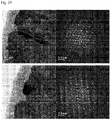
- FIG. 6 is a Scanning Transmission Electron Microscope (STEM) picture of the positive active material according to Example 1-1 of the present invention.
- a and b of FIG. 6 are the dark field STEM images of the positive active material according to Example 1-1 of the present invention, and it can be seen that a particle core having no pore is formed of equiaxed crystals, but the thin and long primary particles arranged in a radius direction are packed at a high density at the vicinity of the surface.
- FIG. 6 is the bright field TEM image, and it can be seen that the primary particle has a width of about 200 nm and a length of 1 to 2 ⁇ m.
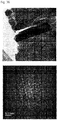
- FIG. 7 is a diagram for describing a TEM picture, an ED pattern, and a lithium layer of the positive active material according to Example 1-1 of the present invention
- FIG. 8 is a TEM picture and an ED pattern of the positive active material according to Example 1-1 of the present invention
- FIG. 9 is a diagram of ED patterns of the positive active materials according to Comparative Example 1 and Example 1-1 of the present invention.
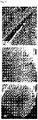
- FIGS. 7 to 9 as illustrated in b of FIG. 7 , it can be seen a crystallographic arrangement of the primary particles having a needle shape (rod shape) by the bright field TEM and an electron diffraction pattern of [010] zone.
- a growth direction in the a-axis of the primary particle may follow the a-axis and the primary particle may be oriented to be parallel to the radius direction of the secondary particle.
- the positive active material is changed to a highly anisotropic form by the zirconium doping, which may be due to the change of the surface energy of LiNiO 2 .
- the Li plane of the R 3 ⁇ m structure in which the first lithium layers (for example, the layer fully filled with Li) and the second lithium layers (for example, the layer half filled with Li) are alternately arranged, according to the exemplary embodiment of the present invention may generate a superlattice having a value of two times of the lattice constant of original LiNiO 2 in which positive ions are arranged.
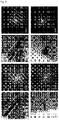
- an electron diffraction pattern of 2 2 ⁇ 1 zone was observed from another primary particle.
- the spots indexed with 1 / 20 1 ⁇ and 0 1 ⁇ / 2 1 ⁇ may correspond to the superlattice peak represented in b of FIG. 7 .
- the superlattice diffraction pattern may be observed in the vicinity of the primary particle adjacent to the surface of LiNiO 2 doped with zirconium.
- FIG. 10 is a diagram for describing an ED pattern and an atomic arrangement of the positive active material according to Example 1-1 of the present invention
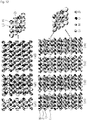
- FIG. 11 is a diagram for describing an atomic structure and formation energy of the positive active material according to Example 1-1 of the present invention
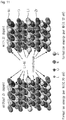
- FIG. 12 is a diagram for describing an atomic structure according to a concentration of Zr in the positive active material according to Example 1-1 of the present invention
- FIG. 13 is a diagram for describing a possible arrangement structure of lithium and nickel and energy according to the arrangement structure in the positive active material according to Example 1-1 of the present invention
- FIG. 14 is a graph for describing a lattice constant of the positive active materials according to Example 1-1 and Comparative Example 1 of the present invention
- FIG. 15 is a diagram for describing modelling for a calculation of a lattice constant of the positive active material according to Example 1-1 of the present invention.
- FIGS. 10 to 15 a plurality of twined crystals was observed in LiNiO 2 doped with zirconium according to Example 1-1 of the present invention.
- an electron diffraction pattern is seen in [010] zone of the twined crystal.
- a pair of diffraction spots in the pattern may be explained from the spots in [010] zone that is a mirror image of (001) plane for forming a set of diffraction pattern of 0 1 ⁇ 0 zone as illustrated.
- a pair of surplus peaks by the arrangement of the positive ions is seen in the twined crystal diffraction pattern.
- the schematic diagram of the twined crystal representing a mirror image of 10 2 ⁇ surface in b of FIG. 10 , it can be clearly seen the twined crystal structure having (001) surface as a twined crystal boundary.
- the twined crystal may be formed by the arrangement of the positive ions, and the arrangement of the positive ions is not observed in LiNiO 2 according to Comparative Example 1, so that it can be seen that the positive ions are arranged in LiNiO 2 by Zr ions.
- the Ni ion is substituted with the Zr ion, the exchange energy is still low in the doping structure, compared to the pristine structure.
- the feature that the Li-Ni mutual substitution by Zr induces the alignment structure of the positive ions can be proved by calculating the total energy of the possible composition of [Li 0.75 Ni 0.25 ] 3a [Li 0.75 Ni 0.25 ] 3b O 2 having the structure in which the Ni and Li positive ions are not arranged (see FIG. 13 ). It can be seen that the total energy calculated in almost all non-arranged structure is larger than the total energy in the arranged structures.
- 16 meV is more advantageous compared to the structure in which only one composition is arranged, and it is identified that this is because energy is obtained by the interchange between Li + positive ions having a smaller charge and Li 3+ positive ions at a short distance with the Li + positive ions.
- the effect in the narrow zone is limited only to the positive ions in the vicinity of the dopant, so that the arrangement of the positive ions in a broad zone in the doped structure is impossible.
- a lattice constant calculated from the different ratios of Li-Ni interchange shows that the a and c constants decrease as the ratio of the Li-Ni exchange in pristine LiNiO 2 increases. However, the a constant represents a value exceeding 12.5%.
- the c constant linearly decreases with respect to all of the Li-Ni interchange concentrations. Further, in a percentage value, it can be seen that the relative decrease in the a constant is large compared to the c constant.
- a lattice dimension is expanded according to an increase in the concentration of Zr substituted with Li.
- Two dopant distributions that is, as can be seen in a and b of FIG. 14 , the Zr-Zr separation is large in the a-b plane, but is small along the c-axis, and as can be seen in c and d of FIG. 14 , the Zr-Zr separation is large in the a-b plane, but is large along the c-axis, were considered.
- the calculated lattice constant is 2.92 ⁇ in the a-axis and 14.19 ⁇ in the c-axis, and is 2.91 ⁇ in the a-axis and 14.20 ⁇ in the c-axis for [Li 0.98 Ni 0.02 ] 3a [Li 0.98 Ni 0.02 ] 3b O 2 and [Zr 0.0625 Li 0.6875 Ni 0.25 ] 3a [N 0.75 Li 0.25 ] 3b O 2 , respectively.
- Delithiation energy per Li decreases with increasing delithiation in the first case, but there is no significant change to the second and third cases.
- delithiation energy is higher in pristine compared to the interchange case and the zirconium doping case, it can be seen that in the high-level delithiation, the delithiation energy is similar in all three cases. This shows that the zirconium doped structure has similar stability to that of the zirconium undoped structure with or without the Li-Ni interchange of 2%.
- model 1 the possibility of Li vacancy formation is obtained by removing three Li in the layer in which Zr is located ([Zr 0.0625 Li 0.50 Ni 0.25 ] 3a [N 0.75 Li 0.25 ] 3b O 2 (described as model 2)).
- model 2 the change of the Zr 4+ dopant is compensated by the replaced Li + and three LI + vacancies.
- the a and b constant values for model 2 correspond to the experimental result compared to model 1.
- the c constant shows a large value compared to model 1, and the value corresponds well to the experimental value.
- a deviation of the lattice constants calculated in model 1 and model 2 from the experimental value is less than 1.04%.
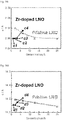
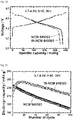
- FIGS. 16A, 16B , and 16C are graphs for describing a capacity characteristic, a life characteristic, and a rate capability of the positive active materials according to Example 1-1 and Comparative Example 1 of the present invention
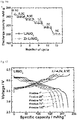
- FIG. 17 is a graph for describing a capacity characteristic according to the number of times of charge/discharge of the positive active material according to Comparative Example 1 of the present invention
- FIG. 18 is a graph for describing a capacity characteristic according to the number of times of charge/discharge of the positive active material according to Example 1-1 of the present invention.
- half cells were manufactured by using the positive active materials according to Example 1-1 and Comparative Example 1, a discharge capacity was measured under the condition of cut off 2.7 to 4.3V and 0.1C, a life characteristic was measured under the condition of cut off 2.7 to 4.3V and 0.5C, and a rate capability was measured.
- an initial discharge capacity of a lithium secondary battery including the positive active materials according to Comparative Example 1 and Example 1-1 is ideal with Coulombic efficiency of about 97%.
- the initial discharge capacity was measured as 247.5 mAh/g in Comparative Example 1 and 246.5 mAh/g in Example 1-1.
- the discharge capacity of the positive active material according to Comparative Example 1 rapidly decreases compared to an initial cycle, but the positive active material according to Example 1-1 doped with zirconium maintains a stable state. That is, referring to FIG. 16A , it can be seen that the positive ion arrangement (that is, the interchange of the Li and Ni ions) has little effect on the de-intercalation/insertion of Li.
- the Li migration may be facilitated by the arrangement of the primary particles arranged from the center portion toward the surface portion of the secondary particle, and as can be seen in the cycle performance illustrated in FIG. 16B , it can be seen that the zirconium doping has excellent cycle stability.
- a discharge capacity of a LiNiO 2 positive electrode doped with zirconium according to Example 1-1 maintains 81% of the initial discharge capacity after 100 cycles at 0.5C (90 mA/g), but a discharge capacity of the positive active material according to Comparative Example 1 was measured to be 74% of the initial discharge capacity for the same cycle.
- a capacity maintenance rate of the positive active material according to Comparative Example 1 shows 82.0% in 5 C, and the positive active material doped with zirconium according to Example 1-1 was measured to be 81% in 0.1 C.
- FIG. 19 is a graph illustrating measured capacity characteristics of lithium secondary batteries including the positive active materials according to Examples 1-1 to 1-3 and Comparative Example 1 of the present invention
- FIG. 20 is a graph illustrating measured life characteristics of lithium secondary batteries including the positive active materials according to Examples 1-1 to 1-3 and Comparative Example 1 of the present invention.
- half cells were manufactured by using the positive active materials according to Examples 1-1 to 1-3 and Comparative Example 1, a discharge capacity was measured under the condition of cut off 2.7 to 4.3V and 0.1 C, and a capacity change according to the number of times of the charge/discharge cycle was measured under the condition of cut off 2.7 to 4.3V, 0.5 C, and a temperature of 30°C.
- LNO Pristine means the positive active material according to Comparative Example 1
- LNO Zr 0.5 mol% means the positive active material according to Example 1-1
- LNO Zr 1.0 mol% means the positive active material according to Example 1-2
- LNO Zr 2.0 mol% means the positive active material according to Example 1-3.
- FIGS. 19 and 20 it can be seen that as the charge/discharge process is performed, the capacity of the lithium secondary battery including the positive active material according to Comparative Example 1 is decreased, but the decrease in the capacity of the lithium secondary batteries including the positive active materials according to Examples 1-1 and 1-2 is significantly little. That is, it can be seen that the manufacturing of the lithium secondary battery by using the positive active material doped with zirconium is the effective method of improving a life characteristic.
- Example 1-3 in which a doping concentration of zirconium is 2.0 mol%, the life characteristic improvement effect of the positive active materials according to Examples 1-1 and 1-2, in which the doping concentrations of zirconium are 0.5 mol% and 1.0 mol%, respectively, is significantly excellent. That is, it can be seen that the control of the doping concentration of zirconium to be less than 2.0 mol% is the efficient method of improving the life characteristic and the charge/discharge characteristic.
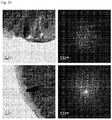
- FIG. 21 is a TEM picture and a diagram illustrating an ED pattern of a positive active material according to Example 2 of the present invention.
- the positive active material doped with titanium according to Example 2 of the present invention was captured by using a TEM and an ED pattern image was checked.
- a superlattice is generated by the substitution of a transition metal (nickel) with lithium in a lithium layer and surplus peaks are generated.
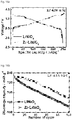
- FIG. 22 is a graph illustrating measured capacity characteristics of lithium secondary batteries including the positive active materials according to Example 2 and Comparative Example 1 of the present invention
- FIG. 23 is a graph illustrating measured life characteristics of lithium secondary batteries including the positive active materials according to Example 2 and Comparative Example 1 of the present invention
- a half cell was manufactured by using the positive active material according to Example 2, a discharge capacity was measured under the condition of cut off 2.7 to 4.3V and 0.1 C, and a capacity change according to the number of times of the charge/discharge cycle was measured under the condition of cut off 2.7 to 4.3V, 0.5 C, and a temperature of 30°C.
- LiNiO 2 means the positive active material according to Comparative Example 1
- Ti-LiNiO 2 means the positive active material according to Example 2.
- Example 2 241.8 97.3% 237.1 98.0% 228.4 94.4% 84.4% (100cycle)
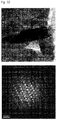
- FIG. 24 is a TEM picture and a diagram illustrating an ED pattern of a positive active material according to Example 3 of the present invention.
- the positive active material doped with tungsten according to Example 3 of the present invention was captured by using a TEM and an ED pattern image was checked. As can be seen in FIG. 24 , it can be seen that a superlattice is generated by the substitution of a transition metal (nickel) with lithium in a lithium layer and surplus peaks are generated.
- FIG. 25 is a graph illustrating capacity characteristics of lithium secondary batteries including the positive active materials according to Example 3 and Comparative Example 3 of the present invention measured under a condition of 2.7 to 4.3 V
- FIG. 26 is a graph illustrating life characteristics of lithium secondary batteries including the positive active materials according to Example 3 and Comparative Example 3 of the present invention measured under a condition of 2.7 to 4.3 V
- FIG. 27 is a graph illustrating capacity characteristics of lithium secondary batteries including the positive active materials according to Example 3 and Comparative Example 3 of the present invention measured under a condition of 2.7 to 4.5 V
- FIG. 28 is a graph illustrating life characteristics of lithium secondary batteries including the positive active materials according to Example 3 and Comparative Example 3 of the present invention measured under a condition of 2.7 to 4.3 V.
- half cells were manufactured by using the positive active materials according to Example 3 and Comparative Example 3, a discharge capacity was measured under the condition of cut off 2.7 to 4.3V, 2.7 to 4.5V, 0.1C, and a temperature of 30°C, and a capacity change according to the number of times of the charge/discharge cycle was measured under the condition of cut off 2.7 to 4.3V, 2.7 to 4.5V, 0.5C, and a temperature of 30°C.
- NC9010 means the positive active material according to Comparative Example 3 and NCW891001 means the positive active material according to Example 3.
- Table 4 is the result obtained under the condition of 2.7 to 4.3V and Table 5 is the result obtained under the condition of 2.7 to 4.5V.
- Table 4 Classification 0.1C, 1 st Dis-Capa (mAh/g) 1 st Efficiency 0.2C Capacity (mAh/g) 0.2C/0.1C 0.5C Capacity (mAh/g) 0.5C/0.1C 0.5C Cycle Retention Comparative Example 3 229.1 96.2% 224.2 97.8% 214.9 93.8% 83.6% (100cycle) Example 3 221.1 94.1% 216.6 98.0% 207.3 93.8% 98.8% (100cycle) [Table 5] Classification 0.1C, 1 st Dis-Capa (mAh/g) 1 st Efficiency 0.2C Capacity (mAh/g) 0.2C/0.1C 0.5C Capacity (mAh/g) 0.5C/0.1C 0.5C Cycle Retention Comparative Example 3 239.1 99.3% 231.7 96.9% 220.0 92.0% 77.
- FIG. 29 is a TEM picture and a diagram illustrating an ED pattern of a positive active material according to Example 4 of the present invention.
- the positive active material doped with tungsten according to Example 4 of the present invention was captured by using a TEM and an ED pattern image was checked.
- a superlattice is generated by the substitution of a transition metal (nickel) with lithium in a lithium layer and surplus peaks are generated.
- FIG. 30 is a graph illustrating measured capacity characteristics of lithium secondary batteries including the positive active materials according to Example 4 and Comparative Example 4 of the present invention
- FIG. 31 is a graph illustrating measured life characteristics of lithium secondary batteries including the positive active materials according to Example 4 and Comparative Example 4 of the present invention.
- half cells were manufactured by using the positive active materials according to Example 4 and Comparative Example 4, a discharge capacity was measured under the condition of cut off 2.7 to 4.3V, 0.1C, and a temperature of 30°C, and a capacity change according to the number of times of the charge/discharge cycle was measured under the condition of cut off 2.7 to 4.3V, 0.5C, and a temperature of 30°C.
- NCM940303 means the positive active material according to Comparative Example 4 and W-NCM940303 means the positive active material according to Example 4.
- [Table 6] Classification 0.1C, 1 st Dis-Capa (mAh/g) 1 st Efficiency 0.2C Capacity (mAh/g) 0.2C/0.1C 0.5C Capacity (mAh/g) 0.5C/0.1C 0.5C Cycle Retention Comparative Example 4 236.9 96.2% 231.9 97.9% 222.4 93.9% 87.4% (100cycle)
- FIG. 32 is a TEM picture and a diagram illustrating an ED pattern of a positive active material according to Example 5 of the present invention.
- the positive active material doped with tungsten according to Example 5 of the present invention was captured by using a TEM and an ED pattern image was checked. As can be seen in FIG. 32 , it can be seen that a superlattice is generated by the substitution of a transition metal (nickel) with lithium in a lithium layer and surplus peaks are generated.
- FIG. 33 is a graph illustrating measured capacity characteristics of lithium secondary batteries including the positive active materials according to Example 5 and Comparative Example 5 of the present invention
- FIG. 34 is a graph illustrating measured life characteristics of lithium secondary batteries including the positive active materials according to Example 5 and Comparative Example 5 of the present invention
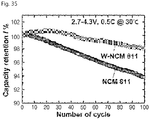
- FIG. 35 is a graph illustrating a capacity maintenance rate by normalizing the capacity in the y-axis of FIG. 34 in a percentage.
- half cells were manufactured by using the positive active materials according to Example 5 and Comparative Example 5, a discharge capacity was measured under the condition of cut off 2.7 to 4.3V and 0.1C, and a capacity change according to the number of times of the charge/discharge cycle was measured under the condition of cut off 2.7 to 4.3V, 0.5C, and a temperature of 30°C, and a capacity maintenance rate was calculated.
- NCM811 means the positive active material according to Comparative Example 5
- W-NCM811 means the positive active material according to Example 5.
- [Table 7] Classification 0.1C, 1 st Dis-Capa (mAh/g) 1 st Efficiency 0.2C Capacity (mAh/g) 0.2C/0.1C 0.5C Capacity (mAh/g) 0.5C/0.1C 0.5C Cycle Retention Comparative Example 5 216.2 95.7% 210.7 97.5% 200.5 92.7% 93.8% (100cycle)
- FIG. 36 is a TEM picture and a diagram illustrating an ED pattern of a positive active material according to Example 6 of the present invention.
- the positive active material doped with aluminum according to Example 6 of the present invention was captured by using a TEM and an ED pattern image was checked.
- a superlattice is generated by the substitution of a transition metal (nickel) with lithium in a lithium layer and surplus peaks are generated.
- FIG. 37 is a graph illustrating measured capacity characteristics of lithium secondary batteries including the positive active materials according to Example 6 and Comparative Example 6 of the present invention
- FIG. 38 is a graph illustrating measured life characteristics of lithium secondary batteries including the positive active materials according to Example 6 and Comparative Example 6 of the present invention.
- half cells were manufactured by using the positive active materials according to Example 6 and Comparative Example 6, a discharge capacity was measured under the condition of cut off 2.7 to 4.3V and 0.1C, and a capacity change according to the number of times of the charge/discharge cycle was measured under the condition of cut off 2.7 to 4.3V, 0.5C, and a temperature of 30°C.
- NCM90 means the positive active material according to Comparative Example 6 and CSG NCA-NCMA 90 means the positive active material according to Example 6.
- CSG NCA-NCMA 90 means the positive active material according to Example 6.
- Table 8 Classification 0.1C, 1 st Dis-Capa (mAh/g) 1 st Efficiency 0.5C Capacity (mAh/g) 0.5C/0.1C 0.5C Cycle Retention Comparative Example 6 272.2 95.0% 212.1 93.3% 85.2% (100cycle)
- Example 6 224.6 96.1% 207.3 92.3% 96.1% (100cycle)
- FIG. 39 is a TEM picture and a diagram illustrating an ED pattern of a positive active material according to Example 7 of the present invention.
- the positive active material doped with boron according to Example 7 of the present invention was captured by using a TEM and an ED pattern image was checked.
- FIG. 36 it can be seen that a superlattice is generated by the substitution of a transition metal (nickel) with lithium in a lithium layer and surplus peaks are generated.
- FIG. 40 is a graph illustrating capacity characteristics of lithium secondary batteries including the positive active materials according to Example 7 and Comparative Example 6 of the present invention measured at 30°C
- FIG. 41 is a graph illustrating life characteristics of lithium secondary batteries including the positive active materials according to Example 7 and Comparative Example 6 of the present invention measured at 30°C
- FIG. 42 is a graph illustrating capacity characteristics of lithium secondary batteries including the positive active materials according to Example 7 and Comparative Example 6 of the present invention measured at 55°C
- FIG. 43 is a graph illustrating life characteristics of lithium secondary batteries including the positive active materials according to Example 7 and Comparative Example 6 of the present invention measured at 55°C.
- half cells were manufactured by using the positive active materials according to Example 7 and Comparative Example 6, a discharge capacity was measured under the condition of cut off 2.7 to 4.3V, 0.1C, and temperatures of 30°C and 50°C, and a capacity change according to the number of times of the charge/discharge cycle was measured under the condition of cut off 2.7 to 4.3V, 0.5C, and temperatures of 30°C and 50°C.
- NCM90 means the positive active material according to Comparative Example 6 and B-NCM 90 means the positive active material according to Example 7.
- Table 9 represents the measurement result obtained at 30°C
- Table 10 represents the measurement result obtained at 55°C.
- the positive active material according to the exemplary embodiment of the present invention, the method of preparing the same, a lithium secondary battery including the same are applicable to an electric vehicle, an ESS, and a portable electronic device.
Landscapes
- Chemical & Material Sciences (AREA)
- Chemical Kinetics & Catalysis (AREA)
- Electrochemistry (AREA)
- General Chemical & Material Sciences (AREA)
- Inorganic Chemistry (AREA)
- Engineering & Computer Science (AREA)
- Organic Chemistry (AREA)
- Materials Engineering (AREA)
- Manufacturing & Machinery (AREA)
- Composite Materials (AREA)
- Battery Electrode And Active Subsutance (AREA)
Abstract
Description
- This application is a continuation of pending International Application No.
PCT/KR2019/000559 10-2018-0004416 10-2019-0004863 - The present application relates to a positive active material, a method of preparing the same, and a lithium secondary battery including the same, and more particularly, to a positive active material in which zirconium is doped, a method of preparing the same, and a lithium secondary battery including the same.
- With the development of portable mobile electron devices, such as a smart phone, an MP3 player, and a tablet PC, the demand for secondary batteries capable of storing electric energy is explosively increasing. Particularly, with the advent of electric vehicles, medium and large energy storing systems, and portable devices requiring high energy density, the demand for lithium secondary batteries is increasing.
- As such, the demand for the lithium secondary batteries increases, so that research and development of positive active materials used in the lithium secondary batteries is in progress. For example, Korean Patent Application Publication No.
10-2014-0119621 10-2013-0150315 - An technical object to be solved by the present application is to provide a high-capacity positive active material, a method of preparing the same, and a lithium secondary battery including the same.
- Another technical object to be solved by the present application is to provide a positive active material having long life, a method of preparing the same, and a lithium secondary battery including the same.
- Another technical object to be solved by the present application is to provide a high-stable positive active material, a method of preparing the same, and a lithium secondary battery including the same.
- Another technical object to be solved by the present application is to provide a positive active material in which a life shortening characteristic according to the number of times of charge/discharge is minimized, a method of preparing the same, and a lithium secondary battery including the same.
- The technical objects to be solved by the present application are not limited to the foregoing.
- In order to solve the technical problem, the present application provides a positive active material.
- According to an exemplary embodiment, the positive active material in which a compound containing lithium, a transition metal, and oxygen is doped with a doping metal includes lithium (Li) layers, in which the lithium layers may include a first lithium layer including only lithium and a second lithium layer in which at least a part of the lithium of the first lithium layer is substituted with a transition metal.
- According to the exemplary embodiment, substitution energy of the lithium and the transition metal may be decreased by the doping metal, so that a part of the lithium of the first lithium layer may be substituted with the transition metal.
- According to the exemplary embodiment, the first lithium layer and the second lithium layer may be alternately and repeatedly arranged.
- According to the exemplary embodiment, the doping metal may include at least one of zirconium, boron, titanium, and tungsten.
- According to the exemplary embodiment, the doping metal may include zirconium, and zirconium may be less than 2 mol%.
- According to the exemplary embodiment, the transition metal may be nickel, and a concentration of nickel may be 79 mol% or more.
- According to the exemplary embodiment, a superlattice may be provided by the second lithium layer in which at least the part of the lithium of the first lithium layer is substituted with the transition metal.
- According to the exemplary embodiment, in the second lithium layer, a half of the lithium of the first lithium layer may be substituted with the transition metal.
- According to the exemplary embodiment, the positive active material may include a first lithium layer in which lithium is regularly arranged, and a second lithium layer in which lithium and a transition metal are regularly arranged, in which a superlattice may be formed by the first lithium layer and the lithium and the transition metal included in the first lithium layer.
- According to the exemplary embodiment, the superlattice may include six lithium atoms and one transition metal element.
- According to the exemplary embodiment, the lithium and the transition metal may be alternately arranged in the second lithium layer, and the first lithium layer and the second lithium layer may be alternately arranged.
- According to the exemplary embodiment, the second lithium layer may be identified with an electron diffraction pattern in [010] zone.
- In order to solve the technical problem, the present invention provides a method of preparing a positive active material.
- According to an exemplary embodiment, the method may include: preparing a positive active material precursor including a hydroxide including a transition metal and a doping metal by using a transition metal precursor and a doping metal precursor; and preparing a positive active material in which a compound containing lithium, the transition metal, and oxygen is doped with the doping metal by mixing and calcining the positive active material precursor and lithium salt, in which the doping metal in the positive active material precursor may be less than 2 mol%.
- According to the exemplary embodiment, the doping metal may include at least one of zirconium, boron, titanium, and tungsten.
- According to the exemplary embodiments, the positive active material in which a compound containing lithium, a transition metal, and oxygen is doped with a doping metal includes lithium (Li) layers, in which the lithium layers may include a first lithium layer including only lithium and a second lithium layer in which at least a part of the lithium of the first lithium layer is substituted with a transition metal.
- A superlattice may be formed by the first lithium layer and the lithium and the transition metal included in the second lithium layer, thereby providing the positive active material in which a life shortening characteristic is minimized in a high-nickel positive active material.
-
-
FIG. 1 is a flowchart for describing a method of preparing a positive active material according to an exemplary embodiment of the present invention. -
FIG. 2 is a diagram for describing a positive active material according to an exemplary embodiment of the present invention. -
FIG. 3 is a diagram taken along line A-B ofFIG. 2 . -
FIG. 4 is a picture of a Scanning Electron Microscope (SEM) of positive active materials according to Comparative Example 1 and Example 1-1 of the present invention. -
FIGS. 5A and5B are graphs of X-ray Diffraction (XRD) measurement results of the positive active materials according to Comparative Example 1 and Example 1-1 of the present invention. -
FIG. 6 is a Scanning Transmission Electron Microscope (STEM) picture of the positive active material according to Example 1-1 of the present invention. -
FIG. 7 is a diagram for describing a TEM picture, an ED pattern, and a lithium layer of the positive active material according to Example 1-1 of the present invention. -
FIG. 8 is a TEM picture and an ED pattern of the positive active material according to Example 1-1 of the present invention. -
FIG. 9 is a diagram of ED patterns of the positive active materials according to Comparative Example 1 and Example 1-1 of the present invention. -
FIG. 10 is a diagram for describing an ED pattern and an atomic arrangement of the positive active material according to Example 1-1 of the present invention. -
FIG. 11 is a diagram for describing an atomic structure and formation energy of the positive active material according to Example 1-1 of the present invention. -
FIG. 12 is a diagram for describing an atomic structure according to a concentration of Zr in the positive active material according to Example 1-1 of the present invention. -
FIG. 13 is a diagram for describing a possible arrangement structure of lithium and nickel and energy according to the arrangement structure in the positive active material according to Example 1-1 of the present invention. -
FIG. 14 is a graph for describing a lattice constant of the positive active materials according to Example 1-1 and Comparative Example 1 of the present invention. -
FIG. 15 is a diagram for describing modelling for a calculation of a lattice constant of the positive active material according to Example 1-1 of the present invention. -
FIGS. 16A, 16B , and16C are graphs for describing a capacity characteristic, a life characteristic, and a rate capability of the positive active materials according to Example 1-1 and Comparative Example 1 of the present invention. -
FIG. 17 is a graph for describing a capacity characteristic according to the number of times of charge/discharge of the positive active material according to Comparative Example 1 of the present invention. -
FIG. 18 is a graph for describing a capacity characteristic according to the number of times of charge/discharge of the positive active material according to Example 1-1 of the present invention. -
FIG. 19 is a graph illustrating measured capacity characteristics of lithium secondary batteries including the positive active materials according to Examples 1-1 to 1-3 and Comparative Example 1 of the present invention. -
FIG. 20 is a graph illustrating measured life characteristics of lithium secondary batteries including the positive active materials according to Examples 1-1 to 1-3 and Comparative Example 1 of the present invention. -
FIG. 21 is a TEM picture and a diagram illustrating an ED pattern of a positive active material according to Example 2 of the present invention. -
FIG. 22 is a graph illustrating measured capacity characteristics of lithium secondary batteries including the positive active materials according to Example 2 and Comparative Example 1 of the present invention. -
FIG. 23 is a graph illustrating measured life characteristics of lithium secondary batteries including the positive active materials according to Example 2 and Comparative Example 1 of the present invention. -
FIG. 24 is a TEM picture and a diagram illustrating an ED pattern of a positive active material according to Example 3 of the present invention. -
FIG. 25 is a graph illustrating capacity characteristics of lithium secondary batteries including the positive active materials according to Example 3 and Comparative Example 3 of the present invention measured under a condition of 2.7 to 4.3 V. -
FIG. 26 is a graph illustrating life characteristics of lithium secondary batteries including the positive active materials according to Example 3 and Comparative Example 3 of the present invention measured under a condition of 2.7 to 4.3 V. -
FIG. 27 is a graph illustrating capacity characteristics of lithium secondary batteries including the positive active materials according to Example 3 and Comparative Example 3 of the present invention measured under a condition of 2.7 to 4.5 V. -
FIG. 28 is a graph illustrating life characteristics of lithium secondary batteries including the positive active materials according to Example 3 and Comparative Example 3 of the present invention measured under a condition of 2.7 to 4.3 V. -
FIG. 29 is a TEM picture and a diagram illustrating an ED pattern of a positive active material according to Example 4 of the present invention. -
FIG. 30 is a graph illustrating measured capacity characteristics of lithium secondary batteries including the positive active materials according to Example 4 and Comparative Example 4 of the present invention. -
FIG. 31 is a graph illustrating measured life characteristics of lithium secondary batteries including the positive active materials according to Example 4 and Comparative Example 4 of the present invention. -
FIG. 32 is a TEM picture and a diagram illustrating an ED pattern of a positive active material according to Example 5 of the present invention. -
FIG. 33 is a graph illustrating measured capacity characteristics of lithium secondary batteries including the positive active materials according to Example 5 and Comparative Example 5 of the present invention. -
FIG. 34 is a graph illustrating measured life characteristics of lithium secondary batteries including the positive active materials according to Example 5 and Comparative Example 5 of the present invention. -
FIG. 35 is a graph illustrating measured retention characteristics of lithium secondary batteries including the positive active materials according to Example 5 and Comparative Example 5 of the present invention. -
FIG. 36 is a TEM picture and a diagram illustrating an ED pattern of a positive active material according to Example 6 of the present invention. -
FIG. 37 is a graph illustrating measured capacity characteristics of lithium secondary batteries including the positive active materials according to Example 6 and Comparative Example 6 of the present invention. -
FIG. 38 is a graph illustrating measured life characteristics of lithium secondary batteries including the positive active materials according to Example 6 and Comparative Example 6 of the present invention. -
FIG. 39 is a TEM picture and a diagram illustrating an ED pattern of a positive active material according to Example 7 of the present invention. -
FIG. 40 is a graph illustrating capacity characteristics of lithium secondary batteries including the positive active materials according to Example 7 and Comparative Example 6 of the present invention measured at 30°C. -
FIG. 41 is a graph illustrating life characteristics of lithium secondary batteries including the positive active materials according to Example 7 and Comparative Example 6 of the present invention measured at 30°C. -
FIG. 42 is a graph illustrating capacity characteristics of lithium secondary batteries including the positive active materials according to Example 7 and Comparative Example 6 of the present invention measured at 55°C. -
FIG. 43 is a graph illustrating life characteristics of lithium secondary batteries including the positive active materials according to Example 7 and Comparative Example 6 of the present invention measured at 55°C. - Hereinafter, the exemplary embodiments of the present invention will be described with reference to the accompanying drawings. However, the technical spirit of the present invention is not limited to the exemplary embodiments described herein, but may also be implemented in other forms. Rather, the embodiments introduced herein are provided so as to make the disclosed contents be thorough and complete and to fully transfer the spirit of the present invention to those skilled in the art.
- In the present specification, when it is said that one constituent element is formed on another constituent element, the constituent element may be directly formed on another constituent element, or may be formed on the another constituent element with a third constituent element interposed therebetween. Further, in the drawings, thicknesses of layers and regions are exaggerated for the effective description of the technical contents.
- Further, in the various exemplary embodiments of the present specification, although terms, such as "a first", "a second", and "a third", are used for describing various constituent elements, but the constituent elements are not limited by the terms. The terms are simply used for discriminating one constituent element from another constituent element. Accordingly, a first constituent element mentioned in any one exemplary embodiment may also be mentioned as a second constituent element in another exemplary embodiment. Each exemplary embodiment described and exemplified herein also includes a complementary exemplary embodiment thereof. Further, in the present specification, the term "and/or" is used as a meaning including at least one among the constituent elements listed before and after.
- Singular expressions used herein include plurals expressions unless they have definitely opposite meanings in the context. It will be appreciated that terms "including" and "having" are intended to designate the existence of characteristics, numbers, steps, constituent elements, and a combination thereof described in the specification, and do not exclude a possibility of the existence or addition of one or more other characteristics, numbers, steps, constituent elements, or a combination thereof.
- Further, in the following description of the present invention, when a detailed description of a related publicly known function or configuration is determined to unnecessarily make the subject matter of the present invention unclear, the detailed description thereof will be omitted.
- Further, in the specification of the present application, a crystal system may consist of seven systems including a triclinic system, a monoclinic system, an orthorhombic system, a tetragonal system, a trigonal or rhombohedral system, a hexagonal system, and a cubic system.
- Further, in the specification of the present application, "mol%" is interpreted to mean the content of predetermined element included in a positive active material or a positive active material precursor when it is assumed that the sum of remaining elements excluding lithium, oxygen, and hydrogen in the positive active material or the positive active material precursor is 100%.
-
FIG. 1 is a flowchart for describing a method of preparing a positive active material according to an exemplary embodiment of the present invention,FIG. 2 is a diagram for describing a positive active material according to an exemplary embodiment of the present invention, andFIG. 3 is a diagram taken along line A-B ofFIG. 2 . - Referring to
FIGS. 1 to 3 , a positiveactive material 100 according to the exemplary embodiment of the present invention may include a material in which a compound containing nickel, lithium, and oxygen is doped with a doping metal. For example, the positiveactive material 100 may be the material in which a compound of lithium, nickel, and oxygen is doped with a doping metal, the material in which a compound of lithium, nickel, cobalt, and oxygen is doped with a doping metal, the material in which a compound of lithium, nickel, cobalt, manganese, and oxygen is doped with a doping metal, and or the material in which a compound of lithium, nickel, cobalt, aluminum, and oxygen is doped with a doping metal. - For example, the doping metal may include at least one of zirconium, boron, titanium, and tungsten. Further, when the doping metal is zirconium, a concentration of zirconium in the positive
active material 100 may be less than 2 mol%. Accordingly, a charge/discharge characteristic and a life characteristic of a lithium secondary battery including the positiveactive material 100 may be improved. In contrast, when a concentration of zirconium is 2 mol% or more, a charge/discharge characteristic and a life characteristic of a lithium secondary battery may deteriorate. - According to an exemplary embodiment, a concentration of at least one of nickel, cobalt, manganese, and aluminum may be substantially constant in the positive
active material 100. Otherwise, according to another exemplary embodiment, a concentration of at least one of nickel, cobalt, manganese, and aluminum in the positiveactive material 100 may have, from a center of a particle to a surface of the particle, a concentration gradient in the entire particle or a concentration gradient in a part of the particle. Otherwise, according to another exemplary embodiment, the positiveactive material 100 may include a core portion and a shell portion having a different concentration of metal (at least one of nickel, cobalt, manganese, and aluminum) from that of the core portion. The technical spirit according to the exemplary embodiment of the present invention may be applied to the positive active materials having various structures and forms. - The positive active material may include
primary particles 30 and a secondary particle in which theprimary particles 30 are agglomerated. Theprimary particles 30 may be extended in a direction in which theprimary particles 30 are radiated from one region of an inner portion of the secondary particle to asurface portion 20 of the secondary particle. The one region in the inner portion of the secondary particle may be acenter portion 10 of the secondary particle. That is, theprimary particle 30 may have a rod shape extended from the one region of the inner portion of the secondary particle to thesurface portion 20 of the secondary particle. - According to the exemplary embodiment, the
primary particle 30 relatively adjacent to thesurface portion 20 of the secondary particle may have a longer length in a direction from thecenter portion 10 of the inner portion of the secondary particle to thesurface portion 20 of the secondary particle than theprimary particle 30 relatively adjacent to thecenter portion 10 of the inner portion of the secondary particle. That is, in at least a part of the secondary particle extended from thecenter portion 10 to thesurface portion 20 of the secondary particle, the lengths of theprimary particles 30 may increase as theprimary particles 30 are adjacent to thesurface portion 20 of the secondary particle. - An a-axis of a crystal structure of the
primary particle 30 may be arranged to be parallel to the direction from thecenter portion 10 to thesurface portion 20 of the secondary particle. Accordingly, a movement path of metal ions (for example, lithium ions) and an electrolyte may be provided between the spaces between theprimary particles 30 having the rod shapes, that is, the spaces between theprimary particles 30 extended in a direction D from thecenter portion 10 to thesurface portion 20 of the secondary particle. Accordingly, charge/discharge efficiency of a secondary battery including the positive active material according to the exemplary embodiment of the present invention may be improved. - The positive
active material 100 may be the material in which the compound containing lithium, a transition metal, and oxygen is doped with the doping metal as described above. In this case, the positiveactive material 100 may include lithium (Li) layers, and the lithium layers may include a first lithium layer and a second lithium layer. The first lithium layer may be a layer including only a lithium atom in an atomic arrangement structure of the positiveactive material 100, and the second lithium layer may be provided by substituting at least a part of the lithium of the first lithium layer with the transition metal. That is, by the doping of the doping metal, substitution energy of the lithium and the transition metal is decreased, and thus a part of the lithium of some first lithium layers in the plurality of first lithium layers is substituted with the transition metal, so that the second lithium layer may be provided. - The first lithium layer may be a fully Li-occupied layer in which only lithium is regularly arranged, and the second lithium layer may be a half Li-occupied layer in which a half of lithium is substituted with the transition metal in the first lithium layer, and lithium and the transition metal may be regularly arranged.
- The first lithium layer and the second lithium layer are alternately and repeatedly arranged, so that a superlattice may be formed by the first lithium layer and the lithium and the transition metal included in the first lithium layer. The superlattice may be formed of six lithium atoms and one transition metal element.
- As described above, when the part of the lithium of the pure lithium layer is substituted with the transition metal and an anti-site is generated, the electrolyte may permeate into a crack generated during the charge/discharge process of the positive
active material 100, and a rock-salt structure may be generated on a surface of the positiveactive material 100 by a parasitic reaction of the electrolyte permeating into the crack. The rock-salt structure has an inactive characteristic and increases charge movement resistance, thereby degrading a charge/discharge capacity and a life characteristic. - However, according to the exemplary embodiment of the present invention, the positive
active material 100 may include nickel of a high concentration (for example, 79.5 mol% or more), and thus even though the charge/discharge progresses, the rock-salt structure does not grow thick and may maintain a constant thickness. Accordingly, even though the anti-site is generated by the doping of the doping metal, a life characteristic may be improved without degradation of a charge/discharge capacity. - Subsequently, the method of preparing the positive active material according to the exemplary embodiment of the present invention will be described with reference to
FIGS. 1 and 2 . - Referring to
FIG. 1 , a positive active material precursor having a hydroxide including a transition metal and a doping metal is prepared by using a transition metal precursor and a doping metal precursor (S110). The transition metal precursor may include at least one of nickel sulfate, cobalt sulfate, and manganese sulfate, and the doping metal precursor may include an aqueous solution in which zirconium sulfate, titanium sulfate, and tungsten is resolved, and the like. - For example, the positive active material precursor may be expressed by
Chemical Formula 2 below.
<Chemical Formula 2> [M1xM2y](OH)2
- In
Chemical Formula 2, 0.795 ≤ x < 1.00 and 0 < y < 0.02, and M1 includes at least one of nickel, cobalt, and manganese, and M2 may be a doping metal. - A positive active material, in which a compound containing lithium, the transition metal, and oxygen is doped with the doping metal, may be prepared by mixing and calcining the positive active material precursor and lithium salt (S120).
- According to the exemplary embodiment, when the positive active material further includes aluminum, the preparing of the positive active material may include mixing and calcining the positive active material precursor, lithium salt, and an aluminum precursor.
- Hereinafter, the particular method of preparing the positive active material according to the exemplary embodiment of the present invention and a characteristic evaluation result will be described.
- Distilled water was added to a co-precipitation reactor and then stirred while N2 gas was supplied to a reactor. A nickel sulfate metal aqueous solution and an ammonia solution were continuously added to the reactor. Further, a sodium hydroxide solution was supplied for pH adjustment to prepare a Ni(OH)2 metal composite hydroxide.
- The prepared Ni(OH)2 metal composite hydroxide was washed with water, filtered, and then dried in a vacuum drier at 110°C. The metal composite hydroxide and a lithium hydroxide (LiOH) were mixed at a molar ratio of 1:1.01 and then calcined at 650°C in an oxygen atmosphere to prepare LiNiO2 positive active material powder.
- Distilled water was added to a co-precipitation reactor and then stirred while N2 gas was supplied to the reactor. A metal aqueous solution, in which a molar ratio of nickel sulfate and zirconium sulfate is 99.5:0.5, and an ammonia solution were continuously added to the reactor. Further, a sodium hydroxide solution was supplied for pH adjustment to prepare a [Ni0.995Zr0.005](OH)2 metal composite hydroxide.
- The prepared [Ni0.995Zr0.005](OH)2 metal composite hydroxide was washed with water, filtered, and then dried at a vacuum drier at 110°C. The metal composite hydroxide and a lithium hydroxide (LiOH) were mixed at a molar ratio of 1:1.01 and then calcined at 650°C in an oxygen atmosphere to prepare Li[Ni0.995Zr0.005]O2 positive active material powder.
- Distilled water was added to a co-precipitation reactor and then stirred while N2 gas was supplied to the reactor. A metal aqueous solution, in which a molar ratio of nickel sulfate and zirconium sulfate is 99:1, and an ammonia solution were continuously added to the reactor. Further, a sodium hydroxide solution was supplied for pH adjustment to prepare a [Ni0.99Zr0.01](OH)2 metal composite hydroxide.
- The prepared [Ni0.99Zr0.01](OH)2 metal composite hydroxide was washed with water, filtered, and then dried at a vacuum drier at 110°C. The metal composite hydroxide and a lithium hydroxide (LiOH) were mixed at a molar ratio of 1:1.01 and then calcined at 650°C in an oxygen atmosphere to prepare Li[Ni0.99Zr0.01]O2 positive active material powder.
- Distilled water was added to a co-precipitation reactor and then stirred while N2 gas was supplied to the reactor. A metal aqueous solution, in which a molar ratio of nickel sulfate and zirconium sulfate is 98:2, and an ammonia solution were continuously added to the reactor. Further, a sodium hydroxide solution was supplied for pH adjustment to prepare a [Ni0.98Zr0.2](OH)2 metal composite hydroxide.
- The prepared [Ni0.98Zr0.2](OH)2 metal composite hydroxide was washed with water, filtered, and then dried at a vacuum drier at 110°C. The metal composite hydroxide and a lithium hydroxide (LiOH) were mixed at a molar ratio of 1:1.01 and then calcined at 650°C in an oxygen atmosphere to prepare Li[Ni0.98Zr0.02]O2 positive active material powder.
- Distilled water was added to a co-precipitation reactor and then stirred while N2 gas was supplied. A metal aqueous solution, in which a molar ratio of nickel sulfate and titanium sulfate is 99.5:0.5, and an ammonia solution were continuously added. Further, a sodium hydroxide solution was supplied for pH adjustment to prepare a [Ni0.995Ti0.005](OH)2 metal composite hydroxide.
- The prepared [Ni0.995Ti0.005](OH)2 metal composite hydroxide was washed with water, filtered, and then dried at a vacuum drier at 110°C. The metal composite hydroxide and a lithium hydroxide (LiOH) were mixed at a molar ratio of 1:1.01 and then calcined at 650°C in an oxygen atmosphere to prepare Li[Ni0.995Ti0.005]O2 positive active material powder.
- Distilled water was added to a co-precipitation reactor and then stirred while N2 gas was supplied to the reactor. A metal aqueous solution, in which a molar ratio of nickel sulfate and cobalt sulfate is 90:10, and an ammonia solution were continuously added to the reactor. Further, a sodium hydroxide solution was supplied for pH adjustment to prepare a [Ni0.90Co0.10](OH)2 metal composite hydroxide.
- The prepared [Ni0.90Co0.10](OH)2 metal composite hydroxide was washed with water, filtered, and then dried at a vacuum drier at 110°C. The metal composite hydroxide and a lithium hydroxide (LiOH) were mixed at a molar ratio of 1:1.01 and then calcined at 700°C in an oxygen atmosphere to prepare Li[Ni0.90Co0.10]O2 positive active material powder.
- WO3 powder was dissolved in a lithium hydroxide solution at a concentration of 0.47 M. A basic aqueous solution, in which W was dissolved, was prepared by dissolving the prepared solution in a sodium hydroxide solution. Distilled water was added to a co-precipitation reactor and then stirred while N2 gas was supplied to the reactor. A metal aqueous solution, in which a molar ratio of nickel sulfate and cobalt sulfate is 90:10, and an ammonia solution were continuously added to the reactor. Further, the basic aqueous solution, in which W was dissolved, was supplied for pH adjustment and the addition of tungsten to prepare a [Ni0.89Co0.10W0.01](OH)2 metal composite hydroxide.
- The prepared [Ni0.89Co0.10W0.01](OH)2 metal composite hydroxide was washed with water, filtered, and then dried at a vacuum drier at 110°C for 12 hours. The metal composite hydroxide and a lithium hydroxide (LiOH) were mixed at a molar ratio of 1:1.01 and then calcined at 750°C in an oxygen atmosphere to obtain Li[Ni0.89Co0.10W0.01]O2 positive active material powder.
- Distilled water was added to a co-precipitation reactor and then stirred while N2 gas was supplied to the reactor. A metal aqueous solution, in which a molar ratio of nickel sulfate, cobalt sulfate, and manganese sulfate is 94:3:3, and an ammonia solution were continuously added to the reactor. Further, a sodium hydroxide solution was supplied for pH adjustment to prepare a [Ni0.94Co0.03Mn0.03](OH)2 metal composite hydroxide.
- The prepared [Ni0.94Co0.03Mn0.03](OH)2 metal composite hydroxide was washed with water, filtered, and then dried at a vacuum drier at 110°C. The metal composite hydroxide and a lithium hydroxide (LiOH) were mixed at a molar ratio of 1:1.01 and then calcined at 700°C in an oxygen atmosphere to prepare Li[Ni0.94Co0.03Mn0.03]O2 positive active material powder.
- WO3 powder was dissolved in a lithium hydroxide solution at a concentration of 0.47 M. A basic aqueous solution, in which W was dissolved, was prepared by dissolving the prepared solution in a sodium hydroxide solution. Distilled water was added to a co-precipitation reactor and then stirred while N2 gas was supplied to the reactor. A metal aqueous solution, in which a molar ratio of nickel sulfate, cobalt sulfate, and manganese sulfate is 94:3:3, and an ammonia solution were continuously added to the reactor. Further, the basic aqueous solution, in which W was dissolved, was supplied for pH adjustment and the addition of tungsten to prepare a [Ni0.93Co0.03Mn0.03W0.01](OH)2 metal composite hydroxide.
- The prepared [Ni0.93Co0.03Mn0.03W0.01](OH)2 metal composite hydroxide was washed with water, filtered, and then dried at a vacuum drier at 110°C for 12 hours. The metal composite hydroxide and a lithium hydroxide (LiOH) were mixed at a molar ratio of 1:1.01 and then calcined at 780°C in an oxygen atmosphere to obtain Li[Ni0.93Co0.03Mn0.03W0.01]O2 positive active material powder.
- Distilled water was added to a co-precipitation reactor and then stirred while N2 gas was supplied to the reactor. A metal aqueous solution, in which a molar ratio of nickel sulfate, cobalt sulfate, and manganese sulfate is 80:10:10, and an ammonia solution were continuously added to a reactor. Further, a sodium hydroxide solution was supplied for pH adjustment to prepare a [Ni0.80Co0.10Mn0.10](OH)2 metal composite hydroxide.
- The prepared [Ni0.80Co0.10Mn0.10](OH)2 metal composite hydroxide was washed with water, filtered, and then dried at a vacuum drier at 110°C. The metal composite hydroxide and a lithium hydroxide (LiOH) were mixed at a molar ratio of 1:1.01 and then calcined at 770°C in an oxygen atmosphere to prepare Li[Ni0.80Co0.10Mn0.10]O2 positive active material powder.
- WO3 powder was dissolved in a lithium hydroxide solution at a concentration of 0.47 M. A metal aqueous solution, in which W was dissolved, was prepared by dissolving the prepared solution in a sodium hydroxide solution. Distilled water was added to a co-precipitation reactor and then stirred while N2 gas was supplied to the reactor. A metal aqueous solution, in which a molar ratio of nickel sulfate, cobalt sulfate, and manganese sulfate is 80:10:10, and an ammonia solution were continuously added to the reactor. Further, the metal aqueous solution, in which W was dissolved, was supplied for pH adjustment and the addition of tungsten to prepare a [Ni0.79Co0.10Mn0.10W0.01](OH)2 metal composite hydroxide.
- The prepared [Ni0.79Co0.10Mn0.01W0.01](OH)2 metal composite hydroxide was washed with water, filtered, and then dried at a vacuum drier at 110°C for 12 hours. The metal composite hydroxide and a lithium hydroxide (LiOH) were mixed at a molar ratio of 1:1.01 and then calcined at 790°C in an oxygen atmosphere to obtain Li[Ni0.79Co0.10Mn0.10W0.01]O2 positive active material powder.
- Distilled water was added to a co-precipitation reactor and then stirred while N2 gas was supplied to the reactor. A metal aqueous solution, in which a molar ratio of nickel sulfate, cobalt sulfate, and manganese sulfate is 90:5:5, and an ammonia solution were continuously added to the reactor. Further, a sodium hydroxide solution was supplied for pH adjustment to prepare a [Ni0.90Co0.05Mn0.05](OH)2 metal composite hydroxide.
- The prepared [Ni0.90Co0.05Mn0.05](OH)2 metal composite hydroxide was washed with water, filtered, and then dried at a vacuum drier at 110°C. The metal composite hydroxide and a lithium hydroxide (LiOH) were mixed at a molar ratio of 1:1.01 and then calcined at 750°C in an oxygen atmosphere to prepare Li[Ni0.90Co0.05Mn0.05]O2 positive active material powder.
- Distilled water was added to a co-precipitation reactor and then stirred while N2 gas was supplied to the reactor. A first metal aqueous solution, in which a molar ratio of nickel sulfate and cobalt sulfate is 98:2, and an ammonia solution were continuously added to the reactor. Further, a sodium hydroxide solution was supplied for pH adjustment. Subsequently, the first metal aqueous solution was replaced with a second metal aqueous solution, in which a molar ratio of nickel sulfate, cobalt sulfate, and manganese sulfate is 80:9:11, and supplied to the reactor. Through the reaction, a CSGNC-NCM [Ni0.90Co0.05Mn0.05](OH)2 metal composite hydroxide was prepared.
- The prepared CSG NC-NCM [Ni0.90Co0.05Mn0.05](OH)2 metal composite hydroxide was washed with water, filtered, and then dried at a vacuum drier at 110°C. The metal composite hydroxide, an aluminum hydroxide (Al(OH)3), and a lithium hydroxide (LiOH) were mixed at a molar ratio of 1:1.01 and then calcined at 740°C in an oxygen atmosphere to prepare CSG NCA-NCMA Li[Ni0.89Co0.05Mn0.05Al0.01]O2 positive active material powder.
- Distilled water was added to a co-precipitation reactor and then stirred while N2 gas was supplied. A metal aqueous solution, in which a molar ratio of nickel sulfate, cobalt sulfate, and manganese sulfate is 90:5:5, and an ammonia solution were continuously added to the reactor. Further, a sodium hydroxide solution was supplied for pH adjustment to prepare a [Ni0.90Co0.05Mn0.05](OH)2 metal composite hydroxide.
- The prepared [Ni0.90Co0.05Mn0.05](OH)2 metal composite hydroxide was washed with water, filtered, and then dried at a vacuum drier at 110°C. The metal composite hydroxide, a boron oxide (B2O3), and a lithium hydroxide (LiOH) were mixed at a molar ratio of 0.99:0.005:1.01 and then calcined at 750°C in an oxygen atmosphere to prepare Li[Ni0.89Co0.05Mn0.05B0.01]O2 positive active material powder.
- The compositions (mol%) of the positive active materials according to the Comparative Examples and the Examples of the present invention are organized as represented in the Table below.
[Table 1] Ni Co Mn Doping metal Comparative Example 1 100 - - - Example 1-1 99.5 - - Zr 0.5 Example 1-2 99 - - Zr 1Example 1-3 98 - - Zr 2Example 2 99.5 - - Ti 0.5 Comparative Example 3 90 10 - - Example 3 89 10 - W 1Comparative Example 4 94 3 3 - Example 4 93 3 3 W 1Comparative Example 5 80 10 10 - Example 5 79 10 10 W 1Comparative Example 6 90 5 5 - Example 6 89 5 5 Al 1Example 7 89 5 5 B 1 -
FIG. 4 is a picture of a Scanning Electron Microscope (SEM) of positive active materials according to Comparative Example 1 and Example 1-1 of the present invention. Referring toFIG. 4 , the positive active materials according to Comparative Example 1 and Example 1-1 of the present invention were captured by using the SEM. As can be seen inFIG. 4 , the positive active materials according to Comparative Example 1 and Example 1-1 have a size of about 10 to 11 µm. -
FIGS. 5A and5B are graphs of X-ray Diffraction (XRD) measurement results of the positive active materials according to Comparative Example 1 and Example 1-1 of the present invention. - Referring to
FIGS. 5A and5B , LiNiO2 means the positive active material according to Comparative Example 1 and Zr-LiNiO2 means the positive active material according to Example 1-1. - From an XRD spectrum of the positive active material according to Comparative Example 1 having a space group of
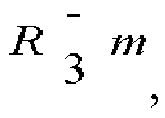
-
FIG. 6 is a Scanning Transmission Electron Microscope (STEM) picture of the positive active material according to Example 1-1 of the present invention. - Referring to
FIG. 6 , a and b ofFIG. 6 are the dark field STEM images of the positive active material according to Example 1-1 of the present invention, and it can be seen that a particle core having no pore is formed of equiaxed crystals, but the thin and long primary particles arranged in a radius direction are packed at a high density at the vicinity of the surface. - c of
FIG. 6 is the bright field TEM image, and it can be seen that the primary particle has a width of about 200 nm and a length of 1 to 2 µm. -
FIG. 7 is a diagram for describing a TEM picture, an ED pattern, and a lithium layer of the positive active material according to Example 1-1 of the present invention,FIG. 8 is a TEM picture and an ED pattern of the positive active material according to Example 1-1 of the present invention, andFIG. 9 is a diagram of ED patterns of the positive active materials according to Comparative Example 1 and Example 1-1 of the present invention. - Referring to
FIGS. 7 to 9 , as illustrated in b ofFIG. 7 , it can be seen a crystallographic arrangement of the primary particles having a needle shape (rod shape) by the bright field TEM and an electron diffraction pattern of [010] zone. A growth direction in the a-axis of the primary particle may follow the a-axis and the primary particle may be oriented to be parallel to the radius direction of the secondary particle. The positive active material is changed to a highly anisotropic form by the zirconium doping, which may be due to the change of the surface energy of LiNiO2. - Further, as illustrated in b of
FIG. 7 , surplus peaks (indicated with circles), which cannot be indexed in a system of the space group of

FIG. 7 are available only in a superlattice structure represented in c ofFIG. 7 . That is, the Li plane of the
- Referring to d of
FIG. 7 , in order to check a superlattice peak, an electron diffraction pattern of
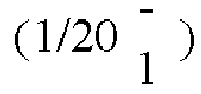

FIG. 7 . Further, in the diffraction pattern ofFIG. 7 , the superlattice diffraction pattern may be observed in the vicinity of the primary particle adjacent to the surface of LiNiO2 doped with zirconium. - In the meantime, the surplus spots according to the superlattice structure were not observed in the positive active material according to Comparative Example 1 in which zirconium is not doped as can be seen in
FIGS. 8 and9 . Accordingly, it can be seen that the positive ions in LiNiO2 doped with zirconium is not locally arranged and are seen in the vicinity of the surface. -
FIG. 10 is a diagram for describing an ED pattern and an atomic arrangement of the positive active material according to Example 1-1 of the present invention,FIG. 11 is a diagram for describing an atomic structure and formation energy of the positive active material according to Example 1-1 of the present invention,FIG. 12 is a diagram for describing an atomic structure according to a concentration of Zr in the positive active material according to Example 1-1 of the present invention,FIG. 13 is a diagram for describing a possible arrangement structure of lithium and nickel and energy according to the arrangement structure in the positive active material according to Example 1-1 of the present invention,FIG. 14 is a graph for describing a lattice constant of the positive active materials according to Example 1-1 and Comparative Example 1 of the present invention, andFIG. 15 is a diagram for describing modelling for a calculation of a lattice constant of the positive active material according to Example 1-1 of the present invention. - Referring to
FIGS. 10 to 15 , a plurality of twined crystals was observed in LiNiO2 doped with zirconium according to Example 1-1 of the present invention. In a ofFIG. 10 , an electron diffraction pattern is seen in [010] zone of the twined crystal. A pair of diffraction spots in the pattern may be explained from the spots in [010] zone that is a mirror image of (001) plane for forming a set of diffraction pattern of

FIG. 10 , it can be clearly seen the twined crystal structure having (001) surface as a twined crystal boundary. - The twined crystal may be formed by the arrangement of the positive ions, and the arrangement of the positive ions is not observed in LiNiO2 according to Comparative Example 1, so that it can be seen that the positive ions are arranged in LiNiO2 by Zr ions.
- In order to supplement the experimental result, when it is assumed that the Li layer and the Ni layer form an isotropic supercell structure formed of [Li0.75Ni0.25]3a[Li0.75Ni0.25]3bO2, a DFT calculation method is used for estimating forming energy required for exchanging Li ions and Ni ions (see
FIG. 11 ). Two possible distributions for the placement of a Zr dopant were considered, and a corresponding atomic structure is illustrated inFIG. 12 . Exchange energy per Ni (Li) ion in Pristine [Li0.75Ni0.25]3a[Li0.75Ni0.25]3bO2, in which zirconium is not doped, was calculated as 0.20 V, but in the case of the doping in which the Li ion is substituted with the Zr ion, when the concentrations of dopants are 2.08% and 6.25%, exchange energy was calculated as 0.14 eV and 0.12 eV, respectively. Ion radiuses of a Zr4+(80 pm) ion and a Li+(79 pm) ion are similar to each other, so the Li ion is substituted with the Zr ion. However, the Ni ion is substituted with the Zr ion, the exchange energy is still low in the doping structure, compared to the pristine structure. The feature that the Li-Ni mutual substitution by Zr induces the alignment structure of the positive ions can be proved by calculating the total energy of the possible composition of [Li0.75Ni0.25]3a[Li0.75Ni0.25]3bO2 having the structure in which the Ni and Li positive ions are not arranged (seeFIG. 13 ). It can be seen that the total energy calculated in almost all non-arranged structure is larger than the total energy in the arranged structures. However, it can be seen that 16 meV is more advantageous compared to the structure in which only one composition is arranged, and it is identified that this is because energy is obtained by the interchange between Li+ positive ions having a smaller charge and Li3+ positive ions at a short distance with the Li+ positive ions. The effect in the narrow zone is limited only to the positive ions in the vicinity of the dopant, so that the arrangement of the positive ions in a broad zone in the doped structure is impossible. A lattice constant calculated from the different ratios of Li-Ni interchange shows that the a and c constants decrease as the ratio of the Li-Ni exchange in pristine LiNiO2 increases. However, the a constant represents a value exceeding 12.5%. - In the meantime, the c constant linearly decreases with respect to all of the Li-Ni interchange concentrations. Further, in a percentage value, it can be seen that the relative decrease in the a constant is large compared to the c constant.
- Referring to
FIG. 14 , it can be seen that a lattice dimension is expanded according to an increase in the concentration of Zr substituted with Li. Two dopant distributions, that is, as can be seen in a and b ofFIG. 14 , the Zr-Zr separation is large in the a-b plane, but is small along the c-axis, and as can be seen in c and d ofFIG. 14 , the Zr-Zr separation is large in the a-b plane, but is large along the c-axis, were considered. According to the experimental XRD result, in the two cases of pristine and LiNiO2 doped with zirconium, the lattice constants are similar, and the Li-Ni interchange concentration determined by the Rietveld refinement method is relatively small (about 2%). - In order to satisfy the two conditions, [Li0.98Ni0.0]3a[Li0.98Ni0.02]3bO2 and [Zr0.0625Li0.6875Ni0.25]3a[N0.75Li0.25]3bO2 were borrowed for calculating each delithiation energy. The local Zr concentration may be high due to the agglomeration of Zr in the vicinity of the particle surface where the positive ions are predominantly arranged. The calculated lattice constant is 2.92Å in the a-axis and 14.19Å in the c-axis, and is 2.91Å in the a-axis and 14.20Å in the c-axis for [Li0.98Ni0.02]3a[Li0.98Ni0.02]3bO2 and [Zr0.0625Li0.6875Ni0.25]3a[N0.75Li0.25]3bO2, respectively. The differences between the calculation value and the experimental value of 1.38%, -0.07% and 1.04%, 0.07% are due to the approximate characteristic corresponding to the experimental value of the interexchange function in the DFT and calculation errors, and continuously, delithiation energy for Li1-xNiO2, [Li0.98-xNi0.02]3a[Li0.98Ni0.02]3bO2, and [Zr0.0625Li0.6875-xNi0.25]3a[N0.75Li0.25]3bO2, which have the x values of 0.0208, 0.1250, and 0.1875, respectively, is calculated as represented in the table below.
[Table 2] State of charge, x 0.0208 0.125 0.1875 perfect Li1-xNiO2 3.48 3.31 3.18 [Li0.98-xNi0.02]3a[Ni0.98Li0.02]3bO2 3.11 3.19 3.18 [Zr0.0625Li0.6875-xNi0.25]3a[Ni0.75Li0.25]3bO2 3.14 3.12 3.12 - Delithiation energy per Li decreases with increasing delithiation in the first case, but there is no significant change to the second and third cases. Although delithiation energy is higher in pristine compared to the interchange case and the zirconium doping case, it can be seen that in the high-level delithiation, the delithiation energy is similar in all three cases. This shows that the zirconium doped structure has similar stability to that of the zirconium undoped structure with or without the Li-Ni interchange of 2%. In order to further verify the structural model for the calculation, when U= 3.0 and U = 4.0 (Zr is constant and Ni varies), an influence of Hubbard-U constant was investigated by recalculating a, b, and c constants in [Zr0.0625Li0.6875Ni0.25]3a[N0.75Li0.25]3bO2 (described as model 1). Referring to
FIG. 15 , it can be seen that the change of the U constant from 3 to 4 does not significantly affect the lattice constant value. Further, inmodel 1, the possibility of Li vacancy formation is obtained by removing three Li in the layer in which Zr is located ([Zr0.0625Li0.50Ni0.25]3a[N0.75Li0.25]3bO2 (described as model 2)).. Inmodel 2, the change of the Zr4+ dopant is compensated by the replaced Li+ and three LI+ vacancies. The a and b constant values formodel 2 correspond to the experimental result compared tomodel 1. In contrast, inmodel 2, the c constant shows a large value compared tomodel 1, and the value corresponds well to the experimental value. However, a deviation of the lattice constants calculated inmodel 1 andmodel 2 from the experimental value is less than 1.04%. Further, the structure in which 25% of Li is substituted with Zr without the Li-Ni interchange was evaluated ([Zr0.25Li0.75]3a[Ni1.00]3bO2, described as model 3). The comparison of the lattice constants inmodel 3 and the experimental measurement reveals thatmodel 3 is undesirable.FIGS. 16A, 16B , and16C are graphs for describing a capacity characteristic, a life characteristic, and a rate capability of the positive active materials according to Example 1-1 and Comparative Example 1 of the present invention,FIG. 17 is a graph for describing a capacity characteristic according to the number of times of charge/discharge of the positive active material according to Comparative Example 1 of the present invention, andFIG. 18 is a graph for describing a capacity characteristic according to the number of times of charge/discharge of the positive active material according to Example 1-1 of the present invention. - Referring to
FIGS. 16 to 18 , half cells were manufactured by using the positive active materials according to Example 1-1 and Comparative Example 1, a discharge capacity was measured under the condition of cut off 2.7 to 4.3V and 0.1C, a life characteristic was measured under the condition of cut off 2.7 to 4.3V and 0.5C, and a rate capability was measured. - It is confirmed that an initial discharge capacity of a lithium secondary battery including the positive active materials according to Comparative Example 1 and Example 1-1 is ideal with Coulombic efficiency of about 97%. Particularly, the initial discharge capacity was measured as 247.5 mAh/g in Comparative Example 1 and 246.5 mAh/g in Example 1-1. Then, it can be seen that in a voltage profile, the discharge capacity of the positive active material according to Comparative Example 1 rapidly decreases compared to an initial cycle, but the positive active material according to Example 1-1 doped with zirconium maintains a stable state. That is, referring to
FIG. 16A , it can be seen that the positive ion arrangement (that is, the interchange of the Li and Ni ions) has little effect on the de-intercalation/insertion of Li. - The Li migration may be facilitated by the arrangement of the primary particles arranged from the center portion toward the surface portion of the secondary particle, and as can be seen in the cycle performance illustrated in
FIG. 16B , it can be seen that the zirconium doping has excellent cycle stability. A discharge capacity of a LiNiO2 positive electrode doped with zirconium according to Example 1-1 maintains 81% of the initial discharge capacity after 100 cycles at 0.5C (90 mA/g), but a discharge capacity of the positive active material according to Comparative Example 1 was measured to be 74% of the initial discharge capacity for the same cycle. - Further, referring to
FIG. 16C , a capacity maintenance rate of the positive active material according to Comparative Example 1 shows 82.0% in 5 C, and the positive active material doped with zirconium according to Example 1-1 was measured to be 81% in 0.1 C. -
FIG. 19 is a graph illustrating measured capacity characteristics of lithium secondary batteries including the positive active materials according to Examples 1-1 to 1-3 and Comparative Example 1 of the present invention, andFIG. 20 is a graph illustrating measured life characteristics of lithium secondary batteries including the positive active materials according to Examples 1-1 to 1-3 and Comparative Example 1 of the present invention. - Referring to
FIGS. 19 and20 , half cells were manufactured by using the positive active materials according to Examples 1-1 to 1-3 and Comparative Example 1, a discharge capacity was measured under the condition of cut off 2.7 to 4.3V and 0.1 C, and a capacity change according to the number of times of the charge/discharge cycle was measured under the condition of cut off 2.7 to 4.3V, 0.5 C, and a temperature of 30°C. - In the drawing, LNO Pristine means the positive active material according to Comparative Example 1, LNO Zr 0.5 mol% means the positive active material according to Example 1-1, LNO Zr 1.0 mol% means the positive active material according to Example 1-2, and LNO Zr 2.0 mol% means the positive active material according to Example 1-3.
- As can be seen in
FIGS. 19 and20 , it can be seen that as the charge/discharge process is performed, the capacity of the lithium secondary battery including the positive active material according to Comparative Example 1 is decreased, but the decrease in the capacity of the lithium secondary batteries including the positive active materials according to Examples 1-1 and 1-2 is significantly little. That is, it can be seen that the manufacturing of the lithium secondary battery by using the positive active material doped with zirconium is the effective method of improving a life characteristic. - Further, it can be seen that compared to Example 1-3 in which a doping concentration of zirconium is 2.0 mol%, the life characteristic improvement effect of the positive active materials according to Examples 1-1 and 1-2, in which the doping concentrations of zirconium are 0.5 mol% and 1.0 mol%, respectively, is significantly excellent. That is, it can be seen that the control of the doping concentration of zirconium to be less than 2.0 mol% is the efficient method of improving the life characteristic and the charge/discharge characteristic.
-
FIG. 21 is a TEM picture and a diagram illustrating an ED pattern of a positive active material according to Example 2 of the present invention. - Referring to
FIG. 21 , the positive active material doped with titanium according to Example 2 of the present invention was captured by using a TEM and an ED pattern image was checked. As can be seen inFIG. 21 , it can be seen that a superlattice is generated by the substitution of a transition metal (nickel) with lithium in a lithium layer and surplus peaks are generated. -
FIG. 22 is a graph illustrating measured capacity characteristics of lithium secondary batteries including the positive active materials according to Example 2 and Comparative Example 1 of the present invention, andFIG. 23 is a graph illustrating measured life characteristics of lithium secondary batteries including the positive active materials according to Example 2 and Comparative Example 1 of the present invention - Referring to
FIGS. 22 and 23 , a half cell was manufactured by using the positive active material according to Example 2, a discharge capacity was measured under the condition of cut off 2.7 to 4.3V and 0.1 C, and a capacity change according to the number of times of the charge/discharge cycle was measured under the condition of cut off 2.7 to 4.3V, 0.5 C, and a temperature of 30°C. - In the drawing, LiNiO2 means the positive active material according to Comparative Example 1, and Ti-LiNiO2 means the positive active material according to Example 2.
[Table 3] Classification 0.1C, 1st Dis-Capa (mAh/g) 1st Efficiency 0.2C Capacity (mAh/g) 0.2C/0.1C 0.5C Capacity (mAh/g) 0.5C/0.1C 0.5C Cycle Retention Comparative Example 1 247.5 96.8% 242.3 97.9% 232.5 93.9% 73.7% (100cycle) Example 2 241.8 97.3% 237.1 98.0% 228.4 94.4% 84.4% (100cycle) - As can be seen in Table 3 and
FIGS. 22 and 23 , it can be seen that as the charge/discharge process is performed, the capacity of the lithium secondary battery including the positive active material according to Comparative Example 1 is decreased, but the decrease in the capacity of the lithium secondary battery including the positive active material according to Example 2 is significantly little. That is, it can be seen that the manufacturing of the lithium secondary battery by using the positive active material doped with titanium is the effective method of improving a life characteristic.FIG. 24 is a TEM picture and a diagram illustrating an ED pattern of a positive active material according to Example 3 of the present invention. - Referring to
FIG. 24 , the positive active material doped with tungsten according to Example 3 of the present invention was captured by using a TEM and an ED pattern image was checked. As can be seen inFIG. 24 , it can be seen that a superlattice is generated by the substitution of a transition metal (nickel) with lithium in a lithium layer and surplus peaks are generated. -
FIG. 25 is a graph illustrating capacity characteristics of lithium secondary batteries including the positive active materials according to Example 3 and Comparative Example 3 of the present invention measured under a condition of 2.7 to 4.3 V,FIG. 26 is a graph illustrating life characteristics of lithium secondary batteries including the positive active materials according to Example 3 and Comparative Example 3 of the present invention measured under a condition of 2.7 to 4.3 V,FIG. 27 is a graph illustrating capacity characteristics of lithium secondary batteries including the positive active materials according to Example 3 and Comparative Example 3 of the present invention measured under a condition of 2.7 to 4.5 V, andFIG. 28 is a graph illustrating life characteristics of lithium secondary batteries including the positive active materials according to Example 3 and Comparative Example 3 of the present invention measured under a condition of 2.7 to 4.3 V. - Referring to
FIGS. 25 to 28 , half cells were manufactured by using the positive active materials according to Example 3 and Comparative Example 3, a discharge capacity was measured under the condition of cut off 2.7 to 4.3V, 2.7 to 4.5V, 0.1C, and a temperature of 30°C, and a capacity change according to the number of times of the charge/discharge cycle was measured under the condition of cut off 2.7 to 4.3V, 2.7 to 4.5V, 0.5C, and a temperature of 30°C. - In the drawing, NC9010 means the positive active material according to Comparative Example 3 and NCW891001 means the positive active material according to Example 3.
- Table 4 is the result obtained under the condition of 2.7 to 4.3V and Table 5 is the result obtained under the condition of 2.7 to 4.5V.
[Table 4] Classification 0.1C, 1st Dis-Capa (mAh/g) 1st Efficiency 0.2C Capacity (mAh/g) 0.2C/0.1C 0.5C Capacity (mAh/g) 0.5C/0.1C 0.5C Cycle Retention Comparative Example 3 229.1 96.2% 224.2 97.8% 214.9 93.8% 83.6% (100cycle) Example 3 221.1 94.1% 216.6 98.0% 207.3 93.8% 98.8% (100cycle) [Table 5] Classification 0.1C, 1st Dis-Capa (mAh/g) 1st Efficiency 0.2C Capacity (mAh/g) 0.2C/0.1C 0.5C Capacity (mAh/g) 0.5C/0.1C 0.5C Cycle Retention Comparative Example 3 239.1 99.3% 231.7 96.9% 220.0 92.0% 77.9% (100cycle) Example 3 238.9 101.9% 235.3 98.5% 229.9 96.2% 88.2% (100cycle) - As can be seen in Tables 4 and 5 and
FIGS. 25 to 28 , it can be seen that as the charge/discharge process is performed, the capacity of the lithium secondary battery including the positive active material according to Comparative Example 3 is sharply decreased, but the decrease in the capacity of the lithium secondary battery including the positive active material according to Example 3 is significantly little. That is, it can be seen that the manufacturing of the lithium secondary battery by using the positive active material doped with tungsten is the effective method of improving a life characteristic.FIG. 29 is a TEM picture and a diagram illustrating an ED pattern of a positive active material according to Example 4 of the present invention. - Referring to
FIG. 29 , the positive active material doped with tungsten according to Example 4 of the present invention was captured by using a TEM and an ED pattern image was checked. As can be seen inFIG. 29 , it can be seen that a superlattice is generated by the substitution of a transition metal (nickel) with lithium in a lithium layer and surplus peaks are generated. -
FIG. 30 is a graph illustrating measured capacity characteristics of lithium secondary batteries including the positive active materials according to Example 4 and Comparative Example 4 of the present invention, andFIG. 31 is a graph illustrating measured life characteristics of lithium secondary batteries including the positive active materials according to Example 4 and Comparative Example 4 of the present invention. - Referring to
FIGS. 29 and30 , half cells were manufactured by using the positive active materials according to Example 4 and Comparative Example 4, a discharge capacity was measured under the condition of cut off 2.7 to 4.3V, 0.1C, and a temperature of 30°C, and a capacity change according to the number of times of the charge/discharge cycle was measured under the condition of cut off 2.7 to 4.3V, 0.5C, and a temperature of 30°C. - In the drawing, NCM940303 means the positive active material according to Comparative Example 4 and W-NCM940303 means the positive active material according to Example 4.
[Table 6] Classification 0.1C, 1st Dis-Capa (mAh/g) 1st Efficiency 0.2C Capacity (mAh/g) 0.2C/0.1C 0.5C Capacity (mAh/g) 0.5C/0.1C 0.5C Cycle Retention Comparative Example 4 236.9 96.2% 231.9 97.9% 222.4 93.9% 87.4% (100cycle) Example 4 225.3 90.3% 223.2 99.1% 213.9 94.9% 93.3% (100cycle) - As can be seen in Table 6 and
FIGS. 30 and 31 , it can be seen that as the charge/discharge process is performed, the capacity of the lithium secondary battery including the positive active material according to Comparative Example 4 is sharply decreased, but the decrease in the capacity of the lithium secondary battery including the positive active material according to Example 4 is significantly little. That is, it can be seen that the manufacturing of the lithium secondary battery by using the positive active material doped with tungsten is the effective method of improving a life characteristic.FIG. 32 is a TEM picture and a diagram illustrating an ED pattern of a positive active material according to Example 5 of the present invention. - Referring to
FIG. 32 , the positive active material doped with tungsten according to Example 5 of the present invention was captured by using a TEM and an ED pattern image was checked. As can be seen inFIG. 32 , it can be seen that a superlattice is generated by the substitution of a transition metal (nickel) with lithium in a lithium layer and surplus peaks are generated. -
FIG. 33 is a graph illustrating measured capacity characteristics of lithium secondary batteries including the positive active materials according to Example 5 and Comparative Example 5 of the present invention,FIG. 34 is a graph illustrating measured life characteristics of lithium secondary batteries including the positive active materials according to Example 5 and Comparative Example 5 of the present invention, andFIG. 35 is a graph illustrating a capacity maintenance rate by normalizing the capacity in the y-axis ofFIG. 34 in a percentage. - Referring to
FIGS. 33 to 35 , half cells were manufactured by using the positive active materials according to Example 5 and Comparative Example 5, a discharge capacity was measured under the condition of cut off 2.7 to 4.3V and 0.1C, and a capacity change according to the number of times of the charge/discharge cycle was measured under the condition of cut off 2.7 to 4.3V, 0.5C, and a temperature of 30°C, and a capacity maintenance rate was calculated. - In the drawing, NCM811 means the positive active material according to Comparative Example 5, and W-NCM811 means the positive active material according to Example 5.
[Table 7] Classification 0.1C, 1st Dis-Capa (mAh/g) 1st Efficiency 0.2C Capacity (mAh/g) 0.2C/0.1C 0.5C Capacity (mAh/g) 0.5C/0.1C 0.5C Cycle Retention Comparative Example 5 216.2 95.7% 210.7 97.5% 200.5 92.7% 93.8% (100cycle) Example 5 211.2 94.0% 204.8 97.0% 193.5 91.6% 98.0% (100cycle) - As can be seen in Table 7 and
FIGS. 33 to 35 , it can be seen that as the charge/discharge process is performed, the capacity of the lithium secondary battery including the positive active material according to Comparative Example 5 is sharply decreased, but the decrease in the capacity of the lithium secondary battery including the positive active material according to Example 5 is significantly little. That is, it can be seen that the manufacturing of the lithium secondary battery by using the positive active material doped with tungsten is the effective method of improving a life characteristic.FIG. 36 is a TEM picture and a diagram illustrating an ED pattern of a positive active material according to Example 6 of the present invention. - Referring to
FIG. 36 , the positive active material doped with aluminum according to Example 6 of the present invention was captured by using a TEM and an ED pattern image was checked. As can be seen inFIG. 36 , it can be seen that a superlattice is generated by the substitution of a transition metal (nickel) with lithium in a lithium layer and surplus peaks are generated. -
FIG. 37 is a graph illustrating measured capacity characteristics of lithium secondary batteries including the positive active materials according to Example 6 and Comparative Example 6 of the present invention, andFIG. 38 is a graph illustrating measured life characteristics of lithium secondary batteries including the positive active materials according to Example 6 and Comparative Example 6 of the present invention. - Referring to
FIGS. 37 and 38 , half cells were manufactured by using the positive active materials according to Example 6 and Comparative Example 6, a discharge capacity was measured under the condition of cut off 2.7 to 4.3V and 0.1C, and a capacity change according to the number of times of the charge/discharge cycle was measured under the condition of cut off 2.7 to 4.3V, 0.5C, and a temperature of 30°C. - In the drawing, NCM90 means the positive active material according to Comparative Example 6 and CSG NCA-
NCMA 90 means the positive active material according to Example 6.[Table 8] Classification 0.1C, 1st Dis-Capa (mAh/g) 1st Efficiency 0.5C Capacity (mAh/g) 0.5C/0.1C 0.5C Cycle Retention Comparative Example 6 272.2 95.0% 212.1 93.3% 85.2% (100cycle) Example 6 224.6 96.1% 207.3 92.3% 96.1% (100cycle) - As can be seen in Table 8 and
FIGS. 37 and 38 , it can be seen that as the charge/discharge process is performed, the capacity of the lithium secondary battery including the positive active material according to Comparative Example 6 is sharply decreased, but the decrease in the capacity of the lithium secondary battery including the positive active material according to Example 6 is significantly little. That is, it can be seen that the manufacturing of the lithium secondary battery by using the positive active material doped with aluminum is the effective method of improving a life characteristic.FIG. 39 is a TEM picture and a diagram illustrating an ED pattern of a positive active material according to Example 7 of the present invention. - Referring to
FIG. 39 , the positive active material doped with boron according to Example 7 of the present invention was captured by using a TEM and an ED pattern image was checked. As can be seen inFIG. 36 , it can be seen that a superlattice is generated by the substitution of a transition metal (nickel) with lithium in a lithium layer and surplus peaks are generated. -
FIG. 40 is a graph illustrating capacity characteristics of lithium secondary batteries including the positive active materials according to Example 7 and Comparative Example 6 of the present invention measured at 30°C,FIG. 41 is a graph illustrating life characteristics of lithium secondary batteries including the positive active materials according to Example 7 and Comparative Example 6 of the present invention measured at 30°C,FIG. 42 is a graph illustrating capacity characteristics of lithium secondary batteries including the positive active materials according to Example 7 and Comparative Example 6 of the present invention measured at 55°C, andFIG. 43 is a graph illustrating life characteristics of lithium secondary batteries including the positive active materials according to Example 7 and Comparative Example 6 of the present invention measured at 55°C. - Referring to
FIGS. 40 to 43 , half cells were manufactured by using the positive active materials according to Example 7 and Comparative Example 6, a discharge capacity was measured under the condition of cut off 2.7 to 4.3V, 0.1C, and temperatures of 30°C and 50°C, and a capacity change according to the number of times of the charge/discharge cycle was measured under the condition of cut off 2.7 to 4.3V, 0.5C, and temperatures of 30°C and 50°C. - In the drawing, NCM90 means the positive active material according to Comparative Example 6 and B-
NCM 90 means the positive active material according to Example 7. - Table 9 represents the measurement result obtained at 30°C, and Table 10 represents the measurement result obtained at 55°C.
[Table 9] Classification 0.1C, 1st Dis-Capa (mAh/g) 1st Efficiency 0.5C Capacity (mAh/g) 0.5C Cycle Retention Comparative Example 6 227.2 95.0% 212.1 85.2% Example 7 230.7 94.0% 209.4 91.4% [Table 10] Classification 0.1C, 1st Dis-Capa (mAh/g) 1st Efficiency 0.5C Capacity (mAh/g) 0.5C Cycle Retention Comparative Example 6 237.4 97.2% 230.7 75.8% Example 7 237.4 96.3% 232.4 91.0% - As can be seen in Tables 9 and 10 and
FIGS. 40 to 43 , it can be seen that as the charge/discharge process is performed, the capacity of the lithium secondary battery including the positive active material according to Comparative Example 6 is decreased, but the decrease in the capacity of the lithium secondary battery including the positive active material according to Example 7 is significantly little. That is, it can be seen that the manufacturing of the lithium secondary battery by using the positive active material doped with boron is the effective method of improving a life characteristic. - While the present invention has been described by using the exemplary embodiments, but the present invention is not limited to the specific embodiment, and shall be interpreted by the accompanying claims. Further, it will be understood by those skilled in the art that various changes and modifications may be made without departing from the scope of the present invention.
- The positive active material according to the exemplary embodiment of the present invention, the method of preparing the same, a lithium secondary battery including the same are applicable to an electric vehicle, an ESS, and a portable electronic device.
Claims (14)
- A positive active material in which a compound containing lithium, a transition metal, and oxygen is doped with a doping metal, wherein the positive active material includes lithium (Li) layers, and the lithium layers include a first lithium layer including only lithium and a second lithium layer in which at least a part of the lithium of the first lithium layer is substituted with a transition metal.
- The positive active material of claim 1, wherein substitution energy of the lithium and the transition metal is decreased by the doping metal, so that a part of the lithium of the first lithium layer is substituted with the transition metal.
- The positive active material of claim 1, wherein the first lithium layer and the second lithium layer are alternately and repeatedly arranged.
- The positive active material of claim 1, wherein the doping metal includes at least one of zirconium, boron, titanium, and tungsten.
- The positive active material of claim 1, wherein the doping metal includes zirconium, and zirconium is less than 2 mol%.
- The positive active material of claim 1, wherein the transition metal is nickel, and a concentration of nickel is 79 mol% or more.
- The positive active material of claim 1, wherein a superlattice is provided by the second lithium layer in which at least the part of the lithium of the first lithium layer is substituted with the transition metal.
- The positive active material of claim 1, wherein in the second lithium layer, a half of the lithium of the first lithium layer is substituted with the transition metal.
- A positive active material, comprising:a first lithium layer in which lithium is regularly arranged; anda second lithium layer in which lithium and a transition metal are regularly arranged,wherein a superlattice is formed by the first lithium layer and the lithium and the transition metal included in the first lithium layer.
- The positive active material of claim 9, wherein the superlattice includes six lithium atoms and one transition metal element.
- The positive active material of claim 9, wherein the lithium and the transition metal are alternately arranged in the second lithium layer, and the first lithium layer and the second lithium layer are alternately arranged.
- The positive active material of claim 9, wherein the second lithium layer is identified with an electron diffraction pattern in [010] zone.
- A method of preparing a positive active material, comprising:preparing a positive active material precursor including a hydroxide including a transition metal and a doping metal by using a transition metal precursor and a doping metal precursor; andpreparing a positive active material in which a compound containing lithium, the transition metal, and oxygen is doped with the doping metal by mixing and calcining the positive active material precursor and lithium salt,wherein the doping metal in the positive active material precursor is less than 2 mol%.
- The positive active material of claim 13, wherein the doping metal includes at least one of zirconium, boron, titanium, and tungsten.
Applications Claiming Priority (2)
| Application Number | Priority Date | Filing Date | Title |
|---|---|---|---|
| KR20180004416 | 2018-01-12 | ||
| PCT/KR2019/000559 WO2019139443A1 (en) | 2018-01-12 | 2019-01-14 | Positive electrode active material, method for preparing same, and lithium secondary battery comprising same |
Publications (2)
| Publication Number | Publication Date |
|---|---|
| EP3723176A1 true EP3723176A1 (en) | 2020-10-14 |
| EP3723176A4 EP3723176A4 (en) | 2022-01-26 |
Family
ID=67219780
Family Applications (2)
| Application Number | Title | Priority Date | Filing Date |
|---|---|---|---|
| EP19738846.5A Pending EP3723175A4 (en) | 2018-01-12 | 2019-01-14 | Positive electrode active material, method for preparing same, and lithium secondary battery comprising same |
| EP19738983.6A Pending EP3723176A4 (en) | 2018-01-12 | 2019-01-14 | Positive electrode active material, method for preparing same, and lithium secondary battery comprising same |
Family Applications Before (1)
| Application Number | Title | Priority Date | Filing Date |
|---|---|---|---|
| EP19738846.5A Pending EP3723175A4 (en) | 2018-01-12 | 2019-01-14 | Positive electrode active material, method for preparing same, and lithium secondary battery comprising same |
Country Status (5)
| Country | Link |
|---|---|
| US (2) | US12374688B2 (en) |
| EP (2) | EP3723175A4 (en) |
| KR (2) | KR102194505B1 (en) |
| CN (2) | CN112514117B (en) |
| WO (2) | WO2019139445A1 (en) |
Families Citing this family (37)
| Publication number | Priority date | Publication date | Assignee | Title |
|---|---|---|---|---|
| KR102738931B1 (en) * | 2019-05-20 | 2024-12-04 | 에스케이이노베이션 주식회사 | Method of separating lithium precursor and system for separating lithium precursor |
| KR102242486B1 (en) | 2019-08-19 | 2021-04-21 | 주식회사 에코프로비엠 | Positive electrode active material and lithium secondary battery comprising the same |
| CN114467201B (en) * | 2019-10-02 | 2024-06-28 | 浦项控股股份有限公司 | Lithium secondary battery positive electrode active material and lithium secondary battery containing the same |
| US11299402B2 (en) * | 2019-10-24 | 2022-04-12 | Camx Power Llc | Precursor materials for li-ion battery cathode synthesis |
| KR102264804B1 (en) * | 2019-10-31 | 2021-06-15 | 주식회사 에코프로비엠 | Lithium composite oxide and lithium secondary battery comprising the same |
| KR102479179B1 (en) * | 2019-10-31 | 2022-12-20 | 한양대학교 에리카산학협력단 | Cathode material fabricated by cation exchange reaction, and method of fabricating of the same |
| US20220416238A1 (en) * | 2019-12-05 | 2022-12-29 | Lg Energy Solution, Ltd. | Positive Electrode Active Material for Lithium Secondary Battery and Method of Preparing the Positive Electrode Active Material |
| KR102595883B1 (en) * | 2020-01-29 | 2023-11-01 | 주식회사 엘지화학 | Positive electrode active material precursor for secondary battery, positive electrode active material and lithium secondary battery comprising the same |
| EP4037030A4 (en) | 2020-01-29 | 2022-12-21 | Lg Chem, Ltd. | Positive electrode active material precursor for secondary battery, positive electrode active material, method for producing same, and lithium secondary battery including same |
| KR20210106871A (en) * | 2020-02-21 | 2021-08-31 | 한양대학교 산학협력단 | Positive active material containing coating layer of primary particle for lithium secondary battery, and lithium secondary battery comprising the same |
| WO2021167409A1 (en) * | 2020-02-21 | 2021-08-26 | 주식회사 배터리솔루션 | Positive electrode active material having ultra-fine crystal grains and primary particles of high orientation, and lithium secondary battery comprising same |
| KR102749968B1 (en) * | 2020-06-12 | 2025-01-03 | 주식회사 에코프로비엠 | Positive active material and lithium secondary battery comprising the same |
| KR102461125B1 (en) * | 2020-10-27 | 2022-11-01 | 주식회사 에코프로비엠 | Method for preparing positive active material for lithium secondary battery |
| CN116508171A (en) * | 2020-11-30 | 2023-07-28 | 株式会社Lg新能源 | Positive electrode active material and positive electrode and lithium secondary battery containing same |
| CN114665085B (en) * | 2020-12-23 | 2024-02-23 | 北京当升材料科技股份有限公司 | Cathode material for lithium ion battery and preparation method thereof and lithium ion battery |
| KR102632381B1 (en) * | 2021-03-31 | 2024-02-01 | 주식회사 에코프로비엠 | Positive electrode active material and lithium secondary battery using the same |
| DE102021204702A1 (en) | 2021-05-10 | 2022-11-10 | Volkswagen Aktiengesellschaft | Secondary particles for a cathode of a secondary lithium battery cell and method for producing such |
| WO2023027504A1 (en) * | 2021-08-24 | 2023-03-02 | 주식회사 엘지화학 | Positive electrode active material and method for producing positive electrode active material |
| CN114094072B (en) * | 2021-11-11 | 2023-08-25 | 宁德新能源科技有限公司 | A lithium transition metal composite oxide, electrochemical device and electronic device |
| KR102699627B1 (en) * | 2021-11-30 | 2024-08-28 | 고려대학교 산학협력단 | Crystalline siderite and method for manufacturing the same |
| KR20230095271A (en) * | 2021-12-22 | 2023-06-29 | 포스코홀딩스 주식회사 | Positive active material for rechargeable lithium battery, method of preparing the same, and rechargeable lithium battery including the same |
| KR102847012B1 (en) | 2021-12-29 | 2025-08-14 | 대전대학교 산학협력단 | A cathode active material having a core-double-shell structure, a method for manufacturing the same, a cathode comprising the same, and a secondary battery comprising the same |
| CN114105156B (en) * | 2022-01-27 | 2022-05-27 | 浙江帕瓦新能源股份有限公司 | Nickel-cobalt-boron precursor material, preparation method thereof and nickel-cobalt-boron positive electrode material |
| CN120015765A (en) * | 2022-03-18 | 2025-05-16 | 宁德时代新能源科技股份有限公司 | Secondary battery, positive electrode and electric device |
| KR102787045B1 (en) | 2022-03-22 | 2025-03-25 | 삼성에스디아이 주식회사 | Positive electrode active material for rechargeable lithium battery, method of preparing the same, and rechargeable lithium battery |
| KR102726274B1 (en) | 2022-05-19 | 2024-11-04 | 동국대학교 산학협력단 | Preparation method of high-nickel cathod active material with single particle |
| DE112023003680T5 (en) * | 2022-08-29 | 2025-07-03 | Wayne State University | Lithium-ion high-temperature battery and method for its production |
| KR20240050838A (en) | 2022-10-12 | 2024-04-19 | 에스케이온 주식회사 | Positive electrode active material, manufacturing method thereof, and positive electrode for lithium secondary battery comprising the same |
| KR102627508B1 (en) | 2022-12-07 | 2024-01-18 | 에스케이온 주식회사 | Cathode active material for lithium secondary battery and lithium secondary battery including the same |
| CN120569824A (en) * | 2023-01-06 | 2025-08-29 | 电池解决方案股份有限公司 | Positive electrode active material for lithium secondary battery and method for preparing the same |
| KR102553749B1 (en) * | 2023-02-10 | 2023-07-11 | 에스케이온 주식회사 | Cathode active material precursor for lithium secondary battery, cathode active material for lithium secondary battery and lithium secondary battery |
| KR102835016B1 (en) * | 2023-07-21 | 2025-07-16 | 삼성에스디아이 주식회사 | Positive active material, preparation method thereof, positive electrode, rechargeable lithium batteries and all-solid rechargeable batteries |
| KR20250023914A (en) * | 2023-08-10 | 2025-02-18 | 한양대학교 에리카산학협력단 | Hafnium doped cathode active materials and methods for their preparation |
| KR20250154092A (en) * | 2024-04-19 | 2025-10-28 | 에스케이온 주식회사 | Lithium secondary battery |
| WO2026032861A1 (en) | 2024-08-05 | 2026-02-12 | Umicore | Cathode active material for li-ion secondary batteries and preparation method therefor |
| WO2026095465A1 (en) * | 2024-10-30 | 2026-05-07 | 주식회사 에코프로비엠 | Positive electrode active material and lithium secondary battery comprising same |
| CN119833711A (en) * | 2024-11-28 | 2025-04-15 | 宁德时代新能源科技股份有限公司 | Lithium ion secondary battery, positive electrode active material and electric equipment |
Family Cites Families (33)
| Publication number | Priority date | Publication date | Assignee | Title |
|---|---|---|---|---|
| US6998069B1 (en) | 1999-12-03 | 2006-02-14 | Ferro Gmbh | Electrode material for positive electrodes of rechargeable lithium batteries |
| JP4839633B2 (en) * | 2005-02-28 | 2011-12-21 | パナソニック株式会社 | Non-aqueous electrolyte secondary battery and method for producing positive electrode active material for non-aqueous electrolyte secondary battery |
| KR100790834B1 (en) * | 2006-05-10 | 2008-01-03 | 주식회사 엘지화학 | High Performance Lithium Secondary Battery Material |
| KR100815583B1 (en) | 2006-10-13 | 2008-03-20 | 한양대학교 산학협력단 | Cathode active material for lithium secondary battery, method for preparing same, and lithium secondary battery comprising same |
| EP2207227A1 (en) | 2007-11-06 | 2010-07-14 | Panasonic Corporation | Positive electrode active material for non-aqueous electrolyte secondary battery, and non-aqueous electrolyte secondary battery comprising the same |
| JP5263761B2 (en) | 2008-05-19 | 2013-08-14 | 独立行政法人産業技術総合研究所 | Monoclinic lithium manganese composite oxide having cation ordered structure and method for producing the same |
| KR101292757B1 (en) * | 2011-01-05 | 2013-08-02 | 한양대학교 산학협력단 | Cathod active material of full gradient, method for preparing the same, lithium secondary battery comprising the same |
| US9028564B2 (en) * | 2012-03-21 | 2015-05-12 | The Gillette Company | Methods of making metal-doped nickel oxide active materials |
| US10224541B2 (en) * | 2012-06-08 | 2019-03-05 | Iucf-Hyu (Industry-University Cooperation Foundation Hanyang University) | Positive electrode active material precursor for lithium secondary battery, positive electrode active material manufactured by using thereof, and lithium secondary battery including the same |
| KR101689213B1 (en) | 2012-06-21 | 2016-12-23 | 삼성에스디아이 주식회사 | Positive electrode active material for lithium secondary battery, preparing method thereof, positive electrode for lithium secondary battery including the same, and lithium secondary battery employing the same |
| FR2995298B1 (en) | 2012-09-13 | 2015-04-03 | Accumulateurs Fixes | POSITIVE ELECTRODE MATERIAL FOR LITHIUM ION BATTERY |
| CN105870424A (en) * | 2013-01-25 | 2016-08-17 | 株式会社丰田自动织机 | Active material excelling in high-voltage characteristics |
| KR20140119621A (en) | 2013-03-30 | 2014-10-10 | (주)오렌지파워 | Precusor for lithium rich active material and lithium rich active material made by the same |
| KR101611198B1 (en) * | 2013-07-02 | 2016-04-11 | 주식회사 엘지화학 | Cathode Active Material for Lithium Secondary Battery Having Novel Fine Crystal Structure |
| CN103413931B (en) * | 2013-08-08 | 2016-01-20 | 北京大学 | Boron doped lithium-enriched cathodic material of lithium ion battery and preparation method thereof |
| JP6170161B2 (en) | 2013-08-29 | 2017-07-26 | エルジー・ケム・リミテッド | Lithium transition metal composite particles, production method thereof, and positive electrode active material including the same |
| WO2015115699A1 (en) * | 2014-01-29 | 2015-08-06 | 주식회사 엘앤에프신소재 | Cathode active material for lithium secondary battery, manufacturing method therefor and lithium secondary battery comprising same |
| KR101633256B1 (en) | 2014-06-09 | 2016-06-27 | 주식회사 포스코 | Positive electrode active material for rechargable lithium battery, method for manufacturing the same, and rechargable lithium battery including the same |
| KR101568263B1 (en) | 2014-08-07 | 2015-11-11 | 주식회사 에코프로 | Cathod active material for lithium rechargeable battery and lithium rechargeable battery comprising the same |
| KR101577179B1 (en) | 2014-09-11 | 2015-12-16 | 주식회사 에코프로 | Cathod active material for lithium rechargeable battery and lithium rechargeable battery comprising the same |
| CN104409700B (en) * | 2014-11-20 | 2018-07-24 | 深圳市贝特瑞新能源材料股份有限公司 | A kind of Ni-based anode material for lithium-ion batteries and preparation method thereof |
| KR20160083616A (en) | 2014-12-31 | 2016-07-12 | 삼성에스디아이 주식회사 | Cathode active material precursor for lithium secondary battery, manufacturing method of the same, cathode active material for lithium secondary battery, manufacturing method of the same, and lithium secondary battery comprising the cathode active material |
| KR20160094063A (en) | 2015-01-30 | 2016-08-09 | 주식회사 엘지화학 | 3 Components cathode active material with surface treatment for high capacity lithium secondary battery and High voltage lithium secondary battery comprising the same |
| US10535874B2 (en) * | 2015-11-30 | 2020-01-14 | Lg Chem, Ltd. | Positive electrode active material for secondary battery, method for preparing same, and secondary battery comprising same |
| KR102006207B1 (en) | 2015-11-30 | 2019-08-02 | 주식회사 엘지화학 | Positive electrode active material for secondary battery and secondary battery comprising the same |
| JP7184421B2 (en) | 2016-03-03 | 2022-12-06 | 住友金属鉱山株式会社 | POSITIVE ACTIVE MATERIAL FOR NON-AQUEOUS ELECTROLYTE SECONDARY BATTERY, NONAQUEOUS ELECTROLYTE SECONDARY BATTERY, METHOD FOR SELECTING ADDITIONAL ELEMENTS FOR LITHIUM METAL COMPOUND OXIDE, AND METHOD FOR MANUFACTURING POSITIVE ACTIVE MATERIAL FOR NON-AQUEOUS ELECTROLYTE SECONDARY BATTERY |
| WO2017150949A1 (en) | 2016-03-04 | 2017-09-08 | 주식회사 엘지화학 | Cathode active material for secondary battery, manufacturing method therefor, and secondary battery including same |
| KR101937896B1 (en) | 2016-03-04 | 2019-01-14 | 주식회사 엘지화학 | Precursor of positive electrode active material for secondary battery and positive electrode active material prepared by the same |
| KR102516459B1 (en) * | 2016-04-08 | 2023-04-04 | 한양대학교 산학협력단 | Positive active material, method of fabricating of the same, and lithium secondary battery comprising the same |
| US11302919B2 (en) * | 2016-07-20 | 2022-04-12 | Samsung Sdi Co., Ltd. | Nickel-based active material for lithium secondary battery, method of preparing the same, and lithium secondary battery including positive electrode including the nickel-based active material |
| CN106129399B (en) * | 2016-08-30 | 2019-01-29 | 中南大学 | A kind of doping manganous silicate lithium/carbon composite material and preparation method |
| US10714747B2 (en) * | 2016-12-16 | 2020-07-14 | Bayerische Motoren Werke Aktiengesellschaft | High energy lithium ion secondary battery with improved lifetime and energy density |
| CN107437616B (en) * | 2017-07-11 | 2020-03-10 | 贵州振华新材料股份有限公司 | Lithium ion battery anode material and lithium ion battery |
-
2019
- 2019-01-14 US US16/961,672 patent/US12374688B2/en active Active
- 2019-01-14 EP EP19738846.5A patent/EP3723175A4/en active Pending
- 2019-01-14 KR KR1020190004863A patent/KR102194505B1/en active Active
- 2019-01-14 EP EP19738983.6A patent/EP3723176A4/en active Pending
- 2019-01-14 US US16/961,673 patent/US11894557B2/en active Active
- 2019-01-14 CN CN201980018880.6A patent/CN112514117B/en active Active
- 2019-01-14 WO PCT/KR2019/000561 patent/WO2019139445A1/en not_active Ceased
- 2019-01-14 CN CN201980017019.8A patent/CN112534609B/en active Active
- 2019-01-14 KR KR1020190004907A patent/KR102447090B1/en active Active
- 2019-01-14 WO PCT/KR2019/000559 patent/WO2019139443A1/en not_active Ceased
Also Published As
| Publication number | Publication date |
|---|---|
| EP3723176A4 (en) | 2022-01-26 |
| CN112514117B (en) | 2024-08-16 |
| EP3723175A1 (en) | 2020-10-14 |
| US12374688B2 (en) | 2025-07-29 |
| KR102447090B1 (en) | 2022-10-07 |
| CN112514117A (en) | 2021-03-16 |
| CN112534609B (en) | 2025-05-09 |
| US11894557B2 (en) | 2024-02-06 |
| US20200403239A1 (en) | 2020-12-24 |
| WO2019139443A1 (en) | 2019-07-18 |
| US20200403240A1 (en) | 2020-12-24 |
| KR102194505B1 (en) | 2020-12-23 |
| EP3723175A4 (en) | 2022-01-12 |
| KR20190086399A (en) | 2019-07-22 |
| KR20190086403A (en) | 2019-07-22 |
| CN112534609A (en) | 2021-03-19 |
| WO2019139445A1 (en) | 2019-07-18 |
Similar Documents
| Publication | Publication Date | Title |
|---|---|---|
| US12374688B2 (en) | Positive active material, method of preparing the same, and lithium secondary battery including the same | |
| CN112687866B (en) | Lithium secondary battery positive electrode active material, preparation method thereof and lithium secondary battery containing the same | |
| EP2544280B1 (en) | Positive-electrode active material for lithium ion battery, positive electrode for lithium battery, and lithium ion battery | |
| KR101271852B1 (en) | Doped lithium transition metal oxides containing sulfur | |
| KR102278009B1 (en) | Non-aqueous electrolyte secondary battery positive electrode active material and method for manufacturing same, and non-aqueous electrolyte secondary battery | |
| EP3441365A1 (en) | Positive electrode active material, method for manufacturing same, and lithium secondary battery containing same | |
| EP2544272B1 (en) | Positive electrode active substance for lithium ion batteries, positive electrode for lithium ion batteries, and lithium ion battery | |
| EP2544273A1 (en) | Positive electrode active substance for lithium ion batteries, positive electrode for lithium ion batteries, and lithium ion battery | |
| JP2024513397A (en) | Positive electrode active material for lithium secondary batteries and lithium secondary batteries containing the same | |
| CN114868282A (en) | Positive electrode active material and lithium secondary battery comprising same | |
| CN116636040A (en) | Positive electrode active material and lithium secondary battery comprising the positive electrode active material | |
| CN116648801A (en) | Positive electrode active material and lithium secondary battery comprising the positive electrode active material | |
| CN117957669A (en) | Lithium-rich nickel manganese oxide battery cathode materials and methods | |
| EP4141994A1 (en) | Positive electrode active material containing spinel composite solid solution oxide, method for manufacturing same, and lithium secondary battery including same | |
| KR20260049516A (en) | Cathode Active Material Having Composite Coating Layer | |
| KR20260005152A (en) | Lithium composite oxide and positive electrode active material for secondary battery containing same | |
| KR20230083416A (en) | Cathode Active Material Having Composite Coating Layer | |
| EP4549396A1 (en) | Positive electrode active material and method of manufacturing positive electrode active material | |
| KR102904515B1 (en) | Lithium composite oxide and positive electrode active material for secondary battery containing same | |
| EP4546464A1 (en) | Positive electrode active material for lithium secondary battery, and preparation method therefor | |
| Jiménes-Cabañas et al. | Role of Synthesis Conditions on Particle Growth and Physicochemical Properties of NixMnyCo1-xy (OH) 2 and LiNixMnyCo1-x-yO2 for Lithium-Ion Battery Cathode Applications |
Legal Events
| Date | Code | Title | Description |
|---|---|---|---|
| STAA | Information on the status of an ep patent application or granted ep patent |
Free format text: STATUS: THE INTERNATIONAL PUBLICATION HAS BEEN MADE |
|
| PUAI | Public reference made under article 153(3) epc to a published international application that has entered the european phase |
Free format text: ORIGINAL CODE: 0009012 |
|
| STAA | Information on the status of an ep patent application or granted ep patent |
Free format text: STATUS: REQUEST FOR EXAMINATION WAS MADE |
|
| 17P | Request for examination filed |
Effective date: 20200709 |
|
| AK | Designated contracting states |
Kind code of ref document: A1 Designated state(s): AL AT BE BG CH CY CZ DE DK EE ES FI FR GB GR HR HU IE IS IT LI LT LU LV MC MK MT NL NO PL PT RO RS SE SI SK SM TR |
|
| AX | Request for extension of the european patent |
Extension state: BA ME |
|
| DAV | Request for validation of the european patent (deleted) | ||
| DAX | Request for extension of the european patent (deleted) | ||
| RAP1 | Party data changed (applicant data changed or rights of an application transferred) |
Owner name: BATTERY SOLUTION |
|
| A4 | Supplementary search report drawn up and despatched |
Effective date: 20211223 |
|
| RIC1 | Information provided on ipc code assigned before grant |
Ipc: H01M 10/052 20100101ALI20211217BHEP Ipc: H01M 4/525 20100101ALI20211217BHEP Ipc: C01G 53/00 20060101AFI20211217BHEP |