EP3722334A1 - Preparation of an aqueous dispersion of copolymer particles of vinyl acetate and a cyclic ketene acetal monomer - Google Patents
Preparation of an aqueous dispersion of copolymer particles of vinyl acetate and a cyclic ketene acetal monomer Download PDFInfo
- Publication number
- EP3722334A1 EP3722334A1 EP20168559.1A EP20168559A EP3722334A1 EP 3722334 A1 EP3722334 A1 EP 3722334A1 EP 20168559 A EP20168559 A EP 20168559A EP 3722334 A1 EP3722334 A1 EP 3722334A1
- Authority
- EP
- European Patent Office
- Prior art keywords
- monomer
- salt
- ketene acetal
- weight
- vinyl acetate
- Prior art date
- Legal status (The legal status is an assumption and is not a legal conclusion. Google has not performed a legal analysis and makes no representation as to the accuracy of the status listed.)
- Granted
Links
- PWKDHWCKSUMJID-UHFFFAOYSA-N C=C1OCCCO1 Chemical compound C=C1OCCCO1 PWKDHWCKSUMJID-UHFFFAOYSA-N 0.000 description 1
- MRJBNFDDHBUENJ-UHFFFAOYSA-N CC(C)(CO1)COC1=C Chemical compound CC(C)(CO1)COC1=C MRJBNFDDHBUENJ-UHFFFAOYSA-N 0.000 description 1
- SYKSRBWOTOSLBT-UHFFFAOYSA-N CC(CC(C)O1)OC1=C Chemical compound CC(CC(C)O1)OC1=C SYKSRBWOTOSLBT-UHFFFAOYSA-N 0.000 description 1
- YRMISDZMEBLXKV-UHFFFAOYSA-N CC(CC(c1cc(C(CCO2)OC2=C)ccc1)O1)OC1=C Chemical compound CC(CC(c1cc(C(CCO2)OC2=C)ccc1)O1)OC1=C YRMISDZMEBLXKV-UHFFFAOYSA-N 0.000 description 1
Classifications
-
- C—CHEMISTRY; METALLURGY
- C08—ORGANIC MACROMOLECULAR COMPOUNDS; THEIR PREPARATION OR CHEMICAL WORKING-UP; COMPOSITIONS BASED THEREON
- C08F—MACROMOLECULAR COMPOUNDS OBTAINED BY REACTIONS ONLY INVOLVING CARBON-TO-CARBON UNSATURATED BONDS
- C08F18/00—Homopolymers and copolymers of compounds having one or more unsaturated aliphatic radicals, each having only one carbon-to-carbon double bond, and at least one being terminated by an acyloxy radical of a saturated carboxylic acid, of carbonic acid or of a haloformic acid
- C08F18/02—Esters of monocarboxylic acids
- C08F18/04—Vinyl esters
- C08F18/08—Vinyl acetate
-
- C—CHEMISTRY; METALLURGY
- C08—ORGANIC MACROMOLECULAR COMPOUNDS; THEIR PREPARATION OR CHEMICAL WORKING-UP; COMPOSITIONS BASED THEREON
- C08J—WORKING-UP; GENERAL PROCESSES OF COMPOUNDING; AFTER-TREATMENT NOT COVERED BY SUBCLASSES C08B, C08C, C08F, C08G or C08H
- C08J3/00—Processes of treating or compounding macromolecular substances
- C08J3/02—Making solutions, dispersions, lattices or gels by other methods than by solution, emulsion or suspension polymerisation techniques
- C08J3/03—Making solutions, dispersions, lattices or gels by other methods than by solution, emulsion or suspension polymerisation techniques in aqueous media
-
- C—CHEMISTRY; METALLURGY
- C08—ORGANIC MACROMOLECULAR COMPOUNDS; THEIR PREPARATION OR CHEMICAL WORKING-UP; COMPOSITIONS BASED THEREON
- C08L—COMPOSITIONS OF MACROMOLECULAR COMPOUNDS
- C08L31/00—Compositions of homopolymers or copolymers of compounds having one or more unsaturated aliphatic radicals, each having only one carbon-to-carbon double bond, and at least one being terminated by an acyloxy radical of a saturated carboxylic acid, of carbonic acid or of a haloformic acid; Compositions of derivatives of such polymers
- C08L31/02—Homopolymers or copolymers of esters of monocarboxylic acids
- C08L31/04—Homopolymers or copolymers of vinyl acetate
-
- B—PERFORMING OPERATIONS; TRANSPORTING
- B65—CONVEYING; PACKING; STORING; HANDLING THIN OR FILAMENTARY MATERIAL
- B65D—CONTAINERS FOR STORAGE OR TRANSPORT OF ARTICLES OR MATERIALS, e.g. BAGS, BARRELS, BOTTLES, BOXES, CANS, CARTONS, CRATES, DRUMS, JARS, TANKS, HOPPERS, FORWARDING CONTAINERS; ACCESSORIES, CLOSURES, OR FITTINGS THEREFOR; PACKAGING ELEMENTS; PACKAGES
- B65D65/00—Wrappers or flexible covers; Packaging materials of special type or form
- B65D65/38—Packaging materials of special type or form
- B65D65/46—Applications of disintegrable, dissolvable or edible materials
- B65D65/466—Bio- or photodegradable packaging materials
-
- C—CHEMISTRY; METALLURGY
- C08—ORGANIC MACROMOLECULAR COMPOUNDS; THEIR PREPARATION OR CHEMICAL WORKING-UP; COMPOSITIONS BASED THEREON
- C08F—MACROMOLECULAR COMPOUNDS OBTAINED BY REACTIONS ONLY INVOLVING CARBON-TO-CARBON UNSATURATED BONDS
- C08F216/00—Copolymers of compounds having one or more unsaturated aliphatic radicals, each having only one carbon-to-carbon double bond, and at least one being terminated by an alcohol, ether, aldehydo, ketonic, acetal or ketal radical
- C08F216/38—Copolymers of compounds having one or more unsaturated aliphatic radicals, each having only one carbon-to-carbon double bond, and at least one being terminated by an alcohol, ether, aldehydo, ketonic, acetal or ketal radical by an acetal or ketal radical
-
- C—CHEMISTRY; METALLURGY
- C08—ORGANIC MACROMOLECULAR COMPOUNDS; THEIR PREPARATION OR CHEMICAL WORKING-UP; COMPOSITIONS BASED THEREON
- C08F—MACROMOLECULAR COMPOUNDS OBTAINED BY REACTIONS ONLY INVOLVING CARBON-TO-CARBON UNSATURATED BONDS
- C08F218/00—Copolymers of compounds having one or more unsaturated aliphatic radicals, each having only one carbon-to-carbon double bond, and at least one being terminated by an acyloxy radical of a saturated carboxylic acid, of carbonic acid or of a haloformic acid
- C08F218/02—Esters of monocarboxylic acids
- C08F218/04—Vinyl esters
- C08F218/08—Vinyl acetate
-
- C—CHEMISTRY; METALLURGY
- C08—ORGANIC MACROMOLECULAR COMPOUNDS; THEIR PREPARATION OR CHEMICAL WORKING-UP; COMPOSITIONS BASED THEREON
- C08F—MACROMOLECULAR COMPOUNDS OBTAINED BY REACTIONS ONLY INVOLVING CARBON-TO-CARBON UNSATURATED BONDS
- C08F220/00—Copolymers of compounds having one or more unsaturated aliphatic radicals, each having only one carbon-to-carbon double bond, and only one being terminated by only one carboxyl radical or a salt, anhydride ester, amide, imide or nitrile thereof
- C08F220/02—Monocarboxylic acids having less than ten carbon atoms; Derivatives thereof
- C08F220/52—Amides or imides
- C08F220/54—Amides, e.g. N,N-dimethylacrylamide or N-isopropylacrylamide
- C08F220/60—Amides, e.g. N,N-dimethylacrylamide or N-isopropylacrylamide containing nitrogen in addition to the carbonamido nitrogen
- C08F220/606—Amides, e.g. N,N-dimethylacrylamide or N-isopropylacrylamide containing nitrogen in addition to the carbonamido nitrogen and containing other heteroatoms
-
- C—CHEMISTRY; METALLURGY
- C08—ORGANIC MACROMOLECULAR COMPOUNDS; THEIR PREPARATION OR CHEMICAL WORKING-UP; COMPOSITIONS BASED THEREON
- C08G—MACROMOLECULAR COMPOUNDS OBTAINED OTHERWISE THAN BY REACTIONS ONLY INVOLVING UNSATURATED CARBON-TO-CARBON BONDS
- C08G63/00—Macromolecular compounds obtained by reactions forming a carboxylic ester link in the main chain of the macromolecule
- C08G63/005—Polyesters prepared from ketenes
-
- C—CHEMISTRY; METALLURGY
- C08—ORGANIC MACROMOLECULAR COMPOUNDS; THEIR PREPARATION OR CHEMICAL WORKING-UP; COMPOSITIONS BASED THEREON
- C08G—MACROMOLECULAR COMPOUNDS OBTAINED OTHERWISE THAN BY REACTIONS ONLY INVOLVING UNSATURATED CARBON-TO-CARBON BONDS
- C08G63/00—Macromolecular compounds obtained by reactions forming a carboxylic ester link in the main chain of the macromolecule
- C08G63/68—Polyesters containing atoms other than carbon, hydrogen and oxygen
- C08G63/688—Polyesters containing atoms other than carbon, hydrogen and oxygen containing sulfur
-
- C—CHEMISTRY; METALLURGY
- C08—ORGANIC MACROMOLECULAR COMPOUNDS; THEIR PREPARATION OR CHEMICAL WORKING-UP; COMPOSITIONS BASED THEREON
- C08J—WORKING-UP; GENERAL PROCESSES OF COMPOUNDING; AFTER-TREATMENT NOT COVERED BY SUBCLASSES C08B, C08C, C08F, C08G or C08H
- C08J3/00—Processes of treating or compounding macromolecular substances
- C08J3/02—Making solutions, dispersions, lattices or gels by other methods than by solution, emulsion or suspension polymerisation techniques
- C08J3/03—Making solutions, dispersions, lattices or gels by other methods than by solution, emulsion or suspension polymerisation techniques in aqueous media
- C08J3/05—Making solutions, dispersions, lattices or gels by other methods than by solution, emulsion or suspension polymerisation techniques in aqueous media from solid polymers
-
- C—CHEMISTRY; METALLURGY
- C08—ORGANIC MACROMOLECULAR COMPOUNDS; THEIR PREPARATION OR CHEMICAL WORKING-UP; COMPOSITIONS BASED THEREON
- C08F—MACROMOLECULAR COMPOUNDS OBTAINED BY REACTIONS ONLY INVOLVING CARBON-TO-CARBON UNSATURATED BONDS
- C08F2800/00—Copolymer characterised by the proportions of the comonomers expressed
- C08F2800/20—Copolymer characterised by the proportions of the comonomers expressed as weight or mass percentages
-
- C—CHEMISTRY; METALLURGY
- C08—ORGANIC MACROMOLECULAR COMPOUNDS; THEIR PREPARATION OR CHEMICAL WORKING-UP; COMPOSITIONS BASED THEREON
- C08L—COMPOSITIONS OF MACROMOLECULAR COMPOUNDS
- C08L35/00—Compositions of homopolymers or copolymers of compounds having one or more unsaturated aliphatic radicals, each having only one carbon-to-carbon double bond, and at least one being terminated by a carboxyl radical, and containing at least one other carboxyl radical in the molecule, or of salts, anhydrides, esters, amides, imides or nitriles thereof; Compositions of derivatives of such polymers
- C08L35/08—Copolymers with vinyl ethers
Definitions
- the present invention relates to the preparation of an aqueous dispersion of polymer particles comprising structural units of vinyl acetate and a cyclic ketene acetal monomer.
- Copolymers of vinyl acetate (VA) and a cyclic ketene acetal (CKA) monomer such as 2-methylene-1,3-dioxepane (MDO) are particularly useful in applications that require polymer backbone degradation, such as degradable packaging, or the physical erosion of polymer-based thin films and surface coatings.
- CKA cyclic ketene acetal
- MDO 2-methylene-1,3-dioxepane
- Organic solvents are used to prepare CKA-containing polymers because CKAs are known to be hydrolytically unstable.
- MDO hydrolyzes in water to form 4-hydroxybutyl acetate, thereby reducing the efficiency of incorporation of structural units of MDO into the copolymer backbone.
- the hydrolytic instability of MDO mandates the use of unreactive organic solvents; unfortunately, these solvents are undesirable due to their high cost, the cost associated with their removal, recovery, and recycling, and their contribution to remnant volatile organic solvents in the final isolated product.
- the present invention addresses a need in the art by providing a method comprising the steps of a) contacting under emulsion polymerization conditions at a temperature in the range of from 30 °C to 55 °C, and at a pH in the range of from 6.0 to 9.0: 1) 75 to 98.5 parts by weight vinyl acetate; 2) 1 to 20 parts by weight of a cyclic ketene acetal monomer; and 3) 0.05 to 5 parts by weight of a monoethylenically unsaturated acid monomer or a salt thereof; to form an aqueous dispersion of copolymer particles comprising structural units of vinyl acetate, the cyclic ketene acetal, and the monoethylenically unsaturated acid monomer or a salt thereof; wherein the cyclic ketene acetal monomer is characterized by following structure:
- the method of the present invention provides a water-borne dispersion that is substantially free of volatile organic solvents; the dispersion is useful, for example, in the manufacture of biodegradable packaging products.
- the present invention provides a method comprising the steps of a) contacting under emulsion polymerization conditions at a temperature in the range of from 30 °C to 55 °C, and at a pH in the range of from 6.0 to 9.0: 1) 75 to 98.5 parts by weight vinyl acetate; 2) 1 to 20 parts by weight of a cyclic ketene acetal monomer; and 3) 0.05 to 5 parts by weight of a monoethylenically unsaturated acid monomer or a salt thereof; to form an aqueous dispersion of copolymer particles comprising structural units of vinyl acetate, the cyclic ketene acetal, and the monoethylenically unsaturated acid monomer or a salt thereof; wherein the cyclic ketene acetal monomer is characterized by following structure:
- structural unit of vinyl acetate refers to a polymer backbone containing the following repeat units: Structural unit of vinyl acetate wherein the dotted lines represent the points of attachment to the other structural units in the polymer backbone.
- structural unit of a cyclic ketene acetal monomer is used to refer to a polymer backbone containing the following repeat unit: Structural unit of a cyclic ketene acetal monomer where R, R 1 , R 2 , R 3 , R 1' , R 2' , R 3' , and n are as previously defined.
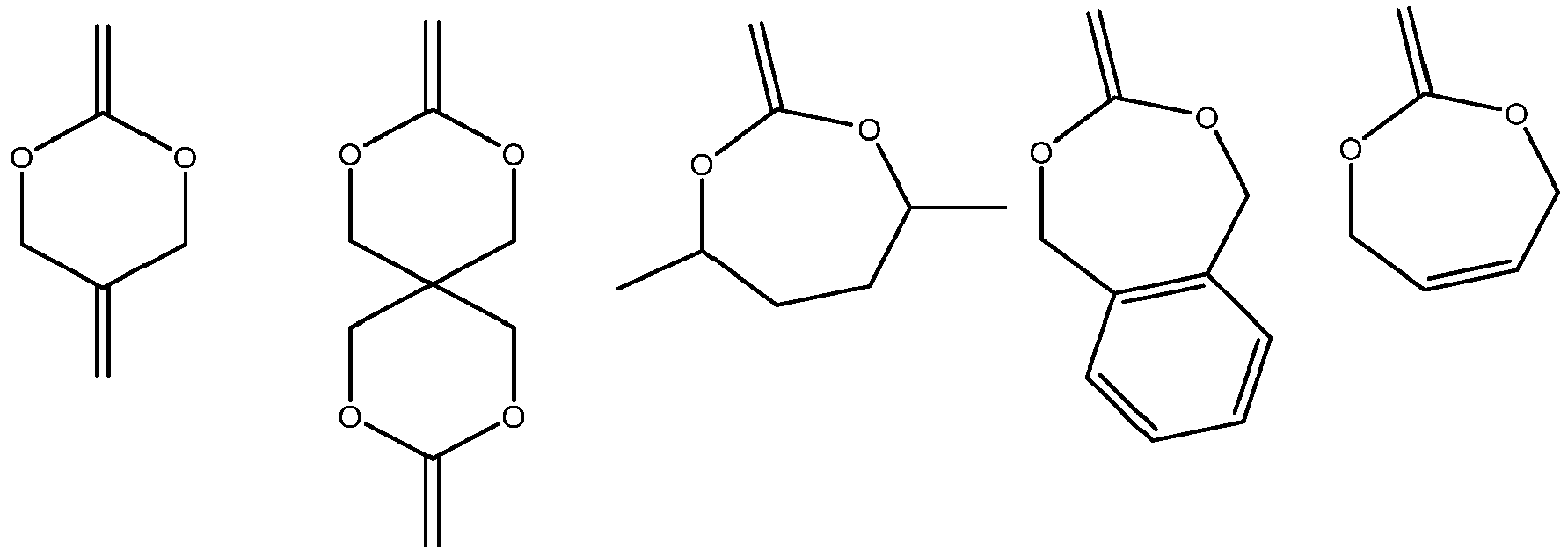
- cyclic ketene acetal monomers examples include:
- a preferred cyclic ketene acetal monomer is 2-methylene-1,3-dioxepane (MDO).
- a structural unit of MDO is illustrated: Structural unit of 2-methylene-1,3-dioxepane
- the ethylenically unsaturated acid monomer can be a carboxylic acid containing monomer, a phosphorus acid containing monomer, or a sulfur acid containing monomer, or salts thereof.
- suitable carboxylic acid containing monomers include acrylic acid, methacrylic acid, itaconic acid, crotonic acid, maleic acid, and fumaric acid;
- suitable phosphorus acid containing monomers include phosphoethyl methacrylate and 2-(methacryloyloxy)ethyl phosphonic acid;
- suitable sulfur acid containing monomers include 2-acrylamido-2-methyl-1-propanesulfonic acid (AMPS), vinyl sulfonic acid, 2-sulfoethyl acrylate, 2-sulfoethyl methacrylate, 3-sulfopropyl acrylate, 3-sulfopropyl methacrylate, and 2-propene-1-sulfonic acid.
- AMPS 2-acrylamido-2-
- the ethylenically unsaturated acid monomer is preferably a sulfonic acid containing monomer, preferably the salt of a sulfonic acid containing monomer, with a salt of 2-acrylamido-2-methylpropane sulfonic acid being especially preferred.
- the polymer particles have a z-average particle size in the range of from 50 nm, more preferably from 80 nm, and most preferably from 100 nm; to preferably 500 nm, more preferably to 300 nm, more preferably to 200 nm, and most preferably to 150 nm.
- VA is used in an amount in the range of from 80, more preferably from 85 parts by weight, to 96.5, more preferably 95 parts by weight based on the weight of the VA, the CKA, and the ethylenically unsaturated acid monomer;
- the CKA is used in an amount in the range of from 3 parts by weight to 15, more preferably to 12 parts, and most preferably to 8 weight percent parts by weight based on the weight of the VA, the CKA, and the ethylenically unsaturated acid monomer; and preferably the monoethylenically unsaturated acid monomer is preferably used in an amount in the range of from 0.1 parts by weight to 3, more preferably to 1 part by weight based on the weight of the VA, the CKA, and the ethylenically unsaturated acid monomer.
- the composition preferably comprises a substantial absence of hydrolysis byproducts of the CKA and VA. More particularly, where the CKA is MDO, the composition preferably comprises less than 20, more preferably less than 10, more preferably less than 5, more preferably less than 2, and most preferably less than 1 weight percent of the undesirable ester 4-hydroxybutyl acetate (illustrated below) based on the weight of structural units of MDO in the polymer particles. 4-hydroxybutyl acetate
- composition preferably further comprises less than 3000 ppm, more preferably less than 2000 ppm of acetic acid, which is an undesired byproduct of VA hydrolysis.
- VA, the CKA, preferably MDO, and the monoethylenically unsaturated acid monomer preferably a salt of a sulfur acid containing monomer, more preferably a salt of AMPS
- VA and the CKA are combined together, then mixed with an aqueous solution of surfactant and the monoethylenically unsaturated acid monomer under emulsion polymerization conditions.
- the reaction is controlled at a temperature in the range of from 30 °C, preferably from 35° C, to 55 °C, preferably to 50 °C, and more preferably to 45 °C, and at a pH in the range of from 6.0, preferably from 6.5, more preferably from 7.0, and most preferably from 7.5, to 9.0, more preferably to 8.5.
- a dispersion of the copolymer having a solids content preferably in the range of from 20, more preferably from 25, and most preferably from 30 weight percent, to 50, and more preferably to 40 weight percent, is obtained.
- aqueous dispersions of copolymers of VA and CKA can be prepared efficiently without the use of organic solvents and with a minimum of undesirable hydrolysis byproducts of the CKA and VA.
- S i is scattered intensity from particle i with diameter D i .
- DLS Dynamic light scattering
- Samples were prepared for analysis by dilution in MilliQ water (1:100), followed by agitation on horizontal reciprocal shaker for 10 min. Samples were centrifuged at 100 000 rpm for 10 min at 25° C, and the supernatant was filtered through a 0.45 ⁇ m disposable syringe filter for injection.
- a monomer mixture was prepared in a vessel by combining vinyl acetate (VA, 205.95 g), and 2-methylene-1,3-dioxepane (MDO, 10.88 g).
- an aqueous mixture was prepared in a vessel by combining deionized water (46.18 g), 2-acrylamido-2-methyl-1-propanesulfonic acid sodium salt (AMPS salt, 1.40 g, 50% active in water), Tergitol-15-S-40 secondary alcohol ethoxylate (15-S-40, 1.51 g, 70% active in water) and Disponil® FES-32, sodium lauryl ether sulfonate (FES-32, 6.15 g, 31% active in water).
- AMPS salt 2-acrylamido-2-methyl-1-propanesulfonic acid sodium salt
- AMPS salt 1.40 g, 50% active in water
- Tergitol-15-S-40 secondary alcohol ethoxylate 15-S-40, 1.51 g, 70% active in water
- deionized water 285.0 g was added to a 4-neck 1-L round bottom reactor fitted with an overhead stirrer, a condenser, and thermocouple. The reactor was heated to 40 °C, after which time FES-32 (16.4 g, 31% active in water), AMPS salt (3.95 g, 50% active in water), FeSO 4 ⁇ 7H 2 O (16.2 g, 0.15 active in water), and ethylenediamine tetraacetic acid (EDTA, 3.45 g, 1.0 wt% in water) were added to the reactor with the aid of additional deionized water (51.6 g).
- FES-32 16.4 g, 31% active in water
- AMPS salt 3.95 g, 50% active in water
- FeSO 4 ⁇ 7H 2 O 16.2 g, 0.15 active in water
- EDTA ethylenediamine tetraacetic acid
- the monomer mixture and the aqueous mixture were fed concurrently into the reactor over 60 min while maintaining the reactor temperature at 40 °C.
- Concurrently, separately prepared solutions of ammonium persulfate/ t -butyl hydroperoxide (1.38 g APS and 0.58 g t -BHP in 37.0 g water) and Bruggolite FF6 (2.62 g in 37.6 g water) were fed into the reactor over 70 min.
- the reactor temperature was maintained at 40 °C for 15 min, and then cooled to 30 °C.
- the incorporation of 2-methylene-1,3-dioxepane (MDO) was measured to be (84.3 ⁇ 4.3)% by diffusion-edited 1 H NMR spectroscopy. An error of 5% was assumed in all integrations values and propagated through the calculation for the incorporation of MDO.
- Example 2 was repeated, but the monomer mixture was prepared by combining VA (183.95 g), and MDO (32.88 g). The filtrate was analyzed for percent solids (29.7%) and the z-average particle size was determined to be 92 nm, as measured DLS. The incorporation of MDO was measured to be 97.8 ⁇ 6.6% by diffusion-edited 1 H NMR spectroscopy.
- Example 1 was repeated, but the reaction temperature was maintained at 60 °C throughout the feeds.
- the filtrate was analyzed for percent solids (29.8%) and the z-average particle size was determined to be 177 nm, as measured DLS.
- the incorporation of MDO was measured to be 55.1 ⁇ 3.9% by diffusion-edited 1 H NMR spectroscopy.
- Example 1 was repeated, but the reaction temperature was maintained at 80 °C throughout the feeds.
- the filtrate was analyzed for percent solids (29.4%) and the z-average particle size was determined to be 217 nm, as measured DLS.
- the incorporation of MDO was measured to be 37.8 ⁇ 2.7% by diffusion-edited 1 H NMR spectroscopy.
Landscapes
- Chemical & Material Sciences (AREA)
- Health & Medical Sciences (AREA)
- Chemical Kinetics & Catalysis (AREA)
- Medicinal Chemistry (AREA)
- Polymers & Plastics (AREA)
- Organic Chemistry (AREA)
- Dispersion Chemistry (AREA)
- Life Sciences & Earth Sciences (AREA)
- Biodiversity & Conservation Biology (AREA)
- Engineering & Computer Science (AREA)
- Mechanical Engineering (AREA)
- Addition Polymer Or Copolymer, Post-Treatments, Or Chemical Modifications (AREA)
- Compositions Of Macromolecular Compounds (AREA)
Abstract
Description
- The present invention relates to the preparation of an aqueous dispersion of polymer particles comprising structural units of vinyl acetate and a cyclic ketene acetal monomer.
- Copolymers of vinyl acetate (VA) and a cyclic ketene acetal (CKA) monomer such as 2-methylene-1,3-dioxepane (MDO) are particularly useful in applications that require polymer backbone degradation, such as degradable packaging, or the physical erosion of polymer-based thin films and surface coatings. These copolymers are described as being prepared in the presence of an organic solvent as disclosed, for example, in Polym. J. 2009, 41, 650-660; Polym. Chem. 2012, 3, 1260-1266; Polym. Chem. 2015, 6, 7447-7454; and
US 1996/5541275 . - Organic solvents are used to prepare CKA-containing polymers because CKAs are known to be hydrolytically unstable. For example, MDO hydrolyzes in water to form 4-hydroxybutyl acetate, thereby reducing the efficiency of incorporation of structural units of MDO into the copolymer backbone. Accordingly, the hydrolytic instability of MDO mandates the use of unreactive organic solvents; unfortunately, these solvents are undesirable due to their high cost, the cost associated with their removal, recovery, and recycling, and their contribution to remnant volatile organic solvents in the final isolated product.
- Accordingly, it would be advantageous to find a way to prepare aqueous based VA-CKA copolymers in a way that significantly reduces the formation of unwanted hydrolytic byproducts.
- The present invention addresses a need in the art by providing a method comprising the steps of a) contacting under emulsion polymerization conditions at a temperature in the range of from 30 °C to 55 °C, and at a pH in the range of from 6.0 to 9.0: 1) 75 to 98.5 parts by weight vinyl acetate; 2) 1 to 20 parts by weight of a cyclic ketene acetal monomer; and 3) 0.05 to 5 parts by weight of a monoethylenically unsaturated acid monomer or a salt thereof; to form an aqueous dispersion of copolymer particles comprising structural units of vinyl acetate, the cyclic ketene acetal, and the monoethylenically unsaturated acid monomer or a salt thereof; wherein the cyclic ketene acetal monomer is characterized by following structure:

- where n is 0, 1, or 2;
- R is H or C1-C6-alkyl;
- R1 and R2 are each independently H, C1-C12-alkyl, phenyl, or vinyl; or R1 and R2 together with the carbon atoms to which they are attached, form a fused benzene ring or a fused C3-C7-cycloaliphatic ring; and
- R1' and R2' is are each independently H or C1-C12-alkyl; or R1 and R1' and/or R2 and R2' form an exocyclic double bond;
- R3 and R3' are each independently H, C1-C12-alkyl, phenyl, or R3 and R3' form an exocyclic double bond or a spirocycloaliphatic group or spiro-2-methylene-1,3-dioxepane group;
- with the further proviso that when n is 2:
each R3 is H, C1-C12-alkyl, or together with the carbon atoms to which they are attached form a double bond, a fused benzene ring, or a fused C3-C7-cycloaliphatic ring. - The method of the present invention provides a water-borne dispersion that is substantially free of volatile organic solvents; the dispersion is useful, for example, in the manufacture of biodegradable packaging products.
- The present invention provides a method comprising the steps of a) contacting under emulsion polymerization conditions at a temperature in the range of from 30 °C to 55 °C, and at a pH in the range of from 6.0 to 9.0: 1) 75 to 98.5 parts by weight vinyl acetate; 2) 1 to 20 parts by weight of a cyclic ketene acetal monomer; and 3) 0.05 to 5 parts by weight of a monoethylenically unsaturated acid monomer or a salt thereof; to form an aqueous dispersion of copolymer particles comprising structural units of vinyl acetate, the cyclic ketene acetal, and the monoethylenically unsaturated acid monomer or a salt thereof; wherein the cyclic ketene acetal monomer is characterized by following structure:

- where n is 0, 1, or 2;
- R is H or C1-C6-alkyl;
- R1 and R2 are each independently H, C1-C12-alkyl, phenyl, or vinyl; or R1 and R2 together with the carbon atoms to which they are attached, form a fused benzene ring or a fused C3-C7-cycloaliphatic ring; and
- R1' and R2' are each independently H or C1-C12-alkyl; or R1 and R1' and/or R2 and R2' form an exocyclic double bond;
- with the proviso that when n is 1:
R3 and R3' are each independently H, C1-C12-alkyl, phenyl, or R3 and R3' form an exocyclic double bond or a spirocycloaliphatic group or spiro-2-methylene-1,3-dioxepane group; - with the further proviso that when n is 2:
each R3 is H, C1-C12-alkyl, or together with the carbon atoms to which they are attached form a double bond, a fused benzene ring, or a fused C3-C7-cycloaliphatic ring. - As used herein, the term "structural unit of vinyl acetate" refers to a polymer backbone containing the following repeat units:

wherein the dotted lines represent the points of attachment to the other structural units in the polymer backbone. - The term "structural unit of a cyclic ketene acetal monomer" is used to refer to a polymer backbone containing the following repeat unit:

where R, R1, R2, R3, R1', R2', R3', and n are as previously defined. - Examples of cyclic ketene acetal monomers include:


- A preferred cyclic ketene acetal monomer is 2-methylene-1,3-dioxepane (MDO).

- A structural unit of MDO is illustrated:

- The ethylenically unsaturated acid monomer can be a carboxylic acid containing monomer, a phosphorus acid containing monomer, or a sulfur acid containing monomer, or salts thereof. Examples of suitable carboxylic acid containing monomers include acrylic acid, methacrylic acid, itaconic acid, crotonic acid, maleic acid, and fumaric acid; examples of suitable phosphorus acid containing monomers include phosphoethyl methacrylate and 2-(methacryloyloxy)ethyl phosphonic acid; suitable sulfur acid containing monomers include 2-acrylamido-2-methyl-1-propanesulfonic acid (AMPS), vinyl sulfonic acid, 2-sulfoethyl acrylate, 2-sulfoethyl methacrylate, 3-sulfopropyl acrylate, 3-sulfopropyl methacrylate, and 2-propene-1-sulfonic acid. The ethylenically unsaturated acid monomer is preferably a sulfonic acid containing monomer, preferably the salt of a sulfonic acid containing monomer, with a salt of 2-acrylamido-2-methylpropane sulfonic acid being especially preferred.
- Preferably, the polymer particles have a z-average particle size in the range of from 50 nm, more preferably from 80 nm, and most preferably from 100 nm; to preferably 500 nm, more preferably to 300 nm, more preferably to 200 nm, and most preferably to 150 nm.
- Preferably, VA is used in an amount in the range of from 80, more preferably from 85 parts by weight, to 96.5, more preferably 95 parts by weight based on the weight of the VA, the CKA, and the ethylenically unsaturated acid monomer; preferably, the CKA is used in an amount in the range of from 3 parts by weight to 15, more preferably to 12 parts, and most preferably to 8 weight percent parts by weight based on the weight of the VA, the CKA, and the ethylenically unsaturated acid monomer; and preferably the monoethylenically unsaturated acid monomer is preferably used in an amount in the range of from 0.1 parts by weight to 3, more preferably to 1 part by weight based on the weight of the VA, the CKA, and the ethylenically unsaturated acid monomer.
- The composition preferably comprises a substantial absence of hydrolysis byproducts of the CKA and VA. More particularly, where the CKA is MDO, the composition preferably comprises less than 20, more preferably less than 10, more preferably less than 5, more preferably less than 2, and most preferably less than 1 weight percent of the undesirable ester 4-hydroxybutyl acetate (illustrated below) based on the weight of structural units of MDO in the polymer particles.

- The composition preferably further comprises less than 3000 ppm, more preferably less than 2000 ppm of acetic acid, which is an undesired byproduct of VA hydrolysis.
- In a preferred process of the present invention, VA, the CKA, preferably MDO, and the monoethylenically unsaturated acid monomer, preferably a salt of a sulfur acid containing monomer, more preferably a salt of AMPS, are contacted together under emulsion polymerization conditions. Preferably, the VA and the CKA are combined together, then mixed with an aqueous solution of surfactant and the monoethylenically unsaturated acid monomer under emulsion polymerization conditions. The reaction is controlled at a temperature in the range of from 30 °C, preferably from 35° C, to 55 °C, preferably to 50 °C, and more preferably to 45 °C, and at a pH in the range of from 6.0, preferably from 6.5, more preferably from 7.0, and most preferably from 7.5, to 9.0, more preferably to 8.5. After completion of the polymerization, a dispersion of the copolymer having a solids content preferably in the range of from 20, more preferably from 25, and most preferably from 30 weight percent, to 50, and more preferably to 40 weight percent, is obtained.
- It has surprisingly been discovered that aqueous dispersions of copolymers of VA and CKA can be prepared efficiently without the use of organic solvents and with a minimum of undesirable hydrolysis byproducts of the CKA and VA.
- Particle size was measured using a Malvern Zetasizer Nano ZS90, which measures Z-average particle size (Dz ) using dynamic light scattering (DLS) at a scattering angle of 90° using Zetasizer software version 7.11. A drop of the sample dispersion was diluted using an aqueous solution of MilliQ water (18.2 MΩ.cm at 25 °C) to achieve a particle count in the range of 200-400 thousand counts/s (Kcps). Particle size measurements were carried using instrument's particle sizing method and Dz was computed by the software. Dz is also known as the intensity-based harmonic mean average particle size and expressed as;

- Here, Si is scattered intensity from particle i with diameter Di . Detailed Dz calculations are described in ISO 22412:2017 (Particle size analysis - Dynamic light scattering (DLS)).
- Analysis of acetic acid was performed using a Agilent 1100 Series high-performance liquid chromatography system equipped with a Phenomenex Rezex ROA-Organic Acid H+ (8%) (250 x 4.6) mm column (part number 00G-0138-E0), Phenomenex Security Guard Carbo-H4 element, UV detector operating at a wavelength of 210 nm, and autosampler. The column oven temperature was set to 35° C and the mobile phase was 2.5 mM phosphoric acid in MilliQ water. The instrument operated at a flow rate of 0.4 mL/min (isocratic) and the sample injection volume was 5 µL. Data acquisition and analysis was performed using Agilent ChemStation software (version B.04.03). Samples were prepared for analysis by dilution in MilliQ water (1:100), followed by agitation on horizontal reciprocal shaker for 10 min. Samples were centrifuged at 100 000 rpm for 10 min at 25° C, and the supernatant was filtered through a 0.45 µm disposable syringe filter for injection.
- A monomer mixture was prepared in a vessel by combining vinyl acetate (VA, 205.95 g), and 2-methylene-1,3-dioxepane (MDO, 10.88 g). Separately, an aqueous mixture was prepared in a vessel by combining deionized water (46.18 g), 2-acrylamido-2-methyl-1-propanesulfonic acid sodium salt (AMPS salt, 1.40 g, 50% active in water), Tergitol-15-S-40 secondary alcohol ethoxylate (15-S-40, 1.51 g, 70% active in water) and Disponil® FES-32, sodium lauryl ether sulfonate (FES-32, 6.15 g, 31% active in water). Separately, deionized water (285.0 g) was added to a 4-neck 1-L round bottom reactor fitted with an overhead stirrer, a condenser, and thermocouple. The reactor was heated to 40 °C, after which time FES-32 (16.4 g, 31% active in water), AMPS salt (3.95 g, 50% active in water), FeSO4·7H2O (16.2 g, 0.15 active in water), and ethylenediamine tetraacetic acid (EDTA, 3.45 g, 1.0 wt% in water) were added to the reactor with the aid of additional deionized water (51.6 g). The monomer mixture and the aqueous mixture were fed concurrently into the reactor over 60 min while maintaining the reactor temperature at 40 °C. Concurrently, separately prepared solutions of ammonium persulfate/t-butyl hydroperoxide (1.38 g APS and 0.58 g t-BHP in 37.0 g water) and Bruggolite FF6 (2.62 g in 37.6 g water) were fed into the reactor over 70 min. The reaction was measured to be pH = 6.5-7 throughout the feed process. Upon completion of addition of the feeds, the reactor temperature was maintained at 40 °C for 15 min, and then cooled to 30 °C. The resultant dispersion was adjusted to pH = 7 with the addition of ammonium hydroxide (28% active in water) and was filtered through a 38-µm screen. The filtrate was analyzed for percent solids (32.9%) and the z-average particle size was determined to be 116 nm, as measured using dynamic light scattering (DLS). The incorporation of 2-methylene-1,3-dioxepane (MDO) was measured to be (84.3 ± 4.3)% by diffusion-edited 1H NMR spectroscopy. An error of 5% was assumed in all integrations values and propagated through the calculation for the incorporation of MDO.
- Example 1 was repeated, but the reaction was maintained at pH = 8 throughout the feeds by the dropwise addition of ammonium hydroxide (28% active in water). The filtrate was analyzed for percent solids (31.3%) and the z-average particle size was determined to be 122 nm, as measured DLS. The incorporation of MDO was measured to be virtually quantitative (∼100%) by diffusion-edited 1H NMR spectroscopy.
- Example 2 was repeated, but the monomer mixture was prepared by combining VA (183.95 g), and MDO (32.88 g). The filtrate was analyzed for percent solids (29.7%) and the z-average particle size was determined to be 92 nm, as measured DLS. The incorporation of MDO was measured to be 97.8 ± 6.6% by diffusion-edited 1H NMR spectroscopy.
- Example 1 was repeated, but the reaction temperature was maintained at 60 °C throughout the feeds. The filtrate was analyzed for percent solids (29.8%) and the z-average particle size was determined to be 177 nm, as measured DLS. The incorporation of MDO was measured to be 55.1 ± 3.9% by diffusion-edited 1H NMR spectroscopy.
- Example 1 was repeated, but the reaction temperature was maintained at 80 °C throughout the feeds. The filtrate was analyzed for percent solids (29.4%) and the z-average particle size was determined to be 217 nm, as measured DLS. The incorporation of MDO was measured to be 37.8 ± 2.7% by diffusion-edited 1H NMR spectroscopy.
- Example 1 was repeated, except that the reaction was maintained at pH = 5 throughout the feeds by the dropwise addition of acetic acid (10% active in water). The filtrate was analyzed for percent solids (31.0%) and the z-average particle size was determined to be 248 nm, as measured DLS. The incorporation of MDO was measured to be 29.0 ± 2.0% by diffusion-edited 1H NMR spectroscopy.
- Example 1 was repeated, but the reaction was maintained at pH = 9.5 throughout the feeds by the dropwise addition of ammonium hydroxide (28% active in water). The filtrate was analyzed for percent solids (29.6%) and the z-average particle size was determined to be 283 nm, as measured DLS. The incorporation of MDO was measured to be 90.3 ± 6.3% by diffusion-edited 1H NMR spectroscopy; nevertheless, the sample displayed poor colloidal stability and 7850 ppm of gel was obtained. The sample discolored upon standing to a dark brown and an unusually high concentration of acetic acid and acetaldehyde was observed.
- The examples demonstrate the significance of the role that temperature and pH play in optimizing the incorporation of the water-sensitive monomers into the polymer backbone and in reducing the production of unwanted hydrolysis products arising from these monomers.
Claims (9)
- A method comprising the steps of:a) contacting under emulsion polymerization conditions at a temperature in the range of from 30 °C to 55 °C, and at a pH in the range of from 6.0 to 9.0:1) 75 to 98.5 parts by weight of vinyl acetate;2) 1 to 20 parts by weight of a cyclic ketene acetal monomer; and3) 0.05 to 5 parts by weight of a monoethylenically unsaturated acid monomer or a salt thereof; to form an aqueous dispersion of copolymer particles comprising structural units of vinyl acetate, the cyclic ketene acetal, and the monoethylenically unsaturated acid monomer or a salt thereof;wherein the cyclic ketene acetal monomer is characterized by following structure:
 where n is 0, 1, or 2;R is H or C1-C6-alkyl;R1 and R2 are each independently H, C1-C12-alkyl, phenyl, or vinyl; or R1 and R2 together with the carbon atoms to which they are attached, form a fused benzene ring or a fused C3-C7-cycloaliphatic ring; andR1' and R2' are each independently H or C1-C12-alkyl; or R1 and R1' and/or R2 and R2' form an exocyclic double bond;with the proviso that when n is 1:R3 and R3' are each independently H, C1-C12-alkyl, phenyl, or R3 and R3' form an exocyclic double bond or a spirocycloaliphatic group or spiro-2-methylene-1,3-dioxepane group;with the further proviso that when n is 2:
each R3 is H, C1-C12-alkyl, or together with the carbon atoms to which they are attached form a double bond, a fused benzene ring, or a fused C3-C7-cycloaliphatic ring. - The method of Claim 1 wherein the cyclic ketene acetal monomer, the vinyl acetate, and the monoethylenically unsaturated acid monomer or a salt thereof are contacted under emulsion polymerization conditions at a temperature in the range of from 35 °C to 55 °C, and at a pH in the range of from 6.5 to 8.5.
- The method of Claim 2 wherein cyclic ketene acetal monomer is selected from the group consisting of:



- The method of Claim 3 wherein the cyclic ketene acetal monomer is 2-methylene-1,3-dioxepane, and the monoethylenically unsaturated acid monomer is a sulfur acid containing monomer or a salt thereof; wherein the 2-methylene-1,3-dioxepane, the vinyl acetate, and the sulfur acid containing monomer or a salt thereof are contacted under emulsion polymerization conditions at a temperature in the range of from 35 °C to 50 °C and at a pH in the range of from 7.5 to 8.5.
- The method of Claim 4 wherein the sulfur acid containing monomer or salt thereof is selected from the group consisting of 2-acrylamido-2-methyl-1-propanesulfonic acid, salts of 2-acrylamido-2-methyl-1-propanesulfonic acid, vinyl sulfonic acid, salts of vinyl sulfonic acid, 2-sulfoethyl acrylate, 2-sulfoethyl methacrylate, 3-sulfopropyl acrylate, 3-sulfopropyl methacrylate, sodium styrene sulfonate, 2-propene-1-sulfonic acid and salts of 2-propene-1-sulfonic acid.
- The composition of Claim 5 wherein the sulfur acid containing monomer or salt thereof is a salt of 2-acrylamido-2-methyl-1-propanesulfonic acid.
- The composition of any of Claims 4 to 6 which comprises less than 20 weight percent 4-hydroxybutyl acetate based on the weight of structural units of 2-methylene-1,3-dioxepane in the polymer particles; wherein the 2-methylene-1,3-dioxepane, the vinyl acetate, and the sulfur acid containing monomer or a salt thereof are contacted under emulsion polymerization conditions at a temperature in the range of from 35 °C to 45 °C.
- The composition of Claim 7 which comprises less than 10 weight percent 4-hydroxybutyl acetate based on the weight of structural units of 2-methylene-1,3-dioxepane in the polymer particles.
- The composition of Claim 8 which comprises less than 2 weight percent 4-hydroxybutyl acetate based on the weight of structural units of 2-methylene-1,3-dioxepane in the polymer particles.
Applications Claiming Priority (1)
| Application Number | Priority Date | Filing Date | Title |
|---|---|---|---|
| US201962831868P | 2019-04-10 | 2019-04-10 |
Publications (2)
| Publication Number | Publication Date |
|---|---|
| EP3722334A1 true EP3722334A1 (en) | 2020-10-14 |
| EP3722334B1 EP3722334B1 (en) | 2023-05-10 |
Family
ID=70227901
Family Applications (1)
| Application Number | Title | Priority Date | Filing Date |
|---|---|---|---|
| EP20168559.1A Active EP3722334B1 (en) | 2019-04-10 | 2020-04-07 | Preparation of an aqueous dispersion of copolymer particles of vinyl acetate and a cyclic ketene acetal monomer |
Country Status (6)
| Country | Link |
|---|---|
| US (1) | US11111329B2 (en) |
| EP (1) | EP3722334B1 (en) |
| JP (1) | JP7586649B2 (en) |
| KR (1) | KR20200119723A (en) |
| CN (1) | CN111808226B (en) |
| CA (1) | CA3077845A1 (en) |
Cited By (3)
| Publication number | Priority date | Publication date | Assignee | Title |
|---|---|---|---|---|
| WO2023078534A1 (en) | 2021-11-02 | 2023-05-11 | Wacker Chemie Ag | Biodegradable copolymers |
| WO2023075696A3 (en) * | 2021-11-01 | 2023-06-22 | Agency For Science, Technology And Research | Method for preparing a polymer having ester functionality and said polymer prepared therefrom |
| WO2023241833A1 (en) * | 2022-06-14 | 2023-12-21 | The University Of The Basque Country | Method for producing biobased degradable copolymers by radical polymerization of ketene acetals and crotonic acid or its esters and copolymers thus produced as well as uses thereof |
Families Citing this family (3)
| Publication number | Priority date | Publication date | Assignee | Title |
|---|---|---|---|---|
| CN116438216A (en) * | 2020-11-11 | 2023-07-14 | 大金工业株式会社 | Copolymer |
| KR20250003711A (en) | 2022-04-13 | 2025-01-07 | 다우 글로벌 테크놀로지스 엘엘씨 | Silicone-vinyl ester functional compounds and their preparation methods and uses in personal care compositions |
| WO2024061448A1 (en) | 2022-09-20 | 2024-03-28 | Wacker Chemie Ag | Copolymers of cyclic ketene acetal monomers |
Citations (2)
| Publication number | Priority date | Publication date | Assignee | Title |
|---|---|---|---|---|
| US4812510A (en) * | 1986-04-17 | 1989-03-14 | The Glidden Company | Small particle size latex based on vinyl acetate polymers |
| US5541275A (en) | 1993-03-11 | 1996-07-30 | Wacker-Chemie Gmbh | Biodegradable vinyl ester copolymers |
Family Cites Families (5)
| Publication number | Priority date | Publication date | Assignee | Title |
|---|---|---|---|---|
| DE1595693C3 (en) * | 1966-11-08 | 1975-05-15 | Farbwerke Hoechst Ag, Vormals Meister Lucius & Bruening, 6000 Frankfurt | Process for the preparation of aqueous polymer dispersions |
| JPH0813923B2 (en) * | 1987-08-17 | 1996-02-14 | 三菱化学ビーエーエスエフ株式会社 | Room temperature crosslinkable polymer dispersion composition |
| CN101932612B (en) * | 2008-02-01 | 2012-11-21 | 阿科玛股份有限公司 | Aqueous emulsion polymer for scrub resistance and wet adhesion |
| JP6649177B2 (en) | 2016-05-23 | 2020-02-19 | 株式会社クラレ | Methacrylic acid ester copolymer and molded article |
| EP3665235B1 (en) | 2017-08-08 | 2022-04-13 | Rohm and Haas Company | Water-based adhesive compositions and methods of making same |
-
2020
- 2020-03-11 CN CN202010165136.3A patent/CN111808226B/en active Active
- 2020-03-17 JP JP2020046306A patent/JP7586649B2/en active Active
- 2020-03-18 US US16/822,292 patent/US11111329B2/en active Active
- 2020-03-24 KR KR1020200035896A patent/KR20200119723A/en active Pending
- 2020-04-07 EP EP20168559.1A patent/EP3722334B1/en active Active
- 2020-04-08 CA CA3077845A patent/CA3077845A1/en active Pending
Patent Citations (2)
| Publication number | Priority date | Publication date | Assignee | Title |
|---|---|---|---|---|
| US4812510A (en) * | 1986-04-17 | 1989-03-14 | The Glidden Company | Small particle size latex based on vinyl acetate polymers |
| US5541275A (en) | 1993-03-11 | 1996-07-30 | Wacker-Chemie Gmbh | Biodegradable vinyl ester copolymers |
Non-Patent Citations (4)
| Title |
|---|
| E.H. CORDES, H.G. BULL: "Mechanism and Catalysis for Hydrolysis of Acetals, Ketals and Ortho Esters", CHEMICAL REVIEWS, vol. 74, no. 5, 1974, pages 581 - 603, XP055722060 * |
| POLYM. CHEM., vol. 3, 2012, pages 1260 - 1266 |
| POLYM. CHEM., vol. 6, 2015, pages 7447 - 7454 |
| POLYM. J., vol. 41, 2009, pages 650 - 660 |
Cited By (4)
| Publication number | Priority date | Publication date | Assignee | Title |
|---|---|---|---|---|
| WO2023075696A3 (en) * | 2021-11-01 | 2023-06-22 | Agency For Science, Technology And Research | Method for preparing a polymer having ester functionality and said polymer prepared therefrom |
| WO2023078534A1 (en) | 2021-11-02 | 2023-05-11 | Wacker Chemie Ag | Biodegradable copolymers |
| EP4426753A1 (en) * | 2021-11-02 | 2024-09-11 | Wacker Chemie AG | Biodegradable copolymers |
| WO2023241833A1 (en) * | 2022-06-14 | 2023-12-21 | The University Of The Basque Country | Method for producing biobased degradable copolymers by radical polymerization of ketene acetals and crotonic acid or its esters and copolymers thus produced as well as uses thereof |
Also Published As
| Publication number | Publication date |
|---|---|
| CN111808226B (en) | 2023-08-15 |
| KR20200119723A (en) | 2020-10-20 |
| CN111808226A (en) | 2020-10-23 |
| CA3077845A1 (en) | 2020-10-10 |
| JP7586649B2 (en) | 2024-11-19 |
| EP3722334B1 (en) | 2023-05-10 |
| US20200325261A1 (en) | 2020-10-15 |
| US11111329B2 (en) | 2021-09-07 |
| JP2020172628A (en) | 2020-10-22 |
| BR102020005683A2 (en) | 2020-10-20 |
Similar Documents
| Publication | Publication Date | Title |
|---|---|---|
| EP3722334B1 (en) | Preparation of an aqueous dispersion of copolymer particles of vinyl acetate and a cyclic ketene acetal monomer | |
| EP3722341B1 (en) | Aqueous dispersion of copolymer particles of vinyl acetate and a cyclic ketene acetal monomer | |
| KR101714112B1 (en) | Process for preparing a (meth)acrylate copolymer containing tertiary amino groups by free-radical polymerization in solution | |
| EP4021911B1 (en) | Preparation of an aqueous dispersion of acrylate-siloxane copolymer particles | |
| EP4103624B1 (en) | Aqueous dispersion of acrylate-siloxane copolymer particles | |
| Oliveira et al. | The role of itaconic and fumaric acid in the emulsion copolymerization of methyl methacrylate and n-butyl acrylate | |
| CN1049665C (en) | Aqueous emulsion process for preparing vinyl chloride polymers in the form of latices containing monodisperse particles | |
| KR101728201B1 (en) | Process for preparing a (meth)acrylate copolymer containing quaternary ammonium groups by free-radical polymerization in solution | |
| BR102020005610B1 (en) | AQUEOUS DISPERSION OF VINYL ACETATE COPOLYMER PARTICLES AND A CYCLIC KETENE ACETAL MONOMER | |
| BR102020005683B1 (en) | METHOD | |
| EP4021952B1 (en) | Aqueous dispersion of acrylate-siloxane copolymer particles | |
| CA3147830C (en) | Aqueous dispersion of acrylate-siloxane copolymer particles | |
| Khansumled | Keto-hydrazide crosslinking of water-borne polymers prepared by emulsion polymerisation | |
| EP2976392B1 (en) | Use of a polymeric emulsion for the surface treatment of the particles of an inorganic material |
Legal Events
| Date | Code | Title | Description |
|---|---|---|---|
| PUAI | Public reference made under article 153(3) epc to a published international application that has entered the european phase |
Free format text: ORIGINAL CODE: 0009012 |
|
| STAA | Information on the status of an ep patent application or granted ep patent |
Free format text: STATUS: THE APPLICATION HAS BEEN PUBLISHED |
|
| AK | Designated contracting states |
Kind code of ref document: A1 Designated state(s): AL AT BE BG CH CY CZ DE DK EE ES FI FR GB GR HR HU IE IS IT LI LT LU LV MC MK MT NL NO PL PT RO RS SE SI SK SM TR |
|
| AX | Request for extension of the european patent |
Extension state: BA ME |
|
| STAA | Information on the status of an ep patent application or granted ep patent |
Free format text: STATUS: REQUEST FOR EXAMINATION WAS MADE |
|
| 17P | Request for examination filed |
Effective date: 20210407 |
|
| RBV | Designated contracting states (corrected) |
Designated state(s): AL AT BE BG CH CY CZ DE DK EE ES FI FR GB GR HR HU IE IS IT LI LT LU LV MC MK MT NL NO PL PT RO RS SE SI SK SM TR |
|
| STAA | Information on the status of an ep patent application or granted ep patent |
Free format text: STATUS: EXAMINATION IS IN PROGRESS |
|
| 17Q | First examination report despatched |
Effective date: 20211005 |
|
| GRAP | Despatch of communication of intention to grant a patent |
Free format text: ORIGINAL CODE: EPIDOSNIGR1 |
|
| STAA | Information on the status of an ep patent application or granted ep patent |
Free format text: STATUS: GRANT OF PATENT IS INTENDED |
|
| RIC1 | Information provided on ipc code assigned before grant |
Ipc: C08F 220/58 20060101ALN20220603BHEP Ipc: C08F 216/38 20060101ALN20220603BHEP Ipc: C08F 2/22 20060101ALN20220603BHEP Ipc: C08G 63/00 20060101ALI20220603BHEP Ipc: C08F 218/08 20060101ALI20220603BHEP Ipc: C08F 18/08 20060101AFI20220603BHEP |
|
| INTG | Intention to grant announced |
Effective date: 20220623 |
|
| RIN1 | Information on inventor provided before grant (corrected) |
Inventor name: HEJL, ANDREW Inventor name: EVEN, RALPH C. Inventor name: CARTER, MATTHEW |
|
| GRAJ | Information related to disapproval of communication of intention to grant by the applicant or resumption of examination proceedings by the epo deleted |
Free format text: ORIGINAL CODE: EPIDOSDIGR1 |
|
| STAA | Information on the status of an ep patent application or granted ep patent |
Free format text: STATUS: EXAMINATION IS IN PROGRESS |
|
| INTC | Intention to grant announced (deleted) | ||
| RIC1 | Information provided on ipc code assigned before grant |
Ipc: C08F 220/58 20060101ALN20221026BHEP Ipc: C08F 216/38 20060101ALN20221026BHEP Ipc: C08F 2/22 20060101ALN20221026BHEP Ipc: C08G 63/00 20060101ALI20221026BHEP Ipc: C08F 218/08 20060101ALI20221026BHEP Ipc: C08F 18/08 20060101AFI20221026BHEP |
|
| GRAP | Despatch of communication of intention to grant a patent |
Free format text: ORIGINAL CODE: EPIDOSNIGR1 |
|
| STAA | Information on the status of an ep patent application or granted ep patent |
Free format text: STATUS: GRANT OF PATENT IS INTENDED |
|
| INTG | Intention to grant announced |
Effective date: 20221206 |
|
| GRAS | Grant fee paid |
Free format text: ORIGINAL CODE: EPIDOSNIGR3 |
|
| GRAA | (expected) grant |
Free format text: ORIGINAL CODE: 0009210 |
|
| STAA | Information on the status of an ep patent application or granted ep patent |
Free format text: STATUS: THE PATENT HAS BEEN GRANTED |
|
| AK | Designated contracting states |
Kind code of ref document: B1 Designated state(s): AL AT BE BG CH CY CZ DE DK EE ES FI FR GB GR HR HU IE IS IT LI LT LU LV MC MK MT NL NO PL PT RO RS SE SI SK SM TR |
|
| REG | Reference to a national code |
Ref country code: GB Ref legal event code: FG4D |
|
| REG | Reference to a national code |
Ref country code: AT Ref legal event code: REF Ref document number: 1566604 Country of ref document: AT Kind code of ref document: T Effective date: 20230515 Ref country code: CH Ref legal event code: EP |
|
| REG | Reference to a national code |
Ref country code: DE Ref legal event code: R096 Ref document number: 602020010601 Country of ref document: DE |
|
| REG | Reference to a national code |
Ref country code: IE Ref legal event code: FG4D |
|
| P01 | Opt-out of the competence of the unified patent court (upc) registered |
Effective date: 20230526 |
|
| REG | Reference to a national code |
Ref country code: LT Ref legal event code: MG9D |
|
| REG | Reference to a national code |
Ref country code: NL Ref legal event code: MP Effective date: 20230510 |
|
| REG | Reference to a national code |
Ref country code: AT Ref legal event code: MK05 Ref document number: 1566604 Country of ref document: AT Kind code of ref document: T Effective date: 20230510 |
|
| PG25 | Lapsed in a contracting state [announced via postgrant information from national office to epo] |
Ref country code: SE Free format text: LAPSE BECAUSE OF FAILURE TO SUBMIT A TRANSLATION OF THE DESCRIPTION OR TO PAY THE FEE WITHIN THE PRESCRIBED TIME-LIMIT Effective date: 20230510 Ref country code: PT Free format text: LAPSE BECAUSE OF FAILURE TO SUBMIT A TRANSLATION OF THE DESCRIPTION OR TO PAY THE FEE WITHIN THE PRESCRIBED TIME-LIMIT Effective date: 20230911 Ref country code: NO Free format text: LAPSE BECAUSE OF FAILURE TO SUBMIT A TRANSLATION OF THE DESCRIPTION OR TO PAY THE FEE WITHIN THE PRESCRIBED TIME-LIMIT Effective date: 20230810 Ref country code: NL Free format text: LAPSE BECAUSE OF FAILURE TO SUBMIT A TRANSLATION OF THE DESCRIPTION OR TO PAY THE FEE WITHIN THE PRESCRIBED TIME-LIMIT Effective date: 20230510 Ref country code: ES Free format text: LAPSE BECAUSE OF FAILURE TO SUBMIT A TRANSLATION OF THE DESCRIPTION OR TO PAY THE FEE WITHIN THE PRESCRIBED TIME-LIMIT Effective date: 20230510 Ref country code: AT Free format text: LAPSE BECAUSE OF FAILURE TO SUBMIT A TRANSLATION OF THE DESCRIPTION OR TO PAY THE FEE WITHIN THE PRESCRIBED TIME-LIMIT Effective date: 20230510 |
|
| PG25 | Lapsed in a contracting state [announced via postgrant information from national office to epo] |
Ref country code: RS Free format text: LAPSE BECAUSE OF FAILURE TO SUBMIT A TRANSLATION OF THE DESCRIPTION OR TO PAY THE FEE WITHIN THE PRESCRIBED TIME-LIMIT Effective date: 20230510 Ref country code: PL Free format text: LAPSE BECAUSE OF FAILURE TO SUBMIT A TRANSLATION OF THE DESCRIPTION OR TO PAY THE FEE WITHIN THE PRESCRIBED TIME-LIMIT Effective date: 20230510 Ref country code: LV Free format text: LAPSE BECAUSE OF FAILURE TO SUBMIT A TRANSLATION OF THE DESCRIPTION OR TO PAY THE FEE WITHIN THE PRESCRIBED TIME-LIMIT Effective date: 20230510 Ref country code: LT Free format text: LAPSE BECAUSE OF FAILURE TO SUBMIT A TRANSLATION OF THE DESCRIPTION OR TO PAY THE FEE WITHIN THE PRESCRIBED TIME-LIMIT Effective date: 20230510 Ref country code: IS Free format text: LAPSE BECAUSE OF FAILURE TO SUBMIT A TRANSLATION OF THE DESCRIPTION OR TO PAY THE FEE WITHIN THE PRESCRIBED TIME-LIMIT Effective date: 20230910 Ref country code: HR Free format text: LAPSE BECAUSE OF FAILURE TO SUBMIT A TRANSLATION OF THE DESCRIPTION OR TO PAY THE FEE WITHIN THE PRESCRIBED TIME-LIMIT Effective date: 20230510 Ref country code: GR Free format text: LAPSE BECAUSE OF FAILURE TO SUBMIT A TRANSLATION OF THE DESCRIPTION OR TO PAY THE FEE WITHIN THE PRESCRIBED TIME-LIMIT Effective date: 20230811 |
|
| PG25 | Lapsed in a contracting state [announced via postgrant information from national office to epo] |
Ref country code: FI Free format text: LAPSE BECAUSE OF FAILURE TO SUBMIT A TRANSLATION OF THE DESCRIPTION OR TO PAY THE FEE WITHIN THE PRESCRIBED TIME-LIMIT Effective date: 20230510 |
|
| PG25 | Lapsed in a contracting state [announced via postgrant information from national office to epo] |
Ref country code: SK Free format text: LAPSE BECAUSE OF FAILURE TO SUBMIT A TRANSLATION OF THE DESCRIPTION OR TO PAY THE FEE WITHIN THE PRESCRIBED TIME-LIMIT Effective date: 20230510 |
|
| PG25 | Lapsed in a contracting state [announced via postgrant information from national office to epo] |
Ref country code: SM Free format text: LAPSE BECAUSE OF FAILURE TO SUBMIT A TRANSLATION OF THE DESCRIPTION OR TO PAY THE FEE WITHIN THE PRESCRIBED TIME-LIMIT Effective date: 20230510 Ref country code: SK Free format text: LAPSE BECAUSE OF FAILURE TO SUBMIT A TRANSLATION OF THE DESCRIPTION OR TO PAY THE FEE WITHIN THE PRESCRIBED TIME-LIMIT Effective date: 20230510 Ref country code: RO Free format text: LAPSE BECAUSE OF FAILURE TO SUBMIT A TRANSLATION OF THE DESCRIPTION OR TO PAY THE FEE WITHIN THE PRESCRIBED TIME-LIMIT Effective date: 20230510 Ref country code: EE Free format text: LAPSE BECAUSE OF FAILURE TO SUBMIT A TRANSLATION OF THE DESCRIPTION OR TO PAY THE FEE WITHIN THE PRESCRIBED TIME-LIMIT Effective date: 20230510 Ref country code: DK Free format text: LAPSE BECAUSE OF FAILURE TO SUBMIT A TRANSLATION OF THE DESCRIPTION OR TO PAY THE FEE WITHIN THE PRESCRIBED TIME-LIMIT Effective date: 20230510 Ref country code: CZ Free format text: LAPSE BECAUSE OF FAILURE TO SUBMIT A TRANSLATION OF THE DESCRIPTION OR TO PAY THE FEE WITHIN THE PRESCRIBED TIME-LIMIT Effective date: 20230510 |
|
| REG | Reference to a national code |
Ref country code: DE Ref legal event code: R097 Ref document number: 602020010601 Country of ref document: DE |
|
| PLBE | No opposition filed within time limit |
Free format text: ORIGINAL CODE: 0009261 |
|
| STAA | Information on the status of an ep patent application or granted ep patent |
Free format text: STATUS: NO OPPOSITION FILED WITHIN TIME LIMIT |
|
| 26N | No opposition filed |
Effective date: 20240213 |
|
| PG25 | Lapsed in a contracting state [announced via postgrant information from national office to epo] |
Ref country code: SI Free format text: LAPSE BECAUSE OF FAILURE TO SUBMIT A TRANSLATION OF THE DESCRIPTION OR TO PAY THE FEE WITHIN THE PRESCRIBED TIME-LIMIT Effective date: 20230510 |
|
| PG25 | Lapsed in a contracting state [announced via postgrant information from national office to epo] |
Ref country code: SI Free format text: LAPSE BECAUSE OF FAILURE TO SUBMIT A TRANSLATION OF THE DESCRIPTION OR TO PAY THE FEE WITHIN THE PRESCRIBED TIME-LIMIT Effective date: 20230510 Ref country code: IT Free format text: LAPSE BECAUSE OF FAILURE TO SUBMIT A TRANSLATION OF THE DESCRIPTION OR TO PAY THE FEE WITHIN THE PRESCRIBED TIME-LIMIT Effective date: 20230510 |
|
| PG25 | Lapsed in a contracting state [announced via postgrant information from national office to epo] |
Ref country code: BG Free format text: LAPSE BECAUSE OF FAILURE TO SUBMIT A TRANSLATION OF THE DESCRIPTION OR TO PAY THE FEE WITHIN THE PRESCRIBED TIME-LIMIT Effective date: 20230510 |
|
| PG25 | Lapsed in a contracting state [announced via postgrant information from national office to epo] |
Ref country code: MC Free format text: LAPSE BECAUSE OF FAILURE TO SUBMIT A TRANSLATION OF THE DESCRIPTION OR TO PAY THE FEE WITHIN THE PRESCRIBED TIME-LIMIT Effective date: 20230510 |
|
| PG25 | Lapsed in a contracting state [announced via postgrant information from national office to epo] |
Ref country code: MC Free format text: LAPSE BECAUSE OF FAILURE TO SUBMIT A TRANSLATION OF THE DESCRIPTION OR TO PAY THE FEE WITHIN THE PRESCRIBED TIME-LIMIT Effective date: 20230510 Ref country code: BG Free format text: LAPSE BECAUSE OF FAILURE TO SUBMIT A TRANSLATION OF THE DESCRIPTION OR TO PAY THE FEE WITHIN THE PRESCRIBED TIME-LIMIT Effective date: 20230510 |
|
| REG | Reference to a national code |
Ref country code: CH Ref legal event code: PL |
|
| PG25 | Lapsed in a contracting state [announced via postgrant information from national office to epo] |
Ref country code: LU Free format text: LAPSE BECAUSE OF NON-PAYMENT OF DUE FEES Effective date: 20240407 |
|
| REG | Reference to a national code |
Ref country code: BE Ref legal event code: MM Effective date: 20240430 |
|
| PG25 | Lapsed in a contracting state [announced via postgrant information from national office to epo] |
Ref country code: LU Free format text: LAPSE BECAUSE OF NON-PAYMENT OF DUE FEES Effective date: 20240407 |
|
| PG25 | Lapsed in a contracting state [announced via postgrant information from national office to epo] |
Ref country code: BE Free format text: LAPSE BECAUSE OF NON-PAYMENT OF DUE FEES Effective date: 20240430 |
|
| PG25 | Lapsed in a contracting state [announced via postgrant information from national office to epo] |
Ref country code: BE Free format text: LAPSE BECAUSE OF NON-PAYMENT OF DUE FEES Effective date: 20240430 Ref country code: CH Free format text: LAPSE BECAUSE OF NON-PAYMENT OF DUE FEES Effective date: 20240430 |
|
| PG25 | Lapsed in a contracting state [announced via postgrant information from national office to epo] |
Ref country code: IE Free format text: LAPSE BECAUSE OF NON-PAYMENT OF DUE FEES Effective date: 20240407 |
|
| PG25 | Lapsed in a contracting state [announced via postgrant information from national office to epo] |
Ref country code: CY Free format text: LAPSE BECAUSE OF FAILURE TO SUBMIT A TRANSLATION OF THE DESCRIPTION OR TO PAY THE FEE WITHIN THE PRESCRIBED TIME-LIMIT; INVALID AB INITIO Effective date: 20200407 |
|
| PG25 | Lapsed in a contracting state [announced via postgrant information from national office to epo] |
Ref country code: HU Free format text: LAPSE BECAUSE OF FAILURE TO SUBMIT A TRANSLATION OF THE DESCRIPTION OR TO PAY THE FEE WITHIN THE PRESCRIBED TIME-LIMIT; INVALID AB INITIO Effective date: 20200407 |
|
| PGFP | Annual fee paid to national office [announced via postgrant information from national office to epo] |
Ref country code: GB Payment date: 20260223 Year of fee payment: 7 |
|
| PGFP | Annual fee paid to national office [announced via postgrant information from national office to epo] |
Ref country code: FR Payment date: 20260309 Year of fee payment: 7 |
|
| PG25 | Lapsed in a contracting state [announced via postgrant information from national office to epo] |
Ref country code: TR Free format text: LAPSE BECAUSE OF FAILURE TO SUBMIT A TRANSLATION OF THE DESCRIPTION OR TO PAY THE FEE WITHIN THE PRESCRIBED TIME-LIMIT Effective date: 20230510 |
|
| PGFP | Annual fee paid to national office [announced via postgrant information from national office to epo] |
Ref country code: DE Payment date: 20260305 Year of fee payment: 7 |