EP3721386B1 - Using random walks for iterative phase estimation - Google Patents
Using random walks for iterative phase estimation Download PDFInfo
- Publication number
- EP3721386B1 EP3721386B1 EP18821898.6A EP18821898A EP3721386B1 EP 3721386 B1 EP3721386 B1 EP 3721386B1 EP 18821898 A EP18821898 A EP 18821898A EP 3721386 B1 EP3721386 B1 EP 3721386B1
- Authority
- EP
- European Patent Office
- Prior art keywords
- qubit
- quantum
- phase
- phase estimation
- computing device
- Prior art date
- Legal status (The legal status is an assumption and is not a legal conclusion. Google has not performed a legal analysis and makes no representation as to the accuracy of the status listed.)
- Active
Links
Images





Classifications
-
- G—PHYSICS
- G06—COMPUTING OR CALCULATING; COUNTING
- G06F—ELECTRIC DIGITAL DATA PROCESSING
- G06F17/00—Digital computing or data processing equipment or methods, specially adapted for specific functions
- G06F17/10—Complex mathematical operations
- G06F17/16—Matrix or vector computation, e.g. matrix-matrix or matrix-vector multiplication, matrix factorization
-
- G—PHYSICS
- G06—COMPUTING OR CALCULATING; COUNTING
- G06N—COMPUTING ARRANGEMENTS BASED ON SPECIFIC COMPUTATIONAL MODELS
- G06N10/00—Quantum computing, i.e. information processing based on quantum-mechanical phenomena
- G06N10/40—Physical realisations or architectures of quantum processors or components for manipulating qubits, e.g. qubit coupling or qubit control
-
- G—PHYSICS
- G06—COMPUTING OR CALCULATING; COUNTING
- G06N—COMPUTING ARRANGEMENTS BASED ON SPECIFIC COMPUTATIONAL MODELS
- G06N10/00—Quantum computing, i.e. information processing based on quantum-mechanical phenomena
- G06N10/60—Quantum algorithms, e.g. based on quantum optimisation, quantum Fourier or Hadamard transforms
-
- G—PHYSICS
- G06—COMPUTING OR CALCULATING; COUNTING
- G06N—COMPUTING ARRANGEMENTS BASED ON SPECIFIC COMPUTATIONAL MODELS
- G06N5/00—Computing arrangements using knowledge-based models
- G06N5/01—Dynamic search techniques; Heuristics; Dynamic trees; Branch-and-bound
-
- G—PHYSICS
- G06—COMPUTING OR CALCULATING; COUNTING
- G06N—COMPUTING ARRANGEMENTS BASED ON SPECIFIC COMPUTATIONAL MODELS
- G06N7/00—Computing arrangements based on specific mathematical models
- G06N7/01—Probabilistic graphical models, e.g. probabilistic networks
-
- G—PHYSICS
- G06—COMPUTING OR CALCULATING; COUNTING
- G06N—COMPUTING ARRANGEMENTS BASED ON SPECIFIC COMPUTATIONAL MODELS
- G06N10/00—Quantum computing, i.e. information processing based on quantum-mechanical phenomena
- G06N10/20—Models of quantum computing, e.g. quantum circuits or universal quantum computers
Definitions
- the disclosed technology concerns example embodiments for estimating eigenvalues of quantum operations using a quantum computer.
- US 9 275 011 B2 describes a quantum phase estimator which may include at least one phase gate, at least one controlled unitary gate, and at least one measurement device.
- the quantum phase estimator receives at least one ancillary qubit and a calculational state comprised of multiple qubits.
- the phase gate may apply random phases to the ancillary qubit, which is used as a control to the controlled unitary gate.
- the controlled unitary gate applies a second random phase to the calculational state.
- the measurement device may measure a state of the ancillary qubit from which a phase of the calculational state may be determined.
- Nathan Wiebe ET AL "Approximate Bayesian Inference via Rejection Filtering" describes a method, rejection filtering, for approximating Bayesian inference using rejection sampling. It not only makes the process efficient, but also dramatically reduces the memory required relative to conventional methods by combining rejection sampling with particle filtering to estimate the first two moments of the posterior distribution. It also provides an approximate form of rejection sampling that makes rejection filtering tractable in cases where exact rejection sampling is not efficient. Finally, it presents several numerical examples of rejection filtering that show its ability to track time dependent parameters in online settings, and show its performance on MINIST classification problems.
- an apparatus includes a quantum circuit comprising: a first quantum register comprising at least one ancilla qubit, a second quantum register comprising one or more qubits, wherein the second quantum register is prepared in a quantum state that is not an eigenstate of a unitary operator operating on the first and second quantum register; and a phase learning system, configured to learn phases of the eigenvalues of the unitary operator.
- the disclosed technology concerns example embodiments for estimating eigenvalues of quantum operations using a quantum computer. Such estimations are useful in performing Shor's algorithm for factoring, quantum simulation, quantum machine learning, and other various quantum computing applications.
- Existing approaches to phase estimation are sub-optimal, difficult to program, require prohibitive classical computing, and/or require too much classical or quantum memory to be run on existing devices.
- Embodiments of the disclosed approach address one or more (e.g., all) of these drawbacks.
- the method according to the invention works by using a random walk for the estimate of the eigenvalue that (e.g., only) keeps track of the current estimate and the measurement record that it observed to reach that point. It further provides near optimal scaling, run within less than 300 bits of memory, and/or can execute within hundreds of nanoseconds on existing classical hardware.
- phase estimation technique is performed in which the phase estimation is performed by a classical computer that is configured to cooperatively control a quantum computing device. Further, the phase estimation technique is deterministic.
- the phase estimatation technique is deterministically generated by choosing parameters (e.g., for a random walk approach) that yield optimal information under the assumption of a Gaussian prior.
- the experimental parameters include the number of times the unitary operation is applied and/or other experimental parameters, based on (for example) the direction of each step in the algorithm is determined by data and prior experiments.
- the iterative phase estimation technique comprises: applying a phase to a qubit register of a quantum computing device; estimating the phase of the qubit register; and adjusting a future measurement of the phase of the qubit register based on the phase estimation performed by the classical computer. Additionally, the phase estimation technique is performed to determine eigenvalues of a unitary operator represented by a qubit of the quantum computing device. And, the phase estimation technique uses a random walk approach.
- the random walk approach can, for example, adjust a posterior mean of the phase estimation right or left based on a single measurement of the qubit register, and/or can adjust a posterior mean of the phase estimation upward or downward based on a single measurement of the qubit register.
- the phase estimation technique is performed by a classical computer; and a state of at least one qubit of a quantum computing device is measured based on results from the phase estimation technique.
- the classical computer is configured to cooperatively control the quantum computing device and generate a phase estimation using a random walk technique.
- a decision to adjust a posterior mean of the phase estimation is adjusted left or right based on a single experiment and/or a posterior mean of the phase estimation is adjusted up or down based on a single experiment.
- the classical processing is performed by cryogenic hardware.
- the phase estimation technique is performed by a classical computer, and a state of at least one qubit of a quantum computing device is measured based on results from the phase estimation technique.
- the classical computer is configured to cooperatively control a quantum computing device and perform the measurement.
- the phase estimation is generated using a technique without random number generation (e.g., a non-random technique).
- the phase estimation technique only stores a current best estimate of an eigenphase.
- the classical processing is performed by cryogenic hardware.
- Phase estimation is widely used throughout quantum information to learn the eigenvalues of unitary operators. This is a highly useful step in realizing computational speedups in areas such as applications that use Shor's algorithm, machine learning, quantum simulation, and many other diverse quantum computing applications. Moreover, the eigenvalues of unitary operators can carry information about physical parameters, such that phase estimation is useful in quantum metrology applications as well.
- phase estimation In which one repeatedly uses the unitary of interest to write a phase onto a single-qubit register, and then processes the data collected from these measurements using classical resources. The data obtained from each iteration can then be used to determine the next measurement to perform, such that classically adaptive protocols are naturally expressed in the iterative phase estimation framework.
- classically adaptive protocols are naturally expressed in the iterative phase estimation framework.
- example embodiments that greatly reduce the memory resources needed for performing phase estimation, reduces the power requirements for performing phase estimation, and/or provide other computing improvements are presented.
- the method according to the invention provides a new technique that uses approximately 250 bits of classical memory between iterations and that is entirely deterministic conditioned on the experimental data record.
- Other proposed approaches require significantly higher memory requirements.
- Several of the disclosed examples (including Algorithm 1 and Algorithm 2, corresponding to the claimed method, below) are uniquely well-suited not only for implementation on FPGAs, but also on an application-specific integrated circuit (ASIC) or on tightly memory-bound microcontroller platforms. This in turn significantly reduces the cost required for implementing quantum algorithms and new metrology protocols such as distributed sensors.
- ASIC application-specific integrated circuit
- embodiments of the disclosed technology use a form of approximate Bayesian inference.
- Pr ⁇ exp ⁇ ⁇ ⁇ 2 / 2 ⁇ 2 2 ⁇ ⁇ .
- Algorithm 1 can fail in two different ways.
- the failure probability due to finite support of the random walk can be as large as 1.8%.
- this is an easy failure modality to address, in that one can use an initial prior distribution with an artificially wider variance than the actual prior.
- the Gaussian approximation itself can fail.
- rejection filtering and other such approaches in the disclosed random walk phase estimation, the variance is not selected based on the data itself, but based on an offline analytic computation.
- the data record uniquely describes the entire path of a random walker, one can step backwards along the history of a random walk.
- both the consistency check data and the unwound data are still useful data.
- the entire data record including all unwound data and consistency checks may be used in postprocessing to verify that the estimate derived from the random walk is feasible.
- the example of particle filtering is used to perform postprocessing using the QInfer software library.
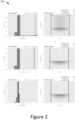
- FIG. 2 is a set 200 of graphs in which results are presented of using Algorithm 2 with unwinding steps that can continue backwards past the initial prior.
- the graphs in FIG. 2 show histograms over log-losses for many different trials, compared to the mean loss (Bayes risk) and the median loss.
- the right column shows of FIG. 2 shows the log-loss versus the true value of ⁇ , compared with the finite range (thick lines) in which each walker can explore.
- the top row of FIG. 2 illustrates trials that are run using the basic approach of Algorithm 1.
- the middle of row of FIG. 2 illustrates trials that are run using one unwinding step, as in Algorithm 2.
- the bottom row of FIG. 2 illustrates trials that are run using two unwinding steps, as in Algorithm 2.
- the bottom row shows histograms over log-losses for the same trials as in the top row, but using particle filtering with Liu-West resampling to incorporate consistency check and unwound data.
- FIG. 4 is a set 400 of graphs that show histograms over log-losses for many different trials using actual data only, compared to the mean loss (Bayes risk) and the median loss.
- the right column shows of FIG. 4 shows the log-loss versus the true value of ⁇ , compared with the finite range (thick lines) in which each walker can explore.
- the top row of FIG. 4 illustrates trials that are run using the basic approach of Algorithm 1.
- the middle of row of FIG. 4 illustrates trials that are run using one unwinding step, as in Algorithm 2.
- the bottom row of FIG. 4 illustrates trials that are run using two unwinding steps, as in Algorithm 2.
- FIGS. 5 and 6 show results for unwinding constrained by an initial prior, and the bottom section shows results of unwinding as described in Algorithm 2.
- the top row of each section shows the the frequentist risk and median loss as a function of
- the columns in FIGS. 5 and 6 show the different numbers of unwinding steps allowed.
- BME Bayesian mean estimator
- This choice is motivated by a decision theoretic argument, in which one penalizes an estimator by a particular amount L ( ⁇ (D ) , ⁇ ) for returning a particular estimate ⁇ ( D ) when the true value of the parameter of interest is ⁇ .
- the subscript Q is dropped when it is clear from context that the discussion is referring to this choice.
- the van Trees inequality can be thought of as a correction to the traditional Cramér-Rao bound for the effects of prior information.
- the Cramér-Rao bound only holds for unbiased estimators
- the BME is asymptotically unbiased but may in general be biased for a finite-sized data set.
- ⁇ is a normal distribution (0, 1)
- the correction I 0 for the bias introduced by the prior distribution is identically zero, such that the van Trees and Cramér-Rao bounds coincide.
- the set of true values ⁇ for which the Cramér-Rao bound can be violated by a biased estimator approaches Lebesgue measusure zero asymptotically with the number of observations n exp , such that the Cramér-Rao bound is useful for characterizing the performance of biased estimators such as the BME.
- the van Trees inequality holds in expectation, such that the loss in any particular experiment can be significantly better than (12).
- the consistency checks utilized by Algorithm 2 provide additional data not included in the bound given by (12), such that the disclosed algorithms violate the van Trees inequality evaluated only at the accepted measurement results.
- the disclosed algorithms can be thought of as heuristics for importance sampling from amongst the data, such that the usual discussions of optimality and postselection apply.
- FIG. 7 illustrates a generalized example of a suitable classical computing environment 700 in which several of the described embodiments can be implemented.
- the computing environment 700 is not intended to suggest any limitation as to the scope of use or functionality of the disclosed technology, as the techniques and tools described herein can be implemented in diverse general-purpose or special-purpose environments that have computing hardware.
- the computing environment 700 includes at least one processing device 710 and memory 720.
- the processing device 710 e.g., a CPU or microprocessor
- the memory 720 may be volatile memory (e.g., registers, cache, RAM, DRAM, SRAM), non-volatile memory (e.g., ROM, EEPROM, flash memory), or some combination of the two.
- the memory 720 stores software 780 implementing tools for peforming any of the phase estimation techniques as described herein.
- the memory 720 can also store software 780 for synthesizing, generating, or compiling quantum circuits resulting from and/or supported by the phase estimation techniques as described herein.
- the computing environment 700 can have additional features.
- the computing environment 700 includes storage 740, one or more input devices 750, one or more output devices 760, and one or more communication connections 770.
- An interconnection mechanism (not shown), such as a bus, controller, or network, interconnects the components of the computing environment 700.
- operating system software provides an operating environment for other software executing in the computing environment 700, and coordinates activities of the components of the computing environment 700.
- the storage 740 can be removable or non-removable, and includes one or more magnetic disks (e.g., hard drives), solid state drives (e.g., flash drives), magnetic tapes or cassettes, CD-ROMs, DVDs, or any other tangible non-volatile storage medium which can be used to store information and which can be accessed within the computing environment 700.
- the storage 740 can also store instructions for the software 780 implementing any of the disclosed phase estimation techniques.
- the storage 740 can also store instructions for the software 780 for generating and/or synthesizing any of the described techniques, systems, or reversible circuits.
- the input device(s) 750 can be a touch input device such as a keyboard, touchscreen, mouse, pen, trackball, a voice input device, a scanning device, or another device that provides input to the computing environment 700.
- the output device(s) 760 can be a display device (e.g., a computer monitor, laptop display, smartphone display, tablet display, netbook display, or touchscreen), printer, speaker, or another device that provides output from the computing environment 700.
- the communication connection(s) 770 enable communication over a communication medium to another computing entity.
- the communication medium conveys information such as computer-executable instructions or other data in a modulated data signal.
- a modulated data signal is a signal that has one or more of its characteristics set or changed in such a manner as to encode information in the signal.
- communication media include wired or wireless techniques implemented with an electrical, optical, RF, infrared, acoustic, or other carrier.
- Networked computing device 920 can be, for example, a computer running a browser or other software connected to a network 912.
- the computing device 920 can have a computer architecture as shown in FIG. 7 and discussed above.
- the computing device 920 is configured to communicate with multiple computing devices 930, 931, 932 (e.g., remote servers or other distributed computing devices, such as one or more servers in a cloud computing environment) via the network 912.
- FIGS. 11-14 Further details for examples related to the disclosed tools and techniques are shown in FIGS. 11-14 .
- a decision to adjust an estimate of the posterior mean of the phase is adjusted left or right based on a single experiment and/or an estimate of the posterior mean of the phase is adjusted up or down based on a single experiment. Further, in some implementations, the classical processing is performed by cryogenic hardware.
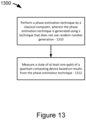
- FIG. 13 is a flowchart 1300 showing an example related to the disclosed technology.
- the particular operations and sequence of operations should not be construed as limiting, as they can be performed alone or in any combination, subcombination, and/or sequence with one another. Additionally, the illustrated operations can be performed together with one or more other operations.
- a state of at least one qubit of a quantum computing device is measured based on results from the phase estimation technique.
- the classical computer is configured to cooperatively control a quantum computing device and perform the measurement. Still further, the phase estimation is generated using a technique without random number generation (e.g., a non-random technique). In particular implementations, the phase estimation technique only stores a current best estimate of an eigenphase. Further, in some implementations, the classical processing is performed by cryogenic hardware.
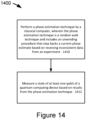
- FIG. 14 is a flowchart 1400 showing an example related to the disclosed technology.
- the particular operations and sequence of operations should not be construed as limiting, as they can be performed alone or in any combination, subcombination, and/or sequence with one another. Additionally, the illustrated operations can be performed together with one or more other operations.
- a phase estimation technique is performed by a classical computer.
- a state of at least one qubit of a quantum computing device is measured based on results from the phase estimation technique.
- the classical computer is configured to cooperatively control a quantum computing device and perform the measurement.
- the phase estimation technique is a random walk technique and includes an unwinding procedure that step backs a current phase estimate based on receiving inconsistent data from an experiment.
- the unwinding procedure reduces a mean error by restarting the procedure while retaining some information from at least one previous application of the method and/or using majority voting over different random answers. Further, the unwinding step causes the random walk technique to return to a location before a first datum was taken.
Landscapes
- Engineering & Computer Science (AREA)
- Physics & Mathematics (AREA)
- Theoretical Computer Science (AREA)
- General Physics & Mathematics (AREA)
- Mathematical Physics (AREA)
- Data Mining & Analysis (AREA)
- Computing Systems (AREA)
- Software Systems (AREA)
- General Engineering & Computer Science (AREA)
- Mathematical Optimization (AREA)
- Pure & Applied Mathematics (AREA)
- Mathematical Analysis (AREA)
- Computational Mathematics (AREA)
- Evolutionary Computation (AREA)
- Artificial Intelligence (AREA)
- Algebra (AREA)
- Condensed Matter Physics & Semiconductors (AREA)
- Probability & Statistics with Applications (AREA)
- Computational Linguistics (AREA)
- Databases & Information Systems (AREA)
- Complex Calculations (AREA)
Description
- The disclosed technology concerns example embodiments for estimating eigenvalues of quantum operations using a quantum computer.
- STEFANO PAESANIET AL, "Experimental Bayesian Quantum Phase Estimation on a Silicon Photonic Chip" describes that quantum phase estimation is a fundamental subroutine in many quantum algorithms, including Shor's factorization algorithm and quantum simulation. However, so far results have cast doubt on its practicability for near-term, nonfault tolerant, quantum devices. Here it reports experimental results demonstrating that this intuition need not be true. It implements a recently proposed adaptive Bayesian approach to quantum phase estimation and uses it to simulate molecular energies on a silicon quantum photonic device. The approach is verified to be well suited for prethreshold quantum processors by investigating its superior robustness to noise and decoherence compared to the iterative phase estimation algorithm. This shows a promising route to unlock the power of quantum phase estimation much sooner than previously believed. NATHAN WIEBE ET AL, "Efficient Bayesian Phase Estimation" describes a new method called rejection filtering that is used to perform adaptive Bayesian phase estimation. The approach has several advantages: it is classically efficient, easy to implement, achieves Heisenberg limited scaling, resists depolarizing noise, tracks time-dependent eigenstates, recovers from failures, and can be run on a field programmable gate array. It also outperforms existing iterative phase estimation algorithms such as Kitaev's method.
-
US 9 275 011 B2 - Nathan Wiebe ET AL, "Approximate Bayesian Inference via Rejection Filtering" describes a method, rejection filtering, for approximating Bayesian inference using rejection sampling. It not only makes the process efficient, but also dramatically reduces the memory required relative to conventional methods by combining rejection sampling with particle filtering to estimate the first two moments of the posterior distribution. It also provides an approximate form of rejection sampling that makes rejection filtering tractable in cases where exact rejection sampling is not efficient. Finally, it presents several numerical examples of rejection filtering that show its ability to track time dependent parameters in online settings, and show its performance on MINIST classification problems.
- CHRIS GRANADE ET AL, "Qinfer: Statistical inference software for quantum applications" describes how characterizing quantum systems through experimental data is critical to applications as diverse as metrology and quantum computing. Analyzing this experimental data in a robust and reproducible manner is made challenging, however, by the lack of readily-available software for performing principled statistical analysis. It improves the robustness and reproducibility of characterization by introducing an open-source library, QInfer, to address this need. The library makes it easy to analyze data from tomography, randomized benchmarking, and Hamiltonian learning experiments either in post-processing, or online as data is acquired. QInfer also provides functionality for predicting the performance of proposed experimental protocols from simulated runs. By delivering easy-to-use characterization tools based on principled statistical analysis, QInfer helps address many outstanding challenges facing quantum technology.
-
WO 2017 116446 A1 describes methods, systems, and apparatus for quantum phase estimation. In one aspect, an apparatus includes a quantum circuit comprising: a first quantum register comprising at least one ancilla qubit, a second quantum register comprising one or more qubits, wherein the second quantum register is prepared in a quantum state that is not an eigenstate of a unitary operator operating on the first and second quantum register; and a phase learning system, configured to learn phases of the eigenvalues of the unitary operator. - According to aspects of the present invention there is provided a method as defined in the accompanying claims.
- The disclosed technology concerns example embodiments for estimating eigenvalues of quantum operations using a quantum computer. Such estimations are useful in performing Shor's algorithm for factoring, quantum simulation, quantum machine learning, and other various quantum computing applications. Existing approaches to phase estimation are sub-optimal, difficult to program, require prohibitive classical computing, and/or require too much classical or quantum memory to be run on existing devices. Embodiments of the disclosed approach address one or more (e.g., all) of these drawbacks. The method according to the invention works by using a random walk for the estimate of the eigenvalue that (e.g., only) keeps track of the current estimate and the measurement record that it observed to reach that point. It further provides near optimal scaling, run within less than 300 bits of memory, and/or can execute within hundreds of nanoseconds on existing classical hardware.
- An iterative phase estimation technique is performed in which the phase estimation is performed by a classical computer that is configured to cooperatively control a quantum computing device. Further, the phase estimation technique is deterministic. The phase estimatation technique is deterministically generated by choosing parameters (e.g., for a random walk approach) that yield optimal information under the assumption of a Gaussian prior. The experimental parameters include the number of times the unitary operation is applied and/or other experimental parameters, based on (for example) the direction of each step in the algorithm is determined by data and prior experiments.
- The iterative phase estimation technique comprises: applying a phase to a qubit register of a quantum computing device; estimating the phase of the qubit register; and adjusting a future measurement of the phase of the qubit register based on the phase estimation performed by the classical computer. Additionally, the phase estimation technique is performed to determine eigenvalues of a unitary operator represented by a qubit of the quantum computing device. And, the phase estimation technique uses a random walk approach. The random walk approach can, for example, adjust a posterior mean of the phase estimation right or left based on a single measurement of the qubit register, and/or can adjust a posterior mean of the phase estimation upward or downward based on a single measurement of the qubit register.
- The phase estimation technique is performed by a classical computer; and a state of at least one qubit of a quantum computing device is measured based on results from the phase estimation technique. The classical computer is configured to cooperatively control the quantum computing device and generate a phase estimation using a random walk technique. A decision to adjust a posterior mean of the phase estimation is adjusted left or right based on a single experiment and/or a posterior mean of the phase estimation is adjusted up or down based on a single experiment. Further, in some implementations, the classical processing is performed by cryogenic hardware.
- As explained above, the phase estimation technique is performed by a classical computer, and a state of at least one qubit of a quantum computing device is measured based on results from the phase estimation technique. The classical computer is configured to cooperatively control a quantum computing device and perform the measurement. Still further, the phase estimation is generated using a technique without random number generation (e.g., a non-random technique). In particular implementations, the phase estimation technique only stores a current best estimate of an eigenphase. Further, in some implementations, the classical processing is performed by cryogenic hardware.
- The phase estimation technique is a random walk technique and includes an unwinding procedure that step backs a current phase estimate based on receiving inconsistent data from an experiment. The unwinding procedure reduces a mean error by restarting the procedure while retaining some information from at least one previous application of the method and/or using majority voting over different random answers. Further, the unwinding step causes the random walk technique to return to a location before a first datum was taken.
- The foregoing and other objects, features, and advantages of the disclosed technology will become more apparent from the following detailed description, which proceeds with reference to the accompanying figures.
-
-
FIG. 1 is a schematic block diagram illustrating a circuit for measuring a single datum in an iterative phase estimation process. -
FIG. 2 is a set of graphs in which results are presented of an algorithm with unwinding steps that can continue backwards past the initial prior. -
FIG. 3 is a set of graphs showing histograms over log-losses for many different trials. -
FIG. 4 is a set of graphs that show histograms over log-losses for many different trials using actual data only, compared to the mean loss (Bayes risk) and the median loss. -
FIGS. 5 and6 are graphs showing results where the frequentist risk is considered rather than the traditional Bayes risk. -
FIG. 7 illustrates a generalized example of a suitable classical computing environment in which several of the described embodiments can be implemented. -
FIG. 8 is an example of a possible network topology (e.g., a client-server network) for implementing a system according to the disclosed technology. -
FIG. 9 is another example of a possible network topology (e.g., a distributed computing environment) for implementing a system according to the disclosed technology is depicted. -
FIG. 10 is an exemplary system for implementing the disclosed technology that includes a classical computing environment and a quantum computing environment. -
FIG. 11 is a flowchart showing a generalized example embodiment for implementing an embodiment of the disclosed technology. -
FIG. 12 is a flowchart showing another example related to the disclosed technology. -
FIG. 13 is a flowchart showing a further example related to the disclosed technology. -
FIG. 14 is a flowchart showing yet another example related to the disclosed technology. - As used in this application, the singular forms "a," "an," and "the" include the plural forms unless the context clearly dictates otherwise. Additionally, the term "includes" means "comprises." Further, the term "coupled" does not exclude the presence of intermediate elements between the coupled items. Further, as used herein, the term "and/or" means any one item or combination of any items in the phrase.
- Although the operations of some of the disclosed methods are described in a particular, sequential order for convenient presentation, it should be understood that this manner of description encompasses rearrangement, unless a particular ordering is required by specific language set forth below. For example, operations described sequentially may in some cases be rearranged or performed concurrently. Moreover, for the sake of simplicity, the attached figures may not show the various ways in which the disclosed systems, methods, and apparatus can be used in conjunction with other systems, methods, and apparatus. Additionally, the description sometimes uses terms like "produce" and "provide" to describe the disclosed methods. These terms are high-level abstractions of the actual operations that are performed. The actual operations that correspond to these terms will vary depending on the particular implementation and are readily discernible by one of ordinary skill in the art.
- Phase estimation is widely used throughout quantum information to learn the eigenvalues of unitary operators. This is a highly useful step in realizing computational speedups in areas such as applications that use Shor's algorithm, machine learning, quantum simulation, and many other diverse quantum computing applications. Moreover, the eigenvalues of unitary operators can carry information about physical parameters, such that phase estimation is useful in quantum metrology applications as well.
- One approach to minimizing the quantum resources required for phase estimation is iterative phase estimation, in which one repeatedly uses the unitary of interest to write a phase onto a single-qubit register, and then processes the data collected from these measurements using classical resources. The data obtained from each iteration can then be used to determine the next measurement to perform, such that classically adaptive protocols are naturally expressed in the iterative phase estimation framework. Across applications for phase estimation, there is a benefit to formulating approaches to iterative phase estimation that allow for adaptivity and data processing with very modest classical resources.
- In this disclosure, example embodiments that greatly reduce the memory resources needed for performing phase estimation, reduces the power requirements for performing phase estimation, and/or provide other computing improvements are presented. For instance, the method according to the invention provides a new technique that uses approximately 250 bits of classical memory between iterations and that is entirely deterministic conditioned on the experimental data record. Other proposed approaches require significantly higher memory requirements. Several of the disclosed examples (including
Algorithm 1 andAlgorithm 2, corresponding to the claimed method, below) are uniquely well-suited not only for implementation on FPGAs, but also on an application-specific integrated circuit (ASIC) or on tightly memory-bound microcontroller platforms. This in turn significantly reduces the cost required for implementing quantum algorithms and new metrology protocols such as distributed sensors. - Concretely, consider a family of unitary operators U(t) for a real parameter t and a quantum state |ω〉 such that for all t U(t) |ω〉 = eiωt |ω〉 for an unknown real number ω. Now consider performing controlled applications of U(t) on a copy of the state |ω〉 in order to learn ω.
- There are many ways that the learning problem for phase estimation can be formalized. While the most commonly used methods have historically estimated the phase in a bit-by-bit fashion, Bayesian approaches to learning ω have recently gained in popularity because of their robustness and their statistical efficiency. The idea behind such methods is to quantify the uncertainty in ω via a prior probability distribution, Pr(ω). Then conditioned on measuring an outcome d the probability distribution describing the uncertainty in ω conditioned on the measurement is

- The art of Bayesian phase estimation is then to choose experiments in such a way to minimize the resources needed to reduce the uncertainty in an estimate of ω, given by the estimator ω̂. Adaptive versions of Bayeisan phase estimation are known to achieve Heisenberg limited scaling and come close to saturating lower bounds on the uncertainty in ω as a function of experimental time or number of measurements. A complication that arises in choosing a Bayesian method is that each such a method requires different amounts of experimental time, total number of measurements, classical memory and processing time and robustness to experimental imperfections. The latter two can be of concern in present-day applications where any form of Bayesian inference that requires classical processing time that is comparable to the coherence time (which is often on the order of microseconds). To this end, finding simple phase estimation methods that are robust, efficient, and can be executed within a timescale of hundreds of nanoseconds are desirable.
- In this disclosure, the primary focus is on the general case of phase estimation with continuous-time families of unitary operators U(t), rather than the discrete-time case of U(M δt) = VM for some time fixed unitary operator V, time interval δt and positive integer M. As the more general case is considered, it is not assumed that ω ∈ [0, 2π). This implies that one can assign as a loss function L(ω, ω̂) := (ω - ω̂)2 . That is, an estimate ω̂ is penalized by its squared error from the true eigenphase ω.
- A notable difference between embodiments of the disclosed approach and most other Bayesian methods that have been proposed is that embodiments of the disclosed technology are entirely deterministic. Specifically, the posterior mean (which is used in certain embodiments as the estimate of the true eigenphase) shifts left or right upon collection of each datum by a fixed amount that depends only on the experimental outcome. Thus, the trajectory that the estimate of the eigenphase takes as the experiment proceeds follows a random walk with an exponentially shrinking stepsize. This simplicity allows one to not only store an approximation to the posterior distribution using very, very little memory; it also only uses basic arithmetic that can be performed within the coherence times of modern quantum devices.
- The fundamental experimental template that is used in the method according to the invention is given by
FIG. 1. FIG. 1 is a schematic block diagram 100 illustrating a circuit for measuring a single datum in an iterative phase estimation process. Computing the probability of observing d ∈ {0, 1} as an outcome in the circuit shown inFIG. 1 gives the likelihood function for phase estimation,
- Rather than performing exact Bayeisan inference, which is not efficient because the memory required grows exponentially with the number of bits of precision needed, embodiments of the disclosed technology use a form of approximate Bayesian inference. In particular, it is assumed that the prior distribution is Gaussian at each step:

- Such priors can be efficiently represented because they are only a function of µ and σ. Unfortunately, the conjugate priors for (2) are not Gaussian which means that the posterior distribution is not Gaussian:

- However, for most experiments that are considered, the posterior distribution will be unimodal and thus the majority of the probability mass will be given by the first two moments of the distribution. This justifies the following approximation,



- Here, one can take as an approximation that the prior distribution Pr(ω) is a Gaussian distribution at each step, and thus the prior can be characterized by its mean


variance 


- Since the posterior variance describes the error that one should expect to be incurred in estimating ω with the currently available observations, one can then choose t and ω inv to minimize the posterior variance and hence minimize the errors that are incurred. The posterior variance is minimized for both d = 0, 1 at t = σ -1 and ω inv = µ, such that one can specialize (6) at these values to obtain a simpler update rule,


- In this way, one can derive the particle guess heuristic (PGH) for the special case of phase estimation with a Gaussian conjugate prior.
- Notably, the variance update in (7) does not depend on which datum is observed; the reduction in variance at each step is wholly deterministic. Similarly, the mean shifts by the same amount at each step, such that the only dependence on the data of the Gaussian approximation to the posterior distribution is through which direction the mean shifts at each observation. One can thus think of the Gaussian approximation as yielding a random walk that is damped towards the true value of ω. Following this identification, one can obtain
Algorithm 1. -
Algorithm 1 can fail in two different ways. First, that the mean can only shift by fixed amount at each step implies that the walk on ω can not go further than
- The other failure modality is more severe, in that the Gaussian approximation itself can fail. By contrast to rejection filtering and other such approaches, in
the disclosed random walk phase estimation, the variance is not selected based on the data itself, but based on an offline analytic computation. Thus, one desirably has a way to correct for approximation failures. This is
done by unwinding data records, returning to an earlier state of the random walk algorithm. In particular, since the data record uniquely describes the entire path of a random walker, one can step backwards along the history of a random walk. - To determine when one should unwind in this fashion, additional measurements are performed whose outcomes can be accurately predicted if the approximation is still accurate. Choosing ω inv = µ and t = τ check/σ for a scale parameter τ check > 0, one can obtain that the probability of a 0 outcome is

Algorithm 2. - Notably, both the consistency check data and the unwound data are still useful data. In situations where the data can be efficiently recorded for later use, the entire data record including all unwound data and consistency checks may be used in postprocessing to verify that the estimate derived from the random walk is feasible. In the numerical results presented in Section IV, the example of particle filtering is used to perform postprocessing using the QInfer software library.


-
FIG. 2 is aset 200 of graphs in which results are presented of usingAlgorithm 2 with unwinding steps that can continue backwards past the initial prior. In particular, the graphs inFIG. 2 show histograms over log-losses for many different trials, compared to the mean loss (Bayes risk) and the median loss. The right column shows ofFIG. 2 shows the log-loss versus the true value of ω, compared with the finite range (thick lines) in which each walker can explore. The top row ofFIG. 2 illustrates trials that are run using the basic approach ofAlgorithm 1. The middle of row ofFIG. 2 illustrates trials that are run using one unwinding step, as inAlgorithm 2. And the bottom row ofFIG. 2 illustrates trials that are run using two unwinding steps, as inAlgorithm 2. - Still further,
FIG. 3 is aset 300 of graphs showing histograms over log-losses for many different trials, usingAlgorithm 2 with n unwind = 1. The bottom row shows histograms over log-losses for the same trials as in the top row, but using particle filtering with Liu-West resampling to incorporate consistency check and unwound data. - In this Appendix, the significance of this rule is underscored to allow the random walk to exceed the finite constraitns of the basic
walk preseented Algorithm 1 by repeating the previous analysis with unwinding on actual data only. - That is, in the results presented within
FIG. 4 , if an unwinding step would pop an empty stack D, then the unwinding step is aborted instead. - In particular,
FIG. 4 is aset 400 of graphs that show histograms over log-losses for many different trials using actual data only, compared to the mean loss (Bayes risk) and the median loss. The right column shows ofFIG. 4 shows the log-loss versus the true value of ω, compared with the finite range (thick lines) in which each walker can explore. The top row ofFIG. 4 illustrates trials that are run using the basic approach ofAlgorithm 1. The middle of row ofFIG. 4 illustrates trials that are run using one unwinding step, as inAlgorithm 2. And the bottom row ofFIG. 4 illustrates trials that are run using two unwinding steps, as inAlgorithm 2. - It is noted that the constrained unwinding, while still an improvement over the initial version of
Algorithm 1, does not adequately deal with the effects of the finite support of the basic walk. This observation is underscored by the results presented ingraphs FIGS. 5 and6 , where the frequentist risk is considered rather than the traditional Bayes risk. In particular, the top sections ofFIGS. 5 and6 show results for unwinding constrained by an initial prior, and the bottom section shows results of unwinding as described inAlgorithm 2. The top row of each section shows the the frequentist risk and median loss as a function of |ω|, the absolute value of the true ω used to generate data in each trial, and the bottom row of each section shows the median number of unwinding steps taken to accept 100 experiments. The columns inFIGS. 5 and6 show the different numbers of unwinding steps allowed. - Concretely, the frequentist risk is defined as the average loss that incurred by an estimation when the true value of ω is fixed,

- In this disclosure, the disclosed algorithm is expressed as approximating the Bayesian mean estimator (BME)

- In any case, once one adopts such a loss function, one can then reason about the average loss incurred by a particular estimator. In particular, the Bayes risk r is defined as the expected loss over all hypotheses ω ~ π drawn from a prior π and over all data sets D. That is,

- The BME minimizes the Bayes risk for any loss function is of the form L(ω̂(D), ω) =

- Having thus argued that embodiments of the disclosed approach are approximately optimal for the Bayes risk, one may then be interested in how well the disclosed algorithm approximatly achieves the Bayes risk. To address this, it is noted that the van Trees inequality lower bounds the Bayes risk achivable by any estimator ω̂ as


- In the case that π is a normal distribution(0, 1), however, the correction I 0 for the bias introduced by the prior distribution is identically zero, such that the van Trees and Cramér-Rao bounds coincide. More generally, the set of true values ω for which the Cramér-Rao bound can be violated by a biased estimator approaches Lebesgue measusure zero asymptotically with the number of observations n exp, such that the Cramér-Rao bound is useful for characterizing the performance of biased estimators such as the BME.

- Applying this bound to
Algorithm 2, it is noted that the experiments chosen by the algorithm are deterministic unless the unwinding step proceeds backwards from the initial prior. Thus, the Cramér-Rao and hence the van Trees inequalities can be calculated explicitly for the particular experimental choices made byAlgorithm 2, yielding that


- Notably, the van Trees inequality holds in expectation, such that the loss in any particular experiment can be significantly better than (12). Moreover, the consistency checks utilized by
Algorithm 2 provide additional data not included in the bound given by (12), such that the disclosed algorithms violate the van Trees inequality evaluated only at the accepted measurement results. In that sense, the disclosed algorithms can be thought of as heuristics for importance sampling from amongst the data, such that the usual discussions of optimality and postselection apply. -
FIG. 7 illustrates a generalized example of a suitableclassical computing environment 700 in which several of the described embodiments can be implemented. Thecomputing environment 700 is not intended to suggest any limitation as to the scope of use or functionality of the disclosed technology, as the techniques and tools described herein can be implemented in diverse general-purpose or special-purpose environments that have computing hardware. - With reference to
FIG. 7 , thecomputing environment 700 includes at least oneprocessing device 710 andmemory 720. InFIG. 7 , this mostbasic configuration 730 is included within a dashed line. The processing device 710 (e.g., a CPU or microprocessor) executes computer-executable instructions. In a multi-processing system, multiple processing devices execute computer-executable instructions to increase processing power. Thememory 720 may be volatile memory (e.g., registers, cache, RAM, DRAM, SRAM), non-volatile memory (e.g., ROM, EEPROM, flash memory), or some combination of the two. Thememory 720stores software 780 implementing tools for peforming any of the phase estimation techniques as described herein. Thememory 720 can also storesoftware 780 for synthesizing, generating, or compiling quantum circuits resulting from and/or supported by the phase estimation techniques as described herein. - The computing environment can have additional features. For example, the
computing environment 700 includesstorage 740, one ormore input devices 750, one ormore output devices 760, and one ormore communication connections 770. An interconnection mechanism (not shown), such as a bus, controller, or network, interconnects the components of thecomputing environment 700. Typically, operating system software (not shown) provides an operating environment for other software executing in thecomputing environment 700, and coordinates activities of the components of thecomputing environment 700. - The
storage 740 can be removable or non-removable, and includes one or more magnetic disks (e.g., hard drives), solid state drives (e.g., flash drives), magnetic tapes or cassettes, CD-ROMs, DVDs, or any other tangible non-volatile storage medium which can be used to store information and which can be accessed within thecomputing environment 700. Thestorage 740 can also store instructions for thesoftware 780 implementing any of the disclosed phase estimation techniques. Thestorage 740 can also store instructions for thesoftware 780 for generating and/or synthesizing any of the described techniques, systems, or reversible circuits. - The input device(s) 750 can be a touch input device such as a keyboard, touchscreen, mouse, pen, trackball, a voice input device, a scanning device, or another device that provides input to the
computing environment 700. The output device(s) 760 can be a display device (e.g., a computer monitor, laptop display, smartphone display, tablet display, netbook display, or touchscreen), printer, speaker, or another device that provides output from thecomputing environment 700. - The communication connection(s) 770 enable communication over a communication medium to another computing entity. The communication medium conveys information such as computer-executable instructions or other data in a modulated data signal. A modulated data signal is a signal that has one or more of its characteristics set or changed in such a manner as to encode information in the signal. By way of example, and not limitation, communication media include wired or wireless techniques implemented with an electrical, optical, RF, infrared, acoustic, or other carrier.
- As noted, the various methods, phase estimation techniques, circuit design techniques, or compilation/synthesis techniques can be described in the general context of computer-readable instructions stored on one or more computer-readable media. Computer-readable media are any available media (e.g., memory or storage device) that can be accessed within or by a computing environment. Computer-readable media include tangible computer-readable memory or storage devices, such as
memory 720 and/orstorage 740, and do not include propagating carrier waves or signals per se (tangible computer-readable memory or storage devices do not include propagating carrier waves or signals per se). - Various embodiments of the methods disclosed herein can also be described in the general context of computer-executable instructions (such as those included in program modules) being executed in a computing environment by a processor. Generally, program modules include routines, programs, libraries, objects, classes, components, data structures, and so on, that perform particular tasks or implement particular abstract data types. The functionality of the program modules may be combined or split between program modules as desired in various embodiments. Computer-executable instructions for program modules may be executed within a local or distributed computing environment.
- An example of a possible network topology 800 (e.g., a client-server network) for implementing a system according to the disclosed technology is depicted in
FIG. 8 .Networked computing device 820 can be, for example, a computer running a browser or other software connected to anetwork 812. Thecomputing device 820 can have a computer architecture as shown inFIG. 7 and discussed above. Thecomputing device 820 is not limited to a traditional personal computer but can comprise other computing hardware configured to connect to and communicate with a network 812 (e.g., smart phones, laptop computers, tablet computers, or other mobile computing devices, servers, network devices, dedicated devices, and the like). Further, thecomputing device 820 can comprise an FPGA or other programmable logic device. In the illustrated embodiment, thecomputing device 820 is configured to communicate with a computing device 830 (e.g., a remote server, such as a server in a cloud computing environment) via anetwork 812. In the illustrated embodiment, thecomputing device 820 is configured to transmit input data to thecomputing device 830, and thecomputing device 830 is configured to implement a phase estimation technique according to any of the disclosed embodiments and/or a circuit generation or compilation/synthesis methods for generating qunatum circuits based on or in conjunction with any of the phase estimation techniques disclosed herein. Thecomputing device 830 can output results to thecomputing device 820. Any of the data received from thecomputing device 830 can be stored or displayed on the computing device 820 (e.g., displayed as data on a graphical user interface or web page at the computing devices 820). In the illustrated embodiment, the illustratednetwork 812 can be implemented as a Local Area Network (LAN) using wired networking (e.g., the Ethernet IEEE standard 802.3 or other appropriate standard) or wireless networking (e.g. one of the IEEE standards 802.11a, 802.11b, 802.11g, or 802.11n or other appropriate standard). Alternatively, at least part of thenetwork 812 can be the Internet or a similar public network and operate using an appropriate protocol (e.g., the HTTP protocol). - Another example of a possible network topology 900 (e.g., a distributed computing environment) for implementing a system according to the disclosed technology is depicted in
FIG. 9 .Networked computing device 920 can be, for example, a computer running a browser or other software connected to anetwork 912. Thecomputing device 920 can have a computer architecture as shown inFIG. 7 and discussed above. In the illustrated embodiment, thecomputing device 920 is configured to communicate withmultiple computing devices network 912. In the illustrated embodiment, each of thecomputing devices computing environment 900 is used to perform at least a portion of a phase estimation process and/or circuit generation or synthesis/compilation process. In other words, thecomputing devices computing device 920 is configured to transmit input data to thecomputing devices computing device 920. Any of the data received from thecomputing devices network 912 can be any of the networks discussed above with respect toFIG. 8 . - With reference to
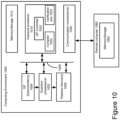
FIG. 10 , an exemplary system for implementing the disclosed technology includescomputing environment 1000. Incomputing environment 1000, a compiled quantum computer circuit description (including quantum circuits resulting from and/or supported by any of the phase estimation techniques as disclosed herein) can be used to program (or configure) one or more quantum processing units such that the quantum processing unit(s) implement the circuit described by the quantum computer circuit description. - The
environment 1000 includes one or morequantum processing units 1002 and one or more readout device(s) 1008. The quantum processing unit(s) execute quantum circuits that are precompiled and described by the quantum computer circuit description. The quantum processing unit(s) can be one or more of, but are not limited to: (a) a superconducting quantum computer; (b) an ion trap quantum computer; (c) a fault-tolerant architecture for quantum computing; and/or (d) a topological quantum architecture (e.g., a topological quantum computing device using Majorana zero modes). The precompiled quantum circuits, including any of the disclosed circuits, can be sent into (or otherwise applied to) the quantum processing unit(s) viacontrol lines 1006 at the control ofquantum processor controller 1020. The quantum processor controller (QP controller) 1020 can operate in conjunction with a classical processor 1010 (e.g., having an architecture as described above with respect toFIG. 7 ) to implement the desired quantum computing process. In the illustrated example, theQP controller 1020 further implements the desired quantum computing process via one or more QP subcontrollers 1004 that are specially adapted to control a corresponding one of the quantum processor(s) 1002. For instance, in one example, thequantum controller 1020 facilitates implementation of the compiled quantum circuit by sending instructions to one or more memories (e.g., lower-temperature memories), which then pass the instructions to low-temperature control unit(s) (e.g., QP subcontroller(s) 1004) that transmit, for instance, pulse sequences representing the gates to the quantum processing unit(s) 1002 for implementation. In other examples, the QP controller(s) 1020 and QP subcontroller(s) 1004 operate to provide appropriate magnetic fields, encoded operations, or other such control signals to the quantum processor(s) to implement the operations of the compiled quantum computer circuit description. The quantum controller(s) can further interact withreadout devices 1008 to help control and implement the desired quantum computing process (e.g., by reading or measuring out data results from the quantum processing units once available, etc.) - With reference to
FIG. 10 , compilation is the process of translating a high-level description of a quantum algorithm into a quantum computer circuit description comprising a sequence of quantum operations or gates, which can include the circuits as disclosed herein. The compilation can be performed by acompiler 1022 using a classical processor 1010 (e.g., as shown inFIG. 7 ) of theenvironment 1000 which loads the high-level description from memory orstorage devices 1012 and stores the resulting quantum computer circuit description in the memory orstorage devices 1012. - In other embodiments, compilation and/or verification can be performed remotely by a remote computer 1060 (e.g., a computer having a computing environment as described above with respect to
FIG. 7 ) which stores the resulting quantum computer circuit description in one or more memory orstorage devices 1062 and transmits the quantum computer circuit description to thecomputing environment 1000 for implementation in the quantum processing unit(s) 1002. Still further, theremote computer 1000 can store the high-level description in the memory orstorage devices 1062 and transmit the high-level description to thecomputing environment 1000 for compilation and use with the quantum processor(s). In any of these scenarios, results from the computation performed by the quantum processor(s) can be communicated to the remote computer after and/or during the computation process. Still further, the remote computer can communicate with the QP controller(s) 1020 such that the quantum computing process (including any compilation, verification, and QP control procedures) can be remotely controlled by theremote computer 1060. In general, theremote computer 1060 communicates with the QP controller(s) 1020, compiler/synthesizer 1022, and/orverification tool 1023 viacommunication connections 1050. - In particular embodiments, the
environment 1000 can be a cloud computing environment, which provides the quantum processing resources of theenvironment 1000 to one or more remote computers (such as remote computer 1060) over a suitable network (which can include the internet). - Further details for examples related to the disclosed tools and techniques are shown in
FIGS. 11-14 . -
FIG. 11 is aflowchart 1100 showing an example related to the disclosed technology. The particular operations and sequence of operations should not be construed as limiting, as they can be performed alone or in any combination, sub-combination, and/or sequence with one another. Additionally, the illustrated operations can be performed together with one or more other operations. - At 1110, an iterative phase estimation technique is performed in which the phase estimation is performed by a classical computer that is configured to cooperatively control a quantum computing device. Further, the phase estimation technique comprises deterministically choosing experimental parameters.
- The phase estimation technique is deterministically generated by choosing parameters (e.g., for a random walk approach) that yield optimal information under the assumption of a Gaussian prior. Further, the experimental parameters include experimental parameters, based on the direction of each step in the algorithm determined by data and prior experiments.
- Further, as shown in
FIG. 11 , the iterative phase estimation technique comprises, applying (at 1112) a phase to a qubit register of a quantum computing device; estimating (at 1114) the phase of the qubit register; and adjusting (at 1116) a future measurement of the phase of the qubit register based on the phase estimation performed by the classical computer. Additionally, the phase estimation technique is performed to determine eigenvalues of a unitary operator represented by a qubit of the quantum computing device. And, the phase estimation technique uses a random walk approach. The random walk approach can adjust an estimate of the posterior mean of the phase right or left based on a single measurement of the qubit register, and/or can adjust an estimation of a posterior mean of the phase upward or downward based on a single measurement of the qubit register. -
FIG. 12 is aflowchart 1200 showing an example related to the disclosed technology. The particular operations and sequence of operations should not be construed as limiting, as they can be performed alone or in any combination, subcombination, and/or sequence with one another. Additionally, the illustrated operations can be performed together with one or more other operations. - At 1210, a phase estimation technique is performed by a classical computer.
- At 1212, a state of at least one qubit of a quantum computing device is measured based on results from the phase estimation technique.
- Still further, the classical computer is configured to cooperatively control a quantum computing device and generate a phase estimation using a random walk technique.
- A decision to adjust an estimate of the posterior mean of the phase is adjusted left or right based on a single experiment and/or an estimate of the posterior mean of the phase is adjusted up or down based on a single experiment. Further, in some implementations, the classical processing is performed by cryogenic hardware.
-
FIG. 13 is aflowchart 1300 showing an example related to the disclosed technology. The particular operations and sequence of operations should not be construed as limiting, as they can be performed alone or in any combination, subcombination, and/or sequence with one another. Additionally, the illustrated operations can be performed together with one or more other operations. - At 1310, a phase estimation technique is performed by a classical computer.
- At 1312, a state of at least one qubit of a quantum computing device is measured based on results from the phase estimation technique.
- The classical computer is configured to cooperatively control a quantum computing device and perform the measurement. Still further, the phase estimation is generated using a technique without random number generation (e.g., a non-random technique). In particular implementations, the phase estimation technique only stores a current best estimate of an eigenphase. Further, in some implementations, the classical processing is performed by cryogenic hardware.
-
FIG. 14 is aflowchart 1400 showing an example related to the disclosed technology. The particular operations and sequence of operations should not be construed as limiting, as they can be performed alone or in any combination, subcombination, and/or sequence with one another. Additionally, the illustrated operations can be performed together with one or more other operations. - At 1410, a phase estimation technique is performed by a classical computer.
- At 1412, a state of at least one qubit of a quantum computing device is measured based on results from the phase estimation technique.
- The classical computer is configured to cooperatively control a quantum computing device and perform the measurement. Additionally, the phase estimation technique is a random walk technique and includes an unwinding procedure that step backs a current phase estimate based on receiving inconsistent data from an experiment. The unwinding procedure reduces a mean error by restarting the procedure while retaining some information from at least one previous application of the method and/or using majority voting over different random answers. Further, the unwinding step causes the random walk technique to return to a location before a first datum was taken.
- Having described and illustrated the principles of the disclosed technology with reference to the illustrated embodiments, it will be recognized that the illustrated embodiments can be modified in arrangement and detail without departing from the scope of the appended claims. For instance, elements of the illustrated embodiments shown in software may be implemented in hardware and vice-versa. Also, the technologies from any example can be combined with the technologies described in any one or more of the other examples. It will be appreciated that procedures and functions such as those described with reference to the illustrated examples can be implemented in a single hardware or software module, or separate modules can be provided. The particular arrangements above are provided for convenient illustration, and other arrangements can be used without departing from the scope of the appended claims.
Claims (2)
- A method (1100), comprising performing an iterative phase estimation technique to learn an eigenvalue of a unitary operator U(t), wherein U(t)|ω〉 = eiωt |ω〉, t is a real parameter and ω is a real number, wherein the phase estimation technique is performed by a classical computer (830; 1010) that is configured to cooperatively control a quantum computing device (1002), wherein the iterative phase estimation technique comprises:setting the mean, µ, of a prior distribution to an initial value, µ 0 = 0;setting a variance, σ2, of the prior distribution to an initial value,
 iteratively for i from 0 to n exp - 1:taking
 taking
 applying a Hadamard operation to a first qubit in a qubit register of the quantum computing device, wherein the first qubit is initialized to a state |0〉;applying a rotation around the Z axis to the first qubit, wherein the magnitude of the rotation is given by Rz (-tω inv);applying (1112) a phase onto a single qubit register by writing the phase onto the single qubit register using the unitary operator, wherein the first qubit acts as control qubit on the unitary operator, wherein the phase is given by tω inv;applying a Hadamard operation to the first qubit;measuring, by a readout device (1008) of the quantum computing device (1002), the first qubit, wherein the measuring measures a single datum, d, wherein d ∈ {0,1};storing the single datum, d, on a stack of Boolean variables, D;estimating (1114), by the classical computer, using approximate Bayesian inference the eigenvalue of the unitary operator by:
finding an updated mean and updated variance for the eigenvalue of the unitary operator, wherein:if d=0 then the updated mean is given by
 if d=1 then the updated mean is given by

the updated mean and updated variance are used as the prior distribution for a next iteration,the prior distribution is assumed to be Gaussian,the mean is used as the estimate of the eigenvalue of the unitary operator, and wherein the mean shifts left or right by a fixed amount dependent on an outcome of the measurement of the qubit in the single qubit register such that the estimate of the eigenvalue follows a random walk with an exponentially shrinking step size across the iterations;confirming the approximation that the prior distribution can be assumed to be Gaussian is accurate by performing an additional measurement whose outcome can be accurately predicted if the approximation is accurate by iteratively: taking
 applying a Hadamard operation to the first qubit in the qubit register of the quantum computing device, wherein the first qubit is initialized to a state |0〉;applying a rotation around the Z axis to the first qubit, wherein the magnitude of the rotation is given by Rz (-tω inv);applying a phase onto the single qubit register by writing the phase onto the single qubit register using the unitary operator, wherein the first qubit acts as control qubit on the unitary operator, wherein the phase is given by tω inv;applying a Hadamard operation to the first qubit;measuring, by a readout device of the quantum computing device (1002), the first qubit, wherein the measuring measures a single datum, d', wherein d' ∈ {0,1}; andin response to the additional measurement indicating the approximation is no longer accurate since d' = 1, implementing an unwinding procedure that step backs a current phase estimate and returns to an earlier state of the random walk by:taking
 if the stack of Boolean values is not empty then:taking a datum, d, from the stack of Boolean variables;if d = 0 then updating the mean to be
 if d=1 updating the mean to be
 repeating the confirming the approximation that the prior distribution can be assumed to be Gaussian is accurate until d' = 0.
 - A system (1000), comprising:a quantum computing device (1002); anda classical computer (830; 1010) in communication with the quantum computing device and adapted to perform the method in any preceding claim.
Applications Claiming Priority (3)
| Application Number | Priority Date | Filing Date | Title |
|---|---|---|---|
| US201762596609P | 2017-12-08 | 2017-12-08 | |
| US16/023,942 US11010450B2 (en) | 2017-12-08 | 2018-06-29 | Using random walks for iterative phase estimation |
| PCT/US2018/063496 WO2019112915A1 (en) | 2017-12-08 | 2018-11-30 | Using random walks for iterative phase estimation |
Publications (2)
| Publication Number | Publication Date |
|---|---|
| EP3721386A1 EP3721386A1 (en) | 2020-10-14 |
| EP3721386B1 true EP3721386B1 (en) | 2025-07-09 |
Family
ID=66696166
Family Applications (1)
| Application Number | Title | Priority Date | Filing Date |
|---|---|---|---|
| EP18821898.6A Active EP3721386B1 (en) | 2017-12-08 | 2018-11-30 | Using random walks for iterative phase estimation |
Country Status (3)
| Country | Link |
|---|---|
| US (1) | US11010450B2 (en) |
| EP (1) | EP3721386B1 (en) |
| WO (1) | WO2019112915A1 (en) |
Families Citing this family (6)
| Publication number | Priority date | Publication date | Assignee | Title |
|---|---|---|---|---|
| WO2019104443A1 (en) | 2017-12-01 | 2019-06-06 | 1Qb Information Technologies Inc. | Systems and methods for stochastic optimization of a robust inference problem |
| WO2019217772A1 (en) * | 2018-05-11 | 2019-11-14 | Google Llc | Targeting many-body eigenstates on a quantum computer |
| EP3891668A4 (en) * | 2018-12-06 | 2023-01-25 | 1QB Information Technologies Inc. | QUANTUM COMPUTING CONTROLLED BY ARTIFICIAL INTELLIGENCE |
| EP3886003B8 (en) | 2020-03-25 | 2025-02-19 | Terra Quantum AG | Method, apparatus and computer program product for determining the component of a magnetic field in a predetermined direction |
| US11809839B2 (en) | 2022-01-18 | 2023-11-07 | Robert Lyden | Computer language and code for application development and electronic and optical communication |
| CN119539100B (en) * | 2023-08-30 | 2025-10-14 | 本源量子计算科技(合肥)股份有限公司 | Quantum phase estimation method and device |
Family Cites Families (6)
| Publication number | Priority date | Publication date | Assignee | Title |
|---|---|---|---|---|
| US20060224547A1 (en) * | 2005-03-24 | 2006-10-05 | Ulyanov Sergey V | Efficient simulation system of quantum algorithm gates on classical computer based on fast algorithm |
| US7426444B2 (en) * | 2006-04-19 | 2008-09-16 | Hewlett-Packard Development Company, L.P. | Methods for determining relative phase differences in entangled quantum states |
| US7858966B2 (en) * | 2006-11-21 | 2010-12-28 | Microsoft Corporation | Protected qubit based on superconducting current mirror |
| US8849580B2 (en) * | 2010-07-26 | 2014-09-30 | The University Of Vermont | Uses of systems with degrees of freedom poised between fully quantum and fully classical states |
| US9275011B2 (en) | 2013-03-27 | 2016-03-01 | Microsoft Technology Licensing, Llc | Fast quantum and classical phase estimation |
| WO2017116446A1 (en) | 2015-12-30 | 2017-07-06 | Google Inc. | Quantum phase estimation of multiple eigenvalues |
-
2018
- 2018-06-29 US US16/023,942 patent/US11010450B2/en active Active
- 2018-11-30 WO PCT/US2018/063496 patent/WO2019112915A1/en not_active Ceased
- 2018-11-30 EP EP18821898.6A patent/EP3721386B1/en active Active
Also Published As
| Publication number | Publication date |
|---|---|
| US11010450B2 (en) | 2021-05-18 |
| EP3721386A1 (en) | 2020-10-14 |
| US20190179871A1 (en) | 2019-06-13 |
| WO2019112915A1 (en) | 2019-06-13 |
Similar Documents
| Publication | Publication Date | Title |
|---|---|---|
| US11010450B2 (en) | Using random walks for iterative phase estimation | |
| Cerezo et al. | Variational quantum algorithms | |
| EP3938972B1 (en) | Phase estimation with randomized hamiltonians | |
| US20200279185A1 (en) | Quantum relative entropy training of boltzmann machines | |
| EP3991108B1 (en) | CLASSICAL AND QUANTUM COMPUTATION FOR THE MAIN COMPONENT ANALYSIS OF MULTI-DIMENSIONAL DATA SETS | |
| US10469087B1 (en) | Bayesian tuning for quantum logic gates | |
| US20170364796A1 (en) | Quantum deep learning | |
| US20220188679A1 (en) | Quantum resource estimation using a re-parameterization method | |
| Shaydulin et al. | Error mitigation for deep quantum optimization circuits by leveraging problem symmetries | |
| Qi et al. | Variational quantum algorithms: fundamental concepts, applications and challenges: H. Qi et al. | |
| Liang et al. | Quantum algorithms for the generalized eigenvalue problem | |
| Ceroni et al. | Generating approximate ground states of molecules using quantum machine learning | |
| Cumming et al. | Using a quantum computer to solve a real-world problem--what can be achieved today? | |
| Tiwari et al. | Algorithmic advances towards a realizable quantum lattice Boltzmann method | |
| JP7326591B2 (en) | antisymmetric neural network | |
| Li et al. | Efficient quantum algorithms for quantum optimal control | |
| Patra et al. | Projective quantum eigensolver via adiabatically decoupled subsystem evolution: A resource efficient approach to molecular energetics in noisy quantum computers | |
| Meister et al. | Resource-frugal Hamiltonian eigenstate preparation via repeated quantum phase estimation measurements | |
| JP7630826B2 (en) | Quantum information processing method, classical computer, hybrid system, and quantum information processing program | |
| Hu et al. | Advancing hybrid quantum neural network for alternative current optimal power flow | |
| EP4567684A1 (en) | Method for determining a quantum phase parameter and apparatus for implementing the same | |
| Lackman-Mincoff et al. | Path-filtering in path-integral simulations of open quantum systems using GFlowNets | |
| Quiroga et al. | Quantum EigenGame for excited state calculation | |
| Pawlak et al. | Quantum Subspace Correction for Constraints | |
| Yao | Reinforcement learning and variational quantum algorithms |
Legal Events
| Date | Code | Title | Description |
|---|---|---|---|
| STAA | Information on the status of an ep patent application or granted ep patent |
Free format text: STATUS: UNKNOWN |
|
| STAA | Information on the status of an ep patent application or granted ep patent |
Free format text: STATUS: THE INTERNATIONAL PUBLICATION HAS BEEN MADE |
|
| PUAI | Public reference made under article 153(3) epc to a published international application that has entered the european phase |
Free format text: ORIGINAL CODE: 0009012 |
|
| STAA | Information on the status of an ep patent application or granted ep patent |
Free format text: STATUS: REQUEST FOR EXAMINATION WAS MADE |
|
| 17P | Request for examination filed |
Effective date: 20200514 |
|
| AK | Designated contracting states |
Kind code of ref document: A1 Designated state(s): AL AT BE BG CH CY CZ DE DK EE ES FI FR GB GR HR HU IE IS IT LI LT LU LV MC MK MT NL NO PL PT RO RS SE SI SK SM TR |
|
| AX | Request for extension of the european patent |
Extension state: BA ME |
|
| DAV | Request for validation of the european patent (deleted) | ||
| DAX | Request for extension of the european patent (deleted) | ||
| RAP3 | Party data changed (applicant data changed or rights of an application transferred) |
Owner name: MICROSOFT TECHNOLOGY LICENSING, LLC |
|
| STAA | Information on the status of an ep patent application or granted ep patent |
Free format text: STATUS: EXAMINATION IS IN PROGRESS |
|
| 17Q | First examination report despatched |
Effective date: 20231009 |
|
| REG | Reference to a national code |
Ref legal event code: R079 Ipc: G06N0010600000 Ref country code: DE Ref legal event code: R079 Ref document number: 602018083459 Country of ref document: DE Free format text: PREVIOUS MAIN CLASS: G06N0010000000 Ipc: G06N0010600000 |
|
| GRAP | Despatch of communication of intention to grant a patent |
Free format text: ORIGINAL CODE: EPIDOSNIGR1 |
|
| STAA | Information on the status of an ep patent application or granted ep patent |
Free format text: STATUS: GRANT OF PATENT IS INTENDED |
|
| RIC1 | Information provided on ipc code assigned before grant |
Ipc: G06N 10/20 20220101ALN20241121BHEP Ipc: G06N 5/01 20230101ALI20241121BHEP Ipc: G06N 7/01 20230101ALI20241121BHEP Ipc: G06N 10/60 20220101AFI20241121BHEP |
|
| RIC1 | Information provided on ipc code assigned before grant |
Ipc: G06N 10/20 20220101ALN20241125BHEP Ipc: G06N 5/01 20230101ALI20241125BHEP Ipc: G06N 7/01 20230101ALI20241125BHEP Ipc: G06N 10/60 20220101AFI20241125BHEP |
|
| INTG | Intention to grant announced |
Effective date: 20241204 |
|
| GRAJ | Information related to disapproval of communication of intention to grant by the applicant or resumption of examination proceedings by the epo deleted |
Free format text: ORIGINAL CODE: EPIDOSDIGR1 |
|
| STAA | Information on the status of an ep patent application or granted ep patent |
Free format text: STATUS: EXAMINATION IS IN PROGRESS |
|
| GRAP | Despatch of communication of intention to grant a patent |
Free format text: ORIGINAL CODE: EPIDOSNIGR1 |
|
| STAA | Information on the status of an ep patent application or granted ep patent |
Free format text: STATUS: GRANT OF PATENT IS INTENDED |
|
| INTC | Intention to grant announced (deleted) | ||
| P01 | Opt-out of the competence of the unified patent court (upc) registered |
Free format text: CASE NUMBER: APP_4647/2025 Effective date: 20250128 |
|
| RIC1 | Information provided on ipc code assigned before grant |
Ipc: G06N 10/20 20220101ALN20250212BHEP Ipc: G06N 5/01 20230101ALI20250212BHEP Ipc: G06N 7/01 20230101ALI20250212BHEP Ipc: G06N 10/60 20220101AFI20250212BHEP |
|
| INTG | Intention to grant announced |
Effective date: 20250220 |
|
| GRAS | Grant fee paid |
Free format text: ORIGINAL CODE: EPIDOSNIGR3 |
|
| GRAA | (expected) grant |
Free format text: ORIGINAL CODE: 0009210 |
|
| STAA | Information on the status of an ep patent application or granted ep patent |
Free format text: STATUS: THE PATENT HAS BEEN GRANTED |
|
| AK | Designated contracting states |
Kind code of ref document: B1 Designated state(s): AL AT BE BG CH CY CZ DE DK EE ES FI FR GB GR HR HU IE IS IT LI LT LU LV MC MK MT NL NO PL PT RO RS SE SI SK SM TR |
|
| REG | Reference to a national code |
Ref country code: GB Ref legal event code: FG4D |
|
| REG | Reference to a national code |
Ref country code: CH Ref legal event code: EP |
|
| REG | Reference to a national code |
Ref country code: IE Ref legal event code: FG4D |
|
| REG | Reference to a national code |
Ref country code: DE Ref legal event code: R096 Ref document number: 602018083459 Country of ref document: DE |
|
| REG | Reference to a national code |
Ref country code: NL Ref legal event code: MP Effective date: 20250709 |
|
| PG25 | Lapsed in a contracting state [announced via postgrant information from national office to epo] |
Ref country code: PT Free format text: LAPSE BECAUSE OF FAILURE TO SUBMIT A TRANSLATION OF THE DESCRIPTION OR TO PAY THE FEE WITHIN THE PRESCRIBED TIME-LIMIT Effective date: 20251110 |
|
| PG25 | Lapsed in a contracting state [announced via postgrant information from national office to epo] |
Ref country code: NL Free format text: LAPSE BECAUSE OF FAILURE TO SUBMIT A TRANSLATION OF THE DESCRIPTION OR TO PAY THE FEE WITHIN THE PRESCRIBED TIME-LIMIT Effective date: 20250709 |
|
| REG | Reference to a national code |
Ref country code: AT Ref legal event code: MK05 Ref document number: 1812541 Country of ref document: AT Kind code of ref document: T Effective date: 20250709 |
|
| PG25 | Lapsed in a contracting state [announced via postgrant information from national office to epo] |
Ref country code: IS Free format text: LAPSE BECAUSE OF FAILURE TO SUBMIT A TRANSLATION OF THE DESCRIPTION OR TO PAY THE FEE WITHIN THE PRESCRIBED TIME-LIMIT Effective date: 20251109 |
|
| PGFP | Annual fee paid to national office [announced via postgrant information from national office to epo] |
Ref country code: DE Payment date: 20251022 Year of fee payment: 8 |
|
| PGFP | Annual fee paid to national office [announced via postgrant information from national office to epo] |
Ref country code: GB Payment date: 20251023 Year of fee payment: 8 |
|
| PG25 | Lapsed in a contracting state [announced via postgrant information from national office to epo] |
Ref country code: NO Free format text: LAPSE BECAUSE OF FAILURE TO SUBMIT A TRANSLATION OF THE DESCRIPTION OR TO PAY THE FEE WITHIN THE PRESCRIBED TIME-LIMIT Effective date: 20251009 |
|
| REG | Reference to a national code |
Ref country code: LT Ref legal event code: MG9D |
|
| PG25 | Lapsed in a contracting state [announced via postgrant information from national office to epo] |
Ref country code: AT Free format text: LAPSE BECAUSE OF FAILURE TO SUBMIT A TRANSLATION OF THE DESCRIPTION OR TO PAY THE FEE WITHIN THE PRESCRIBED TIME-LIMIT Effective date: 20250709 |
|
| PG25 | Lapsed in a contracting state [announced via postgrant information from national office to epo] |
Ref country code: FI Free format text: LAPSE BECAUSE OF FAILURE TO SUBMIT A TRANSLATION OF THE DESCRIPTION OR TO PAY THE FEE WITHIN THE PRESCRIBED TIME-LIMIT Effective date: 20250709 |
|
| PG25 | Lapsed in a contracting state [announced via postgrant information from national office to epo] |
Ref country code: HR Free format text: LAPSE BECAUSE OF FAILURE TO SUBMIT A TRANSLATION OF THE DESCRIPTION OR TO PAY THE FEE WITHIN THE PRESCRIBED TIME-LIMIT Effective date: 20250709 |
|
| PG25 | Lapsed in a contracting state [announced via postgrant information from national office to epo] |
Ref country code: GR Free format text: LAPSE BECAUSE OF FAILURE TO SUBMIT A TRANSLATION OF THE DESCRIPTION OR TO PAY THE FEE WITHIN THE PRESCRIBED TIME-LIMIT Effective date: 20251010 |
|
| PG25 | Lapsed in a contracting state [announced via postgrant information from national office to epo] |
Ref country code: SE Free format text: LAPSE BECAUSE OF FAILURE TO SUBMIT A TRANSLATION OF THE DESCRIPTION OR TO PAY THE FEE WITHIN THE PRESCRIBED TIME-LIMIT Effective date: 20250709 |
|
| PG25 | Lapsed in a contracting state [announced via postgrant information from national office to epo] |
Ref country code: LV Free format text: LAPSE BECAUSE OF FAILURE TO SUBMIT A TRANSLATION OF THE DESCRIPTION OR TO PAY THE FEE WITHIN THE PRESCRIBED TIME-LIMIT Effective date: 20250709 |
|
| PG25 | Lapsed in a contracting state [announced via postgrant information from national office to epo] |
Ref country code: PL Free format text: LAPSE BECAUSE OF FAILURE TO SUBMIT A TRANSLATION OF THE DESCRIPTION OR TO PAY THE FEE WITHIN THE PRESCRIBED TIME-LIMIT Effective date: 20250709 Ref country code: BG Free format text: LAPSE BECAUSE OF FAILURE TO SUBMIT A TRANSLATION OF THE DESCRIPTION OR TO PAY THE FEE WITHIN THE PRESCRIBED TIME-LIMIT Effective date: 20250709 |
|
| PG25 | Lapsed in a contracting state [announced via postgrant information from national office to epo] |
Ref country code: RS Free format text: LAPSE BECAUSE OF FAILURE TO SUBMIT A TRANSLATION OF THE DESCRIPTION OR TO PAY THE FEE WITHIN THE PRESCRIBED TIME-LIMIT Effective date: 20251009 |
|
| PG25 | Lapsed in a contracting state [announced via postgrant information from national office to epo] |
Ref country code: ES Free format text: LAPSE BECAUSE OF FAILURE TO SUBMIT A TRANSLATION OF THE DESCRIPTION OR TO PAY THE FEE WITHIN THE PRESCRIBED TIME-LIMIT Effective date: 20250709 |
|
| PG25 | Lapsed in a contracting state [announced via postgrant information from national office to epo] |
Ref country code: RO Free format text: LAPSE BECAUSE OF FAILURE TO SUBMIT A TRANSLATION OF THE DESCRIPTION OR TO PAY THE FEE WITHIN THE PRESCRIBED TIME-LIMIT Effective date: 20250709 |
|
| PG25 | Lapsed in a contracting state [announced via postgrant information from national office to epo] |
Ref country code: SM Free format text: LAPSE BECAUSE OF FAILURE TO SUBMIT A TRANSLATION OF THE DESCRIPTION OR TO PAY THE FEE WITHIN THE PRESCRIBED TIME-LIMIT Effective date: 20250709 |
|
| PG25 | Lapsed in a contracting state [announced via postgrant information from national office to epo] |
Ref country code: DK Free format text: LAPSE BECAUSE OF FAILURE TO SUBMIT A TRANSLATION OF THE DESCRIPTION OR TO PAY THE FEE WITHIN THE PRESCRIBED TIME-LIMIT Effective date: 20250709 |
|
| PG25 | Lapsed in a contracting state [announced via postgrant information from national office to epo] |
Ref country code: IT Free format text: LAPSE BECAUSE OF FAILURE TO SUBMIT A TRANSLATION OF THE DESCRIPTION OR TO PAY THE FEE WITHIN THE PRESCRIBED TIME-LIMIT Effective date: 20250709 |
|
| PG25 | Lapsed in a contracting state [announced via postgrant information from national office to epo] |
Ref country code: CZ Free format text: LAPSE BECAUSE OF FAILURE TO SUBMIT A TRANSLATION OF THE DESCRIPTION OR TO PAY THE FEE WITHIN THE PRESCRIBED TIME-LIMIT Effective date: 20250709 |
|
| PG25 | Lapsed in a contracting state [announced via postgrant information from national office to epo] |
Ref country code: SK Free format text: LAPSE BECAUSE OF FAILURE TO SUBMIT A TRANSLATION OF THE DESCRIPTION OR TO PAY THE FEE WITHIN THE PRESCRIBED TIME-LIMIT Effective date: 20250709 Ref country code: EE Free format text: LAPSE BECAUSE OF FAILURE TO SUBMIT A TRANSLATION OF THE DESCRIPTION OR TO PAY THE FEE WITHIN THE PRESCRIBED TIME-LIMIT Effective date: 20250709 |
|
| PLBE | No opposition filed within time limit |
Free format text: ORIGINAL CODE: 0009261 |
|
| STAA | Information on the status of an ep patent application or granted ep patent |
Free format text: STATUS: NO OPPOSITION FILED WITHIN TIME LIMIT |